Category: Activity / Sport / Recreation

Browse outdoor recreation legal research by activity and sport, including skiing, cycling, climbing, paddlesports, rafting, camps, zip lines, equine activities and recreation facilities. Explore case summaries, liability issues and risk-management topics.

  • Rich et. al., vs. Tee Bar Corp. et. al., 2013 U.S. Dist. LEXIS 10682

    Rich et. al., vs. Tee Bar Corp. et. al., 2013 U.S. Dist. LEXIS 10682

    Donna Rich and Mark Rich, Individually and as Husband and Wife, Plaintiffs, vs. Tee Bar Corp. and Rocking Horse Ranch Corp., Defendants.

    1:10-CV-1371 (MAD/CFH)

    UNITED STATES DISTRICT COURT FOR THE NORTHERN DISTRICT OF NEW YORK

    2013 U.S. Dist. LEXIS 10682

    January 28, 2013, Decided

    January 28, 2013, Filed

    CORE TERMS: tube, snow, summary judgment, guest, flung, attendant, top, evening, tuber, tubing, rope, pushed, deceleration, temperature, daughter, ski, issue of material fact, citation omitted, introducing, deposition, genuine, sport, conversation, double, ramp, tow, ran, credibility, causally, test runs

    COUNSEL: [*1] For Plaintiffs: John W. Liguori, Esq., OF COUNSEL, Rehfuss, Liguori & Associates, P.C., Latham, NY.

    For Defendants: Matthew J. Kelly, Esq., OF COUNSEL, Roemer Wallens Gold & Mineaux LLP, Albany, NY.

    JUDGES: Mae A. D’Agostino, U.S. District Judge.

    OPINION BY: Mae A. D’Agostino

    OPINION

    Mae A. D’Agostino, U.S. District Judge:

    MEMORANDUM-DECISION AND ORDER

    INTRODUCTION

    Plaintiffs commenced the within action against Tee Bar Corp. and Rocking Horse Ranch Corp. (“defendants” or “Ranch”) seeking monetary damages for pain and suffering and loss of consortium as a result of an accident that occurred on February 6, 2009. Plaintiffs allege that defendants’ negligence resulted in injury to plaintiff, Donna Rich. Presently before the Court is defendants’ motion summary judgment and dismissal of plaintiffs’ complaint pursuant to Fed. R. Civ. P. 56. In the alternative, defendants seek an order precluding plaintiffs from presenting medical evidence at trial with respect to certain injuries that defendants claim were not causally related to the accident. (Dkt. No. 28). Plaintiffs opposed the motion and cross-moved for an order pursuant to Fed. R. Evid. 403 precluding certain evidence offered by defendants on the motion. (Dkt. No. 31). [*2] This court has jurisdiction pursuant to 28 U.S.C. § 1332.

    FACTS1

    1 Defendants filed a Statement of Material Facts and plaintiffs properly responded. Plaintiffs also set forth additional facts. Defendants have not responded to these additional assertions in the reply submission. To the extent that the “facts” asserted by plaintiffs in the Statement of Material Facts are supported by the record, the Court will consider them in the context of the within motion. The background set forth in this section is taken from: (1) defendants’ Statements of Material Facts and plaintiff’s responses therein; (2) the exhibits and evidence submitted by defendants in support of the motion for summary judgment; and (3) the exhibits and evidence submitted by plaintiffs in opposition to the motion for summary judgment. The facts recited are for the relevant time period as referenced in the complaint.

    The facts in this case, unless otherwise noted, are undisputed. Rocking Horse Ranch is a family-owned resort in Highland, New York that provides a variety of activities for guests including horseback riding, water activities, entertainment, skiing and snow tubing. Plaintiff, Donna Rich (“plaintiff” or “D. Rich”), [*3] went to the Rocking Horse Ranch with her husband, Mark Rich (“plaintiff” or “M. Rich”) and their two children. Plaintiffs checked in on February 6, 2010 and stayed until Sunday, February 8, 2010.

    The ski area and tube run at the Ranch are inspected by the New York State Department of Labor. The Ranch receives a permit from the State to operate the lift at the snow tube hill. The snow tube hill has been in continuous operation at the Ranch since 1994 or 1995. On a given day, approximately 1000 tubes will go down the snow tube hill. The snow tubing hill at the Ranch consists of a single tow rope and either one or two lanes for snow tubers. Guests hook their tubes to the tow rope and ride up the hill. Guests then ride their tubes to the bottom. Ranch employees assist with each step, including giving a “gentle” nudge in order to get the guests started down the hill. Guests may ride in single tubes alone or in double tubes with another person. The snow tube hill ends in a flat area covered with hay and then continues into a deceleration ramp – an uphill section designed to further slow riders. “Willy bags” and hay bales are set up to “create a horseshoe for protection” around the deceleration [*4] ramp.2

    2 The parties disagree on whether Willy bags were in place on the evening of plaintiff’s accident.

    Generally, because the speed of the tubes is affected by changeable conditions, the snow tube run is tested by the employees before it opens. If tubers are traveling too far up the deceleration ramp, staff members will add additional deceleration mats – rubber mats used to slow the riders – and they will add additional hay at the base of the deceleration ramp, stretching it out so that tubers hit the hay sooner and slow down. Ranch employees test both the single and double tubes before opening the snow tube hill to guests.3 Typically, the double tubes will go farther than the single tubes. Generally, because the conditions are changeable, Ranch employees constantly monitor the distance guests are traveling, and they make adjustments to the hay and mats as needed, even after the hill has opened to guests.4

    3 The parties dispute whether these procedures were in place on the evening of plaintiff’s accident.

    4 The parties dispute whether these procedures were in place on the evening of plaintiff’s accident.

    On the evening of February 6, 2010, plaintiff and her family went snow tubing at the [*5] Ranch. The highest temperature was 26 degrees Fahrenheit with a low temperature of zero degrees Fahrenheit.5 Plaintiff knew that snow-tubing involved risks and that there were no brakes on the tube and that she was unable to steer the tube. Plaintiff took approximately three or four trips down the hill with her daughter on a double tube. Each time they would ride to the top of the hill using the tow rope. An attendant at the top of the tow rope would unhook their tube after they climbed off of it, and they would wait in line for their turn to go down the hill. Each time plaintiff rode down the hill with her daughter, she came to a complete stop on the hay at the bottom of the hill. After taking three or four trips down the hill with her daughter, plaintiff switched to a single tube. Plaintiff rode to the top of the hill in her single tube and found the same two attendants working at the top of the hill. Plaintiff believed the attendants’ names were “Tim” and “Sal”.6 Plaintiff claims that the two attendants were talking to each other about trying to get tubers to strike the back of the wall at the end of the tube run. Plaintiff claims that McDermott pushed a girl in a tube, and she [*6] went down the hill “at a good pace” and then stopped on the hay.

    5 See Affidavit of Paul F. Cooney, annexed to defendants’ motion for summary judgment as Exhibit P. The affidavit contains certified meteorological records from the National Climatic Data Center. The parties do not object to the authenticity of those records. The records will be considered by the Court on the within motion.

    6 The record indicates that the names were Tim McDermott (“McDermott”) and Sal Frisher (“Frisher”).

    McDermott helped plaintiff’s daughter into a tube and pushed her down the hill. Plaintiff then got into her tube. Plaintiff claims that, without warning, Frisher took the rope attached to her tube, ran her back towards the woods, then turned and ran her to the top of the hill and “flung” her down the hill. McDermott does not remember the incident at all and denies ever seeing a coworker “fling” a tuber down the hill. Frisher does not remember the incident and denies ever seeing anyone “fling” a tuber down the hill. Plaintiff struck the barrier at the top of the deceleration ramp. Amanda Odendahl (“Odendahl”), a Ranch employee, was working at the snow tube hill on the evening of plaintiff’s accident and testified [*7] that she, “remember[ed] a woman coming down and hitting the back of the wall, rolling out of her tube”. At the time of plaintiff’s accident, the temperature was between 15 and 20 degrees Fahrenheit.

    Ranch employees assisted plaintiff from the hill. Jack Barnello (“Barnello”), a first aid provider and the manager on duty, examined plaintiff. Barnello walked plaintiff to the ski shop area so that she could sit down. They stayed in the ski shop area for approximately ten minutes, but plaintiff wanted to go back to her room to lie down. Plaintiff returned to her room and Barnello brought another employee, a nurse, to check on plaintiff in her room. Plaintiff complained of a headache. Barnello and the nurse suggested that plaintiff get checked at the hospital, but plaintiff refused to go. Barnello completed an accident report regarding the incident.7 Plaintiff claims that she told Barnello that she was “flung” down the hill. Barnello denies the conversation. The accident report indicates that the accident occurred at 8:00 p.m. at the “bottom of tube run”. In the section of the report entitled “Description of Incident, Statements, Witness(es), Address of Witness(es), Barnello wrote:

    Guest [*8] struck her head (left side) on the back wall of the tube run. She was in a single tube, she was thrown into the back wall when tube hit the back wall.

    7 The report is annexed to defendants’ motion as Exhibit “R”. Barnello identified the report during his deposition and plaintiffs do not object to the admissibility of the report. Accordingly, the Court will consider the report in the context of the within motion.

    Plaintiff did not receive any medical treatment that evening. The next day, plaintiff skied for an hour or two with her family. While at the ski hill, plaintiff spoke with Anthony Riggio (“Riggio), the head of grounds at the Ranch, and claims that she told Riggio about the accident. Riggio denied that plaintiff told him that she had been “flung” down the hill. In the days after the accident, plaintiff claims that she spoke with Stanley Ackerman, the Ranch’s general manager. However, the parties do not agree on the substance of that conversation. M. Rich testified that plaintiff told him that she was “flung” [*9] down the hill. M. Rich did not see the accident occur and did not discuss the accident with any Ranch employees. Plaintiff took Advil and remained at the Ranch for the weekend.

    DISCUSSION

    I. DEFENDANTS’ MOTION FOR SUMMARY JUDGMENT

    A. Standard on Summary Judgment

    Summary judgment is appropriate where there is no genuine issue of material fact and the moving party is entitled to judgment as a matter of law. See Fed. R. Civ. P. 56 ( c ). Substantive law determines which facts are material; that is, which facts might affect the outcome of the suit under the governing law. See Anderson v. Liberty Lobby, Inc., 477 U.S. 242, 258, 106 S. Ct. 2505, 91 L. Ed. 2d 202 (1986). A party moving for summary judgment bears the initial burden of demonstrating that there is no genuine issue of material fact and that it is entitled to judgment as a matter of law. Fed.R.Civ.P. 56; see Celotex Corp. v. Catrett, 477 U.S. 317, 323, 106 S. Ct. 2548, 91 L. Ed. 2d 265 (1986). If the Court, viewing the evidence in the light most favorable to the nonmovant, determines that the movant has satisfied this burden, the burden then shifts to the nonmovant to adduce evidence establishing the existence of a disputed issue of material fact requiring a trial. See id. If the nonmovant fails to [*10] carry this burden, summary judgment is appropriate. See id. “A fact is material if it might affect the outcome of the suit under the governing law, and an issue of fact is genuine if the evidence is such that a reasonable jury could return a verdict for the nonmoving party.” Niagara Mohawk Power Corp. v. Hudson River–Black River Regulating Dist., 673 F.3d 84, 94 (2d Cir. 2012).

    Summary judgment pursuant to Federal Rule of Civil Procedure 56 is only appropriate where admissible evidence in the form of affidavits, deposition transcripts, or other documentation demonstrates the absence of a genuine issue of material fact, and one party’s entitlement to judgment as a matter of law. See Viola v. Philips Med. Sys. of N. Am., 42 F.3d 712, 716 (2d Cir.1994). No genuinely triable factual issue exists when the moving party demonstrates, on the basis of the pleadings and submitted evidence, and after drawing all inferences and resolving all ambiguities in favor of the non-movant, that no rational jury could find in the non-movant’s favor. Chertkova v. Conn. Gen’l Life Ins. Co., 92 F .3d 81, 86 (2d Cir.1996) (citing Fed.R.Civ.P. 56 ( c ).

    In applying this standard, the court should not weigh evidence [*11] or assess the credibility of witnesses. Hayes v. New York City Dep’t of Corr., 84 F.3d 614, 619 (2d Cir. 1996) (citation omitted). Credibility determinations and choices between conflicting versions of the events are generally matters for a jury and not for the court on summary judgment. Rule v. Brine, Inc., 85 F.3d 1002, 1011 (2d Cir. 1996) (citing inter alia Anderson, 477 U.S. at 255). While not argued by defendants, there is a very narrow exception to the rule as stated by the Second Circuit in Jeffreys v. City of New York, 426 F.3d 549, 553-55 (2d Cir. 2005). In Jeffreys, the Second Circuit held that summary judgment may be awarded in the rare circumstance where there is nothing in the record to support plaintiff’s allegations, other than his own contradictory and incomplete testimony, and even after drawing all inferences in the light most favorable to the plaintiff, the court determines that “no reasonable person” could believe the plaintiff’s testimony. Id. at 554-55. In order for the Jeffreys exception to apply: (1) the plaintiff must rely “almost exclusively on her own testimony”; (2) the plaintiff’s testimony must be contradictory or incomplete; and (3) the plaintiff’s version [*12] of events must be contradicted by defense testimony. Jeffreys, 426 F.3d at 554.

    B. Assumption of the Risk

    Where jurisdiction is based upon diversity, the court must apply the substantive law of the forum state. Travelers Ins. Co. v. 633 Third Assocs., 14 F.3d 114, 119 (2d Cir. 1994); see also Ascher, 522 F. Supp. 2d at 452 (E.D.N.Y. 2007) (citations omitted). A person who elects to engage in a sport or recreational activity “consents to those commonly appreciated risks which are inherent in and arise out of the nature of the sport generally and flow from such participation”. Morgan v. State of New York, 90 N.Y.2d 471, 484, 685 N.E.2d 202, 662 N.Y.S.2d 421 (1997). A participant “may be held to have consented to those injury-causing events which are known, apparent and reasonably foreseeable”. Youmans v. Maple Ski Ridge, Inc., 53 A.D.3d 957, 958, 862 N.Y.S.2d 626 (3d Dep’t 2008) (citations omitted). However, a participant does not assume risks that are the result of reckless or intentional conduct, risks “concealed or unreasonably increased” or risks that result in a “dangerous condition over and above the usual dangers inherent in the activity.” Morgan, 90 N.Y.2d at 485; Huneau v. Maple Ski Ridge, Inc., 17 A.D.3d 848, 849, 794 N.Y.S.2d 460 (3d Dep’t 2005) (citations [*13] omitted). “Generally, whether the plaintiff assumed a risk by participating in a sport is a question for the jury; dismissal of the complaint is appropriate only when the proof before the court reveals no triable issue of fact.” Samuels v. High Braes Refuge, Inc., 8 A.D.3d 1110, 1111, 778 N.Y.S.2d 640 (4th Dep’t 2004) (citations omitted).

    Here, defendants claim that they satisfied their duty to make conditions safe. Specifically, defendants assert that plaintiff was aware of the risks associated with snow tubing and that she rode down the hill three or four times before her accident occurred. Defendants also allege that summary judgment is warranted because there is no evidence corroborating plaintiff’s version of how the incident occurred. Plaintiffs claim that defendants’ employees engaged in reckless conduct.

    Plaintiff testified that she rode down the hill three or four times on a double tube with her daughter. However, her accident occurred during her first run down in a single tube. Plaintiff testified that as she waited in line, “I heard one of the boys joking with the other about having people – – trying to get people to hit the wall”. (D. Rich EBT at p. 88-89). Plaintiff explained that the “boys” [*14] were the two attendants at the top of the hill and believed their names were “Tim” and “Sal”. When plaintiff was ready to move down the hill, she claims that Sal:

    . . . took my rope, and he ran me back to the wooded line. And then he turned, and ran me to the tope of the hill and kind of flung my tube down.

    Id. at 94.

    Plaintiff testified that Sal ran backwards, “more than five feet”. Id. at 96. Plaintiff never saw Sal do this at any other time during the evening. Plaintiff also testified that the day after the incident, she told Jack Barnello, Anthony Riggio and Stanley Ackerman exactly how the accident occurred. Id. at 103-106. Plaintiff claims that Barnello told her that, “he knew something wasn’t right because of the groups behavior after the tube”. Id. at 112. Plaintiff also claims that Barnello told her that he, “addressed the boys, and that they had admitted to fooling around”. Id. at 114. Plaintiff cannot identify any witnesses to her accident. Id. at 115.

    The defense witnesses provide different accounts of the events that transpired during the weekend. In some instances, the testimony of the defense witnesses contradict each other. Frisher was deposed and testified that he never [*15] saw plaintiff prior to the date of his deposition and that he had no recollection of working on Friday, February 6, 2009. In fact, Mr. Frisher testified that “I’m usually off on a Friday and Saturday”. In support of the within motion, McDermott provided an affidavit and states, “I do not have any specific memory of this incident”. Riggio testified that “Sal and Tim were mentioned to me as the attendants at the time” but admitted that he knew that from reviewing plaintiff’s deposition testimony. Moreover, Riggio, Ackerman and Barnello did not speak with Frisher or McDermott about the incident. Riggio stated he eventually spoke with Frisher but only after the lawsuit was commenced.

    Riggio admitted that he had a brief conversation with plaintiffs in the presence of Stan Ackerman. However, Ackerman testified that he did not recall seeing plaintiff while she was at the facility. (Ackerman EBT at p. 13). According to Riggio, plaintiff never described how the accident occurred and the conversation involved how she was feeling and getting her daughter help on the rope tow. (Riggio EBT at p. 26). Riggio, Barnello and Ackerman testified that none of the Ranch employees were disciplined as a result [*16] of the incident. Ackerman stated that he did not recall telling plaintiff, in any subsequent telephone conversations, that the attendants on the snow tubing hill had been disciplined. (Ackerman EBT at p.34). Barnello testified that he completed an accident report but did not recall plaintiff ever telling him that she was “forcibly launched” down the hill. (Barnello EBT at p. 24).

    Defendants also contend that plaintiffs did not read warning signs at the facility. However, plaintiff testified that she had no recollection of any kind of signs that were present at the facility. See D. Rich EBT at p. 72. During plaintiff’s deposition, she was shown photographs of signs and asked if she recalled seeing the signs at the Ranch. Plaintiff testified, “No”. The photographs are not part of the record herein.8 Moreover, there is no evidence with respect to what was posted on the signs, where the signs were located and whether the signs were present at the Ranch on the day of plaintiff’s accident.

    8 The Court notes that there are photographs of signs annexed to Jim Engel’s, plaintiffs’ expert, affidavit. Mr. Engel reviewed the signs but does not state whether the signs were present on the day of plaintiff’s [*17] accident or where they were located at the Ranch. Therefore, the photographs are not in competent, admissible evidence and will not be considered by this Court on the within motion.

    Based upon the record, the parties and witnesses present varying accounts of the accident and thus, genuine issues of fact exist requiring a trial in this matter. The Court finds that this case does not fall within the narrow Jeffreys exception. Plaintiff’s testimony is not contrary or incomplete. Moreover, plaintiff’s testimony is not contradicted by reliable defense witnesses. Viewing the evidence in a light most favorable to plaintiffs, there are clear factual issues to be resolved by the jury including whether the attendants at the top of the hill unreasonably increased the risk of injury to plaintiff. See Huneau, 17 A.D.3d at 849.

    The Court has reviewed the cases cited by defendants in support of the within motion and finds them factually distinguishable from the matter herein. In those cases, the plaintiffs described accidents with “foreseeable consequences” of snow tubing and did not prove that the defendants unreasonably enhanced the dangers. See Youmans, 53 A.D.3d at 959; Berdecia v. County of Orange, 15 Misc.3d 1102[A], 836 N.Y.S.2d 496, 2006 NY Slip Op 52582[U] [N.Y. Sup. 2006] [*18] (the plaintiff was “pushed” successfully on each of her three prior runs and voluntarily presented for a fourth run); Tremblay v. W. Experience, 296 A.D.2d 780, 745 N.Y.S.2d 311 (3d Dep’t 2002) (the risk of impacting the snow barrier was reasonably foreseeable).

    C. Waiver

    Defendants argue that summary judgment is appropriate because plaintiff signed an assumption of risk notification warning her of the risk of physical injury when using defendants’ facility. Plaintiff admits that she executed the waiver but contends that the waiver simply warned of weather-related conditions and changes in terrain and as such, plaintiff could not have assumed the risk of being launched down the run.9

    9 The form is attached to defendants’ motion as Exhibit “S”. The document is not in competent, admissible form. However, plaintiffs do not dispute the authenticity of the document and thus, it will be considered by the Court on the motion.

    An exculpatory agreement will be enforced when the language expresses in unequivocal terms the intention of the parties to relieve a defendant of liability for the defendant’s negligence. Walker v. Young Life Saranac Vill., 2012 U.S. Dist. LEXIS 166057, 2012 WL 5880682, at *6 (N.D.N.Y. 2012) (citations omitted). “[T]he [*19] law frowns upon contracts intended to exculpate a party from the consequences of its own negligence”. Id. (citing Gross v. Sweet, 49 N.Y.2d 102, 106, 400 N.E.2d 306, 424 N.Y.S.2d 365 (1979)). “It must be plain and precise that the limitation of liability extends to negligence or the fault of the party attempting to shed its ordinary responsibility.” 2012 U.S. Dist. LEXIS 166057, [WL] at *8. Further, an agreement that attempts to exempt a party from grossly negligent acts is wholly void. Gross, 49 N.Y.2d at 106.

    On February 6, 2009, plaintiff executed a form entitled “Participants Responsibilities of Activities and Assumptions of Risk”. The form provides, inter alia:

    Guest acknowledges that participation in riding, water skiing and other sports and activities listed but not limited to those in brochure, and/or available at Rocking Horse Ranch Resort are used at participants own risk and guest is of legal age and will advise others in his/her parties in inherent risks in partaking of such activities.

    * * *

    3. I acknowledge that ski area and riding trail conditions vary constantly because of weather and natural causes. I also understand that ice, variations in terrain, moguls, rocks, forest growth, debris and other obstacles and hazards, including other [*20] participants exist throughout the property. Therefore I acknowledge that participation in any sport or activity can be a hazardous activity and that I could suffer personal injury as a participant.

    I hereby expressly acknowledge my understanding and acceptance of the foregoing and agree to assume the risk of any personal injuries which I may incur during my use of the Rocking Horse Facilities.

    The waiver makes no reference to “negligence” and does not mention the specific risks inherent in snow tubing. Thus, the waiver is insufficient to protect defendants from liability for the subject occurrence. Moreover, having never been made aware of the risks involved in the activity, claimant cannot be considered to have assumed them. Long v. State, 158 A.D.2d 778, 780-781, 551 N.Y.S.2d 369 (3d Dep’t 1990). Thus, summary judgment based upon the waiver of liability is not appropriate.

    D. Proximate Cause

    Defendants also argues, in the alternative, that even assuming there is an issue of fact with respect to the assumption of the risk doctrine, defendants have demonstrated that being “flung” down the hill, in the manner plaintiff described, was not the proximate cause of the accident.

    On February 11, 2012, at approximately [*21] 5:30 p.m., defendants conducted an experiment to determine the effects of being pushed and “flung” on the distance traveled at the snow tube hill. The highest temperature was 39 degrees Fahrenheit with a low temperature of 25 degrees Fahrenheit. At the time of the test runs, the temperature was approximately 28 degrees Fahrenheit. A Ranch employee who matched plaintiff’s physical characteristics, weighing approximately 200 pounds and standing approximately 5 feet 2 inches tall, took nine runs down the snow tube hill. On the first three runs, the employee was not pushed at all. On the next three runs, the employee was given a hard push on his back. On the final three runs, the employee was pulled backwards by the strap and then “flung” down the hill. In support of the motion, defendants offer the affidavit of Paul Engel, the owner of Sunburst Ski Area. Engel avers that he has engaged in “extensive analysis of the factors that affect speed and distance of snow-tubers”. However, Engel does not assert, nor is there any evidence, that he was present during the experiments that were conducted in February 2012. Rather, he states that he reviewed the video footage taken that evening and that [*22] he “reached several conclusions based on that footage and the associated case information”.

    Plaintiffs’ expert, Paul F. Cooney, performed a series of calculations that allegedly led to the conclusion that being pushed or flung would cause a snow tuber to travel farther down the hill. According to plaintiffs’ expert’s calculations, it was possible for a snow tuber to hit the wall if he or she was flung down the hill.

    The Court is wary of awarding summary judgment where there are conflicting expert reports. In re Omnicom Group, Inc. Sec. Litig., 597 F.3d 501, 512 (2d Cir. 2010); Rand v. Volvo Fin. N. Am., 2007 U.S. Dist. LEXIS 33674, 2007 WL 1351751, at *3 (E.D.N.Y. 2007) (“[i]t is not for the court to decide which expert opinion is more persuasive.”). “The conflicting opinions and statements of both parties’ experts on material factual issues . . . can only be determined by a trial on the merits”. Regent Ins. Co. v. Storm King Contracting, Inc., 2008 U.S. Dist. LEXIS 16513, 2008 WL 563465, at *10 (S.D.N.Y. 2008). It would be improper for the Court to engage in an evaluation of Engel’s and Cooney’s opinions. The jury must make a determination regarding the credibility of all expert witnesses. See Scanner Techs. Corp. v. Icos Vision Sys. Corp., 253 F.Supp.2d 624, 634 (S.D.N.Y. 2003) [*23] (“The credibility of competing expert witnesses is a matter for the jury, and not a matter to be decided on summary judgment.”).

    II. DEFENDANTS’ MOTION TO PRECLUDE

    In the alternative, defendants argue that plaintiffs should be precluded from introducing evidence that plaintiff’s herniations and surgeries were causally related to the accident at defendants’ facility.10 Defendants rely upon the lack of contemporaneous treatment records and the opinions of John T. Rigney, M.D., a radiologist retained by defendants to review plaintiff’s MRI films. Plaintiffs’ claim that the reports completed by plaintiff’s treating providers and surgeon indicate that her injuries are related to the accident.

    10 On the motion, the parties present various “facts” with respect to plaintiff’s medical treatment. The Court will not recite these facts as they are irrelevant for the purposes of this motion.

    As discussed in Part II, conflicting expert opinions preclude summary judgment. Moreover, evaluations of doctor’s testimony should be addressed by the factfinder. Augustine v. Hee, 161 F. App’x 77, 79 (2d Cir. 2005). The conflict in the medical opinions of the parties’ experts, is sufficient to raise an issue of [*24] material fact as to whether plaintiffs’s herniations and surgeries were causally related to the accident; thus, the claims may not be dismissed on summary judgment. See Shamanskaya v. Ma, 2009 U.S. Dist. LEXIS 63814, 2009 WL 2230709, at *7 (E.D.N.Y. 2009). Defendants’ motion to preclude plaintiffs from introducing evidence related to this issue at trial is denied.

    III. PLAINTIFFS’ CROSS MOTION

    Plaintiffs cross move for an order precluding plaintiff from introducing the video of test runs from February 2011 on this motion. Based upon this Court’s decision above, plaintiffs’ cross-motion is denied as moot. Plaintiffs’ motion specifically seeks to preclude this evidence from consideration on this motion. The parties are advised that the Court takes no position on the admissibility of defendants’ video of test runs at trial.

    CONCLUSION

    It is hereby

    ORDERED, that defendants motion for summary judgment and dismissal of plaintiffs’ complaint in its entirety (Dkt. No. 28) is DENIED; it is further

    ORDERED that defendants motion to preclude plaintiff from introducing evidence at trial that plaintiff’s injuries were causally related to the accident (Dkt. No. 28) is DENIED; it is further

    ORDERED, that plaintiffs’ motion to preclude [*25] defendants from introducing the video of the February 2011 test runs as evidence in support of defendants’ summary judgment motion (Dkt. No. 31) is DENIED as moot.

    ORDERED that a Settlement Conference is scheduled in this matter for April 2, 2013 at 10:30 a.m. in Albany. The parties are directed to appear at that time and make submissions in advance of the conference as directed in this Court’s Order Setting Settlement Conference which will be forthcoming.

    IT IS SO ORDERED.

    Dated: January 28, 2013

    Albany, New York

    /s/ Mae A. D’Agostino

    Mae A. D’Agostino

    U.S. District Judge

    WordPress Tags: Rich,Corp,Dist,LEXIS,Donna,Mark,Husband,Wife,Plaintiffs,Horse,Ranch,Defendants,STATES,DISTRICT,COURT,NORTHERN,YORK,January,TERMS,tube,judgment,guest,tuber,deceleration,temperature,daughter,fact,citation,conversation,ramp,COUNSEL,John,Liguori,Rehfuss,Associates,Latham,Matthew,Roemer,Wallens,Gold,Mineaux,Albany,JUDGES,Agostino,Judge,OPINION,MEMORANDUM,DECISION,ORDER,INTRODUCTION,action,consortium,accident,February,negligence,injury,plaintiff,dismissal,complaint,injuries,Evid,jurisdiction,FACTS,Statement,Material,assertions,submission,extent,context,Statements,responses,opposition,resort,Highland,guests,area,State,Department,Labor,hill,tubes,lanes,tubers,employees,person,riders,bales,horseshoe,protection,rubber,adjustments,procedures,degrees,Fahrenheit,zero,attendants,McDermott,girl,Affidavit,Paul,Cooney,Exhibit,National,Climatic,Data,Center,Frisher,woods,incident,coworker,barrier,Amanda,Odendahl,employee,woman,Jack,Barnello,provider,manager,room,headache,hospital,Description,treatment,hour,Anthony,Riggio,Stanley,Ackerman,substance,Advil,DISCUSSION,MOTION,SUMMARY,Standard,Substantive,outcome,Anderson,Lobby,Celotex,Catrett,existence,jury,verdict,Niagara,Mohawk,Power,Hudson,River,Black,Federal,Rule,Civil,Procedure,affidavits,transcripts,documentation,absence,entitlement,Viola,Philips,basis,inferences,ambiguities,Chertkova,Conn,Life,Hayes,Corr,determinations,versions,events,Brine,exception,Second,Circuit,Jeffreys,circumstance,allegations,testimony,version,Assumption,Risk,Where,forum,Travelers,Third,Assocs,Ascher,Supp,citations,participation,Morgan,participant,Youmans,Maple,Ridge,dangers,Huneau,Samuels,High,Braes,Refuge,Here,boys,feet,behavior,instances,recollection,memory,Moreover,lawsuit,presence,Stan,conversations,Engel,accidents,consequences,Berdecia,Orange,Misc,Slip,fourth,Tremblay,Experience,Waiver,notification,terrain,agreement,intention,defendant,Walker,Young,Saranac,Vill,Gross,Sweet,limitation,Further,Participants,Responsibilities,Activities,Assumptions,brochure,variations,moguls,growth,debris,obstacles,acceptance,Facilities,reference,Thus,occurrence,claimant,Long,Proximate,Cause,doctrine,manner,characteristics,owner,Sunburst,analysis,factors,Rather,footage,conclusions,information,series,calculations,conclusion,Omnicom,Group,Litig,Rand,Volvo,opinions,experts,Regent,Storm,evaluation,determination,Scanner,Techs,Icos,Vision,PRECLUDE,surgeries,Rigney,providers,surgeon,purposes,Part,evaluations,Augustine,Shamanskaya,CROSS,Settlement,Conference,April,submissions,pursuant,whether,three,four,nonmovant,movant,triable,alia,upon,hereby,herniations

  • North American Handmade Bicycle Show Coming to Denver

    beacon.gif

    nahbs2013shim_press_release
    Denver NAHBS on Track to Break Records
    Very strong interest by Colorado and Japanese companies pushes the renowned international bicycle artisan show close to the 174 exhibitor record set at the 2011 NAHBS in Austin, Texas. 35 exhibitors from Colorado, 30 from nine foreign countries, including 16 from Japan.
    Cherubim by Shin-ichi Konno_65402013 Best of Show winner, by Cherubim’s Shin-Ichi Konno. Photo: markdawsonstudio.com

    DENVER, Colo.– A late influx of exhibitors registering after January 1 for the North American Handmade Bicycle Show, Presented by Shimano, at the Colorado Convention Center, Denver, 22-24 February, has raised the prospect that the 2013 show will be the largest yet in the nine-year history of NAHBS.

    With three weeks of booth sales remaining, 171 exhibitors have signed up. The previous exhibitor record is 174, set at the Austin, Texas, show in 2011. The attendance record is 8,100, set at Sacramento last year.

    The eyes of the cycling world will be on Denver during NAHBS. The 7,000+ attendees expected to attend the show represents the tip of the iceberg for an event, considered the world leader in the handmade sector, which has a following in more than 100 countries.2013 is the first time NAHBS, a traveling convention of bicycling’s handmade manufacturers, has set up in Colorado and the statewide response has been unusually positive.Three weeks in advance of the show, the contingent of home state exhibitors numbers 35, the highest ratio to resident population of any state the show has yet visited.
    In Japan, too, interest has surged. Last year a Japanese reality TV show that airs nationwide featured NAHBS. Hidetomo Okoshi from the Japan Bicycle Promotion Institute harnessed the energy from this and encouraged Japanese builders and parts manufacturers to participate. His task was no doubt made even easier by the growing history of outstanding work on display at NAHBS by Cherubim’s Shin-Ichi Konno. In total 16 Japanese builders are taking booths on the NAHBS show floor this year.
    NAHBS founder and president Don Walker said, “I have wanted to take the show to Colorado for a long time. Denver is a top-tier city so prices are higher, but we took the risk and the industry has stepped up to support the show. It is inspiring to see the level of activity and interest in Colorado and Japan. And let’s not forget that we have 15 New Builder tables this year; I believe this is a record too. And from what I have seen on the bicycles being posted on the NAHBS website, I think we are in for a record high year of design and build quality. NAHBS-goers are in for a treat. The handmade bicycle builders just never cease to impress me in so many ways.”Colorodo is ranked number four by the League of American Bicyclists in its Cycling Friendly States listing, and bicycles play a significant role in the state’s economy.
    WHO: North American Handmade Bicycle Show
    WHAT: The world’s finest and most advanced artisan bicycles
    WHEN22-24 February, 2013
    WHERE: Colorado Convention Center, 700 14th St Denver, CO
    WHY: A meeting point for frame builders and consumers looking for custom-made bicycles, for the sharing of ideas, and the promotion of a special industry with a rich history dating back to 1819.
    NAHBS-sponsor-bar-2013

    facebook twitter

    © 2013 NAHBS | PO BOX 158 Buckner, KY 40010
  • Results of the High Water Flows in the Grand Canyon were not as great as expected……..duh!

    Latest Grand Canyon Flood Flow Shows Disappointing Results

    Two months after the end of the latest Grand Canyon flood flow, results were

    The Glen Canyon Dam near Page (AZ) as seen fro...
    reported to the Technical Working Group of the Grand Canyon Adaptive
    Management Program by the Glen Canyon Monitoring and Research Center in
    Phoenix, Arizona last Wednesday.

    Although it was hoped that the controlled high water flow would improve
    habitat for native fish and restore eroded beaches, it was found that just
    55% of the target beaches showed improvements, while 36% remained the same
    and 9% were worse off. 25% of the sediment scientists had hoped to mobilize
    and distribute with the flood never moved and there is no evidence of
    improved nursery habitat for native fish.

    Since 1963, 95% of sediment inflows to Grand Canyon National Park‘s river
    corridor have been trapped behind Glen Canyon Dam. This has completely
    transformed habitat conditions for Grand Canyon native fish, leading to the
    extinction of the Colorado pikeminnow, razorback sucker, bonytail chub and
    roundtail chub, and the endangerment of the humpback chub.

    “Secretary [of the Interior] Salazar claimed that this was going to be ‘A
    milestone in the history of the Colorado River‘, but like the three previous
    experiments in 1996, 2004 and 2008, it too has shown that at best some
    beaches are temporarily improved, but the long-term prognosis for the Grand
    Canyon is a system without sediment,” says Living Rivers Conservation
    Director John Weisheit.

    The November 19th 2012 flood is the first to occur in a ten-year time window

    Glen Canyon Dam
    that scientist have been granted to experiment with Glen Canyon Dam
    operations. Additional controlled floods can be attempted if certain
    conditions are met, mainly the existence of large amounts of sediment
    entering the Colorado River from two tributary rivers that feed into the
    upper part of Grand Canyon, the Paria and Little Colorado.

    “Far too much public time and money is wasted on preparing for, publicizing,
    executing and monitoring these useless floods that do nothing but perpetuate
    a science welfare program masquerading as an endangered species recovery
    effort,” adds Weisheit. “Scientist know, but won’t publicly state, that the
    only real solution to addressing Grand Canyon’s sediment deficit is to
    transport it around Glen Canyon Dam or decommission the dam altogether.”

    For more information, see: Grand Canyon Monitoring and Research Center
    www.gcmrc.gov, 928-556-7380. An entertaining and informative commentary blog
    can be read at www.charliechub.com. Living Rivers is the parent organization
    of River Runners for Wilderness and is based in Moab, Utah. The organization
    seeks to promote restoration and revitalization of the rivers of the
    Colorado Plateau damaged by dams, diversion and pollution. See more at
    www.livingrivers.org.

  • New Hampshire season pass release protects ski area from claim for injury due to snowmobile accident

    McGrath v. SNH Development, Inc. 2008 N.H. Super. LEXIS 45

    Language of the release was broad enough to cover those claims that were not clearly contemplated by the parties to the release.

    The facts in this case are simple. The plaintiff was a season pass holder of Crotched Mountain Ski Area in Bennington, New Hampshire. Crotched Mountain Ski Area is owned by SNH Development, Inc., which is a subsidiary of Peak Resorts, Inc. While skiing at the resort one day an employee of the ski area drove a snowmobile into the plaintiff’s path causing a collision.

    The plaintiff sued, and the defendants raised the defense of the release.

    Summary of the case

    The court reviewed the legal issues fairly extensively under New Hampshire law. Releases are upheld under New Hampshire law, as long as they:

    (1) do not violate public policy; (2) the plaintiff understood the import of the agreement or a reasonable person in his position would have understood the import of the agreement; and (3) the plaintiff’s claims were within the contemplation of the parties when they executed the contract.”

    Under New Hampshire law, to violate public policy the release must be between parties with a special relationship or there was a disparity in bargaining power. A special relationship exists if the defendant “is a common carrier, innkeeper or public utility, or is otherwise charged with a duty of public service...” The court found the ski area did not meet the definition to create a special relationship to the plaintiff.

    There was no disparity of bargaining power because to have that situation, the services offered by the defendant must be a “matter of practical necessity.” A necessity is something needed to survive in this day and age, food, power, phone or utilities generally.  Skiing is not necessary to survive; it is recreation.

    The plaintiff also argued the release violated public policy because New Hampshire has a statute governing snowmobiles. Because the snow mobile was operating on private land, the court also rejected this argument.

    The next claim was the release should not be upheld because it the plaintiff did not contemplate that the release would be used to bar a claim for an accident with a snowmobile. Under New Hampshire law the release does not have to name with any specificity, the possible claims that it will protect against. The release only has to adopt language that covers a broad range of accidents.

    Thus, in order to release a defendant from liability for his own negligence, “the contract must clearly state that the defendant is not responsible for the consequences of his negligence.” There is no requirement that the term “negligence” or any other magic words appear in the release as long “as the language of the release clearly and specifically indicate the intent to release the defendant from liability for personal injury caused by the defendant’s negligence.”

    From the quote from another New Hampshire case, Audley v. Melton, 138 N.H. 416, 418, 640 A.2d 777 (1994), it is obvious that in New Hampshire, you do not have to use the word negligence in a release. However, doing so creates more opportunities to test the release and the law.

    The plaintiff argued that the release does not use the word snowmobile so a collision with a snowmobile falls outside of the release. However, a review of the release by the court found the language was broad enough to cover the facts in the case, a collision with a snowmobile.

    This argument also created an argument that the release only covered the inherent risks of skiing. Inherent risks are those risks those are part and parcel of the risk. Inherent risks, unless changed by statute, do not cover any increases in the risk caused by man’s involvement. So a snowmobile is not an inherent risk of skiing.

    However, the court found the release did not use the term inherent in it so the risks contemplated by the release were not limited to the inherent risks of the sport of skiing.

    So Now What?

    Like all cases involving a release, the release must be written carefully so not to be thrown out. This means someone who knows the law, knows the sport or activity you engage in and knows you must write the release.

    Here, if the release had incorporated the word inherent, as many releases do, the release would have failed.


    Plaintiff: Marcella McGrath f/k/a Marcella Widger


    Defendant: SNH Development, Inc.


    Plaintiff Claims: Negligence


    Defendant Defenses: Release


    Holding: Release bars the claims of the plaintiff


    What do you think? Leave a comment.

    If you like this let your friends know or post it on FaceBook, Twitter or LinkedIn

    Copyright 2013 Recreation Law (720) Edit Law

    Email: blog@rec-law.us

    Twitter: RecreationLaw

    Facebook: Rec.Law.Now

    Facebook Page: Outdoor Recreation & Adventure Travel Law

    Blog: www.recreation-law.com

    Mobile Site: http://m.recreation-law.com

    By Recreation Law          Rec-law@recreation-law.com   James H. Moss                  Jim Moss

    #RecreationLaw, #@RecreationLaw, #Cycling.Law #Fitness.Law, #Ski.Law, #Outside.Law, #Recreation.Law, #Recreation-Law.com, #Outdoor Law, #Recreation Law, #Outdoor Recreation Law, #Adventure Travel Law, #law, #Travel Law, #Jim Moss, #James H. Moss, #Attorney at Law, #Tourism, #Adventure Tourism, #Rec-Law, #Rec-Law Blog, #Recreation Law, #Recreation Law Blog, #Risk Management, #Human Powered, #Human Powered Recreation,# Cycling Law, #Bicycling Law, #Fitness Law, #Recreation-Law.com, #Backpacking, #Hiking, #Mountaineering, #Ice Climbing, #Rock Climbing, #Ropes Course, #Challenge Course, #Summer Camp, #Camps, #Youth Camps, #Skiing, #Ski Areas, #Negligence, #Snowboarding, #RecreationLaw, #@RecreationLaw, #Cycling.Law #Fitness.Law, #SkiLaw, #Outside.Law, #Recreation.Law, #RecreationLaw.com, #OutdoorLaw, #RecreationLaw, #OutdoorRecreationLaw, #AdventureTravelLaw, #Law, #TravelLaw, #JimMoss, #JamesHMoss, #AttorneyatLaw, #Tourism, #AdventureTourism, #RecLaw, #RecLawBlog, #RecreationLawBlog, #RiskManagement, #HumanPowered, #HumanPoweredRecreation,# CyclingLaw, #BicyclingLaw, #FitnessLaw, #RecreationLaw.com, #Backpacking, #Hiking, #Mountaineering, #IceClimbing, #RockClimbing, #RopesCourse, #ChallengeCourse, #SummerCamp, #Camps, #YouthCamps, #Skiing, #Ski Areas, #Negligence, #Snowboarding, sport and recreation laws, ski law, cycling law, Colorado law, law for recreation and sport managers, bicycling and the law, cycling and the law, ski helmet law, skiers code, skiing accidents, Recreation Lawyer, Ski Lawyer, Paddlesports Lawyer, Cycling Lawyer, Recreational Lawyer, Fitness Lawyer, Rec Lawyer, Challenge Course Lawyer, Ropes Course Lawyer, Zip Line Lawyer, Rock Climbing Lawyer, Adventure Travel Lawyer, Outside Lawyer, Recreation Lawyer, Ski Lawyer, Paddlesports Lawyer, Cycling Lawyer, #RecreationalLawyer, #FitnessLawyer, #RecLawyer, #ChallengeCourseLawyer, #RopesCourseLawyer, #ZipLineLawyer, #RockClimbingLawyer, #AdventureTravelLawyer, #OutsideLawyer, Crotched Mountain Ski Area, Bennington, New Hampshire, SNH Development, Inc., Peak Resorts, Inc., Release, Waiver, New Hampshire, NH, Snowmobile, Ski Area, Special Relationship,

    WordPress Tags: Hampshire,area,injury,accident,McGrath,Development,Super,LEXIS,Language,plaintiff,holder,Mountain,Bennington,Peak,Resorts,resort,employee,path,collision,defendants,Summary,Releases,policy,agreement,person,contemplation,Under,relationship,defendant,carrier,innkeeper,definition,situation,food,utilities,recreation,statute,argument,accidents,Thus,negligence,consequences,requirement,From,Audley,Melton,opportunities,Inherent,involvement,Here,Marcella,Widger,Claims,Defenses,Release,Leave,FaceBook,Twitter,LinkedIn,Edit,Email,RecreationLaw,Page,Outdoor,Adventure,Travel,Blog,Mobile,Site,Outside,Moss,James,Attorney,Tourism,Risk,Management,Human,Rock,Ropes,Course,Challenge,Summer,Camp,Camps,Youth,Areas,SkiLaw,OutdoorLaw,OutdoorRecreationLaw,AdventureTravelLaw,TravelLaw,JimMoss,JamesHMoss,AttorneyatLaw,AdventureTourism,RecLaw,RecLawBlog,RecreationLawBlog,RiskManagement,HumanPoweredRecreation,CyclingLaw,BicyclingLaw,FitnessLaw,RopesCourse,ChallengeCourse,SummerCamp,YouthCamps,Colorado,managers,helmet,Lawyer,Paddlesports,Recreational,Line,RecreationalLawyer,FitnessLawyer,RecLawyer,ChallengeCourseLawyer,RopesCourseLawyer,ZipLineLawyer,RockClimbingLawyer,AdventureTravelLawyer,OutsideLawyer,Waiver,Snowmobile,Special

  • McGrath v. SNH Development, Inc. 2008 N.H. Super. LEXIS 45

    McGrath v. SNH Development, Inc. 2008 N.H. Super. LEXIS 45

    Marcella McGrath f/k/a Marcella Widger v. SNH Development, Inc. and John Doe, an unnamed individual

    No. 07-C-0111

    SUPERIOR COURT OF NEW HAMPSHIRE, HILLSBOROUGH COUNTY

    2008 N.H. Super. LEXIS 45

    May 19, 2008, Decided

    NOTICE:

    THE ORDERS ON THIS SITE ARE TRIAL COURT ORDERS THAT ARE NOT BINDING ON OTHER TRIAL COURT JUSTICES OR MASTERS AND ARE SUBJECT TO APPELLATE REVIEW BY THE NEW HAMPSHIRE SUPREME COURT.

    SUBSEQUENT HISTORY: Affirmed by McGrath v. SNH Dev., Inc., 158 N.H. 540, 969 A.2d 392, 2009 N.H. LEXIS 43 (2009)

    CORE TERMS: skiing, ski area, personal injury, snowmobile, negligence claim, summary judgment, public policy, reasonable person, exculpatory, property damage, inherent hazard, public service, bargaining power, contemplate, import, common occurrence, relationship existed, citations omitted, hazardous, disparity, sport, exculpatory provision, exculpatory clause, public interest, privately owned, horseback riding, contemplation, collision, racing, voluntarily assume

    JUDGES: [*1] GILLIAN L. ABRAMSON, PRESIDING JUSTICE.

    OPINION BY: GILLIAN L. ABRAMSON

    OPINION

    ORDER

    The plaintiff commenced the instant action alleging negligence against the defendants, SNH Development, Inc. (“SNH Development”) and John Doe, an unnamed individual. The defendants now move for summary judgment, and the plaintiff objects.

    For purposes of the defendants’ motion for summary judgment, the parties do not appear to dispute the following facts. SNH Development is a subsidiary of Peak Resorts, Inc. and owns and operates the Crotched Mountain Ski Area in Bennington, New Hampshire. On October 23, 2003, the plaintiff signed an application (the “application”) for a season pass to the Crotched Mountain Ski Area. The application provides:

    I understand and accept the fact that alpine skiing in its various forms is a hazardous sport, and I realize that injuries are a common occurrence. I agree, as a condition of being allowed to use the ski area facility, that I freely accept and voluntarily assume all risks of personal injury or death of property damage, release Crotched Mountain its owners and its agents, employees, directors, officers and shareholders from any and all liability for personal injury or property damage [*2] which results in any way from negligence, conditions on or about the premises, the operations of the ski area including, but not limited to, grooming snow making, ski lift operations, actions or omissions of employees or age the area, or my participation in skiing, accepting myself the full responsibility

    Defs.’ Mot. for Summ. J., Ex. B. Moreover, on December 20, 2003, the plaintiff signed a Liability Release Agreement, which provides:

    I understand and accept the fact that alpine skiing in its various forms is a hazardous sport, and I realize that injuries are a common occurrence. I agree, as a condition of being allowed to use the area facility, that I freely accept and voluntarily assume all risks of personal injury or death or property damage, and release Peak Resorts, Inc, all of its subsidiaries, and its agents, employees, directors, officers, shareholders and the manufacturers and distributors of this equipment and the school and group organizers (collective “providers’), from any and all liability for personal injury, death or property damage which results in any way from negligence, conditions on or about the premises, the operation of the area including, but not limited to grooming, [*3] snowmaking, lift operations, actions or omissions of employees or agents of the areas, or my participating in skiing, snowboarding, blading, accepting myself the full responsibility.

    Id. On February 20, 2004, the plaintiff was skiing 1 a trail at the Crotched Mountain Ski Area when an employee of SNH Development drove a snowmobile into the plaintiff’s path, causing a collision.

    1 Some of the pleadings state that the plaintiff was skiing, while other’s state that the plaintiff was snowboarding.

    The defendants now move for summary judgment, arguing that the plaintiff signed the application and the Liability Release Agreement, both of which are valid, enforceable exculpatory contracts. The plaintiff objects, arguing that the application and the Liability Release Agreement violate public policy and that the parties did not contemplate that the application or the Liability Release Agreement would bar the plaintiff’s negligence claim.

    In ruling on a motion for summary judgment, the Court “consider[s] the affidavits and other evidence, and all inferences properly drawn from them, in the light most favorable to the non-moving party.” White v. Asplundh Tree Expert Co., 151 N.H. 544, 547, 864 A.2d 1101 (2004). [*4] The Court must grant a motion for summary judgment if its “review of the evidence does not reveal a genuine issue of material fact, and if the moving party is entitled to judgment as a matter of law Id. A fact is material “if it affects the outcome of the litigation under the applicable substantive law.” Palmer v. Nan King Restaurant, 147 N.H. 681, 683, 798 A.2d 583 (2002).

    New Hampshire law generally prohibits exculpatory contracts, but the Court will enforce them if; “(1) do not violate public policy; (2) the plaintiff understood the import of the agreement or a reasonable person in his position would have understood the import of the agreement; and (3) the plaintiff’s claims were within the contemplation of the parties when they executed the contract.” Dean v. MacDonald, 147 N.H. 263, 266-267, 786 A.2d 834 (2001). Thus, the Court considers each of these requirements in turn.

    Regarding the first requirement, an exculpatory contract violates public policy if a special relationship existed between the parties or if there was some other disparity in bargaining power. See Barnes v. N.H. Karting Assoc., 128 N.H. 102, 106, 509 A.2d 151 (1986) (“A defendant seeking to avoid liability must show that the exculpatory agreement does [*5] not contravene public policy i.e that no special relationship existed between the parties and that there was no other disparity in bargaining power.”).

    A special relationship exists “[w]here the defendant is a common carrier, innkeeper or public utility, or is otherwise charged with a duty of public service….” Id. The plaintiff contends that a special relationship existed between the parties because any person operating a snowmobile has a statutory duty to yield the right of way, RSA 215-C:49, XII (Supp. 2007), and because the Crotched Mountain Ski Area serves the public. Assuming that RSA 215-C:49, XII applies to the operation of a snowmobile on a privately owned ski area, the plaintiff has not offered any legal support for the conclusion that this statute somehow charges the defendants with a duty of public service. Moreover, the fact that the Crotched Mountain Ski Area serves the public is not conclusive. For example, Barnes, involved a negligence claim arising from a collision at an enduro kart racing facility. In Barnes, the New Hampshire Supreme Court noted that the defendant’s served the public but held that the defendant’s were not charged with a duty of public service because [*6] Endurokart racing is not “affected with a public interest.” Barnes, 128 N.H. at 108. Similarly, skiing is a recreational activity not affected with a public interest, and the Court finds that the defendant’s are not charged with a duty of public service.

    The Plaintiff also contends that she was at an obvious disadvantage in bargaining power because all ski areas require skiers to sign releases. The Court disagrees.

    This case … does not have any hallmarks of a disparity in bargaining power. The [skiing] service offered by the defendant is not a “matter of practical necessity.” Nor did the defendant in this ease have monopoly control over this service such that the plaintiff could not have gone elsewhere.

    Audley v. Melton, 138 N.H. 416, 418, 640 A.2d 777 (1994) (quoting Barnes, 128 N.H. at 108). 2

    2 The Plaintiff also argues that the application and the Liability Release Agreement violate public policy because they relieve the defendant’s from compliance with RSA chapter 215-C, which governs snowmobiles. Assuming that RSA chapter 215-C applies to the operation of a snowmobile on privately owned ski area, the application and the Liability Release Agreement would have no bearing on the enforcement of RSA chapter 215-C. [*7] See RSA 215-C-32 (Supp.2007) (providing for the enforcement of RSA chapter 215-C).

    “Once an exculpatory agreement is found unobjectionable as a matter of public policy, it will be upheld only if it appears that the plaintiff understood the import of the agreement or that reasonable person in his position would have known of the exculpatory provision.” Barnes, 128 N.H. at 107. “The plaintiff’s understanding presents an issue of fact, and the plaintiff should have an opportunity to prove the fact at trial unless the exculpatory language was clear and a misunderstanding was unreasonable.” Wright v. Loon Mt. Recreation Corp., 140 N.H. 166, 169, 663 A.2d 1340 (1995). The Court

    therefore examine[s] the language of the release to determine whether “a reasonable person in [the plaintiff’s] position would have known of the exculpatory provision.” A reasonable person would understand the provision if its language “clearly and specifically indicates the intent to release the defendant from liability for personal injury caused by the defendant’s negligence….”

    Id. (citations omitted) (quoting Barnes, 128 N.H. at 107). The Court “will assess the clarity. the contract by evaluating it as a whole, not by examining [*8] isolated words and phrases. Id. at 169-170.

    The plaintiff does not appear to dispute that she understood the import of the application or the Liability Release Agreement. Rather, the plaintiff argues that the parties did not contemplate that the application or the Liability Release Agreement would bar the plaintiff’s negligence claim. Thus, the Court turns to the third requirement.

    “[T]he plaintiff’s claims must have been within the contemplation of the parties at the time of the execution of the agreement. The parties need not, however, have contemplated the precise occurrence that resulted in the plaintiff’s injuries. They may adopt language to cover, a broad range of accidents….” Barnes, 128 N.H. at 107 (citation omitted). To determine the scope of a release, the Court examines its language, strictly construing it against the defendant. Dean, 147 N.H. at 267.

    Thus, in order to effectively release a defendant from liability for his own negligence, “the contract must clearly state that the defendant is not responsible for the consequences of his negligence.” There is no requirement that the term “negligence” or any other magic words appear in the release as long “as the language of [*9] the release clearly and specifically indicates the intent to release the defendant from liability for personal injury caused by the defendant’s negligence.”

    Audley, 138 N.H. at 418 (citations omitted) (quoting Barnes, 128 N.H. at 107).

    The plaintiff contends that the parties did not contemplate that the application or the Liability Release Agreement would bar the plaintiff’s negligence claim because neither the application nor the Liability Release Agreement reference snowmobiles. As rioted above, the parties need not have contemplated a negligence claim arising from a snowmobile accident. Rather, it is sufficient that the parties adopted language to cover a broad range of accidents. The application releases the defendants “from any and all liability for personal injury or property damage which results in any way from negligence,” and the Liability Release Agreement releases the defendants “from any and all liability for personal injury, death or property damage which results in from negligence.” Defs.’ Mot. for Summ. J., Ex. B. This language clearly states that the defendants are not responsible for the consequences of their negligence.

    The Plaintiff also contends that the parties did [*10] not contemplate that the application or the Liability Release Agreement would bar the plaintiff’s negligence claim because snowmobiles are not an inherent hazard of skiing. The plaintiff relies on Wright. In Wright, the New Hampshire Supreme Court noted:

    The paragraphs preceding the exculpatory clause emphasize the inherent hazards of horseback riding. Because the exculpatory clause is prefaced by the term “therefore,” a reasonable person might understand its language to relate to the inherent dangers of horseback riding and liability for injuries that occur “for that

    Wright, 140 N.H. at 170. Here, however, the application and the Liability Release Agreement do not mention the inherent hazards of skiing. Rather, the application and the Liability Release Agreement note that skiing is a hazardous sport and that injuries are a common occurrence and then, without using the term “therefore,” release the defendants from any and all liability. Because the application and the Liability Release Agreement do not use the phrase “inherent hazards of skiing” or the term “therefore,” this case is distinguishable from Wright. A reasonable person would have contemplated that the application and the [*11] Liability Release Agreement would release the defendants from a negligence claim, whether nor not that claim arouse from an inherent hazard of skiing.

    Based on the foregoing, the defendant’s motion for summary judgment is GRANTED.

    So ORDERED.

  • International Mountain Guides Autumn Himalayan Schedule Taking Shape

    p1x1.gif

    International Mountain Guides, LLC
    January 2013
    Autumn Himalayan Schedule Taking ShapeWe have been working hard at whipping the autumn trips into shape. Check out our lineup!

    590.jpg
    Cho Oyu at sunrise from Tingri, Tibet (Ang Jangbu)

    New Program Upper Dolpo to Mustang – Join IMG guide Adam Angel for a new IMG program to one of the highest and most remote parts of the Nepal Himalayas. For experienced and fit hikers who really want to get “off the grid” in an area visited by few tourists. (Sept 16 – Oct 14, 2013).

    New Program Three Peaks/Three Passes – Take the ultimate trekking loop trip around the Khumbu, with several exciting high altitude objectives along the way. Suitable for strong hikers. (Oct 15 – Nov 08, 2013)

    Cho Oyu – Mike Hamill is the leader and our team is over half full now, so if you are thinking this is the year, don’t wait! (Aug 29 – Oct 7, 2013)

    Tibet Trek – Enter Tibet via Kathmandu and depart via Lhasa after spectacular trekking in the Cho Oyu and Everest areas. (Aug 29 – Sep 20, 2013)

    Ama Dablam – We have retooled for Ama Dablam in October, with an improved logistical plan. Join IMG’s senior guide Justin Merle and our sherpa team for an alpine classic. (Oct 15 – Nov 15, 2013)

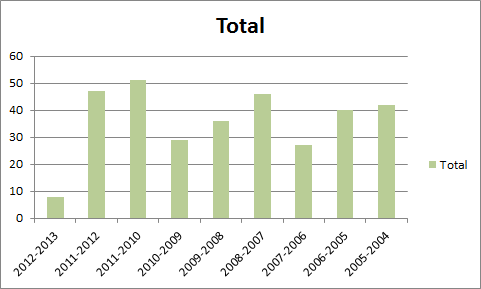
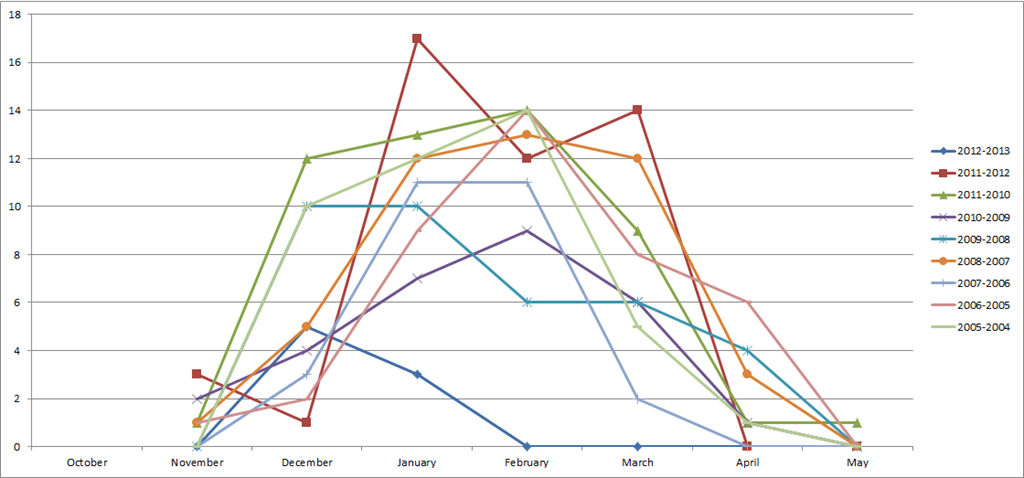
  • Skier Fatalities by Month

    These are fatalities at ski resorts, in-bounds and not labeled by the NSAA as a medical issue. These are from my reports and not from the NSAA.

    The first chart is the skier and boarder fatalities by year.

    image

    This chart is the skier and boarder fatalities graphed by month for each year.

    image

    Here are the numbers:

    12-13 12-11 11-10 10-09 09-08 08-07 07-06 06-05 05-04
    Nov 0 3 1 2 0 2 0 2 0
    Dec 5 1 12 4 10 5 3 2 10
    Jan 3 17 13 7 10 12 11 9 12
    Feb 12 14 9 6 13 11 14 14
    Mar 14 9 6 6 23 3 8 5
    Apr 0 1 1 4 3 0 6 1
    May 0 1 0 0 0 0 0 0
    Total 8 47 51 29 36 46 27 40 42

    I cannot make any discernible connection just by looking at the month when a skier or boarder has a fatality at a ski area in bounds.

    What do you think? Leave a comment.

    If you like this let your friends know or post it on FaceBook, Twitter or LinkedIn

    Copyright 2013 Recreation Law (720) Edit Law

    Email: blog@rec-law.us

    Twitter: RecreationLaw

    Facebook: Rec.Law.Now

    Facebook Page: Outdoor Recreation & Adventure Travel Law

    Blog: www.recreation-law.com

    Mobile Site: http://m.recreation-law.com

    By Recreation Law          Rec-law@recreation-law.com   James H. Moss                  Jim Moss

    #RecreationLaw, #@RecreationLaw, #Cycling.Law #Fitness.Law, #Ski.Law, #Outside.Law, #Recreation.Law, #Recreation-Law.com, #Outdoor Law, #Recreation Law, #Outdoor Recreation Law, #Adventure Travel Law, #law, #Travel Law, #Jim Moss, #James H. Moss, #Attorney at Law, #Tourism, #Adventure Tourism, #Rec-Law, #Rec-Law Blog, #Recreation Law, #Recreation Law Blog, #Risk Management, #Human Powered, #Human Powered Recreation,# Cycling Law, #Bicycling Law, #Fitness Law, #Recreation-Law.com, #Backpacking, #Hiking, #Mountaineering, #Ice Climbing, #Rock Climbing, #Ropes Course, #Challenge Course, #Summer Camp, #Camps, #Youth Camps, #Skiing, #Ski Areas, #Negligence, #Snowboarding, #RecreationLaw, #@RecreationLaw, #Cycling.Law #Fitness.Law, #SkiLaw, #Outside.Law, #Recreation.Law, #RecreationLaw.com, #OutdoorLaw, #RecreationLaw, #OutdoorRecreationLaw, #AdventureTravelLaw, #Law, #TravelLaw, #JimMoss, #JamesHMoss, #AttorneyatLaw, #Tourism, #AdventureTourism, #RecLaw, #RecLawBlog, #RecreationLawBlog, #RiskManagement, #HumanPowered, #HumanPoweredRecreation,# CyclingLaw, #BicyclingLaw, #FitnessLaw, #RecreationLaw.com, #Backpacking, #Hiking, #Mountaineering, #IceClimbing, #RockClimbing, #RopesCourse, #ChallengeCourse, #SummerCamp, #Camps, #YouthCamps, #Skiing, #Ski Areas, #Negligence, #Snowboarding, sport and recreation laws, ski law, cycling law, Colorado law, law for recreation and sport managers, bicycling and the law, cycling and the law, ski helmet law, skiers code, skiing accidents, Recreation Lawyer, Ski Lawyer, Paddlesports Lawyer, Cycling Lawyer, Recreational Lawyer, Fitness Lawyer, Rec Lawyer, Challenge Course Lawyer, Ropes Course Lawyer, Zip Line Lawyer, Rock Climbing Lawyer, Adventure Travel Lawyer, Outside Lawyer, Recreation Lawyer, Ski Lawyer, Paddlesports Lawyer, Cycling Lawyer, #RecreationalLawyer, #FitnessLawyer, #RecLawyer, #ChallengeCourseLawyer, #RopesCourseLawyer, #ZipLineLawyer, #RockClimbingLawyer, #AdventureTravelLawyer, #OutsideLawyer, ski area, ski area fatality, NSAA, National Ski Area Association, fatality

    WordPress Tags: Skier,Fatalities,Month,resorts,NSAA,boarder,Here,Total,connection,area,Leave,FaceBook,Twitter,LinkedIn,Recreation,Edit,Email,RecreationLaw,Page,Outdoor,Adventure,Travel,Blog,Mobile,Site,Outside,Moss,James,Attorney,Tourism,Risk,Management,Human,Rock,Ropes,Course,Challenge,Summer,Camp,Camps,Youth,Areas,Negligence,SkiLaw,OutdoorLaw,OutdoorRecreationLaw,AdventureTravelLaw,TravelLaw,JimMoss,JamesHMoss,AttorneyatLaw,AdventureTourism,RecLaw,RecLawBlog,RecreationLawBlog,RiskManagement,HumanPoweredRecreation,CyclingLaw,BicyclingLaw,FitnessLaw,RopesCourse,ChallengeCourse,SummerCamp,YouthCamps,Colorado,managers,helmet,accidents,Lawyer,Paddlesports,Recreational,Line,RecreationalLawyer,FitnessLawyer,RecLawyer,ChallengeCourseLawyer,RopesCourseLawyer,ZipLineLawyer,RockClimbingLawyer,AdventureTravelLawyer,OutsideLawyer,National,Association

  • Ski Binding Failure to Release under Indiana Law

    Moore v. Sitzmark Corporation and Salomon North America, Inc., 555 N.E.2d 1305; 1990 Ind. App. LEXIS 769; CCH Prod. Liab. Rep. P12,523

    Indiana, like most states’, product liability law is controlled by statute which severely limits the defenses available to a defendant. Here the retailer and manufacture were sued for injuries when a ski binding failed to release, both being in the chain of the sale of the product. The plaintiff had signed a “sales slip” which contained release language when she picked up the skis; however the sales slip (release) was only effective against one of the three claims of the plaintiff.

    The defendants had filed a motion for summary judgment at the trial court which was granted on all counts. The plaintiff appealed and the appellate court reversed on two of the three product liability claims.

    The plaintiff had purchased new skis and bindings from the retailer Sitzmark Corporation which included bindings manufactured by Salomon North America. On the plaintiff’s third run while skiing and her first fall on her new equipment she fell suffering a compound fracture.

    The plaintiff sued claiming negligence and strict liability. The negligence claim included two sub-claims negligent design of the bindings and negligent adjustment of the bindings by the retailer. The defenses were “incurred risk” and the release contained in the sales slip. Indiana uses the term incurred risk instead of the term assumption of the risk.

    Summary of the case

    The language in the sales slip that constituted the release language, excerpted below, did not contain the magic word release. It only talked about assumption of the risk issues. The plaintiff did acknowledge understanding the language.

    I have been instructed in the use of my equipment, I have read the manufacturer’s instruction pamphlet (new bindings only), I have made no misrepresentation in regard to my height, weight, age, or skiing ability . . . . I understand that there are inherent and other risks involved in the sport for which this equipment is to be used, snow skiing, that injuries are a common and ordinary occurrence of the sport and I freely assume those risks. I understand that the ski boot binding system will not release at all times or under all circumstances, nor is it possible to predict every situation in which it will release and is therefore no guarantee for my safety. I therefore release the ski shop and its owners, agents and employees from any and all liability for damage and from the selection, adjustment and use of this equipment, accepting myself the full responsibility for any and all such damage or injury which may result.

    The court reversed the lower court and reinstated the plaintiff’s strict liability claim. Strict liability is set out by statute in Indiana, Ind. Code 33-1-1.5-1 et seq. The court stated the statute had a three part test for the manufacture and retailer to use as a defense in a strict liability claim.

    First, a plaintiff’s knowledge of the defect.

    Second, a plaintiff’s unreasonable use of the product despite knowledge of the defect.

    Third, a plaintiff’s injuries caused by the product.

    The court analyzed the arguments and decided that neither defendant could prove that the plaintiff new of any defect in the binding. This was different from the argument they could prove, through the release language that “Moore knew her bindings would not release under all circumstances.” Because neither defendant could win on step one the case was sent back.

    The first negligence claim was a common law negligence claim. Common law meaning the law that evolved over time (and not based on statute), usually from the law carried over from Great Britain. The common law was developed in England during the 1500’s from the King’s decrees and the church’s equity decisions. As time progressed these laws became more streamline and eventually codified, or written down. The common law still exists in all states and is the basis for the law in every state (Louisiana being the sole exception). Only when a statute has been created will a section of the common law for that state disappear or cease to exist. Ninety-nine percent of all negligence claims are common law. A state may have a void in its common law, an area that has never been decided in the state before, however this is getting rare now days.

    A common law product liability action in Indiana can be defeated by the defense of incurred or assumption of the risk. However assumption of the risk as a defense had been merged into comparative negligence in Indiana at this time.

    The defendants argued that by signing the sales slip the plaintiff assumed the risk of the defect in the product. The court however found the sales slip was proof of assumption of the risk, but not of assumption of negligence the difference is the greater requirement of knowledge required by the statute. Because the first time she fell was also the time she was injured the plaintiff had no direct knowledge of the defect of the product. In this case defect would mean failure of the binding to release. As such, the defense failed because there was no proof of assumption of the risk of negligence. Because the binding has not failed to release prior to the injury, the plaintiff had no knowledge of the binding failing to release that she could assume. This claim was also sent back to the lower court.

    The third and final claim was based on negligently “setting, adjusting or checking the bindings.” Here the sales slip with its release language was effective. The court stated “These alleged acts of negligence are exactly those for which Moore granted Sitzmark a release of liability when she read and signed the sales slip.” This final claim was dismissed by the appellate court.

    This case is a little confusing because of two issues. Indiana law on product liability is different from many states and the release language in the sales slip was very poorly written. There is not much that can be done about Indiana’s product liability law and the limitation on the defenses available manufacture’s and retailers. However a well written release might have prevented one of the product liability claims.

    So Now What?

    The release is not clearly identified, other than in a sales slip in this opinion. However during this period, these releases were fairly uniform and used by shops across the US. These preprinted forms are written in a way as to not cause a problem with any state laws rather than to effectively stop a claim.

    Having a release in this case that specifically used the word the negligence and identified the defendants as the shop, by name and all manufactures would be the first start. The court spent a lot of space finding a way to bring the manufacture into the defense provided by the release language when the language did not specifically mention the manufacture. The language of the release should incorporate the necessary defenses of the Indiana Strict Liability Act so that the defense in the act is available. The negligence claims should be identified both for negligent acts, negligent mounting and setting and negligent in the design, manufacture or construction of the product. The language should also include more specific assumption of the risk language so the purchaser or customer who is having repairs done understands the risks are not that the binding may not work, but that the risk is the binding will not work and that the user should ski knowing that and in a safe way.

    A well written release, based on Indiana law may be difficult to do. However, a well written release will still be better than the one at issue here. Each claim that survives the motions and appeal increases the cost of litigating and the cost of a possible settlement. If the release had eliminated one more of the claims a lower settlement would be easier to achieve, maybe even a complete win at trial.

    Plaintiff: Eldonna Moore


    Defendant: Sitzmark Corporation and Salomon North America, Inc.,


    Plaintiff Claims: negligence (product liability) and strict liability


    Defendant Defenses: Assumption of the Risk (Incurred Risk) and Release


    Holding: One claim dismissed based on the release and the two remaining claims sent back to the trial court.


    What do you think? Leave a comment.

    If you like this let your friends know or post it on FaceBook, Twitter or LinkedIn

    Copyright 2013 Recreation Law (720) Edit Law

    Email: blog@rec-law.us

    Twitter: RecreationLaw

    Facebook: Rec.Law.Now

    Facebook Page: Outdoor Recreation & Adventure Travel Law

    Blog: www.recreation-law.com

    Mobile Site: http://m.recreation-law.com

    By Recreation Law          Rec-law@recreation-law.com   James H. Moss                  Jim Moss

    #RecreationLaw, #@RecreationLaw, #Cycling.Law #Fitness.Law, #Ski.Law, #Outside.Law, #Recreation.Law, #Recreation-Law.com, #Outdoor Law, #Recreation Law, #Outdoor Recreation Law, #Adventure Travel Law, #law, #Travel Law, #Jim Moss, #James H. Moss, #Attorney at Law, #Tourism, #Adventure Tourism, #Rec-Law, #Rec-Law Blog, #Recreation Law, #Recreation Law Blog, #Risk Management, #Human Powered, #Human Powered Recreation,# Cycling Law, #Bicycling Law, #Fitness Law, #Recreation-Law.com, #Backpacking, #Hiking, #Mountaineering, #Ice Climbing, #Rock Climbing, #Ropes Course, #Challenge Course, #Summer Camp, #Camps, #Youth Camps, #Skiing, #Ski Areas, #Negligence, #Snowboarding, #RecreationLaw, #@RecreationLaw, #Cycling.Law #Fitness.Law, #SkiLaw, #Outside.Law, #Recreation.Law, #RecreationLaw.com, #OutdoorLaw, #RecreationLaw, #OutdoorRecreationLaw, #AdventureTravelLaw, #Law, #TravelLaw, #JimMoss, #JamesHMoss, #AttorneyatLaw, #Tourism, #AdventureTourism, #RecLaw, #RecLawBlog, #RecreationLawBlog, #RiskManagement, #HumanPowered, #HumanPoweredRecreation,# CyclingLaw, #BicyclingLaw, #FitnessLaw, #RecreationLaw.com, #Backpacking, #Hiking, #Mountaineering, #IceClimbing, #RockClimbing, #RopesCourse, #ChallengeCourse, #SummerCamp, #Camps, #YouthCamps, #Skiing, #Ski Areas, #Negligence, #Snowboarding, sport and recreation laws, ski law, cycling law, Colorado law, law for recreation and sport managers, bicycling and the law, cycling and the law, ski helmet law, skiers code, skiing accidents, Recreation Lawyer, Ski Lawyer, Paddlesports Lawyer, Cycling Lawyer, Recreational Lawyer, Fitness Lawyer, Rec Lawyer, Challenge Course Lawyer, Ropes Course Lawyer, Zip Line Lawyer, Rock Climbing Lawyer, Adventure Travel Lawyer, Outside Lawyer, Recreation Lawyer, Ski Lawyer, Paddlesports Lawyer, Cycling Lawyer, #RecreationalLawyer, #FitnessLawyer, #RecLawyer, #ChallengeCourseLawyer, #RopesCourseLawyer, #ZipLineLawyer, #RockClimbingLawyer, #AdventureTravelLawyer, #OutsideLawyer, Sitzmark Corporation, Salomon North America, Inc., Product Liability, Ski, Ski Binding,

    WordPress Tags: Failure,Release,Indiana,Sitzmark,Corporation,Salomon,North,America,LEXIS,Prod,Liab,product,statute,defendant,Here,retailer,injuries,sale,plaintiff,sales,defendants,judgment,bindings,equipment,negligence,adjustment,assumption,Summary,manufacturer,instruction,pamphlet,misrepresentation,occurrence,system,situation,owners,agents,employees,selection,injury,Strict,Code,knowledge,Second,Third,arguments,argument,Common,Great,Britain,England,decisions,laws,basis,Louisiana,exception,area,action,difference,requirement,limitation,retailers,opinion,construction,purchaser,customer,user,cost,settlement,Eldonna,Claims,Defenses,Risk,Leave,FaceBook,Twitter,LinkedIn,Recreation,Edit,Email,RecreationLaw,Page,Outdoor,Adventure,Travel,Blog,Mobile,Site,Outside,Moss,James,Attorney,Tourism,Management,Human,Rock,Ropes,Course,Challenge,Summer,Camp,Camps,Youth,Areas,SkiLaw,OutdoorLaw,OutdoorRecreationLaw,AdventureTravelLaw,TravelLaw,JimMoss,JamesHMoss,AttorneyatLaw,AdventureTourism,RecLaw,RecLawBlog,RecreationLawBlog,RiskManagement,HumanPoweredRecreation,CyclingLaw,BicyclingLaw,FitnessLaw,RopesCourse,ChallengeCourse,SummerCamp,YouthCamps,Colorado,managers,helmet,accidents,Lawyer,Paddlesports,Recreational,Line,RecreationalLawyer,FitnessLawyer,RecLawyer,ChallengeCourseLawyer,RopesCourseLawyer,ZipLineLawyer,RockClimbingLawyer,AdventureTravelLawyer,OutsideLawyer,skis,three,appellate,neither

  • Moore v. Sitzmark Corporation and Salomon North America, Inc., 555 N.E.2d 1305; 1990 Ind. App. LEXIS 769; CCH Prod. Liab. Rep. P12,523

    Moore v. Sitzmark Corporation and Salomon North America, Inc., 555 N.E.2d 1305; 1990 Ind. App. LEXIS 769; CCH Prod. Liab. Rep. P12,523

    Eldonna Moore, Plaintiff-Appellant, v. Sitzmark Corporation and Salomon North America, Inc., Defendants-Appellees

    No. 73A01-8908-CV-332

    Court of Appeals of Indiana, First District

    555 N.E.2d 1305; 1990 Ind. App. LEXIS 769; CCH Prod. Liab. Rep. P12,523

    June 27, 1990, Filed

    PRIOR HISTORY: [**1] Appeal from the Shelby Superior Court No. 1; The Honorable Jonathan E. Palmer, Judge; Cause No. 20C01-8806-CP-095.

    COUNSEL: Attorneys for Appellant: C. Warren Holland, Michael W. Holland, William J. Rumely, Holland & Holland, Indianapolis, Indiana.

    Attorneys for Appellees: C. Wendell Martin, Amy L. Rankin, Martin, Wade, Hartley & Hollingsworth, Indianapolis, Indiana.

    JUDGES: Baker, J. Ratliff, C.J., and Hoffman, P.J., concur.

    OPINION BY: BAKER

    OPINION

    [*1306] Plaintiff-appellant Eldonna Moore (Moore) broke her leg in a snow skiing accident. She subsequently brought this suit against defendant-appellees Salomon North America, Inc. (Salomon) and Sitzmark Corporation (Sitzmark), the manufacturer and seller, respectively, of the ski bindings she was using when she broke her leg The trial court granted summary judgment to Salomon and Sitzmark, and Moore now appeals. We affirm in part and reverse in part.

    On February 18, 1986, Moore, an experienced skier, purchased a pair of new downhill skis and new bindings from Sitzmark. Sitzmark installed the bindings, known as Salomon 747 bindings, on the skis, and adjusted them to release based on Moore’s weight. At the time of purchase, Moore signed a sales slip which contained the following [**2] language.

    I have been instructed in the use of my equipment, I have read the manufacturer’s instruction pamphlet (new bindings only), I have made no misrepresentation in regard to my height, weight, age, or skiing ability . . . . I understand that there are inherent and other risks involved in the sport for which this equipment is to be used, snow skiing, that injuries are a common and ordinary occurrence of the sport and I freely assume those risks. I understand that the ski boot binding system will not release at all times or under all circumstances, nor is it possible to predict every situation in which it will release and is therefore no guarantee for my safety. I therefore release the ski shop and its owners, agents and employees from any and all liability for damage and from the selection, adjustment and use of this equipment, accepting myself the full responsibility for any and all such damage or injury which may result.

    Moore admits to having read and understood the sales slip.

    On March 1, 1986, Moore went to Sugarloaf Mountain in Michigan and used her new skis and bindings for the first time. She made two uneventful “runs” down the most difficult slope. On her third trip [**3] down the slope, however, she took a severe fall, during which the binding on her right ski did not release. As a result of the fall, she suffered a compound fracture of her right femur.

    Moore brought suit against Salomon and Sitzmark, alleging theories of negligence and strict liability. The negligence claim against Salomon was premised on negligent design, and the negligence claim against Sitzmark was premised on negligent adjustment of the bindings. In their motions for summary judgment, Salomon and Sitzmark argued that Moore had incurred the risk, and the trial court granted the motions on that basis. On appeal, Moore raises two restated issues for our review. First, whether the trial court erred in finding she had incurred the risk. Second, whether the release of liability Moore signed was effective.

    [HN1] When reviewing a grant of summary judgment, we apply the same standards as the trial court, and examine the pleadings, depositions, answers to interrogatories, [*1307] admissions, and affidavits filed with the court in the light most favorable to the party opposing summary judgment. Hatton v. Fraternal Order of Eagles (1990), Ind. App., 551 N.E.2d 479. Summary judgment is appropriate [**4] only when no genuine issues of material fact exist and the moving party is entitled to judgment as a matter of law. Id. When a defendant is the moving party, it is entitled to judgment as a matter of law when it demonstrates one of two things. First, that the undisputed material facts negate at least one element of the plaintiff’s claim. Second, the defendant may raise an affirmative defense which bars the plaintiff’s claim. 3 W. HARVEY, INDIANA PRACTICE § 56.9 at 629 (1988). If a defendant cannot make one of these showings, summary judgment is improper.

    I. INCURRED RISK

    A. Strict Liability

    Moore argues she incurred only the ordinary risk of falling while skiing. Based on the language in the sales slip’s release of liability, Salomon and Sitzmark argue Moore incurred the risk that her bindings could fail to release and that she might suffer harm as a result. Salomon and Sitzmark are correct, but that is not dispositive of the case.

    Moore’s strict liability theory, based on her allegation that the bindings were defective, is a statutory cause of action controlled by the Indiana Product Liability Act, IND. CODE 33-1-1.5-1 et seq. [HN2] The Act has preempted the Indiana common [**5] law of strict liability and “governs all actions in which the theory of liability is strict liability in tort.” IND. CODE 33-1-1.5-1. See Koske v. Townsend Engineering Co. (1990), Ind., 551 N.E.2d 437. Under the Act,

    (a) One who sells, leases, or otherwise puts into the stream of commerce any product in a defective condition unreasonably dangerous to any user or consumer or to his property is subject to liability for physical harm caused by that product to the user or consumer or his property if that user or consumer is in the class of persons that the seller should reasonably foresee as being subject to the harm caused by the defective condition, and if:

    (1) the seller is engaged in the business of selling such a product; and

    (2) the product is expected to and does reach the user or consumer without substantial alteration in the condition in which it is sold by the person sought to be held liable under this chapter.

    IND. CODE 33-1-1.5-3(a). IND. CODE 33-1-1.5-2 defines a seller as “a person engaged in business as a manufacturer, a wholesaler, a retailer, a lessor, or a distributor.” Accordingly, if Moore can prove the bindings were in a defective condition unreasonably dangerous, [**6] Salomon as manufacturer, and Sitzmark as retail seller, will be subject to liability under the Act.

    The Act provides that defendants may raise the affirmative defense of incurred risk, as Salomon and Sitzmark did here. [HN3] “It is a defense that the user or consumer bringing the action knew of the defect and was aware of the danger and nevertheless proceeded unreasonably to make use of the product and was injured by it.” IND. CODE 33-1-1.5-4(b)(1) (emphasis added). The party asserting incurred risk bears the burden of proving the defense by a preponderance of the evidence, Get-N-Go, Inc. v. Markins (1989), Ind., 544 N.E.2d 484, reh’g granted on other grounds, 550 N.E.2d 748, and this requires three showings under IND. CODE 33-1-1.5-4(b)(1). First, a plaintiff’s knowledge of the defect. See, e.g., Corbin v. Coleco Industries, Inc. (7th Cir. 1984) 748 F.2d 411. Second, a plaintiff’s unreasonable use of the product despite knowledge of the defect. Third, a plaintiff’s injuries caused by the product. 1

    1 In reality, of course, the third element will generally be shown by the plaintiff, requiring the party raising incurred risk to prove only the first two elements.

    [**7] This is where Salomon and Sitzmark fail. Neither of them asserts that Moore knew of any defect in the bindings, they merely argue Moore knew her bindings would not release under all circumstances. [*1308] Absent the threshold showing that Moore knew of a defect in the bindings, neither Salomon nor Sitzmark is entitled to summary judgment on the grounds of incurred risk. The trial court’s grant of summary judgment on Moore’s strict liability theory was improper. 2

    2 If, upon remand, Salomon and Sitzmark are able to prove Moore incurred the risk of a defect in the bindings, this will act as a complete bar to Moore’s strict liability claim. [HN4] The Comparative Fault Act, IND. CODE 34-4-33-1 et seq., does not include strict liability theory actions, but only those actions based on fault. See IND. CODE 34-4-33-1.

    B. Negligence

    A similar analysis applies to Moore’s negligent design theory against Salomon. [HN5] A plaintiff may, of course, bring a negligence action against the manufacturer of a product. See, e.g., Jarrell [**8] v. Monsanto Co. (1988), Ind. App., 528 N.E.2d 1158; Pfisterer v. Grisham (1965), 137 Ind. App. 565, 210 N.E.2d 75; MacPherson v. Buick Motor Co. (1916), 217 N.Y. 382, 111 N.E. 1050. Such an action is not subject to the terms of the Indiana Product Liability Act; rather, it is a common law action. Koske, supra, 551 N.E.2d at 443. In turn, the manufacturer may raise the defense of incurred risk. See Pfisterer, supra. In a negligence action, the defense of incurred risk is specifically subject to the terms of the Comparative Fault Act. See IND. CODE 34-4-33-2(a).

    As all the parties to this dispute correctly point out, incurred risk involves a mental state of venturousness on the part of the actor against whom it is asserted, and requires a subjective analysis of the actor’s actual knowledge and voluntary acceptance of the risk. Get-N-Go, supra; Power v. Brodie (1984), Ind. App., 460 N.E.2d 1241; Kroger Co. v. Haun (1978), 177 Ind. App. 403, 379 N.E.2d 1004. As with the parties’ dispute over incurred risk in the context of a strict liability theory, the question here revolves around the proper definition of the risk that may or may not have been incurred.

    [**9] As we have already discussed, by signing the release in the sales slip, Moore incurred the risk that her bindings would not release under all circumstances and that she might suffer injuries in the event of a failure to release. This was merely an acknowledgement of the laws of physics, however. There is no evidence Moore knew of any alleged negligent design of the bindings. Salomon argues vigorously that Indiana case law defines the risk as solely the risk of injury, not the risk of negligence. 3 Salomon is mistaken.

    3 Salomon and Sitzmark make much of the voluntariness of Moore’s actions (i.e., purchasing the bindings, signing the release, and skiing for pleasure) in incurring the risk of her bindings failing to release. It is hornbook law that [HN6] actions which are not truly voluntary do not amount to an incurrence of risk. See, e.g., Get-N-Go, supra; Richarson v. Marrell’s (1989), Ind. App., 539 N.E.2d 485, trans. denied; St. Mary’s Byzantine Church v. Mantich (1987), Ind. App., 505 N.E.2d 811, trans. denied. Moore’s actions were indeed voluntary, but this is immaterial; the proper definition of the risk is the dispositive issue in this case.

    [**10] In Pfisterer, supra, the plaintiff lost part of her finger while using a slide at the defendants’ resort park. The plaintiff had used slides before, but had never used the slide which injured her prior to the time of injury. In discussing the defense of incurred or assumed risk, the court held the plaintiff “assumed or incurred the risks inherent and incident to the use of this slide, but she did not assume or incur the risk that the slide might be defectively constructed. [She] could not assume or incur the risk of a latent defect of which she had neither notice nor knowledge, either express or implied.” 4 Pfisterer, supra, 137 Ind. App. at 572, 210 N.E.2d at 78-79.

    4 The plaintiff was 13 years old at the time of the accident. The court, however, did not in any way rely on the plaintiff’s youth as a basis for its decision.

    In a similar case, the Missouri Court of Appeals held a high school pole vaulter assumed the inherent risks of pole vaulting, but not the risks of the manufacturer’s negligence. McCormick v. Lowe & Campbell Athletic Goods Co. (1940), 235 Mo. App. 612, 144 S.W.2d 866.

    [**11] Similarly, the evidence most favorable to Moore reveals she had no knowledge [*1309] of any negligent design flaws in the bindings. Moreover, she had not fallen while using the new bindings prior to the fall which injured her. Even if she had, assuming any defect was latent, she could not incur the risk of the defect without notice of the defect. 5 Moore did not incur the risk of negligent design by Salomon. The trial court’s grant of summary judgment to Salomon on Moore’s negligence theory was improper.

    5 [HN7] If any defect was open and obvious under the rule enunciated in Bemis Co. v. Rubush (1981), Ind., 427 N.E.2d 1058, 1061, cert. denied (1982), 459 U.S. 825, 103 S. Ct. 57, 74 L. Ed. 2d 61, Moore may not recover on her negligence theory. Koske, supra, did not abrogate the open and obvious rule, but rather held it inapplicable to actions under the Indiana Product Liability Act. The rule is still applicable in product negligence liability cases. Koske, supra, 551 N.E.2d at 443. See Also Bridgewater v. Economy Eng’g Co. (1985), Ind., 486 N.E.2d 484, modified on other grounds in Get-N-Go, Inc. v. Markins (1990), 550 N.E.2d 748.

    [**12] II. EFFECT OF RELEASE

    Moore’s negligence complaint against Sitzmark alleged Sitzmark had been negligent in setting, adjusting, or checking the bindings. These alleged acts of negligence are exactly those for which Moore granted Sitzmark a release of liability when she read and signed the sales slip. This release was valid under Indiana law, LaFrenz v. Lake Cty. Fair Bd. (1977), 172 Ind. App. 389, 360 N.E.2d 605, and the trial court properly granted summary judgment to Sitzmark on Moore’s negligence theory.

    The trial court’s summary judgment in favor of Sitzmark on Moore’s negligence theory is affirmed. The trial court’s summary judgment in favor of Sitzmark on Moore’s strict liability theory, and in favor of Salomon on both Moore’s strict liability and negligence theories is reversed. The cause is remanded to the trial court for further proceedings consistent with this opinion.

    Ratliff, C.J., and Hoffman, P.J., concur.

    WordPress Tags: Sitzmark,Corporation,Salomon,North,America,LEXIS,Prod,Liab,Eldonna,Plaintiff,Appellant,Defendants,Appellees,Court,Appeals,Indiana,District,June,PRIOR,HISTORY,Appeal,Shelby,Superior,Honorable,Jonathan,Palmer,Judge,Cause,CASE,SUMMARY,PROCEDURAL,POSTURE,decision,judgment,manufacturer,seller,product,negligence,action,OVERVIEW,bindings,Code,knowledge,OUTCOME,proceedings,TERMS,theory,consumer,user,LexisNexis,Headnotes,Civil,Procedure,Appellate,Review,General,Opposition,Standards,admissions,affidavits,fact,defendant,Second,showings,Contracts,Types,Lease,Agreements,Torts,Premises,Lessees,Lessors,Liabilities,Preemption,tort,Under,commerce,alteration,person,chapter,wholesaler,retailer,distributor,Defenses,Assumption,Risk,Products,Conduct,Strict,danger,preponderance,Third,injuries,Comparative,Intentional,Fault,actor,analysis,acceptance,Actions,COUNSEL,Attorneys,Warren,Holland,Michael,William,Indianapolis,Wendell,Martin,Rankin,Wade,Hartley,Hollingsworth,JUDGES,Baker,Ratliff,Hoffman,OPINION,accident,February,sales,equipment,instruction,pamphlet,misrepresentation,occurrence,system,situation,owners,agents,employees,selection,adjustment,injury,March,Sugarloaf,Mountain,Michigan,theories,basis,Hatton,Fraternal,Order,Eagles,HARVEY,PRACTICE,allegation,Koske,Townsend,emphasis,Markins,Corbin,Coleco,Industries,Neither,Absent,threshold,Jarrell,Monsanto,Pfisterer,Grisham,MacPherson,Buick,Motor,Power,Brodie,Kroger,Haun,context,definition,event,failure,laws,physics,Richarson,Marrell,Mary,Byzantine,Church,Mantich,resort,park,incident,youth,Missouri,McCormick,Lowe,Campbell,Athletic,Goods,flaws,Moreover,Bemis,Rubush,cert,Also,Bridgewater,Economy,EFFECT,RELEASE,complaint,LaFrenz,Lake,Fair,skis,dispositive,pleadings,interrogatories,lessor,three,whom,incurrence,whether,supra,trans

  • You cannot be liable for what you do not control or what volunteers do

    Moore v. Boy Scouts of America Los Angeles Area Council, Inc., 2004 Cal. App. Unpub. LEXIS 11180

    It is also hard to be liable for not watching where you are walking

    This case stems from injuries received when a volunteer was setting up a tent and fell over one of the guy lines for the tent.

    The plaintiff was a volunteer and with other volunteers was setting up a large tent at a Scout Camp. The camp was owned by the Los Angeles Area Council, Inc. which was granted a charter by the Boy Scouts of America to offer the Scouting program to local youth. The tent was a large military wall tent, similar to what you would see on reruns of M*A*S*H.

    While setting up the tent, another volunteer asked the plaintiff to get more tent stakes. She walked around the tent, picked up more stakes and while walking back tripped over one of the guy lines holding up the tent. None of the guy lines had been marked with flags or markers to indicate there was a line there and the accident occurred around 7:00 Pm in July. (None are marked in the M*A*S*H reruns either.) The factual issue became whether or not markers or flags should have been used to identify the guy-lines on the tents.

    The court went through and clearly identified factual issues the court felt were important.

    Moore had not set up the specific pole, rope or stake upon which she tripped.

    The ropes coming off the tent were at varying angles and pitches. The ropes varied in length, de-pending upon location. There were no flags or markers on the ropes.

    Before this date, Moore had never been involved in setting up or taking down this tent or this type of tent. However, in years past, Moore had used rope or flags to mark the guy ropes on this tent to make the ropes more visible.

    Before Moore fell, neither Moore nor any of the other adult volunteers saw anything they considered unsafe or dangerous.

    In the past, some of the adult volunteers had used markers (e.g., cloth or fluorescent plastic tape) to make ropes more visible in scout camps and in non-scout camping situations. In prior years, this tent had been used in the Boy Scout camp, and flags had been used to mark the ropes. It is unclear if markers were used each time the tent was used.

    The plaintiff argued the BSA did not have a policy of marking guy lines with markers or flags.

    The plaintiff sued for premises liability and negligence. The premises liability claim was based on negligently setting up a tent without guy lines and the negligence claim for not using reasonable care when setting up tents by not using markers on guy-lines.

    The Boy Scouts filed a motion for summary judgment based on the fact there was no triable issues, no real legal claims, which was granted and the plaintiff appealed.

    So?

    The plaintiff’s main arguments were supported by its expert an ergonomist who was a human factors and safety consultant. (This has me confused too, as to why an ergonomist (whatever) has any knowledge of setting up a tent.) The ergonomist said that that groups in Virginia, Australia and Louisiana has policies on markers on tent lines.

    The court first looked at the premises liability claim. A premises liability claim is based on a dangerous condition on land. The owner of land is liable for “only for hazardous conditions of which the possessor had actual or constructive knowledge.” The tent was not part of the land so there was no legal basis for a premises liability claim.

    The negligence claim was also dismissed by the court. Since the tent was being set up by volunteers, there was no proof that the BSA created the dangerous condition or was aware that a dangerous condition existed. The BSA could not breach a duty of care when the actions which created a dangerous condition were not those of the BSA. Nor does the lack of a policy create a dangerous condition on land. The plaintiff’s argument the court reasoned, where closer to tent issues not land issues.

    So Now What?

    The legal issues are as stretched in this case as you can get in my opinion. You are setting up a tent by setting up guy lines; you can’t sue when you trip over a guy line.

    The claims were incorrect for the facts. The court looked at the issues and could not find any legal connection between the facts, the claims and the law.

    However, that does not mean that not watching where you walk might not lead to litigation at some future date that does hold some water.

    You can write policies till there are no more trees. In doing so, you’ll probably sink some other group who is trying to save trees. Better to educate than kill a tree. Train your volunteers, prove you trained them, and then explain how the organization they are volunteering for cannot afford lawsuits, stupid ones or regular ones. By that I mean include litigation training; you can’t sue us, in the training you provide.

    Explain how it is their job to protect each other as well as to protect the organization. Tell them and prove you told them that you cannot identify all of the risks they may encounter.

    You might even have them sign a release.

    Plaintiff: Josephine Moore


    Defendant: Boy Scouts of America Los Angeles Area Council, Inc.


    Plaintiff Claims: Premises Liability and Negligence


    Defendant Defenses: not triable issues of fact, no negligence


    Holding: Trial court dismissal was affirmed


    What do you think? Leave a comment.

    If you like this let your friends know or post it on FB, Twitter or LinkedIn

    Copyright 2012 Recreation Law (720) Edit Law

    blog@rec-law.us

    Twitter: RecreationLaw

    Facebook: Rec.Law.Now

    Facebook Page: Outdoor Recreation & Adventure Travel Law

    Blog:www.recreation-law.com

    Mobile Site: http://m.recreation-law.com

    By Recreation Law          Rec-law@recreation-law.com   James H. Moss                  Jim Moss

    #RecreationLaw, #@RecreationLaw, #Cycling.Law #Fitness.Law, #Ski.Law, #Outside.Law, #Recreation.Law, #Recreation-Law.com, #Outdoor Law, #Recreation Law, #Outdoor Recreation Law, #Adventure Travel Law, #law, #Travel Law, #Jim Moss, #James H. Moss, #Attorney at Law, #Tourism, #Adventure Tourism, #Rec-Law, #Rec-Law Blog, #Recreation Law, #Recreation Law Blog, #Risk Management, #Human Powered, #Human Powered Recreation,# Cycling Law, #Bicycling Law, #Fitness Law, #Recreation-Law.com, #Backpacking, #Hiking, #Mountaineering, #Ice Climbing, #Rock Climbing, #Ropes Course, #Challenge Course, #Summer Camp, #Camps, #Youth Camps, #Skiing, #Ski Areas, #Negligence, #Snowboarding, #RecreationLaw, #@RecreationLaw, #Cycling.Law #Fitness.Law, #SkiLaw, #Outside.Law, #Recreation.Law, #RecreationLaw.com, #OutdoorLaw, #RecreationLaw, #OutdoorRecreationLaw, #AdventureTravelLaw, #Law, #TravelLaw, #JimMoss, #JamesHMoss, #AttorneyatLaw, #Tourism, #AdventureTourism, #RecLaw, #RecLawBlog, #RecreationLawBlog, #RiskManagement, #HumanPowered, #HumanPoweredRecreation,# CyclingLaw, #BicyclingLaw, #FitnessLaw, #RecreationLaw.com, #Backpacking, #Hiking, #Mountaineering, #IceClimbing, #RockClimbing, #RopesCourse, #ChallengeCourse, #SummerCamp, #Camps, #YouthCamps, #Skiing, #Ski Areas, #Negligence, #Snowboarding, sport and recreation laws, ski law, cycling law, Colorado law, law for recreation and sport managers, bicycling and the law, cycling and the law, ski helmet law, skiers code, skiing accidents, Recreation Lawyer, Ski Lawyer, Paddlesports Lawyer, Cycling Lawyer, Recreational Lawyer, Fitness Lawyer, Rec Lawyer, Challenge Course Lawyer, Ropes Course Lawyer, Zip Line Lawyer, Rock Climbing Lawyer, Adventure Travel Lawyer, Outside Lawyer, Recreation Lawyer, Ski Lawyer, Paddlesports Lawyer, Cycling Lawyer, #RecreationalLawyer, #FitnessLawyer, #RecLawyer, #ChallengeCourseLawyer, #RopesCourseLawyer, #ZipLineLawyer, #RockClimbingLawyer, #AdventureTravelLawyer, #OutsideLawyer, Los Angeles Area Council, Inc., #BSA, Boy Scouts, Boy Scouts of America, Guy Lines, Tent Lines, #Volunteer, Premises Liability,


  • Moore v. Boy Scouts of America Los Angeles Area Council, Inc., 2004 Cal. App. Unpub. LEXIS 11180

    Moore v. Boy Scouts of America Los Angeles Area Council, Inc., 2004 Cal. App. Unpub. LEXIS 11180

    Josephine Moore, Plaintiff and Appellant, v. Boy Scouts of America Los Angeles Area Council, Inc., Defendant and Respondent.

    B170389

    COURT OF APPEAL OF CALIFORNIA, SECOND APPELLATE DISTRICT, DIVISION THREE

    2004 Cal. App. Unpub. LEXIS 11180

    December 10, 2004, Filed

    NOTICE: [*1] NOT TO BE PUBLISHED IN OFFICIAL REPORTS. CALIFORNIA RULES OF COURT, RULE 977(a), PROHIBIT COURTS AND PARTIES FROM CITING OR RELYING ON OPINIONS NOT CERTIFIED FOR PUBLICATION OR ORDERED PUBLISHED, EXCEPT AS SPECIFIED BY RULE 977(B). THIS OPINION HAS NOT BEEN CERTIFIED FOR PUBLICATION OR ORDERED PUBLISHED FOR THE PURPOSES OF RULE 977.

    PRIOR HISTORY: APPEAL from a judgment of the Superior Court of Los Angeles County, No. NC040331. Elizabeth Allen White, Judge.

    DISPOSITION: Affirmed.

    CORE TERMS: scout, tent, rope, volunteer, flag, summary judgment, scout camp, causes of action, hazard, marker, adult, guy ropes, feet, dangerous condition, declaration, triable, conspicuity, warning, premises liability, issues of fact, negligently, military, donated, wall tent, lighting, tripped, visible, manual, pole, trip

    COUNSEL: Sedgwick, Detert, Moran & Arnold, Thomas A. Delaney and Steven S. Streger, for Defendant and Respondent.

    Desjardins Kelly and Warren D. Kelly, for Plaintiff and Appellant.

    JUDGES: ALDRICH, J.; CROSKEY, Acting P. J., KITCHING, J. concurred.

    OPINION BY: ALDRICH

    OPINION

    INTRODUCTION

    Plaintiff and appellant Josephine Moore (Moore) was setting up a tent for a scout camp site when she tripped over a rope that was securing the tent. Moore appeals from a summary judgment entered in favor of defendant and respondent Boy Scouts of America Los Angeles Area Council. Inc. (the Boy Scouts). We affirm.

    FACTUAL AND PROCEDURAL BACKGROUND

    1. Facts.

    Following the usual rules on appeal, we construe the facts in the light most favorable [*2] to Moore, the party who opposed the motion for summary judgment. (Jackson v. Ryder Truck Rental, Inc. (1993) 16 Cal.App.4th 1830, 1836.)

    On July 8, 2001, Moore was setting up a scout camp site. She and other adult volunteers were erecting a wall tent that was secured by poles and ropes. No employee of the Boy Scouts was involved in setting up the tent. The Boy Scouts did not own the tent. The rectangular tent was oblong, about 24 feet long by 16 feet wide. The poles used to hold up the tent were 6 feet long. Beige ropes were used to secure the tent to the ground and to keep the tent upright.

    At about 7:00 p.m., the volunteers had been setting up the tent for 30 to 60 minutes. The tent was about four or five feet from a picnic table. One of the other adults asked Moore to retrieve additional stakes from the opposite side of the tent. Moore walked around the tent and picked-up six or seven stakes. Moore walked near the tent, toward the adult who had requested the stakes. In doing so, Moore tripped over one of the ropes that had already been staked into the ground. The stake holding the rope was two to five feet from the tent and two to five feet from the picnic table.

    [*3] Moore had not set up the specific pole, rope or stake upon which she tripped.

    The ropes coming off the tent were at varying angles and pitches. The ropes varied in length, depending upon location. There were no flags or markers on the ropes.

    Before this date, Moore had never been involved in setting up or taking down this tent or this type of tent. However, in years past, Moore had used rope or flags to mark the guy ropes on this tent to make the ropes more visible.

    During the time the tent was being set up, Moore was aware that some guy ropes were already in place, extending out from corners of the tent.

    Before Moore fell, neither Moore nor any of the other adult volunteers saw anything they considered unsafe or dangerous.

    In the past, some of the adult volunteers had used markers (e.g., cloth or fluorescent plastic tape) to make ropes more visible in scout camps and in non-scout camping situations. In prior years, this tent had been used in the Boy Scout camp, and flags had been used to mark the ropes. It is unclear if markers were used each time the tent was used.

    The Boy Scout’s manual did not address rope safety and did not instruct that markers were to be used, although [*4] some believed marking the ropes made good sense. The photograph of a wall tent in the manual appeared to have markers on the ropes.

    At one Boy Scout volunteer training session held a few years prior to this accident, volunteers were told to flag tent ropes so no one would trip. The Boy Scouts had no documents relating to the use of warnings on ropes.

    The scout camp is planned by volunteers. The Boy Scout district executive, Jim McCarthy, attends the planning meetings.

    2. Procedure.

    Moore sued the Boy Scouts. The complaint stated two causes of action.

    In the first cause of action for premises liability, Moore alleged that the Boy Scouts “negligently maintained, managed, controlled, and operated the Scout Camp, in that the guy ropes attached to a certain tent in the Scout Camp were unmarked with flags, or with anything, and were obscured from view without some kind of flag, marker, or other warning, owing to their color, size and geometry, location, time of day, and other factors, which [the Boy Scouts] knew, or in the exercise of reasonable care should have known, constituted a dangerous condition and unreasonable risk of harm of which [Moore] was at all times . . . [*5] unaware. [The Boy Scouts] negligently failed to take steps to either make the condition safe or warn [Moore] of the dangerous condition, all of which caused [Moore] to trip and fall on one of the guy ropes, and to suffer the injuries and damages hereinafter described.”

    In the second cause of action for negligence, Moore alleged that the Boy Scouts failed to “use reasonable care in the construction, maintenance, management, and control of the Scout Camp, including but not limited to placing flags or some other kind of marker or warning to identify and call attention to the presence and location of the guy ropes surrounding the tent tarp. [P] . . . [The Boy Scouts] knew or should have known that the construction of the Scout Camp was likely to create during the construction a risk of harm to those who were working on and around the Scout Camp unless special precautions were taken, in that, among other things, guy ropes, which were obscured from view . . . would be emanating from the tent, unmarked and unguarded, in a fashion that constituted a hazard to persons, including [Moore].”

    The Boys Scouts brought a motion for summary judgment.

    In opposing the motion, Moore submitted [*6] the declaration of psychologist Ilene B. Zackowitz, Ph.D. Dr. Zackowitz declared the following. She was a human factors and safety consultant and a certified professional ergonomist. 1 She had reviewed the discovery in this case. “When wall tents that are secured with ropes and stakes are used, it is foreseeable that the low conspicuity of the ropes may present a tripping hazard. Despite this foreseeable hazard, [the Boy Scouts have] no stated policy or procedure that addresses the hazard, namely using flags to increase the conspicuity of guy ropes, in the [Scout] Camping merit badge book or the Scouts ‘Guide to Safe Scouting.’ ” “Other Scout Councils recognize the hazard and have policies in place to address the hazard[, such as a troop in Georgetown, Virginia, the Scout Association of Australia, and the Southeast Louisiana Council].” “A stated policy of securing conspicuous flags to the ropes as they are secured to the ground (as opposed to waiting until the entire tent is erected) would greatly increase the conspicuity of the anchoring ropes.” “The incident occurred at dusk such that lighting conditions and contrast were reduced. Under ideal lighting conditions, a rope and [*7] stake would have low contrast with the dirt covered ground surface. . . . There were no visual cues that the hazard was present. . . . A flag on the rope would have provided contrast and would have called attention to the hazard.”

    1 Dr. Zackowitz’s curriculum vitae includes information that she serves as a forensic consultant for personal injury accidents, including slips, trips, missteps, and falls, the effectiveness of warnings, visibility, conspicuity, and lighting.

    The trial court granted the summary judgment motion. In the order granting summary judgment, the trial court found there were no triable issues of fact because: (1) there was no evidence of a dangerous condition and Dr. Zackowitz’s declaration was not admissible on the issue; (2) the Boy Scouts had no notice of the condition as the only ones present were volunteers, who were not agents of the Boy Scouts; and (3) the condition was open and notorious.

    Judgment was entered against Moore, from which she appealed.

    DISCUSSION

    1. Standard [*8] of review upon a motion for summary judgment.

    Following the granting of a summary judgment, we review the moving papers independently to determine whether there is a triable issue as to any material fact and whether the moving party is entitled to judgment as a matter of law. (Jackson v. Ryder Truck Rental, Inc., supra, 16 Cal.App.4th at p. 1837.)

    A defendant who brings a motion for summary judgment asserting that the plaintiff cannot state a cause of action need only address the theories advanced in the complaint, as the complaint frames the issues. (United States Golf Assn. v. Arroyo Software Corp. (1999) 69 Cal.App.4th 607, 623; Varni Bros. Corp. v. Wine World, Inc. (1995) 35 Cal.App.4th 880, 886-887; FPI Development, Inc. v. Nakashima (1991) 231 Cal. App. 3d 367, 381, 282 Cal. Rptr. 508.) “A party cannot successfully resist summary judgment on a theory not pleaded. [Citation.]” (Roth v. Rhodes (1994) 25 Cal.App.4th 530, 541.)

    2. Moore has not demonstrated a triable issue of fact with regard to the two theories presented.

    Moore stated two causes of action – premises [*9] liability and negligence. She contends there are triable issues of fact with regard to these causes of action. This contention is unpersuasive.

    A cause of action for premises liability generally is based upon a dangerous condition on land. (Delgado v. American Multi-Cinema, Inc. (1999) 72 Cal.App.4th 1403, 1406, fn. 1.) The possessor of land is liable only for hazardous conditions of which the possessor had actual or constructive knowledge. (Ortega v. Kmart Corp. (2001) 26 Cal.4th 1200, 1203.) Here, the tent was set up by volunteers, who were not the agents of the Boy Scouts. (Young v. Boy Scouts of America (1935) 9 Cal. App. 2d 760, 765 [adult volunteers are not agents of local councils].) There is no evidence the Boy Scouts knew the tent was being set up. Thus, the Boy Scouts neither created the “dangerous” condition nor were aware that it existed.

    With regard to the negligence cause of action, Moore alleged that the Boy Scouts negligently constructed, maintained, managed, and controlled the camp. However, the undisputed facts were that the volunteers undertook all of these activities. Thus, Moore failed to establish that the [*10] Boy Scouts breached its duty to her. (Cf. Ortega v. Kmart Corp., supra, 26 Cal.4th at p. 1205 [negligence requires duty, breach, causation, damages].)

    Moore argues that notice of the condition is irrelevant as liability “is not based on acts of the volunteers who erected the tent, but on the policy (or lack thereof) of the [Boy Scouts] relating to tent safety, as well as the fact that [the Boy Scouts] provided a tent with inconspicuous ropes and no flags.” These arguments are based primarily upon (1) statements made by some of the volunteers who said that the past they had marked the ropes to make them more visible, (2) comments by Moore’s expert (Dr. Zackowitz), and (3) Dr. Zackowitz’s reference to other scout manuals.

    However, Moore’s complaint, which framed the issues, did not alleged that the Boy Scouts lacked a policy with regard to rope safety, nor did it allege that the Boy Scouts were negligent in supplying a defective tent. (Cf. FNS Mortgage Service Corp. v. Pacific General Group, Inc. (1994) 24 Cal.App.4th 1564, 1572 [discussing negligent undertaking].)

    Further, there is an evidentiary problem with Moore’s argument [*11] relating to the Boy Scouts supplying the tent. In Moore’s appellate brief, she does not provide a citation to the record to support the statement that the tent had been supplied by the Boy Scouts or that it had been donated to the Boy Scouts by the military. (Grant-Burton v. Covenant Care, Inc. (2002) 99 Cal.App.4th 1361, 1378-1379 [parties have obligation to provide proper citations to record].) 2 In Moore’s separate statement of disputed and undisputed material facts, Moore also fails to establish that the tent had been supplied by the Boy Scouts, or that it had been donated to the Boy Scouts by the military. Additionally, Moore testified in her deposition that she did not believe that the Boy Scouts owned the tent. Dr. Zackowitz did state in her declaration that the tent had been donated to the Boy Scouts by the military. However, Dr. Zackowitz does not identify the source of this information and therefore this testimony lacks foundation.

    2 In the introduction to her brief, Moore points to the Clerk’s Transcript, pages 226 to 264 for this factual assertion. This is an insufficient citation. (Grant-Burton v. Covenant Care, Inc., supra, 99 Cal.App.4th at p. 1379 [appropriate reference to records must include exact page citations].)

    [*12] Summary judgment was properly granted in favor of the Boy Scouts. 3

    3 In light of our conclusion, we need not address whether the trial court made evidentiary errors with regard to Dr. Zackowitz’s declaration.

    DISPOSITION

    The judgment is affirmed. Moore is to pay all costs on appeal.

    ALDRICH, J.

    We concur:

    CROSKEY, Acting P. J.

    KITCHING, J.

    Enhanced by Zemanta
  • SPRENET Leisure conference in South Africa in Sept 2013 Call for Papers

    DUE DATE FOR SUBMISSION OF ABSTRACTS – 28 MARCH 2013

    CALL FOR PAPERS/ ABSTRACTS

    Leisure and Recreation Association of South Africa (LARASA) is now accepting abstracts for the 2013 LARASA Congress. Each abstract will be subjected to a double-blind peer review by the Scientific Committee and will be assessed according to its thematic relevance, and quality of the research. . The program will include education sessions and workshops. Presenters accepted for the education sessions will have
    45 minutes to present their findings and respond to questions. Workshops will be allocated 2 hours.

    SUB THEMES :

    . Health and Wellbeing – promoting Physical Activity, alternative therapies, healthy / active living, non-communicable diseases, employee wellbeing, HIV/Aids, obesity
    . Built Environment / Environmental awareness / Environmental justice – includes landscaping, trails, transportation, planning for a leisure city, sustainable cities, preservation of open spaces, natural resource management.
    . Special Populations – disabilities, Therapeutic Recreation / Recreation Therapy, inclusion, mainstreaming, women, children, gender equity, play, families, culture, race, resiliency, boosting self esteem and confidence, correctional services, campus recreation, human development . Social advocacy – systems change, social networks, social justice, developing social capital, human dignity, equity and freedom, human rights, psychological wellbeing.
    . Parks and playgrounds – Outdoor adventure, playground audits, playground design / inclusive playgrounds, playground safety inspectors . Tourism – contribution of leisure services to economic growth . Technology – Promoting physical activity through
    technological advances, ecosystems.
    . Leisure Education – Theories, experiential learning, curriculum development, skills development.
    . Leisure and Sport Management – Organizational development, policy and strategic planning, implementation of services. risk management, municipal best practice, good governance.

    Criteria for Acceptance of Abstracts :
    1. Only original papers of studies, which have not been published or presented, will be accepted.
    2. Studies that are completed or near completion should be submitted. Reviews will be accepted.
    3. All authors of accepted proposals must register for the Congress by the early registration deadline (1 July 2013). Failure to do so will result in the paper being removed from the Congress program.

    Submission guidelines: Please use the table below
    1. Abstracts should be no more than 200-250 words using Times New Roman 12 point font, one inch margins (top, bottom, and sides), and single spacing.
    2. Abstracts should be written and formatted according to the guidelines of the APA Publication Manual (6th Edition).
    3. The following information should be included in a table format : abstract title, names and affiliations of all authors, and contact information (including phone and email) of the principal author 4. Documents should be saved in Microsoft Word format. 5. Abstracts which do not adhere to these guidelines will be rejected without further review.
    6. Abstracts should be submitted by email to The Congress Chair, larasa777@gmail.com with “2013 LARASA Congress – Abstract Submission” in the subject heading.

    For further information, you may contact Maliga Naidoo at
    recreation@iafrica.com or Unathi Henama at HenamaUS@tut.ac.za

    TIMELINE FOR SUBMISSION OF ABSTRACTS
    ITEM

    DUE DATE
    Abstract submission- 200-250 words
    28 March 2013
    Notification of acceptance to authors
    15 April h : 28 FEBRUARY2013
    Revisions
    22 April 2013
    Full manuscripts
    30 May 2013
    Registration of authors of accepted papers
    15 July 2013

    SUBMISSION FORMAT – ONE PAGE ONLY AS A WORD DOCUMENT. INFORMATION MUST BE SUBMITTED USING THIS TEMPLATE

    INCLUDE A CLEAR HEAD AND SHOULDERS PICTURE

    BRIEF BIO OF NOT MORE THAN 50 WORDS OF CORRESPONDING AUTHOR

    AFFILIATION
    CONTACT DETAILS

    PAPER / WORSHOP :

    SUB THEME :

    EDUCATION SESSION : 45 MINUTES

    Workshop : 2 HOURS
    ABSTRACT TITLE :

    AUTHORS :
    PARAGRAPH OF NOT MORE THAN 200-250 WORDS

  • Issue of whether avalanches are an inherent risk of skiing in Colorado headed for appeal.

    Court in Vail case holds they are not, and court in Winter Park case holds they are an inherent risk.

    A classic issue is going to be working itself up the appeal ladder in Colorado. In the two lawsuits over deaths in

    English: A person cutting a sample from a snow...
    English: A person cutting a sample from a snow pit in order to evaluate the risk of avalanches (Photo credit: Wikipedia)

    avalanches, one court has ruled that avalanches are an inherent risk of skiing and therefore under the Co Skier Safety Act you cannot sue. The other court has ruled that avalanches are not covered under the act, and the lawsuit can continue.

    The court in Winter Park held that avalanches are an inherent risk. The case against Vail ruled that avalanches are not an inherent risk.

    The Vail case is about a 13-year-old  boy who was killed in an Avalanche in January of 2012. See Judge: Vail Resorts can be sued for avalanche death. The Intrawest/Winter Park lawsuit is over a death of a man last year also.  See Family of avalanche victim sues Winter Park

    Probably, because of the different ruling, if the parties do not settle the suit, the Winter Park lawsuit will appeal the case which will affect the Vail litigation eventually.

    One effect of the suit is Winter Park changed its release for season passes this year to include a risk that the release covers, and the signor assumes.

    Attached is the order in the Winter Park case from the trial court.

    What do you think? Leave a comment.

    If you like this let your friends know or post it on FB, Twitter or LinkedIn

    Copyright 2013 Recreation Law (720) Edit Law

    blog@rec-law.us

    Twitter: RecreationLaw

    Facebook: Rec.Law.Now

    Facebook Page: Outdoor Recreation & Adventure Travel Law

    Blog:www.recreation-law.com

    Mobile Site: http://m.recreation-law.com

    #RecreationLaw, #@RecreationLaw, #Cycling.Law #Fitness.Law, #Ski.Law, #Outside.Law, #Recreation.Law, #Recreation-Law.com, #Outdoor Law, #Recreation Law, #Outdoor Recreation Law, #Adventure Travel Law, #law, #Travel Law, #Jim Moss, #James H. Moss, #Attorney at Law, #Tourism, #Adventure Tourism, #Rec-Law, #Rec-Law Blog, #Recreation Law, #Recreation Law Blog, #Risk Management, #Human Powered, #Human Powered Recreation,# Cycling Law, #Bicycling Law, #Fitness Law, #Recreation-Law.com, #Backpacking, #Hiking, #Mountaineering, #Ice Climbing, #Rock Climbing, #Ropes Course, #Challenge Course, #Summer Camp, #Camps, #Youth Camps, #Skiing, #Ski Areas, #Negligence, #Snowboarding, #RecreationLaw, #@RecreationLaw, #Cycling.Law #Fitness.Law, #SkiLaw, #Outside.Law, #Recreation.Law, #RecreationLaw.com, #OutdoorLaw, #RecreationLaw, #OutdoorRecreationLaw, #AdventureTravelLaw, #Law, #TravelLaw, #JimMoss, #JamesHMoss, #AttorneyatLaw, #Tourism, #AdventureTourism, #RecLaw, #RecLawBlog, #RecreationLawBlog, #RiskManagement, #HumanPowered, #HumanPoweredRecreation,# CyclingLaw, #BicyclingLaw, #FitnessLaw, #RecreationLaw.com, #Backpacking, #Hiking, #Mountaineering, #IceClimbing, #RockClimbing, #RopesCourse, #ChallengeCourse, #SummerCamp, #Camps, #YouthCamps, #Skiing, #Ski Areas, #Negligence, #Snowboarding, sport and recreation laws, ski law, cycling law, Colorado law, law for recreation and sport managers, bicycling and the law, cycling and the law, ski helmet law, skiers code, skiing accidents, Recreation Lawyer, Ski Lawyer, Paddlesports Lawyer, Cycling Lawyer, Recreational Lawyer, Fitness Lawyer, Rec Lawyer, Challenge Course Lawyer, Ropes Course Lawyer, Zip Line Lawyer, Rock Climbing Lawyer, Adventure Travel Lawyer, Outside Lawyer, Recreation Lawyer, Ski Lawyer, Paddlesports Lawyer, Cycling Lawyer, #RecreationalLawyer, #FitnessLawyer, #RecLawyer, #ChallengeCourseLawyer, #RopesCourseLawyer, #ZipLineLawyer, #RockClimbingLawyer, #AdventureTravelLawyer, #OutsideLawyer, Winter Park, Vail, Avalanche, Lawsuit,

    WordPress Tags: Issue,avalanches,Colorado,Court,Vail,Winter,Park,lawsuits,deaths,Skier,lawsuit,Avalanche,January,Judge,Resorts,death,Intrawest,victim,litigation,Leave,Twitter,LinkedIn,Recreation,Edit,RecreationLaw,Facebook,Page,Outdoor,Adventure,Travel,Blog,Mobile,Site,Outside,Moss,James,Attorney,Tourism,Risk,Management,Human,Rock,Ropes,Course,Challenge,Summer,Camp,Camps,Youth,Areas,Negligence,SkiLaw,OutdoorLaw,OutdoorRecreationLaw,AdventureTravelLaw,TravelLaw,JimMoss,JamesHMoss,AttorneyatLaw,AdventureTourism,RecLaw,RecLawBlog,RecreationLawBlog,RiskManagement,HumanPoweredRecreation,CyclingLaw,BicyclingLaw,FitnessLaw,RopesCourse,ChallengeCourse,SummerCamp,YouthCamps,managers,helmet,accidents,Lawyer,Paddlesports,Recreational,Line,RecreationalLawyer,FitnessLawyer,RecLawyer,ChallengeCourseLawyer,RopesCourseLawyer,ZipLineLawyer,RockClimbingLawyer,AdventureTravelLawyer,OutsideLawyer

  • Pennsylvania case reviews the requirements for a valid release in ski accident claim.

    Cahill v. Ski Liberty Operating Corp., 2006 Pa. Dist. & Cnty. Dec. LEXIS 444; 81 Pa. D. & C.4th 344

    Release barred claims for injuries from falling on icy slopes

    The plaintiff was a season pass holder at the defendant’s resort and an expert skier. While skiing one day he fell on an icy spot created when a snowmaking hydrant malfunctioned and spread water around the area which froze.

    Ski Liberty requires season pass holders to sign a release. To get a season pass, skiers first sign up on-line. The online sign up required the plaintiff to click through an acknowledgement of the terms of the season pass which included the release.

    A skier then had to sign a written release at the time the season pass was picked up or at the resort. The court specifically set forth the following issues it found important in determining the validity of the release. The release stated the parties intended to be legally bound. That information was conspicuous location above the signature line.

    The plaintiff sued because “Ski Liberty was negligent for failing to maintain the ski slopes in a safe manner and/or failing to adequately warn concerning the icy area.” The plaintiff’s injuries were to his face, back, ribs and left hand. The plaintiff’s wife sued for loss of consortium.

    What I found interesting was the plaintiff claimed that he did not know there was ice on the slope. I’ve skied through the east and a lot in Pennsylvania. The slopes are all ice, finding snow is the rare occasion.

    Summary of the case

    The decision starts with the court quoting the Pennsylvania Supreme Court requirements for a valid release.

    The contract must not contravene any policy of the law. It must be a contract between individuals relating to their private affairs. Each party must be a free bargaining agent, not simply one drawn into an adhesion contract, with no recourse but to reject the entire transaction…[T]o be enforceable, several additional standards must be met. First, we must construe the agreement strictly and against the party asserting it. Finally, the agreement must spell out the intent of the parties with the utmost particularity.

    The court then found the requirements were met by the release at issue. The plaintiff was not forced to enter the contract but did so voluntarily. There was no evidence of coercion or inducement. The activity, skiing, is recreational and not essential to the plaintiff’s personal or economic well-being. The release does not contravene public policy because the issues were private in nature and did not affect the rights of the public.

    The court then reviewed the Pennsylvania ski statute and found the statute pointed out that skiing had risks. The court also found the statute suggested it was the policy of the state of Pennsylvania to enforce the doctrine of assumption of risk who engages in skiing.

    The language of the release spelled out with particularity the intent of the parties. The captions clearly advise the signor of the content and purpose of the release and worked as a notice of the risk as well as a release of liability. The release then in bold letters released the defendant of any liability.

    The application of the releases to use of Ski Liberty facilities is not only spelled out specifically in the document but is reinforced by other references to the releases throughout the body of the document.

    The court then looked at the plaintiff’s argument that a hazardous condition created by the defendant and known by the defendant is not an inherent risk to the sport of skiing. If the risk was not inherent, then the plaintiff argued the release was void and assumption of risk did not apply.

    The court did not agree and dismissed the plaintiff’s argument with a great statement.

    His [plaintiff’s] experience undoubtedly has taught him that the sport of skiing is not conducted in the pristine and controlled atmosphere of a laboratory but rather occurs in the often hostile and fickle atmosphere of a south central Pennsylvania winter. Those familiar with skiing, such as Cahill, are aware that nature’s snow is regularly supplemented with a man-made variety utilizing water and a complex system of sprayers, hydrants, and pipes. Human experience also teaches us that water equipment frequently leaves puddles which, in freezing temperatures, will rapidly turn to ice. The risks caused by this variety of ever-changing factors are not only inherent in downhill skiing but, perhaps, are the very nature of the sport.

    So Now What?

    The decision outlines quite plainly. What is needed to write a release in Pennsylvania. More importantly it points out several points that courts look for to determine if the defendant as acting in a way as to not hide the release and to make sure the defendant truly understood what they were signing.

    Those items include:

    ·        Conspicuous notice of the legal purpose of the document

    ·        Plenty of time to review the release before signing

    ·        Captions that point out the legal ramifications rather than hiding them

    ·        Important language in the release in bold print

    ·        A release written in plain English that is understandable by the signor

    ·        A section that explains the possible risks of the activity

    ·        References in the document to outside sources to assist the signor in understanding the document

    Courts hate to uphold releases where there is nothing but the pure letter of the contract to rely upon. If the release clearly informed the signor of the risks and the signor had to have known they were signing a release, then the court can easily decide for the defendant.

    Plaintiffs: Timothy Joseph Cahill and Anne Leslie Cahill

    Defendants: Ski Liberty Operating Corp. t/d/b/a Ski Liberty and t/d/b/a Liberty Mountain Resort and Snow Time, Inc.,

    Plaintiff Claims: Ski Liberty was negligent for failing to properly maintain the ski slopes in a safe manner and/or failing to adequately warn concerning the icy area.

    Defendant Defenses: Release and Assumption of the Risk

    Holding: Release was valid and barred the claims of the plaintiffs

    Jim Moss Jim Moss is an attorney specializing in the legal issues of the outdoor recreation community. He represents guides, guide services, and outfitters both as businesses and individuals and the products they use for their business. He has defended Mt. Everest guide services, summer camps, climbing rope manufacturers; avalanche beacon manufacturers, and many more manufacturers and outdoor industries. Contact Jim at Jim@Rec-Law.us

    Jim is the author or co-author of six books about the legal issues in the outdoor recreation world; the latest is Outdoor Recreation Insurance, Risk Management and Law.

    Cover of Outdoor Recreation Insurance, Risk Management and Law
    Outdoor Recreation Insurance, Risk Management and Law

    To see Jim’s complete bio go here and to see his CV you can find it here. To find out the purpose of this website go here.

    G-YQ06K3L262

    What do you think? Leave a comment.

    If you like this let your friends know or post it on FB, Twitter or LinkedIn

    If you are interested in having me write your release, fill out this Information Form and Contract and send it to me.

    Author: Outdoor Recreation Insurance, Risk Management and Law

    To Purchase Go Here:

    Facebook Page: Outdoor Recreation & Adventure Travel Law

    Email: Jim@Rec-Law.US

    By Recreation Law   Rec-law@recreation-law.com       James H. Moss

    @2023 Summit Magic Publishing, LLC

    #RecreationLaw, #@RecreationLaw, #Cycling.Law #Fitness.Law, #Ski.Law, #Outside.Law, #Recreation.Law, #Recreation-Law.com, #Outdoor Law, #Recreation Law, #Outdoor Recreation Law, #Adventure Travel Law, #law, #Travel Law, #Jim Moss, #James H. Moss, #Attorney at Law, #Tourism, #Adventure Tourism, #Rec-Law, #Rec-Law Blog, #Recreation Law, #Recreation Law Blog, #Risk Management, #Human Powered, #Human Powered Recreation,# Cycling Law, #Bicycling Law, #Fitness Law, #Recreation-Law.com, #Backpacking, #Hiking, #Mountaineering, #Ice Climbing, #Rock Climbing, #Ropes Course, #Challenge Course, #Summer Camp, #Camps, #Youth Camps, #Skiing, #Ski Areas, #Negligence, #Snowboarding, #RecreationLaw, #@RecreationLaw, #Cycling.Law #Fitness.Law, #SkiLaw, #Outside.Law, #Recreation.Law, #RecreationLaw.com, #OutdoorLaw, #RecreationLaw, #OutdoorRecreationLaw, #AdventureTravelLaw, #Law, #TravelLaw, #JimMoss, #JamesHMoss, #AttorneyatLaw, #Tourism, #AdventureTourism, #RecLaw, #RecLawBlog, #RecreationLawBlog, #RiskManagement, #HumanPowered, #HumanPoweredRecreation,# CyclingLaw, #BicyclingLaw, #FitnessLaw, #RecreationLaw.com, #Backpacking, #Hiking, #Mountaineering, #IceClimbing, #RockClimbing, #RopesCourse, #ChallengeCourse, #SummerCamp, #Camps, #YouthCamps, #Skiing, #Ski Areas, #Negligence, #Snowboarding, sport and recreation laws, ski law, cycling law, Colorado law, law for recreation and sport managers, bicycling and the law, cycling and the law, ski helmet law, skiers code, skiing accidents, Recreation Lawyer, Ski Lawyer, Paddlesports Lawyer, Cycling Lawyer, Recreational Lawyer, Fitness Lawyer, Rec Lawyer, Challenge Course Lawyer, Ropes Course Lawyer, Zip Line Lawyer, Rock Climbing Lawyer, Adventure Travel Lawyer, Outside Lawyer, Recreation Lawyer, Ski Lawyer, Paddlesports Lawyer, Cycling Lawyer, #RecreationalLawyer, #FitnessLawyer, #RecLawyer, #ChallengeCourseLawyer, #RopesCourseLawyer, #ZipLineLawyer, #RockClimbingLawyer, #AdventureTravelLawyer, #OutsideLawyer, Ski Liberty, Liberty Mountain Resort, Snow Time, Inc., Release, Assumption of the Risk,

    WordPress Tags: Pennsylvania,requirements,Cahill,Corp,Dist,LEXIS,Release,injuries,plaintiff,holder,defendant,resort,area,holders,information,location,signature,manner,wife,consortium,Summary,decision,Supreme,Court,policy,individuals,affairs,agent,adhesion,recourse,transaction,agreement,coercion,inducement,statute,doctrine,assumption,captions,purpose,facilities,references,argument,statement,atmosphere,laboratory,winter,system,sprayers,Human,equipment,temperatures,factors,items,Conspicuous,ramifications,Important,English,Courts,letter,Plaintiffs,Timothy,Joseph,Anne,Leslie,Defendants,Mountain,Time,Claims,Defenses,Risk,Leave,FaceBook,Twitter,LinkedIn,Recreation,Edit,Email,RecreationLaw,Page,Outdoor,Adventure,Travel,Blog,Mobile,Site,Outside,Moss,James,Attorney,Tourism,Management,Rock,Ropes,Course,Challenge,Summer,Camp,Camps,Youth,Areas,Negligence,SkiLaw,OutdoorLaw,OutdoorRecreationLaw,AdventureTravelLaw,TravelLaw,JimMoss,JamesHMoss,AttorneyatLaw,AdventureTourism,RecLaw,RecLawBlog,RecreationLawBlog,RiskManagement,HumanPoweredRecreation,CyclingLaw,BicyclingLaw,FitnessLaw,RopesCourse,ChallengeCourse,SummerCamp,YouthCamps,Colorado,managers,helmet,accidents,Lawyer,Paddlesports,Recreational,Line,RecreationalLawyer,FitnessLawyer,RecLawyer,ChallengeCourseLawyer,RopesCourseLawyer,ZipLineLawyer,RockClimbingLawyer,AdventureTravelLawyer,OutsideLawyer,skier,skiers,signor


  • Cahill v. Ski Liberty Operating Corp., 2006 Pa. Dist. & Cnty. Dec. LEXIS 444; 81 Pa. D. & C.4th 344

    To Read an Analysis of this decision see: A season pass release for a Pennsylvania ski area was limited to the inherent risks of skiing. Consequently, the plaintiff was able to argue his injury was not due to an inherent risk and Pennsylvania case reviews the requirements for a valid release in ski accident claim.

    Cahill v. Ski Liberty Operating Corp., 2006 Pa. Dist. & Cnty. Dec. LEXIS 444; 81 Pa. D. & C.4th 344

    Timothy Joseph Cahill and Anne Leslie Cahill, Plaintiffs v. Ski Liberty Operating Corp. t/d/b/a Ski Liberty and t/d/b/a Liberty Mountain Resort and Snow Time, Inc., Defendants

    06-8-29 1

    1 The parties consistently used the incorrect caption throughout their pleadings. Apparently, the Defendants misread the caption number on the Writ of Summons issued in this matter to read 06-8-29 rather than the proper caption number of 06-S-29. When the Defendants praeciped for a rule to file a complaint, their Praecipe carried the wrong number. All subsequent pleadings have duplicated that initial error. Accordingly, all are advised that the correct caption number, 06-S-29, should be used on all pleadings henceforth.

    COMMON PLEAS COURT OF ADAMS COUNTY, PENNSYLVANIA

    2006 Pa. Dist. & Cnty. Dec. LEXIS 444; 81 Pa. D. & C.4th 344

    November 14, 2006, Decided

    JUDGES: [*1] MICHAEL A. GEORGE, Judge.

    OPINION BY: MICHAEL A. GEORGE

    OPINION

    CIVIL

    OPINION

    [**345] On January 17, 2004, Timothy Joseph Cahill 2 was skiing at the Liberty Mountain Ski Resort located in Carroll Valley, Adams County, Pennsylvania. 3 Cahill, an experienced skier, enjoyed skiing privileges at Ski Liberty through his purchase of a season pass. Cahill applied for the 2003-2004 season pass through a website operated by Ski Liberty. In order to complete the application, the website required Cahill to acknowledge that he agreed to the terms of a “season pass and advantage card release agreement” by clicking the “okay” box on the web page. The web page included an explanation of the terms which included a release and assumption of risk clause. Cahill’s application on the website was followed up with a written [**346] application which Cahill signed on January 11, 2004. In a conspicuous location immediately above his signature, the written application provides that he agreed to be legally bound by the “Notice of Risk”, “Assumption of Risk”, “Release from Liability”, and “Acknowledgement” provided to him by Ski Liberty. 4

    2 Timothy Joseph Cahill will be referred to throughout this pleading as “Cahill.” Plaintiff, Anne Leslie Cahill, [*2] is the wife of Timothy Joseph Cahill and has filed a derivative claim for loss of consortium.

    3 Liberty Mountain Ski Resort is owned and operated by Snow Time, Inc., which is a Delaware corporation operating in Adams County. Collectively, the parties will be referred to as “Ski Liberty.”

    4 Both the website and the written documents accompanying the application provide as follows:

    NOTICE OF RISK

    I understand and accept the fact that snowsports (skiing…) in their various forms, including the use of lifts are dangerous with inherent and other risks. These risks include but are not limited to… ice and icy conditions… All of the inherent and other risks of snowsports present the risk of permanent catastrophic injury or death.

    ASSUMPTION OF RISK

    Understanding and agreeing that snowsports are hazardous, I voluntarily and expressly assume for myself the risk of injury while participating in these sports.

    RELEASE FROM LIABILITY

    In consideration of the use of the ski area’s facilities, I AGREE NOT TO SUE Ski Liberty Operating Corp., Whitetail Mountain Operating Corp., and/or Ski Roundtop Operating Corp., their owners, agents and employees, if injured while using the facilities, regardless of any negligence [*3] on the part of the Ski Area or its employees.

    …

    ACKNOWLEDGEMENT

    In consideration of being permitted to use the facilities at Liberty Mountain Resort, Whitetail Mountain Resort and Ski Roundtop, I expressly acknowledge:

    1. I have read and understand the “Notice of Risk.” “Assumption of Risk,” “Release from Liability,” “Be Aware, Ski with Care,” and “Your Responsibility Code.”

    …

    3. I voluntarily assume for myself all the risks involved in snowsports.

    (emphasis in original)

    On the date in question, Cahill fell on an icy area while skiing near the bottom of Eastwind and Strata slopes. He claims that although he was unaware of ice in this area, Ski Liberty knew of the danger since, during the previous [**347] evening, a snow-making water hydrant broke releasing water that ultimately froze into ice because of the cold conditions. As a result of his fall, Cahill claims to have severely injured his face, back, ribs and left hand. A Complaint was filed on March 17, 2006, claiming that Ski Liberty was negligent for failing to properly maintain the ski slopes in a safe manner and/or failing to adequately warn concerning the icy area. Ski Liberty has filed an Answer with New Matter alleging Cahill assumed the [*4] risk of his injuries and released Ski Liberty from all liability. Ski Liberty currently moves for judgment on the pleadings.

    [HN1] A motion for judgment on the pleadings is in the nature of a demurrer as it provides the means to test the legal sufficiency of the pleadings. All of the [P]laintiffs’ allegations must be taken as true for the purposes of judgment on the pleadings. Bata v. Central Penn National Bank of Philadelphia, 423 Pa. 373, 224 A.2d 174, 178 (Pa. 1966). Unlike a motion for summary judgment, the power of the court to enter a judgment on the pleadings is limited by the requirement that the court consider only the pleadings themselves and any documents properly attached thereto. Nederostek v. Endicott-Johnson Shoe Co., 415 Pa. 136, 202 A.2d 72, 73 (Pa. 1964). A motion for judgment on the pleadings should be granted only where the pleadings demonstrate that no genuine issue of fact exists and the moving party is entitled to judgment as a matter of law. Dunn v. Board of Property Assessment, Appeals & Review of Allegheny County, 877 A.2d 504 510 n. 12 (Pa. Cmwlth. 2005). Since I find that the release entitles Ski Liberty to judgment as a matter of law, the Complaint will be dismissed.

    [HN2] [**348] Although disfavored [*5] under Pennsylvania law, exculpatory agreements, or releases, are valid provided they comply with the safeguards enunciated by our Superior Court in Zimmer v. Mitchell and Ness, 253 Pa. Super. 474, 385 A.2d 437 (Pa. Super. 1978), aff’d, 490 Pa. 428, 416 A.2d 1010 (Pa. 1980) as follows:

    The contract must not contravene any policy of the law. It must be a contract between individuals relating to their private affairs. Each party must be a free bargaining agent, not simply one drawn into an adhesion contract, with no recourse but to reject the entire transaction…[T]o be enforceable, several additional standards must be met. First, we must construe the agreement strictly and against the party asserting it. Finally, the agreement must spell out the intent of the parties with the utmost particularity.

    Id. at 439. Applying this criteria, I find the releases executed by Cahill to be valid.

    The pleadings support the conclusion that the present agreement is not one of adhesion. Cahill was not forced to enter into the contract but did so voluntarily in order to ski at Liberty Mountain. The agreement between the parties related to Cahill’s engaging in a matter of personal choice without any evidence of coercion or inducement negating [*6] the volitional nature of his act. Clearly, this activity is not essential to Cahill’s personal or economic well-being but, rather, was a purely recreational activity. See Kotovsky v. Ski Liberty Operating Corporation, 412 Pa. Super. 442, 603 A.2d 663 (Pa. Super. 1992) (holding that exculpatory agreement signed by skier injured in downhill race was valid).

    [**349] The releases also do not contravene public policy. The clauses were purely private in nature and in no way affected the rights of the public. In fact, [HN3] releases such as that before the Court are actually in furtherance of public policy. Our state legislature, in enacting 42 Pa.C.S.A. § 7102(c) (relating to comparative negligence), specifically recognized that there are inherent risks in the sport of downhill skiing and specifically preserved the doctrine of assumption of risk as it applied to downhill skiing injuries and damages. 42 Pa.C.S.A. § 7102(c). This suggests that it is the policy in this Commonwealth to enforce the doctrine of assumption of risk for persons knowingly engaging in downhill skiing. Kotovsky, 603 A.2d at 666.

    The releases executed by Cahill are unambiguous in both their language and intent. The language spells out with particularity [*7] the intent of the parties. The captions clearly advise patrons of the contents and purpose of the document as both a notice of risk and a release of liability. The waiver uses plain language informing the skier that downhill skiing is a dangerous sport with inherent risks including ice and icy conditions as well as other forms of natural or man-made obstacles, the condition of which vary constantly due to weather changes and use. Importantly, after advising a patron of these dangers, the documents unequivocally, in both bold and capital letters, releases Ski Liberty from liability for any injuries suffered while using the ski facilities regardless of any negligence on the part of Ski Liberty, its employees, or agents. The application of the releases to use of Ski Liberty facilities is not only spelled out specifically in the document but is reinforced by other references to the releases throughout the body of the document.

    [**350] Cahill received, and acknowledged receipt, of the release from liability on two separate occasions. Notably, the first occasion appears to have been well in advance of the sale thereby allowing him ample opportunity to read it before using the facilities. 5 This factual [*8] background reveals that the intent of the parties was imminently clear and spelled out with the utmost particularity in plain language. Therefore, under the criteria set forth in Zimmer, the releases are valid.

    5 The written application reveals an order date for the season pass of October 31, 2003 which circumstantially establishes the date application was submitted by Cahill over the internet.

    Perhaps in recognition of the viability of the releases at issue, Cahill does not challenge their validity but, rather, disputes their application to the current facts. In this regard, Cahill suggests that a hazardous condition created by Ski Liberty, and known to exist by the resort, is not an inherent risk to the sport of skiing thereby making the exculpatory agreements and assumption of risk doctrine inapplicable. In support of this argument, Cahill cites Crews v. Seven Springs Mountain Resort, 2005 PA Super 138, 874 A.2d 100 (Pa. Super. 2005). In Crews, the Superior Court reviewed the trial court’s dismissal of a complaint wherein the plaintiff sought damages for injuries received when the plaintiff was involved in a collision with another snowboarder who was a minor under the influence of alcohol. In reversing [*9] the trial court, the Superior Court concluded that the plaintiff did not assume the risk of a collision with an underage drinker on a snowboard since the same is not an inherent risk of the sport of skiing.

    Cahill’s reliance on Crews is misplaced. Primarily, Crews specifically limited the issue before the court to an [**351] analysis of the application of the assumption of risk doctrine. Instantly, this Court addresses a separate and distinct issue concerning the validity of an exculpatory agreement. Although these different issues are dealt with simultaneously in a number of court opinions, they are indeed distinguishable and require separate analysis. Compare Zimmer v. Mitchell and Ness, supra with Crews v. Seven Springs Mountain Resort, supra. Accordingly, I find Crews to be inapplicable to the issue of whether the release agreement entered by Cahill is valid.

    Since I have found that Cahill knowingly and voluntarily entered into an exculpatory agreement releasing Ski Liberty from both the inherent dangers of downhill skiing and any negligence on the part of Ski Liberty or its employees, it is not necessary to undertake a detailed analysis of application of the assumption of risk doctrine [*10] to the current matter. Nevertheless, as noted, our legislature has expressly preserved assumption of risk as a defense to actions for downhill skiing injuries. 42 Pa.C.S.A. § 7102(c). Moreover, Ski Liberty provided Cahill prior and detailed notice of the dangerous and inherent risks of skiing. The notice is both thorough and exhaustive. Cahill is an experienced skier who obviously has personal knowledge of the inherent dangers involved in the sport. His experience undoubtedly has taught him that the sport of skiing is not conducted in the pristine and controlled atmosphere of a laboratory but rather occurs in the often hostile and fickle atmosphere of a south central Pennsylvania winter. Those familiar with skiing, such as Cahill, are aware that nature’s snow is regularly supplemented with a man- [**352] made variety utilizing water and a complex system of sprayers, hydrants, and pipes. Human experience also teaches us that water equipment frequently leaves puddles which, in freezing temperatures, will rapidly turn to ice. The risks caused by this variety of ever-changing factors are not only inherent in downhill skiing but, perhaps, are the very nature of the sport. The self-apparent risks [*11] were accepted by Cahill when he voluntarily entered into a business relationship with Ski Liberty. He chose to purchase a ski ticket in exchange for the opportunity to experience the thrill of downhill skiing. In doing so, he voluntarily assumed the risks that not only accompany the sport but may very well add to its attractiveness.

    Since I find the exculpatory agreement valid, Cahill’s claim cannot be sustained. Similarly, Mrs. Cahill’s derivative claim for loss of consortium must also automatically fail as a matter of law. See Kiers by Kiers v. Weber National Stores, Inc., 352 Pa. Super. 111, 507 A.2d 406 (Pa. Super. 1986); Scattaregia v. Shin Shen Wu, 343 Pa. Super. 452, 495 A.2d 552 (Pa. Super. 1985); and Little v. Jarvis, 219 Pa. Super. 156, 280 A.2d 617 (Pa. Super. 1971).

    For the foregoing reasons, Defendants’ Motion for Judgment on the Pleadings is granted.

    BY THE COURT:

    MICHAEL A. GEORGE

    Judge

    Date filed: November 14, 2006

    ORDER

    AND NOW, this 14<th> day of November, 2006, for the reasons set forth in the attached Opinion, Defendants’ Motion for Judgment on the Pleadings is granted. The Prothonotary is directed to enter judgment in favor of the Defendants, Ski Liberty Operating Corp. and Snow Time, Inc.

    BY THE COURT:

    MICHAEL A. GEORGE

    Judge


  • Volunteers Needed to Help the Premier of “Climb to Glory”

    p1x1.gif

    S.gif
    S.gif

    We need you!

    Help us spread the word about the upcoming Red Carpet Premiere of “Climb to Glory” on Thursday, January 17, 2013.

    343.jpg

    Although we do not need volunteers on the day of the premiere, we do need help hanging up posters around the Denver Metro area. Posters are available for pick up in the office (1821 Blake St. Suite 200, Denver 80202) or online here to print at home or for use with social media.

    Please contact Allison Eggert at 303-954-9144 ext. 23 or allison.eggert if you are interested in helping.

    Event proceeds benefit Wish of a Lifetime and the Colorado Ski and Snowboard Museum

    338.jpg330.jpg

    Wish of a Lifetime | 303-954-9144 | carrie | www.seniorwish.org
    1821 Blake Street, Suite 200
    Denver, CO 80202
    S.gif
    Copyright © 20XX. All Rights Reserved.
    Enhanced by Zemanta
  • Fish and Wildlife Service in Vernal – Looking For Whitewater Boatmen

    Fish & Wildlife Service – Vernal – Looking For Boatmen

    The FWS offices in Vernal and Grand Junction are recruiting people for seasonal work operating boats for fish work. In particular, we are looking for folks with solid whitewater rafting skills who can operate heavy oar rafts. This job is not the same as our seasonal fish tech job, so it focuses on boat operation, although all staff will eventually be proficient on the fish end of things. The link for the announcement is below. The announcement will be open for 2 weeks, starting today.

    If you know any boaters looking to have a long season, are maybe a little burned out on taking care of guests, or want to see what’s been living under their boat all these years, please pass this along. There may also be an opportunity for guides looking for early season work before they go to their guiding job for the summer. We really need people in April and May.

    From: FWS HR Sent: Friday, January 04, 2013 10:00 AM Subject: Seasonal Small Craft Operator link to USA Jobs

    Good morning, below is a link to the Small Craft Operator announcement, which opened today on USA Jobs:

    R6-13-813050-D https://www.usajobs.gov/GetJob/ViewDetails/334857400

    Outdoor Industry Jobs

    Enhanced by Zemanta
  • Job Announcement: Director of Land Protection, Pee Dee Land Trust

    Job Announcement: Director of Land Protection, Pee Dee Land Trust

    Employer: Pee Dee Land Trust (PDLT) is a fast-growing nonprofit land conservation organization accredited by the national Land Trust Alliance. PDLT operates in a nine-county region of northeastern South Carolina; each county is represented on the Board of Directors.

    The mission of PDLT is to protect, and to promote an appreciation of, the natural, agricultural, and historical resources of the Pee Dee Region in SC. The organization has traditionally used educational activities and voluntary conservation easements as its primary tools to pursue its mission. PDLT has worked with landowners on 39 easement projects and has protected more than 15,000 acres in the past 7 years. Read more about the organization at www.peedeelandtrust.org

    Overview: The Director of Land Protection works with landowners, conservation partners (e.g. local, state and federal governments and other nonprofits) and volunteers to protect significant land and water resources in the nine-county Pee Dee region of northeastern South Carolina. This position reports directly to the Executive Director, and works closely with the PDLT Land Protection Committee and the Land Stewardship Committee.

    The Director of Land Protection is responsible for overseeing and managing all aspects of conservation easements, property donations and property transactions. This involves developing strategies for landowner contacts, negotiating easements and land acquisition projects, and long-term monitoring of easements.

    Time Commitment: This is a full time (40+ hr/wk) position with occasional evening and weekend work required.

    Location: Pee Dee Region, office located in downtown Florence, SC. Travel required, within a 120-mile radius.

    Responsibilities

    Land Transactions (Conservation Easement, Land Donation and Acquisition)

    • Coordinate all aspects of the donation and purchase of easements and land for approved projects, including development of conservation easements and review by appropriate parties.

    • Work with Land Protection Committee (LPC) to prioritize land projects and provide background reports to Executive Director and Board.

    • Work with Land Protection Committee to customize easement language to PDLT policies, landowner needs, and IRS requirements.

    • Review and prepare reports, documents and forms related to easement and land transactions according to PDLT policies and Land Trust Alliance standards and practices.

    • Project Management

    • Develop and manage projects and budgets based on organization, board and committee goals.

    • Work with staff to assist in the preparation and writing of grants associated with land projects.

    • Maintain complete and current transaction files and reports on all PDLT conservation easements and land acquisitions.

    • Deliver land protection outcomes, results and reports required by Executive Director, funders and government agencies.

    • Provide support to Executive Director and LPC, including: preparing project reports on all property under consideration, set meeting agendas, take minutes, distribute meeting materials, and follow up on assigned tasks.

    • Continually document and improve PDLT policies and procedures and apply Land Trust Alliance Standards and Practices.

    Outreach, Planning and Project Evaluation

    • Develop and continually improve land selection criteria and landowner contact process and materials.

    • Develop landowner contact training materials and recruit and train volunteers to assist with landowner contacts.

    • Develop strategies for landowner contacts, respond to landowners who have expressed an interest in conservation easements and property donations, establish close working relationships leading to high levels of trust with landowners and partners.

    • Assess land according to PDLT criteria, present options to the landowner and Executive Director, and develop proposals for review by Executive Director, committees, and board of directors.

    • Discuss and meet with individuals, companies, local governments and others looking to PDLT for assistance with land protection.

    • Develop and manage land protection and project area plans to meet PDLT strategic goals.

    • Build a strong land protection program for a small organization, including policy-writing, strategic thinking, and assistance in fundraising to meet the region’s needs;

    • Educate the public about land conservation purposes and opportunities.

    • Work with other staff to enact and uphold record keeping policies and procedures required to meet Land Trust Alliance Standards and Practices.

    Conservation Easement Management and Coordination

    • Maintain relationships with landowners of easement-protected land through periodic monitoring, ongoing coordination about permitted uses and approvals, and communication about potential violations.

    • Continually improve easement monitoring procedures, volunteer training and tools.

    • Recruit, train and work with volunteers as needed.

    • Maintain land protection files according to PDLT’s record keeping policies and procedures.

    This position may include use of GIS software and GPS devices, days in the field during all seasons, time spent at a computer or filing cabinet. Other tasks as needed.

    Required Qualifications:

    • Education: bachelor’s degree or greater. Preferred: Master’s or other graduate degree in relevant field.

    • Experience: 3+ years of experience in similar or closely related field such as planning, law, real estate transaction, sales related to agriculture/forestry. Preferred: Experience working with land trusts; Experience managing staff for sustainable productivity and mutual job satisfaction.

    • Technological Skills: Proficiency in internet research, all standard office productivity software (Word, Excel, Powerpoint, Outlook/email software). Strong familiarity with mapping software/hardware (e.g. GPS units & GIS software, ArcGIS) and willingness to expand capabilities.

    • Subject matter skills: Understand concepts related to ecology and ecosystems, ecosystem restoration and ability to describe conservation value of property; familiarity with farming or forestry in the southeast. Experience with and knowledge of land protection concepts and legal, financial and real estate issues involved in land protection.

    • Interpersonal Skills: Ability to relate to, negotiate with and build trust with landowners and partners. Ability to meet deadlines and work within budget constraints. Entrepreneurial spirit and ability to effectively manage multiple projects with often-changing circumstances and deadlines. Ability to concentrate in busy office setting. Willingness to work alone or as a collaborator as circumstances dictate. Ability to communicate through small group or large audience settings.

    Other: Personal vehicle, driver’s license & insurance. Physical strength to meet job description requirements. This office is on 2nd floor of a walk-up-only building.

    Salary/Benefits: Salary range $40k-$50k, depending on qualifications. Benefits include paid holidays; generous paid time off; travel reimbursement; stipend for health care; stipend for cell phone.

    Application Instructions & Process: Send substantive letter of interest (1-2 pages), resumé or c.v., and 3 references to David Harper, Executive Director, Pee Dee Land Trust, PO Box 2134, Florence, SC 29503 or dharper. Direct questions to 843.667.3229 x302.

    Applications will be received until February 7th, 2013; in-person interviews required for finalists in late-February. Start date March 2013. Applicants with complete application packages will be notified by email of decision.

    David Harper

    Executive Director * Pee Dee Land Trust

    2nd floor, 154 W. Evans Street * PO Box 2134 * Florence, SC 29503

    843.667.3229 x302 * www.peedeelandtrust.org

    Outdoor Industry Jobs

    Enhanced by Zemanta
  • I am speaking at the Outdoor Retailer Outdoor University, Winter Outdoor Retailer, Salt Lake City, UT

    Wednesday January 23 at 10:30 AMBSA-logo

    How to Bring Scouts Into Your Store: There’s Even an App for That!

    You need to know how to work with scouts, how to get scouts into your store. There are 4 million Scouts camping 30  days a year. At present, their options are the BSA Supply and big-box stores. I have 40 years of scouting experience, as an employee & volunteer, and I can show you how to bring those kids into your store. The key is understanding the BSA program & its volunteers. Each week an adult volunteer working develops a program for the kids. If you develop programs that kids enjoy, a volunteer will gladly them to your store. The second issue is advancement. You have experts in your store in the areas that the youth of Scouting need to meet. For $5.00 a year you can be listed as a resource for all the scouts in your area. There’s even an app for it.


    Wednesday January 23, at 1:30

    The Outdoor Recreation Retail Store: Liability IssuesBSA On The Go

    Retailers are faced with a myriad of problems today. Liability should not be one of them. When looking at a new product at OR the retailer needs to understand whether or not that product can be brought into a store and the issues. Once in a store the retailer needs to understand the disclaimer language on the product and how that needs to be dealt with. Next the retailer must understand any issues in selling the product. A new issue that retailers are going to face is a continuing duty to warn of issues after the sale. Between this new liability issue and recalls either mandated by the CPSC or voluntary, the retailer can be stuck between a rock and hard place or left holding the bag. At the same time, understanding the new duty can create an opportunity to collecting additional information from customers and market to them post sale. Renting outdoor product is always an issue. What information must go with the product when it is rented? What cannot be rented? (Nothing, as long as there is Hertz, we can rent stoves.) What should you do if you are named in a lawsuit?

    See you there!

    What do you think? Leave a comment.

    If you like this let your friends know or post it on FB, Twitter or LinkedIn

    Copyright 2013 Recreation Law (720) Edit Law

    blog@rec-law.us

    Twitter: RecreationLaw

    Facebook: Rec.Law.Now

    Facebook Page: Outdoor Recreation & Adventure Travel Law

    Blog:www.recreation-law.com

    Mobile Site: http://m.recreation-law.com

    #RecreationLaw, #@RecreationLaw, #Cycling.Law #Fitness.Law, #Ski.Law, #Outside.Law, #Recreation.Law, #Recreation-Law.com, #Outdoor Law, #Recreation Law, #Outdoor Recreation Law, #Adventure Travel Law, #law, #Travel Law, #Jim Moss, #James H. Moss, #Attorney at Law, #Tourism, #Adventure Tourism, #Rec-Law, #Rec-Law Blog, #Recreation Law, #Recreation Law Blog, #Risk Management, #Human Powered, #Human Powered Recreation,# Cycling Law, #Bicycling Law, #Fitness Law, #Recreation-Law.com, #Backpacking, #Hiking, #Mountaineering, #Ice Climbing, #Rock Climbing, #Ropes Course, #Challenge Course, #Summer Camp, #Camps, #Youth Camps, #Skiing, #Ski Areas, #Negligence, #Snowboarding, #RecreationLaw, #@RecreationLaw, #Cycling.Law #Fitness.Law, #SkiLaw, #Outside.Law, #Recreation.Law, #RecreationLaw.com, #OutdoorLaw, #RecreationLaw, #OutdoorRecreationLaw, #AdventureTravelLaw, #Law, #TravelLaw, #JimMoss, #JamesHMoss, #AttorneyatLaw, #Tourism, #AdventureTourism, #RecLaw, #RecLawBlog, #RecreationLawBlog, #RiskManagement, #HumanPowered, #HumanPoweredRecreation,# CyclingLaw, #BicyclingLaw, #FitnessLaw, #RecreationLaw.com, #Backpacking, #Hiking, #Mountaineering, #IceClimbing, #RockClimbing, #RopesCourse, #ChallengeCourse, #SummerCamp, #Camps, #YouthCamps, #Skiing, #Ski Areas, #Negligence, #Snowboarding, sport and recreation laws, ski law, cycling law, Colorado law, law for recreation and sport managers, bicycling and the law, cycling and the law, ski helmet law, skiers code, skiing accidents, Recreation Lawyer, Ski Lawyer, Paddlesports Lawyer, Cycling Lawyer, Recreational Lawyer, Fitness Lawyer, Rec Lawyer, Challenge Course Lawyer, Ropes Course Lawyer, Zip Line Lawyer, Rock Climbing Lawyer, Adventure Travel Lawyer, Outside Lawyer, Recreation Lawyer, Ski Lawyer, Paddlesports Lawyer, Cycling Lawyer, #RecreationalLawyer, #FitnessLawyer, #RecLawyer, #ChallengeCourseLawyer, #RopesCourseLawyer, #ZipLineLawyer, #RockClimbingLawyer, #AdventureTravelLawyer, #OutsideLawyer, Winter Outdoor Retailer, Outdoor Retailer, Outdoor University,

    WordPress Tags: Outdoor,Retailer,January,Scouts,Into,million,options,employee,advancement,experts,areas,youth,resource,area,Recreation,Retail,Issues,Retailers,product,Once,disclaimer,sale,CPSC,information,customers,Hertz,lawsuit,Leave,Twitter,LinkedIn,Edit,RecreationLaw,Facebook,Page,Adventure,Travel,Blog,Mobile,Site,Outside,Moss,James,Attorney,Tourism,Risk,Management,Human,Rock,Ropes,Course,Challenge,Summer,Camp,Camps,Negligence,SkiLaw,OutdoorLaw,OutdoorRecreationLaw,AdventureTravelLaw,TravelLaw,JimMoss,JamesHMoss,AttorneyatLaw,AdventureTourism,RecLaw,RecLawBlog,RecreationLawBlog,RiskManagement,HumanPoweredRecreation,CyclingLaw,BicyclingLaw,FitnessLaw,RopesCourse,ChallengeCourse,SummerCamp,YouthCamps,Colorado,managers,helmet,accidents,Lawyer,Paddlesports,Recreational,Line,RecreationalLawyer,FitnessLawyer,RecLawyer,ChallengeCourseLawyer,RopesCourseLawyer,ZipLineLawyer,RockClimbingLawyer,AdventureTravelLawyer,OutsideLawyer,Winter

    Enhanced by Zemanta
  • 2012-2013 In bound ski/board fatalities

    This list is not guaranteed to be accurate. The information is found from web searches and news dispatches. Those references are part of the chart. If you have a source for information on any fatality please leave a comment or contact me. Thank you.

    Several Corrections have been made to items reported earlier.

    If this information is incorrect or incomplete please let me know.  This is up to date as of January 8, 2013. Thanks.

    Skiing and Snowboarding are still safer than your kitchen or bathroom. This information is not to scare you away from skiing but to help you understand the risks and to study.

    2012 – 2013 Ski Season Deaths

    Red is a probable death due to medical issues unrelated to skiing

    Dark blue is a death of an employee while working

    Tab through the Table to See the Entire Table

    # Date State Resort Where How Cause Ski/Board Age Sex Name Home town Helmet Reference
    1 11/29/12 ID Sun Valley ski resort Bald Mountain Chairlift Fell off (Medical?) 56 M Dana Mower Sun Valley, ID & Seattle, WA http://rec-law.us/Vi4ims http://rec-law.us/TyVnKu
    2 12/1/12 CO Keystone Resort River Run Gondola Maze Standing in Maze (Medical) Skier 66 M Rex Brian Burton Castle Rock, CO http://rec-law.us/SCZHXJ http://rec-law.us/YkDioj http://rec-law.us/UjBMfK
    3 12/2/12 MI Boyne Highlands Resort Camelot, (Beginner) fell within the slope boundaries and did not collide with any type of obstacle . Boarder 17 F Kasandra Knapp Alanson, MI http://rec-law.us/11JFVOo
    4 12/9 CO Vail Born Free trail Hiking before resort opened (Medical) 61 M Denver http://rec-law.us/Zg0OC1
    5 12/9 CO Vail Eagle Bahn Gondola (Medical) 63 M Douglas Voisard Vail http://rec-law.us/Zg0OC1
    6 12/21 CA Squaw Valley KT-22 strike the tree, hitting the left side of his head Skier 71 M Theodore Stanley Sorensen Auburn, CA Yes http://rec-law.us/10ctrSt
    7 12/24 CA Donner Ski Ranch Avalanche Boarder 49 M Steven Mark Anderson Hirschdale http://rec-law.us/UCaHJz http://rec-law.us/Sgjsbi
    8 12/24 CA Alpine Meadows Sherwood Bowl Avalanche Skier 53 M Bill Foster http://rec-law.us/13eiU72 http://rec-law.us/VGsqh5
    9 12/30 CO Snowmass Hanging Valley Headwall Avalanche Swept over cliff Skier 49 F Patricia “Patsy” Hileman http://rec-law.us/RCv6fd http://rec-law.us/VOCr8H
    10 1/4 CO Copper Mountain Vein Glory Hit tree M Tristan Bartlett Houston, TX No http://rec-law.us/RCy03u http://rec-law.us/VyzVnU http://rec-law.us/WoJEf5

    Our condolences go to the families of the deceased. Our thoughts extend to the families and staff at the areas who have to deal with these tragedies.

    What do you think? Leave a comment.

    If you like this let your friends know or post it on FB, Twitter or LinkedIn

    Copyright 2013 Recreation Law (720) Edit Law

    blog@rec-law.us

    Twitter: RecreationLaw

    Facebook: Rec.Law.Now

    Facebook Page: Outdoor Recreation & Adventure Travel Law

    Blog:www.recreation-law.com

    Mobile Site: http://m.recreation-law.com

    #RecreationLaw, #@RecreationLaw, #Cycling.Law #Fitness.Law, #Ski.Law, #Outside.Law, #Recreation.Law, #Recreation-Law.com, #Outdoor Law, #Recreation Law, #Outdoor Recreation Law, #Adventure Travel Law, #law, #Travel Law, #Jim Moss, #James H. Moss, #Attorney at Law, #Tourism, #Adventure Tourism, #Rec-Law, #Rec-Law Blog, #Recreation Law, #Recreation Law Blog, #Risk Management, #Human Powered, #Human Powered Recreation,# Cycling Law, #Bicycling Law, #Fitness Law, #Recreation-Law.com, #Backpacking, #Hiking, #Mountaineering, #Ice Climbing, #Rock Climbing, #Ropes Course, #Challenge Course, #Summer Camp, #Camps, #Youth Camps, #Skiing, #Ski Areas, #Negligence, #Snowboarding, #RecreationLaw, #@RecreationLaw, #Cycling.Law #Fitness.Law, #SkiLaw, #Outside.Law, #Recreation.Law, #RecreationLaw.com, #OutdoorLaw, #RecreationLaw, #OutdoorRecreationLaw, #AdventureTravelLaw, #Law, #TravelLaw, #JimMoss, #JamesHMoss, #AttorneyatLaw, #Tourism, #AdventureTourism, #RecLaw, #RecLawBlog, #RecreationLawBlog, #RiskManagement, #HumanPowered, #HumanPoweredRecreation,# CyclingLaw, #BicyclingLaw, #FitnessLaw, #RecreationLaw.com, #Backpacking, #Hiking, #Mountaineering, #IceClimbing, #RockClimbing, #RopesCourse, #ChallengeCourse, #SummerCamp, #Camps, #YouthCamps, #Skiing, #Ski Areas, #Negligence, #Snowboarding, sport and recreation laws, ski law, cycling law, Colorado law, law for recreation and sport managers, bicycling and the law, cycling and the law, ski helmet law, skiers code, skiing accidents, Recreation Lawyer, Ski Lawyer, Paddlesports Lawyer, Cycling Lawyer, Recreational Lawyer, Fitness Lawyer, Rec Lawyer, Challenge Course Lawyer, Ropes Course Lawyer, Zip Line Lawyer, Rock Climbing Lawyer, Adventure Travel Lawyer, Outside Lawyer, Recreation Lawyer, Ski Lawyer, Paddlesports Lawyer, Cycling Lawyer, #RecreationalLawyer, #FitnessLawyer, #RecLawyer, #ChallengeCourseLawyer, #RopesCourseLawyer, #ZipLineLawyer, #RockClimbingLawyer, #AdventureTravelLawyer, #OutsideLawyer, Copper Mountain, Snowmass, alpine Meadwos, Donner Ski Ranch, Donner Ski Ranch, Helmet, Vail, Boyne Highlands Resort, Sun Valley ski resort, Keystone Ski Resort,

    WordPress Tags: information,news,references,Thank,Several,Corrections,items,January,Thanks,kitchen,bathroom,Season,Deaths,death,Dark,employee,Date,State,Resort,Where,Cause,Board,Name,Home,Helmet,Reference,Valley,Bald,Mountain,Chairlift,Fell,Medical,Dana,Mower,Seattle,TyVnKu,River,Gondola,Maze,Skier,Brian,Burton,Castle,Rock,SCZHXJ,YkDioj,UjBMfK,Boyne,Highlands,Camelot,Beginner,boundaries,obstacle,Boarder,Kasandra,Knapp,Alanson,Vail,Born,Free,Denver,Eagle,Bahn,Douglas,Voisard,Squaw,tree,Stanley,Sorensen,Auburn,Donner,Ranch,Avalanche,Steven,Mark,Anderson,Hirschdale,UCaHJz,Sgjsbi,Alpine,Meadows,Sherwood,Bowl,Bill,Foster,Snowmass,Headwall,Swept,cliff,Patricia,Patsy,Hileman,Copper,Vein,Glory,Tristan,Bartlett,Houston,VyzVnU,condolences,families,areas,tragedies,Leave,Twitter,LinkedIn,Recreation,Edit,RecreationLaw,Facebook,Page,Outdoor,Adventure,Travel,Blog,Mobile,Site,Outside,Moss,James,Attorney,Tourism,Risk,Management,Human,Ropes,Course,Challenge,Summer,Camp,Camps,Youth,Negligence,SkiLaw,OutdoorLaw,OutdoorRecreationLaw,AdventureTravelLaw,TravelLaw,JimMoss,JamesHMoss,AttorneyatLaw,AdventureTourism,RecLaw,RecLawBlog,RecreationLawBlog,RiskManagement,HumanPoweredRecreation,CyclingLaw,BicyclingLaw,FitnessLaw,RopesCourse,ChallengeCourse,SummerCamp,YouthCamps,Colorado,managers,accidents,Lawyer,Paddlesports,Recreational,Line,RecreationalLawyer,FitnessLawyer,RecLawyer,ChallengeCourseLawyer,RopesCourseLawyer,ZipLineLawyer,RockClimbingLawyer,AdventureTravelLawyer,OutsideLawyer,Meadwos

  • USA Pro Challenge Announces 2013 Route. 8 Colorado Cities get picked

    USA PRO CHALLENGE

    USA Pro Challenge heads to eight Colorado cities

    Third annual edition of race starts in Aspen and expects over 1 million fans to line the route.

    Aspen, Colo. – The nation’s most challenging cycling race will call eight Colorado cities home in 2013 when it starts in Aspen on August 19 and ends in Denver on August 25, 2013. The USA Pro Challenge announced its host cities today, naming the communities that will serve as the starts and finishes for the third annual stage race.

    After drawing more than 1 million fans in each of the first two years and generating nearly $200 million in cumulative economic impact for the State of Colorado, the USA Pro Challenge will make its debut in Fort Collins and Loveland in 2013 while bringing many of the worlds best riders back to cities like Steamboat Springs, Vail and Denver.

    The host cities and stages of the 2013 USA Pro Challenge include:

    • Monday, Aug. 19 Stage 1 Aspen/Snowmass Circuit

    • Tuesday, Aug. 20 Stage 2 Aspen/Snowmass – Breckenridge

    • Wednesday, Aug. 21 Stage 3 Breckenridge – Steamboat Springs

    • Thursday, Aug. 22 Stage 4 Steamboat Springs – Beaver Creek

    • Friday, Aug. 23 Stage 5/ITT Vail Time Trial

    • Saturday, Aug. 24 Stage 6 Loveland – Fort Collins

    • Sunday, Aug. 25 Stage 7 Denver Circuit

    “Riders now know that there is no race in America like the USA Pro Challenge, and these host cities help ensure cycling’s world stage returns to Colorado for seven days of grueling competition,” said Shawn Hunter, CEO and Co-Chairman of the USA Pro Challenge. “Each of these communities will be on an international stage as we partner with them to ensure the USA Pro Challenge takes its place as America’s greatest race.”

    In just two years, the USA Pro Challenge has established itself as one of the most challenging and competitive races in the world, drawing the best cyclists in the sport and accolades from around the world.

    “When you combine the high-altitude climbs, the enthusiasm of the crowds and the level of competition, the USA Pro Challenge is one of my favorite race weeks,” said Christian Vandevelde, the overall winner of the 2012 USA Pro Challenge. “I can’t wait to get back in 2013 and defend the title with my Garmin-Sharp teammates.”

    The two new cities joining the 2013 race – Fort Collins and Loveland – offer breathtaking scenery, as well as a unique cycling history, that will add to the overall impact of the race.

    “With the addition of Loveland and Fort Collins we are adding two cities that have built a community around the cycling culture,” Hunter said. “We are thrilled to incorporate their enthusiasm as we continue to showcase Colorado as the center of the nation’s cycling spirit.”

    Further details of the start and finish line locations, as well as the specific, detailed route, will be announced in the spring. With its consolidated footprint and multiple back-to-back stages, the 2013 race will ensure that spectators in host cities will have many opportunities to root for their favorite rider or team.

    A number of criteria were taken into consideration when evaluating potential host cities, including full city services support. The race also considered commitments in the areas of lodging, volunteer recruitment, marketing and local tourism, as well as an ability to host world-class athletes and promote the State of Colorado.

    “The USA Pro Challenge has created an entirely new audience for our state,” Colorado Governor John Hickenlooper said. “Not only is it the best American competition, it’s essentially a week-long advertisement for our state with 128 of the best cyclists in the world acting as tour guides.”

    About the USA Pro Challenge
    For seven consecutive days, the world’s premier cyclists race through the majestic Colorado Rockies, reaching higher altitudes than they’ve ever had to endure – more than two miles in elevation. One of the largest cycling events in United States history, the 2013 race will feature the best of the best in professional cycling, competing on a challenging course through some of America’s most beautiful scenery.

    Referred to as “America’s Race,” the third annual USA Pro Challenge will take place August 19-25, 2013. More than 1 million spectators are expected to once again line the route again in 2013, while millions more around the world will watch the race on television and online through the Tour Tracker. The two previous winners of the Pro Challenge were Levi Leipheimer in 2011 and Christian Vandevelde in 2012.

    More information can be found on the website www.USAProCyclingChallenge.com and Twitter page @USAProChallenge.

    open.php?u=bc4bffd17f1231309d708beae&id=78d507faae&e=72eda65f7a

    Enhanced by Zemanta
  • Ohio adopts the requirement that a skier assumes the risk of a collision with another skier.

    Horvath Et Al., v. Ish Et Al., 2012 Ohio 5333; 2012 Ohio LEXIS 2872

    In order to recover in a collision on the ski slope the plaintiff must prove the defendant’s actions were reckless or intentional.

    This case is between an injured adult and a young snowboarder. The snowboarder and his friends were on the same slope as the adult and his friends. The snowboarders went through the terrain park and upon exiting collided with the plaintiff.

    The plaintiff sued for his injuries. The trial court dismissed the complaint based on the assumption of the risk. The plaintiff appealed, and the appellate court reversed the trial court agreeing with the plaintiffs that the Ohio statute created liability on the part of skiers and boarders for any collision.

    The Ohio Supreme Court also sent the case back to the trial court but only to determine if the actions of the defendant snowboarder were reckless or intentional. The Supreme Court found that the statute in question, Ohio R.C. 4169.08 or 4169.09 only applied to the ski areas and did not apply to skiers and boarders.

    So?

    Once the Supreme court held that the statute did not apply, the legal issue was easily decided. The statute in question stated that skiing was a hazardous sport regardless of the safety measures that could be taken.

    Under Ohio’s law on sports had held that:

    [w]here individuals engage in recreational or sports activities, they assume the ordinary risks of the activity and cannot recover for any injury unless it can be shown that the other participant’s actions were either reckless or intentional

    In Ohio, primary assumption of the risk means that a “defendant owes no duty whatsoever to the plaintiff.” The assumption is limited to those risks directly associated with the activity. “To be covered under the [primary-assumption-of-the-risk] doctrine, the risk must be one that is so inherent to the sport or activity that it cannot be eliminated.”

    The court then held:

    Accordingly, we hold that skiers assume the ordinary risks of skiing, which include collisions with other skiers, and cannot recover for an injury unless it can be shown that the other skier’s actions were reckless or intentional.

    So Now What?

    Ohio joins most other states with ski areas that require more than simple negligence on the part of the defendant for the plaintiff to recover for a collision on the slopes.

    Without this standard of care, the risk of the sport would be totally removed, and skiers and boarders would enter a turnstile before they could enter the slope.

    All sports have risk and if you are not willing to accept the risk of the sport then you should search for a sport that has risks that are what you can deal with. Checkers or chess are what I would suggest, although you could be hit by an angry knight if your opponent loses their temper.


    Ski Area: Boston Mills Ski Area

    Plaintiffs: Angel Horvath and Eugene Horvath

    Defendants: David Ish, Tyler Ish and their cousins

    Plaintiff Claims: Plaintiff had acted negligently, carelessly, recklessly, willfully, and wantonly in causing the collision with Defendant

    Defendant Defenses: Assumption of the Risk

    Holding: Reversed and sent back to determine if the defendant acted intentionally or recklessly when he collided with the plaintiff.


    Jim Moss is an attorney specializing in the legal issues of the outdoor recreation community. He represents guides, guide services, outfitters both as businesses and individuals and the products they use for their business. He has defended Mt. Everest guide services, summer camps, climbing rope manufacturers, avalanche beacon manufacturers, and many more manufacturers and outdoor industries. Contact Jim at Jim@Rec-Law.us
    Cover of Outdoor Recreation Insurance, Risk Management, and Law
    Outdoor Recreation Insurance, Risk Management, and Law

    Jim is the author or co-author of six books about the legal issues in the outdoor recreation world; the latest is Outdoor Recreation Insurance, Risk Management and Law.

    To see Jim’s complete bio go here and to see his CV you can find it here. To find out the purpose of this website go here.

    G-YQ06K3L262

    What do you think? Leave a comment.

    If you like this let your friends know or post it on FB, Twitter or LinkedIn

    Blue Sky Logo
    Blue Sky

    Threads Logo and Link
    Threads

    LinkedIn Logo
    LinkedIn

    Facebook Logo
    Facebook

    Stimulus Logo
    Stimulus

    X (formerly known as Twitter)
    X (formerly known as Twitter) logo

    If you are interested in having me write your release, fill out this Information Form and Contract and send it to me.

    Author: Outdoor Recreation Insurance, Risk Management and Law

    To Purchase Go Here:

    Facebook Page: Outdoor Recreation & Adventure Travel Law

    Email: Jim@Rec-Law.US

    By Recreation Law   Rec-law@recreation-law.com       James H. Moss

    @2024 Summit Magic Publishing, LLC

    #RecreationLaw, #@RecreationLaw, #Cycling.Law #Fitness.Law, #Ski.Law, #Outside.Law, #Recreation.Law, #Recreation-Law.com, #Outdoor Law, #Recreation Law, #Outdoor Recreation Law, #Adventure Travel Law, #law, #Travel Law, #Jim Moss, #James H. Moss, #Attorney at Law, #Tourism, #Adventure Tourism, #Rec-Law, #Rec-Law Blog, #Recreation Law, #Recreation Law Blog, #Risk Management, #Human Powered, #Human Powered Recreation,# Cycling Law, #Bicycling Law, #Fitness Law, #Recreation-Law.com, #Backpacking, #Hiking, #Mountaineering, #Ice Climbing, #Rock Climbing, #Ropes Course, #Challenge Course, #Summer Camp, #Camps, #Youth Camps, #Skiing, #Ski Areas, #Negligence, #Snowboarding, #RecreationLaw, #@RecreationLaw, #Cycling.Law #Fitness.Law, #SkiLaw, #Outside.Law, #Recreation.Law, #RecreationLaw.com, #OutdoorLaw, #RecreationLaw, #OutdoorRecreationLaw, #AdventureTravelLaw, #Law, #TravelLaw, #JimMoss, #JamesHMoss, #AttorneyatLaw, #Tourism, #AdventureTourism, #RecLaw, #RecLawBlog, #RecreationLawBlog, #RiskManagement, #HumanPowered, #HumanPoweredRecreation,# CyclingLaw, #BicyclingLaw, #FitnessLaw, #RecreationLaw.com, #Backpacking, #Hiking, #Mountaineering, #IceClimbing, #RockClimbing, #RopesCourse, #ChallengeCourse, #SummerCamp, #Camps, #YouthCamps, #Skiing, #Ski Areas, #Negligence, #Snowboarding, sport and recreation laws, ski law, cycling law, Colorado law, law for recreation and sport managers, bicycling and the law, cycling and the law, ski helmet law, skiers code, skiing accidents, Recreation Lawyer, Ski Lawyer, Paddlesports Lawyer, Cycling Lawyer, Recreational Lawyer, Fitness Lawyer, Rec Lawyer, Challenge Course Lawyer, Ropes Course Lawyer, Zip Line Lawyer, Rock Climbing Lawyer, Adventure Travel Lawyer, Outside Lawyer, Recreation Lawyer, Ski Lawyer, Paddlesports Lawyer, Cycling Lawyer, #RecreationalLawyer, #FitnessLawyer, #RecLawyer, #ChallengeCourseLawyer, #RopesCourseLawyer, #ZipLineLawyer, #RockClimbingLawyer, #AdventureTravelLawyer, #OutsideLawyer,


  • Horvath Et Al., v. Ish Et Al., 2012 Ohio 5333; 2012 Ohio LEXIS 2872

    To Read an Analysis of this decision see: Ohio adopts the requirement that a skier assumes the risk of a collision with another skier.

    Horvath Et Al., v. Ish Et Al., 2012 Ohio 5333; 2012 Ohio LEXIS 2872

    Horvath Et Al., Appellees, v. Ish Et Al., Appellants.

    No. 2011-1089

    Supreme Court of Ohio

    2012 Ohio 5333; 2012 Ohio LEXIS 2872

    April 25, 2012, Submitted

    November 20, 2012, Decided

    NOTICE:

    THIS SLIP OPINION IS SUBJECT TO FORMAL REVISION BEFORE IT IS PUBLISHED IN AN ADVANCE SHEET OF THE OHIO OFFICIAL REPORTS.

    PRIOR HISTORY: [**1]

    APPEAL from the Court of Appeals for Summit County, No. 25442, 194 Ohio App. 3d 8, 2011 Ohio 2239, 954 N.E.2d 196.

    Horvath v. Ish, 194 Ohio App. 3d 8, 2011 Ohio 2239, 954 N.E.2d 196, 2011 Ohio App. LEXIS 1907 (Ohio Ct. App., Summit County, 2011)

    DISPOSITION: Judgment affirmed.

    CORE TERMS: skier, skiing, sport, ski-area, collision, ski, inherent risks, tramway, negligence per se, slope, ski area, passenger, reckless, standard of care, statutory duties, statutory schemes, owe, common law, summary judgment, owed, duty of care, personal injury, refrain, trail, ordinary care, general assembly, reasonable care, recreational, enumerated, sentence

    HEADNOTES

    Torts–Sport or recreational activity–Skiers assume the ordinary risks of skiing, which include collisions with other skiers, and cannot recover for an injury unless it can be shown that the other skier’s actions were reckless or intentional.

    SYLLABUS

    OF THE COURT

    Skiers assume the ordinary risks of skiing, which include collisions with other skiers and cannot recover for an injury unless it can be shown that the other skier’s actions were reckless or intentional.

    COUNSEL: Paul W. Flowers Co. and Paul W. Flowers; and Sennett Fischer, L.L.C., and James A. Sennett, for appellees.

    Gallagher Sharp, Timothy J. Fitzgerald, and Jeremy V. Farrell, for appellants.

    JUDGES: LUNDBERG STRATTON, J. O’CONNOR, C.J., and O’DONNELL, LANZINGER, CUPP, and MCGEE BROWN, JJ., concur. PFEIFER, J., concurs in part and dissents in part.

    OPINION BY: LUNDBERG STRATTON

    OPINION

    Lundberg Stratton, J.

    I. Introduction

    [*P1] The issue before the court is what duty or standard of care is owed by one skier to another for purposes of determining tort liability. We hold that skiers assume the ordinary risks of skiing, which include collisions with other skiers, and cannot recover for an injury unless it can be shown that the other skier’s actions were reckless or intentional.

    [*P2] The court of appeals reversed the trial court’s grant of summary judgment in favor of Ish and remanded the case to the trial court [**2] to determine whether Ish had violated any duties under R.C. 4169.08 or 4169.09 and if he did, whether negligence per se applied. The court of appeals also held that a genuine issue of material fact existed whether Ish was reckless. Horvath v. Ish, 194 Ohio App.3d 8, 2011 Ohio 2239, 954 N.E.2d 196, ¶ 18 (9th Dist). We agree that there is a genuine issue of material fact, but only whether Ish’s actions were more than negligent, that is, whether his actions were reckless or intentional under the common law. Therefore, we affirm the judgment of the court of appeals, albeit on somewhat different grounds, and remand the case to the trial court for proceedings consistent with our opinion.

    II. Facts and Procedural History

    [*P3] On March 6, 2007, Angel Horvath and Eugene Horvath (the couple were married after the accident but before the complaint was filed) were skiing at Boston Mills ski resort. David Ish was snowboarding at Boston Mills on that same date, with his brother, Tyler, and their cousins. In the early evening, Angel and Eugene were skiing down Buttermilk Hill. David, Tyler, and their cousins were snowboarding on the same hill. David and his relatives proceeded through a terrain park 1 [**3] and then reentered Buttermilk Hill, where David and Angel collided. Angel was injured in the accident.

    1 A terrain park is an area where snowboarders and skiers can do tricks or stunts using various features including jumps, rails, and half-pipes. See R.C. 4169.01(I).

    [*P4] The Horvaths filed a complaint against David Ish and his parents, alleging that David had acted negligently, carelessly, recklessly, willfully, and wantonly in causing the collision with Angel.

    [*P5] The Ishes filed a motion for summary judgment, arguing that skiers are subject to primary assumption of the risk, which means that a defendant owes no duty of ordinary care to plaintiff. Thus, the Ishes argued that in order to recover, the Horvaths were required to prove that David had acted recklessly or intentionally in causing the collision. The Ishes further asserted that there was no evidence that David’s actions were reckless or intentional.

    [*P6] In opposing the Ishes’ motion for summary judgment, the Horvaths argued that R.C. 4169.08(C) imposes specific duties on skiers and that breaching those duties is negligence per se. The trial court granted the Ishes’ motion for summary judgment.

    [*P7] In a two-to-one decision, the court of appeals [**4] reversed the judgment of the trial court, stating that “[b]y reading R.C. 4169.08(C) in context with 4169.09, we find that it is evident that the legislature intended that skiers would be liable for injuries caused to others while skiing.” Horvath, 194 Ohio App.3d 8, 2011 Ohio 2239, 954 N.E.2d 196, ¶ 13. The court of appeals remanded the cause to the trial court to determine whether David Ish’s actions violated any of the responsibilities described in R.C. 4169.08(C) and, if so, whether any such violation invoked the doctrine of negligence per se. Id. at ¶ 14.

    [*P8] This case is before this court pursuant to the acceptance of the Ishes’ discretionary appeal. 129 Ohio St. 3d 1503, 2011 Ohio 5358, 955 N.E.2d 386.

    III. Analysis

    R.C. Chapter 4169

    [*P9] We begin our analysis by determining whether R.C. 4169.08 and 4169.09 apply to personal-injury litigation between skiers.

    [*P10] When interpreting a statute, a court’s paramount concern is legislative intent. State ex rel. United States Steel Corp. v. Zaleski, 98 Ohio St.3d 395, 2003 Ohio 1630, 786 N.E.2d 39, ¶ 12. “[T]he intent of the law-makers is to be sought first of all in the language employed, and if the words be free from ambiguity and doubt, and express [**5] plainly, clearly and distinctly, the sense of the law-making body, there is no occasion to resort to other means of interpretation ” Slingluff v. Weaver, 66 Ohio St. 621, 64 N.E. 574 (1902), paragraph two of the syllabus. However, “[i]n reviewing a statute, a court cannot pick out one sentence and disassociate it from the context, but must look to the four corners of the enactment to determine the intent of the enacting body.” State v. Wilson, 77 Ohio St.3d 334, 336, 1997 Ohio 35, 673 N.E.2d 1347 (1997). “A court must examine a statute in its entirety rather than focus on an isolated phrase to determine legislative intent.” Massillon City School Dist. Bd. of Edn. v. Massillon, 104 Ohio St.3d 518, 2004 Ohio 6775, 820 N.E.2d 874, ¶ 37.

    [*P11] See also R.C. 1.42. With this guidance in mind, we examine R.C. Chapter 4169 in its entirety to determine whether R.C. 4169.08 and 4169.09 apply to personal-injury litigation between skiers.

    [*P12] R.C. 4169.02 established a ski-tramway board that is authorized to create rules under R.C. Chapter 119 relating to “public safety in the construction, maintenance, mechanical operation, and inspection of passenger tramways.” 2 R.C. 4169.03 requires that a tramway must be registered [**6] with the board before it can be operated. R.C. 4169.04 provides that tramways must be inspected. R.C. 4169.05 authorizes the board to hear complaints that the construction, maintenance, or mechanical operation of a tramway endangers public safety. R.C. 4169.06 permits a board member to suspend the operation of a tramway if the board determines that an “immediate danger exists.” R.C. 4169.07 provides that ski-area operators are responsible for any tramway they construct and for the maintenance and operation of a passenger tramway in the operator’s ski area. R.C. 4169.07 also states that passengers have certain enumerated responsibilities regarding their use of tramways. R.C. 4169.99 provides that ski-area operators are subject to a monetary fine if they fail to register their tramway with the board, fail to comply with an order from the board, or fail to comply with a rule issued by the board.

    2 A “passenger tramway” is “a device used to transport passengers uphill, whether on skis or other devices or without skis or other devices, or in cars on tracks or suspended in the air, by the use of steel cables, chains, or belts or by ropes, and that is usually supported by trestles or towers [**7] with one or two spans.” R.C. 4169.01(F). Chair lifts, rope tows, and conveyors are passenger tramways. R.C. 4169.01(F)(3), (5), and (7).

    [*P13] R.C. 4169.08 insulates ski-area operators from liability for injuries that arise from the inherent risks of skiing and otherwise defines certain responsibilities applicable to ski-area operators and ski-area visitors. R.C. 4169.09 addresses the liability of ski-area operators and ski-area visitors for failing to comply with the responsibilities enumerated in R.C. 4169.08(C).

    [*P14] And, finally, R.C. 4169.10 immunizes ski-area operators for damages suffered by a person who was committing a theft at the time the person suffered the loss.

    [*P15] It is evident that R.C. Chapter 4169, when viewed in its entirety, addresses certain obligations and limitations on liability pertaining to ski-area operators, as well as the relationship between ski-area operators and ski-area visitors. Consequently, neither R.C. 4169.08 nor 4169.09 apply to personal-injury litigation between skiers.

    [*P16] Our conclusion is confirmed when we examine R.C. 4169.08 and 4169.09 in greater detail. R.C. 4169.08(A)(1) provides that “the general assembly recognizes that skiing as a recreational sport [**8] is hazardous to skiers regardless of all feasible safety measures that can be taken. It further recognizes that a skier expressly assumes the risk of and legal responsibility for injury, death, or loss to person or property that results from the inherent risks of skiing.” R.C. 4169.08(A)(1) then provides a nonexhaustive list of conditions (e.g., slush) or objects (e.g., out-of-bounds barriers) that are inherent risks of skiing. R.C. 4169.08(A)(2) and (3) provide that ski-area operators are not liable for the death of or injury to ski-area visitors that occur in a freestyle terrain or tubing park, subject to certain qualifications. Thus, R.C. 4169.08(A) effectively insulates ski-area operators from personal-injury lawsuits that arise from the inherent risks of skiing. See Stone v. Alpine Valley Ski Area, 135 Ohio App.3d 540, 545, 734 N.E.2d 888 (11th Dist.1999); Otterbacher v. Brandywine Ski Ctr., Inc., 9th Dist. No. 14269, 1990 Ohio App. LEXIS 4582, 1990 WL 72327, *4 (May 23, 1990).

    [*P17] R.C. 4169.08(B) and (C) also state that ski-area operators and skiers have certain enumerated responsibilities. For example, ski-area operators must mark certain snowmaking equipment, and skiers must ski within the limits of their [**9] ability. R.C. 4169.08(B)(1) and (C)(1). And R.C. 4169.09 states that a “ski area operator * * * or skier is liable for injury, death, or loss to person or property * * * caused by the operator’s * * * or skier’s failure to fulfill any of the responsibilities required by this chapter.” Therefore, reading R.C. 4169.08(B) and (C) in context with R.C. Chapter 4169, we find that the responsibilities of ski-area operators and ski-area visitors are reciprocal. In other words, the General Assembly intended that ski-area operators owe skiers certain enumerated responsibilities, and in return skiers owe ski-area operators certain enumerated responsibilities. Thus, we hold that R.C. 4169.08(C) does not create a duty of care that applies between skiers.

    [*P18] Accordingly, we hold that R.C. Chapter 4169, and in particular, R.C. 4169.08 and 4169.09, do not apply to personal-injury litigation between skiers.

    Common Law

    [*P19] Having determined that R.C. Chapter 4169 does not apply to personal-injury litigation between skiers, we turn to the common law to determine the proper standard of care applicable between skiers. This court has held that “[w]here individuals engage in recreational or sports activities, they [**10] assume the ordinary risks of the activity and cannot recover for any injury unless it can be shown that the other participant’s actions were either reckless or intentional as defined in [2 Restatement of the Law 2d, Torts, Section 500, and 1 Restatement of the Law 2d, Torts, Section 8A (1965)].” Marchetti v. Kalish, 53 Ohio St.3d 95, 559 N.E.2d 699, syllabus; see also Thompson v. McNeill 53 Ohio St.3d 102, 559 N.E.2d 705. “Obviously, without our stating so, in Marchetti and Thompson we applied ‘primary’ assumption-of-risk principles in limiting the defendant’s liability.” Gentry v. Craycraft, 101 Ohio St.3d 141, 2004 Ohio 379, 802 N.E.2d 1116, ¶ 11. Primary assumption of the risk means that a defendant owes no duty whatsoever to the plaintiff. Gallagher v. Cleveland Browns Football Co., 74 Ohio St.3d 427, 431-432, 1996 Ohio 320, 659 N.E.2d 1232 (1996).

    [*P20] Clearly, skiing is a sport or recreational activity. However, “only those risks directly associated with the activity in question are within the scope of primary assumption of risk.” Id. at 432, citing Cincinnati Baseball Club Co. v. Eno, 112 Ohio St. 175, 3 Ohio Law Abs. 164, 147 N.E. 86 (1925). “To be covered under the [primary-assumption-of-the-risk] doctrine, the risk [**11] must be one that is so inherent to the sport or activity that it cannot be eliminated.” Konesky v. Wood Cty. Agricultural Soc., 164 Ohio App.3d 839, 2005 Ohio 7009, 844 N.E.2d 408, ¶ 19 (6th Dist), citing Westray v. Imperial Pools & Supplies, Inc., 133 Ohio App. 3d 426, 432, 728 N.E.2d 431 (6th Dist.1999). Where the risk at issue is not inherent, then a negligence standard applies. See Gallagher at 432; see also Pope v. Willey, 12th Dist. No. CA2004-10-077, 2005 Ohio 4744, 2005 WL 2179317 (colliding with a truck on a road is not an inherent risk of riding an all-terrain vehicle); Goffe v. Mowell, 2d Dist. No. 98-CA-49, 1999 Ohio App. LEXIS 308, 1999 WL 55693 (Feb. 5, 1999) (faulty racetrack design is not an inherent risk of go-cart racing).

    [*P21] The Supreme Court of Pennsylvania has recognized that “other skiers are as much a part of the risk in downhill skiing, if not more so, than the snow and ice, elevation, contour, speed and weather conditions. As anyone who has ever undertaken the sport of skiing is painfully aware, it is a sport in which it is common for the participants to lose control.” Hughes v. Seven Springs Farm, Inc., 563 Pa. 501, 511, 762 A.2d 339 (2000). Other courts have also recognized that collisions [**12] between skiers are an inherent risk in the sport of skiing. See Peterson ex rel. Peterson v. Donahue, 733 N.W.2d 790, 793 (Minn.App.2007); Cheong v. Antablin, 16 Cal.4th 1063, 1069, 68 Cal. Rptr. 2d 859, 946 P.2d 817 (1997); Gern v. Basta, 809 N.Y.S.2d 724, 725, 26 A.D.3d 807 (2006). We agree that collisions between skiers are an inherent risk of skiing.

    [*P22] Accordingly, we hold that skiers assume the ordinary risks of skiing, which include collisions with other skiers, and cannot recover for an injury unless it can be shown that the other skier’s actions were reckless or intentional.

    IV. Conclusion

    [*P23] The judgment of the court of appeals is affirmed, albeit on somewhat different grounds. We agree that there is a genuine issue of material fact to be considered, but only with regard to whether Ish’s actions were more than negligent, that is, whether he acted recklessly or intentionally. Because a genuine issue of fact remains, the court of appeals was correct in holding that the trial court erred in granting summary judgment. Therefore, we affirm the appellate court’s judgment, and we remand this cause to the trial court for further proceedings in accordance with this opinion.

    Judgment affirmed.

    O’Connor, C.J., and [**13] O’Donnell, Lanzinger, Cupp, and McGee Brown, JJ., concur.

    Pfeifer, J., concurs in part and dissents in part.

    CONCUR BY: PFEIFER (In Part)

    DISSENT BY: PFEIFER (In Part)

    DISSENT

    Pfeifer, J., concurring in part and dissenting in part.

    [*P24] I concur in the majority’s judgment affirming the appellate court’s decision to reverse the trial court’s granting of summary judgment. However, I do not agree with the majority’s baffling interpretation of R.C. 4169.08 and 4169.09. I also do not agree that there is no common-law duty of care between skiers. If legal issues were ski slopes, the one raised in this case would be a bunny hill. Somehow, the majority has careened down the hill and wound up smashed through the wall of the lodge.

    A Skier’s Statutory Duties

    [*P25] The fact that R.C. Chapter 4169 tends to limit the liability of ski-area operators from liability for injuries suffered by skiers does not mean that it leaves skiers without protection from other skiers. It makes perfect sense that a piece of legislation that shields ski-area operators from liability would also set forth a duty of care between skiers that would leave skiers, not ski facilities, liable for injuries they cause other skiers. Other states-Colorado (Colo.Rev.Stat.Ann. 33-44-109), [**14] Idaho (Idaho Code 6-1106), Maine (32 Maine Rev.Stat.Ann. 15217), Michigan (Mich.Comp.Laws Ann. 408.344), New Mexico (N.M.Stat.Ann. 24-15-10), and West Virginia (W.Va. Code Ann. 20-3A-8), for instance, manage to achieve that balance in their ski-safety statutory schemes. That balance is part of the prevailing view in states with ski statutes:

    In a skier collision case, the laws differ from state to state on the duty of care one skier owes to another. The jurisdictions can be divided into two classifications. The prevailing view holds skiers to a standard of reasonable care to avoid injury to another skier. The standard of care is usually founded on a statutory principle obliging a skier to exercise reasonable care and to yield the right of way to the skier below. One skier does not assume the risk of another’s negligence; a skier collision is not a risk “inherent” in the sport as skiing is not a contact sport.

    46 American Jurisprudence Proof of Facts 3d 1, Liability of Skier for Collision with Another Skier, Section 2 (1998).

    [*P26] The duties between skiers, understood since Norwegians first strapped planks to their feet 4,500 years ago–ski under control and do not run into another skier, among [**15] others–are now part of Ohio statutory law. Those duties are set forth in R.C. 4169.08:

    (C) A skier shall have the following responsibilities:

    (1) To know the range of the skier’s ability to negotiate any slope or trail or to use any passenger tramway that is associated with a slope or trail, to ski within the limits of the skier’s ability, to ski only on designated slopes and trails, to maintain control of speed and course at all times while skiing, to heed all posted warnings, and to not cross the track of a passenger tramway except at a designated area;

    (2) To refrain from acting in a manner that may cause or contribute to the injury of another person, to refrain from causing collision with any person or object while skiing, and to not place any object in a ski area that may cause another skier or a passenger to fall.

    [*P27] Contrary to the majority’s assertion, it is possible for the General Assembly in one statutory chapter to protect ski-area operators from liability while at the same time providing some protection for skiers. R.C. 4169.08(C)(2) specifically states that skiers have responsibilities to avoid causing injuries to or colliding with another person, but the majority states that [**16] those responsibilities are owed to ski-area operators, not other persons. R.C. 4169.08(C)(3) requires a person who is involved in a ski accident that injures another to identify himself before leaving the scene, presumably so that the person causing the collision can live up to his responsibilities.

    [*P28] But it is R.C. 4169.09 that makes it crystal clear that a skier is liable for injuries he causes to other skiers by failing to meet the duties set forth in R.C. 4169.08(C): “A * * * skier is liable for injury, death, or loss to person or property caused by the * * * skier’s failure to fulfill any of the responsibilities required by this chapter.” How can the majority ignore this simple statutory statement? How can this mean anything other than that a skier is liable for injuries suffered by another person as a result of the skier’s failure to meet his statutory responsibilities? Why does this sentence appear in the statute if it does not establish responsibilities between skiers?

    [*P29] If R.C. 4169.08 sets forth only duties between skiers and ski-area operators, the second sentence in R.C. 4169.09 would be sufficient to shield the ski area from liability. The second sentence of R.C. 4169.09 makes [**17] it clear that the ski-area operator is not liable for a skier’s injuries caused by another skier: “A ski area operator * * * is not liable for injury * * * caused by another’s failure to fulfill any of the responsibilities required of another by this chapter.” In blunt terms, an injured person’s only recourse is against the person who caused the injury.

    [*P30] Finally, R.C. 4169.09 states that “[a] * * * skier is not entitled to recover for injury * * * caused by the * * * skier’s failure to fulfill any of the responsibilities required by this chapter.” That is, if a skier’s injuries are caused by his own failure to meet his statutory responsibilities, he has recourse against no one.

    [*P31] Read as a whole, R.C. 4169.09 states that if a skier violates his responsibilities, he is liable for injuries caused to another, that the ski-area operator is not liable for those injuries, and that a skier who causes his own injuries is not entitled to recover from another, including a ski-area operator, for his injuries. The statute provides protection from liability for ski-area operators from something they cannot control–the behavior of individual skiers–while at the same time making skiers responsible for [**18] injuries they cause for failing to abide by the basic rules of skiing. Only this interpretation provides meaning to all three of the sentences that make up R.C. 4169.09.

    Liability for Breach of Skier’s Statutory Duty in Michigan

    [*P32] In Rusnak v. Walker, 273 Mich.App. 299, 729 N.W.2d 542 (2006), the court–a special panel called pursuant to Michigan law to resolve an appellate conflict–addressed whether a skier could sue another skier pursuant to Michigan’s Ski Area Safety Act (“SASA”). The statutory scheme in Michigan is substantially similar to Ohio’s. The Michigan law places duties on skiers to ski safely and not injure other skiers, Mich.Comp.Laws Ann. 408.341 and 408.342, and assigns liability for injuries caused by skiers who violate those duties. (“A skier * * * who violates this act * * * shall be liable for that portion of the loss or damage resulting from that violation”). Mich.Comp.Laws Ann. 408.344.

    [*P33] But Michigan’s statutory scheme contains an important provision missing from Ohio’s: it lists “collisions * * * with other skiers” as one of the inherent risks of skiing. Mich.Comp.Laws Ann. 408.342. Such a provision is absent from Ohio’s statutory declaration of the inherent risks [**19] of skiing. R.C. 4169.08(A).

    [*P34] Even so, the Michigan court held that despite a statutory recognition that colliding with other skiers is an inherent danger of skiing, a skier could recover for injuries caused by another skier’s failure to live up to the responsibilities set forth in the SASA:

    As we have already noted, we hold that the SASA assumption-of-risk provision contains clear and unambiguous language, providing in no uncertain terms that a collision between skiers is an obvious and necessary danger that inheres in the sport of skiing. However, in those cases in which a plaintiff can establish that a defendant violated one of the specific duties imposed by the SASA, the plaintiff can still recover damages to the extent that the defendant’s violations caused the plaintiffs injuries. To state it differently, it is possible, and therefore skiers assume the risk, that a collision can occur between skiers when neither skier is violating his or her duties under the SASA. That is, it is an obvious and necessary danger of skiing that sometimes accidents simply happen. But, again, if it can be shown that the collision resulted from a violation of the act, then the violator is to be held liable [**20] for the damage caused, as provided under [Mich.Comp.Laws Ann.] 408.344.

    Rusnak, 273 Mich.App. at 305, 729 N.W.2d 542.

    [*P35] The court noted in Rusnak that if it were to hold that there is no liability for injuries to a skier caused by another skier’s failure to meet his or her statutory duties, “the duties and liabilities placed on individual skiers would have no meaning.” Id. at 309. But the majority does in this case what Rusnak warns against, finding that the statutory provision–“A * * * skier is liable for injury, death, or loss to person or property caused by the * * * skier’s failure to fulfill any of the responsibilities required by this chapter”–is meaningless.

    Ordinary Care

    [*P36] In its remand to the trial court, the court of appeals suggested that the trial court should consider whether David Ish violated any of the duties outlined in R.C. 4169.08(C) and, if so, whether the violation would constitute negligence per se. Horvath v. Ish, 194 Ohio App.3d 8, 2011 Ohio 2239, 954 N.E.2d 196, ¶ 14. Violation of a statutory duty is not necessarily negligence per se, and it is not in this case.

    [*P37] To successfully prosecute a claim for negligence, a plaintiff must prove that the defendant owed the plaintiff [**21] a duty, that the defendant breached that duty, and that the breach of the duty proximately caused the plaintiffs injury. Wellman v. E. Ohio Gas Co., 160 Ohio St. 103, 108-109, 113 N.E.2d 629 (1953). “[A] duty may be established by common law, legislative enactment, or by the particular facts and circumstances of the case.” Chambers v. St. Mary’s School, 82 Ohio St.3d 563, 565, 1998 Ohio 184, 697 N.E.2d 198 (1998). In certain instances, the failure to perform a statutory duty is negligence per se, meaning that “the plaintiff has conclusively established that the defendant breached the duty that he or she owed to the plaintiff.” Id.

    [*P38] But negligence per se does not follow from every violation of a statutory duty; violation of a statute may simply constitute evidence of negligence. “[T]he distinction between the two depends upon the degree of specificity with which the particular duty is stated in the statute.” Sikora v. Wenzel, 88 Ohio St.3d 493, 496, 2000 Ohio 406, 727 N.E.2d 1277 (2000). As this court put it in Swoboda v. Brown, 129 Ohio St. 512, 196 N.E. 274 (1935), paragraph four of the syllabus:

    The distinction between negligence and “negligence per se” is the means and method of ascertainment. The former must [**22] be found by the jury from the facts, the conditions, and circumstances disclosed by the evidence; the latter is a violation of a specific requirement of law or ordinance, the only fact for determination by the jury being the commission or omission of the specific act inhibited or required.

    That is, when a statute requires performance of specific acts, a jury need only determine whether the specific acts were performed, and if it determines that they were not performed, the defendant is negligent per se; but when the statute instead sets forth general rules of conduct that must be followed, a jury must use its judgment in evaluating the circumstances to determine whether the defendant was negligent. In the latter instance, the typical duty of care for negligence applies:

    Where there exists a legislative enactment commanding or prohibiting for the safety of others the doing of a specific act and there is a violation of such enactment solely by one whose duty it is to obey it, such violation constitutes negligence per se; but where there exists a legislative enactment expressing for the safety of others, in general or abstract terms, a rule of conduct, negligence per se has no application [**23] and liability must be determined by the application of the test of due care as exercised by a reasonably prudent person under the circumstances of the case.

    Eisenhuth v. Moneyhon, 161 Ohio St. 367, 119 N.E.2d 440 (1954), paragraph one of the syllabus.

    [*P39] In this case, the defendant may have violated several of the responsibilities of R.C. 4169.08(C)(1) and (2): failing to ski “within the limits of [his] ability,” failing to “maintain control of [his] speed and course,” failing to “refrain from acting in a manner that may cause or contribute to the injury of another person,” and failing “to refrain from causing collision with any person or object while skiing.” None of the defendant’s violations could be established from the determination of one fact by a trier of fact; the trier of fact would need to consider “the facts, the conditions, and circumstances disclosed by the evidence.” Swoboda at paragraph four of the syllabus. The responsibilities set forth in R.C. 4169.08(C)(1) and (2) are akin to the “rule of conduct” discussed in Eisenhuth; in those instances, negligence per se does not apply, and liability is “determined by the application of the test of due care as exercised by a reasonably [**24] prudent person under the circumstances of the case.” Eisenhuth at paragraph three of the syllabus.

    [*P40] Thus, the General Assembly has set forth a statutory duty of ordinary care for skiers. Ingrained in that ordinary-care standard is the recognition that skiers are on skis, are on a slippery surface, and are engaged in a somewhat dangerous activity. R.C. 4169.08(C)(1) and (2) do not require expert ability by all skiers; they require common sense and an appreciation of very basic safety rules of skiing. When a skier fails to use ordinary care to meet the responsibilities set forth in R.C. 4169.08(C), he is liable for any injuries caused by his failure to live up to those rules of conduct, pursuant to R.C. 4169.09.

    Common Law

    [*P41] As stated above, I dissent from the majority’s holding that R.C. 4169.09 does not recognize a cause of action between skiers. I also dissent from the majority’s holding that a skier must prove that another skier was reckless to successfully assert a common-law claim against another skier. The crux of the majority’s holding regarding the common law is that skiers owe no duty to each other because collisions between skiers are one of the inherent risks of skiing. I disagree [**25] and instead would follow the reasoned approach adopted by the Supreme Court of Connecticut in Jagger v. Mohawk Mountain Ski Area, Inc., 269 Conn. 672, 849 A.2d 813 (2004), in which the court held that “the standard of care implicated in the context of the sport of skiing is that of a duty to refrain from unreasonable conduct and that liability may attach for negligent behavior.” Id. at 698.

    [*P42] Like many other states, Connecticut has a ski-safety statutory scheme; such statutory schemes are like snowflakes-no two are exactly alike. See, e.g., Frakt & Rankin, Surveying the Slippery Slope: The Questionable Value of Legislation to Limit Ski Area Liability, 28 Idaho L.Rev. 227, 230 (1992), fn.12. The Connecticut statute at issue in Jagger did not contain the declaration found in the Ohio and Michigan statutes that a skier is liable to another skier for injuries caused by the skier’s failure to meet his or her statutory responsibilities. The Connecticut statute did state that collisions with other skiers are an inherent risk of skiing, Conn.Gen.Stat. 29-212; the court in Jagger found that that provision did not apply to lawsuits between skiers. Jagger, 269 Conn. at 697, 849 A.2d 813, fn. 21.

    [*P43] [**26] In Jagger, the court applied a four-part test “to evaluate the various policy considerations relevant to the determination of the extent of the defendant’s duty.” Id. at 700. The court had developed the test in Jaworski v. Kiernan, 241 Conn. 399, 696 A.2d 332 (1997), to determine the standard of care applicable to participants in a soccer game. The elements of the test include

    “(1) the normal expectations of participants in the sport in which the plaintiff and the defendant were engaged; (2) the public policy of encouraging continued vigorous participation in recreational sporting activities while weighing the safety of the participants; (3) the avoidance of increased litigation; and (4) the decisions of other jurisdictions.”

    Jagger at 700, quoting Jaworski at 407.

    [*P44] As for the first factor, the normal expectations of the participants in the sport, I agree with the Jagger court that although ski collisions can be frequent, skiers expect their fellow skiers to abide by the commonly accepted, fundamental rules of skiing:

    While collisions with other skiers are fairly common, frequency of occurrence is not the ultimate touchstone in evaluating the expectations of participants in the sport. [**27] Rather, we perceive the expectations of skiers to be that fellow participants in the sport will conduct themselves in a manner befitting the dangerous potentialities attendant with the sport. Thus, skiers will expect that other skiers will follow the rules and generally accepted practices of the sport of skiing. Indeed, our statutory scheme regarding ski liability confirms that skiers should possess such expectations as they take part in the sport. * * * The normal expectations of skiers will be that fellow skiers will ski in a reasonable and appropriate manner.

    Id. at 701-702.

    [*P45] Like Connecticut’s, our state’s statutory scheme sets forth responsibilities for skiers that should create in the minds of other skiers the expectation that collisions are not an acceptable part of the sport.

    [*P46] Further, skiers are reminded by signs throughout ski areas of appropriate behavior. The Skier’s Responsibility Code, promulgated by the National Ski Areas Association, reminds skiers of common safety rules:

    Always stay in control, and be able to stop or avoid other people or objects.

    People ahead of you have the right of way. It is your responsibility to avoid them.

    You must not stop where you obstruct a trail [**28] or are not visible from above.

    Whenever starting downhill or merging into a trail, look uphill and yield to others.

    Always use devices to help prevent runaway equipment.

    Observe all posted signs and warnings. Keep off closed trails and out of closed areas.

    Prior to using any lift, you must have the knowledge and ability to load, ride and unload safely.

    http://www.nsaa.org/nsaa/safety/responsibilitycode (accessed Nov. 1, 2012)

    [*P47] Unlike in sports like football, basketball, or soccer, in which contact with other participants is part of the very nature of the sport, contact with another individual in skiing is outside the nature of the sport; any contact at all between skiers transforms skiing into an unacceptably dangerous proposition. The expectation among skiers is that their fellow skiers appreciate that safety is essential for everyone’s enjoyment of the sport.

    [*P48] As for the second factor-balancing the encouragement of participation in the sport against concern for the safety of participants-I agree with the court in Jagger that encouraging responsible behavior by skiers tends to encourage participation:

    As for the second Jaworski factor, we conclude that the balancing of the public policy of [**29] the encouragement of vigorous participation in the sport of skiing and the protection of the safety of its participants weighs in favor of a negligence standard. We believe that requiring skiers to participate in the reasonable manner prescribed by the rules of the sport actually will promote participation in the sport of skiing. Should the threshold for liability be placed at a level that only reckless or intentional misconduct can serve as grounds for liability, many of the potential harms caused by coparticipants in the sport will go unremedied and, therefore, dissuade potential participants from taking part in the sport. Additionally, a standard of reasonableness also operates to protect the safety of participants in the sport of skiing.

    Jagger, 269 Conn. at 702-703, 849 A.2d 813.

    [*P49] I agree that there is a minimal price to pay, if any, for increased safety on ski slopes. That skiers could feel safer when skiing would tend to inure to the benefit of participation rates. Colorado, whose economy is much more dependent on skiing than Ohio’s, statutorily recognizes the right of skiers to recover damages from other skiers who cause injuries. Colo.Rev.Stat.Ann. 33-44-109 (“a skier is not [**30] precluded under this article from suing another skier for any injury to person or property resulting from such other skier’s acts or omissions. Notwithstanding any provision of law or statute to the contrary, the risk of a skier/skier collision is neither an inherent risk nor a risk assumed by a skier in an action by one skier against another”).

    [*P50] The third factor, the potential increase in litigation, is a minimal factor in the analysis. Contact with other skiers is not a regular part of skiing; collisions are rare enough that our courts would not be clogged by claims. As the court recognized in Jagger, this situation might be different in other sports:

    For instance, in Jaworski we recognized quite correctly that the imposition of a negligence standard in contact sports would result undesirably in the potentiality of a civil action arising out of any foul, any hit batsman, or any clipping penalty. The same potential for undesirable numbers of civil actions is not present in the context of skiing. As discussed previously, abiding by the rules of the sport of skiing will eliminate the overwhelming majority of contact between skiers.

    Id. at 703.

    [*P51] The fourth element of the Jaworski test is [**31] a consideration of the law in other jurisdictions. We have the benefit of relying on the court’s well-reasoned decision in Jagger. Jagger relied on Novak v. Virene, 224 Ill.App.3d 317, 321, 586 N.E.2d 578, 166 Ill. Dec. 620 (1991), in which the court stated:

    As in the individual sports of running and bicycling, there is the possibility of collisions in downhill skiing. But by one’s participation in the sport, one does not voluntarily submit to bodily contact with other skiers, and such contact is not inevitable. Therefore, the concern that the possibility of a negligence lawsuit would damper vigorous participation is inapplicable to downhill skiing. There is no reason to expand the limited contact sports exception to exempt downhill skiers from negligence liability if they negligently collide with other skiers. Many activities in life are fraught with danger, and absent a specific assumption of risk, one may obtain damages when injured by another’s negligence. Defendant’s conduct should be governed by ordinary negligence standards.

    Id. at 321.

    [*P52] In a Utah case, Ricci v. Schoultz, 963 P.2d 784, 786 (Utah App.1998), the court held that “a skier does have a duty to other skiers to ski reasonably and within [**32] control. However, an inadvertent fall on a ski slope, alone, does not constitute a breach of this duty.” Even though there was no negligence in the Ricci case, the case did hold that negligence was the proper legal standard to apply.

    [*P53] Interpreting Vermont law in Dillworth v. Gambardella, 970 F.2d 1113, 1123 (2d Cir.1992), the court held that a skier can be liable to another skier for injuries caused by the skier’s negligence, but made clear that not every collision is caused by negligence:

    The law is clear. “[T]he standard of conduct needed to discharge a duty of care in any given situation [is] measured in terms of the avoidance of reasonably foreseeable risks to the person to whom such duty is owed.” Green v. Sherburne Corp., 137 Vt. 310, 403 A.2d 278, 280 (1979). Like all others, skiers owe that degree of care an ordinary prudent person would exercise under like or similar circumstances. See La Faso v. La Faso, 126 Vt. 90, 223 A.2d 814, 817-18 (1966). One skier is not the insurer of another skier’s safety nor, absent negligence, is one skier liable to another for inadvertent or accidental contact. See, e.g., LaVine v. Clear Creek Skiing Corp., 557 F.2d 730, 734-35 (10th Cir.1977).

    Thus, [**33] a jury might conclude that skiers who lose control even while exercising due care-that is, have breached no duty owed to other skiers-may pose a danger which is inherent, obvious and necessary to participants in the sport of skiing. * * * “If the fall is due to no breach of duty on the part of the defendant, its risk is assumed in the primary sense, and there can be no recovery.” Sunday [v. Stratton Corp], [136 Vt. 293, 302], 390 A.2d 398 [(1978)]. Where the facts on assumption and breach of duty are in dispute and more than one reasonable inference may be drawn from them, the question of negligence is for the jury. See La Faso, 223 A.2d at 819.

    Id. at 1122. Although a skier does assume some risks of skiing, as for the behavior of other skiers, “the only risks [a] plaintiff * * * could be said to have assumed are those which defendant in the exercise of reasonable care under the circumstances could have avoided.” Id. at 1123.

    [*P54] Further, in Peterson v. Chichester, 157 Vt. 548, 600 A.2d 1326 (1991), the Vermont Supreme Court upheld a jury verdict in a collision-between-skiers case in which the negligence of the defendant and comparative negligence of the plaintiff were at issue. Similarly, [**34] in Stewart v. Rice, 120 Idaho 504, 817 P.2d 170 (1991), the Supreme Court of Idaho decided a case involving the negligence of a skier in a collision between skiers.

    [*P55] Applying the four Jaworski factors to the sport of skiing leads to the conclusion reached by the court in Jagger: “the proper standard of care owed by coparticipants in the sport of skiing is that of reasonable care.” Jagger, 269 Conn. at 704, 849 A.2d 813. Even assuming that the majority correctly found that no statutory duty exists between skiers in Ohio, it should have found a common-law duty of reasonable care between skiers, as courts in Connecticut, Illinois, Utah, Vermont, and Idaho have done.

    Recklessness

    [*P56] I dissent from the majority’s holdings that neither Ohio’s ski statutes nor the common law creates a duty between skiers. An accident like the one in this case is not one that a person would assume would take place when undertaking the pleasant family activity of skiing. Children, seniors, beginners, and handicapped people use ski slopes; to require, as the majority does, no greater standard of care than to refrain from recklessness will make Ohio’s ski areas more dangerous for everyone. “[Contact between skiers [**35] is neither a part of the sport that skiers agree to confront by their participation, nor is it an inevitable byproduct of the sport of skiing.” Jagger at 704.

    [*P57] However, the majority admits that the defendant is liable for the plaintiffs injuries if he was acting recklessly on the slopes on the day in question. I agree that if recklessness is the standard of care in this case that there is a genuine issue of fact for a trier of fact to determine. There is testimony establishing that the defendant was uphill of Angel Horvath and merging onto the slope in question, looking backward, and making a sudden change of course when he struck her. Evidence supports the plaintiffs’ contention that the defendant violated numerous statutory responsibilities contained in R.C. 4169.08(C), a statute that sets forth fundamental safety rules for skiers. Those rules are basic and essential for skier safety. The flouting of those rules should be considered by a trier of fact in determining recklessness.

    Conclusion

    [*P58] The trial judge erred by granting summary judgment in a case that presents factual issues for trial. The case has now snowballed into a case that eviscerates a statutory scheme that has well served [**36] the sport and industry of skiing for a long time. The General Assembly ensured that we owe a greater duty, a duty of ordinary care, to each other. The majority has removed that duty and today has made skiing in Ohio appreciably more dangerous. I trust that Ohio’s skiers will not look to this court, but instead to their common sense, their peers, and information provided by ski areas to determine what is acceptable behavior on Ohio’s ski slopes.

    G-YQ06K3L262

    Enhanced by Zemanta