Author: Recreation Law

  • 307 Million People visited US National Parks in 2015

    1874651408709286668.png National Park Service
    U.S. Department of the Interior
    Office of Communications
    1849 C Street NW
    Washington, DC 20240
    202-208-6843 phone
    www.nps.gov
    National Park Service News Release
    National Park Service Certifies 2015 Visitation at 307 Million

    Reports Annual Top 10 Lists and Other Highlights

    WASHINGTON – President Theodore Roosevelt was reelected in 1904, the same year rangers started counting national park visitors. There were more than 120,000 visits to America’s 11 national parks in the first year of counting. This week, the National Park Service (NPS) certified 2015 national park visitation at more than 307 million. It also released its popular Top 10 list of the most visited national park sites.

    “The popularity of national parks is well known, but last year’s numbers really are extraordinary,” said National Park Service Director Jonathan B. Jarvis. “As the National Park Service celebrates its 100th year, we’re preparing to welcome more visitors than ever including a new generation of park supporters and advocates who are discovering their own national park adventures.”

    Today’s figures were an increase from the unofficial visitation total of 305 million reported by the NPS in January. The difference is attributed to the recently-completed NPS visitation audit.

    2015 visitation highlights include:

    • 307,247,252 recreation visits, a 4.9 percent increase over 2014 and the previous record of 292.8 million recreation visits.
    • 371 of the 410 parks in the National Park System report visitation.
    • 57 of the 371 reporting parks set a new record for annual recreation visits. Eleven parks had more than 5 million recreation visits in 2015.

    Notable park milestones in 2015

    • Joshua Tree National Park surpassed 2 million annual recreation visits for the first time.
    • Rocky Mountain National Park surpassed 4 million annual recreation visits for the first time.
    • Yellowstone National Park surpassed 4 million annual recreation visits for the first time.
    • Grand Canyon National Park surpassed 5 million annual recreation visits for the first time.
    • Glacier National Park surpassed 100 million total recreation visits (1910 to 2015)
    • 2 parks are reporting visitation for the first time
    • Charles Young Buffalo Soldiers National Monument
    • Waco Mammoth National Monument

    Overnight stays in park campgrounds and backcountry were up over 2014.

    Total overnight stays (sum of all categories) were up 6 percent over 2014.

    Highlights:

    • Concessioner campground overnights were up 12.5 percent.
    • NPS campground tent overnights were up 13 percent.
    • NPS campground RV overnights were up 10 percent.
    • Backcountry overnights were up 7 percent.

    Top 10 Visitation

    All Parks of the National Park System

    1. Blue Ridge Parkway – 15,054,603
    2. Golden Gate National Recreation Area – 14,888,537
    3. Great Smoky Mountains National Park – 10,712,674
    4. Lincoln Memorial – 7,941,771
    5. Lake Mead National Recreation Area – 7,298,465
    6. George Washington Memorial Parkway – 7,286,463
    7. Gateway National Recreation Area – 6,392,565
    8. Natchez Trace Parkway – 5,785,812
    9. Vietnam Veterans Memorial – 5,597,077
    10. Grand Canyon National Park – 5,520,736

    National Parks

    1. Great Smoky Mountains National Park – 10,712,674
    2. Grand Canyon National Park – 5,520,736
    3. Rocky Mountain National Park – 4,155,916
    4. Yosemite National Park – 4,150,217
    5. Yellowstone National Park – 4,097,710
    6. Zion National Park – 3,648,846
    7. Olympic National Park – 3,263,761
    8. Grand Teton National Park – 3,149,921
    9. Acadia National Park – 2,811,184
    10. Glacier National Park – 2,366,056
  • What is Skiing? In New Hampshire, the definition does not include tubbing in 2004.

    Definition of the New Hampshire Skier Safety Act in 2004 was not written broadly enough to include tubing.

    Sweeney v. Ragged Mountain Ski Area, Inc., 151 N.H. 239; 855 A.2d 427; 2004 N.H. LEXIS 126

    State: New Hampshire, Supreme Court of New Hampshire

    Plaintiff: Alaina Sweeney

    Defendant: Ragged Mountain Ski Area, Inc.

    Plaintiff Claims: Negligence

    Defendant Defenses: New Hampshire Skier Safety Act

    Holding: Reversed and Remanded, sent back to trial for the Plaintiff

    Year: 2004

    Colorado’s ski area statute uses the term skier to describe anyone on the resort property. That means the term skier also includes snowboarders, telemark skiers, bike skiers, Nordic skier and tubers.

    The plaintiff went tubing at the defendant’s tubbing hill. The hill was only for tubing and did not allow skiing on the tubing hill. No employees were present at the tubing hill when the plaintiff was tubing. While tubing she crossed from one lane to the other and collided with another tuber.

    She sued, and the ski area argued to the trial court that the New Hampshire Ski Area Safety Act defined skier to include tubers. The trial court agreed and dismissed the complaint.

    The plaintiff appealed.

    Analysis: making sense of the law based on these facts.

    The New Hampshire Ski Area Safety Act has been amended since this case to include in the definition of skier a snow tuber. At the time of this case, the definition of skier, which is what the controlled was defined “A “skier” is defined as “a person utilizing the ski area under the control of a ski area operator for the purpose of utilizing the ski slopes, trails, jumps or other areas.”

    A court look or examining a statute cannot broaden the definitions in the statute unless the statute specifically grants the court that right. Although the courts are the final arbiter of a statute, the review is limited to what the legislature put into the statute.

    We are the final arbiter of the intent of the legislature as expressed in the words of the statute considered as a whole. We first examine the language of the statute, and, where possible, we ascribe the plain and ordinary meanings to the words used. Id. When the language of a statute is plain and unambiguous, we need not look beyond it for further indication of legislative intent.

    When a statute such as this one changes the common law, the statute must be interpreted strictly. The presumption in a law like this is the statute took away rights, not created or added additional ones. Here the statute created immunity for ski areas, taking away the common law right to sue so the statute was to be interpreted strictly.

    Accordingly, then, immunity provisions barring the common law right to recover are to be strictly construed. We have often stated that we will not interpret a statute to abrogate the common law unless the statute clearly expresses that intent.

    The court then looked at how ski slopes, trails, jumps or other areas were defined in the act to see if that included tubing hills. However, that definition was also specific and narrow.

    Ski slopes, trails and areas” are further defined as “only those areas designated by the alpine or nordic ski operator on trail boards or maps . . . to be used by skiers for the purpose of participating in the sport of skiing.

    Again, tubing was not part of the definition of the act. “Thus, a “skier” is limited to one who “participates in the sport of skiing,” and, as such, the statutory references to “skiers” necessarily inform our interpretation of the “sport of skiing.”

    The court then went back and examined other parts of the New Hampshire Ski Safety Act to see if any part of the act could be used to provide protection to the ski area. The declaration, the first part of the statute detailing why the statute was created and the value of the statute to the state did not include a reference to tubing, only to skiing.

    It shall be the policy of the state of New Hampshire to define the primary areas of responsibility of skiers and other users of alpine (downhill) and nordic (cross country and ski jumps) areas, recognizing that the sport of skiing and other ski area activities involve risks and hazards which must be assumed as a matter of law by those engaging in such activities, regardless of all safety measures taken by the ski area operators.

    The court found that based on the declaration, the purpose and focus of the statute was for alpine and Nordic ski area. Because the plaintiff was not utilizing an alpine or Nordic slope, the plaintiff was not a skier. As such there was no protection afforded by the New Hampshire Skier Safety Act because the act, at the time of the lawsuit, only protected ski areas from skiers.

    The trial court dismissal was overthrown, and the case sent back to proceed to trial.

    So Now What?

    There is an old adage that says the law grinds slowly but grinds finely. Meaning the law works slowly but when it works to solve the problem. Here the New Hampshire Skier Safety Act was probably enacted prior to the interest in tubing. Many other states with skier safety statutes have broader definitions of a skier who in most cases includes tubing. In some cases, the definition of a skier is a person on the ski area for any purpose.

    Here the act was written narrowly, the definitions were not broad enough to include tubing. Nor were the definitions able to be broadened because that power was not provided to the court by the legislature when it passed the act.

    Of real interest is the idea that no employees were present on the tubing hill at the time of the accident. It does not say, but the tubing hill probably did not include a lift and people walked up hill pulling a tube.

    Either way, if you are in doubt as to whether or not a statute may provide protection to you for the activity you are selling, you should use a release.

    clip_image002What do you think? Leave a comment.

    If you like this let your friends know or post it on FB, Twitter or LinkedIn

    Author: Outdoor Recreation Insurance, Risk Management and Law

    To Purchase Go Here:


    Copyright 2016 Recreation Law (720) Edit Law

    Email: Rec-law@recreation-law.com

    Google+: +Recreation

    Twitter: RecreationLaw

    Facebook: Rec.Law.Now

    Facebook Page: Outdoor Recreation & Adventure Travel Law

    Blog: www.recreation-law.com

    Mobile Site: http://m.recreation-law.com

    By Recreation Law           Rec-law@recreation-law.com     James H. Moss


    #AdventureTourism, #AdventureTravelLaw, #AdventureTravelLawyer, #AttorneyatLaw, #Backpacking, #BicyclingLaw, #Camps, #ChallengeCourse, #ChallengeCourseLaw, #ChallengeCourseLawyer, #CyclingLaw, #FitnessLaw, #FitnessLawyer, #Hiking, #HumanPowered, #HumanPoweredRecreation, #IceClimbing, #JamesHMoss, #JimMoss, #Law, #Mountaineering, #Negligence, #OutdoorLaw, #OutdoorRecreationLaw, #OutsideLaw, #OutsideLawyer, #RecLaw, #Rec-Law, #RecLawBlog, #Rec-LawBlog, #RecLawyer, #RecreationalLawyer, #RecreationLaw, #RecreationLawBlog, #RecreationLawcom, #Recreation-Lawcom, #Recreation-Law.com, #RiskManagement, #RockClimbing, #RockClimbingLawyer, #RopesCourse, #RopesCourseLawyer, #SkiAreas, #Skiing, #SkiLaw, #Snowboarding, #SummerCamp, #Tourism, #TravelLaw, #YouthCamps, #ZipLineLawyer, Ragged Mountain, Tubing, Snow Tubing, Tubing Hill, New Hampshire Skier Safety Act, Definition, Skier,


  • Sweeney v. Ragged Mountain Ski Area, Inc., 151 N.H. 239; 855 A.2d 427; 2004 N.H. LEXIS 126

    Sweeney v. Ragged Mountain Ski Area, Inc., 151 N.H. 239; 855 A.2d 427; 2004 N.H. LEXIS 126

    Alaina Sweeney v. Ragged Mountain Ski Area, Inc.

    No. 2003-719

    SUPREME COURT OF NEW HAMPSHIRE

    151 N.H. 239; 855 A.2d 427; 2004 N.H. LEXIS 126

    May 6, 2004, Argued

    July 15, 2004, Opinion Issued

    SUBSEQUENT HISTORY: [***1] Released for Publication July 15, 2004.

    PRIOR HISTORY: Merrimack.

    DISPOSITION: Reversed and remanded.

    COUNSEL: Wiggin & Nourie, P.A., of Manchester (Peter E. Hutchins on the brief and orally), for the plaintiff.

    Wadleigh, Starr & Peters, P.L.L.C., of Manchester (Robert E. Murphy, Jr. on the brief and orally), for the defendant.

    JUDGES: GALWAY, J. BRODERICK, C.J., and NADEAU, DALIANIS and DUGGAN, JJ., concurred.

    OPINION BY: GALWAY

    OPINION

    [*240] [**428] GALWAY, J. The plaintiff, Alaina Sweeney, appeals an order of the Superior Court (Fitzgerald, J.) granting a motion to dismiss filed by the defendant, Ragged Mountain Ski Area, Inc. (Ragged Mountain). We reverse and remand.

    The relevant facts follow. On March 21, 2001, the plaintiff went snow tubing at Ragged Mountain, which operates, among other things, snow tube runs. The snow tube area was designated only for snow tubing, and was not used for alpine or nordic skiing. When the plaintiff went snow tubing, no employees of Ragged Mountain were present to instruct her on the proper use of the snow tube. The plaintiff made a few “runs” down the snow tube trail. On [***2] her last run, she crossed the center line between snow tube lanes, [**429] continued down the adjacent lane, and ultimately collided with another snow tuber.

    The plaintiff brought a negligence claim against Ragged Mountain for injuries sustained as a result of the collision. Ragged Mountain moved to dismiss, alleging that RSA 225-A:24, I (2000) barred recovery because it precludes claims brought by those injured in the “sport of skiing,” which, Ragged Mountain argued, includes snow tubing. The plaintiff argued that the statute does not apply to snow tubers. The court granted Ragged Mountain’s motion to dismiss.

    On appeal, the plaintiff first argues that RSA 225-A:24, I, does not bar her claim because it does not apply to snow tubers. Because we agree, we need not address her other arguments.

    The plaintiff contends that pursuant to RSA 225-A:24, I, ski area operators are granted immunity from liability only when claims are filed by those who participate in the “sport of skiing.” She argues that because snow tubing is not the “sport of skiing,” RSA 225-A:24, I, does not preclude her [***3] recovery. Ragged Mountain disagrees, arguing that the “sport of skiing” includes snow tubing.

    [HN1] “In reviewing the trial court’s grant of a motion to dismiss, our task is to ascertain whether the allegations pleaded in the plaintiff’s writ are reasonably susceptible of a construction that would permit recovery.” Rayeski v. Gunstock Area, 146 N.H. 495, 496, 776 A.2d 1265 (2001) (quotation omitted). “We assume all facts pleaded in the plaintiff’s writ are true, and we construe all reasonable inferences drawn from those facts in the plaintiff’s favor.” Id. “We then engage in a threshold inquiry that tests the facts in the complaint against the applicable law.” Id. (quotation omitted). If the facts fail to constitute a basis for legal relief, we will uphold the granting of [*241] the motion to dismiss. Cambridge Mut. Fire Ins. Co. v. Crete, 150 N.H. 673, 674-75, 846 A.2d 521, 523 (2004).

    The question before us is one of statutory interpretation-whether RSA 225-A:24, I, grants immunity to ski area operators against claims for injuries brought by snow tubers. [HN2] We are the final arbiter of the intent of the legislature as expressed in [***4] the words of the statute considered as a whole. In the Matter of Jacobson & Tierney, 150 N.H. 513, 515, 842 A.2d 77 (2004). We first examine the language of the statute, and, where possible, we ascribe the plain and ordinary meanings to the words used. Id. When the language of a statute is plain and unambiguous, we need not look beyond it for further indication of legislative intent. Id.

    Furthermore, [HN3] “statutes in derogation of the common law are to be interpreted strictly.” 3 N. Singer, Sutherland Statutory Construction § 61:6, at 255 (6th ed. rev. 2001). While a statute may abolish a common law right, “there is a presumption that the legislature has no such purpose.” Id. § 61.1, at 222. If such a right is to be taken away, “it must be noted clearly by the legislature.” Id. at 222-23. Accordingly, then, immunity provisions barring the common law right to recover are to be strictly construed. We have often stated that we will not interpret a statute to abrogate the common law unless the statute clearly expresses that intent. See State v. Hermsdorf, 135 N.H. 360, 363, 605 A.2d 1045 (1992); see also Douglas v. Fulis, 138 N.H. 740, 742, 645 A.2d 76 (1994). [***5]

    RSA 225-A:24, entitled, “Responsibilities of Skiers and Passengers,” states, in relevant part:

    [HN4] It is hereby recognized that, regardless of all safety measures which may be taken by the ski area operator, skiing as [**430] a sport and the use of passenger tramways associated therewith may be hazardous to the skiers or passengers. Therefore:

    I. Each person who participates in the sport of skiing accepts as a matter of law, the dangers inherent in the sport, and to that extent may not maintain an action against the operator for any injuries which result from such inherent risks, dangers, or hazards. The categories of such risks, hazards or dangers which the skier or passenger assumes as a matter of law include but are not limited to the following: variations in terrain, surface or subsurface snow or ice conditions; bare spots; rocks, trees, stumps and other forms of forest growth or debris; . . . pole lines and plainly marked or visible snow making equipment; collisions with other skiers or other persons or with any of the categories included in this paragraph.

    [*242] RSA 225-A:24, I (emphasis added). As we have previously [***6] held, RSA 225-A:24, I, [HN5] limits skiers’ recovery, thereby functioning as an immunity provision for ski area operators. See Nutbrown v. Mount Cranmore, 140 N.H. 675, 680-81, 671 A.2d 548 (1996). In enacting this provision, “the legislature intended to supersede and replace a skier’s common law remedies for risks inherent in the sport of skiing.” Berniger v. Meadow Green-Wildcat Corp., 945 F.2d 4, 7 (1st. Cir. 1991). The question we must answer today is whether that statute also replaces the plaintiff’s common law remedy. In answering this question, we need not precisely define the “sport of skiing,” nor list every activity encompassed within that phrase.

    Because the phrase “sport of skiing,” is not specifically defined, we look to other provisions of the statutory scheme for guidance. [HN6] A “skier” is defined as “a person utilizing the ski area under the control of a ski area operator for the purpose of utilizing the ski slopes, trails, jumps or other areas.” RSA 225-A:2, II (2000). “Ski slopes, trails and areas” are further defined as “only those areas designated by the alpine or nordic ski operator [***7] on trail boards or maps . . . to be used by skiers for the purpose of participating in the sport of skiing.” RSA 225-A:2, IV (2000) (emphasis added). Thus, a “skier” is limited to one who “participates in the sport of skiing,” and, as such, the statutory references to “skiers” necessarily inform our interpretation of the “sport of skiing.”

    We next look to the declaration of policy set forth at the beginning of the statutory scheme for guidance. See RSA 225-A:1 (2000). RSA 225-A:1 states, in part:

    [HN7] It shall be the policy of the state of New Hampshire to define the primary areas of responsibility of skiers and other users of alpine (downhill) and nordic (cross country and ski jumps) areas, recognizing that the sport of skiing and other ski area activities involve risks and hazards which must be assumed as a matter of law by those engaging in such activities, regardless of all safety measures taken by the ski area operators.

    (Emphasis added.) This provision indicates that the focus of the statutory scheme is upon those who utilize alpine and nordic areas. It further indicates that [***8] alpine areas are those used for downhill activities, while nordic areas are those used for cross country activities and ski jumps. While utilizing the alpine and nordic areas may not be the sole, defining characteristic of a skier, the policy provision indicates that it is an essential characteristic nonetheless.

    Here, the plaintiff was not utilizing an alpine or nordic slope. Rather, as the trial court found, she was utilizing a snow tube run designated [*243] exclusively for snow tubing. Accordingly, we do not believe [**431] she was a skier, or other user of alpine or nordic areas, and, therefore, we cannot conclude that she “participated in the sport of skiing” as intended by the legislature in RSA 225-A:24, I.

    Although Ragged Mountain looks to the same statutory provisions we have referenced for support, we believe those provisions are consistent with our more narrow interpretation of RSA 225-A:24, I. [HN8] Nothing in those provisions clearly expresses a legislative intent to preclude a snow tuber, injured while sliding down a run used exclusively for snow tubing, from recovering for her injuries. See Hermsdorf, 135 N.H. at 363. [***9]

    Ragged Mountain first relies upon the statutory definition of “skier,” RSA 225-A:2, II, to support its position. Given that the statute broadly defines “skier,” Ragged Mountain argues that the “sport of skiing” must be similarly broadly defined. We disagree. Ragged Mountain errs in reading the definition of “skier” in isolation. As explained above, [HN9] when that definition is read in conjunction with RSA 225-A:2, IV and RSA 225-A:1, it appears that a “skier” does not include a person snow tubing on a track designated solely for snow tubing. At the very least, we cannot conclude that the statute “clearly expresses” an intent to abrogate the common law right to recover of a snow tuber injured while using a track designated solely for snow tubing. Hermsdorf, 135 N.H. at 363.

    Ragged Mountain also relies upon RSA 225-A:1, the policy provision prefacing the statutory scheme, to support its claim. It argues that because the policy provision of the statute “clearly encompasses more than traditional downhill skiing,” the “sport of skiing” must include snow tubing.

    [HN10] To the extent [***10] that RSA 225-A:1 contemplates winter sports activities other than skiing, it is concerned only with winter sport activities that occur on alpine and nordic slopes. See RSA 225-A:1. The plaintiff in the instant case was not utilizing an alpine or nordic slope, but rather was injured while utilizing a snow tube on a track designated solely for snow tubing. Nothing in the policy provision, then, clearly expresses the legislative intent to extinguish the common law claims of snow tubers injured on a track designated solely for snow tubing.

    Because Ragged Mountain cannot point to a statutory provision that clearly expresses a legislative intent to abrogate the plaintiff’s common law right to recover, we conclude that the plaintiff’s claim is not precluded by RSA 225-A:24, I. See Hermsdorf, 135 N.H. at 363. We reverse the trial court’s order granting Ragged Mountain’s motion to dismiss and remand [*244] for further proceedings consistent with this opinion. In light of our opinion, we need not address the plaintiff’s remaining arguments on appeal.

    Reversed and remanded.

    BRODERICK, C.J., and [***11] NADEAU, DALIANIS and DUGGAN, JJ., concurred.

  • Snow and Avalanche Laboratory at Montana State University Research Project you might win a pair of G3 Skis


    G3 - Genuine Guide Gear

    sharing tracks and committing to split

    February 2016
    5ee5e875-a562-44e3-b919-b88d3e8048a4.gif
    Genuine Guide Gear
    5ee5e875-a562-44e3-b919-b88d3e8048a4.gif

    Share your ‘tracks’. enter to win.

    studying travel behaviour in avalanche terrain.

    Our friends at the Snow and Avalanche Laboratory at Montana State University are coordinating a study that investigates travel behaviour in avalanche terrain. The project requires crowd sourced participation, so get involved and you might win big.

    Every ‘track’ you submit between February 23 and March 15 will be entered for a chance to Win G3 ION bindings.

    Enter Now Learn More

    5ee5e875-a562-44e3-b919-b88d3e8048a4.gif
    5ee5e875-a562-44e3-b919-b88d3e8048a4.gif
    Genuine Guide Gear
    5ee5e875-a562-44e3-b919-b88d3e8048a4.gif

    #G3Splitboarding

    enter to win. #G3Splitboarding takeover.

    Splitboarding is taking over G3’s channels for rest of February. Tag your fresh Instagram splitboarding posts with #G3splitboarding for a chance to win new G3 Alpinist Splitboard Climbing Skins. It’s that easy.

    Keep an eye out for plenty of powdery split images in G3’s channels this week.

    Enter To Win Gear Up

    5ee5e875-a562-44e3-b919-b88d3e8048a4.gif
    article image

    purchase-arrowSplitboards

    article image

    purchase-arrowclimbing skins

    open.php?u=8919542472ab9516813db58f9&id=bf4750e116&e=5788c27c59

  • Call for Presentations—2016 NAAEE Conference and Research Symposium

    NAAEE is seeking compelling proposals that inform environmental educators about proven practices; explore emerging issues in EE research; advance diversity, equity, and inclusion in the field; and motivate the pursuit of excellence.

    Please help us spread the word by sharing this announcement with your professional networks.

    Visit NAAEE.org/conference for information on submitting proposals or volunteering as a reviewer.

    POSTCARD_cfp.jpg

    open.php?q=1500140

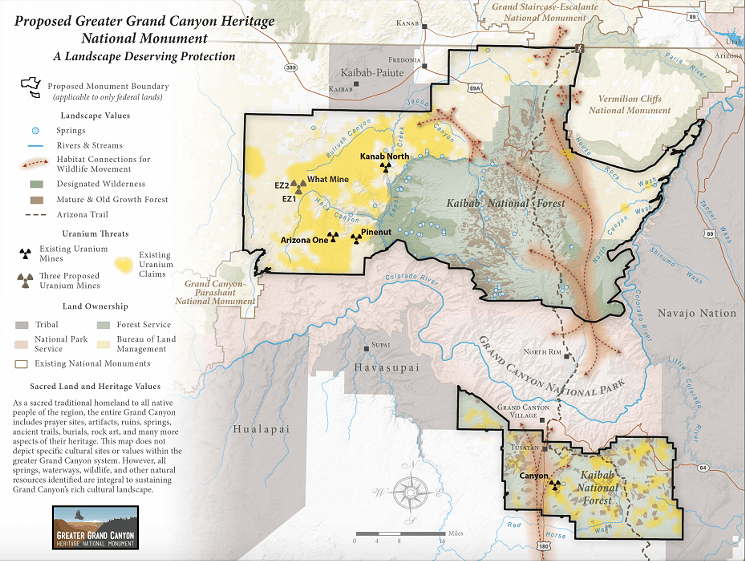
  • Arizona Voters Overwhelmingly Support Grand Canyon National Monument, New Poll Finds

    http://www.phoenixnewtimes.com/news/arizona-voters-overwhelmingly-support-grand-canyon-national-monument-new-poll-finds-8071711

    Arizona Voters Overwhelmingly Support Grand Canyon National Monument, New Poll Finds

    EXPAND

    Sierralara/Shutterstock

    Flying in the face of those who claim it would be unpopular to give the greater Grand Canyon watershed national monument status, a new nonpartisan poll finds that not only is there tremendous support for it but that it cuts across geographical and political lines.

    “The results were overwhelming, and they demonstrated both strong and broad support [in] Arizona,” says Dave Metz of the research firm Fairbank, Maslin, Maullin, Metz & Associates, which polled hundreds of Arizona voters in January.

    The pollsters discovered that 80 percent of Arizona voters support or strongly support the Grand Canyon National Heritage Monument, as outlined in a bill U.S. Congressman Raul Grijalva submitted to the U.S. House of Representatives last year.

    Grijalva brought together a broad coalition of native tribes, environmental groups, and local stakeholders to design the bill, which if passed, would permanently protect 1.7 million acres of land and prevent any new uranium mines.

    Courtesy of FM3

    “More than half of Arizonans say more needs to be done to protect air, land, and water around the Grand Canyon, and they clearly see establishing that monument as an effective way of reaching that goal,” Metz says, adding that “the sentiment that the area around the Grand Canyon needs protection has grown over time.”

    A similar poll conducted in 2009 found only 43 percent of people supported it, and a poll last year found that 73 percent of Arizonans support it.

    Courtesy of Grand Canyon Trust

    Local native tribes and environmental groups have talked about wanting national monument status for the Grand Canyon for years, and Grijalva’s efforts to make it a reality have solicited nothing short of a political firestorm among enemies of the bill.

    Leading the charge is U.S. Congressman Paul Gosar, who has railed against the monument proposal for months. Gosar claims it would cost hundreds of jobs, destroy the local economy, and hinder sportsmen or other recreational users of the area.

    U.S. Congressman Raul Grijalva

    Courtesy of Raul Grijalva

    In an interview earlier this year, Grijalva told New Times that Gosar’s “opposition is based on myths” and that he “needs to own up to the fact that he’s on the fringe of every public-land argument we have in this country.”

    The benefit of this, Grijalva explained, helps “put the opposition of some in context with many . . . It’s important to deal with what the public wants and thinks, as opposed to letting this discussion be mired in half-truths, false information, and the sheer cry from opposition that doesn’t represent the vast majority of the people in Arizona.”

    Both Metz and Grijalva say they were impressed by the broad appeal of the monument, as men and women across the state expressed support for the idea of national monuments in general and the Grand Canyon monument in particular.

    According to the poll results, there is support for the Grand Canyon monument among:

    • 76 percent of men and 84 percent of women,
    • 65 percent of registered Republicans, 84 percent of independents, and 95 percent of Democrats,
    • 78 percent of people living in Congressional District 1, which is where the proposed monument would be,
    • 79 percent of white voters, 86 percent of Latino voters, and 87 percent of all voters of color, including Native Americans,
    • 81 percent of people living in urban areas, 83 percent in suburban areas, 79 percent in small towns, and 73 percent in rural areas,
    • And 76 percent of hunters and anglers.

    Joe Jiang/Flickr

    Unlike past polls, this most recent one also asked voters how their opinion of elected officials could be influenced by a vote for or against the monument:

    “Voters were three times as likely to say they would support a politician who backed the establishment of the monument,” Metz says. “So not only do voters indicate that it’s a good idea, but they say that they’ll be more supportive of members of Congress who act to make the monument reality.”

    Last year, Grijalva, along with Arizona U.S. Representatives Ann Kirkpatrick and Ruben Gallego, authored a public letter detailing their support for the monument. In the months since, however, Kirkpatrick has distanced herself from that stance, explaining that she’s still considering the statements of many local stakeholders.

    But with public opinion clearly on his side, Grijalva says he’s ready to continue the fight: “As we go forward, we have strong support from the people in Arizona, the first nations most affected by this monument designation, [as well as] hunters and anglers and people that use our public land.

    “I think we can start to put aside the shrill debate that occurs on this issue” and start taking “the steps to build  public support.”

  • Cutting your Worker’s Compensation Costs

    Why do Worker’s Compensation costs keep climbing?

    The pen, the memo and the edict from senior management have been the standard way to shake up employees and to reduce worker’s compensation claims.

    However, any act to reduce injuries of employees while sitting in an office is futile and at best only irritates your employees.

    So? What does it take to change Worker’s Compensation at your business?

    It takes you getting out of the office. You need to understand the issues your employees are facing, and you must learn those issues from your employees.

    It takes a commitment from you to move from reports to people, from memos to personality, from hiding in an office to “hands on.”

    It requires time; however, if you do believe in the cost of injuries to your business, the investment of time is well spent.

    It requires training your employees in issues that have always been the domain of management.

    It takes understanding what your employees are thinking when they are injured.

    Do Something

    Deal with problems, just don’t write about them.

    clip_image002What do you think? Leave a comment.

    If you like this let your friends know or post it on FB, Twitter or LinkedIn


    Author: Outdoor Recreation Insurance, Risk Management and Law

    To Purchase Go Here:


    Copyright 2016 Recreation Law (720) Edit Law

    Email: Rec-law@recreation-law.com

    Google+: +Recreation

    Twitter: RecreationLaw

    Facebook: Rec.Law.Now

    Facebook Page: Outdoor Recreation & Adventure Travel Law

    Blog: www.recreation-law.com

    Mobile Site: http://m.recreation-law.com

    By Recreation Law    Rec-law@recreation-law.com         James H. Moss


    #AdventureTourism, #AdventureTravelLaw, #AdventureTravelLawyer, #AttorneyatLaw, #Backpacking, #BicyclingLaw, #Camps, #ChallengeCourse, #ChallengeCourseLaw, #ChallengeCourseLawyer, #CyclingLaw, #FitnessLaw, #FitnessLawyer, #Hiking, #HumanPowered, #HumanPoweredRecreation, #IceClimbing, #JamesHMoss, #JimMoss, #Law, #Mountaineering, #Negligence, #OutdoorLaw, #OutdoorRecreationLaw, #OutsideLaw, #OutsideLawyer, #RecLaw, #Rec-Law, #RecLawBlog, #Rec-LawBlog, #RecLawyer, #RecreationalLawyer, #RecreationLaw, #RecreationLawBlog, #RecreationLawcom, #Recreation-Lawcom, #Recreation-Law.com, #RiskManagement, #RockClimbing, #RockClimbingLawyer, #RopesCourse, #RopesCourseLawyer, #SkiAreas, #Skiing, #SkiLaw, #Snowboarding, #SummerCamp, #Tourism, #TravelLaw, #YouthCamps, #ZipLineLawyer, Worker’s Compensation, Employees, Worker’s Compensation Insurance, Worker’s Comp,


  • Skiing collision in Utah where the collision was caused by one skier falling down in front of the other skier

    Is that a collision, an obstacle, a reason for a lawsuit? Skiers fall all the time.

    Ricci v. Schoultz, M.D., 963 P.2d 784; 348 Utah Adv. Rep. 24; 1998 Utah App. LEXIS 57; 75 A.L.R.5th 745

    State: Utah, Court of Appeals of Utah

    Plaintiff: Gary Ricci

    Defendant: Charles Schoultz, M.D.

    Plaintiff Claims: Negligence

    Defendant Defenses: no negligence

    Holding: for the defendant

    Year: 1998

    Sometimes you stumble across a case that catches your eye from the way the facts are described by the court. This is one of them.

    The two skiers were advanced skiers skiing on an easy run. Both were skiing under control. The defendant was part of a ski school class. The defendant was taking small easy turns as part of his class. Just as he was being passed by the plaintiff, he reached the top of a crest and slowed down, lost control and fell into the path of the plaintiff.

    The two collided and slid into a tree at a high rate of speed. The plaintiff hit the tree suffering injuries. The defendant was able to ski away on his own.

    At trial, the plaintiff argued that the defendant was negligent because he fell on an easy run.

    At trial, Ricci argued that since Schoultz’s fall took place on one of the easiest runs at Snowbird under near perfect conditions, there was no possible reason for Schoultz to have fallen except for his own negligence.

    The jury found the defendant was negligent and returned a verdict in favor of the plaintiff. The trial judge then granted the defendant’s j.n.o.v. (judgment notwithstanding the verdict). This was based on the court’s opinion that there was no negligence on the part of the defendant. “There was a duty not to be negligent. However, there was no negligence on the part of the defendant in this case.” Thus, the trial judge granted Schoultz’s j.n.o.v. motion, or alternatively granted a new trial.”

    A JNOV is a fantasy. They never occur because as long as there is some evidence of negligence and a decision by the jury a trial judge is not going to overturn a jury verdict. To overturn a judgment by a jury the trial judge:

    …[is] justified in granting a j.n.o.v. only if, after looking at the evidence and all of its reasonable inferences in a light most favorable to [the nonmoving party], the trial court concludes that there [is] no competent evidence to support a verdict in [the nonmoving party’s] favor.

    Consequently, the burden to grant a JNOV and overturn the jury’s verdict is very high and never done.

    The appellate court has the same standard in reviewing a JNOV granted by the trial court.

    “On appeal, we apply the same standard. In determining whether competent evidence supports the verdict, we accept as true all testimony and reasonable inferences flowing therefrom that tend to prove [the nonmoving party’s] case, and we disregard all conflicts  and evidence that tend to disprove its case. Thus, if we determine that there was competent evidence supporting the jury’s verdict, we must reverse the trial court’s grant of the j.n.o.v.

    The plaintiff appealed the JNOV which granted a judgment for the defendant.

    Analysis: making sense of the law based on these facts.

    The appellate court looked at other collision cases were the cases rested on whether or not the defendant was negligent. Something was required to support the idea that the plaintiff was negligent in those cases that had found negligence, such as the defendant drinking a large quantity of alcohol.

    The court found several cases where collisions on the slopes had occurred, but the defendant was found not to be liable because there was no evidence of negligence on the part of the defendant.

    …the Tenth Circuit Court of Appeals affirmed the trial court’s ruling that the plaintiff could not recover from defendant for injuries sustained in a mid-mountain ski collision. Similar to the case at bar, the defendant was skiing behind the plaintiff and failed to alert plaintiff of his presence before they collided. The LaVine court specifically rejected the appellant’s claim of negligence: “Appellant contends that the collision itself conclusively establishes the defendant’s negligence and the plaintiff’s right to recover. We disagree.”

    In another decision the court reviewed, there was the same statement that care was owed by the defendant. The defendant is not the insurer of the plaintiff and not responsible for everything that happens to a skier on the slopes.

    The Dillworth court stated some collisions between skiers may be as a result of the obvious and necessary risks inherent in skiing, and accidents might occur despite the exercise of ordinary and reasonable care and without negligence by either skier. . . . Like all others, skiers owe that degree of care an ordinary prudent person would exercise under like or similar circumstances. One skier is not the insurer of another skier’s safety nor, absent negligence, is one skier liable to another for inadvertent or accidental contact. . . . Thus . . . skiers who lose control even while exercising due care–that is, have breached no duty owed to other skiers–may pose a danger which is inherent, obvious and necessary to participate in the sport of skiing.

    The court found that falling down on the slope is not proof of negligence. Without something to indicate that the defendant was negligent, a plaintiff cannot recover.

    In sum, a skier does have a duty to other skiers to ski reasonably and within control. However, an inadvertent fall on a ski slope, alone, does not constitute a breach of this duty. We conclude, after a careful review of the trial record, that Ricci failed to introduce any competent evidence that Schoultz was skiing negligently before his sudden and unexpected fall in front of Ricci. Ricci himself testified about the conditions and events just before the accident, noting that up to one second before the collision, Schoultz was skiing in control.

    Ricci’s evidence, including all reasonable inferences drawn from it, is simply insufficient for a jury to have concluded that Schoultz skied negligently.

    The appellate court upheld the trial court’s granting of the JNOV and did not look at the other issues raised by the plaintiff on appeal.

    There was a dissent in the opinion that argued there was enough evidence based on his analysis of the facts to support the jury finding. However, the facts presented were circumstantial based on the dissenting judge’s review of the evidence.

    So Now What?

    This was a rare case. There seems to be an assumption in all ski collision cases that if two people are on a slope together, and they collide with one person must have been negligent. This decision and the two other decisions the court pointed out show that is not the case. Not every collision on a ski slope is a negligent act.

    At the same time, this is fairly easy to see and understand the issues because the party causing the collision, even though the “downhill” skier was the party that probably generated the issues to start the collision.

    However, falling down is not negligence on a ski slope, at least in Utah.

    clip_image002What do you think? Leave a comment.

    If you like this let your friends know or post it on FB, Twitter or LinkedIn

    Author: Outdoor Recreation Insurance, Risk Management and Law

    To Purchase Go Here:

    Copyright 2016 Recreation Law (720) Edit Law

    Email: Rec-law@recreation-law.com

    Google+: +Recreation

    Twitter: RecreationLaw

    Facebook: Rec.Law.Now

    Facebook Page: Outdoor Recreation & Adventure Travel Law

    Blog: www.recreation-law.com

    Mobile Site: http://m.recreation-law.com

    By Recreation Law           Rec-law@recreation-law.com     James H. Moss


    #AdventureTourism, #AdventureTravelLaw, #AdventureTravelLawyer, #AttorneyatLaw, #Backpacking, #BicyclingLaw, #Camps, #ChallengeCourse, #ChallengeCourseLaw, #ChallengeCourseLawyer, #CyclingLaw, #FitnessLaw, #FitnessLawyer, #Hiking, #HumanPowered, #HumanPoweredRecreation, #IceClimbing, #JamesHMoss, #JimMoss, #Law, #Mountaineering, #Negligence, #OutdoorLaw, #OutdoorRecreationLaw, #OutsideLaw, #OutsideLawyer, #RecLaw, #Rec-Law, #RecLawBlog, #Rec-LawBlog, #RecLawyer, #RecreationalLawyer, #RecreationLaw, #RecreationLawBlog, #RecreationLawcom, #Recreation-Lawcom, #Recreation-Law.com, #RiskManagement, #RockClimbing, #RockClimbingLawyer, #RopesCourse, #RopesCourseLawyer, #SkiAreas, #Skiing, #SkiLaw, #Snowboarding, #SummerCamp, #Tourism, #TravelLaw, #YouthCamps, #ZipLineLawyer, Utah, Collision, Skier v. Skier, Skier Collision, Uphill Skier, Downhill Skier,

  • Ricci v. Schoultz, M.D., 963 P.2d 784; 348 Utah Adv. Rep. 24; 1998 Utah App. LEXIS 57; 75 A.L.R.5th 745

    Ricci v. Schoultz, M.D., 963 P.2d 784; 348 Utah Adv. Rep. 24; 1998 Utah App. LEXIS 57; 75 A.L.R.5th 745

    Gary Ricci, Plaintiff and Appellant, v. Charles Schoultz, M.D., Defendant and Appellee.

    Case No. 971189-CA

    COURT OF APPEALS OF UTAH

    963 P.2d 784; 348 Utah Adv. Rep. 24; 1998 Utah App. LEXIS 57; 75 A.L.R.5th 745

    July 23, 1998, Filed

    PRIOR HISTORY: [**1] Third District, Salt Lake Department. The Honorable Homer F. Wilkinson.

    COUNSEL: Jeffrey D. Eisenberg, Alan W. Mortensen, and Paul M. Simmons, Salt Lake City, for Appellant.

    Paul M. Belnap, Robert L. Janicki, and Darren K. Nelson, Salt Lake City, for Appellee.

    JUDGES: Before Judith M. Billings, Judge. I CONCUR: Russell W. Bench, Judge. Gregory K. Orme, Judge, Dissenting.

    OPINION BY: JUDITH M. BILLINGS

    OPINION

    [*785] OPINION

    BILLINGS, Judge:

    Appellant Gary Ricci appeals the trial court’s grant of a judgment notwithstanding the verdict (j.n.o.v.) to Dr. Charles Schoultz, dismissing Ricci’s negligence claims. We affirm.

    FACTS

    The parties had completely different versions of how the accident occurred. [HN1] “We must review the record and determine whether there is any basis in the evidence, including reasonable inferences which could be drawn therefrom, to support the jury’s determination that [Schoultz] was negligent.” Braithwaite v. West Valley City Corp., 921 P.2d 997, 999 (Utah 1996). Thus, we recite the facts in a light most favorable to Ricci.

    On April 12, 1994, Ricci and Schoultz were skiing [**2] at Snowbird Ski Resort (Snowbird) in Salt Lake County, Utah. Both parties were advanced skiers. On the sunny morning of the accident they were skiing an “easy run” that was groomed and had only a few skiers on it. Schoultz was skiing down Anderson Hill when Ricci reached the top of the run. Ricci began to ski towards the bottom and in the direction of Schoultz. Schoultz was taking a ski lesson and was making a number of small controlled turns as he descended. Schoultz and Ricci were both skiing at the same speed and in control throughout their descent. However, Schoultz slowed as he approached a small crest on the ski run and Ricci closed to within a few feet behind Schoultz. Schoultz unexpectedly lost control of his skis, and within a few seconds he fell to the left, and into Ricci, who was unable to avoid Schoultz. The two skiers slid into a tree well, with Ricci striking the tree with some force. Ricci suffered significant injuries and was eventually life-flighted to a local hospital. Schoultz was merely bruised and skied down the mountain on his own.

    At trial, Ricci argued that since Schoultz’s fall took place on one of the easiest runs at Snowbird under near perfect conditions, [**3] there was no possible reason for Schoultz to have fallen except for his own negligence. The jury found that Schoultz was negligent, and that his failure to ski in control was the cause of the accident. Schoultz moved for a j.n.o.v. on the grounds that Ricci failed to demonstrate that Schoultz, by falling unexpectedly in front of him, had breached any duty he owed to Ricci. The trial judge agreed: “There was a duty not to be negligent. But there was no negligence on the part of defendant in this case.” Thus, the trial judge granted Schoultz’s j.n.o.v. motion, or alternatively granted a new trial. Ricci now appeals.

    STANDARD OF REVIEW

    Our standard for reviewing a trial court’s grant of a j.n.o.v. is strict: [HN2] “‘In passing on a motion for a j.n.o.v., . . . a trial court has no latitude and must be correct.’” Braithwaite, 921 P.2d at 999 (quoting Crookston v. Fire Ins. Exch., 817 P.2d 789, 799 (Utah 1991)). Further,

    “The trial court [is] justified in granting a j.n.o.v. only if, after looking at the evidence and all of its reasonable inferences in a light most favorable to [the nonmoving party], the trial court concludes that there [is] no competent evidence to support [**4] a verdict in [the nonmoving party’s] favor.”

    Id. (quoting Gold Standard, Inc. v. Getty Oil Co., 915 P.2d 1060, 1066 (Utah 1996)). “On appeal, we apply the same standard. In determining whether competent evidence supports the verdict, we accept as true all testimony and reasonable inferences flowing therefrom that tend to prove [the nonmoving party’s] case, and we disregard all conflicts [*786] and evidence that tend to disprove its case.” Gold Standard, 915 P.2d at 1066 (citing Koer v. Mayfair Mkts., 19 Utah 2d 339, 340, 431 P.2d 566, 568-69 (1967) (additional citation omitted). Thus, if we determine that there was competent evidence supporting the jury’s verdict, we must reverse the trial court’s grant of the j.n.o.v.

    ANALYSIS

    Although there is no helpful Utah authority, other state and federal courts have dealt with similar ski collision cases.

    In LaVine v. Clear Creek Skiing Corp., 557 F.2d 730, 735 (10th Cir. 1977), the Tenth Circuit Court of Appeals affirmed the trial court’s ruling that the plaintiff could not recover from defendant for injuries sustained in a mid-mountain ski collision. Similar to the case at bar, the defendant was skiing behind [**5] the plaintiff and failed to alert plaintiff of his presence before they collided. See id. at 735. The LaVine court specifically rejected the appellant’s claim of negligence: “Appellant contends that the collision itself conclusively establishes the defendant’s negligence and the plaintiff’s right to recover. We disagree.” Id.

    More recently, in Dillworth v. Gambardella, 970 F.2d 1113, 1114 (2d Cir. 1992), the Second Circuit Court of Appeals dealt with a similar issue: “Whether collisions between skiers require as a matter of law . . . a finding of negligence on the part of at least one skier.” In Dillworth, the parties had significantly different versions of the facts leading up to the mid-mountain collision, but the result was the same as this case–significant injuries to the party bringing the cause of action. See id. at 1114-15. The Dillworth court stated [HN3] some collisions between skiers may be as a result of the obvious and necessary risks inherent in skiing, and accidents might occur despite the exercise of ordinary and reasonable care and without negligence by either skier. . . . Like all others, skiers owe that degree of care an ordinary prudent person [**6] would exercise under like or similar circumstances. One skier is not the insurer of another skier’s safety nor, absent negligence, is one skier liable to another for inadvertent or accidental contact. . . . Thus . . . skiers who lose control even while exercising due care–that is, have breached no duty owed to other skiers–may pose a danger which is inherent, obvious and necessary to participate in the sport of skiing.

    Id. at 1122 (citing LaVine, 557 F.2d 734-35) (additional citations omitted).

    Cases that have supported a finding of negligence in a ski collision have required proof of some negligent conduct before the collision. For example, in Freeman v. Hale, 30 Cal. App. 4th 1388, 36 Cal. Rptr. 2d 418, 420 (Cal. Ct. App. 1994), two skiers collided while descending a ski slope and the plaintiff suffered severe injuries as a result of the accident. In Freeman, however, the defendant had consumed a large quantity of alcohol, and was inebriated when the collision occurred. See 36 Cal. Rptr. 2d at 420. The California Court of Appeals succinctly summarized its conclusion that a negligence regime was the proper way to analyze liability: “While Hale did not have a duty [**7] to avoid an inadvertent collision with Freeman, he did have a duty to avoid increasing the risk of such a collision.” Id. at 423-24 (citing Knight v. Jewett, 3 Cal. 4th 296, 834 P.2d 696, 710-11 (Cal. 1992)). The Freeman court concluded that alcohol consumption was not an integral aspect of skiing, and that by consuming alcohol prior to and during his skiing, defendant breached his duty to plaintiff “‘not to increase the risks to a participant over and above those inherent in the sport.’” 36 Cal. Rptr. 2d at 421 (quoting Knight, 834 P.2d at 710).

    In sum, [HN4] a skier does have a duty to other skiers to ski reasonably and within control. However, an inadvertent fall on a ski slope, alone, does not constitute a breach of this duty. We conclude, after a careful review of the trial record, that Ricci failed to introduce any competent evidence that Schoultz was skiing negligently before his sudden and unexpected fall in front of Ricci. Ricci himself testified about the conditions and events just before the accident, noting that up to one second before the collision, Schoultz was skiing in control. Schoultz’s [*787] loss of control and fall, by itself, does not establish his negligence.

    Ricci’s [**8] evidence, including all reasonable inferences drawn from it, is simply insufficient for a jury to have concluded that Schoultz skied negligently. We conclude the trial court was correct in determining that Schoultz did not breach his duty of reasonable care to Ricci by accidentally falling into Ricci when there was no evidence that Schoultz was skiing negligently at the time of his fall. Because we agree with the trial court’s ruling, we do not reach the questions of whether a new trial should have been granted or whether the trial court’s decisions to exclude Schoultz’s expert witness testimony were proper.

    CONCLUSION

    Some collisions between skiers are an inherent risk of skiing and may occur absent negligence, as in this case. Thus, we affirm the trial court’s grant of a judgment notwithstanding the verdict.

    Judith M. Billings, Judge

    I CONCUR:

    Russell W. Bench, Judge

    DISSENT BY: GREGORY K. ORME

    DISSENT

    ORME, Judge (dissenting):

    By focusing on the evidence plaintiff presented, rather than all evidence in the record and the reasonable inferences that can be drawn therefrom, my colleagues take a too narrow view of our role in reviewing a trial court’s reversal of a [**9] jury’s verdict. Simply stated, the question is not whether the evidence plaintiff presented supports the jury’s verdict; rather, it is whether any evidence from whatever source will support it. See Gold Standard, Inc. v. Getty Oil Co., 915 P.2d 1060, 1066 (Utah 1996) (“In determining whether competent evidence supports the verdict, we accept as true all testimony and reasonable inferences flowing therefrom that tend to prove [the nonmoving party’s] case, and we disregard all conflicts and evidence that tend to disprove its case.”). As the Fifth Circuit has noted,

    on motions for directed verdict and for judgment notwithstanding the verdict the Court should consider all of the evidence– not just that evidence which supports the non-mover’s case–but in the light and with all reasonable inferences most favorable to the party opposed to the motion.Boeing Co. v. Shipman, 411 F.2d 365, 374 (5th Cir. 1969) (en banc), overruled on other grounds, Gautreaux v. Scurlock Marine, Inc., 107 F.3d 331, 336, 339 (5th Cir. 1997). Accord Guilbeau v. W. W. Henry Co., 85 F.3d 1149, 1161 (5th Cir. 1996), cert. denied, 136 L. Ed. 2d 713, 117 S. Ct. 766 (1997); Lamb [**10] ex rel. Shepard v. Sears, Roebuck & Co., 1 F.3d 1184, 1187 (11th Cir. 1993); Epoch Producing Corp. v. Killiam Shows Inc., 522 F.2d 737, 743 (2d Cir. 1975), cert. denied, 424 U.S. 955, 47 L. Ed. 2d 360, 96 S. Ct. 1429 (1976); Anderson v. Lykes Pasco Packing Co., 503 So. 2d 1269, 1271-72 (Fla. Dist. Ct. App. 1986); Millet v. Cormier, 671 So. 2d 1101, 1107-08 (La. Ct. App.), cert. denied, 673 So. 2d 1036 (La. 1996).

    In this case, the jury might well have believed defendant’s testimony that he was skiing in complete control until immediately before the accident, that his skis did not come apart, and that he did not fall. Rejecting defendant’s testimony that he was hit from behind by plaintiff, which was essentially impossible given where the two ended up after the collision, the jury was also free to disbelieve plaintiff’s recollection that defendant’s skis separated and defendant merely fell into plaintiff’s path. The jury could nonetheless have believed plaintiff’s testimony that, immediately prior to the collision, he was skiing in control and a safe distance from defendant and defendant’s apparently intended route. Mindful that plaintiff and defendant ended up [**11] in a heap well off the ski run, in a position consistent with defendant hitting into plaintiff at high speed, the jury might well have inferred that the only way the accident could have occurred was if defendant, fully in control, carelessly and precipitously turned sharply to the left, hitting the unsuspecting plaintiff, who had every reason to assume defendant was going to continue with his pattern of tight turns as plaintiff passed uneventfully on the left.

    To be sure, this is not exactly the theory plaintiff developed at trial, but it is a scenario that emerges quite readily if one reviews all the evidence and all reasonable inferences that could be drawn therefrom in the light [*788] most favorable to the jury’s verdict. If that is what the jury concluded, then the accident was caused by defendant’s negligence, not an inadvertent fall. Accordingly, the trial court should not have disturbed the jury’s verdict, and we should reinstate it.

    Gregory K. Orme, Judge

  • Sign up for this Newsletter if you Are, Work for, or Volunteer for a Non-Profit

    Hip Tips

    Progressive veiwpoints, great ideas, and actionable information for informed nonprofit management.

    06ee6f82-c536-4941-91e2-ec7abd39cc66.jpg

    The Four Tenets of Good Volunteer Management

    There are so many nuances that make a big difference in how you tackle specific management issues in a nonprofit organization. Take volunteers for instance, one of the more difficult jobs is to recruit, retain, and motivate volunteers in an effort to keep H.R. costs down and impact at its optimum.

    Following these four tenets of volunteer management can make all the difference in your ability to leverage volunteers for your nonprofit…

    Here’s the link to this Hip Tips blog post...
    How you communicate with your stakeholders, constituents, and donors is directly connected to your ability to raise the funding necessary to improve program and optimize impact. Following are a couple of marketing Hip Tips that are easy for you to implement.
    1521f043-7516-40e9-a99d-40323238d431.png

    How to Get Your Content Shared

    Attention is a scarce resource — especially online. This is illustrated by a Microsoft study that found the average attention span of an internet user has dropped substantially from 12 seconds in 2000, to just eight seconds in 2015.

    If your post doesn’t look instantly appealing, your readers will click away before ever seeing how great your content is.

    Here’s the link to to this informative article…
    0ce6cf85-6cc4-4849-9a27-238b61c313c3.jpg

    How to Create a Content Marketing Srategy

    Content marketing strategy isn’t a nice to have, it’s a requirement. Recent research from the Content Marketing Institute found that more than 80% of B2B marketers say they have a content marketing strategy, but only a third have documented that very same content marketing strategy. Let’s fix that.

    Here’s the link to to this informative article…
    To learn more about how content marketing can impact your bottom line, call us at 720-638-0909.
    Workshops
    c8cc9dbb-c8e8-4b0b-8e1b-c84e48bbd547.jpg

    Strategy Starts With Knowledge

    This workshop will take the mystery out of strategic planning and provide primary stakeholders including board and executive staff with a step-by-step framework for developing a dynamic strategic plan.
    February 19, 2016 from 11:30A – 1:30P

    • (lunch will be included with workshop)
    • Mile High United Way
    • 711 Park Avenue West ,Denver, CO 80205
    • Offered through Denver Gives for only $10 (a $75 value)

    Learn more about this workshop here…

    Seats are limited register here today!

    Workshop is provided in collaboration with Denver Gives, a 501 (c) 3 organization dedicated to empowering Denver’s small nonprofits to do big things.

    We Build Capacity
    Questus Strategies offers several innovative services to help nonprofits build capacity and focus their vision. Call us at 720-638-0909 or visit our website to learn more or to sign up for our free fundraising checkup.
    66a1b341-954f-42c0-bbad-e081b9305146.jpg
    Strategic Planning
    Strategic Planning is a systemic process to assess an organization and its environment in an effort to develop the actions that shape and guide what it is, what it does, and why it does it, in an on-going, dynamic, and forward-looking manner
    abdd597d-c268-4c1b-a32a-0dbfef2d6833.jpg
    Organizational Assessment
    Effective planning requires actionable intelligence. We provide a host of assessments around your lifecycle, marketing, programs, needs, and stakeholder engagement that determine the goals and objectives that direct and define your direction forward.
    Delivering progressive, affordable, and engaging capacity building programs.
    Black_Logo_09_200px.png

    www.questusstrategies.com
    720-638-0909

    open.php?u=29b80de89c9df5dd7de9396e0&id=58ad0f01a2&e=9cfe96f686

  • It’s coming up on that time of year: Remember Interns are not slaves and the Department of Labor enforces that.

    Internship Programs Under The Fair Labor Standards Act

    This fact sheet provides general information to help determine whether interns must be paid the minimum wage and overtime under the Fair Labor Standards Act for the services that they provide to “for-profit” private sector employers.

    Background

    The Fair Labor Standards Act (FLSA) defines the term “employ” very broadly as including to “suffer or permit to work.”  Covered and non-exempt individuals who are “suffered or permitted” to work must be compensated under the law for the services they perform for an employer.  Internships in the “for-profit” private sector will most often be viewed as employment, unless the test described below relating to trainees is met.  Interns in the “for-profit” private sector who qualify as employees rather than trainees typically must be paid at least the minimum wage and overtime compensation for hours worked over forty in a workweek.

    The Test for Unpaid Interns

    There are some circumstances under which individuals who participate in “for-profit” private sector internships or training programs may do so without compensation.  The Supreme Court has held that the term “suffer or permit to work” cannot be interpreted so as to make a person whose work serves only his or her own interest an employee of another who provides aid or instruction.  This may apply to interns who receive training for their own educational benefit if the training meets certain criteria.  The determination of whether an internship or training program meets this exclusion depends upon all of the facts and circumstances of each such program.

    The following six criteria must be applied when making this determination: 

    1.   The internship, even though it includes actual operation of the facilities of the employer, is similar to training which would be given in an educational environment;

    2.   The internship experience is for the benefit of the intern; 

    3.   The intern does not displace regular employees, but works under close supervision of existing staff;

    4.   The employer that provides the training derives no immediate advantage from the activities of the intern; and on occasion its operations may actually be impeded; 

    5.   The intern is not necessarily entitled to a job at the conclusion of the internship; and 

    6.   The employer and the intern understand that the intern is not entitled to wages for the time spent in the internship.

    If all of the factors listed above are met, an employment relationship does not exist under the FLSA, and the Act’s minimum wage and overtime provisions do not apply to the intern.  This exclusion from the definition of employment is necessarily quite narrow because the FLSA’s definition of “employ” is very broad.  Some of the most commonly discussed factors for “for-profit” private sector internship programs are considered below.

    Similar To An Education Environment And The Primary Beneficiary Of The Activity

    In general, the more an internship program is structured around a classroom or academic experience as opposed to the employer’s actual operations, the more likely the internship will be viewed as an extension of the individual’s educational experience (this often occurs where a college or university exercises oversight over the internship program and provides educational credit).  The more the internship provides the individual with skills that can be used in multiple employment settings, as opposed to skills particular to one employer’s operation, the more likely the intern would be viewed as receiving training.  Under these circumstances the intern does not perform the routine work of the business on a regular and recurring basis, and the business is not dependent upon the work of the intern.  On the other hand, if the interns are engaged in the operations of the employer or are performing productive work (for example, filing, performing other clerical work, or assisting customers), then the fact that they may be receiving some benefits in the form of a new skill or improved work habits will not exclude them from the FLSA’s minimum wage and overtime requirements because the employer benefits from the interns’ work. 

    Displacement And Supervision Issues

    If an employer uses interns as substitutes for regular workers or to augment its existing workforce during specific time periods, these interns should be paid at least the minimum wage and overtime compensation for hours worked over forty in a workweek.  If the employer would have hired additional employees or required existing staff to work additional hours had the interns not performed the work, then the interns will be viewed as employees and entitled compensation under the FLSA.  Conversely, if the employer is providing job shadowing opportunities that allow an intern to learn certain functions under the close and constant supervision of regular employees, but the intern performs no or minimal work, the activity is more likely to be viewed as a bona fide education experience.  On the other hand, if the intern receives the same level of supervision as the employer’s regular workforce, this would suggest an employment relationship, rather than training.

    Job Entitlement

    The internship should be of a fixed duration, established prior to the outset of the internship.  Further, unpaid internships generally should not be used by the employer as a trial period for individuals seeking employment at the conclusion of the internship period.  If an intern is placed with the employer for a trial period with the expectation that he or she will then be hired on a permanent basis, that individual generally would be considered an employee under the FLSA. 

    Where to Obtain Additional Information

    This publication is for general information and is not to be considered in the same light as official statements of position contained in the regulations.

    For additional information, visit our Wage and Hour Division Website: http://www.wagehour.dol.gov and/or call our toll-free information and helpline, available 8 a.m. to 5 p.m. in your time zone, 1-866-4USWAGE (1-866-487-9243).

    The FLSA makes a special exception under certain circumstances for individuals who volunteer to perform services for a state or local government agency and for individuals who volunteer for humanitarian purposes for private non-profit food banks.   WHD also recognizes an exception for individuals who volunteer their time, freely and without anticipation of compensation for religious, charitable, civic, or humanitarian purposes to non-profit organizations.  Unpaid internships in the public sector and for non-profit charitable organizations, where the intern volunteers without expectation of compensation, are generally permissible.  WHD is reviewing the need for additional guidance on internships in the public and non-profit sectors. 

    Do Something

    Follow the DOL guidelines when working with someone who expects more than getting you coffee.

    clip_image002What do you think? Leave a comment.

    If you like this let your friends know or post it on FB, Twitter or LinkedIn

    Author: Outdoor Recreation Insurance, Risk Management and Law

    To Purchase Go Here:

    Copyright 2016 Recreation Law (720) Edit Law

    Email: Rec-law@recreation-law.com

    Google+: +Recreation

    Twitter: RecreationLaw

    Facebook: Rec.Law.Now

    Facebook Page: Outdoor Recreation & Adventure Travel Law

    Blog: www.recreation-law.com

    Mobile Site: http://m.recreation-law.com

    By Recreation Law    Rec-law@recreation-law.com         James H. Moss


    #AdventureTourism, #AdventureTravelLaw, #AdventureTravelLawyer, #AttorneyatLaw, #Backpacking, #BicyclingLaw, #Camps, #ChallengeCourse, #ChallengeCourseLaw, #ChallengeCourseLawyer, #CyclingLaw, #FitnessLaw, #FitnessLawyer, #Hiking, #HumanPowered, #HumanPoweredRecreation, #IceClimbing, #JamesHMoss, #JimMoss, #Law, #Mountaineering, #Negligence, #OutdoorLaw, #OutdoorRecreationLaw, #OutsideLaw, #OutsideLawyer, #RecLaw, #Rec-Law, #RecLawBlog, #Rec-LawBlog, #RecLawyer, #RecreationalLawyer, #RecreationLaw, #RecreationLawBlog, #RecreationLawcom, #Recreation-Lawcom, #Recreation-Law.com, #RiskManagement, #RockClimbing, #RockClimbingLawyer, #RopesCourse, #RopesCourseLawyer, #SkiAreas, #Skiing, #SkiLaw, #Snowboarding, #SummerCamp, #Tourism, #TravelLaw, #YouthCamps, #ZipLineLawyer, DOL, Department of Labor, Intern, Internship, Slave,


  • Experience Industry Management Conference and Research Retreat Updates

    The Annual Experience Industry Management (EIM) Conference hosted by the Department of Recreation Management at BYU will take place March 29-30, 2016 in Provo, UT.

    This three-day event brings together academics and professionals from a variety of fields and industries to talk about the provision of meaningful experiences. The conference also provides excellent networking opportunities for current students interested in experience industry related careers.

    This year’s conference will features an excellent selection of experience design related speakers, workshops, and networking events. Announced speakers include:

    A research retreat on Monday, March 28 precedes the conference. The day will provide researchers the opportunity to: generate and share research ideas by leading a roundtable discussion, share work in progress, and/or present completed research. The intent is to provide a setting different than a traditional research symposium by creating time and space for discussion of ideas. The hope is to bring a group of academics together who have a shared interest in studying and understanding experiences from the participant and provider perspective and who are eager to discuss ideas. We define experiences quite broadly and hope to attract a diverse array of researchers, research topics, and discussion areas. It will be a collaborative and intimate experience with ample opportunities for interaction.

    For more information and to register visit: http://marriottschool.byu.edu/event/eimconf2016/home

    The abstract submission deadline for the EIM Research Retreat is February 16th. See the attachment for more information.

    Mat Duerden, PhD

    Assistant Professor

    Department of Recreation Management

    Marriott School of Management

    Brigham Young University

    801-422-3834

    EIM CALL FOR ABSTRACTS (Research Retreat).docx

  • Pennsylvania Supreme Court decision on duty to have and use an AED defines how statutes are to be interpreted and when liability can attach and cannot attach to a statute.

    The law that creates a safe harbor from civil liability for being a Good Samaritan does not create a duty to act. There still is no legal requirement to act as a Good Samaritan, however, if you do, you cannot be sued.

    Atcovitz v. Gulph Mills Tennis Club, Inc, 571 Pa. 580; 812 A.2d 1218; 2002 Pa. LEXIS 2832

    State: Pennsylvania, Supreme Court of Pennsylvania

    Plaintiff: Jerry Atcovitz and Roslyn Atcovitz

    Defendant: Gulph Mills Tennis Club, Inc, Jkst, Inc. and Gulph Mills/Jkst Tennis Club, Inc., Lafayette Ambulance Rescue Squad I

    Plaintiff Claims: whether a tennis club owes a duty of care to its members to acquire and maintain an automated external defibrillator, hereinafter “AED,” on its premises for emergency use

    Defendant Defenses: No duty

    Holding: for the defendant Tennis Club

    Year: 2002

    The plaintiff was playing tennis at the defendant’s tennis club. While playing he suffered a stroke which was secondary to a heart attack. Within one minute tennis club, members started CPR on the plaintiff and ten minutes later an ambulance arrived. The ambulance administered defibrillation and transported the plaintiff to the hospital.

    The plaintiff had a history of heart problems for twenty years, including a previous heart attack and bypass surgery. The tennis club did not know of the plaintiff’s medical history.

    The heart attack and stroke left the defendant unable to concentrate or think, is unable to walk or get out of bed and requires assistance in all aspects of his life.

    The plaintiff and his wife sued the defendant tennis club for not having an AED and not using it: “…had [Gulph Mills] possessed an AED device and used it on [Atcovitz] promptly, his injuries would have been significantly less and; therefore, that [Gulph Mills] is liable to him for damages.”

    The plaintiff’s moved for summary judgment to prevent the defendant from asserting the defenses. The defendant then cross-filed a motion for summary judgment which the trial court granted. The case was appealed and the Pennsylvania Appellate court, called the Superior Court, reversed. The case was then appealed to the Pennsylvania Supreme Court.

    Between the incident that the plaintiff suffered and the decision by the trial court to dismiss the Pennsylvania legislature passed an AED Good Samaritan Act. The Appellate court based some of the reasoning for its decision on the AED Good Samaritan Act the legislature passed.

    Analysis: making sense of the law based on these facts.

    The court started out by defining the specific issues it would look at as well as the procedural definitions it must follow. This provides a clear look at how Pennsylvania courts make decisions.

    The Supreme Court first reviewed the standard of review the court must use. “Our standard of review is clear: the trial court’s order will be reversed only where it is established that the court committed an error of law or clearly abused its discretion.”

    The court then reviewed under Pennsylvania law the requirements for granting a motion for summary judgment.

    Summary judgment is appropriate only in those cases where the record clearly demonstrates that there is no genuine issue of material fact and that the moving party is entitled to judgment as a matter of law. The reviewing court must view the record in the light most favorable to the nonmoving party, resolving all doubts as to the existence of a genuine issue of material fact against the moving party.   When the facts are so clear that reasonable minds cannot differ, a trial court may properly enter summary judgment.

    The court then defined the elements necessary to successfully plead a negligence claim under Pennsylvania.

    The elements necessary to plead an action in negligence are: (1) the existence of a duty or obligation recognized by law, requiring the actor to conform to a certain standard of conduct; (2) a failure on the part of the defendant to conform to that duty, or a breach thereof; (3) a causal connection between the defendant’s breach and the resulting injury; and (4) actual loss or damage suffered by the complainant.

    The court then further defined the element of duty in a negligence case. “A duty, in negligence cases, may be defined as an obligation, to which the law will give recognition and effect, to conform to a particular standard of conduct toward another.“

    This definition was supported by the definition of duty in a legal treatise, Prosser and Keeton on the Law of Torts. This is the book referenced by courts in defining the law.

    These are shifting sands, and no fit foundation. There is a duty if the court says there is a duty; the law, like the Constitution, is what we make it. Duty is only a word with which we state our conclusion that there is or is not to be liability; it necessarily begs the essential question. When we find a duty, breach and damage, everything has been said. The word serves a useful purpose in directing attention to the obligation to be imposed upon the defendant, rather than the causal sequence of events; beyond that it serves none. In the decision whether or not there is a duty, many factors interplay: The hand of history, our ideas of morals and justice, the convenience of administration of the rule, and our social ideas as to where the loss should fall. In the end, the court will decide whether there is a duty on the basis of the mores of the community, “always keeping in mind the fact that we endeavor to make a rule in each case that will be practical and in keeping with the general understanding of mankind.”

    The bad news issue the law changes as everything else in the US changes, Public policy and public opinion are just some of the factors that affect the law. The good news is the law attempts to stay current with the changing issues facing the law. Albeit a lot slower than most might wish, but it does change. “Thus, the legal concept of duty is necessarily rooted in often amorphous public policy considerations, which may include our perception of history, morals, justice, and society.”

    The care as defined by a legal duty was further broken down by the court.

    In Althaus, this Court enunciated several discrete factors, derived from the aforementioned principles, that our courts are to balance  [HN6] in determining whether a common law duty of care exists: (1) the relationship between the parties; (2) the social utility of the actor’s conduct; (3) the nature of the risk imposed and foreseeability of the harm incurred; (4) the consequences of imposing a duty upon the actor; and (5) the overall public interest in the proposed solution.

    Thus the court takes in other issues in looking at determining how a case is to be decided, however, the law and prior decisions come first. Making a change requires a major commitment by the courts to go down a different path and dismiss the prior cases leading down the old path. Consequently, you rarely see these changes, what you do see is slight modifications of the direction the path is taking.

    Major changes are left to the legislature to respond more quickly to the issues facing the public. In this case, the court looked at the legislature’s intent in creating an AED Good Samaritan Act.

    …the overall public interest in the proposed solution. The Legislature’s enactments and the ensuing regulations reveal that acquisition, maintenance, and use of an AED, along with AED training requirements, are highly regulated. Where our lawmakers have so thoroughly considered the statewide application and implications of a subject, this Court must refrain from imposing additional requirements upon that legislation.

    The appellate court used the newly enacted AED Good Samaritan Act to hold the defendant liable. The Supreme Court looked at the act differently in relation to this decision. The Supreme Court saw the act as proof that the legislature intended the issues surrounding AEDs was highly regulated. “Rather, they are relevant to demonstrate that the acquisition, maintenance, and use of an AED, along with AED training requirements, are highly regulated.”

    When reviewing an act, the information within the law enacted by the legislature is the only information that can be reviewed. Anything not included in the act is therefore excluded from the analysis. “We must infer that,  [HN11] under the doctrine of expressio unius est exclusio alterius, the inclusion of a specific matter in a statute implies the exclusion of other matters.”

    The AED Act provides immunity for trained AED users and immunity for untrained users who use an AED in good faith.

    The AED Good Samaritan Act, which was adopted two years after Atcovitz sustained his injuries, provides civil immunity for trained users of AEDs and requires that  [HN12] “expected users shall complete training in the use of an AED. . . .” As an exception to that general rule, the AED Good Samaritan Act also provides civil immunity to untrained individuals who, in good faith, use an AED in an emergency as an ordinary, reasonably prudent individual would do under the same or similar circumstances. Significantly, the AED Good Samaritan Act defines “good faith” as including “a reasonable opinion that the immediacy of the situation is such that the use of an AED should not be postponed until emergency medical services personnel arrive or the person is hospitalized.”

    The act, consequently, only creates a safe harbor for using an AED. It does not create liability for someone who does not use an AED.

    Thus, the AED Good Samaritan Act merely creates an exception for imposing liability on an untrained individual who uses an AED in limited emergency situations; it does not authorize its use by any such individual.

    In addition, it does not indicate that the Legislature aimed to dispense with the regulations governing the training and use of AEDs. Simply, the existence of a civil immunity provision for Good Samaritans who use an AED in an emergency situation cannot impose a duty on a business establishment to ac-quire, maintain, and use such a device on its premises.

    The act cannot, then be used to create liability for not using an AED; it only removes liability for someone who does use an AED.

    Neither the EMS Act nor the AED Good Samaritan Act imposed a duty upon Gulph Mills to acquire, maintain, and use an AED. Appellees do not cite any other case, statute, or regulation that would have imposed such a duty on Gulph Mills at the time of Atcovitz’s injuries in January 1996. Because Gulph Mills did not owe a duty to carry an AED, Appellees could not have established a prima facie claim of negligence.

    There was a dissenting opinion, in this case. The dissent agreed with the majority opinion; it disagreed on how broad the decision was and thought several of the issues should be sent back for review by the trial court.

    So Now What?

    First understand there is a difference between what is moral, ethical, and legal. My job is not to help you decide on those issues. My job is to help you understand the law when you are faced with the issues. You can be morally and ethically right and be sued and lose. You can have no morals or ethics and be sued and lose. How you balance those aspects of your life, and how you approach the issues you face in your life is not the subject of these articles. How the law applies to the facts set forth in the specific cases may affect your choices is what the article is about.

    The good news is the decision prevents lawsuits for not having an AED or using an AED in Pennsylvania.

    This case also defines how it would look at the reverse. If the law restricted the use of a device, the application of the law would not only allow for civil liability but possibly criminal liability also.

    Jim Moss Jim Moss is an attorney specializing in the legal issues of the outdoor recreation community. He represents guides, guide services, outfitters both as businesses and individuals and the products they use for their business. He has defended Mt. Everest guide services, summer camps, climbing rope manufacturers; avalanche beacon manufactures and many more manufacturers and outdoor industries. Contact Jim at Jim@Rec-Law.us

    Jim is the author or co-author of six books about the legal issues in the outdoor recreation world; the latest is Outdoor Recreation Insurance, Risk Management and Law.

    To see Jim’s complete bio go here and to see his CV you can find it here. To find out the purpose of this website go here.

    G-YQ06K3L262

    What do you think? Leave a comment.

    If you like this let your friends know or post it on FB, Twitter or LinkedIn

    If you are interested in having me write your release, fill out this Information Form and Contract and send it to me.

    Author: Outdoor Recreation Insurance, Risk Management and Law

    Cover of Outdoor Recreation Insurance, Risk Management and Law
    Outdoor Recreation Insurance, Risk Management and Law

    To Purchase Go Here:

    Facebook Page: Outdoor Recreation & Adventure Travel Law

    Email: Jim@Rec-Law.US

    By Recreation Law   Rec-law@recreation-law.com       James H. Moss

    @2023 Summit Magic Publishing, LLC


    #AdventureTourism, #AdventureTravelLaw, #AdventureTravelLawyer, #AttorneyatLaw, #Backpacking, #BicyclingLaw, #Camps, #ChallengeCourse, #ChallengeCourseLaw, #ChallengeCourseLawyer, #CyclingLaw, #FitnessLaw, #FitnessLawyer, #Hiking, #HumanPowered, #HumanPoweredRecreation, #IceClimbing, #JamesHMoss, #JimMoss, #Law, #Mountaineering, #Negligence, #OutdoorLaw, #OutdoorRecreationLaw, #OutsideLaw, #OutsideLawyer, #RecLaw, #Rec-Law, #RecLawBlog, #Rec-LawBlog, #RecLawyer, #RecreationalLawyer, #RecreationLaw, #RecreationLawBlog, #RecreationLawcom, #Recreation-Lawcom, #Recreation-Law.com, #RiskManagement, #RockClimbing, #RockClimbingLawyer, #RopesCourse, #RopesCourseLawyer, #SkiAreas, #Skiing, #SkiLaw, #Snowboarding, #SummerCamp, #Tourism, #TravelLaw, #YouthCamps, #ZipLineLawyer, Good Samaritan, AED Good Samaritan, Negligence, Immunity, AED, Automatic External Defibrillator,


  • Head USA Recalls Ski and Snowboard Helmets Due to Head Injury Hazard

    Name of Product: Head Ski and snowboard helmets

    http://www.cpsc.gov/en/Recalls/2016/Head-USA-Recalls-Ski-and-Snowboard-Helmets/

    Consumers should stop using this product unless otherwise instructed. It is illegal to resell or attempt to resell a recalled consumer product.

    Recall Summary

    Hazard: The helmets do not comply with the impact requirements of safety standards for helmets, posing a risk of head injury.

    Remedy: Replacement – Consumers should immediately stop using the recalled helmets and contact Head USA to receive a free replacement helmet.

    Consumer Contact: Head USA at 800-874-3235 from 9 a.m. to 7 p.m. ET Monday through Friday or online at http://www.head.com then click on Customer Service and then on 2015 Helmet Recall for more information.

    Recall Details

    Units: About 260 in the United States (in addition, 180 were sold in Canada).

    Description: This recall involves six models of HEAD ski and snowboard helmets:  Agent, Alia, Andor, Arise, Arosa and Avril. They were sold in sizes M/L and XL/XXL in black, blue, green white and yellow, with straps in a variety of colors. HEAD, the model name, size and “Production Code: Dec. 2014” are printed on stickers that can be found by lifting the lining above the right earpiece. 

    Incidents/Injuries: None reported

    Sold at: Specialty ski and snowboard shops and online from January 2015 through December 2015 for between $80 and $120.

    Importer/Distributor: Head USA, of Boulder, Colo.

    Manufactured in: Taiwan

    Retailers: If you are a retailer of a recalled product you have a duty to notify your customers of a recall. If you can, email your clients or include the recall information in your next marketing communication to your clients. Post any Recall Poster at your stores and contact the manufacturer to determine how you will handle any recalls.

    For more information on this see:

    For Retailers

    Recalls Call for Retailer Action

    A recall leads to lawsuits because injuries are connected to the product being recalled thus a lawsuit. Plaintiff’s hope the three can be connected

    Combination of a Products Liability statute, an Expert Witness Report that was just not direct enough and odd facts holds a retailer liable as manufacture for product defect.

    Product Liability takes a different turn. You must pay attention, just not rely on the CPSC.

    Retailer has no duty to fit or instruct on fitting bicycle helmet

    Summary Judgment granted for bicycle manufacturer and retailer on a breach of warranty and product liability claim.

    For Manufacturers

    The legal relationship created between manufactures and US consumers

    A recall leads to lawsuits because injuries are connected to the product being recalled thus a lawsuit. Plaintiff’s hope the three can be connected

    Combination of a Products Liability statute, an Expert Witness Report that was just not direct enough and odd facts holds a retailer liable as manufacture for product defect.

    clip_image002What do you think? Leave a comment.

    If you like this let your friends know or post it on FB, Twitter or LinkedIn


    Author: Outdoor Recreation Insurance, Risk Management and Law

    To Purchase Go Here:

    Copyright 2016 Recreation Law (720) Edit Law

    Email: Rec-law@recreation-law.com

    Google+: +Recreation

    Twitter: RecreationLaw

    Facebook: Rec.Law.Now

    Facebook Page: Outdoor Recreation & Adventure Travel Law

    Blog: www.recreation-law.com

    Mobile Site: http://m.recreation-law.com

    By Recreation Law    Rec-law@recreation-law.com         James H. Moss

    #AdventureTourism, #AdventureTravelLaw, #AdventureTravelLawyer, #AttorneyatLaw, #Backpacking, #BicyclingLaw, #Camps, #ChallengeCourse, #ChallengeCourseLaw, #ChallengeCourseLawyer, #CyclingLaw, #FitnessLaw, #FitnessLawyer, #Hiking, #HumanPowered, #HumanPoweredRecreation, #IceClimbing, #JamesHMoss, #JimMoss, #Law, #Mountaineering, #Negligence, #OutdoorLaw, #OutdoorRecreationLaw, #OutsideLaw, #OutsideLawyer, #RecLaw, #Rec-Law, #RecLawBlog, #Rec-LawBlog, #RecLawyer, #RecreationalLawyer, #RecreationLaw, #RecreationLawBlog, #RecreationLawcom, #Recreation-Lawcom, #Recreation-Law.com, #RiskManagement, #RockClimbing, #RockClimbingLawyer, #RopesCourse, #RopesCourseLawyer, #SkiAreas, #Skiing, #SkiLaw, #Snowboarding, #SummerCamp, #Tourism, #TravelLaw, #YouthCamps, #ZipLineLawyer, Recall, CPSC, Consumer Product Safety Council, Head, Ski Helmet, Snowboard Helmet, Head Ski Helmet, Head Snowboard Helment, Agent, Alia, Andor, Arise, Arosa, Avril,


  • National Parks maintenance backlog reaches $11.9 Billion Dollars

    1874651408709286668.png National Park Service
    U.S. Department of the Interior
    Office of Communications
    1849 C Street NW
    Washington, DC 20240
    202-208-6843 phone
    www.nps.gov
    National Park Service News Release
    Release Date: February 5, 2016

    Contact: Jeffrey Olson, Jeffrey_olson 202-208-6843

    National Parks maintenance backlog reaches $11.9 billion

    WASHINGTON – The National Park Service (NPS) this week released its Fiscal Year 2015 deferred maintenance statistics for national parks. The $11.93 billion nationwide total is a $440 million increase from the previous year.

    Deferred maintenance is necessary work – performed on infrastructure, such as roads and bridges, visitor centers, trails and campgrounds – that has been delayed for more than one year. Aging facilities, increasing use of park facilities and scarce resources contribute to the growing backlog.

    “While Congress provided increases this year, the annual bill for maintenance in America’s national parks is still almost twice as much as is appropriated,” said National Park Service Director Jonathan B. Jarvis.

    Congressional funding for the National Park Service in 2016 includes an additional $90 million for non-transportation maintenance. Congress also passed a new highway bill which will provide a $28 million increase for transportation projects in parks this year. Funding for transportation-related maintenance and construction will continue to rise, by $8 million per year for five years, until it reaches $300 million per year in 2020.

    Nearly every unit in the National Park System has maintenance items that have been deferred. Regions regularly evaluate and prioritize project submissions to ensure available dollars make a difference, and will be using the new funds to address the highest priorities. For details about deferred maintenance at a particular national park, visit go.nps.gov/deferredmaint and click on the “NPS Asset Inventory Summary by Park” report.

    Even though more maintenance items had to be deferred in 2015, these increases from Congress are welcome. Jarvis said they are part of a multifaceted approach to end the growth of deferred maintenance and eventually have enough resources to keep pace with annual maintenance responsibilities.

    “We have a lot yet to do but I think everything is moving in the right direction,” Jarvis said of the deferred maintenance issue. “Congress has pitched in with base funding and with additional funds for the Centennial Challenge – a program that enables us to leverage private and non-profit partner contributions to complete important projects that improve visitor services in parks. There is more Congress can do through the Centennial Act now under consideration including short-term mandatory appropriations.”

    www.nps.gov

  • Rules support lawsuits. Education supports the program.

    The longer I work in this industry, the more I believe a couple of things.

    1.     We can’t keep people safe or accident free. Any program anyone advocating this position is ignoring the realities of life.

            You can have the safest ropes’ course or zip line in the world, and someone can fall down on the stairs leading to the first element. You can bubble wrap a kid and stick him in a padded room, and he can get hurt. Stick two kids in the room and both will get hurt.

            This does not mean you should not attempt to run a safe program within industry standards. What it means is the industry standards and the “people” promoting them should accept the realities of life.

            If you are working with someone promising to make your program safe, they are lying to you. Remember you have a first-aid kit at home and most people die in the bathroom. People are going to get hurt in your program at some point if you are running long enough.

    2.     Since people get hurt no matter what we do, we might as well be prepared for it. Prepared means you and them. Prepared means knowing the most likely reasons why and how people get hurt at your program. Prepared means have the appropriate first-aid kit and training. However, your preparation is not enough.

            Your guests need to be prepared also.

    3.     The best way to keep people from getting hurt is to educate them. Padding, protecting and eliminating only goes so far. People fall getting into and out of their cars in your parking lot. You can pad our parking lot, or you can know it is going to happen and be prepared.

            People, hopefully, know their cars and parking lots. However, you program is a big blank in their knowledge inventory. If they get hurt getting out of their car, they can get hurt getting into your boat, into your harness, into any part of your program. People get hurt before the program begins and yet 99% of the work to keep people safe, we all (including me) do is just about the program.

            (At the same time writing an article about the dangers of sidewalks or parking lot risks is just not fun.)

    4.     Rules (laws), regulations and industry standards don’t work. The number-one reason they don’t work is your customers don’t know or understand them. On top of that they don’t know or understand what the rules are supposed to do or why. The more rules you make for your program the more ways you set yourself up for a lawsuit. The more an industry works to make standards/regulations the more ways your participant can break one with no idea what why or how.

            Your risk management manual, emergency plan or other such as documents are probably more helpful to the plaintiff in a lawsuit than to your defense.

    Rules support lawsuits. Education supports the program.

    Concentrate on educating your customers then. This does not mean to ignore changes in the industry that might make the program safer. This means that you can do more to keep someone’s safe if they understand how they are going to get hurt.

    The legal principle of assumption of the risk was based on this. If you knew what you were getting into and got hurt you could not sue. This still holds true in most states for sports or recreational activities.

    More importantly you are doing your customers a better service of educating them rather than threatening them. (Most releases contain several threats if you read them.)

    Even better and ignoring the legal issues, participants who understand what they are getting into will have a better time. Their chances of getting hurt will be reduced and consequently, the entire trip will be better with no injuries. Your guests can reach for their goals of entertainment, enjoyment or growth and still present a great program to them.

    ·         Education is better than a threat. It worked for you.

    ·         Education is better than a release; one lasts forever, and the other one is hopefully never used.

    ·         Education shows you care, not that you don’t care.

    Make your program safe but make your guests or participants knowledgeable. Help them understand their safety, their risk and their responsibility to keep themselves safe.

    You and your program will be better off, and your guests will have been more fun.

    clip_image002What do you think? Leave a comment.

    If you like this let your friends know or post it on FB, Twitter or LinkedIn

    Author: Outdoor Recreation Insurance, Risk Management and Law

    To Purchase Go Here:

    Copyright 2016 Recreation Law (720) Edit Law

    Email: Rec-law@recreation-law.com

    Google+: +Recreation

    Twitter: RecreationLaw

    Facebook: Rec.Law.Now

    Facebook Page: Outdoor Recreation & Adventure Travel Law

    Blog: www.recreation-law.com

    Mobile Site: http://m.recreation-law.com

    By Recreation Law    Rec-law@recreation-law.com         James H. Moss


    #AdventureTourism, #AdventureTravelLaw, #AdventureTravelLawyer, #AttorneyatLaw, #Backpacking, #BicyclingLaw, #Camps, #ChallengeCourse, #ChallengeCourseLaw, #ChallengeCourseLawyer, #CyclingLaw, #FitnessLaw, #FitnessLawyer, #Hiking, #HumanPowered, #HumanPoweredRecreation, #IceClimbing, #JamesHMoss, #JimMoss, #Law, #Mountaineering, #Negligence, #OutdoorLaw, #OutdoorRecreationLaw, #OutsideLaw, #OutsideLawyer, #RecLaw, #Rec-Law, #RecLawBlog, #Rec-LawBlog, #RecLawyer, #RecreationalLawyer, #RecreationLaw, #RecreationLawBlog, #RecreationLawcom, #Recreation-Lawcom, #Recreation-Law.com, #RiskManagement, #RockClimbing, #RockClimbingLawyer, #RopesCourse, #RopesCourseLawyer, #SkiAreas, #Skiing, #SkiLaw, #Snowboarding, #SummerCamp, #Tourism, #TravelLaw, #YouthCamps, #ZipLineLawyer, Rules, Lawsuits, Education, Safety, Guest Education, Participant Education, Safety Talk,


  • 10th annual Colorado Environmental Film Festival: Attend, Volunteer, Spread the Word!


    Please join me!!!! You can buy tickets in advance at certain Whole Foods stores. Visit www.ceff.net for locations and details.

    Or volunteer:

    We’re using VolunteerSpot (the leading online Sign-up and reminder tool) to organize our upcoming Sign-ups for the 10th Annual Colorado Environmental Film Festival February 18-20, 2016.

    Here’s how it works in 3 easy steps:

    1) Click this link to see our Sign-up on VolunteerSpot: http://vols.pt/GaNPio

    2) Review the options listed and choose the spot(s) you like.

    3) Sign up! It’s Easy – you will NOT need to register an account or keep a password on VolunteerSpot.

    Note: VolunteerSpot does not share your email address with anyone. If you prefer not to use your email address, please contact ceffchair and we can sign you up manually.

    ceff_press_release_Final.pdf

  • Skier is unable to hold ski area liable in Vermont for injuries received in an unknown way from an unknown person.

    Second Circuit bends over backwards to assist pro se plaintiff who fails to prove his case.

    Gemmink v. Jay Peak Inc., 807 F.3d 46; 2015 U.S. App. LEXIS 20768

    State: Vermont, United States Court of Appeals for the Second Circuit

    Plaintiff: Paul A. Gemmink,

    Defendant: Jay Peak Inc.

    Plaintiff Claims: negligently permitted dangerous jumps on its ski trails and that, in consequence of such a constructed jump at the Kokomo-Northwest Passage intersection, Gemmink suffered a collision with another skier resulting in harm to his left side

    Defendant Defenses: No Duty and No Negligence

    Holding: For the Defendant

    Year: 2015

    This case is a rarity; it is a decision by the Second Circuit Court of Appeals. That court is one step below the US Supreme Court and one of the highest courts in the land. Consequently, to have any of the federal appellate courts issue an opinion about a skiing case is very rare. The Second Circuit Court of Appeals hears appeals from federal courts in New York, Connecticut, and Vermont.

    The second issue making this case rare but sort of explains the reason why the Second Circuit heard the case, is the case is Pro Se. That means the Plaintiff was representing himself without an attorney. Pro Se cases are rarely successful and are very difficult for all the parties involved because of the procedural issues a litigant must follow to stay in court. Lawyers take a yearlong class on civil procedure in law school and work overtime not to miss procedural deadlines.

    At the same time, judges bend over backwards and here the Second Circuit did too, to make sure the Pro Se litigant has the best opportunity to have his or her day in court.

    Consequently, when the plaintiff, Gemmink, who was pro se lost at the trial level and successfully filed an appeal to the Second Circuit, the court based on the decision bent over backwards to respond to the plaintiff’s claims.

    The plaintiff and his daughter were skiing at the defendant ski area Jay Peak. The plaintiff was following his daughter down the hill. The daughter reached the bottom of the hill and realized her father was not with her.

    The plaintiff was found unconscious or regaining consciousness and combative up on the hill by the ski patrol. The plaintiff had no memory of what happened.

    The plaintiff was found near trees. The daughter had seen a ski jump close to the location of where her father was found “leading her and her father to surmise that another patron “fl[ew] of[f] the jump” and collided with Gemmink.” The plaintiff’s injuries were such that he attributed them to someone coming from the right and were consistent with the theory that someone going over the jump hit him.

    Gemmink suffered fractures to his left ribs and left transverse processes in the incident, injuries that, according to Gemmink, are usually attributable to a significant impact coming from right to left, and are therefore, at least consistent with the theory that a skier jumped from the right of the intersection into Gemmink.

    The trial court dismissed the claims of the plaintiff for failing to establish that the defendant’s alleged negligence was the cause of his injuries. The plaintiff successfully filed this appealed to the Second Circuit Court of Appeals.

    Analysis: making sense of the law based on these facts.

    The court, as usual started its decision with the requirements for a party to defeat a motion for summary judgment.

    Where, as here, the party opposing summary judgment bears the burden of proof at trial, summary judgment should be granted if the moving party can “point to an absence of evidence to support an essential element of the nonmoving party’s claim.” The court draws all inferences in favor of the nonmoving party, but the opposing party “must come forward with specific evidence demonstrating the existence of a genuine dispute of material fact.”

    The court adopted the theory relied upon by the trial court, that the structure and maintenance of the alleged ski jump was sufficient to cause the injuries the plaintiff claimed based on the facts the plaintiff alleged. Again, this is rarely done when all parties are represented by attorneys. The attorney relying on this assumption would have to prove it using evidence.

    The court then summarized its requirements in this case to determine whether the plaintiff presented enough evidence for a jury to rule in his favor.

    The issue before us, then, is a not-infrequent one in tort cases: whether the plaintiff proffered sufficient evidence for a jury to find, more probably than not, that the ground for liability (here, the assumed negligence) was the cause of the plaintiff’s injury.

    Thus the issue was explained to require a showing of evidence sufficient to prove that the defendant was the reason why the plaintiff was injured, and that injury was based on a breach of duty to the plaintiff by the defendant ski area.

    Thus, in considering whether a plaintiff has proven causation, a trier of fact asks whether it is likely that the harm that occurred resulted from the negligence (or from another basis of liability) attributed to the defendant. In other words, is the reason that the defendant’s behavior is deemed risky, and the defendant deemed potentially liable, the harm that, in fact, occurred?

    Here the court obviously looked at the issue as to whether the plaintiff assumed the risk, not based on what the defendant had done or failed to do, but based on whether the sport or the actions of the plaintiff were the cause for his injuries.

    In essence, the greater the risk that the defendant’s conduct will result in the harm the plaintiff suffered, the more likely that a jury will be allowed to find that such conduct was the cause of that harm.

    Here the evidence was solely circumstantial. There was no video, no witnesses, and no pictures, nothing to assist the plaintiff in proving his case other than the plaintiff and his daughter’s opinion and the injuries which could be been occurred as the plaintiff surmised. When only circumstantial evidence is available at trial, then the burden to prove the facts falls on the party using the evidence, but that burden is greater because of the nature of the evidence.

    First, where one party has knowledge or access to information that renders that party better able than his adversary to explain what actually transpired, courts have tended to put the onus on that party to do so. This principle–that the party with superior knowledge bears the burden of coming forward with evidence–has always served as a basis of finding negligence under the doctrine of res ipsa loquitur.

    In this case, the only party with any knowledge or access to the information was the plaintiff, thus the plaintiff had the sole burden to prove his circumstantial evidence.

    Thus, the requirement that the plaintiff be able circumstantially to show a link between the expected risk of defendant’s conduct and what actually occurred tends to be greater when the plaintiff is better able to explain what happened, and is considerably less when, instead, it is the defendant who can better or more easily proffer evidence of what, in fact, occurred.

    The court then brought in another issue, whether the circumstantial evidence offered by the plaintiff under the law of the state that is being applied, Vermont, allows for an error in determining the value or likelihood of the evidence. Meaning if there is a gray area in valuing the evidence does state law fall one way or the other, in making the final determination on its value.

    If an erroneous finding of causation is, in the law of the jurisdiction, more harmful than an erroneous finding of no causation, the requirements of circumstantial evidence and knowledge grow stronger. Conversely, where the law of the jurisdiction makes clear that an erroneous finding of no causation is more harmful, the requirements are diminished.

    The court then applied the three factors to this case. The first was whether there was a legal link between the maintenance of the ski jump and the injuries of the plaintiff. Maintenance in this case does not mean creation or grooming of the jump as in a terrain park, but whether the jump was allowed to exist by the defendant. The court found that any link was too tenuous to allow.

    The first factor favors the defendant. The causal link between Jay Peak’s assumed negligence in its maintenance of ski jumps and the injury incurred by the plaintiff is far too attenuated to sustain Gemmink’s claim. Our common experience does not tell us that this kind of lack of maintenance results in accidents of this sort with any frequency.

    This, the first argument, went in favor of the defendant. The court added in reaching this decision, that the plaintiff offered no additional evidence or expert witness to show a stronger link.

    Generally, expert . . . testimony is required to support a finding of causation where the link is obscure and abstruse such that a layperson can have no well-founded knowledge and can do no more than indulge in mere speculation.

    The second issue, who had evidence on what happened, the court found neither side won or actually it was a neutral result based on an analysis. “The second is, at most, neutral. Neither Gemmink nor Jay Peak has greater knowledge or access to information concerning what actually happened on the Kokomo trail.”

    The third factor was interesting. Applying the test of how the state wanted the court to decide when faced with an issue that was “close call” or in a very small gray area. Here the court found that under Vermont law, the liability of a ski area is almost strict liability. That means liability with no room for error or limited if any defenses. Own a ski area and you own the safety of the people you invite to ski on the mountain.

    We turn, then, to the third factor: Is this an area where, in Vermont, liability of ski operators to skiers is close to strict, so that whether negligence was the cause of the alleged injury is a matter that, in uncertainty, should be decided in favor of the skier? Or is this an area where the risk of injury, even in the presence of negligence on the part of the ski operator, is assumed primarily by the skier, so that the requirement of causation is fairly placed on the skier (unless either (a) the evidentiary link between the evidence of negligence and causation of the kind of harm that occurred is particularly strong, or (b) the defendant is in a distinctly better position to tell us what happened)? Or, finally, is Vermont relatively indifferent to error in one direction or the other, offering no reason to favor either the plaintiff or defendant?

    The court determined that Vermont follows the approach of symmetrical indifference. Vermont still allowed the defense of assumption of the risk for injuries caused by engaging in a sport. The court then found that Vermont prefers to err on the side of finding no causation. Meaning any cause of the injury must be proven not just alleged. If there was a gray area after analysis by the court, meaning if there was no clear decision, then Vermont law held there was not caused, thus no negligence.

    By statute, although assumption of risk has generally been subsumed in comparative negligence, 12 V.S.A. § 1036, it has been expressly retained as to sporting events, 12 V.S.A. § 1037. This would suggest that Vermont prefers to err on the side of finding no causation with respect to sport injuries like the one that here occurred.

    The Vermont law concerning ski areas was proof of that issue. (See Vermont Skier Safety Act)  Vermont law was interpreted by Vermont courts to offer a symmetrical approach how Vermont wants a court to consider the facts.

    The court then applying the factors controlling how Vermont law was to be applied and found it could not find a link between the defendant ski area Jay Peak and the plaintiff’s injuries. There was no causation or link between the two that could be upheld legally.

    Consequently, we are left to infer causation, then, from only the placement of the ski jumps and the nature of Gemmink’s injuries. We cannot infer a causal link between Jay Peak’s assumed negligence in its maintenance of ski jumps and the injury incurred on the facts presented, and the plaintiff does not provide sufficient evidence to support a link between his injuries and alleged theory of causation. Under these circumstances, the district court was clearly correct in its holding that the evidence adduced by Gemmink was not sufficient to raise a question for the jury.

    For negligence to exist, there must be a duty, a breach of that duty and injury and proximate causation. Here the court did not look at whether or not there was a duty, but just focused on whether there is a legal relationship, causation, between the injuries and anything the defendant had done.

    The Second Circuit Court of Appeals upheld the trial court decision and affirmed the dismissal of the plaintiff’s case.

    So Now What?

    As you can tell the court jumped through narrow hoops to provide a way to say to the plaintiff you did not prove your case and based on what you have provided cannot prove your case. I seriously doubt the court has ever created such a difficult to write and understand, yet reasoned decision before.

    When confronted with a pro se plaintiff, I constantly begged them to find an attorney. I wanted someone other than the opposing attorney to explain what was going on and why. I copied and sent the law, sent notices of deadlines and requirements all in an attempt to allow the court to rule in my favor. Not because of what I did, but because the opposing side had no case and the court did not need to extend the case any longer than necessary before ruling to make sure the opposing party received a fair and just hearing.

    This decision also would have been much different in most other states that allow skiing. Vermont, the largest ski state in the East has always held that ski resorts are liable for the injuries of its patrons. (See The very first lawsuit against a ski area reviewing Wright et al. v. Mt. Mansfield Lift, Inc., et al. 96 F. Supp. 786; 1951 U.S. Dist. LEXIS 2524) Because of Vermont’s unique view of the responsibility of a ski area, to dismiss a case against a ski resort creates a difficult decision when explaining a case clearly without any evidence of fault against the defendant ski area.

    What do you think? Leave a comment.

    Jim Moss speaking at a conference
    Jim Moss
    Jim Moss is an attorney specializing in the legal issues of the outdoor recreation community. He represents guides, guide services, and outfitters both as businesses and individuals and the products they use for their business. He has defended Mt. Everest guide services, summer camps, climbing rope manufacturers; avalanche beacon manufacturers, and many more manufacturers and outdoor industries. Contact Jim at Jim@Rec-Law.us
    Cover of Outdoor Recreation Insurance, Risk Management, and Law
    Outdoor Recreation Insurance, Risk Management, and Law

    Jim is the author or co-author of eight books about legal issues in the outdoor recreation world; the latest is Outdoor Recreation Insurance, Risk Management, and Law. To Purchase Go Here:

    To see Jim’s complete bio go here and to see his CV you can find it here. To find out the purpose of this website go here.

    If you are interested in having me write your release, download the form and return it to me.

    If you like this let your friends know or post it on FB, Twitter, or LinkedIn

    Jim@Rec-Law.US

    By Recreation Law   Rec-law@recreation-law.com       James H. Moss

    @2023 Summit Magic Publishing, LLC

    G-YQ06K3L262

    Threads Logo and Link
    Threads

    X (formerly known as Twitter)
    X (formerly known as Twitter) logo

    Logo of Recreation Law
    Recreation Law logo

    Stimulus Logo
    Stimulus

    Facebook Logo
    Facebook

    Mastodon Logo
    Mastodon

    LinkedIn Logo
    LinkedIn

    Blue Sky Logo
    Blue Sky Logo


    #AdventureTourism, #AdventureTravelLaw, #AdventureTravelLawyer, #AttorneyatLaw, #Backpacking, #BicyclingLaw, #Camps, #ChallengeCourse, #ChallengeCourseLaw, #ChallengeCourseLawyer, #CyclingLaw, #FitnessLaw, #FitnessLawyer, #Hiking, #HumanPowered, #HumanPoweredRecreation, #IceClimbing, #JamesHMoss, #JimMoss, #Law, #Mountaineering, #Negligence, #OutdoorLaw, #OutdoorRecreationLaw, #OutsideLaw, #OutsideLawyer, #RecLaw, #Rec-Law, #RecLawBlog, #Rec-LawBlog, #RecLawyer, #RecreationalLawyer, #RecreationLaw, #RecreationLawBlog, #RecreationLawcom, #Recreation-Lawcom, #Recreation-Law.com, #RiskManagement, #RockClimbing, #RockClimbingLawyer, #RopesCourse, #RopesCourseLawyer, #SkiAreas, #Skiing, #SkiLaw, #Snowboarding, #SummerCamp, #Tourism, #TravelLaw, #YouthCamps, #ZipLineLawyer, Vermont, Ski Area, Jay Peak, Pro Se, Pro Se Plaintiff, Causation, Proximate Causation,


  • GO3 Project and the Estes Institute will be co-hosting the Best of Both Worlds International Conference on environmental education and Education for Sustainable Development (ESD)

    p1x1.gif&c=8639ed90-5577-11e4-b469-d4ae528eb27b&ch=86405630-5577-11e4-b469-d4ae528eb27b

    S.gif
    be4378d4-1e46-4e21-af61-8c74aa74e603.jpg

    September 26th-28th at YMCA of the Rockies, Estes Park, Colorado, USA

    S.gif
    You’re Invited to the Best of Both Worlds 2016!

    The GO3 Project and the Estes Institute will be co-hosting the Best of Both Worlds International Conference on environmental education and Education for Sustainable Development (ESD) in September 2016. Taking place in the breathtaking Rocky Mountains at the YMCA of the Rockies, Best of Both Worlds will enable international participants to share current trends, initiatives, and best practices in environmental education and ESD. You will have the opportunity to collaborate with participants from South Africa, Malaysia, Brazil, US, and more. Read more about the conference here.

    Featuring:

    • Presentations from a diverse array of educators, scientists, government officials, and more
    • 4 interactive workshops: air pollution monitoring, aerial mapping, greening your school, and wildlife monitoring
    • Awesome field excursions including ziplining through the Rocky Mountains, rock climbing, archery, and guided hikes
    • Nightly entertainment including a welcoming reception, campfire, and live bluegrass band

    Take advantage of early bird pricing and register for the conference here. We hope to see you in September!

    S.gif
    Best of Both Worlds | staff | www.bobw2016.com
    S.gif
  • Scubapro Recalls Dive Computers Due to Serious Injury Hazard

    Hazard: A short circuit allows the dive computer’s screen to freeze or display inaccurate information, posing a risk of serious injury to a diver underwater, including decompression sickness.

    Remedy: Replace

    Consumers should immediately stop using the recalled dive computers and contact Scubapro to arrange for a free replacement dive computer.

    Manufactured in: United State Name of Product: Galileo Luna and Sol Dive Computers

    Consumer Contact: Scubapro at 800-790-3757 from 8 a.m. to 5 p.m. PT Monday through Friday or online at http://www.scubapro.com and click on “Galileo Recall” for more information. 

    Recall Details

    Units: About 1,500

    Description: The recall includes the 2015 models of UWATEC Galileo Luna and Sol dive computers. Only dive computers with the following serial numbers are included in the recall.

    Galileo LUNA dive computers have serial numbers 150422 0058 001 to 150903 0338 005 and Galileo SOL dive computers have serial numbers 150423 0202 001 to 150921 0001 005. The serial number is stamped on the back of the computer and printed on a label on the product packaging. 

    Incidents/Injuries: Scubapro has received three reports of the dive computer screens freezing. No injuries have been reported. 

    Sold at: Authorized Scubapro dealers nationwide from May 2015 through January 2016 for between $700 and $1,200.

    Importer: Johnson Outdoors Diving LLC, of El Cajon, Calif.

    Manufactured in: Indonesia

    Retailers: If you are a retailer of a recalled product you have a duty to notify your customers of a recall. If you can, email your clients or include the recall information in your next marketing communication to your clients. Post any Recall Poster at your stores and contact the manufacturer to determine how you will handle any recalls.

    For more information on this see:

    For Retailers

    Recalls Call for Retailer Action

    A recall leads to lawsuits because injuries are connected to the product being recalled thus a lawsuit. Plaintiff’s hope the three can be connected

    Combination of a Products Liability statute, an Expert Witness Report that was just not direct enough and odd facts holds a retailer liable as manufacture for product defect.

    Product Liability takes a different turn. You must pay attention, just not rely on the CPSC.

    Retailer has no duty to fit or instruct on fitting bicycle helmet

    Summary Judgment granted for bicycle manufacturer and retailer on a breach of warranty and product liability claim.

    For Manufacturers

    The legal relationship created between manufactures and US consumers

    A recall leads to lawsuits because injuries are connected to the product being recalled thus a lawsuit. Plaintiff’s hope the three can be connected

    Combination of a Products Liability statute, an Expert Witness Report that was just not direct enough and odd facts holds a retailer liable as manufacture for product defect.

    clip_image002What do you think? Leave a comment.

    If you like this let your friends know or post it on FB, Twitter or LinkedIn

    Author: Outdoor Recreation Insurance, Risk Management and Law

    To Purchase Go Here:

    Copyright 2016 Recreation Law (720) Edit Law

    Email: Rec-law@recreation-law.com

    Google+: +Recreation

    Twitter: RecreationLaw

    Facebook: Rec.Law.Now

    Facebook Page: Outdoor Recreation & Adventure Travel Law

    Blog: www.recreation-law.com

    Mobile Site: http://m.recreation-law.com

    By Recreation Law    Rec-law@recreation-law.com         James H. Moss


    #AdventureTourism, #AdventureTravelLaw, #AdventureTravelLawyer, #AttorneyatLaw, #Backpacking, #BicyclingLaw, #Camps, #ChallengeCourse, #ChallengeCourseLaw, #ChallengeCourseLawyer, #CyclingLaw, #FitnessLaw, #FitnessLawyer, #Hiking, #HumanPowered, #HumanPoweredRecreation, #IceClimbing, #JamesHMoss, #JimMoss, #Law, #Mountaineering, #Negligence, #OutdoorLaw, #OutdoorRecreationLaw, #OutsideLaw, #OutsideLawyer, #RecLaw, #Rec-Law, #RecLawBlog, #Rec-LawBlog, #RecLawyer, #RecreationalLawyer, #RecreationLaw, #RecreationLawBlog, #RecreationLawcom, #Recreation-Lawcom, #Recreation-Law.com, #RiskManagement, #RockClimbing, #RockClimbingLawyer, #RopesCourse, #RopesCourseLawyer, #SkiAreas, #Skiing, #SkiLaw, #Snowboarding, #SummerCamp, #Tourism, #TravelLaw, #YouthCamps, #ZipLineLawyer, Recall, CPSC, Consumer Product Safety Council, Scubapro, Dive Computer, Galileo Luna, Sol Dive Computers,


  • Pennsylvania Good Samaritan Act

    Pennsylvania Consolidated Statutes

    Title 42.  Judiciary and Judicial Procedure

    Part VII.  Civil Actions and Proceedings

    Chapter 83.  Particular Rights and Immunities

    Subchapter C.  Immunities Generally

    42 Pa.C.S. § 8331 (2016)

    § 8331.  Medical good Samaritan civil immunity.

    (a) General rule. —

    Any physician or any other practitioner of the healing arts or any registered nurse, licensed by any state, who happens by chance upon the scene of an emergency or who arrives on the scene of an emergency by reason of serving on an emergency call panel or similar committee of a county medical society or who is called to the scene of an emergency by the police or other duly constituted officers of a government unit or who is present when an emergency occurs and who, in good faith, renders emergency care at the scene of the emergency, shall not be liable for any civil damages as a result of any acts or omissions by such physician or practitioner or registered nurse in rendering the emergency care, except any acts or omissions intentionally designed to harm or any grossly negligent acts or omissions which result in harm to the person receiving emergency care.

    (b) Definition. —

    As used in this section “good faith” shall include, but is not limited to, a reasonable opinion that the immediacy of the situation is such that the rendering of care should not be postponed until the patient is hospitalized.

    HISTORY: Act 1976-142 (S.B. 935), P.L. 586, § 2, approved July 9, 1976, See section of this act for effective date information.

    NOTES:

    EDITOR’S NOTES.

    Section 2 of Act 1976-142 enacted new subchapter C, “Immunities Generally.”

    1. Neither the Emergency Medical Services Act, Pa. Stat. Ann. tit. 35, §§ 6921 to 6938, nor the AED Good Samaritan Act, 42 Pa. Cons. Stat. § 8331.2, imposed a duty upon a tennis club to acquire, maintain, and use an automated external defibrillator, as defined in 42 Pa. Cons. Stat. § 8331.2(f), and summary judgment was properly entered against a tennis player who suffered a stroke while playing tennis and sought damages for the club’s negligence in failing to have a defibrillator available for such an emergency. Atcovitz v. Gulph Mills Tennis Club, Inc., 571 Pa. 580, 812 A.2d 1218, 2002 Pa. LEXIS 2832 (Pa. 2002).

    2. Good Samaritan statute did not apply to a situation where a doctor received a telephone call from a hospital and provided advice for treatment of a hospitalized patient who was suffering from respiratory difficulties; the statute did not provide the doctor with a defense to an action resulting from the death of the patient and the doctor’s summary judgment motion was denied. The Good Samaritan statute did not apply because the doctor was not at the scene of an emergency, as required by 42 Pa.C.S. § 8331(a), and § 8331(b) implied that the statute did not apply to hospitalized patients. Phebus v. UPMC Horizon, 71 Pa. D. & C.4th 513, 2005 Pa. Dist. & Cnty. Dec. LEXIS 68 (Pa. County Ct. 2005).

    3. Neither the Emergency Medical Services Act, Pa. Stat. Ann. tit. 35, §§ 6921 to 6938, nor the AED Good Samaritan Act, 42 Pa. Cons. Stat. § 8331.2, imposed a duty upon a tennis club to acquire, maintain, and use an automated external defibrillator, as defined in 42 Pa. Cons. Stat. § 8331.2(f), and summary judgment was properly entered against a tennis player who suffered a stroke while playing tennis and sought damages for the club’s negligence in failing to have a defibrillator available for such an emergency. Atcovitz v. Gulph Mills Tennis Club, Inc., 571 Pa. 580, 812 A.2d 1218, 2002 Pa. LEXIS 2832 (Pa. 2002).

    4. Good Samaritan statute did not apply to a situation where a doctor received a telephone call from a hospital and provided advice for treatment of a hospitalized patient who was suffering from respiratory difficulties; the statute did not provide the doctor with a defense to an action resulting from the death of the patient and the doctor’s summary judgment motion was denied. The Good Samaritan statute did not apply because the doctor was not at the scene of an emergency, as required by 42 Pa.C.S. § 8331(a), and § 8331(b) implied that the statute did not apply to hospitalized patients. Phebus v. UPMC Horizon, 71 Pa. D. & C.4th 513, 2005 Pa. Dist. & Cnty. Dec. LEXIS 68 (Pa. County Ct. 2005).

    5. Neither the Emergency Medical Services Act, Pa. Stat. Ann. tit. 35, §§ 6921 to 6938, nor the AED Good Samaritan Act, 42 Pa. Cons. Stat. § 8331.2, imposed a duty upon a tennis club to acquire, maintain, and use an automated external defibrillator, as defined in 42 Pa. Cons. Stat. § 8331.2(f), and summary judgment was properly entered against a tennis player who suffered a stroke while playing tennis and sought damages for the club’s negligence in failing to have a defibrillator available for such an emergency. Atcovitz v. Gulph Mills Tennis Club, Inc., 571 Pa. 580, 812 A.2d 1218, 2002 Pa. LEXIS 2832 (Pa. 2002).

    3943. 14-246 Pennsylvania Transaction Guide–Legal Forms § 246.31, Division 1 Individuals and Families, Standard of Care Owed by Health Care Providers.

    3944. 38 P.L.E. PHYSICIANS AND SURGEONS § 25, Pennsylvania Law Encyclopedia, Acts or Omissions Constituting Malpractice, Copyright 2013, Matthew Bender & Company, Inc., a member of the LexisNexis Group.

  • Pennsylvania AED Good Samaritan Act

    Pennsylvania Consolidated Statutes

    Title 42.  Judiciary and Judicial Procedure

    Part VII.  Civil Actions and Proceedings

    Chapter 83.  Particular Rights and Immunities

    Subchapter C.  Immunities Generally

    42 Pa.C.S. § 8331.2 (2016)

    § 8331.2.  Good Samaritan civil immunity for use of automated external defibrillator.

    (a) General rule. —

    Any person who in good faith acquires and maintains an AED or uses an AED in an emergency shall not be liable for any civil damages as a result of any acts or omissions by an individual using the AED, except if acts or omissions intentionally designed to harm or any grossly negligent acts or omissions result in harm to the individual receiving the AED treatment.

    (b) Requirements. —

    Any person who acquires and maintains an AED for use in accordance with this section shall:

    (1) Ensure that expected AED users receive training pursuant to subsection (c).

    (2) Maintain and test the AED according to the manufacturer’s operational guidelines.

    (3) Provide instruction requiring the user of the AED to utilize available means to immediately contact and activate the emergency medical services system.

    (4) Assure that any appropriate data or information is made available to emergency medical services personnel or other health care providers as requested.

    (c) Training. —

    For purposes of this section, expected AED users shall complete training in the use of an AED consistent with American Red Cross, American Heart Association or other national standards as identified and approved by the Department of Health in consultation with the Pennsylvania Emergency Health Services Council.

    (d) Obstruction of emergency medical services personnel. —

    Nothing in this section shall relieve a person who uses an AED from civil damages when that person obstructs or interferes with care and treatment being provided by emergency medical services personnel or a health professional.

    (e) Exception. —

    Any individual who lacks the training set forth in subsection (c) but who has access to an AED and in good faith uses an AED in an emergency as an ordinary, reasonably prudent individual would do under the same or similar circumstances shall receive immunity from civil damages as set forth in subsection (a).

    (f) Definitions. —

    As used in this section, the following words and phrases shall have the meanings given to them in this subsection:

    “Automated external defibrillator” or “AED.” –A portable device that uses electric shock to restore a stable heart rhythm to an individual in cardiac arrest.

    “Emergency.” –A situation where an individual is believed to be in cardiac arrest or is in need of immediate medical attention to prevent death or serious injury.

    “Good faith.” –Includes a reasonable opinion that the immediacy of the situation is such that the use of an AED should not be postponed until emergency medical services personnel arrive or the person is hospitalized.

    HISTORY: Act 1998-126 (H.B. 1897), P.L. 949, § 11, approved Dec. 15, 1998, eff. Jan. 1, 1999; Act 2012-125 (S.B. 351), P.L. 1081, § 1, approved July 5, 2012, eff. in 60 days.

    NOTES:

    AMENDMENT NOTES.

    The 2012 amendment rewrote (a); deleted “not be liable for civil damages provided that the person” at the end of the introductory language of (b); rewrote (c), which formerly read: “For purposes of this section, expected AED users shall complete training in the use of an AED provided by the American National Red Cross or the American Heart Association or through an equivalent course of instruction approved by the Department of Health in consultation with a technical committee of the Pennsylvania Emergency Health Services Council”; deleted (e); in (f), substituted “or is” for “and” in the definition of “Emergency”; and made related changes.

    Go back to the top of LexisNexis (R) NotesCASE NOTES

    1. Trial court properly entered summary judgment in favor of a tennis club in a negligence action by a stroke victim because neither the Emergency Medical Services Act nor the Good Samaritan Act imposed a duty upon the club to acquire, maintain, and use an automated external defibrillator. Atcovitz v. Gulph Mills Tennis Club, Inc., 571 Pa. 580, 812 A.2d 1218, 2002 Pa. LEXIS 2832 (Pa. 2002).

    2. Unpublished decision: Court recommended the affirmance of its decision granting judgment to a health club in an executor’s suit brought after the club’s patron collapsed and died after suffering sudden cardiac arrest while exercising at the club. While the executor maintained that the club had a duty to have an automated external defibrillator (AED) on its premises, the court rejected this contention, noting that, under binding state supreme court precedent, a sports club had no duty under the Emergency Medical Services Act or the Good Samaritan Act to acquire, maintain, or use an AED. Goldin v. Bally Total Fitness Corp., 2011 Phila. Ct. Com. Pl. LEXIS 54 (Pa. C.P.), aff’d, 38 A.3d 931, 2011 Pa. Super. LEXIS 5470 (Pa. Super. Ct. 2011).

    3946. Definitions, see20 Pa.C.S. § 5483.

    3947. 28 Pa. Code § 1051.2(2014), PART EMERGENCY MEDICAL SERVICES.

    3948. 28 Pa. Code § 1051.51(2014), PART EMERGENCY MEDICAL SERVICES.

    3949. 36 P.L.E. NEGLIGENCE § 2, Pennsylvania Law Encyclopedia, Duty To Exercise Care, Copyright 2013, Matthew Bender & Company, Inc., a member of the LexisNexis Group.

    3950. 6-LIV Remick’s Pennsylvania Orphans’ Court Practice § 54.01, CHAPTER LIV Health Care, Living Wills, Health Care Agents and Representatives, and Out-of-Hospital Nonresuscitation Act.


  • Crisis Communication

    What do you do when someone gets hurt?

    image

    http://www.slideshare.net/JHMoss/crisis-communication-57527422

    Audience:                 Colorado Bicycle Event Coalition

    Location:                  REI Downtown, Denver, COlorado

    Date:                        January 21, 2016

    Presentation:            Crisis Communication

    For additional articles on the subject see:

    10 Signs of Great Risk Management                                        http://rec-law.us/sUzpHT

    7 Mistakes Made by People who are called Defendant         http://rec-law.us/stli09

    Crisis Response                                                                           http://rec-law.us/ul6Nrl

    Reasons Why People Sue                                                         http://rec-law.us/uZ5RKR

    Ten Commandments of Dealing with People in a Crisis      http://rec-law.us/KoI8Xo

    Remember the law changes constantly, this presentation may be out of date. Check back at www.recreation-law.com and with your attorney to make sure the information is still valid.

    What do you think? Leave a comment.

    If you like this let your friends know or post it on FB, Twitter or LinkedIn

    Copyright 2016 Recreation Law (720) Edit Law

    Email: Rec-law@recreation-law.com

    Google+: +Recreation

    Twitter: RecreationLaw

    Facebook: Rec.Law.Now

    Facebook Page: Outdoor Recreation & Adventure Travel Law

    Blog: www.recreation-law.com

    Mobile Site: http://m.recreation-law.com

    By Recreation Law    Rec-law@recreation-law.com         James H. Moss         #Authorrank

    <rel=”author” link=” https://plus.google.com/u/0/b/112453188060350225356/” />


    #AdventureTourism, #AdventureTravelLaw, #AdventureTravelLawyer, #AttorneyatLaw, #Backpacking, #BicyclingLaw, #Camps, #ChallengeCourse, #ChallengeCourseLaw, #ChallengeCourseLawyer, #CyclingLaw, #FitnessLaw, #FitnessLawyer, #Hiking, #HumanPowered, #HumanPoweredRecreation, #IceClimbing, #JamesHMoss, #JimMoss, #Law, #Mountaineering, #Negligence, #OutdoorLaw, #OutdoorRecreationLaw, #OutsideLaw, #OutsideLawyer, #RecLaw, #Rec-Law, #RecLawBlog, #Rec-LawBlog, #RecLawyer, #RecreationalLawyer, #RecreationLaw, #RecreationLawBlog, #RecreationLawcom, #Recreation-Lawcom, #Recreation-Law.com, #RiskManagement, #RockClimbing, #RockClimbingLawyer, #RopesCourse, #RopesCourseLawyer, #SkiAreas, #Skiing, #SkiLaw, #Snowboarding, #SummerCamp, #Tourism, #TravelLaw, #YouthCamps, #ZipLineLawyer, Crisis Communication, Crisis, Guests, Injured Guest, Lawsuit Prevention, Cycling, Bicycling, Cycling Event, Colorado Bicycle Event Coalition,


  • Atcovitz v. Gulph Mills Tennis Club, Inc, 571 Pa. 580; 812 A.2d 1218; 2002 Pa. LEXIS 2832

    To Read an Analysis of this decision see: Pennsylvania Supreme Court decision on duty to have and use an AED defines how statutes are to be interpreted and when liability can attach and cannot attach to a statute.

    Atcovitz v. Gulph Mills Tennis Club, Inc, 571 Pa. 580; 812 A.2d 1218; 2002 Pa. LEXIS 2832

    Jerry Atcovitz and Roslyn Atcovitz, H/W, v. Gulph Mills Tennis Club, Inc, Jkst, Inc. and Gulph Mills/Jkst Tennis Club, Inc., Lafayette Ambulance Rescue Squad I; appeal of: Gulph Mills Tennis Club, Inc., Jkst, Inc. and Gulph Mills/Jkst Tennis Club

    No. 29 EAP 2001

    SUPREME COURT OF PENNSYLVANIA

    571 Pa. 580; 812 A.2d 1218; 2002 Pa. LEXIS 2832

    April 8, 2002, Argued

    December 20, 2002, Decided

    PRIOR HISTORY: [***1] Appeal from the Order of the Superior Court entered January 16, 2001, at No. 3061 EDA 1999, reversing and remanding the Order of the Court of Common Pleas of Philadelphia County, Civil Division, entered September 13, 1999, at No. 1357 January Term 1998. Trial Court Judge: Flora Barth Wolf, Judge. Intermediate Court Judges: Joseph A. Del Sole, President Judge, Joseph A. Hudock and Correale F. Stevens, JJ.

    Atcovitz v. Gulph Mills Tennis Club, Inc., 2001 PA Super 16, 766 A.2d 1280, 2001 Pa. Super. LEXIS 16 (2001).

    DISPOSITION: Reversed. Trial court’s grant of summary judgment in favor of Gulph Mills affirmed.

    COUNSEL: For Gulph Mills Tennis Club, Inc., APPELLANT: Lucien R. Tharaud, Esq.

    For Gulph Mills/JKST Tennis Club, Inc., APPELLANT: Charles W. Craven, Esq.

    For Jerry Atcovitz and Rosyln Atcovitz, h/w, APPELLEE: Alfred Anthony Brown, Esq. and J. Craig Currie, Esq.

    JUDGES: BEFORE: ZAPPALA, C.J., AND CAPPY, CASTILLE, NIGRO, NEWMAN, SAYLOR AND EAKIN, JJ. MR. CHIEF JUSTICE ZAPPALA. Mr. Justice Cappy files a concurring opinion. Mr. Justice Nigro files a dissenting opinion in which Mr. Justice Saylor joins.

    OPINION BY: ZAPPALA

    OPINION

    [**1220] MR. CHIEF JUSTICE ZAPPALA [*583]

    We granted allowance of appeal in this case to determine whether a tennis club owes a duty of care to its members to acquire and maintain an automated external defibrillator, hereinafter “AED,” on its premises for emergency use. 1 For the reasons that follow, we hold that such clubs do not owe a duty to have an AED available on their premises.

    1 An AED is [HN1] “[a] portable device that uses electric shock to restore a stable heart rhythm to an individual in cardiac arrest.” 42 Pa.C.S. § 8331.2(f).

    [***2] On January 16, 1996, Jerry Atcovitz suffered a stroke, secondary to a heart attack, while playing tennis at the Gulph Mills Tennis Club. 2 Within a minute of his collapse, two tennis club members administered cardiopulmonary resuscitation and called for an ambulance. Approximately ten minutes later, emergency medical technicians arrived and administered a series of defibrillation shocks with an AED and transported Atcovitz to a hospital. 3 Although he survived the incident, Atcovitz “sustained severe and permanent injuries, including anoxic encephalopathy with multiple permanent central nervous system disorders. He is no longer able to think or concentrate, is no longer able to walk or get out of bed unassisted, and requires assistance in virtually every aspect of his life.” R. 42a-43a.

    2 Atcovitz was then sixty-four years old and had a twenty-year history of heart problems, including a previous heart attack and bypass surgery. Appellees do not assert that Gulph Mills had knowledge of such history.

    3 Atcovitz did not respond to any of the AED shocks administered by the emergency medical technicians, but did subsequently respond to a transcutaneous pacemaker. From this, Gulph Mills remarks that Atcovitz was suffering from “atrial fibrillation,” as opposed to “ventricular fibrillation.” Thus, Gulph Mills implies that, even if Atcovitz would have received electrical defibrillation immediately after he collapsed, it would not have had any beneficial effect. Appellant’s Br. at 6; see also R. 30a, 147a-149a. This Court, however, must view the record in the light most favorable to the nonmoving party in reviewing a grant of summary judgment. Thus, we must operate under the assumption that earlier use of an AED would have mitigated Atcovitz’s injuries.

    [***3] [*584] Appellees, Jerry Atcovitz and his wife, Roslyn, sued Gulph Mills for negligence in the Court of Common Pleas of Philadelphia County. 4 Specifically, they claimed that, “had [Gulph Mills] possessed an AED device and used it on [Atcovitz] promptly, his injuries would have been significantly less and, therefore, that [Gulph Mills] is liable to him for damages.” Trial Ct. Op. at 2. In its defense, Gulph Mills asserted that, at the time of Atcovitz’s injury, its employees would not have been permitted by law to use an AED.

    4 Atcovitz also sued Lafayette Ambulance Rescue Squad, but the parties eventually agreed to dismissal of the rescue squad with prejudice. R. 111a-112a.

    In an attempt to preclude Gulph Mills from asserting its defense, Appellees moved for partial summary judgment, which the trial court denied. Immediately prior to trial, however, Appellees orally moved for reconsideration of their motion. At the same time, Gulph Mills cross-moved [**1221] for summary judgment. 5 The trial court granted Gulph Mills’s [***4] cross-motion for summary judgment and dismissed the case. The court based its grant of summary judgment on the Emergency Medical Services Act, 6 hereinafter the “EMS Act,” and the regulations issued pursuant thereto. The court concluded that, at the time of Atcovitz’s injury, Gulph Mills’s employees were legally prohibited from using an AED. Thus, the court held that Gulph Mills “cannot be held negligent for failure to use the device.” Trial Ct. Op. at 4.

    5 The Superior Court, citing Pennsylvania Rule of Civil Procedure 1035.2, reproved the trial court for considering a motion for summary judgment on the day of trial. Atcovitz v. Gulph Mills Tennis Club, Inc., 2001 PA Super 16, 766 A.2d 1280, 1281 n.2 (Pa. Super. 2001). The court’s admonition, however, seemed to overlook that the parties had agreed to reconsideration of Appellees’ motion and consideration of Gulph Mills’s cross-motion. R. 8a-14a. Indeed, the motions presented a pure question of law that would avoid the time and expense of trial if Gulph Mills prevailed, which, ultimately, it did.

    6 Act of July 3, 1985, P.L. 164, No. 45, § 1, as amended, 35 P.S. §§ 6921- 6938.

    [***5] Appellees filed a timely appeal to the Superior Court, which reversed the trial court’s order granting summary judgment. See Atcovitz v. Gulph Mills Tennis Club, Inc., 2001 PA Super 16, 766 A.2d 1280, [*585] 1281 n.2 (Pa. Super. 2001). The court opined that the trial court’s reliance on the EMS Act was inappropriate because it was designed for and aimed at the administration of emergency services by trained and licensed professionals. As the EMS Act did not contain any provision addressing emergency actions by untrained lay persons, i.e., Gulph Mills’s employees, the court concluded that the trial court’s grant of summary judgment could not be supported by reference to the EMS Act or its implementing regulations.

    The court also addressed the effect of 42 Pa.C.S. § 8331.2, hereinafter the “AED Good Samaritan Act,” which provides “Good Samaritan civil immunity” for use of an AED in certain instances. It specifically provides immunity for untrained individuals who, in good faith, use an AED in an emergency as an ordinary, reasonably prudent individual would do under the same or similar circumstances. Id. at § 8331.2(e). Although the [***6] AED Good Samaritan Act was enacted after Atcovitz’s injuries, the court found that its passage evinced the Legislature’s desire that use of AEDs not be restricted solely to trained professionals. Accordingly, the court held that the trial court erred as a matter of law in granting Gulph Mills’s motion for summary judgment. See Atcovitz, 766 A.2d at 1282. Subsequently, Gulph Mills petitioned this Court for allowance of appeal, which we granted. See Atcovitz v. Gulph Mills Tennis Club, Inc., 566 Pa. 656, 782 A.2d 541 (Pa. 2001) (table).

    [HN2] This Court’s scope of review of an order granting summary judgment is plenary. Basile v. H & R Block, Inc., 563 Pa. 359, 761 A.2d 1115, 1118 (Pa. 2000). Our standard of review is clear: the trial court’s order will be reversed only where it is established that the court committed an error of law or clearly abused its discretion. Id. Summary judgment is appropriate only in those cases where the record clearly demonstrates that there is no genuine issue of material fact and that the moving party is entitled to judgment as a matter of law. Pa.R.Civ.P. 1035.2; see also Murphy v. Duquesne Univ. of the Holy Ghost, 565 Pa. 571, 777 A.2d 418, 429 (Pa. 2001). [***7] [*586] The reviewing court must view the record in the light most favorable to the nonmoving party, resolving all doubts as to the existence of a genuine issue of material fact against the moving party. Basile, 761 [**1222] A.2d at 1118. When the facts are so clear that reasonable minds cannot differ, a trial court may properly enter summary judgment. Id. (citing Cochran v. GAF Corp., 542 Pa. 210, 666 A.2d 245, 248 (Pa. 1995)).

    [HN3] The elements necessary to plead an action in negligence are: (1) the existence of a duty or obligation recognized by law, requiring the actor to conform to a certain standard of conduct; (2) a failure on the part of the defendant to conform to that duty, or a breach thereof; (3) a causal connection between the defendant’s breach and the resulting injury; and (4) actual loss or damage suffered by the complainant. Orner v. Mallick, 515 Pa. 132, 527 A.2d 521, 523 (Pa. 1987) (citing Morena v. South Hills Health Sys., 501 Pa. 634, 462 A.2d 680, 684 n.5 (Pa. 1983)); see also W. Page Keeton et al., Prosser and Keeton on the Law of Torts § 30 at 164 (5th ed. 1984). Here, we must focus our analysis on [***8] the threshold element of duty. 7 Only therein may we resolve the fundamental question of whether the plaintiff’s interests are entitled to legal protection against the defendant’s conduct.

    7 Appellees argue that the issue of duty was not considered by the lower courts and, therefore, may not be addressed by this Court. Appellees’ Br. at 4-5 (citing Pa.R.A.P. 302). Instead, Appellees assert that “the sole question under review is whether the law of this Commonwealth, at the time of Mr. Atcovitz’s cardiac arrest in January of 1996, made it illegal for Gulph Mills to have and use an [AED].” Id. at 4 (emphasis in original). Appellees’ characterization of the issue is too narrowly focused. Gulph Mills’s illegality defense is a subsidiary argument of the broader issue of duty, i.e., whether there was no duty because carrying an AED would have been illegal. Thus, the issue properly before this Court’s plenary review remains whether Gulph Mills owed a duty of care to Atcovitz to acquire and maintain an AED on its premises for emergency use.

    [***9] [HN4] “A duty, in negligence cases, may be defined as an obligation, to which the law will give recognition and effect, to conform to a particular standard of conduct toward another.” Law of Torts, supra, § 53 at 356. This Court has embraced [*587] an oft-quoted passage articulating the considerations that underlie the concept of common law duty:

    These are shifting sands, and no fit foundation. There is a duty if the court says there is a duty; the law, like the Constitution, is what we make it. Duty is only a word with which we state our conclusion that there is or is not to be liability; it necessarily begs the essential question. When we find a duty, breach and damage, everything has been said. The word serves a useful purpose in directing attention to the obligation to be imposed upon the defendant, rather than the causal sequence of events; beyond that it serves none. In the decision whether or not there is a duty, many factors interplay: The hand of history, our ideas of morals and justice, the convenience of administration of the rule, and our social ideas as to where the loss should fall. In the end the court will decide whether there is a duty on the basis of the mores of the [***10] community, “always keeping in mind the fact that we endeavor to make a rule in each case that will be practical and in keeping with the general understanding of mankind.”

    D. Prosser, Palsgraf Revisited, 52 Mich.L.Rev. 1, 15 (1953) (quoting Palsgraf v. Long Island R.R. Co., 248 N.Y. 339, 162 N.E. 99, 104 (N.Y. 1928) (Andrews, J., dissenting)); Althaus ex rel. Althaus v. Cohen, 562 Pa. 547, 756 A.2d 1166, 1169 (Pa. 2000); Sinn v. Burd, 486 Pa. 146, 404 A.2d 672, 681 (Pa. 1979). Thus, [HN5] the legal concept of duty is necessarily rooted in often amorphous public policy considerations, which may include our perception of history, morals, justice, and society. Althaus, [**1223] 756 A.2d at 1169 (citing Gardner v. Consolidated Rail Corp., 524 Pa. 445, 573 A.2d 1016, 1020 (Pa. 1990)).

    In Althaus, this Court enunciated several discrete factors, derived from the aforementioned principles, that our courts are to balance [HN6] in determining whether a common law duty of care exists: (1) the relationship between the parties; (2) the social utility of the actor’s conduct; (3) the nature of the risk imposed and foreseeability [***11] of the harm incurred; (4) the consequences of imposing a duty upon the actor; and (5) the overall public interest in the proposed solution. Althaus, 756 A.2d at 1169. [*588] Within this construct, we must resolve whether Gulph Mills owed a duty to Atcovitz to acquire and maintain an AED.

    Here, our analysis turns upon the fifth Althaus factor, i.e., the overall public interest in the proposed solution. The Legislature’s enactments and the ensuing regulations reveal that acquisition, maintenance, and use of an AED, along with AED training requirements, are highly regulated. Where our lawmakers have so thoroughly considered the statewide application and implications of a subject, this Court must refrain from imposing additional requirements upon that legislation.

    Looking first to the EMS Act, the Legislature aspired [HN7] “to assure readily available and coordinated emergency medical services of the highest quality to the people of Pennsylvania.” 35 P.S. § 6922(a). To accomplish this purpose, the Secretary of Health is required [HN8] “to plan, guide, assist and coordinate the development of areawide emergency medical services systems into a unified Statewide [***12] system and to coordinate the system with similar systems in neighboring states.” 35 P.S. § 6925(a). For that reason, [HN9] the Department of Health has adopted comprehensive regulations implementing the provisions of the EMS Act, including regulations establishing the qualifications, duties, and certification procedures for those involved in providing emergency medical services. See 28 Pa. Code §§ 1001.1- 1015.2. Similar to the EMS Act, the stated purpose of the regulations [HN10] “is to plan, guide, assist and coordinate the development of regional EMS systems into a unified Statewide system and to coordinate the system with similar systems in neighboring states, and to otherwise implement the Department’s responsibilities under the act consistent with the Department’s rulemaking authority.” Id. at § 1001.1.

    To achieve these goals, the EMS Act and its implementing regulations explicitly classify and identify the capacities, training requirements, and qualifications of individuals who are authorized to deliver emergency medical services. See, e.g., 35 P.S. § 6931 (delineating [***13] emergency medical services personnel). Although the Superior Court’s observation [*589] that the EMS Act and its regulations do not specifically refer to the use of AEDs by untrained individuals is correct, we do not agree with the court’s conclusion that the EMS Act and its regulations are irrelevant to the issue of whether Gulph Mills had a duty to use an AED on its premises. Rather, they are relevant to demonstrate that the acquisition, maintenance, and use of an AED, along with AED training requirements, are highly regulated. Indeed, the implication of the Legislature’s exclusion of untrained laypersons from the EMS Act and its regulations is to preclude unqualified and untrained individuals from administering emergency medical services using an AED. We must infer that, [HN11] under the doctrine of expressio unius est exclusio alterius, the inclusion of a specific matter in a statute implies the exclusion of other matters. Pane v. Commonwealth, Dep’t of Highways, 422 Pa. 489, 222 A.2d 913, 915 (Pa. 1966) (citing Cali v. City of Philadelphia, 406 Pa. 290, 177 A.2d 824, 832 (Pa. 1962)). It [**1224] would be absurd for the governmental system charged with rendering [***14] effective emergency medical care to hinder the delivery of that care using AEDs through the system, while ordinary citizens would be duty-bound to acquire, maintain, and use AEDs free from any regulation by the Department of Health.

    Likewise, the Superior Court also misconstrued the AED Good Samaritan Act as evincing the Legislature’s intention that the EMS Act should not restrict the use of AEDs to trained professionals. The AED Good Samaritan Act, which was adopted two years after Atcovitz sustained his injuries, provides civil immunity for trained users of AEDs and requires that [HN12] “expected users shall complete training in the use of an AED. . . .” 42 Pa.C.S. §§ 8331.2(a), (c). [HN13] As an exception to that general rule, the AED Good Samaritan Act also provides civil immunity to untrained individuals who, in good faith, use an AED in an emergency as an ordinary, reasonably prudent individual would do under the same or similar circumstances. Id. at § 8331.2(e). Significantly, the AED Good Samaritan Act defines [HN14] “good faith” as including “a reasonable opinion that the immediacy of the situation is such that the use of an AED should not be postponed [***15] until emergency [*590] medical services personnel arrive or the person is hospitalized.” Id. at § 8331.2(f).

    Thus, the AED Good Samaritan Act merely creates an exception for imposing liability on an untrained individual who uses an AED in limited emergency situations; it does not authorize its use by any such individual. Indeed, the exception expresses that personnel under the EMS Act are the preferred users of AEDs: it applies only to instances where emergency medical services personnel are unavailable. In addition, it does not indicate that the Legislature aimed to dispense with the regulations governing the training and use of AEDs. Simply, the existence of a civil immunity provision for Good Samaritans who use an AED in an emergency situation cannot impose a duty on a business establishment to acquire, maintain, and use such a device on its premises. 8

    8 Even if the AED Good Samaritan Act imposed a duty upon Gulph Mills to carry an AED, it would not control this case. The Legislature did not adopt it until two years after Atcovitz sustained his injuries

    [***16] Neither the EMS Act nor the AED Good Samaritan Act imposed a duty upon Gulph Mills to acquire, maintain, and use an AED. Appellees do not cite any other case, statute, or regulation that would have imposed such a duty on Gulph Mills at the time of Atcovitz’s injuries in January 1996. Because Gulph Mills did not owe a duty to carry an AED, Appellees could not have established a prima facie claim of negligence. See Orner, 515 Pa. 132, 527 A.2d 521. Thus, there was no genuine issue of material fact and Gulph Mills was entitled to judgment as a matter of law. See Basile, 563 Pa. 359, 761 A.2d 1115. We reverse the order of the Superior Court and affirm the trial court’s grant of summary judgment in favor of Gulph Mills.

    Mr. Justice Cappy files a concurring opinion.

    Mr. Justice Nigro files a dissenting opinion in which Mr. Justice Saylor joins.

    CONCUR BY: CAPPY

    CONCUR

    CONCURRING OPINION

    MR. JUSTICE CAPPY

    I join the majority opinion to the extent that it holds that we must balance the factors in Althaus ex rel. Althaus v. [*591] Cohen, 562 Pa. 547, 756 A.2d 1166 (Pa. 2000). After evaluating all five factors, I agree [***17] that no duty exists here.

    DISSENT BY: NIGRO

    DISSENT

    [**1225] DISSENTING OPINION

    MR. JUSTICE NIGRO

    While I do not necessarily disagree with the majority’s conclusion that a tennis club does not owe a duty to its members to acquire and maintain an automated external defibrillator (“AED”) on its premises for emergency use, that issue is not before us here. The only issue that the Superior Court considered below was whether the Emergency Medical Services Act, 35 Pa.C.S. §§ 6921- 6938, and the Department of Health regulations promulgated pursuant to that Act specifically prohibited Appellants from using an AED. Concluding that they did not, the Superior Court reversed the trial court’s entry of summary judgment in favor of Appellants on the basis of those authorities. Atcovitz v. Gulph Mills Tennis Club, Inc., 2001 PA Super 16, 766 A.2d 1280, 1282 (Pa. Super. 2001) (“Although we make no finding on the ultimate merits of [plaintiffs’] claim, we find that the trial court erred as a matter of law in granting [defendant’s] motion for summary judgment on the basis of the statutes and regulations cited.”) As I agree [***18] with the Superior Court’s conclusion in that regard, I would affirm the Superior Court’s order and remand the case to the trial court to consider in the first instance whether there is any basis on which to conclude that Appellants owed a duty to Appellees.

    Mr. Justice Saylor joins the dissenting opinion.