Comments about the Eastern Washington University sued over student death on a rafting trip
Posted: December 17, 2009 Filed under: Whitewater Rafting Leave a commentMore thoughts about the post Lawsuit filed over death of university student during school sponsored rafting trip.
Eastern Washington University is being sued over the death of a student on a whitewater rafting trip on the Clark Fork River in Montana. The freshman student fell from the raft and was trapped by a strainer.
A EPIC Adventure conducted the trip. The suit claims EPIC Adventure failed to understand the dangerous of the trip and had been informed of the strainer the day before the trip.
There are going to be no winners in this litigation except the attorneys.
The family will not get their daughter back and will attempt to confuse or substitute money, if they receive any for their daughter. That may also come as a sense of relief to find someone else was at fault for their daughter’s death, but I doubt it. The family will not win, even if they win. Litigation is a grueling wearing grinding way to achieve “justice.”
The university and all other students will lose, even if they win because the university will probably pull back from offering any more opportunities for the students to stretch and grow. This appears to be a freshman orientation program, which studies have shown, can increase the graduate rates of participants significantly.
So the only people who will win are the defense attorneys, they will be paid an hourly rate probably and possibly the plaintiff’s lawyers who may receive a percentage of any settlement or payment to the family.
No mention has been made of any defenses to the suit or if the student signed a release. What will probably never learn is, was there an indemnification agreement between the university and the outfitter for this type of issue.
Strainers kill people. Do you stop rafting, canoeing, kayaking, living every time a tree falls into a river? I hope not. However, that is what the lawsuit is claiming. Life should be put on hold until the world is perfectly safe and no one can get hurt. Therefore, after you read this, we should all climb back under the bed, turn on our little lights and then heave we are alive…..if you can call that living.
See Family sues university after daughter’s death
For other posts about fatalities and strainers, see Large Jury Award in death of 9 year old Camper and Common Mistakes made by Outfitters and Insurance Companies.
For other posts about suits against colleges and universities see Middlebury College getting sued over climbing wall accident by student, Ohio University settles lawsuit brought by injured student, Settlement reached in suit against Idaho State University group CW Hogs
For Outdoor Recreation Law Review Articles on cases against colleges or universities see Court decides participant cannot assume the risk of a team building exercise, College successfully defends student high altitude fatality, College loses suit by parents of deceased student from snow skiing class, Assumption of Risk and Inherent Risk in Higher Outdoor Education, Case Brief: Release Protects Gonzaga University from Lawsuit Following Student Death and State Law Prohibiting Releases.
A lawsuit settles before jury has opportunity to reach a decision
Posted: November 6, 2009 Filed under: Whitewater Rafting Leave a commentWe first commented on this in The word “Safe” comes back to haunt outfitter and travel agent.
The Federal District Court judge announced that the parties in this lawsuit had settled the case. The trial was scheduled for four weeks and settled after two weeks. The amount of the settlement was not announced.
See Parties Settle Lawsuit In Fatal Wyo. Raft Accident.
Lawsuit filed over death of university student during school sponsored rafting trip
Posted: October 13, 2009 Filed under: Whitewater Rafting 5 CommentsThe deceased, a freshman at Eastern Washington University drowned on the Clark Fork River which is west of Missoula Montana. She fell out of the raft at Tumbleweed Rapid and was found pinned under a log.
The issue seems to focus on the fact the guides were advised of the strainer the day before the trip and signs were posted at the put in.
See Family sues university after daughter’s death
For other articles about suits against colleges and universities see: Ropes course injury, Lawsuit against university outdoor program and Update on Ohio University Lawsuit
For Outdoor Recreation Law Review articles about suits against universities see: Court decides participant cannot assume the risk of a team building exercise, College successfully defends student high altitude fatality, College loses suit by parents of deceased student from snow skiing class and Assumption of Risk and Inherent Risk in Higher Outdoor Education.
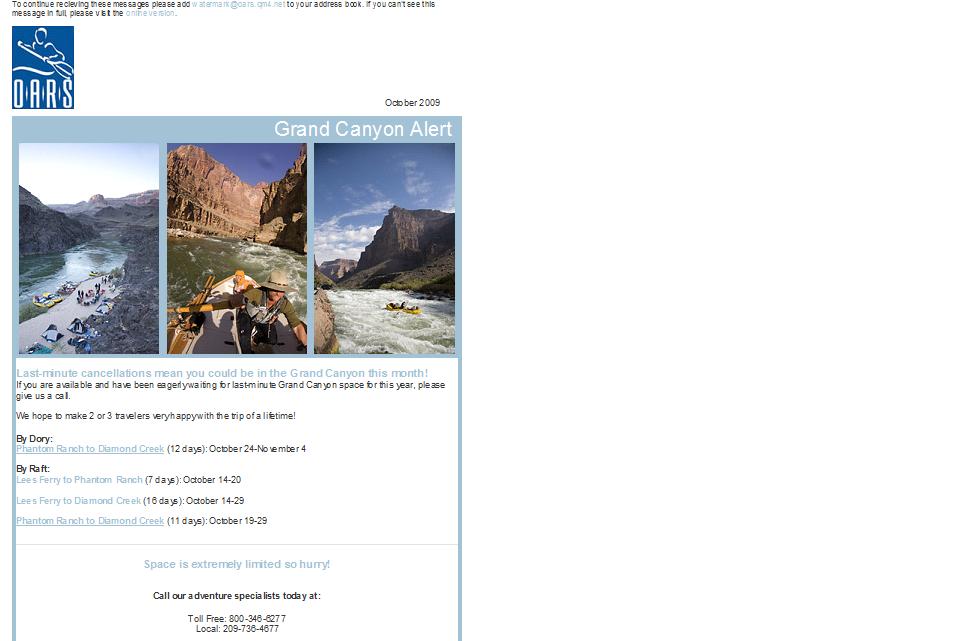
Grand Canyon River Trips on Sale
Posted: October 9, 2009 Filed under: Whitewater Rafting Leave a comment
Legal Shield or Level Playing Field: North Carolina Ski Resorts working to get a Skier Safety Act Passed.
Posted: August 25, 2009 Filed under: Ski Area, Whitewater Rafting Leave a comment
North Carolina Whitewater Rafting Industry attempting to do the same.
An article in the Asheville North Carolina Citizen-Times is reporting that North Carolina Ski areas are attempting to get a law passed that would update the law about ski industry lawsuits in the state. Some label the law as a legal shield for ski areas while others call the law a leveling of the playing field.
The law would create responsibility on the part of the skier to watch for terrain issues such as rocks or bare spots. Area operators would have to inspect runs twice a day and post run conditions. Lift tickets would have a notice to skiers of the risk of skiing.
The whitewater rafting industry is attempting do get a similar law passed.
Both bills are fairly week in all honesty. The plaintiff’s bar association appears to be quite powerful and is stopping any major modifications.
See Ski resorts, whitewater rafting industry seek legal shield. For Outdoor Recreation Law Review articles about this see It Takes More Than a Ticket Purchase to Enforce a Contract and Release.
Two people charged with crime in fatal rafting accident.
Posted: August 4, 2009 Filed under: Criminal Liability, Whitewater Rafting Leave a comment
The North Central Illinois News Tribune is reporting that two people were charged with operating a boat under the influence of alcohol. They were on the Vermilion River when their raft went over a low head dam. A third passenger in boat drowned.
They part of a group of seven people in two rafts. The first raft made it down a boat shoot on the right hand side.
The charges are a Class A Misdemeanor offense with a penalty of a $2500 fine or up to one year in jail.
See Two charged in wake of fatal rafting accident and Ex-St. Charles woman charged in fatal rafting accident.
Duh – Sloshing your drink is dumb
Posted: July 16, 2009 Filed under: Whitewater Rafting Leave a comment
Rafting drunk is dumber and a crime.
The Oregon Court of appeals is a violation of state boating laws in Oregon. The court decided that a raft is covered by the laws regulating boating. The defense argued that a raft was not a boat……… There was also an argument made that the drunk defendant did not have control of the raft at the time he was intoxicated, which in all honesty could be argued about whitewater rafting all the time.
See Court: River rats can’t legally raft drunk
But still…..
Commercial drowning on the American River in California
Posted: July 8, 2009 Filed under: Whitewater Rafting Leave a comment
It is being reported that a 20 year old man died of a foot entrapment while training to be a whitewater rafting guide. The victim was in a boat on the South Fork of the American River when the boat tipped or flipped and the victim was thrown in the water. The boat had hit Gunsight (rock) in Troublemaker rapid. The victim got lodged 70 yards downriver of the accident.
For more details see Man drowns rafting American River
Slow news day + somebody wants’ their 15 minutes of fame and you have the ingredients for a lawsuit.
Posted: October 28, 2008 Filed under: Whitewater Rafting Leave a comment
A woman died whitewater rafting on Glacier Creek outside of Girdwood Alaska. The local news must have a slow day because following the reports of the fatality they started to do some investigative work. See Raft accident brings safety concerns.
The TV station interviewed the local fire chief and found a “rafter” for some comments. The report does not indicate whether the “rafter” knew what he was talking about, was a commercial operation or just some guy who volunteered to be on TV. Here are some of his quotes from the story.
The rafters were wearing helmets and dry suits but they were all in one raft which is something experienced rafter Gary Klink says is uncommon.
Klink says part of being a responsible tour operator is knowing when to turn down clients.
“There’s always that desire to put anybody on anything that they want but if they’re reputable they’ll say you probably shouldn’t be doing this creek, you need this amount of experience,” he said.
The issue is not whether the raft company was wrong or right. Great arguments can be made on either side of this discussion. Until a credible rating for the creek is established who knows what the commercial operator should have done.
What is evident is this guys comments, whether intending to or not, are the basic starting blocks for a lawsuit. In less than a minute this “rafter” has provided everything anyone needs to file and possible win a claim.
If he is a commercial operator his own insurance rates are going to go up because of these stupid statements. If he is a private boater he does not know jack.
Either way the TV station got a story, someone got their 15 minutes of fame and the rest of us may have to deal with a lawsuit because of it.
Marketing is where lawsuits start.
Posted: September 16, 2008 Filed under: Whitewater Rafting Leave a comment
This one takes a prize for being the dumbest article/press release I’ve seen in years. The article starts out talking about fatalities in whitewater rafting. The next paragraph states that whitewater rafting is safe.
Now its the midst of the busy season guides and companies want people to know the river is not only fun, but also safe.
Wiktionary describes “safe” as Not in danger; free from harm‘s reach. Free from risk; harmless, riskless. Providing protection from danger; providing shelter. Properly secured; secure.
The Free Dictionary describes “safe” about the same way. Secure from danger, harm, or evil. Free from danger or injury; unhurt: safe and sound.. Free from risk; sure: a safe bet.
I don’t see how a fatality meets the description of safe?
The article is an absurd attempt to bring tourism to an area or activity.
It gets better though. Later in the article the reporter describes the safety talk where the guide states:
“Anyone of you guys or anyone of us can be really seriously hurt and or killed out here on the water,”
But we quickly slip back into “lawsuit creation time” with the quote from the guide:
“I’m a swift water rescue instructor, I’m also certified in emergency care so you are in pretty good hands but you need to watch out for yourselves today too,”
“Everybody thinks whitewater rafting oh it’s so scary, and dangerous well, it’s really not all that dangerous.”
“If you listen to the guide and you do everything that he says then you’ll be fine as long as you just pay attention and keep your eyes open.”
I understand what is going on. In an effort to get people back on the river after several fatalities a first time rafting reporter was offered a trip down the river. The reporter thought he was reporting well. The raft company thought they were doing a good job telling the reporter how safe the river was. The guides were in heaven because the reporter was having them repeat their quotes; they were going to be famous.
From a legal standpoint they are making very conflicting and haunting statements. From a casual reader’s standpoint the statements don’t make sense. What you have is a very confused article that is guaranteed to surface in the next claim or lawsuit over rafting.
Rafting: Is it or is it not safe?
Based on the definition of the word safe, whitewater rafting is not safe. But based on the definition, nothing is safe. You can put the risks in perspective but you cannot tell your customers that rafting is safe. But life can be a lot more fun if you are willing to undertake some risk.
See: Whitewater Rafting Safety
Plaintiff claims website said raft trip was safe for beginners
Posted: August 7, 2008 Filed under: Rivers and Waterways, Whitewater Rafting Leave a commentJennifer Caffarella has filed a lawsuit against Laurel Highlands River Tours for injuries she received rafting on the Youghiogheny River. She was injured when her unguided raft flipped and she stood up in the water trapping her foot. She claims she suffered disfiguring injuries and brain damage.
The basis of her claim is the raft company misrepresented its claims that the raft trip was safe for beginners. The raft company claims they require all rafters to watch a safety video and take a 30 minute training course before they are permitted down the river. The company claims that the plaintiff was specifically told not to stand up in the river which she did causing the foot entrapment.
Press releases or interviews with the press by the defendants usually don’t talk about releases. They normally just respond to the questions which are usually based on what the reporter knows, so we don’t know if the outfitter has a release.
At the same time, a training course is a lot of information. Add a thirty minute training course and you would have to think there was some risk involved or you would not get that much information. Foot entrapment is also one of the issues covered in every pre-trip safety talk because people want to stand up in rivers. The higher your head is above the water the safe you feel. It is tough and not understood by the ill informed that keeping your body low in the river is the safest course of action.
At the same time, dimple rock, is a dangerous river section where several people have died. The state of Pennsylvania just completed a study where they determined that Dimple Rock was not going to be removed. The study was prompted because of the safety issues presented by the rock. See Dimple Rock will remain unchanged in lower Youghiogheny River.
For the complete article see: Injured woman sues rafting company
It might be better to create a purely rental operation. If a car rental company can rent someone the most dangerous machine we have invented, the automobile, then a raft rental is easy. However, the course of attempting to make the experience easy and “safer” has lead the outfitters out of the protection afforded by a rental program and into a guide program where the liabilities are much greater. For that same reason, you probably cannot go back.
Update on SBTW right to raft case
Posted: July 31, 2008 Filed under: Whitewater Rafting | Tags: Camp, Lawsuit, Pennsylvania, Recreation, Rock climbing, summer camp, Tribune Democrat 1 CommentI reported in an early article Historical Use v. Money, Control & Power that a summer camp in Pennsylvania was suing the state to regain access to raft in a

Image via Wikipedia
state park. The Tribune Democrat is reporting that the summer camp, Summer’s Best Two Weeks lost their attempt to receive an injunction. The article, Raft trip runs aground in court states a three judge panel denied the injunction.
An injunction is as it sounds, an immediate court order requiring someone to do or not to do something.
The article is unclear and I have not seen pleadings to determine if the attempts by SBTW are over or they are continuing their suit. Many times you can be successful on the main litigation after you have lost the injunction motion.

The word “Safe” comes back to haunt outfitter and travel agent
Posted: July 2, 2008 Filed under: Whitewater Rafting | Tags: Grand Teton, Grand Teton National Park, Jackson Hole, National Park Service, Snake River, Vail Resorts Leave a commentJackson Hole News is reporting that a lawsuit has been filed over a rafting accident that occurred in 2006. Robert and Patricia Rizas are suing Vail

Image via Wikipedia
Resorts, Grand Teton Lodge Company and Tauck Inc. for loss of income, earnings, medical expenses, pain and suffering and physical disability and loss of enjoyment of life and hoping for punitive damages
The accident that gave rise to the litigation occurred at Deadmans Bar on the Snake River in Grand Teton National Park. Three people died in the suit, two of whom were the brother and sister in law of the plaintiffs. However none of the claims being alleged assert a claim for the loss of life of their relatives.
Few states allow a sibling to recover for the loss of life of another sibling. Those states that do allow a sibling to recover for the loss of another sibling only allow recovery of minimal damages. In order to recover damages, the person who survives must have a direct and past or future monetary relationship with the deceased. By that I mean parents and children can sue for the loss of the other as well as the spouse for the loss of a spouse. Very rarely do courts allow or provide monetary damages for the loss of a sibling.
The defendants in this case are a little hard to sort out. <
Grand Teton Lodge is a lodge located in Grand Teton National Park. The lodge as part of the activities it offers guests is river trips on the Snake River. Grand Teton Lodge is owned by Vail Resorts Management Company, Inc. is a company selling tours, which in this case included nights at the lodge and the river trip. The river trips are described on the Grand Teton Lodge website as
The general allegations are the lodge and Vail conspired with the tour company to mislead and defraud the plaintiffs into taking a river trip which was described as safe.
The plaintiff’s state the Tauck brochure described the river trip as a “serene float through magnificent mountain scenery” which is very similar to how the Grand Teton Lodge website describes the
They are also claiming the brochures, the lodge and the raft guide described the river trip as safe. The river was running at run off levels at the time of the trip.
The complaint states the shuttle driver said the river trip was safe. The complaint also states the shuttle ride was more dangerous than the river trip.
The complaint states the companies were negligent in failing to warn of the dangers of the river during peak run off. The defendants were also negligent for not properly training the passengers, failing to provide a competent guide and equipment suitable for the conditions.
They plaintiffs are also claiming fraud because the defendants hid the dangers of the river. Had the plaintiffs known of the dangers of the river they would not have gone on the river trip. The complaint allegedly states the defendants place corporate profit above the personal safety
There are several interesting legal issues floating around in this case. The first is an attempt to have any release or acknowledgment of risk form thrown out of the case. The accident occurred inside the Grand Teton National Park so supposedly the river outfitter would be operating under a Permit or Concession contract with the
National Park Service
As a permittee the only document that can be used to reduce liability is the NPS Here claim that there was fraud involved will void any contract between the parties. The second is the use of the word safe. When people hear the word safe it is not a word that brings up a comparison of how safe, but to most people means absolutely risk free. So when any person, website or brochure states an activity is safe, that activity is risk free. Families take safe trips, they do not take dangerous ones. Fathers and mothers do not take their kids on risky activities.
Yet safe is a relative term. The most dangerous place in the US is the home bathroom. It is more dangerous, in most cases, to drive to the river than to raft the river. Although who knows based on the description of the shuttle ride in this case.
However here, the defendants are going to have an uphill battle if the statements are proved that the river trip is safe. People were injured, people died and people did not have a good time, therefore the river trip was not safe.
Safe is not a word that you should use in any communication with a possible client. Life is not safe.
Historical Use v. Money, Control and Power
Posted: June 16, 2008 Filed under: Whitewater Rafting | Tags: Outdoor recreation, Outfitter, Pennsylvania, Raft, Raft guide, Recreation, River, Youghiogheny River Leave a comment
Image via Wikipedia
A summer camp in eastern Pennsylvania is suing the state of Pennsylvania over the right to run rafting trips on the Youghiogheny River. This statement does not seem like much at first however it is a very interesting legal argument about a state’s right to control commercial activities on its rivers. See SBTW sues DCNR for right to raft.
In this case the summer camp is Summer’s Best Two Weeks (SBTW), a Christian youth camp that has been running raft trips for its campers for more than 30 years. Several years ago the state licensed four outfitters as the only commercial rafting operators on the Youghiogheny River and ordered SBTW to quit running raft trips.
It is not evident from the information whether SBTW was offered a commercial permit.
The commercial rafting companies were probably excited because they knew they could pick up the $30,000 of rafting that SBTW would provide. Yet it seems no one in the state or the commercial operators understood basic economies: supply and demand. In this case SBTW did not hire one outfitter for one trip. The cost of hiring a commercial raft company to take the campers down the river was more than the summer camp could pay. Simple economics, rafting is fun, but at a price.
I have to admit a little bias in this case. While I was working on the rivers in the west my brother was a raft guide for SBTW.
We do not know the states reasoning for either excluding or not including SBTW. Was it to keep SBTW off the river or where they influenced by commercial companies to increase their income?
This story can be repeated on rivers and trails across the US. You can change out the word camp for college or any other non-profit group and see outfitters believing that by excluding them from being on the same area they can profit from the result. It never works. There is a ceiling on the amount these some groups can pay and in the case of college programs there are different goals. Commercial companies want to provide entertainment for their clients. Colleges may want to educate, teach, build teams or have numerous other goals.
Don’t get me wrong. I’m all for outfitters, they are my bread and butter. But the outdoor industry never looked at the economics of outdoor activities other than their own bottom line. Campers and their parents, college students and their parents, most groups and parents have a fixed amount of money they can be spent on the summer or an education. Once that amount of money is spent, no more activities are undertaken.
There scenario has been played out for years at various recreational hot spots and is going to boil over as the forest service notifies more colleges and universities that they are no longer allowed on USFS land without a permit or a commercial outfitter on a permit.
Releases 101
Posted: February 10, 2008 Filed under: Colorado, Release (pre-injury contract not to sue), Whitewater Rafting | Tags: Colorado, Lawsuit, Outdoor recreation, Outfitter, Rafting, Recreation Leave a commentSeveral years ago Justin R. Melat of the Colorado Springs law firm of Melat, Pressman, Ezell & Higbie, LLP sent a letter to Representative Mark Larson of the Colorado Legislation asking him if he would sponsor a bill eliminating the uses of releases in Colorado. Accompanying the letter was a copy of a page from Trial Talk, the Plaintiff’s bar newsletter. The Trial Talk letter was from Eric Leaper who decried the use of releases in outdoor recreation programs. Eric Leaper has testified several times on behalf of Plaintiffs in whitewater cases.
The injury that prompted the letter was a church group from Kansas who lost a leader while whitewater rafting in Colorado. The facts as set forth in the letter are as follows: As Church Group stepped off the bus to enter the boats they were handed a release. They were told Colorado law required that they sign a release. The boat captain had 2 weeks experience. The boat flipped and the Chaperone died.
I have not been able to verify the death or the incidence; however, the facts are not that different from similar incidents in the past.
The law firm emphasized the trips were pre-arranged and pre-paid as well as non-refundable. The letter then explored common law that did not allow the release of a future tort. The final paragraph of the letter is well written:
“Future releases are especially inappropriate and damaging to Colorado’s tourism, when there is no prior warning of the requirement. A simple statute declaring releases of “future” negligence that is negligence not yet committed to be void, as a matter of public policy would allow the law to operate smoothly and cases to be settled and releases given for negligence past, as it always has been.”

Image via Wikipedia
A quick review of where the outfitter acted in a way to increase his chances of being sued, based on the law firms letter is in order here.
-
The Outfitter did not communicate the release to the group before they arrived in Colorado.
Releases must be given to clients with the opportunity to read, understand, sign and/or reject them. Handing out releases at the put-in is a great way to have a court void a release. It does not give the person the necessary opportunity to read and understand the release.
Many times this is done so customers will not quit a trip. This attitude leads to litigation. A person who does not sign the release is a great person for any outdoor recreational activity. Those are people who read and understand your release and make a decision not to go on the trip. That person should be thanked, have there money cheerfully refunded and helped to their car. They are the ones who are going to sue you in the future if they are forced to undertake a trip because they could not get their money back.
I would love to see an outfitter defend him or herself in court when sued for a refund. The little lady on the stand would state she did not understand what whitewater rafting was and when she saw the river and heard the safety talk, she was too afraid to go on the trip. Then the big mean outfitter did not give her money back. Every judge in Colorado would land on that outfitter with both feet and a money extracting judgment.
If you are not refunding clients money after they have read and understood your release form, you deserve to be sued and go out of business. You should always refund money if someone, after reading the release, looking at the rock or seeing the river, decides they do not want to take the trip.
- By not sending the releases in advance, the releases are worthless pieces of paper against any action by an injured or deceased youth.
This was a youth trip. People under the age of 18 cannot contract away their legal rights. This entire action was an exercise in wasted paper by the outfitter because most of the people on the trip would have the release thrown out by the court immediately.
By only providing the release forms at the put in, the outfitter ignored the only real chance at using an effective release, having the parents sign the form. As such, the only person who could have the form used against them was the only person who died.
Here again, the fears of losing a client made the outfitter think in a way that might have lost him is business. There are many old proverbs that prove this thinking process is defective. You would think they would not need repeating in the 90’s.
- Release forms should be provided to the customer as soon as possible.
As soon as you know about a person, coming to your business, you should provide them with a copy of your release. Besides saving time and money on the day the trip departs, this allows participants, parents and leaders to honestly evaluate the risk of the trip and made the decision as to whether they want to undertake the activity.
This also increases the chances that your release documents will effectively stop some of the possible litigation. If one parent signs, then there is one less person to sue you if a minor is hurt or injured.
Brochures and marketing information should tell future customers that they will be required to sign a release. A marketing program should also inform customers that they outfitter is not responsible for lost property or any injury they receive. Be honest and up front in your documents and you save a lot of hassles later.
The releases can be collected rather than signed at any point along the way. People knowledgeable about the release are answering questions about the release, rather than a guide who may misinterpret the legal document. (Remember statements by your guides can void your release.)
- The outfitter lied to their customers with the statement that Colorado law required the release. (Duress)
The fear of having a customer refuse to sign a release made a liar out of the outfitter. If the Plaintiff’s attorney had realized this, he probably could have voided the release and sued the outfitter. The outfitter would be labeled a liar. There is no Colorado law requiring the use of a release.
Don’t lie to customers. Don’t inflate or deflate the risk of the activities. I enjoy brochures for the Arkansas River advertising river sections one full class above their historical rating. This is an easy way to prove that anything an outfitter may say on the stand is a lie. They lied to customers in their brochure, what is stopping them from lying o the stand.
Second, the heirs of the deceased person could have claimed the release was signed under duress. Duress is being forced to sign a document. Having not right to a refund and being forced to sign a release because the law requires it, when it in fact does not require it may be enough to support a defense of duress.
Fact Summary:
This story relates examples that should have gone the way of the bell-bottom pants and the disco. However, like the disco, which is returning as much as a joke as a fad, these operations still exist. This outfitter should be encouraged to attend state and national meetings to learn the latest in properly handling clients. The numerous mistakes made which the heirs and their attorneys missed took a big chunk out of the outfitters “luck” box. The next time the heirs may find a sharper attorney.
Conclusion
If Eric Leaper’s letter is in Trial Talk, this could be a major war for the outfitting industry. Trial Talk is a highly respective magazine that encourages and supports Plaintiff’s lawsuits. By subscribing you learn the latest and greatest new plaintiffs and ways to win lawsuits. Eric has been making money as an expert witness for the Plaintiffs over the past several years. His letter does a good job of weaving different ideas and legal theories into a plausible argument. Several interesting quotes from his letter are set forth here:
“We are concerned about the present lack of accountability of commercial rafting companies and other outdoor outfitters in Colorado.”
“But we often see outfitters sending inexperienced “first season” guides into hard whitewater rapids with inadequate equipment.”
“The use of these release forms is fraud. As you know, they are unlawful in other states.”
“At present, the outfitter business in Colorado is untrustworthy, to put it mildly.”
“There are organizations of experienced river runners and conservationists (such as our organization” and there are outfitter trade organizations. But there is no organization of outfitter customers. Trial Lawyers are their only advocates. Therefore, we would urge you to thoroughly demonstrate that these dangerous rafting practices violate national standards and that these all-encompassing release forms are fraudulent.”
If Mr. Leaper’s statements were true, then this set of facts would have allowed the Plaintiffs to sue successfully. Colorado state law specifically sets forth that outfitters must use safe equipment. If use of a release is fraudulent, then the release is void.
There are several lessons to be learned from these letters and the facts surrounding this case. Don’t make these mistakes.
More importantly, find out what you Colorado legislator is doing and whether he received one of these letters. Start now to prepare for another battle to eliminate releases in Colorado.
Originally published December 1999 in the Outdoor Recreation Law Newsletter
Copyright 2011-2023 Recreation Law 720 Edit Law, Recreaton.Law@Gmail.com


 Recreation Law