
Satellite phones are not enough, now anyone can “phone home”
Posted: July 21, 2009 Filed under: Uncategorized Leave a comment
A Nepali telecom company plans to place mobile phone towers at four places around Mt. Everest so you can use your mobile phone about anywhere on the peak. The coverage planned will allow cell phone calls from the summit of Mt. Everest. The work is expected to be completed this year.
I heard Sir Edmund Hilliary, the first person to summit Mt. Everest in 1953 say he best conversation he had with his son was when his son called with a satellite phone from the summit of Mt. Everest.
It took seven days for the news of Hilliary’s summit to reach England in 1953, now anyone can check on their laundry from the summit of Mt. Everest.
See Mt Everest to get mobile coverage
Continuing Legal Disaster with the New BSA Annual Health and Medical Record
Posted: July 14, 2009 Filed under: Uncategorized Leave a comment
Normally when the media, volunteers and in some cases lawyers get involved in an issue things get better. However there is the old adage that it will always get worse before it gets better, which seems to be the rule with the new BSA Annual Health and Medical Record.
I first wrote about the BSA Annual Health and Medical Record in New BSA Medical Form is a Disaster. The second article I wrote is Response to Comments on the New BSA Medical Form. Here is the third.
The BSA attempted to answer some questions about the Annual Health and Medical Record at a FAQ website. Frequently Asked Questions Concerning the Annual Health and Medical Record. This article will try and clarify some mistakes the site makes.
There are some great sections and answers on the FAQ page. The answer “Q. Do I really need to explain everything about myself or my child, such as learning disabilities or depression? I don’t want myself or my child to be treated differently” Is very good. I was working at a summer camp and visiting the rifle range when a youth stood up with a loaded rifle. His parents had decided not to notify us of medication issues.
However in this day and age no one should have any social security number on any document. Health care will never be withheld for lack of a social security number.
Q. Why do I need to put my child’s or my own social security number on the record?
A. It is your choice as to whether you fill in this number; however, in many states, medical care cannot be rendered without it.
The part of the form that is receiving the most news coverage is the new height and weight requirements. In effect the requirements ignore generally accepted medical research and are going to severely restrict Scouting. The FAQ restates that position.
Q. Our camp is at least 30 minutes from the local hospital by ambulance or EMS. Does this mean that we automatically have to meet the height/weight requirements for all activities at the camp?
A. While response time for basic or advanced life support should be a consideration for a camp’s emergency action plan, it is not the record’s intent. If your travels by foot, bicycle, horseback, afloat, or whatever the mode of transportation take you more than 30 minutes off of an accessible roadway where in an emergency vehicle can reach you, you will need to meet the height/weight requirements.
The great comments about this part of the form are that most employees of the BSA national office supposedly won’t make the cut also.
Even worse, the requirements are based on a Body Mass Index (BMI) for men. Exploring has been coed since the 1970’s and Venturing since the 1990’s.
A silent auction will be set for Andy Knapp Memorial Fund: A long time fixture and icon in the outdoor industry.
Posted: July 8, 2009 Filed under: Uncategorized Leave a comment
Numerous sources have reported the death of Andy Knapp, an icon in the outdoor industry. A silent action is being held to help defray some of the medical expenses Andy incurred.
Midwest Mountaineering, Andy’s employer has information about the Bell canoe and the fund on their website.
A Celebration of Life Party will be held July 17th for Andy at the Cedar Cultural Center at 8:00 PM in Minneapolis, MN.
The Alpine Club of Canada’s Alpine Journal now Digital
Posted: July 7, 2009 Filed under: Uncategorized Leave a comment
The Alpine Club of Canada has published its Alpine Journal on a DVD. Every issue for 100 years is now available for research or just reading. EverUpward: A Century of Canadian Alpine Journals
includes the articles and the photographs from the journal.
Researching a climb can always be a tedious and ultimately information lacking experience. The information is out there, but finding it is impossible and then getting your hands on it is even worse. Of course this lack of information can also be part of the reason to do some climbs, but for those of you looking for information, this is a great resource.
EverUpward is available for purchase through the Alpine Club of Canada’s online store.
The Second Issue of the Journal of Unconventional Parks, Tourism, and Recreation Research (JUPTRR) published
Posted: June 30, 2009 Filed under: Uncategorized Leave a comment
We are pleased to announce the publication of our second issue of the Journal of Unconventional Parks, Tourism, and Recreation Research (JUPTRR). The issue and individual articles are available online at http://juptrr.asp.radford.edu/Current.htm.
Thank you for your support of JUPTRR!
The next submission deadline is August 15th and is a regular issue. Manuscripts for the special issue on Dark Tourism will be accepted through February 15, 2010.
Please help spread the word!
CURRENT ISSUE
Journal of Unconventional Parks, Tourism & Recreation Research
ISSN 1942-6879
Volume 2, Number 1, 2009
Turning monsters into people: A reflexive study of sex offenders and leisure
D J Williams
This arts-based study serves two interrelated purposes. First, it draws from multiple tales to illustrate reflexivity (and its benefits) between the author, research topic, and participants. Different forms of tales show multiple and diverse human interconnections and the complexity of understanding potential leisure among sex offenders. The importance of prioritizing reflexivity should not be underestimated, particularly when conducting research with populations that commonly are “othered” and sometimes demonized. Within a reflexive context, a poetic transcription from structured interviews with five sexual offender parolees is included to explore the possible essence of leisure as expe rienced by these men. The inclusion of evocative representations emphasizes commonalities of the human condition, yet also illustrates differences between people.
Doctrinal beliefs as a determinant of sin associated with select leisure activities
Steven N. Waller
The purpose of this case study was to investigate the association between religious doctrine and perceived sinful nature of 10 leisure activities identified by the congregation under study. A questionnaire was completed by 188 congregants of a predominately African American, Protestant church located in southern Ohio and results indicated a significant association between the source of belief — personal beliefs, scripture, and religious doctrine — and the belief that certain leisure pastimes are sinful. Results of the study suggest: (1) religious doctrine influences beliefs about the sanctity of leisure activities at the individual and congregational levels; (2) personal beliefs are the greatest determinant of perceived sin associated with select leisure pursuits; and (3) length of membership in a congregation influences beliefs about leisure.
Benefits of hiking: A means-end approach on the Appalachian Trail
Eddie Hill, Marni Goldenberg, and Barbara Freidt
The purpose of this research was to examine the outcomes prompting hiking along the Appalachian Trail (AT). By using means-end theory, linkages between attributes, consequences, and values of the AT hiking experience were made. The researchers conducted forty-three interviews of AT hikers. Self-fulfillment, self-reliance, fun and enjoyment of life, and warm relationships with others were some of the values that emerged. Specifically, strong links existed between hiking and exercise, exercise and health, health and fun and enjoyment of life. While this area of research on the AT is new, results of this study can be used by recreational professionals that work with the AT or other hiking trails to promote appropriate use of natural resources.
Pigskin and black belts: Can martial arts provide insight for competitive and aggressive sports like American football?
P. Brian Greenwood and Jerusha B. Greenwood
Competitive and aggressive sports provide recreational sport contexts for youth and adolescents across the globe. One of the most popular recreational sports worldwide is martial arts, a sport characterized as aggressive yet backed in the traditional form of the sport by a principled philosophy. The researchers engaged in naturalistic inquiry through full participant observation in a traditional martial arts club. The purpose of the research was to closely examine the teaching of traditional martial arts to determine whether lessons could be derived for competitive and aggressive sports like American football. Philosophical and psychological themes emerged from the research, including a counterbalanced ethic of nonviolence and restraint and achievement orientations reflective of the researchers’ sport backgrounds, respectively.
Board member compete ncy: A Q methodology approach
Amy R. Hurd, Brent A. Beggs, and Paul Fokken
The purpose of this study was to use developed competencies to examine their importance to current public parks and recreation board members. This was done using Q methodology to determine profiles of public parks and recreation board members and the perceived value they assigned to specific competencies. A principle components analysis was used to factor analyze an 11 x 11 Q sort matrix. The results indicated there are three types of board members including the participatory, community representative, and conceptual nonpolitical. These three types had similarities and differences that demonstrated a better understanding of what competencies are important for board members to function efficiently and effectively.
Dr. Susan R. Van Patten
Executive Editor, Journal of Unconventional Parks, Tourism & Recreation Research
Acting Core Curriculum Director
Associate Professor, Department of Recreation, Parks & Tourism
Radford University
PO Box 6963
Radford VA 24142
(540) 831-7644
Elite Running Coaches to Offer Training Talk at Boulder Running Company
Posted: June 26, 2009 Filed under: Uncategorized Leave a comment
Boulder, CO, USA – Internationally known running coach Bobby McGee and world champion marathoner Mark Plaatjes will host a discussion on run workouts and run training this July at Boulder Running Company. McGee and Plaatjes will discuss what road runners and triathletes can learn from each discipline’s unique approach to run training.
- Bobby McGee and Mark Plaatjes
- Run Workouts for Runners and Triathletes Wednesday, July 1, 7:15-8:15 pm Boulder Running Company
- 2775 Pearl St # 103, Boulder, CO 80302
- www.boulderrunningcompany.com, (303) 786-9255 Free event
Discussion topics will include recovery vs. frequency, quantifying runs, crosstraining, periodizing training, and developing the abiliity to surge and attack.
All too often, runners and triathletes reach a plateau in fitness because they do the same type of training, week after week. To see improvements in fitness, athletes need to vary the kinds of workouts they do. This means mixing up endurance runs with hill repeats, intervals, and track workouts.
McGee has teamed up with Plaatjes to give runners of all levels a complete collection of workouts and training plans. Run Workouts for Runners and Triathletes is the perfect tool for self-coached athletes to add variety to their training.
Run Workouts for Runners and Triathletes features 21 training plans for all the most popular race distances; 5km, 10km, half-marathon, marathon, Olympic-distance triathlon, half-Ironman, and Ironman. Each plan offers three performance levels, and McGee explains precisely how runners can determine their training paces and balance hard days with easy days.
McGee offers new takes on the workouts all runners and triathletes should practice and master. Each training plan incorporates 80 fresh and challenging workouts including endurance runs, intervals, hills, Yassos, and a variety of tests and bricks. Runners and triathletes can pepper these workouts into their own training plans. Run Workouts for Runners and Triathletes is available now in bookstores, tri and running shops, and online. Autographed copies will be available at this event through Boulder Running Company.
Bobby McGee is an internationally certified track and field coach whose athletes have produced world records, won world championships, and been consistently ranked amongst the best in their events. He coaches runners and triathletes, and has worked with USA Triathlon preparing athletes for the 2004 and 2008 Olympic games. For more information on Bobby, please visit bobbymcgee.com.
Mark Plaatjes is the 1993 Marathon Gold medal winner at the World Track and Field championships. In addition to being a world champion, Mark’s running record includes a win at the 1991 Los Angeles Marathon and a 6th place finish in the 1993 Boston marathon. Mark owns a private physical therapy practice and specializes in treating runners and athletes. He currently lives in Boulder, Colorado, and coaches recreational and elite runners.
Why do I write this blog?
Posted: June 25, 2009 Filed under: Uncategorized 2 Comments
As you can see I get some intense comments on my posts. I welcome them, no matter how frightening they are to read. I believe they have value because they show other readers the other side of the lives that are affected when someone is injured or hurt in the outdoor recreation industry.
I try and direct this post at the idea that you should solve the problems before they become litigation. I think it is important to see how those people affected feel. Once you understand, to a very limited extent, what family members are going through you can help.
Litigation is not a resolution for either side to an injury or fatality. See Litigation costs a lot of money and It’s Not Money.
It is very scary to read a post that starts out I am the mother or father of the child/person you post is about. That has happened twice in these pages. See Zip Line Fatality and Serious Disconnect: Why people sue. It is always a devastating state of affairs to when someone is injured. Worse when it is a son or daughter. It has been said that the worst thing to experience in life is the loss of a child.
Yet I believe these comments have value. Too often we look at accidents as disasters for us because of the possible bad PR or litigation and forget the families involved. That reaction then turns us off as humans and turns on an automated response.
We need to be human. We are human when we sell a fun and exciting trip or adventure. We are human when we watch our customers laugh or learn or explore. We are human as we serve up a mediocre dinner and laugh about it without customers who love it as fine cuisine.
I write this blog to inform, to be cynical, to educate but to also to remind you to be human.
Grand Canyon Outfitter looking for Hiking Guides
Posted: June 25, 2009 Filed under: Uncategorized Leave a comment
Angel’s Gate Tours
We have an immediate opening for a professional guide to lead sightseeing tours, day hikes and the occasional backpacking trip in Grand Canyon. Please contact us if you meet the following requirements:
+ Minimum WFR certified, with CPR. Higher medical certs OK.
+ Good driving record.
+ Must be able to pass Arizona DOT physical. Basic Motor Skills.
+ Outstanding Grand Canyon knowledge.
+ Hiking experience on all South Rim trails.
AGI is an EOE. If you meet the above qualifications please email a resume to job@grandcanyonhikingguide.com
http://www.angelsgatetours.com/
A New MA law will make every Outfitter’s life a pain
Posted: June 23, 2009 Filed under: Uncategorized Leave a comment
A new Massachusetts Data Security Law is causing a firestorm across the business world as it applies to any company that gathers information about ANY Massachusetts resident, no matter where the company is located.
The law requires companies to take measures to protect consumer data, evaluate possible risks to their stores of personal data and create a detailed plan for keeping that data safe.
Businesses in Massachusetts are fighting the law tooth and nail as it will require them to take a number of steps to fall into compliance. What many businesses around the country don’t know is that they will also be liable to protect the data of their Massachusetts customers.
The law is a hot-button topic in Massachusetts and its spread will ignite a similar firestorm around the nation.
I can put you in touch with an identity theft protection expert from Identity Theft 911 who can offer your audience a more detailed look at the major components of the new law and surrounding issues at length.
$4.7 million dollar verdict in climbing wall case against Alpine Towers in South Carolina Court
Posted: June 22, 2009 Filed under: Uncategorized 6 Comments
Expert witnesses appear to be the reason the jury found for plaintiff; who are they?
Numerous reports are available online about a jury decision in a South Carolina case awarding $4.7 million to a paralyzed man who fell while climbing. The facts, as reported, state the man fell after his belayer failed to catch him. The belayer lost her grip on the rope and the plaintiff fell 20 feet to the floor shattering a vertebrae.
The family after the verdict stated they hope the verdict would “lead to improved safety conditions at similar climbing walls across the country.” Post verdict it is difficult to determine if this was a pre litigation sentiment, but it is always interesting to hear a plaintiff voice a reason for suing other than money.
The plaintiff:
“cited faulty design, saying the belay equipment lacked an automatic locking device that could have prevented Keeter’s [plaintiff] fall. The suit also said Alpine did not adequately train Fort Mill High School faculty members.”
“You don’t put kids in a position where their lives literally hang in the balance based on the attentiveness of other kids,” Harpootlian [plaintiff’s attorney] said Friday. “That is what our experts hammered.”
Negligent design and/or construction and negligent training of the staff by the defendant appear to be the claims the plaintiff succeeded in proving. Negligent design and/or construction in this case is going to have major affects if all climbing walls are supposed to use auto locking belay devices. The reason is auto locking belay devices have people problems also. I have never heard or found a case where an auto locking belay device failed, however I know of dozens of situations and several suits where the belayer used the auto locking belay device improperly.
Negligent instruction is always available when the people trained want to pass the buck or in an effort to CYA act dumb. Besides, memories fails. Here again, this will just lead to more paperwork as climbing wall builders attempt to prove they trained adequately by leaving behind documents.
See Verdict brings ‘closure’ for student hurt in climbing wall fall.
This case if better facts come out could have a major effect on the climbing wall industry and challenge course industry.
I’ve also been told by several people that it was an Alpine Tower’s Tower, not a climbing wall but a tower.
For other blogs about climbing wall cases see: UK court holds climber 75% responsible for his injuries, Child falls on auto belay at climbing wall, Update on climbing wall accident at Wood River YMCA Climbing Wall, Climbing accident at Ketchum Idaho indoor Climbing Wall and Student suing school district for climbing wall injury.
For Law Review Articles about climbing wall cases see: Warning labels found to be inadequate in climbing harness that was improperly clipped in, Case Brief: Climber’s Suit Against Belayer Denied and Update on Releases: Climbing walls and health clubs.
Patagonia Mountaineering School Needs a Full Time Manager
Posted: June 21, 2009 Filed under: Uncategorized Leave a comment
So, the time has come. We’ve gotten bigger and it’s time to hire a full time manager.
We’re looking for someone (or a couple), full time, year round, to help run our mountaineering school. You’d spend most of the year in Chile, and part of the year in Alaska.
Ideally, you can speak both Spanish (pretty fluently) and English (very fluently), but we’d be willing to speak to someone with a knack for learning languages, who is willing to learn Spanish.
You need to be very computer literate. And by this, I don’t just mean that you can type and use excel (these are minimums in the 21st century). We’re looking for someone who is familiar with the internet and how it can be leveraged for a small business. Social networking (Facebook, twitter), search (Google, bing), and paid search (adwords) are all important components of our business, and we would like someone who is familiar with most or all of these from a business prospective. Programming experience (html, php, or Dreamweaver) is helpful, but not necessary.
You’ll also be responsible for our basecamp, client relations, and numerous other responsibilities.
If you (or someone you know) may be interested, please see our full job description/application form at www.mountainguideschool.com/docs/manager.pdf.
Thanks a ton and we hope to hear from you soon.
Kind regards,
Ben and Jaya
2nd Annual Outdoor Leadership Research Symposium (OLRS)
Posted: June 18, 2009 Filed under: Uncategorized Leave a comment
CALL FOR ABSTRACTS
for the
2nd Annual Outdoor Leadership Research Symposium (OLRS)
at the
2010 National Conference on Outdoor Leadership
Estes Park, Colorado
February 17-20, 2010
Submissions to the 2nd annual Outdoor Leadership Research Symposium (OLRS) are now being accepted. OLRS is intended to provide a forum for practitioners and scholars to share recent and on-going research related to outdoor leadership. The symposium is being held in conjunction with the National Conference on Outdoor Leadership, sponsored annually by the Wilderness Education Association (WEA). The goal of this symposium is to help promote the development of evidence-based practice in the field of outdoor leadership. Submissions will be blind peer-reviewed and judged according to their relevance to the field of outdoor leadership as well as the basic quality of the research conducted. Presenters will have 15 minutes to present their research, followed by five minutes of questions. Accepted abstracts will be published in a special issue of the Journal of Outdoor Recreation, Education, and Leadership (JOREL). (For more information on JOREL please see www.ejorel.com)
Eligibility of proposals:
- Only studies that have not been previously published or presented should be submitted.
- Only studies that are completed or near completion should be submitted. A full report of findings and conclusions are expected at the presentation and in the published abstract.
- Authors of accepted proposals must register for the conference by the early registration deadline. Any presenter who fails to do so will be dropped from the research symposium. Please do not submit an abstract unless you are committed to attending the symposium.
- Abstracts must be submitted no later than November 1, 2009. Authors will be notified by December 15, 2009 regarding the status of their submissions. Authors must submit revised abstracts by January 15, 2010 for inclusion in a book of abstracts to be distributed at the symposium.
Submission guidelines:
- Abstracts should be no more than two pages in length, using Times New Roman 12 point font, one inch margins (top, bottom, and sides), and single spacing.
- Abstracts should follow standard formatting for journal articles: Background (which includes the introduction, review of literature, and statement of hypotheses/research questions), Methods (which includes a description of site, sample, instrument, procedures, and analysis), Results, Discussion, and References (which may be listed on a third page). Conceptual articles may use alternative headings.
- Abstracts should be written and formatted according to the guidelines of the APA Publication Manual (5th Edition).
- A cover page should be included providing the following information: abstract title, names and affiliations of all authors, and contact information (including phone, fax, and email) of the principal author.
- Documents should be saved in Microsoft Word format.
- Abstracts that do not adhere to these guidelines may be rejected without further review.
- Abstracts should be submitted to Bruce Martin at martinc2@ohio.edu by November 1, 2009. “2010 OLRS Abstract” should be written in the subject heading.
Questions regarding the Outdoor Leadership Research Symposium should be addressed to the symposium co-chairs: Bruce Martin at martinc2@ohio.edu or 740-593-4647; or, Marni Goldenberg at mgoldenb@calpoly.edu or 805-756-7627.
Change
Posted: June 18, 2009 Filed under: Uncategorized Leave a comment
Change is a constant. That about sums up my knowledge on this ball circling the sun. As it nears the end of another rotation for me (my birthday) I am thinking about change. I hope I am doing OK on the issue of change. I find myself skipping a lot of instructions for some things and just reading what I want to learn, rather than learning everything the new gadget does. I attribute that to time, not a resistance to change. I hope I am right.
What I see in my friends and family that are older and a few younger, is a resistance to change. That frustrates me as I attempt to help them. I have a friend whose business is going under, to some extent because they never adopted new business techniques. Their argument is email is not personal and a phone call is. I’ve never considered a phone call personal, at best an annoyance. Worst, I never get this client on the phone for days; they are always on the phone talking and are always days behind. They might consider email or texting or whatever to be impersonal, but it is a lot better than voicemail.
Change is important in your business. Not just the changes in the law I write about all the time here, but change in what you and your business need to do. Change in your customers. Can you expect them to come to the same section of whitewater year after year after year and not get bored? Change is needed for all of us, you, your business and your customers.
Resistance to change is also a major problem in a business. If you don’t look at changing and evolving and moving on, you will slip behind. I have a great client who from day one was working on his exit plan. He is working at putting that plan into place and doing so many years before either of us expected. He embraces and looks forward to change. He sees change as opportunity, not as something to fear.
Before law school I sold insurance. Every time we had a rate increase the insurance salesman would groan. We would lose customers as they went looking for cheaper automobile insurance. One agent always smiled. I asked him why and he said more money. We were paid a commission of 15% of the automobile insurance premium and any increase was more money in our pocket. That is called looking forward to change.
However what bothers me is the possibility that I may become resistant to change. That I get stuck in a world or a time and due to whatever reason refuse to keep moving forward, thus sliding backward. I am writing this as a reminder for me as well as you. I hope someone reminds me to read it. I am also writing this for my friends and my nieces and nephews. I think my nieces and nephews will end up being in charge of the issue of change. When I refuse to, it is time for the home basically. If I can’t embrace, not just accept and enjoy change it is over.
So nieces and nephews I want you to tell me about the latest and greatest. Whether music that I can’t understand the lyrics or gadgets or technology, it is your job to kick me in the butt and make me stay up with change. It will be your job to remind me to change. To accept change, to embrace, and to love change. To laugh at me when I refuse to change and to love me when I don’t want to change…as you shove my wheelchair over the cliff.
Breast cancer survivors unite for Paddlefest
Posted: June 17, 2009 Filed under: Uncategorized Leave a comment
Dragon boat teams race for disease awareness, unity
CINCINNATI – All eyes will be focused on two bright and colorful Dragon boats on the Ohio River June 27 as two teams of regional breast cancer survivors race for both bragging rights and awareness about the disease.
The Kentucky Thorough Breast Team and The Dragon Dream Team from Akron, Ohio will hit the waters on the final day of the Ohio River Way Paddlefest, a family-oriented, canoe and kayak river event that’s expected to attract more than 1,500 enthusiasts for two days of water sports and entertainment launching from Coney Island Park. The Finish Line Festival & Dragon Boat Races take place 10:30 a.m. to 2:30 p.m. June 27 at Yeatman’s Cove in Sawyer Point Park. The inaugural Dragon Boat Races with teams of 20 paddlers per boat will race on the Ohio between the Purple People Bridge and the Taylor Southgate Bridge.
“Back in the day, there was the race between the Delta Queen and the Belle of Louisville,” said Kentucky team member and State Representative Addia Wuchner, R-Florence. “Now, we have Thorough Breast versus the Dragon Dream Team.” Her team races in a large, 54-foot long traditional dragon boat, which was funded by a grant from the Susan G. Komen for the Cure organization through the Three Rivers District Health Department. Not surprisingly, it’s painted pink so that anyone who sees it knows what the team is about.
“Any time we can get out into the community, we are able to promote breast health, cancer awareness and show others that there is life after cancer, that as a survivor, you can go out and be active,” said Wuchner, who was diagnosed with the disease in 2006. “My personal motto with cancer is ‘not just fighting and surviving, but thriving.’ It’s very inspiring and emotional to be a part of this team.”
Jim Thaxton, of the Three Rivers District Health Department, said he, too, is amazed by the team’s courage. He was responsible for spreading the word about the team through visits to regional hospitals and cancer support groups, recruiting team members.
“You would never know it, but a few of those women were terrified of getting out into the water at first,” he said of the team’s early days. “But the team is so bonded, they helped each other and now it is effortless. They are very competitive and ready to race.”
The race between the two teams will finish the weekend celebration, which will also involve live music from five local bands, food, refreshments, craft vendors, and paddling films, as well as a Kids Expo. Proceeds from Paddlefest 2009 will be used by the Ohio River Way, Inc. to develop the Ohio River Water Trail, support local river education and advocacy organizations and to work with partner organizations to complete the downtown-to-Lunken Airport segment of the Ohio River Bike Trail.
No matter the competition, Wuchner says she really looks forward to being out on the Ohio River with her ‘sisters.’
“You will be hard-pressed to find a person who has not been affected by cancer,” she said. “Every team member is a survivor with their own amazing story. While none of us would say our cancer diagnosis was a gift, our journey to healing has been a gift and we’re sharing that with each other and our community on the beautiful Ohio River during Paddlefest.”
Contact Person: Teresa Lubric
Company Name: Ohio River Way Paddlefest
Telephone Number: (513) 588-6936
Email Address: ohioriverpaddlefest@gmail.com
Web site address: http://www.ohioriverway.org/paddlefest/
Denali National Park & Preserve (AK) International Exchange Brings Nepalese Climber To Park
Posted: June 15, 2009 Filed under: Uncategorized Leave a comment
This is just a repost of a news release from the NPS Morning Report for June 15, 2009. But I found it interesting to see the NPS reaching out in this way. At the same time, it is Denali National Park which has always been a little forward thinking in the NPS system.
Denali National Park and Preserve’s mountaineering rangers are excited to host volunteer mountaineering ranger PhuNuru Sherpa, a member of the Mt. Everest mountain climbing community, a guide with International Mountain Guides, and an instructor with the Khumbu Climbing School in Phortse Village, Nepal.
With sponsorship from the Alex Lowe Charitable Foundation, 29-year-old PhuNuru is participating in an educational exchange program at both Denali and Mt. Rainier National Parks during the 2009 mountaineering season. At Denali, PhuNuru is serving on a 30-day high mountain ranger patrol on Mt. McKinley that started on June 3rd.
Throughout the month, PhuNuru will be working and training with NPS mountaineering rangers to further develop his technical rope rescue skills and emergency medical response, and in return will share his high altitude Himalayan expertise. Through this mentoring relationship, NPS staff will also provide the opportunity for PhuNuru to enhance his search and rescue leadership skills and learn resource management and ‘clean climbing’ techniques to put to use in a professional capacity back home in the Himalaya.
The Alex Lowe Charitable Foundation (ALCF), based in Bozeman, Montana, founded the Khumbu Climbing School in 2004 with a mission to improve mountain safety for Nepali climbers and other high altitude workers by encouraging responsible climbing practices. Denali mountaineering ranger Brandon Latham had the opportunity to work with the ALCF in February 2009 by teaching technical rope rescue skills to the Nepali instructors at the Khumbu Climbing School in Phortse. Latham will serve as the lead NPS ranger on PhuNuru’s Mt. McKinley patrol.
In early July, PhuNuru Sherpa will head south to continue his educational exchange, joining the mountaineering ranger team at Mt. Rainier National Park and Preserve.
[Submitted by Maureen McLaughlin, Public Affairs Specialist]
International Mountain Guides has a permit to guide climbers at Mt. Rainier National Park and Preserve.
CAMP USA WAREHOUSE SALE – JUNE 20-22, 8a-5p DAILY!
Posted: June 14, 2009 Filed under: Uncategorized Leave a comment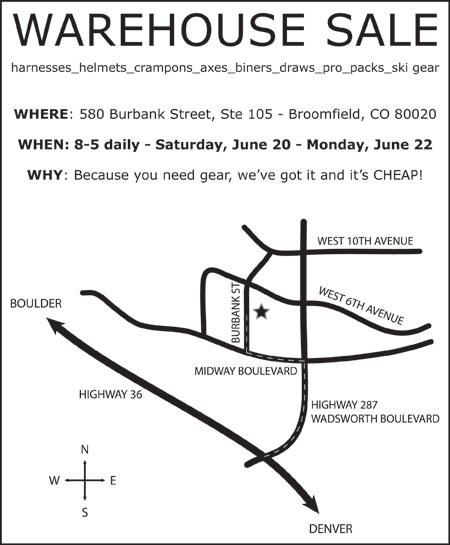
It doesn’t matter what you leave behind, only that your friends are happy that you were there.
Posted: June 13, 2009 Filed under: Uncategorized Leave a commentIt doesn’t matter what you leave behind, only that your friends are happy that you were there.
Adrenalin Junkie, Death Wish or Living Life to the Absolute Fullest
Posted: June 11, 2009 Filed under: Uncategorized Leave a comment
Many times I’ve been asked to explain why someone died. Not how, not what happened, those are always asked first, but why. Why did the loved one put themselves in that position to make the mistake or accept Mother Nature to their death? It is not an easy question to deal with, let alone answer. I doubt I have ever done a good job, or even an adequate job. The best I can do is describe some of the forces, or emotions that drive those of us who enjoy the outdoors.
I had not ridden my bike in 18 days because of a Grand Canyon River Trip I rowed for O.A.R.S. I hopped on my bike tonight and went out for an hour. My normal route is on the local bike path that rises 800 feet in the middle then down 800 and back up 250 to a road for awhile. About a mile later I turn into a subdivision and hop back on the bike path to return home.
The first half up to the top is drudgery. I put Jimmy Buffett on my MP3 player and gradually crank out the miles working up a sweat and some muscles. The drop down after the climb is on five switch backs and three tight turns till the path starts back up. I went screaming into a switchback tonight braking way too late, turning the bike as tight and as low as I could go, worried about my wheels and anything I could not see. A momentary, microsecond of emotion flushed through my body. Not really fear, just that feeling that comes when the adrenalin is surging. And I smiled. Not a grimace in fear or panic but a smile. I love that feeling of coming out of a near disaster in control, or to an extent some control, and living through it.
I once sat around a table with some famous mountaineers, all who had fallen over 100′ while climbing some as much as 2500′. I asked them what they were thinking as they fell. Generally the response fell into three categories: (1) Man this is going to hurt; (2) how the heck am I going to get out of this mess; and, (3) boy are my friends going to give me grief over this. None of the climbers mentioned fear, panic or the idea of dying in their conversations. It was just not part of the psychic. They all loved the sport, they all were still climbing after the near death experience and they are smiled as they talked about their falls. They were all still climbing and guiding.
Later on my bike ride as I was crossing from a bike lane across two lanes of traffic to a turn lane I had my right leg hugging my bike and front chain ring. Consequently I felt the road grime and dirt rubbing on my leg. I was hugging the bike hard because I barely had control. I did it because I was in traffic, being buffeted by the wind and crossing potholes. Again, not fear, not necessarily a surge of panic, but real concerns, Cadillac Escalade are big! but again on the edge and loving it. The rest of the ride was fun. I was alive and I knew it.
When I work for O.A.R.S. I row a gear boat. Garbage, kitchen stuff, anything needed etc and no customers. I like gear boats. I don’t have to entertain; I can think about things and enjoy the day. I enjoy showing the canyon to people, watching their face as they see new things and experience the rush. I recently helped a man climb up behind the Elves Chasim waterfall and jump out. It just required a little coaching and support and he talked about how great the experience was after the trip. I love that. I love the Grand Canyon, but more I love the way I can entertain and interact with people.
But more importantly I am past 50 and doing the job of a 20 year old kid. I am working as hard as I can and asleep before I hit horizontal some nights. I get up and put vitamin I (ibuprofen) in my mouth before I say good morning and spend ten minutes trying to get some body parts to work. I compete at a very basic level with myself.
I also can also run the rapids any way I want. I can drop in holes and push the limits. I see the beauty, I see the smiles, but inside I am pushing it. I can see how big I can go, how much I can lift, how many miles I can hike, how far I can go, how much water I can have hit the boat. I get a rush. I stand up and ride the rapids on the deck of the cooler or boat. I spin through rapids, I love to show off. But I love to push it, to see if I still got it and can give it back. I smile as the water drips off and the boat teeters on the edge and I push it over and through. I love it.
I don’t know why I love that rush. I don’t know why my days are better after I have it. I went out on the rid tonight with a sore knee and hands from the trip and I came back with a soaring soul. The ride was fun, the rush was wonderful. It is not a fix, it is not a need. It is just something that I enjoy.
Panic – Maybe if you do, you shouldn’t
Posted: June 11, 2009 Filed under: Uncategorized Leave a comment
Many of the problems that start as problems grow to a mess and end up as a legal issue start when someone loses it. So many times I’ve seen people get into more and more trouble because they panic and they cannot stop the escalation on their own.
Once swimmer from another boat on a class IV whitewater rafting trip resisted efforts to be rescued. He was screaming for help but could not get control. I hit him with two throwbags (ropes), got paddles to him twice and finally got so close with the raft we ran over him. In all of those situations he could not grab anything. Eventually I got the boat to show, jumped in the water and did the old Boy Scout lifesaving moves.
Another time a customer from my boat fell out. He kept screaming for help as he bounced down the river. He bounced because his butt was scraping on the bottom. Finally a rafting bus driver reached down from the show and pulled him out of the river. The bus driver did not get his cowboy boots wet.
People who panic I call tiger meat. 1000 or more years ago they would have been eaten by a tiger or some other predator.
Panic attacks are similar and I found a great article that says you can overcome and control panic attacks. Panic Attacks: The Lowdown
Coalition for Education in the Outdoors: Call for Abstracts
Posted: June 10, 2009 Filed under: Uncategorized Leave a comment
Coalition for Education in the Outdoors
Tenth Biennial Research Symposium
January 15-17, 2010
Call for Abstracts
From January 15-17, 2010, an international research symposium will be held at the Bradford Woods Campus of Indiana University in Martinsville, Indiana, a short drive from the Indianapolis Airport. The purpose of this gathering is to advance the empirical, conceptual, and theoretical bases of outdoor education. Like the first nine CEO Research Symposia, this symposium will bring together a wide array of researchers to explore current and future trends in using the outdoors for educational and therapeutic purposes. In addition to spotlighting current research, the program includes featured presentations on timely issues and ample time for both structured and informal dialogue.
The symposium is purposely small and informal to promote productive interaction. The event draws people interested in adventure education, organized camping, environmental education and interpretation, and other outdoor education contexts. Because of the diversity of topics, the informal exchanges, and the quality of sessions, this event is a favorite of both well-established and emerging scholars in the field. It’s also affordable; about $200 will cover registration, lodging, and meals.
Persons wishing to present (oral and/or poster) at the symposium must submit an electronic copy of their abstract (not to exceed 2 single-spaced pages; references only may extend onto a third page; 12 pt Times New Roman preferred) addressing the background, methods, results, and discussion of the study (authors of conceptual papers may use other headings). It is expected that presentations at CEO will not have been previously published or presented elsewhere. Abstracts that ask the same questions, use the same analyses, and make the same logical arguments should not be presented at CEO. Abstracts of works in progress may be submitted provided that a full report can be given at the January symposium. Abstracts are due by September 14, 2009.
All abstracts and manuscripts will be critiqued and evaluated by three reviewers. Notification of acceptance will follow on or around October 18. Individuals whose abstracts are accepted will be expected to present their study at the symposium. They will also be provided with more detailed instructions about preparing manuscripts and the review process for the refereed publication, Research in Outdoor Education, Vol. 10. In addition, abstracts of all presentations will be
compiled and bound for dissemination at the symposium and on-line through the CEO website. Questions about the submission or review process can be directed to Amy Shellman (amy.shellman@cortland.edu) or Jim Sibthorp (jim.sibthorp@health.utah.edu), review coordinators for CEO 2010. Questions regarding conference logistics or registration can be directed to Andy Young (anderson.young@cortland.edu).
The time line for the review process is:
September 14 Deadline for submission of abstracts
October 18 Notification of acceptance/rejection – invitation to prepare full manuscripts
November 13 Revised abstracts submitted for binding and distribution at symposium
January 15-17 Research Symposium (15 minute presentations and/or poster presentations)
How to submit abstract:
1. Send e-mail attachment in MS Word.
2. Use lead author’s name as document file name (e.g., SMITH.doc).
3. Put “CEO Abstract – ” in “subject line” of email message.
4. In body of email message include…
- Preference for oral report or poster presentation.
- Full title of the abstract.
- Names, affiliations, mailing addresses, phone numbers, and email addresses of ALL authors.
5. Send to:
Dr. Amy Shellman, amy.shellman@cortland.edu
voice: 607-753-4263
Deadline is September 14, 2009
For further information about the symposium, contact the Coalition for Education in the Outdoors, SUNY Cortland, Park Center, P.O. Box 2000, Cortland, NY 13045 (Voice: 607-753-4971; Fax: 607-753-5982 or E-mail: rls@cortland.edu).
The National Recreation and Park Association is actively recruiting to fill the position of Senior Research Associate.
Posted: June 9, 2009 Filed under: Uncategorized Leave a commentSummary
This position directs and oversees NRPA’s research and development policies, objectives, and initiatives. Provides vision and direction for the program, reviews and negotiates key research contracts, facilitates the research agenda, coordinates, collaborates with universities, foundations, and government entities and oversees the research project relationships. Creates a competitive and profitable position for NRPA by formulating research and development programs.
The position also delivers a variety of products, based on original NRPA Research and collaborations, for use in the knowledge center and for sale. Will increase NRPA’s capacity (financial, managerial, and intellectual) to act in a strategic, coordinated, and focused fashion in identifying core research areas. Leads and directs the work of others. Provides opportunities for staff, member and partner input on research projects as needed to set the scope. Communicates direction through words or actions to inspire team members to reach goals.
Additionally is familiar with and understands a variety of the field’s concepts, methodologies, practices, and procedures in the field of research and relies on extensive experience and judgment to plan and accomplish goals. Develops the strategy and vision to carry out a project from inception through completion; creates teams and collaborations that understand the project’s direction. Also responsible for planning and budgeting.
Duties and Responsibilities
- COMMUNICATION AND COLLABORATION
- DATA ANALYSIS AND REPORT DEVELOPMENT
- RESEARCH OVERSIGHT
- PROPOSAL CREATION AND DEVELOPMENT OF PROJECT SPECIFICATIONS
DISCOVER the BENEFITS at NRPA!
Conveniently located off the Dulles Greenway, in Brambleton Regional Park in Ashburn, NRPA boasts a warm professional environment, with a relaxing and peaceful view of nature at its finest! All staff have access to indoor & outdoor eating areas, as well as indoor & outdoor fitness opportunities. Our facility has a brand new air-conditioned fitness room with access to showers, as well as foot trails for the outdoor enthusiast. Full time staff enjoy a very rich benefit package that includes group Health, Dental, and Vision for employee and family, paid 80% by the employer; 403(b) fully vested upon hire;; Life insurance, Short Term Disability and Long Term Disability paid 100% by the employer; accrue 26 Paid days off per year plus 13 paid holidays, eligibility in the first month of employment, Length of Service Awards and much, much more! NRPA is committed to promoting an environment of work-life balance. To promote healthy lifestyles, at work and away, we have established prog!
rams like Teleworking, FlexTime Schedules, 37.5 hour work-week, Employee Assistance Programs, Educational Assistance Programs, Lunch-and-Learn sessions and more. Discover what we already know NRPA … a great place to work!
APPLICATION PROCESS
NRPA is an equal opportunity employer with a commitment to Diversity. Women and ethnic minorities encouraged to apply.
Requirements/Education:
Masters degree (MA, MS) required, PhD highly preferred. Successful candidate will have 7 – 10 years in planning and conducting research and evaluation, ideally in a higher education setting; P&R experience a plus.
Knowledge, Skills & Abilities:
Knowledge and understanding of park, recreation and conservation issues. Skilled in quantitative research methods, including statistical analysis, data collection, manipulation, and management.
Should be skilled in qualitative evaluation methods, including articulation of theory of change, case studies, and organizational reviews. Need to be skilled in evaluating programs, such as: developing logic models, identifying key indicators.
Supervise outside evaluators, and designing data collection methods. Ability to build and maintain credibility with academics in related fields. Understand that the research agenda is going to be applied as an actionable and translatable resource to practitioners.
Exceptional organization and time management skills including multi-tasking and the ability to set/adapt to changing priorities. Ability to interact effectively with all levels of personnel. Must be able prepare reports, presentations, and other documents that make complex topics, data, and analysis understandable to a variety of audiences using narratives, tables, graphs, and maps.
Will represent NRPA as needed at meetings and other forums with a variety of agencies, groups and organizations. Can work occasionally outside of normal business hours in order to meet project deadlines. Be able to travel to off-site locations as needed to perform job functions.
Technology:
Microsoft Office Suite (PowerPoint, Excel, Word, Access, and other MS based programs),Microsoft Outlook, Data querying tools (example: SQL), Statistical Analysis software (Example: SPSS, SAS), FTP, Internet.
Please visit the following web address or the NRPA website to apply for this position: https://home.eease.com/recruit/?id=314632 <https://home.eease.com/recruit/?id=314632> .
Thanks,
Amy Roussos
Manager, Branch/Section Services
National Recreation and Park Association
22377 Belmont Ridge Road
Ashburn, VA 20148
703-858-2153
aroussos@nrpa.org
The Next Federal Transportation Funding Bill
Posted: May 21, 2009 Filed under: Uncategorized Leave a comment
The Next Federal Transportation Funding Bill
Prioritize bicycling and walking
Congress is writing a bill that will define our national transportation system for the next 6 years and we need your help to make sure that your Member of Congress weighs in on the transportation bill to support bicycling and walking.
Representative Daniel Lipinski (D, IL) is circulating a “Dear Colleague” letter proposing that the upcoming Transportation Bill, which is currently being drafted by the House Transportation and Infrastructure Committee (T&I), promotes and funds alternate transportation options. Representative Lipinski is asking
his colleagues in the House of Representatives to join him in a call for increased federal funding for bicycling and pedestrian programs.
We are thankful for Congressman Lipinski’s efforts on behalf of cyclists nationwide and urge you to contact your Representative to ask them to join Mr. Lipinski and lend their voice to this important debate.
Please contact your Representatives office today and urge them to sign onto Congressman Lipinski’s policy letter today
Letter to the Chief Scout Executive from a Volunteer
Posted: May 19, 2009 Filed under: Uncategorized Leave a comment
William A. Sheehan
24 SOUTH BROAD STREET
WOODBURY, NEW JERSEY 08096
(856) 853-8636
FAX NO. (856) 848-2230
March 25, 2009
Robert Mazzuca, Chief Scout Executive
1325 West Walnut Hill Lane
Irving, TX 75038
Re: New Annual Health and Medical Record Form
Dear Mr. Mazzuca:
I have had the opportunity to review the new annual health and medical record form, posted online at http://www.scouting.org/filestore/pdf/34605_Letter.pdf As an Assistant Scoutmaster, I am quite concerned about the effect upon my troop and upon the scouting program in general which will be caused by the red highlighted paragraph on page two of the form.
That paragraph states:
“Individuals desiring to participate in any high-adventure activity or events in which emergency evacuation would take longer than 30 minutes by ground transportation will not be permitted to do so if they exceed the weight limit as documented at the bottom of this page. Enforcing the height/weight limit is strongly encouraged for all other events, but it is not mandatory.”
I have two concerns. One is that making this height/weight chart mandatory rather than advisory will have the effect of excluding thousands or tens of thousands of youth already signed up in our program from participating in it, which will lead either to shrinking enrollments or widespread disregard of the “mandatory” language of the form. In this latter event, my second concern is the potential for opening our organization and our volunteers up to liability should they permit a youth to participate who exceeds the weight restrictions, and should an injury occur which could be arguably tied to the participant’s weight.
At the outset, I note that this prohibition is not imposed merely on activities strenuous in themselves. Rather, it extends to all activities taking place at a point more than 30 minutes from medical care by ground transportation. I submit that anywhere worth taking our youth can be more than 30 minutes away by ground transportation. In many parts of our country, a youth would be more than 30 minutes away from medical attention sitting in his living room, as a couch potato. Rather than getting out a map, a stop watch and calipers while planning an outing, I suggest that Unit leaders simply assume that they are more than 30 minutes away from medical attention for any scouting activity.
The cover sheet for the form identifies 11 risk factors which may define participation in various outdoor adventures. These 11 “risk factors” are not listed in alphabetical or any apparent order, with the exception that “excessive body weight” is at the top of the list, beating out such maladies as heart disease, diabetes, seizures, asthma and anaphylaxis.
A scout suffering from heart disease may be cleared by his physician to participate in hiking and camping, sports, cold weather activities (less than 10 degrees F), competitive activities, horseback riding, backpacking, scuba diving, wilderness/ backcountry treks, swimming/water activities, mountain biking, climbing/rappelling and challenge (“ropes”) courses provided that his physician, after physical examination, checks the boxes on page two of the form (the same page that contains the weight prohibition). Further, a scout with uncontrolled heart disease may participate in any of the activities checked off by his physician with any restrictions noted by that physician, also on page two of the form.
For a scout who is one pound over on the height/weight chart, however, it’s “no way, Jose”. The scout who does not make weight “will not be permitted” to participate in any activity whatsoever more than 30 minutes from medical attention.
Similarly, a scout suffering from asthma can participate in any of the above activities, at any distance from medical care, provided his physician, after examination, checks the box for that activity. Even a scout with “uncontrolled” asthma may participate with any restrictions the physician cares to note.
Along the same lines, a scout who has seizures may participate in activity his physician, after examination, checks off and even those with newly diagnosed seizure events (within six months) may participate with any restrictions the physician cares to note.
A Scoutmaster can take a scout with a sleep disorder, whose breathing stops from time to time during the course of a night, on any activity indicated by the physician at any distance from medical care. But don’t let that scout be a pound overweight.
A scout who suffers from allergies to the degree that he may suffer anaphylaxis may participate in any activity his physician checks off, at any distance from medical care.
With excessive body weight, and excessive body weight alone, the decision is removed from the hands of the physician, the boy’s parents and the scout leader. All because the form says, in big red letters, that the scout “will not be permitted” to participate in the activity.
Why is that? We all prefer our scouts to be fit and trim, but why is body weight elevated above all these other maladies in terms of participation in scouting events?
What this form says, in no uncertain terms, is that if a scout does not make weight, he or she (in the Venturing program) cannot participate. That is a heck of a note.
I read with interest the recent article in Newsweek magazine concerning the outreach to Hispanic youth. I also understand that you appeared on NBC Nightly News with Brian Williams concerning that initiative. Certainly nothing was mentioned that all of the outdoor activities of the Boy Scouts of America would be closed to such youth if they didn’t make weight. If a boy is a bit on the heavy side, he will have to be satisfied with the good citizenship parts of the BSA. Forget about the outdoor activities.
In my view, we do not need the negative publicity should a “weight ban” become public knowledge.
This is an organization that, quite rightly, promotes vigorous exercise in the out of doors. Are we to tell potential scouts that they cannot even begin this program of health and exercise unless they are already fit and trim?
The entire Venturing program is premised upon high adventure. Are we to have the members of each crew get up on a scale to separate those who can continue in the program from those who must be told to stay home? How about OA service weekends? Will there be a weigh in at the Friday night check-in?
At Blue and Gold dinners, when the Cub Scouts cross over a small bridge to symbolize their crossing over to the Boy Scout program, will there be a bathroom scale waiting for them at the end of the bridge?
Scouting is also a movement in which the youth participants are urged to follow the example set by the adult participants. Scoutmasters and assistants, themselves overweight, will be put in a position of informing overweight youth that the youth are absolutely banned from participating in the outdoor Scouting program. The overweight adult, in contrast, can simply pack up his pack and head off down the more than half hour trail, free as an “adult” to choose to ignore the mandate.
Or should overweight adult volunteers be banned as well? Good luck keeping the program running if that is the outcome.
What of a Unit leader who does not bar participation by youth who are a few pounds over. What if such a youth has a health problem during the activity which arguably bears some connection to his or her weight? Because the BSA erected a policy that did not exist before and put it all in red letters, that could become “the law of the case” and liability could be found. (I am an attorney licensed to practice in the State of New Jersey).
Leaving the legalities aside, assume a Unit leader allows participation when a youth does not meet the guidelines. Is such a youth to be turned away at district or council events, such as camporees or OA service weekends, or turned away at the gate of a council summer camp? Many council camps are remote, as I am sure you are aware.
I have not taken a survey, either in my troop or in my district or council, to determine how many boys are affected by this decree. Has the BSA made any such survey? If so, how many of our youth must be banned from the outdoor program? If you don’t know, don’t you think it is something that should be known before any such prohibition is mandated?
In my own troop, I know of one boy who had to be told that he could not participate in this summer’s council Philmont expedition, because of the weight limitation. He is a husky, healthy high school football player, a Life Scout working on his Eagle. Telling him he cannot make the “Summit of Scouting” is one thing. Must I inform him he cannot go on a weekend, drive-in, camping trip, simply because the troop will be camped more than one half hour from a hospital?
I hasten to add that I am in full agreement with the imposition of weight guidelines for the Philmont Scout Ranch. I am a veteran of two Philmont Expeditions in my youth and five Autumn Adventure Treks. I have made weight. I am also aware that making weight can be very difficult for some participants. However, we are not talking Philmont here, we are talking about a trip that is a half an hour into the woods.
It is fine to identify excessive body weight as a potential risk factor, require that a boy’s height and weight be recorded and compared to a chart, at the time of his physical examination, by his family physician, who may then take that into account in clearing him for the various activities on the form. What I object to is taking the decision out of the hands of the physician, the parent and Scoutmaster and drawing a bright red line which will exclude many of the kids we are trying to help rather than a common-sense approach. It seems like someone thought that excessive body weight could be addressed by simply issuing a decree, with the admonition that we in the field “make it so”.
A final observation is that the language used in the form does not talk about the actual weight of the participant at the moment the activity commences. It speaks of the height and weight “as documented on this form” as being the cutoff. I am not advocating that we weigh the boys before each trip. Weighing them fully clothed would not yield the results on the chart, in any event. But what of the youth who has dieted or exercised since the doctor’s exam or who has grown a few inches?
In short, I strongly recommend removing the red highlighted material at the top of the second page and removing reference to that paragraph on the cover sheet “…the height/weight chart must be strictly adhered to…”. Excessive body weight should be treated as any of the other illnesses or conditions listed on the cover sheet, in a place within the discretion of the physician, the participant’s parents and the Unit leader.
I wish to thank you for taking the time to read this letter and hope that it will have the effect of removing that red highlighted language. Please do not put me and others in a position of denying some youth the benefits of the Scouting program because they are not yet fit and trim. Hopefully, after a few hikes, they will do better with the weight situation.
Thank you for your kind attention to this matter.
Yours in Scouting,
William A. Sheehan
ASM, Troop 55
Pitman, NJ
WAS/kln
cc: Health and Safety Committee
Boy Scouts of America
National Council Health and Safety Committee
1325 West Walnut Hill Lane
Irving, TX 75038
Settlement reached in suit against Idaho State University group CW Hogs
Posted: May 18, 2009 Filed under: Uncategorized Leave a comment
I wrote about a lawsuit against a University of Idaho outdoor program for the disabled in University sued for actions of Participant on an Outdoor Trip for $5M. It is being reported that a settlement has been reached in that suit. See Settlement Between CW-HOG and Family Whose Son was Killed in Jet Ski Accident. Terms of the settlement were not disclosed, as usual.
Threat to Green River Water
Posted: May 18, 2009 Filed under: Uncategorized Leave a comment
Uranium Watch would like to bring to your attention a threat to the Green and Colorado Rivers and the community that uses the rivers for private, educational, and commercial recreation. The threat is due to a proposal by Transition Power Development LLC to site a 2-unit nuclear reactor (known as the Blue Castle Generation Project) about 3 miles west of the Green River and the City of Green River.
Transition Power has leased 53,600 acre feet of water that it intends to pipe from the Green River to the site, just north of I-70 and the railroad and east of Hwy. 6. The water would be used to cool the reactor, to operate the reactor, and as a heat sink in case of a nuclear accident.
There is now an opportunity to protest and request a hearing on the withdrawal of 29,600 acre-feet of the water (over 26.5 million gallons per day), which was leased from the Kane County Water Conservancy District (KCWCD). On March 30, 2009, KCWCD applied to change the point(s) of diversion, place of use, and nature of use for Water Rights 89-74, 89-1285, and 89-1513. Application:
http://www.uraniumwatch.org/transitionpower/kcwcd.89-74_changeapplication.090330.pdf
Protests and any requests for a hearing must be filed with the Kent L. Jones, State Engineer, Division of Water Rights, P.O. Box 146300, Salt Lake City, Utah, 84114-6300 on or before Monday, May 25, 2009.
An objection to the application must be readable and state the filing number (a35402), reasons for objections, protestant’s name and address, and any request for a hearing. A protest must be signed by the protesting party or representative. A protest may be faxed, but a signed paper copy must also be sent in the mail. Fax to 801-538-7467.
The will be an informal proceedings pursuant to Utah Administrative Code Rule R655-6-2 of the DWR
For a paper copy of the application, call 1-866-882-4426.
What are the Issues?
According to Utah Code Annotated, Section 73-3-8, it shall be the duty of the state engineer to approve an application if:
- There is unappropriated water in the proposed source.
- The proposed use will not impair existing rights.
- The proposed use will not interfere with the more beneficial use of the water.
- The proposed plan is physically feasible.
- The proposed plan is economically feasible.
- The proposed plan will not be detrimental to the public welfare.
- The applicant has the financial ability to complete the proposed works.
- The application was filed in good faith and not for purposes of speculation or monopoly.
- The appropriation will not unreasonably affect public recreation.
- The appropriation will not unreasonably affect the natural stream environment.
If an application does not meet the requirements of this section, it shall be rejected.
The March 30 Application does not address any of these criteria.
The withdrawal of such a large amount of water (almost 50 million gallons per day), if the project is approved, would have an adverse impacts on public recreation, stream environment, and public welfare. The intake structures in the river, which would supply the water to gigantic pumps on the bank of the river, could be hazardous to recreation. Having a nuclear reactor next to the Green River would discourage recreational visitors to the whole area. Any commercial recreation company would have to be knowledgeable about any emergency response planning and have their own response plans. A radiological accident would be disastrous.
Any concerns regarding the impacts to more beneficial uses, public recreation, natural stream environment, and the public welfare should be brought to the attention of the State Engineer in a protest. For additional information and links: http://www.uraniumwatch.org/transitionpower.htm
If you have any questions, comments, or want to be kept currently informed, please e-mail Uranium Watch at sarah@uraniumwatch.org or call 435-210-0166.
Sincerely,
Sarah Fields
Program Director
Uranium Watch


 Recreation Law