
New York court shreds Tough Mudder online release and arbitration clause because the reader could assent to the release without reading the release.
Posted: August 24, 2020 Filed under: New York, Racing, Release (pre-injury contract not to sue) | Tags: acle Course, Arbitration, Arbitration clause, assent, box, click, click-wrap, conspicuous, Consumer, Electronic Release, hyperlink, Mediation, New York General Obligations Law, Notice, obstacle, online, prudent, Recreation, registered, Registration, Release, screen, screenshots, scrollable, scrolling, Tough Mudder, unenforceable, user, Venue, Void, webpage, website Leave a commentThe clauses in the release were not clearly identified and could be avoided by plaintiff. Release was found to be void because if violated New York General Obligations Law § 5-326
State: New York, Supreme Court of New York, Kings County
Plaintiff: Richard E. Scotti et al. (Richard E. Scotti and Joseph Russo)
Defendant: Tough Mudder Incorporated et al. (Tough Mudder Incorporated and Tough Mudder Event Production Incorporated)
Plaintiff Claims: Negligence
Defendant Defenses: Arbitration Clause & Release
Holding: for the Plaintiffs
Year: 2019
Summary
Tough Mudder has been having a tough time in court. This was another court that found several ways to void the release. Tough Mudder was attempting to compel arbitration; however, the arbitration clause in the release did not meet the legal requirements of New York Law. The release itself failed because if violated New York General Obligations Law § 5-326 which voids releases for recreation.
Facts
This personal injury action stems from an accident which occurred on July 23, 2016, when the plaintiffs Richard E. Scotti and Joseph Russo participated in the “Tough Mudder,” a physically challenging obstacle course event (hereinafter the TM event), which took place at 1303 Round Swamp Road, Old Bethpage, New York. Defendants Tough Mudder Incorporated and Tough Mudder Event Production Incorporated (collectively, Tough Mudder) are the business entities that organized the TM event. Plaintiffs commenced the within action on or about November 17, 2017, against Tough Mudder alleging that they each sustained injuries as a result of defendants’ negligent operation of an activity at the event, referred to as the “salmon ladder.” Tough Mudder joined issue on or about December 20, 2017, with the service of a verified answer. In their answer, Tough Mudder denied all material allegations and asserted various affirmative defenses, including that the plaintiffs’ action is barred by the participation/registration agreement, which included an arbitration clause.
Tough Mudder now moves, pursuant to CPLR 7501 and 7503, to compel arbitration, arguing that the plaintiffs are barred from pursuing the instant action in this court because they each waived the right to sue by virtue of agreeing to arbitrate any “disputes, controversies, or claims” arising out of their participation in the TM event. Tough Mudder claims that the plaintiffs each entered into an agreement to arbitrate all claims related to their participation in the TM event when they completed an online Internet registration form. In support of this contention, Tough Mudder has submitted the sworn affidavit of Jenna Best, the manager of customer relations for Tough Mudder Incorporated. Best avers that she is fully familiar with the TM event online registration process as it existed in 2016 when the plaintiffs registered for the TM event at issue. Tough Mudder has submitted copies of the online registration forms that the plaintiffs allegedly completed for the TM event (Cash affirmation, exhibit D). Best states that, during the online registration process, the plaintiffs were required to scroll down to a section containing the “Participant Waiver and Course Rules” (hereinafter PWCR), a document version of which has been submitted herein She contends that the full text of the PWCR was contained in a box on the screen, which could be read by scrolling down in the text box. Best contends that the initial visible content of the scrollable box, which preceded the full PWCR document, which could be read in its entirety by scrolling down…
Below the box containing the scrollable PWCR was another box next to the statement: “I agree to the above waiver.” Best avers that it was necessary for the plaintiffs, or any other registrant, to click on the box to indicate his or her consent to the PWCR in order for the registrant to complete his or her registration for the TM event. According to Best, the Internet registration form cannot proceed to the payment page, and registration cannot be completed, until the registrant checks the box indicating his or her consent to the PWCR She further avers that both plaintiffs did in fact click on the box indicating their consent to the PWCR, as otherwise they would not have been able to participate in the TM event. Based upon the foregoing, Tough Mudder contends that the plaintiffs agreed to the terms of the online waiver, which included the arbitration clause, and, therefore, are barred from pursuing the instant action.
Analysis: making sense of the law based on these facts.
The court looked at the plaintiff’s arguments first.
In opposition, plaintiffs argue that the arbitration provision at issue is unenforceable because Tough Mudder has failed to establish that they actually agreed to it. In this regard, plaintiffs point out that the webpage where the PWCR was located contained a text box that did not show the entire document. In order to read the full PWCR, including the arbitration provision, plaintiffs contend it would have been necessary to scroll down through many screens of text using the arrows on the right-hand side of the text box. The PWCR fills seven single-spaced pages of text.
On top of that, the court stated the evidence presented by the defendant Tough Mudder was not sufficient to prove that either plaintiff checked the box or agreed to the terms of the contract.
Plaintiffs further argue that Tough Mudder has failed to proffer any evidence that either plaintiff actually signed/checked the consent box, or any evidence identifying the computers or electronic devices from which their respective registrations were completed.
The burden was on Tough Mudder to prove the plaintiffs signed the agreement which contained the arbitration clause.
It is well settled that “[a] party to an agreement may not be compelled to arbitrate its dispute with another unless the evidence establishes the parties’ clear, explicit and unequivocal agreement to arbitrate” When one party seeks to compel the other to arbitrate any disputes between them, the court must first determine whether the parties made a valid arbitration agreement. The party seeking arbitration bears the burden of establishing that an agreement to arbitrate exists
To prove the existence of the contract and the agreement to the arbitration clause the courts look for evidence that the website user had actual or constructive knowledge of clauses in the contract.
The question of whether there is agreement to accept the terms of an online contract turns on the particular facts and circumstances. Courts generally look for evidence that a website user had actual or constructive notice of the terms by using the website. Where the person’s alleged consent is solely online, courts seek to determine whether a reasonably prudent person would be put on notice of the provision in the contract, and whether the terms of the agreement were reasonably communicated to the user. In Specht v Netscape Communications Corp, the court emphasized that “[r]easonably conspicuous notice of the existence of contract terms and unambiguous manifestation of assent to those terms by consumers are essential if electronic bargaining is to have integrity and credibility”
The seven-page agreement had no headings, no italics, no bold print, nothing to indicate the agreement covered more issues than were identified in the heading. The heading stated:
“ASSUMPTION OF RISK, WAIVER OF LIABILITY, AND INDEMNITY AGREEMENT “PARTICIPANTS: READ THIS DOCUMENT CAREFULLY BEFORE ACCEPTING. THIS DOCUMENT HAS LEGAL CONSEQUENCES AND WILL AFFECT YOUR LEGAL RIGHTS AND WILL ELIMINATE YOUR ABILITY TO BRING FUTURE LEGAL ACTIONS.”
No where in the heading was a mention of a mandatory arbitration clause. (Ambush by small print was eliminated by the courts in the 70’s, this lawsuit was in 2019; someone should have realized that by now.)
The court the defined the agreement as one of four types of agreements found online “the four “general types of online consumer contracts [are identified as] (a) browsewrap; (b) clickwrap; (c) scrollwrap; and (d) sign-in-wrap.”
Based on the evidence presented by the defendants the court found the agreement was a “clickwrap” agreement.
Here, the PWCR at issue appears to be a click-wrap agreement as identified in Berkson in that the clickable box is located directly below the scrollable text box that allegedly contained the full text of the agreement. Only by scrolling down in the text box would the user see all of the terms of the PWCR, including the arbitration clause at issue.
The court then held that you could agree to the agreement without scrolling through the agreement; therefore, you could sign the agreement without knowing what was in the agreement.
However, the user could proceed to complete the registration process without necessarily scrolling down through the text box to view the full document, thereby rendering it a click-wrap agreement.
The plaintiff could be bound by a clickwrap agreement, but only if they were given sufficient opportunity to read the agreement and agree to it. There must also be a way to decline a click-wrap agreement.
A party may be bound to a click-wrap agreement by clicking a button declaring assent, so long as the party is given a “sufficient opportunity to read the . . . agreement, and assents thereto after being provided with an unambiguous method of accepting or declining the offer.”
Then the court closed the door on the defendants attempt to compel arbitration.
…[a] court cannot presume that a person who clicks on a box that appears on a . . . screen has notice of all contents not only of that page but of other content that requires further action (scrolling, following a link, etc.). The presentation of the online agreement matters: Whether there was notice of the existence of additional contract terms presented on a webpage depends heavily on whether the design and content of that webpage rendered the existence of terms reasonably conspicuous. Clarity and conspicuousness of arbitration terms are important in securing informed assent.” (Internal quotation marks and citations omitted.)
Understand, the court did not say the contract was invalid; the court was only looking at the issue of the arbitration clause. Under New York law for the arbitration clause to be valid, the plaintiff had to “had actual or constructive notice of the terms….” Since there was no notice of arbitration in the heading, and you could agree to the agreement without reading it, the agreement failed the heightened requirements to prove an arbitration clause existed between the parties.
Thus, on a motion to compel arbitration, a valid agreement to arbitrate exists where the notice of the arbitration provision was reasonably conspicuous, and manifestation of assent is unambiguous as a matter of law. Therefore, the issue herein is whether Tough Mudder’s website registration screen put a reasonably prudent user on inquiry notice of the relevant terms of the PWCR, particularly the arbitration clause at issue.
Then the court jumped on the issue that the evidence in front of the court did not prove their argument. Black-and-white copies were provided to the court rather than color copies. The font size was small and barely legible.
In addition, the court notes that the purported copies of the plaintiffs’ respective online registration forms (screenshots) submitted by Tough Mudder are black and white copies of poor quality, the text of which is in an extremely small font size and is barely legible. Tough Mudder has not proffered any color copies of any screenshots depicting its online registration process. In addition, the full text of the PWCR, as provided by Tough Mudder, is not a screenshot but a black and white document, consisting of seven pages of single-spaced language, all in the same font and size, with no underlined, hyperlinked or bolded terms.
The court then attacked how the document would have been presented online from the evidence in front of it.
In order to view the “Mediation and Arbitration” clause, the plaintiffs, by using the arrows inside the text box, needed to scroll down significantly beyond what is initially visible, to page four of the seven-page single-spaced PWCR document. The court additionally notes that, as with the entire document, the arbitration provision is neither underlined, bolded nor hyperlinked. Further, since this court has only been provided with a black and white document, not screenshots, it is unable to discern how the subject arbitration clause actually appeared to the user. Indeed, “[i]n the context of web-based contracts, [courts] look to the design and content of the relevant interface to determine if the contract terms were presented to the offeree in a way that would put her [or him] on inquiry notice of such terms
It is laughable that in 2019 you read a case where the court complains about the type being too small to read.
The court found that based on the evidence in front of it, there was not an arbitration clause between the parties.
The court then looked at the release.
New York General Obligations Law § 5-32 voids releases for recreation activities where a fee is paid.
That statute protects consumers from the effect of form releases printed on membership applications and similar documents when such releases are offered in connection with the use of a “place of amusement or recreation” for which a fee is paid
The court found New York General Obligations Law § 5-32 voided the release.
The terms of this statute apply to the plaintiffs herein, who paid a fee to use Tough Mudder’s obstacle course, which, contrary to Tough Mudder’s assertion, is a place of recreation. Indeed, the nature of the TM event as described by Tough Mudder—a rigorous, athletic competition requiring proper training—is comparable to the other activities, such as horseback riding, auto racing, cycling and skiing, which have been held to be covered by General Obligations Law § 5-326.
The final issue was the agreement had a severability clause. This is a clause that states if a portion of the contract is found unenforceable or void by the court it does not void the entire document. Only the portions the court finds void, are severed from the document, and the document without those clauses can be used as evidence in court.
However, as Tough Mudder correctly argues, the unenforceable provisions of the PWCR do not nullify the entire agreement. Where an agreement consists partially of an unlawful objective, the “court may sever the illegal aspects . . . and enforce the legal ones, so long as the illegal aspects are incidental to the legal aspects and are not the main objective of the agreement.
Which is exactly what the court did.
Here, the waiver of liability provision in the PWCR releasing Tough Mudder from liability, as well as the arbitration clause, are severable from the remainder of the PWCR agreement on the ground that the unenforceable provisions are incidental to the legal aspects and not the main objective of the agreement. Further, the severability provision in the PWCR reflects the intent of the parties that the legal provisions of the agreement be severed from any provisions determined to be void and unenforceable.
So, hopefully the seven-page document had language that could be used to prove assumption of the risk by the defendants.
So Now What?
On paper, this release might have survived. However, there are more issues with online releases. This is the second case where the court found the proof offered by the defense to prove the release was signed was found to be lacking because of poor copies of the website. That is just stupid. With color printers now days, computers and monitors that can be brought into court or linked to in a document you should be able to have anyone see what the document actually looked and how the software performed.
When you have several different issues in a contract, it is common to identify the new issues with a heading or bold type. In this case not only where there are new issues in the release besides release language there was an arbitration agreement. New York, as most states, have specific language in how an arbitration agreement should be written. This release failed that test.
The arbitration agreement was an attempt to lose the value of the entire release because releases for recreation where a person pays money to recreation are void. New York General Obligations Law § 5-32
§ 5-326. Agreements exempting pools, gymnasiums, places of public amusement or recreation and similar establishments from liability for negligence void and unenforceable
Every covenant, agreement or understanding in or in connection with, or collateral to, any contract, membership application, ticket of admission or similar writing, entered into between the owner or operator of any pool, gymnasium, place of amusement or recreation, or similar establishment and the user of such facilities, pursuant to which such owner or operator receives a fee or other compensation for the use of such facilities, which exempts the said owner or operator from liability for damages caused by or resulting from the negligence of the owner, operator or person in charge of such establishment, or their agents, servants or employees, shall be deemed to be void as against public policy and wholly unenforceable.
The big issue the court seemed to be pushing was the game of hide and seek that Tough Mudder plays both with its courses and with the release. Contestants never know what they will encounter when competing in a Tough Mudder event. Consequently, you eliminate a lot of the defense of assumption of the risk. You can’t assume a risk you don’t know about.
Tough Mudder then tried that game with its release (or did not have an attorney write its release) and tried to slide the arbitration clause past the participants. It failed because the court held it must meet New York law and be written and visible in a way that the signor understands they are signing an arbitration agreement. That is a bigger burden then just signing a release.
What do you think? Leave a comment.
Copyright 2020 Recreation Law (720) 334 8529
If you like this let your friends know or post it on FB, Twitter or LinkedIn


Author: Outdoor Recreation Insurance, Risk Management and Law
Facebook Page: Outdoor Recreation & Adventure Travel Law
Email: Jim@Rec-Law.US
By Recreation Law Rec-law@recreation-law.com James H. Moss
#AdventureTourism, #AdventureTravelLaw, #AdventureTravelLawyer, #AttorneyatLaw, #Backpacking, #BicyclingLaw, #Camps, #ChallengeCourse, #ChallengeCourseLaw, #ChallengeCourseLawyer, #CyclingLaw, #FitnessLaw, #FitnessLawyer, #Hiking, #HumanPowered, #HumanPoweredRecreation, #IceClimbing, #JamesHMoss, #JimMoss, #Law, #Mountaineering, #Negligence, #OutdoorLaw, #OutdoorRecreationLaw, #OutsideLaw, #OutsideLawyer, #RecLaw, #Rec-Law, #RecLawBlog, #Rec-LawBlog, #RecLawyer, #RecreationalLawyer, #RecreationLaw, #RecreationLawBlog, #RecreationLawcom, #Recreation-Lawcom, #Recreation-Law.com, #RiskManagement, #RockClimbing, #RockClimbingLawyer, #RopesCourse, #RopesCourseLawyer, #SkiAreas, #Skiing, #SkiLaw, #Snowboarding, #SummerCamp, #Tourism, #TravelLaw, #YouthCamps, #ZipLineLawyer, #RecreationLaw, #OutdoorLaw, #OutdoorRecreationLaw, #SkiLaw,
arbitration, notice, box, registration, online, user, assent, scrolling, click, unenforceable, website, screen, recreation, Mediation, webpage, conspicuous, click-wrap, registered, hyperlink, void, screenshots, scrollable, consumer, obstacle, prudent, Venue
Each state had its landmines on how releases are to be written
Posted: January 28, 2019 Filed under: New York, Racing, Release (pre-injury contract not to sue) | Tags: amusement, Arbitration, compel arbitration, Consumer, cross-motion, establishment, font, negligence liability, personal knowledge, Recreation, Release, Tough Mudder, urban mudder, Void, Waiver Leave a commentIn several states, New York as in this case, the land mines might be too many, and other options should be explored.
A Tough Mudder event used a release in NY that required arbitration. The Release was thrown out by the court, consequently the requirement for arbitration was thrown out.
Arbitration works to reduce damages; however, you should only use an arbitration clause when you can’t win because you don’t have a release. In every other state other than NY, the arbitration clause might have been a worse decision.
State: New York, Supreme Court of New York, Kings County
Plaintiff: Isha
Defendant: Tough Mudder Incorporated d/b/a/ Urban Mudder
Plaintiff Claims: Negligence
Defendant Defenses: Contract
Holding: For the Plaintiff
Year: 2018
Facts
The plaintiff was injured in an Urban Mudder event, which appears to be something like a Tough Mudder but in a city? Other than that, there are no facts in the decision.
Analysis: making sense of the law based on these facts.
The defendant motioned to have the dispute arbitrated because the contract, the release, required arbitration.
Defendant contends that this dispute should be arbitrated pursuant to the contract between the parties. Typically, arbitration clauses in contracts are regularly enforced and encouraged as a matter of public policy
The plaintiff argued that arbitration was invalid because a NY statute prohibits arbitration of consumer contracts.
Plaintiff further argues that the contract cannot be admitted into evidence pursuant to CPLR 4544 because it involves a consumer transaction and the text of the contract is less than 8-point font. In support of this argument, plaintiff submits the affidavit of Vadim Shtulboym, a paralegal in plaintiff counsel’s office. Mr. Shtulboym states that, based on his work experience, he has determined, with the aid of a scanner and Abobe Acrobat Reader DC, that the contract between the parties is 7-point font. Mr. Shtulboym explains that he came to this conclusion by typing words in 8-point font and 6-point font, and comparing them to the text of the contract, the size of which appeared to be in between the two fonts.
The plaintiff also argued the contract was void because it violated NY Gen. Oblig Law § 5-326.
§ 5-326. Agreements exempting pools, gymnasiums, places of public amusement or recreation and similar establishments from liability for negligence void and unenforceable
Every covenant, agreement or understanding in or in connection with, or collateral to, any contract, membership application, ticket of admission or similar writing, entered into between the owner or operator of any pool, gymnasium, place of amusement or recreation, or similar establishment and the user of such facilities, pursuant to which such owner or operator receives a fee or other compensation for the use of such facilities, which exempts the said owner or operator from liability for damages caused by or resulting from the negligence of the owner, operator or person in charge of such establishment, or their agents, servants or employees, shall be deemed to be void as against public policy and wholly unenforceable.
The court found the contract violated NY Gen. Oblig Law § 5-326 and was thrown out by the court. Once the agreement was thrown out in its entirety, the arbitration clause was also thrown out.
Two different statutes took the only defenses outside of assumption of the risk and threw them out the door.
The court found because there was a dispute, a triable issue of fact, the motion to dismiss failed and the parties would proceed to trial on this fact alone. The size of the type font on the agreement was enough to throw the defendant into the courtroom.
So Now What?
When you have a release, in a state where releases are valid, arbitration clauses usually create a better position for the plaintiff. Most arbitrations do not allow the award of punitive damages or any special damages unless specifically allowed in a statute. However, most arbitrations split the middle and award damages to the plaintiff.
A well-written release in a state where releases are upheld the plaintiff gets nothing, or less.
However, in a state like New York or the other states that do not support the use of a release, (See States that do not Support the Use of a Release), you must use an assumption of risk clause. Assumption of the risk is a defense in most states, again, for sporting and recreational activities. An assumption of the risk agreement does not run afoul of any statute that I have discovered or been made aware of and also works for minors who can understand the agreement and the risk.
Assumption of risk clauses can also contain arbitration clauses. When faced with a situation where you do not have the option of using a release, an assumption of the risk clause with an arbitration clause is your best defense position.
Typeface? If the judge can’t read it, your typeface is too small. Always use a typeface in your release that is at least 10 pt. and may be larger. Small type face have been a joke for decades in dealing with the fine print in contracts. It is not a reality.
 James H. “Jim” Moss |
Jim Moss is an attorney specializing in the legal issues of the outdoor recreation community. He represents guides, guide services, outfitters both as businesses and individuals and the products they use for their business. He has defended Mt. Everest guide services, summer camps, climbing rope manufacturers, avalanche beacon manufacturers, and many more manufacturers and outdoor industries. Contact Jim at Jim@Rec-Law.us |
Outdoor Recreation Insurance, Risk Management, and Law
Jim is the author or co-author of six books about the legal issues in the outdoor recreation world; the latest is Outdoor Recreation Insurance, Risk Management and Law.
To see Jim’s complete bio go here and to see his CV you can find it here. To find out the purpose of this website go here.
G-YQ06K3L262
What do you think? Leave a comment.
If you like this let your friends know or post it on FB, Twitter or LinkedIn
 |
 |
 Threads |
 X (formerly known as Twitter) logo |
 Stimulus |
 Blue Sky |
Author: Outdoor Recreation Insurance, Risk Management and Law
Facebook Page: Outdoor Recreation & Adventure Travel Law
Email: Jim@Rec-Law.US
By Recreation Law Rec-law@recreation-law.com James H. Moss
@2024 Summit Magic Publishing, LLC
#AdventureTourism, #AdventureTravelLaw, #AdventureTravelLawyer, #AttorneyatLaw, #Backpacking, #BicyclingLaw, #Camps, #ChallengeCourse, #ChallengeCourseLaw, #ChallengeCourseLawyer, #CyclingLaw, #FitnessLaw, #FitnessLawyer, #Hiking, #HumanPowered, #HumanPoweredRecreation, #IceClimbing, #JamesHMoss, #JimMoss, #Law, #Mountaineering, #Negligence, #OutdoorLaw, #OutdoorRecreationLaw, #OutsideLaw, #OutsideLawyer, #RecLaw, #Rec-Law, #RecLawBlog, #Rec-LawBlog, #RecLawyer, #RecreationalLawyer, #RecreationLaw, #RecreationLawBlog, #RecreationLawcom, #Recreation-Lawcom, #Recreation-Law.com, #RiskManagement, #RockClimbing, #RockClimbingLawyer, #RopesCourse, #RopesCourseLawyer, #SkiAreas, #Skiing, #SkiLaw, #Snowboarding, #SummerCamp, #Tourism, #TravelLaw, #YouthCamps, #ZipLineLawyer, #RecreationLaw, #OutdoorLaw, #OutdoorRecreationLaw, #SkiLaw,
Isha v. Tough Mudder Incorporated d/b/a/ Urban Mudder, 2018 N.Y. Misc. LEXIS 4883; 2018 NY Slip Op 32743(U)
Posted: January 21, 2019 Filed under: Legal Case, New York, Racing | Tags: amusement, Arbitration, compel arbitration, Consumer, cross-motion, establishment, font, negligence liability, NY General Obligations Law, personal knowledge, Recreation, Release, Tough Mudder, urban mudder, Void Leave a commentTo Read an Analysis of this decision see: Each state had its landmines on how releases are to be written
Isha v. Tough Mudder Incorporated d/b/a/ Urban Mudder, 2018 N.Y. Misc. LEXIS 4883; 2018 NY Slip Op 32743(U)
[**1] Isha, Plaintiff, against Tough Mudder Incorporated d/b/a/ Urban Mudder, Defendant. Index Number 512947/2016
512947/2016
SUPREME COURT OF NEW YORK, KINGS COUNTY
2018 N.Y. Misc. LEXIS 4883; 2018 NY Slip Op 32743(U)
September 21, 2018, Decided
NOTICE: THIS OPINION IS UNCORRECTED AND WILL NOT BE PUBLISHED IN THE PRINTED OFFICIAL REPORTS.
JUDGES: [*1] DEVIN P. COHEN, Acting Justice, Supreme Court.
OPINION BY: DEVIN P. COHEN
OPINION
DECISION/ORDER
Upon the foregoing papers, defendant’s motion to compel arbitration and plaintiff’s cross-motion for an order denying defendant’s motion and invalidating the Waiver Agreement between the parties, is decided as follows:
Plaintiff brings this action against defendant seeking damages for injuries she sustained when she participated in defendant’s “Urban Mudder” event. Defendant contends that this dispute should be arbitrated pursuant to the contract between the parties. Typically, arbitration clauses in contracts are regularly enforced and encouraged as a matter of public policy (159 MP Corp. v Redbridge Bedford, LLC, 160 AD3d 176, 205, 71 N.Y.S.3d 87 [2d Dept 2018]). Defendant provides a copy of the contract, which states that all disputes between the parties shall be submitted to binding arbitration with the American Arbitration Association.
Plaintiff argues the arbitration contract is invalid pursuant to GBL § 399-c, which prohibits mandatory arbitration in consumer contracts. Defendant contends that the Federal Arbitration Act preempts GBL § 399-c because defendant’s business is involved in interstate commerce (Marino v Salzman, 51 Misc 3d 131[A], 36 N.Y.S.3d 48, 2016 NY Slip Op 50410[U], *1 [App Term, 2d Dept 2016] [**2] ; Ayzenberg v Bronx House Emanuel Campus, Inc. (93 AD3d 607, 608, 941 N.Y.S.2d 106 [1st Dept 2012]). However, defendant provides no evidence from someone with personal knowledge [*2] of this factual claim (cf Marino, 51 Misc 3d 131[A], 36 N.Y.S.3d 48, 2016 NY Slip Op 50410[U], *1 [holding that the FAA preempted GBL § 399-c in that case because an employee of defendant submitted an affidavit wherein he stated that defendant was a multi-state company with business in several states]). Accordingly, defendant has not established that the FAA applies and, as a result, whether the arbitration provision is enforceable here.
Plaintiff further argues that the contract cannot be admitted into evidence pursuant to CPLR 4544 because it involves a consumer transaction and the text of the contract is less than 8-point font. In support of this argument, plaintiff submits the affidavit of Vadim Shtulboym, a paralegal in plaintiff counsel’s office. Mr. Shtulboym states that, based on his work experience, he has determined, with the aid of a scanner and Abobe Acrobat Reader DC, that the contract between the parties is 7-point font. Mr. Shtulboym explains that he came to this conclusion by typing words in 8-point font and 6-point font, and comparing them to the text of the contract, the size of which appeared to be in between the two fonts.
In opposition, defendant submits the affidavit of Johnny Little, the Director of Course and Construction with defendant, who states [*3] that the font used in the contract was 8-point, Times New Roman. Mr. Rosen further states that defendant forwarded a draft of the contract, in Microsoft Word format, to be professionally printed for the event, without any reduction in font size. Accordingly, there is a triable issue of fact as to whether the document is 8-point font.
Finally, plaintiff argues that the waiver of liability clause in her contract with defendant is void because violates N.Y. Gen. Oblig. Law § 5-326, which prohibits contracts between the “owner or operator of [**3] any pool, gymnasium, place of amusement or recreation, or similar establishment and the user of such facilities” from exempting such owner or operator from “liability for damages caused by or resulting from the negligence of the owner, operator or person in charge of such establishment”. Plaintiff does not object to the substance of any other portion of the contract.
Defendant contends that the Urban Mudder event is not a place of amusement or recreation. While the statute does not define these terms, courts have applied them to a range of activities, such as rock climbing (Lee v Brooklyn Boulders, LLC, 156 AD3d 689, 690, 67 N.Y.S.3d 67 [2d Dept 2017]), motocross (Sisino v Is. Motocross of New York, Inc., 41 AD3d 462, 463, 841 N.Y.S.2d 308 [2d Dept 2007]), automobile racing (Knight v Holland, 148 AD3d 1726, 1727, 51 N.Y.S.3d 749 [4th Dept 2017]), sky diving (Nutley v SkyDive the Ranch, 65 AD3d 443, 444, 883 N.Y.S.2d 530 [1st Dept 2009]), spa activities (Debell v Wellbridge Club Mgt., Inc., 40 AD3d 248, 250, 835 N.Y.S.2d 170 [1st Dept 2007]), and horseback riding (Filson v Cold Riv. Trail Rides Inc., 242 AD2d 775, 776, 661 N.Y.S.2d 841 [3d Dept 1997]).
Defendant’s attempt [*4] to distinguish the Urban Mudder event from these activities is unavailing. As an initial matter, defendant counsel’s description of the event holds no evidentiary value, as counsel does not establish his personal knowledge of these events. Secondly, even if this court were to accept counsel’s description, the event’s “rigorous” and “athletic” nature is no different than the other activities listed above. Furthermore, counsel’s assertion that these other applicable activities did not require “physical preparation” is simply baseless. Accordingly, this court finds that the contract’s waiver of negligence liability violates N.Y. Gen. Oblig. Law § 5-326.
[**4] For the foregoing reasons, defendant’s motion to compel arbitration is denied and plaintiff’s cross-motion is granted to the extent that the contract’s waiver of negligence liability is deemed void.
This constitutes the decision and order of the court.
September 21, 2018
DATE
/s/ Devin P. Cohen
DEVIN P. COHEN
Acting Justice, Supreme Court
G-YQ06K3L262
What the term “strictly construed” actually means when used to describe how a release will be viewed by the court.
Posted: July 9, 2018 Filed under: Kansas, Release (pre-injury contract not to sue), Skydiving, Paragliding, Hang gliding | Tags: assigns, assumption of the risk, automatic, Automatic Opener, consequential, Consumer, covenant, decedent, disclaimer, Diversity, implied warranties, mail, mail service, Notice, opening, Parachue, parachute, parachuter, Parachuting, personal injury, personal service, personally, predecessor, Release, saving, service of process, sky diving, Sport, statute of limitations, strict liability, Strictly Construed, Summary judgment, territorial limits, Unconscionable, Violation of Public Policy, warranty, Wrongful Death Leave a commentThe decision involves several legal issues, the one that concerns us is the issue of a release for a product. In Kansas, releases are strictly construed. In this case that meant that the language of the release did not meet the requirements of state law for a release. However, the court stretched incredibly far to come to that conclusion.
Fee v. Steve Snyder Enterprises, Inc.; Et. Al., 1986 U.S. Dist. LEXIS 28158
State: Kansas, United States District Court for the District of Kansas
Plaintiff: Patricia Fee
Defendant: Steve Snyder Enterprises, Inc.; Russell Young; SSE, Incorporated; Greene County Sport Parachute Center of Wellsville, Kansas, Inc.; and John Doe Corporation
Plaintiff Claims: Wrongful death and survival claims based on negligence, product liability and breach of warranty
Defendant Defenses: Statute of Limitations ran,
Holding: for the plaintiff
Year: 1986
Summary
The lawsuit was brought over the failure of an automatic opener, which did not during a sky dive. The widow sued the manufacture of the device and the sky-diving center who sold the device to the deceased. The deceased signed a release and indemnity agreement, two separate documents when purchasing the automatic opener.
In Kansas, releases are allowed but strictly construed. Here strict construction is used, improperly, to interpret the release in an extremely narrow way to allow the lawsuit to proceed.
Facts
The deceased died when he was sky diving, and his automatic opening device failed to open. The automatic opening device was manufactured by the defendant.
The plaintiff spent eight years attempting to serve the defendant, starting in 1977 and finally serving the defendant in 1985. This lead to a discussion about when the lawsuit actually started, which takes the first half of the decision. Because the defendant had avoided service of process, because he knew about it and made attempts not to get sued, the date of the lawsuit started was the date he was served. However, due to the defendant’s actions, the statute of limitations did not run.
The widow purchased the automatic opener for the deceased, although the dates in the decision must be incorrect. The decision states the device was purchased a year after the deceased died. The device failed the first time it was used by the decedent.
The deceased signed a release for the parachute center. The defendant manufacturer raised the release as a defense to the claims of the plaintiff against the manufacture as well as those claims against the dive center.
The release was on one side of the paper and on the reverse was an assumption of risk language. The deceased also signed a separate indemnify agreement. The decedent signed both agreements.
This decision is that of the Federal District Court in Kansas.
Analysis: making sense of the law based on these facts.
The court first looked at release law in Kansas. If not against public policy, then Kansas recognizes exculpatory agreements, releases. However, like many state’s releases, the courts in Kansas use the language that releases “are not favored by the law and are strictly construed against the party relying on them.” Strictly construed does not require the specific term negligence but must clearly appear to express the intent to release from liability the defendant.
It is not necessary; however, that the agreement contained specific or express language covering in so many words the party’s negligence, if the intention to exculpate the party from liability clearly ap-pears from the contract, the surrounding circumstances and the purposes and objects of the parties.
The court in reading the release found it did not stop the plaintiff’s claims.
The court first in looking at the language found the language covered use of the product but did not cover liability for “sale” of the product.
First, a review of the agreement itself shows that, although it specifically releases the Parachute Center from liability for injuries or death arising out of the “ownership, operation, use, maintenance or control” of many devices,” the agreement fails to mention any release of liability revolving around the sale of any product to the parachuter.
The court admitted the deceased understood that parachuting was dangerous, that was not enough. By making the determination that the product was defective when sold, the court found the release would not stand because you cannot release liability for selling a defective product.
Strictly construing the agreement; however, we do not believe that this should be interpreted to exempt the Parachute Center from a failure to use due care in furnishing safe equipment, or should allow it to sell a product in a defective condition unreasonably dangerous to the parachuter. To do so would impermissibly extend the terms of the agreement to situations not plainly within its language.
The court then determined the release would also not work to stop the plaintiff’s claims for breach of either express or implied warranty. The court found attempting to release the defendant parachute center from liability was unconscionable. Under Kansas law, a release could be used to stop warranty claims, unless that was found to be unconscionable.
We, therefore, hold that plaintiff’s action is not barred by the release, covenant not to sue and indemnity clause signed by the plaintiff’s decedent. Summary judgment in favor of the defendants Parachute Center and Russell Young is therefore, inappropriate.
The indemnification agreement seemed to be ignored in reaching this determination by the court.
So Now What?
Strict construction is a term that gives leeway to a court to review the language of the release to make sure it conforms to the language required under state law. However, that term was created and applied to release’s decades ago and rarely used now except in rare situations like this. When the judge wants the defendant to pay.
Probably the term was created when courts were first asked to apply releases to a plaintiff’s claims and wanted a way to soften the blow. Now days, in most states it is quoted in the decision at the beginning and never heard of again. Eventually if the courts review enough releases, the term is not even quoted.
Few states allow a release to be used to stop product liability claims. However, several states do and several states allow assumption of risk to stop product liability claims. A well-written release that incorporates assumption of risk language is still effective in many product liability cases.
Here, however, the court reached as far as it could to find that the release was barred from stopping the claims. Part of that desire to allow the suit to proceed was probably because of the actions of the manufacturer who spend eight years avoiding service of the lawsuit.
The rest, however, was simply a stretch to allow the lawsuit to proceed.
What do you think? Leave a comment.
 Jim Moss |
Jim Moss is an attorney specializing in the legal issues of the outdoor recreation community. He represents guides, guide services, and outfitters both as businesses and individuals and the products they use for their business. He has defended Mt. Everest guide services, summer camps, climbing rope manufacturers; avalanche beacon manufacturers, and many more manufacturers and outdoor industries. Contact Jim at Jim@Rec-Law.us |
Jim is the author or co-author of eight books about legal issues in the outdoor recreation world; the latest is Outdoor Recreation Insurance, Risk Management,
Outdoor Recreation Insurance, Risk Management, and Law
To see Jim’s complete bio go here and to see his CV you can find it here. To find out the purpose of this website go here.
If you are interested in having me write your release, download the form and return it to me.
Connect
If you like this let your friends know or post it on FB, Twitter, or LinkedIn
 Threads |
 Facebook Logo |
 X, Formerly Twitter |
 Recreation Law |
By Recreation Law Rec-law@recreation-law.com James H. Moss
@2023 Summit Magic Publishing, LLC
G-YQ06K3L262
#AdventureTourism, #AdventureTravelLaw, #AdventureTravelLawyer, #AttorneyatLaw, #Backpacking, #BicyclingLaw, #Camps, #ChallengeCourse, #ChallengeCourseLaw, #ChallengeCourseLawyer, #CyclingLaw, #FitnessLaw, #FitnessLawyer, #Hiking, #HumanPowered, #HumanPoweredRecreation, #IceClimbing, #JamesHMoss, #JimMoss, #Law, #Mountaineering, #Negligence, #OutdoorLaw, #OutdoorRecreationLaw, #OutsideLaw, #OutsideLawyer, #RecLaw, #Rec-Law, #RecLawBlog, #Rec-LawBlog, #RecLawyer, #RecreationalLawyer, #RecreationLaw, #RecreationLawBlog, #RecreationLawcom, #Recreation-Lawcom, #Recreation-Law.com, #RiskManagement, #RockClimbing, #RockClimbingLawyer, #RopesCourse, #RopesCourseLawyer, #SkiAreas, #Skiing, #SkiLaw, #Snowboarding, #SummerCamp, #Tourism, #TravelLaw, #YouthCamps, #ZipLineLawyer, #RecreationLaw, #OutdoorLaw, #OutdoorRecreationLaw, #SkiLaw,
Fee v. Steve Snyder Enterprises, Inc.; et. Al., 1986 U.S. Dist. LEXIS 28158
Posted: June 25, 2018 Filed under: Kansas, Legal Case, Release (pre-injury contract not to sue), Skydiving, Paragliding, Hang gliding | Tags: assigns, automatic, consequential, Consumer, covenant, decedent, disclaimer, Diversity, implied warranties, mail, mail service, Notice, opening, parachute, parachuter, Parachuting, personal injury, personal service, personally, predecessor, saving, service of process, Sport, statute of limitations, strict liability, Summary judgment, territorial limits, Unconscionable, warranty, Wrongful Death Leave a commentTo Read an Analysis of this decision see
What the term “strictly construed” actually means when used to describe how a release will be viewed by the court.
Fee v. Steve Snyder Enterprises, Inc.; et. Al., 1986 U.S. Dist. LEXIS 28158
Patricia Fee, Plaintiff, v. Steve Snyder Enterprises, Inc.; Russell Young; SSE, Incorporated; Greene County Sport Parachute Center of Wellsville, Kansas, Inc.; and John Doe Corporation, Defendants
CIVIL ACTION No. 84-2323
UNITED STATES DISTRICT COURT FOR THE DISTRICT OF KANSAS
1986 U.S. Dist. LEXIS 28158
March 14, 1986
COUNSEL: [*1] John E. McKay, LAW OFFICES OF BENSON & McKAY, 911 Main Street, Suite 1430, Kansas City, Missouri 64105, (816) 842-7604; Mark R. Singer/Micheline Z. Burger ROMAIN, BURGER & SINGER, CHTD., The College View Building, 4500 College Blvd., Suite 103, Overland Park, Kansas 66221, (913)649-5224; Paul v. Herbers, James E. Cooling, Cooling, Herbers & Sears, P.C., P.O. Box 26770, Kansas City, MO 64196, (816) 474-0770; Russell C. Leffel, 7315 Frontage Road, Suite 111, Shawnee Mission, KS 66204, 913-362-9727, Neal E. Millert, Larry J. Tyrl, James, Millert, Houdek, Tyrl & Sommers, 804 Bryant Building, 1102 Grand, Kansas City, Missouri 64106, Randolph G. Austin, Speer, Austin, Holliday, & Ruddick, 261 N. Cherry, P.O. Box 1000, Olathe, Kansas 66061.
OPINION BY: O’CONNOR
OPINION
MEMORANDUM AND ORDER
EARL E. O’CONNOR, CHIEF JUDGE.
This matter is before the court on defendants’ motions for summary judgment and plaintiff’s motion for costs. This is a diversity action for wrongful death and survivorship based on claims of negligence, strict liability and breach of express and implied warranties.
I. Motion for Summary Judgment by Defendant SSE, Incorporated.
Defendant SSE, Incorporated, moves for [*2] summary judgment on the ground that plaintiff’s action is barred by the two-year statute of limitations found at K.S.A. 60-513(a). For the following reasons, defendant’s motion must be denied.
[HN1] Summary judgment is appropriate when the matters considered by the court disclose that “there is no genuine issue as to any material fact and that the moving party is entitled to a judgment as a matter of law.” Federal Rule of Civil Procedure 56(c). The court must look at the record in the light most favorable to the party opposing the motion. Prochaska v. Marcoux, 632 F.2d 848, 850 (10th Cir. 1980), cert. denied, 451 U.S. 984 (1981). Before summary judgment may be granted, the moving party must establish that it is entitled to summary judgment beyond a reasonable doubt. Ellis v. El Paso Natural Gas Co., 754 F.2d 884, 885 (10th Cir. 1985).
The uncontroverted facts relevant to this motion are as follows:
1. The plaintiff’s decedent died while skydiving on December 11, 1982, when his parachute failed to open. Decedent’s parachute was equipped with an automatic opening device, which was manufactured by the defendant SSE, Incorporated.
2. Plaintiff filed this lawsuit on August 13, [*3] 1984, consisting of wrongful death and survival claims based on negligence, product liability and breach of warranty. Plaintiff named Steve Snyder Enterprises, Inc., as a defendant, claiming that it was a Pennsylvania corporation that designed, manufactured and sold the defective device.
3. On August 14, 1984, the complaint was mailed to Steve Snyder Enterprises, Inc., at a New Jersey address.
4. Steve Snyder Enterprises, Inc., had changed its name to “SSE, Incorporated,” in November of 1977. Its corporate headquarters, however, remained at the same location.
5. SSE, Incorporated, received the complaint at the New Jersey address.
6. ln a telephone conversation with plaintiff’s counsel, the attorney for SSE, Incorporated, advised plaintiff’s counsel that neither SSE nor its predecessor corporation, Steve Snyder Enterprises, Inc., would accept service by mail.
7. On November 1, 1984, counsel for SSE, Incorporated, rated, wrote to plaintiff’s counsel, again informing him that SSE intended not to acknowledge the mail service.
8. On November 14, 1984, the complaint was again mailed to Steve Snyder Enterprises, Inc. SEE, Incorporated, received the complaint, but refused to sign or [*4] return an acknowledgement.
9. On December 7, 1984, plaintiff filed her first amended complaint, adding SSE, Incorporated, as a defendant.
10. From January 1985 to August 28, 1985, plaintiff’s process servers made thirty-three attempts to personally serve SSE, Incorporated.
11. On August 29, 1985, plaintiff successfully served Steve Snyder, the registered agent and president of SSE, Incorporated.
Defendant SSE, Incorporated, argues that summary judgment is appropriate on all of plaintiff’s claims because they are barred by the two-year statute of limitations for wrongful death actions set forth at K.S.A. 60-513(a)(5). The court notes, however, that not all of plaintiff’s claims are for wrongful death — Counts VI through VIII are survival actions based on negligence, strict liability and breach of express and implied warranties. Nevertheless, a similar two-year statute of limitations (see K.S.A. 60-13(a)(4)) applies to the negligence, strict liability and breach of warranty claims. See Grey v. Bradford-White Corp., 581 F.Supp. 725 (D. Kan. 1984). The court will therefore treat defendant’s motion as seeking summary judgment on all of plaintiff’s claims and not merely plaintiff’s [*5] wrongful death claims.
To decide whether plaintiff’s claims are barred by the two-year statute of limitations, we must first determine when plaintiff’s suit was commenced. [HN2] In a diversity action, the court must apply the state law prescribing when an action commences for statute of limitations purposes rather than Rule 3 of the Federal Rules of Civil Procedure. Walker v. Armco Steel Corp., 446 U.S. 740 (1980); Ragan v. Merchants Transfer & Warehouse Company, 337 U.S. 530 (1949). [HN3] Kansas law provides that an action is commenced at the time a petition is filed if service of process is obtained within ninety days. See K.S.A. 60-203(a)(1). If service is not obtained during the 90-day period, then the action is commenced at the time of service. Id.
Defendant argues that plaintiff’s action did not com- mence until August 29, 1985, when plaintiff personally served the agent of SSE, Incorporated, Steve Snyder. Accordingly, since plaintiff’s cause of action arose on December 11, 1982, her claims are barred by the two-year statute of limitations. We are not persuaded by defendant’s argument.
We conclude that plaintiff’s action was timely commenced under the saving provisions [*6] of K.S.A. 60-203(b). That section provides:
[HN4] If service of process or first publication purports to have been made within the time specified by subsection (a)(1) but is later adjudicated to have been invalid due to any irregularity in form or procedure or any defect in making service, the action shall nevertheless be deemed to have been commenced by the original filing of the petition if valid service is obtained or first publication is made within 90 days after that adjudication, except that the court may extend that time an additional 30 days upon a showing of good cause by the plaintiff.
Id.
Applying this statute to the facts in this case, we find that plaintiff purported to serve process by mail on August 14, 1984, only one day after the suit was filed. Service by mail is proper under a recent amendment to the Kansas Code of Civil Procedure. 1
See K.S.A. 60-314 (Supp. 1985). We find, however, that plaintiff’s service was invalid due to the defendant’s failure to complete and return the enclosed notice. Under the saving provision of section 60-203(b), we may nevertheless deem plaintiff’s action to have been commenced on the date plaintiff’s complaint was filed, [*7] so long as plaintiff makes personal service on the defendant within ninety days of this order.
1 We must look to the Kansas law prescribing the method of service. This is a diversity action in which plaintiff asserts jurisdiction over the defendant pursuant to the Kansas long-arm statute, K.S.A. 60-308. Fed. R. Civ. P. 4(f) provides that “process other than a subpoena may be served anywhere within the territorial limits of the state in which the district court is held, and when authorized by a statute of the United States or by these rules, beyond the territorial limits of that state.” There is no applicable federal statute that would allow service of process outside the state in this case. Thus, in order to obtain service beyond the territorial limits of the court, there must be authorization in “these rules.” Rule 4(e) provides for service of process on defendants who are not inhabitants of or found within the state. In pertinent part it states:
Whenever a statute or rule of court of the state in which the district is held provides (1) for service of a summons, or of a notice, or of an order in lieu of summons upon a party not an inhabitant of or found within the state, . . . service may . . . be made under the circumstances and in the manner prescribed in the [state] statute or rule.
Clearly, service by mail is a “manner” of service provided by the Kansas statute in this situation. See K.S.A. 60-314 (Supp. 1985).
[*8] Defendant also argues that because plaintiff’s mail service was directed to Steve Snyder Enterprises, Inc., rather than to SSE, Incorporated, it was totally ineffective. We find defendant’s argument meritless for two reasons. First, under the saving provision discussed above, plaintiff’s mistake in naming defendant’s predecessor corporation qualifies as a defect in the service that may be remedied by plaintiff reserving the defendant under its proper name within ninety days of this order. Second, [HN5] both the federal rules (Rule 15(c)) and Kansas law (K.S.A. 60-215(c)) allow for relation back of an amendment changing a party. Under these provisions, [HN6] a change in party relates back so long as the claim asserted arose out of the events set forth in the original complaint and
within the period provided by law for commencing the action against him, the party to be brought in by amendment (1) has received such notice of the institution of the action that he will not be prejudiced in maintaining his defense on the merits, and (2) knew or should have known that, but for a mistake concerning the identity of the proper party, the action would have been brought against him.
Federal Rule [*9] of Civil Procedure 15(c); K.S.A. 60-215(c).
In this case, an amendment changing defendant’s name from Steve Snyder Enterprises, Inc., to SSE, Incorporated, would clearly relate back. First, the claims asserted would be identical to those originally filed. Second, SSE, Incorporated, admits it had notice of this action within the statutory period. Counsel for SSE, Incorporated, informed plaintiff’s counsel in August and November of 1984 that SSE had received the mail service but chose not to acknowledge it. Third, SSE, Incorporated, knew that but for plaintiff’s confusion over the name of its predecessor corporation, the action would have been brought against it.
We therefore hold that plaintiff shall have ninety (90) days from the date of this order to personally serve the defendant SSE, Incorporated. Upon such service, plaintiff’s action will be deemed to have commenced on August 13, 1984, when the case was filed. Plaintiff’s claims will therefore be timely. If, however, plaintiff fails to serve SSE, Incorporated, within the 90-day time period, plaintiff’s action against this defendant will be deemed time-barred. Defendant’s motion for summary judgment will therefore be held in abeyance [*10] for ninety days from the date of this order to allow plaintiff to properly serve the defendant.
II. Plaintiff’s Motion for Costs.
Plaintiff moves for payment of the costs incurred in plaintiff’s previous attempts to personally serve defendant. [HN7] Costs are available pursuant to both Federal Rule of Civil Procedure 4(c)(2)(D) and K.S.A. 60-314:
Unless good cause is shown for not doing so the court shall order the payment of the costs of personal service by the person served if such person does not complete and return within 20 days after mailing, the notice and acknowledgment of receipt of summons.
Defendant in this case has shown no reason why costs should not be assessed against it. Defendant deliberately refused to acknowledge mail service and even went so far as to inform plaintiff that it was electing to assert its “right to service of process in the customary manner and not by mail.” Defendant’s Exhibit 4. Not only did defendant refuse mail service, but it also made every attempt to thwart personal service. Plaintiff was thus forced to attempt service at least thirty-three times against defendant. We therefore hold that plaintiff is entitled to recover costs in [*11] the amount of $1,628.47 as requested in her motion. Furthermore, plaintiff will be entitled to recover costs incurred in serving the defendant again, as discussed in part I above, upon plaintiff’s submission of proof of expenses.
III. Motion for Summary Judgment by Defendants Russell Young and Greene County Sport Parachute Center.
Defendant Russell Young moves for summary judgment on the ground that plaintiff’s decedent signed a release and covenant not to sue in favor of Greene County Sport Parachute Center of Wellsville, Kansas, Inc. (hereinafter the Parachute Center), and its employees and agents. The Parachute Center joins in said motion.
The material uncontroverted facts are as follows:
1. On May 8, 1982, plaintiff’s decedent signed a “Release and Covenant Not To Sue,” which read in pertinent part:
[I] do hereby fully and forever release and discharge the said Greene County Sport Parachute Center of Wellsville, Kansas, Inc. and their employees, servants, stockholders, agents, successors, assigns, and all other persons whomsoever directly or indirectly liable, from any and all other claims and demands, actions and cause of action, damages, costs, loss of services, [*12] expenses and any and all other claims of damages whatsoever, resulting from PERSONAL INJURIES, DEATH OR PROPERTY DAMAGES SUSTAINED BY ME, arising out of AIRCRAFT FLIGHTS, PARACHUTE JUMPS, or any other means of lift, ascent or descent from an aircraft of any nature, or arising out of the ownership, operation, use, maintenance or control of any vehicle, whether motor vehicle, aircraft, or otherwise, or any device, or mooring, while on the ground or in flight, and meaning and intending to include herein all such PERSONAL INJURIES, DEATH OR PROPERTY DAMAGE resulting from or in any way connected with or arising out of instructions, training, and ground or air operations incidental thereto.
This release and covenant not to sue is made and entered in consideration of the permission extended to me by Greene County Sport Parachute Center of Wellsville, Kansas, Inc. to participate in a course of parachuting instructions, parachuting training flying activities, ground or air operations incidental to parachuting and flying.
I further acknowledge that I will not rely on any oral or written representation of Greene County Sports Parachute Center of Wellsville, Kansas, Inc. or any agent thereof. [*13] I fully understand that there are dangerous risks in the sport of parachute jumping, and I assume said risks. . . .
I HAVE READ AND FULLY UNDERSTAND that Release and Covenant Not to Sue and sign the same as my own free act.
2. Plaintiff’s decedent also signed an “Indemnity Clause,” which read:
I acknowledge that Greene County Sport Parachute Center of Wellsville, Ks., Inc., is not an insurer of me. I do, for myself, my heirs, executors, administrators and assigns, hereby expressly stipulate, covenant and agree to indemnify and hold forever harmless the said Greene County Sport Parachute Center of Wellsville, Ks., Inc., and its employees, servants, stockholders, agents, successors, and assigns, and all other persons whomsoever against and from any and all actions, causes of action, claims and demands for damages, judgments, executions, costs, loss of services, expenses, compensation, including reimbursement of all legal costs and reasonable counsel fees incurred or paid by the said indemnified parties or any of them, for the investigation, prosecution or defense of any such action, cause of action or claim or demand for damages, and any and all other claims for damages, whatsoever, [*14] which may hereafter arise, or be instituted or recovered against said Greene County Sport Parachute Center of Wellsville, Ks., Inc., and its servants, employees, stockholders, agents, successors, assigns or any other person or persons whomsoever, by me or by any other person whomsoever, whether for the purpose of making or enforcing a claim for damages, on account of PERSONAL INJURIES, DEATH, OR PROPERTY DAMAGE sustained by me, or whether for the purpose of enforcing a claim for damages of any nature by any person whomsoever, on account of, or in any way resulting therefrom.
3. The decedent signed both the clause and release and certified that he had read them. His signature was witnessed by defendant Russell Young, President of the Parachute Center.
4. On the reverse side of the release, the decedent also signed and certified the following statements:
(9) I understand there are potential dangers and risks involved in this sport and acknowledge that the training I have received is intended to minimize such but is no guarantee or representation that there are none.
(10) I understand that parachuting is a potentially dangerous sport and that the proper functions of these parachutes [*15] or any parachute cannot be and is not guaranteed.
5. The decedent ordered and promised to pay for an automatic parachute opening device from the defendants Parachute Center and Russell Young. Young delivered the device to the decedent in December 1982.
6. The decedent used the device for the first time while skydiving on December 11, 1982. His parachute failed to open, he fell to the ground and was fatally injured.
7. The decedent’s widow paid the Parachute Center $254.60 for the device on January 27, 1983.
[HN8] Kansas courts have long recognized the validity of exculpatory agreements relieving a party from liability unless it would be against the settled public policy to do so. See, e.g., Belger Cartage Service, Inc. v. Holland Construction Co., 224 Kan. 320, 329, 582 P.2d 1111, 1118 (1978); Hunter v. American Rentals, 189 Kan. 615, 617, 371 P.2d 131, 133 (1962). Exculpatory contracts, however, “are not favored by the law and are strictly construed against the party relying on them.” Cason v. Geis Irrigation Co., 211 Kan. 406, 411, 507 P.2d 295, 299 (1973). Accord. Belger, 224 Kan. at 329, 582 P.2d at 1119. The terms of the agreement are not to be extended to [*16] situations not plainly within the language employed. Baker v. City of Topeka, 231 Kan. 328, 334, 644 P.2d 441, 446 (1982); Missouri Pacific Railroad Co. v. City of Topeka, 213 Kan. 658, 664, 518 P.2d 372, 377 (1973). It is not necessary, however, that the agreement contain specific or express language covering in so many words the party’s negligence, if the intention to exculpate the party from liability clearly appears from the contract, the surrounding circumstances and the purposes and objects of the parties. Bartlett v. Davis Corp., 219 Kan. 148, 159, 547 P.2d 800, 806 (1976).
After reviewing the language of the contract and the totality of the circumstances to determine the intent of these parties, we conclude that the release and indemnity clause do not preclude plaintiff’s action. First, a review of the agreement itself shows that, although it specifically releases the Parachute Center from liability for injuries or death arising out of the “ownership, operation, use, maintenance or control” of many device,” the agreement fails to mention any release of liability revolving around the sale of any product to the parachuter. Granted, there is a paragraph in [*17] which the parachuter states that he understands that parachuting is a potentially dangerous sport and that the proper function of the parachute cannot be guaranteed. Strictly construing the agreement, however, we do not believe that this should be interpreted to exempt the Parachute Center from a failure to use due care in furnishing safe equipment, or should allow it to sell a product in a defective condition unreasonably dangerous to the parachuter. To do so would impermissibly extend the terms of the agreement to situations not plainly within its language.
Other courts have held that similar releases exempt parachute centers and trainers only from injuries that ordinarily occur without any fault of the defendant. See Diedrich v. Wright, 550 F.Supp. 805 (N.D. Ill. 1982); Gross v. Sweet, 49 N.Y.2d 102, 424 N.Y.S.2d 65, 400 N.E.2d 306 (Ct.App. 1979). We agree with these courts that the language alerting the parachuter to the dangers in parachute jumping is used to drive home to the individual that he must enter into this sport with an apprehension of the risks inherent in the nature of the sport. See 550 F.Supp. at 808; 49 N.Y.2d at
, 424 N.Y.S.2d at 369, 400 [*18] N.E.2d at It does not, however, follow that he must accept enhanced exposure to injury or death based on the carelessness of the defendants in selling him a defective product or failing to warn him about its use.
Furthermore, we hold that the release was ineffective under Kansas law to limit liability for a breach of either an express or implied warranty. [HN9] With respect to disclaimer of express warranties, K.S.A. 84-2-719(3) provides:
Consequential damages may be limited or excluded unless the limitation or exclusion is unconscionable. Limitation of consequential damages for injury to the person in the case of consumer goods is prima facie unconscionable but limitation of damages where the loss is commercial is not.
In this case, the automatic opening device qualifies as a consumer good under K.S.A. 84-9-109. Under section 84-2-719(3), the defendants’ attempt to exclude consequential damages for personal injury was unconscionable and therefore unenforceable.
Furthermore, with respect to disclaimer of implied warranties of merchantability, [HN10] the Kansas Consumer Protection Act flatly prohibits in consumer cases the use of any limitation on remedies or liability for implied [*19] warranties, and declares that any such disclaimers are void. K.S.A. 50-639(a) and (e). See also id. at 84-2-719 (Kansas Comment).
We therefore hold that plaintiff’s action is not barred by the release, covenant not to sue and indemnity clause signed by plaintiff’s decedent. Summary judgment in favor of the defendants Parachute Center and Russell Young is therefore inappropriate.
IT IS THEREFORE ORDERED that defendants’ motion for summary judgment by Russell Young and Greene County Sport Parachute Center of Wellsville, Kansas, Inc., is denied.
IT IS FURTHER ORDERED that defendant’s motion for summary judgment by SSE, Incorporated, shall be held in abeyance until plaintiff obtains personal service upon SSE, Incorporated. Plaintiff shall have ninety (90) days from the date of this order to personally serve SSE, Incorporated. If plaintiff fails to so serve the defendant, defendant’s motion for summary judgment will be granted.
IT IS FURTHER ORDERED that plaintiff’s motion for costs to personally serve the defendant SSE, Incorporated, in the amount of $1,628.47, is granted.
Dated this 14th May of March, 1986, at Kansas City, Kansas.
G-YQ06K3L262
http://www.recreation-law.com
Any angry injured guest or a creative attorney will try about anything to win. In this case, the New Jersey Consumer Fraud Act was used to bring a Pennsylvania Ski Area to court in New Jersey
Posted: October 9, 2017 Filed under: Assumption of the Risk, New Jersey, Pennsylvania, Ski Area, Skiing / Snow Boarding | Tags: actionable, advertised, advertisement, ascertainable loss, Assumption of risk, assumption of the risk, business practice, Camelback Mountain Ski Resort, Cammelback, Cause of action, cognizable, common law, concealment, Consumer, consumer fraud, Downhill, factual allegations, Immunity, Legal Case, material fact, merchandise, misleading, New Jersey, New Jersey Consumer Fraud Act, NJCFA, omission, Pennsylvania, presumed to know, quotation marks omitted, reasonable inference, residents, ski area, Ski Area Statutes, Ski Resort, Skier's Responsibility Act, skiing, Skiing / Snow Boarding, Snow, Sport, tort liability, unlawful practice Leave a commentThe lawsuit failed, this time. However, the failure was due to Pennsylvania law more than New Jersey law. The plaintiff argued it was a violation of the act to advertise to New Jersey residents to come skiing in Pennsylvania and now warn of the difficulty of suing for injury’s skiing.
Cole, et al., v. Camelback Mountain Ski Resort, et al., 2017 U.S. Dist. LEXIS 100183
State: Pennsylvania, United States District Court for the Middle District of Pennsylvania
Plaintiff: Gyl Cole, Ronald Cole, her husband
Defendant: Camelback Mountain Ski Resort
Plaintiff Claims: Violation of the New Jersey Consumer Fraud Act
Defendant Defenses: The statute did not apply
Holding: For the defendant
Year: 2017
Summary
In this case the plaintiff sued arguing, the New Jersey consumer Fraud Act was violated by the defendant ski area because it did not put a notice in its ad that was seen in New Jersey, that suing a Pennsylvania ski area was difficult, if not impossible, because of the Pennsylvania Skier’s Responsibility Act.
However, there was nothing in the act that applied to advertising nor was there anything in the law requiring a defendant to inform the consumer about the law that might apply to any relationship between the guest and the ski area.
Facts
The plaintiff and her husband lived in Waretown New Jersey. They went skiing at defendant Camelback Mountain Ski Resort, which is located in Pennsylvania. Although not stated, allegedly they went skiing after reading an advertisement by Camelback.
While skiing on a black diamond run the plaintiff slammed into a six-inch metal pipe and sustained severe injuries.
The plaintiff sued, first in New Jersey state court. The case was transferred to the Federal District Court in New Jersey. How the case was transferred to the Pennsylvania Federal court that issued this opinion is not clear.
The Pennsylvania Federal District Court dismissed the plaintiff’s complaint with the above captioned opinion.
Analysis: making sense of the law based on these facts.
The basis of the plaintiff’s complaint was that a ski area advertising in New Jersey needed to inform New Jersey residents that it was impossible to sue and win a lawsuit against a Pennsylvania ski area. Because the ads of the defendant ski area did not mention that fact, the plaintiffs claimed that the defendant had violated the New Jersey New Jersey Consumer Fraud Act.
All states have a Consumer Fraud Act. Each states act is different from any other state, but generally they were enacted to prevent scam artists from ripping people off. The New Jersey Act awards treble damages and attorney’s fees if a consumer could prove there was “(1) an unlawful practice, (2) an ascertainable loss, and (3) a causal relationship between the unlawful conduct and the ascertainable loss.…”
Most state consumer fraud statutes include greater than simple damages as a penalty to keep fraudulent acts from happening. Many also include attorney fees and costs to encourage attorneys to take up these cases to defend the consumer put fraudulent practices or business on notice or out of business.
Under the act, an unlawful practice was defined as:
[t]he act, use or employment by any person of any unconscionable commercial practice, deception, fraud, false pretense, false promise, misrepresentation, or the knowing, concealment, suppression, or omission of any material fact with intent that others rely upon such concealment, suppression or omission, in connection with the sale or advertisement of any merchandise or real estate . . .
An unlawful practice was defined as falling into one of three categories: “affirmative acts, knowing omissions, and regulation violations.”
A failure to inform, the argument being made by the plaintiff, was an omission. You could sue based upon the omission if you could prove the defendant “(1) knowingly concealed (2) a material fact (3) with the intention that the consumer rely upon the concealment.”
The underlying duty on the part of the defendant was a duty to disclose. If there was no duty to disclose, then there was no omission. The plaintiffs argued, the Pennsylvania Skier’s Responsibility Act prevented lawsuits against ski areas, or as the
plaintiff’s argued, indemnified ski areas from lawsuits. That information the plaintiff argued needed to be included in the ad, or it violated the New Jersey Act.
The court then looked at Pennsylvania Supreme Courts interpretations of the Pennsylvania Skier’s Responsibility
Act. Those decisions stated the act did not create new law, but kept in place long standing principles of the common law. Meaning that the act reinforced the common law assumption of the risk defense that preceded the Pennsylvania Skier’s Responsibility Act.
The common law in which the Act preserves, the doctrine of voluntary assumption of risk, “has also been described as a ‘no-duty’ rule, i.e., as the principle that an owner or operator of a place of amusement has no duty to protect the user from any hazards inherent in the activity.” In Pennsylvania, “this ‘no-duty’ rule applies to the operators of ski resorts, so that ski resorts have no duty to protect skiers from risks that are ‘common, frequent, and expected,’ and thus ‘inherent’ to the sport of downhill skiing.
Since the act did not create new law, only codified the law, there was little if any requirement of a duty to inform anyone of the law.
Going back to the New Jersey New Jersey Consumer Fraud Act, nothing in the act nor had any court decision interpreting the act held a requirement to inform any consumer of any law. In fact, the law is based on the fact that all people know and understand the law. (A tenet of the law that I personally find confusing. You must know the law; however, to give legal advice you must go to law school. After law school, I know I don’t know all the laws!)
Consequently, there can be no duty to tell a consumer what the law states because they already know law. “…a finding that Plaintiffs’ claim was cognizable under the NJCFA would run counter to a well-known legal maxim: “[a]ll citizens are presumptively charged with knowledge of the law.”
There are exceptions to this rule, when a statute specifically requires some type of notice be given to the consumer, but that was not the case here.
Finally, the court held that to find in favor of the plaintiffs would create a never-ending liability on businesses. In that part of the US, an ad could be seen by someone living in Pennsylvania, New Jersey and New York. No ad could fully inform consumers in all three states about the possible laws that might be in play in that particular ad. “Indeed, the number of relevant legal concept that a business “omitted” from its advertisement would only be limited by the creativity and imagination of the lawyers involved.”
The case was dismissed.
So Now What?
I don’t think you can simply think that this case has no value. You need to take a look, or have your attorney look, at your own state consumer fraud statute. Placing disclaimers in ads would not be logical, but making sure you don’t cross the line and violate your state consumer fraud law can keep you from being sued for violation of the statute in your own state. And damages can skyrocket in many cases once they are trebled and attorney fees, costs and interest are added.
Remember, Marketing makes Promises Risk Management has to pay for©
What do you think? Leave a comment.
Copyright 2017 Recreation Law (720) 334 8529
If you like this let your friends know or post it on FB, Twitter or LinkedIn


Author: Outdoor Recreation Insurance, Risk Management and Law
Facebook Page: Outdoor Recreation & Adventure Travel Law
Email: Rec-law@recreation-law.com
By Recreation Law Rec-law@recreation-law.com James H. Moss
#AdventureTourism, #AdventureTravelLaw,
#AdventureTravelLawyer, #AttorneyatLaw, #Backpacking, #BicyclingLaw, #Camps,
#ChallengeCourse, #ChallengeCourseLaw, #ChallengeCourseLawyer, #CyclingLaw,
#FitnessLaw, #FitnessLawyer, #Hiking, #HumanPowered, #HumanPoweredRecreation,
#IceClimbing, #JamesHMoss, #JimMoss, #Law, #Mountaineering, #Negligence,
#OutdoorLaw, #OutdoorRecreationLaw, #OutsideLaw, #OutsideLawyer, #RecLaw,
#Rec-Law, #RecLawBlog, #Rec-LawBlog, #RecLawyer, #RecreationalLawyer,
#RecreationLaw, #RecreationLawBlog, #RecreationLawcom, #Recreation-Lawcom,
#Recreation-Law.com, #RiskManagement, #RockClimbing, #RockClimbingLawyer,
#RopesCourse, #RopesCourseLawyer, #SkiAreas, #Skiing, #SkiLaw, #Snowboarding,
#SummerCamp, #Tourism, #TravelLaw, #YouthCamps, #ZipLineLawyer, #RecreationLaw,
#OutdoorLaw, #OutdoorRecreationLaw, #SkiLaw, Assumption of the Risk, Legal Case,
New Jersey, Pennsylvania, Ski Area, Ski Area Statutes, Skiing / Snow Boarding,
actionable, advertised, advertisement, ascertainable loss, Assumption of risk,
assumption of the risk, business practice, Camelback Mountain Ski Resort,
Cammelback, Cause of action, cognizable, common law, concealment, Consumer,
consumer fraud, Downhill, factual allegations, Immunity, material fact,
merchandise, misleading, New Jersey, New Jersey Consumer Fraud Act, NJCFA,
omission, presumed to know, quotation marks omitted, reasonable inference,
residents, Ski Resort, Skier’s Responsibility Act, skiing, Snow, Sport, tort
liability, unlawful practice,
Cole, et al., v. Camelback Mountain Ski Resort, et al., 2017 U.S. Dist. LEXIS 100183
Posted: October 8, 2017 Filed under: Assumption of the Risk, Legal Case, New Jersey, Pennsylvania, Ski Area, Skiing / Snow Boarding | Tags: actionable, advertised, advertisement, ascertainable loss, Assumption of risk, assumption of the risk, business practice, Camelback Mountain Ski Resort, Cammelback, Cause of action, cognizable, common law, concealment, Consumer, consumer fraud, Downhill, factual allegations, Immunity, material fact, merchandise, misleading, New Jersey, New Jersey Consumer Fraud Act, NJCFA, omission, presumed to know, quotation marks omitted, reasonable inference, residents, Ski Resort, Skier's Responsibility Act, skiing, Snow, Sport, tort liability, unlawful practice Leave a commentCole, et al., v. Camelback Mountain Ski Resort, et al., 2017 U.S. Dist. LEXIS 100183
Gyl Cole, et al., Plaintiffs, v. Camelback Mountain Ski Resort, et al., Defendants.
3:16-CV-1959
UNITED STATES DISTRICT COURT FOR THE MIDDLE DISTRICT OF PENNSYLVANIA
2017 U.S. Dist. LEXIS 100183
June 28, 2017, Decided
June 28, 2017, Filed
CORE TERMS: skiing, advertisement, omission, ski resort, consumer, immunity, consumer fraud, presumed to know, residents, quotation marks omitted, downhill, common law, cause of action, factual allegations, assumption of risk, unlawful practice, sport, business practice, ascertainable loss, material fact, merchandise, concealment, advertised, cognizable, actionable, misleading, snow, Skier’s Responsibility Act, tort liability, reasonable inference
COUNSEL: [*1] For GYL COLE, RONALD COLE, her husband, Plaintiffs: EDWARD F. BEZDECKI, LEAD ATTORNEY, TOMS RIVER, NJ.
For CAMELBACK MOUNTAIN SKI RESORT, Defendant: Samuel J. McNulty, LEAD ATTORNEY, Hueston, McNulty, PC, Florham Park, NJ.
JUDGES: Robert D. Mariani, United States District Judge.
OPINION BY: Robert D. Mariani
OPINION
MEMORANDUM OPINION
This matter presents the following question to the Court: Does a plaintiff state a cause of action for violation of the New Jersey Consumer Fraud Act when he or she alleges that a Pennsylvania ski resort advertised its business in New Jersey but failed to include any information in its advertisements regarding the protections from tort liability the business enjoyed under Pennsylvania law? For the reasons that follow, the Court finds that such a claim is not cognizable under the New Jersey Consumer Fraud Act.
I. Introduction and Procedural History
The above captioned matter was first removed from the Superior Court of New Jersey, (Doc. 1), and then transferred by the District Court for the District of New Jersey to this Court, (Docs. 10). Plaintiffs, Gyl and Ronald Cole, represented by counsel, bring a two count Complaint against Camelback Mountain Ski Resort (“Camelback”), and two John [*2] Doe maintenance companies, (Doc. 1-1), concerning injuries that Gyl Cole sustained while skiing at Defendant Camelback’s skiing facility. Plaintiffs, both residents of New Jersey, allege that Defendants are liable both for negligence (Count I), and for violation of the New Jersey Consumer Fraud Act, N.J. Stat. Ann. § 56:8-2, (Count II). Defendant Camelback now moves to dismiss Count II of Plaintiffs’ Complaint. (Doc. 20).
II. Factual Allegations
Plaintiffs’ Complaint alleges the following facts:
Plaintiffs, Gyl and Ronald Cole, are husband and wife and reside in Waretown, New Jersey. (Doc. 1-1). Camelback is a snow skiing resort facility located in Pennsylvania. (Id. at 14). According to Plaintiffs’ Complaint, Camelback advertises its business heavily in New Jersey through a variety of forms of media. (Id.). Camelback’s advertisements, however, contain no information that, under Pennsylvania law, skiing facilities enjoy “immunity” from liability for the injuries patrons sustain while skiing. (Id.). On March 15, 2014, presumably after viewing one of Camelback’s advertisements, Gyl and Ronald Cole went skiing at Camelback’s skiing facility. (Id. at ¶¶ 1 , 3-4). While skiing on one of the black diamond slopes, Gyl Cole [*3] slammed into a six inch metal pipe and sustained severe injuries. (Id. at ¶ 3).
III. Standard of Review
A complaint must be dismissed under Federal Rule of Civil Procedure 12(b)(6) if it does not allege “enough facts to state a claim to relief that is plausible on its face.” Bell Atl. Corp. v. Twombly, 550 U.S. 544, 570, 127 S. Ct. 1955, 1974, 167 L. Ed. 2d 929 (2007). “A claim has facial plausibility when the plaintiff pleads factual content that allows the court to draw the reasonable inference that the defendant is liable for the misconduct alleged.” Ashcroft v. Iqbal, 556 U.S. 662, 678, 129 S. Ct. 1937, 1949, 173 L. Ed. 2d 868 (2009).
“While a complaint attacked by a Rule 12(b)(6) motion to dismiss does not need detailed factual allegations, a plaintiff’s obligation to provide the ‘grounds’ of his ‘entitlement to relief’ requires more than labels and conclusions, and a formulaic recitation of a cause of action’s elements will not do.” Twombly, 550 U.S. at 555 (internal citations and alterations omitted). In other words, “[f]actual allegations must be enough to raise a right to relief above the speculative level.” Id. A court “take[s] as true all the factual allegations in the Complaint and the reasonable inferences that can be drawn from those facts, but . . . disregard[s] legal conclusions and threadbare recitals of the elements of a cause of action, supported by mere conclusory statements.” Ethypharm S.A. France v. Abbott Laboratories, 707 F.3d 223, 231 n.14 (3d Cir. 2013) (internal citations and quotation marks omitted).
Twombly and Iqbal [*4] require [a court] to take the following three steps to determine the sufficiency of a complaint: First, the court must take note of the elements a plaintiff must plead to state a claim. Second, the court should identify allegations that, because they are no more than conclusions, are not entitled to the assumption of truth. Finally, where there are well-pleaded factual allegations, a court should assume their veracity and then determine whether they plausibly give rise to an entitlement for relief.
Connelly v. Steel Valley Sch. Dist., 706 F.3d 209, 212 (3d Cir. 2013).
“[W]here the well-pleaded facts do not permit the court to infer more than the mere possibility of misconduct, the complaint has alleged–but it has not show[n]–that the pleader is entitled to relief.” Iqbal, 556 U.S. at 679, 129 S. Ct. at 1950 (internal citations and quotation marks omitted). This “plausibility” determination will be a “context-specific task that requires the reviewing court to draw on its judicial experience and common sense.” Id.
IV. Analysis
Count II of Plaintiffs’ Complaint alleges a violation of the New Jersey Consumer Fraud Act (“NJCFA”). (Doc. 1-1 at ¶¶ 13-22). The NJCFA was enacted to address “sharp practices and dealings in the marketing of merchandise1 and real estate whereby the consumer could be victimized by being lured [*5] into a purchase through fraudulent, deceptive or other similar kind of selling or advertising practices.” Daaleman v. Elizabethtown Gas Co., 77 N.J. 267, 390 A.2d 566, 569 (N.J. 1978). “The Act creates a private cause of action, but only for victims of consumer fraud who have suffered an ascertainable loss.” Weinberg v. Sprint Corp., 173 N.J. 233, 801 A.2d 281, 291 (N.J. 2002).
1 Under the NJCFA, the term “merchandise” is broadly defined to “include any objects, wares, goods, commodities, services or anything offered, directly or indirectly to the public for sale.” N.J. Stat. Ann. § 56:8-1
“A consumer who can prove (1) an unlawful practice, (2) an ascertainable loss, and (3) a causal relationship between the unlawful conduct and the ascertainable loss, is entitled to legal and/or equitable relief, treble damages, and reasonable attorneys’ fees.” Gonzalez v. Wilshire Credit Corp., 207 N.J. 557, 25 A.3d 1103, 1115 (N.J. 2011) (quotation marks omitted).
Unlawful practices include
[t]he act, use or employment by any person of any unconscionable commercial practice, deception, fraud, false pretense, false promise, misrepresentation, or the knowing, concealment, suppression, or omission of any material fact with intent that others rely upon such concealment, suppression or omission, in connection with the sale or advertisement of any merchandise or real estate . . .
N.J. Stat. Ann. § 56:8-2. The New Jersey Supreme Court has specified that “[u]nlawful practices fall into three general categories: affirmative acts, knowing omissions, and regulation violations.” Cox v. Sears Roebuck & Co., 138 N.J. 2, 647 A.2d 454, 462 (N.J. 1994).
In the case at hand, Plaintiffs assert that the unlawful practice that Defendant Camelback allegedly engaged [*6] in was a failure to inform, i.e., an omission. (Doc. 1-1 at ¶ 14; Doc. 29 at 4). Under the NJCFA, an omission is actionable “where the defendant (1) knowingly concealed (2) a material fact (3) with the intention that the consumer rely upon the concealment.” Arcand v. Brother Int’l Corp., 673 F. Supp. 2d 282, 297 (D.N.J. 2009). “Implicit in the showing of an omission is the underlying duty on the part of the defendant to disclose what he concealed to induce the purchase.” Id.
Plaintiffs’ Complaint alleges that Defendant Camelback failed to include any information in its advertisements with respect to the protections from tort liability it enjoyed under Pennsylvania law. Specifically, Plaintiffs’ Complaint alleges the following:
Camelback knew that their [sic] advertising heavily in New Jersey induced New Jersey residents to attend Camelbacks [sic] site in Pennsylvania. Camelback knew that it had immunity granted to it through the legislation passed by the Pennsylvania Legislature but at no time did Camelback ever tell New Jersey residences [sic] that if they utilize the services of Camelback that they would be subject to the immunity clause granted to Camelback. Knowing full well that they [sic] had this immunity, Camelback elected not to notify any of [*7] the invitees to their [sic] site about the immunity.
(Doc. 1-1 at ¶ 14).2 Defendant Camelback argues that this is insufficient to state a claim under NJCFA. (Doc. 22 at 7). Plaintiffs respond that they have adequately pleaded that “Camelback knew and should have advised the skiing public [through its advertisements] . . . that if they utilize the services of Camelback that they would be subject to the immunity clause granted to Camelback by the Pennsylvania Legislature.” (Doc. 29 at 4).
2 Additionally, and somewhat confusingly, the Complaint also alleges that “Camelback misrepresented to the New Jersey residents at large through its media blitz that the New Jersey residences [sic] can use Camelback facilities for snow skiing.” (Doc. 1-1 at ¶ 17). This singular statement is in stark contrast with the rest of the Complaint which alleges that Plaintiffs, both residents of New Jersey, did in fact engage in snow skiing at Camelback.
The inaptly described “immunity clause” Plaintiffs refer to is no doubt the Pennsylvania Skier’s Responsibility Act, 42 Pa. C.S. § 7102(c). The Act states:
(c) Downhill skiing.–
(1) The General Assembly finds that the sport of downhill skiing is practiced by a large number of citizens of this Commonwealth and also attracts to this Commonwealth large numbers of nonresidents significantly contributing to the economy of this Commonwealth, It is recognized that as in some other sports, there are inherent risks in the sport of downhill skiing.
(2) The doctrine of voluntary assumption of risk as it applies to downhill skiing injuries and damages is not modified by [42 Pa. C.S. § 7102(a)-(a.1)]
42 Pa. C.S. § 7102, The Pennsylvania Supreme Court has made clear that “the Act did [*8] not create a new or special defense for the exclusive use of ski resorts, but instead kept in place longstanding principles of common law.” Chepkevich v. Hidden Valley Resort, L.P., 607 Pa. 1, 2 A.3d 1174, 1186 (Pa. 2010). The common law in which the Act preserves, the doctrine of voluntary assumption of risk, “has also been described as a ‘no-duty’ rule, i.e., as the principle that an owner or operator of a place of amusement has no duty to protect the user from any hazards inherent in the activity.” Id. In Pennsylvania, “this ‘no-duty’ rule applies to the operators of ski resorts, so that ski resorts have no duty to protect skiers from risks that are ‘common, frequent, and expected,’ and thus ‘inherent’ to the sport of downhill skiing.” Id.
Thus, the Court arrives at the question of whether Plaintiffs’ state a claim under the NJCFA when they allege that Defendant Camelback advertised its Pennsylvania skiing facility to New Jersey residents but failed to include a disclaimer with respect to the Pennsylvania Skier’s Responsibility Act or the common law doctrine of voluntary assumption of risk. As this is a question of New Jersey state law, this Court must turn to the decisions of that state’s courts for an answer. U.S. Underwriters Ins. Co. v. Liberty Mut. Ins. Co., 80 F.3d 90, 93 (3d Cir. 1996). The parties have not directed the Court to any [*9] New Jersey case–and the Court’s own research did not uncover any–that squarely addresses this issue. Nor have New Jersey courts apparently addressed the analogous issue of whether, under the NJCFA, advertisers are ever obliged to educate the public on the law applicable to their product absent other specific authority requiring such disclosures. Accordingly, it falls to this Court to predict how the highest tribunal in New Jersey would rule on the matter. Id. For the following reasons, this Court predicts that the New Jersey Supreme Court would find that such a claim is not cognizable under the NJCFA.
First, this is simply not the type of omission contemplated by the NJCFA. The Court is cognizant of the fact the NJCFA “is intended to be applied broadly in order to accomplish its remedial purpose, namely, to root out consumer fraud, and therefore to be liberally construed in favor of the consumer.” Gonzalez, 25 A.3d at 1115 (internal citations and quotation marks omitted). Additionally, the Court is aware that “[t]he statutory and regulatory scheme is . . . designed to promote the disclosure of relevant information to enable the consumer to make intelligent decisions in the selection of products and services.” Div. of Consumer Affairs v. Gen. Elec. Co., 244 N.J. Super. 349, 582 A.2d 831, 833 (N.J. Super. Ct. App. Div. 1990). [*10] Nevertheless, the NJCFA has limits. To qualify as an unlawful practice under the NJCFA, “[t]he practice must be misleading and outside the norm of a reasonable business practice.” Hughes v. TD Bank, N.A., 856 F. Supp. 2d 673, 680 (D.N.J. 2012); see also Miller v. Bank of Am. Home Loan Servicing, L.P., 439 N.J. Super. 540, 110 A.3d 137, 144 (N.J. Super. Ct. App. Div. 2015). Indeed, the “advertisement must have ‘the capacity to mislead the average consumer in order for it to be actionable. Adamson v. Ortho-McNeil Pharm., Inc., 463 F. Supp. 2d 496, 501 (D.N.J. 2006) (quoting Union Ink Co., Inc. v. AT&T Corp., 352 N.J. Super. 617, 801 A.2d 361, 379 (N.J. Super. Ct. App. Div. 2002)). Finally, the omission must concern a material fact. Arcand, 673 F. Supp. 2d at 297. The alleged omission in this case, however, is not one of fact, is not misleading, and does not fall outside the norm of reasonable business practices.
Plaintiffs’ allege that Defendant Camelback failed to provide information in its advertisements concerning the Pennsylvania Skier’s Responsibility Act and the common law doctrine of voluntary assumption of risk. Initially, as omissions of law, these allegations fall outside of the statutory language of the NJCFA. Additionally, the type or nature of legal defenses to liability which a business may assert in the event of a lawsuit is not information normally included in an advertisement, as both parties have equal access to that information. Consequently, Defendant Camelback’s alleged failure to include such information does not imply its nonexistence and is therefore not [*11] misleading nor outside of the norm of a reasonable business practice. As such, omissions of this type are not actionable under the NJCFA.
Second, a finding that Plaintiffs’ claim was cognizable under the NJCFA would run counter to a well-known legal maxim: “[a]ll citizens are presumptively charged with knowledge of the law.” Atkins v. Parker, 472 U.S. 115, 130, 105 S. Ct. 2520, 86 L. Ed. 2d 81 (1985); see also Gilmore v. Taylor, 508 U.S. 333, 360, 113 S. Ct. 2112, 124 L. Ed. 2d 306 (1993) (“[A] citizen . . . is presumed to know the law . . . .”); Anela v. City of Wildwood, 790 F.2d 1063, 1067 (3d Cir. 1986) (“Private citizens are presumed to know the law . . . .”); State v. Moran, 202 N.J. 311, 997 A.2d 210, 216 (N.J. 2010) (“Every person is presumed to know the law.”); Maeker v. Ross, 219 N.J. 565, 99 A.3d 795, 802 (N.J. 2014) (“[E]veryone is presumed to know the law . . . .”); Widmer v. Mahwah Twp., 151 N.J. Super. 79, 376 A.2d 567, 569 (N.J. Super. Ct. App. Div. 1977) (“[T]he principle is well established that every person is conclusively presumed to know the law, statutory and otherwise.”); cf. Commonwealth v. McBryde, 2006 PA Super 289, 909 A.2d 835, 838 (Pa. Super. Ct. 2006) (“[E]veryone is presumed to know the law; an out-of-state driver is not absolved from following the laws of this Commonwealth or any other state in which he or she chooses to drive.”). Thus, as a matter of law, Defendant Camelback’s advertisement did not have the capacity to mislead because the law presumes that Plaintiffs–and everyone else for that matter–already knew the information Defendant Camelback allegedly omitted. Stated otherwise, the law should not obligate Defendant Camelback to inform its prospective customers of what they [*12] already know.3
3 The Court, however, may have come to a different conclusion had Plaintiffs alleged that Defendant Camelback made an affirmative misrepresentation of the law in its advertisements. Nevertheless, such a situation is not presently before this Court.
Finally, if this Court were to come to the opposite conclusion, businesses would have almost unending liability. For example, a Pennsylvania retailor may be liable under the NJCFA if it advertised its clothing outlet to New Jersey residents but failed to include a disclaimer stating that a customer injured at the store by an employee’s negligence may have his or her recovery reduced if the shopper was also negligent. See 42 Pa. C.S. § 7102(a) (“[A]ny damages sustained by the plaintiff shall be diminished in proportion to the amount of negligence attributed to the plaintiff.”). Or a marketer of a curling iron may be liable under the NJCFA for failing to disclose to consumers that, even if they are injured due to a design flaw in the product, the users may not be able to recover for their injuries if “there was no reasonable alternative design” for the curling iron at the time of manufacturing. See Cavanaugh v. Skil Corp., 164 N.J. 1, 751 A.2d 518, 520 (N.J. 2000) (quotation marks omitted); see also N.J. Stat. Ann. § 2A:58C-3(a)(1). Indeed, the number of relevant legal concept that a business “omitted” from its advertisement would only be limited by the creativity and imagination of the lawyers involved.
V. Conclusion
For the reasons outlined above, this Court will grant Defendant Camelback Mountain [*13] Ski Resort’s Motion to Dismiss Plaintiffs’ claim for violation of the New Jersey Consumer Fraud Act, (Doc. 20). A separate Order follows.
/s/ Robert D. Mariani
Robert D. Mariani
United States District Judge
ORDER
AND NOW. THIS 29th DAY OF JUNE, 2017, upon consideration of Defendant Camelback Mountain Ski Resort’s partial Motion to Dismiss, (Doc.20), IT IS HEREBY ORDERED THAT the Motion is GRANTED. Count II of Plaintiffs’ Complaint, (Doc. 1-1), is DISMISSED WITH PREJUDICE.
/s/ Robert D. Mariani
Robert D. Mariani
United States District Court Judge
Pacific Cycle not liable for alleged defective skewer sold to plaintiff by Wal-Mart
Posted: August 24, 2015 Filed under: Cycling, Mountain Biking, Tennessee | Tags: assembly, bicycle, burden of proof, Campground, Consumer, Cycling, Dangerous Condition, defective condition, deposition, entitled to judgment, favorable, front wheel, genuine, genuine issue, hearsay, Issue of Material Fact, Manufacture, Manufacturer, Marketing, matter of law, Mongoose, Mountain bike, moving party, non-moving, Product liability, Products Liability, Proximate Cause, Quick Release, remember, rode, seller, Skewer, Summary judgment, Tennessee, TPLA, unreasonably, unreasonably dangerous, Wheel Leave a commentTo win a lawsuit you must have evidence to support your claim.
Burnett v. Pacific Cycle, Inc. 2007 U.S. Dist. LEXIS 55719
State: Tennessee, United States District Court for the Eastern District of Tennessee
Plaintiff: A.B. By Next Friend, Rachelle Burnett,
Defendant: Pacific Cycle, Inc. and Wal-Mart Stores East, L.P.,
Plaintiff Claims: Pacific was negligent in its design and manufacture of the bicycle, rendering the bicycle defective and unreasonably dangerous. Plaintiffs further allege that defendant Wal-Mart Stores East, L.P. was negligent in the assembly, marketing, distribution, and sale of the bicycle
Defendant Defenses: Motion to Dismiss for failure to state a claim
Holding: Case was dismissed
Year: 2007
This case concerns a Mongoose DXR bicycle manufactured by Pacific Cycle and sold by Wal-Mart in Tennessee. The bike was purchased fully assembled. The bike was ridden regularly by the minor plaintiff for the next four years. No maintenance was performed on the bike during that time.
The bike was equipped with a quick release. No one admitted ever opening or removing the quick release. While camping, the minor plaintiff was riding the bicycle when he suffered injuries to his face and head. The plaintiff did not remember the accident.
The defendants filed a motion for summary judgment, which was granted.
Analysis: making sense of the law based upon these facts.
The case was brought under the Tennessee Product Liability Act. To prove a claim under the act the plaintiff “must prove that the product in question was “in a defective condition or unreasonably dangerous at the time, it left the control of the manufacturer or seller.” A defective condition is one that renders a product “unsafe for normal or anticipatable handling and consumption.”
An unreasonably dangerous product under the act is defined as:
…dangerous to an extent beyond that which would be contemplated by the ordinary consumer who purchases it, with the ordinary knowledge common to the community as to its characteristics, or that the product because of its dangerous condition would not be put on the market by a reasonably prudent manufacturer or seller, assuming that the manufacturer or seller knew of its dangerous condition.
Consequently, the plaintiff must show a product is defective or unreasonably dangerous. The defect or unreasonable dangerous condition was the proximate cause and the cause, in fact, for the injury to the plaintiff. A mere malfunction of the product does not create liability. Nor is an injury to the plaintiff alone sufficient to prove a case.
Because the plaintiff could not remember the accident, there was no proof that a defect caused the injury to him.
Plaintiffs have not established that the alleged defect or unreasonably dangerous condition of the Bicycle was the proximate cause or the cause, in fact, of the accident. A.B. admits that he cannot remember whether the Bicycle’s front wheel came off before the accident, which would effectively have caused the accident, or after the accident.
There was also expert testimony from the defendant’s expert who stated the accident was not caused by the quick release.
So Now What?
This is a simple case that analyzes the product liability requirements necessary to prove a case in Tennessee. The pivotal issue was no one saw the accident nor was the plaintiff able to remember the accident.
On top of that the plaintiff did not hire an expert witness to support or prove its claims. Consequently, the only evidence from an expert the court had in front of it was from the defendant’s expert.
No evidence to prove the case in front of the court, the court must rule for the defendant.
|
Jim Moss is an attorney specializing in the legal issues of the outdoor recreation community. He represents guides, guide services, and outfitters both as businesses and individuals and the products they use for their business. He has defended Mt. Everest guide services, summer camps, climbing rope manufacturers; avalanche beacon manufacturers, and many more manufacturers and outdoor industries. Contact Jim at Jim@Rec-Law.us |
Jim is the author or co-author of six books about the legal issues in the outdoor recreation world; the latest is Outdoor Recreation Insurance, Risk Management and Law.
Outdoor Recreation Insurance, Risk Management and Law
To see Jim’s complete bio go here and to see his CV you can find it here. To find out the purpose of this website go here.
G-YQ06K3L262
What do you think? Leave a comment.
If you like this let your friends know or post it on FB, Twitter or LinkedIn
Author: Outdoor Recreation Insurance, Risk Management and Law
Facebook Page: Outdoor Recreation & Adventure Travel Law
Email: Jim@Rec-Law.US
By Recreation Law Rec-law@recreation-law.com James H. Moss
@2015-2023 Summit Magic Publishing, LLC
#AdventureTourism, #AdventureTravelLaw, #AdventureTravelLawyer, #AttorneyatLaw, #Backpacking, #BicyclingLaw, #Camps, #ChallengeCourse, #ChallengeCourseLaw, #ChallengeCourseLawyer, #CyclingLaw, #FitnessLaw, #FitnessLawyer, #Hiking, #HumanPowered, #HumanPoweredRecreation, #IceClimbing, #JamesHMoss, #JimMoss, #Law, #Mountaineering, #Negligence, #OutdoorLaw, #OutdoorRecreationLaw, #OutsideLaw, #OutsideLawyer, #RecLaw, #Rec-Law, #RecLawBlog, #Rec-LawBlog, #RecLawyer, #RecreationalLawyer, #RecreationLaw, #RecreationLawBlog, #RecreationLawcom, #Recreation-Lawcom, #Recreation-Law.com, #RiskManagement, #RockClimbing, #RockClimbingLawyer, #RopesCourse, #RopesCourseLawyer, #SkiAreas, #Skiing, #SkiLaw, #Snowboarding, #SummerCamp, #Tourism, #TravelLaw, #YouthCamps, #ZipLineLawyer, Tennessee, Product Liability, Bicycle, Cycling, Mountain Bike, Mongoose, TPLA, Skewer, Quick Release,
Burnett v. Pacific Cycle, Inc. 2007 U.S. Dist. LEXIS 55719
Posted: July 6, 2015 Filed under: Cycling, Legal Case, Mountain Biking, Tennessee | Tags: assembly, bicycle, burden of proof, Campground, Consumer, Cycling, Dangerous Condition, defective condition, deposition, entitled to judgment, favorable, front wheel, genuine, genuine issue, hearsay, Issue of Material Fact, Manufacture, Manufacturer, Marketing, matter of law, Mongoose, Mountain bike, moving party, non-moving, Product liability, Products Liability, Proximate Cause, Quick Release, remember, rode, seller, Skewer, Summary judgment, Tennessee, TPLA, unreasonably, unreasonably dangerous, Wheel 1 CommentTo Read an Analysis of this decision see Pacific Cycle not liable for alleged defective skewer sold to the plaintiff by Wal-Mart
Burnett v. Pacific Cycle, Inc. 2007 U.S. Dist. LEXIS 55719
A.B. By Next Friend, Rachelle Burnett, Plaintiffs, v. Pacific Cycle, Inc. and Wal-Mart Stores East, L.P., Defendants.
No.: 3:06-CV-266
UNITED STATES DISTRICT COURT FOR THE EASTERN DISTRICT OF TENNESSEE
2007 U.S. Dist. LEXIS 55719
July 31, 2007, Filed
COUNSEL: [*1] For A.B., next friend Rachelle Burnett, Plaintiff: Lori L Jessee, LEAD ATTORNEY, Bacon, Jessee & Perkins, Morristown, TN; Sidney W Gilreath, Timothy A Housholder, LEAD ATTORNEYS, Gilreath & Associates, PC, Knoxville, TN.
For Pacific Cycle, Inc., Wal-Mart Stores East, L.P., Defendants: Travis J Graham, LEAD ATTORNEY, Gentry, Locke, Rakes & Moore, LLP, Roanoke, VA.
JUDGES: Thomas A. Varlan, UNITED STATES DISTRICT JUDGE.
OPINION BY: Thomas A. Varlan
OPINION
MEMORANDUM OPINION
This civil action is before the Court on the defendants’ Motion for Summary Judgment [Doc. 12]. Plaintiffs, A.B. and next friend Rachelle Burnett (“Plaintiffs”), claim that A.B. was injured in a bicycle accident because of the negligence of the defendants. [Doc. 1] Specifically, Plaintiffs allege that defendant Pacific Cycle, Inc. (“Pacific”) was negligent in its design and manufacture of the bicycle, rendering the bicycle defective and unreasonably dangerous. [Id. at PP 9-13] Plaintiffs further allege that defendant Wal-Mart Stores East, L.P. (“Wal-Mart”) was negligent in the assembly, marketing, distribution, and sale of the bicycle in question. [Id. at PP 14-16] In their motion for summary judgment, the defendants argue that, pursuant to Fed. R. Civ. P. 56, [*2] they are entitled to judgment as a matter of law because Plaintiffs cannot prove that the bicycle was defective or unreasonably dangerous, nor can they prove that A.B.’s injury was caused by the alleged defect. Plaintiffs have not responded to the instant motion and the time for doing so has passed. See L.R. 7.1(a), 7.2.
The Court has carefully reviewed the pending motion, along with the supporting brief in light of the entire record and controlling law. For the reasons set forth herein, the defendants’ motion for summary judgment will be granted.
I. Relevant Facts
In approximately December, 2000, Plaintiffs purchased a Mongoose DXR / MGX mountain bike (the “Bicycle”) from the Jefferson City, Tennessee Wal-Mart. [Doc. 1 at P 5] The Bicycle was fully assembled when purchased. [Doc. 13, Attachment 2 at p. 3] The Bicycle’s front wheel was equipped with a quick release mechanism which allows the front wheel to be detached. [Doc. 1 at P 8] Plaintiffs never manually removed the front wheel from the Bicycle. [Doc. 13, Attachment 2 at p. 3, 5] Other than simple maintenance, including inflating the tires and oiling the chain, no work was ever performed on the Bicycle while in Plaintiffs’ possession. [*3] [Id. at p. 4]
A.B. rode the Bicycle frequently in the following years, varying from once a week to once every few days. [Doc. 13, Attachment 4 at p. 5] A.B. normally only rode the Bicycle in Plaintiffs’ driveway, yard, and at a nearby church. [Id. at p. 4] In June, 2004, Plaintiffs went on a camping trip and brought the Bicycle. [Doc. 13, Attachment 3 at p. 6] The Bicycle was transported to the campground in the back of Plaintiffs’ truck. [Id.] The wheels were not removed while the Bicycle was in transit to the campground. [Id.] Plaintiffs arrived at the campground on the afternoon of June 24, 2004. [Id.] A.B. did not ride his bicycle on June 24, 2004, but did ride it some on June 25, 2004 with no difficulty. [Id.] On June 26, 2004, A.B. again rode his bicycle around the campground, but this time had an accident and sustained a severe injuries to his face and head. [Id.] A.B. remembers “riding [the Bicycle] back to the campsite, and then . . . looking over and seeing this big family, and then everything went black.” [Doc. 13, Attachment 4 at p. 7] A.B. does not remember how the accident happened. [Id.] The accident was witnessed by an unknown camper [Id. at p. 8], but there is no evidence [*4] of record that the unknown camper has ever been identified. At the time of the accident, A.B. was just riding along on a smooth, gravel road, and was not trying to perform any tricks. [Id. at p. 10] A.B. does not remember whether the front wheel of the Bicycle came off before or after the accident. [Id.]
II. Standard of Review
Under Fed. R. Civ. P. 56(c), summary judgment is proper if “the pleadings, depositions, answers to interrogatories, admissions on file, together with the affidavits, if any, show that there is no genuine issue of material fact and that the moving party is entitled to judgment as a matter of law.” The burden of establishing there is no genuine issue of material fact lies upon the moving party. Celotex Corp. v. Catrett, 477 U.S. 317, 330 n.2, 106 S. Ct. 2548, 91 L. Ed. 2d 265 (1986). The court must view the facts and all inferences to be drawn therefrom in the light most favorable to the non-moving party. Matsushita Elec. Indus. Co. v. Zenith Radio Corp., 475 U.S. 574, 587, 106 S. Ct. 1348, 89 L. Ed. 2d 538 (1986); Burchett v. Kiefer, 310 F.3d 937, 942 (6th Cir. 2002). To establish a genuine issue as to the existence of a particular element, the non-moving party must point to evidence in the record upon which a reasonable jury could [*5] find in its favor. Anderson v. Liberty Lobby, Inc., 477 U.S. 242, 248, 106 S. Ct. 2505, 91 L. Ed. 2d 202 (1986). The genuine issue must also be material; that is, it must involve facts that might affect the outcome of the suit under the governing law. Id.
The judge’s function at the point of summary judgment is limited to determining whether sufficient evidence has been presented to make the issue of fact a proper jury question, and not to weigh the evidence, judge the credibility of witnesses, and determine the truth of the matter. Id. at 249. Thus, “[t]he inquiry performed is the threshold inquiry of determining whether there is the need for trial — whether, in other words, there are any genuine factual issues that properly can be resolved only by a finder of fact because they may reasonably be resolved in favor of either party.” Id. at 250.
III. Tennessee Product Liability Act
Plaintiffs claim that Pacific was negligent in the design, manufacture, and sale of the Bicycle and caused the Bicycle to be in a defective or unreasonably dangerous condition at the time of the sale in violation of the Tennessee Product Liability Act (“TPLA”). Plaintiffs further allege that Wal-Mart was negligent in the assembly, marketing, [*6] distribution, and sale of the Bicycle and caused the Bicycle to be in a defective or unreasonably dangerous condition at the time of the sale in violation of the TPLA.
In order to recover against a manufacturer or seller under the TPLA, a plaintiff must prove that the product in question was “in a defective condition or unreasonably dangerous at the time it left the control of the manufacturer or seller.” Tenn. Code Ann. § 29-28-105(a). The TPLA defines a “defective” condition as “a condition of a product that renders it unsafe for normal or anticipatable handling and consumption.” Tenn. Code Ann. § 29-28-102(2). The TPLA defines “unreasonably dangerous” as a product
dangerous to an extent beyond that which would be contemplated by the ordinary consumer who purchases it, with the ordinary knowledge common to the community as to its characteristics, or that the product because of its dangerous condition would not be put on the market by a reasonably prudent manufacturer or seller, assuming that the manufacturer or seller knew of its dangerous condition.
Tenn. Code Ann. § 29-28-102(8). “These statutory definitions essentially codify the ‘consumer expectation test’ as the basis in Tennessee [*7] for assessing products liability.” Tatum v. Cordis Corp., 758 F. Supp. 457, 461 (M.D. Tenn. 1991).
“Thus, regardless of the theory, the plaintiff must show that something is wrong with a product that makes it defective or unreasonably dangerous.” Bradley v. Danek Medical, Inc., No. 96-3121, 1999 U.S. Dist. LEXIS 6449, at *25 (W.D. Tenn. Mar. 29, 1999) (citations omitted). Additionally, the plaintiff must show that the alleged defect or unreasonably dangerous condition of the product was both the proximate cause and the cause in fact of the plaintiff’s injury. Pride v. BIC Corp., 218 F.3d 566, 580 (6th Cir. 2000). “[A] device failure or malfunction will not, without more, render a manufacturer liable.” Bradley, 1999 U.S. Dist. LEXIS 6449, at *25 (citing Harwell v. American Medical Sys., Inc., 803 F. Supp. 1287, 1298 (M.D. Tenn. 1992)). “Moreover, the fact that plaintiff was injured is not proof of defect.” Id. (citing Fulton v. Pfizer Hosp. Products Group, Inc., 872 S.W.2d 908, 911 (Tenn. Ct. App. 1993).
In the instant case, Plaintiffs have presented no proof in support of their claims, instead relying solely on their complaint. The plaintiffs’ complaint, even if accepted as true for [*8] purposes of summary judgment, consists of allegations which are not acceptable proof under Rule 56. Mere notice pleading is not sufficient to defeat a well-pled summary judgment motion. See Garth v. University of Kentucky Medical Center, No. 92-5177, 1992 U.S. App. LEXIS 14677, at *3-4 (6th Cir. June 16, 1992) (“To survive a motion for summary judgment, [the plaintiff] was required to do more than rest on her pleadings; she was required to demonstrate that a genuine issue for trial existed.”); Teamsters Local Union No. 486 v. Andersen Sand and Gravel Co., No. 82-1124, 711 F.2d 1059, 1983 U.S. App. LEXIS 13044, at *6 (6th Cir. May 11, 1983) (“Where the district court has afforded a party opposing summary judgment under Rule 56 an opportunity to set forth specific facts showing there is a genuinely disputed factual issue for trial and that opportunity has been ignored, summary judgment is appropriate if the movant has carried his burden of proof.”). After reviewing the record in the light most favorable to Plaintiffs, the Court finds that Plaintiffs have failed to carry their burden and that the defendants’ motion for summary judgment should be granted.
Plaintiffs have not established that the alleged [*9] defect or unreasonably dangerous condition of the Bicycle was the proximate cause or the cause in fact of the accident. A.B. admits that he can not remember whether the Bicycle’s front wheel came off before the accident, which would effectively have caused the accident, or after the accident. [Doc. 13, Attachment 4 at p. 10] Nor is there any other evidence of record as to the cause of the accident. The Court notes that Ms. Burnett did indicate during her deposition that A.B. “told me before that he remembered the wheel coming off and it going forward,” but that testimony is inadmissible hearsay and not based upon Ms. Burnett’s own personal knowledge. Jacklyn v. Schering-Plough Healthcare Prods. Sales Corp., 176 F.3d 921, 927 (6th Cir. 1999) (“hearsay evidence may not be considered on summary judgment”).
In contrast, the defendants have presented expert testimony proving that the accident was not caused by quick release mechanism on the Bicycle’s front tire and that the Bicycle was not defective nor unreasonably dangerous. [Doc. 13, Attachment 3] Accordingly, the Court finds that Plaintiffs have not carried their burden of proof with respect to identifying a defect or dangerous condition [*10] of the Bicycle and showing that the defect or dangerous condition was the proximate cause and the cause in fact of the plaintiff’s injury, and thus defendants’ motion for summary judgment will be granted.
IV. Conclusion
For the reasons set forth herein, the defendants’ motion for summary judgment [Doc. 12] will be GRANTED and Plaintiffs’ claims will be DISMISSED with prejudice.
ORDER ACCORDINGLY.
s/ Thomas A. Varlan
UNITED STATES DISTRICT JUDGE
Hassel Map: identifies ways to get consumers to buy, but also ways guests sued.
Posted: April 3, 2013 Filed under: Uncategorized | Tags: Adrian Slywotzky, Consumer, Guest, Hassle Map, Preventing Litigation Leave a commentIf you remove the hassles before the problem arises, do you eliminate the lawsuit possibilities?
I’ve always argued that lawsuits are a product of a series of events either prior to the injury or probably post injury that leads a guest or consumer to a lawyer and litigation.

Picture of consultant AJ Slywotzki
Adrian Slywotzky is a consultant and author that developed the Hassel Map. It is a look at all the problems a consumer faces to make a purchase. The consumer is going to buy from the seller with the least amount of hassles. He uses examples such as Blockbuster and Netflix. It was a hassle to drive to the store, guess at what the family wanted to watch, rent extra movies in case you guess wrong, drive home, watch the movie then pay more money when you take it back late. Netflix eliminated the hassle.
I think this same argument can be made to look at how consumers or guests end up litigating. A lot of times you hear threats of litigation right after the accident happened. The injured guest has had a horrible day, and the day is capped with an injury. An example I use in the ski industry is:
· Boots still wet
· Long Underwear not totally dry
· Breakfast was overpriced for what the family got.
· Lift line was forever because the lift operator could not get lift functioning.

So by the time the skier is on a run he feels ripped off, cold, wet, already tired and like his morning has been wasted. A fall and injury at this point just lead to more anger. This accumulating anger, hassle, leads to threats of and maybe real litigation.
However post-accident hassle is probably an even bigger course that leads to lawsuits.
After in injury the skier deals with:
· The ER is busy, so he waits for 20 minutes in pain.
· He is transported to a distant city and can’t figure out how he is going to get back to his family.
· He left his cell phone in the room and has no way to contact his family.
· He is listening to a physician explains things that sound scary, but that he really does not understand much of what is being said.
· All he really understands is wheel chair and crutches.
· He has a $2500 deductible on his health insurance.
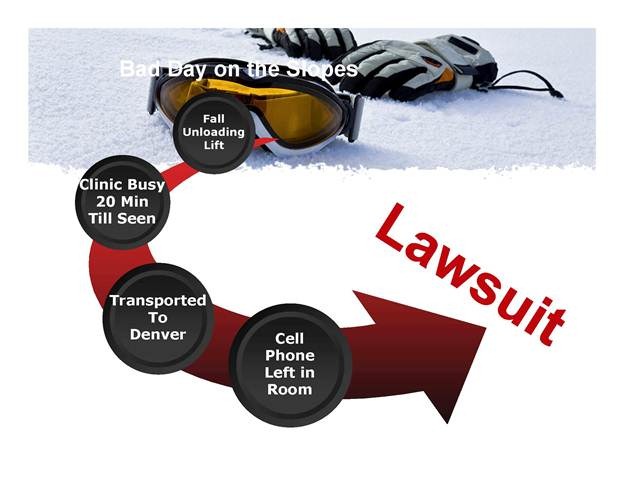
How can you eliminate or at least cut the hassle for this skier? Or maybe better stated how you can head off the lawsuit before it gets started?
Do Something
You don’t want to come up with money, but you can find ways to make a customer or a guest’s life better, before and after an injury. Sticking your head in the sand is not a solution.
Relying on your insurance company or your attorney may eliminate your hassle. However, it has just escalated the hassle factor or your former customer or guest.
In the above scenario, one easy step was giving all ERs that guests were sent to an 800 number, so they could call the resort. When a call came in from a hospital, it was assigned to a team to track down the family and make arrangements to get them together. Either transport them to the ER or transport the injured skier back to the resort.
Sure a bit of hassle and cost on the part of the resort, but look at the elimination of problems for the guest and the opportunity for the resort to look good in the eyes of the hassled guest.
How can you eliminate the hassle for your consumers and guests?
See Adrian Slywotzky Interview: What Is a Hassle Map?
What do you think? Leave a comment.
If you like this let your friends know or post it on FaceBook, Twitter or LinkedIn
Copyright 2013 Recreation Law (720) Edit Law
Email: blog@rec-law.us
Twitter: RecreationLaw
Facebook: Rec.Law.Now
Facebook Page: Outdoor Recreation & Adventure Travel Law
Blog: www.recreation-law.com
Mobile Site: http://m.recreation-law.com
#RecreationLaw, #@RecreationLaw, #Cycling.Law #Fitness.Law, #Ski.Law, #Outside.Law, #Recreation.Law, #Recreation-Law.com, #Outdoor Law, #Recreation Law, #Outdoor Recreation Law, #Adventure Travel Law, #law, #Travel Law, #Jim Moss, #James H. Moss, #Attorney at Law, #Tourism, #Adventure Tourism, #Rec-Law, #Rec-Law Blog, #Recreation Law, #Recreation Law Blog, #Risk Management, #Human Powered, #Human Powered Recreation,# Cycling Law, #Bicycling Law, #Fitness Law, #Recreation-Law.com, #Backpacking, #Hiking, #Mountaineering, #Ice Climbing, #Rock Climbing, #Ropes Course, #Challenge Course, #Summer Camp, #Camps, #Youth Camps, #Skiing, #Ski Areas, #Negligence, #Snowboarding, #RecreationLaw, #@RecreationLaw, #Cycling.Law #Fitness.Law, #SkiLaw, #Outside.Law, #Recreation.Law, #RecreationLaw.com, #OutdoorLaw, #RecreationLaw, #OutdoorRecreationLaw, #AdventureTravelLaw, #Law, #TravelLaw, #JimMoss, #JamesHMoss, #AttorneyatLaw, #Tourism, #AdventureTourism, #RecLaw, #RecLawBlog, #RecreationLawBlog, #RiskManagement, #HumanPowered, #HumanPoweredRecreation,# CyclingLaw, #BicyclingLaw, #FitnessLaw, #RecreationLaw.com, #Backpacking, #Hiking, #Mountaineering, #IceClimbing, #RockClimbing, #RopesCourse, #ChallengeCourse, #SummerCamp, #Camps, #YouthCamps, #Skiing, #Ski Areas, #Negligence, #Snowboarding, sport and recreation laws, ski law, cycling law, Colorado law, law for recreation and sport managers, bicycling and the law, cycling and the law, ski helmet law, skiers code, skiing accidents, Recreation Lawyer, Ski Lawyer, Paddlesports Lawyer, Cycling Lawyer, Recreational Lawyer, Fitness Lawyer, Rec Lawyer, Challenge Course Lawyer, Ropes Course Lawyer, Zip Line Lawyer, Rock Climbing Lawyer, Adventure Travel Lawyer, Outside Lawyer, Recreation Lawyer, Ski Lawyer, Paddlesports Lawyer, Cycling Lawyer, #RecreationalLawyer, #FitnessLawyer, #RecLawyer, #ChallengeCourseLawyer, #RopesCourseLawyer, #ZipLineLawyer, #RockClimbingLawyer, #AdventureTravelLawyer, #OutsideLawyer, Adrian Slywotzky, Hassle Map,
WordPress Tags: Hassel,consumers,guests,lawsuit,possibilities,lawsuits,product,series,events,injury,guest,consumer,lawyer,litigation,Adrian,Slywotzky,consultant,author,seller,examples,Blockbuster,Netflix,movies,movie,money,argument,threats,accident,example,industry,Boots,Long,Underwear,Breakfast,Lift,operator,cell,room,physician,crutches,health,insurance,customer,life,solution,attorney,factor,scenario,resort,hospital,team,Either,Sure,cost,elimination,Interview,Hassle,Leave,FaceBook,Twitter,LinkedIn,Recreation,Edit,Email,RecreationLaw,Page,Outdoor,Adventure,Travel,Blog,Mobile,Site,Outside,Moss,James,Tourism,Risk,Management,Human,Rock,Ropes,Course,Challenge,Summer,Camp,Camps,Youth,Areas,Negligence,SkiLaw,OutdoorLaw,OutdoorRecreationLaw,AdventureTravelLaw,TravelLaw,JimMoss,JamesHMoss,AttorneyatLaw,AdventureTourism,RecLaw,RecLawBlog,RecreationLawBlog,RiskManagement,HumanPoweredRecreation,CyclingLaw,BicyclingLaw,FitnessLaw,RopesCourse,ChallengeCourse,SummerCamp,YouthCamps,Colorado,managers,helmet,accidents,Paddlesports,Recreational,Line,RecreationalLawyer,FitnessLawyer,RecLawyer,ChallengeCourseLawyer,RopesCourseLawyer,ZipLineLawyer,RockClimbingLawyer,AdventureTravelLawyer,OutsideLawyer,skier
Maryland cycling product liability case shows why a good defense may wear down the plaintiff
Posted: September 24, 2012 Filed under: Cycling, Maryland | Tags: bicycle, Consumer, Cycling, Dorel Industries, Legal release, MARYLAND, Pacific Cycle, Product liability, Retailer, Sports Authority, Stritct Liability, Summary judgment Leave a commentAlexander v. The Sports Authority, Inc., et al., 2007 U.S. Dist. LEXIS 43317
Pre-printed release allows most claims to proceed
Basically, a release you buy as a form or from a print shop is not valid and will not get you out of a lawsuit. Releases must be written by an attorney for your business as this bicycle retailer learns in with this decision.
The plaintiff was a 77-year-old man who purchased a bicycle from the retailer, the Sports Authority (TSA). The bicycle was made by Pacific Cycle, Inc., and Dorel Industries, Inc. The brakes on the bicycle were center pull brakes and after riding the bike a half-dozen times the plaintiff used the brakes and fell. He claimed center pull brakes were only for experts, and he was not an expert cyclist. The plaintiff claimed:
Count I that Defendants were negligent, careless, and reckless because TSA failed to provide proper training in the use of high-performance brakes at the point of sale and Pacific Cycle installed brakes designed for experienced riders on a bicycle meant for the general public’s use. In Count II, Plaintiff alleges that Defendants are strictly liable for his injuries because the bicycle was placed in the stream of commerce and sold in a defective and unreasonably dangerous condition.
At the time, the plaintiff bought the bike; he completed a “sales/repair ticket” which included release language and language that stated the plaintiff had been educated in the use of the bike and the brakes. “I have been shown the proper way to operate the shifting, braking and release mechanisms of this bicycle.” The sales/repair ticket was a form used by man bike shops.
The defendant retailer The Sports Authority filed a motion for summary judgment, which led to this appeal. The basis of the appeal was:
(1) the release agreement Plaintiff signed expressly releases TSA from liability, (2) TSA had no duty to train Plaintiff, (3) Maryland law provides a statutory defense to sellers in defective design cases such as this, and (4) Plaintiff’s disregard for the written warnings is an intervening cause of his injury and provides a defense to strict liability.
Summary of the case
Release written poorly
The first argument the court looked at was the issue of the release that was part of the Sales/Repair Ticket. The release only released the retailer and did not release the manufacturers. This allowed the plaintiff to argue the release should not allow the defendant retailer out of the case because their issues were no different from the two other defendants not protected by the release. The court agreed. Although there was nothing wrong with the release, because it did not protect all the defendants, it could not be used for just one defendant.
Arguments to void release under Maryland law
Under Maryland law, a court looks at a release or contract to determine the effect of the release based on the intentions of the parties. This requires a release to be written properly under Maryland law. Here the court did not find the release was written in a way to cover the interpretation the retailer was arguing. The major issue was the language did not protect the other defendants so those claims that were joint against the other defendants and TSA, kept TSA in the lawsuit. If the plaintiff had not named the other defendants, the release would have protected TSA. Simply put the language of the release did not cover the claims of the plaintiff.
The court also looked at what it took to void a release under Maryland law.
(1) when the party protected by the clause intentionally causes harm or engages in acts of reckless, wanton, or gross negligence; (2) when the bargaining power of one party to the contract is so grossly unequal so as to put that party at the mercy of the other’s negligence; and (3) when the transaction involves the public interest.
The issues that void a release are basically the same under Maryland law as in other states. The first one is the acts of the defendant intentionally harmed the plaintiff. No contract protects against intentional acts, and no insurance policy covers intentional acts. If you do something intentionally that injures someone you are going to write a check. The next two issues are similar to public policy arguments. The first is the plaintiff has no choice but to contract with the defendant and no choice but to take the contract on the terms offered by the defendant. The second is a purer public policy argument where the item offered by the defendant is public interest such as utilities, food or public transportation. Under Maryland law, a public interest that cannot use a release is:
…the performance of a public service obligation, e.g., public utilities, common carriers, innkeepers, and public warehousemen. It also includes those transactions, not readily susceptible to definition or broad categorization, that-are so important to the public good that an exculpatory clause would be “patently offensive,” such that “the common sense of the entire community would . . . pronounce it” invalid.
The court found that the sale of a bicycle did not fall within any of the categories in this case that would void the release.
Failure to name defendants specifically
The next argument is one that has been made several times in releases and bicycle shops. Many bicycle shops purchase pre-printed forms from bicycle companies that include a release. The forms cover rentals, repair checklists, inventory issues, etc. The release does not name the defendant, but just refers to the “bicycle shop.” This argument has been made several times in other cases and someday may succeed. Here it did not, because the court found it was clear enough to the parties that the term bicycle shop referred to TSA in the release. However, as stated above, the release kept the lawsuit going because it only referred to the bicycle shop, not the manufacturers.
Release stated the plaintiff had been educated in how to use the bicycle
The next argument the court reviewed was the statement in the release that said the plaintiff has been shown the “the proper way to operate the shifting, braking and release mechanisms of this bicycle….” The court quickly dismissed the argument that the plaintiff should not be held to this defense because the plaintiff signed the agreement, so he had been instructed.
The court then looked at the plaintiff’s argument that the bicycle shop had failed to train the plaintiff in how to ride the bike and operate the equipment. The court held that there can be no negligence where there is no duty. Bicycle shops have no requirement to train people in how to ride a bike. Remember negligence has for things that must be proven to win a lawsuit. The first is there must be a duty between the plaintiff and the defendant. Here, the shop had no duty to train a buyer in how to ride a bicycle.
Expert Witness not qualified
One interesting issue the court looked at was the plaintiff’s attempt to establish a duty on the part of the retailer to train a buyer using an expert witness. The expert witness testified that there was a duty to train a buyer on how to use and ride a bike. However, the court found the expert witness’s credentials did not show any retail experience that would allow the expert to give that opinion retailer issues. An expert can only provide an opinion on those things he has training, knowledge, education or experience in. Because the expert witness’s resume or CV did not show any retail experience, the court questioned his ability opining about those issues. The court did give the plaintiff two weeks to come back with an additional statement showing that expert did have retail experience.
Maryland “sealed container” defense
The next issue was an argument raised by the defendant retailer, TSA, based on a Maryland statute. The statute is called the “sealed container” defense. The statute says a retailer cannot be held liable under a product’s liability claim for a product that has not been changed by the retailer. The defense is effective if the product is sold in a sealed container not changed or altered by the retailer. Here, however, the court found the bike had been sold out of the box. For the statute to provide a defense the bike would have to have been sold by the store in the original box the bike came to the store in.
The defense also failed because the defendant retailer hired a third party to build the bike.
The basis for the theory behind the statute is a retailer could not have found any defect in the product if they never opened the box the product came in. Courts in product liability claims hold that any person in the chain of sale from the manufacturer to the final seller is liable for a product liability claim because anyone of them could have discovered the defect in the product and prevented the injury to the consumer.
The court withheld its ruling on this issue until a later time because TSA hired the third party to build the bikes as stated above which further confused the defense.
Strict Liability Claim
Strict liability is a claim in product’s liability cases that argues the manufacturer and others in the chain of commerce are liable for placing a dangerous product into the hands of a consumer. Strict liability claims have very few defenses other than the item was not defective and unreasonably dangerous. Under Maryland law, a product is defectively dangerous if:
…if it is dangerous to an extent beyond that which would be contemplated by the ordinary consumer who purchased it with the ordinary knowledge common to the community as to the product’s characteristics….
A strict liability claim can be beaten if the manufacturer can prove that the consumer was warned of the risks. Here the court looked at the owner’s manual about the brakes and found the plaintiff’s strict liability argument did not apply. The manual informed the plaintiff of the risks.
It cannot be said enough, written about enough or argued enough, owner’s manuals are critical and must notify people of the issues, warn consumers of all risks of a product.
Here because the plaintiff failed to adhere to the warnings in the owner’s manual, the strict liability claim was dismissed.
So Now What?
This case was not over after the decision, and it had no other appeals to determine what happened with the case. Probably, the case settled sometime after this appeal was written. However, the case is very informative on the issues of Maryland law and product’s liability issues in general.
Specifically
1. If you are going to use a release, have a release written that works in your state, for your business, for your legal issues. Make sure your release protects you and everyone else that should be protected. Here the release was written badly. The release escaped the claim of the defendant retailer not being identified but failed to protect the other people in the chain of sale, which allowed the case to continue. Ultimately, the release did not protect the retailer.
You, your suppliers, distributors, manufacturers, bike builders, other riders, and everyone else reasonable connected to the release, sale or event should be protected.
2. Sell the right product to the right person. This case never would have happened if the plaintiff had purchased a bicycle he understood and knew how to use.
This does not mean you cannot upsell someone or move them into better products. However moving someone who has not ridden a bike in a while from a coaster brake to hand brakes, requires a little more thinking. If you don’t have the right bike, is it worth the money you are going to make on the sale to make a customer this unhappy.
3. If you are a manufacturer make sure if you are selling in the US (or North America, for that matter) that your release is written in English and contains are the necessary warnings. Written in English does not mean translated from a foreign language into English, but translated and written in English.
Warning labels have to cover everything. You may not consider them warnings; they may just be educational issues. However, the court will look at that education as a warning label.
Any warning label on the bike or product should also be repeated in the manual.
I strongly suggest that all owners’ manuals be available on your website also. Also in the owner’s manual make sure that the manual instructs the purchaser to refer to the website for changes, updates or new warnings.
4. Always make sure that every manual, hangtag, sticker, or warning that comes in the box from the manufacturer goes out the door with the product when the bike is sold. The strict liability defense would have failed if the warning label had been left on the shop floor, and the sole issue of the case would have been how much, not if.
5. If you are a manufacturer, tell your retailers to protect you or better, develop a program where retailers, and you work together from the beginning to beat lawsuits. Make sure the retailer has a good release that protects all parties. Make sure the retailer knows to tell purchases to read the owner’s manual and to go to your website to learn more about the product.
6. If you are a manufacturer make your website more than just a sales site. It is a place where people can learn how to use your product. (And having a “community” site where other consumers using the product improperly tell your new customers how to use it improperly is not an answer.) Education and information are an effective way to keep customers happy and stop lawsuits.
This lawsuit would have ended if the release had been written properly. Buying a release from a form’s seller or a printing shop is buying trouble, not a defense. Nor is a release a stroke of luck. A well-written release in 43 states stops lawsuits. (See States that do not Support the Use of a Releasefor the states that do not support a release.)
For more product liability articles see:
How not to respond to a product liability claim or How to turn a mess into a legal disaster.
How to fight a Bicycle Product Liability case in New York. One step at a time.
Jurisdiction in Massachusetts allows a plaintiff to bring in Salomon France to the local court.
PR Disaster should not be turned into bigger disasters
For additional articles on cycling legal issues see:
Connecticut court works hard to void a release for a cycling event
Good Release stops lawsuit against Michigan bicycle renter based on marginal acts of bicycle renter
New York Decision explains the doctrine of Primary Assumption of the Risk for cycling.
PA court upholds release in bicycle race.
Release for training ride at Triathlon training camp stops lawsuit
|
Jim Moss is an attorney specializing in the legal issues of the outdoor recreation community. He represents guides, guide services, outfitters both as businesses and individuals and the products they use for their business. He has defended Mt. Everest guide services, summer camps, climbing rope manufacturers; avalanche beacon manufactures and many more manufacturers and outdoor industries. Contact Jim at Jim@Rec-Law.us |
Jim is the author or co-author of six books about the legal issues in the outdoor recreation world; the latest is Outdoor Recreation Insurance, Risk Management and Law.
To see Jim’s complete bio go here and to see his CV you can find it here. To find out the purpose of this website go here.
G-YQ06K3L262
What do you think? Leave a comment.
If you like this let your friends know or post it on FB, Twitter or LinkedIn
Author: Outdoor Recreation Insurance, Risk Management and Law
Facebook Page: Outdoor Recreation & Adventure Travel Law
Email: Jim@Rec-Law.US
By Recreation Law Rec-law@recreation-law.com James H. Moss
@2023 Summit Magic Publishing, LLC
#RecreationLaw, #@RecreationLaw, #Cycling.Law #Fitness.Law, #Ski.Law, #Outside.Law, #Recreation.Law, #Recreation-Law.com, #Outdoor Law, #Recreation Law, #Outdoor Recreation Law, #Adventure Travel Law, #law, #Travel Law, #Jim Moss, #James H. Moss, #Attorney at Law, #Tourism, #Adventure Tourism, #Rec-Law, #Rec-Law Blog, #Recreation Law, #Recreation Law Blog, #Risk Management, #Human Powered, #Human Powered Recreation,# Cycling Law, #Bicycling Law, #Fitness Law, #Recreation-Law.com, #Backpacking, #Hiking, #Mountaineering, #Ice Climbing, #Rock Climbing, #Ropes Course, #Challenge Course, #Summer Camp, #Camps, #Youth Camps, #Skiing, #Ski Areas, #Negligence, #Snowboarding, #RecreationLaw, #@RecreationLaw, #Cycling.Law #Fitness.Law, #SkiLaw, #Outside.Law, #Recreation.Law, #RecreationLaw.com, #OutdoorLaw, #RecreationLaw, #OutdoorRecreationLaw, #AdventureTravelLaw, #Law, #TravelLaw, #JimMoss, #JamesHMoss, #AttorneyatLaw, #Tourism, #AdventureTourism, #RecLaw, #RecLawBlog, #RecreationLawBlog, #RiskManagement, #HumanPowered, #HumanPoweredRecreation,# CyclingLaw, #BicyclingLaw, #FitnessLaw, #RecreationLaw.com, #Backpacking, #Hiking, #Mountaineering, #IceClimbing, #RockClimbing, #RopesCourse, #ChallengeCourse, #SummerCamp, #Camps, #YouthCamps, #Skiing, #Ski Areas, #Negligence, #Snowboarding, sport and recreation laws, ski law, cycling law, Colorado law, law for recreation and sport managers, bicycling and the law, cycling and the law, ski helmet law, skiers code, skiing accidents, Recreation Lawyer, Ski Lawyer, Paddlesports Lawyer, Cycling Lawyer, Recreational Lawyer, Fitness Lawyer, Rec Lawyer, Challenge Course Lawyer, Ropes Course Lawyer, Zip Line Lawyer, Rock Climbing Lawyer, Adventure Travel Lawyer, Outside Lawyer, Recreation Lawyer, Ski Lawyer, Paddlesports Lawyer, Cycling Lawyer, #RecreationalLawyer, #FitnessLawyer, #RecLawyer, #ChallengeCourseLawyer, #RopesCourseLawyer, #ZipLineLawyer, #RockClimbingLawyer, #AdventureTravelLawyer, #OutsideLawyer, TSA, The Sports Authority, Pacific Cycles, Bicycle, Cycling, Center Pull Brakes, Product Liability, Strict Liability, Owner’s Manual, Release, Maryland, MD,
WordPress Tags: Maryland,product,plaintiff,Alexander,Sports,Dist,LEXIS,TITLE,lawsuit,Releases,attorney,bicycle,retailer,decision,Pacific,Cycle,Dorel,Industries,bike,experts,Count,Defendants,performance,sale,riders,injuries,commerce,sales,ticket,mechanisms,defendant,judgment,basis,agreement,sellers,warnings,injury,Summary,Release,argument,Repair,manufacturers,Although,Arguments,Under,intentions,Here,interpretation,clause,negligence,mercy,transaction,insurance,policy,item,utilities,food,transportation,obligation,carriers,innkeepers,transactions,definition,categorization,categories,Failure,Many,rentals,checklists,inventory,statement,equipment,requirement,Remember,buyer,Expert,credentials,opinion,knowledge,education,statute,theory,Courts,person,manufacturer,seller,consumer,bikes,Strict,Claim,extent,characteristics,owner,manuals,consumers,Make,suppliers,distributors,builders,event,Sell,products,coaster,worth,money,customer,North,America,English,Written,owners,Also,purchaser,sticker,door,retailers,lawsuits,customers,information,luck,States,Support,Combination,Report,disaster,York,Jurisdiction,Massachusetts,Salomon,France,disasters,Sometimes,editorials,Connecticut,Michigan,renter,doctrine,Primary,Assumption,Risk,Triathlon,Leave,Twitter,LinkedIn,Recreation,Edit,RecreationLaw,Facebook,Page,Outdoor,Adventure,Travel,Blog,Mobile,Site,Outside,Moss,James,Tourism,Management,Human,Rock,Ropes,Course,Challenge,Summer,Camp,Camps,Youth,Areas,SkiLaw,OutdoorLaw,OutdoorRecreationLaw,AdventureTravelLaw,TravelLaw,JimMoss,JamesHMoss,AttorneyatLaw,AdventureTourism,RecLaw,RecLawBlog,RecreationLawBlog,RiskManagement,HumanPoweredRecreation,CyclingLaw,BicyclingLaw,FitnessLaw,RopesCourse,ChallengeCourse,SummerCamp,YouthCamps,Colorado,managers,helmet,accidents,Lawyer,Paddlesports,Recreational,Line,RecreationalLawyer,FitnessLawyer,RecLawyer,ChallengeCourseLawyer,RopesCourseLawyer,ZipLineLawyer,RockClimbingLawyer,AdventureTravelLawyer,OutsideLawyer,Cycles,Center,Pull,Brakes,Manual,third,website


 Recreation Law