
Upky v. Marshall Mountain, Llc, 2008 MT 90; 342 Mont. 273; 180 P.3d 651; 2008 Mont. LEXIS 94
Posted: January 17, 2011 Filed under: Legal Case, Montana, Ski Area | Tags: Bamboo Poles, Closre, Jump Closed, Retailer, ski area, Ski Jump, skiing, Snowboarder, snowboarding Leave a commentUpky v. Marshall Mountain, Llc, 2008 MT 90; 342 Mont. 273; 180 P.3d 651; 2008 Mont. LEXIS 94
CHAD UPKY, Plaintiff, v. MARSHALL MOUNTAIN, LLC, Defendant, and MARSHALL MOUNTAIN, LLC, Third-Party Plaintiff and Appellant, v. BOARD OF MISSOULA, INC. and BOARD OF MISSOULA, LLC, Third-Party Defendants and Appellees.
DA 06-0109
SUPREME COURT OF MONTANA
2008 MT 90; 342 Mont. 273; 180 P.3d 651; 2008 Mont. LEXIS 94
May 16, 2007, Submitted on Briefs
March 18, 2008, Decided
April 3, 2008, Released for Publication
PRIOR HISTORY:
APPEAL FROM: District Court of the Fourth Judicial District, In and For the County of Missoula, Cause No. DV 02-112. Honorable John W. Larson, Presiding Judge.
Upky v. Marshall Mt., 2004 Mont. Dist. LEXIS 3716 (2004)
CASE SUMMARY:
PROCEDURAL POSTURE: Plaintiff accident victim brought a negligence suit against defendant ski area owner, which in turn filed a complaint against third-party defendant ski jump builder for contribution or indemnification. After a jury trial on the third-party complaint, the District Court of the Fourth Judicial District, County of Missoula (Montana), entered judgment in favor of the builder. The owner appealed.
OVERVIEW: After the ski area owner and the accident victim came to a settlement, the ski jump builder was allowed to amend its answer to the owner’s complaint, pursuant to M.R. Civ.P. 15(a), to include a claim that the victim’s negligence, in combination with that of the owner, caused his injuries. The supreme court held that the trial court did not err when it permitted the builder to amend its answer, and that even if there was error, it was harmless because: (1) the jury, in determining that the builder was not negligent, did not reach the question whether the victim was negligent; and (2) thus there was no prejudice to the owner. The supreme court also held that the record demonstrated that substantial credible evidence supported the jury’s verdict that the builder was not negligent; because the evidence was conflicting; the supreme court deferred to the jury’s determination as to which evidence was more credible.
OUTCOME: The trial court’s judgment was affirmed.
CORE TERMS: jump, amend, bamboo, poles, jury verdict, comparative negligence, skiers, ski, credible evidence, constructed, prejudiced, snowboard, morning, jury’s decision, conflicting evidence, unfinished, harmless, ski area, snowboarders, patrol, verdict form, responsive pleading, reasonable mind, inspected, non-party, apportion, predicate, credible, manager, marked
COUNSEL: For Appellant: Gig A. Tollefsen, Berg, Lilly & Tollefsen, P.C., Bozeman, Montana.
For Appellees: Maxon R. Davis, Davis, Hatley, Haffeman & Tighe, Great Falls, Montana.
JUDGES: JOHN WARNER. We Concur: JIM RICE, JAMES C. NELSON, PATRICIA COTTER, BRIAN MORRIS.
OPINION BY: John Warner
OPINION
[***652] [**274] Justice John Warner delivered the Opinion of the Court. [*P1] Third-party plaintiff Marshall Mountain, LLC (Marshall Mountain) appeals from a judgment entered in the Fourth Judicial District Court, Missoula County, in favor of third-party defendants Board of Missoula, Inc. and Board of Missoula, LLC (Board of Missoula), dismissing its third party complaint after a jury verdict in Board of Missoula’s favor.
[*P2] We restate and address the issues on appeal as follows:
[*P3] 1. Did the District Court err when it granted Board of Missoula’s motion to amend its answer to allege comparative negligence by Chad Upky?
[*P4] 2. Was the jury’s verdict that Board of Missoula was not negligent supported by substantial credible evidence?
BACKGROUND
[*P5] On February 12, 1999, eighteen year old Chad Upky was rendered a paraplegic in a skiing accident at Marshall Mountain ski area. The injuries occurred when Upky skied over a ski jump ramp constructed at Marshall Mountain for use in an upcoming snowboard competition. Upky became inverted when he skied over the jump and was injured when he landed.
[**275] [*P6] Board of Missoula was a local snowboard shop that in the years before Upky’s accident had worked with Marshall Mountain to construct jumps for use in snowboard competitions at the ski area. In prior years, the jumps had been constructed up to two weeks before the competition and had remained open for use by skiers at Marshall Mountain. In 1999, Marshall Mountain’s [***653] owner, Bruce Doering, and Board of Missoula’s co-owner, Wright Hollingsworth, agreed to construct a jump for use in that year’s competition. The ski jump on which Upky was injured was constructed two days before the accident. Doering later claimed, on behalf of Marshall Mountain, that he understood the jump would be open for use before the February 1999 competition. To the contrary, Hollingsworth asserted that he and Doering had agreed the jump would be closed prior to the 1999 competition.
[*P7] On Wednesday, February 10, 1999, before the snowboard competition scheduled for the next Saturday, Hollingsworth went to Marshall Mountain after the ski area closed for the evening and built the jump with the help of Marshall Mountain’s snowcat operator, Tyson Miller. Miller and Hollingsworth worked on the jump from about 10:00 p.m. Wednesday night until 2:00 a.m. the next morning. Hollingsworth later said that he wanted to hand finish the jump in the daylight using shovels. It was his opinion that the jump should not be opened for use until it was finished. He said that before he left early Thursday morning he laid bamboo poles across the jump to indicate that it was closed. Hollingsworth said that he believed the ski patrol would see the bamboo poles when they inspected the area in the morning and would keep the jump closed. Later, members of the ski patrol and other employees of Marshall Mountain disagreed about whether there were bamboo poles across the jump on Thursday morning.
[*P8] No matter whether Hollingsworth had marked the jump as closed with bamboo poles, the jump was open for use by skiers and snowboarders that Thursday and again on Friday. Doering and the ski patrol examined the jump, and it was left open for skiers and snowboarders. Doering stated that he had ultimate authority on whether or not to allow Marshall Mountain patrons to use the jump. Several employees of Marshall Mountain used the jump with no problem.
[*P9] On Friday, the day of Upky’s accident, the jump was open throughout the day. Late in the day, a Marshall Mountain employee suggested to Doering that they close the jump due to changing snow [**276] and lighting conditions. However, Doering decided to keep the jump open. Chris Laws, Board of Missoula’s retail manager, was at Marshall Mountain on Friday. He noticed the jump was open, even though he understood it was supposed to be closed.
[*P10] On Friday evening, Upky and some friends approached the jump. Upky claimed that he tried to slow himself going into the jump by snowplowing with his skis and went over the jump at a controlled speed. Other witnesses to the accident, including Doering and Laws, stated the Upky “bombed” the jump by going into it extremely fast. Upky suffered severe injuries as a result of his fall, including a broken neck that resulted in his paraplegia.
[*P11] In 2002, Upky brought suit against Marshall Mountain, alleging that its negligence was the cause of his injuries. Upky made no claim against Board of Missoula. In its answer, Marshall Mountain denied any negligence and asserted affirmative defenses, including Upky’s comparative negligence. Marshall Mountain filed a third-party complaint against Board of Missoula seeking contribution or indemnification, asserting that Board of Missoula was responsible for any negligence in the construction of the jump. In its answer, Board of Missoula denied it had been negligent and went on to claim that the jump was unfinished when Upky used it and that it had cordoned off the jump to prevent its use prior to the competition, but Marshall Mountain negligently allowed the use of the jump on the day of Upky’s accident. Subsequently, Board of Missoula, in response to a request for admission, admitted that it had left the jump in an unfinished condition and that it was dangerous. However, it qualified the admission to state that the actions of Marshall Mountain in removing the bamboo poles marking the jump closed and allowing its patrons to use the jump were careless and caused Upky’s injuries.
[*P12] Following discovery, Board of Missoula moved for summary judgment, arguing that it was not negligent as a matter of law. The District Court denied the motion for summary judgment in November 2003.
[***654] [*P13] In December 2003, Marshall Mountain and Upky settled Upky’s claim. In March 2004, the District Court noted that because of the settlement only Marshall Mountain’s claims against Board of Missoula remained to be litigated; Upky’s claims against Marshall Mountain were later dismissed.
[*P14] In July 2004, Board of Missoula moved to amend its answer, pursuant to M. R. Civ. P. 15(a), to include a claim that Upky’s negligence, in combination with that of Marshall Mountain, caused his [**277] injuries, and to have the jury determine the extent of his negligence as a non-party under § 27-1-703, MCA. Board of Missoula’s amended answer reasserted the claim in the original answer that Board of Missoula was not negligent and Marshall Mountain was negligent for allowing skiers to use the unfinished jump. The amended answer only added the assertion that both Upky and Marshall Mountain caused or contributed to the damages alleged by Upky. Board of Missoula did not attempt to withdraw its admission that the jump was dangerous. Marshall Mountain opposed the motion, arguing that it came too late and the amendment adding a claim of comparative negligence by Upky would be unfairly prejudicial. The District Court granted the motion to amend.
[*P15] A jury trial on the third-party complaint began December 5, 2005. At trial, numerous witnesses provided conflicting evidence on the events surrounding Upky’s injuries. The witnesses’ testimony varied widely on whether Doering and Hollingsworth had agreed to close the jump prior to the competition, whether Hollingsworth placed bamboo poles on the jump, and how dangerous, if at all, the jump was for skiers and snowboarders. There was also conflicting evidence regarding the exact circumstances of Upky’s fall, specifically how far away he was when he began approaching the jump and how fast he went over the jump.
[*P16] The special verdict form submitted to the jury first instructed it to determine if Board of Missoula was negligent. Only if the jury found that Board of Missoula was negligent was it to decide if Upky and Marshall Mountain were also negligent and fix the percentages of negligence. The jury returned its verdict finding that Board of Missoula was not negligent. Thus, it did not apportion fault. The District Court entered a final judgment in favor of Board of Missoula. Marshall Mountain appeals.
DISCUSSION
[*P17] Issue 1: Did the District Court err when it granted Board of Missoula’s motion to amend its answer to allege comparative negligence by Chad Upky?
[*P18] The Montana Rules of Civil Procedure provide for amendments to pleadings:
[HN1] A party may amend the party’s pleading once as a matter of course at any time before a responsive pleading is served or, if the pleading is one to which no responsive pleading is permitted and the action has not been placed upon the trial calendar, the party [**278] may so amend it at any time within 20 days after it is served. Otherwise a party may amend the party’s pleading only by leave of court or by written consent of the adverse party; and leave shall be freely given when justice so requires.
M. R. Civ. P. 15(a). [HN2] While amendments are not permitted in every circumstance, we have emphasized that, as Rule 15(a) states, leave to amend should be “freely given” by district courts. Loomis v. Luraski, 2001 MT 223, P 41, 306 Mont. 478, P 41, 36 P.3d 862, P 41. District courts should permit a party to amend the pleadings when, inter alia, allowing an amendment would not cause undue prejudice to the opposing party. Prentice Lumber Co. v. Hukill, 161 Mont. 8, 17, 504 P.2d 277, 282 (1972) (quoting Foman v. Davis, 371 U.S. 178, 182, 83 S. Ct. 227, 230, 9 L. Ed. 2d 222 (1962)).
[*P19] Marshall Mountain claims it was prejudiced by the amendment to the pleadings which allowed the jury to consider Upky’s negligence. However, the jury heard all of the evidence concerning the actions of Board of Missoula presented by Marshall Mountain, which included the admission that the jump was dangerous, and nevertheless determined that Board of Missoula was not negligent. Thus, it did not reach the question [***655] of whether Upky was negligent. As the jury did not consider any negligence on the part of Upky in reaching its verdict, there was no prejudice to Marshall Mountain. [HN3] When a special verdict requires a jury to answer a question only if it first determines that a predicate question is answered in the affirmative, and the jury answers the predicate question in the negative, we have consistently held that the party objecting to the submission of the second, unanswered question is not prejudiced. Under such circumstances we consider any error harmless, and decline to interfere with the jury’s decision. See e.g. Payne v. Knutson, 2004 MT 271, PP 17-18, 323 Mont. 165, PP 17-18, 99 P.3d 200, PP 17-18 (concluding there was no prejudice to the plaintiff where the jury was not instructed to apportion negligence among the defendants because the jury found the plaintiff was more than 50% negligent and thus could not recover); Peschke v. Carroll College, 280 Mont. 331, 343, 929 P.2d 874, 881 (1996) (concluding that although a district court erred in admitting a videotape, it went to the issue of causation, which the jury did not reach, and the error was thus harmless); Drilcon, Inc. v. Roil Energy Corp., 230 Mont. 166, 173, 749 P.2d 1058, 1062 (1988) (declining to address appellant’s argument that the special verdict form erroneously included non-parties because the jury apportioned negligence only among the parties to the action and appellant was not prejudiced).
[**279] [*P20] We affirm the District Court’s order allowing Board of Missoula to amend the pleadings to allege Upky’s comparative negligence because Marshall Mountain was not prejudiced by it and any error was harmless.
[*P21] Issue 2: Was the jury’s verdict that Board of Missoula was not negligent supported by substantial credible evidence?
[*P22] [HN4] This Court does not review a jury verdict to determine if it was correct. We review a jury’s decision only to determine if substantial credible evidence in the record supports the verdict. Campbell v. Canty, 1998 MT 278, P 17, 291 Mont. 398, P 17, 969 P.2d 268, P 17; Wise v. Ford Motor Co., 284 Mont. 336, 343, 943 P.2d 1310, 1314 (1997). Substantial evidence is “evidence that a reasonable mind might accept as adequate to support a conclusion” and may be less than a preponderance of the evidence but must be more than a “mere scintilla.” Campbell, P 18.
[*P23] [HN5] It is the role of the jury to determine the weight and credibility of the evidence, and this Court will defer to the jury’s role. Seeley v. Kreitzberg Rentals, LLC, 2007 MT 97, P 21, 337 Mont. 91, P 21, 157 P.3d 676, P 21, overruled on other grounds, Giambra v. Kelsey, 2007 MT 158, P 27, 338 Mont. 19, P 27, 162 P.3d 134, P 27. [HN6] We view the evidence in the light most favorable to the prevailing party. Where conflicting evidence exists, we will not overturn a jury’s decision to believe one party over another. Samson v. State, 2003 MT 133, P 11, 316 Mont. 90, P 11, 69 P.3d 1154, P 11.
[*P24] The record before us demonstrates that substantial credible evidence supports the jury’s verdict that Board of Missoula was not negligent. Hollingsworth testified that he and Doering agreed the jump would be closed prior to the competition. Hollingsworth also testified that he had marked the jump closed with bamboo poles the night it was constructed, and other testimony supported this assertion. There was also evidence that only Marshall Mountain had the ultimate decision-making authority to open or close the jump. Marshall Mountain’s manager, Doering, testified he inspected the jump and thought it was safe. This evidence, which does not include the testimony describing Upky’s actions, provided the jury with an adequate basis to support its decision that Board of Missoula was not negligent. Campbell, P 18.
[*P25] There is also evidence which would tend to show Board of Missoula was negligent. However, because the evidence is conflicting we defer to the jury’s determination as to which evidence is more credible. Seeley, P 21. We conclude that the record contains sufficient [**280] evidence for reasonable minds to conclude that Board of Missoula was not negligent.
[***656] CONCLUSION
[*P26] The District Court did not err when it permitted Board of Missoula to amend its answer, and the jury verdict is supported by substantial credible evidence.
[*P27] Affirmed.
/S/ JOHN WARNER
We Concur:
/S/ JIM RICE
/S/ JAMES C. NELSON
/S/ PATRICIA COTTER
/S/ BRIAN MORRIS
Ciocian v. Vail Corporation, 2010 Colo. App. LEXIS 1353
Posted: November 1, 2010 Filed under: Colorado, Legal Case, Ski Area, Skiing / Snow Boarding | Tags: @VailMtn, Colorado Skier Safety Act, Negligence, Negligence per se, ski area, Ski Area Boundary, skiing, Vail Leave a commentTo Read an Analysis of this decision see
Colorado Appellate Court finds Vail’s boundary marking not enough to prevent a lawsuit.
Melissa Ciocian and Chris Ciocian, Plaintiffs-Appellants, v. Vail Corporation, a Colorado corporation, d/b/a Vail Associates, Defendant-Appellee.
Court of Appeals No. 09CA1568
COURT OF APPEALS OF COLORADO, DIVISION THREE
2010 Colo. App. LEXIS 1353
September 16, 2010, Decided
NOTICE:
THIS OPINION IS NOT THE FINAL VERSION AND SUBJECT TO REVISION UPON FINAL PUBLICATION
SUBSEQUENT HISTORY: Related proceeding at Anderson v. Vail Corp., 2010 Colo. App. LEXIS 1350 (Colo. Ct. App., Sept. 16, 2010)
PRIOR HISTORY: [*1]
Eagle County District Court No. 08CV47. Honorable Frederick W. Gannett, Judge.
DISPOSITION: JUDGMENT VACATED AND CASE REMANDED WITH DIRECTIONS.
OUTCOME: The trial court’s orders granting summary judgment were vacated, and the case was remanded to the trial court for further proceedings.
COUNSEL: Scott R. Larson, P.C., Scott R. Larson, Denver, Colorado, for Plaintiffs-Appellants.
The Rietz Law Firm, LLC, Peter W. Rietz, Maryjo C. Falcone, Dillon, Colorado, for Defendant-Appellee.
JUDGES: Opinion by JUDGE ROY. Roman and Booras, JJ., concur.
OPINION BY: ROY
OPINION
Jesse Anderson (skier # 1) and Melissa Ciocian (skier # 2) 1 and Chris Ciocian appeal the entries of summary judgment in favor of the Vail Corporation (ski resort) in their respective cases. These two appeals, though arising from different skiing accidents and different civil cases, are consolidated for the purpose of the opinion because they present virtually identical facts, the same legal issues, and the parties are represented by the same counsel. Slight factual differences between the two cases are noted.
1 Melissa Ciocian was snowboarding at the time of her accident, but under the Ski Safety Act the term “‘[s]kier’ means any person using a ski area for the purpose of skiing, which includes, without limitation, sliding downhill or jumping on snow or ice on . . . a snowboard . . . .” § 33-44-103(8), C.R.S. 2010. Therefore, [*2] we will refer to her as a skier.
The skiers argue that the trial court erred by: (1) concluding that there was no genuine issue of any material fact and that the ski resort was entitled to judgment as a matter of law as to the marking of the ski resort’s boundary; (2) relying on photographs, submitted without proper foundation, as attachments to the ski resort’s reply brief in support of summary judgment; (3) concluding that the ski resort’s exculpatory agreement did not violate public policy; and (4) concluding that the ski resort’s exculpatory agreement was clear and unambiguous.
We agree with skiers that there is a genuine issue of material fact, which precludes the entry of summary judgment on the issue of whether the ski resort boundary was adequately marked, and, therefore, we need not address whether the trial court could properly consider the disputed photographs. We also agree with the skiers, and the ski resort concedes, that if the ski resort failed to properly mark the ski area boundary as required by the statute, the exculpatory agreement does not release the ski resort from liability. Therefore, we need not consider whether the exculpatory agreement is clear and unambiguous. [*3] Thus, we vacate the trial court’s orders granting summary judgment, and remand for further proceedings.
I. Facts
Primrose, an intermediate (blue) trail, commences at the top of Larkspur Bowl. Primrose splits shortly thereafter, and the left fork remains Primrose but becomes a beginner’s (green) trail; the right fork becomes Bitterroot, an intermediate trail. Two ski lifts, Strawberry Park Express and Upper Beaver Creek Mountain Express, terminate just below the split, affording access to Primrose, Bitterroot, and a glade, which is a forested area with no separate difficulty rating, separating Primrose and Bitterroot. Some distance downhill from the split, Primrose and Bitterroot are connected by Overshot, a trail or catwalk, 2 which cuts through and traverses the glade commencing at Primrose and terminating at Bitterroot. Because it terminates at an intermediate (blue) trail, Overshot itself is an intermediate (blue) trail.
2 A “catwalk” is “a gentle, narrow trail that joins one ski slope to another or that winds down the entire mountain.” http://www.rei.com/expertadvice/articles’skiing”+glossary.html (last visited 7/30/2010). Catwalks frequently look like roads and are used by maintenance vehicles [*4] and equipment to traverse the mountain.
The downhill edge of Overshot is a ski area boundary. Immediately below the boundary are three private ski in-ski out residences built on private property. Immediately below the residences is a paved access road.
Skier # 1’s accident occurred on February 25, 2007, and skier # 2’s accident occurred on March 3, 2007. Both skiers skied off of the Strawberry Park Express Lift. Skier 2 immediately entered the glade. It is not clear where Skier 1 entered the glade. The glade is not closed to skiers, is within the ski resort’s area boundaries, and extends below Overshot.
Skiers proceeded though the glade until they reached Overshot, crossed Overshot near its downhill terminus, and continued downhill through the glade. Skier # 2 noticed “the very different surroundings and the drastic change in terrain,” but she testified that the trees were “fairly spread out,” with “natural gaps” that “made it easy to turn.” Skier # 1 acknowledged he did not look up Overshot as a skier would normally do when crossing a trail, and estimated his speed at twenty miles an hour, or approximately thirty feet per second. 3 There is no evidence of the width of Overshot at the [*5] point of crossing but the ski resort’s counsel, in oral argument, estimated its width as approximately thirty feet. Shortly after crossing Overshot, the skiers skied off of a 19-foot retaining wall, dropped onto the paved access road, and sustained injuries.
3 Speed in feet/second can be estimated by multiplying the speed in miles per hour by 1.5. Thus 5,280 feet, the distance traveled in one minute by a vehicle driving sixty miles per hour, divided by sixty (the number of seconds in a minute) yields eighty-eight feet per second, an error of 2.22%.
Skiers do not dispute that there were nine ski area boundary signs facing uphill across Overshot, to their left, as they crossed Overshot. These signs are located at various points along the downhill side of Overshot, 24 to 51 yards apart, over a distance of 303 yards. A double strand rope closure terminates 44 yards uphill from the first sign, and another rope closure commences 72 yards downhill from the last sign. Skiers skied through this 72 yard gap approximately 56 yards downhill from the last sign and 16 yards uphill from the rope closure. Skiers testified in their depositions that they had no knowledge that the wooded area downhill from [*6] Overshot was closed to the skiing public and that they did not see any boundary signs or rope closures.
Skier’s safety expert (the expert), who visited the scene on April 3, 2007, stated in his report that (1) the forest area (glade) above Overshot “was an open and well skied forest . . . suitable for recreational resort skiing and snowboarding”; (2) the boundary signs to the skiers’ left were “virtually invisible . . . and unreadable in any case as [the nearest sign] would have been edge on to [the skiers’] line of sight as [they] crossed Overshot”; and (3) the rope closure to the skiers’ right and downhill was “hidden behind trees and not visible at all.” The expert also opined that the ski resort failed to post sufficient boundary signs and rope closures alerting skiers to the ski area boundary.
With respect to skier # 1, a responding member of the ski patrol testified in his deposition that he “could see how this happened” and responded affirmatively to the question, “you didn’t believe that it was sufficiently clear that that was the area boundary?” With respect to skier # 2, the ski patrol supervisor confirmed that he probably told her that there was “no way she could have known [*7] the trees were beyond the ski area boundary and, therefore, it was not her fault,” or words to that effect.
The trial court granted summary judgment in favor of the ski resort based on its finding that “after thoroughly reviewing the number, location and orientation of nine (9) boundary signs, the Court finds them to be ”in a fashion readily visible to skiers under conditions of ordinary visibility’ consistent with C.R.S. § 33-44-107(6) [the Ski Safety Act] and within the reasonable standards established in the legislative declaration of the Ski Safety Act.” Further, based on this finding, the trial court found that the exculpatory agreements did not supplant the ski resort’s statutory duties and did not offend public policy based on the Jones v. Dressel, 623 P.2d 370, 376 (Colo. 1981) factors, and were clear and unambiguous.
II. Summary Judgment
Skiers contend that the trial court improperly applied the summary judgment standard. More specifically, they argue the trial court improperly made findings of fact on disputed issues of material fact. We agree.
A. Standard of Review
[HN1] We review an order granting summary judgment de novo. BRW, Inc. v. Dufficy & Sons, Inc., 99 P.3d 66, 71 (Colo. 2004). [*8] [HN2] Summary judgment should be granted only if there is no genuine issue as to any material fact, and the moving party is entitled to judgment as a matter of law. Peterson v. Halsted, 829 P.2d 373, 375 (Colo. 1992). A litigant is entitled to have disputed facts determined by the finder of fact following a trial, and it is only in the clearest of cases, where no doubt exists concerning the facts, that summary judgment is warranted. Moses v. Moses, 180 Colo. 397, 402, 505 P.2d 1302, 1304 (1973). Summary judgment is only appropriate in those circumstances where there is no role for the fact finder to play.
[HN3] In determining whether summary judgment is proper, the court must give the party opposing the motion the benefit of all favorable inferences that reasonably may be drawn from the facts presented. Peterson, 829 P.2d at 376. [HN4] “[T]he trial court may not assess the weight of the evidence or credibility of witnesses in determining a motion for summary judgment . . . .” Kaiser Found. Health Plan of Colo. v. Sharp, 741 P.2d 714, 718 (Colo. 1987).
[HN5] Statutory interpretation is a question of law that we review de novo. Fischbach v. Holzberlein, 215 P.3d 407, 409 (Colo. App. 2009). [HN6] Our primary duty in [*9] construing legislation is to effectuate the intent of the General Assembly, looking first to the statute’s plain language. Vigil v. Franklin, 103 P.3d 322, 327 (Colo. 2004). When legislative language is ambiguous, we construe the statute in light of the General Assembly’s objective, employing the presumption that the legislature intended a consistent, harmonious, and sensible effect. Matter of Title, Ballot Title & Submission Clause, & Summary for 1997-98 No. 62, 961 P.2d 1077, 1079 (Colo. 1998).
B. Analysis
Skiers alleged in the trial court, and now argue here, that the ski resort acted negligently and violated the Act by failing to properly mark the ski area boundaries. Skiers premise their allegations and arguments on section 33-44-107(6), which provides: [HN7] “The ski area operator shall mark its ski area boundaries in a fashion readily visible to skiers under conditions of ordinary visibility.” (Emphasis added.) Skiers argue that the ski area failed to comply with section 33-44-107(6) because there were no boundary signs or other markings alerting them that they were approaching a ski area boundary.
The trial court found that the ski resort marked its boundary in a fashion readily visible [*10] to skiers under conditions of ordinary visibility based solely on the placement of the nine boundary signs over the distance of 303 yards along the downhill side of Overshot.
The legislative declaration of the Act provides:
[HN8] The general assembly hereby finds and declares that it is in the interest of the state of Colorado to establish reasonable safety standards for the operation of ski areas and for the skiers using them. Realizing the dangers that inhere in the sport of skiing, regardless of any and all reasonable safety measures which can be employed, the purpose of this article is . . . to further define the legal responsibilities of ski area operators and their agents and employees; to define the responsibilities of skiers using such ski areas; and to define the rights and liabilities existing between the skier and the ski area operator and between skiers.
§ 33-44-102, C.R.S. 2010. [HN9] The Act then provides the duties of both ski area operators and skiers. Further, the Act states, “A violation by a ski area operator of any requirement of this article . . . shall, to the extent such violation causes injury to any person or damage to property, constitute negligence on the part of such operator.” [*11] § 33-44-104(2), C.R.S. 2010.
The trial court correctly noted that [HN10] section 33-44-107(6) “does not explicitly or implicitly require a certain number, specific placement or distance between ski area boundary signs.” However, the statute requires that the boundary must be marked in a fashion readily visible to skiers. § 33-44-107(6). [HN11] A “[s]kier” is defined as “any person using a ski area for the purpose of skiing . . . or for the purpose of using any of the facilities of the ski area, including but not limited to ski slopes and trails.” § 33-44-103(8). And, [HN12] “[s]ki slopes or trails” are defined as “all ski slopes or trails and adjoining skiable terrain, including all their edges and features, and those areas designated by the ski area operator to be used by skiers for any of the purposes enumerated in subsection (8) of this section.” § 33-44-103(9), C.R.S. 2010 (emphasis added).
Under this language, [HN13] ski area operators do not simply have a duty to mark ski area boundaries in a fashion readily visible to skiers who are located in certain “designated” areas; but instead, they are required to mark boundaries in a fashion readily visible to any person skiing on a slope, trail, or adjoining skiable [*12] terrain. The ski resort protests that such a reading would create an “impossible burden” because it cannot anticipate how skiers on its ski slopes and trails will be approaching ski area boundaries. However, skiing past boundary lines presents serious consequences, and the General Assembly dictated this strict requirement. In addition, we note that the “reasonableness” standard in the legislative declaration will impact the factual determination of whether a ski resort met the requirements of the statute.
Skiers presented evidence that the boundary signs were not readily visible to skiers in their line of travel; the closest being more than fifty yards uphill from the crossing and none downhill, the direction toward which skiers tend to apply more focus. According to a site diagram, the distance between the end of the uphill and downhill rope line is 419 yards. There are nine ski area boundary signs (and therefore ten gaps) over that distance. Eight of the signs (eight gaps) are immediately above three residences. The longest of the gaps is 51 yards, the shortest is 24 yards, and the average gap is 39 yards. The ninth gap, through which the skiers skied, and below which is glade, is [*13] 72 yards. Further, the skiers’ expert testified in his deposition that the downhill rope closure was not visible to the skiers, a fact which the ski resort may dispute. A member of the ski resort’s ski patrol admitted that he could see how this happened, implying that the boundary was inadequately marked. The evidence presented, viewed in the light most favorable to skiers, presents a genuine issue of material fact as to whether the boundary signs were “readily visible” to skiers approaching Overshot near its downhill terminus.
The ski resort’s argument that [HN14] section 33-44-109(5), C.R.S. 2010, creates a presumption that the skiers “have seen and understood all information posted” is unpersuasive because the statute conditions this presumption on “all information posted in accordance with this article . . . .” Therefore, the presumption is only effective if the ski resort complied with section 33-44-107(6), which, ultimately, is a question that must be submitted to the trier of fact if, as here, there is conflicting evidence.
The ski resort’s argument that [HN15] under section 33-44-109(5), the skiers had a duty to “locate and ascertain” its boundary signs is also misplaced because this duty [*14] is only placed upon skiers in “decreased visibility” and only in the event the ski resort boundary lines are marked in accordance with section 33-44-107, C.R.S. 2010. “‘Conditions of normal visibility’ means daylight and, where applicable, nighttime in nonprecipitating weather.” § 33-44-103(3), C.R.S. 2010. There is evidence that both accidents occurred during daylight hours and that the weather was clear and visibility was good. The weather and general visibility, notwithstanding, it may well be that skiing through trees limits visibility and diverts attention. However, if the skiers’ statutory duty arises, the issue of whether the skiers breached that duty is also a question of fact addressed to the trier of fact in the event there is conflicting evidence.
Viewing the evidence in the light most favorable to skiers, we conclude that there are legitimate disputes of material fact as to whether the ski resort boundary was adequately marked. Therefore, summary judgment was inappropriate, the orders must be vacated, and the case must be remanded for further proceedings.
III. Photographs
Next, skiers argue that the trial court inappropriately relied upon unauthenticated photographs submitted [*15] by the ski resort with its reply brief. Because of our resolution of skiers’ first argument, we need not address this issue.
IV. Exculpatory Agreement
The ski resort also argued in the trial court that skiers’ claims were barred by the Season Pass Application, which included an exculpatory agreement 4 that both skiers signed. However, the ski resort conceded in its briefs on appeal, and in oral argument, that it “is not (and did not) attempt to contract away its statutory duties, rather, the exculpatory agreement precludes only those claims for negligence above and beyond the requirements with which [ski resort] was statutorily required to comply, and with which it did comply.” (Emphasis in original answer briefs.) The ski resort also admits that “[its] release does not supplant [its] statutory duties,” and that its “liability waiver does not dilute or limit the statutory duties with which it must comply. Rather, [its] waiver precludes any claim for negligence or liability beyond those statutory duties with which [it] is required by law to comply . . . .”
4 The exculpatory agreement stated, in pertinent part, as follows:
The Undersigned expressly ASSUMES ALL RISKS associated with holder’s [*16] participation in the Activity, known or unknown, inherent or otherwise. . . . The Undersigned understand and acknowledge: . . . 2) Holder is responsible for reading, understanding, and complying with all signage. . . . IN CONSIDERATION OF ALLOWING HOLDER TO USE THE SKI AREA FACILITIES, THE UNDERSIGNED AGREE TO HOLD HARMLESS, RELEASE, DEFEND, AND INDEMNIFY. . . [THE SKI RESORT] FROM ANY AND ALL LIABILITY. . . .
Therefore, the ski resort agrees with skiers on the scope of the exculpatory agreement and we need not address the issue further. It logically follows that we need not address skiers’ argument that the exculpatory agreement was ambiguous.
We reverse the summary judgments and remand for further proceedings consistent with the views expressed in this opinion.
JUDGE ROMAN and JUDGE BOORAS concur.
Canadian government suing Blackcomb Mountain for the health care costs of an injured snowboarder
Posted: October 21, 2010 Filed under: Ski Area, Skiing / Snow Boarding | Tags: Blackcomb, Canada, skiing, Whistler Leave a commentNever forget the subrogation clause in any insurance policy. It will allow the insurance company to sue whoever caused your injury to recoup their payouts.
The injured snowboarder caught an edge and fell over Crystal Road run, down a steep embankment and over a climb. She suffered a:
….dislocation of the vertebrae with associated spinal-cord injury and several fractures of the vertebrae. She also suffered a mild traumatic brain injury, dislocated her ribs and had a left femur and femoral fracture.
The lawsuit claims the accident was caused by the “negligence and breach of duty of the defendant,” The complaint further sates the defendant created a “hazardous condition and failed to erect adequate warning signs. The suit also alleges the company failed to erect a barrier.”
The defendant is Blackcomb Skiing Enterprises Limited Partnership, which is the owners and operators of Blackcomb Mountain and Whistler Mountain. The defendants have not filed an answer at the time of the article.
Subrogation is the name of a clause in an insurance policy that allows the insurance company to collect any money that may be owed you for your injuries. If you injured due to the negligence of someone else, your health insurance company can sue that third party to recover the money they paid out on your behalf for your medical bills.
This must be the first time it has occurred in Canada. When I worked as a risk manager at a ski resort I received a subrogation claim letter every week. I received one every time a member or the military or a federal employee was injured.
The ski area does not have to pay out if they ski area was not negligent or if the ski area as a defense to the claim. So any defense the ski area may have against a suit by the injured skier or boarder is effective against the subrogation claims. In my case, the Colorado Ski Safety Act, Assumption of the Risk and in many cases a release stopped the subrogation claim.
See B.C. sues ski resort for care costs of injured boarder
What do you think? Leave a comment.
Copyright 2010 Recreation Law (720) Edit Law, Recreaton.Law@Gmail.com
© 2010 James H. Moss
#recreation-law.com, #outdoor law, #recreation law, #outdoor recreation law, #adventure travel law, #law, #travel law, #Jim Moss, #James H. Moss, #attorney at law, #tourism, #adventure tourism, #rec-law, #rec-law blog, #recreation law, #recreation law blog, #risk management, #Human Powered, #human powered recreation,# cycling law, #bicycling law, #fitness law, #recreation-law.com, #backpacking, #hiking, #Mountaineering, #ice climbing, #rock climbing, #ropes course, #challenge course, #summer camp, #camps, #youth camps, #Blackcomb, #Blackcomb Mountain, #subrogation, #Canada, #health care, #snowboarder,
WordPress Tags: Canadian,government,Blackcomb,Mountain,health,recreation,adventure,Moss,James,attorney,tourism,management,Human,ropes,youth,Canada,snowboarder,blog
A new idea that makes sense in helmets: the Bern Hard Hat
Posted: March 2, 2008 Filed under: Uncategorized | Tags: Bern, Canadian Institute for Health Information, Canadian Medical Association Journal, Canadian Standards Association, Head injury, helmet, skiing Leave a commentMany people have heard my comments on helmets for the outdoor recreation industry. Very few helmets, if any, are fitted properly, worn properly or used properly. Many helmets are used in ways that increase the risk or are worthless because head injuries do not occur in the sport.
Examples are studies from Ski-Injury.com that showed helmets are only effective in skiing for slow injuries1,2 and that head injuries only represent 10-20% of all skiing injuries3 in one study and only 2 to 8% in another.4 For males between the ages of the late teens to their early thirties a helmet will not affect the mortality rate.5 Helmets do reduce head injuries.6 Several studies have shown the most important aspect of wearing a helmet on the slopes is to protect your head from being hit by a chairlift or lift if you fall down.7
The other argument with helmets is the issues of risk homeostasis or risk compensation. This theory states that the safer you feel, the more likely you are to increase your risk. Wearing a helmet will subsequently increase your risk of an accident because you feel safer with the helmet.8,9 Consequently injuries among skiers are highest among those that are wearing helmets.10
One place a helmet may make a difference is the courtroom. Judges and appellate courts invariably comment about whether the plaintiff in a lawsuit was wearing a helmet when the plaintiff suffered a head injury.
At the same time, helmets in some activities are needed. For skiing, if you recognize the possible risk homeostasis issues, buy a helmet that fits properly, properly wear the helmet and throw the helmet away if you have a major impact, they will prevent head injuries, not death, but injuries. Throw the helmet away? Yes!
Helmets come with disclaimers that say they should be discarded and destroyed if they suffer a major impact. This is because 99% of the helmets sold for most sports are sold with a plastic or other hard shell surrounding an EPS liner. The protection afforded by the helmet is combination of the shell and the liner. EPS is that hard foam under the soft padding that gives the helmet its protection. Because of the way the EPS and shell are molded together, cracks in the EPS are rarely visible from the inside. Moreover if there is a liner glued to the EPS. The EPS is difficult to remove from the shell and doing so ruins the helmet. Once a crack occurs in the EPS the structural integrity of the helmet is compromised and the helmet should be discarded.
Bern has come up with a slightly different approach to this problem. They have helmets, which they call Hard Hats that are lined with Brock foam.11 This foam is a multi-impact liner that allows the user to experience several if not dozens of impacts without having to replace the hard hat. Besides the foam is soft and very comfortable to wear, breathable and allows air to circulate as well as wicking.
The problem is the foam does not meet the current standards to receive ASTM or EN approval. So technically it is not a helmet but a hard hat. The buyer is faced with a decision to buy a helmet that does not provided the protection that an EPS lined helmet does or to buy a helmet that provides less protection, but more protection for the injuries helmets do really protect the wearer from. A real catch 22 for the buyer, but one worth studying. Bern offers all its helmets with Brock Foam with EPS if you like the style, but want different protection.
You can take a lot of falls. The choice is up to you, measured better protection at an minute amount for a small percentage of risk or a helmet that can take a beating, protect you head and last longer than one trip to the slopes.
1 Helmets on the slopes….Heads you win?
3 Helmets on the slopes….Heads you win?
4 BackTalk; Helmets Do Not Make The Ski Slopes Safer
5 Shealy research sheds light on helmet use
6 Helmet Safety, Standards and Design
8 Risk Compensation & Helmet Wearing. June 2001
9 Helmets
10 BackTalk; Helmets Do Not Make The Ski Slopes Safer
11 Bern Catalog

New type of sled suffers fatality
Posted: February 28, 2008 Filed under: Uncategorized | Tags: Hammerhead, Recreation, skiing, Sled, Sledding, Sports, Wachusett Mountain, winter sports Leave a commentA new type of sled that was recently show at the Outdoor Retailer trade show was being ridden by a man who lost control slid into some trees and die. The Worcester Telegram is reporting in Man killed sledding at Mt. Wachusett states a man was riding a Hammerhead when he lost control of the sled and died. The decedent had hiked up Wachusett Mountain which was owned by the Connecticut Department of Conservation and Recreation to ride. Much of the land is leased to the Wachusett Mountain Ski Area however the decedent was sledding outside of the ski area.
The sled has several warnings which suggest that riders wear helmet, avoid icy areas and sled away from trees. The reports state the rider hit some ice, lost control and slid into trees suffering his injuries.
Avalanche: Man-Made Snow to the Ground
Posted: February 10, 2008 Filed under: Avalanche, Indiana, Ski Area | Tags: avalanche, backcountry, Indiana, Ski Resort, skiing, Snow, winter sports Leave a comment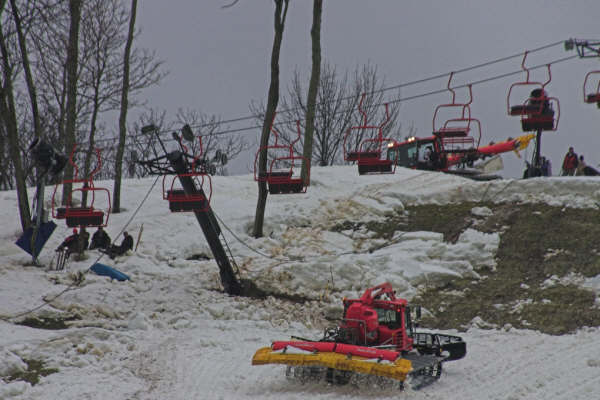
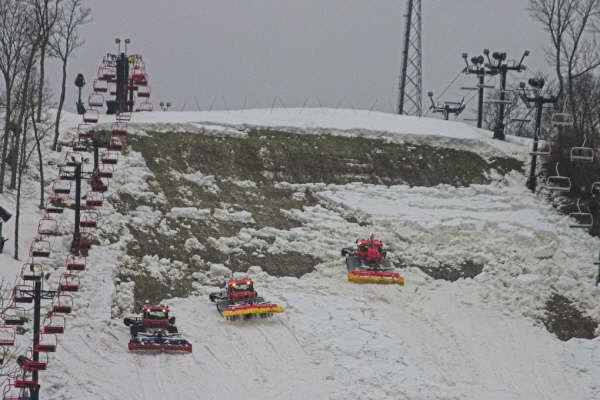
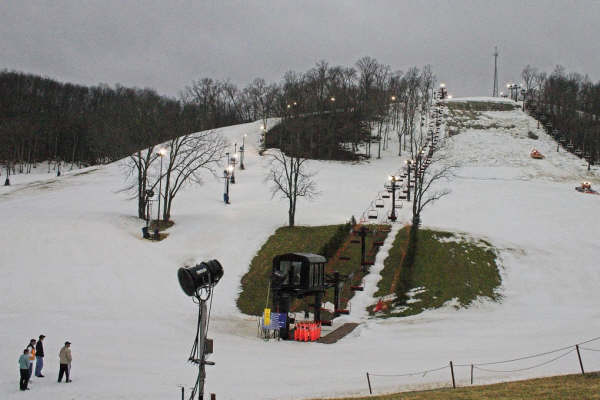
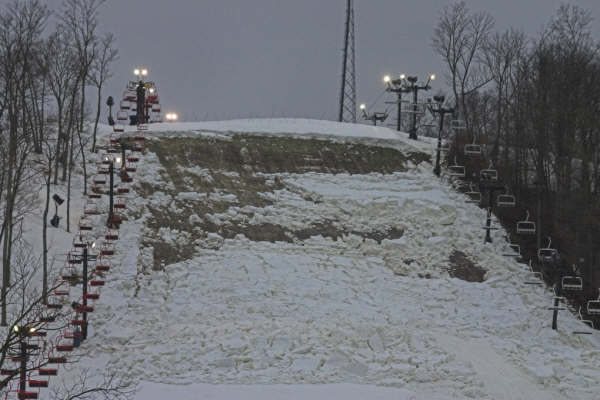
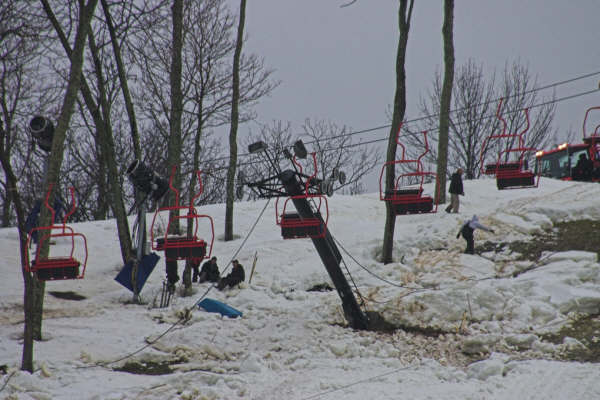
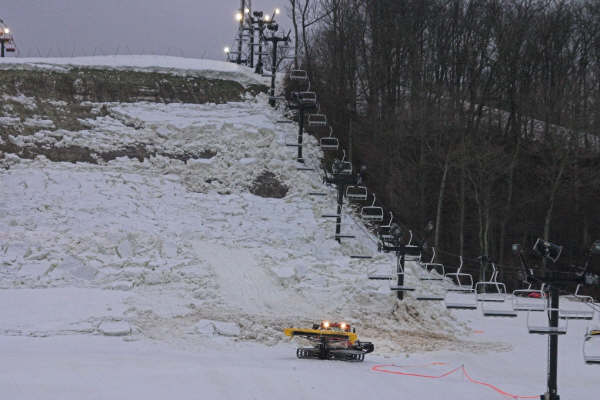
In one of the most bizarre occurrences an avalanche occurred in the Midwest. During the fall of 2006 at the Indiana ski resort Perfect North Slope. This central Indiana resort was making snow on bare ground, as is common at most resorts. After a night of snow making the staff arrived to see the slope had avalanched.
Not enough research was done on this avalanche but several firsts or at least extremely unusual things occurred during this avalanche
- ·An avalanche occurred in the Midwest
- ·The avalanche was composed of 100% man made snow
- ·The avalanche slid on bare ground with no snow layer below


 Recreation Law