
If you make a promise to attract participants, you must come through on your promises.
Posted: September 27, 2010 Filed under: Uncategorized Leave a commentCase goes back to trial court on marathoner’s marathoner’s claim that there was not promised electrolyte replacement at water stations.
In this case, a marathon ran out of the promised electrolyte replacement drink by the time the runners at the rear came through the aid stations. The plaintiff suffered a grand mal seizure on a flight home and blamed the seizure on the lack of water and electrolyte drinks. Because the advertising for the race promised the replacement drinks and the race organizer admitted in a letter post race that they did not have the drinks the appellate court held the plaintiff had a case and sent the decision back to the trial court for trial.
The plaintiff entered the “Suzuki Rock ‘N’ Roll Marathon in San Diego. Elite Racing, Inc. organized and ran the event. While on a flight home to Chicago, he suffered a Grand mal seizure, which left him with some memory loss and in a hospital for several days.
Elite sent written materials to the participants stated that there would be 23 water and refreshment stations on the course. All stations would include water, and 11 stations would distribute “Race Day” an electrolyte fluid.
When the plaintiff arrived at the first two stations, there was no water and no electrolyte fluid. At the third station, there was a volunteer with a jug of water and cups. At no station while the plaintiff was running was there any electrolyte fluid.
After the race, Elite sent a letter to participants stating there were problems, and they took full responsibility for the problems.
The trial court granted the defendant’s motion for summary judgment because the plaintiff assumed the risk of his injuries. The appellate court reversed because failure on the part of the organizer to provide a promised condition of the race could not be assumed by the plaintiff. You cannot assume what you do not know or understand.
The court stated that the scope of the legal duty owed is dependent upon the type of activity and the relationship between the parties. A sponsoring organization must “the steps the sponsoring business entity reasonably should be obligated to take in order to minimize the risks without altering the nature of the sport.” A race organizer has a duty to conduct a reasonably safe event to the extent possible without altering the nature of the event.
This duty includes the obligation to minimize the risks of dehydration and hyponatremia by providing adequate water and electrolyte fluids along the 26-mile course–particularly where the race organizer represents to the participants that these will be available at specific locations throughout the race.
Such steps are reasonable and do not alter the nature of the sport. Accordingly, we hold this is a case involving secondary assumption of risk
Because the steps could have been done, were promised in the marketing material and were not done the plaintiff could not assume the risk.
So?
Marketing Makes Promises that Risk Management Must Pay For
If you say you are going to do it to get participants to your activity, if what you promise is necessary to keep participants safe, or that they can allege put them at greater risk you better well do it.
There are some real issues here when the alleged medical condition, hyponatremia, is from drinking too much water and the allegations are based on not enough water. That is something that was confusing. The court did not care. As long as the court had an expert’s opinion, a physician, supporting the allegation the court is semi-powerless to argue anything differently.
Whether you do this before you market your event, or before you let possible participants know, make a list of the promises you are making. If one of the promises is iffy, then you had better made sure participants understand that. As the event or activity receives a closer look at your list of promises and check them off when they are covered. Any boxes without a check mark are a possible lawsuit when it comes to the safety of the participants.
Another way of looking at this is, would you run a whitewater rafting trip without Personal Floatation Devices (PFD’s) for the participants? Would you go sky diving without a parachute? If the promised benefit or issue is necessary for safety you release may not protect you from suit.
Normally, I would encourage a possible defendant to deal with injured participants. Sending a letter post race explaining issues is in that realm. Admitting you screwed up may sometimes be a good thing. However, saying it is always better than writing it. You can gauge a person’s reaction and deal with their issues in person. A letter lacks personality and does not care. Unless you knew that a possible plaintiff was out there, I would still probably encourage it. The court read the letter as proof of the court’s analysis, not as proof of the facts. Therefore, the letter was harmful, but not critical.
The obvious issue that is not answered is why not use a release. The case does not mention one. Probably, a release under California law would have prevented this lawsuit, but not in all states. A release can be defeated because of fraud or misrepresentation.
No matter what, make sure the promises you make, in writing, on your website, in your emails, on the phone or in person can be fulfilled. A broke promise coupled with an injury is a lawsuit if an injury occurs.
What do you think? Leave a comment.
Copyright 2010 Recreation Law (720) Edit Law, Recreaton.Law@Gmail.com
© 2010 James H. Moss
Twitter: RecreationLaw
Facebook: Rec.Law.Now
Facebook Page: Outdoor Recreation & Adventure Travel Law
Blog: www.recreation-law.com
Mobile Site: http://m.recreation-law.com
#RecreationLaw, #@RecreationLaw, #Cycling.Law #Fitness.Law, #Ski.Law, #Outside.Law, #Recreation.Law, #Recreation-Law.com, #Outdoor Law, #Recreation Law, #Outdoor Recreation Law, #Adventure Travel Law, #law, #Travel Law, #Jim Moss, #James H. Moss, #Attorney at Law, #Tourism, #Adventure Tourism, #Rec-Law, #Rec-Law Blog, #Recreation Law, #Recreation Law Blog, #Risk Management, #Human Powered, #Human Powered Recreation,# Cycling Law, #Bicycling Law, #Fitness Law, #Recreation-Law.com, #Backpacking, #Hiking, #Mountaineering, #Ice Climbing, #Rock Climbing, #Ropes Course, #Challenge Course, #Summer Camp, #Camps, #Youth Camps, #Skiing, #Ski Areas, #Negligence, #Snowboarding, #RecreationLaw, #@RecreationLaw, #Cycling.Law #Fitness.Law, #SkiLaw, #Outside.Law, #Recreation.Law, #RecreationLaw.com, #OutdoorLaw, #RecreationLaw,
WordPress Tags: recreation,adventure,tourism,management,Race,assumption,Suzuki,Rock,Roll,Marathon,participants
Saffro v. Elite Racing, Inc., 98 Cal. App. 4th 173; 119 Cal. Rptr. 2d 497; 2002 Cal. App. LEXIS 4076; 2002 Cal. Daily Op. Service 3941; 2002 Daily Journal DAR 5009
Posted: September 27, 2010 Filed under: Assumption of the Risk, California, Legal Case, Racing | Tags: negligent supervision, Racing, running, San Diego, Suzuki Rock 'N' Roll Marathon Leave a commentRichard Saffro, Plaintiff and Appellant, v. Elite Racing, Inc., Defendant and Respondent.
No. D037591.
COURT OF APPEAL OF CALIFORNIA, FOURTH APPELLATE DISTRICT, DIVISION ONE
98 Cal. App. 4th 173; 119 Cal. Rptr. 2d 497; 2002 Cal. App. LEXIS 4076; 2002 Cal. Daily Op. Service 3941; 2002 Daily Journal DAR 5009
May 7, 2002, Decided
NOTICE: [***1] CERTIFIED FOR PUBLICATION
SUBSEQUENT HISTORY: Rehearing Denied May 31, 2002.
Review Denied July 31, 2002, Reported at: 2002 Cal. LEXIS 5268.
PRIOR HISTORY: APPEAL from a judgment of the Superior Court of San Diego County. Super. Ct. No. 731713. Linda B. Quinn, Judge.
DISPOSITION: Reversed.
SUMMARY:
CALIFORNIA OFFICIAL REPORTS SUMMARY A marathon runner brought an action for negligence and negligent supervision against the organizers of a particular 26-mile race. Plaintiff suffered a grand mal seizure a few hours after he ran this race, which his medical experts opined was the result of hyponatremia caused by his inability to consume adequate amounts of water and electrolyte replacement drinks during the marathon. His injuries caused plaintiff to suffer a neurological deficit; he retained only a vague recollection of the race itself. Consequently, he introduced deposition testimony of another runner who testified that there was no electrolyte fluid available along the race route and no water available during a 45-minute delay in starting the race, despite defendant’s pre-race representations that adequate amounts of both would be made available to the runners. After the race, defendants wrote a letter to participants, in which they admitted that their provision of “race fundamentals” had been inadequate. The trial court granted defendant’s summary judgment on the ground that plaintiff’s action was barred by the doctrine of primary assumption of the risk. (Superior Court of San Diego County, No. 731713, Linda B. Quinn, Judge.)
A marathon runner brought an action for negligence and negligent supervision against the organizers of a particular 26-mile race. Plaintiff suffered a grand mal seizure a few hours after he ran this race, which his medical experts opined was the result of hyponatremia caused by his inability to consume adequate amounts of water and electrolyte replacement drinks during the marathon. His injuries caused plaintiff to suffer a neurological deficit; he retained only a vague recollection of the race itself. Consequently, he introduced deposition testimony of another runner who testified that there was no electrolyte fluid available along the race route and no water available during a 45-minute delay in starting the race, despite defendant’s pre-race representations that adequate amounts of both would be made available to the runners. After the race, defendants wrote a letter to participants, in which they admitted that their provision of “race fundamentals” had been inadequate. The trial court granted defendant’s summary judgment on the ground that plaintiff’s action was barred by the doctrine of primary assumption of the risk. (Superior Court of San Diego County, No. 731713, Linda B. Quinn, Judge.)
The Court of Appeal reversed. The court held that plaintiff’s action was not barred by the doctrine of primary assumption of the risk. The organizer of a marathon has a duty to produce a reasonably safe event. This duty requires it to take reasonable steps to minimize the risks without altering the nature of the sport, including the provision of sufficient water and electrolyte replacement drinks. The court further held that the circumstantial evidence presented by plaintiff created an issue of fact regarding causation. (Opinion by McIntyre, Acting P. J., with O’Rourke and McConnell, JJ., concurring.)
HEADNOTES
CALIFORNIA OFFICIAL REPORTS HEADNOTES
Classified to California Digest of Official Reports
(1)Negligence § 122–Actions–Appeal–Scope of Review–Questions of Law–Assumption of Risk. –The issue of assumption of risk involves the existence and scope of a defendant’s duty of care, which is a legal question that depends on the nature of the activity involved and the parties’ relationship to that activity. An appellate court reviews de novo a trial court’s determination on the issue of assumption of risk, and all doubts as to the propriety of granting a motion for summary judgment must be resolved in favor of the party opposing the motion.
(2)Negligence § 37–Exercise of Care by Plaintiff–Primary and Secondary Assumption of Risk. –The doctrine of assumption of risk in negligence cases embodies two components: (1) primary assumption of risk–where the defendant owes no duty to the plaintiff to protect him or her from the particular risk, and (2) secondary assumption of risk–where the defendant owes the plaintiff a duty, but the plaintiff knowingly encounters a risk created by the breach of that duty. Primary assumption of risk operates as a complete bar to a plaintiff’s negligence cause of action, while the doctrine of secondary assumption of risks is part of the comparative fault scheme, where the trier of fact considers the relative responsibility of the parties in apportioning the loss.
(3)Negligence § 37–Exercise of Care by Plaintiff–Primary Assumption of Risk–Sports Activities–Legal Duty of Defendant–Role in Sport. –Before concluding that a sports-related negligence case comes within the doctrine of primary assumption of risk, a court must not only examine the nature of the sport, but also the defendant’s role in, or relationship to, the sport. The scope of the legal duty owed by the defendant will frequently depend on this role or relationship. The risks inherent in the sport are defined not only by the nature of the sport itself, but also by reference to the steps the sponsoring business entity reasonably should be obligated to take in order to minimize the risks without altering the nature of the sport.
(4a)(4b)Negligence § 37.2–Exercise of Care by Plaintiff–Primary Assumption of Risk–Sports Activities–Legal Duty of Organizer of Marathon Race–Provision of Fluids to Runners. –The trial court erred in finding that an action for negligence and negligent supervision brought against the organizers of a particular 26-mile race by a marathon runner was barred by the doctrine of primary assumption of risk. Plaintiff suffered a grand mal seizure a few hours after he ran this race, which his medical experts opined was the result of hyponatremia caused by his inability to consume adequate amounts of water and electrolyte fluids during the marathon. His injuries caused plaintiff to suffer a neurological deficit; he retained only a vague recollection of the race itself. Consequently, he introduced deposition testimony of another runner that there was no electrolyte fluid available along the race route and no water available during a 45-minute delay in starting the race, despite defendant’s pre-race representations that adequate amounts of both would be made available to the runners. After the race, defendant wrote a letter to participants, in which it admitted that its provision of “race fundamentals” had been inadequate. The organizer of a marathon has a duty to produce a reasonably safe event. This duty requires it to take reasonable steps to minimize the risks without altering the nature of the sport. Further, the circumstantial evidence presented by plaintiff created an issue of fact regarding causation.
[See 6 Witkin, Summary of Cal. Law (9th ed. 1988) Torts, § 1090C.]
(5)Negligence § 72–Actions–Burden of Proof–Proximate Causation–Shifting Burden to Defendant–When Negligence Renders Plaintiff Incapable of Proving Causation. –When there is a substantial probability that a defendant’s negligence was a cause of an injury and when this negligence makes it impossible as a practical matter for the plaintiff to prove proximate causation conclusively, it is appropriate to shift the burden to the defendant to prove its negligence was not a cause of the injury. In these circumstances, as a matter of public policy, the burden is more appropriately borne by the party with greater access to information.
COUNSEL: Higgs, Fletcher & Mack and John Morris for Plaintiff and Appellant.
Royce, Grimm, Vranjes, McCormick & Graham and A. Carl Yaeckel for Defendant and Respondent.
JUDGES: Opinion by McIntyre, Acting P. J., with O’Rourke and McConnell, JJ., concurring.
OPINION BY: McINTYRE
OPINION
[*175] [**498] McINTYRE, Acting P. J.
In this case we conclude that [HN1] the organizer of a marathon has a duty to produce a reasonably safe event. This duty requires it to take reasonable steps to “minimize the risks without altering the nature of the sport”–which includes providing sufficient water and electrolyte replacement drinks as represented in the informational materials provided to the participants. (See Knight v. Jewett (1992) 3 Cal. 4th 296, 317 [11 Cal. Rptr. 2d 2, 834 P.2d 696].)
Richard Saffro appeals from [***2] a summary judgment entered against him on his complaint against Elite Racing, Inc. (Elite) for negligence and negligent [*176] supervision in connection with the 1998 “Suzuki Rock ‘N’ Roll Marathon” in San Diego. Saffro contends the judgment should be reversed because the trial court erred in (1) ruling his suit was barred by the doctrine of primary assumption of risk; (2) excluding the declarations of three race participants; and (3) denying his motion [**499] for reconsideration. We agree with Saffro’s first contention and find there are issues of material fact on the questions of breach of duty and causation. Thus, we reverse the judgment. This renders Saffro’s second and third contentions moot.
FACTUAL AND PROCEDURAL BACKGROUND
The following facts are derived from the evidence admitted by the trial court. On June 21, 1998, Saffro ran in the marathon organized and conducted by Elite. That same day, after completing the race, Saffro boarded a plane to return home to Chicago. Between 60 and 90 minutes into the flight, Saffro suffered a grand mal seizure, necessitating an emergency landing in St. Louis. He was hospitalized in St. Louis and diagnosed with severe hyponatremia–which [***3] occurs as a result of decreased sodium concentration in the blood, as well as pulmonary edema and cerebral edema resulting from the hyponatremia. Saffro’s condition was critical; he was kept on a ventilator for four days and hospitalized for a longer period. His injuries caused him to suffer neurological deficit; indeed, Saffro’s only memory of running the marathon was a “vague recollection of hearing some music, some bands . . . .” Saffro submitted the declarations of medical experts who opined that his hyponatremia was caused by the inability to consume adequate amounts of water and fluids containing electrolytes (such as Gatorade and Race Day) during the marathon.
Prior to the marathon, Elite sent written materials to the participants stating there would be 23 water and refreshment stations located throughout the course, from the 2-mile mark to the 25.1-mile mark. Elite represented that all stations would include water and 11 stations would also distribute Race Day, an electrolyte fluid. Saffro presented evidence that it is customary in the field and runners expect, on the basis of their entry fee, to be “support[ed] along the course” and provided with water and electrolyte [***4] fluids at regular intervals. In addition, he testified that in the other two marathons he had run, it was his practice to stop at every refreshment stand and drink the water and electrolyte fluids provided.
Elite also informed the runners in writing that the race would start at 7:00 a.m. and that it anticipated all runners would reach the starting line in less than five minutes. About 6:15 a.m. on the day of the marathon, Saffro drank 12 to 16 ounces of water and then was directed to his “corral” to await the [*177] scheduled 7:00 a.m. start of the race with other runners of similar ability. One thousand participants were assigned to each corral based on their projected race times, with the fastest runners stationed closest to the starting line. No one without an official marathon number was allowed to enter the corrals. The race did not start until about 7:45 a.m., however. During the delay, the cloud cover burned off and it became increasingly warm, yet the runners could not leave the corrals to get more water or other fluids. Several announcements were made during the delay that the race would begin in “only five or ten more minutes”–which was not the case.
According to [***5] Elite’s records, Saffro completed the marathon in 4 hours, 17 minutes and 32 seconds. Another runner, Kelley Magill, finished the race in approximately 4 hours and 45 minutes. Magill testified that at the first refreshment station at the 2-mile mark, “there was nothing. There were no volunteers, no cups, no water. Nothing.” At the next station, there was only a big trash can filled with water–no cups and no volunteers. Magill was hoping to get some water there, but “there were so many people crowded around [the [**500] trash can], pushing and yelling” that she kept on running. At the third refreshment station at the 4.1-mile mark–the first station at which Race Day was supposed to be available, there was a volunteer with a jug of water and some cups, but they had run out of Race Day. Water was set out in cups on tables at the 20 remaining stations, but there was no Race Day. Magill looked for and asked for Race Day at every refreshment station along the course, but was told each time that they had “run out of it.” She kept running in the race because she thought “there had to be some at the next [station].”
In a postrace letter to the participants regarding the marathon, [***6] Elite stated:
“[W]e know that in order to take our place as one of the world’s great marathons the ‘race fundamentals’–as well as the bells and whistles, must be superb.
“Despite our efforts, we know that too many aspects of the event were not perfect, and we take full responsibility for any and all of those imperfections. We promise to correct them all next year. The race will start on time . . . and you’ll be able to drown at our water stations.”
Saffro filed his original complaint against Elite for negligence and negligent supervision on June 16, 1999, and on April 3, 2000, he filed an amended complaint stating the same causes of action. Elite filed a motion for summary judgment on May 11, 2000, on the ground that Saffro’s causes of action were barred by the doctrine of primary assumption of risk. The trial [*178] court granted the motion, ruling that hyponatremia is an inherent risk of running a marathon and thus, Saffro’s claims were barred by the primary assumption of risk doctrine. The court also concluded “there is no evidence that plaintiff attempted to obtain the sport drinks or water during the race at any of the water and refreshment stations or that he was [***7] prohibited from doing so.”
DISCUSSION
(1) [HN2] The issue of assumption of risk involves the existence and scope of a defendant’s duty of care, which is a legal question that depends on the nature of the activity involved and the parties’ relationship to that activity. ( Knight v. Jewett, supra, 3 Cal. 4th at p. 313.) [HN3] We review de novo the trial court’s determination on the issue of assumption of risk, and all doubts as to the propriety of granting a motion for summary judgment must be resolved in favor of the party opposing the motion. ( Morgan v. Fuji Country USA, Inc. (1995) 34 Cal. App. 4th 127, 131 [40 Cal. Rptr. 2d 249]; see also Palma v. U.S. Industrial Fasteners, Inc. (1984) 36 Cal. 3d 171, 183 [203 Cal. Rptr. 626, 681 P.2d 893].)
(2) [HN4] The doctrine of assumption of risk in negligence cases embodies two components: (1) primary assumption of risk–where the defendant owes no duty to the plaintiff to protect him or her from the particular risk, and (2) secondary assumption of risk–where the defendant owes the plaintiff a duty, but the plaintiff knowingly encounters a risk created by the breach of that duty. ( Knight v. Jewett, supra, 3 Cal. 4th at p. 308.) [***8] Primary assumption of risk operates as a complete bar to the plaintiff’s cause of action, while the doctrine of secondary assumption of risks is part of the comparative fault scheme, where the trier of fact considers the relative responsibility of the parties in apportioning the loss. ( Morgan v. Fuji Country USA, Inc., supra, 34 Cal. App. 4th at p. 132.)
[**501] (3) [HN5] Before concluding that a case comes within the doctrine of primary assumption of risk, a court must not only examine the nature of the sport, but also the ” ‘defendant’s role in, or relationship to, the sport.’ ” ( Morgan v. Fuji Country USA, Inc., supra, 34 Cal. App. 4th at p. 133, quoting Knight v. Jewett, supra, 3 Cal. 4th at p. 317.) Indeed, the scope of the legal duty owed by the defendant will frequently depend on such role or relationship. ( Knight v. Jewett, supra, 3 Cal. 4th at pp. 317-318.) The Knight court noted that many courts, in analyzing the duty of the owner of a sports facility or ski resort, had defined “the risks inherent in the sport not only by virtue of the nature of the sport itself, but also by reference to the steps the [***9] sponsoring business entity reasonably should be obligated to take in order to minimize the risks [*179] without altering the nature of the sport.” ( Id. at p. 317, italics added.) The court concluded “that in the sports setting, as elsewhere, the nature of the applicable duty or standard of care frequently varies with the role of the defendant whose conduct is at issue in a given case.” ( Id. at p. 318.)
Following Knight, we held in Morgan v. Fuji Country USA, Inc., supra, 34 Cal. App. 4th at page 134, that despite the fact that being struck by an errant ball is an inherent risk in the sport of golf, the owner of a golf course owes a duty to golfers “to provide a reasonably safe golf course” which requires it ” ‘to minimize the risks without altering the nature of the sport. [Citations.]’ ” (Ibid., quoting Knight v. Jewett, supra, 3 Cal. 4th at p. 317.) We noted that if the defendant were the golfer who had hit the errant ball, the plaintiff’s negligence action would be barred by the primary assumption of risk doctrine, but that the defendant owner of the golf course had an obligation to design [***10] a course that would minimize the risks that players would be hit by golf balls and affirmatively provide protection for players from being hit in the area of the course where the greatest danger existed. ( Morgan v. Fuji Country USA, Inc., supra, 34 Cal. App. 4th at p. 134, citing Knight v. Jewett, supra, 3 Cal. 4th at p. 317.) Therefore, we concluded the case was one involving secondary assumption of risk and that the trial court erred in granting summary judgment based on the doctrine of primary assumption of risk. ( Morgan v. Fuji Country USA, Inc., supra, 34 Cal. App. 4th at pp. 134-135.)
(4a) Similarly, here we hold [HN6] a race organizer that stages a marathon has a duty to organize and conduct a reasonably safe event, which requires it to “minimize the risks without altering the nature of the sport.” ( Knight v. Jewett, supra, 3 Cal. 4th at p. 317; Morgan v. Fuji Country USA, Inc., supra, 34 Cal. App. 4th at p. 134.) This duty includes the obligation to minimize the risks of dehydration and hyponatremia by providing adequate water and electrolyte fluids along the 26-mile course–particularly where the [***11] race organizer represents to the participants that these will be available at specific locations throughout the race. (See Morgan v. Fuji Country USA, Inc., supra, 34 Cal. App. 4th at p. 134; see also Knight v. Jewett, supra, 3 Cal. 4th at p. 317.) Such steps are reasonable and do not alter the nature of the sport. Accordingly, we hold this is a case involving secondary assumption of risk, and therefore, the trial court erred in ruling Saffro’s causes of action [**502] were barred by the doctrine of primary assumption of risk.
Moreover, we find that Saffro presented sufficient evidence to create an issue of fact as to whether Elite breached its duty to provide adequate water and fluids throughout the race. ( Morgan v. Fuji Country USA, Inc., supra, 34 Cal. App. 4th at pp. 134-135.) Magill, who finished the race within 30 [*180] minutes of Saffro, testified there was no water at the first station, only a trash can of water at the second station, and a jug of water at the third, and that Race Day was not available at any of the 23 stations. As Magill indicated in her deposition, when she was running the marathon, she did [***12] not know Race Day would not be available at any of the stations; rather, when she found she could not get Race Day at one station, she kept thinking it had to be available at the next. Moreover, Saffro suffered a grand mal seizure within hours of the race that his medical experts opined was the result of hyponatremia caused by his inability to consume adequate amounts of water and electrolyte fluids during the marathon. Elite also alluded to problems in providing adequate “race fundamentals” in a letter to participants following the race, and stated “[next year] you’ll be able to drown at our water stations.”
In addition, to the extent the trial court’s statement, “there is no evidence that plaintiff attempted to obtain the sport drinks or water during the race at any of the water and refreshment stations,” suggests a failure of proof on the issue of causation, we disagree. Saffro testified that his practice in running marathons is to stop at all the refreshment stands and drink the water and electrolyte fluids provided, and there is an issue of fact as to whether Elite made these liquids adequately available to him and other runners of similar ability and speed. Saffro’s medical [***13] experts also declared his hyponatremia was caused by his inability to consume adequate amounts of water and electrolyte fluids during the marathon. Moreover, it strains reason to conclude that Saffro or any runner in a major marathon would not stop or attempt to stop, at all, for water and fluids that are represented to be available throughout the course. Thus, the circumstantial evidence presented creates an issue of fact regarding causation, even though Saffro is unable to remember the details in running the race. (See KOVR-TV, Inc. v. Superior Court (1995) 31 Cal. App. 4th 1023, 1027-1028 [37 Cal. Rptr. 2d 431].)
Further, given Saffro’s resulting neurological injuries which have impaired his memory, and the evidence of inadequate provision of water and electrolyte fluids, this may be a case in which the burden of proof regarding causation would be shifted to Elite as a matter of public policy. (See Haft v. Lone Palm Hotel (1970) 3 Cal. 3d 756, 762 [91 Cal. Rptr. 745, 478 P.2d 465].) In Haft, the decedents were found dead in the bottom of a hotel pool; no one had witnessed them drown, but the hotel owners had failed to comply with several [***14] safety regulations regarding pools. ( Id. at pp. 762-763.) (5) The court held that [HN7] where there is a substantial probability that the defendant’s negligence was a cause of the injury and when such negligence makes it impossible as a practical matter for the plaintiff to prove proximate causation conclusively, it is appropriate to shift the burden to the defendant [*181] to prove its negligence was not a cause of the injury, i.e., in those circumstances, the burden was more appropriately borne by the party with greater access to information. ( Id. at p. 774, fn. 19.) (4b) We do not hold that the burden should be shifted in this case, only that the circumstances of [**503] this case raise this issue, and we leave this matter for the trial court to address, depending on what, if any, additional evidence is adduced.
Accordingly, because Saffro’s causes of action are not barred by the doctrine of primary assumption of risk, and there are issues of fact on the issues of negligence and causation, the trial court erred in entering summary judgment against him.
DISPOSITION
The judgment is reversed. Costs are awarded to Saffro.
O’Rourke, J., and McConnell, [***15] J., concurred.
A petition for a rehearing was denied May 31, 2002, and respondent’s petition for review by the Supreme Court was denied July 31, 2002. Brown, J., did not participate therein.
$40,365.79 smart?
Posted: September 24, 2010 Filed under: Skiing / Snow Boarding Leave a commentCheap Ski Movie is offering 40,365.79 to the person who knows the most about cheap ski trivia.
Head to the contest website http://www.cheapskimovie.com/win.html and sign up to enter the contest. Powder magazine will offer five questions a week for ten weeks in advance of the official contest start.
The official contest starts January 12, 2011.
Put those brain cells to work that have been collecting worthless ski trivia to work finally. Justify staying up until 3:00 AM watching trashy ski films. Justify that 5 feet stack of old ski magazines and that bedroom wall full of old ski posters.
Enter the contest!
Copyright 2010 Recreation Law (720) Edit Law, Recreaton.Law@Gmail.com
© 2010 James H. Moss
Keywords: #
outdoor law, #recreation law, #outdoor recreation law, #adventure travel law, #law, #travel law, #Jim Moss, #James H. Moss, #attorney at law, #tourism, #adventure tourism, #rec-law, #rec-law blog, #recreation law, #recreation law blog, #risk management, #Human Powered, #human powered recreation, #cheap ski movie, #Powder Magazine,
Technorati Tags: Jim Moss,recreation,adventure,Moss,attorney,tourism,management,Human,movie,Powder,Magazine,blog
Windows Live Tags: Jim Moss,recreation,adventure,Moss,attorney,tourism,management,Human,movie,Powder,Magazine,blog
WordPress Tags: Jim Moss,recreation,adventure,Moss,attorney,tourism,management,Human,movie,Powder,Magazine,blog
Blogger Labels: Jim Moss,recreation,adventure,Moss,attorney,tourism,management,Human,movie,Powder,Magazine,blog
Rough way to deal with fatalities: Police Raid
Posted: September 23, 2010 Filed under: Criminal Liability Leave a commentYou may hate lawsuits, but I believe they are better than jail time.
A Japanese tour organizer had eight tourists die on a mountain climb last year. To investigate what happened, he was raided by the Japanese police to look into possible charges of negligence.
Negligence in Japan is a criminal act. Here it is a civil lawsuit. A criminal act means you pay a fine to the government and/or go to jail. A civil suit, if you lose means you pay money to the injured parties or their heirs.
The deceased, all in their 60’s died of hypothermia. The negligence charges stem from the fact that they were found at different locations on the mountain.
See Authorities raid tour agent in mountain deaths.
Copyright 2010 Recreation Law (720) Edit Law, Recreaton.Law@Gmail.com
© 2010 James H. Moss
Keywords:
#outdoor law, #recreation law, #outdoor recreation law, #adventure travel law, #law, #travel law, #Jim Moss, #James H. Moss, #attorney at law, #tourism, #adventure tourism, #rec-law, #rec-law blog, #recreation law, #recreation law blog, #risk management, #fatality, #Japan, #Japanese, #tour operator, #foreign tour operator, #criminal, #crime, #criminal act,
Technorati Tags: fatalities,Police,Raid,recreation,adventure,Moss,James,attorney,tourism,management,Japan,Japanese,operator,crime,blog
Windows Live Tags: fatalities,Police,Raid,recreation,adventure,Moss,James,attorney,tourism,management,Japan,Japanese,operator,crime,blog
WordPress Tags: fatalities,Police,Raid,recreation,adventure,Moss,James,attorney,tourism,management,Japan,Japanese,operator,crime,blog
Blogger Labels: fatalities,Police,Raid,recreation,adventure,Moss,James,attorney,tourism,management,Japan,Japanese,operator,crime,blog
Who You Gonna’ Call, Ghostbusters?
Posted: September 22, 2010 Filed under: Risk Management | Tags: planning, Risk Management, risk management plan Leave a commentA real risk management plan.
For some of us, the worst part of any accident is after the bleeding has stopped or the victim is in the hospital. What happens next? Who should be contacted and how? Who should do the calling? Many times, insurance companies seemingly train us to play “Ostrich.” Stick our heads in the ground, hide and ignore what may be happening all around us. For example, take a look at the back of you your automobile insurance card. On most insurance cards, you are instructed to say nothing to anyone except the police.
For this industry, this may be the wrong advice. For most of you, this may sound heretical. However, to do something different will definitely strike fear in the hearts of insurance companies and defense attorneys. (Yeah, as if an insurance company has a heart to scare! [Just kidding guys!])
One of the big reasons most of us are in this business is because we like two things: the outdoors, and people. We develop great relationships with the people we introduce to the wilderness and help some of them to make changes in their lives. We are in the business watching our guests to see new vistas both inside and in front of them. To wreck that experience after an accident occurs is contrary to your goals and desires. It is also contrary to the basic decency and curtsey you were taught as a child. Why not take the parts of the experience you enjoy and the relationship you have created and build on it when disaster occurs.
Let’s look at some examples:
OSTRICH RISK MANAGEMENT PLAN
In this scenario, you are notified that a disaster has occurred. One person is dead and several people are badly hurt. You have everyone transported to where they can be treated. The injured are taken to the hospital; the deceased to the morgue; and everyone else safely to a hotel. Then you run home, turn out the lights, and hide under your bed. While you are hiding, this is what is occurring.
Hospital: Hello? Mrs. Smith? Mrs. Smith, this is Nurse Jane Fuzzywuzzy at Metropolitan Memorial Hospital. I need to know if your husband is allergic to any drugs or medications.
Mrs. Smith has been celebrating the fact her husband and breadwinner is gone for a week playing testosterone games. All of a sudden, out of nowhere, she is answering questions about her husband’s medical needs with no warning and without hearing any other information, such as how the accident occurred.
Hospital Pay Phone call to Jane Brown: Jane? Jane! Oh, Jane! It was terrible. It was a disaster! I don’t know what happened, but I think Bill is hurt bad. The hospital will not tell me anything. (Patient privacy laws remember?). I called you just as soon as I could….
Jane has been worried for a week. She just knew something was going to happen while Bill was gone. Then she gets a hysterical phone call from one of Bill’s friends from the hospital, and no one told her anything.
Sheriff’s Department (on voice mail): Ms. Jones, this is Deputy Dawg of the Monumental Screw Up County Sheriff’s department. I’m sorry to inform you that your husband, Jim or was it John, darn, I can’t read my own notes, anyway he was rock climbing with XYZ Rock Climbing company, you know those hippies down on the other side of town, they look funny, well they killed him today rock climbing. If you have any questions, you can just call back here and ask for me. Ok? Good-bye.
Ms. Jones was just told by the sheriff’s department that someone killed her husband. She is alone, lost and destroyed.
All three of these people, unexpectedly have had their lives turned upside down. Let’s look at what is running through their minds.
Questions! They all have questions. What happened? How did it happen? Are they going to be all right? How do I get to where they are to take care of them? How do I pay to get to where they are? How do I get his body home? Who is going to help me? How am I going to survive? Whom can I call for help? What am I going to do without him?
Now let look at some better scenarios.
Scene 1 and 2
At Your Office as Soon as you were notified of a Problem: Mrs. Smith, this is Bob Jones of ABC Company. Your husband was injured today while climbing with us. He is being transported to Metropolitan Memorial Hospital. I do not know his condition is at this time, but I am on my way to the hospital right now to check on him. As soon as I learn anything, I will call you back. Do you have something to write on, I want to give you my telephone numbers. The office 800 number here is 877-Don’t Die. If you call here and I’m not here, ask for Suzy. My cell phone number is 123-456-7890. My home telephone number is 102-345-6789. My name is Bob Jones. It will take me about 45 minutes to get to the hospital. As soon as I find out anything, I will call you right away.
At Hospital: Mrs. Smith, this is Bob Jones, I just was talking to your husband’s doctor, (or here is your husband’s doctor). Your husband is going to recover fully. He broke his arm while climbing. His Doctor’s name is Dr. Wacko, and his telephone number is 321-654-0987. The hospital is Local Memorial Hospital, and the telephone number is 231-465-0897. I am not sure what his room number is, but as soon as I find out, I will call you back. As soon as I can talk to your husband, I will also call you back. Is there anything else I can do for you at this time? I am going to stay here so call me if you have any more questions. Just call my cell phone number you still have that number correct? Great, I’ll call you in a bit. I’m glad your husband will be all right.
After Husband is in Hospital Room. Mrs. Smith, this is Bob Jones, here is your husband. Then hand the telephone to the husband.
After Mrs. Smith has talked to her husband. Mr. Smith, here is my home, cellular and office telephone numbers. Call me any time if you need anything. Is there anything I can get for you right now? Ok, I’ll stop back tomorrow morning and see how you are doing. The doctor said you are going to be discharged tomorrow. I will start to arrange to make sure you can get home, as soon as I get back to my office.
Next Day. Hello Mr. Smith, how are you today. I talked to your wife on the way over here. She said she would be here about noon and expects to take your home right after that. How are you feeling? Great. I brought you this ABC Company T-shirt, and I have a rain check here for you. When you arm heals up, we would like you to come back and finish your day of rock climbing. You have my telephone number, so if you need anything or have any questions give me a call. It was nice meeting you, and I am very sorry you were hurt, as we discussed before you went out on the trip, occasionally accidents do happen when climbing, but we sure are sorry it happened to you. I hope you come back and see us again.
Next Week. Hello Mr. Smith, how are you? This is Bob Jones from ABC Company. I just thought I would call and see how you are doing. Great, I am glad things are going fine. Still have my telephone numbers? Great. It has been nice talking to you take care of yourself. Give me a call when you are ready to go climbing again.
Some of you might argue this is setting you up for a lawsuit, but how? You have done nothing except be nice and courteous, (the way your mother would expect you to act). Worst-case scenario is you are sued. The worst-case scenario is the same either way. Even if everything you did was presented to a jury, what could be used against you? You acted as a kind and courteous businessperson. You did not admit liability, you reinforced the language in your release, and you helped an injured human being.
Scene 3
When a death occurs, you must do some research immediately. Contact any friends of the deceased who were on the trip when the accident occurred and learn as much as you can. Find out who you can call to go visit the deceased’s family. Call that person and have them go to the family’s house to be there. If those people are not available, or in addition to that person, call the person’s minister or priest if possible.
“Mrs. Jones, this is Bob Jones of ABC Company. Mrs. Jones, I am sorry to tell you that your husband was fatally injured today rock climbing. I am not sure what happened, as soon as we learn something I will call you and let you know. Mrs. Jones, is there anyone I can call for you, I have all ready called your priest and Mrs. Neighbor and asked them to come over to your house. Do you have something to write with, I want to give you my telephone numbers so you can contact me? The office 800 number here is 877 Did Die. If you call here and I am not here, ask for Suzy. My cell phone number is 123-456-7890. My home telephone number is 102-345-6789. My name is Bob Jones. As soon as I find out what happened, I will call you back and let you know. I will also call you back and talk to you when I find out what the authorities have done with your husband and how we can transport him back to you.”
The critical component in all three of these telephone calls is you. You are there to answer their questions. They have your telephone number to use to call a nice, friendly, helpful person to answer their questions. You are not creating hospital or bureaucratic nightmares. You are not allowing the system to create a disaster for you. You are attempting to ease their problems.
The call from the previous paragraph about the fatality is not going to be easy. In fact, people are going to be crying and screaming on the phone. However, it will pay off both for you and for the family. I know I have made those phone calls.
In a fatality, many counties require the Sheriff’s department or the corner to make the notification of the death. That is done usually by having the local law enforcement authorities stop by in person. Make sure you stay on top of the situation. In one case, it took twelve hours from the time of death to notify the family because of bureaucratic delays. The family did not need this. You should work with the authorities to notify the family in a timely and kind manner.
Many times, you will be confronted with angry or even hostile responses. Do not waiver; continue with the same calm helpful tone of voice. Do not bow down, hide, or become angry. Just continue to help. Some people when faced with these situations react in ways that might be difficult to deal with. In those situations, they will eventually calm down and thank you for your response. Becoming angry or hostile will just send them to an attorney quicker.
The other reason people hide from this duty is time. They believe they do not have the time to respond to these situations. Let’s look at this from a couple of different perspectives. If you lose your company, you will have plenty of time to do anything you want, stand in unemployment lines, stand in free food lines, or sit and feed pigeons in the park. In addition, the time you spend working with your injured clients may save you hundreds of hours later. If you are sued, think about how much time you will miss from your business for trials, depositions, working with your attorneys and everything else that is involved with defending a suit. Finally, consider it marketing time. If someone has been injured, they are going to tell everyone at work, school, church, and in their community. They can either put a good spin or a bad spin on how they were treated. One description of the facts can help your company immensely; the other can only hurt you. The opportunity is in your hands.
SEVEN IMPORTANT POINTS TO REMEMBER!
1. You should make the phone calls from your base of operation. Not from the field. The trip leaders have their hand full with the living, the bleeding, and the dead they do not have the time or energy to deal with calling people. (Why everyone carries client emergency contact information with them in the field is beyond me. Yet, every time I tell someone to leave it behind, they are aghast!). They are already emotionally, physically and mentally exhausted. They do not need any additional responsibilities. You have access to telephones, faxes, and the Internet. You are set up for communication. If you are running international treks, you are prepared to call overseas cheaply and easily. If you are US based, you can give the people a local number or an 800 number to call you back.
2. You are familiar with the travel business! This is a promise, I am making too you. If someone dies on your trip, the family will show up at the scene someday to see what happened. Ninety-nine percent of the time!, I had a Risk Management Seminar graduate call me to tell me that a family had come from Pakistan to the East Coast to see where their relative had died. They will come.
Knowing this, you can help them arrive and take care of them while they are on-site. You have relationships with the airlines that will allow you to get these people to your location quickly and easily. You can meet them at the airport and help them to a hotel. You know the hotel owners because you market to them every day. You know what the family of the injured or deceased does not know. If you have a guest who is going to spend several days or more in your local hospital, the family will come to the bedside of the injured person. Why not be prepared, help them get to where they need to be, stay and go home. It is better to know they are coming, then to be introduced, unexpectedly, in a hospital room. Eating alone in a strange city is intimidating. The chance to take someone out and provide them with a non-hospital kitchen meal will do wonders for them and your relationship. You can answer their questions; you can get to know them. You can become their friend. You can provide them with a source of information. You can show them you are a human being, not just a nameless face. A human being is hard to sue. A nameless face and a Company are easy to sue.
3. Who would you want to call if a member of your family was injured? Would you want a telephone call from the company your family member was with when they were injured or died? I believe you would. I also believe that everyone would. In every single deposition, I have attended or read at some point a family member says, “They didn’t even call me.”
People want some connection. People believe what their mother taught them more than what insurance companies want them to do. Our mothers taught us to make that telephone call.
4. The family members are going to have questions, and they will stop at nothing to have them answered. Here again, at every single trial, at every single deposition, at some time during every negotiation the attorney hears the comment “they would not even return my telephone calls to tell me what happened.”
You may not have the answers, but that still does not mean the questions are not going to be asked. If you do not answer the questions, the family will find someone to force you to answer them. That person will be an attorney. One of the great lines used by attorneys to clinch the sale is “I’ll get you your answers.” For most attorneys, that translates to we will use this excuse to get money out of the defendant. In addition, it works if the family member does not know how or why their loved one died. You understand what happens on the river or in the mountains. Those who stay at home have no idea what occurs, except what they see on television.
After a while, the desire to have those questions answered may go away, but the attorney can keep the desire alive or can roll that desire into the desire for money. One emotion, grief is converted to another emotion, greed. If they do not answer the question, they should pay. The desire for money never goes away.
I had this happen to me personally. I was in Salt Lake City years ago when the tornado hit that town. I ended up performing CPR on the one man who died. A month later, his widow called me. I did not have any answers for her, and she knew that. However, she wanted a connection with the last person to deal with her husband. I talked about what I did, what I thought, how it happened from my eyes. She was extremely grateful. Some call this closure; some might call it answering questions, whatever it is people wanted to know.
5. You can provide them with a central number to help with many of their problems. They can call you to get answers. They can call you to get personal property back. They can call you for transportation. They can call you to find the rest of their party. You, of all the people involved, are going to have the most answers.
I was working for a business when a guest was involved in an accident and became a quadriplegic. The mother in law of the injured guest called wanting to know where the guest’s watch was. It took time to find the medical report that stated the watch had been put inside the guest’s mitten, and then stuffed inside his coat pocket. I faxed that report to the mother in law. She called me back to say they had found the watch. She thanked me for my efforts, and she thanked the resort for their efforts on behalf of her son-in-law. People, who thank you for your help do not sue, and that family did not sue.
6. You are going to present the best front for your company. Not everyone else the family members deal with will present your business in a good light. Hospitals and the people who work there only see adventure activities as dangerous. They only see the injured people coming through the doors; they do not see the thousands of people having fun. The sheriff department and the state or federal land management agency just sees paperwork because people are injured. The only see numbers, whether 1 or 100 it is more work for them. Here again, they do not see the happy satisfied customers.
7. You DO NOT tell the family member you killed their loved one.
REMEMBER
A. Look up the emergency numbers your clients provided. Review the other information you have to see if it has any other information you may need to know. Have someone else determine the quickest way for the family to get to your location. Make the telephone call.
Tell them what happened to their loved one. Tell them where that person is and how to get there. Give them your name and telephone number so they can call you if they have any more questions. Tell them you will call them back the next day to check on them. Be prepared to tell them what happened, if you know. Provide facts, not guesses or opinions. If you were not there, you cannot guess or speculate. Ask them if they want to come to the hospital/scene. Tell them if they do not know you can help arrange for them. Do not speculate do not lie both will condemn you.
Many times, they will call you back after the initial shock wears off. They will call back to ask more questions. Be prepared for that. Again, ask them if they want to come. You need to know what they are going to do. You need to know if relatives are going to be out looking around at your business or the accident scene.
If they do want to come, pick up some of the tab if you can. “I’ve made arrangements for you to stay at the Bad Bed Motel. I can pick you up at the airport and take you to the hospital and then to the motel. What else can I do to help you?”
Think about the situation that person is in and what you would want to have done if you were in their shoes. What you would want to know, what questions would you have? If you cannot come up with anything, ask your spouse or mother. Mother’s are great at this.
Do they have the money to rent a car? Can you provide them with a car and driver? They may be lonely in a new town, have dinner with them or invite them over for dinner.
If you are dealing with a death, contact a mortician and find out what needs to occur. Become the intermediary to help. Tell the people you will go to the airport with the deceased to make sure things work smoothly. Call them from the airport and tell them the body is on the flight, and the flight left 20 minutes late (I fly out of Denver) and the expected time of arrival.
Keep in touch over time. After the second call on the second day, call the next day. Skip a day and call again. Call a week later. Continue to stay in touch. After six months tell them, you probably will not call again, unless they want you too. Tell them to call you any time, and if there is anything else, they need to let you know.
Your insurance company is afraid you are going to admit liability. If you are smart enough to subscribe to the law review, you will not say something stupid. Be honest, answer questions. Tell them the river, the weather, or Mother Nature acts in ways you cannot control, and you could not predict. Tell them you are sorry for their loss. Act the way your mother taught you, and you may not have to act the way your lawyer says you must.
Conclusion
You have a great opportunity to prevent litigation if you do not play ostrich. That telephone call will be tough. However, when you are done, you will feel better 90% of the time.
What do you think? Leave a comment.
Copyright 2010 Recreation Law (720) Edit Law, Recreaton.Law@Gmail.com
Twitter: RecreationLaw
Facebook: Rec.Law.Now
Facebook Page: Outdoor Recreation & Adventure Travel Law
Blog: www.recreation-law.com
Mobile Site: http://m.recreation-law.com
#RecreationLaw, #@RecreationLaw, #Cycling.Law #Fitness.Law, #Ski.Law, #Outside.Law, #Recreation.Law, #Recreation-Law.com, #Outdoor Law, #Recreation Law, #Outdoor Recreation Law, #Adventure Travel Law, #law, #Travel Law, #Jim Moss, #James H. Moss, #Attorney at Law, #Tourism, #Adventure Tourism, #Rec-Law, #Rec-Law Blog, #Recreation Law, #Recreation Law Blog, #Risk Management, #Human Powered, #Human Powered Recreation,# Cycling Law, #Bicycling Law, #Fitness Law, #Recreation-Law.com, #Backpacking, #Hiking, #Mountaineering, #Ice Climbing, #Rock Climbing, #Ropes Course, #Challenge Course, #Summer Camp, #Camps, #Youth Camps, #Skiing, #Ski Areas, #Negligence, #Snowboarding, #RecreationLaw, #@RecreationLaw, #Cycling.Law #Fitness.Law, #SkiLaw, #Outside.Law, #Recreation.Law, #RecreationLaw.com, #OutdoorLaw, #RecreationLaw,
Technorati Tags: Ghostbusters,recreation,adventure,Moss,James,attorney,tourism,management,communication,insurance,whitewater,transportation,injuries,blog
Windows Live Tags: Ghostbusters,recreation,adventure,Moss,James,attorney,tourism,management,communication,insurance,whitewater,transportation,injuries,blog
WordPress Tags: Ghostbusters,recreation,adventure,Moss,James,attorney,tourism,management,communication,insurance,whitewater,transportation,injuries,blog
Blogger Labels: Ghostbusters,recreation,adventure,Moss,James,attorney,tourism,management,communication,insurance,whitewater,transportation,injuries,blog
We’ve known it for years! Adventure Tourism boosts the local economy.
Posted: September 21, 2010 Filed under: Adventure Travel 3 CommentsGeorge Washington University study shows adventure tourism boost’s local economies.
The study not only found that adventure tourism was a viable economic opportunity but also a rapidly growing market. The market is much larger than thought and growing rapidly. Additionally, no new infrastructure is needed to create or support the adventure tourism industry.
Because no new infrastructure is needed, the local environment should be preserved to support and grow this part of the economy.
89 million was spent on adventure tourism in 2009, 56 million of that on gear alone.
However, you knew that right!
The study was conducted by the George Washington University International Institute of Tourism Studies.
See Adventure tourism key to boosting economies.
Copyright 2010 Recreation Law (720) Edit Law, Recreaton.Law@Gmail.com
© 2010 James H. Moss
Keywords: :
#outdoor law, #recreation law, #outdoor recreation law, #adventure travel law, #law, #travel law, #Jim Moss, #James H. Moss, #attorney at law, #tourism, #adventure tourism, #rec-law, #rec-law blog, #recreation law, #recreation law blog, #George Washington University, #GWU, # International Institute of Tourism Studies, #George Washington University International Institute of Tourism Studies, #economic study, #market, #local economy,
Technorati Tags: Adventure,Tourism,recreation,Moss,James,attorney,George,Washington,International,Institute,blog
Windows Live Tags: Adventure,Tourism,recreation,Moss,James,attorney,George,Washington,International,Institute,blog
WordPress Tags: Adventure,Tourism,recreation,Moss,James,attorney,George,Washington,International,Institute,blog
Blogger Labels: Adventure,Tourism,recreation,Moss,James,attorney,George,Washington,International,Institute,blog
Burns, v. Cannondale Bicycle Company, 876 P.2d 415; 239 Utah Adv. Rep. 57; 1994 Utah App. LEXIS 84; CCH Prod. Liab. Rep. P13,960
Posted: September 20, 2010 Filed under: Cycling, Utah | Tags: Cannondale, Cannondale Bicycle Company, Cycling, Summary judgment, The bicycle Center Leave a commentTo Read an Analysis of this decision see: Summary Judgment granted for bicycle manufacturer and retailer on a breach of warranty and product liability claim.
Brian Burns, Plaintiff, Appellant, and Cross-Appellee, v. Cannondale Bicycle Company and The Bicycle Center, Defendants, Appellees, and Cross-Appellants.
Summary Judgment granted for bicycle manufacturer and retailer on a breach of warranty and product liability claim.
Posted: September 20, 2010 Filed under: Cycling, Utah | Tags: Cannondale, defective, Product liability, The bicycle Center 27 CommentsThis is an odd case and one that probably was filed simply to recover money. Everyone once in a while, that happens.
In this case, the plaintiff purchased a Cannondale bicycle from The Bicycle Center. A month later while riding the bike, he went over the handlebar. His injuries were never specified in the complaint. Three years later, right before the statute of limitations ran, he filed suit against Cannondale and the retailer.
The statute of limitations is the time frame that a lawsuit must be filed. Legislatures have created laws for different types of lawsuits setting forth how long a plaintiff has to file a suit. Another way of looking at this is defendants know that all lawsuits will be filed within a certain period of time, or they are barred.
Statutes of limitation vary by state. So a simple negligence claim may have a two-year statute of limitation in one state and three years in a neighboring state.
The plaintiff filed suit for “breach of the implied warranty of merchantability, breach of certain express warranties, and products liability.” He also filed a claim for “negligent assembly” against the retailer.
The plaintiff claimed that something popped off the brake which clamped down the brake on the tire causing him to fall. However, the plaintiff’s expert and the defendant’s expert both testified that if the brake had failed as stated by the plaintiff the opposite would have happened. The brake would have released from the wheel not braking at all.
The trial court granted the defendant’s motion for summary judgment dismissing the lawsuit. The plaintiff then appealed the decision leading to this decision.
The plaintiff claimed at the appellate level that the doctrine of spoliation of evidence applied to this case. This doctrine says that if one party to a lawsuit destroys evidence then the evidence can still be introduced with the court will infer the evidence in the light most suitable to the other party.
However, that legal doctrine did not apply in this case because if any evidence was destroyed it was destroyed prior to the suit. The doctrine only applies once a party is on notice of a claim. You cannot destroy evidence if you don’t know the object being destroyed is evidence.
Generally, there is no duty on the part of someone making repairs or a retailer to retain defective parts. A major exception to that rule is electronic communications, which is too broad to cover in this discussion.
The court also agreed that there was no product liability claim because there was no causation. Legal causation is proof that the defect leads to the injury. In this case, the plaintiff could not identify a specific defect; therefore, there was no causation or relationship to his injury. The plaintiff must identify the specific product liability defect to prove a case and cannot just claim the product failed.
Under Utah’s laws on product liability to win a product liability claim the plaintiff must prove.
“(1) that the product was unreasonably dangerous due to a defect or defective condition, (2) that the defect existed at the time the product was sold, and (3) that the defective condition was a cause of the plaintiff’s injuries.”
To win the plaintiff must prove more than the product just failed. The failure must have existed at the time the product was sold and the failure must have caused the plaintiff’s injuries.
So?
Everyone once in a while someone files a lawsuit for money. In this case, the plaintiff testified that he thought about the lawsuit after seeing a program on TV about Melvin Belli, a famous California attorney.
Just filing a lawsuit and having an injury is not enough to win a lawsuit or recover damages. Here the plaintiff and the manufacturer stuck together to fight this claim. The parties proved that the plaintiff’s claims were bogus because the plaintiff failed.
 |
Jim Moss is an attorney specializing in the legal issues of the outdoor recreation community. He represents guides, guide services, and outfitters both as businesses and individuals and the products they use for their business. He has defended Mt. Everest guide services, summer camps, climbing rope manufacturers; avalanche beacon manufacturers, and many more manufacturers and outdoor industries. Contact Jim at Jim@Rec-Law.us |
Jim is the author or co-author of six books about the legal issues in the outdoor recreation world; the latest is Outdoor Recreation Insurance, Risk Management
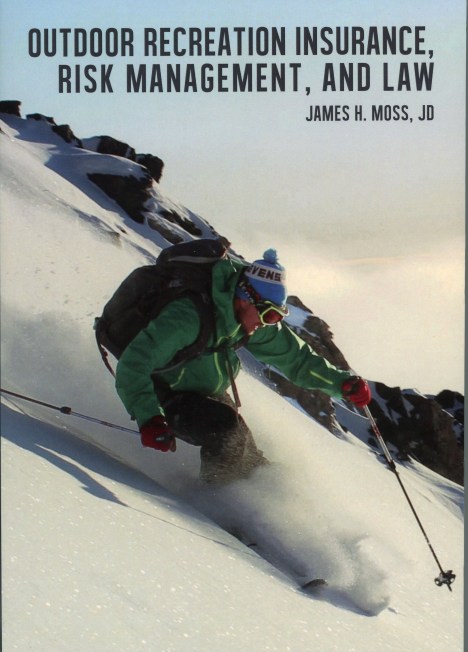
Outdoor Recreation Insurance, Risk Management and Law
To see Jim’s complete bio go here and to see his CV you can find it here. To find out the purpose of this website go here.
G-YQ06K3L262
What do you think? Leave a comment.
If you like this let your friends know or post it on FB, Twitter or LinkedIn
Author: Outdoor Recreation Insurance, Risk Management and Law
Facebook Page: Outdoor Recreation & Adventure Travel Law
Email: Jim@Rec-Law.US
By Recreation Law Rec-law@recreation-law.com James H. Moss
@2010-2023 Summit Magic Publishing, LLC
#RecreationLaw, #@RecreationLaw, #Cycling.Law #Fitness.Law, #Ski.Law, #Outside.Law, #Recreation.Law, #Recreation-Law.com, #Outdoor Law, #Recreation Law, #Outdoor Recreation Law, #Adventure Travel Law, #law, #Travel Law, #Jim Moss, #James H. Moss, #Attorney at Law, #Tourism, #Adventure Tourism, #Rec-Law, #Rec-Law Blog, #Recreation Law, #Recreation Law Blog, #Risk Management, #Human Powered, #Human Powered Recreation,# Cycling Law, #Bicycling Law, #Fitness Law, #Recreation-Law.com, #Backpacking, #Hiking, #Mountaineering, #Ice Climbing, #Rock Climbing, #Ropes Course, #Challenge Course, #Summer Camp, #Camps, #Youth Camps, #Skiing, #Ski Areas, #Negligence, #Snowboarding, #RecreationLaw, #@RecreationLaw, #Cycling.Law #Fitness.Law, #SkiLaw, #Outside.Law, #Recreation.Law, #RecreationLaw.com, #OutdoorLaw, #RecreationLaw,
# Technorati Tags: Summary,Judgment,bicycle,manufacturer,retailer,product,recreation,adventure,Cannondale,Company,Utah,Center,negligence,doctrine,spoliation
Windows Live Tags: Summary,Judgment,bicycle,manufacturer,retailer,product,recreation,adventure,Cannondale,Company,Utah,Center,negligence,doctrine,spoliation
WordPress Tags: Summary,Judgment,bicycle,manufacturer,retailer,product,recreation,adventure,Cannondale,Company,Utah,Center,negligence,doctrine,spoliation
Blogger Labels: Summary,Judgment,bicycle,manufacturer,retailer,product,recreation,adventure,Cannondale,Company,Utah,Center,negligence,doctrine,spoliation
Call for Contributors Controversial Issues in Adventure Programming
Posted: September 17, 2010 Filed under: Uncategorized Leave a commentEdited by Bruce Martin and Mark Wagstaff
To be published by Human Kinetics Publishing Company
Bruce Martin and Mark Wagstaff are beginning work on a new text exploring controversial issues in adventure programming. The book is intended to fill the need for a contemporary account of controversial issues in the field of adventure programming. Each issue addressed in the book will be considered within the framework of a debate. Contributing authors will assume opposing points of view or opposing ethical stances regarding each issue and will develop rhetorical arguments in favor of their particular points of view. Please see the attached document for further information about the project, including the project timeline, the list of issues proposed for inclusion in the text, and general expectations of contributors.
Contributor selections will be made by September 15, 2010. If you are interested in contributing to this text, please submit a letter of interest along with your curriculum vitae to Bruce Martin and Mark Wagstaff at martinc2@ohio.edu and mwagstaff@radford.edu prior to that date. Please contact Mark and me if you have any questions about the project.
Regards,
Bruce Martin, Ph. D.
Assistant Professor & Recreation Studies Program Coordinator
Department of Recreation & Sport Pedagogy
Patton College of Education & Human Services
Ohio University
Grover Center E160
Athens, OH 45701
740-593-4647 (phone)
740-593-0238 (fax)
martinc2@ohio.edu
Copyright 2010 Recreation Law (720) Edit Law, Recreaton.Law@Gmail.com
Keywords:
#outdoor law, #recreation law, #outdoor recreation law, #adventure travel law, #law, #travel law, #Jim Moss, #James H. Moss, #attorney at law, #tourism, #adventure tourism, #rec-law, #rec-law blog, #recreation law, #recreation law blog, #risk management, #Human Powered, #human powered recreation, # Human Kinetics Publishing Company, #Bruce Martin, #
Technorati Tags: Call,Controversial,Adventure,recreation,Moss,James,attorney,tourism,management,Human,Kinetics,Company,Bruce,Martin,Contributors,blog
Windows Live Tags: Call,Controversial,Adventure,recreation,Moss,James,attorney,tourism,management,Human,Kinetics,Company,Bruce,Martin,Contributors,blog
WordPress Tags: Call,Controversial,Adventure,recreation,Moss,James,attorney,tourism,management,Human,Kinetics,Company,Bruce,Martin,Contributors,blog
Blogger Labels: Call,Controversial,Adventure,recreation,Moss,James,attorney,tourism,management,Human,Kinetics,Company,Bruce,Martin,Contributors,blog
Second International Research Conference for Graduate Students
Posted: September 17, 2010 Filed under: Uncategorized Leave a commentNovember 3-4, 2010 Texas State University-San Marcos.
The conference provides an excellent opportunity to present original research and receive feedback from experienced faculty members. The conference also provides the opportunity to network with other graduate students, as well as attend conference presentations and social functions.
Join graduate students from Texas State, as well as universities across the nation and around the world, in making presentations from a variety of fields at a conference sponsored by the Graduate College.
- Students will present their original research and receive feedback on their presentations from experienced faculty members.
- Master’s and doctoral students from all disciplines are encouraged to participate.
Second annual International Research Conference for Graduate Students at Texas State University. The Graduate College will be hosting this conference on November 3 and 4, 2010. This conference is free of charge and open to all Texas State graduate students.
Those students not submitting papers are invited to attend and must register for the conference at http://www.gradcollege.txstate.edu/rsrch_conf.html (click on the “Conference Registration” link). The conference will be held in the LBJ Student Center and conference information is available on the above Website. This Website will be updated as additional information becomes available.
The conference will take place on the beautiful Texas State University campus, located between Austin and San Antonio.
The conference is free and open to all graduate students currently enrolled in colleges and universities.
For more information go to www.gradcollege.txstate.edu
Call for papers deadline: October 1, 2010
If you require accommodations due to a disability in order to participate, please call 512.245.2581 at least 72 hours in advance of the event.
Should you need additional information, please email Dr. Sandy Rao, Assistant Dean of the Graduate College at: sr02@txstate.edu or Sonya Garza at: sg42@txstate.edu.
Copyright 2010 Recreation Law (720) Edit Law, Recreaton.Law@Gmail.com
© 2010 James H. Moss
Keywords:
#outdoor law, #recreation law, #outdoor recreation law, #adventure travel law, #law, #travel law, #Jim Moss, #James H. Moss, #attorney at law, #tourism, #adventure tourism, #rec-law, #rec-law blog, #recreation law, #recreation law blog, #risk management, #Human Powered, #human powered recreation,#Texas, #International Research Conference for Graduate Students,
Technorati Tags: James Moss,recreation,adventure,Moss,James,attorney,tourism,management,Human,Texas,International,Research,Conference,Graduate,Students
Windows Live Tags: James Moss,recreation,adventure,Moss,James,attorney,tourism,management,Human,Texas,International,Research,Conference,Graduate,Students
WordPress Tags: James Moss,recreation,adventure,Moss,James,attorney,tourism,management,Human,Texas,International,Research,Conference,Graduate,Students
Blogger Labels: James Moss,recreation,adventure,Moss,James,attorney,tourism,management,Human,Texas,International,Research,Conference,Graduate,Students
If you leave the ski area, with or without boundary markers you are on your own.
Posted: September 16, 2010 Filed under: Search and Rescue (SAR), Ski Area 4 CommentsIf your parents sue because you died outside of the ski area, they are just publicizing your bad decisions.
A family from New York is suing Idaho and Wyoming sheriff’s departments and search and rescue units for failing to rescue their son. It appears that the ski area may be facing suit also. The son skied outside of the boundaries of a ski area and got lost. He notified a sheriff’s dispatcher using his cell phone but died before he could be found.
Now his family is suing for “botched the rescue attempt in January and failed to communicate with Wyoming rescuers trying to locate Fitzgerald after he went outside Grand Targhee Resort boundaries, which the claim says were not adequately marked.”
It is sad when someone is injured or dies. However, leaving a ski resort without adequate knowledge, skill, gear and equipment is just stupid. Doing so when you do not know where you are going is also dumb.
Maybe New Yorker’s just don’t understand the west. While working at a resort in Summit County years ago I was summoned to the clinic. As I walked in I heard yelling from one of the examination rooms. As I walked in the eyes, and arms indicated that the yelling was coming from the room where I was needed.
As I walked through the curtain the person was upset because no one would help her get to her hotel room. She was threatening to call a cab. That alone made me grin, at the time there were no cabs in Summit County. She would have waited several hours for a cab to arrive from Denver. I inquired where she was from, (NY) and told her I was there to help. After about 5 minutes of additional yelling, she explained her predicament; swollen ankle, no shoes and ski boots. We got a pick up and took her the 80 yards to her hotel.
She was applying New York knowledge and logic to her predicament. She did not know where she was and had no idea how to deal with the situation except to insist that someone else solve her problems. You have to be a little more self reliant in the West.
- Yelling does not work in the mountains, even if you are lost.
- Calling a cab in the mountains does not work.
- Colorado, Idaho, Montana and Wyoming are not New York.
- Lost is not a TV show in the west, it is a good way to die.
- Suing does not bring your dead daughter back.
The only thing a lawsuit might do is make the next lost person die because volunteers did not want to put their lifestyle on the line to save your butt.
See Family of dead skier files lawsuit against Idaho rescue teams
Copyright 2010 Recreation Law (720) Edit Law, Recreaton.Law@Gmail.com
© 2010 James H. Moss
Keywords:
#outdoor law, #recreation law, #outdoor recreation law, #adventure travel law, #law, #outdoor Recreation, #Idaho, #SAR, #search and rescue, #New York, #Teton County Sheriff, # Teton County, #Idaho Search and Rescue, #Grand Targhee Resort, #ski area, #ski area boundary, #lost, #cell phone, #rescue,
Technorati Tags: skiing,SAR,Search and rescue,Grand Targhee Resort,boundary,recreation,adventure,Idaho,York,Teton,Sheriff,Search,Rescue
Windows Live Tags: skiing,SAR,Search and rescue,Grand Targhee Resort,boundary,recreation,adventure,Idaho,York,Teton,Sheriff,Search,Rescue
WordPress Tags: skiing,SAR,Search and rescue,Grand Targhee Resort,boundary,recreation,adventure,Idaho,York,Teton,Sheriff,Search,Rescue
Blogger Labels: skiing,SAR,Search and rescue,Grand Targhee Resort,boundary,recreation,adventure,Idaho,York,Teton,Sheriff,Search,Rescue
If it is there, it is real and probably has a legal implication.
Posted: September 15, 2010 Filed under: Uncategorized Leave a commentI found this on a web page. The web page was titled outfitter guidelines.
These guidelines are intended for educational purposes only. The are not intended as a basis for evidence of legal responsibility or negligence in any legal action. ORGANIGATION suggested guidelines are for commercial tours, rentals and lessons and it is recognized that each area and each situation calls for different responses and implies no limitations on solutions the operator may choose.
One of the dreams in our world is that we can control how the courts look at things. YOU CAN’T! The web page says guidelines. The organization is well respected and represents the industry. They will be used to prove an outfitter was negligent. It does not matter what you say on the website. The process to impress the jury is so easy and devious that the head of an organization would be trapped before they knew what hit them. Example:
Plaintiff’s Attorney (PA) Mr. Executive Director, you work for ABC organization correct.
Executive Director: (ED) Yes
PA: How long have you worked for ABC?
ED 4 years
PA How many members does ABC have?
ED 450 members
PA And you have strict membership requirements, members must be involved in the tidily wink industry before they can join correct?
ED Yes
PA Your membership comprises 80% of the membership in the tidily wink industry is that not correct?
ED Yes, (proudly)
PA Your membership includes the top 10 largest manufactures and outfitters in the tidily wink industry correct?
ED Yes, (more proudly)
PA Your organization is the voice of the tidily wink industry correct?
ED Yes, (head swollen to watermelon size)
PA You membership spent many hours developing these guidelines did they not?
ED Yes, over 300 hours.
PA You brought in the experts in the industry to develop these guidelines?
ED Yes
PA Your best members abide by those guidelines do they not? (The clincher question!)
ED Yes
PA In fact the vast majority of your members abide by those guidelines, if they didn’t why have them up there. (Lots of objects and arguments, but the point was made to the jury, everyone abides by those guidelines in the industry.)
PA You intended the guidelines to be the best-written document in how to run a tidily wink business correct?
ED Yes
PA Why would you create guidelines unless you thought your membership should abide by them?
ED Mumbling
PA Why would you create guidelines unless your experts thought that every tidily wink outfitter out there should recognize them as the standard in the industry?
ED Mumbling and sweating
PA You just told us you have the best members of the tidily wink industry did you not?
ED Yes (quietly)
PA You just told us the experts created those guidelines did you not.
ED Yes
PA So if someone did not meet those guidelines, they are obviously not a very good tidily wink business are they?
ED Well there are good business and not so good business……….. (That is one way to make your membership happy!)
PA So if a business did not follow those guidelines based on what you have told us today they are not a good tidily wink outfitter are they not!
And it would go on. By the time the Plaintiff’s attorney was done asking the Executive director about the guidelines, the jury would know that the guidelines are the way to run your business. Make your own guidelines, you can live with those. Be wary of anyone who is making guidelines for you.
Besides, is there really only one way to do something?
At the very least, list them as suggestions or best practices. Remove any language that uses legal terminology or implies a legal requirement. State the ideas are for reference only and suggestions. Explain how different programs are going to implement different ideas or none of these ideas because of their program, their parameters, the environment, etc.
I was listening to a panel discussion once where one of the speakers, non-attorney, stated that as an outfitter you need to get with your attorney after an accident to decide what documents are privileged. Here again, the belief is you can control how the law is applied or looks at you. Privilege, the ability to make sure only your attorney sees a document, attaches the moment the document is created and does not change. You cannot come back later and say this document is privileged. (A privileged document is one that was created for your attorney, doctor, or priest and only for your attorney, doctor, or priest. If any other person sees the document, the privilege is lost.)
Worse if the word guidelines had been replaced with Standards. No need to worry about what you say on the stand, you would have all ready lost if some organization labels their ideas as standards.
Understand the legal issues in your business.
Copyright 2010 Recreation Law (720) Edit Law, Recreaton.Law@Gmail.com
© 2010 James H. Moss
Keywords:
#outdoor law, #recreation law, #outdoor recreation law, #adventure travel law, #law, #travel law, #Jim Moss, #James H. Moss, #attorney at law, #guidelines, #standards, #privilege, #best practices, #terminology, #legal terminology,
Technorati Tags: implication,recreation,adventure,Moss,James,attorney,guidelines,terminology
Windows Live Tags: implication,recreation,adventure,Moss,James,attorney,guidelines,terminology
WordPress Tags: implication,recreation,adventure,Moss,James,attorney,guidelines,terminology
Blogger Labels: implication,recreation,adventure,Moss,James,attorney,guidelines,terminology
Rec-Law Blog has new features new design and new web address!
Posted: September 14, 2010 Filed under: Uncategorized 1 Comment
Rec-Law Blog has new features new design and new web address!
Major changes, more law, more information and more analysis at recreation-law.com.
Denver, CO, September 15 2010: James H. “Jim” Moss, author of the Recreation Law blog has doubled the information that will be available on the blog. The changes include two additional posts each week. One new feature will be an analysis of specific legal decision affecting readers of the blog. The second will be an analysis of general legal issues in the recreation community tackling a broader approach to educate on a legal issue affecting the recreation industry. The new additions will increase posts to four times a week and position the blog as the leading source of legal information in the outdoor recreation world.
There is no source on the web that educates the business owner, adventure travel agency or university student about the issues in this industry. You either go to law school or suffer in silence and in some cases fear.
Posts will follow a new weekly schedule:
- Monday an analysis of a specific legal case will be posted. Monday’s posts will look at the issues on why a case was won or lost and what can be learned from it.
- Tuesday’s post will be legal news and analysis of the legal industry.
- Wednesday will be an analysis of a legal issue affecting a broad range of programs and law. This post will focus on education of the legal issues in the industry.
- Thursday will be news for the outdoor recreation and adventure travel industry.
- Friday will be available for breaking news or anything else that strikes my fancy.
Design changes are more than cosmetic.
Besides a new color and design scheme, the blog has incorporated more feedback and ways to ask questions or comment.
- Readers will be encouraged to respond with a quick analysis of the articles or post comments about the articles.
- The site has added an “ask the lawyer” link to encourage readers to ask specific questions or voice concerns about the legal issues in the recreation, outdoor and adventure travel industry.
Recreation-law.com is designed to provide legal information for people, non-profits, businesses and organization working in the outdoor recreation, adventure travel, and recreation education industry. The analysis of the legal issues is written in a way that non-lawyer can gain valuable insight into how the law, insurance and their risk management will affect their programs.
Jim Moss has spent twenty-years practicing outdoor recreation law. My clients range from university outdoor programs to Everest guide services and equipment manufactures. I’ve been involved in litigation concerning raft companies, mountaineering guide services, canoe liveries, climbing hardware, ropes (challenge) courses and many others. I’ve written over 100 legal articles on the subject and given more than 100 speeches on the topic.
Jim is one of the co-founders of the National Outdoor Book Awards and serve on the board of directors of the Trade Association of Paddlesports, Colorado Alliance for Environmental Education, Galapagos Preservation Society and serve as chairman of the American Alpine Club library committee. I teach a ski area risk management course for Colorado Mountain College both online and a traditional classroom course.
Technorati Tags: Press Release,Blog,features,Major,analysis,recreation,Denver,September,James,Moss,author,decision,industry,additions,times,world,owner,adventure,agency,student,cases,news,education,Design,Besides,feedback,comments,lawyer,profits,organization,insurance,management,clients,Everest,services,equipment,litigation,ropes,subject,topic,National,Outdoor,Book,Trade,Association,Paddlesports,Colorado,Alliance,Environmental,Galapagos,Preservation,American,Alpine,Club,library,committee,area,Mountain,College,Edit,Golden,readers,articles,liveries,speeches,directors,week
Windows Live Tags: Press Release,Blog,features,Major,analysis,recreation,Denver,September,James,Moss,author,decision,industry,additions,times,world,owner,adventure,agency,student,cases,news,education,Design,Besides,feedback,comments,lawyer,profits,organization,insurance,management,clients,Everest,services,equipment,litigation,ropes,subject,topic,National,Outdoor,Book,Trade,Association,Paddlesports,Colorado,Alliance,Environmental,Galapagos,Preservation,American,Alpine,Club,library,committee,area,Mountain,College,Edit,Golden,readers,articles,liveries,speeches,directors,week
WordPress Tags: Press Release,Blog,features,Major,analysis,recreation,Denver,September,James,Moss,author,decision,industry,additions,times,world,owner,adventure,agency,student,cases,news,education,Design,Besides,feedback,comments,lawyer,profits,organization,insurance,management,clients,Everest,services,equipment,litigation,ropes,subject,topic,National,Outdoor,Book,Trade,Association,Paddlesports,Colorado,Alliance,Environmental,Galapagos,Preservation,American,Alpine,Club,library,committee,area,Mountain,College,Edit,Golden,readers,articles,liveries,speeches,directors,week
Blogger Labels: Press Release,Blog,features,Major,analysis,recreation,Denver,September,James,Moss,author,decision,industry,additions,times,world,owner,adventure,agency,student,cases,news,education,Design,Besides,feedback,comments,lawyer,profits,organization,insurance,management,clients,Everest,services,equipment,litigation,ropes,subject,topic,National,Outdoor,Book,Trade,Association,Paddlesports,Colorado,Alliance,Environmental,Galapagos,Preservation,American,Alpine,Club,library,committee,area,Mountain,College,Edit,Golden,readers,articles,liveries,speeches,directors,week
I find interesting releases on the web.
Posted: September 14, 2010 Filed under: Release (pre-injury contract not to sue) | Tags: releases, religion, waivers Leave a commentMost of them I find are mine and are stolen violating my copyright. However some of them are interesting, quite interesting!
I found a release for a religious summer camp. The release had the following lines it.
“I am aware of the risks…” Sure, but is your child?
“In the event of injury or a medical emergency, I understand that the church’s group leader, not Student Life and camp location, will be responsible for the medical care of all attendees.” This one I just do not understand, I think I might but I’m not guessing that much in writing.
However it is this line that caught my attention.
“To the extent the restriction on filing lawsuits is deemed unlawful, I agree to submit any Claims to a Christian conciliation/mediation organization for binding resolution.”
The US Constitution has been interpreted to place a barrier between church and state. There is a good reason for that. There should be a similar rule for law and the church.
To see the form click Waiver & Release.
What do you think? Leave a comment.
Copyright 2010 Recreation Law (720) Edit Law, Recreaton.Law@Gmail.com
Twitter: RecreationLaw
Facebook: Rec.Law.Now
Facebook Page: Outdoor Recreation & Adventure Travel Law
Blog: www.recreation-law.com
Mobile Site: http://m.recreation-law.com
#RecreationLaw, #@RecreationLaw, #Cycling.Law #Fitness.Law, #Ski.Law, #Outside.Law, #Recreation.Law, #Recreation-Law.com, #Outdoor Law, #Recreation Law, #Outdoor Recreation Law, #Adventure Travel Law, #law, #Travel Law, #Jim Moss, #James H. Moss, #Attorney at Law, #Tourism, #Adventure Tourism, #Rec-Law, #Rec-Law Blog, #Recreation Law, #Recreation Law Blog, #Risk Management, #Human Powered, #Human Powered Recreation,# Cycling Law, #Bicycling Law, #Fitness Law, #Recreation-Law.com, #Backpacking, #Hiking, #Mountaineering, #Ice Climbing, #Rock Climbing, #Ropes Course, #Challenge Course, #Summer Camp, #Camps, #Youth Camps, #Skiing, #Ski Areas, #Negligence, #Snowboarding, #RecreationLaw, #@RecreationLaw, #Cycling.Law #Fitness.Law, #SkiLaw, #Outside.Law, #Recreation.Law, #RecreationLaw.com, #OutdoorLaw, #RecreationLaw, #Student Life Camp, #release, #waiver, #camp, #summer camp, #children, #minor, #medical emergency, #first aid, #arbitration, #binding arbitration
Technorati Tags: first aid,summer camp,law,release,student life,recreation,adventure,Camp,children,emergency,arbitration
Windows Live Tags: first aid,summer camp,law,release,student life,recreation,adventure,Camp,children,emergency,arbitration
WordPress Tags: first aid,summer camp,law,release,student life,recreation,adventure,Camp,children,emergency,arbitration
Blogger Labels: first aid,summer camp,law,release,student life,recreation,adventure,Camp,children,emergency,arbitration
Gonzalez v. City of Coral Gables 871 So.2d 1067, 29 Fla. L. Weekly D1147
Posted: September 13, 2010 Filed under: Uncategorized Leave a commentGonzalez v. City of Coral Gables 871 So.2d 1067, 29 Fla. L. Weekly D1147
G-YQ06K3L262
http://www.recreation-law.com
New Florida law allows a parent to sign away a child’s right to sue for injuries.
Posted: September 13, 2010 Filed under: Release (pre-injury contract not to sue) Leave a commentHowever, the law only protects commercial activities, not non-profit activities or volunteers.
April 27, 2010 the governor of Florida signed into law a bill that overcame the effects of Kirton v. Fields, 997 So. 2d 349; 2008 Fla. LEXIS 2378; 33 Fla. L. Weekly S 939. Kirton held that a parent could not sign away a minor’s right to sue. See At least three bills are moving through Florida Legislature to allow a Parent to Sign away a Minor’s right to sue.
The new law allows commercial businesses to use a release or minors. If your release is written properly and contains the proper language, the release is valid against a claim by an injured or deceased minor if:
- You informed the parent or guardian of the inherent risks of the activity; or,
- The risk that injured the child was not inherent or was intentional.
The law Florida Statute § 744.301 (3) states:
(3) In addition to the authority granted in subsection (2), natural guardians are authorized, on behalf of any of their minor children, to waive and release, in advance, any claim or cause of action against a commercial activity provider, or its owners, affiliates, employees, or agents, which would accrue to a minor child for personal injury, including death, and property damage resulting from an inherent risk in the activity.
(a) As used in this subsection, the term “inherent risk” means those dangers or conditions, known or unknown, which are characteristic of, intrinsic to, or an integral part of the activity and which are not eliminated even if the activity provider acts with due care in a reasonably prudent manner. The term includes, but is not limited to:
1. The failure by the activity provider to warn the natural guardian or minor child of an inherent risk; and
2. The risk that the minor child or another participant in the activity may act in a negligent or intentional manner and contribute to the injury or death of the minor child. A participant does not include the activity provider or its owners, affiliates, employees, or agents.
(b) To be enforceable, a waiver or release executed under this subsection must, at a minimum, include the following statement in uppercase type that is at least 5 points larger than, and clearly distinguishable from, the rest of the text of the waiver or release:
NOTICE TO THE MINOR CHILD’S NATURAL GUARDIAN
READ THIS FORM COMPLETELY AND CAREFULLY. YOU ARE
AGREEING TO LET YOUR MINOR CHILD ENGAGE IN A POTENTIALLY DANGEROUS ACTIVITY. YOU ARE AGREEING THAT, EVEN IF (name of released party or parties ) USES REASONABLE CARE IN PROVIDING THIS ACTIVITY, THERE IS A CHANCE YOUR CHILD MAY BE SERIOUSLY INJURED OR KILLED BY PARTICIPATING IN THIS ACTIVITY BECAUSE THERE ARE CERTAIN DANGERS INHERENT IN THE ACTIVITY WHICH CANNOT BE AVOIDED OR ELIMINATED. BY SIGNING THIS FORM YOU ARE GIVING UP YOUR CHILD’S RIGHT AND YOUR RIGHT TO RECOVER FROM (name of released party or parties ) IN A LAWSUIT FOR ANY PERSONAL INJURY, INCLUDING DEATH, TO YOUR CHILD OR ANY PROPERTY DAMAGE THAT RESULTS FROM THE RISKS THAT ARE A NATURAL PART OF THE ACTIVITY. YOU HAVE THE RIGHT TO REFUSE TO SIGN THIS FORM, AND (name of released party or parties) HAS THE RIGHT TO REFUSE TO LET YOUR CHILD PARTICIPATE IF YOU DO NOT SIGN THIS FORM.
(c) If a waiver or release complies with paragraph (b) and waives no more than allowed under this subsection, there is a rebuttable presumption that the waiver or release is valid and that any injury or damage to the minor child arose from the inherent risk involved in the activity.
1. To rebut the presumption that the waiver or release is valid, a claimant must demonstrate by a preponderance of the evidence that the waiver or release does not comply with this subsection.
2. To rebut the presumption that the injury or damage to the minor child arose from an inherent risk involved in the activity, a claimant must demonstrate by clear and convincing evidence that the conduct, condition, or other cause resulting in the injury or damage was not an inherent risk of the activity.
3. If a presumption under this paragraph is rebutted, liability and compensatory damages must be established by a preponderance of the evidence.
(d) Nothing in this subsection limits the ability of natural guardians, on behalf of any of their minor children, to waive and release, in advance, any claim or cause of action against a noncommercial activity provider, or its owners, affiliates, employees, or agents, to the extent authorized by common law.
(4) All instruments executed by a natural guardian for the benefit of the ward under the powers specified in this section are binding on the ward. The natural guardian may not, without a court order, use the property of the ward for the guardian’s benefit or to satisfy the guardian’s support obligation to the ward.
So now what?
The law is great. However, you are going to need an attorney to write your release if you want your release to be valid. The statutory language is specific in the requirements, yet somewhat complicated.
You will have to make sure you have identified, in a way that you can prove, the risks of the activity the child is going to encounter. Either in writing or some other from that you can prove the parent saw.
Your release is going to have to be written containing the proper language to me the statute of Florida on releases in general and this statute, specifically.
You must be a commercial activity.
This last section is (3)(d) does not seem to apply to non-profit organizations. Whether it applies to volunteers of non-profits is also not clear. However, you can require arbitration, which has been upheld for minors in Global Travel Marketing, Inc v. Shea, 2005 Fla. LEXIS 1454 or rely on Gonzalez v. City of Coral Gables, 871 So. 2d 1067; 2004 Fla. App. LEXIS 6612; 29 Fla. L. Weekly D 1147, which held a release was valid for a non-profit that was sponsored of a municipality.
Copyright 2010 Recreation Law (720) Edit Law, Recreaton.Law@Gmail.com
© 2010 James H. Moss
Keywords:
#outdoor law, #recreation law, #outdoor recreation law, #adventure travel law, #law, #travel law, #Jim Moss, #James H. Moss, #attorney at law, #Florida, #minors, #children, #release, #waiver, #parent, #guardian, #statute, #FL
Technorati Tags: James Moss,Florida,parent,recreation,adventure,children,guardian,statute,injuries
Windows Live Tags: James Moss,Florida,parent,recreation,adventure,children,guardian,statute,injuries
WordPress Tags: James Moss,Florida,parent,recreation,adventure,children,guardian,statute,injuries
Blogger Labels: James Moss,Florida,parent,recreation,adventure,children,guardian,statute,injuries
Kirton vs. Fields, No. SC07-1739, No. SC07-1741, No. SC07-1742 (FL 2008)
Posted: September 13, 2010 Filed under: Florida, Legal Case | Tags: All Terrain Vehicle, ATV, Florida, Minor, Release Leave a commentSCOTT COREY KIRTON, etc., et al., Petitioners, vs. JORDAN FIELDS, etc., et al., Respondents. DEAN DYESS, Petitioner, vs. JORDAN FIELDS, etc., et al., Respondents. H. SPENCER KIRTON, et al., Petitioners, vs. JORDAN FIELDS, etc., et al., Respondents.
No. SC07-1739, No. SC07-1741, No. SC07-1742
SUPREME COURT OF FLORIDA
2008 Fla. LEXIS 2378; 33 Fla. L. Weekly S 939
December 11, 2008, Decided
NOTICE:
NOT FINAL UNTIL TIME EXPIRES TO FILE REHEARING MOTION, AND IF FILED, DETERMINED.
PRIOR HISTORY: [*1]
Application for Review of the Decision of the District Court of Appeal – Certified Direct Conflict of Decisions. (Okeechobee County). Fourth District – Case No. 4D06-1486.
Fields v. Kirton, 961 So. 2d 1127, 2007 Fla. App. LEXIS 12241 (Fla. Dist. Ct. App. 4th Dist., 2007)
COUNSEL: William J. Wallace of William J. Wallace, P.A., Okeechobee, Florida, Richard Lee Barrett and Ralph Steven Ruta, of Barrett, Chapman and Ruta, P.A., Orlando, Florida, and Alan C. Espy of Alan C. Espy, P.A., Palm Beach Gardens, Florida, for Petitioners.
Bard d. Rockenbach of Burlington and Rockenbach, P.A., West Palm Beach, and Laurence C. Huttman of Rubin and Rubin, Stuart, Florida, for Respondents.
Timothy J. Owens of Christensen, Christensen, Donchatz, Kettlewell, and Owens, LLP, Columbus, Ohio, on behalf of The American Motorcyclist Association, for Amicus Curiae.
JUDGES: QUINCE, C.J. ANSTEAD, PARIENTE, and LEWIS, JJ., concur. ANSTEAD, J., specially concurs with an opinion. PARIENTE, J., concurs with an opinion. WELLS, J., dissents with an opinion. CANADY and POLSTON, JJ., did not participate.
OPINION BY: QUINCE
OPINION
QUINCE, C.J.
We have for review the decision of the Fourth District Court of Appeal in Fields v. Kirton, 961 So. 2d 1127 (Fla. 4th DCA 2007), which certified the following question to be of great public importance:
WHETHER A PARENT [*2] MAY BIND A MINOR’S ESTATE BY THE PRE-INJURY EXECUTION OF A RELEASE.
We have jurisdiction. See art. V, § 3(b)(4), Fla. Const. 1 For the reasons discussed below, we answer the certified question in the negative and hold that [HN1] a parent does not have the authority to execute a pre-injury release on behalf of a minor child when the release involves participation in a commercial activity. 2
1 The Fourth District also certified conflict with the decision of the Fifth District Court of Appeal in Lantz v. Iron Horse Saloon, Inc., 717 So. 2d 590 (Fla. 5th DCA 1998). However, subsequent to its decision in Lantz and subsequent to the certification of conflict, the Fifth District decided Applegate v. Cable Water Ski, L.C., 974 So. 2d 1112 (Fla. 5th DCA 2008), where the Fifth District aligned itself with the Fourth District in Kirton. For those reasons and because the Fourth District certified a question providing us for any independent basis for jurisdiction, we do not address the certified conflict.
2 We answer the certified question as to pre-injury releases in commercial activities because that is what this case involves. Our decision in this case should not be read as limiting our reasoning only [*3] to pre-injury releases involving commercial activity; however, any discussion on pre-injury releases in noncommercial activities would be dicta and it is for that reason we do not discuss the broader question posed by the Fifth District.
STATEMENT OF THE CASE AND FACTS
The instant action arises from the decision by the Fourth District Court of Appeal in Fields v. Kirton, 961 So. 2d 1127 (Fla. 4th DCA 2007). The facts of the underlying action were detailed in the opinion of that court:
Pursuant to a final judgment of dissolution of marriage, Bobby Jones was the primary residential parent for his fourteen year old son, Christopher. On May 10, 2003, the father took Christopher to Thunder Cross Motor Sports Park to ride his all terrain vehicle (ATV). To gain entry to the facility and be allowed to participate in riding the ATV, Bobby Jones, as Christopher’s natural guardian, signed a release and waiver of liability, assumption of risk, and indemnity agreement. While attempting a particular jump, Christopher lost control of his ATV, causing himself to be ejected. Tragically, he hit the ground with the ATV landing on top of him. He got up, walked a short distance, then collapsed and died. Christopher’s [*4] mother, Bette Jones, was unaware that the father was permitting their son to engage in this activity. She was also unaware that approximately one month prior to the accident causing Christopher’s death, he had attempted the same jump, resulting in a fractured rib and mild concussion.
Id. at 1128.
Subsequently, Fields, as personal representative of the estate of Christopher Jones, filed suit for wrongful death against Spencer Kirton, Scott Corey Kirton, Dudley Kirton, and the Kirton Brother Lawn Service, Inc. (“the Kirtons”) as owners and operators of Thunder Cross Motor Sports. The amended complaint also named Dean Dyess as a defendant for his participation in the management of the park. The Kirtons then filed an answer and affirmative defenses to the amended complaint. In one of the affirmative defenses, the Kirtons argued that the claims raised by Fields were barred by the release and waiver executed by Mr. Jones on behalf of his son. The Kirtons thereafter filed a motion for summary judgment based on the release and waiver. 3 The trial court entered an order granting the Kirtons’ motion for summary judgment on the wrongful death claim, finding that there was no genuine issue of material [*5] fact because the release executed by Mr. Jones on behalf of his minor child, Christopher, barred the claim.
3 Mr. Jones filed an affidavit in support of the Kirtons’ motion for summary judgment. In that affidavit, he admitted that he willfully and with full understanding executed the release on behalf of his minor child at Thunder Cross Motor Sports Park. He also stated that he understood that it was his intention to waive the right to sue for the death of Christopher and to be banned by the other terms as set forth in the general release. He further stated that he understood that by signing the general release, he was forever discharging the Kirtons for any and all loss or damage and any claim or demands on account of injury to Christopher or his property or resulting in the death of Christopher arising out of or related to the events, whether caused by the negligence of the releasees or otherwise.
On appeal, the Fourth District reversed the trial court’s order granting the motion for summary judgment. In doing so, the district court emphasized that the issue was not about a parent’s decision on what activities are appropriate for his or her minor child, which is properly left to the [*6] parent. Instead, the issue concerned the “decision to absolve the provider of an activity from liability for any form of negligence . . . [which] goes beyond the scope of determining which activity a person feels is appropriate for their child.” Id. at 1129. This is because the “effect of the parent’s decision in signing a pre-injury release impacts the minor’s estate and the property rights personal to the minor.” As a result, the district court found that these rights could not be waived by the parents absent a basis in common law or statute. Id. at 1129-30. The district court found that there was no statutory scheme governing the issue of pre-injury releases signed by parents on behalf of minor children. Because there is no basis in common law or statute, the district court found that the courts do not have the authority to “judicially legislate that which necessarily must originate, if it is to be law, with the legislature.” Id. at 1130. Accordingly, the district court held that a parent could not bind a minor’s estate by the parent’s execution of a pre-injury release. In doing so, the Fourth District also certified the above question to be of great public importance and certified [*7] conflict with the Fifth District Court of Appeal’s decision in Lantz v. Iron Horse Saloon, Inc., 717 So. 2d 590 (Fla. 5th DCA 1998).
ANALYSIS
The issue in this case is the enforceability of a pre-injury release executed by a parent on behalf of a minor child that binds a minor child’s estate and releases an activity provider from liability. Because the enforceability of the pre-injury release is a question of law arising from undisputed facts, the standard of review is de novo. See D’Angelo v. Fitzmaurice, 863 So. 2d 311, 314 (Fla. 2003) (stating that [HN2] the standard of review for pure questions of law is de novo and no deference is given to the judgment of the lower courts).
The Kirtons and the amicus curiae 4 supporting their position assert that a parent has a fundamental right to make decisions relating to the care of a minor child, and that right includes executing a pre-injury release on behalf of the minor child. The Kirtons also argue that enforcing the validity of a pre-injury release is consistent with Florida courts that have ruled that a parent has the prelitigation right to forego settlement awards in favor of pursuing a lawsuit without court approval or appointment of a guardian [*8] ad litem. On the other hand, Fields contends that pre-injury releases are invalid because neither the common law nor the Legislature has given parents the authority to waive these substantive rights of a minor child.
4 The American Motorcyclist Association.
Parental Authority and the State’s “Parens Patriae” Authority
The enforceability of a pre-injury release concerns two compelling interests: that of the parents in raising their children and that of the state to protect children. [HN3] Parental authority over decisions involving their minor children derives from the liberty interest contained in the Fourteenth Amendment to the United States Constitution and the guarantee of privacy in article I, section 23 of the Florida Constitution. See Troxel v. Granville, 530 U.S. 57, 66, 120 S. Ct. 2054, 147 L. Ed. 2d 49 (2000) (plurality opinion) (“In light of this extensive precedent, it cannot now be doubted that the Due Process Clause of the Fourteenth Amendment protects the fundamental right of parents to make decisions concerning the care, custody, and control of their children.”); see also Beagle v. Beagle, 678 So. 2d 1271, 1275 (Fla. 1996) (“The fundamental liberty interest in parenting is protected by both the Florida and federal [*9] constitutions. In Florida, it is specifically protected by our privacy provision.”). In fact, beginning with Meyer v. Nebraska, 262 U.S. 390, 43 S. Ct. 625, 67 L. Ed. 1042 (1923), the United States Supreme Court has recognized that [HN4] parents have a constitutionally protected interest in child rearing. In Troxel, the United States Supreme Court further pointed to [HN5] a presumption that
fit parents act in the best interests of their children. . . . Accordingly, so long as a parent adequately cares for his or her children (i.e., is fit), there will normally be no reason for the State to inject itself into the private realm of the family to further question the ability of that parent to make the best decisions concerning the rearing of that parent’s children.
530 U.S. at 68-69; see also Von Eiff v. Azicri, 720 So. 2d 510, 514 (Fla. 1998) (“Neither the legislature nor the courts may properly intervene in parental decision-making absent significant harm to the child threatened by or resulting from those decisions.”).
However, these [HN6] parental rights are not absolute and the state as parens patriae may, in certain situations, usurp parental control. In Global Travel Marketing, Inc. v. Shea, 908 So. 2d 392, 399 (Fla. 2005), we explained [*10] the concept of parens patriae as applied in this State:
[HN7] “Parens patriae,” which is Latin for “parent of his or her country,” describes “the state in its capacity as provider of protection to those unable to care for themselves.” Black’s Law Dictionary 1144 (8th ed. 2004). The doctrine derives from the common-law concept of royal prerogative, recognized by American courts in the form of legislative prerogative. See Alfred L. Snapp & Son, Inc. v. Puerto Rico ex rel. Barez, 458 U.S. 592, 600, 102 S.Ct. 3260, 73 L.Ed.2d 995 (1982). The United States Supreme Court, upholding a state child labor law in Prince v. Massachusetts, 321 U.S. 158, 64 S.Ct. 438, 88 L.Ed. 645 (1944), recognized the parens patriae power when it stated that [HN8] although the “custody, care, and nurture of the child reside first in the parents, . . . the state as parens patriae may restrict the parent’s control by requiring school attendance, regulating or prohibiting the child’s labor and in many other ways.” Id. at 166, 64 S.Ct. 438 (footnotes omitted).
In decisions over the past three decades, this Court has expressly relied on the state’s parens patriae authority to protect children in two areas: (1) juvenile delinquency [*11] and dependency, see P.W.G. v. State, 702 So.2d 488, 491 (Fla.1997); State v. D.H., 340 So. 2d 1163, 1166 (Fla.1976); In re Camm, 294 So.2d 318, 320 (Fla.1974); and (2) child custody and support. See Schutz v. Schutz, 581 So.2d 1290, 1293 (Fla.1991); Lamm v. Chapman, 413 So.2d 749, 753 (Fla.1982); Kern v. Kern, 333 So.2d 17, 19 (Fla.1976). Pervasive statutory schemes cover each of these areas. See generally ch. 39, Fla. Stat. (2004) (“Proceedings Relating to Children”); ch. 61, Fla. Stat. (2004) (“Dissolution of Marriage; Support; Custody”); ch. 984, Fla. Stat. (2004) (“Children and Families in Need of Services”); ch. 985, Fla. Stat. (2004) (“Delinquency; Interstate Compact on Juveniles”).
Although there is no statutory scheme governing pre-injury releases, the Kirtons argue that a parent’s execution of a pre-injury release falls squarely within the parent’s authority to settle pursuant to section 744.301(2), Florida Statutes (2007). This statutory provision allows a parent, acting as the natural guardian of a minor child, to settle the child’s claim for amounts up to $ 15,000. The Kirtons reason that because at the time a parent signs a pre-injury release, the claim is worth less than [*12] $ 15,000, the parent’s authority to execute a pre-injury release for a minor child falls within this section. Contrary to the Kirtons’ assertion, a parent’s authority to execute a pre-injury release on behalf of a minor child does not fall within the purview of section 744.301(2). Section 744.301, Florida Statutes (2007), applies to situations where a minor child already has a cause of action against another party. A pre-injury release is executed before any cause of action accrues and extinguishes any possible cause of action.
The absence of a statute governing parental pre-injury releases demonstrates that the Legislature has not precluded the enforcement of such releases on behalf of a minor child. See Global Travel Mktg., Inc. v. Shea, 908 So. 2d 392, 400 (Fla. 2005) (noting that the absence of a statutory scheme governing a parent’s agreement to binding arbitration on behalf of a minor child demonstrates that the Legislature has not precluded the enforcement of such agreements). However, we find that public policy concerns cannot allow parents to execute pre-injury releases on behalf of minor children.
Florida Courts
Although this is an issue of first impression for this Court, the [*13] district courts of Florida have addressed this matter, but their decisions have not been consistent. In Lantz v. Iron Horse Saloon, Inc., 717 So. 2d 590 (Fla. 5th DCA 1998), the minor child’s natural guardian filed suit against Iron Horse Saloon after the child was injured while operating a “pocket bike” on the Iron Horse premises. Id. at 591. The trial court granted Iron Horse’s motion to dismiss the complaint based on the pre-injury release executed by the minor child’s guardian. On appeal, the Fifth District affirmed the trial court’s order granting the motion, finding that the release was sufficient to bar the child’s claim. Id. at 591-92. However, the Fifth District’s decision was based on the finding that the release clearly and unequivocally relieved Iron Horse from liability. The district court did not focus on whether the guardian had authority to execute the pre-injury release on behalf of the minor. Id.
In Gonzalez v. City of Coral Gables, 871 So. 2d 1067 (Fla. 3d DCA 2004), the mother signed a pre-injury release so that the minor child could participate in the Coral Gables Fire Rescue Explorer Program. After the child was injured, the mother filed suit and the trial court [*14] entered summary judgment in favor of the city based on the release the mother had signed. The Third District affirmed and found that the release barred the mother’s claim on behalf of the minor child. Id. at 1067-68. The district court relied on a distinction the Fourth District made in Shea v. Global Travel Marketing, Inc., 870 So. 2d 20, 24 (Fla. 4th DCA 2003), quashed, 908 So. 2d 392 (Fla. 2005), between community and school-supported activities and commercial activities. The Third District found that because the explorer program was a community-supported activity, the release was enforceable. Gonzalez, 871 So. 2d at 1067. 5 The Third District similarly found a parent’s execution of a pre-injury release on behalf of a minor child, for participation on the high school cheerleading squad, enforceable. See Krathen v. School Bd. of Monroe Cty., 972 So. 2d 887 (Fla. 3d DCA 2007). In Krathen, the Third District again discussed the Fourth District’s distinction in Shea between school-supported activities and commercial activities. Id. at 889. However, the Third District’s decision ultimately relied on this Court’s finding in Shea that “parents have the authority to make the decision whether [*15] to waive a child’s litigation rights in exchange for participation in an activity the parent feels is beneficial for the child.” Id. at 889 (citing Global Travel Mktg., Inc. v. Shea, 908 So. 2d 392, 404 (Fla. 2005)).
5 This Court in Shea found such a distinction arbitrary as applied to parents’ agreements to arbitrate but, in doing so, noted that it would not address this distinction as applied to pre-injury releases. Shea, 908 So. 2d at 403-04 & n.9.
On the other hand, in Applegate v. Cable Water Ski, L.C., 974 So. 2d 1112 (Fla. 5th DCA 2008), a case decided after Lantz, the Fifth District aligned itself with the Fourth District in the instant case and held that pre-injury releases are unenforceable as against public policy. Applegate involved a minor child who was injured while wakeboarding at a camp. In finding the parent’s execution of the pre-injury release unenforceable, the district court emphasized that its decision was limited to commercial enterprises because “[t]hey can insure against the risk of loss and include these costs in the price of participation.” Id. at 1115.
In Global Travel Marketing, Inc. v. Shea, the father brought a wrongful death action against a safari operator [*16] for the death of his son who was mauled by hyenas while on the safari. 908 So. 2d at 395. Before the safari, the child’s mother signed a travel contract on behalf of herself and her son, which included a release of liability and an arbitration agreement provision. Based on the travel contract, Global Travel moved to stay the proceedings and compel arbitration of the father’s claim, which the trial court granted. Id. On appeal, the Fourth District reversed and found the arbitration clause unenforceable as to the child based on public policy grounds. Id. at 396. However, this Court quashed the Fourth District’s decision and found the arbitration agreement enforceable against the minor or minor’s estate in a tort action arising from the contract. 6 In doing so, this Court reasoned that if the courts required parents to seek court approval before entering into travel contracts that included arbitration agreements, courts would be second guessing a fit parent’s decision. Id. at 404. The Court emphasized that parents who decide which activities their children can participate in may also decide on behalf of their children “to arbitrate a resulting tort claim if the risks of these activities [*17] are realized.” Id.
6 This Court noted at the beginning of its decision that the issue, as phrased by the Fourth District, only touched “upon binding arbitration and not on any broader contractual waiver of a tort claim brought on behalf of a minor.” Id. at 394. It also distinguished pre-injury releases from arbitration agreements: “Whether a parent may waive his or her child’s substantive rights is a different question from whether a parent may agree that any dispute arising from the contract may be arbitrated rather than decided in a court of law.” Id. at 401. We emphasized this distinction by noting that the nature of the waiver, whether it concerns a waiver of a legal claim or right or a waiver of the forum in which the claim is presented, “is a crucial consideration in determining whether the state’s interest in protecting children renders the waiver unenforceable.” Id. at 403.
A federal district court in Florida in two separate cases also found that pre-injury releases signed by parents on behalf of their minor children were invalid. See In re Royal Caribbean Cruises Ltd., 459 F. Supp. 2d 1275 (S.D. Fla. 2006); In re Royal Caribbean Cruises, Ltd., 403 F. Supp. 2d 1168 (S.D. Fla. 2005) [*18] (where both the father and minor child were injured on a jet ski that was owned by Royal Caribbean on the island of Coco Cay, Bahamas). In both cases, the federal district court reviewed out-of-state precedent and found that in cases involving school-sponsored or community-run activities the courts upheld pre-injury releases, and in cases involving commercial activities the courts have found the releases unenforceable. In re Caribbean Cruises Ltd., 459 F. Supp. 2d at 1280; In re Royal Caribbean Cruises, Ltd., 403 F. Supp. 2d at 1172.
Out-of-State Precedent
Other states and federal courts have also addressed the propriety of a parent or guardian’s execution of a pre-injury release on behalf of a minor child. In holding that pre-injury releases executed by parents on behalf of minor children are unenforceable for participation in commercial activities, we are in agreement with the majority of other jurisdictions. See, e.g., Johnson v. New River Scenic Whitewater Tours, Inc., 313 F. Supp. 2d 621 (S.D.W.Va. 2004) (finding a parent could not waive liability on behalf of a minor child and also could not indemnify a third party against the parent’s minor child for liability for conduct that [*19] violated a safety statute such as the Whitewater Responsibility Act); Meyer v. Naperville Manner, Inc., 262 Ill. App. 3d 141, 634 N.E.2d 411, 199 Ill. Dec. 572 (Ill. App. Ct. 1994) (finding a parental pre-injury waiver unenforceable in a situation where the minor child was injured after falling off a horse at a horseback riding school); Doyle v. Bowdoin Coll., 403 A.2d 1206, 1208 n.3 (Me. 1979) (stating in dicta that a parent cannot release a child’s cause of action); Smith v. YMCA of Benton Harbor/St. Joseph, 216 Mich. App. 552, 550 N.W.2d 262, 263 (Mich. Ct. App. 1996) (“It is well settled in Michigan that, as a general rule, a parent has no authority, merely by virtue of being a parent, to waive, release, or compromise claims by or against the parent’s child.”); Hojnowski v. Vans Skate Park, 187 N.J. 323, 901 A.2d 381, 383 (N.J. 2006) (finding that where a child was injured while skateboarding at a skate park facility, “a parent may not bind a minor child to a pre-injury release of a minor’s prospective tort claims resulting from the minor’s use of a commercial recreational facility”); Childress v. Madison County, 777 S.W.2d 1 (Tenn. Ct. App. 1989) (extending the law that a parent could not execute a pre-injury release on behalf of a minor child to a mentally [*20] handicapped twenty-year-old student who was injured while training for the Special Olympics at a YMCA swimming pool); Munoz v. II Jaz, Inc., 863 S.W.2d 207 (Tex. App. 1993) (finding that giving parents the power to waive a child’s cause of action for personal injuries is against public policy to protect the interests of children); Hawkins v. Peart, 2001 UT 94, 37 P.3d 1062, 1066 (Utah 2001) (concluding that “a parent does not have the authority to release a child’s claims before an injury,” where the child was injured as a result of falling off a horse provided by a commercial business); Hiett v. Lake Barcroft Cmty. Ass’n., 244 Va. 191, 418 S.E.2d 894, 8 Va. Law Rep. 3381 (Va. 1992) (concluding that public policy prohibits the use of pre-injury waivers of liability for personal injury due to future acts of negligence, whether for minor children or adults); Scott v. Pac. W. Mountain Resort, 119 Wn.2d 484, 834 P.2d 6 (Wash. 1992) (holding that the enforcement of an exculpatory agreement signed by a parent on behalf of a minor child participating in a ski school is contrary to public policy).
Although there are jurisdictions where pre-injury releases executed by parents on behalf of minor children have been found enforceable, we note that the only [*21] published decisions where they have been upheld involved a minor’s participation in school-run or community-sponsored activities. See, e.g., Hohe v. San Diego Unified Sch. Dist., 224 Cal. App. 3d 1559, 274 Cal. Rptr. 647 (Cal. Ct. App. 1990) (finding the pre-injury release executed by the father on behalf of the minor child enforceable against any claims resulting from the child’s participation in a school-sponsored event); Sharon v. City of Newton, 437 Mass. 99, 769 N.E.2d 738 (Mass. 2002) (holding that a parent has the authority to bind a minor child to a waiver of liability as a condition of a child’s participation in public school extracurricular sports activities); Zivich v. Mentor Soccer Club, Inc., 82 Ohio St. 3d 367, 1998 Ohio 389, 696 N.E.2d 201, 205 (Ohio 1998) (concluding that a parent may bind a minor child to a release of volunteers and sponsors of a nonprofit sports activity from liability for negligence because the threat of liability would strongly deter “many individuals from volunteering for nonprofit organizations” because of the potential for substantial damage awards).
While this particular case involves a commercial activity, we note that these jurisdictions that have upheld pre-injury releases have done so because community-run and [*22] school-sponsored type activities involve different policy considerations than those associated with commercial activities. As the Ohio Supreme Court explained in Zivich, in community and volunteer-run activities, the providers cannot afford to carry liability insurance because “volunteers offer their services without receiving any financial return.” 696 N.E.2d at 205. If pre-injury releases were invalidated, these volunteers would be faced with the threat of lawsuits and the potential for substantial damage awards, which could lead volunteers to decide that the risk is not worth the effort.
This Case
The trial court in this case specifically relied on the case law that has upheld the enforceability of the pre-injury release executed by the father on behalf of the deceased minor child in granting a motion for summary judgment in favor of the Kirtons. In reversing the trial court’s order, the Fourth District first acknowledged that as part of the liberty interest contained in the Fourteenth Amendment to the United States Constitution and the guarantee of privacy in article I, section 23 of the Florida Constitution, parents have a right to determine what activities may be appropriate for [*23] the minor child’s participation. However, the district court determined that the “decision to absolve the provider of an activity from liability for any form of negligence (regardless of the inherent risk or danger in the activity) goes beyond the scope of determining which activity a person feels is appropriate for their child.” Fields, 961 So. 2d at 1129. We agree.
Although parents undoubtedly have a fundamental right to make decisions concerning the care, custody, upbringing, and control of their children, Troxel, 530 U.S. at 67, the question of whether a parent should be allowed to waive a minor child’s future tort claims implicates wider public policy concerns. See Hojnowski, 901 A.2d at 390. While a parent’s decision to allow a minor child to participate in a particular activity is part of the parent’s fundamental right to raise a child, this does not equate with a conclusion that a parent has a fundamental right to execute a pre-injury release of a tortfeasor on behalf of a minor child. It cannot be presumed that a parent who has decided to voluntarily risk a minor child’s physical well-being is acting in the child’s best interest. Furthermore, we find that there is injustice [*24] when a parent agrees to waive the tort claims of a minor child and deprive the child of the right to legal relief when the child is injured as a result of another party’s negligence. When a parent executes such a release and a child is injured, the provider of the activity escapes liability while the parent is left to deal with the financial burden of an injured child. If the parent cannot afford to bear that burden, the parties who suffer are the child, other family members, and the people of the State who will be called on to bear that financial burden. Therefore, when a parent decides to execute a pre-injury release on behalf of a minor child, the parent is not protecting the welfare of the child, but is instead protecting the interests of the activity provider. Moreover, [HN9] a “parent’s decision in signing a pre-injury release impacts the minor’s estate and the property rights personal to the minor.” Fields, 961 So. 2d at 1129-30. For this reason, the state must assert its role under parens patriae to protect the interests of the minor children.
[HN10] Business owners owe their patrons a duty of reasonable care and to maintain a safe environment for the activity they provide. See Hojnowski, 901 A.2d at 388. [*25] If pre-injury releases were permitted for commercial establishments, the incentive to take reasonable precautions to protect the safety of minor children would be removed. Id. Moreover, as a provider of the activity, a commercial business can take precautions to ensure the child’s safety and insure itself when a minor child is injured while participating in the activity. On the other hand, a minor child cannot insure himself or herself against the risks involved in participating in that activity. As the New Jersey Supreme Court stated in Hojnowski:
[HN11] The operator of a commercial recreational enterprise can inspect the premises for unsafe conditions, train his or her employees with regard to the facility’s proper operation, and regulate the types of activities permitted to occur. Such an operator also can obtain insurance and spread the costs of insurance among its customers. Children, on the other hand, are not in a position to discover hazardous conditions or insure against risks. Moreover, the expectation that a commercial facility will be reasonably safe to do that which is within the scope of the invitation, is especially important where the facility’s patrons are minor children. [*26] If we were to permit waivers of liability, we would remove a significant incentive for operators of commercial enterprises that attract children to take reasonable precautions to protect their safety.
Id. (citations omitted).
Based on these public policy concerns, it is clear that the pre-injury release executed by Bobby Jones on behalf of his now deceased son was unenforceable because it prevented the minor’s estate from bringing a cause of action against the commercial establishment that provided the activity which resulted in the minor’s death.
CONCLUSION
For the reasons set forth above, we hold that a pre-injury release executed by a parent on behalf of a minor child is unenforceable against the minor or the minor’s estate in a tort action arising from injuries resulting from participation in a commercial activity. Accordingly, we answer the certified question in the negative, approve the decision of the Fourth District, disapprove the Fifth District’s decision in Lantz, and remand for proceedings consistent with this opinion.
It is so ordered.
ANSTEAD, PARIENTE, and LEWIS, JJ., concur.
ANSTEAD, J., specially concurs with an opinion.
PARIENTE, J., concurs with an opinion.
WELLS, J., dissents [*27] with an opinion.
CANADY and POLSTON, JJ., did not participate.
CONCUR BY: ANSTEAD; PARIENTE
CONCUR
ANSTEAD, J., specially concurring.
I concur in the majority opinion and write separately to emphasize that our holding is narrowly directed at those commercial operators who wrongfully and negligently cause injury to a child but seek to be relieved of liability for their misconduct by securing a pre-activity release from the child’s parent. Of course, under today’s holding commercial operators who properly conduct their operations and cannot be demonstrated to have acted negligently will continue to be free of liability. On the other hand, Florida’s children and parents need not worry, after today’s decision, that careless commercial operators may be immunized from their carelessness by the presence of an exculpatory clause in a ticket for admission.
Finally, I also find the articulation of the policy considerations supporting today’s decision set out in Judge Torpy’s opinion for the Fifth District in Applegate to be particularly instructive and persuasive:
Exculpatory contracts are, by public policy, disfavored in the law because they relieve one party of the obligation to use due care and shift the risk of [*28] injury to the party who is probably least equipped to take the necessary precautions to avoid injury and bear the risk of loss. Cain v. Banka, 932 So. 2d 575, 578 (Fla. 5th DCA 2006). Nevertheless, because of a countervailing policy that favors the enforcement of contracts, as a general proposition, unambiguous exculpatory contracts are enforceable unless they contravene public policy. Id.; Ivey Plants, Inc. v. FMC Corp., 282 So. 2d 205, 208 (Fla. 4th DCA 1973); Restatement (Second) of Torts § 496B.
Appellants concede that the contract at issue here is unambiguous but urge that the general rule should give way to an overriding public policy of protecting children from damages caused by negligently imposed injuries. This argument finds considerable support in the decisional law across the country. We are persuaded by some of the reasoning advanced by these authorities and also offer our own rationale for our holding.
Indisputably, Florida’s public policy manifests a strong intent to protect children from harm. As parens patriae, the state’s authority is broader than that of a parent’s and may be invoked to limit parental authority when necessary to protect children. Global Travel Mktg., Inc. v. Shea, 908 So. 2d 392, 399 (Fla. 2005). [*29] The expression of that policy most relevant here is the legislative limitation on parental authority to settle post-injury claims contained in section 744.301(2), Florida Statutes (2007). By requiring judicial approval of settlements over $ 15,000, the legislature has manifested a policy of protecting children from parental imprudence in the compromise of their claims for injury. Because parents’ legal duty to support their children ends at or near the age of majority, the potential societal burden of an imprudent settlement justifies judicial oversight of the settlement contract.
The case of a pre-injury exculpatory clause may be distinguished from a post-injury settlement in one respect. In a pre-injury situation, there is no risk that financial pressure will induce parental imprudence. Instead, the parents’ motivation is the potential benefit to the child derived from the child’s participation in the activity. Theoretically, the prudent parent can weigh this benefit against the potential consequence of a negligently caused injury and determine whether it is in the child’s best interest to execute an exculpatory clause and permit the activity. Motivations aside, however, the consequence [*30] of an imprudent decision is the same as in the post-injury context: a child will suffer injury for which society might ultimately bear the burden. Thus, the parents’ interest is not necessarily consonant with those of society and the child.
Although this potential societal cost is arguably a justification to invalidate all pre-injury exculpatory clauses, we discern significant reasons for a distinction when a child is the subject. A consenting adult has the ability to avoid potential injury by exercising personal caution and mitigate the impact of future economic loss by purchasing disability and health insurance policies. Conversely, children tend to throw caution to the wind during risky activities, resulting in a decreased chance of avoiding injury caused by the negligence of others. More importantly, children have no ability to indemnify themselves for future economic losses like their adult counterparts, making them especially vulnerable after the parents’ support obligation ends. As parens patriae, the state also has an interest in protecting children from the non-economic consequences of negligently-caused injury. A policy that enforces exculpatory clauses fosters an increased [*31] risk of injury through carelessness. For these reasons, although the scales of public policy might tip in favor of the enforcement of exculpatory contracts involving consenting adults, we think they tip the other way when children are the subject.
We emphasize that our holding is limited to commercial enterprises. They can insure against the risk of loss and include these costs in the price of participation.
Applegate, 974 So. 2d at 1114-15 (footnote and citation omitted).
PARIENTE, J., concurring.
I fully concur with the majority’s conclusion that the pre-injury release signed by the father on behalf of his fourteen-year-old son, executed in order to “gain entry to the facility and be allowed to participate in riding the ATV in the Thunder Cross Motor Sports Park,” is invalid. The owners and operators of the sports park, the Kirtons, raised the execution of this release as a complete defense to the wrongful death action brought on behalf of the estate.
I write to emphasize several points. First, as pointed out by the Fourth District, “[t]here is no basis in common law for a parent to enter into a compromise or settlement of a child’s claim, or to waive substantive rights of the child without [*32] court approval.” Fields, 961 So. 2d at 1130.
Second, the release in this case was all-encompassing, as it covered not just injuries occurring as a result of the activity of ATV riding, which itself could be considered inherently dangerous, but all negligent acts. The allegations of the complaint in this case, which we must accept as true, asserted in pertinent part that the ATV fourteen-year-old Christopher Jones was “racing and jumping” on “the course set up and maintained by Defendants” was recommended “only for use by those over the age of 16” by the manufacturer. Significantly, the allegations also asserted that “the subject four wheel all terrain vehicle was not designed by the manufacturer or recommended for racing or jumping on a course such as the course constructed and maintained by Defendants and/or Defendants’ agents and employees.”
Moreover, the amended complaint alleged that the Kirtons had prior knowledge of Christopher Jones’s limited experience based on a serious injury he sustained on the same course with the same ATV approximately one month before:
Defendants and/or their agents and employees knew or should have known that a fourteen year old with limited experience [*33] as a rider, such as CHRISTOPHER JONES, should not have been permitted to operate the subject 350 cc four wheel all terrain vehicle in the manner it was being operated by him on the course constructed and maintained by THUNDER CROSS MOTOR SPORTS PARK on May 10, 2003. This is particularly the case given the fact that the last time CHRISTOPHER JONES operated the subject 350 cc four wheel all terrain vehicle he operated it in the same manner and “missed the jump” while riding on the identical course constructed and maintained by THUNDER CROSS MOTOR SPORTS PARK on April 6, 2003. On that date he was seriously injured such that he was removed from the Defendant’s property by Fire Rescue personnel and was transported to the hospital for treatment.
The amended complaint further alleged that the negligent design of the course and the failure to have a “flag man” to alert riders to the dangers of the course and to prevent the fatal injuries directly caused or substantially contributed to the death of Christopher Jones. As explained in the amended complaint:
On May 10, 2003 while attempting to jump on Defendants’ course which was negligently constructed and/or maintained by Defendants through their [*34] agents and their employees, CHRISTOPHER JONES “missed the jump” so that he came up short and did not clear the jump. The front tires of the four wheel all terrain vehicle he was operating hit the ground first and CHRISTOPHER JONES bounced over the handlebars, flipped off the four-wheeler to the right and the four-wheeler went to the left and then came back directly at him.
Although there was supposed to be a flag man stationed at the jump to alert riders of dangers on the course and to assist in rendering assistance to injured riders such as CHRISTOPHER JONES, there was no flag man stationed at the jump that CHRISTOPHER JONES was attempting to navigate when the accident occurred on May 10, 2003. Because the four-wheeler came back at CHRISTOPHER JONES after he was thrown off the vehicle, had a flag man been close enough to the jump, he would have been able to remove CHRISTOPHER JONES from harm’s way before the vehicle hit and killed him.
In distinguishing between risks inherent in the activity and separate acts of negligence, the Fourth District explained:
The decision to absolve the provider of an activity from liability for any form of negligence (regardless of the inherent risk or danger [*35] in the activity) goes beyond the scope of determining which activity a person feels is appropriate for their child. The decision to allow a minor to participate in an activity is properly left to the parents or natural guardian. For instance, the decision to allow one’s child to engage in scuba diving or sky diving involves the acceptance of certain risks inherent in the activity. This does not contemplate that a dive instructor will permit or encourage diving at depths beyond safe recreational limits, or that the pilot of the plane on a sky diving venture is intoxicated or otherwise impaired, both situations which could cause injury to the minor.
Id. at 1129. I agree with this distinction. Although the father accepted the risks inherent in ATV riding by allowing his son to participate in the activity, his acceptance did not contemplate that the defendants would act negligently as described in the amended complaint.
Finally, I write to emphasize that this Court limits its decision to activities provided by commercial establishments because those were the facts presented by this case. However, I do not agree with the reasoning of those cases cited by the majority that have found that [*36] all releases from liability for noncommercial activities are automatically valid. To me there is an important distinction between a release to allow a child to participate in school activities, such as cheerleading or football, which could be considered inherently dangerous, and a blanket release that absolves the sponsor of liability from all negligent acts. As with commercial activities, when a parent allows his or her child to participate in an inherently dangerous noncommercial activity, his or her acceptance does not contemplate that the activity provider will act negligently.
DISSENT BY: WELLS
DISSENT
WELLS, J., dissenting.
While I agree that it would be a good policy to limit parental pre-injury releases of minors’ claims for injuries or death arising out of dangerous activities operated by commercial entities, until today this Court has never held that such a pre-injury release knowingly executed by a parent is unenforceable. Nor until this case was decided by the Fourth District Court of Appeal, had a district court of appeal held such a pre-injury release unenforceable. Furthermore, when the parent in this case signed such a release, the Legislature had not prohibited or regulated pre-injury parental [*37] releases of a minor’s claims, though the Legislature had legislated as to post-injury parental releases of a minor’s claims. See §§ 744.301, 744.387, Fla. Stat. (2003). The Legislature has not subsequently acted to regulate pre-injury releases. Thus, at the time of this parental agreement which permitted the minor to participate in this activity, there was no law in Florida, either statutory or court-declared, enunciating the public policy that the majority now determines makes this agreement unenforceable. Absent the majority’s decision that such an agreement is against public policy, the agreement would without question be enforceable. See Ivey Plants, Inc. v. FMC Corp., 282 So. 2d 205, 208 (Fla. 4th DCA 1973) (explaining that exculpatory clauses are generally valid and enforceable absent public policy requiring nonenforcement). I believe that it is fundamentally unfair to now declare a new public policy and then apply it to the defendants in this case.
Moreover, I conclude that the majority opinion highlights why the decision as to the enforceability of a parent’s pre-injury release of a minor’s claim is and should be a legislative decision. The majority opinion creates many questions [*38] and provides few answers. The answers will have to be gleaned from further costly case-by-case litigation, and if the particular circumstances of other releases are found to be against the declared public policy, the result will be additional after-the-fact determinations of liability without sufficient notice to the parties involved.
The majority opinion draws a distinction between “commercial establishments” and “community based or school activities,” which is precisely the distinction that this Court’s majority criticized in quashing the Fourth District Court of Appeal’s decision in Global Travel Marketing, Inc. v. Shea, 908 So. 2d 392 (Fla. 2005). The Court expressly stated:
[T]he line dividing commonplace activities from commercial travel opportunities is far from clear, given that some commonplace school or community activities might also involve commercial travel. The Fourth District decision might prevent arbitration of claims of minors arising from their parents’ decisions in individually authorizing activities that involve commercial travel, but not from the decisions of school authorities in arranging for the same activity.
We see no basis in fact or law for this distinction, [*39] nor a reliable standard by which to apply it without making value judgments as to the underlying activity that the parent has deemed appropriate for the child to engage in. Moreover, the alternative of requiring parents to seek court approval before entering into commercial travel contracts that include arbitration agreements would place courts in a position of second guessing the decision-making of a fit parent.
Id. at 404 (footnote omitted). In reaching our decision, we relied upon and quoted from Troxel v. Granville, 530 U.S. 57, 68-69, 120 S. Ct. 2054, 147 L. Ed. 2d 49 (2000) (“Accordingly, so long as a parent adequately cares for his or her children (i.e., is fit), there will normally be no reason for the State to inject itself into the private realm of the family to further question the ability of that parent to make the best decisions concerning the rearing of that parent’s children.”).
I recognize that in Shea the majority said in a footnote that it was not addressing the distinction between commercial and community-based and school-related activities as applied to pre-injury waivers of liability. See 908 So. 2d at 395 n.3. However, in this case, the majority does not have any more of a reasonable “basis in law [*40] or fact for this distinction, nor a reliable standard by which to apply it without making value judgments as to the underlying activity that the parent has deemed appropriate for the child to engage in” than the majority had in Shea. As found in Shea, the line dividing commercial activities from community-based and school-related activities is far from clear. For example, is a Boy Scout or Girl Scout, YMCA, or church camp a commercial establishment or a community-based activity? Is a band trip to participate in the Macy’s Thanksgiving Day parade a school or commercial activity? What definition of commercial is to be applied?
The importance of this issue cannot be overstated because it affects so many youth activities and involves so much monetary exposure. Bands, cheerleading squads, sports teams, church choirs, and other groups that often charge for their activities and performances will not know whether they are a commercial activity because of the fees and ticket sales. How can these groups carry on their activities that are so needed by youth if the groups face exposure to large damage claims either by paying defense costs or damages? Insuring against such claims is not a realistic [*41] answer for many activity providers because insurance costs deplete already very scarce resources. The majority’s decision seems just as likely to force small-scale activity providers out of business as it is to encourage such providers to obtain insurance coverage.
If pre-injury releases are to be banned or regulated, it should be done by the Legislature so that a statute can set universally applicable standards and definitions. When the Legislature acts, all are given advance notice before a minor’s participation in an activity as to what is regulated and as to whether a pre-injury release is enforceable. In contrast, the majority’s present opinion will predictably create extensive and expensive litigation attempting to sort out the bounds of commercial activities on a case-by-case basis.
The majority opinion also does not explain the reason why after years of not finding pre-injury releases to be against public policy, it today finds a public policy reason to rule pre-injury releases unenforceable when the Legislature has not done so. Again, the present majority opinion conflicts with the reasoning expressed just three years ago in Shea:
Further, the lack of a statutory requirement [*42] for court involvement in pre-injury arbitration agreements provides a basis for treating these agreements differently from settlements of lawsuits involving minors’ claims, for which appointment of a guardian ad litem and court approval are necessary under certain circumstances pursuant to sections 744.301 and 744.387, Florida Statutes (2004). The Legislature has chosen to authorize court protection of children’s interests as to extant causes of action, but has not exercised its prerogative as parens patriae to prohibit arbitration of those claims.
908 So. 2d at 403. Similarly, though the Legislature has acted in respect to the settlement of accrued claims, the Legislature has not acted in respect to pre-injury releases. There can be no question that the Legislature adopts legislation when it concludes that the interests of minors are best served by statutory protection. The Legislature has chosen to act in respect to many matters in which the Legislature concluded that minors should have the protection of a guardian ad litem. See Tallahassee Mem’l Reg’l Med. Ctr., Inc. v. Petersen, 920 So. 2d 75, 78 (Fla. 1st DCA 2006) (listing circumstances in which trial court may or must appoint [*43] a guardian ad litem: § 39.402(8)(c) (shelter hearings); § 39.807(2)(a) (termination of parental rights proceedings); § 73.021(4) (eminent domain proceedings); § 390.01115(4)(a) (termination of pregnancy without parental notification); § 731.303(4) (probate proceedings); § 743.09(3) (contract for artistic or creative services or professional sport contract); § 744.446 (parental conflict of interests with minor child), Florida Statutes (2004)). Thus, as we did in respect to arbitration agreements, it is reasonable to conclude that the Legislature has chosen not to act in respect to pre-injury releases.
The Legislature may have chosen not to act on the issue of pre-injury releases out of respect for the authority of parents to make choices involving their children, which again we recognized in Shea:
Parents’ authority under the Fourteenth Amendment and article I, section 23 [of the Florida Constitution] encompasses decisions on the activities appropriate for their children–whether they be academically or socially focused pursuits, physically rigorous activities such as football, adventure sports such as skiing, horseback riding, or mountain climbing, or, as in this case, an adventure vacation [*44] in a game reserve. Parents who choose to allow their children to engage in these activities may also legitimately elect on their children’s behalf to arbitrate a resulting tort claim if the risks of these activities is realized.
908 So. 2d at 404. Without the ability to execute pre-injury releases, a parent may find that his or her minor child will not be able to participate in activities because the operators of the activities will not accept the financial exposure of the minor’s participation, regardless of whether the parent would decide that the benefit to the minor outweighed the risk of injury.
The majority opinion raises other serious questions. If a parent does not have the authority to execute a pre-injury release, does a parent have the authority to execute an enforceable consent for medical treatment on behalf of a minor child? Florida courts have long recognized the authority of the parent to execute an enforceable consent for medical treatment on behalf of a minor child, see Ritz v. Fla. Patient’s Comp. Fund, 436 So. 2d 987, 989 (Fla. 5th DCA 1983) (holding that parent could consent to medical treatment on behalf of incompetent child), but medical consents and pre-injury [*45] releases have substantial similarities. Plainly, without the giving of consent, health care providers in most instances will not provide medical services. The majority’s decision also calls into question whether a parent has authority to turn down an offer of settlement for an injury to a minor as was upheld in Petersen.
In sum, I conclude that the questions presented by this case demonstrate a need for the Court to exercise judicial restraint, recognize that the Legislature is the policy-making branch of government, and defer to the Legislature by respecting the Legislature’s non-action to date.
AAC, Access Fund and AMGA write NPS over fee increases at Denali and Mt Rainier
Posted: September 11, 2010 Filed under: Mountaineering 1 CommentSeptember 7, 2010
Jon Jarvis
Director, National Park Service
U.S. Department of the Interior
1849 C Street NW
Washington, DC 20240
E-mail: Jon_Jarvis@nps.gov
RE: Mountaineering Fees: Denali National Park & Preserve/Mount Rainier National Park
Dear Director Jarvis:
The Access Fund, American Alpine Club, and American Mountain Guides Association recently became aware that Denali National Park & Preserve (Denali) intends, without public notice, to raise mountaineering fees 150% from $200 to $500 per climber. In addition, a steep increase for mountaineering fees (from $30 to $50 on top of camping fees) is proposed at Mount Rainier National Park (Rainier). In these tough economic times, these large fee increases awill price Americans out of their own parks. We write today to protest these unnecessary and unfair mountaineering fee increases, and request information about National Park Service mountaineering programs and any associated budgeting and related costs to better understand the need to raise these already disproportionate recreation fees.
We are particularly troubled that these fee increases did not receive the benefit of public input and the National Park Service failed to even consult with its long-time partners at the Access Fund, American Alpine Club and American Mountain Guides Association. We request that any proposals to increase mountaineering fees at Denali or Rainier be analyzed through a range of alternatives and benefit from an open public process with published information about the need and purpose for an increased fee.
Access Fund, American Alpine Club and American Mountain Guides Association
The Access Fund, American Alpine Club, and American Mountain Guides Association are national climbing advocacy organizations dedicated to climbing access, conservation, advancing the climbing way of life, and advocating for American climbers. These national climbing organization each have a long history of working with the National Park Service, including input on the 2006 revision to the NPS Management Policies, comment letters on hundreds of local management plans around the country, rescue cost-recovery and recreation impact studies, grants and many thousands of volunteer hours in support education and stewardship projects, field training and climbing management conferences, and congressional advocacy urging robust funding for National Park Service operations. We have also long worked collaboratively with the National Park Service and dozens of other national parks around the country on climbing management planning initiatives and stewardship projects. For more about us, see www.accessfund.org, www.americanalpineclub.org, and http://amga.com/.
The Access Fund, American Alpine Club, American Mountain Guides Association are your best partners with respect to the education of mountaineers, public support for your management goals and programs, and the fulfillment of your obligation to provide unique mountaineering opportunities in the parks. However, these fee increases were proposed without input from the mountaineering community despite our expertise and affiliation with this specific user group (mountaineers). Denali’s plan to raise mountaineering fees from $200 to $500 reflects an unprecedented increase, is not based on need, and unfairly targets climbers. Moreover, simply raising fees 150% without public input during these tough economic times is shocking and is likely to result in lower numbers of Americans able to afford the unique mountaineering experiences found at Denali. This extraordinary mountaineering fee increase is a national issue and we believe that Denali managers may simply be unfairly shifting more of the burden of the park’s budget onto climbers. We’re also skeptical that the current fee level for mountaineering is warranted. Rainier’s fee increase appears similarly unjustified. We fear that these added costs will make the unique mountaineering opportunities available at Denali and Rainier too expensive for many Americans.
So we can better understand the National Park Service’s specific management challenges related to mountaineering (and thus inform our members and the public generally), we request your cooperation in providing us with as much information as possible related to mountaineering programs and any associated plans or programs at both Denali and Rainier. To that end, we request the following information from these two parks:
- Any costs, expenses, and budgeting documentation, correspondence or related information (including years) concerning the mountaineering programs (or other park operations affecting climbing management) at Denali and Rainier, specifically:
o Search and rescue and any emergency medical services
o Visitor use statistics (numbers, categories and attributes of park users)
o General park operations and law enforcement
o Interpretation
o Visitor and resource protection
- Any National Park Service records or correspondence related to the establishment and maintenance of the current mountaineering fee at Denali and Rainier national parks.
- Any National Park Service records or correspondence related to any proposals to increase the mountaineering fee at Denali and Rainier national parks.
- All public or individual notices provided by the National Park Service concerning the preparation of any management plans or policies that have any proposals or influence on recreation fees at Denali and Rainier national parks.
We will be filing a Freedom of Information Act request to both Denali and Rainier to obtain the information outlined above. If you have any questions regarding this request, please contact any of us at your convenience. We look forward to working with the National Park Service to preserve the world-class mountaineering opportunities found at Denali and Rainier national parks.
Thank you for your assistance.
Copyright 2010 Recreation Law (720) Edit Law, Recreaton.Law@Gmail.com
© 2010 James H. Moss
Keywords: #outdoor law, #recreation law, #outdoor recreation law, #adventure travel law, #law, #travel law, #Jim Moss, #James H. Moss, #attorney at law, #tourism, #adventure tourism, #rec-law, #rec-law blog, #recreation law, #recreation law blog, #risk management, #Human Powered, #human powered recreation, #NPS, #AAC, #AMGA, #Access Fund, #Mt. Rainier, #Denali, #National Park Service, #fees,
Technorati Tags: AMGA,Denali,Rainier,Jarvis,Director,National,Park,Service,Department,Interior,Washington,Jon_Jarvis,Fees,Preserve,Mount,Dear,American,Alpine,Club,Mountain,Association,climber,addition,times,Americans,recreation,partners,purpose,advocacy,conservation,life,organization,history,revision,Management,plans,cost,recovery,impact,volunteer,education,fulfillment,obligation,expertise,affiliation,user,Moreover,result,numbers,cooperation,expenses,documentation,correspondence,Search,emergency,services,Visitor,statistics,General,Interpretation,resource,protection,records,establishment,maintenance,preparation,Freedom,Information,convenience,world,Thank,assistance,proposals,organizations,climbers,Policies,conferences,operations,goals,managers,members,categories,users,parks,stewardship,mountaineers
Windows Live Tags: AMGA,Denali,Rainier,Jarvis,Director,National,Park,Service,Department,Interior,Washington,Jon_Jarvis,Fees,Preserve,Mount,Dear,American,Alpine,Club,Mountain,Association,climber,addition,times,Americans,recreation,partners,purpose,advocacy,conservation,life,organization,history,revision,Management,plans,cost,recovery,impact,volunteer,education,fulfillment,obligation,expertise,affiliation,user,Moreover,result,numbers,cooperation,expenses,documentation,correspondence,Search,emergency,services,Visitor,statistics,General,Interpretation,resource,protection,records,establishment,maintenance,preparation,Freedom,Information,convenience,world,Thank,assistance,proposals,organizations,climbers,Policies,conferences,operations,goals,managers,members,categories,users,parks,stewardship,mountaineers
WordPress Tags: AMGA,Denali,Rainier,Jarvis,Director,National,Park,Service,Department,Interior,Washington,Jon_Jarvis,Fees,Preserve,Mount,Dear,American,Alpine,Club,Mountain,Association,climber,addition,times,Americans,recreation,partners,purpose,advocacy,conservation,life,organization,history,revision,Management,plans,cost,recovery,impact,volunteer,education,fulfillment,obligation,expertise,affiliation,user,Moreover,result,numbers,cooperation,expenses,documentation,correspondence,Search,emergency,services,Visitor,statistics,General,Interpretation,resource,protection,records,establishment,maintenance,preparation,Freedom,Information,convenience,world,Thank,assistance,proposals,organizations,climbers,Policies,conferences,operations,goals,managers,members,categories,users,parks,stewardship,mountaineers
Blogger Labels: AMGA,Denali,Rainier,Jarvis,Director,National,Park,Service,Department,Interior,Washington,Jon_Jarvis,Fees,Preserve,Mount,Dear,American,Alpine,Club,Mountain,Association,climber,addition,times,Americans,recreation,partners,purpose,advocacy,conservation,life,organization,history,revision,Management,plans,cost,recovery,impact,volunteer,education,fulfillment,obligation,expertise,affiliation,user,Moreover,result,numbers,cooperation,expenses,documentation,correspondence,Search,emergency,services,Visitor,statistics,General,Interpretation,resource,protection,records,establishment,maintenance,preparation,Freedom,Information,convenience,world,Thank,assistance,proposals,organizations,climbers,Policies,conferences,operations,goals,managers,members,categories,users,parks,stewardship,mountaineers
Park Science Journal looking for authors
Posted: September 10, 2010 Filed under: Uncategorized Leave a commentPark Science, is the research and resource management bulletin of the National Park Service.
Park Science, the research and resource management bulletin of the National Park Service (NPS), in cooperation with the NPS Wilderness Stewardship Division Office, is soliciting contributions for the winter 2011–2012 issue dedicated to the interface of science and wilderness stewardship. Park Science applies natural and social science research to park planning and management, as well as to resource management. Semi-technical in nature, Park Science is edited for the lay reader.
As an agency, the NPS is responsible for the largest amount of wilderness acreage of the four federal agencies with oversight for federally designated wilderness. There are currently 60 individual wildernesses in 49 units of the National Park System. In sum, four out of five acres administered by the NPS are to be managed under a wilderness prescription and one in six federally managed acres is designated wilderness.
In light of the ever-increasing role of science in protected area management as well as the upcoming 50th anniversary of the Wilderness Act, a special issue on wilderness stewardship is both appropriate and relevant.
Contributions such as case studies, research reports, science features, literature summaries, notes from abroad, and field perspectives are welcomed (see Author Guidelines for Park Science online at http://www.nature.nps.gov/ParkScience/guidance.cfm).
Appropriate topics for this special issue include, but are not limited to, the following:
Climate change
Cultural resources
Fire
Natural resources
Restoration
Wilderness designations/planning
Wilderness education
Wilderness character/monitoring
Visitor management/social science
Technology
The deadline for 300 word abstracts/drafts submission is Thursday, January 6, 2011. Please describe the main idea for the article including a summary of the research or resource management project, key findings and their application to management, and why the research or project is significant to advancing our knowledge of wilderness management. Include authors’ names and contact information. If possible, please indicate the category that best fits your submission (e.g., case study, research report, science feature).
Full, contributed articles will be invited on or before Tuesday, February 15, 2011. Abstracts invited for further consideration will be subject to a peer and editorial review process. Final manuscripts will be due Friday, May 6, 2011.
Guest editors for this issue are Wade Vagias (Wade_Vagias@nps.gov), National Park Service, and Ingrid Schneider (ingridss@umn.edu), University of Minnesota. Please direct inquiries to either person; submissions should be delivered to Wade Vagias:
Wade Vagias, PhD
Wilderness Stewardship Division
National Park Service
1201 Eye (I) St., NW
Washington, D.C. 20005
(202) 513-7124
Wade_Vagias@nps.gov
Copyright 2010 Recreation Law (720) Edit Law, Recreaton.Law@Gmail.com
© 2010 James H. Moss
Keywords: #outdoor law, #recreation law, #outdoor recreation law, #adventure travel law, #law, #travel law, #Jim Moss, #James H. Moss, #attorney at law, #tourism, #adventure tourism, #rec-law, #rec-law blog, #recreation law, #recreation law blog, #risk management, #Human Powered, #human powered recreation,#NPS, #National Park Service, #Park Science, #University of Minnesota, #Wilderness,
Technorati Tags: Park Science,Park,Science,Journal,recreation,adventure,Moss,James,attorney,tourism,management,Human,National,Service,Minnesota,authors,blog
Windows Live Tags: Park Science,Park,Science,Journal,recreation,adventure,Moss,James,attorney,tourism,management,Human,National,Service,Minnesota,authors,blog
WordPress Tags: Park Science,Park,Science,Journal,recreation,adventure,Moss,James,attorney,tourism,management,Human,National,Service,Minnesota,authors,blog
Blogger Labels: Park Science,Park,Science,Journal,recreation,adventure,Moss,James,attorney,tourism,management,Human,National,Service,Minnesota,authors,blog
Colorado DNR is giving away up to $100,000
Posted: September 10, 2010 Filed under: Uncategorized Leave a commentMoney to take kids outdoors.
The Department of Natural Resources is releasing a Request for Applications (RFA) under the Colorado Kids Outdoors Grant Program (C.R.S. 24-33-109.5). Grant applications submitted under this initial RFA will be funded from the Youth in the Outdoors Fund (C.R.S. 24-33-109(2)) and therefore, must focus on providing summer job opportunities. Up to $100,000 for two or more project grants is currently available. Applications must be submitted by Monday, October 4, 2010.
Details are available at: http://www.dnr.state.co.us/.
Questions should be directed to:
Kim Burgess
Chief Operating Officer
Colorado Dept. of Natural Resources
kim.burgess@state.co.us
303-866-3311, ext. 8660.
Copyright 2010 Recreation Law (720) Edit Law, Recreaton.Law@Gmail.com
© 2010 James H. Moss
Keywords: #outdoor law, #recreation law, #outdoor recreation law, #adventure travel law, #law, #travel law, #Jim Moss, #James H. Moss, #attorney at law, #tourism, #adventure tourism, #rec-law, #rec-law blog, #recreation law, #recreation law blog, #risk management, #Human Powered, #human powered recreation, #colorado, #Colorado DNR, #DNR, #Colorado Department of Natural Rescources, #Grant
Technorati Tags: Colorado,kids,Natural,Resources,Outdoors,Grant,Youth,Chief,Officer,Dept,Recreation,Edit,Recreaton,James,Moss,adventure,attorney,tourism,management,Human,Rescources,blog
Windows Live Tags: Colorado,kids,Natural,Resources,Outdoors,Grant,Youth,Chief,Officer,Dept,Recreation,Edit,Recreaton,James,Moss,adventure,attorney,tourism,management,Human,Rescources,blog
WordPress Tags: Colorado,kids,Natural,Resources,Outdoors,Grant,Youth,Chief,Officer,Dept,Recreation,Edit,Recreaton,James,Moss,adventure,attorney,tourism,management,Human,Rescources,blog
Blogger Labels: Colorado,kids,Natural,Resources,Outdoors,Grant,Youth,Chief,Officer,Dept,Recreation,Edit,Recreaton,James,Moss,adventure,attorney,tourism,management,Human,Rescources,blog
Defense Attorneys never let us know when they win, I wish some plaintiff’s attorneys would catch on.
Posted: September 9, 2010 Filed under: Climbing Wall Leave a commentThis PR piece is meant to bring in new businesses because it has nothing to do with why a child fell from a playground climbing wall.
This press release was sent out touting a lawsuit filed by the law firm. The lawsuit is over a broken leg suffered by a two year old while playing an indoor play ground. The PR piece has no value to learning why and how people sue, but it is an excellent piece on:
- Misdirection
- Keyword searches
- Scaring parents
The PR piece was just designed to grab people’s attention to get new lawsuits. The piece did so by not talking about the issues, but by using key works to grab attention, fear and using lines that end up being stupid statements. Examples of this are:
“The mother claims she did not notice any warning signs around the equipment.” What warning sign is needed when you see a climbing wall? If you fall off and you do not have a magic wand, a broom or jet pack you can fall and be hurt. Besides, how many two year olds read warning signs anyway?
“The manufacturer of the wall claims it is designed for children five years of age and up, not two like Emma,…” so why did her mother let her climb? So why did her mother let her climb up high enough to all off and break her leg?
“Aronfeld said this incident should serve as a lesson for manufacturers of playground equipment, businesses, schools, municipalities, and homeowners who provide playground areas.” What lesson? What is the lesson that manufactures are supposed to learn?
“We want our kids to be active, but the facility owners must provide proper maintenance of their equipment and grounds, plus follow the suggested guidelines set by the National Playground Safety Institute,…” What maintenance was wrong? What guidelines were not met? The child fell off a wall.
“There should be a ‘no fall zone,’ an unobstructed space located under and around playground equipment.” The child did not hit anyone on the way down, the child fell on the floor. What is the issue with a no fall zone? You can’t fall in a no fall zone or you cannot be in the no fall zone, in case someone falls?
“Playground equipment must have at least six feet of unobstructed space on all sides to help protect children during a fall. Also, all playground equipment must be at least six feet apart, which covers the fall zone, but further apart is better.” See the rant above.
“Aronfeld added that children should climb, slide and cross play equipment one at a time to keep from pushing and hurting other children.” Ok when you figure this one out let every camp, every playground monitor, every teacher, ever rec center and the rest of the world know how you are supposed to do this.
So what can we do about it?
I am not a PR person. However, I think if you are faced with this type of misdirection and misleading statements about your case, you may want to consult with a PR firm to see if setting the record straight might work. Your attorney defending you is probably going to be worried about doing this, and you better not do with without consulting your defense attorney, but it might help.
If you get the go ahead to respond, be factual and be exact. At the same time, you can expect most of the population to see the ridiculous if your post sets forth the realities of life and the situation.
See Climbing Wall Lawsuit Sends Strong Message About Playground Dangers to Parents and Child Facilities.
Copyright 2010 Recreation Law (720) Edit Law, Recreaton.Law@Gmail.com
© 2010 James H. Moss
Keywords:
#outdoor law, #recreation law, #outdoor recreation law, #adventure travel law, #Jumping Jelly Beans, #climbing wall, #rock climbing wall, # Consumer Product Safety Commission, # playground equipment, # National Playground Safety Institute,
Technorati Tags: national playground safety institute,Jumping jelly beans,playground equipment,climbing wall,Consumer product safety commission,playground,equipment
Windows Live Tags: national playground safety institute,Jumping jelly beans,playground equipment,climbing wall,Consumer product safety commission,playground,equipment
WordPress Tags: national playground safety institute,Jumping jelly beans,playground equipment,climbing wall,Consumer product safety commission,playground,equipment
Blogger Labels: national playground safety institute,Jumping jelly beans,playground equipment,climbing wall,Consumer product safety commission,playground,equipment
Help to increase Recreation in the US Forest Service Planning Rule
Posted: September 9, 2010 Filed under: Uncategorized Leave a commentChoose Outdoors is helping compile signators to the letter outlined below to support the U.S. Forest Service’s intent to increase emphasis on recreation in the Forest Service Planning Rule.
Action is needed now! Please contact Bruce Ward (Bruceward1@gmail.com) by Friday, Sept 10 if you are interested in signing on to the letter detailed below, in alliance with more than 50 other organizations committed to assisting the USFS in this effort.
By signing on to this letter of support, your organization is demonstrating your approval of the USFS’s proposed Planning Rule for national forests and grasslands as an effective and efficient means of guiding management of these lands in ways that meet important national needs and sustain forest resources.
GOOD
Greater Outdoor Opportunities by Design
Thomas Tidwell, Chief USDA Forest Service 1400 Independence Avenue, S.W. Washington, DC 20250-0003
Dear Chief Tidwell:
The organizations below share the goal of the Forest Service that the Planning Rule for national forests and grasslands can and should be an effective and efficient means of guiding management of these lands in ways that meet important national needs and sustain forest resources. We have individually and collectively submitted comments and participated in the roundtable sessions the Service hosted. While we have been told that our concerns about adequate consideration of recreation have been heard, we are not satisfied that the Planning Rule will incorporate recreation to the level of importance required by law and the nation’s best interests.
Recreation Opportunities: A Clear Legal Responsibility of the Forest Service
Recreation has been an important role of the national forests for more than 100 years. Recreation, including hunting and fishing, was among the chief catalysts for action to protect public lands and manage them as national forests. Congressional mandate both confirms and clarifies this purpose of the national forests. Specifically, the Forest Service is required by law to make decisions based on a multiple-use mandate, as outlined in the Multiple-Use Sustained Yield Act of 1960 (MUSYA) and the National Forest Management Act (NFMA). In particular, NFMA requires:
In developing, maintaining, and revising plans of the National Forest System pursuant to this section, the Secretary shall assure that such plans –
(1) provide for multiple use and sustained yield of the products and services obtained therefrom in accordance with [MUSYA], and, in particular, include coordination of outdoor recreation, range, timber, watershed, wildlife and fish, and wilderness… NFMA §6, 16 U.S.C. § 1604(e). MUSYA provides further clarification of the agency’s duty to provide for “use” of the National Forest System, including outdoor recreation. MUSYA’s policy statement explains:
It is the policy of the Congress that the national forests are established and shall be administered for outdoor recreation, range, timber, watershed, and wildlife and fish purposes. The purposes of sections 528 to 531 of this title are declared to be supplemental to, but not in derogation of, the purposes for which the national forests were established as set forth in section 475 of this title… MUSYA §1; 16 U.S.C. § 528.
We do not assert that outdoor recreation is, or should be, a dominant use of all national forest lands. But it is important and relevant to note that the Congress specifically listed outdoor recreation first in the identified mandated management responsibilities of the Forest Service. Also noteworthy is the fact that assessments of the economic contributions of the national forests since 1992 have consistently identified outdoor recreation as the leading national economic benefit of the forests.
This statutory guidance must be reflected in any new Planning Rule, achieved through procedures which comply with the National Environmental Policy Act (NEPA). While analysis and discussion frequently focus on the natural and physical environment, NEPA clearly embodies a broader Congressional desire “to foster and promote the general welfare, to create and maintain conditions under which man and nature can exist in productive harmony, and fulfill the social, economic, and other requirements of future generations of Americans.” 42 U.S.C. § 4331(a). Thus, NEPA’s operative EIS requirement is triggered by federal action which may “significantly affect the quality of the human environment….” Id. at § 4332(2)(C) (emphasis added). The “human environment” “shall be interpreted comprehensively to include the natural and physical environment and the relationship of people with that environment.” 40 C.F.R. § 1508.14.
Fourth Roundtable Document and Discussions
After three roundtables and a science forum, the Forest Service and its contractor delivered a document to participants in the Fourth Roundtable which stated, in part:
Recreation and other Multiple Uses: What We Heard A common theme across the input we’ve received on the planning rule is that people want the planning rule to address the diverse uses and services they depend on from the national forest system (NFS). There was particular interest in having the planning rule address recreation. In general, participants said the planning rule should set broad objectives for recreation. The rule should identify analytical, assessment, and evaluation n as the leading national economic benefit of the forests.
This statutory guidance must be reflected in any new Planning Rule, achieved through procedures which comply with the National Environmental Policy Act (NEPA). While analysis and discussion frequently focus on the natural and physical environment, NEPA clearly embodies a broader Congressional desire “to foster and promote the general welfare, to create and maintain conditions under which man and nature can exist in productive harmony, and fulfill the social, economic, and other requirements of future generations of Americans.” 42 U.S.C. § 4331(a). Thus, NEPA’s operative EIS requirement is triggered by federal action which may “significantly affect the quality of the human environment….” Id. at § 4332(2)(C) (emphasis added). The “human environment” “shall be interpreted comprehensively to include the natural and physical environment and the relationship of people with that environment.” 40 C.F.R. § 1508.14.
Our messages, instead, are:
- The Forest Service needs to be a proponent of outdoor recreation in its full diversity and recognize its vital contributions to the nation in the planning process, just as it is for endangered species and habitat protection. It is not up to the public to be the sole advocate for recreation.
- Forest plans must actively search out strategies to provide for, and manage, diverse public recreational uses of our forest. Only in extraordinary cases should alternative recreational uses be juxtaposed and treated as competitors for use of the forests. There are management strategies that can and should be employed to mitigate any environmental or social conflicts associated with recreational uses.
- New technologies, physical separation and even temporal separation of uses can and should be utilized to accommodate passive, human-powered and motorized- and mechanizeddevice-aided activities.
- The Forest Service must be far more aggressive in its planning process to identify and prescribe the use of state, local, volunteer and other resources to move from a laissez faire model of recreation management to strategies reflecting 21 century management capabilities.
- The Fourth Roundtable document stated: “Many noted that the Forest Service does not really have much ability to intentionally influence economies, and should focus instead on the land management business it knows.” We strongly disagree with both contentions. Decisions regarding use of national forests, and especially decisions regarding kinds and levels of recreational uses, clearly and dramatically shape the economic health of nearby communities. And this impact must be reflected in Forest Service planning. There is no option under NEPA to abrogate this responsibility. If the expertise resident within the Forest Service is incapable of meeting this responsibility, it must be found and included. By reducing recreation opportunities or by constraining or prohibiting new recreational uses – like the initial opposition of the agency to geocaching – without considering ways to develop and apply new management protocols, the agency compromises the viability of hundreds of communities near national forests.
- The Forest Service must be an advocate of increased active use of the Great Outdoors as a means to spur the health of our populace. The cost of healthcare has increased dramatically to nearly 17% of our nation’s total GDP. Healthcare experts note that 70% of the total cost of healthcare – $2.7 trillion in 2009 – is lifestyle induced, and increasingly driven by declining levels of physical activity. Health is a major consideration of the nowunderway America’s Great Outdoors Initiative and the First Lady’s Let’s Move program. Sister agencies like the National Park Service have already undertaken pilot efforts that demonstrate the dramatic contribution public lands can make in reducing healthcare costs and increasing quality of life by preventing and mitigating illnesses including diabetes, hypertension, stress, and cancer. National forest planning must include a commitment to increasing access to recreation opportunities, thus aiding physical and mental health.
We are greatly concerned by the lack of emphasis placed upon recreation in the documents associated with the proposed new Planning Rule and will not support a final rule that fails to correct this flaw. We intend to deliver this assessment to the public and to those representing the public if no commitment to change is made by the agency.
Steps to Overcome Identified Problems
We recognize that no action has yet been taken by the agency to publish a proposed rule. We also recognize the interest of the agency and the U.S. Department of Agriculture in moving expeditiously to provide the forests and the public with new guidance on forest planning. In the spirit of the “predecisional objection” provisions outlined in the Fourth Roundtable document, the undersigned ask for two immediate actions by the agency:
- A meeting between the Chief of the Forest Service and the organizations below to discuss our expressed concerns and to assist the Chief in guiding agency efforts on the proposed planning rule; and
- A formal working session involving the agency planning rule team, other relevant FS staff and a representative group of recreation interests to identify and, ideally, include provisions that would make the new rule consistent with the messages above.
Sincerely,
[listed organizations]
cc: Hon. Tom Vilsack Hon. Harris Sherman
INFLATION AND DEFLATION: A Quick Course in Outdoor Recreation Economics
Posted: September 8, 2010 Filed under: Uncategorized | Tags: honesty, Marketing Leave a commentThose of you who know me are probably falling over with laughter at the mere thought of me taking on anything to do with economics. However, we need to discuss inflation and deflation: The inflation of ratings and qualifications concurrent with the deflation of actual injuries and other issues.
In the past ten years, all North American Rivers and probably most of the world’s rivers have gotten harder to run. I make that statement with a straight face because I have read brochures from all over the world describing the difficulty of a river trip. The Arkansas River has two guidebooks that were written over fifteen years ago. Both guidebooks describe Brown’s Canyon between Buena Vista and Salida, Colorado as a Class III run. Both guidebooks describe the Royal Gorge just west of Canon City as a Class IV run. However, the majority of brochures from the 60+ rafting companies on those rivers describe Brown’s Canyon as Class IV and the Royal Gorge as IV+-V. The river got harder to raft, kayak and boat.
Scarier still, the State Government supports this inflation of the river rating, even though their own documents state those sections are Class III and IV. Either the river has gotten much more difficult or the outfitters on the river have inflated the difficulty in an attempt to market the river.
Let us look at this seemingly innocuous marketing technique and the legal effects it may have.
Scenario I: The owner of the Company is on the stand and is describing Brown’s Canyon. There is a tendency for the owner to want to downplay the difficulty of the river to prove it is a safer trip. The Owner will tell the jury how easy the trip is, and how the guidebook describes Brown’s Canyon as a Class III run. On cross-examination, the owner is presented his own brochure that describes the run as a class IV run. During closing arguments, the Owner is described as a liar. He says one thing on the stand, but advertises another thing to the public.
Scenario II: Same as above, but during cross examination the Owner is pressed on the differences. The Owner states that he is just increasing the difficulty for marketing purposes. The Plaintiff’s attorney presses the issue with the owner eventually admitting that he lies to the public in order to get the public’s money.
Scenario III: The Owner is on the witness stand and is presented with his own brochure. He states that Brown’s Canyon is a Class IV run. (What choice did he have, his brochure said it is class IV.) When asked what other outfitters are considered “good outfitters in Brown’s Canyon, the Owner describes several. He is then presented with both guidebooks, which clearly state that Brown’s Canyon is a Class III. He is also presented with the good outfitter’s brochures which state Brown’s Canyon is a Class III run.
Scenario IV: Same as III, however, the owner insists after being confronted with his brochure that Brown’s Canyon really is a Class IV run. The Plaintiff then brings in documentation, magazine articles, books and other evidence to show that running a Class IV river requires additional guide training, better boats, and more safety equipment, etc. The Owner has, based on his testimony, proved he did not meet the standard of care for a Class IV river.
Each of these situations places the Defense in a position where you never want to be! The person on the stand is proven a liar or at least admits he or she is misleading the public. The final scenario is death by stupidity. Instead of “can we win,” the discussion turns to how much will this cost.
I was in Canada at a Risk Management Conference where I brought this idea up and the Canadians laughed. They all knew about the American penchant for inflating the risk and thought it comical. Canadian law does not allow commercial rafting on Class V Rivers. The group named numerous rivers they had run that they believe were overrated by the American Outfitters.
Rivers are not the only things that suffer inflation. Guided mountaineering and rock climbing trips are inflated. Staff qualifications are a serious issue.
Many times brochures are printed to last several years. A brochure printed with the hope that it will last for years can create a serious inflation problem. It is common to see staff qualifications placed in the brochure. A group of employees/guides who have worked for one company while going through college may acquire four years of experience and EMT training. A brochure printed at the height of this staffing success would be remiss to not highlighting the guide experience and qualifications. However, eventually those guides move on and the company is faced with another group of first year guides with basic first aid training. The brochure touts the previous group of guides’ experience and the cost of reprinting the brochure is high. So, the outfitter continues to use the old brochure.
Scenario V: A large group arrives at your shop for a five-day backpacking trip. The Group Leader does this annually and does not recognize any of the guides. After talking to several, he realizes last year’s experienced guides have moved, and this year, there is a brand new crop of guides. He walks into your office with a brochure in his hand and is concerned about the trip.
Scenario VI: The Company Owner is on the stand for a trial where the issue is a decision made by the guide. The guide has already been on the stand and testified to her experience and qualifications, as well as to that of the other guides in the group. The Owner is faced with his own brochure, which advertises experience, training and qualifications not met, by any of the guides on the trip.
In each of these hypothetical scenarios, the outcome could be disastrous because the information provided to the public was not true.
In the same way, Deflation is also another problem in the outdoor recreation or hospitality industry. Deflation occurs when someone is hesitant about taking the trip and that person, group or leader is assured the trip is not as difficult as his or her mind has imagined it to be.
Scenario VII: A local school district is advertising for bids. They want to do a three-day canoe trip for their middle school. A local raft company has a permit for a class II section of river but nothing else. The Raft Company is competing against several canoe companies for the business. During the pitch meeting with the school district, the Company owner assures the School District that Class I water will bore the middle school kids, and they should under take a Class II trip. The Raft Company also provides more gear because they will include a raft to haul gear on the river. During the trip, the canoes are continually over turning, and the kids are miserable. The School District wants their money back.
Scenario VIII: The rock-climbing guide is having a slow week. A Midwest family is in a park and thrilled by the rock climbing. Climbing guide assures them that climbing is easy and anyone can do it. Later while frantically struggling on a pitch the Midwest customer falls and suffers a heart-stopping fall.
In both situations statements made at the outfitters operation have come back to haunt the outfitter. That line between bringing business in while not scaring it away is sometimes quite thin line and easily crossed.
In addition to the obvious issues in the last two scenarios, an additional problem arises. How are the statements made by the Defendant Company justified with the information in the release? In the last scenario, the Midwest Family after reading the release may ask more questions because the properly written release is honest about the difficulty. One Court in Colorado has stated that a statement made by a guide can void a release. As such, any comment made to induce someone to undertake a trip may blow the release right out of the courtroom.
Most of us by now have learned that any statement concerning risk or injuries can be dangerous. A brochure that advertises “No major injuries” is now trash after the first injury occurs. Similarly, any statement as to how “safe” the operation will always come back to haunt the company.
Equally dangerous I believe is information communicating a “family” activity. No parent is going to place his or her child in a dangerous position. A family-oriented activity is therefore, by definition “safe.” I have yet to see this occur, but I believe a sharp attorney can take the issue of marketing in a brochure and compare it to the information in the release. If the activity is as dangerous as the release states, advertising it as family oriented could be problematic in court.
Although statistically, we might be able to argue that compared to numerous other family activities, the Outdoor Recreation Activity was safe; a jury will undoubtedly concentrate on the reality. The activity was advertised as family oriented. “After hearing what happened, I would not allow my child to go. Therefore, it was not a family oriented activity; it was dangerous. The Outfitter lied.”
Contrast this with the ethical duty to inform your guest, participant or client of the actual risk of the activity, and you may believe you are walking a tightrope. However, the lines are broader than you might expect. The ethical viewpoint is probably the better way to view this entire issue. Is what you are telling the person the truth? Is what you are telling the person what you, as a parent would want to hear if your child was undertaking the activity? Would your mother accept what you are saying or would your ear be yanked, as you are lead to a corner to “contemplate your actions?” If you can pass those tests, you should not be running any liability traps.
What do you think? Leave a comment.
Copyright 2010 Recreation Law (720) Edit Law, Recreaton.Law@Gmail.com
Twitter: RecreationLaw
Facebook: Rec.Law.Now
Facebook Page: Outdoor Recreation & Adventure Travel Law
Blog: www.recreation-law.com
Mobile Site: http://m.recreation-law.com
#RecreationLaw, #@RecreationLaw, #Cycling.Law #Fitness.Law, #Ski.Law, #Outside.Law, #Recreation.Law, #Recreation-Law.com, #Outdoor Law, #Recreation Law, #Outdoor Recreation Law, #Adventure Travel Law, #law, #Travel Law, #Jim Moss, #James H. Moss, #Attorney at Law, #Tourism, #Adventure Tourism, #Rec-Law, #Rec-Law Blog, #Recreation Law, #Recreation Law Blog, #Risk Management, #Human Powered, #Human Powered Recreation,# Cycling Law, #Bicycling Law, #Fitness Law, #Recreation-Law.com, #Backpacking, #Hiking, #Mountaineering, #Ice Climbing, #Rock Climbing, #Ropes Course, #Challenge Course, #Summer Camp, #Camps, #Youth Camps, #Skiing, #Ski Areas, #Negligence, #Snowboarding, #RecreationLaw, #@RecreationLaw, #Cycling.Law #Fitness.Law, #SkiLaw, #Outside.Law, #Recreation.Law, #RecreationLaw.com, #OutdoorLaw, #RecreationLaw,
Technorati Tags: INFLATION,DEFLATION,Quick,Course,Outdoor,Recreation,Economics,adventure,Moss,James,attorney,brochure,Emergency,Medical,Technician
Windows Live Tags: INFLATION,DEFLATION,Quick,Course,Outdoor,Recreation,Economics,adventure,Moss,James,attorney,brochure,Emergency,Medical,Technician
WordPress Tags: INFLATION,DEFLATION,Quick,Course,Outdoor,Recreation,Economics,adventure,Moss,James,attorney,brochure,Emergency,Medical,Technician
Blogger Labels: INFLATION,DEFLATION,Quick,Course,Outdoor,Recreation,Economics,adventure,Moss,James,attorney,brochure,Emergency,Medical,Technician
US Coast Guard has a new program to return gear, save money and maybe save your life
Posted: September 7, 2010 Filed under: Paddlesports, Search and Rescue (SAR) Leave a commentWe waste a lot of money hunting for people who are not lost.
The United States Coast Guard has a new program to help identify lost paddling gear. This program may also help the Coast Guard start searches early and not start a search if not needed.
The program is Operation Paddles Smart. The idea is an official sticker that you can attach to your gear. The sticker will identify the gear and if contacted allow the Coast Guard to contact the owner of the gear. If no one can be found, a search can be initiated. If the owner is found, the gear can be returned to the owner.
For more information see:
Operation Paddle Smart: A sticker could save your life
The Coast Guard even has a Facebook page: Paddle Smart Identification Stickers.
For more information about the program contact the US Coast Guard Pacific Area Public Affairs at 510-437-3375 or via email at melissa.l.leake@uscg.mil.
Thanks to Sea Kayaker magazine for letting me know about this.
Copyright 2010 Recreation Law (720) Edit Law, Recreaton.Law@Gmail.com
© 2010 James H. Moss
Keywords:
#outdoor law, #recreation law, #outdoor recreation law, #adventure travel law, #Coast Guard, #paddle smart, #Operation Paddle Smart, #Sea Kayaker Magazine, #kayak, #sea kayak, #SAR, #Search and Rescue,
Technorati Tags: SAR,Search and Rescue,Operation Paddle Smart,Coast Guard,gear,recreation,adventure,Paddle,Kayaker,Search,kayak
Windows Live Tags: SAR,Search and Rescue,Operation Paddle Smart,Coast Guard,gear,recreation,adventure,Paddle,Kayaker,Search,kayak
WordPress Tags: SAR,Search and Rescue,Operation Paddle Smart,Coast Guard,gear,recreation,adventure,Paddle,Kayaker,Search,kayak
Blogger Labels: SAR,Search and Rescue,Operation Paddle Smart,Coast Guard,gear,recreation,adventure,Paddle,Kayaker,Search,kayak
Aspen Skiing Company Release stops claim by injured guest hit by an employee on snowmobile.
Posted: September 6, 2010 Filed under: Release (pre-injury contract not to sue), Ski Area, Skiing / Snow Boarding | Tags: Aspen, Aspen Skiing Company, Lawsuit, Litigation, Snowmobile Leave a commentRobinette v. Aspen Skiing Company, L.L.C., 2009 U.S. Dist. Lexis 34873 (Colo)
Colorado Release law dismisses claim for what could have been a nasty outcome.
The Plaintiff in this case Robinette was snowboarding and approaching an incline attempting to perform a jump. An Aspen Skiing Company employee was driving a snowmobile uphill on the other side of the incline. The guest and the snowmobile collided causing serious injuries to the guest.
The guest was skiing on a season pass purchased from Aspen Skiing Company. As with most ski resorts, the guest was required to sign a release as part of the season pass purchase.
The Plaintiff argued the defendant Aspen Skiing Company was negligent. The negligence was based on a violation of the Colorado Snowmobile Act, C.R.S. § 33-14-116. The specific statute states:
33-14-116. Other operating restrictions
(1) No person shall operate a snowmobile in a careless or imprudent manner without due regard for width, grade, corners, curves, or traffic of trails, the requirements of section 33-14-110 (3), nd all other attendant circumstances.
(2) No person shall operate a snowmobile in such a manner as to indicate either a wanton or a willful disregard for the safety of persons or property.
(3) No person shall operate a snowmobile while under the influence of alcohol, a controlled substance, as defined in section 12-22-303 (7), C.R.S., r any other drug, or any combination thereof, which renders him incapable of the safe operation of a snowmobile.
(4) No owner shall permit such snowmobile, while under his control, to be operated in violation of the provisions of this article.
(5) Any person who violates subsection (1) of this section is guilty of a class 2 petty offense and, upon conviction, shall be punished by a fine of one hundred dollars.
(6) Any person who violates subsection (2) or (3) of this section is guilty of a misdemeanor and, upon conviction, shall be punished by a fine of not less than two hundred dollars nor more than one thousand dollars, or by imprisonment in the county jail for not more than one year, or by both such fine and imprisonment.
(7) Any person who violates subsection (4) of this section is guilty of a class 2 petty offense and, upon conviction, shall be punished by a fine of fifty dollars.
The plaintiff argued that the statute creates a duty for snowmobile operators to operate in a safe manner. The plaintiff argued duty cannot be waived by a release by cause the duty is imposed by statute. The plaintiff also argued the release was ambiguous as to this type of accident.
The court outlined the four requirements for a release to be valid in the State of Colorado.
(i) There must not have been an obvious disparity in bargaining power between the releasor and releasee;
(ii) The agreement must set forth the parties’ intentions in clear and unambiguous language;
(iii) The circumstances and the nature of the service must indicate that the agreement was fairly entered into; and
(iv) The agreement may not violate public policy.
The burden of proving all of these elements is met is upon the party trying to enforce the release. In this case, it was the defendant Aspen Skiing Company. The court accepted Aspen’s arguments on the first and third steps and analyzed the second and fourth elements in its decision.
The first argument and analysis centered on whether the language in the release covered being hit by a snowmobile. This is an important analysis for everyone in the recreation industry. To name all the possible ways you can be injured would require a multi volume encyclopedia with a signature at the end. The court found the risk did not have to be identified in the release because it was identified in the Colorado Skier Safety Act C.R.S. § 33-44-108(3), which requires snowmobiles to have specific equipment on it to be operated at a resort. Because the statute looked at the risks of a skier being hit by a snowmobile, it was within the scope of the activity and the release.
The main argument that the defendant’s employee violated the Colorado Snowmobile statute creates an interesting argument. A release cannot void the obligations created by a state law, which is true. You cannot contract for something, which is illegal, and you cannot contract to do a crime, and you cannot contract away a statutory duty. The snowmobile licensing statute imposes a criminal penalty for anyone who violates it. However, the court found that the two could exist without a problem. The release attempts to prevent liability for a tort, and the statute imposes criminal liability for criminal acts. The release does not prohibit the state from imposing criminal liability on the driver of the snowmobile.
Aspen moved for Summary Judgment based on the release, and the court upheld the motion dismissing the plaintiff’s claims.
However, this decision might not have had the same outcome in many other states. Most states look at a statute that imposes criminal liability for an act or failure to act as something a release cannot protect. If the act was negligence per se, a violation of a statute, then most states do not allow a release to be used as a defense.
So?
The decision provides a good framework for understanding the steps necessary for a defendant to rely on one as a defense. Specifically, the analysis of who has the burden of proving the release is valid and whether or not the language of a release is clear. This also shows how other statutes can be used to assist in the defense of a lawsuit.
However, the public policy answer, step IV of the four parts necessary for a release to be valid in Colorado is contrary to the law in most other states.
This case can still be appealed; the District Court is just the first step, the trial court in the Federal court system. If this case is appealed and upheld at the appellate level, it will be a significant strengthening of the law of releases in Colorado.
This is also significant because guest collisions with snowmobiles have been costly to the ski industry.
|
Jim Moss is an attorney specializing in the legal issues of the outdoor recreation community. He represents guides, guide services, outfitters both as businesses and individuals and the products they use for their business. He has defended Mt. Everest guide services, summer camps, climbing rope manufacturers; avalanche beacon manufactures and many more manufacturers and outdoor industries. Contact Jim at Jim@Rec-Law.us |
Jim is the author or co-author of six books about the legal issues in the outdoor recreation world; the latest is Outdoor Recreation Insurance, Risk Management and Law.
To see Jim’s complete bio go here and to see his CV you can find it here. To find out the purpose of this website go here.
G-YQ06K3L262
What do you think? Leave a comment.
If you like this let your friends know or post it on FB, Twitter or LinkedIn
Author: Outdoor Recreation Insurance, Risk Management and Law
Facebook Page: Outdoor Recreation & Adventure Travel Law
Email: Jim@Rec-Law.US
By Recreation Law Rec-law@recreation-law.com James H. Moss
@2023 Summit Magic Publishing, LLC
#recreation-law.com, #outdoor law, #recreation law, #outdoor recreation law, #adventure travel law, #law, #travel law, #Jim Moss, #James H. Moss, #attorney at law, #tourism, #adventure tourism, #rec-law, #rec-law blog, #recreation law, #recreation law blog, #risk management, #Human Powered, #human powered recreation,# cycling law, #bicycling law, #fitness law, #recreation-law.com, #backpacking, #hiking, #Mountaineering, #ice climbing, #rock climbing, #ropes course, #challenge course, #summer camp, #camps, #youth camps, #skiing, #ski areas, #negligence, #Aspen, #Aspen Skiing Co., #snowmobile, #collision, #release, #negligence, #negligence per se, #public policy, # statute, #Colorado Skier Safety Act, #Colorado, #Colorado Snowmobile Act, Technorati Tags: Aspen,Company,Release,guest,employee,recreation,adventure,Moss,James,attorney,tourism,management,Human,ropes,youth,negligence,collision,policy,statute,Colorado,Skier,Snowmobile,areas,blog
Windows Live Tags: Aspen,Company,Release,guest,employee,recreation,adventure,Moss,James,attorney,tourism,management,Human,ropes,youth,negligence,collision,policy,statute,Colorado,Skier,Snowmobile,areas,blog
WordPress Tags: Aspen,Company,Release,guest,employee,recreation,adventure,Moss,James,attorney,tourism,management,Human,ropes,youth,negligence,collision,policy,statute,Colorado,Skier,Snowmobile,areas,blog


 Recreation Law