
Breast cancer survivors unite for Paddlefest
Posted: June 17, 2009 Filed under: Uncategorized Leave a comment
Dragon boat teams race for disease awareness, unity
CINCINNATI – All eyes will be focused on two bright and colorful Dragon boats on the Ohio River June 27 as two teams of regional breast cancer survivors race for both bragging rights and awareness about the disease.
The Kentucky Thorough Breast Team and The Dragon Dream Team from Akron, Ohio will hit the waters on the final day of the Ohio River Way Paddlefest, a family-oriented, canoe and kayak river event that’s expected to attract more than 1,500 enthusiasts for two days of water sports and entertainment launching from Coney Island Park. The Finish Line Festival & Dragon Boat Races take place 10:30 a.m. to 2:30 p.m. June 27 at Yeatman’s Cove in Sawyer Point Park. The inaugural Dragon Boat Races with teams of 20 paddlers per boat will race on the Ohio between the Purple People Bridge and the Taylor Southgate Bridge.
“Back in the day, there was the race between the Delta Queen and the Belle of Louisville,” said Kentucky team member and State Representative Addia Wuchner, R-Florence. “Now, we have Thorough Breast versus the Dragon Dream Team.” Her team races in a large, 54-foot long traditional dragon boat, which was funded by a grant from the Susan G. Komen for the Cure organization through the Three Rivers District Health Department. Not surprisingly, it’s painted pink so that anyone who sees it knows what the team is about.
“Any time we can get out into the community, we are able to promote breast health, cancer awareness and show others that there is life after cancer, that as a survivor, you can go out and be active,” said Wuchner, who was diagnosed with the disease in 2006. “My personal motto with cancer is ‘not just fighting and surviving, but thriving.’ It’s very inspiring and emotional to be a part of this team.”
Jim Thaxton, of the Three Rivers District Health Department, said he, too, is amazed by the team’s courage. He was responsible for spreading the word about the team through visits to regional hospitals and cancer support groups, recruiting team members.
“You would never know it, but a few of those women were terrified of getting out into the water at first,” he said of the team’s early days. “But the team is so bonded, they helped each other and now it is effortless. They are very competitive and ready to race.”
The race between the two teams will finish the weekend celebration, which will also involve live music from five local bands, food, refreshments, craft vendors, and paddling films, as well as a Kids Expo. Proceeds from Paddlefest 2009 will be used by the Ohio River Way, Inc. to develop the Ohio River Water Trail, support local river education and advocacy organizations and to work with partner organizations to complete the downtown-to-Lunken Airport segment of the Ohio River Bike Trail.
No matter the competition, Wuchner says she really looks forward to being out on the Ohio River with her ‘sisters.’
“You will be hard-pressed to find a person who has not been affected by cancer,” she said. “Every team member is a survivor with their own amazing story. While none of us would say our cancer diagnosis was a gift, our journey to healing has been a gift and we’re sharing that with each other and our community on the beautiful Ohio River during Paddlefest.”
Contact Person: Teresa Lubric
Company Name: Ohio River Way Paddlefest
Telephone Number: (513) 588-6936
Email Address: ohioriverpaddlefest@gmail.com
Web site address: http://www.ohioriverway.org/paddlefest/
Permit Outlaw? We just call them pirates, sentenced to jail
Posted: June 16, 2009 Filed under: Criminal Liability | Tags: California, National park, National Park Service, NPS, Parks, Travel and Tourism, Washington DC Leave a commentThe morning report for the National Park Service on April 10, 2009 reported a man was given jail time and probation for threatening an NPS ranger. The man was originally in trouble for camping in National Parks without the necessary paperwork.
See “Permit Outlaw” Sentenced For Threatening Ranger. I’ve never heard of the term Permit Outlaw, we just always called people who don’t have permits pirates. However this is an example of how a minor problem escalates when you lose your temper.

Denali National Park & Preserve (AK) International Exchange Brings Nepalese Climber To Park
Posted: June 15, 2009 Filed under: Uncategorized Leave a comment
This is just a repost of a news release from the NPS Morning Report for June 15, 2009. But I found it interesting to see the NPS reaching out in this way. At the same time, it is Denali National Park which has always been a little forward thinking in the NPS system.
Denali National Park and Preserve’s mountaineering rangers are excited to host volunteer mountaineering ranger PhuNuru Sherpa, a member of the Mt. Everest mountain climbing community, a guide with International Mountain Guides, and an instructor with the Khumbu Climbing School in Phortse Village, Nepal.
With sponsorship from the Alex Lowe Charitable Foundation, 29-year-old PhuNuru is participating in an educational exchange program at both Denali and Mt. Rainier National Parks during the 2009 mountaineering season. At Denali, PhuNuru is serving on a 30-day high mountain ranger patrol on Mt. McKinley that started on June 3rd.
Throughout the month, PhuNuru will be working and training with NPS mountaineering rangers to further develop his technical rope rescue skills and emergency medical response, and in return will share his high altitude Himalayan expertise. Through this mentoring relationship, NPS staff will also provide the opportunity for PhuNuru to enhance his search and rescue leadership skills and learn resource management and ‘clean climbing’ techniques to put to use in a professional capacity back home in the Himalaya.
The Alex Lowe Charitable Foundation (ALCF), based in Bozeman, Montana, founded the Khumbu Climbing School in 2004 with a mission to improve mountain safety for Nepali climbers and other high altitude workers by encouraging responsible climbing practices. Denali mountaineering ranger Brandon Latham had the opportunity to work with the ALCF in February 2009 by teaching technical rope rescue skills to the Nepali instructors at the Khumbu Climbing School in Phortse. Latham will serve as the lead NPS ranger on PhuNuru’s Mt. McKinley patrol.
In early July, PhuNuru Sherpa will head south to continue his educational exchange, joining the mountaineering ranger team at Mt. Rainier National Park and Preserve.
[Submitted by Maureen McLaughlin, Public Affairs Specialist]
International Mountain Guides has a permit to guide climbers at Mt. Rainier National Park and Preserve.
CAMP USA WAREHOUSE SALE – JUNE 20-22, 8a-5p DAILY!
Posted: June 14, 2009 Filed under: Uncategorized Leave a comment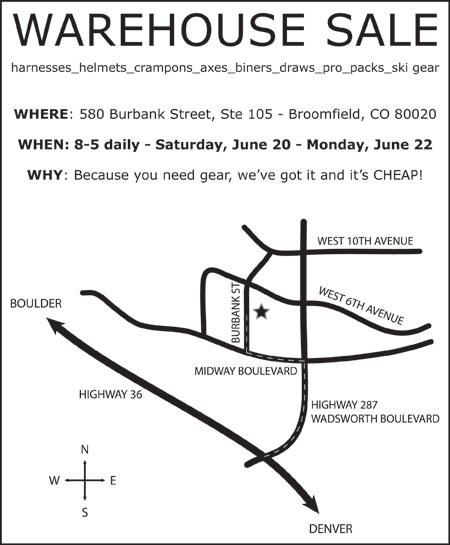
It doesn’t matter what you leave behind, only that your friends are happy that you were there.
Posted: June 13, 2009 Filed under: Uncategorized Leave a commentIt doesn’t matter what you leave behind, only that your friends are happy that you were there.
Adrenalin Junkie, Death Wish or Living Life to the Absolute Fullest
Posted: June 11, 2009 Filed under: Uncategorized Leave a comment
Many times I’ve been asked to explain why someone died. Not how, not what happened, those are always asked first, but why. Why did the loved one put themselves in that position to make the mistake or accept Mother Nature to their death? It is not an easy question to deal with, let alone answer. I doubt I have ever done a good job, or even an adequate job. The best I can do is describe some of the forces, or emotions that drive those of us who enjoy the outdoors.
I had not ridden my bike in 18 days because of a Grand Canyon River Trip I rowed for O.A.R.S. I hopped on my bike tonight and went out for an hour. My normal route is on the local bike path that rises 800 feet in the middle then down 800 and back up 250 to a road for awhile. About a mile later I turn into a subdivision and hop back on the bike path to return home.
The first half up to the top is drudgery. I put Jimmy Buffett on my MP3 player and gradually crank out the miles working up a sweat and some muscles. The drop down after the climb is on five switch backs and three tight turns till the path starts back up. I went screaming into a switchback tonight braking way too late, turning the bike as tight and as low as I could go, worried about my wheels and anything I could not see. A momentary, microsecond of emotion flushed through my body. Not really fear, just that feeling that comes when the adrenalin is surging. And I smiled. Not a grimace in fear or panic but a smile. I love that feeling of coming out of a near disaster in control, or to an extent some control, and living through it.
I once sat around a table with some famous mountaineers, all who had fallen over 100′ while climbing some as much as 2500′. I asked them what they were thinking as they fell. Generally the response fell into three categories: (1) Man this is going to hurt; (2) how the heck am I going to get out of this mess; and, (3) boy are my friends going to give me grief over this. None of the climbers mentioned fear, panic or the idea of dying in their conversations. It was just not part of the psychic. They all loved the sport, they all were still climbing after the near death experience and they are smiled as they talked about their falls. They were all still climbing and guiding.
Later on my bike ride as I was crossing from a bike lane across two lanes of traffic to a turn lane I had my right leg hugging my bike and front chain ring. Consequently I felt the road grime and dirt rubbing on my leg. I was hugging the bike hard because I barely had control. I did it because I was in traffic, being buffeted by the wind and crossing potholes. Again, not fear, not necessarily a surge of panic, but real concerns, Cadillac Escalade are big! but again on the edge and loving it. The rest of the ride was fun. I was alive and I knew it.
When I work for O.A.R.S. I row a gear boat. Garbage, kitchen stuff, anything needed etc and no customers. I like gear boats. I don’t have to entertain; I can think about things and enjoy the day. I enjoy showing the canyon to people, watching their face as they see new things and experience the rush. I recently helped a man climb up behind the Elves Chasim waterfall and jump out. It just required a little coaching and support and he talked about how great the experience was after the trip. I love that. I love the Grand Canyon, but more I love the way I can entertain and interact with people.
But more importantly I am past 50 and doing the job of a 20 year old kid. I am working as hard as I can and asleep before I hit horizontal some nights. I get up and put vitamin I (ibuprofen) in my mouth before I say good morning and spend ten minutes trying to get some body parts to work. I compete at a very basic level with myself.
I also can also run the rapids any way I want. I can drop in holes and push the limits. I see the beauty, I see the smiles, but inside I am pushing it. I can see how big I can go, how much I can lift, how many miles I can hike, how far I can go, how much water I can have hit the boat. I get a rush. I stand up and ride the rapids on the deck of the cooler or boat. I spin through rapids, I love to show off. But I love to push it, to see if I still got it and can give it back. I smile as the water drips off and the boat teeters on the edge and I push it over and through. I love it.
I don’t know why I love that rush. I don’t know why my days are better after I have it. I went out on the rid tonight with a sore knee and hands from the trip and I came back with a soaring soul. The ride was fun, the rush was wonderful. It is not a fix, it is not a need. It is just something that I enjoy.
Panic – Maybe if you do, you shouldn’t
Posted: June 11, 2009 Filed under: Uncategorized Leave a comment
Many of the problems that start as problems grow to a mess and end up as a legal issue start when someone loses it. So many times I’ve seen people get into more and more trouble because they panic and they cannot stop the escalation on their own.
Once swimmer from another boat on a class IV whitewater rafting trip resisted efforts to be rescued. He was screaming for help but could not get control. I hit him with two throwbags (ropes), got paddles to him twice and finally got so close with the raft we ran over him. In all of those situations he could not grab anything. Eventually I got the boat to show, jumped in the water and did the old Boy Scout lifesaving moves.
Another time a customer from my boat fell out. He kept screaming for help as he bounced down the river. He bounced because his butt was scraping on the bottom. Finally a rafting bus driver reached down from the show and pulled him out of the river. The bus driver did not get his cowboy boots wet.
People who panic I call tiger meat. 1000 or more years ago they would have been eaten by a tiger or some other predator.
Panic attacks are similar and I found a great article that says you can overcome and control panic attacks. Panic Attacks: The Lowdown
Coalition for Education in the Outdoors: Call for Abstracts
Posted: June 10, 2009 Filed under: Uncategorized Leave a comment
Coalition for Education in the Outdoors
Tenth Biennial Research Symposium
January 15-17, 2010
Call for Abstracts
From January 15-17, 2010, an international research symposium will be held at the Bradford Woods Campus of Indiana University in Martinsville, Indiana, a short drive from the Indianapolis Airport. The purpose of this gathering is to advance the empirical, conceptual, and theoretical bases of outdoor education. Like the first nine CEO Research Symposia, this symposium will bring together a wide array of researchers to explore current and future trends in using the outdoors for educational and therapeutic purposes. In addition to spotlighting current research, the program includes featured presentations on timely issues and ample time for both structured and informal dialogue.
The symposium is purposely small and informal to promote productive interaction. The event draws people interested in adventure education, organized camping, environmental education and interpretation, and other outdoor education contexts. Because of the diversity of topics, the informal exchanges, and the quality of sessions, this event is a favorite of both well-established and emerging scholars in the field. It’s also affordable; about $200 will cover registration, lodging, and meals.
Persons wishing to present (oral and/or poster) at the symposium must submit an electronic copy of their abstract (not to exceed 2 single-spaced pages; references only may extend onto a third page; 12 pt Times New Roman preferred) addressing the background, methods, results, and discussion of the study (authors of conceptual papers may use other headings). It is expected that presentations at CEO will not have been previously published or presented elsewhere. Abstracts that ask the same questions, use the same analyses, and make the same logical arguments should not be presented at CEO. Abstracts of works in progress may be submitted provided that a full report can be given at the January symposium. Abstracts are due by September 14, 2009.
All abstracts and manuscripts will be critiqued and evaluated by three reviewers. Notification of acceptance will follow on or around October 18. Individuals whose abstracts are accepted will be expected to present their study at the symposium. They will also be provided with more detailed instructions about preparing manuscripts and the review process for the refereed publication, Research in Outdoor Education, Vol. 10. In addition, abstracts of all presentations will be
compiled and bound for dissemination at the symposium and on-line through the CEO website. Questions about the submission or review process can be directed to Amy Shellman (amy.shellman@cortland.edu) or Jim Sibthorp (jim.sibthorp@health.utah.edu), review coordinators for CEO 2010. Questions regarding conference logistics or registration can be directed to Andy Young (anderson.young@cortland.edu).
The time line for the review process is:
September 14 Deadline for submission of abstracts
October 18 Notification of acceptance/rejection – invitation to prepare full manuscripts
November 13 Revised abstracts submitted for binding and distribution at symposium
January 15-17 Research Symposium (15 minute presentations and/or poster presentations)
How to submit abstract:
1. Send e-mail attachment in MS Word.
2. Use lead author’s name as document file name (e.g., SMITH.doc).
3. Put “CEO Abstract – ” in “subject line” of email message.
4. In body of email message include…
- Preference for oral report or poster presentation.
- Full title of the abstract.
- Names, affiliations, mailing addresses, phone numbers, and email addresses of ALL authors.
5. Send to:
Dr. Amy Shellman, amy.shellman@cortland.edu
voice: 607-753-4263
Deadline is September 14, 2009
For further information about the symposium, contact the Coalition for Education in the Outdoors, SUNY Cortland, Park Center, P.O. Box 2000, Cortland, NY 13045 (Voice: 607-753-4971; Fax: 607-753-5982 or E-mail: rls@cortland.edu).
Mixed emotions, but a lot of I told you so.
Posted: June 9, 2009 Filed under: Skiing / Snow Boarding Leave a comment
Helmets. Everyone is running around saying you have to wear a helmet. Worse, the people saying this are not helmet manufactures but people who open their mouths before engaging any research or their brain. Worse a celebrity just died re-inflaming the debate by people who just want to kill trees to advertise Viagra and bath soap!
In an article Widow sues over fatal skiing crash
The Rutland Herald reports Killington ski area is being sued over the sale of a helmet. The 44 year old decedent purchased a Giro Omen helmet equipped with a Bluetooth Audio System. He crashed into a tree at Killington Mountain in February of 2008 suffering a fatal head injury.
The allegations state at the time of impact the Bluetooth dislodged and resulted in the skull fracture.
- An adult man skiing into a tree, an expert skier and the Bluetooth audio caused the skull fracture? Speed * Mass striking a mostly immovable object equals a couple of ounces where the cause of death?
- Helmets won’t save you from dying if you hit a tree. Most helmets are effective at preventing injuries due to 12 mph impacts. Most people ski faster than 12 mph, so there is some benefit. However several studies have shown that skiing with a helmet increases the speed at which you ski by more than 12 mph because of feeling safer. Risk Homeostasis. See A new idea that makes sense in helmets: the Bern Hard Hat, and A helmet manufacture understands the issues.
- A lawsuit won’t solve any problems or answer any questions in this case.
As I have said before and will continue to say, it sucks when someone dies. It sucks for the surviving widow and family. It also sucks for the 20 something members of the ski patrol who have to physically deal with the issues. It sucks for the staff that has to answer questions and deal with the fatality. It sucks for everyone. Our condolences go to the family and the resort.
But a lawsuit won’t change anything. People are still going to talk on the cell phones or listen to music and ski…and drive. People are going to ski fast, probably faster if they wear a helmet. People are going to hit trees, fatally if the person is going fast enough or they are inclined to die if they hit a tree.
Wearing a helmet won’t stop you from dying if you hit a tree. Most skier deaths are caused by internal injuries anyway. It takes a lot less force to injury your organs or tear or ascending aorta than to cause a concussion in some cases. Wearing a helmet just makes less of a mess if you hit the tree with your head.
The National Recreation and Park Association is actively recruiting to fill the position of Senior Research Associate.
Posted: June 9, 2009 Filed under: Uncategorized Leave a commentSummary
This position directs and oversees NRPA’s research and development policies, objectives, and initiatives. Provides vision and direction for the program, reviews and negotiates key research contracts, facilitates the research agenda, coordinates, collaborates with universities, foundations, and government entities and oversees the research project relationships. Creates a competitive and profitable position for NRPA by formulating research and development programs.
The position also delivers a variety of products, based on original NRPA Research and collaborations, for use in the knowledge center and for sale. Will increase NRPA’s capacity (financial, managerial, and intellectual) to act in a strategic, coordinated, and focused fashion in identifying core research areas. Leads and directs the work of others. Provides opportunities for staff, member and partner input on research projects as needed to set the scope. Communicates direction through words or actions to inspire team members to reach goals.
Additionally is familiar with and understands a variety of the field’s concepts, methodologies, practices, and procedures in the field of research and relies on extensive experience and judgment to plan and accomplish goals. Develops the strategy and vision to carry out a project from inception through completion; creates teams and collaborations that understand the project’s direction. Also responsible for planning and budgeting.
Duties and Responsibilities
- COMMUNICATION AND COLLABORATION
- DATA ANALYSIS AND REPORT DEVELOPMENT
- RESEARCH OVERSIGHT
- PROPOSAL CREATION AND DEVELOPMENT OF PROJECT SPECIFICATIONS
DISCOVER the BENEFITS at NRPA!
Conveniently located off the Dulles Greenway, in Brambleton Regional Park in Ashburn, NRPA boasts a warm professional environment, with a relaxing and peaceful view of nature at its finest! All staff have access to indoor & outdoor eating areas, as well as indoor & outdoor fitness opportunities. Our facility has a brand new air-conditioned fitness room with access to showers, as well as foot trails for the outdoor enthusiast. Full time staff enjoy a very rich benefit package that includes group Health, Dental, and Vision for employee and family, paid 80% by the employer; 403(b) fully vested upon hire;; Life insurance, Short Term Disability and Long Term Disability paid 100% by the employer; accrue 26 Paid days off per year plus 13 paid holidays, eligibility in the first month of employment, Length of Service Awards and much, much more! NRPA is committed to promoting an environment of work-life balance. To promote healthy lifestyles, at work and away, we have established prog!
rams like Teleworking, FlexTime Schedules, 37.5 hour work-week, Employee Assistance Programs, Educational Assistance Programs, Lunch-and-Learn sessions and more. Discover what we already know NRPA … a great place to work!
APPLICATION PROCESS
NRPA is an equal opportunity employer with a commitment to Diversity. Women and ethnic minorities encouraged to apply.
Requirements/Education:
Masters degree (MA, MS) required, PhD highly preferred. Successful candidate will have 7 – 10 years in planning and conducting research and evaluation, ideally in a higher education setting; P&R experience a plus.
Knowledge, Skills & Abilities:
Knowledge and understanding of park, recreation and conservation issues. Skilled in quantitative research methods, including statistical analysis, data collection, manipulation, and management.
Should be skilled in qualitative evaluation methods, including articulation of theory of change, case studies, and organizational reviews. Need to be skilled in evaluating programs, such as: developing logic models, identifying key indicators.
Supervise outside evaluators, and designing data collection methods. Ability to build and maintain credibility with academics in related fields. Understand that the research agenda is going to be applied as an actionable and translatable resource to practitioners.
Exceptional organization and time management skills including multi-tasking and the ability to set/adapt to changing priorities. Ability to interact effectively with all levels of personnel. Must be able prepare reports, presentations, and other documents that make complex topics, data, and analysis understandable to a variety of audiences using narratives, tables, graphs, and maps.
Will represent NRPA as needed at meetings and other forums with a variety of agencies, groups and organizations. Can work occasionally outside of normal business hours in order to meet project deadlines. Be able to travel to off-site locations as needed to perform job functions.
Technology:
Microsoft Office Suite (PowerPoint, Excel, Word, Access, and other MS based programs),Microsoft Outlook, Data querying tools (example: SQL), Statistical Analysis software (Example: SPSS, SAS), FTP, Internet.
Please visit the following web address or the NRPA website to apply for this position: https://home.eease.com/recruit/?id=314632 <https://home.eease.com/recruit/?id=314632> .
Thanks,
Amy Roussos
Manager, Branch/Section Services
National Recreation and Park Association
22377 Belmont Ridge Road
Ashburn, VA 20148
703-858-2153
aroussos@nrpa.org
Lawsuit against health club and personal trainer over fatality
Posted: June 4, 2009 Filed under: Health Club Leave a comment
The New York Times in an article Health Club and Trainer Are Sued in a Death reported the death of a fashion designer was due to the nutritional supplements a trainer instructed her to take. The trainer is no longer employed by the health club where the fatality occurred and who is a co-defendant. Of course the supplement is ephedra which is the subject with all sorts of claims and allegations, some true and some; even by government agencies, is false. However it is not recommended to be taken by people with high blood pressure, which the deceased had.
The trainer accompanied the deceased to a store to assist her in buying the supplements. The supplement manufacture and retail store are also named as defendants. This fact is a critical one in proving part of any claim.
The suit describes the trainer as a “level two” personal trainer but alleges the trainer did not have the necessary training or knowledge to do a proper job. See Basics of the Article are Good – But it confuses certification, accreditation and most importantly standards.
Another lawsuit in a confused industry.
Well it’s happened: K2 will have its first true commercially guided climb this season
Posted: June 2, 2009 Filed under: Mountaineering Leave a comment
Fabrizio Zangrilli is working with Field Touring Alpine to lead a guided climb on K2 this late summer season. This is probably the first true commercial, guided climb on K2. By commercially guided I mean a guide is being paid to take clients up a mountain versus some people going for free or a trip leader making money on his group of climbers. By clients I mean people who may but probably do not have the total ability/skill/experience necessary or maybe desire to climb the mountain without a guide.
It was to be expected. Most people consider the 1984 guided climb of Dick Bass and Frank Wells as the first commercially guided trip on Everest. However commercial Everest expeditions took off after the 1996 mess. (I refuse to call a natural weather event a disaster.) Publicity good or bad does not deter either mountaineers or those with money and a desire to check a box. It has always been an unconfirmed rumor that after the 1996 Everest mess Mountain Madness added more phone lines, even though its owner and founder had died on the mountain.
This guided expedition occurs after a year where 11 people died on K2 which was reported worldwide for weeks. Publicity good or bad does not deter, just highlight.
See K2’s First Commercial Expedition
Basics of the Article are Good – But it confuses certification, accreditation and most importantly standards.
Posted: May 28, 2009 Filed under: Health Club | Tags: Certification, fitness, Institute for Credentialing Excellence, personaltrainer, Physical exercise Leave a commentThis article has a great example about why creating standards is a liability or noose for any industry. The article has the following quote:
Of course the term that caught my eye was “high accreditation standards”. Granted the combination of accreditation and standards can be

Image via Wikipedia
confusing but the simple fact is creating high standards creates lawsuits. Standards are not goals or operational levels but the lowest acceptable level of operation. If you have an accreditation (marketing) program in your industry, make sure you don’t confuse helping a member achieve a level of business to market itself to the public (accreditation) and the operational levels below which you have violated a duty to someone (a standard).
The article was written in response to attempts by several states to create statutory requirements for personal trainers. At present there are none. There are certification programs seemingly dozens of programs. However a certification is only as strong as the person teaching the course offering the certification. Here certification is also being used to market the level of competence of the person holding the certification rather than proof of education. This seems to be the general evolution in the minds of the public, promulgated by marketing programs to have the word certification mean more.
And I agree and doubt that any state government can do a good job of certifying anyone in the personal training market. The statute will be very watered down. (This from someone who lives in a state where anyone can be a licensed therapist, you need $15!)
The article also brings up the issue that certification can be provided by anyone. You can become a certified personal trainer by completing online courses. I would want my personal trainer to know a lot, and getting that education online is OK. But I would think that stretching, lifting and aerobics would require a little more effort to learn than what you can do with a keyboard and screen.
Again, it does not matter what the certification is, it only matters who issued the certification and what was taught and/or tested.
I’ve have always said that lawsuits start when marketing makes promises that operations cannot meet. Here again, marketing of programs has started a nightmare that will come back to haunt the industry if they do not get organized and stop.
See Certification Update: Self-Regulation at Risk, and Attacking Industry Standards,
Air Force going to have a Ski Area – Only Hill AFB could and should pull this one off!
Posted: May 26, 2009 Filed under: Ski Area Leave a commentThe majority if not every Air Force Base has an MWR program. Morale, Welfare & Recreation programs although the Air Force calls them Airman & Family Readiness Centers. The program serves a great function; it gives members of the military the opportunity to experience all sorts of recreation. Another major feature is helps returning servicemen the opportunity to burn off and learn how to control adrenalin. After spending a year or more in a battlefield I would suspect you become quite addicted to adrenalin. Outdoor recreation is one big component of the MWR program.
I’ve done a lot of work with several different military MWR programs and gotten to know a lot of the civilians who run them. One of my favorites is the crew at Hill Air Force Base north of Salt Lake City, Utah. A great group of people run the Outdoor Recreation Program who understand and take outdoor recreation in ever different direction, all good directions. Well now it seems they might have found another direction, and a good one.
The air force owns land near Park City, Utah which they intend to lease for a Ski Resort. See Air Force plans to lease land for ski resort. Congrats and good luck to the Hill AFB MWR program.
The Interview provides a lot of information on why the @#%(@ got lost.
Posted: May 21, 2009 Filed under: Search and Rescue (SAR), Ski Area Leave a comment
The Tahoe Daily interviewed a Snowboarder that was lost. The article Tahoe snowboarder recounts rescue from the Firebreak had one quote that cracked me up.
“Everyone who skis in the backcountry needs to have one that is fully charged and can get service.”
My cell phone works everywhere I go, doesn’t yours, oh, unless I leave the city.
The Next Federal Transportation Funding Bill
Posted: May 21, 2009 Filed under: Uncategorized Leave a comment
The Next Federal Transportation Funding Bill
Prioritize bicycling and walking
Congress is writing a bill that will define our national transportation system for the next 6 years and we need your help to make sure that your Member of Congress weighs in on the transportation bill to support bicycling and walking.
Representative Daniel Lipinski (D, IL) is circulating a “Dear Colleague” letter proposing that the upcoming Transportation Bill, which is currently being drafted by the House Transportation and Infrastructure Committee (T&I), promotes and funds alternate transportation options. Representative Lipinski is asking
his colleagues in the House of Representatives to join him in a call for increased federal funding for bicycling and pedestrian programs.
We are thankful for Congressman Lipinski’s efforts on behalf of cyclists nationwide and urge you to contact your Representative to ask them to join Mr. Lipinski and lend their voice to this important debate.
Please contact your Representatives office today and urge them to sign onto Congressman Lipinski’s policy letter today
Letter to the Chief Scout Executive from a Volunteer
Posted: May 19, 2009 Filed under: Uncategorized Leave a comment
William A. Sheehan
24 SOUTH BROAD STREET
WOODBURY, NEW JERSEY 08096
(856) 853-8636
FAX NO. (856) 848-2230
March 25, 2009
Robert Mazzuca, Chief Scout Executive
1325 West Walnut Hill Lane
Irving, TX 75038
Re: New Annual Health and Medical Record Form
Dear Mr. Mazzuca:
I have had the opportunity to review the new annual health and medical record form, posted online at http://www.scouting.org/filestore/pdf/34605_Letter.pdf As an Assistant Scoutmaster, I am quite concerned about the effect upon my troop and upon the scouting program in general which will be caused by the red highlighted paragraph on page two of the form.
That paragraph states:
“Individuals desiring to participate in any high-adventure activity or events in which emergency evacuation would take longer than 30 minutes by ground transportation will not be permitted to do so if they exceed the weight limit as documented at the bottom of this page. Enforcing the height/weight limit is strongly encouraged for all other events, but it is not mandatory.”
I have two concerns. One is that making this height/weight chart mandatory rather than advisory will have the effect of excluding thousands or tens of thousands of youth already signed up in our program from participating in it, which will lead either to shrinking enrollments or widespread disregard of the “mandatory” language of the form. In this latter event, my second concern is the potential for opening our organization and our volunteers up to liability should they permit a youth to participate who exceeds the weight restrictions, and should an injury occur which could be arguably tied to the participant’s weight.
At the outset, I note that this prohibition is not imposed merely on activities strenuous in themselves. Rather, it extends to all activities taking place at a point more than 30 minutes from medical care by ground transportation. I submit that anywhere worth taking our youth can be more than 30 minutes away by ground transportation. In many parts of our country, a youth would be more than 30 minutes away from medical attention sitting in his living room, as a couch potato. Rather than getting out a map, a stop watch and calipers while planning an outing, I suggest that Unit leaders simply assume that they are more than 30 minutes away from medical attention for any scouting activity.
The cover sheet for the form identifies 11 risk factors which may define participation in various outdoor adventures. These 11 “risk factors” are not listed in alphabetical or any apparent order, with the exception that “excessive body weight” is at the top of the list, beating out such maladies as heart disease, diabetes, seizures, asthma and anaphylaxis.
A scout suffering from heart disease may be cleared by his physician to participate in hiking and camping, sports, cold weather activities (less than 10 degrees F), competitive activities, horseback riding, backpacking, scuba diving, wilderness/ backcountry treks, swimming/water activities, mountain biking, climbing/rappelling and challenge (“ropes”) courses provided that his physician, after physical examination, checks the boxes on page two of the form (the same page that contains the weight prohibition). Further, a scout with uncontrolled heart disease may participate in any of the activities checked off by his physician with any restrictions noted by that physician, also on page two of the form.
For a scout who is one pound over on the height/weight chart, however, it’s “no way, Jose”. The scout who does not make weight “will not be permitted” to participate in any activity whatsoever more than 30 minutes from medical attention.
Similarly, a scout suffering from asthma can participate in any of the above activities, at any distance from medical care, provided his physician, after examination, checks the box for that activity. Even a scout with “uncontrolled” asthma may participate with any restrictions the physician cares to note.
Along the same lines, a scout who has seizures may participate in activity his physician, after examination, checks off and even those with newly diagnosed seizure events (within six months) may participate with any restrictions the physician cares to note.
A Scoutmaster can take a scout with a sleep disorder, whose breathing stops from time to time during the course of a night, on any activity indicated by the physician at any distance from medical care. But don’t let that scout be a pound overweight.
A scout who suffers from allergies to the degree that he may suffer anaphylaxis may participate in any activity his physician checks off, at any distance from medical care.
With excessive body weight, and excessive body weight alone, the decision is removed from the hands of the physician, the boy’s parents and the scout leader. All because the form says, in big red letters, that the scout “will not be permitted” to participate in the activity.
Why is that? We all prefer our scouts to be fit and trim, but why is body weight elevated above all these other maladies in terms of participation in scouting events?
What this form says, in no uncertain terms, is that if a scout does not make weight, he or she (in the Venturing program) cannot participate. That is a heck of a note.
I read with interest the recent article in Newsweek magazine concerning the outreach to Hispanic youth. I also understand that you appeared on NBC Nightly News with Brian Williams concerning that initiative. Certainly nothing was mentioned that all of the outdoor activities of the Boy Scouts of America would be closed to such youth if they didn’t make weight. If a boy is a bit on the heavy side, he will have to be satisfied with the good citizenship parts of the BSA. Forget about the outdoor activities.
In my view, we do not need the negative publicity should a “weight ban” become public knowledge.
This is an organization that, quite rightly, promotes vigorous exercise in the out of doors. Are we to tell potential scouts that they cannot even begin this program of health and exercise unless they are already fit and trim?
The entire Venturing program is premised upon high adventure. Are we to have the members of each crew get up on a scale to separate those who can continue in the program from those who must be told to stay home? How about OA service weekends? Will there be a weigh in at the Friday night check-in?
At Blue and Gold dinners, when the Cub Scouts cross over a small bridge to symbolize their crossing over to the Boy Scout program, will there be a bathroom scale waiting for them at the end of the bridge?
Scouting is also a movement in which the youth participants are urged to follow the example set by the adult participants. Scoutmasters and assistants, themselves overweight, will be put in a position of informing overweight youth that the youth are absolutely banned from participating in the outdoor Scouting program. The overweight adult, in contrast, can simply pack up his pack and head off down the more than half hour trail, free as an “adult” to choose to ignore the mandate.
Or should overweight adult volunteers be banned as well? Good luck keeping the program running if that is the outcome.
What of a Unit leader who does not bar participation by youth who are a few pounds over. What if such a youth has a health problem during the activity which arguably bears some connection to his or her weight? Because the BSA erected a policy that did not exist before and put it all in red letters, that could become “the law of the case” and liability could be found. (I am an attorney licensed to practice in the State of New Jersey).
Leaving the legalities aside, assume a Unit leader allows participation when a youth does not meet the guidelines. Is such a youth to be turned away at district or council events, such as camporees or OA service weekends, or turned away at the gate of a council summer camp? Many council camps are remote, as I am sure you are aware.
I have not taken a survey, either in my troop or in my district or council, to determine how many boys are affected by this decree. Has the BSA made any such survey? If so, how many of our youth must be banned from the outdoor program? If you don’t know, don’t you think it is something that should be known before any such prohibition is mandated?
In my own troop, I know of one boy who had to be told that he could not participate in this summer’s council Philmont expedition, because of the weight limitation. He is a husky, healthy high school football player, a Life Scout working on his Eagle. Telling him he cannot make the “Summit of Scouting” is one thing. Must I inform him he cannot go on a weekend, drive-in, camping trip, simply because the troop will be camped more than one half hour from a hospital?
I hasten to add that I am in full agreement with the imposition of weight guidelines for the Philmont Scout Ranch. I am a veteran of two Philmont Expeditions in my youth and five Autumn Adventure Treks. I have made weight. I am also aware that making weight can be very difficult for some participants. However, we are not talking Philmont here, we are talking about a trip that is a half an hour into the woods.
It is fine to identify excessive body weight as a potential risk factor, require that a boy’s height and weight be recorded and compared to a chart, at the time of his physical examination, by his family physician, who may then take that into account in clearing him for the various activities on the form. What I object to is taking the decision out of the hands of the physician, the parent and Scoutmaster and drawing a bright red line which will exclude many of the kids we are trying to help rather than a common-sense approach. It seems like someone thought that excessive body weight could be addressed by simply issuing a decree, with the admonition that we in the field “make it so”.
A final observation is that the language used in the form does not talk about the actual weight of the participant at the moment the activity commences. It speaks of the height and weight “as documented on this form” as being the cutoff. I am not advocating that we weigh the boys before each trip. Weighing them fully clothed would not yield the results on the chart, in any event. But what of the youth who has dieted or exercised since the doctor’s exam or who has grown a few inches?
In short, I strongly recommend removing the red highlighted material at the top of the second page and removing reference to that paragraph on the cover sheet “…the height/weight chart must be strictly adhered to…”. Excessive body weight should be treated as any of the other illnesses or conditions listed on the cover sheet, in a place within the discretion of the physician, the participant’s parents and the Unit leader.
I wish to thank you for taking the time to read this letter and hope that it will have the effect of removing that red highlighted language. Please do not put me and others in a position of denying some youth the benefits of the Scouting program because they are not yet fit and trim. Hopefully, after a few hikes, they will do better with the weight situation.
Thank you for your kind attention to this matter.
Yours in Scouting,
William A. Sheehan
ASM, Troop 55
Pitman, NJ
WAS/kln
cc: Health and Safety Committee
Boy Scouts of America
National Council Health and Safety Committee
1325 West Walnut Hill Lane
Irving, TX 75038
Settlement reached in suit against Idaho State University group CW Hogs
Posted: May 18, 2009 Filed under: Uncategorized Leave a comment
I wrote about a lawsuit against a University of Idaho outdoor program for the disabled in University sued for actions of Participant on an Outdoor Trip for $5M. It is being reported that a settlement has been reached in that suit. See Settlement Between CW-HOG and Family Whose Son was Killed in Jet Ski Accident. Terms of the settlement were not disclosed, as usual.
Threat to Green River Water
Posted: May 18, 2009 Filed under: Uncategorized Leave a comment
Uranium Watch would like to bring to your attention a threat to the Green and Colorado Rivers and the community that uses the rivers for private, educational, and commercial recreation. The threat is due to a proposal by Transition Power Development LLC to site a 2-unit nuclear reactor (known as the Blue Castle Generation Project) about 3 miles west of the Green River and the City of Green River.
Transition Power has leased 53,600 acre feet of water that it intends to pipe from the Green River to the site, just north of I-70 and the railroad and east of Hwy. 6. The water would be used to cool the reactor, to operate the reactor, and as a heat sink in case of a nuclear accident.
There is now an opportunity to protest and request a hearing on the withdrawal of 29,600 acre-feet of the water (over 26.5 million gallons per day), which was leased from the Kane County Water Conservancy District (KCWCD). On March 30, 2009, KCWCD applied to change the point(s) of diversion, place of use, and nature of use for Water Rights 89-74, 89-1285, and 89-1513. Application:
http://www.uraniumwatch.org/transitionpower/kcwcd.89-74_changeapplication.090330.pdf
Protests and any requests for a hearing must be filed with the Kent L. Jones, State Engineer, Division of Water Rights, P.O. Box 146300, Salt Lake City, Utah, 84114-6300 on or before Monday, May 25, 2009.
An objection to the application must be readable and state the filing number (a35402), reasons for objections, protestant’s name and address, and any request for a hearing. A protest must be signed by the protesting party or representative. A protest may be faxed, but a signed paper copy must also be sent in the mail. Fax to 801-538-7467.
The will be an informal proceedings pursuant to Utah Administrative Code Rule R655-6-2 of the DWR
For a paper copy of the application, call 1-866-882-4426.
What are the Issues?
According to Utah Code Annotated, Section 73-3-8, it shall be the duty of the state engineer to approve an application if:
- There is unappropriated water in the proposed source.
- The proposed use will not impair existing rights.
- The proposed use will not interfere with the more beneficial use of the water.
- The proposed plan is physically feasible.
- The proposed plan is economically feasible.
- The proposed plan will not be detrimental to the public welfare.
- The applicant has the financial ability to complete the proposed works.
- The application was filed in good faith and not for purposes of speculation or monopoly.
- The appropriation will not unreasonably affect public recreation.
- The appropriation will not unreasonably affect the natural stream environment.
If an application does not meet the requirements of this section, it shall be rejected.
The March 30 Application does not address any of these criteria.
The withdrawal of such a large amount of water (almost 50 million gallons per day), if the project is approved, would have an adverse impacts on public recreation, stream environment, and public welfare. The intake structures in the river, which would supply the water to gigantic pumps on the bank of the river, could be hazardous to recreation. Having a nuclear reactor next to the Green River would discourage recreational visitors to the whole area. Any commercial recreation company would have to be knowledgeable about any emergency response planning and have their own response plans. A radiological accident would be disastrous.
Any concerns regarding the impacts to more beneficial uses, public recreation, natural stream environment, and the public welfare should be brought to the attention of the State Engineer in a protest. For additional information and links: http://www.uraniumwatch.org/transitionpower.htm
If you have any questions, comments, or want to be kept currently informed, please e-mail Uranium Watch at sarah@uraniumwatch.org or call 435-210-0166.
Sincerely,
Sarah Fields
Program Director
Uranium Watch
Jon Heshka and the Right of the Individual to Die Doing What We Love
Posted: May 14, 2009 Filed under: Search and Rescue (SAR) Leave a comment
Thinking before Acting – Applies to Outdoor Recreationist and the Governments
Jon Heshka has written a very thought provoking op-ed piece for the Kamloops Daily News about the true cost of skiing out of bounds and how to deal with it. See High Cost of Chasing Powder.
Jon is one of the bright minds in the outdoor recreation community. He is on the faulty of Thompson Rivers University in the Adventure Studies Program. This program is the only program that can lead to UIAGM certification in climbing, backcountry skiing, ice climbing and other programs. Undoubtedly the best college program in the world if you want to become an outdoor recreation guide or business.
I am a fan of Jon’s, so much so he is the only person not a lawyer to have an article published in the Outdoor Recreation Law Review. See Assumption of Risk and Inherent Risk in Higher Outdoor Education.
Thanks Jon. It is a great article and I appreciate your thoughts and perspective.
You’ve got to be kidding!
Posted: May 13, 2009 Filed under: Uncategorized Leave a comment
An audacious water extraction project by a private entrepreneur named Aaron Million who wants build a 560 mile long, 10 feet diameter pipeline from the Green River in Wyoming over the continental divide to the east slope of Colorado.
This pipe would export 250,000 acre-feet per year out of the Colorado River basin into the Mississippi River drainage. Let’s keep the water in the river!
I urge you to send your own comments to the Army Corps of Engineers at MCRG.EIS@usace.army.mil by July 27, 2009.
2009 National Extension Tourism Conference
Posted: May 13, 2009 Filed under: Uncategorized Leave a comment
2009 National Extension Tourism Conference
“The Tourism Connection: Sustaining People, Places, and Communities”
The Yarrow Resort Hotel and Conference Center, Park City, Utah
June 14-17, 2009
Greetings! We’re up and running with the Draft Program Agenda for the 2009 National Extension Tourism (NET) Conference. To review this, please visit the conference website at http://extensiontourism.net
and click on “Agenda.”
We’re going to have a great conference with around 100 people attending from all over the country and several other countries, and we have a great program agenda with three excellent keynote speakers, a dozen poster presenters, over 50 oral presentations, nine separate workshop presentations, addressing a number of topical areas including Agricultural Tourism; Rural Tourism Development; Heritage and Cultural Tourism; Ecotourism and Nature-Based Tourism; Tourism Education and Training; Tourism Marketing and Promotion; Tourism Research and Evaluation; Community and Regional Tourism Planning and Development; and Economic, Environmental, and Social Impacts of Tourism and Recreation… plus five interesting and exciting field trips, and quite a few exhibitors, all in beautiful Park City, Utah!
Also scheduled is a Pre-Conference Workshop titled “Applications of GPS to Support Tourism Planning” by John McGee, Ph.D., Virginia Geospatial Extension Specialist.
If you haven’t already, please join us and register for the 2009 NET Conference!
Help us spread the word to recruit more conference attendees! The more the merrier!
Earlybird Conference Registration Extended to Friday, May 22, 2009
Group Room Rate at The Yarrow Resort Hotel and Conference Center Extended to Sunday, May 24, 2009
On behalf of the 2009 NET Conference Planning Committee, we’re looking forward to welcoming you to Park City, Utah, for a great conference!
Thanks. SWB
Steven W. Burr, Ph.D.
Chair, 2009 NET Conference
Associate Professor of Recreation Resources Management
Director, Institute for Outdoor Recreation and Tourism
Extension Specialist in Outdoor Recreation and Tourism
Department of Environment and Society
College of Natural Resources
Utah State University
5220 Old Main Hill
Logan, Utah 84322-5220
(435) 797-7094 Office
(435) 797-4048 Fax
E-mail: steve.burr@usu.edu
Website: extension.usu.edu/cooperative/iort
Join us for the 2009 National Extension Tourism Conference, June 14-17, 2009, in Park City, Utah.
Visit http://extensiontourism.net for more information.
Terrain Park Injury prompts Lawsuit against Idaho Resort
Posted: May 12, 2009 Filed under: Ski Area Leave a comment
Schweitzer Mt. Resort is being sued for the injuries suffered by young snowboarder who fractured a femur, hip, vertebrae and a head injury. The plaintiff maintains the jump subjected the boy to physical forces and danger above those inherent in the sport as reported from the Bonner County Daily Bee.
The defense is arguing the Idaho statute states the snowboarder expressly assume the risk of the injury and requires a rider to know the range of their abilities and ski within their limits.
The specific statute being referenced is:
Idaho Code § 6-1106 (2008)
§ 6-1106. Duties of skiers
It is recognized that skiing as a recreational sport is hazardous to skiers, regardless of all feasible safety measures which can be taken.
Each skier expressly assumes the risk of and legal responsibility for any injury to person or property which results from participation in the sport of skiing including any injury caused by the following, all whether above or below snow surface: variations in terrain; surface or subsurface snow or ice conditions; bare spots, rocks, trees, other forms of forest growth or debris, lift towers and components thereof; utility poles, and snowmaking and snowgrooming equipment which is plainly visible or plainly marked in accordance with the provisions of section 6-1103, Idaho Code. Therefore, each skier shall have the sole individual responsibility for knowing the range of his own ability to negotiate any slope or trail, and it shall be the duty of each skier to ski within the limits of the skier’s own ability, to maintain reasonable control of speed and course at all times while skiing, to heed all posted warnings, to ski only on a skiing area designated by the ski area operator and to refrain from acting in a manner which may cause or contribute to the injury of anyone. The responsibility for collisions by any skier while actually skiing, with any person, shall be solely that of the individual or individuals involved in such collision and not that of the ski area operator.
See Schweitzer Mt. Resort challenging negligence lawsuit.
Good article on Avoiding Avalanches…….don’t go where there are Avalanches
Posted: May 7, 2009 Filed under: Avalanche Leave a comment
I sometimes wonder if the numerous articles and products that are designed to increase your chances of surviving an avalanche are creating more avalanche situations. Sort of like a Risk Homeostasis issue. (For more on Risk Homeostasis see Target Risk.) By that I mean when avalanche beacons were very difficult to use and required hours of training people avoided the backcountry because they knew they did not have the skills needed. Avalanche beacons still require hours of training, however they are advertised as easy to use so consequently, are we sending more idiots out in the backcountry?
Don’t get me wrong, a beacon that is easier to use, more efficient in its search is needed. But idiots abound.
People who move to Colorado always ask what they need to know to enjoy Colorado. I have always told them to take an Avalanche course. This seems to catch them off guard, but since I have lived here I-70 has been buried twice in two sections less than 70 miles from Denver.
The writer of the article quotes an avalanche instructor at the end of a course saying “”Remember,” Mr. Matous said, “you’re not any more safe than you were last week.”” The same instructor also says that you would not be on the slope if you thought there would be an avalanche.
Where am I going? The article basically says if you want to survive an avalanche, don’t go where there are avalanches. Surviving an avalanche has nothing to do with what you know, what you have, how you are trained unless you put that all together and DON’T GO WHERE THERE ARE AVALANCHES!
See How to Survive an Avalanche.
Great article in my opinion.
Township is probably broke so let’s charge the people who make the 911 phone call
Posted: May 5, 2009 Filed under: Ski Area Leave a comment
People who got hurt are not responsible in this township, let alone the person who legally owes the money.
Brandywine Ski Resort is located in Ohio near Cleveland. Ohio is a state with 88 counties (from grade school in Ohio). Each county is divided further into townships. A township controls the township roads, and in a lot of cases the fire department/ambulance service. A couple of years ago the Sagamore Hills Township passed a law saying if a “business” calls for help more than six times they have to pay $836 for each call.
A lot of cities and counties have a law like this, sort of. The laws are in place because alarms go off all the time and the police show up for no reason other than a big truck drove by in the middle of the night setting off the alarm. Some business will have bills for thousands of dollars because their alarms are going off all year long. However, I have never heard of billing for medical calls.
Brandywine as a ski resort has a lot of people who get hurt. It is a ski resort. Hurt people need transported to the hospital (or at least off the ski area property…). Consequently Brandywine can put them in the back of a truck and take them to the hospital, but that creates liability, greater liability because you are now on the road. You can call a cab for them. Of course the injured person would have to pay the cab driver at the end of the ride and skier wallets are always locked in a locker at the lodge.
But that is the issue, the injured skier is the one responsible for the cost of the ride to the hospital.
The trustees though seem to have forgotten this and on top of that taken the who owes the money idea and twisted it into a pretzel. “Trustees defended the resolution, saying companies like Brandywine should be responsible for handling many of the injuries caused by the inherent dangers of skiing and other activities they offer.” If the dangers are inherent why is Brandywine liable. If the dangers are inherent, then the liability lies solely with the injured party.
“”We’re not going to subsidize a private business for profit,” said Trustee Richard Barrett.” The Trustee is not real sharp. The township is not subsidizing the ski area they are subsidizing the injured skier. That is the person who owes the money for the ride.
Maddening. Next time you are in this township would you pick up the phone to call 911, you might get billed!
And you guys think that attorneys in elected office are a bad thing. At least attorneys would know who is liable.


 Recreation Law