
Event: Ski Season Kickoff Party 2009 to Benefit the Colorado Avalanche Information Center
Posted: September 18, 2009 Filed under: Skiing / Snow Boarding Leave a commentEvent: Ski Season Kickoff Party 2009
“A Fundraising Event for CAIC / FOBP / BSA”
What: Fundraiser
Start Time: Wednesday, September 30 at 5:00pm End Time: Wednesday, September 30 at 9:00pm
Where: Bent Gate Mountaineering
To see more details and RSVP, follow the link below:
http://www.facebook.com/n/?event.php&eid=133118014003&mid=11c5926G1e5dc624G35471b9G7
More information over the debate about ski helmets: Ski Helmets ineffective crashes were the wear is going faster than 12 miles per hour
Posted: September 17, 2009 Filed under: Skiing / Snow Boarding 2 Comments
More information over the debate about ski helmets: Ski Helmets ineffective crashes were the wear is going faster than 12 miles per hour
A study just released by Karl-Heinz Kristen, vice president of the Deutsch-Österreichisch-Schweizerischen Gesellschaft für Orthopädisch-Traumatologische Sportmedizin (GOTS or German-Austrian-Swiss Association for Orthopedic-Traumatic Sport Medicine) just released a study showing that ski helmets are only effective in crashes of less than 12 miles per hour.
For this article see Ski helmets ineffective over 20km/h claims sport medic. For additional posts on ski helmets see Mixed emotions, but a lot of I told you so, A new idea that makes sense in helmets: the Bern Hard Hat and A helmet manufacture understands the issues. For Outdoor Recreation Law Review articles on the subject see In the News: Article finds helmets might not be as effective as once thought, an avalanche at a ski resort in Indiana, 3 American climbers killed by rock slide, climber left hanging, snowmobile fatality, and much more…
May people believe that I am against wearing helmets? That is not true, I have several and wear them a lot of the time. I want people to understand why and what a helmet will and most importantly what a helmet will not do. A helmet will do nothing in whitewater rafting. A helmet will not save your life in skiing. I wear my ski helmet on crazy days or cold days. Sometimes I wear a helmet skiing when I just want to ski fast. But that is more of a brain bucket for the ski patrol then believing it will keep me alive.
This is another study that shows that helmets are NOT going to keep you alive.
Death from fall from inflatable climbing wall results in Criminal Charges
Posted: September 15, 2009 Filed under: Climbing Wall, Criminal Liability Leave a commentI’m not sure what prompts prosecutors to charge people for what appear to be accident deaths of patrons. In this case a 24 year old woman was attending a festival, climbed on an inflatable climbing wall and fell off. She hit her head when she fell on the platform.
The company was charged with reckless and wanton negligence. The charges came after 2 years and a change in district attorneys. The family is suing the climbing wall operator with a trial started September 2, 2009.
I have lots of issues with all of this.
Reckless and wanton negligence is generally not a criminal act. Negligence is a breach of a duty to someone. A crime requires scienter, a criminal intent to do the crime to act in a criminal way. Negligence is not criminal by its definition. Granted there are crimes that do not require proof of a criminal intent, parking tickets being the best example.
Second, the issues reported, have their own criminal penalties if they occurred. The prosecutor states the company “failed to follow safety regulations. … had not been inspected as required, was poorly placed and lacked proper permits and that the operator was not properly trained or certified.” A violation of safety regulations either federal, OSHA, or state has specific penalties and in most cases administrative law procedures. You are cited and pay a fine. Failing to be inspected and not having the proper permits is similar, you are fined.
But I doubt there are safety regulations that would affect this situation. OSHA only covers employees and the state or county would have to enact regulations to cover inflatable climbing walls and I’ve not see any. Consequently this statement seems…incorrect?
However here again the prosecutor takes off in a different direction with proper placement and lack of training or certification. Proper placement from a criminal perspective occurs when you are dealing with a dangerous instrumentality. Dynamite, wild animals or guns are the examples given in legal textbooks. You are dealing with something that everyone knows will kill and has been identified as such by the community and therefore you have a requirement to handle with care or you can face criminal liability. A toy is not a dangerous instrumentality. It is not designed or known to kill if used incorrectly every time it is used.
Manslaughter is generally “homicide without malice aforethought.” Less than murder because the willful element is not present. Manslaughter lacks the intent to kill while manslaughter is an act that will result in death no matter what. A better way to look at the difference is murder you intend to kill someone, manslaughter you act in a way that someone was bound to die. Those are not the strict legal definitions but a general way of looking at the differences.
Here again the difference between a toy that someone dies using and a gun or dynamite is an easy way to see the difference. Using the Infinite Monkey’s theory (given an infinite amount of time an infinite amount of monkeys with an infinite amount of keyboards can type the works of Shakespeare), anything can kill. A gun on the other hand can kill every time.
However that is why we have this entire separate legal system in the US. As I’ve commented on several times in the past, we have a civil system that controls society as well as a criminal system. If you act improperly the civil system is put into place; you are sued. If you act improperly with criminal intent, the criminal system is used. In other countries the government controls more of society. It does not require the high level of intent before the government steps in and civil suits are rare and difficult.
“…properly trained or certified” is another statement solely used to inflame the possible jury pool. The training would be determined by the manufacture of the inflatable wall and the certification does not exist. If you need to be certified, stand on one foot, pat your head and jump around in a circle three times saying Jim Moss is the greatest and you are certified. If you send me $20.00 I’ll send you proof of the certification. For $25 I’ll let you tell me what you have been certified to do and for $30 I’ll let you recertify people in the program.
Don’t get me wrong, I’m not saying the actions of the company are blameless. Nor am I trying in any way to discount the pain and grief this family feels. However the blurring of the lines between civil and criminal is an issue that is growing in the US.
This brings up a lot of unanswered questions. What is the relationship between the prosecutor and the family’s attorney? Criminal charges three weeks before a civil trial starts, is extremely suspect. Why when one prosecutor did not charge has the second prosecutor decided to charge the family? Finally is the prosecutor running for re-election of suffering a public relations issue? I can’t believe there is anything but a PR campaign here.
The article is: Danvers firm faces criminal charge
This is going to happen in every fatality, be prepared
Posted: September 1, 2009 Filed under: Skiing / Snow Boarding Leave a comment
Liam Neeson calls instructor who was with wife Natasha Richardson during fatal fall
Several news sources are reporting that the surviving spouse of Natasha Richardson Liam Neeson called and talked to the ski instructor who was with his wife when she fell.
“He was very dignified and never sought to blame anyone — he just wanted to understand what happened for his own peace of mind.”
People want closure. People want to know what happened. People want to know why their loved one is no longer with them. The people who were with them, who rescued them, who assisted are going to be contacted so people can learn what happened.
Blame comes later, usually after you follow your attorney or insurance company’s advice and refuse to talk to the family. What would you do if you wanted to know what happened to a deceased loved one and the people who knew refused to talk to you? Would you get mad, would you work harder at finding out, would you get help to learn what happened?
Help in these cases usually comes in the form of an attorney.
For more articles about this see It’s Not Money, Another case where anger starts and continues a lawsuit., I write sometimes about emotions: anger, frustration or grief, Grieving Father starts organization to make skiing safer and Serious Disconnect: Why people sue. For articles about this issue in the Outdoor Recreation Law Review see Non-participating spouses signatures on releases are essential and Case Brief: Case against summer camp offers great insight into Massachusetts release law.
Strange SAR results in a lawsuit: RCMP helicopter pilot misses SOS in the snow.
Posted: August 27, 2009 Filed under: Skiing / Snow Boarding Leave a comment
But the lost couple brought the problems and resulting deaths on themselves.
A Montreal Canada man is suing the Royal Canadian Mounted Police (RCMP) over a failed search and rescue (SAR) in Canada. In this case the man’s wife died and he suffered injuries after they got lost and the RCMP failed to search for them even after finding an SOS stamped in the snow. The couple was lost for nine days, the wife eventually dying.
The plaintiff is suing the search and rescue organization and the RCMP as well as the resort. Searches were called off because of conflicting information. Although the SOS was seen by pilots flying in the area, no one had reported anyone missing and no ski rental gear was reported missing.
The plaintiff and his wife had ducked ropes and skied out of bounds at the Kicking Horse Mountain Resort in British Columbia. You duck a rope you’re on your own.
See Montreal-Area Man Sues Ski Resort, Police and Search and Rescue Group Over Delayed Rescue Effort
and Man files suit over botched rescue of his wife from mountains.
Legal Shield or Level Playing Field: North Carolina Ski Resorts working to get a Skier Safety Act Passed.
Posted: August 25, 2009 Filed under: Ski Area, Whitewater Rafting Leave a comment
North Carolina Whitewater Rafting Industry attempting to do the same.
An article in the Asheville North Carolina Citizen-Times is reporting that North Carolina Ski areas are attempting to get a law passed that would update the law about ski industry lawsuits in the state. Some label the law as a legal shield for ski areas while others call the law a leveling of the playing field.
The law would create responsibility on the part of the skier to watch for terrain issues such as rocks or bare spots. Area operators would have to inspect runs twice a day and post run conditions. Lift tickets would have a notice to skiers of the risk of skiing.
The whitewater rafting industry is attempting do get a similar law passed.
Both bills are fairly week in all honesty. The plaintiff’s bar association appears to be quite powerful and is stopping any major modifications.
See Ski resorts, whitewater rafting industry seek legal shield. For Outdoor Recreation Law Review articles about this see It Takes More Than a Ticket Purchase to Enforce a Contract and Release.
It’s Not My Fault, Its Their Fault: School Canoe Trip results in rescues
Posted: August 20, 2009 Filed under: Paddlesports, Rivers and Waterways 2 CommentsI am going to give you my kid then ignore any parental responsibility to see if you have a brain or have done any research.
Writing these blogs I want to laugh or cry but mostly I just shake my head and wonder. The article Risky Canoe Trip May Result In Lawsuit brings up several issues that I haul my soap box out for.
The simple facts are a school trip went to a canoe livery and rented canoes. The water was high and everyone ended up needing rescued. Then the fun begins.
First everyone starts pointing fingers at everyone else to avoid any liability. The canoe rental company blamed the school.
However a participant on the trip said everyone is liable. (Why is a high school senior talking this way?)
Seriously life is so bad that high school seniors worry about liability issues? What happened to worrying about beating the cross-town rival, the senior prom and getting lucky! (You know getting into getting lucky and getting into a good college.)
The mother of the senior quoted just allowed her son to go without checking anything. The rivers were supposedly up because of rain. Weather reports or windows are not available in that part of the world. Sure it’s Tennessee but rain is still rain and rivers rise when it rains.
The odds were not good for the teachers to have any chance of winning an argument with high school seniors: 62 teenagers to five adults.
Of course the school district representative is caught in the middle and promising an investigation.
Finally the issue of life jackets came up and being cool won.
The good news is no one was hurt physically, we’ll see later if anyone’s pocket book is hit because of this school trip.
Great Article from Middle America about Mountaineering
Posted: August 18, 2009 Filed under: Mountaineering 2 Comments
An Honest account of climbing and falling
Mountain climbing is sort of an “out there” sport for more than 90% of the US. The only people who obviously undertake the sport are “nuts” according to your garden variety suburbanite. Finding a well written account of falling into a crevasse while climbing Mt Rainer is unexpected.
The article has some interesting issues. The fall is described as scary but the climber also took some pictures while in the crevasse. Even more interesting is a fairly good quote from the owner of the climbing company that does not incriminate or avoid the issues in the article.
It is refreshing to find a fairly good article about mountaineering in a New York newspaper.
New Colorado Bike Law Poster
Posted: August 12, 2009 Filed under: Cycling Leave a comment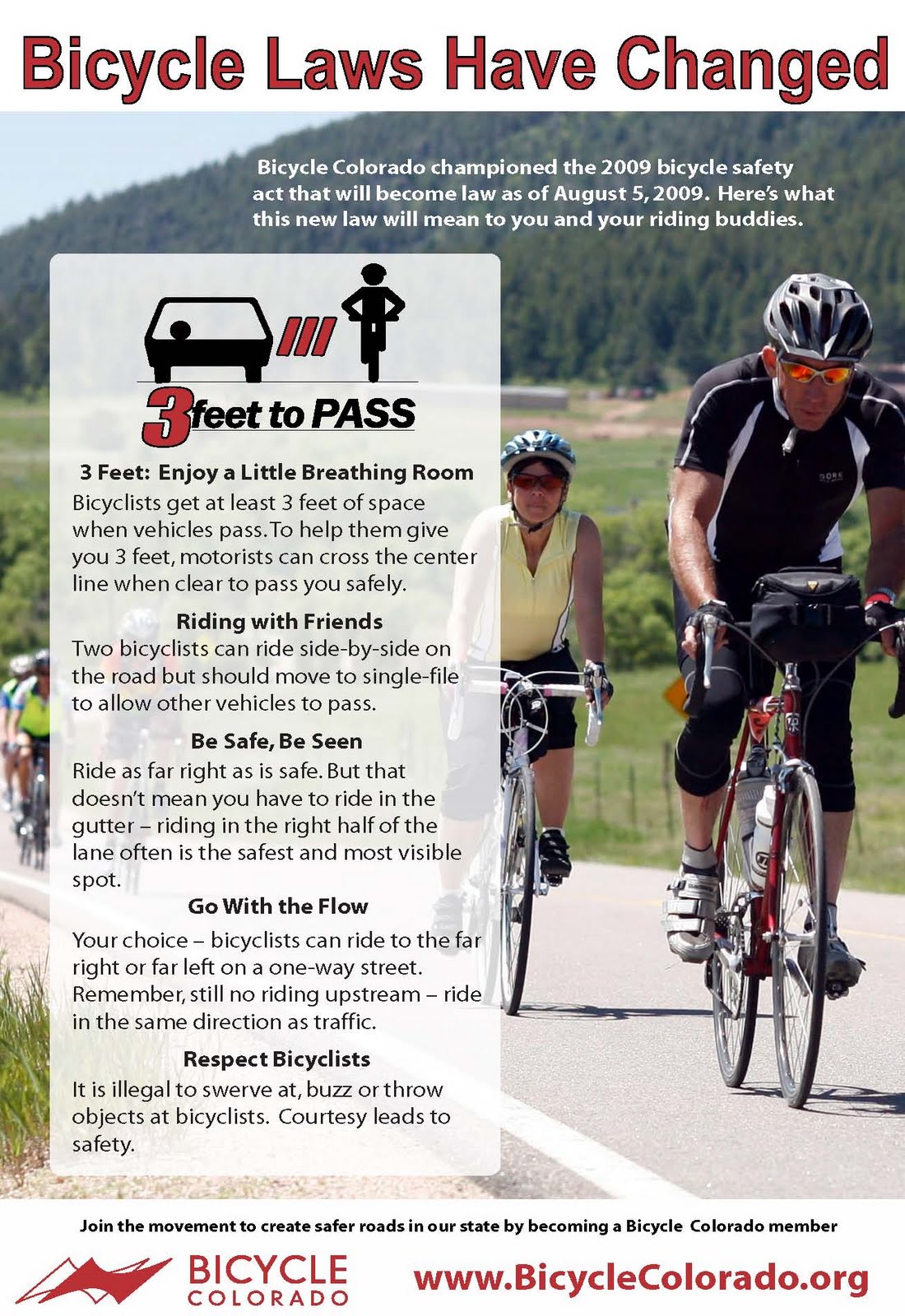
New Bicycle Colorado Poster Explaining the NEW Colorado Bicycle Laws for cyclists and motorists.
Update: Give me a break! Teen charged $25K for a rescue he did not need
Posted: August 5, 2009 Filed under: Search and Rescue (SAR) Leave a comment
My recent post Give me a break! Teen charged $25K for a rescue he did not need
has been read by a lot of people, which is cool. I’ve also learned a lot from the responses. Here are some examples of what I’ve learned:
The National Association For Search And Rescue (NASAR) has a statement about billing for Search and Rescues (SARs) entitled Billing for Searches and Rescues Endangers the Public and Rescuers.
NASAR states that billing for SAR’s is a dangerous practice. It places rescuers at great risk as well as those being rescued because of the delays in calling for help. The delay is caused when people fear they are going to be charged for the rescues.
The Mountain Rescue Association which is composed of groups that do SAR’s in extreme terrain is also opposed to billing for rescues. The MRA position paper on this subject can be found at Mountain Rescue Association Reaffirms Its Position Opposing Charging Subjects For The Costs Of Their Rescues
Due to the influence of these two organizations and the Colorado SAR the City of Golden Colorado changed its position on charging for rescues. The report states the city has received a lot of negative press on top of additional problems in SARS caused by the policy. You can find the report at No Charge for Rescue. (It is nice to live in an enlightened state with such great cities! Thank heavens I don’t live in NH.)
Colorado Search and Rescue Board, a statewide organization of Colorado SAR also has a position paper on charging for SARs: The Colorado Search and Rescue Board’s Policy on Charging for Search and Rescue Services
But this was the shocker. Colorado Search and Rescue Board has compiled list of times when people in need of help did not request it or waited too long for rescue because of a fear of cost. You can find this paper at Examples of endangered persons refusing SAR help, waiting to call for help or hiding from help because of fear of large bill! It is scary to see that people put their lives at risk over money, but it obviously happens all of the time.
It is ironic that the people, who volunteer their time, energy, and money to go out in all kinds of weather to help people for FREE, also have to spend their time and energy fighting stupid governments.
Wake up New Hampshire you are only putting your citizens and visitors at greater risk.
Two people charged with crime in fatal rafting accident.
Posted: August 4, 2009 Filed under: Criminal Liability, Whitewater Rafting Leave a comment
The North Central Illinois News Tribune is reporting that two people were charged with operating a boat under the influence of alcohol. They were on the Vermilion River when their raft went over a low head dam. A third passenger in boat drowned.
They part of a group of seven people in two rafts. The first raft made it down a boat shoot on the right hand side.
The charges are a Class A Misdemeanor offense with a penalty of a $2500 fine or up to one year in jail.
See Two charged in wake of fatal rafting accident and Ex-St. Charles woman charged in fatal rafting accident.
Vehicles must give cyclists a minimum of 3 feet when passing starting August 4, 2009
Posted: August 3, 2009 Filed under: Cycling 1 Comment
A new law passed both houses and was signed by the governor of Colorado. The law requires all vehicles to pass a minimum of three feet away from any cyclists. The law has benefits for both motorists and cyclists. A breakdown of the law is as follows:
PASSING: The new law allows motorists to cross the center lane of traffic if safe to do so when passing cyclists.
LANE POSITION: Bicyclists will have the ability to ride as far right as is safe.
MORE THAN ONE RIDER: The bill clarifies that bicyclists may pass one another or ride side-by-side if they are not impeding the normal and reasonable movement of traffic.
ANTI-HARASSMENT: Language in the bill makes throwing an object towards a bicyclist a class 2 misdemeanor and driving towards a bicyclist in a dangerous manner a careless driving offense.
For more on the bill see the Bicycle Colorado web site.
Bicycle Colorado will have cycling jerseys for sale reminding motorists of the new in the fall of 2009. Stay tuned for the announcement.
Give me a break! Teen charged $25K for a rescue he did not need
Posted: August 3, 2009 Filed under: Criminal Liability, Search and Rescue (SAR) 7 Comments
A Facebook page started to round up money, but we would be better off paying an attorney to fight it for him
Here is the story. A 17 year old Eagle Scout went hiking in the White Mountains of new hampshire last April. He sprained an ankle, tried a different route out, it failed and he spent 3 days backtracking. In the mean time a Search and Rescue (SAR) was called. Volunteers and state employees were called to search for the youth. He was found, hiking, OK and not needing a rescue. When found by SAR he was described as on his way home.
Three months later the state of new hampshire sent him a bill for his non-rescue for $25,000. They are saying that he was negligent.
Fish and Game Maj. Tim Acerno said the decision to fine Mason came from what was deemed as the teen’s negligence for continuing a hike with an injury — a sprained ankle — and veering off a trial to what Mason recalled was a shortcut. Only the shortcut was cut short by a stream swollen from melting snow and snow still on the ground in April. See Teen walloped with NH rescue fine
In new hampshire it is negligent to hike with a sprained ankle! Or is it negligent to try and take a shortcut when you sprain an ankle.
The state is forcing people to decide whether going outdoors is worth it. Is the value of my life without the outdoors worth risking everything I have gained indoors?
But as cynical as I sound, if you are a professional or volunteer, if you are part of a SAR unit and you work in the US this can have a disastrous effect on your business or volunteer work.
If the state can prove someone is negligent for hiking on a sprained ankle when he tried to take a shortcut, how easy will it be to use that case law and prove you were negligent as a guide for not getting your client back when you predicted. For not getting your client home 100% safe.
What about SAR missions. If the state can prove negligence in this case, it will be easy to prove negligence for failing to find or failing to adequately rescue.
This could have serious domino effect.
Here is the new hampshire statute
206:26-bb Search and Rescue Response Expenses; Recovery.
I. Notwithstanding RSA 153-A:24, any person determined by the department to have acted negligently in requiring a search and rescue response by the department shall be liable to the department for the reasonable cost of the department’s expenses for such search and rescue response. The executive director shall bill the responsible person for such costs. Payment shall be made to the department within 30 days after the receipt of the bill, or by some other date determined by the executive director. If any person shall fail or refuse to pay the costs by the required date, the department may pursue payment by legal action, or by settlement or compromise, and the responsible person shall be liable for interest from the date that the bill is due and for legal fees and costs incurred by the department in obtaining and enforcing judgment under this paragraph. All amounts recovered, less the costs of collection and any percentage due pursuant to RSA 7:15-a, IV(b), shall be paid into the fish and game search and rescue fund established in RSA 206:42.
II. f any person fails to make payment under paragraph I, the executive director of the fish and game department may:
(a) Order any license, permit, or tag issued by the fish and game department to be suspended or revoked, after due hearing.
(b) Notify the commissioner of the department of health and human services of such nonpayment. The nonpayment shall constitute cause for revocation of any license or certification issued by the commissioner pursuant to RSA 126-A:20 and RSA 151:7.
(c) Notify the director of motor vehicles of such nonpayment and request suspension of the person’s driver’s license pursuant to RSA 263:56.
Emphasizes Added
No jury, no court no judicial authority makes the determination as to whether or not there was real negligence. Under most state laws, no “department” can determine if someone is negligent. That is left solely within the power of the trier of fact, a jury usually.
Duh Joe, what’s the budge look like this week? Really a little short, well let’s bill somebody. Let’s see I helped a little old lady across the street, she looked lost to me, I think she’s good for $50 K!
I hear politician’s everyday say at what point do US citizens take responsibility for their own actions. Well here is the perfect case and the state says you can’t be responsible. A well trained individual got in trouble and got himself out of trouble. Now the state wants money from him?
Another article quotes the state as saying
Scott Mason had been praised for utilizing his Eagle Scout skills — sleeping in the crevice of a boulder and jump-starting fires with hand sanitizer gel. But authorities say he wasn’t prepared for the conditions he encountered and shouldn’t have set out on such an ambitious hike.
“Yes, he’d been out there in July when you could step across the brooks. And people have been out there in winter in hard-packed snow. But with these spring conditions, it was soft snow, it was deep snow,” said Fish and Game Maj. Tim Acerno.
Mason was negligent in continuing up the mountain with an injury and veering off the marked path, Acerno said. Negligence, he said, is based on judging what a reasonable person would do in the same situation.
Emphasizes Added
See: Teen fined $25,000 for cost of NH mountain rescue.
So now hiking is OK, but only when it is summertime. It was snowing in the Colorado mountains last week, should we have closed the mountains? The makers of snowshoes, avalanche beacons, back country ski gear and cold weather gear are going to be disappointed when they find out you can’t use their gear outdoors anymore.
A reasonable person would have lay down and died, or spent hours watching a cell phone battery die. This kid got himself out of the jam and was walking home!
The young man has until August 9th to pay the bill or to go to supposedly court to contest the fine. I don’t see anywhere in the statute where he has an option of going to court. But he should and we should help. For more information on helping Scott Mason please read to the end.
Negligent Hiking?
I am stumped on how the state can create a law about negligent hiking. 25 years practicing law, 20 years specializing in outdoor recreation and I’ve never heard of or even thought of the idea of negligent hiking, negligent self rescue. More importantly what constitutes negligence when going for a hike? Negligence is composed of four steps all of which must be met. There must be a:
- duty,
- a breach of that duty,
- an injury, and
- damages proximately caused by the breach of the duty.
What is the basic duty that was breached? Does a hiker owe the state a duty not to get hurt or lost? (Consequently doesn’t the state owe the hiker a risk free trail and signs so the hiker does not get hurt or lost? like in any downtown city in the US?). Where is the duty owed and to whom? Citizens only owe the state a duty if the state by law has said there is a duty. The best example is to pay taxes. Not to walk the way the state wants you to walk or to behave in the woods the way the state wants you to behave.
If we don’t get involved to fight this law several major things are going to happen.
SARs are going to get messier. Instead of calling when things are bad, people, in fear of a $25K or higher bill will wait till it is too late. A fine is not going to stop people from going hiking or doing stupid things. If that was the case, our jails would be empty and our taxes would be higher. (No speeding tickets a city has no income.) new hampshire is going to fine everyone they believe will give them some money.
The capstone for this is the family of the rescued young man sent $1000.00 to the search and rescue group for helping to find Scott.
If you would like to contribute to the Rescue Scott Mason Fund send a check to:
Scott Mason Contribution Fund
Mutual Bank
336 Plymouth Street
Halifax, MA 02338
What else can you do?
- Avoid New Hampshire. Sure states need money now, but they should not put the lion’s share on the back of those of us who enjoy the outdoors. More so the state should not place people in a position where they measure the value of their life in the outdoors against their life without the outdoors. If we stay away from New Hampshire because of these risks, the state may catch on.
-
Contact the governor of new hampshire and let him know what you think and that charging a young man for not being rescued is ridiculous
Office of the Governor
State House
25 Capitol Street
Concord, NH 03301(603)271-2121
(603)271-7680 (fax)
Click here to access the governor’s email account.
Tell the governor to cancel the rescue fee and to change the law or you will boycott the state.
- Send money, but encourage the family to use the money to fight the case. I believe it will be impossible for a jury to decide that Scott Mason was negligent.
- Contact the new hampshire fish and wildlife division and let them know what you think. The website to contact them is http://www.google.com/url?q=http://www.wildlife.state.nh.us/Inside_FandG/contact_fish_and_game.htm&ei=XyF2SsDuKonatgO1ueHGCA&sa=X&oi=smap&resnum=1&ct=result&cd=6&usg=AFQjCNGpxWsnyGqilZ3FFnUWqKRxKFv3tg. However I’ve never got it to open, it keeps crashing. J Maybe they are getting a lot of traffic over this?
For more discussions about charging for Search & Rescue see Search & Rescue and charging for it and Vermont getting serious about charging for Search and Rescue. For a great post on the right to do we want to do in the wilderness see Jon Heshka and the Right of the Individual to Die Doing What We Love.
To see a facebook Page about the issue see: Rescue Scott Mason AGAIN.
How not to respond to a product liability claim or How to turn a mess into a legal disaster.
Posted: July 28, 2009 Filed under: Cycling 3 Comments
Isn’t here an old saying about dirty laundry in public, or in this case showing the world that your product failed, you don’t know why and it wasn’t your fault…?
The list of smart-a$$ titles for this piece is long but I figure I better stop and let you know what I mean.
An editor of Velo News was bicycle racing riding on a set of Mavic wheels. Basically the wheel broke and so did he when he hit the ground. He wrote an article about the story. See A shattering experience – A post-recall, R-Sys wheel failure. The wheel had been recalled earlier, but this was a post recall, or fixed wheel. The injured editor did the right thing and called Mavic who inspected the wheel. Mavic decided the failure of the wheel was due to rider error. He hit something.
This was after Mavic sent five people to look at the wheel. It is not know whether Mavic investigated the area where the crash occurred.
Mavic‘s analysis did not match what the editor thought happened. And being a journalist he investigated. He contacted everyone he could, then contacted everyone they knew and kept going until he had a good idea from third party accounts of what happened. He did not hit anything. The wheel failed.
So he did what anyone who is angry and has the ability does, he wrote about it. Mavic‘s response he felt was wrong.
At this point the lesson in how not to handle a disaster starts.
Mavic then filed a response. Velo News published the response. At this point in time we can start tracking the Public Relations nightmares that Mavic created. And as I have said numerous times before, the marketing department makes statements the legal department has to clean up.
- Mavic did not look at or ignored the area where the accident occurred when the decided it was something in the street that caused the wheel to destruct.
-
Blaming the rider or the owner of the product for a product failure creates a three year old battle.
- The battle will go on for three years
-
The battle will look like three year olds are doing it.
- Yes you did
- No I did not
- Yes you did
- No I did not
Mavic‘s response was to Velo News, not the injured editor. In the response Mavic back peddled and said the cause of the accident had not yet been determined.
- Once you are in the s$$t it is stupid to say you are not in the sewer. Even worse to say when you are covered in s$$t that you were never in the sewer.
- Being nice when you smell like s$$t helps, but you still smell like s$$t.
You got a problem, deal with the problem. Blaming someone else for your problem never works and makes you look stupid in the eyes of the world and any jury. Mavic thought the problem was a possible lawsuit from an injured rider. That would have cost them money. However creating a situation where the problem is brought out in public and you are made to look like a liar is going to kill sales. I suspect the lawsuit might have had less of an effect on Mavic‘s bottom line.
- Velo News was not injured in the disaster, why are you writing letters to Velo News.
The inured party here who deserves the response is the editor. Writing to Velo News to say we are not wrong, we may not have been right, is not the way to deal with this. If you are worried about the problem deal with the problem. If you are worried about bad press, don’t be an idiot to begin with. Write a letter to the injured rider. Remember that second head line, dirty laundry.
- Dealing with the press about someone’s personal problem rather than dealing with them is proof that you are hiding something.
Too many times the PR or marketing department starts to deal with a problem then it gets shifted to the legal or risk management department and no matter what the company looks like it has a split personality and looks bad.
Worse there is not legal department and those charged with risk management and usually some other full time consuming job gets scared and speculates on what to do.
Get together. Allow the PR or marketing department to be the front face that is what they are good at. Let legal or risk management review but don’t allow fear of litigation to control any response to anything. And never allow the fear of being sued to put you in a position where you look like you lied.
- If you don’t know what happened, never speculate, never guess, be honest and say you don’t know.
- Never blame anyone else if you don’t know. You become a liar when it comes out that you were wrong.
A summary is the writer made most private investigators look lime and got statements from everyone around that said the wheel failed, it did not hit, drop or roll into something. Mavic tried to cover their butt without using its head. The result, writer has a broken bone, bad wheels and Mavic looks bad. The first two things you expect as a cyclist, broken wheels and broken bones, the last is sad.
I suspect that this fight will continue, see 2a and 2b above. That is good for me, I get to write more. That is bad for the industry. It will become a disaster for Mavic.
For more about this mess see: Mavic announces R-SYS recall, A shattering experience – A post-recall, R-Sys wheel failure, and Mavic responds to wheel collapse article.
Nevada family settles lawsuit over death of son swept off Nevada chair lift by Avalanche
Posted: July 23, 2009 Filed under: Avalanche, Skiing / Snow Boarding Leave a comment
A Las Vegas Nevada family settled their lawsuit against the Las Vegas Ski and Snowboard Resort. Other defendants named in the suit were Lee Canyon Ski Lifts, Lee Canyon Ski Corp. (the corporate entities that owns the resort) and several employees of the resort. No information has been released on the amount paid or other issues in the settlement.
The victim was 13 years old and sitting on a ski lift at the resort when he was swept away by the avalanche. It took 6 hours to recover his body. The US Forest Service investigated the death and found several safety violations on the part of the resort. The resort has hired avalanche experts, located a weather station at the top of the mountain and purchased a 40 mm canon for control work.
For more information about the settlement see Las Vegas family, resort settle avalanche death suit
Dinosaurs are alive and well in Jefferson County Colorado
Posted: July 18, 2009 Filed under: Cycling Leave a comment
Too bad that weren’t converted into the petroleum they obviously want to support.
After just passing a bill in Colorado to make cycling a little safer, the Jefferson County commissions want to make cycling impossible. Never mind the cost of gas, never mind the environmental issues, never mind the exercise benefits; cars come first with these ancient relics.
Bicycle Colorado is reporting on its website Possible Bike Ban on Horizon – Can they really do this?! the Jefferson County commissioners are requesting a state law that would allow counties to ban cyclists from roads of their choice. Effectively anyplace that anyone had a commissioner’s ear in the state of Colorado could ban bicycles from “their” roads.
What can you do?
1. Join Bicycle Colorado. It’s only $30 a year. Spend more money and get socks!
2. Sign up for Bicycle Colorado’s emails about the issue. They’re not bad; at least you can read them and feel like your money is doing something.
3. Find out who your legislators are if you live in Colorado and let them know you are opposed to any proposal to ban vehicles in Colorado, bikes or cars. If you don’t contact the governor and tell him you ride a bike in Colorado when you visit and you visit often, if you do.
Here is the insane thing. You can’t ride your bike home on certain roads if this bill passes because bikes would no longer be vehicles, but you can probably still get arrested for BUI (Bicycling under the influence.) Yes Mary, at least two people have lost their driver’s license in this state because a drunk bicyclist is dangerous. They might ride into a shrub or a telephone pole and that is……well funny actually.
As much as you may like dinosaurs, sometimes they should be converted into petroleum. That is why it is called fossil fuel.
Duh – Sloshing your drink is dumb
Posted: July 16, 2009 Filed under: Whitewater Rafting Leave a comment
Rafting drunk is dumber and a crime.
The Oregon Court of appeals is a violation of state boating laws in Oregon. The court decided that a raft is covered by the laws regulating boating. The defense argued that a raft was not a boat……… There was also an argument made that the drunk defendant did not have control of the raft at the time he was intoxicated, which in all honesty could be argued about whitewater rafting all the time.
See Court: River rats can’t legally raft drunk
But still…..
Lawsuit filed over fatality on inflatable kayak trip on Rogue River
Posted: July 9, 2009 Filed under: Paddlesports 3 CommentsIn June of last year a women in a kayaking class drowned on the Rogue River. Cynthia Lee Von Tungeln was on a trip with Echo River Trips and running Picket Fence in the Blossom Bar rapids. She hit a rock and flipped the inflatable kayak. She was found wrapped around a rock. It took several weeks for the river to release her body so she her body could be recovered. Many accounts of the accident focused on the fact the woman’s body could not be recovered and that others on the river might see her.
According the article, the family of the deceased, are claiming the defendant where negligent in providing a kayak and inadequate instruction. (?) The defendant was also negligent in allowing and encouraging “her to proceed through dangerous rapids without warning.” See Family of kayaker who drowned on Oregon River seeks $4 million
It is sad that someone died having fun. But for many of us, that is the very nature of fun for us, pushing our limits, wanting to grow, or feeling the adrenalin surge. See Jon Heshka and the Right of the Individual to Die Doing What We Love and Adrenalin Junkie, Death Wish or Living Life to the Absolute Fullest.
There are several issues with the claims the plaintiff is making. First the deceased was in the inflatable kayak with another woman. She survived. This will throw in a lot of issues about how bad the rapid really was. The training and the instructions were adequate if one person survived the identical accident. I.e. if one person received the exact same instructions then the differences in the survival and the fatality were one person listened and did what she was told and the other did not. Or the deceased had an unknown or unreported issue that increased the chance that she would not survive.
Another issue is the trip was 34 miles long and the plaintiff had to have been in the inflatable kayak for a while. At some point she assumed the risk of the activity.
Both of these defenses would be in addition to any release the deceased might have signed prior to the trip. Oregon law is fairly solid on supporting releases, if they are properly written.
For additional articles about the accident see Rafters may see body that cannot be recovered and Body recovered from rapids.
CELEBRATING OUR 120 YEAR ANNIVERSARY AND THE INTRODUCTION OF A NEW BRAND
Posted: July 9, 2009 Filed under: Climbing Leave a comment
Cassin comes to the US
This year marks the 120th anniversary of CAMP Technical Adventure Equipment. The company remains family owned and operated from its headquarters based in the small town of Premana situated in the pre-Alps of Northern Italy. It was here that the great grandfathers of the current management created the first ice axes and crampons for the Italian military. They named their company after their home, Construzione Articoli Montagna Premana, which translates to Articles for Mountaineering Made in Premana. The history of CAMP is rich with famous first ascents, leading product innovations and a dedication to the alpine realm.
CAMP is well known as the leader in lightweight technical adventure equipment with the lightest gear in nearly every category we offer. We are also known for the breadth of our product line. Whether you are a beginning mountaineer on your first foray on Mount Hood or an experienced mountain guide, CAMP has the equipment you need.
In 1997, CAMP acquired another historic Italian climbing company, Cassin. The company was started in 1947 by another Italian and one of the most accomplished climbers of all time, Ricardo Cassin. Since acquiring the company, CAMP has developed Cassin into a premier and highly technical climbing brand. In keeping with the technical reputation of Cassin, the two categories that will be introduced to the US market in 2010 are Big Wall/Aid Climbing equipment and Technical Ice products. What you can expect from CAMP are upgrades to products in nearly every category including the Nano 23 lightweight carabiner and the award-winning new Stratos harness which blends lightweight and functionality in a way never before achieved.
CAMP USA once again invites you to experience our brands in booth #3000 at the 2009 Outdoor Retailer Summer Market. Our new collateral materials will be available and our entire product line will be on display in a new, more interactive way. We are contacting you today to arrange appointments with our experienced and knowledgeable staff.
E-mail a request for an appointment to Tommy Knoll (tommy@camp-usa.com) or call 720-932-779 to set an appointment.
Best Regards,
Tommy Knoll – Managing Director
Commercial drowning on the American River in California
Posted: July 8, 2009 Filed under: Whitewater Rafting Leave a comment
It is being reported that a 20 year old man died of a foot entrapment while training to be a whitewater rafting guide. The victim was in a boat on the South Fork of the American River when the boat tipped or flipped and the victim was thrown in the water. The boat had hit Gunsight (rock) in Troublemaker rapid. The victim got lodged 70 yards downriver of the accident.
For more details see Man drowns rafting American River
UIAA Medical Commission provides advice on contraception at altitude
Posted: July 2, 2009 Filed under: First Aid, Mountaineering 1 Comment
OK, maybe the headlines were a little titillating or confusing, but there are real issues with climbing and drugs. As the article describes there are issues with any drug at altitude. Additionally some women take contraception to control the effects of menstruation cycle while they are climbing
No matter how titillating the medical issues and need for the article is real.
See Medical Commission gives advice on contraception at altitude. You can read the actual article at Contraception and Period Control at Altitude
Waivers/Releases work in Colorado: Skier collision with snowmobile dismissed
Posted: June 30, 2009 Filed under: Release (pre-injury contract not to sue), Skiing / Snow Boarding Leave a comment
Aspen Skiing Co. was sued in Federal District Court by a guest who collided with a snowmobile in 2006. The guest had signed a release when he purchased a season pass for Aspen Skiing Co. The Denver Federal District Court dismissed the suit, (probably on a motion for summary judgment.)
The plaintiff’s attorney has stated he intends to appeal the decision.
The issues were, according to the plaintiff whether the snowmobile was traveling in a proper way and equipped and operated as required by the Colorado Skier Safety Act (CSSA). A witness reported that the “snowmobile did not have a flashing, siren-like light to warn skiers of its approach.” However the CSSA does not require a flashing light. The act only requires a lighted headlight, a red tail lamp, a brake system and a fluorescent flag.
Nor is there anything in the statute about how a snowmobile will be operated.
However many ski areas, to make their snowmobiles more visible, have mounted flashing lights all over the snowmobiles. Many are also equipped with sirens that are used to notify skiers of their location. Does this change the standard of care? Maybe, but it does not change the statute. Unless and until the statute is changed, the standard of care is probably, hopefully the statute.
For other blogs about the CSSA see Another Ski Area lawsuit and 8 Year old boy sued in Colorado for ski collision
For more information about the Colorado Skier Safety Act at the Outdoor Recreation Law Review see:
Case Brief: 1986 lawsuit against Winter Park raised question – where does the ski area officially begin and end?
Colorado Skier Safety Act
For the original article see: Signed waiver protects SkiCo from collision suit
Court Dismisses Bike Racer’s Lawsuit in PA
Posted: June 30, 2009 Filed under: Cycling, Release (pre-injury contract not to sue) Leave a comment
Paralyzed bike racer’s suit against race organizer dismissed.
We wrote about this in Lawsuit filed against bicycle race organizer which has a discussion of the facts of the case.
The trial judge in this case dismissed the lawsuit because of the two releases the plaintiff had signed prior to the race. One of the releases was from USA Cycling.
The race, the Tour de ‘Toona, was not held this year because of finances and the litigation.
However this litigation is not over, the plaintiff has said they will appeal the suit.
It is a very sad situation and all parties including the judge in his 30 page opinion expressed his sympathy for the plaintiff who is now paralyzed.
See Court dismisses biker’s Tour lawsuit
Lawsuit filed against bicycle race organizer
Posted: June 25, 2009 Filed under: Assumption of the Risk, Cycling, Release (pre-injury contract not to sue) Leave a comment
It is always sad when a racer is injured, worse when one is paralyzed. For those of us who love to push the limits, it is a real mental argument whether life in wheelchair is life.
Sarah Scott filed a lawsuit against the Tour de ‘Toona, a bicycle race in Martinsburg Borough Pennsylvania. As she was rounding a 90 degree turn she “left” the highway and crashed into a ditch. She suffered several shattered vertebrae and is paralyzed from the waist down.
Prior to entering the race she had signed two different releases. The plaintiff is arguing the defendants were reckless and advertised the race as “safe.” The plaintiff claims that in past races there were at least two wrecks at the same location without incident and that hay bales should have been placed there as they were in other locations around the course.
However isn’t that argument self defeating. If there had been other crashes without injury at a location, why would additional protection be needed?
The plaintiff’s lawyer stated “You can’t assume [a risk] that you can’t see,” which in most states is not true. As long as you know that there may be a ditch, or other problem and you continue the activity, you know and understand, you assume the risks.
The article states that there was a lot of emotion in the case. I suspect that this is very true. It is difficult to look at someone in a wheel chair. However the article also states the plaintiff wanted to move up in the cycling world. Between two releases that were signed, if properly written and a knowledgeable racer cycling in a race it is difficult to believe the case should not be dismissed.
Even if dismissed, it will be appealed. There is too much money at stake.
See Tour de ‘Toona seeks lawsuit dismissal.
For additional Rec-Law blogs on the subject of bicycle racing or tours see Maybe a little premature on a post: RAGBRAI, and Cyclists suing over hole in bike path
For more cases on bicycle racing see Case Brief: NORBA release saves event operators when race release was lost, Case Brief: Kansas court finds for defendant in bicycle race lawsuit, Case Brief: Death during mountain bike race sparks lawsuit over failure to follow standards and checklists, Case Brief: City of New Orleans and Dog Owner not Responsible for Injured Cyclist, and Jurisdiction can affect the potential outcome of a case.
Ortovox CheckandRide
Posted: June 17, 2009 Filed under: Avalanche Leave a comment
I have an Ortovox
CheckandRide. I’ve spent hours looking at it trying to “figure it out.” Like a lot of life, why it is a valuable piece of winter backcountry equipment and how it works was a lot easier to understand when I quit working to understand it and just started to use it.
The CheckandRide is a cylinder. The cylinder has different sections that twist or rotate. By following the components starting at the first one you spin the risk factors for an avalanche for the day and terrain you are getting ready to hike or ride. At the end by scanning the entire cylinder you have a good idea of the risk, for that day, sort of.
When I would work my way through the cylinder I kept waiting for it to say, go or don’t go or give me a reading on a scale, 1 is low risk 5 means you are going to die. It doesn’t do that. Day after day I worked the CheckandRide and did not get an answer.
But the CheckandRide works beautifully! It works in two ways. First to make the Ortovox
CheckandRide work it makes you check all of the factors to determine if you are going into Avalanche terrain. It needs information and you have to find the information for that day and that trip. It is a checklist that makes you check every factor. How often have you gone to terrain that you have hiked and ridden in the past, looked it over and made a mental decision based on past experience and what things “look like” today? The CheckandRide makes you look at all of the factors every time you go out, not just making a guess based on the last trip, a sunny day and desire.
The second way is the CheckandRide does give you a final evaluation. By using the CheckandRide, when you are done you know whether you should go or not go. It makes you think about every factor and makes you understand what you are doing so you know what you need to know. You can’t gauge an avalanche based on a scale. You need to factor in several other things. What is your risk scale? How much risk are you willing to take on? What about your friends you are riding with that day? Or maybe you are riding alone that day? All of that has to be factored into your day and the CheckandRide makes you do that.
I attached the Ortovox
CheckandRide to my ski pack with a small carabiner in a way that makes it swing and rattle when I grab the pack. Right away I’m reminded to work through every factor. It continues to rattle and thunk on things until I take it off and work through the eleven risk until I know where I am going and what I am getting into. The Ortovox
CheckandRide will safe your life because you have to understand the risk factors of your trip. The CheckandRide makes you find them before you go out the door.
Thanks Ortovox.


 Recreation Law