
Are you a Great Photographer? Like to Travel? Win this Contest and become Aurora Expeditions Next Photographer
Posted: February 17, 2015 Filed under: Uncategorized | Tags: #Cruise, Aurora Expeditions, Employment, Travel, Travel Photographer, x, y, z Leave a commentCalling All Photographers!
Win the Chance to Become Aurora Expeditions’ Next Official Photographer and an Arctic Adventure Worth AUS$10,000!
February 5th 2015, USA and London: Aurora Expeditions, polar cruising specialists, and the pioneers of Arctic and Antarctica adventures, are on the hunt for their new official photographer.
This exciting opportunity calls for everyone from professional photographers, budding enthusiasts and snap-happy vacationers. Anyone with a talent behind the lens and the love of capturing unforgettable moments has the chance to become the winner of Aurora Expedition’s exciting new photographic competition.
As the new official Polar paparazzo, the winner will travel abroad the Polar Pioneer on Aurora Expedition’s Across the Arctic Circle Voyage. Worth a staggering AUS$10,000, this incredible adventure, from Aberdeen to Longyearbyen, will be the breath-taking backdrop for 14 days worth of spectacular photo opportunities.
To enter, simply upload your best travel photo, and in 50 words or less tell Aurora Expeditions why they should pick you to become their next official Polar Photographer.
For the next step, each entrant must encourage their friends and family to vote on their image. The most voted for images will have the bigger chance of winning. Simple!
A panel of travel and photography experts will then judge the images with the most votes, before choosing a winner.
The photograph can be from anywhere in the world but must fit into one of the following categories: people, nature, landscapes or wildlife.
HOW TO ENTER
Go to the Aurora Expeditions Facebook page and click on the competition link to access the competition page.
1. Upload your photo
2. Tell us in 50 words or less why we should pick you as our Arctic Photographer
3. Fill in your details (so we can contact you if you are the winner)
4. Share your entry with your friends and family and encourage them to vote for you.
The more you promote your entry, the greater the chance of increasing your votes.
Competition closes Sunday, 15 March 2015. Winner will be announced on Friday 28 March 2014. Refer to full terms and conditions here: Competition T&C
PRIZE DETAILS
As the official Arctic photographer the winner will be awarded with return economy airfares from their nearest capital city to Aurora Expeditions’ voyage starting/ending points as well as a berth on their 14-day Across the Arctic Circle expedition departing 30 June 2015.
From Scotland, the winner will capture the Stone Age villages, Viking relics and spectacular birdlife, before exploring Norway’s dramatic coastline and picturesque fishing villages. The brand new photographer must be prepared to snap the celebrations as they cross the Arctic Circle and enter a polar wonderland where the sun never sets.
View full voyage itinerary here. http://www.auroraexpeditions.com.au/expeditions/expedition/across-the-arctic-circle
END
For more information please contact Aurora Expeditions on +61 2 9252 1033, info or visit http://www.auroraexpeditions.co.uk
For further press information please contact:
Frangelica Flook frangelica.flook
Emily Olsen emily.olsen
T: 020 7978 4534, M: 07747 606 898
Notes to Editors:
About Aurora Expeditions
Aurora Expeditions is an Australian-owned adventure company specializing in expedition cruises to wild and remote places. Always travelling in small groups of 54 or less, Aurora Expeditions provide their travellers with the chance to have an intimate experience in these regions with their flexible, innovative itineraries. The aim of each voyage is to provide as many landings as possible, allowing passengers to experience the destination first hand. Each voyage is led by an expedition team of expert naturalists, geologists, historians, staff and crew who help to unlock the wonders of these special places. Deeply committed to education and preservation of the environment, Aurora Expeditions’ philosophy is to respectfully visit wilderness areas in turn creating ambassadors for their protection.
The risk of hiking over lava fields is an obvious risk; falling while hiking is also a possibility….so is suing when you do both…but you won’t win
Posted: October 20, 2014 Filed under: Assumption of the Risk, California, Hawaii | Tags: #Cruise, Ana Maria Andia, Arnott's Lodge and Hike Adventures, assumption of the risk, California, Celebrity Cruises, Cruise ship, Excursion, Full Service Travel, Hawaii, Hiking, Inc., Lava, Lava Field, M.D., Primary Assumption of the Risk, Volcano 2 CommentsPlaintiff signed up on a cruise ship to hike on a lava field. She was fully informed of the risks and admitted to knowing the risks in advance which is defined as assumption of the risk.
Andia, M.D., v. Full Service Travel, 2007 U.S. Dist. LEXIS 88247
State: California and Hawaii, the accident occurred in Hawaii but the lawsuit was filed in California
Plaintiff: Ana Maria Andia, M.D.
Defendant: Full Service Travel, a California corporation, Celebrity Cruises, Inc., a foreign corporation, and Arnott’s Lodge and Hike Adventures
Plaintiff Claims: (1) negligence, on grounds that Defendant breached its duty of care to Plaintiff by failing to ensure the safety of participants in their excursions, and (2) negligence, on grounds that Defendant failed to warn Plaintiff of the known dangers and risks associated with the lava hike. & (1) negligence, on grounds that the defendant cruise breached its duty of care to Plaintiff by failing to offer reasonably reliable and safe excursions, and (2) negligence, on grounds that the defendant cruise failed to warn Plaintiff of the dangers and risks associated with the lava hike.
Defendant Defenses: assumption of the risk
Holding: for the defendant
Year: 2007
This is a simple case, however, the facts are long because the defendants provided the plaintiff with a ton of information about the risks of the activity which the court reviewed.
The plaintiff signed up for a hike in the lava fields in Hawaii while on a cruise ship. The information about the hike stated the distance of the hike was always changing because of the lava flow. The hikers could return at any time; however, if they did they would return the way they came by themselves.
This information was provided to the plaintiff in a description of the hike provided by the defendant cruise line, in a brochure that plaintiff was given, in a release the plaintiff signed, and during a talk before the hike began.
Plaintiff in her deposition also admitted that she was an experienced hiker, that falling was always a possibility when hiking.
During a point in the hike, the plaintiff decided to turn around. While hiking back to the ranger station she fell breaking her foot. She sued for her injuries.
The lawsuit was started in the Federal District Court of Southern California. The defendant travel company was dismissed earlier in the case. The defendant hiking company cruise line filed motions for summit judgment.
Summary of the case
The court first looked at the claims against the defendant’s hiking business. (The type of entity or whether it was an entity was never identified, and the court was not sure what the hiking company was also.)
The basis of the motion from the hiking company was that the risk of “…slipping, falling and injuring oneself on uneven, natural terrain is an inherent risk of lava hiking.”
The duty of care owed by the defendant hiking company in this situation is:
…a duty to use due care and avoid injury to others, and may be held liable if they’re careless conduct injures another person. The doctrine of primary assumption of the risk is an exception to this general rule. The doctrine arises where “by virtue of the nature of the activity and the parties’ relationship to the activity; the defendant owes no legal duty to protect the plaintiff from the particular risk of harm that caused the injury.”
The court then found the doctrine of primary assumption of the risk applied because:
…conditions or conduct that otherwise might be viewed as dangerous often are an integral part” of the activity itself. “The overriding consideration in the application of primary assumption of risk is to avoid imposing a duty which might chill vigorous participation in the implicated activity and thereby alter its fundamental nature.”
Summing up its own analyses of primary assumption of risk the court stated:
If the doctrine of primary assumption of risk applies, a defendant is only liable for a plaintiff’s injuries if the defendant “engages in conduct so reckless as to be totally outside the range of the ordinary activity involved in the sport or activity” or increases the inherent risk involved in the activity.
The plaintiff argued that the hiking company, Arnott’s, was guilty of gross negligence because:
Arnott’s did nothing to provide for Plaintiff’s safety on the lava hike once she determined she could not go forward; Arnott’s did nothing to warn plaintiff of the dangers of approaching too closely to the coastline; Arnott’s did not ensure plaintiff had sufficient water for her trip back to the Rangers station; Arnott’s was understaffed; Arnott’s failed to follow protocol by pressuring plaintiff to return to the ship rather than obtain treatment at the Hilo emergency room; Arnott’s offered misleading information about the trail markings; Arnott’s provided plaintiff with falsely reassuring directions back to the Rangers station; and Arnott’s permitted Plaintiff to hike in sneakers instead of boots. Plaintiff contends that this conduct constituted gross negligence, making the Agreement, which purports to exculpate Arnott’s of liability, unenforceable. Plaintiff also contends that the Agreement is an unconscionable and unenforceable contract of adhesion because it is a pre-printed form, contained multiple signatures and there was no alternative for Plaintiff but to sign it or wait at the Rangers station while the others hiked, losing a day of her cruise vacation.
However, the plaintiff’s arguments were not backed up with any facts. Arguing a point with facts that do not support your argument fails.
The Court concludes that the doctrine of primary assumption of risk applies, negating Arnott’s general duty to prevent plaintiff from slipping and falling on lava rock, an inherent risk of the activity of lava hiking.
Nor did the actions of the defendant’s hiking company increase the risk of injury to the plaintiff.
The plaintiff knew the risks of hiking prior to the hike in question and admitted that in her deposition. The plaintiff was given information about the hike and had the risks of the hike explained to her four different ways prior to the hike. The plaintiff assumed the risk of here injuries, and the risk that plaintiff suffered causing her injury were visible to anyone hiking in the lava field.
The next issue the court reviewed with regard to the defendant hiking company was the duty to warn. “It is established law, at least in the exercise of ordinary care, that one is under no duty to warn an-other of a danger equally obvious to both.”
The court found for the hiking company on this issue based on the facts and found the plaintiff assumed the risk of her injuries because she could see the risk and continued on anyway. If you can see the risk, you cannot complain about not knowing about the risk.
The plaintiff’s claims against the cruise ship were then reviewed. A cruise ship has a different duty of care owed to its passengers. “The duty of care of the owner of an excursion ship is a matter of federal maritime law. That duty is to exercise reasonable care under the circumstances.”
Here the plaintiff presented no evidence that the defendant cruise line did not exercise reasonable care to the plaintiff. The same facts when applied to the case also showed the defendant cruise ship had not breached its duty to warn to the plaintiff. The information and brochure were provided by the cruise ship to the plaintiff when she signed up for the hike.
[I]t is generally accepted that where a carrier. . . has a continuing obligation for the care of its passengers, its duty is to warn of dangers known to the carrier in places where the passenger is invited to, or may reasonably be expected to visit.” However, “there is no duty to warn of a danger that is as obvious to the injured party as to the defendant.”
So Now What?
The case was won on two issues. The first was the risks of the activity were pointed out over and over again by the hiking company to the plaintiff. Information, brochures, safety talks all stated the risks of the activity which the plaintiff accepted when she turned around.
The second issue was the plaintiff in her deposition admitted to hiking experience. Possibly one or the other could have been enough to prove a defense for the defendants in this case; however, since both were so clear, the defense was easily proven.
Many times on hikes, we point out risk, as well as birds and beauty, to others with us. If you are guiding a hike, this requirement should concentrate your attention to these issues and your actions in pointing out risks. You can cover many of the risks of an activity such as hiking with a general talk at the beginning. “We are going to be walking on uneven surfaces. There will be many rocks and roots to trip on. Pay attention to where you are putting your feet and make sure you are on a solid surface when walking.”
As much as releases are an important defense and source of information for your guests, assumption of the risk is making a comeback in the outdoor recreation industry. If your release fails for any reason, assumption of the risk is the best and maybe the only other defense you have available.
Besides the more your gusts know and understand the risks of the activity the less likely the will be to be injured and the better the experience they will have. Leave scaring guests to fun houses at Halloween.
The one confusing issue in the case was the courts use of California law to decide a case that occurred in Hawaii. The federal courts are for situations like this when the parties are from different states. The plaintiff was from California, and the defendants were from Hawaii. However, without an agreement as to the law that should be applied to the case, Hawaiian law, I believe should be applied. Here the court used California law.
 |
Jim Moss is an attorney specializing in the legal issues of the outdoor recreation community. He represents guides, guide services, outfitters both as businesses and individuals and the products they use for their business. He has defended Mt. Everest guide services, summer camps, climbing rope manufacturers; avalanche beacon manufactures and many more manufacturers and outdoor industries. Contact Jim at Jim@Rec-Law.us |
Jim is the author or co-author of six books about the legal issues in the outdoor recreation world; the latest is Outdoor Recreation Insurance, Risk Management and Law.
To see Jim’s complete bio go here and to see his CV you can find it here. To find out the purpose of this website go here.
G-YQ06K3L262
What do you think? Leave a comment.
If you like this let your friends know or post it on FB, Twitter or LinkedIn
Author: Outdoor Recreation Insurance, Risk Management and Law

Outdoor Recreation Insurance, Risk Management and Law
Facebook Page: Outdoor Recreation & Adventure Travel Law
Email: Jim@Rec-Law.US
By Recreation Law Rec-law@recreation-law.com James H. Moss
@2023 Summit Magic Publishing, LLC
#AdventureTourism, #AdventureTravelLaw, #AdventureTravelLawyer, #AttorneyatLaw, #Backpacking, #BicyclingLaw, #Camps, #ChallengeCourse, #ChallengeCourseLaw, #ChallengeCourseLawyer, #CyclingLaw, #FitnessLaw, #FitnessLawyer, #Hiking, #HumanPowered, #HumanPoweredRecreation, #IceClimbing, #JamesHMoss, #JimMoss, #Law, #Mountaineering, #Negligence, #OutdoorLaw, #OutdoorRecreationLaw, #OutsideLaw, #OutsideLawyer, #RecLaw, #Rec-Law, #RecLawBlog, #Rec-LawBlog, #RecLawyer, #RecreationalLawyer, #RecreationLaw, #RecreationLawBlog, #RecreationLawcom, #Recreation-Lawcom, #Recreation-Law.com, #RiskManagement, #RockClimbing, #RockClimbingLawyer, #RopesCourse, #RopesCourseLawyer, #SkiAreas, #Skiing, #SkiLaw, #Snowboarding, #SummerCamp, #Tourism, #TravelLaw, #YouthCamps, #ZipLineLawyer, Ana Maria Andia, M.D., Full Service Travel, Celebrity Cruises, Inc., Arnott’s Lodge and Hike Adventures, Volcano, Lava, Lava Field, Hiking, Cruise, Cruise Ship, Excursion, Assumption of the Risk, Primary Assumption of the Risk,
Andia, M.D., v. Full Service Travel, 2007 U.S. Dist. LEXIS 88247
Posted: October 7, 2014 Filed under: Assumption of the Risk, California, Hawaii, Legal Case | Tags: #Cruise, Ana Maria Andia, Arnott's Lodge and Hike Adventures, assumption of the risk, Celebrity Cruises, Cruise ship, Duty of care, Duty to Warn, Excursion, Full Service Travel, Hiking, Inc., Lava, Lava Field, M.D., Matthew Marsh, Nature's Classroom, Ohio, Primary Assumption of the Risk, San Diego, Summary judgment, Volcano, Volcanoes National Park Leave a commentTo Read an Analysis of this decision see: The risk of hiking over lava fields is an obvious risk; falling while hiking is also a possibility….so is suing when you do both…but you won’t win
Andia, M.D., v. Full Service Travel, 2007 U.S. Dist. LEXIS 88247
Ana Maria Andia, M.D., Plaintiff, vs. Full Service Travel, a California corporation, Celebrity Cruises, Inc., a foreign corporation, and Arnott’s Lodge and Hike Adventures, a Hawaiian business of unknown structure, Defendants.
CASE NO. 06cv0437 WQH (JMA)
UNITED STATES DISTRICT COURT FOR THE SOUTHERN DISTRICT OF CALIFORNIA
2007 U.S. Dist. LEXIS 88247
November 29, 2007, Decided
November 29, 2007, Filed
CORE TERMS: hike, lava, station, terrain, falling, rock, summary judgment, hiking, slipping, uneven, duty of care, assumption of risk, cruise, inherent risk, trail, ship, warn, surface, viewing, passenger, excursion, admits, hiker, duty to warn, failure to warn, negating, minutes, causes of action, totally outside, gross negligence
COUNSEL: [*1] For Ana Maria Andia, an individual, Plaintiff: Harold M Hewell, LEAD ATTORNEY, Hewell Law Firm APC, San Diego, CA; Howard M Rubinstein, LEAD ATTORNEY, Law Offices of Howard Rubinstein, Aspen, CO.
For Celebrity Cruises Inc, a foreign corporation, Arnotts Lodge and Hike Adventures, a Hawaiian business of unknown structure Defendants: Gregory Dean Hagen, Tammara N Tukloff, LEAD ATTORNEYS, Drath Clifford Murphy and Hagen, San Diego, CA.
JUDGES: WILLIAM Q. HAYES, United States District Judge.
OPINION BY: WILLIAM Q. HAYES
OPINION
ORDER
HAYES, Judge:
The matter before the Court is Defendants’ Motion for Summary Judgment, filed by Celebrity Cruises, Inc. and Arnott’s Lodge and Hike Adventures. (Doc. # 40).
Background
Defendant Celebrity Cruises, Inc. (“Celebrity”) is engaged in the business of providing passenger cruises to various destinations. 1 UMF 1. Arnott’s Lodge and Hike Adventures (“Arnott’s”) guides transport cruise ship passengers to Volcanoes National Park (“the Park”), and provide knowledge about where the lava flow is each day. UMF 3. In order to view the active lava flow, individuals must hike over cooled lava. This terrain is rugged and natural, consisting of uneven surfaces. Id. at 4; DMF 4. The Hawaii Volcanoes [*2] National Park Rangers (“Rangers”) place reflective markers and cones on the lava to be used by hikers as reference points. UMF 7.
1 The parties each submitted a statement of facts with their submissions in support of and in opposition to the Motion for Summary Judgment. The Court relies upon the facts from Defendants’ Alleged Undisputed Material Facts (“UMF”), which are undisputed by Plaintiff and supported by the cited evidence, and the facts from Plaintiff s Disputed Material Facts (“DMF”), which are undisputed by Defendants and supported by the cited evidence.
In November, 2005, Plaintiff Ana Maria Andia, M.D. was a passenger on Defendant Celebrity Cruises, Inc.’s (“Celebrity”) passenger cruise ship. Plaintiff is an experienced hiker. Andia Depo, 35: 23-25. On November 27, 2005, Plaintiff signed up to participate in a shore expedition known as the HL 15, the Kilauea Lava Viewing Hike, guided by Arnott’s. UMF 8. On November 27, 2005, there was total visibility for many miles in every direction. Id. at 5.
Prior to beginning the hike, Plaintiff read the description of the hike that states: “This tour involves approximately two to six miles of hiking over very sharp and uneven surfaces.” [*3] Id. at 10. Plaintiff also read, understood and executed the “Lava Hike Participant, Release and Acknowledgment of Risk” (“Agreement”), which provides, in relevant part:
I agree not to hold Arnott’s liable for any accident or injury beyond its control. The hike to the Lava is conducted at a brisk pace and requires physically fit participants in good health who can readily hike on varied surfaces and elevation changes for extended periods. I, as a participant, acknowledge that I am taking this activity of my own free will and that I will not hold Arnott’s responsible for any injury incurred while . . . I am hiking on the paved or natural surfaces of the National Park. . . . I understand by reading this waiver that Arnott’s guides will provide only broad direction and safety guidelines and that I remain responsible for the actual path hiked and whether I choose to take the risks with possibly still hot Lava Flows.
Id. at 11. Plaintiff also received and read a document entitled “Arnotts Adventures proudly presents: The Kilauea Lava Hike Adventure” (“Brochure”), which informed Plaintiff that she may need to turn around and head back to the Rangers station alone, and that she did not need [*4] a trail to return safely. Id. at 14.
Prior to beginning the hike, Arnott’s informed Plaintiff that the lava flow had changed and that the hike was going to be longer than anticipated for that day. Id. at 13. Arnott’s also informed all participants in the hike, including Plaintiff, that they had the option of staying at the Rangers station and not going on the hike, and that there would be four decision points during the hike at which hikers could turn around and head back to the Rangers station. Id. at 13, 18.
Prior to beginning the hike, Plaintiff understood that the marked trail was merely a preferred route, and that the trail was not necessary to safely return to the Rangers station. UMF 15; Andia Depo, 63:1-15. Plaintiff also understood that guides would not stay with her during the hike and that she might be returning to the Rangers station unaccompanied. UMF 15, 16; Andia Depo, 63: 1-15, 64:22-24. Plaintiff understood that the hike would be difficult and strenuous. Andia Depo, 52: 17-19
For the first 30 minutes of the hike, and through the first two decision points, the hike proceeded on paved surfaces. UMF 20. During this period, Plaintiff recalls seeing reflective tabs on the [*5] paved surface. Id. Plaintiff’s companion recalls seeing reflective tabs stuck to the rocks for 10-15 minutes of the hike after leaving the paved road. Plaintiff does not recall whether or not the reflective tabs were stuck to the rocks. Id. at 21. Approximately 45 minutes into the hike, and after approximately 15 minutes of walking on unpaved terrain, Plaintiff decided to return, unaccompanied by a guide, to the Rangers station. Id. at 22. About 15 minutes into her return, Plaintiff slipped on one of the rocks. When Plaintiff slipped, she twisted her ankle. Plaintiff then lifted her foot up, and hit the top of her foot on the lava rock. As a result of these events, Plaintiff fractured her foot. Id. at 23. Plaintiff testified that she then proceeded back to the Rangers station. Andia Depo, 86:22-87:14. The fall itself could have caused the fracture to become displaced and surgery may have been required regardless of whether Plaintiff attempted to walk out of the lava fields. UMF 25. Plaintiff was given the option of going to the ship’s doctor or the Hilo emergency room for treatment, and Plaintiff elected to receive treatment with the ship’s doctor. Id. at 24; Andia Depo, 89:15-25; [*6] 90:1-10. Plaintiff testified that, as a result of the fracture, she was confined to a wheel chair for a period of months, had to take time off of work, and suffers impaired balance. Id. 15:13-14.
On February 24, 2006, Plaintiff filed the First Amendment Complaint (“FAC”) against Defendants Full Service Travel, 2 Celebrity and Arnott’s. (Doc. # 3). The FAC alleges causes of action against Arnott’s for (1) negligence, on grounds that Arnott’s breached its duty of care to Plaintiff by failing to ensure the safety of participants in their excursions, and (2) negligence, on grounds that Arnott’s failed to warn Plaintiff of the known dangers and risks associated with the lava hike. The FAC alleges causes of action against Celebrity for (1) negligence, on grounds that Celebrity breached its duty of care to Plaintiff by failing to to offer reasonably reliable and safe excursions, and (2) negligence, on grounds that Celebrity failed to warn Plaintiff of the dangers and risks associated with the lava hike.
2 On October 5, 2006, Defendant Full Service Travel was dismissed from the case, with prejudice.
On August 18, 2007, Defendants filed the Motion for Summary Judgment, pursuant to Rule 56 of the Federal Rules of Civil Procedure. [*7] Defendants claim they are entitled to judgment as a matter of law because (1) Arnott’s owed Plaintiff no duty to protect Plaintiff against the assumed risk of slipping and falling on the lava rock, (2) Arnott’s owed Plaintiff no duty to warn Plaintiff of the obvious risk of injury of slipping and falling on the lava rock, (3) Celebrity did not owe Plaintiff a duty to warn of the obvious risk of slipping and falling on lava rock, (4) the alleged negligence of Defendants did not cause Plaintiff’s injuries, and (5) the claim for punitive damages against Arnott’s is not warranted. After receiving evidence and briefing from the parties, the Court heard oral argument on November 9, 2007.
Standard of Review
Summary judgment is appropriate under Rule 56 of the Federal Rules of Civil Procedure where the moving party demonstrates the absence of a genuine issue of material fact and entitlement to judgment as a matter of law. See Fed. R. Civ. P. 56(c); see also Celotex Corp. v. Catrett, 477 U.S. 317, 322, 106 S. Ct. 2548, 91 L. Ed. 2d 265 (1986). A fact is material when, under the governing substantive law, it could affect the outcome of the case. See Anderson v. Liberty Lobby, Inc., 477 U.S. 242, 248, 106 S. Ct. 2505, 91 L. Ed. 2d 202 (1986). A dispute over a material [*8] fact is genuine if “the evidence is such that a reasonable jury could return a verdict for the nonmoving party.” Id.
A party seeking summary judgment always bears the initial burden of establishing the absence of a genuine issue of material fact. See Celotex, 477 U.S. at 323. If the moving party satisfies its initial burden, the nonmoving party must “go beyond the pleadings and by her own affidavits, or by the depositions, answers to interrogatories, and admissions on file, designate specific facts showing that there is a genuine issue for trial.” Id. at 324 (quoting Fed. R. Civ. P. 56(e)).
In ruling on a motion for summary judgment, the Court must view all inferences drawn from the underlying facts in the light most favorable to the nonmoving party. See Matsushita Elec. Indus. Co., Ltd. v. Zenith Radio Corp., 475 U.S. 574, 587, 106 S. Ct. 1348, 89 L. Ed. 2d 538 (1986). “Credibility determinations [and] the weighing of evidence . . . are jury functions, not those of a judge, [when] he is ruling on a motion for summary judgment.” Anderson, 477 U.S. at 255.
Choice of Law
The Court has jurisdiction over this action through diversity of citizenship, 28 U.S.C. section 1331. Federal courts exercising diversity jurisdiction must [*9] apply the substantive law of the state in which they are located, except on matters governed by the United States Constitution or federal statutes, or on procedural issues. Erie Railroad Co. v. Tompkins, 304 U.S. 64, 78, 58 S. Ct. 817, 82 L. Ed. 1188 (1938). The Complaint alleges causes of action in negligence for breach of due care and for failure to warn. The elements of the tort of negligence are essentially identical under California and Hawaii law. See White v. Sabatino, 415 F. Supp. 2d 1163, 1173 (USDC Haw. 2006); Ladd v. County of San Mateo, 12 Cal. 4th 913, 917, 50 Cal. Rptr. 2d 309, 911 P.2d 496 (1996). Furthermore, the doctrine of primary assumption of risk is a measure of a defendant’s duty of care, and is essentially identical under both Hawaii and California law. Yoneda v. Andrew Tom, 110 Haw. 367, 379, 133 P.3d 796 (2006); Knight v. Jewett, 3 Cal. 4th 296, 314-15, 11 Cal. Rptr. 2d 2, 834 P.2d 696 (1992).
Discussion
I. Plaintiff’s Claims Against Arnott’s
Arnott’s contends that the risk of slipping, falling and injuring oneself on uneven, natural terrain is an inherent risk of lava hiking. Arnott’s contends that without this risk, the means of viewing this natural phenomenon would be severely limited to the general public. Arnott’s also contends that the evidence is uncontroverted that [*10] Arnott’s provided Plaintiff with written disclosures concerning the condition of the terrain, that guides would only give broad direction on the actual hike, that Plaintiff may need to turn around and head to the Rangers station alone, and that Plaintiff did not need a trail to return safely. Arnott’s contends that there is no triable issue of fact as to whether Arnott’s is liable for breach of its duty of care because the doctrine of primary assumption of risk applies, negating any duty of Arnott’s to protect Plaintiff against the inherent risk of slipping and falling while lava hiking. Arnott’s contends that Plaintiff has failed to assert facts or introduce any evidence that demonstrates that the conduct of Arnott’s was totally outside the range of ordinary activity or that the conduct of Arnott’s increased Plaintiff’s risk of slipping and falling on the lava rock. Arnott’s also contends that there is no triable issue of fact as to whether Arnott’s is liable to Plaintiff for breach of the duty of Arnott’s to warn because the risk of slipping and falling on the natural terrain was equally obvious to Plaintiff and Arnott’s.
Plaintiff responds that the conduct of Arnott’s constituted [*11] gross negligence for the following reasons: Arnott’s did nothing to provide for Plaintiff’s safety on the lava hike once she determined she could not go forward; Arnott’s did nothing to warn Plaintiff of the dangers of approaching too closely to the coastline; Arnott’s did not ensure Plaintiff had sufficient water for her trip back to the Rangers station; Arnott’s was understaffed; Arnott’s failed to follow protocol by pressuring Plaintiff to return to the ship rather than obtain treatment at the Hilo emergency room; Arnott’s offered misleading information about the trail markings; Arnott’s provided Plaintiff with falsely reassuring directions back to the Rangers station; and Arnott’s permitted Plaintiff to hike in sneakers instead of boots. Plaintiff contends that this conduct constituted gross negligence, making the Agreement, which purports to exculpate Arnott’s of liability, unenforceable. Plaintiff also contends that the Agreement is an unconscionable and unenforceable contract of adhesion because it is a pre-printed form, contained multiple signatures and there was no alternative for Plaintiff but to sign it or wait at the Rangers station while the others hiked, losing a day [*12] of her cruise vacation. 3
3 Plaintiff does not dispute that the doctrine of primary assumption of risk applies, negating Arnott’s’ duty to prevent Plaintiff from slipping and falling on lava rock. Instead, Plaintiff relies solely on her contention that the Agreement itself is either an unenforceable exculpatory agreement or an unenforceable contract of adhesion. Defendants, however, do “not contend, nor have they even asserted, that the [Agreement] relieves them from liability for any alleged negligence, nor gross negligence.” Reply, p. 1-2.
A. Duty of Care
As a general rule, persons have a duty to use due care and avoid injury to others, and may be held liable if their careless conduct injures another person. Cal. Civ. Code § 1714. The doctrine of primary assumption of the risk is an exception to this general rule. Knight v. Jewett, 3 Cal. 4th 296, 11 Cal. Rptr. 2d 2, 834 P.2d 696 (1992). The doctrine arises where “by virtue of the nature of the activity and the parties’ relationship to the activity, the defendant owes no legal duty to protect the plaintiff from the particular risk of harm that caused the injury.” Id. at 315. Whether the doctrine of assumption of risk applies, thereby negating a duty of care, turns on [*13] the “nature of the activity or sport in which the defendant is engaged and the relationship of the defendant and the plaintiff to that activity or sport.” Id. at 309. In reviewing the nature of the activity, the doctrine of primary assumption of risk applies where “conditions or conduct that otherwise might be viewed as dangerous often are an integral part” of the activity itself. Id. at 315. “The overriding consideration in the application of primary assumption of risk is to avoid imposing a duty which might chill vigorous participation in the implicated activity and thereby alter its fundamental nature.” Ferrari v. Grand Canyon Dories, 32 Cal. App. 4th 248, 253, 38 Cal. Rptr. 2d 65 (1995).
If the doctrine of primary assumption of risk applies, a defendant is only liable for a plaintiff’s injuries if the defendant “engages in conduct so reckless as to be totally outside the range of the ordinary activity involved in the sport or activity” or increases the inherent risk involved in the activity. Saville v. Sierra College, 133 Cal. App. 4th 857, 866, 36 Cal. Rptr. 3d 515 (4th Dist. 2005); Kane v. National Ski Patrol, 88 Cal. App. 4th 204, 209, 105 Cal. Rptr. 2d 600 (4th Dist. 2001). The relationship between an instructor and student is instructive [*14] on the issue of whether the Arnott’s guides engaged in reckless conduct or increased the inherent risk involved in lava hiking. Kane, for example, involved candidates for a voluntary ski patrol who participated in a skills clinic instructed by Larry Stone, a National Ski Patrol System (“NSPS”) instructor. 88 Cal. App. 4th at 207. Stone led the clinic participants to the most difficult terrain at the resort. When the participants were reluctant to proceed through a portion of the trail, which was icy and spotted with trees, rocks and stumps, Stone asked the clinic participants what they would do “if there was a skier over the side?” Id. at 208. Although both plaintiffs felt uncomfortable with continuing down the terrain, they carried on, following Stone’s direction. Id. One plaintiff ultimately caught an “edge” with his ski, causing him to fall to his death, and the other plaintiff fell and suffered a broken leg. Id. The court granted summary judgment in favor of the defendant, holding that the doctrine of primary assumption of risk applied, negating the defendant’s duty of care. The court reasoned that “an instructor’s assessment errors – either in making the necessarily subjective [*15] judgment of skill level or the equally subjective judgment about the difficulty of the conditions – are in no way ‘outside the range of the ordinary activity involved in the sport.” Id. at 214.
Plaintiff admits that she is an experienced hiker. Andia Depo, 35:23-25. Plaintiff admits that falling is always a risk when engaging in any kind of strenuous hike on steep and uneven terrain. Id. at 153:8-14. Plaintiff admits that prior to starting the hike she was aware that she would be hiking over “very sharp and uneven surfaces.” Id. at 51:8-13. Plaintiff does not introduce any evidence to refute that hiking across uneven and challenging natural terrain is an inherent risk of hiking to active lava flow, without which the general public would be substantially deprived of viewing this natural phenomenon. The Court concludes that the doctrine of primary assumption of risk applies, negating Arnott’s general duty to prevent Plaintiff from slipping and falling on lava rock, an inherent risk of the activity of lava hiking.
Plaintiff admits that, prior to the hike, Arnott’s provided the following written disclosures, which she understood: that the natural terrain was uneven and challenging; that [*16] during the hike she would be responsible for the path she traveled; that the guides would give only broad direction; that she may have to return to the Rangers station alone; and that the trail was merely a preferred route, and not necessary to safely get back to the Rangers station. Despite these disclosures, Plaintiff asserts that the decision to allow Plaintiff to return to the Rangers station alone and subsequent conduct on the part of the Arnott’s guides constituted gross negligence. The Court finds that the decision to allow Plaintiff to return alone and subsequent conduct on the part of Arnott’s guides at most constituted “assessment errors,” but these “subjective judgment[s] about the difficulty of the condition[s],” were “in no way so reckless as to be totally outside the range of the ordinary activity involved” in the activity of lava hiking. See Kane, 88 Cal. App. 4th at 214. Plaintiff emphasizes that Arnott’s’ conduct, such as permitting her to participate in the hike wearing sneakers instead of hiking boots, was grossly negligent. However, the Court finds that there is no evidence in the record to support Plaintiff’s conclusion that Arnott’s conduct, including permitting [*17] Plaintiff to wear improper footwear, hike over thin lava crust, return to the Rangers station alone and without sufficient water, or return to the ship instead of going to the Hilo emergency room, increased the risk of Plaintiff’s injury. The Court concludes that there is no triable issue of fact as to whether Arnott’s conduct was so reckless as to be totally outside the range of the ordinary activity or otherwise increased the inherent risk involved in the activity of lava hiking.
The Court grants summary judgment on Plaintiff’s negligence claim against Arnott’s for breach of duty of care.
B. Duty to Warn
“It is established law, at least in the exercise of ordinary care, that one is under no duty to warn another of a danger equally obvious to both.” Marshall v. United Airlines, 35 Cal. App. 3d 84, 90, 110 Cal. Rptr. 416 (1973).
Plaintiff admits she is an experienced hiker, that she was aware that falling is always a risk involved in any kind of hike on steep and uneven terrain, that she knew that the terrain she would cover during the lava hike was rugged and uneven, and that she read the Agreement and the Brochure, which both emphasize the strenuous nature of the hike, the possibility that Plaintiff would [*18] have to return to the Rangers station alone and nature of the terrain. Viewing the facts in the light most favorable to Plaintiff, the Court finds that Plaintiff has failed to offer any evidence to demonstrate that the risk of slipping and falling on lava rock was any less obvious to Plaintiff than it was to Arnott’s. The Court grants summary judgment on Plaintiff’s negligence claim against Arnott’s for failure to warn.
II. Plaintiff’s Claims Against Celebrity
Celebrity contends that although Plaintiff alleges separate causes of action in negligence for breach of due care and for failure to warn, both of these claims allege only failure to warn. Celebrity contends that it had no duty to warn Plaintiff of the risk of slipping and falling on lava rock during a hike through a lava field because the risk was patently obvious and equally apparent to Plaintiff and Celebrity.
Plaintiff’s Response in Opposition to the Motion for Summary Judgment on all of Plaintiff’s claims against Celebrity states in full:
[P]laintiff relied on Celebrity to provide her with reasonably safe shore excursions. The dangers of the lava hike with Arnott’s were not readily apparent to her or anyone else who had not [*19] taken the hike. Celebrity’s reliance on Deroche is misplaced.
This was not a scooter ride, which a reasonable person knows poses obvious dangers. It was a hike to a uniquely dangerous place. [Plaintiff] reasonably relied on Celebrity to exercise due care in providing her with a safe guide service, and in offering a potentially life-threatening venture. Celebrity had a duty to ensure that Arnott’ s was a reasonable safe and reliable service. Celebrity is liable for breach of that duty.
Opposition, p. 19-20.
A. Duty of Care
The duty of care of the owner of an excursion ship is a matter of federal maritime law. DeRoche v. Commodore Cruise Line, Ltd., 31 Cal. App. 4th 802, 807, 46 Cal. Rptr. 2d 468 (1994). “That duty is to exercise reasonable care under the circumstances.” Id. at 807-8.
Plaintiff fails to introduce any evidence to support her claim that Celebrity did not exercise due care when it enrolled Plaintiff in “excursion HL 15, the Kilauea Lava Viewing Hike, an unreasonably dangerous and poorly run and operated excursion.” See FAC, P 35-36. Viewing the facts in the light most favorable to Plaintiff, the Court finds that Plaintiff has failed introduce any evidence demonstrating Celebrity breached its duty [*20] of due care to Plaintiff. The Court grants summary judgment on Plaintiff’s negligence claim against Celebrity for breach of duty of care.
B. Duty to Warn
“[I]t is generally accepted that where a carrier . . . has a continuing obligation for the care of its passengers, its duty is to warn of dangers known to the carrier in places where the passenger is invited to, or may reasonably be expected to visit.” DeRoche, 31 Cal. App. 4th at 809. However, “there is no duty to warn of a danger that is as obvious to the injured party as to the defendant.” Id. at 810.
As previously discussed, Plaintiff admits she is an experienced hiker, that she was aware that falling is a risk involved in any kind of hike on steep and uneven terrain, that she knew that the terrain she would cover for the lava hike was rugged and uneven, and that she read the Agreement and the Brochure, which both emphasize the strenuous nature of the hike, the challenging nature of the terrain and the possibility that Plaintiff would have to return to the Rangers station alone. Viewing the facts in the light most favorable to Plaintiff, the Court finds that Plaintiff has failed offer any evidence that demonstrates the risk of falling [*21] on lava rock was any less obvious to her than it was to Celebrity. The Court grants summary judgment on Plaintiff’s negligence claim against Celebrity for failure to warn.
Conclusion
Defendants’ Motion for Summary Judgment, filed by Celebrity Cruises, Inc. and Arnott’s Lodge and Hike Adventures (Doc. # 40) is GRANTED. The Court directs the Clerk of the Court to enter JUDGMENT for Defendants and against Plaintiff.
DATED: November 29, 2007
/s/ William Q. Hayes
WILLIAM Q. HAYES
United States District Judge
The FlowRider looks fun because it has a lot of people trying it, falling and suing
Posted: October 6, 2014 Filed under: Assumption of the Risk, Florida, Release (pre-injury contract not to sue) | Tags: #Cruise, #FlowRider, Cruise ship, Electronic Release, Florida, Ltd., Release, Royal Caribbean Cruises, Royal Caribbean International, Surfing, United States District Court for the Southern District of Florida, Wave Loch Leave a commentIgnoring the risks that are presented by the defendant are not a way to prove your claim.
Magazine v. Royal Caribbean Cruises, LTD., 2014 U.S. Dist. LEXIS 41092
State: Florida, United States District Court for the Southern District of Florida
Plaintiff: Mary Magazine
Defendant: Royal Caribbean Cruises, LTD. d/b/a Royal Caribbean International
Plaintiff Claims: “(1) the defendant had a duty to protect the plaintiff from a particular injury; (2) the defendant breached that duty; (3) the breach actually and proximately caused the plaintiff’s injury; and (4) the plaintiff suffered actual harm
Defendant Defenses: release
Holding:
Year: 2014
The FlowRide is a surfing simulator. It consists of a sloped surface with water shooting up to the top. The water flowing up is similar to a wave and used to learn to ride a wave or just have fun. You can find Flowriders in stores along the ocean and in this case on a cruise ship.
The plaintiff was a 59 year old attorney that signed up for the cruise. The cruise is a “Card Player Cruise.” These cruises are pushed to poker players. The plaintiff signed up for the cruise two weeks in advance and registered to participate in several activities: ice skating, rock climbing, zip lining and the FlowRider. In doing so she signed an electronic release.
The defendant argued the plaintiff was warned of the risks. There was a “Caution” sign was located in the FlowRider viewing area. There was also a five-minute video that played on television channels on the cruise. There was a list of warnings on the bulletin board.
The plaintiff watched another person on the FlowRider and watched that person fall. The plaintiff’s turn came on the FlowRider. She alternated with other riders and fell 10- to 12 times before falling and breaking her leg. The FlowRider lessons were videotaped including the plaintiff’s fall which broke her leg.
Summary of the case
The court refers to the plaintiff by her last name, Magazine and to the defendant Royal Caribbean Cruises as RCL.
Because the accident occurred on a ship, the standard of care is different. “…a shipowner owes the duty of exercising reasonable care towards those lawfully aboard the vessel who are not members of the crew.”
The judge first throughout the negligent design claims. To be liable for negligent design a “defendant must have played some role in the design.” Because the defendant did not design the FlowRider that claim was thrown out. Also, the negligent maintenance claim was also thrown out.
A shipowner does have a duty to warn passengers of dangers which the shipowner knows or should know about “and which may not be apparent to a reasonable passenger”.
The duty to warn does not extend to dangers that are “open and obvious.” “The obviousness of a danger and adequacy of a warning are determined by a ‘reasonable person’ standard, rather than on each particular plaintiff’s subjective appreciation of the danger.
Whether adequate efforts were made to communicate a warning to the ultimate user and whether the warning if communicated was adequate are uniformly held questions for the jury.
The plaintiff argued that she did not see any of these warnings. However, the plaintiff also stated that even if she had seen the warnings “…she would not have heeded warnings anyway.” The court also stated that the risk of falling was an open and obvious risk in this case.
The court also looked at the requirements the plaintiff had to meet to prove her case. “Thus, to prove that a defendant’s failure to warn caused an injury, the plaintiff must show that the risk about which the defendant failed to warn the plaintiff caused the injury.”
Therefore, to prevail on a negligence claim predicated on a defendant’s failure to warn, a plaintiff must identify a specific risk (1) of which the defendant had notice or constructive notice, (2) that is not open and obvious, (3) about which the defendant failed to warn the plaintiff, and (4) that actually caused the plaintiff’s injury.
The plaintiff argued that it was not falling that caused her injury, but the specific way she fell, which was not identified as a risk of the activity. However, the court did not agree with the argument.
First, any failure by RCL to warn of this general risk did not proximately cause Magazine’s injury. Magazine expressly testified that a warning sign referring only to a “risk of serious bodily injury or death” would not have stopped her from participating in the FlowRider and there is no indication in the record that such a warning might have reduced the severity of her injury. Therefore, any breach by RCL of a duty to warn Magazine of the risk of serious bodily injury or death did not proximately cause Magazine’s injury.
Second, the general risk of injury on the FlowRide is open and obvious. The FlowRider is a recreational activity, and the risk of which Magazine argues she should have been warned is created by the FlowRider itself, rather than by an anomalous condition in an otherwise safe area, such as a protruding nail or slippery substance on a walkway.
The court then stated, “Courts routinely recognize that sports and similar recreational activities pose an inherent risk of injury and that such inherent risk, in the absence of some hidden danger, is open and obvious.”
The court then looked at the various other arguments of the plaintiff stating that the surface was not as the plaintiff had imagined that the medical issues suffered by the plaintiff were not related to the warnings and the FlowRider, and the Defendant had a duty to inform riders of other injuries participants had received. The court found all of these arguments of the plaintiff all failed because the risks were open and obvious.
Put simply, while Magazine contends that certain warnings should have been more prominently displayed, she has not identified any risk about which she should have been warned differently such that a warning might have made a difference.
The court then reviewed the negligent instruction claim of the plaintiff. The plaintiff argued that how she was instructed, and the methods used to teach here lead to her injury.
While the Court is not deciding this issue of law at this time, in a paid lesson for a sport or similar recreational activity such as the FlowRider, reasonable care by an instructor may include not exposing a plaintiff to risks beyond those inherent in the recreational activity itself, at least not before the plaintiff is ready to handle those risks.
The court found that the plaintiff may have a claim based on negligent instruction.
The relevant risk is not of falling but of falling in a way likely to result in injury, such as by losing control of the board while falling. RCL’s argument that “there is no record evidence that RCL was on notice that the use of the balance rope was a danger to any passenger” is also not dispositive, because the requirement of notice applies to risks created by passive conditions such as slippery walkways or protruding nails, not to risks created by a defendant’s actions.
The court then found that:
to (1) whether the instructors’ handling of the balancing rope breached their duty of reasonable care under the circumstances and (2) whether any such breach actually and proximately caused Magazine’s injury.
However, the court found the plaintiff’s arguments to be thin and thought she would have a hard time proving those elements at trial.
So Now What?
If you have warning signs, videos, or information of the risks of your activity and are using a release, put in the release that by signing the release the signor states they have seen the warnings and videos and reviewed the website.
During registration for your activity, tell people to read the warnings, watch the videos and read all warning signs.
If you are using methods to teach or use a device that are not suggested by the manufacture or are different from the standard of care for the activity, this case suggests you should inform people of those differences.
What do you think? Leave a comment.
If you like this let your friends know or post it on FaceBook, Twitter or LinkedIn
Copyright 2014 Recreation Law (720) Edit Law
Email: Rec-law@recreation-law.com
Google+: +Recreation
Twitter: RecreationLaw
Facebook: Rec.Law.Now
Facebook Page: Outdoor Recreation & Adventure Travel Law
Blog: www.recreation-law.com
Mobile Site: http://m.recreation-law.com
By Recreation Law Rec-law@recreation-law.com James H. Moss #Authorrank
#AdventureTourism, #AdventureTravelLaw, #AdventureTravelLawyer, #AttorneyatLaw, #Backpacking, #BicyclingLaw, #Camps, #ChallengeCourse, #ChallengeCourseLaw, #ChallengeCourseLawyer, #CyclingLaw, #FitnessLaw, #FitnessLawyer, #Hiking, #HumanPowered, #HumanPoweredRecreation, #IceClimbing, #JamesHMoss, #JimMoss, #Law, #Mountaineering, #Negligence, #OutdoorLaw, #OutdoorRecreationLaw, #OutsideLaw, #OutsideLawyer, #RecLaw, #Rec-Law, #RecLawBlog, #Rec-LawBlog, #RecLawyer, #RecreationalLawyer, #RecreationLaw, #RecreationLawBlog, #RecreationLawcom, #Recreation-Lawcom, #Recreation-Law.com, #RiskManagement, #RockClimbing, #RockClimbingLawyer, #RopesCourse, #RopesCourseLawyer, #SkiAreas, #Skiing, #SkiLaw, #Snowboarding, #SummerCamp, #Tourism, #TravelLaw, #YouthCamps, #ZipLineLawyer, Royal Caribbean Cruises, LTD., Royal Caribbean International, FlowRider, Cruise, Surfing, Release, Electronic Release,
Magazine v. Royal Caribbean Cruises, LTD., 2014 U.S. Dist. LEXIS 41092
Posted: October 5, 2014 Filed under: Florida, Legal Case, Release (pre-injury contract not to sue) | Tags: #Cruise, #FlowRider, aboard, balancing, breached, contributed, Curise, Dangerous Condition, Duty to Warn, Electronic Release, Failure to Warn, Falling, instructor, lesson, Ltd., negligently, nonmoving, Notice, passenger, proximate, proximately, reasonable care, Release, ride, risk of injury, rope, Royal Caribbean Cruises, Royal Caribbean International, serious bodily injury, ship, Summary judgment, surface, Surfing, unreasonably, video, warn, warned, Warning Leave a commentMagazine v. Royal Caribbean Cruises, LTD., 2014 U.S. Dist. LEXIS 41092
Mary Magazine, Plaintiff, v. Royal Caribbean Cruises, LTD. d/b/a Royal Caribbean International, Defendant.
CASE NO. 12-23431-CIV-SEITZ/SIMONTON
UNITED STATES DISTRICT COURT FOR THE SOUTHERN DISTRICT OF FLORIDA
2014 U.S. Dist. LEXIS 41092
March 27, 2014, Decided
March 27, 2014, Filed
COUNSEL: [*1] For MARY MAGAZINE, Plaintiff: Kate S. Goodsell, LEAD ATTORNEY, Michael Charles Black, Cassidy & Black, P.A., Miami, FL.
For Royal Caribbean Cruises, Ltd., doing business as Royal Caribbean International, Defendant: Bryan Edward Probst, LEAD ATTORNEY, Royal Caribbean Cruises, Ltd., Miami, FL; Curtis Jay Mase, LEAD ATTORNEY, Mase, Lara, Eversole PA, Miami, FL; Jennifer Nicole Hernandez, Mase Lara Eversole, P.A., Miami, FL; Lauren E DeFabio, Mase Lara Eversole, Miami, FL.
JUDGES: PATRICIA A. SEITZ, UNITED STATES DISTRICT JUDGE.
OPINION BY: PATRICIA A. SEITZ
OPINION
ORDER ON SUMMARY JUDGMENT
THIS MATTER is before the Court on Defendant’s Motion for Final Summary Judgment [DE-41]. This action arises from a broken leg suffered during a private lesson on the FlowRider, a surfing simulator aboard one of Defendant Royal Caribbean Cruises, Ltd. (“RCL”)’s cruise ships. The essence of Plaintiff Mary Magazine’s single-count complaint is that RCL failed to follow its own procedures and thus negligently increased the risk of Magazine’s injury, principally by failing to warn her of the risk of injury on the FlowRider and by negligently instructing her in its use.
Having considered the motion, the response [DE-48] and reply [DE-52] [*2] thereto, the oral argument of counsel on March 20, 2014, and all of the evidence in the light most favorable to the Plaintiff, the Court will grant the motion as to the allegations that RCL caused an unreasonably dangerous condition under the circumstances, negligently designed and maintained the FlowRider, and negligently failed to warn of the risk of injury therefrom. It will deny the motion as to the allegation that RCL negligently instructed Magazine in the use of the FlowRider, as the Parties’ papers have not addressed Magazine’s counsel’s argument at the March 20, 2014 hearing that the instructors’ hand-off of the balancing rope contributed to the risk of Magazine’s injury.
I. Factual Background
On September 18, 2011, Plaintiff Mary Magazine, a 59-year-old attorney and Miami, Florida resident, departed on a Card Player Cruise aboard the Allure of the Seas, one of RCL’s cruise ships. The FlowRider is a surfing simulator, installed on the Allure of the Seas and other RCL vessels, that uses powerful jets of water to create a continuous, artificial wave on which participants try to surf or ride using either a bodyboard or a surfboard (or “flowboard”). Unlike ocean waves, the FlowRider’s [*3] artificial wave consists of only 1 – 3 inches of water above a “stationary, tensioned vinyl matted fabric surface” above a “rigid or fiberglass or PVC subsurface.” (“Express Assumption of Risk – Waiver & Release of Liability – FlowRider Onboard Activity Waiver – General Terms & Conditions” [DE-41-3] (“FlowRider Waiver”) at 2.)
Almost 2 weeks earlier, on September 6, 2011, Magazine had electronically registered to participate in various activities on the cruise, including ice skating, rock climbing, zip lining, and the FlowRider. As part of the registration process, Magazine checked boxes for each activity and electronically signed the FlowRider Waiver.1 She knew at the time that checking boxes meant “signing something,” which may have included warnings, but does not recall seeing any of the content of the FlowRider Waiver. She did not take additional steps at the time to research any of the activities. Once aboard the ship, she signed up for a FlowRider lesson. Because she was taking a lesson, and because she had previously participated in numerous sports without injury, she did not expect to be injured on the FlowRider. (FlowRider Waiver; Dep. of Mary Magazine [DE-41-2] (“Magazine [*4] Dep.”) 44:1 – 53:4, 69:17 – 22, 122:15 – 123:1.)
1 The parties agree that the FlowRider Waiver is unenforceable under Johnson v. Royal Caribbean Cruises, Ltd., 449 F. App’x 846 (11th Cir. 2011).
RCL contends that it warns its passengers of the risks associated with the use of the FlowRider in several ways, all of which Magazine testifies she did not see before her accident. These include the FlowRider Waiver, a “Caution” sign in a viewing area near the FlowRider entrance, a 5-minute safety video that plays on certain television channels in the guests’ staterooms, and a 8.5″ x 11″ sheet on a bulletin board.
On September 20, 2011, Magazine and two other passengers participated in a private FlowRider lesson, which cost $60 per person. One of the instructors asked Magazine about the knee brace she was wearing, and she responded that she’d had a knee replacement and used a brace “just for stability purposes.” Neither instructor said anything further about her knee. (Magazine Dep. 76:17 – 78:6.) There is no evidence that any instructor at this time warned Magazine of any risks associated with the FlowRider or inquired as to her understanding of those risks.
During the lesson, Magazine received [*5] verbal instructions from two RCL FlowRider instructors, though she does not remember the instructions in detail. She first watched another member of her group practice balancing on the board while receiving instruction, lose his balance, fall to the back of the FlowRider, and return to wait in line to ride again. Then, on Magazine’s turn, an instructor initially held her hand while she practiced standing on and maneuvering the flowboard. She was barefoot at this time and throughout the lesson. The instructor then let go of her hand, and Magazine tried to maintain her balance on her own until she fell and was carried by the water to the back of the FlowRider. She returned to wait in line to ride again, ultimately falling and returning to practice riding the FlowRider a total of approximately 10 to 12 times. (See Magazine Dep. 78:10 – 81:3; Dep. of 30(b)(6) representative of RCL, Alison Frazier [DE-42-1] (“RCL Dep.”) 68:3 – 69:8; Pl.’s Notice of Serving Answers to Interrog. [DE-41-1] (“Pl. Interrog.”) ¶ 8.)
After several rides, once the instructor seemed to think Magazine could balance without assistance, the instructors started using a balancing rope. One instructor would give her a [*6] rope, held by a second instructor standing near the front of the FlowRider, to hold with her right hand, while the first instructor held her left hand. Eventually the first instructor would let go of Magazine’s left hand, and the second instructor would guide her with the rope towards the front and middle of the FlowRider, where the water flow was stronger than it had been further back and on the side. It is unclear how many times Magazine practiced with the balancing rope in this way before her injury. (See Magazine Dep. 108:16 – 109:12; Pl. Interrog. ¶ 8.)
During Magazine’s last ride, she was holding the rope while the second instructor guided her to the front and middle of the FlowRider as described above. The video of her accident 2 shows that the second instructor, who had initially been holding the rope, handed the rope to the first instructor. Soon thereafter, Magazine lost her balance and fell backwards into the water. Her legs separated and she lost control of the flowboard. Her fall resulted in a spiral fracture in her femur and ultimately in permanent nerve damage, numbness, tingling, and a pronounced limp. (See Magazine Dep. 112:7 – 119:8; Pl. Interrog. ¶¶ 8, 10; Dep. of [*7] Kevin Breen [DE-44-1] (“Breen Dep.”) 80:8 – 81:23; Def’s Mot. for Final Summ. J. [DE-41] (“SJ Mot.”) at 7 ¶ 27; Pl.’s Resp. in Opp’n to Def.’s Mot. for Final Summ. J. [DE-48] (“Response”) at 8 ¶ 27.)
2 The video of Magazine’s accident was not part of the summary judgment record, but the testimony in the record refers frequently to this video. (See, e.g., Magazine Dep. 23:17 – 19.) Thus, the Court asked the Parties to provide it to the Court at the March 20, 2014 hearing.
II. Legal Standard
General maritime law controls the present action, as it involves an alleged tort committed aboard a ship in navigable waters. Therefore, the elements of negligence are: “(1) the defendant had a duty to protect the plaintiff from a particular injury; (2) the defendant breached that duty; (3) the breach actually and proximately caused the plaintiff’s injury; and (4) the plaintiff suffered actual harm.” Chaparro v. Carnival Corp., 693 F.3d 1333, 1336 (11th Cir. 2012) (citing Zivojinovich v. Barner, 525 F.3d 1059, 1067 (11th Cir. 2008)). In the maritime context, “a shipowner owes the duty of exercising reasonable care towards those lawfully aboard the vessel who are not members of the crew.” Id. (quoting [*8] Kermarec v. Compagnie Generale Transatlantique, 358 U.S. 625, 630, 79 S. Ct. 406, 3 L. Ed. 2d 550 (1959)).
“Summary judgment is appropriate only when, after viewing the evidence and all reasonable inferences drawn from it in the light most favorable to the nonmoving party, the court nonetheless concludes that no genuine issue of material fact exists and the moving party is entitled to judgment as a matter of law. The moving party carries the initial burden of production, which can be met by showing that the nonmoving plaintiff has failed to make a showing sufficient to establish the existence of an element essential to that party’s case, and on which that party will bear the burden of proof at trial.” Fickling v. United States, 507 F.3d 1302, 1304 (11th Cir. 2007) (citations omitted).
Once the moving party’s burden is met, the nonmoving party, having had the opportunity to conduct full discovery, must demonstrate that there is factual support for each element necessary to establish each claim it wishes to pursue at trial. If the nonmoving party cannot do so, then summary judgment is proper because “a complete failure of proof concerning an essential element of the nonmoving party’s case necessarily renders all other [*9] facts immaterial.” Celotex Corp. v. Catrett, 477 U.S. 317, 323, 106 S. Ct. 2548, 91 L. Ed. 2d 265 (1986).
III. Analysis
Magazine alleges that RCL breached its duty of care in five ways: (1) by causing an “unreasonably dangerous condition” on the FlowRider; (2) by negligently maintaining and (3) negligently designing the FlowRider; (4) by failing to warn her of the risk of injury; and (5) by negligently supervising and instructing 3 her in its use.
3 Although the Complaint alleges that RCL “negligently supervised” Magazine, the Parties now characterize this claim as “negligent supervision and instruction.” (SJ Mot. at 16; Response at 25.) There is no evidence that RCL inadequately supervised or trained its instructors; rather, Magazine argues that RCL’s instructors were negligent towards her during her FlowRider lesson. As such, the claim is more accurately described as negligent instruction.
As to the claims of negligent design and negligent maintenance, Magazine’s counsel conceded at the March 20, 2014 hearing that RCL did not design the FlowRider and that there is no evidence of negligent maintenance. (See also SJ Mot. at 9 ¶¶ 34 – 37; Response at 10 ¶¶ 34 – 37.) To be liable for negligent design, a defendant must have [*10] played some role in the design. See Rodgers v. Costa Crociere, S.P.A., 410 F. App’x 210, 212 (2010) (affirming summary judgment for defendant where there was no evidence that defendant had actually designed the relevant area). Therefore, summary judgment is proper as to the claims of negligent design and negligent maintenance.
Magazine’s counsel also argued at the hearing that RCL’s “caus[ing] an unreasonably dangerous condition” was an independent theory of negligence. However, there is no evidence in the record supporting the existence of any such “unreasonably dangerous condition” that is distinct from the allegations of RCL’s failure to warn, negligent design, negligent maintenance, and negligent instruction. Therefore, summary judgment is proper as to a separate claim that RCL caused an unreasonably dangerous condition under the circumstances.
The Court now turns to the remaining theories of negligence: that RCL failed to warn Magazine of the FlowRider’s risks and negligently instructed her in its use.
A. RCL’s Duty to Warn
A shipowner’s duty of reasonable care includes a duty to warn passengers of dangers of which the shipowner knows or should know but which may not be apparent to [*11] a reasonable passenger. Cohen v. Carnival Corp., 945 F. Supp. 2d 1351, 1357 (S.D. Fla. 2013). The duty to warn does not extend to dangers that are “open and obvious.” Id. “The obviousness of a danger and adequacy of a warning are determined by a ‘reasonable person’ standard, rather than on each particular plaintiff’s subjective appreciation of the danger. Individual subjective perceptions of the injured party are irrelevant in the determination of whether a duty to warn existed.” John Morrell & Co. v. Royal Caribbean Cruises, Ltd., 534 F. Supp. 2d 1345, 1351 (S.D. Fla. 2008) (citations omitted).4
4 See also Restatement (Third) of Torts: Phys. & Emot. Harm § 18, cmt. f (2010):
[T]here generally is no obligation to warn of a hazard that should be appreciated by persons whose intelligence and experience are within the normal range. When the risk involved in the defendant’s conduct is encountered by many persons, it may be foreseeable that some fraction of them will be lacking the intelligence or the experience needed to appreciate the risk. But to require warnings for the sake of such persons would produce such a profusion of warnings as to devalue those warnings serving a more important [*12] function.
RCL maintains that it reasonably warned Magazine multiple times of the risks posed by the FlowRider. (SJ Mot. at 11 – 14.) RCL points to the FlowRider waiver, a “Caution” sign, a 5-minute safety video that plays on certain television channels in the guests’ staterooms, and a 8.5″ x 11″ sheet on a bulletin board.
“Whether adequate efforts were made to communicate a warning to the ultimate user and whether the warning if communicated was adequate are uniformly held questions for the jury.” Stapleton v. Kawasaki Heavy Indus., Ltd., 608 F.2d 571, 573 (5th Cir. 1979), modified on other grounds, 612 F.2d 905 (5th Cir. 1980). At summary judgment, the Court must accept Magazine’s testimony that she did not see any of these warnings.
Instead, as detailed below, the dispositive issues are (1) proximate causation and (2) the lack of duty to warn of open and obvious dangers. RCL has two arguments about these issues. First, any alleged failure to warn was not the proximate cause of Magazine’s injury because she “testified that she would not have heeded warnings anyway.” (SJ Mot. at 14.) Second, “the risk of falling and suffering an injury on the FlowRider is surely open and obvious under [*13] the facts of this case.” (Id. at 15 – 16.)
1. Applicable Law
In any negligence claim, the plaintiff must show that the defendant’s breach of duty actually and proximately caused the plaintiff’s injury. Hercules Carriers, Inc. v. Claimant State of Florida, 768 F.2d 1558, 1566 (11th Cir. 1985) (“[F]ault in the abstract is not sufficient. To produce liability, the acts of negligence . . . must be a contributory and proximate cause of the accident.”). This requires that the defendant’s breach “be a substantial factor in bringing about the harm.” Chavez v. Noble Drilling Corp., 567 F.2d 287, 289 (5th Cir. 1978). Thus, to prove that a defendant’s failure to warn caused an injury, the plaintiff must show that the risk about which the defendant failed to warn the plaintiff caused the injury.
In addition, as noted above, a defendant has no duty to warn a plaintiff about dangers that are open and obvious.5 Therefore, to prevail on a negligence claim predicated on a defendant’s failure to warn, a plaintiff must identify a specific risk (1) of which the defendant had notice or constructive notice, (2) that is not open and obvious, (3) about which the defendant failed to warn the plaintiff, and (4) [*14] that actually caused the plaintiff’s injury. See, e.g., Chaparro v. Carnival Corp., 693 F.3d 1333, 1336 (11th Cir. 2012) (plaintiffs had adequately stated claim that cruise line breached its duty to warn plaintiffs about the high prevalence of gang-related violence in Coki Beach that caused one plaintiff’s death). As neither party identifies the relevant risk with adequate specificity in their written or oral arguments, the Court must glean the types of potentially relevant risks from the Parties’ papers and the record. For the reasons stated below, the Court finds no evidentiary support for a reasonable jury to conclude that any risk exists in this case that meets all four criteria essential to a negligent-failure-to-warn claim.
5 The lack of a duty to warn of open and obvious dangers is related to the requirement of proximate causation because “warning of an obvious or generally known risk in most instances will not provide an effective additional measure of safety,” particularly as such warnings “may be ignored by users and consumers and can diminish the significance of warnings about non-obvious, not-generally-known risks.” Veliz v. Rental Serv. Corp. USA, Inc., 313 F. Supp. 2d 1317, 1323 (M.D. Fla. 2003) [*15] (citation omitted).
2. Identifying the Relevant Risk
a. Risk of Falling on the FlowRider
The relevant risk is not simply that one might fall on the FlowRider, as RCL appears to argue at times. (See, e.g., SJ Mot. at 16 (“Plaintiff’s expert and Carnival’s [sic] expert both agreed that falling on the FlowRider is an obvious risk.”).) A reasonable jury could conclude that a first-time participant is virtually guaranteed to fall on the FlowRider.6 However, a fall that results in a spiral fracture and permanent nerve damage is not in the same category as the 10 – 12 earlier falls that Magazine described as “actually kind of fun.” (Magazine Dep. 107:13.) In fact, RCL’s own expert stated that Magazine’s injury resulted from “nuances of how she fell on this occasion, and not the fact that she just fell.” (Expert Report of K. Breen [DE-43-2] at 7.)
6 In fact, RCL’s website advertises the opportunity to “cheer on friends from stadium seating with prime wipeout views” of the FlowRider, suggesting that RCL considers falling to be part of its appeal. Things to do onboard, Royal Caribbean International, http://www.royalcaribbean.com/findacruise/experiencetypes/category.do?pagename=onboard_cat_things_to_do [*16] (last visited Mar. 24, 2014).
b. Risk of Serious Bodily Injury or Death
Instead, the relevant risk is the general risk of serious bodily injury or death on the FlowRider. In the circumstances of this case, this is the same risk as what RCL characterizes as “the risk of falling and suffering an injury on the FlowRider” (SJ Mot. at 15 (emphasis added)) and what Magazine describes as “that there was a chance that she would get hurt while participating in the FlowRider” (Response at 9 ¶ 30). Having identified the relevant risk, the Court finds that summary judgment is proper here for two reasons.
First, any failure by RCL to warn of this general risk did not proximately cause Magazine’s injury. Magazine expressly testified that a warning sign referring only to a “risk of serious bodily injury or death” would not have stopped her from participating in the FlowRider (Magazine Dep. 111:22 – 112:2), and there is no indication in the record that such a warning might have reduced the severity of her injury. Therefore, any breach by RCL of a duty to warn Magazine of the risk of serious bodily injury or death did not proximately cause Magazine’s injury.
Second, the general risk of injury on the FlowRider [*17] is open and obvious. The FlowRider is a recreational activity, and the risk of which Magazine argues she should have been warned is created by the FlowRider itself, rather than by an anomalous condition in an otherwise safe area, such as a protruding nail or slippery substance on a walkway. Courts routinely recognize that sports and similar recreational activities pose an inherent risk of injury and that such inherent risk, in the absence of some hidden danger, is open and obvious. See Lapidus v. NCL Am. LLC, 924 F. Supp. 2d 1352 (S.D. Fla. 2013) (risk of heart attack from uneven terrain on a hike is open and obvious, but risk from invisible volcanic gasses might not be); Balachander v. NCL Ltd., 800 F. Supp. 2d 1196 (S.D. Fla. 2011) (risk of drowning while swimming in the ocean is open and obvious); Mendel v. Royal Caribbean Cruises, Ltd., No. 10-23398, 2012 U.S. Dist. LEXIS 86052, 2012 WL 2367853 (S.D. Fla. June 21, 2012) (risk of slipping while exiting a swimming pool is open and obvious); Young v. Carnival Corp., No. 09-21949, 2011 U.S. Dist. LEXIS 10899, 2011 WL 465366 (S.D. Fla. Feb. 4, 2011) (risk of tripping while hiking is open and obvious).
Although Magazine argues otherwise, there is no evidence that the Court can extract from the [*18] record supporting the existence of any other risk that is not open and obvious and that could have contributed to her injury. The Court will now address each of the three risks suggested in Magazine’s testimony and arguments.
c. Surface of the FlowRider
Magazine argues that she probably would not have participated in the FlowRider if she had known “that the floor of the FlowRider is a metal surface covered with foam and was as hard as it was.” (Response at 24.) She also testified that she had expected prior to her injury that the foam padding over the base of the FlowRider would be as thick as the padding at the back of the FlowRider (Magazine Dep. 102:6 – 103:3), in contrast to her understanding at the time of testimony that “[u]nderneath the surface of the FlowRider there’s some kind of metal.” (Magazine Dep. 88:7 – 9.)
If the FlowRider’s surface were somehow more dangerous than a reasonable person might expect, that might justify requiring a warning. See, e.g., Caldwell v. Carnival Corp., 944 F. Supp. 2d 1219, 1223 (S.D. Fla. 2013) (plaintiff had adequately stated claim that defendant breached its duty to warn of the slippery condition of its walkway). However, there is no evidence [*19] in the record, other than Magazine’s speculation, suggesting that the subsurface of the FlowRider is made of metal or that there is any less padding than would have been apparent to Magazine from her earlier 10 – 12 rides or to any other FlowRider participant who had the opportunity to walk barefoot on the FlowRider’s surface.
d. Particular Medical Conditions
Magazine testified in her deposition that the FlowRider Waiver was inadequate partially because “[t]here’s nothing . . . that I saw, that says if you have any kind of medical issues, that you should not go on this ride.” (Magazine Dep. 90:6 – 8; see also Response at 8 ¶ 29.) If the FlowRider posed a danger to people with particular medical conditions in ways that a reasonable person with such medical conditions might not expect, that too might justify requiring a warning. However, Magazine expressly states that her knee condition did not cause her injury (Magazine Dep. 126:5 – 127:17), and there is no evidence in the record suggesting that Magazine had any other such medical condition that contributed to her injury. Therefore, any failure to warn Magazine about a risk to those with particular medical conditions did not proximately [*20] cause Magazine’s injury.
e. Previous Injuries on the FlowRider
Magazine also appears to argue that RCL had a duty to inform her that people had previously been injured on the FlowRider. She states in her interrogatory responses that “if I had been advised of all the serious injuries that other RCL guests had experienced I would not have even taken a lesson.” (Pl. Interrog. ¶ 9.) In her deposition, Magazine described the FlowRider Waiver as inadequate partially because “they don’t tell you how many people have been injured on this thing.” (Magazine Dep. 90:2 – 13; see also Response at 8 ¶ 29.) Magazine now emphasizes that “at least one person died using the FlowRider and some 147 more were severely injured using it in the short time between the maiden voyages of the Allure of the Seas and Oasis of the Seas and Plaintiff’s accident” whereas “[n]o guest has ever died using any other onboard activities.” (Response at 27 – 28.)
This argument fails because it does not point to the existence of a non-open-and-obvious risk that could have proximately caused Magazine’s injury. It demonstrates that the FlowRider posed a risk of serious bodily injury or death and that RCL knew of this risk.7 However, [*21] RCL is not contesting these points; in fact, RCL’s primary argument is that RCL adequately warned Magazine of the risk of serious bodily injury or death. Magazine has pointed to no other authority, either in law or in customary practice, imposing a duty to inform passengers of specific numbers of injuries. (See Dep. of Daniel Connaughton, Ed.D. [DE-43-3] (“Connaughton Dep.”) 107:5 – 15.)
7 The list of injuries includes some fractures but also many sprained ankles and toe contusions, which are difficult to characterize as “severe” or as substantially similar to Magazine’s injury. (See Def.’s First. Suppl. Resp. to Pl.’s Req. for Produc. [DE-48-5]; Def’s Notice of Serving First Suppl. Resp. to Pl.’s Interrog. [DE-48-6].)
3. Failure of Proof on Essential Element of Claim
Put simply, while Magazine contends that certain warnings should have been more prominently displayed, she has not identified any risk about which she should have been warned differently such that a warning might have made a difference. The only risk that materialized was the general risk that one could fall and be injured on the FlowRider, which was so open and obvious that Magazine admits that a warning referring only to [*22] this general risk would not have mattered. Magazine has not pointed to any other risk about which there was any basis to expect a warning. As such, there is no genuine issue of material fact as to the claim that RCL breached its duty to warn.
B. Issues of Fact As To Negligent Instruction
RCL moves for summary judgment on Magazine’s negligent instruction claim on the grounds that (1) Magazine “avers that she received thorough instruction” from the instructors; (2) the “instructor’s use of a balancing rope to aid the FlowRider passengers was reasonable under the circumstances;” and (3) “there is no record evidence that RCL was on notice that the use of the balance rope was improper.” (SJ Mot. at 16 – 18.)
Magazine responds that (1) a reasonable instructor should ensure that participants understand the relevant risks, such as by requiring viewing of the safety video and providing an explicit opportunity for questions; (2) the use of a balancing rope is “not referenced anywhere as an acceptable balancing or teaching method” in the relevant FlowRider manuals (Response at 25); and (3) RCL failed to provide “reasonable instructional progression including the use of a bodyboard prior to stand-up [*23] riding, as suggested by Wave Loch/FlowRider.” (Report of Daniel Connaughton, Ed.D. [DE-40-1] at 7.) Additionally, at oral argument, Magazine’s counsel pointed to a few seconds of the accident video to support the argument that the hand-off of the balancing rope from one instructor to another contributed to Magazine’s loss of balance and subsequent injury.
The Court has already addressed RCL’s alleged failure to warn. Reasonable care by an instructor may very well include ensuring that participants understand the relevant risks. However, Magazine’s claim on this ground fails due to a lack of proximate causation and because the relevant risk was open and obvious.
As Magazine’s expert concedes, there is no evidence in the record that any failure by RCL to provide a bodyboard contributed to the risk of Magazine’s injury. (Connaughton Dep. 52:7 – 56:3.) Therefore, this argument fails as well.
However, because the Parties’ briefing did not address Magazine’s counsel’s argument at the March 20, 2014 hearing regarding the transfer of the balancing rope, the Court cannot conclude at this time, as a matter of law, that RCL’s instructors necessarily exercised reasonable care in their handling of [*24] the balancing rope, and that such breach did not heighten the risk of Magazine’s injury.8 While the Court is not deciding this issue of law at this time, in a paid lesson for a sport or similar recreational activity such as the FlowRider, reasonable care by an instructor may include not exposing a plaintiff to risks beyond those inherent in the recreational activity itself, at least not before the plaintiff is ready to handle those risks.9
8 There is no evidence undercutting RCL’s contention that the instructors had received all of RCL’s training to become a FlowRider instructor. (RCL Dep. 67:14 – 68:19; SJ Mot. at 6 ¶ 19; Response at 6 ¶ 19.) This may preclude a finding that their use of the balancing rope was inherently improper. (Connaughton Dep. 25:4 – 26:15.) However, this does not address whether the instructors exercised reasonable care in handling the balancing rope.
9 Federal courts exercising admiralty jurisdiction “may draw guidance from, inter alia, the extensive body of state law applying proximate causation requirements and from treatises and other scholarly sources.” Exxon Co., U.S.A. v. Sofec, Inc., 517 U.S. 830, 831, 116 S. Ct. 1813, 135 L. Ed. 2d 113 (1996). State law reveals a range of approaches. Compare, [*25] e.g., Alber ex rel. Albert v. Ober Gatlinburg, Inc., No. 3:02-CV-277, 2006 U.S. Dist. LEXIS 100150, 2006 WL 208580, at *5, *8 (E.D. Tenn. Jan. 25, 2006) (denying summary judgment on the grounds that (1) reasonable care meant not exposing skiers to risks that “were not an inherent risk of skiing” and (2) genuine issues of material fact remained as to “the adequacy of the ski lesson . . . and whether that lack of instruction was a proximate cause of [plaintiff’s] fall and injuries.”) and Derricotte v. United Skates of Am., 350 N.J. Super. 227, 794 A.2d 867, 871 (N.J. Super. Ct. App. Div. 2002) (“[P]laintiff’s fall as a result of the rink’s alleged negligence in teaching her how to skate was not an ‘inherent,’ ‘obvious’ or ‘necessary’ risk of skating.”) with Fredrickson v. Mackey, 196 Kan. 542, 413 P.2d 86, 89 (Kan. 1966) (offering horse-riding lessons does not turn a defendant into an “insurer against all possibility of injury or accident”).
Magazine testified that the instructor holding the rope pulled her closer to the front and the middle of the FlowRider, where the water flow was considerably stronger, before she was ready, resulting in her being unable to control the flowboard as she fell. (Magazine Dep. 116:10 – 17, 118:7 – 119:8.) Furthermore, [*26] a jury could view the video of Magazine’s accident as corroborating her testimony and as showing that the hand-off of the balancing rope contributed to the risk of Magazine’s injury.
The Parties’ papers did not address Magazine’s claim as framed in this fashion. Given this framing, these issues remain:
(1) Did the instructors’ handling of the balancing rope contribute to the risk of Magazine’s particular injury?
(2) Was the resulting risk greater than the inherent risk of injury on the FlowRider?
RCL’s response that “the rope helped to maintain Plaintiff’s balance before she fell” (SJ Mot. at 7 ¶ 24) does not adequately address these issues. The relevant risk is not of falling but of falling in a way likely to result in injury, such as by losing control of the board while falling. RCL’s argument that “there is no record evidence that RCL was on notice that the use of the balance rope was a danger to any passenger” (SJ Mot. at 18) is also not dispositive, because the requirement of notice applies to risks created by passive conditions such as slippery walkways or protruding nails, not to risks created by a defendant’s actions. See Long v. Celebrity Cruises, Inc., No. 12-22807, 2013 U.S. Dist. LEXIS 164035, 2013 WL 6043918, at *3 (S.D. Fla. Aug. 1, 2013) [*27] (collecting cases).
RCL also argues that Magazine’s testimony is speculative and therefore insufficient to defeat summary judgment. However, the direct testimony of an accident victim about her own accident is not “speculation.” The two cases that RCL cites are not applicable. (Def.’s Reply in Supp. of Mot. for Final Summ. J. at 10.) The first case, Putman v. Sec’y, Dep’t of Veterans Affairs, 510 F. App’x 827 (11th Cir. 2013), addresses the procedurally distinct burden-shifting framework of employment discrimination. The second case, Doe v. NCL (Bahamas) Ltd., No. 11-22230, 2012 U.S. Dist. LEXIS 162654, 2012 WL 5512347 (S.D. Fla. Nov. 14, 2012), involves a plaintiff’s initial speculation that contradicted that same plaintiff’s later representations to the court, rather than a plaintiff’s testimony on a subject about which she has personal knowledge.10
10 Magazine’s testimony about her accident thus differs from her speculation as to the composition of the FlowRider’s subsurface.
Because the Parties have not focused on the reframed issues, the Court cannot conclude at this time that there are no genuine issues of material fact as to (1) whether the instructors’ handling of the balancing rope breached their duty of reasonable [*28] care under the circumstances and (2) whether any such breach actually and proximately caused Magazine’s injury. The Court is mindful that accidents, sadly, do happen, and a cruise ship operator “is not an insurer of its passengers’ safety. There thus must be some failure to exercise due care before liability may be imposed.” Monteleone v. Bahama Cruise Line, Inc., 838 F.2d 63, 65 (2d Cir. 1988) (citation omitted). If Magazine fails to establish the necessary evidentiary support for this claim at trial, the Court will entertain a motion for a directed verdict after she rests her case.
IV. Conclusion
Accordingly, it is
ORDERED that
1. Defendant’s Motion for Final Summary Judgment [DE-41] is GRANTED IN PART AND DENIED IN PART as follows:
a) GRANTED WITH PREJUDICE with respect to Magazine’s allegation that RCL “caused an unreasonably dangerous condition under the circumstances.”
b) GRANTED WITH PREJUDICE with respect to Magazine’s allegation that RCL “negligently maintained the Flowrider in question.”
c) GRANTED WITH PREJUDICE with respect to Magazine’s allegation that “the Flowrider in which the Plaintiff fell was negligently designed.”
d) GRANTED WITH PREJUDICE with respect to Magazine’s allegation [*29] that RCL “failed to warn the Plaintiff and fellow passengers of a dangerous and hazardous condition about which it knew or should have known.”
e) DENIED with respect to Magazine’s reframed allegation that RCL negligently instructed her in the use of the FlowRider.
2. The deadline to file the Joint Pretrial Stipulation, proposed jury instructions and verdict form, and Motions in Limine and Responses [see DE-8 at 2] is EXTENDED to April 10, 2014.
3. The Pretrial Conference is RESCHEDULED to 1:30 pm on April 22, 2014.
4. Defendant’s Motion in Limine to Admit Evidence of Defendant’s Warnings Regarding the FlowRider [DE-29] is DENIED as failing to comply with the requirements set in this Court’s March 12, 2013 Order [DE-8 at 2].
DONE and ORDERED in Miami, Florida, this 27th day of March, 2014.
/s/ Patricia A. Seitz
PATRICIA A. SEITZ
UNITED STATES DISTRICT JUDGE
Electronic release upheld in Florida federal court for surfing on a cruise ship
Posted: June 18, 2012 Filed under: Florida, Release (pre-injury contract not to sue) | Tags: #Cruise, #FlowRider, Admiralty and Maritime Law, Admiralty Law, Electronic Release, Law, MS Oasis of the Seas, Negligence, Oasis of the Seas, Release, Royal Caribbean Cruises, Royal Caribbean International, Wave Loch Leave a commentJohnson v. Royal Caribbean Cruises, Ltd., 2011 U.S. Dist. LEXIS 28128; 2011 AMC 1171
Electronic releases are slowly gathering judicial precedent if you can save paper and go electronic.

English: The Flowrider aboard the Royal Caribbean cruiseliner Freedom of the Seas (Photo credit: Wikipedia)
The defendant Royal Caribbean Cruises, Ltd had a ship, the Oasis of the Seas which had a FlowRider on it. A FlowRider is a wakeboard surfing device/pool/wave. The FlowRider was an amusement that was not part of the fees charged for the cruise but required a separate sign-up and fee payment by people wanting to ride the device.
The plaintiff rode the FlowRider for approximately 45 minutes, falling several times. On her last fall, she hit the rear wall and fractured her ankle. Before her injury, she had allegedly watched a safety video that was on the ship’s cabin TVs. She also watched other riders ride.
To ride the FlowRider the plaintiff had to read and sign an electronic release. The release was three pages long and designed so the readers had to scroll through all three of the pages before it could be signed. The plaintiff scrolled through all three pages and electronically signed the release. The plaintiff later argued she thought she was signing a room charge. (Room charges are three pages long?)
The plaintiff argued that admiralty law applied, which would prevent the use of the release, and that the release was void based on equitable grounds. The decision was later overturned because the court found the admiralty statute was vague and the issue of whether the release worked in this case was an issue that should be litigated.
So?
The admiralty law argument states that if admiralty law applies, releases cannot be used to defeat a claim. The legal relationship is similar to the common carrier’s duty to protect passengers because the control of the transportation is outside of the ability of the passenger to control, the common carrier owes the highest degree of care to the passengers. You are not driving; you are a passenger. You can’t slow down, turn, or hit the break from the rear of the cabin.
For admiralty law to apply it must meet a two-prong test. The incident causing the harm:
(1) must have a potentially disruptive impact on maritime commerce, and
(2) the activity must bear a substantial relationship to traditional maritime activity.
The judge quickly denied that argument. He found that the cruise line industry would not be disrupted because of FlowRider injuries in the future, and the activity is purely recreational and has no relationship to navigation, piloting, or shipping: “…as the FlowRider can hardly be considered essential functions of a common carrier…”
The court then looked at whether the release was valid on equitable grounds. The release used bold language to point out the different important sections. The bold language also indicated the nature and purpose of the document. One page explained the potential risks associated with the activity.
The court found it irrelevant that the plaintiff had not been provided a hard copy of the release and found the plaintiff’s attempt to characterize the release as a room charge as a failure to read the language “clearly presented to her.”
So Now What?

Royal Caribbean International’s, “MS Oasis of the Seas” (Photo credit: Wikipedia)
If you do operate in a legal environment where all or part of your activities may be held to a higher standard of care such as admiralty law or as a common carrier, you can use a release to eliminate claims for associated or side-line activities. To do so you will need to identify the actual nature of the activity and why it is not associated with the higher degree of care needed by the other part of the activity.
What also proved instrumental to the court was the video which was available to everyone on the ship and which the plaintiff said she had watched when she signed the release. It is difficult to argue you did not understand the risk when you agreed to watch a video that explained the exact risk that you are claiming is the cause of your injury.
The Waiver further provides that the passenger agrees not to use the FlowRider until she has watched a safety video. At the time of the alleged incident, the FlowRider safety video was in circulation on the stateroom channel, which is available to all passengers on their cabin TVs.
Another factor the court found important was the fact that the release could not be signed without scrolling through all three of the electronic pages.
The Waiver is three pages long and is designed so that passengers must scroll through all of its language before execution; otherwise it is simply impossible to execute the Waiver.
The issue that the release was electronic was never brought up.
Also of importance and pointed out by the court several times was the fact the plaintiff had watched other riders on the FlowRider and had watched them fall as well as having ridden the FlowRider for 40 minutes before suffering her only injury. It is difficult to argue you did not assume the risk when you clearly saw then experienced the risk.
Even though the release was held effective in stopping the suit, the judge pointed out the assumption of risk issues and the fact the injury the plaintiff claimed was pointed out both in the waiver and in the video.
· Electronic Releases are accepted and used.
· Include the risks in your release as well as the necessary legal language
· Make sure the important sections are not hidden but specifically pointed out to the participant.
· If you can, and you should have the participant watch a video of the risks and acknowledge that they watched the video in the release.
· Be able to prove other issues or facts that support the fact the participant knew and understood the risks of the activity.
However, this decision was overturned in Johnson v. Royal Caribbean Cruises, Ltd, 449 Fed. Appx. 846; 2011 U.S. App. LEXIS 25240 because of the lack of clarity in the US Admiralty Statutes. The basis for overturning the decision was:
(1) the waiver was clearly a contract with a provision that limited the liability of the owner for personal injury or death caused by the negligence or fault of the owner or the owner’s employees or agents,
(2) the cruise ship owner undoubtedly was the owner of a vessel transporting passengers between a port in the United States and a port in a foreign country, and
(3) the statute contained no exceptions regarding the type of activity in which the passenger is partaking when the injury occurs nor where the particular provision is found.
The court did not overturn the issue of whether the electronic part of the waiver was at issue.
 Jim Moss |
Jim Moss is an attorney specializing in the legal issues of the outdoor recreation community. He represents guides, guide services, outfitters both as businesses and individuals and the products they use for their business. He has defended Mt. Everest guide services, summer camps, climbing rope manufacturers, avalanche beacon manufacturers, and many more manufacturers and outdoor industries. Contact Jim at Jim@Rec-Law.us |
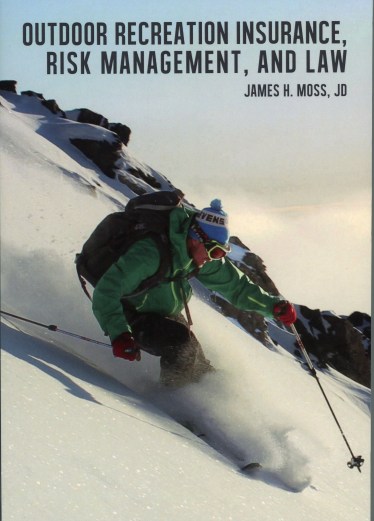
Outdoor Recreation Insurance, Risk Management, and Law
Jim is the author or co-author of six books about the legal issues in the outdoor recreation world; the latest is Outdoor Recreation Insurance, Risk Management and Law.
To see Jim’s complete bio go here and to see his CV you can find it here. To find out the purpose of this website go here.
G-YQ06K3L262
What do you think? Leave a comment.
If you like this let your friends know or post it on FB, Twitter or LinkedIn
 |
 |
 Threads |
 X (formerly known as Twitter) logo |
 Blue Sky |
 Stimulus |
Author: Outdoor Recreation Insurance, Risk Management and Law
Facebook Page: Outdoor Recreation & Adventure Travel Law
Email: Jim@Rec-Law.US
By Recreation Law Rec-law@recreation-law.com James H. Moss
@2024 Summit Magic Publishing, LLC
#RecreationLaw, #@RecreationLaw, #Cycling.Law #Fitness.Law, #Ski.Law, #Outside.Law, #Recreation.Law, #Recreation-Law.com, #Outdoor Law, #Recreation Law, #Outdoor Recreation Law, #Adventure Travel Law, #law, #Travel Law, #Jim Moss, #James H. Moss, #Attorney at Law, #Tourism, #Adventure Tourism, #Rec-Law, #Rec-Law Blog, #Recreation Law, #Recreation Law Blog, #Risk Management, #Human Powered, #Human Powered Recreation,# Cycling Law, #Bicycling Law, #Fitness Law, #Recreation-Law.com, #Backpacking, #Hiking, #Mountaineering, #Ice Climbing, #Rock Climbing, #Ropes Course, #Challenge Course, #Summer Camp, #Camps, #Youth Camps, #Skiing, #Ski Areas, #Negligence, #Snowboarding, #RecreationLaw, #@RecreationLaw, #Cycling.Law #Fitness.Law, #SkiLaw, #Outside.Law, #Recreation.Law, #RecreationLaw.com, #OutdoorLaw, #RecreationLaw, #OutdoorRecreationLaw, #AdventureTravelLaw, #Law, #TravelLaw, #JimMoss, #JamesHMoss, #AttorneyatLaw, #Tourism, #AdventureTourism, #RecLaw, #RecLawBlog, #RecreationLawBlog, #RiskManagement, #HumanPowered, #HumanPoweredRecreation,# CyclingLaw, #BicyclingLaw, #FitnessLaw, #RecreationLaw.com, #Backpacking, #Hiking, #Mountaineering, #IceClimbing, #RockClimbing, #RopesCourse, #ChallengeCourse, #SummerCamp, #Camps, #YouthCamps, #Skiing, #Ski Areas, #Negligence, #Snowboarding, sport and recreation laws, ski law, cycling law, Colorado law, law for recreation and sport managers, bicycling and the law, cycling and the law, ski helmet law, skiers code, skiing accidents, Recreation Lawyer, Ski Lawyer, Paddlesports Lawyer, Cycling Lawyer, Recreational Lawyer, Fitness Lawyer, Rec Lawyer, Challenge Course Lawyer, Ropes Course Lawyer, Zip Line Lawyer, Rock Climbing Lawyer, Adventure Travel Lawyer, Outside Lawyer, Recreation Lawyer, Ski Lawyer, Paddlesports Lawyer, Cycling Lawyer, #RecreationalLawyer, #FitnessLawyer, #RecLawyer, #ChallengeCourseLawyer, #RopesCourseLawyer, #ZipLineLawyer, #RockClimbingLawyer, #AdventureTravelLawyer, #OutsideLawyer, #FlowRider, Royal Caribbean Cruise Line, Oasis of the Seas, #Cruise, #Cruise Line, Release, Assumption of the Risk, #Video, #Wakeboarding, #Wakeboard, #Surfing, Cruise Ship,
WordPress Tags: Electronic,Florida,Johnson,Royal,Caribbean,Cruises,Dist,LEXIS,precedent,paper,defendant,Oasis,Seas,FlowRider,device,amusement,payment,plaintiff,Prior,injury,cabin,riders,readers,scroll,room,argument,relationship,carrier,passengers,transportation,degree,prong,incident,impact,commerce,industry,injuries,navigation,purpose,failure,environment,Waiver,circulation,stateroom,Another,factor,fact,execution,Also,importance,assumption,Releases,Include,Make,participant,Leave,Twitter,LinkedIn,Recreation,Edit,RecreationLaw,Facebook,Page,Outdoor,Adventure,Travel,Blog,Mobile,Site,Outside,Moss,James,Attorney,Tourism,Risk,Management,Human,Rock,Ropes,Course,Challenge,Summer,Camp,Camps,Youth,Areas,Negligence,SkiLaw,OutdoorLaw,OutdoorRecreationLaw,AdventureTravelLaw,TravelLaw,JimMoss,JamesHMoss,AttorneyatLaw,AdventureTourism,RecLaw,RecLawBlog,RecreationLawBlog,RiskManagement,HumanPoweredRecreation,CyclingLaw,BicyclingLaw,FitnessLaw,RopesCourse,ChallengeCourse,SummerCamp,YouthCamps,Colorado,managers,helmet,accidents,Lawyer,Paddlesports,Recreational,Line,RecreationalLawyer,FitnessLawyer,RecLawyer,ChallengeCourseLawyer,RopesCourseLawyer,ZipLineLawyer,RockClimbingLawyer,AdventureTravelLawyer,OutsideLawyer,Cruise,Release,Video,Wakeboard,Ship,three
Johnson v. Royal Caribbean Cruises, Ltd., 2011 U.S. Dist. LEXIS 28128; 2011 AMC 1171
Posted: June 18, 2012 Filed under: Florida, Legal Case, Release (pre-injury contract not to sue) | Tags: #Cruise, #FlowRider, Assumption of risk, Electronic Release, Miami, Negligence, Release, Royal Caribbean Cruises, Royal Caribbean International, Summary judgment, Waiver 2 CommentsTo Read an Analysis of this decision see: Electronic release upheld in Florida federal court for surfing on a cruise ship
Johnson v. Royal Caribbean Cruises, Ltd., 2011 U.S. Dist. LEXIS 28128; 2011 AMC 1171
Charlene I. Johnson, Plaintiff, vs. Royal Caribbean Cruises, Ltd., Defendant.
Case Number: 10-21650-CIV-MORENO
UNITED STATES DISTRICT COURT FOR THE SOUTHERN DISTRICT OF FLORIDA, MIAMI DIVISION
2011 U.S. Dist. LEXIS 28128; 2011 AMC 1171
March 18, 2011, Decided
March 18, 2011, Filed
COUNSEL: [*1] For Charlene I. Johnson, Plaintiff: Jonathan Bruce Aronson, ARONSON LAW FIRM, Miami, FL; James Madison Walker, Walker & O’Neill PA, South Miami, FL.
For Royal Caribbean Cruises, Ltd., a Liberian corporation, Defendant: Curtis Jay Mase, LEAD ATTORNEY, Lauren E DeFabio, Scott P. Mebane, Valentina M. Tejera, Mase, Lara, Eversole PA, Miami, FL.
JUDGES: FEDERICO A. MORENO, UNITED STATES DISTRICT JUDGE.
OPINION BY: FEDERICO A. MORENO
OPINION
ORDER GRANTING DEFENDANT’S MOTION FOR SUMMARY JUDGMENT; ORDER DENYING PLAINTIFF’S MOTION FOR SUMMARY JUDGMENT
This is a personal injury action against the cruise line arising out of an accident that occurred while Plaintiff was taking a private lesson on the FlowRider, a simulated surfing activity onboard the Defendant’s cruise ship. Defendant argues that Plaintiff’s suit is barred by her execution of a waiver which released Defendant from liability for any negligence or damages associated with Plaintiff’s use of the FlowRider. Plaintiff contends that the waiver is void under 46 U.S.C. § 30509 and general maritime law, and in the alternative, that the waiver should not be enforced on equitable grounds. Both parties have moved for summary judgment. Because the simulated surfing activity [*2] is inherently dangerous and is not an essential function of a common carrier, the Court finds that the waiver is valid and enforceable, and accordingly, GRANTS Defendant’s Motion for Summary Judgment and DENIES Plaintiff’s Motion for Summary Judgment.
I. Background
On January 30, 2010, Plaintiff Charlene Johnson, a 35-year-old woman, departed on a seven-day cruise aboard the M/S Oasis of the Seas (“the vessel”), a cruise ship owned and operated by Defendant Royal Caribbean Cruises, Ltd. On January 31, 2010 Plaintiff purchased a private lesson on the FlowRider. Passenger participation in the FlowRider is voluntary and requires payment of a fee that is separate and distinct from the cruise fare. Prior to using the FlowRider, passengers must sign an electronic Onboard Activity Waiver (“Waiver”), which is presented to passengers in color on an electronic screen. The Waiver is attached hereto as Exhibit “A.” The Waiver states at the top in bold, “Express Assumption of Risk – Waiver & Release of Liability.” The Waiver is three pages long and is designed so that passengers must scroll through all of its language before execution; otherwise it is simply impossible to execute the Waiver.
Plaintiff [*3] signed and executed the Waiver, thereby agreeing to “fully release and forever discharge” Defendant from “any and all actions” arising from “any accident [or] injury” in any way connected to Plaintiff’s use of the FlowRider. The Waiver expressly warns passengers that the “rider/participant can, intentionally or inadvertently, move quickly and unexpectedly from side to side or any direction, which will necessarily result in falls [or wipeouts] from the bodyboard” and which may cause serious injury. The Waiver further provides that the passenger agrees not to use the FlowRider until she has watched a safety video. At the time of the alleged incident, the FlowRider safety video was in circulation on the stateroom channel, which is available to all passengers on their cabin TVs. 1
1 Barbara Cobas, one of the defense witnesses, initially testified in her deposition that the safety video was not in circulation on the vessel at the time of the alleged incident. Ms. Cobas subsequently discovered that she was mistaken and that the video was in fact in circulation. Defendant accordingly filed an errata sheet, which Plaintiff then moved to strike. The Court, finding sufficient justification for [*4] the change, has denied Plaintiff’s motion.
Before her private lesson on the FlowRider, Plaintiff had observed others using the device, and throughout her lesson she had ridden the FlowRider and fallen off her board multiple times. Approximately forty minutes into her private lesson, Plaintiff was instructed to stand on the board, and once Plaintiff was standing, the instructor let go of the board. Plaintiff immediately fell off the board and hit the back wall of the FlowRider, fracturing her right ankle. As a result, Plaintiff filed the instant negligence action against Defendant.
II. Standard of Review
[HN1] Summary judgment is authorized when there is no genuine issue of material fact. Fed. R. Civ. P. 56(c). [HN2] The party seeking summary judgment bears the initial burden of demonstrating the absence of a genuine issue of material fact. Adickes v. S.H. Kress & Co., 398 U.S. 144, 157, 90 S. Ct. 1598, 26 L. Ed. 2d 142 (1970). The burden then shifts to the party opposing the motion, who must set forth specific facts and establish the essential elements of the case on which it will bear the burden of proof at trial. Celotex Corp. v. Catrett, 477 U.S. 317, 106 S. Ct. 2548, 91 L. Ed. 2d 265 (1986); Matsushita Elec. Indus. Co. v. Zenith Radio Corp., 475 U.S. 574, 587, 106 S. Ct. 1348, 89 L. Ed. 2d 538 (1986). [*5] The nonmoving party may not simply rest upon mere allegations or denials of the pleadings; it must present more than a scintilla of evidence in support of its position. A jury must be able reasonably to find for the nonmovant. Anderson v Liberty Lobby, Inc., 477 U.S. 242, 254, 106 S. Ct. 2505, 91 L. Ed. 2d 202 (1986). [HN3] In reviewing a motion for summary judgment, the Court must view the evidence and draw all reasonable inferences in the light most favorable to the non-moving party. Id. at 255.
III. Discussion
The parties have not cited any case with facts similar to this one-where the injury resulted from a recreational and inherently dangerous activity on board a cruise ship, for which a waiver was executed. The core issue presented by the parties’ Motions for Summary Judgment is the validity and enforceability of the Waiver. Plaintiff argues that the Waiver is void under 46 U.S.C. § 30509 and general maritime law, and in the alternative, that the Waiver should not be enforced on equitable grounds. Defendant argues that general maritime law does not apply under the facts of this case, and even if it does, 46 U.S.C. § 30509 does not apply to invalidate the Waiver. Defendant also argues that equity does not prevent enforcement [*6] of the Waiver.
A. Whether General Maritime Law Applies
At the outset, the Court notes that [HN4] admiralty jurisdiction must exist before the Court may apply admiralty law. See Doe v. Celebrity Cruises, Inc., 394 F.3d 891, 899 (11th Cir. 2004). Whether admiralty jurisdiction exists is an independent determination that must be made by the Court. See id. at 900. In order for admiralty jurisdiction to exist, two tests must be satisfied: the location test and the connection test. See Jerome B. Grubart, Inc. v. Great Lakes Dredge & Dock Co., 513 U.S. 527, 534, 115 S. Ct. 1043, 130 L. Ed. 2d 1024 (1995) (“[A] party seeking to invoke federal admiralty jurisdiction . . . over a tort claim must satisfy conditions both of location and of connection with maritime activity.”). The location test, requiring that the incident causing the alleged harm occurred in navigable waters, is plainly satisfied.
The connection test has two prongs, both of which must be met: (1) the incident causing the alleged harm must have a potentially disruptive impact on maritime commerce; and (2) the activity giving rise to the incident must bear a substantial relationship to traditional maritime activity. See id.; Doe, 394 F.3d at 900. The Court finds that neither [*7] prong of the connection test is met. While the cruise line industry is itself maritime commerce, it is unlikely that the cruise line industry would be disrupted by future FlowRider-related injuries, as falling off the board and injuring oneself is an inherent and unavoidable risk of using the FlowRider, an activity which is completely voluntary and must be purchased separately from the cruise fare. Even assuming, arguendo, that the first prong of the connection test is satisfied, the second prong is clearly not, as the FlowRider is a purely recreational activity that bears no relationship to traditional maritime activities such as navigation, piloting, and shipping. See Foster v. Peddicord, 826 F.2d 1370, 1376 (4th Cir. 1987) (“[T]his case is about swimming and diving . . . It is not about piloting, shipping, or navigational error, or other aspects of traditional maritime activity. There is simply no predicative relationship upon which an otherwise typical tort claim may properly be described as relating to ‘matters with which admiralty is basically concerned.'”) (quoting Exec. Jet Aviation, Inc. v. City of Cleveland, Ohio, 409 U.S. 249, 270, 93 S. Ct. 493, 34 L. Ed. 2d 454 (1972)). Therefore, because neither prong [*8] of the connection test is satisfied, Federal admiralty jurisdiction is not invoked and general maritime law does not apply.
B. Whether 46 U.S.C. § 30509 Applies
Even assuming, however, that admiralty jurisdiction exists and general maritime law applies, 46 U.S.C. § 30509-the statute under which Plaintiff challenges the Waiver-is inapplicable here. 46 U.S.C. § 30509, formerly cited as 46 U.S.C. § 183(c), reads in pertinent part as follows:
[HN5] (a) Prohibition.–
(1) In general.– The owner, master, manager, or agent of a vessel transporting passengers between ports in the United States, or between a port in the United States and a port in a foreign country, may not include in a regulation or contract a provision limiting–
(A) the liability of the owner, master, or agent for personal injury or death caused by the negligence or fault of the owner or the owner’s employees or agents; or
(B) the right of a claimant for personal injury or death to a trial by court of competent jurisdiction.
(2) Voidness.–A provision described in paragraph (1) is void.
Plaintiff argues that the Waiver in this case is void under § 30509 because it attempts to absolve Defendant from its own negligence in the operation, design, [*9] maintenance, and supervision of the FlowRider. This argument, however, ignores [HN6] the policy rationale behind the statute, which is that common carriers should not be able to secure immunity from liability for their own negligence in providing transportation and other essential functions of common carriers. See Chervy v. Peninsular & Oriental Steam Navigation. Co., 243 F. Supp. 654, 655 (S.D. Cal. 1964) (“[T]he provisions of Title [46 U.S.C. § 30509]… were intended to apply as between common carrier and passengers.”); Weade v. Dichmann, Wright & Pugh, 337 U.S. 801, 807, 69 S. Ct. 1326, 93 L. Ed. 1704 (1949) (“The duty of a common carrier . . . is to transport for hire whoever employs it.”); Liverpool & G. W. Steam Co. v. Phenix Ins. Co., 129 U.S. 397, 441, 9 S. Ct. 469, 32 L. Ed. 788 (1889) (“[T]he law does not allow a public carrier to abandon altogether his obligations to the public, and to stipulate for exemptions which are unreasonable and improper, amounting to an abnegation of the essential duties of his employment.”); Shultz v. Florida Keys Dive Ctr, Inc., 224 F.3d 1269, 1271 (11th Cir. 2000) (“Congress enacted [§ 30509]… to put a stop to practices like providing [exculpatory clauses] on the reverse side of steamship tickets.”) (internal [*10] quotations omitted); Chan v. Society Expeditions, Inc., 123 F.3d 1287, 1292 (9th Cir. 1997) (“[A]dmiralty law has generally prohibited carriers from limiting their liability for transporting passengers from ship to shore.”); Kornberg v. Carnival Cruise Lines, Inc., 741 F.2d 1332, 1336 (11th Cir. 1984) (relying on § 30509 in holding that the provision of an adequate sanitary system on a cruise ship is an “essential function” for which a sea carrier cannot disclaim responsibility).
[HN7] While courts have expanded the essential functions of a ship as common carrier to include the provision of “comfortable accommodations” to passengers, see id. at 1334, recreational and inherently dangerous activities such as the FlowRider can hardly be considered essential functions of a common carrier, nor are they at all related to a carrier’s duty to provide safe transportation to its passengers. Plaintiff has cited to no case suggesting otherwise.
On the other hand, Defendant has cited to two scuba diving cases which, though not directly on point, are particularly illustrative. In Shultz, 224 F.3d at 1269, a widower sued a dive center for the wrongful death of his wife, who died of an apparent drowning while [*11] scuba diving on a trip conducted by the dive center. Id. at 1270. The district court granted summary judgment for the dive center on the basis of a liability release signed by the decedent which the court determined to be valid under 46 U.S.C. § 30509. The Eleventh Circuit, after examining the legislative history of § 30509, affirmed, finding that the statute did not cover the release. In particular, the court stated:
[HN8] Congress enacted [§ 30509] . . . to ‘put a stop to’ practices like ‘providing on the reverse side of steamship tickets that in the event of damage or injury caused by the negligence or fault of the owner or his servants, the liability of the owner shall be limited.’ That ‘practice’ that Congress intended to outlaw was much different than the practice here-requiring a signed liability release to participate in the recreational and inherently risky activity of scuba diving.
Id. at 1271 (internal quotations omitted).
In Borden v. Phillips, 752 So. 2d 69 (Fla. 1st DCA 2000), a decedent’s personal representative sued the defendant boat owner and operator for the wrongful death of the decedent, who died while participating in an advanced scuba diving course taught by the defendant. [*12] Prior to participating in the course, the decedent had signed a waiver releasing the defendant from liability for injuries related to the decedent’s participation in the course. The court held that although 46 U.S.C. § 30509 applied to the dive boat’s voyage because it was a vessel engaged in passenger transportation, id. at 72, the waiver was not void under § 30509, as the alleged negligence was related solely to the activity of scuba diving and the decedent’s death had no relationship to the defendant’s operation or maintenance of the vessel, id. at 73.
While both Shultz and Borden are distinguishable in several respects, as neither involved an injury on board a cruise ship, the Court nonetheless finds their reasoning persuasive and wholly applicable to the instant case. The FlowRider, like scuba diving, is a recreational and inherently dangerous activity. The alleged negligence here is related solely to the FlowRider, and Plaintiff’s injury stems entirely from her use of the FlowRider and has no relationship to the operation or navigation of the cruise ship. The Waiver does not attempt to limit Defendant’s liability associated with its duty to provide safe transport or any other [*13] essential functions, but applies solely to limit Defendant’s liability associated with Plaintiff’s use of the FlowRider, a recreational and inherently dangerous activity that Defendant would simply not be able to offer its passengers otherwise.
Moreover, [HN9] courts have upheld waivers releasing land-based operators from liability for similarly inherently dangerous activities. See In re. Compl. of Royal Caribbean Cruises, Ltd., 403 F. Supp. 2d 1168 (S.D. Fla. 2005)(jet-skiing); Waggoner v. Nags Head Water Sports, Inc., 141 F.3d 1162 (4th Cir. 1998) (same); Theis v. J & J Racing Promotions, 571 So. 2d 92 (Fla. 2d DCA 1990) (race car driving). [HN10] To declare void an otherwise valid waiver simply because the complained-of injury occurred on board a cruise ship, even though the activity giving rise to the injury was totally unrelated to the ship’s duty to provide safe transport or other essential functions, defies both the legislative history of § 30509 as well as common sense. Accordingly, the Court finds that 46 U.S.C. § 30509 does not apply to invalidate the Waiver here.
C. Whether the Waiver is Valid on Equitable Grounds
Finally, the Court rejects Plaintiff’s argument that the Waiver should not [*14] be enforced on equitable grounds. The Waiver clearly and unambiguously released Defendant from liability for any negligence or damages associated with Plaintiff’s use of the FlowRider. The bolded language at the top of the first page of the Waiver conspicuously indicated the nature and purpose of the document, and the second page of the Waiver specifically explained the potential risks associated with using the FlowRider. Furthermore, Plaintiff had observed others using the FlowRider, and had ridden the FlowRider and fallen off her board multiple times throughout her private lesson before injuring herself, so she clearly knew or should have known that she could fall and consequently injure herself while using the FlowRider. That Plaintiff was not provided a hard copy of the Waiver is irrelevant, as the Waiver is only three pages long and Plaintiff had to scroll through its entire language in order to execute her full signature on the third and final page. Moreover, it is Defendant’s policy not to provide a hard copy of the Waiver to any of its passengers. Finally, while Plaintiff asserts she thought she was signing for a room charge when executing the Waiver, this mistaken belief is [*15] solely the result of [HN11] her own failure to read the contractual language clearly presented to her, for which the law of equity provides no remedy.
IV. Conclusion
The Court finds the Waiver here-limited to the inherently dangerous simulated surfing activity-to be valid and enforceable. Because Plaintiff’s execution of the Waiver released the cruise line from liability for any negligence or damages associated with Plaintiff’s use of the FlowRider, Plaintiff’s suit for negligence is barred. Accordingly, it is
ADJUDGED that Defendant’s Motion for Summary Judgment (D.E. 93), filed on January 28, 2011, is GRANTED. Further, it is
ADJUDGED that Plaintiff’s Motion for Summary Judgment (D.E. 90), filed on January 28, 2011, is DENIED.
DONE AND ORDERED in Chambers at Miami, Florida, this 18th day of March, 2011.
/s/ Federico A. Moreno
FEDERICO A. MORENO
UNITED STATES DISTRICT JUDGE
G-YQ06K3L262


 Recreation Law