
Plaintiff loses because experts could not prove his claims against a camp used for a football camp.
Posted: May 21, 2018 Filed under: New York, Pennsylvania, Summer Camp, Youth Camps | Tags: ACA, Adult, American Camp Association, breached, building code, bunk, Cabin, Coach, constructive notice, cross-claims, engaging, Expert Witness, fellow, fighting, Football Camp, glass, hazardous, high school, horseplay, individual capacity, Infant, inter alia, Leader, negligent supervision, Notice, safety glass, severed, speculative, spontaneous, sudden, Summary judgment, Summer Camp, supervising, Supervision, window Leave a commentACA trained expert witness was hired by injured plaintiff to prove a claim against a summer camp. Again, camp money is used to train expert who then is used against the camp.
Staten Et. Al. v. The City of New York Et. Al., 2013 N.Y. Misc. LEXIS 4257; 2013 NY Slip Op 32252(U)
State: New York, Supreme Court of New York, Richmond County
Plaintiff: Marvin Staten, an Infant Over the Age of 14 years by his Parent and Natural Guardian Cassandra Dozier and Cassandra Dozier, Individually
Defendant: The City of New York, The New York City Department of Education, Camp Chen-A-Wanda, Inc., Louis Cintron, Sr., Louis Cintron, Jr., an infant over the age of 14 years by his Parent and Natural Guardian, Louis Cintron, Sr., Barbara Rose Cintron and Louis Cintron, Jr. an infant over the age of 14 years by his Parent and Natural guardian, Barbara Rose Cintron, Defendants
Plaintiff Claims: Negligent supervision and maintenance of the premises
Defendant Defenses:
Holding: For the defendant Camp
Year: 2013
Summary
American Camp Association (ACA) trained expert witness used ACA material to try and prove the summer camp was liable for the injuries of a camper. The summer camp had passed the duty to control the kids to the school district that had rented the camp and as such was not liable.
To be able to sue for emotional damages under New York law, the parent must have financial damages also. Lacking that, the mother’s claims were dismissed.
Facts
This ruling is the result of several motions filed by different parties and can be confusing.
The minors were at a summer week long football camp. The camp was rented by the defendant New York Department of Education. The camp, Camp Chen-A-Wanda, Inc., was located in Pennsylvania.
The plaintiff was looking through the cabin window where he was bunking to see if anyone was messing with his stuff. The defendant minor punched the plaintiff through the window, injuring the plaintiff with the broken glass from the window. The plaintiff’s expert identified this action as horseplay?
At his deposition, plaintiff testified that shortly after dinner on the date of the accident, he was standing outside his cabin, looking in through a window to “see if anybody was messing around with [his] stuff” when, after a few seconds, defendant Cintron “punched [through] the glass”
The defendant minor had been disciplined before by the school district for fighting.
There was a written agreement between the Defendant Camp and the school district, where the school district agreed to provide one adult (person over age 19) per cabin. In the cabin where the incident took place, the supervisors were two seniors, one of whom was the defendant minor.
The agreement gave control of the people at the camp, including campers to the school district renting the facilities.
This is the decision concerning the various motions.
Analysis: making sense of the law based on these facts.
The camp filed a motion for summary judgment arguing:
(1) it owed no duty to supervise plaintiff or to otherwise protect him from horseplay; (2) no facts have been adduced in support of plaintiffs’ claim that the subject window constituted a “defective condition”; and (3) since the proximate cause of the accident was the sudden, unanticipated independent actions of Cintron (i.e., punching the glass), the Camp cannot be found liable for plaintiff’s injury.
The plaintiff argued the camp was negligent and negligent per se. The negligence per se claim was based on a regulation that required safety glass to be used in windows of bunkhouses. The plaintiff also argued the camp was negligent for failing to exercise risk management and supervise the campers.
I’ve never seen a claim that it was negligent to fail to exercise risk management.
The expert hired by the plaintiff had “44 years in the camping industry and a co-author of the American Camp Association’s ‘2006 Camp Accreditation Process Guide’.” However, the court found the testimony of the expert was conclusory and insufficient to raise a question of fact.
…”conclusory testimony” offered by plaintiff’s expert was “insufficient to raise a question of fact as to whether [the Camp] breached its duty to maintain[] [its] property in a reasonably safe condition in view of all the circumstances, including the likelihood of injury to others, the seriousness of the in-jury, and the burden of avoiding the risk” and, further, that the failure of plaintiff’s expert to quote any “authority, treatise [or] standard” in support thereof rendered his ultimate opinion speculative and/or “unsupported by any evidentiary foundation…[sufficient] to withstand summary judgment.
The basis of the plaintiff’s expert witness testimony was based on the 2006 American Camp Association Accreditation Process Guide. However, he failed to demonstrate how, where or when the guide had “been accepted as an authoritative reference work in any court of law, or its applicability to a camp constructed in the 1940s.”
The court also found the expert witnesses reliance on the building codes was misplaced because the camp had been built thirty years prior to the creation of the building code.
The court then stated, “the Camp’s motion for summary judgment is granted, and the complaint and any cross claims as against this defendant are hereby severed and dismissed.”
The court then looked at the cities (New York’s) motions. The court found the duty to supervise the youth was contractually assumed by the city in its contract with the camp. The school also had knowledge of the propensity of the defendant minor to get in fights.
In this regard, actual or constructive notice to the school of prior similar conduct is generally required, since school personnel cannot be reasonably expected to guard against all of the sudden and spontaneous acts that take place among students on a daily basis
The it was foreseeable the fight could occur.
The plaintiff’s mothers claim against the city were dismissed.
However, it is well settled that a parent cannot recover for the loss of society and companionship of a child who was negligently injured, while a claim for the loss of a child’s services must be capable of monetarization in order to be compensable. Here, plaintiff’s mother has offered no proof of the value of any services rendered to her by her son. As a result, so much of the complaint as seeks an award of damages in her individual capacity for the loss of her son’s services must be severed and dismissed.
The defendant camp was dismissed from the lawsuit. The mother’s claims were dismissed from the lawsuit because she could not prove actual damages, only emotional damages, which are not a cause of action in New York.
So Now What?
Here again an ACA trained expert witness tries to use ACA material to prove a camp is negligent. The expert would have been successful if he had better training as an expert witness and knew had to get his guide into evidence.
There are great organizations doing great things for their membership. ACA is one of those organizations. However, like others, the attempt to help their membership be better is making their lives in court a living hell.
What would you think if the person sitting across from you being deposed or on the witness stand says you are a crummy operation and negligent. And you know that your association money went into training him and creating the documents he is using to prove you were negligent.
The final issue is many states are reducing or eliminating who can sue for emotional damages when they witness or are relatives of the plaintiff. Here New York has said you can’t sue for emotional damages for the injury your child received if you don’t have financial damages in the game also.
What do you think? Leave a comment.
Copyright 2018 Recreation Law (720) 334 8529
If you like this let your friends know or post it on FB, Twitter or LinkedIn


Author: Outdoor Recreation Insurance, Risk Management and Law
Facebook Page: Outdoor Recreation & Adventure Travel Law
Email: Rec-law@recreation-law.com
By Recreation Law Rec-law@recreation-law.com James H. Moss
#AdventureTourism, #AdventureTravelLaw, #AdventureTravelLawyer, #AttorneyatLaw, #Backpacking, #BicyclingLaw, #Camps, #ChallengeCourse, #ChallengeCourseLaw, #ChallengeCourseLawyer, #CyclingLaw, #FitnessLaw, #FitnessLawyer, #Hiking, #HumanPowered, #HumanPoweredRecreation, #IceClimbing, #JamesHMoss, #JimMoss, #Law, #Mountaineering, #Negligence, #OutdoorLaw, #OutdoorRecreationLaw, #OutsideLaw, #OutsideLawyer, #RecLaw, #Rec-Law, #RecLawBlog, #Rec-LawBlog, #RecLawyer, #RecreationalLawyer, #RecreationLaw, #RecreationLawBlog, #RecreationLawcom, #Recreation-Lawcom, #Recreation-Law.com, #RiskManagement, #RockClimbing, #RockClimbingLawyer, #RopesCourse, #RopesCourseLawyer, #SkiAreas, #Skiing, #SkiLaw, #Snowboarding, #SummerCamp, #Tourism, #TravelLaw, #YouthCamps, #ZipLineLawyer, #RecreationLaw, #OutdoorLaw, #OutdoorRecreationLaw, #SkiLaw,
Expert testimony is needed when the activity is beyond the scope of the general knowledge of a juror in Connecticut.
Posted: May 7, 2018 Filed under: Connecticut, Equine Activities (Horses, Donkeys, Mules) & Animals | Tags: ACA, American Camp Association, Diversity, equestrian, expert testimony, Expert Witness, expertise, familiarity, horseback riding, horsemanship, issues of material fact, juror, Membership, Pony, qualification, resume, specialized knowledge, Standard of Care, state law, Summary judgment Leave a commentIn this case, the plaintiff’s claim failed because they needed any expert witness and the one they had hired was disqualified. Without an expert in horseback riding lessons, the plaintiff’s claims were dismissed.
Ellis v. YMCA Camp Mohawk, Inc., 615 Fed. Appx. 697; 2015 U.S. App. LEXIS 16057
State: Connecticut, United States Court of Appeals for the Second Circuit
Plaintiff: Louisa R. Ellis, ppa Elizabeth Ellis, Elizabeth Ellis
Defendant: YMCA Camp Mohawk, Inc.
Plaintiff Claims: Negligence
Defendant Defenses:
Holding: For the Defendant
Year: 2015
Summary
Your expert witness must have the experience, education or background to be able to testify as to their findings. In states where an expert opinion is needed, like Connecticut, not having an expert means not have a case.
Here the expert witness hired by the plaintiff did not have the necessary qualifications, and the court would not allow his testimony. Because horseback riding and equine issues were outside of the scope of the normal juror in Connecticut, an expert witness was needed by the plaintiff. Without an expert, the plaintiff’s case was dismissed.
Facts
On July 18, 2011, Louisa Ellis fell from a pony while taking horseback riding lessons at YMCA Camp Mohawk. Ellis sustained injuries to her hand and elbow that required surgery and therapy. Appellants identified Andres, an employee of Robson Forensic, to investigate the claims and to provide expert testimony.
The plaintiff’s hired an expert witness to provide expert testimony on why the defendant was negligent. The court found the plaintiff’s expert was not qualified to render an expert opinion on the matter.
… Corey Andres, was not qualified to render an expert opinion regarding the standard of care for an equestrian course at the YMCA camp at which twelve-year-old Louisa was injured.
The trial court dismissed the plaintiff’s case because they could not prove their case.
The district court excluded Andres’s expert testimony on the ground that he had limited experience in the field of horseback riding. Therefore, appellants’ failure to produce an expert where expert testimony was required led the district court to grant summary judgment.
The plaintiffs appealed.
Analysis: making sense of the law based on these facts.
Although the case was brought in the federal district court because the parties were from different states, the law of the state where the accident happened was the law used in the case. Since the accident occurred in Connecticut, Connecticut law was applied to the case.
Under Connecticut law, horseback riding was outside the general knowledge of jurors and thus required expert testimony for the jurors to make their decisions.
Connecticut courts have held, on similar facts, that the general public is no longer as familiar with horsemanship as it arguably was at the beginning of the twentieth century, and that expert testimony is necessary to establish a standard of care and a breach of that standard.
An expert witness is needed to show both the standard of care in the case and whether the defendant breached that standard of care.
The plaintiff hired Andres, an employee of Robson Forensic.
Andres claimed his expertise based on his membership in the American Camp Association (“ACA”) and his study of therapeutic education at Ohio State, University of Toledo, including a study pertaining to equestrian matters. Andres’s investigation concluded that YMCA was negligent in failing to provide complete and proper instruction as to how to fall from a horse in a way that minimizes injury.
The district court excluded “Andres’s expert testimony on the ground that he had limited experience in the field of horseback riding.”
The district stated, and the appellate court agreed that:
Andres does not rise to the level of expertise required to opine on the matters at hand. Andres has practically no knowledge or experience relating to horsemanship — his resume makes no reference to any such knowledge, and his investigation merely points to three publications that he relied on when preparing his report. Andres’s resume instead highlights a wide array of fields and organizations in which he has obtained certifications or is a member. Appellants argue that Andres’s membership in the ACA broadly reaches all camp recreations. This broad qualification falls well short of the specialized knowledge that Federal Rule of Evidence 702 demands. The district court therefore did not abuse its discretion in its decision to exclude Andres’s testimony.
Because the plaintiff’s expert witness was excluded and could not testify, the plaintiffs could not prove their case.
Appellants’ failure to provide necessary expert testimony precludes them from presenting these claims under Connecticut state law. Thus, there are no issues of material fact raised to challenge the district court’s entry of summary judgment.
So Now What?
The courts have been given broader discretion to determine who can and cannot testify as an expert witness. The courts can also determine, even if the expert is qualified to testify, that the testimony they are going to give is not based on science.
In states where expert testimony is required or any state where you want to win, you need to hire expert witnesses who are going to qualify as an expert in their field and provide an opinion based on science, history, experience and real life.
What do you think? Leave a comment.
 James H. “Jim” Moss |
Jim Moss is an attorney specializing in the legal issues of the outdoor recreation community. He represents guides, guide services, and outfitters both as businesses and individuals and the products they use for their business. He has defended Mt. Everest guide services, summer camps, climbing rope manufacturers; avalanche beacon manufacturers, and many more manufacturers and outdoor industries. Contact Jim at Jim@Rec-Law.us |
Jim is the author or co-author of eight books about legal issues in the outdoor recreation world; the latest is Outdoor Recreation Insurance, Risk Management,
Outdoor Recreation Insurance, Risk Management, and Law
To see Jim’s complete bio go here and to see his CV you can find it here. To find out the purpose of this website go here.
If you are interested in having me write your release, download the form and return it to me.
Connect
If you like this let your friends know or post it on FB, Twitter, or LinkedIn
 Threads |
 Facebook Logo |
 X, Formerly Twitter |
 Recreation Law |
By Recreation Law Rec-law@recreation-law.com James H. Moss
@2018-2023 Summit Magic Publishing, LLC
G-YQ06K3L262
#AdventureTourism, #AdventureTravelLaw, #AdventureTravelLawyer, #AttorneyatLaw, #Backpacking, #BicyclingLaw, #Camps, #ChallengeCourse, #ChallengeCourseLaw, #ChallengeCourseLawyer, #CyclingLaw, #FitnessLaw, #FitnessLawyer, #Hiking, #HumanPowered, #HumanPoweredRecreation, #IceClimbing, #JamesHMoss, #JimMoss, #Law, #Mountaineering, #Negligence, #OutdoorLaw, #OutdoorRecreationLaw, #OutsideLaw, #OutsideLawyer, #RecLaw, #Rec-Law, #RecLawBlog, #Rec-LawBlog, #RecLawyer, #RecreationalLawyer, #RecreationLaw, #RecreationLawBlog, #RecreationLawcom, #Recreation-Lawcom, #Recreation-Law.com, #RiskManagement, #RockClimbing, #RockClimbingLawyer, #RopesCourse, #RopesCourseLawyer, #SkiAreas, #Skiing, #SkiLaw, #Snowboarding, #SummerCamp, #Tourism, #TravelLaw, #YouthCamps, #ZipLineLawyer, #RecreationLaw, #OutdoorLaw, #OutdoorRecreationLaw, #SkiLaw,
Ellis v. YMCA Camp Mohawk, Inc., 615 Fed. Appx. 697; 2015 U.S. App. LEXIS 16057
Posted: April 17, 2018 Filed under: Connecticut, Equine Activities (Horses, Donkeys, Mules) & Animals, Legal Case | Tags: Diversity, equestrian, expert testimony, Expert Witness, expertise, familiarity, horseback riding, horsemanship, issues of material fact, juror, Membership, Pony, qualification, resume, specialized knowledge, Standard of Care, state law, Summary judgment Leave a commentTo Read an Analysis of this decision see
Expert testimony is needed when the activity is beyond the scope of the general knowledge of a juror in Connecticut.
and
Summer camp being sued for injury from falling off horse wins lawsuit because the plaintiff failed to find an expert to prove their case.
Ellis v. YMCA Camp Mohawk, Inc., 615 Fed. Appx. 697; 2015 U.S. App. LEXIS 16057
Louisa R. Ellis, ppa Elizabeth Ellis, Elizabeth Ellis, Plaintiff-Appellant, -v.- YMCA Camp Mohawk, Inc., Defendant-Appellee.
14-3460
UNITED STATES COURT OF APPEALS FOR THE SECOND CIRCUIT
615 Fed. Appx. 697; 2015 U.S. App. LEXIS 16057
September 10, 2015, Decided
NOTICE: PLEASE REFER TO FEDERAL RULES OF APPELLATE PROCEDURE RULE 32.1 GOVERNING THE CITATION TO UNPUBLISHED OPINIONS.
PRIOR HISTORY: [**1] Appeal from a judgment of the United States District Court for the District of Connecticut (Thompson, J.).
Ellis v. Y.M.C.A. Camp Mohawk, Inc., 2014 U.S. Dist. LEXIS 110403 (D. Conn., Aug. 11, 2014)
CASE SUMMARY:
OVERVIEW: HOLDINGS: [1]-A claim that a summer camp operator was negligent in offering horseback riding instruction required the support of expert testimony, as the intricacies of horseback riding technique and horsemanship were no longer within the bounds of ordinary knowledge or experience of judges and jurors; [2]-The proffered expert witness was not qualified under Fed. R. Evid. 702, as he claimed a generalized familiarity with camp education but had practically no knowledge or experience relating to horsemanship.
OUTCOME: Judgment affirmed.
CORE TERMS: expert testimony, summary judgment, state law, standard of care, specialized knowledge, horsemanship, expertise, juror, horseback riding, expert witness, issues of material fact, qualification, familiarity, membership, diversity, resume, equestrian, pony
COUNSEL: FOR APPELLANT: Megan L. Piltz, Sabatini and Associates, LLC, Newington, Connecticut.
FOR APPELLEES: Renee W. Dwyer and Katherine L. Matthews, Gordon, Muir and Foley, LLP, Hartford, Connecticut.
JUDGES: PRESENT: RALPH K. WINTER, JOHN M. WALKER, JR., DENNIS JACOBS, Circuit Judges.
OPINION
[*697] SUMMARY ORDER
UPON DUE CONSIDERATION, IT IS HEREBY ORDERED, ADJUDGED AND DECREED that the judgment of the district court be AFFIRMED.
Louisa Ellis and Elizabeth Ellis (“Appellants”) appeal from the judgment of the United States District Court for the District of Connecticut (Thompson, J.), dismissing [*698] on summary judgment their diversity action alleging negligence against YCMA Camp Mohawk, Inc. (“YMCA”). Appellants argue that the district court abused its discretion in determining that their expert, Corey Andres, was not qualified to render an expert opinion regarding the standard of care for an equestrian course at the YMCA camp at which twelve-year-old Louisa was injured. Appellants also argue that the district court erred in determining that all of the issues presented require expert testimony. We assume the parties’ [**2] familiarity with the underlying facts, the procedural history, and the issues presented for review.
On July 18, 2011, Louisa Ellis fell from a pony while taking horseback riding lessons at YMCA Camp Mohawk. Ellis sustained injuries to her hand and elbow that required surgery and therapy. Appellants identified Andres, an employee of Robson Forensic, to investigate the claims and to provide expert testimony. Andres claimed his expertise based on his membership in the American Camp Association (“ACA”) and his study of therapeutic education at Ohio State, University of Toledo, including a study pertaining to equestrian matters. Andres’s investigation concluded that YMCA was negligent in failing to provide complete and proper instruction as to how to fall from a horse in a way that minimizes injury.
The district court excluded Andres’s expert testimony on the ground that he had limited experience in the field of horseback riding. Therefore, appellants’ failure to produce an expert where expert testimony was required led the district court to grant summary judgment.
[HN1] A grant of summary judgment is reviewed de novo to determine whether any genuine issues of material fact would bar summary judgment. [**3] Zurich Am. Ins. Co. v. ABM Indus., Inc., 397 F.3d 158, 164 (2d Cir. 2005). [HN2] We review the district court’s evidentiary ruling under an abuse-of-discretion standard. See id. at 171-72. “Either an error of law or a clear error of fact may constitute an abuse of discretion.” Schering Corp. v. Pfizer, Inc., 189 F.3d 218, 224 (2d Cir. 1999) (internal quotation marks and citations omitted). [HN3] A district court’s qualification of an expert witness will only be overturned if it is manifestly erroneous. United States v. Barrow, 400 F.3d 109, 123 (2d Cir. 2005).
[HN4] In a diversity action, whether expert testimony is required is a matter of state law, whereas the admissibility of a given expert witness is governed by the Federal Rules of Evidence. See 29 Charles Alan Wright & Arthur R. Miller, Federal Practice and Procedure § 6263; see also Beaudette v. Louisville Ladder Inc., 462 F.3d 22, 27 (1st Cir. 2006). [HN5] Under Connecticut state law, expert testimony is required when a matter goes “beyond the ordinary knowledge and experience of judges or jurors.” LePage v. Horne, 262 Conn. 116, 809 A.2d 505, 511 (Conn. 2002). Connecticut courts have held, on similar facts, that the general public is no longer as familiar with horsemanship as it arguably was at the beginning of the twentieth century, and that expert testimony is necessary to establish a standard of care and a breach of that standard. Keeney v. Mystic Valley Hunt Club, Inc., 93 Conn. App. 368, 889 A.2d 829, 833-34 (Conn. App. Ct. 2006).
As the district court held, Appellants’ claims required the support of expert testimony. The intricacies of horseback riding technique and horsemanship [**4] are no longer within the bounds of ordinary knowledge or experience of judges and jurors. Questions [*699] such as whether the stirrups were improperly installed and whether the pony was of sufficient size to carry the rider are not questions that the average juror can decide based on past knowledge or experience. We therefore agree that Ellis needed expert testimony to show both a standard of care and a breach of that standard.
Andres claimed a generalized familiarity with camp education. However, [HN6] Federal Rule of Evidence 702 requires expertise based on specialized knowledge and experience, not a mere understanding derived from others’ publications. “A witness who is qualified as an expert by knowledge, skill, experience, training, or education may testify in the form of an opinion if the expert’s scientific, technical, or other specialized knowledge will help the trier of fact to understand the evidence or to determine a fact in issue.” Fed. R. Evid. 702(a); see also Marvel Characters, Inc. v. Kirby, 726 F.3d 119, 135 (2d Cir. 2013). Andres does not rise to the level of expertise required to opine on the matters at hand. Andres has practically no knowledge or experience relating to horsemanship — his resume makes no reference to any such knowledge, and his investigation merely points to three publications [**5] that he relied on when preparing his report. Andres’s resume instead highlights a wide array of fields and organizations in which he has obtained certifications or is a member. Appellants argue that Andres’s membership in the ACA broadly reaches all camp recreations. This broad qualification falls well short of the specialized knowledge that Federal Rule of Evidence 702 demands. The district court therefore did not abuse its discretion in its decision to exclude Andres’s testimony.
Appellants’ failure to provide necessary expert testimony precludes them from presenting these claims under Connecticut state law. See LePage, 809 A.2d at 511. Thus, there are no issues of material fact raised to challenge the district court’s entry of summary judgment.
For the foregoing reasons, and finding no merit in Appellant’s other arguments, we hereby AFFIRM the judgment of the district court.
G-YQ06K3L262
http://www.recreation-law.com
Summer camp being sued for injury from falling off horse wins lawsuit because the plaintiff failed to find an expert to prove their case.
Posted: April 13, 2015 Filed under: Connecticut, Equine Activities (Horses, Donkeys, Mules) & Animals, Summer Camp | Tags: Day Camp, Expert Qualifications, Expert Witness, Horse, horseback riding, Pony, Summer Camp Leave a commentFailure of the plaintiff to find an expert witness in a case requiring an expert results in dismissal of the plaintiff’s complaint.
Ellis v. YMCA Camp Mohawk, Inc., 615 Fed. Appx. 697; 2015 U.S. App. LEXIS 16057
State: Connecticut, United States District Court for the District of Connecticut
Plaintiff: Louisa R. Ellis, PPA Elizabeth Ellis and Elizabeth Ellis
Defendant: Y.M.C.A. Camp Mohawk, Inc.
Plaintiff Claims: negligence and consequential damages
Defendant Defenses: Plaintiff cannot prove their case because they do not have an expert witness qualified to prove their claims.
Holding: Plaintiff
Year: 2014
The plaintiff attended the day camp of the defendants. One of the activities was horseback riding. For one of various reasons, the plaintiff was given a pony to ride rather than a horse. While riding the horse, the plaintiff fell over the shoulder or head of the horse suffering injuries.
The plaintiff sued for negligence and consequential damages (which is slightly confusing). The plaintiff hired an expert witness to prove their case that had no qualifications as a horse expert. The plaintiff’s expert was then disqualified. Because under Connecticut law, an expert witness was needed to prove the plaintiff’s case, the case was dismissed. The plaintiff appealed.
Analysis: making sense of the law based upon these facts.
The court first looked at what an expert witness is and when a case requires an expert witness. An expert witness is a person that is qualified to prove testimony as an expert because of their knowledge, skill, experience, training or education. “…the expert’s scientific, technical, or other specialized knowledge [must] help the trier of fact to understand the evidence or to determine a fact in issue.”
The plaintiff’s expert had no “education, training, or experience related to horseback riding. In fact, there is no mention of “horses” or “horseback riding” anywhere in his curriculum vitae.” His work experience also provided no background in horses or horseback riding. Consequently, the plaintiff’s expert was not qualified to be an expert witness.
The next issue was whether or not an expert was needed to prove the case.
Thus, the issue the court must resolve is whether the answers to the questions presented by the allegations of negligence in the plaintiffs’ complaint are beyond the ordinary understanding, knowledge, or experience of the average judge or juror.
The court then looked at whether the average jury would know enough about horses to understand the case. This court looked at a prior ruling on the subject:
The court observed that “[w]e are well into the age of the automobile, and the general public in the twenty-first century is not generally as acquainted with horsemanship as it arguably was at the beginning of the twentieth century.” Therefore, the court concluded; it was necessary “for the plaintiffs to produce expert testimony to establish both the standard of care to which the defendant was to be held and a breach of that standard.”
The court reached this conclusion. “The services being provided by the defendant, i.e. horseback riding lessons to minor children, are specialized and beyond the ordinary understanding, knowledge and experience of jurors.”
Because the plaintiff did not have an expert witness, the plaintiff was unable to prove their case. The court upheld the dismissal of the case.
So Now What?
This is an extremely rare decision, in fact, the first I have ever read. It is paramount that if you are involved in litigation, you assist your defense attorney in finding the best expert witness you can for your case. That means two things.
1. The expert has the necessary qualifications to be an expert.
2. The expert has the ability to convey their opinion to the jury in a way the jury will understand.
You can have the most qualified person in the world as your expert but if he or she is unable to convey the message in a way the jury will understand you may still lose your case.
What do you think? Leave a comment.
 Jim Moss |
Jim Moss is an attorney specializing in the legal issues of the outdoor recreation community. He represents guides, guide services, and outfitters both as businesses and individuals and the products they use for their business. He has defended Mt. Everest guide services, summer camps, climbing rope manufacturers; avalanche beacon manufacturers, and many more manufacturers and outdoor industries. Contact Jim at Jim@Rec-Law.us |
Jim is the author or co-author of eight books about legal issues in the outdoor recreation world; the latest is Outdoor Recreation Insurance, Risk Management,
Outdoor Recreation Insurance, Risk Management, and Law
To see Jim’s complete bio go here and to see his CV you can find it here. To find out the purpose of this website go here.
If you are interested in having me write your release, download the form and return it to me.
Connect
If you like this let your friends know or post it on FB, Twitter, or LinkedIn
 Threads |
Facebook Logo |
X, Formerly Twitter |
Recreation Law |
By Recreation Law Rec-law@recreation-law.com James H. Moss
@2023 Summit Magic Publishing, LLC
G-YQ06K3L262
#AdventureTourism, #AdventureTravelLaw, #AdventureTravelLawyer, #AttorneyatLaw, #Backpacking, #BicyclingLaw, #Camps, #ChallengeCourse, #ChallengeCourseLaw, #ChallengeCourseLawyer, #CyclingLaw, #FitnessLaw, #FitnessLawyer, #Hiking, #HumanPowered, #HumanPoweredRecreation, #IceClimbing, #JamesHMoss, #JimMoss, #Law, #Mountaineering, #Negligence, #OutdoorLaw, #OutdoorRecreationLaw, #OutsideLaw, #OutsideLawyer, #RecLaw, #Rec-Law, #RecLawBlog, #Rec-LawBlog, #RecLawyer, #RecreationalLawyer, #RecreationLaw, #RecreationLawBlog, #RecreationLawcom, #Recreation-Lawcom, #Recreation-Law.com, #RiskManagement, #RockClimbing, #RockClimbingLawyer, #RopesCourse, #RopesCourseLawyer, #SkiAreas, #Skiing, #SkiLaw, #Snowboarding, #SummerCamp, #Tourism, #TravelLaw, #YouthCamps, #ZipLineLawyer, Summer Camp, Day Camp, Horse, Pony, Horseback Riding, Expert Witness, Expert Qualifications,
So if you write standards, you can, then use them to make money when someone sues your competitors.
Posted: January 2, 2014 Filed under: Climbing Wall | Tags: Alpine Tower, Climbing Wall, Expert Witness, Industry, Lawsuit, Standards Leave a commentI’m sort of speechless (but I can still type) about this whole thing. The amount of money lost in the lawsuit, the way the lawsuit was lost and now this article. The expert witness for the plaintiff seems not to be interested in protecting the industry.
This article describes a tragedy. A climber failed to clip into an auto belay. At the top of the climb she let go, falling to her death. What is the interesting, the article is not the results of the investigation into her death, it is the statements by the “expert” who is quoted.
“It is a well-known problem in the industry,” said [expert], who is a climbing gym owner in Virginia. He helped write industry safety standards, and provide expert witness testimony for people who are injured in gym accidents.
“My opinion is, yes, a gym has some responsibility to make sure that you’re warned and protected to some degree from yourself,” Hague said.
Maybe he was quoted wrong? However, I doubt it. He was an expert for the plaintiff in Keeter v. Alpine Towers International, Inc., 399 S.C. 179; 730 S.E.2d 890; 2012 S.C. App. LEXIS 171 which cost the defendant $4.7 million. I wrote about this case in Plaintiff uses standards of ACCT to cost defendant $4.7 million.
What is going to happen if someone is injured in his gym? Do you believe any other gym owners will line up to testify about any breach of standards?
The expert may be correct about his assessment on whether the standards are breached. However, there are a lot of adages about messing around in your own industry.
His statement about the gym having a responsibility to make sure that you’re warned and protected to some degree from yourself……really? Maybe I don’t want you to protect me?
So how do you know that the person helping you write standards is not there to sue you over the standards that are being written? It happens. The playground industry has created standards so tough and expensive to meet it is cheaper to bull doze a playground than to meet the standards. See Playgrounds will be flat soon. However, that could be better for the kids. See An example of adults and money getting in the way of kids has fun.
This is another way that writing standards comes back to haunt you. You create experts who can then show that you are liable.
See Human error blamed for Grapevine climbing wall death
What do you think? Leave a comment.
If you like this let your friends know or post it on FB, Twitter or LinkedIn
Copyright 2013 Recreation Law (720) Edit Law
Email: Rec-law@recreation-law.com
Google+: +Recreation
Twitter: RecreationLaw
Facebook: Rec.Law.Now
Facebook Page: Outdoor Recreation & Adventure Travel Law
Mobile Site: http://m.recreation-law.com
By Recreation Law Rec-law@recreation-law.com James H. Moss #Authorrank
<rel=”author” link=” https://plus.google.com/u/0/b/112453188060350225356/” />
#RecreationLaw, #Recreation-Law.com, #OutdoorLaw, #OutdoorRecreationLaw, #AdventureTravelLaw, #law, #TravelLaw, #JimMoss, #JamesHMoss, #Tourism, #AdventureTourism, #Rec-Law, #RiskManagement, #CyclingLaw, #BicyclingLaw, #FitnessLaw, #Recreation-Law.com, #Backpacking, #Hiking, #Mountaineering, #IceClimbing, #RockClimbing, #RopesCourse, #ChallengeCourse, #SummerCamp, #Camps, #YouthCamps, #Skiing, #Ski Areas, #Negligence, #Snowboarding, #RecreationLaw, #@RecreationLaw, #Cycling.Law, #SkiLaw, #Outside.Law, #Recreation.Law, #RecreationLaw.com, #OutdoorLaw, #RecreationLaw, #OutdoorRecreationLaw, #AdventureTravelLaw, #Law, #TravelLaw, #JimMoss, #JamesHMoss, #AttorneyatLaw, #Tourism, #AdventureTourism, #RecLaw, #RecLawBlog, #RecreationLawBlog, #RiskManagement, #HumanPowered, #HumanPoweredRecreation,# CyclingLaw, #BicyclingLaw, #FitnessLaw, #RecreationLaw.com, #Backpacking, #Hiking, #Mountaineering, #IceClimbing, #RockClimbing, #RopesCourse, #ChallengeCourse, #SummerCamp, #Camps, #YouthCamps, #Skiing, #Ski Areas, #Negligence, #Snowboarding, sport and recreation laws, ski law, cycling law, Colorado law, law for recreation and sport managers, bicycling and the law, cycling and the law, ski helmet law, skiers code, skiing accidents, Recreation Lawyer, Ski Lawyer, Paddlesports Lawyer, Cycling Lawyer, Recreational Lawyer, Fitness Lawyer, Rec Lawyer, Challenge Course Lawyer, Ropes Course Lawyer, Zip Line Lawyer, Rock Climbing Lawyer, Adventure Travel Lawyer, Outside Lawyer, Recreation Lawyer, Ski Lawyer, Paddlesports Lawyer, Cycling Lawyer, #RecreationalLawyer, #FitnessLawyer, #RecLawyer, #ChallengeCourseLawyer, #RopesCourseLawyer, #ZipLineLawyer, #RockClimbingLawyer, #AdventureTravelLawyer, #OutsideLawyer, Good Samaritan, Samaritan, First Aid, Climbing Wall, Standards, Industry, Expert Witness, Alpine Tower, Lawsuit,
WordPress Tags: money,competitors,lawsuit,article,plaintiff,industry,tragedy,climber,auto,death,investigation,statements,owner,Virginia,testimony,accidents,opinion,degree,Hague,Maybe,Keeter,Alpine,Towers,International,LEXIS,cost,defendant,million,ACCT,owners,adages,statement,person,playground,bull,Playgrounds,example,adults,experts,Human,error,Grapevine,Leave,Twitter,LinkedIn,Recreation,Edit,Email,Google,RecreationLaw,Facebook,Page,Outdoor,Adventure,Travel,Blog,Mobile,Site,James,Moss,Authorrank,author,OutdoorLaw,OutdoorRecreationLaw,AdventureTravelLaw,TravelLaw,JimMoss,JamesHMoss,Tourism,AdventureTourism,RiskManagement,CyclingLaw,BicyclingLaw,FitnessLaw,RopesCourse,ChallengeCourse,SummerCamp,Camps,YouthCamps,Areas,Negligence,SkiLaw,Outside,AttorneyatLaw,RecLaw,RecLawBlog,RecreationLawBlog,HumanPoweredRecreation,Colorado,managers,helmet,Lawyer,Paddlesports,Recreational,Challenge,Course,Ropes,Line,Rock,RecreationalLawyer,FitnessLawyer,RecLawyer,ChallengeCourseLawyer,RopesCourseLawyer,ZipLineLawyer,RockClimbingLawyer,AdventureTravelLawyer,OutsideLawyer,Samaritan,Wall,Standards,Expert,Tower
The standard of care for a ropes or challenge course changes based on who is running it and who is using it
Posted: June 4, 2012 Filed under: Assumption of the Risk, Challenge or Ropes Course, New York | Tags: #AR, assumption of the risk, challenge course, Expert Witness, New York, Project Adventure, School, School district Leave a commentLinthwaite v. Mount Sinai Union Free School District, 2011 N.Y. Misc. LEXIS 6525; 2011 NY Slip Op 33569U
A school owes a higher degree of care to students then a non-school.

This decision was based on a motion for summary judgment filed by the defendants in this matter. The court denied the motion for summary judgment because there were numerous facts at issue. If there are facts that cannot be resolved or are at dispute a motion for summary judgment cannot be granted. The basis for denial was the motion filed by the defendants was deficient on several grounds.
The plaintiff was a student of the defendant. She was participating in a rope’s course described by the court as a challenge by choice event. She was injured when she fell off a low element wall, a wall, attempting to help another student over the wall. Her complaint alleged the defendants had actual and constructive notice of the dangerous conditions which lead to her injury.
The defendant argued the plaintiff assumed the risk of the activity, that it was not negligent in its supervision, and that it did not fail to provide a safe place.
So?
Because the defendant was a school, the court reviewed the standard of care that a school owed to a student.
Schools are under a duty to adequately supervise the students in their charge and they will be held liable for foreseeable injuries proximately related to the absence of adequate supervision. The school’s standard of duty to a student is what a reasonable prudent parent would have done under the same circumstances. “The standard for determining whether a school was negligent in executing its supervisory responsibility is, whether a parent of ordinary prudence, placed in the identical situation and armed with the same information, would invariably have provided greater supervision”
Schools are under a duty to adequately supervise its students and can be held liable for foreseeable injuries proximately caused by the failure of supervision. The standard of care for a school is higher than the standard of care for a commercial challenge course, meaning the school owes a higher degree of review and supervision to prevent injuries of students.
The plaintiff must show that the school had sufficient specific knowledge or notice of the dangerous condition or conduct and the breach of the duty to supervise was the cause of the injury.
In order to support its motion the defendants presented attorney affidavits, pleadings and a report from its expert witness. The report from the expert witness went through all the issues and said the school met the standard of care for each of those issues. However, the expert witness failed to attach or explain the standards, failed to identify any support or identify any support for his opinions, and the judge ignored the report.
The expert witness just can’t state a fact; the fact or opinion in the report must be substantiated by research, experience or other information in the field. Worse the expert kept referring to the work of a builder in the industry and then never produced any proof from the builder.
Neither the expert or either party has submitted a copy of the industry standards for Project Adventure, the number and positioning of spotters for the specific activity, the student to adult ratio, the instructions given to spotters, or the instructions to be provided to students participating in the event pursuant to the industry standard.
The next issue that the court quickly dismissed was the extension of the assumption of the risk defense labeled challenge by choice. A witness for the defense testified that the plaintiff was informed the event was a challenge by choice activity and what that meant. Meaning the plaintiff did not have to participate in any or all the activities.
However, the plaintiff came back and testified that during the activity she was told she had to undertake the wall. “However, when it came time for the wall activity, she and her friends were told they had to do it; they were not told that there would be repercussions if they did not do it.” This is enough to create a factual issue that defeats a motion for summary judgment.
This is another problem in this type of activity. The challenge by choice theory is usually repudiated by the defendant during the activity.
The court then listed all the issues the plaintiff had introduced that were still at issue.
Additional factual issues exist as to whether the supervision and spotting was adequate, whether the spotters were properly trained and instructed, and whether a parent of ordinary prudence, placed in the identical situation and armed with the same information, would have provided greater supervision to the students, including adequate placement and training of the appropriate number of spotters.
The defendant’s expert witness had covered all of these issues; however, he had failed to support his opinion in his report with the standards he constantly referred to:
Although Mr. Demas averred that the use of helmets, matting, or the belay system is not consistent with industry standards, he does not state what the industry standard is, and whether the failure to provide such safety equipment is inconsistent with industry standards.
The defendant’s motion for summary judgment was denied.
So Now What?
A school can rarely use a release to stop lawsuits. In New York, it may or not have worked anyway because of New York laws on releases. See States that do not Support the Use of a Release and New York Law Restricting the Use of Releases.
However, the assumption of risk defense could have been stronger if pre-activity work had been done to support the defense.

Assumption of the risk usually means the person assuming the risk knows about, understands and assumes those risks. See Assumption of the Risk. Those risks can be explained in a way that can be reproduced for the court such as a video. For a great example of how this can be done see the OARSWhitewater Orientation Video Series. These videos cover 90% of the risks of whitewater. A plaintiff would be hard-pressed to argue they did not know and understand the risks if they saw the videos.
To prove the client saw the videos, you can have the client prove it in writing. A written (express) assumption of the risk document is a great way to prove the plaintiff assumed the risk. The document can list the major risks and the ones that occur frequently. A jurisdiction and venue clause can be included as well as a statement saying the client has seen and understood the videos.
Plaintiffs will always argue that they were told incorrectly, did not understand, or as in this case, were told conflicting, things that lead to their injury. If your only defense is assumption of the risk, you must be prepared to prove that your version of what happened as well as well, the plaintiff knew and assumed is the only version.
You also need to make sure your expert witness report will meet the scrutiny of the court.
What do you think? Leave a comment.
If you like this let your friends know or post it on FB, Twitter or LinkedIn
Copyright 2012 Recreation Law (720) Edit Law
Twitter: RecreationLaw
Facebook: Rec.Law.Now
Facebook Page: Outdoor Recreation & Adventure Travel Law
Mobile Site: http://m.recreation-law.com
#RecreationLaw, #@RecreationLaw, #Cycling.Law #Fitness.Law, #Ski.Law, #Outside.Law, #Recreation.Law, #Recreation-Law.com, #Outdoor Law, #Recreation Law, #Outdoor Recreation Law, #Adventure Travel Law, #law, #Travel Law, #Jim Moss, #James H. Moss, #Attorney at Law, #Tourism, #Adventure Tourism, #Rec-Law, #Rec-Law Blog, #Recreation Law, #Recreation Law Blog, #Risk Management, #Human Powered, #Human Powered Recreation,# Cycling Law, #Bicycling Law, #Fitness Law, #Recreation-Law.com, #Backpacking, #Hiking, #Mountaineering, #Ice Climbing, #Rock Climbing, #Ropes Course, #Challenge Course, #Summer Camp, #Camps, #Youth Camps, #Skiing, #Ski Areas, #Negligence, #Snowboarding, #RecreationLaw, #@RecreationLaw, #Cycling.Law #Fitness.Law, #SkiLaw, #Outside.Law, #Recreation.Law, #RecreationLaw.com, #OutdoorLaw, #RecreationLaw, #OutdoorRecreationLaw, #AdventureTravelLaw, #Law, #TravelLaw, #JimMoss, #JamesHMoss, #AttorneyatLaw, #Tourism, #AdventureTourism, #RecLaw, #RecLawBlog, #RecreationLawBlog, #RiskManagement, #HumanPowered, #HumanPoweredRecreation,# CyclingLaw, #BicyclingLaw, #FitnessLaw, #RecreationLaw.com, #Backpacking, #Hiking, #Mountaineering, #IceClimbing, #RockClimbing, #RopesCourse, #ChallengeCourse, #SummerCamp, #Camps, #YouthCamps, #Skiing, #Ski Areas, #Negligence, #Snowboarding, sport and recreation laws, ski law, cycling law, Colorado law, law for recreation and sport managers, bicycling and the law, cycling and the law, ski helmet law, skiers code, skiing accidents, Recreation Lawyer, Ski Lawyer, Paddlesports Lawyer, Cycling Lawyer, Recreational Lawyer, Fitness Lawyer, Rec Lawyer, Challenge Course Lawyer, Ropes Course Lawyer, Zip Line Lawyer, Rock Climbing Lawyer, Adventure Travel Lawyer, Outside Lawyer, Recreation Lawyer, Ski Lawyer, Paddlesports Lawyer, Cycling Lawyer, #RecreationalLawyer, #FitnessLawyer, #RecLawyer, #ChallengeCourseLawyer, #RopesCourseLawyer, #ZipLineLawyer, #RockClimbingLawyer, #AdventureTravelLawyer, #OutsideLawyer, Ropes Course, Challenge Course, Climbing Wall, Challenge by Choice, Mount Sinai Union Free School District, Sachem School District, #NY, New York, #AR, Assumption of the Risk,
WordPress Tags: Linthwaite,Mount,Sinai,Union,Free,School,District,Misc,LEXIS,Slip,degree,students,decision,judgment,defendants,basis,denial,plaintiff,student,defendant,event,complaint,injury,supervision,Schools,injuries,absence,prudence,situation,information,failure,knowledge,attorney,affidavits,opinions,fact,opinion,Worse,builder,industry,Neither,Project,Adventure,ratio,instructions,extension,assumption,repercussions,theory,Additional,placement,Although,Demas,helmets,system,equipment,lawsuits,York,laws,States,Support,Release,Releases,person,Risk,example,OARS,Whitewater,Orientation,Video,Series,client,jurisdiction,venue,clause,statement,Plaintiffs,version,scrutiny,Leave,Twitter,LinkedIn,Recreation,Edit,RecreationLaw,Facebook,Page,Outdoor,Travel,Blog,Mobile,Site,Outside,Moss,James,Tourism,Management,Human,Rock,Ropes,Course,Challenge,Summer,Camp,Camps,Youth,Areas,Negligence,SkiLaw,OutdoorLaw,OutdoorRecreationLaw,AdventureTravelLaw,TravelLaw,JimMoss,JamesHMoss,AttorneyatLaw,AdventureTourism,RecLaw,RecLawBlog,RecreationLawBlog,RiskManagement,HumanPoweredRecreation,CyclingLaw,BicyclingLaw,FitnessLaw,RopesCourse,ChallengeCourse,SummerCamp,YouthCamps,Colorado,managers,helmet,accidents,Lawyer,Paddlesports,Recreational,Line,RecreationalLawyer,FitnessLawyer,RecLawyer,ChallengeCourseLawyer,RopesCourseLawyer,ZipLineLawyer,RockClimbingLawyer,AdventureTravelLawyer,OutsideLawyer,Wall,Choice,Sachem,whether,spotters

Why accident reports can come back to haunt you.
Posted: March 12, 2012 Filed under: New Hampshire, Release (pre-injury contract not to sue) | Tags: Alpine Slide, Attitasha Ski Area, Court, Expert Witness, Federal Supplement, Medicaid, Motion in Limine, New Hampshire Department of Safety, Ski Resort 4 CommentsHerbst v. L.B.O. Holding, Inc., 2011 DNH 72; 783 F. Supp. 2d 262; 2011 U.S. Dist. LEXIS 46977; 85 Fed. R. Evid. Serv. (Callaghan) 285
Accident reports can be admitted, if the accident is substantially similar, which proves to the jury that you don’t mind injuring people.
In this case, the plaintiff as an adult, was using a ski area alpine slide when his sled left the track causing him injury. He sued for his injuries. The ski area,

Image via Wikipedia
Attitash Bear Peak Resort, in Bartlett, New Hampshire had filed a motion in limine with the court which gave rise to this decision.
A motion in limine is a motion where one party asks the court to exclude testimony or statements being proffered by the other party. Here the Ski area was attempting to have prior reports from accidents on the alpine slide kept out of the trial. The ski area and the plaintiff were also attempting to restrict or prohibit other testimony and exhibits also.
One of the first issues was the background and history of the plaintiff. The plaintiff was trying to prevent the defendant from brining in the issue that the plaintiff had been convicted of mail fraud. An issue like this is based on whether the felony conviction is a conviction for dishonesty or fraud. Here it was a felony conviction for dishonesty. A felony normally cannot be brought in, absent special circumstances if the conviction is greater than ten (10) years old. Although the plaintiff’s conviction was greater than ten years old, because of the type of conviction, the judge thought it was relevant and allowed the conviction to be used at trial.
The next issue was the amount of medical bills incurred by the plaintiff. The plaintiffs’ medical bills were paid by Medicaid. As such, those bills when paid were discounted substantially. The plaintiff wanted to claim the medical bills were the amount prior to the Medicaid discount. Here the judge found that the full value of the medical bills was to be admitted not the discounted amount paid by Medicaid.
The value of the medical bills is always an important point. The jury usually bases its damages as a function of the medical bills.
The defendant wanted to exclude expert testimony of the plaintiff’s expert witness about warning signs or the inadequacy thereof. The plaintiff’s expert had only mentioned the signs in one sentence of his report and included photographs of the signs in his report. An expert witness report must contain a complete statement of the opinions he or she will express and the basis or the reasons for those opinions. The defense argued the one sentence was not enough to be a complete statement of the opinion. However, the court found it to be enough and will allow the testimony of the expert about the inadequacy of the signage into the trial.
The final argument was the plaintiff wanted to admit into evidence the accident reports of the 22 similar prior accidents. Six of the reports came from the New Hampshire Department of Safety, and 15 were from Attitash itself. One of the reports was based on an observation of the plaintiff’s expert witness when he was at the site investigating the scene.
So?
For an accident report to be admitted into trial the report must be substantially similar to the accident at issue.
Evidence of prior accidents is admissible . . . only if the proponent of the evidence shows that the accidents occurred under circumstances substantially similar to those at issue in the case at bar
The court found that four of the reports would be admitted of the six filed with the state and the 15 kept by the defendant. Those six were substantially similar to the accident that injured the plaintiff. Here, that similarity was the sled leaving the track on a curve.
The court found the following four reports significant and similar.
· the accident on July 12, 2005 (where the rider “came through [the] dip, came to next set of banks, came out of track”);
· the accident on July 23, 2005 (where the “sled came off track” near a bank);
· the accident on August 3, 2005 (where the rider “hit the curve, jumped the track”); and
· the accident on July 16, 2006 (where the rider “came from a right turn into a left turn and his cart flew off”).
The court also agreed to allow the report of the plaintiff’s expert witness of the accident he observed.
The issue then becomes what does this prove?
I believe it proves that it proves to the jury that the defendant has a dangerous track. The jury will see four reports from injuries substantially similar to the one the plaintiff is complaining about. How else could you look at these reports, except as proof that the track was dangerous AND that the defendant had done nothing to correct the problems or make the track safe.
Here were accidents for five years prior to the plaintiff’s accident and one, the expert witness one, occurring after the injury that showed there was a problem.
No matter, how much your employees and expert witness argue that the track is not dangerous, the jury is going to be looking at reports, written documents, prepared by you the defendant, saying the exact opposite.
So Now What?
Do you not create accident reports. No, you must keep records of problems, until they are fixed or used in litigation. However the reason for the reports is critical. If you are keeping them to track accidents, you are doing it for the wrong reason. You use them to do two things and two things only.
· Provide information in case there is a need such as state or federal investigation or litigation.
· To solve problems.
1. Any accident report must be solely that, the basic facts, who, what, where, when; never ever, ever a why.
Accident reports should never have speculation or opinion in them.
2. You must do something with the information you gather on accident reports. You cannot just collect them. If you notice a trend or locations fix it.
If you can’t fix it, put up a sign, put it in the waiver, instruct the people about it and tell them they will get hurt if they don’t pay attention.
Below is the accident report used by a major ski area. If you look, the information collected is done so to gather information and prevent litigation.
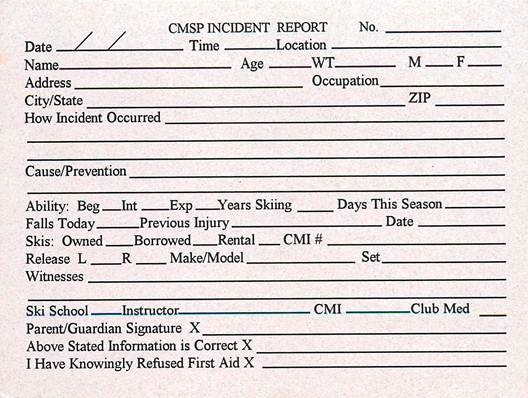
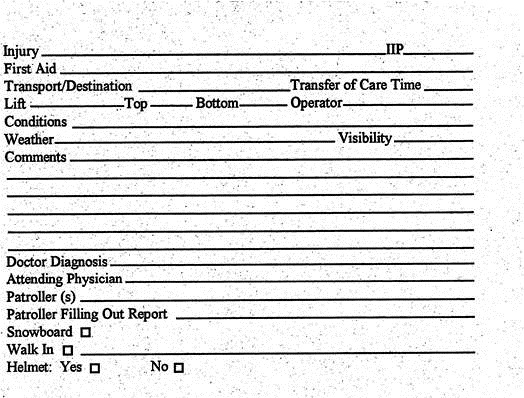
Nothing more than the absolute essentials is captured. These are 5 X 7 cards. The information on the form is 100% from the injured party. No information is put on the card by the patrollers unless it is direct information acquired by the patroller such as the release number setting on the skis, etc.
If there are witnesses then there are 5 X 7 cards for them to complete. There was also a form if a ski school student was injured. If the accident was a life changing incident, major trauma then there were more forms. But for 99% of the accidents, the entire report fit in a patroller’s pocket.
If the injured party cannot fill out the card, then the patroller asks the questions and writes down what the injured party says.
No opinion, no estimates, no guesses, just the facts. (Remember Dragnet the TV show from the 60s.)
Then, once you have the information it must be used. Where are the problems, can we fix the problems, should we warn people about the problems? What can we do to prevent injuries, and if we can’t can we warn people they don’t get injured?
If not, those reports will show up in trial, and probably not to help you.
For an article about bad accident reports see Be Afraid, be very afraid of pre-printed forms for your recreation business.
What do you think? Leave a comment.
If you like this let your friends know or post it on FB, Twitter or LinkedIn
Copyright 2012 Recreation Law (720) Edit Law
Twitter: RecreationLaw
Facebook: Rec.Law.Now
Facebook Page: Outdoor Recreation & Adventure Travel Law
Mobile Site: http://m.recreation-law.com
#RecreationLaw, #@RecreationLaw, #Cycling.Law #Fitness.Law, #Ski.Law, #Outside.Law, #Recreation.Law, #Recreation-Law.com, #Outdoor Law, #Recreation Law, #Outdoor Recreation Law, #Adventure Travel Law, #law, #Travel Law, #Jim Moss, #James H. Moss, #Attorney at Law, #Tourism, #Adventure Tourism, #Rec-Law, #Rec-Law Blog, #Recreation Law, #Recreation Law Blog, #Risk Management, #Human Powered, #Human Powered Recreation,# Cycling Law, #Bicycling Law, #Fitness Law, #Recreation-Law.com, #Backpacking, #Hiking, #Mountaineering, #Ice Climbing, #Rock Climbing, #Ropes Course, #Challenge Course, #Summer Camp, #Camps, #Youth Camps, #Skiing, #Ski Areas, #Negligence, #Snowboarding, #RecreationLaw, #@RecreationLaw, #Cycling.Law #Fitness.Law, #SkiLaw, #Outside.Law, #Recreation.Law, #RecreationLaw.com, #OutdoorLaw, #RecreationLaw, #OutdoorRecreationLaw, #AdventureTravelLaw, #Law, #TravelLaw, #JimMoss, #JamesHMoss, #AttorneyatLaw, #Tourism, #AdventureTourism, #RecLaw, #RecLawBlog, #RecreationLawBlog, #RiskManagement, #HumanPowered, #HumanPoweredRecreation,# CyclingLaw, #BicyclingLaw, #FitnessLaw, #RecreationLaw.com, #Backpacking, #Hiking, #Mountaineering, #IceClimbing, #RockClimbing, #RopesCourse, #ChallengeCourse, #SummerCamp, #Camps, #YouthCamps, #Skiing, #Ski Areas, #Negligence, #Snowboarding, sport and recreation laws, ski law, cycling law, Colorado law, law for recreation and sport managers, bicycling and the law, cycling and the law, ski helmet law, skiers code, skiing accidents, #Accident, Accident Report, Alpine Slide, #Slide, #Sled,

ACA Standards are used by Expert for the Plaintiff in a lawsuit against a Camp
Posted: March 7, 2011 Filed under: Minors, Youth, Children, Summer Camp, Youth Camps | Tags: Church Camp, Expert Witness, Helmets, Litigation, Standards, Youth Camp 2 CommentsThis case shows how standards, written by a great organization with good intentions can be used to help, encourage and support lawsuits against its own members.
This case was settled, but it is full of information that everyone who may be a defendant needs to understand.
This case was started by a woman, the plaintiff, more than five years after she had spent a couple of weeks at a summer camp. She was not a camper nor was she working at the camp. She had been invited out by a staff member to give her a break from home. Allegedly, she was (consensually although there may have been statutory issues) sexually assaulted by an older staff member. She sued the staff member and the camp.
The plaintiff, to support her position, hired an expert witness. This is a common practice to support a claim. The expert witness’s job is to prove the defendant camp had acted in violation of the standard of care for camps. The plaintiff’s expert was an ACA standards visitor. The Expert Opinion by the ACA standards visitor was used in the plaintiff’s motion to support a claim that the defendant Camps actions warranted an award of Punitive Damages.
Punitive damages, are damages awarded by the jury above and beyond actual or compensatory damages. The damages are meant to punish the defendant. Punitive damages are not covered by insurance, are not dischargeable in bankruptcy and are in addition to any other damages. The defendant must pay punitive damages, if awarded, no matter what. Consequently, if the court approves the motion to ask for punitive damages in a case, it almost always forces the defendant to settle for fear of having to pay money out of their own pocket. The facts are never thoroughly litigated because they fear of the punitive is overriding. Even if you are 100% right, you may still settle in if punitive damages is a real threat.
The expert for the plaintiff (no relationship to me) was listed as an expert because she was an American Camp Association Accreditation Standards visitor. The experts Resume listed her ACA membership and her ACA Associate Visitor status second only to her education. The “Standards” allegedly violated were the 1998 ACA Accreditation Standards for Camp Programs and Services.
The expert opinion listed five areas that the camp had violated the standard of care for camps. Those areas are listed in the report as Opinion 1 through 5. ACA standards were used to support the expert’s opinion in three of the violations.
The first opinion rendered was the defendant camp violated the then ACA Accreditation Standards – HR-10. HR-10 states no camp staff member is to be under 16 years of age. The plaintiff at the time she was visiting camp was 14.
The first issue is the standard was applied to a fact situation that really had nothing to do with the claim. However, because there was a standard that could be linked to the claim, no matter how remote, the standard was alleged to be violated by the defendant. The plaintiff in this case was not a camp staff member, was not a volunteer, and was not getting paid. She was there for a break from her family. Nevertheless, the standard was applied to show the defendant camp should be held liable for punitive damages.
The second issue is the standard created by the trade association that the camp was a member of, was used to show the camp was negligent. That is just wrong!
Opinion 4 stated that 4 ACA Camp Standards were violated:
HR-11 requires six days of pre-camp staff training of employees.
HR-12 required late hire training for employees.
HR-13 requires implementation of in-service training for employees.
HR-19 requires specific training for staff supervisors to maintain staff performance and address inappropriate staff behavior.
The plaintiff had not received any training. I’ve never seen a camp train any visitor. (Although I’m sure you wish you could sometimes!)
All four “Standards” were violated because the plaintiff did not receive any of the training required by the ACA “Standards”. Again, visitors to camp need to go through training? Late hire camp staff training? Hire usually means someone is employed, consequently, paid, which never occurred here.
Opinion No. 5 stated the defendant camp violated ACA Standard HW-19 and ACA Standard HW-20 on the proper system of health care camp record keeping. This was alleged because a cut the plaintiff received was not recorded in the nurse’s log.
What is so interesting about this issue was there was no allegation that the cut the plaintiff had received was received or treated negligently. Nothing in the lawsuit claimed the way the plaintiff received the cut, the first aid or treatment was negligent. The complaint just stated she received a cut and was taken home by her parents. The suit claimed that an older camp staff employee had sexual relations with the plaintiff.
However, this is a perfect example of how plaintiffs use any violation of the standard, whether or not it has anything to do with the claim, to make the defendant look bad in the eyes of the court and the jury. Good defendants do not violate standards. Here the defendant was obviously bad because the standard was not met.
There is no way that any camp can operate and not violate one of the “Standards” at some time during the camp season! 1998 there were just too many of them. In 2011 there are even more.
To support the allegations made in the plaintiff’s expert report copies of the “Standards” were attached to the report. The following pages were attached to the report:
Cover Page
Title Page
Table of Contents vii
Table of Contents viii
Page 92 HR-10 Staff Age Requirements
Page 93 continuation of HR-10 and HR-11
Page 94 continuation of HR-11, HR-12 and HR-13
Page 97 HR-18 and HR-19
Page 98 continuation of HR-19 and HR-20
Page 67 HW-19 Recordkeeping
Page 68 HW-20 and HW-21
Why only those pages? Because those are the important pages the plaintiff wants the judge to see. There are limits to how big motions can be how many pages the judge will read, pages, etc. Those are all valid arguments and are real for only putting in the important documents as exhibits.
However “standards” are written with disclaimers and limitations and definitions, none of which are ever given to the court. The court is never shown that there may be limitations to what the “Standards” mean or how they are applied.
Even if those were supplied, the court must apply the definitions that are in the statute or by law first and then as used in the community or industry second. See Words: You cannot change a legal definition.
Trade Associations write standards with the mistaken believe that the plaintiff’s experts and the court will apply the standards exactly the way the standards are intended to be written. The facts are once the standards are printed the trade association loses all control no matter how many pages of disclaimers are put in the information.
So the judge in this case, who is pressed for time, reads the report and has a list of standards that are violated. A standard is the optimum word. The camp was below the minimum level of acting or not acting that was set by the camps own trade association. That is all that is needed to keep the case moving forward. Standards were violated. Therefore, there may be negligence. That must go to a jury, there must be a trial and the cost to the defendant (and its insurance company) climbs even higher. (Consequently, your premiums increase also. See Insurance 101 if you don’t fully understand this.)
Even if the additional documentation is put into evidence, the legal definition of the words is going to be used, not how the word is defined in the standards book. See Words: You cannot change a legal definition.
Nor does the court have the opportunity to delve into the standards to find out that most of them are not really standards but suggestions, ideas or just good practices. However, by identifying the book as standard there is a legal definition applied to the work that is just as dangerous as it may be helpful.
Some might say that if the camp was bad then lawsuits get rid of bad camps (or other defendants). However, that never works. This camp did not close up. In fact, in my opinion, this camp was sued because it tried to help out a confused young woman. The end effect is there will be no more attempts to help anyone in the future.
The only real consequence of this lawsuit was the amount of time that spent working on the case. Some money might have moved between the parties, and the attorneys and expert witnesses made money.
Let’s look at the opinion no 1 of the plaintiff’s expert witness. The standard says that employees should not be under the age of 16. Most camps are run by families. Many times there may be two or three generations at the camp. If a staff member sends their 15 year old son to the tool shed to get a tool and in the process the son accidentally knocks over a camper, injuring the camper, the camp has violated that standard. No 16 year olds should be hired by a camp. However, he wasn’t hired. Well, we’ve seen how that does not work, and he was working, providing a benefit for the camp.
The camp has a couple of options.
1. Not allow their children at camp until they are 16.
2. Violate the standard.
You are going to take your kids to camp and have them play video games and watch TV or are you going to put them to work. If you put them to work before they reach the age of 16 you are violating a standard created by a trade association for your benefit.
Say you are an organization that works to install leadership, training and teamwork into the youth. It is common in your organization for the youth to be responsible for other members. (Sound like any organization you know?) Your camps are staffed predominantly by youth because of the training and goals of the organization. Every single one of those camps is in violation of the standard HR-10 (as it was in 1998).
If your youth organization is focused in leadership training and does that by helping youth move up to more advanced and important leadership positions, the entire program will fail if you say to the 14 year olds, wait two years until you turn 16 to move up to the next level, camp staff.
These are just two scenarios where the standard set forth in HR-10 (which is almost identical in the latest version) can be used to sue a camp every single day of the year. However, in both scenarios, nothing has been done wrong other than taking your kid to work and following your youth program guidelines.
Are all standards bad? No, standards for things are great. Concrete “acts” the same way every day. A fight with a spouse, traffic on the way to work, rain, none of this affects concrete. It is going to support XX thousands of pounds of weight. Standards for things work. People and how people operate are subject to millions of things, weather and other people. We don’t’ react the same way. We aren’t affected the same way. We don’t respond the same way, who can you write something down that says we will, no matter what.
For other articles about standards see:
This is how a standard in the industry changes…..but….
Can a Standard Impede Inventions?
Words: You cannot change a legal definition
Trade Association Standards sink a Summer Camp when plaintiff uses them to prove Camp was negligent
The motion where the expert witness’ report was filed is here.
What do you think? Leave a comment.
Copyright 2010 Recreation Law (720) Edit Law, Recreation.Law@Gmail.com
Twitter: RecreationLaw
Facebook: Rec.Law.Now
Facebook Page: Outdoor Recreation & Adventure Travel Law
Blog: http://www.recreation-law.com
Keywords: #recreationlaw, #@recreationlaw, #cycling.law #fitness.law, #ski.law, #outside.law, #recreation.law, #recreation-law.com, #outdoor law, #recreation law, #outdoor recreation law, #adventure travel law, #law, #travel law, #Jim Moss, #James H. Moss, #attorney at law, #tourism, #adventure tourism, #rec-law, #rec-law blog, #recreation law, #recreation law blog, #risk management, #Human Powered, #human powered recreation,# cycling law, #bicycling law, #fitness law, #recreation-law.com, #backpacking, #hiking, #Mountaineering, #ice climbing, #rock climbing, #ropes course, #challenge course, #summer camp, #camps, #youth camps, #skiing, #ski areas, #negligence, #ACA, #American Camp Association, #standards,
Technorati Tags: Standards,Expert,Plaintiff,lawsuit,Camp,intentions,lawsuits,information,defendant,woman,camper,member,violation,visitor,Opinion,Camps,Punitive,Damages,jury,insurance,bankruptcy,addition,money,threat,relationship,American,Association,Accreditation,experts,Resume,membership,Associate,status,education,Programs,Services,areas,violations,fact,situation,employees,implementation,supervisors,performance,behavior,Although,Again,visitors,Late,Hire,Standard,system,health,allegation,treatment,complaint,parents,employee,relations,example,plaintiffs,defendants,Here,allegations,Cover,Page,Title,Table,Contents,Staff,Requirements,continuation,arguments,disclaimers,limitations,definitions,statute,industry,Words,definition,Trade,Associations,negligence,cost,premiums,documentation,suggestions,Some,consequence,attorneys,Most,families,Many,generations,tool,options,Violate,leadership,teamwork,youth,Sound,goals,scenarios,version,guidelines,Concrete,spouse,People,millions,Impede,Inventions,Playgrounds,Summer,Leave,Recreation,Edit,Gmail,Twitter,RecreationLaw,Facebook,Outdoor,Adventure,Travel,Blog,Keywords,Moss,James,attorney,tourism,management,Human,five,three,olds
Windows Live Tags: Standards,Expert,Plaintiff,lawsuit,Camp,intentions,lawsuits,information,defendant,woman,camper,member,violation,visitor,Opinion,Camps,Punitive,Damages,jury,insurance,bankruptcy,addition,money,threat,relationship,American,Association,Accreditation,experts,Resume,membership,Associate,status,education,Programs,Services,areas,violations,fact,situation,employees,implementation,supervisors,performance,behavior,Although,Again,visitors,Late,Hire,Standard,system,health,allegation,treatment,complaint,parents,employee,relations,example,plaintiffs,defendants,Here,allegations,Cover,Page,Title,Table,Contents,Staff,Requirements,continuation,arguments,disclaimers,limitations,definitions,statute,industry,Words,definition,Trade,Associations,negligence,cost,premiums,documentation,suggestions,Some,consequence,attorneys,Most,families,Many,generations,tool,options,Violate,leadership,teamwork,youth,Sound,goals,scenarios,version,guidelines,Concrete,spouse,People,millions,Impede,Inventions,Playgrounds,Summer,Leave,Recreation,Edit,Gmail,Twitter,RecreationLaw,Facebook,Outdoor,Adventure,Travel,Blog,Keywords,Moss,James,attorney,tourism,management,Human,five,three,olds
WordPress Tags: Standards,Expert,Plaintiff,lawsuit,Camp,intentions,lawsuits,information,defendant,woman,camper,member,violation,visitor,Opinion,Camps,Punitive,Damages,jury,insurance,bankruptcy,addition,money,threat,relationship,American,Association,Accreditation,experts,Resume,membership,Associate,status,education,Programs,Services,areas,violations,fact,situation,employees,implementation,supervisors,performance,behavior,Although,Again,visitors,Late,Hire,Standard,system,health,allegation,treatment,complaint,parents,employee,relations,example,plaintiffs,defendants,Here,allegations,Cover,Page,Title,Table,Contents,Staff,Requirements,continuation,arguments,disclaimers,limitations,definitions,statute,industry,Words,definition,Trade,Associations,negligence,cost,premiums,documentation,suggestions,Some,consequence,attorneys,Most,families,Many,generations,tool,options,Violate,leadership,teamwork,youth,Sound,goals,scenarios,version,guidelines,Concrete,spouse,People,millions,Impede,Inventions,Playgrounds,Summer,Leave,Recreation,Edit,Gmail,Twitter,RecreationLaw,Facebook,Outdoor,Adventure,Travel,Blog,Keywords,Moss,James,attorney,tourism,management,Human,five,three,olds


 Recreation Law