
Think your release will survive a lawsuit? Test your Release and Find out.
Posted: January 13, 2016 Filed under: Release (pre-injury contract not to sue) | Tags: Getting Ready for the season, Release, Release Checklist, Waiver 2 CommentsSimple test to determine if your release is sufficient to meet the legal issues you face.
Let me know your scores? Email them to me at Jim@Rec-Law.us
RELEASE CHECKLIST
If you are getting ready for your summer recreation season it is always a good idea to make sure your paperwork is up to date and ready to go. This is a checklist to help you check your release and make sure it is ready to go for your season.
Not all of these clauses may be needed. However, some of them are critical and they should all be modified based on your activity, program, employees, and ability to undertake the risks.
Required for your Release to be Valid
Each Check is worth -3 points
___ Contract: The legal requirements for a contract are met if the release is signed. Both parties understand what the contract is and what it means.
___ Updated Recently: Has your release been reviewed by an attorney in the past year or do you work with an attorney that updates you on changes you need to make to your release?
___ Notice of Legal Document: Does your release someplace on its face, give notice to the person signing it that they are signing a release or a legal document?
Notice of Legal Consequence: Does your release state there may be legal consequences to the signor upon signing?
___ Parties: You have to identify who is to be protected by the release and who the release applies too.
___ Assumption of Risk Language: Does your release contain language that explains the risk of the activities the release is designed to protect litigation against.
___ Agreement to Assume Risks: Do your release have language that states the signor agrees to assume the risk
___ Magic Word: Negligence: Does your release have the signor give up their right to sue for your negligence?
___ Plain Language: Is the release written so that it can be understood? Is it written in plain English?
___ Venue: Does your release have a Venue Clause?
___ Jurisdiction: Does your release have a Jurisdiction Clause?
___ Signatures: Does your release have a place for the signor to date and sign the release
___ Adequate Typeface: Typeface is large enough to read.
___ Readable: Release is not confusing, but is readable.
___ Nothing in your marketing program invalidates your release.
___ Information to complete the continuing duty to inform
Total Score: _________________ our of 48
However if you don’t have all of these your score may not matter. The above issues are critical in any release!
Items that may be Needed Dependent upon the Purpose of the Release
Each Check is worth -2 point
___ Parental Release
___ Product Liability Language
___ Release of Confidential Medical Information
___ Signor has viewed the Website
___ Signor has viewed the Videos
___ Signor has read the information
___ Signor has conveyed the necessary information to minor child
___ Reference to required Statute
___ Demo Language
___ Understand use of Equipment
___ Accept Equipment As Is
___ Agree to ask questions about Equipment
___ Understand Demo Equipment has more Risk
___ Rental Language
Total Score: _______________ out of 34
Needed
Each Check is worth -1 point
___ Notice of Legal Document:
___ Notice of Legal Consequence: Does your release state there may be legal consequences to the signor upon signing?
___ Opening/Introduction: Does your release have an opening or introduction explaining its purpose
___ Assumption of Risk Language
___ Risks Not Associated with Activity
___ List Not Exclusive/ Exhaustive
___ Company Right to Eject/Refuse
___ Alternative Resolution
___ Arbitration
___ Mediation
___ Indemnification
___ Third party costs
___ First party costs
___ Severance Clause
___ How Release is to be interpreted
___ Breach of Covenant of Good Faith
___ Permission to release medical information
___ Waiver of medical confidentiality
___ Waiver of HIV status
___ Statement as to Insurance
___ Incidental issues covered
___ Medical Insurance information
___ Plain Language: Readability Level ________
___ Adequate Typeface: Typeface Size _________
___ Release language in Plain English
___ Agreement that the document has been read
___ Agreement that the signor agrees to the terms
Total Score: ____________________ out of 89
What Your Release Cannot Have
Each Check is MINU 5 Points
___ Places to Initial
___ Small Print
___ No heading or indication of the legal nature
___ No indication or notice of the rights the signor is giving up
___ Release Hidden within another document
___ Important sections with no heading or not bolded
___ Multiple pages that are not associated with each other
Total Score: ________________________
|
|
Possible Score |
Score |
|
Score First Group |
48 |
|
|
Score Second Group |
34 |
|
|
Score Third Group |
89 |
|
|
Minus Score from the 4th Group |
-35 |
|
|
Total |
|
|
Scoring:
|
Possible Score |
Rating |
|
150 – 171 |
Excellent You are Probably Good to Go |
|
120 – 149 |
Running on the Edge, the old “You may want to get that looked at….” |
|
Below 119 |
Quit killing trees for no purpose, your release sucks |
 What do you think? Leave a comment.
If you like this let your friends know or post it on FB, Twitter or LinkedIn
Author: Outdoor Recreation Insurance, Risk Management and Law
Copyright 2015 Recreation Law (720) Edit Law
Email: Rec-law@recreation-law.com
Google+: +Recreation
Twitter: RecreationLaw
Facebook: Rec.Law.Now
Facebook Page: Outdoor Recreation & Adventure Travel Law
Blog: www.recreation-law.com
Mobile Site: http://m.recreation-law.com
By Recreation Law Rec-law@recreation-law.com James H. Moss
#AdventureTourism, #AdventureTravelLaw, #AdventureTravelLawyer, #AttorneyatLaw, #Backpacking, #BicyclingLaw, #Camps, #ChallengeCourse, #ChallengeCourseLaw, #ChallengeCourseLawyer, #CyclingLaw, #FitnessLaw, #FitnessLawyer, #Hiking, #HumanPowered, #HumanPoweredRecreation, #IceClimbing, #JamesHMoss, #JimMoss, #Law, #Mountaineering, #Negligence, #OutdoorLaw, #OutdoorRecreationLaw, #OutsideLaw, #OutsideLawyer, #RecLaw, #Rec-Law, #RecLawBlog, #Rec-LawBlog, #RecLawyer, #RecreationalLawyer, #RecreationLaw, #RecreationLawBlog, #RecreationLawcom, #Recreation-Lawcom, #Recreation-Law.com, #RiskManagement, #RockClimbing, #RockClimbingLawyer, #RopesCourse, #RopesCourseLawyer, #SkiAreas, #Skiing, #SkiLaw, #Snowboarding, #SummerCamp, #Tourism, #TravelLaw, #YouthCamps, #ZipLineLawyer, Release, Waiver, Release Checklist, Getting Ready for the season,
Oklahoma Federal Court opinion: the OK Supreme Court would void a release signed by the parent for a minor.
Posted: December 28, 2015 Filed under: Oklahoma, Release (pre-injury contract not to sue), Skydiving, Paragliding, Hang gliding | Tags: Minor, Minor's right to sue, Oklahoma, Oklahoma Supreme Court, parent, Release Leave a commentMinor injured in a sky-diving accident is allowed to sue because the release, she and her parents signed are void under Oklahoma law. Parents are not allowed to sue for their claims because of the release.
Wethington v. Swainson, 2015 U.S. Dist. LEXIS 169145
State: Oklahoma, United States District Court for the Western District of Oklahoma
Plaintiff: Holly Wethington and Makenzie Wethington
Defendant: Robert Swainson, d/b/a/ Pegasus Airsport
Plaintiff Claims: (1) provided inadequate training to [*2] Makenzie in preparation for the parachute jump, (2) selected a person to provide radio assistance who had no prior experience, (3) provided old equipment that malfunctioned during Makenzie’s jump, and (4) permitted Makenzie to use a parachute she was ill-prepared to use and which was inappropriate for her skill level
Defendant Defenses: Release
Holding: for the defendant for the claims of the parents, for the plaintiff for her claims
Year: 2015
The minor plaintiff was sixteen years old when she wanted to check another item off her bucket list. She went to the defendant’s sky-diving business along with her parents.
First, the minor plaintiff completed a Registration Form and Medical Statement which included a notice that sky diving was dangerous. The minor plaintiff also signed a release. Her parents also signed the release. The release required the minor plaintiff to write out a statement that she knew she was signing a release and understood the risks. She wrote this out and signed it. The bottom of the release also had a ratification paragraph which the Parent/Guardian was required to sign that stated they understood the risks and released the defendants. Both parents signed this.
In total, a warning in one document, a release signed by all three parents, an additional clause signed by the paragraphs and a written paragraph written and signed by the minor plaintiff is normally far in excess of what a party signs before engaging in recreational activities.
The minor plaintiff then received four houses of training. On her first jump, her parachute malfunctioned, and she hit the ground sustaining injuries.
The defendants filed for a motion for summary judgment based on the release.
Analysis: making sense of the law based on these facts.
The court started by looking at the issues surrounding release law in Oklahoma. “An exculpatory clause releases in advance the second party for any harm the second party might cause the first party after the contract is entered.” Releases are enforceable in Oklahoma but are “distasteful.”
At the same time, releases in Oklahoma should not be voided because of public policy grounds. “Notwithstanding this admonition, courts should void contract clauses on public-policy grounds “rarely, with great caution and in cases that are free from doubt.” Public policy grounds are the normal way releases signed by minors are voided.
Releases in Oklahoma have to meet three criteria to be valid.
(1) Their language must evidence a clear and unambiguous intent to exonerate the would-be defendant from liability for the sought-to-be-recovered damages;
(2) At the time the contract was executed, there must have been no vast difference in bargaining power between parties; and
(3) Enforcement of the clause would not (a) be injurious to public health, public morals or confidence in administration of the law or (b) so undermine the security of individual rights vis-a-vis personal safety or private property as to violate public policy.
The court also stated that under Oklahoma law releases cannot work to prevent “liability for intentional, willful or fraudulent acts or gross, wanton negligence.”
After reviewing the release the court found the release was valid.
First, the Release states in clear and unequivocal terms the intention of the parties to excuse Defendant from liability caused by Defendant’s negligence, equipment failure, or inadequate instruction. Plaintiffs signed and initialed several clauses containing the headings, RELEASE FROM LIABILITY, COVENANT NOT TO SUE, and ACKNOWLEDGMENT OF RISK. Mrs. Wethington and her husband signed a ratification stating they had read the Release, understood its terms, and agreed to be bound thereby.
The court then looked at whether there was inequality in the bargaining power of the plaintiff and found none.
Second, there is no evidence of unequal bargaining power. “Oklahoma courts consider two factors in determining parties’ relative bargaining power: ‘(1) the importance of the subject matter to the physical or economic wellbeing of the party agreeing to the release, and (2) the amount of free choice that party could have exercised when seeking alternate services.'” There is no evidence that skydiving was necessary or important to Plaintiffs’ wellbeing. In fact, when asked why she wanted to skydive, Makenzie answered, “It’s on my bucket list.”
The court found the plaintiffs were not bound to sky dive with the defendant; she was free to sky dive with anyone. Therefore, the plaintiff was not under any pressure or requirement to sky dive with the defendant.
The court then looked at Oklahoma law to see if parents could sign away a minor’s right to sue.
It is also true that as a matter of public policy, courts have protected minors from improvident and imprudent contractual commitments by declaring the contract of a minor is voidable at the election of the minor after she attains majority. Under Oklahoma law, a minor’s right to rescind a contract is unaffected by the approval or consent of a parent.
The court also found that for a claim to be approved for a minor for an injury resulting in a settlement, the court had to approve the settlement.
However, the court found this case was complicated by the fact the minor plaintiff’s parents had also signed the release. “In this case, however, Makenzie’s parents also knowingly signed the Release on her behalf, ratifying and affirming its exculpatory content, and agreeing to be bound thereby.”
The Oklahoma Supreme Court did not rule on the issue. Federal courts hearing cases based on the diversity of the parties dealing with state law issues must apply the law of the state where the lawsuit is based or the law that applies.
…federal court sitting in diversity must apply state law as propounded by the forum’s highest court. Absent controlling precedent, the federal court must attempt to predict how the state’s highest court would resolve the issue.
The next issue is disaffirmance of the contract. A minor must disaffirm a contract after reaching the age of majority or the contract is valid. The plaintiffs argued, and the court agreed that the filing of the lawsuit disaffirmed the release. “Plaintiffs correctly argue that commencement of this lawsuit constitutes a disaffirmance of the Release, and the contract is void ab initio.”
For more on this see Rare issue this case looked at a release signed by a minor that prevented a suit for his injuries after turning age 18. However, this decision was later overturned in Oregon Supreme Court finds release signed at ski area is void as a violation of public policy.
The court also examined the issue that the parents signed the release and found it had no bearing on the case. However, the release did stop claims by the parents.
The ratification signed by Makenzie’s parents is, likewise, unenforceable as a bar to Makenzie’s claims. The Release, however, is otherwise conspicuous and clear so as to bar the parents’ cause of action based upon injury to their child.
When a minor is injured, the minor can sue and the parents can sue. Dependent upon the state, the claims of the parents may include those of the minor or may be solely based on the parents’ loss.
The court then ruled that the minor claim was valid and not barred by the release. The parent’s claims, specifically the named plaintiff, the minor plaintiff’s mother, were barred by the release.
Defendant’s motion is granted as to Plaintiff Holly Wethington’s claims and denied as to Plaintiff Makenzie Wethington’s claim for negligence. Since the skydiving contract is rendered void ab initio by means of Makenzie’s lawsuit, her breach of contract claim cannot proceed as a matter of law.
So Now What?
The minor plaintiff can sue, and the mother cannot.
This decision is not controlling in Oklahoma. The Oklahoma Supreme Court could still rule that a parent can sign away a minor’s right to sue.
At the same time, this decision outlines release law in Oklahoma and does a great job. As far as how the Oklahoma Supreme Court will rule, the Federal District Court knows the Supreme Court in the state where they sit better than any other person, and I would vote with the Federal Court.
As in other cases in the majority of states, a parent cannot sign away a minor’s right to sue. To see the States where a parent can sign away a minor’s right to sue and the decisions deciding that issue see States that allow a parent to sign away a minor’s right to sue.
 What do you think? Leave a comment.
If you like this let your friends know or post it on FB, Twitter or LinkedIn
Author: Outdoor Recreation Insurance, Risk Management and Law
Copyright 2015 Recreation Law (720) Edit Law
Email: Rec-law@recreation-law.com
Google+: +Recreation
Twitter: RecreationLaw
Facebook: Rec.Law.Now
Facebook Page: Outdoor Recreation & Adventure Travel Law
Blog: www.recreation-law.com
Mobile Site: http://m.recreation-law.com
By Recreation Law Rec-law@recreation-law.com James H. Moss
#AdventureTourism, #AdventureTravelLaw, #AdventureTravelLawyer, #AttorneyatLaw, #Backpacking, #BicyclingLaw, #Camps, #ChallengeCourse, #ChallengeCourseLaw, #ChallengeCourseLawyer, #CyclingLaw, #FitnessLaw, #FitnessLawyer, #Hiking, #HumanPowered, #HumanPoweredRecreation, #IceClimbing, #JamesHMoss, #JimMoss, #Law, #Mountaineering, #Negligence, #OutdoorLaw, #OutdoorRecreationLaw, #OutsideLaw, #OutsideLawyer, #RecLaw, #Rec-Law, #RecLawBlog, #Rec-LawBlog, #RecLawyer, #RecreationalLawyer, #RecreationLaw, #RecreationLawBlog, #RecreationLawcom, #Recreation-Lawcom, #Recreation-Law.com, #RiskManagement, #RockClimbing, #RockClimbingLawyer, #RopesCourse, #RopesCourseLawyer, #SkiAreas, #Skiing, #SkiLaw, #Snowboarding, #SummerCamp, #Tourism, #TravelLaw, #YouthCamps, #ZipLineLawyer, Oklahoma, Oklahoma Supreme Court, Release, Minor, Parent, Minor’s right to sue,
Travel agents have a very limited duty to disclose, unless they know about a hazard. If you book for others, you are a travel agent.
Posted: December 21, 2015 Filed under: Adventure Travel, Arizona, Release (pre-injury contract not to sue) | Tags: duty, Party Train, Release, Spring Break, Travel Agency, Travel Agent, Waiver Leave a commentCollege students on break to Mexico on a “party train” fell between the cars. Decedent was the 4th student to fall which gives rise to the liability of the travel agent. This is an early Arizona case voiding releases also.
State: Arizona
Plaintiff: Larry Maurer and Linda Maurer, husband and wife, personally and on behalf of the Estate of Molly Marie Maurer
Defendant: Cerkvenik-Anderson Travel, Inc., an Arizona corporation; College Tours, a division of Cerkvenik-Anderson Travel, Inc.; Dennis Anderson and Jane Doe Anderson, husband and wife; Anton Cerkvenik and Jane Doe Cerkvenik, husband and wife; and John Does I-X
Plaintiff Claims: Negligence, violation of the Arizona Consumer Fraud Act,
Defendant Defenses: No duty and release
Holding: For the Plaintiff
Year: 1994
The defendant is a travel agency that specialized in college tours. These college tours are more famously known for taking students south of the boarder during breaks to party where the age to drink is lower and so is about everything else.
One of these tours included an eighteen hour train ride known as the “Party Train.” The plaintiff and a friend decided to move forward and investigate the engine. Between the cars were extensions between the cars were covered with some sort of plate. However the last passenger car had not extension and no plate extending back from the freight car or engine. The plaintiff stepped off and fell from the train to her death.
The plaintiff was the fourth student to die this way on a tour organized by the defendant, although the particular incidents leading to the student deaths were slightly different.
The decedent’s parents sued the travel agency for themselves and representing the estate of the deceased. The trial court dismissed the case because there was no duty of care owed to the plaintiff by the defendant travel agent.
Analysis: making sense of the law based on these facts.
The court started its analysis by looking at the duty owed by the defendant as a travel agent.
(1) to exercise reasonable care for the safety of students in operating its student tours; (2) to disclose material facts affecting safety in promoting and selling its tours; and, (3) not to make misrepresentations in promoting and selling its tours.
The defendant argued that because it could not control the train and had no knowledge of the specific condition leading to the decedent’s death the travel agent had no duty to the plaintiff.
Duty is an issue of law and as such the courts decide whether or not there was any duty. Juries apply the facts to the law.
Whether a duty exists is a question of whether one of the parties to a relationship is under an obligation to use care to avoid or prevent injury to the other. “‘Duty’ is a question of whether the defendant is under any obligation for the benefit of the particular plaintiff.”
If the court decides no duty exists then no trial is held. No duty, no negligence. However the appellate court saw the existence of a duty differently from the trial court which stated there was no duty.
The court concluded the relationship between the decedent and the defendant was like an agency, since the defendant was a travel agent.
Different occupations owe different duties to their guests, customers, clients, patrons or consumers. The court set out the duties of a travel agent under Arizona law, which included a duty to disclose. “These duties include the duty to disclose material dangers known to the agent.” This duty “…does not represent an extension of tort liability upon an agent it results from an exposition of the pre-existing duty of care owed a principal by his agent.”
That duty requires the travel agent to disclose information the traveler would like to know.
Unless otherwise agreed, an agent is subject to a duty to use reasonable efforts to give his principal information which is relevant to affairs entrusted to him and which, as the agent has notice, the principal would desire to have and which can be communicated without violating a superior duty to a third person.
That duty appears to be wide open as well as trap. What the traveler wants to know is usually unknown until communicated by the traveler to the agent. However, “The scope of this duty of disclosure will be limited, naturally, to what is reasonable in any given instance.”
However the fact the travel agent does not know what the traveler wants to know is a bar to their duty to disclose. “While there is no duty of investigation, the travel agent must disclose all information the agent learns which is material to the object of the agency.”
The court concluded that a jury must decide whether or not three other students had died on that train was something the deceased wanted to know.
The plaintiff’s also sued claiming violation of the Arizona consumer fraud act. The omission of the other deaths violated the act.
Under the Act, it is unlawful for any person to use or employ any deception, deceptive act or practice, fraud, false pretense, false promise, misrepresentation, or concealment, suppression or omission of any material fact with intent that others rely upon such concealment, suppression or omission, in connection with the sale or advertisement of any merchandise whether or not any person has in fact been misled, deceived, or damaged thereby.
The act defined merchandise to include services. The trial court found that death was not related to the information contemplated by the act to be disclosed. Again the appellate court found differently.
The final issue was whether or not a release was in existence and valid.
The itinerary contained a paragraph stating the defendant waived liability. There was also an invoice for the trip with the same release language as on the itinerary. The decedent acknowledge in her payment for the trip that she had “read the flyer, waiver of liability and the itinerary and acknowledged by her payment for the trip that she had read the information, agreed to it and understood all its terms and conditions.”
The trial court denied the validity of the release and the appellate court agreed. “Here, the danger is too defuse [sic] and unspecific for a valid waiver to apply.”
The appellate court agreed and stated: “Attempts to release oneself from liability by contract for harm caused by one’s own negligence are not looked upon with favor. “This would tend to encourage carelessness.””
The court also quoted Restatement (Second) of Agency § 419 (1957), and found the lack of the disclosure of the other deaths also violated the requirements for the release to be valid.
…such agent is under the “duty of disclosure and fair dealing stated in Section 390.” That section provides that an agent has a duty to deal fairly with the principal and to disclose to him all facts which the agent knows or should know would reasonably affect the principal’s judgment, unless the principal has manifested that he knows such facts or that he does not care to know them.
The appellate court then sent the case back for trial.
Thus, although we conclude that CA is a seller to consumers and an agent bound by statutory and common law duties, we are unable to determine from the limited record before us whether the release is valid. Whether CA fulfilled its duty to Molly under Section 390 must await further discovery or trial.
So Now What?
Duties owed to your customer, consumer or guests vary based on the occupation of the defendant. You need to make sure you understand those duties. More importantly, you need to make sure you understand your classification or job description.
Many outfitters and guides as well as college and university programs book for third parties. College’s book trips, outfitters and guides will book for their competitors when their trips are full. This changes their duties because their relationship with the client has changed.
This case also provides another way that releases can be void and reinforces a common way. Any time the court can find a failure to disclose a release will be void. Courts in the way past would use the argument that a release should be void because it encourages defendants to be careless leading to injuries.
Arizona courts have slowly chipped away at the defense of release for several decades. Unless the activity is protected by statute, the courts have found easy and unobtrusive ways to void releases. Not enough to ring alarm bells, but each time, enough to void the release.
 What do you think? Leave a comment.
If you like this let your friends know or post it on FB, Twitter or LinkedIn
Author: Outdoor Recreation Insurance, Risk Management and Law
Copyright 2015 Recreation Law (720) Edit Law
Email: Rec-law@recreation-law.com
Google+: +Recreation
Twitter: RecreationLaw
Facebook: Rec.Law.Now
Facebook Page: Outdoor Recreation & Adventure Travel Law
Blog: www.recreation-law.com
Mobile Site: http://m.recreation-law.com
By Recreation Law Rec-law@recreation-law.com James H. Moss
#AdventureTourism, #AdventureTravelLaw, #AdventureTravelLawyer, #AttorneyatLaw, #Backpacking, #BicyclingLaw, #Camps, #ChallengeCourse, #ChallengeCourseLaw, #ChallengeCourseLawyer, #CyclingLaw, #FitnessLaw, #FitnessLawyer, #Hiking, #HumanPowered, #HumanPoweredRecreation, #IceClimbing, #JamesHMoss, #JimMoss, #Law, #Mountaineering, #Negligence, #OutdoorLaw, #OutdoorRecreationLaw, #OutsideLaw, #OutsideLawyer, #RecLaw, #Rec-Law, #RecLawBlog, #Rec-LawBlog, #RecLawyer, #RecreationalLawyer, #RecreationLaw, #RecreationLawBlog, #RecreationLawcom, #Recreation-Lawcom, #Recreation-Law.com, #RiskManagement, #RockClimbing, #RockClimbingLawyer, #RopesCourse, #RopesCourseLawyer, #SkiAreas, #Skiing, #SkiLaw, #Snowboarding, #SummerCamp, #Tourism, #TravelLaw, #YouthCamps, #ZipLineLawyer, Duty, Travel Agent, Travel Agency, Release, Waiver, Party Train, Spring Break,
Maurer, v. Cerkvenik-Anderson Travel, Inc., 181 Ariz. 294; 890 P.2d 69; 1994 Ariz. App. LEXIS 105; 165 Ariz. Adv. Rep. 51
Posted: December 20, 2015 Filed under: Adventure Travel, Arizona, Legal Case, Release (pre-injury contract not to sue) | Tags: duty, Party Train, Release, Student Tour, Travel Agenty Leave a commentMaurer, v. Cerkvenik-Anderson Travel, Inc., 181 Ariz. 294; 890 P.2d 69; 1994 Ariz. App. LEXIS 105; 165 Ariz. Adv. Rep. 51
Larry Maurer and Linda Maurer, husband and wife, personally and on behalf of the Estate of Molly Marie Maurer, Deceased, Plaintiffs/Appellants, v. Cerkvenik-Anderson Travel, Inc., an Arizona corporation; College Tours, a division of Cerkvenik-Anderson Travel, Inc.; Dennis Anderson and Jane Doe Anderson, husband and wife; Anton Cerkvenik and Jane Doe Cerkvenik, husband and wife; and John Does I-X, Defendants/Appellees. Larry Maurer and Linda Maurer, husband and wife, personally and on behalf of the Estate of Molly Marie Maurer, Deceased, Cross-Appellees. v. Cerkvenik-Anderson Travel, Inc., an Arizona corporation; College Tours, a division of Cerkvenik-Anderson Travel, Inc.; Anton Cerkvenik and JANE Doe Cerkvenik, husband and wife. Cross-Appellants.
2 CA-CV 93-0175
COURT OF APPEALS OF ARIZONA, DIVISION TWO, DEPARTMENT B
181 Ariz. 294; 890 P.2d 69; 1994 Ariz. App. LEXIS 105; 165 Ariz. Adv. Rep. 51
May 17, 1994, Filed
SUBSEQUENT HISTORY: [***1] Petition for Review Denied December 20, 1994.
PRIOR HISTORY: APPEAL FROM THE SUPERIOR COURT OF MARICOPA COUNTY. Cause No. CV 91-17422. Honorable J. Kenneth Mangum, Judge, Honorable Sherry H. Hutt, Judge.
DISPOSITION: REVERSED IN PART AFFIRMED IN PART
CASE SUMMARY:
COUNSEL: Treon, Strick, Lucia & Aguirre, by Arthur G. Newman, Jr. and Richard T. Treon, Phoenix, Attorneys for Plaintiffs/Appellants/Cross-Appellees.
Teilborg, Sanders & Parks, P.C., by Brian R. Burt and Rick N. Bryson, Phoenix, Attorneys for Defendants/Appellees/Cross-Appellants.
Jennings, Kepner and Haug, by James L. Csontos, Phoenix, Attorneys for Defendants/Appellees Dennis Anderson.
JUDGES: JAMES D. HATHAWAY, Judge, WILLIAM E. DRUKE, Chief Judge, PHILIP G. ESPINOSA, Presiding Judge.
OPINION BY: JAMES D. HATHAWAY
OPINION
[**70] [*295] OPINION
HATHAWAY, Judge.
In this action for the wrongful death of their daughter Molly, plaintiffs/appellants Maurers appeal from the trial court’s grant of summary judgment in favor of defendants/appellees Cerkvenik-Anderson Travel, Inc., College Tours, Dennis Anderson and Anton Cerkvenik (collectively, “CA”) on the basis that CA had no duty to Molly regarding the tour package she purchased. CA cross-appeals [***2] the court’s denial of summary judgment sought on the basis of waiver or release from liability and its refusal to award attorney’s fees. We reverse summary judgment as to appellants and affirm as to CA.
2 FACTS
Viewing the evidence in the light most favorable to the non-moving party, Nicoletti v. Westcor, Inc., 131 Ariz. 140, 639 P.2d 330 (1982), the facts are as follows. CA is a travel agency doing business as “College Tours.” Its business includes organizing, promoting, selling and operating student vacation tours destined for Mazatlan, Mexico. CA sets the itinerary, arranges for transportation and lodging and provides information relating to the students’ comfort, convenience and safety on the tour. For many years, the tour packages have included an eighteen-hour ride on a Mexican train traveling from Nogales to Mazatlan, as was the case with the tour purchased by the decedent. CA described this as a “Party Train.”
During the train ride from Nogales to Mazatlan, Molly and a friend decided to “adventure” forward in the trainto see the engine. The connecting areas between passenger railcars have metal floors with accordion-like “boots” extending from the [***3] sides of each railcar, forming an area in which it is safe to walk from the door at the end of one railcar to the door at the end of the other. En route, Molly paused and attempted to communicate in Spanish with an apparent employee of the railroad before going through a door, which turned out to be the front door of the foremost passenger car of the train. The car in front of this car was either a freight car or the engine. There was only a partial “boot” between the front of this car and the car in front of it. Beyond the door was only a narrow platform and then a large area between the cars, up to four feet wide, open straight down to the tracks and wheels of the train. It was dark, and after Molly stepped through the door, she fell to her death between the cars.
Molly was the fourth student to die by falling from a moving train on a student tour to Mazatlan organized by CA. Three other students had died previously, albeit the particular circumstances of each incident varied. The students on Molly’s tour were not informed of these prior incidents eventhough CA acknowledges that it “knew of other deaths on Mexican trains.”
[**71] [*296] DUTY OF TRAVEL AGENTS/TOUR OPERATORS
[***4] Appellants contend that CA had a duty (1) to exercise reasonable care for the safety of students in operating its student tours; (2) to disclose material facts affecting safety in promoting and selling its tours; and, (3) not to make misrepresentations in promoting and selling its tours. CA counters that it had no such duties as a travel agent, it lacked the right to control the train to make it safe, and it had no knowledge of the specific condition which caused Molly’s death.
[HN1] The existence of duty is an issue of law for the court to decide, Markowitz v. Arizona Parks Board, 146 Ariz. 352, 706 P.2d 364 (1985), not to be confused with details of conformance with a standard of conduct imposed by the relationship. Ibid. 146 Ariz. at 355, 706 P.2d at 367; see also, Lasley v. Shrake’s Country Club Pharmacy, Inc., 1994 Ariz. App. LEXIS 58, 162 Ariz.Adv.Rep. 10 (App. April 5, 1994). Whether a duty exists is a question of whether one of the parties to a relationship is under an obligation to use care to avoid or prevent injury to the other. [***5] “‘Duty’ is a question of whether the defendant is under any obligation for the benefit of the particular plaintiff.” W. Page Keeton, et al., Prosser and Keeton on The Law of Torts § 53 at 356 (5th ed. 1984). “If the court decides that no duty exists, then a trial is unnecessary.” Lankford & Blaze, The Law of Negligence in Arizona at 11 (1992). In this case, the trial court concluded that a trial was unnecessary because “no duty was owed by [CA] to [appellants’] decedent for the injuries which led to her death.” We disagree.
To conclude there is “no duty” is to conclude the defendant cannot be liable, no matter the facts. As the supreme court observed in Markowitz: “To postulate that the possessor of land has no duty at all to protect its invitees or warn of specific types of danger is to postulate that it can never be liable, no matter what the circumstances.” 146 Ariz. at 357, 706 P.2d at 369. The court asked the poignant question: “Would the state have been liable even if the park ranger, knowing of the hazard, had sat on the rock, watched David get ready to dive and said nothing?” Id. at 356, 706 P.2d at 368.
Adapting that query [***6] to the instant case, we believe an affirmative answer as to CA’s responsibility is compelled under principles governing agency relationships. As an Oklahoma court well summarized in Douglas v. Steele, 816 P.2d 586, 589 (Okla.App. 1991):
[HN2] An agent who handles travel and vacation plans is a special agent of the traveler for purposes of that one transaction between the parties. … And this is so even though the agent’s compensation may be paid by the company to whom she steers the business, much like an advertising agent….
[HN3] [The travel agent has] a duty to act with the care, skill and diligence a fiduciary rendering that kind of service would reasonably be expected to use…. This agency relationship also imposes a duty to promptly communicate to [the] principals confirmations and all other relevant information about the proposed travel plans and tours which would help them protect themselves from harm or loss.
(Citations omitted.) These duties include the [***7] duty to disclose material dangers known to the agent. See Tracy A. Bateman, Annotation, “Liability of Travel Publication, Travel Agent, or Similar Party for Personal Injury or Death of Traveler,” 2 A.L.R. 5th 396 (1992). This duty to disclose or warn of known dangers, as the court explained in Rookard v. Mexicoach, 680 F.2d 1257, 1263 (9th Cir. 1982), “does not represent an extension of tort liability upon an agent[;] it results from an exposition of the pre-existing duty of care owed a principal by his agent.” See also In re Swartz, 129 Ariz. 288, 294, 630 P.2d 1020, 1026 (1981) (agent’s duty to make full disclosure to principal of all material facts relevant to agency is fundamental to fiduciary relation); Walston & Co. v. Miller, 100 Ariz. 48, 410 P.2d 658 (1966); Restatement (Second) of Agency § 381 (1957), states the duty thusly:
Unless otherwise agreed, an agent is subject to a duty to use reasonable efforts to give his principal information which is relevant to affairs entrusted to him and which, as the agent has notice, the principal would desire tohave and which can be communicated [**72] [*297] [***8] without violating a superior duty to a third person.
The travel agent’s duty to disclose is not without limits, however. The scope of this duty of disclosure will be limited, naturally, to what is reasonable in any given instance. A travel agent is not an insurer, nor can he be reasonably expected to divine and forewarn of an innumerable litany of tragedies and dangers inherent in foreign travel. Nonetheless, it does not follow that because a travel agent cannot possibly presage all dangers, he should be excused entirely from his fiduciary duties toward his principal to warn of those dangers of which he is aware, or should be aware in the exercise of due care.
Rookard, 680 F.2d at 1263. [HN4] “While there is no duty of investigation, the travel agent must disclose all information the agent learns which is material to the object of the agency.” United Airlines, Inc. v. Lerner, 87 Ill.App.3d 801, 43 Ill. Dec. 225, 410 N.E.2d 225, ___, 43 Ill.Dec. 225, ___, 410 N.E.2d 225, 228 (1980);Restatement (Second) of Agency, § 381 (1957).
[***9] In this case, because of the duties existing through the agency relationship, the trial court erred in ruling otherwise.
CONSUMER FRAUD ACTION
Appellants contend that CA violated the Consumer Fraud Act (Act), A.R.S. § 44-1521, et seq., by omitting material facts and making misrepresentations to Molly in selling and promoting its tours. [HN5] A private right of action exists for breach of the Act. Sellinger v. Freeway Mobile Home Sales, Inc., 110 Ariz. 573, 521 P.2d 1119 (1974). [HN6] Under the Act, it is unlawful for any person to use or employ any deception, deceptive act or practice, fraud, false pretense, false promise, misrepresentation, or concealment, suppression or omission of any material fact with intent that others rely upon such concealment, suppression or omission, in connection with the sale or advertisement of any merchandise whether or not any person has in fact been misled, deceived, or damaged thereby, A.R.S. § 44-1522(A) [***10] . The term “merchandise” includes “services.” A.R.S. § 44-1521(5). Accordingly, CA can be held liable for misrepresentations and “concealment, suppression or omission” of any material fact in selling its services.
Appellants contend the trial court evidently held, death, as a matter of law, is not a type of damage for which a private right of action may be brought under the Act. Appellants point out that they have found only one case in the nation that has considered the question. Duncavage v. Allen, 497 N.E.2d 433, 147 Ill.App.3d 88, 100 Ill.Dec. 455 (1986) (claim held to have been stated in suit against landlord for consumer fraud act violation for death of tenant based on representations and omissions about building safety.)
Appellants argue that no policy reason exists to exclude death as an injury for which a private action for damages may be brought under the Act when the omission of material information about safety has caused the death of the purchaser. They also contend that such a view is consistent with Arizona decisions in which the omission of information one has a duty to disclose causes death. See, e.g., Robertson v. Sixpence Inns of America, Inc., 163 Ariz. 539, 789 P.2d 1040 (1990) [***11] (trial court erred in ruling that motel owner owed no duty to disclose information about earlier presence of robber to independent contractor security guard who was later shot and killed by robber.) Moreover, appellants contend that neither the Act nor the cases interpreting it exclude death caused by a breach of the Act; rather, the cases have considered as an element of the cause of action the general “consequent and proximate injury” to the victim. See, Parks v. Macro-Dynamics, Inc., 121 Ariz. 517, 591 P.2d 1005 (App. 1979).
Finally, appellants argue that if a private right of action had not been recognized in Arizona, the statute is the sort the violation of which would have been treated as negligence per se and that death is a cognizable injury within the scope of an action for negligence per se. Ontiveros v. Borak, 136 Ariz. 500, 667 P.2d 200 (1983). They persuasively conclude that, “recognition of a private [**73] [*298] right of action should not reduce the relief that would … otherwise have been available under negligence per se without the private right of action.” We agree.
We do not find any basis for an [***12] exemption when the damage resulting from the alleged violation is death. Accordingly, the trial court erred in granting summary judgment as to appellants’ claim under the Consumer Fraud Act.
CROSS-APPEAL ON CONTRACTUAL
RELEASE/WAIVER OF LIABILITY
CA contends in its cross-appeal that even assuming the existence of a duty, summary judgment against appellants must be affirmed because Molly released and/or waived any claim against them for any acts or omissions that led to her death. This issue has been raised both in the cross-appeal and as a cross-issue on appeal.
Molly’s itinerary contained the following provision:
XV. Terms and Conditions
… The purchaser releases and absolves College Tours from all liability for property loss or damage, caused and/or from all damages resulting in death or personal injury, loss of services, which may be sustained on account of, arising out of or while engaged in said trip, whether due to its own negligence or otherwise.
(Bold in original) The itinerary also contained a paragraph expressly entitled “Waiver of Liability.” This provision was set out separately from the other paragraphs in the itinerary and provided:
[***13] The students and the students [sic] relatives hereby waive any [sic] or liability for property damage, or personal injury, or death (Including the loss of services), which may be sustained by any student on account of, arising out of, or while engaged in said trip unless claimant establishes that the person or entity, versus whom the claim is made, violated the law or was guilty of a willful injury. Any alleged violation of law or willful injury must be the direct cause of the injury complained of; otherwise, the student and anyone making a claim as a result of any injury, damage or death to said student, hereby waives any such claim. All potential claimants hereby acknowledge that there are other means and tours available to visit Mexico or Hawaii and the student is not in an inferior bargaining position and thus freely accepts the responsibility contracted for herein. Each client has the right to choose to attend or not attend any event provided by College Tours and does so at their own discretion.
(Bold in original) Molly received an invoice form that also contained a “Waiver of Liability” provision virtually identical to that contained in the itinerary. [***14] It also contained a certification that the customer had read the flyer, waiver of liability and the itinerary and acknowledged by her payment for the trip that she had read the information, agreed to it and understood all its terms and conditions. A copy of the invoice was returned to CA with Molly’s final payment for the trip.
In denying the defense motion for summary judgment on the release/waiver issue, the trial court explained:
This Court does not find waiver to be a valid defense to Plaintiffs’ claims. read the flyer, waiver of liability and the itinerary and acknowledged by her payment for the trip that she had read the information, agreed to it and understood all its terms and conditions. Because the danger being waived was so specific and obvious in Valley National Bank v. National Assoc. for Stock Car Auto Racing, Inc., 153 Ariz.App. [sic] 374, 736 P.2d 1186 (App. 1987), that Court allowed the waiver to defeat Plaintiff’s claims. Here, the danger is too defuse [sic] and unspecific for a valid waiver to apply.
We find merit in the trial court’s distinction. Attempts to release oneself from liability by contract for harm caused by one’s own negligence are not looked upon with favor. “This would tend to encourage [***15] carelessness.” Salt River Project Agric. Improvement & Power Dist. v. Westinghouse Elec. Corp., 143 Ariz. 368, 382, 694 P.2d 198, 212 (1984).
[HN7] While an agent may be discharged from liability by an effective release, Restatement [**74] [*299] (Second) of Agency § 419 (1957), such agent is under the “duty of disclosure and fair dealing stated in Section 390.” That section provides that an agent has a duty to deal fairly with the principal and to disclose to him all facts which the agent knows or should know would reasonably affect the principal’s judgment, unless the principal has manifested that he knows such facts or that he does not care to know them.
Thus, although we conclude that CA is a seller to consumers and an agent bound by statutory and common law duties, we are unable to determine from the limited record before us whether the release is valid. Whether CA fulfilled its duty to Molly under Section 390 must await further discovery or trial. Accordingly, the court’s order denying CA’s Motion to Dismiss/Motion for Summary Judgment on waiver/release grounds [***16] is affirmed.
Reversed in part; affirmed in part.
JAMES D. HATHAWAY, Judge
CONCURRING:
WILLIAM E. DRUKE, Chief Judge
PHILIP G. ESPINOSA, Presiding Judge
What happens when the trial judge rules correctly under the law but between the trial motions and the appeal the State Supreme Court Changes things? Things change
Posted: December 7, 2015 Filed under: Oregon, Release (pre-injury contract not to sue), Ski Area, Skiing / Snow Boarding | Tags: assumption of the risk, Chair Lift, Hoodoo Ski Bowl Developers, Inc., Oregon, Release Leave a commentOregon law allowed the language of the lift ticket on the back of the release to be a release. However, once releases where void as against public policy releases and lift tickets are invalid in Oregon.
State: Oregon, Court of Appeals of Oregon
Plaintiff: Tabitha Becker
Defendant: Hoodoo Ski Bowl Developers, Inc.
Plaintiff Claims: Negligence
Defendant Defenses: Release
Holding: For the Plaintiff
Year: 2015
The plaintiff was skiing at the defendant’s ski area. The plaintiff’s husband purchased the plaintiff a lift ticket. There was also a signed posted that said the ski area had to be notified within 180 days of any injury pursuant to the Oregon Ski Safety Act. The plaintiff did not notice or read the lift ticket. The plaintiff used the lift at issue several times. She was loading the lift when she noticed the seat was up and tried to get out of the way. The lift hit here causing her injuries.
She sued, and the trial court dismissed her case because of the release printed at the back of her lift ticket. Oregon was one of the few (two) states that allowed a lift ticket to serve as a release. (See Lift tickets are not contracts and rarely work as a release in most states.) The plaintiff appealed the trial court’s decision.
Between the time of the dismissal of the plaintiff’s lawsuit and the issuance of a ruling by the Oregon Appellate court the Oregon Supreme Court voided all releases. (See Oregon Supreme Court finds release signed at ski area is void as a violation of public policy.)
Analysis: making sense of the law based upon these facts.
This decision is based on timing. If the accident had occurred a year earlier the decision might have stood. However, as the court pointed out, the Supreme Court changed the law in Oregon between the time the trial court ruled and the appellate court ruled.
However, after the parties to this case briefed and argued this case to us, the Oregon Supreme Court reversed our decision in Bagley I. See Bagley II, 356 Ore. at 543. In so doing, the court explained that it would, “for the sake of convenience–if not doctrinal convergence–* * * address the parties’ public policy arguments in the context of [its] analysis of whether, in the particular circumstances of [that] case, enforcement of the release would be unconscionable.”
For a complete review of the Oregon Supreme Court decision see Oregon Supreme Court finds release signed at ski area is void as a violation of public policy. However, the appellate court in this case, summed up that decision as:
When analyzing the substantive considerations, the court stated that “the enforcement of the release would cause a harsh and inequitable result” to befall the plaintiff; that the “defendant’s business operation [was] sufficiently tied to the public interest as to require the performance of its private duties to its patrons[;]” and that “the fact that plaintiff’s claim [was] based on negligence rather than on more egregious conduct carries less weight than the other substantive factors[.]
Consequently, the appellate court did not have much it could do except reverse the trial court dismissal and send it back to the trial court for trial.
The release here is materially indistinguishable from the release at issue in Bagley, and, therefore, under the analysis set forth by the Oregon Supreme Court in Bagley II, we conclude that enforcement of the release in this case would likewise be unconscionable. Accordingly, Hoodoo is not entitled to prevail on its affirmative defense of release, and the trial court erred in granting Hoodoo’s motion for summary judgment, denying Becker’s cross-motion for partial summary judgment, and entering a judgment in favor of Hoodoo.
So Now What?
This is one of those rare (and frustrating) litigations where a win turns into a loss not because the trial court did not rule correctly, but because the law of the state changed.
Supposedly, the recreation providers throughout the state are moving to get a bill through the Oregon Legislature to reverse the effects of the Supreme Court Decision.
However, if changing the law is possible it will take at least a year, maybe more. In the meantime, anyone injured in Oregon by an outdoor recreation provider who relied upon a release as a defense to claims and lawsuits is going to be relying on assumption of the risk.
Outdoor recreation businesses and programs should create videos warning their guests of the hazards, have their guest’s sign assumption of risk documents that list the risks, have the guest state they know and understand the risks, and state they have seen the videos of the risks. For the time being, there is not much else you can do in Oregon.
 |
Jim Moss is an attorney specializing in the legal issues of the outdoor recreation community. He represents guides, guide services, outfitters both as businesses and individuals and the products they use for their business. He has defended Mt. Everest guide services, summer camps, climbing rope manufacturers; avalanche beacon manufactures and many more manufacturers and outdoor industries. Contact Jim at Jim@Rec-Law.us |
Jim is the author or co-author of six books about the legal issues in the outdoor recreation world; the latest is Outdoor Recreation Insurance, Risk Management and Law.
To see Jim’s complete bio go here and to see his CV you can find it here. To find out the purpose of this website go here.
G-YQ06K3L262
What do you think? Leave a comment.
If you like this let your friends know or post it on FB, Twitter or LinkedIn
Author: Outdoor Recreation Insurance, Risk Management and Law

Outdoor Recreation Insurance, Risk Management and Law
Facebook Page: Outdoor Recreation & Adventure Travel Law
Email: Jim@Rec-Law.US
By Recreation Law Rec-law@recreation-law.com James H. Moss
@2015-2023 Summit Magic Publishing, LLC
#AdventureTourism, #AdventureTravelLaw, #AdventureTravelLawyer, #AttorneyatLaw, #Backpacking, #BicyclingLaw, #Camps, #ChallengeCourse, #ChallengeCourseLaw, #ChallengeCourseLawyer, #CyclingLaw, #FitnessLaw, #FitnessLawyer, #Hiking, #HumanPowered, #HumanPoweredRecreation, #IceClimbing, #JamesHMoss, #JimMoss, #Law, #Mountaineering, #Negligence, #OutdoorLaw, #OutdoorRecreationLaw, #OutsideLaw, #OutsideLawyer, #RecLaw, #Rec-Law, #RecLawBlog, #Rec-LawBlog, #RecLawyer, #RecreationalLawyer, #RecreationLaw, #RecreationLawBlog, #RecreationLawcom, #Recreation-Lawcom, #Recreation-Law.com, #RiskManagement, #RockClimbing, #RockClimbingLawyer, #RopesCourse, #RopesCourseLawyer, #SkiAreas, #Skiing, #SkiLaw, #Snowboarding, #SummerCamp, #Tourism, #TravelLaw, #YouthCamps, #ZipLineLawyer, Oregon, Chair Lift, Hoodoo Ski Bowl Developers, Inc., Release, Assumption of the Risk,
Becker v. Hoodoo Ski Bowl Developers, Inc., 269 Ore. App. 877; 346 P.3d 620; 2015 Ore. App. LEXIS 319
Posted: December 6, 2015 Filed under: Legal Case, Oregon, Release (pre-injury contract not to sue), Ski Area, Skiing / Snow Boarding | Tags: assumption of the risk, Chair Lift, Hoodoo Ski Bowl Developers, Inc., Oregon, Release Leave a commentTo Read an Analysis of this decision see: What happens when the trial judge rules correctly under the law but between the trial motions and the appeal the State Supreme Court Changes things? Things change
Becker v. Hoodoo Ski Bowl Developers, Inc., 269 Ore. App. 877; 346 P.3d 620; 2015 Ore. App. LEXIS 319
Tabitha Becker, Plaintiff-Appellant, v. Hoodoo Ski Bowl Developers, Inc., an Oregon corporation, dba Hoodoo Ski Area, Defendant-Respondent.
A154563
COURT OF APPEALS OF OREGON
269 Ore. App. 877; 346 P.3d 620; 2015 Ore. App. LEXIS 319
November 4, 2014, Argued and submitted
March 18, 2015, Decided
PRIOR HISTORY: [***1] Linn County Circuit Court. 112557. DeAnn L. Novotny, Judge.
DISPOSITION: Reversed and remanded.
COUNSEL: Kathryn H. Clarke argued the cause for appellant. With her on the briefs was William A. Gaylord.
Andrew C. Balyeat argued the cause for respondent. With him on the brief was Balyeat & Eager, LLP.
JUDGES: Before Sercombe, Presiding Judge, and Hadlock, Judge, and Tookey, Judge.
OPINION BY: TOOKEY
OPINION
[**621] [*878] TOOKEY, J.
Plaintiff Becker, who was injured by a chair lift at Hoodoo’s ski area, brought this negligence action against defendant Hoodoo Ski Bowl Developers, Inc. (Hoodoo). Hoodoo filed a motion for summary judgment, arguing that it was entitled to the affirmative defense of release, and Becker filed a cross-motion for partial summary judgment, arguing that the release was unenforceable because it violated public policy and was procedurally and substantively unconscionable. The trial court granted Hoodoo’s motion for summary judgment, denied Becker’s cross-motion for partial summary judgment, and entered a judgment in favor of Hoodoo. Becker now appeals that judgment, renewing her argument that the release was unenforceable because it violated public policy and was procedurally and substantively unconscionable. For the reasons that follow, [***2] we reverse and remand.
[HN1] We review a trial court’s rulings on summary judgment to determine whether “there is no genuine issue as to any material fact” and whether “the moving party is entitled to prevail as a matter of law.” ORCP 47 C. “We view the historical facts set out in the summary judgment record, along with all reasonable inferences that may be drawn from them, in the light most favorable to the nonmoving party–plaintiff on defendant’s motion for summary judgment, and defendant on plaintiff’s cross-motion.” Bagley v. Mt. Bachelor, Inc., 356 Ore. 543, 545, 340 P3d 27 (2014) (Bagley II).
Becker’s husband purchased a lift ticket for Becker to ski at Hoodoo’s ski area. An anticipatory release, along with Hoodoo’s logo, appeared on the face of the lift ticket. The release read as follows:
“Release Agreement
“‘The purchaser or user of this ticket understands that skiing can be hazardous and accepts and assumes the inherent risks of skiing including but not limited to changing weather conditions, variations or steepness in terrain, snow or ice conditions, surface or subsurface conditions, bare sports [sic], creeks and gullies, forest growth, rocks, stumps, lift towers and other structures and their [*879] components, collisions with chairlifts, snow grooming equipment [***3] and other skiers, and a skier’s [**622] failure to ski within the skier[‘]s own ability. Always ski in control.’
“‘THE USER OF THIS TICKET HEREBY RELEASES HOODOO SKI BOWL DEVELOPERS, INC., d.b.a. HOODOO SKI AREA AND ITS AGENTS FROM ANY AND ALL CLAIMS AND LIABILITIES ARISING OUT OF OR IN CONNECTION WITH THE USE OF THIS TICKET INCLUDING BUT NOT LIMITED TO SKIING ACTIVITIES AND LOADING AND UNLOADING FROM LIFTS. THIS RELEASE INCLUDES CLAIMS BASED UPON NEGLIGENCE.[‘]
“The holder of this ticket as condition of being permitted to use the facilities of the area agrees to assume all risk of personal injury or loss of or damage to property and that the management is not responsible for ticket if lost or stolen. This ticket may be revoked without refund at any time for misconduct of or nuisance caused by the holder[.]
“NO REFUNDS NOT TRANSFERABLE”
(Capitalization in original; emphases added.) The release occupied approximately one-half of the face of the ticket, and the logo occupied the other half.1 Becker did not notice or read the release.
1 The lift ticket was “designed to have its backing removed, and to then be folded over a metal wicket so that the backs of each half stick together resulting in the Hoodoo [***4] logo being visible on one side and the release agreement visible on the other side.” That design allowed the user of the ticket to remove the backing and attach “the wicket to his or her clothing before using the ski lifts.”
A sign was also posted in Hoodoo’s ski area. The sign provided, in part, that
“[a] ski area operator shall be notified of any injury to a skier by registered or certified mail within 180 days after the injury or within 180 days after the skier discovers or reasonably should have discovered, such injury. ORS 30.980(1). Failure to give notice as required by this section bars a claim for injuries or wrongful death. ORS 30.980(4).
“The above notice is required by Oregon Law and is presented in a manner reasonably calculated to inform. It is in addition to other notices and specific release agreements you may have entered into with Ski Area Management.”
[*880] On the day in question, Becker used a chair lift several times without incident. While Becker was waiting to again board the lift, a chair came around to the boarding area with its seat bottom upright. Becker “tried to turn her skis and go off to the right[,]” but the chair struck Becker, and she was injured.2
2 Becker’s complaint alleges, in part, that [***5] Becker
“was struck, lifted, run over, dragged and dropped by a moving chair lift, causing tearing, twisting, wrenching, bruising and abrading to the bones, muscles, ligaments, tendons, joints and associated soft tissues of her right arm and shoulder and both lower extremities, from all of which she suffered a dislocated right shoulder and associated brachial plexus injury, with radiculopathy and nerve pain and numbness into the fingers of her right hand, requiring her to undergo surgery and to keep her right arm in a sling, resulting in a temporary partially frozen shoulder, and a permanent partial disability of her shoulder and in continuing and intermittent pain, weakness, and reduced range of motion of her right arm; a low-back injury, with sciatic pain down her left leg; injuries to both knees, with parasthesia into the three middle toes of the left foot; and left heel and ankle pain and instability; and exacerbation of a pre-existing plantar fasciitis in her left foot. As a further result of these injuries, plaintiff is now at risk of developing arthritis in the injured areas as she ages.”
Becker subsequently filed this action, alleging that Hoodoo was negligent in its operation [***6] of the chair lift and that its negligence caused her injuries. Hoodoo filed a motion for summary judgment, arguing that it was entitled to the affirmative defense of release based on the release that was printed on Becker’s lift ticket. Becker filed a cross-motion for partial summary judgment, arguing that the release violated public policy and was procedurally and substantively unconscionable. After a hearing on those motions, the trial court ruled in favor of Hoodoo as noted above, and Becker now appeals.
On appeal, Becker contends that the trial court erred in granting Hoodoo’s motion for summary judgment, denying her cross-motion [**623] for partial summary judgment, and entering a judgment in favor of Hoodoo, again arguing that the release was unenforceable because it violated public policy and was procedurally and substantively unconscionable.3 Hoodoo responds that the trial court did not err [*881] because the release at issue is not contrary to public policy and is not unconscionable. In their appellate briefs, both parties cite Bagley v. Mt. Bachelor, Inc., 258 Ore. App. 390, 310 P3d 692 (2013) (Bagley I), rev’d, 356 Ore. 543, 340 P3d 27 (2014)–a case that was decided by this court after the parties argued their motions to the trial court and after the trial court entered judgment in favor [***7] of Hoodoo.
3 Becker also argues that “[t]here was no agreement reached under the circumstances of this case.” However, we need not decide that issue because, assuming without deciding that an agreement was reached in this case, enforcement of such an agreement would be unconscionable, as we conclude below.
The plaintiff in Bagley I, who had signed a release agreement4 when he purchased a season ski pass from the defendant Mt. Bachelor, Inc., was injured while snowboarding over a jump in the defendant’s “‘terrain park'” and brought an action alleging negligence in the design, construction, maintenance, or inspection of that jump. Id. at [*882] 392. There, as here, the defendant moved for summary judgment based on the affirmative defense of release, and the plaintiff argued that the release was contrary to public policy and unconscionable. After analyzing the facts in Bagley I, this court concluded that the release in that case was not contrary to public policy and that the terms of the release were neither procedurally nor substantively unconscionable. Id. at 410.
4 The release agreement at issue in Bagley, which was signed by the plaintiff, read, in part:
“‘In consideration of the use of a Mt. Bachelor pass and/or Mt. Bachelor’s [***8] premises, I/we agree to release and indemnify Mt. Bachelor, Inc., its officers and directors, owners, agents, landowners, affiliated companies, and employees (hereinafter ‘Mt. Bachelor, Inc.’) from any and all claims for property damage, injury, or death which I/we may suffer or for which I/we may be liable to others, in any way connected with skiing, snowboarding, or snowriding. This release and indemnity agreement shall apply to any claim even if caused by negligence. The only claims not released are those based upon intentional misconduct.
“‘* * * *
“‘The undersigned(s) have carefully read and understand this agreement and all of its terms on both sides of this document. This includes, but is not limited to, the duties of skiers, snowboarders, or snowriders. The undersigned(s) understand that this document is an agreement of release and indemnity which will prevent the under-signed(s) or the undersigneds’ estate from recovering damages from Mt. Bachelor, Inc. in the event of death or injury to person or property. The undersigned(s), nevertheless, enter into this agreement freely and voluntarily and agree it is binding on the undersigned(s) and the undersigneds’ heirs and legal representatives. [***9]
“‘By my/our signature(s) below, I/we agree that this release and indemnity agreement will remain in full force and effect and I will be bound by its terms throughout this season and all subsequent seasons for which I/we renew this season pass.
“‘See reverse side of this sheet * * * for duties of skiers, snowboarders, or snow riders which you must observe.'”
Bagley I, 258 Ore. App. at 392-93. (Capitalization omitted.) The “crux of the release agreement was also printed” on the plaintiff’s ski pass. Id. at 394.
In addition, a sign was posted at each of the defendant’s ski lift terminals, providing, in part, that “‘YOUR TICKET IS A RELEASE'” and advising members of the public not to purchase tickets without agreeing to be bound by the terms and conditions of the release. Id. at 395 (capitalization in original).
However, after the parties in this case briefed and argued this case to us, the Oregon Supreme Court reversed our decision in Bagley I. See Bagley II, 356 Ore. at 543. In so doing, the court explained that it would, “for the sake of convenience–if not doctrinal convergence–* * * address the parties’ public policy arguments in the context of [its] analysis of whether, in the particular circumstances of [that] case, enforcement of the release would be unconscionable.” Id. at 554. The court then [***10] set forth the “procedural factors” and “substantive considerations” that it gleaned from its prior decisions involving unconscionable contracts, stating:
“We glean from those decisions that [HN2] relevant procedural factors in the determination of whether enforcement of an anticipatory release would violate public policy or be unconscionable include whether the re [**624] lease was conspicuous and unambiguous; whether there was a substantial disparity in the parties’ bargaining power; whether the contract was offered on a take-it-or-leave-it basis; and whether the contract involved a consumer transaction. Relevant substantive considerations include whether enforcement of the release would cause a harsh or inequitable result to befall the releasing party; whether the releasee serves an important public interest or function; and whether the release purported to disclaim liability for more serious misconduct than ordinary negligence. Nothing in our previous decisions suggests that any single factor takes precedence over the others or that the listed factors are exclusive. Rather, they indicate that a determination whether enforcement of an anticipatory release would violate public policy or be unconscionable [***11] must be based on the totality of the circumstances of a particular transaction. The analysis in that regard is guided, but not limited, by the factors that this court previously has identified; it is also informed by any [*883] other considerations that may be relevant, including societal expectations.”
Id. at 560 (emphases added).
The court then analyzed those factors and considerations as they pertained to the facts in that case. When analyzing the procedural factors, the court noted that one factor–whether the release was conspicuous and unambiguous–weighed in favor of enforcement, as the plaintiff did not contend that he was surprised by the terms of the release. Id. at 561. The court then stated that “[o]ther procedural factors * * * point[ed] in a different direction[,]” noting that this “was not an agreement between equals” as “[o]nly one party to the contract–defendant–was a commercial enterprise, and that party exercised its superior bargaining strength by requiring its patrons, including plaintiff, to sign an anticipatory release on a take-it-or-leave-it basis as a condition of using its facilities.” Id. The court also noted that “plaintiff had no opportunity * * * to negotiate for different terms or pay an additional [***12] fee for protection against defendant’s negligence.” Id. at 562.
When analyzing the substantive considerations, the court stated that “the enforcement of the release would cause a harsh and inequitable result” to befall the plaintiff; that the “defendant’s business operation [was] sufficiently tied to the public interest as to require the performance of its private duties to its patrons[;]” and that “the fact that plaintiff’s claim [was] based on negligence rather than on more egregious conduct carries less weight than the other substantive factors[.]” Id. at 565-70. The court concluded by stating, “Because the factors favoring enforcement of the release are outweighed by the countervailing considerations that we have identified, we conclude that enforcement of the release at issue in this case would be unconscionable.” Id. at 573.
The release here is materially indistinguishable from the release at issue in Bagley, and, therefore, under the analysis set forth by the Oregon Supreme Court in Bagley II, we conclude that enforcement of the release in this case would likewise be unconscionable. Accordingly, Hoodoo is not entitled to prevail on its affirmative defense of release, [*884] and the trial court erred in granting [***13] Hoodoo’s motion for summary judgment, denying Becker’s cross-motion for partial summary judgment, and entering a judgment in favor of Hoodoo.
Reversed and remanded.
The dissent in this case argues because the release was not presented to the plaintiff until he had traveled to the resort it should be void.
Posted: November 16, 2015 Filed under: Jurisdiction and Venue (Forum Selection), New York, Skiing / Snow Boarding | Tags: Equipment Release, Jurisdiction, Jurisdiction and Venue (Forum Selection), New York, Release, Ski Rental, Venue Leave a commentCase was moved from plaintiff’s town to the ski area home town based on the venue selection clause in equipment rental release. However the dissent would void venue selection clause because it was only presented to the plaintiff after the plaintiff traveled to the skis area. The dissenting judge had federal decisions that supported him.
State: New York, Supreme Court of New York, Appellate Division, Second Department
Plaintiff: David Karlsberg
Defendant: Hunter Mountain Ski Bowl, Inc., doing business as Hunter Mountain
Plaintiff Claims: failed to provide him with proper instruction, causing him to sustain injuries while snowboarding at the defendant’s facility
Defendant Defenses: Release changes the venue
Holding: For the Defendant, venue changed
Year: 2015
This is a simple case. The plaintiff traveled to Hunter Mountain Ski Bowl, in upper New York. Upon arrival the plaintiff signed an equipment release. He rented a snowboard and took a snowboarding lesson. How he was injured was not in the decision.
The plaintiff filed suit in Suffolk County New York (Long Island). The equipment release the plaintiff signed had a jurisdiction clause that stated any lawsuits had to “be litigated exclusively in the Supreme Court of the State of New York, County of Greene, or in the United States District Court for the Northern District of New York.”
The trial court transferred the case and the plaintiff appealed.
Analysis: making sense of the law based on these facts.
The decision, a New York Appellate court decision was short. It simply said the trial court was correct. The decision reviewed the claims of the plaintiff for the reasons why the release should be voided.
Contrary to the plaintiff’s contentions, the “Equipment Rental Form and Release of Liability” was not an unenforceable contract of adhesion, and enforcement of the forum selection clause contained therein does not contravene public policy Contrary to the plaintiff’s additional contention, the defendant’s motion was timely, inasmuch as it was made within a reasonable time after the commencement of the action
However, no reasons were given why the claims were denied.
The dissenting opinion was longer. The dissent basically argued “the better rule is one where forum selection clauses are not to be enforced if they are shown to consumers for the first time upon their arrival at a resort.”
The dissent then went through New York Law and case law from the federal courts in New York. The federal courts have upheld claims like the plaintiff’s that the release should be void because it was presented after the plaintiff had traveled and arrived at the destination.
However there was one prior case, almost identical to this one where the release was upheld even through claims of voiding the release because the plaintiff had traveled without knowing he or she would sign a jurisdiction and venue clause were denied. As such, the decisions from the state courts were controlling and basically “overruled” the federal court decisions because the decisions involved an interpretation of state law.
So Now What?
Avoid making the courts wonder about your relationship with the plaintiff and whether you attempted to hide information from the plaintiff or mislead the plaintiff. On your website and in your brochure tell prospective clients that they have to sign a release when they arrive.
Better, please the release online so they can review the release and see what they are signing. Releases are signed every day for all sorts of activities should it should be no shock that your clients will be signing one. Consequently don’t be afraid to be honest and tell them in advance.
If, upon arrival, a guest decides they don’t want to sign your release what are you going to do? The guest will have a valid claim for you to repay all of their money for the travel they incurred. Are you prepared to refund all of the money the guest spent with you and possibly repay what the guest spent to get to your destination?
Easier to post your release online and tell your clients in advance they have to sign it then to write a check when they find out and are upset about it.
 What do you think? Leave a comment.
If you like this let your friends know or post it on FB, Twitter or LinkedIn
Author: Outdoor Recreation Insurance, Risk Management and Law
Copyright 2015 Recreation Law (720) Edit Law
Email: Rec-law@recreation-law.com
Google+: +Recreation
Twitter: RecreationLaw
Facebook: Rec.Law.Now
Facebook Page: Outdoor Recreation & Adventure Travel Law
Blog: www.recreation-law.com
Mobile Site: http://m.recreation-law.com
By Recreation Law Rec-law@recreation-law.com James H. Moss
#AdventureTourism, #AdventureTravelLaw, #AdventureTravelLawyer, #AttorneyatLaw, #Backpacking, #BicyclingLaw, #Camps, #ChallengeCourse, #ChallengeCourseLaw, #ChallengeCourseLawyer, #CyclingLaw, #FitnessLaw, #FitnessLawyer, #Hiking, #HumanPowered, #HumanPoweredRecreation, #IceClimbing, #JamesHMoss, #JimMoss, #Law, #Mountaineering, #Negligence, #OutdoorLaw, #OutdoorRecreationLaw, #OutsideLaw, #OutsideLawyer, #RecLaw, #Rec-Law, #RecLawBlog, #Rec-LawBlog, #RecLawyer, #RecreationalLawyer, #RecreationLaw, #RecreationLawBlog, #RecreationLawcom, #Recreation-Lawcom, #Recreation-Law.com, #RiskManagement, #RockClimbing, #RockClimbingLawyer, #RopesCourse, #RopesCourseLawyer, #SkiAreas, #Skiing, #SkiLaw, #Snowboarding, #SummerCamp, #Tourism, #TravelLaw, #YouthCamps, #ZipLineLawyer, Release, Venue, Jurisdiction, Jurisdiction and Venue, New York, Equipment Release, Ski Rental,
Karlsberg v Hunter Mountain Ski Bowl, Inc., 131 A.D.3d 1121; 2015 N.Y. App. Div. LEXIS 6806; 2015 NY Slip Op 06890; 16 N.Y.S.3d 746
Posted: November 16, 2015 Filed under: Jurisdiction and Venue (Forum Selection), Legal Case, New York, Release (pre-injury contract not to sue), Skiing / Snow Boarding | Tags: Equipment Release, Jurisdiction, Jurisdiction and Venue (Forum Selection), New York, Release, Ski Rental, Venue Leave a commentKarlsberg v Hunter Mountain Ski Bowl, Inc., 131 A.D.3d 1121; 2015 N.Y. App. Div. LEXIS 6806; 2015 NY Slip Op 06890; 16 N.Y.S.3d 746
David Karlsberg, appellant, v Hunter Mountain Ski Bowl, Inc., doing business as Hunter Mountain, respondent. (Index No. 38816/11)
2014-05431
SUPREME COURT OF NEW YORK, APPELLATE DIVISION, SECOND DEPARTMENT
131 A.D.3d 1121; 2015 N.Y. App. Div. LEXIS 6806; 2015 NY Slip Op 06890; 16 N.Y.S.3d 746
September 23, 2015, Decided
COUNSEL: [*1] The Berkman Law Office, LLC, Brooklyn, N.Y. (Robert J. Tolchin and Meir Katz of counsel), for appellant.
Carol A. Schrager, New York, N.Y. (Beth A. Willensky of counsel), for respondent.
JUDGES: JOHN M. LEVENTHAL, J.P., THOMAS A. DICKERSON, SHERI S. ROMAN, SYLVIA O. HINDS-RADIX, JJ. LEVENTHAL, J.P., ROMAN, and HINDS-RADIX, JJ., concur.
OPINION
[***746] DECISION & ORDER
In an action to recover damages for personal injuries, the plaintiff appeals, as limited by his brief, from so much of an order of the Supreme Court, Suffolk County (Pastoressa, J.), entered March 24, 2014, as, upon reargument, adhered to a prior determination in an order of the same court dated December 3, 2012, granting that branch of the defendant’s motion which was pursuant to CPLR 501 and 511 to change the venue of the action from Suffolk County to Greene County.
ORDERED that the order entered March 24, 2014, is affirmed insofar as appealed from, with costs.
On March 19, 2011, the plaintiff sought beginner snowboarding lessons at the defendant’s facility, and signed an “Equipment Rental Form and Release of Liability” that provided, among other things, that
“all disputes arising under this contract and/or the use of this equipment and/or the use of the facilities [*2] at Hunter Mountain Ski Bowl, shall be litigated exclusively in the Supreme Court of the State of New York, County of Greene, or in the United States District Court for the Northern District of New York.”
In December 2011, the plaintiff commenced this action in the Supreme Court, Suffolk County, alleging that an instructor employed by the defendant failed to provide him with proper instruction, causing him to sustain injuries while snowboarding at the defendant’s facility. In September 2012, the defendant moved, inter alia, pursuant to CPLR 501 and 511 to change the venue of the action from Suffolk County to Greene County.
Upon reargument, the Supreme Court properly adhered to its original determination [***747] granting that branch of the defendant’s motion which was pursuant to CPLR 501 and 511 to change the venue of the action from Suffolk County to Greene County. Contrary to the plaintiff’s contentions, the “Equipment Rental Form and Release of Liability” was not an unenforceable contract of adhesion, and enforcement of the forum selection clause contained therein does not [**2] contravene public policy (see Molino v Sagamore, 105 AD3d 922, 923, 963 N.Y.S.2d 355; KMK Safety Consulting, LLC v Jeffrey M. Brown Assoc., Inc., 72 AD3d 650, 651, 897 N.Y.S.2d 649; LSPA Enter., Inc. v Jani-King of N.Y., Inc., 31 AD3d 394, 395, 817 N.Y.S.2d 657). Contrary to the plaintiff’s additional contention, the defendant’s motion was timely, inasmuch as it was [*3] made within a reasonable time after the commencement of the action (see CPLR 511[a]; Medina v Gold Crest Care Ctr., Inc., 117 AD3d 633, 634, 988 N.Y.S.2d 578; Bonilla v Tishman Interiors Corp., 100 AD3d 673, 953 N.Y.S.2d 870).
LEVENTHAL, J.P., ROMAN, and HINDS-RADIX, JJ., concur.
CONCUR BY: DICKERSON
CONCUR
DICKERSON, J., concurs in the result, on constraint of Molino v Sagamore (105 AD3d 922, 963 N.Y.S.2d 355), with the following memorandum:
I vote with the majority on constraint of this Court’s precedent, but I write separately to express my view that the better rule is one where forum selection clauses are not to be enforced if they are shown to consumers for the first time upon their arrival at a resort.
In Molino, the injured plaintiff made a reservation to stay as a guest at a resort in Warren County (see id.). Upon arrival, and while registering for the stay, the injured plaintiff signed a document, entitled “Rental Agreement,” containing a provision stating that “if there is a claim or dispute that arises out of the use of the facilities that results in legal action, all issues will be settled by the courts of the State of New York, Warren County” (id.). After the injured plaintiff allegedly tripped and fell on the resort’s property, she, and her husband suing derivatively, commenced an action against the resort in the Supreme Court, Queens County (see id.). This Court held that the Supreme [*4] Court should have granted the defendant’s motion pursuant to CPLR 501 and 511 to change the venue of the action from Queens County to Warren County, concluding that the plaintiffs failed to demonstrate that: (1) enforcement of the forum selection clause would be unreasonable, unjust, or would contravene public policy; (2) the clause was invalid because of fraud or overreaching; or (3) a trial in the selected forum of Warren County would, for all practical purposes, deprive them of their day in court (see id. at 923).
In so holding, the Molino Court cited Carnival Cruise Lines, Inc. v Shute (499 U.S. 585, 111 S. Ct. 1522, 113 L. Ed. 2d 622) for the proposition that “the fact that the Rental Agreement containing the forum selection clause was presented to the plaintiffs at registration and was not the product of negotiation does not render it unenforceable” (Molino v Sagamore, 105 AD3d at 923). In Carnival Cruise Lines, the United States Supreme Court concluded that the United States Court of Appeals for the Ninth Circuit erred in refusing to enforce a forum selection clause contained on the face of cruise tickets issued to the plaintiffs in that case. However, the United States Supreme Court noted that it did not “address the question of whether [the plaintiffs] [***748] had sufficient notice of the forum selection clause before [*5] entering the contract for passage” (Carnival Cruise Lines, Inc. v Shute, 499 US at 590) because the plaintiffs had essentially conceded that they had notice of the forum selection provision and the Ninth Circuit had evaluated the enforceability of the forum clause under the assumption, although ” doubtful,'” that the passengers could be deemed to have knowledge of the clause (id., quoting Shute v Carnival Cruise Lines, 897 F2d 377, 389 n 11 [9th Cir]).
In Sun Trust Bank v Sun Intl. Hotels Ltd. (184 F Supp 2d 1246 [SD Fla]) and Foster v Sun Intl. Hotels, Ltd. (2002 WL 34576251, 2002 US Dist LEXIS 28475 [SD Fla, No. 01-1290-CIV]), the United States District Court for the Southern District of Florida concluded that forum selection clauses set forth in reservation forms that were not shown to consumers until they arrived at a resort were unenforceable because the consumers were not given an adequate opportunity to consider the clause and reject their contracts with the resort (see Foster v Sun Intl. Hotels Ltd., 2002 WL 34576251, *1, 2002 US Dist LEXIS 28475 *3-4; Sun Trust Bank v Sun Intl. Hotels Ltd., 184 F Supp 2d at 1261-1262). Similarly, in Ward v Cross Sound Ferry (273 F3d 520 [2d Cir]), the United States Court of Appeals for the Second Circuit held that a contractual statute of limitations clause set forth in a ticket issued to a cruise passenger just minutes before she boarded a ship, and then collected at boarding, was not enforceable because the circumstances did not permit the passenger to become meaningfully informed of the contractual terms at stake (see id. at 523-526). By contrast, where forum selection clauses have been sent [*6] to consumers or travel agents prior to the [**3] consumer’s arrival at the subject resort, or where consumers had visited the subject resort on previous occasions and signed forms containing similar forum selection clauses, the United States Court of Appeals for the Eleventh Circuit has found that the clauses were reasonably communicated to the consumers and, thus, enforceable (see McArthur v Kerzner Intl. Bahamas Ltd., 607 Fed. Appx. 845, 2015 WL 1404409, *1-2, 2015 US App LEXIS 5058, *6-7 [11th Cir, No. 14-138897]; Pappas v Kerzner Intl. Bahamas Ltd., 585 Fed Appx 962, 965-966 [11th Cir]; Estate of Myhra v Royal Caribbean Cruises, Ltd., 695 F3d 1233, 1246 [11th Cir]; Krenkel v Kerzner Intl. Hotels Ltd., 579 F3d 1279, 1282 [11th Cir]).
While I believe that the federal cases discussed above set forth the better rule, the doctrine of stare decisis dictates that we follow our prior decision in Molino, which is factually indistinguishable from this case in all relevant respects (see Matter of State Farm Mut. Auto Ins. Co. v Fitzgerald, 25 NY3d 799, 2015 NY Slip Op 05626 [2015]; Eastern Consol. Props. v Adelaide Realty Corp., 95 NY2d 785, 788, 732 N.E.2d 948, 710 N.Y.S.2d 840). Accordingly, I agree with the majority that the subject forum selection clause was enforceable, notwithstanding the fact that it was shown to the plaintiff for the first time upon his arrival at the defendant’s facility. I also agree with the majority’s other conclusions, and that, upon reargument, the Supreme Court properly adhered to its prior determination granting that branch of the defendant’s motion which was pursuant to CPLR 501 and 511 to change the venue of the action from Suffolk County to Greene County.
Zip line accused of being common carrier which makes releases unenforceable. Issue still not decided, however, in all states common carriers cannot use a release as a defense.
Posted: November 9, 2015 Filed under: Illinois, Release (pre-injury contract not to sue), Zip Line | Tags: Common Carrier, Exculpatory clause, Private Carrier, Release, zip line, Zipline Leave a commentMany ropes courses have determined that agreeing to be supervised by the state is the way to go. In Illinois, that supervision would have voided all defenses for a challenge course because they would have been classified as a common carrier. Common carriers’ have extremely limited defenses to claims.
State: Illinois, Appellate Court of Illinois, Fifth District
Plaintiff: April Dodge
Defendant: Grafton Zipline Adventures, LLC, and Michael Quinn
Plaintiff Claims: negligently designing and operating its course, intentionally or recklessly violated the safety regulations promulgated by the Illinois Department of Labor, and thereby engaged in willful and wanton misconduct. In count II, the plaintiff claimed that Quinn, a tour guide for Grafton Zipline, was negligent in instructing the plaintiff, in inspecting and maintaining the braking system, and in failing to prevent the plaintiff from colliding with the tree. The plaintiff also alleged willful and wanton misconduct against Quinn
Defendant Defenses: Release
Holding: Sent back to the trial court to determine if a zip line under Illinois law is a common carrier
Year: 2015
The facts are pretty normal for zip line lawsuits. The plaintiff while riding was unable to slow down or stop and hit the tree holding the platform. In this case it was the eighth line of multiple zip lines down the mountain.
The defendant filed a motion to dismiss based on a release signed by the plaintiff. The plaintiff argued that the release was barred because the zip line was a common carrier under Illinois law and as such “they cannot exempt themselves from liability for their own negligence.”
The trial court agreed with the plaintiff that a zip line was a common carrier. That analysis was based on the theory that:
…in that zip lines fell within the definition of amusement rides pursuant to the Illinois Carnival and Amusement Rides Safety Act (430 ILCS 85/2-2 (West 2012)) and were akin to merry-go-rounds or other amusement rides that had been held to be common carriers.
The defendants filed a motion for permissive interlocutory appeal which was denied by the appellate court. However the Illinois Supreme Court directed the appellate court to vacate (reverse) its order denying the appeal.
Analysis: making sense of the law based on these facts.
The court first looked at Illinois law on releases, calling them exculpatory clauses.
An exculpatory clause is a contractual provision that excuses the defaulting party’s liability. “Courts disfavor such agreements and construe them strictly against the benefitting party, particularly one who drafted the release.” “Nevertheless, contracting parties are free to ‘allocate the risk of negligence as they see fit, and exculpatory agreements do not violate public policy as a matter of law.'”
The analysis under Illinois law concerning releases is pretty standard. Although “disfavored” they are upheld.
Accordingly, if a valid exculpatory clause clearly applies, and in the absence of fraud or willful and wanton negligence, courts will enforce it unless “‘(1) it would be against a settled public policy of the State to do so, or (2) there is something in the social relationship of the parties militating against upholding the agreement.
Releases under Illinois law however are unenforceable when applied to common carriers as releases for common carriers create a violation of public policy.
Exculpatory agreements between the public and those charged with a duty of public service, such as those involving a common carrier, an innkeeper, a public warehouseman, or a public utility, have been held to be unenforceable as contrary to public policy.
The unenforceability of a release between a passenger and a common carrier is due to the relationship between the two.
Courts have alternatively recognized that exculpatory agreements between common carriers and passengers are unenforceable because of the special social relationship of a semipublic nature that permeates the transaction between the parties.
Arguments given for this are based on the fact the passenger pays for transportation from one location to another and during that transportation the passenger is totally at the control of the common carrier. The passenger cannot drive, inspect the track, road or path of travel, work on the engines or anything of that manner. The only thing the passenger can do is sit back and ride. The passenger has no control over their safety.
In this case, slowing or braking was under the control of the plaintiff.
A common carrier is held to the highest duty of care when transporting passengers.
Common carriers are charged with the highest duty of care when transporting passengers because passengers must wholly rely upon a common carrier’s proper maintenance and safe operation of its equipment during passage.
In Illinois common carriers have been identified as: “owners of buildings with elevators; a scenic railway at an amusement resort, where “steep inclines, sharp curves, and great speed necessarily are sources of peril”; a merry-go-round; a taxicab; and a Ferris wheel.” Here, as in most states, the safety of the passenger is totally under the control of the owner of the ride. What is different is normally a common carrier is taking people from once location to another, not around in circle or down a mountain you just ascended.
The court also examined and compared common carriers with private carriers.
Further, courts have distinguished between a common and a private carrier. “A common carrier, generally, is a carrier hired to carry any person who applies for passage as long as there is room available and there is no legal excuse for refusing.” “Ordinarily, a common carrier must accept as a passenger any person offering himself or herself for passage at the proper time and in the proper manner and who is able and willing to pay the fare.”
Here again, a common carrier is easily identified as a train, bus service or airline.
A common carrier holds himself out as such by advertising or by actually engaging in the business and pursuing the occupation as an employment. The test to distinguish a common carrier from a private carrier is whether the carrier serves all of the public alike.
The distinction between private carrier and a common carrier is gray in Illinois and the court spent time reviewing the issues. If the passenger actively can participate in the transportation and contributed to his or her own safety, the carrier is not a common carrier. In Illinois not being a common carrier does not necessarily mean a private person is a Private Carrier.
Private carriers as ordinarily defined are those who, without being engaged in such business as a public employment, undertake to deliver goods or passengers in a particular case for hire or reward.” A private carrier makes no public profession to carry all who apply for transport, transports only by special agreement, and is not bound to serve every person who may apply.
Normally the distinction is made by the courts based on whether or not the carrier is a business, in the business of moving people from one place to another for a fee. Trains, busses, airlines are common carriers. Here the definition is confused because of the existence in Illinois of a broad definition of private carrier that is to say the least confusing.
Whether a particular transportation service is undertaken in the capacity of a private or of a common carrier must be determined by reference to the character of the business actually carried on by the carrier, and also by the nature of the service to be performed in the particular instance.”
It is this distinction that the court found to be at issue in this case, whether a zip line is a common carrier or a private carrier.
The appellate court sent the case back to the trial court to determine if a zip line under Illinois law is a private carrier or a common carrier. If the trial court, which has ruled once already that a zip line, is a common carrier, rules the zip line is a common carrier, the sole issue at trial will be damages. How large will the check be that the zip line writes the plaintiff?
So Now What?
Readily accepting government regulation may provide a degree of relief in that you pass the safety inspection you are good for the season. However, once you are under that regulatory umbrella, you may also be classified by the regulations, statutes or the courts in a way you did not anticipate. You may lose defenses available to you prior to regulation.
This is similar to having a statute passed which provides liability protection for you. However this can be a two edge sword. Many state supreme courts have held that once a statute is enacted to provide protection, the only protection available is from the statute.
Many states create special categories for regulated industries. Here, falling under the regulation of the state classified the zip line as a common carrier.
The good news is the appellate court did not see the zip line as immediately qualifying as being controlled by the statute. Statutes usually define what they cover and the court did not even investigate the definition in this case.
However the court did look into whether or not a zip line was a common carrier. If the trial court finds that it is, there will be no end to the claims against zip lines in Illinois. Looked at another way, if the trial court determines a zip line is a common carrier, there will be an end to zip lines.
What do you think? Leave a comment.
 Jim Moss |
Jim Moss is an attorney specializing in the legal issues of the outdoor recreation community. He represents guides, guide services, and outfitters both as businesses and individuals and the products they use for their business. He has defended Mt. Everest guide services, summer camps, climbing rope manufacturers; avalanche beacon manufacturers, and many more manufacturers and outdoor industries. Contact Jim at Jim@Rec-Law.us |
Jim is the author or co-author of eight books about legal issues in the outdoor recreation world; the latest is Outdoor Recreation Insurance, Risk Management,
Outdoor Recreation Insurance, Risk Management, and Law
To see Jim’s complete bio go here and to see his CV you can find it here. To find out the purpose of this website go here.
If you are interested in having me write your release, download the form and return it to me.
Connect
If you like this let your friends know or post it on FB, Twitter, or LinkedIn
 X, Formerly Twitter |
 Threads |
 Recreation Law |
 Facebook Logo |
By Recreation Law Rec-law@recreation-law.com James H. Moss
@2015-2023 Summit Magic Publishing, LLC
G-YQ06K3L262
#AdventureTourism, #AdventureTravelLaw, #AdventureTravelLawyer, #AttorneyatLaw, #Backpacking, #BicyclingLaw, #Camps, #ChallengeCourse, #ChallengeCourseLaw, #ChallengeCourseLawyer, #CyclingLaw, #FitnessLaw, #FitnessLawyer, #Hiking, #HumanPowered, #HumanPoweredRecreation, #IceClimbing, #JamesHMoss, #JimMoss, #Law, #Mountaineering, #Negligence, #OutdoorLaw, #OutdoorRecreationLaw, #OutsideLaw, #OutsideLawyer, #RecLaw, #Rec-Law, #RecLawBlog, #Rec-LawBlog, #RecLawyer, #RecreationalLawyer, #RecreationLaw, #RecreationLawBlog, #RecreationLawcom, #Recreation-Lawcom, #Recreation-Law.com, #RiskManagement, #RockClimbing, #RockClimbingLawyer, #RopesCourse, #RopesCourseLawyer, #SkiAreas, #Skiing, #SkiLaw, #Snowboarding, #SummerCamp, #Tourism, #TravelLaw, #YouthCamps, #ZipLineLawyer, Zip Line, Zipline, Common Carrier, Private Carrier, Release, Exculpatory Clause,
Dodge v. Grafton Zipline Adventures, LLC, 2015 IL App (5th) 140124-U; 2015 Ill. App. Unpub. LEXIS 1584
Posted: November 8, 2015 Filed under: Illinois, Legal Case, Release (pre-injury contract not to sue), Zip Line | Tags: Common Carrier, Exculpatory clause, Private Carrier, Release, zip line, Zipline Leave a commentTo Read an Analysis of this decision see
Zip line accused of being common carrier which makes releases unenforceable. Issue still not decided, however, in all states common carriers cannot use a release as a defense.
April Dodge, Plaintiff-Respondent, v. Grafton Zipline Adventures, LLC, and Michael Quinn, Defendants-Petitioners.
NO. 5-14-0124
APPELLATE COURT OF ILLINOIS, FIFTH DISTRICT
2015 IL App (5th) 140124-U; 2015 Ill. App. Unpub. LEXIS 1584
July 14, 2015, Decision Filed
NOTICE: THIS ORDER WAS FILED UNDER SUPREME COURT RULE 23 AND MAY NOT BE CITED AS PRECEDENT BY ANY PARTY EXCEPT IN THE LIMITED CIRCUMSTANCES ALLOWED UNDER RULE 23(E)(1).
PRIOR HISTORY: [**1] Appeal from the Circuit Court of Madison County. No. 13-L-238. Honorable Barbara L. Crowder, Judge, Presiding.
Dodge v. Grafton Zipline Adventures, LLC, 2014 Ill. LEXIS 1270, 387 Ill. Dec. 513, 22 N.E.3d 1166 (Ill., 2014)
JUDGES: JUSTICE SCHWARM delivered the judgment of the court. Justices Welch and Moore concurred in the judgment.
OPINION BY: SCHWARM
OPINION
ORDER
[*P1] Held: Appellate court declines to answer the certified question and remands to the trial court to hear evidence to determine whether exculpatory agreement is between the public and one charged with a duty of public service, i.e., a common carrier, and therefore unenforceable.
[*P2] The plaintiff, April Dodge, filed the instant suit seeking recovery for injuries she sustained while riding on an aerial zip line course designed and operated by defendant Grafton Zipline Adventures, LLC (Grafton Zipline), by which defendant Michael Quinn is employed. The circuit court certified a question after denying the defendants’ motion to dismiss.
[*P3] BACKGROUND
[*P4] In her first amended complaint filed on May 3, 2013, the plaintiff alleged that Grafton Zipline operated an aerial zip line course in which paying guests, riding from one elevated platform to another, were guided over a series of suspended wire cable runs. The plaintiff alleged that [**2] “guests [we]re outfitted with a harness and pulley system which attache[d] to the suspended cables and which in theory allow[ed] them to control their speed by braking on descents.” The plaintiff alleged that on the eighth run of the zip line course, the plaintiff’s braking system failed to slow her descent, she approached the landing platform at a high rate of speed, and she violently struck the trunk of the tree on which the landing platform was mounted, fracturing her right heel bone.
[*P5] In count I, the plaintiff alleged that Grafton Zipline was a common carrier that breached its duty of care by negligently designing and operating its course, intentionally or recklessly violated the safety regulations promulgated by the Illinois Department of Labor (56 Ill. Adm. Code 6000.350 (2013)), and thereby engaged in willful and wanton misconduct. In count II, the plaintiff claimed that Quinn, a tour guide for Grafton Zipline, was negligent in instructing the plaintiff, in inspecting and maintaining the braking system, and in failing to prevent the plaintiff from colliding with the tree. The plaintiff also alleged willful and wanton misconduct against Quinn.
[*P6] On June 7, 2013, pursuant to section 2-619 of the Code of Civil Procedure (735 ILCS 5/2-619 (West 2012)), the defendants [**3] filed a motion to dismiss the plaintiff’s first amended complaint on the basis that the plaintiff’s claims were barred by an exculpatory agreement signed by the plaintiff prior to her participation in the zip line activity. In the agreement, the plaintiff agreed to release the defendants from liability for injury, disability, death, or loss or damage to persons or property, whether caused by negligence or otherwise.
[*P7] In the plaintiff’s memorandum of law in opposition to the defendants’ motion to dismiss, the plaintiff asserted that the defendants’ exculpatory agreement was unenforceable. The plaintiff asserted that zip line courses are common carriers under Illinois law, and as such, they cannot exempt themselves from liability for their own negligence.
[*P8] On November 1, 2013, the circuit court held that exculpatory clauses were unenforceable against plaintiffs injured by the ordinary negligence of a common carrier. The circuit court noted that when parties disagree as to whether a defendant is a common carrier, the question becomes a controverted question of fact to be determined after considering evidence. However, the circuit court found that the pleadings before it alleged sufficient [**4] facts to establish that the defendants were common carriers, in that zip lines fell within the definition of amusement rides pursuant to the Illinois Carnival and Amusement Rides Safety Act (430 ILCS 85/2-2 (West 2012)) and were akin to merry-gorounds or other amusement rides that had been held to be common carriers. The circuit court thereby denied the defendants’ section 2-619 motion to dismiss based on the exculpatory clause but also stated that “questions of fact remain as to whether [d]efendants *** are within the definition of common carriers.”
[*P9] On March 6, 2014, the circuit court, pursuant to Illinois Supreme Court Rule 308 (eff. Feb. 26, 2010), entered its order certifying the following question for appeal:
“Is an exculpatory agreement signed by a participant on a zip[ ]line course, that released the zip[ ]line operator and its employees from their own negligence, enforceable to bar the participant’s suit for negligence, or is the zip[ ]line course a common carrier such that the exculpatory agreement is unenforceable?”
[*P10] On March 20, 2014, the defendants filed an application for permissive interlocutory appeal, which we denied on April 21, 2014. On September 24, 2014, however, the Illinois Supreme Court directed this court to vacate its judgment denying [**5] the defendants’ application for leave to appeal and directed us to grant such application. Dodge v. Grafton Zipline Adventures, LLC, 387 Ill. Dec. 513, 22 N.E.3d 1166 (Ill. 2014). On November 5, 2014, per the supreme court’s supervisory order and pursuant to Illinois Supreme Court Rule 308, we thereafter allowed the defendants’ permissive interlocutory appeal.
[*P11] ANALYSIS
[*P12] On appeal, the defendants argue that the exculpatory agreement signed by the plaintiff bars her negligence claims and that the exculpatory agreement is enforceable because Grafton Zipline is not a common carrier. The plaintiff counters that the circuit court’s certified question is not ripe for determination because there are unresolved questions of fact regarding whether Grafton Zipline is a common carrier. We agree with the plaintiff.
[*P13] “The scope of review in an interlocutory appeal brought under [Illinois Supreme Court] Rule 308 is limited to the certified question.” Spears v. Association of Illinois Electric Cooperatives, 2013 IL App (4th) 120289, ¶ 15, 986 N.E.2d 216, 369 Ill. Dec. 267. “A reviewing court should only answer a certified question if it asks a question of law and [should] decline to answer where the ultimate disposition ‘will depend on the resolution of a host of factual predicates.’ [Citations.]” Id. “A certified question pursuant to Rule 308 is reviewed de novo.” Id.
[*P14] An exculpatory [**6] clause is a contractual provision that excuses the defaulting party’s liability. See Black’s Law Dictionary 648 (9th ed. 2009) (defining an exculpatory clause as “a contractual provision relieving a party from liability resulting from a negligent or wrongful act”); McKinney v. Castleman, 2012 IL App (4th) 110098, ¶ 14, 968 N.E.2d 185, 360 Ill. Dec. 106 (exculpatory agreement involves express assumption of risk wherein one party consents to relieve another of a particular obligation). “Courts disfavor such agreements and construe them strictly against the benefitting party, particularly one who drafted the release.” McKinney, 2012 IL App (4th) 110098, ¶ 14. “Nevertheless, contracting parties are free to ‘allocate the risk of negligence as they see fit, and exculpatory agreements do not violate public policy as a matter of law.'” Id. (quoting Evans v. Lima Lima Flight Team, Inc., 373 Ill. App. 3d 407, 412, 869 N.E.2d 195, 311 Ill. Dec. 521 (2007)).
[*P15] Accordingly, if a valid exculpatory clause clearly applies, and in the absence of fraud or willful and wanton negligence, courts will enforce it unless “‘(1) it would be against a settled public policy of the State to do so, or (2) there is something in the social relationship of the parties militating against upholding the agreement.'” McKinney, 2012 IL App (4th) 110098, ¶ 14 (quoting Harris v. Walker, 119 Ill. 2d 542, 548, 519 N.E.2d 917, 116 Ill. Dec. 702 (1988)). Exculpatory agreements between the public and those charged with a duty of public service, such as those involving a common [**7] carrier, an innkeeper, a public warehouseman, or a public utility, have been held to be unenforceable as contrary to public policy. McKinney, 2012 IL App (4th) 110098, ¶ 14; Johnson v. Salvation Army, 2011 IL App (1st) 103323, ¶ 19, 957 N.E.2d 485, 354 Ill. Dec. 169; White v. Village of Homewood, 256 Ill. App. 3d 354, 358-59, 628 N.E.2d 616, 195 Ill. Dec. 152 (1993). Courts have alternatively recognized that exculpatory agreements between common carriers and passengers are unenforceable because of the special social relationship of a semipublic nature that permeates the transaction between the parties. See McClure Engineering Associates, Inc. v. Reuben Donnelley Corp., 101 Ill. App. 3d 1109, 1111, 428 N.E.2d 1151, 57 Ill. Dec. 471 (1981); First Financial Insurance Co. v. Purolator Security, Inc., 69 Ill. App. 3d 413, 419, 388 N.E.2d 17, 26 Ill. Dec. 393 (1979) (“when an exculpatory provision is found invalid because of a special relationship between the parties, it is the semipublic nature of the party seeking to exculpate itself from liability that allows the court to invalidate the provision”).
[*P16] Thus, any contract by which a common carrier of goods or passengers undertakes to relieve itself from liability for loss or damage arising from its negligence or the negligence of its servants is void. Checkley v. Illinois Central R.R. Co., 257 Ill. 491, 494, 100 N.E. 942 (1913); Simmons v. Columbus Venetian Stevens Buildings, Inc., 20 Ill. App. 2d 1, 17, 155 N.E.2d 372 (1958); Restatement (Second) of Torts § 496B cmt. g (1965) (“Where the defendant is a common carrier ***, or is otherwise charged with a duty of public service, and the agreement to assume the risk relates to the defendant’s performance of any part of that duty, it is well settled that it will not be given effect.”). “Having undertaken the duty to the public, which includes the obligation of reasonable care, [**8] [common carriers] are not free to rid themselves of their public obligation by contract, or by any other agreement.” Restatement (Second) of Torts § 496B cmt. g (1965).
[*P17] An exculpatory contract, wherein a common carrier of goods or passengers undertakes to exempt itself from liability for negligence “if sustained, would relieve the carrier from its essential and important duties to the public growing out of the character of its employment, and tend to defeat the foundation principle on which the law of common carriers is based; that is, the securing of the highest care and diligence in the performance of the important duties due to the public.” Checkley, 257 Ill. at 494; see also Simmons, 20 Ill. App. 2d at 17. “The heightened status afforded to common carrier[ ] *** relationships is based on the protection of the public ***.” Zerjal v. Daech & Bauer Construction, Inc., 405 Ill. App. 3d 907, 912, 939 N.E.2d 1067, 345 Ill. Dec. 887 (2010); see also Simmons, 20 Ill. App. 2d at 17 (“It has been said if there is any general reason for the rule to be deduced from the passenger cases, it is that the public service consideration alone prevents contractual limitation of liability for negligence.”).
[*P18] In holding that a common carrier has a duty to exercise the highest degree of care consistent with the practical operation of its conveyances to protect its passengers (Rotheli v. Chicago Transit Authority, 7 Ill. 2d 172, 177-78, 130 N.E.2d 172 (1955); Browne v. Chicago Transit Authority, 19 Ill. App. 3d 914, 917, 312 N.E.2d 287 (1974)), courts have considered the “‘unique control [a common [**9] carrier] possesses over its passengers’ safety.'” Krywin v. Chicago Transit Authority, 391 Ill. App. 3d 663, 666, 909 N.E.2d 887, 330 Ill. Dec. 865 (2009) (quoting Sheffer v. Springfield Airport Authority, 261 Ill. App. 3d 151, 154, 632 N.E.2d 1069, 198 Ill. Dec. 458 (1994)); see also O’Callaghan v. Dellwood Park Co., 242 Ill. 336, 345, 89 N.E. 1005 (1909) (“If the injury of a passenger is caused by apparatus wholly under the control of a carrier and furnished and managed by it, and the accident is of such a character that it would not ordinarily occur if due care is used, the law raises a presumption of negligence.”). “Common carriers are charged with the highest duty of care when transporting passengers because passengers must wholly rely upon a common carrier’s proper maintenance and safe operation of its equipment during passage.” Sheffer, 261 Ill. App. 3d at 156. “[C]ommon carriers are responsible for their patrons’ physical safety for which there is no second chance if a mistake should occur.” Zerjal, 405 Ill. App. 3d at 912.
[*P19] In determining whether a defendant is a common carrier that owes the highest degree of care in transporting its passengers, the courts have characterized the following as common carriers: owners of buildings with elevators (Rotheli, 7 Ill. 2d at 177); a scenic railway at an amusement resort, where “steep inclines, sharp curves, and great speed necessarily are sources of peril” (O’Callaghan, 242 Ill. at 344); a merry-go-round (Arndt v. Riverview Park Co., 259 Ill. App. 210, 216-17 (1930)); a taxicab (Metz v. Yellow Cab Co., 248 Ill. App. 609, 612 (1928)); and a Ferris wheel (Pajak v. Mamsch, 338 Ill. App. 337, 341, 87 N.E.2d 147 (1949)).
[*P20] In finding that an escalator was not a common carrier, the Illinois Supreme Court in Tolman found [**10] it significant that a person on an escalator may actively participate in the transportation in a manner similar to the use of a stairway and may contribute to his own safety. Tolman v. Wieboldt Stores, Inc., 38 Ill. 2d 519, 526, 233 N.E.2d 33 (1967). The court noted that the role of a passenger on a train, bus, or elevator is a passive one, and ordinarily such a passenger cannot exercise any control over his own safety. Id. at 525. The court further held that the rule as to the higher duty one owning and operating an elevator owes to a passenger riding in same, who is injured through some defect in its operating mechanism, is predicated upon the fact that a person riding in an elevator cannot possibly know or show, if such elevator gets out of control, what caused it to do so. Id. at 524-25. The court noted that because the elevator owner was in sole control of the elevator and the machinery used in its operation, an inference of negligence on the part of said owner arose out of the circumstances. Id.; see also Lombardo v. Reliance Elevator Co., 315 Ill. App. 3d 111, 125, 733 N.E.2d 874, 248 Ill. Dec. 199 (2000) (because bank had full control of premises, it had the duties of common carrier owed to the plaintiff who suffered injuries when the lift he was riding suddenly fell); Carson v. Weston Hotel Corp., 351 Ill. App. 523, 532, 115 N.E.2d 800 (1953) (lessee in full control of the premises had the duties of a common carrier of elevator [**11] passengers).
[*P21] While proper solicitude for human safety requires a carrier of passengers not to diminish its liability to them, the relative bargaining power of the parties is also a factor. Simmons, 20 Ill. App. 2d at 17. In Hamer v. City Segway Tours of Chicago, LLC, 402 Ill. App. 3d 42, 43-44, 930 N.E.2d 578, 341 Ill. Dec. 368 (2010), the plaintiff sought to recover for injuries she suffered on a tour run where she rode a segway onto a small grassy hill, and it threw her off. The plaintiff signed a release before participating in the tour. Id. The plaintiff argued, however, that her social relationship with the defendant and its tour guide rendered the release unenforceable. Id. at 46. The court concluded, without analysis, that the defendant was not a common carrier. Id. Finding also that that there was no disparity of bargaining power because the plaintiff simply could have refused to join the tour if she had disagreed with the exculpatory clause, the court held that the exculpatory language of the release was enforceable. Id.
[*P22] Further, courts have distinguished between a common and a private carrier. “A common carrier, generally, is a carrier hired to carry any person who applies for passage as long as there is room available and there is no legal excuse for refusing.” Long v. Illinois Power Co., 187 Ill. App. 3d 614, 628, 543 N.E.2d 525, 135 Ill. Dec. 142 (1989). “Ordinarily, a common carrier must accept as a passenger [**12] any person offering himself or herself for passage at the proper time and in the proper manner and who is able and willing to pay the fare.” Id. “[A] common carrier may be liable for an unexcused refusal to carry all who apply.” Doe v. Rockdale School District No. 84, 287 Ill. App. 3d 791, 794, 679 N.E.2d 771, 223 Ill. Dec. 320 (1997). A common carrier is “obligated by law to undertake the charge of transportation, which none but a common carrier, without a special agreement, is.” Rathbun v. Ocean Accident & Guarantee Corp., 299 Ill. 562, 566, 132 N.E. 754 (1921).
[*P23] A common carrier holds himself out as such by advertising or by actually engaging in the business and pursuing the occupation as an employment. Id. at 567. The test to distinguish a common carrier from a private carrier is whether the carrier serves all of the public alike. Green v. Carlinville Community Unit School District No. 1, 381 Ill. App. 3d 207, 211, 887 N.E.2d 451, 320 Ill. Dec. 307 (2008); Illinois Highway Transportation Co. v. Hantel, 323 Ill. App. 364, 375, 55 N.E.2d 710 (1944). Again, common carriers necessarily have control and regulation of the passengers’ conduct and of the operation of the carriage before they can be held to the extraordinary liability of common carriers to such passengers. Rathbun, 299 Ill. at 567 (evidence that deceased contracted car by private contract and had control of car and driver revealed defendant was not common carrier but was liable only as private carrier for ordinary negligence).
[*P24] “Private carriers as ordinarily defined are those who, without being engaged in such business as a public employment, undertake [**13] to deliver goods or passengers in a particular case for hire or reward.” Rathbun, 299 Ill. at 566. A private carrier makes no public profession to carry all who apply for transport, transports only by special agreement, and is not bound to serve every person who may apply. Green, 381 Ill. App. 3d at 211; Rockdale School District No. 84, 287 Ill. App. 3d at 795.
[*P25] “Whether a particular transportation service is undertaken in the capacity of a private or of a common carrier must be determined by reference to the character of the business actually carried on by the carrier, and also by the nature of the service to be performed in the particular instance.” (Internal quotation marks omitted.) Long, 187 Ill. App. 3d at 630. When a plaintiff affirms and the defendant denies that the defendant is operating as a common carrier, the question becomes a controverted question of fact to be determined by a consideration of the evidence by the trial court. Rathbun, 299 Ill. at 566; Bare v. American Forwarding Co., 242 Ill. 298, 299, 89 N.E. 1021 (1909); Hantel, 323 Ill. App. at 374; Beatrice Creamery Co. v. Fisher, 291 Ill. App. 495, 497, 10 N.E.2d 220 (1937).
[*P26] Accordingly, we find that whether Grafton Zipline is a common carrier is a question of fact, “dependent upon the nature of the business in which [it is] engaged, and [is] to be determined from a consideration of all of the evidence.” Beatrice Creamery Co., 291 Ill. App. at 497. In its order, the circuit court noted that questions of fact remained regarding whether Grafton Zipline is a common carrier. [**14] We agree and find this so with regard to the certified question. To determine whether the exculpatory clause is unenforceable on the basis that Grafton Zipline is a common carrier “charged with a duty of public service” the court must necessarily determine disputed factual issues. The court must determine whether Grafton Zipline had control and regulation of the passengers’ conduct and of the operation of the carriage (see Rathbun, 299 Ill. at 567 (evidence that deceased contracted car by private contract and had control of car and driver revealed defendant was not common carrier but was liable only as private carrier for ordinary negligence)); whether the plaintiff actively participated in the transportation and contributed to her own safety (Tolman, 38 Ill. 2d at 525-26 (because escalator allowed the plaintiff to actively participate in the transportation and allowed control over safety, escalator not common carrier); whether there was a disparity of bargaining power between the parties (see Hamer, 402 Ill. App. 3d at 43-44 (exculpatory clause enforceable where plaintiff could simply have refused to join the segway tour)); and whether Grafton Zipline made a profession to carry all who applied for carriage (see Browne v. SCR Medical Transportation Services, Inc., 356 Ill. App. 3d 642, 647, 826 N.E.2d 1030, 292 Ill. Dec. 594 (2005) (because medical transport van served only those individuals [**15] who met its eligibility requirements, could decline to serve anyone based on numerous factors such as location and availability of medical transport vans, made no profession to carry all who apply for carriage, and was not bound to serve every person who may apply, medical transport van was not a common carrier)). To answer the certified question before the circuit court has heard evidence on these matters would be premature. Thus, we decline to answer the certified question, and we remand the cause for further proceedings consistent with this order. See Dowd & Dowd, Ltd. v. Gleason, 181 Ill. 2d 460, 477, 693 N.E.2d 358, 230 Ill. Dec. 229 (1998).
[*P27] CONCLUSION
[*P28] For the reasons stated, we decline to answer the certified question as its ultimate disposition depends on the resolution of multiple factual predicates. We remand the cause to the Madison County circuit court for further proceedings.
[*P29] Certified question not answered; cause remanded.
G-YQ06K3L262
http://www.recreation-law.com
Littlejohn v. Timberquest Park at Magic, LLC, et. al., 2015 U.S. Dist. LEXIS 96443
Posted: October 22, 2015 Filed under: Assumption of the Risk, Legal Case, Risk Management, Vermont, Zip Line | Tags: Arbitration, Release, Vermont, zip line Leave a commentLittlejohn v. Timberquest Park at Magic, LLC, et. al., 2015 U.S. Dist. LEXIS 96443
Joseph P. Littlejohn, Plaintiff, v. Timberquest Park at Magic, LLC, and Corporate Challenge, Inc., d/b/a Adventure Más, Defendants.
Case No. 5:14-cv-200
UNITED STATES DISTRICT COURT FOR THE DISTRICT OF VERMONT
July 20, 2015, Decided
July 21, 2015, Filed
SUBSEQUENT HISTORY: Amended by Littlejohn v. Timberquest Park at Magic, LLC, 2015 U.S. Dist. LEXIS 94592 (D. Vt., July 21, 2015)
CORE TERMS: arbitration, customer, ticket, adventure, arbitration clause, motorcycle, mutuality, summary judgment, exculpatory, zip-line, participating, wire, zip, guy, ski area–, arbitration provision, public policy, general public, ski, website, unconscionability, enforceability, unconscionable, recreational, arbitrate, sport, void, cable, enforceable, adhesion
COUNSEL: [*1] For Joseph P. Littlejohn, Plaintiff: Daniel L. Burchard, Esq., Thomas E. McCormick, McCormick, Fitzpatrick, Kasper & Burchard, P.C., Burlington, VT.
For Timberquest Park at Magic, LLC, Defendant: Andrew A. Beerworth, Esq., Robert G. Cain, Paul Frank Collins PC, Burlington, VT.
For Corporate Challenge, Inc., doing business as Adventure Mas, Defendant: Heather Z. Cooper, Rodney Edward McPhee, Kenlan, Schwiebert, Facey & Goss, P.C., Rutland, VT.
For ENE Evaluator, ENE Evaluator: Michael J. Marks, Esq., MarksPowers LLP, Middlebury, VT.
For Timberquest Park at Magic, LLC, Cross Claimant: Robert G. Cain, Paul Frank Collins PC, Burlington, VT.
For Corporate Challenge, Inc., Cross Defendant: Rodney Edward McPhee, Kenlan, Schwiebert, Facey & Goss, P.C., Rutland, VT.
JUDGES: Geoffrey W. Crawford, United States District Judge.
OPINION BY: Geoffrey W. Crawford
OPINION
OPINION AND ORDER RE: DEFENDANT’S AND PLAINTIFF’S MOTIONS FOR SUMMARY JUDGMENT (Docs. 44, 46 & 52)
Plaintiff Joseph Littlejohn was severely injured while participating in an adventure zip-line course at Magic Mountain Ski Area in Londondeffy, Vermont on October 5, 2013. He claims that defendants negligently designed, constructed, and operated the course, leading to the [*2] accident which caused his injuries. Both Littlejohn and defendant TimberQuest Park at Magic, LLC (TimberQuest) have filed motions for summary judgment, seeking a determination regarding the enforceability of a liability waiver and arbitration provision signed by Littlejohn prior to participating in the course.
I. Facts
The following facts are undisputed for the purposes of summary judgment, except where otherwise noted. On October 5, 2013, Littlejohn was injured while traversing a self-guided aerial adventure course at Magic Mountain. At the time of his injury, Littlejohn was seventy-six years old. He had never participated in an adventure course before. Defendant TimberQuest operated the adventure course at the time of the incident. Defendant Corporate Challenge, Inc. d/b/a Adventure Mas designed and constructed the course.
The adventure course consists of a series of rope bridges, ladders, cargo nets and zip lines placed between elevated platforms constructed around trees and poles. Participants gradually gain elevation by climbing and traversing a series of uphill course elements and then return to the bottom of the course by sliding down a series of zip lines. Participants wear a [*3] climbing harness equipped with a “smart belay” system that is meant to keep them attached at all times to both a safety cable and a zip line cable. The “smart belay” system is intended to ensure that the participant is always attached to at least one of the cables.
The trees and poles which support the course platforms are stabilized by guy wires. These guy wires are anchored at one end to the tree or pole where a course platform is located and at the other end to another nearby tree or the ground.
On the day he visited, Littlejohn was equipped with a climbing harness and was instructed how to use the smart belay system’s dual carabiners. According to Littlejohn, he was not warned that there were guy wires on the course in addition to safety cables and zip line cables or that he should avoid clipping onto the guy wires.
Littlejohn climbed through the uphill course elements and began to descend on the zip lines. As he was preparing to descend one of the sections of the course, he mistook a guy wire for the zip line cable. He attached his smart belay to the guy wire and slid down the guy wire. At the bottom he ran into the tree which anchored the other end of the guy wire. He suffered severe [*4] injuries.
Littlejohn’s friend Miki Conn had purchased their tickets for the adventure course through TimberQuest’s website on September 12, 2013.
According to Littlejohn, TimberQuest’s website does not alert customers that they will be required to sign a liability waiver prior to participating in the adventure course. Littlejohn alleges that neither Conn nor he was aware that they would have to sign a liability waiver until they arrived at TimberQuest three weeks later. At oral argument, counsel for both sides cleared up some confusion on this point: there is a notice on the website concerning the liability waiver, but it appears only at the point of purchase by the customer. A company other than TimberQuest provides the ticketing, reservation and credit card services. That company’s website includes a warning to customers that they will be required to sign a liability waiver before they enter the course. Since Littlejohn’s counsel did not actually buy a ticket, he did not encounter this information in preparing his motion for summary judgment.
When they arrived at TimberQuest on October 5, Littlejohn and Conn were each presented with a document entitled “Release of Liability, Waiver [*5] of Claims, Indemnification, and Arbitration Agreement.” The agreement was presented to them in digital format on an electronic device and they were instructed to read and sign it electronically.
The agreement stated that the participant agreed to “waive all claims” and “assume all risks” arising from participating in programs at the adventure course, including claims arising from negligent acts or conduct of TimberQuest, and further agreed to release and indemnify TimberQuest from liability for any injury suffered by the participant while using the course. (Doc. 44-3 at 2.) Under the heading “Arbitration,” the agreement stated that:
The Participant … hereby agrees to submit any dispute arising from participation in the Programs, for which Participant intends to seek damages in excess of $75,000.00, to binding arbitration. . . . In the event that Participant . . . files a lawsuit in any court relating to, and/or arising from, Participant’s participation in the Programs, Participant . . . by signing this document, stipulate[s] to a cap on Participant’s damages of $75,000.00, exclusive of interest and costs. As a threshold matter, the Panel, or the Court (if a lawsuit is filed), shall confirm whether [*6] the Waiver and Release contained in this Agreement are enforceable under applicable law. (Id.)
The agreement contains a severability clause stating that if any provision is invalidated, the remainder of the agreement will continue to be binding. Littlejohn signed the agreement prior to participating in the course.
II. Analysis
On March 27, 2015, TimberQuest filed a motion for partial summary judgment seeking a declaration that the $75,000 damages cap contained in the arbitration clause is enforceable against Littlejohn. (Doc. 44.) Littlejohn opposed the motion on the grounds that the damages cap violates public policy and is procedurally and substantively unconscionable. (Doc. 45.) Littlejohn filed a cross-motion for summary judgment seeking to have the waiver, assumption of risk, release and indemnity provisions of the agreement declared void and unenforceable as well. (Doc. 46.) In response, TimberQuest filed a cross-motion for summary judgment arguing that the agreement is enforceable and all of Littlejohn’s claims should be dismissed because he released TimberQuest from liability for negligence by signing the agreement. (Doc. 52.)
A. Standard of Review
Summary judgment is appropriate [*7] where “the movant shows that there is no genuine dispute as to any material fact and the movant is entitled to judgment as a matter of law.” Fed. R. Civ. P. 56(a). In considering a motion for summary judgment, “[t]he evidence of the non-movant is to be believed, and all justifiable inferences are to be drawn in his favor.” Anderson v. Liberty Lobby, Inc., 477 U.S. 242, 255, 106 S. Ct. 2505, 91 L. Ed. 2d 202 (1986).
B. Enforceability of Provisions Regarding Waiver of Claims, Release, Assumption of Risks from Negligence, and Indemnity
The enforceability of a contract provision providing for the waiver of a customer’s claims for negligence arising out of recreational activities is a matter of Vermont law. It is governed by four Vermont Supreme Court cases which seek to define the circumstances under which a business may contract out of liability for its own negligent conduct.
The leading case remains Dalury v. S-K-I, Ltd., 164 Vt. 329, 670 A.2d 795 (Vt. 1995), in which the Vermont Supreme Court rejected the exculpatory language in ski tickets issued by the Killington ski resort to its customers. The court reviewed the criteria announced by the California Supreme Court in Tunkl v. Regents of University of California, 60 Cal. 2d 92, 32 Cal. Rptr. 33, 383 P.2d 441 (Cal. 1963),1 and identified the longstanding rule that business owners are responsible for the safety of their premises as the basis on which to strike the exculpatory provisions in the ticket. Dalury, 670 A.2d at 799. The decision [*8] recognized that the ski area–and not the skiers–had the expertise and opportunity to foresee and control hazards and to reduce negligent conduct by its employees.
1 The Tunkl decision identified the following list of characteristics which may violate the public interest:
It concerns a business of a type generally thought suitable for public regulation. The party seeking exculpation is engaged in performing a service of great importance to the public, which is often a matter of practical necessity for some members of the public. The party holds himself out as willing to perform this service for any member of the public who seeks it, or at least for any member coming within certain established standards. As a result of the essential nature of the service, in the economic setting of the transaction, the party invoking exculpation possesses a decisive advantage of bargaining strength against any member of the public who seeks his services. In exercising a superior bargaining power the party confronts the public with a standardized adhesion contract of exculpation, and makes no provision whereby a purchaser may pay additional reasonable fees and obtain protection against negligence. Finally, [*9] as a result of the transaction, the person or property of the purchaser is placed under the control of the seller, subject to the risk of carelessness by the seller or his agents.
Tunkl, 383 P.2d at 445-46.
The Dalury decision did not depend upon a determination that skiing was an essential industry or service. “Whether or not [the ski resort] provide[s] an essential public service does not resolve the public policy question in the recreational sports context.” Id. Skiing is not like taking a cab or visiting the hospital–services for which there may be no substitute and which are necessary to everyday life. Rather, the decision rests upon two related principles: the business is open to the general public without regard to special training or ability and the premises owner is in the best position to assure the safety of visitors. These principles have remained unchanged in the cases which have followed Dalury.
The first was Spencer v. Killington, Ltd., 167 Vt. 137, 702 A.2d 35, 37 (Vt. 1997), in which the exculpatory language used as a condition for entering an amateur ski race was not enforced for the same reasons the court had expressed two years before in Dalury. The dissent identified the fault line in the doctrine:
There is a significant difference between the expectations of the general [*10] public, which has a right to assume reasonable care on the part of the ski area operator, and a ski racer who consciously undertakes risks that he or she knows may strain or exceed the tolerance of any safety system.
Id. at 38 (Allen, C.J., dissenting). Over time this distinction between members of the general public and people engaging in high-risk sports would become more marked.
In Thompson v. Hi Tech Motor Sports, Inc., 183 Vt. 218, 945 A.2d 368, 372 (Vt. 2008), the Vermont Supreme Court upheld the enforceability of a liability waiver on public policy grounds.2 The case concerned a customer at a motorcycle dealership who was injured on her test ride. The court distinguished the policy concerns at issue in Dalury, explaining that “whereas public policy places the burden of maintaining safe premises on a landowner, public policy concerning motorcycle safety places the burden of safe driving on the operator of the motorcycle.” Id. The court also determined that motorcycle dealerships do not provide a necessary service. Id. at 373. In this respect, the case followed Dalury. In contrast to skiers, however, the customer operated the motorcycle on the public road. There were no business premises relevant to the case. The decision also compared motorcyclists to customers of skydive [*11] companies, underwater diving schools, and mountain guiding services–high-risk sports for people with special skills. Id. Further, unlike the ski area in Dalury, the motorcycle dealership only allowed licensed motorcycle drivers with sufficient experience and training to take its motorcycles out for a ride. Id.
2 Although the waiver provision was held not to be void on public policy grounds, the court concluded that the provision failed release the defendant from liability for negligence because the language was ambiguous. Id. at 375.
Finally, in Provoncha v. Vermont Motorcross Association, 185 Vt. 473, 974 A.2d 1261, 1267 (Vt. 2009), the exculpatory language for an off-road motorcycle racing club was enforced because the activities were “neither of great importance to the public nor open to the public at large.” The majority distinguished the case from Dalury because the premises where the accident occurred was a private racetrack open only to members of a small club of 300 members. Id. The general public was not permitted to ride. The decision also drew a parallel to the enforcement of similar provisions in cases involving parachute jumping, stock car racing, scuba diving, and mountaineering–all sports which were said not to be matters of legitimate public interest. Id.
All four [*12] cases call for a flexible case-specific analysis of the factors originally identified in the Dalury decision. Of these, the least significant is whether a recreational activity is necessary to society. Few of them are. Not surprisingly, skiing and motorcycle riding–the two activities which generated the four decisions–were both found to be inessential to daily life. The factors which were most consistently applied were whether the defendant was in control of the location where the injury occurred and whether these premises were open to the general public. When these factors are present–as in Dalury and Spencer–the exculpatory clauses are not enforced. When these factors are absent–as in Thompson and Provoncha–the exculpatory clauses are likely to be enforced.
The court is not persuaded by TimberQuest’s argument that the Dalury case is on its last legs and will not survive much longer. Although the result was different in Thompson and Provoncha, neither case suggested that any member of the Vermont Supreme Court sought to discard the rule announced in Dalury. Instead, the debate from both sides concerned the differences between activities open to the general public and the more risky [*13] pursuits of riding motorcycles, skydiving, scuba diving and mountaineering, all of which generally take place in settings that are not under the control of the business operators.
The remaining factors set out in Tunkl had no particular application in Dalury and the subsequent cases and have little in this case either. These include whether the activity is suitable for public regulation, whether the business enjoys unequal bargaining strength as a result of its essential nature, and whether the contract is one of adhesion. Tunkl, 383 P.2d at 445-46. Although ski lifts are regulated, see 31 V.S.A. §§ 701-12, the downhill experience is not. Neither are rope courses or motorcycle races. Although a person who sought to negotiate the terms of his ski ticket or his adventure course ticket might not be admitted, in the absence of any necessity the customer can always walk away, which gives him or her some degree of economic strength. And all of the contracts involved in these cases–whether enforced or not–were preprinted contracts of adhesion which appeared on tickets and entrance forms.
Before leaving the Dalury factors, the court must consider one final factor which is heavily relied upon by the defendants. This factor arises from [*14] the language in Dalury that thousands of skiers visit Killington every day, 670 A.2d at 799, while only a few come to TimberQuest’s zip-line course. In the course of discovery, TimberQuest’s owner estimated that he has 1000 visitors a season–the number he put down on his worker’s compensation insurance application. (Doc. 52-6 at 3.) He does not actually have a real count. Assuming a 100-day season, this amounts to ten visitors each day or one or two visitors per hour. (The estimate may not be very reliable, but it is the only number in the record.) The defense argues that a small business which is open to the public should receive treatment which is different from a large business. Although the court has reviewed the language in the Dalury decision about the thousands of daily visitors, the court is not convinced that the size of the business alone plays a significant role in whether the exculpatory clause in the ticket should be enforced.
As this discussion indicates, the court is satisfied that attending a zip-line program is more like visiting a ski area than like taking part in a specialized high-risk sport which requires skill and experience. Like the ski area, the zip-line sells tickets to all [*15] comers (subject to age and weight restrictions not relevant here.) It requires no prior training. As an excerpt from the website furnished by defendant indicates, this is a recreational activity open to all without restriction:
TimberQuest is an exhilarating treetop adventure course for the entire family. We have over 20 zip lines and 75 challenges of varying difficulty. Challenges include rope bridges, ladders, cargo nets, and even a course for younger children. Customers are always clipped into a safety guide wire and friendly trained staff provide[] assistance from the ground. (Doc. 52-4 at 5.)
The course is designed and controlled by defendants. There is no indication in the record that anyone needs to learn to use the course beyond an initial training class offered at the park. (Doc. 52-4 at 14.) It is even more open to the public than skiing, which typically involves beginner’s lessons and some degree of acquired skill. The zip-line course requires no such training or skill.
This court’s decision to invalidate the exculpatory clause on public policy grounds falls within the principles laid down by the Vermont Supreme Court in Dalury and the later cases. It recognizes the longstanding [*16] rule that business owners are responsible for the safety of their premises. It also recognizes the expectation that a recreational activity which is open to the general public will be reasonably safe for use by all users. In other words, the business cannot contract out of liability for negligence in the design, maintenance and operation of its business premises.
For these reasons, the court will not enforce the exculpatory language on the public policy grounds first identified in Dalury.
C. Assumption of Risk and Indemnity
Littlejohn seeks to invalidate the assumption-of-risk provision in the agreement. The court has already concluded that the first sentence of this provision, which states that by signing the agreement the participant agrees to assume all risks of participating in the adventure course including those caused by TimberQuest’s negligence, is invalid.
However, Littlejohn’s argument does not specifically address the second sentence of this provision, which states that “[t]he Participant … understand[s] that there are inherent risks of participating in the Programs and using the Equipment, which may be both foreseen and unforeseen and include serious physical injury and death.” (Doc. 44-3 [*17] at 2.) Under Vermont law, “a person who takes part in any sport accepts as a matter of law the dangers that inhere therein insofar as they are obvious and necessary.” 12 V.S.A. § 1037. This defense remains viable even if the defendant’s exculpatory agreement is found to be void as contrary to public policy. Spencer, 702 A.2d at 38. This provision of the agreement remains valid and TimberQuest is free to assert assumption of risk as a defense.
There is no third-party claim against TimberQuest for indemnity. The court does not address this issue.
D. Enforceability of Arbitration Clause
After disposing of the exculpatory clause, the court considers the enforceability of the arbitration clause.
As drafted, the clause works in the following way: a claimant seeking damages in excess of $75,000 is required to proceed to binding arbitration. Claims of $75,000 or less are not subject to arbitration. The arbitration panel is composed of three members. Each side chooses one member. The two members then select the third, who must be “an officer or director of any entity that operates an aerial adventure park with zip lines in the United States.” (Doc. 52-4 at 31.) If the first two panel members cannot agree on a third, a judge within the District of Vermont shall appoint [*18] the third member “utilizing the selection criteria for the neutral as set forth above.” (Id.)
Littlejohn challenges this provision on the following grounds. First, he argues that the provision is procedurally unconscionable because it is contained in small print in a contract of adhesion that was presented to him well after he paid for his tickets. Second, he maintains that the arbitration clause is substantively unconscionable because the third arbitrator is required to be an officer or director of another company that operates a zip-line course, thus tilting the arbitration panel in favor of TimberQuest. Finally, he argues that the arbitration clause lacks mutuality because it has no application to a claim by TimberQuest against a customer.
The first issue is what law governs this dispute. Both the Federal Arbitration Act, 9 U.S.C. §§ 1-16, and the Vermont Arbitration Act, 12 V.S.A. §§ 5651-5681, apply to this arbitration agreement which was formed in Vermont and which the defendant seeks to enforce in Vermont. When the two statutes differ, the federal provision preempts state law. See David L. Threlkeld & Co., Inc. v. Metallgesellschaft Ltd. (London), 923 F.2d 245, 249-50 (2d Cir. 1991) (holding that FAA preempts VAA); Little v. Allstate Ins. Co., 167 Vt. 171, 705 A.2d 538, 540 (Vt. 1997) (same). The claims of unconscionability raised by Littlejohn, however, are matters arising under state [*19] substantive law and are enforced in the same way under either the federal or state arbitration acts. See 9 U.S.C. § 2 (stating agreements to arbitrate “shall be valid, in-evocable, and enforceable, save upon such grounds as exist at law or in equity for the revocation of any contract”); AT&T Mobility LLC v. Concepcion, 131 S. Ct. 1740, 1746, 179 L. Ed. 2d 742 (2011) (explaining that final phrase of § 2 provides that agreements to arbitrate may be invalidated by generally applicable state-law contract defenses such as fraud, duress, or unconscionability). In considering issues of both procedural unconscionability relating to the form of the contract to arbitrate and substantive unconscionability relating to its content, the court is guided by Vermont decisional law where it is available.
Littlejohn’s claim of procedural unconscionability is unconvincing. Unlike the provisions at issue in Glassford v. BrickKicker, 191 Vt. 1, 35 A.3d 1044, 1053 (Vt. 2011), the arbitration provision is on the middle of the page, directly under the waiver provisions and is prefaced with a conspicuous header stating “Arbitration.” The print is normal-sized. The customer’s signature line is on the second page, giving him an opportunity to read the text before signing. Although the agreement was presented to Littlejohn as a preprinted contract with no real opportunity [*20] to negotiate the terms, he could have declined to participate in the course and requested his money back if he objected to the arbitration provision. This was not a contract for a necessary service such as home inspection where the weaker party was “at the mercy” of the drafter. See id. at 1052. As the Vermont Supreme Court has repeatedly pointed out, “unequal bargaining power alone will not nullify a contract.” Maglin v. Tschannerl, 174 Vt. 39, 800 A.2d 486, 490 (Vt. 2002).
Littlejohn also argues that the arbitration agreement was procedurally unconscionable because he was presented with it upon arrival at TimberQuest, more than three weeks after his companion paid for the tickets, and was not warned in advance that he would have to sign it. This argument was based on his attorney’s mistaken belief that the TimberQuest website did not warn customers prior to payment that they would be required to sign the agreement. However, at oral argument the parties agreed that on the payment page, under Terms and Conditions/Liability Waiver, the website displayed the following message: “All participants MUST sign a release and waiver of claims/indemnification agreement at check-in.” Customers were required to check a box stating “I agree” in order to purchase their [*21] tickets. This provided sufficient constructive warning to Littlejohn through his friend who actually bought the tickets that he would have to sign the agreement prior to participating in the course. Further, this was not the first time that Littlejohn had encountered a recreational liability agreement. As he testified at his deposition, “[w]e did sign a release, but that’s standard to me” since he was often required to sign similar forms at ski areas. (Doc. 44-4 at 4.)
Turning to Littlejohn’s argument of substantive unconscionability, it is obvious that the requirement that the “neutral arbitrator” be drawn from the ranks of the zip-line industry is unfair. It is no more than a requirement that the arbitration be conducted among friends–or at least people who share the same concerns about defending against claims by injured customers. Courts have long refused to enforce arbitration clauses which call for the appointment of panel members who are likely to harbor a bias in favor of one side or another. See Halligan v. Piper Jaffray, Inc., 148 F.3d 197, 202 (2d. Cir. 1998) (discussing possibility of institutional bias due to industry influence over selection of arbitration panel); Rosenberg v. Merrill Lynch, Pierce, Fenner & Smith, Inc., 995 F. Supp. 190, 209 (D. Mass. 1998) (listing cases). TimberQuest’s suggestion that a member of the same industry [*22] will be biased against TimberQuest because he or she will be a competitor willing to do harm to a rival company demonstrates only that the arbitration clause requires the choice of someone likely to hold some form of bias or self-interest–maybe for TimberQuest and maybe against.
The contract between the parties includes a severability clause: “To the extent that any portion of this Agreement is deemed to be invalid under the law of the applicable jurisdiction, the remaining portions of the Agreement shall remain binding and available for use by the Host and its counsel in any proceeding.” (Doc. 52-4 at 32.) Setting aside for a moment the one-sided nature of this clause–“available for use by the Host and its counsel”–the severability clause authorizes the court to reform the arbitration provision by striking the requirement that the neutral be drawn from the zip-line industry and providing for the more conventional selection of a genuinely neutral arbitrator by the other two panel members with provision for selection of a third by the court in the event of a deadlock.
The court will enforce the severability clause to strike the provision requiring the choice of a “neutral” arbitrator [*23] who is likely to hold a bias in favor of the zip-line industry. The remaining question is the issue of mutuality.
Some courts have found arbitration clauses in contracts of adhesion that required one party to go to arbitration but imposed no similar obligation on the other party to be unconscionable. See, e.g., Iberia Credit Bureau, Inc. v. Cingular Wireless LLC, 379 F.3d 159, 170-71 (5th Cir. 2004) (holding arbitration clause in cellular telephone customer service agreement was unconscionable under Louisiana law because it required customer but not provider to arbitrate all claims); Abramson v. Juniper Networks, Inc., 115 Cal. App. 4th 638, 9 Cal. Rptr. 3d 422, 437 (Cal. Ct. App. 2004) (“When only the weaker party’s claims are subject to arbitration, and there is no reasonable justification for that lack of symmetry, the agreement lacks the requisite degree of mutuality.”).
However, this appears to be a minority position. The Second Circuit has rejected the argument that an arbitration clause is void for lack of mutuality where it only requires one party to submit all claims to arbitration. In Doctor’s Associates, Inc. v. Distajo, 66 F.3d 438 (2d Cir. 1995), the court held that an arbitration clause in a franchise agreement was not void for lack of mutuality under Connecticut law, even though the clause required the franchisees to submit all controversies to arbitration while reserving to the franchisor the right to seek summary eviction [*24] against the franchisees. The court explained that mutuality was “not an issue.” Id. at 451. Under modern contract law, the doctrine of “mutuality of obligation,” which requires that a contract be based on reciprocal promises, is no longer required so long as the agreement as a whole is supported by consideration. Id. (citing Restatement (Second) of Contracts § 79 (1979)). The court rejected the idea that the arbitration clause must be considered as a separate contract within a contract, supported by its own consideration. Id. at 452. Likewise, the court held that the doctrine of “mutuality of remedy,” which provides that a “plaintiff shall not get specific enforcement unless the defendant could also have obtained it,” is also defunct and did not support the franchisees’ argument. Id. at 453 (citing Restatement (Second) of Contracts § 363 cmt. c. (1979)). Because the agreement to arbitrate was part of a larger contract which was supported by consideration, it did not fail for lack of mutuality.
Other circuits have reached similar conclusions. See Soto v. State Indus. Prods., Inc., 642 F.3d 67, 77 (1st Cir. 2011) (applying Puerto Rico law); Harris v. Green Tree Fin. Corp., 183 F.3d 173, 181 (3d Cir. 1999) (applying Pennsylvania law); Barker v. Golf U.S.A., Inc., 154 F.3d 788, 791 (8th Cir. 1998) (applying Oklahoma law); see also Circuit City Stores, Inc. v. Najd, 294 F.3d 1104, 1108 (9th Cir. 2002) (applying California law and holding that employer’s promise to be bound by arbitration process was sufficient consideration for employee’s agreement [*25] to arbitrate); Michalski v. Circuit City Stores, Inc., 177 F.3d 634, 636 (7th Cir. 1999) (applying Wisconsin law and reaching same conclusion as Najd).
Vermont courts have not specifically addressed whether an arbitration clause may be void for lack of mutuality. Vermont contract law does not otherwise require parties to an agreement to have equivalent obligations for the agreement to be valid. See H.P. Hood & Sons v. Heins, 124 Vt. 331, 205 A.2d 561, 566 (Vt. 1964) (“[T]here is no requirement that the option of one promisor must be coextensive with the privilege of termination extended to the counter-promisor.”). “Even if one party has options not provided to the other party … the contract is not per se unsupported by consideration. Rather, a contract is incomplete only if one party’s obligations are so attenuated as to render consideration merely illusory.” Petition of Dep’t of Pub. Serv., 157 Vt. 120, 596 A.2d 1303, 1309 (Vt. 1991) (Morse, J., dissenting); Restatement (Second) of Contracts§ 79 (1981) (“If the requirement of consideration is met, there is no additional requirement of … ‘mutuality of obligation.'”). The FAA would preempt Vermont from imposing such a requirement only in the case of arbitration provisions. See AT&T Mobility LLC, 131 S. Ct. at 1741. Given that Vermont law strongly favors arbitration, Union Sch. Dist. No. 45 v. Wright & Morrissey, Inc., 183 Vt. 555, 945 A.2d 348, 354 (Vt. 2007), the court concludes that mutuality is not required in order for the arbitration provision to be enforceable.
Littlejohn argues that the agreement was unsupported [*26] by consideration because he was forced to sign it weeks after he had paid for the tickets. This argument is without merit. “[A]ny performance which is bargained for is consideration.” Restatement (Second) of Contracts § 72 (1981). TimberQuest’s performance in this case was allowing Littlejohn to use its adventure zip-line course. In exchange, Littlejohn’s friend paid for their tickets. Upon arrival at the park, he promised that he would submit his claims to arbitration or agree to limit his recovery in court to $75,000. As noted above, the payment page required Littlejohn to agree to sign the agreement prior to participating in the course. “In other words, defendant’s offer of services did not extend to anyone who did not sign the Agreement.” Mero v. City Segway Tours of Washington DC, LLC, 962 F. Supp. 2d 92, 103 (D.D.C. 2013) (holding that liability waiver signed by plaintiff who paid for Segway tour in advance was supported by consideration in form of defendant’s provision of Segway and guided tour where confirmation email warned that he would have to sign liability waiver prior to tour). Thus, Littlejohn’s promise was supported by consideration.
As reformed by the court, the arbitration provision is valid. Under the agreement, there is no cap on damages if the participant chooses to go to arbitration. If [*27] the participant chooses to go to court, he or she agrees to seek $75,000 or less in damages. This court only has jurisdiction over a diversity case if the amount in controversy “exceeds the sum or value of $75,000.” 28 U.S.C. § 1332(a). This provision is strictly construed, and does not extend jurisdiction to a claim for an even $75,000. Salis v. Am. Export Lines, 331 Fed. Appx. 811, 814 (2d Cir. 2009); Matherson v. Long Island State Park Comm’n, 442 F.2d 566, 568 (2d Cir. 1971). Thus, Littlejohn may not bring suit in this court. The court accordingly dismisses plaintiff’s negligence claims for lack of subject matter jurisdiction and without prejudice to plaintiff’s right to demand arbitration.
III. Conclusion
For the reasons stated above, defendant TimberQuest’s motion for partial summary judgment (Doc. 44) is GRANTED. TimberQuest’s cross-motion for summary judgment dismissing all claims (Doc. 52) is DENIED. Plaintiff’s cross-motion for summary judgment (Doc. 46) is GRANTED in part and DENIED in part. The case is dismissed for lack of subject matter jurisdiction without prejudice to plaintiff’s right to demand arbitration.
Dated at Rutland, in the District of Vermont, this 20th day of July, 2015.
/s/ Geoffrey W. Crawford
Geoffrey W. Crawford, Judge
United States District Court
Federal Court in Texas upholds clause in release requiring plaintiff to pay defendants costs of defending against plaintiff’s claims.
Posted: October 19, 2015 Filed under: Health Club, Minors, Youth, Children, Release (pre-injury contract not to sue), Texas | Tags: Attorney Fees, Costs, Day Care, Fees, Fitness Center, Gross negligence, Life Time Fitness, Negligent Misrepresentation, Premises Liability, Release, Texas Leave a commentFitness contract included a release which included a clause stating the signor would pay the fitness companies defense costs. Court awarded those costs for defending against claims, which were dismissed by the court; Even though the plaintiff was successful in retaining two claims against the defendant.
McClure, et al., v. Life Time Fitness, Inc., 2014 U.S. Dist. LEXIS 167483
State: Texas
Plaintiff: Chase McClure, Misha McClure
Defendant: Life Time Fitness, Inc.
Plaintiff Claims: negligence, gross negligence, common law and statutory premises liability, and negligent misrepresentation claims
Defendant Defenses: Release
Holding: For the Plaintiff and the Defendant
Year: 2014
This is an interesting case, obviously because it is outside the normal outdoor recreation arena and involves a fitness center with a day care. The plaintiff signed up for the defendant fitness center. She arrived one time with her two-year-old son and informed the defendant fitness center employee that it was his first there. She informed the plaintiff that she would place her son in with the younger children.
Later, the plaintiff was told that her son had been injured and that 911 had been called. The facts surrounding the injury are vague, other than the plaintiff arrived to see a defendant day care worker holding ice on the child’s ear. The child later received five stitches in his ear.
There were several issues concerning the service of process on the defendant and eventually a removal to the Federal Court who resolved the issues finding ineffective service against the defendant in the state court claims.
The defendant then moved for summary judgment based on release and its counterclaims against the plaintiff for breach of the Member Usage Agreement.
Analysis: making sense of the law based on these facts.
The court first tackled the release and how whether it was effective against the claims of the plaintiff. Under Texas law, a release must satisfy the Fair Notice requirement.
Fair notice requires (1) that a party seeking to enforce a release provision comply with the express negligence doctrine and (2) that the provision be conspicuous. The express negligence doctrine requires a party releasing potential claims against another party for its negligence to express that intent in conspicuous and unambiguous terms in the four corners of the agreement. Conspicuousness requires the releasing language to be written and formatted so that a reasonable person in the position of the person against whom the release is to operate would notice it.
The plaintiff admitted the release met the fair notice requirements but under Texas law, the release could not stop her gross negligence claims. The court agreed.
Texas cases holding that waivers of negligence claims do not give fair notice of an intent to waive gross negligence claims, and the cases holding that preinjury releases of gross negligence claims are contrary to public policy, this court holds that the Member Usage Agreement Ms. McClure signed did not release Life Time Fitness from liability for her gross negligence claims, including the premise’s liability claim based on the Recreational Use Statute, which requires proof of gross negligence.
The court also found that the release failed to release the defendant from the plaintiff’s premises liability claims based on the Texas Recreational Use statute. Premise’s liability claims are based on ownership of the land; although the release in question seemed to cover the issue? No reasoning was given by the court for this decision.
The release did bar the plaintiff’s claims for “for negligence, negligent misrepresentation, and common law premise’s liability.”
The court next went over the issues surrounding whether a release under Texas law would stop claims of minors. The court found Texas law does not allow a release signed by a parent to stop those claims. “A preinjury release executed by a minor child’s parent is not enforceable to release claims against a commercial enterprise for the minor child’s injuries.”
The next issue was whether there was enough evidence to support any claims of the plaintiff. Here was a case where the plaintiff was never able to determine how the child was injured. Consequently, the plaintiff could not prove or provide any evidence of any negligence claims.
The McClures have not identified any evidence of a misrepresentation Life Time Fitness made to the child on which he did or could have reasonably relied. Summary judgment is granted on the child’s negligent misrepresentation claim.
The defendant then asked for the remaining claims of the child to be dismissed because there was no evidence to support any allegations made by the child to support his claims.
Life Time Fitness also seeks summary judgment on the child’s remaining claims, contending that it breached no duty owed to him and that no condition at the childcare facility posed an un-reasonable risk of harm.
The only evidence to support this claim was the plaintiff stated that any employee of the defendant had told the plaintiff here son had been injured in the play area designated for older children. This was sufficient to support this claim at this time. “Although the record is scant, it is sufficient to withstand summary judgment as to the child’s claims other than for negligent misrepresentation.”
The court then ruled on the counterclaim of the defendant. It seems like the motion was not answered by the plaintiff. The defendant then argued was a failure to deny, and they should be granted a default judgment. However, the court did not come to that same conclusion. The court then looked at the clause in the contract.
The clause in the release was entitled “Life Time’s Fees and Costs.”
This clause stated that if Ms. McClure asserted a negligence claim against Life Time Fitness, she would pay “all reasonable fees (including attorney’s fees), costs, and expenses incurred by Life Time (“Life Time’s Fees and Costs”) to defend (1) the Negligence Claim(s) and (2) all other Claims based on the same facts as the Negligence Claim(s).” Ms. McClure argues that she did not breach the Member Usage Agreement because she asserted claims for gross negligence.
Although the plaintiff was successful in two of her five claims, the court felt that she had breached the release and sued, therefore, the claims that were dismissed were enough to trigger fees and costs clause.
Life Time Fitness is entitled to the damages provided for in the Member Usage Agreement: the fees it reasonably incurred in defending solely against Ms. McClure’s claims for negligence, negligent misrepresentation, and common-law premises liability.
The court was specific in its ruling that the fees and costs to be paid by the plaintiff and awarded to the defendant were only the costs the defendant incurred in defending the three claims that were dismissed by the court.
Summary judgment is granted to Life Time Fitness on Ms. McClure’s claims for negligence, negligent misrepresentation, and common law premises liability to invitees. Summary judgment is denied on Ms. McClure’s claims for gross negligence and for premises liability under the Recreational Use Statute. Summary judgment is granted on the minor child’s negligent misrepresentation claim and otherwise denied. Life Time Fitness’s motion for summary judgment on its counterclaim is granted only for reasonable fees incurred in defending against Ms. McClure’s negligence, negligent misrepresentation, and common law premises liability claims, and is otherwise denied.
So the plaintiff was left with a gross negligence claim and a premises liability claim. Her son’s claim for negligent misrepresentation also survived, but barely.
So Now What?
Do Not Rely on this decision to believe that you can recover attorney fees when defending yourself in court when a release has been signed by the plaintiff. This is only the third time I have seen a case like this and there are 25 times more decisions denying these claims.
Most of these claims are struck down because the language is poor, and the case is similar to this forcing a parent to decide whether they should risk suing on behalf of their injured child. Other than this case, courts have uniformly denied those claims.
The two other cases I have found dealt with a skydiving where the plaintiff’s allegations were at a minimum quite wild and the other the plaintiff was an attorney. In both cases, it seemed the court found enough to hit the plaintiff with fees because the court did not like them.
You do not see any of the rancor or scorn in this case. It is a factual review of the facts, the release and a simple decision. You signed the agreement promising to pay if this happened, therefore, you must pay.
 What do you think? Leave a comment.
If you like this let your friends know or post it on FB, Twitter or LinkedIn
Author: Outdoor Recreation Insurance, Risk Management and Law
Copyright 2015 Recreation Law (720) Edit Law
Email: Rec-law@recreation-law.com
Google+: +Recreation
Twitter: RecreationLaw
Facebook: Rec.Law.Now
Facebook Page: Outdoor Recreation & Adventure Travel Law
Blog: www.recreation-law.com
Mobile Site: http://m.recreation-law.com
By Recreation Law Rec-law@recreation-law.com James H. Moss
#AdventureTourism, #AdventureTravelLaw, #AdventureTravelLawyer, #AttorneyatLaw, #Backpacking, #BicyclingLaw, #Camps, #ChallengeCourse, #ChallengeCourseLaw, #ChallengeCourseLawyer, #CyclingLaw, #FitnessLaw, #FitnessLawyer, #Hiking, #HumanPowered, #HumanPoweredRecreation, #IceClimbing, #JamesHMoss, #JimMoss, #Law, #Mountaineering, #Negligence, #OutdoorLaw, #OutdoorRecreationLaw, #OutsideLaw, #OutsideLawyer, #RecLaw, #Rec-Law, #RecLawBlog, #Rec-LawBlog, #RecLawyer, #RecreationalLawyer, #RecreationLaw, #RecreationLawBlog, #RecreationLawcom, #Recreation-Lawcom, #Recreation-Law.com, #RiskManagement, #RockClimbing, #RockClimbingLawyer, #RopesCourse, #RopesCourseLawyer, #SkiAreas, #Skiing, #SkiLaw, #Snowboarding, #SummerCamp, #Tourism, #TravelLaw, #YouthCamps, #ZipLineLawyer, Life Time Fitness, Fitness Center, Day Care, Texas, Release, Fees, Attorney Fees, Costs, Negligent Misrepresentation, Premises Liability, Gross Negligence,
Mcclure, et al., v. Life Time Fitness, Inc., 2014 U.S. Dist. LEXIS 167483
Posted: October 18, 2015 Filed under: Health Club, Legal Case, Minors, Youth, Children, Release (pre-injury contract not to sue), Texas | Tags: Day Care, Fitness Center, Life Time Fitness, Release, Texas Leave a commentMcclure, et al., v. Life Time Fitness, Inc., 2014 U.S. Dist. LEXIS 167483
C. Mcclure, et al., Plaintiffs, vs. Life Time Fitness, Inc., Defendant.
CIVIL ACTION NO. H-13-1794
UNITED STATES DISTRICT COURT FOR THE SOUTHERN DISTRICT OF TEXAS, HOUSTON DIVISION
2014 U.S. Dist. LEXIS 167483
December 3, 2014, Decided
December 3, 2014, Filed
PRIOR HISTORY: McClure v. Life Time Fitness, Inc., 2014 U.S. Dist. LEXIS 25810 (S.D. Tex., Feb. 28, 2014)
COUNSEL: [*1] For Chase McClure, Misha McClure, Individually and as Guardian of Chase McClure, Plaintiffs: Brennen Dunn, LEAD ATTORNEY, Citizen Legal, PLLC, Houston, TX.
For Life Time Fitness, Inc., Defendant: John G Browning, Lewis Brisbois Bisgaard & Smith LLP, Dallas, TX.
JUDGES: Lee H. Rosenthal, United States District Judge.
OPINION BY: Lee H. Rosenthal
OPINION
MEMORANDUM AND OPINION
This is a personal injury suit filed by Misha McClure for herself and on behalf of her minor son, who was injured in July 2012 in the childcare area at a Life Time Fitness center in Humble, Texas. Ms. McClure asserted negligence, gross negligence, common law and statutory premises liability, and negligent misrepresentation claims. Life Time Fitness moved for summary judgment, arguing that the claims are barred by a release Ms. McClure signed when she joined the center. (Docket Entry No. 28).
Based on the pleadings, the motion and response, the parties’ submissions, and the applicable law, this court grants the motion in part and denies it in part. Specifically, the court grants Life Time Fitness’s motion for summary judgment dismissing Ms. McClure’s claims for negligence, common-law premises liability, and negligent misrepresentation, and denies [*2] the motion as to her gross negligence and statutory premises liability claims. The court grants Life Time Fitness’s summary judgment motion as to the minor child’s negligent misrepresentation claim and otherwise denies the motion. Finally, the court grants Life Time Fitness’s motion for summary judgment on its counterclaim for fees incurred in defending against Ms. McClure’s claims other than for gross negligence and for statutory premises liability, and otherwise denies the motion. The reasons for these rulings are explained below.
I. Background
Ms. McClure went to the Life Time Fitness center in Humble on July 28, 2012 for a personal-training session. She left her two-year-old son at the childcare area in the center, telling a childcare employee her son’s age and explaining that it was his first time there. The employee told Ms. McClure that her son would be in an area for younger children. Thirty minutes later, a Life Time Fitness manager interrupted Ms. McClure’s training session to tell her that her son had been in an accident in the older children’s play area and that 911 had been called. Ms. McClure found her son with a Life Time Fitness childcare manager who was holding an ice [*3] pack on the child’s ear. When the ice pack was removed, Ms. McClure saw that the child was missing a piece of his ear. He received five stitches.
When Ms. McClure joined Life Time Fitness, she signed a Member Usage Agreement. The Member Usage Agreement contained sections headed “ASSUMPTION OF RISK” and “WAIVER OF LIABILITY.” The relevant parts read as follows:
ASSUMPTION OF RISK. I understand that there are inherent dangers, hazards, and risks of injury or damage in the use of Life Time’s premises, facilities, equipment, services, activities or products, whether available through membership dues or a separate fee.
I understand that the Risk and Injuries in the Use of Life Time Premises and Services (collectively, “Risks of Injury”) may be caused, in whole or in part, by the NEGLIGENCE OF LIFE TIME, me, Minor Member(s), Other Member(s), Guest(s) and/or other persons. [I] FULLY UNDERSTAND, AND VOLUNTARILY AND WILLINGLY ASSUME, THE RISKS OF INJURY.
WAIVER OF LIABILITY. On behalf of myself and my spouse/partner, children/Minor Members, Other Members, Guests, parents, guardians, heirs, next of kin, personal representatives, heirs and assigns, I hereby voluntarily and forever release and discharge [*4] Life Time from, covenant and agree not to sue Life Time for, and waive, any claims, demands, actions, causes of action, debts, damages, losses, costs, fees, expenses or any other alleged liabilities or obligations of any kind or nature, whether known or unknown (collectively, “Claims”) for any Injuries to me, Minor Member(s), Other Member(s), or Guest(s) in the Use of Life Time Premises and Services which arise out of, result from, or are caused by any NEGLIGENCE OF LIFE TIME, me, any Minor Member(s), any Other Member(s), any Guest(s), and/or any other person . . . (collectively, “Negligence Claims”).
A. Negligence Claims. I understand that Negligence Claims include but are not limited to Life Time’s (1) negligent design, construction (including renovation and alteration), repair maintenance, operation, supervision, monitoring, or provision of Life Time Premises and Services; (2) negligent failure to warn of or remove a hazardous, unsafe, dangerous or defective condition; (3) negligent failure to provide or keep premises in a reasonably safe condition; (4) negligent provision or failure to provide emergency care; (5) negligent provision of services; and (6) negligent hiring, selection, [*5] training, instruction, certification, supervision or retention of employees, independent contractors or volunteers; or (7) other negligent act(s) or omission(s).
B. Life Time’s Fees and Costs. I specifically agree that, if I (on my own behalf or on behalf of another, including an estate) assert a Negligence Claim against Life Time and/or breach my agreement not to sue Life Time, I will pay all reasonable fees (including attorneys’ fees), costs and expenses incurred by Life Time (“Life Time’s Fees and Costs”) to defend (1) the Negligence Claim(s) and (2) all other Claims based on the same facts as the Negligence Claim(s).
The agreement also contained a section headed “PARENT OR GUARDIAN AGREEMENT.” This section stated:
If I am the parent or legal guardian of a Minor Member, I acknowledge and represent to Life Time that I have the right and authority to make decisions concerning the care, custody and control of each Minor Member, including but not limited to the right and authority to execute this MUA on the Minor Member’s behalf. By signing this MUA, I am binding each of my Minor Member(s) to its terms, including but not limited to the ASSUMPTION OF RISK [and] WAIVER OF LIABILITY . . . [*6] provisions.
The following text appeared directly above the signature line:
I HAVE READ, UNDERSTOOD, RECEIVED A COPY OF, AND AGREE TO ALL TERMS AND CONDITIONS OF THIS MUA, INCLUDING SPECIFICALLY THE ASSUMPTION OF RISK, WAIVER OF LIABILITY AND DEFENSE AND INDEMNIFICATION PROVISIONS UNDER WHICH I AM RELINQUISHING LEGAL RIGHTS.
Ms. McClure’s state-court petition alleged that Life Time Fitness negligently allowed her son to play in an area designated for older children. The petition alleged that in addition to the ear injury, which was treated with five stitches, the incident left him unable or unwilling to participate in certain activities and afraid to be in a new childcare facility. (Docket Entry No. 1, Ex. 2 at 2). Life Time Fitness did not file an answer within the period set by the Texas rules.
In April 2013, the state-court judge granted the McClures’ motion for a no-answer default judgment against Life Time Fitness. Life Time Fitness removed the lawsuit to federal court in June 2013 and challenged the service of process and the no-answer default judgment. This court vacated the state-court default judgment in February 2014, finding that the service was defective and that entry of the [*7] no-answer default judgment was therefore void. Life Time Fitness then filed an answer and counterclaimed against Ms. McClure for breach of the Member Usage Agreement. (Docket Entry No. 21).
Life Time Fitness has moved for summary judgment, contending that the McClures’ claims are barred by the release contained in the Member Usage Agreement and are unsupported by the evidence. Life Time Fitness also moved for summary judgment on its breach-of-contract counterclaim against Ms. McClure. Ms. McClure contends that the release does not bar her claims, that the summary-judgment evidence supports recovery for both her and her son, and that she did not breach the Member Usage Agreement. Each argument and response is analyzed below.
II. The Applicable Legal Standards
A. Summary Judgment
[HN1] Summary judgment is appropriate if no genuine issue of material fact exists and the moving party is entitled to judgment as a matter of law. Fed. R. Civ. P. 56(c). [HN2] “The movant bears the burden of identifying those portions of the record it believes demonstrate the absence of a genuine issue of material fact.” Triple Tee Golf, Inc. v. Nike, Inc., 485 F.3d 253, 261 (5th Cir. 2007) (citing Celotex Corp. v. Catrett, 477 U.S. 317, 322-25, 106 S. Ct. 2548, 91 L. Ed. 2d 265 (1986)).
[HN3] If the burden of proof at trial lies with the nonmoving party, the movant may satisfy its initial burden by “‘showing’ [*8] — that is, pointing out to the district court — that there is an absence of evidence to support the nonmoving party’s case.” See Celotex, 477 U.S. at 325. While the party moving for summary judgment must demonstrate the absence of a genuine issue of material fact, it does not need to negate the elements of the nonmovant’s case. Boudreaux v. Swift Transp. Co., 402 F.3d 536, 540 (5th Cir. 2005) (citation omitted). “A fact is ‘material’ if its resolution in favor of one party might affect the outcome of the lawsuit under governing law.” Sossamon v. Lone Star State of Tex., 560 F.3d 316, 326 (5th Cir. 2009) (quotation omitted). “If the moving party fails to meet [its] initial burden, the motion [for summary judgment] must be denied, regardless of the nonmovant’s response.” United States v. $92,203.00 in U.S. Currency, 537 F.3d 504, 507 (5th Cir. 2008) (quoting Little v. Liquid Air Corp., 37 F.3d 1069, 1075 (5th Cir. 1994) (en banc)).
[HN4] When the moving party has met its Rule 56(c) burden, the nonmoving party cannot survive a summary judgment motion by resting on the mere allegations of its pleadings. The nonmovant must identify specific evidence in the record and articulate how that evidence supports that party’s claim. Baranowski v. Hart, 486 F.3d 112, 119 (5th Cir. 2007). “This burden will not be satisfied by ‘some metaphysical doubt as to the material facts, by conclusory allegations, by unsubstantiated assertions, or by only a scintilla of evidence.'” Boudreaux, 402 F.3d at 540 (quoting Little, 37 F.3d at 1075). In deciding a summary judgment motion, the court draws all reasonable inferences [*9] in the light most favorable to the nonmoving party. Connors v. Graves, 538 F.3d 373, 376 (5th Cir. 2008).
III. Analysis
A. The Timeliness of the McClures’ Response to Life Time Fitness’s Summary Judgment Motion
Life Time Fitness argues that the court should disregard the McClures’ response to the summary judgment motion because it was filed after the deadline to respond and without leave of court. (Docket Entry No. 30 at 2). The summary judgment motion was filed on September 12, 2014. (Docket Entry No. 28). The response was filed on October 13, 2014, ten days after it was due. (Docket Entry No. 29). Because the delay was not extensive, there is no prejudice to Life Time Fitness. Because [HN5] a decision on the basis of default is disfavored, the court considers the McClures’ response on the merits.
B. The Waiver and Release
The waiver and release contained in the Member Usage Agreement stated that the signer waived any claims for injuries to herself or to her minor children resulting from Life Time Fitness’s negligence. (Docket Entry No. 28). [HN6] Texas imposes a fair notice requirement on preinjury releases. See Dresser Indus., Inc. v. Page Petroleum, Inc., 853 S.W.2d 505, 508-09 (Tex. 1993). A release that fails to satisfy the fair notice requirement is unenforceable as a matter of law. Storage & Processors, Inc. v. Reyes, 134 S.W.3d 190, 192 (Tex. 2004). Fair notice requires (1) that a party [*10] seeking to enforce a release provision comply with the express negligence doctrine and (2) that the provision be conspicuous. Id. The express negligence doctrine requires a party releasing potential claims against another party for its negligence to express that intent in conspicuous and unambiguous terms in the four corners of the agreement. Id. Conspicuousness requires the releasing language to be written and formatted so that a reasonable person in the position of the person against whom the release is to operate would notice it. Id.; Dresser, 853 S.W.2d at 508.
Ms. McClure agrees that the waiver and release provisions of the Member Usage Agreement meet the Texas fair notice requirements, but argues that the provisions do not cover her gross negligence claims. (Docket Entry No. 29 at 2). [HN7] Several Texas appellate courts have held that preinjury releases of gross negligence claims violate public policy. See Van Voris v. Team Chop Shop, LLC, 402 S.W.3d 915, 924-25 (Tex. App. — Dallas 2013, no pet.); Sydlik v. REEIII, Inc., 195 S.W.3d 329, 336 (Tex. App. — Houston [14th Dist.] 2006, no writ); Smith v. Golden Triangle Raceway, 708 S.W.2d 574, 576 (Tex. App. — Beaumont 1986, no writ); accord Memorial Med. Ctr. of East Texas v. Keszler, M.D., 943 S.W.2d 433 (Tex. 1997) (citing Golden Triangle Raceway, 708 S.W.2d at 576). Other Texas appellate courts have held that when a preinjury waiver releases claims for “negligence,” claims for gross negligence are not waived. See Del Carmen Canas v. Centerpoint Energy Res. Corp., 418 S.W.3d 312, 326-27 (Tex. App. — Houston [14th Dist.] 2013, no pet.); [*11] Akin v. Bally Total Fitness Corp., No. 10-05-00280-CV, 2007 Tex. App. LEXIS 1218, 2007 WL 475406, at *3 (Tex. App. — Waco Feb. 14, 2007, pet. denied); Rosen v. Nat’l Hot Rod Ass’n, No. 14-94-00775-CV, 1995 Tex. App. LEXIS 3225, 1995 WL 755712, at *7 n. 1 (Tex. App. — Houston [14th Dist.] Dec. 21, 1995, writ denied). In Newman v. Tropical Visions, Inc., the Texas Court of Appeals for San Antonio held to the contrary, finding that the plaintiff’s preinjury waiver of negligence claims also barred its gross negligence claims. Newman v. Tropical Visions, Inc., 891 S.W.2d 713, 722 (Tex. App. — San Antonio 1994, writ denied); see also Tesoro Petroleum Corp. v. Nabors Drilling USA, Inc., 106 S.W.3d 118, 127 (Tex. App. — Houston [1st Dist.] 2002, pet. denied) (finding Newman persuasive). The court noted that the plaintiff had not raised the express negligence rule in its pleadings, and the court emphasized that its opinion did not address or take a position on whether a preinjury waiver of gross negligence claims violated public policy. Id.
The Texas Supreme Court has not ruled on this issue. The guidance the Texas appellate court case law provides, however, gives a reliable basis for making an Erie prediction about how the Supreme Court would rule if faced with the question. [HN8] “When making an Erie-guess in the absence of explicit guidance from the state courts, [this court] must attempt to predict state law, not to create or modify it.” Assoc. Inter. Ins. Co. v. Blythe, 286 F.3d 780, 783 (5th Cir. 2002) (citation omitted). Based on the [HN9] Texas cases holding that waivers [*12] of negligence claims do not give fair notice of an intent to waive gross negligence claims, and the cases holding that preinjury releases of gross negligence claims are contrary to public policy, this court holds that the Member Usage Agreement Ms. McClure signed did not release Life Time Fitness from liability for her gross negligence claims, including [HN10] the premises liability claim based on the Recreational Use Statute, which requires proof of gross negligence. See Tex. Civ. Prac. & Rem. Code §§ 75.002(c)-(d), 101.058; State v. Shumake, 199 S.W.3d 279, 289 (Tex. 2006).
By contrast, Ms. McClure’s claims for negligence, negligent misrepresentation, and common law premises liability to invitees fall within the scope of the waiver and release. Summary judgment is granted on these claims but denied as to Ms. McClure’s gross negligence and statutory premises liability claims.
Life Time Fitness also argued that the child’s claims were barred by the waiver and release Ms. McClure signed. [HN11] A preinjury release executed by a minor child’s parent is not enforceable to release claims against a commercial enterprise for the minor child’s injuries. See Paz v. Life Time Fitness, Inc., 757 F. Supp. 2d 658 (S.D. Tex. 2010) (making an Erie prediction); Munoz v. II Jaz Inc., 863 S.W.2d 207 (Tex. App. — Houston [14th Dist.] 1993, no writ). The child’s claims are not barred on this [*13] basis.
B. The Sufficiency of the Evidence
Life Time Fitness also moves for summary judgment on the basis that there is no evidence to support either Ms. McClure’s or her child’s claims.
Life Time Fitness contends that the child, who was two years old at the time, was too young to rely on any statement made by Life Time Fitness and therefore cannot prevail on a negligent misrepresentation claim. (Docket Entry No. 23). In response, Ms. McClure argues that her own reliance should be imputed to her son. (Docket Entry No. 29 at 4-5). [HN12] Although one party’s knowledge of a misrepresentation may be imputed to another under certain circumstances, none of which are present here, Texas courts do not recognize a theory of imputed or vicarious reliance. Grant Thornton LLP v. Prospect High Income Fund, 314 S.W.3d 913, 924 (Tex. 2010) (in the context of an agency relationship). The McClures have not identified any evidence of a misrepresentation Life Time Fitness made to the child on which he did or could have reasonably relied. Summary judgment is granted on the child’s negligent misrepresentation claim.
Life Time Fitness also seeks summary judgment on the child’s remaining claims, contending that it breached no duty owed to him and that no condition at the childcare facility posed [*14] an unreasonable risk of harm. The McClures did not specifically respond to the motion for summary judgment on these claims. (Docket Entry No. 29). In their pleadings, the McClures alleged that Life Time Fitness failed to provide a safe childcare area. (Docket Entry No. 23). The summary judgment evidence in the record is Ms. McClure’s affidavit and the Member Usage Agreement she signed. In her affidavit, Ms. McClure states that there was an injury involving her son and she was told by an unnamed employee that he was injured in a play area designated for children above his age. (Docket Entry No. 29, Ex. 2). Although the record is scant, it is sufficient to withstand summary judgment as to the child’s claims other than for negligent misrepresentation.
C. Life Time Fitness’s Counterclaims
Life Time Fitness moves for summary judgment on its breach-of-contract counterclaim against Ms. McClure. Life Time Fitness first argues that because Ms. McClure answered with only a general denial, the counterclaim allegations should be deemed admitted. (Docket Entry No. 28 at 8). [HN13] “General denials are uncommon in federal court because ‘situations in which the complaint can be completely controverted are [*15] quite rare.'” Mary Kay, Inc. v. Dunlap, 2012 U.S. Dist. LEXIS 86499, 2012 WL 2358082, at *7 (N.D. Tex. June 21, 2012) (quoting 5 Wright & Miller § 1265, at 549). Life Time Fitness argues that by filing a general denial, Ms. McClure was “admitting the operative facts” of the counterclaim. Life Time Fitness seeks summary judgment on this basis.
[HN14] “As directed by Rule 8 [of the Federal Rules of Civil Procedure], the answer should contain only two things: (1) a response (admitting, denying, or claiming insufficient knowledge) to the averments in the complaint; and (2) a statement of all affirmative defenses.” Software Publishers Ass’n v. Scott & Scott, LLP, 2007 U.S. Dist. LEXIS 59814, 2007 WL 2325585, at *2 n. 4 (N.D. Tex. Aug.15, 2007) (citing Fed. R. Civ. P. 8(b)-(c)). “A party that intends in good faith to deny all the allegations of a pleadings — including the jurisdictional grounds — may do so by a general denial.” Fed. R. Civ. P. 8(b)(3). “A party that does not intend to deny all the allegations must either specifically deny designated allegations or generally deny all except those specifically admitted.” Id.
[HN15] “Granting summary judgment when a party fails to respond to the opposing party’s summary judgment motion is comparable to granting a default judgment.” Tolliver v. Liberty Mut. Fire Ins. Co., No. 2:06-0904, 2008 U.S. Dist. LEXIS 18839, 2008 WL 545018, at *1 (S.D. Ohio Feb. 25, 2008). “‘A party is not entitled to a default judgment as a matter of right, even where the defendant is technically [*16] in default.'” McCarty v. Zapata County, 243 F. App’x 792, 794 (5th Cir. 2007) (per curiam) (quoting Lewis v. Lynn, 236 F.3d 766, 767 (5th Cir. 2001)). Default judgment is a drastic remedy that should be granted only in extreme situations. Warren v. Johnson, 244 F. App’x 570, 571 (5th Cir. 2007) (per curiam) (citing Lewis, 236 F.3d at 767). Life Time Fitness has not shown such an extreme situation. Life Time Fitness’s motion for summary judgment on its counterclaim will be considered on the merits.
The Member Usage Agreement Ms. McClure signed when she joined Life Time Fitness contained a clause headed “Life Time’s Fees and Costs.” This clause stated that if Ms. McClure asserted a negligence claim against Life Time Fitness, she would pay “all reasonable fees (including attorney’s fees), costs, and expenses incurred by Life Time (“Life Time’s Fees and Costs”) to defend (1) the Negligence Claim(s) and (2) all other Claims based on the same facts as the Negligence Claim(s).” Ms. McClure argues that she did not breach the Member Usage Agreement because she asserted claims for gross negligence.
As discussed above, although Ms. McClure’s claims for gross negligence and premises liability under the Recreational Use Statute are not barred by the waiver and release, her remaining claims are barred. Ms. McClure asserted claims against Life Time Fitness for negligence, negligent misrepresentation, [*17] and common law premises liability to invitees, despite agreeing that she would not do so. Life Time Fitness is entitled to the damages provided for in the Member Usage Agreement: the fees it reasonably incurred in defending solely against Ms. McClure’s claims for negligence, negligent misrepresentation, and common-law premises liability. Life Time Fitness is not entitled to any fees incurred in defending against the child’s claims, which were not waived by the Member Use Agreement. Nor is Life Time Fitness entitled to any fees incurred to defend against Ms. McClure’s claims for gross negligence and for statutory premises liability. The only fees at issue are those that Life Time Fitness would have incurred had Ms. McClure asserted only the claims waived by the release.
IV. Conclusion
Summary judgment is granted to Life Time Fitness on Ms. McClure’s claims for negligence, negligent misrepresentation, and common law premises liability to invitees. Summary judgment is denied on Ms. McClure’s claims for gross negligence and for premises liability under the Recreational Use Statute. Summary judgment is granted on the minor child’s negligent misrepresentation claim and otherwise denied. Life [*18] Time Fitness’s motion for summary judgment on its counterclaim is granted only for reasonable fees incurred in defending against Ms. McClure’s negligence, negligent misrepresentation, and common law premises liability claims, and is otherwise denied.
SIGNED on December 3, 2014, at Houston, Texas.
/s/ Lee H. Rosenthal
Lee H. Rosenthal
United States District Judge
Louisiana State University loses climbing wall case because or climbing wall manual and state law.
Posted: October 5, 2015 Filed under: Climbing Wall, Louisiana, Release (pre-injury contract not to sue), Risk Management | Tags: assumption of the risk, Climbing Wall, Climbing Wall Manual, College, Manual, Release, risk management plan, Safety Clinic, University, Waiver Leave a commentLouisiana law prohibits the use of a release. That complicates any recreational activity in the state. However, the greater risk is creating a checklist for the plaintiff or in this case the court to use to determine if you breached the duty of care you owed the plaintiff.
State: Louisiana
Plaintiff: Brandy Lynn Fecke, Stephen C. Fecke, and Karen Fecke
Defendant: The Board of Supervisors of Louisiana State University and Agricultural and Mechanical College
Plaintiff Claims:
Defendant Defenses:
Holding: For the Plaintiff
Year: 2015
Louisiana State University converted a racquetball court into a climbing “gym.” It had two bouldering walls and one climbing wall. The climbing wall was 19′ climbing high, and the two bouldering walls were 13′ 1″ high. The plaintiff and a friend went to the climbing wall to work on a required assignment for an “Outdoor Living Skills Activity” course.
Upon arrival, the plaintiff paid to climb and signed a document entitled “Rock Climbing Wall Climbing Wall Participation Agreement.” The agreement was determined by the court to be a release which is void under Louisiana law. (See States that do not Support the Use of a Release.)
The plaintiff and her friend were then were asked if they had climbed before. The plaintiff had climbed twice ten years prior. They received some instruction, which was at issue during the appeal. The plaintiff choose to boulder because she did not want to wear a harness and bouldering was the easiest.
The court understood bouldering, which is quite unusual.
Bouldering is when a climber, with a partner standing behind the climber to act as a spotter in case the climber needs assistance, climbs up to a certain point on the wall and then traverses the wall side-to-side, in order to develop proficiency in climbing.
After bouldering to the top of the wall the plaintiff attempted to down climb and got stuck.
She lost her footing and hung from the wall. When she lost her grip after hanging for a few seconds, she let go of the wall and pushed herself away from the wall. As she fell, Ms. Fecke twirled around, facing away from the wall.
The plaintiff sustained severe injuries to her ankle that required three surgeries prior to the trial and might require more.
The case went to trial. The trial court dismissed the release because of La. C.C. art. 2004.
Louisiana Civil Code
Book 3. Of the different modes of acquiring the ownership of things
Code Title 4. Conventional obligations or contracts
Chapter 8. Effects of conventional obligations
Section 4. Damages
La. C.C. Art. 2004 (2015)
Art. 2004. Clause that excludes or limits liability
Any clause is null that, in advance, excludes or limits the liability of one party for intentional or gross fault that causes damage to the other party.
Any clause is null that, in advance, excludes or limits the liability of one party for causing physical injury to the other party.
The jury awarded the plaintiff $1,925,392.72 and additional $50,000 to her mother for loss of consortium. The trial court reduced the damages to $1,444,044.54, and the loss of consortium claim was reduced to $37,500. The judgment also received interest at 6.0%.
The University appealed.
Analysis: making sense of the law based on these facts.
The first issue on the appeal was the application of Louisiana law on the amount of money awarded as damages. This first issue will not be examined here. The second issue was whether the Rock Climbing Wall Participation Agreement was properly excluded during trial.
Originally, the Rock Climbing Wall Participation Agreement was excluded based on a Motion in Limine filed by the plaintiff. A Motion in Limine is a motion filed by a party that argues the evidence of the other side should be excluded because it violates a rule of evidence, or it violates the law. Arguing this type of issue in front of the jury just makes the jury wonder what you are hiding, and you want to have your arguments correct and in advance. A Motion in Limine is the most powerful motion in a litigator’s bag after the motion for summary judgment.
The defendant raised the issue at trial to have the Rock Climbing Wall Participation Agreement entered into evidence and lost that argument also. The trial court did read to the jury a summary of parts of the Rock Climbing Wall Participation Agreement that did not violate the constitution on releases.
The issue the university argued to allow the Rock Climbing Wall Participation Agreement to be entered into evidence and see by the jury was:
Ms. Fecke was sufficiently educated and understood the inherent risk of injury associated with the activity she was about to undertake and that the LSU UREC employees had properly screened Ms. Fecke prior to allowing her to climb the wall. The LSU Board avers that the Agreement constituted Ms. Fecke’s acknowledgment of the risks of climbing the wall, which is a significant factor in determining her fault, and that this information should have been presented to the jury.
The court found that paragraph four of the agreement violated the Louisiana State Constitution, (La. C.C. art. 2004). “Based on our review of the proffered Agreement, paragraph four is null pursuant to La. C.C. art. 2004 because it, in advance, excludes the liability of the LSU Board for causing physical injury to Ms. Fecke.”
The university argued the rest of the Rock Climbing Wall Participation Agreement should be allowed to be introduced to a jury because it would help the jury determine the risk assumed by the plaintiff and consequently, the percentage of damages she was responsible for.
The court then looked at when and how under Louisiana law, liability (negligence) was determined.
For liability for damages to attach under a duty-risk analysis, a plaintiff must prove five separate elements: (1) the defendant had a duty to conform his or her conduct to a specific standard of care (the duty element); (2) the defendant failed to conform his or her conduct to the appropriate standard of care (the breach of duty element); (3) the defendant’s substandard conduct was a cause in fact of the plaintiffs injuries (the cause in fact element); (4) the defendant’s substandard conduct was a legal cause of the plaintiffs injuries (the scope of protection element); and (5) actual damages (the damage element).
The court determined that rock climbing was recreational and like other, activities involved a substantial degree of risk. The duty of the climbing wall operator or gym operator was one of reasonable care, to provide a sound and secure environment.
Rock climbing is a recreational activity that involves substantial risk. Many other recreational activities such as weight lifting and swimming also involve a substantial degree of risk. The risks associated with these and other physically-challenging sports are well recognized. The duty on the gym operator, when these types of sports are conducted, is one of reasonable care under the circumstances — to provide a sound and secure environment for undertaking a clearly risky form of recreation and not that of removing every element of danger inherent in rock climbing.
The last sentence is important as the court found the climbing wall operator did not have a duty to warn about the potential for injury because of gravity. “The LSU Board did not have a duty to warn Ms. Fecke as a climber about the potential effect of gravity. A warning that “if you fall you might get hurt,” is obvious and universally known.”
The court did determine that to be found liable the gym must have failed to provide training and supervision and there must be a connection between the failure to train and supervise and the injury.
A gym and its facilities are not the insurers of the lives or safety of its patrons. A gym cannot be expected to foresee or guard against all dangers. Furthermore, the gym must only take reasonable precautions under the circumstances to avoid injury. To prove negligence on the part of the LSU Board, Ms. Fecke must show both a failure to provide reasonable training and supervision under the circumstances, as well as proof of a causal connection between the lack of reasonable training/supervision and the accident.
This was where the university lost the case. The university had created an extensive “Indoor Climbing Wall Manual” that covered all aspects of operating the climbing wall. It was probably created as a way to avoid liability. In this case the court used, the Indoor Climbing Wall Manual became a checklist to prove the defendant was liable.
The LSU UREC maintains an “Indoor Climbing Wall Manual,” which governs the rules, use, and maintenance of the indoor rock wall climbing facility. The manual requires the following of all employees of the indoor rock wall climbing facility:
The manual proved the climbing wall failed to train and failed to supervise. Nothing like your own documents proving the plaintiffs case.
The manual required all employees to know and enforce all rules of the climbing wall. The court then found ten rules in the manual that must be followed. The court then found additional rules that had to be followed beyond the first ten.
Furthermore, the LSU UREC employees are required to instruct patrons who intend to climb in accordance with the guidelines contained in a “safety clinic” document. The safety clinic requires the LSU UREC employees to give examples of danger areas and instruct climbers where to fall on crash pads, which must be placed underneath bouldering climbers at all times.
The rules went on to require the climbers be instructed in spotting techniques and have the climbers demonstrate spotting techniques. “The safety clinic also requires the LSU UREC employees to demonstrate how to properly descend the wall, and in the event of a fall, how to properly land on the ground to reduce injuries.”
The next two pages of the court’s opinion are running through the climbing manual as a checklist for everything the employees of the climbing wall failed to do. There was contradictory testimony, including one witness who said the plaintiff’s friend was in a position to spot but when she fell he moved away. However, the court did not seem to find the employees statements to be persuasive.
After our de novo review of the testimony and evidence presented at trial, we conclude that the LSU UREC employees failed to properly instruct, demonstrate, and certify that Ms. Fecke and Mr. Culotta understood the proper techniques for climbing the bouldering wall in accordance with their duties as described in the LSU UREC “Indoor Climbing Wall Manual” and the safety clinic document.
Legally, the climbing manual of the wall created the duty and the proof of the breach of the duty necessary to prove the case for the plaintiff.
Consequently, when reviewing whether the agreement should be allowed to be entered as evidence the appellate court decided that it might have been instructional to the jury.
The only portion of the excluded Agreement that might have prejudiced the LSU Board’s case is the portion in paragraph five wherein Ms. Fecke certified that she “agree[d] to abide by all rules of the sport as mandated by LSU University Recreation.” As discussed above, however, instruction as to those “rules” was not provided to Ms. Fecke by the LSU UREC employees nor was she properly screened or supervised as she climbed the bouldering wall.
However, the court also found that even if instructional, it was not sufficient of an issue to reverse the decision.
Thus, we find that the trial court legally erred in excluding a redacted version of the Agreement; however, we hold that the trial court’s error was not prejudicial. The inclusion of the remainder of the Agreement at trial could not have permissibly changed the jury’s verdict based on our de novo review of the record.
The court then went back and looked at how the damages were determined. Ultimately, the damages were lowered to $650,000.
So Now What
You can have manuals and checklists and other pieces of paper that tell your employees what they must do. However, if you do have these pieces of paper, you better have another employee standing around making sure everything on the paper is done.
If you write it down, call it a standard, a manual, procedure it will become proof that you owed a duty to someone and breached that duty. Your own documents are proof that you are negligent.
Here a comprehensive manual was written to protect patrons of the climbing gym, and it ended up being an easy way for the court to find the gym had failed in its duty. Where did the court find the duty? In the climbing wall, manual easily laid out in lists.
This case is relevant in another light. If your state law says releases are not valid, you may not want to risk using one. You would be better off creating an acknowledgement of risk form for guests to sign.
Better, create video showing guests what they can and should do and more importantly what they should not do. Have the guest acknowledge in the assumption of the risk form, that they have watched the video. That helps prove the guest knew and assumed the risk of the activity.
What do you think? Leave a comment.
 Jim Moss |
Jim Moss is an attorney specializing in the legal issues of the outdoor recreation community. He represents guides, guide services, and outfitters both as businesses and individuals and the products they use for their business. He has defended Mt. Everest guide services, summer camps, climbing rope manufacturers; avalanche beacon manufacturers, and many more manufacturers and outdoor industries. Contact Jim at Jim@Rec-Law.us |
Jim is the author or co-author of eight books about legal issues in the outdoor recreation world; the latest is Outdoor Recreation Insurance, Risk Management,
Outdoor Recreation Insurance, Risk Management, and Law
To see Jim’s complete bio go here and to see his CV you can find it here. To find out the purpose of this website go here.
If you are interested in having me write your release, download the form and return it to me.
Connect
If you like this let your friends know or post it on FB, Twitter, or LinkedIn
 Threads |
Facebook Logo |
X, Formerly Twitter |
Recreation Law |
By Recreation Law Rec-law@recreation-law.com James H. Moss
@2015-2023 Summit Magic Publishing, LLC
G-YQ06K3L262
#AdventureTourism, #AdventureTravelLaw, #AdventureTravelLawyer, #AttorneyatLaw, #Backpacking, #BicyclingLaw, #Camps, #ChallengeCourse, #ChallengeCourseLaw, #ChallengeCourseLawyer, #CyclingLaw, #FitnessLaw, #FitnessLawyer, #Hiking, #HumanPowered, #HumanPoweredRecreation, #IceClimbing, #JamesHMoss, #JimMoss, #Law, #Mountaineering, #Negligence, #OutdoorLaw, #OutdoorRecreationLaw, #OutsideLaw, #OutsideLawyer, #RecLaw, #Rec-Law, #RecLawBlog, #Rec-LawBlog, #RecLawyer, #RecreationalLawyer, #RecreationLaw, #RecreationLawBlog, #RecreationLawcom, #Recreation-Lawcom, #Recreation-Law.com, #RiskManagement, #RockClimbing, #RockClimbingLawyer, #RopesCourse, #RopesCourseLawyer, #SkiAreas, #Skiing, #SkiLaw, #Snowboarding, #SummerCamp, #Tourism, #TravelLaw, #YouthCamps, #ZipLineLawyer, College, University, Climbing Wall, Assumption of the Risk, Risk Management Plan, Safety Clinic, Manual, Climbing Wall Manual,
Louisiana Civil Code
Posted: September 30, 2015 Filed under: Louisiana, Release (pre-injury contract not to sue) | Tags: Louisiana, Release, Releases / Waivers Leave a commentLouisiana Civil Code
Book 3. Of the different modes of acquiring the ownership of things
Code Title 4. Conventional obligations or contracts
Chapter 8. Effects of conventional obligations
Section 4. Damages
La. C.C. Art. 2004 (2015)
Art. 2004. Clause that excludes or limits liability
Any clause is null that, in advance, excludes or limits the liability of one party for intentional or gross fault that causes damage to the other party.
Any clause is null that, in advance, excludes or limits the liability of one party for causing physical injury to the other party.
No written signature on the release so there is no release, even though the plaintiff acknowledged she would have signed one.
Posted: August 31, 2015 Filed under: Colorado, Release (pre-injury contract not to sue) | Tags: All Terrain Vehicle, ATV, Hiking, Jeep Tours, Meeting of the Minds, Mtn. Bike, Nova Guides, Release Leave a commentA contract requires a meeting of the minds and the agreement to contract. Even though the defendant proved the plaintiff had the intent, the defendant could not prove their own intent.
Soucy, v. Nova Guides, Inc., 2015 U.S. Dist. LEXIS 95438
State: Colorado
Plaintiff: Megan Soucy
Defendant: Nova Guides, Inc.
Plaintiff Claims: Negligence
Defendant Defenses: Release
Holding: for the Plaintiff
Year: 2015
Warning, this case is probably not over so any decision, here can be altered, changed or appealed. However, the decision is so interesting it was worth the review.
The case involves an All-Terrain Vehicle (ATV) accident. Normally, engines are outside the scope of these articles. However, the facts surrounding the incident are not at issue or even discussed. The main issue is the defense of release raised by the plaintiff.
The plaintiff, her mother and sister were visiting Colorado. While there the party contracted with the defendant for a jeep tour. During that tour, all three signed a release. Two days later, the parties came back and contracted for an ATV tour. The mother and sister signed the release, but the plaintiff did not.
The release for both activities was identical, in fact, it covered, Jeep Tours, ATV, Mtn. Bike, and Hiking in one document. Dependent upon what activity the person signed up for the appropriate box was checked. For the first tour, the box Jeep Tour was checked. The mother and sisters ATV box was checked for the second tour.
The release in the language even spoke the risks of ATV tours but all in the same sentence as the other tours.
I/We have asked to participate in the sports of mountain biking, all terrain vehicle riding, hiking, and jeep touring and related activities with Nova Guides, Inc. I understand mountain biking, all terrain vehicle use, hiking and jeep touring also include the risk of falling from said vehicles.
However, because the box for the only release the plaintiff signed was for a jeep tour, the court did not by the argument it also applied to the ATV tour.
The interrogatory answers of the plaintiff and her testimony in deposition indicated she knew releases were required, understood them, had signed them in the past and would have signed one if asked for the ATV tour.
Moreover, with respect to the tours with Nova in July 2012, Soucy testified that, had a waiver of liability been presented to her on July 11, 2012, she would have signed it. In fact, Soucy attested that she believed the waiver of liability she executed on July 9, 2012 for the Jeep tour carried over for her participation in the July 11, 2012 ATV tour.
This decision is based on a Motion for Summary judgment filed by the defendant based on “release” which was denied by the court.
Analysis: making sense of the law based on these facts.
Under Colorado law contracts can be formed orally and based on the party’s intent.
Under Colorado law, contractual conditions may be express or implied. When interpreting a contract, courts consider “the facts and circumstances attending its execution, so as to learn the intentions of the parties.
A release is an agreement that follows the rules of interpretation and construction of contracts.
By her acts of paying for and taking the ATV tour after admitting she would have signed a release the court found the necessary intent on the part of the plaintiff.
Accordingly, the Court concludes it is not disputed that Soucy paid for a commercial service, willingly received that service, and believed the waiver she signed on July 9, 2012 — in which she “assume[d] the risk of personal injury, death, and property damage … which may result from [her] participation … in … all terrain vehicle riding” and waived “any claims based on negligence or breach of warranty [she] might assert on [her] own behalf … against Nova Guides, Inc.” — was valid and necessary for her participation in the ATV tour on July 11, 2012.
However, the reason why the court dismissed the defendant’s motion for summary judgment was the court could not find the same intent on the part of the defendant.
A contract implied in fact arises from the parties’ conduct that evidences a mutual intention to enter into a contract, and such a contract has the same legal effect as an express contract. … [thus, t]o be enforceable, a contract requires mutual assent to an exchange for legal consideration.” (emphasis added). Nova has proffered no evidence of its intention that Soucy be bound by an agreement to waive liability for the ATV tour on July 11, 2012; that is, nothing in the record demonstrates that either Hilley or any Nova personnel asked Soucy to execute or otherwise agree to a waiver for that tour, either by verbally asking her or by presenting her with a written agreement. Nor has Nova provided any affidavit evidencing, or even an argument by Nova concerning, its intent for this verbal agreement.
Because the defendant could not and did not offer any evidence that it had the same intent as the plaintiff, there was no proof of the intent to contract by the defendant, and the motion was denied.
However, for an oral agreement to be enforceable, there must be mutual assent from both parties. The evidence proffered by the parties does not show that Nova intended to be bound by an agreement with Soucy to waive liability for the ATV tour on July 11, 2012. Because an issue as to this material fact exists, the Defendant’s Motion for Summary Judgment is denied.
Again, this is not a final decision. The issue can be reargued before or at trial with the defendant showing the intent to contract.
So Now What?
There are several major flaws in this case by the defendant besides not being able to prove the intent to contract. This is a classic case of making your release complicated thinking it will save your butt, and the complications created a nightmare.
The first is the defendant is using a release with check boxes. If the wrong box is checked or not checked, then the release has no value. The same thing could have been accomplished, and the case ended if the boxes were eliminated.
The second is no system to make sure the release is signed by all adults and by adults for all children before the trip starts. The classic example was a rafting company that required participants to hand in their release to receive their PFD. No release, no PFD. No PFD you could not board the bus to go to the put in.
While working for one whitewater rafting company the shop manager realized one person had not signed a release. She ran and caught the bus before it pulled out and asked who had not signed the release. No one said anything. She said OK, everyone off the bus; you can get back on when I call your name. She had every release with her, and the bus was not leaving until everyone had signed.
The non-signer, not pretty sheepish, raised his hand and was handed a release to sign.
Normally, I write releases around activities. You can cover the risks of most paddlesports in one release for kayaking, rafting, stand up paddleboards, etc. Oceans pose different threats than lakes and streams so ocean activities are on a different release.
Here, however, the release combined the risks of human powered and motorized activities. Jeep tours and ATV tours probably run similar risks. However, they also have different state laws applicable to them. Mountain biking has different risks than hiking. Dependent upon the area where the mountain biking occurs and the hiking you might be able to cover the risks in one document.
However, to be on the safe side, I think three different releases should be used. Jeep and ATV tours on one, mountain biking on the second and hiking on the third. It would be easy to track them, having each one printed on a separate color of paper. You know based upon the color of the paper on the release what the customers are expecting and where they should be going.
Don’t make your release complicated in an attempt to make it work, or make it cover too much. This is one instance where killing a few more trees to write the release may save a hundred trees in defending a lawsuit.
What do you think? Leave a comment.
If you like this let your friends know or post it on FaceBook, Twitter or LinkedIn
Copyright 2015 Recreation Law (720) Edit Law
Email: Rec-law@recreation-law.com
Google+: +Recreation
Twitter: RecreationLaw
Facebook: Rec.Law.Now
Facebook Page: Outdoor Recreation & Adventure Travel Law
Blog: www.recreation-law.com
Mobile Site: http://m.recreation-law.com
By Recreation Law Rec-law@recreation-law.com James H. Moss
#AdventureTourism, #AdventureTravelLaw, #AdventureTravelLawyer, #AttorneyatLaw, #Backpacking, #BicyclingLaw, #Camps, #ChallengeCourse, #ChallengeCourseLaw, #ChallengeCourseLawyer, #CyclingLaw, #FitnessLaw, #FitnessLawyer, #Hiking, #HumanPowered, #HumanPoweredRecreation, #IceClimbing, #JamesHMoss, #JimMoss, #Law, #Mountaineering, #Negligence, #OutdoorLaw, #OutdoorRecreationLaw, #OutsideLaw, #OutsideLawyer, #RecLaw, #Rec-Law, #RecLawBlog, #Rec-LawBlog, #RecLawyer, #RecreationalLawyer, #RecreationLaw, #RecreationLawBlog, #RecreationLawcom, #Recreation-Lawcom, #Recreation-Law.com, #RiskManagement, #RockClimbing, #RockClimbingLawyer, #RopesCourse, #RopesCourseLawyer, #SkiAreas, #Skiing, #SkiLaw, #Snowboarding, #SummerCamp, #Tourism, #TravelLaw, #YouthCamps, #ZipLineLawyer, Jeep Tours, ATV, Mtn. Bike, Hiking, All Terrain Vehicle, All-Terrain Vehicle, Nova Guides, Release, Meeting of the Minds,
Soucy, v. Nova Guides, Inc., 2015 U.S. Dist. LEXIS 95438
Posted: August 30, 2015 Filed under: Colorado, Legal Case, Release (pre-injury contract not to sue) | Tags: All Terrain Vehicle, ATV, Hiking, Jeep Tours, Meeting of the Minds, Mtn. Bike, Nova Guides, Release Leave a commentSoucy, v. Nova Guides, Inc., 2015 U.S. Dist. LEXIS 95438
Megan Soucy, Plaintiff, v. Nova Guides, Inc., Defendant.
Civil Action No. 14-cv-01766-MEH
UNITED STATES DISTRICT COURT FOR THE DISTRICT OF COLORADO
2015 U.S. Dist. LEXIS 95438
July 20, 2015, Decided
July 20, 2015, Filed
COUNSEL: [*1] For Megan Soucy, Plaintiff: Gregory A. Gold, Sommer D. Luther, LEAD ATTORNEYS, Gold Law Firm, L.L.C, The, Greenwood Village, CO; Joel Stuart Rosen, Cohen Placitella & Roth, Philadelphia, PA.
For Nova Guides, Inc., Defendant: David James Nowak, Tracy Lynn Zuckett , White & Steele, P.C., Denver, CO.
JUDGES: Michael E. Hegarty, United States Magistrate Judge.
OPINION BY: Michael E. Hegarty
OPINION
ORDER ON MOTION FOR SUMMARY JUDGMENT
Michael E. Hegarty, United States Magistrate Judge.
Before the Court is Defendant’s Motion for Summary Judgment [filed May 28, 2015; docket #18]. The motion is fully briefed, and the Court finds that oral argument will not assist in its adjudication of the motion. Based on the record herein and for the reasons that follow, the Court denies the Defendant’s motion.1
1 On September 8, 2014, the parties consented to this Court’s jurisdiction pursuant to 28 U.S.C. § 636(c).
BACKGROUND
I. Procedural History
Plaintiff Megan Soucy (“Soucy”) initiated this action on June 24, 2014, alleging essentially that Defendant Nova Guides, Inc. (“Nova”) was negligent in causing her injuries when the all-terrain vehicle (“ATV”) she was driving overturned during a trail ride. Complaint, docket #1. In response to the Complaint, Nova filed [*2] an Answer asserting 13 affirmative defenses, including “Plaintiff’s claims may be barred or limited by contracts entered into by the parties.” Answer, docket #7.
Thereafter, the Court held a Scheduling Conference on September 22, 2014 at which the Court set deadlines for discovery and the filing of dispositive motions. Dockets ## 12, 13. Discovery progressed and, well before the deadline, Nova filed the present motion for summary judgment arguing no triable issues exist as to whether Soucy contractually waived her claims in this action. See docket #18. Specifically, Nova contends that its Waiver of Liability is valid pursuant to Colorado law and the waiver is enforceable despite lacking Plaintiff’s signature. Id.
Soucy counters that she was never presented with nor signed a Waiver of Liability before the July 11, 2012 tour during which she was injured. She argues that the July 9, 2012 waiver she signed before a Jeep tour did not apply to the July 11 ATV tour, since only the Jeep tour was referenced in the July 9 waiver. She further asserts that any release that may be construed as signed on her behalf by her mother is unenforceable. Finally, Soucy contends that any evidence of her intent [*3] is factually and legally irrelevant.
Nova replies arguing that Soucy’s own testimony demonstrates she intended to be bound by the Waiver of Liability, despite its lack of her signature.
II. Findings of Fact
The Court makes the following findings of fact viewed in the light most favorable to Soucy, who is the non-moving party in this matter.
1. While vacationing in Vail, Colorado in July 2012, Soucy, her mother, and her sisters participated in a jeep tour on July 9, 2012 and an ATV tour on July 11, 2012, both guided by Ben Hilley of Nova Guides, Inc. Deposition of Megan Soucy, April 6, 2015 (“Soucy Depo”), 97: 20-25; 129: 12 – 130: 16, docket #19-1.
2. Soucy was 20 years old in July 2012. Id., 136: 23 – 137: 4.
3. Based on her past experience, Soucy understood she must typically execute a waiver of liability before engaging in activities such as “ATVing” and the “safari trip” (also referred to as the “Jeep tour”). Id., 143: 13-20; 145: 16-20.
4. Prior to participating in the Jeep tour on July 9, 2012, Soucy signed a Lease Agreement and Waiver of Liability, on which a handwritten check mark appears next to “Jeep tour” as the type of tour selected (the other options are “ATV,” “Mtn. Bike,” and “Hiking”). Id., 144: [*4] 4-145: 7; see also Nova Guides Lease Agreement and Waiver of Liability, July 9, 2012, docket #19-2.
5. Nova’s Waiver of Liability includes the following language:
PARTICIPANT’S AGREEMENT TO ASSUME THE RISKS OF PERSONAL INJURY AND PROPERTY DAMAGE ASSOCIATED WITH MOUNTAIN BIKING, ALL TERRAIN VEHICLE RIDING, HIKING, AND JEEP TOURS AND TO RELEASE NOVA GUIDES, INC., ITS OFFICERS, DIRECTORS, EMPLOYEES AND AGENTS, THE U.S. FOREST SERVICE, AND THE U.S. GOVERNMENT FROM ANY AND ALL LIABILITY IN CONNECTION WITH MOUNTAIN BIKING, ALL TERRAIN VEHICLE RIDING, HUMMER AND JEEP TOURING ACTIVITIES.
*THIS IS A RELEASE OF LIABILITY. PLEASE READ BEFORE SIGNING. DO NOT SIGN OR INITIAL THE RELEASE IF YOU DO NOT UNDERSTAND OR DO NOT AGREE WITH ITS TERMS.
1. I/We have asked to participate in the sports of mountain biking, all terrain vehicle riding, hiking, and jeep touring and related activities with Nova Guides, Inc. … I understand mountain biking, all terrain vehicle use, hiking and jeep touring also include the risk of falling from said vehicles. I understand that accidents or illness can occur in remote places without medical facilities. … I understand that route or activity, chosen as a part of our outdoor [*5] adventure may not be the safest, but has been chosen for its interest. I UNDERSTAND THAT THE ACTIVITIES OF MOUNTAIN BIKING, ALL TERRAIN VEHICLE RIDING, HIKING, JEEP TOURING, like all outdoor activities involve the risk of contact with wild animals, falls, equipment failure, collisions and/or contact with manmade or natural objects and other riders and drivers which can result in personal injury, property damage and death.
2. I expressly assume all risk of personal injury, death, and property damage set forth in paragraph 1 above which may result from my participation and my minor children’s participation in mountain biking, all terrain vehicle riding, hiking, and jeep touring and waive any claims based on negligence or breach of warranty I might assert on my own behalf or on behalf of my minor children against Nova Guides, Inc., its officers, directors, agents and employees, the U.S. Forest Service, and the U.S. Government for personal injuries, death, and/or property damage sustained while participating in mountain biking activities, all terrain vehicle riding, hummer and jeep touring with Nova Guides, Inc.
Nova Guides Lease Agreement and Waiver of Liability, docket #19-2.
6. Soucy recognized [*6] that operating an ATV involves a risk of injury. Id.; see also Soucy Depo, 154: 8-13.
7. Prior to Soucy’s and her family’s participation in the ATV tour on July 11, 2012, Soucy’s mother, Susan Pesot, completed and signed a Lease Agreement and Waiver of Liability, on which a handwritten check mark appears next to “ATV” as the type of tour selected. Deposition of Susan Pesot, April 7, 2015 (“Pesot Depo”), 92: 2 – 93: 7; see also Nova Guides Lease Agreement and Waiver of Liability, July 11, 2012, docket #19-3.
8. Soucy did not sign the July 11, 2012 Waiver of Liability. Id.
9. Pesot signed the waiver only on behalf of herself and her two minor children (Soucy’s sisters). Pesot Depo, 92: 12-17. She listed Soucy and Soucy’s other sister as participants on the ATV tour “because Ben told [her] to write down all the people who will be driving the vehicles.” Id., 93: 2-13.
10. Pesot did not sign the waiver on behalf of Soucy, who was not a minor, nor asked Soucy to sign the waiver because “that was not [her] responsibility to have [Soucy] sign it.” Id., 92: 12-25, 93: 1.
11. Also, Hilley did not ask Soucy to sign the waiver; however, Soucy would have signed the Waiver of Liability completed by Pesot on July 11, [*7] 2012, had it been presented to her by Hilley or Pesot and she were asked specifically to sign it. Soucy Depo, 215: 4-8 and 217: 7-15.
12. Soucy thought the Waiver of Liability she signed on July 9, 2012 “carried over” for the ATV tour in which she participated on July 11, 2012. Id., 144: 4 – 145:14.
13. Soucy participated in the ATV tour on July 11, 2012. Id., 171: 17-21.
LEGAL STANDARDS
A motion for summary judgment serves the purpose of testing whether a trial is required. Heideman v. S. Salt Lake City, 348 F.3d 1182, 1185 (10th Cir. 2003). The Court shall grant summary judgment if the pleadings, depositions, answers to interrogatories, admissions, or affidavits show there is no genuine issue of material fact, and the moving party is entitled to judgment as a matter of law. Fed. R. Civ. P. 56(c). A fact is material if it might affect the outcome of the suit under the governing substantive law. Anderson v. Liberty Lobby, Inc., 477 U.S. 242, 255, 106 S. Ct. 2505, 91 L. Ed. 2d 202 (1986).
The moving party bears the initial responsibility of providing to the Court the factual basis for its motion. Celotex Corp. v. Catrett, 477 U.S. 317, 323, 106 S. Ct. 2548, 91 L. Ed. 2d 265 (1986). “The moving party may carry its initial burden either by producing affirmative evidence negating an essential element of the nonmoving party’s claim, or by showing that the nonmoving party does not have enough evidence to carry its burden of persuasion at trial.” Trainor v. Apollo Metal Specialties, Inc., 318 F.3d 976, 979 (10th Cir. 2002). Only admissible evidence [*8] may be considered when ruling on a motion for summary judgment. World of Sleep, Inc. v. La-Z-Boy Chair Co., 756 F.2d 1467, 1474 (10th Cir. 1985).
The non-moving party has the burden of showing there are issues of material fact to be determined. Celotex, 477 U.S. at 322. That is, if the movant properly supports a motion for summary judgment, the opposing party may not rest on the allegations contained in his complaint, but must respond with specific facts showing a genuine factual issue for trial. Fed. R. Civ. P. 56(e); Scott v. Harris, 550 U.S. 372, 380, 127 S. Ct. 1769, 167 L. Ed. 2d 686 (2007) (“[t]he mere existence of some alleged factual dispute between the parties will not defeat an otherwise properly supported motion for summary judgment; the requirement is that there be no genuine issue of material fact.”) (emphasis in original) (citation omitted); see also Hysten v. Burlington Northern & Santa Fe Ry., 296 F.3d 1177, 1180 (10th Cir. 2002). These specific facts may be shown “‘by any of the kinds of evidentiary materials listed in Rule 56(c), except the mere pleadings themselves.'” Pietrowski v. Town of Dibble, 134 F.3d 1006, 1008 (10th Cir. 1998) (quoting Celotex, 477 U.S. at 324). “[T]he content of summary judgment evidence must be generally admissible and . . . if that evidence is presented in the form of an affidavit, the Rules of Civil Procedure specifically require a certain type of admissibility, i.e., the evidence must be based on personal knowledge.” Bryant v. Farmers Ins. Exch., 432 F.3d 1114, 1122 (10th Cir. 2005). “The court views the record and draws all inferences in the light most favorable to the non-moving party.” [*9] Pepsi-Cola Bottling Co. of Pittsburg, Inc. v. Pepsico, Inc., 431 F.3d 1241, 1255 (10th Cir. 2005).
ANALYSIS
Here, it is undisputed that Soucy did not sign a form waiver of liability for the ATV tour guided by Nova on July 11, 2012. According to Soucy, that is the end of the story. However, Nova argues the lack of a signature on a written agreement “is not always necessary to create a binding agreement.” Motion, docket #18 at 10. Nova contends that Colorado law allows consideration of the parties’ intent in the formation of a contract. Id. Soucy counters that extrinsic evidence, such as the parties’ intent, “is not admissible in a case where the court properly determines as a matter of law that an agreement is unambiguous.” Response, docket #19 at 17. Soucy argues alternatively that, “whether the parties have entered a contract is a question of fact.” Id. at 18.
The Court finds that, because Soucy does not challenge the validity and enforceability of Nova’s waiver of liability, the question is not whether terms of a formal contract are ambiguous (since no formal contract exists between Soucy and Nova from July 11, 2012), but whether an agreement between Soucy and Nova was formed on July 11, 2012 before Soucy was injured on the tour.
Under Colorado law, contractual conditions may be express [*10] or implied. Lane v. Urgitus, 145 P.3d 672, 679 (Colo. 2006) (determining whether an agreement to arbitrate existed between the parties) (citing Goodson v. Am. Standard Ins. Co., 89 P.3d 409, 414 (Colo. 2004)). When interpreting a contract, courts consider “the facts and circumstances attending its execution, so as to learn the intentions of the parties.” Id. (quoting Eisenhart v. Denver, 27 Colo. App. 470, 478, 150 P. 729, (1915), aff’d, 64 Colo. 141, 170 P. 1179 (1918)). “In contractual settings, [courts] can look to the circumstances surrounding the contract’s formation in construing the contract, in order to carry out the intent of the contracting parties.” Id. (citing Lazy Dog Ranch v. Telluray Ranch Corp., 965 P.2d 1229, 1235 (Colo. 1998)); see also James H. Moore & Assocs. Realty, Inc. v. Arrowhead at Vail, 892 P.2d 367, 372 (Colo. App. 1994) (“Generally, whether a contract exists is a question of fact to be determined by all of the surrounding circumstances.”).
Whether the parties to an oral agreement become bound prior to the drafting and execution of a contemplated formal writing is a question largely of intent on their part. Mohler v. Park Cnty. Sch. Dist. RE-2, 32 Colo. App. 388, 515 P.2d 112, 114 (Colo. App. 1973). “That intent can be inferred from their actions and may be determined by their conduct prior to the time the controversy arose.” Id. (citing Coulter v. Anderson, 144 Colo. 402, 357 P.2d 76 (Colo. 1960)); see also Moore, 892 P.2d at 372.
“A release [of liability] is an agreement to which the general rules of interpretation and construction apply.” Squires v. Breckenridge Outdoor Educ. Ctr., 715 F.3d 867, 878 (10th Cir. 2013). In Squires, the court analyzed extrinsic evidence including a letter and the plaintiff’s statements of belief to determine whether a waiver of liability was [*11] procured through fraudulent inducement. Id. at 878-79.
Here, in response to questions by Nova’s counsel, Soucy testified during her deposition that:
o Based on her past experience, she understood she must typically execute a waiver of liability before engaging in activities such as “ATVing” and the “Jeep tour”;
o Prior to participating in the Jeep tour on July 9, 2012, she signed a Nova Guides Lease Agreement and Waiver of Liability;
o She recognized that operating an ATV involves a risk of injury;
o She did not sign an identical form Waiver of Liability prior to participating in the ATV tour on July 11, 2012;
o She would have signed the Waiver of Liability completed by her mother on July 11, 2012, had it been presented to her by Hilley or her mother and she were asked specifically to sign it; and
o She thought the Waiver of Liability she signed on July 9, 2012 “carried over” for the ATV tour in which she participated on July 11, 2012.
While Soucy’s counsel asked her questions during the deposition, his questions did not concern any waiver of liability. Soucy Depo, 254: 9 – 255: 17. In addition, Soucy did not provide an affidavit or other testimony in response to the present motion. Nova argues that [*12] “the clear, undisputed evidence from plaintiff’s own testimony is that she intended to assent and be bound by Nova Guide’s Waiver of Liability when she participated in the July 11, 2012 ATV tour.” Reply, docket #22 at 5. The Court must agree.
At her deposition, Soucy confirmed not only that she understood the concept of a waiver of liability, but also that she was familiar with such a document, as she had executed waivers in the past.
Q. Are you familiar with the concept of a waiver of liability?
A. Yes.
Q. Have you executed those type of documents in certain situations where you wanted to do an activity and it required a waiver?
A. Yes, yes.
Soucy Depo, 125: 1-7. Moreover, with respect to the tours with Nova in July 2012, Soucy testified that, had a waiver of liability been presented to her on July 11, 2012, she would have signed it. Id., 215: 4-8 and 217: 7-15. In fact, Soucy attested that she believed the waiver of liability she executed on July 9, 2012 for the Jeep tour carried over for her participation in the July 11, 2012 ATV tour.
Q. — did you understand before engaging in an activity such as ATV’ing, that you would typically execute a waiver of liability?
…
THE WITNESS: Yes.
Q. So that’s [*13] something you were familiar with. Did you at the time think that that was the document that he gave your mother?
…
A. I think, actually, the day before, when we got on that thing, Melissa and I filled something out.
Q. So you think that when you kind of took the safari trip —
A. Right.
Q. — where you were in a vehicle, that you actually filled something out?
A. We may have, yeah.
Q. You, yourself, as opposed to your mother?
A. Yes.
Q. Did you read it?
A. I don’t remember.
Q. Do you remember what it was or what it said?
A. No.
Q. And when you say “we,” do you mean you and all your sisters?
A. Melissa and I, separate from my mom.
Q. Did your mother also execute a document on the safari trip?
A. I believe so.
Q. And did Mr. Hilley, on the safari trip, explain what you were executing?
A. I don’t remember.
Q. Did you at the time think it was a waiver of liability?
A. Yeah. I think– and that’s why when we were in the car the next day, I just thought that kind of carried over or something.
Q. So when you were in the bus, going to do the ATV tour, you thought that what you had signed the day before carried over?
…
THE WITNESS: Right.
…
Q. But you generally understood that with respect to these type of activities, [*14] you did need to execute a waiver of liability?
…
THE WITNESS: Yes.
Soucy Depo, 143: 16 – 145: 20. Importantly, Soucy then participated in the ATV tour on July 11, 2012, which presumes that Soucy paid the required fee and Nova performed the requested service of guiding the tour. Soucy’s testimony does not appear to be vague. She assents to the proposition that she believed a waiver of liability she actually signed relating to one activity applied to another activity as well. She does not attempt to contradict that sworn testimony, so it was uncontroverted.
Accordingly, the Court concludes it is not disputed that Soucy paid for a commercial service, willingly received that service, and believed the waiver she signed on July 9, 2012 — in which she “assume[d] the risk of personal injury, death, and property damage … which may result from [her] participation … in … all terrain vehicle riding” and waived “any claims based on negligence or breach of warranty [she] might assert on [her] own behalf … against Nova Guides, Inc.” — was valid and necessary for her participation in the ATV tour on July 11, 2012.
However, an agreement requires intent to be bound by all parties. “A contract implied in [*15] fact arises from the parties’ conduct that evidences a mutual intention to enter into a contract, and such a contract has the same legal effect as an express contract. … [thus, t]o be enforceable, a contract requires mutual assent to an exchange for legal consideration.” Winter v. Indus. Claim Appeals Office, 321 P.3d 609, 614, 2013 COA 126 (Colo. App. 2013) (citations omitted) (emphasis added). Nova has proffered no evidence of its intention that Soucy be bound by an agreement to waive liability for the ATV tour on July 11, 2012; that is, nothing in the record demonstrates that either Hilley or any Nova personnel asked Soucy to execute or otherwise agree to a waiver for that tour, either by verbally asking her or by presenting her with a written agreement. Nor has Nova provided any affidavit evidencing, or even an argument by Nova concerning, its intent for this verbal agreement. Under the circumstances presented here, the Court will not infer such intention. See Celotex Corp., 477 U.S. at 323 (the moving party bears the initial responsibility of providing to the court the factual basis for its motion).
Accordingly, a genuine issue of material fact exists as to whether an agreement was formed by both parties on July 11, 2012 before Soucy participated in the ATV tour and, thus, summary judgment is [*16] improper.
CONCLUSION
Soucy’s deposition testimony reflects her conduct, beliefs and intent regarding whether she agreed to waive Nova’s liability for any negligence claims resulting from the ATV tour on July 11, 2012. No genuine issues of material fact arise from this testimony or any other evidence provided by Soucy as to whether her assent to such agreement existed. The Court must conclude, then, that the evidence demonstrates Soucy’s agreement to waive Nova’s liability for the injuries she suffered on July 11, 2012.
However, for an oral agreement to be enforceable, there must be mutual assent from both parties. The evidence proffered by the parties does not show that Nova intended to be bound by an agreement with Soucy to waive liability for the ATV tour on July 11, 2012. Because an issue as to this material fact exists, the Defendant’s Motion for Summary Judgment [filed May 28, 2015; docket #18] is denied.
Entered and dated at Denver, Colorado, this 20th day of July, 2015.
BY THE COURT:
/s/ Michael E. Hegarty
Michael E. Hegarty
United States Magistrate Judge
Do not waste paper if you are not going to do it right. Use the magic words needed for a release.
Posted: July 20, 2015 Filed under: Challenge or Ropes Course, New York, Release (pre-injury contract not to sue) | Tags: challenge course, General Obligations Law, Negligence, New York, Release, Ropes course Leave a commentChallenge course in New York loses lawsuit because their release was poorly written. Besides New York General Obligations Law § 5-326 did not apply to a non-profit treatment facility.
Barone, v. St. Joseph’s Villa, 255 A.D.2d 973; 679 N.Y.S.2d 782; 1998 N.Y. App. Div. LEXIS 12242
State: New York, Supreme Court of New York, Appellate Division, Fourth Department
Plaintiff: Carol Barone
Defendant: St. Joseph’s Villa
Plaintiff Claims: Negligence
Defendant Defenses: Release
Holding: for the plaintiff
Year: 1998
All we know in this three paragraph decision is the plaintiff was injured when she fell while “participating in a “challenge’” course” owned by the defendant.
The trial court dismissed the plaintiff’s complaint because of the release she signed. The plaintiff appealed arguing that New York General Obligations Law § 5-326 prevented the defendant from using a release and appealed.
Analysis: making sense of the law based on these facts.
In the second paragraph, the court looked at New York General Obligations Law § 5-326 and held that it did not apply in this case because “defendant is not the owner or operator of a “pool, gymnasium, place of amusement or recreation, or similar establishment”
New York General Obligations Law § 5-326 states:
§ 5-326. Agreements exempting pools, gymnasiums, places of public amusement or recreation and similar establishments from liability for negligence void and unenforceable
Every covenant, agreement or understanding in or in connection with, or collateral to, any contract, membership application, ticket of admission or similar writing, entered into between the owner or operator of any pool, gymnasium, place of amusement or recreation, or similar establishment and the user of such facilities, pursuant to which such owner or operator receives a fee or other compensation for the use of such facilities, which exempts the said owner or operator from liability for damages caused by or resulting from the negligence of the owner, operator or person in charge of such establishment, or their agents, servants or employees, shall be deemed to be void as against public policy and wholly unenforceable.
[emphasize added]
The defendant was a non-profit residence for needy adolescents and provided mental health and community services. The challenge course was part of its therapeutic purpose.
The release was not voided because of the New York statute. The court on its own and not as part of the appeal, looked at the wording of the release at issue.
The release was void because under New York law, a release had to have clear and explicit language. The release used the language “plaintiff will hold defendant and its agents “harmless from all damages, losses and expenses” “arising out of [plaintiff’s] use of the premises, operations, or facilities of [defendant]”.
The court stated the release did not mention the word negligence. “Thus, the release may not be construed to bar the claim that plaintiff was injured as a result of defendant’s negligence.”
If you read the release, you can see how the court could interpret the release to mean you can’t sue if you fall down in the hallway. However, if you fall down in the hallway because we tripped you, then the release was void because that was a negligent act not covered by the release.
The appellate court reversed the lower court because the language of the release was insufficient to top a claim of negligence because it did not use the word negligence in the release.
So Now What?
Figure it took three years for the appeal to be heard from the date of the accident, conservatively. Figure legal fees are roughly $50,000 a year more or less to get to this point.
Figure the owners/managers/directors of the defendant spent 500 hours fighting the lawsuit by prepping for and attending depositions, answering discovery, spending time with the attorneys, and worrying at night.
Think it was worth using a badly written release or would they have been better off spending a couple of thousand dollars have a release written properly?
|
Jim Moss is an attorney specializing in the legal issues of the outdoor recreation community. He represents guides, guide services, outfitters both as businesses and individuals and the products they use for their business. He has defended Mt. Everest guide services, summer camps, climbing rope manufacturers; avalanche beacon manufactures and many more manufacturers and outdoor industries. Contact Jim at Jim@Rec-Law.us |
Jim is the author or co-author of six books about the legal issues in the outdoor recreation world; the latest is Outdoor Recreation Insurance, Risk Management and Law.
To see Jim’s complete bio go here and to see his CV you can find it here. To find out the purpose of this website go here.
G-YQ06K3L262
What do you think? Leave a comment.
If you like this let your friends know or post it on FB, Twitter or LinkedIn
Author: Outdoor Recreation Insurance, Risk Management and Law

Outdoor Recreation Insurance, Risk Management and Law
Facebook Page: Outdoor Recreation & Adventure Travel Law
Email: Jim@Rec-Law.US
By Recreation Law Rec-law@recreation-law.com James H. Moss
@2015-2023 Summit Magic Publishing, LLC
#AdventureTourism, #AdventureTravelLaw, #AdventureTravelLawyer, #AttorneyatLaw, #Backpacking, #BicyclingLaw, #Camps, #ChallengeCourse, #ChallengeCourseLaw, #ChallengeCourseLawyer, #CyclingLaw, #FitnessLaw, #FitnessLawyer, #Hiking, #HumanPowered, #HumanPoweredRecreation, #IceClimbing, #JamesHMoss, #JimMoss, #Law, #Mountaineering, #Negligence, #OutdoorLaw, #OutdoorRecreationLaw, #OutsideLaw, #OutsideLawyer, #RecLaw, #Rec-Law, #RecLawBlog, #Rec-LawBlog, #RecLawyer, #RecreationalLawyer, #RecreationLaw, #RecreationLawBlog, #RecreationLawcom, #Recreation-Lawcom, #Recreation-Law.com, #RiskManagement, #RockClimbing, #RockClimbingLawyer, #RopesCourse, #RopesCourseLawyer, #SkiAreas, #Skiing, #SkiLaw, #Snowboarding, #SummerCamp, #Tourism, #TravelLaw, #YouthCamps, #ZipLineLawyer, Challenge Course, Ropes Course, New York, General Obligations Law, Release, Negligence,
Barone, v. St. Joseph’s Villa, 255 A.D.2d 973; 679 N.Y.S.2d 782; 1998 N.Y. App. Div. LEXIS 12242
Posted: July 15, 2015 Filed under: Challenge or Ropes Course, Legal Case, New York, Release (pre-injury contract not to sue) | Tags: challenge course, General Obligations Law, Negligence, New York, Release, Ropes course Leave a commentTo Read an Analysis of this decision see: Don’t waste paper if you are not going to do it right. Use the magic words needed for a release.
Barone, v. St. Joseph’s Villa, 255 A.D.2d 973; 679 N.Y.S.2d 782; 1998 N.Y. App. Div. LEXIS 12242
Carol Barone, Appellant, v. St. Joseph’s Villa, Respondent.
(Appeal No. 2.)
1430.
Supreme Court of New York, Appellate Division, Fourth Department
255 A.D.2d 973; 679 N.Y.S.2d 782; 1998 N.Y. App. Div. LEXIS 12242
November 13, 1998, Decided
November 13, 1998, Filed
Prior History: [***1] (Appeal No. 2.) (Appeal from Order of Supreme Court, Monroe County, Bergin, J. – Reargument.)
Judges: Present—Denman, P. J., Hayes, Pigott, Jr., and Fallon, JJ.
Opinion: [*973] [**783] Order unanimously reversed on the law with costs, motion for summary judgment denied and complaint reinstated.
Plaintiff commenced this action to recover for personal injuries that she sustained in a fall while participating in a “challenge” course owned by defendant. Supreme Court granted defendant’s motion for summary judgment dismissing the complaint based on a release signed by plaintiff before she was injured and, upon reargument, adhered to its determination. On appeal, plaintiff contends that the release is unenforceable under General Obligations Law § 5-326 and cannot be construed to bar a claim alleging defendant’s negligence.
General Obligations Law § 5-326 does not apply to this case because defendant is not the owner or operator of a “pool, gymnasium, place of amusement or recreation, or similar establishment” (General Obligations Law § 5-326; see, Lago v Krollage, 78 NY2d 95, 101; Gross v Sweet, 49 NY2d 102, 107; [***2] [*974] Tedesco v Triborough Bridge & Tunnel Auth., 250 AD2d 758; Chieco v Paramarketing, Inc., 228 AD2d 462, 463; Perelman v Snowbird Ski Shop, 215 AD2d 809, 810). Defendant is a not-for-profit entity that operates a residence for needy adolescents and provides mental health and other community services; it maintains the “challenge” course for therapeutic purposes as part of its mission to deliver mental health and other support services. Because the statute does not apply to this case, the release is not void thereunder.
We conclude, however, that the release may not be construed to exculpate defendant for its own negligence absent clear and explicit language to that effect (see, Gross v Sweet, supra, at 107-110; see also, Lago v Krollage, supra, at 99-100; Ciofalo v Tanney Gyms, 10 NY2d 294, 297). The release recites that plaintiff will hold defendant and its agents “harmless from all damages, losses and expenses” “arising out of [plaintiff’s] use of the premises, operations, or facilities of [defendant].” Defendant’s negligence is not mentioned. Thus, the release [***3] may not be construed to bar the claim that plaintiff was injured as a result of defendant’s negligence (see, Bennett v Genesee Marina, 237 AD2d 908, 908-909; Machowski v Gallant, 234 AD2d 933, 934). (Appeal from Order of Supreme Court, Monroe County, Bergin, J.—Reargument.)
Present—Denman, P. J., Hayes, Pigott, Jr., and Fallon, JJ.
New Jersey does not support fee shifting provisions (indemnification clauses) in releases in a sky diving case.
Posted: June 1, 2015 Filed under: New Jersey, Skydiving, Paragliding, Hang gliding | Tags: Fee Shifting Provisions, Freefall, Freefall Adventures, Inc., Indemnification, Prima facie, Release, sky diving, Skydiving Leave a commentThe plaintiff’s claims were dismissed because the plaintiff failed to present enough evidence to support any elements of his claim for his injuries from skydiving.
Dare v. Freefall Adventures, Inc., 349 N.J. Super. 205; 793 A.2d 125; 2002 N.J. Super. LEXIS 155
State: New Jersey, Superior Court of New Jersey, Appellate Division
Plaintiff: Joseph Dare and Patricia Dare
Defendant: Freefall Adventures, Inc., John Ed-Dowes, Warren Acron, and Eric Keith Johnson, Defendants-Respondents.
Plaintiff Claims:
Defendant Defenses:
Holding:
Year: 2002
The plaintiff was injured when he attempted to avoid colliding with another skydiver. The co-participant had left the airplane first and was lower than the plaintiff; therefore, the co-participant had the right of way.
The plaintiff had been jumping from this site with the defendant for two years, which totaled 137 jumps, including every week the six months before the accident.
Prior to jumping the plaintiff signed a release. The release was five pages long and included an indemnity agreement. The plaintiff also signed a release for Cross Keys Airport, Inc.
The plaintiff sued his co-participant skydiver, as well as the jump facility for his injuries.
The plaintiff denied that it was the cause of his injury; however, he had made arrangements to have his wife photograph him during the jump. In order to allow his wife the opportunity to photograph him, he had to steer through buildings towards the concession trailer where his wife was located.
The defendants filed a motion for summary judgment, which was granted because the plaintiff failed to establish a prima facie case of negligence.
Prima facie, Latin for first look, which legally means the plaintiff, could not establish any facts or sufficient facts to support its claims. A plaintiff must show enough to the court to establish the very basics supporting the elements in its claim.
The defendant had argued that based on the release it should be awarded its attorney fees and costs; however, the trial court did not grant this motion.
Analysis: making sense of the law based on these facts.
The court first looked at the standard of care between participants in a sporting event.
…the duty of care applicable to participants in informal recreational sports is to avoid the infliction of injury caused by reckless or intentional conduct.” The Court’s determination was grounded on two policy considerations; the promotion of vigorous participation in athletic activities, and the avoidance of a flood of litigation generated by voluntary participation in games and sports.
The reckless standard is a greater standard than the negligence standard. That means the acts of the co-participant to be liable for the injuries of another participant must be beyond negligent acts.
The applicability of the heightened standard of care for causes of action for personal injuries occurring in recreational sports should not depend on which sport is involved and whether it is commonly perceived as a “contact” or “noncontact” sport. The recklessness or intentional conduct standard of care articulated in Crawn was not meant to be applied in a crabbed fashion. That standard represented the enunciation of a more modern approach to our common law in actions for personal injuries that generally occur during recreational sporting activities.
Another reason for the application of the reckless standard rather than the negligence standard is the concern that the lower standard would create a flood of lawsuits for any sporting injury.
Recklessness under New Jersey law “entails highly unreasonable conduct, involving “an extreme departure from ordinary care, in a situation where a high degree of danger is apparent.”
“The standard is objective and may be proven by showing that a defendant ‘proceeded in disregard of a high and excessive degree of danger either known to him [or her] or apparent to a reasonable person in his [or her] position.'”. “Recklessness, unlike negligence, requires a conscious choice of a course of action, with knowledge or a reason to know that it will create serious danger to others.”
The court also felt that a failure on the part of the plaintiff to provide expert testimony as to what standard of care was for skydiving doomed the plaintiff’s claims.
skydiving requires the training and licensing of participants. According to the record, it involves knowledge and conduct peculiar to the activity, including an understanding of wind direction and velocity, proper diver spacing, control of descent, and avoidance of ground hazards.
The appellate court upheld the trial court’s dismissal of the plaintiff’s claims against the other co-participant skydiver. The court then looked at the plaintiffs’ claims against the defendant sky diving operation. The court found that the recklessness standard did not apply to the facility.
Consequently, the question here was whether, under the ordinary duty owed to business invitees, considering the nature of the risks associated with skydiving and the foreseeability of injury, plaintiff’s risk of injury was materially increased beyond those reasonably anticipated by skydiving participants as a result of the manner by which Freefall operated its facility. Plaintiffs failed to demonstrate such a material increase in risk.
For the plaintiff to make a claim against the defendant facility, he would have to prove that the facility materially increased the risks over that of a normal sky-diving facility. Again, the plaintiff failed to prove that or provide enough evidence to proceed with his claims.
There was absolutely no evidence presented that Freefall failed to supervise the divers on the day of plaintiff’s accident. The record established that the loading of the aircraft, its operation, and the jumps themselves, were uneventful. Nothing suggests that Freefall personnel knew or should have known that plaintiff, or any other diver, was in peril because of the conduct of other participants. Moreover, Freefall had no way of controlling plaintiff’s, Johnson’s, or any other jumper’s maneuvering of their parachute canopies during the descent. Both plaintiff and Johnson were trained and licensed sky-divers. It is undisputed that once airborne, it was their duty alone to proceed with due care.
The plaintiff also claimed the landing zone of the defendant facility was not in accordance with regulatory minimums; however, he never stated what those minimums were or how the defendant’s facility failed to meet those minimums.
The appellate court upheld the dismissal of the plaintiff’s claims.
We conclude that the recklessness standard applied to Johnson and the ordinary negligence standard applied to Freefall, and, based on the evidentiary material submitted, summary judgment was properly granted to all defendants.
The court then looked at the indemnification provisions in the release which the court called “fee shifting provisions.”
The court looked at how other states had handled fee-shifting provisions in sky-diving cases. New Jersey had not looked at the issue in skydiving but had examined the issue in other cases, which had found the provisions were void.
The court reiterated that the plaintiff’s claim had been dismissed based on the plaintiff’s failure to present a prima facie case, not based on the release. The fee-shifting provisions were part of the release. Under New Jersey law, “that sound judicial administration is best advanced if litigants bear their own counsel fees.” Even when fee-shifting provisions are allowed, they will be strictly construed.
Essentially, the fee-shifting clause in Freefall’s release/waiver may be construed as an indemnification agreement, whereby plaintiff has agreed to pay counsel fees incurred by Freefall in defending plaintiffs’ suit, even if the cause of plaintiff’s injuries was Freefall’s own negligence. Such agreements, of course, must also be strictly construed against the indemnitee.
Reviewing construction law and finding no recreational case law where a fee-shifting provision had been upheld the court determined the provisions were void as a violation of public policy.
Against this backdrop, we conclude that the fee-shifting provision in Freefall’s agreement is void as against public policy. It obviously runs counter to our strong policy disfavoring fee shifting of attorneys’ fees.
The deterrent effect of enforcing such a fee-shifting agreement offends our strong policy favoring an injured party’s right to seek compensation when it is alleged that the injury was caused by the tortious conduct of another.
The court also justified its decision by saying that because skydiving was regulated boy by the FAA and the New Jersey Department of Transportation it would be wrong to allow recovery of attorney fees by the defendant when the plaintiff argued the regulations had been violated, Even though the plaintiff’s arguments had no proof.
The defendant also attempted to argue the plaintiff’s complaint was frivolous which under a New Jersey statute would have allowed the defendant to recover their attorney fees defending a frivolous claim. However, the court found there were enough bases in the plaintiff’s complaint that it did not meet the frivolous claim threshold.
So Now What?
As stated in several other cases, indemnification clauses, even when well written, as you might assume from a five-page release, rarely result in recovery of attorney fees.
This also shows that the length of the release is not a deterrent, whether the release is effective in some courts. Some people balk at a release over one page. However, when stopping a multi-million dollar claim a few pieces of paper are not a big issue.
Have your release written so that it protects you and all possible co-defendants and maybe includes a well-written indemnification clause.
What do you think? Leave a comment.
|
Jim Moss |
Jim Moss is an attorney specializing in the legal issues of the outdoor recreation community. He represents guides, guide services, and outfitters both as businesses and individuals and the products they use for their business. He has defended Mt. Everest guide services, summer camps, climbing rope manufacturers; avalanche beacon manufacturers, and many more manufacturers and outdoor industries. Contact Jim at Jim@Rec-Law.us |
Jim is the author or co-author of eight books about legal issues in the outdoor recreation world; the latest is Outdoor Recreation Insurance, Risk Management,
Outdoor Recreation Insurance, Risk Management, and Law
To see Jim’s complete bio go here and to see his CV you can find it here. To find out the purpose of this website go here.
If you are interested in having me write your release, download the form and return it to me.
Connect
If you like this let your friends know or post it on FB, Twitter, or LinkedIn
Facebook Page: Outdoor Recreation & Adventure Travel Law
LinkedIn https://www.linkedin.com/in/recreationlaw/
Threads https://www.threads.net/@recreation_law
X https://twitter.com/RecreationLaw
Email: Jim@Rec-Law.US
By Recreation Law Rec-law@recreation-law.com James H. Moss
@2015-2023 Summit Magic Publishing, LLC
G-YQ06K3L262
#AdventureTourism, #AdventureTravelLaw, #AdventureTravelLawyer, #AttorneyatLaw, #Backpacking, #BicyclingLaw, #Camps, #ChallengeCourse, #ChallengeCourseLaw, #ChallengeCourseLawyer, #CyclingLaw, #FitnessLaw, #FitnessLawyer, #Hiking, #HumanPowered, #HumanPoweredRecreation, #IceClimbing, #JamesHMoss, #JimMoss, #Law, #Mountaineering, #Negligence, #OutdoorLaw, #OutdoorRecreationLaw, #OutsideLaw, #OutsideLawyer, #RecLaw, #Rec-Law, #RecLawBlog, #Rec-LawBlog, #RecLawyer, #RecreationalLawyer, #RecreationLaw, #RecreationLawBlog, #RecreationLawcom, #Recreation-Lawcom, #Recreation-Law.com, #RiskManagement, #RockClimbing, #RockClimbingLawyer, #RopesCourse, #RopesCourseLawyer, #SkiAreas, #Skiing, #SkiLaw, #Snowboarding, #SummerCamp, #Tourism, #TravelLaw, #YouthCamps, #ZipLineLawyer, Freefall Adventures, Inc., Skydiving, Sky Diving, Freefall, Fee Shifting Provisions, Indemnification, Prima facie, Release,
Dare v. Freefall Adventures, Inc., 349 N.J. Super. 205; 793 A.2d 125; 2002 N.J. Super. LEXIS 155
Posted: May 29, 2015 Filed under: Legal Case, New Jersey, Release (pre-injury contract not to sue), Skydiving, Paragliding, Hang gliding | Tags: Fee Shifting Provisions, Freegall Adventures, Release, sky diving, Skydiving, Waiver Leave a commentTo Read an Analysis of this decision see
New Jersey does not support fee-shifting provisions (indemnification clauses) in releases in a skydiving case.
Dare v. Freefall Adventures, Inc., 349 N.J. Super. 205; 793 A.2d 125; 2002 N.J. Super. LEXIS 155
Joseph Dare and Patricia Dare, his Wife, Plaintiffs-Appellants, v. Freefall Adventures, Inc., John Ed-Dowes, Warren Acron and Eric Keith Johnson, Defendants-Respondents. Joseph Dare and Patricia Dare, his Wife, Plaintiffs-Respondents, v. Freefall Adventures, Inc., and John Eddowes, Defendants-Appellants, Warren Acorn and eric Keith Johnson, Defendants.
A-2629-00T1, A-2789-00T1
SUPERIOR COURT OF NEW JERSEY, APPELLATE DIVISION
349 N.J. Super. 205; 793 A.2d 125; 2002 N.J. Super. LEXIS 155
February 4, 2002, Argued
March 21, 2002, Decided
COUNSEL: Stephen Cristal, argued the cause for Joseph and Patricia Dare, appellants in A-2629-00T1 and respondents in A-2789-00T1 (Mark J. Molz, attorney; Mr. Cristal, on the brief).
Kelly Johnson, argued the cause for Freefall Adventures, Inc. and John Eddowes, respondents in A-2629-00T1 and appellants in A-2789-00T1 (Ms. Johnson, on the brief).
Vincent J. Pancari, argued the cause for respondent Eric K. Johnson in A-2629-00T1 (Kavesh, Pancari, Tedesco & Pancari, attorneys; Robert Pancari, on the brief).
JUDGES: Before Judges HAVEY, COBURN and WEISSBARD. The opinion of the court was delivered by HAVEY, P.J.A.D.
OPINION BY: HAVEY
OPINION
[**127] [*209] The opinion of the court was delivered by
[**128] HAVEY, P.J.A.D.
Plaintiff Joseph Dare was injured in a skydiving accident when he attempted to avoid colliding with defendant Eric Keith Johnson, a co-participant in the jump. 1 Prior to the jump, the plaintiff signed a release/waiver agreement with the operator of the skydiving facility, defendant Freefall Adventures, Inc. (Freefall), under [*210] hich the plaintiff released [***2] Freefall from any claims for injuries arising from Freefall’s negligence. The agreement further provided that, in the event plaintiff instituted a suit against Freefall, the plaintiff agreed to pay Freefall’s counsel fees incurred in defending the suit. The trial court granted summary judgment in favor of all defendants dismissing the plaintiffs’ personal injury action. The court concluded that plaintiffs failed to establish a prima facie case of negligence. 2 It also dismissed Freefall’s counterclaim in which it demanded counsel fees in accordance with the release/waiver agreement, as well as the Frivolous Claims Statute, N.J.S.A. 2A:15-59.1, and Rule 1:4-8.
1 Two appeals, A-2629-00T1, filed by plaintiffs, and A-2789-00T1, filed by defendants Freefall and John Eddowes, have been consolidated for purpose of this opinion.
2 Plaintiff Patricia Dare, Joseph’s wife, filed a per quod claim.
We conclude that the recklessness standard applied to Johnson and the ordinary negligence standard [***3] applied to Freefall, and, based on the evidentiary material submitted, see Brill v. Guardian Life Ins. Co. of Am., 142 N.J. 520, 666 A.2d 146 (1995), summary judgment was properly granted to all defendants. We further hold that the fee-shifting provision under the release/waiver agreement signed by plaintiff is void as against public policy, and that Freefall is not entitled to counsel fees under the Frivolous Claims Statute. We therefore affirm dismissal of Freefall’s counterclaim.
Considering the evidentiary material in a light most favorable to plaintiffs, id. at 523, 666 A.2d 146, these are the facts. On July 9, 1995, plaintiff Joseph Dare, a licensed and experienced skydiver, having jumped on 137 prior occasions, utilized the skydiving facilities operated by Freefall 3 in Williamstown, Gloucester County. Plaintiff had been using the Freefall facility for over two years and nearly every week for the six months preceding his accident.
3 Freefall refers also to defendant John Eddowes, part owner of Freefall, and defendant Warren Acorn who, according to plaintiffs’ complaint, was a Freefall employee.
[***4] Prior to his jump on July 9, 1995, plaintiff executed a five-page “Waiver of Rights, Release and Indemnity Agreement” which [*211] defined the risks of injury or death associated with skydiving.
Page 3 of the waiver provided:
1. I hereby RELEASE AND DISCHARGE . . . FREEFALL . . . from any and all liability, claims, demands or causes of action that I may hereinafter have for injuries and damages arising out of my participation in parachuting activities.
2. I further agree that I WILL NOT SUE OR MAKE CLAIM against [Freefall] for damages or other losses sustained as a result of my participation in parachuting activities. . . . I also agree to INDEMNIFY AND HOLD [Freefall] HARMLESS from all claims, judgments and costs, including attorneys’ fees, incurred in connection with any action brought as a result of my participation in parachuting activities. . . .
Page 4 provided:
2. EXEMPTION FROM LIABILITY. [Plaintiff] . . . releases [Freefall] [**129] . . . from any and all liability . . . arising out of any . . . injury to [plaintiff] . . . while participating in any of the activities contemplated by this AGREEMENT . . . whether such . . . injury results [***5] from the negligence of [Freefall] . . . .
3. COVENANT NOT TO SUE. [Plaintiff] agrees never to institute any suit or action at law or otherwise against [Freefall], its owners, officers, agents, employees, servants, or lessors . . . by reason of injury to [plaintiff] . . . arising from the activities contemplated by this AGREEMENT. . . .
[Emphasis added.]
A second “Agreement and Release,” signed by plaintiff, in favor of Cross Keys Airport, Inc. and Freefall stated:
5. REIMBURSEMENT FOR LEGAL FEES AND EXPENSES. The [plaintiff] expressly agrees and covenants to fully reimburse [Freefall] for all legal costs and reasonable counsel fees . . . paid by [Freefall], for the . . . defense of any and all actions or cause of action or claim or demand for damages whatsoever, which may hereafter arise or be instituted or recovered against [Freefall], by the [plaintiff] . . . regardless of any negligence on the part of [Freefall] . . . .
[Emphasis added.]
On the day of the jump, plaintiff was accompanied by defendant Eric Johnson, another licensed and experienced skydiver, in the airplane transporting the divers to the drop [***6] zone. Johnson jumped first, followed by plaintiff. Plaintiff claims that he was injured because he was required to make an emergency turn during his descent in order to avoid colliding with Johnson. In his certification, plaintiff states:
Defendant Johnson [was] skydiving in a reckless manner; he was far outside the [landing] pattern, he was too low to the ground over the airplane runway. It was reckless of him to be that close to the runway at that altitude. It is one of the [*212] most basic rules of skydiving that you cannot land on or near a runway. Defendant Johnson was essentially being a “hot-dog,” which is inappropriate.
Because Defendant Johnson was so far outside the [landing] pattern, he had to recklessly cut across wind back toward the drop zone, and in doing so was heading right into [plaintiff’s] path of travel. Had [plaintiff] not maneuvered, [they] would have collided. In trying to avoid the collision, [plaintiff] maneuvered quickly, which caused [plaintiff] to fall down to the ground.
In his deposition plaintiff stated that during his descent the closest he came to Johnson was between 150 and 175 feet. He further acknowledged that since Johnson jumped first, [***7] Johnson had the right of way. 4 Plaintiff also admitted that prior to the jump he had arranged with his wife to have her photograph him during his jump. According to defendants, this plan required plaintiff to steer his flight toward a concession trailer operated by his wife, which was surrounded by buildings and other dangerous obstacles. Defendants argue that plaintiff’s sudden diversion from this path was necessary to avoid striking the buildings near his wife’s trailer.
4 [HN1] The United States Parachute Association, Skydiver’s Information Manual § 4.19F (1995), provides:
Right-of-way: The lower person has the right of way, both in freefall and under canopy. The higher person should always yield to anyone below. It is important to avoid collisions at all costs.
[**130] [HN2] The New Jersey Department of Transportation regulates parachuting centers in order “to foster, control, supervise and regulate sport parachuting. . . .” N.J.A.C. 16:58-1.2. The pertinent rules require participants to meet various training and licensing [***8] standards before parachuting, and define the manner and place where a jumper should exit the aircraft. However, the regulations do not impose any express duties upon the operator of the skydiving facility or define the standard controlling a skydiver’s conduct during his descent. See N.J.A.C. 16:58-1.1 to -3.1. Also, the Federal Aviation Administration (FAA) has appointed the United States Parachuting Association (USPA) to oversee the sport of parachuting. The USPA promulgates rules which: (1) require licensing; (2) prohibit jumps into hazardous areas and the use of [*213] alcoholic beverages and drugs; and (3) establish standards regarding canopy control, maneuvering and landing. See Skydiver’s Information Manual, supra, at § 4.06C(1); § 4.19; § 4.20D and § 4.23. Otherwise, skydiving is a self-regulated industry.
I
In granting summary judgment in favor of Johnson, the trial court concluded that even under the negligence, rather than the recklessness, standard, see Crawn v. Campo, 136 N.J. 494, 643 A.2d 600 (1994), plaintiffs had failed to demonstrate a prima facie case. The court stated:
The facts basically are that this defendant, Johnson, exited the [***9] airplane prior to [plaintiff] exiting the airplane. At the time . . . just before the accident, the plaintiff indicates that the closest he got to Mr. Johnson was between 150 and 175 feet which is half a football field away. Everyone concedes that the person lowest–closest to the ground has the right-of-way. Clearly, [plaintiff] was altering his drop pattern to some extent. His observation was that he thought Johnson was closer to the runway than he should have been, but that does not appear to me to be any proximate cause at all.
I frankly don’t see how reasonable men could differ on this even giving all of the necessary inferences to the plaintiff for this particular motion. I think I am compelled to grant the summary judgment in favor of this defendant. Given the fact that there is no expert to give us any guidance with respect to any other standard of care, even applying a basic standard of care in a negligence matter, I just can’t see how [Johnson] could have contributed to this accident at all.
We are satisfied that plaintiffs had the burden of proving that Johnson’s conduct was reckless, rather than negligent. In Crawn, a case involving an injury during an informal [***10] softball game, the Court held that [HN3] “the duty of care applicable to participants in informal recreational sports is to avoid the infliction of injury caused by reckless or intentional conduct.” Id. at 497, 643 A.2d 600. The Court’s determination was grounded on two policy considerations; the promotion of vigorous participation in athletic activities, and the avoidance of a flood of litigation generated by voluntary participation in games and sports. Id. at 501, 643 A.2d 600. The Court added:
[HN4] Our conclusion that a recklessness standard is the appropriate one to apply in the sports context is founded on more than a concern for a court’s ability to discern [*214] adequately what constitutes reasonable conduct under the highly varied circumstances of informal sports activity. The heightened standard will more likely result in affixing liability for conduct that is clearly unreasonable and [**131] unacceptable from the perspective of those engaged in the sport yet leaving free from the supervision of the law the risk-laden conduct that is inherent in sports and more often than not assumed to be “part of the game.”
[Id. at 508, 643 A.2d 600 (emphasis added).]
Since Crawn, the recklessness [***11] standard of care has been applied to other informal sports activities. See, e.g., Obert v. Baratta, 321 N.J. Super. 356, 729 A.2d 50 (App.Div.1999) (applying recklessness standard when softball player sued teammate for injuries sustained as a result of teammate’s pursuit of fly ball during informal intra-office game); Calhanas v. South Amboy Roller Rink, 292 N.J. Super. 513, 679 A.2d 185 (App.Div.1996) (applying recklessness standard where roller skater suffered broken leg from collision with another skater). In Schick v. Ferolito, 167 N.J. 7, 767 A.2d 962 (2001), where a golfer was struck by an errant tee-shot, the Court expanded the Crawn holding to “all recreational sports,” whether perceived as “contact” or “noncontact” activities. Id. at 18, 767 A.2d 962. The Court observed that:
The applicability of the heightened standard of care for causes of action for personal injuries occurring in recreational sports should not depend on which sport is involved and whether it is commonly perceived as a “contact” or “noncontact” sport. The recklessness or intentional conduct standard of care articulated in Crawn was [***12] not meant to be applied in a crabbed fashion. That standard represented the enunciation of a more modern approach to our common law in actions for personal injuries that generally occur during recreational sporting activities.
[Id. at 18-19, 767 A.2d 962]
[HN5] Skydiving is a popular, “risk-laden” recreational sport. Crawn, supra, 136 N.J. at 508, 643 A.2d 600. Therefore, there is no basis in fact or law to conclude that the recklessness standard under Crawn is inapplicable. Moreover, Crawn’s policy underpinnings clearly apply. As in recreational softball games or golf, it would hardly promote “vigorous participation” in the activity if skydivers were exposed to lawsuits when their mere negligence during descent caused an injury to a co-participant. Further, application of the simple negligence standard may invite a floodgate of [*215] litigation generated by voluntary participation in the activity. Id.136 N.J. at 501, 643 A.2d 600.
Even considering plaintiffs’ proofs most indulgently, we conclude that plaintiffs fail to meet the recklessness standard. [HN6] Reckless behavior entails highly unreasonable conduct, involving “an extreme departure from ordinary care, in a situation where a high degree of danger [***13] is apparent.” Schick, supra, 167 N.J. at 19, 767 A.2d 962 (citing Prosser & Keeton on Torts § 34, at 214 (5th Ed.1984)). “The standard is objective and may be proven by showing that a defendant ‘proceeded in disregard of a high and excessive degree of danger either known to him [or her] or apparent to a reasonable person in his [or her] position.'” Ibid. “Recklessness, unlike negligence, requires a conscious choice of a course of action, with knowledge or a reason to know that it will create serious danger to others.” Schick, supra, 167 N.J. at 20, 767 A.2d 962.
It is undisputed that Johnson, who jumped first, had the right-of-way during the descent and, according to skydiving standards, plaintiff had a duty to yield if, as plaintiff claims, Johnson altered his course. In addition, plaintiff was never closer than 150 to 175 feet to Johnson during the descent. Plaintiffs fail to demonstrate how, considering such a distance, Johnson “‘proceeded in disregard of a [**132] high and excessive degree of danger'” to plaintiff. Id. 167 N.J. at 19, 767 A.2d 962.
Moreover, unlike the applicable standard of care governing an informal softball game, where expert testimony is not required, [***14] Crawn, supra, 136 N.J. at 508-09, 643 A.2d 600, skydiving requires the training and licensing of participants. According to the record, it involves knowledge and conduct peculiar to the activity, including an understanding of wind direction and velocity, proper diver spacing, control of descent, and avoidance of ground hazards. The trial court correctly determined that because of the complexities and variables involved in applying pertinent skydiving guidelines, expert testimony was necessary to establish what standard of care applied to Johnson, and how he deviated from that [*216] standard. See Butler v. Acme Markets, Inc., 89 N.J. 270, 283, 445 A.2d 1141 (1982) [HN7] (expert testimony is necessary when the subject matter “is so esoteric that jurors . . . cannot form a valid judgment as to whether the conduct of the party was reasonable”); see also Giantonnio v. Taccard, 291 N.J. Super. 31, 43-44, 676 A.2d 1110 (App.Div.1996) (holding that expert testimony was required to establish the standard of care in the safe conduct of a funeral procession). Plaintiffs presented no such expert testimony, despite the opportunity to do so. In the circumstances, summary judgment was properly granted in [***15] favor of Johnson.
II
Plaintiffs next argue that the trial court erred in granting summary judgment to Freefall, contending that fact issues exist as to whether Freefall maintained and operated a reasonably safe skydiving facility. Freefall contends that Crawn’s recklessness standard applies.
Plaintiffs submitted certifications stating that Freefall: (1) exercised no control over the “reckless” behavior of skydivers using the facility; (2) permitted the consumption of drugs and alcohol by skydivers; (3) did not conform to applicable skydiving standards of care; and (4) established a drop zone that was not in conformance with industry standards.
We first reject Freefall’s argument that the recklessness standard applies. The Crawn/Schick recklessness standard was imposed in the context of claims arising out of injuries caused by a co-participant in the sports activity. Here, the question is what duty of care is owed by the operator of a facility where the injury occurred. Since Crawn, we have addressed this distinction.
For example, in Underwood v. Atlantic City Racing Ass’n, 295 N.J. Super. 335, 685 A.2d 40 (App.Div.1996), certif. denied, [***16] 149 N.J. 140, 693 A.2d 110 (1997), we held that the Crawn standard did not apply where a jockey was injured during a race because plaintiff’s theory was that the accident occurred as a result of the [*217] negligent installation of lighting by the racetrack, a condition that was not “inherent in sports and . . . not assumed to be ‘part of the game.'” Id. at 343, 685 A.2d 40 (quoting Crawn, supra, 136 N.J. at 508, 643 A.2d 600).
Similarly, in Rosania v. Carmona, 308 N.J. Super. 365, 367, 706 A.2d 191 (App.Div.), certif. denied, 154 N.J. 609, 713 A.2d 500 (1998), we concluded that the recklessness standard did not apply where a karate (dojo) student was injured by an instructor, holding that:
in this commercial setting, the jury should have been charged that defendants owed a duty to patrons of the dojo not to increase the risks inherent in the sport of karate under the rules a reasonable student would have expected to be in effect at that dojo . . . . the jury [**133] should have been charged that the correct scope of duty owed by the expert instructor and the academy was one of due care . . . .
[Id. at 368, 706 A.2d 191 (emphasis added).]
Thus, the [***17] question for the jury was whether the risks inherent in the karate match between plaintiff and his instructor “were materially increased beyond those reasonably anticipated,” applying “the ordinary duty owed to business invitees. . . .” Id. at 374, 706 A.2d 191.
Finally, in Schneider v. Am. Hockey & Ice Skating Ctr., Inc., 342 N.J. Super. 527, 777 A.2d 380 (App.Div.), certif. denied, 170 N.J. 387, 788 A.2d 722 (2001), we held that the owner of a sports facility owed a “limited” duty to protect spectators from flying hockey pucks by providing secure seats for those spectators who request them, and also to screen any seats “that pose an unduly high risk of injury. . . .” Id. 342 N.J. Super. at 534, 777 A.2d 380. We concluded that imposition of this limited duty was “indirectly” supported by Crawn’s observation that [HN8] “‘the risk of injury is a common and inherent aspect of informal sports activity'” and “‘participants . . . assume the ordinary risks of those activities.'” Id. at 535, 777 A.2d 380 (quoting Crawn, supra, 136 N.J. at 500-01, 643 A.2d 600). We added:
[HN9] Although the operator of a sports facility is subject to a standard of care based on negligence rather than the recklessness [***18] standard applicable to participants in recreational sporting activities, McLaughlin [v. Rova Farms, Inc.], supra, 56 N.J. [288] at 303-04, 266 A.2d 284, it is appropriate in defining a sports facility [*218] operator’s duty of care to consider that any spectators choose to “assume the ordinary risks” of being struck by a flying ball or puck in order to obtain an unobstructed view of the playing field and that these are “common and inherent” risks of attending a baseball or hockey game. Crawn, supra, 136 N.J. at 500-01, 643 A.2d 600.
[Schneider, supra, 342 N.J. Super. at 535, 777 A.2d 380 (emphasis added).]
Consequently, the question here was whether, under the ordinary duty owed to business invitees, considering the nature of the risks associated with skydiving and the foreseeability of injury, Kuzmicz v. Ivy Hill Park Apartments, Inc., 147 N.J. 510, 515, 688 A.2d 1018 (1997), plaintiff’s risk of injury was materially increased beyond those reasonably anticipated by skydiving participants as a result of the manner by which Freefall operated its facility. Rosania, supra, 308 N.J. Super. at 374, 706 A.2d 191. Plaintiffs failed to demonstrate such a material increase [***19] in risk.
There was absolutely no evidence presented that Freefall failed to supervise the divers on the day of plaintiff’s accident. The record established that the loading of the aircraft, its operation, and the jumps themselves, were uneventful. Nothing suggests that Freefall personnel knew or should have known that plaintiff, or any other diver, was in peril because of the conduct of other participants. Moreover, Freefall had no way of controlling plaintiff’s, Johnson’s, or any other jumper’s maneuvering of their parachute canopies during the descent. Both plaintiff and Johnson were trained and licensed skydivers. It is undisputed that [HN10] once airborne, it was their duty alone to proceed with due care.
Further, no competent proof of drug abuse was presented; plaintiff conceded that he knew of no incident of drug use on the day in question. Also, John Eddowes, owner of Freefall, testified that his facility adhered to the industry’s “eight hour rule,” prohibiting consumption of alcohol within eight hours of a jump. Johnson [**134] testified that he complied with this rule, and there was no other evidence presented that Freefall personnel knew or should have known that Johnson or other jumpers [***20] had not complied with it. Although plaintiff stated that he smelled alcohol while on the aircraft, he was unable to say from whom the odor emanated. [*219] Moreover, there was no showing of how, even if alcohol had been consumed, that fact contributed to plaintiff’s accident. Tellingly, plaintiff opted to jump notwithstanding his alleged awareness of alcohol consumption.
Finally, plaintiffs claimed that Freefall’s drop zone was not in accordance with regulatory minimum size requirements. But no evidence, expert or otherwise, was presented to establish: (1) how, and to what degree, Freefall’s drop zone was not in compliance with industry standards; and (2) if the drop zone was substandard, how this deficiency was a proximate cause of plaintiff’s injury. Indeed, it is undisputed that Freefall’s facility was licensed and inspected by the Department of Transportation, and the facility was never cited for the size or condition of the drop zone. We conclude that summary judgment was properly granted in Freefall’s favor.
III
In its separate appeal, Freefall argues that the trial court erred in dismissing its counterclaim demanding counsel fees due it under the release/waiver signed by plaintiff. [***21] Alternatively, Freefall claims that counsel fees should have been awarded to it pursuant to the Frivolous Claims Statute, N.J.S.A. 2A:15-59.1, and the court rule governing frivolous actions. R. 1:4-8.
As noted, prior to his jump plaintiff signed an agreement releasing Freefall from any liability in the event plaintiff is injured, even if the injury was a result of Freefall’s own negligence. Moreover, the agreement had a fee-shifting provision, requiring plaintiff to pay Freefall’s counsel fees in the event plaintiff instituted suit seeking damages. The trial court found it unnecessary to address the enforceability of the release/waiver agreement, since, as it observed during Freefall’s motion for reconsideration, the sole “issue was whether or not [plaintiffs’] claim was frivolous.” In concluding that Freefall failed to make a viable claim under the Frivolous Claims Statute, the court underscored [*220] New Jersey’s public policy “to afford litigants an opportunity to have access to the courts.”
[HN11] In New Jersey, disclaimers or limitations of liability are not favored. Henningsen v. Bloomfield Motors, Inc., 32 N.J. 358, 373, 161 A.2d 69 (1960). [***22] Nevertheless, courts in other jurisdictions have upheld exculpatory contracts signed by participants in skydiving or parachuting. See e.g., Allan v. Snow Summit, Inc., 51 Cal.App.4th 1358, 59 Cal. Rptr.2d 813 (Cal.App.1996); Paralift, Inc. v. Superior Court, 23 Cal.App.4th 748, 29 Cal. Rptr.2d 177 (Cal.App.1993); Hulsey v. Elsinore Parachute Ctr., 168 Cal. App. 3d 333, 214 Cal. Rptr. 194 (Cal.App.1985); Heil Valley Ranch, Inc. v. Simkin, 784 P.2d 781 (Colo.1989); Jones v. Dressel, 623 P.2d 370 (Colo.1981). Other cases hold that such releases are void as to a claim of gross negligence or willful or wanton conduct. See e.g., In re Pacific Adventures, Inc., 27 F. Supp. 2d 1223 (D.Haw.1998); Wheelock v. Sport Kites, Inc., 839 F. Supp. 730 (D.Haw.1993); Falkner v. Hinckley Parachute Ctr., Inc., 178 Ill. App. 3d 597, 533 N.E.2d 941, 127 Ill. Dec. 859 (1989).
Although New Jersey courts have not addressed release/waiver agreements in the context of skydiving, we have considered the effect of such agreements in other sporting activities. For example, we have observed [***23] that a release from liability for injuries arising from ski injuries in an application to become a member of a condominium [**135] association, may be void as against public policy because of its adhesive nature, and further because the release cannot relieve the owner of the ski resort from its statutory duty of care under N.J.S.A. 5:13-3a. Brough v. Hidden Valley, Inc., 312 N.J. Super. 139, 155, 711 A.2d 382 (App.Div.1998). But see McBride v. Minstar Inc., 283 N.J. Super. 471, 486, 662 A.2d 592 (LawDiv.1994), aff’d 283 N.J. Super. 422, 662 A.2d 567 (App.Div.) , certif. denied, 143 N.J. 319, 670 A.2d 1061 (1995) (upholding an exculpatory clause as part of an agreement to purchase ski equipment, because, in part, the release does not undermine a statutory duty of care or contravene public policy).
[*221] In McCarthy v. Nat. Ass’n for Stock Car Auto Racing, Inc., 87 N.J. Super. 442, 449-50, 209 A.2d 668 (LawDiv.1965), aff’d, 90 N.J. Super. 574, 218 A.2d 871 (App.Div.) , certif. granted, 47 N.J. 421, 221 A.2d 221 (1966), aff’d, 48 N.J. 539, 226 A.2d 713 (1967), the Law Division determined that [***24] a release in NASCAR’s favor was void because NASCAR’s obligation to inspect plaintiff’s vehicle was a “positive duty” imposed by New Jersey’s statutory law. See also Chemical Bank of New Jersey Nat. Ass’n v. Bailey, 296 N.J. Super. 515, 527, 687 A.2d 316 (App.Div.), certif. denied, 150 N.J. 28, 695 A.2d 671 (1997) (holding that while an exculpatory clause in a private contract may limit liability, courts will not enforce such a clause “if the party benefitting from exculpation is subject to a positive duty imposed by law or . . . if exculpation of the party would adversely affect the public interest”).
In this case, we need not decide whether, under the agreement signed by plaintiff, he waived his right to sue Freefall, since we have affirmed the summary judgment dismissing plaintiffs’ suit on substantive grounds. However, we must determine whether the contractual fee-shifting provision under the agreement is enforceable.
[HN12] “New Jersey has a strong policy disfavoring shifting of attorneys’ fees.” North Bergen Rex Transp., Inc. v. Trailer Leasing Co., 158 N.J. 561, 569, 730 A.2d 843 (1999). We adhere to the “American rule” that “‘the prevailing [***25] litigant is ordinarily not entitled to collect a reasonable attorneys’ fee from the loser.'” Rendine v. Pantzer, 141 N.J. 292, 322, 661 A.2d 1202 (1995) (quoting Alyeska Pipeline Serv. Co. v. Wilderness Soc’y, 421 U.S. 240, 247, 95 S.Ct. 1612, 1616, 44 L. Ed. 2d 141, 147 (1975)). Thus, our Supreme Court’s basic approach has been “‘that sound judicial administration is best advanced if litigants bear their own counsel fees.'” Satellite Gateway Communications, Inc. v. Musi Dining Car Co., Inc., 110 N.J. 280, 285, 540 A.2d 1267 (1988) (quoting State of New Jersey, Dep’t of Envtl. Prot. v. Ventron Corp., 94 N.J. 473, 504, 468 A.2d 150 (1983)).
[*222] Nevertheless, New Jersey law permits parties to a contract to shift liability for attorneys’ fees. See Cohen v. Fair Lawn Dairies, Inc., 86 N.J. Super. 206, 214-16, 206 A.2d 585 (App.Div.), certif. granted, 44 N.J. 412, 209 A.2d 145 aff’d, 44 N.J. 450, 210 A.2d 73 (1965). “However, even where attorney-fee shifting is controlled by contractual provisions, courts will strictly construe that provision in light of the general policy disfavoring the award of attorneys’ [***26] fees.” North Bergen Rex Transp., Inc., supra, 158 N.J. at 570, 730 A.2d 843. Notably, New Jersey cases which uphold enforcement of such fee-shifting provisions generally involve breach of agreements entered into in the commercial setting, such as leases, sale of goods, construction contracts and promissory notes. See Hatch v. T & L Assocs., 319 N.J. Super. 644, 648, 726 A.2d 308 (App.Div.1999) (promissory note); [**136] McGuire v. City of Jersey City, 125 N.J. 310, 327, 593 A.2d 309 (1991) (lease); Glenfed Fin. Corp. v. Penick Corp., 276 N.J. Super. 163, 182-83, 647 A.2d 852 (App.Div.1994) (loan agreement), certif. denied, 139 N.J. 442, 655 A.2d 444 (1995); Specialized Med. Sys., Inc. v. Lemmerling, 252 N.J. Super. 180, 185-86, 599 A.2d 578 (App.Div.1991) (sale of goods), certif. granted, 127 N.J. 565, 606 A.2d 375, app. dism. 142 N.J. 443, 663 A.2d 1352 (1992). Freefall has cited no New Jersey case holding that a fee-shifting provision as part of a waiver or release given in a sports activity is enforceable.
Essentially, the fee-shifting clause in Freefall’s release/waiver may be construed as an indemnification agreement, [***27] whereby plaintiff has agreed to pay counsel fees incurred by Freefall in defending plaintiffs’ suit, even if the cause of plaintiff’s injuries was Freefall’s own negligence. Such agreements, of course, must also be strictly construed against the indemnitee. Ramos v. Browning Ferris Indus. of So. Jersey, Inc., 103 N.J. 177, 191, 510 A.2d 1152 (1986). Nevertheless, we have held “that [HN13] ‘there is no essential public policy impediment to an indemnitor undertaking to indemnify the indemnitee in respect of the indemnitee’s own negligence.'” Leitao v. Damon G. Douglas Co., 301 N.J. Super. 187, 192, 693 A.2d 1209 (App.Div.), certif. denied, 151 N.J. 466, [*223] 700 A.2d 879 (1997) (quoting Doloughty v. Blanchard Constr. Co., 139 N.J. Super. 110, 116, 352 A.2d 613 (Law Div. 1976)). However, this public policy statement has generally been applied in the context of indemnification clauses under construction contracts. See Leitao, supra, 301 N.J. Super. at 192-93, 693 A.2d 1209, and cases cited therein. That principle is derived “from the judicial recognition that ordinarily the financial responsibility for the risk of injury during the course of a construction [***28] project is shifted in any event by the primary parties to their insurance carriers. . . .” Doloughty, supra, 139 N.J. Super. at 116, 352 A.2d 613.
Against this backdrop, we conclude that the fee-shifting provision in Freefall’s agreement is void as against public policy. It obviously runs counter to our strong policy disfavoring fee shifting of attorneys’ fees. Clearly, it discourages the average recreational participant from seeking the refuge of our courts for fear that he may face the retribution of a substantial legal fee if he does so. [HN14] It is one thing to hold a party to a fee-shifting provision in a contract negotiated in a commercial setting; it is another when an amateur sports participant is asked to agree to such a provision shortly before he engages in the activity. The deterrent effect of enforcing such a fee-shifting agreement offends our strong policy favoring an injured party’s right to seek compensation when it is alleged that the injury was caused by the tortious conduct of another.
Also significant is the fact that both the FAA and New Jersey’s Department of Transportation have recognized that skydiving is a high-risk sport. By regulating the activity, the agencies have [***29] made it a matter of public interest that skydiving facilities be licensed and that agency oversight is necessary to assure that the facilities be operated in a safe and compliant manner. To allow an operator to recoup its counsel fees when, as here, the injured party claims that the operator deviated from those regulations, obviously runs counter to that sound policy. See McCarthy, supra, 87 N.J. Super. at 448-49, 209 A.2d 668 [HN15] (although an immunity [*224] clause may be enforceable if it does not contravene public policy, “[t]he situation becomes entirely different in the eyes of the law when the legislation in question is, as here, [**137] legislation obviously intended for the protection of human life. In such event, public policy does not permit an individual to waive the protection which the statute is designed to afford him”).
IV
We reject Freefall’s argument that the trial court erred in denying its application for counsel fees under the Frivolous Claims Statute, N.J.S.A. 2A:15-59.1, and Rule 1:4-8. We cannot say that plaintiffs’ complaint was filed in bad faith or that plaintiffs knew or should have known that their complaint was without reasonable basis in law or [***30] equity, and could not be supported by a good faith argument under existing law. N.J.S.A. 2A:15-59.1b(1) and 59.1b(2). See also McKeown-Brand v. Trump Castle Hotel & Casino, 132 N.J. 546, 548-49, 626 A.2d 425 (1993). In our view, the validity of the release/waiver agreement signed by plaintiff was at least debatable. See McCarthy, supra, 87 N.J. Super. at 446-47, 209 A.2d 668. Furthermore, because the negligence, rather than recklessness, standard applied to Freefall, plaintiffs’ theory based on purported violations of industry standards, though not factually supported, cannot be deemed frivolous. Finally, although we agree with the trial court that ultimately expert testimony was necessary to establish a case against Freefall, that question was at least open to debate when plaintiffs filed their complaint. See Crawn, supra, 136 N.J. at 508-10, 643 A.2d 600 (holding that plaintiff was not required to produce expert testimony to establish tortious conduct of a co-participant in an informal softball game).
Affirmed.
G-YQ06K3L262
http://www.recreation-law.com
Federal Judge holds that North Carolina law supports a release signed by the mother of a minor plaintiff to stop a lawsuit
Posted: May 4, 2015 Filed under: Challenge or Ropes Course, North Carolina, Release (pre-injury contract not to sue) | Tags: Cam Lejeune, Marine Corps Base Camp Lejeune, Minor, North Carolina, parent, Quasi-Estoppel, Release, Reserve Officers Training Corp., ROTC, United States District Court for the Eastern District of North Carolina, United States federal judge, Waiver Leave a commentStill not a decision by the NC Supreme Court which is controlling on this issue, however a very interesting case and a very staunch support of the idea that a parent can sign away a minor’s right to sue.
Kelly, v. United States of America, 2014 U.S. Dist. LEXIS 135289
State: North Carolina, United States District Court for the Eastern District of North Carolina, Southern Division
Plaintiff: Morgan Kelly, Pamela Kelly, and Terry Kelly
Defendant: United States of America
Plaintiff Claims: negligence
Defendant Defenses: Release
Holding: For the Defendant
Year: 2014
A prior decision in this case was written about in North Carolina may allow a parent to sign away a minor’s right to sue for injuries when the minor is engaged in non-profit activities sponsored by schools, volunteers, or community organizations which reviewed Kelly v. United States of America, 2011 U.S. Dist. LEXIS 89741.
This is a decision by a federal court. Federal courts do not make decisions changing state law. Federal Courts can only apply state law to the facts in front of them. If the law is not settled it may surmise what the law it, however the courts of the state where the federal court sits, in this case North Carolina, are not bound by the law. Other websites have reported that federal courts can change the effect of the law in a state which is not true. That is why the precautionary warning on this decision. The North Carolina Supreme Court can rule on this issue at some future date and say the opposite of what this decision says. So until the issue of whether a parent can sign away a minor’s right to sue is reviewed by a state appellate or Supreme Court in North Carolina, not is set in stone.
A quick review of the facts: the minor plaintiff, age fifteen, was injured during a confidence course (obstacle course?) while attending a ROTC weekend at United States Marine Corps Base Camp Lejeune. The mother of the minor signed a release so the minor could attend the weekend.
There are several new facts which were argued in this phase of the case, and not in the prior decision, which are interesting. Allegedly the release was it was signed, was signed with the parent believing the twin sister was attending the camp. However at the time the release was signed there were no names on the release. The sister did not attend, the plaintiff did and the plaintiff filled in her name on the release. An information packet was sent to all attendee’s high schools which described the confidence course. However neither of the minor’s parents saw the packet.
All aspects of the trip were free for the cadets except they had to pay for their meals at the Camp Lejeune dining facility at a reduced rate and pay for anything the plaintiff purchased at the Post Exchange.
Prior to undertaking the confidence course the minor and other cadets completed two obstacle courses. The actual element the minor was injured on was the “slide for life.” While climbing the slide for life the minor fell suffering injuries.
Analysis: making sense of the law based on these facts.
The first issue was whether a parent could sign a release and release the minor’s right to sue. The court found in this decision and in the prior decision a parent could sign away a minor’s right to sue.
It does not appear that North Carolina courts have ruled on whether a liability waiver signed by a parent on behalf of a minor child is enforceable, yet numerous courts in other jurisdictions have upheld pre-injury liability waivers signed by parents on behalf of minors in the context of litigation filed against schools, municipalities, and clubs providing activities for children.
The court then reviewed other state law where the court’s had allowed a parent to sign away a minor’s right to sue. The court in reviewing those decisions found them analogous to these facts and applicable to this case.
… the court continues to find that these cases are analogous to the circumstances here, where the facilities and instruction of the NJROTC program were provided at no expense and students were charged only for personal purchases from the Post Exchange and for meals at discount rate.
The court found numerous reasons within those cases why the courts upheld the releases.
… the public is best served when risks or costs of litigation regarding such programs are minimized.
… public interest by respecting the realm of parental authority to weigh the risks and costs of physical injury to their children against the benefits of the child’s participation in an activity.
North Carolina, the law to be applied in this case by the court:
…recognized a public interest in respecting parents’ authority over certain life decisions for their children. North Carolina has recognized a public interest in respecting parents’ authority over certain life decisions for their children.
The court remains persuaded by the analysis of those courts upholding liability waivers signed by parents in the context of litigation against schools, municipalities and clubs, which either implicitly or explicitly found the risk presented by such waivers to be outweighed by interests in providing non-commercial activities and respecting parental authority.
The court also found that this case was not controlled by a public interest argument. The court also found that there was no recognized North Carolina public interest in voiding the release to protect minors over the wishes of the parents. “First, neither the defendant’s status as a government body, nor the volunteer status of a program’s personnel, are controlling factors in the analysis.”
The concluded this analysis and denied a public interest argument in the Federal Tort Claims Act (FTCA).
In turn, JROTC programs promote the community welfare by instilling the values and benefits noted above in the community’s children. Finally, the mere fact that the United States has waived its sovereign immunity through the FTCA does not mean that it should be denied the use of a waiver that other non-governmental volunteer or non-profit organizations could employ. On the contrary, the FTCA only makes the United States liable “in the same manner and to the same extent as a private individual under like circumstances.”
The FTCA is the statute that describes how and for what reasons the federal government, including the military can be sued.
The court then looked at the actual release to see if it met the law of North Carolina to be valid. The plaintiff argued there was no meeting of the minds, a basic requirement for a contract, which a release is. This is also referred to as a “mutual mistake.” “However, a unilateral mistake, unaccompanied by fraud, imposition, undue influence or like circumstances is insufficient to avoid a contract.”
Because the mistake, if any, was only a unilateral mistake, it was not enough to void the release. Unilateral mistake meaning only one part to the contract knew about the problem or was affected by the problem.
The plaintiff then argued that because the release was signed by the mother for one daughter who did not go but used by the second daughter who did go, the plaintiff, the release was void. The court found that even if the release was void for this reason, because the plaintiff’s took advantage of the opportunity, which could not be accepted without a release, they had ratified and affirmed the release.
North Carolina courts have held that, when a release is originally invalid or voidable, it may be ratified and affirmed by subsequent acts accepting the benefits.
Similarly, under the North Carolina theory of quasi-estoppel, also known as “estoppel by benefit,” a party who “accepts a transaction or instrument and then accepts benefits under it may be estopped to take a later position inconsistent with the prior acceptance of that same transaction or instrument.”
The doctrine is grounded “upon a party’s acquiescence or acceptance of payment or benefits, by virtue of which that party is thereafter prevented from maintaining a position inconsistent with those acts.”
Since the opportunities of the weekend could not be accepted or taken without a signed release, the plaintiff could not after accepting the benefits argue the release was void.
Here, the benefits of the Liability Waiver for plaintiff Pamela Kelly consisted of her daughter’s participation in the NJROTC orientation program, with the attendant benefits of introducing her to the culture, skills, and values that the NJROTC seeks to impart.
By accepting the benefit of her child’s attendance at the orientation session, knowing that a liability waiver was required for attendance, plaintiff Pamela Kelly cannot now disavow the effect of the instrument she signed that allowed her child to attend.
The next issue the plaintiff argued was the release did not identify the risks in the release. “As an alternative ground for denying summary judgment, plaintiffs argue that the Liability Waiver cannot be enforced because the government did not identify the risks that the form covered.”
The plaintiff’s argued they did not know their daughter would be engaging in the risky behavior and activities that caused her injury.
Consequently, they state they anticipated that plaintiff Morgan Kelly would only be visiting Camp Lejeune to observe equipment and other military activities, and that she would only be performing the same activities that she had performed in the past, such as marching in formations, drills, and “ground-based physical fitness training.
The court found this was not required under the law. Here the contract language was clear and the intention of the release for one party to waive the negligence and any accompanying risks of the other party was evident.
The heart of a contract is the intention of the parties,” which “must be determined from the language of the contract, the purposes of the contract, the subject matter and the situation of the parties at the time the contract is executed.” Liability waivers are disfavored under North Carolina law, and strictly construed against the parties seeking to enforce them. However, when the language is clear and unambiguous, construction of the agreement is a matter of law for the court, and the court cannot look beyond the terms of the contract to determine the parties’ intent.
The language was clear and unambiguous in its intent.
As such, the waiver provides ample notice to plaintiffs of the potential for a wide range of activities at the event, not limited in any way to marching, drills, or “ground-based physical fitness training.” Plaintiffs do not allege that they were affirmatively misled as to the nature of the activities that would comprise the event, or that they were prevented from inquiring into the activities or the associated risks.
The next argument was the plaintiff had disaffirmed the release by filing the complaint. “Plaintiffs also argue that summary judgment should be denied because plaintiff Morgan Kelly has disaffirmed it (by filing complaint) and because the Liability.” They buttressed this argument stating the language in the release referred to the plaintiff not a parent. However the court found the plaintiff’s had not provided any legal authority to support their argument.
Yet plaintiffs have not cited any case holding that a form such as that used here, which expressly waives both the claims of the child and her guardians, and which is signed by one of those guardians, cannot be enforced against the guardian who signed it. The court again holds that the Liability Waiver is enforceable to bar the claims of both Morgan and Pamela Kelly.
The next issue was whether the release, signed by the mother and effective against the claims of the mother and daughter also prohibited claims of the father.
The question remains whether the Liability Waiver is effective against the claims of plaintiff Terry Kelly, who did not sign the document, and denies ever seeing it prior to plaintiff Morgan Kelly’s orientation visit.
The court reasoned the release could not be used against the father if he did not know of the release. If you do not know of the contract you cannot be held to the contract even under a quasi-estoppel theory argued earlier in the case.
However the plaintiff’s themselves destroyed this argument. The release had both names of the parents written in by hand. The father in his deposition did not definitively state that the handwriting was not his. The plaintiff’s also argued the thought the release was not an original (which is not a valid evidentiary argument). The court then ordered the plaintiff’s had additional time to visually inspect the document and determine if it was the one they signed.
No additional arguments or support for the argument was made that the release was not the original or not signed by the parents. The court, then found that claim was no longer valid because it did not create a genuine issue concerning the release which is necessary to deny a motion for summary judgment.
Plaintiffs had opportunity to review the original Release Form, and to have it assessed by an expert if deemed necessary. An opponent of summary judgment “must produce more than frivolous assertions, unsupported statements, illusory issues and mere suspicions.”
The court then went back to the quasi-estoppel claim to further foreclose that argument by the plaintiff: “… because the record shows that plaintiff Terry Kelly accepted the benefits of the Release Form as it applied to the orientation visit.” The court further stated:”[A] party will not be allowed to accept benefits which arise from certain terms of a contract and at the same time deny the effect of other terms of the same agreement”
The court summed up that argument by stating:
The same principle operates here, where plaintiff Terry Kelly signed a Release Form surrendering claims related to his daughter’s participation in NJROTC training, then allowed his daughter to attend a NJROTC training orientation visit. On the evidence, there is no genuine issue that plaintiff Terry Kelly accepted that plaintiff Morgan Kelly’s “membership in the Naval Junior Reserve Officers Training Corps training,” included the orientation visit. In consideration of this training, including the orientation visit, he released “claims, demands, actions, or causes of action, due to . . . injury.” De-fendant reasonably relied on plaintiff Terry Kelly’s writing, in addition to his acquiescence to his [*35] daughter’s attendance at the orientation visit. Plaintiff Terry Kelly cannot be allowed to accept the benefits of the Release Form through his daughter’s attendance, while at the same time denying the release that was required as a condition of that attendance.
That eliminated the last claim and argument by the plaintiff and summary judgement was granted.
So Now What?
Although this decision may not be controlling in North Carolina until the North Carolina state courts rule on it, the court effectively argued each point why the release should be valid. On top of that, I do not know if this case is being appealed, which again, may change the outcome.
One point that was argued that I continually argue to do, to save the time and cost of defending a release is to put in the release the risks the plaintiff will be assuming. If the release is thrown out of court, you can get the release in front of the jury to prove the plaintiff assumed the risk of the injury.
This is great legal reasoning on release law. This is a good case to keep handy when you are arguing why a release is valid. Whether your state allows a parent to sign away a minor’s right to sue or not, the legal analysis used here can be used in many different release cases.
What do you think? Leave a comment.
If you like this let your friends know or post it on FaceBook, Twitter or LinkedIn
Copyright 2015 Recreation Law (720) Edit Law
Email: Rec-law@recreation-law.com
Google+: +Recreation
Twitter: RecreationLaw
Facebook: Rec.Law.Now
Facebook Page: Outdoor Recreation & Adventure Travel Law
Blog: www.recreation-law.com
Mobile Site: http://m.recreation-law.com
By Recreation Law Rec-law@recreation-law.com James H. Moss
#AdventureTourism, #AdventureTravelLaw, #AdventureTravelLawyer, #AttorneyatLaw, #Backpacking, #BicyclingLaw, #Camps, #ChallengeCourse, #ChallengeCourseLaw, #ChallengeCourseLawyer, #CyclingLaw, #FitnessLaw, #FitnessLawyer, #Hiking, #HumanPowered, #HumanPoweredRecreation, #IceClimbing, #JamesHMoss, #JimMoss, #Law, #Mountaineering, #Negligence, #OutdoorLaw, #OutdoorRecreationLaw, #OutsideLaw, #OutsideLawyer, #RecLaw, #Rec-Law, #RecLawBlog, #Rec-LawBlog, #RecLawyer, #RecreationalLawyer, #RecreationLaw, #RecreationLawBlog, #RecreationLawcom, #Recreation-Lawcom, #Recreation-Law.com, #RiskManagement, #RockClimbing, #RockClimbingLawyer, #RopesCourse, #RopesCourseLawyer, #SkiAreas, #Skiing, #SkiLaw, #Snowboarding, #SummerCamp, #Tourism, #TravelLaw, #YouthCamps, #ZipLineLawyer, ROTC, Cam Lejeune, Reserve Officers Training Corp., Release, Waiver, Minor, Parent, Quasi-Estoppel,
A federal district court in Massachusetts upholds indemnification clause in a release.
Posted: April 27, 2015 Filed under: Massachusetts, Racing, Racing, Release (pre-injury contract not to sue), Triathlon | Tags: #race, Conscious Pain and Suffering, Duty to Warn, Estate, Indemnification, Negligent infliction of emotional distress, Personal Representative, Release, swimming, Triathlon, USA Triathlon, Waiver, Wrongful Death Leave a commentAll prior decisions have found that indemnification clauses in releases are not effective because it creates a conflict of interest within a family.
Angelo, v. USA Triathlon, 2014 U.S. Dist. LEXIS 131759
State: Massachusetts, United States District Court for the District of Massachusetts
Plaintiff: Cheryl Angelo, Personal Representative of the Estate of Richard Angelo,
Defendant: USA Triathlon
Plaintiff Claims: wrongful death, conscious pain and suffering, and negligent infliction of emotional distress
Defendant Defenses: Release and indemnification
Holding: not a final ruling
Year: 2014
I cannot determine if this case is over, however, the ruling is quite interesting and worth the risk of having to reverse this post.
The deceased joined the USA Triathlon (USAT) and in doing so signed a Waiver and Release of Liability, Assumption of Risk and Indemnity Agreement. The deceased signed the document electronically. The deceased registered online for the National Age Group Championship in Vermont and again signed an “indemnity agreement” electronically. The two releases were identical.
The deceased died during the triathlon during the swim portion of the event. The deceased wife and personal representative of his estate brought this lawsuit in Federal District Court of Massachusetts.
The defendant USAT filed a motion for summary judgment, and this review is of the court’s ruling on that motion.
Analysis: making sense of the law based on these facts.
The motion for Summary Judgment was a partial motion on the counterclaim of the defendant based on the indemnity provisions in the two releases.
The court refers to the releases as “the indemnity agreements” which create a lot of confusion when reading the decision. The court first examined Massachusetts law relating to releases.
Under Massachusetts law, “[c]ontracts of indemnity are to be fairly and reasonably construed in order to ascertain the intention of the parties and to effectuate the purpose sought to be accomplished.”
And then Massachusetts law on indemnity agreements.
Indemnity contracts that exempt a party from liability arising from their own ordinary negligence are not illegal. Further, contracts of indemnity can survive a decedent’s death and become an obligation of a decedent’s estate.
The language in the indemnification agreement was deemed by the court to be broad. The plaintiff argued the release was ambiguous as to who the release applied to. However, the court disagreed finding the release:
…clearly states that “I . . . agree to Indemnify, Defend and Hold Harmless” the released parties from liability “of any kind or nature . . . which may arise out of, result from, or relate to my participation in the Event.” Both the scope of the indemnity and the party bound by the agreement are clear and unambiguous.
The court then looked at how the release affected the specific claims of the plaintiff. The first count in the complaint was based on wrongful death, and the third was for wrongful death because of gross negligence of the defendant and included a claim for punitive damages.
The court looked at the damages that might be recoverable under these two theories because how the money was identified would determine if the money could be recovered on the indemnification claim.
That means the indemnification claim is against the person who signed the release or in this case their estate. The deceased could not pledge his wife’s assets to the indemnification because he could not sign for her, only his assets. “The decedent, while having authority to bind his estate, lacked authority to bind his surviving family members who did not sign the indemnity agreements and are not bound thereby.” The wrongful-death claim money is not an asset of the state; it is held by the personal representative on behalf of the heirs to the estate. So any money recovered under the wrongful-death statute or claim would not be subject to indemnification.
That is because “w]rongful death is not, in any traditional sense, a claim of the decedent.”
Accordingly, to satisfy the indemnity obligation, USAT may look to the assets of the decedent’s estate. (noting that a contract of indemnity agreed to by a decedent became an obligation of the decedent’s estate). USAT may not, however, look to any recovery on the wrongful death claim for satisfaction, as that recovery would be held in trust for the statutory beneficiaries and would not become an asset of the estate.
Then the court looked to see if the release would stop gross negligence claims. The court found no “controlling authority” on this issue, but held that it would not stop a claim for gross negligence based on the law of appellate decisions in the state.
In the closely analogous context of releases, the Massachusetts Appeals Court has held that, for reasons of public policy, a release would not be enforced to exempt a party from liability for grossly negligent conduct, though otherwise effective against ordinary negligence.
So the court found the release would stop the negligence claims and dismissed count one of the complaints and found that the release would not stop a claim for gross negligence and allowed count three to proceed.
However, the court also stated the motion was denied if the indemnification provision in the release attempted to be satisfied from the wrongful-death proceeds. Alternatively, the indemnification clause would apply to any money received for any successful claim other than wrongful death.
The second claim was for conscious pain and suffering of the decedent. Under Massachusetts law, conscious pain and suffering is a claim of the decedent, brought on behalf of the decedent by his estate. The release barred this claim and would allow the defendant to be indemnified by it. “By executing the two agreements, the decedent both released his claim of conscious pain and suffering caused by USAT’s negligence and indemnified USAT for any losses occasioned by such a claim.”
Putting aside the release for a moment, if the personal representative of the decedent received any recovery for his conscious suffering, USAT would be able to reach that recovery to satisfy the decedent’s indemnity obligation. Thus, USAT’s Motion for Summary Judgment is ALLOWED insofar as the claim for conscious suffering caused by USAT’s negligence was both released and indemnified.
The fourth count was for Negligent Infliction of Emotional Distress, which was inflicted on the wife of the decedent who was present at the race. The original complaint was only brought in the name of the personal representative, not her name individually. Consequently, the court agreed to allow the plaintiff to amend her complaint to bring this claim.
However, the court also found that any money received by the plaintiff on her claim for negligent infliction of emotional distress would also be subject to the indemnification claims of the defendant.
The indemnity language in those agreements is broad enough to reach a claim for negligent infliction of emotional distress as a claim “aris[ing] out of” the decedent’s participation in the triathlon. Thus, USAT is entitled to indemnification on any losses resulting from such a claim.
However, the indemnification claim was only applicable to any money paid on this claim to the decedent, not the decedent’s wife. Again, the decedent could not pledge his wife’s assets by his signature.
The court looked at the defendant’s claim that the defense costs of the action should be paid based on the indemnification clause. The court agreed with the defendant’s argument for the costs too.
The language of the indemnity agreements does clearly obligate the decedent’s estate to make USAT whole on these losses. As with the claims discussed above, USAT may seek indemnity from the decedent’s estate for their defense costs, which predate this Motion as well as prospective costs to the extent that the plaintiff chooses to proceed on at least one claim, which is subject to indemnification.
So any money the lawsuit received that was payable to the estate was subject to the indemnification clause in the release, and that money could be received based on money paid or the cost of defending the lawsuit and recovering the money. Money held in trust, based on a wrongful-death claim was not subject to indemnification.
The release blocked all claims of the decedent and any claims of the wife that were derivative of the decedent’s claims.
Effectively, the case is over because there is no way to get any money, that would not be subject to indemnification. Then any other asset of the estate would be subject to the indemnification due to the cost of defending the lawsuit.
So Now What?
The reasoning for the motion for summary judgment is simple. If the defendant is able to act on the indemnification, any money received by the plaintiff will just turn around and go back to the defendant. Consequently, the damages are reduced to about zero and the chances of settling skyrocket.
However, the importance of the motion is the court upheld the indemnification clause! Normally courts through these out as being a violation of the doctrine or parental immunity, or because they create a conflict of interest between members of a family.
I have never seen an indemnification clause upheld in a recreational release.
See Indemnification agreements? What are you signing?
|
Jim Moss is an attorney specializing in the legal issues of the outdoor recreation community. He represents guides, guide services, outfitters both as businesses and individuals and the products they use for their business. He has defended Mt. Everest guide services, summer camps, climbing rope manufacturers; avalanche beacon manufactures and many more manufacturers and outdoor industries. Contact Jim at Jim@Rec-Law.us |
Jim is the author or co-author of six books about the legal issues in the outdoor recreation world; the latest is Outdoor Recreation Insurance, Risk Management and Law.
To see Jim’s complete bio go here and to see his CV you can find it here. To find out the purpose of this website go here.
G-YQ06K3L262
What do you think? Leave a comment.
If you like this let your friends know or post it on FB, Twitter or LinkedIn
Author: Outdoor Recreation Insurance, Risk Management and Law
Outdoor Recreation Insurance, Risk Management and Law
Facebook Page: Outdoor Recreation & Adventure Travel Law
Email: Jim@Rec-Law.US
By Recreation Law Rec-law@recreation-law.com James H. Moss
@2023 Summit Magic Publishing, LLC
#AdventureTourism, #AdventureTravelLaw, #AdventureTravelLawyer, #AttorneyatLaw, #Backpacking, #BicyclingLaw, #Camps, #ChallengeCourse, #ChallengeCourseLaw, #ChallengeCourseLawyer, #CyclingLaw, #FitnessLaw, #FitnessLawyer, #Hiking, #HumanPowered, #HumanPoweredRecreation, #IceClimbing, #JamesHMoss, #JimMoss, #Law, #Mountaineering, #Negligence, #OutdoorLaw, #OutdoorRecreationLaw, #OutsideLaw, #OutsideLawyer, #RecLaw, #Rec-Law, #RecLawBlog, #Rec-LawBlog, #RecLawyer, #RecreationalLawyer, #RecreationLaw, #RecreationLawBlog, #RecreationLawcom, #Recreation-Lawcom, #Recreation-Law.com, #RiskManagement, #RockClimbing, #RockClimbingLawyer, #RopesCourse, #RopesCourseLawyer, #SkiAreas, #Skiing, #SkiLaw, #Snowboarding, #SummerCamp, #Tourism, #TravelLaw, #YouthCamps, #ZipLineLawyer, Release, Indemnification. Triathlon, Swimming, Race, Estate, Wrongful Death, Personal Representative,
Kelly, v. United States of America, 2014 U.S. Dist. LEXIS 135289
Posted: April 21, 2015 Filed under: Challenge or Ropes Course, Legal Case, North Carolina, Release (pre-injury contract not to sue) | Tags: Benefit, Minor, Orientation, Release, ROTC, training Leave a commentKelly, v. United States of America, 2014 U.S. Dist. LEXIS 135289
Morgan Kelly, Pamela Kelly, and Terry Kelly, Plaintiffs, v. United States of America, Defendant.
NO. 7:10-CV-172-FL
UNITED STATES DISTRICT COURT FOR THE EASTERN DISTRICT OF NORTH CAROLINA, SOUTHERN DIVISION
2014 U.S. Dist. LEXIS 135289
September 25, 2014, Decided
September 25, 2014, Filed
PRIOR HISTORY: Kelly v. United States, 809 F. Supp. 2d 429, 2011 U.S. Dist. LEXIS 89741 (E.D.N.C., 2011)
CORE TERMS: orientation, training, summary judgment, public interest, guardian, non-commercial, attend, cadet, attendance, signature, daughter’s, public policy, enforceable, genuine, waive, obstacle, quasi-estoppel, participating, recreational, undersigned, pre-injury, parental, affirmative defense, genuine issue, transportation, municipalities, educational, unambiguous, discovery, workshop
COUNSEL: [*1] For Morgan Kelly, Pamela Kelly, Terry Kelly, Plaintiffs: Steven Michael Stancliff, LEAD ATTORNEY, James L. Chapman , IV, Crenshaw, Ware and Martin, P.L.C., Norfolk, VA.
For United States of America, Defendant: Matthew Lee Fesak, R. A. Renfer , Jr., LEAD ATTORNEYS, U.S. Attorney’s Office, Raleigh, NC.
JUDGES: LOUISE W. FLANAGAN, United States District Judge.
OPINION BY: LOUISE W. FLANAGAN
OPINION
ORDER
This matter comes before the court on defendant’s motion for summary judgment pursuant to Federal Rule of Civil Procedure 56. (DE 93). This matter has been fully briefed, and the issues raised are ripe for review. For the following reasons, the court grants defendant’s motion.
STATEMENT OF THE CASE
The court refers to and incorporates the case history provided in previous orders, including its recent order on defendant’s motion to dismiss plaintiffs’ claims for gross negligence. Kelly v. United States, No. 7:10-CV-172, 2014 U.S. Dist. LEXIS 114376, 2014 WL 4098943 (E.D.N.C. Aug. 18, 2014) (“August 2014 Order”). Pertinent to the instant motion, plaintiffs commenced this action on September 2, 2010, pursuant to the Federal Tort Claims Act (“FTCA”), 28 U.S.C. §§ 2671, et seq., seeking damages in excess of ten million dollars ($10,000,000.00) for injuries allegedly suffered by plaintiff Morgan Kelly, daughter of plaintiffs Terry and Pamela Kelly. The [*2] court previously issued an order August 11, 2011, granting in part and denying in part plaintiffs’ motion to strike, in particular allowing defendant to raise the affirmative defense that plaintiff Pamela Kelly had waived plaintiffs’ claims. Kelly v. United States, 809 F. Supp. 2d 429, 437-38 (E.D.N.C. 2011) (“August 2011 Order”).
On November 25, 2013, defendant filed the instant motion for summary judgment, which also included the motion to dismiss plaintiffs’ gross negligence claim. Plaintiffs responded in opposition on February 27, 2014, and defendant replied on March 13, 2014.
Plaintiffs’ memorandum in opposition included a motion pursuant to Federal Rule of Civil Procedure 56(d) for additional discovery regarding the use, allocation and disposition of monies received from Navy Junior Reserve Officer Training Corps (“NJROTC”) cadets in exchange for the cadets’ attendance in the July 2007 orientation visit at issue in this case. The court granted plaintiff’s motion on March 31, 2014, and subsequently issued an order on scheduling directing the parties to complete the additional discovery by May 30, 2014. Plaintiffs were given until June 13, 2014, to file a supplemental brief in opposition to the government’s motion. However, the deadline passed without such brief being filed.
On August [*3] 18, 2014, the court granted defendant’s motion to dismiss. The order noted that it did not address the motion for summary judgment on plaintiffs’ remaining claims. August 2014 Order, 2014 U.S. Dist. LEXIS 114376, 2014 WL 4098943, at *1, n. 1. This motion comes now before the court.
STATEMENT OF FACTS
The facts, viewed in the light most favorable to the nonmoving party, may be summarized as follows:
In July 2007, plaintiff Morgan Kelly, then fifteen (15) years of age, was a cadet in the NJROTC program at her high school. Plaintiff Morgan Kelly’s twin sister, Magan Kelly, also was a NJROTC cadet. The NJROTC program included an orientation visit to United States Marine Corps Base Camp Lejeune (“Camp Lejeune”).
Prior to the orientation visit, plaintiffs received a “Waiver of Liability and Assumption of Risk Agreement.” (“Liability Waiver”) (DE 94-3). The Liability Waiver included the following language:
In consideration of the privilege of participating in an organized event in a training area at Camp Lejeune, North Carolina, and further recognizing the voluntary nature of my participation in this event, I, the undersigned person, intending to be legally bound, hereby promise to waive for myself, my guardians, heirs, executor, [*4] administrators, legal representatives and any other persons on my behalf, any and all rights and claims for damages, demands, and any other actions whatsoever, including those attributable to simple negligence, which I may have against any of the following persons or entities: the United States of America . . . which said injuries arise out of my participation in the activities comprising the aforesaid event; as well as any use by me of any Marine Corps Base, Camp Lejeune, North Carolina, or government equipment or facilities in conjunction with and furtherance of such participation by me. I FURTHER VERIFY THAT I HAVE FULL KNOWLEDGE OF THE RISKS ASSOCIATED WITH ATTENDING THIS EVENT. I EXPRESSLY, KNOWINGLY, AND VOLUNTARILY ASSUME THE RISKS INVOLVED IN THE PLANNED ACTIVITIES INCLUDING TRANSPORTATION TO AND FROM THE EVENT, AND AGREE TO HOLD THE UNITED STATES HARMLESS FOR ANY RESULTING INJURY. I understand that this assumption of risk agreement shall remain in effect until notice of cancellation is received by the Commanding General, Marine Corps Base, Camp Lejeune, North Carolina. I understand that, should I decline to execute this agreement, I will not be permitted to attend the organized [*5] event.
(DE 94-3 at 1). (See attached as Addendum A hereto.)
Below this language, the form provided lines for the signature and printed name of the minor participant, along with lines for the signature of a parent or guardian, “on behalf of” the minor. Morgan and Magan’s mother, plaintiff Pamela Kelly, signed the form, believing that she was signing it for Magan. She left the blanks which required Magan’s name for Magan to complete. However, plaintiff Pamela Kelly did not sign a form for her other daughter because plaintiff Morgan Kelly originally planned to attend a sailing trip in Florida at the time of the orientation.
Subsequently, plaintiff Morgan Kelly’s sailing trip was cancelled, and she joined the orientation visit. She signed and printed her name onto the Liability Waiver in the spaces that her mother had left for Magan Kelly. The Liability Waiver, in its unredacted format, includes Magan Kelly’s social security number, but it is unclear how this number appeared on the form or who wrote it. The Liability Waiver does not otherwise mention Magan Kelly. It is unclear whether a separate form was submitted for Magan Kelly or whether she attended the orientation.
While planning the [*6] orientation visit, Operations Specialist Frank Acevedo (“Acevedo”) sent a packet of information to plaintiff Morgan Kelly’s high school, including a list of training activities and a brief description of an obstacle course challenge known as the “Confidence Course.” However, neither plaintiff Pamela Kelly nor plaintiff Terry Kelly received a copy of this information packet prior to the orientation visit, and neither parent otherwise communicated with Acevedo or any other government representative from Camp Lejeune before the orientation visit.
The orientation visit began on July 23, 2007. During the visit, the cadets were allowed to use government facilities at Camp Lejeune at no expense, and were not charged for the instruction they received. Cadets were responsible only for paying for meals eaten at a Camp Lejeune dining facility at a Discount Meal Rate, and for personal purchases made at a Post Exchange.1
1 Although plaintiffs’ memorandum in opposition questioned defendant’s characterization of how the money received from students was used, plaintiffs failed to renew any challenge or provide any support for such a challenge after the court granted their request for additional discovery [*7] on the matter. As such, the court finds that plaintiffs do not object to the government’s description of the collection and use of money from the NJROTC cadets.
On July 27, 2007, plaintiff Morgan Kelly, along with the other cadets, completed two obstacle courses prior to undertaking the series of obstacles known as the “Confidence Course.” Before the cadets completed the Confidence Course, two Marine instructors from the School of Infantry provided preliminary instructions, the content of which is disputed.2 The final obstacle of the Confidence Course, called the “Slide for Life,” was a climbing apparatus. Defendant knew that the Slide for Life posed a substantial risk of death or serious bodily injury if it were not successfully negotiated. However, defendant did not assess plaintiff Morgan Kelly’s physical capabilities before she climbed the Slide for Life. Nor did defendant provide any safety harnesses, restraints, or other protection systems that would prevent her from falling. While attempting to climb the Slide for Life, plaintiff Morgan Kelly fell and suffered injuries.
2 Defendant asserts that the instructors “provided a safety brief and a demonstration of how to navigate each obstacle,” [*8] (Def.’s Mem. in Supp. at 1-2) (DE 94), while plaintiffs assert that Marine instructors provided only a “walk-through” of the course, without safety warnings. (Pls.’s Mem. in Opp. at 4) (DE 101).
COURT’S DISCUSSION
A. Standard of Review 3
3 Plaintiffs’ arguments in opposition to the motion for summary judgment raise several issues addressed by the court in its August 2011 Order on motion to strike. The court considers anew plaintiffs’ arguments under the standard applicable to the instant motion for summary judgment.
Summary judgment is appropriate where an examination of the pleadings, affidavits, and other discovery materials properly before the court demonstrates “that there is no genuine dispute as to any material fact and the movant is entitled to judgment as a matter of law.” Fed. R. Civ. P. 56(a); see also Anderson v. Liberty Lobby, Inc., 477 U.S. 242, 247-48, 106 S. Ct. 2505, 91 L. Ed. 2d 202 (1986) (holding that a factual dispute is “material” only if it might affect the outcome of the suit and “genuine” only if there is sufficient evidence for a reasonable jury to find for the non-moving party).
The party seeking summary judgment “bears the initial responsibility of informing the district court of the basis for its motion, and identifying those portions of [the record] which it believes demonstrate [*9] the absence of a genuine issue of material fact.” Celotex Corp. v. Catrett, 477 U.S. 317, 323, 106 S. Ct. 2548, 91 L. Ed. 2d 265 (1986). Once the moving party has met its burden, the non-moving party must then “set forth specific facts showing that there is a genuine issue for trial.” Matsushita Elec. Indus. Co. v. Zenith Radio Corp., 475 U.S. 574, 586-87, 106 S. Ct. 1348, 89 L. Ed. 2d 538 (1986). There is no issue for trial unless there is sufficient evidence favoring the non-moving party for a jury to return a verdict for that party. Anderson, 477 U.S. at 250. In making this determination, the court must view the inferences drawn from the underlying facts in the light most favorable to the nonmoving party. United States v. Diebold, Inc., 369 U.S. 654, 655, 82 S. Ct. 993, 8 L. Ed. 2d 176 (1962).
B. Analysis
Defendant’s motion for summary judgment rests on its argument that the Liability Waiver bars plaintiffs’ claims. As detailed in the court’s August 2011 Order on plaintiffs’ motion to strike, liability waivers are generally enforceable under North Carolina law.4 See Kelly v. United States, 809 F. Supp. 2d 429, 433 (E.D.N.C. 2011) (citing Hall v. Sinclair Refining Co., 242 N.C. 707, 709, 89 S.E.2d 396 (1955)). Moreover, because plaintiff Morgan Kelly is a minor and has disaffirmed her waiver by filing complaint, her own waiver is unenforceable under North Carolina law. See id. at 434 (citing Baker v. Adidas Am., Inc., 335 F. App’x 356, 359 (4th Cir. 2009); Creech v. Melnik, 147 N.C. App. 471, 475, 556 S.E.2d 587 (2001); Freeman v. Bridger, 49 N.C. 1 (1856)).
4 In actions under the FTCA, “federal courts apply the substantive law of the state in which the act or omission giving rise to the action occurred.” Myrick v. United States, 723 F.2d 1158, 1159 (4th Cir. 1983). Because the alleged act or omission giving rise to the action occurred in North Carolina, [*10] North Carolina law governs the nature and extent of the government’s liability for plaintiffs’ injuries.
It does not appear that North Carolina courts have ruled on whether a liability waiver signed by a parent on behalf of a minor child is enforceable, yet numerous courts in other jurisdictions have upheld pre-injury liability waivers signed by parents on behalf of minors in the context of litigation filed against schools, municipalities, and clubs providing activities for children. See, e.g., Gonzalez v. City of Coral Gables, 871 So. 2d 1067, 1067-68 (Fla. Dist. Ct. App. 2004); Sharon v. City of Newton, 437 Mass. 99, 106-12, 769 N.E.2d 738 (2002); Zivich v. Mentor Soccer Club, Inc., 82 Ohio St. 3d 367, 374, 1998 Ohio 389, 696 N.E.2d 201 (1998); Hohe v. San Diego Unified Sch. Dist., 224 Cal. App. 3d 1559, 1564-65, 274 Cal. Rptr. 647 (1990). In its August 2011 Order the court held that North Carolina would similarly uphold a pre-injury waiver executed by a parent on behalf of a minor child in the context of the facts alleged here. Kelly, 809 F. Supp. 2d at 437. Now on plaintiffs’ motion for summary judgment, the court continues to find that these cases are analogous to the circumstances here, where the facilities and instruction of the NJROTC program were provided at no expense and students were charged only for personal purchases from the Post Exchange and for meals at discount rate.
Plaintiffs nevertheless argue that the Liability Waiver is contrary to public policy. For support, they point to the Fourth Circuit’s recent decision in McMurray v. United States, 551 F. App’x 651 (4th Cir. 2014). Although contracts [*11] seeking to release a party from liability for negligence generally are enforceable in North Carolina, the public policy exception prohibits a person from contracting to protect himself from “liability for negligence in the performance of a duty of public service, or where a public duty is owed, or public interest is involved, or where public interest requires the performance of a private duty.” McMurray, 551 F. App’x at 653-54 (quoting Hall, 242 N.C. at 710).5
5 Exculpatory clauses or contracts are also not enforceable when the provisions violate a statute, or are gained through inequality of bargaining power. McMurray, 551 F. App’x at 653; Hall, 242 N.C. at 709-10. The August 2011 Order rejected plaintiffs’ arguments that these two factors applied to the Liability Waiver. Kelly, 809 F. Supp. 2d at 434, n. 6. Plaintiffs have not raised those arguments again here.
In McMurray, the plaintiff, a high school guidance counselor, completed a release of liability form in order to attend a workshop for educational professionals hosted by the Marine Corps at its facility on Parris Island, South Carolina. Id. at 652. The document released the government from any injuries arising out of participation in the workshop, including “riding in government-provided transportation (to include transportation to and from the Educator’s Workshop.)” Id. The [*12] plaintiff subsequently was injured when the Marine recruiter who drove her to the workshop ran a red light and collided with another car. Id. Noting the numerous statutes, regulations and cases governing public roads in North Carolina, the court determined that the state had a “strong public-safety interest in careful driving and the observance of all traffic-related rules and regulations.” Id. at 654. The court concluded that allowing the government to be released from the duty to use reasonable care when driving would violate that policy, and accordingly held the release unenforceable under North Carolina law. Id. at 656.
Plaintiffs argue that the Liability Waiver is contrary to an “equally compelling interest,” in this case being, “the obligation of the government to exercise reasonable care for the safety of minor school children participating in a congressionally-sanctioned (and funded) JROTC program.” (Pls.’s Mem. in Opp. at 20). Protecting the safety of minor school children in programs like JROTC (and NJROTC) is undoubtedly a matter of public interest. However, this case also involves a countervailing public interest in facilitating JROTC’s provision of non-commercial services to children on a [*13] voluntary basis without the risks and overwhelming costs of litigation.
The public’s interest in the benefits provided by JROTC programs is embodied in federal statutes and regulations governing these programs’ purpose and administration, which set forth such objectives as instilling in students “the values of citizenship, service to the United States, and personal responsibility and a sense of accomplishment,” 10 U.S.C. § 2031(a)(2), along with imparting other benefits such as good communication skills, an appreciation of physical fitness, and a knowledge of basic military skills. 32 C.F.R. § 542.4. Moreover, North Carolina has demonstrated a public interest in the non-commercial provision of educational or recreational activities, by enacting statutes such as the recreational use statute, N.C. Gen. Stat. § 38A-4, which encourages landowners to allow public use of their land without charge for educational or recreational purposes by limiting their duty of care to that of refraining from willful or wanton infliction of injury.
The cases from other jurisdictions which have upheld liability waivers such as the one at issue here have concluded that the public is best served when risks or costs of litigation regarding such programs are minimized. [*14] See Zivich, 82 Ohio St. 3d at 372 (“[W]e conclude that although [plaintiff], like many children before him, gave up his right to sue for the negligent acts of others, the public as a whole received the benefit of these exculpatory agreements. Because of this agreement, the Club was able to offer affordable recreation and to continue to do so without the risks and overwhelming costs of litigation.”); Hohe, 224 Cal. App. 3d at 1564 (“The public as a whole receives the benefit of such waivers so that groups such as Boy and Girl Scouts, Little League, and parent-teacher associations are able to continue without the risks and sometimes overwhelming costs of litigation. Thousands of children benefit from the availability of recreational and sports activities.”).
Courts have also found that such releases serve the public interest by respecting the realm of parental authority to weigh the risks and costs of physical injury to their children against the benefits of the child’s participation in an activity. Sharon, 437 Mass. at 109; Zivich, 82 Ohio St. 3d at 374. Likewise, North Carolina has recognized a public interest in respecting parents’ authority over certain life decisions for their children. See Doe v. Holt, 332 N.C. 90, 97, 418 S.E.2d 511 (1992) (“[R]easonable parental decisions concerning children should [not] be reviewed in the courts of this state. Such decisions [*15] make up the essence of parental discretion, discretion which allows parents to shape the views, beliefs and values their children carry with them into adulthood. These decisions are for the parents to make, and will be protected as such.”).
The court remains persuaded by the analysis of those courts upholding liability waivers signed by parents in the context of litigation against schools, municipalities and clubs, which either implicitly or explicitly found the risk presented by such waivers to be outweighed by interests in providing non-commercial activities and respecting parental authority. See Sharon, 437 Mass. at 105 (“In weighing and analyzing [plaintiff’s] public policy arguments, we must also consider other important public policies of the Commonwealth implicated in the resolution of this issue . . . .); Zivich, 82 Ohio St. 3d at 370-71 (“[T]he proper focus is not whether the release violates public policy but rather that public policy itself justifies the enforcement of this agreement.”).
Plaintiffs’ reliance on McMurray is misplaced. The public interest considered in that case, careful driving and observance of traffic rules and regulations, is not at issue here. Nor did that case address whether any contrary public interest was at [*16] stake which might justify the waiver.
Plaintiffs argue that other cases upholding liability waivers signed by parents on behalf of their children are not applicable in this case, because the claims here are directed against the United States and because the JROTC is not a community-based or volunteer-run activity. They note that the officials conducting the orientation visit acted as paid servants of the United States. They argue that the economic considerations at issue in cases from other jurisdictions are not applicable here, where the United States government is self-insured and has waived its immunity. However, none of these arguments are persuasive.
First, neither the defendant’s status as a government body, nor the volunteer status of a program’s personnel, are controlling factors in the analysis. In Sharon, the court upheld a liability waiver in the context of a suit against the city government for a cheerleading program coached by a public school employee, not a volunteer. Sharon, 437 Mass. at 100. Furthermore, the JROTC program is community-based, in that schools must apply for a unit, 10 U.S.C. § 2031(a)(1), and may decide to eliminate the program from their curriculum. See Esquivel v. San Francisco Unified Sch. Dist., 630 F. Supp. 2d 1055 (N.D. Cal. 2008). In this way, JROTC programs are run in cooperation [*17] with the community, and rely on the community for support. In turn, JROTC programs promote the community welfare by instilling the values and benefits noted above in the community’s children. Finally, the mere fact that the United States has waived its sovereign immunity through the FTCA does not mean that it should be denied the use of a waiver that other non-governmental volunteer or non-profit organizations could employ. On the contrary, the FTCA only makes the United States liable “in the same manner and to the same extent as a private individual under like circumstances.” 28 U.S.C. § 2674.
It is clear that the July 2007 NJROTC orientation program was offered with a noncommercial purpose, and that students attended voluntarily. Because a liability waiver signed by a parent would be enforceable by a private person offering a non-commercial, voluntary activity of this nature, the United States should also be able to use a parent-signed liability waiver for the noncommercial, voluntary NJROTC orientation visit. See Sharon, 437 Mass. at 111-12 (holding that Massachusetts Tort Claims Act (“MTCA”) would not prevent municipalities from using liability waivers as a precondition for participation in voluntary activities that they [*18] sponsored, because the MTCA gave such municipalities the same defenses as private parties in tort claims).
Aside from their public policy argument, plaintiffs contend that advance court approval is necessary for a parent to extinguish a minor’s personal injury claim. However, their argument is little more than an abbreviated version of their previous argument supporting their motion to strike. The cases they cite do not address the specific circumstances here, of a pre-injury liability waiver in the context of a non-commercial activity provided to children on a voluntary basis. For instance, plaintiffs quote from Justice White’s concurring opinion in International Union v. Johnson Controls, Inc., 499 U.S. 187, 111 S. Ct. 1196, 113 L. Ed. 2d 158 (1991), which recognized that “the general rule is that parents cannot waive causes of action on behalf of their children . . . .” (Pls’. Mem. in Opp. at 21) (quoting Int’l Union, 499 U.S. at 213-14.). The context of this quote was the concurring opinion’s speculation as to a potential justification for an employer’s fetal-protection policy, as a means of avoiding claims brought by children for injuries caused by torts committed prior to conception. Int’l Union, 499 U.S. at 212-14. This is far different than a pre-injury waiver for a non-commercial activity provided to children on a voluntary basis, where [*19] the activity does not generate its own profits and the benefits of the waiver extend to the entire community. Moreover, as the quote itself shows, the rule against parental waivers is only “general.” Id. at 213.
Plaintiffs also cite to the North Carolina cases of Sell v. Hotchkiss, 264 N.C. 185, 191, 141 S.E.2d 259 (N.C. 1965) and Creech, 147 N.C. App. at 475, neither of which involved non-commercial, voluntary activities like the NJROTC program. Moreover, both of these cases involved post-injury liability waivers. Concerns underlying courts’ reluctance to allow parents to dispose of childrens’ existing claims, such as the concern that the hardships posed by caring for an injured child will lead the parents to act for their own financial interest, or that the parents will be more vulnerable to fraud or coercion in such circumstances, are mitigated in the pre-injury release context. See Zivich, 82 Ohio St. 3d at 373. The cases from other jurisdictions noted above, where liability waivers signed by parents were upheld, did not require prior court approval for those waivers. E.g. Gonzalez, 871 So. 2d at 1067-68; Sharon, 437 Mass. at 106-12; Zivich, 82 Ohio St. 3d at 374; Hohe, 224 Cal. App. 3d at 1564-65. Further, as a practical matter, requiring prior court approval would seriously encumber the process for participation in non-commercial, educational activities such as the NJROTC program. Such prior approval is not required.
Having [*20] affirmed that a liability waiver is not unenforceable in the abstract, analysis turns to the particular agreement itself. First, plaintiffs argue that this Liability Waiver should not be enforced because the parties did not reach a “meeting of the minds,” alleging that plaintiff Pamela Kelly believed she was signing the form for plaintiff Morgan Kelly’s twin sister, Magan. A release from liability is subject to avoidance by showing that its execution resulted from mutual mistake. George v. McClure, 266 F. Supp. 2d 413, 418 (M.D.N.C. 2001); see also Marriott Fin. Servs., Inc. v. Capitol Funds, Inc., 288 N.C. 122, 136, 217 S.E.2d 551 (1975). However, a unilateral mistake, unaccompanied by fraud, imposition, undue influence or like circumstances is insufficient to avoid a contract. Marriott Fin. Servs., 288 N.C. at 136. Plaintiffs do not argue that defendant mistakenly believed that the Liability Waiver, to which plaintiff Morgan Kelly admittedly signed her own name, was intended to cover Magan Kelly. Nor do they argue that the government acted in a fraudulent manner or that other like circumstances were present. They have shown no more than a unilateral mistake.
In addition, plaintiff Pamela Kelly cannot avoid the contract because she subsequently allowed plaintiff Morgan Kelly to attend the orientation session, knowing that a liability waiver was required. See (DE 94-3 [*21] at 1) (noting that those who failed to sign the waiver would “not be permitted to attend the organized event”). North Carolina courts have held that, when a release is originally invalid or voidable, it may be ratified and affirmed by subsequent acts accepting the benefits. Presnell v. Liner, 218 N.C. 152, 154, 10 S.E.2d 639 (1940); see also VF Jeanswear Ltd. P’ship v. Molina, 320 F. Supp. 2d 412, 422 (M.D.N.C. 2004). Similarly, under the North Carolina theory of quasi-estoppel, also known as “estoppel by benefit,” a party who “accepts a transaction or instrument and then accepts benefits under it may be estopped to take a later position inconsistent with the prior acceptance of that same transaction or instrument.” Whitacre P’ship v. Biosignia, Inc., 358 N.C. 1, 18, 591 S.E.2d 870 (2004). The doctrine is grounded “upon a party’s acquiescence or acceptance of payment or benefits, by virtue of which that party is thereafter prevented from maintaining a position inconsistent with those acts.” Godley v. Pitt Cnty., 306 N.C. 357, 361-62, 293 S.E.2d 167 (1982).6
6 The court notes that defendant did not raise the defense of estoppel in its answer. Generally, estoppel is an affirmative defense that should be raised in the pleadings under Federal Rule of Civil Procedure 8(c). Fed. R. Civ. P. 8(c); Simmons v. Justice, 196 F.R.D. 296, 298 (W.D.N.C. 2000). However, “[I]f an affirmative defense is raised in a manner that does not result in unfair surprise to the opposing party, failure to comply with Rule 8(c) will not result in waiver of the defense.” Simmons, 196 F.R.D. at 298 (quoting United States v. Cook, No. 94-1938, 1995 U.S. App. LEXIS 24342, 1995 WL 508888 (4th Cir. Aug. 29, 1995)). The requirement of pleading [*22] an affirmative defense may be waived if evidence of the defense is admitted into the record without objection. Caterpillar Overseas, S.A. v. Marine Transp. Inc., 900 F.2d 714, 725, n. 7 (4th Cir. 1990). “Courts have been more lenient in the context of motions for summary judgment.” Grunley Walsh U.S., LLC v. Raap, No. 1:08-CV-446, 2009 U.S. Dist. LEXIS 38609, 2009 WL 1298244, at *5 (E.D. Va. May 6, 2009). The defense of quasi-estoppel was raised in defendant’s memorandum supporting summary judgment, and plaintiffs did not object to the defense in their memorandum in opposition. In this instance, no unfair surprise exists and defendant may assert this defense.
Zivich provides a helpful illustration of what constitutes “acceptance” of the benefits of a liability waiver in the context of non-commercial, voluntary recreational activities. Zivich, 82 Ohio St.3d at 375. There, the court held that a mother’s execution of a release would bar the claims of her husband for their son’s soccer practice injury. Id. The court noted that the father “was the parent who was at the practice field” on the evening of that the injury occurred. It held that his “conduct convey[ed] an intention to enjoy the benefits of his wife’s agreement and be bound by it.” Id.
Here, the benefits of the Liability Waiver for plaintiff Pamela Kelly consisted of her daughter’s participation in the NJROTC orientation program, [*23] with the attendant benefits of introducing her to the culture, skills, and values that the NJROTC seeks to impart. By accepting the benefit of her child’s attendance at the orientation session, knowing that a liability waiver was required for attendance, plaintiff Pamela Kelly cannot now disavow the effect of the instrument she signed that allowed her child to attend.
As an alternative ground for denying summary judgment, plaintiffs argue that the Liability Waiver cannot be enforced because the government did not identify the risks that the form covered. Plaintiffs Pamela and Terry Kelly both allege that they never received any information concerning the risks of injury associated with plaintiff Morgan Kelly’s use of the obstacle course. (P. Kelly Decl. ¶¶ 6-11; T. Kelly Decl. ¶¶ 6-11). Consequently, they state they anticipated that plaintiff Morgan Kelly would only be visiting Camp Lejeune to observe equipment and other military activities, and that she would only be performing the same activities that she had performed in the past, such as marching in formations, drills, and “ground-based physical fitness training.” (P. Kelly Decl., ¶ 10; T. Kelly Decl., ¶ 10.)
As a contract, the Liability [*24] Waiver is subject to the recognized rules of contract construction. Adder v. Holman & Moody, 288 N.C. 484, 492, 219 S.E.2d 190 (1975). “The heart of a contract is the intention of the parties,” which “must be determined from the language of the contract, the purposes of the contract, the subject matter and the situation of the parties at the time the contract is executed.” Id. Liability waivers are disfavored under North Carolina law, and strictly construed against the parties seeking to enforce them. Hall, 242 N.C. at 709. However, when the language is clear and unambiguous, construction of the agreement is a matter of law for the court, and the court cannot look beyond the terms of the contract to determine the parties’ intent. Root v. Allstate Ins. Co., 272 N.C. 580, 583, 158 S.E.2d 829 (1968).
In an analogous case, Waggoner v. Nags Head Water Sports, Inc., No. 97-1394, 1998 U.S. App. LEXIS 6792, 1998 WL 163811 (4th Cir. April 6, 1998), the plaintiff rented a jet ski from the defendant, signing a rental agreement in which she “assume[d] all risk of accident or damages to my person . . . which may be incurred from or be connected in any manner with my use, operation or rental of the craft checked above.” 1998 U.S. App. LEXIS 6792, [WL] at *1. Plaintiff alleged that she did not understand that the form allowed defendant to escape liability for negligence. Id. Nevertheless, the court held that the clear and unambiguous language of the clause would bar her claim. 1998 U.S. App. LEXIS 6792, [WL] at *3-4.
Here, the Liability Waiver states [*25] in clear and unambiguous language that it is made “[i]n consideration of the privilege of participating in an organized event in a training area at Camp Lejeune,” and that it serves to waive “any and all rights and claims . . . including those attributable to simple negligence . . . which said injuries arise out of my participation in the activities comprising the aforesaid event; as well as any use by me of any Marine Corps Base, Camp Lejeune, North Carolina, or government equipment or facilities in conjunction with and furtherance of such participation by me.” (DE 94-3).
As such, the waiver provides ample notice to plaintiffs of the potential for a wide range of activities at the event, not limited in any way to marching, drills, or “ground-based physical fitness training.” Plaintiffs do not allege that they were affirmatively misled as to the nature of the activities that would comprise the event, or that they were prevented from inquiring into the activities or the associated risks. They have not provided any reason for the court to look beyond the language clearly and unambiguously covering the circumstances of plaintiff Morgan Kelly’s injury. See Root, 272 N.C. at 583; Waggoner, 1998 U.S. App. LEXIS 6792, 1998 WL 163811 at *3-4; see also Kondrad v. Bismarck Park Dist., 2003 ND 4, 655 N.W. 2d 411, 413-14 (N.D. 2003) (Waiver language relinquishing [*26] all claims for injuries that would occur “on account of my participation of [sic] my child/ward in this program” exonerated park district from liability, even though child’s accident occurred during activity that was not “associated with the program;” language of waiver and release was “clear and unambiguous,” and “not limited only to injuries incurred while participating in activities associated with the program, but to all injuries incurred by the child on account of his participation in the program.”).
Plaintiffs also argue that summary judgment should be denied because plaintiff Morgan Kelly has disaffirmed it (by filing complaint) and because the Liability Waiver does not include express language waiving plaintiff Pamela Kelly’s claims on behalf of herself and her child. As noted above, the Liability Waiver refers to “my participation” in the “organized event” and states “I understand that, should I decline to execute this agreement, I will not be permitted to attend the organized event.” (DE 94-3, at 1). This issue, too, was addressed in the court’s order on plaintiffs’ motion to strike. Kelly, 809 F. Supp. 2d at 434-37. There, the court held that, despite plaintiff Morgan Kelly’s disaffirmation of the Liability [*27] Waiver, the document was nevertheless enforceable as signed by her parent. Id. Although the language of the Liability Waiver was written from plaintiff Morgan Kelly’s perspective, its plain language nevertheless stated that “I, the undersigned person, intending to be legally bound, hereby promise to waive for myself, my guardians, heirs, executor, administrators, legal representatives and any other persons on my behalf . . . .” Id. at 438, n. 8.
Plaintiffs cite cases from other jurisdictions enforcing liability waivers signed by parents in which the waiver was tailored from the perspective of the signing parent. Hamill v. Cheley Colo. Camps, Inc., 262 P. 3d 945, 948 (Colo. App. 2011) (“I, on behalf of myself and my child, hereby release . . .”); Sharon, 437 Mass. at 100-01 (“[I] the undersigned [father of] . . . a minor, do hereby consent to [her] participation in voluntary athletic programs and do forever RELEASE . . . all claims or right of action for damages which said minor has or hereafter may acquire.”). Yet plaintiffs have not cited any case holding that a form such as that used here, which expressly waives both the claims of the child and her guardians, and which is signed by one of those guardians, cannot be enforced against the guardian who signed it. The court again holds that the Liability [*28] Waiver is enforceable to bar the claims of both Morgan and Pamela Kelly.
The question remains whether the Liability Waiver is effective against the claims of plaintiff Terry Kelly, who did not sign the document, and denies ever seeing it prior to plaintiff Morgan Kelly’s orientation visit. (T. Kelly Decl. ¶ 14). Defendant nevertheless argues that plaintiff Terry Kelly’s claims should also be barred, asserting the doctrine of quasi-estoppel described above. As noted above, quasi-estoppel is applied when a party “accepts a transaction or instrument and then accepts benefits under it may be estopped to take a later position inconsistent with the prior acceptance of that same transaction or instrument.” Whitacre P’ship, 358 N.C. at 18. The doctrine faces problems in application to the Liability Waiver, however, where defendant has not directed the court to evidence that plaintiff Terry Kelly knew of the Liability Waiver or its terms.
However, it is not necessary to decide whether plaintiff Pamela Kelly’s signature could bind her husband under these circumstances, because defendant produced a document referred to as the “Naval Junior Reserve Officers Training Corps (NJROTC) Standard Release Form.” (DE 94-4) (“Release Form”) [*29] (See Attached as Addendum B hereto). Page 2 of the Release Form, dated July 13, 2007, provides the following:
I, Terry A Kelly, being the legal parent/guardian of Morgan Kelly, a member of the Naval Junior Reserve Officers Training Corps, in consideration of the continuance of his/her membership in the Naval Junior Reserve Officers Training Corps training, do hereby release from any and all claims, demands, actions, or causes of action, due to death, injury, or illness, the government of the United States and all its officers, representatives, and agents acting officially and also the local, regional, and national Navy Officials of the United States.
(DE 94-4 at 2).
In the paragraph quoted above, the names of plaintiffs Terry and Morgan Kelly are written by hand. Plaintiff Terry Kelly’s declaration provides that page 2 “appears to contains [sic] my handwriting, but I would have to see the original to be certain.” (T. Kelly Decl. at ¶ 16).
Plaintiffs Terry and Pamela Kelly have attempted to challenge the Release Form, stating that they “do not believe that Document No. 94-4 is a genuine document.” In particular, they note that the front page, referenced as page 2 (the certification is appended [*30] as the first page of this filing), is identified as standard form “CNET 5800-4 (Rev. 1-00)” while the final page of the document, which includes a privacy act notification under which plaintiff Pamela Kelly’s name is signed, is identified as “CNET – General 5800/4 (REV. 1-95).” (DE 94-4 at 3; T. Kelly Decl. at ¶ 16; P. Kelly Decl. at ¶ 16). Like her husband, plaintiff Pamela Kelly declares that the writing on page 3 “looks like my signature, but I would need to see the original to be certain.” (P. Kelly Decl. at ¶ 16). She states that she does “not know when Page 3 of 3 was signed or for what purpose.” (Id.).
On April 27, 2011, the court amended its case management order to permit plaintiffs
to have until May 1, 2011, at their option, to visually inspect any original release and/or waiver document or documents relied upon by defendant at defendant’s counsel’s office. This deadline is without prejudice to plaintiffs’ right to have such document or documents examined by experts at a later date, if they deem necessary.
(April 27, 2011, order, p.1, DE 19).
It appears plaintiffs reviewed the Liability Waiver at defendant’s counsel’s office, but not the Release Form. (T. Kelly Decl. at ¶ 15; [*31] P. Kelly Decl. at ¶ 15). No separate request to review was made.
Plaintiffs’ arguments are insufficient to create a genuine issue concerning the Release Form, which is accompanied by a Certificate of Authenticity executed by the Compliance Officer of plaintiff Morgan Kelly’s school district, and notarized by a notary public. (DE 94-4 at 1). “Unsupported speculation . . . is not sufficient to defeat a summary judgment motion.” Ash v. UPS, 800 F.2d 409, 411-12 (4th Cir. 1986)). Plaintiffs had opportunity to review the original Release Form, and to have it assessed by an expert if deemed necessary. An opponent of summary judgment “must produce more than frivolous assertions, unsupported statements, illusory issues and mere suspicions.” Fed. Deposit Ins. Corp. v. Rodenberg, 571 F. Supp. 455, 457 (D. Md. 1983); see also 10A Wright, Miller & Kane, Fed. Practice and Procedure: Civil 3d § 2727 at 510-12 (1998) (“Neither frivolous assertions nor mere suspicions will suffice to justify a denial of summary judgment.”). It is little more than speculation to argue that the Release Form is not genuine, based merely on minor distinctions in form designations between pages. Similarly, plaintiffs’ allegations that they would “have to see the original” to be sure of their signatures amount to nothing more than mere suspicions, [*32] and they had this opportunity. Furthermore, neither Terry nor Pamela Kelly expressly denies seeing or writing on the pages where their names appear. This cannot create a genuine issue for summary judgment.7
7 To the extent plaintiffs’ challenge is an attack on the document’s authentication under Federal Rules of Evidence 901 and 902, it still fails to create a genuine issue of material fact. A party may show the existence of a genuine dispute of material fact by objecting “that the material cited to support or dispute a fact cannot be presented in a form that would be admissible in evidence.” Fed. R. Civ. P. 56(c)(2). However, the Certificate of Authenticity signed by the school district’s Compliance Officer satisfies the court that this document could be made admissible in evidence at trial.
The document therefore shows plaintiff Terry Kelly’s acceptance of a transaction whereby his claims were released “in consideration of” plaintiff Morgan Kelly’s continued participation in NJROTC training activities. The Release Form refers to “any and all claims.” In Waggoner, the court held that “the term ‘all claims’ must doubtless include a claim for negligence.” Waggoner, 1998 U.S. App. LEXIS 6792, 1998 WL 163811, at *4. See also Young v. Prancing Horse, Inc., No. COA04-727, 2005 N.C. App. LEXIS 1108, 2005 WL 1331065, at *2 (N.C. App. June 7, 2005) (“[W]e cannot agree with plaintiff [*33] that the absence of the word ‘negligence’ makes the release inoperable to bar this claim . . . . With all due regard to the severity of the injuries suffered by plaintiff, they are of the type contemplated and intended by this release.”).
Even if the Release Form failed to refer to the orientation visit in sufficiently specific terms, quasi-estoppel must operate to bar plaintiff Terry Kelly’s claims, because the record shows that plaintiff Terry Kelly accepted the benefits of the Release Form as it applied to the orientation visit. By detailing the kind of activities that he “understood” and “anticipated” his child would be involved in when she arrived at the orientation visit, plaintiff Terry Kelly’s declaration discloses that he knew plaintiff Morgan Kelly would be visiting Camp Lejeune. (T. Kelly Decl. at ¶ 10). He also alleges that “[a] monetary payment was required as a condition of Morgan’s attendance at the orientation visit,” indicating that he consented to payment for the visit. Id. at ¶ 5. He does not allege any objection to his daughters’ attendance or participation. He does not allege that he was estranged from his family, or that he was kept unaware of the upcoming activity. [*34]
“[A] party will not be allowed to accept benefits which arise from certain terms of a contract and at the same time deny the effect of other terms of the same agreement.” Brooks v. Hackney, 329 N.C. 166, 173, 404 S.E.2d 854 (1991). In Brooks, the court determined that even though an agreement to convey real property was invalid because its terms were not sufficiently definite, the plaintiff was estopped from denying its validity because he had made regular payments on the agreement, and therefore that the defendants reasonably relied on the writing. Id. at 171-73.
The same principle operates here, where plaintiff Terry Kelly signed a Release Form surrendering claims related to his daughter’s participation in NJROTC training, then allowed his daughter to attend a NJROTC training orientation visit. On the evidence, there is no genuine issue that plaintiff Terry Kelly accepted that plaintiff Morgan Kelly’s “membership in the Naval Junior Reserve Officers Training Corps training,” included the orientation visit. In consideration of this training, including the orientation visit, he released “claims, demands, actions, or causes of action, due to . . . injury.” Defendant reasonably relied on plaintiff Terry Kelly’s writing, in addition to his acquiescence to his [*35] daughter’s attendance at the orientation visit. Plaintiff Terry Kelly cannot be allowed to accept the benefits of the Release Form through his daughter’s attendance, while at the same time denying the release that was required as a condition of that attendance.
With all of plaintiffs’ claims disposed by waiver and release, summary judgment must be granted.
CONCLUSION
For the reasons set forth above, the court GRANTS defendant’s motion for summary judgment. (DE 93). The clerk is DIRECTED to close this case.
SO ORDERED, this the 25th day of September, 2014.
/s/ Louise W. Flanagan
LOUISE W. FLANAGAN
United States District Judge
ADDENDUM A
Waiver of liability and Assumption of Risk Agreement United States Marine Corps
Dated: July 20, 2007
EXHIBIT B
WAIVER OF LIABILITY AND ASSUMPTION OF RISK AGREEMENT UNITED STATES MARINE CORPS
In consideration of the privilege of participating in an organized event in a training area at Camp Lejeune, North Carolina, and further recognizing the voluntary nature of my participation in this event, I, the undersigned person, intending to be legally bound, hereby promise to waive for myself, my guardians, heirs, executor, administrators, legal representatives and any other [*36] persons on my behalf, any and all rights and claims for damages, demands, and any other actions whatsoever, including those attributable to simple negligence, which I may have against any of the following persons or entities: the United States of America; the Depart of Defense; the Department of the Navy; the United States Marine Corps; Marine Corps Base, Camp Lejeune, North Carolina; any and all individuals assigned to or employed by the United States, including but not limited to the Secretary of Defense; the Secretary of the Navy; the Commandant of the Marine Corps; Commanding General, Marine Corps Base, Camp Lejeune, North Carolina; in both their official and personal capacities; any medical support personnel assigned thereto; and these, persons’ or entities’ representatives, successors, and assigns; which said injuries arise out of my participation in the activities comprising the aforesaid event; as well as any use by me of any Marine Corps Base, Camp Lejeune, North Carolina, or government equipment, or facilities in conjunction with and furtherance of such participation by me. I FURTHER VERIFY THAT I HAVE FULL KNOWLEDGE OF THE RISKS ASSOCIATED WITH ATTENDING THIS EVENT. I EXPRESSLY, [*37] KNOWINGLY, AND VOLUNTARILY ASSUME THE RISKS INVOLVED IN THE PLANNED ACTIVITIES INCLUDING TRANSPORTATION TO AND FROM THE EVENT, AND AGREE TO HOLD THE UNITED STATES HARMLESS FOR ANY RESULTING INJURY. I understand that this assumption of risk agreement shall remain in effect until notice of cancellation is received by the Commanding General, Marine Corps Base, Camp Lejeune, North Carolina. I understand that, should I decline to execute this agreement, I will not be permitted to attend the organized event.
(Signature of Witness)
[TEXT REDACTED BY THE COURT]
/s/ Morgan E. Kelly 7/19/07
(Signature) (Date)
Morgan E. Kelly
(Printed Name)
/s/ Pamela D. Kelly
(Signature of Parent/Guardian)
on behalf of Morgan
(Name of Minor)
Date: 7-20-07
Participants Information/POC Page
FOR OFFICIAL USE ONLY
(Please Print Legibly)
Participant Last Name, First Name, Initial: Kelly Pamela D
Parent/Guardian Name: Pam Kelly
Home Phone: [TEXT REDACTED BY THE COURT]
Work Phone: [TEXT REDACTED BY THE COURT]
Cellular Phone: [TEXT REDACTED BY THE COURT]
Alternative Adult to be Contacted in Case of Emergency and Relation to Participant: Terry Kelly
Home Phone: [TEXT REDACTED BY THE COURT]
Work Phone: [TEXT REDACTED BY THE [*38] COURT]
Cellular Phone: [TEXT REDACTED BY THE COURT]
Does the Participant have Any Allergies or Special Medical Conditions? None
ADDENDUM B
Naval Junior Reserve Officers Training Corps (NJROTC)
Standard Release Form With Certificate of Authenticity
Dated: July 13, 2007
EXHIBIT 2
CERTIFICATE OF AUTHENTICITY
The undersigned certifies that I am the person responsible for keeping of school and\or student records in behalf of the Henry County Board of Education and that the within and attached is a true and accurate copy of certain school system records of
Morgan Kelly (DOB: [TEXT REDACTED BY THE COURT])
thereof kept in the normal course of business of the Henry County School System. This Certificate of Authenticity may be used in lieu of the personal appearance of the person certifying hereto.
/s/ Archie Preston Malcom
Archie Preston Malcom, Bd.D
Compliance Officer (Contracted)
11-14-2013
Sworn to and subscribed before me on this 14th day of November 2013
/s/ Slyvia S/ Burch
Notary Public
My Commission Expires: 07/21/16
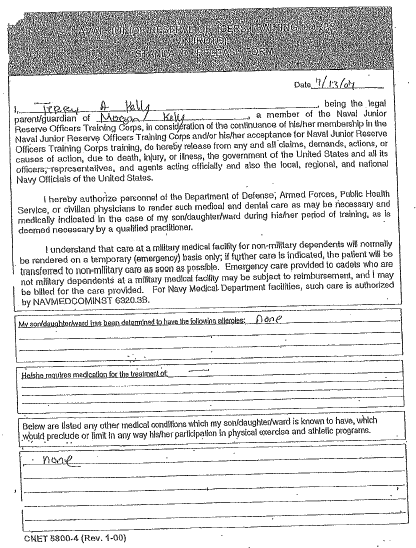
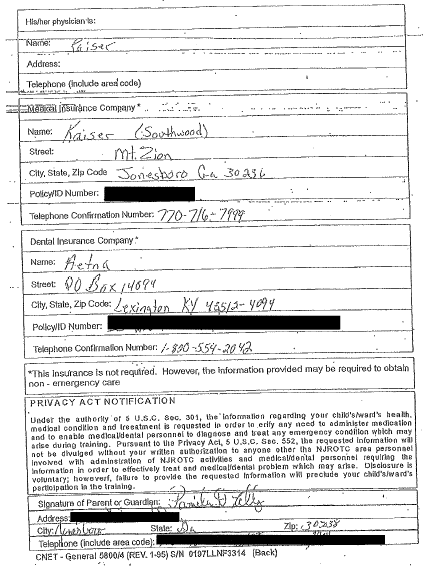
Angelo, v. USA Triathlon, 2014 U.S. Dist. LEXIS 131759
Posted: April 21, 2015 Filed under: Legal Case, Massachusetts, Racing, Triathlon | Tags: #race, Estate, Indemnification, Negligent infliction of emotional distress, Pain and Suffering, Personal Representative, Release, swimming, Triathlon, USA Triathlon, USAT, Wrongful Death Leave a commentTo Read an Analysis of this decision see: A federal district court in Massachusetts upholds indemnification clause in a release.
Angelo, v. USA Triathlon, 2014 U.S. Dist. LEXIS 131759
Cheryl Angelo, Personal Representative of the Estate of Richard Angelo, Plaintiff, v. USA Triathlon, Defendant.
Civil Action No. 13-12177-LTS
UNITED STATES DISTRICT COURT FOR THE DISTRICT OF MASSACHUSETTS
2014 U.S. Dist. LEXIS 131759
September 18, 2014, Decided
September 19, 2014, Filed
COUNSEL: [*1] For Cheryl Angelo, Plaintiff: Alan L. Cantor, LEAD ATTORNEY, Joseph A. Swartz, Peter J. Towne, Swartz & Swartz, Boston, MA.
For USA TRIATHLON, Defendant: Douglas L. Fox, Shumway, Giguere, Fox PC, Worcester, MA.
JUDGES: Leo T. Sorokin, United States District Judge.
OPINION BY: Leo T. Sorokin
OPINION
MEMORANDUM AND ORDER ON DEFENDANT’S MOTION FOR PARTIAL SUMMARY JUDGMENT
SOROKIN, D.J.
This action arises from a tragic set of facts in which Richard Angelo died while participating in the swim portion of a triathlon organized by the defendant, USA Triathlon (“USAT”). Plaintiff Cheryl Angelo (“the plaintiff”), as personal representative of Richard Angelo (“Angelo” or “the decedent”), has brought claims of wrongful death, conscious pain and suffering, and negligent infliction of emotional distress. USAT has counterclaimed for indemnity against any liability and legal costs associated with this action pursuant to indemnity agreements executed by the decedent prior to his participation in the triathlon. USAT has now moved for partial summary judgment on its claim for indemnity. Doc. No. 18. The plaintiff has opposed the Motion. Doc. No. 19. For the reasons stated below, USAT’s Motion is ALLOWED IN PART and DENIED IN PART.
I. [*2] STATEMENT OF FACTS
The following facts are stated in the light most favorable to the plaintiff as the nonmoving party, although the key facts for the purposes of this motion are not disputed. Angelo was a member of USAT since, at the latest, 2011. Doc. No. 18-1 at 1 ¶ 3. When Angelo last renewed his membership on August 12, 2011, he agreed to and electronically signed a “Waiver and Release of Liability, Assumption of Risk and Indemnity Agreement.” Id. at 1 ¶ 3, 4. That agreement only required the member to execute the document, and, accordingly, the plaintiff did not sign the form. Id. at 4-5. That document contained a provision that, in its entirety, reads as follows:
4. I hereby Release, Waive and Covenant Not to Sue, and further agree to Indemnify, Defend and Hold Harmless the following parties: USAT, the Event Organizers and Promoters, Race Directors, Sponsors, Advertisers, Host Cities, Local Organizing Committees, Venues and Property Owners upon which the Event takes place, Law Enforcement Agencies and other Public Entities providing support for the Event, and each of their respective parent, subsidiary and affiliated companies, officers, directors, partners, shareholders, members, agents, employees [*3] and volunteers (Individually and Collectively, the “Released Parties” or “Event Organizers”), with respect to any liability, claim(s), demand(s), cause(s) of action, damage(s), loss or expense (including court costs and reasonable attorneys [sic] fees) of any kind or nature (“Liability”) which may arise out of, result from, or relate to my participation in the Event, including claims for Liability caused in whole or in part by the negligence of the Released Parties. I further agree that if, despite this Agreement, I, or anyone on my behalf, makes a claim for Liability against any of the Released Parties, I will indemnify, defend and hold harmless each of the Released Parties from any such Liability which any [sic] may be incurred as the result of such claim.
Id. at 4.
USAT arranged to hold its National Age Group Championship on August 18, 2012, in Burlington, Vermont. Id. at 2 ¶ 5. On February 17, 2012, Angelo registered for the championship and, as part of his registration, electronically signed an indemnity agreement identical to the one excerpted above. Id. at 2 ¶ 6. As with the prior agreement, only Angelo as the participant was required to, and in fact did, sign the form. Doc. Nos. 18-1 at 33-34, 19-2 [*4] at 3. Angelo competed in that triathlon and died during his participation in the swim portion of that event or shortly thereafter. Doc. No. 18-2 at 11-12.
The plaintiff, the decedent’s wife and the personal representative of his estate, then brought this action in Essex Superior Court, alleging wrongful death, conscious pain and suffering by the decedent, gross negligence resulting in the decedent’s death, and negligent infliction of emotional distress suffered by the plaintiff, who was present at the site of the race. Doc. No. 6 at 12-16. USAT subsequently removed the action to this Court. Doc. No. 1.
II. STANDARD OF REVIEW
Summary judgment is appropriate when “the movant shows that there is no genuine dispute as to any material fact and the movant is entitled to judgment as a matter of law.” Fed. R. Civ. P. 56(a). Once a party “has properly supported its motion for summary judgment, the burden shifts to the non-moving party, who ‘may not rest on mere allegations or denials of his pleading, but must set forth specific facts showing there is a genuine issue for trial.'” Barbour v. Dynamics Research Corp., 63 F.3d 32, 37 (1st Cir. 1995) (quoting Anderson v. Liberty Lobby, Inc., 477 U.S. 242, 256, 106 S. Ct. 2505, 91 L. Ed. 2d 202 (1986)). The Court is “obliged to []view the record in the light most favorable to the nonmoving party, and to draw all reasonable inferences [*5] in the nonmoving party’s favor.” LeBlanc v. Great Am. Ins. Co., 6 F.3d 836, 841 (1st Cir. 1993). Even so, the Court is to ignore “conclusory allegations, improbable inferences, and unsupported speculation.” Prescott v. Higgins, 538 F.3d 32, 39 (1st Cir. 2008) (quoting Medina-Muñoz v. R.J. Reynolds Tobacco Co., 896 F.2d 5, 8 (1st Cir. 1990)). A court may enter summary judgment “against a party who fails to make a showing sufficient to establish the existence of an element essential to that party’s case, and on which that party will bear the burden of proof at trial.” Celotex Corp. v. Catrett, 477 U.S. 317, 322, 106 S. Ct. 2548, 91 L. Ed. 2d 265 (1986).
III. DISCUSSION
USAT has moved for partial summary judgment on their counterclaim for indemnity.1 USAT asserts that the decedent’s execution of the two release and indemnity agreements (“the indemnity agreements”) released or indemnified, or both, all claims that arise from his participation in the National Age Group Championship, including all claims brought by the plaintiff in this action. The plaintiff counters that the indemnity agreements could not function to release her claims for wrongful death or negligent infliction of emotional distress, and that an indemnity agreement is not enforceable insofar as it exempts the indemnitee from liability for its own grossly negligent conduct.
1 The Court understands this motion for summary judgment to be limited to the scope of the release and indemnity agreement [*6] and its application to the plaintiff’s claims as raised in the Complaint and as amplified in the motion papers. Despite USAT’s argument to the contrary, the Court does not believe this motion to be an appropriate vehicle to address the substantive merits of the plaintiff’s pleadings or claims.
Under Massachusetts law,2 “[c]ontracts of indemnity are to be fairly and reasonably construed in order to ascertain the intention of the parties and to effectuate the purpose sought to be accomplished.” Post v. Belmont Country Club, Inc., 60 Mass. App. Ct. 645, 805 N.E.2d 63, 69 (Mass. App. Ct. 2004) (quoting Shea v. Bay State Gas Co., 383 Mass. 218, 418 N.E.2d 597, 600 (Mass. 1981)). Indemnity contracts that exempt a party from liability arising from their own ordinary negligence are not illegal. Id. at 70. Further, contracts of indemnity can survive a decedent’s death and become an obligation of a decedent’s estate. Id. at 71.
2 The parties do not contend that the law of any other state applies.
Here, the language in the indemnity provision is broad. The plaintiff argues, briefly, that the indemnity agreements are ambiguous as to who is bound by the agreements. The Court disagrees. The agreement clearly states that “I . . . agree to Indemnify, Defend and Hold Harmless” the released parties from liability “of any kind or nature . . . which may arise out of, result from, or relate to my participation [*7] in the Event.” Doc. No. 18-1 at 4. By the plain language of the provision, the signatory of the agreement agreed to indemnify USAT for any losses arising from his participation in the triathlon, including losses and damages associated with lawsuits arising from his participation. See Post, 805 N.E.2d at 70. Both the scope of the indemnity and the party bound by the agreement are clear and unambiguous. A close examination is required, however, to ascertain the applicability of the provision to the specific claims raised and the sources available to satisfy the indemnity.
A. Counts 1 and 3: Wrongful Death
The first count in the plaintiff’s Complaint alleges wrongful death due to USAT’s negligence. The third count alleges wrongful death due to USAT’s gross negligence and seeks punitive damages. Under Massachusetts law, an action for wrongful death is “brought by a personal representative on behalf of the designated categories of beneficiaries” set forth by statute. Gaudette v. Webb, 362 Mass. 60, 284 N.E.2d 222, 229 (Mass. 1972); see Mass. Gen. Laws ch. 229, §§ 1, 2. “The money recovered upon a wrongful death claim is not a general asset of the probate estate, but constitutes a statutory trust fund, held by the administratrix as trustee for distribution to the statutory beneficiaries.”3 Marco v. Green, 415 Mass. 732, 615 N.E.2d 928, 932 (Mass. 1993) (quoting Sullivan v. Goulette, 344 Mass. 307, 182 N.E.2d 519, 523 (Mass. 1962)). These [*8] aspects of Massachusetts law have led another judge of this Court to the conclusion that “[w]rongful death is not, in any traditional sense, a claim of the decedent.” Chung v. StudentCity.com, Inc., Civ. A. 10-10943-RWZ, 2011 U.S. Dist. LEXIS 102370, 2011 WL 4074297, at *2 (D. Mass. Sept. 9, 2011).
3 The Massachusetts Legislature has created limited statutory exceptions whereby the recovery on a wrongful death claim may be reached to pay certain specified expenses. Mass. Gen. Laws ch. 229, § 6A. None of those exceptions are implicated by the present Motion. See id.
As stated above, the indemnity agreements signed by the decedent, by their terms, clearly were intended to indemnify losses arising from an action for wrongful death as a claim “aris[ing] out of” the decedent’s participation in the triathlon. Thus, USAT is entitled to indemnity on losses resulting from that claim. That does not end the matter, however, because the parties raise the question of where USAT may look in order to satisfy the indemnity obligation. The decedent, while having authority to bind his estate, see Post, 805 N.E.2d at 71, lacked authority to bind his surviving family members who did not sign the indemnity agreements and are not bound thereby, see Chung, 2011 U.S. Dist. LEXIS 102370, 2011 WL 4074297, at *2. Accordingly, to satisfy the indemnity obligation, USAT may look to the assets of the decedent’s estate. See [*9] Post, 805 N.E.2d at 71 (noting that a contract of indemnity agreed to by a decedent became an obligation of the decedent’s estate). USAT may not, however, look to any recovery on the wrongful death claim for satisfaction, as that recovery would be held in trust for the statutory beneficiaries and would not become an asset of the estate. See Estate of Bogomolsky v. Estate of Furlong, Civ. A. 14-12463-FDS, 2014 U.S. Dist. LEXIS 86998, 2014 WL 2945927, at *2 (D. Mass. June 26, 2014).4 USAT concedes this outcome as to the plaintiff’s negligent infliction of emotional distress claim, Doc. No. 20 at 11-12, and given the structure of wrongful death claims in Massachusetts, there is no reason for a different result as to the wrongful death claims.5
4 In Estate of Bogomolsky, a recent decision of another session of this Court, Judge Saylor came to the same conclusion, finding that a judgment creditor of a decedent’s estate would not be able to restrain the proceeds of an insurance policy distributed pursuant to the wrongful death statute, as the proceeds of the policy were held in trust for the decedent’s next of kin and did not belong to the decedent’s estate. Estate of Bogomolsky, 2014 U.S. Dist. LEXIS 86998, 2014 WL 2945927, at *2.
5 While the plaintiff notes that the Massachusetts Appeals Court has reserved the question of whether an indemnification provision would be [*10] enforced to effectively release the claims of people who were not signatories of such an agreement, see Post, 805 N.E.2d at 70-71, this case, as in Post, does not present that circumstance, as the indemnity agreements in this case do not purport to extinguish the plaintiff’s right to bring her claims nor her right to recover on those claims.
Count three of the plaintiff’s Complaint, alleging that the decedent’s death was a result of USAT’s gross negligence, raises the issue of whether Massachusetts courts would enforce an indemnity contract to the extent it functioned to indemnify a party’s own gross negligence. The Court has uncovered no controlling authority from the Supreme Judicial Court of Massachusetts on this issue, nor any case of the Massachusetts Appeals Court on point. In such a case, “[w]here the state’s highest court has not definitively weighed in, a federal court applying state law ‘may consider analogous decisions, considered dicta, scholarly works, and any other reliable data tending convincingly to show how the highest court in the state would decide the issue at hand.'” Janney Montgomery Scott LLC v. Tobin, 571 F.3d 162, 164 (1st Cir. 2009) (quoting N. Am. Specialty Ins. Co. v. Lapalme, 258 F.3d 35, 38 (1st Cir. 2001)).
In the closely analogous context of releases, the Massachusetts Appeals Court has held that, for reasons of public policy, [*11] a release would not be enforced to exempt a party from liability for grossly negligent conduct, though otherwise effective against ordinary negligence. Zavras v. Capeway Rovers Motorcycle Club, Inc., 44 Mass. App. Ct. 17, 687 N.E.2d 1263, 1265 (Mass. App. Ct. 1997). The Supreme Judicial Court, although not adopting that holding, has noted that public policy reasons exist for treating ordinary negligence differently from gross negligence when enforcing releases. Sharon v. City of Newton, 437 Mass. 99, 769 N.E.2d 738, 748 n.12 (Mass. 2002). Finally, Judge Saylor of this Court, examining this caselaw, has concluded that the Supreme Judicial Court would not enforce an indemnity agreement to the extent it provided for indemnification of a party’s own gross negligence. CSX Transp., Inc. v. Mass. Bay Transp. Auth., 697 F. Supp. 2d 213, 227 (D. Mass. 2010).
This Court, having studied the caselaw, agrees with and reaches the same conclusion as Judge Saylor: specifically that Massachusetts courts would not enforce an indemnity provision insofar as it relieved a party from liability stemming from its own gross negligence. Thus, the indemnity agreements executed by the decedent are not enforceable to the extent they would require the decedent’s estate to indemnify losses arising from USAT’s grossly negligent conduct.6
6 This conclusion would gain significance if the plaintiff were to be awarded punitive damages owing to USAT’s alleged gross negligence. Punitive damages [*12] awarded under the wrongful death statute, unlike compensatory damages under that statute, are considered general assets of the decedent’s estate. Burt v. Meyer, 400 Mass. 185, 508 N.E.2d 598, 601-02 (Mass. 1987). Any punitive damages, however, could not be reached in satisfaction of the indemnity obligation because gross negligence or more culpable conduct is the predicate upon which an award of punitive damages is based under the statute. See Mass. Gen. Laws ch. 229, § 2.
Accordingly, USAT’s Motion for Summary Judgment as to the plaintiff’s claims of wrongful death is ALLOWED insofar as it seeks indemnity from the decedent’s estate for USAT’s allegedly negligent conduct. The Motion is DENIED insofar as it seeks to satisfy the indemnity obligation from any amounts recovered on the wrongful death claim and insofar as the agreement would require the decedent’s estate to indemnify liability arising from USAT’s grossly negligent conduct.
B. Count 2: Conscious Pain and Suffering
The second count of the plaintiff’s Complaint alleges that USAT’s negligence caused the decedent’s conscious pain and suffering. Under Massachusetts law, a claim for conscious pain and suffering is a claim of the decedent, which may be brought on the decedent’s behalf by his or her personal representative. [*13] Gaudette, 284 N.E.2d at 224-25; see Mass. Gen. Laws ch. 229, § 6. Any recovery on such a claim is held as an asset of the decedent’s estate. Mass. Gen. Laws ch. 229, § 6. By executing the two agreements, the decedent both released his claim of conscious pain and suffering caused by USAT’s negligence and indemnified USAT for any losses occasioned by such a claim. Putting aside the release for a moment, if the personal representative of the decedent received any recovery for his conscious suffering, USAT would be able to reach that recovery to satisfy the decedent’s indemnity obligation. See Estate of Bogomolsky, 2014 U.S. Dist. LEXIS 86998, 2014 WL 2945927, at *2. Thus, USAT’s Motion for Summary Judgment is ALLOWED insofar as the claim for conscious suffering caused by USAT’s negligence was both released and indemnified.
In response to this argument, however, the plaintiff has stated her intent to proceed on the conscious suffering count only on a theory of gross negligence, and not to proceed upon ordinary negligence. As noted above, both the release and the indemnity provisions of the agreements are unenforceable to exempt USAT from liability for their own grossly negligent conduct. See CSX, 697 F. Supp. 2d at 227; Zavras, 687 N.E.2d at 1265. Thus, insofar as the plaintiff chooses to proceed on the conscious pain and suffering count only on a theory of gross negligence, USAT’s Motion for Summary [*14] Judgment is DENIED. If she chooses to so proceed, the plaintiff shall amend her Complaint accordingly.
C. Count 4: Negligent Infliction of Emotional Distress
The fourth and final count of the plaintiff’s Complaint alleges USAT’s negligent infliction of emotional distress on the plaintiff, who was present at the race venue. As an initial matter, the plaintiff, as currently denominated in the Complaint, only brings claims as personal representative of the estate of the decedent. Negligent infliction of emotional distress, however, alleges a harm directly against the plaintiff in her individual capacity, see Cimino v. Milford Keg, Inc., 385 Mass. 323, 431 N.E.2d 920, 927 (Mass. 1982), and thus cannot be brought in a representative capacity.
In response, the plaintiff has indicated her intent to amend her Complaint to bring this claim in her individual capacity. The Court will allow the amendment, as it is not futile in light of the Court’s rulings on the indemnity agreements. The indemnity language in those agreements is broad enough to reach a claim for negligent infliction of emotional distress as a claim “aris[ing] out of” the decedent’s participation in the triathlon. Thus, USAT is entitled to indemnification on any losses resulting from such a claim. As conceded by [*15] USAT, however, any recovery on the emotional distress claim would belong to the plaintiff individually, and thus USAT would not be able to use that recovery to satisfy the indemnity and may look only to the estate of the decedent. Doc. No. 20 at 11-12. Accordingly, the plaintiff may so amend her Complaint to perfect her claim of negligent infliction of emotional distress.
D. Defense Costs
USAT also claims an entitlement to defense costs arising from the provisions in the indemnity agreements obligating the signatory to defend and hold harmless USAT. The language of the indemnity agreements does clearly obligate the decedent’s estate to make USAT whole on these losses. As with the claims discussed above, USAT may seek indemnity from the decedent’s estate for their defense costs which predate this Motion as well as prospective costs to the extent that the plaintiff chooses to proceed on at least one claim which is subject to indemnification.7 See Mt. Airy Ins. Co. v. Greenbaum, 127 F.3d 15, 19 (1st Cir. 1997) (“[U]nder Massachusetts law, if an insurer has a duty to defend one count of a complaint, it must defend them all.” (citing Aetna Cas. & Surety Co. v. Continental Cas. Co., 413 Mass. 730, 604 N.E.2d 30, 32 n.1 (Mass. 1992)).
7 Should the plaintiff decide to proceed only on those claims that, following the reasoning of this Order, are not subject to the [*16] indemnity obligation, the parties may request leave to brief the issue of USAT’s entitlement to prospective defense costs at that time.
IV. CONCLUSION
In conclusion, USAT’s Motion for Summary Judgment, Doc. No. 18, is ALLOWED as set forth above insofar as USAT seeks to establish the release of the conscious pain and suffering claim and indemnity from the decedent’s estate for the claims wrongful death, conscious pain and suffering, and negligent infliction of emotional distress caused by USAT’s ordinary negligence. USAT’s Motion is DENIED, however, insofar as it argues for release of or indemnity on any claims caused by their own gross negligence and insofar as it seeks satisfaction of the indemnity obligation from any recovery on the wrongful death or emotional distress claims. The plaintiff shall amend the Complaint within seven days to more clearly specify the capacity in which each claim is brought and add the allegations of gross negligence, both as described in the plaintiff’s papers. The defendant shall respond to the Amended Complaint within seven days of its filing. The Court will hold a Rule 16 conference on October 21, 2014 at 1 p.m.
SO ORDERED.
/s/ Leo T. Sorokin
Leo T. Sorokin
United [*17] States District Judge


 Recreation Law