
A parked snowmobile is an inherent risk of skiing for which all skiers assume the risk under Colorado Ski Area Safety Act.
Posted: March 5, 2018 Filed under: Colorado, Ski Area, Skiing / Snow Boarding | Tags: avalanche, Collision, Colorado Skier Safety Act, de novo review, deceleration, enlargement, exhaustive, feet, inherent dangers, Inherent Risks, lamp, man-made, Negligence per se, parked, recommendation, Respondeat Superior, right to appeal, Ski, Ski Areas, Ski Resort, ski run, Ski Safety Act, Skier, skiing, Slope, Snow, Snowmobile, Sport, statutory definition, Steamboat, Steamboat Ski Area, Terrain, Trail Leave a commentA Steamboat ski area employee parked a snowmobile at the bottom of a run. The plaintiff came down the run and hit the snowmobile injuring herself. She claimed the snowmobile was not visible from 100′ and was in violation of the Colorado Skier Safety Act. The Federal District Court for Colorado Disagreed.
Schlumbrecht-Muniz v. Steamboat Ski & Resort Corporation, 2015 U.S. Dist. LEXIS 30484
State: Colorado, United States District Court for the District of Colorado
Plaintiff: Linda Schlumbrecht-Muniz, M.D.
Defendant: Steamboat Ski & Resort Corporation, a Delaware Corporation d/b/a STEAMBOAT
Plaintiff Claims: negligence, negligence per se, and respondeat superior
Defendant Defenses: Colorado Skier Safety Act
Holding: for the Defendant
Year: 2015
The plaintiff was skiing down a run at Steamboat Ski Area. (Steamboat is owned by Intrawest Resorts, Inc.) On that day, an employee of Steamboat parked a snowmobile at the bottom of that run. The snowmobile was not visible for 100′. The plaintiff collided with the vehicle incurring injury.
The plaintiff sued claiming simple negligence, negligence per se and respondeat superior. The Negligence per se claim was based on an alleged failure of the ski area to follow the Colorado Skier Safety Act.
The ski area filed a motion for summary judgment arguing the claims of the plaintiff failed to plead the information needed to allege a violation of the Colorado Skier Safety Act.
Analysis: making sense of the law based on these facts.
The court first looked at the requirements necessary to properly plead a claim.
“…the mere metaphysical possibility that some plaintiff could prove some set of facts in support of the pleaded claims is insufficient; the complaint must give the court reason to believe that this plaintiff has a reasonable likelihood of mustering factual support for these claims.” The ultimate duty of the court is to “determine whether the complaint sufficiently alleges facts supporting all the elements necessary to establish an entitlement to relief under the legal theory proposed.”
This analysis requires the plaintiff to plead facts sufficient to prove her claims to some certainty that the court can see without a major stretch of the imagination.
The ordinary negligence claims were the first to be reviewed and dismissed. The Colorado Skier Safety Act states that the defendant ski area is “immune from any claim for damages resulting from “…the inherent dangers and risks of skiing…”
Notwithstanding any judicial decision or any other law or statute, to the contrary, … no skier may make any claim against or recover from any ski area operator for injury resulting from any of the inherent dangers and risks of skiing.
Although the law allows suits against ski areas for violation of the act, those claims must be plead specifically and fit into the requirements set forth in the act. As such the court found the defendant Steamboat could be liable if:
Accordingly, Steamboat may be liable under one of two theories: a skier may recover if her injury resulted from an occurrence not considered an inherent danger or risk of skiing; or a skier may recover if the ski operator violated a provision of the Act and that violation resulted in injury.
The first claim of an injury that was not an inherent risk of skiing would hold the defendant ski area liable for a negligence claim. The second requires specific violation of the Colorado Skier Safety Act.
Steamboat argued that pursuant to the Colorado Skier Safety Act, the term inherent risks as defined in the act were to be read broadly and a parked snowmobile was an inherent risk of skiing.
The Ski Safety Act defines “inherent dangers and risks of skiing” to mean:
…those dangers or conditions that are part of the sport of skiing, including changing weather conditions; snow conditions as they exist or may change, such as ice, hard pack, powder, packed powder, wind pack, corn, crust, slush, cut-up snow, and machine-made snow; surface or subsurface conditions such as bare spots, forest growth, rocks, stumps, streambeds, cliffs, extreme terrain, and trees, or other natural objects, and collisions with such natural objects; impact with lift towers, signs, posts, fences or enclosures, hydrants, water pipes, or other man-made structures and their components; variations in steepness or terrain, whether natural or as a result of slope design, snowmaking or grooming operations, including but not limited to roads, freestyle terrain, jumps, and catwalks or other terrain modifications; collisions with other skiers; and the failure of skiers to ski within their own abilities.
The court then looked at decisions interpreting the inherent risk section to determine if the act was to be construed narrowly or broadly.
In all cases, Colorado courts looked at the act as a list of the possible risks of skiing but not all the possible risks. As such, a snowmobile parked at the bottom of the slope was an inherent risk of skiing.
I am also persuaded that the presence of a parked snow mobile at the end of a ski run is an inherent risk of the sport of skiing. While Steamboat cites Fleury for that court’s description of the “common understanding of a ‘danger,'” and analogizes the presence of a snowmobile to cornices, avalanches, and rubber deceleration mats for tubing, I find that a parked snowmobile is not analogous to those examples because a snowmobile is not part of the on-course terrain of the sport.
The court also found that even if the snowmobile parked on a run was not an inherent risk, the statute required skiers to stay away from vehicles and equipment on the slopes. “Each skier shall stay clear of snow-grooming equipment, all vehicles, lift towers, signs, and any other equipment on the ski slopes and trails.”
The plaintiff’s argument was the violation of the statute was failing to properly for failing to properly outfit the snowmobile.
Plaintiff clarifies in her Response that the negligence per se claim is for violation of section 33-44-108(3), which requires snowmobiles operated “on the ski slopes or trails of a ski area” to be equipped with “[o]ne lighted headlamp, one lighted red tail lamp, a brake system maintained in operable condition, and a fluorescent flag at least forty square inches mounted at least six feet above the bottom of the tracks.”
Plaintiff also argued the statute was violated because the snowmobile was not visible for 100′ as required by the statute. However, this put the plaintiff in a catch 22. If the plaintiff was not a vehicle, then it was a man-made object which was an inherent risk of skiing. If she pleads the snowmobile was a vehicle and not properly equipped, then she failed to stay away from it.
Neither approach leads Plaintiff to her desired result. Steamboat correctly asserts that if the snow-mobile is characterized as a man-made object, Plaintiff’s impact with it was an inherent danger and risk pursuant to section, and Steamboat is immune to liability for the resulting injuries. If Plaintiff intends for her Claim to proceed under the theory that Steamboat violated section 33-44-108(3) by failing to equip the snowmobile with the proper lighting, she did not plead that the parked vehicle lacked the required items, and mentions only in passing in her Response that the vehicle “did not have an illuminated head lamp or trail lamp because it was not operating.”
The final claim was based on respondeat superior.
Plaintiff has alleged that the Steamboat employee was acting within the scope of her employment when she parked the snowmobile at the base of Bashor Bowl. See id. (“Under the theory of respondeat superior, the question of whether an employee is acting within the scope of the employment is a question of fact”)
Because the respondeat claim was derivative of the prior claims, and they were dismissed, the respondeat superior claim must fail. Derivative means that the second claim is wholly based on the first claim. If the first claim fails, the second claim fails.
So Now What?
This is another decision in a long line of decisions expanding the risks a skier assumes on Colorado slopes. The inherent risks set forth in Colorado Skier Safety Act are examples of the possible risks a skier can assume, not the specific set of risks.
 What do you think? Leave a comment.
If you like this let your friends know or post it on FB, Twitter or LinkedIn
Author: Outdoor Recreation Insurance, Risk Management and Law
Copyright 2018 Recreation Law (720) Edit Law
Email: Rec-law@recreation-law.com
Google+: +Recreation
Twitter: RecreationLaw
Facebook: Rec.Law.Now
Facebook Page: Outdoor Recreation & Adventure Travel Law
Blog: www.recreation-law.com
Mobile Site: http://m.recreation-law.com
By Recreation Law Rec-law@recreation-law.com James H. Moss
#AdventureTourism, #AdventureTravelLaw, #AdventureTravelLawyer, #AttorneyatLaw, #Backpacking, #BicyclingLaw, #Camps, #ChallengeCourse, #ChallengeCourseLaw, #ChallengeCourseLawyer, #CyclingLaw, #FitnessLaw, #FitnessLawyer, #Hiking, #HumanPowered, #HumanPoweredRecreation, #IceClimbing, #JamesHMoss, #JimMoss, #Law, #Mountaineering, #Negligence, #OutdoorLaw, #OutdoorRecreationLaw, #OutsideLaw, #OutsideLawyer, #RecLaw, #Rec-Law, #RecLawBlog, #Rec-LawBlog, #RecLawyer, #RecreationalLawyer, #RecreationLaw, #RecreationLawBlog, #RecreationLawcom, #Recreation-Lawcom, #Recreation-Law.com, #RiskManagement, #RockClimbing, #RockClimbingLawyer, #RopesCourse, #RopesCourseLawyer, #SkiAreas, #Skiing, #SkiLaw, #Snowboarding, #SummerCamp, #Tourism, #TravelLaw, #YouthCamps, #ZipLineLawyer, Steamboat, Steamboat Ski Area, Colorado Skier Safety Act, snowmobile,
AMGA Terrain and Supervision Guidelines? Making more rules does not make things safer. Rarely does that work, look at the laws concerning our highways and the highway deaths. Making more rules does lead to more lawsuits. Again, look at our highways.
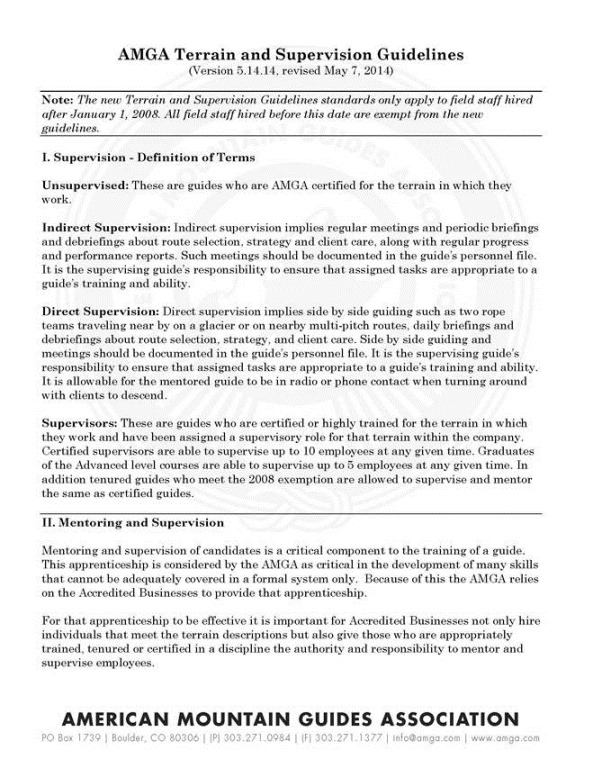
Posted: December 5, 2014 Filed under: Mountaineering | Tags: American Mountain Guides Association, AMGA, Bureau of Land Management, Guidelines, IFMGA, International Federation of Mountain Guides Associations, Mountaineering, National Park Service, National Wilderness Preservation System, Terrain, UIAGM, United States Congress, United States Department of the Interior, United States Fish and Wildlife Service, United States Forest Service 8 CommentsThe latest actions of AMGA hit a lot of nerves and rightfully so. As usual, the lack of understanding and the desire to create something (not sure what) labeled standards are going to create lawsuits. The new Terrain & Supervision Guidelines won’t solve any problems; they’ll only create new ones.
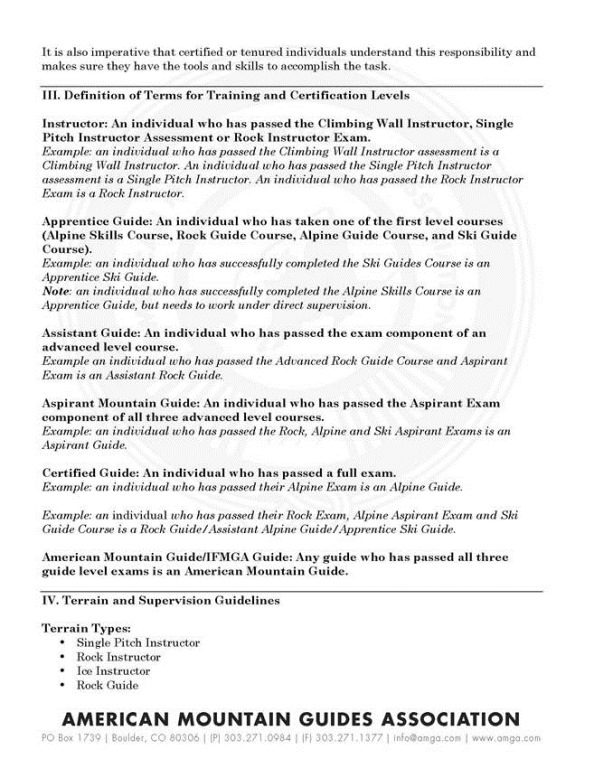
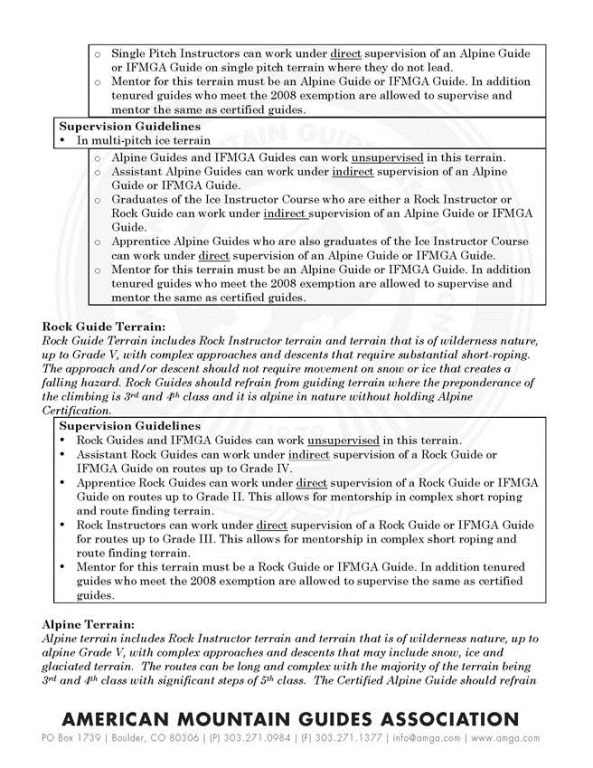
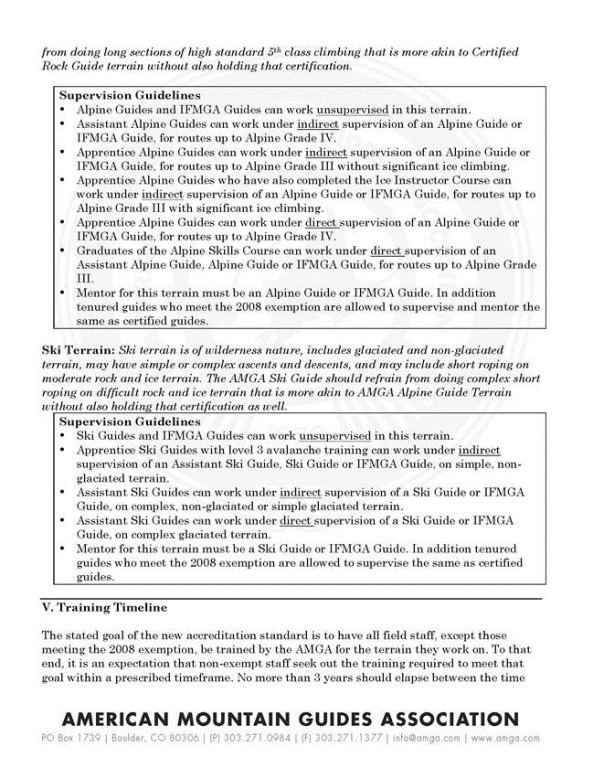
I’ve attached the new requirements here below, so you can review them yourself. If not, you can download your own set here: Terrain & Supervision Guidelines. I’m not sure why the AMGA has created the new requirements. I’ve been told it is a money thing, I’ve been told it is a safety thing, I’ve been told it is a back door into trying to get permits on NPS lands; I have no real idea. I do know it won’t accomplish any of those goals. I did not contact the AMGA to find out what or why.
Attorneys love to deal in fuzzy it gives them latitude to litigate. The only time they don’t like fuzzy is when something is solid and proves their case without having to work very hard. The new Terrain & Supervision Guidelines are the classic sharp line to help prove the defendant was wrong and everything else is fuzzy so no one really knows how to help the defendant.
Let me reminisce.
I quit providing pro bono legal work to the AMGA over fifteen years ago when another attorney said he could get the AMGA into national parks. I told the AMGA that would never happen. I moved on. Fifteen years later and at least two attorneys failing to pull AMGA guides into parks, the AMGA might be going around to the back door believing the back door will open.
Back doors meaning the NPS employees in individual parks who lead the rescues have to deal with the current concessionaires; who they don’t like (familiarity breed’s contempt). It is always easier to like someone who is sucking up in the belief; you can get them in a park to guide.
The problem is the door is not at any park; the door is in Washington DC no matter what the AMGA wants to believe. It doesn’t start at 1849 C St NW, Washington, DC 20240, the Department of the Interior address, either, but at Congress. Congress made the laws the NPS, and the USFS are enforcing on commercial guides on Federal lands. Until the AMGA can raise millions, probably $10 million dollars to lobby Congress, nothing will even look like it is going to change. And I suspect that the $10 million is not enough because the current companies that own permits and concessions will lobby against it, and they are bigger. Remember the big hotel concessions in the parks also run raft trips, trail rides and work with climbing guides.
However, I’ve also been told that the AMGA has backed off from the position that AMGA guides should be allowed to guide in National Parks.
I have found some legal disasters in the new Terrain & Supervision Guidelines.
The guidelines won’t apply to staff hired prior to 2008. An arbitrary number I guess, or probably the number when the last member of the committee became certified and was hired. I sat through board meetings when the first date of guides to be grandfathered under the UIAGM was determined. It was ugly, funny and basically a turf war. Trial attorneys will tear this up. (How come Guide X made it and Guide Y did not. Guide Y has thousands of year’s more recent experience, and Guide X has not been on a mountain since 08?)
The guidelines require that everything has to be documented “in the guide’s personnel file.” Thank heavens the AMGA has reviewed all HR laws in the US and knows this will not create problems. If personal files are paper, then you better get accordion files. To back this up, you’ll have to collect all the information supporting the requirements in the guidelines first, and then add the review of the supervising guides and the evaluations. Weather conditions, snow conditions, terrain maps, route maps, etc., can take a lot of space in a file folder.
My favorite rule is one that requires a guide who has not made the qualifications yet, must be under the direct supervision of a guide who has met the qualifications. Unless the guide, who has met the qualifications, has to take guests down the mountain, then the two guides can be in radio contact. The rules allow the least experienced guide to remain up high, alone.
Direct Supervision: Direct supervision implies side by side guiding such as two rope teams traveling near by on a glacier or on nearby multi-pitch routes, daily briefings and debriefings about route selection, strategy, and client care. Side by side guiding and meetings should be documented in the guide’s personnel file. It is the supervising guide’s responsibility to ensure that assigned tasks are appropriate to a guide’s training and ability. It is allowable for the mentored guide to be in radio or phone contact when turning around with clients to descend.
What if the guide who has been certified, leaves to summit with a group of clients, can the one who hasn’t been certified stay with the clients who don’t/can’t summit. They’ll be in radio contact?
So you make a rule, then you make an exception to the rule. On Denali in a few years, this will be a disaster. The new concession requirements for climbing concessions are going to reduce the number of guides with a commercial group. Rescues will be done without commercial guides because a guide won’t be able to leave the group and work the rescue with these guidelines. (Rescues in the future on Denali are going to be a mess with the latest version of the commercial rules anyway, that is a whole other article.)
The languages of the guidelines are full of legal land mines. Here are some of my favorites.
…who are appropriately trained, tenured or certified
It is the supervising guide’s responsibility to ensure that assigned tasks are appropriate to a guide’s training and ability.
Certified supervisors
…is not of wilderness in nature
My favorite are the terms applied to different people.
Apprentice Guide
Assistant Guide
Aspirant Mountain Guide
Certified Guide
So does that mean you are a patrol leader or a star scout? More importantly do you get a badge?
Here are some more phrases that seem innocuous but don’t make sense.
The stated goal of the new accreditation standard is to have all field staff, except those meeting the 2008 exemption, be trained by the AMGA for the terrain they work on.
So guides who met the requirements prior to 2008 cannot have a lick of training, sense or experience now and not be up to date on the requirements.
How is this going to happen? So I have a concession to guide on Denali. Am I supposed to bring you on one of my trips to tell me that you can train me on this terrain? What about the NPS on this issue and their current regulations. I guess you can come, go sign up and pay the fee, and I’ll take you where I am permitted to go.
AMGA courses are considered the baseline technical training for specific terrain types and are not a substitute for in-house training.
Yet above, they said this is the best you can get? What is this going to mean in court? The AMGA is just the baseline, yet the states the IFMGA (UIAGM) are now the baseline.
(The IFMGA (UIAGM) was founded to allow guides in Europe to guide everywhere and is the International Organization the AMGA must follow.)
I doubt that this has been run by the IFMGA (UIAGM).
Do Something
What’s going to happen? The big concessionaire members of the AMGA are either going to leave and financially sink the AMGA or revolt. No one will be happy either way. They don’t need greater chances of being sued. People die on mountains, and I would guess these new guidelines are not going to change that. They know the terrain and have in place, with NPS approval a way of guiding customers and training staff.
I have not taken the time to compare these guidelines with current NPS regulations for various mountains. I suspect there may be some conflicts. What is a concessionaire supposed to do, not follow the NPS and lose their permit or not follow these. Let’s see I pay money to the AMGA I make money with my NPS permit. Who am I going to follow?
These guidelines, like all standards for people, will only create a checklist for the attorney representing an injured client to sue. The guidelines will be taken and incorporated in interrogatories about each member of the guiding team. One misstep on the mountain or in discovery and these guidelines will change the lawsuit from what we can defend to how much we have to pay.
Don’t get me wrong. The American Mountain Guides Association has some of the greatest people I know as members and as an organization has accomplished tons. However, it is faced with an impossible job with no money to accomplish the job: the promise the AMGA made to the IFMGA in 1993 is never going to come through.
However, making standards, guidelines for people do not stop lawsuits; they only help the plaintiff’s win lawsuits.
Click on the link to download your own copy of the Terrain & Supervision Guidelines.
See the following articles where association guidelines were used to sue the association member:
ACA Standards are used by Expert for the Plaintiff in a lawsuit against a Camp http://rec-law.us/zmKgoi
Great article about the risks of an organization creating standards for members of the industry – and I did not write it http://rec-law.us/1rk8oHR
If your organization says you do something and you are a member of the organization you better do it or be able to explain why you did not http://rec-law.us/1gOLpju
Expert Witness Report: ACA “Standards” are used by Expert for the Plaintiff in a lawsuit against a Camp http://rec-law.us/y7QlJ3
Industry standards are proof of gross negligence and keep defendant in lawsuit even with good release http://rec-law.us/1dqBdxo
Plaintiff uses standards of ACCT to cost defendant $4.7 million http://rec-law.us/11UdbEn
So if you write standards, you can, then use them to make money when someone sues your competitors http://rec-law.us/1gCGce8
Trade Association Standards sink a Summer Camp when plaintiff uses them to prove Camp was negligent http://rec-law.us/wszt7N

What do you think? Leave a comment.
If you like this let your friends know or post it on FB, Twitter or LinkedIn
Copyright 2013 Recreation Law (720) Edit Law
Email: Rec-law@recreation-law.com
Google+: +Recreation
Twitter: RecreationLaw
Facebook: Rec.Law.Now
Facebook Page: Outdoor Recreation & Adventure Travel Law
Blog: www.recreation-law.com
Tennessee has a Ski Statute that must be construed narrowly or if you don’t understand skiing, ignored
Posted: November 4, 2013 Filed under: Assumption of the Risk, Minors, Youth, Children, Release (pre-injury contract not to sue), Tennessee | Tags: Bare Spot, Ice, Inc., Jaren Albert, Jarrod Albert, Ober Gatlinburg, ski lesson, Ski School, skiing, Slope, Smoky Mountain Snow SPORT School, Terrain Leave a commentHowever, the court rules that if parent signs a release the parent cannot recover for the child’s injures, even though the child still can
Albert v. Ober Gatlinburg, Inc., 2006 U.S. Dist. LEXIS 100150
Plaintiff: Jaren Albert, a minor bn/f Jarrod Albert, and Jarrod Albert
Defendant: Ober Gatlinburg, Inc., and Smoky Mountain Snow SPORT School, Inc.,
Plaintiff Claims: negligence
Defendant Defenses: Against Defendant Ski Area, Ober Gatlinburg Inc.: (1) Jaren Albert was guilty of negligence as a matter of law which bars recovery for her injuries; (2) Jaren’s claim is barred by the Tennessee Ski Area Safety and Liability Act (SASLA), T.C.A. § 68-114-101; and (3) Ober is not guilty of any negligence which proximately caused or contributed to Jaren’s accident and injuries.
Against the Ski School Smoky Mountain Snow Sport School, Inc.,: (1) his claims are solely derivative of the claims of Jaren Albert and that failure of her claims precludes any recovery by Jarrod Albert; and (2) that Jarrod Albert signed a valid release agreement contractually preventing him from bringing a claim against the ski operator.
Holding: For the defendants against the parent and for the child on all other motions.
The plaintiff was a 15-year-old girl who was skiing at the defendant’s ski area when she was injured. The day before she had skied at the ski area and taken a lesson from the defendant ski school. As the second day progressed, she started skiing more difficult runs and eventually lost control, sat down and was injured when her ski apparently hit her in the head.
A witness to the plaintiff’s accident testified “She was coming down; she slipped and started sliding on her butt; she tried to stop sideways; she started going head over heels for about 10 feet, then her ski came off, hit her in the head, and she was out.”
She sued the ski school and the ski area. The plaintiff hired an expert who testified that the defendant ski area:
…failed to use reasonable care in deciding to open the ski resort on the day of the accident, failed to close some slopes or warn of ultra hazardous conditions on the slope on which this accident occurred, and failed to designate the slope on which the accident occurred as ultra hazardous, ice-covered, and/or “black diamond,” thus breaching its duty to operate in conformity with the SASLA.
When slope conditions change from marginal to extra-hazardous in nature, Mr. Isham states it becomes the obligation and duty of the ski operator to post warnings at the top of each trail notifying skiers that the slopes have changed and that they demand extra caution and attention. Such warnings should have also been posted at the slope condition board at the base of the mountain to provide additional information to skiers.
Ice or bare spots on a ski slope are ultrahazardous?
Both defendants filed motions for summary judgment. The plaintiff filed a motion requesting oral arguments on the defendant’s motions for summary judgment, which was denied. The court then ruled on the defendants’ motions for summary judgment.
Summary of the case
Claims against the ski area
The court first looked at the claims and arguments against the defendant ski area. The ski area argued that the plaintiff should not have been on the black diamond ski slope, and that is what created her injury.
…was an inexperienced skier, yet she skied on a slope which she knew was designated as “most difficult” and rated as a “black diamond” slope; and she ignored the posted signs warning her that the slope she was preparing to ski on was not suited to her ability. Despite that knowledge, Ms. Albert skied down Mogul Ridge and suffered a fall. Defendant states that Ms. Albert was not skiing within the limits of her ability and she apparently failed to maintain control of her speed and course, resulting in her fall and injury.
The defendant ski area also argued that the Tennessee Ski Area and Liability Act (SASLA) barred the plaintiff’s suit because a skier assumed the risk and legal responsibility of skiing under the act. The court stated that the Tennessee Court of Appeals had reviewed the statute and held that the act did not protect the operators from their own negligence or provide them with blanket immunity.
The plaintiff’s then made a simple argument to which the court gave credence.
Plaintiffs state that Ober Gatlinburg owed a duty of reasonable care under the circumstances, in addition to their statutory duties, not to expose a skier to risks at the resort which were not an inherent risk of skiing.
Because there was a difference of opinion, a material fact to which the parties disagreed, summary judgment could not be granted to the ski area.
Claims against the ski school
The ski school’s major argument was the lesson ended the day before so the school could not be liable for injuries that occurred after the lesson ended. The school also argued that the school had no control over the actions against the plaintiff after the lesson ended.
The plaintiff countered by arguing the lesson was incomplete. The plaintiff argued the lesson was 5-10 minutes, and she learned to stop and to turn. The school argued the lesson was longer. (I find it hard to believe that a beginner could learn to snowplow and turn in 10 to 15 minutes.)
Here again the court found that because there was a disagreement as to whether or not the lesson was adequate the ski school would not be dismissed from the suit.
Release signed by the plaintiff, parent of the injured minor.
The plaintiff and father of the injured girl signed a release. There was no reference as to how or why the release was signed. It was put forth in the decision and is only one real paragraph.
Under Tennessee’s law the release would not work to stop a claim by a child. However, Tennessee’s law allowed a release signed by a parent to stop claims for the losses the parent suffered because of injuries to the child.
This court has previously found the release void as to Jaren Albert because it is well settled in Tennessee that a guardian may not waive the rights of an infant or an incompetent. However, the Tennessee courts have held that a parent signing a release like the one at issue here, is precluded from recovering for the loss of services and medical expenses resulting from the child’s injury.
The court then stated:
He further agreed to indemnity defendants “for any claims brought by my minor child as a result of any injuries or damages sustained while engaging in the activity of snow skiing.” Therefore, the release is valid with respect to Jarrod Albert’s right to recover for loss of services and medical expenses for his child.
Whether or not the court is defining indemnification such that the defendants could recover for any losses is not clarified in the decision. Nor based on other Tennessee laws would I guess it was possible. However, courts do not throw around such legal terms carelessly.
Based on the release signed by the plaintiff the court stated:
… the Tennessee courts have held that a parent signing a release like the one at issue here, is precluded from recovering for the loss of services and medical expenses resulting from the child’s injury.
The defendant’s motions concerning the minor plaintiff were denied. The defendant’s motions concerning the claims of the plaintiff parent were granted. The case was continued for additional issues and probably trial on the claims of the minor.
So Now What?
The Tennessee Court of Appeal’s decision that this court relied upon gutted the Tennessee Ski Area and Liability Act (SASLA). If the act does not protect suits from the negligence of the ski area and the inherent risks of skiing are no enumerated, the act provides no benefit from suit. Most times a ski area statute provides a defense by saying that the skier assumes the risk, as defined by the statute. In this case, the risk to be assumed by the skier would have been hitting an icy patch or a bare spot. Without that protection of risks enumerated in a statute, the ski area can be held negligent for not warning of the ice or bare spot or not correcting the conditions within the area.
However, the SASLA has no list of risks that are assumed by a skier and only the blanket statement quoted by the court.
“Except as otherwise specifically provided in this chapter, each skier or passenger is deemed to have assumed the risk of and legal responsibility for any injury to the skier’s or passenger’s person or property arising out of the skier’s or passenger’s participation in Alpine or downhill skiing or the use of any passenger tramways associated with Alpine or downhill skiing.”
Once a court decided the statute was to be narrowly construed and would not operate to prevent suits for negligence, there is little to zero value in the statute.
The decision about the very weak release is interesting. The court’s statements about the effect of the release lead to more interesting aspects of the case.
The rest of the case is going to be dependent upon the war of the experts. If the ski area and ski school could bring a credible expert to the witness stand to explain in ways, a jury could understand the ski area and ski school could win the case.
However, if the defendant’s credibility is blown at all, the outrageous claims of the plaintiff’s experts may hold water with a jury that does not understand skiing or Mother Nature.
 |
Jim Moss is an attorney specializing in the legal issues of the outdoor recreation community. He represents guides, guide services, outfitters both as businesses and individuals and the products they use for their business. He has defended Mt. Everest guide services, summer camps, climbing rope manufacturers; avalanche beacon manufactures and many more manufacturers and outdoor industries. Contact Jim at Jim@Rec-Law.us |
Jim is the author or co-author of six books about the legal issues in the outdoor recreation world; the latest is Outdoor Recreation Insurance, Risk Management and Law.
To see Jim’s complete bio go here and to see his CV you can find it here. To find out the purpose of this website go here.
G-YQ06K3L262
What do you think? Leave a comment.
If you like this let your friends know or post it on FB, Twitter or LinkedIn
Author: Outdoor Recreation Insurance, Risk Management and Law
Facebook Page: Outdoor Recreation & Adventure Travel Law
Email: Jim@Rec-Law.US
By Recreation Law Rec-law@recreation-law.com James H. Moss
@2023 Summit Magic Publishing, LLC
WordPress Tags: Tennessee,Statute,Albert,Ober,Gatlinburg,Dist,LEXIS,Plaintiff,Jaren,Jarrod,Defendant,Smoky,Mountain,SPORT,School,Claims,negligence,Defenses,Against,Area,recovery,injuries,SASLA,accident,failure,agreement,operator,defendants,girl,lesson,feet,resort,diamond,Isham,obligation,warnings,attention,information,Both,judgment,arguments,Summary,injury,Despite,knowledge,Mogul,Ridge,Court,Appeals,operators,argument,credence,Plaintiffs,addition,duties,difference,opinion,fact,beginner,Here,disagreement,Release,reference,decision,paragraph,Under,guardian,infant,Whether,laws,Appeal,Most,protection,statement,Except,chapter,person,participation,Alpine,Once,zero,statements,aspects,experts,jury,Mother,Nature,Leave,FaceBook,Twitter,LinkedIn,Recreation,Edit,Email,Google,RecreationLaw,Page,Outdoor,Adventure,Travel,Blog,Mobile,Site,James,Moss,Authorrank,author,AdventureTourism,AdventureTravelLaw,AdventureTravelLawyer,AttorneyatLaw,BicyclingLaw,Camps,ChallengeCourse,ChallengeCourseLaw,ChallengeCourseLawyer,CyclingLaw,FitnessLaw,FitnessLawyer,HumanPoweredRecreation,JamesHMoss,JimMoss,OutdoorLaw,OutdoorRecreationLaw,OutsideLaw,OutsideLawyer,RecLaw,RecLawBlog,LawBlog,RecLawyer,RecreationalLawyer,RecreationLawBlog,RecreationLawcom,Lawcom,RiskManagement,RockClimbingLawyer,RopesCourse,RopesCourseLawyer,SkiAreas,SkiLaw,SummerCamp,Tourism,TravelLaw,YouthCamps,ZipLineLawyer,Terrain,Slope,Bare,Spot,skiers,skier,upon


 Recreation Law