
Oregon Skier Safety Act
Posted: August 28, 2013 Filed under: Oregon | Tags: Alpine skiing, OR, Oregon, Outdoors, Platter lift, Recreation, Ski, Ski Resort, Skier Safety Act Leave a commentOregon Skier Safety Act
TITLE 3 REMEDIES AND SPECIAL ACTIONS AND PROCEEDINGS
Chapter 30 – Actions and Suits in Particular Cases
SKIING ACTIVITIES
GO TO OREGON REVISED STATUTES ARCHIVE DIRECTORY
ORS § 30.970 (2011)
30.970 Definitions for ORS 30.970 to 30.990.
As used in ORS 30.970 to 30.990:
(1) “Inherent risks of skiing” includes, but is not limited to, those dangers or conditions which are an integral part of the sport, such as changing weather conditions, variations or steepness in terrain, snow or ice conditions, surface or subsurface conditions, bare spots, creeks and gullies, forest growth, rocks, stumps, lift towers and other structures and their components, collisions with other skiers and a skier’s failure to ski within the skier’s own ability.
(2) “Injury” means any personal injury or property damage or loss.
(3) “Skier” means any person who is in a ski area for the purpose of engaging in the sport of skiing or who rides as a passenger on any ski lift device.
(4) “Ski area” means any area designated and maintained by a ski area operator for skiing.
(5) “Ski area operator” means those persons, and their agents, officers, employees or representatives, who operate a ski area.
HISTORY: 1979 c.665 § 1
NOTES OF DECISIONS
Where plaintiff did not argue to trial court that her injuries were caused by combination of inherent risk of skiing and operator negligence which would have made doctrine of comparative fault applicable, trial court did not err in instructing jury that if plaintiff’s injury was caused by inherent risk of skiing, plaintiff could not recover. Jessup v. Mt. Bachelor, Inc., 101 Or App 670, 792 P2d 1232 (1990), Sup Ct review denied
Vicarious liability of ski area operator for negligence of its employee is not removed solely by fact that employee is skier. Nolan v. Mt. Bachelor, Inc., 317 Or 328, 856 P2d 305 (1993)
CASE NOTES
1. When both an inherent risk and a ski area operator’s negligence contribute to a skier’s injury, the questions of liability and apportionment of fault are for the trier of fact. Nolan v. Mt. Bachelor, Inc., 115 Ore. App. 27, 836 P.2d 770, 1992 Ore. App. LEXIS 1681 (1992), affirmed by, remanded by 317 Ore. 328, 856 P.2d 305, 1993 Ore. LEXIS 115 (1993).
2. It was error for trial court to submit jury instruction form in action brought under Oregon skiing activities law in which jury was instructed that if the injury, if any, was caused by an inherent risk of skiing which was reasonably obvious, expected, or necessary, its verdict must be for defendant; the skiing activities law contemplates the possibility that a skier’s injury might result in part from an inherent risk of skiing and in part from the skier’s own or another’s negligence. Nolan v. Mt. Bachelor, Inc., 317 Ore. 328, 856 P.2d 305, 1993 Ore. LEXIS 115 (1993).
3. Given statute’s reference to Or. Rev. Stat. § 31.600, the comparative negligence statute, the legislature contemplated the possibility that skier’s injury might result in part from and inherent risk of skiing and in part from the skier’s own or another’s negligence. Nolan v. Mt. Bachelor, Inc., 317 Ore. 328, 856 P.2d 305, 1993 Ore. LEXIS 115 (1993).
4. Skier is barred from recovery against ski area operator for injury caused solely by an inherent risk of skiing, but if injury is caused by a combination of inherent risk of skiing and operator negligence, doctrine of comparative fault would apply. Jessup v. Mt. Bachelor, Inc., 101 Ore. App. 670, 792 P.2d 1232, 1990 Ore. App. LEXIS 526 (1990), review denied by 310 Ore. 475, 799 P.2d 646 (1990).
5. Or. Rev. Stat. § 30.970 shields ski area operators from liability for collisions between customers, not from accountability for a collision caused by an employee’s negligence. Nolan v. Mt. Bachelor, Inc., 115 Ore. App. 27, 836 P.2d 770, 1992 Ore. App. LEXIS 1681 (1992), affirmed by, remanded by 317 Ore. 328, 856 P.2d 305, 1993 Ore. LEXIS 115 (1993).
30.975 Skiers assume certain risks.
In accordance with ORS 31.600 and notwithstanding ORS 31.620 (2), an individual who engages in the sport of skiing, alpine or nordic, accepts and assumes the inherent risks of skiing insofar as they are reasonably obvious, expected or necessary.
HISTORY: 1979 c.665 § 2
NOTES OF DECISIONS
Where plaintiff did not argue to trial court that her injuries were caused by combination of inherent risk of skiing and operator negligence which would have made doctrine of comparative fault applicable, trial court did not err in instructing jury that if plaintiff’s injury was caused by inherent risk of skiing, plaintiff could not recover. Jessup v. Mt. Bachelor, Inc., 101 Or App 670, 792 P2d 1232 (1990), Sup Ct review denied
[Former] ORS 18.470 allows jury to consider comparative negligence of skier’s own or another’s negligence as well as inherent risk of skiing. Nolan v. Mt. Bachelor, Inc., 115 Or App 27, 836 P2d 770 (1992), aff’d 317 Or 328, 856 P2d 305 (1993)
Collision between skier and ski instructor employed by ski area operator was not collision with another skier that skier accepts as inherent risk of skiing. Nolan v. Mt. Bachelor, Inc., 317 Or 328, 856 P2d 305 (1993)
Assumption of risk defense is available only to ski area operators. Stiles v. Freemotion, Inc., 185 Or App 393, 59 P3d 548 (2002), Sup Ct review denied
CASE NOTES
1. It was error for trial court to submit jury instruction form in action brought under Oregon skiing activities law in which jury was instructed that if the injury, if any, was caused by an inherent risk of skiing which was reasonably obvious, expected, or necessary, its verdict must be for defendant; the skiing activities law contemplates the possibility that a skier’s injury might result in part from an inherent risk of skiing and in part form the skier’s own or another’s negligence. Nolan v. Mt. Bachelor, Inc., 317 Ore. 328, 856 P.2d 305, 1993 Ore. LEXIS 115 (1993).
2. Or. Rev. Stat. § 30.975 insulates a defendant ski operator from liability resulting from the inherent risks of skiing and bars a plaintiff’s claim only if the injury is due solely to those inherent risks; to the extent that injury is due to negligence of a ski operator’s employees, this section does not bar a plaintiff’s recovery. Pierce v. Mt. Hood Meadows Oregon, Ltd., 118 Ore. App. 450, 847 P.2d 909, 1993 Ore. App. LEXIS 262 (1993), review denied by 317 Ore. 583, 859 P.2d 540 (1993).
3. Skier is barred from recovery against ski area operator for injury caused solely by an inherent risk of skiing, but if injury is caused by a combination of inherent risk of skiing and operator negligence, doctrine of comparative fault would apply. Jessup v. Mt. Bachelor, Inc., 101 Ore. App. 670, 792 P.2d 1232, 1990 Ore. App. LEXIS 526 (1990), review denied by 310 Ore. 475, 799 P.2d 646 (1990).
30.980 Notice to ski area operator of injury to skier; injuries resulting in death; statute of limitations; informing skiers of notice requirements.
(1) A ski area operator shall be notified of any injury to a skier by registered or certified mail within 180 days after the injury or within 180 days after the skier discovers, or reasonably should have discovered, such injury.
(2) When an injury results in a skier’s death, the required notice of the injury may be presented to the ski area operator by or on behalf of the personal representative of the deceased, or any person who may, under ORS 30.020, maintain an action for the wrongful death of the skier, within 180 days after the date of the death which resulted from the injury. However, if the skier whose injury resulted in death presented a notice to the ski area operator that would have been sufficient under this section had the skier lived, notice of the death to the ski area operator is not necessary.
(3) An action against a ski area operator to recover damages for injuries to a skier shall be commenced within two years of the date of the injuries. However, ORS 12.160 and 12.190 apply to such actions.
(4) Failure to give notice as required by this section bars a claim for injuries or wrongful death unless:
(a) The ski area operator had knowledge of the injury or death within the 180-day period after its occurrence;
(b) The skier or skier’s beneficiaries had good cause for failure to give notice as required by this section; or
(c) The ski area operator failed to comply with subsection (5) of this section.
(5) Ski area operators shall give to skiers, in a manner reasonably calculated to inform, notice of the requirements for notifying a ski area operator of injury and the effect of a failure to provide such notice under this section.
HISTORY: 1979 c.665 § 3
CASE NOTES
1. It was error for trial court to submit jury instruction form in action brought under Oregon skiing activities law in which jury was instructed that if the injury, if any, was caused by and inherent risk of skiing which was reasonably obvious, expected, or necessary, its verdict must be for defendant; the skiing activities law contemplates the possibility that a skier’s injury might result in part from an inherent risk of skiing and in part from the skier’s own or another’s negligence. Nolan v. Mt. Bachelor, Inc., 317 Ore. 328, 856 P.2d 305, 1993 Ore. LEXIS 115 (1993).
30.985 Duties of skiers; effect of failure to comply.
(1) Skiers shall have duties which include but are not limited to the following:
(a) Skiers who ski in any area not designated for skiing within the permit area assume the inherent risks thereof.
(b) Skiers shall be the sole judges of the limits of their skills and their ability to meet and overcome the inherent risks of skiing and shall maintain reasonable control of speed and course.
(c) Skiers shall abide by the directions and instructions of the ski area operator.
(d) Skiers shall familiarize themselves with posted information on location and degree of difficulty of trails and slopes to the extent reasonably possible before skiing on any slope or trail.
(e) Skiers shall not cross the uphill track of any surface lift except at points clearly designated by the ski area operator.
(f) Skiers shall not overtake any other skier except in such a manner as to avoid contact and shall grant the right of way to the overtaken skier.
(g) Skiers shall yield to other skiers when entering a trail or starting downhill.
(h) Skiers must wear retention straps or other devices to prevent runaway skis.
(i) Skiers shall not board rope tows, wire rope tows, j-bars, t-bars, ski lifts or other similar devices unless they have sufficient ability to use the devices, and skiers shall follow any written or verbal instructions that are given regarding the devices.
(j) Skiers, when involved in a skiing accident, shall not depart from the ski area without leaving their names and addresses if reasonably possible.
(k) A skier who is injured should, if reasonably possible, give notice of the injury to the ski area operator before leaving the ski area.
(L) Skiers shall not embark or disembark from a ski lift except at designated areas or by the authority of the ski area operator.
(2) Violation of any of the duties of skiers set forth in subsection (1) of this section entitles the ski area operator to withdraw the violator’s privilege of skiing.
HISTORY: 1979 c.665 § 4
CASE NOTES
1. It was error for trial court to submit jury instruction form in action brought under Oregon skiing activities law in which jury was instructed that if the injury, if any, was caused by an inherent risk of skiing which was reasonably obvious, expected, or necessary, its verdict must be for defendant; the skiing activities law contemplates the possibility that a skier’s injury might result in part from an inherent risk of skiing and in part form the skier’s own or another’s negligence. Nolan v. Mt. Bachelor, Inc., 317 Ore. 328, 856 P.2d 305, 1993 Ore. LEXIS 115 (1993).
30.990 Operators required to give skiers notice of duties.
Ski area operators shall give notice to skiers of their duties under ORS 30.985 in a manner reasonably calculated to inform skiers of those duties.
HISTORY: 1979 c.665 § 5
1. It was error for trial court to submit jury instruction from in action brought under Oregon skiing activities law in which jury was instructed that if the injury, if any, was caused by an inherent risk of skiing which was reasonably obvious, expected, or necessary, its verdict must be for defendant; the skiing activities law contemplates the possibility that a skier’s injury might result in part from an inherent risk of skiing and in part from the skier’s own or another’s negligence. Nolan v. Mt. Bachelor, Inc., 317 Ore. 328, 856 P.2d 305, 1993 Ore. LEXIS 115 (1993).
1. 36 Willamette L. Rev. 83, COMMENT: CLEANING UP THE OREGON REVISED STATUTES: A MODEST PROPOSAL ON PUBLIC BODIES.
If a tree falls in the woods, is there someone around to start a lawsuit?
Posted: June 11, 2013 Filed under: Oregon | Tags: Biology, Branch, Falling, Forest, Jack London, Lawsuit, Oregon, Tree, United States Forest Service, US Forest Service 1 CommentIt’s the woods, where do you think, you are?

English: Kalmiopsis Wilderness in the Rogue River-Siskiyou National Forest of southwest Oregon. (Photo credit: Wikipedia)
Another person has filed a lawsuit claiming injuries from a tree that fell on them. In this case, the person was driving through the Rogue River National Forest when a tree fell and hit his truck.
He is suing the US Forest Service and a lumber company that was supposed to cut the tree down. By failing to cut the tree down, the USFS and lumber company are allegedly liable.
Trees fall over. If you don’t want to get hit by a tree, stay out of the woods.
Jack London wrote about trees falling in the woods, and I suspect that trees have been falling a lot longer than that, and they will continue to fall in the future. When a tall thing no longer has support, it falls over. If you don’t believe this, go to any bar where tall people drink excessively.
Please fight this one and do not settle. Unless the US Forest service and the lumber company fight this lawsuit, eventually the woods will be closed or woods will be a field. The government does not like paying out money, and it will be easy to close anyplace that has any commercial activity in it rather than deal with idiots who claim the government should have made the place safe.
See Oregon man sues over tree that fell and hurt him.

Fallen Tree (Photo credit: cliff1066™)
What do you think? Leave a comment.
If you like this let your friends know or post it on FB, Twitter or LinkedIn
Copyright 2013 Recreation Law (720) Edit Law
Email: Rec-law@recreation-law.com
Google+: +Recreation
Twitter: RecreationLaw
Facebook: Rec.Law.Now
Facebook Page: Outdoor Recreation & Adventure Travel Law
Mobile Site: http://m.recreation-law.com
By Recreation Law Rec-law@recreation-law.com James H. Moss #Authorrank
<rel=”author” link=” https://plus.google.com/u/0/b/112453188060350225356/” />
#RecreationLaw, #@RecreationLaw, #Cycling.Law #Fitness.Law, #Ski.Law, #Outside.Law, #Recreation.Law, #Recreation-Law.com, #Outdoor Law, #Recreation Law, #Outdoor Recreation Law, #Adventure Travel Law, #law, #Travel Law, #Jim Moss, #James H. Moss, #Attorney at Law, #Tourism, #Adventure Tourism, #Rec-Law, #Rec-Law Blog, #Recreation Law, #Recreation Law Blog, #Risk Management, #Human Powered, #Human Powered Recreation,# Cycling Law, #Bicycling Law, #Fitness Law, #Recreation-Law.com, #Backpacking, #Hiking, #Mountaineering, #Ice Climbing, #Rock Climbing, #Ropes Course, #Challenge Course, #Summer Camp, #Camps, #Youth Camps, #Skiing, #Ski Areas, #Negligence, #Snowboarding, #RecreationLaw, #@RecreationLaw, #Cycling.Law #Fitness.Law, #SkiLaw, #Outside.Law, #Recreation.Law, #RecreationLaw.com, #OutdoorLaw, #RecreationLaw, #OutdoorRecreationLaw, #AdventureTravelLaw, #Law, #TravelLaw, #JimMoss, #JamesHMoss, #AttorneyatLaw, #Tourism, #AdventureTourism, #RecLaw, #RecLawBlog, #RecreationLawBlog, #RiskManagement, #HumanPowered, #HumanPoweredRecreation,# CyclingLaw, #BicyclingLaw, #FitnessLaw, #RecreationLaw.com, #Backpacking, #Hiking, #Mountaineering, #IceClimbing, #RockClimbing, #RopesCourse, #ChallengeCourse, #SummerCamp, #Camps, #YouthCamps, #Skiing, #Ski Areas, #Negligence, #Snowboarding, sport and recreation laws, ski law, cycling law, Colorado law, law for recreation and sport managers, bicycling and the law, cycling and the law, ski helmet law, skiers code, skiing accidents, Recreation Lawyer, Ski Lawyer, Paddlesports Lawyer, Cycling Lawyer, Recreational Lawyer, Fitness Lawyer, Rec Lawyer, Challenge Course Lawyer, Ropes Course Lawyer, Zip Line Lawyer, Rock Climbing Lawyer, Adventure Travel Lawyer, Outside Lawyer, Recreation Lawyer, Ski Lawyer, Paddlesports Lawyer, Cycling Lawyer, #RecreationalLawyer, #FitnessLawyer, #RecLawyer, #ChallengeCourseLawyer, #RopesCourseLawyer, #ZipLineLawyer, #RockClimbingLawyer, #AdventureTravelLawyer, #OutsideLawyer, Tree, Oregon, Forest, Falling, Branch, Lawsuit
WordPress Tags: tree,woods,lawsuit,Another,person,injuries,Rogue,River,National,Forest,truck,Service,USFS,Trees,Jack,London,government,money,Oregon,Leave,Twitter,LinkedIn,Recreation,Edit,Email,Google,RecreationLaw,Facebook,Page,Outdoor,Adventure,Travel,Blog,Mobile,Site,James,Moss,Authorrank,author,Outside,Attorney,Tourism,Risk,Management,Human,Rock,Ropes,Course,Challenge,Summer,Camp,Camps,Youth,Areas,Negligence,SkiLaw,OutdoorLaw,OutdoorRecreationLaw,AdventureTravelLaw,TravelLaw,JimMoss,JamesHMoss,AttorneyatLaw,AdventureTourism,RecLaw,RecLawBlog,RecreationLawBlog,RiskManagement,HumanPoweredRecreation,CyclingLaw,BicyclingLaw,FitnessLaw,RopesCourse,ChallengeCourse,SummerCamp,YouthCamps,Colorado,managers,helmet,accidents,Lawyer,Paddlesports,Recreational,Line,RecreationalLawyer,FitnessLawyer,RecLawyer,ChallengeCourseLawyer,RopesCourseLawyer,ZipLineLawyer,RockClimbingLawyer,AdventureTravelLawyer,OutsideLawyer,Branch
Easy way to check the safe passing distances laws when passing cyclists
Posted: April 9, 2013 Filed under: Cycling | Tags: 3’ Passing Law, Cycling, Law, League of American Cyclists, New Hampshire, Oregon, Passing Laws Leave a commentDrivers and Cyclists should know this!
One of the authors of Velo Reviews has put together this handy reference map for determining how close it to close when a vehicle is passing a bike.
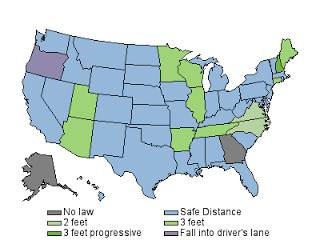
My favorite is Oregon whose law says you have to stay far enough away to avoid cyclists if he/she falls into the path of the vehicle.
Another great one is New Hampshire which requires a minimum of 3’. The distance increases from 3’ as the speed of the vehicle increases.
I intend to avoid Alaska, Georgia and DC for cycling; those states have no minimum passing laws. But then none of those states were high on my list to travel to, to ride!
Click on the link to see the laws and understand your rights as a cyclist and your responsibilities as a driver.
The League of American Cyclists has all bike laws listed on their website at Legal Program & Bike Laws has the passing information in chart form. See State Safe Passing Laws.
What do you think? Leave a comment.
If you like this let your friends know or post it on FaceBook, Twitter or LinkedIn
Copyright 2013 Recreation Law (720) Edit Law
Email: blog@rec-law.us
Twitter: RecreationLaw
Facebook: Rec.Law.Now
Facebook Page: Outdoor Recreation & Adventure Travel Law
Blog: www.recreation-law.com
Mobile Site: http://m.recreation-law.com
#RecreationLaw, #@RecreationLaw, #Cycling.Law #Fitness.Law, #Ski.Law, #Outside.Law, #Recreation.Law, #Recreation-Law.com, #Outdoor Law, #Recreation Law, #Outdoor Recreation Law, #Adventure Travel Law, #law, #Travel Law, #Jim Moss, #James H. Moss, #Attorney at Law, #Tourism, #Adventure Tourism, #Rec-Law, #Rec-Law Blog, #Recreation Law, #Recreation Law Blog, #Risk Management, #Human Powered, #Human Powered Recreation,# Cycling Law, #Bicycling Law, #Fitness Law, #Recreation-Law.com, #Backpacking, #Hiking, #Mountaineering, #Ice Climbing, #Rock Climbing, #Ropes Course, #Challenge Course, #Summer Camp, #Camps, #Youth Camps, #Skiing, #Ski Areas, #Negligence, #Snowboarding, #RecreationLaw, #@RecreationLaw, #Cycling.Law #Fitness.Law, #SkiLaw, #Outside.Law, #Recreation.Law, #RecreationLaw.com, #OutdoorLaw, #RecreationLaw, #OutdoorRecreationLaw, #AdventureTravelLaw, #Law, #TravelLaw, #JimMoss, #JamesHMoss, #AttorneyatLaw, #Tourism, #AdventureTourism, #RecLaw, #RecLawBlog, #RecreationLawBlog, #RiskManagement, #HumanPowered, #HumanPoweredRecreation,# CyclingLaw, #BicyclingLaw, #FitnessLaw, #RecreationLaw.com, #Backpacking, #Hiking, #Mountaineering, #IceClimbing, #RockClimbing, #RopesCourse, #ChallengeCourse, #SummerCamp, #Camps, #YouthCamps, #Skiing, #Ski Areas, #Negligence, #Snowboarding, sport and recreation laws, ski law, cycling law, Colorado law, law for recreation and sport managers, bicycling and the law, cycling and the law, ski helmet law, skiers code, skiing accidents, Recreation Lawyer, Ski Lawyer, Paddlesports Lawyer, Cycling Lawyer, Recreational Lawyer, Fitness Lawyer, Rec Lawyer, Challenge Course Lawyer, Ropes Course Lawyer, Zip Line Lawyer, Rock Climbing Lawyer, Adventure Travel Lawyer, Outside Lawyer, Recreation Lawyer, Ski Lawyer, Paddlesports Lawyer, Cycling Lawyer, #RecreationalLawyer, #FitnessLawyer, #RecLawyer, #ChallengeCourseLawyer, #RopesCourseLawyer, #ZipLineLawyer, #RockClimbingLawyer, #AdventureTravelLawyer, #OutsideLawyer, Cycling, Passing Laws, 3’ Passing Law, League of American Cyclists,
WordPress Tags: Easy,laws,Drivers,Cyclists,authors,Velo,Reviews,reference,vehicle,bike,Oregon,path,Another,Hampshire,Alaska,Georgia,Click,driver,Close,League,American,Legal,Program,information,State,Safe,Leave,FaceBook,Twitter,LinkedIn,Recreation,Edit,Email,RecreationLaw,Page,Outdoor,Adventure,Travel,Blog,Mobile,Site,Outside,Moss,James,Attorney,Tourism,Risk,Management,Human,Rock,Ropes,Course,Challenge,Summer,Camp,Camps,Youth,Areas,Negligence,SkiLaw,OutdoorLaw,OutdoorRecreationLaw,AdventureTravelLaw,TravelLaw,JimMoss,JamesHMoss,AttorneyatLaw,AdventureTourism,RecLaw,RecLawBlog,RecreationLawBlog,RiskManagement,HumanPoweredRecreation,CyclingLaw,BicyclingLaw,FitnessLaw,RopesCourse,ChallengeCourse,SummerCamp,YouthCamps,Colorado,managers,helmet,accidents,Lawyer,Paddlesports,Recreational,Line,RecreationalLawyer,FitnessLawyer,RecLawyer,ChallengeCourseLawyer,RopesCourseLawyer,ZipLineLawyer,RockClimbingLawyer,AdventureTravelLawyer,OutsideLawyer


 Recreation Law