
Skier/Boarder Fatalities 2011-2012 Ski Season 3/15/12
Posted: March 28, 2012 Filed under: Skiing / Snow Boarding | Tags: fatality, helmet, Inbounds, Ski, ski area, Ski Resort, snowboarding, Sport, Vail Colorado, Winter sport Leave a commentThis list is not guaranteed to be accurate. The information is found from web searches and news dispatches. If you have a source for information on any fatality please leave a comment.
If this information is incorrect or incomplete please let me know. This is up to date as of March 15, 2012. Thanks.
|
# |
Date |
Resort |
Age |
Skier Ability |
Ski/ Tele /Boarder |
Helmet |
Reference |
|
1 |
11/18/2011 |
62 |
Skier |
Yes |
|||
|
2 |
11/18/2011 |
Breckenridge |
19 |
Expert |
Boarder |
Yes |
|
|
3 |
11/27/2011 |
Mountain High ski resor |
23 |
Beginner |
Boarder |
Yes |
|
|
4 |
12/18/2011 |
Sugar Bowl ski resort |
7 |
Expert |
Skier |
||
|
6 |
1/11/2012 |
Ski Apache |
29 |
Skier |
No |
||
|
7 |
1/12/2012 |
Sugarloaf ski resort |
41 |
Skier |
Yes |
||
|
8 |
1/14/2012 |
Silverton Mountain Ski Area |
25 |
Expert |
Skier |
||
|
9 |
1/17/2012 |
Heavenly Mountain Resort |
34 |
Boarder |
Yes |
||
|
10 |
1/18/2012 |
Aspen Highlands |
30 |
Boarder |
Yes |
||
|
11 |
1/18/2012 |
Mt. Hood Meadows Ski Resort |
15 |
Boarder |
No |
||
|
12 |
1/19/2012 |
Park City |
29 |
Boarder |
Yes |
||
|
13 |
1/20/2012 |
Copper Mountain |
51 |
Yes |
|||
|
14 |
1/20/2012 |
Whiteface Mountain |
25 |
Yes |
|||
|
15 |
1/21/2012 |
Vail (skied into closed area) |
13 |
Expert |
Skier |
||
|
16 |
1/22/2012 |
Winter Park |
28 |
Expert |
Skier |
||
|
17 |
1/24/2012 |
Steamboat Ski Area |
32 |
Boarder |
|||
|
18 |
1/24/2012 |
Taos Ski Valley |
60 |
Skier |
|||
|
19 |
1/25/2012 |
Keystone Ski Area |
54 |
Skier |
|||
|
20 |
1/27/2012 |
Mt. Hood Skibowl |
17 |
Boarder |
|||
|
22 |
1/30/2012 |
Seven Springs Mountain Resort |
36 |
Skier |
|||
|
27 |
1/31/2012 |
Solitude Ski Resort |
74 |
Skier |
No |
||
|
23 |
2/1/2012 |
Squaw Valley |
51 |
Skier |
|||
|
26 |
2/4/2012 |
Sugarbush Resort |
41 |
Skier |
Yes |
||
|
33 |
2/4/2012 |
Ski Windham Mountain Resor |
54 |
Skier |
|||
|
24 |
2/5/2012 |
Keystone Ski Area |
58 |
Skier |
No |
||
|
30 |
2/6/2012 |
Mount Snow |
33 |
||||
|
28 |
2/8/2012 |
Vail |
37 |
Yes |
|||
|
29 |
2/9/2012 |
Keystone Ski Area |
72 |
Yes |
|||
|
31 |
2/11/2012 |
Jay Peak Resort |
29 |
Boarder |
Yes |
||
|
32 |
2/11/2012 |
Terry Peak Ski Area |
24 |
Skier |
No |
||
|
34 |
2/18/2012 |
Sun Valley |
http://rec-law.us/GB3TCy | ||||
|
35 |
2/19/2012 |
Copper Mountain |
15 |
Boarder |
Yes |
||
|
36 |
2/26/2012 |
Keystone Ski Area |
24 |
Yes |
|||
|
37 |
2/23/2012 |
Northstar California |
52 |
Yes |
|||
|
38 |
3/1/2012 |
Burke Mountain Ski Resort |
70 |
Yes |
|||
|
39 |
3/8/2012 |
Copper Mountain |
18 |
Skier |
Yes |
||
|
40 |
3/9/2012 |
Keystone Ski Area |
23 |
Skier |
No |
||
|
41 |
3/10/2012 |
Terry Peak Ski Area |
54 |
Skier |
|||
|
42 |
3/10/2012 |
Loveland Ski Area |
71 |
Skier |
No |
||
|
43 |
3/14/2012 |
Crested Butte Mountain Resort |
36 |
Skier |
No |
||
|
44 |
3/16/2012 |
Northstar California |
51 |
Skier |
Yes |
||
|
45 |
3/18/2012 |
China Peak Ski Resort |
30 |
Boarder |
|||
|
46 |
3/18/2012 |
Sierra-at-Tahoe |
54 |
Skier |
|||
|
47 |
3/19/2012 |
Sugar Bowl Ski Resort |
20 |
Boarder |
What do you think? Leave a comment.
If you like this let your friends know or post it on FB, Twitter or Linkedin
Copyright 2012 Recreation Law (720) Edit Law

Skier carving a turn off piste (Photo credit: Wikipedia)
Twitter: RecreationLaw
Facebook: Rec.Law.Now
Facebook Page: Outdoor Recreation & Adventure Travel Law
#RecreationLaw, #@RecreationLaw, #Cycling.Law #Fitness.Law, #Ski.Law, #Outside.Law, #Recreation.Law, #Recreation-Law.com, #Outdoor Law, #Recreation Law, #Outdoor Recreation Law, #Adventure Travel Law, #law, #Travel Law, #Jim Moss, #James H. Moss, #Attorney at Law, #Tourism, #Adventure Tourism, #Rec-Law, #Rec-Law Blog, #Recreation Law, #Recreation Law Blog, #Risk Management, #Human Powered, #Human Powered Recreation,# Cycling Law, #Bicycling Law, #Fitness Law, #Recreation-Law.com, #Backpacking, #Hiking, #Mountaineering, #Ice Climbing, #Rock Climbing, #Ropes Course, #Challenge Course, #Summer Camp, #Camps, #Youth Camps, #Skiing, #Ski Areas, #Negligence, #Snowboarding, #RecreationLaw, #@RecreationLaw, #Cycling.Law #Fitness.Law, #SkiLaw, #Outside.Law, #Recreation.Law, #RecreationLaw.com, #OutdoorLaw, #RecreationLaw, #OutdoorRecreationLaw, #AdventureTravelLaw, #Law, #TravelLaw, #JimMoss, #JamesHMoss, #AttorneyatLaw, #Tourism, #AdventureTourism, #RecLaw, #RecLawBlog, #RecreationLawBlog, #RiskManagement, #HumanPowered, #HumanPoweredRecreation,# CyclingLaw, #BicyclingLaw, #FitnessLaw, #RecreationLaw.com, #Backpacking, #Hiking, #Mountaineering, #IceClimbing, #RockClimbing, #RopesCourse, #ChallengeCourse, #SummerCamp, #Camps, #YouthCamps, #Skiing, #Ski Areas, #Negligence, #Snowboarding, sport and recreation laws, ski law, cycling law, Colorado law, law for recreation and sport managers, bicycling and the law, cycling and the law, ski helmet law, skiers code, skiing accidents, #Vail, #Breckenridge, #Mountain High Ski Resort, #Ski Ward, #Sugarloaf, #Silverton, Ski Apache, #Sugarloaft, #Heavenly, #Aspen, Mt Hood, Park City, #Copper, #Whiteface, Winter Park, #Steamboat, #Taos, #Keystone, #Canyons, Seven Springs, #Solitude, Ski Windham, Mount Snow, Jay Peak Terry Peak,
WordPress Tags: Skier,Boarder,Fatalities,Season,information,news,February,Thanks,Date,Resort,Tele,Helmet,Reference,Vail,Breckenridge,Expert,Mountain,High,Beginner,Sugar,Bowl,Ward,Apache,Sugarloaf,Silverton,Area,Aspen,Highlands,Meadows,Park,Copper,Whiteface,Winter,Steamboat,Taos,Valley,AihrSt,Skibowl,Canyons,Seven,Springs,Solitude,Squaw,Sugarbush,Windham,Resor,Mount,ABqYPQ,Peak,Terry,Northstar,California,Burke,ADkQWq,Loveland,Ajhcko,Butte,China,Sierra,Tahoe,GAucKe,Leave,Twitter,Linkedin,Recreation,Edit,RecreationLaw,Facebook,Page,Outdoor,Adventure,Travel,Blog,Outside,Moss,James,Attorney,Tourism,Risk,Management,Human,Rock,Ropes,Course,Challenge,Summer,Camp,Camps,Youth,Areas,Negligence,SkiLaw,OutdoorLaw,OutdoorRecreationLaw,AdventureTravelLaw,TravelLaw,JimMoss,JamesHMoss,AttorneyatLaw,AdventureTourism,RecLaw,RecLawBlog,RecreationLawBlog,RiskManagement,HumanPoweredRecreation,CyclingLaw,BicyclingLaw,FitnessLaw,RopesCourse,ChallengeCourse,SummerCamp,YouthCamps,Colorado,managers,accidents,Sugarloaft

Best of Outdoor Retailer and SIA
Posted: March 21, 2012 Filed under: Uncategorized | Tags: helmet, Kali, MIPS architecture, Recco, Ski, Ski Resort, Sports Leave a commentThe best is always the people. However I found some interesting products
12 days, 8 days of exhibit hall, 3 days of on-snow demos and another tradeshow season comes to an end.
Here’s a quick rundown of what I saw that I liked.
Slide On for ski boots: This product makes putting your ski boot on a breeze. From the maker of the Booster Power Strap. If you ski and you aren’t using the Booster Power Strap, try and get off the bunny slope and give them a try.
Nargear: Not a lot of bells and whistles, just make to take your gear and keep it in one bag, no matter how far you throw it.
Snow Angel: No I don’t wear women’s clothing, but this stuff is beautiful. Feels good too. You are on your own for finding out how technical it is.
MIPS: If you need a helmet for any sport that is not a DOT helmet, get one with MIPS inside. It may make the difference
Kali Helmets: Don’t like MIPS, Kali is coming up with some new ideas in helmet technology that will change the way helmets perform.
Protect Helmets: nothing new as far as the helmet goes, but they have the Recco chip in the helmet.
Bern Hard Hat: I’ve told you a thousand times A new idea that makes sense in helmets: the Bern Hard Hat
Ski Retriever: Skiing Powder all the time and don’t like leashes, try technology to not lose a ski.
Fox 40: Fox had mouth guards at the ski show. See A helmet manufacture understands the issues
UClear: I’ve not tested it but if the ear phones eliminate the wind noise and the microphone eliminates all noise, these will be great for people who move
Loki: Did you ever have a coat that you grabbed when you weren’t sure, but when in doubt you always grabbed it. Loki makes coats, sweatshirts and accessories, all that serve multi purposes.
Orthahell Sandals: Ever put something on your feet and have your feet put a smile on your face. In a sandal even.
Suunto: Supposedly they have a new watch that works, by that I mean won’t break in 60 days. We’ll see. Heck, the PR team is beautiful……
Timex: Hard to read, harder to understand how it works, but as John Cameron Sayze used to say, it takes a lickin’ and keeps on tickin’
Eton: A product that made me go wow. Solar powered stereo that you can Bluetooth from your phone or MP3. No need to add songs to another device. Don’t know if it can take the outdoor beating, but works great indoors.
Replay: video camera a little larger than a roll of quarters, but not much larger
Hyalite Equipment: New name, old company solid great gear, bags, pads and bike gear
The Dry Guy: If you don’t own something from the Dry Guy, you are skiing with wet gloves and boots. The latest is a heater & dryer for boots, the Turbo Dryer that can work off your car. Warm boots when you put them on to ski after driving to the resort. Wonderful.
I have a lot more stuff to let you know about, but some I want to make sure the marketing matches reality.
What do you think? Leave a comment.
If you like this let your friends know or post it on FB, Twitter or LinkedIn
Copyright 2012 Recreation Law (720) Edit Law
Twitter: RecreationLaw
Facebook: Rec.Law.Now
Facebook Page: Outdoor Recreation & Adventure Travel Law
Mobile Site: http://m.recreation-law.com
#RecreationLaw, #@RecreationLaw, #Cycling.Law #Fitness.Law, #Ski.Law, #Outside.Law, #Recreation.Law, #Recreation-Law.com, #Outdoor Law, #Recreation Law, #Outdoor Recreation Law, #Adventure Travel Law, #law, #Travel Law, #Jim Moss, #James H. Moss, #Attorney at Law, #Tourism, #Adventure Tourism, #Rec-Law, #Rec-Law Blog, #Recreation Law, #Recreation Law Blog, #Risk Management, #Human Powered, #Human Powered Recreation,# Cycling Law, #Bicycling Law, #Fitness Law, #Recreation-Law.com, #Backpacking, #Hiking, #Mountaineering, #Ice Climbing, #Rock Climbing, #Ropes Course, #Challenge Course, #Summer Camp, #Camps, #Youth Camps, #Skiing, #Ski Areas, #Negligence, #Snowboarding, #RecreationLaw, #@RecreationLaw, #Cycling.Law #Fitness.Law, #SkiLaw, #Outside.Law, #Recreation.Law, #RecreationLaw.com, #OutdoorLaw, #RecreationLaw, #OutdoorRecreationLaw, #AdventureTravelLaw, #Law, #TravelLaw, #JimMoss, #JamesHMoss, #AttorneyatLaw, #Tourism, #AdventureTourism, #RecLaw, #RecLawBlog, #RecreationLawBlog, #RiskManagement, #HumanPowered, #HumanPoweredRecreation,# CyclingLaw, #BicyclingLaw, #FitnessLaw, #RecreationLaw.com, #Backpacking, #Hiking, #Mountaineering, #IceClimbing, #RockClimbing, #RopesCourse, #ChallengeCourse, #SummerCamp, #Camps, #YouthCamps, #Skiing, #Ski Areas, #Negligence, #Snowboarding, sport and recreation laws, ski law, cycling law, Colorado law, law for recreation and sport managers, bicycling and the law, cycling and the law, ski helmet law, skiers code, skiing accidents, SIA, OR, Winter, Ski, Ski Show, Outdoor Retailer
WordPress Tags: Best,Outdoor,Retailer,products,hall,demos,Here,Slide,product,breeze,From,maker,Booster,Power,Strap,bunny,Nargear,gear,Angel,women,Feels,MIPS,helmet,difference,Kali,Helmets,technology,Protect,Recco,Bern,Hard,Powder,leashes,UClear,noise,Loki,purposes,Orthahell,Sandals,feet,Suunto,Heck,team,Timex,John,Cameron,Sayze,Eton,Solar,Bluetooth,songs,device,Replay,Hyalite,Equipment,bike,heater,Turbo,Dryer,Warm,resort,Wonderful,Leave,Twitter,LinkedIn,Recreation,Edit,RecreationLaw,Facebook,Page,Adventure,Travel,Blog,Mobile,Site,Outside,Moss,James,Attorney,Tourism,Risk,Management,Human,Rock,Ropes,Course,Challenge,Summer,Camp,Camps,Youth,Areas,Negligence,SkiLaw,OutdoorLaw,OutdoorRecreationLaw,AdventureTravelLaw,TravelLaw,JimMoss,JamesHMoss,AttorneyatLaw,AdventureTourism,RecLaw,RecLawBlog,RecreationLawBlog,RiskManagement,HumanPoweredRecreation,CyclingLaw,BicyclingLaw,FitnessLaw,RopesCourse,ChallengeCourse,SummerCamp,YouthCamps,Colorado,managers,accidents,Winter
CSCUSA PR reminds people to be safe
Posted: March 13, 2012 Filed under: Avalanche, Colorado, Ski Area | Tags: #Avalanche, #Safety, CAIC, Colorado, CSCUSA, Loveland Ski Area, Resort, Ski, ski area, skiing Leave a commentColorado Ski Country USA Reminds Skiers & Snowboarders to be Safe on the Slopes
Resorts Emphasize Safe Skiing, Prepare for Busy Holiday
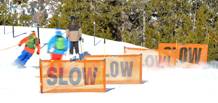
Aspen Highlands, Michael Neumann
DENVER, Colo. – February 17, 2012– Colorado Ski Country USA (CSCUSA) and its 22 member resorts remind skiers and snowboarders to practice safe skiing and riding, know and follow Your Responsibility Code, be aware of surroundings and obey terrain closures.
“Guest safety is always the number one priority of our members,” explained Melanie Mills, CSCUSA president and CEO. “President’s Day weekend is a popular time to go skiing, and our resorts are doing absolutely everything they can to make sure guests are safe and have an enjoyable time on the slopes during this busy weekend.”
Individual skier and snowboarder responsibility is the foundation for safe skiing. Loveland Ski Area assistant patrol director and CSCUSA Ski Patroller of the Year, Joey Riefenberg, stresses the importance of being aware of your surroundings, “Skiers and snowboarders need to be proactive about safety, pay attention to who is skiing around you and always look downhill. Go slow and give yourself time to stop. Know that little kids are out and about and need a wide berth, watch where the flows are.”
CSCUSA member resorts across the state are taking extra measures to provide safe skiing environments, including constantly reassessing conditions. “Resorts are working super hard to make sure it’s safe. Everyone is super conscientious of that, and the snowpack,” said Riefenberg. “It’s a funny snowpack this year, really odd, and resorts are on alert, busy knocking all the air out of the snowpack and making sure everything is safe.”
Skiers and snowboarders are also reminded to obey all signage and be especially alert to obeying terrain closures. As snow continues to fall in Ski Country, resorts will open more terrain as conditions safely allow. “We’d love to open everything but things are closed for a reason, because it’s unsafe for you and unsafe for those who have to rescue you,” Riefenberg explained. “Nothing is being saved, we want everyone to have fun, but be safe doing it.”
Ultimately, it is the responsible behavior of skiers and riders that make the slopes safe. Knowing the nationally recognized Your Responsibility Code is crucial to skier and rider responsibility. Referred to simply as The Code, it is comprised of seven principles that collectively outline on-mountain skier etiquette and safe skiing practices.
Responsibilities within The Code include:
Image via Wikipedia
- Always stay in control, and be able to stop or avoid other people or objects.
- People ahead of you have the right of way. It is your responsibility to avoid them.
- You must not stop where you obstruct a trail, or are not visible from above.
- Whenever starting downhill or merging into a trail, look uphill and yield to others.
- Always use devices to help prevent runaway equipment.
- Observe all posted signs and warnings. Keep off closed trails and out of closed areas.
- Prior to using any lift, you must have the knowledge and ability to load, ride and unload safely.
CSCUSA also reminds skiers, snowboarders and other snowsports enthusiasts heading into the backcountry to check with the Colorado Avalanche Information Center (CAIC) on the magnitude and nature of avalanche hazard they may encounter, do not venture out alone, and have proper equipment and education for the conditions. “Backcountry avalanche danger right now is considerable,” states Ethan Greene, director of CAIC. “With the holiday weekend there’s going to be powder snow and nice weather, but don’t be fooled that the hazard is anything less than very serious.”
More information on backcountry conditions can be found at the CAIC website, www.avalanche.state.co.us or by calling 303-499-9650.

New study suggests that North American Avalanche survival time is half what was previously thought
Posted: March 7, 2012 Filed under: Avalanche | Tags: avalanche, Avalanche Study, Burial Time, Canada, Canadian Medical Association Journal, Haegeli, Pascal Haegeli, Recreation, Ski, Survival, Survival Time, Switzerland, Tree Line Leave a commentTen minute survival in western wet snow is shown by the study.
Dr. Pascal Haegeli, a researcher from Vancouver BC has recently published a study in the Canadian Medical Association Journal titled “Comparison of avalanche survival patterns in Canada and Switzerland.” There are several notable things to take away from this study.
1. The survival time for a victim in an avalanche has been 18 minutes based on a study done in Switzerland in 1998. (Falk M, Brugger H, Adler-Kastner L. Avalanche survival chances. Nature 1994;368:21.) This 1998 study is not being dismissed. Differences between the types of snow, terrain, etc. are the cause for the discrepancies between the two studies.
This study says that avalanche survival time is probably only Ten (10) minutes.
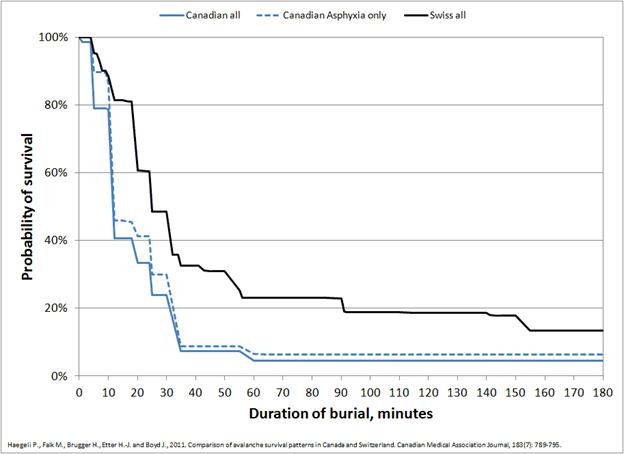
The Swiss study developed the avalanche survival curve based on the amount of time a person was buried.
The probability of survival remains above 91% during the first 18 minutes of burial (“survival phase”). This phase is followed by a precipitous drop to 34% between 19 and 35 minutes be – cause of asphyxiation of most people (“asphyxia phase”). Between 35 and 90 minutes, the survival curve levels out (“latent phase”) because of the survival of people with patent airways. Thereafter, survival drops again as those buried eventually succumb to lethal hypothermia complicated by progressive hypoxia and hypercapnia.
2. There was no statistical difference between the overall survival rate of the Canadian study (Haegeli) and the Swiss study (Brugger).
…the Canadian survival curve showed lower chances of survival at all burial durations compared with the Swiss survival model, with a quicker drop in survival in the first 35 minutes and poorer survival associated with prolonged burials.
3. Most Swiss avalanches occur above tree line. Most North American avalanches occur below the tree line. Trauma fatalities are significantly greater in North America.
In the Canadian sample, trauma accounted for more than half of the deaths among people extricated in the first 10 minutes (Figure 1), which highlights the strong influence of trauma on the early phases of the survival curve. The probability of survival at the end of the first 10 minutes was 77% in the overall survival curve for Canada, as compared with 86% in the asphyxia-only survival curve.
4. There were statistically different survival chances between different climates in North America. Western (maritime) snow climates had shorter overall survival times. Western snow climates are characterized by wetter, heavier snow.
The survival curves for the transitional and maritime snow climates were characterized by a considerably earlier drop in survival compared with the curve for the continental snow climate.
The study also offered speculation that heavier denser snow prevented chest movement preventing the victim from breathing if buried.
Snow density is defined as the overall mass of snow per unit volume (kilograms per meter cubed). Typical densities of seasonal snow vary from 30 kg/m in dry, newly fallen snow to 600 kg/m in wet spring snow.
These results highlight the importance of prompt extrication by companions, especially in areas with a more maritime snow climate. Although the “survival phase” has commonly been described to be about 18 minutes long, our analysis shows that the first 10 minutes might be a more appropriate general guideline for Canada and other areas with a maritime snow climate.

5. The study recommended that Airbags and Transceivers be used as they offered the best options to speed up rescue.
The use of avalanche airbags to prevent burial and avalanche transceivers to speed up the locations of buried avalanche victims are recommended. Both of these safety devices have been shown to reduce mortality significantly.
The study had numerous interesting facts about avalanche burials.
The two longest burials among survivors in the Canadian sample (120 and 300 minutes) both occurred in urban settings, whereas the maximum burial time among survivors in a remote setting was 55 minutes.
So?
When teaching at Colorado Mountain College in the Ski Area Operations program I tell my students the one thing we know about avalanches to an absolute certainty: Avalanches are made of snow.
For other articles on Avalanches see:
Research shows beacons have issues with multivictim searches
Colorado Avalanche Information Center
It’s time to sign up to get the CAIC Avalanche Forecasts
Well written article about the risks of Avalanches and survival with the latest gear.
See this article by Earn Your Turns: Canadian Study reduces Avalanche Survival Time, http://www.earnyourturns.com/9079/avalanche-survival-time-reduced/
What do you think? Leave a comment.
If you like this let your friends know or post it on FB, Twitter or LinkedIn
Copyright 2012 Recreation Law (720) Edit Law
Twitter: RecreationLaw
Facebook: Rec.Law.Now
Facebook Page: Outdoor Recreation & Adventure Travel Law
Mobile Site: http://m.recreation-law.com
#RecreationLaw, #@RecreationLaw, #Cycling.Law #Fitness.Law, #Ski.Law, #Outside.Law, #Recreation.Law, #Recreation-Law.com, #Outdoor Law, #Recreation Law, #Outdoor Recreation Law, #Adventure Travel Law, #law, #Travel Law, #Jim Moss, #James H. Moss, #Attorney at Law, #Tourism, #Adventure Tourism, #Rec-Law, #Rec-Law Blog, #Recreation Law, #Recreation Law Blog, #Risk Management, #Human Powered, #Human Powered Recreation,# Cycling Law, #Bicycling Law, #Fitness Law, #Recreation-Law.com, #Backpacking, #Hiking, #Mountaineering, #Ice Climbing, #Rock Climbing, #Ropes Course, #Challenge Course, #Summer Camp, #Camps, #Youth Camps, #Skiing, #Ski Areas, #Negligence, #Snowboarding, #RecreationLaw, #@RecreationLaw, #Cycling.Law #Fitness.Law, #SkiLaw, #Outside.Law, #Recreation.Law, #RecreationLaw.com, #OutdoorLaw, #RecreationLaw, #OutdoorRecreationLaw, #AdventureTravelLaw, #Law, #TravelLaw, #JimMoss, #JamesHMoss, #AttorneyatLaw, #Tourism, #AdventureTourism, #RecLaw, #RecLawBlog, #RecreationLawBlog, #RiskManagement, #HumanPowered, #HumanPoweredRecreation,# CyclingLaw, #BicyclingLaw, #FitnessLaw, #RecreationLaw.com, #Backpacking, #Hiking, #Mountaineering, #IceClimbing, #RockClimbing, #RopesCourse, #ChallengeCourse, #SummerCamp, #Camps, #YouthCamps, #Skiing, #Ski Areas, #Negligence, #Snowboarding, sport and recreation laws, ski law, cycling law, Colorado law, law for recreation and sport managers, bicycling and the law, cycling and the law, ski helmet law, skiers code, skiing accidents, #Avalanche, Avalanche Study, Pascal Haegeli, #Vancouver, #BC, Canadian Medical Association Journal, #Haegeli, #CMAJ, #CMA, Survival Rate, #Study,
WordPress Tags: North,American,Avalanche,survival,western,Pascal,Haegeli,researcher,Vancouver,Canadian,Medical,Association,Journal,Comparison,Canada,Switzerland,victim,Falk,Brugger,Adler,Kastner,Nature,Differences,terrain,discrepancies,Swiss,person,burial,phase,asphyxiation,asphyxia,airways,Thereafter,difference,durations,burials,Most,avalanches,tree,Trauma,America,deaths,Figure,phases,climates,climate,speculation,chest,unit,meter,Typical,densities,importance,extrication,companions,areas,Although,analysis,guideline,Airbags,Transceivers,options,locations,victims,Both,survivors,settings,Colorado,Mountain,College,Area,Operations,students,Magazine,families,Research,beacons,Information,Center,CAIC,Forecasts,article,gear,Leave,Twitter,LinkedIn,Recreation,Edit,RecreationLaw,Facebook,Page,Outdoor,Adventure,Travel,Blog,Mobile,Site,Outside,Moss,James,Attorney,Tourism,Risk,Management,Human,Rock,Ropes,Course,Challenge,Summer,Camp,Camps,Youth,Negligence,SkiLaw,OutdoorLaw,OutdoorRecreationLaw,AdventureTravelLaw,TravelLaw,JimMoss,JamesHMoss,AttorneyatLaw,AdventureTourism,RecLaw,RecLawBlog,RecreationLawBlog,RiskManagement,HumanPoweredRecreation,CyclingLaw,BicyclingLaw,FitnessLaw,RopesCourse,ChallengeCourse,SummerCamp,YouthCamps,managers,helmet,accidents,Study,CMAJ,Rate
Costs, when you win a lawsuit you normally can recover your costs
Posted: March 5, 2012 Filed under: Ski Area, Skiing / Snow Boarding | Tags: Alpine Meadows, California, Outdoors, Recreation, Rock climbing, Ski, Ski Resort, Snowboard, snowboarding Leave a commentGregorie v. Alpine Meadows Ski Corporation, 2011 U.S. Dist. LEXIS 20275
Costs do not include attorney fees
This case is a lawsuit by the parents of a 24-year-old girl who died snowboarding. The father, in response to her death founded the California Ski & Snowboard Association (CSSO as set forth by the court and California Ski and Snowboard Safety Organization based on their website). An association allegedly started to make ski areas safer. However, the young girl died out of bounds.
The girl and her friend were hiking out of bounds. On the way, they passed two signs warning people of the dangers. While on the High Beaver Tavers she slipped, slid out of bounds and died.
The girl signed a release before skiing at Alpine Meadows in California. On top of that she was described as an experienced snowboarder.
California Ski & Snowboard Association (CSSO) is an organization that I have written about as a wolf in sheep’s clothing (or maybe it should be skin or wool). Originally, the organization came across as wanting to work with ski areas to make them safer. See Grieving Father starts organization to make skiing safer and California Ski and Snowboard Safety Organization turns out to be a Wolf in Sheep’s Clothing.
Recently, the organization has changed its mission to:
Mission
To promote and support safety improvements in California skiing, snowboarding and recreational snow sports and serve as an independent, factual public resource regarding the safety of California ski resorts.
Vision
A recreational skiing and snowboarding environment in which federal and state governments, health and safety organizations and the ski resort industry are proactively and collaboratively working to establish and maintain the safest possible snow sport environment and experience.
Summary of the case
The plaintiffs sued for Premise’s liability, misrepresentation of the risk, negligence, breach of the season pass agreement, two claims of rescission and declaratory relief.
Rescission is a contract claim that attempts to void the contract and place the parties back in the position they were in prior to the signing of the contract. To win a claim for rescission the party wanting out of the agreement must claim material misstatement of the issues creating the contract, or something akin to fraud or misrepresentation.
The defendants filed a motion for summary judgment based on the release (express assumption of the risk) and primary assumption of the risk. The trial court granted the defendants motion and dismissed the claims of the plaintiff.
As is normal, the defendant then filed a bill of costs. This is a motion to recover their costs they expended in defending the lawsuit. Costs are normally granted to the winning party in a suit.
Costs are the actual money spent for things necessary to defend the suit. In federal court, costs are set out by statute.
Federal Rule of Civil Procedure 54(d)(1)
(1) Fees of the clerk and marshal;
(2) [*5] Fees for printed or electronically recorded transcripts necessarily obtained for use in the case;
(3) Fees and disbursements for printing and witnesses;
(4) Fees for exemplification and the costs of making copies of any materials where the copies are necessarily obtained for use in the case;
(5) Docket fees under section 1923 of this title
(6) Compensation of court appointed experts, compensation of interpreters, and salaries, fees, expenses, and costs of special interpretation services under section 1828 of this title.
A better way to look at costs is; those things the party wrote a check to, necessary to litigate.
Costs do not include attorney fees. To recover attorney fees, there must be a violation of a state statute that awarded costs, a contract that awards costs or liquidated damages or an action (claim) by one side or the other that is frivolous, groundless and wholly without any legal merit. “Rule 54(d)(1) provides that costs, “other than attorney’s fees shall be allowed as of course to the prevailing party unless the court otherwise directs.”
Costs are up to the discretion of the court. Normally, the court will allow most costs if the costs were specifically part of the trial or litigation. I look at it this way. If the judge saw the results of what you paid for, then that might be costs.
On the other hand, if money was spent on something that only might or did lead to what the judge might see, then probably not allowed as costs.). “If the depositions are for investigatory or for discovery purposes only, rather than for presentation of the case, courts have found that they are not taxable.”
The decision looks at several of the items the trial court allowed as costs. The original order allowing costs was $72,515.36. The court found that only $51,042.76 of the amount should have been allowed.
So Now What?
There are several interesting issues that are just good to know if you run a ski area or any recreation business. The deposition of the father took three days. Part of that deposition concerned the organization he started, California Ski & Snowboard Association (CSSO); however, no matter why, think about losing three days out of the office for deposition and probably another six days preparing for the deposition. Nine days total for something that if you work hard in the beginning, might have been prevented.
The expert witness of the plaintiff testified for two days. That would be an expensive two days. You and/or your insurance company would be paying probably two lawyers to attend the deposition and paying your expert witness to be questioned. Even if you are not having your expert deposed, just an employee, you are paying the employee to be there. Simply put, depositions on one side or the other can easily cost $1000 per hour.
Winning or losing a lawsuit, is an expensive proposition. Usually, the costs awarded by the court are less than 50% of the actual costs spent. Add to that the time incurred to defend a lawsuit, and it is ridiculous.
What do you think? Leave a comment.
If you like this let your friends know or post it on FB, Twitter or LinkedIn
Copyright 2012 Recreation Law (720) Edit Law
Twitter: RecreationLaw
Facebook: Rec.Law.Now
Facebook Page: Outdoor Recreation & Adventure Travel Law
Mobile Site: http://m.recreation-law.com
#RecreationLaw, #@RecreationLaw, #Cycling.Law #Fitness.Law, #Ski.Law, #Outside.Law, #Recreation.Law, #Recreation-Law.com, #Outdoor Law, #Recreation Law, #Outdoor Recreation Law, #Adventure Travel Law, #law, #Travel Law, #Jim Moss, #James H. Moss, #Attorney at Law, #Tourism, #Adventure Tourism, #Rec-Law, #Rec-Law Blog, #Recreation Law, #Recreation Law Blog, #Risk Management, #Human Powered, #Human Powered Recreation,# Cycling Law, #Bicycling Law, #Fitness Law, #Recreation-Law.com, #Backpacking, #Hiking, #Mountaineering, #Ice Climbing, #Rock Climbing, #Ropes Course, #Challenge Course, #Summer Camp, #Camps, #Youth Camps, #Skiing, #Ski Areas, #Negligence, #Snowboarding, #RecreationLaw, #@RecreationLaw, #Cycling.Law #Fitness.Law, #SkiLaw, #Outside.Law, #Recreation.Law, #RecreationLaw.com, #OutdoorLaw, #RecreationLaw, #OutdoorRecreationLaw, #AdventureTravelLaw, #Law, #TravelLaw, #JimMoss, #JamesHMoss, #AttorneyatLaw, #Tourism, #AdventureTourism, #RecLaw, #RecLawBlog, #RecreationLawBlog, #RiskManagement, #HumanPowered, #HumanPoweredRecreation,# CyclingLaw, #BicyclingLaw, #FitnessLaw, #RecreationLaw.com, #Backpacking, #Hiking, #Mountaineering, #IceClimbing, #RockClimbing, #RopesCourse, #ChallengeCourse, #SummerCamp, #Camps, #YouthCamps, #Skiing, #Ski Areas, #Negligence, #Snowboarding, sport and recreation laws, ski law, cycling law, Colorado law, law for recreation and sport managers, bicycling and the law, cycling and the law, ski helmet law, skiers code, skiing accidents, California Ski & Snowboard Association, CSSO, Alpine Meadows, fatality, snowboarding, costs,
WordPress Tags: Costs,lawsuit,Gregorie,Alpine,Meadows,Corporation,Dist,LEXIS,attorney,parents,girl,response,death,California,Snowboard,Association,CSSO,Organization,areas,friend,dangers,High,Beaver,Tavers,sheep,wool,Father,Wolf,mission,improvements,resource,resorts,Vision,environment,governments,health,resort,industry,Summary,plaintiffs,Premise,misrepresentation,negligence,agreement,relief,Rescission,fraud,defendants,judgment,assumption,plaintiff,defendant,money,statute,Federal,Rule,Civil,Procedure,Fees,clerk,transcripts,disbursements,Docket,Compensation,experts,interpreters,salaries,interpretation,violation,action,discretion,litigation,discovery,purposes,presentation,decision,items,area,recreation,Part,office,Nine,insurance,lawyers,employee,cost,hour,proposition,Leave,Twitter,LinkedIn,Edit,RecreationLaw,Facebook,Page,Outdoor,Adventure,Travel,Blog,Mobile,Site,Outside,Moss,James,Tourism,Risk,Management,Human,Rock,Ropes,Course,Challenge,Summer,Camp,Camps,Youth,SkiLaw,OutdoorLaw,OutdoorRecreationLaw,AdventureTravelLaw,TravelLaw,JimMoss,JamesHMoss,AttorneyatLaw,AdventureTourism,RecLaw,RecLawBlog,RecreationLawBlog,RiskManagement,HumanPoweredRecreation,CyclingLaw,BicyclingLaw,FitnessLaw,RopesCourse,ChallengeCourse,SummerCamp,YouthCamps,Colorado,managers,helmet,accidents,three
Skier/Boarder Fatalities 2011-2012 Ski Season 2/15/12
Posted: February 29, 2012 Filed under: Ski Area | Tags: Fatalities, helmet, Rock climbing, Ski, ski area, Ski Resort, skiing, Snowboard, snowboarding, Sport, Sports, Vail Colorado, Winter sport, winter sports Leave a commentThis list is not guaranteed to be accurate. The information is found from web searches and news dispatches. If you have a source for information on any fatality please leave a comment.
If this information is incorrect or incomplete please let me know. This is up to date as of February 15, 2012. Thanks.
|
# |
Date |
Resort |
Age |
Skier Ability |
Ski/ Tele /Boarder |
Reference |
|
|
1 |
11/18/2011 |
62 |
Skier |
Yes |
|||
|
2 |
11/18/2011 |
Breckenridge |
19 |
Expert |
Boarder |
Yes |
|
|
3 |
11/27/2011 |
Mountain High ski resor |
23 |
Beginner |
Boarder |
Yes |
|
|
4 |
12/18/2011 |
Sugar Bowl ski resort |
7 |
Expert |
Skier |
|
|
|
5 |
1/4/2012 |
Ski Ward |
19 |
Expert |
Skier |
||
|
6 |
1/11/2012 |
Ski Apache |
29 |
Skier |
No |
||
|
7 |
1/12/2012 |
Sugarloaf ski resort |
41 |
Skier |
Yes |
||
|
8 |
1/14/2012 |
Silverton Mountain Ski Area |
25 |
Expert |
Skier |
||
|
9 |
1/17/2012 |
Heavenly Mountain Resort |
34 |
Boarder |
Yes |
||
|
10 |
1/18/2012 |
Aspen Highlands |
30 |
Boarder |
Yes |
||
|
11 |
1/18/2012 |
Mt. Hood Meadows Ski Resort |
15 |
Boarder |
No |
||
|
12 |
1/19/2012 |
Park City |
29 |
Boarder |
Yes |
||
|
13 |
1/20/2012 |
Copper Mountain |
51 |
Yes |
|||
|
14 |
1/20/2012 |
Whiteface Mountain |
25 |
Yes |
|||
|
15 |
1/21/2012 |
Vail |
13 |
Expert |
Skier |
||
|
16 |
1/22/2012 |
Winter Park |
28 |
Expert |
Skier |
||
|
17 |
1/24/2012 |
Steamboat Ski Area |
32 |
Boarder |
|||
|
18 |
1/24/2012 |
Taos Ski Valley |
60 |
Skier |
|||
|
19 |
1/25/2012 |
Keystone Ski Area |
54 |
Skier |
|||
|
20 |
1/27/2012 |
Mt. Hood Skibowl |
17 |
Boarder |
|||
|
21 |
1/29/2012 |
Canyons Ski Resort |
19 |
||||
|
22 |
1/30/2012 |
Seven Springs Mountain Resort |
36 |
Skier |
|||
|
27 |
1/31/2012 |
Solitude Ski Resort |
74 |
Skier |
No |
||
|
23 |
2/1/2012 |
Squaw Valley |
51 |
Skier |
|||
|
26 |
2/4/2012 |
Sugarbush Resort |
41 |
Skier |
Yes |
||
|
33 |
2/4/2012 |
Ski Windham Mountain Resor |
54 |
Skier |
|||
|
24 |
2/5/2012 |
Keystone Ski Area |
58 |
Skier |
No |
||
|
25 |
2/5/2012 |
Ski Windham Mountain Resort |
54 |
Skier |
|||
|
30 |
2/6/2012 |
Mount Snow |
33 |
||||
|
28 |
2/8/2012 |
Vail |
37 |
Yes |
|||
|
29 |
2/9/2012 |
Keystone Ski Area |
72 |
Yes |
|||
|
31 |
2/11/2012 |
Jay Peak Resort |
29 |
Boarder |
Yes |
||
|
32 |
2/11/2012 |
Terry Peak Ski Area |
24 |
Skier |
No |
What do you think? Leave a comment.
If you like this let your friends know or post it on FB, Twitter or Linkedin
Copyright 2012 Recreation Law (720) Edit Law
Twitter: RecreationLaw
Facebook: Rec.Law.Now
Facebook Page: Outdoor Recreation & Adventure Travel Law
#RecreationLaw, #@RecreationLaw, #Cycling.Law #Fitness.Law, #Ski.Law, #Outside.Law, #Recreation.Law, #Recreation-Law.com, #Outdoor Law, #Recreation Law, #Outdoor Recreation Law, #Adventure Travel Law, #law, #Travel Law, #Jim Moss, #James H. Moss, #Attorney at Law, #Tourism, #Adventure Tourism, #Rec-Law, #Rec-Law Blog, #Recreation Law, #Recreation Law Blog, #Risk Management, #Human Powered, #Human Powered Recreation,# Cycling Law, #Bicycling Law, #Fitness Law, #Recreation-Law.com, #Backpacking, #Hiking, #Mountaineering, #Ice Climbing, #Rock Climbing, #Ropes Course, #Challenge Course, #Summer Camp, #Camps, #Youth Camps, #Skiing, #Ski Areas, #Negligence, #Snowboarding, #RecreationLaw, #@RecreationLaw, #Cycling.Law #Fitness.Law, #SkiLaw, #Outside.Law, #Recreation.Law, #RecreationLaw.com, #OutdoorLaw, #RecreationLaw, #OutdoorRecreationLaw, #AdventureTravelLaw, #Law, #TravelLaw, #JimMoss, #JamesHMoss, #AttorneyatLaw, #Tourism, #AdventureTourism, #RecLaw, #RecLawBlog, #RecreationLawBlog, #RiskManagement, #HumanPowered, #HumanPoweredRecreation,# CyclingLaw, #BicyclingLaw, #FitnessLaw, #RecreationLaw.com, #Backpacking, #Hiking, #Mountaineering, #IceClimbing, #RockClimbing, #RopesCourse, #ChallengeCourse, #SummerCamp, #Camps, #YouthCamps, #Skiing, #Ski Areas, #Negligence, #Snowboarding, sport and recreation laws, ski law, cycling law, Colorado law, law for recreation and sport managers, bicycling and the law, cycling and the law, ski helmet law, skiers code, skiing accidents, #Vail, #Breckenridge, #Mountain High Ski Resort, #Ski Ward, #Sugarloaf, #Silverton, Ski Apache, #Sugarloaft, #Heavenly, #Aspen, Mt Hood, Park City, #Copper, #Whiteface, Winter Park, #Steamboat, #Taos, #Keystone, #Canyons, Seven Springs, #Solitude, Ski Windham, Mount Snow, Jay Peak Terry Peak,
WordPress Tags: Skier,Boarder,Fatalities,Season,information,news,February,Thanks,Date,Resort,Tele,Helmet,Reference,Vail,Breckenridge,Expert,Mountain,High,Beginner,Sugar,Bowl,Ward,Apache,Sugarloaf,Silverton,Area,Aspen,Highlands,Meadows,Park,Copper,Whiteface,Winter,Steamboat,Taos,Valley,AihrSt,Skibowl,Canyons,Seven,Springs,Solitude,Squaw,Sugarbush,Windham,Resor,Mount,ABqYPQ,Peak,Terry,Leave,Twitter,Linkedin,Recreation,Edit,RecreationLaw,Facebook,Page,Outdoor,Adventure,Travel,Blog,Outside,Moss,James,Attorney,Tourism,Risk,Management,Human,Rock,Ropes,Course,Challenge,Summer,Camp,Camps,Youth,Areas,Negligence,SkiLaw,OutdoorLaw,OutdoorRecreationLaw,AdventureTravelLaw,TravelLaw,JimMoss,JamesHMoss,AttorneyatLaw,AdventureTourism,RecLaw,RecLawBlog,RecreationLawBlog,RiskManagement,HumanPoweredRecreation,CyclingLaw,BicyclingLaw,FitnessLaw,RopesCourse,ChallengeCourse,SummerCamp,YouthCamps,Colorado,managers,accidents,Sugarloaft
Headlines about Canada ski injuries is very misleading.
Posted: February 15, 2012 Filed under: Skiing / Snow Boarding | Tags: Canada, Canadian Institute for Health Information, Hockey, Hospital, Ice skating, Ski, Snowmobile, Sport 1 CommentActual report does not take into account participants and uses skiing just to get press, not because it is the worst sport.
This study, when you read the headline implies one idea: Skiing is dangerous. When you read the article, you get a completely reverse opinion of what the study reports. More importantly, the study is being used for an agenda rather than a way to either reduce or study injuries.
The study looked at winter sports injuries in Canada. It is a simple study showing how many hospital visits occurred each winter based on various activities. From the study, the headlines looked at these two groups of numbers.
Slopes-Related Injuries 2,300
Hockey Players 1,114
The headline then stated that slope injuries were twice as dangerous as hockey. Right off the bat, though you see an issue. This is just a total number of hospital visits. It means nothing, unless you know how many people participated in the sport or how many hour’s participants spent on the sport. Unless, and it very well may be possible, the number of people skiing and boarding in Canada equaled the number of people playing hockey, then the numbers really don’t point to anything. The numbers definitely do not point out that skiing and boarding is twice as dangerous as hockey.
After some more reading, more numbers pop to the surface.
Snowmobiling 1,126
Ice Skating 889
Tobogganing 171
Snowmobiling creates more hospital stays than hockey. However, hockey is the measurement that the criteria are compared to. Is this because everyone in Canada understands the real risks of hockey? Or is hockey perceived as a dangerous sport.
If the cause for the headline is the latter, then the headline was just made to get your attention. Snowmobiling is half as dangerous as skiing and riding so why was snowmobiling not used as the comparison.
Then the bomb shell drops. All of these sports combined do not make up 10% of the other winter sports injuries.
However, the hospitalization numbers pale in comparison to people who were simply injured by winter activities.
In Ontario alone, the report says, there were more than 45,000 emergency department visits — 285 a day — due to winter activities in 2010-2011.
And that’s just the tip of the iceberg, Fortin says, given that many of the hurt would have visited family doctors, walk-in clinics or just suffered through their injuries.
If you dig through the article, you gather these stats.
|
Slopes-Related Injuries (Skiing/Boarding) |
2,300 |
|
Snowmobiling |
1,126 |
|
Hockey Players |
1,114 |
|
Ice Skating |
889 |
|
Tobogganing |
171 |
|
Total |
5,600 |
5600 injuries in five sports nationwide are nothing compared to 45000 in just one city alone. Twenty days in Ontario and those injuries exceed the ones the false headline was blaring about.
There were some relevant points that could be pulled from the report.
1. Injuries remained relatively constant over the five years of the report for all five sports.
a. However, this number still has more value if compared to the overall number of participants. If participating went up or down that changes the fact the injuries were constant.
2. The age group with the largest number of injuries was young males between the ages of 10 and 19.
3. 33% of the head injuries in all five sports came from skiing and snowboarding.
a. There were 759 head injuries over the past five years on the slopes showing a decrease in head injuries…. Maybe.
So? Think
You cannot take headlines at face value. EVEN MINE! Headlines get you to read the article, and that is their sole purposes. You have to understand what the article is trying to say, where the information that makes up the article comes from and maybe, what is the writer trying to accomplish.
See Skiing injuries lead to twice as many hospital stays as hockey, new data shows
What do you think? Leave a comment.
If you like this let your friends know or post it on FB, Twitter or LinkedIn
Copyright 2012 Recreation Law (720) Edit Law
Twitter: RecreationLaw
Facebook: Rec.Law.Now
Facebook Page: Outdoor Recreation & Adventure Travel Law
Mobile Site: http://m.recreation-law.com
#RecreationLaw, #@RecreationLaw, #Cycling.Law #Fitness.Law, #Ski.Law, #Outside.Law, #Recreation.Law, #Recreation-Law.com, #Outdoor Law, #Recreation Law, #Outdoor Recreation Law, #Adventure Travel Law, #law, #Travel Law, #Jim Moss, #James H. Moss, #Attorney at Law, #Tourism, #Adventure Tourism, #Rec-Law, #Rec-Law Blog, #Recreation Law, #Recreation Law Blog, #Risk Management, #Human Powered, #Human Powered Recreation,# Cycling Law, #Bicycling Law, #Fitness Law, #Recreation-Law.com, #Backpacking, #Hiking, #Mountaineering, #Ice Climbing, #Rock Climbing, #Ropes Course, #Challenge Course, #Summer Camp, #Camps, #Youth Camps, #Skiing, #Ski Areas, #Negligence, #Snowboarding, #RecreationLaw, #@RecreationLaw, #Cycling.Law #Fitness.Law, #SkiLaw, #Outside.Law, #Recreation.Law, #RecreationLaw.com, #OutdoorLaw, #RecreationLaw, #OutdoorRecreationLaw, #AdventureTravelLaw, #Law, #TravelLaw, #JimMoss, #JamesHMoss, #AttorneyatLaw, #Tourism, #AdventureTourism, #RecLaw, #RecLawBlog, #RecreationLawBlog, #RiskManagement, #HumanPowered, #HumanPoweredRecreation,# CyclingLaw, #BicyclingLaw, #FitnessLaw, #RecreationLaw.com, #Backpacking, #Hiking, #Mountaineering, #IceClimbing, #RockClimbing, #RopesCourse, #ChallengeCourse, #SummerCamp, #Camps, #YouthCamps, #Skiing, #Ski Areas, #Negligence, #Snowboarding, sport and recreation laws, ski law, cycling law, Colorado law, law for recreation and sport managers, bicycling and the law, cycling and the law, ski helmet law, skiers code, skiing accidents, hospital, hospital visits, skiing, snowboarding, hockey, Canada,
WordPress Tags: Headlines,Canada,injuries,Actual,account,participants,article,opinion,agenda,winter,hospital,From,Slopes,Hockey,Players,hour,measurement,criteria,attention,comparison,Ontario,department,Fortin,clinics,Total,fact,males,Maybe,Think,MINE,purposes,information,writer,data,Leave,Twitter,LinkedIn,Recreation,Edit,RecreationLaw,Facebook,Page,Outdoor,Adventure,Travel,Blog,Mobile,Site,Outside,Moss,James,Attorney,Tourism,Risk,Management,Human,Rock,Ropes,Course,Challenge,Summer,Camp,Camps,Youth,Areas,Negligence,SkiLaw,OutdoorLaw,OutdoorRecreationLaw,AdventureTravelLaw,TravelLaw,JimMoss,JamesHMoss,AttorneyatLaw,AdventureTourism,RecLaw,RecLawBlog,RecreationLawBlog,RiskManagement,HumanPoweredRecreation,CyclingLaw,BicyclingLaw,FitnessLaw,RopesCourse,ChallengeCourse,SummerCamp,YouthCamps,Colorado,managers,helmet,accidents,five
The helmet issue is so contentious people will say the stupidest things
Posted: February 8, 2012 Filed under: Skiing / Snow Boarding | Tags: Heavenly Mountain Resort, Lake Tahoe, Ski, ski season, Snowboard Leave a comment
Image via Wikipedia
County sheriff deputy reports a helmet would have saved the man’s life, even though he was wearing one and died of blunt force trauma.
In a sad case a snowboarder at Heavenly Mountain Resort avoided another skier and hit a sign post. See Snowboarder from England dies after crash at Heavenly. Another news source also reported the accident and received a quote from the investigating depty. The deputy was quoted in the article:
It is unknown if Perring was wearing a helmet at the time of the accident. A helmet would not have prevented the injuries that led to Perring’s death, Lovell said.
The first and most other reports stated the deceased, Perring was wearing a helmet. At the time of the quote, the newspaper reported the man died of blunt force trauma after hitting the sign, as reported by the deputy.
Perring was skiing on the resort’s Tamarack run about 3 p.m. when he attempted to avoid another skier, left the run and hit a sign post, Lovell said. He suffered blunt force trauma to his chest during the crash.
See Skier dies following collision with sign post at Lake Tahoe resort. Either the reporter was not quoting the deputy correctly (and obviously did not read their own article to put the quote in) or the deputy has been told or decided to say a helmet would have saved the person’s life.
They won’t. So far there have been 13 fatalities at ski areas this season and seven of the deceased were wearing a helmet. One person was not wearing a helmet and five of the reports do not identify if the deceased was wearing a helmet. See Skier/Boarder Fatalities 2011-2012 Ski Season
Do Something
I hope this is bad reporting, editing or something.
Wear a helmet. It will prevent a head injury if you are skiing or boarding. Just remember it will not save your life and it may make you feel more secure leading you to ski or board faster diminishing or eliminating any protection the helmet provides.
Most importantly, think!
What do you think? Leave a comment.
If you like this let your friends know or post it on FB, Twitter or LinkedIn
Copyright 2012 Recreation Law (720) Edit Law
Twitter: RecreationLaw
Facebook: Rec.Law.Now
Facebook Page: Outdoor Recreation & Adventure Travel Law
Mobile Site: http://m.recreation-law.com
#RecreationLaw, #@RecreationLaw, #Cycling.Law #Fitness.Law, #Ski.Law, #Outside.Law, #Recreation.Law, #Recreation-Law.com, #Outdoor Law, #Recreation Law, #Outdoor Recreation Law, #Adventure Travel Law, #law, #Travel Law, #Jim Moss, #James H. Moss, #Attorney at Law, #Tourism, #Adventure Tourism, #Rec-Law, #Rec-Law Blog, #Recreation Law, #Recreation Law Blog, #Risk Management, #Human Powered, #Human Powered Recreation,# Cycling Law, #Bicycling Law, #Fitness Law, #Recreation-Law.com, #Backpacking, #Hiking, #Mountaineering, #Ice Climbing, #Rock Climbing, #Ropes Course, #Challenge Course, #Summer Camp, #Camps, #Youth Camps, #Skiing, #Ski Areas, #Negligence, #Snowboarding, #RecreationLaw, #@RecreationLaw, #Cycling.Law #Fitness.Law, #SkiLaw, #Outside.Law, #Recreation.Law, #RecreationLaw.com, #OutdoorLaw, #RecreationLaw, #OutdoorRecreationLaw, #AdventureTravelLaw, #Law, #TravelLaw, #JimMoss, #JamesHMoss, #AttorneyatLaw, #Tourism, #AdventureTourism, #RecLaw, #RecLawBlog, #RecreationLawBlog, #RiskManagement, #HumanPowered, #HumanPoweredRecreation,# CyclingLaw, #BicyclingLaw, #FitnessLaw, #RecreationLaw.com, #Backpacking, #Hiking, #Mountaineering, #IceClimbing, #RockClimbing, #RopesCourse, #ChallengeCourse, #SummerCamp, #Camps, #YouthCamps, #Skiing, #Ski Areas, #Negligence, #Snowboarding, sport and recreation laws, ski law, cycling law, Colorado law, law for recreation and sport managers, bicycling and the law, cycling and the law, ski helmet law, skiers code, skiing accidents, #Heavenly, Heavenly Mountain Resort, #snowboarding, #skiing, #helmet, blunt force trauma,
WordPress Tags: helmet,life,trauma,Mountain,Resort,Snowboarder,England,Another,news,accident,article,injuries,death,Lovell,newspaper,Tamarack,chest,Skier,collision,Lake,Tahoe,Either,reporter,person,areas,Boarder,Fatalities,Season,Wear,injury,Just,protection,Most,Leave,Twitter,LinkedIn,Recreation,Edit,RecreationLaw,Facebook,Page,Outdoor,Adventure,Travel,Blog,Mobile,Site,Outside,Moss,James,Attorney,Tourism,Risk,Management,Human,Rock,Ropes,Course,Challenge,Summer,Camp,Camps,Youth,Negligence,SkiLaw,OutdoorLaw,OutdoorRecreationLaw,AdventureTravelLaw,TravelLaw,JimMoss,JamesHMoss,AttorneyatLaw,AdventureTourism,RecLaw,RecLawBlog,RecreationLawBlog,RiskManagement,HumanPoweredRecreation,CyclingLaw,BicyclingLaw,FitnessLaw,RopesCourse,ChallengeCourse,SummerCamp,YouthCamps,Colorado,managers,accidents
Skier/Boarder Fatalities 2011-2012 Ski Season
Posted: February 1, 2012 Filed under: Skiing / Snow Boarding | Tags: California, Ski, Ski Resort, Sports, Winter sport Leave a commentThis list is not guaranteed to be accurate. The information is found from web searches and news dispatches. If you have a source for information on any fatality please leave a comment.
If this information is incorrect or incomplete please let me know. This is up to date as of January 15, 2012. Thanks.
|
# |
Date |
Resort |
State |
Run |
Run Difficulty |
Doing What |
Age |
Skier Ability |
Ski/ Tele /Boarder |
Cause of Death |
Helmet |
Reference |
|
1 |
11/18/2011 |
Vail |
CO |
Gitalong Road |
Beginner |
62 |
Skier |
Yes |
||||
|
2 |
11/18/2011 |
Breckenridge |
CO |
Northstar |
Intermediate |
hitting a tree while snowboarding |
19 |
Expert |
Boarder |
suffered massive internal injuries |
Yes |
|
|
3 |
11/27/2011 |
Mountain High ski resor |
CA |
Chisolm trail |
Beginner |
boarding |
23 |
Beginner |
Boarder |
internal injuries |
Yes |
|
|
4 |
12/18/11 |
Sugar Bowl |
CA |
Mt Lincoln Lift |
|
fell off lift |
7 |
Expert |
Skier |
|
|
|
|
5 |
1/4/12 |
Ski Ward |
MA |
Chair Lift |
|
Fell off lift |
19 |
Expert |
Skier |
|
|
|
|
6 |
1/11/12 |
Ski Apache |
NM |
CapitanSlope |
Intermediate |
fell |
29 |
|
|
|
No |
|
|
7 |
1/12/12 |
Sugarloaf |
ME |
Lower Timber |
Beginner |
hit tree |
41 |
|
|
|
Yes |
|
|
8 |
1/14/12 |
Silverton |
CO |
Riff Run |
Expert |
fell and slid 1500′ |
25 |
Expert |
Skier |
|
|
What do you think? Leave a comment.
If you like this let your friends know or post it on FB, Twitter or Linkedin
Copyright 2012 Recreation Law (720) Edit Law
Twitter: RecreationLaw
Facebook: Rec.Law.Now
Facebook Page: Outdoor Recreation & Adventure Travel Law
#RecreationLaw, #@RecreationLaw, #Cycling.Law #Fitness.Law, #Ski.Law, #Outside.Law, #Recreation.Law, #Recreation-Law.com, #Outdoor Law, #Recreation Law, #Outdoor Recreation Law, #Adventure Travel Law, #law, #Travel Law, #Jim Moss, #James H. Moss, #Attorney at Law, #Tourism, #Adventure Tourism, #Rec-Law, #Rec-Law Blog, #Recreation Law, #Recreation Law Blog, #Risk Management, #Human Powered, #Human Powered Recreation,# Cycling Law, #Bicycling Law, #Fitness Law, #Recreation-Law.com, #Backpacking, #Hiking, #Mountaineering, #Ice Climbing, #Rock Climbing, #Ropes Course, #Challenge Course, #Summer Camp, #Camps, #Youth Camps, #Skiing, #Ski Areas, #Negligence, #Snowboarding, #RecreationLaw, #@RecreationLaw, #Cycling.Law #Fitness.Law, #SkiLaw, #Outside.Law, #Recreation.Law, #RecreationLaw.com, #OutdoorLaw, #RecreationLaw, #OutdoorRecreationLaw, #AdventureTravelLaw, #Law, #TravelLaw, #JimMoss, #JamesHMoss, #AttorneyatLaw, #Tourism, #AdventureTourism, #RecLaw, #RecLawBlog, #RecreationLawBlog, #RiskManagement, #HumanPowered, #HumanPoweredRecreation,# CyclingLaw, #BicyclingLaw, #FitnessLaw, #RecreationLaw.com, #Backpacking, #Hiking, #Mountaineering, #IceClimbing, #RockClimbing, #RopesCourse, #ChallengeCourse, #SummerCamp, #Camps, #YouthCamps, #Skiing, #Ski Areas, #Negligence, #Snowboarding, sport and recreation laws, ski law, cycling law, Colorado law, law for recreation and sport managers, bicycling and the law, cycling and the law, ski helmet law, skiers code, skiing accidents, #Vail, #Breckenridge, #Mountain High Ski Resort, #Ski Ward, #Sugarloaf, Silverton, Ski Apache,
WordPress Tags: Skier,Boarder,Fatalities,Season,information,news,January,Thanks,Date,Resort,State,Tele,Cause,Death,Helmet,Reference,Vail,Gitalong,Road,Beginner,Breckenridge,Northstar,Intermediate,tree,Expert,injuries,Mountain,High,Chisolm,Sugar,Bowl,Lincoln,Lift,Ward,Chair,Fell,Apache,CapitanSlope,Sugarloaf,Lower,Timber,Silverton,Riff,Leave,Twitter,Linkedin,Recreation,Edit,RecreationLaw,Facebook,Page,Outdoor,Adventure,Travel,Blog,Outside,Moss,James,Attorney,Tourism,Risk,Management,Human,Rock,Ropes,Course,Challenge,Summer,Camp,Camps,Youth,Areas,Negligence,SkiLaw,OutdoorLaw,OutdoorRecreationLaw,AdventureTravelLaw,TravelLaw,JimMoss,JamesHMoss,AttorneyatLaw,AdventureTourism,RecLaw,RecLawBlog,RecreationLawBlog,RiskManagement,HumanPoweredRecreation,CyclingLaw,BicyclingLaw,FitnessLaw,RopesCourse,ChallengeCourse,SummerCamp,YouthCamps,Colorado,managers,accidents
Will the ski industry ignore itself into litigation nightmares or will it decided to make skiers assume the risk
Posted: January 16, 2012 Filed under: Legal Case, New Jersey, Skier v. Skier | Tags: Collision, Death, Mountain Creek, New Jersey, NSAA, NSP, Ski, Skier Responsibility Code, Skier v. Skier Collision, Snowboard, Sports Leave a commentAngland v. Mountain Creek Resort, Inc., 2011 N.J. Super. Unpub. LEXIS 2542
The issue as identified in this case is ongoing throughout the US, is the standard of care reckless skiing, the standard of care in most of life or just failing to ski perfectly.
This is another case that cannot be relied upon for any major legal principle because it is still facing months or years of litigation. However, it identifies an issue in the ski industry, and probably other industries in the future on the standard of care a skier owes another skier. (In this case I use the term skier to mean anyone on the mountain, skier, boarder, telemark skier, snow bike, etc.)
Is the standard of care that of someone acting recklessly or is the standard of care violating the “skier’s responsibility code?”
This case
The case is simple with drastic consequences. A snowboarder and a skier were on the same slope. Allegedly, another person cut the snowboarder off, and he quickly turned to his left colliding with Angland, the deceased. Angland fell and slid a distance into a wall where he died. Here is the court’s interpretation of what happened.
In order to avoid the unidentified skier, Brownlee turned quickly to his left. In doing so, Brownlee’s snowboard and the decedent’s skis became entangled. The two men collided, fell, and slid downhill. Decedent ultimately impacted a concrete bridge headfirst. He died as a result. Brownlee stopped sliding. He stood up and went to Angland’s assistance.
The family/estate of the deceased sued the ski area, Mountain Creek and the snowboarder. Mountain Creek and the snowboarder filed motions for summary judgment. Mountain Creek was dismissed from the suit based on the New Jersey Ski Statute. The court held that there was enough factual issue in the arguments of the parties that had to be decided by a jury so therefore the snowboarder was not dismissed from the case.
The main issue appears to be did the snowboarder violate the standard of care as set forth in the New Jersey Ski Statute. The relevant part of the statute is:
N.J.S.A. § 5:13-4. Duties of skiers
(4) Knowingly engage in any act or activity by his skiing or frolicking, which injures other skiers while such other skiers are either descending any trail, or standing or congregating in a reasonable manner, and due diligence shall be exercised in order to avoid hitting, colliding with or injuring any other skier or invitee.
The expert witness for the plaintiff testified that the snowboarder did violate the statute and consequently, the standard of care when he deviated “… from the statutory standard occurred when Brownlee failed to keep a proper lookout, made a panic stop, and turned to his left in front of decedent.”
If you are turning to avoid a collision, you are maintaining a proper lookout. If you are a goofy footed snowboarder you have limited vision to your left. Again, if you are avoiding a collision or a problem, you turn in skiing and boarding.
The court did not dismiss the complaint of the snowboarder because the court believed the snowboarder may have violated the statute. The statute is not aligned with the other states in how it describes the standard of care leaving a large whole in understanding what level of care is owed by one skier to another.
Do any of those issues rise to the level that they are reckless?
In the past, the standard to determine if a skier was skiing in a negligent manner was whether the skier was skiing recklessly. Reckless skiing is defined as:
….intentionally injure or engage in conduct that is so reckless as to be totally outside the range of ordinary activity involved in the sport. Mastro v. Petrick, 93 Cal. App. 4th 83; 112 Cal. Rptr. 2d 185; 2001 Cal. App. LEXIS 2725; 2001 Cal. Daily Op. Service 9124 (California)
Carelessness and recklessness,’ though more than ordinary negligence, is less than willfulness or wantonness.” Strawbridge vs. Sugar Mountain Resort, 320 F. Supp. 2d 425; 2004 U.S. Dist. LEXIS 14561 (North Carolina)
A defendant, however, may not be held liable for negligent, or even reckless or intentional injurious conduct that is not outside the range of ordinary activity involved in the sport. Fontaine v. Boyd, 2011 R.I. Super. LEXIS 27 (Rhode Island)
…done heedlessly and recklessly, without regard to consequences, or of the rights and safety of others, particularly the plaintiff. Stamp, v. The Vail Corporation, 172 P.3d 437; 2007 Colo. LEXIS 1082 (Colorado)
…recklessness is “a conscious choice of a course of action either with knowledge of the serious danger to others involved in it or with knowledge of facts which would disclose this danger to any reasonable man, and the actor must recognize that his conduct involves a risk substantially greater . . . than that which is necessary to make his conduct negligent, Hanks v. Powder Ridge Restaurant Corporation et al., 276 Conn. 314; 2005 Conn. LEXIS 500
Recklessness is not intentional acts; it is just short of that. The expert in this case looked at the issues and identified three things that the defendant snowboarder did that violated the New Jersey Ski Statute:
· failed to keep a proper lookout
· made a panic stop
· turned to his left in front of decedent
In my opinion, none of the actions of the defendant in this case violated the standard of care. Looking at this from the standard of care of all other states with ski areas the defendant snowboarder was not reckless. However, if the plaintiff’s bar has its way, the actions of the defendant snowboarder may have violated the skier responsibility code.
The heart of the argument is the plaintiffs are attempting to change the standard of care from reckless to a much lower level. Usually, that level is aligned with the public-safety program developed by the National Ski Patrol called the Skier Responsibility Code. A few caveats about the code.
1. It is not set in stone; in fact, an internet search for the code will identify dozens of different codes. The version on the National Ski Patrol website and the National Ski Area Association website are even different.
2. It was created as a guideline, not a standard of care.
3. Only Montana has incorporated the code in its statute.
So Now What?
My issue with the entire issue is no one seems to want to take a stand and say this is going to be a disaster if we don’t do something about it. Allowing the definition of a breach of the standard of care between skiers/boarders on the slope is going to cost ski areas a lot of money, more so if they are not named in the suit.
Every lawsuit based ski area land; the ski area is going to have to do things that cost money.
1. Copies of reports, maps, and ski patrol information must be identified and provided to opposing parties.
2. Employees will be deposed and attend trial; the resort is going to have to pay them to attend.
3. When employees are being deposed, and possibly attend trial, attorneys are going to have to be hired to represent the employees.
These are just three quick instances. This does not include such things as closing the slope for a site inspection. If only two employees are subpoenaed think of the cost of preparing for deposition, being deposed, preparing for trial and attending a trial to a ski area.
This is very expensive and if the ski area is not named in the suit, there is no insurance to cover these costs.
From the perspective of this case, there is a lot left to argue. We can only wait and see what the outcome is, if we ever learn.
From the perspective of the ski industry, the industry needs to realize that this is only going to get worse.
The industry needs to:
· Inform people that collisions, unless reckless or intentional are assumed and part of the risk of skiing. California has done this.
· Change statutes to say that collisions in skiing, like in football, basketball, soccer, baseball are part of the risk of skiing, and a participant assumes the risk.
· Define the Skier Responsibility Code as help, not the standard of care.
What do you think? Leave a comment.
If you like this let your friends know or post it on FB, Twitter or LinkedIn
Copyright 2012 Recreation Law (720) Edit Law
Twitter: RecreationLaw
Facebook: Rec.Law.Now
Facebook Page: Outdoor Recreation & Adventure Travel Law
Mobile Site: http://m.recreation-law.com
#RecreationLaw, #@RecreationLaw, #Cycling.Law #Fitness.Law, #Ski.Law, #Outside.Law, #Recreation.Law, #Recreation-Law.com, #Outdoor Law, #Recreation Law, #Outdoor Recreation Law, #Adventure Travel Law, #law, #Travel Law, #Jim Moss, #James H. Moss, #Attorney at Law, #Tourism, #Adventure Tourism, #Rec-Law, #Rec-Law Blog, #Recreation Law, #Recreation Law Blog, #Risk Management, #Human Powered, #Human Powered Recreation,# Cycling Law, #Bicycling Law, #Fitness Law, #Recreation-Law.com, #Backpacking, #Hiking, #Mountaineering, #Ice Climbing, #Rock Climbing, #Ropes Course, #Challenge Course, #Summer Camp, #Camps, #Youth Camps, #Skiing, #Ski Areas, #Negligence, #Snowboarding, #RecreationLaw, #@RecreationLaw, #Cycling.Law #Fitness.Law, #SkiLaw, #Outside.Law, #Recreation.Law, #RecreationLaw.com, #OutdoorLaw, #RecreationLaw, #OutdoorRecreationLaw, #AdventureTravelLaw, #Law, #TravelLaw, #JimMoss, #JamesHMoss, #AttorneyatLaw, #Tourism, #AdventureTourism, #RecLaw, #RecLawBlog, #RecreationLawBlog, #RiskManagement, #HumanPowered, #HumanPoweredRecreation,# CyclingLaw, #BicyclingLaw, #FitnessLaw, #RecreationLaw.com, #Backpacking, #Hiking, #Mountaineering, #IceClimbing, #RockClimbing, #RopesCourse, #ChallengeCourse, #SummerCamp, #Camps, #YouthCamps, #Skiing, #Ski Areas, #Negligence, #Snowboarding, sport and recreation laws, ski law, cycling law, Colorado law, law for recreation and sport managers, bicycling and the law, cycling and the law, ski helmet law, skiers code, skiing accidents, #NSP, #NSAA, National Ski Patrol, Mountain Creek, National Ski Area Association, Skier Responsibility Code, #Reckless, #Collisions, Ski Area, Ski Resort, #Snowboarding, #Skiing,
WordPress Tags: industry,litigation,nightmares,Angland,Mountain,Creek,Resort,Super,Unpub,LEXIS,life,principle,industries,boarder,bike,consequences,person,Here,interpretation,Brownlee,Decedent,assistance,estate,area,judgment,Jersey,Statute,arguments,jury,Duties,manner,diligence,plaintiff,lookout,collision,vision,Again,complaint,Mastro,Petrick,Rptr,Service,California,negligence,Strawbridge,Sugar,Supp,Dist,North,Carolina,defendant,Fontaine,Boyd,Rhode,Island,Stamp,Vail,Corporation,Colo,Colorado,action,knowledge,danger,actor,Hanks,Powder,Ridge,Restaurant,Conn,opinion,areas,argument,plaintiffs,National,Patrol,Skier,Code,caveats,fact,dozens,version,Association,guideline,Montana,disaster,definition,boarders,cost,money,lawsuit,Copies,information,Employees,attorneys,instances,inspection,insurance,From,perspective,outcome,Inform,collisions,Change,statutes,football,participant,Define,Leave,Twitter,LinkedIn,Recreation,Edit,RecreationLaw,Facebook,Page,Outdoor,Adventure,Travel,Blog,Mobile,Site,Outside,Moss,James,Attorney,Tourism,Risk,Management,Human,Rock,Ropes,Course,Challenge,Summer,Camp,Camps,Youth,SkiLaw,OutdoorLaw,OutdoorRecreationLaw,AdventureTravelLaw,TravelLaw,JimMoss,JamesHMoss,AttorneyatLaw,AdventureTourism,RecLaw,RecLawBlog,RecreationLawBlog,RiskManagement,HumanPoweredRecreation,CyclingLaw,BicyclingLaw,FitnessLaw,RopesCourse,ChallengeCourse,SummerCamp,YouthCamps,managers,helmet,accidents,NSAA,skiers,snowboarder,three,website
Safety First Mantra Highlighted At Colorado Ski Resorts
Posted: January 13, 2012 Filed under: Ski Area, Skiing / Snow Boarding | Tags: Arapahoe Basin, Aspen Highlands, CSCUSA, National Ski Patrol, Ski, Ski Resort, skiing, Terrain park, United States Forest Service, Winter sport 2 Comments
Safety First Mantra Highlighted At Colorado Ski Resorts
Safety Week Features Knowing the Code Giveaways, Safety Events, and Artistic Showcases
Colorado Ski Country USA (CSCUSA) and its 22 member resorts, in conjunction with the National Ski Areas Association (NSAA), have teamed up to promote National Safety Awareness Week, which begins tomorrow, January 14, and runs through January 21.
With fresh snow on the mountains from the past week, CSCUSA member resorts across the state will host events, clinics and other activities designed to educate and remind skiers and riders of the importance of slope safety. These programs, promotions and prizes motivate safe skiing and riding behavior, and highlight the Skier Responsibility Code and various resort safety measures.
“This week reinforces the value of safety that our member resorts prioritize for our consumers,” said Melanie Mills, CSCUSA president and CEO. “Guest safety is number one at our resorts and this week is an excellent chance to refresh awareness about skiing and snowboarding responsibly, which is the best way for everyone to enjoy a day on the slopes.”
For CSCUSA member resorts, every week is safety week as resorts have safety measures in place permanently during the season. Examples of how resorts raise awareness about safety include providing information about snow safety and avalanches, educating guests about helmet use, posting reminders about proper hydration and sunscreen use, and designating slow skiing zones.
Ultimately, it is the responsible behavior of skiers and riders that make the slopes safe. Knowing the nationally recognized Your Responsibility Code is crucial to skier and rider responsibility. Referred to simply as The Code, it is comprised of seven principles that collectively outline on-mountain skier etiquette and safe skiing practices.
Responsibilities within The Code include:
-
Always stay in control, and be able to stop or avoid other people or objects.
-
People ahead of you have the right of way. It is your responsibility to avoid them.
-
You must not stop where you obstruct a trail, or are not visible from above.
-
Whenever starting downhill or merging into a trail, look uphill and yield to others.
-
Always use devices to help prevent runaway equipment.
-
Observe all posted signs and warnings. Keep off closed trails and out of closed areas.
-
Prior to using any lift, you must have the knowledge and ability to load, ride and unload safely.
Below are details about resort-specific events happening for National Safety Awareness Week:
Arapahoe Basin
Arapahoe Basin is hosting a safety weekend on January 14-15 starting at 10 a.m. The base area will be filled with booths focusing on the terrain park, ski patrol, snowsports, and more. One of the sponsors will also be giving away 100 helmets each day, along with a raffle and cake.
Copper Mountain
Copper Mountain will showcase its year-long safety efforts with Copper Safety Fest on January 14-16 in Copper’s Center Village. Along with kid-friendly signage and messaging throughout the West Village, Copper is showing off artwork created by Frisco Elementary School third-graders that focuses on the Responsibility Code and Terrain Park Safety. Copper has also teamed up with many community safety entities like the National Ski Patrol, Copper Mountain Ski Patrol and Avalanche Dogs, US Forest Service, and more to offer tips and information during its family-friendly Safety Fest.
Safety Fest will also have a Flight-For-Life helicopter fly-over on January 15, as well as Avalanche Dog drills and an open house at Ski Patrol Headquarters. There will be daily prize drawings in Burning Stones Plaza.
Copper Ski Patrol is also inviting guests to join in sweeping the mountain during Safety Fest. Each day at 4:15 p.m., Ski Patrol will sweep the trails to make sure that all guests are safely off the mountain before it closes. Guest can sign-up to follow a patroller as they clear the mountain. Spots are limited, so guests must sign up by 2 p.m. that day. For more information and to sign up, call 970.968.2318 x 66124.
Echo Mountain
Echo Mountain celebrates National Safety Awareness Week with activities on January 14-21. Activities include a kids’ poster contest, an on mountain slope-safety scavenger hunt, a stretching session, Responsibility Code trivia and prizes, a Never Summer demo day, and more. Helmet discounts of up to 10 percent will also be offered to Echo Mountain pass holders at participating stores. For more information, visit http://www.echomt.com/.
Loveland
Loveland is kicking off Safety Week on Saturday, January 14 with a visit from Neptune Mountaineering and Pieps, who will join with the Loveland Ski Patrol to give guests avalanche awareness information and beacon training. The ski area’s terrain park crew will also be giving information on the Smart Style Program. Loveland will also feature a manned booth to give information on the skier responsibility code, the importance of sun safety with help from Rocky Mountain Sun Screen, and hydration issues with support from Vitamin Water.
Steamboat
Safety Week at Steamboat will feature a variety of safety messages and activities listed below:
§ Park Rangers: The designers, testers and maintainers of Steamboat’s Terrain Parks will be in Gondola Square January 14-16 sharing the PARKWISE code.
§ Meet Patrol: The men and women who help keep the mountain safe will be onsite in Gondola Square January 14-16 to provide additional information and answer any questions guests may have about mountain safety.
§ Bear the Safety Dog: Steamboat’s Safety Mascot will be in Gondola Square January 14-16.
§ Snow Safety/Avalanche Awareness: On Saturday and Sunday, January 14 and 15, Steamboat Ski Patrol will host special seminars on snow safety and avalanche awareness. The seminars are free to the public and meet at Patrol Headquarters at the top of Sundown Express Chairlift at 1:00 p.m. both days.
§ Know the Code Contest: Skiers and Riders will randomly be stopped on the slopes by members of Steamboat’s Patrol. If they know at least three of the seven parts to the Responsibility Code they’ll receive a prize. The contest runs January 14-22.
§ Billy Kidd One O’Clock Run: This is a free clinic by Steamboat’s director of skiing, who will be joined by Patrol.
§ Free Mountain Tours: Guests c join Steamboat’s Ambassadors with SlopeWise & Safety Information from Patrol at 10:30 a.m. at the top of Vagabond Trail.
§ Free Racing: Any guests who can tell the attendant one of the seven topics of the Responsibility Code races free at the NASTAR training course.
Sunlight
The Sunlight Ski Patrol and Valley View Hospital are hosting Safety Awareness Day at Sunlight Mountain Resort on January 21. As a part of the event, $2,000 worth of helmets will be given to kids in the valley. Visit http://www.sunlightmtn.com/ for more information on the day’s events.
Winter Park
During Safety Week, employees of Winter Park will be out on the mountain, around the Winter Park Resort base and in The Village at Winter Park, sporadically wearing their “Know the Code” arm bands. Guests that talk about the Code with Winter Park employees will be entered into a drawing for a 2012-13 Winter Park Resort adult season pass. During the weekends, Winter Park Resort will have tents set up at the bases of Winter Park and Mary Jane with NSAA giveaways.
Neustadter v. Mountain Creek Resort, Inc., 2008 N.J. Super. Unpub. LEXIS 1584
Posted: October 16, 2011 Filed under: Assumption of the Risk, Legal Case, New Jersey, Ski Area, Skiing / Snow Boarding | Tags: additionally, Assumption of risk, case-in-chief, correctly, essential element, expert testimony, failed to present, fence post, fencing, Hazard, hazardous, inflexible, involuntary dismissal, legitimate inferences, man-made, photographs, pole, practicable, reasonable time, reconstructed, Ski, ski area, Ski Resort, Skier, skiing, Slope, Snow, Snowboarders, sufficient evidence, Trail Leave a commentNeustadter v. Mountain Creek Resort, Inc., 2008 N.J. Super. Unpub. LEXIS 1584
Mark Neustadter and Katherine Neustadter, Plaintiffs-Appellants, v. Mountain Creek Resort, Inc., Defendant-Respondent.
DOCKET NO. A-5671-05T5
Superior Court of New Jersey, Appellate Division
2008 N.J. Super. Unpub. LEXIS 1584
September 11, 2007, Argued
February 15, 2008, Decided
NOTICE: NOT FOR PUBLICATION WITHOUT THE APPROVAL OF THE APPELLATE DIVISION.
PLEASE CONSULT NEW JERSEY RULE 1:36-3 FOR CITATION OF UNPUBLISHED OPINIONS.
SUBSEQUENT HISTORY: Certification denied by Neustadter v. Mountain Creek Resort, 195 N.J. 521, 950 A.2d 907, 2008 N.J. LEXIS 721 (2008)
PRIOR HISTORY: [*1]
On appeal from the Superior Court of New Jersey, Law Division, Sussex County, L-670-03.
CORE TERMS: pole, man-made, hazard, ski, skier, trail, sufficient evidence, involuntary dismissal, expert testimony, failed to present, fence post, fencing, slope, ski resort, assumption of risk, photographs, correctly, hazardous, skiing, snow, reconstructed, snowboarders, ski area, reasonable time, legitimate inferences, essential element, case-in-chief, additionally, practicable, inflexible
COUNSEL: John R. Lanza argued the cause for the appellants (Lanza & Lanza, LLP, attorneys; John R. Lanza, of counsel; Mr. Lanza and Kenneth W. Thomas, on the brief).
Samuel J. McNulty argued the cause for the respondent (Hueston McNulty, attorneys; Mr. McNulty, of counsel and on the brief).
JUDGES: Before Judges Skillman, Yannotti and LeWinn.
OPINION
PER CURIAM
Plaintiffs, husband and wife, appeal from the trial court’s grant of an involuntary dismissal at the end of their case seeking damages for injuries allegedly sustained by plaintiff-husband, Mark Neustadter (hereinafter “plaintiff”), in an accident on defendant’s premises, a ski resort.
On January 7, 2002, plaintiff, an acknowledged snowboarding expert, was injured while snowboarding at defendant’s resort when he collided with a post supporting orange netting on the slope. The gravamen of his negligence claim was that the post was so deeply embedded in snow, and of such an inflexible material, that it was immovable and took the full force of his body, resulting in a shattered knee.
At the conclusion of plaintiff’s case, the trial judge determined that plaintiff had not presented [*2] sufficient evidence to allow the jury reasonably to find liability on defendant’s part. The judge also concluded that plaintiff had failed to adduce any evidence to show the injury in question was caused by the collision with the identified fence post. Accordingly, the judge dismissed the complaint.
Plaintiff raises the following points on appeal:
POINT I: THE TRIAL COURT ERRED IN GRANTING DEFENDANTS’ [SIC] MOTION FOR AN INVOLUNTARY DISMISSAL PURSUANT TO R. 4:37-2(b)
A. AS TO THE MEDICAL EXPERT, DR. WEISS
B. AS TO THE LIABILITY EXPERT, MR. HANST
1. THE PHOTOGRAPHS
2. THE ALLEGED NET OPINION
POINT II: THE TRIAL COURT IMPROPERLY LIMITED THE EXPERT TESTIMONY OF DR. WEISS AND MR. HANST
POINT III: THE TRIAL COURT ERRED BY PERMITTING DEFENDANT TO CROSS-EXAMINE PLAINTIFF’S EXPERT WITH A DOCUMENT IT FAILED TO PRODUCE IN DISCOVERY
POINT IV: THE TRIAL COURT IMPROPERLY EXCLUDED THE INTRODUCTION OF PLAINTIFF’S MEDICAL BILLS INTO EVIDENCE
POINT V: THE TRIAL COURT SHOULD NOT HAVE PERMITTED DEFENDANT TO NAME A MEDICAL EXPERT AFTER THE CONCLUSION OF THE ARBITRATION
Having thoroughly reviewed the trial record, we are convinced the judge properly limited the testimony of plaintiff’s liability expert and correctly [*3] concluded that plaintiff had not presented sufficient evidence to allow the jury reasonably to find liability on defendant’s part. This conclusion makes it unnecessary to reach the other issues raised on appeal.
In his complaint, plaintiff claimed defendant “negligently, carelessly, and/or recklessly designed, constructed, supervised, operated and/or maintained the premises so as to create and/or allow a dangerous and hazardous condition to exist.” He set forth the “particulars” of defendant’s negligence as follows:
a) Defendant knew, or in the exercise of reasonable care should have known, that the unprotected pole was dangerous, and Defendant failed to warn Plaintiff of that condition;
b) Defendant failed to cover the pole with a material in order to protect Plaintiff from being injured should Plaintiff come into contact with the pole;
c) Defendant knew, or should have known, that the pole, if left open and exposed was likely to be dangerous to ski[ers] and snowboarders, and with such knowledge Defendant failed to cover the pole or use any other means to keep it safe for its business invitees;
d) Defendant failed to cover the pole with a protective covering for the protection of skiers [*4] and snowboarders; and
e) Defendant permitted the pole to be left unprotected and defective and dangerous knowing that the pole would necessarily pose a risk of harm to Plaintiff and other business invitees, skiers, and snowboarders.
Plaintiff proffered John H. Hanst as his liability expert. Hanst rendered a report on May 21, 2005. Other than his review of documents, Hanst’s opinions were based solely upon his one and only site visit to the ski resort on March 24, 2005, more than three years after plaintiff’s accident.
During that site visit Hanst “reconstructed” the accident with plaintiff and described the reconstruction in his report as follows: “We walked up the trail to the area where the incident occurred. The area was modestly changed. . . . A few of the fence posts have been covered with padding although the majority of them were not padded.” (Emphasis added). Hanst included photographs of the reconstructed accident scene in his report.
Defendant challenged Hanst’s report and testimony in an in limine motion. Defendant contended that Hanst described “conditions that were not those described by the Plaintiff. . . . H[is report] talk[ed] about a condition that did not exist and [wa]s [*5] not relevant or material to the case that w[ould] be before th[e] Court.”
In ruling on that motion, the trial judge found that Hanst’s report described conditions that were not in existence “on the date of [plaintiff’s] . . . accident. . . . They were at a [much later] time . . . when the conditions on the slope were not the same. Nobody can say they were the same.” (Emphasis added).
The judge limited Hanst’s testimony to “what conditions should exist on a ski slope and how the conditions on the day in question deviated, based upon the testimony of Mr. Neustadter.” The judge also ruled Hanst’s photographs of the reconstructed accident scene inadmissible because they “specifically show poles that are different from those that are described by Mr. Neustadter as existing in the area where he was injured on the day in question.” In the course of his ruling, the judge noted that Hanst’s report did not address plaintiff’s claim that “the poles had been in the snow too long and ice had formed around them and possibly they didn’t flex the way they should.”
At trial, plaintiff testified that he swerved to avoid a cluster of skiers ahead of him. This caused him to collide with a PVC pole, one to [*6] two inches in diameter, that was supporting orange mesh fencing erected to distinguish the expert trail from the novice trail.
At the conclusion of Hanst’s voir dire, the judge limited his qualification as an expert to the area of alpine skiing, and excluded him from giving expert testimony on the subject of “mountain management” since he had no experience in that field. The sum total of Hanst’s liability testimony was that a rigid pole was a “man-made hazard,” and the ski operator had an obligation to reduce or eliminate that hazard.
After plaintiff had completed presentation of his case-in-chief, defendant moved for involuntary dismissal of the complaint pursuant to Rule 4:37-2(b). The judge granted the motion finding that plaintiff failed to present sufficient evidence to establish liability under the Ski Statute, N.J.S.A. 5:13-1 to -11. The judge additionally found that plaintiff failed to present sufficient evidence to show that any negligence on the part of defendant was a proximate cause of his injury. On June 23, 2006, the judge entered an order memorializing his findings. This appeal followed.
Plaintiff argues that the judge erred by granting defendant’s motion for involuntary [*7] dismissal of their complaint. He maintains that defendant had a duty under the Ski Statute to remove any “obvious man-made hazard” from the premises. Plaintiff contends that he presented evidence showing that he struck a man-made fence pole. He contends further that, because his evidence showed that the post was rigid, thereby constituting a “hazard,” the jury should have been permitted to determine whether defendant failed to discharge its duty to remove the pole. We disagree.
Rule 4:37-2(b) provides that, upon completion of a plaintiff’s case-in-chief,
the defendant . . . may move for dismissal of the action or of any claim on the ground that upon the facts and upon the law the plaintiff has shown no right to relief. . . . [S]uch motion shall be denied if the evidence, together with the legitimate inferences therefrom, could sustain a judgment in plaintiff’s favor.
In other words, dismissal is appropriate where the court determines that no rational jury could conclude from the evidence that an essential element of plaintiff’s case is present. “The trial court is not concerned with the worth, nature or extent . . . of the evidence, but only with its existence, viewed most favorably to [*8] the party opposing the motion.” Dolson v. Anastasia, 55 N.J. 2, 5-6, 258 A.2d 706 (1969). Where, as here, plaintiff failed to adduce expert testimony on the essential element of liability, such failure will warrant dismissal of his personal injury action.
The Ski Statute clearly defines the respective liabilities of skiers and ski operators, and sets forth the duties of both and the assumption of risk borne by skiers. N.J.S.A. 5:13-1 to -5. The statute states that a skier’s assumption of risk under N.J.S.A. 5:13-5 bars recovery for injuries sustained due to “the inherent risks of skiing . . . created by weather conditions, conditions of snow, trails, slopes, other skiers, and all other inherent conditions.” N.J.S.A. 5:13-6 states that a skier’s assumption of risk:
shall be a complete bar of suit and shall serve as a complete defense to a suit against an operator by a skier for injuries resulting from the assumed risks, . . . unless an operator has violated his duties or responsibilities under this act, in which case the provisions of [comparative negligence] shall apply.
The Ski Statute imposes upon the ski operator a duty to “[r]emove as soon as practicable obvious, man-made hazards.” N.J.S.A. 5:13-3(a)(3). [*9] However, the statute expressly exempts a ski operator from liability for its failure to remove man-made hazards such as fencing or poles which are necessary for the normal operation of a ski resort, as follows:
No operator shall be responsible to any skier or other person because of its failure to [remove obvious man-made hazards] if such failure was caused by . . . the location of man-made facilities and equipment necessary for the ordinary operation of the ski area, such as . . . fencing of any type, racing poles, or any other object or piece of equipment utilized in connection with the maintenance of trails . . . used in connection with skiing.
[N.J.S.A. 5:13-3(b)(3) (emphasis added).]
In addition, a ski operator shall not be held liable for failure to remove obvious, man-made hazards unless the operator “has knowledge of the failure to [remove man-made hazards]” or “should have reasonably known of such condition and having such knowledge has had a reasonable time in which to correct [the] condition.” N.J.S.A. 5:13-3(d).
Plaintiff failed to present any evidence to support his allegations that the fence post was an obvious, man-made hazard; or that defendant had actual or constructive [*10] knowledge of an obvious, man-made hazard relating to plaintiff’s injuries; or that defendant failed to remove such a hazard within a reasonable time. Therefore, the trial judge correctly found that plaintiff failed to present sufficient evidence from which a jury could reasonably find that defendant failed to meet its duty under N.J.S.A. 5:13-3(a)(3) to “[r]emove as soon as practicable obvious, man-made hazards.” As the trial judge recognized, liability may not be imposed under the Ski Statute if a ski operator’s failure to comply with N.J.S.A. 5:13-3(a)(3) was caused by the “location of man-made facilities” that are “necessary for the ordinary operation of the ski area[.]”
In his decision on the record, the judge aptly observed that there was nothing inappropriate about the placement of the fence posts delineating the expert trail and the novice trail; and it was plaintiff’s burden to show, through expert testimony, that something had happened to the poles after their installation which rendered them hazardous and not “necessary for the ordinary operation” of the facility. The judge properly determined that plaintiff had not met his burden in this regard. Moreover, the judge rightly [*11] found that plaintiff had not presented any evidence to show that defendant was aware, or reasonably should have been aware, that the poles had become hazardous for a reasonable period of time in which to address that condition. Therefore, the judge correctly determined that the evidence presented by plaintiff, and the “legitimate inferences” that could be drawn from that evidence, were insufficient to “sustain a judgment in plaintiff’s favor.” R. 4:37-2(b).
Plaintiff additionally argues that the judge erred by limiting Hanst’s testimony at trial. Again, we disagree. A trial judge has the discretion to determine whether an expert is competent to testify. Carey v. Lovett, 132 N.J. 44, 64, 622 A.2d 1279 (1993). As we stated previously, the judge barred Hanst from testifying concerning the fencing on defendant’s premises because Hanst’s opinions were not based on the conditions that existed at the time plaintiff was injured. At trial, the judge also precluded Hanst from testifying that defendant should have had special “break away poles” and refused to permit Hanst to speculate as to whether weather conditions that might have existed at the time of the accident caused the PVC poles to become inflexible. [*12] None of those issues had been addressed in Hanst’s report. We are convinced that the judge did not abuse his discretion by limiting Hanst’s testimony.
Affirmed.
Rice, et als, vs. American Skiing Company, Et Als, 2000 Me. Super. LEXIS 90
Posted: November 25, 2010 Filed under: Legal Case, Maine, Release (pre-injury contract not to sue), Ski Area | Tags: Inc., MAINE, Outdoors, Perfect Turn, Recreation, Resort, Ski, ski lesson, Sunday River, Sunday River Ski Co., Thomas Rice Leave a commentThomas Rice, et als, Plaintiffs vs. American Skiing Company, Et Als, Defendants
Civil Action Docket No. CV-99-06
SUPERIOR COURT OF MAINE, OXFORD COUNTY
2000 Me. Super. LEXIS 90
May 8, 2000, Decided
May 9, 2000, Filed
DISPOSITION: [*1] Plaintiff Laurene’s Motion for Summary Judgment on Defendants’ Counterclaim GRANTED; Defendants’ Motion for Summary Judgment on Count I of Plaintiffs’ Complaint DENIED; and Defendants’ Motion for Summary Judgment on Count II of Plaintiffs’ Complaint GRANTED.
OPINION
DECISION AND ORDER
This matter is before the court on the motion of the plaintiff Laurene Rice for summary judgment, dated December 6, 1999, directed to the defendants’ counterclaim and on the defendants’ motion for summary judgment, dated January 6, 2000, directed to the plaintiffs’ complaint.
FACTUAL BACKGROUND
The plaintiffs Thomas and Laurene Rice are the parents of the plaintiff Nicholas Rice. The defendants Sunday River Skiway Corporation (SRS) and Perfect Turn, Inc. (Perfect Turn), are affiliates of each other and subsidiaries of the defendant American Skiing Company (American Skiing). 1 SRS owns and operates the Sunday River Ski Resort in Newry, Maine (Sunday River). SRS also operates a ski school there called “Perfect Kids Children’s Program” (ski school), but does not require individuals to enroll in the ski instruction program as a precondition to skiing at Sunday River. The defendant Timothy McGuire [*2] is employed by SRS as a ski instructor.
1 On April 26, 2000, the parties filed a stipulation of dismissal without prejudice as to American Skiing Company and Perfect Turn, Inc.
On December 13, 1997, the plaintiffs went to Sunday River to ski. Nicholas was almost nine years old at the time and Laurene enrolled him in the ski school. She selected the Level Three program for people who already had certain skiing skills. 2
2 In deposition testimony, Timothy McGuire described that skill level:
Q. Would you please tell us again what Level Three meant in terms of skill level?
A. That it meant that they were able to form a wedge, to be able to stop and start and to get up on their own if they fall and they can put their skis on by themselves and that they have experience riding the chairlift.
Defendants’ Statement of Material Facts, Ex. B at p. 22.
[*3] Prior to Nicholas’ enrollment in the class, Laurene signed a form entitled “Acknowledgement & Acceptance of Risks & Liability Release” (Ski Enrollment Form) on behalf of herself and her son. The document began with a “WARNING” about the hazards of “Alpine activities” 3 and the challenges of the ski school program, then included language purporting to be a release by Laurene and Nicholas 4 of SRS and
“its owners, affiliates, employees and agents from any and all liability for all personal injury [] arising from any alleged negligence in the operation and maintenance or design of the ski area and other conditions such as those listed in the WARNING above.”
See Affidavit of Joseph R. Saunders, Esq. The document concluded with Laurene’s agreement to indemnify the defendants “for all awards, legal expenses and settlements arising out of” her child’s participation in the ski school and his use of the Sunday River premises. Thomas did not sign the Ski Enrollment Form and there is no evidence that he was involved in the enrollment process. The parents went off to ski while Nicholas was in class.
3 The hazards included many of the dangers or conditions included in the definition of “inherent risks of skiing” in Maine’s Skiers’ and Tramway Passengers’ Responsibilities Act. 32 M.R.S.A. § 15217(1)(A) (Supp. 1999). See Affidavit of Joseph R. Saunders, Esq.
[*4]
4 The document included the following language:
“As a parent/guardian with legal responsibility for a minor participant, I am authorized to sign this agreement for that child. I consent and agree for the minor child to be bound by this agreement ….”
See Affidavit of Joseph R. Saunders, Esq.
The ski class began around 9:30 a.m. McGuire first taught the class “rule number one” which was “you don’t pass the coach.” Nicholas fell at one point during a training run in the morning session. McGuire and the rest of the class went further ahead, then stopped and formed a group. When the boy caught up to them, McGuire was finishing an instruction about a skiing maneuver for stopping called a “hockey stop”.
The class broke for lunch at 11:15 a.m. and resumed shortly after the noon hour on a trail called Mixing Bowl. Ski conditions were good and the trail was in good shape. McGuire took his charges on a “fun run” down the slope again instructing the class not to ski past him. Nicholas fell and the group stopped further on to wait for him. He got up and began skiing toward them. He [*5] started going faster and panicked. As he approached the group, he could not slow down. He tried to do a “hockey stop”, skied off the side of the trail, hit a tree and was injured.
DECISION
A summary judgment is appropriate when there is no genuine issue of material fact and the moving party is entitled to a judgment as a matter of law. Panasonic Communications & Sys. Co. v. State, 1997 ME 43, P10, 691 A.2d 190, 194 (citing Gonzales v. Comm’r, Dep’t of Pub. Safety, 665 A.2d 681, 682-83 (Me. 1995)). Even if the parties differ as to the legal conclusions to be drawn from the historical facts before the court, if there is no serious dispute as to what those facts are, consideration of a summary judgment is proper. North East Ins. Co. v. Soucy, 1997 ME 106, P8, 693 A.2d 1141.
At the heart of it, the plaintiffs allege that the defendants, acting through McGuire, were negligent in their supervision of Nicholas. Laurene’s separate claim for lost wages can only survive on the strength of this negligence claim. The defendants disclaim responsibility by virtue of the immunity provisions of Maine’s Skiers’ and Tramway Passengers’ Responsibilities [*6] Act, 32 M.R.S.A. § 15217 (Supp. 1999), and the provisions of the Ski Enrollment Form signed by Laurene.
Maine’s Skiers and Tramway Passengers’ Responsibilities Act
The threshold issue is whether the Act immunizes the defendants against liability for a claim of negligent supervision. The court concludes that it does not. The Act relieves ski area operator’s from responsibility for injuries that result from the “inherent risks of skiing–such as skiing into a tree. Id. However, the statute expressly provides that it “does not prevent the maintenance of an action against the ski area operator for [] the negligent operation [] of the ski area”. 32 M.R.S.A. § 15217(8)(A). 5 Nicholas’ claim of negligent supervision clearly falls within the Act’s “negligent operation” exclusion.
5 See McGuire v. Sunday River Skiway Corp., 1994 WL 505035, *5 (D. Me.), in which Judge Hornby wrote “McGuire’s argument for liability might have some appeal if her skiing instructor had encouraged her to do something inappropriate during her lesson. That might amount to negligent operation of the ski area.”
[*7] Nicholas’ Claim
The issue then becomes whether the boy’s claim against the defendants has been effectively released by his mother. This issue requires an examination of the meaning and validity of the release language in the Ski Enrollment Form.
Releases in general are not against public policy. See Emery Waterhouse Co. v. Lea, 467 A.2d 986, 993 (Me. 1983). However, for its terms to be valid, a release absolving a defendant of liability for its own negligence “must spell out ‘with greatest particularity’ the intention of the parties contractually to extinguish negligence liability.” The courts have “traditionally disfavored contractual exclusions of negligence liability and have exercised a heightened degree of judicial scrutiny when interpreting contractual language which allegedly exempts a party from liability for his own negligence.” See Hardy v. St. Clair, 1999 ME 142, P3, 739 A.2d 368, 369, citing Doyle v. Bowdoin College, 403 A.2d 1206, 1207 (Me. 1979). The release must be construed strictly. See Doyle, 403 A.2d at 1207-08 (citing Prosser, Torts, § 68 (4th ed. 1971)) (it must appear that [*8] the terms of the release were “brought home to the plaintiff”).
The release that Laurene signed on behalf of herself and Nicholas prevents claims
“against [SRS], its owners, affiliates, employees and agents from any and all liability for all personal injury, including death or property damage arising from any alleged negligence in the operation and maintenance or design of the ski area and other conditions such as those listed in the WARNING above.”
See Affidavit of Joseph R. Saunders, Esq. (emphasis added). This language is unambiguous and, if valid, clearly releases the defendants from liability for damages and losses sustained as a result of negligence in the operation of the ski area, which would include the claim of negligent supervision in this case. The interpretation of an unambiguous contract is a question of law, see Fleet Bank of Maine v. Harriman, 1998 ME 275, P4, 721 A.2d 658.
More to the point of this case, the issue is whether an unambiguous release of negligence claims given by a parent on behalf of her child is valid. The defendants cite Zivich v. Mentor Soccer Club, Inc., 82 Ohio St. 3d 367, 696 N.E.2d 201 (Ohio 1998), as [*9] support for their assertion that a parent can give a binding release of such claims on behalf of the child. However, Zivich stands for the more limited proposition “that parents have the authority to bind their minor children to exculpatory agreements in favor of volunteers and sponsors of nonprofit sports activities where the cause of action sounds in negligence.” 82 Ohio St. 3d at 374 (emphasis added). The decision was grounded on two public policy considerations: first, nonprofit sports organizations would be unable to get volunteers without such releases and would go out of existence; and, second, parental authority to make and give such releases is of constitutional importance. However, the first consideration is inapplicable to the facts of this case–none of the defendants is a nonprofit organization and McGuire was not a volunteer–and the court is not persuaded by the second.
The defendants’ do make a broader public policy argument addressed to the facts of this case. They assert that ski schools are offered by ski areas for the convenience and safety of their guests. If releases on behalf of minors are unenforceable, ski areas will be reluctant to offer [*10] training and instructions to children, whose safety will then be as risk. This is not an inconsequential point. However, it is a risk against which a for-profit business may insure itself. 6 This court cannot conclude that the public policy consideration espoused by the defendants is paramount to the right of the infant to his negligence claim.
6 The court is mindful that in Zivich the Ohio Supreme court determined that “insurance for the [nonprofit] organizations is not the answer, because individual volunteers may still find themselves potentially liable when an injury occurs.” 82 Ohio St. 3d at 371-72. However, the point in Zivich, which involves a volunteer, is distinguishable from this case, which involves a paid employee. While a volunteer may reasonably expect that he should suffer no penalty for the consequences of his gratuitous acts, a paid employee–such as Defendant McGuire–may not.
There are numerous cases holding contrary to the defendants’ position. See, e.g., Scott v. Pacific West Mtn. Resort, 119 Wn.2d 484, 834 P.2d 6 (Wash. 1992) [*11] (en banc); Whitcomb v. Dancer, 140 Vt. 580, 443 A.2d 458, 460 (Vt. 1982). Maine appears to side with these decisions. In the case of Doyle v. Bowdoin College, supra, the Law Court was unequivocal in its declaration, albeit dicta, 7 that “this Court has held that a parent, or guardian, cannot release the child’s or ward’s, cause of action.” Doyle v. Bowdoin College, 403 A.2d at 1208 n.3. This language is too unequivocal to ignore. In fact, other courts holding in line with Scott have cited Doyle as support for this proposition. See Scott, 834 P.2d at 12 n.19; see also International Union v. Johnson Controls, Inc., 499 U.S. 187, 214, 113 L. Ed. 2d 158, 111 S. Ct. 1196 (1991)(White, J., concurring) (“the general rule is that parents cannot waive causes of action on behalf of their children”); Meyer v. Naperville Manner, Inc., 262 Ill. App. 3d 141, 634 N.E.2d 411, 414, 199 Ill. Dec. 572 (Ill. App. 1994).
7 Although it is dicta, courts have cited Doyle for the proposition that a parent cannot release a child’s causes of action.
[*12] The court concludes that the claim for negligent supervision brought on behalf of Nicholas is not barred by the release provisions of the Ski Enrollment Form signed by his mother.
Laurene’s Claim
Laurene’s claim for lost wages arises out of and is dependant upon her son’s claim for negligent supervision. As noted, the release language is unambiguous and clearly releases the defendants from liability for damages and losses “arising from any alleged negligence in the operation [] of the ski area”, which includes the claim of negligent supervision in this case. Although this court concludes that Nicholas’ cause of action survives the release provisions of the Ski Enrollment Form, his mother’s claim does not. See Scott v. Pacific West Mtn. Resort, 834 P.2d at 12 (holding that although child’s cause of action is not barred by parents’ signing of release, parents’ claims based on child’s injury are barred by unambiguous and conspicuous release); see also Childress v. Madison Cty., 777 S.W.2d 1, 7-8 (Tenn. Ct. App. 1989) (although child and child’s father are not bound by release signed by mother, she is barred from bringing claims based [*13] on child’s injuries).
Indemnification Clause
Finally, there remains the issue of whether Laurene is obligated to indemnify the defendants against Nicholas’ cause of action. In Maine, the Law Court views clauses “indemnifying a party against its own negligence with disfavor, and directs courts to construe them strictly against such a result.” See International Paper Co. v. A&A Brochu, 899 F. Supp. 715, 719 (D. Me. 1995), citing Emery Waterhouse, 467 A.2d at 993. However, the court may uphold an indemnification agreement that expressly indemnifies the indemnitee against its own negligence in a manner that clearly reflects the mutual intent of the parties. “[A] clear reflection of mutual intent requires language from the face of which the parties unambiguously agree to indemnification for indemnitee negligence.” See id. In International Paper, the court upheld the validity of such an indemnification clause that provided, as follows:
“SELLER does hereby agree to indemnify and hold harmless PURCHASER from and against any and all claims, damages, debts, demands, suits, actions, attorney fees, court costs and expenses arising [*14] out of, attributable to, or resulting from SELLER’S or any supplier’s said operations, whether the same are caused or alleged to have been caused in whole or in part by the negligence of PURCHASER, Its (sic) agents or employees.”
Id. (emphasis added). However, unlike International Paper, it is not clear that the indemnification provision in this case applies to the defendants’ own negligence. 8 The Ski Enrollment Form provides as follows:
“I hereby indemnify the ski areas named above, its owners, affiliates, employees and agents for all awards, legal expenses and settlements arising out of the child’s participation in this clinic and the use of the ski area premises.”
Employing a strict construction analysis, the court concludes that this language is ambiguous and does not reflect an express mutually intended agreement that Laurene will indemnify the defendants against their own negligence. In fact, it seems more suited to an interpretation that the indemnification is for losses or damages caused by Nicholas while participating in the ski school.
8 See McGraw v. S.D. Warren Co., 656 A.2d 1222, 1224 (Me. 1995), where the court held that Cianbro did not specifically agree to indemnify Warren for damages caused by Warren’s own negligence where the clause provided:
The contractor [Cianbro] is responsible for and shall continuously maintain protection of all the work and property in the vicinity of the work from damage or loss from any cause arising in connection with the contract and any work performed thereunder. [Cianbro] shall indemnify and hold owner [Warren] harmless for any claims, suits, losses or expenses including attorneys’ fees suffered by [Warren] arising out of injury to any person including [Warren’s] or [Cianbro’s] employees or damage to any property, including [Warren’s] property if the injury or damage is caused in whole or in part by [Cianbro] or any of [Cianbro’s] subcontractors, material men or anyone directly or indirectly employed or otherwise controlled by any of them while engaged in the performance of any work hereunder.
[*15] Based on the conclusion that the Ski Enrollment Form does not include an indemnification by Laurene against the defendants’ own negligence, the court does not need to reach the plaintiffs’ further claim that the indemnification clause is unconscionable as a contract of adhesion. See Dairy Farm Leasing Co., Inc. v. Hartley, 395 A.2d 1135, 1139-40 (Me. 1978) (“where a standard-form, printed contract is submitted to the other on a ‘take it or leave it’ basis, upon equitable principles the provisions of the contract are generally construed to meet the reasonable expectations of the party in the inferior bargaining position; when a contract of adhesion is exacted by the overreaching of a party, the defense of unconscionability may be asserted”).
Pursuant to Rule 79(a) M.R.Civ.P., the Clerk is directed to enter this Decision and Order on the Civil Docket by a notation incorporating it by reference, and the entry shall be:
Plaintiff Laurene’s Motion for Summary Judgment on Defendants’ Counterclaim is GRANTED;
Defendants’ Motion for Summary Judgment on Count I of Plaintiffs’ Complaint is DENIED; and
Defendants’ Motion for Summary Judgment on Count II of [*16] Plaintiffs’ Complaint is GRANTED.
Dated: May 8, 2000
/s/ signed
Justice, Superior Court
I got money; therefore I should do what I want on public lands.
Posted: March 5, 2009 Filed under: Uncategorized | Tags: British Columbia, Canada, Heliskiing, Idaho, Revelstoke British Columbia, Ski, Sports, winter sports Leave a commentA Boise man has appealed the denial of his application to land his helicopter in the Fairfield Ranger District, USFS Idaho for 30 days of heli-skiing each year.
Another one of those “aw shucks” moments.
See Boise man appeals heli-skiing denial.
Another lawsuit between a skier and a snowboarder
Posted: July 24, 2008 Filed under: Skier v. Skier | Tags: Alpine skiing, Colorado, Colorado Mountain College, Leadville Colorado, Ski, Ski Resort, Sports 1 CommentAs I have talked about before, skier v. snowboard litigation is growing and a real mess. See 8 Year old boy sued in Colorado for ski collision. That case settled, see Lawsuit settles. However another lawsuit has been filed in Colorado see: Lawsuit filed in Snowmass skiing accident.
In this current case a husband and wife from Illinois are suing a snowboarder from New York. Allegedly the snowboarder was uphill from the plaintiffs and traveling at a high rate of speed when he hit the husband. The husband suffered a broken leg, broken collarbone and a torn rotator cuff. The spouse is suing for Loss of Consortium. Loss of Consortium is the loss of the services a spouse provides to a marriage. Loss of consortium includes the loss of sex. If you married sex has a value.
Colorado specifically allows for skier v. skier litigation in its Skier Safety Act. C.R.S. 33-44-109(1) (see below) when many states have said that skier v. skier collisions are a risk you assume when skiing. (Skiing here is interchangeable for any activity at a ski resort using the snow and mountain.)
The legal basis of the complaint is the failure of the snowboarder to comply with the Colorado Skier Safety Act. The Colorado skier safety act is a statute first passed in 1979 and amended several times. It is the strongest legislation protecting ski areas in the US. The act does have several requirements for skiers. Colorado Revised Statutes § 33-44-108 states:
As you read through this section of the act, you will notice however that the act places burdens on all skiers that must be followed. If you don’t you could be sued.
When you ski, you have to follow the rules and the laws. Everyone worries about the speed patrol or the ski patrol yanking their ski passes if they ski too

Image via Wikipedia
fast or out of control. Here you can see if you ski out of control the repercussions can be much worse.
If you would like more education about ski area liability I teach a college level ski area risk management course through Colorado Mountain College. The course is SAO 110. The course is taught in Leadville Colorado for 10 weeks in the fall and is available online year round.
8 Year old boy sued in Colorado for ski collision
Posted: March 27, 2008 Filed under: Skier v. Skier, Skiing / Snow Boarding | Tags: Beaver Creek, Beaver Creek Resort, Colorado Skier Safety Act, Lawsuit, Ski, Vail Daily Leave a commentMost state Skier Safety Acts and several court decisions have stated that skier v. skier collisions are an inherent risk of skiing. Colorado is one of the exceptions to that rule. The Colorado Skier Safety Act specifically allows people involved in a collision to sue each other. Colorado Revised Statute § 33-44-109. Duties of skiers – penalties.
(1) Notwithstanding any provision of law or statute to the contrary, the risk of a skier/skier collision is neither an inherent risk nor a risk assumed by a skier in an action by one skier against another.
This seems to have been taken to a new level in a case over a collision January 2007 at Beaver Creek‘s Arrowhead Ski Resort. The Vail Daily is reporting in Boy, 8, sued in Beaver Creek ski collision that an eight year old boy allegedly skied into a 60 year old man causing him injuries.
The 8 year old boy claims he only tapped the elderly gentleman with his ski boots. The 60 year old claims he tore a tendon in his shoulder and suffered considerably medical expenses. The suit is in Federal District Court in Denver meaning the damages allegedly suffered are at a minimum in excess of $75,000. The boy’s father is being sued because you cannot sue a child in Colorado; you sue the parents of the child for the child’s actions.
The issue has escalated with the plaintiff requesting a gag order be imposed on the parties. The plaintiff was receiving so many nasty phone calls and hate communications he hoped it would keep the defendant from commenting and stirring people up over the suit. The plaintiff, no matter whom, good or bad, should not be receiving this type of communications. We are of course a civilized society. As long as civilized societies allow you to sue kids. (See Gag order denied in Beaver Creek collision lawsuit)
Nor are we discounting the injuries the plaintiff received.
Image via Wikipedia
The bigger problem is Colorado allows lawsuits by people for things that most states call an accident. You assume the risk of all the things that can go wrong when skiing. The Colorado Ski Act in the same section that allows people involved in a collision to sue each other prohibits the parties in a collision from suing the resort for the collision.
If the actions of a collision are so severe then the reckless party can be charged with a criminal act that should be enough of a deterrent. If you are skiing so recklessly that your actions are criminal, if you hit someone you will be charged with a criminal act. (See SkiSafety.com)
Alpine Ski Boots
Posted: February 28, 2008 Filed under: Skiing / Snow Boarding, Uncategorized | Tags: Alpine skiing, Outdoors, Recreation, Ski, Ski boot Leave a commentThe ski industry is a little different. Where else can you go spend $600 or more to buy the necessary boots for the sport and then still have to spend $200 or $300 and several hours more to get them to fit? Walk into any retailer who sells skis and you can see the proof of the argument. Every ski retailer has a wall full of orthotics and straps and prices on getting your boot to fit your feet. There is even a standalone store, Superfeet that does nothing but boot fittings. The Snowsports Industry Association is full of new straps, orthotics, daily ski boot clinics and lists of master boot fitting clinics being advertised for the next year.
And we expect the consumer to buy it. It almost appears that the ski boot manufactures don’t care about fit, knowing the consumer is going to have to spend more money to have their product fit right. For most customers fit right means they are not in agony!
My concern with this issue is we are creating a nightmare for the consumer. Based on the “growth” in the alpine skiindustry, customers are not buying it either.

Image via Wikipedia
We expect the elite of any sport to have custom made equipment. However in alpine skiing, every skier appears to need custom equipment. Working in a rental shop, that is the complaint 99% of the time: “my boots hurt!” To accommodate the renter, low tech easy use equipment is sold, hoping the consumer does not need a better boot.
Rental shops still thrive on rear entry books, no matter how bad they are to ski in because they fit most people’s feet.
Telemark and AT gear is growing and one common answer why is because the boots are comfortable. You can buy a telemark boot or an AT boot and wear it on the slopes right out of the store. Any orthotic needed is to increase performance, not to stop pain. The same can be said about snowboarding. I’ve talked to dozens of over 30 snowboarders who switched because the gear was warm and not painful.
Not Painful! The adverbs and adjectives we use to describe our clothing should not include the words Not Painful! The middle ages and coats of armor are gone, why can’t we do the same with ski boots.
If we expect people to come to and enjoy the sport, we just can’t concentrate on that small percentage of people whose feet perfectly fit the narrow selection of ski boots currently available.

Image via Wikipedia
Want to “own” a ski area in North Central Wyoming?
Posted: February 27, 2008 Filed under: Ski Area, Uncategorized | Tags: Bighorn Mountains, Bighorn National Forest, Ski, Ski Resort, United States Forest Service, USFS Leave a commentTwo different reports state the U.S. Forest Service will be seeking new operators of the Antelope Butte Ski Area in the Bighorn Mountains. The ski area is located about 90 miles east of Cody, Wyoming. Both the Casper Star Tribune and the CBS affiliate online Montana News Station posted the story. The ski area has been closed since 2005 when the USFS took over the operation and property at the ski area.
If you are interested in running your own ski area, you will probably have to show a business plan, plenty of capital (money) and experience in running a ski area. The ski area is operated on land under the auspices of the Bighorn National Forestalthough a search of the Bighorn USFS website showed no

Image via Wikipedia
information now.
Probably the most important item you will need, which the USFS may not want is a marketing plan. I don’t know if the ski area has land available for development, but running a ski area based on lift sales alone is a very difficult proposition these days.
Good Idea, Bad Approach and it Didn’t Work Anyway: Berkshire Ski Area wins lawsuit
Posted: February 10, 2008 Filed under: Massachusetts, Ski Area | Tags: Berkshire East Ski Resort, Death, Law, Massachusetts, Ski, Ski Resort, snowmaking Leave a commentA ski area recently one a lawsuit filed by the parents of a teenage who died skiing at the Berkshire East Ski Resort. Elizabeth Ann Loughman was skiing with her high school when she fell hitting a snowmaking hydrant. The jury deliberated for two hours before finding that the ski area and its employees were not liable for the death of the young women.
This is a sad story in two ways. One, a young woman died skiing and two, a father felt the legal system was the best way to create a change in to keep other people safe. Another example where the law was felt by the parents to be the best way to accomplish their goals, but not an effective way.
For more information see:
Greenfield, Massachusetts Recorder.com: Jury: Ski resort not at fault in teen death
MassLive.com: Ski area wins lawsuit in death of local teen


 Recreation Law