
Poorly written release failing to follow prior state Supreme Court decisions, employee statement, no padding and spinning hold send climbing wall gym back to trial in Connecticut.
Posted: February 23, 2015 Filed under: Climbing Wall, Connecticut, Release (pre-injury contract not to sue) | Tags: Bouldering, Climbing Wall, Connecticut, Hold, Padding, Release Leave a commentRelease failed the CT Supreme Court test for releases, and the appellate court slammed the climbing wall.
Lecuna v. Carabiners Fairfield, LLC, 2014 Conn. Super. LEXIS 2610
State: Connecticut, Superior Court of Connecticut, Judicial District of Stamford-Norwalk at Stamford
Plaintiff: Isadora Machado Lecuna
Defendant: Carabiners Fairfield, LLC
Plaintiff Claims: Negligence
Defendant Defenses: Release
Year: 2014
Holding: for the plaintiff
The plaintiff sued the climbing gym when she fell from a climbing wall injuring her knee and leg. The plaintiff was bouldering when a hold spun causing her to fall. She fell suffering her injuries. She claimed that there was no one there to spot her, and the landing was not padded.
The defendants filed a motion for summary judgment based on the release the plaintiff had signed when she joined the gym. The trial court granted the dismissal based on the motion, and the plaintiff appealed.
Analysis: making sense of the law based on these facts.
The court starts off fairly quickly stating the motion for summary judgment failed for four reasons. The first was the court did not see the spinning hold as an inherent risk of the sport of climbing. The plaintiff also argued that since the area has just been opened that day to the public, the hold should have been checked before opening, which the judge also bought.
The court found “…that there is clearly an unresolved question of fact whether the risk of loose or spinning holds in the new bouldering area were, or could have been, minimized.”
The second issue was the employee who was supposed to spot the plaintiff had walked away. This was proved to the court by the statement by the employee apologizing upon his return: “…staff member apologized to the plaintiff and admitted he should not have left.”
The third issue was the bouldering cave there the accident occurred only had carpet over concrete instead of padding. The standard for this gym was padding, because the gym had padding every place else. If you are going to change or alter the safety equipment in your operation, you need to notice the people in the release and place notices where they can be seen.
The final decision was the release being used by the plaintiff did not meet the requirements for a release in Connecticut. The Supreme Court of Connecticut decision Hanks v. Powder Ridge Restaurant Corp., 276 Conn. 314, 885 A.2d 734 (2005) set forth six factors for a release to be valid in Connecticut.
This court did not list the factors that the release under question failed; it just stated this decision missed three of the six.
Fourth, the court does not agree that existing Connecticut Supreme Court authority supports the enforceability of the waiver/release agreement signed by the plaintiff. The Hanks decision set out six factors to consider when determining whether the waiver/release here violated public policy. At least three of these factors could, after a full development of the record, be found to weigh against enforcement of the agreement plaintiff signed.
Based on these four factors the court quickly sent the case back for trial.
So Now What?
This decision was short and sweet and really only looked at the evidence of the plaintiff. Either the defendant release was so terrible the court could not deal with it or the actions of the defendant were such the court was not going to allow the defendant to win.
There was not a single argument supporting any position of the defendant in the decision. That is odd.
When writing a release you list the major risks, the minor risks and the risks that occur all the time. A spinning hold is something that occurs with enough frequency at a climbing gym that it should be listed in your release. That in turn might have wiped out the first argument the court objected to.
Anything you say in the heat of the moment is admitable as evidence under the excited utterance exception to the hearsay evidentiary rule. That means it is easy to get these statements into the record. Make sure your staff is trained in how to respond physically and orally to problems.
No matter what if there is a Supreme Court decision in your state that lists the requirements for a release to be valid you better well make sure your release meets those requirements.
What do you think? Leave a comment.
If you like this let your friends know or post it on FaceBook, Twitter or LinkedIn
Copyright 2015 Recreation Law (720) Edit Law
Email: Rec-law@recreation-law.com
Google+: +Recreation
Twitter: RecreationLaw
Facebook: Rec.Law.Now
Facebook Page: Outdoor Recreation & Adventure Travel Law
Blog: www.recreation-law.com
Mobile Site: http://m.recreation-law.com
By Recreation Law Rec-law@recreation-law.com James H. Moss
#AdventureTourism, #AdventureTravelLaw, #AdventureTravelLawyer, #AttorneyatLaw, #Backpacking, #BicyclingLaw, #Camps, #ChallengeCourse, #ChallengeCourseLaw, #ChallengeCourseLawyer, #CyclingLaw, #FitnessLaw, #FitnessLawyer, #Hiking, #HumanPowered, #HumanPoweredRecreation, #IceClimbing, #JamesHMoss, #JimMoss, #Law, #Mountaineering, #Negligence, #OutdoorLaw, #OutdoorRecreationLaw, #OutsideLaw, #OutsideLawyer, #RecLaw, #Rec-Law, #RecLawBlog, #Rec-LawBlog, #RecLawyer, #RecreationalLawyer, #RecreationLaw, #RecreationLawBlog, #RecreationLawcom, #Recreation-Lawcom, #Recreation-Law.com, #RiskManagement, #RockClimbing, #RockClimbingLawyer, #RopesCourse, #RopesCourseLawyer, #SkiAreas, #Skiing, #SkiLaw, #Snowboarding, #SummerCamp, #Tourism, #TravelLaw, #YouthCamps, #ZipLineLawyer, Connecticut, Release, Climbing Wall, Bouldering, Padding, Hold,
Platzer v. Mammoth Mountain Ski Area, 104 Cal. App. 4th 1253; 128 Cal. Rptr. 2d 885; 2002 Cal. App. LEXIS 5246; 2003 Cal. Daily Op. Service 24; 2003 Daily Journal DAR 5
Posted: February 22, 2015 Filed under: California, Legal Case, Release (pre-injury contract not to sue), Ski Area, Skiing / Snow Boarding | Tags: Chair Lift, Gross negligence, Mammoth Mountain Ski Area, Platzer, Public Policy, Release, ski area Leave a commentPlatzer v. Mammoth Mountain Ski Area, 104 Cal. App. 4th 1253; 128 Cal. Rptr. 2d 885; 2002 Cal. App. LEXIS 5246; 2003 Cal. Daily Op. Service 24; 2003 Daily Journal DAR 5
Joseph Platzer, a Minor, etc., et al., Plaintiffs and Appellants, v. Mammoth Mountain Ski Area, Defendant and Respondent.
No. C038663.
COURT OF APPEAL OF CALIFORNIA, THIRD APPELLATE DISTRICT
104 Cal. App. 4th 1253; 128 Cal. Rptr. 2d 885; 2002 Cal. App. LEXIS 5246; 2003 Cal. Daily Op. Service 24; 2003 Daily Journal DAR 5
December 30, 2002, Decided
December 30, 2002, Filed
COUNSEL: Law Offices of Robert E. Schroth and Robert E. Schroth for Plaintiffs and Appellants.
Lauria, Tokunaga & Gates and Mark D. Tokunaga for Defendant and Respondent.
JUDGES: (Opinion by Callahan, J., with Sims, Acting P. J., and Morrison, J., concurring.)
OPINION BY: CALLAHAN
OPINION
CALLAHAN, [*1255] J.
[**886] Eight-year-old Joseph Platzer (Joseph) was injured when he fell from the J-6 chairlift during a ski lesson at June Mountain Ski Area (June Mountain) in December 1998. Dagmar Platzer (Dagmar), Joseph’s mother and guardian at litem, sued Mammoth Mountain Ski Area (Mammoth), June Mountain’s corporate operator, for damages on Joseph’s behalf. The court granted Mammoth’s motion for summary adjudication, and dismissed all causes of action based on negligence. Thereafter, the trial jury returned a verdict in favor of Mammoth on the issue of gross negligence.
In this appeal from the judgment, Joseph contends the court erred in granting Mammoth’s motion for summary adjudication. He challenges the [*1256] implied finding that a release [***2] signed by his mother barred all claims for simple negligence against Mammoth, a common carrier. Joseph also maintains the court erred in admitting the release at trial, and instructing the jury that ordinary negligence was inapplicable to the case. We affirm the judgment.
I. THE RELEASE
On December 30, 1998, Dagmar enrolled Joseph in the June Mountain Sports School. She signed a document entitled “Release of Liability and Medical Authorization” WHICH READ IN RELEVANT PART:
“I have enrolled the afore-named child or children (‘Child’) in the program (‘Program’). I understand the Child’s participation in the Program involves exposure to the inherent risks of skiing and/or snowboarding that cannot be eliminated. I also understand that the Child’s participation in the Program may require the use of ski lifts and that the Child may ride lifts alone, with other guests or with other children and that the use of lifts by the Child involves a potential risk of injury.
“Individually and as the parent or guardian of the Child, I HEREBY EXPRESSLY ASSUME ALL RISKS associated with the Child’s participation in the Program including all risks associated with skiing and/or snowboarding, [***3] riding the lifts and skiing/snowboarding on terrain or using equipment intended to improve or enhance the Child’s skiing/snowboarding skills.
“Despite my understanding of the foregoing risks, I, individually and as the parent or legal guardian of the Child, AGREE NOT TO SUE AND TO RELEASE FROM LIABILITY AND TO DEFEND, INDEMNIFY AND HOLD HARMLESS MAMMOTH/JUNE SKI RESORT and their representatives, owners, employees and agents for any damage or injury arising out of the Child’s participation in the Program regardless of the cause, including NEGLIGENCE. [P] . . . [P]
[**887] “I understand that the foregoing is a LIABILITY RELEASE and a MEDICAL AUTHORIZATION that is legally binding on me, the Child, our heirs and our legal representatives and I sign it of my own free will. I acknowledge that the foregoing is binding during the 1998-1999 ski season.”
II. SUMMARY ADJUDICATION OF CLAIMS BASED ON ORDINARY NEGLIGENCE
Mammoth moved for summary judgment based on the release signed by Dagmar. The parties later stipulated that Mammoth’s motion would be [*1257] deemed a motion for summary adjudication, and Joseph filed an amended complaint alleging gross negligence by Mammoth as a common carrier. [***4] The court granted the motion for summary adjudication.(1a) On appeal, Joseph maintains that Mammoth cannot contract away its liability for ordinary negligence, and the release is void as against public policy.
[HN1] The trial court shall grant defendant’s motion for summary adjudication “only if it completely disposes of a cause of action, an affirmative defense, a claim for damages, or an issue of duty.” (Code Civ. Proc., § 437c, subd. (f).) We review the trial court’s ruling de novo (Westlye v. Look Sports, Inc. (1993) 17 Cal.App.4th 1715, 1727 [22 Cal. Rptr. 2d 781] (Westlye)), and conclude there was no error.
The dispositive question in this appeal is whether the release signed by Dagmar absolved Mammoth of liability for ordinary negligence. Citing Tunkl v. Regents of University of California (1963) 60 Cal.2d 92 [32 Cal. Rptr. 33, 383 P.2d 441] (Tunkl) and Civil Code section 1668, 1 Joseph argues that regardless of the language of Civil Code section 2175, 2 contracts purporting to exempt common carriers from liability for negligence are void as being against public policy. Mammoth [***5] counters by citing a maxim of statutory construction: “Expressio unius est exclusio alterius: The mention of one thing implies the exclusion of another.” It reasons that the Legislature’s reference to gross negligence–but not ordinary negligence–in Civil Code section 2175 means it intended to exclude ordinary negligence from the purview of the statute. As these arguments suggest, the resolution of this appeal requires our consideration of two lines of cases–those involving Civil Code section 2175 and releases dealing with common carriers, and those involving releases void under Tunkl and Civil Code section 1668 as against public policy.
1 Civil Code section 1668 provides: [HN2] “All contracts which have for their object, directly or indirectly, to exempt anyone from responsibility for his own fraud, or willful injury to the person or property of another, or violation of law, whether willful or negligent, are against the policy of the law.”
2 Civil Code section 2175 states that [HN3] “[a] common carrier cannot be exonerated, by any agreement made in anticipation thereof, from liability for the gross negligence, fraud, or willful wrong of himself or his servants.” (Italics added.)
[***6] [HN4] “Every one who offers to the public to carry persons, property, or messages, excepting only telegraphic messages, is a common carrier of whatever he thus offers to carry.” (Civ. Code, § 2168.) Common carriers for reward “must use the utmost care and diligence for their safe carriage, must provide everything necessary for that purpose, and must exercise to that end a reasonable degree of skill.” (Civ. Code, § 2100.) There is no dispute chairlift operators like Mammoth are common carriers. ( [*1258] [**888] Squaw Valley Ski Corp. v. Superior Court (1992) 2 Cal.App.4th 1499, 1508 [3 Cal. Rptr. 2d 897] (Squaw Valley).(2))
[HN5] “At common law a common carrier might make any other contract relative to the carriage of property intrusted to it, save one exempting it from liability for any kind of negligence. This rule was founded upon considerations of public policy, it being deemed derogatory thereto to allow a common carrier to contract against its own negligence, because to permit this had a tendency to promote negligence. But, as far as ordinary negligence is concerned, the rule at common law has been abrogated by our code (sec. 2174) 3 to the [***7] extent that the shipper and carrier may now contract for the purpose of limiting the liability of the latter therefor. The prohibition of the common law against a carrier limiting his liability for any kind of negligence is declared in this state by section 2175 only to apply to the limitation for gross negligence.” (Donlon Bros. v. Southern Pacific Co. (1907) 151 Cal. 763, 770 [91 P. 603], italics added; see also Walther v. Southern Pacific Co. (1911) 159 Cal. 769, 772-773 [116 P. 51].) (1b)) Mammoth is correct that nothing in Civil Code sections 2174 and 2175 prevented it from negotiating a release from liability for ordinary negligence.
3 Civil Code section 2174 reads: “The obligations of a common carrier cannot be limited by general notice on his part, but may be limited by special contract.”
The next question is whether public policy bars enforcement of such a release.(3) In Tunkl, a case arising under [***8] the more general contract provisions of Civil Code section 1668, the Supreme Court considered the validity of a release from liability for future negligence imposed as a condition for admission to the University of California Los Angeles Medical Center, a charitable research hospital. (Tunkl, supra, 60 Cal. 2d at p. 94.) It concluded that “an agreement between a hospital and an entering patient affects the public interest and that, in consequence, the exculpatory provision included within it must be invalid under Civil Code section 1668.” (Ibid.) Of interest here is the Supreme Court’s description of the types of transactions that involve the public interest. An “attempted but invalid exemption involves a transaction which exhibits some or all of the following characteristics. It concerns a business of a type generally thought suitable for public regulation. The party seeking exculpation is engaged in performing a service of great importance to the public, which is often a matter of practical necessity for some members of the public. The party holds himself out as willing to perform this service for any member of the public who [***9] seeks it, or at least for any member coming within certain established standards. As a result of the essential nature of the service, in the economic setting of the transaction, the party invoking exculpation possesses a decisive advantage of bargaining strength against any member of the public who seeks his services. [*1259] In exercising a superior bargaining power the party confronts the public with a standardized adhesion contract of exculpation, and makes no provision whereby a purchaser may pay additional reasonable fees and obtain protection against negligence. Finally, as a result of the transaction, the person or property of the purchaser is placed under the control of the seller, subject to the risk of carelessness by the seller or his agents.” (Id. at pp. 98-101, fns. omitted.(1c))
California courts have consistently declined to apply Tunkl and invalidate exculpatory agreements in the recreational sports context. ( [**889] Westlye, supra, 17 Cal. App.4th at pp. 1734, 1735 [22 Cal. Rptr. 2d 781] [adjustment of ski bindings]; see also Hulsey v. Elsinore Parachute Center (1985) 168 Cal. App. 3d 333, 343 [214 Cal. Rptr. 194] [parachute jumping] (Hulsey).) The Hulsey [***10] court distinguished parachute jumping from activities that Tunkl and its progeny have found to affect the public interest. “First, parachute jumping is not subject to the same level of public regulation as is the delivery of medical and hospital services. Second, the Tunkl agreement was executed in connection with services of great importance to the public and of practical necessity to anyone suffering from a physical infirmity or illness. Parachute jumping, on the other hand, is not an activity of great importance to the public and is a matter of necessity to no one. [P] Finally, because of the essential nature of medical treatment, the consuming party in Tunkl had little or no choice but to accept the terms offered by the hospital. . . . Purely recreational activities such as sport parachuting can hardly be considered ‘essential.’ ” (Hulsey, supra, at pp. 342-343.)
The court in Okura v. United States Cycling Federation (1986) 186 Cal. App. 3d 1462 [231 Cal. Rptr. 429] (Okura) distinguished bicycle racing in a similar manner. “Measured against the public interest in hospitals and hospitalization, escrow transactions, banking transactions and [***11] common carriers, this transaction is not one of great public importance. There is no compelling public interest in facilitating sponsorship and organization of the leisure activity of bicycle racing for public participation. The number of participants is relatively minute compared to the public use of hospitals, banks, escrow companies and common carriers. Also, the risks involved in running such an event certainly do not have the potential substantial impact on the public as the risks involved in banking, hospitals, escrow companies and common carriers. The service certainly cannot be termed one that ‘is often a matter of practical necessity for some members of the public.’ (Tunkl . . ., supra, 60 Cal. 2d at p. 99.)” (Okura, supra, at p. 1467.)
Defendant Mammoth is a common carrier in the recreational sports setting. One fact favors enforcing the release, the other does not. We conclude the release is effective for two reasons.
[*1260] First, [HN6] Civil Code sections 2174 and 2175 govern release agreements affecting the liability of common carriers. Civil Code section 1668 speaks more generally to contracts [***12] that “exempt anyone from responsibility for his own fraud, or willful injury to the person or property of another, or violation of law, whether willful or negligent, . . .” (Italics added.) [HN7] A specific statute on a subject controls over a general provision. (Code Civ. Proc., § 1859; Div. of Labor Law Enforcement v. Moroney (1946) 28 Cal.2d 344, 346 [170 P.2d 3]; Kennedy v. City of Ukiah (1977) 69 Cal. App. 3d 545, 552 [138 Cal. Rptr. 207].) Accordingly, Civil Code sections 2174 and 2175 govern the release at issue here.
Second, although Mammoth’s chairlift operations fit the statutory definition of common carrier (Civ. Code, § 2168; Squaw Valley, supra, 2 Cal. App. 4th at pp. 1507-1508), it differs from the typical common carriers–airlines, railroads, freight lines–in significant ways. “Skiing, like other athletic or recreational pursuits, however beneficial, is not an essential activity.” (Olsen v. Breeze, Inc. (1996) 48 Cal.App.4th 608, 621-622 [55 Cal. Rptr. 2d 818].) [HN8] Public Utilities Code section 212, subdivision [***13] (c) expressly excludes chairlift operators from regulation by the Public Utilities Commission. (Squaw Valley, [**890] supra, 2 Cal. App. 4th at pp. 1511-1512.) We already explained that courts routinely exclude recreational sports from the purview of Tunkl, concluding that such activities are not of great public importance or practical necessity. (See Westlye, supra, 17 Cal.App.4th at pp. 1734, 1735; Okura, supra, 186 Cal. App. 3d at p. 1467; Hulsey, supra, 168 Cal. App. 3d at pp. 342-343.)
III. ADMISSION OF THE RELEASE AT TRIAL
Joseph argues the court erred in admitting the release into evidence over his objection, but fails to cite the grounds for his objection at trial, or explain how he was prejudiced by admission of that evidence. On appeal he states in general terms that the release was irrelevant and highly prejudicial once the court ruled that the release exonerated Mammoth from ordinary negligence. He declares in conclusionary fashion that “[t]he only value the release had at trial was to the defendant, who used it to the prejudice of the Plaintiff.”
(4) [HN9] “Where inadmissible evidence is offered, the party who desires to raise the point [***14] of erroneous admission on appeal must object at the trial, specifically stating the grounds of the objection, and directing the objection to the particular evidence that the party seeks to exclude. . . . [F]ailure to object at all waives the defect.” ( [*1261] 3 Witkin, Cal. Evidence (4th ed. 2000) Presentation At Trial, § 371, pp. 459-460.) The reporter’s transcript indicates that Joseph’s counsel objected to admission of the release, and the court overruled the objection. However, neither the reporter’s transcript nor the clerk’s transcript reveals the grounds for his objection, or confirms he objected on grounds of relevancy. Joseph “must affirmatively show error by an adequate record.” (9 Witkin, Cal. Procedure (4th ed. 1997) Appeal, § 518, p. 562.(1d))
However, even if we were to assume Joseph preserved his evidentiary objection for consideration on appeal, we conclude the release was relevant to the issue of gross negligence. Among other things, it described the inherent risks of skiing and using the ski lifts. The court did not abuse its discretion in admitting the release into evidence.
IV. JURY INSTRUCTIONS ON GROSS NEGLIGENCE
Joseph also contends the court erred in instructing [***15] the jury “that ordinary negligence was inapplicable in this case and that plaintiff would have to prove Defendant was guilty of gross negligence.” In light of our conclusion the trial court did not err in granting Mammoth’s motion for summary adjudication and dismissing all causes of action based on ordinary negligence, we reject Joseph’s claim of instructional error.
DISPOSITION
The judgment is affirmed.
Sims, Acting P. J., and Morrison, J., concurred.
Appellants’ petition for review by the Supreme Court was denied April 9, 2003.
SRAM Recalls Zipp 88 Bicycle Wheel Hubs Due to Crash and Injury Hazards
Posted: February 21, 2015 Filed under: Cycling | Tags: Consumer Product Safety Council, CPSC, Hub, Recall, SRAM, Wheel, Wheel Set, Zipp, Zipp 88 Leave a commentName of Product: Zipp 88 aluminum hubs for bicycle wheels
Hazard: The hub flange ring on the front hub can fail posing a crash and injury hazard.
Remedy: Replace
Consumer Contact: SRAM at (800) 346-2928 between 9 a.m. and 8 p.m. ET Monday through Thursday and 9 a.m. to 6 p.m. ET on Friday, or visit http://www.sram.com or http://www.zipp.com and click on Recall Notice for more information.
Units: About 12,000
Description: The aluminum hub shell is silver. The outside flange ring is gray aluminum in the standard option and blue, gold, gray, pink or red in the ZedTech options. The diameter of the two clinch nuts is approximately 1 inch. The first version of the 88 hub is the only one affected by the recall. The first version has the Z logo on the flange ring. The other versions – not affected by this recall – do not have the Z logo on the flange ring. The hubs were sold in five bike brands and sold separately. A listing of these brands and their model types can be viewed here: http://www.cpsc.gov/en/Recalls/2015/SRAM-Recalls-Zipp-88-Bicycle-Wheel-Hubs/
Incidents/Injuries: The company reports two incidents of collapsed front wheels. Both resulted in stitches, bruises and lacerations, plus a concussion in one case.
Remedy: Consumers should immediately stop using bicycles equipped with the recalled Zipp 88 front hub and contact SRAM for a free replacement hub.
Sold at: Specialty bicycle retailers nationwide. Front hub sold for about $215; front wheel with the hub sold for about $920; front and rear wheel set sold for about $2300 and bicycles with the wheel set containing the recalled hub sold for about $5,000 to $12,000. Items were sold between October 2008 and December 2010.
Manufacturer: Prodigy Group, Mooresville, Ind.
Manufactured in: USA
Retailers: If you are a retailer of a recalled product you have a duty to notify your customers of a recall. If you can, email your clients or include the recall information in your next marketing communication to your clients. Post any Recall Poster at your stores and contact the manufacturer to determine how you will handle any recalls.
For more information on this see:
For Retailers
Recalls Call for Retailer Action
Combination of a Products Liability statute, an Expert Witness Report that was just not direct enough and odd facts holds a retailer liable as manufacture for product defect.
Product Liability takes a different turn. You must pay attention, just not rely on the CPSC.
Retailer has no duty to fit or instruct on fitting bicycle helmet
Summary Judgment granted for bicycle manufacturer and retailer on a breach of warranty and product liability claim.
For Manufacturers
The legal relationship created between manufactures and US consumers
What do you think? Leave a comment.
If you like this let your friends know or post it on FB, Twitter or LinkedIn
Copyright 2015 Recreation Law (720) Edit Law
Email: Rec-law@recreation-law.com
Google+: +Recreation
Twitter: RecreationLaw
Facebook: Rec.Law.Now
Facebook Page: Outdoor Recreation & Adventure Travel Law
Blog: www.recreation-law.com
Mobile Site: http://m.recreation-law.com
#AdventureTourism, #AdventureTravelLaw, #AdventureTravelLawyer, #AttorneyatLaw, #Backpacking, #BicyclingLaw, #Camps, #ChallengeCourse, #ChallengeCourseLaw, #ChallengeCourseLawyer, #CyclingLaw, #FitnessLaw, #FitnessLawyer, #Hiking, #HumanPowered, #HumanPoweredRecreation, #IceClimbing, #JamesHMoss, #JimMoss, #Law, #Mountaineering, #Negligence, #OutdoorLaw, #OutdoorRecreationLaw, #OutsideLaw, #OutsideLawyer, #RecLaw, #Rec-Law, #RecLawBlog, #Rec-LawBlog, #RecLawyer, #RecreationalLawyer, #RecreationLaw, #RecreationLawBlog, #RecreationLawcom, #Recreation-Lawcom, #Recreation-Law.com, #RiskManagement, #RockClimbing, #RockClimbingLawyer, #RopesCourse, #RopesCourseLawyer, #SkiAreas, #Skiing, #SkiLaw, #Snowboarding, #SummerCamp, #Tourism, #TravelLaw, #YouthCamps, #ZipLineLawyer, Recall, Recall, CPSC, Consumer Product Safety Council, SRAM, Zipp, Zipp 88, Wheel, Hub, Wheel Set,
More than allegations and plaintiff’s testimony to sustain a motion for summary judgment for a binding defect in West Virginia
Posted: February 16, 2015 Filed under: Release (pre-injury contract not to sue), Skiing / Snow Boarding, West Virginia | Tags: Adidas America Incorporated, Appellees, Binding, Coal River Canoe Livery, Dynastar, Elk Mountain Outfitters, Elk River Outfitters, Inc., Ltd., Negligence, Product liability, Salomon North American, ski area, Ski Rental, Skis Dynastar, Snowshoe, Toe Piece, West Virginia Leave a commentFailure of the plaintiff to keep the broken binding or have any other proof the binding broke would have changed the outcome of the case.
Mrotek, v. Coal River Canoe Livery, Ltd., 214 W. Va. 490; 590 S.E.2d 683; 2003 W. Va. LEXIS 179
State: West Virginia
Plaintiff: Daniel Mrotek
Defendant: Coal River Canoe Livery, Ltd., d/b/a Elk River Outfitters, d/b/a Elk Mountain Outfitters, Inc., d/b/a Elk Mountain Outfitters, Appellees, and Elk Mountain Outfitters, Inc., v. Skis Dynastar, Inc., d/b/a Dynastar and Adidas America Incorporated, d/b/a Salomon North American, Inc.
Plaintiff Claims: negligence and product liability
Defendant Defenses: Plaintiff did not produce any evidence of negligence on the part of the defendant. Alternatively, the court found that plaintiff signed a valid release.
Year: 2003
Holding: for the defendant
The plaintiff from Florida with a group of friends went to Snowshoe Ski Area in West Virginia for four days of skiing. He first rented skis from the defendant. While renting he signed a release.
While skiing he fell. He claimed the toe piece of one of the bindings came off. Both the plaintiff and one of his friends testified they through the toe piece away.
The plaintiff exchanged the skis for another pair with the defendant. The defendant testified the skis were in good condition and rented out the next day. The plaintiff did not report the ski binding failed nor did he report an accident to anyone.
Upon the plaintiff’s return to Florida, he was suffering head aches and blurred vision. He eventually needed four surgeries and had a permanent shunt placed in his head.
The plaintiff sued the defendant rental business. The rental business filed claims against the ski and binding manufacturer as third party defendants. The trial court, called a Circuit Court in West Virginia dismissed the claims of the plaintiff against the defendant. By doing so the third party claims are also dismissed against the third party defendants. The plaintiff appealed.
Analysis: making sense of the law based on these facts.
The basis of the court’s ruling in favor of the defendant was the plaintiff “failed to identify any act or omission allegedly committed by EMO, which in any way caused or contributed to the alleged skiing accident.” In a negligence claim, the negligence must be proved, it cannot be imputed or presumed.
“Self-serving assertions without factual support in the record will not defeat a motion for summary judgment.”
After examining all the evidence the court found” The only reasonable conclusion that could be reached from all the evidence is that Mr. Mrotek fell while skiing.”
The defendant had no evidence of a broken ski or binding. The plaintiff had not told the defendant the binding was broken and had not registered a claim. No third party saw the broken binding other than the friend who testified it had been thrown away.
The party opposing summary judgment must satisfy the burden of proof by offering more than a mere ‘scintilla of evidence,’ and must produce evidence sufficient for a reasonable jury to find in a nonmoving party’s favor.
In order to establish a prima facie case of negligence in West Virginia, it must be shown that the defendant has been guilty of some act or omission[.]”). Consequently, summary judgment was appropriate under the facts of this case.
So Now What?
This case would have been totally different if the plaintiff had kept the toe piece, photographed it or pointed out the problem to a third party or the defendant; anything to support his claim other than his statements.
The main reason for this statement is releases in West Virginia have been disfavored whenever they reach the West Virginia Supreme Court. (See States that do not Support the Use of a Release.)
The defendant did the correct thing by following the protocol set up by the ski rental industry. The ski was examined, and nothing was found to be defective so the ski and binding were rented out the next day. If necessary, the defendant could have brought in the rental receipts showing the ski and bindings had been rented and how often after the plaintiff’s incident.
What do you think? Leave a comment.
If you like this let your friends know or post it on FaceBook, Twitter or LinkedIn
Copyright 2015 Recreation Law (720) Edit Law
Email: Rec-law@recreation-law.com
Google+: +Recreation
Twitter: RecreationLaw
Facebook: Rec.Law.Now
Facebook Page: Outdoor Recreation & Adventure Travel Law
Blog: www.recreation-law.com
Mobile Site: http://m.recreation-law.com
By Recreation Law Rec-law@recreation-law.com James H. Moss
#AdventureTourism, #AdventureTravelLaw, #AdventureTravelLawyer, #AttorneyatLaw, #Backpacking, #BicyclingLaw, #Camps, #ChallengeCourse, #ChallengeCourseLaw, #ChallengeCourseLawyer, #CyclingLaw, #FitnessLaw, #FitnessLawyer, #Hiking, #HumanPowered, #HumanPoweredRecreation, #IceClimbing, #JamesHMoss, #JimMoss, #Law, #Mountaineering, #Negligence, #OutdoorLaw, #OutdoorRecreationLaw, #OutsideLaw, #OutsideLawyer, #RecLaw, #Rec-Law, #RecLawBlog, #Rec-LawBlog, #RecLawyer, #RecreationalLawyer, #RecreationLaw, #RecreationLawBlog, #RecreationLawcom, #Recreation-Lawcom, #Recreation-Law.com, #RiskManagement, #RockClimbing, #RockClimbingLawyer, #RopesCourse, #RopesCourseLawyer, #SkiAreas, #Skiing, #SkiLaw, #Snowboarding, #SummerCamp, #Tourism, #TravelLaw, #YouthCamps, #ZipLineLawyer, West Virginia, Ski Area, Snowshoe, Binding, Ski Rental, Toe Piece, Product Liability, Negligence, Coal River Canoe Livery, Ltd., Elk River Outfitters, Elk Mountain Outfitters, Inc., Elk Mountain Outfitters, Appellees, Elk Mountain Outfitters, Inc., Skis Dynastar, Inc., Dynastar, Adidas America Incorporated, Salomon North American, Inc.,
Mrotek, v. Coal River Canoe Livery, Ltd., 214 W. Va. 490; 590 S.E.2d 683; 2003 W. Va. LEXIS 179
Posted: February 16, 2015 Filed under: Legal Case, Release (pre-injury contract not to sue), Skiing / Snow Boarding, West Virginia | Tags: Binding, Negligence, Product liability, ski area, Ski Rental, Snowshoe, Toe Piece, West Virginia Leave a commentMrotek, v. Coal River Canoe Livery, Ltd., 214 W. Va. 490; 590 S.E.2d 683; 2003 W. Va. LEXIS 179
Daniel Mrotek, an Individual, Plaintiff Below, Appellant, v. Coal River Canoe Livery, Ltd., d/b/a Elk River Outfitters, d/b/a Elk Mountain Outfitters, Inc., d/b/a Elk Mountain Outfitters, Defendants below, Appellees, and Elk Mountain Outfitters, Inc., A Corporation, Defendant/Third-Party Plaintiff Below, Appellees, v. Skis Dynastar, Inc., d/b/a Dynastar and Adidas America Incorporated, d/b/a Salomon North American, Inc., Third-Party Defendants Below, Appellees.
No. 31395
SUPREME COURT OF APPEALS OF WEST VIRGINIA
214 W. Va. 490; 590 S.E.2d 683; 2003 W. Va. LEXIS 179
November 18, 2003, Submitted
December 3, 2003, Filed
PRIOR HISTORY: [***1] Appeal from the Circuit Court of Pocahontas County. Honorable James J. Rowe, Judge. Civil Action No. 99-C-37.
DISPOSITION: AFFIRMED.
SYLLABUS BY THE COURT
1. “A circuit court’s entry of summary judgment is reviewed de novo.” Syllabus point 1, Painter v. Peavy, 192 W. Va. 189, 451 S.E.2d 755 (1994).
2. “Summary judgment is appropriate where the record taken as a whole could not lead a rational trier of fact to find for the nonmoving party, such as where the nonmoving party has failed to make a sufficient showing on an essential element of the case that it has the burden to prove.” Syllabus point 4, Painter v. Peavy, 192 W. Va. 189, 451 S.E.2d 755 (1994).
COUNSEL: Larry E. Losch, William A. McCourt, Jr., Summersville, West Virginia, Attorneys for Appellant.
William J. Hanna, Robert P. Lorea, Flaherty, Sensabaugh & Bonasso, Charleston, West Virginia, Attorneys for Appellee, Elk Mountain Outfitters, Inc.
Rob J. Aliff, Jackson & Kelly, Charleston, West Virginia, Attorney for Appellee, Skis Dynastar.
Robert M. Steptoe, Jr. [***2] , Steptoe & Johnson, Clarksburg, West Virginia, Attorneys for Appellee, Adidas American, Inc.
M. Hance Price, Steptoe & Johnson, Martinsburg, West Virginia, Attorney for Adidas American, Inc.
OPINION
[*491] [**684] Per Curiam:
This appeal was filed by Daniel Mrotek, appellant/plaintiff below (hereinafter referred to as “Mr. Mrotek”), from an order of the Circuit Court of Pocahontas County granting summary judgment in favor of Coal River Canoe, Ltd., d/b/a Elk Mountain Outfitters, Inc. (hereinafter referred to as “EMO”), appellee/defendant below. Mr. Mrotek filed an action against EMO alleging that he sustained injuries as a result of his use of an allegedly defective ski that he rented from EMO. The circuit court granted summary judgment on two alternative grounds. The circuit court found that Mr. Mrotek did not produce any evidence of negligence on the part of EMO. Alternatively, the court found that Mr. Mrotek signed a valid release of his right to sue EMO for any injury caused by its equipment. In this appeal, Mr. Mrotek contends that genuine issues of material fact are in dispute as to whether EMO supplied him with a defective ski and that the release from liability he signed was unenforceable. [***3] Upon review of the briefs and record in this case, we affirm.
I.
FACTUAL AND PROCEDURAL HISTORY
Mr. Mrotek is a resident of Florida. On December 28, 1997, Mr. Mrotek and a group of seven friends came to Snowshoe, West Virginia, for a four day skiing vacation. Upon their arrival, Mr. Mrotek and some of his companions rented skiing equipment from EMO. As part of the rental transaction, EMO required all customers to read and execute a document releasing EMO from any harm caused by its equipment. Mr. Mrotek signed the release.
Shortly after renting the ski equipment, Mr. Mrotek and his companions ventured off to engage in night skiing. During the first run of the evening Mr. Mrotek fell and apparently hit his head. A skiing companion, Herman Serpa, saw Mr. Mrotek fall and came to his aid. Mr. Serpa states that he noticed that a toe binding on Mr. Mrotek’s right ski was missing. Mr. Serpa states that he found the toe binding with three rusty screws protruding from it. The toe binding was allegedly thrown away by either Mr. Serpa or Mr. Mrotek. However, neither man appears to have recalled who threw away the toe binding.
Mr. Serpa allegedly returned the defective ski and received [***4] a replacement. Mr. Mrotek did not report the incident to EMO even though, as a result of the fall, he allegedly “became very dizzy, sick at his stomach with vomiting along with severe headaches.”
Upon returning to Florida, Mr. Mrotek sought medical treatment for blurred vision, nausea and exhaustion. A medical examination revealed Mr. Mrotek suffered from Papilledema, i.e., fluid on the brain caused by a damaged ventricle. On February 16, 1998, Mr. Mrotek underwent surgery to place a shunt in his skull to drain the excess fluid. Due to complications, Mr. Mrotek eventually underwent three more surgeries. Although Mr. Mrotek has recovered from the problems caused by the excess fluid, he must permanently have “a small tube running underneath his skin from his brain down his neck and into his heart to maintain the pressure and stability inside his skull.”
Mr. Mrotek filed this action against EMO [**685] [*492] in 1999, 1 alleging EMO supplied him with a defective ski which caused him to fall and sustain a head injury. 2 After a period of discovery, EMO moved for summary judgment. By order entered June 17, 2002, the circuit court granted summary judgment in favor of EMO. 3 This appeal is a result [***5] of the circuit court’s ruling.
1 The record submitted on appeal is extremely sparse and does not contain the pleadings.
2 EMO filed a third-party complaint against the suppliers of the ski, Skis Dynastar, Inc. and Salomon North American, Inc., for indemnity or contribution.
3 The circuit court’s order also dismissed EMO’s third-party complaint.
II.
STANDARD OF REVIEW
The standard for our review of an order granting summary judgment is well established. [HN1] “A circuit court’s entry of summary judgment is reviewed de novo.” Syl. pt. 1, Painter v. Peavy, 192 W. Va. 189, 451 S.E.2d 755 (1994). Insofar as “‘appellate review of an entry of summary judgment is plenary, this Court, like the circuit court, must view the entire record in the light most hospitable to the party opposing summary judgment, indulging all reasonable inferences in that party’s favor.'” Provident Life and Accident Ins. Co. v. Bennett, 199 W. Va. 236, 238, 483 S.E.2d 819, 821 (1997) (quoting [***6] Asaad v. Res-Care, Inc., 197 W. Va. 684, 687, 478 S.E.2d 357, 360 (1996)). We have made clear that [HN2] “summary judgment is appropriate [only] if ‘there is no genuine issue as to any material fact and . . . the moving party is entitled to a judgment as a matter of law.'” Pritt v. Republican Nat’l Comm., 210 W. Va. 446, 452, 557 S.E.2d 853, 859 (2001) (quoting W. Va.R. Civ. P. 56(c)). Further, [HN3] “summary judgment is appropriate where the record taken as a whole could not lead a rational trier of fact to find for the nonmoving party, such as where the nonmoving party has failed to make a sufficient showing on an essential element of the case that it has the burden to prove.” Syl. pt. 4, Painter v. Peavy, 192 W. Va. 189, 451 S.E.2d 755 (1994). With these standards as our guide, we now address the issues asserted on appeal.
III.
DISCUSSION
The dispositive issue in this case is the determination by the circuit court that Mr. Mrotek “failed to identify any act or omission allegedly committed by EMO which in any way caused or contributed to the alleged skiing accident.” [HN4] This Court has observed that “it is an elementary principle [***7] of law that negligence will not be imputed or presumed. The bare fact of an injury standing alone, without supporting evidence, is not sufficient to justify an inference of negligence.” Walton v. Given, 158 W. Va. 897, 902, 215 S.E.2d 647, 651 (1975). 4 Moreover, [HN5] “negligence . . . is a jury question when the evidence is conflicting or the facts are such that reasonable men may draw different conclusions from them.” Burgess v. Jefferson, 162 W. Va. 1, 3, 245 S.E.2d 626, 628 (1978).
4 Mr. Mrotek contends that the doctrine of res ipsa loquitur should be applied to the facts of this case to overcome summary judgment. [HN6] “Pursuant to the evidentiary rule of res ipsa loquitur, it may be inferred that harm suffered by the plaintiff is caused by negligence of the defendant when (a) the event is of a kind which ordinarily does not occur in the absence of negligence; (b) other responsible causes, including the conduct of the plaintiff and third persons, are sufficiently eliminated by the evidence; and (c) the indicated negligence is within the scope of the defendant’s duty to the plaintiff.” Syl. pt. 4, Foster v. City of Keyser, 202 W.Va. 1, 501 S.E.2d 165 (1997). Clearly, under the Foster formulation of [HN7] res ipsa loquitur, the doctrine simply has no application to falling while skiing–which is an extremely frequent incident that can occur without any negligence. See Syl. pt. 2, Farley v. Meadows, 185 W.Va. 48, 404 S.E.2d 537 (1991) [HN8] (“The doctrine of res ipsa loquitur cannot be invoked where the existence of negligence is wholly a matter of conjecture and the circumstances are not proved, but must themselves be presumed, or when it may be inferred that there was no negligence on the part of the defendant. The doctrine applies only in cases where defendant’s negligence is the only inference that can reasonably and legitimately be drawn from the circumstances.”).
[***8] The primary evidence relied upon by Mr. Mrotek was the deposition [**686] testimony of Mr. Serpa. Mr. Mrotek presented the deposition [*493] testimony of Mr. Serpa to show that the toe binding on the right ski came loose. Mr. Serpa testified that he found a piece of the binding with three rusty screws protruding from it. There was also testimony by Mr. Serpa that he returned the defective ski to EMO and was given a replacement. There was also evidence to show that the skis rented by Mr. Mrotek were not tested for weakness by EMO prior to 1997-98 ski season.
EMO took the position that nothing happened to the skis that were rented to Mr. Mrotek. According to EMO’s records the skis rented to Mr. Mrotek were returned in good condition and were rented out again the day after Mr. Mrotek returned them. EMO presented an affidavit from its management employee, Charlie McDaniels. Mr. McDaniels indicated that the bindings used on the skis rented by EMO were made of aluminum or were galvanized and would not rust.
In looking at the evidence in the light most favorable to Mr. Mrotek, we do not find a material issue of fact in dispute. EMO presented evidence to establish that no defect existed in the skis rented [***9] to Mr. Mrotek. In fact, there was evidence that Mr. Mrotek examined the skis before renting them and found nothing wrong. EMO also established that they had no record to show that Mr. Serpa or Mr. Mrotek turned in a broken ski. Mr. Mrotek presented bare testimonial evidence to show that a toe binding broke loose from the right ski. No actual evidence was introduced showing the defective ski or the parts that were allegedly broken from the ski. See Williams v. Precision Coil, Inc., 194 W. Va. 52, 61 n.14, 459 S.E.2d 329, 338 n.14 (1995) [HN9] (“Self-serving assertions without factual support in the record will not defeat a motion for summary judgment.”). The only reasonable conclusion that could be reached from all the evidence is that Mr. Mrotek fell while skiing. [HN10] The mere fact of falling while skiing is not actionable negligence. See Painter v. Peavy, 192 W. Va. 189, 192-93, 451 S.E.2d 755, 758-59 (1994) [HN11] (“The party opposing summary judgment must satisfy the burden of proof by offering more than a mere ‘scintilla of evidence,’ and must produce evidence sufficient for a reasonable jury to find in a nonmoving party’s favor.”); Syl. pt.1, in part, Parsley v. General Motors Acceptance Corp., 167 W. Va. 866, 280 S.E.2d 703 (1981) [***10] [HN12] (“In order to establish a prima facie case of negligence in West Virginia, it must be shown that the defendant has been guilty of some act or omission[.]”). Consequently, summary judgment was appropriate under the facts of this case. 5
5 Because we affirm the circuit court’s initial reason for granting summary judgment, we need not address the issue involving the release signed by Mr. Mrotek.
IV.
CONCLUSION
In view of the foregoing, the circuit court’s order granting summary judgment in favor of EMO is affirmed.
Affirmed.
Recall: 2014 Marin MBX 50 and Tiny Trail Bicycles
Posted: February 14, 2015 Filed under: Mountain Biking | Tags: CPSC, Marin, Marin Bikes, Marin Mountain Bikes, Recall, Tiny Trail Leave a commentMarin Mountain Bikes Inc., of Novato, Calif.
Remedy: Marin Mountain Bikes at (800) 222-7557 from 9 a.m. to 5 p.m. PT Monday through Friday, or visit the firm’s website at www.marinbikes.com and click on “Recalls/Safety” for more information.
Recall Information: The handlebars can loosen or separate during use. This can cause the rider to lose control and/or crash, posing the risk of injury.
Units: 450 in US and Canada
Year Manufactured:
Incidents/Injuries: None
Marin 2014 model MBX 50 and Tiny Trail boys and girls bicycles with 16-inch knobby tires. The single speed bicycles have high-rise handlebars and training wheels. The boy’s bicycles were sold in red and have serial number HA14980XXXXXX. The girl’s bicycles were sold in purple and have serial number HA14982XXXXXX. Serial numbers are printed on a foil label affixed to the underside of the base of the down tube. “Marin” is printed on the seat and the downtube. “Tiny Trail” or “MBX 50” is printed on the bicycles chain guard.
Retailers: If you are a retailer of a recalled product you have a duty to notify your customers of a recall. If you can, email your clients or include the recall information in your next marketing communication to your clients. Post any Recall Poster at your stores and contact the manufacturer to determine how you will handle any recalls.
For more information on this see:
For Retailers
Recalls Call for Retailer Action
Combination of a Products Liability statute, an Expert Witness Report that was just not direct enough and odd facts holds a retailer liable as manufacture for product defect.
Product Liability takes a different turn. You must pay attention, just not rely on the CPSC.
Retailer has no duty to fit or instruct on fitting bicycle helmet
Summary Judgment granted for bicycle manufacturer and retailer on a breach of warranty and product liability claim.
For Manufacturers
The legal relationship created between manufactures and US consumers
What do you think? Leave a comment.
If you like this let your friends know or post it on FB, Twitter or LinkedIn
Copyright 2015 Recreation Law (720) Edit Law
Email: Rec-law@recreation-law.com
Google+: +Recreation
Twitter: RecreationLaw
Facebook: Rec.Law.Now
Facebook Page: Outdoor Recreation & Adventure Travel Law
Blog: www.recreation-law.com
Mobile Site: http://m.recreation-law.com
#AdventureTourism, #AdventureTravelLaw, #AdventureTravelLawyer, #AttorneyatLaw, #Backpacking, #BicyclingLaw, #Camps, #ChallengeCourse, #ChallengeCourseLaw, #ChallengeCourseLawyer, #CyclingLaw, #FitnessLaw, #FitnessLawyer, #Hiking, #HumanPowered, #HumanPoweredRecreation, #IceClimbing, #JamesHMoss, #JimMoss, #Law, #Mountaineering, #Negligence, #OutdoorLaw, #OutdoorRecreationLaw, #OutsideLaw, #OutsideLawyer, #RecLaw, #Rec-Law, #RecLawBlog, #Rec-LawBlog, #RecLawyer, #RecreationalLawyer, #RecreationLaw, #RecreationLawBlog, #RecreationLawcom, #Recreation-Lawcom, #Recreation-Law.com, #RiskManagement, #RockClimbing, #RockClimbingLawyer, #RopesCourse, #RopesCourseLawyer, #SkiAreas, #Skiing, #SkiLaw, #Snowboarding, #SummerCamp, #Tourism, #TravelLaw, #YouthCamps, #ZipLineLawyer, Recall, Marin, Marin Mountain Bikes, Tiny Trail,
CAIC Launches Mobile Avalanche App to help you Stay Alive in the Backcountry
Posted: February 13, 2015 Filed under: Avalanche, Colorado | Tags: x, y, z Leave a commentWe are proud to announce that we have launched version 1 of our mobile app in partnership with Black Diamond Equipment and the Northwest Avalanche Center.
The mobile app project aligns directly with our effort to make the avalanche forecast easily accessible across a variety of platforms. Version 1 of the mobile app consolidates and optimizes the daily zone avalanche forecasts for all 10 zones across Colorado. It also makes it incredibly easy to submit observations directly from your device to the CAIC Observation database.
Our partnership with Black Diamond and NWAC merges technology with a common goal to provide avalanche information, education and support for our incredible community of backcountry skiers.
The app is available on both Android and IOS platforms. Go get it and let us know what you think!
History of PRCA and Founder is Stepping Down
Posted: February 12, 2015 Filed under: Challenge or Ropes Course | Tags: x, y, z 3 Comments
|
|||||||||||||
 |


Lecuna v. Carabiners Fairfield, LLC, 2014 Conn. Super. LEXIS 2610
Posted: February 9, 2015 Filed under: Climbing Wall, Connecticut, Legal Case, Release (pre-injury contract not to sue) | Tags: Bouldering, Climbing Wall, Connecticut, Hold, Release Leave a commentLecuna v. Carabiners Fairfield, LLC, 2014 Conn. Super. LEXIS 2610
Isadora Machado Lecuna v. Carabiners Fairfield, LLC
FSTCV136017951S
SUPERIOR COURT OF CONNECTICUT, JUDICIAL DISTRICT OF STAMFORD-NORWALK AT STAMFORD
2014 Conn. Super. LEXIS 2610
October 23, 2014, Decided
October 23, 2014, Filed
NOTICE: THIS DECISION IS UNREPORTED AND MAY BE SUBJECT TO FURTHER APPELLATE REVIEW. COUNSEL IS CAUTIONED TO MAKE AN INDEPENDENT DETERMINATION OF THE STATUS OF THIS CASE.
CORE TERMS: summary judgment, bouldering, climbing, loose, issue of material facts, minimized, genuine, matter of law, genuine issue, material fact, party opposing, question of fact, inherent risk, unresolved, staff member, falling, matting
JUDGES: [*1] Taggart D. Adams, Judge Trial Referee.
OPINION BY: Taggart D. Adams
OPINION
MEMORANDUM OF DECISION RE MOTION FOR SUMMARY JUDGMENT (115.00)
I. Background
The plaintiff Isadora Lecuna has sued Carabiners, the owner and operator of a recreational climbing facility, alleging that she suffered injuries at the facility including a fractured foot and several tears of ligaments, tendons and muscles in her left knee and leg when she fell from a climbing wall that was allegedly unsafe due to the negligence of the defendant and its agents. At the time of injury, Lecuna was “bouldering” in one of the defendant’s bouldering caves. The defendant describes bouldering “as a type of climbing in which the individual climber is not affixed to any ropes or belaying harnesses.” Def. Memo., 1 Dkt. Entry 115.00. Among the allegations of negligence were that one of the climbing hold attachments on the wall turned or came loose, that an attendant was not present to break her fall, and that the surface she fell to was not cushioned.
Several months before the plaintiff’s fall she had signed an agreement with Carabiners waiving claims of liability and acknowledging the risks of participation at the Carabiners facility included: “Falling [*2] off the wall; loose and or damaged artificial holds . . . falling to the ground.” Carabiners has moved for summary judgment dismissing the complaint largely, as set forth in its memorandum, on the basis of this waiver and release. Lecuna has filed a memorandum of law, an affidavit and excerpts from her deposition transcript in opposition. Carabiners filed a reply memorandum and an affidavit of a purported expert.
II. Scope of Review
Practice Book §17-49 provides that summary judgment shall be rendered forthwith if the pleadings, affidavits and any other proof submitted show that there is no genuine issue as to any material fact and that the moving party is entitled to judgment as a matter of law. “In deciding a motion for summary judgment, the trial court must view the evidence in the light most favorable to the nonmoving party.” Appleton v. Board of Education, 254 Conn. 205, 209, 757 A.2d 1059 (2000). Summary judgment “is appropriate only if a fair and reasonable person could conclude only one way.” Miller v. United Technologies Corp., 233 Conn. 732, 751, 660 A.2d 810 (1985). ‘The party seeking summary judgment has the burden of showing the absence of any genuine issue [of] material facts which, under applicable principles of substantive law, entitle him to judgment as a matter of law.” Appleton v. Board of Education, supra, 254 Conn. 209. “A material fact has been defined adequately and simply as [*3] a fact which will make a difference in the result of the case.” (Internal quotation marks omitted.) United Oil Co. v. Urban Redevelopment Commission, 158 Conn. 364, 379, 260 A.2d 596 (1969). The trial court, in the context of a summary judgment motion may not decide issues of material fact, but only determine whether such genuine issues exist. Nolan v. Borkowski, 206 Conn. 495, 500, 538 A.2d 1031 (1988).
“Although the party seeking summary judgment has the burden of showing the nonexistence of any material fact . . . a party opposing summary judgment must substantiate its adverse claim by showing that there is a genuine issue of material fact together with the evidence disclosing the existence of such an issue. It is not enough, however, for the opposing party merely to assert the existence of such a disputed issue.” Maffucci v. Royal Park, Ltd. Partnership, 243 Conn. 552, 554, 707 A.2d 15 (1998). “[T]he party opposing such a motion must provide an evidentiary foundation to demonstrate the existence of a genuine issue of material fact.” Appleton v. Board of Education, supra, 254 Conn. 209.
III. Discussion
The motion for summary judgment is denied for four reasons. First, there is a question of fact that the loose climbing handle on the bouldering wall that caused the plaintiff’s fall is an inherent risk of the plaintiff’s activity that should be legitimately assumed. The court is aware of the assertions in Carabiner’s papers that it is common in climbing [*4] gyms for holds to work loose and create a “spinner” or shifting hold, a condition that cannot be minimized by the exercise of due care. See Carabiner Memorandum, 2-3, 13 (Dkt. Entry 115.00); Robert Richards affidavit, ¶6 (Dkt. Entry 124.00). These conclusory statements are unsupported by any factual evidence. Moreover, the plaintiff has testified that the bouldering wall she fell from had just been opened to the public that day. Lecuna Memorandum, Exhibit C, 86, Dkt. Entry 123.00. Even if it were established that holds may turn or spin over time, it seems elementary that they should have been tested prior to opening day. In Hanks v. Powder Ridge Restaurant Corp., 276 Conn. 314, 885 A.2d 734 (2005) the Connecticut Supreme Court described inherent risks as being beyond the control of the recreation area operator and not able to be minimized by the operator’s exercise of reasonable care. Id., 336 n.12. The court finds that there is clearly an unresolved question of fact whether the risk of loose or spinning holds in the new bouldering area were, or could have been, minimized.
Second, there is evidence in the record that the Carabiner’s staff member assigned to “spotting” the plaintiff while she was on the wall had walked away from that post when the fall occurred and the [*5] staff member apologized to the plaintiff and admitted he should not have left. Pl. Memo., Exhibit C 110-11, 123. Third, there was evidence that the new bouldering area did not have the “thick” “gymnastics kind” of floor matting that existed in the older areas but only offered “carpeted concrete.” Id., 53. This circumstance also raises an unresolved fact question of whether the risk of bouldering could, or should, have been minimized by the additional fall protection afforded by more substantial matting.
Fourth, the court does not agree that existing Connecticut Supreme Court authority supports the enforceability of the waiver/release agreement signed by the plaintiff. The Hanks decision set out six factors to consider when determining whether the waiver/release here violated public policy. See Hanks, supra, 276 Conn. 328. At least three of these factors could, after a full development of the record, be found to weigh against enforcement of the agreement plaintiff signed.
TAGGART D. ADAMS
JUDGE TRIAL REFEREE
Assumption of Risk used to defend against claim for injury from snow tubing in Minnesota
Posted: February 9, 2015 Filed under: Assumption of the Risk, Minnesota, Snow Tubing | Tags: Afton Alps Recreation Area, assumption of the risk, Minnesota, Primary Assumption of the Risk, Snow Tubing, Tubing Leave a commentCourt in its ruling referred to the language on the lift ticket as additional proof that plaintiff had knowledge of the risk.
Dawson v. Afton Alps Recreation Area, 2014 Minn. App. Unpub. LEXIS 1047
State: Minnesota, Court of Appeals of Minnesota
Plaintiff: Donya L. Dawson
Defendant: Afton Alps Recreation Area
Plaintiff Claims: Negligence
Defendant Defenses: Assumption of Risk
Year: 2014
Holding: for the Defendant
The plaintiff went tubing at the defendant’s property. She failed to stop and collided with a fence at the end of the run. She had been tubing before in the past couple of years. She purchased a ticket to tube but did not read the disclaimer language on the back of the ticket before she affixed it to her jacket.
The language on the lift ticket was quite extensive and outlined the risks of tubing.
The plaintiff could see the fence which was behind a snow barrier when she was standing at the top of the tubing run. The plaintiff tubed for about 1.5 hours when she linked her tube with her boyfriends. At the end of the run the plaintiff “flipped out of her tube” hitting the fence injuring her leg.
The plaintiff sued, and the trial court granted the defendant’s motion for summary judgment stating the plaintiff’s claims were barred by the doctrine of primary assumption of the risk.
Analysis: making sense of the law based on these facts.
Primary assumption of the risk is a complete bar to a recovery by a plaintiff. Under Minnesota law, primary assumption of the risk is defined as:
Primary assumption of the risk arises when parties have voluntarily entered a relationship in which plaintiff assumes well-known, incidental risks. The defendant has no duty to protect the plaintiff from the well-known, incidental risks assumed, and the defendant is not negligent if any injury to the plaintiff arises from an incidental risk . . . .
In primary assumption of the risk, by voluntarily entering into a situation where the defendant’s negligence is obvious, by his conduct, the plaintiff consents to the defendant’s negligence and agrees to undertake to look out for himself and relieve the defendant of the duty.
The court also stated that in Minnesota for a person to assume the risk, they must:
The application of primary assumption of the risk requires that a person who voluntarily takes the risk (1) knows of the risk, (2) appreciates the risk, and (3) has a chance to avoid the risk.”
The knowledge required when knowing the risk is actual knowledge of the risk. That means the plaintiff could not be held to know the risk of tubing and hitting the fence if she had not seen the fence. Actual knowledge that there was a fence at the end of the run is required, not just the knowledge that you can be hurt tubing.
The court then broke down the requirements and discussed each component of the steps necessary to prove assumption of the risk. The first is, was there a duty of care owed by the defendant to the plaintiff. Under Minnesota law, a person operating a place of amusement owes a duty to make the amusement reasonable safe.
(holding that “[a] private person operating a place of public amusement is under an affirmative duty to make it reasonably safe for his patrons”). “But the landowner’s duty to entrants does not include situations where the risk of harm is obvious or known to the plaintiff, unless the landowner should anticipate the harm despite the obviousness of the risk.
The court found that the plaintiff had the opportunity to discover the risks of tubing, knew about those risks thus she accepted the risks of tubing.
Dawson wore a release ticket on her jacket that stated that snowtubing can be hazardous, and by using the ticket to snowtube at Afton Alps, she recognized and accepted all dangers “whether they are marked or unmarked” and “assume[d] the burden” of snowtubing “under control at all times.
Next the court looked at whether the plaintiff had knowledge and appreciated of the risk. Knowledge must be “Actual knowledge of a sport’s risks may be inferred from experience in the sport.”
The plaintiff argued she did not know she could be hurt hitting the fence.
The court basically did not buy it. The plaintiff knew she could be injured if she hit other objects or other tubers. The plaintiff knew the hill was icy that night and knew she was unable to control the tube as it went down the hill. The plaintiff knew the activity was not safe and wore a ticket that stated it was not safe.
The court concluded that if the plaintiff wanted to avoid the risks, she could have not gone tubing that evening.
So Now What?
I found this statement in the decision to be quite interesting. “Snowtubing is a sport, like skiing, in which “participants travel down slippery hills at high speed with limited ability to stop or turn.” This might be interesting and provide help either direction in a skiing case in Minnesota.
Assumption of the risk is the second defense available to most outdoor recreation providers. However, proving assumption of the risk is difficult. Here it was a lot easier because the plaintiff had gone tubing before and had been tubing for an hour and half the nigh to the incident as well as saw the risk before encountering it.
Keep track of who visits your operation. Repeat visitors may tell you of the dozens of times they have stopped by in the past and then on the stand say it was a first time for them. Assumption of the risk is hard to prove without prior experience, videos or proof the persons assumed the risk in writing.
What do you think? Leave a comment.
 James H. “Jim” Moss |
Jim Moss is an attorney specializing in the legal issues of the outdoor recreation community. He represents guides, guide services, and outfitters both as businesses and individuals and the products they use for their business. He has defended Mt. Everest guide services, summer camps, climbing rope manufacturers; avalanche beacon manufacturers, and many more manufacturers and outdoor industries. Contact Jim at Jim@Rec-Law.us |
Jim is the author or co-author of eight books about legal issues in the outdoor recreation world; the latest is Outdoor Recreation Insurance, Risk Management,
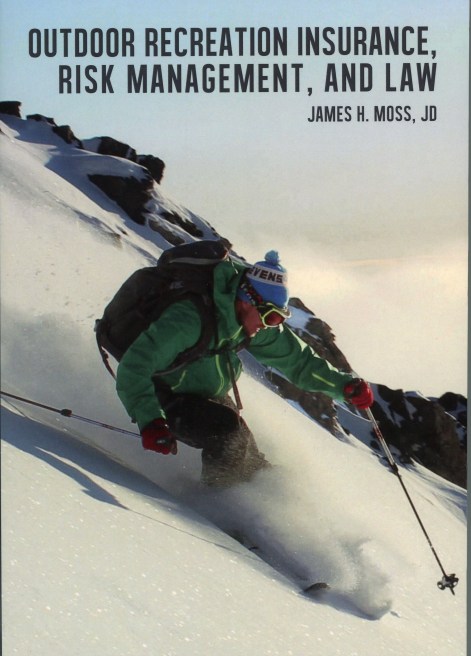
Outdoor Recreation Insurance, Risk Management, and Law
To see Jim’s complete bio go here and to see his CV you can find it here. To find out the purpose of this website go here.
If you are interested in having me write your release, download the form and return it to me.
Connect
If you like this let your friends know or post it on FB, Twitter, or LinkedIn
 Threads |
 X, Formerly Twitter |
 Facebook Logo |
 |
By Recreation Law Rec-law@recreation-law.com James H. Moss
@2015-2023 Summit Magic Publishing, LLC
G-YQ06K3L262
#AdventureTourism, #AdventureTravelLaw, #AdventureTravelLawyer, #AttorneyatLaw, #Backpacking, #BicyclingLaw, #Camps, #ChallengeCourse, #ChallengeCourseLaw, #ChallengeCourseLawyer, #CyclingLaw, #FitnessLaw, #FitnessLawyer, #Hiking, #HumanPowered, #HumanPoweredRecreation, #IceClimbing, #JamesHMoss, #JimMoss, #Law, #Mountaineering, #Negligence, #OutdoorLaw, #OutdoorRecreationLaw, #OutsideLaw, #OutsideLawyer, #RecLaw, #Rec-Law, #RecLawBlog, #Rec-LawBlog, #RecLawyer, #RecreationalLawyer, #RecreationLaw, #RecreationLawBlog, #RecreationLawcom, #Recreation-Lawcom, #Recreation-Law.com, #RiskManagement, #RockClimbing, #RockClimbingLawyer, #RopesCourse, #RopesCourseLawyer, #SkiAreas, #Skiing, #SkiLaw, #Snowboarding, #SummerCamp, #Tourism, #TravelLaw, #YouthCamps, #ZipLineLawyer, Minnesota, tubing, Snow tubing, Afton Alps Recreation Area, Assumption of the Risk, Primary Assumption of the Risk,
Dawson v. Afton Alps Recreation Area, 2014 Minn. App. Unpub. LEXIS 1047
Posted: February 8, 2015 Filed under: Assumption of the Risk, Legal Case, Minnesota, Snow Tubing | Tags: Afton Alps Recreation Area, assumption of the risk, Minnesota, Primary Assumption of the Risk, Snow Tubing, Tubing Leave a commentTo Read an Analysis of this decision see
Assumption of Risk used to defend against claim for injury from snow tubing in Minnesota
Dawson v. Afton Alps Recreation Area, 2014 Minn. App. Unpub. LEXIS 1047
Donya L. Dawson, Appellant, vs. Afton Alps Recreation Area, Respondent.
A14-0194
COURT OF APPEALS OF MINNESOTA
2014 Minn. App. Unpub. LEXIS 1047
September 22, 2014, Filed
NOTICE: THIS OPINION WILL BE UNPUBLISHED AND MAY NOT BE CITED EXCEPT AS PROVIDED BY MINNESOTA STATUTES.
SUBSEQUENT HISTORY: Review denied by Dawson v. Afton Alps Rec. Area, 2014 Minn. LEXIS 685 (Minn., Dec. 16, 2014)
PRIOR HISTORY: [*1] Washington County District Court File No. 82-CV-13-224.
DISPOSITION: Affirmed.
CORE TERMS: snowtubing, fence, ticket, colliding, tube, barrier, pillow, well-known, incidental, snowtuber, skiing, sport, summary judgment, review denied, collision, snowtubed, speed, record supports, actual knowledge, genuine, icy, snowboarding, snowtube, descent, jacket, tubing, linked, user, hit, matter of law
COUNSEL: For Appellant: James W. Balmer, Falsani, Balmer, Peterson, Quinn & Beyer, Duluth, Minnesota.
For Respondent: Jeffrey J. Lindquist, Pustorino, Tilton, Parrington & Lindquist, PLLC, Minneapolis, Minnesota.
JUDGES: Considered and decided by Reyes, Presiding Judge; Hooten, Judge; and Willis, Judge*.
* Retired judge of the Minnesota Court of Appeals, serving by appointment pursuant to Minn. Const. art. VI, § 10.
OPINION BY: WILLIS
OPINION
UNPUBLISHED OPINION
WILLIS, Judge
Appellant sustained injuries from colliding with a fence while snowtubing and brought a negligence action against the owner and operator of the snowtubing business. The district court entered summary judgment in favor of the owner, concluding that the doctrine of primary assumption of the risk barred appellant’s claim. We affirm.
FACTS
In January 2012, appellant Donya Dawson went snowtubing at respondent Afton Alps Recreation Area with a group of friends. Dawson, who was 41 years old, had snowtubed at least once in the preceding two years. A friend of Dawson’s signed a release in order to get Dawson’s ticket; Dawson affixed the ticket to her jacket. The ticket contained the following language:
The [*2] purchaser or user of this ticket agrees and understands that skiing, snowboarding, and tubing can be hazardous. Trail conditions vary constantly because of weather changes and individual use. Ice, variations in terrain, moguls, forest growth, rocks and debris, lift towers and other obstacles and hazards, including other skiers, snowboarders and tubers may exist throughout the area. Be aware that snowmaking and snowgrooming may be in progress at any time. Always stay in control.
In using the ticket and skiing, snowboarding or tubing at the area, such dangers are recognized and accepted whether they are marked or unmarked. Ski, snowboard and tube on slopes of your ability and read trail maps.
The user realizes that falls and collisions do occur and injuries may result and therefore assumes the burdens of skiing, snowboarding and tubing under control at all times.
. . . .
The user of this ticket assumes all risk of personal injury or loss or damage to property.
While Dawson did not read the fine print of the ticket, she testified that she had read similar language on a ticket when she snowtubed previously.
Standing at the top of the hill, Dawson saw that there was a fence directly behind a [*3] pillow barrier at the foot of the hill. The pillow barrier was composed of several large, foam-filled pads that were tied together with thick rope and that in turn were tied to the fence. Dawson testified that the conditions on the hill were icy and that she had no control over the speed or direction of travel of her tube during the descent. On her first run, Dawson snowtubed down the hill with five of her friends. All six linked their tubes together. When Dawson reached the bottom of the hill, she “flipped upside down” as she hit the pillow barrier. An Afton Alps employee told her that the facility allowed only two snowtubers to go down the hill together because linking tubes increases the speed of descent. Dawson testified that she continued to snowtube down the hill linked with a friend’s tube, and she hit the pillow barrier “very hard” each time. After snowtubing for approximately an hour and a half, Dawson and her boyfriend snowtubed down the hill with their tubes linked together. At the end of the run, Dawson flipped off her tube and her body hit the fence, injuring her left leg.
Dawson asserts that her bodily injury was directly and proximately caused by Afton Alps’s negligence. [*4] The district court granted Afton Alps’s motion for summary judgment, concluding that Dawson’s claims were barred by the doctrine of primary assumption of the risk. This appeal follows.
DECISION
“On appeal from summary judgment, we must review the record to determine whether there is any genuine issue of material fact and whether the district court erred in its application of the law.” Dahlin v. Kroening, 796 N.W.2d 503, 504-05 (Minn. 2011). “[T]he applicability of primary assumption of the risk may be decided by the court as a matter of law when reasonable people can draw only one conclusion from undisputed facts. . . . [A]n appellate court reviews that decision de novo.” Grady v. Green Acres, Inc., 826 N.W.2d 547, 549-50 (Minn. App. 2013) (alterations in original).
Primary assumption of the risk acts as a complete bar to a plaintiff’s recovery. Armstrong v. Mailand, 284 N.W.2d 343, 348 (Minn. 1979). Minnesota courts have applied primary assumption of the risk to cases involving participants in inherently dangerous sporting activities. See Wagner v. Obert Enters., 396 N.W.2d 223, 226 (Minn. 1986) (rollerskating); see also Grisim v TapeMark Charity Pro-Am Golf Tournament, 415 N.W.2d 874, 876 (Minn. 1987) (golf); Moe v. Steenberg, 275 Minn. 448, 450-51, 147 N.W.2d 587, 589 (1966) (ice skating); Peterson ex rel. Peterson v. Donahue, 733 N.W.2d 790, 793 (Minn. App. 2007) (skiing), review denied (Minn. Aug. 21, 2007); Schneider ex rel. Schneider v. Erickson, 654 N.W.2d 144, 152 (Minn. App. 2002) (paintball); Snilsberg v. Lake Wash. Club, 614 N.W.2d 738, 746-47 (Minn. App. 2000) (diving), review denied (Minn. Oct. 17, 2000); Jussila v. U.S. Snowmobile Ass’n, 556 N.W.2d 234, 237 (Minn. App. 1996), (snowmobile racing), review denied (Minn. Jan. 29, 1997); Swagger v. City of Crystal, 379 N.W.2d 183, 184-85 (Minn. App. 1985) (softball), review denied (Minn. Feb. 19, 1986). In Grady, this court recently held that primary assumption of [*5] the risk applies to adult snowtubers because it is an inherently dangerous sport. 826 N.W.2d at 552.
Here, the doctrine of primary assumption of the risk relates to Afton Alps’s legal duty to protect Dawson, a snowtuber, from the risk of harm.
Primary assumption of the risk arises when parties have voluntarily entered a relationship in which plaintiff assumes well-known, incidental risks. The defendant has no duty to protect the plaintiff from the well-known, incidental risks assumed, and the defendant is not negligent if any injury to the plaintiff arises from an incidental risk . . . .
In primary assumption of the risk, by voluntarily entering into a situation where the defendant’s negligence is obvious, by his conduct, the plaintiff consents to the defendant’s negligence and agrees to undertake to look out for himself and relieve the defendant of the duty.
Id. at 550.
“The application of primary assumption of the risk requires that a person who voluntarily takes the risk (1) knows of the risk, (2) appreciates the risk, and (3) has a chance to avoid the risk.” Id. at 551 (citing Peterson, 733 N.W.2d at 792). “Application of the doctrine requires actual, rather than constructive, knowledge.” Snilsberg, 614 N.W.2d at 746.
A. Duty of Care
“The first step in determining whether primary [*6] assumption of the risk applies is to determine whether the defendant owed a duty to the plaintiff.” Grady, 826 N.W.2d at 550. Afton Alps acknowledges that it owed Dawson the duty of reasonable care. See Phillips v. Wild Mountain Sports, Inc., 439 N.W.2d 58, 59 (Minn. App. 1989) (holding that “[a] private person operating a place of public amusement is under an affirmative duty to make it reasonably safe for his patrons”). “But the landowner’s duty to entrants does not include situations where the risk of harm is obvious or known to the plaintiff, unless the landowner should anticipate the harm despite the obviousness of the risk.” Snilsberg, 614 N.W.2d at 744.
Dawson argues that Afton Alps breached its duty because it failed to warn her that she could be injured by colliding with the fence, and Afton Alps should have either removed or properly cushioned the fence. But Dawson offers no evidence other than her own argument that such measures would have lessened the inherent risks associated with snowtubing. See Grady, 826 N.W.2d at 550 (dismissing appellant’s assertion that respondent was negligent in reducing risk of collision with another snowtuber when it failed to provide numerous safety measures on the course).
A well-known, incidental risk of snowtubing is the possibility of colliding with a fixed object. Snowtubing is a sport, [*7] like skiing, in which “participants travel down slippery hills at high speed with limited ability to stop or turn.” Id. Even if Afton Alps had a duty to warn, it met that duty when it informed Dawson of the risk of possibly colliding into a fixed object, such as the fence. Dawson wore a release ticket on her jacket that stated that snowtubing can be hazardous, and by using the ticket to snowtube at Afton Alps, she recognized and accepted all dangers “whether they are marked or unmarked” and “assume[d] the burden” of snowtubing “under control at all times.”
B. Knowledge and appreciation of the risk
Actual knowledge of a sport’s risks may be inferred from experience in the sport. Grady, 826 N.W.2d at 551; see also Snilsberg, 614 N.W.2d at 746 (concluding that appellant’s actual knowledge of the danger of diving into the lake from the dock was established by her general knowledge as an experienced swimmer and diver and specific knowledge of the shallow water at the dock).
Dawson argues that she did not have actual knowledge that she could suffer severe harm from colliding with the fence while snowtubing. But the record supports the district court’s determination that Dawson had such actual knowledge. Dawson testified that she had general knowledge [*8] of snowtubing because she had done it at least once before. Dawson also had specific knowledge that she could collide with the fence while snowtubing–she saw that the fence was located directly behind the pillow barrier at the foot of the hill. Dawson knew of the icy conditions on the hill that evening and that she was unable to control her tube as it went down the hill. An Afton Alps employee told Dawson after her first run that linking tubes increases the speed of descent. Despite her knowledge of these risks, she continued to snowtube down the hill.
The record also supports the district court’s conclusion that Dawson appreciated the risk of being injured by colliding with the fence. Dawson wore a ticket on her jacket stating that she acknowledged that “obstacles and hazards . . . may exist throughout the area” and “collisions do occur and injuries may result,” and that she “recognized and accepted those dangers” and “assume[d] all risk of personal injury.”
Although Dawson insisted that she was unaware that she could be injured by colliding with the fence, she testified that it was possible that she could collide with other persons or objects while snowtubing and that snowtubing is a sport [*9] that cannot be made completely safe. The record supports the district court’s conclusion that Dawson knew and appreciated the risk of a collision with the fence.
The district court also properly concluded that Dawson had a chance to avoid the risk. See Grady, 826 N.W.2d at 552 (concluding appellant had the chance to avoid the risk of colliding with another snowtuber by not going down the hill). Dawson could have avoided the risk by not snowtubing that evening. The district court noted that when Dawson stood at the top of the hill, “she could see and appreciate the conditions then existing” and that she “was aware from her previous trips down the hill that the hill was icy and that she would in all likelihood run into the [pillow barrier], and possibly the fence, at the end of her run.” The record supports the district court’s conclusion.
C. Expert testimony
Dawson argues that primary assumption of the risk is inapplicable here because her liability expert testified that the fence was not a well-known risk incidental to snowtubing. But colliding with a fixed object is a well-known risk of snowtubing, and here the fence was an obvious fixed object. No genuine issue for trial exists when “the record taken as a [*10] whole could not lead a rational trier of fact to find for the nonmoving party.” DLH, Inc. v. Russ, 566 N.W.2d 60, 69 (Minn. 1997) (quoting Matsushita Elec. Indus. Co. v. Zenith Radio Corp.., 475 U.S. 574, 587, 106 S. Ct. 1348, 1356, 89 L. Ed. 2d 538 (1986)). No genuine issue of fact exists here because the evidence is conclusive, and there is no fact issue for a jury to decide. See Snilsberg, 614 N.W.2d at 744 (holding that applicability of primary assumption of the risk is “[g]enerally a question for the jury” but that it “may be decided as a matter of law” when the evidence is conclusive).
The record supports the district court’s determination that Dawson’s injuries resulted from the inherent risks of snowtubing, and it did not err by granting Afton Alps’s motion for summary judgment.
Affirmed.
G-YQ06K3L262
http://www.recreation-law.com
Forman v. Brown, d/b/a Brown’s Royal Gorge Rafting, 944 P.2d 559; 1996 Colo. App. LEXIS 343
Posted: February 7, 2015 Filed under: Colorado, Contract, Legal Case, Paddlesports, Release (pre-injury contract not to sue) | Tags: Arkansas River, big Horn Canyon, Novation, Release, Three Rocks, Waiver, Whitewater Rafting Leave a commentForman v. Brown, d/b/a Brown’s Royal Gorge Rafting, 944 P.2d 559; 1996 Colo. App. LEXIS 343
Sue Forman, Plaintiff-Appellant, v. Mark N. Brown, d/b/a Brown’s Royal Gorge Rafting, Brown’s Fort and Greg Scott, Defendants-Appellees.
No. 95CA1380
COURT OF APPEALS OF COLORADO, DIVISION B
944 P.2d 559; 1996 Colo. App. LEXIS 343
November 29, 1996, Decided
SUBSEQUENT HISTORY: [**1] Released for Publication October 23, 1997.
Rehearing Denied February 6, 1997.
PRIOR HISTORY: Appeal from the District Court of Fremont County. Honorable John Anderson, Judge. No. 93CV123.
DISPOSITION: JUDGMENT AFFIRMED
COUNSEL: Gregory J. Hock, Colorado Springs, Colorado, for Plaintiff-Appellant.
Hall & Evans, L.L.C., Alan Epstein, Denver, Colorado, for Defendants-Appellees.
JUDGES: Opinion by JUDGE NEY. Pierce *, J. concurs. Tursi *, J. concurs in part and dissents in part.
* Sitting by assignment of the Chief Justice under provisions of the Colo. Const. art. VI, Sec. 5(3), and § 24-51-1105, C.R.S. (1996 Cum. Supp.).
OPINION BY: NEY
OPINION
[*560] Opinion by JUDGE NEY
Plaintiff, Sue Forman, appeals from a summary judgment entered in favor of defendants, Mark N. Brown d/b/a Brown’s Royal Gorge Rafting and Brown’s Fort, and Greg Scott. We affirm.
Plaintiff participated in a rafting trip conducted by defendants. During the trip, defendant Scott, the river guide, pulled the raft off the river for a rest break and suggested [*561] that the participants take a swim in the river. Scott led some of the participants, including plaintiff, to a large boulder near the river and instructed them on the proper method [**2] to enter the water. Plaintiff injured her ankle when she jumped into the river.
Plaintiff brought this action alleging negligence, willful and wanton conduct, and breach of contract. Defendants moved for partial summary judgment on the grounds that the exculpatory agreement executed by plaintiff before the trip absolved them from liability for negligence as a matter of law. The trial court granted defendant’s motion for partial summary judgment, and later granted defendants’ motion for summary judgment on plaintiff’s remaining claims. This appeal followed.
I.
Plaintiff argues that summary judgment was improper because a genuine issue of fact existed as to whether she was mentally competent when she signed the exculpatory agreement. We disagree.
[HN1] Summary judgment is proper when the pleadings, affidavits, depositions, and admissions show that there is no genuine issue as to any material fact and that the moving party is entitled to judgment as a matter of law. C.R.C.P. 56; Civil Service Commission v. Pinder, 812 P.2d 645 (Colo. 1991).
The moving party has the burden to show that there is no issue of material fact. Once the moving party has met its initial burden, the burden then [**3] shifts to the nonmoving party to establish that there is a triable issue of material fact. Mancuso v. United Bank, 818 P.2d 732 (Colo. 1991).
In determining whether summary judgment is proper, the nonmoving party must receive the benefit of all favorable inferences that may reasonably be drawn from the undisputed facts. Mancuso v. United Bank, supra. Summary judgment is proper if reasonable persons could not reach differing conclusions. Morlan v. Durland Trust Co., 127 Colo. 5, 252 P.2d 98 (1952).
In their motion for summary judgment, defendants attached the exculpatory agreement, which was signed by plaintiff, entitled “Agreement to Participate (Acknowledgment of Risks),” and an agreement entitled “On River Prohibitions,” also signed by plaintiff, which listed rules that rafting participants were required to follow while on the rafts. Defendants also included plaintiff’s admissions that she signed the exculpatory agreements and that she was advised concerning the hazards involved in the raft trip. With this evidence, defendants established both the scope of the exculpatory agreement and the fact that plaintiff signed the agreement, and thus the burden shifted to plaintiff to establish [**4] triable issues of fact. Mancuso v. United Bank, supra.
Plaintiff admitted in her response to the summary judgment motion that she had signed the exculpatory agreement and she attached to her response an affidavit in which she stated:
I believe I am an intelligent woman and I
understand the (prohibition.) My failure to read the Agreement to Participate was related to my mental condition.
. . . .
Although I was not incompetent when I signed the on-river prohibitions and the Agreement to Participate, I do feel I lacked competency in the skills of independent decision-making and that I had mental impairment on relying on what Mr. Scott had advised.
Plaintiff also averred that she had been in therapy for several years before the incident, and included extensive documentation of the diagnosis and in-patient treatment of her emotional and mental condition that she underwent six months after the rafting incident. However, plaintiff’s complaint did not state any allegations of her impaired mental capacity.
Plaintiff filed a supplementary response to the summary judgment motion which included an affidavit from the therapist who had been treating her for several years prior to the rafting [**5] incident wherein the therapist stated that, at the time of the rafting trip, plaintiff was suffering from a mental impairment, “including a mental and/or emotional disability related to psychiatric problems, her [*562] inability to handle stress, emotional illness and severe psychiatric difficulties and serious emotional disturbances which prevented her from fully assessing the consequences of risks or prohibited conduct related to jumping into the river.” The therapist further opined that plaintiff had a tendency “to be quite vulnerable following the direction of someone she was trusting as well as to following the actions of those with whom she desired to be a part.”
Plaintiff also supplemented her response with an affidavit from a therapist who began treating her a year after the rafting incident in which the therapist averred that, at the time of the rafting incident, plaintiff’s need to be liked and accepted was likely to have caused her to suspend her own judgment in deference to others.
The trial court held that, even under the most favorable interpretation of the evidence, plaintiff did not show that she was incompetent to enter into a binding contract. Relying on plaintiff’s [**6] specific assertion that she was not incompetent when she signed the exculpatory agreements, the court found that plaintiff’s assertions of mental impairment, such as her need to belong to a group and her need to trust and follow the river guide, did not at all relate to her execution of a binding contract.
We agree with the trial court and find that the relevant evidence established, as a matter of law, that plaintiff was not, under principles of competency applicable to contracts in general, incompetent at the time she signed the exculpatory agreement.
[HN2] Every person is presumed by the law to be sane and competent for the purpose of entering into a contract. Hanks v. McNeil Coal Corp., 114 Colo. 578, 168 P.2d 256 (1946). A party can be insane for some purposes and still have the capacity to contract. Davis v. Colorado Kenworth Corp., 156 Colo. 98, 396 P.2d 958 (1964).
A person is incompetent to contract when the subject matter of the contract is so connected with an insane delusion as to render the afflicted party incapable of understanding the nature and effect of the agreement or of acting rationally in the transaction. Hanks v. McNeil Coal Corp., supra. Therefore, under this [**7] rule, it follows that emotional distress or severe mental depression generally is insufficient to negate the capacity to contract. See Drewry v. Drewry, 8 Va. App. 460, 383 S.E.2d 12 (Va. App. 1989)(severe mental depression did not render party to separation agreement legally incompetent where there was no evidence that party did not understand the nature and consequences of her acts).
Moreover, a contract may not be voided when, as here, the alleged incompetence arose after the execution of the contract. Competency to contract is determined by a party’s mental state at the time of execution of the agreement. See Hanks v. McNeil Coal Corp., supra.
[HN3] Where a party has failed to present sufficient evidence to make out a triable issue of material fact, the moving party is entitled to summary judgment. See Continental Air Lines Inc. v. Keenan, 731 P.2d 708 (Colo. 1987).
Plaintiff admitted that she was not incompetent at the time she signed the exculpatory agreement, that she was “an intelligent woman,” and that she understood the “prohibition.” Additionally, none of plaintiff’s evidence of her psychological diagnosis and treatment showed that, at the time she signed the exculpatory agreements, she was [**8] suffering under an insane delusion that prevented her from understanding the nature and effect of the agreements or of acting rationally in the transaction.
Nor do we agree with plaintiff’s claim that her impaired mental capacity caused her to fail to read the Agreement to Participate. As noted above, plaintiff admitted that she was not incompetent when she signed the exculpatory agreements; therefore, her failure to read the Agreement to Participate precludes her from arguing that she is not bound by it. See Rasmussen v. Freehling, 159 Colo. 414, 412 P.2d 217 (1966)(in the absence of fraud, one who signs a contract without reading it is barred from claiming she is not bound by what she has signed); Cordillera Corp. v. Heard, 41 Colo. App. 537, 592 P.2d 12 (1978), aff’d, 200 Colo. 72, 612 [*563] P.2d 92 (1980)(party signing an agreement is presumed to know its contents).
We conclude, therefore, that plaintiff failed to establish a triable issue of fact concerning her capacity to execute a contract at the time she signed the exculpatory agreement.
II.
Plaintiff also argues that the exculpatory agreement was invalid and ambiguous as to whether it applied to the activity in which she was [**9] injured. We disagree.
[HN4] The determination of the sufficiency and validity of an exculpatory agreement is a matter of law for the court to determine. Jones v. Dressel, 623 P.2d 370 (Colo. 1981).
The validity of an exculpatory agreement must be determined by the following four criteria: (1) the existence of a duty to the public; (2) the nature of the service performed; (3) whether the contract was fairly entered into; and (4) whether the intention of the parties is expressed in clear and unambiguous language. Jones v. Dressel, supra.
Only the fourth factor is at issue here, and as to this factor, the supreme court has held that in order for an exculpatory agreement to shield a party from liability, the intent of the parties to extinguish liability must be clearly and unambiguously expressed. Heil Valley Ranch, Inc. v. Simkin, 784 P.2d 781 (Colo. 1989).
The Agreement to Participate provided in relevant part:
I am aware that the activities I am participating in, under the arrangements of Brown’s Fort family recreation center; its agents, employees, and associates, involves certain inherent risks. I recognize that white water rafting, . . . and other activities, scheduled or unscheduled [**10] have an element of risk which combined with the forces of nature, acts of commission, or omission, by participants or others, can lead to injury or death.
I also state and acknowledge that the hazards include, but are not limited to the loss of control, collisions with rocks, trees and other man made or natural objects, whether they are obvious or not obvious, flips, immersions in water, hypothermia, and falls from vessels, vehicles, animals, or on land.
I understand that any route or activity, chosen as a part of our outdoor adventure may not be the safest, but has been chosen for its interest and challenge. . . . I . . . understand and agree that any bodily injury, death or loss of personal property, and expenses thereof, as a result of my . . . participation in any scheduled or unscheduled activities, are my responsibility. I hereby acknowledge that I and my family . . . have voluntarily applied to participate in these activities. I do hereby agree that I and my family . . . are in good health with no physical defects that might be injurious to me and that I and my family are able to handle the hazards of traffic, weather conditions, exposure to animals, walking, riding, and all [**11] and any similar conditions associated with the activities we have contracted for.
. . . .
I and my family . . . agree to follow the instructions and commands of the guides, wranglers, and others in charge at Brown’s Fort recreation center with conducting activities in which I and my family are engaged.
Further, and in consideration of, and as part payment for the right to participate in such trips or other activities . . . I have and do hereby assume all the above risks and will hold Brown’s Fort . . . its agents, employees, and associates harmless from any and all liability, action, causes of action, debts, claims, and demands of any kind or nature whatsoever which I now have or which may arise out of, or in connection with, my trip or participation in any other activities.
The terms of this contract shall serve as a release and assumption of risk for my heirs, executors and administers and for all members of my family, including any minors accompanying me. . . .
I have carefully read this contract and fully understand its contents. I am aware [*564] that I am releasing certain legal rights that
I otherwise may have and I enter into this contract in behalf of myself and my family [**12] of my own free will.
Plaintiff was engaged in an apparently unscheduled activity that had an element of risk which, combined with the forces of nature and acts of others, resulted in an injury. The language of the Agreement to Participate specifically addressed a risk, collision with boulders, that adequately described the circumstances of plaintiff’s injury, and by executing the Agreement to Participate, plaintiff was specifically made aware of and agreed to assume this risk. See Heil Valley Ranch, Inc. v. Simkin, 784 P.2d 781 (broad language in a release interpreted to cover all negligence claims); Barker v. Colorado Region–Sports Car Club of America, Inc., 35 Colo. App. 73, 532 P.2d 372 (1974) (in absence of duty to public, exculpatory agreements are valid when fairly made and may be enforced to preclude recovery for injury sustained by patrons of recreational facilities).
Therefore, we agree with the trial court that the Agreement to Participate unambiguously released defendants from liability for injuries occurring during associated scheduled or unscheduled activities such as the swimming activity here at issue.
III.
Plaintiff’s final contention is that the trial court erred in [**13] dismissing her claim of willful and wanton conduct against defendant Scott. We disagree.
[HN5] An exculpatory agreement does not bar an action based upon injuries sustained by a defendant’s willful and wanton conduct. Barker v. Colorado Region-Sports Car Club of America, Inc., supra. Willful and wanton conduct is purposeful conduct committed recklessly that exhibits an intent consciously to disregard the safety of others. Such conduct extends beyond mere unreasonableness. Terror Mining Co. v. Roter, 866 P.2d 929 (Colo. 1994) (applying definition of willful and wanton conduct to parental immunity doctrine); see also § 13-21-102(1)(b), C.R.S. (1987 Repl. Vol. 6A)(for purposes of exemplary damages, willful and wanton conduct means conduct purposefully committed which the actor must have realized as dangerous and which was done heedlessly and recklessly, without regard to the consequences, or of the rights and safety of others, particularly the plaintiff).
[HN6] Although the issue of whether a defendant’s conduct is purposeful or reckless is ordinarily a question of fact, Wolther v. Schaarschmidt, 738 P.2d 25 (Colo. App. 1986), if the record is devoid of sufficient evidence to raise a factual [**14] issue, then the question may be resolved by the court as a matter of law. See Continental Air Lines, Inc. v. Keenan, supra.
Plaintiff’s complaint alleged only that defendant Scott “beached the raft with Plaintiff and other guests, subsequently inviting, encouraging and directing Plaintiff and other guests to jump into the river and take a swim, directing them to a point of jumping that Scott represented as being safe for entry.” Plaintiff also gave a statement in which she said that, prior to the swim, defendant Scott reinforced the possibility of being hurt while jumping into the river but that he instructed the group on the proper manner of entry to avoid injury, and talked and stood close to the participants while they jumped.
Additionally, plaintiff stated in one of her affidavits:
Scott was with all of us monitoring the entry into the river. He gave brief instructions that we should try to jump with our feet up and keep our feet downstream and paddle to the shore. Although the possibility of being hurt existed, this clearly related to after we went downstream and tried to negotiate the river current and swim to the side of the river. I did not believe there were any safety [**15] problems in entering the water at the place he designated, nor could I see any submerged rocks.
. . . .
A couple jumped in before me and everything worked out fine. Their experience was consistent with what Scott had stated that if we followed his direction we would not get hurt.
. . . .
[*565] I feel that Scott was negligent in his suggesting the jumping and his preparing us and instructing us for that exercise.
Plaintiff’s evidence is insufficient to establish a factual question as to whether defendant Scott acted in a willful and wanton manner. Plaintiff’s statements that Scott instructed the participants on the proper manner to enter the water to avoid injury indicates that Scott did not consciously and willfully disregard the safety of the participants. Furthermore, plaintiff does not allege, nor does the record indicate, that Scott recklessly forced the participants to jump in the river or otherwise intentionally disregarded the participants’ safety. Rather, plaintiff states in her affidavit that Scott acted negligently. Negligence is not the same as willful or wanton conduct. Pettingell v. Moede, 129 Colo. 484, 271 P.2d 1038 (1954).
Therefore, the court properly entered summary [**16] judgment in defendant Scott’s favor. See Mancuso v. United Bank, supra.
The judgment is affirmed.
JUDGE PIERCE concurs.
JUDGE TURSI concurs in part and dissents in part.
CONCUR BY: TURSI (In Part)
DISSENT BY: TURSI (In Part)
DISSENT
JUDGE TURSI concurring in part and dissenting in part.
I concur in Parts I and III of the majority opinion and dissent as to Part II.
This matter is before us on summary judgment. The majority adequately sets forth the rules governing review of summary judgments. However, as to Part II, it misapplies them.
In Part II, the majority concludes that the documents which defendant had plaintiff execute were unambiguous. I disagree.
Plaintiff was presented with two documents by the defendants and was required to execute them simultaneously. These are the Agreement to Participate, quoted at length in the majority opinion, and the On River Prohibitions, which although mentioned, are not quoted.
It is axiomatic that if simultaneously executed agreements between the same parties and relating to the same subject matter are contained in more than one instrument, the documents must be construed together. Bledsoe v. Hill, 747 P.2d 10 (Colo. App. 1987).
The On River Prohibitions [**17] contained a prohibition that stated: “No diving or jumping into the river. (There are rocks under the surface of the river).”
By affidavit and by a statement appended to defendant’s motion for summary judgment, facts were presented that the guide had instructed plaintiff to “jump in” the river. In plaintiff’s affidavit (referred to by the majority), plaintiff further stated that the guide “indicated that we should jump into the water at that point.”
Plaintiff correctly argues that she was confronted with the requirement that she follow the instruction of the guide as required by the Agreement to Participate, but that this conflicted with a specific provision of the On River Prohibitions. The patently conflicting provision was, at a minimum, ambiguous and placed plaintiff in a situation that gave rise to a genuine issue of material fact. See Heil Valley Ranch, Inc. v. Simkin, 784 P.2d 781; Jones v. Dressel, 623 P.2d 370.
Clearly, the provision in the Agreement to Participate stating that participants “agree to follow the instruction . . . of the guides” creates a conflict when a participant is instructed by the guide to violate the specific prohibition against jumping into the river. Under [**18] these circumstances, an ambiguity arises which creates a genuine issue of material fact and thus, renders the entry of summary judgment reversible error.
Finally, after giving the entire agreement a fair reading, I am unable to comprehend how the majority can conclude that a prohibited activity is a foreseeable “unscheduled” [*566] activity. See Heil Valley Ranch, Inc. v. Simkin, 784 P.2d 781.
Therefore, in view of the ambiguity that arose under the documents based upon the material facts herein, I would reverse and remand to the trial court to proceed on the issues addressed in Part II of the majority opinion.
G-YQ06K3L262
http://www.recreation-law.com
Research Project on Understanding Travel Behavior in Avalanche Terrain Needs You
Posted: February 3, 2015 Filed under: Avalanche | Tags: avalanche, Montana State University, Snowmobile, x, y, z Leave a commentScientists from the Snow and Avalanche Lab at Montana State University are seeking more participants for their project examining decision making and travel in avalanche terrain.
Their project aims to collect GPS location information (from your smartphone) and survey responses from backcountry skiers and riders to better understand what types of terrain are used, and how decisions are made. Their focus is on backcountry skiers and riders of all abilities and experience. You need not be an expert backcountry skier to participate in this research.
More information: If you want to participate, or learn more about their project aims, research questions and approaches, please visit their web page:
www.montana.edu/snowscience/tracks
or their companion site directed toward snowmobilers at:
www.montana.edu/snowscience/sleds
The basics of winning a negligence claim is having some facts that show negligence, not just the inability to canoe by the plaintiff
Posted: February 2, 2015 Filed under: Assumption of the Risk, New York, Paddlesports, Release (pre-injury contract not to sue), Rivers and Waterways | Tags: Bob's Canoe Rental, Canoe, Canoe Livery, Canoeing, Inc., New York, Nissequogue River, Release, Tide 2 CommentsPlaintiff’s rented a canoe and sued when they did not make the takeout and became stuck. The plaintiff’s took 4 hours to paddle 2.5 miles
Ferrari v. Bob’s Canoe Rental, Inc., 2014 N.Y. Misc. LEXIS 3768; 2014 NY Slip Op 32209(U)
State: New York, Supreme Court of New York, Suffolk County
Plaintiff: Kathleen Ferrari, as Administratrix of the Estate of Dennis Ferrari, and Kathleen Ferrari, Individually
Defendant: Bob’s Canoe Rental, Inc.
Plaintiff Claims: negligent in permitting them to rent the canoe and launch so close in time to low tide, and in advising them that it was safe to begin their canoe trip when the defendant knew or should have known it was unsafe to do so.
Defendant Defenses: Assumption of the Risk and Release
Holding: Defendant
Year: 2014
The facts are pretty simple, even if expanded by the plaintiffs. The plaintiff wanted to rent a canoe on the Nissequogue River in Suffolk, New York. The Nissequogue River is affected by tides. At low tide, the river disappears and the ocean rushes in. The plaintiff/deceased/husband had canoed the river several times before. The plaintiff/husband and wife contacted the defendant the day before and arrived the day of the incident in the morning. However, the defendant was not at the put in, but located at the takeout. The plaintiff’s drove to the take out where they left their car and were taken back to the put in by the defendant where they started canoeing.
Prior to starting the trip each plaintiff signed a release, and the wife signed a rental agreement for the canoe.
A canoe livery if you are not familiar with one is really a rental operation like a car rental operation where you rent a car and go anywhere you want. A canoe livery you rent the canoe and paddle down a specific section of a specific river. At the end of the trip, the livery picks you up and takes you back to your car. Some liveries start by taking you upriver where you paddle down to your car.
Generally, courts look at canoe liveries as outfitters, not as rental shops. Consequently, liveries are held to a slightly higher degree of care for their guests because of their control over the boat, the river and transportation.
The time prior to putting in, the husband questioned the employee of the defendant about whether they had enough time to canoe the river before the low tide. The employee confirmed they did.
From the put in to the take out is a distance of five miles. Witnesses and the defendant testified it could easily be canoed in 2.5 hours.
After 4 hours of canoeing, the plaintiffs on the day in question had made it 2.5 miles. The tide went out leaving them stranded. According to the wife, the pair started drinking the vodka and wine they had with them to stay warm.
Eventually, they were found and treated for hyperthermia.
The plaintiff sued for basically not stopping them from renting the canoe. The court also looked at their complaint and defined one of their allegations as a negligent misrepresentation claim.
At the time of the trial, the husband had died; however, his death was not part of this case or caused by the facts in this case.
Analysis: making sense of the law based on these facts.
The court looked at the degree of care the defendant owed to the plaintiff and found the plaintiff was voluntarily participating in a sporting or recreational activity. As such, the participants “consent to the commonly appreciated risks that are inherent in and arise out of, the nature of the sport generally and flow from participation therein.” Consequently the participants consent to injury caused by events which are “known, apparent, or reasonably foreseeable risks of the participation.”
If the plaintiff fully comprehends the risks, then the plaintiff consents to them. Stated another way “the duty of the defendant is to protect the plaintiff from injuries arising out of unassumed, concealed, or unreasonably increased risks…”
The court found the defendant husband was an experience canoeist and understood the tides, and the risks presented by both. Therefore, the plaintiff’s assumed the risk of injury.
The court then looked at the releases.
It must appear absolutely clear that the agreement extends to negligence or other fault of the party. “That does not mean that the word ‘negligence’ must be employed for courts to give effect to an exculpatory agreement; however, words conveying a similar import must appear”
Under New York law once the defendant has presented the release, and it has passed the test to exclude negligence the plaintiff must produce evidence, admissible at trial, “sufficient to require a trial of the material issues of fact.”
Here the plaintiff had not submitted any evidence other than the testimony of the plaintiff’s. More importantly the court wanted to know why it took four hours to go half way on the trip.
The court then looked at the remaining allegations and determined those sounded like a claim of negligent misrepresentation. To prevail on a negligent misrepresentation claim the plaintiff must prove “a special relationship existing between the parties, that the information provided by plaintiff was incorrect or false, and that the plaintiff reasonably relied upon the information provided”
Here the court found that no evidence had been submitted by the plaintiff to prove the information supplied by the defendant was false.
The plaintiff’s complaint was dismissed.
So Now What?
This case was short but very interesting. The plaintiff did not attack the releases. The court even commented about the fact the plaintiff did not try to have the releases thrown out or voided. Additionally, the plaintiff simply tried to say that the defendant was liable because they got stuck. This is a belief that many plaintiffs have now days. I suffered an injury; therefore, you must be liable.
To win a negligence claim you must prove negligence. Here the plaintiff had not argued there was a breach of the duty owed to them.
There are several abnormally that make this interesting. The first is the standard of care applied to this case is significantly lower than normally that a canoe livery must meet. However, that same standard of care was only at issue on a small part of the claim so the claim would have failed anyway.
The second is the experience of the husband as a canoeist was held to prevent the plaintiff wife from her claims also. Normally, assumption of the risk must be known and understood by each injured plaintiff. Here, because there were two people in the canoe both working together, the court applied the experience and knowledge of one party in the canoe to the other party in the canoe.
The court did not rely on the release or any other document to make this decision as to the wife assuming the risk that caused their injuries.
Granted, the defendants should have clearly won this case. Whenever in a deposition, the plaintiff argues, they did not start drinking until after they had run out of water to canoe, to stay warm, you should be a little suspect.
Adven
What do you think? Leave a comment.
 Jim Moss |
Jim Moss is an attorney specializing in the legal issues of the outdoor recreation community. He represents guides, guide services, and outfitters both as businesses and individuals and the products they use for their business. He has defended Mt. Everest guide services, summer camps, climbing rope manufacturers; avalanche beacon manufacturers, and many more manufacturers and outdoor industries. Contact Jim at Jim@Rec-Law.us |
Outdoor Recreation Insurance, Risk Management, and Law
Jim is the author or co-author of eight books about legal issues in the outdoor recreation world; the latest is Outdoor Recreation Insurance, Risk Management, and Law. To Purchase Go Here:
To see Jim’s complete bio go here and to see his CV you can find it here. To find out the purpose of this website go here.
If you are interested in having me write your release, download the form and return it to me.
Connect
If you like this let your friends know or post it on FB, Twitter, or LinkedIn
 Threads |
Facebook Logo |
X, Formerly Twitter |
Recreation Law |
By Recreation Law Rec-law@recreation-law.com James H. Moss
@2023 Summit Magic Publishing, LLC
G-YQ06K3L262
tureTourism, #AdventureTravelLaw, #AdventureTravelLawyer, #AttorneyatLaw, #Backpacking, #BicyclingLaw, #Camps, #ChallengeCourse, #ChallengeCourseLaw, #ChallengeCourseLawyer, #CyclingLaw, #FitnessLaw, #FitnessLawyer, #Hiking, #HumanPowered, #HumanPoweredRecreation, #IceClimbing, #JamesHMoss, #JimMoss, #Law, #Mountaineering, #Negligence, #OutdoorLaw, #OutdoorRecreationLaw, #OutsideLaw, #OutsideLawyer, #RecLaw, #Rec-Law, #RecLawBlog, #Rec-LawBlog, #RecLawyer, #RecreationalLawyer, #RecreationLaw, #RecreationLawBlog, #RecreationLawcom, #Recreation-Lawcom, #Recreation-Law.com, #RiskManagement, #RockClimbing, #RockClimbingLawyer, #RopesCourse, #RopesCourseLawyer, #SkiAreas, #Skiing, #SkiLaw, #Snowboarding, #SummerCamp, #Tourism, #TravelLaw, #YouthCamps, #ZipLineLawyer, New York, Canoe, Canoeing, Canoe Livery, Nissequogue River, Bob’s Canoe Rental, Inc., Release, Tide,
New App helps you Track and Maintain your Bike
Posted: January 31, 2015 Filed under: Cycling, Mountain Biking | Tags: bicycle, Cycling, Feedback, Feedback Sports, Maintenance, x, y, z Leave a comment
|
||||||||||||||||
|
||||||||||||||||
|
 There’s an art to proper bike maintenance.Organization is the first step.


 Get out there and ride this Winter…just don’t forget to bring the bikes in for a little warmth and TLC after.*Remember: If you’re cold, they’re cold.

|

Your Help is Needed to Open I-40 in California to Cyclists to ride Route 66
Posted: January 30, 2015 Filed under: Cycling | Tags: x, y, z Leave a commentIf this message is not displaying properly, please click here to launch your browser.
http://www.adventurecycling.org/tools/bulkemails/20150127_Route66.cfm
 |
| Friends of Adventure Cycling,We need your help to complete Bicycle Route 66, the legendary Mother Road between Chicago and Santa Monica, which Adventure Cycling has been working hard to create for the last five years.
We need the California Department of Transportation (Caltrans) to provide legal access to I-40 between Needles and Barstow, California. Presently bicycles are prohibited on this 144-mile section of freeway. The only other option — the National Trails Highway — is currently closed and, in some sections, unsuitable for bicycling. Without I-40 access, cyclists will have to end their trip early (at the California border) or risk being ticketed by illegally riding I-40. We are now putting the final touches on the layout and design of the Bicycle Route 66 maps, which are going to print in early February and available in March. That’s why we need your help now to solve this issue! How Can You Help?
Background on the Issue Why are we requesting access to I-40? Normally, we don’t route cyclists on interstates if an alternate road is available; however, the only other way through this section is the National Trails Highway, which is closed due to damage from flooding. Furthermore, the road is not suitable for bicycling, as there are large gaps in the pavement, potholes and sandbanks posing serious safety hazards. I-40 is a rural freeway with eight-foot shoulders and relatively low traffic counts. We have communicated with Caltrans for almost a year; however District 8, which is responsible for I-40, continues to deny bicycle access and we have received little support at the state level. We are told that Caltrans legally and procedurally has no obligation to give bicycles access to interstates, regardless of the fact that cyclists currently have no legal route. However, Caltrans is on record stating their commitment to multi-modal travel, especially bicycling. Additionally, we have the support of the California Bicycle Advisory Committee and the California Association of Bicycle Organizations. Despite letters on our behalf, Caltrans still refuses to engage. Now we are reaching out to you. THANKS FOR SUPPORTING BICYCLE ROUTE 66! |
 |
 For more information on the issue: For more information on the issue:
See first-hand the road conditions on the National Trails Highway |

2014-2015 In bound ski/board fatalities
Posted: January 28, 2015 Filed under: Ski Area, Skiing / Snow Boarding | Tags: Arizona Snowbowl, Breckenridge, Chair Lift, Copper Mtn, Crested Butte, Eldora, fatality, Hunter Mountain, Hunter Mtn, Jackson Hole, Keystone, Keystone Resort, Mission Ridge Ski, Mt. Hood Skibowl, Nashoba Valley Ski Area, Northstar California ski resort, Pine Knob, ski area, skiing, Snowbird Ski Resort, snowboarding, Stowe Mountain Resort, Tubing Leave a commentIt is depressing to start working on this every year. I hope it at some point in time can provide answers rather than news.
This list is not guaranteed to be accurate. The information is found from web searches and news dispatches. Those references are part of the chart. If you have a source for information on any fatality please leave a comment or contact me. Thank you.
If this information is incorrect or incomplete please let me know. This is up to date as of January 25, 2015. Thanks.
Skiing and Snowboarding are still safer than being in your kitchen or bathroom. This information is not to scare you away from skiing but to help you understand the risks.
Red type is natural or medical conditions that occurred inbounds on the slopes
Green Type is Fatalities while sledding at the Resort
Blue Type is a Lift Accidents
2014 – 2015 Ski Season Fatalities
|
# |
Date |
State |
Resort |
Where |
Trail Difficulty |
How |
Cause |
Ski/ Board |
Age |
Sex |
Home town |
Helmet |
Reference |
Ref # 2 |
|
1 |
11/15 |
CO |
Breckenridge |
|
|
|
Natural |
|
48 |
M |
Boulder, CO |
|
|
|
|
2 |
12/8 |
CO |
Eldora |
Jolly Jug |
|
Hit tree |
|
Ski |
22 |
M |
Coral Springs, FL (CU student) |
Yes |
||
|
3 |
12/12 |
CO |
Keystone |
Spring Dipper |
Intermediate |
Hit Tree |
Blunt force trauma |
Boarder |
26 |
M |
Silverthorne |
Yes |
||
|
4 |
|
MI |
Pine Knob |
|
|
Hit tree |
|
Ski |
51 |
F |
Shelby Township |
|
||
|
5 |
12/28 |
WY |
Jackson Hole |
Brush Alley |
|
Found inverted in the snow |
Asphyxiation |
Skier |
54 |
M |
Pepper Pike, OH |
|
||
|
6 |
12/30 |
NY |
Hunter Mtn |
D Lift |
|
Ski caught lift tower |
Fall |
Skier |
44 |
F |
Brooklyn, NY |
|
||
|
7 |
1/31 |
OR |
Mt. Hood Skibowl |
Middle Reynolds Trail |
Expert |
Caught an edge, fell, landing on his head and chest |
blunt-force head trauma |
Skier |
37 |
M |
Medford, OR |
|
||
|
8 |
|
CO |
Keystone Resort |
Elk Run |
Intermediate |
|
|
|
18 |
M |
|
Yes |
||
|
9 |
1/7 |
UT |
Snowbird Ski Resort |
base of the Little Cloud chairlift |
|
struck a tree |
|
Skier |
63 |
M |
Salt Lake City, UT |
Yes |
||
|
10 |
1/17 |
MA |
Nashoba Valley Ski Area |
Lobo trail |
Expert |
Hit a tree |
|
Skier |
13 |
M |
Westford |
Yes |
||
|
11 |
1/18 |
CA |
Northstar California ski resort |
Rail Splitter |
Advanced |
|
|
Skier |
67 |
M |
Van Nuys |
|
|
|
|
12 |
1/18 |
AZ |
Arizona Snowbowl |
|
|
Medical episode & fell to snow |
|
Skier |
46 |
M |
Newbury, CA |
|
||
|
13 |
1/19 |
CO |
Copper Mtn |
|
|
Medical |
|
Board |
55 |
F |
Reeds Spring, MO |
Yes |
||
|
14 |
1/22 |
VT |
Stowe Mountain Resort |
|
|
|
|
|
64 |
M |
|
|
|
|
|
15 |
1/23 |
WA |
Mission Ridge Ski |
|
|
lost control on a ski run |
|
Skier |
17 |
M |
|
|
|
|
|
16 |
1/23 |
CO |
Crested Butte |
Lower Treasury |
Intermediate |
Hit a tree |
multiple traumatic chest injuries |
Skier |
13 |
M |
Olathe, CO |
Yes |
Our condolences go to the families of the deceased. Our thoughts extend to the families and staff at the areas who have to deal with these tragedies.
If you are unable to view the entire table Email me at Jim@Rec-law.us and put Ski Area Fatality Chart in the subject line. I’ll reply with a PDF of the chart.
What do you think? Leave a comment.
If you like this let your friends know or post it on FB, Twitter or LinkedIn
Copyright 2015 Recreation Law (720) Edit Law
Email: Rec-law@recreation-law.com
Google+: +Recreation
Twitter: RecreationLaw
Facebook: Rec.Law.Now
Facebook Page: Outdoor Recreation & Adventure Travel Law
Blog: www.recreation-law.com
Mobile Site: http://m.recreation-law.com
#AdventureTourism, #AdventureTravelLaw, #AdventureTravelLawyer, #AttorneyatLaw, #Backpacking, #BicyclingLaw, #Camps, #ChallengeCourse, #ChallengeCourseLaw, #ChallengeCourseLawyer, #CyclingLaw, #FitnessLaw, #FitnessLawyer, #Hiking, #HumanPowered, #HumanPoweredRecreation, #IceClimbing, #JamesHMoss, #JimMoss, #Law, #Mountaineering, #Negligence, #OutdoorLaw, #OutdoorRecreationLaw, #OutsideLaw, #OutsideLawyer, #RecLaw, #Rec-Law, #RecLawBlog, #Rec-LawBlog, #RecLawyer, #RecreationalLawyer, #RecreationLaw, #RecreationLawBlog, #RecreationLawcom, #Recreation-Lawcom, #Recreation-Law.com, #RiskManagement, #RockClimbing, #RockClimbingLawyer, #RopesCourse, #RopesCourseLawyer, #SkiAreas, #Skiing, #SkiLaw, #Snowboarding, #SummerCamp, #Tourism, #TravelLaw, #YouthCamps, #ZipLineLawyer, Skiing, Snowboarding, Fatality, Ski Area, Tubing, Breckenridge, Chair Lift, Hunter Mountain, Jackson Hole, Pine Knob, Eldora, Keystone, Breckenridge, Eldora, Keystone, Pine Knob, Jackson Hole, Hunter Mtn, Mt. Hood Skibowl, Snowbird Ski Resort, Nashoba Valley Ski Area, Northstar California ski resort, Arizona Snowbowl, Copper Mtn, Keystone Resort, Stowe Mountain Resort, Mission Ridge Ski, Crested Butte,
Companion Rescue Workshop is being put on by A-Basin Ski Area with the proceeds going to the Colorado Avalanche Information Center
Posted: January 20, 2015 Filed under: Avalanche, Ski Area, Skiing / Snow Boarding | Tags: A Basin, Arapahoe Basin, avalanche, CAIC, Colorado Avalanche Information Center Leave a commentIf you go outside in the winter time you should take this course.
Arapahoe Basin Ski Patrol is putting on this class.
Join CAIC, A-Basin Ski Patrol and patrollers from neighboring ski areas for a day of classroom instruction and hands-on outdoor scenarios on how to make solo and group avalanche rescues.
*A Lift Ticket or Season Pass is REQUIRED for this workshop*
Price includes pasta dinner and special presentation about being prepared in the backcountry after the workshop.
Price $50.00
Companion Rescue Workshop Pasta Dinner
Pasta for everyone! Join us after the Companion Rescue Workshop for a pasta dinner and special presentation about being prepared in the backcountry in the A-Frame (vegetarian options available).
Open to everyone, even if you’re not participating in the workshop! Bring your friends and join us in the A-Frame. All proceeds go to the CAIC.
What do you think? Leave a comment.
If you like this let your friends know or post it on FB, Twitter or LinkedIn
Copyright 2015 Recreation Law (720) Edit Law
Email: Rec-law@recreation-law.com
Google+: +Recreation
Twitter: RecreationLaw
Facebook: Rec.Law.Now
Facebook Page: Outdoor Recreation & Adventure Travel Law
Blog: www.recreation-law.com
Mobile Site: http://m.recreation-law.com
By Recreation Law Rec-law@recreation-law.com James H. Moss #Authorrank
#AdventureTourism, #AdventureTravelLaw, #AdventureTravelLawyer, #AttorneyatLaw, #Backpacking, #BicyclingLaw, #Camps, #ChallengeCourse, #ChallengeCourseLaw, #ChallengeCourseLawyer, #CyclingLaw, #FitnessLaw, #FitnessLawyer, #Hiking, #HumanPowered, #HumanPoweredRecreation, #IceClimbing, #JamesHMoss, #JimMoss, #Law, #Mountaineering, #Negligence, #OutdoorLaw, #OutdoorRecreationLaw, #OutsideLaw, #OutsideLawyer, #RecLaw, #Rec-Law, #RecLawBlog, #Rec-LawBlog, #RecLawyer, #RecreationalLawyer, #RecreationLaw, #RecreationLawBlog, #RecreationLawcom, #Recreation-Lawcom, #Recreation-Law.com, #RiskManagement, #RockClimbing, #RockClimbingLawyer, #RopesCourse, #RopesCourseLawyer, #SkiAreas, #Skiing, #SkiLaw, #Snowboarding, #SummerCamp, #Tourism, #TravelLaw, #YouthCamps, #ZipLineLawyer, Colorado Avalanche Information Center, CAIC, Arapahoe Basin, A Basin, Avalanche,
To sue a Vermont ski area, there must be more than a web presence to sue in New York.
Posted: January 19, 2015 Filed under: Jurisdiction and Venue (Forum Selection), New York, Ski Area | Tags: Jurisdiction, Killington, Killington Ltd., New York, Race Camp, ski area, Ski Racing, Vermont Leave a commentPlaintiff injured at Killington ski area tried to sue Killington in New York court because Killington had a website that the New York plaintiff could access online. New York’s long-arm statute requires more than a website to bring a foreign defendant to a New York court.
State: New York, Supreme Court of New York, Appellate Division, Second Department
Plaintiff: Claudia Mejia-Haffner and her husband, Steven R. Haffner
Defendant: Killington, Ltd.
Plaintiff Claims:
Defendant Defenses: The court had no personal jurisdiction over it.
Holding: For the defendant
Year: 2014
The plaintiff was a resident of New York. The defendant is a ski area in Vermont. The plaintiff signed up for a ski race camp at the defendant’s ski area online through a third party American Ski Racing Association. The ski race camp was taught at Killington by Killington employees.
During the camp the plaintiff was instructed to try turning with her boots unbuckled. She did, falling and injuring herself. She and her husband sued Killington in a New York court. The trial court dismissed the case for lack of personal jurisdiction over the defendant Killington.
The plaintiff’s appealed.
Analysis: making sense of the law based upon these facts.
The court first reviewed the requirements of the New York Long Arm Statute and what is required to bring a foreign, non-New York, defendant into a New York courtroom.
A foreign corporation is amenable to suit in New York courts under CPLR 301 if it has engaged in such a continuous and systematic course of doing business’ here that a finding of its presence’ in this jurisdiction is warranted” Mere solicitation of business within New York will not subject a defendant to New York’s jurisdiction Instead, a plaintiff asserting jurisdiction under CPLR 301 must satisfy the standard of “solicitation plus,” which requires a showing of ” activities of substance in addition to solicitation'” (
A long-arm statute is the law that outlines under that state’s law the amount of presence a foreign defendant must have and how a foreign defendant can be brought into the state and sued.
Advertising alone is not enough to establish jurisdiction in New York. The foreign defendant must engage in substantial activity within the state.
…the section of New York’s long-arm statute at issue in this case, grants New York courts jurisdiction over nondomiciliaries when the action arises out of the nondomiciliaries’ “transact[ion of] any business within the state or contract [] . . . to supply goods or services in the state”
For substantial activity to occur, the acts within the state must be purposeful.
Purposeful activities are those with which a defendant, through volitional acts, avails itself of the privilege of conducting activities within the forum State, thus invoking the benefits and protections of its laws
Obviously purposeful will have a different definition and result for a manufacturer than for an outfitter. That means a manufacturer knows its products will be in the state, versus an outfitter who will be guiding its guests someplace out of state. Knowing your product will be sold inside the state increases the amount of activity according to the courts.
Based on the allegations in the complaint and the statements in the injured plaintiff’s affidavit, there is no substantial relationship between Killington’s maintenance of a website through which a person in New York could purchase services and the alleged tort that occurred. Such allegations are “too remote from [Killington’s] alleged sales and promotional activities to support long-arm jurisdiction under CPLR 302(a)(1)”
The court affirmed the trial court decision and dismissed Killington from the case.
So Now What?
Jurisdiction, whether a court has the ability to bring a defendant in front of it so that its orders are binding on the defendant varies by state. Therefore, you need to understand what states you may be brought into court in and how. In New York, this decision indicates it is not as easy as in other states.
If the plaintiff’s wants to sue Killington, they will have to go and sue in Vermont. That places a substantial burden on the plaintiff to find an attorney in Vermont and to finance litigation in Vermont. Jurisdiction can be a very effective defense against a lawsuit.
Here Killington did not do enough to be brought into a New York court.
What was not brought into the case was whether the plaintiff’s had signed a release? However, Vermont has been anti release with the ski industry so a release may have limited value. Maybe only of value for use in an out of the state court.
Other Articles on Jurisdiction
A Recent Colorado Supreme Court Decision lowers the requirements to be brought into the state to defend a lawsuit. http://rec-law.us/zfpK8Z
Buy something online and you may not have any recourse if it breaks or you are hurt http://rec-law.us/1rOEUQP
Four releases signed and all of them thrown out because they lacked one simple sentence! http://rec-law.us/vZoa7x
Jurisdiction and Venue (Forum Selection clauses) are extremely important in your releases. http://rec-law.us/1ggLMWR
Jurisdiction in Massachusetts allows a plaintiff to bring in Salomon France to the local court. http://rec-law.us/zdE1uk
|
James H. “Jim” Moss |
Jim Moss is an attorney specializing in the legal issues of the outdoor recreation community. He represents guides, guide services, outfitters both as businesses and individuals and the products they use for their business. He has defended Mt. Everest guide services, summer camps, climbing rope manufacturers; avalanche beacon manufactures and many more manufacturers and outdoor industries. Contact Jim at Jim@Rec-Law.us |
Jim is the author or co-author of six books about the legal issues in the outdoor recreation world; the latest is Outdoor Recreation Insurance, Risk Management and Law.
Outdoor Recreation Insurance, Risk Management, and Law
To see Jim’s complete bio go here and to see his CV you can find it here. To find out the purpose of this website go here.
G-YQ06K3L262
What do you think? Leave a comment.
If you like this let your friends know or post it on FB, Twitter or LinkedIn
 |
 |
 Threads |
 X (formerly known as Twitter) logo |
 Blue Sky |
 Stimulus |
Author: Outdoor Recreation Insurance, Risk Management and Law
Facebook Page: Outdoor Recreation & Adventure Travel Law
Email: Jim@Rec-Law.US
By Recreation Law Rec-law@recreation-law.com James H. Moss
#AdventureTourism, #AdventureTravelLaw, #AdventureTravelLawyer, #AttorneyatLaw, #Backpacking, #BicyclingLaw, #Camps, #ChallengeCourse, #ChallengeCourseLaw, #ChallengeCourseLawyer, #CyclingLaw, #FitnessLaw, #FitnessLawyer, #Hiking, #HumanPowered, #HumanPoweredRecreation, #IceClimbing, #JamesHMoss, #JimMoss, #Law, #Mountaineering, #Negligence, #OutdoorLaw, #OutdoorRecreationLaw, #OutsideLaw, #OutsideLawyer, #RecLaw, #Rec-Law, #RecLawBlog, #Rec-LawBlog, #RecLawyer, #RecreationalLawyer, #RecreationLaw, #RecreationLawBlog, #RecreationLawcom, #Recreation-Lawcom, #Recreation-Law.com, #RiskManagement, #RockClimbing, #RockClimbingLawyer, #RopesCourse, #RopesCourseLawyer, #SkiAreas, #Skiing, #SkiLaw, #Snowboarding, #SummerCamp, #Tourism, #TravelLaw, #YouthCamps, #ZipLineLawyer, Ski Area, Killington Ltd., Killington, Ski Racing, Race Camp, Jurisdiction, New York, Vermont,
New Cycling Book: Fast After 50 Shows Athletes That Age Is Just a Number
Posted: January 15, 2015 Filed under: Cycling | Tags: x, y, z 1 Comment
fa50 72dpi 300pw str
Fast After 50 Shows Athletes That Age Is Just a Number-and Race Results Are the Only Numbers That Count
The baby boomers aren’t giving up, and coach Joe Friel isn’t giving up on them. Friel’s groundbreaking new book, Fast After 50, is for every endurance athlete who wants to stay fast for years to come. For runners, cyclists, triathletes, swimmers, and cross-country skiers, getting older doesn’t have to mean getting slower. Drawing from the most current research on aging and sports performance, Joe Friel-America’s leading endurance sports coach-shows how athletes can stay fast and extend their racing careers. Fast After 50 is now available in bookstores; bike, tri, and running shops; and online. The e-book edition will release this spring. Preview the book at http://www.velopress.com.
In Fast After 50, Friel offers a smart approach for athletes to ward off the effects of age. Friel shows athletes how to extend their racing careers for decades-and race to win. Fast After 50 presents guidelines for high-intensity workouts, focused strength training, recovery, crosstraining, and nutrition for high performance. Friel shows:
* How the body’s response to training changes with age, how to adapt your training plan, and how to avoid overtraining
* How to shed body fat and regain muscle density
* How to create a progressive plan for training, rest, recovery, and competition
* Workout guidelines, field tests, and intensity measurement.
In Fast After 50, Joe Friel shows athletes that age is just a number-and race results are the only numbers that count. Includes contributions from: Mark Allen, Gale Bernhardt, Amby Burfoot, Dr. Larry Creswell, John Howard, Dr. Tim Noakes, Ned Overend, Dr. John Post, Dr. Andrew Pruitt, and Lisa Rainsberger.
Fast After 50: How to Race Strong for the Rest of Your Life Joe Friel Paperback with illustrations throughout. | 7″ x 9″, 336 pp., $21.95, 9781937715267
Joe Friel is the best-selling author of The Triathlete’s Training Bible, The Cyclist’s Training Bible, Going Long, Your Best Triathlon, and Your First Triathlon. His TrainingBible Coaching franchise is one of the most successful and respected in endurance sports. Joe has trained endurance athletes since 1980, including national champions, world championship contenders, and Olympic athletes in triathlon, duathlon, road cycling, and mountain biking. He is an elite-certified USA Triathlon and USA Cycling coach and holds a master’s degree in exercise science. He conducts training and racing seminars around the world and provides consulting services for corporations in the fitness industry. He has also been active in business as the founder of Ultrafit, an association of coaching businesses; TrainingPeaks, a web-based software company; and TrainingBible Coaching.
Ever Thought about Being a High Adventure Film maker? Adventure Film School can get you there!
Posted: January 9, 2015 Filed under: Adventure Travel | Tags: x, y, z Leave a comment
|








Colorado Avalanche Information Center Update: New Mobile Apps Coming
Posted: January 8, 2015 Filed under: Avalanche, Skiing / Snow Boarding | Tags: x, y, z Leave a commentIf you Ski inbounds or out, make a donation to your local Avalanche Information Center today!
2014 has been a great year and it looks like it will go out with some great powder riding!
This past year has been very productive for the Friends of CAIC and the CAIC and we wanted to give you an update on where we are investing our time and your dollars. Last Spring, we held our first annual fundraising campaign. We asked you, our users, to invest in avalanche forecasting and education throughout the State of Colorado. You responded and donated over $115,000 during that one campaign! The tremendous amount of support was incredibly humbling and we are very thankful to have such a solid supporter base.
Because of your support during the Spring campaign and over this past year, we have been able to make an impact on the CAIC’s avalanche forecasting program as well as avalanche education throughout the State of Colorado.
First, we are very proud to announce that in the coming months of 2015, we will be launching version 1 (V1) of the CAIC mobile app. The app will be available for both Apple and Android devices. V1 will provide a mobile platform for our avalanche forecast products. We are really excited to get feedback from our users and will utilize that feedback in future versions as we add functionality.
It is important to us that the public safety information we provide is readily available for our users. Therefore, we are continuing to evolve and develop the CAIC website. We have made several changes and improvements to the site and email products over the summer and are constantly trying to improve the user experience. We sincerely appreciate your feedback on the site and urge you to continue to send your thoughts our way.
Additionally, because avalanche education is a cornerstone of the Friends of CAIC mission, we are working in collaboration with the Utah Avalanche Center to develop an education program for Colorado schools called, “Know Before You Go”. Utah has seen tremendous success with this program and we are excited to bring it to our youth in 2015/2016.
Of course all of these programs take money and we couldn’t have started them or accomplished them without your support. Thank you! Your donations are making an impact.
There is still work to be done and we are striving to go bigger in 2015. We hope you will be along for the ride and consider making an end of year donation. There are only 3 days left to make a tax-deductible donation for 2014. Please consider making a donation here: www.friendsofcaic.org.
From all of us at the CAIC, we hope you have a safe, powder filled 2015.
Schoeps v. Whitewater Adventures LLC; 136 Fed. Appx. 966; 2005 U.S. App. LEXIS 13181
Posted: January 7, 2015 Filed under: California, Legal Case, Paddlesports, Release (pre-injury contract not to sue) | Tags: Paddlesports, Release, Whitewater Adventures LLC, Whitewater Rafting Leave a commentSchoeps v. Whitewater Adventures LLC; 136 Fed. Appx. 966; 2005 U.S. App. LEXIS 13181
Hubert Schoeps; Christiane Schoeps, as heirs and beneficiaries of Sandra Schoeps, deceased, Plaintiffs – Appellants, v. Whitewater Adventures LLC; Mark Gholson, Defendants – Appellees.
No. 03-17071
UNITED STATES COURT OF APPEALS FOR THE NINTH CIRCUIT
136 Fed. Appx. 966; 2005 U.S. App. LEXIS 13181
June 15, 2005**, Submitted, San Francisco, California
** This panel unanimously finds this case suitable for decision without oral argument. See Fed. R. App. P. 34(a)(2).
June 29, 2005, Filed
JUDGES: Before: TALLMAN, BYBEE, and BEA, Circuit Judges.
OPINION
[*967] MEMORANDUM *
* This disposition is not appropriate for publication and may not be cited to or by the courts of this circuit except as provided by Ninth Circuit Rule 36-3.
Hubert and Christiane Schoeps brought a diversity jurisdiction wrongful death action against Whitewater Adventures and its managing owner, Mark Gholson, alleging negligence, breach of contract, and intentional misrepresentation arising from the death of their daughter, Sandra Schoeps, during a whitewater rafting trip organized by the defendants. The district court granted the defendants summary [**2] judgment on all claims. The Schoeps appeal only the dismissal of their negligence claim against Whitewater Adventures. [HN1] We review de novo the grant of summary judgment. Buono v. Norton, 371 F.3d 543, 545 (9th Cir. 2004).
We have jurisdiction pursuant to 28 U.S.C. § 1291, and we affirm. The district court correctly concluded that California law precludes recovery for Sandra’s personal injuries because she expressly assumed the risk of harm when she signed Whitewater Adventures’ liability release form before participating in the whitewater rafting activity. See Sweat v. Big Time Auto Racing, Inc., 117 Cal. App. 4th 1301, 12 Cal. Rptr. 3d 678, 681 (Cal. Ct. App. 2004) (citation omitted). On the whole, the release is in plain language, contains a clear and comprehensive outline of the kinds of harm that may occur, and has [**3] the clear import of relieving Whitewater Adventures of liability for negligence or other harms. See Saenz v. Whitewater Voyages, Inc., 226 Cal. App. 3d 758, 276 Cal. Rptr. 672, 676-77 (Cal. Ct. App. 1990).
Moreover, we conclude that the liability release was not unconscionable. See Ilkhchooyi v. Best, 37 Cal. App. 4th 395, 45 Cal. Rptr. 2d 766, 774-75 (Cal. Ct. App. 1995) (noting that [HN2] unconscionability has “procedural and substantive elements, both of which must be present to invalidate a clause”). Substantively, it is not unreasonable or unexpected for an organizer of adventure sports to reallocate risk to the participants through a liability waiver. See, e.g., Ford v. Gouin, 3 Cal. 4th 339, 11 Cal. Rptr. 2d 30, 834 P.2d 724, 728 (Cal. 1992). Procedurally, there were no hidden terms in the liability release, and the most oppressive aspect of the situation was that if Sandra refused to sign it she could not go with the group on the river and might be stuck without transportation in an isolated area. But this was not caused by any action or inaction On Whitewater Adventures’ part; nor is there any evidence in the record that Denyse Caven, who had driven Sandra to the meeting point, would have been unwilling to [**4] leave with Sandra or to let Sandra drive herself, nor that no other transportation was available. The district court recognized that Sandra had only a few minutes to decide whether to sign the release and would have lost her pre-paid ticket price had she refused to sign. However, this is not sufficient to constitute oppression or lack of meaningful choice, particularly insofar as Sandra had been given a brochure before the rafting trip in which Whitewater Adventures stated: “we require all trip participants to sign a liability release [*968] waiver before embarking on your trip.” See Ilkhchooyi, 45 Cal. Rptr. 2d at 775.
[HN3] We may affirm on any ground supported by the record, San Jose Christian Coll. v. City of Morgan Hill, 360 F.3d 1024, 1030 (9th Cir. 2004), and therefore do not reach the issue of whether recovery is also barred under the primary assumption of risk doctrine. See Ferrari v. Grand Canyon Dories, 32 Cal. App. 4th 248, 38 Cal. Rptr. 2d 65, 67-68 (Cal. Ct. App. 1995).
The Schoeps’ maritime jurisdiction claim was not presented to the district court and so we do not consider it here. See United States v. Flores-Payon, 942 F.2d 556, 558 (9th Cir. 1991). [**5]
AFFIRMED.
2014-2013 In bound ski/board fatalities
Posted: January 7, 2015 Filed under: Ski Area, Skiing / Snow Boarding | Tags: Breckenridge, Chair Lift, Eldora, fatality, Hunter Mountain, Jackson Hole, Keystone, Pine Knob, ski area, skiing, snowboarding, Tubing Leave a commentIt is depressing to start working on this every year. I hope it at some point in time can provide answers rather than news.
This list is not guaranteed to be accurate. The information is found from web searches and news dispatches. Those references are part of the chart. If you have a source for information on any fatality please leave a comment or contact me. Thank you.
If this information is incorrect or incomplete please let me know. This is up to date as of January 1, 2015. Thanks.
Skiing and Snowboarding are still safer than being in your kitchen or bathroom. This information is not to scare you away from skiing but to help you understand the risks.
Red type is natural or medical conditions that occurred inbounds on the slopes
Green Type is Fatalities while sledding at the Resort
Blue Type is a Lift Accidents
2013 – 2014 Ski Season Fatalities
|
# |
Date |
State |
Resort |
Where |
Trail Difficulty |
How |
Cause |
Ski/ Board |
Age |
Sex |
Home town |
Helmet |
Reference |
Ref # 2 |
|
1 |
11/15 |
CO |
Breckenridge |
|
|
|
Natural |
|
48 |
M |
Boulder, CO |
|
|
|
|
2 |
12/8 |
CO |
Eldora |
Jolly Jug |
|
Hit tree |
|
Ski |
22 |
M |
Coral Springs, FL (CU student) |
Yes |
||
|
3 |
12/12 |
CO |
Keystone |
Spring Dipper |
Intermediate |
Hit Tree |
Blunt force trauma |
Boarder |
26 |
M |
Silverthorne |
Yes |
||
|
4 |
|
MI |
Pine Knob |
|
|
Hit tree |
|
Ski |
51 |
F |
Shelby Township |
|
||
|
5 |
12/28 |
WY |
Jackson Hole |
Brush Alley |
|
Found inverted in the snow |
Asphyxiation |
Skier |
54 |
M |
Pepper Pike, OH |
|
|
|
|
6 |
12/30 |
NY |
Hunter Mtn |
D Lift |
|
Ski caught lift tower |
Fall |
Skier |
44 |
F |
Brooklyn, NY |
|
Our condolences go to the families of the deceased. Our thoughts extend to the families and staff at the areas who have to deal with these tragedies.
If you are unable to view the entire table Email me at Jim@Rec-law.us and put Ski Area Fatality Chart in the subject line. I’ll reply with a PDF of the chart.
What do you think? Leave a comment.
If you like this let your friends know or post it on FB, Twitter or LinkedIn
Copyright 2013 Recreation Law (720) Edit Law
Email: Rec-law@recreation-law.com
Google+: +Recreation
Twitter: RecreationLaw
Facebook: Rec.Law.Now
Facebook Page: Outdoor Recreation & Adventure Travel Law
Blog: www.recreation-law.com
Mobile Site: http://m.recreation-law.com
#AdventureTourism, #AdventureTravelLaw, #AdventureTravelLawyer, #AttorneyatLaw, #Backpacking, #BicyclingLaw, #Camps, #ChallengeCourse, #ChallengeCourseLaw, #ChallengeCourseLawyer, #CyclingLaw, #FitnessLaw, #FitnessLawyer, #Hiking, #HumanPowered, #HumanPoweredRecreation, #IceClimbing, #JamesHMoss, #JimMoss, #Law, #Mountaineering, #Negligence, #OutdoorLaw, #OutdoorRecreationLaw, #OutsideLaw, #OutsideLawyer, #RecLaw, #Rec-Law, #RecLawBlog, #Rec-LawBlog, #RecLawyer, #RecreationalLawyer, #RecreationLaw, #RecreationLawBlog, #RecreationLawcom, #Recreation-Lawcom, #Recreation-Law.com, #RiskManagement, #RockClimbing, #RockClimbingLawyer, #RopesCourse, #RopesCourseLawyer, #SkiAreas, #Skiing, #SkiLaw, #Snowboarding, #SummerCamp, #Tourism, #TravelLaw, #YouthCamps, #ZipLineLawyer, Skiing, Snowboarding, Fatality, Ski Area, Tubing, Breckenridge, Chair Lift, Hunter Mountain, Jackson Hole, Pine Knob, Eldora, Keystone,
Haffner, et al., v Killington, Ltd., 119 A.D.3d 912; 990 N.Y.S.2d 561; 2014 N.Y. App. Div. LEXIS 5452; 2014 NY Slip Op 05522
Posted: January 6, 2015 Filed under: Jurisdiction and Venue (Forum Selection), Legal Case, New York, Ski Area, Skiing / Snow Boarding | Tags: Jurisdiction, Killington, Killington Ltd., New York, Race Camp, ski area, Ski Racing, Vermont Leave a commentTo Read an Analysis of this decision see: To sue a Vermont ski area, there must be more than a web presence to sue in New York.
Haffner, et al., v Killington, Ltd., 119 A.D.3d 912; 990 N.Y.S.2d 561; 2014 N.Y. App. Div. LEXIS 5452; 2014 NY Slip Op 05522
Claudia Mejia-Haffner, et al., appellants, v Killington, Ltd., respondent, et al., defendants. (Index No. 30370/10)
2012-02569
SUPREME COURT OF NEW YORK, APPELLATE DIVISION, SECOND DEPARTMENT
119 A.D.3d 912; 990 N.Y.S.2d 561; 2014 N.Y. App. Div. LEXIS 5452; 2014 NY Slip Op 05522
July 30, 2014, Decided
COUNSEL: [***1] Gordon & Haffner, LLP, Bayside, N.Y. (Steven R. Haffner, Pro se, of counsel), for appellants.
Ryan Smith & Carbine, P.C., Glens Falls, N.Y. (Mark F. Werle of counsel), for respondent.
JUDGES: MARK C. DILLON, J.P., THOMAS A. DICKERSON, LEONARD B. AUSTIN, SANDRA L. SGROI, JJ. DILLON, J.P., DICKERSON, AUSTIN and SGROI, JJ., concur.
OPINION
[**562] [*912] DECISION & ORDER
In an action, inter alia, to recover damages for personal injuries, etc., the plaintiffs appeal from an order of the Supreme Court, Queens County (Grays, J.), dated December 19, 2011, which granted the motion of the defendant Killington, Ltd., for summary judgment dismissing the complaint insofar as asserted against it.
ORDERED that the order is affirmed, with costs.
The plaintiff Claudia Mejia-Haffner and her husband, the plaintiff Steven R. Haffner, enrolled in a ski racing instructional camp operated by Killington/Pico Ski Resort Partners, LLC, sued herein as Killington, Ltd. (hereinafter Killington), at Killington’s ski resort in Vermont. The plaintiffs made their reservations through the American Ski Racing Association. While participating in the camp, Mejia-Haffner (hereinafter the injured plaintiff) was injured, and the plaintiffs commenced this action [***2] against, among others, Killington.
Killington moved for summary judgment dismissing the complaint insofar as asserted against it on the ground, inter alia, that it was not subject to personal jurisdiction in New York. The Supreme Court granted Killington’s motion for summary judgment finding, among other things, that New York did not have jurisdiction over Killington.
[**563] [HN1] “A foreign corporation is amenable to suit in New York courts under CPLR 301 if it has engaged in such a continuous and systematic course of doing business’ here that a finding of its presence’ in this jurisdiction is warranted” (Landoil Resources Corp. v Alexander & Alexander Servs., 77 NY2d 28, 33, 565 N.E.2d 488, 563 N.Y.S.2d 739, quoting Laufer v Ostrow, 55 NY2d 305, 309-310, 434 N.E.2d 692, 449 N.Y.S.2d 456; see [*913] Cardone v Jiminy Peak, 245 AD2d 1002, 1003, 667 N.Y.S.2d 82; Sedig v Okemo Mtn., 204 AD2d 709, 710, 612 N.Y.S.2d 643). [HN2] Mere solicitation of business within New York will not subject a defendant to New York’s jurisdiction (see Cardone v Jiminy Peak, 245 AD2d at 1003; Sedig v Okemo Mtn., 204 AD2d at 710). Instead, a plaintiff asserting jurisdiction under CPLR 301 must satisfy the standard of “solicitation plus,” which requires a showing of ” activities of substance in addition to solicitation'” (Arroyo v Mountain School, 68 AD3d 603, 604, 892 N.Y.S.2d 74, quoting Laufer v Ostrow, 55 NY2d at 310; see Cardone v Jiminy Peak, 245 AD2d at 1003; Sedig v Okemo Mtn., 204 AD2d at 710).
Even assuming that Killington engaged in substantial advertising in New York, as the plaintiffs claim, the plaintiffs have not demonstrated that Killington also engaged in substantial activity within this State sufficient to satisfy the solicitation-plus standard. Contrary [***3] to the plaintiffs’ contention, this Court’s decision in Grimaldi v Guinn (72 AD3d 37, 49-50, 895 N.Y.S.2d 156) does not stand for the principle that a business’s interactive website, accessible in New York, subjects it to suit in this State for all purposes. Instead, the Grimaldi decision stands only for the more limited principle that [HN3] a website may support specific jurisdiction in New York where the claim asserted has some relationship to the business transacted via the website (see id.; see also Paterno v Laser Spine Inst., 112 AD3d 34, 973 N.Y.S.2d 681). Here, even Killington’s alleged substantial solicitation in New York constitutes no more than solicitation (see Cardone v Jiminy Peak, 245 AD2d at 1004; see also Arroyo v Mountain School, 68 AD3d at 603-604; Sedig v Okemo Mtn., 204 AD2d at 710; Chamberlain v Jiminy Peak, 155 AD2d 768, 547 N.Y.S.2d 706).
[HN4] CPLR 302(a)(1), the section of New York’s long-arm statute at issue in this case, grants New York courts jurisdiction over nondomiciliaries when the action arises out of the nondomiciliaries’ “transact[ion of] any business within the state or contract [] . . . to supply goods or services in the state” (CPLR 302[a][1]). [HN5] Pursuant to CPLR 302(a)(1), jurisdiction is proper “even though the defendant never enters New York, so long as the defendant’s activities here were purposeful and there is a substantial relationship between the transaction and the claim asserted” (Fischbarg v Doucet, 9 NY3d 375, 380, 880 N.E.2d 22, 849 N.Y.S.2d 501 [internal quotation marks and citations omitted]; see Deutsche Bank Sec., Inc. v Montana Bd. of Invs., 7 NY3d 65, 71, 850 N.E.2d 1140, 818 N.Y.S.2d 164; Kreutter v McFadden Oil Corp., 71 NY2d 460, 467, 522 N.E.2d 40, 527 N.Y.S.2d 195; Muse Collections, Inc. v Carissima Bijoux, Inc., 86 AD3d 631, 927 N.Y.S.2d 389). “Purposeful activities are those [***4] with which a defendant, through volitional acts, avails itself of the privilege of conducting activities within [*914] the forum State, thus invoking the benefits and protections of its laws'” (Fischbarg v Doucet, 9 NY3d at 380, [**564] quoting McKee Elec. Co. v Rauland-Borg Corp., 20 NY2d 377, 382, 229 N.E.2d 604, 283 N.Y.S.2d 34; see Grimaldi v Guinn, 72 AD3d at 44; Sedig v Okemo Mtn., 204 AD2d at 710).
[HN6] Although a plaintiff is not required to plead and prove personal jurisdiction in the complaint (see Fischbarg v Doucet, 9 NY3d at 381 n 5; Halas v Dick’s Sporting Goods, 105 AD3d 1411, 964 N.Y.S.2d 808; Cadle Co. v Ayala, 47 AD3d 919, 920, 850 N.Y.S.2d 563; Ying Jun Chen v Lei Shi, 19 AD3d 407, 407-408, 796 N.Y.S.2d 126), where jurisdiction is contested, the ultimate burden of proof rests upon the plaintiff (see Halas v Dick’s Sporting Goods, 105 AD3d at 1411; Arroyo v Mountain School, 68 AD3d at 604; Shore Pharm. Providers, Inc. v Oakwood Care Ctr., Inc., 65 AD3d 623, 624, 885 N.Y.S.2d 88; Stardust Dance Prods., Ltd. v Cruise Groups Intl., Inc., 63 AD3d 1262, 1264, 881 N.Y.S.2d 192; Ying Jun Chen v Lei Shi, 19 AD3d at 407; Armouth Intl. v Haband Co., 277 AD2d 189, 190, 715 N.Y.S.2d 438).
Here, the plaintiffs alleged that Killington’s negligence stemmed from the injured plaintiff being injured after having been instructed by ski instructors to unbuckle her ski boots as part of a training exercise so that when she fell, her ski bindings failed to release. They also alleged that Killington was negligent due to the instructors’ failure to warn her of the dangers of such activity. Further, the injured plaintiff submitted an affidavit, in opposition to Killington’s motion, stating that her injury occurred when another skier ran over the tails of her skis, causing her to fall and her bindings to fail to release, since she had been skiing with her boots unbuckled as instructed and that she was unaware that skiing with her boots unbuckled would disable the ski bindings [***5] until she was informed of this information by the ski patrol. Based on the allegations in the complaint and the statements in the injured plaintiff’s affidavit, there is no substantial relationship between Killington’s maintenance of a website through which a person in New York could purchase services and the alleged tort that occurred. Such allegations are “too remote from [Killington’s] alleged sales and promotional activities to support long-arm jurisdiction under CPLR 302(a)(1)” (Sedig v Okemo Mtn., 204 AD2d at 710-711; see Meunier v Stebo, Inc., 38 AD2d 590, 591, 328 N.Y.S.2d 608). Thus, Killington is not subject to long-arm jurisdiction under CPLR 302(a)(1).
The plaintiffs’ contention that the complaint contains a breach of contract cause of action relating to their purchase of reservations in New York is improperly raised for the first time on appeal, and therefore is not properly before this Court.
[*915] Furthermore, contrary to their contention, the plaintiffs have not made ” a sufficient start'” to warrant holding the motion in abeyance while discovery is conducted on the issue of jurisdiction (Shore Pharm. Providers, Inc. v Oakwood Care Ctr., Inc., 65 AD3d at 624, quoting Peterson v Spartan Indus., 33 NY2d 463, 467, 310 N.E.2d 513, 354 N.Y.S.2d 905; see Amigo Foods Corp. v Marine Midland Bank-N.Y., 39 NY2d 391, 395, 348 N.E.2d 581, 384 N.Y.S.2d 124; Stardust Dance Prods., Ltd. v Cruise Groups Intl., Inc., 63 AD3d at 1265; Ying Jun Chen v Lei Shi, 19 AD3d at 408). The plaintiffs have not alleged facts which would support personal jurisdiction under either CPLR 301 or under CPLR 302(a)(1), and thus have failed to indicate how further discovery might lead to evidence showing [***6] that [**565] personal jurisdiction exists here (see Lang v Wycoff Hgts. Med. Ctr., 55 AD3d 793, 794, 866 N.Y.S.2d 313).
In light of the foregoing, we need not reach the parties’ remaining contentions.
DILLON, J.P., DICKERSON, AUSTIN and SGROI, JJ., concur.


 Recreation Law