
Skier/Boarder Fatalities 2011-2012 Ski Season 3/15/12
Posted: March 28, 2012 Filed under: Skiing / Snow Boarding | Tags: fatality, helmet, Inbounds, Ski, ski area, Ski Resort, snowboarding, Sport, Vail Colorado, Winter sport Leave a commentThis list is not guaranteed to be accurate. The information is found from web searches and news dispatches. If you have a source for information on any fatality please leave a comment.
If this information is incorrect or incomplete please let me know. This is up to date as of March 15, 2012. Thanks.
|
# |
Date |
Resort |
Age |
Skier Ability |
Ski/ Tele /Boarder |
Helmet |
Reference |
|
1 |
11/18/2011 |
62 |
Skier |
Yes |
|||
|
2 |
11/18/2011 |
Breckenridge |
19 |
Expert |
Boarder |
Yes |
|
|
3 |
11/27/2011 |
Mountain High ski resor |
23 |
Beginner |
Boarder |
Yes |
|
|
4 |
12/18/2011 |
Sugar Bowl ski resort |
7 |
Expert |
Skier |
||
|
6 |
1/11/2012 |
Ski Apache |
29 |
Skier |
No |
||
|
7 |
1/12/2012 |
Sugarloaf ski resort |
41 |
Skier |
Yes |
||
|
8 |
1/14/2012 |
Silverton Mountain Ski Area |
25 |
Expert |
Skier |
||
|
9 |
1/17/2012 |
Heavenly Mountain Resort |
34 |
Boarder |
Yes |
||
|
10 |
1/18/2012 |
Aspen Highlands |
30 |
Boarder |
Yes |
||
|
11 |
1/18/2012 |
Mt. Hood Meadows Ski Resort |
15 |
Boarder |
No |
||
|
12 |
1/19/2012 |
Park City |
29 |
Boarder |
Yes |
||
|
13 |
1/20/2012 |
Copper Mountain |
51 |
Yes |
|||
|
14 |
1/20/2012 |
Whiteface Mountain |
25 |
Yes |
|||
|
15 |
1/21/2012 |
Vail (skied into closed area) |
13 |
Expert |
Skier |
||
|
16 |
1/22/2012 |
Winter Park |
28 |
Expert |
Skier |
||
|
17 |
1/24/2012 |
Steamboat Ski Area |
32 |
Boarder |
|||
|
18 |
1/24/2012 |
Taos Ski Valley |
60 |
Skier |
|||
|
19 |
1/25/2012 |
Keystone Ski Area |
54 |
Skier |
|||
|
20 |
1/27/2012 |
Mt. Hood Skibowl |
17 |
Boarder |
|||
|
22 |
1/30/2012 |
Seven Springs Mountain Resort |
36 |
Skier |
|||
|
27 |
1/31/2012 |
Solitude Ski Resort |
74 |
Skier |
No |
||
|
23 |
2/1/2012 |
Squaw Valley |
51 |
Skier |
|||
|
26 |
2/4/2012 |
Sugarbush Resort |
41 |
Skier |
Yes |
||
|
33 |
2/4/2012 |
Ski Windham Mountain Resor |
54 |
Skier |
|||
|
24 |
2/5/2012 |
Keystone Ski Area |
58 |
Skier |
No |
||
|
30 |
2/6/2012 |
Mount Snow |
33 |
||||
|
28 |
2/8/2012 |
Vail |
37 |
Yes |
|||
|
29 |
2/9/2012 |
Keystone Ski Area |
72 |
Yes |
|||
|
31 |
2/11/2012 |
Jay Peak Resort |
29 |
Boarder |
Yes |
||
|
32 |
2/11/2012 |
Terry Peak Ski Area |
24 |
Skier |
No |
||
|
34 |
2/18/2012 |
Sun Valley |
http://rec-law.us/GB3TCy | ||||
|
35 |
2/19/2012 |
Copper Mountain |
15 |
Boarder |
Yes |
||
|
36 |
2/26/2012 |
Keystone Ski Area |
24 |
Yes |
|||
|
37 |
2/23/2012 |
Northstar California |
52 |
Yes |
|||
|
38 |
3/1/2012 |
Burke Mountain Ski Resort |
70 |
Yes |
|||
|
39 |
3/8/2012 |
Copper Mountain |
18 |
Skier |
Yes |
||
|
40 |
3/9/2012 |
Keystone Ski Area |
23 |
Skier |
No |
||
|
41 |
3/10/2012 |
Terry Peak Ski Area |
54 |
Skier |
|||
|
42 |
3/10/2012 |
Loveland Ski Area |
71 |
Skier |
No |
||
|
43 |
3/14/2012 |
Crested Butte Mountain Resort |
36 |
Skier |
No |
||
|
44 |
3/16/2012 |
Northstar California |
51 |
Skier |
Yes |
||
|
45 |
3/18/2012 |
China Peak Ski Resort |
30 |
Boarder |
|||
|
46 |
3/18/2012 |
Sierra-at-Tahoe |
54 |
Skier |
|||
|
47 |
3/19/2012 |
Sugar Bowl Ski Resort |
20 |
Boarder |
What do you think? Leave a comment.
If you like this let your friends know or post it on FB, Twitter or Linkedin
Copyright 2012 Recreation Law (720) Edit Law

Skier carving a turn off piste (Photo credit: Wikipedia)
Twitter: RecreationLaw
Facebook: Rec.Law.Now
Facebook Page: Outdoor Recreation & Adventure Travel Law
#RecreationLaw, #@RecreationLaw, #Cycling.Law #Fitness.Law, #Ski.Law, #Outside.Law, #Recreation.Law, #Recreation-Law.com, #Outdoor Law, #Recreation Law, #Outdoor Recreation Law, #Adventure Travel Law, #law, #Travel Law, #Jim Moss, #James H. Moss, #Attorney at Law, #Tourism, #Adventure Tourism, #Rec-Law, #Rec-Law Blog, #Recreation Law, #Recreation Law Blog, #Risk Management, #Human Powered, #Human Powered Recreation,# Cycling Law, #Bicycling Law, #Fitness Law, #Recreation-Law.com, #Backpacking, #Hiking, #Mountaineering, #Ice Climbing, #Rock Climbing, #Ropes Course, #Challenge Course, #Summer Camp, #Camps, #Youth Camps, #Skiing, #Ski Areas, #Negligence, #Snowboarding, #RecreationLaw, #@RecreationLaw, #Cycling.Law #Fitness.Law, #SkiLaw, #Outside.Law, #Recreation.Law, #RecreationLaw.com, #OutdoorLaw, #RecreationLaw, #OutdoorRecreationLaw, #AdventureTravelLaw, #Law, #TravelLaw, #JimMoss, #JamesHMoss, #AttorneyatLaw, #Tourism, #AdventureTourism, #RecLaw, #RecLawBlog, #RecreationLawBlog, #RiskManagement, #HumanPowered, #HumanPoweredRecreation,# CyclingLaw, #BicyclingLaw, #FitnessLaw, #RecreationLaw.com, #Backpacking, #Hiking, #Mountaineering, #IceClimbing, #RockClimbing, #RopesCourse, #ChallengeCourse, #SummerCamp, #Camps, #YouthCamps, #Skiing, #Ski Areas, #Negligence, #Snowboarding, sport and recreation laws, ski law, cycling law, Colorado law, law for recreation and sport managers, bicycling and the law, cycling and the law, ski helmet law, skiers code, skiing accidents, #Vail, #Breckenridge, #Mountain High Ski Resort, #Ski Ward, #Sugarloaf, #Silverton, Ski Apache, #Sugarloaft, #Heavenly, #Aspen, Mt Hood, Park City, #Copper, #Whiteface, Winter Park, #Steamboat, #Taos, #Keystone, #Canyons, Seven Springs, #Solitude, Ski Windham, Mount Snow, Jay Peak Terry Peak,
WordPress Tags: Skier,Boarder,Fatalities,Season,information,news,February,Thanks,Date,Resort,Tele,Helmet,Reference,Vail,Breckenridge,Expert,Mountain,High,Beginner,Sugar,Bowl,Ward,Apache,Sugarloaf,Silverton,Area,Aspen,Highlands,Meadows,Park,Copper,Whiteface,Winter,Steamboat,Taos,Valley,AihrSt,Skibowl,Canyons,Seven,Springs,Solitude,Squaw,Sugarbush,Windham,Resor,Mount,ABqYPQ,Peak,Terry,Northstar,California,Burke,ADkQWq,Loveland,Ajhcko,Butte,China,Sierra,Tahoe,GAucKe,Leave,Twitter,Linkedin,Recreation,Edit,RecreationLaw,Facebook,Page,Outdoor,Adventure,Travel,Blog,Outside,Moss,James,Attorney,Tourism,Risk,Management,Human,Rock,Ropes,Course,Challenge,Summer,Camp,Camps,Youth,Areas,Negligence,SkiLaw,OutdoorLaw,OutdoorRecreationLaw,AdventureTravelLaw,TravelLaw,JimMoss,JamesHMoss,AttorneyatLaw,AdventureTourism,RecLaw,RecLawBlog,RecreationLawBlog,RiskManagement,HumanPoweredRecreation,CyclingLaw,BicyclingLaw,FitnessLaw,RopesCourse,ChallengeCourse,SummerCamp,YouthCamps,Colorado,managers,accidents,Sugarloaft

LaFond v. Salomon North America, Inc. et al., 2011 Mass. Super. LEXIS 344
Posted: March 25, 2012 Filed under: Legal Case, Massachusetts, Skiing / Snow Boarding | Tags: Jurisdiction, Massachusetts, Personal jurisdiction, Salomon, Salomon SAS, Ski binding, skiing, United States, Venue Leave a commentGary LaFond v. Salomon North America, Inc. et al.1
1 Amer Sports Winter & Outdoor Company, and Salomon S.A.
Opinion No.: 118812, Docket Number: SUCV2008-01383
SUPERIOR COURT OF MASSACHUSETTS, AT SUFFOLK
2011 Mass. Super. LEXIS 344
December 19, 2011, Decided
December 20, 2011, File
JUDGES: [*1] Elizabeth M. Fahey, Justice of the Superior Court.
OPINION BY: Elizabeth M. Fahey
OPINION
MEMORANDUM OF DECISION AND ORDER ON DEFENDANT SALOMON S.A.’S MOTION TO DISMISS FOR LACK OF PERSONAL JURISDICTION
The plaintiff, Gary LaFond (“LaFond”), was injured when one of his ski bindings broke while he was skiing in Utah. LaFond brought this action against Salomon North America, Inc., Amer Sports Winter & Outdoor Company (“ASWO”), and Salomon S.A., asserting claims of negligence, breach of implied warranty of merchantability, and violation of G.L.c. 93A. The action is now before the court on Salomon, SA’s motion to dismiss for lack of personal jurisdiction. For the following reasons, the motion is DENIED.
BACKGROUND
The following relevant jurisdictional facts are taken from the materials before the court. LaFond is a resident of Massachusetts. Salomon S.A. is a French corporation with its principal place of business in Annecy, France.2 According to the declaration of the senior legal counsel for Salomon S.A.’s European legal department, Laurence Grollier (“Grollier”), Salomon S.A. does not maintain an office, employees, agents, or real property in Massachusetts. It distributes its Salomon-branded products in the [*2] United States through a single entity, ASWO, which submits orders to Salomon S.A. in France. Salomon S.A. then ships the products to AWSO in Ogden, Utah, but it has no further involvement or control over the resale and distribution of the shipped products. Salomon S.A. has not entered into any contracts to perform services in Massachusetts.
– – – – – – – – – – – – – – Footnotes – – – – – – – – – – – – – – –
2 The corporation states that LaFond has mistakenly referred to it as Salomon S.A., whereas its title should be Salomon S.A.S. Given that the corporation has been entered into the court’s docket as Salomon S.A., the court will use that title.
– – – – – – – – – – – – End Footnotes- – – – – – – – – – – – – –
Salomon S.A. has not visited Massachusetts to market, promote, or solicit sales of its products, including the binding that allegedly caused LaFond’s injury. Salomon S.A. does maintain a website, http://www.salomon.com (“Website”), which is accessible (presumably all the time) in Massachusetts. The Website includes information on Salomon products, but U.S. consumers may not purchase such products directly through the Website. If a consumer wishes to purchase a Salomon product, however, the Website includes a search function whereby said consumer can locate area retail stores that sell Salomon-branded products. Counsel [*3] for LaFond avers in an affidavit that she conducted such a search on the website and located fifty-six Massachusetts retailers that sell Salomon products.
In June 2004, LaFond accessed the Website and researched different Salomon alpine ski bindings. Based in part on the information the Website provided, LaFond decided to buy Salomon 912Ti alpine ski bindings. Knowing that Bob Smith’s Wilderness House (“Wilderness House”) sold Salomon products at its Boston location, he visited that store to buy the Salomon 912Ti bindings, doing so in June 2004.
LaFond alleges that he was skiing in Alta, Utah on January 20, 2007, when the heel plate of his left ski binding broke, causing him to fall and injure himself seriously. Upon returning to Massachusetts, LaFond brought the defective binding back to Wilderness House, reported his January 20, 2007 accident to the store, and requested that the defective binding be replaced with a new Salomon binding. The materials before the court indicate that a new binding was shipped to Wilderness House, but it is not clear who shipped the binding.
DISCUSSION
HN1Go to this Headnote in the case.In order for a Massachusetts court to exercise personal jurisdiction over a non-resident defendant, the [*4] defendant’s conduct must fall within the limits of the Massachusetts long-arm statute, G.L.c. 223A, §3(a)-(h). See Good Hope Indus., Inc. v. Ryder Scott Co., 378 Mass. 1, 5-6, 389 N.E.2d 76 (1979). In addition, the exercise of personal jurisdiction must comply with the due process requirements of the U.S. Constitution. See id. at 5-6. These two parts often converge into a single inquiry, because G.L.c. 223A “functions as ‘an assertion of jurisdiction over the person to the limits allowed by the Constitution of the United States.'” Id. at 6, quoting “Automatic” Sprinkler Corp. of Am. v. Seneca Foods Corp., 361 Mass. 441, 443, 280 N.E.2d 423 (1972).
HN2Go to this Headnote in the case.When confronted with a motion to dismiss under Mass.R.Civ.P. 12(b)(2), the plaintiff bears the burden of establishing facts sufficient to show that the Massachusetts’ court has personal jurisdiction over the defendant. See Droukas v. Divers Training Academy, Inc., 375 Mass. 149, 151, 376 N.E.2d 548 (1978). The court views the jurisdictional facts in the light most favorable to the plaintiff. See Cepeda v. Kass, 62 Mass.App.Ct. 732, 738, 819 N.E.2d 979 (2004). Nevertheless, the court does not have to “credit conclusory allegations or draw farfetched inferences.” Workgroup Tech. Corp. v. MGM Grand Hotel, LLC, 246 F.Sup.2d 102, 108 (D.Mass. 2003) [*5] (citations omitted).
I. Long-Arm Statute
LaFond argues that this court may exercise personal jurisdiction over Salomon S.A. based on three provisions of the long-arm statute, G.L.c. 223A, §3(a), (b), and (f). Because this court finds that jurisdiction is appropriate under G.L.c. 223A, §3(a), it will not address the other provisions.
A. G.L.c. 223A, §3(a
HN3Go to this Headnote in the case.”A court may exercise personal jurisdiction over a person, who acts directly or by an agent, as to a cause of action in law or equity arising from the person’s (a) transacting any business in this commonwealth . . .” G.L.c. 223A, §3(a). The “transacting any business” language is construed broadly. See Tatro v. Manor Care, Inc., 416 Mass. 763, 767, 625 N.E.2d 549 (1994). “Although an isolated (and minor) transaction with a Massachusetts resident may be insufficient, generally the purposeful and successful solicitation of business from residents of the Commonwealth, by a defendant or its agent, will suffice to satisfy this requirement.” Id.
This court concludes that Salomon S.A. has engaged in such purposeful and successful solicitation of business from Massachusetts residents via the Website.3 The Website is not merely a passive instrument that only presents [*6] information about Salomon products. See McBee v. Delica Co., 417 F.3d 107, 124 (1st Cir. 2005) (“[T]he mere existence of a website that is visible in a forum and that gives information about a company and its products is not enough, by itself, to subject a defendant to personal jurisdiction in that forum”); Zippo Mfg. Co. v. Zippo Dot Com, Inc., 952 F.Sup. 1119, 1124 (W.D.Pa. 1997) (“A passive Web site that does little more than make information available to those who are interested in it is not grounds for the exercise of personal jurisdiction”). Rather, it explicitly solicits business from Massachusetts residents by directing them to Massachusetts’ retailers that sell Salomon products.
– – – – – – – – – – – – – – Footnotes – – – – – – – – – – – – – – –
3 It appears that the question of whether a website may confer specific personal jurisdiction over a defendant pursuant to G.L.c. 223A, §3(a) is one of first impression in Massachusetts state courts. The parties did not cite, and this court could not find any Supreme Judicial Court or Appeals Court case addressing the question. This court considered reporting to the Appeals Court the correctness of its decision regarding personal jurisdiction over Salomon S.A., but, after thoroughly examining the relevant [*7] facts and law, ultimately decided not to do so
– – – – – – – – – – – – End Footnotes- – – – – – – – – – – – – –
By thus soliciting business, Salomon S.A. purposefully targets Massachusetts’ residents through the Website. Compare Comer v. Comer, 295 F. Supp. 2d 201, 209-10 (D.Mass. 2003) (no personal jurisdiction over defendant pursuant to G.L.c. 223A, §3(a) where “website is ‘passive’—i.e., it only posts information for those who are interested and, admittedly, makes no mention of any ties to Massachusetts”); Berry v. Cook, 2011 WL 5841768 at *4 (Mass.Super. 2011) [29 Mass. L. Rptr. 97] (advertisement of vacation home through website does not confer personal jurisdiction pursuant to G.L.c. 223A, §3(a) where no evidence that website specifically targeted Massachusetts residents). Cf. Roberts v. Legendary Marine Sales, 447 Mass. 860, 864-65, 857 N.E.2d 1089 (2006) (no personal jurisdiction over defendant pursuant to G.L.c. 223A, §3(d) where website only provided information and did not solicit business in Massachusetts). Accordingly, Salomon S.A. transacts business in Massachusetts.
Further, LaFond’s claims against Salomon S.A. arise out of this business where he stated in an affidavit that he purchased the binding at issue in part based on research he conducted on the [*8] Website. See Tatro, 416 Mass. at 771 (construing §3(a)’s “arising from” language as broadly as “transacting business” language, and holding that “a claim arises from a defendant’s transaction of business in the forum State if the claim was made possible by, or lies in the wake of, the transaction of business in the forum State” (citation omitted)).
The literal requirements of the long-arm statute have therefore been satisfied.
II. Due Process
HN4Go to this Headnote in the case.In addition to fulfilling the statutory requirement of G.L.c. 223A, §3, an assertion of personal jurisdiction over the defendant must also comply with the due process requirements of the United States Constitution. See Good Hope Indus., Inc., 378 Mass. at 5-6. Due process requires that the non-resident defendant have “some minimum contact with the Commonwealth which resulted from an affirmative, intentional act of the defendant, such that it is fair and reasonable to require the defendant to come into the State to defend the action.” Id. at 7. In determining whether the exercise of specific jurisdiction comports with due process, the court must first examine whether “the defendant purposely avails itself of the privilege of conducting activities [*9] in the forum State, thus invoking the benefits and protections of its laws.” Hanson v. Denckla, 357 U.S. 235, 253, 78 S. Ct. 1228, 2 L. Ed. 2d 1283 (1958). The lawsuit must also arise from or relate to the defendant’s specific conduct in the forum state. Burger King Corp. v. Rudzewicz, 471 U.S. 462, 472-73, 105 S. Ct. 2174, 85 L. Ed. 2d 528 (1985). Finally, the court may not exercise personal jurisdiction over the defendant under circumstances “that would offend ‘traditional notions of fair play and substantial justice.'” Asahi Metal Indus. Co. v. Superior Court, 480 U.S. 102, 113, 107 S. Ct. 1026, 94 L. Ed. 2d 92 (1987), quoting International Shoe Co. v. Washington, 326 U.S. 310, 316, 66 S. Ct. 154, 90 L. Ed. 95 (1945).
A. Purposeful Availment
As discussed above, via the website, Salomon specifically targets Massachusetts’ residents and solicits their business. The evidence before this court also indicates that Salomon S.A. fulfills orders it receives from ASWO, the sole distributor of Salomon products in the United States, which then distributes those products to retailers in various states, including Massachusetts. Salomon S.A. lists fifty-six Massachusetts retailers on the Website, and it has clearly not instructed ASWO to refrain from distributing Salomon products to Massachusetts. As such, viewing the facts [*10] in the light most favorable to LaFond, Salomon S.A. purposefully avails itself of the benefits of doing business in Massachusetts by placing its products in the stream of commerce with the intention of reaching consumers, including consumers in Massachusetts.
As the United States District Court in Massachusetts has stated, HN5Go to this Headnote in the case.the purposeful availment “requirement goes beyond simple ‘foreseeability’ to ensure that only those defendants that willingly and purposefully avail themselves of the benefits of a state will be brought to court there.” Hasbro, Inc. v. Clue Computing, Inc., 994 F.Sup. 34, 44-45 (D.Mass. 1997) (personal jurisdiction over defendant complied with due process where it directed its advertising website to all states, doing nothing to avoid Massachusetts); see also Gather, Inc. v. Gatheroo, LLC, 443 F.Sup.2d 108, 117-18 (D.Mass. 2006) (distinguishing case where defendant prohibited sales in forum state and noting that “[n]o such limitation is found in Gatheroo’s [web]site”). Compare Accutest Corp. v. Accu Test Sys., Inc., 532 F.Sup. 416, 420 (D.Mass. 1982) (no personal jurisdiction where, “by instructing its underwriters not to sell stock in Massachusetts, defendant seems [*11] to have purposefully sought to avoid activity in this forum”). Salomon S.A.’s contacts with Massachusetts comply with this requirement.
B. Relatedness
This court has already concluded that LaFond’s claims against Salomon S.A. arise from the latter’s contacts with Massachusetts, so this due process requirement is fulfilled. See Back Bay Farm, LLC v. Collucio, 230 F.Sup.2d 176, 186 (D.Mass. 2002) (“Here, as the court has already determined, Plaintiff’s claim arises from Defendant’s Massachusetts activity. The relatedness element has thus been met”).
C. Fair Play and Substantial Justice
HN6Go to this Headnote in the case.In determining whether its exercise of personal jurisdiction over a defendant constitutes fair play and substantial justice, a court examines the following factors: “(1) the burden on the defendant in appearing; (2) the interest of the forum state in adjudicating the dispute; (3) the interest of the plaintiff in obtaining convenient and effective relief: (4) the interest of the judicial system in obtaining the most effective resolution of the controversy; and (5) the interests common to all sovereigns in promoting substantive social policies.” Back Bay Farm, LLC, 230 F.Sup.2d at 187.
HN7Go to this Headnote in the case.As for the first factor, [*12] it “is only meaningful where a party can demonstrate some kind of special or unusual burden.” Hasbro, Inc., 994 F.Sup. at 45, quoting Pritzker v. Yari, 42 F.3d 53, 64 (1st Cir. 1994). While Salomon S.A. claims that because it is a French company with no office or personnel located in Massachusetts, having to defend itself in Massachusetts would put it at a severe disadvantage, it does not differentiate itself from any other alien corporation with no presence in the forum state.4 As such, Salomon S.A. has not shown any special or unusual burden, and the first factor holds no significance.
– – – – – – – – – – – – – – Footnotes – – – – – – – – – – – – – – –
4 Additionally, the case Salomon S.A. cites to support its assertion that its status as a French company with no Massachusetts presence provides a basis to deny personal jurisdiction is not a personal jurisdiction case. Rather, the case, The Bremen v. Zapata Off-Shore Co., 407 U.S. 1, 92 S. Ct. 1907, 32 L. Ed. 2d 513 (1972), deals with a forum selection clause in a contract between the parties.
– – – – – – – – – – – – End Footnotes- – – – – – – – – – – – – –
The court finds that the next four factors weigh in favor of this court asserting personal jurisdiction over Salomon S.A. First, Massachusetts clearly has an interest in adjudicating the claims of one of its residents injured by a product sold [*13] in Massachusetts and provided by a company that specifically solicits Massachusetts business. Second, as the United States District Court in Massachusetts has recognized, “[t]he average consumer who is injured by a defective product generally lacks the resources necessary to enable him to prosecute his claim effectively against the manufacturer who is situated in a distant jurisdiction.” Mark v. Obear & Sons, Inc., 313 F.Sup. 373, 376 (D.Mass. 1970). This is especially true here where Salomon S.A. is located in a distant foreign country. Third, because witnesses, medical records, documents, and other evidence in this case are likely scattered among Utah (where LaFond’s accident occurred), Massachusetts (where LaFond resides and where the binding was sold), and France (presumably where Salomon S.A. designed and manufactured the binding), Massachusetts is as effective a forum location as Utah or France. Similarly, while Massachusetts and France both have an interest in promoting substantive social policies, Massachusetts’ interest is stronger here given the facts of this case.
Finally, this court notes that failing to assert personal jurisdiction over Salomon S.A. in this case would in [*14] fact not comply with traditional notions of fair play and substantial justice. This court declines to permit “a manufacturer such as [Salomon S.A.] whose plant is a great distance from the State where it causes its products to be marketed . . . as a practical matter [to] insulate itself against suits by injured consumers by the simple expedient of [providing] its products through an independent distributor.” Mark, 313 F.Sup. at 376.
ORDER
Based on the foregoing, it is hereby ORDERED that Salomon S.A.’s motion to dismiss for lack of personal jurisdiction is DENIED.
Elizabeth M. Fahey
Justice of the Superior Court
Dated: December 19, 2011
Every time someone comes to your business or every time they sign up again they should sign a release. This time it got rid of a major problem.
Posted: March 19, 2012 Filed under: New Jersey, Release (pre-injury contract not to sue), Ski Area | Tags: Adhesion Contract, Exculpatory Agreement, Federal Rules of Civil Procedure, Injury, Mountain Creek, Plaintiff, Pre-injury Release, Release, ski area, skiing, Summary judgment, Unconscionability Leave a commentDearnley v. Mountain Creek, 2012 N.J. Super. Unpub. LEXIS 527
Releases work for future injuries and for injuries that may have all ready occurred.
This is a case where as part of the employment at a ski area, the family of the employee was able to get season passes. A requirement for the season pass was to sign a release.
In this case, the plaintiff was injured skiing on a season pass issued to the family member of an employee. The plaintiff sued the ski resort for his injuries. After the lawsuit had commenced but before trial, the plaintiff got another season pass and signed another release. The second release language was sufficient to stop the lawsuit.
The release was called a post injury release now because it stopped a lawsuit after the injury. Normally, I discuss pre-injury releases. Pre-Injury releases are releases that are signed in case someone is injured in a negligent manner.
Summary of the case
After it was discovered the plaintiff had signed a second release, the defense moved to amend their answer and filed a motion for summary judgment. The trial court granted the motion to amend and add the defense of release and accord and satisfaction. The plaintiff appealed.
“Release” is an affirmative defense. An affirmative defense is one that must be plead immediately in the answer of the defendant or the defense is waived. Release as a defense means that the parties have executed an agreement that releases the defendant from any claims.
“Accord and Satisfaction” are also an affirmative defense. Accord and Satisfaction means the party have come to an agreement, an accord and resolved their differences to the satisfaction of all parties.
The plaintiff argued that the post injury release was unconscionable. The contract should not be enforced because of:
“….inadequacies, such as age, literacy, lack of sophistication, hidden or unduly complex contract terms, bargaining tactics, and the particular setting existing during the contract formation process.”
An unconscionable contract or a contract of adhesion is one that the terms were offered on a take or leave it basis the terms are unjust to the point the court cannot allow the contract to stand. The contract must be so bad as to shock the conscience of the court. However, the contract cannot just be bad to one party.
Here, there are several factors that would not make the contract unconscionable. The contract is not for a necessary service. The services could be received from the same party in other ways. (Instead of signing a release and getting a season pass, the plaintiff could have purchased daily lift tickets and not signed a release.) The services were available from other providers.
The court found there were no coercion, duress, fraud or “sharp practices” by the defendant. The agreement did not change the duty of care nor did it “incentivize negligence.” Each of the contracting parties gained or gave away something of value.
So Now What?
Here the defendant was lucky. The plaintiff unknowingly signed a release to get his season pass that had the language necessary to stop a claim that had already occurred. There are two important points to bring up from this case.
1 Make sure your release has language to top future claims and past claims.
2. Every single time have every single-person sign a release. Get a new season pass, you sign the release again. Go rafting again, you sign the release. Buy another widget sign the release.
You just never know when a release from the future may stop a claim from the past.
What do you think? Leave a comment.
If you like this let your friends know or post it on FB, Twitter or LinkedIn
Copyright 2012 Recreation Law (720) Edit Law
Twitter: RecreationLaw
Facebook: Rec.Law.Now
Facebook Page: Outdoor Recreation & Adventure Travel Law
Mobile Site: http://m.recreation-law.com
#RecreationLaw, #@RecreationLaw, #Cycling.Law #Fitness.Law, #Ski.Law, #Outside.Law, #Recreation.Law, #Recreation-Law.com, #Outdoor Law, #Recreation Law, #Outdoor Recreation Law, #Adventure Travel Law, #law, #Travel Law, #Jim Moss, #James H. Moss, #Attorney at Law, #Tourism, #Adventure Tourism, #Rec-Law, #Rec-Law Blog, #Recreation Law, #Recreation Law Blog, #Risk Management, #Human Powered, #Human Powered Recreation,# Cycling Law, #Bicycling Law, #Fitness Law, #Recreation-Law.com, #Backpacking, #Hiking, #Mountaineering, #Ice Climbing, #Rock Climbing, #Ropes Course, #Challenge Course, #Summer Camp, #Camps, #Youth Camps, #Skiing, #Ski Areas, #Negligence, #Snowboarding, #RecreationLaw, #@RecreationLaw, #Cycling.Law #Fitness.Law, #SkiLaw, #Outside.Law, #Recreation.Law, #RecreationLaw.com, #OutdoorLaw, #RecreationLaw, #OutdoorRecreationLaw, #AdventureTravelLaw, #Law, #TravelLaw, #JimMoss, #JamesHMoss, #AttorneyatLaw, #Tourism, #AdventureTourism, #RecLaw, #RecLawBlog, #RecreationLawBlog, #RiskManagement, #HumanPowered, #HumanPoweredRecreation,# CyclingLaw, #BicyclingLaw, #FitnessLaw, #RecreationLaw.com, #Backpacking, #Hiking, #Mountaineering, #IceClimbing, #RockClimbing, #RopesCourse, #ChallengeCourse, #SummerCamp, #Camps, #YouthCamps, #Skiing, #Ski Areas, #Negligence, #Snowboarding, sport and recreation laws, ski law, cycling law, Colorado law, law for recreation and sport managers, bicycling and the law, cycling and the law, ski helmet law, skiers code, skiing accidents, Mountain Creek, Adhesion Contract, Pre-Injury, Post-Injury, Pre-Injury Release, Post Injury Release, Employee Benefit, #Unconscionable, #Exculpatory, Exculpatory Agreement, #Adhesion,
WordPress Tags: Dearnley,Mountain,Creek,Super,Unpub,LEXIS,Releases,injuries,employment,area,employee,requirement,plaintiff,member,resort,lawsuit,injury,manner,Summary,judgment,satisfaction,Release,defendant,agreement,Accord,differences,inadequacies,literacy,sophistication,tactics,formation,adhesion,basis,conscience,Here,factors,Instead,tickets,providers,coercion,fraud,negligence,Make,person,widget,Leave,Twitter,LinkedIn,Recreation,Edit,RecreationLaw,Facebook,Page,Outdoor,Adventure,Travel,Blog,Mobile,Site,Outside,Moss,James,Attorney,Tourism,Risk,Management,Human,Rock,Ropes,Course,Challenge,Summer,Camp,Camps,Youth,Areas,SkiLaw,OutdoorLaw,OutdoorRecreationLaw,AdventureTravelLaw,TravelLaw,JimMoss,JamesHMoss,AttorneyatLaw,AdventureTourism,RecLaw,RecLawBlog,RecreationLawBlog,RiskManagement,HumanPoweredRecreation,CyclingLaw,BicyclingLaw,FitnessLaw,RopesCourse,ChallengeCourse,SummerCamp,YouthCamps,Colorado,managers,helmet,accidents,Contract,Post,Benefit,Unconscionable,Exculpatory
Dearnley v. Mountain Creek, 2012 N.J. Super. Unpub. LEXIS 527
Posted: March 19, 2012 Filed under: Legal Case, Release (pre-injury contract not to sue), Ski Area | Tags: Adhesion Contract, Appeal, Defendant, Exculpatory Agreement, Law Division, Mountain Creek, New Jersey Superior Court, Pre-injury Release, Release, ski area, skiing, Summary judgment, Unpub Leave a commentDearnley v. Mountain Creek, 2012 N.J. Super. Unpub. LEXIS 527
Derek Dearnley and Vicky Dearnley, his wife, Plaintiffs-Appellants, v. Mountain Creek, its agents, servants and employees, Defendant-Respondent.
Docket no. A-5517-10T1
Superior Court of New Jersey, Appellate Division
2012 N.J. Super. Unpub. LEXIS 527
February 29, 2012, Argued
March 12, 2012, Decided
Notice: not for publication without the approval of the appellate division.
Please consult new jersey rule 1:36-3 for citation of unpublished opinions.
Prior History: [*1]
On appeal from the Superior Court of New Jersey, Law Division, Sussex County, Docket No. L-540-09.
CORE TERMS: season, summary judgment, ski area, unconscionability, unconscionable, affirmative defenses, resort, Law Division, contract of adhesion, exculpatory provisions, releasor’s, surgery, ski, pass holder, bold, tort liability, de novo, contracting party’s, public policy, sliding scale, unenforceable, snowboarding, exculpatory, non-moving, favorable, equitable, adhesion, binding, bargain, quod
COUNSEL: Evan D. Baker argued the cause for appellants (Law Offices of Rosemarie Arnold, attorneys; Mr. Baker, of counsel and on the brief).
Samuel J. McNulty argued the cause for respondent (Hueston McNulty, P.C., attorneys; Mr. McNulty, of counsel and on the brief; John F. Gaffney and Stephen H. Shaw on the brief).
JUDGES: Before Judges Harris and Koblitz.
OPINION
PER CURIAM
Plaintiffs Derek Dearnley and Vicky Dearnley appeal from the June 16, 2011, summary judgment dismissal of their six-count complaint. Plaintiffs sought tort remedies for injuries suffered by Mr. Dearnley while snowboarding at defendant Mountain Creek Resort, Inc.’s ski area in Vernon. We affirm.
I.1
1 This appeal arises from the motion court’s grant of summary judgment in defendant’s favor. Accordingly, we present the evidence in the light most favorable to plaintiffs. See Durand v. The Nutley Sun, N.J. , (2012) (slip op. at 3 n.1) (citing G.D. v. Kenny, 205 N.J. 275, 304 (2011) (citations omitted); R. 4:46-2(c)).
Between 1998 and 2010, Mrs. Dearnley was employed by defendant in its retail department. As part of her compensation benefits, [*2] she and her family members were entitled to apply for, and obtain, a free season pass to use defendant’s facilities at its Vernon ski resort. On November 25, 2008, because her husband desired to take advantage of this benefit for the 2008-2009 winter season, Mrs. Dearnley applied for, and obtained, the pass. She signed, on his behalf, a document entitled, “Season Pass Contract, Student Ski & Ride Voucher Program, Rules and Conditions of Sale, Release of Liability and Indemnity Agreement” (the 2008 agreement). The 2008 agreement contained exculpatory provisions purporting to release tort claims before they occurred. For example, the pass holder “fully release[d] Mountain Creek FROM ANY AND ALL LIABILITY for personal injury, death or property damage arising out of or resulting from [the pass holder’s] participation in this sport, MOUNTAIN CREEK’S NEGLIGENCE, conditions on or about the premises and facilities or the operations of the ski area” (capitalization in the original). The outcome of this appeal, however, does not turn on this language.
On January 4, 2009, Mr. Dearnley was snowboarding at the Mountain Creek ski area when he suffered an accident that he attributes to defendant’s [*3] negligence and breach of its duties under N.J.S.A. 5:13-1 to -11 (the Ski Act). As a result of the accident, Mr. Dearnley incurred serious injuries, which required immediate emergency surgery to stabilize his back by the implantation of metal rods and screws. According to his answers to interrogatories, Mr. Dearnley ultimately spent approximately six weeks in the hospital, had to endure three surgeries, and underwent weeks of physical therapy and rehabilitation.
On October 13, 2009, plaintiffs filed their personal injury and per quod complaint against defendant in the Law Division, Sussex Vicinage. Defendant’s answer listed ten affirmative defenses, but did not assert that the 2008 agreement’s exculpatory provisions barred the action.
Two months later, on December 21, 2009, while his wife was still employed by defendant, Mr. Dearnley applied for a season pass for the 2009-2010 winter season. He was presented with, and signed, a two-page document entitled, “Mountain Creek Resort, Inc. 2009-’10 Season Pass Wavier” (the 2009 agreement). In bold, capitalized print at the top of the first page, the 2009 agreement stated, “RELEASE, WARNINGS AND DISCLAIMERS ON SKIING.”
At the top of the second [*4] page, to which Mr. Dearnley affixed his signature, the following appeared in bold typeface:
I FURTHER RELEASE AND GIVE UP ANY AND ALL CLAIMS AND RIGHTS THAT I MAY NOW HAVE AGAINST MOUNTAIN CREEK RESORT, INC. THIS RELEASES ALL CLAIMS, INCLUDING THOSE OF WHICH I AM NOT AWARE AND THOSE NOT MENTIONED IN THIS RELEASE. THIS RELEASE APPLIES TO CLAIMS RESULTING FROM ANYTHING WHICH HAS HAPPENED UP TO NOW.
The 2009 agreement also stated in bold typeface: “I AM AWARE THAT THIS CONTRACT IS LEGALLY BINDING AND THAT I AM RELEASING LEGAL RIGHTS BY SIGNING IT.”
During discovery, the 2008 and 2009 agreements were exchanged between the parties’ attorneys. Upon the realization of what Mr. Dearnley had signed, plaintiffs filed a motion “for an Order barring the affirmative defenses related to two adhesion contracts.” Defendant filed a cross-motion seeking (1) summary judgment, (2) permission to file an amended answer, and (3) denial of plaintiffs’ motion.
On April 29, 2011, Judge Edward V. Gannon heard oral argument. The judge granted defendant’s motion to amend its answer to permit the pleading of (1) release and (2) accord and satisfaction as affirmative defenses. The judge noted that the 2009 agreement [*5] was executed after both the filing of plaintiffs’ complaint and defendant’s answer, and therefore could not have been contemplated by the first exchange of pleadings. Reciprocally, he denied plaintiff’s motion to bar the affirmative defenses. Finally, he reserved decision on what he called “a matter of first impression with regard to this particular type of release.”
On June 16, 2011, Judge Gannon entered an order granting summary judgment dismissing plaintiffs’ complaint with prejudice. He explained his decision in a thorough ten-page statement of reasons, taking pains to carefully explicate the two agreements and then analyze them under the lens of applicable law. This appeal ensued.
II.
Orders granting summary judgment pursuant to Rule 4:46-2 are reviewed de novo, and we apply the same legal standard employed by the Law Division. Canter v. Lakewood of Voorhees, 420 N.J. Super. 508, 515 (App. Div. 2011). In performing our appellate function we consider, as did the motion court, “‘whether the competent evidential materials presented, when viewed in the light most favorable to the non-moving party, are sufficient to permit a rational factfinder to resolve the alleged disputed issue in [*6] favor of the non-moving party.'” Advance Hous., Inc. v. Twp. of Teaneck, 422 N.J. Super. 317, 327 (App. Div. 2011) (quoting Brill v. Guardian Life Ins. Co. of Am., 142 N.J. 520, 540 (1995)), certif. granted, N.J. (Jan. 24, 2012).
Similarly, when the legal conclusions of a motion court’s Rule 4:46-2 summary judgment decision are reviewed on appeal, “‘[a] trial court’s interpretation of the law and the legal consequences that flow from established facts are not entitled to any special deference[,]’ and, hence, an ‘issue of law is subject to de novo plenary appellate review.'” Estate of Hanges v. Metro. Prop. Cas. Ins. Co., 202 N.J. 369, 382-83 (2010) (quoting City of Atl. City v. Trupos, 201 N.J. 447, 463 (2010)).
Judge Gannon dismissed plaintiffs’ claims based upon the release contained in the 2009 agreement, which was personally executed by Mr. Dearnley months after his injuries and surgeries, months after he hired a lawyer, and months after he filed suit. From our review of the undisputed factual record, we are satisfied that this case does not present any novel or first impression issues. Rather, it revolves around an ordinary release —- not exculpatory —- clause and is governed [*7] by familiar principles of contract interpretation. As Judge Gannon stated,
Invalidating the agreed upon waiver would signal judicial mistrust of our citizen’s ability to intelligently enter contracts, in which benefits derive from the assumptions of burdens. In this case, Mr. Dearnley surrendered his right to maintain this suit in exchange for the benefits afforded to season pass holders. A contracting party’s assumption of a substantial burden is no basis for interfering with our citizens’ right to freely contract.
We affirm substantially for the reasons expressed by Judge Gannon, and add only the following brief comments.
Plaintiffs condemn the 2009 agreement as a contract of adhesion, fraught with unconscionabilty, and contrary to public policy. We emphasize that our review is limited to the 2009 agreement, not the 2008 agreement. We are not concerned with defendant’s efforts to exculpate itself from tort liability before an invitee becomes injured at its ski area. Instead, we parse Mr. Dearnley’s release of a claim after it allegedly accrued.
We begin our analysis of the enforceability of the release contained in the 2009 agreement with recognition of the deep-seated principle that [*8] contracts will be enforced as written. Vasquez v. Glassboro Serv. Ass’n, Inc., 83 N.J. 86, 98-100 (1980). Ordinarily, courts will not rewrite contracts to favor a party, for the purpose of giving that party a better bargain. Relief is not available merely because enforcement of the contract causes oppression, improvidence, or unprofitability, or because it produces hardship to one of the parties. Brunswick Hills Racquet Club, Inc. v. Route 18 Shopping Ctr. Assocs., 182 N.J. 210, 223 (2005). A court cannot “‘abrogate the terms of a contract unless there is a settled equitable principle, such as fraud, mistake, or accident, allowing for such intervention.'” Id. at 223-24 (quoting Dunkin’ Donuts of America, Inc. v. Middletown Donut Corp., 100 N.J. 166, 183-84 (1985)).
Rational personal and economic behavior in the modern post-industrial world is only possible if agreements between parties are respected. The reasonable expectations created by mutual assent ought to receive the protection of the law and courts should not be encouraged to fashion a better arrangement for a party because of a gaffe to which the other party is not privy. In other words, avoidance of a contract is a very stern [*9] remedy that requires clear evidence demonstrating that the consequences of the mistake are so grave that enforcement of the contract would be unconscionable. That formidable threshold has not been surmounted here.
Notwithstanding the foregoing, a contract provision that is procedurally and substantively unconscionable can be set aside. See Muhammad v. Cnty. Bank of Rehoboth Beach, 189 N.J. 1, 15 (2006), cert. denied, 549 U.S. 1338, 127 S. Ct. 2032, 167 L. Ed. 2d 763 (2007). “[P]rocedural unconscionability . . . ‘can include a variety of inadequacies, such as age, literacy, lack of sophistication, hidden or unduly complex contract terms, bargaining tactics, and the particular setting existing during the contract formation process[.]'” Ibid. (quoting Sitogum Holdings, Inc. v. Ropes, 352 N.J. Super. 555, 564-66 (Ch. Div. 2002). A contract of adhesion, presented by the drafting party to the other party on a take-it-or-leave-it basis, as here, typically involves “some characteristics of procedural unconscionability[.]” Id. at 16. The determination “that a contract is one of adhesion, however, ‘is the beginning, not the end, of the inquiry’ into whether a contract, or any specific term therein, [*10] should be deemed unenforceable based on policy considerations.” Id. at 28 (citing Rudbart v. N. Jersey Dist. Water Supply Comm., 127 N.J. 344 (1992)).
Substantive unconscionability essentially refers to the inclusion within a contract of “harsh or unfair one-sided terms.” Id. at 15 (citing Sitogum, supra, 352 N.J. Super. at 564-66). It is also described as “‘the exchange of obligations so one-sided as to shock the court’s conscience.'” B & S Ltd., Inc. v. Elephant & Castle Intern., Inc., 388 N.J. Super. 160, 176 (Ch. Div. 2006)(quoting Sitogum, supra, 352 N.J. Super. at 565).
Generally, courts must undertake “a careful fact sensitive examination into [claims of] substantive unconscionability.” Id. at 16 (footnote omitted). “When making the determination that a contract of adhesion is unconscionable and unenforceable, we consider, using a sliding scale analysis, the way in which the contract was formed and, further, whether enforcement of the contract implicates matters of public interest.” Stelluti v. Casapenn Enters., LLC, 203 N.J. 286, 301 (2010).
The release provisions of the 2009 agreement are not the analytical equivalent of its exculpatory provisions. “The law does not favor exculpatory [*11] agreements because they encourage a lack of care.” Gershon v. Regency Diving Ctr., Inc., 368 N.J. Super. 237, 247 (App. Div. 2004). For that reason, courts closely scrutinize attempts to contract in advance to release tort liability. “‘[C]ourts have not hesitated to strike limited liability clauses that are unconscionable or in violation of public policy.'” Hojnowski v. Vans Skate Park, 187 N.J. 323, 333 (2004) (quoting Lucier v. Williams, 366 N.J. Super. 485, 491 (App. Div. 2004)).
The subject release does not call forth any of the foregoing concerns. Mr. Dearnley’s 2009 agreement with defendant neither eroded defendant’s duty of care nor did it incentivize negligence. Each of the contracting parties gained or gave away something of value. There was no coercion, duress, fraud, or sharp practices afoot. Public policy is not offended by requiring a non-incapacitated adult to honor the type of promise given here. See Raroha v. Earle Fin. Corp., 47 N.J. 229, 234 (1966) (holding that in the absence of fraud, misrepresentation or overreaching by the releasee, in the absence of a showing that the releasor was suffering from an incapacity affecting his ability to understand the meaning of [*12] the release and in the absence of any other equitable ground, it is the law of this State that the release is binding and that the releasor will be held to the terms of the bargain he willingly and knowingly entered).
Judge Gannon properly calibrated the “sliding scale” of our unconscionabilty jurisprudence and correctly determined that the 2009 agreement’s release was enforceable. Mr. Dearnley’s releasor’s remorse is an insufficient basis to return this matter to the Law Division for trial.2
2 Mrs. Dearnley’s claims are entirely derivative of her husband’s and consequently her per quod action must fall in the wake of Mr. Dearnley’s release. See Ryan v. Renny, 203 N.J. 37, 62 n.1 (2011) (noting that “the viability of [that claim] is subject to the survival of [her husband]’s claim” (quoting Sciarrotta v. Global Spectrum, 194 N.J. 345, 350 n.3 (2008)).)
Affirmed.
CSCUSA PR reminds people to be safe
Posted: March 13, 2012 Filed under: Avalanche, Colorado, Ski Area | Tags: #Avalanche, #Safety, CAIC, Colorado, CSCUSA, Loveland Ski Area, Resort, Ski, ski area, skiing Leave a commentColorado Ski Country USA Reminds Skiers & Snowboarders to be Safe on the Slopes
Resorts Emphasize Safe Skiing, Prepare for Busy Holiday
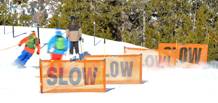
Aspen Highlands, Michael Neumann
DENVER, Colo. – February 17, 2012– Colorado Ski Country USA (CSCUSA) and its 22 member resorts remind skiers and snowboarders to practice safe skiing and riding, know and follow Your Responsibility Code, be aware of surroundings and obey terrain closures.
“Guest safety is always the number one priority of our members,” explained Melanie Mills, CSCUSA president and CEO. “President’s Day weekend is a popular time to go skiing, and our resorts are doing absolutely everything they can to make sure guests are safe and have an enjoyable time on the slopes during this busy weekend.”
Individual skier and snowboarder responsibility is the foundation for safe skiing. Loveland Ski Area assistant patrol director and CSCUSA Ski Patroller of the Year, Joey Riefenberg, stresses the importance of being aware of your surroundings, “Skiers and snowboarders need to be proactive about safety, pay attention to who is skiing around you and always look downhill. Go slow and give yourself time to stop. Know that little kids are out and about and need a wide berth, watch where the flows are.”
CSCUSA member resorts across the state are taking extra measures to provide safe skiing environments, including constantly reassessing conditions. “Resorts are working super hard to make sure it’s safe. Everyone is super conscientious of that, and the snowpack,” said Riefenberg. “It’s a funny snowpack this year, really odd, and resorts are on alert, busy knocking all the air out of the snowpack and making sure everything is safe.”
Skiers and snowboarders are also reminded to obey all signage and be especially alert to obeying terrain closures. As snow continues to fall in Ski Country, resorts will open more terrain as conditions safely allow. “We’d love to open everything but things are closed for a reason, because it’s unsafe for you and unsafe for those who have to rescue you,” Riefenberg explained. “Nothing is being saved, we want everyone to have fun, but be safe doing it.”
Ultimately, it is the responsible behavior of skiers and riders that make the slopes safe. Knowing the nationally recognized Your Responsibility Code is crucial to skier and rider responsibility. Referred to simply as The Code, it is comprised of seven principles that collectively outline on-mountain skier etiquette and safe skiing practices.
Responsibilities within The Code include:
Image via Wikipedia
- Always stay in control, and be able to stop or avoid other people or objects.
- People ahead of you have the right of way. It is your responsibility to avoid them.
- You must not stop where you obstruct a trail, or are not visible from above.
- Whenever starting downhill or merging into a trail, look uphill and yield to others.
- Always use devices to help prevent runaway equipment.
- Observe all posted signs and warnings. Keep off closed trails and out of closed areas.
- Prior to using any lift, you must have the knowledge and ability to load, ride and unload safely.
CSCUSA also reminds skiers, snowboarders and other snowsports enthusiasts heading into the backcountry to check with the Colorado Avalanche Information Center (CAIC) on the magnitude and nature of avalanche hazard they may encounter, do not venture out alone, and have proper equipment and education for the conditions. “Backcountry avalanche danger right now is considerable,” states Ethan Greene, director of CAIC. “With the holiday weekend there’s going to be powder snow and nice weather, but don’t be fooled that the hazard is anything less than very serious.”
More information on backcountry conditions can be found at the CAIC website, www.avalanche.state.co.us or by calling 303-499-9650.

New study suggests that North American Avalanche survival time is half what was previously thought
Posted: March 7, 2012 Filed under: Avalanche | Tags: avalanche, Avalanche Study, Burial Time, Canada, Canadian Medical Association Journal, Haegeli, Pascal Haegeli, Recreation, Ski, Survival, Survival Time, Switzerland, Tree Line Leave a commentTen minute survival in western wet snow is shown by the study.
Dr. Pascal Haegeli, a researcher from Vancouver BC has recently published a study in the Canadian Medical Association Journal titled “Comparison of avalanche survival patterns in Canada and Switzerland.” There are several notable things to take away from this study.
1. The survival time for a victim in an avalanche has been 18 minutes based on a study done in Switzerland in 1998. (Falk M, Brugger H, Adler-Kastner L. Avalanche survival chances. Nature 1994;368:21.) This 1998 study is not being dismissed. Differences between the types of snow, terrain, etc. are the cause for the discrepancies between the two studies.
This study says that avalanche survival time is probably only Ten (10) minutes.
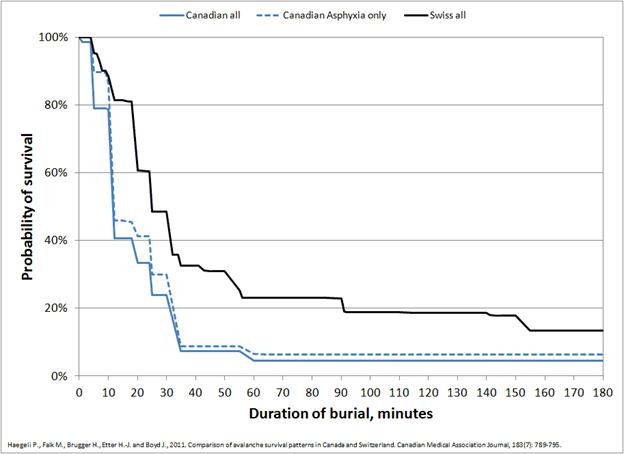
The Swiss study developed the avalanche survival curve based on the amount of time a person was buried.
The probability of survival remains above 91% during the first 18 minutes of burial (“survival phase”). This phase is followed by a precipitous drop to 34% between 19 and 35 minutes be – cause of asphyxiation of most people (“asphyxia phase”). Between 35 and 90 minutes, the survival curve levels out (“latent phase”) because of the survival of people with patent airways. Thereafter, survival drops again as those buried eventually succumb to lethal hypothermia complicated by progressive hypoxia and hypercapnia.
2. There was no statistical difference between the overall survival rate of the Canadian study (Haegeli) and the Swiss study (Brugger).
…the Canadian survival curve showed lower chances of survival at all burial durations compared with the Swiss survival model, with a quicker drop in survival in the first 35 minutes and poorer survival associated with prolonged burials.
3. Most Swiss avalanches occur above tree line. Most North American avalanches occur below the tree line. Trauma fatalities are significantly greater in North America.
In the Canadian sample, trauma accounted for more than half of the deaths among people extricated in the first 10 minutes (Figure 1), which highlights the strong influence of trauma on the early phases of the survival curve. The probability of survival at the end of the first 10 minutes was 77% in the overall survival curve for Canada, as compared with 86% in the asphyxia-only survival curve.
4. There were statistically different survival chances between different climates in North America. Western (maritime) snow climates had shorter overall survival times. Western snow climates are characterized by wetter, heavier snow.
The survival curves for the transitional and maritime snow climates were characterized by a considerably earlier drop in survival compared with the curve for the continental snow climate.
The study also offered speculation that heavier denser snow prevented chest movement preventing the victim from breathing if buried.
Snow density is defined as the overall mass of snow per unit volume (kilograms per meter cubed). Typical densities of seasonal snow vary from 30 kg/m in dry, newly fallen snow to 600 kg/m in wet spring snow.
These results highlight the importance of prompt extrication by companions, especially in areas with a more maritime snow climate. Although the “survival phase” has commonly been described to be about 18 minutes long, our analysis shows that the first 10 minutes might be a more appropriate general guideline for Canada and other areas with a maritime snow climate.

5. The study recommended that Airbags and Transceivers be used as they offered the best options to speed up rescue.
The use of avalanche airbags to prevent burial and avalanche transceivers to speed up the locations of buried avalanche victims are recommended. Both of these safety devices have been shown to reduce mortality significantly.
The study had numerous interesting facts about avalanche burials.
The two longest burials among survivors in the Canadian sample (120 and 300 minutes) both occurred in urban settings, whereas the maximum burial time among survivors in a remote setting was 55 minutes.
So?
When teaching at Colorado Mountain College in the Ski Area Operations program I tell my students the one thing we know about avalanches to an absolute certainty: Avalanches are made of snow.
For other articles on Avalanches see:
Research shows beacons have issues with multivictim searches
Colorado Avalanche Information Center
It’s time to sign up to get the CAIC Avalanche Forecasts
Well written article about the risks of Avalanches and survival with the latest gear.
See this article by Earn Your Turns: Canadian Study reduces Avalanche Survival Time, http://www.earnyourturns.com/9079/avalanche-survival-time-reduced/
What do you think? Leave a comment.
If you like this let your friends know or post it on FB, Twitter or LinkedIn
Copyright 2012 Recreation Law (720) Edit Law
Twitter: RecreationLaw
Facebook: Rec.Law.Now
Facebook Page: Outdoor Recreation & Adventure Travel Law
Mobile Site: http://m.recreation-law.com
#RecreationLaw, #@RecreationLaw, #Cycling.Law #Fitness.Law, #Ski.Law, #Outside.Law, #Recreation.Law, #Recreation-Law.com, #Outdoor Law, #Recreation Law, #Outdoor Recreation Law, #Adventure Travel Law, #law, #Travel Law, #Jim Moss, #James H. Moss, #Attorney at Law, #Tourism, #Adventure Tourism, #Rec-Law, #Rec-Law Blog, #Recreation Law, #Recreation Law Blog, #Risk Management, #Human Powered, #Human Powered Recreation,# Cycling Law, #Bicycling Law, #Fitness Law, #Recreation-Law.com, #Backpacking, #Hiking, #Mountaineering, #Ice Climbing, #Rock Climbing, #Ropes Course, #Challenge Course, #Summer Camp, #Camps, #Youth Camps, #Skiing, #Ski Areas, #Negligence, #Snowboarding, #RecreationLaw, #@RecreationLaw, #Cycling.Law #Fitness.Law, #SkiLaw, #Outside.Law, #Recreation.Law, #RecreationLaw.com, #OutdoorLaw, #RecreationLaw, #OutdoorRecreationLaw, #AdventureTravelLaw, #Law, #TravelLaw, #JimMoss, #JamesHMoss, #AttorneyatLaw, #Tourism, #AdventureTourism, #RecLaw, #RecLawBlog, #RecreationLawBlog, #RiskManagement, #HumanPowered, #HumanPoweredRecreation,# CyclingLaw, #BicyclingLaw, #FitnessLaw, #RecreationLaw.com, #Backpacking, #Hiking, #Mountaineering, #IceClimbing, #RockClimbing, #RopesCourse, #ChallengeCourse, #SummerCamp, #Camps, #YouthCamps, #Skiing, #Ski Areas, #Negligence, #Snowboarding, sport and recreation laws, ski law, cycling law, Colorado law, law for recreation and sport managers, bicycling and the law, cycling and the law, ski helmet law, skiers code, skiing accidents, #Avalanche, Avalanche Study, Pascal Haegeli, #Vancouver, #BC, Canadian Medical Association Journal, #Haegeli, #CMAJ, #CMA, Survival Rate, #Study,
WordPress Tags: North,American,Avalanche,survival,western,Pascal,Haegeli,researcher,Vancouver,Canadian,Medical,Association,Journal,Comparison,Canada,Switzerland,victim,Falk,Brugger,Adler,Kastner,Nature,Differences,terrain,discrepancies,Swiss,person,burial,phase,asphyxiation,asphyxia,airways,Thereafter,difference,durations,burials,Most,avalanches,tree,Trauma,America,deaths,Figure,phases,climates,climate,speculation,chest,unit,meter,Typical,densities,importance,extrication,companions,areas,Although,analysis,guideline,Airbags,Transceivers,options,locations,victims,Both,survivors,settings,Colorado,Mountain,College,Area,Operations,students,Magazine,families,Research,beacons,Information,Center,CAIC,Forecasts,article,gear,Leave,Twitter,LinkedIn,Recreation,Edit,RecreationLaw,Facebook,Page,Outdoor,Adventure,Travel,Blog,Mobile,Site,Outside,Moss,James,Attorney,Tourism,Risk,Management,Human,Rock,Ropes,Course,Challenge,Summer,Camp,Camps,Youth,Negligence,SkiLaw,OutdoorLaw,OutdoorRecreationLaw,AdventureTravelLaw,TravelLaw,JimMoss,JamesHMoss,AttorneyatLaw,AdventureTourism,RecLaw,RecLawBlog,RecreationLawBlog,RiskManagement,HumanPoweredRecreation,CyclingLaw,BicyclingLaw,FitnessLaw,RopesCourse,ChallengeCourse,SummerCamp,YouthCamps,managers,helmet,accidents,Study,CMAJ,Rate
Costs, when you win a lawsuit you normally can recover your costs
Posted: March 5, 2012 Filed under: Ski Area, Skiing / Snow Boarding | Tags: Alpine Meadows, California, Outdoors, Recreation, Rock climbing, Ski, Ski Resort, Snowboard, snowboarding Leave a commentGregorie v. Alpine Meadows Ski Corporation, 2011 U.S. Dist. LEXIS 20275
Costs do not include attorney fees
This case is a lawsuit by the parents of a 24-year-old girl who died snowboarding. The father, in response to her death founded the California Ski & Snowboard Association (CSSO as set forth by the court and California Ski and Snowboard Safety Organization based on their website). An association allegedly started to make ski areas safer. However, the young girl died out of bounds.
The girl and her friend were hiking out of bounds. On the way, they passed two signs warning people of the dangers. While on the High Beaver Tavers she slipped, slid out of bounds and died.
The girl signed a release before skiing at Alpine Meadows in California. On top of that she was described as an experienced snowboarder.
California Ski & Snowboard Association (CSSO) is an organization that I have written about as a wolf in sheep’s clothing (or maybe it should be skin or wool). Originally, the organization came across as wanting to work with ski areas to make them safer. See Grieving Father starts organization to make skiing safer and California Ski and Snowboard Safety Organization turns out to be a Wolf in Sheep’s Clothing.
Recently, the organization has changed its mission to:
Mission
To promote and support safety improvements in California skiing, snowboarding and recreational snow sports and serve as an independent, factual public resource regarding the safety of California ski resorts.
Vision
A recreational skiing and snowboarding environment in which federal and state governments, health and safety organizations and the ski resort industry are proactively and collaboratively working to establish and maintain the safest possible snow sport environment and experience.
Summary of the case
The plaintiffs sued for Premise’s liability, misrepresentation of the risk, negligence, breach of the season pass agreement, two claims of rescission and declaratory relief.
Rescission is a contract claim that attempts to void the contract and place the parties back in the position they were in prior to the signing of the contract. To win a claim for rescission the party wanting out of the agreement must claim material misstatement of the issues creating the contract, or something akin to fraud or misrepresentation.
The defendants filed a motion for summary judgment based on the release (express assumption of the risk) and primary assumption of the risk. The trial court granted the defendants motion and dismissed the claims of the plaintiff.
As is normal, the defendant then filed a bill of costs. This is a motion to recover their costs they expended in defending the lawsuit. Costs are normally granted to the winning party in a suit.
Costs are the actual money spent for things necessary to defend the suit. In federal court, costs are set out by statute.
Federal Rule of Civil Procedure 54(d)(1)
(1) Fees of the clerk and marshal;
(2) [*5] Fees for printed or electronically recorded transcripts necessarily obtained for use in the case;
(3) Fees and disbursements for printing and witnesses;
(4) Fees for exemplification and the costs of making copies of any materials where the copies are necessarily obtained for use in the case;
(5) Docket fees under section 1923 of this title
(6) Compensation of court appointed experts, compensation of interpreters, and salaries, fees, expenses, and costs of special interpretation services under section 1828 of this title.
A better way to look at costs is; those things the party wrote a check to, necessary to litigate.
Costs do not include attorney fees. To recover attorney fees, there must be a violation of a state statute that awarded costs, a contract that awards costs or liquidated damages or an action (claim) by one side or the other that is frivolous, groundless and wholly without any legal merit. “Rule 54(d)(1) provides that costs, “other than attorney’s fees shall be allowed as of course to the prevailing party unless the court otherwise directs.”
Costs are up to the discretion of the court. Normally, the court will allow most costs if the costs were specifically part of the trial or litigation. I look at it this way. If the judge saw the results of what you paid for, then that might be costs.
On the other hand, if money was spent on something that only might or did lead to what the judge might see, then probably not allowed as costs.). “If the depositions are for investigatory or for discovery purposes only, rather than for presentation of the case, courts have found that they are not taxable.”
The decision looks at several of the items the trial court allowed as costs. The original order allowing costs was $72,515.36. The court found that only $51,042.76 of the amount should have been allowed.
So Now What?
There are several interesting issues that are just good to know if you run a ski area or any recreation business. The deposition of the father took three days. Part of that deposition concerned the organization he started, California Ski & Snowboard Association (CSSO); however, no matter why, think about losing three days out of the office for deposition and probably another six days preparing for the deposition. Nine days total for something that if you work hard in the beginning, might have been prevented.
The expert witness of the plaintiff testified for two days. That would be an expensive two days. You and/or your insurance company would be paying probably two lawyers to attend the deposition and paying your expert witness to be questioned. Even if you are not having your expert deposed, just an employee, you are paying the employee to be there. Simply put, depositions on one side or the other can easily cost $1000 per hour.
Winning or losing a lawsuit, is an expensive proposition. Usually, the costs awarded by the court are less than 50% of the actual costs spent. Add to that the time incurred to defend a lawsuit, and it is ridiculous.
What do you think? Leave a comment.
If you like this let your friends know or post it on FB, Twitter or LinkedIn
Copyright 2012 Recreation Law (720) Edit Law
Twitter: RecreationLaw
Facebook: Rec.Law.Now
Facebook Page: Outdoor Recreation & Adventure Travel Law
Mobile Site: http://m.recreation-law.com
#RecreationLaw, #@RecreationLaw, #Cycling.Law #Fitness.Law, #Ski.Law, #Outside.Law, #Recreation.Law, #Recreation-Law.com, #Outdoor Law, #Recreation Law, #Outdoor Recreation Law, #Adventure Travel Law, #law, #Travel Law, #Jim Moss, #James H. Moss, #Attorney at Law, #Tourism, #Adventure Tourism, #Rec-Law, #Rec-Law Blog, #Recreation Law, #Recreation Law Blog, #Risk Management, #Human Powered, #Human Powered Recreation,# Cycling Law, #Bicycling Law, #Fitness Law, #Recreation-Law.com, #Backpacking, #Hiking, #Mountaineering, #Ice Climbing, #Rock Climbing, #Ropes Course, #Challenge Course, #Summer Camp, #Camps, #Youth Camps, #Skiing, #Ski Areas, #Negligence, #Snowboarding, #RecreationLaw, #@RecreationLaw, #Cycling.Law #Fitness.Law, #SkiLaw, #Outside.Law, #Recreation.Law, #RecreationLaw.com, #OutdoorLaw, #RecreationLaw, #OutdoorRecreationLaw, #AdventureTravelLaw, #Law, #TravelLaw, #JimMoss, #JamesHMoss, #AttorneyatLaw, #Tourism, #AdventureTourism, #RecLaw, #RecLawBlog, #RecreationLawBlog, #RiskManagement, #HumanPowered, #HumanPoweredRecreation,# CyclingLaw, #BicyclingLaw, #FitnessLaw, #RecreationLaw.com, #Backpacking, #Hiking, #Mountaineering, #IceClimbing, #RockClimbing, #RopesCourse, #ChallengeCourse, #SummerCamp, #Camps, #YouthCamps, #Skiing, #Ski Areas, #Negligence, #Snowboarding, sport and recreation laws, ski law, cycling law, Colorado law, law for recreation and sport managers, bicycling and the law, cycling and the law, ski helmet law, skiers code, skiing accidents, California Ski & Snowboard Association, CSSO, Alpine Meadows, fatality, snowboarding, costs,
WordPress Tags: Costs,lawsuit,Gregorie,Alpine,Meadows,Corporation,Dist,LEXIS,attorney,parents,girl,response,death,California,Snowboard,Association,CSSO,Organization,areas,friend,dangers,High,Beaver,Tavers,sheep,wool,Father,Wolf,mission,improvements,resource,resorts,Vision,environment,governments,health,resort,industry,Summary,plaintiffs,Premise,misrepresentation,negligence,agreement,relief,Rescission,fraud,defendants,judgment,assumption,plaintiff,defendant,money,statute,Federal,Rule,Civil,Procedure,Fees,clerk,transcripts,disbursements,Docket,Compensation,experts,interpreters,salaries,interpretation,violation,action,discretion,litigation,discovery,purposes,presentation,decision,items,area,recreation,Part,office,Nine,insurance,lawyers,employee,cost,hour,proposition,Leave,Twitter,LinkedIn,Edit,RecreationLaw,Facebook,Page,Outdoor,Adventure,Travel,Blog,Mobile,Site,Outside,Moss,James,Tourism,Risk,Management,Human,Rock,Ropes,Course,Challenge,Summer,Camp,Camps,Youth,SkiLaw,OutdoorLaw,OutdoorRecreationLaw,AdventureTravelLaw,TravelLaw,JimMoss,JamesHMoss,AttorneyatLaw,AdventureTourism,RecLaw,RecLawBlog,RecreationLawBlog,RiskManagement,HumanPoweredRecreation,CyclingLaw,BicyclingLaw,FitnessLaw,RopesCourse,ChallengeCourse,SummerCamp,YouthCamps,Colorado,managers,helmet,accidents,three
Gregorie v. Alpine Meadows Ski Corporation, 2011 U.S. Dist. LEXIS 20275
Posted: March 5, 2012 Filed under: Legal Case, Ski Area, Skiing / Snow Boarding | Tags: Alpine Meadows, Assumption of risk, California, Federal Rules of Civil Procedure, Out of Bounds, Powdr Corporation, ski Area Fatality, snowboarding, Supreme Court Leave a commentGregorie v. Alpine Meadows Ski Corporation, 2011 U.S. Dist. LEXIS 20275
Daniel Gregorie, in his individual capacity and as Successor In Interest to Jessica Gregorie, deceased, and Margaret Gregorie, in her individual capacity and as Successor In Interest to Jessica Gregorie, deceased, Plaintiffs, v. Alpine Meadows Ski Corporation, a California Corporation and Powder Corp., a Delaware Corporation, Defendants.
NO. CIV. S-08-259 LKK/DAD
UNITED STATES DISTRICT COURT FOR THE EASTERN DISTRICT OF CALIFORNIA
2011 U.S. Dist. LEXIS 20275
February 9, 2011, Decided
February 10, 2011, Filed
PRIOR HISTORY: Gregorie v. Alpine Meadows Ski Corp., 405 Fed. Appx. 187, 2010 U.S. App. LEXIS 26328 (9th Cir. Cal., Dec. 7, 2010)
COUNSEL: [*1] For Daniel Gregorie, in his individual capacity and as Successor in Interest to Jessica Gregorie, deceased, Margaret Gregorie, in her individual capacity and as Successor in Interest to Jessica Gregorie, deceased, Plaintiffs: Alisha M. Louie, Melvin D. Honowitz, LEAD ATTORNEYS, Constance J. Yu, Sideman and Bancroft, LLP, San Francisco, CA.
For Alpine Meadows Ski Corporation, a California corporation, POWDR Corporation, a Delaware corporation, Defendants: Jill Haley Penwarden, John E. Fagan, Michael L. Reitzell, Duane Morris LLP, Truckee, CA.
JUDGES: LAWRENCE K. KARLTON, UNITED STATES DISTRICT COURT SENIOR JUDGE.
OPINION BY: LAWRENCE K. KARLTON
OPINION
ORDER
Before the court is defendant’s bill of costs. For the reason described below, the court awards some and denies some costs sought by defendant.
I. BACKGROUND
A. Factual background
Plaintiffs brought an action in wrongful death as the parents and successors in interest of decedent, Jessica Gregorie. Gregorie, a twenty-four year old woman and experienced snowboarder, died while snowboarding at defendant Alpine Meadows Ski Corporation’s (“Alpine Meadows”) ski resort on February 5, 2006. Gregorie had signed a waiver in conjunction with a season pass she purchased from [*2] Alpine Meadows, which provided her agreement to assume all risks of skiing beyond the area boundary, and releasing defendants from liability.
On the date of her death, decedent went snowboarding with her friend Joe Gaffney. Gregorie passed two signs posted at the base of the lift, warning of potential danger. While hiking the “High Beaver Traverse” to reach the “Beaver Bowl” area, Gregorie slipped due to the icy snow conditions. Gregorie was unable to stop, and slid past a large tree with a sign stating “Ski Area Boundary.” A helicopter transported Gregorie to Washoe Medical Center in Reno where she died later that day.
B. Procedural History
Plaintiffs Daniel and Margaret Gregorie commenced this action on February 1, 2008 against Alpine Meadows and Powdr Corporation. In their first and fourth causes of action, plaintiffs alleged premises liability. Their second cause of action alleged misrepresentation of risk of harm. Their third cause of action alleged negligence. Their fifth cause of action alleged breach of the season pass contract entered between Jessica Gregorie and Alpine Meadows. The sixth and eighth causes of action sought recision of that contract on the basis of fraud in the [*3] inducement. The seventh cause of action sought declaratory relief regarding Gregorie’s and defendant’s respective rights and duties under the contract. In addition to declaratory relief, plaintiff’s sought damages, punitive damages, and costs.
On May 29, 2009 defendants moved for summary judgement or adjudication on the basis that the plaintiffs were barred by the doctrines of primary and express assumption of risk and on the basis that Powdr Corporation is not a proper defendant. On August 6, 2009 this court entered an order granting summary judgment as to all causes of action in favor of defendants.
Defendants then submitted a Bill of Costs totaling $72,515.36 on August 7, 2009. Bill of Costs Submitted, Doc. No. 134 (August 14, 2009). Plaintiffs filed objections to the defendants’ Bill of Costs pursuant to Local Rule 54-292(c) and request a hearing.1 Objections, Doc. No. 136 (Aug. 24, 2009). In response to the objections, defendants withdraw their request for taxation of fees for the Clerk in the amount of $350.00, duplicate fees for invoice costs in the amount of $1,974.98, and fees for service of process to Randall Heiken. Response to Objection, Doc. No. 143, (Sept. 15, 2009). Costs [*4] for service of process to Jack Palladino and the California Ski & Snowboard Association, for the deposition transcript of Jack Palladino, the continued deposition transcript of Stanley Gale (Vol. 2), and the continued deposition transcript of Daniel Gregorie (Vol. 3) remain in dispute. Additionally, costs for the videographic recording of those depositions for which the stenographic transcript will also be taxed remain disputed. These include the depositions of Jack Palladino, Stanley Gale, Daniel Gregorie, Billy Martin, Joe Gaffney, Brian Martinezmoles, and Mike Leake.
1 The court finds that a hearing is not necessary in this matter.
II. ANALYSIS
A. Taxation of Costs Generally
[HN1] Federal Rule of Civil Procedure 54(d)(1) and Eastern District Local Rule 292(f) govern the taxation of costs, other than attorney’s fees, awarded to the prevailing party in a civil matter. The Supreme Court has interpreted Rule 54(d)(1) to require that district courts consider only those costs enumerated in 28 U.S.C. § 1920. See Crawford Fitting Co. v. J.T. Gibbons, Inc., 482 U.S. 437, 441-42, 107 S. Ct. 2494, 96 L. Ed. 2d 385 (1987). Section 1920 provides that
[HN2] [a] judge or clerk of the court may tax the following:
(1) Fees of the clerk and marshal;
(2) [*5] Fees for printed or electronically recorded transcripts necessarily obtained for use in the case;
(3) Fees and disbursements for printing and witnesses;
(4) Fees for exemplification and the costs of making copies of any materials where the copies are necessarily obtained for use in the case;
(5) Docket fees under section 1923 of this title
(6) Compensation of court appointed experts, compensation of interpreters, and salaries, fees, expenses, and costs of special interpretation services under section 1828 of this title.
A bill of costs shall be filed in the case and, upon allowance, included in the judgment or decree.
28 U.S.C. § 1920.
[HN3] Rule 54(d)(1) provides that costs, “other than attorney’s fees shall be allowed as of course to the prevailing party unless the court otherwise directs.” Fed R. Civ. P. 54(d)(1). This provision establishes a presumption that costs will be awarded to the prevailing party, but allows the court discretion to decide otherwise. Association of Mexican American Educators v. State of California, 231 F.3d 572, 591-92 (9th Cir. 2000). Courts may also interpret the meaning of the items listed in § 1920. Alflex Corp. v. Underwriters Laboratories, Inc., 914 F.2d 175, 177 (9th Cir. 1990); [*6] BDT Products, Inc. v. Lexmark International Inc., 405 F.3d 415, 419 (6th Cir. 2005). But see In re Paoli R.R. Yard PCB Litigation, 221 F.3d 449, 459, 461 (4th Cir. 2000) (asserting plenary review of the District Court’s interpretation of Federal Rule of Civil Procedure 54(d)(1)).
[HN4] Courts may deny an award of full costs when they state a sound basis for doing so. Chapman v. AI Transport, 229 F.3d 1012, 1038-39 (11th Cir. 2000). The losing party bears the burden of showing that an award is inequitable under the circumstances. Paoli 221 F.3d at 462-63. Among many factors, a prevailing party’s bad conduct is relevant to the determination of whether or not to tax if such conduct is responsible for excessive costs. Id. at 463.
Here, plaintiffs objects to several items on defendants’ bill of costs. They are addressed in turn.
B. Deposition Transcripts
[HN5] In deciding whether a copy of a deposition is taxable as a cost, the court must determine whether it was “necessarily obtained for use in the case” under 28 U.S.C. § 1920. “The court has great latitude in determining whether an award of deposition costs is warranted.” Allen v. United States Steel Corporation, 665 F.2d 689, 697 (5th Cir. 1982); See [*7] also 10 Wright, Miller, & Kane Federal Practice and Procedure § 2676 (3d ed. & Supp. 2010). If the depositions are for investigatory or for discovery purposes only, rather than for presentation of the case, courts have found that they are not taxable. Wright, Miller, Kane supra, § 2676. Where a motion for summary judgment is granted, “whether [the cost of a deposition] can be taxed is generally determined by deciding whether the deposition reasonably seemed necessary at the time it was taken.” Wright, Miller, Kane supra, § 2676.
i. Deposition of Jack Palladino
Jack Palladino is the family attorney of plaintiff Daniel Gregorie and private investigator to the law firm Siderman & Bancroft, LLP, plaintiffs’ counsel in this action. Objections, Doc. No. 136, at 3 (Aug. 24, 2009). Plaintiffs object to taxation of the costs incurred in the deposition of Palladino, especially for two days. They claim that the deposition was not necessary because of plaintiffs good faith effort to provide investigative reports of Palladino and because much of the testimony is protected by attorney-client privilege. Further, they contend that defendants deposed Palladino as a “fishing expedition and [for] harassment [*8] purposes only.” Id. at 3. The court now determines that under the circumstances, at least in part, the deposition of Palladino was conceivably taken for use in the case.
Although the parties initially disputed whether to conduct this deposition, the defendants withdrew their motion to compel the deposition. This suggests that the parties agreed to the conditions of the deposition which did occur. Motion to Compel, Doc. #64 (May 19, 2009); Withdrawal of Motion to Compel, Doc. #66 (May 21, 2009). In the parties’ Joint Statement Regarding Discovery Disagreement, defendants state that they “believe Mr. Palladino has crucial evidence as to statements made by eyewitnesses very shortly after the accident occurred” and that he has “likely interviewed additional witnesses and conduct [sic.] further inquiry into the facts and circumstances” surrounding the accident. Joint Statement, Doc. No. 65 at 5 (May 19, 2009). This suggests that at least in part the deposition was taken for investigative purposes. It is also true that the Magistrate Judge overruled several of the plaintiffs’ privilege-based objections. Exhibit G to Penwarden Declaration, Doc. No. 151 (Sept. 15, 2009). It is difficult for [*9] the court to parse the circumstances and make a certain judgement as to what percentage of the deposition was reasonably believed to be necessary for trial and what percentage was for other purposes. It appears clear, however, that at least one motivation was to piggyback on Palladino’s investigation. The court determines that one half the cost of the deposition of the stenographically recording of this deposition is taxable.
ii. Continued Deposition of Daniel Gregorie (Vol. 3)
Daniel Gregorie is the plaintiff in this action. Plaintiffs concede that defendants were justified in deposing Daniel Gregorie, but contend that questioning directed to Gregorie in his capacity as founder of the California Ski & Snowboard Association (CSSO), during the second and third days of the deposition, was not warranted. Objections, Doc. No. 136, at 4 (Aug. 24, 2009). However, the Magistrate Judge appears to have ordered Gregorie to answer questions directed to his CSSO activities. Minutes, Doc. #57 (April 3, 2009). The Magistrate Judge apparently found that this line questioning was likely to lead to admissible evidence. While the length appears excessive, the Magistrate Judge’s judgment appears sufficient [*10] to dispose of the issue, and the costs of this deposition will be taxed.
iii. Continued Deposition of Stan Gale (Vol. 2)
Stan Gale was designated by plaintiffs as an expert in ski safety. In their objection, plaintiffs maintain that there was no reasonable basis to depose Stan Gale for the full second day of deposition, during which he was questioned in his capacity as a percipient witness. Objections, Doc. No. 136, at 3, 4 (Aug. 24, 2009).
However, the plaintiffs agreed to the questioning of Mr. Gale in his capacity as a percipient witness at the time of the deposition. Objections, Doc. 136, at 4 (Aug. 24, 2009). The defendants were reasonable in believing that testimony obtained from a percipient witness would produce admissible evidence or information useful in presentation of the case. Therefore, the deposition was reasonably necessary at the time it was taken, and stenographic transcription of the full second day of Mr. Gale’s testimony is taxable.
C. Taxing the costs of both stenography and videography for the same deposition.
[HN6] The Ninth Circuit has not addressed the issue of taxation for both stenographic and videographic costs of the same deposition. Several Circuits have expressly [*11] approved of the practice.2 Little v. Mistubishi Motors North America, Inc., 514 F.3d 699, 702 (7th Cir. 2008); BDT Products, Inc. v. Lexmark International Inc., 405 F.3d 415, 420 (6th Cir. 2005); Tilton v. Capital/ABC, Inc., 115 F.3d 1471, 1478 (10th Cir. 1997); Morrison v. Reichhold Chemicals, Inc., 97 F.3d 460, 465 (11th Cir. 1996). The Tenth and Fourth Circuits have gone further by stating that ordinarily a “stenographic transcript of a videotaped deposition will be necessarily obtained for the case” because the deposing party will be required to provide the transcript in a variety of circumstances. Tilton, 115 F.3d at 1478-79 (internal quotations omitted); Little, 514 F.3d at 702.3
2 Defendants cite an unreported case from the Northern District of California allowing taxation of both stenographic and videographic recording of a deposition. MEMC Electronic Materials, No. C-01-4925 SBA, 2004 U.S. Dist. LEXIS 29359, 2004 WL 5361246, at *5 (N.D. Cal. Oct. 22, 2004). It is worth noting that MEMC Electronic Materials, the losing party had requested that the depositions be videotaped. 2004 U.S. Dist. LEXIS 29359, [WL] at *5.
3 This rationale presumes as valid taxation of the videographic recording in the first place, focusing on the question of stenography [*12] as an additional cost.
In 2008, after the above circuit cases were decided, Congress amended a relevant portion of 28 U.S.C. § 1920. Subsection (2) of the statute, which once allowed taxation of “fees of the court reporter for all or any part of the stenographic transcript necessarily obtained for use in the case.” [HN7] The statute now allows taxation of simply “fees for printed or electronically recorded transcripts necessarily obtained for use in the case.” 28 U.S.C. § 1920 (emphasis added). See also EEOC v. CRST Van Expedited, Inc., No. 07-CV-95-LRR, 2010 U.S. Dist. LEXIS 11125, 2010 WL 520564, at *5 (N.D. Iowa Feb. 9, 2010). In Boot, the district court held that the amended language justified taxation of “either stenographic transcription or videotaped depositions-not both.” CRST Van Expedited, Inc., [WL] at *5. The court agrees with the reasoning on Boot, and declines to tax the videotaped depositions.4
4 The court notes that there may be some unusual circumstance where both a transcription and a video deposition may be taxed because both are necessary. This case does not present such an exceptional circumstance.
F. Service of Process
[HN8] Fees for service of process are properly taxed under section 1920. Alflex Corp. v. Underwriters Laboratories, Inc., 914 F.2d 175, 177 (9th Cir. 1990). [*13] The district court regularly taxes costs for service of process. Avila v. Willits Environment, No. C 99-03941 SI, 2009 U.S. Dist. LEXIS 130416, 2009 WL 4254367, at *5 (N.D. Cal. Nov. 24, 2009); Campbell v National Passenger R.R. Corp., 718 F. Supp. 2d 1093, 1106-07 (N.D. Cal. 2010). The question is whether these subpoenas were necessary for use in the case.
i. Jack Palladino
According to plaintiffs, the cost of service of process to Jack Palladino should not be taxed because Palladino was voluntarily available for a deposition. Objections, Doc. No. 136, at 5 (Aug. 24, 2009). However, Palladino’s voluntary availability was subject to conditions, limitations, and claims of privilege. Defendant’s point out that the Magistrate Judge ruled that some of these limitations were “baseless.” Exhibit G to Penwarden Declaration, Doc. #151 at 19 (Sept. 15, 2009). The Magistrate Judge’s order requiring the plaintiff to answer questions, which he would not answer voluntarily, is sufficient to support this court’s finding that the cost of service of process was necessary for the defendants’ use in the case. Accordingly this cost will be taxed.
ii. CSSO
Plaintiffs object to the costs for service of process to the California Ski & Snowboard [*14] Association (CSSO), an organization founded by plaintiff, Dr. Daniel Gregorie. Defendants note that Dr. Gregorie refused to answer questions during his deposition about the CSSO, and that counsel invited the defendants to subpoena the CSSO to obtain responses. Bill of Costs Submitted, Doc. No. 143, at 10 (Sept. 15, 2009). Because plaintiffs do not show why service of process pursuant to their own suggestion was unreasonable, this cost will be taxed.
III. CONCLUSION
For the foregoing reasons, the court ORDERS as follows:
(1) Plaintiffs SHALL BE TAXED in the amount of $51,042.76.
(2) Plaintiffs SHALL NOT BE TAXED for the costs of videotaping any depositions, for half the cost of the transcript of Palladino’s deposition, and for the costs withdrawn by defendants.
IT IS SO ORDERED.
DATED: February 9, 2011.
/s/ Lawrence K Karlton
LAWRENCE K. KARLTON
SENIOR JUDGE
UNITED STATES DISTRICT COURT
Skier/Boarder Fatalities 2011-2012 Ski Season 2/15/12
Posted: February 29, 2012 Filed under: Ski Area | Tags: Fatalities, helmet, Rock climbing, Ski, ski area, Ski Resort, skiing, Snowboard, snowboarding, Sport, Sports, Vail Colorado, Winter sport, winter sports Leave a commentThis list is not guaranteed to be accurate. The information is found from web searches and news dispatches. If you have a source for information on any fatality please leave a comment.
If this information is incorrect or incomplete please let me know. This is up to date as of February 15, 2012. Thanks.
|
# |
Date |
Resort |
Age |
Skier Ability |
Ski/ Tele /Boarder |
Reference |
|
|
1 |
11/18/2011 |
62 |
Skier |
Yes |
|||
|
2 |
11/18/2011 |
Breckenridge |
19 |
Expert |
Boarder |
Yes |
|
|
3 |
11/27/2011 |
Mountain High ski resor |
23 |
Beginner |
Boarder |
Yes |
|
|
4 |
12/18/2011 |
Sugar Bowl ski resort |
7 |
Expert |
Skier |
|
|
|
5 |
1/4/2012 |
Ski Ward |
19 |
Expert |
Skier |
||
|
6 |
1/11/2012 |
Ski Apache |
29 |
Skier |
No |
||
|
7 |
1/12/2012 |
Sugarloaf ski resort |
41 |
Skier |
Yes |
||
|
8 |
1/14/2012 |
Silverton Mountain Ski Area |
25 |
Expert |
Skier |
||
|
9 |
1/17/2012 |
Heavenly Mountain Resort |
34 |
Boarder |
Yes |
||
|
10 |
1/18/2012 |
Aspen Highlands |
30 |
Boarder |
Yes |
||
|
11 |
1/18/2012 |
Mt. Hood Meadows Ski Resort |
15 |
Boarder |
No |
||
|
12 |
1/19/2012 |
Park City |
29 |
Boarder |
Yes |
||
|
13 |
1/20/2012 |
Copper Mountain |
51 |
Yes |
|||
|
14 |
1/20/2012 |
Whiteface Mountain |
25 |
Yes |
|||
|
15 |
1/21/2012 |
Vail |
13 |
Expert |
Skier |
||
|
16 |
1/22/2012 |
Winter Park |
28 |
Expert |
Skier |
||
|
17 |
1/24/2012 |
Steamboat Ski Area |
32 |
Boarder |
|||
|
18 |
1/24/2012 |
Taos Ski Valley |
60 |
Skier |
|||
|
19 |
1/25/2012 |
Keystone Ski Area |
54 |
Skier |
|||
|
20 |
1/27/2012 |
Mt. Hood Skibowl |
17 |
Boarder |
|||
|
21 |
1/29/2012 |
Canyons Ski Resort |
19 |
||||
|
22 |
1/30/2012 |
Seven Springs Mountain Resort |
36 |
Skier |
|||
|
27 |
1/31/2012 |
Solitude Ski Resort |
74 |
Skier |
No |
||
|
23 |
2/1/2012 |
Squaw Valley |
51 |
Skier |
|||
|
26 |
2/4/2012 |
Sugarbush Resort |
41 |
Skier |
Yes |
||
|
33 |
2/4/2012 |
Ski Windham Mountain Resor |
54 |
Skier |
|||
|
24 |
2/5/2012 |
Keystone Ski Area |
58 |
Skier |
No |
||
|
25 |
2/5/2012 |
Ski Windham Mountain Resort |
54 |
Skier |
|||
|
30 |
2/6/2012 |
Mount Snow |
33 |
||||
|
28 |
2/8/2012 |
Vail |
37 |
Yes |
|||
|
29 |
2/9/2012 |
Keystone Ski Area |
72 |
Yes |
|||
|
31 |
2/11/2012 |
Jay Peak Resort |
29 |
Boarder |
Yes |
||
|
32 |
2/11/2012 |
Terry Peak Ski Area |
24 |
Skier |
No |
What do you think? Leave a comment.
If you like this let your friends know or post it on FB, Twitter or Linkedin
Copyright 2012 Recreation Law (720) Edit Law
Twitter: RecreationLaw
Facebook: Rec.Law.Now
Facebook Page: Outdoor Recreation & Adventure Travel Law
#RecreationLaw, #@RecreationLaw, #Cycling.Law #Fitness.Law, #Ski.Law, #Outside.Law, #Recreation.Law, #Recreation-Law.com, #Outdoor Law, #Recreation Law, #Outdoor Recreation Law, #Adventure Travel Law, #law, #Travel Law, #Jim Moss, #James H. Moss, #Attorney at Law, #Tourism, #Adventure Tourism, #Rec-Law, #Rec-Law Blog, #Recreation Law, #Recreation Law Blog, #Risk Management, #Human Powered, #Human Powered Recreation,# Cycling Law, #Bicycling Law, #Fitness Law, #Recreation-Law.com, #Backpacking, #Hiking, #Mountaineering, #Ice Climbing, #Rock Climbing, #Ropes Course, #Challenge Course, #Summer Camp, #Camps, #Youth Camps, #Skiing, #Ski Areas, #Negligence, #Snowboarding, #RecreationLaw, #@RecreationLaw, #Cycling.Law #Fitness.Law, #SkiLaw, #Outside.Law, #Recreation.Law, #RecreationLaw.com, #OutdoorLaw, #RecreationLaw, #OutdoorRecreationLaw, #AdventureTravelLaw, #Law, #TravelLaw, #JimMoss, #JamesHMoss, #AttorneyatLaw, #Tourism, #AdventureTourism, #RecLaw, #RecLawBlog, #RecreationLawBlog, #RiskManagement, #HumanPowered, #HumanPoweredRecreation,# CyclingLaw, #BicyclingLaw, #FitnessLaw, #RecreationLaw.com, #Backpacking, #Hiking, #Mountaineering, #IceClimbing, #RockClimbing, #RopesCourse, #ChallengeCourse, #SummerCamp, #Camps, #YouthCamps, #Skiing, #Ski Areas, #Negligence, #Snowboarding, sport and recreation laws, ski law, cycling law, Colorado law, law for recreation and sport managers, bicycling and the law, cycling and the law, ski helmet law, skiers code, skiing accidents, #Vail, #Breckenridge, #Mountain High Ski Resort, #Ski Ward, #Sugarloaf, #Silverton, Ski Apache, #Sugarloaft, #Heavenly, #Aspen, Mt Hood, Park City, #Copper, #Whiteface, Winter Park, #Steamboat, #Taos, #Keystone, #Canyons, Seven Springs, #Solitude, Ski Windham, Mount Snow, Jay Peak Terry Peak,
WordPress Tags: Skier,Boarder,Fatalities,Season,information,news,February,Thanks,Date,Resort,Tele,Helmet,Reference,Vail,Breckenridge,Expert,Mountain,High,Beginner,Sugar,Bowl,Ward,Apache,Sugarloaf,Silverton,Area,Aspen,Highlands,Meadows,Park,Copper,Whiteface,Winter,Steamboat,Taos,Valley,AihrSt,Skibowl,Canyons,Seven,Springs,Solitude,Squaw,Sugarbush,Windham,Resor,Mount,ABqYPQ,Peak,Terry,Leave,Twitter,Linkedin,Recreation,Edit,RecreationLaw,Facebook,Page,Outdoor,Adventure,Travel,Blog,Outside,Moss,James,Attorney,Tourism,Risk,Management,Human,Rock,Ropes,Course,Challenge,Summer,Camp,Camps,Youth,Areas,Negligence,SkiLaw,OutdoorLaw,OutdoorRecreationLaw,AdventureTravelLaw,TravelLaw,JimMoss,JamesHMoss,AttorneyatLaw,AdventureTourism,RecLaw,RecLawBlog,RecreationLawBlog,RiskManagement,HumanPoweredRecreation,CyclingLaw,BicyclingLaw,FitnessLaw,RopesCourse,ChallengeCourse,SummerCamp,YouthCamps,Colorado,managers,accidents,Sugarloaft
How And Why Americans Engage With Winter Sports Brands: Research Reveals Social Networking Plays A Major Role In Activity
Posted: February 23, 2012 Filed under: Skiing / Snow Boarding | Tags: Harris Interactive, ski area, skiing, snowboarding, social media, Winter sport, winter sports, X Games Leave a comment
Nearly Half of Winter Sports Participants Recommend Image via Wikipedia Products or Brands to Peers |
Slightly over one in five American adults (21 percent) revealed that they ever participate in any winter sport, according to new research released from IMRE Sports, and conducted on their behalf by Harris Interactive. Among those who ever participate in winter sports, 47 percent make recommendations to their peers about their favorite winter sports products or brands.The research also indicated that among those who ever participate in winter sports, 74 percent use social media sites. Interestingly enough, of that 74 percent, 84 percent utilize the platform to follow brands.Harris Interactive conducted this survey online among 2,292 adult Americans ages 18 and older between December 19 and 21, 2011. The research was spearheaded by the Maryland-based sports marketing agency, IMRE Sports.Coupons and Giveaways atop the type of information Americans prefer from brands via social media channelsThe type of information Americans prefer to receive from brands through social media sites (e.g., Facebook, Twitter) reveals a variety of trends that brands can leverage via promotions and advertising. The research revealed that even more opportunity lies among those Americans who have ever participated in winter sports.Among those who use social media sites and who ever participate in winter sports, coupons (49 percent) and giveaways (41 percent) are the most popular types of information users would prefer to receive from the brands they follow or connect with via social media sites.The research revealed the following statistics among adult Americans who used social media sites, as well as those who used social media sites and ever participated in winter sports:Types of Information / Use social media sites / Use social media sites and participate in winter sportsCoupons, sales or discounts / 45% / 49%
|

Mountain Magazine should apologize to the families who will soon lose loved ones because of its latest magazine.
Posted: February 22, 2012 Filed under: Avalanche, Ski Area 1 CommentSidecountry? Whoever invented the word should be flogged in downtown Breckenridge.
The winter 2012 edition of Mountain Magazine had its cover headline as “Ski in the Sidecountry: There’s untracked powder waiting out there for you. We have the skis, boards, guides, resorts, and advice you need to get after it.” The editorial director’s article was titled Slacker Lexicology and tried to justify the cover title. Then a two-page article, with numerous mistakes, was inside that was the basis for the cover title. The entire purpose, article and cover were solely used to promote gear in time for the SIA show.
Mountain Magazine: You don’t know what you are writing about.

Cover to cover, there was not one paragraph to support the claim the magazine had advice to “get after it.” That’s probably good because most of the information they provided was wrong. Nor was there anything of substance other than buy this neat clothing and gear, and you can ski out of bounds.
What Mountain Magazine does have is the idea that anything to sell a magazine is worth the effort, even if it kills people.
It is not the resorts that are going to pay the price for this stupidity. It is two groups. The idiots who believe that the other side of the rope is fair game and the Search and Rescue volunteers who will go out in all types of whether to rescue those idiots putting their own life on the line.
Even if resort employees are part of the rescue the resorts not liable, and rightfully so. In most cases when an employee leaves the resort to participate in a SAR, he is no longer working for the resort but now working, as a volunteer for the county sheriff. You should not be liable for what happens outside your boundaries or outside of your control. However, the article sure as heck did not point that out. In fact, the article could lead you to believe that if you paid for a lift ticket to ride up, skiing out of bounds is OK, and you are still protected by the resort.
Sidecountry does not exist. Under the law, you are either inbounds or out of bounds. If you are out of bounds, you have no back up, even if you hired a guide except volunteer SAR. If you are out of bounds, there is no avalanche work, no marked hazards, no place at the bottom of the hill to warm up.
There is backcountry, which has the definition attached to the word that indicates, it’s not a resort. If you go in the backcountry you should have training, a beacon, a shovel, a probe, an airbag and at least one friend who have the same.
The entire issue was devoted to selling gear, allegedly, that you could use out of bounds. The article promised you great skiing if you hired a guide to get there.
The article then talked about UIAGM guides as the people to hire to guide you. UIAGM does not make guides. The article has no clue what it’s writing about with regard to the UIAGM and the “statutes” it developed. The UIAGM has organizations for 17 countries that grand guide status based on the UIAGM to its members. Nor does the magazine understand the Special Use Permits the US Forest Service issues to ski areas operating on USFS land. The writer thinks backcountry gates were opened a decade ago. USFS permits have always required backcountry gates; they’ve never been closed. The only comment in the entire article about the risk is “It’s still wild out there.” Does that mean dangerous or wild like Saturday Night Live?
The article even quoted one company as saying they gave a pledge of “safe return” to its customers. I suspect you still have to sign a release. What happens if you don’t come back safely? My $250 bet is not going to stop an angry spouse who watched their spouse sign up at the resort to go die out of bounds.
On top of that, what type of problems is created using a marketing line of safe return. Two people have already died in-bounds due to avalanches this year and out of bounds you are going to be safe?
What about injury? Out of bounds is not covered by the ski patrol. After you are dragged downhill for miles, if possible, or your wait hours for SAR to arrive, you are still hours from definitive medical care. Is that covered in the article?
Do Something

Normally, I link to the article or the website of the magazine, but in this case, it’s not worth it. Or maybe I won’t dignify the site or degrade my article.
Everyone in the US has the right to access USFS lands. Everyone has the right to study and take classes and learn how not to die out of bounds. Everyone has the right to die. However, when a magazine makes the ordinary reader think they can access the dangerous area by calling it sidecountry or making it sound safe, you are not violating any laws, you are just being schmucks.
Way to exploit the first amendment.
Copyright 2012 Recreation Law (720) Edit Law
Twitter: RecreationLaw
Facebook: Rec.Law.Now
Facebook Page: Outdoor Recreation & Adventure Travel Law
Mobile Site: http://m.recreation-law.com
#RecreationLaw, #@RecreationLaw, #Cycling.Law #Fitness.Law, #Ski.Law, #Outside.Law, #Recreation.Law, #Recreation-Law.com, #Outdoor Law, #Recreation Law, #Outdoor Recreation Law, #Adventure Travel Law, #law, #Travel Law, #Jim Moss, #James H. Moss, #Attorney at Law, #Tourism, #Adventure Tourism, #Rec-Law, #Rec-Law Blog, #Recreation Law, #Recreation Law Blog, #Risk Management, #Human Powered, #Human Powered Recreation,# Cycling Law, #Bicycling Law, #Fitness Law, #Recreation-Law.com, #Backpacking, #Hiking, #Mountaineering, #Ice Climbing, #Rock Climbing, #Ropes Course, #Challenge Course, #Summer Camp, #Camps, #Youth Camps, #Skiing, #Ski Areas, #Negligence, #Snowboarding, #RecreationLaw, #@RecreationLaw, #Cycling.Law #Fitness.Law, #SkiLaw, #Outside.Law, #Recreation.Law, #RecreationLaw.com, #OutdoorLaw, #RecreationLaw, #OutdoorRecreationLaw, #AdventureTravelLaw, #Law, #TravelLaw, #JimMoss, #JamesHMoss, #AttorneyatLaw, #Tourism, #AdventureTourism, #RecLaw, #RecLawBlog, #RecreationLawBlog, #RiskManagement, #HumanPowered, #HumanPoweredRecreation,# CyclingLaw, #BicyclingLaw, #FitnessLaw, #RecreationLaw.com, #Backpacking, #Hiking, #Mountaineering, #IceClimbing, #RockClimbing, #RopesCourse, #ChallengeCourse, #SummerCamp, #Camps, #YouthCamps, #Skiing, #Ski Areas, #Negligence, #Snowboarding, sport and recreation laws, ski law, cycling law, Colorado law, law for recreation and sport managers, bicycling and the law, cycling and the law, ski helmet law, skiers code, skiing accidents, mountain magazine, backcountry, out of bounds, in bounds, skiing, snowboarding, ski area, resort, Search and Rescue, SAR,
WordPress Tags: Mountain,Magazine,families,Sidecountry,downtown,Breckenridge,winter,edition,resorts,advice,director,article,Slacker,Lexicology,basis,purpose,gear,Cover,paragraph,information,substance,worth,effort,Search,Rescue,life,resort,employees,employee,boundaries,fact,ticket,Under,avalanche,hill,definition,beacon,friend,UIAGM,clue,statutes,status,Special,Permits,Forest,Service,areas,USFS,writer,gates,decade,Does,Live,customers,spouse,avalanches,injury,hours,reader,area,laws,amendment,Leave,Twitter,LinkedIn,Recreation,Edit,RecreationLaw,Facebook,Page,Outdoor,Adventure,Travel,Blog,Mobile,Site,Outside,Moss,James,Attorney,Tourism,Risk,Management,Human,Rock,Ropes,Course,Challenge,Summer,Camp,Camps,Youth,Negligence,SkiLaw,OutdoorLaw,OutdoorRecreationLaw,AdventureTravelLaw,TravelLaw,JimMoss,JamesHMoss,AttorneyatLaw,AdventureTourism,RecLaw,RecLawBlog,RecreationLawBlog,RiskManagement,HumanPoweredRecreation,CyclingLaw,BicyclingLaw,FitnessLaw,RopesCourse,ChallengeCourse,SummerCamp,YouthCamps,Colorado,managers,helmet,accidents,ones,idiots,backcountry
Headlines about Canada ski injuries is very misleading.
Posted: February 15, 2012 Filed under: Skiing / Snow Boarding | Tags: Canada, Canadian Institute for Health Information, Hockey, Hospital, Ice skating, Ski, Snowmobile, Sport 1 CommentActual report does not take into account participants and uses skiing just to get press, not because it is the worst sport.
This study, when you read the headline implies one idea: Skiing is dangerous. When you read the article, you get a completely reverse opinion of what the study reports. More importantly, the study is being used for an agenda rather than a way to either reduce or study injuries.
The study looked at winter sports injuries in Canada. It is a simple study showing how many hospital visits occurred each winter based on various activities. From the study, the headlines looked at these two groups of numbers.
Slopes-Related Injuries 2,300
Hockey Players 1,114
The headline then stated that slope injuries were twice as dangerous as hockey. Right off the bat, though you see an issue. This is just a total number of hospital visits. It means nothing, unless you know how many people participated in the sport or how many hour’s participants spent on the sport. Unless, and it very well may be possible, the number of people skiing and boarding in Canada equaled the number of people playing hockey, then the numbers really don’t point to anything. The numbers definitely do not point out that skiing and boarding is twice as dangerous as hockey.
After some more reading, more numbers pop to the surface.
Snowmobiling 1,126
Ice Skating 889
Tobogganing 171
Snowmobiling creates more hospital stays than hockey. However, hockey is the measurement that the criteria are compared to. Is this because everyone in Canada understands the real risks of hockey? Or is hockey perceived as a dangerous sport.
If the cause for the headline is the latter, then the headline was just made to get your attention. Snowmobiling is half as dangerous as skiing and riding so why was snowmobiling not used as the comparison.
Then the bomb shell drops. All of these sports combined do not make up 10% of the other winter sports injuries.
However, the hospitalization numbers pale in comparison to people who were simply injured by winter activities.
In Ontario alone, the report says, there were more than 45,000 emergency department visits — 285 a day — due to winter activities in 2010-2011.
And that’s just the tip of the iceberg, Fortin says, given that many of the hurt would have visited family doctors, walk-in clinics or just suffered through their injuries.
If you dig through the article, you gather these stats.
|
Slopes-Related Injuries (Skiing/Boarding) |
2,300 |
|
Snowmobiling |
1,126 |
|
Hockey Players |
1,114 |
|
Ice Skating |
889 |
|
Tobogganing |
171 |
|
Total |
5,600 |
5600 injuries in five sports nationwide are nothing compared to 45000 in just one city alone. Twenty days in Ontario and those injuries exceed the ones the false headline was blaring about.
There were some relevant points that could be pulled from the report.
1. Injuries remained relatively constant over the five years of the report for all five sports.
a. However, this number still has more value if compared to the overall number of participants. If participating went up or down that changes the fact the injuries were constant.
2. The age group with the largest number of injuries was young males between the ages of 10 and 19.
3. 33% of the head injuries in all five sports came from skiing and snowboarding.
a. There were 759 head injuries over the past five years on the slopes showing a decrease in head injuries…. Maybe.
So? Think
You cannot take headlines at face value. EVEN MINE! Headlines get you to read the article, and that is their sole purposes. You have to understand what the article is trying to say, where the information that makes up the article comes from and maybe, what is the writer trying to accomplish.
See Skiing injuries lead to twice as many hospital stays as hockey, new data shows
What do you think? Leave a comment.
If you like this let your friends know or post it on FB, Twitter or LinkedIn
Copyright 2012 Recreation Law (720) Edit Law
Twitter: RecreationLaw
Facebook: Rec.Law.Now
Facebook Page: Outdoor Recreation & Adventure Travel Law
Mobile Site: http://m.recreation-law.com
#RecreationLaw, #@RecreationLaw, #Cycling.Law #Fitness.Law, #Ski.Law, #Outside.Law, #Recreation.Law, #Recreation-Law.com, #Outdoor Law, #Recreation Law, #Outdoor Recreation Law, #Adventure Travel Law, #law, #Travel Law, #Jim Moss, #James H. Moss, #Attorney at Law, #Tourism, #Adventure Tourism, #Rec-Law, #Rec-Law Blog, #Recreation Law, #Recreation Law Blog, #Risk Management, #Human Powered, #Human Powered Recreation,# Cycling Law, #Bicycling Law, #Fitness Law, #Recreation-Law.com, #Backpacking, #Hiking, #Mountaineering, #Ice Climbing, #Rock Climbing, #Ropes Course, #Challenge Course, #Summer Camp, #Camps, #Youth Camps, #Skiing, #Ski Areas, #Negligence, #Snowboarding, #RecreationLaw, #@RecreationLaw, #Cycling.Law #Fitness.Law, #SkiLaw, #Outside.Law, #Recreation.Law, #RecreationLaw.com, #OutdoorLaw, #RecreationLaw, #OutdoorRecreationLaw, #AdventureTravelLaw, #Law, #TravelLaw, #JimMoss, #JamesHMoss, #AttorneyatLaw, #Tourism, #AdventureTourism, #RecLaw, #RecLawBlog, #RecreationLawBlog, #RiskManagement, #HumanPowered, #HumanPoweredRecreation,# CyclingLaw, #BicyclingLaw, #FitnessLaw, #RecreationLaw.com, #Backpacking, #Hiking, #Mountaineering, #IceClimbing, #RockClimbing, #RopesCourse, #ChallengeCourse, #SummerCamp, #Camps, #YouthCamps, #Skiing, #Ski Areas, #Negligence, #Snowboarding, sport and recreation laws, ski law, cycling law, Colorado law, law for recreation and sport managers, bicycling and the law, cycling and the law, ski helmet law, skiers code, skiing accidents, hospital, hospital visits, skiing, snowboarding, hockey, Canada,
WordPress Tags: Headlines,Canada,injuries,Actual,account,participants,article,opinion,agenda,winter,hospital,From,Slopes,Hockey,Players,hour,measurement,criteria,attention,comparison,Ontario,department,Fortin,clinics,Total,fact,males,Maybe,Think,MINE,purposes,information,writer,data,Leave,Twitter,LinkedIn,Recreation,Edit,RecreationLaw,Facebook,Page,Outdoor,Adventure,Travel,Blog,Mobile,Site,Outside,Moss,James,Attorney,Tourism,Risk,Management,Human,Rock,Ropes,Course,Challenge,Summer,Camp,Camps,Youth,Areas,Negligence,SkiLaw,OutdoorLaw,OutdoorRecreationLaw,AdventureTravelLaw,TravelLaw,JimMoss,JamesHMoss,AttorneyatLaw,AdventureTourism,RecLaw,RecLawBlog,RecreationLawBlog,RiskManagement,HumanPoweredRecreation,CyclingLaw,BicyclingLaw,FitnessLaw,RopesCourse,ChallengeCourse,SummerCamp,YouthCamps,Colorado,managers,helmet,accidents,five
Research shows beacons have issues with multivictim searches
Posted: February 14, 2012 Filed under: Avalanche, Search and Rescue (SAR), Skiing / Snow Boarding | Tags: Adventure travel, avalanche, Avalanche Beacons, Beacons, Mulit Victim Searches, Mulitvictim Searches, Ski Resort Leave a commentProblems may be more prevalent with older models of beacons
The issue is that some beacons will mask another beacon. If two victims with beacons are buried in close proximity then you may only see the one victim.
The article and issues are complex and are still be investigated, however if you are a professional or possibly use your beacon in multivictim situations you should read the article.
See Problems with multivictim searches or watch a Video about the issue.
What do you think? Leave a comment.
Copyright 2011 Recreation Law (720) Edit Law, Recreation.Law@Gmail.com
Twitter: RecreationLaw
Facebook: Rec.Law.Now
Facebook Page: Outdoor Recreation & Adventure Travel Law
Mobile Site: http://m.recreation-law.com
#RecreationLaw, #@RecreationLaw, #Cycling.Law #Fitness.Law, #Ski.Law, #Outside.Law, #Recreation.Law, #Recreation-Law.com, #Outdoor Law, #Recreation Law, #Outdoor Recreation Law, #Adventure Travel Law, #law, #Travel Law, #Jim Moss, #James H. Moss, #Attorney at Law, #Tourism, #Adventure Tourism, #Rec-Law, #Rec-Law Blog, #Recreation Law, #Recreation Law Blog, #Risk Management, #Human Powered, #Human Powered Recreation,# Cycling Law, #Bicycling Law, #Fitness Law, #Recreation-Law.com, #Backpacking, #Hiking, #Mountaineering, #Ice Climbing, #Rock Climbing, #Ropes Course, #Challenge Course, #Summer Camp, #Camps, #Youth Camps, #Skiing, #Ski Areas, #Negligence, #Snowboarding, #RecreationLaw, #@RecreationLaw, #Cycling.Law #Fitness.Law, #SkiLaw, #Outside.Law, #Recreation.Law, #RecreationLaw.com, #OutdoorLaw, #RecreationLaw, #OutdoorRecreationLaw, #AdventureTravelLaw, #Law, #TravelLaw, #JimMoss, #JamesHMoss, #AttorneyatLaw, #Tourism, #AdventureTourism, #RecLaw, #RecLawBlog, #RecreationLawBlog, #RiskManagement, #HumanPowered, #HumanPoweredRecreation,# CyclingLaw, #BicyclingLaw, #FitnessLaw, #RecreationLaw.com, #Backpacking, #Hiking, #Mountaineering, #IceClimbing, #RockClimbing, #RopesCourse, #ChallengeCourse, #SummerCamp, #Camps, #YouthCamps, #Skiing, #Ski Areas, #Negligence, #Snowboarding, #Avalanches, #Beacons, #multivictim, #Search, #SAR, Search and Rescue,
WordPress Tags: Research,beacons,Problems,beacon,victims,victim,article,situations,Video,Leave,Recreation,Edit,Gmail,Twitter,RecreationLaw,Facebook,Page,Outdoor,Adventure,Travel,Blog,Mobile,Site,Outside,Moss,James,Attorney,Tourism,Risk,Management,Human,Rock,Ropes,Course,Challenge,Summer,Camp,Camps,Youth,Areas,Negligence,SkiLaw,OutdoorLaw,OutdoorRecreationLaw,AdventureTravelLaw,TravelLaw,JimMoss,JamesHMoss,AttorneyatLaw,AdventureTourism,RecLaw,RecLawBlog,RecreationLawBlog,RiskManagement,HumanPoweredRecreation,CyclingLaw,BicyclingLaw,FitnessLaw,RopesCourse,ChallengeCourse,SummerCamp,YouthCamps,Avalanches,Search,Rescue,multivictim
PSIA-AASI Releases E-Learning Module for Entry Level Instructors
Posted: February 9, 2012 Filed under: Skiing / Snow Boarding | Tags: E-learning, Professional Ski Instructors of America (PSIA), PSIA-AASI, Winter sport Leave a comment
Image via Wikipedia
In an effort to expand resources for those looking to become snowsports instructors, the Professional Ski Instructors of America (PSIA) and American Association of Snowboard Instructors (AASI) has launched the Entry Level Instructor’s Guide. This new e-learning tool details in easy-to-understand language what to expect in becoming a professional snowsports instructor.
The Entry Level Instructor’s Guide is the first in a series of online e-courses produced by PSIA-AASI that introduces the basics of teaching snowsports, PSIA-AASI as an organization, and PSIA-AASI models and concepts to prospective instructors or newly hired instructors. Each course integrates on-snow video content of snowsports classes in action, as well as downloadable attachments and links for additional research and learning.
“We’re always excited when we launch a new education product, and this one is at the start of a whole new range.” said Earl Saline, PSIA-AASI Professional Development Manager. “As technology has evolved, we are looking at how PSIA-AASI can evolve it’s delivery of education content and we’re excited to improve our online resources with the addition of these e-courses.”
The Entry Level Instructor’s Guide is a 14-minute online course that guides the viewer through a slide show providing an overview of what to expect as a new instructor. With voice-over and video content included, the course is an interactive experience that extends well beyond simply reading text on a screen. This free resource is available to anyone interested in learning more about snowsports instruction through the PSIA-AASI website, TheSnowPros.org.
“Our extension into e-learning came from a desire to provide valuable information for new instructors in a whole new way,” says Saline. “Rather than replace instructor training that a school might provide, the Entry Level Instructor’s Guide is meant to compliment that training for new staff. This piece was developed with members, trainers, and school director input, whose combination of knowledge and experience allowed us to create a great introduction to teaching snowsports that will translate regardless of where an instructor might be working or volunteering.”
What do you think? Leave a comment.
If you like this let your friends know or post it on FB, Twitter or LinkedIn
Copyright 2012 Recreation Law (720) Edit Law
Twitter: RecreationLaw
Facebook: Rec.Law.Now
Facebook Page: Outdoor Recreation & Adventure Travel Law
Mobile Site: http://m.recreation-law.com
#RecreationLaw, #@RecreationLaw, #Cycling.Law #Fitness.Law, #Ski.Law, #Outside.Law, #Recreation.Law, #Recreation-Law.com, #Outdoor Law, #Recreation Law, #Outdoor Recreation Law, #Adventure Travel Law, #law, #Travel Law, #Jim Moss, #James H. Moss, #Attorney at Law, #Tourism, #Adventure Tourism, #Rec-Law, #Rec-Law Blog, #Recreation Law, #Recreation Law Blog, #Risk Management, #Human Powered, #Human Powered Recreation,# Cycling Law, #Bicycling Law, #Fitness Law, #Recreation-Law.com, #Backpacking, #Hiking, #Mountaineering, #Ice Climbing, #Rock Climbing, #Ropes Course, #Challenge Course, #Summer Camp, #Camps, #Youth Camps, #Skiing, #Ski Areas, #Negligence, #Snowboarding, #RecreationLaw, #@RecreationLaw, #Cycling.Law #Fitness.Law, #SkiLaw, #Outside.Law, #Recreation.Law, #RecreationLaw.com, #OutdoorLaw, #RecreationLaw, #OutdoorRecreationLaw, #AdventureTravelLaw, #Law, #TravelLaw, #JimMoss, #JamesHMoss, #AttorneyatLaw, #Tourism, #AdventureTourism, #RecLaw, #RecLawBlog, #RecreationLawBlog, #RiskManagement, #HumanPowered, #HumanPoweredRecreation,# CyclingLaw, #BicyclingLaw, #FitnessLaw, #RecreationLaw.com, #Backpacking, #Hiking, #Mountaineering, #IceClimbing, #RockClimbing, #RopesCourse, #ChallengeCourse, #SummerCamp, #Camps, #YouthCamps, #Skiing, #Ski Areas, #Negligence, #Snowboarding, sport and recreation laws, ski law, cycling law, Colorado law, law for recreation and sport managers, bicycling and the law, cycling and the law, ski helmet law, skiers code, skiing accidents, Professional Ski Instructors of America, #PSIA, American Association of Snowboard Instructors, #AASI,
WordPress Tags: PSIA,AASI,Releases,Module,Entry,Level,Instructors,effort,resources,Professional,America,American,Association,Snowboard,Instructor,Guide,tool,series,basics,concepts,action,attachments,education,product,Earl,Saline,Development,Manager,technology,addition,viewer,overview,text,resource,instruction,TheSnowPros,extension,information,Rather,trainers,director,combination,knowledge,Leave,Twitter,LinkedIn,Recreation,Edit,RecreationLaw,Facebook,Page,Outdoor,Adventure,Travel,Blog,Mobile,Site,Outside,Moss,James,Attorney,Tourism,Risk,Management,Human,Rock,Ropes,Course,Challenge,Summer,Camp,Camps,Youth,Areas,Negligence,SkiLaw,OutdoorLaw,OutdoorRecreationLaw,AdventureTravelLaw,TravelLaw,JimMoss,JamesHMoss,AttorneyatLaw,AdventureTourism,RecLaw,RecLawBlog,RecreationLawBlog,RiskManagement,HumanPoweredRecreation,CyclingLaw,BicyclingLaw,FitnessLaw,RopesCourse,ChallengeCourse,SummerCamp,YouthCamps,Colorado,managers,helmet,accidents,snowsports
The helmet issue is so contentious people will say the stupidest things
Posted: February 8, 2012 Filed under: Skiing / Snow Boarding | Tags: Heavenly Mountain Resort, Lake Tahoe, Ski, ski season, Snowboard Leave a comment
Image via Wikipedia
County sheriff deputy reports a helmet would have saved the man’s life, even though he was wearing one and died of blunt force trauma.
In a sad case a snowboarder at Heavenly Mountain Resort avoided another skier and hit a sign post. See Snowboarder from England dies after crash at Heavenly. Another news source also reported the accident and received a quote from the investigating depty. The deputy was quoted in the article:
It is unknown if Perring was wearing a helmet at the time of the accident. A helmet would not have prevented the injuries that led to Perring’s death, Lovell said.
The first and most other reports stated the deceased, Perring was wearing a helmet. At the time of the quote, the newspaper reported the man died of blunt force trauma after hitting the sign, as reported by the deputy.
Perring was skiing on the resort’s Tamarack run about 3 p.m. when he attempted to avoid another skier, left the run and hit a sign post, Lovell said. He suffered blunt force trauma to his chest during the crash.
See Skier dies following collision with sign post at Lake Tahoe resort. Either the reporter was not quoting the deputy correctly (and obviously did not read their own article to put the quote in) or the deputy has been told or decided to say a helmet would have saved the person’s life.
They won’t. So far there have been 13 fatalities at ski areas this season and seven of the deceased were wearing a helmet. One person was not wearing a helmet and five of the reports do not identify if the deceased was wearing a helmet. See Skier/Boarder Fatalities 2011-2012 Ski Season
Do Something
I hope this is bad reporting, editing or something.
Wear a helmet. It will prevent a head injury if you are skiing or boarding. Just remember it will not save your life and it may make you feel more secure leading you to ski or board faster diminishing or eliminating any protection the helmet provides.
Most importantly, think!
What do you think? Leave a comment.
If you like this let your friends know or post it on FB, Twitter or LinkedIn
Copyright 2012 Recreation Law (720) Edit Law
Twitter: RecreationLaw
Facebook: Rec.Law.Now
Facebook Page: Outdoor Recreation & Adventure Travel Law
Mobile Site: http://m.recreation-law.com
#RecreationLaw, #@RecreationLaw, #Cycling.Law #Fitness.Law, #Ski.Law, #Outside.Law, #Recreation.Law, #Recreation-Law.com, #Outdoor Law, #Recreation Law, #Outdoor Recreation Law, #Adventure Travel Law, #law, #Travel Law, #Jim Moss, #James H. Moss, #Attorney at Law, #Tourism, #Adventure Tourism, #Rec-Law, #Rec-Law Blog, #Recreation Law, #Recreation Law Blog, #Risk Management, #Human Powered, #Human Powered Recreation,# Cycling Law, #Bicycling Law, #Fitness Law, #Recreation-Law.com, #Backpacking, #Hiking, #Mountaineering, #Ice Climbing, #Rock Climbing, #Ropes Course, #Challenge Course, #Summer Camp, #Camps, #Youth Camps, #Skiing, #Ski Areas, #Negligence, #Snowboarding, #RecreationLaw, #@RecreationLaw, #Cycling.Law #Fitness.Law, #SkiLaw, #Outside.Law, #Recreation.Law, #RecreationLaw.com, #OutdoorLaw, #RecreationLaw, #OutdoorRecreationLaw, #AdventureTravelLaw, #Law, #TravelLaw, #JimMoss, #JamesHMoss, #AttorneyatLaw, #Tourism, #AdventureTourism, #RecLaw, #RecLawBlog, #RecreationLawBlog, #RiskManagement, #HumanPowered, #HumanPoweredRecreation,# CyclingLaw, #BicyclingLaw, #FitnessLaw, #RecreationLaw.com, #Backpacking, #Hiking, #Mountaineering, #IceClimbing, #RockClimbing, #RopesCourse, #ChallengeCourse, #SummerCamp, #Camps, #YouthCamps, #Skiing, #Ski Areas, #Negligence, #Snowboarding, sport and recreation laws, ski law, cycling law, Colorado law, law for recreation and sport managers, bicycling and the law, cycling and the law, ski helmet law, skiers code, skiing accidents, #Heavenly, Heavenly Mountain Resort, #snowboarding, #skiing, #helmet, blunt force trauma,
WordPress Tags: helmet,life,trauma,Mountain,Resort,Snowboarder,England,Another,news,accident,article,injuries,death,Lovell,newspaper,Tamarack,chest,Skier,collision,Lake,Tahoe,Either,reporter,person,areas,Boarder,Fatalities,Season,Wear,injury,Just,protection,Most,Leave,Twitter,LinkedIn,Recreation,Edit,RecreationLaw,Facebook,Page,Outdoor,Adventure,Travel,Blog,Mobile,Site,Outside,Moss,James,Attorney,Tourism,Risk,Management,Human,Rock,Ropes,Course,Challenge,Summer,Camp,Camps,Youth,Negligence,SkiLaw,OutdoorLaw,OutdoorRecreationLaw,AdventureTravelLaw,TravelLaw,JimMoss,JamesHMoss,AttorneyatLaw,AdventureTourism,RecLaw,RecLawBlog,RecreationLawBlog,RiskManagement,HumanPoweredRecreation,CyclingLaw,BicyclingLaw,FitnessLaw,RopesCourse,ChallengeCourse,SummerCamp,YouthCamps,Colorado,managers,accidents
Tough fight on a case, release used to stop all but one claim for a CO ski accident
Posted: February 6, 2012 Filed under: Colorado, Release (pre-injury contract not to sue), Skiing / Snow Boarding | Tags: Adventure travel, AEE, Alpine skiing, BOEC, Breckenridge Outdoor Education Center, Breckenridge Ski Area, Camp Fire USA, Colorado, Lawsuit, Marketing, PSIA, Standards, Summary judgment Leave a commentSquires v. Goodwin, 2011 U.S. Dist. LEXIS 129234
But for an outrageous expert opinion, the release would have ended this lawsuit.
This case is a lawsuit against Breckenridge Outdoor Education Center (BOEC) and two of its employees by a disabled skier. Also sued was the manufacturer of the bi-ski, a device that allows people with no mobility to experience skiing. BOEC is a non-profit that provides tons of great services for people, most of whom are disabled. In this case, the plaintiff was a “legally blind, cognitively delayed, and physically limited by cerebral palsy” minor.
The plaintiff went to BOEC with a group people from Kansas, the Adventure Fitness Program at Camp Fire USA. Before going on the trip the plaintiff’s mother signed the necessary documents, including a release and reviewed the marketing and other information provided to her. Upon arrival, the plaintiff was taken to Breckenridge Ski Area with two BOEC employees. She was skiing in a bi-ski with the two defendant skiers. One was a lookout or later termed blocker in the case and one held tethers, which controlled the bi-ski.
On the second run, the three were skiing down a blue or intermediate ski run. A third party not part of the suit lost control and skied between the defendant employee and the bi-ski into the tethers. This separated the BOEC employee from the bi-ski. The bi-ski proceeded down the ski slope, out of control hitting a tree. The injuries to the plaintiff were not described.
The plaintiff through her mother sued the bi-ski manufacture, BOEC and the two BOEC employees. The plaintiff claimed four counts of negligence per se because of violations of the Colorado Skier Safety Act against the defendant employee who was holding the tethers. (To see a definition of Negligence Per Se under Colorado law see Instructional Colorado decision Negligence, Negligence Per Se and Premises Liability.) The plaintiff argued another claim sounding in “negligence, willful and wanton, reckless, and/or gross negligence” against BOEC. The remaining claims were against the manufacturer of the bi-ski which was dismissed in another action not the subject of this opinion.
This motion was a motion for Summary Judgment filed by BOEC to eliminate the fifth claim, the negligence, willful and wanton, reckless, and/or gross negligence of BOEC.
Validity of a Release for a minor signed by a parent under the CO Statute
The court first looked at the requirements for a release signed by a parent to be upheld under Colo. Rev. Stat. § 13-22-107, generally that the parent’s signature must be voluntary and informed. Prior to this decision, the only case that has taken a look at this issue was Wycoff v. Grace Community Church of the Assemblies of God, 251 P.3d 1260, 1277 (Colo. App. 2010) which I reviewed in Releases are legal documents and need to be written by an attorney that understands the law and the risks of your program/business/activity and your guests/members/clientele.
In Wycoff, the release signed by the mother for the child was not upheld. The Wycoff release only had one sentence referring to releasing any claims. Here, the BOEC release had a minimum of six paragraphs informing the plaintiff’s mother that she was waiving her daughter and her legal rights.
Colorado law does not require the specific use of the word negligence in a release. However, all Supreme Court decisions to date had some language referencing waiving personal injury claims based on the activity the release covered.
The court concluded that the plaintiff’s mother signed a document that was clearly identified as a release, and thus she signed it voluntarily.
The court then looked at the release to see if it informed the plaintiff’s mother of the risks of the activity. The release had one full page that explained in detail the degree of risk involved in the BOEC programs. On top of that, the plaintiff’s mother had called and talked to the staff at BOEC as well as the staff of Adventure Fitness Program at Camp Fire USA that was taking her daughter on the trip.
After all of this, the plaintiff’s mother the court concluded was informed of the risks of the trip and the activity.
Validity of the Release
The court started by reviewing the Colorado requirements on how a release will be reviewed under Colorado law. This is fairly standard in all legal decisions.
Exculpatory agreements are construed strictly against the party seeking to limit its liability.” Hamill v. Cheley Colorado Camps, Inc., P. 3d , 2011 Colo. App. LEXIS 495, 2011 WL 1168006, (Colo. App. March 31, 2011) (Reviewed here in Release stops suit for falling off horse at Colorado summer Camp.)
The determination of the sufficiency and validity of an exculpatory agreement is a question of law for the court to determine. B & B Livery, Inc. v. Riehl, 960 P.2d 134, 136 (Colo. 1998)
Although an exculpatory agreement that attempts to insulate a party from liability for his own simple negligence” is disfavored, “it is not necessarily void as against public policy . . . as long as one party is not at such obvious disadvantage in bargaining power that the effect of the contract is to put him at the mercy of the other’s negligence. Chadwick v. Colt Ross Outfitters, Inc., 100 P.3d 465, 467 (Colo. 2004)
To be effective, the release must meet four criteria: (i) there must not have been an obvious disparity in bargaining power between the releasor and releasee; (ii) the agreement must set forth the parties’ intentions in clear and unambiguous language; (iii) the circumstances and the nature of the service must indicate that the agreement was fairly entered into; and (iv) the agreement may not violate public policy. Robinette, 2009 U.S. Dist. LEXIS 34873, 2009 WL 1108093
BOEC bears the burden of proving each of these elements
The court then went through each of the four steps to make sure this release met the requirements.
(i) there must not have been an obvious disparity in bargaining power between the releasor and releasee;
(ii) the agreement must set forth the parties’ intentions in clear and unambiguous language;
(iii) the circumstances and the nature of the service must indicate that the agreement was fairly entered into; and
(iv) the agreement may not violate public policy
Other courts had found that recreation services are not essential services and there is no unfair bargaining advantage in these types of services. Those recreational services in Colorado where courts had made this decision included mountain biking, bicycle rental, skydiving, handicapped downhill ski racing, and rental of ski equipment.
The issue of whether the party’s intentions are clear and unambiguous requires a review of the document. To do that the court looked at the requirements for a contract in general. (A release is a contract, an agreement between two parties with consideration flowing between the parties.) “Interpretation of a written contract and the determination of whether a provision in the contract is ambiguous are questions of law.“
In determining whether a provision in a contract is ambiguous, the instrument’s language must be examined and construed in harmony with the plain and generally accepted meanings of the words used, and reference must be made to all the agreement’s provisions.
The meaning and effect of a contract is to be determined from a review of the entire instrument, not merely from isolated clauses or phrases.
Here, the release was written in simple and clear terms that were free from legal jargon, not inordinately long and/or complicated. Finally, the fact that the plaintiff’s mother indicated she understood the release satisfied this requirement.
The third requirement requires that the contract be fairly entered into. That means that one party is not so obviously disadvantaged that they are at the mercy of the other party. Because recreational activities are not essential services, and those services can be found through other parties who offer them this requirement is always met in the recreational setting. Essential services are those necessary for life. Examples are public transportation, utilities or food.
The last requirement is that the release does not violate public policy. This means that the release does not waive a duty of BOEC’s which cannot be waived. Again, recreational services do not make up a public policy or violate a public policy. In fact, under Colorado law, the public policy is to support recreational activities and thus have parent’s sign releases.
The expressed public policy in Colorado is “to encourage the affordability and availability of youth activities in this state by permitting a parent of a child to release a prospective negligence claim of the child against certain persons and entities involved in providing the opportunity to participate in the activities. Colo. Rev. Stat. § 13-22-107(1)(a)(VI)
Was there a Material Misrepresentation or Fraud in the Inducement in the relationship between the plaintiff and her mother and the defendant BOEC.
or
Marketing makes promises that Risk Management must pay for.
A release is voidable if it was secured based on a material misrepresentation or fraud in the inducement. Here, the plaintiff argued that BOEC claimed it met the highest standards of the Association of Experiential Education (AEE), which it did not. The plaintiff claimed that BOEC claimed that it was accredited by AEE when it was not, and it met the standards of AEE for adaptive ski programs when there was not any standard for that program.
BOEC stated that at the time of the accident, BOEC did not have any written ski lesson policies and procedures for the adaptive ski program. BOEC also admitted that at the time of the accident the accreditation was for other programs of BOEC, and that AEE did not accredit adaptive ski programs.
Based on these two representations, the plaintiff then argued that BOEC misrepresented itself to the plaintiff.
To establish fraud, a plaintiff has to prove that
(1) a fraudulent misrepresentation of material fact was made by the defendant;
(2) at the time the representation was made, the defendant knew the representation was false or was aware that he did not know whether the representation was true or false;
(3) the plaintiff relied on the misrepresentation;
(4) the plaintiff had the right to rely on, or was justified in relying on, the misrepresentation; and
(5) the reliance resulted in damages.
Here, the plaintiff could not prove that it relied on the misrepresentations of the BOEC and that the reliance was justified. The court did not find that BOEC had not misrepresented itself or its credentials. The court found the plaintiff had not proven reliance the final step needed to prove fraud.
The court also found that BOEC had not misrepresented the facts to the extent needed to be an intentional fraudulent misrepresentation.
At the time, BOEC followed the adaptive ski standards of the Professional Ski Instructors of America, (PSIA). BOEC was accredited by AEE for its other programs. The letter which had the critical information in it about standards, and accreditation was a letter used for all BOEC programs.
Was the conduct of the parties Willful and Wanton rising to the level of Gross Negligence?
This is always an issue when a release is signed because if the actions of the defendant rise to this level than the release cannot be used to stop claims for gross negligence or intentional acts.
“Gross negligence is willful and wanton conduct; that is, action committed recklessly, with conscious disregard for the safety of others.”
The court then reviewed the opinion of the plaintiff’s expert witness. His report labeled the BOEC program as inherently unsafe and went on from there. (See Come on! Expert’s will say anything sometimes.)
Based on the expert witness report, the court did not dismiss the last claim of the plaintiffs for gross negligence. The opinion of the expert raised enough facts to create an issue that could not be decided by the court.
All but this final claim was dismissed by the court.
A well-written release in this case almost won the day; it definitely took a lot of fight out of the plaintiff’s case. The only issue the release could not beat was an outrageous opinion by the plaintiff’s expert witness.
So Now What?
1. Don’t make the court look for a clause to support your release. Put in the release the magic word negligence and that the signor is giving up their legal rights for any injury or claims based on your negligence. Here, the court was able to find six paragraphs that did the same thing. You can eliminate a few paragraphs if you are up front and honest. You are giving up your right to sue me for any claim or loss based on my negligence.
2. Identify your document as a release. The court based its decision upholding the release based on the language in the release, and because it was labeled a release.
3. If you communicate with a client in advance of the activity about the risks or the release, make a note of it. This again was important to the court in proving the mother was not misled and knew what she was signing.
4. Besides specifically informing the signor of the fact they are giving up their right to sue, your release needs to point out the risks of your activity. Here, the court points out the page long list of risks as important in upholding the release. Too many releases do not include the risks.
5. Make it easy for your guests to contact you and ask questions about your release, your activity and the risks. Again, the court pointed this out as a specific issue that was important in the court finding for the defendant in this case.
6. The burden on proving that the release meets the requirements needed in a specific state is on the defendant. Consequently, it behooves the defendant recreation provider to place those requirements in the release so the plaintiff, upon signing, helps prove the document is valid.
7. Marketing sinks more ships in the outdoor recreation industry than injuries. Make sure your marketing matches who you are and what you do, and that you are not misrepresenting who you are and what you can do. In this case, BOEC escaped a disaster with its marketing of standards and accreditation that either did not exist, or that it did not have.
 |
Jim Moss is an attorney specializing in the legal issues of the outdoor recreation community. He represents guides, guide services, outfitters both as businesses and individuals and the products they use for their business. He has defended Mt. Everest guide services, summer camps, climbing rope manufacturers; avalanche beacon manufactures and many more manufacturers and outdoor industries. Contact Jim at Jim@Rec-Law.us |
Jim is the author or co-author of six books about the legal issues in the outdoor recreation world; the latest is Outdoor Recreation Insurance, Risk Management and Law.
To see Jim’s complete bio go here and to see his CV you can find it here. To find out the purpose of this website go here.
G-YQ06K3L262
What do you think? Leave a comment.
If you like this let your friends know or post it on FB, Twitter or LinkedIn
Author: Outdoor Recreation Insurance, Risk Management and Law
Facebook Page: Outdoor Recreation & Adventure Travel Law
Email: Jim@Rec-Law.US
By Recreation Law Rec-law@recreation-law.com James H. Moss
@2023 Summit Magic Publishing, LLC
WordPress Tags: Tough,accident,Squires,Goodwin,Dist,LEXIS,opinion,lawsuit,Breckenridge,Outdoor,Education,Center,BOEC,employees,Also,manufacturer,device,plaintiff,Kansas,Adventure,Program,Camp,Fire,information,Upon,arrival,Area,defendant,lookout,employee,tree,injuries,negligence,violations,Colorado,Skier,definition,Instructional,decision,Premises,action,Summary,Judgment,Release,Statute,requirements,Colo,Stat,signature,Prior,Wycoff,Grace,Church,Assemblies,Releases,attorney,guests,clientele,Here,paragraphs,daughter,Supreme,Court,decisions,injury,degree,Exculpatory,agreements,Hamill,Cheley,Camps,March,horse,determination,sufficiency,agreement,Livery,Riehl,Although,policy,disadvantage,mercy,Chadwick,Colt,Ross,Outfitters,criteria,intentions,Robinette,recreation,advantage,mountain,bicycle,rental,equipment,Interpretation,provision,instrument,harmony,meanings,reference,clauses,jargon,fact,requirement,Essential,life,Examples,transportation,utilities,food,Again,youth,entities,Material,Misrepresentation,Fraud,Inducement,relationship,Risk,Management,Association,Experiential,lesson,policies,procedures,accreditation,representations,representation,reliance,misrepresentations,credentials,extent,Professional,Instructors,America,PSIA,letter,Willful,Wanton,Gross,Come,Expert,plaintiffs,clause,Identify,client,Besides,Make,provider,industry,disaster,Leave,Twitter,LinkedIn,Edit,RecreationLaw,Facebook,Page,Travel,Blog,Mobile,Site,Outside,Moss,James,Tourism,Human,Rock,Ropes,Course,Challenge,Summer,Areas,SkiLaw,OutdoorLaw,OutdoorRecreationLaw,AdventureTravelLaw,TravelLaw,JimMoss,JamesHMoss,AttorneyatLaw,AdventureTourism,RecLaw,RecLawBlog,RecreationLawBlog,RiskManagement,HumanPoweredRecreation,CyclingLaw,BicyclingLaw,FitnessLaw,RopesCourse,ChallengeCourse,SummerCamp,YouthCamps,managers,helmet,accidents,skiers,third,four,releasor,releasee,whether,adaptive,signor
Squires v. Goodwin, 2011 U.S. Dist. LEXIS 129234
Posted: February 6, 2012 Filed under: Colorado, Legal Case, Release (pre-injury contract not to sue), Ski Area | Tags: AEE, BOEC, Breckenridge Outdoor Education Center, Breckenridge Ski Area, Breckenridge Ski Resort, Colorado, Colorado Ski Safety Act, Denver, Federal Rules of Civil Procedure, Minor, PSIA, Release, Summary judgment, United States Magistrate Judge Leave a commentSquires v. Goodwin, 2011 U.S. Dist. LEXIS 129234
To Read an Analysis of this case see Tough fight on a case, release used to stop all but one claim for a CO ski accident
Kimberly N. Squires, by and through her Guardian and Natural Parent, LYLE K. Squires, Plaintiff, v. James Michael Goodwin, an individual, Breckenridge Outdoor Education Center, a Colorado corporation, and Mountain Man, Inc., a Montana corporation, Defendants.
Civil Action No. 10-cv-00309-CBS-BNB
United States District Court For The District Of Colorado
2011 U.S. Dist. LEXIS 129234
November 8, 2011, Decided
November 8, 2011, Filed
Prior History: Squires v. Goodwin, 2011 U.S. Dist. LEXIS 128565 (D. Colo., Nov. 7, 2011)
CORE TERMS: ski, bi-ski, skiing, misrepresentation, willful, reckless, citations omitted, exculpatory, deposition, wanton, trip, instructor, adaptive, omission, outdoor, summary judgment, wilderness, public policy, bargaining, mountain, knot, recreational, disability, recklessly, daughter’s, sit-down, entity, lesson, negligence claim, precautions
COUNSEL: [*1] For Kimberly N. Squires, by and through her guardian and natural parent, Lyle K. Squires other, Lyle K. Squires, Plaintiff: Colleen M. Parsley, LEAD ATTORNEY, Gregory A. Gold, Gold Law Firm, L.L.C, Greenwood Village, CO; Richard Waldron Bryans, Jr., Bryans Law Office, Denver, CO.
For James Michael Goodwin, an individual, Defendant: Gary L. Palumbo, Bayer & Carey, P.C., Denver, CO.
For Breckenridge Outdoor Education Center, a Colorado corporation, Defendant: Deana R. Dagner, Joan S. Allgaier, John W. Grund, Grund Dagner, P.C., Denver, CO.
JUDGES: Craig B. Shaffer, United States Magistrate Judge.
OPINION BY: Craig B. Shaffer
OPINION
MEMORANDUM OPINION AND ORDER
This civil action comes before the court on Defendant Breckenridge Outdoor Education Center’s (BOEC’s) Motion for Summary Judgment (filed December 3, 2010) (Doc. # 52). On September 16, 2010, the above-captioned case was referred to Magistrate Judge Craig B. Shaffer to handle all dispositive matters including trial and entry of a final judgment in accordance with 28 U.S.C. 636(c), Fed. R. Civ. P. 73, and D.C. COLO. LCivR 72.2. (See Doc. # 42). The court has reviewed the Motion, Ms. Squires’ Response (filed January 6, 2011) (Doc. # 56), BOEC’s Reply (filed January [*2] 24, 2011) (Doc. # 61), BOEC’s Notice of Supplemental Authority (filed April 18, 2011) (Doc. # 76), Ms. Squires’ Response to BOEC’s Notice of Supplemental Authority (filed May 12, 2011) (Doc. # 81), Ms. Squires’ Reply Memorandum Brief Regarding Misrepresentation (filed May 30, 2011) (Doc. # 84), BOEC’s Surreply Brief regarding Misrepresentation (filed June 6, 20110) (Doc. # 89), the affidavit, the exhibits, the arguments presented at the hearing held on July 20, 2011, and the entire case file and is sufficiently advised in the premises.
I. Statement of the Case
Ms. Squires’ claim against BOEC arises out of a ski accident (“the Accident”) that occurred at Breckenridge Ski Resort, Colorado on February 13, 2008. BOEC is a nonprofit Colorado corporation that provides outdoor experiences for people with disabilities. (See SAC (Doc. # 13) at 2-3, ¶ 6; Scheduling Order (“SO”) (Doc. # 40) at 7 of 15 (Undisputed Facts)). At all relevant times, Ms. Squires was 17 years old, legally blind, cognitively delayed, and physically limited by cerebral palsy. (See SAC at 1-2, ¶ 2).
BOEC employed Jennifer Phillips as a para-ski instructor at the time of the Accident. (See SO at 7 of 15). On the morning of [*3] the Accident, Ms. Squires was paired with Ms. Phillips and placed in a bi-ski. (See id.). The bi-ski was manufactured by Defendant Mountain Man. (See id.). Ms. Phillips and Ms. Squires went to Peak 9 at Breckenridge Ski Resort. (See id.). Ms. Phillips utilized tethers as a means to control the bi-ski. (See SAC at 5 of 13, ¶ 16). On their second run, Ms. Squires and Ms. Phillips skied down Cashier trail. (See SO at 7 of 15). Defendant Goodwin was also skiing down Cashier trail. (See id.). Defendant Goodwin lost control and skied into the tethers between Ms. Squires and Ms. Phillips. (See Goodwin Deposition, Exhibit B to Motion (Doc. # 52-2), at 2, 3 of 3). Due to the force of the collision with Defendant Goodwin, Ms. Phillips lost control of the tethers and the bi-ski containing Ms. Squires continued down Cashier trail unrestrained until it collided with a tree. (See SAC at 5 of 13, ¶ 19; BOEC’s Answer to SAC (Doc. # 27) at 2-3 of 8, ¶ 12). Ms. Squires was injured when the bi-ski collided with a tree. (See SO at 7 of 15).
Ms. Squires filed her initial Complaint on February 12, 2010, alleging five claims for relief against Defendants Goodwin and BOEC based on diversity of citizenship [*4] jurisdiction. (See Doc. # 1). She filed her First Amended Complaint (“FAC”) on April 15, 2010, alleging nine claims for relief against Defendants Goodwin, BOEC, and Mountain Man, Inc. (“Mountain Man”). (See Doc. # 5). Ms. Squires refiled her First Amended Complaint on April 19, 2010 pursuant to a request from the Clerk of the Court. (See Doc. # 11). Ms. Squires filed her Second Amended Complaint (“SAC”), the current operative pleading, on June 2, 2011, alleging nine claims against Defendants Goodwin, BOEC, and Mountain Man. (See Doc. # 13). Ms. Squires’ First, Second, Third, and Fourth Claims for Relief allege negligence per se under the Ski Safety Act, Colo. Rev. Stat. § 33-44-109(2) and common law negligence against Defendant Goodwin. (See Doc. # 13 at 6-7 of 13). Ms. Squires’ Fifth Claim for Relief alleges negligence, willful and wanton, reckless, and/or gross negligence against Defendant BOEC. (See id. at 8-9 of 13). The court granted summary judgment in favor of Defendant Mountain Man on Ms. Squires’ Sixth, Seventh, Eighth, and Ninth Claims for Relief for strict products liability, breach of implied warranty of fitness and/or merchantability, common law negligence, and breach [*5] of express warranty. (See id. at 9-12 of 13; “Order on Pending Motions” (Doc. # 119)).
Defendant BOEC moves for summary judgment on the Fifth Claim for Relief in the SAC on the grounds that Ms. Squires is prevented from bringing the claim by a valid release of liability.
II. Standard of Review
“Pursuant to Rule 56(c) of the Federal Rules of Civil Procedure, the court may grant summary judgment where the pleadings, depositions, answers to interrogatories, and admissions on file, together with the affidavits, if any, show that there is no genuine issue as to any material fact and the . . . moving party is entitled to judgment as a matter of law.” Montgomery v. Board of County Commissioners of Douglas County, Colorado, 637 F. Supp. 2d 934, 939 (D. Colo. 2009) (internal quotation marks and citations omitted). “When applying this standard, the court must view the evidence and draw all reasonable inferences therefrom in the light most favorable to the party opposing summary judgment.” Id. “All doubts must be resolved in favor of the existence of triable issues of fact.” Id. However, if a party fails to properly support an assertion of fact or fails to properly address another party’s assertion [*6] of fact, “the court may . . . grant summary judgment if the motions and supporting materials — including the facts considered undisputed — show that the moving party is entitled to it.” Fed. R. Civ. P. 56(e).
III. Analysis
A. Release of Negligence Claim under Colo. Rev. Stat. § 13-22-107
Prior to the Accident, on January 13, 2008, Ms. Squires and her mother, Mrs. Squires, signed an “Acknowledgement [sic] of Risk and Release of Liability” (“Release”). In Colorado, the parent of a child may, on behalf of the child, release or waive the child’s prospective claim for negligence. Colo. Rev. Stat. § 13-22-107. The statute requires that such a decision be “voluntary and informed.” Colo. Rev. Stat. § 13-22-107(1)(a)(V).
(1)(a) The general assembly hereby finds, determines, and declares it is the public policy of this state that:
(I) Children of this state should have the maximum opportunity to participate in sporting, recreational, educational, and other activities where certain risks may exist;
(II) Public, private, and non-profit entities providing these essential activities to children in Colorado need a measure of protection against lawsuits, and without the measure of protection these entities [*7] may be unwilling or unable to provide the activities;
(III) Parents have a fundamental right and responsibility to make decisions concerning the care, custody, and control of their children. The law has long presumed that parents act in the best interest of their children.
(IV) Parents make conscious choices every day on behalf of their children concerning the risks and benefits of participation in activities that may involve risk;
(V) These are proper parental choices on behalf of children that should not be ignored. So long as the decision is voluntary and informed, the decision should be given the same dignity as decisions regarding schooling, medical treatment, and religious education; and
(VI) It is the intent of the general assembly to encourage the affordability and availability of youth activities in this state by permitting a parent of a child to release a prospective negligence claim of the child against certain persons and entities involved in providing the opportunity to participate in the activities.
. . .
(3) A parent of a child may, on behalf of the child, release or waive the child’s prospective claim for negligence.
(4) Nothing in this section shall be construed to permit [*8] a parent acting on behalf of his or her child to waive the child’s prospective claim against a person or entity for a willful and wanton act or omission, a reckless act or omission, or a grossly negligent act or omission.
Colo. Rev. Stat. § 13-22-107.
“Because waiver is an affirmative defense, the Defendant has the burden to prove waiver.” Wycoff v. Grace Community Church of the Assemblies of God, 251 P.3d 1260, 1277 (Colo. App. 2010) (Furman, J, dissenting) (citing C.R.C.P. 8(c)). Ms. Squires argues that BOEC is not entitled to summary judgment on the Fifth Claim for Relief based on the Release because her mother’s decision to sign the Release was not informed.1 Relying on Wycoff, 251 P.3d at 1260, Ms. Squires argues that the decision was not informed because the Release did not inform Mrs. Squires of the risks associated with BOEC’s winter program, failing to “mention skiing, skis, ski slopes, ski lifts, or anything at all specific to skiing.” (See Response (Doc. # 56) at 9 of 19).
1 Ms. Squires concedes that Mrs. Squires signed the Release voluntarily. (See, e.g., Doc. # 84-4 at 6 of 7).
In Wycoff, a 17-year old minor attending a church-sponsored event was injured when she was riding [*9] on an inner-tube towed by an ATV on a frozen lake. Wycoff, 251 P.3d at 1263. The minor and her mother had signed the registration and information form that contained a release. Id. While the minor was aware that riding on an inner-tube towed by an ATV on a frozen lake would be an activity at the event, her mother was not. Wycoff, 251 P.3d at 1263. The court in Wycoff interpreted § 13-22-107(3) to require that a parent’s decision to release a child’s prospective claims be “voluntary and informed.” Id. Although the court noted the standard for informed consent to a medical procedure, it did not adopt that standard for a parental release of claim. Wycoff, 251 P.3d at 1264. Without setting forth precisely how much information is required for a parental release to be “voluntary and informed,” the court held that a one-page “registration and information” form, which happened to contain one sentence in the last paragraph stating, “I will not hold Grace Community Church or it’s [sic] participants responsible for any liability which may result from participation,” was legally insufficient to release a child’s negligence claim. Id. at 1265. The court agreed that “[a] release need not contain [*10] any magic words to be valid,” but recognized that “in every Colorado Supreme Court case upholding an exculpatory clause, the clause contained some reference to waiving personal injury claims based on the activity being engaged in.” Wycoff, 251 P.3d at 1265. The “registration and information” form held inadequate in Wycoff made no reference to the subject activity or to waiving personal injury claims, nor did it provide parents with information allowing them to assess the degree of risk and the extent of possible injuries from any activity. Id.
The Release here provides in pertinent part:
In consideration of being allowed to participate in any way in Breckenridge Outdoor Education Center (BOEC) programs, and related events and activities. . . I, and/or the minor student, and/or the person for which I am legal guardian, the undersigned:
1. Understand that although the BOEC has taken precautions to provide proper organization, supervision, instruction and equipment for each course, it is impossible for the BOEC to guarantee absolute safety. Also, I understand that I share the responsibility for safety during all activities, and I assume that
2. Understand that risks during outdoor programs [*11] include but are not limited to loss or damage to personal property, injury, permanent disability, fatality, exposure to inclement weather, slipping, falling, insect or animal bites, being struck by falling objects, immersion in cold water, hypothermia (cold exposure), hyperthermia (heat exposure), and severe social or economic losses that may result from any such incident. I also understand that such accidents or illnesses may occur in remote areas without easy access to medical facilities or while traveling to and form the activity sites. Further, there may be other risks not known to me or not reasonably foreseeable at this time.
3. Agree that prior to participation, I will inspect, to the best of my ability, the facilities and equipment to be used. If I believe anything is unsafe, I will immediately advise the BOEC staff present of such condition and refuse to participate.
4. Assume all the foregoing risks and accept personal responsibility for the damages due to such injury, permanent disability or death resulting from participating in any BOEC activity.
I hereby release the BOEC, its successors, representatives, assigns, and employees from any and all claims, demands, and causes [*12] of action, whether resulting from negligence or otherwise, of every nature and in conjunction with a BOEC activity.
(See Exhibit A to Motion (Doc. # 52-1)). On the other side of the Release was a letter of explanation (“Greetings Letter”) that the court may consider as evidence of whether the decision to sign the Release was informed. (See id. at 4 of 5; Deposition of Sara Squires, Appendix 4 to Ms. Squires’ Reply (Doc. # 84-4) at 3 of 7). See Wycoff, 251 P.3d at 1264 (“We will assume for purposes of this case that a facially deficient exculpatory contract could be cured by extrinsic evidence.”); Glover v. Innis, 252 P.3d 1204, 1209 (Colo. App. 2011) (extrinsic evidence permitted not to contradict or vary terms of an agreement, but to show waiver of a provision of the agreement). The Greetings Letter stated in pertinent part:
Your ski lesson or course will involve risk, which may be greater than most people encounter in their daily lives. Providing high quality programs in a risk-managed environment is a priority at the BOEC. It is, however, impossible to eliminate all risks. It is very important that you follow all directions given by staff and that you ask questions whenever a procedure [*13] or activity is unclear to you.
While the BOEC maintains rigorous standards, it is in everyone’s best interest that risks are disclosed, understood, and assumed prior to participation. After you have reviewed the acknowledgement of risk and waiver of liability on the reverse side of this letter and if you understand and agree with its contents, please sign in the appropriate places. If you are the parent or legal guardian of a student, please read both sides of this document to the student, and if you both agree and understand their content, place YOUR signature in the three appropriate places[.]
(See Doc. # 61-1 at 4 of 5).
A finding that Mrs. Squires’ decision to sign the Release was informed is not inconsistent with the analysis in Wycoff, 251 P.3d at 1260. First, the release in Wycoff was one sentence that “state[d] only that plaintiff will not hold Grace ‘responsible for any liability which may result from participation,'” surrounded by sentences addressing different topics. Here, the Release was clearly entitled at the top “Acknowledgement [sic] of Risk and Release of Liability,” in large, italicized letters. (See Doc. # 52-1). The first sentence again states, “ACKNOWLEDGMENT OF [*14] RISK AND RELEASE OF LIABILITY (REQUIRED)” in capital letters and underlined. Id. The Release signed by Ms. Squires was clearly identified as a waiver and release of liability.
Second, the Release includes one full page that explains in detail the degree of risk involved with BOEC outdoor programs, events, activities, and/or courses; the extent of possible injuries from any activity, including injury, permanent disability, fatality, and other risks not known or not reasonably foreseeable; participation in activities and the use of equipment; and the release of BOEC from any all and claims, whether resulting from negligence or otherwise. (See Doc. # 52-1). Ms. Squires was a participant in a BOEC winter outdoor program that included skiing. The Release refers to outdoor programs and sets forth a detailed explanation of the possible risks of injury to property and person. (See id.).
It is conceded that when she signed the Release, Mrs. Squires knew that her daughter would be skiing during her trip to Colorado. (See Doc. # 56 at 10 of 19). Nevertheless, Ms. Squires argues that the Release did not provide any, much less adequate, information regarding the inherent risks of skiing or describe [*15] the particular risks of the sit-down ski that she used and that it would be controlled by her instructor with tethers. Ms. Squires provides an affidavit from Mrs. Squires stating that, in response to her telephone inquiry, a BOEC employee instructed her to mark “Sit-Down” and “Bi-Ski” on the “Wilderness/Ski Group Information” Form, and that no one from BOEC explained to her what a “Sit-Down” or “Bi-Ski” was. (See Affidavit of Sara A. Squires, Exhibit 1 to Response (Doc. # 56-1); Doc. # 84-4 at 5 of 7).
Mr. and Mrs. Squires were provided the BOEC forms and applications to be completed in advance of the trip, including the Release, by Andrea Breier, Director of the Adventure Fitness Program at Camp Fire USA at the time, the group that organized the ski trip that Ms. Squires attended. (See Affidavit of Andrea Breier, Exhibit D to Reply (Doc. # 61-1) at 1-2 of 5). Mrs. Squires had opportunities to ask questions about the ski trip and the forms before her daughter’s trip to Colorado. (See id. at 2 of 5). Ms. Breier specifically recalls explaining to Mrs. Squires that Ms. Squires would be seated when skiing, that BOEC uses sleeping bags to pad the bucket seat, that students in wheelchairs [*16] have two assistants helping them, and that the instructor uses guide ropes to steer the ski down the mountain. (See id.). Mrs. Squires knew that her daughter would be using some form of sit-down ski on this trip because her primary means of mobility was by wheelchair and she would not have been able to ski down the mountain standing up. (See id.). Mrs. Squires completed the BOEC application and Release and provided Ms. Breier a typewritten summary that explained Ms. Squires’ conditions, limitations, and medical needs. (See Doc. # 61-1 at 2 of 5, ¶ 11). Mrs. Squires also wrote a detailed letter to BOEC, stating in pertinent part:
Sometimes during activities such as skiing, kids who have an implanted baclofen pump can experience withdrawal.2 If she is in a “bucket”/”basket” type ski, where she might be more scrunched up, or her body is more compressed down, then the catheter line can become pinched or kinked up. If they use the bucket type, then her rehab doctor recommends that she ski for about 2 hrs and then be allowed to stand up to help “straighten” out the line. Then, go back to skiing again. If they use a “sit down ski” where she is more upright (like sitting in a wheelchair), then [*17] she shouldn’t have any problems. I am not familiar with the types of equipment they have, but am only saying what other families whose children also have pumps have told me about the equipment.
(Letter from Sara Squires dated February 12, 2008, Exhibit E to Reply (Doc. # 61-2)).
2 Ms. Squires had a surgically inserted baclofen pump, which dispenses medication for muscle spasms.
Despite that the Release does not specifically include the words, “skiing,” “sit-down,” or “bi-ski,” Mrs. Squires understood that her daughter would be seated in some type of sit-ski on the trip. While Mrs. Squires claims to have had no knowledge of what a sit-down bi-ski was at the time she signed the Release, the evidence demonstrates that she had sufficient notice and knowledge of the activities that her daughter would be participating in and the associated risks. Mrs. Squires conscientiously made inquiries to BOEC about the forms and the trip. (See Doc. # 84-4 at 5 of 7). Mrs. Squires was familiar with releases generally. (See Doc. # 84-4 at 4 of 7 (“Because . . . every single program on the face of the earth has a risk and release of liability and some verbiage to that effect.”); see also 6 of 7 (“It’s the [*18] same identical verbiage that is in every single risk and release of liability that I’ve signed for 20 years on Kimberley’s behalf for everything that she has ever participated in.”). Ms. Squires’ parents were informed that she would be skiing in Breckenridge, Colorado, in a type of sit-down ski, controlled by an instructor with tethers. The Release specifically refers to outdoor activities and associated risks and was accompanied by a cover letter that explained the risks involved with ski lessons, including the possibility of serious injury and even death. The Release provides that risks during outdoor programs include injury, permanent disability, fatality, severe social or economic losses, and other risks not known or reasonably foreseeable. See Hamill, 2011 Colo. App. LEXIS 495, 2011 WL 1168006 at * 8 (that “mother may not have contemplated the precise mechanics of her daughter’s fall does not invalidate the release and does not create a genuine issue of material fact”). When she signed the Release, Mrs. Squires had sufficient information “to assess the degree of risk and the extent of possible injuries from any activity,” Wycoff, 251 P.3d at 1265, and to make an informed decision to release any claims that [*19] Ms. Squires may have had against BOEC.
B. Validity of Release
The court having determined that the decision to release Ms. Squires’ prospective claims was informed pursuant to Colo. Rev. Stat. § 13-22-107(1)(a)(V), the court must next determine whether the Release was legally valid. “Exculpatory agreements are construed strictly against the party seeking to limit its liability.” Hamill v. Cheley Colorado Camps, Inc., P. 3d , 2011 Colo. App. LEXIS 495, 2011 WL 1168006, * 1 (Colo. App. March 31, 2011) (citation omitted). “The determination of the sufficiency and validity of an exculpatory agreement is a question of law for the court to determine.” B & B Livery, Inc. v. Riehl, 960 P.2d 134, 136 (Colo. 1998); see also Robinette v. Aspen Skiing Co., L.L.C., 2009 U.S. Dist. LEXIS 34873, 2009 WL 1108093 at *2 (D. Colo. Apr. 23, 2009), aff’d, 363 Fed. Appx. 547 (10th Cir. 2010) (citing B & B Livery, 960 P.2d at 136). “Although an exculpatory agreement that attempts to insulate a party from liability for his own simple negligence” is disfavored, “it is not necessarily void as against public policy . . . as long as one party is not at such obvious disadvantage in bargaining power that the effect of the contract is to put him at the mercy of the [*20] other’s negligence.” Chadwick v. Colt Ross Outfitters, Inc., 100 P.3d 465, 467 (Colo. 2004) (citation omitted). “To be effective, the release must meet four criteria: (i) there must not have been an obvious disparity in bargaining power between the releasor and releasee; (ii) the agreement must set forth the parties’ intentions in clear and unambiguous language; (iii) the circumstances and the nature of the service must indicate that the agreement was fairly entered into; and (iv) the agreement may not violate public policy.” Robinette, 2009 U.S. Dist. LEXIS 34873, 2009 WL 1108093 at *2 (citations omitted). BOEC bears the burden of proving each of these elements. See id.
Where, as here, the service provided is a recreational service and not an essential service, there is no unfair bargaining advantage. See Mincin v. Vail Holdings, Inc., 308 F.3d 1105, 1112 (10th Cir. 2002) (public need and disparity of bargaining power absent in context of mountain biking and bicycle rental); Jones v. Dressel, 623 P.2d 370, 377-78 (Colo. 1981) (because recreational skydiving service “was not a matter of practical necessity for even some members of the public” and thus “not an essential service,” Defendant did not possess a decisive [*21] advantage of bargaining strength over plaintiff); Potter v. Nat’l Handicapped Sports, 849 F. Supp. 1407, 1409-10 (D. Colo. 1994) (handicapped downhill ski racing was “a recreational activity, . . . neither a matter of great public importance nor a matter of practical necessity”) (citing Bauer v. Aspen Highlands Skiing Corp., 788 F. Supp. 472, 475 (D. Colo. 1992) (upholding an exculpatory clause in the context of ski equipment rental)). Ms. Squires does not challenge BOEC’s ability to prove this first element.
Second, the court evaluates whether the Release expresses the parties’ intent in clear and unambiguous language. “Interpretation of a written contract and the determination of whether a provision in the contract is ambiguous are questions of law.” Dorman v. Petrol Aspen, Inc., 914 P.2d 909, 912 (Colo. 1996) (citation omitted). Ms. Squires argues that the Release is ambiguous and, therefore, invalid, because the language, “[a]lso I understand that I share the responsibility for safety during all activities” expresses a “shared regime of risk,” contradicts the language “I hereby release the BOEC, its successors, representatives, assigns, and employees from any and all claims, demands, [*22] and causes of action, whether resulting from negligence or otherwise, of every nature and in conjunction with a BOEC activity,” and makes the participant/signer solely responsible for any injuries or bad outcomes. (See Doc. # 52-1; Doc. # 56 at 15-17 of 19).
“Terms used in a contract are ambiguous when they are susceptible to more than one reasonable interpretation.” Ad Two, Inc. v. City and County of Denver, 9 P.3d 373, 376 (Colo. 2000). “In determining whether a provision in a contract is ambiguous, the instrument’s language must be examined and construed in harmony with the plain and generally accepted meanings of the words used, and reference must be made to all the agreement’s provisions.” Ringquist v. Wall Custom Homes, LLC, 176 P.3d 846, 849 (Colo. App. 2007) (citations omitted). “The meaning and effect of a contract is to be determined from a review of the entire instrument, not merely from isolated clauses or phrases.” Moland v. Industrial Claim Appeals Office of State, 111 P.3d 507, 510 (Colo. App. 2004). Specific terms, such as “negligence,” are not required for an exculpatory agreement to shield a party from negligence claims. Potter, 849 F. Supp. at 1410 (citing Heil Valley Ranch, Inc. v. Simkin, 784 P.2d 781, 785 (Colo. 1989) [*23] (noting that the release was written in simple and clear terms that were free from legal jargon, the release was not inordinately long and complicated, the plaintiff indicated in her deposition that she understood the release, and the first sentence of the release specifically addressed a risk that described the circumstances of the plaintiff’s injury)). The inquiry is not whether specific terms are used, but “whether the intent of the parties was to extinguish liability and whether this intent was clearly and unambiguously expressed.” Id. See also Chadwick, 100 P.3d at 467 (Colorado Supreme Court has “previously examined the actual language of the agreement for legal jargon, length and complication, and any likelihood of confusion or failure of a party to recognize the full extent of the release provisions”). “If there is no ambiguity, a contract will be enforced according to the express provision of the agreement.” B & B Livery, 960 P.2d at 136.
Here, the Release is written in clear and simple terms, is free from legal jargon, is neither long nor complicated, and encompasses the risks encompassed by Ms. Squires’ Fifth Claim for Relief. The Release specifically includes claims for [*24] negligence. The specific risk of what occurred in the Accident is encompassed within the risks of BOEC’s outdoor winter program. See Robinette, 2009 U.S. Dist. LEXIS 34873, 2009 WL 1108093 at * 3 (“specific risk of colliding with a snowmobile being operated by a ski resort employee is necessarily within the risks of skiing/riding”) (internal quotation marks omitted). The court does not find the Release ambiguous.
Nor does the court find the Release is reasonably susceptible to Ms. Squires’ interpretation. Ms. Squires interprets two provisions in the Release in a way that strains logic to conclude that the Release as a whole is ambiguous. That Ms. Squires agrees to share the responsibility of safety during BOEC activities is not mutually exclusive from Ms. Squires agreeing to release claims arising out of BOEC activities.
Ms. Squires also notes the Release language that “BOEC has taken precautions to provide proper organization, supervision, instruction and equipment for each course,” claiming that BOEC failed to do this, and querying how BOEC could shift this responsibility to its participants. Ms. Squires claims that BOEC’s failures related to the equipment used, terrain selected, use of volunteers, control of [*25] the bi-ski, training and selection of instructors, assessment of plaintiff’s disabilities, provision of instructions and safety precautions, and prevention of accidents with other skiers. The Release specifically addresses that “although the BOEC has taken precautions to provide proper organization, supervision, instruction and equipment for each course, it is impossible for the BOEC to guarantee absolute safety.” (See Doc. # 52-1).
When the Release is read as a whole and the words are given their generally accepted meaning, it is susceptible to one reasonable interpretation: that although BOEC has taken precautions, it cannot guarantee absolute safety; that there are serious risks involved in BOEC activities; and that, to participate in BOEC activities, the releaser agrees to release BOEC from any and all claims related to a BOEC activity. The Release by its plain language expresses the parties’ intent to release BOEC from liability for all personal injuries resulting from negligence in conjunction with a BOEC activity.
Third, the court examines whether the Release was fairly entered into. “A contract is fairly entered into if one party is not so obviously disadvantaged with respect [*26] to bargaining power that the resulting contract essentially places him at the mercy of the other party’s negligence.” Hamill, 2011 Colo. App. LEXIS 495, 2011 WL 1168006 at *3 (citations omitted). Ms. Squires does not challenge BOEC’s ability to prove that the service provided here is a recreational service, not an essential service, and thus there is no unfair bargaining advantage. Where the releasor fails to point to any other unfair circumstances surrounding the exculpatory agreement, the third factor is satisfied. See Mincin, 308 F.3d at 1111. As in Chadwick, Mrs. Squires signed the Release at home in Kansas, in advance of the ski trip. 100 P.3d at 469. Mrs. Squires signed the Release voluntarily. There is no suggestion that Mrs. Squires is not competent. It is clear that Mrs. Squires is a devoted parent who has zealously tried to enhance her daughter’s quality of life. There is no evidence that the services provided by BOEC could not have been obtained elsewhere. See Hamill, 2011 Colo. App. LEXIS 495, 2011 WL 1168006 at * 3 (“in assessing fairness, courts may also examine whether the services provided could have been obtained elsewhere”) (citing Jones, 623 P.2d at 375). Mrs. Squires is experienced and familiar with liability releases [*27] in general. Ms. Squires has not demonstrated any other unfair circumstances surrounding the execution of the Release.
Finally, the court finds that the Release does not violate public policy. The adaptive recreational ski services provided by BOEC are recreational and not a matter of great public importance or practical necessity. The evidence does not indicate that the Release was entered into in any unfair manner. The Release does not exculpate BOEC from any duty in violation of public policy. The Release does not undermine any competing public policy. See Robinette, 2009 U.S. Dist. LEXIS 34873, 2009 WL 1108093 at *4. The expressed public policy in Colorado is “to encourage the affordability and availability of youth activities in this state by permitting a parent of a child to release a prospective negligence claim of the child against certain persons and entities involved in providing the opportunity to participate in the activities.” Colo. Rev. Stat. § 13-22-107(1)(a)(VI).
In sum, as the court finds no obvious disparity in bargaining power between the parties to the Release, that the parties’ intentions are clear and unambiguous, that the agreement was fairly entered into, and that the Release does not violate [*28] public policy, the court concludes that the Release is valid. See Hamill, 2011 Colo. App. LEXIS 495, 2011 WL 1168006 at *6 (Colo. App. Mar. 31, 2011) (determining exculpatory agreement was valid because it “did not implicate a public duty, did not involve an essential service, was fairly entered into, and it plainly expressed the intent to release prospective negligence claims”); Chadwick, 100 P.3d at 469-70 (enforcing exculpatory agreement releasing organizer of hunting trip from injuries sustained when he was thrown off mule, where exculpatory agreement unambiguously expressed the intent of the parties, was not unfairly entered into, injured party read agreement and understood he was executing a release of liability when he signed it, and agreement violated no duty to the public). Ms. Squires has released “BOEC, its successors, representatives, assigns, and employees from any and all claims, demands, and causes of action” from any claims resulting from negligence in conjunction with a BOEC activity.
C. Material Misrepresentation and Fraud in the Inducement
Ms. Squires argues that BOEC’s Motion for Summary Judgment must be denied because the Release is voidable based on material misrepresentation and fraud in [*29] the inducement. “A release is an agreement to which the general contract rules of interpretation and construction apply.” Chase v. Dow Chemical Company, 875 F.2d 278 (10th Cir. 1989) (citations omitted). “Like any contract, a release procured through fraud can be set aside.” Id.
Ms. Squires argues that BOEC fraudulently misrepresented in the Greetings Letter, on the reverse side of the Release, that all of its “activities are conducted in a manner consistent with the highest standards, as defined by the Association of Experiential Education (“AEE”),” when in fact there were no written standards for the adaptive ski program, and that the program was accredited by AEE when in fact the program was not so accredited. (See Doc. # 61-1 at 4 of 5). There is no statement regarding AEE standards or accreditation in the Release itself. (See Doc. # 52-1). BOEC representative and Ski Program Director Paul Gamber testified that on the day of the Accident, BOEC did not have any written ski lesson policies and procedures for the adaptive ski program. (See Doc. # 84-6 at 2 of 2). BOEC’s Ski Program Director, Jeffrey Inouye, testified that the AEE accreditation related to programs other than the adaptive [*30] ski program that Ms. Squires attended. (See Deposition of Jeffrey Inouye (Doc. # 84-2) at 2 of 2). Ms. Squires argues that based on the lack of written safety standards, “it is not a stretch to conclude that the adaptive skiing program was not conducted in a manner consistent with the highest standards of the AEE, contrary to the representations made by BOEC in its Greetings Letter.” (Reply Memorandum Brief Regarding Misrepresentation (Doc. # 84) at 4 of 11). Ms. Squires argues that Mrs. Squires relied on these claimed misrepresentation when she signed the Release on January 13, 2008.
In addition to its adaptive ski program, BOEC has a department that operates its wilderness program, which facilitates year-around programming for people with disabilities and special needs. (See Doc. # 89-3 at 3 of 3). The Greetings Letter is sent to participants involved in a wilderness course, who may or may not participate in the ski program. (See Doc. # 89-1 at 2-5 of 5). Groups interested in a wilderness course, which includes lodging and activities other than skiing, such as a ropes course, and climbing wall, will complete paperwork through the wilderness program. Id. Each program has its own separate [*31] set of forms to be completed by participants. Id. Groups who are interested only in skiing at BOEC will complete paperwork for the ski program. (See Doc. # 89-1 at 2-5 of 5). Ms. Squires was a student of BOEC as a participant of the Camp Fire USA group (“Camp Fire”). (See Doc. # 61-1 at 1-2 of 5). For its trip to Colorado, Camp Fire contracted with the wilderness program for a five-day wilderness course that included transportation and lodging in addition to skiing. (See Wilderness Course Contract (Doc. # 89-2) at 1-2 of 2). The Release and Greetings Letter were from the wilderness program. (See Doc. # 89-1 at 3 of 5).
While BOEC’s adaptive ski program did not have its own written ski lesson policies and procedures at the time of the Accident, it has at all times trained its instructors and followed the standards for adaptive skiing set forth by the PSIA, the governing body that establishes national standards for skiing. (See Doc. # 89-3 at 2 of 3). BOEC’s adaptive ski program used the PSIA Core Concepts book, the Adaptive Ski Program Manual, and the Alpine Technical Manual. (See id.; see also Doc. # 84-5).
“To establish fraud, a plaintiff has to prove that (1) a fraudulent misrepresentation [*32] of material fact was made by the defendant; (2) at the time the representation was made, the defendant knew the representation was false or was aware that he did not know whether the representation was true or false; (3) the plaintiff relied on the misrepresentation; (4) the plaintiff had the right to rely on, or was justified in relying on, the misrepresentation; and (5) the reliance resulted in damages.” Barfield v. Hall Realty, Inc., 232 P.3d 286, 290 (Colo. App. 2010) (citing CJI-Civ. 4th 19:1 (1998)). See also J.A. Walker Co., Inc. v. Cambria Corp., 159 P.3d 126, 132 (Colo. 2007) (applying same elements to a fraudulent inducement claim). “Implicit within these elements are the requirements that the claimant demonstrate that it relied on the misrepresentation and that its reliance was justified under the circumstances.” Loveland Essential Group, LLC v. Grommon Farms, Inc., 251 P.3d 1109, 1116 (Colo. App. 2010) (citation omitted).
“The misrepresentation must be made with the intent to deceive and for the purpose of inducing the other party to act on it, and there must be evidence that the other party did in fact rely on it and was induced thereby to act to his injury or damage.” Club Valencia Homeowners Ass’n v. Valencia Assocs., 712 P.2d 1024, 1026-27 (Colo. App. 1985) [*33] (citation omitted). Ms. Squires has not produced any evidence that BOEC made the alleged misrepresentations with the intent to deceive. For failure to demonstrate this element, Ms. Squires’ argument that the Release is voidable based on material misrepresentation and fraud in the inducement must fail.
Reasonable and justifiable reliance is also required for a claim of fraudulent misrepresentation. Ivar v. Elk River Partners, LLC, 705 F. Supp. 2d 1220, 1238 (D. Colo. 2010). See also Sheffield Services Co. v. Trowbridge, 211 P.3d 714, 725 (Colo. App. 2009) (“a necessary element to all fraud actions is that the plaintiff justifiably relied on the misrepresentation or the nondisclosure”); Williams v. Boyle, 72 P.3d 392, 399 (Colo. App. 2003) (element of fraudulent misrepresentation is “the right or justification in relying on the misrepresentation”).
The evidence fails to demonstrate justifiable reliance by Mrs. Squires on the statements regarding AEE standards and accreditation in the Greetings Letter. The Greetings Letter emphasized the importance of reading and signing the Release on the reverse side. (See Doc. # 84-1 at 1 of 1). The Release explains that skiing involves a risk of serious [*34] bodily injury and that it is impossible to eliminate all risk. (See Doc. # 52-1). Despite the emphasis on the importance of reading and signing the Release, Mrs. Squires did not take particular note of the language in the Release. “I can only say I assume I read it. I have no recollection of reading it before I signed it.” (See Doc. # 84-4 at 6 of 7). Ms. Squires propounds that Mrs. Squires paid close attention to the Greetings Letter but did not place any importance on the Release itself, which contained the exculpatory provisions. (See id. (the Release contained “the same identical verbiage that is in every single risk and release of liability that I’ve signed for 20 years on Kimberly’s behalf for everything that she has ever participated in. So I did not put any more credence towards this particular document than I did anything else.”)). Mrs. Squires had substantial knowledge about the ski trip, learned from Camp Fire’s past experiences, communications with Ms. Breier, and BOEC’s written materials. (See Doc. # 84-4 at 2-7 of 7). The evidence does not support a finding that Mrs. Squires justifiably relied on the information in the Greetings Letter regarding the AEE while taking no [*35] notice of the exculpatory language in the Release she signed. The evidence shows that Mrs. Squires did not make the decision for Ms. Squires to participate in the ski trip in reliance on the alleged misrepresentations. The court concludes that Ms. Squires has not created a genuine issue of fact for trial on the element of justifiable reliance on the Greetings Letter. For this reason also, Ms. Squires’ argument that the Release is voidable based on material misrepresentation and fraud in the inducement must fail.
D. Willful and Wanton Conduct
The parties acknowledge that the Release cannot bar civil liability for gross negligence. See Colo. Rev. Stat. § 13-22-107(4) (“Nothing in this section shall be construed to permit a parent acting on behalf of his or her child to waive the child’s prospective claim against a person or entity for a willful and wanton act or omission, a reckless act or omission, or a grossly negligent act or omission.”); Chadwick, 100 P.3d at 467 (“In no event will an exculpatory agreement be permitted to shield against a claim of willful and wanton negligence.”).
“Although the issue of whether a defendant’s conduct is purposeful or reckless is ordinarily a question [*36] of fact, if the record is devoid of sufficient evidence to raise a factual issue, then the question may be resolved by the court as a matter of law.” Forman v. Brown, 944 P.2d 559, 564 (Colo. App. 1996). See also Terror Mining Co. v. Roter, 866 P.2d 929, 935 (Colo. 1994) (summary judgment proper even when willful and wanton conduct alleged, where facts are undisputed and do not establish or imply willful conduct); United States Fire Insurance Co. v. Sonitrol Management Corp., 192 P.3d 543 (Colo. App. 2008) (“Ordinarily, determining whether a defendant’s conduct is willful and wanton is a question of fact.”) (citation omitted).
“Gross negligence is willful and wanton conduct, that is, action committed recklessly, with conscious disregard for the safety of others.” Hamill, 2011 Colo. App. LEXIS 495, 2011 WL 1168006 at *9 (citing Forman, 944 P.2d at 564. “Willful and wanton conduct is purposeful conduct committed recklessly that exhibits an intent consciously to disregard the safety of others. Such conduct extends beyond mere unreasonableness.” Forman, 944 P.2d at 564. See also Stamp v. Vail Corp., 172 P.3d 437, 449 (Colo. 2007) (“Conduct is willful and wanton if it is a dangerous course of action that is consciously [*37] chosen with knowledge of facts, which to a reasonable mind creates a strong probability that injury to others will result.”) (internal quotation marks and citation omitted); United Blood Servs. v. Quintana, 827 P.2d 509, 523 n. 10 (Colo. 1992) (“Willful misconduct consists of conduct purposely committed under circumstances where the actor realizes that the conduct is dangerous but nonetheless engages in the conduct without regard to the safety of others.”) (citation omitted); Safehouse Progressive Alliance for Nonviolence, Inc. v. Qwest Corporation, 174 P.3d 821, 830 (Colo. App. 2007) (“Willful and wanton behavior is defined as a mental state of the actor consonant with purpose, intent, and voluntary choice.”) (internal quotation marks and citation omitted).
Based on her expert witness, Mr. Gale’s, opinion, Ms. Squires argues that BOEC acted recklessly, precluding application of the Release. Mr. Gale, a snow sports safety consultant with 43 years of ski safety training and experience, concludes that BOEC acted recklessly based on: (1) “an inherently unsafe bi-ski program administered and conducted by BOEC,” (2) BOEC instructor Jennifer Phillips’ selection of inappropriately difficult [*38] terrain and failure to follow proper lesson plan procedures, and (3) BOEC volunteer Jim Trisler’s failure to “do his job as a blocker, look-out . . . .” (See Doc. # 56-4 at 9-11 of 11; Doc. # 56-5 at 1-2 of 8; Doc. # 88-8 (Curriculum Vitae)).
In his Expert Report, Mr. Gale concludes:
The incident was the cumulative result of an inherently unsafe bi-ski program administered and conducted by BOEC. It knew or should have known that its “word of mouth” rather than written safety protocols and procedures were ineffective and substantially enhanced the risk over and above the inherent risks of skiing to Miss Squires. It purposely chose a dangerous course of training, supervision, and bi-ski program implementation. In doing do it created a strong probability that this circumstance was [a] predictable incident that was bound to happen sooner or later. It failed to address fundamental safety procedures even though it appears to do so in its other adaptive program offerings. . . This further demonstrates BOEC’s willful, reckless, and comprehensive disregard for Miss Squire’s safety.
(Doc. # 56-5 at 1 of 8, ¶ 5.2). Mr. Gale also concludes that the conduct of BOEC’s instructor, Ms. Phillips, was [*39] intentional, willful, and reckless.
The conduct of BOEC’s instructor Jennifer Phillips fell well below the PSIA standards. As a PSIA certified instructor, she was or should be well aware of the policies, procedures, and standards for bi-ski instruction particularly terrain selection. The plethora of written PSIA instructional methodology and information addresses skill based instructional activities with safety as a fundamental priority and duty. She intentionally made the decision to abandon the PSIA lesson plan and sequential format for bi-ski instruction. This conduct demonstrates intentional, willful, and reckless disregard for Miss Squire[s’] safety.
(Doc. # 56-5 at 1 of 8, ¶ 5.3). Mr. Gale further identifies reckless conduct with regard to the use of slip knots to ensure that the bi-ski would remain tethered to the BOEC instructor. He concludes that:
Defendant BOEC was or should have been fully aware of the dangers of a detached bi-ski caused by the reckless choice not to properly utilize or dangerously utilize BOEC’s own slip knot rule powerfully hitting some object, person, or a tree. The safety procedures, training, and program risk management did not match the risk nor fully [*40] address the safety requirements dealing with a detached and out of control bi-ski loose on the slope. The foreseeable consequence was a serious injury to the student, the public, or both. The entities recklessly disregarded Miss Squires[‘] safety and willfully created this higher than normal risk for Miss Squires. There were no prudent or careful precautions taken to reduce or lessen the risk of this predictable and foreseeable incident.
(Doc. # 56-5 at 2 of 8, ¶ 5.5).
Mr. Bil Hawkins of Knott Laboratories also provided an expert report. (See Doc. # 56-2). Mr. Hawkins has a B.S. in civil engineering and is a certified Level II Rope Access Technician. (See Doc. # 88-5). Mr. Hawkins examined the safety knot, or slip knot, used to fasten the bi-ski’s tether to BOEC instructor Ms. Phillips. This knot was the only mechanism that prevented the downhill movement of the bi-ski. Mr. Hawkins concludes in his expert report:
Based upon Knott Laboratory’s inspection, the available evidence, and this engineer’s education, training, and experience, the following conclusions have been reached within a reasonable degree of engineering certainty:
o Ms. Phillips was not certified to [i]nstruct students on [*41] a bi-ski device at the time of Ms. Squires[‘] accident on February 13, 2010
o BOEC knew or should have known that Ms. Phillips was not certified to instruct participants on a bi-ski device at the time of Ms. Squires[‘] accident on February 13, 2010
o Ms. Phillips did not follow BOEC’s written policy by providing two independent means of anchor when providing sole support to a participant on a rope device
o The safety knot Ms. Phillips reportedly tied directly against the skin of her wrist would not have slipped off her arm had it been tied properly
(Doc. # 56-2 at 11 of 11).
There is thus some evidence in the record that it may have been reckless for Ms. Phillips to take Ms. Squires on Cashier, a blue run, on the day of the Accident. Ms. Squires was a blind, first-time skier strapped to a bi-ski with no means to control her own speed or direction. It was BOEC policy to start such a student on a green run. (See Deposition of Paul E. Gamber (Doc. # 97-11) at 2 of 2). But see Deposition of Stanley Gale (Doc. # 90-5) at 2 of 2 (“Q: Are you saying — are you saying that it’s wrong to have an adaptive bi-skier on Cashier run? A: No.”); Expert Report of Ruth Ann DeMuth (Doc. # 100-5) at 5 of 6 [*42] (BOEC employee Jennifer Phillips “did not compromise the safety of Miss Squires by going up the Beaver Run Lift to Cashier.”).
The court cannot conclusively determine based on the evidence before it whether there was a purposeful or conscious failure to use a slipknot or tie the properly. The use of a slipknot with a bi-ski is the established BOEC policy. (See Deposition of Jennifer L. Phillips (Doc. # 100-3) at 2-3 of 3; Deposition of Paul E. Gamber (Doc. # 100-4) at 4 of 4). Witnesses who were asked agreed that it could be reckless to conduct a bi-ski lesson without a properly-tied slip knot tethering a bi-ski with fixed outriggers. (See Deposition of Jennifer L. Phillips (Doc. # 90-8) at 2 of 2; Deposition of Peter W. Axelson (Doc. # 97-9) at 3 of 3; Deposition of Paul E. Gamber (Doc. # 97-11) at 2 of 2; (Doc. # 90-7) at 2 of 2; Deposition of Ruth Ann DeMuth (Doc. # 90-6) at 2 of 2; Deposition of Patrick B. Kelley (Doc. # 90-4) at 2 of 3). Mr. Hawkins concludes that “[t]he safety knot Ms. Phillips reportedly tied directly against the skin of her wrist would not have slipped off her arm had it been tied properly.” (Doc. # 56-2 at 11 of 11).
This evidence and these conclusions by the [*43] expert witnesses could demonstrate reckless, grossly negligent, and willful and wanton acts and omissions. A jury could conclude there was purposeful conduct committed recklessly with conscious disregard for the rights and safety of Ms. Squires. The evidence, viewed in a light most favorable to Ms. Squires, might lead a reasonable jury to conclude that BOEC was conscious of its conduct and the existing conditions and knew there was a strong probability that injury to Ms. Squires would result. The court concludes that Ms. Squires is properly afforded an opportunity to present to a jury evidence of the alleged willful and wanton, reckless, or grossly negligent acts or omissions. It will best be determined at trial, after the submission of Ms. Squires’ case in chief, whether BOEC acted recklessly.
The court addresses separately Ms. Squires’ argument that BOEC volunteer, Mr. Trisler’s, “acts and omissions” were “more than mere recklessness.” (See Doc. # 56 at 14 of 19). Mr. Gale concludes that
[t]he conduct of BOEC trained Jim Trisler fell below the duty of a blocker. He did absolutely nothing to prevent the collision or intervene prior to the collision between Jennifer Phillips and Michael [*44] Goodwin. He failed in his essential duties which were to prevent the collision, or at the very least, to reduce the severity of the consequences.
(See Doc. # 56-5 at 2 of 8, ¶ 5.4). See also Doc. # 56-4 at 10 of 11 (“he did not do his job as a blocker, look-out, or make his presence known to Michael Goodwin. Apparently, he did not hear or see Michael Goodwin coming down out of control before the powerful impact. He was not vigilant nor did he fulfill his duty and responsibility to protect and warn. It seems that he was not on the look-out as he should have been or he would have likely seen Michael Goodwin skiing too close, out of control, and headed for Jennifer Philips and Miss Squires[‘] bi-ski device.”). Ms. Squires argues that ‘[a]lthough Mr. Gale does not specifically use the word reckless in describing Mr. Trisler’s acts and omissions, his analysis and description describe more than mere recklessness.” (Response (Doc. # 56) at 14 of 19). The court disagrees. Colorado law defines negligence as “a failure to do an act which a reasonably careful person would do, or the doing of an act which a reasonably careful person would not do, under the same or similar circumstances to protect [*45] . . . others from bodily injury, . . .” CJI-Civ. 9:6 (2011). The evidence in the record, including Mr. Gale’s opinion, amounts to no more than negligence by Mr. Trisler. As to Mr. Trisler, there is insufficient evidence to create a genuine issue of material fact that he acted willfully and wantonly, that is, that he consciously chose a dangerous course of action with knowledge of facts that, to a reasonable mind, created a strong probability that injury to Ms. Squires would result. The Release thus bars Ms. Squires’ claim based on Mr. Trisler’s conduct.
Accordingly, IT IS ORDERED that:
1. Defendant BOEC’s Motion for Summary Judgment (filed December 3, 2010) (Doc. # 52) is GRANTED IN PART AND DENIED IN PART.
2. The Fifth Claim for Relief in the Second Amended Complaint (Doc. # 13) shall proceed against Defendant Breckenridge Outdoor Education Center only on the alleged willful and wanton, reckless, or grossly negligent acts or omissions.
3. The court will hold a Telephonic Status Conference on Thursday December 8, 2011 at 8:30 a.m. Counsel for the parties shall create a conference call and then telephone the court at 303-844-2117 at the scheduled time.
DATED at Denver, Colorado, this 8th [*46] day of November, 2011.
BY THE COURT:
/s/ Craig B. Shaffer
United States Magistrate Judge
Leitner-Poma will be building the new WiFi enabled Gondola at Vail
Posted: February 2, 2012 Filed under: Ski Area | Tags: Colorado, Gondola, Grand Junction, Leitner-Poma, Outdoor recreation, ski area, skiing, Vail, Vail Colorado, Wi-Fi Leave a comment
Image via Wikipedia
Good job Tom!
Leitner-Poma just announced it got the contract to build the new gondola at the Vail Ski area. See Leitner-Poma to build the state-of-the-art gondola in Vail to read the announcement. See Vail installing new Gondolas for the 50th Anniversary with WiFi for more information about the Gondola and Vail’s decision to put the new lift in.
Heated seats, Kenwood radio and Wi-Fi will be in each gondola cabin. Where else but Vail would this even be considered! “Like nothing on earth” will take on a new meaning.
The gondola will be ready for the 2012-2013 ski season which will also be Vail’s 50th anniversary.
What do you think? Leave a comment.
If you like this let your friends know or post it on FB, Twitter or LinkedIn
Copyright 2012 Recreation Law (720) Edit Law
Twitter: RecreationLaw
Facebook: Rec.Law.Now
Facebook Page: Outdoor Recreation & Adventure Travel Law
Mobile Site: http://m.recreation-law.com
#RecreationLaw, #@RecreationLaw, #Cycling.Law #Fitness.Law, #Ski.Law, #Outside.Law, #Recreation.Law, #Recreation-Law.com, #Outdoor Law, #Recreation Law, #Outdoor Recreation Law, #Adventure Travel Law, #law, #Travel Law, #Jim Moss, #James H. Moss, #Attorney at Law, #Tourism, #Adventure Tourism, #Rec-Law, #Rec-Law Blog, #Recreation Law, #Recreation Law Blog, #Risk Management, #Human Powered, #Human Powered Recreation,# Cycling Law, #Bicycling Law, #Fitness Law, #Recreation-Law.com, #Backpacking, #Hiking, #Mountaineering, #Ice Climbing, #Rock Climbing, #Ropes Course, #Challenge Course, #Summer Camp, #Camps, #Youth Camps, #Skiing, #Ski Areas, #Negligence, #Snowboarding, #RecreationLaw, #@RecreationLaw, #Cycling.Law #Fitness.Law, #SkiLaw, #Outside.Law, #Recreation.Law, #RecreationLaw.com, #OutdoorLaw, #RecreationLaw, #OutdoorRecreationLaw, #AdventureTravelLaw, #Law, #TravelLaw, #JimMoss, #JamesHMoss, #AttorneyatLaw, #Tourism, #AdventureTourism, #RecLaw, #RecLawBlog, #RecreationLawBlog, #RiskManagement, #HumanPowered, #HumanPoweredRecreation,# CyclingLaw, #BicyclingLaw, #FitnessLaw, #RecreationLaw.com, #Backpacking, #Hiking, #Mountaineering, #IceClimbing, #RockClimbing, #RopesCourse, #ChallengeCourse, #SummerCamp, #Camps, #YouthCamps, #Skiing, #Ski Areas, #Negligence, #Snowboarding, sport and recreation laws, ski law, cycling law, Colorado law, law for recreation and sport managers, bicycling and the law, cycling and the law, ski helmet law, skiers code, skiing accidents, #Vail, #Leitner-Poma, #Gondola, #lift, Chair Lift, Grand Junction,
WordPress Tags: Leitner,Poma,WiFi,Gondola,Vail,area,announcement,Gondolas,Anniversary,information,decision,Kenwood,radio,cabin,Where,earth,Leave,Twitter,LinkedIn,Recreation,Edit,RecreationLaw,Facebook,Page,Outdoor,Adventure,Travel,Blog,Mobile,Site,Outside,Moss,James,Attorney,Tourism,Risk,Management,Human,Rock,Ropes,Course,Challenge,Summer,Camp,Camps,Youth,Areas,Negligence,SkiLaw,OutdoorLaw,OutdoorRecreationLaw,AdventureTravelLaw,TravelLaw,JimMoss,JamesHMoss,AttorneyatLaw,AdventureTourism,RecLaw,RecLawBlog,RecreationLawBlog,RiskManagement,HumanPoweredRecreation,CyclingLaw,BicyclingLaw,FitnessLaw,RopesCourse,ChallengeCourse,SummerCamp,YouthCamps,Colorado,managers,helmet,accidents,Chair,Lift,Grand,Junction
Skier/Boarder Fatalities 2011-2012 Ski Season
Posted: February 1, 2012 Filed under: Skiing / Snow Boarding | Tags: California, Ski, Ski Resort, Sports, Winter sport Leave a commentThis list is not guaranteed to be accurate. The information is found from web searches and news dispatches. If you have a source for information on any fatality please leave a comment.
If this information is incorrect or incomplete please let me know. This is up to date as of January 15, 2012. Thanks.
|
# |
Date |
Resort |
State |
Run |
Run Difficulty |
Doing What |
Age |
Skier Ability |
Ski/ Tele /Boarder |
Cause of Death |
Helmet |
Reference |
|
1 |
11/18/2011 |
Vail |
CO |
Gitalong Road |
Beginner |
62 |
Skier |
Yes |
||||
|
2 |
11/18/2011 |
Breckenridge |
CO |
Northstar |
Intermediate |
hitting a tree while snowboarding |
19 |
Expert |
Boarder |
suffered massive internal injuries |
Yes |
|
|
3 |
11/27/2011 |
Mountain High ski resor |
CA |
Chisolm trail |
Beginner |
boarding |
23 |
Beginner |
Boarder |
internal injuries |
Yes |
|
|
4 |
12/18/11 |
Sugar Bowl |
CA |
Mt Lincoln Lift |
|
fell off lift |
7 |
Expert |
Skier |
|
|
|
|
5 |
1/4/12 |
Ski Ward |
MA |
Chair Lift |
|
Fell off lift |
19 |
Expert |
Skier |
|
|
|
|
6 |
1/11/12 |
Ski Apache |
NM |
CapitanSlope |
Intermediate |
fell |
29 |
|
|
|
No |
|
|
7 |
1/12/12 |
Sugarloaf |
ME |
Lower Timber |
Beginner |
hit tree |
41 |
|
|
|
Yes |
|
|
8 |
1/14/12 |
Silverton |
CO |
Riff Run |
Expert |
fell and slid 1500′ |
25 |
Expert |
Skier |
|
|
What do you think? Leave a comment.
If you like this let your friends know or post it on FB, Twitter or Linkedin
Copyright 2012 Recreation Law (720) Edit Law
Twitter: RecreationLaw
Facebook: Rec.Law.Now
Facebook Page: Outdoor Recreation & Adventure Travel Law
#RecreationLaw, #@RecreationLaw, #Cycling.Law #Fitness.Law, #Ski.Law, #Outside.Law, #Recreation.Law, #Recreation-Law.com, #Outdoor Law, #Recreation Law, #Outdoor Recreation Law, #Adventure Travel Law, #law, #Travel Law, #Jim Moss, #James H. Moss, #Attorney at Law, #Tourism, #Adventure Tourism, #Rec-Law, #Rec-Law Blog, #Recreation Law, #Recreation Law Blog, #Risk Management, #Human Powered, #Human Powered Recreation,# Cycling Law, #Bicycling Law, #Fitness Law, #Recreation-Law.com, #Backpacking, #Hiking, #Mountaineering, #Ice Climbing, #Rock Climbing, #Ropes Course, #Challenge Course, #Summer Camp, #Camps, #Youth Camps, #Skiing, #Ski Areas, #Negligence, #Snowboarding, #RecreationLaw, #@RecreationLaw, #Cycling.Law #Fitness.Law, #SkiLaw, #Outside.Law, #Recreation.Law, #RecreationLaw.com, #OutdoorLaw, #RecreationLaw, #OutdoorRecreationLaw, #AdventureTravelLaw, #Law, #TravelLaw, #JimMoss, #JamesHMoss, #AttorneyatLaw, #Tourism, #AdventureTourism, #RecLaw, #RecLawBlog, #RecreationLawBlog, #RiskManagement, #HumanPowered, #HumanPoweredRecreation,# CyclingLaw, #BicyclingLaw, #FitnessLaw, #RecreationLaw.com, #Backpacking, #Hiking, #Mountaineering, #IceClimbing, #RockClimbing, #RopesCourse, #ChallengeCourse, #SummerCamp, #Camps, #YouthCamps, #Skiing, #Ski Areas, #Negligence, #Snowboarding, sport and recreation laws, ski law, cycling law, Colorado law, law for recreation and sport managers, bicycling and the law, cycling and the law, ski helmet law, skiers code, skiing accidents, #Vail, #Breckenridge, #Mountain High Ski Resort, #Ski Ward, #Sugarloaf, Silverton, Ski Apache,
WordPress Tags: Skier,Boarder,Fatalities,Season,information,news,January,Thanks,Date,Resort,State,Tele,Cause,Death,Helmet,Reference,Vail,Gitalong,Road,Beginner,Breckenridge,Northstar,Intermediate,tree,Expert,injuries,Mountain,High,Chisolm,Sugar,Bowl,Lincoln,Lift,Ward,Chair,Fell,Apache,CapitanSlope,Sugarloaf,Lower,Timber,Silverton,Riff,Leave,Twitter,Linkedin,Recreation,Edit,RecreationLaw,Facebook,Page,Outdoor,Adventure,Travel,Blog,Outside,Moss,James,Attorney,Tourism,Risk,Management,Human,Rock,Ropes,Course,Challenge,Summer,Camp,Camps,Youth,Areas,Negligence,SkiLaw,OutdoorLaw,OutdoorRecreationLaw,AdventureTravelLaw,TravelLaw,JimMoss,JamesHMoss,AttorneyatLaw,AdventureTourism,RecLaw,RecLawBlog,RecreationLawBlog,RiskManagement,HumanPoweredRecreation,CyclingLaw,BicyclingLaw,FitnessLaw,RopesCourse,ChallengeCourse,SummerCamp,YouthCamps,Colorado,managers,accidents
New EcoGroomer is going into production
Posted: January 31, 2012 Filed under: Ski Area | Tags: Groomer, snow grooming, Snowcat Leave a commentSnow groomer claims increase in coverage and a 35% reduction in fuel costs.
The groomer will be built by several different companies and the components will be put together someplace in the Midwest. The Ecogroomer company is based in Denver and expects to deliver the first Ecogroomer in the Rocky Mountains.
Basically the difference is not he groomer by the grooming device. The Ecogroomer has outlying grooming implements on either side of the normal one towed behind the snowcat giving it is greater terrain coverage.
See Ecogroomer goes into production. To see the company website go to Ecogroomer.
What do you think? Leave a comment.
Copyright 2011 Recreation Law (720) Edit Law, Recreation.Law@Gmail.com
Twitter: RecreationLaw
Facebook: Rec.Law.Now
Facebook Page: Outdoor Recreation & Adventure Travel Law
Mobile Site: http://m.recreation-law.com
#RecreationLaw, #@RecreationLaw, #Cycling.Law #Fitness.Law, #Ski.Law, #Outside.Law, #Recreation.Law, #Recreation-Law.com, #Outdoor Law, #Recreation Law, #Outdoor Recreation Law, #Adventure Travel Law, #law, #Travel Law, #Jim Moss, #James H. Moss, #Attorney at Law, #Tourism, #Adventure Tourism, #Rec-Law, #Rec-Law Blog, #Recreation Law, #Recreation Law Blog, #Risk Management, #Human Powered, #Human Powered Recreation,# Cycling Law, #Bicycling Law, #Fitness Law, #Recreation-Law.com, #Backpacking, #Hiking, #Mountaineering, #Ice Climbing, #Rock Climbing, #Ropes Course, #Challenge Course, #Summer Camp, #Camps, #Youth Camps, #Skiing, #Ski Areas, #Negligence, #Snowboarding, #RecreationLaw, #@RecreationLaw, #Cycling.Law #Fitness.Law, #SkiLaw, #Outside.Law, #Recreation.Law, #RecreationLaw.com, #OutdoorLaw, #RecreationLaw, #OutdoorRecreationLaw, #AdventureTravelLaw, #Law, #TravelLaw, #JimMoss, #JamesHMoss, #AttorneyatLaw, #Tourism, #AdventureTourism, #RecLaw, #RecLawBlog, #RecreationLawBlog, #RiskManagement, #HumanPowered, #HumanPoweredRecreation,# CyclingLaw, #BicyclingLaw, #FitnessLaw, #RecreationLaw.com, #Backpacking, #Hiking, #Mountaineering, #IceClimbing, #RockClimbing, #RopesCourse, #ChallengeCourse, #SummerCamp, #Camps, #YouthCamps, #Skiing, #Ski Areas, #Negligence, #Snowboarding, #Ecogroomer, #Snowcat, Snow Grooming,
WordPress Tags: EcoGroomer,production,coverage,reduction,components,Midwest,Denver,Rocky,Mountains,difference,device,terrain,Leave,Recreation,Edit,Gmail,Twitter,RecreationLaw,Facebook,Page,Outdoor,Adventure,Travel,Blog,Mobile,Site,Outside,Moss,James,Attorney,Tourism,Risk,Management,Human,Rock,Ropes,Course,Challenge,Summer,Camp,Camps,Youth,Areas,Negligence,SkiLaw,OutdoorLaw,OutdoorRecreationLaw,AdventureTravelLaw,TravelLaw,JimMoss,JamesHMoss,AttorneyatLaw,AdventureTourism,RecLaw,RecLawBlog,RecreationLawBlog,RiskManagement,HumanPoweredRecreation,CyclingLaw,BicyclingLaw,FitnessLaw,RopesCourse,ChallengeCourse,SummerCamp,YouthCamps,Snowcat,groomer
Skier claims resort liable for boundary rope, in place to prevent collisions, which she collided with…..
Posted: January 23, 2012 Filed under: New Mexico, Ski Area | Tags: New Mexico, Ski Patrol, Ski Safety Act, Summary judgment, Taos Ski Valley, Taos Ski Valley New Mexico, United States, United States Forest Service 1 CommentKidd v. Taos Ski Valley, Inc., 88 F.3d 848; 1996 U.S. App. LEXIS 16060; 34 Fed. R. Serv. 3d (Callaghan) 1440
Black and Yellow line (bumblebee) held up with bamboo poles with orange fluorescent flagging is hard to see
The plaintiff in this case suffered a broken back, ribs, hip and pelvis after hitting a rope used to direct traffic at Taos Ski Valley, Inc (referred to as TSV by the court). The plaintiff was an experienced skier, and the rope had been in place for twelve years.
The plaintiff sued for:
…failing to properly mark, warn and/or correct a dangerous hazard created by the suspension of the rope between two poles; TSV had acted with wanton or gross negligence in maintaining the unmarked rope and she was, accordingly, entitled to punitive damages; TSV breached it contractual obligations under a special use permit with the United States under which she was a third party beneficiary; and TSV’s installation of the rope created an inherently dangerous condition, thereby imposing the duty of highest care on TSV….
Taos moved to dismiss three of the claims with a motion based on a failure to state a claim. That is a motion that argues based on the allegations of the plaintiff’s complaint, there is no legal liability on the part of the defendants. The plaintiff has failed to state a legal claim that the defendant can be held liable for. Two of those claims were dismissed.
The ski area then filed a motion for summary judgment, which dismissed the remaining claims of the plaintiff based on the New Mexico Ski Safety Act, N.M. Stat. Ann. §§ 24-15-1, et seq.
So?
The plaintiff appealed the dismissal of her case. The first basis of her appeal was based on the NM Ski Safety Act. The act provides that:
…every ski area operator shall have the following duties with respect to the operation of a skiing area: . . . to warn of or correct particular hazards or dangers known to the operator where feasible to do so….
She argued that the installation of the rope created a hazard which the ski area did not warn her about.
The court agreed with the ski area and held that even if the rope was a hazard, it was not feasible to correct the hazard and thus, under the statute, not a hazard the ski area needed to warn the plaintiff about.
The plaintiff then argued the ski area breached its duty because it did not mark its trails with the appropriate signage.
Section 24-15-7(C) provides:
Every ski operator shall have the following duties with respect to the operation of a skiing area:
* * *
to mark conspicuously the top or entrance to each slope, trail or area with the appropriate symbol for its relative degree of difficulty; and those slopes, trails or areas marked at the top or entrance with the appropriate symbols as established or approved by the national ski area association . . . .
The plaintiff’s expert witness opined that three ropes would be better and easier to see. However, the court found the expert’s opinion to be speculation and not persuasive. (Personally, three ropes create a real barrier. Think skiing into a fence rather than one line.)
The plaintiff’s next argument procedural in nature. Normally, I leave procedural issues out of this reviews, however this one might be good to know. The plaintiff wanted to depose the resort’s Chief Groomer and the Assistant head of the Ski Patrol. The resort filed a motion for a protective order which prevented the plaintiff from deposing these employees.
The appellate court held that since one of the senior employees of the resort was the responsible person, to who both subordinate employees ultimately reported, there was no need to depose the two employees. The Ski Area General Manager testified that he had the ultimate responsibility for marking the resort, which was enough for the court to prevent additional discovery.
The final issue not covered by the New Mexico Ski Safety Act is the plaintiff’s claim that based on the Special Use Permit issued by the US Forest Service to the ski area, she was a third party beneficiary, and permit/contract was breached.
This argument was rejected because the language of the New Mexico Ski Safety Act language indicated that the provisions within the act were to be the only remedy available to injured skiers.
The language of the statute indicates that the legislature intended the Act as the sole remedy for skiers. The Act states that ‘unless a ski operator is in violation of the Ski Safety Act, with respect to the skiing area . . ., and the violation is a proximate cause of the injury complained of, no action shall lie against such ski area, operator by any skier [or his representative].
As the sole remedy, the arguments of the plaintiff did not give rise to a claim.
So Now What?
This is a classic “damned if you do and damned if you don’t” situation for a defendant. If you don’t put up the rope, skiers are going to collide, causing injuries. If you do put up the rope, a skier may hit the rope. This is the balance test that a business must do in the US. To quote a sixties TV show turned into a 1980’s movie “In any case, were I to invoke logic, logic clearly dictates that the needs of the many outweigh the needs of the few.”
What do you think? Leave a comment.
If you like this let your friends know or post it on FB, Twitter or LinkedIn
Copyright 2012 Recreation Law (720) Edit Law
Twitter: RecreationLaw
Facebook: Rec.Law.Now
Facebook Page: Outdoor Recreation & Adventure Travel Law
Mobile Site: http://m.recreation-law.com
#RecreationLaw, #@RecreationLaw, #Cycling.Law #Fitness.Law, #Ski.Law, #Outside.Law, #Recreation.Law, #Recreation-Law.com, #Outdoor Law, #Recreation Law, #Outdoor Recreation Law, #Adventure Travel Law, #law, #Travel Law, #Jim Moss, #James H. Moss, #Attorney at Law, #Tourism, #Adventure Tourism, #Rec-Law, #Rec-Law Blog, #Recreation Law, #Recreation Law Blog, #Risk Management, #Human Powered, #Human Powered Recreation,# Cycling Law, #Bicycling Law, #Fitness Law, #Recreation-Law.com, #Backpacking, #Hiking, #Mountaineering, #Ice Climbing, #Rock Climbing, #Ropes Course, #Challenge Course, #Summer Camp, #Camps, #Youth Camps, #Skiing, #Ski Areas, #Negligence, #Snowboarding, #RecreationLaw, #@RecreationLaw, #Cycling.Law #Fitness.Law, #SkiLaw, #Outside.Law, #Recreation.Law, #RecreationLaw.com, #OutdoorLaw, #RecreationLaw, #OutdoorRecreationLaw, #AdventureTravelLaw, #Law, #TravelLaw, #JimMoss, #JamesHMoss, #AttorneyatLaw, #Tourism, #AdventureTourism, #RecLaw, #RecLawBlog, #RecreationLawBlog, #RiskManagement, #HumanPowered, #HumanPoweredRecreation,# CyclingLaw, #BicyclingLaw, #FitnessLaw, #RecreationLaw.com, #Backpacking, #Hiking, #Mountaineering, #IceClimbing, #RockClimbing, #RopesCourse, #ChallengeCourse, #SummerCamp, #Camps, #YouthCamps, #Skiing, #Ski Areas, #Negligence, #Snowboarding, sport and recreation laws, ski law, cycling law, Colorado law, law for recreation and sport managers, bicycling and the law, cycling and the law, ski helmet law, skiers code, skiing accidents, #Taos, Taos Ski Valley, Skiing, #NM, New Mexico, #NSAA, National Ski Area Association,
WordPress Tags: Skier,resort,boundary,collisions,Kidd,Taos,Valley,LEXIS,Serv,Callaghan,Black,bamboo,plaintiff,suspension,negligence,obligations,States,beneficiary,installation,failure,allegations,complaint,defendants,defendant,area,judgment,Mexico,Stat,dismissal,basis,operator,duties,dangers,statute,Section,symbol,degree,areas,symbols,association,opinion,speculation,barrier,Think,argument,Chief,Groomer,Assistant,Patrol,employees,person,General,Manager,discovery,Special,Permit,Forest,Service,legislature,violation,injury,action,arguments,situation,injuries,movie,logic,Leave,Twitter,LinkedIn,Recreation,Edit,RecreationLaw,Facebook,Page,Outdoor,Adventure,Travel,Blog,Mobile,Site,Outside,Moss,James,Attorney,Tourism,Risk,Management,Human,Rock,Ropes,Course,Challenge,Summer,Camp,Camps,Youth,SkiLaw,OutdoorLaw,OutdoorRecreationLaw,AdventureTravelLaw,TravelLaw,JimMoss,JamesHMoss,AttorneyatLaw,AdventureTourism,RecLaw,RecLawBlog,RecreationLawBlog,RiskManagement,HumanPoweredRecreation,CyclingLaw,BicyclingLaw,FitnessLaw,RopesCourse,ChallengeCourse,SummerCamp,YouthCamps,Colorado,managers,helmet,accidents,NSAA,National,third,three,skiers
Kidd v. Taos Ski Valley, Inc., 88 F.3d 848; 1996 U.S. App. LEXIS 16060; 34 Fed. R. Serv. 3d (Callaghan) 1440
Posted: January 23, 2012 Filed under: Legal Case, Ski Area | Tags: Memorandum Opinion, New Mexico, Taos Ski Valley, Taos Ski Valley New Mexico, United States Leave a commentKidd v. Taos Ski Valley, Inc., 88 F.3d 848; 1996 U.S. App. LEXIS 16060; 34 Fed. R. Serv. 3d (Callaghan) 1440
Becky J. Kidd, Plaintiff-Appellant, v. Taos Ski Valley, Inc., Defendant-Appellee.
No. 95-2066
UNITED STATES COURT OF APPEALS FOR THE TENTH CIRCUIT
88 F.3d 848; 1996 U.S. App. LEXIS 16060; 34 Fed. R. Serv. 3d (Callaghan) 1440
July 5, 1996, Filed
PRIOR HISTORY: [**1] APPEAL FROM THE UNITED STATES DISTRICT COURT FOR THE DISTRICT OF NEW MEXICO. (CIV-93-327-JC).
DISPOSITION: AFFIRMED.
COUNSEL: Grant Marylander (Jim Leventhal and Natalie Brown, of Leventhal & Bogue, Denver, Colorado, and Marion J. Craig, III, Roswell, New Mexico, with him on the briefs) of Leventhal & Bogue, Denver, Colorado, for Plaintiff-Appellant.
Joe L. McClaugherty (Jere K. Smith with him on the brief), Santa Fe, New Mexico, for Defendant-Appellee.
JUDGES: Before BRORBY, BARRETT, and LIVELY, * Circuit Judges.
* The Honorable Pierce Lively, Senior Judge, United States Court of Appeals for the Sixth Circuit, sitting by designation.
OPINION BY: BARRETT
OPINION
[*850] BARRETT, Senior Circuit Judge.
Becky J. Kidd (Kidd) appeals from a memorandum opinion and order granting Taos Ski Valley, Inc. (TSV) summary judgment and dismissing her complaint with prejudice.
Kidd suffered a broken back, ribs, hip, and pelvis in a skiing accident at TSV. “Her injuries were possibly received when she crossed a diversionary rope located on an area permanently marked as a slow skiing area by a huge orange banner.” (Appellant’s Appendix, Vol. II, Memorandum Opinion, Undisputed Facts, at 445). “The black and [**2] yellow rope, held up by bamboo poles and marked with strips of orange fluorescent flagging, was intended to close off a portion of the mountain to prevent collisions between skiers returning to the base from different sides of the mountain.” Id. “Plaintiff, an experienced TSV skier, never saw the rope closure.” Id. at 445-46.
Kidd filed a complaint in which she alleged, inter alia, that: TSV, in installing the diversionary rope, had breached its obligations under New Mexico’s Ski Safety Act, N.M. Stat. Ann. §§ 24-15-1, et seq. (the Act), by failing to properly mark, warn and/or correct a dangerous hazard created by the suspension of the rope between two poles (Count I); TSV had acted with wanton or gross negligence in maintaining the unmarked rope and she was, accordingly, entitled to punitive damages (Count II); TSV breached it contractual obligations under a special use permit with the United States under which she was a third party beneficiary (Count III); and TSV’s installation of the rope created an inherently dangerous condition, thereby imposing the duty of highest care on TSV (Count IV).
TSV moved to dismiss Counts II, III, and IV for failure to state a claim [**3] upon which [*851] relief could be granted. The district court denied TSV’s motion to dismiss Kidd’s Count II punitive damage claim, concluding that although the Act was silent on the availability of punitive damages, general New Mexico law principles allowed for the recovery of punitive damages in limited circumstances, including conduct committed with a wanton disregard of a plaintiff’s rights. The district court did, however, grant TSV’s motion to dismiss Counts III and IV, Kidd’s third party beneficiary and inherently dangerous condition claims.
In dismissing Count III, the district court concluded that the “language of the statute indicates that the legislature intended the Act as the sole remedy for skiers” and that New Mexico case law “provides persuasive authority indicating that the state courts would reject Plaintiff’s theory of liability based on a third party beneficiary cause of action.” (Appellant’s Appendix, Vol. I at 73-74). In dismissing Count IV, the district court concluded that the inherently dangerous activity doctrine “is inconsistent with the Act because it would permit the imposition of additional duties on ski operators” and that the “Act was intended to limit the [**4] duties which can be imposed upon ski area operators [and] therefore forecloses the application of the” doctrine. Id. at 75-76. Kidd’s subsequent motion for reconsideration of the dismissal of Count III was denied.
Thereafter, TSV moved for summary judgment on Kidd’s remaining claims and Kidd moved for partial summary judgment on the issue of TSV’s negligence. Following briefing, the district court entered a memorandum opinion and order granting TSV summary judgment and dismissing Kidd’s complaint with prejudice. In so doing, the district court found that: although TSV offered convincing evidence that Kidd breached her duty to ski safely, Kidd’s testimony that she was not skiing out of control created a genuine issue of material fact making summary judgment improper, (Appellant’s Appendix, Vol. II at 447); Kidd failed to produce competent evidence from which a reasonable juror could conclude that the rope closure was not in accordance with industry usage and National Ski Area Association (NSAA) standards, id. at 449; and, no reasonable juror could conclude that the closure itself created a hazard under the Act requiring TSV to warn skiers of its presence. Id. at 451.
[**5] On appeal, Kidd contends that the district court erred when it granted TSV’s motion for summary judgment, barred her from obtaining critical discovery, and dismissed her third party beneficiary claim.
I.
Kidd contends that the district court erred when it granted summary judgment in favor of TSV. Kidd argues that summary judgment was erroneous because she presented substantial evidence that TSV breached its duties under §§ 24-15-7(I) and (C) of the Act.
[HN1] We review a district court’s grant or denial of summary judgment de novo, applying the same legal standard used by the district court. Lancaster v. Air Line Pilots Ass’n Int’l., 76 F.3d 1509, 1516 (10th Cir. 1996). Summary judgment is appropriate if there is no genuine issue as to any material fact and the moving party is entitled to judgment as a matter of law. Hagelin for President Comm. of Kan. v. Graves, 25 F.3d 956, 959 (10th Cir. 1994), cert. denied, U.S. , 115 S. Ct. 934, 130 L. Ed. 2d 880 (1995). When applying this standard, we examine the factual record and reasonable inferences therefrom in the light most favorable to the non-moving/opposing party. Wolf v. Prudential Ins. Co. of Am., 50 F.3d 793, 796 (10th Cir. 1995). [**6]
a.
Kidd asserts that summary judgment was inappropriate because there was substantial evidence that TSV breached its duty under § 24-15-7(I) of the Act. This section provides that ” [HN2] every ski area operator shall have the following duties with respect to the operation of a skiing area: . . . to warn of or correct particular hazards or dangers known to the operator where feasible to do so.” Kidd argues that TSV breached this duty when it installed the single strand diversionary rope and blocked off an otherwise skiable [*852] area without giving the skier sufficient warning. The district court rejected these arguments, concluding that:
The evidence submitted by the parties in this case demonstrates as a matter of law that the TSV rope closure, by virtue of its location and purpose, cannot qualify as a hazard under the Act. The rope is located in a well-marked slow skiing zone near the base of the mountain. The closure serves to prevent, not cause, collisions between skiers returning to the base area. Moreover, the undisputed evidence shows that the rope has been in place since 1978, and [over one] million skiers have managed to ski past it without injury.
(Appellant’s Appendix, [**7] Vol. II at 447).
Kidd maintains that this conclusion was erroneous and that summary judgment improper when, as here: TSV’s expert acknowledged that a rope between two poles on a ski slope could be a hazard if a skier did not have time to react to the rope or could not see it. (Appellant’s Appendix, Vol. II at 333); the evidence was undisputed that Kidd, an experienced TSV skier did not see the rope, id. at 445-46; Kidd presented the testimony of another skier who stated that the “rope was not reasonably visible” and that “in skiing down the slope to Becky J. Kidd I did not see the rope,” id. at 309; and photographs taken immediately after the accident demonstrated the rope’s lack of visibility against the white background.
TSV responds that summary judgment was proper based on the undisputed evidence that the area of Kidd’s accident had been marked off and closed to skiing for at least twelve years without incident and its expert’s testimony that the rope did not create a hazardous situation and that the rope complied with the Act. TSV also maintains that a ski area operator’s duty to warn of or correct particular hazards or dangers under § 24-15-7(I) is limited to those [**8] hazards or dangers which are known to the operator and that Kidd failed to present any evidence that TSV knew that the rope closure was a hazard.
[HN3] Although the determination of “whether a duty [under the Act] has been breached is a question of fact,” Lopez v. Ski Apache Resort, 114 N.M. 202, 836 P.2d 648, 655 (N.M. Ct. App.), cert. denied, 113 N.M. 815, 833 P.2d 1181 (1992), the determination of “whether a duty exists is generally a question of law for the court to determine.” Id. As a matter of law, the duty imposed on ski area operators by § 24-15-7(I) “is limited to situations where the particular hazard is both known to the ski area operator and warning of or correcting the particular hazard is feasible.” Id. at 656 (emphasis original).
Applying Lopez, we hold that the district court did not err in granting TSV summary judgment on Kidd’s § 24-15-7(I) claim. Kidd failed to present any probative evidence that the diversionary rope in question was a “particular hazard . . . known to” TSV. On the contrary, the undisputed evidence was that the rope had been in place since 1978 and over one million skiers had managed to ski past it without injury. Therefore, TSV was entitled [**9] to judgment on this claim as a matter of law.
b.
Kidd reasons that she presented substantial evidence that TSV breached its duty under § 24-15-7(C) of the act making summary judgment on this claim improper.
[HN4] Section 24-15-7(C) provides:
Every ski operator shall have the following duties with respect to the operation of a skiing area:
* * *
to mark conspicuously the top or entrance to each slope, trail or area with the appropriate symbol for its relative degree of difficulty; and those slopes, trails or areas marked at the top or entrance with the appropriate symbols as established or approved by the national ski area association . . . .
(Emphasis added).
Kidd asserts that she presented evidence which created a triable issue on whether TSV breached its duty under § 24-15-7(C) to comply with NSAA standards when it installed a single strand diversionary rope rather than multiple ropes or other barriers. Kidd [*853] argues that the evidence included the fact that although the NSAA had no written standards for marking closures, industry practice dictated the proper use of ropes for closures; TSV’s expert on NSAA standards stated that rope closures should be [**10] as visible as possible, that multiple ropes create a more effective barrier than single ropes, and that unless there are indications to the contrary, three rope barriers should be used rather than a single rope (Appellant’s Appendix, Vol. II at 335, 340 and 343); and there was nothing to prevent TSV from using multiple ropes. Kidd maintains that this evidence created a triable issue on whether TSV complied with NSAA standards making summary judgment on this claim improper.
TSV responds that: the only issue is whether the rope closure at issue complied with NSAA standards; Kidd is attempting to divert the inquiry away from whether TSV complied with NSAA standards by focusing on what TSV could have done rather than on what it did; and its expert testimony established, without exception, that the rope closure complied with NSAA standards.
We agree with the district court’s findings that Kidd produced “only speculation, not expert testimony . . . in attempting to rebut Defendant’s submitted compliance with the Act” and that “the record [is] absent of competent evidence that the closure fell outside industry norms established by NSAA standards.” (Appellant’s Appendix, Vol. II at 450). [**11] Kidd failed to meet her burden as a nonmoving party of producing specific facts “by any of the kinds of evidentiary materials listed in Rule 56(c), except the mere pleadings themselves” to avoid TSV’s properly supported summary judgment motion. Celotex Corp. v. Catrett, 477 U.S. 317, 324, 91 L. Ed. 2d 265, 106 S. Ct. 2548 (1986). Her conclusory allegations are not sufficient to defeat TSV’s motion. Milton v. Scrivner, Inc., 53 F.3d 1118, 1125 (10th Cir. 1995).
II.
Kidd contends that the district court erred when it barred her from obtaining critical discovery relevant to issues raised in the summary judgment proceedings. Kidd maintains that the district court abused its discretion when it prevented her from deposing TSV employees and from designating a visual acuity expert.
a.
Kidd states that the district court abused its discretion when it prevented her from deposing TSV employees concerning the hazardous nature of the rope. [HN5] Under Fed. R.Civ. P. 26(c), the district court may limit or bar discovery. The decision of a district court to enter a protective order under Rule 26(c) is reviewed for an abuse of discretion. Boughton v. Cotter Corp., 65 F.3d 823, 828 (10th Cir. 1995). Under this standard, “we [**12] will not disturb a trial court’s decision absent ‘a definite and firm conviction that the lower court made a clear error of judgment or exceeded the bounds of permissible choice in the circumstances.'” Thomas v. International Business Machs., 48 F.3d 478, 482 (10th Cir. 1995)(citations omitted).
Senior TSV employees testified that patrol members had been trained concerning the use of markings and compliance with both TSV and the Act’s standards. They also testified that patrol members were instructed to insure that markings were visible. When Kidd attempted to depose ski patrol members on their training and whether the rope in question was appropriately marked, TSV filed a motion for a protective order.
Following a hearing, the magistrate judge entered a discovery order granting TSV’s motion “to the extent Defendant seeks to bar the deposition of the Chief Groomer and the Assistant Head of the Ski Patrol at this time, based upon the court’s finding that subordinate employees should not be deposed to the extent the same information may be obtained from supervisors.” (Appellant’s Appendix, Vol. I at 109).
Kidd objected to the magistrate’s order. Thereafter, the district court [**13] entered a memorandum opinion overruling Kidd’s objections, finding, inter alia:
Plaintiff next objects to Magistrate Judge Svet’s limitation of questioning as to certain non-supervisory employees. The court has reviewed the deposition testimony provided by both the Plaintiff and Defendant [*854] and fails to identify the inconsistencies claimed by the Plaintiff. In fact, Plaintiff’s assertions misstate the evidence. The clear import of all of the depositions is that the supervisory [personnel] are ultimately responsible for the marking of the trails, and that the non-supervisory patrol members have little if any discretion in deciding how trails and hazards are to be marked.
(Appellant’s Appendix at 442B-42C).
We agree. Michael Blake, TSV’s General Manager, testified that he had the “ultimate responsibility” for properly marking TSV. (Appellant’s Appendix, Vol. II at 285). Under these circumstances, we hold that the district court did not abuse its discretion in overruling Kidd’s objections to the magistrate judge’s order.
b.
Kidd declares that the district court abused its discretion when it prevented her from designating a visual acuity expert. The decision to allow [**14] the testimony of an expert not described or listed in the pretrial order rests with the sound discretion of the district court and will not be disturbed absent an abuse of discretion. F.D.I.C. v. Oldenburg, 34 F.3d 1529, 1556 (10th Cir. 1994).
In the initial pre-trial report, Kidd agreed to identify her liability expert witnesses by September 15, 1993. Kidd did not identify any liability expert witnesses by that date. However, Kidd retained additional counsel on January 15, 1994. On January 21, 1994, Kidd’s additional counsel filed a motion to add Freeman Hall, a visual acuity specialist and engineer, as an expert witness. The magistrate judge denied Kidd’s motion.
Following a review of Kidd’s objections to the magistrate judge’s order, the district court entered a memorandum opinion overruling Kidd’s objections, stating:
Plaintiff . . . objects to the Magistrate Judge’s refusal to permit the endorsement of an expert witness . . . . Plaintiff had sought to add an additional expert witness over four months after the deadline for designating experts had passed. Plaintiff has provided no reason for her delay, and the court can find no reason other than the recent addition [**15] of new counsel for the Plaintiff. The court therefore finds that Magistrate Judge Svet’s order denying the addition of the expert . . . is not clearly erroneous or contrary to law.
(Appellant’s Appendix at 442B).
Kidd asserts that the district court abused its discretion when it prevented her from designating a visual acuity expert who would have testified that the rope in question was not visible when, as here: the trial date had not been set; TSV would not have been prejudiced; she had been diligent, with the exception of designating the expert, in conducting her discovery; she did not appreciate the need for a visual acuity expert until she retained additional counsel; and a visual acuity expert was a critical expert who would explain to the jury what factors affected the rope’s visibility and why it could not be seen by skiers.
We hold that the district court did not abuse its discretion in refusing to allow Kidd to designate a visual acuity expert. Kidd’s request to designate an expert was made more than four months after the time period for designating such experts had lapsed. Moreover, Kidd provided no reason for her delay, save to allege that she was not aware of [**16] the need for such an expert until after she had retained additional counsel and that the expert would explain why the rope could not be seen by skiers. Neither of these assertions are sufficient to support Kidd’s claim that the district court abused its discretion, particularly in that it was undisputed that Kidd, “an experienced TSV skier, never saw the rope closure.” (Appellant’s Appendix, Vol. II, Memorandum Opinion, Undisputed Facts, at 445).
III.
Kidd contends that the district court erred when it dismissed her third party beneficiary claim. [HN6] We review de novo the district court’s dismissal for failure to state a claim. Seymour v. Thornton, 79 F.3d 980, 984 (10th Cir. 1996).
In Count III, Kidd alleged, inter allia:
[*855] Under the terms of the Permit between the United States and the Defendant, Defendant is to conduct the operations of the ski area, with full recognition of the need of public safety, 1 and is to regularly inspect the ski area and correct any hazardous conditions.
1 Section “24. Safety” of the Special Use Permit between TSV and the Forest Service provided in part:
The permittee [TSV] shall conduct the operations authorized by this permit with full recognition of the need for public safety. In furtherance of this requirement, the permittee shall prepare a safety plan designed to provide adequate safety to the users of the permitted area and facilities. The plan shall have written approval of the Forest Supervisor prior to the operation of the facilities for public-use purposes. The plan shall include, but shall not be limited to, avalanche prevention and control; amount and kind of rescue equipment; conditioning of trails; and frequency of permittee inspection of area, equipment, machinery, and uphill facilities.
(Appellant’s Appendix, Vol. I at 37).
[**17] The Defendant’s maintaining and permitting the use of an unmarked Rope in the middle of the ski area constituted a breach of this lease term.
The United States . . . in granting the Defendant a right to use [its] property, required that the operation be conducted with full recognition for the need of public safety. The people of the United States, including the Plaintiff, are third-party beneficiaries of the provisions the Lease Agreement between the United States and the Defendant. The Defendant’s operation of the ski area, in violation of the needs for “Public Safety”, constitute a breach of the Agreement. Plaintiff, was a third-party beneficiary of this Lease Contract, had the right to expect the contract to be performed and therefore should be allowed to recover her damages caused by Defendant’s breach.
(Appellant’s Appendix at 5). (Emphasis added).
In dismissing Count III, the district court concluded:
The question before the court is whether the Act provides the exclusive remedy available to the Plaintiff.
* * *
The language of the statute indicates that the legislature intended the Act as the sole remedy for skiers. The Act states that ‘unless a ski operator [**18] is in violation of the Ski Safety Act, with respect to the skiing area . . ., and the violation is a proximate cause of the injury complained of, no action shall lie against such ski area, operator by any skier [or his representative].” . . . [HN7] Under New Mexico law when the meaning of a statute is plain, it must be given effect, and there is no room for construction . . . . Here, the language of the Act is clear and unambiguous, stating that no action shall lie against a ski area operator unless the operator violates the Act and that violation is the proximate cause of the skier’s injury.
The precise question of whether a ski operator is liable to a plaintiff as a third party beneficiary has not been addressed by any appellate court in New Mexico. In Wood v. Angel Fire Ski Corp., 108 N.M. 453, 455, 774 P.2d 447 (Ct.App. 1989), the New Mexico Court of Appeals held that the Act ‘limited in part the tort liability of ski operators.’ Later, in Lopez v. Ski Apache Resort, 114 N.M. 202, 836 P.2d 648 (Ct.App. 1992), the plaintiff sued for tort damages resulting from personal injury. Again, the Court of Appeals held that the ‘provisions of the Act were intended by the legislature to exclusively control each [**19] of plaintiff’s claims herein.’
From the above cases, it is clear that [HN8] the Act is the sole remedy for an action based in tort. In regards to a contract claim, however, the above cases provide only dicta. Yet, these opinions provide persuasive authority indicating that the state courts would reject the Plaintiff’s theory of liability based on a third party beneficiary cause of action. Since the clear language of the Act must be given its plain effect, this Court concludes that a state court hearing this issue would reject the third party beneficiary theory contained in Count III.
(Appellant’s Appendix, Vol. I at 73-74).
We agree with the district court that New Mexico case law provides “persuasive authority [*856] indicating that the state courts would reject Kidd’s theory of liability based on a third party beneficiary cause of action.”
AFFIRMED.
New Mexico Skier Safety Act
Posted: January 23, 2012 Filed under: New Mexico, Ski Area | Tags: Chairlift, New Mexico, Ski lift, Ski Resort, skiing Leave a commentNew Mexico Skier Safety Act
Chapter 24. Health and Safety
Article 15. Ski Safety
Go to the New Mexico Code Archive Directory
Contents
§ 24-15-6. Provisions in lieu of others
§ 24-15-7. Duties of ski area operators with respect to skiing areas
§ 24-15-8. Duties of ski area operators with respect to ski lifts
§ 24-15-9. Duties of passengers
§ 24-15-10. Duties of the skiers
§ 24-15-11. Liability of ski area operators
§ 24-15-12. Liability of passengers
§ 24-15-13. Liability of skiers
§ 24-15-14. Limitation of actions; notice of claim
§ 24-15-1. Short title
Chapter 24, Article 15 NMSA 1978 may be cited as the “Ski Safety Act”.
§ 24-15-2. Purpose of act
A. In order to safeguard life, health, property and the welfare of this state, it is the policy of New Mexico to protect its citizens and visitors from unnecessary hazards in the operation of ski lifts and passenger aerial tramways and to require liability insurance to be carried by operators of ski lifts and tramways. The primary responsibility for the safety of operation, maintenance, repair and inspection of ski lifts and tramways rests with the operators of such devices. The primary responsibility for the safety of the individual skier while engaging in the sport of skiing rests with the skier himself. The state, through the Ski Safety Act [24-15-1 NMSA 1978], recognizes these responsibilities and duties on the part of the ski area operator and the skier.
B. It is recognized that there are inherent risks in the sport of skiing, which should be understood by each skier and which are essentially impossible to eliminate by the ski area operator. It is the purpose of the Ski Safety Act [24-15-1 NMSA 1978] to define those areas of responsibility and affirmative acts for which ski area operators shall be liable for loss, damage or injury and those risks which the skier or passenger expressly assumes and for which there can be no recovery.
§ 24-15-3. Definitions
As used in the Ski Safety Act [24-15-1 NMSA 1978]:
A. “ski lift” means any device operated by a ski area operator used to transport passengers by single or double reversible tramway, chair lift or gondola lift, T-bar lift, J-bar lift, platter lift or similar device or a fiber rope tow;
B. “passenger” means any person, at any time in the year, who is lawfully using a ski lift or is waiting to embark or has recently disembarked from a ski lift and is in its immediate vicinity;
C. “ski area” means the property owned, permitted, leased or under the control of the ski area operator and administered as a single enterprise within the state;
D. “ski area operator” means any person, partnership, corporation or other commercial entity and its agents, officers, employees or representatives who has operational responsibility for any ski area or ski lift;
E. “skiing” means participating in the sport in which a person slides on snow, ice or a combination of snow and ice while using skis;
F. “skiing area” means all slopes, trails, terrain parks and competition areas, not including any ski lift;
G. “skier” means any person, including a person enrolled in ski school or other class for instruction, who is on skis and present at a skiing area under the control of a ski area operator for the purpose of engaging in the sport of skiing by utilizing the ski slopes and trails and does not include a passenger;
H. “ski slopes and trails” means those areas designated by the ski area operator to be used by skiers for the purpose of participating in the sport of skiing;
I. “ski retention device” means a device designed to help prevent runaway skis; and
J. “skis” means any device used for skiing, including alpine skis, telemark skis, cross-country skis, mono-skis, snowboards, bladerunners, adaptive devices used by disabled skiers, or tubes, sleds or any other device used to accomplish the same or a similar purpose to participate in the sport of skiing.
§ 24-15-4. Insurance
A. Every operator shall file with the state corporation commission [public regulation commission] and keep on file therewith proof of financial responsibility in the form of a current insurance policy in a form approved by the commission, issued by an insurance company authorized to do business in the state, conditioned to pay, within the limits of liability herein prescribed, all final judgments for personal injury or property damage proximately caused or resulting from negligence of the operator covered thereby, as such negligence is defined and limited by the Ski Safety Act [24-15-1 NMSA 1978]. The minimum limits of liability insurance to be provided by operators shall be as follows:
SKI SAFETY ACT
Liability insurance
Limits of Liability
Required Minimum Coverage’s
For Injuries, Death or Damages
|
Kind and Number of Lifts Operated |
Limits for Bodily Injury to or Death of Property One Person Damage |
Limits for Bodily Injury to or Death of All Persons Injured or Killed in Any One Accident |
Property Damage |
|
Not more than three surface lifts |
$ 100,000 |
$ 300,000 |
$ 5,000 |
|
Not more than three ski lifts, including one or more chair lifts |
250,000 |
500,000 |
25,000 |
|
More than three ski lifts or one or more tramways |
500,000 |
1,000,000 |
50,000. |
B. No ski lift or tramway shall be operated in this state after the effective date of the Ski Safety Act [24-15-1 NMSA 1978] unless a current insurance policy as required herein is in effect and properly filed with the state corporation commission [public regulation commission]. Each policy shall contain a provision that it cannot be canceled prior to its expiration date without thirty days’ written notice of intent to cancel served by registered mail on the insured and on the commission.
§ 24-15-5. Penalty
Any operator convicted of operating a ski lift or aerial passenger tramway without having obtained and kept in force an insurance policy as required by the Ski Safety Act [24-15-1 NMSA 1978] is guilty of a misdemeanor punishable by a fine of not more than five hundred dollars ($ 500) for each day of illegal operation. The attorney general or the district attorney of the county where the ski area is located has the power to bring proceedings in the district court of the county in which the ski area is located to enjoin the operation of any ski lift or tramway being operated without a current insurance policy, in the amounts prescribed herein, being obtained and kept in force and covering the operator concerned.
§ 24-15-6. Provisions in lieu of others
Provisions of the Ski Safety Act [24-15-1 NMSA 1978] are in lieu of all other regulations, registration or licensing requirements for ski areas, ski lifts and tramways. Ski lifts and tramways shall not be construed to be common carriers within the meaning of the laws of New Mexico.
§ 24-15-7. Duties of ski area operators with respect to skiing areas
Every ski area operator shall have the following duties with respect to the operation of a skiing area:
A. to mark all snow-maintenance vehicles and to furnish such vehicles with flashing or rotating lights, which shall be in operation whenever the vehicles are working or are in movement in the skiing area;
B. to mark with a visible sign or other warning implement the location of any hydrant or similar equipment used in snow-making operations and located on ski slopes and trails;
C. to mark in a plainly visible manner the top or entrance to each slope, trail or area with the appropriate symbol for its relative degree of difficulty, using the symbols established or approved by the national ski areas association; and those slopes, trails or areas which are closed, or portions of which present an unusual obstacle or hazard, shall be marked at the top or entrance or at the point of the obstacle or hazard with the appropriate symbols as are established or approved by the national ski areas association or by the New Mexico ski area operators association;
D. to maintain one or more trail boards at prominent locations at each ski area displaying that area’s network of ski trails and slopes with each trail and slope rated in accordance with the symbols and containing a key to the symbols;
E. to designate by trail board or otherwise at the top of or entrance to the subject trail or slope which trails or slopes are open or closed;
F. to place or cause to be placed, whenever snow-maintenance vehicles or snow-making operations are being undertaken upon any trail or slope while such trail or slope is open to the public, a conspicuous notice to that effect at or near the top or entrance of such trail or slope;
G. to provide ski patrol personnel trained in first aid, which training meets at least the requirements of the national ski patrol outdoor emergency care course, and also trained in winter rescue and toboggan handling to serve the anticipated number of injured skiers and to provide personnel trained for the evacuation of passengers from stalled aerial ski lifts. A first aid room or building shall be provided with adequate first aid supplies, and properly equipped rescue toboggans shall be made available at all reasonable times at the top of ski slopes and trails to transport injured skiers from the ski slopes and trails to the first aid room;
H. to post notice of the requirements of the Ski Safety Act [24-15-1 NMSA 1978] concerning the use of ski retention devices;
I. to warn of or correct particular hazards or dangers known to the operator where feasible to do so; and
J. to warn of snowmobiles or all-terrain vehicles (ATV’s) operated on the ski slopes or trails with at least one lighted headlamp, one lighted red tail lamp, a brake system and a fluorescent flag that is at least forty square inches and is mounted at least six feet above the bottom of the tracks or tires.
§ 24-15-8. Duties of ski area operators with respect to ski lifts
Every ski area operator shall have the duty to operate, repair and maintain all ski lifts in safe condition. The ski area operator, prior to December 1 of each year, shall certify to the state corporation commission [public regulation commission] the policy number and name of the company providing liability insurance for the ski area and the date of the ski lift inspections and the name of the person making such inspections.
§ 24-15-9. Duties of passengers
Every passenger shall have the duty to conduct himself carefully and not to:
A. board or embark upon or disembark from a ski lift except at an area designated for such purpose;
B. drop, throw or expel any object from a ski lift;
C. do any act which shall interfere with the running or operation of a ski lift;
D. use any ski lift unless the passenger has the ability to use it safely without any instruction on its use by the ski area operator or requests and receives instruction before boarding the ski lift;
E. willfully or negligently engage in any type of conduct which contributes to or causes injury to any person;
F. embark on a ski lift without the authority of the ski area operator;
G. use any ski lift without engaging such safety or restraining devices as may be provided; or
H. wear skis without properly securing ski retention devices; or
I. use a ski lift while intoxicated or under the influence of any controlled substance.
§ 24-15-10. Duties of the skiers
A. It is recognized that skiing as a recreational sport is inherently hazardous to skiers, and it is the duty of each skier to conduct himself carefully.
B. A person who takes part in the sport of skiing accepts as a matter of law the dangers inherent in that sport insofar as they are obvious and necessary. Each skier expressly assumes the risk of and legal responsibility for any injury to person or property which results from participation in the sport of skiing, in the skiing area, including any injury caused by the following: variations in terrain; surface or subsurface snow or ice conditions; bare spots; rocks, trees or other forms of forest growth or debris; lift towers and components thereof, pole lines and snow-making equipment which are plainly visible or are plainly marked in accordance with the provisions of Section 24-15-7 NMSA 1978; except for any injuries to persons or property resulting from any breach of duty imposed upon ski area operators under the provisions of Sections 24-15-7 and 24-15-8 NMSA 1978. Therefore, each skier shall have the sole individual responsibility for knowing the range of his own ability to negotiate any slope or trail, and it shall be the duty of each skier to ski within the limits of the skier’s own ability, to maintain reasonable control of speed and course at all times while skiing, to heed all posted warnings, to ski only on a skiing area designated by the ski area operator and to refrain from acting in a manner which may cause or contribute to the injury of anyone.
C. Responsibility for collisions by any skier while actually skiing, with any person or object, shall be solely that of each individual involved in the collision, except where an employee, agent or officer of the ski area operator is personally involved in a collision while in the course and scope of his employment or where a collision resulted from any breach of duty imposed upon a ski area operator under the provisions of Sections 24-15-7 or 24-15-8 NMSA 1978. Each skier has the duty to stay clear of and avoid collisions with snow-maintenance equipment, all-terrain vehicles and snowmobiles marked in compliance with the provisions of Subsections A and J of Section 24-15-7 NMSA 1978, all other vehicles, lift towers, signs and any other structures, amenities or equipment on the ski slopes and trails or in the skiing area.
D. No person shall:
(1)place any object in the skiing area or on the uphill track of any ski lift which may cause a passenger or skier to fall;
(2)cross the track of any T-bar lift, J-bar lift, platter lift or similar device or a fiber rope tow, except at a designated location;
(3)when injured while skiing or using a ski lift or, while skiing, when involved in a collision with any skier or object in which an injury results, leave the ski area before giving his name and current address to the ski area operator, or representative or employee of the ski area operator, and the location where the injury or collision occurred and the circumstances thereof; provided, however, in the event a skier fails to give the notice required by this paragraph, a court, in determining whether or not such failure constitutes a violation of the Ski Safety Act [24-15-1 NMSA 1978], may consider the reasonableness or feasibility of giving such notice; or
(4)use a ski lift, skiing area, slopes or trails while intoxicated or under the influence of any controlled substance.
E. No skier shall fail to wear retention straps or other ski retention devices to help prevent runaway skis.
F. Any skier upon being injured shall indicate, to the ski patrol personnel offering first aid treatment or emergency removal to a first aid room, his acceptance or rejection of such services as provided by the ski area operator. If such service is not refused or if the skier is unable to indicate his acceptance or rejection of such service, the acceptance of the service is presumed to have been accepted by the skier. Such acceptance shall not constitute a waiver of any action for negligent provision of the service by the ski patrol personnel.
§ 24-15-11. Liability of ski area operators
Any ski area operator shall be liable for loss or damages caused by the failure to follow the duties set forth in Sections 24-15-7 and 24-15-8 NMSA 1978 where the violation of duty is causally related to the loss or damage suffered, and shall continue to be subject to liability in accordance with common-law principles of vicarious liability for the willful or negligent actions of its principals, agents or employees which cause injury to a passenger, skier or other person. The ski area operator shall not be liable to any passenger or skier acting in violation of his duties as set forth in Sections 24-15-9 and 24-15-10 NMSA 1978 where the violation of duty is causally related to the loss or damage suffered.
§ 24-15-12. Liability of passengers
Any passenger shall be liable for loss or damages resulting from violations of the duties set forth in Section 24-15-9 NMSA 1978, and shall not be able to recover from the ski area operator for any losses or damages where the violation of duty is causally related to the loss or damage suffered.
§ 24-15-13. Liability of skiers
Any skier shall be liable for loss or damages resulting from violations of the duties set forth in Section 24-15-10 NMSA 1978, and shall not be able to recover from the ski area operator for any losses or damages where the violation of duty is causally related to the loss or damage suffered.
§ 24-15-14. Limitation of actions; notice of claim
A. Unless a ski area operator is in violation of the Ski Safety Act [24-15-1 NMSA 1978], with respect to the skiing area and ski lifts, and the violation is a proximate cause of the injury complained of, no action shall lie against such ski area operator by any skier or passenger or any representative of a skier or passenger. This prohibition shall not prevent the bringing of an action against a ski area operator for damages arising from injuries caused by negligent operation, maintenance or repair of the ski lift.
B. No suit or action shall be maintained against any ski area operator for injuries incurred as a result of the use of a ski lift or ski area unless the same is commenced within three years of the time of the occurrence of the injuries complained of.
Created January 9, 2012
Will the ski industry ignore itself into litigation nightmares or will it decided to make skiers assume the risk
Posted: January 16, 2012 Filed under: Legal Case, New Jersey, Skier v. Skier | Tags: Collision, Death, Mountain Creek, New Jersey, NSAA, NSP, Ski, Skier Responsibility Code, Skier v. Skier Collision, Snowboard, Sports Leave a commentAngland v. Mountain Creek Resort, Inc., 2011 N.J. Super. Unpub. LEXIS 2542
The issue as identified in this case is ongoing throughout the US, is the standard of care reckless skiing, the standard of care in most of life or just failing to ski perfectly.
This is another case that cannot be relied upon for any major legal principle because it is still facing months or years of litigation. However, it identifies an issue in the ski industry, and probably other industries in the future on the standard of care a skier owes another skier. (In this case I use the term skier to mean anyone on the mountain, skier, boarder, telemark skier, snow bike, etc.)
Is the standard of care that of someone acting recklessly or is the standard of care violating the “skier’s responsibility code?”
This case
The case is simple with drastic consequences. A snowboarder and a skier were on the same slope. Allegedly, another person cut the snowboarder off, and he quickly turned to his left colliding with Angland, the deceased. Angland fell and slid a distance into a wall where he died. Here is the court’s interpretation of what happened.
In order to avoid the unidentified skier, Brownlee turned quickly to his left. In doing so, Brownlee’s snowboard and the decedent’s skis became entangled. The two men collided, fell, and slid downhill. Decedent ultimately impacted a concrete bridge headfirst. He died as a result. Brownlee stopped sliding. He stood up and went to Angland’s assistance.
The family/estate of the deceased sued the ski area, Mountain Creek and the snowboarder. Mountain Creek and the snowboarder filed motions for summary judgment. Mountain Creek was dismissed from the suit based on the New Jersey Ski Statute. The court held that there was enough factual issue in the arguments of the parties that had to be decided by a jury so therefore the snowboarder was not dismissed from the case.
The main issue appears to be did the snowboarder violate the standard of care as set forth in the New Jersey Ski Statute. The relevant part of the statute is:
N.J.S.A. § 5:13-4. Duties of skiers
(4) Knowingly engage in any act or activity by his skiing or frolicking, which injures other skiers while such other skiers are either descending any trail, or standing or congregating in a reasonable manner, and due diligence shall be exercised in order to avoid hitting, colliding with or injuring any other skier or invitee.
The expert witness for the plaintiff testified that the snowboarder did violate the statute and consequently, the standard of care when he deviated “… from the statutory standard occurred when Brownlee failed to keep a proper lookout, made a panic stop, and turned to his left in front of decedent.”
If you are turning to avoid a collision, you are maintaining a proper lookout. If you are a goofy footed snowboarder you have limited vision to your left. Again, if you are avoiding a collision or a problem, you turn in skiing and boarding.
The court did not dismiss the complaint of the snowboarder because the court believed the snowboarder may have violated the statute. The statute is not aligned with the other states in how it describes the standard of care leaving a large whole in understanding what level of care is owed by one skier to another.
Do any of those issues rise to the level that they are reckless?
In the past, the standard to determine if a skier was skiing in a negligent manner was whether the skier was skiing recklessly. Reckless skiing is defined as:
….intentionally injure or engage in conduct that is so reckless as to be totally outside the range of ordinary activity involved in the sport. Mastro v. Petrick, 93 Cal. App. 4th 83; 112 Cal. Rptr. 2d 185; 2001 Cal. App. LEXIS 2725; 2001 Cal. Daily Op. Service 9124 (California)
Carelessness and recklessness,’ though more than ordinary negligence, is less than willfulness or wantonness.” Strawbridge vs. Sugar Mountain Resort, 320 F. Supp. 2d 425; 2004 U.S. Dist. LEXIS 14561 (North Carolina)
A defendant, however, may not be held liable for negligent, or even reckless or intentional injurious conduct that is not outside the range of ordinary activity involved in the sport. Fontaine v. Boyd, 2011 R.I. Super. LEXIS 27 (Rhode Island)
…done heedlessly and recklessly, without regard to consequences, or of the rights and safety of others, particularly the plaintiff. Stamp, v. The Vail Corporation, 172 P.3d 437; 2007 Colo. LEXIS 1082 (Colorado)
…recklessness is “a conscious choice of a course of action either with knowledge of the serious danger to others involved in it or with knowledge of facts which would disclose this danger to any reasonable man, and the actor must recognize that his conduct involves a risk substantially greater . . . than that which is necessary to make his conduct negligent, Hanks v. Powder Ridge Restaurant Corporation et al., 276 Conn. 314; 2005 Conn. LEXIS 500
Recklessness is not intentional acts; it is just short of that. The expert in this case looked at the issues and identified three things that the defendant snowboarder did that violated the New Jersey Ski Statute:
· failed to keep a proper lookout
· made a panic stop
· turned to his left in front of decedent
In my opinion, none of the actions of the defendant in this case violated the standard of care. Looking at this from the standard of care of all other states with ski areas the defendant snowboarder was not reckless. However, if the plaintiff’s bar has its way, the actions of the defendant snowboarder may have violated the skier responsibility code.
The heart of the argument is the plaintiffs are attempting to change the standard of care from reckless to a much lower level. Usually, that level is aligned with the public-safety program developed by the National Ski Patrol called the Skier Responsibility Code. A few caveats about the code.
1. It is not set in stone; in fact, an internet search for the code will identify dozens of different codes. The version on the National Ski Patrol website and the National Ski Area Association website are even different.
2. It was created as a guideline, not a standard of care.
3. Only Montana has incorporated the code in its statute.
So Now What?
My issue with the entire issue is no one seems to want to take a stand and say this is going to be a disaster if we don’t do something about it. Allowing the definition of a breach of the standard of care between skiers/boarders on the slope is going to cost ski areas a lot of money, more so if they are not named in the suit.
Every lawsuit based ski area land; the ski area is going to have to do things that cost money.
1. Copies of reports, maps, and ski patrol information must be identified and provided to opposing parties.
2. Employees will be deposed and attend trial; the resort is going to have to pay them to attend.
3. When employees are being deposed, and possibly attend trial, attorneys are going to have to be hired to represent the employees.
These are just three quick instances. This does not include such things as closing the slope for a site inspection. If only two employees are subpoenaed think of the cost of preparing for deposition, being deposed, preparing for trial and attending a trial to a ski area.
This is very expensive and if the ski area is not named in the suit, there is no insurance to cover these costs.
From the perspective of this case, there is a lot left to argue. We can only wait and see what the outcome is, if we ever learn.
From the perspective of the ski industry, the industry needs to realize that this is only going to get worse.
The industry needs to:
· Inform people that collisions, unless reckless or intentional are assumed and part of the risk of skiing. California has done this.
· Change statutes to say that collisions in skiing, like in football, basketball, soccer, baseball are part of the risk of skiing, and a participant assumes the risk.
· Define the Skier Responsibility Code as help, not the standard of care.
What do you think? Leave a comment.
If you like this let your friends know or post it on FB, Twitter or LinkedIn
Copyright 2012 Recreation Law (720) Edit Law
Twitter: RecreationLaw
Facebook: Rec.Law.Now
Facebook Page: Outdoor Recreation & Adventure Travel Law
Mobile Site: http://m.recreation-law.com
#RecreationLaw, #@RecreationLaw, #Cycling.Law #Fitness.Law, #Ski.Law, #Outside.Law, #Recreation.Law, #Recreation-Law.com, #Outdoor Law, #Recreation Law, #Outdoor Recreation Law, #Adventure Travel Law, #law, #Travel Law, #Jim Moss, #James H. Moss, #Attorney at Law, #Tourism, #Adventure Tourism, #Rec-Law, #Rec-Law Blog, #Recreation Law, #Recreation Law Blog, #Risk Management, #Human Powered, #Human Powered Recreation,# Cycling Law, #Bicycling Law, #Fitness Law, #Recreation-Law.com, #Backpacking, #Hiking, #Mountaineering, #Ice Climbing, #Rock Climbing, #Ropes Course, #Challenge Course, #Summer Camp, #Camps, #Youth Camps, #Skiing, #Ski Areas, #Negligence, #Snowboarding, #RecreationLaw, #@RecreationLaw, #Cycling.Law #Fitness.Law, #SkiLaw, #Outside.Law, #Recreation.Law, #RecreationLaw.com, #OutdoorLaw, #RecreationLaw, #OutdoorRecreationLaw, #AdventureTravelLaw, #Law, #TravelLaw, #JimMoss, #JamesHMoss, #AttorneyatLaw, #Tourism, #AdventureTourism, #RecLaw, #RecLawBlog, #RecreationLawBlog, #RiskManagement, #HumanPowered, #HumanPoweredRecreation,# CyclingLaw, #BicyclingLaw, #FitnessLaw, #RecreationLaw.com, #Backpacking, #Hiking, #Mountaineering, #IceClimbing, #RockClimbing, #RopesCourse, #ChallengeCourse, #SummerCamp, #Camps, #YouthCamps, #Skiing, #Ski Areas, #Negligence, #Snowboarding, sport and recreation laws, ski law, cycling law, Colorado law, law for recreation and sport managers, bicycling and the law, cycling and the law, ski helmet law, skiers code, skiing accidents, #NSP, #NSAA, National Ski Patrol, Mountain Creek, National Ski Area Association, Skier Responsibility Code, #Reckless, #Collisions, Ski Area, Ski Resort, #Snowboarding, #Skiing,
WordPress Tags: industry,litigation,nightmares,Angland,Mountain,Creek,Resort,Super,Unpub,LEXIS,life,principle,industries,boarder,bike,consequences,person,Here,interpretation,Brownlee,Decedent,assistance,estate,area,judgment,Jersey,Statute,arguments,jury,Duties,manner,diligence,plaintiff,lookout,collision,vision,Again,complaint,Mastro,Petrick,Rptr,Service,California,negligence,Strawbridge,Sugar,Supp,Dist,North,Carolina,defendant,Fontaine,Boyd,Rhode,Island,Stamp,Vail,Corporation,Colo,Colorado,action,knowledge,danger,actor,Hanks,Powder,Ridge,Restaurant,Conn,opinion,areas,argument,plaintiffs,National,Patrol,Skier,Code,caveats,fact,dozens,version,Association,guideline,Montana,disaster,definition,boarders,cost,money,lawsuit,Copies,information,Employees,attorneys,instances,inspection,insurance,From,perspective,outcome,Inform,collisions,Change,statutes,football,participant,Define,Leave,Twitter,LinkedIn,Recreation,Edit,RecreationLaw,Facebook,Page,Outdoor,Adventure,Travel,Blog,Mobile,Site,Outside,Moss,James,Attorney,Tourism,Risk,Management,Human,Rock,Ropes,Course,Challenge,Summer,Camp,Camps,Youth,SkiLaw,OutdoorLaw,OutdoorRecreationLaw,AdventureTravelLaw,TravelLaw,JimMoss,JamesHMoss,AttorneyatLaw,AdventureTourism,RecLaw,RecLawBlog,RecreationLawBlog,RiskManagement,HumanPoweredRecreation,CyclingLaw,BicyclingLaw,FitnessLaw,RopesCourse,ChallengeCourse,SummerCamp,YouthCamps,managers,helmet,accidents,NSAA,skiers,snowboarder,three,website
Safety First Mantra Highlighted At Colorado Ski Resorts
Posted: January 13, 2012 Filed under: Ski Area, Skiing / Snow Boarding | Tags: Arapahoe Basin, Aspen Highlands, CSCUSA, National Ski Patrol, Ski, Ski Resort, skiing, Terrain park, United States Forest Service, Winter sport 2 Comments
Safety First Mantra Highlighted At Colorado Ski Resorts
Safety Week Features Knowing the Code Giveaways, Safety Events, and Artistic Showcases
Colorado Ski Country USA (CSCUSA) and its 22 member resorts, in conjunction with the National Ski Areas Association (NSAA), have teamed up to promote National Safety Awareness Week, which begins tomorrow, January 14, and runs through January 21.
With fresh snow on the mountains from the past week, CSCUSA member resorts across the state will host events, clinics and other activities designed to educate and remind skiers and riders of the importance of slope safety. These programs, promotions and prizes motivate safe skiing and riding behavior, and highlight the Skier Responsibility Code and various resort safety measures.
“This week reinforces the value of safety that our member resorts prioritize for our consumers,” said Melanie Mills, CSCUSA president and CEO. “Guest safety is number one at our resorts and this week is an excellent chance to refresh awareness about skiing and snowboarding responsibly, which is the best way for everyone to enjoy a day on the slopes.”
For CSCUSA member resorts, every week is safety week as resorts have safety measures in place permanently during the season. Examples of how resorts raise awareness about safety include providing information about snow safety and avalanches, educating guests about helmet use, posting reminders about proper hydration and sunscreen use, and designating slow skiing zones.
Ultimately, it is the responsible behavior of skiers and riders that make the slopes safe. Knowing the nationally recognized Your Responsibility Code is crucial to skier and rider responsibility. Referred to simply as The Code, it is comprised of seven principles that collectively outline on-mountain skier etiquette and safe skiing practices.
Responsibilities within The Code include:
-
Always stay in control, and be able to stop or avoid other people or objects.
-
People ahead of you have the right of way. It is your responsibility to avoid them.
-
You must not stop where you obstruct a trail, or are not visible from above.
-
Whenever starting downhill or merging into a trail, look uphill and yield to others.
-
Always use devices to help prevent runaway equipment.
-
Observe all posted signs and warnings. Keep off closed trails and out of closed areas.
-
Prior to using any lift, you must have the knowledge and ability to load, ride and unload safely.
Below are details about resort-specific events happening for National Safety Awareness Week:
Arapahoe Basin
Arapahoe Basin is hosting a safety weekend on January 14-15 starting at 10 a.m. The base area will be filled with booths focusing on the terrain park, ski patrol, snowsports, and more. One of the sponsors will also be giving away 100 helmets each day, along with a raffle and cake.
Copper Mountain
Copper Mountain will showcase its year-long safety efforts with Copper Safety Fest on January 14-16 in Copper’s Center Village. Along with kid-friendly signage and messaging throughout the West Village, Copper is showing off artwork created by Frisco Elementary School third-graders that focuses on the Responsibility Code and Terrain Park Safety. Copper has also teamed up with many community safety entities like the National Ski Patrol, Copper Mountain Ski Patrol and Avalanche Dogs, US Forest Service, and more to offer tips and information during its family-friendly Safety Fest.
Safety Fest will also have a Flight-For-Life helicopter fly-over on January 15, as well as Avalanche Dog drills and an open house at Ski Patrol Headquarters. There will be daily prize drawings in Burning Stones Plaza.
Copper Ski Patrol is also inviting guests to join in sweeping the mountain during Safety Fest. Each day at 4:15 p.m., Ski Patrol will sweep the trails to make sure that all guests are safely off the mountain before it closes. Guest can sign-up to follow a patroller as they clear the mountain. Spots are limited, so guests must sign up by 2 p.m. that day. For more information and to sign up, call 970.968.2318 x 66124.
Echo Mountain
Echo Mountain celebrates National Safety Awareness Week with activities on January 14-21. Activities include a kids’ poster contest, an on mountain slope-safety scavenger hunt, a stretching session, Responsibility Code trivia and prizes, a Never Summer demo day, and more. Helmet discounts of up to 10 percent will also be offered to Echo Mountain pass holders at participating stores. For more information, visit http://www.echomt.com/.
Loveland
Loveland is kicking off Safety Week on Saturday, January 14 with a visit from Neptune Mountaineering and Pieps, who will join with the Loveland Ski Patrol to give guests avalanche awareness information and beacon training. The ski area’s terrain park crew will also be giving information on the Smart Style Program. Loveland will also feature a manned booth to give information on the skier responsibility code, the importance of sun safety with help from Rocky Mountain Sun Screen, and hydration issues with support from Vitamin Water.
Steamboat
Safety Week at Steamboat will feature a variety of safety messages and activities listed below:
§ Park Rangers: The designers, testers and maintainers of Steamboat’s Terrain Parks will be in Gondola Square January 14-16 sharing the PARKWISE code.
§ Meet Patrol: The men and women who help keep the mountain safe will be onsite in Gondola Square January 14-16 to provide additional information and answer any questions guests may have about mountain safety.
§ Bear the Safety Dog: Steamboat’s Safety Mascot will be in Gondola Square January 14-16.
§ Snow Safety/Avalanche Awareness: On Saturday and Sunday, January 14 and 15, Steamboat Ski Patrol will host special seminars on snow safety and avalanche awareness. The seminars are free to the public and meet at Patrol Headquarters at the top of Sundown Express Chairlift at 1:00 p.m. both days.
§ Know the Code Contest: Skiers and Riders will randomly be stopped on the slopes by members of Steamboat’s Patrol. If they know at least three of the seven parts to the Responsibility Code they’ll receive a prize. The contest runs January 14-22.
§ Billy Kidd One O’Clock Run: This is a free clinic by Steamboat’s director of skiing, who will be joined by Patrol.
§ Free Mountain Tours: Guests c join Steamboat’s Ambassadors with SlopeWise & Safety Information from Patrol at 10:30 a.m. at the top of Vagabond Trail.
§ Free Racing: Any guests who can tell the attendant one of the seven topics of the Responsibility Code races free at the NASTAR training course.
Sunlight
The Sunlight Ski Patrol and Valley View Hospital are hosting Safety Awareness Day at Sunlight Mountain Resort on January 21. As a part of the event, $2,000 worth of helmets will be given to kids in the valley. Visit http://www.sunlightmtn.com/ for more information on the day’s events.
Winter Park
During Safety Week, employees of Winter Park will be out on the mountain, around the Winter Park Resort base and in The Village at Winter Park, sporadically wearing their “Know the Code” arm bands. Guests that talk about the Code with Winter Park employees will be entered into a drawing for a 2012-13 Winter Park Resort adult season pass. During the weekends, Winter Park Resort will have tents set up at the bases of Winter Park and Mary Jane with NSAA giveaways.


 Recreation Law