
Electronic release upheld in Florida federal court for surfing on a cruise ship
Posted: June 18, 2012 Filed under: Florida, Release (pre-injury contract not to sue) | Tags: #Cruise, #FlowRider, Admiralty and Maritime Law, Admiralty Law, Electronic Release, Law, MS Oasis of the Seas, Negligence, Oasis of the Seas, Release, Royal Caribbean Cruises, Royal Caribbean International, Wave Loch Leave a commentJohnson v. Royal Caribbean Cruises, Ltd., 2011 U.S. Dist. LEXIS 28128; 2011 AMC 1171
Electronic releases are slowly gathering judicial precedent if you can save paper and go electronic.

English: The Flowrider aboard the Royal Caribbean cruiseliner Freedom of the Seas (Photo credit: Wikipedia)
The defendant Royal Caribbean Cruises, Ltd had a ship, the Oasis of the Seas which had a FlowRider on it. A FlowRider is a wakeboard surfing device/pool/wave. The FlowRider was an amusement that was not part of the fees charged for the cruise but required a separate sign-up and fee payment by people wanting to ride the device.
The plaintiff rode the FlowRider for approximately 45 minutes, falling several times. On her last fall, she hit the rear wall and fractured her ankle. Before her injury, she had allegedly watched a safety video that was on the ship’s cabin TVs. She also watched other riders ride.
To ride the FlowRider the plaintiff had to read and sign an electronic release. The release was three pages long and designed so the readers had to scroll through all three of the pages before it could be signed. The plaintiff scrolled through all three pages and electronically signed the release. The plaintiff later argued she thought she was signing a room charge. (Room charges are three pages long?)
The plaintiff argued that admiralty law applied, which would prevent the use of the release, and that the release was void based on equitable grounds. The decision was later overturned because the court found the admiralty statute was vague and the issue of whether the release worked in this case was an issue that should be litigated.
So?
The admiralty law argument states that if admiralty law applies, releases cannot be used to defeat a claim. The legal relationship is similar to the common carrier’s duty to protect passengers because the control of the transportation is outside of the ability of the passenger to control, the common carrier owes the highest degree of care to the passengers. You are not driving; you are a passenger. You can’t slow down, turn, or hit the break from the rear of the cabin.
For admiralty law to apply it must meet a two-prong test. The incident causing the harm:
(1) must have a potentially disruptive impact on maritime commerce, and
(2) the activity must bear a substantial relationship to traditional maritime activity.
The judge quickly denied that argument. He found that the cruise line industry would not be disrupted because of FlowRider injuries in the future, and the activity is purely recreational and has no relationship to navigation, piloting, or shipping: “…as the FlowRider can hardly be considered essential functions of a common carrier…”
The court then looked at whether the release was valid on equitable grounds. The release used bold language to point out the different important sections. The bold language also indicated the nature and purpose of the document. One page explained the potential risks associated with the activity.
The court found it irrelevant that the plaintiff had not been provided a hard copy of the release and found the plaintiff’s attempt to characterize the release as a room charge as a failure to read the language “clearly presented to her.”
So Now What?

Royal Caribbean International’s, “MS Oasis of the Seas” (Photo credit: Wikipedia)
If you do operate in a legal environment where all or part of your activities may be held to a higher standard of care such as admiralty law or as a common carrier, you can use a release to eliminate claims for associated or side-line activities. To do so you will need to identify the actual nature of the activity and why it is not associated with the higher degree of care needed by the other part of the activity.
What also proved instrumental to the court was the video which was available to everyone on the ship and which the plaintiff said she had watched when she signed the release. It is difficult to argue you did not understand the risk when you agreed to watch a video that explained the exact risk that you are claiming is the cause of your injury.
The Waiver further provides that the passenger agrees not to use the FlowRider until she has watched a safety video. At the time of the alleged incident, the FlowRider safety video was in circulation on the stateroom channel, which is available to all passengers on their cabin TVs.
Another factor the court found important was the fact that the release could not be signed without scrolling through all three of the electronic pages.
The Waiver is three pages long and is designed so that passengers must scroll through all of its language before execution; otherwise it is simply impossible to execute the Waiver.
The issue that the release was electronic was never brought up.
Also of importance and pointed out by the court several times was the fact the plaintiff had watched other riders on the FlowRider and had watched them fall as well as having ridden the FlowRider for 40 minutes before suffering her only injury. It is difficult to argue you did not assume the risk when you clearly saw then experienced the risk.
Even though the release was held effective in stopping the suit, the judge pointed out the assumption of risk issues and the fact the injury the plaintiff claimed was pointed out both in the waiver and in the video.
· Electronic Releases are accepted and used.
· Include the risks in your release as well as the necessary legal language
· Make sure the important sections are not hidden but specifically pointed out to the participant.
· If you can, and you should have the participant watch a video of the risks and acknowledge that they watched the video in the release.
· Be able to prove other issues or facts that support the fact the participant knew and understood the risks of the activity.
However, this decision was overturned in Johnson v. Royal Caribbean Cruises, Ltd, 449 Fed. Appx. 846; 2011 U.S. App. LEXIS 25240 because of the lack of clarity in the US Admiralty Statutes. The basis for overturning the decision was:
(1) the waiver was clearly a contract with a provision that limited the liability of the owner for personal injury or death caused by the negligence or fault of the owner or the owner’s employees or agents,
(2) the cruise ship owner undoubtedly was the owner of a vessel transporting passengers between a port in the United States and a port in a foreign country, and
(3) the statute contained no exceptions regarding the type of activity in which the passenger is partaking when the injury occurs nor where the particular provision is found.
The court did not overturn the issue of whether the electronic part of the waiver was at issue.
 Jim Moss |
Jim Moss is an attorney specializing in the legal issues of the outdoor recreation community. He represents guides, guide services, outfitters both as businesses and individuals and the products they use for their business. He has defended Mt. Everest guide services, summer camps, climbing rope manufacturers, avalanche beacon manufacturers, and many more manufacturers and outdoor industries. Contact Jim at Jim@Rec-Law.us |
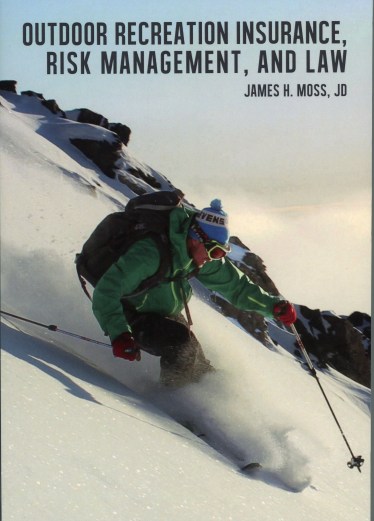
Outdoor Recreation Insurance, Risk Management, and Law
Jim is the author or co-author of six books about the legal issues in the outdoor recreation world; the latest is Outdoor Recreation Insurance, Risk Management and Law.
To see Jim’s complete bio go here and to see his CV you can find it here. To find out the purpose of this website go here.
G-YQ06K3L262
What do you think? Leave a comment.
If you like this let your friends know or post it on FB, Twitter or LinkedIn
 |
 |
 Threads |
 X (formerly known as Twitter) logo |
 Blue Sky |
 Stimulus |
Author: Outdoor Recreation Insurance, Risk Management and Law
Facebook Page: Outdoor Recreation & Adventure Travel Law
Email: Jim@Rec-Law.US
By Recreation Law Rec-law@recreation-law.com James H. Moss
@2024 Summit Magic Publishing, LLC
#RecreationLaw, #@RecreationLaw, #Cycling.Law #Fitness.Law, #Ski.Law, #Outside.Law, #Recreation.Law, #Recreation-Law.com, #Outdoor Law, #Recreation Law, #Outdoor Recreation Law, #Adventure Travel Law, #law, #Travel Law, #Jim Moss, #James H. Moss, #Attorney at Law, #Tourism, #Adventure Tourism, #Rec-Law, #Rec-Law Blog, #Recreation Law, #Recreation Law Blog, #Risk Management, #Human Powered, #Human Powered Recreation,# Cycling Law, #Bicycling Law, #Fitness Law, #Recreation-Law.com, #Backpacking, #Hiking, #Mountaineering, #Ice Climbing, #Rock Climbing, #Ropes Course, #Challenge Course, #Summer Camp, #Camps, #Youth Camps, #Skiing, #Ski Areas, #Negligence, #Snowboarding, #RecreationLaw, #@RecreationLaw, #Cycling.Law #Fitness.Law, #SkiLaw, #Outside.Law, #Recreation.Law, #RecreationLaw.com, #OutdoorLaw, #RecreationLaw, #OutdoorRecreationLaw, #AdventureTravelLaw, #Law, #TravelLaw, #JimMoss, #JamesHMoss, #AttorneyatLaw, #Tourism, #AdventureTourism, #RecLaw, #RecLawBlog, #RecreationLawBlog, #RiskManagement, #HumanPowered, #HumanPoweredRecreation,# CyclingLaw, #BicyclingLaw, #FitnessLaw, #RecreationLaw.com, #Backpacking, #Hiking, #Mountaineering, #IceClimbing, #RockClimbing, #RopesCourse, #ChallengeCourse, #SummerCamp, #Camps, #YouthCamps, #Skiing, #Ski Areas, #Negligence, #Snowboarding, sport and recreation laws, ski law, cycling law, Colorado law, law for recreation and sport managers, bicycling and the law, cycling and the law, ski helmet law, skiers code, skiing accidents, Recreation Lawyer, Ski Lawyer, Paddlesports Lawyer, Cycling Lawyer, Recreational Lawyer, Fitness Lawyer, Rec Lawyer, Challenge Course Lawyer, Ropes Course Lawyer, Zip Line Lawyer, Rock Climbing Lawyer, Adventure Travel Lawyer, Outside Lawyer, Recreation Lawyer, Ski Lawyer, Paddlesports Lawyer, Cycling Lawyer, #RecreationalLawyer, #FitnessLawyer, #RecLawyer, #ChallengeCourseLawyer, #RopesCourseLawyer, #ZipLineLawyer, #RockClimbingLawyer, #AdventureTravelLawyer, #OutsideLawyer, #FlowRider, Royal Caribbean Cruise Line, Oasis of the Seas, #Cruise, #Cruise Line, Release, Assumption of the Risk, #Video, #Wakeboarding, #Wakeboard, #Surfing, Cruise Ship,
WordPress Tags: Electronic,Florida,Johnson,Royal,Caribbean,Cruises,Dist,LEXIS,precedent,paper,defendant,Oasis,Seas,FlowRider,device,amusement,payment,plaintiff,Prior,injury,cabin,riders,readers,scroll,room,argument,relationship,carrier,passengers,transportation,degree,prong,incident,impact,commerce,industry,injuries,navigation,purpose,failure,environment,Waiver,circulation,stateroom,Another,factor,fact,execution,Also,importance,assumption,Releases,Include,Make,participant,Leave,Twitter,LinkedIn,Recreation,Edit,RecreationLaw,Facebook,Page,Outdoor,Adventure,Travel,Blog,Mobile,Site,Outside,Moss,James,Attorney,Tourism,Risk,Management,Human,Rock,Ropes,Course,Challenge,Summer,Camp,Camps,Youth,Areas,Negligence,SkiLaw,OutdoorLaw,OutdoorRecreationLaw,AdventureTravelLaw,TravelLaw,JimMoss,JamesHMoss,AttorneyatLaw,AdventureTourism,RecLaw,RecLawBlog,RecreationLawBlog,RiskManagement,HumanPoweredRecreation,CyclingLaw,BicyclingLaw,FitnessLaw,RopesCourse,ChallengeCourse,SummerCamp,YouthCamps,Colorado,managers,helmet,accidents,Lawyer,Paddlesports,Recreational,Line,RecreationalLawyer,FitnessLawyer,RecLawyer,ChallengeCourseLawyer,RopesCourseLawyer,ZipLineLawyer,RockClimbingLawyer,AdventureTravelLawyer,OutsideLawyer,Cruise,Release,Video,Wakeboard,Ship,three
Johnson v. Royal Caribbean Cruises, Ltd., 2011 U.S. Dist. LEXIS 28128; 2011 AMC 1171
Posted: June 18, 2012 Filed under: Florida, Legal Case, Release (pre-injury contract not to sue) | Tags: #Cruise, #FlowRider, Assumption of risk, Electronic Release, Miami, Negligence, Release, Royal Caribbean Cruises, Royal Caribbean International, Summary judgment, Waiver 2 CommentsTo Read an Analysis of this decision see: Electronic release upheld in Florida federal court for surfing on a cruise ship
Johnson v. Royal Caribbean Cruises, Ltd., 2011 U.S. Dist. LEXIS 28128; 2011 AMC 1171
Charlene I. Johnson, Plaintiff, vs. Royal Caribbean Cruises, Ltd., Defendant.
Case Number: 10-21650-CIV-MORENO
UNITED STATES DISTRICT COURT FOR THE SOUTHERN DISTRICT OF FLORIDA, MIAMI DIVISION
2011 U.S. Dist. LEXIS 28128; 2011 AMC 1171
March 18, 2011, Decided
March 18, 2011, Filed
COUNSEL: [*1] For Charlene I. Johnson, Plaintiff: Jonathan Bruce Aronson, ARONSON LAW FIRM, Miami, FL; James Madison Walker, Walker & O’Neill PA, South Miami, FL.
For Royal Caribbean Cruises, Ltd., a Liberian corporation, Defendant: Curtis Jay Mase, LEAD ATTORNEY, Lauren E DeFabio, Scott P. Mebane, Valentina M. Tejera, Mase, Lara, Eversole PA, Miami, FL.
JUDGES: FEDERICO A. MORENO, UNITED STATES DISTRICT JUDGE.
OPINION BY: FEDERICO A. MORENO
OPINION
ORDER GRANTING DEFENDANT’S MOTION FOR SUMMARY JUDGMENT; ORDER DENYING PLAINTIFF’S MOTION FOR SUMMARY JUDGMENT
This is a personal injury action against the cruise line arising out of an accident that occurred while Plaintiff was taking a private lesson on the FlowRider, a simulated surfing activity onboard the Defendant’s cruise ship. Defendant argues that Plaintiff’s suit is barred by her execution of a waiver which released Defendant from liability for any negligence or damages associated with Plaintiff’s use of the FlowRider. Plaintiff contends that the waiver is void under 46 U.S.C. § 30509 and general maritime law, and in the alternative, that the waiver should not be enforced on equitable grounds. Both parties have moved for summary judgment. Because the simulated surfing activity [*2] is inherently dangerous and is not an essential function of a common carrier, the Court finds that the waiver is valid and enforceable, and accordingly, GRANTS Defendant’s Motion for Summary Judgment and DENIES Plaintiff’s Motion for Summary Judgment.
I. Background
On January 30, 2010, Plaintiff Charlene Johnson, a 35-year-old woman, departed on a seven-day cruise aboard the M/S Oasis of the Seas (“the vessel”), a cruise ship owned and operated by Defendant Royal Caribbean Cruises, Ltd. On January 31, 2010 Plaintiff purchased a private lesson on the FlowRider. Passenger participation in the FlowRider is voluntary and requires payment of a fee that is separate and distinct from the cruise fare. Prior to using the FlowRider, passengers must sign an electronic Onboard Activity Waiver (“Waiver”), which is presented to passengers in color on an electronic screen. The Waiver is attached hereto as Exhibit “A.” The Waiver states at the top in bold, “Express Assumption of Risk – Waiver & Release of Liability.” The Waiver is three pages long and is designed so that passengers must scroll through all of its language before execution; otherwise it is simply impossible to execute the Waiver.
Plaintiff [*3] signed and executed the Waiver, thereby agreeing to “fully release and forever discharge” Defendant from “any and all actions” arising from “any accident [or] injury” in any way connected to Plaintiff’s use of the FlowRider. The Waiver expressly warns passengers that the “rider/participant can, intentionally or inadvertently, move quickly and unexpectedly from side to side or any direction, which will necessarily result in falls [or wipeouts] from the bodyboard” and which may cause serious injury. The Waiver further provides that the passenger agrees not to use the FlowRider until she has watched a safety video. At the time of the alleged incident, the FlowRider safety video was in circulation on the stateroom channel, which is available to all passengers on their cabin TVs. 1
1 Barbara Cobas, one of the defense witnesses, initially testified in her deposition that the safety video was not in circulation on the vessel at the time of the alleged incident. Ms. Cobas subsequently discovered that she was mistaken and that the video was in fact in circulation. Defendant accordingly filed an errata sheet, which Plaintiff then moved to strike. The Court, finding sufficient justification for [*4] the change, has denied Plaintiff’s motion.
Before her private lesson on the FlowRider, Plaintiff had observed others using the device, and throughout her lesson she had ridden the FlowRider and fallen off her board multiple times. Approximately forty minutes into her private lesson, Plaintiff was instructed to stand on the board, and once Plaintiff was standing, the instructor let go of the board. Plaintiff immediately fell off the board and hit the back wall of the FlowRider, fracturing her right ankle. As a result, Plaintiff filed the instant negligence action against Defendant.
II. Standard of Review
[HN1] Summary judgment is authorized when there is no genuine issue of material fact. Fed. R. Civ. P. 56(c). [HN2] The party seeking summary judgment bears the initial burden of demonstrating the absence of a genuine issue of material fact. Adickes v. S.H. Kress & Co., 398 U.S. 144, 157, 90 S. Ct. 1598, 26 L. Ed. 2d 142 (1970). The burden then shifts to the party opposing the motion, who must set forth specific facts and establish the essential elements of the case on which it will bear the burden of proof at trial. Celotex Corp. v. Catrett, 477 U.S. 317, 106 S. Ct. 2548, 91 L. Ed. 2d 265 (1986); Matsushita Elec. Indus. Co. v. Zenith Radio Corp., 475 U.S. 574, 587, 106 S. Ct. 1348, 89 L. Ed. 2d 538 (1986). [*5] The nonmoving party may not simply rest upon mere allegations or denials of the pleadings; it must present more than a scintilla of evidence in support of its position. A jury must be able reasonably to find for the nonmovant. Anderson v Liberty Lobby, Inc., 477 U.S. 242, 254, 106 S. Ct. 2505, 91 L. Ed. 2d 202 (1986). [HN3] In reviewing a motion for summary judgment, the Court must view the evidence and draw all reasonable inferences in the light most favorable to the non-moving party. Id. at 255.
III. Discussion
The parties have not cited any case with facts similar to this one-where the injury resulted from a recreational and inherently dangerous activity on board a cruise ship, for which a waiver was executed. The core issue presented by the parties’ Motions for Summary Judgment is the validity and enforceability of the Waiver. Plaintiff argues that the Waiver is void under 46 U.S.C. § 30509 and general maritime law, and in the alternative, that the Waiver should not be enforced on equitable grounds. Defendant argues that general maritime law does not apply under the facts of this case, and even if it does, 46 U.S.C. § 30509 does not apply to invalidate the Waiver. Defendant also argues that equity does not prevent enforcement [*6] of the Waiver.
A. Whether General Maritime Law Applies
At the outset, the Court notes that [HN4] admiralty jurisdiction must exist before the Court may apply admiralty law. See Doe v. Celebrity Cruises, Inc., 394 F.3d 891, 899 (11th Cir. 2004). Whether admiralty jurisdiction exists is an independent determination that must be made by the Court. See id. at 900. In order for admiralty jurisdiction to exist, two tests must be satisfied: the location test and the connection test. See Jerome B. Grubart, Inc. v. Great Lakes Dredge & Dock Co., 513 U.S. 527, 534, 115 S. Ct. 1043, 130 L. Ed. 2d 1024 (1995) (“[A] party seeking to invoke federal admiralty jurisdiction . . . over a tort claim must satisfy conditions both of location and of connection with maritime activity.”). The location test, requiring that the incident causing the alleged harm occurred in navigable waters, is plainly satisfied.
The connection test has two prongs, both of which must be met: (1) the incident causing the alleged harm must have a potentially disruptive impact on maritime commerce; and (2) the activity giving rise to the incident must bear a substantial relationship to traditional maritime activity. See id.; Doe, 394 F.3d at 900. The Court finds that neither [*7] prong of the connection test is met. While the cruise line industry is itself maritime commerce, it is unlikely that the cruise line industry would be disrupted by future FlowRider-related injuries, as falling off the board and injuring oneself is an inherent and unavoidable risk of using the FlowRider, an activity which is completely voluntary and must be purchased separately from the cruise fare. Even assuming, arguendo, that the first prong of the connection test is satisfied, the second prong is clearly not, as the FlowRider is a purely recreational activity that bears no relationship to traditional maritime activities such as navigation, piloting, and shipping. See Foster v. Peddicord, 826 F.2d 1370, 1376 (4th Cir. 1987) (“[T]his case is about swimming and diving . . . It is not about piloting, shipping, or navigational error, or other aspects of traditional maritime activity. There is simply no predicative relationship upon which an otherwise typical tort claim may properly be described as relating to ‘matters with which admiralty is basically concerned.'”) (quoting Exec. Jet Aviation, Inc. v. City of Cleveland, Ohio, 409 U.S. 249, 270, 93 S. Ct. 493, 34 L. Ed. 2d 454 (1972)). Therefore, because neither prong [*8] of the connection test is satisfied, Federal admiralty jurisdiction is not invoked and general maritime law does not apply.
B. Whether 46 U.S.C. § 30509 Applies
Even assuming, however, that admiralty jurisdiction exists and general maritime law applies, 46 U.S.C. § 30509-the statute under which Plaintiff challenges the Waiver-is inapplicable here. 46 U.S.C. § 30509, formerly cited as 46 U.S.C. § 183(c), reads in pertinent part as follows:
[HN5] (a) Prohibition.–
(1) In general.– The owner, master, manager, or agent of a vessel transporting passengers between ports in the United States, or between a port in the United States and a port in a foreign country, may not include in a regulation or contract a provision limiting–
(A) the liability of the owner, master, or agent for personal injury or death caused by the negligence or fault of the owner or the owner’s employees or agents; or
(B) the right of a claimant for personal injury or death to a trial by court of competent jurisdiction.
(2) Voidness.–A provision described in paragraph (1) is void.
Plaintiff argues that the Waiver in this case is void under § 30509 because it attempts to absolve Defendant from its own negligence in the operation, design, [*9] maintenance, and supervision of the FlowRider. This argument, however, ignores [HN6] the policy rationale behind the statute, which is that common carriers should not be able to secure immunity from liability for their own negligence in providing transportation and other essential functions of common carriers. See Chervy v. Peninsular & Oriental Steam Navigation. Co., 243 F. Supp. 654, 655 (S.D. Cal. 1964) (“[T]he provisions of Title [46 U.S.C. § 30509]… were intended to apply as between common carrier and passengers.”); Weade v. Dichmann, Wright & Pugh, 337 U.S. 801, 807, 69 S. Ct. 1326, 93 L. Ed. 1704 (1949) (“The duty of a common carrier . . . is to transport for hire whoever employs it.”); Liverpool & G. W. Steam Co. v. Phenix Ins. Co., 129 U.S. 397, 441, 9 S. Ct. 469, 32 L. Ed. 788 (1889) (“[T]he law does not allow a public carrier to abandon altogether his obligations to the public, and to stipulate for exemptions which are unreasonable and improper, amounting to an abnegation of the essential duties of his employment.”); Shultz v. Florida Keys Dive Ctr, Inc., 224 F.3d 1269, 1271 (11th Cir. 2000) (“Congress enacted [§ 30509]… to put a stop to practices like providing [exculpatory clauses] on the reverse side of steamship tickets.”) (internal [*10] quotations omitted); Chan v. Society Expeditions, Inc., 123 F.3d 1287, 1292 (9th Cir. 1997) (“[A]dmiralty law has generally prohibited carriers from limiting their liability for transporting passengers from ship to shore.”); Kornberg v. Carnival Cruise Lines, Inc., 741 F.2d 1332, 1336 (11th Cir. 1984) (relying on § 30509 in holding that the provision of an adequate sanitary system on a cruise ship is an “essential function” for which a sea carrier cannot disclaim responsibility).
[HN7] While courts have expanded the essential functions of a ship as common carrier to include the provision of “comfortable accommodations” to passengers, see id. at 1334, recreational and inherently dangerous activities such as the FlowRider can hardly be considered essential functions of a common carrier, nor are they at all related to a carrier’s duty to provide safe transportation to its passengers. Plaintiff has cited to no case suggesting otherwise.
On the other hand, Defendant has cited to two scuba diving cases which, though not directly on point, are particularly illustrative. In Shultz, 224 F.3d at 1269, a widower sued a dive center for the wrongful death of his wife, who died of an apparent drowning while [*11] scuba diving on a trip conducted by the dive center. Id. at 1270. The district court granted summary judgment for the dive center on the basis of a liability release signed by the decedent which the court determined to be valid under 46 U.S.C. § 30509. The Eleventh Circuit, after examining the legislative history of § 30509, affirmed, finding that the statute did not cover the release. In particular, the court stated:
[HN8] Congress enacted [§ 30509] . . . to ‘put a stop to’ practices like ‘providing on the reverse side of steamship tickets that in the event of damage or injury caused by the negligence or fault of the owner or his servants, the liability of the owner shall be limited.’ That ‘practice’ that Congress intended to outlaw was much different than the practice here-requiring a signed liability release to participate in the recreational and inherently risky activity of scuba diving.
Id. at 1271 (internal quotations omitted).
In Borden v. Phillips, 752 So. 2d 69 (Fla. 1st DCA 2000), a decedent’s personal representative sued the defendant boat owner and operator for the wrongful death of the decedent, who died while participating in an advanced scuba diving course taught by the defendant. [*12] Prior to participating in the course, the decedent had signed a waiver releasing the defendant from liability for injuries related to the decedent’s participation in the course. The court held that although 46 U.S.C. § 30509 applied to the dive boat’s voyage because it was a vessel engaged in passenger transportation, id. at 72, the waiver was not void under § 30509, as the alleged negligence was related solely to the activity of scuba diving and the decedent’s death had no relationship to the defendant’s operation or maintenance of the vessel, id. at 73.
While both Shultz and Borden are distinguishable in several respects, as neither involved an injury on board a cruise ship, the Court nonetheless finds their reasoning persuasive and wholly applicable to the instant case. The FlowRider, like scuba diving, is a recreational and inherently dangerous activity. The alleged negligence here is related solely to the FlowRider, and Plaintiff’s injury stems entirely from her use of the FlowRider and has no relationship to the operation or navigation of the cruise ship. The Waiver does not attempt to limit Defendant’s liability associated with its duty to provide safe transport or any other [*13] essential functions, but applies solely to limit Defendant’s liability associated with Plaintiff’s use of the FlowRider, a recreational and inherently dangerous activity that Defendant would simply not be able to offer its passengers otherwise.
Moreover, [HN9] courts have upheld waivers releasing land-based operators from liability for similarly inherently dangerous activities. See In re. Compl. of Royal Caribbean Cruises, Ltd., 403 F. Supp. 2d 1168 (S.D. Fla. 2005)(jet-skiing); Waggoner v. Nags Head Water Sports, Inc., 141 F.3d 1162 (4th Cir. 1998) (same); Theis v. J & J Racing Promotions, 571 So. 2d 92 (Fla. 2d DCA 1990) (race car driving). [HN10] To declare void an otherwise valid waiver simply because the complained-of injury occurred on board a cruise ship, even though the activity giving rise to the injury was totally unrelated to the ship’s duty to provide safe transport or other essential functions, defies both the legislative history of § 30509 as well as common sense. Accordingly, the Court finds that 46 U.S.C. § 30509 does not apply to invalidate the Waiver here.
C. Whether the Waiver is Valid on Equitable Grounds
Finally, the Court rejects Plaintiff’s argument that the Waiver should not [*14] be enforced on equitable grounds. The Waiver clearly and unambiguously released Defendant from liability for any negligence or damages associated with Plaintiff’s use of the FlowRider. The bolded language at the top of the first page of the Waiver conspicuously indicated the nature and purpose of the document, and the second page of the Waiver specifically explained the potential risks associated with using the FlowRider. Furthermore, Plaintiff had observed others using the FlowRider, and had ridden the FlowRider and fallen off her board multiple times throughout her private lesson before injuring herself, so she clearly knew or should have known that she could fall and consequently injure herself while using the FlowRider. That Plaintiff was not provided a hard copy of the Waiver is irrelevant, as the Waiver is only three pages long and Plaintiff had to scroll through its entire language in order to execute her full signature on the third and final page. Moreover, it is Defendant’s policy not to provide a hard copy of the Waiver to any of its passengers. Finally, while Plaintiff asserts she thought she was signing for a room charge when executing the Waiver, this mistaken belief is [*15] solely the result of [HN11] her own failure to read the contractual language clearly presented to her, for which the law of equity provides no remedy.
IV. Conclusion
The Court finds the Waiver here-limited to the inherently dangerous simulated surfing activity-to be valid and enforceable. Because Plaintiff’s execution of the Waiver released the cruise line from liability for any negligence or damages associated with Plaintiff’s use of the FlowRider, Plaintiff’s suit for negligence is barred. Accordingly, it is
ADJUDGED that Defendant’s Motion for Summary Judgment (D.E. 93), filed on January 28, 2011, is GRANTED. Further, it is
ADJUDGED that Plaintiff’s Motion for Summary Judgment (D.E. 90), filed on January 28, 2011, is DENIED.
DONE AND ORDERED in Chambers at Miami, Florida, this 18th day of March, 2011.
/s/ Federico A. Moreno
FEDERICO A. MORENO
UNITED STATES DISTRICT JUDGE
G-YQ06K3L262
SW, a minor v. Towers Boat Club, Inc., 2012 COA 77; 2012 Colo. App. LEXIS 642
Posted: May 21, 2012 Filed under: Colorado, Legal Case | Tags: Appeal, Colorado, Law, Negligence, Plaintiffs-Appellants, Summary judgment Leave a commentSW, a minor v. Towers Boat Club, Inc., 2012 COA 77; 2012 Colo. App. LEXIS 642
SW, a minor by and through his parents and next friends, David and Rhonda Wacker; David Wacker; and Rhonda Wacker, Plaintiffs-Appellants, v. Towers Boat Club, Inc., Defendant-Appellee.
Court of Appeals No. 11CA0935
COURT OF APPEALS OF COLORADO, DIVISION THREE
2012 COA 77; 2012 Colo. App. LEXIS 642
April 26, 2012, Decided
NOTICE:
THIS OPINION IS NOT THE FINAL VERSION AND SUBJECT TO REVISION UPON FINAL PUBLICATION
PRIOR HISTORY: [**1]
Jefferson County District Court No. 10CV1507. Honorable Jane A. Tidball, Judge.
DISPOSITION: JUDGMENT AFFIRMED.
COUNSEL: Purvis Gray, LLP, John Purvis, Boulder, Colorado, for Plaintiffs-Appellants.
Senter Goldfarb & Rice, L.L.C., Arthur Kutzer, Joel Palmer, Denver, Colorado, for Defendant-Appellee.
JUDGES: Opinion by JUDGE TERRY. Roy, J., concurs. Gabriel, J., specially concurs.
OPINION BY: TERRY
OPINION
[*P1] As an issue of first impression, we address whether, under the premises liability statute, section 13-21-115, C.R.S. 2011, a child licensee may assert a claim based on the attractive nuisance doctrine. We conclude that a child licensee may not maintain such a claim.
[*P2] Plaintiffs, SW, David Wacker, and Rhonda Wacker, appeal the trial court’s summary judgment in favor of defendant, Towers Boat Club, Inc. (landowner). We affirm.
I. Background
[*P3] On August 2, 2008, SW, then eleven years old, attended a social gathering at Poudre Reservoir Number 6. While he was playing on an inflatable structure rented by landowner for the gathering, wind lifted the structure into the air and SW fell to the ground, sustaining severe injuries. Plaintiffs eventually settled the claims that they asserted against other defendants.
[*P4] Plaintiffs asserted two claims against [**2] landowner, one for negligence and the other under Colorado’s premises liability statute, section 13-21-115. Landowner moved for summary judgment. The trial court granted the motion as to plaintiffs’ negligence and premises liability claims. However, the court construed the complaint to include a claim for attractive nuisance, and denied summary judgment as to that claim.
[*P5] Landowner moved for reconsideration, arguing that the attractive nuisance doctrine was inapplicable to SW. The court agreed and dismissed plaintiffs’ attractive nuisance claim. Plaintiffs appeal only the trial court’s dismissal of the attractive nuisance claim.
II. Standard of Review
[*P6] [HN1] We review de novo an order granting a motion for summary judgment. Pierson v. Black Canyon Aggregates, Inc., 48 P.3d 1215, 1218 (Colo. 2002). [HN2] Summary judgment is appropriate only where no genuine issue of material fact exists and the moving party is entitled to judgment as a matter of law. Id. The nonmoving party is entitled to the benefit of all favorable inferences reasonably drawn from the undisputed facts, and all doubts are resolved against the moving party. A.C. Excavating v. Yacht Club II Homeowners Ass’n, 114 P.3d 862, 865 (Colo. 2005).
[*P7]
III. [**3] Discussion
[*P8] We are not persuaded by plaintiffs’ contention that the trial court erred in granting landowner’s motion for summary judgment.
[*P9] [HN3] Section 13-21-115(3), C.R.S. 2011, classifies entrants upon the land of another as trespassers, licensees, or invitees. As relevant here, that subsection outlines the respective duties that a landowner owes to each class, as follows:
[HN4] (3)(a) A trespasser may recover only for damages willfully or deliberately caused by the landowner.
(b) A licensee may recover only for damages caused:
(I) By the landowner’s unreasonable failure to exercise reasonable care with respect to dangers created by the landowner of which the landowner actually knew; or
(II) By the landowner’s unreasonable failure to warn of dangers not created by the landowner which are not ordinarily present on property of the type involved and of which the landowner actually knew.
(c)(I). . . [A]n invitee may recover for damages caused by the landowner’s unreasonable failure to exercise reasonable care to protect against dangers of which he actually knew or should have known.
§ 13-21-115(3).
[*P10] The trial court ruled that SW was a licensee, and plaintiffs do not contest that ruling on appeal. Instead, [**4] they argue that the trial court erred in ruling that, because SW was not a trespassing child who was enticed onto the property by an attractive nuisance, he could not assert a claim for attractive nuisance. Plaintiffs contend this ruling contravenes the supreme court’s holding in Gallegos v. Phipps, 779 P.2d 856, 859 (Colo. 1989). We disagree.
A. Attractive Nuisance Doctrine
[*P11] Plaintiffs argue that no Colorado appellate decision expressly holds that the attractive nuisance doctrine is limited to trespassing children. They contend that the Colorado decisions addressing attractive nuisance all involve factual scenarios in which a child was trespassing, and thus the issue of whether the doctrine can apply to licensees such as SW has not previously been decided. They further contend that, although SW has been determined to be a licensee, he should be able to invoke the attractive nuisance doctrine.
[*P12] We disagree that existing Colorado decisions, when construed together with the premises liability statute, leave any doubt about the application of the attractive nuisance doctrine, and conclude [HN5] the doctrine unequivocally applies only to children enticed by an attractive nuisance to trespass on [**5] another’s property. Thus, the doctrine cannot be applied to SW.
1. History of Attractive Nuisance Doctrine in Colorado
[*P13] The attractive nuisance doctrine developed to provide legal relief to certain trespassing children who otherwise would be barred from recovery because of Colorado’s rule that a landowner owes no duty to make or keep premises safe for a trespasser. See Hayko v. Colorado & Utah Coal Co., 77 Colo. 143, 147, 235 P. 373, 374 (1925), overruled in part by Mile High Fence Co. v. Radovich, 175 Colo. 537, 489 P.2d 308 (1971), superseded by § 13-21-115 as noted in Gallegos, 779 P.2d at 861; see also John W. Grund & J. Kent Miller, 7 Colo. Prac., Personal Injury Practice — Torts and Insurance § 19.5, at 314-15 (2d ed. 2000).
[*P14] The doctrine has since been modified, both by ensuing case law and by statute. Because the history of attractive nuisance doctrine is tied to the general history of premises liability law in Colorado, we briefly summarize the unique history of Colorado premises liability law.
[*P15] The supreme court described some of that history in Gallegos, as follows:
Until 1971, the law in Colorado governing landowner[s’] liability followed the common law’s emphasis on whether [**6] the injured party was an invitee, licensee, or trespasser. See [Mile High Fence, 175 Colo. at 541, 489 P.2d at 311]; Husser v. School Dist. No. 11, 159 Colo. 590, 593, 413 P.2d 906, 908 (1966). Under the common law, the landowner’s liability depended exclusively upon the injured party’s status. For example, a landowner had no duty to make or keep his premises safe for a trespasser. Staley v. Security Athletic Ass’n, 152 Colo. 19, 21, 380 P.2d 53, 54 (1963). If, however, the person was a licensee, the owner had a duty not to willfully or wantonly injure the person. Gotch v. K & B Packing & Provision Co., 93 Colo. 276, 278, 25 P.2d 719, 720 (1933), overruled [by Mile High Fence, 175 Colo. 537, 489 P.2d 308]. An even higher standard was owed if the person was an invitee; where an invitee was upon the owner’s land, the owner had a duty to have the land in a reasonably safe condition and to warn of concealed defects that might have been discovered in the exercise of reasonable care. Id. at 278, 25 P.2d at 720.
In 1971, Colorado’s common-law scheme governing landowner’s liability was abolished by [Mile High Fence], 175 Colo. 537, 489 P.2d 308. In [that case], the court held that the classification [**7] of one who is upon the property of another as invitee, licensee, or trespasser was no longer dispositive of the landowner’s liability or the degree of care owed by the landowner. 175 Colo. at 548, 489 P.2d at 314. Rather, the relevant inquiry was whether the landowner, in the management of the property, acted as a reasonable person in view of the probability or foreseeability of injuries to others. Id. A person’s status as an invitee, licensee, or trespasser might have some bearing on the issue of liability, but it was only one factor among many to be considered in making the determination. 175 Colo. at 548, 489 P.2d at 314-15.
Mile High Fence remained in effect until May 16, 1986, when the General Assembly enacted [the first version of] section 13-21-115 . . ., for the explicit purpose of resurrecting the common-law classification scheme laid to rest by [Mile High Fence]. Under the statute, categories analogous to trespasser, licensee, and invitee were established . . . . According to the legislators who sponsored House Bill 1205, which later became section 13-21-115, the common-law categories were reestablished because the reasonable person standard created by Mile High Fence led [**8] to unpredictable and inequitable results. Of particular concern to legislators was the perception that under Mile High Fence, the responsibility for a trespasser’s injuries was unfairly shifted from the trespasser to the landowner. Section 13-21-115 was, as one legislator put it, designed so that “responsibility falls upon the trespasser.”
Gallegos, 779 P.2d at 860-61 (footnotes omitted).
[*P16] In Gallegos, the supreme court concluded that the then-current version of section 13-21-115 was unconstitutional because it created an “inverted hierarchy” of duties, with a higher duty owed to licensees than to invitees. Applying the rational basis test for constitutional scrutiny, the court concluded that this statutory scheme was contrary to well-established common law principles, lacked a rational basis, and was unconstitutional. Id. at 862-63.
[*P17] After Gallegos was announced, the General Assembly amended section 13-21-115. As pertinent to our historical analysis, that amended section states:
[HN6] (1.5) The general assembly hereby finds and declares:
(a) That the provisions of this section were enacted in 1986 to promote a state policy of responsibility by both landowners and those upon the land as well [**9] as to assure that the ability of an injured party to recover is correlated with his status as a trespasser, licensee, or invitee;
(b) That these objectives were characterized by the Colorado supreme court as “legitimate governmental interests” in [Gallegos];
(c) That the purpose of amending this section in the 1990 legislative session is to assure that the language of this section effectuates these legitimate governmental interests by imposing on landowners a higher standard of care with respect to an invitee than a licensee, and a higher standard of care with respect to a licensee than a trespasser;
(d) That the purpose of this section is also to create a legal climate which will promote private property rights and commercial enterprise and will foster the availability and affordability of insurance;
(e) That the general assembly recognizes that by amending this section it is not reinstating the common law status categories as they existed immediately prior to [Mile High Fence,] but that its purpose is to protect landowners from liability in some circumstances when they were not protected at common law and to define the instances when liability will be imposed in the manner most consistent [**10] with the policies set forth in paragraphs (a), (c), and (d) of this subsection (1.5).
§ 13-21-115(1.5)(a)-(e).
[*P18] As part of the reenactment of section 13-21-115, the legislature revived the common law doctrine of attractive nuisance, which had been rendered unnecessary by Mile High Fence. See Grund and Miller, § 19.5, at 314; see also Vigil v. Franklin, 103 P.3d 322, 331 (Colo. 2004) (as reenacted in 1990, § 13-21-115(2) “expressly provided for the attractive nuisance doctrine”); Union Pac. R.R. Co. v. Martin, 209 P.3d 185, 188 (Colo. 2009) (in reenacting § 13-21-115, legislature “specifically singl[ed] out for continued vitality the common law doctrine of attractive nuisance”). But see Salazar v. City of Sheridan, 44 Colo. App. 443, 445-46, 618 P.2d 708, 709-10 (1980) (mentioning attractive nuisance claim brought by plaintiff); Cent. Mut. Ins. Co. v. Wilson, 533 P.2d 57, 58 (Colo. App. 1975) (not published pursuant to C.A.R. 35(f)) (same).
Subsection (2) states:
[HN7] In any civil action brought against a landowner by a person who alleges injury occurring while on the real property of another and by reason of the condition of such property, or activities conducted or circumstances existing on [**11] such property, the landowner shall be liable only as provided in subsection (3) of this section. Sections 13-21-111, 13-21-111.5, and 13-21-111.7 shall apply to an action to which this section applies. This subsection (2) shall not be construed to abrogate the doctrine of attractive nuisance as applied to persons under fourteen years of age. A person who is at least fourteen years of age but is less than eighteen years of age shall be presumed competent for purposes of the application of this section.
§ 13-21-115(2) (emphasis added).
2. Revival of Attractive Nuisance Doctrine
[*P19] Plaintiffs contend that the amendment to section 13-21-115(2) changed not just the upper age limit of the children to whom it could be applied, from age eighteen to age fourteen. They contend it also did away with the attractive nuisance doctrine as it had previously existed in Colorado. In its place, they argue that principles reflected in CJI-Civ. 4th 12:4 (1998) and the Restatement (Second) of Torts §§ 299 and 343B control. We disagree.
[*P20] [HN8] The premises liability statute gives no indication that the attractive nuisance doctrine as applied in the publications cited by plaintiffs, or in jurisdictions other than Colorado, [**12] is intended to supplant preexisting Colorado precedents. The only logical interpretation of subsection (2)’s incorporation of the attractive nuisance doctrine is that it is to be applied in accordance with preexisting Colorado precedents, to the extent they do not conflict with the provisions of section 13-21-115. See Grund & Miller, § 19.5, at 314 (in enacting section 13-21-115, “the legislature expressly revived the attractive nuisance doctrine”); see also Vaughan v. McMinn, 945 P.2d 404, 409 (Colo. 1997) (legislature “is presumed to be aware of the judicial precedent in an area of law when it legislates in that area”); State Engineer v. Castle Meadows, Inc., 856 P.2d 496, 504 (Colo. 1993) (same).
[*P21] We reject plaintiffs’ argument that the provisions of CJI-Civ. 12:4 should guide us in the application of attractive nuisance law. As relevant here, CJI-Civ. 12:4 provides that a plaintiff may recover on a claim for attractive nuisance if, among other things, the plaintiff “(was attracted onto the premises by [an unusual activity being carried on on the premises] [or] [by an unusual condition, other than a natural condition, existing on the premises]) (or) (was on the premises with the [**13] express or implied consent of the defendant)” (emphasis added). The italicized language is not consistent with Colorado case law, as discussed herein, and we disapprove it. See Krueger v. Ary, 205 P.3d 1150, 1154 (Colo. 2009) ( [HN9] pattern jury instructions are not law, not authoritative, and not binding on Colorado courts; they are not to be used if they do not reflect the prevailing law).
[*P22] The sections of the Restatement cited by plaintiffs do not reflect Colorado law and have not been adopted by Colorado courts, and thus are not binding here. See Bayer v. Crested Butte Mountain Resort, Inc., 960 P.2d 70, 79 (Colo. 1998). The same is true of plaintiffs’ citation to 62 Am. Jur. 2d Premises Liability § 299. We note that both 62 Am. Jur. 2d Premises Liability § 299 and the Restatement (Second) of Torts § 343B indicate that [HN10] Colorado is in the minority of states that require a trespass in order for the attractive nuisance doctrine to apply. See Restatement (Second) of Torts § 339 cmt. e (1965) (citing Esquibel v. City & County of Denver, 112 Colo. 546, 151 P.2d 757 (1944)); 62 Am. Jur. 2d Premises Liability § 299 n.9 (citing Denver Tramway Corp. v. Callahan, 112 Colo. 460, 150 P.2d 798 (1944)).
[*P23] [**14] We conclude that historical Colorado attractive nuisance doctrine can easily be harmonized with other provisions of the premises liability statute, and that [HN11] the attractive nuisance doctrine has been modified by the statute only to the extent that the doctrine can no longer be applied to persons above age fourteen. § 13-21-115(2).
B. Inapplicability of Attractive Nuisance Doctrine to SW
[*P24] Plaintiffs contend that the attractive nuisance doctrine should be interpreted to apply to child trespassers, licensees, and invitees. Because such an interpretation would be inconsistent with Colorado law, we disagree.
[*P25] Colorado courts without exception have held that [HN12] the attractive nuisance doctrine may be invoked only where an attraction on land “entices children to trespass.” Hayko, 77 Colo. at 146, 235 P. at 374 (“While he [the owner of the premises] owes a duty to one invited, and some attractive agencies may amount to an invitation to a child, yet such an agency must invite to trespass and not merely after trespass.”); see also Esquibel v. City & County of Denver, 112 Colo. 546, 549, 151 P.2d 757, 758 (1944) (“[The] doctrine consists in maintaining an attraction which entices to trespass, not merely [**15] entices one after he has become a trespasser.”), overruled in part by Mile High Fence, 175 Colo. 537, 489 P.2d 308; Denver Tramway Corp. v. Garcia, 154 Colo. 417, 423, 390 P.2d 952, 956 (1964) (same); Staley v. Sec. Athletic Ass’n, 152 Colo. 19, 22-25, 380 P.2d 53, 55 (1963) (same), overruled in part by Mile High Fence, 175 Colo. 537, 489 P.2d 308; accord Garel v. Jewish Cmty. Centers, 163 Colo. 110, 112, 428 P.2d 714, 715 (1967) (noting that the Hayko rule on attractive nuisance has been “consistently followed” by the Colorado Supreme Court); Guilfoyle v. Missouri, Kansas & Texas R.R. Co., 812 F.2d 1290, 1292 (10th Cir. 1987) (attractive nuisance doctrine “imposes a duty of care on landowners to prevent serious harm to trespassing children”).
[*P26] Moreover, contrary to plaintiffs’ argument, the supreme court has explicitly stated that [HN13] “the attractive-nuisance doctrine is only an exception to the general rule limiting the liability of landowners as to [child] trespassers.” Niernberg v. Gavin, 123 Colo. 1, 3, 224 P.2d 215, 216 (1950) (emphasis added).
[*P27] Recognizing the continued vitality of that rule is consistent with the legislature’s intent. As the supreme court stated in Gallegos, by amending [**16] the premises liability statute to “re-link a landowner’s duty and an injured party’s ability to recover damages with the party’s status as an invitee, licensee, or trespasser,” the legislature intended “that a landowner’s liability should once again depend upon the landowner’s knowledge of the other person’s presence and the reason for the presence on the property.” 779 P.2d at 861.
[*P28] We therefore conclude that the common law doctrine of attractive nuisance applies only to trespassing children.
C. Equal Protection
[*P29] Plaintiffs further contend that limiting the application of the attractive nuisance doctrine to child trespassers would result in an “inverted hierarchy” of landowner duties and would thus contravene Gallegos and be unconstitutional. We are not persuaded.
[*P30] Initially, the majority notes our respectful disagreement with the assertion in the special concurrence that we need not reach the plaintiffs’ constitutional argument. Plaintiffs in essence assert that, to avoid an equal protection problem, a licensee must always receive better treatment in the law than would a trespasser, regardless of the reason for entry on the land, and that is the linchpin of their argument that they are [**17] entitled to assert an attractive nuisance claim here. Thus, we conclude that the necessity to analyze the constitutional question is not dispelled by that fact that, as recognized by the special concurrence, plaintiffs cannot establish but one element of an attractive nuisance claim, namely, enticement by an attractive nuisance to trespass.
[*P31] In Gallegos, the supreme court held that the pre-1990 version of the premises liability statute violated the plaintiffs constitutional equal protection guarantees because it “impose[d] on landowners a higher standard of care with respect to a licensee than an invitee.” 779 P.2d at 862. The court held that “[s]uch an inverted hierarchy of duties bears no rational relationship to a legitimate governmental interest,” and would deny the plaintiff equal protection of the laws. Id. (citing U.S. Const. amend. XIV, § 1; Colo. Const. art. II, § 25).
[*P32] In response to Gallegos, the General Assembly repealed and reenacted the premises liability statute to impose higher duties on landowners with respect to licensees than to trespassers, and higher still duties with respect to invitees than to trespassers. Vigil, 103 P.3d at 326.
[*P33] Here, in essence, plaintiffs contend [**18] that, as applied by the trial court, the attractive nuisance doctrine would violate the constitutional guarantee of equal protection of the laws and thus would be unconstitutional. See Gallegos, 779 P.2d at 863. We are not persuaded.
[*P34] ” [HN14] Because section 13-21-115 does not infringe upon a fundamental right, a suspect class, or a classification triggering an intermediate standard of review, the statute need only have some rational basis in fact and bear a rational relationship to a legitimate governmental interest to be valid.” Gallegos, 779 P.2d at 860.
[*P35] Plaintiffs argue that the duty to exercise reasonable care owed by a landowner to trespassing children under the attractive nuisance doctrine is a more expansive, general, and higher standard of care than that owed to child licensees, and that because trespassers should be the least favored of all entrants on land, such a higher standard would bear no rational relationship to a legitimate governmental interest. As support for this proposition, plaintiffs cite only CJI-Civ. 12:4, which they contend imposes on a landowner a duty to “exercise reasonable care to protect persons like [the] plaintiff from injury.” As noted above, this jury instruction [**19] is not binding Colorado law, Krueger, 205 P.3d at 1154, and plaintiffs have not provided us with any Colorado precedent that would establish that duty of care.
[*P36] We disagree that [HN15] the “reasonable care” standard imposed on landowners as to trespassing children under the attractive nuisance doctrine is a higher standard of care than is owed to child invitees under the premises liability statute. Rather, section 13-21-115 sets forth standards of reasonable care applicable to landowners, and those standards of care vary depending on the status of the entrant on land. Compare § 13-21-115(3)(b)(I)-(II) (licensee may recover only for damages caused by landowner’s “unreasonable failure to exercise reasonable care with respect to dangers created by the landowner of which landowner actually knew,” or “unreasonable failure to warn of” described dangers of which landowner actually knew) (emphasis added) and § 13-21-115(3)(c)(I)-(II) (invitee may recover for damages caused by a “landowner’s unreasonable failure to exercise reasonable care to protect against dangers of which he actually knew or should have known,” except that, as to agricultural or vacant land, invitee may recover for damages “caused [**20] by the landowner’s unreasonable failure to exercise reasonable care to protect against dangers of which he actually knew”) (emphasis added), with § 13-21-115(3)(a) (trespasser may recover only for damages “willfully or deliberately caused by the landowner”).
[*P37] The logical implication of plaintiffs’ argument is that, to avoid the “inverted hierarchy” equal protection problem identified in Gallegos, invitees and licensees must always receive more favorable treatment than trespassers. See § 13-21-115(3.5) (“It is the intent of the general assembly in enacting the provisions of subsection (3) of this section that the circumstances under which a licensee may recover include all of the circumstances under which a trespasser could recover and that the circumstances under which an invitee may recover include all of the circumstances under which a trespasser or a licensee could recover.”).
[*P38] However, by incorporating attractive nuisance doctrine in section 13-21-115, the legislature necessarily accepted that doctrine’s treatment of young children trespassers, who were enticed onto property by an attractive nuisance, as invitees. See United Zinc & Chem. Co. v. Britt, 258 U.S. 268, 275, 42 S. Ct. 299, 66 L. Ed. 615 (1922) (“knowingly [**21] to establish and expose . . . something that is certain to attract [children], has the legal effect of an invitation to them”); see also Denver Tramway Corp. v. Callahan, 112 Colo. at 464-65, 150 P.2d at 799-800 (“[T]here is no question but that the boy was a trespasser on the private property of defendant, unless he was ‘invited’ by an ‘attractive nuisance,’ as recognized by our decisions.”); Kopplekom v. Colorado Cement-Pipe Co., 16 Colo. App. 274, 277, 64 P. 1047, 1048 (1901) (citing with approval cases from other jurisdictions that treat children enticed by an attractive nuisance to trespass as invitees); accord Concrete Constr., Inc. v. Petterson, 216 So. 2d 221, 222 (Fla. 1968) (under attractive nuisance doctrine, a “child who enters upon another’s property in response to a special attraction is classified as an implied invitee”).
[*P39] In other words, [HN16] under the attractive nuisance doctrine, children enticed to trespass by an attractive nuisance are treated as invitees, and not as trespassers. Thus, it would not violate equal protection to treat such children more favorably than licensees such as SW if there is a rational basis for doing so. See Gallegos, 779 P.2d at 860 (applying [**22] rational basis test to classifications under premises liability act).
[*P40] We conclude that [HN17] section 13-21-115’s liability scheme reflects a rational basis for treating children induced to trespass by an attractive nuisance more favorably than child licensees. As the supreme court recognized in Gallegos, the legislature could rationally choose to treat entrants on land differently depending upon their reasons for entry on the land. Id. at 861.
[*P41] We note that the rational basis for disparate treatment of entrants on land is reflected in more than seven decades of Colorado appellate precedent. Even among trespassing children, some received the elevated treatment of invitees, while others did not. A child who was enticed by an attractive nuisance to trespass could recover for ensuing injuries, while a trespassing child already on the premises could not recover, even though the latter child who had already entered on the land might also find a dangerous feature on the land to be enticing after entry. See Esquibel, 112 Colo. at 550, 151 P.2d at 759 (where evidence showed that the plaintiff had previously trespassed on land and had used it as a playground before the alleged attractive nuisance appeared [**23] there, she could not recover because the attractive nuisance did not entice her to enter the land); see also Garel, 163 Colo. at 112, 428 P.2d at 715; Denver Tramway Corp. v. Garcia, 154 Colo. at 423, 390 P.2d at 956; Staley, 152 Colo. at 23, 380 P.2d at 55; Hayko, 77 Colo. at 146-47, 235 P. at 374.
[*P42] These precedents rest on the rationale that the attractive nuisance itself acts as the invitation to the child to enter on the land. See Denver Tramway Corp. v. Callahan, 112 Colo. at 464-65, 150 P.2d at 799-800. The supreme court noted its approval of this concept in Lovejoy v. Denver & Rio Grande R.R. Co., 59 Colo. 222, 225-26, 146 P. 263, 264 (1915):
The leaving or maintaining of a dangerous and attractive machine, or other instrument or agency upon one’s premises, under circumstances which naturally tend to attract or allure young children of immature judgment, and to induce them to believe that they are at liberty to enter and handle or play with it, is tantamount to an implied invitation to enter. Hence a corresponding duty is imposed upon the owner or occupant of the premises to prevent the intrusion, or to protect from personal injury such children as may be so attracted and thus [**24] induced to enter, and who are incapable of appreciating the attending dangers. The doctrine is founded upon the principle that when one sets a temptation before young children under circumstances which in law is equivalent to holding out of an inducement to enter, he must use ordinary care to protect them from harm. It is but applying the general rule that when one induces or invites another upon his premises, he must use ordinary care to avoid injuring him.
[*P43] These precedents establish that [HN18] a child who is enticed to trespass on the land by an attractive nuisance is accorded the preferential treatment reserved in the law for invitees. Thus, we conclude there is no constitutional infirmity in treating such a child preferentially to one in SW’s position who is a mere licensee, and we affirm the judgment in landowner’s favor.
[*P44] Because of our conclusion, we need not address landowner’s contention that the trial court erred in construing the complaint to assert an attractive nuisance claim.
[*P45] Judgment affirmed.
JUDGE ROY concurs.
JUDGE GABRIEL specially concurs.
CONCUR BY: GABRIEL
CONCUR
JUDGE GABRIEL specially concurring.
[*P46] I agree with my colleagues that the district court correctly granted summary judgment to defendant [**25] Towers Boat Club, Inc. (the landowner) on plaintiffs’ attractive nuisance claim. I respectfully write separately, however, because unlike my colleagues, I would rule on narrower grounds and not reach any of the constitutional issues. See Developmental Pathways v. Ritter, 178 P.3d 524, 535 (Colo. 2008) (noting that the principle of judicial restraint requires courts to avoid reaching constitutional questions that need not be decided); People v. Lybarger, 700 P.2d 910, 915 (Colo. 1985) (“Axiomatic to the exercise of judicial authority is the principle that a court should not decide a constitutional issue unless and until such issue is actually raised by a party to the controversy and the necessity for such decision is clear and inescapable.”).
[*P47] Plaintiffs contend that the district court erred in holding that the attractive nuisance doctrine applies only to trespassers, because in plaintiffs’ view, it must apply equally to invitees, licensees, and trespassers. If it did not, plaintiffs say, the premises liability statute would allow the type of “inverted hierarchy” that our supreme court found unconstitutional in Gallegos v. Phipps, 779 P.2d 856, 862-63 (Colo. 1989).
[*P48] Unlike the majority, [**26] I see no reason to decide this issue, or the constitutional questions that it necessarily implicates. Assuming without deciding that plaintiffs are correct and that the attractive nuisance doctrine applies to invitees, licensees, and trespassers alike, plaintiffs’ attractive nuisance claim fails as a matter of law for another reason.
[*P49] It has long been settled in Colorado that for the attractive nuisance doctrine to apply, the attraction must have enticed the child to trespass; it is not enough if the attraction enticed the child only after he or she became a trespasser. Hayko v. Colo. & Utah Coal Co., 77 Colo. 143, 145, 235 P. 373, 375 (1925); accord Adams v. Warren Analytical Labs., Inc., No. 05-cv-01536-EWN-MEH, 2006 U.S. Dist. LEXIS 88129, 2006 WL 3512044, at *5 (D. Colo. Dec. 6, 2006); Denver Tramway Corp. v. Garcia, 154 Colo. 417, 423, 390 P.2d 952, 956 (1964). Indeed, plaintiffs concede that, even under their view of the attractive nuisance doctrine, the attraction must have enticed the child to enter the landowner’s property. Here, however, it is undisputed that the bungee run attraction did not entice SW to enter the landowner’s property. Accordingly, even if the attractive nuisance doctrine could be read [**27] to apply to invitees, licensees, and trespassers alike, as a matter of law, plaintiffs cannot prevail on their attractive nuisance claim. I would thus affirm the district court’s judgment on that narrow ground and not reach the broader and constitutional questions that plaintiffs have raised.

Texas makes it easier to write a release because the law is clear.
Posted: December 19, 2011 Filed under: Assumption of the Risk, Minors, Youth, Children, Summer Camp, Texas, Youth Camps, Zip Line | Tags: charitable immunity, Charitable Immunity Act, Charity, Negligence, Salvation Army, Summary judgment, Summer Camp, Texas, United States district court, zip line 1 CommentGalvan, et al., v. The Salvation Army, 2011 U.S. Dist. LEXIS 47257
Too bad no one read the law to the Salvation Army in this case.
This case was filed in the Federal District Court of the Southern District of Texas. The decision was based on a Motion for Summary Judgment filed by the plaintiff to throw out the defendant’s defense of release. Normally, these types of motions are filed by the defendants to end the litigation not by the plaintiff. There was also an issue of whether the charitable immunity statute applied to limit the damages in the case.
The facts which gave rise to the case are the defendants were parents of an eleven year-old boy who attended Camp Hoblitzelle which was owned and operated by the Salvation Army of Texas. While attending the camp the minor was riding a zip line when he fell 40-50’ suffering unnamed injuries.
There was a blank in the release where the activity the parties were releasing was to be filled in. The blank line in this case was filled in with the plaintiff’s name Cynthia Perez written in as the activity. The court took delight in pointing this out.
Summary of the case
The plaintiff filed their motion for summary judgment to eliminate the defense of release. The minor’s mother signed the Permission/Waiver Form for Residential Camps prior to the minor attending camp.
Under Texas law, there are two tests to determine if a release is valid; (1) the express negligence doctrine and (2) the conspicuousness requirement test.
“A release that fails to satisfy both of the two requirements is unenforceable as a matter of law.”
The Express Negligence Doctrine is:
The express negligence doctrine requires that a party’s intent to be released from the consequences of that party’s own negligence must be expressed in specific terms within the four corners of the release document.
The release in this case used the language “…hereby voluntarily releases The Salvation Army from any and all liability resulting from or arising in any manner whatsoever out of any participation in any Activity.” This language was not strict enough to place the signor on notice that they were giving up their legal rights according to the court.
The release was not clear. It did not state that the defendant was being released for its future negligence. Although there is no requirement that the word negligence be in the release and referenced, it is clear the release would be difficult to write without the word negligence. The court held the release at issue had no clear expression or language showing intent to release the defendant from its own negligence.
Consequently, the release failed the Express Negligence Doctrine.
The Conspicuousness requirement test requires.
… the releasing language must be conspicuously written, such that a reasonable person would have noticed it. Examples of conspicuous language include language that appears in contrasting type or color, in all capital letters, or otherwise calls attention to itself.
With regard to the conspicuousness, requirement test the court stated.
The release language is in the same font and font size as the remainder of the document. There is no bolding, underlining, or other mechanism to make the release language conspicuous. Instead, the release language is buried in a full page of single-spaced, small font size text.
Here is a great example that your release cannot hide the important legal language from anyone signing it.
The court also looked into the Charitable Immunity Act and held the issue was not ripe because whether or not the defendant was subject to the limitation of damages would not be an issue unless the plaintiff was able to recover an amount greater than the limitation of $500,000 per person and $1,000,000 per occurrence.
The court also stated the Charitable Immunity Act did not apply to defendants whose “act or omission that is intentional, wilfully negligent, or done with conscious indifference or reckless disregard for the safety of others.” The plaintiff had plead actions of the defendant in almost identical language which was another issue making the issue not ripe for decision.
So Now What?
This decision is a road map on what not to do with a release in Texas.
1. Make sure your release states that it is a release and the person signing it is giving up their legal rights.
2. Make sure the language in the release is clear. The plaintiff is releasing you from liability for your negligence in advance of any injury. You are going to have to use the word negligence in your release.
3. The release language cannot be hidden. It must be set out in such a way that it is identifiable as something important that the signor needs to know about.
4. All blanks in the document need to be located in one place so it only takes a quick scan to make sure everything is completed properly.
5. Anything that can be completed by the defendant or filled in must be completed by the defendant.
6. Have an attorney that knows and understands your operation and the law affecting your business write your release.
Writing a release is not like cooking. When you cook you have to really screw up to make something that is not edible. (I’ve been single my entire life so my definition of edible may be different from yours……) Writing a release is a much more precise endeavor.
What do you think? Leave a comment.
Copyright 2011 Recreation Law (720) Edit Law, Recreation.Law@Gmail.com
Twitter: RecreationLaw
Facebook: Rec.Law.Now
Facebook Page: Outdoor Recreation & Adventure Travel Law
Blog: http://www.recreation-law.com
Mobile Site: http://m.recreation-law.com
#RecreationLaw, #@RecreationLaw, #Cycling.Law #Fitness.Law, #Ski.Law, #Outside.Law, #Recreation.Law, #Recreation-Law.com, #Outdoor Law, #Recreation Law, #Outdoor Recreation Law, #Adventure Travel Law, #law, #Travel Law, #Jim Moss, #James H. Moss, #Attorney at Law, #Tourism, #Adventure Tourism, #Rec-Law, #Rec-Law Blog, #Recreation Law, #Recreation Law Blog, #Risk Management, #Human Powered, #Human Powered Recreation,# Cycling Law, #Bicycling Law, #Fitness Law, #Recreation-Law.com, #Backpacking, #Hiking, #Mountaineering, #Ice Climbing, #Rock Climbing, #Ropes Course, #Challenge Course, #Summer Camp, #Camps, #Youth Camps, #Skiing, #Ski Areas, #Negligence, #Snowboarding, #RecreationLaw, #@RecreationLaw, #Cycling.Law #Fitness.Law, #SkiLaw, #Outside.Law, #Recreation.Law, #RecreationLaw.com, #OutdoorLaw, #RecreationLaw, #OutdoorRecreationLaw, #AdventureTravelLaw, #Law, #TravelLaw, #JimMoss, #JamesHMoss, #AttorneyatLaw, #Tourism, #AdventureTourism, #RecLaw, #RecLawBlog, #RecreationLawBlog, #RiskManagement, #HumanPowered, #HumanPoweredRecreation,# CyclingLaw, #BicyclingLaw, #FitnessLaw, #RecreationLaw.com, #Backpacking, #Hiking, #Mountaineering, #IceClimbing, #RockClimbing, #RopesCourse, #ChallengeCourse, #SummerCamp, #Camps, #YouthCamps, #Skiing, #Ski Areas, #Negligence, #Snowboarding, #TheSalvationArmy, #zipline, #Galvan, #TX, #Texas, #FederalCourt, #SummaryJudgment, #CampHoblitzelle, #ExpressNegligenceDoctrine, #ConspicuousnessRequirement,
WordPress Tags: Texas,Galvan,Salvation,Army,Dist,LEXIS,Federal,District,Court,Southern,decision,Motion,Summary,Judgment,plaintiff,defendant,defendants,litigation,statute,parents,Camp,Hoblitzelle,injuries,Cynthia,Perez,Permission,Waiver,Form,Residential,Camps,Under,negligence,doctrine,requirement,requirements,consequences,manner,participation,Although,person,Examples,capital,attention,size,remainder,mechanism,Instead,text,Here,example,Charitable,limitation,occurrence,omission,indifference,road,Make,injury,blanks,attorney,life,definition,Leave,Recreation,Edit,Gmail,Twitter,RecreationLaw,Facebook,Page,Outdoor,Adventure,Travel,Blog,Mobile,Site,Outside,Moss,James,Tourism,Risk,Management,Human,Rock,Ropes,Course,Challenge,Summer,Youth,Areas,SkiLaw,OutdoorLaw,OutdoorRecreationLaw,AdventureTravelLaw,TravelLaw,JimMoss,JamesHMoss,AttorneyatLaw,AdventureTourism,RecLaw,RecLawBlog,RecreationLawBlog,RiskManagement,HumanPoweredRecreation,CyclingLaw,BicyclingLaw,FitnessLaw,RopesCourse,ChallengeCourse,SummerCamp,YouthCamps,TheSalvationArmy,FederalCourt,SummaryJudgment,CampHoblitzelle,ExpressNegligenceDoctrine,ConspicuousnessRequirement,whether,signor
Poorly written release gave the plaintiffs the only chance they had to win
Posted: November 14, 2011 Filed under: Climbing Wall, Michigan | Tags: Climbing, Climbing Wall, Gross negligence, Lawsuit, Michigan, Negligence, Release, Summary judgment Leave a commentLucas v Norton Pines Athletic Club, Inc., 2010 Mich. App. LEXIS 1066
A release should be written to stop litigation, not encourage it.

Wood climbing wall at a camp in Wisconsin,USA (Photo credit: Wikipedia)
In Lucas v. Norton Pines Athletic Club, Inc. the lawsuit stems from the plaintiff falling from the climbing wall in the club. The club was using auto-belay systems, which worked. However, the plaintiff failed to clip into the carabiner on the auto-belay.
When the plaintiff joined the athletic club, he signed a release titled Participant Release of Liability and Assumption of Risk Agreement. To climb on the climbing wall, he had to sign a second release titled Climbing Wall Release of Liability.
The first release, the general club release had a clause that stated release specifically did not cover claims “arising from the willful or wanton negligence of Norton Pines Athletic Club or its officers, agents, or employees.”
The defendant filed a motion for summary judgment based on the releases. The court granted the motion for summary judgment. The plaintiff appealed. The only issue was whether the actions of the defendant were willful or wanton negligence.
The factual issue giving rise to the willful and wanton claim was the club had rules on how to use the climbing wall. The rules required that a member of the club had to have an employee of the club clip them and out of the carabiner before and after climbing.
The plaintiff was an accomplished climber and had developed a routine where he would look at the employee on duty who would visually inspect the carabiner connection to his harness and not physical inspect it.
The plaintiff on this climb did not check with the employee and climbed. Approximately, 20’ up the wall he fell to the ground.
So?
Under Michigan’s law, a release stops claims for ordinary negligence but not for gross negligence. Willful and wanton negligence is the same as gross negligence under Michigan’s law. See Utah’s decision upholds a release for simple negligence but not gross negligence in a ski accident, Good Release stops lawsuit against Michigan bicycle renter based on marginal acts of bicycle renter and Gross Negligence beats a release…but after the trial.
Willful or wanton negligence under Michigan’s law is “if the conduct alleged shows an intent to harm or if not that, such indifference to whether harm will result as to be the equivalent of a willingness that it does.”
One who is properly charged with recklessness or wantonness is not simply more careless than one who is only guilty of negligence. His conduct must be such as to put him in the class with the willful doer of wrong. The only respect in which his attitude is less blameworthy than that of the intentional wrongdoer is that, instead of affirmatively wishing to injure another, he is merely willing to do so. The difference is that between him who casts a missile intending that it shall strike another and him who casts it where he has reason to believe it will strike another, being indifferent whether it does so or not.”
Because the plaintiff’s only pleaded general negligence and reckless misconduct, the release stopped the claims. On top of that, there was no evidence that the club employee acted intentional or affirmatively, only negligently.
So Now What?
There were two major mistakes in this case that in another state or even another judge could have gone the wrong way.
First never tell the person signing your release how to sue you. You want the release to say to everyone who signs it, that you cannot be sued. If you tell them in the release, the release is not good against X, Y and Z, the claims of the plaintiff will be pled to show you did X, Y and Z. Why not, the plaintiff has nothing to lose. But, for the education you provided in the release, you would not have been sued.
Second if you make rules, they cannot be ignored. More so, when the rules you make are tied to your release. Here, the rule was that employees have to clip people in. If you make a rule, and you do not follow it, you set yourself up for a lawsuit.
Releases work if you do not do something that voids them. Always make sure when you have your release written that everything makes sense and does not create a situation where you can void your own release.
What do you think? Leave a comment.
Copyright 2011 Recreation Law (720) Edit Law, Recreation.Law@Gmail.com
Twitter: RecreationLaw
Facebook: Rec.Law.Now
Facebook Page: Outdoor Recreation & Adventure Travel Law
Blog: http://www.recreation-law.com
Mobile Site: http://m.recreation-law.com
Keywords: #RecreationLaw, #@RecreationLaw, #Cycling.Law #Fitness.Law, #Ski.Law, #Outside.Law, #Recreation.Law, #Recreation-Law.com, #Outdoor Law, #Recreation Law, #Outdoor Recreation Law, #Adventure Travel Law, #law, #Travel Law, #Jim Moss, #James H. Moss, #Attorney at Law, #Tourism, #Adventure Tourism, #Rec-Law, #Rec-Law Blog, #Recreation Law, #Recreation Law Blog, #Risk Management, #Human Powered, #Human Powered Recreation,# Cycling Law, #Bicycling Law, #Fitness Law, #Recreation-Law.com, #Backpacking, #Hiking, #Mountaineering, #Ice Climbing, #Rock Climbing, #Ropes Course, #Challenge Course, #Summer Camp, #Camps, #Youth Camps, #Skiing, #Ski Areas, #Negligence, #Snowboarding, #RecreationLaw, #@RecreationLaw, #Cycling.Law #Fitness.Law, #SkiLaw, #Outside.Law, #Recreation.Law, #RecreationLaw.com, #OutdoorLaw, #RecreationLaw, #OutdoorRecreationLaw, #AdventureTravelLaw, #Law, #TravelLaw, #JimMoss, #JamesHMoss, #AttorneyatLaw, #Tourism, #AdventureTourism, #RecLaw, #RecLawBlog, #RecreationLawBlog, #RiskManagement, #HumanPowered, #HumanPoweredRecreation,# CyclingLaw, #BicyclingLaw, #FitnessLaw, #RecreationLaw.com, #Backpacking, #Hiking, #Mountaineering, #IceClimbing, #RockClimbing, #RopesCourse, #ChallengeCourse, #SummerCamp, #Camps, #YouthCamps, #Skiing, #Ski Areas, #Negligence, #Snowboarding, #MI, #Michigan, #Climbing, #ClimbingWall, #NortonPinesAthleticClub,
Technorati Tags: plaintiff,Lucas,Norton,Pines,Athletic,Club,Mich,LEXIS,litigation,lawsuit,auto,systems,Participant,Release,Assumption,Risk,Agreement,Wall,clause,negligence,officers,agents,employees,defendant,judgment,member,employee,climber,connection,Under,Michigan,Willful,Utah,decision,accident,bicycle,renter,Gross,indifference,doer,attitude,wrongdoer,difference,missile,misconduct,person,education,Second,Here,Releases,situation,Leave,Recreation,Edit,Gmail,Twitter,RecreationLaw,Facebook,Page,Outdoor,Adventure,Travel,Blog,Mobile,Site,Keywords,Outside,Moss,James,Attorney,Tourism,Management,Human,Rock,Ropes,Course,Challenge,Summer,Camp,Camps,Youth,Areas,SkiLaw,OutdoorLaw,OutdoorRecreationLaw,AdventureTravelLaw,TravelLaw,JimMoss,JamesHMoss,AttorneyatLaw,AdventureTourism,RecLaw,RecLawBlog,RecreationLawBlog,RiskManagement,HumanPoweredRecreation,CyclingLaw,BicyclingLaw,FitnessLaw,RopesCourse,ChallengeCourse,SummerCamp,YouthCamps,ClimbingWall,NortonPinesAthleticClub,belay,carabiner,whether
Windows Live Tags: plaintiff,Lucas,Norton,Pines,Athletic,Club,Mich,LEXIS,litigation,lawsuit,auto,systems,Participant,Release,Assumption,Risk,Agreement,Wall,clause,negligence,officers,agents,employees,defendant,judgment,member,employee,climber,connection,Under,Michigan,Willful,Utah,decision,accident,bicycle,renter,Gross,indifference,doer,attitude,wrongdoer,difference,missile,misconduct,person,education,Second,Here,Releases,situation,Leave,Recreation,Edit,Gmail,Twitter,RecreationLaw,Facebook,Page,Outdoor,Adventure,Travel,Blog,Mobile,Site,Keywords,Outside,Moss,James,Attorney,Tourism,Management,Human,Rock,Ropes,Course,Challenge,Summer,Camp,Camps,Youth,Areas,SkiLaw,OutdoorLaw,OutdoorRecreationLaw,AdventureTravelLaw,TravelLaw,JimMoss,JamesHMoss,AttorneyatLaw,AdventureTourism,RecLaw,RecLawBlog,RecreationLawBlog,RiskManagement,HumanPoweredRecreation,CyclingLaw,BicyclingLaw,FitnessLaw,RopesCourse,ChallengeCourse,SummerCamp,YouthCamps,ClimbingWall,NortonPinesAthleticClub,belay,carabiner,whether
WordPress Tags: plaintiff,Lucas,Norton,Pines,Athletic,Club,Mich,LEXIS,litigation,lawsuit,auto,systems,Participant,Release,Assumption,Risk,Agreement,Wall,clause,negligence,officers,agents,employees,defendant,judgment,member,employee,climber,connection,Under,Michigan,Willful,Utah,decision,accident,bicycle,renter,Gross,indifference,doer,attitude,wrongdoer,difference,missile,misconduct,person,education,Second,Here,Releases,situation,Leave,Recreation,Edit,Gmail,Twitter,RecreationLaw,Facebook,Page,Outdoor,Adventure,Travel,Blog,Mobile,Site,Keywords,Outside,Moss,James,Attorney,Tourism,Management,Human,Rock,Ropes,Course,Challenge,Summer,Camp,Camps,Youth,Areas,SkiLaw,OutdoorLaw,OutdoorRecreationLaw,AdventureTravelLaw,TravelLaw,JimMoss,JamesHMoss,AttorneyatLaw,AdventureTourism,RecLaw,RecLawBlog,RecreationLawBlog,RiskManagement,HumanPoweredRecreation,CyclingLaw,BicyclingLaw,FitnessLaw,RopesCourse,ChallengeCourse,SummerCamp,YouthCamps,ClimbingWall,NortonPinesAthleticClub,belay,carabiner,whether
Whitman et al., v. Zeidman, 16 A.D.3d 197; 791 N.Y.S.2d 54; 2005 N.Y. App. Div. LEXIS 2505
Posted: October 10, 2011 Filed under: Assumption of the Risk, Legal Case, New York, Skier v. Skier, Skiing / Snow Boarding | Tags: arranging, assumption of the risk, bunny, canceled, causal, Downhill, essons, failed to raise, instructing, interrupted, issue of fact, Negligence, novices, reasonable care, Reckless, risk of injury, risk-enhancing, ski area, Skier, skiing, Slope, snowboarding, sponsored, Sport, Summary judgment, supervising, trip Leave a commentWhitman et al., v. Zeidman, 16 A.D.3d 197; 791 N.Y.S.2d 54; 2005 N.Y. App. Div. LEXIS 2505
Harrison Whitman et al., Appellants, v. Michael Zeidman, an Infant, by Sarit Zeidman, His Parent and Legal Guardian, et al., Respondents.
5616
SUPREME COURT OF NEW YORK, APPELLATE DIVISION, FIRST DEPARTMENT
16 A.D.3d 197; 791 N.Y.S.2d 54; 2005 N.Y. App. Div. LEXIS 2505
March 15, 2005, Decided
March 15, 2005, Entered
CORE TERMS: lessons, snowboarding, risk of injury, summary judgment, failed to raise, issue of fact, reasonable care, risk-enhancing, supervising, instructing, interrupted, sponsored, arranging, downhill, reckless, canceled, skiing, novices, causal, skier, bunny, slope, sport, trip
COUNSEL: Law Offices of Renee Simon Lesser, P.C., New York (W. Matthew Sakkas of counsel), for appellants.
Acito, Klein & Candiloros, New York (Francesca A. Sabbatino of counsel), for Zeidman respondents.
Carol R. Finocchio, New York (Mary Ellen O’Brien of counsel), for National Council of Young Israel, respondent.
JUDGES: Concur–Buckley, P.J., Andrias, Friedman, Gonzalez, Sweeny, JJ.
OPINION
[*197] [**55] Order, Supreme Court, New York County (Shirley Werner Kornreich, J.), entered January 9, 2004, which granted defendants’ motion and cross motion for summary judgment dismissing the complaint, unanimously affirmed, without costs.
Plaintiff Harrison Whitman was injured in a collision with defendant Michael Zeidman while snowboarding. By “engaging in a sport or recreational activity, a participant consents to those commonly appreciated risks which are inherent in and arise out of the nature of the sport generally and flow from such participation” ( [***2] Morgan v State of New York, 90 NY2d 471, 484, 685 NE2d 202, 662 NYS.2d 421 [1997]). The risk of injury caused by another skier is inherent in downhill skiing (General Obligations Law § 18-101). Defendant submitted proof that he did not engage in instances of reckless, intentional or other risk-enhancing conduct not inherent in snowboarding that might have caused the accident, and plaintiff failed to raise an issue of fact (see Kaufman v Hunter Mtn. Ski Bowl, 240 AD2d 371, 657 NYS2d 773 [1997], lv denied 91 NY2d 805, 668 NYS2d 560, 691 NE2d 632 [1998]).
Although defendant National Council of Young Israel sponsored the trip, it exercised reasonable care in supervising the participants by arranging for lessons to be provided, and once the lessons were canceled, instructing those who were novices to stay on the “bunny” slope (see generally Fintzi v New Jersey YMHA-YWHA Camps, 97 NY2d 669, 765 NE2d 288, 739 NYS2d 85 [2001]). Furthermore, the actions of the participants interrupted the causal link between National Council’s alleged negligence and plaintiff’s injury (see [***3] Boltax v Joy Day Camp, 67 NY2d 617, 490 NE2d 527, 499 NYS2d 660 [1986]). Concur–Buckley, P.J., Andrias, Friedman, Gonzalez and Sweeny, JJ.
Ciocian v. Vail Corporation, 2010 Colo. App. LEXIS 1353
Posted: November 1, 2010 Filed under: Colorado, Legal Case, Ski Area, Skiing / Snow Boarding | Tags: @VailMtn, Colorado Skier Safety Act, Negligence, Negligence per se, ski area, Ski Area Boundary, skiing, Vail Leave a commentTo Read an Analysis of this decision see
Colorado Appellate Court finds Vail’s boundary marking not enough to prevent a lawsuit.
Melissa Ciocian and Chris Ciocian, Plaintiffs-Appellants, v. Vail Corporation, a Colorado corporation, d/b/a Vail Associates, Defendant-Appellee.
Court of Appeals No. 09CA1568
COURT OF APPEALS OF COLORADO, DIVISION THREE
2010 Colo. App. LEXIS 1353
September 16, 2010, Decided
NOTICE:
THIS OPINION IS NOT THE FINAL VERSION AND SUBJECT TO REVISION UPON FINAL PUBLICATION
SUBSEQUENT HISTORY: Related proceeding at Anderson v. Vail Corp., 2010 Colo. App. LEXIS 1350 (Colo. Ct. App., Sept. 16, 2010)
PRIOR HISTORY: [*1]
Eagle County District Court No. 08CV47. Honorable Frederick W. Gannett, Judge.
DISPOSITION: JUDGMENT VACATED AND CASE REMANDED WITH DIRECTIONS.
OUTCOME: The trial court’s orders granting summary judgment were vacated, and the case was remanded to the trial court for further proceedings.
COUNSEL: Scott R. Larson, P.C., Scott R. Larson, Denver, Colorado, for Plaintiffs-Appellants.
The Rietz Law Firm, LLC, Peter W. Rietz, Maryjo C. Falcone, Dillon, Colorado, for Defendant-Appellee.
JUDGES: Opinion by JUDGE ROY. Roman and Booras, JJ., concur.
OPINION BY: ROY
OPINION
Jesse Anderson (skier # 1) and Melissa Ciocian (skier # 2) 1 and Chris Ciocian appeal the entries of summary judgment in favor of the Vail Corporation (ski resort) in their respective cases. These two appeals, though arising from different skiing accidents and different civil cases, are consolidated for the purpose of the opinion because they present virtually identical facts, the same legal issues, and the parties are represented by the same counsel. Slight factual differences between the two cases are noted.
1 Melissa Ciocian was snowboarding at the time of her accident, but under the Ski Safety Act the term “‘[s]kier’ means any person using a ski area for the purpose of skiing, which includes, without limitation, sliding downhill or jumping on snow or ice on . . . a snowboard . . . .” § 33-44-103(8), C.R.S. 2010. Therefore, [*2] we will refer to her as a skier.
The skiers argue that the trial court erred by: (1) concluding that there was no genuine issue of any material fact and that the ski resort was entitled to judgment as a matter of law as to the marking of the ski resort’s boundary; (2) relying on photographs, submitted without proper foundation, as attachments to the ski resort’s reply brief in support of summary judgment; (3) concluding that the ski resort’s exculpatory agreement did not violate public policy; and (4) concluding that the ski resort’s exculpatory agreement was clear and unambiguous.
We agree with skiers that there is a genuine issue of material fact, which precludes the entry of summary judgment on the issue of whether the ski resort boundary was adequately marked, and, therefore, we need not address whether the trial court could properly consider the disputed photographs. We also agree with the skiers, and the ski resort concedes, that if the ski resort failed to properly mark the ski area boundary as required by the statute, the exculpatory agreement does not release the ski resort from liability. Therefore, we need not consider whether the exculpatory agreement is clear and unambiguous. [*3] Thus, we vacate the trial court’s orders granting summary judgment, and remand for further proceedings.
I. Facts
Primrose, an intermediate (blue) trail, commences at the top of Larkspur Bowl. Primrose splits shortly thereafter, and the left fork remains Primrose but becomes a beginner’s (green) trail; the right fork becomes Bitterroot, an intermediate trail. Two ski lifts, Strawberry Park Express and Upper Beaver Creek Mountain Express, terminate just below the split, affording access to Primrose, Bitterroot, and a glade, which is a forested area with no separate difficulty rating, separating Primrose and Bitterroot. Some distance downhill from the split, Primrose and Bitterroot are connected by Overshot, a trail or catwalk, 2 which cuts through and traverses the glade commencing at Primrose and terminating at Bitterroot. Because it terminates at an intermediate (blue) trail, Overshot itself is an intermediate (blue) trail.
2 A “catwalk” is “a gentle, narrow trail that joins one ski slope to another or that winds down the entire mountain.” http://www.rei.com/expertadvice/articles’skiing”+glossary.html (last visited 7/30/2010). Catwalks frequently look like roads and are used by maintenance vehicles [*4] and equipment to traverse the mountain.
The downhill edge of Overshot is a ski area boundary. Immediately below the boundary are three private ski in-ski out residences built on private property. Immediately below the residences is a paved access road.
Skier # 1’s accident occurred on February 25, 2007, and skier # 2’s accident occurred on March 3, 2007. Both skiers skied off of the Strawberry Park Express Lift. Skier 2 immediately entered the glade. It is not clear where Skier 1 entered the glade. The glade is not closed to skiers, is within the ski resort’s area boundaries, and extends below Overshot.
Skiers proceeded though the glade until they reached Overshot, crossed Overshot near its downhill terminus, and continued downhill through the glade. Skier # 2 noticed “the very different surroundings and the drastic change in terrain,” but she testified that the trees were “fairly spread out,” with “natural gaps” that “made it easy to turn.” Skier # 1 acknowledged he did not look up Overshot as a skier would normally do when crossing a trail, and estimated his speed at twenty miles an hour, or approximately thirty feet per second. 3 There is no evidence of the width of Overshot at the [*5] point of crossing but the ski resort’s counsel, in oral argument, estimated its width as approximately thirty feet. Shortly after crossing Overshot, the skiers skied off of a 19-foot retaining wall, dropped onto the paved access road, and sustained injuries.
3 Speed in feet/second can be estimated by multiplying the speed in miles per hour by 1.5. Thus 5,280 feet, the distance traveled in one minute by a vehicle driving sixty miles per hour, divided by sixty (the number of seconds in a minute) yields eighty-eight feet per second, an error of 2.22%.
Skiers do not dispute that there were nine ski area boundary signs facing uphill across Overshot, to their left, as they crossed Overshot. These signs are located at various points along the downhill side of Overshot, 24 to 51 yards apart, over a distance of 303 yards. A double strand rope closure terminates 44 yards uphill from the first sign, and another rope closure commences 72 yards downhill from the last sign. Skiers skied through this 72 yard gap approximately 56 yards downhill from the last sign and 16 yards uphill from the rope closure. Skiers testified in their depositions that they had no knowledge that the wooded area downhill from [*6] Overshot was closed to the skiing public and that they did not see any boundary signs or rope closures.
Skier’s safety expert (the expert), who visited the scene on April 3, 2007, stated in his report that (1) the forest area (glade) above Overshot “was an open and well skied forest . . . suitable for recreational resort skiing and snowboarding”; (2) the boundary signs to the skiers’ left were “virtually invisible . . . and unreadable in any case as [the nearest sign] would have been edge on to [the skiers’] line of sight as [they] crossed Overshot”; and (3) the rope closure to the skiers’ right and downhill was “hidden behind trees and not visible at all.” The expert also opined that the ski resort failed to post sufficient boundary signs and rope closures alerting skiers to the ski area boundary.
With respect to skier # 1, a responding member of the ski patrol testified in his deposition that he “could see how this happened” and responded affirmatively to the question, “you didn’t believe that it was sufficiently clear that that was the area boundary?” With respect to skier # 2, the ski patrol supervisor confirmed that he probably told her that there was “no way she could have known [*7] the trees were beyond the ski area boundary and, therefore, it was not her fault,” or words to that effect.
The trial court granted summary judgment in favor of the ski resort based on its finding that “after thoroughly reviewing the number, location and orientation of nine (9) boundary signs, the Court finds them to be ”in a fashion readily visible to skiers under conditions of ordinary visibility’ consistent with C.R.S. § 33-44-107(6) [the Ski Safety Act] and within the reasonable standards established in the legislative declaration of the Ski Safety Act.” Further, based on this finding, the trial court found that the exculpatory agreements did not supplant the ski resort’s statutory duties and did not offend public policy based on the Jones v. Dressel, 623 P.2d 370, 376 (Colo. 1981) factors, and were clear and unambiguous.
II. Summary Judgment
Skiers contend that the trial court improperly applied the summary judgment standard. More specifically, they argue the trial court improperly made findings of fact on disputed issues of material fact. We agree.
A. Standard of Review
[HN1] We review an order granting summary judgment de novo. BRW, Inc. v. Dufficy & Sons, Inc., 99 P.3d 66, 71 (Colo. 2004). [*8] [HN2] Summary judgment should be granted only if there is no genuine issue as to any material fact, and the moving party is entitled to judgment as a matter of law. Peterson v. Halsted, 829 P.2d 373, 375 (Colo. 1992). A litigant is entitled to have disputed facts determined by the finder of fact following a trial, and it is only in the clearest of cases, where no doubt exists concerning the facts, that summary judgment is warranted. Moses v. Moses, 180 Colo. 397, 402, 505 P.2d 1302, 1304 (1973). Summary judgment is only appropriate in those circumstances where there is no role for the fact finder to play.
[HN3] In determining whether summary judgment is proper, the court must give the party opposing the motion the benefit of all favorable inferences that reasonably may be drawn from the facts presented. Peterson, 829 P.2d at 376. [HN4] “[T]he trial court may not assess the weight of the evidence or credibility of witnesses in determining a motion for summary judgment . . . .” Kaiser Found. Health Plan of Colo. v. Sharp, 741 P.2d 714, 718 (Colo. 1987).
[HN5] Statutory interpretation is a question of law that we review de novo. Fischbach v. Holzberlein, 215 P.3d 407, 409 (Colo. App. 2009). [HN6] Our primary duty in [*9] construing legislation is to effectuate the intent of the General Assembly, looking first to the statute’s plain language. Vigil v. Franklin, 103 P.3d 322, 327 (Colo. 2004). When legislative language is ambiguous, we construe the statute in light of the General Assembly’s objective, employing the presumption that the legislature intended a consistent, harmonious, and sensible effect. Matter of Title, Ballot Title & Submission Clause, & Summary for 1997-98 No. 62, 961 P.2d 1077, 1079 (Colo. 1998).
B. Analysis
Skiers alleged in the trial court, and now argue here, that the ski resort acted negligently and violated the Act by failing to properly mark the ski area boundaries. Skiers premise their allegations and arguments on section 33-44-107(6), which provides: [HN7] “The ski area operator shall mark its ski area boundaries in a fashion readily visible to skiers under conditions of ordinary visibility.” (Emphasis added.) Skiers argue that the ski area failed to comply with section 33-44-107(6) because there were no boundary signs or other markings alerting them that they were approaching a ski area boundary.
The trial court found that the ski resort marked its boundary in a fashion readily visible [*10] to skiers under conditions of ordinary visibility based solely on the placement of the nine boundary signs over the distance of 303 yards along the downhill side of Overshot.
The legislative declaration of the Act provides:
[HN8] The general assembly hereby finds and declares that it is in the interest of the state of Colorado to establish reasonable safety standards for the operation of ski areas and for the skiers using them. Realizing the dangers that inhere in the sport of skiing, regardless of any and all reasonable safety measures which can be employed, the purpose of this article is . . . to further define the legal responsibilities of ski area operators and their agents and employees; to define the responsibilities of skiers using such ski areas; and to define the rights and liabilities existing between the skier and the ski area operator and between skiers.
§ 33-44-102, C.R.S. 2010. [HN9] The Act then provides the duties of both ski area operators and skiers. Further, the Act states, “A violation by a ski area operator of any requirement of this article . . . shall, to the extent such violation causes injury to any person or damage to property, constitute negligence on the part of such operator.” [*11] § 33-44-104(2), C.R.S. 2010.
The trial court correctly noted that [HN10] section 33-44-107(6) “does not explicitly or implicitly require a certain number, specific placement or distance between ski area boundary signs.” However, the statute requires that the boundary must be marked in a fashion readily visible to skiers. § 33-44-107(6). [HN11] A “[s]kier” is defined as “any person using a ski area for the purpose of skiing . . . or for the purpose of using any of the facilities of the ski area, including but not limited to ski slopes and trails.” § 33-44-103(8). And, [HN12] “[s]ki slopes or trails” are defined as “all ski slopes or trails and adjoining skiable terrain, including all their edges and features, and those areas designated by the ski area operator to be used by skiers for any of the purposes enumerated in subsection (8) of this section.” § 33-44-103(9), C.R.S. 2010 (emphasis added).
Under this language, [HN13] ski area operators do not simply have a duty to mark ski area boundaries in a fashion readily visible to skiers who are located in certain “designated” areas; but instead, they are required to mark boundaries in a fashion readily visible to any person skiing on a slope, trail, or adjoining skiable [*12] terrain. The ski resort protests that such a reading would create an “impossible burden” because it cannot anticipate how skiers on its ski slopes and trails will be approaching ski area boundaries. However, skiing past boundary lines presents serious consequences, and the General Assembly dictated this strict requirement. In addition, we note that the “reasonableness” standard in the legislative declaration will impact the factual determination of whether a ski resort met the requirements of the statute.
Skiers presented evidence that the boundary signs were not readily visible to skiers in their line of travel; the closest being more than fifty yards uphill from the crossing and none downhill, the direction toward which skiers tend to apply more focus. According to a site diagram, the distance between the end of the uphill and downhill rope line is 419 yards. There are nine ski area boundary signs (and therefore ten gaps) over that distance. Eight of the signs (eight gaps) are immediately above three residences. The longest of the gaps is 51 yards, the shortest is 24 yards, and the average gap is 39 yards. The ninth gap, through which the skiers skied, and below which is glade, is [*13] 72 yards. Further, the skiers’ expert testified in his deposition that the downhill rope closure was not visible to the skiers, a fact which the ski resort may dispute. A member of the ski resort’s ski patrol admitted that he could see how this happened, implying that the boundary was inadequately marked. The evidence presented, viewed in the light most favorable to skiers, presents a genuine issue of material fact as to whether the boundary signs were “readily visible” to skiers approaching Overshot near its downhill terminus.
The ski resort’s argument that [HN14] section 33-44-109(5), C.R.S. 2010, creates a presumption that the skiers “have seen and understood all information posted” is unpersuasive because the statute conditions this presumption on “all information posted in accordance with this article . . . .” Therefore, the presumption is only effective if the ski resort complied with section 33-44-107(6), which, ultimately, is a question that must be submitted to the trier of fact if, as here, there is conflicting evidence.
The ski resort’s argument that [HN15] under section 33-44-109(5), the skiers had a duty to “locate and ascertain” its boundary signs is also misplaced because this duty [*14] is only placed upon skiers in “decreased visibility” and only in the event the ski resort boundary lines are marked in accordance with section 33-44-107, C.R.S. 2010. “‘Conditions of normal visibility’ means daylight and, where applicable, nighttime in nonprecipitating weather.” § 33-44-103(3), C.R.S. 2010. There is evidence that both accidents occurred during daylight hours and that the weather was clear and visibility was good. The weather and general visibility, notwithstanding, it may well be that skiing through trees limits visibility and diverts attention. However, if the skiers’ statutory duty arises, the issue of whether the skiers breached that duty is also a question of fact addressed to the trier of fact in the event there is conflicting evidence.
Viewing the evidence in the light most favorable to skiers, we conclude that there are legitimate disputes of material fact as to whether the ski resort boundary was adequately marked. Therefore, summary judgment was inappropriate, the orders must be vacated, and the case must be remanded for further proceedings.
III. Photographs
Next, skiers argue that the trial court inappropriately relied upon unauthenticated photographs submitted [*15] by the ski resort with its reply brief. Because of our resolution of skiers’ first argument, we need not address this issue.
IV. Exculpatory Agreement
The ski resort also argued in the trial court that skiers’ claims were barred by the Season Pass Application, which included an exculpatory agreement 4 that both skiers signed. However, the ski resort conceded in its briefs on appeal, and in oral argument, that it “is not (and did not) attempt to contract away its statutory duties, rather, the exculpatory agreement precludes only those claims for negligence above and beyond the requirements with which [ski resort] was statutorily required to comply, and with which it did comply.” (Emphasis in original answer briefs.) The ski resort also admits that “[its] release does not supplant [its] statutory duties,” and that its “liability waiver does not dilute or limit the statutory duties with which it must comply. Rather, [its] waiver precludes any claim for negligence or liability beyond those statutory duties with which [it] is required by law to comply . . . .”
4 The exculpatory agreement stated, in pertinent part, as follows:
The Undersigned expressly ASSUMES ALL RISKS associated with holder’s [*16] participation in the Activity, known or unknown, inherent or otherwise. . . . The Undersigned understand and acknowledge: . . . 2) Holder is responsible for reading, understanding, and complying with all signage. . . . IN CONSIDERATION OF ALLOWING HOLDER TO USE THE SKI AREA FACILITIES, THE UNDERSIGNED AGREE TO HOLD HARMLESS, RELEASE, DEFEND, AND INDEMNIFY. . . [THE SKI RESORT] FROM ANY AND ALL LIABILITY. . . .
Therefore, the ski resort agrees with skiers on the scope of the exculpatory agreement and we need not address the issue further. It logically follows that we need not address skiers’ argument that the exculpatory agreement was ambiguous.
We reverse the summary judgments and remand for further proceedings consistent with the views expressed in this opinion.
JUDGE ROMAN and JUDGE BOORAS concur.


 Recreation Law