
Are you looking for the Best Ski Season forecasts and Now summer biking and hiking Forecasts
Posted: June 13, 2015 Filed under: Youth Camps, Zip Line | Tags: Forecasts, Weather, Weather Forecasts, x, y, z Leave a comment
|


Public Meeting to Protect the Grand Canyon and the People around the National Park
Posted: June 12, 2015 Filed under: Youth Camps, Zip Line | Tags: x, y, z Leave a commentPlease consider attending an upcoming PUBLIC MEETING to discuss the threat of URANIUM MINING near Grand Canyon:
Date: Thursday, June 18th at 6:00 PM
Place: Firecreek Coffee Company, 22 E Route 66, Flagstaff, AZ

Grand Canyon River Guides Association
Here’s the scoop:
Uranium haul trucks, coming soon to a highway near you…
The Canyon Uranium Mine, six miles from the Grand Canyon’s south rim, is set to resume operations in June 2015. If this happens, mine owner Energy Fuels plans to truck uranium ore through Flagstaff and dozens of other northern Arizona and southern Utah communities en route to the White Mesa Uranium Mill outside Blanding, Utah.
Jointly hosted by the Grand Canyon Trust, the Center for Biological Diversity and the Sierra Club, the meeting will be an occasion to share information and answer questions about the potentially devastating impacts of uranium mining on water, wildlife, human and environmental health. Join us for the discussion and find out what you can do to help protect the Grand Canyon and our communities from the toxic legacy of radioactive contamination.
Learn more: http://www.grandcanyontrust.org/blog/small-likelihood-permanent-contamination

gcimage
Federal Judge holds that North Carolina law supports a release signed by the mother of a minor plaintiff to stop a lawsuit
Posted: May 4, 2015 Filed under: Challenge or Ropes Course, North Carolina, Release (pre-injury contract not to sue) | Tags: Cam Lejeune, Marine Corps Base Camp Lejeune, Minor, North Carolina, parent, Quasi-Estoppel, Release, Reserve Officers Training Corp., ROTC, United States District Court for the Eastern District of North Carolina, United States federal judge, Waiver Leave a commentStill not a decision by the NC Supreme Court which is controlling on this issue, however a very interesting case and a very staunch support of the idea that a parent can sign away a minor’s right to sue.
Kelly, v. United States of America, 2014 U.S. Dist. LEXIS 135289
State: North Carolina, United States District Court for the Eastern District of North Carolina, Southern Division
Plaintiff: Morgan Kelly, Pamela Kelly, and Terry Kelly
Defendant: United States of America
Plaintiff Claims: negligence
Defendant Defenses: Release
Holding: For the Defendant
Year: 2014
A prior decision in this case was written about in North Carolina may allow a parent to sign away a minor’s right to sue for injuries when the minor is engaged in non-profit activities sponsored by schools, volunteers, or community organizations which reviewed Kelly v. United States of America, 2011 U.S. Dist. LEXIS 89741.
This is a decision by a federal court. Federal courts do not make decisions changing state law. Federal Courts can only apply state law to the facts in front of them. If the law is not settled it may surmise what the law it, however the courts of the state where the federal court sits, in this case North Carolina, are not bound by the law. Other websites have reported that federal courts can change the effect of the law in a state which is not true. That is why the precautionary warning on this decision. The North Carolina Supreme Court can rule on this issue at some future date and say the opposite of what this decision says. So until the issue of whether a parent can sign away a minor’s right to sue is reviewed by a state appellate or Supreme Court in North Carolina, not is set in stone.
A quick review of the facts: the minor plaintiff, age fifteen, was injured during a confidence course (obstacle course?) while attending a ROTC weekend at United States Marine Corps Base Camp Lejeune. The mother of the minor signed a release so the minor could attend the weekend.
There are several new facts which were argued in this phase of the case, and not in the prior decision, which are interesting. Allegedly the release was it was signed, was signed with the parent believing the twin sister was attending the camp. However at the time the release was signed there were no names on the release. The sister did not attend, the plaintiff did and the plaintiff filled in her name on the release. An information packet was sent to all attendee’s high schools which described the confidence course. However neither of the minor’s parents saw the packet.
All aspects of the trip were free for the cadets except they had to pay for their meals at the Camp Lejeune dining facility at a reduced rate and pay for anything the plaintiff purchased at the Post Exchange.
Prior to undertaking the confidence course the minor and other cadets completed two obstacle courses. The actual element the minor was injured on was the “slide for life.” While climbing the slide for life the minor fell suffering injuries.
Analysis: making sense of the law based on these facts.
The first issue was whether a parent could sign a release and release the minor’s right to sue. The court found in this decision and in the prior decision a parent could sign away a minor’s right to sue.
It does not appear that North Carolina courts have ruled on whether a liability waiver signed by a parent on behalf of a minor child is enforceable, yet numerous courts in other jurisdictions have upheld pre-injury liability waivers signed by parents on behalf of minors in the context of litigation filed against schools, municipalities, and clubs providing activities for children.
The court then reviewed other state law where the court’s had allowed a parent to sign away a minor’s right to sue. The court in reviewing those decisions found them analogous to these facts and applicable to this case.
… the court continues to find that these cases are analogous to the circumstances here, where the facilities and instruction of the NJROTC program were provided at no expense and students were charged only for personal purchases from the Post Exchange and for meals at discount rate.
The court found numerous reasons within those cases why the courts upheld the releases.
… the public is best served when risks or costs of litigation regarding such programs are minimized.
… public interest by respecting the realm of parental authority to weigh the risks and costs of physical injury to their children against the benefits of the child’s participation in an activity.
North Carolina, the law to be applied in this case by the court:
…recognized a public interest in respecting parents’ authority over certain life decisions for their children. North Carolina has recognized a public interest in respecting parents’ authority over certain life decisions for their children.
The court remains persuaded by the analysis of those courts upholding liability waivers signed by parents in the context of litigation against schools, municipalities and clubs, which either implicitly or explicitly found the risk presented by such waivers to be outweighed by interests in providing non-commercial activities and respecting parental authority.
The court also found that this case was not controlled by a public interest argument. The court also found that there was no recognized North Carolina public interest in voiding the release to protect minors over the wishes of the parents. “First, neither the defendant’s status as a government body, nor the volunteer status of a program’s personnel, are controlling factors in the analysis.”
The concluded this analysis and denied a public interest argument in the Federal Tort Claims Act (FTCA).
In turn, JROTC programs promote the community welfare by instilling the values and benefits noted above in the community’s children. Finally, the mere fact that the United States has waived its sovereign immunity through the FTCA does not mean that it should be denied the use of a waiver that other non-governmental volunteer or non-profit organizations could employ. On the contrary, the FTCA only makes the United States liable “in the same manner and to the same extent as a private individual under like circumstances.”
The FTCA is the statute that describes how and for what reasons the federal government, including the military can be sued.
The court then looked at the actual release to see if it met the law of North Carolina to be valid. The plaintiff argued there was no meeting of the minds, a basic requirement for a contract, which a release is. This is also referred to as a “mutual mistake.” “However, a unilateral mistake, unaccompanied by fraud, imposition, undue influence or like circumstances is insufficient to avoid a contract.”
Because the mistake, if any, was only a unilateral mistake, it was not enough to void the release. Unilateral mistake meaning only one part to the contract knew about the problem or was affected by the problem.
The plaintiff then argued that because the release was signed by the mother for one daughter who did not go but used by the second daughter who did go, the plaintiff, the release was void. The court found that even if the release was void for this reason, because the plaintiff’s took advantage of the opportunity, which could not be accepted without a release, they had ratified and affirmed the release.
North Carolina courts have held that, when a release is originally invalid or voidable, it may be ratified and affirmed by subsequent acts accepting the benefits.
Similarly, under the North Carolina theory of quasi-estoppel, also known as “estoppel by benefit,” a party who “accepts a transaction or instrument and then accepts benefits under it may be estopped to take a later position inconsistent with the prior acceptance of that same transaction or instrument.”
The doctrine is grounded “upon a party’s acquiescence or acceptance of payment or benefits, by virtue of which that party is thereafter prevented from maintaining a position inconsistent with those acts.”
Since the opportunities of the weekend could not be accepted or taken without a signed release, the plaintiff could not after accepting the benefits argue the release was void.
Here, the benefits of the Liability Waiver for plaintiff Pamela Kelly consisted of her daughter’s participation in the NJROTC orientation program, with the attendant benefits of introducing her to the culture, skills, and values that the NJROTC seeks to impart.
By accepting the benefit of her child’s attendance at the orientation session, knowing that a liability waiver was required for attendance, plaintiff Pamela Kelly cannot now disavow the effect of the instrument she signed that allowed her child to attend.
The next issue the plaintiff argued was the release did not identify the risks in the release. “As an alternative ground for denying summary judgment, plaintiffs argue that the Liability Waiver cannot be enforced because the government did not identify the risks that the form covered.”
The plaintiff’s argued they did not know their daughter would be engaging in the risky behavior and activities that caused her injury.
Consequently, they state they anticipated that plaintiff Morgan Kelly would only be visiting Camp Lejeune to observe equipment and other military activities, and that she would only be performing the same activities that she had performed in the past, such as marching in formations, drills, and “ground-based physical fitness training.
The court found this was not required under the law. Here the contract language was clear and the intention of the release for one party to waive the negligence and any accompanying risks of the other party was evident.
The heart of a contract is the intention of the parties,” which “must be determined from the language of the contract, the purposes of the contract, the subject matter and the situation of the parties at the time the contract is executed.” Liability waivers are disfavored under North Carolina law, and strictly construed against the parties seeking to enforce them. However, when the language is clear and unambiguous, construction of the agreement is a matter of law for the court, and the court cannot look beyond the terms of the contract to determine the parties’ intent.
The language was clear and unambiguous in its intent.
As such, the waiver provides ample notice to plaintiffs of the potential for a wide range of activities at the event, not limited in any way to marching, drills, or “ground-based physical fitness training.” Plaintiffs do not allege that they were affirmatively misled as to the nature of the activities that would comprise the event, or that they were prevented from inquiring into the activities or the associated risks.
The next argument was the plaintiff had disaffirmed the release by filing the complaint. “Plaintiffs also argue that summary judgment should be denied because plaintiff Morgan Kelly has disaffirmed it (by filing complaint) and because the Liability.” They buttressed this argument stating the language in the release referred to the plaintiff not a parent. However the court found the plaintiff’s had not provided any legal authority to support their argument.
Yet plaintiffs have not cited any case holding that a form such as that used here, which expressly waives both the claims of the child and her guardians, and which is signed by one of those guardians, cannot be enforced against the guardian who signed it. The court again holds that the Liability Waiver is enforceable to bar the claims of both Morgan and Pamela Kelly.
The next issue was whether the release, signed by the mother and effective against the claims of the mother and daughter also prohibited claims of the father.
The question remains whether the Liability Waiver is effective against the claims of plaintiff Terry Kelly, who did not sign the document, and denies ever seeing it prior to plaintiff Morgan Kelly’s orientation visit.
The court reasoned the release could not be used against the father if he did not know of the release. If you do not know of the contract you cannot be held to the contract even under a quasi-estoppel theory argued earlier in the case.
However the plaintiff’s themselves destroyed this argument. The release had both names of the parents written in by hand. The father in his deposition did not definitively state that the handwriting was not his. The plaintiff’s also argued the thought the release was not an original (which is not a valid evidentiary argument). The court then ordered the plaintiff’s had additional time to visually inspect the document and determine if it was the one they signed.
No additional arguments or support for the argument was made that the release was not the original or not signed by the parents. The court, then found that claim was no longer valid because it did not create a genuine issue concerning the release which is necessary to deny a motion for summary judgment.
Plaintiffs had opportunity to review the original Release Form, and to have it assessed by an expert if deemed necessary. An opponent of summary judgment “must produce more than frivolous assertions, unsupported statements, illusory issues and mere suspicions.”
The court then went back to the quasi-estoppel claim to further foreclose that argument by the plaintiff: “… because the record shows that plaintiff Terry Kelly accepted the benefits of the Release Form as it applied to the orientation visit.” The court further stated:”[A] party will not be allowed to accept benefits which arise from certain terms of a contract and at the same time deny the effect of other terms of the same agreement”
The court summed up that argument by stating:
The same principle operates here, where plaintiff Terry Kelly signed a Release Form surrendering claims related to his daughter’s participation in NJROTC training, then allowed his daughter to attend a NJROTC training orientation visit. On the evidence, there is no genuine issue that plaintiff Terry Kelly accepted that plaintiff Morgan Kelly’s “membership in the Naval Junior Reserve Officers Training Corps training,” included the orientation visit. In consideration of this training, including the orientation visit, he released “claims, demands, actions, or causes of action, due to . . . injury.” De-fendant reasonably relied on plaintiff Terry Kelly’s writing, in addition to his acquiescence to his [*35] daughter’s attendance at the orientation visit. Plaintiff Terry Kelly cannot be allowed to accept the benefits of the Release Form through his daughter’s attendance, while at the same time denying the release that was required as a condition of that attendance.
That eliminated the last claim and argument by the plaintiff and summary judgement was granted.
So Now What?
Although this decision may not be controlling in North Carolina until the North Carolina state courts rule on it, the court effectively argued each point why the release should be valid. On top of that, I do not know if this case is being appealed, which again, may change the outcome.
One point that was argued that I continually argue to do, to save the time and cost of defending a release is to put in the release the risks the plaintiff will be assuming. If the release is thrown out of court, you can get the release in front of the jury to prove the plaintiff assumed the risk of the injury.
This is great legal reasoning on release law. This is a good case to keep handy when you are arguing why a release is valid. Whether your state allows a parent to sign away a minor’s right to sue or not, the legal analysis used here can be used in many different release cases.
What do you think? Leave a comment.
If you like this let your friends know or post it on FaceBook, Twitter or LinkedIn
Copyright 2015 Recreation Law (720) Edit Law
Email: Rec-law@recreation-law.com
Google+: +Recreation
Twitter: RecreationLaw
Facebook: Rec.Law.Now
Facebook Page: Outdoor Recreation & Adventure Travel Law
Blog: www.recreation-law.com
Mobile Site: http://m.recreation-law.com
By Recreation Law Rec-law@recreation-law.com James H. Moss
#AdventureTourism, #AdventureTravelLaw, #AdventureTravelLawyer, #AttorneyatLaw, #Backpacking, #BicyclingLaw, #Camps, #ChallengeCourse, #ChallengeCourseLaw, #ChallengeCourseLawyer, #CyclingLaw, #FitnessLaw, #FitnessLawyer, #Hiking, #HumanPowered, #HumanPoweredRecreation, #IceClimbing, #JamesHMoss, #JimMoss, #Law, #Mountaineering, #Negligence, #OutdoorLaw, #OutdoorRecreationLaw, #OutsideLaw, #OutsideLawyer, #RecLaw, #Rec-Law, #RecLawBlog, #Rec-LawBlog, #RecLawyer, #RecreationalLawyer, #RecreationLaw, #RecreationLawBlog, #RecreationLawcom, #Recreation-Lawcom, #Recreation-Law.com, #RiskManagement, #RockClimbing, #RockClimbingLawyer, #RopesCourse, #RopesCourseLawyer, #SkiAreas, #Skiing, #SkiLaw, #Snowboarding, #SummerCamp, #Tourism, #TravelLaw, #YouthCamps, #ZipLineLawyer, ROTC, Cam Lejeune, Reserve Officers Training Corp., Release, Waiver, Minor, Parent, Quasi-Estoppel,
Kelly, v. United States of America, 2014 U.S. Dist. LEXIS 135289
Posted: April 21, 2015 Filed under: Challenge or Ropes Course, Legal Case, North Carolina, Release (pre-injury contract not to sue) | Tags: Benefit, Minor, Orientation, Release, ROTC, training Leave a commentKelly, v. United States of America, 2014 U.S. Dist. LEXIS 135289
Morgan Kelly, Pamela Kelly, and Terry Kelly, Plaintiffs, v. United States of America, Defendant.
NO. 7:10-CV-172-FL
UNITED STATES DISTRICT COURT FOR THE EASTERN DISTRICT OF NORTH CAROLINA, SOUTHERN DIVISION
2014 U.S. Dist. LEXIS 135289
September 25, 2014, Decided
September 25, 2014, Filed
PRIOR HISTORY: Kelly v. United States, 809 F. Supp. 2d 429, 2011 U.S. Dist. LEXIS 89741 (E.D.N.C., 2011)
CORE TERMS: orientation, training, summary judgment, public interest, guardian, non-commercial, attend, cadet, attendance, signature, daughter’s, public policy, enforceable, genuine, waive, obstacle, quasi-estoppel, participating, recreational, undersigned, pre-injury, parental, affirmative defense, genuine issue, transportation, municipalities, educational, unambiguous, discovery, workshop
COUNSEL: [*1] For Morgan Kelly, Pamela Kelly, Terry Kelly, Plaintiffs: Steven Michael Stancliff, LEAD ATTORNEY, James L. Chapman , IV, Crenshaw, Ware and Martin, P.L.C., Norfolk, VA.
For United States of America, Defendant: Matthew Lee Fesak, R. A. Renfer , Jr., LEAD ATTORNEYS, U.S. Attorney’s Office, Raleigh, NC.
JUDGES: LOUISE W. FLANAGAN, United States District Judge.
OPINION BY: LOUISE W. FLANAGAN
OPINION
ORDER
This matter comes before the court on defendant’s motion for summary judgment pursuant to Federal Rule of Civil Procedure 56. (DE 93). This matter has been fully briefed, and the issues raised are ripe for review. For the following reasons, the court grants defendant’s motion.
STATEMENT OF THE CASE
The court refers to and incorporates the case history provided in previous orders, including its recent order on defendant’s motion to dismiss plaintiffs’ claims for gross negligence. Kelly v. United States, No. 7:10-CV-172, 2014 U.S. Dist. LEXIS 114376, 2014 WL 4098943 (E.D.N.C. Aug. 18, 2014) (“August 2014 Order”). Pertinent to the instant motion, plaintiffs commenced this action on September 2, 2010, pursuant to the Federal Tort Claims Act (“FTCA”), 28 U.S.C. §§ 2671, et seq., seeking damages in excess of ten million dollars ($10,000,000.00) for injuries allegedly suffered by plaintiff Morgan Kelly, daughter of plaintiffs Terry and Pamela Kelly. The [*2] court previously issued an order August 11, 2011, granting in part and denying in part plaintiffs’ motion to strike, in particular allowing defendant to raise the affirmative defense that plaintiff Pamela Kelly had waived plaintiffs’ claims. Kelly v. United States, 809 F. Supp. 2d 429, 437-38 (E.D.N.C. 2011) (“August 2011 Order”).
On November 25, 2013, defendant filed the instant motion for summary judgment, which also included the motion to dismiss plaintiffs’ gross negligence claim. Plaintiffs responded in opposition on February 27, 2014, and defendant replied on March 13, 2014.
Plaintiffs’ memorandum in opposition included a motion pursuant to Federal Rule of Civil Procedure 56(d) for additional discovery regarding the use, allocation and disposition of monies received from Navy Junior Reserve Officer Training Corps (“NJROTC”) cadets in exchange for the cadets’ attendance in the July 2007 orientation visit at issue in this case. The court granted plaintiff’s motion on March 31, 2014, and subsequently issued an order on scheduling directing the parties to complete the additional discovery by May 30, 2014. Plaintiffs were given until June 13, 2014, to file a supplemental brief in opposition to the government’s motion. However, the deadline passed without such brief being filed.
On August [*3] 18, 2014, the court granted defendant’s motion to dismiss. The order noted that it did not address the motion for summary judgment on plaintiffs’ remaining claims. August 2014 Order, 2014 U.S. Dist. LEXIS 114376, 2014 WL 4098943, at *1, n. 1. This motion comes now before the court.
STATEMENT OF FACTS
The facts, viewed in the light most favorable to the nonmoving party, may be summarized as follows:
In July 2007, plaintiff Morgan Kelly, then fifteen (15) years of age, was a cadet in the NJROTC program at her high school. Plaintiff Morgan Kelly’s twin sister, Magan Kelly, also was a NJROTC cadet. The NJROTC program included an orientation visit to United States Marine Corps Base Camp Lejeune (“Camp Lejeune”).
Prior to the orientation visit, plaintiffs received a “Waiver of Liability and Assumption of Risk Agreement.” (“Liability Waiver”) (DE 94-3). The Liability Waiver included the following language:
In consideration of the privilege of participating in an organized event in a training area at Camp Lejeune, North Carolina, and further recognizing the voluntary nature of my participation in this event, I, the undersigned person, intending to be legally bound, hereby promise to waive for myself, my guardians, heirs, executor, [*4] administrators, legal representatives and any other persons on my behalf, any and all rights and claims for damages, demands, and any other actions whatsoever, including those attributable to simple negligence, which I may have against any of the following persons or entities: the United States of America . . . which said injuries arise out of my participation in the activities comprising the aforesaid event; as well as any use by me of any Marine Corps Base, Camp Lejeune, North Carolina, or government equipment or facilities in conjunction with and furtherance of such participation by me. I FURTHER VERIFY THAT I HAVE FULL KNOWLEDGE OF THE RISKS ASSOCIATED WITH ATTENDING THIS EVENT. I EXPRESSLY, KNOWINGLY, AND VOLUNTARILY ASSUME THE RISKS INVOLVED IN THE PLANNED ACTIVITIES INCLUDING TRANSPORTATION TO AND FROM THE EVENT, AND AGREE TO HOLD THE UNITED STATES HARMLESS FOR ANY RESULTING INJURY. I understand that this assumption of risk agreement shall remain in effect until notice of cancellation is received by the Commanding General, Marine Corps Base, Camp Lejeune, North Carolina. I understand that, should I decline to execute this agreement, I will not be permitted to attend the organized [*5] event.
(DE 94-3 at 1). (See attached as Addendum A hereto.)
Below this language, the form provided lines for the signature and printed name of the minor participant, along with lines for the signature of a parent or guardian, “on behalf of” the minor. Morgan and Magan’s mother, plaintiff Pamela Kelly, signed the form, believing that she was signing it for Magan. She left the blanks which required Magan’s name for Magan to complete. However, plaintiff Pamela Kelly did not sign a form for her other daughter because plaintiff Morgan Kelly originally planned to attend a sailing trip in Florida at the time of the orientation.
Subsequently, plaintiff Morgan Kelly’s sailing trip was cancelled, and she joined the orientation visit. She signed and printed her name onto the Liability Waiver in the spaces that her mother had left for Magan Kelly. The Liability Waiver, in its unredacted format, includes Magan Kelly’s social security number, but it is unclear how this number appeared on the form or who wrote it. The Liability Waiver does not otherwise mention Magan Kelly. It is unclear whether a separate form was submitted for Magan Kelly or whether she attended the orientation.
While planning the [*6] orientation visit, Operations Specialist Frank Acevedo (“Acevedo”) sent a packet of information to plaintiff Morgan Kelly’s high school, including a list of training activities and a brief description of an obstacle course challenge known as the “Confidence Course.” However, neither plaintiff Pamela Kelly nor plaintiff Terry Kelly received a copy of this information packet prior to the orientation visit, and neither parent otherwise communicated with Acevedo or any other government representative from Camp Lejeune before the orientation visit.
The orientation visit began on July 23, 2007. During the visit, the cadets were allowed to use government facilities at Camp Lejeune at no expense, and were not charged for the instruction they received. Cadets were responsible only for paying for meals eaten at a Camp Lejeune dining facility at a Discount Meal Rate, and for personal purchases made at a Post Exchange.1
1 Although plaintiffs’ memorandum in opposition questioned defendant’s characterization of how the money received from students was used, plaintiffs failed to renew any challenge or provide any support for such a challenge after the court granted their request for additional discovery [*7] on the matter. As such, the court finds that plaintiffs do not object to the government’s description of the collection and use of money from the NJROTC cadets.
On July 27, 2007, plaintiff Morgan Kelly, along with the other cadets, completed two obstacle courses prior to undertaking the series of obstacles known as the “Confidence Course.” Before the cadets completed the Confidence Course, two Marine instructors from the School of Infantry provided preliminary instructions, the content of which is disputed.2 The final obstacle of the Confidence Course, called the “Slide for Life,” was a climbing apparatus. Defendant knew that the Slide for Life posed a substantial risk of death or serious bodily injury if it were not successfully negotiated. However, defendant did not assess plaintiff Morgan Kelly’s physical capabilities before she climbed the Slide for Life. Nor did defendant provide any safety harnesses, restraints, or other protection systems that would prevent her from falling. While attempting to climb the Slide for Life, plaintiff Morgan Kelly fell and suffered injuries.
2 Defendant asserts that the instructors “provided a safety brief and a demonstration of how to navigate each obstacle,” [*8] (Def.’s Mem. in Supp. at 1-2) (DE 94), while plaintiffs assert that Marine instructors provided only a “walk-through” of the course, without safety warnings. (Pls.’s Mem. in Opp. at 4) (DE 101).
COURT’S DISCUSSION
A. Standard of Review 3
3 Plaintiffs’ arguments in opposition to the motion for summary judgment raise several issues addressed by the court in its August 2011 Order on motion to strike. The court considers anew plaintiffs’ arguments under the standard applicable to the instant motion for summary judgment.
Summary judgment is appropriate where an examination of the pleadings, affidavits, and other discovery materials properly before the court demonstrates “that there is no genuine dispute as to any material fact and the movant is entitled to judgment as a matter of law.” Fed. R. Civ. P. 56(a); see also Anderson v. Liberty Lobby, Inc., 477 U.S. 242, 247-48, 106 S. Ct. 2505, 91 L. Ed. 2d 202 (1986) (holding that a factual dispute is “material” only if it might affect the outcome of the suit and “genuine” only if there is sufficient evidence for a reasonable jury to find for the non-moving party).
The party seeking summary judgment “bears the initial responsibility of informing the district court of the basis for its motion, and identifying those portions of [the record] which it believes demonstrate [*9] the absence of a genuine issue of material fact.” Celotex Corp. v. Catrett, 477 U.S. 317, 323, 106 S. Ct. 2548, 91 L. Ed. 2d 265 (1986). Once the moving party has met its burden, the non-moving party must then “set forth specific facts showing that there is a genuine issue for trial.” Matsushita Elec. Indus. Co. v. Zenith Radio Corp., 475 U.S. 574, 586-87, 106 S. Ct. 1348, 89 L. Ed. 2d 538 (1986). There is no issue for trial unless there is sufficient evidence favoring the non-moving party for a jury to return a verdict for that party. Anderson, 477 U.S. at 250. In making this determination, the court must view the inferences drawn from the underlying facts in the light most favorable to the nonmoving party. United States v. Diebold, Inc., 369 U.S. 654, 655, 82 S. Ct. 993, 8 L. Ed. 2d 176 (1962).
B. Analysis
Defendant’s motion for summary judgment rests on its argument that the Liability Waiver bars plaintiffs’ claims. As detailed in the court’s August 2011 Order on plaintiffs’ motion to strike, liability waivers are generally enforceable under North Carolina law.4 See Kelly v. United States, 809 F. Supp. 2d 429, 433 (E.D.N.C. 2011) (citing Hall v. Sinclair Refining Co., 242 N.C. 707, 709, 89 S.E.2d 396 (1955)). Moreover, because plaintiff Morgan Kelly is a minor and has disaffirmed her waiver by filing complaint, her own waiver is unenforceable under North Carolina law. See id. at 434 (citing Baker v. Adidas Am., Inc., 335 F. App’x 356, 359 (4th Cir. 2009); Creech v. Melnik, 147 N.C. App. 471, 475, 556 S.E.2d 587 (2001); Freeman v. Bridger, 49 N.C. 1 (1856)).
4 In actions under the FTCA, “federal courts apply the substantive law of the state in which the act or omission giving rise to the action occurred.” Myrick v. United States, 723 F.2d 1158, 1159 (4th Cir. 1983). Because the alleged act or omission giving rise to the action occurred in North Carolina, [*10] North Carolina law governs the nature and extent of the government’s liability for plaintiffs’ injuries.
It does not appear that North Carolina courts have ruled on whether a liability waiver signed by a parent on behalf of a minor child is enforceable, yet numerous courts in other jurisdictions have upheld pre-injury liability waivers signed by parents on behalf of minors in the context of litigation filed against schools, municipalities, and clubs providing activities for children. See, e.g., Gonzalez v. City of Coral Gables, 871 So. 2d 1067, 1067-68 (Fla. Dist. Ct. App. 2004); Sharon v. City of Newton, 437 Mass. 99, 106-12, 769 N.E.2d 738 (2002); Zivich v. Mentor Soccer Club, Inc., 82 Ohio St. 3d 367, 374, 1998 Ohio 389, 696 N.E.2d 201 (1998); Hohe v. San Diego Unified Sch. Dist., 224 Cal. App. 3d 1559, 1564-65, 274 Cal. Rptr. 647 (1990). In its August 2011 Order the court held that North Carolina would similarly uphold a pre-injury waiver executed by a parent on behalf of a minor child in the context of the facts alleged here. Kelly, 809 F. Supp. 2d at 437. Now on plaintiffs’ motion for summary judgment, the court continues to find that these cases are analogous to the circumstances here, where the facilities and instruction of the NJROTC program were provided at no expense and students were charged only for personal purchases from the Post Exchange and for meals at discount rate.
Plaintiffs nevertheless argue that the Liability Waiver is contrary to public policy. For support, they point to the Fourth Circuit’s recent decision in McMurray v. United States, 551 F. App’x 651 (4th Cir. 2014). Although contracts [*11] seeking to release a party from liability for negligence generally are enforceable in North Carolina, the public policy exception prohibits a person from contracting to protect himself from “liability for negligence in the performance of a duty of public service, or where a public duty is owed, or public interest is involved, or where public interest requires the performance of a private duty.” McMurray, 551 F. App’x at 653-54 (quoting Hall, 242 N.C. at 710).5
5 Exculpatory clauses or contracts are also not enforceable when the provisions violate a statute, or are gained through inequality of bargaining power. McMurray, 551 F. App’x at 653; Hall, 242 N.C. at 709-10. The August 2011 Order rejected plaintiffs’ arguments that these two factors applied to the Liability Waiver. Kelly, 809 F. Supp. 2d at 434, n. 6. Plaintiffs have not raised those arguments again here.
In McMurray, the plaintiff, a high school guidance counselor, completed a release of liability form in order to attend a workshop for educational professionals hosted by the Marine Corps at its facility on Parris Island, South Carolina. Id. at 652. The document released the government from any injuries arising out of participation in the workshop, including “riding in government-provided transportation (to include transportation to and from the Educator’s Workshop.)” Id. The [*12] plaintiff subsequently was injured when the Marine recruiter who drove her to the workshop ran a red light and collided with another car. Id. Noting the numerous statutes, regulations and cases governing public roads in North Carolina, the court determined that the state had a “strong public-safety interest in careful driving and the observance of all traffic-related rules and regulations.” Id. at 654. The court concluded that allowing the government to be released from the duty to use reasonable care when driving would violate that policy, and accordingly held the release unenforceable under North Carolina law. Id. at 656.
Plaintiffs argue that the Liability Waiver is contrary to an “equally compelling interest,” in this case being, “the obligation of the government to exercise reasonable care for the safety of minor school children participating in a congressionally-sanctioned (and funded) JROTC program.” (Pls.’s Mem. in Opp. at 20). Protecting the safety of minor school children in programs like JROTC (and NJROTC) is undoubtedly a matter of public interest. However, this case also involves a countervailing public interest in facilitating JROTC’s provision of non-commercial services to children on a [*13] voluntary basis without the risks and overwhelming costs of litigation.
The public’s interest in the benefits provided by JROTC programs is embodied in federal statutes and regulations governing these programs’ purpose and administration, which set forth such objectives as instilling in students “the values of citizenship, service to the United States, and personal responsibility and a sense of accomplishment,” 10 U.S.C. § 2031(a)(2), along with imparting other benefits such as good communication skills, an appreciation of physical fitness, and a knowledge of basic military skills. 32 C.F.R. § 542.4. Moreover, North Carolina has demonstrated a public interest in the non-commercial provision of educational or recreational activities, by enacting statutes such as the recreational use statute, N.C. Gen. Stat. § 38A-4, which encourages landowners to allow public use of their land without charge for educational or recreational purposes by limiting their duty of care to that of refraining from willful or wanton infliction of injury.
The cases from other jurisdictions which have upheld liability waivers such as the one at issue here have concluded that the public is best served when risks or costs of litigation regarding such programs are minimized. [*14] See Zivich, 82 Ohio St. 3d at 372 (“[W]e conclude that although [plaintiff], like many children before him, gave up his right to sue for the negligent acts of others, the public as a whole received the benefit of these exculpatory agreements. Because of this agreement, the Club was able to offer affordable recreation and to continue to do so without the risks and overwhelming costs of litigation.”); Hohe, 224 Cal. App. 3d at 1564 (“The public as a whole receives the benefit of such waivers so that groups such as Boy and Girl Scouts, Little League, and parent-teacher associations are able to continue without the risks and sometimes overwhelming costs of litigation. Thousands of children benefit from the availability of recreational and sports activities.”).
Courts have also found that such releases serve the public interest by respecting the realm of parental authority to weigh the risks and costs of physical injury to their children against the benefits of the child’s participation in an activity. Sharon, 437 Mass. at 109; Zivich, 82 Ohio St. 3d at 374. Likewise, North Carolina has recognized a public interest in respecting parents’ authority over certain life decisions for their children. See Doe v. Holt, 332 N.C. 90, 97, 418 S.E.2d 511 (1992) (“[R]easonable parental decisions concerning children should [not] be reviewed in the courts of this state. Such decisions [*15] make up the essence of parental discretion, discretion which allows parents to shape the views, beliefs and values their children carry with them into adulthood. These decisions are for the parents to make, and will be protected as such.”).
The court remains persuaded by the analysis of those courts upholding liability waivers signed by parents in the context of litigation against schools, municipalities and clubs, which either implicitly or explicitly found the risk presented by such waivers to be outweighed by interests in providing non-commercial activities and respecting parental authority. See Sharon, 437 Mass. at 105 (“In weighing and analyzing [plaintiff’s] public policy arguments, we must also consider other important public policies of the Commonwealth implicated in the resolution of this issue . . . .); Zivich, 82 Ohio St. 3d at 370-71 (“[T]he proper focus is not whether the release violates public policy but rather that public policy itself justifies the enforcement of this agreement.”).
Plaintiffs’ reliance on McMurray is misplaced. The public interest considered in that case, careful driving and observance of traffic rules and regulations, is not at issue here. Nor did that case address whether any contrary public interest was at [*16] stake which might justify the waiver.
Plaintiffs argue that other cases upholding liability waivers signed by parents on behalf of their children are not applicable in this case, because the claims here are directed against the United States and because the JROTC is not a community-based or volunteer-run activity. They note that the officials conducting the orientation visit acted as paid servants of the United States. They argue that the economic considerations at issue in cases from other jurisdictions are not applicable here, where the United States government is self-insured and has waived its immunity. However, none of these arguments are persuasive.
First, neither the defendant’s status as a government body, nor the volunteer status of a program’s personnel, are controlling factors in the analysis. In Sharon, the court upheld a liability waiver in the context of a suit against the city government for a cheerleading program coached by a public school employee, not a volunteer. Sharon, 437 Mass. at 100. Furthermore, the JROTC program is community-based, in that schools must apply for a unit, 10 U.S.C. § 2031(a)(1), and may decide to eliminate the program from their curriculum. See Esquivel v. San Francisco Unified Sch. Dist., 630 F. Supp. 2d 1055 (N.D. Cal. 2008). In this way, JROTC programs are run in cooperation [*17] with the community, and rely on the community for support. In turn, JROTC programs promote the community welfare by instilling the values and benefits noted above in the community’s children. Finally, the mere fact that the United States has waived its sovereign immunity through the FTCA does not mean that it should be denied the use of a waiver that other non-governmental volunteer or non-profit organizations could employ. On the contrary, the FTCA only makes the United States liable “in the same manner and to the same extent as a private individual under like circumstances.” 28 U.S.C. § 2674.
It is clear that the July 2007 NJROTC orientation program was offered with a noncommercial purpose, and that students attended voluntarily. Because a liability waiver signed by a parent would be enforceable by a private person offering a non-commercial, voluntary activity of this nature, the United States should also be able to use a parent-signed liability waiver for the noncommercial, voluntary NJROTC orientation visit. See Sharon, 437 Mass. at 111-12 (holding that Massachusetts Tort Claims Act (“MTCA”) would not prevent municipalities from using liability waivers as a precondition for participation in voluntary activities that they [*18] sponsored, because the MTCA gave such municipalities the same defenses as private parties in tort claims).
Aside from their public policy argument, plaintiffs contend that advance court approval is necessary for a parent to extinguish a minor’s personal injury claim. However, their argument is little more than an abbreviated version of their previous argument supporting their motion to strike. The cases they cite do not address the specific circumstances here, of a pre-injury liability waiver in the context of a non-commercial activity provided to children on a voluntary basis. For instance, plaintiffs quote from Justice White’s concurring opinion in International Union v. Johnson Controls, Inc., 499 U.S. 187, 111 S. Ct. 1196, 113 L. Ed. 2d 158 (1991), which recognized that “the general rule is that parents cannot waive causes of action on behalf of their children . . . .” (Pls’. Mem. in Opp. at 21) (quoting Int’l Union, 499 U.S. at 213-14.). The context of this quote was the concurring opinion’s speculation as to a potential justification for an employer’s fetal-protection policy, as a means of avoiding claims brought by children for injuries caused by torts committed prior to conception. Int’l Union, 499 U.S. at 212-14. This is far different than a pre-injury waiver for a non-commercial activity provided to children on a voluntary basis, where [*19] the activity does not generate its own profits and the benefits of the waiver extend to the entire community. Moreover, as the quote itself shows, the rule against parental waivers is only “general.” Id. at 213.
Plaintiffs also cite to the North Carolina cases of Sell v. Hotchkiss, 264 N.C. 185, 191, 141 S.E.2d 259 (N.C. 1965) and Creech, 147 N.C. App. at 475, neither of which involved non-commercial, voluntary activities like the NJROTC program. Moreover, both of these cases involved post-injury liability waivers. Concerns underlying courts’ reluctance to allow parents to dispose of childrens’ existing claims, such as the concern that the hardships posed by caring for an injured child will lead the parents to act for their own financial interest, or that the parents will be more vulnerable to fraud or coercion in such circumstances, are mitigated in the pre-injury release context. See Zivich, 82 Ohio St. 3d at 373. The cases from other jurisdictions noted above, where liability waivers signed by parents were upheld, did not require prior court approval for those waivers. E.g. Gonzalez, 871 So. 2d at 1067-68; Sharon, 437 Mass. at 106-12; Zivich, 82 Ohio St. 3d at 374; Hohe, 224 Cal. App. 3d at 1564-65. Further, as a practical matter, requiring prior court approval would seriously encumber the process for participation in non-commercial, educational activities such as the NJROTC program. Such prior approval is not required.
Having [*20] affirmed that a liability waiver is not unenforceable in the abstract, analysis turns to the particular agreement itself. First, plaintiffs argue that this Liability Waiver should not be enforced because the parties did not reach a “meeting of the minds,” alleging that plaintiff Pamela Kelly believed she was signing the form for plaintiff Morgan Kelly’s twin sister, Magan. A release from liability is subject to avoidance by showing that its execution resulted from mutual mistake. George v. McClure, 266 F. Supp. 2d 413, 418 (M.D.N.C. 2001); see also Marriott Fin. Servs., Inc. v. Capitol Funds, Inc., 288 N.C. 122, 136, 217 S.E.2d 551 (1975). However, a unilateral mistake, unaccompanied by fraud, imposition, undue influence or like circumstances is insufficient to avoid a contract. Marriott Fin. Servs., 288 N.C. at 136. Plaintiffs do not argue that defendant mistakenly believed that the Liability Waiver, to which plaintiff Morgan Kelly admittedly signed her own name, was intended to cover Magan Kelly. Nor do they argue that the government acted in a fraudulent manner or that other like circumstances were present. They have shown no more than a unilateral mistake.
In addition, plaintiff Pamela Kelly cannot avoid the contract because she subsequently allowed plaintiff Morgan Kelly to attend the orientation session, knowing that a liability waiver was required. See (DE 94-3 [*21] at 1) (noting that those who failed to sign the waiver would “not be permitted to attend the organized event”). North Carolina courts have held that, when a release is originally invalid or voidable, it may be ratified and affirmed by subsequent acts accepting the benefits. Presnell v. Liner, 218 N.C. 152, 154, 10 S.E.2d 639 (1940); see also VF Jeanswear Ltd. P’ship v. Molina, 320 F. Supp. 2d 412, 422 (M.D.N.C. 2004). Similarly, under the North Carolina theory of quasi-estoppel, also known as “estoppel by benefit,” a party who “accepts a transaction or instrument and then accepts benefits under it may be estopped to take a later position inconsistent with the prior acceptance of that same transaction or instrument.” Whitacre P’ship v. Biosignia, Inc., 358 N.C. 1, 18, 591 S.E.2d 870 (2004). The doctrine is grounded “upon a party’s acquiescence or acceptance of payment or benefits, by virtue of which that party is thereafter prevented from maintaining a position inconsistent with those acts.” Godley v. Pitt Cnty., 306 N.C. 357, 361-62, 293 S.E.2d 167 (1982).6
6 The court notes that defendant did not raise the defense of estoppel in its answer. Generally, estoppel is an affirmative defense that should be raised in the pleadings under Federal Rule of Civil Procedure 8(c). Fed. R. Civ. P. 8(c); Simmons v. Justice, 196 F.R.D. 296, 298 (W.D.N.C. 2000). However, “[I]f an affirmative defense is raised in a manner that does not result in unfair surprise to the opposing party, failure to comply with Rule 8(c) will not result in waiver of the defense.” Simmons, 196 F.R.D. at 298 (quoting United States v. Cook, No. 94-1938, 1995 U.S. App. LEXIS 24342, 1995 WL 508888 (4th Cir. Aug. 29, 1995)). The requirement of pleading [*22] an affirmative defense may be waived if evidence of the defense is admitted into the record without objection. Caterpillar Overseas, S.A. v. Marine Transp. Inc., 900 F.2d 714, 725, n. 7 (4th Cir. 1990). “Courts have been more lenient in the context of motions for summary judgment.” Grunley Walsh U.S., LLC v. Raap, No. 1:08-CV-446, 2009 U.S. Dist. LEXIS 38609, 2009 WL 1298244, at *5 (E.D. Va. May 6, 2009). The defense of quasi-estoppel was raised in defendant’s memorandum supporting summary judgment, and plaintiffs did not object to the defense in their memorandum in opposition. In this instance, no unfair surprise exists and defendant may assert this defense.
Zivich provides a helpful illustration of what constitutes “acceptance” of the benefits of a liability waiver in the context of non-commercial, voluntary recreational activities. Zivich, 82 Ohio St.3d at 375. There, the court held that a mother’s execution of a release would bar the claims of her husband for their son’s soccer practice injury. Id. The court noted that the father “was the parent who was at the practice field” on the evening of that the injury occurred. It held that his “conduct convey[ed] an intention to enjoy the benefits of his wife’s agreement and be bound by it.” Id.
Here, the benefits of the Liability Waiver for plaintiff Pamela Kelly consisted of her daughter’s participation in the NJROTC orientation program, [*23] with the attendant benefits of introducing her to the culture, skills, and values that the NJROTC seeks to impart. By accepting the benefit of her child’s attendance at the orientation session, knowing that a liability waiver was required for attendance, plaintiff Pamela Kelly cannot now disavow the effect of the instrument she signed that allowed her child to attend.
As an alternative ground for denying summary judgment, plaintiffs argue that the Liability Waiver cannot be enforced because the government did not identify the risks that the form covered. Plaintiffs Pamela and Terry Kelly both allege that they never received any information concerning the risks of injury associated with plaintiff Morgan Kelly’s use of the obstacle course. (P. Kelly Decl. ¶¶ 6-11; T. Kelly Decl. ¶¶ 6-11). Consequently, they state they anticipated that plaintiff Morgan Kelly would only be visiting Camp Lejeune to observe equipment and other military activities, and that she would only be performing the same activities that she had performed in the past, such as marching in formations, drills, and “ground-based physical fitness training.” (P. Kelly Decl., ¶ 10; T. Kelly Decl., ¶ 10.)
As a contract, the Liability [*24] Waiver is subject to the recognized rules of contract construction. Adder v. Holman & Moody, 288 N.C. 484, 492, 219 S.E.2d 190 (1975). “The heart of a contract is the intention of the parties,” which “must be determined from the language of the contract, the purposes of the contract, the subject matter and the situation of the parties at the time the contract is executed.” Id. Liability waivers are disfavored under North Carolina law, and strictly construed against the parties seeking to enforce them. Hall, 242 N.C. at 709. However, when the language is clear and unambiguous, construction of the agreement is a matter of law for the court, and the court cannot look beyond the terms of the contract to determine the parties’ intent. Root v. Allstate Ins. Co., 272 N.C. 580, 583, 158 S.E.2d 829 (1968).
In an analogous case, Waggoner v. Nags Head Water Sports, Inc., No. 97-1394, 1998 U.S. App. LEXIS 6792, 1998 WL 163811 (4th Cir. April 6, 1998), the plaintiff rented a jet ski from the defendant, signing a rental agreement in which she “assume[d] all risk of accident or damages to my person . . . which may be incurred from or be connected in any manner with my use, operation or rental of the craft checked above.” 1998 U.S. App. LEXIS 6792, [WL] at *1. Plaintiff alleged that she did not understand that the form allowed defendant to escape liability for negligence. Id. Nevertheless, the court held that the clear and unambiguous language of the clause would bar her claim. 1998 U.S. App. LEXIS 6792, [WL] at *3-4.
Here, the Liability Waiver states [*25] in clear and unambiguous language that it is made “[i]n consideration of the privilege of participating in an organized event in a training area at Camp Lejeune,” and that it serves to waive “any and all rights and claims . . . including those attributable to simple negligence . . . which said injuries arise out of my participation in the activities comprising the aforesaid event; as well as any use by me of any Marine Corps Base, Camp Lejeune, North Carolina, or government equipment or facilities in conjunction with and furtherance of such participation by me.” (DE 94-3).
As such, the waiver provides ample notice to plaintiffs of the potential for a wide range of activities at the event, not limited in any way to marching, drills, or “ground-based physical fitness training.” Plaintiffs do not allege that they were affirmatively misled as to the nature of the activities that would comprise the event, or that they were prevented from inquiring into the activities or the associated risks. They have not provided any reason for the court to look beyond the language clearly and unambiguously covering the circumstances of plaintiff Morgan Kelly’s injury. See Root, 272 N.C. at 583; Waggoner, 1998 U.S. App. LEXIS 6792, 1998 WL 163811 at *3-4; see also Kondrad v. Bismarck Park Dist., 2003 ND 4, 655 N.W. 2d 411, 413-14 (N.D. 2003) (Waiver language relinquishing [*26] all claims for injuries that would occur “on account of my participation of [sic] my child/ward in this program” exonerated park district from liability, even though child’s accident occurred during activity that was not “associated with the program;” language of waiver and release was “clear and unambiguous,” and “not limited only to injuries incurred while participating in activities associated with the program, but to all injuries incurred by the child on account of his participation in the program.”).
Plaintiffs also argue that summary judgment should be denied because plaintiff Morgan Kelly has disaffirmed it (by filing complaint) and because the Liability Waiver does not include express language waiving plaintiff Pamela Kelly’s claims on behalf of herself and her child. As noted above, the Liability Waiver refers to “my participation” in the “organized event” and states “I understand that, should I decline to execute this agreement, I will not be permitted to attend the organized event.” (DE 94-3, at 1). This issue, too, was addressed in the court’s order on plaintiffs’ motion to strike. Kelly, 809 F. Supp. 2d at 434-37. There, the court held that, despite plaintiff Morgan Kelly’s disaffirmation of the Liability [*27] Waiver, the document was nevertheless enforceable as signed by her parent. Id. Although the language of the Liability Waiver was written from plaintiff Morgan Kelly’s perspective, its plain language nevertheless stated that “I, the undersigned person, intending to be legally bound, hereby promise to waive for myself, my guardians, heirs, executor, administrators, legal representatives and any other persons on my behalf . . . .” Id. at 438, n. 8.
Plaintiffs cite cases from other jurisdictions enforcing liability waivers signed by parents in which the waiver was tailored from the perspective of the signing parent. Hamill v. Cheley Colo. Camps, Inc., 262 P. 3d 945, 948 (Colo. App. 2011) (“I, on behalf of myself and my child, hereby release . . .”); Sharon, 437 Mass. at 100-01 (“[I] the undersigned [father of] . . . a minor, do hereby consent to [her] participation in voluntary athletic programs and do forever RELEASE . . . all claims or right of action for damages which said minor has or hereafter may acquire.”). Yet plaintiffs have not cited any case holding that a form such as that used here, which expressly waives both the claims of the child and her guardians, and which is signed by one of those guardians, cannot be enforced against the guardian who signed it. The court again holds that the Liability [*28] Waiver is enforceable to bar the claims of both Morgan and Pamela Kelly.
The question remains whether the Liability Waiver is effective against the claims of plaintiff Terry Kelly, who did not sign the document, and denies ever seeing it prior to plaintiff Morgan Kelly’s orientation visit. (T. Kelly Decl. ¶ 14). Defendant nevertheless argues that plaintiff Terry Kelly’s claims should also be barred, asserting the doctrine of quasi-estoppel described above. As noted above, quasi-estoppel is applied when a party “accepts a transaction or instrument and then accepts benefits under it may be estopped to take a later position inconsistent with the prior acceptance of that same transaction or instrument.” Whitacre P’ship, 358 N.C. at 18. The doctrine faces problems in application to the Liability Waiver, however, where defendant has not directed the court to evidence that plaintiff Terry Kelly knew of the Liability Waiver or its terms.
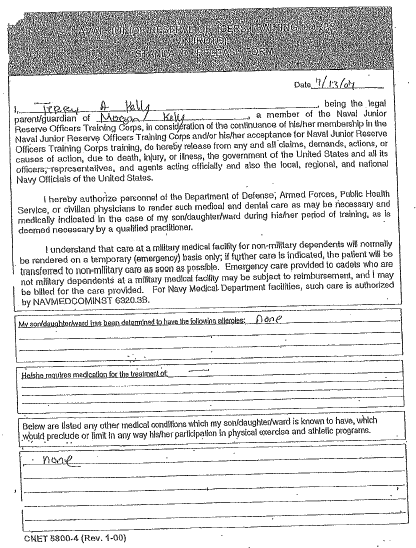
However, it is not necessary to decide whether plaintiff Pamela Kelly’s signature could bind her husband under these circumstances, because defendant produced a document referred to as the “Naval Junior Reserve Officers Training Corps (NJROTC) Standard Release Form.” (DE 94-4) (“Release Form”) [*29] (See Attached as Addendum B hereto). Page 2 of the Release Form, dated July 13, 2007, provides the following:
I, Terry A Kelly, being the legal parent/guardian of Morgan Kelly, a member of the Naval Junior Reserve Officers Training Corps, in consideration of the continuance of his/her membership in the Naval Junior Reserve Officers Training Corps training, do hereby release from any and all claims, demands, actions, or causes of action, due to death, injury, or illness, the government of the United States and all its officers, representatives, and agents acting officially and also the local, regional, and national Navy Officials of the United States.
(DE 94-4 at 2).
In the paragraph quoted above, the names of plaintiffs Terry and Morgan Kelly are written by hand. Plaintiff Terry Kelly’s declaration provides that page 2 “appears to contains [sic] my handwriting, but I would have to see the original to be certain.” (T. Kelly Decl. at ¶ 16).
Plaintiffs Terry and Pamela Kelly have attempted to challenge the Release Form, stating that they “do not believe that Document No. 94-4 is a genuine document.” In particular, they note that the front page, referenced as page 2 (the certification is appended [*30] as the first page of this filing), is identified as standard form “CNET 5800-4 (Rev. 1-00)” while the final page of the document, which includes a privacy act notification under which plaintiff Pamela Kelly’s name is signed, is identified as “CNET – General 5800/4 (REV. 1-95).” (DE 94-4 at 3; T. Kelly Decl. at ¶ 16; P. Kelly Decl. at ¶ 16). Like her husband, plaintiff Pamela Kelly declares that the writing on page 3 “looks like my signature, but I would need to see the original to be certain.” (P. Kelly Decl. at ¶ 16). She states that she does “not know when Page 3 of 3 was signed or for what purpose.” (Id.).
On April 27, 2011, the court amended its case management order to permit plaintiffs
to have until May 1, 2011, at their option, to visually inspect any original release and/or waiver document or documents relied upon by defendant at defendant’s counsel’s office. This deadline is without prejudice to plaintiffs’ right to have such document or documents examined by experts at a later date, if they deem necessary.
(April 27, 2011, order, p.1, DE 19).
It appears plaintiffs reviewed the Liability Waiver at defendant’s counsel’s office, but not the Release Form. (T. Kelly Decl. at ¶ 15; [*31] P. Kelly Decl. at ¶ 15). No separate request to review was made.
Plaintiffs’ arguments are insufficient to create a genuine issue concerning the Release Form, which is accompanied by a Certificate of Authenticity executed by the Compliance Officer of plaintiff Morgan Kelly’s school district, and notarized by a notary public. (DE 94-4 at 1). “Unsupported speculation . . . is not sufficient to defeat a summary judgment motion.” Ash v. UPS, 800 F.2d 409, 411-12 (4th Cir. 1986)). Plaintiffs had opportunity to review the original Release Form, and to have it assessed by an expert if deemed necessary. An opponent of summary judgment “must produce more than frivolous assertions, unsupported statements, illusory issues and mere suspicions.” Fed. Deposit Ins. Corp. v. Rodenberg, 571 F. Supp. 455, 457 (D. Md. 1983); see also 10A Wright, Miller & Kane, Fed. Practice and Procedure: Civil 3d § 2727 at 510-12 (1998) (“Neither frivolous assertions nor mere suspicions will suffice to justify a denial of summary judgment.”). It is little more than speculation to argue that the Release Form is not genuine, based merely on minor distinctions in form designations between pages. Similarly, plaintiffs’ allegations that they would “have to see the original” to be sure of their signatures amount to nothing more than mere suspicions, [*32] and they had this opportunity. Furthermore, neither Terry nor Pamela Kelly expressly denies seeing or writing on the pages where their names appear. This cannot create a genuine issue for summary judgment.7
7 To the extent plaintiffs’ challenge is an attack on the document’s authentication under Federal Rules of Evidence 901 and 902, it still fails to create a genuine issue of material fact. A party may show the existence of a genuine dispute of material fact by objecting “that the material cited to support or dispute a fact cannot be presented in a form that would be admissible in evidence.” Fed. R. Civ. P. 56(c)(2). However, the Certificate of Authenticity signed by the school district’s Compliance Officer satisfies the court that this document could be made admissible in evidence at trial.
The document therefore shows plaintiff Terry Kelly’s acceptance of a transaction whereby his claims were released “in consideration of” plaintiff Morgan Kelly’s continued participation in NJROTC training activities. The Release Form refers to “any and all claims.” In Waggoner, the court held that “the term ‘all claims’ must doubtless include a claim for negligence.” Waggoner, 1998 U.S. App. LEXIS 6792, 1998 WL 163811, at *4. See also Young v. Prancing Horse, Inc., No. COA04-727, 2005 N.C. App. LEXIS 1108, 2005 WL 1331065, at *2 (N.C. App. June 7, 2005) (“[W]e cannot agree with plaintiff [*33] that the absence of the word ‘negligence’ makes the release inoperable to bar this claim . . . . With all due regard to the severity of the injuries suffered by plaintiff, they are of the type contemplated and intended by this release.”).
Even if the Release Form failed to refer to the orientation visit in sufficiently specific terms, quasi-estoppel must operate to bar plaintiff Terry Kelly’s claims, because the record shows that plaintiff Terry Kelly accepted the benefits of the Release Form as it applied to the orientation visit. By detailing the kind of activities that he “understood” and “anticipated” his child would be involved in when she arrived at the orientation visit, plaintiff Terry Kelly’s declaration discloses that he knew plaintiff Morgan Kelly would be visiting Camp Lejeune. (T. Kelly Decl. at ¶ 10). He also alleges that “[a] monetary payment was required as a condition of Morgan’s attendance at the orientation visit,” indicating that he consented to payment for the visit. Id. at ¶ 5. He does not allege any objection to his daughters’ attendance or participation. He does not allege that he was estranged from his family, or that he was kept unaware of the upcoming activity. [*34]
“[A] party will not be allowed to accept benefits which arise from certain terms of a contract and at the same time deny the effect of other terms of the same agreement.” Brooks v. Hackney, 329 N.C. 166, 173, 404 S.E.2d 854 (1991). In Brooks, the court determined that even though an agreement to convey real property was invalid because its terms were not sufficiently definite, the plaintiff was estopped from denying its validity because he had made regular payments on the agreement, and therefore that the defendants reasonably relied on the writing. Id. at 171-73.
The same principle operates here, where plaintiff Terry Kelly signed a Release Form surrendering claims related to his daughter’s participation in NJROTC training, then allowed his daughter to attend a NJROTC training orientation visit. On the evidence, there is no genuine issue that plaintiff Terry Kelly accepted that plaintiff Morgan Kelly’s “membership in the Naval Junior Reserve Officers Training Corps training,” included the orientation visit. In consideration of this training, including the orientation visit, he released “claims, demands, actions, or causes of action, due to . . . injury.” Defendant reasonably relied on plaintiff Terry Kelly’s writing, in addition to his acquiescence to his [*35] daughter’s attendance at the orientation visit. Plaintiff Terry Kelly cannot be allowed to accept the benefits of the Release Form through his daughter’s attendance, while at the same time denying the release that was required as a condition of that attendance.
With all of plaintiffs’ claims disposed by waiver and release, summary judgment must be granted.
CONCLUSION
For the reasons set forth above, the court GRANTS defendant’s motion for summary judgment. (DE 93). The clerk is DIRECTED to close this case.
SO ORDERED, this the 25th day of September, 2014.
/s/ Louise W. Flanagan
LOUISE W. FLANAGAN
United States District Judge
ADDENDUM A
Waiver of liability and Assumption of Risk Agreement United States Marine Corps
Dated: July 20, 2007
EXHIBIT B
WAIVER OF LIABILITY AND ASSUMPTION OF RISK AGREEMENT UNITED STATES MARINE CORPS
In consideration of the privilege of participating in an organized event in a training area at Camp Lejeune, North Carolina, and further recognizing the voluntary nature of my participation in this event, I, the undersigned person, intending to be legally bound, hereby promise to waive for myself, my guardians, heirs, executor, administrators, legal representatives and any other [*36] persons on my behalf, any and all rights and claims for damages, demands, and any other actions whatsoever, including those attributable to simple negligence, which I may have against any of the following persons or entities: the United States of America; the Depart of Defense; the Department of the Navy; the United States Marine Corps; Marine Corps Base, Camp Lejeune, North Carolina; any and all individuals assigned to or employed by the United States, including but not limited to the Secretary of Defense; the Secretary of the Navy; the Commandant of the Marine Corps; Commanding General, Marine Corps Base, Camp Lejeune, North Carolina; in both their official and personal capacities; any medical support personnel assigned thereto; and these, persons’ or entities’ representatives, successors, and assigns; which said injuries arise out of my participation in the activities comprising the aforesaid event; as well as any use by me of any Marine Corps Base, Camp Lejeune, North Carolina, or government equipment, or facilities in conjunction with and furtherance of such participation by me. I FURTHER VERIFY THAT I HAVE FULL KNOWLEDGE OF THE RISKS ASSOCIATED WITH ATTENDING THIS EVENT. I EXPRESSLY, [*37] KNOWINGLY, AND VOLUNTARILY ASSUME THE RISKS INVOLVED IN THE PLANNED ACTIVITIES INCLUDING TRANSPORTATION TO AND FROM THE EVENT, AND AGREE TO HOLD THE UNITED STATES HARMLESS FOR ANY RESULTING INJURY. I understand that this assumption of risk agreement shall remain in effect until notice of cancellation is received by the Commanding General, Marine Corps Base, Camp Lejeune, North Carolina. I understand that, should I decline to execute this agreement, I will not be permitted to attend the organized event.
(Signature of Witness)
[TEXT REDACTED BY THE COURT]
/s/ Morgan E. Kelly 7/19/07
(Signature) (Date)
Morgan E. Kelly
(Printed Name)
/s/ Pamela D. Kelly
(Signature of Parent/Guardian)
on behalf of Morgan
(Name of Minor)
Date: 7-20-07
Participants Information/POC Page
FOR OFFICIAL USE ONLY
(Please Print Legibly)
Participant Last Name, First Name, Initial: Kelly Pamela D
Parent/Guardian Name: Pam Kelly
Home Phone: [TEXT REDACTED BY THE COURT]
Work Phone: [TEXT REDACTED BY THE COURT]
Cellular Phone: [TEXT REDACTED BY THE COURT]
Alternative Adult to be Contacted in Case of Emergency and Relation to Participant: Terry Kelly
Home Phone: [TEXT REDACTED BY THE COURT]
Work Phone: [TEXT REDACTED BY THE [*38] COURT]
Cellular Phone: [TEXT REDACTED BY THE COURT]
Does the Participant have Any Allergies or Special Medical Conditions? None
ADDENDUM B
Naval Junior Reserve Officers Training Corps (NJROTC)
Standard Release Form With Certificate of Authenticity
Dated: July 13, 2007
EXHIBIT 2
CERTIFICATE OF AUTHENTICITY
The undersigned certifies that I am the person responsible for keeping of school and\or student records in behalf of the Henry County Board of Education and that the within and attached is a true and accurate copy of certain school system records of
Morgan Kelly (DOB: [TEXT REDACTED BY THE COURT])
thereof kept in the normal course of business of the Henry County School System. This Certificate of Authenticity may be used in lieu of the personal appearance of the person certifying hereto.
/s/ Archie Preston Malcom
Archie Preston Malcom, Bd.D
Compliance Officer (Contracted)
11-14-2013
Sworn to and subscribed before me on this 14th day of November 2013
/s/ Slyvia S/ Burch
Notary Public
My Commission Expires: 07/21/16

Plaintiff in a ropes course injury (Nitro Swing) fails because she assumed the risk
Posted: April 20, 2015 Filed under: Assumption of the Risk, Challenge or Ropes Course, New York | Tags: assumption of the risk, challenge course, Nitro Crossing, Nitro Swing, Ropes course, YMCA, YMCA of Greater New York Leave a commentIt is wonderful when the court looks at the facts and says plainly, no way you are going to win a case because this is a stupid claim, and your expert is clueless.
State: New York, Supreme Court of New York, Appellate Division, First Department
Plaintiff: Kathleen Sajkowski et al
Defendant: Young Men’s Christian Association of Greater New York
Plaintiff Claims: negligent in failing to place shock absorbing material such as wood chips below the Nitro Crossing
Defendant Defenses: Assumption of the Risk
Holding: For the defendant
Year: 2000
This case is written so clearly that most of this article will be quotes from the opinion.
The plaintiff participated in a Wellness for Life weekend put on by the defendant YMCA. One of the activities was a Nitro Swing. The court described the Nitro Swing as:
This event involved nothing more than swinging from a rope. The rope dangled just about 1 1/2 feet from the ground in the center of an imaginary pit that was actually flat, bare dirt. Those who chose to participate in the Nitro Crossing would start out by standing on a log that was lying at ground level. Then, holding on to the rope, they would swing approximately five to seven feet to another log that was also lying at ground level.
Don’t you just love the first sentence! “This event involved nothing more than swinging from a rope.” It distilled the essence of the lawsuit and removed the marketing and hyperbole that clouds life and litigation now days.
While waiting for her turn the plaintiff saw several other participants lose their grip on the rope and fall. When she tried the Nitro Swing she also lost her grip on the rope and fell injuring her ankle.
The plaintiff sued. The trial court dismissed her lawsuit based on assumption of the risk, and the plaintiff appealed the decision.
Analysis: making sense of the law based on these facts.
The court said the plaintiff assumed the risk.
…by engaging in a sport or recreational activity, a participant consents to those commonly appreciated risks which are inherent in and arise out of the nature of the sport generally and flow from such participation.” This encompasses those risks that are associated with the construction of the playing field and any open and obvious defects on it. Thus, if the risks of an activity are fully comprehended or perfectly obvious, one who participates in the activity is deemed to have consented to the risks. Furthermore, where the risk is open and obvious, the mere fact that a defendant could have provided safer conditions is irrelevant
Then the court states in very plain English:
It is also incontrovertible that the risks involved were not concealed and that plaintiff fully comprehended them since she had seen several other participants fall just moments earlier. Moreover, to the extent that the Nitro Crossing failed to have shock absorbing material beneath it, this was nothing more than an open and obvious condition of the playing surface, which, as noted, is not actionable….
The plaintiff, then through the opinion of her expert witness tried to convince the court that the defendant should have padded the ground beneath the swing. The court did not really appreciate her expert’s opinion.
Plaintiff attempts to avoid the foregoing analysis by establishing that the Nitro Crossing was constructed or operated in violation of prevailing industry standards. Specifically, it is alleged that shock absorbing material beneath the Nitro Crossing was required, as well as proper training for plaintiff with regard to her participation in the activity.
The reason was the expert used by the plaintiff dug up standards for gymnastics for children under 12.
In seeking to demonstrate such violations, plaintiff submitted expert evidence that analogized the Nitro Crossing to a gymnastics event and pointed to the requirements for construction of playgrounds built for children under 12 years of age.
Then the court sort of slams the case closed.
She was only swinging from a rope with her body suspended just barely off the ground. The instructions for such an activity are simple and straightforward–hold the rope and swing. Similarly incongruous was plaintiff’s reliance on standards for the proper construction of playgrounds built for children under 12 years of age. The Nitro Crossing, after all, was not part of a children’s playground.
As much as appellate courts are allowed to, the above paragraph is pretty much an “up yours” in legalese.
So Now What?
Sure, Always Use a Release, but in this case for this particular event, it did not matter.
This is a situation where no matter how stupid the claim or how valid the defenses; the plaintiff still gave rolled the dice hoping for a very sympathetic judge or an easy settlement. The defendant and their insurance company, thankfully, stood up to the stupid claims and fought them; probably to a greater cost than any settlement.
Even in outdoor recreation, you get bad lawsuits. Thankfully, this one was fought all the way rather than settled.
What do you think? Leave a comment.
If you like this let your friends know or post it on FaceBook, Twitter or LinkedIn
Copyright 2015 Recreation Law (720) Edit Law
Email: Rec-law@recreation-law.com
Google+: +Recreation
Twitter: RecreationLaw
Facebook: Rec.Law.Now
Facebook Page: Outdoor Recreation & Adventure Travel Law
Blog: www.recreation-law.com
Mobile Site: http://m.recreation-law.com
By Recreation Law Rec-law@recreation-law.com James H. Moss
#AdventureTourism, #AdventureTravelLaw, #AdventureTravelLawyer, #AttorneyatLaw, #Backpacking, #BicyclingLaw, #Camps, #ChallengeCourse, #ChallengeCourseLaw, #ChallengeCourseLawyer, #CyclingLaw, #FitnessLaw, #FitnessLawyer, #Hiking, #HumanPowered, #HumanPoweredRecreation, #IceClimbing, #JamesHMoss, #JimMoss, #Law, #Mountaineering, #Negligence, #OutdoorLaw, #OutdoorRecreationLaw, #OutsideLaw, #OutsideLawyer, #RecLaw, #Rec-Law, #RecLawBlog, #Rec-LawBlog, #RecLawyer, #RecreationalLawyer, #RecreationLaw, #RecreationLawBlog, #RecreationLawcom, #Recreation-Lawcom, #Recreation-Law.com, #RiskManagement, #RockClimbing, #RockClimbingLawyer, #RopesCourse, #RopesCourseLawyer, #SkiAreas, #Skiing, #SkiLaw, #Snowboarding, #SummerCamp, #Tourism, #TravelLaw, #YouthCamps, #ZipLineLawyer, Ropes Course, Challenge Course, Nitro Swing, YMCA, YMCA of Greater New York, Assumption of the Risk, Nitro Crossing,
Colorado Agency now regulating Zip Lines and Ropes Courses in Ohio
Posted: April 18, 2015 Filed under: Challenge or Ropes Course, Colorado, Zip Line | Tags: Colorado, Ropes course, x, y, z, Zip Lines Leave a commentFrom: OPS Amusement Rides and Devices Program [mailto:cdle_amusements@state.co.us]
Sent: Monday, April 06, 2015 3:26 PM
To: undisclosed-recipients:
Subject: Proposed Revisions to the Amusement Rides and Devices Regulations and New Certificate of Inspection Form
Dear Amusement Rides and Devices Stakeholder,
The Amusement Rides and Devices Program hosted a stakeholder meeting on February 20, 2015, to discuss proposed changes to our rules, which included:
- adding language for the regulation of challenge courses and trampoline parks;
- improving current language in regulation regarding zip lines;
- adding language for patron responsibility;
- clarifying language for reportable injuries; and
- updating and/or including applicable standards and definitions.
We took all comments and feedback provided during the meeting into consideration and have postponed the effective date of the proposed changes to July 30, 2015, in order to conduct a second stakeholder meeting to discuss the revisions made after the meeting on February 20th. A draft copy of the revised proposed regulations is attached to this email for your review.
The second stakeholder meetings is scheduled for Tuesday, April 28, 2015 at 1 pm in Conference Room 5C at the CDLE offices (633 17th Street, Denver, Colorado 80202). If you cannot attend the meeting, we encourage you to submit feedback to Scott Narreau at scott.narreau or 303-318-8495. If you plan to attend the meeting:
- Please RSVP by sending an email to cdle_amusements; include your organization’s name and your contact information in your email.
- When you arrive for the meeting, please check in on the 2nd floor, and then you will be directed to the 5th floor conference room.
In addition to the rule changes, we have also made changes to our Certificate of Inspection form. The purpose of changing the form is to further streamline the application process by reducing the amount of documentation submitted to our office. With the new form, a Third-Party Inspector can submit inspection certification information for up to 10 devices on one single form. We have attached a draft copy of the new Certificate of Inspection form to this email. We encourage you to review it and advise us if these or other changes would benefit you as either an operator or a Third-Party inspector.
As always, we thank you for your participation in our program.
Kind regards,
Division of Oil and Public Safety
Amusement Rides and Devices Program

We Keep Colorado Working.
P 303.318.8552 | F 303.318.8488
633 17th St., Suite 500, Denver, CO 80202
cdle_amusements | www.colorado.gov/ops/amusementrides
**How are we doing? Please complete this survey to provide your feedback: OPS Customer Survey.**
Amusements Certificate of Inspection (Draft).pdf
Amusement Rides and Devices Proposed Rule Changes Effective 07-30-15 (Draft).pdf
Sajkowski et al., v. Young Men’s Christian Association of Greater New York, 269 A.D.2d 105; 702 N.Y.S.2d 66; 2000 N.Y. App. Div. LEXIS 968
Posted: April 16, 2015 Filed under: Assumption of the Risk, Challenge or Ropes Course, Legal Case, New York | Tags: assumption of the risk, challenge course, Nitro Crossing, Nitro Swing, Ropes course, YMCA, YMCA of Greater New York Leave a commentSajkowski et al., v. Young Men’s Christian Association of Greater New York, 269 A.D.2d 105; 702 N.Y.S.2d 66; 2000 N.Y. App. Div. LEXIS 968
Kathleen Sajkowski et al., Appellants, v. Young Men’s Christian Association of Greater New York, Respondent.
2180
SUPREME COURT OF NEW YORK, APPELLATE DIVISION, FIRST DEPARTMENT
269 A.D.2d 105; 702 N.Y.S.2d 66; 2000 N.Y. App. Div. LEXIS 968
February 1, 2000, Decided
February 1, 2000, Entered
COUNSEL: [***1] For Plaintiffs-Appellants: Charles H. Dobkin.
For Defendant-Respondent: Laura Getreu.
JUDGES: Concur–Nardelli, J. P., Ellerin, Lerner, Andrias and Friedman, JJ.
OPINION
[*105] [**66] Order, Supreme Court, New York County (Lorraine Miller, J.), entered July 20, 1998, which granted defendant’s motion for summary judgment dismissing the complaint, unanimously affirmed, without costs.
The Young Men’s Christian Association of Greater New York (YMCA) sponsored a “Wellness for Life” weekend program for adults who wished to engage in exercise and outdoor activities. Among the activities [**67] that were offered at the program was an obstacle course that included an event called the Nitro Crossing. This event involved nothing more than swinging from a rope. The rope dangled just about 1 1/2 feet from the ground in the center of an imaginary pit that was actually flat, bare dirt. Those who chose to participate in the Nitro Crossing would start out by standing on a log that was lying at ground level. Then, holding on to the rope, they would swing approximately five to seven feet to another log that was also lying at ground level.
Plaintiff, Kathleen Sajkowski, an attendee [***2] at the weekend program, stood in line with several other participants and waited for her turn to swing on the rope. While she was waiting, she observed that several participants lost their grip and fell while swinging. When her turn came, she grasped the rope and began to swing. Approximately at the midway point of the imaginary pit, plaintiff lost her grip and fell, injuring her ankle. Plaintiff, alleging, inter alia, that defendant YMCA was negligent in failing to place shock absorbing material such as wood chips below the Nitro Crossing, commenced this action. No claim was made that the rope broke or was otherwise defective. Thereafter, defendant moved for summary judgment dismissing the complaint, asserting that plaintiff assumed the risk of participating in this activity. We conclude that the assumption of risk doctrine is applicable to plaintiff’s injury.
In Morgan v State of New York (90 NY2d 471, 484), the Court of Appeals reaffirmed the principle that, [HN1] “by engaging in a [*106] sport or recreational activity, a participant consents to those commonly [***3] appreciated risks which are inherent in and arise out of the nature of the sport generally and flow from such participation.” This encompasses those risks that are associated with the construction of the playing field and any open and obvious defects on it ( Maddox v City of New York, 66 NY2d 270, 277). Thus, if the risks of an activity are fully comprehended or perfectly obvious, one who participates in the activity is deemed to have consented to the risks ( Morgan v State of New York, supra; see also, Turcotte v Fell, 68 NY2d 432, 439). Furthermore, where the risk is open and obvious, the mere fact that a defendant could have provided safer conditions is irrelevant ( Simoneau v State of New York, 248 AD2d 865).
In considering plaintiff’s injury, it is apparent that the risk of falling while swinging from a rope is inherent in participation in such an activity (cf., Hofflich v Mendell, 235 AD2d 784; compare, Roska v Town of Cheektowaga, 251 AD2d 984). It is also incontrovertible that the risks involved were not concealed and that plaintiff fully comprehended them since she had seen several [***4] other participants fall just moments earlier. Moreover, to the extent that the Nitro Crossing failed to have shock absorbing material beneath it, this was nothing more than an open and obvious condition of the playing surface, which, as noted, is not actionable ( Maddox v City of New York, supra; see also, Sheridan v City of New York, 261 AD2d 528; Paone v County of Suffolk, 251 AD2d 563; Brown v City of New York, 251 AD2d 361; compare, Warren v Town of Hempstead, 246 AD2d 536 [defect concealed]; Cronson v Town of N. Hempstead, 245 AD2d 331).
Plaintiff attempts to avoid the foregoing analysis by establishing that the Nitro Crossing was constructed or operated in violation of prevailing industry standards. Specifically, it is alleged that shock absorbing material beneath the Nitro Crossing was required, as well as proper training for plaintiff with regard to her participation in the activity. These violations, it is asserted, exposed plaintiff to unreasonably enhanced risks, which she cannot be deemed to have assumed (see, Morgan v State of New York, supra, at 485; [***5] [**68] see also, Greenburg v Peekskill City School Dist., 255 AD2d 487; Clark v State of New York, 245 AD2d 413; Stackwick v Young Men’s Christian Assn., 242 AD2d 878). In seeking to demonstrate such violations, plaintiff submitted expert evidence that analogized the Nitro Crossing to a gymnastics event and pointed to the requirements for construction of playgrounds built for children under 12 years of age.
[*107] What becomes apparent is that the comparison of the Nitro Crossing to a gymnastics event is incongruous. * Simply stated, plaintiff was not dismounting from uneven bars, or doing a tumbling routine during a floor exercise–activities completely different in degree, complexity, and danger from the activity at issue here. Nor was she engaged in an activity that required any specialized kind of training, instruction, or skill. She was only swinging from a rope with her body suspended just barely off the ground. The instructions for such an activity are simple and straightforward–hold the rope and swing. Similarly incongruous was plaintiff’s reliance on standards for the proper construction of playgrounds built [***6] for children under 12 years of age. The Nitro Crossing, after all, was not part of a children’s playground.
* For the same reasons plaintiff’s claim that defendant should have provided a spotter is without merit. Moreover, since plaintiff immediately fell to the ground when she lost her grip on the rope, the presence of a spotter would not have prevented this accident.
We also note that the balance of the expert evidence failed to demonstrate that defendant violated any prevailing standards in constructing the Nitro Crossing (see, Simoneau v State of New York, supra; cf., Greenburg v Peekskill City School Dist., supra; Clark v State of New York, supra; Stackwick v Young Men’s Christian Assn., supra).
In view of the foregoing, Supreme Court properly granted defendant’s motion and dismissed the complaint.
Concur–Nardelli, J. P., Ellerin, Lerner, Andrias and Friedman, JJ.
History of PRCA and Founder is Stepping Down
Posted: February 12, 2015 Filed under: Challenge or Ropes Course | Tags: x, y, z 3 Comments
|
|||||||||||||
 |


Colorado making new rules for operating Zip Lines & Rope Courses. Meeting February 6 to find out
Posted: December 30, 2014 Filed under: Challenge or Ropes Course, Zip Line | Tags: challenge course, Colorado, Regulation, Ropes course, x, y, z, zip line Leave a comment
|

UIAA Ice Climbing Competition set to Begin
Posted: December 12, 2014 Filed under: Youth Camps, Zip Line | Tags: x, y, z Leave a comment
|
|||||


| UIAA | Monbijoustrasse 61 Postfach CH-3000 | Bern | Switzerland |
USA ProChallenge Host Cities for 2015 Announced. Different cities, Going to be a slightly Different Race. Cool!
Posted: December 6, 2014 Filed under: Youth Camps, Zip Line | Tags: Arapahoe Basin, Bicycle Racing, Colorado, Copper Mountain (Colorado), Denver, Individual time trial, Steamboat Springs, Tejay Van Garderen, x, y, z Leave a commentHost Cities Announced for 2015 USA Pro Challenge
Fans Can Help Shape the Route for America’s Most Difficult Professional Cycling Race
Colorado’s largest sporting event is back for 2015, and today race officials unveiled seven of the host cities that will be highlighted as starts and finishes for the 2015 USA Pro Challenge. Taking place Aug. 17-23, the race will feature several dramatic changes for 2015, including a new overall start in beautiful Steamboat Springs, new host communities Arapahoe Basin and Copper Mountain and a challenging individual time trial course in in the scenic town of Breckenridge. And with six of the seven stages set, organizers are looking to fans to help determine the location of Stage 6.
“The start and finish cities for the 2015 USA Pro Challenge are going to create some unique challenges for the riders while also showcasing some of Colorado’s most beautiful regions to our worldwide audience,” said Rick Schaden, owner of the USA Pro Challenge. “We are always humbled by the amount of interest we receive from cities across the state that want to host the race and we feel confident that the partners we’ve selected this year will help us continue to raise the bar for professional cycling in America.”
After drawing more than 1 million fans each year and generating $130 million in economic impact to the State of Colorado in 2014 alone, the USA Pro Challenge will make its return with an overall start in Steamboat Springs. Over the course of seven days of intensely competitive racing, the world’s best riders will return to iconic Colorado cities that have been key parts of the race in previous years, such as Aspen and Denver.
In a mix of new and prior host cities, the stages of the 2015 USA Pro Challenge include:
- Stage 1: Monday, Aug. 17 – Steamboat Springs Circuit Race
- Stage 2: Tuesday, Aug. 18 – Steamboat Springs to Arapahoe Basin
- Stage 3: Wednesday, Aug. 19 – Copper Mountain Resort to Aspen
- Stage 4: Thursday, Aug. 20 – Aspen to Breckenridge
- Stage 5: Friday, Aug. 21 – Breckenridge Individual Time Trial
- Stage 6: Saturday, Aug. 22 – ???
- Stage 7: Sunday, Aug. 23 – Golden to Denver
Last year, fans weighed in on the final stage and ultimately determined a route that took the riders from Boulder, through Golden and finished in Downtown Denver. Due to overwhelming fan interest and support, organizers are again letting people have a say in the course. Fans will be able to help shape the race by logging on to www.prochallenge.com/2015stage6 before 11:59 p.m. MT December 12, and giving their opinion on what part of the state Stage 6 should visit.
“Last year we turned to our dedicated fans to help determine the route for the final stage of the Pro Challenge,” said Shawn Hunter, CEO of the USA Pro Challenge. “The enthusiasm and valuable opinions that we received convinced us that we should look to our supporters again for their input on the 2015 race. We know our fans are passionate about the sport and we’re looking forward to hearing where they want Stage 6 to go.”
A new overall start for the Pro Challenge, Steamboat Springs, with a population of just more than 12,000, should see that number at least double on race day. Located just west of the Continental Divide and Rabbit Ears Pass, Steamboat is the perfect location to kick off the race and showcase Colorado’s unique scenic beauty. And as the Colorado city that has produced more Olympians than any other, the riders should feel right at home.
In one of the most significant changes to the 2015 route, Breckenridge will host the individual time trial. Located 9,600 ft. above sea level, this course will test the riders with challenging, hilly terrain. With these additions combined with new host cities Arapahoe Basin and Copper Mountain Resort, the 2015 course will create dramatic moments for the riders and fans.
Known for lung-searing altitudes and intense climbs through the Colorado Rockies, the race is the largest spectator event in the history of the state. The 2014 USA Pro Challenge saw part-time Aspen resident Tejay van Garderen of BMC Racing Team take the overall win for the second year in a row this past August in Denver.
“I am so happy to hear the USA Pro Challenge is going through Aspen again,” said van Garderen. “It is always great to be able to race in front of my family and close friends. Of course, I am curious to see the route they will pick and I am expecting it to be the most challenging route yet.”
Additional details regarding the exact start and finish locations of the 2015 race, as well as the specific, detailed route will be announced in the spring.
It’as Brand New World Out There for the Ropes Course Industry: New F24 sub-committee; F24.61 on Adventure Attractions
Posted: November 14, 2014 Filed under: Challenge or Ropes Course, Zip Line | Tags: x, y, z Leave a commentAt the October meeting in Scottsdale, the Executive Committee approved the addition of a new F24 sub-committee; F24.61 on Adventure Attractions. This sub-committee will be chaired by Phil Slaggert and will include the following activities: trampoline courts, aerial adventure courses, inflatable amusement devices and the walk on water ball activity.
If you would like to be added to this sub-committee you need to login to your account and join F24.61. I have included a screenshot below so you can see where the link is to join additional committees. If you have any trouble, please let me know.
What is happening at theBradford Washburn American Mountaineering Musemen
Posted: November 8, 2014 Filed under: Youth Camps, Zip Line | Tags: x, y, z Leave a comment
|

Failing to let go, “volunteer” teacher falls of zip line & recovers $1,650,000
Posted: October 27, 2014 Filed under: Challenge or Ropes Course, Minnesota, Zip Line | Tags: challenge course, Linda Timmer, Platform, Ropes course, Shamineau Adventures, zip line 2 CommentsNo defenses, no release, just a trail and an appeal which the plaintiff lost. Have EVERYONE sign a release, including staff and volunteers of your guests
Timmer, et al., v. Shamineau Adventures, 2005 Minn. App. Unpub. LEXIS 576
State: Minnesota
Plaintiff: Linda Timmer and her husband Jere Timmer
Defendant: Shamineau Adventures
Plaintiff Claims: Negligence
Defendant Defenses:
Holding: For the Plaintiff, final damages of $1,650,000
Year: 2005
There is not a lot of factual information to be learned in this case. There are several procedural issues that can be helpful in understanding the law as well as identification of a gaping hole in the risk management planning for this defendant. A risk-management weakness that cost the defendant $1,650,000.
The plaintiff was a teacher employed by the school district that was attending the ropes’ course. The case does not state whether this is a worker’s comp subrogation case or whether the plaintiff was working at the time and covered by worker’s compensation.
The ropes course director asked the plaintiff if she wanted to assist with the students at the zip line. The court went into a detailed explanation of the zip line and how it operated. Basically, the zip line was 300 feet long going from a tower to a platform across a valley. The zip line sagged in the middle so the riders slowed as the approached the platform going uphill.
The plaintiff was given a few minutes of instruction and was shown how to detach riders from the zip line on the platform. A student arrived at the platform, and the plaintiff grabbed her and attempted to disconnect her from the zip line. The student started to drift backwards still attached, and the plaintiff grabbed her. The student and plaintiff drifter backwards to the low point of the zip line which left the plaintiff holding on 25’ above the ground. The plaintiff let go and fell suffering injuries.
The plaintiff sued, and the defendant lost at trial. The jury awarded $4.5 million to the plaintiff and split the damages 60% of the liability to the defendant and 40% to the plaintiff. This resulted in an award for the plaintiff of $2,783,949.
Analysis: making sense of the law based on these facts.
The issues on appeal were whether the defense had time to deal with the new plaintiff’s expert witness, whether the jury apportioned the damages correctly, whether a motion for the new trial should have been granted and whether all of this should have allowed the defense to have a continuance. All of those issues are discretionary. That means the judge has discretion to make decisions and unless those decisions are so grossly out of line the appellate court will not over turn them.
One issue that is worth examining, and that is the remittitur. A remittitur is a reduction in the amount awarded by the jury by the judge. The jury awarded $2,783,949. The judge reduced the amount to $1,650,000 in an effort to resolve some of the issues in post-trial motions. Normally, this is done by the judge because the amount awarded by the jury exceeds the amount the plaintiff asks for. The alternative is the judge orders a new trial. This places the plaintiff in a quandary. Try again at trial to get more money or take what the judge has offered.
Here the defense was arguing the amount awarded was excessive, and the other issues enumerated above and the plaintiff had to accept less money than awarded or go through the entire process again.
The appellate court agreed with the trial court on all of its decisions. None of the arguments presented on appeal by the defendant concerned defenses so it is difficult to determine what was a defense at trial.
So Now What?
The hole that is evident in this mess is the plaintiff did not sign a release. A release might have barred a claim by the plaintiff and by any insurance company or worker’s compensation insurance company under its subrogation rights. A release might have stopped this lawsuit. Minnesota has strict requirements on how a release should be written, and a badly written release would have not been effective.
Many times “staff” of the group coming to the event are skipped in the paperwork process. No one should be allowed on the property without signing a release. The staff could have signed up on line or when they arrived. Their releases could have been part that was handed back in when the parents signed releases for their kids. A release for a minor would not have worked in Minnesota if it went that far, but even so, releases may stop someone from suing who is unsure of the legal value of a release.
Always have a well-written release signed by everyone coming to your business, program or activity. That one release might have been worth $1,650,000, interest, costs and the legal fees to defend the case.
What do you think? Leave a comment.
If you like this let your friends know or post it on FaceBook, Twitter or LinkedIn
Copyright 2014 Recreation Law (720) Edit Law
Email: Rec-law@recreation-law.com
Google+: +Recreation
Twitter: RecreationLaw
Facebook: Rec.Law.Now
Facebook Page: Outdoor Recreation & Adventure Travel Law
Blog: www.recreation-law.com
Mobile Site: http://m.recreation-law.com
By Recreation Law Rec-law@recreation-law.com James H. Moss #Authorrank
#AdventureTourism, #AdventureTravelLaw, #AdventureTravelLawyer, #AttorneyatLaw, #Backpacking, #BicyclingLaw, #Camps, #ChallengeCourse, #ChallengeCourseLaw, #ChallengeCourseLawyer, #CyclingLaw, #FitnessLaw, #FitnessLawyer, #Hiking, #HumanPowered, #HumanPoweredRecreation, #IceClimbing, #JamesHMoss, #JimMoss, #Law, #Mountaineering, #Negligence, #OutdoorLaw, #OutdoorRecreationLaw, #OutsideLaw, #OutsideLawyer, #RecLaw, #Rec-Law, #RecLawBlog, #Rec-LawBlog, #RecLawyer, #RecreationalLawyer, #RecreationLaw, #RecreationLawBlog, #RecreationLawcom, #Recreation-Lawcom, #Recreation-Law.com, #RiskManagement, #RockClimbing, #RockClimbingLawyer, #RopesCourse, #RopesCourseLawyer, #SkiAreas, #Skiing, #SkiLaw, #Snowboarding, #SummerCamp, #Tourism, #TravelLaw, #YouthCamps, #ZipLineLawyer, Ropes Course, Challenge Course, Zip Line, Shamineau Adventures, Linda Timmer, Platform,
Timmer, et al., v. Shamineau Adventures, 2005 Minn. App. Unpub. LEXIS 576
Posted: October 23, 2014 Filed under: Legal Case, Minnesota, Zip Line | Tags: Appeal, Camp Shamineau, challenge course, Linda Timmer, Minneapolis, Minnesota, Minnesota Court of Appeals, Minnesota Supreme Court, Platform, Ropes course, Shamineau Adventures, Trial court, zip line Leave a commentTimmer, et al., v. Shamineau Adventures, 2005 Minn. App. Unpub. LEXIS 576
Linda Timmer, et al., Respondents, vs. Shamineau Adventures, Appellant.
A04-2458
COURT OF APPEALS OF MINNESOTA
2005 Minn. App. Unpub. LEXIS 576
December 13, 2005, Filed
NOTICE: [*1] THIS OPINION WILL BE UNPUBLISHED AND MAY NOT BE CITED EXCEPT AS PROVIDED BY MINNESOTA STATUTES.
SUBSEQUENT HISTORY: Review denied by Timmer v. Shamineau Adventures, 2006 Minn. LEXIS 73 (2006)
Subsequent appeal at, Remanded by Timmer v. Shamineau Adventures, 2007 Minn. App. Unpub. LEXIS 351 (2007)
PRIOR HISTORY: Morrison County District Court. File No. CX-03-261. Hon. John H. Scherer.
DISPOSITION: Affirmed.
COUNSEL: For Appellant: Robert G. Haugen, Jason M. Hill, Johnson & Lindberg, P.A., Minneapolis, MN.
For Respondent: Luke M. Seifert, Michael, T. Milligan, Heidi N. Thoennes, Quinlivan & Hughes, P.A., St. Cloud, MN.
JUDGES: Considered and decided by Willis, Presiding Judge, Randall, Judge, and Huspeni, Judge. 1
1 Retired judge of the Minnesota Court of Appeals, serving by appointment pursuant to Minn. Const. art. VI, § 10.
OPINION BY: RANDALL
OPINION
UNPUBLISHED OPINION
RANDALL, Judge
This is an appeal from the district court order denying a motion for JNOV but granting a new trial on damages and a conditional remittitur of the damages awarded for future pain and suffering. After respondents accepted the conditional remittitur, appellant brought this appeal contending: (a) it is entitled to a Schwartz hearing based on a juror’s allegations of misconduct in reaching the verdict; (b) it is entitled to an unconditional new trial because of juror misconduct on the face of the special [*2] verdict form; (c) it is entitled to a new trial on liability due to the erroneous admission into evidence of an unqualified expert’s opinions; and (d) the court erred in allowing respondent’s expert to testify to opinions undisclosed prior to trial and denying appellant’s request for a continuance. Respondents filed a notice of review arguing that the conditional remittitur was unsupported by the evidence. We affirm on all issues.
FACTS
This appeal stems from a tort action brought by respondents Linda Timmer and her husband Jere Timmer (collectively “respondents”) against appellant Shamineau Adventures. Appellant is one of five subdivisions that are collectively referred to as “Shamineau Ministries.” Appellant’s subdivision consists of a ropes course that includes various elements and obstacle courses. One of the elements of the ropes course is a zip line that consists of a 300-foot cable that is secured to a tower structure on a hill, traverses a valley, and ends at a tree located at a lower point on the opposite side. The cable drapes across the valley, and gradually rises as it nears the landing area in front of the tree to which it is attached. The cable is threaded through [*3] a pulley system and a lanyard rope is attached to the pulley. At the end of the lanyard is a carabiner that has a hinged gate on one side that is spring loaded. A zip line rider is specially body-harnessed by camp personnel, and connected to another carabiner clip attached to the harness. Both carabiners are equipped with screw-lock devices and spring tension hinges that prevent them from opening accidentally.
To ride the zip line, the rider’s harness carabiner is attached to the zip line carabiner. The rider then steps from the higher end platform, gliding down the cable across the valley. The rider slows as the calibrated slack in the cable and the resulting incline brings the rider to a slow landing on the gradual upslope of the lower end hill. The harness carabiner is then disconnected from the zip line by an assistant stationed at the lower end of the hill, and the pulley and lanyard assembly is walked back up to the higher end platform by the rider using a tow-rope attached to the lanyard.
In October 2001, a group of students and teachers from the Little Falls School District went to Camp Shamineau. Included in the group was Timmer, a special education teacher in the Little [*4] Falls School District. On October 11, while “roving” the ropes course and generally supervising her students, Timmer was approached by Troy Zakariasen, the ropes course director. Zakariasen asked Timmer if she would be willing to help uncouple students at the receiving end of the zip line while he briefly attended to other duties. Timmer agreed, and Matthew Stanghelle, a Shamineau staff member, showed Timmer how to unhook the zip line riders. Stanghelle spent approximately five minutes with Timmer, showing her the procedure by demonstrating on incoming zip line riders. Stanghelle then left the landing area to assist other students, teachers, and staff. Although Timmer had been to Camp Shamineau three or four times prior to October 11, she had never attended any training relative to the ropes course, which typically includes two to three weeks of training riders.
After Stanghelle left, the next rider on the zip line was 14-year old Tracie Boser. When Boser arrived at the landing area, Timmer grabbed Boser and tried to unhook her from the harness. As Timmer tried to unscrew the safety harness, Boser began drifting backwards. Timmer instinctively grabbed onto Boser to prevent her from [*5] coasting back to the sender, but Timmer was unable to maintain her footing. Boser then glided back toward the middle of the zip line with Timmer hanging onto Boser’s harness. When they reached the mid-point, approximately 25 feet above the valley, Timmer was unable to maintain her grip on the harness, and she fell to the ground, sustaining serious injuries. Timmer brought this tort action alleging negligence on the part of Shamineau Adventures. Jere Timmer filed a claim for loss of consortium.
Four days prior to the commencement of trial, respondents served upon appellant a memorandum issued by Richard Gauger, an engineer retained by respondents to serve as an expert witness. Gauger’s memorandum concluded that, in his opinion, the landing area of the zip line was unsafe, and that the landing area should involve one or more trained persons working together to assist the rider in arriving safely. Appellants moved for an order excluding Gauger’s new opinions, or, in the alternative, for a continuance due to the untimely disclosure of the new evidence. The district court denied the motion, holding that the issue of the landing area could reasonably have been anticipated in light of the [*6] nature of the case.
A jury trial was held from June 21, 2004, through June 29, 2004. At trial, Gauger testified that he has a bachelor’s degree in industrial engineering, and that he is a consulting engineer licensed as a professional engineer. Gauger also testified that his work history included assisting with design and development of construction projects, and some investigative work with regard to recreational activities. Appellant objected to Gauger’s testimony on the basis that he was unqualified as an expert witness. The district court overruled the objection, and Gauger testified in accordance with his June 17 memorandum, that the zip line was dangerous because the slope exceeded the American with Disabilities Act (ADA) standards for ramps and other standards typically used on construction projects.
The jury heard extensive testimony concerning Timmer’s injuries and her present physical condition. Dr. Joseph Nessler testified that as a result of her accident, Timmer suffered “multiple injuries, including pelvic fractures, sacral or tailbone fractures, spinal fracture, left femur fracture, left tibia fracture, and right calcaneus fracture.” Dr. Nessler, Dr. Jeffrey Gerdes, [*7] and Dr. Gregory Schlosser all testified that Timmer suffers from various permanent disabilities as a result of the accident, and all agreed she will have problems lifting, bending, stooping, twisting, and standing. Timmer testified that she is medically disabled and was forced to retire from teaching as a result of the fall.
On the verdict form, the jury determined that appellant was 60% at fault and Timmer was 40% at fault. The jury awarded appellant damages in excess of $ 4.5 million, and after applying the mathematical formula called for by the jury allocation of fault, the net verdict to respondents was $ 2,783,949. Shortly thereafter, James Albrecht, a juror in the case, sent a letter to the district court and the attorneys for both parties. Albrecht stated that the jury had made a mistake in selecting the damages. According to Albrecht, the jury had selected the damages believing that respondents would recover 20% of the damages awarded; deriving this figure by taking appellant’s 60% fault and subtracting respondent’s 40% fault. Appellant subsequently moved the district court for a Schwartz 2 hearing based on Albrecht’s letter. The district court first ruled the letter [*8] inadmissible, and then denied the motion for a Schwartz hearing.
2 See Schwartz v. Minneapolis Suburban Bus Co., 258 Minn. 325, 104 N.W.2d 301 (1960).
Following the district court’s order denying the request for a Schwartz hearing, appellant moved for a new trial and JNOV. The district court denied the motion for JNOV, but granted a new trial on damages and a conditional remittitur of the damages awarded for future pain and suffering, reducing the amount of the recoverable verdict from $ 3,000,000 to $ 1,650,000. Respondents accepted the conditional remittitur. Shamineau appealed. Respondents then served and filed their own notice of review objecting to the remittitur.
DECISION
I.
Appellant argues that it is entitled to a Schwartz hearing based on Albrecht’s letter stating that the jury had made a mistake in selecting the damages. [HN1] “The standard of review for denial of a Schwartz hearing is abuse of discretion.” State v. Church, 577 N.W.2d 715, 721 (Minn. 1998). [*9]
In Schwartz, the supreme court established a method for inquiring into allegations of juror misconduct. 258 Minn. at 328, 104 N.W.2d at 303. A Schwartz hearing may also be conducted to correct a clerical error in a jury verdict. Erickson by Erickson v. Hammermeister, 458 N.W.2d 172, 175 (1990), review denied (Minn. Sept. 20, 1990).
[HN2] Although trial courts are urged to be fairly lenient in the granting of Schwartz hearings, their purpose is to determine juror misconduct, such as outside influence improperly brought to bear on jurors. The purpose of a Schwartz hearing does not include the correction of a miscomprehension by a juror or jurors. The assertion that the jury was confused and did not understand the effect of the verdict has been rejected as a basis for a Schwartz hearing. Jurors may not impeach their verdict on the basis that they did not understand the legal effect of that verdict.
Senf v. Bolluyt, 419 N.W.2d 645, 647 (Minn. App. 1988) (quoting Frank v. Frank, 409 N.W.2d 70, 72-73 (Minn. App. 1987), review denied (Minn. Sept. 30, 1987)), review denied (Minn. Apr. 15, 1988).
[*10] Here, the district court reviewed the letter for purposes of the Schwartz hearing motion, and concluded that:
There has been no evidence of juror misconduct in this matter. The evidence received did not relate to actions outside of the deliberations that would constitute misconduct. On the contrary, the evidence reveals that during deliberations the jury may have misunderstood or misapplied the law as presented in the jury instructions. However, under Minnesota cases, this does not constitute juror misconduct such that a Schwartz hearing must be held.
The record supports the district court’s conclusion that there were no clerical errors and no evidence of jury misconduct. Albrecht’s letter fails to demonstrate evidence of juror misconduct, but, instead, indicates that the jury may have misapplied the law. The district court properly denied appellant’s request for a Schwartz hearing. See Senf, 419 N.W.2d at 648.
For purposes of the motion, appellant concedes that even if Albrecht is correct and that the jury misunderstood the instructions regarding comparative fault, that “misunderstanding” is not grounds for a new trial. Instead, appellant [*11] argues that the letter is evidence of a “compromise verdict,” and that a compromise verdict is grounds for a new trial. Appellant argues that because a compromise verdict constitutes juror misconduct, it is entitled to a Schwartz hearing.
[HN3] A “compromise” verdict occurs when the jury awards an amount that reflects a compromise between liability and proven damages. See Schore v. Mueller, 290 Minn. 186, 190, 186 N.W.2d 699, 702 (1971). When there is an indication that inadequate damages were awarded because the jury compromised between the right of recovery and the amount of damages, a new trial on damages is appropriate. Seim v. Garavalia, 306 N.W.2d 806, 813 (Minn. 1981).
We agree with the district court that [HN4] just a claim that the jury misapplied jury instructions in apportioning damages does not equate to a compromised verdict. Case law uniformly revolves around allegations by plaintiffs that damages were compromised too low based on proven liability. See, e.g., Vermes v. American Dist. Tele. Co., 312 Minn. 33, 44, 251 N.W.2d 101, 106-07 (Minn. 1977) (holding that because the jury simply misunderstood proof of damages and gave [*12] an inadequate award, it was not a compromise verdict);Schore, 290 Minn. at 190, 186 N.W.2d at 702 (remanding for a new trial because the jury’s award of damages was not supported by the evidence in light of the plaintiff’s proven damages and represented a compromise verdict); Kloos v. Soo Line R.R., 286 Minn. 172, 177-78, 176 N.W.2d 274, 278 (1970) (ordering a new trial on the basis that the jury’s award of inadequate damages constituted a compromise verdict). This case is novel. Appellant does not argue that the damages were inadequate, but rather argues that the damages awarded were in excess of the jury’s intent. We conclude that even if the jury did not fully grasp the mathematics of comparative negligence (an unfortunate but true syndrome that goes back decades to the origins of comparative negligence), plaintiffs and defendants have understood for all those years that if even after careful argument by attorneys in their closing arguments, juries do not exactly “get” comparative negligence. It is not “misconduct” and does not call for a Schwartz hearing.
Appellant next argues that in light of Albrecht’s letter indicating that the jury made [*13] a mistake in apportioning damages, its due process rights to a fair trial were violated. Appellant argues that except for purposes of the Schwartz hearing motion, the district court held that under Minn. R. Evid. 606(b), 3 the letter was inadmissible for purposes relative to other post-trial motions, such as a motion for a new trial, remittitur, or JNOV. Appellant argues that it cannot be granted a new trial for juror misconduct without the excluded evidence, and a Schwartz hearing is only available when admissible evidence of juror misconduct is already in the record to justify the proceeding. Thus, appellant contends that the district court’s ruling of inadmissibility under Rule 606(b) denied it the opportunity to prove jury misconduct through a Schwartz hearing, thereby depriving appellant of the opportunity to develop a record supporting its right to a new trial.
3 Minn. R. Evid. 606(b) states:
[HN5] Upon an inquiry into the validity of a verdict or indictment, a juror may not testify as to any matter or statement occurring during the course of the jury’s deliberations or to the effect of anything upon that or any other juror’s mind or emotions as influencing the juror to assent or to dissent from the verdict or indictment or concerning the juror’s mental processes in connection therewith, except that a juror may testify on the question whether extraneous prejudicial information was improperly brought to the jury’s attention, or whether any outside influence was improperly brought to bear upon any juror, or as to any threats of violence or violent acts brought to bear on jurors, from whatever source, to reach a verdict. Nor may a juror’s affidavit or evidence of any statement by the juror concerning a matter about which the juror would be precluded from testifying be received for these purposes.
[*14] [HN6] The Minnesota Supreme Court set forth the rationale for the exclusion of juror testimony about a verdict or the deliberation process. See State v. Pederson, 614 N.W.2d 724, 731 (Minn. 2000). In Pederson, the supreme court explained: “The rationale for the exclusion of juror testimony about a verdict or the deliberation process is to protect juror deliberations and thought processes from governmental and public scrutiny and to ensure the finality and certainty of verdicts.” Id. The court further explained the rationale of rule 606(b) by noting the concern that jurors be protected from harassment by counsel after the verdict. Id. These are legitimate public policy concerns that support Minn. R. Evid. 606(b). The accepted fact that from time to time juries make mathematical mistakes in rendering their verdict does not rise to the constitutional level of a due process violation of a party’s right to a fair trial. In essence, this second argument of appellant is a remake of the first argument that there was a compromise verdict. Since we conclude there was not a compromise verdict, the judge properly did not order a Schwartz hearing based on either theory.
[*15] II.
Appellant argues that it is entitled to an unconditional new trial due to evidence of juror misconduct on the face of the special verdict form. Appellant argues that the special verdict form is evidence of misconduct because, appellant claims, certain listed damages are irreconcilable. Specifically, appellant points out that: (1) the jury awarded Linda Timmer $ 3,000,000 in future pain and suffering, but only $ 150,000 in past pain and suffering; and (2) Linda Timmer’s award of $ 150,000 for past pain and suffering is the same as Jere Timmer’s past loss of consortium. Appellant asserts that the only logical explanation for the jury’s irrational damages awards is that the jury carefully attempted to engineer respondents’ net recovery, which constitutes misconduct.
[HN7] Anew trial may be granted when, among other things, the verdict is not supported by the evidence, errors of law occurred at the trial, or the damages awarded are excessive. Minn. R. Civ. P. 59.01. The district court has the discretion to grant a new trial and this court will not disturb its decision absent a clear abuse of that discretion. Halla Nursery, Inc. v. Baumann-Furrie & Co., 454 N.W.2d 905, 910 (Minn. 1990). [*16] An appellate court will uphold the denial of a motion for a new trial unless the verdict “is manifestly and palpably contrary to the evidence, viewed in a light most favorable to the verdict.” ZumBerge v. N. States Power Co., 481 N.W.2d 103, 110 (Minn. App. 1992), review denied (Minn. Apr. 29, 1992).
The district court did take note of the difference between future and past pain and granted appellant’s motion for a new trial on the issue of future pain and suffering if respondents declined the court’s remittitur reducing that portion of the verdict from $ 3,000,000 to $ 1,650,000. However, respondents accepted the court’s remittitur, and that benefited appellants in the amount of $ 1,350,000. As an appellate court on review, we cannot now conclude that the remaining verdict is too high as a matter of law. Appellant is not entitled to a new trial based on its allegation that jury misconduct in calculating damages denied it of its right to a fair trial.
III.
Appellant argues that under the Frye-Mack, Daubert, and Kumho standards for expert testimony, it is entitled to a new trial because the district court erroneously admitted Gauger’s expert [*17] testimony. 4 [HN8] The decision to admit expert opinion testimony is within the broad discretion of the district court. Dunshee v. Douglas, 255 N.W.2d 42, 47 (Minn. 1977). To obtain a new trial based on evidentiary error, a claimant must show not only that the ruling was erroneous, but also that it resulted in prejudice. Kroning v. State Farm Auto Ins. Co., 567 N.W.2d 42, 46 (Minn. 1997).
4 See Frye v. United States, 293 F. 1013 (D.C. Cir. 1923); State v. Mack, 292 N.W.2d 764 (Minn. 1980); Daubert v. Merrel Dow Pharmaceuticals, Inc., 509 U.S. 579, 113 S. Ct. 2786, 125 L. Ed. 2d 469 (1993); Kumho Tire Co. v. Carmichael, 526 U.S. 137, 119 S. Ct. 1167, 143 L. Ed. 2d 238 (1999).
[HN9] Recently, the Minnesota Supreme Court reaffirmed its adherence to the Frye-Mack standard. See Goeb v. Tharaldson, 615 N.W.2d 800, 813-14 (Minn. 2000). 5 Under the Frye-Mack standard, a novel scientific theory may be admitted if two requirements are satisfied. [*18] Id. at 814. But if the expert’s opinions do not relate to “novel scientific methods,” a Frye-Mack analysis is not necessary. See State v. DeShay, 645 N.W.2d 185, 191 (Minn. App. 2002) (holding that a Frye/Mack analysis was not necessary where expert testimony based on the ten-point gang-identification criteria did not constitute novel scientific evidence), aff’d 669 N.W.2d 878 (Minn. 2003).
5 The court in Goeb also refused to adopt the principals of Daubert and its progeny, and, therefore, appellant’s reliance on the Daubert is misguided. 615 N.W.2d at 814-15.
Based on the scope of Gauger’s testimony, his opinions related to the safety of the zip line landing site, not the actual zip line itself, as claimed by appellant. An expert opinion as to whether the zip line landing area was unsafe, and whether there is something in the condition of the work site that is inherently dangerous does not involve a novel scientific theory. [*19] Gauger’s expert opinion testimony did not constitute “novel scientific testimony” and a complete Frye/Mack analysis was not necessary.
Although a Frye/Mack analysis was not necessary to be admissible, Gauger’s testimony must at least meet the requirements of Minn. R. Evid. 702. This rule provides [HN10] “if scientific, technical, or other specialized knowledge will assist the trier of fact to understand the evidence or to determine a fact in issue, a witness qualified as an expert by knowledge, skill, experience, training, or education, may testify thereto in the form of an opinion or otherwise.” Minn. R. Evid. 702.
Appellant contends that the district court abused its discretion by admitting Gauger’s testimony, claiming Gauger was not qualified to be an expert witness. We affirm the district court. The district court found that: (1) Gauger is a professional engineer and has completed investigative work involving recreational facilities; (2) Gauger has reviewed hundreds of sites for safety purposes; and (3) Gauger has a background and familiarity with work sites and recreational facilities such as playgrounds and the Camp Snoopy amusement park at the Mall of America. The record [*20] reflects that Gauger visited the accident site on more than one occasion and viewed the zip line and landing area in use. The record reflects that Gauger reviewed a manual from the camp and criteria developed by the Association of Challenge Course Technology. Gauger testified extensively as to his opinion that the landing area was unsafe, and explained his reasoning. We find there was proper foundation for Gauger’s expert opinions, and the district court properly admitted his testimony.
IV.
Appellant argues that it is entitled to a new trial because the district court failed to grant appellant’s motion for a continuance after respondents’ late disclosure of Gauger’s opinion testimony. [HN11] When a district court denies a continuance at trial, this court reviews the ruling for a clear abuse of discretion. Dunshee v. Douglas, 255 N.W.2d 42, 45 (Minn. 1977). Denial of a continuance shall be reversed only if the decision prejudiced the outcome of the trial. Chahla v. City of St. Paul, 507 N.W.2d 29, 31-32 (Minn. App. 1993), review denied (Minn. Dec. 14, 1993).
The record shows that, four days prior to the commencement of trial, respondents served [*21] upon appellant a memorandum issued by Gauger stating his opinions that the landing area was unsafe. In denying appellant’s motion for a new trial on the basis of the district court’s refusal to grant a continuance, the district court stated that “the late or new disclosures regarding Mr. Gauger’s testimony were really nothing more that a re-disclosure of what had previously been disclosed.” The court further noted that:
Previous disclosures indicated that Mr. Gauger felt that the workplace or landing site was unsafe because Linda Timmer was required to stand on a slope. This opinion did not change. The only disclosure that appeared to be at all new and different was a reference to the ADA slope percentage recommendations, and that Mr. Gauger adopted this slope percentage as a reasonable standard.
In addressing appellant’s claim that it could not respond to the new information because of the fact that its expert had already been deposed and the testimony was established, the court stated:
the fact of the matter is that [appellant’s] expert simply expressed the opinion that the zip line was safe and reasonable, and that the design of the landing area was necessary for [*22] the zip line to function properly. He did not offer any opinion as to what would have been a safe grade for the landing area of the zip line. If there had been a disagreement as to the actual percentage of slope or the standard to be applied, then there may be some basis for the argument. However, that is clearly not the situation at hand. Additionally, [appellant] was aware that the slope grade of the landing area was a basis for the negligence claim prior to the deposition of its expert witness, Bart Broderson. [Appellant] had the opportunity to ask Mr. Broderson his opinion relative to the degree or percentage slope of the landing area. No inquiry was made. [Appellant] cannot later claim prejudice when the subsequent disclosure differed little from the prior disclosure.
The record supports the district court’s decision. We conclude the district court properly denied appellant’s motion for a continuance.
V.
As is their right, even though respondents agreed to the conditional remittitur, once appellant challenged the verdict, respondents cross-reviewed on the issue of the remittitur. Respondents argue that the district court abused its discretion by granting a conditional [*23] remittitur of the damages awarded for future pain and suffering. The district court did reduce the amount of recoverable damages by approximately $ 1,350,000. Respondents argue that reduction was uncalled for in light of the medical testimony.
[HN12] Generally, a district court has broad discretion in determining if damages are excessive and whether the cure is a remittitur. Hanson v. Chicago, Rock Island & Pac. R. Co., 345 N.W.2d 736, 739 (Minn. 1984). When a district court has examined the jury’s verdict and outlined the reasons for its decision on a motion for remittitur, an appellate court is unlikely to tamper with that decision absent an abuse of discretion. Sorenson v. Kruse, 293 N.W.2d 56, 62-63 (Minn. 1980).
In ordering the conditional remittitur, the district court explained that:
The jury awarded $ 150,000 for past pain and suffering. Approximately 2.7 years had transpired from the date of the injury to the date of trial. Therefore, the $ 150,000 award equates to $ 55,555.56 per year for her past pain and suffering. On the other hand, the jury was advised that Linda Timmer had a 29-year life expectancy. The award of $ 3,000,000 for future [*24] pain and suffering, divided among those 29 years, would result in an annual award of damages for future pain and suffering in the amount of $ 103,448.28.
The district court addressed all the of the doctors’ expert testimony on future pain and suffering, and concluded that “although the medical testimony spoke of the need for future care or treatment, and the possibility of some degeneration, there was no specific testimony regarding future pain and suffering associated with any future surgery, care, or degeneration. Thus, the district court concluded that the drastic difference between the annual damages for past pain and suffering and future pain and suffering were not supported by the record.
In support of their claim that the remittitur was an abuse of discretion, respondents cited an exhaustive list of problems or potential problems and potential problems that Timmer will experience as a direct result of the accident. Respondents present a good argument. The record does not jump out on appellate review, as a record where a lack of a remittitur would be a miscarriage of justice. But, as noted, the decision to grant or deny a conditional remittitur is a highly discretionary [*25] decision within the purview of the district judge’s examination and weighing of the evidence. We conclude the district court’s conditional remittitur was reasoned and supported by the record.
Affirmed.
Want to Get Out, Have Fun, Meet Great People and Get Educated?
Posted: September 19, 2014 Filed under: Youth Camps, Zip Line | Tags: Arches National Park, Colorado River, Hiking, Moab, Rafting, Utah Leave a comment
|



|
||||||||||||

ANSI denies ACCT appeal of ANSI grant of standards to PRCA
Posted: September 16, 2014 Filed under: Challenge or Ropes Course | Tags: ACCT, American National Standard, American National Standards Institute, ANSI, PRCA, Ropes course, Steve Gustafson Leave a comment
|
Zip line put away for the season still found and plaintiff gets injured on rigged system.
Posted: September 15, 2014 Filed under: Massachusetts, Summer Camp, Zip Line | Tags: 4H, 4H Camp, Employee, Essex County 4H Club Camp, Herberchuk, Inc., Massachusetts, Summary judgment, Summer Camp, Teleglobe, zip line, Zip Wire, Zip-line Leave a comment4H Camp was not liable for a group of people who rig a zip line and borrow a ladder to get to the platform.
(Permanent URL)
Herberchuk v. Essex County 4H Club Camp, Inc. et al., 1999 Mass. Super. LEXIS 99
Date of the Decision: 1999
Plaintiff: Alicia Herberchuk
Defendant: Essex County 4H Club Camp, Inc, and Teleglobe Communications, Inc.
Plaintiff Claims: negligence
Defendant Defenses: no duty owed
Holding: for the defendants
The plaintiff attended an event with other employees at a 4H camp that had been rented for the event. The event was not sponsored by the defendant employer Teleglobe but was an event for employees of Teleglobe.
The camp had a zip wire which had been closed for the season. The ladder leading up to the platform for the launch of the zip line had been removed and there was no pulley, harness, or other equipment at the zip wire. The plaintiff had noticed upon her arrival that there was no ladder leading up to the platform.
A ladder had been found, and other people at the event were using the zip wire by holding on to a green nylon rope to ride down the wire. The plaintiff decided she wanted to ride the wire. She climbed up the ladder. The ladder that had been found did not reach the platform, and the plaintiff had to pull herself up to the platform.
The plaintiff grabbed the nylon rope and leaped off the platform where she fell injuring herself. The plaintiff sued the 4H camp and her employer. The defendants filed motions for summary judgment, which was granted by the trial court. The plaintiff appealed.
Summary of the case
The first issue presented was the duty of the landowner, the 4H camp to the attendees.
A property owner has a duty to maintain its property “in a reasonably safe condition in view of all the circumstances, including the likelihood of injury to others, the seriousness of the injury, and the burden of avoiding the risk.” A defendant is not required to “supply a place of maximum safety, but only one, which would be safe to a person who exercises such minimum care as the circumstances reasonably indicate.” “A landowner has no duty to protect lawful visitors on his property from risks that would be obvious to persons of average intelligence.”
The court took notice that the camp had removed all the equipment to operate the zip wire, including the ladder. The plaintiff still decided to use the zip wire knowing this. The 4H camp did not have a duty to warn the plaintiff of the dangers of the zip wire because the dangers were obvious with no safety equipment or instruction on how to use it. “There is no duty to warn of dangers obvious to persons of average intelligence.”
The appellate court agreed with the trial court and dismissed the claims against the landowner, the 4H camp.
The next claim was against the employer of the plaintiff. This claim was thrown out even faster. The event was not sponsored by Teleglobe; the money for the event came from employees through a raffle. Finally, the plaintiff was not required to attend the event as part of her employment and was not paid to be there.
So Now What?
As we all know, if there is a way to have more fun or get injured humans can find it and do it. The only thing you could do in this case is take the platform down or hide all ladders at the camp.
As a landowner always understand your obligations to people on your land, whether they pay to be there or not.
If your employees want to do something like this, understand your corporate responsibilities in assisting or not assisting in the event.
 James H. “Jim” Moss |
Jim Moss is an attorney specializing in the legal issues of the outdoor recreation community. He represents guides, guide services, outfitters both as businesses and individuals and the products they use for their business. He has defended Mt. Everest guide services, summer camps, climbing rope manufacturers, avalanche beacon manufacturers, and many more manufacturers and outdoor industries. Contact Jim at Jim@Rec-Law.us |
Jim is the author or co-author of six books about the legal issues in the outdoor recreation world; the latest is Outdoor Recreation Insurance, Risk Management
Outdoor Recreation Insurance, Risk Management, and Law
To see Jim’s complete bio go here and to see his CV you can find it here. To find out the purpose of this website go here.
G-YQ06K3L262
What do you think? Leave a comment.
If you like this let your friends know or post it on FB, Twitter or LinkedIn
 Blue Sky |
 Threads |
 X (formerly known as Twitter) logo |
 Stimulus |
 |
 |
Author: Outdoor Recreation Insurance, Risk Management and Law
Facebook Page: Outdoor Recreation & Adventure Travel Law
Email: Jim@Rec-Law.US
By Recreation Law Rec-law@recreation-law.com James H. Moss
@2024 Summit Magic Publishing, LLC
<rel=”author” link=” https://plus.google.com/u/0/b/112453188060350225356/” />
#AdventureTourism, #AdventureTravelLaw, #AdventureTravelLawyer, #AttorneyatLaw, #Backpacking, #BicyclingLaw, #Camps, #ChallengeCourse, #ChallengeCourseLaw, #ChallengeCourseLawyer, #CyclingLaw, #FitnessLaw, #FitnessLawyer, #Hiking, #HumanPowered, #HumanPoweredRecreation, #IceClimbing, #JamesHMoss, #JimMoss, #Law, #Mountaineering, #Negligence, #OutdoorLaw, #OutdoorRecreationLaw, #OutsideLaw, #OutsideLawyer, #RecLaw, #Rec-Law, #RecLawBlog, #Rec-LawBlog, #RecLawyer, #RecreationalLawyer, #RecreationLaw, #RecreationLawBlog, #RecreationLawcom, #Recreation-Lawcom, #Recreation-Law.com, #RiskManagement, #RockClimbing, #RockClimbingLawyer, #RopesCourse, #RopesCourseLawyer, #SkiAreas, #Skiing, #SkiLaw, #Snowboarding, #SummerCamp, #Tourism, #TravelLaw, #YouthCamps, #ZipLineLawyer, 4H, 4H Camp, Summer Camp, Zip Line, Zip Wire, Employee, Herberchuk, Essex County 4H Club Camp, Inc., Teleglobe,
WordPress Tags: plaintiff,system,Camp,platform,Permanent,Herberchuk,Essex,Club,Mass,Super,LEXIS,Date,Decision,Alicia,Defendant,Teleglobe,Communications,Claims,negligence,Defenses,defendants,event,employees,employer,pulley,equipment,arrival,judgment,Summary,landowner,owner,injury,person,visitors,intelligence,dangers,instruction,money,employment,humans,About,obligations,Leave,FaceBook,Twitter,LinkedIn,Recreation,Edit,Call,Email,Google,RecreationLaw,Page,Outdoor,Adventure,Travel,Blog,Mobile,Site,James,Moss,Authorrank,author,AdventureTourism,AdventureTravelLaw,AdventureTravelLawyer,AttorneyatLaw,BicyclingLaw,Camps,ChallengeCourse,ChallengeCourseLaw,ChallengeCourseLawyer,CyclingLaw,FitnessLaw,FitnessLawyer,HumanPoweredRecreation,JamesHMoss,JimMoss,OutdoorLaw,OutdoorRecreationLaw,OutsideLaw,OutsideLawyer,RecLaw,RecLawBlog,LawBlog,RecLawyer,RecreationalLawyer,RecreationLawBlog,RecreationLawcom,Lawcom,RiskManagement,RockClimbingLawyer,RopesCourse,RopesCourseLawyer,SkiAreas,SkiLaw,SummerCamp,Tourism,TravelLaw,YouthCamps,ZipLineLawyer,Summer,Line,Wire,Employee,nylon
Herberchuk v. Essex County 4H Club Camp, Inc. et al., 1999 Mass. Super. LEXIS 99
Posted: August 31, 2014 Filed under: Assumption of the Risk, Legal Case, Massachusetts, Summer Camp, Zip Line | Tags: 4H, Defendant, Employee, MA, Massachusetts, Summary judgment, Summer Camp, zip line, Zip Wire, Zip-line Leave a commentTo Read an Analysis of this decision see: Zip line put away for the season still found and plaintiff gets injured on rigged system.
Herberchuk v. Essex County 4H Club Camp, Inc. et al., 1999 Mass. Super. LEXIS 99
Alicia Herberchuk v. Essex County 4H Club Camp, Inc. et al.
96-4863
SUPERIOR COURT OF MASSACHUSETTS, AT MIDDLESEX
1999 Mass. Super. LEXIS 99
March 11, 1999, Decided
JUDGES: [*1] Raymond J. Brassard, Justice of the Superior Court.
OPINION BY: RAYMOND J. BRASSARD
OPINION
MEMORANDUM OF DECISION AND ORDER ON DEFENDANTS’ MOTIONS FOR SUMMARY JUDGMENT
Plaintiff, Alicia Herberchuk (“Ms. Herberchuk”), brought this action for recovery of damages for injuries sustained while on land owned by defendant, Essex County 4H Club Camp, Inc. (“4H”), while attending an outing accompanied by co-workers employed by defendant, Teleglobe Communications, Inc. (“Teleglobe”). The plaintiff alleges that the injuries were caused by the negligence of the defendants and that there are genuine issues of material fact which preclude the entry of summary judgment on the issue of liability. For the reasons set forth below, defendants’ motions for summary judgment are ALLOWED.
BACKGROUND
Viewing the facts available at this summary judgment stage in the light most favorable to the nonmoving party, Ms. Herberchuk, the undisputed facts are as follows.
On August 28, 1993, Ms. Herberchuk attended an employee outing at a campground owned by 4-H. The campground had been rented through a third party under the name of Teleglobe by certain of its employees, but not by Teleglobe itself. At the cookout [*2] Ms. Herberchuk observed other guests using an apparatus known as a zipwire. The zipwire was used by children who attended the 4H’s camp during the summer months. Using the zipwire involved climbing up a ladder which reached to a platform mounted on a tree, and then leaving the platform to traverse the entire length of the wire. Proper use of the zipwire required a safety helmet, a safety harness, a drag line, and several people assisting the rider. The zipwire also included an 8 inch square 2,000 pound-test pulley to which the safety harness was attached. At the end of the camping season all removable equipment, including the safety equipment, was required to be removed from the zipwire, leaving only the cable and the platform.
On the date in question, a ladder found on or near the campground was propped against the tree upon which the platform was mounted by unidentified parties allowing guests to access the zipwire. Hanging from the zipwire was a nylon rope described as green in color which other guests were using to slide down the wire. No rules or instructions on how to use the zipwire were posted on or near the apparatus on the day in question. After watching several other [*3] people use the zipwire, Ms. Herberchuk decided she wanted to use the apparatus. In order to reach the zipwire, the plaintiff climbed the ladder. Although the ladder did not reach the platform at the end of the wire, Ms. Herberchuk was able to reach the platform by pulling herself up by her hands. Once on the platform Ms. Herberchuk wrapped the rope around her hands as she had seen others do and pushed herself off. Instead of traveling down the wire, however, Ms. Herberchuk fell to the ground sustaining serious injuries, including two elbow fractures and a fractured jaw. As result of these events Ms. Herberchuk commenced this lawsuit against 4H and Teleglobe. Both 4H and Teleglobe have moved for summary judgment on the issue of liability.
DISCUSSION
[HN1] Summary judgment shall be granted where there are no issues of material fact and the moving party is entitled to as a matter of law. Kourouvacilis v. General Motors Corp., 410 Mass. 706, 716, 575 N.E.2d 734 (1991); Cassesso v. Comm’r of Correction, 390 Mass. 419, 422, 456 N.E.2d 1123 (1983); Community Nat’l Bank v. Dawes, 369 Mass. 550, 553, 340 N.E.2d 877 (1976); Mass.R.Civ.P. 56(c). The moving party bears the burden of affirmatively demonstrating the [*4] absence of a triable issue and that, therefore, she is entitled to judgment as a matter of law. Pederson v. Time, Inc., 404 Mass. 14, 17, 532 N.E.2d 1211 (1989). If the moving party establishes the absence of a triable issue, in order to defeat a motion for summary judgment, the opposing party must respond and allege facts which would establish the existence of disputed material facts. Id.
[HN2] A judge, when ruling on a motion for summary judgment must consider “the pleadings, depositions, answers to interrogatories, and admissions on file, together with the affidavits, if any, in determining whether summary judgment is appropriate.” Flesner v. Technical Communications Corporation et al., 410 Mass. 805, 807, 575 N.E.2d 1107 (1991). Where no genuine issue of material fact exists, “the judge must ask himself not whether he thinks the evidence unmistakably favors one side or the other but whether a fair-minded jury could return a verdict for the plaintiff on the evidence presented.” Id. citing Anderson v. Liberty Lobby, Inc., 477 U.S. 242, 252, 91 L. Ed. 2d 202, 106 S. Ct. 2505 (1986).
1. The Claim Against 4-H.
[HN3] A property owner has a duty to maintain its property [*5] “in a reasonably safe condition in view of all the circumstances, including the likelihood of injury to others, the seriousness of the injury, and the burden of avoiding the risk.” Mounsey v. Ellard, 363 Mass. 693, 708, 297 N.E.2d 43 (1973). A defendant is not required to “supply a place of maximum safety, but only one which would be safe to a person who exercises such minimum care as the circumstances reasonably indicate.” Toubiana v. Priestly, 402 Mass. 84, 88, 520 N.E.2d 1307 (1988). “A landowner has no duty to protect lawful visitors on his property from risks that would be obvious to persons of average intelligence.” Id. at 89.
In the present case, Ms. Herberchuk claims there are genuine issues of fact concerning the condition in which the zipwire was kept, as well as, what actions 4-H took to prevent unauthorized use of the apparatus. The evidence on the record, for the purposes of this motion, includes affidavits from both Ms. Herberchuk and Mr. Charles G. Ingersoll, a member of the 4-H Board of Trustees, as well as exhibits, including photographs of the area immediately before the accident.
In his affidavit, Mr. Ingersoll states that, while not having [*6] a specific memory of doing so the summer during which Ms. Herberchuk was injured, it was his practice to remove and put away for the winter all those removable parts and safety equipment associated with the zipwire at the end of each camping season (before the outing). Mr. Ingersol also stated that the ladder used by the plaintiff to get to the platform was not one of those presently used by the camp and that the pulley was not on the line the day of the outing. Ms. Herberchuk admitted in her affidavit that when she first arrived at the outing there was no ladder attached to the tree and that when she attempted to make her way to the platform she had to pull herself up because the wooden ladder placed there did not reach the platform. Ms. Herberchuk stated further that she did not know if the pulley was attached to the wire or where the strap had come from.
[HN4] “The question to be decided is whether the jury reasonably could have concluded that, in view of all the circumstances, an ordinarily prudent person in the defendant’s position would have taken steps, not taken by the defendant, to prevent the accident that occurred.” Id. at 89. In this case the evidence shows that 4-H [*7] had removed both the ladder and the safety equipment used with the zipwire during the camping season. Upon arriving at the outing Ms. Herberchuk saw no ladder allowing entry to the platform rendering the zipwire inaccessible, it being twenty feet above the ground. Ms. Herberchuk chose to use the zipwire without the benefit of safety equipment or instructions on the use of the device. Ms. Herberchuk also admitted in her deposition that she knew there was a chance she could be injured but decided to use the apparatus. Further, 4-H did not have a duty to warn Ms. Herberchuk of the obvious dangers involved with using the zipwire without safety equipment or instruction. “There is no duty to warn of dangers obvious to persons of average intelligence.” Thorson v. Mandell, 402 Mass. 744, 749, 525 N.E.2d 375 (1988). On this evidence, a fair minded jury could not return a verdict for the plaintiff.
2. The Claim Against Teleglobe.
[HN5] “Before liability for negligence can be imposed there must first be a legal duty owed by the defendant to the plaintiff, and a breach of that duty proximately resulting in the injury.” Davis v. Westwood Group, 420 Mass. 739, 743, 652 N.E.2d 567 (1995). [*8] Ms. Herberchuk urges that Teleglobe played a part in the organization and funding of the outing at which the plaintiff was injured. The evidence, however, is to the contrary. First, the outing was organized by Teleglobe employees because the company no longer sponsored such events. Second, the money to pay for the outing was raised by a group of employees independent of Teleglobe through the use of a raffle. Finally, Ms. Herberchuk’s attendance was not required by her employment and she received no compensation for attending. On this evidence a reasonable jury could not find that Teleglobe owed any duty to Ms. Herberchuk.
ORDER
For the foregoing reasons, it is hereby ORDERED that defendants’, 4-H and Teleglobe, motions for summary judgment are ALLOWED.
Raymond J, Brassard
Justice of the Superior Court
Dated: March 11, 1999
G-YQ06K3L262
An Automobile Club that is concerned about the Environment: You should join!
Posted: July 31, 2014 Filed under: Youth Camps, Zip Line | Tags: Better World Club, bicycle, Electric bicycle, Home insurance, Umbrella insurance, Vehicle insurance, x, y, z Leave a commentI’ve posted about the Better World Club several times because they provide bicycle as well as automobile breakdown insurance. Car needs a jump call the Better World Club. Bike breaks a wheel, call the Better World Club.
The Better World Club started because its competitor supported the petroleum industry (and pollution). That is another important message that gets lost. Check them out, read the email below.
|


 In reaction to EPA’s increasingly rigid environmental regulations and Obama’s squeeze on carbon emissions, diesel truck drivers are using a technique that originated in truck-pull competitions to deliberately emit clouds of black soot onto individuals and, their favorite target, Prius drivers.
 And that’s exactly what one does to “roll coal.”
 Recently, those who subscribe to this subculture have been getting bold by using social media to promote and parade these ignorant stunts.


Colorado Scenic and Historic Byways 25th Anniversary Conference on June 19 & 20, 2014, along the Peak to Peak Scenic Byway, at the Ameristar Convention Center in Black Hawk, Colorado.
Posted: June 17, 2014 Filed under: Youth Camps, Zip Line | Tags: Blackhawk, Byways, Colorado, Colorado Byways Conference, Denver, National Scenic Byway Leave a commentMore information: Colorado Scenic and Historic Byways 25th Anniversary — CDOT
 |
Colorado Scenic and Historic Byways 25th Anniversary …25th Anniversary Conference June 19 & 20, 2014 Black Hawk, Colorado Conference Registration & Sponsorship Conference Agenda |
|
View on www.coloradodot.info |
Preview by Yahoo | |

Byways.Elevated.
June 19 – 20th
Colorado’s Byways 25th Anniversary
AGENDA
THURSDAY – June 19
3:00 – 4:30 Conference Registration, Reception, & Check-In Entertainment by Bear Limvere
5:00 – 6:00 Keynote Speaker -Joe Calhoon, Author of
The One Hour Plan for Growth
6:00 – 7:30 Welcome & Awards Dinner FRIDAY – June 20
7:00 – 8:30
9:00 – 9:45
Breakfast & Opening Remarks, Special Awards Navigating the Road to Private Funding
Jeffery Pryor, Ed.D., CEO of Pathfinder Solutions
1st Breakout Sessions
• Keeping Your Byway Relevant and Moving into the Future Panel – Scott Brutjen, Bob Marshall & Kelli Hepler
• Keeping the Scenery in Scenic Byways
Don Bruns & Karla Rogers
• The Benefits of Colorado Byways – Shelby Sommer & Matt Goebel
2nd Breakout Sessions
• Shaping Your Board into Byway Leaders – Janine Vanderburg
• Driving Your Byway Message Straight to the Traveler
Kelly Barbello
• #Savvy Social Media Panel – Bobby Weidmann, Angus Shee
& Allison Bejarano
Luncheon with Guest Presentation – Hokkaido, Japan Byways

Colorado Meadows (Photo credit: QualityFrog)
3rd Breakout Sessions
• Latest Trends in Keeping Our Historic Buildings – Patrick Ideman
• Byways and Your Belly! – Judy Walden
• Securing Colorado Byways: ‘GIS Project’ – Charlotte Bumgarner
& Yvonne Barnes
4th Breakout Sessions
• Gaining Legislative Support for Colorado Byways – Roger Wilson
• Engaging the Youth in Byways – Michelle Pearson
• Healthy Highways – Judy Walden & Gaylene Ore
ColoradoGives.org –Dana Rinderknecht, Community First Foundation

The former gold mining camp of Black Hawk, Colorado (Photo credit: Wikipedia)
Closing Remarks
Lenore Bates, Program Manager
Colorado Scenic and Historic Byways
CDOT | 4201 E Arkansas Ave, Shumate Bldg | Denver CO 80222
P 303.757.9786 | F 303.757.9727
Lenore.Batess | www .coloradobyways.org
Colorado Byways connect tourists, preservationists and local communities.
Agenda052914.pdf

Great photo essay of a Ropes course showing everyone with helmets designed to protect only from above.
Posted: June 12, 2014 Filed under: Challenge or Ropes Course | Tags: challenge course, Climb, Climbing Helmet, Granville, helmet, Ohio, Recreation, Rock climbing, Ropes course, Tree 3 CommentsClimbing helmets only protect from drops. What falls from the sky?

A photographer did a great job of showing a group of people having a great time on a rope’s course in Granville, Ohio. The course and setting are beautiful. Everyone is wearing helmets. All the helmets in the photographs are climbing helmets.
Climbing helmets were designed for rock climbing. They were designed to protect you from a rock falling on your head. They are also tested to make sure if you fall and wedge your head in a crack because of your helmet the helmet will come off.
The only things I can see in the photographs that might fall on the people’s heads are trees. If a whole tree falls on you, there is not much you can do. Dependent upon the size of the tree limb, the helmet may or may not help you much.
But why? Why do you wear a helmet on a rope’s course?
Based on this, shouldn’t all groups hiking in the woods wear helmets?
See Common Ground Canopy Tours take you into the treetops near Oberlin, with zip-lines, sky bridges and more (photo gallery)
What do you think? Leave a comment.
If you like this let your friends know or post it on FB, Twitter or LinkedIn
Copyright 2014 Recreation Law (720) Edit Law
Email: Rec-law@recreation-law.com
Google+: +Recreation
Twitter: RecreationLaw
Facebook: Rec.Law.Now
Facebook Page: Outdoor Recreation & Adventure Travel Law
Mobile Site: http://m.recreation-law.com
By Recreation Law Rec-law@recreation-law.com James H. Moss #Authorrank
<rel=”author” link=” https://plus.google.com/u/0/b/112453188060350225356/” />
#AdventureTourism, #AdventureTravelLaw, #AdventureTravelLawyer, #AttorneyatLaw, #Backpacking, #BicyclingLaw, #Camps, #ChallengeCourse, #ChallengeCourseLaw, #ChallengeCourseLawyer, #CyclingLaw, #FitnessLaw, #FitnessLawyer, #Hiking, #HumanPowered, #HumanPoweredRecreation, #IceClimbing, #JamesHMoss, #JimMoss, #Law, #Mountaineering, #Negligence, #OutdoorLaw, #OutdoorRecreationLaw, #OutsideLaw, #OutsideLawyer, #RecLaw, #Rec-Law, #RecLawBlog, #Rec-LawBlog, #RecLawyer, #RecreationalLawyer, #RecreationLaw, #RecreationLawBlog, #RecreationLawcom, #Recreation-Lawcom, #Recreation-Law.com, #RiskManagement, #RockClimbing, #RockClimbingLawyer, #RopesCourse, #RopesCourseLawyer, #SkiAreas, #Skiing, #SkiLaw, #Snowboarding, #SummerCamp, #Tourism, #TravelLaw, #YouthCamps, #ZipLineLawyer, Ropes Course, Challenge Course, Climbing Helmet, Helmet, Granville, Ohio,
ANSI, ASTM, PRCA, ACCT & NSAA a mess of acronyms that are fighting each other, taking your industry down and wasting money.
Posted: June 11, 2014 Filed under: Challenge or Ropes Course, Zip Line | Tags: ACCT, American National Standards Institute, American Society of Testing and Materials, ANSI, Association for Challenge Course Technology, ASTM, ASTM International, challenge course, Industry Standards, National Ski Area Association, NSAA, PRCA, Professional Ropes Course Association, Ropes course, Standards, Trade association Leave a commentHow much money could have been put into promoting the industry,educating the members and creating great opportunities? Millions I bet.
The PRCA, (Professional Ropes Course Association) recently announced that they had received approval from ANSI (American National Standards Institute) for its ropes or challenge course standards. The ACCT (Association for Challenge Course Technology) has appealed the issuance of the approval. (See ANSI/PRCA American National Standard).Wasting more time and money, in my opinion.
In the meantime, the NSAA (National Ski Area Association) received ASTM (American Society of Testing and Materials) approval for their standards. See ASTM Committee Approves Standard For Aerial Adventure Courses
I have no horses in this race; I have nothing to gain and more to lose with these comments. However, someone has to put it out there again, because the amount of money being wasted is ridiculous. So here goes…..again. (For a prior commentary about this feud see Stop Feuding, I doubt, move forward anyway; I think you can.)
What’s it all mean?
First the “standards” granting organizations.
ANSI “allows” organizations that meet its requirements to become standards granting organizations. One such organization is the ASTM. However, just because ASTM is granted the “opportunity” to create standards under the ANSI banner it does not mean that ANSI standards are better, more important or more controlling than ASTM.
ACCT was started 19 years ago to write standards. However, in my opinion, it was more of a good buddy club and the creation of the standards did not follow any known or legally acceptable way of creating them. PRCA was started in 2003 because ACCT would not let them be the “whatever name” to do something with ropes courses or something. Honestly, I’m not 100% clear on this, and I don’t really care.
NSAA is 52 years old and has been working with ANSI and ASTM for decades. The standards for operating ski lifts are ANSI standards and the standards for the rest of the ski industry such as skis, bindings, etc., are ASTM standards. NSAA has one employee who knows more about ANSI and ASTM than I would ever want to know, and consequently, they are fast efficient and done right.
I am a member of the ASTM and on the standards committee for ropes courses, but not active and have not voted for any of the NSAAASTM, standards.
Still with me or have all the acronyms done you in.
Current Status
Right now, there are two organizations that have created standards for the ropes’ course industry, PRCA and NSAAthat follow the procedures and practice’s generally accepted in court for proof of standards by an organization. NSAA has opted to write its standards through the ASTM and the PRCA through ANSI.
ACCT is left out of the mix right now, so that organization is fighting PRCA’s ANSI standards. However, what I find comical, and indicative of the reasons for much of the wasted money in the industry, the ACCT has ignored the NSAA. (PRCA also for that matter.)
Speculation here, but don’t you think that if ACCT seriously thought only its standards were acceptable they would be appealing the NSAA’s standards created under the ASTM.
This leads me to believe that the appeal of the PRCA’s ANSI standards has nothing to do with the standards, just with the PRCA. (This is the third appeal of the PRCA’s ANSI standards; the ACCT lost the first two.)
By that I mean there is more bad blood here than in a blood bank with no power for a month.
So Legally what does that Mean?
Standards are the lowest acceptable level of doing something, which is presented in court to prove someone either met the standard or did not meet the standard of care. The standard of care is the measurement against which the jury determines whether you had a duty and then breached that duty to someone.
If you own a ropes course and someone is injured on the ropes course, the plaintiff now has several different ways to prove that you were negligent (breached the standard of care). Meaning your ropes course was not built correctly, or you operated the course incorrectly.)
First, there are the ACCT standards; however, those can easily be ignored at this point because they have not been approved by either the ANSI or the ASTM. The ACCT standards are getting better, I’ve been told, but basically, they were created in a way that creates credibility issues. That does not mean that they can’t be a way to prove you are negligent.
So now the plaintiff can argue that you failed to meet the PRCA or NSAA standards. If there is a conflict between the two, then the plaintiff has found the stick to beat more money out of you and your insurance company. (And the last thing this industry needs is a way to give more money away. (See: Payouts in Outdoor Recreation.)
Legal Advice (worth what you pay for it)
If you came to me and asked for advice about this situation this is what I recommend.
1. Today, get a copy of the PRCA and NSAA (ANSI and ASTM) standards and make sure you meet those standards. Yes, both sets. If there is a conflict between the two, justify why you have adopted one over the other in writing now, prior to a problem.
2. Every year have someone new come see your course. They don’t have to have some designation on their wall, unless it says architect or engineer (see below!). They should have experience to look at your course and your operation and make sure you are not making mistakes. Maybe trade off. You go to their course, and they come to your course.
a. Don’t have them give you a report, which is just proof you are negligent.
b. Don’t tell them why you do something, unless they ask.
c. Listen, listen to everything they suggest, ask questions and then see what you need to do.
3. Every couple of years have an engineer, architect, or contractor came out and look at your course. These are the people who know how courses should be built and have the education and experience to make sure it was built correctly and is still holding together.
a. Someone with 12 years in the industry may be able to tell you the testing strength of a bolt and whether the bolt and whatever it is attached to are working still. However, that knowledge is defeated with a degree from a college that says engineer or architect.
Pay attention, (If nothing else for the laughs.) and make sure you know what is going on because you as a ropes course owner or manager are the person that is going to take the beatings and suffer the most when the organizations created to support you spend your money fighting each other.
Good luck.
If nothing else I should get a plug for explaining all the acronyms in the industry!
For more articles on Ropes Courses see:
$400,000 challenge course settlement for shattered ankle http://rec-law.us/1lk77Q7
Architects, Engineers and Recreation, we need the first two, to be successful in the second http://rec-law.us/1gOSNeT
Assumption of the risk is used to defeat a claim for injuries on a ropes course http://rec-law.us/SDZlBt
Based on the article yes there was going to be a lawsuit http://rec-law.us/16JD0p3
Plaintiff raised argument in work/team building situation that they were forced to sign release http://rec-law.us/XiKRug
Plaintiff uses standards of ACCT to cost defendant $4.7 million http://rec-law.us/11UdbEn
Sad, Arizona school insurance no longer covering ropes courses. http://rec-law.us/1m5AhAN
The standard of care for a ropes or challenge course changes based on who is running it and who is using it (30) http://rec-law.us/L2tupe
When did journalism turn from telling a good factual story to trying to place blame for an accident? http://rec-law.us/1cNrxMv
What do you think? Leave a comment.
If you like this let your friends know or post it on FB, Twitter or LinkedIn
Copyright 2014 Recreation Law (720) 334-8529
Call or Email me if you need legal services around these issues.
Email: Rec-law@recreation-law.com
Google+: +Recreation
Twitter: RecreationLaw
Facebook: Rec.Law.Now
Facebook Page: Outdoor Recreation & Adventure Travel Law
Mobile Site: http://m.recreation-law.com
By Recreation Law Rec-law@recreation-law.com James H. Moss #Authorrank
<rel=”author” link=” https://plus.google.com/u/0/b/112453188060350225356/” />
#AdventureTourism, #AdventureTravelLaw, #AdventureTravelLawyer, #AttorneyatLaw, #Backpacking, #BicyclingLaw, #Camps, #ChallengeCourse, #ChallengeCourseLaw, #ChallengeCourseLawyer, #CyclingLaw, #FitnessLaw, #FitnessLawyer, #Hiking, #HumanPowered, #HumanPoweredRecreation, #IceClimbing, #JamesHMoss, #JimMoss, #Law, #Mountaineering, #Negligence, #OutdoorLaw, #OutdoorRecreationLaw, #OutsideLaw, #OutsideLawyer, #RecLaw, #Rec-Law, #RecLawBlog, #Rec-LawBlog, #RecLawyer, #RecreationalLawyer, #RecreationLaw, #RecreationLawBlog, #RecreationLawcom, #Recreation-Lawcom, #Recreation-Law.com, #RiskManagement, #RockClimbing, #RockClimbingLawyer, #RopesCourse, #RopesCourseLawyer, #SkiAreas, #Skiing, #SkiLaw, #Snowboarding, #SummerCamp, #Tourism, #TravelLaw, #YouthCamps, #ZipLineLawyer, PRCA, ANSI, ACCT, ASTM, ACCT, NSAA, Ropes Course, Challenge Course, Standards, Industry Standards, Trade Association, Professional Ropes Course Association, American National Standards Institute, Association for Challenge Course Technology, National Ski Area Association, American Society of Testing and Materials,
WordPress Tags: ANSI,ASTM,PRCA,ACCT,NSAA,acronyms,industry,money,opportunities,Millions,Professional,Ropes,Course,Association,approval,American,National,Standards,Institute,Challenge,Technology,Standard,opinion,meantime,Area,Materials,Committee,Aerial,Adventure,Courses,horses,commentary,Stop,requirements,buddy,creation,decades,bindings,employee,member,Still,Current,Status,procedures,Speculation,blood,Mean,measurement,jury,plaintiff,insurance,Payouts,Outdoor,Recreation,Legal,Advice,worth,situation,designation,architect,Maybe,Listen,contractor,education,strength,knowledge,degree,college,attention,owner,manager,person,beatings,luck,settlement,Architects,Engineers,Assumption,injuries,SDZlBt,article,lawsuit,argument,team,XiKRug,cost,defendant,million,Arizona,journalism,accident,Leave,Twitter,LinkedIn,Call,Email,Google,RecreationLaw,Facebook,Page,Travel,Blog,Mobile,Site,James,Moss,Authorrank,author,AdventureTourism,AdventureTravelLaw,AdventureTravelLawyer,AttorneyatLaw,BicyclingLaw,Camps,ChallengeCourse,ChallengeCourseLaw,ChallengeCourseLawyer,CyclingLaw,FitnessLaw,FitnessLawyer,HumanPoweredRecreation,JamesHMoss,JimMoss,Negligence,OutdoorLaw,OutdoorRecreationLaw,OutsideLaw,OutsideLawyer,RecLaw,RecLawBlog,LawBlog,RecLawyer,RecreationalLawyer,RecreationLawBlog,RecreationLawcom,Lawcom,RiskManagement,RockClimbingLawyer,RopesCourse,RopesCourseLawyer,SkiAreas,SkiLaw,SummerCamp,Tourism,TravelLaw,YouthCamps,ZipLineLawyer,Trade,whether
Sad, Arizona school insurance no longer covering ropes courses.
Posted: May 14, 2014 Filed under: Arizona, Challenge or Ropes Course | Tags: Arizona, Arizona Public Schools, challenge course, Payson Unified School District, PUSD, Ropes course Leave a commentRopes courses are being torn down across the state because they can’t be insured
You can say bad attorneys, lousy program, bad instructors, freak accident. But the ropes course or challenge course industry is heading into the history books in Arizona. A lawsuit in Arizona against a public school will force all ropes courses in Arizona Public Schools to be removed.
Because of an accident in Tucson that forced the Arizona schools’ insurance company to pay out millions in a settlement, all ropes courses in Arizona must be removed from school property. Payson installed the ropes course with a federal grant.
In the past ten years I’ve found the following payouts due to ropes courses.
|
2008 |
$400,000 |
Improperly tied into the course |
|
|
2009 |
$4,700000 |
Alpine Towers International |
Improper equipment and failure to train |
$5.1 million in what we know about. Who knows how much has not been made public or settled.
And what really sucks about all this is ropes courses are not dangerous.
For more info on Ropes Courses & Litigation see:
Payouts in Outdoor Recreation http://rec-law.us/121q2k2
Architects, Engineers and Recreation, we need the first two, to be successful in the second http://rec-law.us/1gOSNeT
Assumption of the risk is used to defeat a claim for injuries on a ropes course http://rec-law.us/SDZlBt
Based on the article yes there was going to be a lawsuit http://rec-law.us/16JD0p3
Plaintiff raised argument in work/team building situation that they were forced to sign release http://rec-law.us/XiKRug
Plaintiff uses standards of ACCT to cost defendant $4.7 million http://rec-law.us/11UdbEn
The standard of care for a ropes or challenge course changes based on who is running it and who is using it (30) http://rec-law.us/L2tupe
$400,000 challenge course settlement for shattered ankle http://rec-law.us/1lk77Q7
When did journalism turn from telling a good factual story to trying to place blame for an accident? http://rec-law.us/1cNrxMv
What do you think? Leave a comment.
If you like this let your friends know or post it on FB, Twitter or LinkedIn
Copyright 2014 Recreation Law (720) Edit Law
Email: Rec-law@recreation-law.com
Google+: +Recreation
Twitter: RecreationLaw
Facebook: Rec.Law.Now
Facebook Page: Outdoor Recreation & Adventure Travel Law
Mobile Site: http://m.recreation-law.com
By Recreation Law Rec-law@recreation-law.com James H. Moss #Authorrank
<rel=”author” link=” https://plus.google.com/u/0/b/112453188060350225356/” />
#AdventureTourism, #AdventureTravelLaw, #AdventureTravelLawyer, #AttorneyatLaw, #Backpacking, #BicyclingLaw, #Camps, #ChallengeCourse, #ChallengeCourseLaw, #ChallengeCourseLawyer, #CyclingLaw, #FitnessLaw, #FitnessLawyer, #Hiking, #HumanPowered, #HumanPoweredRecreation, #IceClimbing, #JamesHMoss, #JimMoss, #Law, #Mountaineering, #Negligence, #OutdoorLaw, #OutdoorRecreationLaw, #OutsideLaw, #OutsideLawyer, #RecLaw, #Rec-Law, #RecLawBlog, #Rec-LawBlog, #RecLawyer, #RecreationalLawyer, #RecreationLaw, #RecreationLawBlog, #RecreationLawcom, #Recreation-Lawcom, #Recreation-Law.com, #RiskManagement, #RockClimbing, #RockClimbingLawyer, #RopesCourse, #RopesCourseLawyer, #SkiAreas, #Skiing, #SkiLaw, #Snowboarding, #SummerCamp, #Tourism, #TravelLaw, #YouthCamps, #ZipLineLawyer, Ropes Course, Challenge Course, Arizona, Arizona Public Schools, Payson Unified School District, PUSD,
WordPress Tags: Arizona,insurance,Ropes,attorneys,instructors,freak,accident,industry,history,lawsuit,Public,Schools,Tucson,millions,settlement,Payson,payouts,Sutter,School,District,Alpine,Towers,International,Improper,equipment,failure,million,Course,Come,Down,info,Courses,Litigation,Outdoor,Recreation,Architects,Engineers,Assumption,injuries,SDZlBt,article,Plaintiff,argument,team,situation,XiKRug,ACCT,cost,defendant,journalism,Leave,Twitter,LinkedIn,Edit,Email,Google,RecreationLaw,Facebook,Page,Adventure,Travel,Blog,Mobile,Site,James,Moss,Authorrank,author,AdventureTourism,AdventureTravelLaw,AdventureTravelLawyer,AttorneyatLaw,BicyclingLaw,Camps,ChallengeCourse,ChallengeCourseLaw,ChallengeCourseLawyer,CyclingLaw,FitnessLaw,FitnessLawyer,HumanPoweredRecreation,JamesHMoss,JimMoss,Negligence,OutdoorLaw,OutdoorRecreationLaw,OutsideLaw,OutsideLawyer,RecLaw,RecLawBlog,LawBlog,RecLawyer,RecreationalLawyer,RecreationLawBlog,RecreationLawcom,Lawcom,RiskManagement,RockClimbingLawyer,RopesCourse,RopesCourseLawyer,SkiAreas,SkiLaw,SummerCamp,Tourism,TravelLaw,YouthCamps,ZipLineLawyer,Challenge,PUSD

May 21 Workshop-Build Skills to Work Collaboratively on Environmental & Natural Resource Management
Posted: May 1, 2014 Filed under: Youth Camps, Zip Line | Tags: x, y, z Leave a commentAs part of the 2014 Network Leadership Training Academy (NLTA – see below for more info), we will be offering a half-day workshop focused on Network Leadership for Environmental and Natural Resource Management
May 21, 2014, 9-11:30am in Denver, CO. 
Network Leadership for Environmental and Natural Resource Management, 9:30-11am, $25: There are growing concerns over how to manage the environment to protect public health, mitigate disasters, and to meet the demands of growing populations for water, food, recreation and energy supplies. Yet developing such networks and sustaining them can be particularly challenging, especially where organizational interests and goals are not aligned or are in conflict. Join Tanya Heikkila in this workshop to learn the organization, design, and characteristics of success of networks for collaborative environmental natural resource management. The lessons from this workshop will draw from an extensive body of research and experience on environmental networks and collaboration, and from the interactions among network participants, to identify practical leadership skills to help overcome some of these challenges.
Tanya Heikkila is an Associate Professor at the University of Colorado Denver, School of Public Affairs. Dr. Heikkila’s research expertise is in institutions for coordinating groundwater and surface water in the western United States, interstate water conflicts and cooperation, the organization of collaborative ecosystem restoration programs, as well as the performance of special purpose governments.
See attached flyer for more information, or go here. Please forward to any colleagues/groups that you think might be interested in this workshop, or the NLTA.
To register for this, and other, workshops, click HERE.
To Find Out More About the Network Leadership Training Academy, see info below, or click here.
More info on the NLTA:
Registration for the 2014 Network Leadership Training Academy is now open!
https://www.regonline.com/networkleadershiptrainingacademy2014
About the 2014 NLTA: Many people today are deeply involved in the network way of working, but are struggling to find tools and a place to build skills and a community for this new way of connecting across boundaries. This workshop provides conversations about network leadership, activities and exercises to share and demonstrate skills and ideas, and practical tools to translate back to practice. The NLTA is a place where public sector leaders gather to learn, share ideas, and develop skills for engaging in collaboration and partnerships across sectors. A particular focus of the NLTA is on engaging community partners both in program activities, but also evaluation and research. We will cover several methodologies and models for accomplishing these goals, including Community Impact Models, Community Based Participatory Research, Systems Building, and Social Network Analysis, among others. Attendees are engaged in this type of work from multiple sectors including Health, Public Health, Education, Environment, Disaster/Emergency Management, Criminal Justice, among other fields. The workshop primary focus is on building, managing, and evaluating effective networks. This year’s academy will be held from May 19-21, 2014 in Denver, CO at the University of Colorado Denver (downtown campus).
What will you do at the NLTA? The agenda for the 2014 NLTA is packed full of opportunities for attendees to share their own experiences and skills, interaction with the leading trainers and thinkers in networks leadership through presentation and consultation, and topic specific workshops to develop a “network of networkers” in your specific field. Each part of the NLTA is led by a recognized leader in the field and will be a variety of small group, breakout, and large group interactions. A summary of the agenda:
Monday, May 19, 11am start:
Networks 101 (Brint Milward)
Building a Network Culture/The Network Way of Working (Janice Popp);
An Evening of “Sharing Our Practice” (attendee presentations/posters highlighting their own work)
Tuesday, May 20, 9-5pm; 5-7pm Reception:
Managing Networks: Network Effectiveness, Structure & Governance (Brint Milward)
The Transfer of Commitment: Leading Successful Collaboration (Darrin Hicks)
Tools and Methods to Evaluate Networks (including Systems Building, CBPR, Social Network Analysis) (Danielle Varda)
Wednesday, May 21, 9-3pm
Pick from a variety of Special Topic Workshops on Network Leadership (morning and afternoon), including but not limited to:
– Network Leadership for Funders with Sandra Mikush
– Network Leadership for Environmental and National Resource Management with Tanya Heikkila
– Network Leadership in the Public Services Sector (Education, Public Health, Healthcare, and more) with Bill Fulton
– Network Leadership Tools and Technologies with Judah Thornewill
– PARTNER: A Tool for Organizational SNA with Danielle Varda
– Skills for Facilitating Networks with Lisa Carlson
– Heroic Improvisation with Mary Tyszkiewicz (http://heroic-improv.com)
To register only for these workshops, click HERE.
For more details about the trainers, click here: http://www.ucdenver.edu/academics/colleges/SPA/About/conference/Pages/Meet-the-Trainers.aspx
For more information about the conference, including travel logistics, click here: http://www.ucdenver.edu/academics/colleges/SPA/About/conference/Pages/default.aspx
To register click here: https://www.regonline.com/networkleadershiptrainingacademy2014
What: Network Leadership Training Academy
When: May 19-May 21, 2014
Where: Denver, CO
Cost for Training*: $600 for all organizations/agencies/companies, $400 for students, $525 per person for a group of 3 or more (Workshops Only range from $25-$100 each)
Included with registration: Lunch all three days, Breakfast Tuesday/Wed Morning, and one dinner.
*Is the cost prohibitive? Discounts and scholarships available. Inquire at rpcg
If you have any questions please email rpcg.
Have a wonderful day!
Sara Sprong
Sara Sprong, MPA
Professional Research Assistant
Research Program on Collaborative Governance
School of Public Affairs
University of Colorado Denver
1380 Lawrence Street, Suite 500 – Denver CO 80217-3364
P: sara.sprong
Like Network Leadership Training Academy on Facebook!
Follow Network Leadership Training Academy on Twitter!
Visit the Network Leadership Training Academy Website



 Recreation Law