
To prove gross negligence under Washington State law you have to show intentional or reckless misconduct. Assumption of the risk prevents river tuber for suing for his injuries hitting a strainer.
Posted: August 28, 2017 Filed under: Assumption of the Risk, Paddlesports, Rivers and Waterways, Washington | Tags: Assumption of risk, assumption of the risk, comparative negligence, contributory negligence, Duty to Warn, encounter, fallen, fault, Gross negligence, Hazard, impliedly, Inherent Risks, Inner Tube, Livery, log, negligence claim, Outdoor, peril, Reckless, relieve, Rental, risks inherent, River, River Tubing, site, Sport, Summary judgment, Survive, swift, tuber, Tubing, Tubing Livery, warn, Water Sports Leave a commentWashington defines assumption of the risk the same way most other courts do. However, the names they sue to describe assumption of the risk are different in some cases and confusing in others.
Here, assumption of the risk stopped claims both for negligence and gross negligence for this tubing case.
Summary
Assumption of the risk is growing again as a defense to different types of claims by plaintiffs. In this case, the plaintiff assumed the risk of his injuries for a tubing accident which barred his negligence claim and his gross negligence claim. The standard of proof needed to prove a claim that cannot be defeated by assumption of the risk in Washington is a much higher level of action on the part of the defendant.
Here the plaintiff failed to plead or allege that level of acts by the defendant.
Washington also uses different names for the types of assumption of the risk that are applied to cases, which can lead to greater confusion.
If you are a defendant, instead of attempting to understand what is or is not assumption of the risk. Spend your time educating your customers, so they know and assume the risk they may be facing.
Pellham, v. Let’s Go Tubing, Inc., et al., 199 Wn. App. 399; 2017 Wash. App. LEXIS 1525
State: Washington, Court of Appeals of Washington, Division Three
Plaintiff: Brian Pellham
Defendant: Let’s Go Tubing, Inc., et al.
Plaintiff Claims: presented sufficient evidence of gross negligence because Let’s Go Tubing chose the excursion lo-cation, knew of the existence of a hazard, and failed to warn Pellham of the hazard. He argues that the rental company’s gross negligence supersedes any release of liability and assumption of the risk contained in the form he signed.
Defendant Defenses: that summary judgment was appropriate because Pellham failed to establish a duty, the liability release disposes of the claim, and Pelham’s evidence does not create [**7] a genuine issue as to any fact material to establishing gross negligence.
Holding: For the Defendant
Year: 2017
Facts
The plaintiff rented an inner tube from the defendant. The rental included delivery to the put in by the defendant. This is commonly described as a livery operation as compared to a pure rental where the renter takes the inner tube and goes wherever.
Upon arrival, the plaintiff signed a release and rented an inner tube. The plaintiff uses releases in his business, although what type of business was never discussed by the court.
The bus driver for the defendant told most of the tubers that upon entry they should push off to the far side of the river to avoid a tree that had fallen into the river immediately downriver but out of sight of the put in.
The plaintiff did not hear this warning. The plaintiff and four friends tied their inner tubes together. The current was swift and they quickly rounded the bend where they saw the tree across the river. The rental company gave each renter a Frisbee to use as a paddle. Everyone used the Frisbee to paddle away from the tree, but the plaintiff hit the tree. Falling into the river the plaintiff broke his ear drum. He went under the tree and upon resurfacing; he struck a large branch which gave him a whiplash.
The plaintiff swam to shore and ended his tubing trip. The plaintiff eventually underwent a neck fusion surgery.
The defendant was legally not allowed to remove the strainer from the river.
The plaintiff sued the defendant. The trial court granted the defendant’s motion for summary judgment, and the plaintiff appealed.
Analysis: making sense of the law based on these facts.
Washington has defined four types of assumption of the risk and has identified them slightly differently than most other states.
Washington law and most other states’ jurisprudence recognize four taxonomies of the assumption of risk doctrine: (1) express, (2) implied primary, (3) implied unreasonable, and (4) implied reasonable.
The first two, Express Assumption of the Risk and Implied Assumption of the Risk are still complete bars to a claim of negligence. The second two, Implied Unreasonable and Implied Reasonable have merged into contributory negligence and simply reduce the plaintiff’s damages.
Washington defines the types of assumption of the risk the same way most other states do.
Express assumption of risk arises when a plaintiff explicitly consents to relieve the defendant of a duty owed by the defendant to the plaintiff regarding specific known risks.
Implied primary assumption of risk follows from the plaintiff engaging in risky conduct, from which the law implies consent.
Implied unreasonable assumption of risk, by contrast, focuses not so much on the duty and negligence of the defendant as on the further issue of the objective unreasonableness of the plaintiff’s conduct in assuming the risk.
Implied reasonable assumption of risk is roughly the counterpart to implied unreasonable assumption of risk in that the plaintiff assumed a risk but acted reasonably in doing so.
Washington also names Implied Primary Assumption of the Risk as Inherent Peril Assumption of the Risk.
Inherent peril assumption bars a claim resulting from specific known and appreciated risks impliedly assumed often in advance of any negligence of the defendant. Plaintiff’s consent to relieve the defendant of any duty is implied based on the plaintiff’s decision to engage in an activity that involves those known risks. One who participates in sports impliedly assumes the risks inherent in the sport.
How the plaintiff was injured defines whether or not Inherent Peril Assumption of the Risk applies. The court went on to define the inherent peril assumption of the risk as:
One who engages in sports assumes the risks that are inherent in the sport. To the extent a risk inherent in the sport injures a plaintiff, the defendant has no duty and there is no negligence. A defendant simply does not have a duty to protect a sports participant from dangers that are an inherent and normal part of a sport.
Inherent peril assumption of the risk extends to water sports. One who plays in the water assumes the reasonably foreseeable risks inherent in the activity. Water sports include inner tubing and canoe rentals. Inherent risk applies because “Bodies of water often undergo change, and changing conditions in the water do not alter the assumption of risk. There is no duty to warn of the presence of natural transitory conditions.”
For the plaintiff to assume the risk, three elements must be found.
Inherent peril assumption, like express assumption of risk, demands the presence of three elements. The evidence must show (1) the plaintiff possessed full subjective understanding (2) of the presence and nature of the specific risk and (3) voluntarily chose to encounter the risk.
Washington also requires the plaintiff to understand the risk. “The rule of both express and inherent peril assumptions of risk requires a finding that the plaintiff had full subjective understanding of the presence and nature of the specific risk.”
However, that does not require knowledge of the specific issues that caused the injury, just knowledge that the injury could occur. Meaning, if the injured party knows that trees fall into rivers, would be enough. There is no requirement that the injured plaintiff knew that a tree fell into the river.
…Brian Pellham assumed the risks involved in river tubing, including the fallen tree. Pellham may not have precisely and subjectively known how the combination of a swift current, a bend in the river, and a fallen tree would produce his injury. Nevertheless, he knew of the potential of all factors. He may not have known of the location of any fallen tree in the river, but he knew of the potential of a fallen tree somewhere in the river.
However, even if the plaintiff assumed the risks, a plaintiff cannot assume the risk where the defendant unduly enhanced the risk.
While participants in sports are generally held to have impliedly assumed the risks inherent in the sport, such assumption of risk does not preclude a recovery for negligent acts that unduly enhance such risks.
This difference places a burden on the plaintiff, in what he or she has to prove to win their claim and a burden on the courts to define what is an increase in the level of danger.
Courts have struggled to properly distinguish between inherent peril assumption of risk (implied primary assumption of risk), which bars the plaintiff’s claim, and increased danger assumption of risk (implied unreasonable assumption of risk), which simply reduces the plaintiff’s damages.
However, here any negligence upon the part of the defendant did not increase the risk. The negligence occurred prior to the plaintiff entering the water. The danger was the tree in the river which the defendant could not do anything about.
When he noticed the risk, he lacked time to avoid the hazard. Pellham did not voluntarily proceed after knowing of the alleged negligence of Let’s Go Tubing. Any alleged negligence of Let’s Go Tubing occurred before Pellham entered the river. Therefore, increased danger assumption of risk does not apply.
The plaintiff also argued in this complaint, that the actions of the defendant were grossly negligent. Gross negligence in Washington is defined as failure to exercise slight care.
Gross negligence claims survive when a release has been signed. The issue before the court was whether gross negligence claims can be stopped if the plaintiff assumed the risk.
At the same time, gross negligence claims survive a release against liability. A sporting participant’s assumption of inherent risks effectively acts as a release from liability. Since gross negligence claims survive a release, gross negligence maybe should survive inherent peril assumption of risk.
The court then redefined how gross negligence was going to be reviewed in Washington applying an intentional reckless standard as the level required proving gross negligence when a plaintiff assumes the risk.
We join the other jurisdictions in imposing an intentional and reckless standard, rather than a gross negligence standard, when the plaintiff assumes the risks of inherent perils in a sporting or outdoor activity.
There is a difference between gross negligence and reckless misconduct under Washington’s law.
Gross negligence consists of the failure to exercise slight care. Reckless misconduct denotes a more serious level of misconduct than gross negligence. An actor’s conduct is in “reckless disregard” of the safety of another if he or she intentionally does an act or fails to do an act that it is his or her duty to the other to do, knowing or having reason to know of facts that would lead a reasonable person to realize that the actor’s conduct not only creates an unreasonable risk of bodily harm to the other but also involves a high degree of probability that substantial harm will result to him or her.
Because reckless conduct is a higher burden to meet, assumption of the risk becomes a defense that can beat a gross negligence claim in some situations in Washington. The plaintiff never pleaded reckless conduct on the part of the defendant so the plaintiff’s gross negligence claim was also denied.
Brian Pellham does not allege that Let’s Go Tubing engaged in reckless conduct. No evidence supports a conclusion that the inner tube rental company bus driver purposely omitted a warning to Pellham with knowledge that Pellham would suffer substantial harm.
So Now What?
Understanding the different slight subtlest between the various forms of assumption of the risk is difficult. Comparing them between states does nothing but create a confusing group of definitions that cross one another and at best confuse one another.
Better, set up a system to educate your guests or clients on the risks they may encounter. That time spent educating the guests can pay dividends both in keeping you out of court and keeping your guests happy and coming back.
What do you think? Leave a comment.
Copyright 2017 Recreation Law (720) 334 8529
If you like this let your friends know or post it on FB, Twitter or LinkedIn


Author: Outdoor Recreation Insurance, Risk Management and Law
Facebook Page: Outdoor Recreation & Adventure Travel Law
Email: Rec-law@recreation-law.com
By Recreation Law Rec-law@recreation-law.com James H. Moss
#AdventureTourism, #AdventureTravelLaw, #AdventureTravelLawyer, #AttorneyatLaw, #Backpacking, #BicyclingLaw, #Camps, #ChallengeCourse, #ChallengeCourseLaw, #ChallengeCourseLawyer, #CyclingLaw, #FitnessLaw, #FitnessLawyer, #Hiking, #HumanPowered, #HumanPoweredRecreation, #IceClimbing, #JamesHMoss, #JimMoss, #Law, #Mountaineering, #Negligence, #OutdoorLaw, #OutdoorRecreationLaw, #OutsideLaw, #OutsideLawyer, #RecLaw, #Rec-Law, #RecLawBlog, #Rec-LawBlog, #RecLawyer, #RecreationalLawyer, #RecreationLaw, #RecreationLawBlog, #RecreationLawcom, #Recreation-Lawcom, #Recreation-Law.com, #RiskManagement, #RockClimbing, #RockClimbingLawyer, #RopesCourse, #RopesCourseLawyer, #SkiAreas, #Skiing, #SkiLaw, #Snowboarding, #SummerCamp, #Tourism, #TravelLaw, #YouthCamps, #ZipLineLawyer, assumption of risk, peril, tubing, river, sport, gross negligence, risks inherent, fallen, rental, summary judgment, log, reckless, relieve, hazard, warn, impliedly, encounter, survive, swift, site, inherent risks, water sports, duty to warn, inner tube, outdoor, fault, tuber, negligence claim, contributory negligence, comparative negligence, River Tubing, Tubing, Tubing Livery, Livery, Gross Negligence, Assumption of the Risk,
Pellham, v. Let’s Go Tubing, Inc., et al., 199 Wn. App. 399; 2017 Wash. App. LEXIS 1525
Posted: August 27, 2017 Filed under: Assumption of the Risk, Legal Case, Paddlesports, Rivers and Waterways, Washington | Tags: Assumption of risk, comparative negligence, contributory negligence, Duty to Warn, encounter, fallen, fault, Gross negligence, Hazard, impliedly, Inherent Risks, Inner Tube, log, negligence claim, Outdoor, peril, Reckless, relieve, Rental, risks inherent, River, site, Sport, Strainer, Summary judgment, Survive, swift, tuber, Tubing, warn, Water Sports 1 CommentPellham, v. Let’s Go Tubing, Inc., et al., 199 Wn. App. 399; 2017 Wash. App. LEXIS 1525
Brian Pellham, Appellant, v. Let’s Go Tubing, Inc., et al., Respondents.
No. 34433-9-III
COURT OF APPEALS OF WASHINGTON, DIVISION THREE
199 Wn. App. 399; 2017 Wash. App. LEXIS 1525
March 21, 2017, Oral Argument
June 27, 2017, Filed
SUMMARY:
WASHINGTON OFFICIAL REPORTS SUMMARY Nature of Action: A participant in an inner tube float on a river sought damages for personal injury incurred when his tube struck a fallen log. The plaintiff sued the company and its owners who rented him the inner tube and who selected the site where participants entered the river, claiming that the defendants owed him a duty to warn about a fallen log in the river that was hidden from but was near the entry site. The plaintiff also claimed that the defendants violated the Consumer Protection Act.
Nature of Action: A participant in an inner tube float on a river sought damages for personal injury incurred when his tube struck a fallen log. The plaintiff sued the company and its owners who rented him the inner tube and who selected the site where participants entered the river, claiming that the defendants owed him a duty to warn about a fallen log in the river that was hidden from but was near the entry site. The plaintiff also claimed that the defendants violated the Consumer Protection Act.
Superior Court: The Superior Court for Chelan County, No. 13-2-00663-9, Lesley A. Allan, J., on April 14, 2016, entered a summary judgment in favor of the defendants, dismissing all of the plaintiff’s claims.
Court of Appeals: Holding that the defendants did not have a duty to warn the plaintiff about the fallen log because the plaintiff assumed the risk of a fallen log and swift current by voluntarily participating in the activity, the court affirms the judgment.
HEADNOTES WASHINGTON OFFICIAL REPORTS HEADNOTES
[1] Negligence — Assumption of Risk — Sports — River Float — Assumed Risks — Fallen Trees — Swift Current. By voluntarily participating in a float on a wild river, one assumes the inherent risks of fallen trees in the water and a swift current. The assumption of risk may relieve the organizer of the activity of an actionable duty to warn about or to prevent injury from trees in the river.
[2] Negligence — Assumption of Risk — Sports — Nature of Assumed Risk. Assumption of risk in the context of participating in a sport is in reality the principle of no duty to warn of the hazards of the sport, in which case there can be no breach of duty and no actionable claim for negligence.
[3] Negligence — Duty — Necessity — In General. A cause of action for negligence will not lie absent the existence of a duty of care.
[4] Negligence — Assumption of Risk — Effect — Relief From Duty. The tort concept of duty overlaps with the contract and tort principles of assumption of risk. An assumption of risk can sometimes relieve a defendant of a duty.
[5] Negligence — Duty — Question of Law or Fact — In General. Whether a defendant owed a duty to a plaintiff is a question of law.
[6] Negligence — Assumption of Risk — Classifications. The term “assumption of risk” expresses several distinct common law theories, derived from different sources, that apply when one is knowingly exposed to a particular risk. The general rubric of assumption of risk does not signify a singular doctrine but, rather, encompasses a cluster of discrete concepts. The law recognizes four taxonomies of assumption of risk: (1) express, (2) implied primary, (3) implied unreasonable, and (4) implied reasonable.
[7] Negligence — Assumption of Risk — Effect — In General. Express assumption of risk and implied primary assumption of risk operate as complete bars to a plaintiff’s recovery. Implied unreasonable assumption of risk and implied reasonable assumption of risk are merely alternative names for contributory negligence and merely reduce a plaintiff’s recoverable damages based on comparative fault pursuant to RCW 4.22.005 and RCW 4.22.015.
[8] Negligence — Assumption of Risk — Express Assumption — What Constitutes — In General. Express assumption of risk arises when one explicitly consents to relieve another of a duty regarding specific known risks.
[9] Negligence — Assumption of Risk — Implied Primary Assumption — What Constitutes — In General. Implied primary assumption of risk follows from one’s engaging in risky conduct, from which the law implies consent.
[10] Negligence — Assumption of Risk — Implied Unreasonable Assumption — Focus of Inquiry. Implied unreasonable assumption of risk primarily focuses on the objective unreasonableness of one’s conduct in assuming a risk.
[11] Negligence — Assumption of Risk — Implied Reasonable Assumption — What Constitutes. Implied reasonable assumption of risk is roughly the counterpart to implied unreasonable assumption of risk in that one assumes a risk, but acts reasonably in doing so.
[12] Negligence — Assumption of Risk — Implied Unreasonable Assumption — Implied Reasonable Assumption — Comparison. The gist of implied reasonable and implied unreasonable assumption of risk is that a defendant performed conduct that increased the risk of an activity or situation beyond the inherent risks thereof and the plaintiff reasonably or unreasonably encountered the increased risk. The categories of implied unreasonable and implied reasonable assumption of risk hold no meaningful distinction since both reduce rather than bar a plaintiff’s recovery.
[13] Negligence — Assumption of Risk — Inherent Peril — Risk of Activity — Assuming the Dangers. Inherent peril assumption of risk–also known as implied primary assumption of risk–bars a plaintiff’s claim resulting from specific known and appreciated risks impliedly assumed, often in advance of any negligence by the defendant. A plaintiff’s consent to relieve a defendant of any duty is implied based on the plaintiff’s decision to engage in an activity that involves the known risks.
[14] Negligence — Assumption of Risk — Sports — Implied Assumption. One who participates in a sport impliedly assumes the risks inherent in the sport.
[15] Negligence — Assumption of Risk — Inherent Peril — Applicability — Sports — In General. Under the theory of inherent peril assumption of risk, a plaintiff assumes the dangers that are inherent in and necessary to a particular activity. To the extent a risk inherent in a sport injures a plaintiff, the defendant has no duty and there is no negligence. A defendant does not have a duty to protect a sports participant from dangers that are an inherent and normal part of the sport.
[16] Negligence — Assumption of Risk — Inherent Peril — Applicability — Sports — Water Sports. Inherent peril assumption of risk extends to water sports. One who engages in a water sport assumes the reasonably foreseeable risks inherent in the activity. This assumption of risk includes inner tubing on water. Bodies of water often undergo change, and changing conditions in the water do not alter the assumption of risk. There is no duty to warn of the presence of natural transitory conditions in the water.
[17] Negligence — Assumption of Risk — Inherent Peril — Test. Inherent peril assumption of risk requires evidence that (1) the plaintiff possessed at least an understanding (2) of the presence and nature of the specific risk and (3) voluntarily chose to encounter the risk. In the usual case, a plaintiff’s knowledge and appreciation of a danger is a question of fact, but if it is clear that any person in the plaintiff’s position would have understood the danger, the issue may be decided by a court as a matter of law.
[18] Negligence — Assumption of Risk — Sports — Negligence Enhancing Assumed Risk. While participants in sports are generally held to have impliedly assumed the risks inherent in the sport, such assumption of risk does not preclude recovery for the negligent acts of others that unduly enhance such risks.
[19] Negligence — Assumption of Risk — Inherent Peril — Limited Application. Inherent peril assumption of risk is the exception rather than the rule in assumption of risk situations.
[20] Negligence — Assumption of Risk — Increased Danger — What Constitutes. Increased danger assumption of risk–also known as implied unreasonable assumption of risk and implied reasonable assumption of risk–does not involve a plaintiff’s consent to relieve a defendant of a duty. In this type of assumption of risk, the defendant breached a duty that created a risk of harm, and the plaintiff chose to take that risk. Increased danger assumption of risk involves a plaintiff’s voluntary choice to encounter a risk created by a defendant’s negligence. Increased danger assumption of risk arises when a plaintiff knows of a risk already created by the negligence of the defendant, yet chooses voluntarily to encounter it. In such a case, the plaintiff’s conduct is not truly consensual, but is a form of contributory negligence, in which the negligence consists of making the wrong choice and voluntarily encountering a known unreasonable risk.
[21] Negligence — Assumption of Risk — Increased Danger — Applicability. Increased danger assumption of risk does not apply in circumstances where the defendant did not create and could not remove the risk and where the plaintiff did not voluntarily take the risk because the plaintiff did not know the precise nature of the risk beforehand and lacked time to avoid the risk once it became apparent.
[22] Negligence — Assumption of Risk — Inherent Peril — Knowledge of Risk — Warning — Statements in Written Release — Sufficiency. A recitation in a release of liability warning of dangers inherent in an activity can be sufficient to notify a person of the risks of the activity that may give rise to inherent peril assumption of risk where the person chooses to engage in the activity and sustains injury from such dangers.
[23] Negligence — Assumption of Risk — Inherent Peril — Scope of Defense — Gross Negligence — Intentional or Reckless Conduct. Inherent peril assumption of risk in a sporting or outdoor activity may allow a defendant to avoid liability for gross negligence but not for intentional or reckless conduct. A recklessness standard encourages vigorous participation in recreational activities, while still providing protection from egregious conduct. An actor’s conduct is in “reckless disregard” of the safety of another if the actor intentionally does an act or fails to do an act that it is the actor’s duty to the other to do, knowing or having reason to know of facts that would lead a reasonable person to realize that the actor’s conduct not only creates an unreasonable risk of bodily harm to the other but also involves a high degree of probability that substantial harm will result to the other. Fearing, C.J., delivered the opinion for a unanimous court.
COUNSEL: Richard D. Wall (of Richard D. Wall PS), for appellant.
Kristen Dorrity (of Andrews o Skinner PS), for respondents.
JUDGES: Authored by George Fearing. Concurring: Kevin Korsmo, Laurel Siddoway.
OPINION BY: George Fearing
OPINION
[*403] ¶1 Fearing, C.J. — This appeal asks: does an inner tube rental company owe a duty to warn a renter about a fallen log in a river when the log is hidden from but near the launch site, the river’s current draws the tuber toward the log, the company knows of the fallen log, the company warns other tubers of the log, and the company chooses the launch site? To answer this question, interests such as exhilarating and uninhibited outdoor recreation, retaining the natural environment, and freedom to contract compete with cautious business practices, full disclosure of risks, and compensation for injury. Based on the doctrine of inherent peril assumption of risk, we answer the question in the negative. We affirm the trial court’s summary judgment dismissal of renter Brian Pellham’s suit for personal injury against the tube [**2] rental company, Let’s Go Tubing, Inc.
FACTS
¶2 Brian Pellham sues for injuries suffered while inner tubing on the Yakima River. Because the trial court dismissed Pellham’s suit on summary judgment, we write the facts in a light favorable to Pellham.
¶3 Melanie Wells invited Brian Pellham and his domestic partner to join her and three others on a leisurely unguided excursion floating the Yakima River. Wells arranged the expedition and reserved equipment and transportation from Let’s Go Tubing, Inc.
¶4 [*404] On July 30, 2011, Brian Pellham met the Wells party at the Let’s Go Tubing’s Umtanum gathering site, where additional tubers waited. Before boarding a bus, each participant signed a release of liability and assumption of risk form. Pellham felt rushed but read and signed the form. The form provided:
I, the renter of this rental equipment, assume and understand that river tubing can be HAZARDOUS, and that rocks, logs, bridges, plants, animals, other people, other water craft, exposure to the elements, variations in water depth and speed of current, along with other structures and equipment, and many other hazards or obstacles exist in the river environment. In using the rental equipment or any facilities [**3] or vehicles related thereto such dangers are recognized and accepted whether they are marked or unmarked. River tubing can be a strenuous and physically demanding activity. It requires walking, bending, lifting, paddling, swimming, and awareness of the outdoor environment. I realize that slips, falls, flips, and other accidents do occur and serious injuries or death may result and I assume full responsibility for these risks … . “IN CONSIDERATION FOR THIS RENTAL AND ANY USE OF THE FACILITIES, VEHICLES, OR ENVIRONMENT RELATED TO THE USE OF THIS EQUIPMENT, I HEREBY RELEASE HOLD HARMLESS AND INDEMNIFY LET’S GO TUBING, INC. ITS SUBSIDIARIES AND ITS AGENTS FROM ANY AND ALL CLAIMS AND LIABILITIES ARISING OUT OF OR IN CONNECTION WITH THE USE OF THIS RENTAL EQUIPMENT.”
Clerk’s Papers at 46. On other occasions, such as a rafting trip, Brian Pellham has signed a waiver. In his business, he employs release forms.
¶5 Let’s Go Tubing launches its customers from the Umtanum site unless the Yakima River level runs low. With low water, the company buses customers to one of two other Yakima River sites, Big Horn or Ringer Loop.
¶6 On July 30, 2011, Let’s Go Tubing’s shuttle bus, because [**4] of a low river level, transported Brian Pellham, his group members, and other customers eight miles upstream [*405] to Ringer Loop. Ringer Loop maintains a public concrete boat ramp and public restroom. The total number of customers on the excursion approached twenty. During transport, Steff Thomas, the Let’s Go Tubing bus driver, told Melanie Wells and a handful of others seated at the front of the bus to push into the middle of the river once they embarked, because a fallen tree obstructed the river immediately downriver but out of sight from the launch site. We do not know the number of customers the driver warned. Thomas did not warn Pellham of the obstructing tree. Nor did anyone else. Someone, possibly Thomas, warned everyone not to leave the river except at designated spots because private owners own most of the riverbank.
¶7 At the launch site, Let’s Go Tubing handed each person a Frisbee to use as a paddle. Brian Pellham requested a life jacket, but Steff Thomas ignored him. Fifteen inner tubers entered the river first. Pellham and four others followed in a second group with their tubes tied together. They encountered a swift current. As soon as the flotilla of five rounded the [**5] first bend in the river, they saw a fallen tree extending halfway across the river. Many branches extended from the tree trunk. Each paddled furiously with his or her Frisbee, but the fleet of five inner tubes struck the tree. Brian Pellham held the tree with his left hand and attempted to steer around the tree. The current grabbed the inner tubes and Pellham fell backward into the river. The fall broke Pellham’s eardrum. The current forced Pellham under the tree and the water level. When Pellham resurfaced, his head struck a large branch. He sustained a whiplash injury. His chest also hit the branch.
¶8 Brian Pellham swam to shore and ended his river excursion. Pellham told Steff Thomas of his dangerous encounter, and the driver admitted he knew about the fallen tree but laws prevented Let’s Go Tubing from removing the obstacle.
[*406] ¶9 Brian Pellham later underwent a neck fusion surgery. The accident also caused damage to a low back disk, and the damage creates pain radiating to his left foot.
PROCEDURE
¶10 Brian Pellham sued Let’s Go Tubing for negligent failure to warn and Consumer Protection Act, chapter 19.86 RCW, violations. Let’s Go Tubing answered the complaint and raised affirmative defenses, including release of liability and [**6] assumption of the risk. The company filed a motion for summary judgment dismissal based on the release and on assumption of risk. In response to the motion, Pellham argued that he did not waive liability because Let’s Go Tubing committed gross negligence. He also argued he did not expressly or impliedly assume the risk of floating into a hazard. Pellham agreed to dismissal of his consumer protection claim. The trial court granted summary dismissal of all of Pellham’s claims.
LAW AND ANALYSIS
¶11 On appeal, Brian Pellham contends the trial court erred in dismissing his claim because he presented sufficient evidence of gross negligence because Let’s Go Tubing chose the excursion location, knew of the existence of a hazard, and failed to warn Pellham of the hazard. He argues that the rental company’s gross negligence supersedes any release of liability and assumption of the risk contained in the form he signed. On appeal, he does not argue liability against Let’s Go Tubing for failing to provide a life vest.
[1] ¶12 Let’s Go Tubing responds that summary judgment was appropriate because Pellham failed to establish a duty, the liability release disposes of the claim, and Pellham’s evidence does not create [**7] a genuine issue as to any fact material to establishing gross negligence. We affirm based on the inherent risks in river tubing. Because of Pellham’s [*407] voluntary participation in the outdoor recreation activity, he assumed the risk of a fallen log and swift current. Conversely, Pellham’s assumption of the risk created no duty for Let’s Go Tubing to warn Pellham of or prevent injury to him from trees in the river. Because we rely on the inherent risks in river tubing, we do not address whether the written agreement signed by Pellham bars his suit.
¶13 Because we hold that Brian Pellham assumed the risk and thereby rendered Let’s Go Tubing dutyless, we do not address whether Pellham created an issue of fact with regard to gross negligence. We conclude that, to avoid application of inherent peril assumption of risk, Pellham needed to show intentional or reckless misconduct of the rental company, and Pellham does not show or argue either.
Summary Judgment Principles
¶14 We commence with our obligatory recitation of summary judgment principles. [HN1] This court reviews a summary judgment order de novo, engaging in the same inquiry as the trial court. Highline School District No. 401 v. Port of Seattle, 87 Wn.2d 6, 15, 548 P.2d 1085 (1976); Mahoney v. Shinpoch, 107 Wn.2d 679, 683, 732 P.2d 510 (1987). [HN2] Summary judgment is proper if the records on file with the [**8] trial court show “there is no genuine issue as to any material fact” and “the moving party is entitled to a judgment as a matter of law.” CR 56(c). [HN3] This court, like the trial court, construes all evidence and reasonable inferences in the light most favorable to Brian Pellham, as the nonmoving party. Barber v. Bankers Life & Casualty Co., 81 Wn.2d 140, 142, 500 P.2d 88 (1972); Wilson v. Steinbach, 98 Wn.2d 434, 437, 656 P.2d 1030 (1982). [HN4] A court may grant summary judgment if the pleadings, affidavits, and depositions establish that there is no genuine issue as to any material fact and the moving party is entitled to judgment as a matter of law. Lybbert v. Grant County, 141 Wn.2d 29, 34, 1 P.3d 1124 (2000).
[*408] Defenses on Review
¶15 Let’s Go Tubing seeks affirmation of the summary judgment dismissal of Brian Pellham’s claim based on both an absence of duty and Pellham’s assumption of risk. In turn, Pellham argues that, under RAP 2.5(a), the rental company may not assert a lack of duty because the company did not raise this defense before the trial court.
[2] ¶16 We need not address Brian Pellham’s objection to Let’s Go Tubing’s argument of lack of duty. We base our decision on inherent peril assumption of risk, and the rental company raised the defense of assumption of risk below. Anyway, assumption of risk in this context is equivalent to a lack of duty. [HN5] Assumption of the risk in the sports participant context is in [**9] reality the principle of no duty and hence no breach and no underlying cause of action. Brown v. Stevens Pass, Inc., 97 Wn. App. 519, 523, 984 P.2d 448 (1999); Codd v. Stevens Pass, Inc., 45 Wn. App. 393, 401-02, 725 P.2d 1008 (1986).
Assumption of Risk
[3, 4] ¶17 [HN6] A negligence claim requires the plaintiff to establish (1) the existence of a duty owed, (2) breach of that duty, (3) a resulting injury, and (4) a proximate cause between the breach and the injury. Tincani v. Inland Empire Zoological Society, 124 Wn.2d 121, 127-28, 875 P.2d 621 (1994). Thus, to prevail on his negligence claim, Brian Pellham must establish that Let’s Go Tubing owed him a duty of care. Folsom v. Burger King, 135 Wn.2d 658, 671, 958 P.2d 301 (1998). [HN7] The tort concept of duty overlaps with the contract and tort principles of assumption of risk. As previously mentioned, sometimes assumption of risk relieves the defendant of a duty. Brown v. Stevens Pass, Inc., 97 Wn. App. at 523 (1999); Codd v. Stevens Pass, Inc., 45 Wn. App. at 402 (1986).
[5] ¶18 [HN8] The threshold determination of whether a duty exists is a question of law. Tincani v. Inland Empire Zoological [*409] Society, 124 Wn.2d at 128; Coleman v. Hoffman, 115 Wn. App. 853, 858, 64 P.3d 65 (2003). We hold that, because of Brian Pellham’s assumption of the risk of fallen trees in the water, Let’s Go Tubing, as a matter of law, had no duty to warn Pellham of the danger or, at the least, the rental company possessed only a restricted duty to not intentionally injure Pellham or engage in reckless misconduct.
[6] ¶19 We first briefly explore the variegated versions of assumption of risk in order to later analyze the application of inherent peril assumption of risk. [HN9] The term “assumption of the risk” expresses [**10] several distinct common law theories, derived from different sources, which apply when a plaintiff knowingly exposes himself to particular risks. Allen v. Dover Co-Recreational Softball League, 148 N.H. 407, 807 A.2d 1274, 1281 (2002); Francis H. Bohlen, Voluntary Assumption of Risk (pt. 1), 20 Harv. L. Rev. 14, 15-30 (1906); W. Page Keeton et al., Prosser and Keeton on the Law of Torts § 68 (5th ed. 1984). Stated differently, the general rubric of assumption of risk does not signify a singular doctrine but rather encompasses a cluster of discrete concepts. Kirk v. Washington State University, 109 Wn.2d 448, 453, 746 P.2d 285 (1987). Washington law and most other states’ jurisprudence recognize four taxonomies of the assumption of risk doctrine: (1) express, (2) implied primary, (3) implied unreasonable, and (4) implied reasonable. Gregoire v. City of Oak Harbor, 170 Wn.2d 628, 636, 244 P.3d 924 (2010) (plurality opinion); Gleason v. Cohen, 192 Wn. App. 788, 794, 368 P.3d 531 (2016); 16 David K. DeWolf & Keller W. Allen, Washington Practice: Tort Law and Practice § 9:11, at 398-99 (4th ed. 2013).
[7] ¶20 Before the enactment of comparative negligence and comparative fault statutes, practitioners and courts encountered little reason to distinguish the four versions of assumption of risk because at common law all assumption of the risk completely barred recovery. Scott v. Pacific West Mountain Resort, 119 Wn.2d 484, 496, 834 P.2d 6 (1992). [*410] Today, [HN10] the first two categories of assumption of risk, express assumption and implied primary assumption, on the one hand, continue to operate as a complete bar to a plaintiff’s recovery. Kirk v. Washington State University, 109 Wn.2d at 453-54; Gleason v. Cohen, 192 Wn. App. at 794. On the other hand, implied unreasonable and implied [**11] reasonable assumption meld into contributory negligence and merely reduce the plaintiff’s recoverable damages based on comparative fault pursuant to RCW 4.22.005 and .015. Scott v. Pacific West Mountain Resort, 119 Wn.2d at 497. The last two types are merely alternative names for contributory negligence. Gregoire v. City of Oak Harbor, 170 Wn.2d at 636 (2010). Our decision relies on implied primary assumption, but we will discuss other renderings of assumption of risk in order to sculpt our decision.
[8-11] ¶21 [HN11] Express assumption of risk arises when a plaintiff explicitly consents to relieve the defendant of a duty owed by the defendant to the plaintiff regarding specific known risks. Gregoire v. City of Oak Harbor, 170 Wn.2d at 636; Kirk v. Washington State University, 109 Wn.2d at 453. [HN12] Implied primary assumption of risk follows from the plaintiff engaging in risky conduct, from which the law implies consent. Kirk v. Washington State University, 109 Wn.2d at 453; Erie v. White, 92 Wn. App. 297, 303, 966 P.2d 342 (1998). [HN13] Implied unreasonable assumption of risk, by contrast, focuses not so much on the duty and negligence of the defendant as on the further issue of the objective unreasonableness of the plaintiff’s conduct in assuming the risk. Kirk v. Washington State University, 109 Wn.2d at 454. [HN14] Implied reasonable assumption of risk is roughly the counterpart to implied unreasonable assumption of risk in that the plaintiff assumed a risk but acted reasonably in doing so. Kirk v. Washington State University, 109 Wn.2d at 454.
[12] ¶22 We confront difficulty in distinguishing among at least three of the four categories because of the [**12] nondescript identifiers and near homophonic labels of some classifications. Therefore, we recommend that the Supreme [*411] Court rechristen the categories as express assumption, inherent peril assumption of risk, and increased danger assumption of risk. [HN15] The gist of implied reasonable and implied unreasonable assumption of risk is that the defendant performed conduct that increased the risk of an activity or situation beyond the risks inherent in the activity or situation and the plaintiff reasonably or unreasonably encountered this increased risk. The traditional categories of implied unreasonable and implied reasonable assumption of risk hold no meaningful distinction since both reduce rather than bar the plaintiff’s recovery, and so we urge combining the two concepts into increased danger assumption of risk. We hereafter use these new terms.
Inherent Peril Assumption of Risk
[13, 14] ¶23 We now focus on inherent peril assumption of risk. [HN16] Inherent peril assumption bars a claim resulting from specific known and appreciated risks impliedly assumed often in advance of any negligence of the defendant. Scott v. Pacific West Mountain Resort, 119 Wn.2d at 497 (1992); Boyce v. West, 71 Wn. App. 657, 666-67, 862 P.2d 592 (1993). Plaintiff’s consent to relieve the defendant of any duty is implied based on the plaintiff’s decision [**13] to engage in an activity that involves those known risks. Egan v. Cauble, 92 Wn. App. 372, 376, 966 P.2d 362 (1998); Gleason v. Cohen, 192 Wn. App. at 797 (2016). [HN17] One who participates in sports impliedly assumes the risks inherent in the sport. Scott v. Pacific West Mountain Resort, 119 Wn.2d at 498; Boyce v. West, 71 Wn. App. at 667.
[15] ¶24 [HN18] Whether inherent peril assumption of risk applies depends on whether the plaintiff was injured by an inherent risk of an activity. Gleason v. Cohen, 192 Wn. App. at 797. The plaintiff assumes the dangers that are inherent in and necessary to a particular activity. Tincani v. Inland Empire Zoological Society, 124 Wn.2d at 144 (1994); Scott v. Pacific West Mountain Resort, 119 Wn.2d at 500-01; Gleason [*412] v. Cohen, 192 Wn. App. at 797; Lascheid v. City of Kennewick, 137 Wn. App. 633, 641-42, 154 P.3d 307 (2007); Taylor v. Baseball Club of Seattle, LP, 132 Wn. App. 32, 37-39, 130 P.3d 835 (2006); Dorr v. Big Creek Wood Products, Inc., 84 Wn. App. 420, 427, 927 P.2d 1148 (1996).
¶25 [HN19] The classic example of inherent peril assumption involves participation in sports when a participant knows that the risk of injury is a natural part of such participation. Gleason v. Cohen, 192 Wn. App. at 798. One who engages in sports assumes the risks that are inherent in the sport. Scott v. Pacific West Mountain Resort, 119 Wn.2d at 498; Gleason v. Cohen, 192 Wn. App. at 798. To the extent a risk inherent in the sport injures a plaintiff, the defendant has no duty and there is no negligence. Scott v. Pacific West Mountain Resort, 119 Wn.2d at 498; Gleason v. Cohen, 192 Wn. App. at 798. A defendant simply does not have a duty to protect a sports participant from dangers that are an inherent and normal part of a sport. Scott v. Pacific West Mountain Resort, 119 Wn.2d at 498; Gleason v. Cohen, 192 Wn. App. at 798.
[16] ¶26 [HN20] Inherent peril assumption extends to water sports. One who engages in water sports assumes the reasonably foreseeable risks inherent in the activity. DeWick v. Village of Penn Yan, 275 A.D.2d 1011, 713 N.Y.S.2d 592, 594 (2000). This assumption of risk includes inner tubing on water and canoe rentals. Record v. Reason, 73 Cal. App. 4th 472, 86 Cal. Rptr. 2d 547 (1999); Ferrari v. Bob’s Canoe Rental, Inc., 143 A.D.3d 937, 39 N.Y.S.3d 522 (2016). Bodies of water often undergo change, and changing conditions in the water [**14] do not alter the assumption of risk. DeWick v. Village of Penn Yan, 713 N.Y.S.2d at 594. There is no duty to warn of the presence of natural transitory conditions. DeWick v. Village of Penn Yan, 713 N.Y.S.2d at 594.
¶27 DeWick v. Village of Penn Yan, 275 A.D.2d 1011 is illustrative of the application of inherent peril assumption in the context of water. Trina Kerrick and Daniel DeWick [*413] drowned in Keuka Lake on June 19, 1995. Kerrick allegedly gained access to the lake from the beach at Indian Pines Park, which was owned by defendant Village of Penn Yan. While wading in the water, she stepped from a sandbar where the lake bottom drops off and became caught in an undertow or current. DeWick drowned trying to save her. Neither could swim. The accident occurred on a hot day, four days before the beach officially opened for the season. The plaintiffs alleged that the village failed to warn specifically about the dangers of the drop-off and swift current. The court summarily dismissed the suit. The risk of reaching a drop-off was a reasonably foreseeable risk inherent in wading into a lake.
[17] ¶28 [HN21] Inherent peril assumption, like express assumption of risk, demands the presence of three elements. The evidence must show (1) the plaintiff possessed full subjective understanding (2) of the presence and nature of the specific risk and (3) voluntarily [**15] chose to encounter the risk. Kirk v. Washington State University, 109 Wn.2d at 453 (1987). The participant must know that the risk is present, and he or she must further understand its nature; his or her choice to incur it must be free and voluntary. Brown v. Stevens Pass, Inc., 97 Wn. App. at 523. In the usual case, his or her knowledge and appreciation of the danger will be a question for the jury; but where it is clear that any person in his or her position must have understood the danger, the issue may be decided by the court. Brown v. Stevens Pass, Inc., 97 Wn. App. at 523; Keeton et al., supra, § 68, at 489.
¶29 [HN22] The rule of both express and inherent peril assumption of risk requires a finding that the plaintiff had full subjective understanding of the presence and nature of the specific risk. Kirk v. Washington State University, 109 Wn.2d at 453. Depending on how specific the risk must be, this statement of the rule taken literally would abrogate the rule of inherent peril assumption because one rarely, if ever, anticipates the full particulars of an accident producing injury. One can never predict all of the variables that [*414] combine to cause an accident and injury. Also, the doctrine might not apply in wrongful death cases, because the judge or jury will lack evidence of the subjective understanding of the decedent. Washington courts’ applications of the rule suggest, however, that the plaintiff need only know [**16] the general nature of the risk. One case example is Boyce v. West, 71 Wn. App. 657 (1993).
¶30 In Boyce v. West, a mother brought a suit against a college and its scuba diving instructor after the death of her son, who died during a scuba diving accident while engaging in the college course. The mother claimed the instructor negligently taught and supervised her son. The son, Peter Boyce, signed a document acknowledging the possibility of death from scuba diving and assuming all risks in connection with the course, whether foreseen or unforeseen. This court affirmed summary judgment dismissal of the claims against the school and the instructor. The court reasoned that negligent instruction and supervision are risks associated with being a student in a scuba diving course and were encompassed by the broad language of the contract. Although Peter may not have specifically considered the possibility of instructor negligence when he signed the release, this lack of consideration did not invalidate his express assumption of all risks associated with his participation in the course. [HN23] Knowledge of a particular risk is unnecessary when the plaintiff, by express agreement, assumes all risks.
¶31 Boyce v. West entails express assumption of [**17] risk, but [HN24] the same rule of subjective knowledge of risk applies to both express assumption and inherent peril assumption. Based on Boyce v. West and cases involving water sports, we hold that Brian Pellham assumed the risks involved in river tubing, including the fallen tree. Pellham may not have precisely and subjectively known how the combination of a swift current, a bend in the river, and a fallen tree would produce his injury. Nevertheless, he knew of the potential of all factors. He may not have known of the location of any [*415] fallen tree in the river, but he knew of the potential of a fallen tree somewhere in the river. He had more reason to know of the dangers that caused his injury when he started his excursion than Peter Boyce had reason to know of the risks that led to his death when Boyce signed his college course form. In the setting of inherent peril assumption, New York courts have ruled that, [HN25] if the participant fully comprehends the risks of the activity or if those risks are obvious or reasonably foreseeable, he or she has consented to those risks and the defendant has performed its duty. Ferrari v. Bob’s Canoe Rental, Inc., 143 A.D.3d at 938 (2016); Turcotte v. Fell, 68 N.Y.2d 432, 439, 502 N.E.2d 964, 510 N.Y.S.2d 49 (1986).
[18] ¶32 [HN26] While participants in sports are generally held to have impliedly assumed the risks [**18] inherent in the sport, such assumption of risk does not preclude a recovery for negligent acts that unduly enhance such risks. Scott v. Pacific West Mountain Resort, 119 Wn.2d at 501; Gleason v. Cohen, 192 Wn. App. at 798. This principle leads us to a discussion of increased danger assumption.
[19] ¶33 [HN27] Courts have struggled to properly distinguish between inherent peril assumption of risk (implied primary assumption of risk), which bars the plaintiff’s claim, and increased danger assumption of risk (implied unreasonable assumption of risk), which simply reduces the plaintiff’s damages. Barrett v. Lowe’s Home Centers, Inc., 179 Wn. App. 1, 6, 324 P.3d 688 (2013). This court warned long ago that courts must carefully draw the line between these two types of assumption of risk. Gleason v. Cohen, 192 Wn. App. at 795; Dorr v. Big Creek Wood Products, Inc., 84 Wn. App. at 425-26 (1996). A rigorous application of inherent peril assumption of risk could undermine the purpose of comparative negligence. Kirk v. Washington State University, 109 Wn.2d at 455-56. Significantly, [HN28] inherent peril assumption is the exception rather than the rule in assumption of risk situations.
[20] ¶34 [HN29] Increased danger assumption of risk does not involve a plaintiff’s consent to relieve the defendant of a [*416] duty. Gleason v. Cohen, 192 Wn. App. at 796. In this type of assumption of risk, the defendant breached a duty that created a risk of harm, and the plaintiff chose to take that risk. Gleason v. Cohen, 192 Wn. App. at 796. Specifically, increased danger assumption involves the plaintiff’s voluntary choice to encounter a risk created [**19] by the defendant’s negligence. Scott v. Pacific West Mountain Resort, 119 Wn.2d at 499; Gleason v. Cohen, 192 Wn. App. at 796. Increased danger assumption of risk arises when the plaintiff knows of a risk already created by the negligence of the defendant, yet chooses voluntarily to encounter it. Scott v. Pacific West Mountain Resort, 119 Wn.2d at 499 (1992); Gleason v. Cohen, 192 Wn. App. at 798. In such a case, a plaintiff’s conduct is not truly consensual but is a form of contributory negligence, in which the negligence consists of making the wrong choice and voluntarily encountering a known unreasonable risk. Gleason v. Cohen, 192 Wn. App. at 796.
¶35 Dorr v. Big Creek Wood Products, Inc., 84 Wn. App. 420, 927 P.2d 1148 (1996) presents a good illustration of increased danger assumption of risk. Michael Dorr entered a forest where his friend John Knecht cut trees. Dorr knew of the phenomenon of “widow-makers,” large limbs caught in surrounding trees after a tree is felled. Nevertheless, after Knecht cut a tree, Knecht waved Dorr forward to meet him. As Dorr proceeded, a large limb fell on him. This court affirmed a verdict favoring Dorr. Although Dorr in general assumed the risk of “widow-makers,” Knecht’s misleading directions led to implied unreasonable or secondary assumption of risk. The jury could still find and did find Dorr comparatively at fault for proceeding with the knowledge of “widow-makers,” but Dorr’s fault would be compared with Knecht’s fault. The negligence of Knecht [**20] arose after Dorr entered the forest.
[21] ¶36 Brian Pellham alleges that Let’s Go Tubing was negligent by reason of sending him and others on inner tubes in fast moving water with a downed tree in the middle [*417] of the water without warning to the tuber. Let’s Go Tubing did not create the risk and could not remove the risk. Although Pellham knew of the risks of logs and current, Pellham did not know of the precise risk when he first encountered it. When he noticed the risk, he lacked time to avoid the hazard. Pellham did not voluntarily proceed after knowing of the alleged negligence of Let’s Go Tubing. Any alleged negligence of Let’s Go Tubing occurred before Pellham entered the river. Therefore, increased danger assumption of risk does not apply.
¶37 Let’s Go Tubing performed no act that created the swift current or felled the log into the water. [HN30] The cases that decline application of inherent peril assumption involve a positive act of the defendant, such as the implanting of a post or snow shack adjacent to a ski run. Scott v. Pacific West Mountain Resort, 119 Wn.2d 484 (1992); Brown v. Stevens Pass, Inc., 97 Wn. App. at 521 (1999).
¶38 One might argue that Let’s Go Tubing’s failure to warn increased the risk attended to the fallen log in the Yakima River. [HN31] A defendant may be held liable when a reasonable person would customarily [**21] instruct a plaintiff in respect to the dangers inherent in an activity. Allen v. Dover Co-Recreational Softball League, 807 A.2d at 1288. Thus, a defendant may be held liable if the plaintiff alleges that a reasonable person would customarily warn, advise, inform, and instruct regarding the risk of injury to participants and the manner in which such risks could be minimized and their failure to do so caused the plaintiff’s injuries. Allen v. Dover Co-Recreational Softball League, 807 A.2d at 1288. Brian Pellham presents no evidence that those who rent out watercrafts customarily warn of fallen natural objects in the water.
[22] ¶39 The document signed by Brian Pellham contained terms in addition to releasing Let’s Go Tubing from liability. In the instrument, Pellham also recognized that the hazards of river tubing included the existence of rocks, logs, plants, and variations in water depth and speed of [*418] current. Pellham agreed to assume full responsibility for all risks involved in river tubing, including serious injuries and death resulting from the hazards. Although we do not base our holding on express assumption of risk, we note that the release’s recitation of dangers warned Pellham of the inherent perils attended to inner tubing and those dangers that led to Pellham’s injuries.
Gross Negligence
¶40 Brian Pellham argues that the waiver [**22] form he signed does not bar a claim for gross negligence. The parties, in turn, devote much argument to the issue of whether Pellham creates a question of fact as to gross negligence. Since we do not rely on express assumption of risk, we need not directly address this argument. Instead, we must ask and answer whether a tuber may overcome the defense of inherent peril assumption of risk by showing gross negligence by the inner tube rental company.
¶41 [HN32] When inherent peril assumption of risk applies, the plaintiff’s consent negates any duty the defendant would have otherwise owed to the plaintiff. Scott v. Pacific West Mountain Resort, 119 Wn.2d at 498 (1992); Gleason v. Cohen, 192 Wn. App. at 798 (2016). Based on this premise of inherent peril assumption, the defendant should avoid liability for gross negligence. Gross negligence constitutes the failure to exercise slight care. Nist v. Tudor, 67 Wn.2d 322, 331, 407 P.2d 798 (1965). The lack of duty resulting from inherent peril assumption should extend to an absence of any obligation to exercise slight care.
¶42 At the same time, [HN33] gross negligence claims survive a release against liability. A sporting participant’s assumption of inherent risks effectively acts as a release from liability. Since gross negligence claims survive a release, gross negligence maybe should survive inherent peril assumption of risk. [**23]
¶43 No Washington case directly holds that a claim for gross negligence survives the plaintiff’s express assumption [*419] of risk. Nevertheless, in at least two decisions, Washington courts assumed that a gross negligence cause of action endured. Boyce v. West, 71 Wn. App. 657 (1993); Blide v. Rainier Mountaineering, Inc., 30 Wn. App. 571, 636 P.2d 492 (1981). In Boyce v. West, the surviving mother failed to present evidence of gross negligence. In Blide v. Rainier Mountaineering, Inc., an injured climber did not argue gross negligence. Other jurisdictions have held that express assumption of risk does not bar a claim for gross negligence since public policy does not allow one to exonerate oneself from gross negligence. Coomer v. Kansas City Royals Baseball Corp., 437 S.W.3d 184, 193 n.3 (Mo. 2014); Kerns v. Hoppe, 128 Nev. 910, 381 P.3d 630 (2012); Perez v. McConkey, 872 S.W.2d 897, 904 (Tenn. 1994).
¶44 [HN34] Since express assumption of risk and inherent peril assumption of risk both result in the bar of the plaintiff’s claim and arise from the plaintiff’s voluntary assumption of risk, one might argue that a gross negligence claim should survive assumption of risk by inherent peril if it survives express assumption of risk. Nevertheless, the two varieties of assumption of risk promote different interests and raise disparate concerns. A signed assumption of all risks could be the result of unequal bargaining power and apply to activities that involve little, or no, risks. The bargaining [**24] power with regard to inherent peril assumption is immaterial. Assumption follows from hazards the plaintiff voluntarily assumes because of the thrill and enjoyment of an activity.
[23] ¶45 We find no foreign decisions in which the court holds that a cause of action for gross negligence survives the application of inherent peril assumption of risk in the context of sports or outdoor recreation. Instead, other courts addressing the question consistently [HN35] limit the liability of the defendant, when inherent peril assumption applies, to intentional or reckless conduct of the defendant. Ellis v. Greater Cleveland R.T.A., 2014-Ohio-5549, 25 N.E.3d 503, 507 (Ct. App.); Custodi v. Town of Amherst, 20 N.Y.3d 83, [*420] 980 N.E.2d 933, 957 N.Y.S.2d 268 (2012); Cole v. Boy Scouts of America, 397 S.C. 247, 725 S.E.2d 476, 478 (2011); Pfenning v. Lineman, 947 N.E.2d 392, 404 (Ind. 2011); Yoneda v. Tom, 110 Haw. 367, 133 P.3d 796, 808 (2006); Peart v. Ferro, 119 Cal. App. 4th 60, 13 Cal. Rptr. 3d 885, 898 (2004); Allen v. Dover Co-Recreational Softball League, 807 A.2d at 1281 (2002); Behar v. Fox, 249 Mich. App. 314, 642 N.W.2d 426, 428 (2001); Estes v. Tripson, 188 Ariz. 93, 932 P.2d 1364, 1365 (Ct. App. 1997); Savino v. Robertson, 273 Ill. App. 3d 811, 652 N.E.2d 1240, 1245, 210 Ill. Dec. 264 (1995); King v. Kayak Manufacturing Corp., 182 W. Va. 276, 387 S.E.2d 511, 518 (1989). A recklessness standard encourages vigorous participation in recreational activities, while still providing protection from egregious conduct. Behar v. Fox, 642 N.W.2d at 428 (2001). We join the other jurisdictions in imposing an intentional and reckless standard, rather than a gross negligence standard, when the plaintiff assumes the risks of inherent perils in a sporting or outdoor activity.
¶46 [HN36] Gross negligence consists of the failure to exercise slight care. Nist v. Tudor, 67 Wn.2d at 331 (1965). Reckless misconduct denotes a more serious level of misconduct than gross negligence. An actor’s conduct is in “reckless disregard” of the safety of another if he or she intentionally [**25] does an act or fails to do an act that it is his or her duty to the other to do, knowing or having reason to know of facts that would lead a reasonable person to realize that the actor’s conduct not only creates an unreasonable risk of bodily harm to the other but also involves a high degree of probability that substantial harm will result to him or her. Adkisson v. City of Seattle, 42 Wn.2d 676, 685, 258 P.2d 461 (1953); Brown v. Department of Social & Health Services, 190 Wn. App. 572, 590, 360 P.3d 875 (2015). Brian Pellham does not allege that Let’s Go Tubing engaged in reckless conduct. No evidence supports a conclusion that the inner tube rental company bus driver purposely omitted a warning to Pellham with knowledge that Pellham would suffer substantial harm.
[*421] CONCLUSION
¶47 We affirm the trial court’s summary judgment dismissal of Brian Pellham’s suit against Let’s Go Tubing.
Korsmo and Siddoway, JJ., concur.
LexisNexis Practice Guide: Washington Torts and Personal Injury
LexisNexis Practice Guide: Washington Trial and Post-Trial Civil Procedure
Annotated Revised Code of Washington by LexisNexis
These signs will allow regulators and politicians to say we told you so, but they will not help save lives. South Platte River Safety Signs was a good idea until the politicians/regulators thought they knew more.
Posted: July 12, 2017 Filed under: Paddlesports, Rivers and Waterways | Tags: Carson Nature Center, PFD, River Safety, Safe Boating, South Platte, South Platte River, South Platte River Safety Signage, South Platte River Safety Signage Committee, South Platte River Signage Leave a comment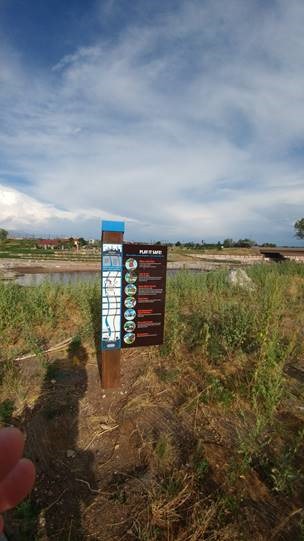 They are way too busy; they are grouped together and have too much wording on them, and you have to be up close to understand the message. As designed, they can easily be ignored.
A warning sign must pop, tell you one maybe two important things. You are moving on, and you are not going to stop to read more than that. The information has to enter the brain of the person who sees it, without having to be studied. If you want more information, it should be there, but you have to get the point across the first time.
These signs don’t do that. Unless someone is lost and looking at the trail map, these signs will never be noticed by anyone.
These signs were designed to be located along the South Platte River as it leaves the Chatfield Reservoir and heads north through Arapahoe County, Littleton and eventually Denver. From the dam to the confluence with Cherry Creek (where the down town REI is located) is around 15 miles. A beautiful path follows the trail from the reservoir past the confluence connecting with more than a dozen other trails. Some sections are a little industrial, but overall it is a fun place to ride, run, walk your dog, watch birds and during hot summer, days float down the river.
The river has been designed over the decades to allow for access and use. Dams all have spillways and can be easily navigated by hard-shell kayak or inflatable tube. Three more river side parks have been added, one with two surfing holes just in the past year. On a cool day, you can see stand up paddleboarders, surfers in wetsuits and kayakers playing in the holes at the river. On a hot day, the river is wall to wall people in a short 5-mile section. On the Fourth of July, I counted 300 people surfing, kayaking, inflatable kayaking and 90% of the tubing. Of the tubers, 50% had a cooler  floating down the river also. On that day, I counted 18 PFDs.
The original intent of the signs was to give information and warning to the people recreating on the river. I was part of the
South Platte Signage group that created a group of signs to be ready to go early in 2017. The sign above was posted sometime after the Fourth of July and more than 20 days above 90 degrees.
When the South Platte Signage committee was done the designs were handed over to the governing body for this section of the South Platte. That was seven months ago. Someone did not like the original signs and had them done. What they ended up with is busy artwork that you can’t comprehend unless you concentrate. That is not a sign that gets your attention or makes you think.
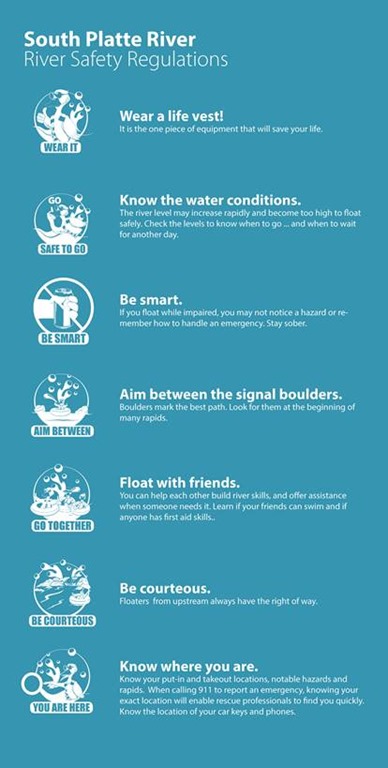
The original signs were made to stand out. You can understand their purpose from a distance. They work as a standalone product, each little sign meaning one thing or as a grouping as needed. This one was placed below the access point for the biggest wave on the river. Not really great planning, it needed to be above, or it needs to be where people leave the parking lot wherever they intend to get on the river.
The “Float Sober” sign completely misses the mark. There are other items legal in Colorado besides alcohol and a lot of thing’s people on the river use that are not. Sober refers to alcohol. “Be Smart” covers everything.
I’m I complaining because they changed the work I helped produce. Probably there are some hurt feelings. More importantly as an attorney in the outdoor recreation industry that has litigated sign issues; I see another set of signs that will only be seen by a jury.
As you well know, signs are hard to create, other than to produce a CYA in a courtroom. Although there were a lot of discussion and research into those issues, the most important thing, the signs were developed for was to keep people safe. To make them take 2 seconds to think.
The original design was intended to be a national model and still is. Anyone can get permission to use the system. The South Platte signs might cost you, no one is sure.
The color in the original system was used to make the warning part of the sign jump, not make the design cute. Cute is for puppies, warning signs have to get someone’s 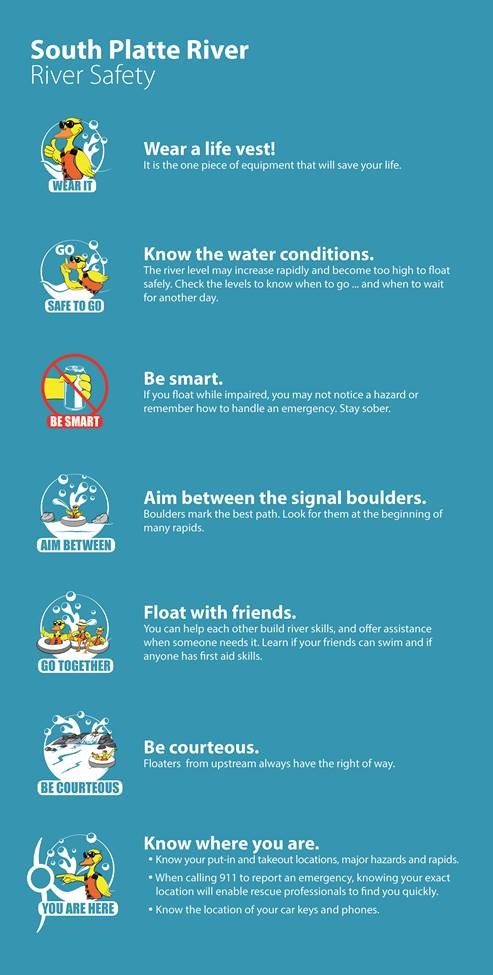 attention.
The design can even be used as a two-color system if money becomes an issue.
The original work is available to anyone who wants to use it free of charge. If you are interested contact Risa Shimoda, Executive Director of the River Management Society. executivedirector@river-management.org (301) 585-4677 http://www.river-management.org/
The otter in the new signs is not wearing a PFD in three of the pictures. In the duck ones, the duck is wearing a PFD. The most important point to get across on any body of water is to wear a PFD.
I was riding my bike when I saw the sign, in fact I had ridden past the sign before I realized what it was and I was constantly looking for the signs. Rangers were probably getting tired of me asking when the river safety signs were going up. When I turned around to go back to read the signs I could not read them or recognize what they were saying standing on the bike path. I walked to the path leading down to the river, (not a put in, just closer to the river.), which was closer to the signs and how people might try to access the river. I finally ended up standing on the grass in front of the sign to see the designs and read the sign.
 Why am I writing this? Because a lot of people in the parks and recreation industry face this every day. Professionals are hired to do a job, which always includes the park employees and some politician or bureaucrat mess’s things up. They might think the sign is prettier; they think an otter is better than a duck. (Ducks which are found up and down the South Platte and most rivers in North America.)
Worse, their changes add months to the final project which put people at risk.
Is the otter that much better of a symbol to save lives that a lot of people got to miss it, and based on where this sign is, continue to miss it?
Show this to the politician/manager/bureaucrat getting on your way, or send me their contact info, and I’ll send it to them so you don’t have to put your head on the chopping block. (Remember an attorney-client privilege.
Let the experts, the employees you employ to run our parks, our open spaces, our state parks, our national forests, and our national monuments and parks do what they have been educated in and trained to do. Run the parks, you run the country…..or at least your little fiefdom and stay out of the parks, unless you are there to enjoy the day.
What do you think? Leave a comment.
If you like this
let your friends know or post it on FB, Twitter or LinkedIn
Author: Outdoor Recreation Insurance, Risk Management and
Law
Copyright 2017 Recreation Law (720) Edit Law
Email: Rec-law@recreation-law.com
Google+: +Recreation
Twitter: RecreationLaw
Facebook: Rec.Law.Now
Facebook Page: Outdoor Recreation & Adventure Travel Law
Mobile Site: http://m.recreation-law.com
By Recreation
Law Rec-law@recreation-law.com James H. Moss
#AdventureTourism, #AdventureTravelLaw,
#AdventureTravelLawyer, #AttorneyatLaw, #Backpacking, #BicyclingLaw, #Camps,
#ChallengeCourse, #ChallengeCourseLaw, #ChallengeCourseLawyer, #CyclingLaw,
#FitnessLaw, #FitnessLawyer, #Hiking, #HumanPowered, #HumanPoweredRecreation,
#IceClimbing, #JamesHMoss, #JimMoss, #Law, #Mountaineering, #Negligence,
#OutdoorLaw, #OutdoorRecreationLaw, #OutsideLaw, #OutsideLawyer, #RecLaw,
#Rec-Law, #RecLawBlog, #Rec-LawBlog, #RecLawyer, #RecreationalLawyer,
#RecreationLaw, #RecreationLawBlog, #RecreationLawcom, #Recreation-Lawcom,
#Recreation-Law.com, #RiskManagement, #RockClimbing, #RockClimbingLawyer,
#RopesCourse, #RopesCourseLawyer, #SkiAreas, #Skiing, #SkiLaw, #Snowboarding,
#SummerCamp, #Tourism, #TravelLaw, #YouthCamps, #ZipLineLawyer, South Platte, South Platte River, Carson Nature Center, South Platte River Signage, South Platte River Safety Signage, South Platte River Safety Signage Committee, River Safety, PFD, Safe Boating,
Utah Court reaches to find a boat renter liable when a boat sinks on Lake Powell due to high winds
Posted: March 27, 2017 Filed under: Rivers and Waterways, Utah | Tags: Admiralty and Maritime Law, Admiralty Law, Aramark, Boat Rental, Causation, Lake Powell, Pre-Departure Briefing, Privity, weather forecast, Wind Leave a commentThe Federal District Court found the boat rental operation was negligent to defeat damages defenses provided by admiralty law. Causation, the relationship between what the defendant did and the accident giving rise to the claim seems to be stretched in this case.
In re Aramark Sports and Entertainment Services, LLC, 2014 U.S. Dist. LEXIS 121565
State: Utah, United States District Court for the District of Utah, Central Division
Defendant: In re Aramark Sports and Entertainment Services, LLC, a Delaware limited liability company, as owner of a certain 20′ 2007 Baja Islander 202 for exoneration from or limitation of liability
Plaintiff Claims: Negligence
Defendant Defenses: Limitation of Liability Act, 46 U.S.C. §§ 30501-30512
Holding: for the Plaintiff
Year: 2014
This case is a little out of the unusual for me because it concerns a powerboat. However, the legal issues could apply to any boat; whitewater raft, sea kayak, kayak or whatever. More importantly, it could affect canoe liveries or boat rentals if the decision is accepted by other courts.
One way of defending against claims due to boating accidents is by using federal law. If a river or body of water is determined to be navigable as defined under federal law, then a defendant can use a federal statute and admiralty law to limit any possible claims. The reason you would want to do this is the maximum that can be recovered against someone using this section of admiralty law, is the value of the vessel after the accident plus the value of the cargo. So most cases, when there has been a catastrophic loss the value of the raft zero, as the boat is destroyed or sunk. Even a raft that is recovered with all of its gear would still be limited to $10 to $20,000.00 in value.
The first issue you have to overcome when using admiralty law limits is to establish jurisdiction. The body of water or river has to qualify as being a navigable river under a specific section of the law. The problem is there are 17 different definitions of navigable under federal law, plus who knows how many more under state law. You must apply the correct definition of navigable to the case.
In this case, the accident occurred on Lake Powell. Because Lake Powell spans two states and is used for commercial traffic it was declared to be navigable under the law.
The basis for this claim is three couples rented a boat from the concessionaire at the marina. Eventually, the boat sank with four of them drowning. The winds picked up and exceeded the maximum wind speed the boat should have been operated at. The defendant filed this action in federal court claiming the value the vessel after the accident was zero and therefore, there was no recovery available to the plaintiffs. The court disagreed.
The boat that sunk was only rated to be workable at wind speeds of 31 miles an hour or less. At 31 miles an hour the boat manual stated the driver should have had a lot of boating skills. The boat was also not positively buoyant; meeting that if the boat filled with water, it would sink and would not stay on the surface. There was also no law or requirement that the boat be buoyant.
One of the main issues facing the defendant in this case was they normally handed out a weather report both at the time of the rental of the boat and the time the boat left the dock. The plaintiffs received a weather report when they completed the paperwork but not in the day they left. However, they did leave the docks a half-hour earlier than when the rental operations normally open.
One risk of using admiralty law to avoid liability in a boating accident is admiralty law does not allow the defendant to use a release. I suspect that a release might’ve been used in this case because the paperwork and renting a boat usually go hand in hand.
The plaintiffs were three couples from Florida, who came to Arizona to vacation. They rented a boat from the marina the intention of going up to see natural bridges and coming back on the same day. They rented the boat before the day they left on their trip. That day they received a weather forecast from the boat rental agent. The forecast changed in the middle of the night and when they picked up the boat, they did not receive a new forecast. On the way back from visiting the Natural Bridges Arch they had to stop at another marina to refill. After leaving that marina they went out into the Lake Powell and on the way back the boat sunk due to high winds.
Analysis: making sense of the law based on these facts.
One of the first main issues the court looked at was who could determine if boat rentals should stop because of the weather. Several employees of the defendant testified that wind speeds from 25 to 30 miles an hour, boat rentals were stopped. However, there was no written policy on when boat rentals were stopped and each employee answered with a slightly different answer. More importantly nothing in the transcript indicated that there is any reliable way to determine what the weather forecast was for the wind speed was at the rental operations.
A sub argument of this was not reviewed by the court or raised by the defendant was, whether or not there was a duty on the part of the rental operation to contact the other marina and warn the people not to go back out on the lake. No phone call was made by the rental operation to the other marina.
This argument was futile though because the only way to contact the boat drivers before, or after they left the second marina was by radio. The plaintiff’s never turned the radio turned on.
Ms. Ambrosius did not attempt to call Dangling Rope Marina to have personnel there warn the Prescott Party of the high winds although she knew that the Prescott Party would stop there to refuel. She did not notify any of the tour captains to watch for Boat 647 and alert them of the danger. She did not attempt to call the Prescott Party on the marine radio. (Although that would have been futile because Mr. Brady did not turn on Boat 647’s radio.) In sum, the court finds that Ms. Ambrosius did nothing to locate Boat 647.
The federal statute that the defendant relied upon was the Limitation of Liability Act, 40 6U. S. §§ 30501 – 30512. This statute provides exoneration of liability for the boat owner up to the value of the vessel and freight after the accident. There is an exception to the rule if there is knowledge or is in the law states privity with the owner of the vessel to the possibility of the damage.
The Act does, however, create an exception to that general rule by defining “claim, debt, or liability”: “claims, debts, and liabilities subject to limitation under subsection (a) are those arising from any embezzlement, loss, or destruction of any property, goods, or merchandise shipped or put on board the vessel, any loss, damages, or injury by collision, or any act, matter, or thing, loss, damage, or forfeiture, done, occasioned, or incurred, without the privity or knowledge of the owner.”
It is this knowledge or privity that allows the plaintiff to argue that the plaintiff defendant could have stopped them and save their lives.
Admiralty law was created for the transportation of goods and people across the oceans. It was adopted as uniform laws among countries with interests in shipping. As such, many parts of admiralty law make more sense when viewed in this light a boat on the high seas.
There’s a two-step inquiry to determine whether the act shall apply based on the privity or knowledge of the owner of the boat.
Courts use a two-step inquiry to determine whether a petitioner is entitled to exoneration or limitation of liability when sued for negligence. “First, the court must determine what acts of negligence . . . caused the accident. Second, the court must determine whether the shipowner had knowledge [of] or privity [with the person who committed] those same acts of negligence . . . The claimant bears the burden of proving negligence and if successful, the burden shifts to the shipowner to prove lack of knowledge or privity.
In this case, the court held that negligence on the land is similar to negligence in the water. The plaintiffs had to prove that there was a connection between the defendant’s conduct and the plaintiff’s injury.
Torts occurring on navigable waters are governed by maritime law. “The elements of a maritime negligence cause of action are essentially the same as land-based negligence under the common law.” A claimant must prove “a duty owed by the defendant to the plaintiff, breach of that duty, injury sustained by [the] plaintiff, and a causal connection between [the] defendant’s conduct and the plain-tiff’s injury.”
The ship owner owes a duty of reasonable care to all passengers on his ship. Or, in this case, the court held the rental operation owes a duty of reasonable care to the people renting his boat.
“Under Maritime law, a plaintiff is owed a duty of ordinary care under the circumstances.” “We hold that the owner of a ship in navigable waters owes to all who are on board for purposes not inimical to his legitimate interests the duty of exercising reasonable care under the circumstances of each case.”
The court found that the defendant breached his duty of reasonable care when it allowed plaintiffs to leave the morning of the accident. “Here, the court concludes that Aramark breached its duty of reasonable care when it allowed the Prescott Party to leave the morning of April 25, 2009.”
This conclusion was reached because the defendant had a duty to warn the renters of the weather issues. This is where this case takes on some concerns that exceed those of the normal rental situation. Hertz never gives your weather forecast when you leave its rental operation with their car.
I suspect that duty was created by the defendant normally providing all renters of its boats with a copy of the weather forecast because that was not done, then it created a duty.
Aramark, primarily Ms. Ambrosius, had a duty to be advised of the current weather forecasts and wind advisories before allowing any party to leave the marina in an Aramark power boat. This is particularly true because, as Aramark knew, in the spring, the weather changed constantly. Phyllis Coon testified that in the spring, shutting down rentals was considered almost on “an hourly basis” because of the erratic weather. And “[s]pringtime is al-ways windy on the lake.”
The second issue the court found or had an issue with, was the boat owner’s manual cautioned that when the winds exceeded 31 miles an hour, the boat should not be driven. Aramark’s only requirement when renting a boat was to make sure that the person was 18 years or older and had a valid driver’s license. Again, the same requirements to rent a car as Hertz used. The court held that a person’s prior ability and experience were important.
The boat owner’s manual cautioned that when wind speeds reached 31 miles an hour, only experienced operators might be able to safely operate the boat. Yet Aramark rented to anyone eighteen years or older, with a valid driver’s license, without regard to that person’s previous boating experience.
All these facts allow the court to conclude that Aramark could possibly be negligent.
The court, when it considers these facts, concludes that Aramark had frequently in the past recognized that high winds could be dangerous to boaters. Aramark should have been aware, if it was not, that high winds were forecast for April 25, 2009. And it was foreseeable to Aramark that if those who had rented Baja 202 Islanders for a trip on Lake Powell the morning of April 25, 2009, were allowed to depart, the boats could sink because of the high winds. It was further foreseeable to Aramark that if the boats sank, particularly in the cold April water, the passengers could suffer injury and even death. Aramark breached that duty when it allowed the Prescott Party to leave.
The next issue is whether or not breach of the duty of the boat renter/defendant was the cause of the injury. Here the court found that by allowing the boating party to leave the other marina that was a factor in the sinking of the boat. “Here, the court concludes that Aramark’s failure to stop the Prescott Party from leaving was a substantial factor in the sinking of Boat 647 and the resulting harm.”
(Which begs the questions, how were you going to stop someone from leaving a marina when their car and lodging were at their destination?)
Both marinas were owned and operated by the same defendant.
The final issue the court was, whether or not there was privity between the defendant and what happened. Privity in admiralty law is a weird definition of the word. In this case, the defendant must prove that they did not have any knowledge of the negligence. Normally, this would make sense when the owner of the boat is sitting on shore thousands of miles away and the captain or a member of the crew does something that was negligent causing the sinking of the boat.
In this case because the boat was a rental and owned by a defendant Corporation the court held all the employees had a duty or had privity to the negligent acts. “When a corporation owns the vessel, the test is whether culpable participation or neglect of duty can be attributed to an officer, managing agent, supervisor, or other high-level employee of the corporation.”
Because the general manager and several employees of the defendant could stop the rental, the court said the discretionary authority to close the boat rentals, was held to have been a negligent act.
Finding this the court held that Aramark could not exonerate or limit its liability in this case. The case would then proceed to trial for the full amount of damages claimed by the plaintiffs. This decision is not a finding of negligence against the defendant only that there was enough negligent for the court to conclude Aramark could be liable.
So Now What?
Here’s a situation whereby trying to be good and help people renting your boats you created your own liability.
The experience of the person running the boat also creates its own nightmares as you well know someone is going to lie to you when they fill out a form asking for experience. The will tell you they have plenty experience when want to rent a boat. The experience issue is a nightmare. no way you can test someone’s experience or trust them. If they say they can rent a boat, and it sinks, the rental operation is liable for not testing them. If they don’t test now, they are liable.
All six people were from Florida, which is surrounded by water and has thousands of boat able canals, rivers and lakes, and only one person of the six had any boating experience.
The causation issue is another issue that is disturbing. Normally, causation is defined as a closer or more direct relationship between what the defendant does in creating the injury of the plaintiff. Here causation was found by allowing them to leave the marina.
However, that was not the cause of the sinking of the boat. The boat sunk because it was driven improperly in high winds. However, the court then came back and said earlier, that because they didn’t check the boating experience and didn’t hand out the weather report that was also part of the accident. The court created circuitous routes to get to the fact that they wanted the defendant liable in this case.
It is disturbing when it can quickly become a nightmare for any program or business in attempting to help the people coming to its business. Probably in the future the weather forecasts will be in a stack on the desk with a little sign that says weather forecasts take one if you want one. There will be a sign that says the boat should not be operated if the wind speed is above XX miles an hour and there will be a wind gauge nearby.
None of which will do anything save anyone’s life. Boats are rented for weeks and the weather changes. The wind in on a cove could be calm, and you hit the open part of the lake, and the wind is catastrophic. The information you obtained earlier, a day or a week will have no value where you are when trouble starts.
Besides, how many people can effectively guess the wind speed?
I think another issue here, but not written in the opinion is the boat operation’s manual had a specific wind speed where the boat should not be used. Consequently, since the manufacturer suggested the boat not be used at that speed, probably the court thought the rental operation should not rent boats when speeds exceeded the manufacturer’s recommendations.
I also suspect that some type of wind meter will be installed on the marina property so that the rental people can look at the wind and see if it should be rented. But again then who has the ability to make that call to the wind meter when the person rents the boat says the winds find, but by the time they go back to the car get their items they want to take with them and walk out the winds kicked up does the 18-year-old summer intern holding the boat for the people as they enter it have the ability to say hey it’s too windy can’t go. How’s he going to know at the end of the dock? In the future, more people may become injured because they didn’t pick up a weather forecast and didn’t understand what they’re getting into because nobody the defendant is going to stick their neck that is to tell them.
In the past rental, operations have had no liability once the equipment rented leaves the renter’s operation.
What do you think? Leave a comment.
If you like this let your friends know or post it on FB, Twitter or LinkedIn.
Author: Outdoor Recreation Insurance, Risk Management and Law
Copyright 2017 Recreation Law (720) Edit Law
Email: Rec-law@recreation-law.com
Google+: +Recreation
Twitter: RecreationLaw
Facebook: Rec.Law.Now
Facebook Page: Outdoor Recreation & Adventure Travel Law
Blog: www.recreation-law.com
Mobile Site: http://m.recreation-law.com
By Recreation Law Rec-law@recreation-law.com James H. Moss
#AdventureTourism, #AdventureTravelLaw, #AdventureTravelLawyer, #AttorneyatLaw, #Backpacking, #BicyclingLaw, #Camps, #ChallengeCourse, #ChallengeCourseLaw, #ChallengeCourseLawyer, #CyclingLaw, #FitnessLaw, #FitnessLawyer, #Hiking, #HumanPowered, #HumanPoweredRecreation, #IceClimbing, #JamesHMoss, #JimMoss, #Law, #Mountaineering, #Negligence, #OutdoorLaw, #OutdoorRecreationLaw, #OutsideLaw, #OutsideLawyer, #RecLaw, #Rec-Law, #RecLawBlog, #Rec-LawBlog, #RecLawyer, #RecreationalLawyer, #RecreationLaw, #RecreationLawBlog, #RecreationLawcom, #Recreation-Lawcom, #Recreation-Law.com, #RiskManagement, #RockClimbing, #RockClimbingLawyer, #RopesCourse, #RopesCourseLawyer, #SkiAreas, #Skiing, #SkiLaw, #Snowboarding, #SummerCamp, #Tourism, #TravelLaw, #YouthCamps, #ZipLineLawyer, Lake Powell, Aramark, Boat Rental, Wind, Weather Forecast, Privity, Admiralty Law, Admiralty and Maritime Law, Pre-Departure Briefing, Causation,
In re Aramark Sports and Entertainment Services, LLC, 2014 U.S. Dist. LEXIS 121565
Posted: March 23, 2017 Filed under: Legal Case, Rivers and Waterways, Utah | Tags: Admiralty and Maritime Law, Admiralty Law, Aramark, Boat Rental, Causation, Lake Powell, Pre-Departure Briefing, Privity, weather forecast, Wind Leave a commentIn re Aramark Sports and Entertainment Services, LLC, a Delaware limited liability company, as owner of a certain 20′ 2007 Baja Islander 202 for exoneration from or limitation of liability, Plaintiff.
Case No. 2:09-CV-637-TC-PMW
UNITED STATES DISTRICT COURT FOR THE DISTRICT OF UTAH, CENTRAL DIVISION
2014 U.S. Dist. LEXIS 121565
August 29, 2014, Decided
August 29, 2014, Filed
PRIOR HISTORY: In re Aramark Sports & Entm’t Servs., LLC, 289 F.R.D. 662, 2013 U.S. Dist. LEXIS 42692 (D. Utah, 2013)
CORE TERMS: boat, wind, weather, lake, mile, rental, weather forecast, advisory, marina, forecast, zone, morning, bridge, rope, vessel, life jackets, gusts, mph, claimant, privity, high winds, channel, radio, rent, foreseeable, allision, mooring, rig, boating, manager
COUNSEL: [*1] For Aramark Sports and Entertainment Services, a Delaware limited liability company, as owner of a certain 20″ 2007 Baja Islander 202 for exoneration from or limitation of liability, In Re, Counter Defendant: John R. Lund, LEAD ATTORNEY, SNOW CHRISTENSEN & MARTINEAU, SALT LAKE CITY, UT; Matthew W. Starley, LEAD ATTORNEY, SNOW CHRISTENSEN & MARTINEAU (ST GEORGE), ST GEORGE, UT; Terence S. Cox, LEAD ATTORNEY, PRO HAC VICE, Marc A. Centor, PRO HAC VICE, COX WOOTTON GRIFFIN HANSEN & POULOS LLP, SAN FRANCISCO, CA.
For Taranto, Terry The Estate and Heirs of, Taranto, Maryanne The Estate and Heirs of, Defendants, Counter Claimants: Daniel Thomas Benchoff, Marvel Eugene Rake, Jr., LEAD ATTORNEYS, PRO HAC VICE, RAKE PETTI PC, PHOENIX, AZ; Robert S. Prince, LEAD ATTORNEY, KIRTON MCCONKIE, SALT LAKE CITY, UT.
For Prescott, Robert The Estate and Heirs of, Prescott, Katherine The Estate and Heirs of, Defendants, Counter Claimants, Counter Defendants: Casey W. Stevens, LEAD ATTORNEY, PRO HAC VICE, STEVENS & WILLIAMSON PC, ALPHARETTA, GA; Daniel Thomas Benchoff, Marvel Eugene Rake , Jr., LEAD ATTORNEYS, PRO HAC VICE, RAKE PETTI PC, PHOENIX, AZ; Robert S. Prince, LEAD ATTORNEY, KIRTON MCCONKIE, SALT [*2] LAKE CITY, UT.
For James Brady, Heather Brady, Defendants: Jeffery Scott Williams, LEAD ATTORNEY, Jeffrie L. Hollingworth, NELSON CHRISTENSEN HOLLINGWORTH & WILLIAMS, SALT LAKE CITY, UT; William D. Holm, LEAD ATTORNEY, John T. Masterson, PRO HAC VICE, JONES SKELTON & HOCHULI PLC, PHOENIX, AZ.
For Baja Marine, Defendant: Alex B. Marconi, Craig A. Logsdon, LEAD ATTORNEY, Patrick X. Fowler, PRO HAC VICE, SNELL & WILMER (AZ) ONE ARIZONA CTR, PHOENIX, AZ; Elisabeth M. McOmber, LEAD ATTORNEY, SNELL & WILMER (UT), SALT LAKE CITY, UT.
JUDGES: TENA CAMPBELL, United States District Judge.
OPINION BY: TENA CAMPBELL
OPINION
FINDINGS OF FACT AND CONCLUSIONS OF LAW
Aramark Sports and Entertainment Services, LLC (Aramark) owns a fleet of boats on Lake Powell that it rents to the public. On April 25, 2009, one of the Aramark power boats sank with six people on board. Four people, Terry and Maryanne Taranto, and Robert and Katherine Prescott, died in the accident. Two people, James and Heather Brady, survived.
Aramark filed a petition in this court to limit its liability under the Limitation of Liability Act, 46 U.S.C. §§ 30501-30512, from claims made by the Taranto Estates, the Prescott Estates and James and Heather Brady (the Claimants). The court held a [*3] five-day bench trial to resolve the questions of whether any negligent conduct by Aramark employees caused the injury and whether Aramark had privity with the negligent actor or knew of the negligent conduct.
Because the court concludes that negligent conduct by Aramark employees was a cause of the injuries and also concludes that Aramark had privity and/or knew of the negligent conduct, the court denies Aramark’s petition to limit its liability.
FINDINGS OF FACT
- THE PARTIES
- Aramark
Aramark is a concessionaire for the National Park Service (NPS) in the Glen Canyon National Recreation Area. As concessionaire, Aramark operates the Wahweap Marina, located on Lake Powell just south of the Utah-Arizona border. Aramark operates other marinas on Lake Powell north of the Utah-Arizona border: Dangling Rope, Halls Crossing and Bullfrog.
Aramark will rent a power boat to anyone who is eighteen years or older and has a valid driver’s license. No previous boating experience is required.
Lake Powell’s main channel is 186 miles long when the lake is at high water. In the spring, the water is cold and the weather is frequently windy. The weather is erratic and can quickly change. In April, wind speeds [*4] often exceed thirty miles an hour and can even reach fifty miles an hour. The weather can be calm at one part of the lake but have high winds and waves at another.
- The Claimants
James Brady, Robert Prescott, and Terry Taranto were retired police officers with the St. Petersburg, Florida Police Department. From time to time, they got together socially with their wives. Heather Brady, James Brady’s wife, had recently retired from the St. Petersburg Fire Department after twenty-six years as a firefighter and EMT.
In April 2009, the three couples (the Prescott Party) went on vacation together to Lake Powell. Robert Prescott had previously visited Arizona and Lake Powell and, in Heather Brady’s words, “Bob [Prescott] was familiar with the area so he just lined up all of the places we would go.” (Trial Transcript dated March 4, 2014 (“March 4 Tr.”) at 392 (Dkt. No. 310).)
- FRIDAY APRIL 24
- Arrival at Wahweap Marina
Members of the Prescott Party arrived at Lake Powell on Friday, April 24, 2009, and checked in at the resort at the Wahweap Marina area. The Bradys and the Prescotts, who arrived at Wahweap Marina on Friday before the Tarantos, went to Aramark’s boat rental office to rent a [*5] boat for the next day. Phyllis Coon, a rental agent for Aramark, and Karen Ambrosius, Wahweap Marina general manager and the person in charge of boat rentals, were in the office. Mr. Brady, Mr. Prescott, and Ms. Coon discussed Mr. Brady’s previous boating experience,1 the Prescott Party’s plans to travel to Rainbow Bridge, which would take a full day, and the weather forecast for Saturday, April 25, the day the Prescott Party would be on the lake. The weather forecast, which was based on National Weather Service data collected at 3:44 a.m. that Friday morning, predicted the weather on Saturday, April 25 as “Breezy, with a south southwest wind, between 15 and 23 mph, with gusts as high as 37 mph.” (National Weather Service 7-Day Forecast, Ex. J-7.) Given the weather forecast, Ms. Coon suggested that they “might be more comfortable” on one of the tour boats that was available “because it was chilly on the lake and that going in the power boat they would need to go straight up to Rainbow Bridge just to ensure that they get up there, and then stop at Dangling Rope on the way back to fuel up.” (March 4 Tr. at 360 (Dkt. No. 310).) Mr. Brady and Mr. Prescott declined Ms. Coon’s suggestion [*6] of a tour boat trip, and Mr. Prescott signed the rental contract for a Baja 202 Islander, number 647 (Boat 647). Mr. Prescott was given a copy of the weather forecast (Ex. J-7). Ms. Coon told Mr. Prescott that he would be given an updated weather report the next day before the Prescott Party departed on the boat. But this did not happen.
1 James Brady has some boating experience. He began boating as a young boy, “maybe as early as 10 riding on the boat. Dad and I would fish. From there, high school years running up and down the beach. A friend of mine had a boat. Running up and down the beach. And then my brother, who is now a licensed captain, he went into the fishing scene, so I [rode] on boats with him before, mullet boat.” (Id. at 465 (Dkt. No. 310-1).) Mr. Brady has owned several boats, including a 17-foot Mitchell, a 21-foot Mako, and “a couple Voyagers” (a Voyager is sport fishing boat). (Id.) When asked what percentage of his boating experience was in a lake and what percentage was in an ocean, Mr. Brady answered, “95 gulf or bay inland intercoastal and 5 percent lake.” (Id. at 472-73.) He estimated that the coldest water he had been in was “70, I believe 70, 72 degrees, [in] Florida.” (Id. at 473.)
- Boat 647
Boat 647 is just [*7] over twenty feet in length and can hold eight passengers. U.S. Coast Guard regulations do not require boats over twenty feet in length to have positive flotation, and Boat 647 did not. (A boat with positive flotation has the ability to float and not sink for a period of time even if filled with water.) Boat 647 had a marine band radio that could receive and monitor both the hailing channel (channel 16) and the weather channel. Type II PFDs (life jackets) were on Boat 647.
The Baja 202 Islander is identified as a design category “C” boat that can withstand an upper limit wind speed of 31 miles per hour. (Baja Marine Owner’s Manual, Ex. C at 1.8.) The manual warns: “It is only the most experienced operators and crew that may be able to operate a boat safely under these conditions.” (Id.)
III. SATURDAY APRIL 25
- The Weather Forecasts
The National Weather Service maintains a website that is available to the public. Phyllis Coon testified that employees in Aramark’s boat rental office accessed the National Weather Service site for weather information. Moreover, it was Aramark employees’ general practice to keep the marine band radio on at the boat rental office during working hours to monitor [*8] the weather.
The court reviewed several exhibits that showed the National Weather Service’s forecasts and advisories for April 24 and April 25, 2009. One of those exhibits included the National Weather Service 7-day forecast given to the Prescott Party, which read, “Breezy, with a south southwest wind, between 15 and 23 mph, with gusts as high as 37 mph.” (Ex. J-7.) That forecast, which was the only weather forecast given to the Prescott Party, was last updated at 3:44 a.m. on April 24. At various times after that, on April 24 and April 25, the National Weather Service updated the weather information that, if accessed through the website, would have been incorporated into a 7-day weather forecast similar to the one the Prescott Party received.
In its forecasting system, the National Weather Service divides the United States into geographical areas called “zones” and then issues forecasts for each zone. Two zones relevant to this case are (i) the Arizona Zone 5, which is a fairly small area, just below Lake Powell, and it includes Page, Arizona; and (ii) Utah Zone 21, which covers most of Lake Powell. Zone 21 forecasts give a more accurate prediction of weather conditions on Lake Powell, [*9] but a comparison of the two zones’ forecasts for the relevant days showed that the forecasts contained similar data. (See Ex. A-120.)
Significantly, the National Weather Service updated the weather forecast at 3:18 p.m. on April 24 (almost twelve hours after issuance of the forecast data given to the Prescott Party) for Zone 5. That update announced a wind advisory in effect from 8 a.m. to 7:00 p.m. on Saturday, April 25, predicting 20 to 35 mile an hour winds and gusts around 45 miles an hour in the late morning and afternoon. (Trial Transcript dated March 7, 2014 (“March 7 Tr.”) at 907 (Dkt. No. 313-1).) A new 7-day forecast, if generated for the Prescott Party when they arrived to pick up Boat 647, would have reflected these changes (i.e., increases in wind speed) and a new wind advisory.2 And shortly before 3 a.m. for Zone 21 the National Weather Service issued a wind advisory for Lake Powell effective from noon on Saturday until 6 p.m. that evening, predicting sustained winds increasing to 25 to 35 miles an hour and gusts to around 55 miles an hour late in the afternoon. (Id. at 902.) A few minutes later, at 3:10 a.m., the National Weather Service issued a wind advisory for Zone 5, Glen Canyon [*10] and Page, that would be in effect from 8 a.m. until 7 p.m. on Saturday, April 25. (Ex. K. at 40.) That forecast predicted “South winds 15 to 20 mph with gusts to around 35 mph shifting to the southwest 20 to 30 mph with gusts to around 45 mph in the late morning and afternoon.” (Id.)
2 The National Weather Service issues advisories to inform the public about potentially hazardous situations. (March 7 Tr. at 885.)
Alton Ketchersid, Aramark’s resident district manager for water operations at Lake Powell, testified that it was his general practice to print the weather forecast at his home each morning at about 6 a.m. so he could distribute it to the administrative office and to the lodge. In his absence, Carrie Markus, an Aramark employee, would distribute it. Both Mr. Ketchersid and Ms. Markus were gone on April 24 and April 25, 2009.
- Pre-Departure Briefing
Because the Prescott Party had asked to leave early the morning of September 25, Bob Graham, a boat rental instructor for Aramark, met them on the dock at about 7:30 a.m. that morning (the boat rental office opened at 8 a.m.). Mr. Graham, who was not a witness at trial but testified through deposition, testified that he gave the Prescott [*11] Party instructions about the use of the radio, the location of the PFDs, the route to Rainbow Bridge, and the weather forecast (the same one given to the Prescott Party the day before (Ex. J-7)).
According to Mr. Graham, before he met the Prescott Party that morning, he had gone to the rental office before it opened and looked at the weather forecast on the computer. But he testified that the weather forecast he viewed was the same one the Prescott Party had been given the day before.
Mr. Graham testified that he told Mr. Prescott that wind gusts around 37 to 40 miles an hour could be dangerous and that he recommended that the Prescott Party go directly to Rainbow Bridge and return. He told them, “You don’t have time to go sightseeing, to do anything else except go up there and get back before the weather turns bad on you.” (Dep. of Robert Graham at 21.) The Bradys do not remember this discussion.
- Stopping Boat Rentals
Aramark did not have a written policy addressing when it would stop renting boats because of weather conditions. But Alton Ketchersid testified that “if we were standing on the dock and the wind was blowing 31 miles an hour, we would not rent the boat, no.” (Trial Transcript [*12] dated March 3, 2014 (“March 3 Tr.”) at 101 (Dkt. No. 312).) He explained that “it was not a good practice” to do so. (Id. at 102.) He acknowledged that if the wind speed exceeded 31 miles an hour on the lake, it could be “dangerous” for those on the boats. (Id. at 103.) Mr. Ketchersid testified that the decision whether to stop boats from leaving the marina was “mainly based on the safety of the guests.” (Id. at 105.)
Phyllis Coon believed that Aramark had “a general practice” of “shut[ting] down all rentals” if there were sustained winds of thirty miles an hour. (March 4 Tr. at 336 (Dkt. No. 310).) Aramark also would not rent boats if wind or weather advisories were issued.
Jon Maris, who was the former Aramark Director of Operations, testified that if he read a wind advisory predicting gusts of 55 miles an hour, he would shut down rentals. (Dep. of Jon Maris at 47.)
Karen Ambrosius, in her deposition testimony, testified that “[w]here we had sustained winds, . . . meaning constant winds of 30 miles per hour we would not send a boat out.” (March 3 Tr. at 226 (Dkt. No. 312-1) (quoting deposition testimony).) Ms. Ambrosius had the authority and discretion to decide if boat rentals should be shut down. She had previously exercised that [*13] authority, shutting down boat rentals if sustained winds reached thirty miles an hour or if the National Weather Service had issued a wind advisory.
Robert Grippentog, who with other family members, runs Las Vegas Boat Harbor on Lake Mead, testified in his deposition that his business does not rent power boats if the sustained wind speeds are 25 miles an hour. (Dep. of Robert Grippentog, Jr. at 43.)
According to Horace Schuler, the general manager of Lake Mohave Resort outside of Bullhead City, Arizona, if the weather forecast was for sustained winds of 25 to 35 miles an hour, gusting to 55 miles an hour, the resort would not rent ski boats. (Dep. of Horace Schuler at 105.)
- Karen Ambrosius Stops Boat Rentals
Ms. Ambrosius testified that she was unaware of either the updated weather forecasts or the wind advisories. Ms. Ambrosius claimed that it was not until approximately 10:30 a.m., when she heard the National Weather Service wind advisory on Channel 16, that she knew that high winds were predicted. According to Ms. Ambrosius, she then walked outside and looked at the lake. Only then did she decide to end boat rentals.
Ms. Ambrosius also testified that the Prescott Party had told her [*14] that they would be gone for only half a day. This testimony is contrary to the testimony of Ms. Coon, James Brady, Heather Brady and Robert Graham.
When asked what steps she had taken to alert the Prescott Party of the high winds, Ms. Ambrosius testified that both she and her office manager called the dispatch at the National Park Service and told them that the boat was late. But there is no record of any calls being made to the National Park Service until after Boat 647 had sunk. (Ex. J-39 at BAJA00036, Ex. J-40.) According to Steve Luckesen of the National Park Service, if calls had been made to the National Park Service, they would be reflected in the National Park Service log. (Dep. of Steve Luckesen at 517.)
She also claimed that she called the Aramark parts room, asked that if there was a chase boat available, and said “let them know that we have a boat that is late.” (March 3 Tr. at 250-51 (Dkt. No. 312-1).) Nothing in the record supports this claim, and Ms. Ambrosius admitted that she could not testify that she sent a chase boat to search for Boat 647.
Ms. Ambrosius did not attempt to call Dangling Rope Marina to have personnel there warn the Prescott Party of the high winds although [*15] she knew that the Prescott Party would stop there to refuel. She did not notify any of the tour captains to watch for Boat 647 and alert them of the danger. She did not attempt to call the Prescott Party on the marine radio. (Although that would have been futile because Mr. Brady did not turn on Boat 647’s radio.) In sum, the court finds that Ms. Ambrosius did nothing to locate Boat 647.
- The Prescott Party’s Trip
The Prescott Party left the marina at about 8 a.m. James Brady was operating the boat because he had the most experience. During the trip to Rainbow Bridge, Heather Brady took photographs. Once they arrived at Rainbow Bridge, the party (with the exception of Katherine Taranto) hiked to the Rainbow Bridge monument. When they returned to the dock, they met some hikers who were waiting for a boat to arrive. James Brady tried to call Dangling Rope Marina to tell someone there about the hikers, but he could not contact the marina. He again turned off the radio.
The Prescott Party began the return trip to Wahweap Marina. They stopped, as they had been instructed to do, at Dangling Rope Marina to refuel. Once the boat had been refueled, the Prescott Party left. As they were leaving [*16] Dangling Rope, Heather Brady saw both a tour boat and a National Park Service boat apparently headed toward Dangling Rope Marina.
- Boat 647 Sinks
After the Prescott Party left Dangling Rope, the channel became more open and the water was choppier. Heather Brady moved to the back seat to be more comfortable. No one in the Prescott Party was wearing a life jacket.
When they reached an area of the lake called Padre Bay (on the Utah side of the state line), the water grew rougher and spray came over the bow. Heather Brady felt water at her feet and she called to her husband. She heard him calling “mayday, mayday, mayday, vessel 647” over the radio. (March 4 Tr. at 411 (Dkt. No. 310).) She jumped out of the boat and grabbed one of the life jackets that floated by her. She swam with the life jacket to Terry Taranto and gave it to him. She grabbed another life jacket and swam to her husband. Then Terry Taranto “came over a wave and said, ‘I need a life jacket. I need a life jacket.'” (Id. at 414.) She found an extra life jacket and gave it to him. She and Jim Brady, using the life jackets they found floating in the water and a blue canvas bag that was also in the water, were able to reach a rock pile. [*17] They climbed on the rock pile and waited until they were rescued by a National Park Service boat. The other members of the Prescott Party did not survive.
When Boat 647 was recovered, it did not have a breached hull. The boat had no value.
CONCLUSIONS OF LAW
Aramark has filed a petition under the Limitation of Liability Act, 46 U.S.C. §§ 30501-30512, seeking exoneration or limitation of liability under 46 U.S.C. § 30505 (titled “General limit of liability”). Section 30505 provides that “the liability of the owner of a vessel for any claim, debt, or liability described in subsection (b) shall not exceed the value of the vessel and pending freight.” 46 U.S.C. § 30505(a) (emphasis added). The Act does, however, create an exception to that general rule by defining “claim, debt, or liability”: “claims, debts, and liabilities subject to limitation under subsection (a) are those arising from any embezzlement, loss, or destruction of any property, goods, or merchandise shipped or put on board the vessel, any loss, damages, or injury by collision, or any act, matter, or thing, loss, damage, or forfeiture, done, occasioned, or incurred, without the privity or knowledge of the owner.” 46 U.S.C. § 30505(b) (emphasis added).
Courts use a two-step inquiry to determine whether a petitioner is entitled to exoneration or [*18] limitation of liability when sued for negligence. “First, the court must determine what acts of negligence . . . caused the accident. Second, the court must determine whether the shipowner had knowledge [of] or privity [with the person who committed] those same acts of negligence . . . .” Farrell Lines, Inc. v. Jones, 530 F.2d 7, 10 (5th Cir. 1976). The claimant bears the burden of proving negligence and if successful, the burden shifts to the shipowner to prove lack of knowledge or privity. Id.
- ARAMARK’S NEGLIGENCE
Torts occurring on navigable waters are governed by maritime law. “The elements of a maritime negligence cause of action are essentially the same as land-based negligence under the common law.” Withhart v. Otto Candies, L.L.C., 431 F.3d 840, 842 (5th Cir. 2005) (citations omitted). A claimant must prove “a duty owed by the defendant to the plaintiff, breach of that duty, injury sustained by [the] plaintiff, and a causal connection between [the] defendant’s conduct and the plaintiff’s injury.” In re Cooper/T. Smith, 929 F.2d 1073, 1077 (5th Cir. 1991).
- Duty/Breach
“Under Maritime law, a plaintiff is owed a duty of ordinary care under the circumstances.” In re Great Lakes Dredge & Dock Co. LLC, 624 F.3d 201, 211 (5th Cir. 2010). “We hold that the owner of a ship in navigable waters owes to all who are on board for purposes not inimical to his legitimate interests the duty of exercising reasonable care under the circumstances [*19] of each case.” Kermarec v. Compagnie Generale Transatlantique, 358 U.S. 625, 632, 79 S. Ct. 406, 3 L. Ed. 2d 550 (1959).
The court in In re Signal Int’l, LLC, 579 F.3d 478 (5th Cir. 2009), gave a thorough analysis of duty in a maritime negligence action. In Signal, the owner of two barges named the MISS TIFF and the JACK KING filed a petition under the Limitation of Liability Act, when the two barges broke loose from their moorings during Hurricane Katrina and allided3 with a bridge located approximately 4.7 miles away on Interstate 10 in Mississippi. The Mississippi Department of Transportation (MDOT) repaired the bridge and opposed Signal’s petition. The Fifth Circuit affirmed the order of the trial court denying, after a bench trial, exoneration but granting limitation of liability.
3 “An allision is a collision between a moving vessel and a stationary object.” Signal, 579 F.3d at 484 n.4 (internal quotation marks and citations omitted).
The trial court found that Signal had used “an improvised, untested method” of securing the two vessels and that Signal’s negligence caused the allision. Id. at 486. Signal argued that it was entitled to exoneration because the damage to the bridge was not a foreseeable consequence of its negligent mooring of the two vessels. The Fifth Circuit rejected Signal’s argument:
The critical question in this case is whether the allision with the Interstate [*20] 10 bridge was a harm of the general sort to an entity of a general class that a reasonably thoughtful person might have anticipated to result from Signal’s negligent mooring of the MISS TIFF and the JACK KING in light of the anticipated natural forces wrought by Hurricane Katrina. As the question makes clear, our analysis does not focus on the particular allision site, but the general risk of allision; it does not focus on MDOT, but on the class of property owners in the paths available to the runaway barges.
Id. at 492. The court cautioned: “The test of foreseeability is not measured against normal conditions, but those that were anticipated or reasonably should have been anticipated.” Id. at 493. Looking at the facts of the case, the court concluded that “the approaching hurricane, the expected height and predicted movement of the storm surge, and the topology of the Pascagoula River basin gave rise to the need to moor the barges and made this allision a foreseeable consequence of negligence in that mooring.” Id.
Here, the court concludes that Aramark breached its duty of reasonable care when it allowed the Prescott Party to leave the morning of April 25, 2009. The court bases this conclusion on the following: [*21]
- The weather forecasts and wind advisories
As detailed above, the forecast at 3:18 in the afternoon on April 24 for Zone 5 showed that a wind advisory was in effect from 8 a.m. to 7 p.m. on April 25. Then, around 3 a.m., April 25, the National Weather Service issued wind advisories for both Zone 5 and Zone 21. Yet Ms. Ambrosius denied having seen or heard any forecast that contained that information. According to Ms. Ambrosius, the first she was aware of the wind advisory was when she heard the information on Channel 16 around 10 a.m. the morning of the 25th. But throughout Ms. Ambrosius’ testimony, as the court has noted above, her recounting of the events of April 24 and 25 differed significantly from other evidence. For that reason, the court concludes that Ms. Ambrosius did not have an accurate memory about those events and the court cannot rely on her testimony.
Aramark, primarily Ms. Ambrosius, had a duty to be advised of the current weather forecasts and wind advisories before allowing any party to leave the marina in an Aramark power boat. This is particularly true because, as Aramark knew, in the spring, the weather changed constantly. Phyllis Coon testified that in the spring, [*22] shutting down rentals was considered almost on “an hourly basis” because of the erratic weather. (March 4 Tr. at 337 (Dkt. No. 310).) And “[s]pringtime is always windy on the lake.” (Dep. of Donald Scott Bergantz at 107.)
Moreover, the water could be very cold in April which could lead to hypothermia if boat passengers were in the water.
- Boat 647
The boat owner’s manual cautioned that when wind speeds reached 31 miles an hour, only experienced operators might be able to safely operate the boat. Yet Aramark rented to anyone eighteen years or older, with a valid driver’s license, without regard to that person’s previous boating experience.
Because Boat 647’s length exceeded twenty feet, the boat did not have positive flotation and could not remain afloat when filled with water.
The court, when it considers these facts, concludes that Aramark had frequently in the past recognized that high winds could be dangerous to boaters. Aramark should have been aware, if it was not, that high winds were forecast for April 25, 2009. And it was foreseeable to Aramark that if those who had rented Baja 202 Islanders for a trip on Lake Powell the morning of April 25, 2009, were allowed to depart, the boats could sink [*23] because of the high winds. It was further foreseeable to Aramark that if the boats sank, particularly in the cold April water, the passengers could suffer injury and even death. Aramark breached that duty when it allowed the Prescott Party to leave.
- Causation
Aramark’s negligence is actionable only if its action was the legal cause of the Claimants’ injuries, which is “something more than ‘but for’ causation, and the negligence must be a ‘substantial factor’ in the injury.'” Donaghey v. Ocean Drilling & Exploration Co., 974 F.2d 646, 649 (5th Cir. 1992), quoting Thomas v. Express Boat Co., Inc., 759 F.2d 444, 448 (5th Cir. 1985).
Here, the court concludes that Aramark’s failure to stop the Prescott Party from leaving was a substantial factor in the sinking of Boat 647 and the resulting harm. Even though Aramark argues that Boat 647 sank because of the actions of the Prescott Party, the court concludes that the failure to stop the boat from leaving was a substantial factor in the sinking of the boat.
In Thomas v. Express Boat Co., Inc., 759 F.2d 444 (5th Cir. 1985), Lance Thomas, a crewman aboard a rig supply boat, sued the operator of the boat, Express Boat, for injuries he sustained while mooring the rig supply boat to an offshore drilling rig. The rig was owned and operated by Penrod Drilling Company (Penrod). The lower court decided that Penrod was negligent because as part of the mooring [*24] procedure, it had presented a frayed line to the rig supply boat. (A jury had previously found that Express Boat was negligent and returned a verdict in favor of Mr. Thomas.) The court allocated one-third of the responsibility to Penrod. On appeal, Penrod (and Mr. Thomas, whose damage award was effectively reduced by the allocation of fault) argued that the evidence was insufficient to prove that Penrod’s negligence was a legal cause of Mr. Thomas’ injuries. The appellate court affirmed the trial court’s decision holding that Penrod’s negligence in presenting the frayed rope was more than “but for” causation of Mr. Thomas’ injury and was a “substantial factor in the injury.” Id. at 448. In response to appellants’ argument that the captain of the rig supply boat was negligent and caused the injury because he made the decision to bring in the frayed line, the court stated: “The danger in sending a frayed line to a vessel in such poor weather was certainly foreseeable. Although [Captain] Peterson also may have been negligent in deciding to bring in the line, this does [not] excuse Penrod’s negligence.” Id. The court noted that, “because Penrod’s negligence [in presenting the frayed rope] made [Captain [*25] Peterson’s] decision necessary, the district court properly concluded that Penrod bears some responsibility for the accident.” Id.
Here, similar to the facts in Thomas, as this order details above, the danger of allowing the Prescott Party to depart the morning of April 25, 2009, certainly was foreseeable to Aramark.4 Regardless of whether the members of the Prescott Party made wrong choices while on the boat, the harm was, at least in part, the result of Aramark’s initial negligence and so Aramark “bears some responsibility for the accident.” Id.
4 See In re: Signal Int’l, LLC, 579 F.3d 478 (5th Cir. 2009), for a discussion of the role of foreseeability in both duty and causation: “We have historically considered foreseeability relevant to both the duty and proximate cause determinations.” Id. at 490 n.12 (citations omitted).
Whether the Prescott Party’s actions contributed to the loss must be resolved in another proceeding.
- PRIVITY
Because Claimants have proven negligence, the burden shifts to Aramark to show that it did not have knowledge of the acts of negligence and was not in privity with the negligent actor. Farrell Lines, Inc. v. Jones, 530 F.2d 7, 10 (5th Cir. 1976). “When a corporation owns the vessel, the test is whether culpable participation or neglect of duty can be attributed to an officer, managing [*26] agent, supervisor, or other high-level employee of the corporation.” Carr v. PMS Fishing Corp., 191 F.3d 1, 4 (1st Cir. 1999) (citations omitted).
Aramark has not met its burden. The testimony, including that of the general manager, Karen Ambrosius, was clear that the general manager had the discretion and authority to close boat rentals. In fact, it was Ms. Ambrosius who belatedly made the decision to close rentals on April 25, 2009.
III. CONCLUSION
The court denies Aramark’s petition to exonerate it or limit its liability. The court does not make any findings or reach any other conclusion regarding the other allegations of negligence asserted by the Claimants. It also makes no findings or conclusions concerning whether anyone in the Prescott Party was also negligent. These questions are to be resolved in another proceeding. The court ORDERS that all pending motions are denied as moot.
DATED this 29th day of August, 2014.
BY THE COURT:
/s/ Tena Campbell
TENA CAMPBELL
U.S. District Court Judge
Stop the Draining of the Pudre River to Protect a Proposed Whitewater Park
Posted: February 14, 2017 Filed under: Paddlesports, Rivers and Waterways | Tags: Cache La Poudre River, Fort Collins, Poudre River, Save the Poudre, Water Park, Whitewater Park Leave a comment
|

Motion for Summary Judgment failed because the plaintiff’s claim was based upon a failure to follow a statute or rule creating a negligence per se defense to the release in this Pennsylvania sailing case.
Posted: August 1, 2016 Filed under: Florida, Pennsylvania, Release (pre-injury contract not to sue), Rivers and Waterways | Tags: Diversity, Florida, Negligence per se, Release, Sailing, Seamanship, Vessel for Hire, Waiver Leave a commentNegligence per se is an elusive legal issue that generally prevents a release to be effective as in this case. Understanding the issue for your state is important.
Citation Knarr v. Chapman School of Seamanship, 2000 U.S. Dist. LEXIS 5351
State: Pennsylvania, United States District Court for the eastern District of Pennsylvania
Plaintiff: Jean Knarr & Lester Knarr
Defendant: Chapman School of Seamanship
Plaintiff Claims: negligence per se
Defendant Defenses: release and plaintiff failed to plead enough facts to establish a negligence per se case
Holding: for the plaintiff
Year: 2000
Negligence per se cases are arising with more frequency. They are a way the plaintiff can beat the release in recreational activities. In most states, a successful negligence per se claim is not dismissed because of a release, and the plaintiff can go to trial. On top of that, Juries take a dim view of a defendant who did not follow the law or rules for his industry.
In this case, the plaintiff (wife) enrolled in a seamanship school with the defendant in Florida. (Thus the reason why the Federal District Court was hearing the case.)
The defendant filed a motion for summary judgment based on the release; the plaintiff had signed and argued the negligence per se claims of the plaintiff should be dismissed because the plaintiff failed to present evidence that the defendant had violated a rule or statute. This was the second motion for summary judgement; the first was over the issues of the release and the simple or ordinary negligence claims.
Analysis: making sense of the law based on these facts.
Florida’s law allows a release to stop a negligence claim. (See Release fails under Florida’s law because it is only an assumption of risk form, not a release in a Go-Kart case.; Trifecta of stupidity sinks this dive operation. Too many releases, operation standards and dive industry standards, along with an employee failing to get releases signed, sunk this ship on appeal.; Release for bicycle tour wins on appeal but barely; Electronic release upheld in Florida federal court for surfing on a cruise ship, Florida statute that allows a parent to release a minor’s right to sue)
However, Florida does not allow a release to stop a negligence per se claim.
In denying an earlier motion for summary judgment, the Honorable Marvin Katz concluded that although the indemnification agreement protected the Defendant from liability arising from mere negligence, it could not protect itself from claims arising from negligence per se.
Under Florida’s law, negligence per se is defined as:
According to the Supreme Court of Florida, negligence per se is established if there is “a violation of any … statute which establishes a duty to take precautions to protect a particular class of persons from a particular injury or type of injury.”
Negligence per se under Florida’s law was defined broadly: Florida’s state courts have concluded that violations of other legal pronouncements, other than statutes, amount to negligence per se. Negligence per se was applied to violation of Florida Department of Health and Rehabilitative Service Rules, violations of administrative regulations, and FAA regulations. (Compare this to the limited application of negligence per se in a Colorado rafting case in 10th Circuit Court of Appeals upholds Colorado law concerning releases in a whitewater rafting fatality.)
The issue here was whether any US Coast Guard regulation applied to this defendant and the ship the injury occurred upon and whether the regulation applied to the ladder, specifically.
Here the court found that the boat was of the size the regulation was applied to. The court also found the boat was “for hire” because the plaintiff had paid to be on the boat to take the seamanship course. The final issue was whether the regulation, which was a standard created by ANSI, (American National Standards Institute) applied in this case.
The court found the regulation was specifically adopted for situations, specifically like this:
One could hardly imagine a set of ship regulations more specifically written for the benefit of passengers for hire than ones dealing with escape, as evidenced by certain events that occurred 88 years ago today in the North Atlantic.
The reference was to the sinking of the Titanic.
The final issue was whether the claims of the plaintiff, as plead, fit the requirement for negligence per se, an injury the regulations were designed to prevent. Here again, the court found the pleadings were not specific, but outlined enough of the issues to meet the definitions of a ladder that was dangerous. This was based more on the failure of the defendant to show the ladder met the ANSI and subsequent US Coast Guard regulations.
Our conclusion would be different, of course, if the record contained either some specific information on the ladder’s actual set-back distance, or on the precise features of the ladder that allegedly caused the accident. At this point, however, we have neither. It thus appears that the case will turn on a resolution of disputed facts, some of which will, no doubt, be the subject of expert opinions.
Consequently, the case was allowed to proceed.
So Now What?
If you were to speculate, this boat was probably a sail boat created for some owner. It has been converted to a vessel for hire when the classes were offered by the owner. As such, no standard applied to the vessel as a pleasure vessel, when it was being built; however, now that it fit the regulations, it had to meet the regulations.
Another scenario could be the vessel was old enough that it was built before the regulations were in effect.
Both scenarios can be found in outdoor programs daily. Land is purchased for a recreation program with buildings already on the land. No emergency exit from the second floor, no fire alarms, all could lead to losing a law suit.
A release is a great line of defense against claims, but fraud, gross negligence and as seen here, negligence per se will not be stopped by a release. Consequently, risk management and education is a never-ending requirement for a recreation provider to be on the lookout for.
For other articles, looking at Negligence per se issues see:
Instructional Colorado decision Negligence, Negligence Per Se and Premises Liability http://rec-law.us/wEIvAW
10th Circuit Court of Appeals upholds Colorado law concerning releases in a whitewater rafting fatality. http://rec-law.us/1njzlhf
If you really are bad, a judge will figure out a way to void your release http://rec-law.us/Xyu8CZ
 What do you think? Leave a comment.
If you like this let your friends know or post it on FB, Twitter or LinkedIn
Author: Outdoor Recreation Insurance, Risk Management and Law
Copyright 2016 Recreation Law (720) Edit Law
Email: Rec-law@recreation-law.com
Google+: +Recreation
Twitter: RecreationLaw
Facebook: Rec.Law.Now
Facebook Page: Outdoor Recreation & Adventure Travel Law
Blog: www.recreation-law.com
Mobile Site: http://m.recreation-law.com
By Recreation Law Rec-law@recreation-law.com James H. Moss
#AdventureTourism, #AdventureTravelLaw, #AdventureTravelLawyer, #AttorneyatLaw, #Backpacking, #BicyclingLaw, #Camps, #ChallengeCourse, #ChallengeCourseLaw, #ChallengeCourseLawyer, #CyclingLaw, #FitnessLaw, #FitnessLawyer, #Hiking, #HumanPowered, #HumanPoweredRecreation, #IceClimbing, #JamesHMoss, #JimMoss, #Law, #Mountaineering, #Negligence, #OutdoorLaw, #OutdoorRecreationLaw, #OutsideLaw, #OutsideLawyer, #RecLaw, #Rec-Law, #RecLawBlog, #Rec-LawBlog, #RecLawyer, #RecreationalLawyer, #RecreationLaw, #RecreationLawBlog, #RecreationLawcom, #Recreation-Lawcom, #Recreation-Law.com, #RiskManagement, #RockClimbing, #RockClimbingLawyer, #RopesCourse, #RopesCourseLawyer, #SkiAreas, #Skiing, #SkiLaw, #Snowboarding, #SummerCamp, #Tourism, #TravelLaw, #YouthCamps, #ZipLineLawyer, Vessel for Hire, Sailing, Seamanship, Negligence per se, Release, Waiver, Diversity, Florida,
Knarr v. Chapman School Of Seamanship, 2000 U.S. Dist. LEXIS 5351
Posted: July 26, 2016 Filed under: Florida, Legal Case, Pennsylvania, Release (pre-injury contract not to sue), Rivers and Waterways | Tags: Diversity, Florida, Negligence per se, Release, Sailing, Seamanship, Vessel for Hire, Waiver Leave a commentKnarr v. Chapman School Of Seamanship, 2000 U.S. Dist. LEXIS 5351
Jean Knarr & Lester Knarr v. Chapman School Of Seamanship
CIVIL ACTION NO. 99-952
UNITED STATES DISTRICT COURT FOR THE EASTERN DISTRICT OF PENNSYLVANIA
2000 U.S. Dist. LEXIS 5351
April 14, 2000, Decided
April 14, 2000, Filed
COUNSEL: For JEAN KNARR, LESTER KNARR, PLAINTIFFS: DAVID S. KATZ, DAVID S. KATZ, ESQ., P.C., NORRISTOWN, PA USA.
For CHAMPMAN SCHOOL OF SEAMANSHIP, DEFENDANT: ANDREW P. MOORE, MARSHALL, DENNEHEY, WARNER, COLEMAN & GOGGIN, DOYLESTOWN, PA USA.
JUDGES: JACOB P. HART, UNITED STATES MAGISTRATE JUDGE.
OPINION BY: JACOB P. HART
OPINION
MEMORANDUM AND ORDER
JACOB P. HART
UNITED STATES MAGISTRATE JUDGE
April 14, 2000
The Defendant in this personal injury action has filed a motion for summary judgment. It argues that the Plaintiffs have failed to present any expert testimony to support their contention that the Defendant violated Coast Guard regulations and Florida state laws and codes that would constitute negligence per se pursuant to Florida law. Without the ability to prove negligence per se, Defendant argues that Plaintiffs’ claims are all barred by the release Mrs. Knarr signed.
[HN1] Summary judgment is warranted where the pleadings and discovery, as well as any affidavits, show that there is no genuine issue as to any material fact and that the moving party is entitled to judgment as a matter of law. Fed. R. Civ. Pr. 56. [HN2] The moving [*2] party has the burden of demonstrating the absence of any genuine issue of material fact. Celotex Corp. v. Catrett, 477 U.S. 317, 323, 91 L. Ed. 2d 265, 106 S. Ct. 2548 (1986). [HN3] When ruling on a summary judgment motion, the court must construe the evidence and any reasonable inferences drawn from it in favor of the non-moving party. Tigg Corp. v. Dow Corning Corp., 822 F.2d 358, 361 (3d Cir. 1987).
Construing the evidence in favor of the Plaintiffs, as we are required to do at this stage of the proceedings, reveals the following. Plaintiff, Jean Knarr, was a student at the Chapman School of Seamanship, (“Chapman”). In March of 1997, Mrs. Knarr slipped and fell on one of the wet, wooden ladder steps, while disembarking from a ship, owned and operated by Chapman. To stop her fall, she attempted to reach for a railing on the right side of the ladder. Unfortunately, there was no railing on the right side of the ladder. As a result of the fall, Mrs. Knarr fractured her right foot, ankle, and leg, and suffered other bruises and lacerations.
Before the accident took place, Mrs. Knarr signed an agreement to indemnify Chapman for any suit or claim arising [*3] from the use of Chapman’s equipment.
I, the undersigned, for myself … and all those claiming by, through or under me, for and in consideration of being allowed to use the equipment, motors and vessels … owned by … the Chapman School of Seamanship, Inc. … hereby forever release and indemnify said Chapman School of Seamanship, Inc. from any … bodily injury … suit or claim arising out of the use of any equipment, motors or vessels, whether or not such … bodily injury … is based upon the sole negligence of Chapman School of Seamanship … .
(Chapman Application/Registration Form).
In denying an earlier motion for summary judgment, the Honorable Marvin Katz concluded that although the indemnification agreement protected the Defendant from liability arising from mere negligence, it could not protect itself from claims arising from negligence per se.
[HN4] While, under Florida law, contracts indemnifying a party against its own negligence will be enforced if the language of the contract is clear and unequivocal, see Charles Poe Masonry v. Spring Lock Scaffolding Rental Equip. Co., 374 So. 2d 487, 489 (Fla. 1979)(citation omitted), a party [*4] cannot indemnify itself against negligence per se. See John’s Pass Seafood Co. v. Weber, 369 So. 2d 616, 618 (Fl. 2d Dist. Ct. App. 1979)(holding such indemnification is against public policy).
(Order, 9/9/99). Judge Katz found that there were unresolved issues of fact regarding Chapman’s conduct and whether such conduct constituted negligence per se.
Chapman has now filed a second motion for summary judgment, arguing that the Plaintiffs have failed to present any expert testimony supporting their contention that certain conditions on the ship constituted statutory violations, establishing negligence per se. In response, the Plaintiffs present the court with a report and a letter from the engineering firm of Goedken, Liss. Specifically, Harold A. Schwartz, P.E., states that Chapman violated Coast Guard Regulations, Florida laws and codes, and the rules of the State Boating Law Administrators for safe boating certification.
In the report, however, Mr. Schwartz fails to identify any specific statute, regulation, or rule, that Chapman violated. In a follow-up letter, Mr. Schwartz refers to a standard adopted by the American National Standards Institute [*5] (“ANSI”), applying to ladders. He opines that the ladder in question fails to comply with the ANSI standard in three respects. First, the top rung is not level with the landing platform. Second, the side rails failed to extend the required 3 feet 6 inches above the top of the landing platform. Finally, the ladder did not have sufficient step across distance (the distance from the centerline of the rungs to the nearest edge of the structure). (Letter of Schwartz, 12/9/99).
The court is left to answer the questions of whether a violation of these ANSI standards is sufficient to constitute negligence per se under Florida law, and if not, are these standards embodied in any governing statutes, a violation of which would constitute negligence per se.
We answer the first question in the negative. [HN5] According to ANSI, it is the “coordinator of the United States private sector voluntary standardization system.” <<UNDERLINE>http://web.ansi.org/public/about.html, 4/11/00> As such, the ANSI standards do not have the force of law, absent adoption by statute, ordinance, or regulation. See Jackson v. H.L. Bouton Co., 630 So. 2d 1173, 1174-75 (Dist. Ct.App.Fl. 1994)(violation [*6] of ANSI standard is “merely evidence of negligence.”); Evans v. Dugger, 908 F.2d 801, 807 (11th Cir. 1990)(ANSI standards regarding handicapped access adopted by Florida regulation); Nicosia v. Otis Elevator Co., 548 So. 2d 854, 855 (Dist. Ct.App.Fl. 1989)(Florida adopted ANSI standard for elevator safety by statute).
However, our own search of Coast Guard regulations reveals that the Coast Guard has adopted the specific ANSI standard regarding the step off space (minimum of 7 inches) for escape ladders on small passenger vessels. 46 C.F.R. § 177.500(k). Therefore, we must determine whether a violation of this Coast Guard regulation constitutes negligence per se pursuant to Florida law.
[HN6] According to the Supreme Court of Florida, negligence per se is established if there is “a violation of any … statute which establishes a duty to take precautions to protect a particular class of persons from a particular injury or type of injury.” DeJesus v. Seaboard Coast Line Railroad Co., 281 So. 2d 198, 201 (Fla. 1973). Although we have been unable to find any case arising out of the state courts in Florida which concludes that a violation [*7] of a Coast Guard regulation amounts to negligence per se, [HN7] the Fifth Circuit and the United States Supreme Court have concluded that such a violation does constitute negligence per se. Reyes v. Vantage Steamship Co., Inc., 609 F.2d 140, 143 (5th Cir. 1980)(“the failure to follow any Coast Guard regulation which is a cause of an injury establishes negligence per se.”); Kernan v. American Dredging Co., 355 U.S. 426, 2 L. Ed. 2d 382, 78 S. Ct. 394 (1958). [HN8] Similarly, Florida state courts have concluded that violations of other legal pronouncements, other than statutes, amount to negligence per se. See First Overseas Investment Corp. v. Cotton, 491 So. 2d 293, 295 (Dist.Ct.App.Fl. 1986)(violation of Florida Department of Health and Rehabilitative Service Rule constitutes negligence per se); Underwriters at La Concorde v. Airtech Services, Inc., 493 So. 2d 428, 430 (Fla. 1986)(Boyd, J. concurring)(acknowledging expansion of negligence per se concept to include violations of administrative regulations); H.K. Corporation v. Miller, 405 So. 2d 218 (Dist.Ct.App.Fl. 1981)(violation of state administrative [*8] regulation constituted negligence per se); Florida Freight Terminals, Inc. v. Cabanas, 354 So. 2d 1222, 1225 (Dist.Ct.App.Fl. 1978)(violation of FAA regulation constitutes negligence per se). But see Murray v. Briggs, 569 So. 2d 476, 480 (Dist.Ct.App.Fl. 1990)(violation of Interstate Commerce Commission regulation not negligence per se); Jupiter Inlet Corp. v. Brocard, 546 So. 2d 1 (Dist.Ct.App.Fl. 1989)(violation of OSHA regulation does not constitute negligence per se). 1 Therefore, we conclude that a violation of a Coast Guard regulation will constitute negligence per se if the plaintiff is a member of the particular class of persons that the regulation sought to protect and she suffered an injury that the regulation was designed to prevent.
1 In Jones v. Spentonbush-Red Star Co., 155 F.3d 587 (2nd Cir. 1998), the Second Circuit distinguished violations of OSHA and Coast Guard regulations. The court explained that OSHA, itself, states that it should not be construed “to enlarge or diminish or affect in any other manner the common law or statutory rights, duties, or liabilities of employers and employees.” Jones, at 595 (citing 29 U.S.C. § 653(b)(4)). Relying on this language, the court explained that imposing negligence per se for an OSHA violation would “enlarge or diminish or affect … the liability of a maritime employer.” Jones, at 595.
[*9] As indicated above, the only ANSI standard relevant to the issues in this case that has actually been adopted by the Coast Guard, is the one dealing with the minimum distance that must be observed between the rungs of the ladder and the nearest permanent object in back of the ladder (here the side of the cabin). 46 C.F.R. § 177.500(k) requires that this distance be at least 7 inches.
The first question we must answer about this regulation is whether the plaintiff is a member of the particular class of persons that the regulation sought to protect. We have little trouble concluding that she is. The regulation appears at Subchapter T of the Coast Guard regulations. This subchapter specifically covers “Small Passenger Vessels (Under 100 Tons).” There is no dispute here that defendant’s boat is such a vessel. The general provisions of subchapter T state that the provisions of the subchapter apply, inter alia, if the vessel carries less than 150 passengers, but more than 6, so long as at least one of the six passengers is “for hire.” Since she was a student of defendant, using defendant’s boat for instruction, clearly Mrs. Knarr was a passenger “for hire.” Finally, the specific ladder [*10] regulation in question appears under the heading “Escape Requirements.” One could hardly imagine a set of ship regulations more specifically written for the benefit of passengers for hire than ones dealing with escape, as evidenced by certain events that occurred 88 years ago today in the North Atlantic. Cf. The Titanic, 233 U.S. 718, 34 S. Ct. 754, 58 L. Ed. 1171 (1914).
The next question — whether plaintiff suffered an injury that the regulation was designed to prevent — is a bit more difficult to answer. We nevertheless conclude that there are present here at least some genuine issues of material fact that prevent the court from ruling, as a matter of law, that Mrs. Knarr’s injuries could not have been avoided had the ladder complied with this regulation.
Defendant urges us to give a literal reading to plaintiffs’ complaint, and to find from such a reading that Mrs. Knarr has not alleged any fact from which a jury could conclude that the distance between the cabin wall and the ladder step could have proximately caused her fall. We decline to do so. In addition to the well known principle of federal pleading that [HN9] the facts alleged in a complaint need only put the defendant on notice of the [*11] plaintiff’s theories of recovery and need not state each element of proof with specificity, see Fed.R.Civ.P. 8(a)(2), we have here at least two specific allegations that could relate to the ladder’s set back distance.
In paragraph 10 a. of the complaint, Mrs. Knarr alleges that “the step upon which she was standing was in an unsafe condition.” In the next subparagraph, 10 b., she claims that “there were slippery substances on the steps which were not visible to the plaintiff.” While neither of these allegations specifically attributes negligence to the ladder set-back distance, we think it would be improper, at this point, to preclude plaintiff’s expert from testifying that the setback distance was related to the general “unsafe condition” allegation, or to the plaintiff’s alleged inability to see the condition of the ladder steps themselves.
Our conclusion would be different, of course, if the record contained either some specific information on the ladder’s actual set-back distance, or on the precise features of the ladder that allegedly caused the accident. At this point, however, we have neither. It thus appears that the case will turn on a resolution of disputed facts, some [*12] of which will, no doubt, be the subject of expert opinions. Accordingly, summary judgment is inappropriate at this time.
An appropriate order follows.
ORDER
AND NOW, this 14 day of April, 2000, upon consideration of the Defendant’s Motion for Summary Judgment, the Plaintiffs’ response, thereto, including the attached reports of his expert engineer, and for the reasons stated in the accompanying Memorandum, IT IS HEREBY ORDERED that the Motion is DENIED.
BY THE COURT:
JACOB P. HART
UNITED STATES MAGISTRATE JUDGE
De Castro v. Odetah Camping Resort, Inc., 2015 Conn. Super. LEXIS 2297
Posted: March 31, 2016 Filed under: Connecticut, Legal Case, Rivers and Waterways | Tags: Campground, Causation, CN, Connecticut, Lake, Life Jacket, Lifeguard, Proximate Causation, Proximate Cause, swimming Leave a commentDe Castro v. Odetah Camping Resort, Inc., 2015 Conn. Super. LEXIS 2297
Adelson Luiz De Castro, Administrator of the Estate of Jose Luiz De Castro v. Odetah Camping Resort, Inc.
FBTCV126026625
SUPERIOR COURT OF CONNECTICUT, JUDICIAL DISTRICT OF FAIRFIELD AT BRIDGEPORT
2015 Conn. Super. LEXIS 2297
September 2, 2015, Decided
September 2, 2015, Filed
NOTICE: THIS DECISION IS UNREPORTED AND MAY BE SUBJECT TO FURTHER APPELLATE REVIEW. COUNSEL IS CAUTIONED TO MAKE AN INDEPENDENT DETERMINATION OF THE STATUS OF THIS CASE.
JUDGES: [*1] Michael P. Kamp, J.
OPINION BY: Michael P. Kamp
OPINION
MEMORANDUM OF DECISION RE DEFENDANT’S MOTION TO SET ASIDE THE VERDICT AND MOTION FOR JUDGMENT NOTWITHSTANDING THE VERDICT
PROCEDURAL BACKGROUND
The defendant, Odetah Camping Resort, Inc., has filed a renewal of its motion for directed verdict and a motion to set aside the jury’s verdict.1 The trial commenced on April 28, 2015, and evidence concluded on May 6, 2015, when the defense rested its case. The jury received the charge on the law on May 6, 2015. On May 6, 2015, the jury returned a verdict for the plaintiff, Adelson Luiz DeCastro, Administrator of the Estate of Jose Luiz DeCastro, and awarded total damages of $229,155.96. Regarding the question of comparative negligence, the jury found the plaintiff’s decedent, Jose DeCastro, was 49% responsible for his own injuries.
1 The defendant originally moved for a directed verdict at the close of the plaintiff’s case in chief. At that time, the court reserved decision, and the defendant commenced its defense. On close of the defendant’s case, the matter was submitted to the jury.
The defendant filed its motion to set aside the verdict on May 15, 2015. The plaintiff filed its objection to the defendant’s motion [*2] on May 19, 2015. On June 22, 2015, the court heard the matter at short calendar and took the papers.
The defendant argues in its motion that the plaintiff failed to prove beyond the realm of surmise and speculation that the defendant’s negligence was the proximate cause of the death of the decedent. This argument is based upon a lack of evidence as to what actually caused the decedent to drown.
II
FACTS
After a trial, the jury could have found as follows. On July 7, 2011, the decedent and a group of friends went to the defendant resort located in Bozrah, Connecticut. In order to gain entrance, the decedent paid an entrance fee. The defendant is an approximately 100-acre campground that offers multiple recreational activities. In addition to facilities to accommodate overnight camping, the defendant offers sporting facilities, which include a pool as well as volleyball, tennis, and basketball courts. The defendant abuts a large, thirty-two-acre freshwater lake, which includes a small beach, and offers swimming and boating activities. A portion of the lake that is adjacent to the beach has a designated swim area. The boundaries of the swim area are designated by a rope line and buoys. Just [*3] beyond the roped off swimming area are two inflatable platforms. One was described as a platform or trampoline, and the other was described as an “iceberg.” Both inflatable devices were attractions to be used by the resort guests. The defendant did not provide lifeguards at the pool or lake swim area. A single sign was posted at one end of the beach area, indicating: “No Lifeguard on Duty. Swim at Your Own Risk.” No employees of the defendant directly supervised the lake swimming area.
On July 9, 2011, the decedent and his friend, Saulo Sousa, entered the designated swimming area for the purpose of swimming out to the trampoline just beyond the buoy line. When Sousa reached the rope line, he observed the decedent immediately behind him in the water. The depth of the water at this location was approximately six feet. As Sousa lifted the rope line to duck under it, he observed the decedent diving forward and under the rope. When Sousa reached the trampoline, he climbed on it but did not observe the decedent. After spending a few minutes on the trampoline, Sousa reentered the water and swam to the shore. After unsuccessfully attempting to locate the decedent, employees of the defendant [*4] were notified that he was missing. After a brief search, 911 emergency services were dispatched, and Bozrah firefighters and rescue personnel responded to the scene. When notified that the decedent was last seen in the designated swim area near the buoy line, firefighter Colin Laffey entered the water and located the decedent floating unresponsive just below the surface of the water just inside the buoy line. Laffey testified that he located the decedent in an area where the depth of the water was less than six feet. The decedent was brought to shore, and CPR was administered. The decedent was then transported by ambulance to Backus Hospital, but never regained consciousness and was pronounced dead. A postmortem autopsy determined the cause of death to be asphyxia due to submersion. The postmortem examination was negative for any signs of illness, traumatic injury, or any preexisting medical condition or disease. A toxicology examination was negative for the presence of any drugs, alcohol, or medication.
The decedent’s drowning was unwitnessed despite the fact that there were numerous people in the water and on the beach. Although other members of the decedent’s group, including his [*5] girlfriend, were on the beach adjacent to the swimming area, no one saw him in distress or struggling in the water. He was identified by his friends as a good or strong swimmer.
III
DISCUSSION
Practice Book §16-37 provides, in relevant part: “Whenever a motion for a directed verdict made at any time after the close of the plaintiff’s case in chief is denied or for any reason is not granted, the judicial authority is deemed to have submitted the action to the jury subject to a later determination of the legal questions raised by the motion.” “Directed verdicts are not favored . . . A trial court should direct a verdict only when a jury could not reasonably and legally have reached any other conclusion . . . In reviewing the trial court’s decision to direct a verdict in favor of a defendant we must consider the evidence in the light most favorable to the plaintiff . . . Although it is the jury’s right to draw logical deductions and make reasonable inferences from the facts proven . . . it may not resort to mere conjecture and speculation . . . A directed verdict is justified if . . . the evidence is so weak that it would be proper for the court to set aside a verdict rendered for the other party.” (Internal [*6] quotation marks omitted.) Riccio v. Harbour Village Condominium Assn., Inc., 281 Conn. 160, 163, 914 A.2d 529 (2007). “A verdict may be directed . . . where the claim is that there is insufficient evidence to sustain a favorable verdict.” (Internal quotation marks omitted.) Beale v. Yale-New Haven Hospital, 89 Conn.App. 556, 565-66, 874 A.2d 259 (2005).
Likewise, “[a] trial court may set aside a verdict on a finding that the verdict is manifestly unjust because, given the evidence presented, the jury mistakenly applied a legal principle or because there is no evidence to which the legal principles of the case could be applied . . . A verdict should not be set aside, however, where it is apparent that there was some evidence on which the jury might reasonably have reached its conclusion . . . This limitation on a trial court’s discretion results from the constitutional right of litigants to have issues of fact determined by a jury.” (Internal quotation marks omitted.) Deas v. Diaz, 121 Conn.App. 826, 841, 998 A.2d 200, cert. denied, 298 Conn. 905, 3 A.3d 69 (2010), rev’d on other grounds, Saleh v. Ribeiro Trucking, LLC, 303 Conn. 276, 32 A.3d 318 (2011).
“[T]o establish a prima facie case, the proponent must submit evidence which, if credited, is sufficient to establish the fact or facts which it is adduced to prove . . . [T]he evidence offered by the plaintiff is to be taken as true and interpreted in the light most favorable to [the plaintiff], and every reasonable inference is to be drawn in [the plaintiff’s] [*7] favor.” (Internal quotation marks omitted.) Cadle Co. v. Errato, 71 Conn.App. 447, 455-56, 802 A.2d 887, cert. denied, 262 Conn. 918, 812 A.2d 861 (2002). “The credibility and weight to be attributed to any evidence offered [at trial] is solely within the province of the jury.” Murteza v. State, 7 Conn.App. 196, 208-09, 508 A.2d 449, cert. denied, 200 Conn. 803, 510 A.2d 191 (1986). “[I]t is not the function of [the trial] court to sit as the seventh juror when [it] review[s] the sufficiency of the evidence . . . rather, [it] must determine, in the light most favorable to sustaining the verdict, whether the totality of the evidence, including reasonable inferences therefrom, supports the [trier’s] verdict . . . In making this determination, [t]he evidence must be given the most favorable construction in support of the verdict of which it is reasonably capable . . . In other words, [i]f the [trier] could reasonably have reached its conclusion, the verdict must stand, even if [the trial] court disagrees with it.” (Internal quotation marks omitted.) O’Connor v. Larocque, 302 Conn. 562, 612, 31 A.3d 1 (2011).
“In order to make out a prima facie case of negligence, the plaintiff must submit evidence that, if credited, is sufficient to establish duty, breach of duty, causation, and actual injury . . . A defendant’s duty and breach of duty is measured by a reasonable care standard, which is the care [that] a reasonably prudent person would use under [*8] the circumstances . . . After the plaintiff establishes that the defendant did not exercise reasonable care, the plaintiff has the burden of proving that the defendant’s negligence caused the plaintiff’s injuries. To do so, the plaintiff must first establish causation in fact, that is, that the injury would not have occurred but for the actor’s conduct . . . The plaintiff then must show proximate cause . . . Proximate cause requires that the defendant’s conduct [was] a substantial factor in bringing about the plaintiff’s injuries and that there was an unbroken sequence of events that tied [the plaintiff’s] injuries to the [defendant’s conduct] . . . Proximate cause does not require the plaintiff to remove from the realm of possibility all other potential causes of the accident . . . Instead, the plaintiff must establish that it is more likely than not that the cause on which the plaintiff relies was in fact a proximate cause of the accident. The more likely than not standard ensures that the causal connection . . . [is] based [on] more than conjecture or surmise.” (Citations omitted; emphasis omitted; internal quotation marks omitted.) Rawls v. Progressive Northern Insurance Company, 310 Conn. 768, 776-77, 83 A.3d 576 (2014).
The defendant’s primary argument is that no one [*9] witnessed the decedent’s drowning, and there was no evidence offered as to what caused him to drown. The defendant relies on Wu v. Fairfield, 204 Conn. 435, 528 A.2d 364 (1987). In Wu, the plaintiff’s decedent who was fifteen years old, went to Lake Mohegan, a freshwater lake, with her mother and two brothers for an afternoon of swimming. Id., 437. There was a designated swim area marked by a buoy line. At the time of the occurrence, there were four lifeguards on duty. Id. Those lifeguards had observed that the plaintiff’s decedent was a poor swimmer and had warned her twice to return to the shallow portion of the designated swim area. Id. When an approaching storm prompted the lifeguards to clear the water, the plaintiff’s decedent did not return to shore. Id. After a search, one of the lifeguards found the decedent’s body at the bottom of the lake in the designated swim area but beyond the shallow portion. Id., 437-38. The plaintiff alleged that the town and several of its employees, the lifeguards, were negligent in the performance of their duties. Id., 436. A jury returned a verdict for the defendants. Id. The plaintiff then filed a motion to set aside the verdict, which motion was denied. Id. In affirming the trial court’s denial of the plaintiff’s [*10] motion to set aside the verdict, the court held that “[w]hile it is undisputed that the decedent drowned, there was no evidence tying any negligence on the defendant lifeguards’ part to her death . . . Here, the plaintiff presented no evidence other than that the victim perished in an unwitnessed drowning. The plaintiff failed to establish an unbroken sequence of events causally flowing from the defendant lifeguards’ arguably negligent supervision to the decedent’s drowning.” Id., 440.
In this case, the plaintiff’s May 4, 2015 amended complaint contained two specifications of negligence as to the conduct of the defendant. The first allegation was that the defendant was negligent in failing to provide lifeguards. The second allegation was that the defendant was negligent when it knew or should have known of the danger associated with encouraging its guests to swim to its recreational flotation devices, yet failed to take reasonable steps to secure their safety in doing so. In response to jury interrogatories submitted by the court the jury found that the defendant was negligent with regard to the second specification but not the first. With regard to the claim of negligence concerning encouraging [*11] swimmers to use the flotation devices, the plaintiff relied on testimony that the owner’s manual for the two devices contained warnings that recommended users wear life vests. Although life vests were available in a shed adjacent to the lake swim area, the defendant did not require guests entering the lake or using any of the flotation devices to wear them. In addition, the plaintiff argued that the defendant failed to properly supervise and monitor the swimming area and had an inadequate emergency rescue plan.
The plaintiff offered the testimony of Gerald Dworkin, an aquatic safety expert. Dworkin offered opinion testimony regarding the defendant’s lack of safety measures including its failure to have lifeguards monitoring the swim area. Dworkin was also critical of the defendant’s lack of an emergency safety plan. Dworkin did not, however, offer any opinion testimony as to what actually caused the decedent to drown. He affirmed that it was an unwitnessed drowning. In addition, although the owner’s manuals for the flotation devices recommended the use of life vests, the decedent was not using either device when he drowned; the little evidence there is indicates he never left the designated [*12] swim area. The flotation devices were located outside that designated area.
Here, as in Wu, the plaintiff presented no evidence other than that the decedent died in an unwitnessed drowning. There was no evidence as to what caused the decedent to drown. In the absence of any such evidence, any number of factual possibilities could explain this accident. Without any evidence as to what caused this unfortunate incident, only speculation and conjecture could link the plaintiff’s drowning to the negligent conduct of the defendant. The plaintiff failed to present any evidence to establish an unbroken sequence of events causally flowing from the defendant’s conduct that the jury found negligent to the decedent’s drowning. “The establishment of proximate cause is an essential element of a negligence claim and the parties recognize that if proximate cause is lacking, the plaintiff cannot prevail.” Wu v. Town Of Fairfield, supra, 204 Conn. 441.
Viewing the evidence in the light most favorable to the plaintiff, based on the evidence presented by the plaintiff, no reasonable juror could find that the negligence of the defendant caused or was a substantial factor in causing the decedent’s death by drowning. The lack of any evidence as to what [*13] caused this drowning is fatal to the plaintiff’s case.
IV
CONCLUSION
Because the plaintiff failed to establish that the negligent conduct of the defendant was the proximate cause of the decedent’s drowning, the defendant’s motion to set aside the verdict is granted. Judgment may enter for the defendant.
KAMP, J.
Admiralty law did not stop a release from barring a claim for negligence for a parasailing injury.
Posted: February 1, 2016 Filed under: Nevada, Release (pre-injury contract not to sue), Rivers and Waterways, Skydiving, Paragliding, Hang gliding | Tags: Admiralty and Maritime Law, Admiralty Law, Aramark, assumption of the risk, Lake Tahoe, Nevada, Parasailing, Release, Zephyr Cove Resort 1 CommentAramark sued for a parasailing accident when it booked the trip with an “affiliate.”
State: Nevada, United States District Court for the District of Nevada
Plaintiff: Jaclyn Cobb
Defendant: Aramark Sports and Entertainment Services, LLC
Plaintiff Claims: Negligence
Defendant Defenses: Release
Holding: For the defendant
Year: 2013
The plaintiff signed up to go parasailing on Lake Tahoe with Zephyr Cove Resort. Zephyr Cove Resort is described by the court as being an “affiliate of the defendant Aramark. Aramark is well known as a large concessionaire operating hotels and services in National Parks.
After signing up the plaintiff signed a release (waiver). The plaintiff went parasailing and was sailing when the weather turned bad. She was being reeled back to the boat when she struck her knee causing injury.
The plaintiff filed this claim against Aramark. (It is not stated what the relationship is between Aramark and Zephyr Cove Resort or why the plaintiff did not sue Zephyr Cove Resort.)
The defendant filed a motion for summary judgment which the court granted with this opinion.
Analysis: making sense of the law based on these facts.
Most legal decisions are based where a motion for summary judgment is filed to review the requirements on what must be proved by the defendant (generally), for the motion to be granted. Generally, that occupies one to five paragraphs in the order. Most are either too succinct to explain the process or too wordy to make deciphering the process worth the effort. This court did a great job of explaining what the defendant must prove to succeed in its motion for summary judgment. The court then reviewed what the plaintiff must do to rebut the motion for summary judgment.
The party filing a motion for summary judgment must argue the facts, taken in the light most favorable to the opposing party when applied to the law show there is no genuine issue of material fact. Those facts must show that no reasonable trier of fact (a jury normally), could find any other way.
The moving party bears the burden of informing the court of the basis for its motion, along with evidence showing the absence of any genuine issue of material fact. On those issues for which it bears the burden of proof, the moving party must make a showing that is “sufficient for the court to hold that no reasonable trier of fact could find other than for the moving party.
To rebut the motion for summary judgment the non-moving party must point to facts in the record which so issues. The record is the evidence, depositions, responses to interrogatories and information that meets the rules of evidence to be presented to the court.
To successfully rebut a motion for summary judgment, the non-moving party must point to facts supported by the record which demonstrate a genuine issue of material fact.
If a reasonable mind could see the facts in a different way, then a motion for summary judgment is not appropriate. The issues must go to trial and be presented to a jury. The evidence presented in the motion must be genuine which means a reasonable jury can only see the evidence as pointing in one direction, saying one thing. The evidence that is not proved must be more than a scintilla; it must show there is a real dispute in how the facts can be seen.
Where reasonable minds could differ on the material facts at issue, summary judgment is not appropriate. A dispute regarding a material fact is considered genuine “if the evidence is such that a reasonable jury could return a verdict for the nonmoving party.” The mere existence of a scintilla of evidence in support of the plaintiff’s position will be insufficient to establish a genuine dispute; there must be evidence on which the jury could reasonably find for the plaintiff.
Consequently, when a court grants a motion for summary judgment, the evidence presented is such the court can see that evidence only proves one view of the issue and there is no other evidence that refutes that evidence sufficient to change the mind, or even make the person waiver in his or her thoughts on how the evidence is viewed.
In this case, the court found that admiralty law did apply in this case. Admiralty law is a federal law that controls the seas or waters moving between two states. Lake Tahoe has shores on both Nevada and California so admiralty law was the law to be applied to the case.
The action giving rise to the admiralty law claim must be based on maritime activity. The Supreme Court and other federal courts have a very broad definition of maritime activity, and paragliding has been found to be a maritime activity.
An action falls within the admiralty jurisdiction of the federal courts under 28 U.S.C. § 1333(1) when: (1) the underlying tort occurred on navigable waters; and (2) the actions giving rise to the tort claim bear a significant relationship to traditional maritime activity.
Where, as here, a body of water forms a border between two states and is capable of supporting maritime commerce, it is considered navigable for the purpose of establishing admiralty jurisdiction. Second, parasailing bears a significant relationship to traditional maritime activities sufficient to establish admiralty jurisdiction. (“Careful and safe navigation of vessels in navigable waters have always been a fundamental admiralty concern. Navigation is an essential component in the parasailing activity.”)
Assumption of the risk is not a defense that can be used in a case covered by admiralty law. However, release is a valid defense.
In her opposition, Cobb argues that the liability waiver is unenforceable because under federal maritime law assumption of the risk is not a valid defense. Cobb is correct that assumption of the risk is not an available defense in maritime cases involving personal injury. However, this does not preclude Aramark from raising the defense of express waiver in this case. Waiver and assumption of the risk are two distinct affirmative defenses and are addressed separately under federal admiralty law.
Under Admiralty law, a release must meet a two-part test.
First, Cobb concedes that she knowingly and voluntarily signed the liability waiver. Second, the court finds that the express waiver in this action is clear and unambiguous as it contains specific language releasing Zephyr and its affiliates, including defendant Aramark, for injuries sustained in carrying out the parasailing activities as a result of Zephyr’s negligence
An unambiguous waiver is one that specifically bars the claims of the plaintiff and protects all the defendants. “A waiver is clear and unambiguous if it specifically bars the plaintiff’s negligence claim and explicitly exonerates all defendants in the lawsuit.”
The court then specifically pointed out that the injury the plaintiff was complaining of was specifically listed in the release. “Further, the very injuries Cobb is suing for are specifically precluded by the waiver including “drowning, sprained or broken bones.“
Nor does the release violate public policy. Voluntary recreational activities do not violate public policy under admiralty law.
Third, the underlying express waiver is not inconsistent with public policy because waivers of liability on navigable waters do not contravene federal public policy.
The waiver is also not an adhesion contract because again, it is for a voluntary recreational activity.
Finally, the court finds that the express waiver signed by Cobb is not an adhesion contract because it concerns a voluntary recreational activity. Under federal admiralty law, liability waivers for recreational sporting activities like parasailing are not contracts of adhesion because they are not essential services.
Finding that Admiralty law was the law to be applied, finding that Admiralty law allowed the use of a release to stop claims for negligence, and finding the release in this matter was valid, the court granted the defendant’s motion for summary judgment.
Therefore, the court finds that the underlying pre-accident waiver is valid and enforceable and absolves the defendant Aramark of any liability arising from the recreational parasailing activity. Accordingly, the court shall grant Aramark’s motion for summary judgment.
So Now What?
This is another decision that you should keep handy if your recreational activity could be viewed as subject to admiralty law. Scuba diving, whitewater rafting, and as here parasailing, dependent on the location of the activity, can all be subject to admiralty law.
The decision is also good because its explanation of the law is simple and succinct. You want nothing better than to point to a sentence in a case to support your position that is easy to read and easily understood; no matter how intelligent the judges and attorneys are that may be reading it.
Of major importance for everyone is the court specifically pointed out that the injury the plaintiff was complaining about was one the release specifically pointed out as one that could occur in the release.
Whenever those two issues occur, the injury the plaintiff received was in writing in the release courts point it out. That should be a major flag to anyone writing a release that you need to list the risks of the activity in your release. You must list the major accidents that can occur like death and the common accidents that can occur, like sprains and strains for the activity, you are running.
AdventureTourism, #AdventureTravelLaw, #AdventureTravelL
What do you think? Leave a comment.
 James H. “Jim” Moss |
Jim Moss is an attorney specializing in the legal issues of the outdoor recreation community. He represents guides, guide services, and outfitters both as businesses and individuals and the products they use for their business. He has defended Mt. Everest guide services, summer camps, climbing rope manufacturers; avalanche beacon manufacturers, and many more manufacturers and outdoor industries. Contact Jim at Jim@Rec-Law.us |
Jim is the author or co-author of eight books about legal issues in the outdoor recreation world; the latest is Outdoor Recreation Insurance, Risk Management,
Outdoor Recreation Insurance, Risk Management, and Law
To see Jim’s complete bio go here and to see his CV you can find it here. To find out the purpose of this website go here.
If you are interested in having me write your release, download the form and return it to me.
Connect
If you like this let your friends know or post it on FB, Twitter, or LinkedIn
Facebook Page: Outdoor Recreation & Adventure Travel Law
LinkedIn https://www.linkedin.com/in/recreationlaw/
Threads https://www.threads.net/@recreation_law
X https://twitter.com/RecreationLaw
Email: Jim@Rec-Law.US
By Recreation Law Rec-law@recreation-law.com James H. Moss
@2016-2023 Summit Magic Publishing, LLC
G-YQ06K3L262
awyer, #AttorneyatLaw, #Backpacking, #BicyclingLaw, #Camps, #ChallengeCourse, #ChallengeCourseLaw, #ChallengeCourseLawyer, #CyclingLaw, #FitnessLaw, #FitnessLawyer, #Hiking, #HumanPowered, #HumanPoweredRecreation, #IceClimbing, #JamesHMoss, #JimMoss, #Law, #Mountaineering, #Negligence, #OutdoorLaw, #OutdoorRecreationLaw, #OutsideLaw, #OutsideLawyer, #RecLaw, #Rec-Law, #RecLawBlog, #Rec-LawBlog, #RecLawyer, #RecreationalLawyer, #RecreationLaw, #RecreationLawBlog, #RecreationLawcom, #Recreation-Lawcom, #Recreation-Law.com, #RiskManagement, #RockClimbing, #RockClimbingLawyer, #RopesCourse, #RopesCourseLawyer, #SkiAreas, #Skiing, #SkiLaw, #Snowboarding, #SummerCamp, #Tourism, #TravelLaw, #YouthCamps, #ZipLineLawyer, Parasailing, Release, Admiralty and Maritime Law, Admiralty Law, Nevada, Lake Tahoe, Aramark,
Cobb v. Aramark Sports and Entertainment Services, LLC, 933 F. Supp. 2d 1295; 2013 U.S. Dist. LEXIS 20139; 2013 AMC 2563
Posted: January 23, 2016 Filed under: Legal Case, Nevada, Rivers and Waterways, Skydiving, Paragliding, Hang gliding | Tags: Admiralty and Maritime Law, Admiralty Law, Aramark, assumption of the risk, Lake Tahoe, Nevada, Parasailing, Release, Zephyr Cove Resort Leave a commentTo Read an Analysis of this decision see
Admiralty law did not stop a release from barring a claim for negligence for a parasailing injury.
Cobb v. Aramark Sports and Entertainment Services, LLC, 933 F. Supp. 2d 1295; 2013 U.S. Dist. LEXIS 20139; 2013 AMC 2563
Jaclyn Cobb, Plaintiff, v. Aramark Sports and Entertainment Services, LLC, Defendant.
3:11-cv-0840-LRH-WGC
UNITED STATES DISTRICT COURT FOR THE DISTRICT OF NEVADA
933 F. Supp. 2d 1295; 2013 U.S. Dist. LEXIS 20139; 2013 AMC 2563
February 13, 2013, Decided
February 14, 2013, Filed
SUBSEQUENT HISTORY: As Amended March 18, 2013.
COUNSEL: [**1] For Jaclyn Cobb, Plaintiff: Angela D. Bullentini, Charles M Kilpatrick, Kilpatrick, Johnston & Adler, Carson City, NV.
For Aramark Sports and Entertainment Services, LLC, Defendant: Rachel K McLendon-Kent, Graeme A. Reid, Bauman Loewe Witt & Maxwell, Reno, NV; Terence Cox, Cox, Wootton, Griffin, Hansen & Poulos, LLP, San Francisco, CA.
JUDGES: LARRY R. HICKS, UNITED STATES DISTRICT JUDGE.
OPINION BY: LARRY R. HICKS
OPINION
[*1296] AMENDED ORDER
Before the court is defendant Aramark Sports and Entertainment Services, LLC’s (“Aramark”) motion for summary judgment. Doc. #28. 1 Plaintiff Jaclyn Cobb (“Cobb”) filed an opposition (Doc. #33) to which Aramark replied (Doc. #38). This Order amends Order #39. 2
1 Refers to the court’s docket number.
2 This Order is identical to Order #39, but with needed edits for punctuation and citation accuracy.
I. Facts and Procedural History
Plaintiff Cobb is seeking recovery for a knee injury allegedly sustained while parasailing with an affiliate of defendant Aramark.
On June 15, 2010, Cobb paid to go parasailing on Lake Tahoe through an operation ran by Zephyr Cove Resort (“Zephyr”). Before going on the boat for parasailing, Cobb signed a waiver of liability entitled Acknowledgment and Assumption of Risk and Waiver of Liability (“Waiver”). The waiver stated in relevant part:
In consideration of my being allowed to participate in the parasailing [**2] activities operated and conducted by [Zephyr], I hereby RELEASE and WAIVE . . . any and all claims that I may have . . . against [Zephyr], and any of [its] affiliates . . . I specifically RELEASE [Zephyr], and any of [its] affiliates . . . from . . . all claims for . . . injury or death to persons caused by negligence of any one of them arising out of my participation in the parasailing activities. I AGREE NOT TO SUE . . . the aforementioned parties for any injuries or damages that I might hereby receive from my participation in the parasailing activities, whether or not such injury, loss or damage results from the aforementioned [*1297] parties’ negligence or from any other cause.
Doc. #28, Exhibit A.
After signing the waiver, Cobb boarded the parasailing vessel and, along with another family member, went parasailing in a tandem harness. At some point during the trip, adverse weather conditions, including high winds, caused the parasailing trip to be called short. As she was being reeled back into the boat Cobb struck her knee on the boat causing significant injury.
Subsequently, Cobb filed a complaint for negligence against Aramark. Doc. #1, Exhibit A. Thereafter, Aramark filed the present motion [**3] for summary judgment contending that Cobb expressly waived her right to sue. Doc. #28.
II. Legal Standard
Summary judgment is appropriate only when “the pleadings, depositions, answers to interrogatories, and admissions on file, together with the affidavits, if any, show that there is no genuine issue as to any material fact and that the moving party is entitled to judgment as a matter of law.” Fed. R. Civ. P. 56(c). In assessing a motion for summary judgment, the evidence, together with all inferences that can reasonably be drawn therefrom, must be read in the light most favorable to the party opposing the motion. Matsushita Elec. Indus. Co. v. Zenith Radio Corp., 475 U.S. 574, 587, 106 S. Ct. 1348, 89 L. Ed. 2d 538 (1986); County of Tuolumne v. Sonora Cmty. Hosp., 236 F.3d 1148, 1154 (9th Cir. 2001).
The moving party bears the burden of informing the court of the basis for its motion, along with evidence showing the absence of any genuine issue of material fact. Celotex Corp. v. Catrett, 477 U.S. 317, 323, 106 S. Ct. 2548, 91 L. Ed. 2d 265 (1986). On those issues for which it bears the burden of proof, the moving party must make a showing that is “sufficient for the court to hold that no reasonable trier of fact could find other than for the moving party.” [**4] Calderone v. United States, 799 F.2d 254, 259 (6th Cir. 1986); see also Idema v. Dreamworks, Inc., 162 F. Supp. 2d 1129, 1141 (C.D. Cal. 2001).
To successfully rebut a motion for summary judgment, the non-moving party must point to facts supported by the record which demonstrate a genuine issue of material fact. Reese v. Jefferson Sch. Dist. No. 14J, 208 F.3d 736 (9th Cir. 2000). A “material fact” is a fact “that might affect the outcome of the suit under the governing law.” Anderson v. Liberty Lobby, Inc., 477 U.S. 242, 248, 106 S. Ct. 2505, 91 L. Ed. 2d 202 (1986). Where reasonable minds could differ on the material facts at issue, summary judgment is not appropriate. See v. Durang, 711 F.2d 141, 143 (9th Cir. 1983). A dispute regarding a material fact is considered genuine “if the evidence is such that a reasonable jury could return a verdict for the nonmoving party.” Liberty Lobby, 477 U.S. at 248. The mere existence of a scintilla of evidence in support of the plaintiff’s position will be insufficient to establish a genuine dispute; there must be evidence on which the jury could reasonably find for the plaintiff. See id. at 252.
III. Discussion
A. Applicable Law
In its motion, Aramark argues that this action, and thereby [**5] the express waiver, is governed by federal admiralty law. See Doc. #28. An action falls within the admiralty jurisdiction of the federal courts under 28 U.S.C. § 1333(1) when: (1) the underlying tort occurred on navigable waters; and (2) the actions giving rise to the tort claim bear a significant relationship to traditional maritime activity. Charnis v. Watersport Pro, LLC, 2009 U.S. Dist. LEXIS 76022, *5-6 [*1298] (D. Nev. 2009) (citing Sisson v. Ruby, 497 U.S. 358, 365-66, 110 S. Ct. 2892, 111 L. Ed. 2d 292 (1990)).
The court has reviewed the documents and pleadings on file in this matter and finds that this action falls within the court’s exercise of admiralty jurisdiction. First, the alleged injury occurred on Lake Tahoe, a navigable waterway that lies within the borders of Nevada and California. Where, as here, a body of water forms a border between two states and is capable of supporting maritime commerce, it is considered navigable for the purpose of establishing admiralty jurisdiction. Charnis, 2009 U.S. Dist. LEXIS 76022, *6. Second, parasailing bears a significant relationship to traditional maritime activities sufficient to establish admiralty jurisdiction. See e.g., In the Matter of Skyrider, 1990 U.S. Dist. LEXIS 16510, *10 (D. Haw. 1990) [**6] (“Careful and safe navigation of vessels in navigable waters have always been a fundamental admiralty concern. Navigation is an essential component in the parasailing activity.”); UFO Chuting of Hawaii Inc. v. Smith, 508 F.3d 1189, 1193 (9th Cir. 2007) (holding that parasailing is an activity bearing a significant relationship to traditional maritime activities); Charnis, 2009 U.S. Dist. LEXIS 76022, *6 (“The operation of recreational boats, including pulling skiers or wakeboarders, bears a significant relationship to traditional maritime activity.”). Therefore, this action arises under the court’s admiralty jurisdiction and, as such, the court must apply substantive federal admiralty law to this action. Charnis, 2009 U.S. Dist. LEXIS 76022, *6 (“With admiralty jurisdiction comes the application of substantive admiralty law.”) (citing E. River S.S. Corp. v. Transamerica Delaval, Inc., 476 U.S 858, 864, 106 S. Ct. 2295, 90 L. Ed. 2d 865 (1986)).
B. Assumption of the Risk
In her opposition, Cobb argues that the liability waiver is unenforceable because under federal maritime law assumption of the risk is not a valid defense. Cobb is correct that assumption of the risk is not an available defense in maritime cases involving [**7] personal injury. See e.g., De Sole v. United States, 947 F.2d 1169 (4th Cir. 1991); Skidmore v. Grueninger, 506 F.2d 716 (5th Cir. 1975). However, this does not preclude Aramark from raising the defense of express waiver in this case. Waiver and assumption of the risk are two distinct affirmative defenses and are addressed separately under federal admiralty law. See Charnis, 2009 U.S. Dist. LEXIS 76022, *10-11. Therefore, Aramark may raise the affirmative defense of express waiver in this action.
C. Express Waiver
In its motion, Aramark argues that the signed express waiver precludes the present action. See Doc. #28. Specifically, Aramark argues that under federal maritime law, pre-accident liability waivers are enforceable and may properly dispose of this action on summary judgment.
Under federal admiralty law, owners of recreational vessels may, through written waivers, disclaim liability for their own negligence. Charnis, 2009 U.S. Dist. LEXIS 76022, *11. A pre-accident waiver absolves a defendant of liability for recreational activities on navigable waters if the exculpatory clause is (1) clear and unambiguous; (2) is not inconsistent with public policy; and (3) is not an adhesion contract. [**8] Id. at 13.
The court has reviewed the documents and pleadings on file in this matter and finds that the signed waiver of liability is [*1299] enforceable. First, Cobb concedes that she knowingly and voluntarily signed the liability waiver. See Doc. #33. Second, the court finds that the express waiver in this action is clear and unambiguous as it contains specific language releasing Zephyr and its affiliates, including defendant Aramark, for injuries sustained in carrying out the parasailing activities as a result of Zephyr’s negligence.
A waiver is clear and unambiguous if it specifically bars the plaintiff’s negligence claim and explicitly exonerates all defendants in the lawsuit. See Charnis, 2009 U.S. Dist. LEXIS 76022. Here, the waiver specifically bars plaintiff from suing for her injuries. Doc. #28, Exhibit A (“I AGREE NOT TO SUE . . . the aforementioned parties for any injuries or damages that I might hereby receive from my participation in the parasailing activities, whether or not such injury, loss or damage results from the aforementioned parties’ negligence or from any other cause.”). Further, the very injuries Cobb is suing for are specifically precluded by the waiver including “drowning, [**9] sprained or broken bones.” Doc. #28, Exhibit A. Therefore, the court finds that the express waiver is sufficiently clear and unambiguous to cover Cobb’s injuries sustained while parasailing.
Third, the underlying express waiver is not inconsistent with public policy because waivers of liability on navigable waters do not contravene federal public policy. Charnis, 2009 U.S. Dist. LEXIS 76022, *13-14; In re Aramark Sports and Entertainment Services, LLC, 2012 U.S. Dist. LEXIS 123786, *21 (C.D. Utah 2012) (holding that maritime exculpatory clauses are enforceable when a party clearly absolves itself from liability for its own negligence).
Finally, the court finds that the express waiver signed by Cobb is not an adhesion contract because it concerns a voluntary recreational activity. Under federal admiralty law, liability waivers for recreational sporting activities like parasailing are not contracts of adhesion because they are not essential services. See e.g., Charnis, 2009 U.S. Dist. LEXIS 76022, *14-15; In re Aramark, 2012 U.S. Dist. LEXIS 123789, *15. Therefore, the court finds that the underlying pre-accident waiver is valid and enforceable and absolves defendant Aramark of any liability [**10] arising from the recreational parasailing activity. Accordingly, the court shall grant Aramark’s motion for summary judgment.
IT IS THEREFORE ORDERED that defendant’s motion for summary judgment (Doc. #28) is GRANTED. The clerk of court shall enter judgment in favor of defendant Aramark Sports and Entertainment Services, LLC and against plaintiff Jaclyn Cobb.
IT IS SO ORDERED.
DATED this 18th day of March, 2013.
/s/ Larry R. Hicks
LARRY R. HICKS
UNITED STATES DISTRICT JUDGE
G-YQ06K3L262
http://www.recreation-law.com
You probably are not liable, but the PR cost of not making sure your guests are going to be safe could swamp your business.
Posted: July 1, 2015 Filed under: Ohio, Paddlesports, Rivers and Waterways | Tags: Big Darby, Canoe, Canoe Livery, Livery, Ohio, Strainer, Trapper John Canoe Livery 4 CommentsStrainer traps several and creates near drowning on Ohio river that is canoed regularly.
I first saw this from a FB post which described more than the article does.
Canoe liveries are big business in Ohio and the Midwest. They provide a great way to all types of people to get on a river and enjoy nature and the water. The Big Darby Creek in central Ohio is one of those rivers.
In this case a strainer stretched most of the way across the river. It caught canoe after canoe which eventually forced one woman under the strainer where she was held for several minutes. CPR brought her back and everyone was saved. However the harrowing minutes on the river, 911 calls and the press reported the story.
The article at the end identifies the canoe livery who had rented the boats.
Whether or not the livery had any knowledge of the problem in advance is not known. However this is a great teaching situation where you can see the bad public relations costing more than possible litigation. Ohio has great release law and even allows a parent to sign away a minor’s right to sue. See States that allow a parent to sign away a minor’s right to sue.
If you owned or ran a canoe livery should you send a boat down in the morning to check things out? Granted the tree could have fallen after the first staff boat went through and before the first rented canoe came down the river. However the odds are better that the tree fell overnight.
The next issue is whether the canoe livery had the right to remove the tree even if they did find it. I don’t remember Ohio water law enough to know.
If you know of the situation, should you inform you guests? Could you have posted a sign upstream of the strainer? What else can you do?
See: 9 canoeists pulled from Big Darby; 1 seriously hurt
What do you think? Leave a comment.
If you like this let your friends know or post it on FB, Twitter or LinkedIn
Copyright 2015 Recreation Law (720) Edit Law
Email: Rec-law@recreation-law.com
Google+: +Recreation
Twitter: RecreationLaw
Facebook: Rec.Law.Now
Facebook Page: Outdoor Recreation & Adventure Travel Law
Blog: www.recreation-law.com
Mobile Site: http://m.recreation-law.com
By Recreation Law Rec-law@recreation-law.com James H. Moss
#AdventureTourism, #AdventureTravelLaw, #AdventureTravelLawyer, #AttorneyatLaw, #Backpacking, #BicyclingLaw, #Camps, #ChallengeCourse, #ChallengeCourseLaw, #ChallengeCourseLawyer, #CyclingLaw, #FitnessLaw, #FitnessLawyer, #Hiking, #HumanPowered, #HumanPoweredRecreation, #IceClimbing, #JamesHMoss, #JimMoss, #Law, #Mountaineering, #Negligence, #OutdoorLaw, #OutdoorRecreationLaw, #OutsideLaw, #OutsideLawyer, #RecLaw, #Rec-Law, #RecLawBlog, #Rec-LawBlog, #RecLawyer, #RecreationalLawyer, #RecreationLaw, #RecreationLawBlog, #RecreationLawcom, #Recreation-Lawcom, #Recreation-Law.com, #RiskManagement, #RockClimbing, #RockClimbingLawyer, #RopesCourse, #RopesCourseLawyer, #SkiAreas, #Skiing, #SkiLaw, #Snowboarding, #SummerCamp, #Tourism, #TravelLaw, #YouthCamps, #ZipLineLawyer, Big Darby, Canoe, Canoe Livery, Livery, Strainer, Trapper John Canoe Livery, Ohio,
Clark, v. Lumbermans Mutual Insurance Company, 465 So. 2d 552; 1985 Fla. App. LEXIS 12832; 10 Fla. L. Weekly 596
Posted: June 26, 2015 Filed under: Florida, Legal Case, Paddlesports, Rivers and Waterways | Tags: Canoe Livery, Canoe Trip, Canoeing, Church Group, duty, Guide, Quadriplegic Leave a commentTo Read an Analysis of this decision see
Church was not liable for injuries on a canoe trip because the church did not control the land along the river.
Clark, v. Lumbermans Mutual Insurance Company, 465 So. 2d 552; 1985 Fla. App. LEXIS 12832; 10 Fla. L. Weekly 596
John Clark, Appellant, v. Lumbermans Mutual Insurance Company and Orange Park Assembly of God, Appellees
No. AU-168
Court of Appeal of Florida, First District
465 So. 2d 552; 1985 Fla. App. LEXIS 12832; 10 Fla. L. Weekly 596
March 7, 1985
COUNSEL: Adam H. Lawrence of Lawrence & Daniels, Miami; and Brent M. Turbow, Jacksonville, for Appellant.
Charles Cook Howell, III of Howell, Liles, Braddock & Milton, Jacksonville, for Appellee.
JUDGES: Smith, L., J. Mills and Nimmons, JJ., concur.
OPINION BY: SMITH
OPINION
[*553] John Clark, plaintiff below, appeals a final summary judgment in favor of the appellees in this negligence action. After an examination of the whole record, we conclude that no interpretation of the undisputed material facts would support a finding of liability for negligence on the part of the appellee Orange Park Assembly of God (hereinafter “church”). We affirm.
The following facts, taken from depositions filed in this cause, are germane to this appeal. Appellant suffered a broken neck and was rendered a quadriplegic during a diving accident on the St. Mary’s River, located in Nassau County, Florida. The accident occurred during a canoe trip and picnic sponsored, planned and conducted by the appellee church. The church had hired Mr. Gary Hines to be its “minister of youth.” Hines, [**2] a paid, full-time employee of the church, was to direct and coordinate the activities of the church’s youthful members. The trip in question took place June 13, 1981. Its logistics were planned and coordinated by Hines. Approximately 40 to 50 people, including appellant, ultimately participated in the trip. Appellant, a high school graduate, was twenty-one years of age at the time of his injury. He was, in his own words, in excellent health, a good swimmer who was familiar with various water sports.
On the day of appellant’s accident, trip members were transported by church bus and van to a canoe rental establishment located on the St. Mary’s River called the Canoe Outpost. Hines did not attempt extensive instructions to trip members regarding canoe operation or the physical characteristics of the river they were about to traverse. Trip members were instructed by Hines that suitable beaches for swimming existed on the river; however, Hines acknowledged that he had not made inquiries prior to the trip as to the location or suitability of any of the river’s beaches.
During the trip, appellant and a canoeing companion, Lee Brannen, sighted what they thought was a suitable place [**3] for swimming, and beached their canoes. Brannen testified that he ran out into the water approximately three steps and then executed a shallow, racing-type dive into the water, which was approximately chest deep on Brannen, who was six feet one inch tall. Brannen testified he felt it would be “crazy” to attempt a “deep dive,” as he had not yet ascertained the exact depth of the water. Appellant then attempted to execute a similar dive, following what both he and Brannen testified was essentially the same path Brannen had taken in making his dive. Both testified that appellant’s dive differed from Brannen’s. Brannen testified that appellant had not run as far into the water as Brannen had, and that appellant jumped somewhat higher prior to the dive in a manner Brannen characterized as a “piking” of appellant’s body, with the result that appellant’s head and arms preceded the rest of his body into the water. Unfortunately, the result of appellant’s attempted dive was a broken neck and consequent paralysis. The record is unclear as to what, exactly, caused appellant’s injuries, since appellant was unable to state categorically that he hit his head on the river bottom as a result [**4] of his dive. However, all deponents testified that the river bottom area where appellant dove was clear of obstructions.
Appellant instituted the pending action alleging, among other things, that the appellee church had violated its duty to warn of the shallowness of the water in the beach area, where appellant had attempted his dive, failed to determine in advance the safe and unsafe areas to swim along the [*554] St. Mary’s River, and failed to point out proper sites for swimming and diving by the trip members. Appellant also alleged that the church had failed to adequately supervise the canoeing trip.
Appellees moved for summary judgment, asserting that the church breached no legal duty owed the appellant; that appellant had actual knowledge of the allegedly dangerous condition of the beach where his accident occurred; and that appellant’s actions constituted the sole proximate cause of his injury. The trial court granted the motion for summary judgment, finding that the beach area where appellant’s accident occurred contained no latent or unknown dangers; that the appellee church did not breach any legal duty owed the appellant; and that appellant’s actions were the [**5] sole proximate cause of his injury. This appeal followed.
We are governed by certain well known principles applicable in negligence actions. [HN1] Issues of negligence and probable cause will normally be answerable only by a jury, and not by motion for summary judgment, unless the facts adduced “point to but one possible conclusion.” Cassel v. Price, 396 So.2d 258, 260 (Fla. 1st DCA 1981) (citations omitted), rev. den. mem., 407 So.2d 1102 (Fla. 1981). In order to prevail on a motion for summary judgment in a negligence action, the defendant must show either no negligence on his part proximately resulting in injury to the plaintiff, or that the plaintiff’s negligence was the sole proximate cause of his injury. Goode v. Walt Disney World Co., 425 So.2d 1151, 1154 (Fla. 5th DCA 1982), rev. den. mem., 436 So.2d 101 (Fla. 1983). However, as often stated, “the mere occurrence of an accident does not give rise to an inference of negligence, and is not sufficient for a finding of negligence on the part of anyone.” Cassel v. Price, supra, at 264 (citations omitted). Judged by these standards, we find that the trial court correctly granted appellees’ motion for summary judgment.
[**6] Initially, we find without merit appellant’s attempt to affix liability based upon breach of a duty of due care by the church as a “possessor” or “occupier” of land. Appellant contends that the church, by allowing appellant and other members of the trip to utilize the beach where appellant was injured, constructively “possessed” this portion of the beach area, citing Arias v. State Farm Fire and Casualty Company, 426 So.2d 1136 (Fla. 1st DCA 1983). We disagree. In Arias, the plaintiff was injured after a “john boat” in which she was a passenger collided with a partially submerged diving dock located in a lake directly in front of lakefront property owned by a defendant on Lake Hampton, in Bradford County. The defendant in Arias argued that since the land beneath the lake was owned by the state, rather than by the defendant, he was not in a position to exercise control over the land upon which the submerged dock rested, and hence he owed the plaintiff no duty to warn of the hazard. The Arias court rejected this contention, stating:
[HN2] The liability of an occupant of real property for injuries caused by an alleged dangerous defective condition on the premises [**7] depends generally upon his control of the property, regardless of whether he had title thereto, or whether he has a superior right to possession of property which is in the possession and control of another. (citation omitted)
Id. at 1138.
There are no facts in this case which would tend to satisfy the elements of “possession” or “control” which led to the court’s decision in Arias. The facts in Arias were that the nearly submerged dock was located several hundred feet directly in front of the defendant’s lakefront property, and that while it was located in the lake before defendant bought the property, the defendant had modified it by placing a thin shelled cement surface on the dock. The Arias court held that it could not be determined, as a matter of law, that the defendant had “failed to maintain the requisite control over the boat dock.” 426 So.2d at 1138. Here, by contrast, the church had no actual or constructive “presence” at the beach prior to the accident. [*555] Appellant and Brannen were the first two canoeists to reach the beach, and hence “occupy” it. Hines arrived a number of minutes after the appellant and other members of the group, [**8] and made no attempt to exercise “de facto” control over the beach or over activities on the beach.
Moreover, the view that potential liability may exist under facts such as found in Arias is premised upon the existence of a hidden danger of which the land owner or occupier has or should have superior knowledge, as compared to the injured party. Here, no evidence was produced to establish the existence of any hidden dangers at the situs of the accident. It was uncontradicted that the river bottom and the beach contained no rocks or obstructions. Nor can the depth of the water itself have been considered a hidden danger, since both appellant and Brannen testified that they were well aware of its relatively shallow depth. Switzer v. Dye, 177 So. 2d 539 (Fla. 1st DCA 1965). Appellant testified that he was aware of the danger of diving into shallow water, and was aware that the water depth at the beach where he was injured was indeed properly characterized as shallow. Hence, there existed in the case at bar no “hidden danger” so as to trigger the rule in Arias.
We think the same result is required here if the potential liability of the church is considered in relation [**9] to its duty to investigate the river for dangerous conditions. The “harmful condition” of the beach (assuming, without accepting, the correctness of this characterization by appellant) was recognized and hence was obvious to all who testified below. Therefore, no breach of duty occurred, since the “harmful condition” was in fact obvious to appellant, who indisputably possessed sufficient maturity to appreciate the danger, and was not in a dependency relationship with the appellee church. See Bradshaw v. Rawlings, 612 F.2d 135 (3d Cir. 1979), cert. den., 446 U.S. 909, 100 S. Ct. 1836, 64 L. Ed. 2d 261 (1980); cf. Rupp v. Bryant, 417 So.2d 658 (Fla. 1982) (school children between the ages of seventeen and eighteen considered to be under an in loco parentis relationship vis-a-vis school officials).
Appellant also maintains that the church assumed a duty of due care by voluntarily acting as a “tour guide” in organizing and conducting the canoeing trip upon which appellant was injured, citing Kaufman v. A-1 Bus Lines, Inc., 416 So.2d 863 (Fla. 3d DCA 1982) (Kaufman II). There, the plaintiff was injured when she fell off a cat-walk while touring a museum visited by [**10] tour groups sponsored by the defendant. The Third District had previously affirmed the Kaufman trial court’s dismissal of Ms. Kaufman’s initial complaint, but did so without prejudice to her right to file an amended complaint alleging defendant’s actual knowledge of the allegedly dangerous condition that caused her injury. Kaufman v. A-1 Bus Lines, Inc., 363 So. 2d 61 (Fla. 3d DCA 1978) (Kaufman I). Subsequently, Ms. Kaufman filed an amended complaint alleging that the defendant’s actual knowledge of the allegedly dangerous condition causing her injury created a duty to warn on the defendant’s part. The court in Kaufman II found that the defendant could be held liable for negligence while acting as a tour guide, based on the well-known proposition that [HN3] an action undertaken for the benefit of another, even if performed gratuitously, must be performed in accordance with the duty to exercise due care. 416 So. 2d at 864; see also Padgett v. School Board of Escambia County, 395 So.2d 584 (Fla. 1st DCA 1981).
We agree with appellant that a church’s sponsorship and organization of a canoeing trip could give rise to a legal duty to exercise reasonable care in exercising [**11] these responsibilities. Padgett, supra. We observe, however, that Kaufman II is distinguishable from the case at bar due to the Kaufman II defendant’s status as a common carrier. Furthermore, in view of the undisputed evidence concerning the circumstances under which the accident occurred, we do not find it necessary to examine the [*556] extent of the church’s duty in this case, or to categorize the relationship between plaintiff and defendant here, which would otherwise guide our decision in determining whether the church carried its burden of showing the absence of evidence indicating a breach of duty by the church causing injury to appellant, as required to entitle it to summary judgment. 1
1 Cf., Section 768.13, Florida Statutes (1981), the “Good Samaritan Act,” with commercial transactions (Kaufman II, the “tour guide” situation) and dependency relationships (Rupp; schools in an in loco parentis relationship with students).
Even assuming, arguendo, that the church [**12] owed a duty of adequate supervision to appellant, the breach of which would render it liable for ordinary negligence, appellant can be barred from recovery if his own action in diving into the shallow water was the sole proximate cause of his accident. Phillips v. Styers, 388 So. 2d 221 (Fla. 2d DCA 1980), quoting Hoffman v. Jones, 280 So. 2d 431, 438 (Fla. 1973): ” [HN4] A plaintiff is barred from recovering damages for loss or injury caused by the negligence of another only when the plaintiff’s negligence is the sole legal cause of the damage.” We hold that appellant was properly barred from proceeding further with his claim because the evidence below is susceptible to no conclusion other than that he had sufficient intelligence, experience, and knowledge to – and in fact did – both detect and appreciate the physical characteristics of the swimming place in question and the potential danger involved in attempting his shallow water dive. See, Lister v. Campbell, 371 So. 2d 133 (Fla. 1st DCA 1979), Hughes v. Roarin 20’s, Inc., 455 So. 2d 422 (Fla. 2d DCA 1984). 2
2 See, also, Bourn v. Herring, 225 Ga. 67, 166 S.E.2d 89 (1969), appeal dismissed, 400 U.S. 922, 91 S. Ct. 192, 27 L. Ed. 2d 183 (1970) (church and its representatives held not liable for negligent supervision of Sunday school picnic at lake resort during which youth drowned while attempting to swim from platform in deep water back to shore).
[**13] For the foregoing reasons, the judgment below is
AFFIRMED.
MILLS and NIMMONS, JJ., CONCUR.
G-YQ06K3L262
http://www.recreation-law.com
Cut Cable across Dolores River: Beware!
Posted: June 4, 2015 Filed under: Paddlesports, Rivers and Waterways | Tags: Dolores River, Dolores River Boating Advocates, Whitewater Rafting, x, y, z Leave a comment
|

The basics of winning a negligence claim is having some facts that show negligence, not just the inability to canoe by the plaintiff
Posted: February 2, 2015 Filed under: Assumption of the Risk, New York, Paddlesports, Release (pre-injury contract not to sue), Rivers and Waterways | Tags: Bob's Canoe Rental, Canoe, Canoe Livery, Canoeing, Inc., New York, Nissequogue River, Release, Tide 2 CommentsPlaintiff’s rented a canoe and sued when they did not make the takeout and became stuck. The plaintiff’s took 4 hours to paddle 2.5 miles
Ferrari v. Bob’s Canoe Rental, Inc., 2014 N.Y. Misc. LEXIS 3768; 2014 NY Slip Op 32209(U)
State: New York, Supreme Court of New York, Suffolk County
Plaintiff: Kathleen Ferrari, as Administratrix of the Estate of Dennis Ferrari, and Kathleen Ferrari, Individually
Defendant: Bob’s Canoe Rental, Inc.
Plaintiff Claims: negligent in permitting them to rent the canoe and launch so close in time to low tide, and in advising them that it was safe to begin their canoe trip when the defendant knew or should have known it was unsafe to do so.
Defendant Defenses: Assumption of the Risk and Release
Holding: Defendant
Year: 2014
The facts are pretty simple, even if expanded by the plaintiffs. The plaintiff wanted to rent a canoe on the Nissequogue River in Suffolk, New York. The Nissequogue River is affected by tides. At low tide, the river disappears and the ocean rushes in. The plaintiff/deceased/husband had canoed the river several times before. The plaintiff/husband and wife contacted the defendant the day before and arrived the day of the incident in the morning. However, the defendant was not at the put in, but located at the takeout. The plaintiff’s drove to the take out where they left their car and were taken back to the put in by the defendant where they started canoeing.
Prior to starting the trip each plaintiff signed a release, and the wife signed a rental agreement for the canoe.
A canoe livery if you are not familiar with one is really a rental operation like a car rental operation where you rent a car and go anywhere you want. A canoe livery you rent the canoe and paddle down a specific section of a specific river. At the end of the trip, the livery picks you up and takes you back to your car. Some liveries start by taking you upriver where you paddle down to your car.
Generally, courts look at canoe liveries as outfitters, not as rental shops. Consequently, liveries are held to a slightly higher degree of care for their guests because of their control over the boat, the river and transportation.
The time prior to putting in, the husband questioned the employee of the defendant about whether they had enough time to canoe the river before the low tide. The employee confirmed they did.
From the put in to the take out is a distance of five miles. Witnesses and the defendant testified it could easily be canoed in 2.5 hours.
After 4 hours of canoeing, the plaintiffs on the day in question had made it 2.5 miles. The tide went out leaving them stranded. According to the wife, the pair started drinking the vodka and wine they had with them to stay warm.
Eventually, they were found and treated for hyperthermia.
The plaintiff sued for basically not stopping them from renting the canoe. The court also looked at their complaint and defined one of their allegations as a negligent misrepresentation claim.
At the time of the trial, the husband had died; however, his death was not part of this case or caused by the facts in this case.
Analysis: making sense of the law based on these facts.
The court looked at the degree of care the defendant owed to the plaintiff and found the plaintiff was voluntarily participating in a sporting or recreational activity. As such, the participants “consent to the commonly appreciated risks that are inherent in and arise out of, the nature of the sport generally and flow from participation therein.” Consequently the participants consent to injury caused by events which are “known, apparent, or reasonably foreseeable risks of the participation.”
If the plaintiff fully comprehends the risks, then the plaintiff consents to them. Stated another way “the duty of the defendant is to protect the plaintiff from injuries arising out of unassumed, concealed, or unreasonably increased risks…”
The court found the defendant husband was an experience canoeist and understood the tides, and the risks presented by both. Therefore, the plaintiff’s assumed the risk of injury.
The court then looked at the releases.
It must appear absolutely clear that the agreement extends to negligence or other fault of the party. “That does not mean that the word ‘negligence’ must be employed for courts to give effect to an exculpatory agreement; however, words conveying a similar import must appear”
Under New York law once the defendant has presented the release, and it has passed the test to exclude negligence the plaintiff must produce evidence, admissible at trial, “sufficient to require a trial of the material issues of fact.”
Here the plaintiff had not submitted any evidence other than the testimony of the plaintiff’s. More importantly the court wanted to know why it took four hours to go half way on the trip.
The court then looked at the remaining allegations and determined those sounded like a claim of negligent misrepresentation. To prevail on a negligent misrepresentation claim the plaintiff must prove “a special relationship existing between the parties, that the information provided by plaintiff was incorrect or false, and that the plaintiff reasonably relied upon the information provided”
Here the court found that no evidence had been submitted by the plaintiff to prove the information supplied by the defendant was false.
The plaintiff’s complaint was dismissed.
So Now What?
This case was short but very interesting. The plaintiff did not attack the releases. The court even commented about the fact the plaintiff did not try to have the releases thrown out or voided. Additionally, the plaintiff simply tried to say that the defendant was liable because they got stuck. This is a belief that many plaintiffs have now days. I suffered an injury; therefore, you must be liable.
To win a negligence claim you must prove negligence. Here the plaintiff had not argued there was a breach of the duty owed to them.
There are several abnormally that make this interesting. The first is the standard of care applied to this case is significantly lower than normally that a canoe livery must meet. However, that same standard of care was only at issue on a small part of the claim so the claim would have failed anyway.
The second is the experience of the husband as a canoeist was held to prevent the plaintiff wife from her claims also. Normally, assumption of the risk must be known and understood by each injured plaintiff. Here, because there were two people in the canoe both working together, the court applied the experience and knowledge of one party in the canoe to the other party in the canoe.
The court did not rely on the release or any other document to make this decision as to the wife assuming the risk that caused their injuries.
Granted, the defendants should have clearly won this case. Whenever in a deposition, the plaintiff argues, they did not start drinking until after they had run out of water to canoe, to stay warm, you should be a little suspect.
Adven
What do you think? Leave a comment.
 Jim Moss |
Jim Moss is an attorney specializing in the legal issues of the outdoor recreation community. He represents guides, guide services, and outfitters both as businesses and individuals and the products they use for their business. He has defended Mt. Everest guide services, summer camps, climbing rope manufacturers; avalanche beacon manufacturers, and many more manufacturers and outdoor industries. Contact Jim at Jim@Rec-Law.us |
Outdoor Recreation Insurance, Risk Management, and Law
Jim is the author or co-author of eight books about legal issues in the outdoor recreation world; the latest is Outdoor Recreation Insurance, Risk Management, and Law. To Purchase Go Here:
To see Jim’s complete bio go here and to see his CV you can find it here. To find out the purpose of this website go here.
If you are interested in having me write your release, download the form and return it to me.
Connect
If you like this let your friends know or post it on FB, Twitter, or LinkedIn
 Threads |
 Facebook Logo |
 X, Formerly Twitter |
 Recreation Law |
By Recreation Law Rec-law@recreation-law.com James H. Moss
@2023 Summit Magic Publishing, LLC
G-YQ06K3L262
tureTourism, #AdventureTravelLaw, #AdventureTravelLawyer, #AttorneyatLaw, #Backpacking, #BicyclingLaw, #Camps, #ChallengeCourse, #ChallengeCourseLaw, #ChallengeCourseLawyer, #CyclingLaw, #FitnessLaw, #FitnessLawyer, #Hiking, #HumanPowered, #HumanPoweredRecreation, #IceClimbing, #JamesHMoss, #JimMoss, #Law, #Mountaineering, #Negligence, #OutdoorLaw, #OutdoorRecreationLaw, #OutsideLaw, #OutsideLawyer, #RecLaw, #Rec-Law, #RecLawBlog, #Rec-LawBlog, #RecLawyer, #RecreationalLawyer, #RecreationLaw, #RecreationLawBlog, #RecreationLawcom, #Recreation-Lawcom, #Recreation-Law.com, #RiskManagement, #RockClimbing, #RockClimbingLawyer, #RopesCourse, #RopesCourseLawyer, #SkiAreas, #Skiing, #SkiLaw, #Snowboarding, #SummerCamp, #Tourism, #TravelLaw, #YouthCamps, #ZipLineLawyer, New York, Canoe, Canoeing, Canoe Livery, Nissequogue River, Bob’s Canoe Rental, Inc., Release, Tide,
Ferrari v. Bob’s Canoe Rental, Inc., 2014 N.Y. Misc. LEXIS 3768; 2014 NY Slip Op 32209(U)
Posted: January 6, 2015 Filed under: Assumption of the Risk, Legal Case, New York, Paddlesports, Release (pre-injury contract not to sue), Rivers and Waterways | Tags: Bob's Canoe Rental, Canoe, Canoe Livery, Canoeing, Inc., New York, Nissequogue River, Release, Tide Leave a commentFerrari v. Bob’s Canoe Rental, Inc., 2014 N.Y. Misc. LEXIS 3768; 2014 NY Slip Op 32209(U)
[**1] Kathleen Ferrari, as Administratrix of the Estate of Dennis Ferrari, and Kathleen Ferrari, Individually. Plaintiffs, – against – Bob’s Canoe Rental, Inc., Defendant. INDEX No. 09-6690
09-6690
SUPREME COURT OF NEW YORK, SUFFOLK COUNTY
2014 N.Y. Misc. LEXIS 3768; 2014 NY Slip Op 32209(U)
July 31, 2014, Decided
NOTICE: THIS OPINION IS UNCORRECTED AND WILL NOT BE PUBLISHED IN THE PRINTED OFFICIAL REPORTS.
CORE TERMS: river, canoe, trip, low tide, summary judgment, stranded, deposition, tide, rented, canoeing, paddling, safe, launch, minutes, mile, issue of fact, nonparty, high tide, entitlement, newspaper, decedent, halfway, paddle, facie, launched, arrived, canoed, times, stuck, woman
COUNSEL: [*1] For Plaintiffs: ELOVICH & ADELL, ESQS., Long Beach, New York.
For Defendant: GORDON & SILBER, P.C., New York, New York.
JUDGES: PRESENT: Hon. DENISE F. MOLIA, Acting Justice of the Supreme Court.
OPINION BY: DENISE F. MOLIA
OPINION
ORDERED that these motions are hereby consolidated for purposes of this determination; and it is further
ORDERED that the motion by the defendant for an order pursuant to CPLR 3212 granting summary judgment dismissing the complaint is granted, and it is further
ORDERED that the motion by the defendant for an order pursuant to CPLR 1021 dismissing the complaint for failure to substitute a representative on behalf of the decedent Dennis Ferrari is denied as academic.
This action was commenced to recover damages for personal injuries allegedly sustained by the plaintiff Kathleen Ferrari, and her husband, the decedent Dennis Ferrari, when they were exposed to the elements after becoming stranded at low tide while canoeing on the Nissequogue River in Suffolk County, New York. The Ferraris had rented the canoe used by them that day from the defendant. In the complaint, the Ferraris allege, among other things, that the defendant was negligent in permitting them to rent the canoe and launch so close in time to low [*2] tide, and in advising them that it was safe to begin their canoe trip when the defendant knew or should have known it was unsafe to do so.
[**2] The following facts involving this incident are undisputed. The Ferraris rented a canoe from the defendant on October 27, 2008, intending to make a one-way trip on the Nissequogue River from a launching site located in a park in Smithtown, New York to a park in Kings Park, New York. Both sites were used by the defendant in its business of renting canoes to the public. The defendant’s employee, Geoffrey Lawrence, met the Ferraris, both signed the defendant’s release of liability form, and Dennis Ferrari signed a written lease agreement for the canoe.
The defendant now moves for summary judgment on the grounds that the Ferraris assumed the risk of their activities and that the defendant did not breach a duty of care. In support of the motion, the defendant submits, among other things, the pleadings, the deposition transcripts of the parties, the deposition transcripts of three nonparty witnesses, and an affidavit from an expert. The proponent of a summary judgment motion must make a prima facie showing of entitlement to judgment as a matter of law, [*3] tendering sufficient evidence to eliminate any material issue of fact (see Alvarez v Prospect Hospital, 68 NY2d 320, 501 N.E.2d 572, 508 NYS2d 923 [1986]; Winegrad v New York Univ. Med. Ctr., 64 NY2d 851, 476 N.E.2d 642, 487 NYS2d 316 [1985]). The burden then shifts to the party opposing the motion which must produce evidentiary proof in admissible form sufficient to require a trial of the material issues of fact (Roth v Barreto, 289 AD2d 557, 735 NYS2d 197 [2d Dept 2001]; Rebecchi v Whitmore, 172 AD2d 600, 568 NYS2d 423 [2d Dept 1991]; O’Neill v Fishkill, 134 AD2d 487, 521 NYS2d 272 [2d Dept 1987]). Furthermore, the parties’ competing interest must be viewed “in a light most favorable to the party opposing the motion” (Marine Midland Bank, N.A. v Dino & Artie’s Automatic Transmission Co., 168 AD2d 610, 563 NYS2d 449 [2d Dept 1990]).
At his deposition, Dennis Ferrari testified that he had canoed approximately 12 times when he was younger and a Boy Scout, and that, before this incident, he had canoed as an adult on the Nissequogue River two times. He indicated that his first trip took four to four and one-half hours to travel the length of the river, and that his second trip took five hours to complete. He stated that he rented canoes for those trips, that he “believes” they were rented from the defendant, and that the rental company “schedule[s] you around the tides.” Dennis Ferrari further testified that he called the defendant the day before this trip to rent a canoe, that he believes that he was told it would be high tide for his trip at either 9:00 or 10:00 a.m, and that he was aware that low tide was generally six hours [*4] after high tide. He stated that he himself checked the time of high tide in the local newspaper, and that he does so “every day, because I do a lot of fishing.” He indicated that, on the day of this incident, he awoke at 7:30 or 8:00 a.m. and had breakfast, that he packed a lunch with wine and vodka, that he left his home at 9:30 a.m. to travel to Smithtown to rent the canoe, and that no one from the defendant was there when he arrived at approximately 10:00 a.m. He declared that neither he or his wife had cell phones, that they waited approximately one hour and then contacted the defendant by pay phone, and that he was told to travel to the mouth of the river in Kings Park. Dennis Ferrari further testified that he arrived at Kings Park at 11:30 or 11:45 a.m., that “there was somebody waiting there,” and “by this time, I’m thinking that its getting a little late, and I asked him if it was going to be a problem.” He stated that the person then drove them back to Smithtown, that they arrived “probably close to 12:30,” and “I just asked if we had enough time to make it down river. He said, yeah, it won’t be a problem.” He indicated that he and his wife launched the canoe a little after [*5] 12:30, that both were paddling the canoe, and that they did not eat or drink anything before they “got stuck” at approximately 4:30 p.m. Dennis Ferrari further testified that, for the approximately four hours before they were stranded, he and his wife were paddling [**3] “leisurely, because the river … takes you,” and that he noticed the tide “going out fast” approximately 20 minutes before they got stuck in the mud. He indicated that he and his wife paddled “maybe a couple of hundred yards” in that last 20 minutes, that, “as the water started to go out,” he tried to paddle closer to the shore, and that they became stranded near the Smithtown Landing Country Club. He stated that the Country Club was approximately three or four miles from the launch site in Smithtown and more than halfway to Kings Park, that he did not have any difficulties with the canoe before he and his wife were stranded, and that, after they were stuck, he got out of the canoe to attempt to pull it to shore. He was unsuccessful and re-entered the canoe. He declared that the sun went down at approximately 5:00 or 5:30 p.m., and that he and his wife were not rescued for hours after they were stranded.
At her deposition, [*6] Kathleen Ferrari testified that she had never been canoeing before, that her husband told her that he had canoed on the Nissequogue River twice before, and that he rented a canoe and said that they had to be at Smithtown at either 9:00 or 10:00 a.m. on the day of this incident. She stated that they waited approximately 15 minutes for someone from the defendant to show up, that they called from a pay phone, and that they were told that they had to go to Kings Park. She indicated that they met the man in Kings Park at approximately 11:00 a.m., that her husband asked if they were getting out too late and if it was safe, that the man said that they were fine, and the man told them to leave their car so that he could drive them back to Smithtown. Kathleen Ferrari further testified that, because they were approximately 20 minutes away from Smithtown, her husband kept asking about the tides and told the man that “we’re not going to be actually going out until 11:30,” and that the man kept assuring him that it was safe. She stated that they launched from Smithtown at approximately 12:00 p.m., that they paddled at “quite a pace” because her husband was “concerned that we kept moving,” and that [*7] when her husband mentioned that tide was changing fast they were almost at the end of their trip. She indicated that she and her husband did not have any alcohol to drink until well after they were stranded and in order to combat the cold, and that it took hours before they were rescued.
Geoffrey Lawrence (Lawrence) was deposed on March 7, 2011, and testified that he was a seasonal full-time employee of the defendant in 2008, that he canoed the Nissequogue River daily that year, and that the length of the river from Smithtown to Kings Park is five and one-half miles. He stated that the defendant always launches its canoes from Smithtown, and that the average time to complete the trip to Kings Park at a moderate rate of paddling is two and one-half hours. He indicated that high tide was at approximately 10:30 a.m. on October 27, 2008, that low tide was at 4:30 p.m., and that the time for return of canoes was 4:30 p.m., as it is always at the time of low tide. Lawrence further testified that the Ferraris signed the releases and lease agreement in his truck at Kings Park, that he gave them general instructions, and that Dennis Ferrari said he was experienced, he had done this before, and [*8] he knew where he was going. He stated that he recalled Dennis Ferrari asking if they still had time to launch, and that, generally, the latest time that he would rent a canoe to someone, depending on the tide and time of sunset, would be 2:00 p.m. He indicated that he advised Dennis Ferrari that they could not be in later than 4:30 p.m. that day, that he did not know of any other incidents where someone was stranded on the river, and that he waited in Kings Park for the Ferraris after they launched. He declared that he became anxious when the Ferraris did not arrive at 4:30 p.m., that he went looking for them in his truck, and that he found them stranded near the Smithtown Landing Country Club.
[**4] Nonparty witness Ann Schumacher was deposed on September 3, 2010, and testified that she was employed by the Smithtown Fire Department as an EMT-B in 2008, that she was also a registered nurse, and that she had training in hypothermia and intoxication. She stated that she and her crew responded to an emergency call on October 27, 2008, that this was the first time she had been called to rescue someone stuck on the Nissequogue River, and that she completed a patient care record regarding Dennis [*9] Ferrari. She indicated that Dennis Ferrari did not appear intoxicated, that she did not smell alcohol on his breath, and that he was not slurring his speech.
At his deposition, nonparty witness Edward Springer (Springer) testified that he was employed by the Smithtown Fire Department as an EMT-Critical Care in 2008, that he responded to an emergency call on October 27, 2008, and that he completed a care record regarding Kathleen Ferrari that date. He indicated that he recorded her blood pressure as 80/60, that she was hypothermic, and that her pupils were normal. He stated that if she was intoxicated her pupils would be “different [than] normal,” and that he did not smell alcohol on her breath. Springer further testified that he has rented canoes on the Nissequogue River, that he was verbally told when high tide would be, and that he was aware that low tide is six hours later. He stated that “he believed” it took him three hours to complete a trip on the river, and that the Smithtown Landing Country Club is a little more than halfway to the end of the river.
Nonparty witness Greg Krockta (Krockta) was deposed on September 1, 2011, and testified that he was fishing on the Nissequogue [*10] River on the day of this incident, that he observed a man and a woman in a canoe, and that the woman was slumped over and looked “ill or something.” He stated that the man was paddling the canoe, that the woman was not paddling, and that the man was yelling at the woman to “get up and paddle.” He indicated that he did not know if the couple that he saw are “the same two people [involved in this lawsuit],” that he thinks that the two were the only “male and female combination” that he saw that day, and that he believes that he could identify the couple if shown photographs. Krockta further testified that he lives near the river less than one mile from the launching area, that he often fishes and boats on the river, and that it would take a novice approximately two hours to get from the Smithtown … launching area to the end of the river.”
In an affidavit dated December 8, 2011, the defendant’s expert witness, David Smith (Smith), swears that he is a retired commander with the United States Coast Guard and, among other things, a member of the National Safe Boating Council. He states that he has reviewed the complaint and bill of particulars, the depositions of the Ferraris, Lawrence [*11] and Krockta, and the tidal data for the Nissequogue River. He indicates that he inspected the river on June 14, 2011, when he paddled a canoe from the Smithtown launch site to the vicinity of the Smithtown Landing Country Club. Smith further swears that he chose the June date because the tidal times were substantially the same as on the date of this incident, that he was provided a 17-foot aluminum canoe, and that he took a companion but that “he was the sole paddler of the canoe at all times.” He states that he was 73 years old at the time, and that the combined weight of he and his companion was 426 pounds. He indicates that his review of the Ferraris depositions reveals that their combined weight was 302 pounds, and that Dennis Ferrari was 49 years old on the day of this incident. Smith further swears that he launched his canoe at 11:38 a.m., encountered a headwind of 5-10 miles per hour, and arrived at the Smithtown Landing Country Club at 1:03 p.m. having covered a distance of 3.2 miles in 1 hour and 25 minutes. He states that he estimates that he would have completed the 5 Vi miles from Smithtown to Kings Park in 2 hours and 26 minutes. Smith [**5] opines that, with a reasonable degree [*12] of boating and aquatic safety certainty, the Ferraris had “ample time to complete the course of the Nissequogue River well before the onset of low tide” on the date of this incident.
As a general rule, a plaintiff who voluntarily participates in a sporting or recreational event is held to have consented to those commonly-appreciated risks that are inherent in, and arise out of, the nature of the sport generally and flow from participation therein (see Morgan v State of New York, 90 NY2d 471, 685 N.E.2d 202, 662 NYS2d 421 [1997]; Mendoza v Village of Greenport, 52 AD3d 788, 861 NYS2d 738 [2d Dept 2008]; Paone v County of Suffolk, 251 AD2d 563, 674 NYS2d 761 [2d Dept 1998]), including the injury-causing events which are the known, apparent, or reasonably foreseeable risks of the participation (see Cotty v Town of Southampton, 64 AD3d 251, 880 NYS2d 656 [2d Dept 2009]; Rosenbaum v. Bayis Ne’Emon, Inc.., 32 AD3d 534, 820 NYS2d 326 [2d Dept 2006]). In addition, the plaintiff’s awareness of risk is to be assessed against the background of the skill and experience of the particular plaintiff (see Maddox v City of New York, 66 NY2d 270, 487 N.E.2d 553, 496 NYS2d 726 [1985]; Kremerov v. Forest View Nursing Home, Inc.., 24 AD3d 618, 808 NYS2d 329 [2d Dept 2000] Dept 2005]; Gahan v Mineola Union Free School Dist., 241 AD2d 439, 660 NYS2d 144 [2d Dept 1997]). If the risks of the activity are fully comprehended or perfectly obvious, plaintiff has consented to them and defendant has performed its duty” (Turcotte v Fell, 68 NY2d 432, 502 N.E.2d 964, 510 NYS2d 49 [1986]). Stated otherwise, the duty of the defendant is to protect the plaintiff from injuries arising out of unassumed, concealed, or unreasonably increased risks (see Manoly v City of New York, 29 AD3d 649, 816 NYS2d 499 [2d Dept 2006]; Lapinski v Hunter Mountain Ski Bowl, 306 AD2d 320, 760 NYS2d 549 [2d Dept 2003]; Pascucci v Town of Oyster Bay, 186 AD2d 725, 588 NYS2d 663 [2d Dept 1992]).
Here, the defendant has established [*13] that Dennis Ferrari was an experienced canoeist, with experience regarding the tides on the Nissequogue River, and with knowledge about the risk involved in canoeing at low tide. Dennis Ferrari testified that he had specific knowledge that low tide would occur at approximately 4:30 p.m. that date, and he indicated that it was his experience that a trip on the river could take five hours. Nonetheless, he decided to launch the rented canoe as late as 12:30 p.m., and apparently urged his wife to paddle at “quite a pace” to ensure that they accounted for the tides. It is determined that getting stranded at low tide, whether in a river or on a sand bar near a beach, is an inherent risk in canoeing and arises out of the nature of the sport. Accordingly, the defendant has established its prima facie entitlement to summary judgment on the ground that the Ferraris assumed the risk of canoeing on the river.
In addition, it is undisputed that, prior to their commencing their trip on the river, the Ferraris signed a release of liability form which states, in part:
2. I KNOWINGLY AND FULLY ASSUME ALL SUCH RISKS, both known and unknown, EVEN IF ARISING FROM THE NEGLIGENCE OF THE RELEASES or others, [*14] and assume full responsibility for my participation; and
* * *
[**6] 4. I, for myself and on behalf of my heirs … HEREBY RELEASE, INDEMNIFY, AND HOLD HARMLESS THE Bob’s Canoe Rental, Inc. … WITH RESPECT TO ANY AND ALL INJURY, DISABILITY, DEATH, or loss or damage to person or property associated with my presence or participation, WHETHER ARISING FROM THE NEGLIGENCE OF THE RELEASEES OR OTHERWISE, to the fullest extent of the law.
Exculpatory provisions in a contract, including a release or a covenant not to sue, are generally enforced although they are disfavored by the law and closely scrutinized by the courts (Lago v Krollage, 78 NY2d 95, 575 N.E.2d 107, 571 NYS2d 689 [1991]). Thus, the language of the exculpatory agreement must express the intention of the parties in unequivocal terms in order to relieve a defendant from liability for negligence (Lago v Krollage, id.; Gross v Sweet, 49 NY2d 102, 400 N.E.2d 306, 424 NYS2d 365 [1979]). It must appear absolutely clear that the agreement extends to negligence or other fault of the party (Gross v Sweet, id., Van Dyke Prods. v Eastman Kodak Co., 12 NY2d 301, 189 N.E.2d 693, 239 NYS2d 337 [1963], Ciofalo v Vic Tanney Gyms, 10 NY2d 294, 177 N.E.2d 925, 220 NYS2d 962 [1961]). “That does not mean that the word ‘negligence’ must be employed for courts to give effect to an exculpatory agreement; however, words conveying a similar import must appear” (Gross v Sweet, supra). Here, the defendant has established its prima facie entitlement to summary [*15] judgment on the ground that the Ferraris are bound by the release of liability herein.
Having established its entitlement to summary judgment dismissing the complaint, it is incumbent upon the plaintiff to produce evidence in admissible form sufficient to require a trial of the material issues of fact (Roth v Barreto, supra; Rebecchi v Whitmore, supra; O’Neill v Fishkill, supra). In opposition to the defendant’s motion, the plaintiff submits, among other things, four newspaper articles, the pleadings and bill of particulars, the deposition transcripts of the parties, and the affirmation of her attorney. The newspaper articles relied on by the plaintiff are plainly inadmissible and they have not been considered by the Court in making this determination (Young v Fleary, 226 AD2d 454, 640 NYS2d 593 [2nd Dept 1996] [newspaper articles submitted on summary judgment motion constitute inadmissible hearsay]; see also P & N Tiffany Props. Inc. v Maron, 16 AD3d 395, 790 NYS2d 396 [2d Dept 2005]; Platovsky v City of New York, 275 AD2d 699, 713 NYS2d 358 [2d Dept 2000]).
In his affirmation, counsel for the plaintiff contends that the defendant had a duty to warn the Ferraris that it was essential that they complete their trip on the river “well before the 4:30 low tide,” and that the Ferraris justifiably relied on the defendant’s material misrepresentation that it was safe to leave as late [*16] as they did that day. The affidavit of an attorney who has no personal knowledge of the facts is insufficient to raise an issue of fact on a motion for summary judgment (Sanabria v. Paduch, 61 AD3d 839, 876 NYS2d 874 [2d Dept 2009]; Warrington v Ryder Truck Rental, Inc., 35 AD3d 455, 826 NYS2d 152 [2d Dept 2006]; 9394, LLC v Farris, 10 AD3d 708, 782 NYS2d 281 [2d Dept 2004]; Deronde Prods., Inc. v. Steve Gen. Contr., Inc., 302 AD2d 989, 755 NYS2d 152 [4th Dept 2003]). The plaintiff has not submitted any evidence that individuals canoeing on the Nissequogue River must fully complete the trip “well before” low tide, or that the Ferraris could not have completed their trip on the river having left as late as 12:30. In addition, the plaintiff has not submitted any evidence why it took approximately four hours to traverse a little more than halfway on their trip, or to rebut the [**7] testimony of Lawrence and the nonparty witnesses, as well as the opinion of the defendant’s expert, that the entire trip takes three hours or less to complete, paddling at a moderate rate.
The plaintiff’s remaining contention sounds in negligent misrepresentation. In order to prevail on her claim, the plaintiff must establish that the defendant had a “duty to use reasonable care to impart correct information due to a special relationship existing between the parties, that the information provided by plaintiff was incorrect or false, and that the plaintiff reasonably relied upon the information provided [*17] (J.A.O. Acquisition Corp. v Stavitsky, 8 NY3d 144, 863 N.E.2d 585, 831 NYS2d 364 [2007]; MatlinPatterson ATA Holdings LLC v Federal Express Corp., 87 AD3d 836, 929 NYS2d 571 [1st Dept 2011]; Fleet Bank v Pine Knoll Corp., 290 AD2d 792, 736 NYS2d 737 [3d Dept 2002]; see also Fresh Direct, LLC v Blue Martini Software, 7 AD3d 487, 776 NYS2d 301 [2d Dept 2004]; Grammer v. Turits, 271 AD2d 644, 706 NYS2d 453 [2d Dept 2000]). As noted above, the plaintiff has failed to submit any evidence that the information provided by Lawrence was incorrect or false. In addition, the testimony of Dennis Ferrari and Kathleen Ferrari establishes that they did not reasonably rely on Lawrence’s general statement that it was safe to leave as late as 12:30 p.m. that day. Dennis Ferrari testified as to his knowledge that low tide was at 4:30 p.m. that day, and that, according to him, the trip could take five hours. Kathleen Ferrari testified that her husband was concerned that they paddle at more than a moderate pace. Despite this, the plaintiff has failed to submit any evidence why they were only able to traverse a little more than halfway on their trip before becoming stranded, and how Lawrence’s general statements mislead them.
In addition, despite the fact that this is not a wrongful death case, counsel for the plaintiff also contends that the Ferraris are entitled to every inference that can reasonably be drawn from the evidence in determining whether a prima facie case of negligence is made as against the defendant (see Noseworthy v City of New York, 298 NY 76, 80, 80 NE2d 744 [1948]). Setting [*18] aside the issue whether the doctrine is applicable herein, even with the reduced burden of proof thereunder, the plaintiff is required to submit proof from which the defendant’s negligence may be inferred (see Sanchez-Santiago v Call-A-Head Corp., 95 AD3d 1292, 945 NYS2d 716 [2d Dept 2012]; Barbaruolo v DiFede, 73 AD3d 957, 900 NYS2d 671 [2d Dept 2010]; Martone v Shields, 71 AD3d 840, 899 NYS2d 249 [2d Dept 2010], and the plaintiff is not absolved from demonstrating the existence of a triable issue of fact to avoid summary judgment (Albinowski v Hoffman, 56 AD3d 401, 868 NYS2d 76 [2d Dept 2008]; Blanco v Oliveri, 304 AD2d 599, 600, 758 NYS2d 376 [2d Dept 2003]). In any event, the subject doctrine is not applicable under the circumstance herein as the defendant’s knowledge as to the cause of the decedent’s accident is no greater than that of the plaintiff (Knudsen v Mamaroneck Post No. 90, Dept. of N.Y. – Am. Legion, Inc., 94 AD3d 1058, 942 NYS2d 800 [2d Dept 2012]; Zalot v Zieba, 81 AD3d 935, 917 NYS2d 285 [2d Dept 2011]; Martone v Shields, supra; Kuravskaya v Samjo Realty Corp., 281 AD2d 518, 721 NYS2d 836 [2d Dept 2001]).
Finally, the plaintiff has not submitted any evidence to dispute the efficacy of the signed release of liability, and does not address the issue in her opposition to the defendant’s motion. New York Courts have held that the failure to address arguments proffered by a movant or appellant is equivalent to a concession of the issue (see McNamee Constr. Corp. v City of New Rochelle, 29 AD3d 544, 817 NYS2d 295 [2d Dept 2006]; Weldon v Rivera, 301 AD2d 934, 754 NYS2d 698 (3d Dept 2003]; Hajderlli v Wiljohn 59 LLC, 24 Misc3d 1242[A], 901 N.Y.S.2d 899, 2009 NY Slip Op 51849[U] [Sup Ct, Bronx County 2009]) [**8] . Accordingly, the defendant’s motion for summary judgment dismissing the complaint is granted. [*19]
The Court now turns to the defendant’s motion for an order pursuant to CPLR 1021 dismissing the complaint for failure to substitute a representative on behalf of the decedent Dennis Ferrari. The computerized records maintained by the Court indicate that the parties entered into a stipulation to amend the caption to reflect Kathleen Ferrari’s appointment as the executrix of the estate of Dennis Ferrari. Said stipulation was so-ordered by the undersigned on October 17, 2013, and recorded with the Clerk of the Court on October 21, 2013. Accordingly, the defendant’s motion is denied as academic.
Dated: 7-31-14
/s/ Denise F. Molia
A.J.S.C.
Fort Collins Needs Your Help to Put Together a Downtown River Project and Kayak Park
Posted: October 7, 2014 Filed under: Paddlesports, Rivers and Waterways | Tags: #Poudre, Cache La Poudre River, Fort Collins, Fort Collins Colorado, Larimer County Colorado, River, x, y, z Leave a comment
|

Perfect example of a flaw in our system hiring a lifeguard increases your chance of a lawsuit in Florida; No lifeguard no liability.
Posted: July 23, 2014 Filed under: Florida, Risk Management, Rivers and Waterways | Tags: Florida, Lawsuit, Legal liability, liability, Lifeguard, Lifeguards, Newport Beach Fire Department, Ocean, Panama City, Recreation, Sea Leave a commentDon’t take this as a condemnation of the entire system unless you understand it
This article looks at a major hole created by lawsuits in our system. Once a city in Florida hires a lifeguard it accepts responsibility for the people swimming in the waters around the guard. If the guard does not act responsible, i.e. someone drowns, then the city can be sued.
However if no guard is there then there is no liability for the city.
Because it is impossible to prove that a lifeguard did their job right when a jury is looking at the loss of a loved one, hiring a lifeguard brings on lawsuits.
The solution is simple. It requires an acceptance of reality. People are going to drown no matter how many lifeguards maybe on the beach. Pass a law saying that cities are not liable unless the actions of the lifeguards are gross or wilful and wanton. Immunity for the city will put lifeguards on the beaches.
See Are lifeguards a liability? However be cognizant that some of the legal opinions are not from attorneys. The legal basis for those statements is suspect.
What do you think? Leave a comment.
If you like this let your friends know or post it on FB, Twitter or LinkedIn
Copyright 2014 Recreation Law (720) 334-8529
Call or Email me if you need legal services around these issues.
Email: Rec-law@recreation-law.com
Google+: +Recreation
Twitter: RecreationLaw
Facebook: Rec.Law.Now
Facebook Page: Outdoor Recreation & Adventure Travel Law
Mobile Site: http://m.recreation-law.com
By Recreation Law Rec-law@recreation-law.com James H. Moss #Authorrank
<rel=”author” link=” https://plus.google.com/u/0/b/112453188060350225356/” />
#AdventureTourism, #AdventureTravelLaw, #AdventureTravelLawyer, #AttorneyatLaw, #Backpacking, #BicyclingLaw, #Camps, #ChallengeCourse, #ChallengeCourseLaw, #ChallengeCourseLawyer, #CyclingLaw, #FitnessLaw, #FitnessLawyer, #Hiking, #HumanPowered, #HumanPoweredRecreation, #IceClimbing, #JamesHMoss, #JimMoss, #Law, #Mountaineering, #Negligence, #OutdoorLaw, #OutdoorRecreationLaw, #OutsideLaw, #OutsideLawyer, #RecLaw, #Rec-Law, #RecLawBlog, #Rec-LawBlog, #RecLawyer, #RecreationalLawyer, #RecreationLaw, #RecreationLawBlog, #RecreationLawcom, #Recreation-Lawcom, #Recreation-Law.com, #RiskManagement, #RockClimbing, #RockClimbingLawyer, #RopesCourse, #RopesCourseLawyer, #SkiAreas, #Skiing, #SkiLaw, #Snowboarding, #SummerCamp, #Tourism, #TravelLaw, #YouthCamps, #ZipLineLawyer, Panama City, Florida, Lifeguards, Ocean, Sea, Liability.
WordPress Tags: Perfect,example,flaw,system,lifeguard,lawsuit,Florida,condemnation,article,lawsuits,Once,jury,solution,acceptance,People,lifeguards,beach,Pass,cities,beaches,opinions,attorneys,basis,statements,Leave,Twitter,LinkedIn,Recreation,Call,Email,Google,RecreationLaw,Facebook,Page,Outdoor,Adventure,Travel,Blog,Mobile,Site,James,Moss,Authorrank,author,AdventureTourism,AdventureTravelLaw,AdventureTravelLawyer,AttorneyatLaw,BicyclingLaw,Camps,ChallengeCourse,ChallengeCourseLaw,ChallengeCourseLawyer,CyclingLaw,FitnessLaw,FitnessLawyer,HumanPoweredRecreation,JamesHMoss,JimMoss,Negligence,OutdoorLaw,OutdoorRecreationLaw,OutsideLaw,OutsideLawyer,RecLaw,RecLawBlog,LawBlog,RecLawyer,RecreationalLawyer,RecreationLawBlog,RecreationLawcom,Lawcom,RiskManagement,RockClimbingLawyer,RopesCourse,RopesCourseLawyer,SkiAreas,SkiLaw,SummerCamp,Tourism,TravelLaw,YouthCamps,ZipLineLawyer,Panama,Ocean
Dolores River Boating Advocates needs some volunteers next week
Posted: July 19, 2014 Filed under: Rivers and Waterways | Tags: Boat, Colorado, Dolores, Dolores River, McPhee Reservoir, x, y, z Leave a comment
|

Louisiana court holds a tubing operation is not liable for drowning or failure to properly perform CPR. Court finds (or confuses) both no duty owed to prove negligence and assumption of the risk on the part of the deceased.
Posted: June 16, 2014 Filed under: Assumption of the Risk, Louisiana, Rivers and Waterways | Tags: Amite River, assumption of the risk, CPR, Custody and Control, drowning, Limited liability company, Livery, Louisiana, Tubing Leave a commentLouisiana is one state that does not allow the use of a release. (See States that do not Support the Use of a Release.) This limits the possible defenses in LA.
Parveen v. Tiki Tubing, LLC, 2011 1477 (La.App. 1 Cir. 03/23/12); 2012 La. App. Unpub. LEXIS 115
Date of the Decision: March 23, 2012
Plaintiff: Neelam Parveen, Individually and on Behalf of Mansoor Raja and their Minor Children
Defendant: Tiki Tubing, LLC and Abc Insurance Company
Plaintiff Claims: negligence, gross negligence, duty to maintain the river so that its guests would not be injured by the river’s vices and defects, a duty to train Tiki employees in emergency rescue and life-saving procedures, and a duty to properly warn Tiki customers of the hazards associated with tubing on the Amite River. Also failure of the employees of the defendant to perform CPR properly.
Defendant Defenses:
Holding: for the defendant tubing livery
The plaintiff is the husband of the deceased and mother of their children.
The defendant was a tubing rental (livery) operation on the Amite River in Louisiana. For the fee the defendant provides parking, a bus ride to the put in, tubes and a beach entry and exit. The Amite River is advertised by the defendant on it’s website at 1” to 3” deep with 6”-8” holes. The river is slow moving and smooth.
The defendant also states “Tiki . . . and its affiliates assume no liability for personal injury or loss of personal property.” The defendant provides life jackets free of charge however customers are not required to wear them. No one was aware of a prior drowning on the river. No employees of the defendant were trained in life saving or first aid or CPR.
The deceased was accompanied by two other companions. One of the three printed the other names on the release. The deceased did not sign the release. The three were also given safety instructions.
The men started leaving their tubes and swimming downstream for a short distance before waiting for the current to bring their tube to them. At some point the deceased went under the surface and did not come up. Eventually an employee found the deceased and got him to the surface.
A companion started CPR and was assisted by four other people including some employees of the defendant.
The plaintiff filed suit which was dismissed after the defendant filed a motion for summary judgment. The plaintiff appealed.
Summary of the case
The court outlined the plaintiff’s claims as:
Broadly stated, the plaintiff maintains that Tiki had custody of the tubing route on the Amite River and, accordingly, that Tiki owed its patrons a duty to maintain the river so that its guests would not be injured by the river’s vices and defects, a duty to train Tiki employees in emergency rescue and life-saving procedures, and a duty to properly warn Tiki customers of the hazards associated with tubing on the Amite River.
The plaintiff also alleges that once Tiki employees involved themselves in attempted life-saving procedures on Raja, those employees assumed a duty to perform those life-saving measures properly.
Under Louisiana law a tort is defined as:
The elements of a cause of action in tort are fault, causation, and damage. The existence of a legal duty and a breach of that duty are prerequisites to any determination of fault. Although the determination of whether to assign a legal duty is fact-specific, the issue of whether there is a duty ultimately is a question of law.
The court found that to prove her case the plaintiff must prove:
(1) Tiki is the custodian of the portion of the Amite River that includes the tubing route; (2) that portion of the Amite River is defective and that the defect presented an unreasonable risk of harm; (3) Tiki knew or should have known of the defect; (4) the plaintiff was damaged by the defect; and (5) Tiki could have prevented the damage to the plaintiff by the exercise of reasonable care, which Tiki failed to exercise.
Failure to prove one element defeats the plaintiff’s claims.
The court first looked at whether or not the defendant had control over the river to be liable for it. The court defines this as the defendant having custody and control over the river. To determine whether the defendant had the requisite custody and control the court held it had to consider:
(1) whether the person bears such a relationship as to have the right of direction and control over the thing; and (2) what, if any, kind of benefit the person derives from the thing. “The person who has custody or garde of a thing is he who has the legal duty to prevent its vice or defect from harming another.” This court has held that a state-owned river cannot be in the custody of a landowner.
Even if the plaintiff could prove the defendant’s “custody” of the river, the plaintiff would also have to prove that the river section at issue was defective.
This court has held that the “existence of a hole in a natural lake, that renders the depth of the lake deeper than other portions, would not, ipso facto, constitute a defective. Further, “variations in water depth within natural swimming areas are standard.” Citing this court in Johnson, the Fourth Circuit has concluded that there is no distinction between a hole in a lake and a drop off in a river. The plaintiff fails to establish that the deeper pocket in this natural body of water constitutes a defect for purposes of Article 2317.1.
The conditions of the river at the time of the decedents drowning were all conditions that under Louisiana law were inherent risks and thus assumed by the deceased.
The court next looked the risks of tubing.
Tubing has been defined as an activity that is obviously and inherently dangerous. Drowning because of currents is a natural and inevitable risk to swimmers in a natural body of water. When a risk is obvious, there is no duty to warn or protect against it.
The court concluded the deceased voluntarily left this tube to swim in the river without a life jacket.
The court then looked at the issue of failure to perform CPR properly. Under Louisiana law if a person voluntarily undertakes a “task that he otherwise has no duty to perform, he must nevertheless perform that task in a reasonable or prudent manner.”
Although the plaintiff’s expert witness stated that CPR was performed improperly, no one was able to claim that the actions of the defendant employees were “unreasonable, imprudent, or, more importantly, a cause-in-fact of Raja’s death or that there was a reasonable probability that proper CPR would have been lifesaving in these circumstances.”
The court found since no one could point that a specific employee or employees had done something wrong in performing CPR then that claim must also fail.
The court upheld the trial courts motion for summary judgment with this statement.” Despite not being a good swimmer, Raja willingly entered the river without a life jacket and chose to swim away from his tube. It was Raja’s own imprudent actions that led to his tragic death.”
So Now What?
Louisiana law came from the Napoleonic code. Consequently the laws in Louisiana are generally different, other than the protections afforded by the US constitution. Louisiana does not allow the use of a release to stop claims.
C.C. Art. 2004 (2005)
Any clause is null that, in advance, excludes or limits the liability of one party for intentional or gross fault that causes damage to the other party. Any clause is null that, in advance, excludes or limits the liability of one party for causing physical injury to the other party.
See States that do not Support the Use of a Release.
Here the court seemed to combine the issue to find the defendant owed no duty to the deceased and the deceased assumed the risk of the activity which lead to his death, without using the terms specifically.
What do you think? Leave a comment.
If you like this let your friends know or post it on FaceBook, Twitter or LinkedIn
Copyright 2014 Recreation Law (720) Edit Law
Email: Rec-law@recreation-law.com
Google+: +Recreation
Twitter: RecreationLaw
Facebook: Rec.Law.Now
Facebook Page: Outdoor Recreation & Adventure Travel Law
Blog: www.recreation-law.com
Mobile Site: http://m.recreation-law.com
By Recreation Law Rec-law@recreation-law.com James H. Moss #Authorrank
<rel=”author” link=” https://plus.google.com/u/0/b/112453188060350225356/” />
#AdventureTourism, #AdventureTravelLaw, #AdventureTravelLawyer, #AttorneyatLaw, #Backpacking, #BicyclingLaw, #Camps, #ChallengeCourse, #ChallengeCourseLaw, #ChallengeCourseLawyer, #CyclingLaw, #FitnessLaw, #FitnessLawyer, #Hiking, #HumanPowered, #HumanPoweredRecreation, #IceClimbing, #JamesHMoss, #JimMoss, #Law, #Mountaineering, #Negligence, #OutdoorLaw, #OutdoorRecreationLaw, #OutsideLaw, #OutsideLawyer, #RecLaw, #Rec-Law, #RecLawBlog, #Rec-LawBlog, #RecLawyer, #RecreationalLawyer, #RecreationLaw, #RecreationLawBlog, #RecreationLawcom, #Recreation-Lawcom, #Recreation-Law.com, #RiskManagement, #RockClimbing, #RockClimbingLawyer, #RopesCourse, #RopesCourseLawyer, #SkiAreas, #Skiing, #SkiLaw, #Snowboarding, #SummerCamp, #Tourism, #TravelLaw, #YouthCamps, #ZipLineLawyer, Tubing, Livery, Drowning, Amite River, Assumption of the Risk, Custody and Control, CPR,
Parveen v. Tiki Tubing, LLC, 2011 1477 (La.App. 1 Cir. 03/23/12); 2012 La. App. Unpub. LEXIS 115
Posted: June 8, 2014 Filed under: Assumption of the Risk, Legal Case, Louisiana, Rivers and Waterways | Tags: Amite River, assumption of the risk, CPR, Custody and Control, Defendant, drowning, Livery, Louisiana, Tiki, Tiki bar, Tubing Leave a commentParveen v. Tiki Tubing, LLC, 2011 1477 (La.App. 1 Cir. 03/23/12); 2012 La. App. Unpub. LEXIS 115
Neelam Parveen, Individually and on Behalf of Mansoor Raja and their Minor Children Versus Tiki Tubing, LLC and Abc Insurance Company
NO. 2011 CA 1477
COURT OF APPEAL OF LOUISIANA, FIRST CIRCUIT
2011 1477 (La.App. 1 Cir. 03/23/12); 2012 La. App. Unpub. LEXIS 115
March 23, 2012, Judgment Rendered
NOTICE: NOT DESIGNATED FOR PUBLICATION.
PLEASE CONSULT THE LOUISIANA RULES OF APPELLATE PROCEDURE FOR CITATION OF UNPUBLISHED OPINIONS.
SUBSEQUENT HISTORY: Writ denied by Parveen v. Tiki Tubing, LLC, 90 So. 3d 1063, 2012 La. LEXIS 1798 (La., June 15, 2012)
PRIOR HISTORY: [*1]
On Appeal from the 21st Judicial District Court, in and for the Parish of Livingston, State of Louisiana. District Court No. 128,216. The Honorable Elizabeth P. Wolfe, Judge Presiding.
DISPOSITION: AFFIRMED.
COUNSEL: Nicholas M. Graphia, Monroe, La., Counsel for Plaintiff/Appellant, Neelam Parveen, individually and on behalf of Mansoor Raja and their minor children.
C. David Vasser, Jr., Baton Rouge, La., Counsel for Defendant/Appellee, Tiki Tubing, L.L.C.
JUDGES: BEFORE: CARTER, C.J., PARRO AND HIGGINBOTHAM, JJ.
OPINION BY: CARTER
OPINION
[Pg 2] CARTER, C.J.
The plaintiff appeals the summary judgment dismissing her suit for damages arising from the drowning death of her husband. For the reasons that follow, we affirm.
STATEMENT OF FACTS AND PROCEDURAL HISTORY
Tiki Tubing, L.L.C. (Tiki) is a commercial enterprise located on the banks of the Amite River. During peak summer months, Tiki employs 10-15 full time employees. For a fee, Tiki provides customers with parking, tube rental, a bus ride upstream, and a beach entry and exit on the river. The tubing route on the Amite River takes approximately four hours to complete. The Tiki website describes the Amite River as “smooth and slow moving and … 1 to 3 feet deep with a few deeper holes from [*2] 6 to 8 feet deep.” The website continues: “All bodies of water have some inherent risks. Tiki . . . and its affiliates assume no liability for personal injury or loss of personal property.” The tubers are grouped together at the Tiki hut and bused upstream to the ingress point on the river. At this point, the tubers select their tubes and enter the water.
According to John Fore, the managing member of Tiki, there are no warning signs posted at the hut or along the river. Tiki provides life jackets free of charge to customers; however, customers are not required to wear them. Neither Fore nor the Tiki employees were aware of any prior drowning on the tubing route. There are no lifeguards or rescuers on staff, and employees are not trained in water safety or in cardiopulmonary resuscitation (CPR). Tiki employees do not travel the river with the tubers, and there is no emergency equipment along the river route or at the Tiki [Pg 3] facility. Tiki does hire off-duty Livingston Parish Deputies as independent contractors to assist with crowd control, public drinking, drugs, broken glass, and unlocking of cars. The deputies are not posted on the tubing route; they are not hired to handle medical [*3] emergencies.
On June 21, 2009, 37-year-old Mansoor Raja and two of his friends decided to tube the Amite River. Raja had never tubed before, and after reading about Tiki from its internet website, Raja, Akhlaq Akhtar, and Tariq Mehmood drove to the facility. The group was presented with a liability waiver at the hut, and Akhtar printed all three men’s names on the bottom of the sheet.1 Although Raja was with Akhtar when Akhtar completed the form, Raja did not read or sign the waiver. Akhtar remembered the men being given a document containing safety instructions and that this information also was posted on a board. According to Akhtar, all three men read the instructions, which specifically mentioned the availability of life jackets. Akhtar asked the other men if they needed life jackets, but the general consensus was that the water would not be deep enough and that the life jackets were not needed. The waiver sheet is the only “warning” at the Tiki facility.
1 The waiver is entitled “Participant’s Agreement, Release, and Assumption of Risk.” The bottom of the form has multiple lines upon which customers write their names.
The three men boarded the bus, rode upstream, retrieved their tubes, [*4] and entered the river. According to Akhtar, Raja and Mehmood were playing around and getting caught in trees in the water. Akhtar tried to rush the other two men along so that they would not get separated from the group. The water was shallow, and Raja and Mehmood were leaving their tubes and [Pg 4] swimming freely in the river. The three men continued in this fashion for 15 to 20 minutes.
On the river trip, Raja was “getting excited.” He would leave his tube, swim downstream with the current, then wait for his tube to float to him. Raja did this four or five times. The men stopped to take a photograph, after which Raja said he would swim just one more length. Suddenly, while swimming ahead of his tube, Raja disappeared under the water. Then, Mehmood began having trouble in the water. Akhtar floated toward his friends and was able to help Mehmood get hold of the tube and out of the water. Raja, however, panicked and was unable to grasp the tube. According to Akhtar, the water was “too far deep” and moving much faster underneath the surface. Akhtar did not leave his tube in an attempt to pull Raja from the water because, according to Akhtar, the water was too deep and the current would [*5] have pulled him under too. Akhtar explained: “If you go to somebody who’s drowning, he’ll take you with him even if you are [a] good swimmer….”
Other floaters, noticing the commotion, began calling for help; the authorities were alerted with a call to 911, and another tuber ran toward the ingress point where several employees were working to notify them that someone was “lost.” Christopher Seese, a teenage employee of Tiki, stated that he first thought someone had simply gotten off his tube and run off. Upon realizing there was a problem, three employees ran to the scene. Fifteen to twenty tubers were sitting on the beach, and several tubers were swimming around in the deeper area of the river. The employees immediately entered the river. It took Christopher five to ten minutes to [Pg 5] locate Raja in the eight-foot-deep pocket in the river by dragging his foot in the water. Raja’s body was resting against a submerged log. According to Christopher, the current in the pocket was no stronger than the rest of the river; however, the water was deeper. It was estimated that it took an additional three to four minutes to get Raja out of the water and onto the shore.
Raja was brought to [*6] the shore, and another tuber was the first to attempt CPR. Because he was on the opposite side of the river, Akhtar estimated that it took him ten minutes to get to Raja after he was pulled from the water. Upon reaching shore, Akhtar observed that the unidentified tuber was performing CPR incorrectly, so Akhtar took over.2 Akhtar blew air into Raja’s chest, and Tiki employee Jacob Bourgeois assisted with chest compressions. Ultimately, four different people performed chest compressions on Raja, assisting Akhtar with CPR until the rescue helicopter arrived. According to Akhtar, Raja’s pulse was restored and he was warm to the touch prior to the arrival of paramedics and being airlifted to a hospital. Raja’s death certificate indicates he died the next day, June 22, 2009.
2 Akhtar explained that he had received training in CPR during military service.
Raja’s surviving spouse, Neelam Parveen, filed this wrongful death and survival action for damages against Tiki and its insurer, alleging Tiki’s negligent acts and omissions were a proximate cause of Raja’s death. After answering the petition, Tiki filed a motion for summary judgment, alleging Tiki did not breach any legal duty to Raja. Subsequent [*7] to the filing of Tiki’s motion for summary judgment, but prior to the hearing on the motion, the trial court granted the plaintiff leave to file a supplemental and amending [Pg 6] petition for damages. Therein the plaintiff alleged that she was entitled to punitive damages under general maritime law in that Tiki’s conduct was grossly negligent, reckless, and wanton. Thereafter, the plaintiff filed an opposition to Tiki’s motion for summary judgment, with attachments thereto, as well as a supplemental opposition.
Following a hearing, the trial court granted Tiki’s motion for summary judgment, and the plaintiff’s claims against Tiki were dismissed with prejudice. The plaintiff appeals, asserting several arguments in support of her position that summary judgment was improperly granted.
SUMMARY JUDGMENT
A motion for summary judgment is a procedural device used to avoid a full-scale trial when there is no genuine issue of material fact. All Crane Rental of Georgia, Inc. v. Vincent, 10-0116 (La. App. 1 Cir. 9/10/10), 47 So. 3d 1024, 1027, writ denied, 10-2227 (La. 11/19/10), 49 So. 3d 387. Summary judgment is properly granted if the pleadings, depositions, answers to interrogatories, and admissions [*8] on file, together with affidavits, if any, show that there is no genuine issue of material fact and that the mover is entitled to judgment as a matter of law. La. Code Civ. Proc. Ann. art. 966B. Summary judgment is favored and designed to secure the just, speedy, and inexpensive determination of every action. La. Code Civ. Proc. Ann. art. 966A(2).
Appellate courts review evidence de novo under the same criteria that govern the trial court’s determination of whether summary judgment is appropriate. All Crane, 47 So. 3d at 1027. On a motion for summary judgment, the burden of proof is on the mover. La. Code Civ. Proc. Ann. art. 966C(2) [Pg 7]. If, however, the mover will not bear the burden of proof at trial on the matter that is before the court on the motion, the mover’s burden does not require that all essential elements of the adverse party’s claim, action, or defense be negated. Id. Instead, the mover must point out to the court that there is an absence of factual support for one or more elements essential to the adverse party’s claim, action, or defense. Id. Thereafter, the adverse party must produce factual evidence sufficient to establish that he will be able to satisfy his evidentiary [*9] burden of proof at trial. Id. If the adverse party fails to meet this burden, there is no genuine issue of material fact, and the mover is entitled to summary judgment as a matter of law. La. Code Civ. Proc. Ann. art. 966C(2); All Crane, 47 So. 3d at 1027.
In ruling on a motion for summary judgment, the court’s role is not to evaluate the weight of the evidence or to determine the truth of the matter but, instead, to determine whether there is a genuine issue of triable fact. All Crane, 47 So. 3d at 1027. A court cannot make credibility decisions on a motion for summary judgment. Id. In deciding a motion for summary judgment, the court must assume that all of the witnesses are credible. Id. Factual inferences reasonably drawn from the evidence must be construed in favor of the party opposing the motion, and all doubt must be resolved in the opponent’s favor. Id. Whether a particular fact in dispute is “material” for summary judgment purposes is viewed in light of the substantive law applicable to the case. Richard v. Hall, 03-1488 (La. 4/23/04), 874 So. 2d 131, 137.
[Pg 8] DISCUSSION
The plaintiff advances several theories of recovery for the alleged negligence or gross negligence of Tiki. [*10] Broadly stated, the plaintiff maintains that Tiki had custody of the tubing route on the Amite River and, accordingly, that Tiki owed its patrons a duty to maintain the river so that its guests would not be injured by the river’s vices and defects, a duty to train Tiki employees in emergency rescue and life-saving procedures, and a duty to properly warn Tiki customers of the hazards associated with tubing on the Amite River. The plaintiff also alleges that once Tiki employees involved themselves in attempted life-saving procedures on Raja, those employees assumed a duty to perform those life-saving measures properly.
The elements of a cause of action in tort are fault, causation, and damage. Seals v. Morris, 410 So. 2d 715, 718 (La. 1981). The existence of a legal duty and a breach of that duty are prerequisites to any determination of fault. Id. Although the determination of whether to assign a legal duty is fact-specific, the issue of whether there is a duty ultimately is a question of law. Bowman v. City of Baton Rouge/Parish of East Baton Rouge, 02-1376 (La. App. 1 Cir. 5/9/03), 849 So. 2d 622, 627, writ denied, 03-1579 (La. 10/3/03), 855 So. 2d 315. The inquiry is whether the plaintiff [*11] has any law–statutory, jurisprudential, or arising from general principles of fault– to support her claim. Faucheaux v. Terrebonne Consol. Government, 615 So. 2d 289, 292 (La. 1993); Fredericks v. Daiquiris & Creams of Mandeville, L.L.C, 04-0567 (La. App. 1 Cir. 3/24/05), 906 So. 2d 636, 639, writ denied, 05-1047 (La. 6/17/05), 904 So. 2d 706.
[Pg 9] Under Louisiana Civil Code article 2317, “[w]e are responsible, not only for the damage occasioned by our own act, but for that which is caused by the act of persons for whom we are answerable, or of the things which we have in our custody.” Louisiana Civil Code article 2317.1 modifies Article 2317 and provides in pertinent part:
[The] custodian of a thing is answerable for damage occasioned by its ruin, vice, or defect, only upon a showing that he knew or, in the exercise of reasonable care, should have known of the ruin, vice, or defect which caused the damage, that the damage could have been prevented by the exercise of reasonable care, and that he failed to exercise such reasonable care.
The plaintiff alleges that in accordance with Article 2317.1, Tiki, as custodian3 of the tubing route on the Amite River, owed a duty to its patrons [*12] to employ safety measures to prevent drowning and to discover any unreasonably dangerous condition and to either correct the condition or warn of its existence. In order to prevail on a claim of negligence under Articles 2317 and 2317.1, the plaintiff will have the ultimate burden at trial of proving by a preponderance of the evidence each of the following elements: (1) Tiki is the custodian of the portion of the Amite River that includes the tubing route; (2) that portion of the Amite River is defective and that the defect presented an unreasonable risk of harm; (3) Tiki knew or should have known of the defect; (4) the plaintiff was damaged by the defect; and (5) Tiki could have prevented the damage to the plaintiff by the exercise of reasonable care, which Tiki failed to exercise. See Riggs v. Opelousas General Hosp. Trust Authority, 08-591 (La. App. 3 Cir. 11/5/08), 997 So. 2d 814, 817. Failure to prove any one of these elements will defeat the [Pg 10] plaintiff’s claim and thus establish the defendant’s entitlement to summary judgment. See Grogan v. Women’s and Children’s Hospital, Inc., 07-1297 (La. App. 3 Cir. 4/16/08), 981 So. 2d 162, 165.
3 There are no allegations or evidence [*13] suggesting that Tiki owned the area of the river, or the land abutting that portion of the river, in which Raja drowned.
The Louisiana Supreme Court has instructed that determining who has custody of a thing is a fact-driven determination. Dupree v. City of New Orleans, 99-3651 (La. 8/31/00), 765 So. 2d 1002, 1009. Courts should consider: (1) whether the person bears such a relationship as to have the right of direction and control over the thing; and (2) what, if any, kind of benefit the person derives from the thing. Dupree, 765 So. 2d at 1009. “The person who has custody or garde of a thing is he who has the legal duty to prevent its vice or defect from harming another.” Id. at 1009. This court has held that a state-owned river cannot be in the custody of a landowner. See Tobey v. State, 454 So. 2d 144, 145 (La. App. 1st Cir. 1984) (a tubing accident did not result from any condition of the land).
Even if the plaintiff were to establish that material issues of fact remain in dispute regarding custody of the tubing route on the Amite River, the plaintiff also must prove that the portion of the Amite River at issue suffered from a vice or defect in order to recover damages under Articles 2317 [*14] and 2317.1. A defect is defined as a condition that creates an unreasonable risk of harm. Moory v. Allstate Ins. Co., 04-0319 (La. App. 1 Cir. 2/11/05), 906 So. 2d 474, 480, writ denied, 05-0668 (La. 4/29/05), 901 So. 2d 1076. The record establishes that Raja drowned in an area of the river described as a drop or a deep pocket. This court has held that the “existence of a hole in a natural lake, that renders the depth of the lake deeper than other portions, would not, ipso facto, constitute a defective [Pg 11] condition.”4 Johnson v. City of Morgan City, 99-2968 (La. App. 1 Cir. 12/22/00), 787 So. 2d 326, 330-31, writ denied, 01-0134 (La. 3/16/01), 787 So. 2d 315. Further, “variations in water depth within natural swimming areas are standard.” Johnson, 787 So. 2d at 330. Citing this court in Johnson, the Fourth Circuit has concluded that there is no distinction between a hole in a lake and a drop off in a river. Sevin v. Parish of Plaquemines, 04-1439 (La. App. 4 Cir. 4/27/05), 901 So. 2d 619, 623-24, writ denied, 05-1790 (La. 1/27/06), 922 So. 2d 550. The plaintiff fails to establish that the deeper pocket in this natural body of water constitutes a defect for purposes of Article 2317.1.
4 Moreover, [*15] not every defect gives rise to statutory liability under Articles 2317 and 2317.1. Ruschel v. St. Amant, 11-78 (La. App. 5 Cir. 5/24/11), 66 So. 3d 1149, 1153. The defect must be of such a nature as to constitute a dangerous condition that reasonably would be expected to cause injury to a prudent person using ordinary care under the circumstances. Ruschel, 66 So. 3d at 1153.
The plaintiff argues that Tiki had a duty to provide an adequate and correct warning to customers regarding the dangers of tubing and the depth and current of the Amite River, and also had a duty to post lifeguards along the tubing route.5 Tubing has been defined as an activity that is obviously and inherently dangerous. See Tobey, 454 So. 2d at 146. Drowning because of currents is a natural and inevitable risk to swimmers in a natural body of water. See Hall v. Lemieux, 378 So. 2d 130, 132 (La. App. 4th Cir. 1979), [Pg 12] writ denied, 381 So. 2d 1220 (La. 1980). When a risk is obvious, there is no duty to warn or protect against it. Moory, 906 So. 2d at 478. Akhtar described Raja as “not a good swimmer.”6 Despite his limited swimming abilities and knowing that the water was over his head in parts, Raja voluntarily [*16] left his tube to swim freely in the river without a life jacket, allowing the current to carry him away from his tube.
5 Louisiana’s general negligence liability provision is found in Louisiana Civil Code article 2315. Louisiana courts have adopted a duty-risk analysis in determining whether to impose liability under Article 2315. Pinsonneault v. Merchants & Farmers Bank & Trust Co., 01-2217 (La. 4/3/02), 816 So. 2d 270, 275. In order for liability to attach under a duty-risk analysis, the plaintiff must prove five separate elements: (1) the defendant had a duty to conform his or her conduct to a specific standard of care (the duty element); (2) the defendant failed to conform his or her conduct to the appropriate standard of care (the breach of duty element); (3) the defendant’s substandard conduct was a cause-in-fact of the plaintiff’s injuries (the cause-in-fact element); (4) the defendant’s substandard conduct was a legal cause of the plaintiff’s injuries (the scope of protection element); and (5) actual damages (the damage element). Pinsonneault, 816 So. 2d at 275-76.
6 During the few times that Akhtar and Raja swam together in a pool, Raja would swim one pool length at a time, keeping [*17] his head out of the water the entire time. Raja would go in water over his head; however, he would hold onto a “pipe.”
Finally, citing to Harris v. Pizza Hut of La., Inc., 455 So. 2d 1364 (La. 1984), the plaintiff argues that Tiki assumed a duty when its employees attempted life-saving measures on Raja and then breached that duty by improperly performing CPR on Raja. In Harris, the supreme court held that a restaurant had a duty, once it hired a security guard, to have that guard protect patrons from the criminal activities of third persons in a reasonable and prudent manner. Id. at 1369. This court has recognized that the negligent breach of an assumed duty may create civil liability. McGowan v. Victory and Power Ministries, 99-0235 (La. App. 1 Cir. 3/31/00), 757 So. 2d 912, 914. If a person voluntarily or gratuitously undertakes a task that he otherwise has no duty to perform, he must nevertheless perform that task in a reasonable or prudent manner. McGowan, 757 So. 2d at 914; see La. Civ. Code Ann. art. 2315.
Tiki employees acknowledged having no formal CPR training. Akhtar stated that he had been trained in CPR, and Akhtar was performing breathing assistance on Raja, while several [*18] others–including Tiki employees–assisted with chest compressions on Raja. The affidavit of the [Pg 13] plaintiff’s expert, Dr. Adam Broussard, set forth the CPR guidelines and concluded that, based on Jacob’s deposition, “the responders did not correctly perform CPR.” Dr. Broussard’s affidavit establishes that early CPR “performed correctly is the single most important intervention that can be performed in the field by a lay person.”
Raja was pulled from the water after being submerged for at least ten minutes. Akhtar stated that when Raja was brought up to the surface, he was not moving and not conscious. Akhtar began breathing into Raja with the assistance of four others, who took turns doing chest compressions. Akhtar observed that after the second person’s turn with chest compressions, Raja was warm to the touch and a pulse was discernible. Although Dr. Broussard’s affidavit establishes that CPR was performed improperly, his affidavit does not establish that the efforts of Tiki employees were unreasonable, imprudent, or, more importantly, a cause-in-fact of Raja’s death or that there was a reasonable probability that proper CPR would have been lifesaving in these circumstances.
CONCLUSION
The [*19] plaintiff failed to produce factual evidence sufficient to establish that she would be able to meet her burden at trial of proving by a preponderance of the evidence all of the elements of a cause of action in negligence or gross negligence. Despite not being a good swimmer, Raja willingly entered the river without a life jacket and chose to swim away from his tube. It was Raja’s own imprudent actions that led to his tragic death. See Sevin, 901 So. 2d at 624. For the above-stated reasons, we affirm the trial court’s grant of summary judgment in favor of the defendant, Tiki [Pg 14] Tubing, L.L.C, dismissing the suit filed against it by Neelam Parveen, individually and on behalf of Mansoor Raja and their minor children. Costs of this appeal are assessed to the plaintiff, Neelam Parveen.
AFFIRMED.
WordPress Tags: Tiki,Unpub,LEXIS,Neelam,Behalf,Mansoor,Raja,Minor,Children,Versus,Insurance,Company,COURT,APPEAL,LOUISIANA,CIRCUIT,March,Judgment,NOTICE,PUBLICATION,CONSULT,RULES,APPELLATE,PROCEDURE,CITATION,OPINIONS,SUBSEQUENT,HISTORY,Writ,June,PRIOR,Judicial,District,Parish,Livingston,State,Honorable,Elizabeth,Wolfe,Judge,DISPOSITION,COUNSEL,Nicholas,Graphia,Monroe,Plaintiff,Appellant,David,Vasser,Baton,Rouge,Defendant,Appellee,JUDGES,CARTER,PARRO,HIGGINBOTHAM,OPINION,death,husband,STATEMENT,FACTS,PROCEDURAL,enterprise,Amite,River,employees,customers,tube,rental,beach,hours,feet,injury,tubers,tubes,John,member,life,jackets,Neither,lifeguards,rescuers,resuscitation,equipment,Deputies,contractors,drugs,cars,emergencies,Akhlaq,Akhtar,Tariq,Mehmood,waiver,sheet,Although,instructions,information,consensus,Participant,Agreement,Release,Assumption,Risk,trees,length,swimmer,commotion,tuber,Christopher,Seese,employee,Upon,area,foot,chest,Jacob,Bourgeois,compressions,helicopter,arrival,hospital,certificate,spouse,survival,action,insurer,omissions,Therein,Thereafter,opposition,attachments,arguments,SUMMARY,device,fact,Crane,Georgia,Vincent,admissions,affidavits,Code,Proc,determination,criteria,Instead,absence,role,truth,decisions,Factual,inferences,opponent,Whether,purposes,Richard,Hall,DISCUSSION,theories,recovery,negligence,custody,patrons,guests,vices,procedures,tort,causation,Seals,Morris,existence,prerequisites,Bowman,East,Faucheaux,Terrebonne,Consol,Government,Fredericks,Daiquiris,Creams,Mandeville,Under,Civil,article,custodian,vice,accordance,Articles,preponderance,Riggs,Opelousas,General,Hosp,Trust,Failure,entitlement,Grogan,Women,allegations,Supreme,Dupree,Orleans,Courts,person,relationship,direction,landowner,Tobey,accident,Moory,Allstate,depth,Johnson,Morgan,Further,variations,areas,Fourth,distinction,Sevin,Plaquemines,Moreover,Ruschel,Amant,dangers,currents,swimmers,Lemieux,Despite,abilities,jacket,provision,analysis,Pinsonneault,Merchants,Farmers,Bank,injuries,scope,protection,Harris,Pizza,restaurant,manner,McGowan,Victory,Power,Ministries,task,assistance,affidavit,Adam,Broussard,guidelines,intervention,efforts,CONCLUSION,Costs,upstream,four,website,three,five

River Management Law Conference Kicks off Week of Education, Training and Networking
Posted: February 14, 2014 Filed under: Paddlesports, Rivers and Waterways | Tags: Colorado, Denver, Federal Energy Regulatory Commission, Managing Rivers in Changing Climes: Training Tomorrow’s River Professionals, National Environmental Policy Act, National Wild & Scenic River System, Risa Shimoda, River Management Society, RMS, The River Management Society Leave a comment Legislative and Environmental Experts will Offer Management Tools and Blueprints
The River Management Society (RMS) announces its biennial education and training symposium, Managing Rivers in Changing Climes: Training Tomorrow’s River Professionals April 15-18, 2014 and its first time partnership with CLE International, producer of River Management Law an education conference April 14th. They will take place at the Renaissance Denver Hotel, Denver, Colorado.
Legal experts at the stand-alone Management Law Conference April 14th, led by Program Chair Lori Potter (Kaplan, Kirsch & Rockwell) will address important river protection issues and the types of river use that frame the challenges and opportunities facing communities throughout the West. “We are excited to partner with CLE for extensive training experience,” notes River Management Society Executive Director Risa Shimoda. “The future of our rivers will be prescribed by actions of those who own, use and manage them and RMS appreciates the opportunity to dig into the complexity of river management via this esteemed team of presenters.”
”To complement the CLE conference RMS’ Legal and Legislative track will review legislative and administrative water protection

Wild and Scenic Red River in Kentucky’s Clifty Wilderness, within the Red River Gorge. (Photo credit: Wikipedia)
tools by representatives of federal, state and environmental organizations,” continues Shimoda. “Veterans of river-related legal matters will discuss issues related to water rights, appropriation and conservation.”
RMS will offer the first public workshop on the Federal Energy Regulatory Commission (FERC) Form 80, and a ‘FERC 101’ overview of the hydropower licensing process. Registrants can learn how to write National Environmental Policy Act (NEPA) assessments and comment on Environmental Impact Statements (EIS) more effectively, and conduct Wild and Scenic Rivers Section 7 determinations. They will hear about successes and plans for sustainability from emerging watershed partnership groups, and about flood prevention, mitigation and recovery from municipal leaders such as keynote Mayor Karl Dean from Nashville, TN. Representatives from private, state and federal organizations will offer tips regarding how to find funding for river projects.
For details on the CLE Conference, visit http://www.cle.com. To view CLE conference information as well as the Legal and Legislative and other tracks Managing Rivers in Changing Climes: Training Tomorrow’s River Professionals visit http://www.river-management.org.
The River Management Society (RMS) is a national non-profit 501 (c) 3 organization dedicated to supporting professionals who study, manage and protect North America’s Rivers. RMS maintains the only comprehensive resource for packing human waste out from rivers; a growing library of ‘handy’ hydropower license summaries; Prepare to Launch! Guidelines for Designing and Building Launches for Carry-in Watercraft and a Career Center featuring a live feed of river-related professional opportunities.
For more information, contact Risa Shimoda, +1 301 502 6548, rms@river-management.org.
What do you think? Leave a comment.
If you like this let your friends know or post it on FB, Twitter or LinkedIn
Copyright 2014 Recreation Law (720) Edit Law
Email: Rec-law@recreation-law.com
Google+: +Recreation
Twitter: RecreationLaw
Facebook: Rec.Law.Now
Facebook Page: Outdoor Recreation & Adventure Travel Law
Mobile Site: http://m.recreation-law.com
By Recreation Law Rec-law@recreation-law.com James H. Moss #Authorrank
<rel=”author” link=” https://plus.google.com/u/0/b/112453188060350225356/” />
#RecreationLaw, #Recreation-Law.com, #OutdoorLaw, #OutdoorRecreationLaw, #AdventureTravelLaw, #law, #TravelLaw, #JimMoss, #JamesHMoss, #Tourism, #AdventureTourism, #Rec-Law, #RiskManagement, #CyclingLaw, #BicyclingLaw, #FitnessLaw, #Recreation-Law.com, #Backpacking, #Hiking, #Mountaineering, #IceClimbing, #RockClimbing, #RopesCourse, #ChallengeCourse, #SummerCamp, #Camps, #YouthCamps, #Skiing, #Ski Areas, #Negligence, #Snowboarding, #RecreationLaw, #@RecreationLaw, #Cycling.Law, #SkiLaw, #Outside.Law, #Recreation.Law, #RecreationLaw.com, #OutdoorLaw, #RecreationLaw, #OutdoorRecreationLaw, #AdventureTravelLaw, #Law, #TravelLaw, #JimMoss, #JamesHMoss, #AttorneyatLaw, #Tourism, #AdventureTourism, #RecLaw, #RecLawBlog, #RecreationLawBlog, #RiskManagement, #HumanPowered, #HumanPoweredRecreation,# CyclingLaw, #BicyclingLaw, #FitnessLaw, #RecreationLaw.com, #Backpacking, #Hiking, #Mountaineering, #IceClimbing, #RockClimbing, #RopesCourse, #ChallengeCourse, #SummerCamp, #Camps, #YouthCamps, #Skiing, #Ski Areas, #Negligence, #Snowboarding, sport and recreation laws, ski law, cycling law, Colorado law, law for recreation and sport managers, bicycling and the law, cycling and the law, ski helmet law, skiers code, skiing accidents, Recreation Lawyer, Ski Lawyer, Paddlesports Lawyer, Cycling Lawyer, Recreational Lawyer, Fitness Lawyer, Rec Lawyer, Challenge Course Lawyer, Ropes Course Lawyer, Zip Line Lawyer, Rock Climbing Lawyer, Adventure Travel Lawyer, Outside Lawyer, Recreation Lawyer, Ski Lawyer, Paddlesports Lawyer, Cycling Lawyer, #RecreationalLawyer, #FitnessLawyer, #RecLawyer, #ChallengeCourseLawyer, #RopesCourseLawyer, #ZipLineLawyer, #RockClimbingLawyer, #AdventureTravelLawyer, #OutsideLawyer, Good Samaritan, Samaritan, First Aid, The River Management Society, RMS, Federal Energy Regulatory Commission, Managing Rivers in Changing Climes: Training Tomorrow’s River Professionals, National Environmental Policy Act, Risa Shimoda,
WordPress Tags: River,Management,Conference,Kicks,Week,Education,Legislative,Environmental,Experts,Offer,Tools,Blueprints,symposium,Rivers,Climes,Professionals,April,partnership,International,producer,Renaissance,Denver,Hotel,Colorado,Legal,Program,Chair,Lori,Potter,Kaplan,Kirsch,Rockwell,protection,opportunities,West,Executive,Director,Risa,Shimoda,team,presenters,Veterans,appropriation,conservation,workshop,Federal,Energy,Regulatory,Commission,FERC,Form,overview,Registrants,National,Policy,NEPA,Impact,Statements,Wild,Scenic,Section,determinations,successes,prevention,mitigation,recovery,leaders,Mayor,Karl,Dean,Nashville,information,North,America,resource,library,summaries,Prepare,Launch,Guidelines,Launches,Carry,Watercraft,Career,Center,Leave,Twitter,LinkedIn,Recreation,Edit,Email,Google,RecreationLaw,Facebook,Page,Outdoor,Adventure,Travel,Blog,Mobile,Site,James,Moss,Authorrank,author,OutdoorLaw,OutdoorRecreationLaw,AdventureTravelLaw,TravelLaw,JimMoss,JamesHMoss,Tourism,AdventureTourism,RiskManagement,CyclingLaw,BicyclingLaw,FitnessLaw,RopesCourse,ChallengeCourse,SummerCamp,Camps,YouthCamps,Areas,Negligence,SkiLaw,Outside,AttorneyatLaw,RecLaw,RecLawBlog,RecreationLawBlog,HumanPoweredRecreation,managers,helmet,accidents,Lawyer,Paddlesports,Recreational,Challenge,Course,Ropes,Line,Rock,RecreationalLawyer,FitnessLawyer,RecLawyer,ChallengeCourseLawyer,RopesCourseLawyer,ZipLineLawyer,RockClimbingLawyer,AdventureTravelLawyer,OutsideLawyer,Samaritan,hydropower

River Management Society 2014 Conference: Managing Rivers in Changing Climes: Training Future River Professionals
Posted: February 1, 2014 Filed under: Rivers and Waterways | Tags: ASFPM, Association of Flooplain Managers, CLE, FERC, Floodplain Management, River Management Society, RMS Leave a comment
The Conference includes several opportunities for great training, April 14-18, 2014, Denver, Colorado
Registration is open. Visit the registration site for details, prices and more
Join us at the 12th biennial River Management Society week of training for agency managers, planners, watershed and watertrails practitioners, where you can update skills, planning tools and best practices to your desk or field-based job. This is an invaluable networking opportunity for those who study, teach and practice river skills and policy for agencies, non-profit organizations and private industry. PLUS: This year we offer a standalone Continuing Legal Education workshop, a one day seminar approved by the Association of Floodplain Managers, and a multi-day workshop taught by the Federal Energy Regulatory Commission (FERC) regarding FERC Form 80
Posters are still being accepted: you are cordially invited to submit an abstract here. See below for poster submission information.
Scholarships are available to members (for a year or more) in good standing. Apply here!
Click here for more information
Training Packages
One Day Trainings (Stand alone)
Legal Continuing legal education conference* presented by CLE International
Floodplain Management Seminar approved by the Association of State Floodplain Managers (ASFPM)**
Full RMS Event: April 15-17, 2014
Full RMS Event plus FERC Form 80 Training***: April 15-18, 2014
FERC Form 80 Training, standalone: April 16-18, 2014
*CLE International is pleased to offer a one-day stand-alone educational conference. Join us on Monday, April 14 for a full day of in-depth analysis of legal issues that are most important to professionals tasked with protecting and managing our nation’s rivers. Attendees will receive up to seven hours of continuing education credits while learning from leading experts. Tuition discounts available for RMS members, government and 501(c)(3) employees, and groups of two or more from the same organization. For program, pricing and registration, visit http://www.cle.com/RMS beginning January 3, 2014.
** This one day standalone training will feature five courses approved by the Association of Flooplain Managers (ASFPM) and approved for ten (10) CECs. Register for this standalone course on the RMS event site, to open by December 18, 2013.
*** This workshop entitled Getting the Most out of the Form 80: Tips for Quantifying Recreation Use & Gathering Better Data will be taught by Federal Energy Regulatory Commission staff and can be attended as a stand-alone workshop or as part of the full RMS training event. Registration for this workshop is on the RMS training event site, to open by December 18, 2013.

What do you think? Leave a comment.
If you like this let your friends know or post it on FB, Twitter or LinkedIn
Copyright 2013 Recreation Law (720) Edit Law
Email: Rec-law@recreation-law.com
Google+: +Recreation
Twitter: RecreationLaw
Facebook: Rec.Law.Now
Facebook Page: Outdoor Recreation & Adventure Travel Law
Mobile Site: http://m.recreation-law.com
By Recreation Law Rec-law@recreation-law.com James H. Moss #Authorrank
<rel=”author” link=” https://plus.google.com/u/0/b/112453188060350225356/” />
#RecreationLaw, #Recreation-Law.com, #OutdoorLaw, #OutdoorRecreationLaw, #AdventureTravelLaw, #law, #TravelLaw, #JimMoss, #JamesHMoss, #Tourism, #AdventureTourism, #Rec-Law, #RiskManagement, #CyclingLaw, #BicyclingLaw, #FitnessLaw, #Recreation-Law.com, #Backpacking, #Hiking, #Mountaineering, #IceClimbing, #RockClimbing, #RopesCourse, #ChallengeCourse, #SummerCamp, #Camps, #YouthCamps, #Skiing, #Ski Areas, #Negligence, #Snowboarding, #RecreationLaw, #@RecreationLaw, #Cycling.Law, #SkiLaw, #Outside.Law, #Recreation.Law, #RecreationLaw.com, #OutdoorLaw, #RecreationLaw, #OutdoorRecreationLaw, #AdventureTravelLaw, #Law, #TravelLaw, #JimMoss, #JamesHMoss, #AttorneyatLaw, #Tourism, #AdventureTourism, #RecLaw, #RecLawBlog, #RecreationLawBlog, #RiskManagement, #HumanPowered, #HumanPoweredRecreation,# CyclingLaw, #BicyclingLaw, #FitnessLaw, #RecreationLaw.com, #Backpacking, #Hiking, #Mountaineering, #IceClimbing, #RockClimbing, #RopesCourse, #ChallengeCourse, #SummerCamp, #Camps, #YouthCamps, #Skiing, #Ski Areas, #Negligence, #Snowboarding, sport and recreation laws, ski law, cycling law, Colorado law, law for recreation and sport managers, bicycling and the law, cycling and the law, ski helmet law, skiers code, skiing accidents, Recreation Lawyer, Ski Lawyer, Paddlesports Lawyer, Cycling Lawyer, Recreational Lawyer, Fitness Lawyer, Rec Lawyer, Challenge Course Lawyer, Ropes Course Lawyer, Zip Line Lawyer, Rock Climbing Lawyer, Adventure Travel Lawyer, Outside Lawyer, Recreation Lawyer, Ski Lawyer, Paddlesports Lawyer, Cycling Lawyer, #RecreationalLawyer, #FitnessLawyer, #RecLawyer, #ChallengeCourseLawyer, #RopesCourseLawyer, #ZipLineLawyer, #RockClimbingLawyer, #AdventureTravelLawyer, #OutsideLawyer, Good Samaritan, Samaritan, First Aid, RMS, River Management Society, CLE, FERC, Floodplain Management, Association of Flooplain Managers, ASFPM,
WordPress Tags: River,Management,Conference,Rivers,Climes,Future,Professionals,opportunities,April,Denver,Colorado,Registration,Visit,Join,agency,managers,planners,practitioners,skills,tools,desk,policy,agencies,industry,PLUS,Legal,Education,workshop,seminar,Association,Floodplain,Federal,Energy,Regulatory,Commission,FERC,Form,Posters,poster,submission,information,Scholarships,Click,Packages,Trainings,Stand,International,State,ASFPM,Full,Event,depth,analysis,nation,Attendees,hours,experts,Tuition,government,employees,January,Flooplain,CECs,Register,December,Most,Tips,Recreation,Better,Data,Leave,Twitter,LinkedIn,Edit,Email,Google,RecreationLaw,Facebook,Page,Outdoor,Adventure,Travel,Blog,Mobile,Site,James,Moss,Authorrank,author,OutdoorLaw,OutdoorRecreationLaw,AdventureTravelLaw,TravelLaw,JimMoss,JamesHMoss,Tourism,AdventureTourism,RiskManagement,CyclingLaw,BicyclingLaw,FitnessLaw,RopesCourse,ChallengeCourse,SummerCamp,Camps,YouthCamps,Areas,Negligence,SkiLaw,Outside,AttorneyatLaw,RecLaw,RecLawBlog,RecreationLawBlog,HumanPoweredRecreation,helmet,accidents,Lawyer,Paddlesports,Recreational,Challenge,Course,Ropes,Line,Rock,RecreationalLawyer,FitnessLawyer,RecLawyer,ChallengeCourseLawyer,RopesCourseLawyer,ZipLineLawyer,RockClimbingLawyer,AdventureTravelLawyer,OutsideLawyer,Samaritan


 Recreation Law
Comments Needed to Stop Development at the Grand Canyon South Rim & Loss of more Water
Posted: May 12, 2015 | Author: Recreation Law | Filed under: Arizona, Paddlesports, Rivers and Waterways | Tags: Comment Period, Development, Grand Canyon, x, y, z | Leave a commentHow to comment
The scoping process for the town of Tusayan’s roadway and utility easement application will run through June 2. To submit a comment online visit comments-southwestern-kaibab with “Tusayan Roadway Easements” in the subject line.
The Forest Service also will hold three public scoping meetings:
or
you can write to:
Michael Williams, Forest Supervisor
Kaibab National Forest
Williams Ranger District
742 S Clover RD
Williams, AZ 86046
Your own comments are usually better than a talking points form letter. I would suggest you express your concerns about impacts on the GC National Park, including but not limited to night sky, water, wildlife, traffic. You might question the need for such a project as well as better definitions of the scope of the project beyond the easements.
The cumulative effects should be considered. Irreparable and irreversible damage could be done with out a complete and thorough EIS. Insist on one.
Naturally, you will want to comment on the national and international significance of the Grand Canyon Canyon .
Your comments thoughts and frustrations will not be considered if you do not make them formally known.
For those in the area, try to attend one of the public scoping meetings. If you do attend and do comment at more than one meeting, do not repeat yourself, alter your presentation.
Rate this:
Share this: