
Application Process Open for 2015 Zack Martin Breaking Barriers Grant from the American Alpine Club
Posted: April 11, 2015 Filed under: Climbing, Mountaineering | Tags: x, y, z Leave a commentThe American Alpine Club is pleased to announce a CALL FOR APPLICATIONS for the 2015 ZACK MARTIN BREAKING BARRIERS GRANT. ZMBB grant applications are due, this year, on April 30.. Below you will find grant information and the grant application process (at the bottom of the ZMBB Grant page)
A special thanks to Black Diamond and Petzl for supporting this grant through special merchandise deals for the recipients.
Regards
“JP” John Parsons
john.p.parsons
720-254-6165 cell
The AAC Grants Webpage
Zack Martin Breaking Barriers Grant Page
The Zack Martin Breaking Barriers Grant (ZMBB) is a dual-purpose grant fund. The primary objective is humanitarian and the secondary objective is climbing, alpinism and/or exploration in the natural environment. The grantee must meet both objectives and is strongly encouraged to obtain additional funding. The humanitarian objective must be reasonable, and sustainable. Objectives that continue after implementation will receive the highest level of consideration. Focus the objective to affect the greatest human change. The alpine objective should focus on climbing and/or exploration but need not be at the leading edge of climbing or alpinism.
Zack Martin died just before his 25th birthday on Thanksgiving Day 2002. He was a recipient of AAC grants, the Anatoli Boukreev grant and others. Zack was concerned about the general arrogance and self-serving aspirations of climbers and explorers. He committed that on all future expeditions he would not only climb and explore but more importantly he would perform humanitarian service in the local community. He would “break a barrier” in the alpine environment and “break a barrier” in the heart of man. As Zack often said, “The only barrier holding you back is yourself.”
The American Alpine Club Webpage
The Donate To The Zack Martin Fund
American Alpine Club
c/o Donations—The Zack Martin Grant Fund
710 10th St
Suite 100
Golden, CO 80401
Include on check:
Zack Martin Breaking Barriers Fund
(all funds are tax deductible)
To be removed from this mail contact john.p.parsons
For you law students out there, Law Student Writing Competition
Posted: April 10, 2015 Filed under: Sports | Tags: Law Student, Legal Writing Competition, Sports Lawyers Association, x, y, z Leave a comment
|


 Law StudentWriting Competition

|
||||||||
If you have a manual, you have to follow it, if you have rules, you have to follow them, if you have procedures, you have to follow them, or you lose in court.
Posted: April 6, 2015 Filed under: Assumption of the Risk, Health Club, New York | Tags: assumption of the risk, Inherent Risk, Manual, New York, Procedures, Release, Spin Class, Spinning Leave a commentScheck v. Soul Cycle East 83rd Street, LLC, 2012 N.Y. Misc. LEXIS 3719; 2012 NY Slip Op 32021(U)
Defendant with spin cycle class loses this lawsuit because they simply failed to follow their own rules and procedures. Consequently the plaintiff did not know or understand the risks of riding a spin bike and could not assume the risk.
State: New York, Supreme Court of New York, New York County
Plaintiff: Wolf Scheck and Lynn Scheck
Defendant: – Soul Cycle East 83rd Street, LLC d/b/a Soulcycle and Julie Rice
Plaintiff Claims: Negligence
Defendant Defenses: Assumption of the risk
Holding: for the plaintiff
Year: 2012
This is interesting because of how the defendant lost the case. The plaintiff and his wife wanted to try spin classes for fitness. They registered for a spin class not knowing how or what a spin class was. New people in the class were told to arrive 15 minutes early to have an introduction and training in the equipment and the class.
The plaintiff argues he was not properly instructed on the use of the equipment, and the dangers of the equipment were not readily apparent. Those dangers were increased by the defendant’s actions by not properly instructing the class and training the plaintiff.
It appears that the plaintiff arrived late, as his wife was already there. The information provided to the plaintiff was not as comprehensive as the information provided to the plaintiff’s wife.
A spin cycle is a fixed gear bicycle meaning the pedals do not coast but rotate once each side for every wheel rotation.
The only way to stop the wheel from turning, and the pedals from turning as well, is to use the break. A rider cannot keep both feet still and let the wheel spin. Just pushing with your feet to attempt to stop the wheel is futile “unless you have very strong legs.”
During the class, the defendant stood up when told and injured his knee. Beginners are normally told not to stand up in spin classes. The plaintiff sued for his knee injury. The defendant filed a motion for summary judgement based on assumption of the risk, which was denied leading to this decision.
Analysis: making sense of the law based on these facts.
The first mistake is the defendant had a release but did not have either the plaintiff or the plaintiff’s spouse sign one. The validity of the release might have been at issue because the defendants paid a fee for an exercise class which might trigger General Obligation Law § 5-326 voiding the release. See NY court explains how it interprets § 5-326, which disallows releases in NY. Upholds release for a marathon for more about how this statute bars some releases in New York.
The defendant failed to follow numerous requirements for the class which it had set out either in how it dealt with people or in a manual it created for this situation. Those requirements included the following:
· The defendant employee adjusted the seat height for the plaintiff and showed him where the brake was, however, the employee did not know how to use the brake.
· Instructions were given to the defendant’s spouse, but not the defendant on several safety issues.
Ms. Regan, the Soul Ccycle instructor, recalls helping Mrs. Scheck get her bike ready for the class and spending a lot of time with this particular student. She testified she has a “spiel” she gives to beginners, consisting of how to use the resistance, where the emergency brake is and assuring them that there is no need to keep up with anyone else. Although she gave these instructions to Mrs. Scheck, she does not recall telling Mr. Scheck the same thing. Ms. Regan states she always asks beginners to raise their hand so she can spot them and keep an eye on them. She does not recall whether Mr. Scheck raised his hand or, if he did, whether she saw him.
· Although they were requested to arrive 15 minutes early for training, the defendant’s employee only spent 2 minutes with them explaining the class and the spin cycle.
· The instructors “…usually warn beginners not to get up out of the saddle. None of the defendant employees did give this warning to either defendant, and the plaintiff was injured when he stood up to pedal when the instructor told him too.
The defendant had a training manual to be used. The training manual required.
…instructing staff on what to do with beginner/new spinners. Among the instructions is; 1) offer them water, 2) provide free shoes, and 3) set up the bike for them. It is also required that the resistance knob and brake mechanisms be described and the new rider is instructed to “stay in the saddles if they’re uncomfortable.”
None of the items listed in the training manual were followed except for providing the plaintiff with free shoes.
Assumption of risk was defined according to New York law and how it was going to be applied in this situation. For assumption of risk to be effective, the risks cannot be increased. “A participant in a recreational activity will not, however, be deemed to have assumed unreasonably increased risks.” There is a duty on the dependent to make the conditions as safe possible. “Furthermore, the defendant has a duty to make the conditions as safe as they appear to be.”
The defendant’s duty, for the plaintiff to assume the risk, is measured against the risks known by the plaintiff. “…when measuring the defendant’s duty to a plaintiff, the risks undertaken by the plaintiff also have to be considered.”
The court then pointed all the problems the defendant created by not instructing the new plaintiff in spinning. The court summed up its analysis of the failures of the defendant to instruct the plaintiff by pointing out the defendant had a manual that required the employees to do each thing the manual required “The Soul Cycle training manual requires that new spinners be given certain preliminary instructions that apparently were not provided to Mr. Scheck.”
A participant in a sporting activity is held to have consented to the risks inherent in it “[i]f the risks of the activity are fully comprehended or perfectly obvious” and that “participants properly may be held to have consented, by their participation, to those injury-causing events which are known, apparent or reasonably foreseeable consequences of the participation”
The court also found that use of a gym or health club was not a sporting event which allows for increased risks to be assumed by the plaintiff and allows for the plaintiff to not fully understand some of the risks. A player in a sporting event assumes the risk of the game; including those he or she may not fully understand.
In this case, defendants have failed to prove, as a matter of law, that plaintiff assumed the risks inherent in participating in a spin class. Not only were plaintiff’s feet clipped into pedals; the pedals continue to move even though he wanted to stop them from moving. Mr. Scheck stated that once he was propelled over, he could not reach the brake because it was under his body. Plaintiff has raised triable issues of fact whether the activity he agreed to participate in was as safe as it appeared to be and whether he assumed the risks which he was subjected to. There are also triable issues of fact whether the defendants properly instructed him in how to use the equipment.
The case was set for trial.
So Now What?
Remember that assumption of the risk is accepting a known risk. By not instructing the plaintiff properly before the class began, the plaintiff could not assume the risk because the plaintiff did not know the risk. The defendant knew the risks, and had rules that required them to inform the plaintiff of the risks.
This fact was emphasized by the court several times pointing out the defendant’s manual required something to be done, which was not done.
If you write it down and call it a manual, plan, standard, rules or regulations you better follow it every time.
What do you think? Leave a comment.
If you like this let your friends know or post it on FaceBook, Twitter or LinkedIn
Copyright 2015 Recreation Law (720) Edit Law
Email: Rec-law@recreation-law.com
Google+: +Recreation
Twitter: RecreationLaw
Facebook: Rec.Law.Now
Facebook Page: Outdoor Recreation & Adventure Travel Law
Blog: www.recreation-law.com
Mobile Site: http://m.recreation-law.com
By Recreation Law Rec-law@recreation-law.com James H. Moss
#AdventureTourism, #AdventureTravelLaw, #AdventureTravelLawyer, #AttorneyatLaw, #Backpacking, #BicyclingLaw, #Camps, #ChallengeCourse, #ChallengeCourseLaw, #ChallengeCourseLawyer, #CyclingLaw, #FitnessLaw, #FitnessLawyer, #Hiking, #HumanPowered, #HumanPoweredRecreation, #IceClimbing, #JamesHMoss, #JimMoss, #Law, #Mountaineering, #Negligence, #OutdoorLaw, #OutdoorRecreationLaw, #OutsideLaw, #OutsideLawyer, #RecLaw, #Rec-Law, #RecLawBlog, #Rec-LawBlog, #RecLawyer, #RecreationalLawyer, #RecreationLaw, #RecreationLawBlog, #RecreationLawcom, #Recreation-Lawcom, #Recreation-Law.com, #RiskManagement, #RockClimbing, #RockClimbingLawyer, #RopesCourse, #RopesCourseLawyer, #SkiAreas, #Skiing, #SkiLaw, #Snowboarding, #SummerCamp, #Tourism, #TravelLaw, #YouthCamps, #ZipLineLawyer, New York, Spinning, Spin Class, Assumption of the Risk, Release, Procedures, Manual, Inherent Risk,
Support Federal Funding for Trails: Hike, Bike, Walk, Run, All Trails!
Posted: April 5, 2015 Filed under: Camping, Cycling | Tags: Bike Paths, Hiking Trails, Running Trails, Trails Leave a comment
|


3 Great Updates from Bicycle Colorado, June 24, Colorado Bike to Work day
Posted: April 4, 2015 Filed under: Cycling, Youth Camps | Tags: Bicycle Colorado, Bicycling, Cycling, x, y, z Leave a comment
|

New Bicycle Standards coming from ISO: ISO 4210:2014
Posted: March 31, 2015 Filed under: Cycling | Tags: #ISO, bicycle, Bicycle Standards, Cycling, Standards, x, y, z Leave a comment |

|


Fees are charged, recreation is happening, but can the recreational use act still protect a claim, yes, if the fees are not for the recreation
Posted: March 30, 2015 Filed under: Minors, Youth, Children, Nebraska | Tags: City Park, Fee, Immunity, Limited Liability, Nebraska, Omaha, Park, Recreational Use Leave a commentThe grandparents were charged to camp at a city park, the plaintiffs, grandchildren, were not charged to be in the park so the Nebraska Recreational use act provides immunity.
Garreans, Jr., v. City of Omaha, 216 Neb. 487; 345 N.W.2d 309; 1984 Neb. LEXIS 942
State: Nebraska, Supreme Court of Nebraska
Plaintiff: John Garreans, Jr., a minor, by his next friend and father, John Garreans, Sr., et al.
Defendant: City of Omaha, a municipal corporation
Plaintiff Claims: failed to observe, inspect, and remove the 55-gallon drum; had failed to warn the public of the dangerous nature of the drum; was guilty of willful negligence
Defendant Defenses: Recreational Use Statute
Holding: for the defendant
Year: 1984
This is an older case. However, it has been followed and clarifies some of the issues concerning the recreational use law. The grandparents of one of the plaintiffs went camping in the city park. They paid a fee that the Supreme Court defined as a fee to “park a camper on a pad, for the right to pitch a tent in a tent camping area, and for the use of camper dumping facilities…” Anyone else visiting the park, including the plaintiff, entered the park for no charge.
The plaintiffs were the grandsons, of the grandparents who paid the fee. The plaintiff’s grandchildren had not paid any fee nor had his parents to enter and play in the park. While the children were there they had been given firecrackers to use by his father. A 55-gallon drum that was obviously not a trash barrel was sitting next to a trash barrel.
The drum was closed except for a plug which was removed on the top of the drum. The drum had a flammable sign on its side. The plaintiffs were using the drum to set the firecrackers on and light them. One child dropped a lit firecracker into the drum which exploded causing injuries to the plaintiff.
The trial court found for the plaintiff and found the city, which owned the park had:
…failed to properly supervise the area around camper pad No. 25; had failed to observe, inspect, and remove the 55-gallon drum; had failed to warn the public of the dangerous nature of the drum; was guilty of willful negligence; and that the plaintiffs were not contributorily negligent.
The defendant city appealed.
Analysis: making sense of the law based on these facts.
The Nebraska Recreational Use statute has been re-written so the sections quoted in this case may not be accurate today. The court quoted:
Neb. Rev. Stat. § 37-1002 (Reissue 1978) provides: “Subject to the provisions of section 37-1005, an owner of land owes no duty of care to keep the premises safe for entry or use by others for recreational purposes, or to give any warning of a dangerous condition, use, structure, or activity on such premises to persons entering for such purposes.”
The new Nebraska Recreational Use statute states:
§ 37-731. Landowner; duty of care.
Subject to section 37-734, an owner of land owes no duty of care to keep the premises safe for entry or use by others for recreational purposes or to give any warning of a dangerous condition, use, structure, or activity on such premises to persons entering for such purposes.
The court then focused on the term charge. The plaintiff argued the grandparents had paid a charge. Therefore, the recreational use statute did not apply.
However, the court found the money paid by the grandparents was not to enter on the land, but to access specific services.
The evidence in the present case is undisputed that no charge was made by the city for the right to enter N.P. Dodge Park. Those entering the park paid no admission fee. Charges were made for the right to park a camper on a pad, for the right to pitch a tent in a tent camping area, and for the use of camper dumping facilities. Payment of the fee by Mrs. Stoops did not entitle her to a greater right to use any of the park’s other facilities than that had by the general public.
The court looked at other decisions, which had decided the fee issue based on the same analysis.
Georgia
…a fee paid to park a vehicle in a park was held not to constitute a charge for admission, as no charge was made upon those who entered on foot. [Washington], wherein a fee for use of an inner tube was held not to be a charge within the contemplation of Washington’s recreational use statute.
Ohio
It is conceded that the Mosses and decedent O’Neal did not pay a fee ‘to enter’ the parks; rather, the consideration paid went for the purchase of gas, food and for the rental of a canoe.
Additionally, the plaintiff’s and their parents did not pay to enter on the land. The fee was paid by a grandparent, not the plaintiff. The grandparents entered the park at a different time and now with their children or grandchildren.
The next issue was whether the actions of the city in managing the park and not finding or removing the barrel were willful or wanton. Under Nebraska law willful and wanton is defined as:
In order for an action to be willful or wanton, the evidence must show that one acted with actual knowledge that a danger existed and that he intentionally failed to act to prevent the harm which was reasonably likely to result. The term imparts knowledge and consciousness that injury is likely to result from the act done or omission to act, and a constructive intention as to the consequences. To constitute willful misconduct there must be actual knowledge, or its legal equivalent, of the peril to be apprehended, coupled with a conscious failure to avert injury. To constitute willful negligence the act done or omitted must be intended or must involve such reckless disregard of security and right as to imply bad faith. Wanton negligence has been said to be doing or failing to do an act with reckless indifference to the consequences and with consciousness that the act or omission would probably cause serious injury.
The court found the city had acted correctly because the barrel had not been found by the city in its normal operation. If the city had found the barrel, the city stated the barrel would have been removed. The court then stated the not only was the city not willful and wanton, but the plaintiffs were contributorily negligent by their actions.
Contributory negligence has been replaced by joint and several liability. At the time, being found contributorily negligence would have been a complete bar to recovery by the plaintiffs. This analysis was based on the law which prohibited the use of fireworks by the city and by park regulation.
The court reversed the trial court decision finding for the city.
So Now What?
This is an old decision which still stands today and has been followed in numerous courts, which define their statutes this way. If you are a landowner whose land is open for recreation, this may provide a narrow window where you can open the land for free and yet recover some of your costs for extra services you may provide for people who wish to pay for those services.
What do you think? Leave a comment.
 James H. “Jim” Moss |
Jim Moss is an attorney specializing in the legal issues of the outdoor recreation community. He represents guides, guide services, and outfitters both as businesses and individuals and the products they use for their business. He has defended Mt. Everest guide services, summer camps, climbing rope manufacturers; avalanche beacon manufacturers, and many more manufacturers and outdoor industries. Contact Jim at Jim@Rec-Law.us |
Outdoor Recreation Insurance, Risk Management, and Law
Jim is the author or co-author of eight books about legal issues in the outdoor recreation world; the latest is Outdoor Recreation Insurance, Risk Management, and Law. To Purchase Go Here:
To see Jim’s complete bio go here and to see his CV you can find it here. To find out the purpose of this website go here.
If you are interested in having me write your release, download the form and return it to me.
If you like this let your friends know or post it on FB, Twitter, or LinkedIn
By Recreation Law Rec-law@recreation-law.com James H. Moss
@2023 Summit Magic Publishing, LLC
G-YQ06K3L262
 Threads |
 X (formerly known as Twitter) logo |
 Recreation Law logo |
 Stimulus |
 |
 Mastodon |
 |
 Blue Sky Logo |
#AdventureTourism, #AdventureTravelLaw, #AdventureTravelLawyer, #AttorneyatLaw, #Backpacking, #BicyclingLaw, #Camps, #ChallengeCourse, #ChallengeCourseLaw, #ChallengeCourseLawyer, #CyclingLaw, #FitnessLaw, #FitnessLawyer, #Hiking, #HumanPowered, #HumanPoweredRecreation, #IceClimbing, #JamesHMoss, #JimMoss, #Law, #Mountaineering, #Negligence, #OutdoorLaw, #OutdoorRecreationLaw, #OutsideLaw, #OutsideLawyer, #RecLaw, #Rec-Law, #RecLawBlog, #Rec-LawBlog, #RecLawyer, #RecreationalLawyer, #RecreationLaw, #RecreationLawBlog, #RecreationLawcom, #Recreation-Lawcom, #Recreation-Law.com, #RiskManagement, #RockClimbing, #RockClimbingLawyer, #RopesCourse, #RopesCourseLawyer, #SkiAreas, #Skiing, #SkiLaw, #Snowboarding, #SummerCamp, #Tourism, #TravelLaw, #YouthCamps, #ZipLineLawyer, Park, City Park, Omaha, Nebraska, Recreational Use, Immunity, Limited Liability, Fee,
Scheck v. Soul Cycle East 83rd Street, LLC, 2012 N.Y. Misc. LEXIS 3719; 2012 NY Slip Op 32021(U)
Posted: March 30, 2015 Filed under: Health Club, Legal Case, New York | Tags: assumption of the risk, Inherent Risk, Manual, New York, Procedures, Release, Spin Class, Spinning Leave a commentScheck v. Soul Cycle East 83rd Street, LLC, 2012 N.Y. Misc. LEXIS 3719; 2012 NY Slip Op 32021(U)
[**2] Wolf Scheck and Lynn Scheck, Plaintiff(s), -against- Soul Cycle East 83rd Street, LLC d/b/a Soulcycle and Julie Rice, Defendant(s). Index No.: 104046/10
104046/10
SUPREME COURT OF NEW YORK, NEW YORK COUNTY
2012 N.Y. Misc. LEXIS 3719; 2012 NY Slip Op 32021(U)
July 26, 2012, Decided
August 2, 2012, Filed
NOTICE: THIS OPINION IS UNCORRECTED AND WILL NOT BE PUBLISHED IN THE PRINTED OFFICIAL REPORTS.
CORE TERMS: bike, spin, cycle, wheel, brake, leg, assumption of risk, pedal, shoes, summary judgment, stationary, feet, gym, instructor, beginner, clerk’s, resistance, bicycle, spinner, front, heightened, sport, weighted, regular, street, online, minutes, rider, issues of fact, risks inherent
JUDGES: [*1] PRESENT: Hon. Judith J. Gische, J.S.C.
OPINION BY: Judith J. Gische
OPINION
Decision/Order
Upon the foregoing papers, the decision and order of the court is as follows:
Gische J.:
This is a negligence action for personal injuries. Now that issue has been joined and the note of issue was filed, defendants move for summary judgment. Plaintiffs raise the issue of the untimeliness of this motion, arguing that the motion was brought more than 120 days after the Note of Issue was served and filed.
CPLR 3212 provides that any party may move for summary judgment after issue has been joined and, If no date is set by the court, such motion shall be made “no later than [120 days] after the filing of the note of issue…” SCROLL (the Supreme Court Records On Line Library) shows that the Note of Issue was stamped “received” in the [**3] Trial Support Office on June 27, 2011, but the fee was paid and accepted by the New York County Clerk’s Office on June 29, 2011. Defendant’s motion was served by mail on October 26, 2011. A motion on notice is “made” when it is served (CPLR 2211). Papers are filed when they are delivered to the court clerk or the clerk’s designee (see Matter of Grant v. Senkowski, 95 N.Y.2d 605, 744 N.E.2d 132, 721 N.Y.S.2d 597 [2001]). Furthermore, [*2] not only does the Note of Issue have to be filed with the County Clerk, it must be accompanied by the payment of the appropriate fee, as prescribed by CPLR 8020 (Uniform Civil Rules for the Supreme Court and the County Court, 22 NYCRR 202.21).
Since the Note of Issue was paid for and filed with the County Clerk on June 29, 2011, and defendants’ motion was “made” on October 26, 2011, when it was served by mail, it was timely made within the 120 day statutory period (CPLR 3212 [a]; Gazes v. Bennett, 38 A.D.3d 287, 835 N.Y.S.2d 1 [1st Dept 2007]; see also, Nolan v. J.C.S. Realty, 79 AD3d 414, 910 N.Y.S.2d 906 [1st Dept 2011]). The motion, therefore, will be decided on its merits (CPLR § 3212; Brill v. City of New York, 2 NY3d 648, 814 N.E.2d 431, 781 N.Y.S.2d 261 [2004]).
Facts and Arguments
This action arises from events that occurred on December 25, 2009 (“date of the accident”) at “Soulcycle,” located on 83rd Street and Lexington Avenue in Manhattan during an indoor cycling class. The complaint alleges that Wolf Scheck was injured while in this “spin” class. According to Mr. Scheck, taking a spin class is not the same as just riding a regular street bicycle or stationary bicycle found at any gym. He did not, however, know this before he took the class. [*3] Mr. Scheck contends he was not properly instructed or supervised in how to use the equipment and that this constitutes negligence on the part of the defendants. Mr. Scheck denies he assumed the risk of [**4] injury just by participating in the class. He claims that the danger of this activity was not readily apparent to the casual observer and was increased by the defendants’ actions.
Defendants are Soul Cycle East 83rd Street, LLC (“Soul Cycle”), the company that owns, maintains, operates, etc., the Soul Cycle facility where the accident is claimed to have occurred and Julie Rice (“Rice”), a member of the Soul Cycle LLC. Defendants contend they are entitled to summary judgment dismissing the complaint because Mr. Scheck, by voluntarily participating in Soul Cycle’s spin class assumed the risks inherent to the participation of that recreational activity, thereby relieving them of any duty to prevent the type of accident he complains of. Defendants deny they improperly instructed Mr. Scheck in the use of the equipment. Defendants seek the dismissal of all claims against Ms. Rice on the basis that she was not personally involved in the happening of the accident and there are no factual allegations [*4] against Ms. Rice individually. They maintain she is corporate officer.
Mr. Scheck and Mrs. Scheck1 were each deposed about the accident. Mr. Scheck testified at his EBT that his wife suggested they try a spin class. Mrs. Scheck testified at her EBT that friends had told her how they lost weight “spinning” and she was eager to try it. Neither of the Schecks had any idea what it meant to “spin” or what kind of bicycle was involved. Both of them, however, have regular exercise routines. Mr. Scheck is a two-time marathon runner, he does weight training and plays tennis. Each of the Schecks has a gym membership and has belonged to other gyms in the past.
1 Mrs. Scheck has a derivative claims for loss of consortium/services.
Mrs. Scheck registered the couple for the class online after calling the facility and [**5] asking some questions. She was told on the phone they should come to class 15 minutes early so staff could go through “the whole [regimen] for you and explain everything carefully, because I said I don’t want there to be anything that goes wrong.” When Mr. Scheck arrived for the spin class, his wife was already there. He did not check himself in or do anything other than put his things [*5] in a locker. Mrs. Scheck testified that when she arrived, she learned that Soul Cycle showed only one of them was registered for the class, even though she had payed online for two participants. Apparently that was corrected and both Mr. and Mrs. Scheck were allowed to take the class.
Once inside the classroom, a female employee approached them and asked whether they had done a spin class before. Each of them said no. Mr. Scheck testified this person suggested they sit in the back because it might be easier for them to watch what everyone else was doing. This person told Mr. Scheck to get on the bike while she adjusted the seat for him. She also showed him where the brake was, but not how to use it. Mr. Scheck testified that he did not test the brake out to see how it worked. This process took about two (2) minutes. Noticing that he was not wearing the correct shoes, the female employee told Mr. Scheck to go get bike shoes from the front desk, which he did. These shoes (later described by others who were deposed), have a cleat that locks the rider’s shoes to the pedals, preventing their feet from slipping off.
The female employee who taught the class, later identified as Marybeth Regan, [*6] was someone different than the person who had shown Mr. Scheck the equipment. Ms. Regan was seated at the front of the class on a raised platform. Once the class was under way, some of the cyclists started pedaling very fast. Mr. Scheck, however, [**6] maintained a slow pace, pedaling very slowly. Five (5) or ten (2) minutes into the class, the instructor told the cyclists to stand up for the next exercise. Scheck obliged and as he raised himself with his right leg elevated and his left leg extended, “the machine grabbed my [right] leg and pulled it around…” The pedals kept revolving, almost on their own, all the while with Scheck’s feet strapped in. Scheck heard a “pop” and intense pain. One or two persons help extricate him from the bike and he was taken to the hospital by ambulance. He later discovered he had torn the quadriceps muscle in his right leg.
Madison Warren worked at the 83rd Street facility. She was the front desk associated on the day of the accident. Ms. Warren testified at her EBT that there were only three (3) people working that day, including herself, because it was Christmas Day. Ms. Warren was asked about the procedures for purchasing classes online and what new [*7] spinners usually do when they arrive for a class. According to Ms. Warren, new spinners are asked to sit in back of the class and this is reflected in a sheet showing that the Schecks were moved from one set of bikes to another in the back. She also testified that when purchasing classes online, someone can buy more than one class, or classes for more than one person. It is required, however, that the person making the purchase check a box indicating s/he has seen the waiver before s/he can complete the transaction. A hard copy of the waiver is at the front desk and participants are asked to sign and initial them upon arrival. Ms. Warren did not know whether Mr. Scheck was handed a hard copy of the waiver when he arrived for the spin class. No log of who trains each new person is maintained by the facility, Generally, the instructor teaches to the skill level of the class: if there are many beginners, the class is easier. Regardless, of the overall skill level, instructors usually warn beginners not to get up out [**7] of the saddle. Ms. Warren testified that there is a training manual instructing staff on what to do with beginner/new spinners. Among the instructions is; 1) offer them water, [*8] 2) provide free shoes, and 3) set up the bike for them. It is also required that the resistance knob and brake mechanisms be described and the new rider is instructed to “stay in the saddles if they’re uncomfortable.” Ms. Warren does not recall who assisted Mr. Scheck that day and the two employees who worked there on the day of the accident are no longer with the company.
Ms. Regan, the Soul Ccycle instructor, recalls helping Mrs. Scheck get her bike ready for the class and spending a lot of time with this particular student. She testified she has a “spiel” she gives to beginners, consisting of how to use the resistance, where the emergency brake is and assuring them that there is no need to keep up with anyone else. Although she gave these instructions to Mrs. Scheck, she does not recall telling Mr. Scheck the same thing. Ms. Regan states she always asks beginners to raise their hand so she can spot them and keep an eye on them. She does not recall whether Mr. Scheck raised his hand or, if he did, whether she saw him.
Ms. Warren and Ms. Regan were each separately asked to describe the differences between a spin bike and a stationary bike. Ms. Warren responded that, unlike a regular [*9] bicycle, a spin cycle has a single fixed wheel. Unlike a regular stationary bike, each pedal will result in one revolution of the wheel. Ms. Warren testified that she had never ridden with anyone else who had used a similar bicycle. So long as the front wheel is spinning. The only way to stop the wheel from turning, and the pedals from turning as well, is to use the break. A rider cannot keep both feet still [**8] and let the wheel spin. Just pushing with your feet to attempt to stop the wheel Is futile “unless you have very strong legs.”
Ms. Regan testified that instructs beginners that the bike has a weighted wheel and “you know [how] on a bike you can coast and stop your legs, Not on this. It’s a weighted wheel, so if you stop your legs you’re going to keep going. So you need to either turn the resistance up, or push down on the brake.” standing up in the saddle, it is important that a rider not lean on the handlebars because “you can fall forward…” She also stated that the special shoes Mr. Scheck was wearing bound his feet to the pedals and, if you fall forward, “the legs would keep going…” from the momentum “until you push down on the brake.” Ms. Regan specifically recalled that [*10] did not give these instructions to Mr. Scheck or tell him that “righty tighty” is how resistance is increased. According to Ms, Regan, this is an Instruction she gives on an individual basis, not to the entire class. When asked whether the spinner had specific instructions or warning on it, setting forth these precautions, Ms. Regan replied “no.” She also testified that the weighted wheel bike looks different than a stationary bike.
Applicable Law
On a motion for summary judgment, it is the movant’s burden to set forth evidentiary facts to prove its prima facie case that would entitle it to judgment in its favor, without the need for a trial (Zuckerman v. City of New York, 49 N.Y.2d 557, 562, 404 N.E.2d 718, 427 N.Y.S.2d 595 [1980]). The party opposing the motion must demonstrate, by admissible evidence, the existence of a factual issue requiring a trial of the action, or tender an acceptable excuse for his/her/its failure so to do (Alvarez v. Prospect Hosp., 68 N.Y.2d 320, 501 N.E.2d 572, 508 N.Y.S.2d 923 [1986]).
[**9] Discussion
While the parties basically agree on the law, they dispute its application to the facts at bar. Plaintiff contends that by all appearances, the spin bike he voluntarily agreed to use during his class looks like any other stationary [*11] bike and that when he signed up to take a spin class he assumed It was like riding any other stationary bike he had seen in other gyms. Thus, his argument is he assumed a lower risk than it turned out to actually be. Taking this argument further, plaintiff urges the court to deny defendants’ motion because he did not assume the more heightened risk and, therefore, the doctrine of implied assumption of risk applies. Plaintiff cites extensively to the Court of Appeals opinion in Trupia v. Lake George Central School Dist. (14 NY3d 392, 927 N.E.2d 547, 901 N.Y.S.2d 127 [2010]), Trupia involved a 12 year old student enrolled in a summer school program. The child was injured when, while attempting to slide down a banister, he fell off. In the Court of Appeal’s lengthy opinion Chief Judge Lipmann wrote that:
We do not hold that children may never assume the risks of activities, such as athletics, in which they freely and knowingly engage, either in or out of school–only that the inference of such an assumption as a ground for exculpation may not be made in their case, or for that matter where adults are concerned, except in the context of pursuits both unusually risky and beneficial that the defendant has in some nonculpable [*12] way enabled.
Plaintiff maintains, based on this language, that the doctrine of the assumption of risk is no longer a complete bar to recovery, except in very limited circumstances which are not present in this case. Defendants, on the other hand, urge the court to apply the doctrine of primary assumption of risk. The doctrine of primary assumption of risk is [**10] commonly applied in situations involving sports, both amateur and professional. A key distinction in these doctrines is that CPLR 1411, which addresses issues of comparative negligence, is applicable by its terms to implied assumption of risk (Abergast v. Board of Education, 65 NY2d 161, 480 N.E.2d 365, 490 N.Y.S.2d 751 [1985]) whereas a voluntary participant in a sporting event assumes the known risks normally associated with that sport (see Morgan v. State of New York, 90 N.Y.2d 471, 484, 685 N.E.2d 202, 662 N.Y.S.2d 421 [1997]). Thus, defendants argue Mr. Scheck knew or should have known, and therefore consented to the foreseeable consequences of his participation in the spin class (Turcotte v. Fell, 68 N.Y.2d 432, 439, 502 N.E.2d 964, 510 N.Y.S.2d 49 [1986]).
Plaintiff’s interpretation of the Trupia decision is unduly restrictive and ignores other, important language in that decision:
We have recognized that athletic and recreative [*13] activities possess enormous social value, even while they involve significantly heightened risks, and have employed the notion that these risks may be voluntarily assumed to preserve these beneficial pursuits as against the prohibitive liability to which they would otherwise give rise. We have not applied the doctrine outside of this limited context and it is clear that its application must be closely circumscribed if it is not seriously to undermine and displace the principles of comparative causation…
It is clear from the rest of the Trupia opinion that the doctrine of primary assumption of risk was not a possible defense for the defendant-school because the injury producing activity was unsupervised “horseplay” (i.e. school negligence) not an activity normally associated with the heightened risks attendant to sports activities. The Court did not, as plaintiff suggests, sweep away a legion of cases in which courts have [**11] recognized that certain sport activities present significantly heightened risk of injury. This point is evident from the Court of Appeals’ more recent decision in Bukowski v. Clarkson University (19 NY3d 353 [2012]). Bukowski involved a student whose jaw was broken [*14] when he was struck in the face with a baseball. The accident occurred when, for the very first time, he was pitching live in a cage. The court affirmed dismissal of plaintiff’s case because “there was insufficient evidence from which a jury could have concluded that plaintiff faced an unassumed, concealed, or even enhanced risk . . .”
A participant in a recreational activity will not, however, be deemed to have assumed unreasonably increased risks (Morgan v. State, 90 NY2d 471, 685 N.E.2d 202, 662 N.Y.S.2d 421 [1997] [player tripped on torn net]). Furthermore, the defendant has a duty to make the conditions as safe as they appear to be (Gortych v. Brenner, supra, citing Turcotte v. Fell, 68 NY2d at 439). Thus, when measuring the defendant’s duty to a plaintiff, the risks undertaken by the plaintiff also have to be considered (Turcotte v. Fell, supra at 438).
Mr. Scheck agreed to take a spin class that was led by an instructor in a gym like setting. He provided shoes he was unfamiliar with, the seat was adjusted for him and he was given preliminary instructions about how the resistance on the bike worked. He was also shown the brake on the bike. No one explained the relationship between the tension knob, the brake and [*15] how the weighted wheel worked, although the instructor and Ms. Warren each acknowledged the uniqueness of the bikes used at the facility. The entire instructional phase took two minutes, even though the person assisting him knew he was new to the class and had never “spun” before. The Soul Cycle training [**12] manual requires that new spinners be given certain preliminary instructions that apparently were not provided to Mr. Scheck.
A participant in a sporting activity is held to have consented to the risks inherent in it “[i]f the risks of the activity are fully comprehended or perfectly obvious” and that “participants properly may be held to have consented, by their participation, to those injury-causing events which are known, apparent or reasonably foreseeable consequences of the participation” (Turcotte v. Fell, supra at 439). There is appellate authority that use of a gym facility is not participation in a sporting event (Corrigan v. Musclemakers Inc., 258 A.D.2d 861, 686 N.Y.S.2d 143 [3rd Dept 1999]; Petretti v. Jefferson Valley Racquet Club, Inc., 246 A.D.2d 583, 668 N.Y.S.2d 221 [2nd Dept 1998J). Furthermore, where the plaintiff is a neophyte, the level of his or her experience is taken into account (Petretti v. Jefferson Valley Racquet Club, Inc., supra). [*16] Although the doctrine of primary assumption of risk has been applied in a recreational setting where a biker is injured (Gortych v. Brenner, 83 A.D.3d 497, 922 N.Y.S.2d 14 [1 Dept 2011]; Cotty v. Town of Southampton, 64 A.D.3d 251, 880 N.Y.S.2d 656 [2nd Dept 2009]), a primary distinguishing factor is that those cases involved bikers pedaling outdoors and their injuries were due to a defective condition on the road or path they were on. In each of those cases, defendants were denied summary judgment because they failed to make a prima facie showing that the primary assumption of risk doctrine was applicable to the activity in which the plaintiff was engaged at the time of his or her accident.
In this case, defendants have failed to prove, as a matter of law, that plaintiff [**13] assumed the risks inherent in participating in a spin class. Not only were plaintiff’s feet clipped into pedals, the pedals continue to move even though he wanted to stop them from moving. Mr. Scheck stated that once he was propelled over, he could not reach the brake because it was under his body. Plaintiff has raised triable issues of fact whether the activity he agreed to participate in was as safe as it appeared to be and whether he assumed the [*17] risks which he was subjected to (Petretti v. Jefferson Valley Racquet Club, Inc., 246 A.D.2d 583, 668 N.Y.S.2d 221 [2nd Dept 1998]). There are also triable issues of fact whether the defendants properly instructed him in how to use the equipment. Therefore, defendants’ motion to dismiss the complaint against Soul Cycle is denied.
Defendants’ motion to dismiss the claims against Ms. Rice is granted, as plaintiff has presented no argument about why that branch of their motion should be denied. No factual claim is made that she was involved in the accident or that she acted outside her capacity as a member of the company. Therefore, the claims against Ms. Rice are hereby severed and dismissed in their entirety.
Conclusion
Defendants’ motion for summary judgment is granted only to the extent that the claims against Ms. Rice are severed and dismissed. The balance of defendants’ motion for summary judgment is, however, denied not only because Soul Cycle has failed to prove it is entitled to such relief as a matter of law, but also because there are triable issues of fact. The issue of the timeliness of this motion is decided in favor of the defendants and plaintiff’s objection to this motion as untimely is denied.
[**14] [*18] This case is ready to be tried. Plaintiff shall serve a copy of this decision and order on the Mediator who is assigned to this case and also on the Office of Trial Support so the case can be scheduled for trial.
Any relief requested but not specifically addressed is hereby denied. This constitutes the decision and order of the court.
Dated: New York, New York
July 26, 2012
So Ordered:
/s/ Judith J. Gische
Hon. Judith J. Gische, JSC
USA Cycling Announces Centers of Excellence
Posted: March 28, 2015 Filed under: Cycling | Tags: x, y, z Leave a comment
|
 |
||||||||

Strawbridge, Jr. v. Sugar Mountain Resort, Incorporated, et al., 152 Fed. Appx. 286; 2005 U.S. App. LEXIS 23459
Posted: March 28, 2015 Filed under: Legal Case, North Carolina, Ski Area, Skiing / Snow Boarding | Tags: Punitive damages, Settlement, Settlement Agreement, Sugar Mountain Resort Leave a commentStrawbridge, Jr. v. Sugar Mountain Resort, Incorporated, et al., 152 Fed. Appx. 286; 2005 U.S. App. LEXIS 23459
Vincent F. Strawbridge, Jr.; Rebecca S. Strawbridge, Plaintiffs – Appellants, versus Sugar Mountain Resort, Incorporated; B. Dale Stancil, individually; The Sugar Mountain Irrevocable Trust; The B. Dale Stancil Irrevocable Trust, Defendants – Appellees.
No. 04-2250, No. 04-2331
UNITED STATES COURT OF APPEALS FOR THE FOURTH CIRCUIT
152 Fed. Appx. 286; 2005 U.S. App. LEXIS 23459
September 19, 2005, Argued
October 28, 2005, Decided
COUNSEL: ARGUED: R. Hayes Hofler, III, HAYES HOFLER & ASSOCIATES, P.A., Durham, North Carolina, for Appellants/Cross-Appellees.
Wyatt Shorter Stevens, ROBERTS & STEVENS, P.A., Asheville, North Carolina; James Robert Fox, BELL, DAVIS & PITT, P.A., Winston-Salem, North Carolina, for Appellees/Cross-Appellants.
ON BRIEF: Daniel B. Hill, HAYES HOFLER & ASSOCIATES, P.A., Durham, North Carolina, for Appellants/Cross-Appellees.
Jennifer I. Oakes, BELL, DAVIS & PITT, P.A., Winston-Salem, North Carolina, for Appellees/Cross-Appellants B. Dale Stancil, The Sugar Mountain Irrevocable Trust, The B. Dale Stancil Irrevocable Trust.
JUDGES: Before WILLIAMS and MICHAEL, Circuit Judges, and James C. DEVER, III, United States District Judge for the Eastern District of North Carolina, sitting by designation.
OPINION
[*287] PER CURIAM:
This is an appeal from a defense verdict [**2] in a case brought by Vincent and Rebecca [*288] Strawbridge against Sugar Mountain Resort, Inc. (SMR), its alleged alter-ego, B. Dale Stancil, and two trusts created by Stancil. (We will refer to the defendants as SMR and Stancil.) Mr. Strawbridge was injured in a skiing accident at the SMR resort. The Strawbridges contend that the district court erred in refusing to allow them additional voir dire or grant a new trial after the defense’s voir dire allegedly revealed that two jurors had failed to respond to an important question posed by the Strawbridges during their voir dire. The Strawbridges also claim that the district court erred in excluding evidence about rocks at the site of Mr. Strawbridge’s accident. Alternatively, the Strawbridges argue that the district court abused its discretion in refusing to enforce a settlement agreement allegedly reached before trial. Finding no error, we affirm.
I.
The Strawbridges allege that on January 22, 1998, Mr. Strawbridge skied over a ledge at SMR’s resort, where he hit a bare spot of dirt, lost control, and fell. Mr. Strawbridge sustained serious physical injuries. In their complaint, filed April 22, 2002, the Strawbridges asserted claims [**3] of negligence and loss of consortium and sought both compensatory and punitive damages. Stancil was named as a defendant on the theory that SMR was his alter ego. Stancil’s presence as a defendant was of moment because SMR carried only $1 million in liability insurance.
SMR and Stancil filed motions for summary judgment on December 1, 2003, and the motions were referred to the magistrate judge. The magistrate judge held a hearing on these motions on February 4, 2004, and two days later, on February 6, filed a memorandum recommending the award of summary judgment to the defendants on all claims. After considering the magistrate judge’s recommendation de novo, the district judge granted summary judgment to SMR on the Strawbridges’ request for punitive damages, but otherwise denied the summary judgment motions. Strawbridge v. Sugar Mountain Resort, 320 F. Supp. 2d 425 (W.D.N.C. 2004).
In the meantime the parties had been involved in settlement negotiations. Prior to the February 4, 2004, summary judgment hearing, the Strawbridges demanded $8 million to settle their claims. Wyatt Stevens, the lawyer for SMR’s insurer, made a $450,000 counteroffer, which the Strawbridges [**4] rejected. Shortly after the February 4 hearing, a lawyer retained directly by SMR, Robert Riddle, asked the Strawbridges to reconsider settlement.
The parties dispute the facts concerning subsequent settlement negotiations. According to the Strawbridges’ lawyer, Hayes Hofler, at approximately 11: 00 a. m. on February 6, 2004, Riddle made an offer to settle for the policy limits of $1 million, and Hofler accepted on behalf of the Strawbridges. The Strawbridges allege that, after accepting, Hofler asked Riddle if the payment could be structured as loss of future income in an effort to avoid a $400,000 lien arising from Mr. Strawbridge’s medical bills. The Strawbridges claim that Riddle responded that he thought that approach would not be a problem and that he would discuss it with Stevens. SMR disputes this account. It claims that Hofler indicated that his clients (the Strawbridges) would accept the policy limits of $1 million on the condition that payment be structured as loss of future income. SMR insists that because it never accepted this condition, the parties never reached a settlement agreement.
In any event, later in the day of February 6, before Stevens responded to Riddle [**5] about payment structuring, Stevens learned that the magistrate judge recommended [*289] dismissal of the case. Shortly thereafter, Stevens contacted Riddle and told him that a $1 million settlement, with the structuring condition, was unacceptable. Around 5:00 p.m. Hofler (on behalf of the Strawbridges) left a telephone message for Stevens in an effort to confirm settlement. Stevens returned Hofler’s call around 5:30 and told him that Riddle did not have authority to settle the case in light of the Strawbridges’ request to structure payment.
In March 2004 the Strawbridges, claiming that a settlement agreement had been reached, filed a motion to enforce it, and the district court held a hearing. After considering the lawyers’ oral representations, their affidavits, and transcripts of some of the telephone calls at issue, the court found that no settlement had been reached because the parties never agreed to all material terms of settlement.
The case proceeded to trial on July 12, 2004. During voir dire the judge asked the jury panel some preliminary questions related to possible bias, including: “Do[any] of you have any prejudices or biases that you know of that would affect your ability [**6] to sit in a case of this kind involving a ski incident, just simply by the reason of the nature of the sport or exercise, whatever you wish to call it?” J.A. 1131. There was no affirmative response. Later, the Strawbridges’ lawyer asked the panel:
Do any of you have anybody, family, close family, relatives, children, who is in any way involved in the ski industry, not necessarily on the slopes themselves, but maybe providing supplies to a resort or making deliveries to a resort or going there to make repairs, that kind of thing, in any way that might be remotely connected with the ski industry?
J.A. 1144. There was no response. The Strawbridges passed on the panel, and the defense side began its questioning. Defense counsel asked whether any of the jurors knew anyone closely connected with the ski industry. Juror Nicholson responded that the president of the company for which he worked was a volunteer ski patroller who might have worked for SMR. Juror McDonald reported that the son of one of her best friends owns a local ski shop. When defense counsel passed on the panel, the Strawbridges requested that voir dire be reopened to allow them to inquire of jurors Nicholson [**7] and McDonald. This request was denied. At the close of evidence the Strawbridges moved to strike jurors Nicholson and McDonald, and this motion was denied. The jury returned a verdict for the defendants on the seventh day of trial, and the district court later denied the Strawbridges’ motion for a new trial that was based on the claim of inadequate voir dire and juror bias.
The Strawbridges appeal the adverse rulings discussed above. SMR cross-appeals the district court’s refusal to give a jury instruction on assumption of risk, and Stancil cross-appeals the court’s denial of his motion for summary judgment on the alterego issue.
II.
A.
The Strawbridges contend that the district court erred in refusing to reopen voir dire. They insist that the failure of the two jurors (Nicholson and McDonald) to provide pertinent information in response to their question about ties to the ski industry prevented them from intelligently exercising their peremptory challenges. We conclude that the district court did not err in refusing to reopen voir dire. [HN1] A trial judge has broad discretion in overseeing the conduct of voir dire, subject to “essential demands of fairness.” Aldridge v. United States, 283 U.S. 308, 310, [*290] 51 S. Ct. 470, 75 L. Ed. 1054 (1931); [**8] United States v. Rucker, 557 F.2d 1046, 1049 (4th Cir. 1977). Trial judges “must reach conclusions as to [a prospective juror’s] impartiality and credibility by relying on their own evaluations of demeanor evidence and of responses to questions.” Rosales-Lopez v. United States, 451 U.S. 182, 188, 101 S. Ct. 1629, 68 L. Ed. 2d 22 (1981). An “appellate court [cannot] easily second-guess the conclusions of [a trial judge] who heard and observed” a juror’s responses and demeanor during voir dire. Id.
In the present case, the trial judge asked his own preliminary questions on voir dire that were aimed at uncovering any bias or prejudice relating to the sport of skiing. There was no response that raised a red flag. In addition, the judge observed the responses and demeanor of the two jurors in question. The judge declined to reopen voir dire, reasoning that both sides had been given adequate opportunity to question jurors, and all jurors seated assured the judge that they could be fair and impartial. The judge was satisfied that “had there been some bias or prejudice that would affect [the jurors’] verdict . . . it would have been uncovered” during voir dire. [**9] J.A. 1194. The trial judge thus determined that the voir dire was adequate on matters of potential bias. We have ample grounds for deferring to this determination, and we conclude that the judge did not err in refusing to reopen voir dire.
B.
The Strawbridges also contend that they are entitled to a new trial because the two jurors (Nicholson and McDonald) failed to provide honest responses at voir dire. [HN2] A new trial is warranted when (1) a juror failed to answer a material question honestly on voir dire, even if the failure was innocent, and (2) a correct response would have provided a basis for a challenge for cause. McDonough Power Equip., Inc. v. Greenwood, 464 U.S. 548, 556, 104 S. Ct. 845, 78 L. Ed. 2d 663 (1984). The question the Strawbridges posed to the panel was:
Do any of you have anybody, family, close family, relatives, children, who is in any way involved in the ski industry, not necessarily on the slopes themselves, but maybe providing supplies to a resort or making deliveries to a resort or going there to make repairs, that kind of thing, in any way that might be remotely connected with the ski industry?
J.A. 1144. The Strawbridges maintain that [**10] because the question contained the word “anybody,” the two jurors were dishonest when they did not respond with information about non-familial ties to the ski industry.
A new trial is not warranted because, as the district judge found, the jurors did not respond dishonestly to the Strawbridges’ question. According to the trial judge, the most logical interpretation of the question is that it was limited to potential jurors’ family ties to the ski industry. This interpretation led the judge to conclude that the jurors’ responses were neither inconsistent nor dishonest. We agree with the judge’s analysis. The Strawbridges’ inability to obtain the information they sought during voir dire is attributable to their failure to state their question clearly, not the jurors’ failure to answer the question honestly.
C.
The Strawbridges further argue that they are entitled to a new trial based on the actual bias of jurors Nicholson and McDonald or the trial court’s error in denying a hearing (including further questioning) on the issue of actual bias. [HN3] A showing that a juror was actually biased, regardless of whether the juror was truthful [*291] or deceitful, can entitle a party to a new trial. [**11] Jones v. Cooper, 311 F.3d 306, 310 (4th Cir. 2002). A trial court has broad discretion to determine whether to order a hearing on a claim of juror bias. See McDonough, 464 U.S. at 556 (Blackmun, J., concurring); Fitzgerald v. Greene, 150 F.3d 357, 363 (4th Cir. 1998).
The Strawbridges have simply made no showing that either Nicholson or McDonald was a biased juror. Moreover, we have reviewed the record and conclude that the trial court did not abuse its discretion in declining to hold a hearing or permit further questioning on the issue of actual bias.
III.
The Strawbridges argue that the trial court erroneously excluded evidence showing that rocks existed on the area of the slope where Mr. Strawbridge fell. Because Mr. Strawbridge testified that he encountered a bare spot of dirt (he did not mention rocks), the court did not err in excluding evidence of rocks on the basis that it was not relevant under Federal Rules of Evidence 401 and 402.
IV.
The Strawbridges argue that the district court abused its discretion in refusing to enforce a settlement [**12] agreement they allegedly reached with SMR. [HN4] A court should enforce a settlement agreement when the partes have agreed on all material terms. Piver v. Pender County Bd. of Educ., 835 F.2d 1076, 1083 (4th Cir. 1987); Boyce v. McMahan, 285 N.C. 730, 208 S.E.2d 692, 695 (N.C. 1974). After holding a hearing on the settlement question and carefully reviewing the facts, the district court found that there was no meeting of the minds. Riddle, SMR’s lawyer, considered the deal to be conditioned upon the Strawbridges’ requirement that payment be structured as loss of future income. The Strawbridges argue that the court should enforce the agreement because payment structure was not a material condition. However, as the district court found, payment structure was material because the defense side feared exposure to liability on Mr. Strawbridge’s medical liens. The district court did not abuse its discretion in refusing to enforce the alleged settlement agreement.
V.
Because our rulings on the voir dire, jury bias, evidentiary, and settlement issues mean that the jury’s finding of no liability on the part of the defendants will stand, we have no reason to [**13] reach the Strawbridges’ argument that the district court erred in granting summary judgment to SMR on the issue of punitive damages. Likewise, because the judgment for the defendants will be affirmed, we will not consider the issues raised in the defendants’ cross-appeals. The judgment is affirmed.
AFFIRMED
When is a case settled? When all parties (and maybe their attorneys) agree it is settled
Posted: March 23, 2015 Filed under: North Carolina, Ski Area, Skiing / Snow Boarding | Tags: Punitive damages, Settlement, Settlement Agreement, Sugar Mountain Resort Leave a commentSkier sued ski resort for injuries received skiing into bald spot. Skier argued they had agreed on a settlement before trial, which only became an issue after the plaintiff lost at trial.
Strawbridge, Jr. v. Sugar Mountain Resort, Incorporated, et al., 152 Fed. Appx. 286; 2005 U.S. App. LEXIS 23459
State: North Carolina, United States Court of Appeals for the Fourth Circuit
Plaintiff: Vincent F. Strawbridge, Jr.; Rebecca S. Strawbridge
Defendant: Sugar Mountain Resort, Incorporated; B. Dale Stancil, individually; The Sugar Mountain Irrevocable Trust; The B. Dale Stancil Irrevocable Trust,
Plaintiff Claims: negligence, loss of consortium and requested compensatory and punitive damages
Defendant Defenses: not stated
Holding: for the defendant
Year: 2005
This case is difficult to understand the facts of what happened and what the claims or defenses are. The 4th Circuit Court of Appeals was succinct in its opinion and reasoning for its opinion.
The plaintiff was skiing at the defendant Sugar Mountain Resort when he skied over a ledge into a bar spot where he fell. The plaintiff’s (husband and wife) sued for $8 million. They sued the ski area, and they sued the owner of the ski area because the ski area only had $1 million in liability insurance.
At one point before trial and before and after the magistrates ruling the parties were close to a settlement agreement. The settlement the defendant had offered was $450,000 and the plaintiff had counter offered $1 million. The plaintiff was trying to avoid the subrogation claims of his insurance companies, which amounted to $400,000. So one of the issues negotiated was how the money was to be paid, as damages or as lost future income. Damages would be subject to subrogation claims.
However, no agreement was reached; no settlement was signed, and no money exchanged hands between the parties. The magistrate held a hearing on the issue and held that no settlement had occurred because there had not been an agreement to the material terms of the agreement. Both parties to a contract must understand and agree to the major terms of a contract for a contract to be valid, and a settlement agreement is a contract.
The magistrate ruled that the defendant should win its motion for summary judgement. The federal district court ruled that only the plaintiff’s claim for punitive damages should be dismissed, and the rest should go to trial.
A trial occurred which the defendant won. The plaintiff appealed whether or not a settlement had occurred and issues pertaining to jury selection. The defendant appealed the issue of why assumption of the risks was not allowed as a defense.
Analysis: making sense of the law based on these facts.
The majority of the agreement looks at the issues on how the jury was selected and is not important here. The court also said that evidence of rocks in the bare spot was not admitted. However, the court found that since the plaintiff did not mention rocks in his testimony, only a bare spot, then the denial of the admittance of the evidence of rocks was correct.
The next issue was whether there was a settlement between the parties. The district court had also held a hearing on the issue of whether the parties had settlement and held that there was no meeting of the minds.
The final issue the court reviewed was the settlement agreement, which the appellate court agreed with the lower court and ruled there was no meeting of the minds. The way the money was to be paid was a material factor in the agreement which was not agreed upon by the parties so the parties did not have a contract.
So Now What?
To sue the owner of the ski area you would have to breach the corporate veil. That means you would have to find a reason to prove the corporation was a sham. Normally, that is something like using the corporation personally, not maintaining corporate records or not running the corporation properly. The most-used way to pierce the corporate veil is to prove a corporation was used for fraudulent purposes. One way to pierce the corporate veil that is rarely, if ever used, is because the corporation is underfunded.
Here it is not explained what theory the plaintiff was relying upon to sue the owner individually. However, the fact that a large corporation only had $1 million in liability insurance could fall both as running a corporation without enough money or running it improperly. More than anything, it is just stupid.
Until any agreement is finalized, proving a settlement with some way to prove the terms, and the agreement to the terms, is difficult. Once you agree, do not relax until all parties and the parties’ attorneys have signed the settlement agreement, and the judge has dismissed the case.
What do you think? Leave a comment.
If you like this let your friends know or post it on FaceBook, Twitter or LinkedIn
Copyright 2015 Recreation Law (720) Edit Law
Email: Rec-law@recreation-law.com
Google+: +Recreation
Twitter: RecreationLaw
Facebook: Rec.Law.Now
Facebook Page: Outdoor Recreation & Adventure Travel Law
Blog: www.recreation-law.com
Mobile Site: http://m.recreation-law.com
By Recreation Law Rec-law@recreation-law.com James H. Moss
#AdventureTourism, #AdventureTravelLaw, #AdventureTravelLawyer, #AttorneyatLaw, #Backpacking, #BicyclingLaw, #Camps, #ChallengeCourse, #ChallengeCourseLaw, #ChallengeCourseLawyer, #CyclingLaw, #FitnessLaw, #FitnessLawyer, #Hiking, #HumanPowered, #HumanPoweredRecreation, #IceClimbing, #JamesHMoss, #JimMoss, #Law, #Mountaineering, #Negligence, #OutdoorLaw, #OutdoorRecreationLaw, #OutsideLaw, #OutsideLawyer, #RecLaw, #Rec-Law, #RecLawBlog, #Rec-LawBlog, #RecLawyer, #RecreationalLawyer, #RecreationLaw, #RecreationLawBlog, #RecreationLawcom, #Recreation-Lawcom, #Recreation-Law.com, #RiskManagement, #RockClimbing, #RockClimbingLawyer, #RopesCourse, #RopesCourseLawyer, #SkiAreas, #Skiing, #SkiLaw, #Snowboarding, #SummerCamp, #Tourism, #TravelLaw, #YouthCamps, #ZipLineLawyer, Sugar Mountain Resort, Settlement, Settlement Agreement, Punitive Damages,
For You Colorado Locals: Down River is having its Spring Sale April 10-12
Posted: March 20, 2015 Filed under: Paddlesports | Tags: x, y, z Leave a comment
|
|||||||||||||




It’s a balance, healthy kids versus safe kids, health adults versus safe adults, polluted air versus clean air or more importantly, personal choice versus you telling me what to do.
Posted: March 18, 2015 Filed under: Cycling | Tags: biking, Cycling, Helmets, Sweden Leave a commentStudy from Sweden looks at the effects of cycling after a 2005 law requiring children to wear helmets while riding bikes.
This article came from a study by the Swedish Association of Transportation Planners. The article, What happens when you mandate helmet-wearing among young Swedish cyclists? is based on the study.
These are quotes from the article. Emphasize in bold is mine.
Mandatory helmet laws have been controversial in that they seem to have a limited effect on the number of head injuries, if at all, but instead are correlated with a decrease in cycling numbers.
Graph 1 shows the number of head injuries as a share of injuries to all parts of the body. The downward sloping lines indicate that head injuries are falling faster than other injuries.
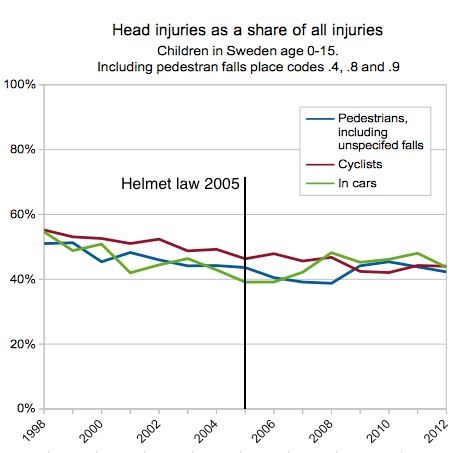
As we can see there does not seem to be a difference between the trends of the different modes, suggesting that if there is any fall in the share of head injuries it is likely to be an effect of something that also applies to other or all road users.
However there does seem to be another effect of helmet laws, namely a decline in cycling among school children. In 1983 57% of children aged 7-9 had permission from their parents to bike to school without adult companion, and for the age group 10-12, 94% had such permission. By the year 2007 this had decreased to 25% and 79% respectively. Bearing in mind, the helmet law was introduced in 2005, we can’t be sure of a correlation, because the data consists of surveys from 1983 and then 2007. But we do also have data recording that the share of school journeys by bicycle fell from 33% in 2006 one year after the legislation to 29% in year 2012. The evidence does suggest that the effect of the helmet law primarily is that fewer children bike to school.
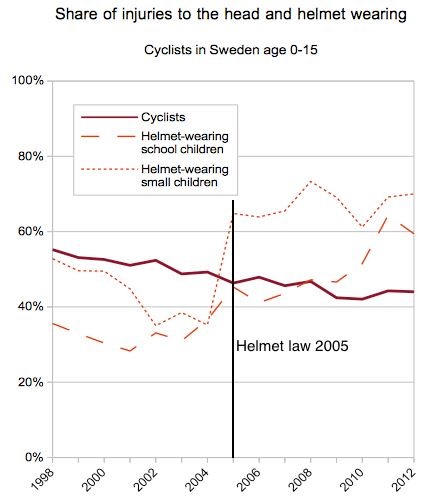
So the data does show a decline in cycling, but without annual surveys it’s hard to be sure of a correlation. However, a Danish report made the same link between declining cycling to school and helmet promotion and safety/scare campaigns. They determined that half the decline in cycling was caused by these campaigns, and half was caused by other factors such as more car traffic and longer distances to school.
From my perspective, laws telling me how to live don’t work, and this study shows that. Whether I wear a helmet is more personal issue that I should be allowed to decide.
More importantly, cycling increases the cyclist’s health, decreases air pollution and general promotes health. That is a greater benefit to all of us then the individual benefit of forcing someone to do something they may or may not want to do.
See: What happens when you mandate helmet-wearing among young Swedish cyclists?
Other Articles about this subject:
Bike Share programs flourish when helmets are not required http://rec-law.us/WrqmXI
Study shows that head injuries are on the rise on the slopes even though more people are wearing helmets http://rec-law.us/U91O73
Law requires helmets, injuries down fatalities up? http://rec-law.us/YwLcea
Great editorial questioning why we need laws to “protect” us from ourselves. http://rec-law.us/Ayswbo
Survey of UK physicians shows them against mandatory bicycle helmet laws. http://rec-law.us/sYuH07
Recent UK poll shows that 10% of cyclists would quite biking if there was a compulsory helmet law. http://rec-law.us/t1ByWk
What do you think? Leave a comment.
If you like this let your friends know or post it on FB, Twitter or LinkedIn
Copyright 2015 Recreation Law (720) Edit Law
Email: Rec-law@recreation-law.com
Google+: +Recreation
Twitter: RecreationLaw
Facebook: Rec.Law.Now
Facebook Page: Outdoor Recreation & Adventure Travel Law
Blog: www.recreation-law.com
Mobile Site: http://m.recreation-law.com
By Recreation Law Rec-law@recreation-law.com James H. Moss
#AdventureTourism, #AdventureTravelLaw, #AdventureTravelLawyer, #AttorneyatLaw, #Backpacking, #BicyclingLaw, #Camps, #ChallengeCourse, #ChallengeCourseLaw, #ChallengeCourseLawyer, #CyclingLaw, #FitnessLaw, #FitnessLawyer, #Hiking, #HumanPowered, #HumanPoweredRecreation, #IceClimbing, #JamesHMoss, #JimMoss, #Law, #Mountaineering, #Negligence, #OutdoorLaw, #OutdoorRecreationLaw, #OutsideLaw, #OutsideLawyer, #RecLaw, #Rec-Law, #RecLawBlog, #Rec-LawBlog, #RecLawyer, #RecreationalLawyer, #RecreationLaw, #RecreationLawBlog, #RecreationLawcom, #Recreation-Lawcom, #Recreation-Law.com, #RiskManagement, #RockClimbing, #RockClimbingLawyer, #RopesCourse, #RopesCourseLawyer, #SkiAreas, #Skiing, #SkiLaw, #Snowboarding, #SummerCamp, #Tourism, #TravelLaw, #YouthCamps, #ZipLineLawyer, Cycling, Helmets, Sweden, Biking
Colorado Avalanche Information Center Kow Before You Go campaign kicks off
Posted: March 17, 2015 Filed under: Avalanche | Tags: avalanche, CAIC, Colorado Avalanche Information Center, Know Before You Go, x, y, z Leave a commentThe 2014/2015 season has been very interesting so far. We have had some great powder days as well as weeks of high pressure and no new snow. However, our snowpack is hovering around average and there is plenty of skiing, riding, and snowmobiling to come!
Today we are launching our 6-week Know Before You Go campaign! Donate now. This is our annual fundraising drive that allows us to be creative and expand the Colorado Avalanche Information Center’s operations. The money raised during this campaign will go toward the following goals.
1. Create and launch Know Before You Go Colorado. This education initiative will be modeled after the Utah Avalanche Center’s model but will be focused on Colorado’s snowpack and avalanche problems.
2. Improve the CAIC’s backcountry forecast program. More forecasting staff means more people that are part of a statewide avalanche safety effort. More forecasters will mean more local field data, which in turn will create more accurate, and timely avalanche forecasts for you, the backcountry user.
3. The expanded resources also mean expansion of our IT infrastructure. Last season we asked you to invest in the development of a mobile app. You responded and we launched V1 in January. We are excited to continually develop the capabilities our website as well as of the app and we need your help to do that.
You want your forecast center, the CAIC, to be the best. Donate today and help us grow and give you the best center in the United States. Once again, I feel so strongly about bringing Know Before You Go to Colorado that I will kick off the campaign with my own $200 donation.
Starting today and for the next 6 weeks the Friends of CAIC will be offering prizes, challenges, and incentives, to anyone who donates $25 or more. Click here for more information or to DONATE NOW!
We will be accepting donations in the following ways:
Donate on Crowdrise: https://www.crowdrise.com/knowbeforeyougo
(Remember you don’t have to pay the “Optional Processing Fee”. Click on the text and select 0%.)
Mail us a check: PO BOX 140817 Denver, CO 80214
Donate ONLINE on our website: http://friendsofcaic.org
Hand us cash!
We are looking forward to your support over the next 6 weeks!
Sincerely,
Aaron Carlson
Executive Director
Friends of CAIC
Ethan Greene
Director
Colorado Avalanche Information Center
Federal Court in Idaho holds camp not liable for assault on third party by runaway minors.
Posted: March 16, 2015 Filed under: Idaho, Minors, Youth, Children, Summer Camp | Tags: assault, Big Sky Summer Adventure Program, Camp, Custody and Control, Explorations, Float Trip, Idaho, LLC., Montana, Phoenix Mountain Collaborative, Run away, Runaway, Summer Camp, Treatment Program, Trout Creek, Youth Camp Leave a commentThe Court did find that the camp was still in the custody and control of the minors during the assault which occurred three days after the youth had run away from the camp.
Gadman v. Martin, 2014 U.S. Dist. LEXIS 83883
State: Idaho, United States District Court for the District of Idaho
Plaintiff: Vera Gadman
Defendant: Joseph Martin; Marshall Dittrich; Penelope James; and Phoenix Mountain Collaborative, LLC.
Plaintiff Claims: Negligence
Defendant Defenses: No duty
Year: 2014
Holding: for the defendant
This case is about the escape of two boys from a summer program for “troubled” youth. These programs have achieved fame and notoriety based on various issues of successes and failures, as well as abuse. However, this legal issue is important to anyone who is taking care of youth at a camp… In this one two kids at the camp ran away and then assaulted a third party. The person the runaway kids assaulted then sued the camp for her injuries.
The defendant camp was operated in Montana. During one part of the session, the youth were rafting the Clark Fork River. The Clark Fork flows from Montana to Idaho. One night during the river trip the campers were on property owned by the defendant camp. The youth ran away.
Neither of the youth who ran away from the camp had a history of violence. They seemed to be enrolled in the program because of drug use and generally being really stupid kids. Both youth has been on a run-away watch a system developed by the camp and had their journals and shoes removed. However, their shoes were returned to them for the rafting trip.
The school had a “Run Watch Policy” which the court pointed out, quoted from and found the school had not followed. “Explorations will take all reasonable precautions pertinent to each individual student so as to reduce the possibility of their escape from our custody.”
The defendant camp filed a motion for summary judgment, and this decision is based on that motion.
Analysis: making sense of the law based on these facts.
The defense was based on two theories.
1) they owed no duty to Ms. Gadman [plaintiff] and
2) the actions of Mr. Dittrich and Mr. Martin (youth runaways) were not foreseeable [to cause injury to the plaintiff] to either Explorations or Ms. James [defendants].
The determination under Idaho law as to whether the defendants owed a duty of care to the plaintiff’s when they are in charge of youth “who are dangerous or who have dangerous propensities“ is a two-part test.
The first part requires a determination of whether the supervising body actually has control over the individual in question, and then secondly, if so, a determination must be made whether the harm caused by the individual was foreseeable.
The court then looked at the first part of the test.
One who takes charge of a third person whom he knows or should know to be likely to cause bodily harm to others if not controlled is under a duty to exercise reasonable care to control the third person to prevent him from doing such harm.
The first part of the test is whether or not the supervising authority has actual control over the youth. Here the youth were not allowed to leave the camp without the camps or the youth’s parent’s permissions. Even though the youth had voluntarily, and without permission, left the campsite and been away from the camp for two days at the time of the attack, the court held the camp was still in control, for the purposes of the test, of the youth.
Ordinarily, there is no affirmative duty to assist or protect someone unless special circumstances exist. The analysis is not what is the relationship between the affected third party and the youth in this case, but the relationship between the youth and the camp. “Thus, the duty alleged in this case would have to arise from a supervisory relationship where Ms. James/Explorations exercised some level of control over Mr. Martin and Mr. Dittrich.”
The fact the youth ran away was not valid excuse or abrogation of control by the camp.
Explorations was responsible for the care and custody of the youth participants in its programs. The minor participants could not leave the program without their parents’ permission. When asked if the participants of the outdoor program were “free to leave,” Ms. James stated in her deposition that participants who were minor could only leave if they had their parents’ permission, otherwise they were not free to leave. Ms. James went on to state that the steps taken to assure participants do not leave are that “care is provided, oversight and care, with our instructor team the entire time the students are there.”
Most of this analysis was based on the camps Run Watch Policy and Run Watch Kit for leaders. Because the camp knew the kids would run away and prepared for it, they knew it was possible and consequently, the court felt they did not give up control over a kid when the kid did run. “The Court finds upon these undisputed facts that Mr. Martin and Mr. Dittrich were in the custody and control of Explorations at the time of the attack.”
The next issue was the foreseeability question. In this case, the question was not whether it was foreseeable that the kids would run away, but whether it was foreseeable, the kids would assault a third party.
Foreseeability, ‘contemplates more than the mere possibility of aggressive tendencies…. The concept of foreseeability is much more narrowly drawn in this circumstance, … i.e. violence, particularly of a sexual nature, toward members of the public … must be manifest or ostensible, and highly likely to occur.
The plaintiff argued the violent acts of the defendant were foreseeable because of the youth’s drug use and prior attendance at treatment facilities. However, the court did not agree with this.
Although the boys had struggled in various aspects of their lives before attending Explorations, there is nothing in their histories that was known to Explorations that made their actions on July 31, 2011 [date of the attack] foreseeable.
The theft of drugs by one participant who had run away in the past, nor the fact that the kids had been planning to run away did not change the court’s opinion of this. The planning though, was only discovered the history of the youth, after the youth had been caught. Both arguments by the plaintiffs were too speculative according to the court.
The court held therefore, that the defendant camp was not liable.
So Now What?
Although the defendant won this case, it was a close one. All camps should read this with the understanding that a minor that has been delivered to them by their parents are in their custody and control until they are delivered back to their parents.
Whether or not this can be moderated by contract, I’m not sure.
This case would have gone the other way if the youth had a history of violence. The defendant notified the boy’s parents and law enforcement within 90 minutes of the discovery the boys were missing. Even calling law enforcement did not change the issue of control.
What do you think? Leave a comment.
 Jim Moss |
Jim Moss is an attorney specializing in the legal issues of the outdoor recreation community. He represents guides, guide services, and outfitters both as businesses and individuals and the products they use for their business. He has defended Mt. Everest guide services, summer camps, climbing rope manufacturers; avalanche beacon manufacturers, and many more manufacturers and outdoor industries. Contact Jim at Jim@Rec-Law.us |

Outdoor Recreation Insurance, Risk Management, and Law
Jim is the author or co-author of eight books about legal issues in the outdoor recreation world; the latest is Outdoor Recreation Insurance, Risk Management, and Law. To Purchase Go Here:
To see Jim’s complete bio go here and to see his CV you can find it here. To find out the purpose of this website go here.
If you are interested in having me write your release, download the form and return it to me.
If you like this let your friends know or post it on FB, Twitter, or LinkedIn
By Recreation Law Rec-law@recreation-law.com James H. Moss
@2023 Summit Magic Publishing, LLC
G-YQ06K3L262
|
Blue Sky Logo |
|
Mastodon |
|
Stimulus |
Recreation Law logo |
X (formerly known as Twitter) logo |
Threads |
#AdventureTourism, #AdventureTravelLaw, #AdventureTravelLawyer, #AttorneyatLaw, #Backpacking, #BicyclingLaw, #Camps, #ChallengeCourse, #ChallengeCourseLaw, #ChallengeCourseLawyer, #CyclingLaw, #FitnessLaw, #FitnessLawyer, #Hiking, #HumanPowered, #HumanPoweredRecreation, #IceClimbing, #JamesHMoss, #JimMoss, #Law, #Mountaineering, #Negligence, #OutdoorLaw, #OutdoorRecreationLaw, #OutsideLaw, #OutsideLawyer, #RecLaw, #Rec-Law, #RecLawBlog, #Rec-LawBlog, #RecLawyer, #RecreationalLawyer, #RecreationLaw, #RecreationLawBlog, #RecreationLawcom, #Recreation-Lawcom, #Recreation-Law.com, #RiskManagement, #RockClimbing, #RockClimbingLawyer, #RopesCourse, #RopesCourseLawyer, #SkiAreas, #Skiing, #SkiLaw, #Snowboarding, #SummerCamp, #Tourism, #TravelLaw, #YouthCamps, #ZipLineLawyer, Camp, Custody and Control, Summer Camp, Youth Camp, Phoenix Mountain Collaborative, LLC., Big Sky Summer Adventure Program, Explorations, Trout Creek, Montana, Idaho, Assault, Float Trip, Run away, Runaway, Treatment Program,
MassBike Bills Receive Substantial Sponsors
Posted: March 10, 2015 Filed under: Cycling | Tags: Cycling, Massachusetts, MassBikes, Safe Riding, Safe Routhes, x, y, z Leave a comment
|


Delaware Equine Liability Act
Posted: March 9, 2015 Filed under: Delaware, Equine Activities (Horses, Donkeys, Mules) & Animals | Tags: Delaware, Delaware Equine Liability Act, Equine, Immunity Leave a commentDELAWARE CODE ANNOTATED
Copyright 2015 by The State of Delaware
TITLE 10. COURTS AND JUDICIAL PROCEDURE
PART V. LIMITATION OF ACTIONS
CHAPTER 81. PERSONAL ACTIONS
GO TO DELAWARE STATUTES ARCHIVE DIRECTORY
10 Del. C. § 8140 (2015)
§ 8140. Liability of persons involved in equine activities
(a) For purposes of this section, the following terms shall have the meaning ascribed herein:
(1) a. “Engages in an equine activity” means riding, training, assisting in medical treatment of, driving, or being a passenger upon an equine, whether mounted or unmounted or any person assisting a participant or show management.
b. “Engages in an equine activity” does not include being a spectator at an equine activity, except in cases where the spectator places such spectator’s person in an unauthorized area and in immediate proximity to the equine activity;
(2) “Equine” means a horse, pony, mule, donkey or hinny;
(3) “Equine activity” means:
a. Equine shows, fairs, competitions, performances or parades that involve any or all breeds of equines and any of the equine disciplines, including, but not limited to, dressage, hunter and jumper horse shows, grand prix jumping, 3-day events, combined training, rodeos, driving, pulling, cutting, polo, steeplechasing, English and western performance riding, endurance trail riding and western games, and hunting;
b. Equine training or teaching activities, or both;
c. Boarding equines;
d. Riding, inspecting or evaluating an equine belonging to another, whether or not the owner has received some monetary consideration or other thing of value for the use of the equine or is permitting a prospective purchaser of the equine to ride, inspect or evaluate the equine;
e. Rides, trips, hunts or other equine activities of any type, however informal or impromptu, that are sponsored by an equine activity sponsor; and
f. Placing or replacing horseshoes on an equine;
(4) “Equine activity sponsor” means an individual, group, club, partnership or corporation, whether or not the sponsor is operating for profit or nonprofit, which sponsors, organizes or provides the facilities for an equine activity, including, but not limited to, pony clubs, 4-H clubs, hunt clubs, riding clubs, school and college-sponsored classes, programs and activities, therapeutic riding programs, and operators, instructors and promoters of equine facilities, including, but not limited to, stables, clubhouses, ponyride strings, fairs and arenas at which the activity is held;
(5) “Equine professional” means a person engaged for compensation:
a. In instructing a participant or renting to a participant an equine for the purpose of riding, driving or being a passenger upon the equine; or
b. In renting equipment or tack to a participant;
(6) “Inherent risks of equine activities” means those dangers or conditions which are an integral part of equine activities, including, but not limited to:
a. The propensity of an equine to behave in ways that may result in injury, harm or death to persons on or around them;
b. The unpredictability of an equine’s reaction to such things as sounds, sudden movements, and unfamiliar objects, persons or other animals;
c. Certain hazards such as surface and subsurface conditions;
d. Collisions with other equines or objects; and
e. The potential of a participant to act in a negligent manner that may contribute to injury to the participant or others, such as failing to maintain control over the animal or not acting within the participant’s ability;
(7) “Participant” means any person, whether amateur or professional, who engages in an equine activity, whether or not a fee is paid to participate in the equine activity.
(b) Except as provided in subsection (c) of this section, an equine activity sponsor, an equine professional or any other person, which shall include a corporation or partnership, shall not be liable for an injury to or the death of a participant resulting from the inherent risks of equine activities. Except as provided in subsection (c) of this section, no participant or participant’s representative shall make any claim against, maintain an action against or recover from an equine activity sponsor, an equine professional or any other person for injury, loss, damage or death of the participant resulting from any of the inherent risks of equine activities.
(c) (1) This section shall not apply to the horse racing industry as regulated in Title 3.
(2) Nothing in subsection (b) of this section shall prevent or limit the liability of an equine activity sponsor, an equine professional, or any other person if the equine activity sponsor, equine professional or person:
a. 1. Provided the equipment or tack, and knew or should have known that the equipment or tack was faulty, and such equipment or tack was faulty to the extent that it did cause the injury; or
2. Provided the equine and failed to make reasonable and prudent efforts to determine the ability of the participant to engage safely in the equine activity and determine the ability of the participant to safely manage the particular equine based on the participant’s representations of the participant’s ability;
b. Owns, leases, rents or otherwise is in lawful possession and control of the land or facilities upon which the participant sustained injuries because of a dangerous latent condition which was known or should have been known to the equine activity sponsor, equine professional or person and for which warning signs have not been conspicuously posted;
c. Commits an act or omission that constitutes wilful or wanton disregard for the safety of the participant, and that act or omission caused the injury; or
d. Intentionally injures the participant.
(3) Nothing in subsection (b) of this section shall prevent or limit the liability of an equine activity sponsor or an equine professional under either product liability or trespass claims.
(d) (1) Every equine professional shall post and maintain signs which contain the warning notice specified in paragraph (d)(2) of this section. Such signs shall be placed in clearly visible locations on or near stables, corrals or arenas where the equine professional conducts equine activities if such stables, corrals or arenas are owned, managed or controlled by the equine professional. The warning notice specified in paragraph (d)(2) of this section shall appear on the sign in red and white, with each letter to be a minimum of 1 inch in height. Every written contract entered into by an equine professional for the providing of professional services, instruction or the rental of equipment or tack or an equine to a participant, whether or not the contract involves equine activities on or off the location or site of the equine professional’s business, shall contain in clearly readable print the warning notice specified in paragraph (d)(2) of this section.
(2) The signs and contracts described in paragraph (d)(1) of this section shall contain the following warning notice:
WARNING
Under Delaware law, an equine professional is not liable for an injury to or the death of a participant in equine activities resulting from the inherent risks of equine activities, pursuant to 10 Delaware Code § 8140.
Colorado Equine Liability Act
Posted: March 9, 2015 Filed under: Colorado, Equine Activities (Horses, Donkeys, Mules) & Animals | Tags: Equine, Equine Liability Act, Horse, Immunity, Llama Leave a commentC.R.S. 13-21-119 (2014)
COLORADO REVISED STATUTES
TITLE 13. COURTS AND COURT PROCEDURE
DAMAGES
ARTICLE 21.DAMAGES
PART 1. GENERAL PROVISIONS
13-21-119. Equine activities – llama activities – legislative declaration – exemption from civil liability13-21-119. Equine activities – llama activities – legislative declaration – exemption from civil liability
(1) The general assembly recognizes that persons who participate in equine activities or llama activities may incur injuries as a result of the risks involved in such activities. The general assembly also finds that the state and its citizens derive numerous economic and personal benefits from such activities. It is, therefore, the intent of the general assembly to encourage equine activities and llama activities by limiting the civil liability of those involved in such activities.
(2) As used in this section, unless the context otherwise requires:
(a) “Engages in a llama activity” means riding, training, assisting in medical treatment of, driving, or being a passenger upon a llama, whether mounted or unmounted or any person assisting a participant or show management. The term “engages in a llama activity” does not include being a spectator at a llama activity, except in cases where the spectator places himself in an unauthorized area and in immediate proximity to the llama activity.
(a.5) “Engages in an equine activity” means riding, training, assisting in medical treatment of, driving, or being a passenger upon an equine, whether mounted or unmounted or any person assisting a participant or show management. The term “engages in an equine activity” does not include being a spectator at an equine activity, except in cases where the spectator places himself in an unauthorized area and in immediate proximity to the equine activity.
(b) “Equine” means a horse, pony, mule, donkey, or hinny.
(c) “Equine activity” means:
(I) Equine shows, fairs, competitions, performances, or parades that involve any or all breeds of equines and any of the equine disciplines, including, but not limited to, dressage, hunter and jumper horse shows, grand prix jumping, three-day events, combined training, rodeos, driving, pulling, cutting, polo, steeplechasing, English and western performance riding, endurance trail riding and western games, and hunting;
(II) Equine training or teaching activities or both;
(III) Boarding equines;
(IV) Riding, inspecting, or evaluating an equine belonging to another, whether or not the owner has received some monetary consideration or other thing of value for the use of the equine or is permitting a prospective purchaser of the equine to ride, inspect, or evaluate the equine;
(V) Rides, trips, hunts, or other equine activities of any type however informal or impromptu that are sponsored by an equine activity sponsor; and
(VI) Placing or replacing horseshoes on an equine.
(d) “Equine activity sponsor” means an individual, group, club, partnership, or corporation, whether or not the sponsor is operating for profit or nonprofit, which sponsors, organizes, or provides the facilities for, an equine activity, including but not limited to: Pony clubs, 4-H clubs, hunt clubs, riding clubs, school and college-sponsored classes, programs and activities, therapeutic riding programs, and operators, instructors, and promoters of equine facilities, including but not limited to stables, clubhouses, ponyride strings, fairs, and arenas at which the activity is held.
(e) “Equine professional” means a person engaged for compensation:
(I) In instructing a participant or renting to a participant an equine for the purpose of riding, driving, or being a passenger upon the equine; or
(II) In renting equipment or tack to a participant.
(f) “Inherent risks of equine activities” and “inherent risks of llama activities” means those dangers or conditions which are an integral part of equine activities or llama activities, as the case may be, including, but not limited to:
(I) The propensity of the animal to behave in ways that may result in injury, harm, or death to persons on or around them;
(II) The unpredictability of the animal’s reaction to such things as sounds, sudden movement, and unfamiliar objects, persons, or other animals;
(III) Certain hazards such as surface and subsurface conditions;
(IV) Collisions with other animals or objects;
(V) The potential of a participant to act in a negligent manner that may contribute to injury to the participant or others, such as failing to maintain control over the animal or not acting within his or her ability.
(f.1) “Llama” means a South American camelid which is an animal of the genus lama, commonly referred to as a “one llama”, including llamas, alpacas, guanacos, and vicunas.
(f.2) “Llama activity” means:
(I) Llama shows, fairs, competitions, performances, packing events, or parades that involve any or all breeds of llamas;
(II) Using llamas to pull carts or to carry packs or other items;
(III) Using llamas to pull travois-type carriers during rescue or emergency situations;
(IV) Llama training or teaching activities or both;
(V) Taking llamas on public relations trips or visits to schools or nursing homes;
(VI) Participating in commercial packing trips in which participants pay a llama professional to be a guide on a hike leading llamas;
(VII) Boarding llamas;
(VIII) Riding, inspecting, or evaluating a llama belonging to another, whether or not the owner has received some monetary consideration or other thing of value for the use of the llama or is permitting a prospective purchaser of the llama to ride, inspect, or evaluate the llama;
(IX) Using llamas in wool production;
(X) Rides, trips, or other llama activities of any type however informal or impromptu that are sponsored by a llama activity sponsor; and
(XI) Trimming the nails of a llama.
(f.3) “Llama activity sponsor” means an individual, group, club, partnership, or corporation, whether or not the sponsor is operating for profit or nonprofit, which sponsors, organizes, or provides the facilities for, a llama activity, including but not limited to: Llama clubs, 4-H clubs, hunt clubs, riding clubs, school and college-sponsored classes, programs and activities, therapeutic riding programs, and operators, instructors, and promoters of llama facilities, including but not limited to stables, clubhouses, fairs, and arenas at which the activity is held.
(f.4) “Llama professional” means a person engaged for compensation:
(I) In instructing a participant or renting to a participant a llama for the purpose of riding, driving, or being a passenger upon the llama; or
(II) In renting equipment or tack to a participant.
(g) “Participant” means any person, whether amateur or professional, who engages in an equine activity or who engages in a llama activity, whether or not a fee is paid to participate in such activity.
(3) Except as provided in subsection (4) of this section, an equine activity sponsor, an equine professional, a llama activity sponsor, a llama professional, a doctor of veterinary medicine, or any other person, which shall include a corporation or partnership, shall not be liable for an injury to or the death of a participant resulting from the inherent risks of equine activities, or from the inherent risks of llama activities and, except as provided in subsection (4) of this section, no participant nor participant’s representative shall make any claim against, maintain an action against, or recover from an equine activity sponsor, an equine professional, a llama activity sponsor, a llama professional, a doctor of veterinary medicine, or any other person for injury, loss, damage, or death of the participant resulting from any of the inherent risks of equine activities or resulting from any of the inherent risks of llama activities.
(4) (a) This section shall not apply to the horse racing industry as regulated in article 60 of title 12, C.R.S.
(b) Nothing in subsection (3) of this section shall prevent or limit the liability of an equine activity sponsor, an equine professional, a llama activity sponsor, a llama professional, or any other person if the equine activity sponsor, equine professional, llama activity sponsor, llama professional, or person:
(I) (A) Provided the equipment or tack, and knew or should have known that the equipment or tack was faulty, and such equipment or tack was faulty to the extent that it did cause the injury; or
(B) Provided the animal and failed to make reasonable and prudent efforts to determine the ability of the participant to engage safely in the equine activity or llama activity and determine the ability of the participant to safely manage the particular animal based on the participant’s representations of his ability;
(II) Owns, leases, rents, or otherwise is in lawful possession and control of the land or facilities upon which the participant sustained injuries because of a dangerous latent condition which was known to the equine activity sponsor, equine professional, llama activity sponsor, llama professional, or person and for which warning signs have not been conspicuously posted;
(III) Commits an act or omission that constitutes willful or wanton disregard for the safety of the participant, and that act or omission caused the injury;
(IV) Intentionally injures the participant.
(c) Nothing in subsection (3) of this section shall prevent or limit the liability of an equine activity sponsor, equine professional, llama activity sponsor, or llama professional:
(I) Under liability provisions as set forth in the products liability laws; or
(II) Under liability provisions in section 35-46-102, C.R.S.
(5) (a) Every equine professional shall post and maintain signs which contain the warning notice specified in paragraph (b) of this subsection (5). Such signs shall be placed in a clearly visible location on or near stables, corrals, or arenas where the equine professional conducts equine activities if such stables, corrals, or arenas are owned, managed, or controlled by the equine professional. The warning notice specified in paragraph (b) of this subsection (5) shall appear on the sign in black letters, with each letter to be a minimum of one inch in height. Every written contract entered into by an equine professional for the providing of professional services, instruction, or the rental of equipment or tack or an equine to a participant, whether or not the contract involves equine activities on or off the location or site of the equine professional’s business, shall contain in clearly readable print the warning notice specified in paragraph (b) of this subsection (5).
(b) The signs and contracts described in paragraph (a) of this subsection (5) shall contain the following warning notice:
WARNING
Under Colorado Law, an equine professional is not liable for an injury to or the death of a participant in equine activities resulting from the inherent risks of equine activities, pursuant to section 13-21-119, Colorado Revised Statutes.
(6) (a) Every llama professional shall post and maintain signs which contain the warning notice specified in paragraph (b) of this subsection (6). Such signs shall be placed in a clearly visible location on or near stables, corrals, pens, or arenas where the llama professional conducts llama activities if such stables, corrals, pens, or arenas are owned, managed, or controlled by the llama professional. The warning notice specified in paragraph (b) of this subsection (6) shall appear on the sign in black letters, with each letter to be a minimum of one inch in height. Every written contract entered into by a llama professional for the providing of professional services, instruction, or the rental of equipment or tack or a llama to a participant, whether or not the contract involves llama activities on or off the location or site of the llama professional’s business, shall contain in clearly readable print the warning notice specified in paragraph (b) of this subsection (6).
(b) The signs and contracts described in paragraph (a) of this subsection (6) shall contain the following warning notice:
WARNING
Under Colorado Law, a llama professional is not liable for an injury to or the death of a participant in llama activities resulting from the inherent risks of llama activities, pursuant to section 13-21-119, Colorado Revised Statutes.
California case examines the relationship between a common carrier and public policy when applied to a ski area chair lift.
Posted: March 9, 2015 Filed under: California, Release (pre-injury contract not to sue), Ski Area, Skiing / Snow Boarding | Tags: Chair Lift, Gross negligence, Mammoth Mountain Ski Area, Platzer, Public Policy, Release, ski area Leave a commentA release and the fact the statute allowed the use of releases by common carriers in a recreational setting worked to save the ski area in this lawsuit.
State: California: Court of Appeal of California, Third Appellate District
Plaintiff: Joseph Platzer, a Minor, etc., et al.,
Defendant: Mammoth Mountain Ski Area
Plaintiff Claims: negligence and gross negligence
Defendant Defenses: release
Year: 2002
Holding: for the Defendant
Although a simple case, this decision clarifies several issues according to California law. The minor plaintiff was in a ski lesson at the defendant ski area. While riding a lift the minor fell off the chairlift. The minor plaintiff’s mother sued.
The trial court dismissed the negligence claims based on a release the mother signed when she signed her child up for lessons. The court then had a trial on the plaintiff’s claims of gross negligence. The defendant won the jury trial and the plaintiff appealed.
Analysis: making sense of the law based on these facts.
The arguments by the plaintiff to void the release were based on a public policy argument. Chair lifts are common carriers in California. A common carrier owes a higher duty of care to riders then a reasonable standard of care. Common carriers are governed by a statue in California. Normally, a common carrier cannot have a “rider” release the common carrier in advance for negligence.
At common law a common carrier might make any other contract relative to the carriage of property intrusted to it, save one exempting it from liability for any kind of negligence. This rule was founded upon considerations of public policy, it being deemed derogatory thereto to allow a common carrier to contract against its own negligence, because to permit this had a tendency to promote negligence.
However this rule had been changed in California by the statute controlling common carriers.
…as far as ordinary negligence is concerned, the rule at common law has been abrogated by our code (sec. 2174) 3 to the extent that the shipper and carrier may now contract for the purpose of limiting the liability of the latter therefor.
Common carriers where prohibited from obtaining a release from the public for its services. That was based on the value of the services provided to the public. The public cannot live without the services provided by a common carrier or an industry labeled as covered by public policy. A common carrier is:
… a business of a type generally thought suitable for public regulation. The party seeking exculpation is engaged in performing a service of great importance to the public, which is often a matter of practical necessity for some members of the public. The party holds himself out as willing to perform this service for any member of the public who seeks it, or at least for any member coming within certain established standards.
Because the public needed the services offered by the common carrier and the public was not able to bargain for the services, the common carrier was regulated and prohibited from contracting away its liability.
As a result of the essential nature of the service, in the economic setting of the transaction, the party invoking exculpation possesses a decisive advantage of bargaining strength against any member of the public who seeks his services.
The issue that is always brought up was the ability of the public to bargain away the exculpatory clause in the agreement by paying for more money.
In exercising a superior bargaining power the party confronts the public with a standardized adhesion contract of exculpation, and makes no provision whereby a purchaser may pay additional reasonable fees and obtain protection against negligence.
The argument is made occasionally by courts that clients should be allowed to bargain (pay more money) for the service or recreation without having to sign a release. However no courts have specially required it.
This control over the contract and the situation and the need of the public created a situation that evolved into a fear that the common carrier would take advantage of its position. “Finally, as a result of the transaction, the person or property of the purchaser is placed under the control of the seller, subject to the risk of carelessness by the seller or his agents.”
This limitation applied to common carriers applies to negligence and not to gross negligence. Consequently, once the release stopped the negligence claim the trial still went forward on the gross negligence claim. The gross negligence was not appealed, probably because a jury had made the ruling against the plaintiff and in favor of the defendant.
Rarely are decisions made by juries over turned on appeal unless the decision is just beyond understanding how the jury came to its decision by the court.
The other issue the court looked at was the public policy exception as applied to a recreation provider. The court first looked at what controlled the situation, the common law or the statute governing common carriers. Statutes always control or supersede the common law. “A specific statute on a subject controls over a general provision.”
Although the defendant’s chairlift was a common carrier, it still did not fully fit the definition because the activity of skiing was not an essential activity. Because it was recreational, it did not require the strict scrutiny of its actions like a common carrier.
On top of that, the statute specifically excluded chair lifts from the Public Utilities Commission which oversees common carriers and business providing essential public services.
The final issue was the release was admitted into trial. The plaintiff objected to the admission of the release, but did not state the legal basis for the objection. Without a legal basis for the objection there is nothing for the appellate court to rule on.
However the court did state.
…we conclude the release was relevant to the issue of gross negligence. Among other things, it described the inherent risks of skiing and using the ski lifts. The court did not abuse its discretion in admitting the release into evidence.
This ruling may be of value to attorneys attempting to enter a release into evidence in the future.
So Now What?
The case is great in attempting to understand the confluence of statute and common law as well as how the statute and common law conflict or are interwoven.
Here the ski area had a release signed which saved the day. The duty of having a kid in a ski school class as well as on a chair lift created different standards of care owed to the plaintiff which this court wove its way through.
What do you think? Leave a comment.
If you like this let your friends know or post it on FaceBook, Twitter or LinkedIn
Copyright 2015 Recreation Law (720) Edit Law
Email: Rec-law@recreation-law.com
Google+: +Recreation
Twitter: RecreationLaw
Facebook: Rec.Law.Now
Facebook Page: Outdoor Recreation & Adventure Travel Law
Blog: www.recreation-law.com
Mobile Site: http://m.recreation-law.com
By Recreation Law Rec-law@recreation-law.com James H. Moss
#AdventureTourism, #AdventureTravelLaw, #AdventureTravelLawyer, #AttorneyatLaw, #Backpacking, #BicyclingLaw, #Camps, #ChallengeCourse, #ChallengeCourseLaw, #ChallengeCourseLawyer, #CyclingLaw, #FitnessLaw, #FitnessLawyer, #Hiking, #HumanPowered, #HumanPoweredRecreation, #IceClimbing, #JamesHMoss, #JimMoss, #Law, #Mountaineering, #Negligence, #OutdoorLaw, #OutdoorRecreationLaw, #OutsideLaw, #OutsideLawyer, #RecLaw, #Rec-Law, #RecLawBlog, #Rec-LawBlog, #RecLawyer, #RecreationalLawyer, #RecreationLaw, #RecreationLawBlog, #RecreationLawcom, #Recreation-Lawcom, #Recreation-Law.com, #RiskManagement, #RockClimbing, #RockClimbingLawyer, #RopesCourse, #RopesCourseLawyer, #SkiAreas, #Skiing, #SkiLaw, #Snowboarding, #SummerCamp, #Tourism, #TravelLaw, #YouthCamps, #ZipLineLawyer, Platzer, Mammoth Mountain Ski Area, Ski Area, Chair Lift, Release, Gross Negligence, Public Policy,
Volunteers Needed for the Breckenridge Spring Beer Festival to Support the Colorado Avalanche Information Center
Posted: March 6, 2015 Filed under: Avalanche | Tags: Beer Festival, Breckenridge, Breckenridge Colorado, CAIC, x, y, z Leave a commentWe are still searching for volunteers for the Breckenridge Spring Beer Festival. This is a great opportunity to volunteer for an event that supports avalanche forecasting and education throughout the State of Colorado.
The Breckenridge Spring Beer Festival will be held Saturday April 11th from 12-5pm on Ridge Street in downtown Breckenridge. There are la lot of shifts still available. All volunteers will receive a commemorative event volunteer t-shirt and the option to purchase a $15 tasting mug after their shift. We can also sign off on volunteer hours needed for various reasons. The Breckenridge Spring Beer Festival is a fundraiser for the Friends of the Colorado Avalanche Information Center.
You can find the Breckenridge Spring Beer Festival volunteer sign up sheet HERE.
Please let us know if you have any questions and we’d love to see you this year!
Cheers,
Friends of CAIC
2014-2015 In bound ski/board fatalities
Posted: March 4, 2015 Filed under: Ski Area, Skiing / Snow Boarding | Tags: Arizona Snowbowl, Breckenridge, Chair Lift, Copper Mtn, Crested Butte, Eldora, fatality, Hunter Mountain, Hunter Mtn, Jackson Hole, Keystone, Keystone Resort, Mission Ridge Ski, Mt. Hood Skibowl, Nashoba Valley Ski Area, Northstar California ski resort, Pine Knob, ski area, skiing, Snowbird Ski Resort, snowboarding, Stowe Mountain Resort, Tubing 2 CommentsIt is depressing to start working on this every year. I hope it at some point in time can provide answers rather than news.
This list is not guaranteed to be accurate. The information is found from web searches and news dispatches. Those references are part of the chart. If you have a source for information on any fatality please leave a comment or contact me. Thank you.
If this information is incorrect or incomplete please let me know. This is up to date as of February 26, 2015. Thanks.
Skiing and Snowboarding are still safer than being in your kitchen or bathroom. This information is not to scare you away from skiing but to help you understand the risks.
Red type is natural or medical conditions that occurred inbounds on the slopes
Green Type is Fatalities while sledding at the Resort
Blue Type is a Lift Accidents
2014 – 2015 Ski Season Fatalities
|
# |
Date |
State |
Resort |
Where |
Trail Difficulty |
How |
Cause |
Ski/ Board |
Age |
Sex |
Home town |
Helmet |
Reference |
Ref # 2 |
|
1 |
11/15 |
CO |
Breckenridge |
|
|
|
Natural |
|
48 |
M |
Boulder, CO |
|
|
|
|
2 |
12/8 |
CO |
Eldora |
Jolly Jug |
|
Hit tree |
|
Ski |
22 |
M |
Coral Springs, FL (CU student) |
Yes |
||
|
3 |
12/12 |
CO |
Keystone |
Spring Dipper |
Intermediate |
Hit Tree |
Blunt force trauma |
Boarder |
26 |
M |
Silverthorne |
Yes |
||
|
4 |
|
MI |
Pine Knob |
|
|
Hit tree |
|
Ski |
51 |
F |
Shelby Township |
|
||
|
5 |
12/28 |
WY |
Jackson Hole |
Brush Alley |
|
Found inverted in the snow |
Asphyxiation |
Skier |
54 |
M |
Pepper Pike, OH |
|
||
|
6 |
12/30 |
NY |
Hunter Mtn |
D Lift |
|
Ski caught lift tower |
Fall |
Skier |
44 |
F |
Brooklyn, NY |
|
||
|
7 |
1/31 |
OR |
Mt. Hood Skibowl |
Middle Reynolds Trail |
Expert |
Caught an edge, fell, landing on his head and chest |
blunt-force head trauma |
Skier |
37 |
M |
Medford, OR |
|
||
|
8 |
|
CO |
Keystone Resort |
Elk Run |
Intermediate |
|
|
|
18 |
M |
|
Yes |
||
|
9 |
1/7 |
UT |
Snowbird Ski Resort |
base of the Little Cloud chairlift |
|
struck a tree |
|
Skier |
63 |
M |
Salt Lake City, UT |
Yes |
||
|
10 |
1/17 |
MA |
Nashoba Valley Ski Area |
Lobo trail |
Expert |
Hit a tree |
|
Skier |
13 |
M |
Westford |
Yes |
||
|
11 |
1/18 |
CA |
Northstar California ski resort |
Rail Splitter |
Advanced |
|
|
Skier |
67 |
M |
Van Nuys |
|
|
|
|
12 |
1/18 |
AZ |
Arizona Snowbowl |
|
|
Medical episode & fell to snow |
|
Skier |
46 |
M |
Newbury, CA |
|
||
|
13 |
1/19 |
CO |
Copper Mtn |
|
|
Medical |
|
Board |
55 |
F |
Reeds Spring, MO |
Yes |
||
|
14 |
1/22 |
VT |
Stowe Mountain Resort |
|
|
|
|
|
64 |
M |
|
|
|
|
|
15 |
1/23 |
WA |
Mission Ridge Ski |
|
|
lost control on a ski run |
|
Skier |
17 |
M |
|
|
|
|
|
16 |
1/23 |
CO |
Crested Butte |
Lower Treasury |
Intermediate |
Hit a tree |
multiple traumatic chest injuries |
Skier |
13 |
M |
Olathe, CO |
Yes |
||
|
17 |
|
VT |
Stowe Mountain Resort |
|
|
|
medical-related |
Skier |
64 |
M |
|
|
|
|
|
18 |
2/6 |
VT |
Burke Mountain Resort |
|
|
Hit a tree |
|
Skier |
27 |
F |
St. Johnsbury, VT |
Yes |
||
|
19 |
2/7 |
UT |
Park City Mtn Resort |
|
|
hit a padded pole |
aorta ruptured |
Skier |
25 |
M |
|
|
|
|
|
20 |
2/11 |
CO |
Keystone Resort |
Anticipation |
Intermediate |
Hit a tree |
blunt force trauma |
Skier |
43 |
M |
Conifer, CO |
Yes |
||
|
21 |
2/14 |
NM |
Ski Santa Fe |
|
|
struck a tree |
|
Skier |
33 |
F |
El Paso, Texas |
|
|
|
|
22 |
2/7 |
CO |
|
|
|
|
|
Skier |
60 |
M |
|
|
|
|
|
22 |
2/23 |
CO |
Breckenridge Ski Resort |
|
|
|
multiple skull fractures |
Skier |
22 |
M |
|
No |
||
|
23 |
2/26 |
CO |
Breckenridge Ski Resort |
Northstar |
Intermediate |
Hit tree |
|
Skier |
46 |
M |
Rolling Meadows, IL |
Yes |
|
Our condolences go to the families of the deceased. Our thoughts extend to the families and staff at the areas who have to deal with these tragedies.
5 Medical causes, 1 lift accident and 17-18 fatalities 11 hitting trees or a pole
If you are unable to view the entire table Email me at Jim@Rec-law.us and put Ski Area Fatality Chart in the subject line. I’ll reply with a PDF of the chart.
What do you think? Leave a comment.
If you like this let your friends know or post it on FB, Twitter or LinkedIn
Copyright 2015 Recreation Law (720) Edit Law
Email: Rec-law@recreation-
Our Our condolences go to the families of the deceased. Our thoughts extend to the families and staff at the areas who have to deal with these tragedies.
5 Medical causes, 1 lift accident and 17-18 fatalities 11 hitting trees or a pole
If you are unable to view the entire table Email me at Jim@Rec-law.us and put Ski Area Fatality Chart in the subject line. I’ll reply with a PDF of the chart.
What do you think? Leave a comment.
If you like this let your friends know or post it on FB, Twitter or LinkedIn
Copyright 2015 Recreation Law (720) Edit Law
Google+: +Recreation
Twitter: RecreationLaw
Facebook: Rec.Law.Now
Facebook Page: Outdoor Recreation & Adventure Travel Law
Blog: www.recreation-law.com
Mobile Site: http://m.recreation-law.com
#AdventureTourism, #AdventureTravelLaw, #AdventureTravelLawyer, #AttorneyatLaw, #Backpacking, #BicyclingLaw, #Camps, #ChallengeCourse, #ChallengeCourseLaw, #ChallengeCourseLawyer, #CyclingLaw, #FitnessLaw, #FitnessLawyer, #Hiking, #HumanPowered, #HumanPoweredRecreation, #IceClimbing, #JamesHMoss, #JimMoss, #Law, #Mountaineering, #Negligence, #OutdoorLaw, #OutdoorRecreationLaw, #OutsideLaw, #OutsideLawyer, #RecLaw, #Rec-Law, #RecLawBlog, #Rec-LawBlog, #RecLawyer, #RecreationalLawyer, #RecreationLaw, #RecreationLawBlog, #RecreationLawcom, #Recreation-Lawcom, #Recreation-Law.com, #RiskManagement, #RockClimbing, #RockClimbingLawyer, #RopesCourse, #RopesCourseLawyer, #SkiAreas, #Skiing, #SkiLaw, #Snowboarding, #SummerCamp, #Tourism, #TravelLaw, #YouthCamps, #ZipLineLawyer, Skiing, Snowboarding, Fatality, Ski Area, Tubing, Breckenridge, Chair Lift, Hunter Mountain, Jackson Hole, Pine Knob, Eldora, Keystone, Breckenridge, Eldora, Keystone, Pine Knob, Jackson Hole, Hunter Mtn, Mt. Hood Skibowl, Snowbird Ski Resort, Nashoba Valley Ski Area, Northstar California ski resort, Arizona Snowbowl, Copper Mtn, Keystone Resort, Stowe Mountain Resort, Mission Ridge Ski, Crested Butte, Breckenridge,
Defendant tells plaintiff the release has no value and still wins lawsuit, but only because the plaintiff was an attorney
Posted: March 2, 2015 Filed under: California, Equine Activities (Horses, Donkeys, Mules) & Animals, Release (pre-injury contract not to sue) | Tags: Equine, Fraudulent Misrepresentation, horseback riding, Nondisclosure, Release, Rescission Leave a commentThe easiest way to void a release is to say the release has no legal value or is not worth anything. Don’t be afraid to be honest with your clients.
State: California: Court of Appeal of California, First Appellate District, Division Five.
Plaintiff: Diana L. Guido et al.
Defendant: Charles Koopman
Plaintiff Claims: negligence
Defendant Defenses: release
Holding: for the defendant
Year: 1991
This case would have been decided for the plaintiff but for one small fact. The plaintiff was an attorney. If the plaintiff wasn’t an attorney the screw ups by the defendant would have allowed any other plaintiff to win the case.
The plaintiff signed up with the defendant to take horseback riding lessons. When she did so she was given a release so sign. She was hesitant about signing the release. The defendant told her it had no value and he only did it because his insurance company made him do it.
In her deposition Guido [plaintiff] testified she “just didn’t feel comfortable signing something that said ‘Release’ on it on the top.” However, she signed it without reading it because respondent [defendant] advised her, “… It doesn’t mean anything. It is something that I need to have you sign, because my insurance company won’t let me give lessons unless I have people sign this. … As a matter of fact, the insurance company wants me to give the students this long detailed form, which I don’t do, because it scares them away when they see this long, detailed form.
The plaintiff took lessons from the defendant twice a week for 9 months before she was bucked from a horse suffering injuries. She had bucked from a horse while taking lessons with this defendant earlier. She sued and the trial court dismissed the complaint based on the release.
Analysis: making sense of the law based on these facts.
This case has a few interesting statements. The plaintiff stated she did not think that an inherent risk of riding a horse was the risk of being thrown off the horse. The court responded with this statement.
As to appellants’ argument that the release is ineffective because Guido did not think being thrown off a horse was an inherent risk of horseback riding, we are of the contrary view–that it is one of the most obvious risks of that activity, and readily apparent to anyone about to climb on a horse. The cases of injuries from horseback riding are numerous, and we have found none which describe this risk as unexpected or extraordinary.
The next argument made by the plaintiff was the release was void because it was against public policy. The court’s analysis of public policy in this case was well thought out and well written.
In placing particular contracts within or without the category of those affected with a public interest, the courts have revealed a rough outline of that type of transaction in which exculpatory provisions will be held invalid. Thus the attempted but invalid exemption involves a transaction which exhibits some or all of the following characteristics. It concerns a business of a type generally thought suitable for public regulation. The party seeking exculpation is engaged in performing a service of great importance to the public, which is often a matter of practical necessity for some members of the public. The party holds himself out as willing to perform this service for any member of the public who seeks it, or at least for any member coming within certain established standards. As a result of the essential nature of the service, in the economic setting of the transaction, the party invoking exculpation possesses a decisive advantage of bargaining strength against any member of the public who seeks his services. In exercising a superior bargaining power the party confronts the public with a standardized adhesion contract of exculpation, and makes no provision whereby a purchaser may pay additional reasonable fees and obtain protection against negligence. Finally, as a result of the transaction, the person or property of the purchaser is placed under the control of the seller, subject to the risk of carelessness by the seller or his agents.
This analysis of public policy was along the same lines as all other states that have looked at the issue with regard to releases for recreational activities.
Other than in Bagley v. Mt. Bachelor, Inc., dba Mt. Bachelor Ski and Summer Resort, 2014 Ore. LEXIS 994 reviewed in Oregon Supreme Court finds release signed at ski area is void as a violation of public policy. No court has found a recreational activity to be subject to public policy exceptions. For a business to be found to be subject to the public policy exception to using a release it must be found to be:
… a business of a type generally thought suitable for public regulation.
… the business invoking exculpation possesses a decisive advantage of bargaining strength against any member of the public who seeks his services.
… the business confronts the public with a standardized adhesion contract of exculpation, and makes no provision whereby a purchaser may pay additional reasonable fees and obtain protection against negligence.
…, the person or property of the purchaser is placed under the control of the business, subject to the risk of carelessness by the seller or his agents.
With the sole exception of Oregon, the public policy argument to void a release has never worked against a recreational business. The court then looked at whether horseback riding was recreational. The analogy started with the settling of the west up to modern times.
However, for better or worse, the times have changed, and except for a few working cattle ranches where the cow pony has not been completely replaced by the pickup truck, equestrian activities are largely confined to the entertainment arena.
We are unaware of any constitutional or statutory provision that would place horseback riding within the “public interest” category.
Finally the court looked at whether the release was void because of the statements made by the defendant. This is called fraudulent misrepresentation and allows a party to rescind the release. This can also be defined as nondisclosure of a material fact to the contract, which allows rescission of the release. A fraudulent misrepresentation is one made to convince someone to do something.
The representations need not be made with knowledge of actual falsity but also include the “false assertion of [a] fact by one who has no reasonable grounds for believing his own statements to be true, and when made with [the] intent to induce the other to alter his position, to his injury.
The key is the reliance must be justified. Meaning the misrepresentation must be significant so that the fact being misrepresented is important. The other requirement is the person relying on the misrepresentation must do so because it is on its face seemingly valid. “Justifiable reliance is an essential element of a claim for fraudulent misrepresentation, and the reasonableness of the reliance is ordinarily a question of fact.”
The court found the reliance was not justified in this case but for only one reason. The plaintiff was an attorney.
Guido’s [plaintiff] deposition testimony on which appellants rely also reveals that she is a practicing attorney and uses releases in her practice. In essence, she is asking this court to rule that a practicing attorney can rely on the advice of an equestrian instructor as to the validity of a written release of liability that she executed without reading.
In determining whether one can reasonably or justifiably rely on an alleged misrepresentation, the knowledge, education and experience of the person claiming reliance must be considered.
The appellate court found that an attorney could not rely on the legal statements of a non-attorney. “Under these circumstances, we conclude as a matter of law that any such reliance was not reasonable.”
This is a remarkable statement from the court. It makes sense, but at the same time, it has no real value because you are not going to review every participant to determine if they are a lawyer so you can then on worry about misrepresenting material facts about your release.
So Now What?
If the misrepresentation had been made to anyone else this decision would have gone the other way.
The defendant’s fear in having customers sign a release or be scared away from his business because of a release used to be common. However it is an incorrect fear.
The first thing to remember is the people the release scares away are the people who will be hurt and sue if they are hurt. Part of the value of a good release is that it will scare some people away.
The next issue is it will scare everyone away. I had one client have 40,000 people a year for more than ten years sign the release. Over those ten years 26 people refused to sign the release.
You have an obligation to your clients to tell them of the risks of the activity. Nothing can be worse than to have someone on a trip who is terrified because they did not understand the real risks of the activity. It is even worse when someone is injured or dies because they did not understand the risks. Your release must tell the people what they are getting into. It will save you time and money, it will make your customer’s trip better and it will save your butt!
This defendant got lucky.
 |
Jim Moss is an attorney specializing in the legal issues of the outdoor recreation community. He represents guides, guide services, outfitters both as businesses and individuals and the products they use for their business. He has defended Mt. Everest guide services, summer camps, climbing rope manufacturers; avalanche beacon manufactures and many more manufacturers and outdoor industries. Contact Jim at Jim@Rec-Law.us |
Jim is the author or co-author of six books about the legal issues in the outdoor recreation world; the latest is Outdoor R
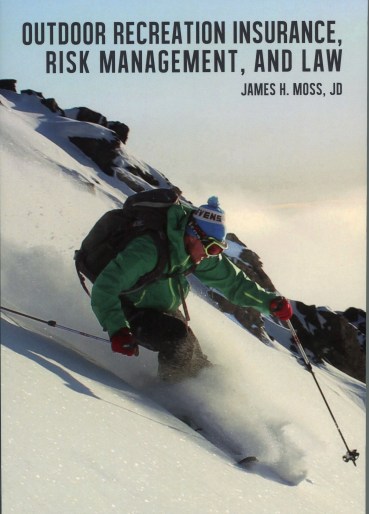
Outdoor Recreation Insurance, Risk Management, and Law
ecreation Insurance, Risk Management and Law.
To see Jim’s complete bio go here and to see his CV you can find it here. To find out the purpose of this website go here.
G-YQ06K3L262
What do you think? Leave a comment.
If you like this let your friends know or post it on FB, Twitter or LinkedIn
Author: Outdoor Recreation Insurance, Risk Management and Law

Outdoor Recreation Insurance, Risk Management and Law
Facebook Page: Outdoor Recreation & Adventure Travel Law
Email: Jim@Rec-Law.US
By Recreation Law Rec-law@recreation-law.com James H. Moss
@2015-2023 Summit Magic Publishing, LLC
#AdventureTourism, #AdventureTravelLaw, #AdventureTravelLawyer, #AttorneyatLaw, #Backpacking, #BicyclingLaw, #Camps, #ChallengeCourse, #ChallengeCourseLaw, #ChallengeCourseLawyer, #CyclingLaw, #FitnessLaw, #FitnessLawyer, #Hiking, #HumanPowered, #HumanPoweredRecreation, #IceClimbing, #JamesHMoss, #JimMoss, #Law, #Mountaineering, #Negligence, #OutdoorLaw, #OutdoorRecreationLaw, #OutsideLaw, #OutsideLawyer, #RecLaw, #Rec-Law, #RecLawBlog, #Rec-LawBlog, #RecLawyer, #RecreationalLawyer, #RecreationLaw, #RecreationLawBlog, #RecreationLawcom, #Recreation-Lawcom, #Recreation-Law.com, #RiskManagement, #RockClimbing, #RockClimbingLawyer, #RopesCourse, #RopesCourseLawyer, #SkiAreas, #Skiing, #SkiLaw, #Snowboarding, #SummerCamp, #Tourism, #TravelLaw, #YouthCamps, #ZipLineLawyer, Equine, Horseback Riding, Fraudulent Misrepresentation, Release, Rescission, Nondisclosure,
Guido et al., v. Koopman, 1 Cal. App. 4th 837; 2 Cal. Rptr. 2d 437; 1991 Cal. App. LEXIS 1425; 91 Daily Journal DAR 15350
Posted: February 28, 2015 Filed under: California, Equine Activities (Horses, Donkeys, Mules) & Animals, Legal Case, Release (pre-injury contract not to sue) | Tags: Equine, Fraudulent Misrepresentation, horseback riding, Nondisclosure, Release, Rescission Leave a commentGuido et al., v. Koopman, 1 Cal. App. 4th 837; 2 Cal. Rptr. 2d 437; 1991 Cal. App. LEXIS 1425; 91 Daily Journal DAR 15350
Diana L. Guido et al., Plaintiffs and Appellants, v. Charles Koopman, Defendant and Respondent.
No. A052006
COURT OF APPEAL OF CALIFORNIA, FIRST APPELLATE DISTRICT, DIVISION FIVE.
1 Cal. App. 4th 837; 2 Cal. Rptr. 2d 437; 1991 Cal. App. LEXIS 1425; 91 Daily Journal DAR 15350
December 12, 1991, Decided
SUBSEQUENT HISTORY: [***1] Review Denied February 26, 1992, Reported at 1992 Cal. LEXIS 2024.
PRIOR HISTORY: Superior Court of the City and County of San Francisco, No. 897795, Stuart R. Pollak, Judge.
COUNSEL: McTernan, Stender & Wash and Marvin Stender for Plaintiffs and Appellants.
Drevlow, Murray & Payne and Mary S. Cain for Defendant and Respondent.
JUDGES: Opinion by Haning, Acting P. J., with King, J., and Poche, * concurring.)
* Associate Justice of the Court of Appeal, First District, Division Four, sitting under assignment by the Chairperson of the Judicial Council.
OPINION BY: HANING, Acting P. J.
OPINION
[*839] [**438] Plaintiffs and appellants Diana L. Guido and Donald Schwartz, a married couple, appeal from a summary judgment, enforcing a release from all liability, in favor of defendant and respondent Charles Koopman, doing business as The Academy of Equestrian Arts (the Academy). Appellants contend the release is unenforceable because it was executed in reliance on respondent’s misrepresentation that it was unenforceable. We affirm.
Facts and Procedural History
Guido [***2] filed her complaint against three groups of defendants for personal injuries allegedly resulting from three separate, sequential accidents during [*840] the summer of 1988: two automobile accidents and a horseback riding accident. These incidents were unrelated, but were joined in the complaint because “[p]laintiff is in doubt as to which of the defendants … she is entitled to redress because there is a question as to which defendant is liable and to what extent for injuries, as she was injured in each incident.” Guido’s husband, Donald Schwartz, filed a separate action for loss of consortium, and the two actions were consolidated.
The summary judgment motion was brought by respondent and is addressed solely to the cause of action against him involving the horseback riding accident.
On September 29, 1987, Guido visited the Academy to inquire about taking horseback riding lessons from respondent. At that time she signed a document entitled “Release,” given to her by respondent. That document reads:
“Release
“I Hereby Release [the Academy], Charles Koopman, Donna Koopman, Managers, Trainers, Instructors and Emplyees [sic] of and From All Claims Which May Hereafter Develop [***3] or Accrue to me on account of, or by Reason of, Any Injury, Loss or Damage, Which May Be Suffered by Me or to Any Property, Because of any Matter, Thing or Condition, Negligence or Default Whatsoever, and I Hereby Assume and Accept the Full Risk and Danger of Any Hurt, Injury or Damage Which May Occur Through or by Reason of Any Matter, Thing or Condition, Negligence or Default, of Any Person or Persons Whatsoever.”
After signing the release, Guido took lessons from respondent, as often as twice a week, until the accident on June 16, 1988, when she allegedly was thrown from one of respondent’s horses.
Respondent’s motion for summary judgment was based, in part, on the ground that the waiver precluded Guido from pursuing any claims against him. The trial court found there was no triable issue of any material fact and granted summary judgment for respondent.
Discussion
[HN1] “[S]ummary judgment shall be granted if all the papers submitted show that there is no triable issue as to any material fact and that the moving party [*841] is entitled to a judgment as a matter of law. …” ( Code Civ. Proc., § 437c, subd. (c).) The issues [**439] presented are whether the release is voidable and, if [***4] so, whether the undisputed facts prevent appellants from avoiding the release.
Appellants advance two theories for avoidance of the release: First, in Guido’s declaration in opposition to respondent’s summary judgment motion, she states: “… I am an attorney. When I signed the release it was my understanding that releases from negligence were against public policy. [P] … [P] … I am not an expert on horses. But I do not think that an inherent risk of horseback riding is being thrown off of a horse ….” Second, although not mentioned in Guido’s declaration, appellants argued to the trial court, as she does on appeal, that respondent told Guido the release was “meaningless.”
(1) With regard to appellants’ initial contention regarding the legality of the release, they are in error. [HN2] Civil Code section 1668 provides: “All contracts which have for their object, directly or indirectly, to exempt anyone from [the] responsibility for his own fraud, or willful injury to the person or property of another, or violation of law, whether willful or negligent, are against the policy of the law.” [HN3] This statute has been interpreted to mean that “a contract exempting from liability for ordinary [***5] negligence is valid where no public interest is involved ….” (1 Witkin, Summary of Cal. Law (9th ed. 1987) Contracts, § 631, p. 569; Tunkl v. Regents of University of California (1963) 60 Cal.2d 92, 97 [32 Cal.Rptr. 33, 383 P.2d 441, 6 A.L.R.3d 693]; Buchan v. United States Cycling Federation, Inc. (1991) 227 Cal.App.3d 134, 148-149 [277 Cal.Rptr. 887].)
[HN4] Public interest or policy is generally defined by the constitution, statutes or judicial precedent. “In placing particular contracts within or without the category of those affected with a public interest, the courts have revealed a rough outline of that type of transaction in which exculpatory provisions will be held invalid. Thus the attempted but invalid exemption involves a transaction which exhibits some or all of the following characteristics. It concerns a business of a type generally thought suitable for public regulation. The party seeking exculpation is engaged in performing a service of great importance to the public, which is often a matter of practical necessity for some members of the public. [***6] The party holds himself out as willing to perform this service for any member of the public who seeks it, or at least for any member coming within certain established standards. As a result of the essential nature of the service, in the economic setting of the transaction, the party invoking exculpation possesses a decisive advantage of bargaining strength against any member of the public who seeks his services. In exercising a superior bargaining power the party confronts the public with a [*842] standardized adhesion contract of exculpation, and makes no provision whereby a purchaser may pay additional reasonable fees and obtain protection against negligence. Finally, as a result of the transaction, the person or property of the purchaser is placed under the control of the seller, subject to the risk of carelessness by the seller or his agents.” ( Tunkl v. Regents of University of California, supra, 60 Cal.2d at pp. 98- 101, fns. omitted.)
(2) There was a time during the development of this nation, particularly during the early westward migration, that one’s survival frequently depended upon a good horse [***7] and the ability to remain in the saddle. Indeed, legend has it that so vital was the horse to our well-being in the American West that horse thieves were routinely hanged, with a dispatch that bore little resemblance to contemporary notions of due process. However, for better or worse, the times have changed, and except for a few working cattle ranches where the cow pony has not been completely replaced by the pickup truck, equestrian activities are largely confined to the entertainment arena.
We are unaware of any constitutional or statutory provision that would place horseback riding within the “public interest” category. Like the court in Buchan, we are also unaware of any case in the sports or recreation field that has voided such a release on public interest or public policy [**440] grounds. ( Buchan v. United States Cycling Federation, Inc., supra, 227 Cal.App.3d at p. 149.) Similar releases have been upheld for activities that are equally, if not more, hazardous than horseback riding, such as bicycle racing (Ibid.), motorcycle dirt bike racing ( Kurashige v. Indian Dunes, Inc. (1988) 200 Cal.App.3d 606 [246 Cal.Rptr. 310]), [***8] white-water rafting ( Saenz v. White-water Voyages, Inc. (1990) 226 Cal.App.3d 758 [276 Cal.Rptr. 672]), scuba diving ( Madison v. Superior Court (1988) 203 Cal.App.3d 589 [250 Cal.Rptr. 299]) and skydiving. ( Hulsey v. Elsinore Parachute Center (1985) 168 Cal.App.3d 333 [214 Cal.Rptr. 194].)
As to appellants’ argument that the release is ineffective because Guido did not think being thrown off a horse was an inherent risk of horseback riding, we are of the contrary view–that it is one of the most obvious risks of that activity, and readily apparent to anyone about to climb on a horse. The cases of injuries from horseback riding are numerous, and we have found none which describe this risk as unexpected or extraordinary. (See, e.g., Palmquist v. Mercer (1954) 43 Cal.2d 92 [272 P.2d 26]; Dorobek v. Ride-A-While Stables (1968) 262 Cal.App.2d 554 [68 Cal.Rptr. 774]; Griffin v. Sardella (1967) 253 Cal.App.2d 937 [61 Cal.Rptr. 834]; [***9] O’Brien v. Gateway Stables (1951) 104 Cal.App.2d 317 [231 P.2d 524].) In fact, Guido admitted she was “bucked” from a different horse a few months before this accident.
[*843] (3a) For their second contention–that respondent advised Guido the release was “meaningless”–appellants rely on Guido’s deposition testimony, submitted by respondent in support of his summary judgment motion. In her deposition Guido testified she “just didn’t feel comfortable signing something that said ‘Release’ on it on the top.” However, she signed it without reading it because respondent advised her, “… It doesn’t mean anything. It is something that I need to have you sign, because my insurance company won’t let me give lessons unless I have people sign this. [P] … As a matter of fact, the insurance company wants me to give the students this long detailed form, which I don’t do, because it scares them away when they see this long, detailed form.”
(4) [HN5] “It is well established that a party to an agreement induced by fraudulent misrepresentations or nondisclosures is entitled to rescind, notwithstanding the existence of purported exculpatory provisions contained [***10] in the agreement. [Citation.]” ( Danzig v. Jack Grynberg & Associates (1984) 161 Cal.App.3d 1128, 1138 [208 Cal.Rptr. 336]; Civ. Code, § 1689, subd. (b)(1).) The representations need not be made with knowledge of actual falsity but also include the “false assertion of [a] fact by one who has no reasonable grounds for believing his own statements to be true, and when made with [the] intent to induce the other to alter his position, to his injury. [Citation.]” ( In re Cheryl E. (1984) 161 Cal.App.3d 587, 599 [207 Cal.Rptr. 728]; Civ. Code, § 1572, subd. 2.)
[HN6] The existence of actual fraud is always a question of fact. ( Civ. Code, § 1574; Blankenheim v. E. F. Hutton & Co. (1990) 217 Cal.App.3d 1463, 1475 [266 Cal.Rptr. 593].) (5) [HN7] Justifiable reliance is an essential element of a claim for fraudulent misrepresentation, and the reasonableness of the reliance is ordinarily a question of fact. ( Seeger v. Odell (1941) 18 Cal.2d 409, 414-415 [115 P.2d 977, 136 A.L.R. 1291]; Danzig v. Jack Grynberg & Associates, supra, 161 Cal.App.3d at p. 1138.) [***11] However, whether a party’s reliance was justified may be decided as a matter of law if reasonable minds can come to only one conclusion based on the facts. (9 Witkin, Cal. Procedure (3d ed. 1985) Appeal, § 289, p. 301.)
(3b) Guido’s deposition testimony on which appellants rely also reveals that she is a practicing attorney and uses releases in her practice. In essence, she is asking this court to rule that a practicing attorney can rely on the advice of an equestrian instructor as to the validity of a written release of liability that she executed without reading. [HN8] In determining whether one can reasonably or justifiably rely on an alleged misrepresentation, the knowledge, education and experience of the person [**441] claiming reliance must be considered. ( Gray v. Don Miller & Associates, Inc. (1984) 35 Cal.3d 498, 503 [*844] [198 Cal.Rptr. 551, 674 P.2d 253, 44 A.L.R.4th 763]; Seeger v. Odell, supra, 18 Cal.2d at p. 415.) Under these circumstances, we conclude as a matter of law that any such reliance was not reasonable.
The summary judgment is affirmed.
[***12] King, J., and Poche, J., * concurred. Appellants’ petition for review by the Supreme Court was denied February 26, 1992.
* Associate Justice of the Court of Appeal, First District, Division Four, sitting under assignment by the Chairperson of the Judicial Council.
Gadman v. Martin, 2014 U.S. Dist. LEXIS 83883
Posted: February 26, 2015 Filed under: Idaho, Legal Case, Minors, Youth, Children, Youth Camps | Tags: assault, Big Sky Summer Adventure Program, Camp, Custody and Control, Explorations, Float Trip, Idaho, LLC., Montana, Phoenix Mountain Collaborative, Run away, Runaway, Summer Camp, Treatment Program, Trout Creek, Youth Camp 3 CommentsTo Read an Analysis of this decision see
Federal Court in Idaho holds camp not liable for assault on third party by runaway minors.
Gadman v. Martin, 2014 U.S. Dist. LEXIS 83883
Vera Gadman, Plaintiff, v. Joseph Martin; Marshall Dittrich; Penelope James; and Phoenix Mountain Collaborative, LLC., Defendants.
Case No. 2:13-CV-00327-EJL
UNITED STATES DISTRICT COURT FOR THE DISTRICT OF IDAHO
2014 U.S. Dist. LEXIS 83883
June 17, 2014, Decided
June 17, 2014, Filed
CORE TERMS: foreseeable, violent, summary judgment, staff, violence, genuine, youth, ran, violent acts, deposition, non-moving, custody, owed, van, issue of material fact, adverse party, citation omitted, propensity, foreseen, commit, runaway, duty of care, undisputed, instructor, detention, outdoor, missing, assault, shoes, violent behavior
COUNSEL: [*1] For Vera Gadman, Plaintiff: James M Bendell, Grupp Law Office, Coeur D’Alene, ID.
For Marshall Dittrich, Defendant: Michael L Haman, LEAD ATTORNEY, Haman Law Office, Coeur d’Alene, ID.
For Penelope James, Phoenix Mountain Collaborative, LLC, Defendants: Mark A Ellingsen, LEAD ATTORNEY, WITHERSPOON KELLEY, Coeur d’Alene, ID.
JUDGES: Honorable Edward J. Lodge, U. S. District Judge.
OPINION BY: Edward J. Lodge
OPINION
MEMORANDUM DECISION AND ORDER
INTRODUCTION
Pending before the Court in the above-entitled matter are Defendants’, Phoenix Mountain Collaborative, LLC and Penelope James, Motion for Summary Judgment and related Motions. The parties have filed their responsive briefing and the matters are ripe for the Court’s consideration.1 Having fully reviewed the record, the Court finds that the facts and legal arguments are adequately presented in the briefs and record. Accordingly, in the interest of avoiding further delay, and because the Court conclusively finds that the decisional process would not be significantly aided by oral argument, this matter shall be decided on the record before this Court without oral argument.
1 Mr. Dittrich filed a response to Plaintiff’s opposition to the Motion for Summary Judgment wherein [*2] he takes no position on the Motion but responds only to clarify the record. (Dkt. 17.)
FACTUAL AND PROCEDURAL BACKGROUND
In the summer of 2011, Defendants Joseph Martin and Marshall Dittrich were participants in a 52-day outdoor program known as the Big Sky Summer Adventure Program operated by Explorations in Trout Creek, Montana. Explorations is an entity that offers both full time residential programs and summer outdoor adventure programs for youths who may have struggled in the past either academically, socially, with interpersonal relationships, or with substance use/experimentation issues. Explorations also offers counseling sessions and life skills training. Explorations is owned and operated by Defendant Phoenix Mountain Collaborative, LLC.2 The Defendant Penelope James is the managing member of Explorations who reviews the applications for enrollment at Explorations’ camps.
2 The Court will refer to Phoenix Mountain Collaborative, LLC as “Explorations” in this Order. The Court also refers to both Ms. James and Explorations collectively as “Explorations” in this Order.
On July 29, 2011, the Explorations outdoor program was finishing a float trip down the Clark Fork River which runs [*3] from Montana to Idaho. That evening, around 10:00 p.m., the students and staff camped out on the Explorations’ property. The next morning around 8:00 a.m., an Explorations’ staff member noticed Mr. Martin and Mr. Dittrich were missing. A search was conducted but the boys were not found on the property. At 9:30 a.m. Ms. James notified local law enforcement and the boys’ parents that they had run away and were missing.
The location of the two boys was not known until July 31, 2011. On that day the Plaintiff, Vera Gadman, was driving her vehicle in Clark Fork, Idaho when she saw Mr. Martin and Mr. Dittrich, hitchhiking along Highway 200. Ms. Gadman stopped her car and offered them a ride. The boys asked Ms. Gadman to take them somewhere they could camp. After driving to a couple of locations, Ms. Gadman stopped at the east end of David Thompson Road and showed the boys where they could camp on a map. At that stop, Mr. Martin and Mr. Dittrich then brutally assaulted and battered Ms. Gadman including allegedly choking, strangling, and striking her in the head with a glass bottle, throwing and striking her with rocks, and committing other acts of violence and terror against her. (Dkt. 1 at [*4] ¶ 13.) As a result, Ms. Gadman claims she suffered serious physical and emotional injuries and incurred significant damages. Ms. Gadman has filed this action raising a negligence claim against the Defendants seeking to recover for the damages she suffered from the attack. Defendants Exploration and Ms. James have filed this Motion for Summary Judgment which the Court takes up in this Order.
STANDARD OF REVIEW
Motions for summary judgment are governed by Rule 56 of the Federal Rules of Civil Procedure. Rule 56 provides, in pertinent part, that judgment “shall be rendered forthwith if the pleadings, depositions, answers to interrogatories, and admissions on file, together with the affidavits, if any, show that there is no genuine issue as to any material fact and that the moving party is entitled to judgment as a matter of law.” Fed. R. Civ. P. 56(c).
The Supreme Court has made it clear that under Rule 56 summary judgment is mandated if the non-moving party fails to make a showing sufficient to establish the existence of an element which is essential to the non-moving party’s case and upon which the non-moving party will bear the burden of proof at trial. See Celotex Corp. v. Catrett, 477 U.S. 317, 322, 106 S. Ct. 2548, 91 L. Ed. 2d 265 (1986). [*5] If the non-moving party fails to make such a showing on any essential element, “there can be no ‘genuine issue of material fact,’ since a completely failure of proof concerning an essential element of the nonmoving party’s case necessarily renders all other facts immaterial.” Id. at 323.3
3 See also, Rule 56(e) which provides, in part: When a motion for summary judgment is made and supported as provided in this rule, an adverse party may not rest upon the mere allegations or denials of the adverse party’s pleadings, but the adverse party’s response, by affidavits or as otherwise provided in this rule, must set forth specific facts showing that is a genuine issue for trial. If the adverse party does not so respond, summary judgment, if appropriate, shall be entered against the adverse party.
Moreover, under Rule 56, it is clear that an issue, in order to preclude entry of summary judgment, must be both “material” and “genuine.” An issue is “material” if it affects the outcome of the litigation. An issue, before it may be considered “genuine,” must be established by “sufficient evidence supporting the claimed factual dispute . . . to require a jury or judge to resolve the parties’ differing [*6] versions of the truth at trial.” Hahn v. Sargent, 523 F.2d 461, 464 (1st Cir. 1975) (quoting First Nat’l Bank v. Cities Serv. Co. Inc., 391 U.S. 253, 289, 88 S. Ct. 1575, 20 L. Ed. 2d 569 (1968)). The Ninth Circuit cases are in accord. See, e.g., British Motor Car Distributors, Ltd. v. San Francisco Automotive Industries Welfare Fund, 882 F.2d 371 (9th Cir. 1989).
According to the Ninth Circuit, in order to withstand a motion for summary judgment, a party
(1) must make a showing sufficient to establish a genuine issue of fact with respect to any element for which it bears the burden of proof; (2) must show that there is an issue that may reasonably be resolved in favor of either party; and (3) must come forward with more persuasive evidence than would otherwise be necessary when the factual context makes the non-moving party’s claim implausible.
Id. at 374 (citation omitted).
Of course, when applying the above standard, the court must view all of the evidence in the light most favorable to the non-moving party. Anderson v. Liberty Lobby, Inc., 477 U.S. 242, 255, 106 S. Ct. 2505, 91 L. Ed. 2d 202 (1986); Hughes v. United States, 953 F.2d 531, 541 (9th Cir. 1992).
ANALYSIS
1. Motion for Extension of Time to File Statement of Genuine issues of Fact
Plaintiff’s Motion asks [*7] for leave of the Court to file a late Statement of Genuine Issues of Fact in response to the Motion for Summary Judgment. (Dkt. 23.) Plaintiff mistakenly failed to file the Statement of Fact as required by the rules. Defendants oppose the Motion arguing the proposed Statement of Facts fails to satisfy the requirements of Federal Rule of Civil Procedure 56(c) and Local Civil Rule 7.1. (Dkt. 24.) The Court has reviewed the briefing and materials on this issue and will grant the Plaintiff’s Motion and allow her to file the late Statement of Facts. While the filings is untimely, the Court finds the interests of justice are best served by deciding the Motion for Summary Judgments on its merits and there is little prejudice suffered by Defendants as a result of the late filing.
2. Defendants’ Motion for Summary Judgment
Explorations and Ms. James seek dismissal of the negligence claim against them arguing 1) they owed no duty to Ms. Gadman and 2) the actions of Mr. Dittrich and Mr. Martin were not foreseeable to either Explorations or Ms. James. (Dkt. 16.) Ms. Gadman opposes the Motion and asserts that a genuine issue of material fact exists as to whether Explorations and/or Ms. James owed [*8] a duty to her. (Dkt. 19.)
On the question of whether Ms. James and/or Explorations owed a duty of care to Ms. Gadman under Idaho law, both parties cite to and discuss Caldwell v. Idaho Youth Ranch, Inc., 132 Idaho 120, 968 P.2d 215 (Idaho 1998) but arrive at opposite conclusions. In Caldwell, the Idaho Supreme Court held that the Idaho Youth Ranch did not owe a duty of care to a third-party for the violent acts committed upon the third-party by a minor who had, several months prior, been released from an Idaho Youth Ranch program. There the court concluded that the minor was not in the custody or control of the Youth Ranch at the time he committed the violent acts upon the third-party.
In reaching this conclusion, the Idaho Supreme Court discussed the “duty owed by those in charge of persons who are dangerous or who have dangerous propensities,” quoting the duty is as described in the Restatement (Second) of Torts, § 319, which provides:
§ 319. Duty of Those in Charge of Person Having Dangerous Propensities. One who takes charge of a third person whom he knows or should know to be likely to cause bodily harm to others if not controlled is under a duty to exercise reasonable care to control the third [*9] person to prevent him from doing such harm.
Caldwell, 968 P.2d at 218 (quoting Restatement (Second) of Torts, § 319 (1977)). The court then identified the two components of the duty:
The first part requires a determination of whether the supervising body actually has control over the individual in question, and then secondly, if so, a determination must be made whether the harm caused by the individual was foreseeable.
Id. at 218-19. The parties in this case dispute both components — whether Ms. James/Explorations had control over the boys and whether the harm caused by the boys was foreseeable.
A. Control
“No liability exists under the law of torts unless the person from whom relief is sought owed a duty to the allegedly injured party.” Jones v. Starnes, 150 Idaho 257, 245 P.3d 1009, 1012 (Idaho 2011) (quoting Vickers v. Hanover Constr. Co., Inc., 125 Idaho 832, 875 P.2d 929, 932 (Idaho 1994)). “Ordinarily, ‘there is no affirmative duty to act to assist or protect another absent unusual circumstances, which justifies imposing such an affirmative responsibility. An affirmative duty to aid or protect arises only when a special relationship exists between the parties.'” Rees v. State, Dept. of Health and Welfare, 143 Idaho 10, 137 P.3d 397, 402 (Idaho 2006) [*10] (quoting Coghlan v. Beta Theta Pi Fraternity, 133 Idaho 388, 987 P.2d 300, 311 (1999)) (citations omitted). “Determining when a special relationship exists sufficient to impose an affirmative duty requires an evaluation of ‘the sum total of those considerations of policy which lead the law to say that a particular plaintiff is entitled to protection.'” Id. (quoting Coghlan, 987 P.2d at 311 (quoting W. Prosser, Law of Torts 333 (3d ed. 1964))).
The general duty which arises in many relations to take reasonable precautions for the safety of others may include the obligation to exercise control over the conduct of third persons…. [Some] relationships are custodial by nature, requiring the defendant to control his charge and to guard other persons against his dangerous propensities…. The same rule has been applied to hospitals and psychotherapists who have charge of dangerous mental patients, and to those who have charge of dangerous criminals. … Yet, in the absence of the requisite relationship, there generally is no duty to protect others against harm from third persons.
Caldwell, 968 P.2d at 218 (quoting Sterling, 723 P.2d at 768-69) (citation omitted). “[T]he key to this duty is the supervising [*11] individual’s relationship to the supervised individual, rather than a direct relationship with the endangered person or class of persons.” Caldwell, 968 P.2d at 218 (discussing Sterling v. Bloom, 111 Idaho 211, 723 P.2d 755, 769 (Idaho 1986) superseded in part on other grounds by Idaho Code § 6-904A)). Thus, the duty alleged in this case would have to arise from a supervisory relationship where Ms. James/Explorations exercised some level of control over Mr. Martin and Mr. Dittrich.
The parties in this case disagree on the level of “control” Explorations had over the youths. Explorations argues that it provides “recreational programs and counseling for children” but maintains it is “not a state run juvenile detention center or institution.” (Dkt. 16 at 1, 9.) Participation in Exploration is voluntarily and there is no physical detention or connection to the criminal justice system. (Dkt. 16 at 2, 9.) Explorations’ briefing argues that the attendees may leave the Exploration program at any time. (Dkt. 16 at 9.)
Ms. Gadman counters that Explorations and Ms. James exercised supervisory control over the students such that a special relationship was formed which gives rise to a duty. (Dkt. 19.) Ms. Gadman [*12] points out that Ms. James testified in her deposition that students are not free to leave Explorations once they are enrolled, there had been kids in the past who had ran away from camp but were caught, and described the procedures Explorations had in place for preventing kids from escaping.
The Court finds facts in this case are distinct from those in Caldwell where it was undisputed that the violent offender had been released from the Idaho Youth Ranch several months before committing the murder. There the Idaho Supreme Court found the Idaho Youth Ranch did not have control over the offender such that a duty of care was owed. In contrast here, Explorations did have control over Mr. Martin or Mr. Dittrich and had not released them from its custody — they ran away.
Although it is not akin to a juvenile detention facility, Explorations was responsible for the care and custody of the youth participants in its programs. The minor participants could not leave the program without their parents’ permission. When asked if the participants of the outdoor program were “free to leave,” Ms. James stated in her deposition that participants who were minor could only leave if they had their parents’ [*13] permission, otherwise they were not free to leave.4 (Dkt. 19-10 at 12.) Ms. James went on to state that the steps taken to assure participants do not leave are that “care is provided, oversight and care, with our instructor team the entire time the students are there.” (Dkt. 19-10 at 13.)
4 Both Mr. Martin and Mr. Dittrich were seventeen at the time they were at Explorations.
Participants have ran away from Explorations in the past. Explorations has run away prevention measures called “Run Watch” which are written set of procedures and guidelines designed for responding to a runaway or missing student. (Dkt. 19-10 at 28-29) (Dkt. 19-6, Ex. F.) The Run Watch Policy states: “Explorations will take all reasonable precautions pertinent to each individual student so as to reduce the possibility of their escape from our custody.” (Dkt. 19-10 at 30) (Dkt. 19-6, Ex. F.) Under the Run Watch guidelines, one instructor in each group has a “run kit” which is intended to provide the instructor in pursuit of the student with whatever equipment that would be necessary to ensure the safety of the instructor. (Dkt. 19-10 at 30) (Dkt. 19-6, Ex. F.) A student is placed on Run Watch when: the student just [*14] had a run attempt; the student verbalized a threat to do so; the instructional team perceives a student to be a run threat; or escorts, operations directors, or a therapist suggests it. (Dkt. 19-6, Ex. F.) Explorations also has written procedures for handling the situations involving an “Accompanied Runaway” and an “Unaccompanied Runaway/Missing Student.” (DKt. 19-6, Ex. F.)
In this case, Explorations was aware the boys had planned to leave and actually took measures to thwart their plan by taking their shoes and journals. When their shoes were later returned, the boys executed their plan to run away from Explorations. The attack upon Ms. Gadman occurred two days after the boys left Explorations. While Explorations may not be akin to a juvenile detention facility, it is in charge of the custody and care of the children who are participating in its programs. This includes more than merely providing shelter, food, and programing. The relationship between Explorations and Mr. Dittrich and Mr. Martin was custodial. The Court finds upon these undisputed facts that Mr. Martin and Mr. Dittrich were in the custody and control of Explorations at the time of the attack. The Court next considers [*15] the second duty requirement: whether the harm caused by the individual was foreseeable.
B. Foreseeable Actions
“The question whether a risk of harm is foreseeable is generally a question for the trier of fact. Summary judgment is appropriate, however, if evidence is presented establishing the absence of any genuine issue of material fact concerning the general risk of harm.” Caldwell, 968 P.2d at 220 (citation omitted). Under the Idaho Tort Claims Act, “Foreseeability, ‘contemplates more than the mere possibility of aggressive tendencies…. The concept of foreseeability is much more narrowly drawn in this circumstance, … i.e. violence, particularly of a sexual nature, toward members of the public … must be manifest or ostensible, and highly likely to occur.'” Caldwell, 968 P.2d at 220 (quoting Harris v. State Dep’t of Health and Welfare, 123 Idaho 295, 847 P.2d 1156, 1160 (Idaho 1992)). In Caldwell, the Idaho Supreme Court recognized that “human behavior is difficult to predict with certainty, leading to the necessity for claimants to demonstrate that the harmful behavior should have been highly predictable based upon demonstrated past conduct.” 968 P.2d at 220 (citing cases).
Ms. Gadman argues [*16] Mr. Martin’s and Mr. Dittrich’s violent acts were foreseeable because both had a prior history of drug abuse and had previously attended treatment programs. (Dkt. 19.) Mr. Dittrich had also previously ran away from home and his school records include a history of “explosive and unpredictable behavior.” While at Explorations, Ms. Gadman points out that Mr. Martin had stole medications from an unlocked Explorations travel van which he ingested and then went an entire week without sleeping causing him to behave erratically and hallucinate. These factors known to Explorations, she argues, made their attack on her foreseeable.
i. Mr. Martin’s and Mr. Dittrich’s Prior Histories
Prior to attending Explorations, Mr. Martin had serious substance abuse issues that his parents knew of and he had been enrolled in different treatment programs. (Dkt. 19-8 at 7-16, 32-33.) Explorations and Ms. James were aware of Mr. Martin’s prior drug problems. In his deposition, Mr. Martin testified that after arriving at Explorations he talked with Ms. James about the problems that had brought him to the program including his prior drug use. (Dkt. 16-4 at 33-34.) Mr. Dittrich also had behavior issues having been [*17] previously kicked out of school, ran away from home, and had also previously attended treatment programs. (Dkt. 19-9 at 7-9.)
Prior to the assault on Ms. Gadman, however, neither Mr. Martin nor Mr. Dittrich had any criminal history. (Dkt. 16-4 at 39, 54) (Dkt. 18 at 56.) Mr. Martin testified in his deposition that he was “unaware” he had any type of propensity for violent behavior prior to the attack and stated he had never been violent before the incident with Ms. Gadman. (Dkt. 16-4 at 39-40.) Mr. Dittrich testified that neither he nor his parents ever told Explorations about any propensity for violence. (Dkt. 18 at 57.)
Although the boys had struggled in various aspects of their lives before attending Explorations, there is nothing in their histories that was known to Explorations that made their actions on July 31, 2011 foreseeable. (Dkt. 16-2, Aff. James.)
ii. Conduct at the Explorations Program
a. No Violent or Threatening Behavior
There is no evidence that either Mr. Martin or Mr. Dittrich engaged in any threatening or violent actions while at Explorations. In his deposition, Mr. Martin denied having committed any violent acts or threatening anyone while at the Explorations camp. [*18] (Dkt. 16-4 at 40-41.) Mr. Martin also testified he never observed Mr. Dittrich commit any violent acts or threaten anyone while he was at Explorations. (Dkt. 16-4 at 41.) In her affidavit, Ms. James states that she had not witnessed and there had been no reports that either boy had demonstrated any acts of aggression or violence to anyone at Explorations. (Dkt. 16-2 at ¶¶ 12-14.)
b. Mr. Martin’s Theft of Drugs
When he arrived at Explorations, Mr. Martin had been off drugs for less than two months. (Dkt. 16-4 at 46-47.) Mr. Martin stated he began using drugs again within a few days of being at Explorations by taking drugs located in the Explorations van. (Dkt. 16-4 at 18-19, 47-48, 62-63.) The Explorations’ staff learned that someone had taken drugs from the van and they confronted the group about it. (Dkt. 19-8 at 49-52.) At that time, Mr. Martin denied taking the drugs but testified that a couple of days before he ran away from camp he vaguely told one of the staff members that he had taken the drugs from the van and was “freaking out,” or “bugging out a little” and “hearing things.” (Dkt. 19-8 at 50-52, 64, 70.) Ms. James also testified that Mr. Martin had admitted to stealing pills [*19] from the Explorations van approximately ten days before he walked away from the program. (Dkt. 19-10 at 55-56.) Ms. James testified that after Mr. Martin admitted to taking the pills, she assumed that someone had ingested the pills. (Dkt. 19-10 at 106.) Mr. Martin testified that he had taken the drugs before Explorations knew of the boys’ plan to runaway. (Dkt. 19-10 at 97.)
The theft and taking of the medications from the Explorations’ van does not make the violence committed upon Ms. Gadman foreseeable. Clearly Mr. Martin’s behavior was out of line, but there were no indications that he would soon become aggressively violent such that the actions he took on July 31, 2011 were foreseeable to Explorations.5
5 In support of her response brief, Ms. Gadman has filed articles discussing the side effects of the drug Adderall, lack of sleep, and the connection between drugs and violence. (Dkt. 19, Ex. A, B, C.) Defendants have objected to the Court’s consideration of these exhibits arguing they are inadmissible. The Court agrees that the articles are not appropriate for consideration pursuant to Federal Rule of Civil Procedure 56(c).
As to the fact that Mr. Martin was hallucinating from the [*20] drugs, again the Court finds the undisputed facts do not give rise to anything that would have made Mr. Martins’ later violent actions foreseeable. Mr. Martin testified that after he had lied to the Explorations’ staff and repeatedly denied being the one who took the drugs, a day or two before they ran away he “mentioned” to staff that he was “freaking out” and “bugging out.” (Dkt. 19-8 at 51-53.) In describing what he told the Explorations’ staff, Mr. Martin testified that he “wouldn’t even call it a conversation. I mentioned I was freaking out a little” and that he “didn’t tell them I needed anything. I didn’t ask for help.” (Dkt. 19-8 at 52-53.) There is simply no basis from these facts from which Explorations could have predicted Mr. Martin would soon commit the violent assault upon Ms. Gadman. The fact that he stole drugs, ingested them, and was experiencing the side effects of the drugs does not make it highly predictable or likely that he would become violent; particularly since there was no known history of any violent behavior either prior to Mr. Martin attending Explorations program or while he was at the program.
c. The Plan to Run Away
Explorations’ field staff had learned [*21] of Mr. Dittrich’s and Mr. Martin’s plan to runaway on either July 19th or 20th. (Dkt. 19-10 at 40, 96.) Once they learned of the boys’ plan to leave, the Explorations’ staff confronted the boys about their plan and then instituted a lockdown. (Dkt. 19-8 at 22, 70-71) (Dkt. 19-9 at 19.) During the lockdown the two were separated in the campsite, the staff took away their shoes and journals, and did not allow them to talk to anyone else. (Dkt. 19-9 at 19.) Mr. Dittrich testified that they were later given back their shoes to use on the white-water rafting trip. (Dkt. 19-9 at 30-31.)
That they had planned to run away from Explorations and find drugs does not make their subsequent violent attack upon Ms. Gadman foreseeable. If anything, the plan and the drug use without any violence was consistent with the boys’ known histories. Ms. Gadman asserts that the violence was foreseeable because the boys would necessarily have to steal in order to obtain the drugs and other life necessities. The Court finds that argument is too speculative. In fact just the opposite proved to be true in light of the fact that the boys were given rides and marijuana from others when they were on the run all without [*22] them having to commit any violent acts. (Dkt. 19-9 at 37.)
Ms. Gadman also argues Mr. Dittrich’s second journal contained a list of items and supplies they would need when they left the program making the resulting assault foreseeable. (Dkt. 19 at 15.) (Dkt. 19-9 at 20-30, 78.) Mr. Dittrich testified that the staff at Explorations was not aware of his list. (Dkt. 18 at 78.) He further stated that the references to a knife, gun, and weapon in general were not intended to be used as a weapon against another person but for protection. (Dkt. 18 at 79-81.) Ms. Gadman asserts the staff should have looked at Mr. Dittrich’s second journal and discovered the “disturbing information.” (Dkt. 19 at 15.) This argument is also too speculative. The journal entries were started two to four days before the boys ran away and then later completed after the boys had left Explorations. (Dkt. 19-9 at 29.) While it may seem obvious in hindsight to argue that Explorations should have looked at Mr. Dittrich’s second journal, the fact remains that Explorations was not aware of the journal entries and there are no facts going to show that they should have foreseen any future violent acts by these boys.
C. [*23] Conclusion
The Court finds there is no genuine issue of material fact that supports a finding that Explorations and/or Ms. James could have foreseen the violent attack committed upon Ms. Gadman. Even considering the cumulative facts known by Explorations — i.e. the boys’ prior history, Mr. Martin’s theft and use of the drugs while at the camp, and their plan to run away — the violent assault on Ms. Gadman was not foreseeable. It is simply too attenuated to expect Explorations to have foreseen the attack based on what they knew about the boys prior to their running away.
Neither boy had any history of violent behavior or any criminal history. In reviewing both boys’ applications, Ms. James interviewed each of the boys’ parents, therapists, and educational consultants. None of these contacts conveyed any concerns that either boy was violent, likely because neither boy had any prior history of violence. While at Explorations, the boys did not commit any acts of violence or demonstrate any aggression. Although Explorations was aware of Mr. Martin’s history of substance abuse, that fact, even when considered in the context of the totality of the circumstances known by Explorations, does not [*24] make his later violent actions foreseeable. As to the fact that one of Mr. Dittrich’s schools had scored him at the highest end of “explosive and unpredictable behavior,” that notation was made eleven years before he attended the Explorations program. (Dkt. 19-10 at 80.) The Court finds the undisputed facts establish that the boys’ violent attack was not highly predictable or likely and, therefore, was not foreseeable. See Caldwell, 968 P.2d at 220.
It is notable that at the time they left the program the boys themselves had not even decided where they were going let alone contemplated attacking anyone. Mr. Martin testified that when they left Explorations his intention was just to get to a city so he could use drugs again but denied he had any intention of committing violence on anyone. (Dkt. 16-4 at 42.) It was not until after the boys had left Explorations that they discussed stealing a car and assaulting someone to get a car. (Dkt. 16-4 at 43-44.) If they themselves did not know or had not yet decided to commit a violent action, there certainly is no way the staff at Explorations could have foreseen the actions such that anyone could say the violence was “highly likely to occur.” [*25] Caldwell, 968 P.2d at 220 (citation omitted). Because there is no genuine issue of material fact in dispute that show Explorations and/or Ms. James could have foreseen the violent actions of Mr. Martin and Mr. Dittrich, the Court finds they did not owe a duty of care to Ms. Gadman. The Motion for Summary Judgment is granted.
ORDER
NOW THEREFORE IT IS HEREBY ORDERED as follows:
1) Plaintiff’s Motion to Extend Time (Dkt. 23) is GRANTED.
2) Defendants’ Motion for Summary Judgment (Dkt. 16) is GRANTED. The claim against Defendants Phoenix Mountain Collaborative, LLC and Penelope James is HEREBY DISMISSED.
DATED: June 17, 2014
/s/ Edward J. Lodge
Honorable Edward J. Lodge
U. S. District Judge
G-YQ06K3L262


 Recreation Law