
Surfboarder who cut off another Surfboarder already in the wave is protected by the defense of Primary Assumption of the Risk
Posted: May 20, 2024 Filed under: Assumption of the Risk, California, Paddlesports | Tags: assumption of the risk, Etiquette, Long Board, Surfer, Surfing Leave a commentUnwritten rules of surfing etiquette are not rules of surfing. When you see other surfers breaking those rules all the time, you can’t complain when you are injured by someone breaking the rules.
Olson v. Saville, 2d Civ. B324465 (Cal. App. Jan 17, 2024)
State: California; California Court of Appeals, Second District, Sixth Division
Plaintiff: Mark Olson
Defendant: Patrick Saville
Plaintiff Claims: Negligence
Defendant Defenses: Primary Assumption of the risk
Holding: for the defendant
Year: 2024
Summary
The court found the plaintiff assumed the risk in surfing when the plaintiff admitted seeing other surfers do the things the defendant alleged did to the plaintiff which the plaintiff complained about in his lawsuit. In California, assumption of the risk can be decided by the court and stop a negligence claim.
Facts
Appellant and respondent were surfing in a group at Miramar Beach in Montecito. Respondent was riding a custom longboard without a leash. Appellant caught a wave. Respondent then “appeared out of nowhere” and “dropped in” on the wave without looking in appellant’s direction. This forced appellant “to make a fast turn correction to his left toward the beach” and to “exit into the white water to his left.” Appellant “grabbed both [of] his board rails (aka sides) and pushed himself and the nose of the board slightly down and into the foam pile of whitewater toward the deeper water and away from respondent.” Respondent was still standing on his board heading toward the shore. As appellant made his exit and ducked into the wave, respondent’s board propelled backward and struck appellant’s torso and back.
Appellant sued respondent for negligence. He alleged that respondent “intentionally entered the wave and intentionally cut off appellant’s path of travel, thereby forcing appellant to exit the wave.” He further alleged that respondent’s “failure to use a leash to control [his] longboard” and his use of a “sharpened and deadly fin” was “reckless and displayed a w[a]nton disregard for the safety of others.” Respondent moved for summary judgment on the ground that appellant’s cause of action was barred under the primary assumption of risk doctrine. The trial court granted the motion, finding “the inherent risks of the sport of surfing include surfers ‘dropping in’ on other surfers, not wearing leashes while riding longboards of the type used by respondent, and using surfboards that have sharp fins.”
Analysis: making sense of the law based on these facts.
This was a simple analysis of the risk of Surfing. It was also an argument between two experts and ended being about who did the better job of explaining their position. To some extent, there was also the issue of the plaintiff’s arguments was tenuous at best.
Since the 1992 decision in Knight v. Jewell, 3 Cal. 4th 296; 834 P.2d 696; 11 Cal. Rptr. 2d 2; 1992 Cal. LEXIS 3969; 92 Cal. Daily Op. Service 7261; 92 Daily Journal DAR 11765; 92 Daily Journal DAR 11870 California has maintained that sports and recreational activities have risks and removing those inherent risks from the sport destroys the sport. Thus, you assume the risk of the sport when you engage in the sport or activity.
Here, the plaintiff argued the defendant was negligent in his surfing and those actions gave rise to the plaintiff’s injuries. The defense argued the Plaintiff assumed the risk.
Under California law for a defendant to prove the Plaintiff assumed the risk the defendant must:
A defendant seeking summary judgment on the basis of primary assumption of the risk must establish ‘that the defendant owed no legal duty to the plaintiff to prevent the harm of which the plaintiff complains.’ If the defendant meets this burden, the burden of production shifts to the plaintiff to “set forth the specific facts showing that a triable issue of material fact exists.”
During a trial, there is a burden on one or the other parties. Usually, the burden starts with the plaintiff who must prove the elements of their claim. If the plaintiff is arguing negligence, the burden is on the plaintiff to prove there was a Duty, the defendant breached that Duty, the Plaintiff was injured and that injury can be reduced to damages the court can award. If the plaintiff proves those four elements of negligence, then the burden shifts to the defendant. The defendant’s burden is either to prove the Plaintiff was wrong about the negligence claim or there was a defense such as assumption of the risk so the defendant had no duty to the plaintiff.
In this case, a motion is being argued and there is still a burden on both parties. Here the court defined assumption of the risk and when the burden shifted from one party to the other. the defendant met its duty and proved the plaintiff assumed the risk. If the defendant proved assumption of the risk, the burden then shifted to the plaintiff because there were facts still in dispute to the case would go to trial.
The burden on the plaintiff was to prove a triable issue of fact. Something in dispute that cannot be decided in a motion, but only by the jury.
There is a triable issue of material fact if, and only if, the evidence would allow a reasonable trier of fact to find the underlying fact in favor of the party opposing the motion in accordance with the applicable standard of proof
The court then explored assumption of the risk under California law.
The primary assumption of risk doctrine “precludes liability for injuries arising from those risks deemed inherent in a sport.” It “rests on a straightforward policy foundation: the need to avoid chilling vigorous participation in or sponsorship of recreational activities by imposing a tort duty to eliminate or reduce the risks of harm inherent in those activities. It operates on the premise that imposing such a legal duty ‘would work a basic alteration-or cause abandonment’ of the activity.” The doctrine applies both to sports and recreational activities “‘involving an inherent risk of injury to voluntary participants . . . where the risk cannot be eliminated without altering the fundamental nature of the activity.
If the plaintiff assumes the risk, there is no duty on the defendant to protect the plaintiff from the risks, the plaintiff assumes.
[D]efendants generally do not have a duty to protect the plaintiff from the risks inherent in the sport, or to eliminate risk from the sport, although they generally do have a duty not to increase the risk of harm beyond what is inherent in the sport.
The removal of the duty goes so far that there is no duty short of intentionally injuring or the defendant’s conduct is so reckless to be outside the ordinary risks of the activity.
A coparticipant breaches this duty only if he “intentionally injures another player or engages in conduct that is so reckless as to be totally outside the range of the ordinary activity involved in the sport.
What defines risk in a sport or activity. According to the court:
“[C]onduct is within the range of ordinary activity involved in a sport if that conduct cannot be prohibited without deterring vigorous participation in the sport or otherwise fundamentally altering the nature of the sport.” Determining the nature of a defendant’s legal duty (and the inherent risks that flow from the activity) “depends heavily on the nature of the sport itself.
Under California law, for a judge to decide that the plaintiff assumed the risk based on both case law and their own experience as well as any expert witness opinions.
Judges deciding inherent risk questions under Knight may consider not only their own or common experience with the recreational activity involved but may also consult case law, other published materials, and documentary evidence introduced by the parties on a motion for summary judgment.” Courts generally do not consider the legal conclusions of expert declarations but can receive “expert testimony on the customary practices in an arena of esoteric activity for purposes of weighing whether the inherent risks of the activity were increased by the defendant’s conduct.’
Rarely is a judge’s personal experience allowed to influence an opinion.
In this case, the court compared the risks of surfing to the risks of snow skiing. Skiing had been declared a sport where the plaintiff assumed the risk of the sport so the comparison was valid based on the prior case law.
California courts have applied the doctrine to coparticipants in a variety of sports, such as snow skiing and other non-contact sports, but not yet to surfing [holding the doctrine barred a skier’s negligence claim against another skier who unintentionally injured him in a collision]; [extending the doctrine to apply to the non-contact sport of golf].) We note that snow skiing and surfing have much in common: (1) “both sports involve individual participants that use nature, either a mountain slope or wave, as a propulsion mechanism”; “[b]oth require similar equipment in the form of skis, snowboard, or surfboard to participate”; and (3) “the most important similarity between skiing and surfing is the use of the right-of-way custom to promote safety and order among participants.
In this case, the opinions of the plaintiff’s expert witness and the defendant’s expert witness had similar opinions about the risks of surfing, which did not bode well for the plaintiff.
The plaintiff’s expert brought in the phrase “surfing etiquette” which are “unwritten safety customs and practices“. However, the expert went on to say that surfers violated the rules all the time. Longboard surfers, of which the defendant was one, regularly surfed without a leash.
…[t]hese rules encompass such things as priority, right-of-way, and sharing waves.” Nonetheless, “violating this surfing etiquette is common among surfers.” He further opined it is “not uncommon for surfers to surf without a leash” and “[m]any longboard surfers particularly enjoy the challenge and freedom of surfing without a leash” which otherwise could interfere with their footwork and speed.
It was easy to find the plaintiff’s injuries arose from the risks of surfing.
The court then examined the plaintiff’s claim that the defendant acted “Recklessly or Increased the Inherent Risks of Surfing’” Proving this would shift the burden to the defendant to prove his actions were not reckless or increased the risk, which would eliminate the defense of assumption of the risk.
However, that failed. Proving the defendant did not meet some unwritten rules, did not prove the defendant acted recklessly or increased the risk to the plaintiff.
Showing respondent could have acted with more caution does not establish he acted recklessly. Reckless conduct is more than “‘”inadvertence”‘” or “‘”a failure to take precautions.”‘ It requires a “‘”deliberate disregard” of the “high degree of probability”‘” that an injury will occur. Although both experts acknowledged respondent may not have followed the rules of etiquette, we are wary of relying too heavily on such guidelines when defining the scope of an activity’s inherent risks.
The plaintiff had admitted that he had seen other surfers do all the things that he claimed the plaintiff had done to bar the defense of assumption of risk. Consequently, the court held the plaintiff had assumed the risk.
The undisputed evidence here showed that failure to follow the rules of etiquette is common in the surfing community. Appellant admitted: (1) he has witnessed other surfers riding a longboard without a leash; (2) a leash could obstruct some movement of an advanced surfer; (3) he has witnessed prior collisions between surfers; (4) he has witnessed another surfer failing to maintain control of their board; and (5) he personally has had surfers “drop-in” or “shoulder-hop” on his wave. Respondent’s similar conduct, it follows, was not reckless or outside the range of the ordinary activity in surfing.
If you see others taking risky actions, that is proof you know the risks. If you then go surfing, that is proof you assumed the risks. The plaintiff assumed the risks of surfing and the defendant did not owe the plaintiff a duty.
So Now What?
In most states, assumption of the risk is a valid defense to a negligence claim. In a few states, assumption of the risk is still merged with contributory negligence and only reduces the damages and does not preclude a claim.
In a few states, the courts are allowed to make decisions on assumption of the risk, which is usually reserved for the jury, the trier of fact, if either the jury could not find anything but assumption of the risk or the experience of the court and case law show the actions of the plaintiff proved he or she assumed the risk.
What do you think? Leave a comment.
 Jim Moss |
Jim Moss is an attorney specializing in the legal issues of the outdoor recreation community. He represents guides, guide services, and outfitters both as businesses and individuals and the products they use for their business. He has defended Mt. Everest guide services, summer camps, climbing rope manufacturers; avalanche beacon manufacturers, and many more manufacturers and outdoor industries. Contact Jim at Jim@Rec-Law.us |
Jim is the author or co-author of six books about the legal issues in the outdoor recreation world; the latest is
Outdoor Recreation Insurance, Risk Management, and Law
Outdoor Recreation Insurance, Risk Management, and Law.
To see Jim’s complete bio go here and to see his CV you can find it here. To find out the purpose of this website go here.
If you like this let your friends know or post it on FB, Twitter, or LinkedIn
 |
 |
 Threads Logo |
 X (formerly known as Twitter) |
 Blue Sky |
If you are interested in having me write your release, fill out this Information Form and Contract by clicking here and send it to me.
Author: Outdoor Recreation Insurance, Risk Management and Law
Facebook Page: Outdoor Recreation & Adventure Travel Law
Email: Jim@Rec-Law.US
By Recreation Law Rec-law@recreation-law.com James H. Moss
@2024 Summit Magic Publishing, LLC
G-YQ06K3L262
#AdventureTourism, #AdventureTravelLaw, #AdventureTravelLawyer, #AttorneyatLaw, #Backpacking, #BicyclingLaw, #Camps, #ChallengeCourse, #ChallengeCourseLaw, #ChallengeCourseLawyer, #CyclingLaw, #FitnessLaw, #FitnessLawyer, #Hiking, #HumanPowered, #HumanPoweredRecreation, #IceClimbing, #JamesHMoss, #JimMoss, #Law, #Mountaineering, #Negligence, #OutdoorLaw, #OutdoorRecreationLaw, #OutsideLaw, #OutsideLawyer, #RecLaw, #Rec-Law, #RecLawBlog, #Rec-LawBlog, #RecLawyer, #RecreationalLawyer, #RecreationLaw, #RecreationLawBlog, #RecreationLawcom, #Recreation-Lawcom, #Recreation-Law.com, #RiskManagement, #RockClimbing, #RockClimbingLawyer, #RopesCourse, #RopesCourseLawyer, #SkiAreas, #Skiing, #SkiLaw, #Snowboarding, #SummerCamp, #Tourism, #TravelLaw, #YouthCamps, #ZipLineLawyer, #RecreationLaw, #OutdoorLaw, #OutdoorRecreationLaw, #SkiLaw,
Olson v. Saville, 2d Civ. B324465 (Cal. App. Jan 17, 2024)
Posted: May 20, 2024 Filed under: California, Legal Case, Paddlesports, Product Liability, Release (pre-injury contract not to sue) | Tags: assumption of the risk, Etiquette, Increased the Risk, Inherent Risk, Inherent Risk of Surfing, recklessly, Surfer, Surfing, Surfing Etiquette Leave a commentFor a review of this decision see: Surfboarder who cut off another Surfboarder already in the wave is protected by the defense of Primary Assumption of the Risk
Olson v. Saville, 2d Civ. B324465 (Cal. App. Jan 17, 2024)
MARK OLSON, Plaintiff and Appellant,
v.
PATRICK SAVILLE, Defendant and Respondent.
2d Civ. No. B324465
California Court of Appeals, Second District, Sixth Division
January 17, 2024
Superior Court County of Santa Barbara, No. 20CV02207 Hon. Donna D. Geck, Judge
Law Office of Eric A. Woosley, Eric A. Woosley; The Law Offices of Bradford D. Brown, Bradford D. Brown, for Plaintiff and Appellant.
Freeman Mathis &Gary, Albert K. Alikin, Christian E. Foy Nagy, and Christopher J. Fleissner, for Defendant and Respondent.
CODY, J.
In this personal injury case, we hold the doctrine of primary assumption of the risk bars liability for injuries caused by a negligent surfer to a fellow surfer because those injuries were caused by risks inherent in the sport of surfing.
Mark Olson appeals from the order granting summary judgment for respondent Patrick Saville. Appellant contends that triable issues of material fact exist as to whether respondent is protected by the primary assumption of risk doctrine. We disagree and will affirm.
FACTUAL AND PROCEDURAL BACKGROUND
Appellant and respondent were surfing in a group at Miramar Beach in Montecito. Respondent was riding a custom longboard without a leash.[2] Appellant caught a wave. Respondent then “appeared out of nowhere” and “dropped in” on the wave without looking in appellant’s direction.[3] This forced appellant “to make a fast turn correction to his left toward the beach” and to “exit into the white water to his left.” Appellant “grabbed both [of] his board rails (aka sides) and pushed himself and the nose of the board slightly down and into the foam pile of whitewater toward the deeper water and away from respondent.” Respondent was still standing on his board heading toward the shore. As appellant made his exit and ducked into the wave, respondent’s board propelled backward and struck appellant’s torso and back.
Appellant sued respondent for negligence. He alleged that respondent “intentionally entered the wave and intentionally cut off appellant’s path of travel, thereby forcing appellant to exit the wave.” He further alleged that respondent’s “failure to use a leash to control [his] longboard” and his use of a “sharpened and deadly fin” was “reckless and displayed a w[a]nton disregard for the safety of others.” Respondent moved for summary judgment on the ground that appellant’s cause of action was barred under the primary assumption of risk doctrine. The trial court granted the motion, finding “the inherent risks of the sport of surfing include surfers ‘dropping in’ on other surfers, not wearing leashes while riding longboards of the type used by respondent, and using surfboards that have sharp fins.”
DISCUSSION
Appellant does not dispute that the primary assumption of the risk doctrine applies to surfing. He contends, however, that summary judgment is not appropriate because triable issues of material fact exist as to whether respondent acted recklessly or increased the sport’s inherent risks.
Standard of Review
“[A] motion for summary judgment shall be granted if all the papers submitted show that there is no triable issue as to any material fact and that the moving party is entitled to a judgment as a matter of law.” (Code Civ. Proc., § 437c, subd. (c).)[4] A defendant moving for summary judgment “bears the burden of persuasion that ‘one or more elements of’ the ’cause of action’ in question ‘cannot be established,’ or that ‘there is a complete defense’ thereto. [Citation.]” (Aguilar v. Atlantic Richfield Co. (2001) 25 Cal.4th 826, 850 (Aguilar); § 437c, subd. (p)(2).)
“A defendant seeking summary judgment on the basis of primary assumption of the risk must establish ‘that the defendant owed no legal duty to the plaintiff to prevent the harm of which the plaintiff complains.’ [Citation.]” (Capri v. L.A. Fitness International, LLC (2006) 136 Cal.App.4th 1078, 1087.) If the defendant meets this burden, the burden of production shifts to the plaintiff to “set forth the specific facts showing that a triable issue of material fact exists.” (§ 437c, subd. (p)(2); Aguilar, supra, 25 Cal.4th at p. 849.) “There is a triable issue of material fact if, and only if, the evidence would allow a reasonable trier of fact to find the underlying fact in favor of the party opposing the motion in accordance with the applicable standard of proof.” (Aguilar, at p. 850, fn. omitted.)
“On appeal from the granting of a motion for summary judgment, we examine the record de novo, liberally construing the evidence in support of the party opposing summary judgment and resolving doubts concerning the evidence in favor of that party.” (Miller v. Department of Corrections (2005) 36 Cal.4th 446, 460.)
Primary Assumption of Risk
The primary assumption of risk doctrine “precludes liability for injuries arising from those risks deemed inherent in a sport.” (Avila v. Citrus Community College Dist. (2006) 38 Cal.4th 148, 161.) It “rests on a straightforward policy foundation: the need to avoid chilling vigorous participation in or sponsorship of recreational activities by imposing a tort duty to eliminate or reduce the risks of harm inherent in those activities. It operates on the premise that imposing such a legal duty ‘would work a basic alteration-or cause abandonment’ of the activity.” (Nalwa v. Cedar Fair, L.P. (2012) 55 Cal.4th 1148, 1156 (Nalwa), quoting Kahn v. East Side Union High School Dist. (2003) 31 Cal.4th 990, 1003 (Kahn).) The doctrine applies both to sports and recreational activities “‘involving an inherent risk of injury to voluntary participants . . . where the risk cannot be eliminated without altering the fundamental nature of the activity.'” (Nalwa, at p. 1156, quoting Beninati v. Black Rock City, LLC. (2009) 175 Cal.App.4th 650, 658.)
“[D]efendants generally do not have a duty to protect the plaintiff from the risks inherent in the sport, or to eliminate risk from the sport, although they generally do have a duty not to increase the risk of harm beyond what is inherent in the sport.” (Kahn, supra, 31 Cal.4th at p. 1004, citing Knight v. Jewett (1992) 3 Cal.4th 296, 315-316 (Knight), italics added.) A coparticipant breaches this duty only if he “intentionally injures another player or engages in conduct that is so reckless as to be totally outside the range of the ordinary activity involved in the sport.” (Knight, at p. 320.) “[C]onduct is within the range of ordinary activity involved in a sport if that conduct cannot be prohibited without deterring vigorous participation in the sport or otherwise fundamentally altering the nature of the sport.” (Freeman v. Hale (1994) 30 Cal.App.4th 1388, 1396.) Determining the nature of a defendant’s legal duty (and the inherent risks that flow from the activity) “depends heavily on the nature of the sport itself.” (Knight, at p. 317.)
Appellant’s Injuries Resulted from the Inherent Risks of Surfing
“Judges deciding inherent risk questions under Knight may consider not only their own or common experience with the recreational activity involved but may also consult case law, other published materials, and documentary evidence introduced by the parties on a motion for summary judgment.” (Nalwa, supra, 55 Cal.4th at p. 1158.) Courts generally do not consider the legal conclusions of expert declarations but can receive “expert testimony on the customary practices in an arena of esoteric activity for purposes of weighing whether the inherent risks of the activity were increased by the defendant’s conduct.’ [Citation.]” (Kahn, supra, 31 Cal.4th at p. 1017.) Our de novo review includes such declarations to the extent they help us understand the sport of surfing. (Towns v. Davidson (2007) 147 Cal.App.4th 461, 472-473, italics omitted [“A court in its discretion could receive expert factual opinion to inform its decision on these issues, particularly on the nature of an unknown or esoteric activity, but in no event may it receive expert evidence on the ultimate legal issues of inherent risk and duty.”]; Kahn, supra, 31 Cal.4th at p. 1017 [same].)
California courts have applied the doctrine to coparticipants in a variety of sports, such as snow skiing and other non-contact sports, but not yet to surfing. (See, Cheong v. Antablin (1997) 16 Cal.4th 1063, 1066 (Cheong) [holding the doctrine barred a skier’s negligence claim against another skier who unintentionally injured him in a collision]; Shin v. Ahn (2007) 42 Cal.4th 482, 486 (Shin) [extending the doctrine to apply to the non-contact sport of golf].) We note that snow skiing and surfing have much in common: (1) “both sports involve individual participants that use nature, either a mountain slope or wave, as a propulsion mechanism”; (2) “[b]oth require similar equipment in the form of skis, snowboard, or surfboard to participate”; and (3) “the most important similarity between skiing and surfing is the use of the right-of-way custom to promote safety and order among participants.” (Caprara, supra, 44 Cal. Western L.Rev. at p. 562.)
Respondent submitted the declaration of Ian Cairns, a champion surfer and coach, who opined that surfing is an “extreme sport” with “many inherent risks.” Cairns stated it is “extremely common for surfers to ‘wipe out'” and lose control of their board given the variability of ocean conditions. “Because ‘wipeouts’ are so common, it is a known risk that a surfer may collide with another surfer, or another surfer’s board.” He explained the sport is largely regulated by unwritten safety customs and practices he referred to as “‘surfing etiquette.'” (citing Caprara, supra, 44 Cal. Western L.Rev. at p. 571.) He stated, “[t]hese rules encompass such things as priority, right-of-way, and sharing waves.” Nonetheless, “violating this surfing etiquette is common among surfers.” He further opined it is “not uncommon for surfers to surf without a leash” and “[m]any longboard surfers particularly enjoy the challenge and freedom of surfing without a leash” which otherwise could interfere with their footwork and speed. Lastly, Cairns noted that surfboards “contain between one and four fins, which assist the board with speed and stability” and that the fins are “very sharp and can inflict significant injury.”
Appellant’s expert did not oppose the core components of Cairn’s opinion. He did not dispute that surfers often violate well-established rules of etiquette. The experts appear to agree that surfers commonly collide and lose control of their boards; that boards have sharp fins that can cause injury; and that some surfers choose to forego leashes because they can inhibit speed and agility. The undisputed evidence shows that appellant’s injuries resulted from these risks. We agree with the trial court that the primary assumption of the risk doctrine bars appellant’s negligence claim absent evidence that respondent recklessly or increased the sport’s inherent risks.
There Is No Evidence Respondent Acted Recklessly or Increased the Inherent Risks of Surfing
Appellant relies primarily upon surfing expert Shaun Tomson to support his contention that respondent’s conduct was reckless. Tomson explained that “[o]ver time, the sport of surfing has adopted the Surfing Code and Rules of Etiquette.” According to Tomson, “surfers have a self-managed obligation to observe the Surfers Code and Rules of Etiquette and not increase the risk of harm to others in the water.” He described the rules of etiquette as follows: (1) observe the right of way of others; (2) look for other surfers before entering the wave; (3) do not interfere with, “drop in” or cut off surfers already riding a wave; (4) hold onto and do not let go of your board; (5) wear a surf leash so you do not lose control of your board; and (6) be aware and communicate with others around you. Tomson opined that respondent’s blatant disregard of these rules constituted a “conscious and wanton reckless disregard” for the safety of fellow surfers, especially considering his experience in the sport.
Tomson supported his conclusions by citing the “Leash/Legrope Policy” found in the International Surfing Association Rule Book (ISA), which he described as “the World Governing Body for [s]urfing and all related activities.” The policy reads: “As a risk management precaution . . . the ISA has a mandatory leash/legrope policy at events, due to the potential risk to other participants.” (ISA Rule Book &Contest Administration Manual, September 2023 Section D Competition Rules, subsection xvii (a), p.34.) The policy further states, “[f]ree surfing with or without a leash is at the rider’s discretion however the ISA recommends the use of a leash if there is a possible danger to third parties.” (Id., subsection xvii (b).)
Appellant analogizes respondent’s failure to use a leash to the snowboarder’s failure to use a retention strap in Campbell v. Derylo (1999) 75 Cal.App.4th 823. Campbell reversed the trial court’s granting of summary judgment for plaintiff on the grounds of primary assumption of risk, finding defendant’s failure to use a retention strap “increased the inherent risk of injury to coparticipants from a runaway snowboard.” (Id., at p. 829.) It noted that a local ordinance as well as a “Skier Responsibility Code” posted at the ski resort required their use. (Ibid.) The court also found that using a strap “would not impede or alter the sport of snowboarding” or “chill or deter vigorous participation.” (Id., at p. 830.) We do not consider Campbell analogous. No law governs the use of surfboard leashes. No signs were posted requiring their use at Miramar Beach. More significantly, appellant does not dispute Cairns’ opinion that a leash can alter the nature of the sport by interfering with a longboard surfer’s “footwork and speed” and by posing a tripping hazard to surfers who “walk” on their board. (Cf. Szarowicz v. Birenbaum (2020) 58 Cal.App.5th 146, 166 [ice hockey expert’s testimony that “open ice check[ing]” in a “no-check” game increased the sport’s inherent risks raised triable issues of fact to defeat summary judgment].)
Appellant’s expert merely described what could be done to reduce the risks inherent in surfing. Showing respondent could have acted with more caution does not establish he acted recklessly. Reckless conduct is more than “‘”inadvertence”‘” or “‘”a failure to take precautions.”‘” (Towns v. Davidson, supra, 147 Cal.App.4th at p. 470, citing Delaney v. Baker (1999) 20 Cal.4th 23, 31-32.) It requires a “‘”deliberate disregard” of the “high degree of probability”‘” that an injury will occur. (Ibid.) Although both experts acknowledged respondent may not have followed the rules of etiquette, we are wary of relying too heavily on such guidelines when defining the scope of an activity’s inherent risks. (See, e.g., Shin, supra, 42 Cal.4th at p. 497, fn. 9 [failure to follow golf etiquette of yelling “fore” to minimize chance of hitting other golfers with ball does not justify imposing liability].)
The undisputed evidence here showed that failure to follow the rules of etiquette is common in the surfing community. Appellant admitted: (1) he has witnessed other surfers riding a longboard without a leash; (2) a leash could obstruct some movement of an advanced surfer; (3) he has witnessed prior collisions between surfers; (4) he has witnessed another surfer failing to maintain control of their board; and (5) he personally has had surfers “drop-in” or “shoulder-hop” on his wave. Respondent’s similar conduct, it follows, was not reckless or outside the range of the ordinary activity in surfing.
“‘By eliminating liability for unintended accidents, the doctrine [of primary assumption of the risk] ensures that the fervor of athletic competition will not be chilled by the constant threat of litigation from every misstep, sharp turn and sudden stop.’ [Citation].” (Cheong, supra, 16 Cal.4th at pp.1071-1072.) No trier of fact could reasonably find that respondent’s conduct fell outside of the protection of the primary assumption of risk doctrine. Vigorous participation in surfing “likely would be chilled if legal liability were to be imposed” in these circumstances. (Knight, supra, 3 Cal.4th at p. 318.)
DISPOSITION
Judgment is affirmed. Respondent shall recover his costs on appeal.
We concur: GILBERT, P. J., YEGAN, J.
———
Notes:
[1] We rely on undisputed facts and allegations in the complaint.
[2] A longboard is a board that is “typically longer than nine feet in length.” (Paul Caprara, Surf’s Up: The Implications of Tort Liability in the Unregulated Sport of Surfing (2008) 44 Cal. Western L.Rev. 557, 573, fn. 90 (Caprara).) Respondent’s longboard was 10 feet 4 inches long. A leash is a cord that attaches the ankle of the surfer to the tail end of the board.
[3] “Dropping in” or “shoulder-hopping” describes a surfer getting in the right of way of another surfer who is surfing the same wave.” (Caprara, supra, 44 Cal. Western L.Rev. at p. 571.)
[4] All unlabeled statutory references are to the Code of Civil Procedure unless otherwise stated.
———
G-YQ06K3L262
States that allow a parent to sign away a minor’s right to sue.
Posted: March 25, 2024 Filed under: Alaska, Arizona, California, Colorado, Florida, Indiana, Maryland, Massachusetts, Minnesota, Nebraska, New York, North Carolina, North Dakota, Ohio, Release (pre-injury contract not to sue), Utah, Virginia, Wisconsin | Tags: Exculpatory Agreement, guardian, Minor, parent, Parents right to waive minor's right to sue, releases, waivers Leave a commentUnless listed here, your state does not allow a parent or guardian to sign away a minor’s right to sue.
Check with your local attorney before relying on any information on this website.
 Jim Moss |
Jim Moss is an attorney specializing in the legal issues of the outdoor recreation community. He represents guides, guide services, and outfitters both as businesses and individuals and the products they use for their business. He has defended Mt. Everest guide services, summer camps, climbing rope manufacturers, avalanche beacon manufacturers, and many more manufacturers and outdoor industries. Contact Jim at Jim@Rec-Law.us |

Outdoor Recreation Insurance, Risk Management, and Law
Jim is the author or co-author of six books about legal issues in the outdoor recreation world; the latest is Outdoor Recreation Insurance, Risk Management, and Law.
To see Jim’s complete bio go here and to see his CV you can find it here. To find out the purpose of this website go here.
G-YQ06K3L262
What do you think? Leave a comment.
If you like this let your friends know or post it on FB, Twitter or LinkedIn
 Threads |
 X (formerly known as Twitter) logo |
 Mastodon |
 |
 |
 Blue Sky |
If you are interested in having me write your release, fill out this Information Form and Contract and send it to me.
Author: Outdoor Recreation Insurance, Risk Management, and Law To Purchase Go Here:
Facebook Page: Outdoor Recreation & Adventure Travel Law
Email: Jim@Rec-Law.US
By Recreation Law Rec-law@recreation-law.com James H. Moss
@2008-2024 Summit Magic Publishing, LLC
#AdventureTourism, #AdventureTravelLaw, #AdventureTravelLawyer, #AttorneyatLaw, #Backpacking, #BicyclingLaw, #Camps, #ChallengeCourse, #ChallengeCourseLaw, #ChallengeCourseLawyer, #CyclingLaw, #FitnessLaw, #FitnessLawyer, #Hiking, #HumanPowered, #HumanPoweredRecreation, #IceClimbing, #JamesHMoss, #JimMoss, #Law, #Mountaineering, #Negligence, #OutdoorLaw, #OutdoorRecreationLaw, #OutsideLaw, #OutsideLawyer, #RecLaw, #Rec-Law, #RecLawBlog, #Rec-LawBlog, #RecLawyer, #RecreationalLawyer, #RecreationLaw, #RecreationLawBlog, #RecreationLawcom, #Recreation-Lawcom, #Recreation-Law.com, #RiskManagement, #RockClimbing, #RockClimbingLawyer, #RopesCourse, #RopesCourseLawyer, #SkiAreas, #Skiing, #SkiLaw, #Snowboarding, #SummerCamp, #Tourism, #TravelLaw, #YouthCamps, #ZipLineLawyer, minor, release, Parent Signature, NC, North Carolina, Alaska, AK, AZ, Arizona, CO, Colorado, Florida, FL, CA, California, MA, Massachusetts, Minnesota, MN, ND, North Dakota, OH, Ohio, WI, Wisconsin, Hohe, San Diego, San Diego Unified School District, Global Travel Marketing, Shea, Gonzalez, City Of Coral Gables, Sharon, City of Newton, Moore, Minnesota Baseball Instructional School, McPhail, Bismark Park District, Zivich, Mentor Soccer Club, Osborn, Cascade Mountain, Atkins, Swimwest Family Fitness Center, Minor, Minors, Right to Sue, Utah, UT, Equine, Equine Safety Act, North Carolina, New York,
Snowmobiles are an inherent risk on ski slopes in California.
Posted: September 25, 2023 Filed under: Assumption of the Risk, California, Release (pre-injury contract not to sue), Ski Area, Skiing / Snow Boarding | Tags: assumption of the risk, Collision, Inherent Risk, LLC., Mammoth Mountain Ski Area, Release, Snowmobile, Waiver Leave a commentAppellate court decision finds release stopped claims & plaintiff assumed the risk of hitting a stopped snowmobile on the slope.
Citation: Valter v. Mammoth Mountain Ski Area, LLC (Cal. App. 2023)
State: California, California Court of Appeals, Third District, Mono
Plaintiff: JOHN VALTER
Defendant: MAMMOTH MOUNTAIN SKI AREA, LLC
Plaintiff Claims: improperly drove the snowmobile up the mountain & defendant was grossly negligent
Defendant Defenses: doctrine of primary assumption of risk, and assumed the risk of colliding with a snowmobile when he signed Mammoth’s liability waiver.
Holding: For Defendant
Year: 2023
Summary
A season pass holder at Mammoth ski area was injured when he hit a snowmobile that was parked on the slopes. The California appellate court held the season pass stopped the plaintiff’s claims and also found that a snowmobile on the slopes is an inherent risk of skiing.
Facts
Mammoth is a ski resort in Mammoth Lakes. As is common in the ski industry, it uses snowmobiles in its operations and has taken certain steps to reduce the chance of collisions with guests. It has, for instance, created a snowmobile training program and developed training materials that, among other things, require its snowmobile drivers to limit their speed in congested areas, to ride on the side of the run providing the best visibility, to yield to guests, and to use flags and headlights when driving in public areas. It has additionally posted signs at the top of ski lifts warning that snowmobiles “may be encountered at any time,” included the same warning in its trail map, and, in its liability waiver for season-pass holders, required season-pass holders to acknowledge that “Skiing and Snowboarding involve risks posed by . . . collisions with . . . snowmobiles and other over-snow vehicles.”
Mammoth has also established preferred routes for its snowmobile drivers with the intent to limit collision risks. One of these routes formerly covered two ski runs called St. Moritz and Stump Alley. Stump Alley is a larger, popular run that ends at the base of the resort; St. Moritz is a smaller run that branches off Stump Alley. To provide a rough visualization of these runs, think of a rotated lowercase y-as in, A-with the longer line representing Stump Alley and the shorter line representing St. Moritz. For the designated route covering these runs, snowmobile drivers were instructed to stay to their left when going up St. Moritz; then, where St. Moritz meets Stump Alley, to make a slight right turn onto Stump Alley to avoid a steep area that is difficult for snowmobiles; and then, after passing this area, to travel across Stump Alley and then stay to their left when going up Stump Alley. A map of Mammoth’s preferred snowmobile routes shows the St. Moritz-to-Stump Alley route. As depicted in the map, the route crosses Stump Alley at an upward diagonal from right to left and then goes up the left of Stump Alley. Mammoth began developing this route at some time before 1989 and used it until late 2016.
In early 2016, one of Mammoth’s lift maintenance employees, Joshua Peters, drove his snowmobile up St. Moritz on his way to a lift maintenance station. Peters- who had completed Mammoth’s snowmobile safety training-drove up St. Moritz at about 15 miles per hour, slowed to about five miles per hour before exiting St. Moritz, and then continued at this speed on Stump Alley as he looked to cut across the run. Valter, an expert skier, was skiing down the left side of Stump Alley at the same time and began decelerating from about 30 miles per hour to make a left turn onto St. Moritz. Peters said he saw Valter from a distance of about 80 to 120 feet, slowed further, and then stopped. But Valter never saw Peters. Valter made three or four controlled turns a after Peters first saw him, and he then collided with Peters’s snowmobile on Stump Alley. Valter suffered significant injuries as a result.
Two other witnesses saw the accident. One was another Mammoth employee who was driving a snowmobile behind Peters. He afterward told an officer that Peters had stopped and that Valter was looking over his left shoulder just before the collision- though Valter told the same officer that he never looked over his shoulder. Another witness saw the accident from above on a ski lift. In a written statement, he said the snowmobile was driving slowly up Stump Alley diagonally from “skier[‘]s left to right”-as in, from the left side to the right side of the run from the perspective of a skier going downhill. He added that the snowmobile had slowed almost to a stop at the time of impact. But, he wrote, it was “almost as though [the] skier never saw [the] snow mobile”; the skier traveled in a “controlled line but it was directly into [the] snow mobile.”
Several photographs taken immediately after the collision show the snowmobile’s appearance and position at the time of the accident. The snowmobile is dark blue and flies an orange flag at its back. It is not obstructed by any apparent obstacles. Another photograph taken after the accident, which the parties marked up during Peters’s deposition, shows Peters’s path from St. Moritz to Stump Alley. Both parties accept that the photograph accurately depicts his path. The photograph (together with other photographs of the scene) shows Peters entered Stump Alley from the far left of St. Moritz near a sign describing different runs and then headed up Stump Alley at a sharp diagonal. According to a diagram that Mammoth personnel made after the accident, the distance between this sign and Peters’s snowmobile at the place of the collision was 44 feet.
Before the accident, and as a condition of holding a season pass, Valter signed a liability waiver. In the waiver, Valter agreed he “underst[oo]d Skiing and Snowboarding involve risks posed by . . . collisions with . . . snowmobiles and other over-snow vehicles,” “agree[d] that these risks and dangers are necessary to the sports of Skiing and Snowboarding,” “AGREE[D] TO EXPRESSLY ASSUME ANY AND ALL RISK OF INJURY OR DEATH which might be associated with [his] participation in the SPORTS,” and “AGREE[D] NEVER TO SUE, AND TO RELEASE FROM LIABILITY, Mammoth . . . for any . . . injury . . . which arises in whole or in part out of [his] . . . participation in the SPORTS . . ., including without limitation those claims based on MAMMOTH’S alleged or actual NEGLIGENCE ….”
Analysis: making sense of the law based on these facts.
The defendant was a season pass holder at Mammoth Mountain ski area. In obtaining the season pass, the plaintiff signed a release.
As a condition of receiving a season pass for Mammoth, Valter expressly agreed to assume the risk of Mammoth’s negligence. In the context of sports, including for skiing, courts have consistently found these types of agreements are valid when they excuse liability for ordinary negligence-that is, for “a failure to exercise the degree of care in a given situation that a reasonable person under similar circumstances would employ to protect others from harm.”
Releases in California stop all claims for ordinary or simple negligence. In order to defeat a release, the plaintiff must prove that the defendant was grossly negligent.
… Valter’s signing of the liability waiver bars him from suing Mammoth for ordinary negligence-which Valter does not dispute. We further conclude Valter cannot show Mammoth’s conduct rose to the level of gross negligence. The undisputed facts show, among other things, that snowmobiles are common at ski resorts, that Mammoth posted signs warning guests that snowmobiles could be encountered at any time, that Valter expressly acknowledged the risk of colliding with a snowmobile and agreed to assume the risk of Mammoth’s negligence, that Mammoth trained Peters on snowmobile safety, that Peters drove his snowmobile slowly and stopped or almost stopped before the collision, that his snowmobile flew an orange flag, and that, in the photographs taken immediately after the accident, no obstacles are shown obstructing a downhill skier’s ability to see Peters and his snowmobile in the area of the collision.
The plaintiff attempted to argue that several of the actions that Mammoth did were gross negligence, however, the court did not accept any of those arguments.
Although Valter argues Mammoth’s conduct here could be found grossly negligent for several reasons, we find none of his arguments persuasive. He first contends Mammoth could be found grossly negligent because the presence of snowmobiles is not an inherent part of skiing. But whether or not the presence of snowmobiles is an inherent part of skiing, we are at least satisfied that no reasonable person could find Mammoth grossly negligent simply because it used snowmobiles. The undisputed facts, again, show that snowmobiles are common at ski resorts. Mammoth’s former health and safety manager, for instance, explained that in the ski industry, snowmobiles are used “on a daily basis for lift maintenance, lift operations, and for ski patrol emergency transport.” Valter, who said he had skied about a 1,000 days in his lifetime on various mountains, never alleged differently. He instead acknowledged he commonly saw snowmobiles on ski runs that were open to the public. The undisputed facts, moreover, show that a ski resort’s use of snowmobiles can improve safety. Snowmobiles, for example, allow lift maintenance technicians (like Peters) to respond quickly when a chair lift maintenance safety issue arises that requires an immediate response. Again, Valter never alleged differently and, on appeal, states he does not disagree “that snowmobiles are very useful and efficient in the operation of a ski resort.” On these undisputed facts, we cannot say that Mammoth’s decision to use snowmobiles evidenced “either a ‘” ‘want of even scant care'”‘ or ‘” ‘an extreme departure from the ordinary standard of conduct,'” ‘” even though, as Valter asserts elsewhere in his brief, snowmobiles (like most, if not all, snow equipment) pose some potential risk to skiers.
What is significant here is another court, based on the plaintiff’s facts has held that the plaintiff failed to prove enough issues to prove gross negligence. In the past, the plaintiff simply had to claim gross negligence, and the courts would throw out the release and proceed to trial. Nowadays, the courts are tired of every claim arguing gross negligence and taking it upon themselves to find the facts the plaintiff is arguing cannot rise to the level of gross negligence.
On top of that, the arguments set forth by the court can now be used by other defendants to prove they were not grossly negligent. Those arguments are:
- The presence of snowmobiles is not an inherent part of skiing.
- no reasonable person could find Mammoth grossly negligent simply because it used snowmobiles
- undisputed facts, again, show that snowmobiles are common at ski resorts
- undisputed facts, moreover, show that a ski resort’s use of snowmobiles can improve safety
- Snowmobiles, for example, allow lift maintenance technicians (like Peters) to respond quickly when a chair lift maintenance safety issue arises that requires an immediate response
The next section of the decision is where the plaintiff stretched the facts to far. The plaintiff argued that Mammoth never told skiers where the designated snowmobile routes were. However, the court found the routes were not as important as all the warnings that Mammoth put in front of its guests about snowmobiles.
Second, Valter suggests Mammoth could be found grossly negligent because it never shared its designated snowmobile routes with its guests. But Mammoth repeatedly cautioned guests about snowmobiles and explained they could be encountered at any time. Signs at the top of the lifts at Mammoth, for instance, explain that snowmobiles “may be encountered at any time.” The Mammoth trail map says the same: Snowmobiles “may be encountered at any time.” And the liability waiver that Valter signed further warned about the presence of snowmobiles and the risk of collisions, stating that Valter “underst[oo]d Skiing and Snowboarding involve risks posed by . . . collisions with . . . snowmobiles and other over-snow vehicles.”
And failing to share the routes with the skiers at Mammoth did not rise to the level of gross negligence.
But we conclude no reasonable person could find Mammoth grossly negligent simply because it failed to share these maps-a practice that no ski resort, as far as Valter has shown, has adopted.
The arguments then descended into arguments about distance. Was the snowmobile, which was stopped at the time, off the route, not known by the plaintiff and if so by inches or yards.
Third, Valter argues Mammoth could be found grossly negligent because Peters failed to follow Mammoth’s preferred snowmobile route for St. Moritz. According to the preferred snowmobile route, again, Peters should have stayed to his left when going up St. Moritz; then, where St. Moritz meets Stump Alley, made a slight right onto Stump Alley to avoid a steep area that is difficult for snowmobiles; and then, after passing this area, traveled across Stump Alley and up the left side of Stump Alley. But according to Valter, Peters instead “drove up near the middle of St. Moritz” (rather than the left), “made a looping right turn near the top of St. Moritz at its intersection with Stump Alley” (rather than a slight right), and “intend[ed] to drive up the right side of Stump Alley” (rather than drive across Stump Alley and up the left side of the run). As a result, Valter asserts, Peters was “several yards from where he was supposed to be before trying to cross Stump Alley” at the time of the accident.
However, the court found this really did not matter because the plaintiff could not show his statements were valid. There was nothing in the evidence that showed the plaintiff’s allegations were true. “But much of Valter’s alleged facts lack evidentiary support.“ Then the court held that even if the snowmobile driver was “off route” it did not matter because the plaintiff could not prove that being off route made any difference.
The plaintiff argued Mammoth was grossly negligent for designating the snowmobile route in question as being grossly negligent.
He reasons that Mammoth should have chosen a different route because it knew Stump Alley was a popular run, knew skiers “coming down Stump Alley ‘hug’ the tree line on the left in order to turn left onto St. Moritz,” acknowledged that these trees would have grown substantially since the snowmobile routes were initially established around 1989, knew snowmobiles on St. Moritz pose a potential danger to skiers, knew other routes were available, and never conducted any safety, feasibility, or visibility studies for the route. He adds that Mammoth’s new snowmobile routes no longer use St. Moritz (though he says the “change was not made in response to Valter’s injury”) and that Mammoth now uses snowmobile corridors that are marked off with stakes and ropes.
The court rejected that argument on two different grounds. The first was the ski area still inundated its guests with warnings about snowmobiles being on the runs. The second was the plaintiff could not prove that selecting that run for a snowmobile route was done incorrectly, without planning or in any way increased the risk to skiers.
Finally, the plaintiff was shot down because the stretches in the facts went too far for the court. “But Valter’s allegations cannot be squared with the undisputed facts.”
First, in his own telling, he was traveling at a speed less than 30 miles per hour, as he was decelerating from 30 miles per hour at the time of the collision. And second, according to Peters’s undisputed testimony, Valter managed to make three or four controlled turns after Peters saw him- demonstrating that the issue is more that Valter failed to notice Peters than that he lacked time to avoid Peters. At any rate, because Valter raised this argument for the first time in his reply brief, and without good cause, we find the argument forfeited.
The court said the arguments made by the plaintiff, individually or as a group failed to show any gross negligence on the part of the defendant ski area.
So Now What?
The definition of inherent, is changing either by statute or by law. California has no ski area safety statute. However, the courts have expanded the definition of inherent risk to include snowcats, Willhide-Michiulis v. Mammoth Mountain Ski Area, LLC (2018) 25 Cal.App.5th 344
and now snowmobiles. California now joins Colorado in finding a parked snowmobile is an inherent risk of skiing, see A parked snowmobile is an inherent risk of skiing for which all skiers assume the risk under Colorado Ski Area Safety Act.
Inherent risk used to be those risks that were part and parcel of the activity, without the activity of man. Now, in skiing at least by statute or law, the inherent risks of skiing have expanded. You go skiing or boarding you assume the risk of hitting something on the slopes that is either natural or manmade.
For other articles about the inherent risks see:
Inherent Risk is the part of any sport and is assumed by participants when undertaking the activity.
Plaintiff cannot assume a risk which is not inherent in the activity or which he does not know.
What do you think? Leave a comment.
 James H. “Jim” Moss |
Jim Moss is an attorney specializing in the legal issues of the outdoor recreation community. He represents guides, guide services, outfitters both as businesses and individuals and the products they use for their business. He has defended Mt. Everest guide services, summer camps, climbing rope manufacturers; avalanche beacon manufactures and many more manufacturers and outdoor industries. Contact Jim at Jim@Rec-Law.us |
Jim is the author or co-author of six books about the legal issues in the outdoor recreation world; the latest is Outdoor Recreation Insurance, Risk Management and Law.
To see Jim’s complete bio go here and to see his CV you can find it here. To find out the purpose of this website go here.
If you like this let your friends know or post it on FB, Twitter or LinkedIn
 Facebook Logo |
 X, Formerly Twitter |
 Threads |
 Recreation Law |
If you are interested in having me write your release, fill out this Information Form and Contract by clicking here and send it to me.
Outdoor Recreation Insurance, Risk Management, and Law
Author: Outdoor Recreation Insurance, Risk Management and Law
Facebook Page: Outdoor Recreation & Adventure Travel Law
Email: Jim@Rec-Law.US
By Recreation Law Rec-law@recreation-law.com James H. Moss
@2023 Summit Magic Publishing, LLC
G-YQ06K3L262
#AdventureTourism, #AdventureTravelLaw, #AdventureTravelLawyer, #AttorneyatLaw, #Backpacking, #BicyclingLaw, #Camps, #ChallengeCourse, #ChallengeCourseLaw, #ChallengeCourseLawyer, #CyclingLaw, #FitnessLaw, #FitnessLawyer, #Hiking, #HumanPowered, #HumanPoweredRecreation, #IceClimbing, #JamesHMoss, #JimMoss, #Law, #Mountaineering, #Negligence, #OutdoorLaw, #OutdoorRecreationLaw, #OutsideLaw, #OutsideLawyer, #RecLaw, #Rec-Law, #RecLawBlog, #Rec-LawBlog, #RecLawyer, #RecreationalLawyer, #RecreationLaw, #RecreationLawBlog, #RecreationLawcom, #Recreation-Lawcom, #Recreation-Law.com, #RiskManagement, #RockClimbing, #RockClimbingLawyer, #RopesCourse, #RopesCourseLawyer, #SkiAreas, #Skiing, #SkiLaw, #Snowboarding, #SummerCamp, #Tourism, #TravelLaw, #YouthCamps, #ZipLineLawyer, #RecreationLaw, #OutdoorLaw, #OutdoorRecreationLaw, #SkiLaw,
Again, a bad response to the accident and poorly written release, if you can call it that, wiped out all defenses to the lawsuit.
Posted: August 21, 2023 Filed under: Assumption of the Risk, California, Equine Activities (Horses, Donkeys, Mules) & Animals, Release (pre-injury contract not to sue), Youth Camps | Tags: assumption of the risk, Dressage, Equine, Foxfield Riding School, Gross negligence, horseback riding, Inherent Risk, Ordinary Negligence, Release, Sleepaway Camp, Waiver Leave a commentThe way the plaintiff was treated post injury, you could see that litigation was coming.
Browne v. Foxfield Riding Sch. (Cal. App. 2023)
State: California; California Court of Appeals, Second District, Sixth Division
Plaintiff: Ava Browne, through her mother, Kelly Browne
Defendant: Foxfield Riding School and riding instructor Katelyn Puishys
Plaintiff Claims: ordinary and gross negligence
Defendant Defenses: Assumption of the Risk & Release
Holding: for the Plaintiff
Year: 2023
Summary
The plaintiff fell off her horse at a camp for jumping. She walked back to the cabin by herself and ended up needing emergency back surgery. The facts leading up to her injury were equally concerning. The court found multiple was to void the release and send this win back to court so the plaintiff could try again.
Facts
Ava was 12 years old when Kelly enrolled her in Foxfield’s summer sleepaway camp. Kelly completed and signed Ava’s application. In the application, Kelly indicated Ava had prior experience in horseback riding, including jumping crossrails. The application also stated that Ava was a “Level 3” rider at Mill Creek Riding School. A “Level 3” rider at Mill Creek would have been taught how to “jump horses, with multiple jumps,” and how to control a horse’s speed from walking slowly “all the way to canter.” Such a rider would also have been introduced to bigger and wider jumps.
Foxfield evaluated Ava on the first day of camp and placed her in the group with the least advanced riders. On the first and second days of instruction, Ava rode a horse named Polly in an enclosed dressage ring. Ava felt comfortable riding Polly.
On the third day of instruction, Foxfield assigned Ava a horse named Sonny, and Puishys taught the lesson. Ava rode Sonny in the dressage ring for about an hour and practiced some jumps. The group then went into the cross-country field. Ava completed her first jump with Sonny in the field, but fell off on her second jump, the “log jump.” Sonny bucked during the jump, and Ava was thrown off and landed on her back. Puishys continued with the riding lesson while Ava walked back to the cabins by herself.
Ava called Kelly from camp, and Kelly took her home. The next day, Ava had an X-ray done on her neck. She suffered a spinal injury requiring emergency surgery.
At trial, Ava testified she was nervous about riding Sonny. While riding in the dressage ring, she had difficulty controlling Sonny and told Puishys she needed instructions. Puishys “brushed it off.” Ava was also nervous about riding in the cross-country field and told Puishys she could not do it. Puishys told Ava to “face [her] fears.”
Another camper in Ava’s group testified that Ava was having problems controlling Sonny right before the log jump. She said that Sonny seemed to “want[] to go fast” and that he was “hard to control.”
The Brownes also presented deposition testimony of Foxfield’s owner, who testified that it was not typical for dressage ring riders to be taken into the cross-country field on their third day of instruction.
After the Brownes’ case-in-chief, Defendants moved for nonsuit based on the primary assumption of risk doctrine and Foxfield’s release of liability. The trial court granted the motion as to the issue of ordinary negligence, but denied it as to gross negligence. The court found that the signed release “was specific” and “very broad.” It found the release “encompassed every one of the activities that the plaintiff engaged in, including but not limited to the activity of cross[-]country field jumping at the time the injury occurred. [¶] So clearly, primary express assumption of the risk has been established as a matter of law. There’s nothing for the jury to resolve in that regard.”
The trial proceeded on the issue of gross negligence, and the jury returned a verdict in favor of the Defendants. After partially granting the Brownes’ motion to strike and tax costs, the trial court awarded nearly $97,000 in costs to Defendants.
Analysis: making sense of the law based on these facts.
Reviewing the facts, it is fairly obvious there are some factual issues that raise a concern before the law is applied to the case. The release or at least language to prevent litigation is part of the application, not a separate document or at least not set out to be identified as important information.
The instructor seems to be indifferent towards the students and fails totally after the plaintiff fell off her horse. “…Ava was thrown off and landed on her back. Puishys continued with the riding lesson while Ava walked back to the cabins by herself.”
Failure of the instructor to listen to the concerns of the student and absolute failure to follow up or to respond when the student falls is scary.
At the same time, there also seems to be a real failure to understand the skills of the plaintiff. Her mother on the application writes down one level of skills, the evaluation seems to show a different level of skill, and the actual skill of the plaintiff is less than the other evaluations.
The failure of the student to adequately identify her skills with what she showed and the failure of the instructor to understand the needs of the plaintiff combined to create a lawsuit.
Legal Analysis
The plaintiff argued the release was void because the release:
…clearly and unambiguously” release claims arising from Defendants’ negligent conduct, which increased the inherent risks of horseback riding. Alternatively, they argue the release was void for a lack of meeting of the minds.
The court went into a thorough review of what is required for the plaintiff to win a case, a prelude to the defendant losing the case.
To prevail on a cause of action for ordinary negligence, a plaintiff must prove the defendant owed them a legal duty, breached that duty, and proximately caused their injury. Although a defendant generally has a duty” ‘not to cause an unreasonable risk of harm to others [citation], some activities-and, specifically, many sports-are inherently dangerous. Imposing a duty to mitigate those inherent dangers could alter the nature of the activity or inhibit vigorous participation.’ The primary assumption of risk doctrine, a rule of limited duty, developed to avoid such a chilling effect. Where the doctrine applies to a recreational activity, operators, instructors[,] and participants in the activity owe other participants only the duty not to act so as to increase the risk of injury over that inherent in the activity.” ([coach has duty to not increase risk of harm inherent in learning a sport].) A written release may exculpate a defendant by negating that duty.
The analysis of the law continued.
” ‘Contract principles apply when interpreting a release. ‘Where, as here, the interpretation of a release does not turn on the credibility of extrinsic evidence,” ‘” ‘construction of the instrument is a question of law . . . . It therefore follows that we must independently determine whether the release in this case negated the duty element of plaintiff[s’] cause of action.” ‘”
The scope of a release is determined by its express language. “The express terms of the release must be applicable to the particular negligence of the defendant, but every possible specific act of negligence . . . need not be spelled out in the agreement.” “‘ “It is only necessary that the act of negligence, which results in injury to the releasor, be reasonably related to the object or purpose for which the release is given.” ‘”
To be effective, a “release ‘must be clear, unambiguous, and explicit in expressing the intent of the subscribing parties.'”
In the above quotes, the appellate court is pointing out that the language in the release is going to be defective, voiding the release. However, the court is not done with why and how the release is going to be denied, the court then attacks the defense of assumption of the risk.
Thus, where the primary assumption of risk doctrine applies, the release must clearly and unambiguously exempt the defendant from liability from their own misconduct or negligent acts that increase the risks inherent in the activity. It must be sufficiently clear and explicit to” ‘set forth to an ordinary person untrained in the law that the intent and effect of the document is to release . . . claims for [their] own personal injuries and to indemnify the defendants from and against liability to others [that] might occur in the future.'” “If an ambiguity as to the scope of the release exists, it should normally be construed against the drafter.”
Finally, the court gets to the point.
The express language of the release here does not “clear[ly], unambiguous[ly], and explicit[ly]” relieve Defendants of liability resulting from their own negligence or for conduct that increased the risks inherent in horseback riding.
The release language fails. There is no language in the release, that in the court’s opinion gave notice to the plaintiff that they were giving up their right to sue. The release did not use the word negligence or any phrase or other words that indicated this was a release.
But nothing in the release mentions negligence, negligent acts, or misconduct by the Defendants. Nor does the release inform an ordinary person untrained in the law that it would apply to Defendants’ negligent conduct or conduct that increases the risks inherent in horseback riding.
The release does state that Kelly “waive [s] any claims that [she] might have against [Defendants]” and that she “agree[s] to pay all doctor or hospital fees” if Ava was injured at Foxfield. But we do not read these statements in isolation. Instead, we must interpret the release as a whole and its language in context,….
This analysis cumulates in the analogy that the release, if 0ne exists or the assumption of the risk language, only prevents claims for the inherent risks of the activity.
Read in context, the waiver language appears in the same sentence as the releasee’s assumption of inherent risks. Thus, we interpret it to encompass only those injuries resulting from the inherent risks of riding or handling of horses, not injuries resulting from Defendants’ alleged negligent acts. It is not a waiver of all liability.
The inherent risks of any activity are assumed by anyone participating in the activity. A release is used to cover those risks that are created by the defendants or those risks that are increased by the actions of the defendants. The court stated the release, if it was one, had no value.
The risk of injury caused by the defendants’ negligence was not within the scope of the release because a release requires “a high degree of clarity and specificity . . . in order to find that it relieves a party from liability for its own negligence.”
The court concluded that the only risks the plaintiff assumed were those inherent in the activity.
The only risks the Brownes assumed was related to the inherent risks of horseback riding. They did not assume liability attributable to Defendants’ negligence or conduct that increased the inherent risks in horseback riding.
The plaintiff also argued the jury instructions for gross negligence were incorrect. The defendant won at trial on the claims of gross negligence.
“Gross negligence is the lack of any care or an extreme departure from what a reasonably careful person would do in the same situation to prevent harm to oneself or to others. A person can be grossly negligent by acting or failing to act.”
However, the court found the instructions were clear. However, this did not really matter because since the underlying negligence claim was now back on the table, the new trial, gross negligence would be back as a claim.
The plaintiff also argued that because the defendant was not properly licensed and accredited, there could not be a meeting of the minds. Meaning the contract, the release was void, because there was important information concerning the contract that would have prevented the plaintiff from entering into the contract if known by the plaintiff. The court did not consider this argument because it held the release was void. However, this is an interesting argument that we will probably see in the future.
Brownes argue that was error because the evidence was probative to show the release was void for a lack of meeting of the minds-i.e., that Kelly would not have signed the release if she had known Foxfield was not properly licensed and accredited. We do not resolve this argument because even if the evidence was probative to the release being void, its exclusion was harmless given our conclusion that the release only applied to injuries resulting from the inherent risks of horseback riding and not to the negligence claims.
The defendants were awarded costs of nearly $97,000. That award was based on an offer of settlement that was rejected by the plaintiff. An offer of settlement is made by the defendant means the defendant says to the plaintiff we will give you $XX dollars and a judgment. If you accept this, you get the $XX immediately. If you reject the settlement, then any cost, we incur after the offer is rejected can be billed to you if you win the amount we offer or less.
Since the win was overturned by the court then the $97,000 judgement was also overturned.
There was a dissent in this opinion, which would have upheld the win for the defendant.
So Now What?
Again, reading this case, you can see the result coming way before the court ever states its decision because of the over-justification used in the decision. At the same time, there are some clear issues that helped the court reach its decision.
The release was poorly written and part of an application. The court did not even get into the issues of how the release was presented as part of an application. The language alone was enough to trigger the failure of the release to work.
The second clear issue is how the plaintiff was treated before and after the fall. Walking back to her cabin, alone, after being told to “face her fears” and brushed off her other concerns.
To read about other poorly written releases see:
Poorly written release in Massachusetts stop lawsuit for falling off a horse during riding lessons.
Poorly written release gave the plaintiffs the only chance they had to win
To read about other California cases see:
To read about other equine (horse) cases see:
Equine laws stop suit against horse, outfitter still sued.
One winner for equine liability statutes. Indiana statute stops litigation based on horse kick.
 |
Jim Moss is an attorney specializing in the legal issues of the outdoor recreation community. He represents guides, guide services, outfitters both as businesses and individuals and the products they use for their business. He has defended Mt. Everest guide services, summer camps, climbing rope manufacturers; avalanche beacon manufactures and many more manufacturers and outdoor industries. Contact Jim at Jim@Rec-Law.us |
Jim is the author or co-author of six books about the legal issues in the outdoor recreation world; the latest is Outdoor Recreation Insurance, Risk Management and Law.
To see Jim’s complete bio go here and to see his CV you can find it here. To find out the purpose of this website go here.
Copyright 2022 Recreation Law (720) 334 8529
Word Count: 166
G-YQ06K3L262
What do you think? Leave a comment.
If you like this let your friends know or post it on FB, Twitter or LinkedIn
|
|
|
|
|

Author: Outdoor Recreation Insurance, Risk Management and Law
Facebook Page: Outdoor Recreation & Adventure Travel Law
Email: Jim@Rec-Law.US
By Recreation Law Rec-law@recreation-law.com James H. Moss
@2023 Summit Magic Publishing, LLC
#AdventureTourism, #AdventureTravelLaw, #AdventureTravelLawyer, #AttorneyatLaw, #Backpacking, #BicyclingLaw, #Camps, #ChallengeCourse, #ChallengeCourseLaw, #ChallengeCourseLawyer, #CyclingLaw, #FitnessLaw, #FitnessLawyer, #Hiking, #HumanPowered, #HumanPoweredRecreation, #IceClimbing, #JamesHMoss, #JimMoss, #Law, #Mountaineering, #Negligence, #OutdoorLaw, #OutdoorRecreationLaw, #OutsideLaw, #OutsideLawyer, #RecLaw, #Rec-Law, #RecLawBlog, #Rec-LawBlog, #RecLawyer, #RecreationalLawyer, #RecreationLaw, #RecreationLawBlog, #RecreationLawcom, #Recreation-Lawcom, #Recreation-Law.com, #RiskManagement, #RockClimbing, #RockClimbingLawyer, #RopesCourse, #RopesCourseLawyer, #SkiAreas, #Skiing, #SkiLaw, #Snowboarding, #SummerCamp, #Tourism, #TravelLaw, #YouthCamps, #ZipLineLawyer, #RecreationLaw, #OutdoorLaw, #OutdoorRecreationLaw, #SkiLaw,
Browne v. Foxfield Riding Sch. (Cal. App. 2023)
Posted: August 21, 2023 Filed under: Assumption of the Risk, California, Equine Activities (Horses, Donkeys, Mules) & Animals, Release (pre-injury contract not to sue), Youth Camps | Tags: assumption of the risk, Dressage, Equine, Foxfield Riding School, Gross negligence, horseback riding, Inherent Risk, Ordinary Negligence, Release, Sleepaway Camp, Waiver Leave a commentAVA BROWNE, a Minor, etc., et al., Plaintiffs and Appellants,
v.
FOXFIELD RIDING SCHOOL et al., Defendants and Respondents.
2d Civil Nos. B315743, B318304
California Court of Appeals, Second District, Sixth Division
August 14, 2023
NOT TO BE PUBLISHED
Superior Court County of Ventura Super. Ct. No. 56-2017-00499800-CU-PO-VTA Matthew P. Guasco, Judge
Dykema Gossett, Becky S. James and Lisa M. Burnett for Plaintiffs and Appellants.
Hawkins Parnell &Young, Elaine K. Fresch, Jerry C. Popovich and Melanie M. Smith for Defendants and Respondents.
BALTODANO, J.
Ava Browne, through her mother, Kelly Browne,[1] sued Foxfield Riding School and riding instructor Katelyn Puishys (collectively, Defendants) for ordinary and gross negligence after she was injured during a horseback riding accident. The trial court granted Defendants’ motion for nonsuit as to ordinary negligence, and a jury found in favor of Defendants on the gross negligence claim. The court awarded costs to Defendants.
The Brownes appeal from the judgment and contend the trial court erred when it: (1) granted partial nonsuit as to ordinary negligence, (2) instructed the jury on gross negligence, (3) made certain evidentiary rulings, (4) made cumulative errors, and (5) awarded Defendants costs pursuant to Code of Civil Procedure[2] section 998. As we explain below, the trial court erred in granting partial nonsuit on the ordinary negligence claim but did not err with respect to its evidentiary rulings and instructing the jury. We therefore affirm in part, reverse in part, and remand for further proceedings.
FACTUAL AND PROCEDURAL HISTORY
Ava was 12 years old when Kelly enrolled her in Foxfield’s summer sleepaway camp. Kelly completed and signed Ava’s application. In the application, Kelly indicated Ava had prior experience in horseback riding, including jumping crossrails. The application also stated that Ava was a “Level 3” rider at Mill Creek Riding School. A “Level 3” rider at Mill Creek would have been taught how to “jump horses, with multiple jumps,” and how to control a horse’s speed from walking slowly “all the way to canter.” Such a rider would also have been introduced to bigger and wider jumps.
In the application, Foxfield included the following release:
“I have sufficient knowledge of horses to understand their unpredictability and potentially dangerous character in general[,] and I understand that the use, handling[,] and riding of a horse ALWAYS involves risk of bodily injury to anyone who handles or rides horses, as well as the risk of damaging the property of others. I understand that any horse, irrespective of its training and usual past behavior and characteristics, may act or react unpredictably at times, based upon instinct or fright, which likewise is an inherent risk assumed by one who handles/rides horses. I expressly assume such risk and hereby waive any claims that I might have against Foxfield Riding School, its [t]eachers, [c]ounselors[,] and [t]rainers, on behalf of the above[-]mentioned camper or myself. I agree to pay all doctor or hospital fees if the child is injured while staying at Foxfield.”
Foxfield evaluated Ava on the first day of camp and placed her in the group with the least advanced riders. On the first and second days of instruction, Ava rode a horse named Polly in an enclosed dressage ring. Ava felt comfortable riding Polly.
On the third day of instruction, Foxfield assigned Ava a horse named Sonny, and Puishys taught the lesson. Ava rode Sonny in the dressage ring for about an hour and practiced some jumps. The group then went into the cross-country field. Ava completed her first jump with Sonny in the field, but fell off on her second jump, the “log jump.” Sonny bucked during the jump, and Ava was thrown off and landed on her back. Puishys continued with the riding lesson while Ava walked back to the cabins by herself.
Ava called Kelly from camp, and Kelly took her home. The next day, Ava had an X-ray done on her neck. She suffered a spinal injury requiring emergency surgery.
The Brownes sued Defendants for negligence/gross negligence. They alleged Defendants breached their duty of care by assigning Ava to ride Sonny, a horse “unfit and unsafe for riding by a beginning rider like Ava.” They also alleged Defendants failed to adequately instruct Ava before requiring her to ride in the cross-country field, which was beyond her abilities.
At trial, Ava testified she was nervous about riding Sonny. While riding in the dressage ring, she had difficulty controlling Sonny and told Puishys she needed instructions. Puishys “brushed it off.” Ava was also nervous about riding in the cross-country field and told Puishys she could not do it. Puishys told Ava to “face [her] fears.”
Another camper in Ava’s group testified that Ava was having problems controlling Sonny right before the log jump. She said that Sonny seemed to “want[] to go fast” and that he was “hard to control.”
The Brownes also presented deposition testimony of Foxfield’s owner, who testified that it was not typical for dressage ring riders to be taken into the cross-country field on their third day of instruction.
Phyllis Pipolo, Ava’s previous riding instructor, testified that Ava’s balance was “slightly ahead of the center of gravity” and “slightly out of the rhythm of the horse.” She questioned Ava’s stability and said Ava had issues with “a lack of control.”
The Brownes’ expert witness, Linda Rubio, inspected Foxfield’s facilities, observed Foxfield’s horses, interviewed the Brownes, reviewed deposition testimony, and watched videos of Ava’s riding. Rubio opined Ava was a beginning level rider and that Sonny was not a suitable horse because he was “an advanced horse.” She also opined the lesson plan on the day of the accident with Ava riding Sonny was not an appropriate plan for Ava because it “increase[d] the risk over and above those inherent [in] horseback riding.” Rubio said Ava should not have gone into the cross-country field because it was “beyond her scope of capability.” According to Rubio, Foxfield increased the risk of Ava falling off the horse by putting her in the field and having her attempt the log jump.
After the Brownes’ case-in-chief, Defendants moved for nonsuit based on the primary assumption of risk doctrine and Foxfield’s release of liability. The trial court granted the motion as to the issue of ordinary negligence, but denied it as to gross negligence. The court found that the signed release “was specific” and “very broad.” It found the release “encompassed every one of the activities that the plaintiff engaged in, including but not limited to the activity of cross[-]country field jumping at the time the injury occurred. [¶] So clearly, primary express assumption of the risk has been established as a matter of law. There’s nothing for the jury to resolve in that regard.”
The trial proceeded on the issue of gross negligence, and the jury returned a verdict in favor of the Defendants. After partially granting the Brownes’ motion to strike and tax costs, the trial court awarded nearly $97,000 in costs to Defendants.
DISCUSSION
Partial nonsuit
The Brownes contend the trial court erred when it granted a partial nonsuit as to ordinary negligence. They contend the release did not “clearly and unambiguously” release claims arising from Defendants’ negligent conduct, which increased the inherent risks of horseback riding. Alternatively, they argue the release was void for a lack of meeting of the minds. We agree the trial court erred in interpreting the release and granting partial nonsuit. ” ‘A defendant is entitled to a nonsuit if the trial court determines that, as a matter of law, the evidence presented by plaintiff is insufficient to permit a jury to find in [their] favor.’ [Citation.] In determining the sufficiency of the evidence, the . . . court must not weigh the evidence or consider the credibility of the witnesses. Instead, it must interpret all of the evidence most favorably to the plaintiff s case and most strongly against the defendant, and must resolve all presumptions, inferences, conflicts, and doubts in favor of the plaintiff. If the plaintiffs claim is not supported by substantial evidence, then the defendant is entitled to a judgment as a matter of law, justifying the nonsuit.” (Saunders v. Taylor (1996) 42 Cal.App.4th 1538, 1541.) We review the trial court’s ruling on a nonsuit de novo. (Id. at pp. 1541-1542.)
To prevail on a cause of action for ordinary negligence, a plaintiff must prove the defendant owed them a legal duty, breached that duty, and proximately caused their injury. (Benedek v. PLC Santa Monica, LLC (2002) 104 Cal.App.4th 1351, 1356 (Benedek).) Although a defendant generally has a duty” ‘not to cause an unreasonable risk of harm to others [citation], some activities-and, specifically, many sports-are inherently dangerous. Imposing a duty to mitigate those inherent dangers could alter the nature of the activity or inhibit vigorous participation.’ [Citation.] The primary assumption of risk doctrine, a rule of limited duty, developed to avoid such a chilling effect. [Citations.] Where the doctrine applies to a recreational activity, operators, instructors[,] and participants in the activity owe other participants only the duty not to act so as to increase the risk of injury over that inherent in the activity.” (Nalwa v. Cedar Fair, L.P. (2012) 55 Cal.4th 1148, 1154, italics omitted; see also Kahn v. East Side Union High School Dist. (2003) 31 Cal.4th 990, 1005-1006 [coach has duty to not increase risk of harm inherent in learning a sport].) A written release may exculpate a defendant by negating that duty. (Benedek, at p. 1356.)
” ‘Contract principles apply when interpreting a release.'” (Cohen v. Five Brooks Stable (2008) 159 Cal.App.4th 1476, 1483 (Cohen).) Where, as here, the interpretation of a release does not turn on the credibility of extrinsic evidence,” ‘” ‘construction of the instrument is a question of law . . . . It therefore follows that we must independently determine whether the release in this case negated the duty element of plaintiff[s’] cause[] of action.” ‘” (Ibid.)
The scope of a release is determined by its express language. (Benedek, supra, 104 Cal.App.4th at p. 1357.) “The express terms of the release must be applicable to the particular negligence of the defendant, but every possible specific act of negligence . . . need not be spelled out in the agreement.” (Ibid.)”‘ “It is only necessary that the act of negligence, which results in injury to the releasor, be reasonably related to the object or purpose for which the release is given.” ‘” (Ibid.)
To be effective, a “release ‘must be clear, unambiguous, and explicit in expressing the intent of the subscribing parties.'” (Benedek, supra, 104 Cal.App.4th at p. 1356.) Thus, where the primary assumption of risk doctrine applies, the release must clearly and unambiguously exempt the defendant from liability from their own misconduct or negligent acts that increase the risks inherent in the activity. (Cohen, supra, 159 Cal.App.4th at p. 1488.) It must be sufficiently clear and explicit to” ‘set forth to an ordinary person untrained in the law that the intent and effect of the document is to release . . . claims for [their] own personal injuries and to indemnify the defendants from and against liability to others [that] might occur in the future.’” (Ibid.) “If an ambiguity as to the scope of the release exists, it should normally be construed against the drafter.” (Benedek, at p. 1357.)
The express language of the release here does not “clear[ly], unambiguous[ly], and explicit[ly]” relieve Defendants of liability resulting from their own negligence or for conduct that increased the risks inherent in horseback riding. (Benedek, supra, 104 Cal.App.4th at p. 1356.) The release informed Kelly that the “use, handling[,] and riding of a horse ALWAYS involves risk of bodily injury to anyone who handles or rides horses” and that “any horse . . . may act or react unpredictably at times, . . . which likewise is an inherent risk assumed by one who handles/rides horses.” By signing the release, Kelly “expressly assume[d] such risk and . . . waive[d] any claims that [she] might have against” Foxfield and its teachers. (Italics added.) But nothing in the release mentions negligence, negligent acts, or misconduct by the Defendants. Nor does the release inform an ordinary person untrained in the law that it would apply to Defendants’ negligent conduct or conduct that increases the risks inherent in horseback riding. (See Cohen, supra, 159 Cal.App.4th at pp. 1488-1489.) Rather, the only assumption of risk mentioned in the release pertains to the inherent risks of handling or riding a horse.
The release does state that Kelly “waive [s] any claims that [she] might have against [Defendants]” and that she “agree[s] to pay all doctor or hospital fees” if Ava was injured at Foxfield. But we do not read these statements in isolation. Instead, we must interpret the release as a whole and its language in context, avoiding a piecemeal, strict construction. (Civ. Code, § 1641; Segal v. Silberstein (2007) 156 Cal.App.4th 627, 633.) Read in context, the waiver language appears in the same sentence as the releasee’s assumption of inherent risks. Thus, we interpret it to encompass only those injuries resulting from the inherent risks of riding or handling of horses, not injuries resulting from Defendants’ alleged negligent acts.[3] It is not a waiver of all liability. (Cf. Benedek, supra, 104 Cal.App.4th at p. 1358 [release of all liability where release clearly and explicitly stated that it applied to “liability for any personal injuries suffered while on [defendant’s] premises” (italics added)]; National &International Brotherhood of Street Racers, Inc. v. Superior Court (1989) 215 Cal.App.3d 934, 936 [release expressly provided that plaintiff was “not to sue [defendants] . . . from any and all claims and liability arising out of . . . ordinary negligence”].)
This case is like Cohen, supra, 159 Cal.App.4th 1476. There, the plaintiff was injured when she fell off a horse during a horseback ride. (Id. at p. 1480.) She then sued the defendants for negligence for allegedly increasing the risk inherent in trail riding when the guide accelerated the gait of the horses without warning, causing her to lose control and fall off her horse. (Ibid.) The defendants moved for summary judgment on the ground that the plaintiff signed a release. (Id. at p. 1481.) The release informed the plaintiff of the inherent risks of horseback riding, including that a horse will run or bolt uncontrollably without warning. By signing the release, she agreed to”‘ assume responsibility for the risks identified herein and those risks not specifically identified.'” (Id. at pp. 1485-1486, italics omitted.) The trial court granted summary judgment, finding the release clearly expressed an agreement not to hold the defendants liable for negligence. (Id. at p. 1482.)
The Court of Appeal reversed, concluding the trial court erred in interpreting the release. (Cohen, supra, 159 Cal.App.4th at p. 1487.) It explained that all the risks specifically described in the release were ones inherent in horseback riding. (Id. at p. 1486.) The risk of injury caused by the defendants’ negligence was not within the scope of the release because a release requires “a high degree of clarity and specificity . . . in order to find that it relieves a party from liability for its own negligence.” (Id. at p. 1488.) And” ‘[n]othing in the [r]elease clearly, unambiguously, and explicitly indicate[d] that it applie[d] to risks and dangers attributable to [the defendants’] negligence or that of an employee that may not be inherent in supervised recreational trail riding. Nor [did] the [r]elease indicate that it cover[ed] any and all injuries arising out of or connected with the use of [the defendants’] facilities.'” (Id. at p. 1489, italics omitted.) The same is true here.
Defendants rely on Eriksson v. Nunnink (2015) 233 Cal.App.4th 708 and Brown v. El Dorado Union High School Dist. (2022) 76 Cal.App.5th 1003 (El Dorado), two cases where a release in the recreational sports context was found to relieve the defendants from liability for their negligent conduct. But these cases are distinguishable. In Eriksson, the release between a plaintiff (a horseback rider) and the defendant (trainer) expressly stated that the “[r]ider agree[d] to hold [the trainer] . . . completely harmless and not liable and release [her] from all liability whatsoever, and AGREE[D] NOT TO SUE [her] on account of or in connection with any claims, causes of action, injuries, damages, costs[,] or expenses arising out of [the rider’s] use of [the trainer’s] services . . ., including[,] without limitation, those based on death . . . [or] bodily injury, . . . except if the damages [were] caused by the direct, willful[,] and wanton negligence of the [t]rainer.” (Ericksson, at p. 720.) The release also stated that the “[r]ider agree[d] to indemnify [the trainer] against, and hold her harmless from, any and all claims, causes of action, damages, judgments, costs[,] or expenses . . . [that] in any way [arose] from [the rider’s] use of [the trainer’s] services.” (Ibid.) The Eriksson court held that this release “plainly encompasse[d] liability for future negligence as well as any previously committed torts,” with the only exception to damages caused by gross negligence. (Id. at pp. 722-723.)
Similarly, in El Dorado, the language of the release between a student athlete and a school district expressly absolved the school district and its employees “from any and all claims of liability arising out of their negligence, or any other act or omission [that] cause[d] . . . illness, injury, death[,] or damages of any nature in any way connected with the student’s participation in the school[-]related activity.” (El Dorado, supra, 76 Cal.App.5th at p. 1010.) The court held that such language provided an “unequivocal[] agree[ment] to assume the risk of injuries caused by the negligent acts of the [d]istrict employees . . . while [the student] played football.” (Id. at p. 1025.)
Unlike Ericksson and El Dorado, Foxfield’s written release did not clearly and expressly apply to Defendants’ negligent conduct, nor did it waive all liability. The only risks the Brownes assumed was related to the inherent risks of horseback riding. They did not assume liability attributable to Defendants’ negligence or conduct that increased the inherent risks in horseback riding. Nonsuit should have been denied.[4]
At oral argument Defendants argued the trial court’s grant of nonsuit on the ordinary negligence claim was harmless. Because the jury found in their favor on the gross negligence claim, Defendants posit, the jury necessarily rejected the Brownes’ theory that Defendants “unreasonably increased the risk to Ava over and above those already inherent in horseback riding.” But the jury was only asked to render a verdict on gross negligence, which requires” ‘” ‘the want of even scant care or an extreme departure from the ordinary standard of conduct.'” ‘” (County of San Diego v. Superior Court (2015) 242 Cal.App.4th 460, 474.) We do not know whether the jury would have found for the Brownes on a claim that only required finding that Defendants breached a legal duty that proximately caused Ava’s injuries. We thus cannot say that the grant of nonsuit was harmless.
Jury instruction for gross negligence
The Brownes next contend the trial court prejudicially erred when it denied their proposed modification to CACI 425. We disagree.
CACI 425 states: “Gross negligence is the lack of any care or an extreme departure from what a reasonably careful person would do in the same situation to prevent harm to oneself or to others. [¶] A person can be grossly negligent by acting or failing to act.” The Brownes requested a modification to specify that” ‘if a defendant acts or fails to act in a manner which [sic] substantially or unreasonably increases the risk of danger or harm inherent in the sporting activity, such conduct constitutes gross negligence if you find that said defendant’s act or failure to act demonstrates the lack of any care or an extreme departure from what a reasonably careful person would do in the same situation to prevent harm to oneself or others.'” The trial court denied the proposed modification and instructed the jury with CACI 425, but allowed the Brownes to argue their expanded definition of gross negligence during closing arguments.
“A party is entitled upon request to correct, nonargumentative instructions on every theory of the case . . . [that] is supported by substantial evidence. The trial court may not force the litigant to rely on abstract generalities, but must instruct in specific terms that relate the party’s theory to the particular case.” (Soule v. General Motors Corp. (1994) 8 Cal.4th 548, 572 (Soule).) Where a civil jury instruction error is alleged, reversal is only appropriate if after examination of the entire cause, the” ‘error complained of has resulted in a miscarriage of justice.’ [Citation.]” (Id. at p. 580.) To assess prejudicial instructional error, we evaluate: “(1) the state of the evidence, (2) the effect of other instructions, (3) the effect of counsel’s arguments, and (4) any indications by the jury itself that it was misled.” (Id. at pp. 580-581.)
Here, even if the trial court erred in denying the modified instruction, the Brownes do not show they were prejudiced. During closing argument, the Brownes argued that Defendants were grossly negligent when they “unreasonably increased the risk to Ava over and above those already inherent in horseback riding.” The Brownes presented evidence to support this theory and summarized the evidence during closing argument. They also argued the jury could find Defendants grossly negligent if the evidence proved Defendants’ conduct, including the failure to act, “was a substantial factor in causing harm to Ava” irrespective of the release.
The trial court also clarified the gross negligence standard by instructing the jury that an “act or omission by the defendants [that] substantially or unreasonably increases the risk inherent in horseback riding and jumping can be gross negligence if it meets the definition of gross negligence. That is, it has to have amounted to . . . the want of any care or an extreme departure from conduct that would otherwise be reasonable.” The Brownes point to no other instructions that would have affected the jury’s understanding of gross negligence. Furthermore, there was no indication by the jury that it was confused or misled. (Soule, supra, 8 Cal.4th at pp. 580-581.) Thus, the court did not prejudicially err in denying the requested modification.
Evidentiary errors
Next, the Brownes argue the trial court erred when it: (1) excluded evidence regarding Foxfield’s lack of proper licensure and accreditation, and (2) did not permit Pipolo to testify as an expert witness. We review these rulings for abuse of discretion (Pannu v. Land Rover N. Am., Inc. (2011) 191 Cal.App.4th 1298, 1317), and reject the Brownes’ arguments.
1. Licensure and accreditation
Defendants moved in limine to exclude evidence regarding Foxfield’s lack of proper licensure and accreditation as a sleepaway camp because it was more prejudicial than probative. The trial court granted the motion. The Brownes argue that was error because the evidence was probative to show the release was void for a lack of meeting of the minds-i.e., that Kelly would not have signed the release if she had known Foxfield was not properly licensed and accredited. We do not resolve this argument because even if the evidence was probative to the release being void, its exclusion was harmless given our conclusion that the release only applied to injuries resulting from the inherent risks of horseback riding and not to the negligence claims.
2. Pipolo’s testimony
At trial, Defendants objected to Pipolo’s testimony that Ava was a “beginner” rider because Pipolo was not an expert and could not opine on Ava’s skill level. The court sustained the objection but allowed Pipolo to testify about her observations of Ava’s riding.
There was no abuse of discretion. Pipolo was a lay witness and could only offer opinion testimony if it was “[r]ationally based on her perception” and “[h]elpful to a clear understanding of [her] testimony.” (Evid. Code, § 800.) In contrast, an expert could properly testify to an opinion related to “a subject that is sufficiently beyond common experience” and based on their special knowledge, skill, experience, training, or education. (Evid. Code, § 801.) An assessment of a horse rider’s skill level is related to a subject matter beyond common experience and thus required an expert opinion. (See, e.g., Giardino v. Brown (2002) 98 Cal.App.4th 820, 826.)
Any error in disallowing Pipolo to opine that Ava was a “beginner” rider also would have been harmless. Pipolo was permitted to describe her observations of Ava’s riding abilities, including observations on Ava’s issues with stability and control. Rubio also testified that Ava was a beginning rider. And there was no dispute Ava was classified in the lowest skill group at Foxfield. Excluding Pipolo’s opinion thus did not prejudice the Brownes.
Cumulative error
The Brownes argue cumulative error. Because we have determined the trial court erred in granting nonsuit on the ordinary negligence claim, this matter must be reversed. To the extent the Brownes argue the remaining issues resulted in cumulative error, our rejection of each of them forecloses their claim. (People v. Avila (2006) 38 Cal.4th 491, 608.)
Section 998 costs award
Lastly, the Brownes contend the costs awarded to Defendants pursuant to section 998 should be vacated. Section 998 provides that if “an offer made by a defendant is not accepted and the plaintiff fails to obtain a more favorable judgment or award, the plaintiff shall not recover [their] postoffer costs and shall pay the defendant’s costs from the time of the offer.” (§ 998, subd. (c)(1).) Because we reverse and remand the matter on the issue of ordinary negligence, the Brownes can potentially obtain a more favorable judgment or award on remand. We accordingly vacate the costs award.
DISPOSITION
The judgment is reversed with respect to the nonsuit on the ordinary negligence claim, and the section 998 costs award is vacated. The matter is remanded for further proceedings consistent with this opinion. In all other respects, the judgment is affirmed. The parties shall bear their own costs on appeal.
I concur: GILBERT, P. J.
YEGAN, J., Dissenting:
I respectfully dissent. The majority opinion erases mother’s name from the waiver and release document. We should not do that. “The purpose of the law of contracts is to protect the reasonable expectations of the parties.” (Ben-Zvi v. Edmar Co. (1995) 40 Cal.App.4th 468, 475.) Mother knew and knows that riding a horse is dangerous and that people can be seriously injured when riding a horse. Mother agreed to accept this risk for her daughter. To be sure, she did not actually expect that daughter would be hurt but she knew, or should have known, that this was a foreseeable risk. The riding school had a reasonable expectation that it would not be the subject of a lawsuit based on a claim of negligence. These reasonable expectations should account for something.
The trial court expressly ruled that the waiver and release document was “very specific” and “very broad.” I agree with the trial court. The activity that led to minor’s harm was riding a horse and jumping a barrier in a country field. Minor was not a first time rider. She had ridden and jumped horses at another riding facility. She indicated on her application that she had experience at horse jumping. How could riding and jumping a horse not be covered by the release? Just what is the effect of mother’s signature on the release directed to? And the last line of the waiver and release document that mother signed could not be more explicit: “I agree to pay all doctor or hospital fees if [my] child is injured while staying at Foxfield [riding academy].” This last sentence is in no way ambiguous and a reasonable person can only read it as a release of any obligation of riding school to pay these fees.
The nature of incremental and progressive teaching to achieve proficiency in sporting activities, is pretty basic. A professional surfing instructor does not start teaching on a 35-foot-wave at Waimea Bay. A professional snow ski instructor does not start teaching at Hangman’s Hollow in Mammoth Mountain, one of the steepest and narrowest ski runs in the United States. Incremental teaching moves in progressive steps. It involves the professional judgment of the particular instructor. When a mishap occurs, it is always possible to assert the instructor has made a mistake and should be liable for the choices made. But this is the nature of incremental teaching. The teaching cycle involves “pushing” the student to the goal of the lesson. “Learning any sport inevitably involves attempting new skills. A coach or instructor will often urge the student to go beyond what the student has already mastered; that is the nature of (inherent in) sports instruction.” (Allan v. Snow Summit, Inc. (1996) 51 Cal.App.4th 1358, 1368-1369; see also Lupash v. City of Seal Beach (1999) 75 Cal.App.4th 1428, 14361437.) There is an established progression to the goal of proficiency. That is what happened here. The instructor did not take the student to the equivalent of Waimea Bay or Hangman’s Hollow. She took minor on a low-level jump course in the country. This was progressive and incremental teaching.
A waiver and release document can always be more specific and the majority could write such a document. So could I. This is not the test on appeal. The commonsense rationale of the trial court should not be tested by a waiver theoretically drafted by Professors Williston or Corbin. (See Paralift, Inc. v. Superior Court (1993) 23 Cal.App.4th 748, 755; see also National &International Brotherhood of Street Racers, Inc. v. Superior Court (1989) 215 Cal.App.3rd 934, 937-938.) The fair import of the document is that it releases riding school from the theoretical negligence of the instrutor who picked the horse and who made the decision to jump in the field. It is always possible for a plaintiff to characterize such decisions as “increasing the risk of harm.” This is at variance to the concept of incremental and progressive teaching.
The majority opinion relies heavily on Presiding Justice Kline’s opinion in Cohen v. Five Brooks Stable (2008) 159 Cal.App.4th 1476. There is a comprehensive and compelling dissent written by Justice Haerle. He has adequately answered the present majority opinion’s analysis.
I have deep concern for the injured minor. But that is no reason to void the release and waiver her mother signed. A strong case can be made that no negligence was involved here at all. But in any event, mother agreed to assume the risks involved in the sport of horse jumping. As the waiver and release document says: “[h]andling and riding of a horse ALWAYS involves risk of bodily injury ….”
———
Notes:
[1] We refer to the Brownes by their first names to avoid confusion. No disrespect is intended.
[2] Further unspecified statutory references are to the Code of Civil Procedure.
[3] Even if the waiver language were ambiguous, we would construe such ambiguities against Foxfield, the drafter of the release. (Benedek, supra, 104 Cal.App.4th at p. 1357; Civ. Code § 1654; see also Lund v. Bally’s Aerobic Plus, Inc. (2000) 78 Cal.App.4th 733, 738 [“release forms are to be strictly construed against the defendant”].)
[4] Because we conclude the trial court erred in interpreting the release, we need not address the alternative argument that the release was void. And because we do not resolve that issue, we deny the Brownes’ request for judicial notice as irrelevant to our decision. (State Comp. Ins. Fund v. ReadyLink Healthcare, Inc. (2020) 50 Cal.App.5th 422, 442.)
———
Release signed while checking in at a resort stopped heir’s claims when the decedent drowned while canoeing.
Posted: June 26, 2023 Filed under: California, Paddlesports, Release (pre-injury contract not to sue) | Tags: assumption of the risk, Canoeing, drowning, Estate, Express Assumption of the Risk, Gross negligence, Mayacamas Holdings LLC, Mayacamas Ranch, Release, Unambguous Language, Unambigous, Waiver of Liability Leave a commentCompare the release and what the court said it covered in this case to the narrow interpretation of a release by Wisconsin law.
Estate of Johnson v. Mayacamas Holdings LLC (Cal. App. 2021)
State: California: California Court of Appeals, First District, Fifth Division
Plaintiff: Estate of Lamerle Johnson, Sr., Danielle Martin Johnson, LaMerle Johnson, Jr., and Deja Thomas
Defendant: Mayacamas Holdings LLC
Plaintiff Claims: general negligence, premises liability, and wrongful death, alleging that Mayacamas Ranch LLC negligently owned, possessed, leased, maintained, operated, designed, inspected, supervised, managed, and controlled the resort premises
Defendant Defenses: Release and Assumption of the Rik
Holding: For the defendants
Year: 2021
Summary
The deceased signed a release when checking into the resort. During a hike, the deceased and others found a lake and canoes. They parties canoed on the lake with the deceased eventually falling out of his canoe and drowning.
The plaintiffs claim the release did not name and thus did not cover all the defendants and did not identify canoeing as a risk. The court found the release was written broadly enough to cover the defendants and the risks the decedent encountered.
Facts
Mayacamas Ranch was a resort in Calistoga. The property included a “Building Parcel,” with guest cottages, a man-made pool, and other structures, and a “Lake Parcel,” with a pond called Hidden Lake. On the shore of Hidden Lake were at least two 12-foot fiberglass canoes. An unmarked white bin, containing life vests, was nearby.
At the time relevant to this case, the Building Parcel of Mayacamas Ranch was owned by respondent Mayacamas Holdings LLC (Mayacamas Holdings), and the Lake Parcel was owned by respondent Profit Recovery Center. Both parcels were operated and managed by respondent Paradise With Purpose, a hospitality management company.[1]
In December 2016, Johnson attended a retreat at Mayacamas Ranch hosted by Rockwood Leadership Institute. Upon his arrival, he received a “Release & Waiver of Liability,” which the resort required guests to review and sign before they were assigned rooms and given keys. Johnson signed the release on December 5, 2016.
On December 6, 2016, Johnson and another guest, Troy Williams, went hiking and “stumbled upon” Hidden Lake. Johnson took one of the canoes onto the water, apparently without incident.
On December 7, 2016, Johnson, Williams, and two other guests (Heracio Ray Harts and Eddy Zheng) went hiking before the day’s scheduled activities. They arrived at Hidden Lake and took turns taking the two canoes onto the water. They did not locate any life vests; although they found the white bin, they could not open it.
While Johnson and Williams were in their respective canoes on Hidden Lake, Johnson began “horsing around” and rocking Williams’s canoe. Williams started to return to shore. When he looked back, he saw that Johnson’s canoe had flipped over and Johnson was in the water. Williams saw “panic in [Johnson’s] face.”
As Williams tried to help Johnson, Williams fell into the water, which was so cold that he had to swim to shore. Zheng entered the water to look for Johnson, and Harts ran to get help. Darlene Nipper, the chief executive officer of Rockwood Leadership Institute, arrived at the scene and unsuccessfully tried to find Johnson. First responders later found Johnson’s deceased body.
On the day of the incident, the canoes were unsecured; previously, they had been secured with a chain and a lock. The water temperature in Hidden Lake was about 40 degrees, and the air temperature was roughly 38 degrees. Respondents had no policies, procedures, or practices to warn guests about specific safety hazards associated with cold water shock and swimming or canoeing at Hidden Lake.
Analysis: making sense of the law based on these facts.
Under California law, a release is an express assumption of the risk document which negates the defendant’s duty of care.
If the plaintiff signed a release of all liability, the release applies to any ordinary negligence of the defendant, so long as the act of negligence that resulted in the plaintiff’s injury is reasonably related to the purpose for which the release was given. The release must be” ‘” ‘clear, unambiguous, and explicit in expressing the intent of the subscribing parties.
In this case, the appellate court found the release was clear, unambiguous and explicit in expressing the parties (both the defendant and the decedent’s) intent that the decedent assumed the risk of his possible injury.
The release was entitled “Release & Waiver of Liability,” communicating to Johnson that he was releasing claims and waiving liability. It explicitly stated that he would “assume full responsibility for all risks of bodily injury, death or property damage,” and that he would “hold harmless Mayacamas Ranch, its officers, agents, principals and employees and the owners of the real property.” It further stated that Johnson would “waive, release, and discharge any and all claims, rights and/or causes of action which [he] now ha[s] or which may arise out of or in connection with [his] presence at Mayacamas Ranch.” (Italics added.) In short, the release applied to any ordinary negligence liability arising out of Johnson’s stay at the ranch, which would include his use of the canoe on Hidden Lake at the resort.
The court then looked at whether the release identified all the named defendants. The release only identified “Mayacamas Ranch,
its officers, agents, principals and employees and the owners of the real property.” It did not identify by name “Paradise With Purpose, Profit Recovery Center, or Mayacamas Holdings.” The plaintiff argued because those three defendants were named in the release they were not covered by the release.
The appellate court found that all the parties were covered by the release. The parties and the land those parties controlled were all managed by the named defendant and the language identifying other parties was sufficient to cover the non-named parties.
Although the release did not identify the Mayacamas Defendants by name, a reasonable person in Johnson’s position-signing a release and waiver of liability for all claims arising from his presence at Mayacamas Ranch-would necessarily expect the phrase “Mayacamas Ranch, its officers, agents, principals and employees” to include the entity that was operating, and doing business as, “Mayacamas Ranch.”
The plaintiff argued the scope of the release was ambiguous. The release mentioned swimming so the release could only be applied to the swimming pool not canoeing on a lake.
The court did not buy it. “An ambiguity exists only”‘ “when a party can identify an alternative, semantically reasonable, candidate of meaning of a writing.” The language of the release covered swimming, it also covered “any and all claims, rights and/or causes of action which I now have or which may arise out of or in connection with my presence at Mayacamas Ranch.” That language alone in the release would cover canoeing in a lake while on the property.
The court summed up the release in this statement.
Here, the purpose of the release was for guests to waive all future claims arising out of their presence at the ranch and their use of its property and facilities, which necessarily included canoeing on Hidden Lake.
The plaintiff then argued the actions of the defendant were grossly negligent.
‘Gross negligence'” is a” ‘” ‘want of even scant care'” ‘” or” ‘” ‘an extreme departure from the ordinary standard of conduct.'” ‘” [“‘ “such a lack of care as may be presumed to indicate a passive and indifferent attitude toward results”‘ “].) By contrast, ordinary negligence is “a failure to exercise the degree of care in a given situation that a reasonable person under similar circumstances would employ to protect others from harm.” [“‘ “[M]ere nonfeasance, such as the failure to discover a dangerous condition or to perform a duty,”‘ amounts to ordinary negligence.”].) Thus, while “[e]vidence of conduct that evinces an extreme departure from safety directions or an industry standard could demonstrate gross negligence,” “conduct demonstrating the failure to guard against, or warn of, a dangerous condition typically does not rise to the level of gross negligence.”
The plaintiff’s argued that
Here, appellants claim that the Mayacamas Defendants were grossly negligent because they did not lock up the canoes, post signs, provide a flotation device and life vests, or warn guests about “cold water shock” and canoeing at the lake, including admonishing them that canoes can capsize and life vests should be worn.
However, the court found these actions were not gross negligence but simply malfeasance, which is covered by ordinary negligence and as such, the release.
Assumption of the risk was also raised as a defense to the claims of the plaintiff. The plaintiff argued that drowning while canoeing was not an inherent risk of canoeing. The court found otherwise.
In addition to contending that the release negated the element of duty under an express assumption of risk theory, the Mayacamas Defendants contended in the trial court that they had no liability based on the primary assumption of risk theory. Under that theory, “operators, instructors and participants in the activity owe other participants only the duty not to act so as to increase the risk of injury over that inherent in the activity.” Whether a given risk is inherent in the sport is a question of law to be answered by the court.
The court did not go into that issue with any greater detail because its decision on the release meant the issue was resolved without looking at assumption of the risk.
The release, as flawed as it might appear to be, was written broadly enough under California law, to deny the claims of the plaintiff.
So Now What?
Compare this case, and how the release was interpreted to the decision in Schabelski v. Nova Cas. Co. (Wis. App. 2022) discussed in Wisconsin finding more ways to invalidate releases, which makes writing a release difficult. There is no way this release would have survived under Wisconsin law.
This release did not name the defendants properly, did not identify the risks with any specificity yet was written broadly enough to meet the requirements of a release under California law.
In Wisconsin, a release cannot be written broadly and must specifically identify the risks the release is being used to prevent.
That does not mean you can write releases in some states and not care about how they are written. A poorly written release is always the best example to teach or write about because they are always appealed. Good releases never get to court because the plaintiffs cannot find the holes necessary to make a claim.
Get your release written by an attorney, not a sports professor, who knows the law and knows your land, business or activity.
Other California Cases looking at Releases.
Most references in case law to assumption of the risk are to this California decision
What do you think? Leave a comment.
|
James H. “Jim” Moss |
Jim Moss is an attorney specializing in the legal issues of the outdoor recreation community. He represents guides, guide services, and outfitters both as businesses and individuals and the products they use for their business. He has defended Mt. Everest guide services, summer camps, climbing rope manufacturers; avalanche beacon manufacturers, and many more manufacturers and outdoor industries. Contact Jim at Jim@Rec-Law.us |
Jim is the author or co-author of eight books about legal issues in the outdoor recreation world; the latest is Outdoor Recreation Insurance, Risk Management,
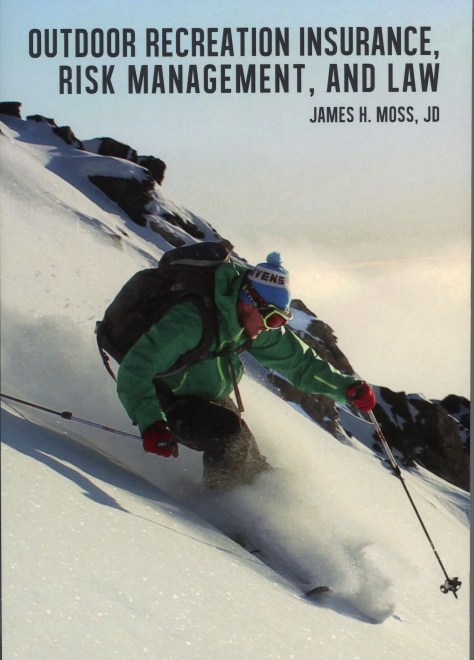
Outdoor Recreation Insurance, Risk Management, and Law
To see Jim’s complete bio go here and to see his CV you can find it here. To find out the purpose of this website go here.
If you are interested in having me write your release, download the form and return it to me.
Connect
If you like this let your friends know or post it on FB, Twitter, or LinkedIn
 Threads |
Facebook Logo |
X, Formerly Twitter |
Recreation Law |
By Recreation Law Rec-law@recreation-law.com James H. Moss
@2023 Summit Magic Publishing, LLC
G-YQ06K3L262
#AdventureTourism, #AdventureTravelLaw, #AdventureTravelLawyer, #AttorneyatLaw, #Backpacking, #BicyclingLaw, #Camps, #ChallengeCourse, #ChallengeCourseLaw, #ChallengeCourseLawyer, #CyclingLaw, #FitnessLaw, #FitnessLawyer, #Hiking, #HumanPowered, #HumanPoweredRecreation, #IceClimbing, #JamesHMoss, #JimMoss, #Law, #Mountaineering, #Negligence, #OutdoorLaw, #OutdoorRecreationLaw, #OutsideLaw, #OutsideLawyer, #RecLaw, #Rec-Law, #RecLawBlog, #Rec-LawBlog, #RecLawyer, #RecreationalLawyer, #RecreationLaw, #RecreationLawBlog, #RecreationLawcom, #Recreation-Lawcom, #Recreation-Law.com, #RiskManagement, #RockClimbing, #RockClimbingLawyer, #RopesCourse, #RopesCourseLawyer, #SkiAreas, #Skiing, #SkiLaw, #Snowboarding, #SummerCamp, #Tourism, #TravelLaw, #YouthCamps, #ZipLineLawyer, #RecreationLaw, #OutdoorLaw, #OutdoorRecreationLaw, #SkiLaw,
Estate of Johnson v. Mayacamas Holdings LLC (Cal. App. 2021)
Posted: June 26, 2023 Filed under: California, Paddlesports, Release (pre-injury contract not to sue) | Tags: assumption of the risk, Canoeing, Estate, Express Assumption of the Risk, Gross negligence, Mayacamas Ranch, Release, Survivors, unambiguous, unambiguous language, Waiver of Liability Leave a commentTo Read an Analysis of this decision see
Release signed while checking in at a resort stopped heir’s claims when the decedent drowned while canoeing.
ESTATE OF LAMERLE JOHNSON, SR., et al., Plaintiffs and Appellants,
v.
MAYACAMAS HOLDINGS LLC, Defendants and Respondents.
A161183
California Court of Appeals, First District, Fifth Division
December 21, 2021
NOT TO BE PUBLISHED
Alameda County Super. Ct. No. RG17853267
NEEDHAM, J.
The Estate of Lamerle Johnson, Sr., Danielle Martin Johnson, LaMerle Johnson, Jr., and Deja Thomas (appellants) sued respondents after Lamerle Johnson, Sr. (Johnson) tragically drowned while canoeing on a lake at respondents’ resort. The trial court entered judgment in respondents’ favor after granting their motion for summary adjudication, based largely on the fact that Johnson had signed a release of liability. Appellants now contend the court erred because (1) respondents were not identified by name as parties to the release and were not third-party beneficiaries; (2) the release could be construed to pertain only to claims arising from swimming at the pool, not canoeing on the lake; (3) there was a material factual dispute as to whether respondents were grossly negligent; and (4) the court erred in sustaining an objection to the declaration of appellants’ expert witness. We will affirm the judgment.
I. FACTS AND PROCEDURAL HISTORY
A. Mayacamas Ranch
Mayacamas Ranch was a resort in Calistoga. The property included a “Building Parcel,” with guest cottages, a man-made pool, and other structures, and a “Lake Parcel,” with a pond called Hidden Lake. On the shore of Hidden Lake were at least two 12-foot fiberglass canoes. An unmarked white bin, containing life vests, was nearby.
At the time relevant to this case, the Building Parcel of Mayacamas Ranch was owned by respondent Mayacamas Holdings LLC (Mayacamas Holdings), and the Lake Parcel was owned by respondent Profit Recovery Center. Both parcels were operated and managed by respondent Paradise With Purpose, a hospitality management company.[1]
B. Release and Waiver of Liability
In December 2016, Johnson attended a retreat at Mayacamas Ranch hosted by Rockwood Leadership Institute. Upon his arrival, he received a “Release & Waiver of Liability,” which the resort required guests to review and sign before they were assigned rooms and given keys. Johnson signed the release on December 5, 2016.
The release stated: “I am aware that the grounds and facilities of Mayacamas Ranch are rural and rustic. I do not have any medical or physical conditions, which would impair or affect my ability to engage in any activities or which would cause any risk of harm to myself or to the participants or otherwise endanger my health while attending and utilizing Mayacamas Ranch. . . . I am further aware that certain activities available at the Ranch may be dangerous, for example, swimming, consuming alcohol, or hiking the trails. I understand that the Ranch does not provide lifeguards or any other forms of supervision for the use of the facilities nor for monitoring consumption of alcoholic beverages. I understand that the Ranch does not have on staff anyone trained in CPR nor first aid. Pool [c]loses promptly at 10 p.m. to adhere to strict property noise ordinance. . . . I assume full responsibility for all risks of bodily injury, death or property damage and hold harmless Mayacamas Ranch, its officers, agents, principals and employees and the owners of the real property. . . . I waive, release, and discharge any and all claims, rights and/or causes of action which I now have or which may arise out of or in connection with my presence at Mayacamas Ranch. I acknowledge that I have read and agree to all Mayacamas Ranch policies listed in this release & waiver of liability.” (Italics added.)
C. Johnson Drowns While Canoeing
On December 6, 2016, Johnson and another guest, Troy Williams, went hiking and “stumbled upon” Hidden Lake. Johnson took one of the canoes onto the water, apparently without incident.
On December 7, 2016, Johnson, Williams, and two other guests (Heracio Ray Harts and Eddy Zheng) went hiking before the day’s scheduled activities. They arrived at Hidden Lake and took turns taking the two canoes onto the water. They did not locate any life vests; although they found the white bin, they could not open it.
While Johnson and Williams were in their respective canoes on Hidden Lake, Johnson began “horsing around” and rocking Williams’s canoe. Williams started to return to shore. When he looked back, he saw that Johnson’s canoe had flipped over and Johnson was in the water. Williams saw “panic in [Johnson’s] face.”
As Williams tried to help Johnson, Williams fell into the water, which was so cold that he had to swim to shore. Zheng entered the water to look for Johnson, and Harts ran to get help. Darlene Nipper, the chief executive officer of Rockwood Leadership Institute, arrived at the scene and unsuccessfully tried to find Johnson. First responders later found Johnson’s deceased body.
On the day of the incident, the canoes were unsecured; previously, they had been secured with a chain and a lock. The water temperature in Hidden Lake was about 40 degrees, and the air temperature was roughly 38 degrees. Respondents had no policies, procedures, or practices to warn guests about specific safety hazards associated with cold water shock and swimming or canoeing at Hidden Lake.
D. Johnson’s Estate and Survivors Sue
In March 2017, appellants sued Mayacamas Ranch LLC, Rockwood Leadership Institute, and others. They asserted causes of action for general negligence, premises liability, and wrongful death, alleging that Mayacamas Ranch LLC negligently owned, possessed, leased, maintained, operated, designed, inspected, supervised, managed, and controlled the resort premises.
In April 2018, appellants filed an amended complaint in which they acknowledged that Mayacamas Ranch LLC was a dissolved entity that was no longer operating. In its place, appellants named three new defendants- respondents Mayacamas Holdings, Profit Recovery Center, and Paradise With Purpose (Mayacamas Defendants).
E. Mayacamas Defendants’ Summary Judgment Motion
In December 2019, the Mayacamas Defendants moved for summary judgment or, in the alternative, summary adjudication. They argued that the release provided a complete defense to each cause of action, the primary assumption of the risk doctrine also barred liability, and Thomas lacked standing to bring a wrongful death action.
Appellants opposed the motion, arguing inter alia that the release did not identify the Mayacamas Defendants, did not cover canoeing on Hidden Lake, and did not absolve the defendants from liability for gross negligence. They also argued that primary assumption of the risk was inapplicable and that Thomas had standing to file suit.
On the issue of gross negligence, appellants submitted a declaration from Dr. John R. Fletemeyer, a purported expert in “aquatics safety,” who stated that the defendants’ failure to take certain safety precautions-such as failing to provide warnings, limit access to the canoes, or make life vests accessible-fell “far below the generally accepted customs and practices in the aquatic safety industry, such that it rises to a level of gross neglect, recklessness and a deliberate and willful disregard for the safety of the public and their guests, including Mr. Johnson.”
In July 2020, the trial court granted summary adjudication for the Mayacamas Defendants on each cause of action, concluding that the release was “unambiguous as a matter of law.” The court found “no triable issue of material fact as to the existence of gross negligence, which could negate the legal effect of the Release,” observing that Dr. Fletemeyer’s opinion “fail[ed] to establish what the accepted customs and practices in the aquatic safety industry [were], or how they appl[ied] to properties like Mayacamas Ranch.” The court sustained the Mayacamas Defendants’ objection to paragraph 16 of Dr. Fletemeyer’s declaration, which had set forth his opinion on gross negligence, as conclusory and lacking in foundation. The court added that “Mr. Johnson’s assumption of risk in signing the Release functions as a defense to the Plaintiffs’ claims based on negligence.”
Judgment was entered in favor of the Mayacamas Defendants as to all causes of action. This appeal followed.
II. DISCUSSION
In reviewing a grant of summary judgment, we conduct an independent review to determine whether there are triable issues of material fact and the moving party is entitled to judgment as a matter of law. (Code Civ. Proc., § 437c, subd. (c); Aguilar v. Atlantic Richfield Co. (2001) 25 Cal.4th 826, 843.) A defendant seeking summary judgment must show that at least one element of the plaintiff’s cause of action cannot be established, or that there is a complete defense to the cause of action. (Code Civ. Proc., § 437c, subd. (o)(1) & (2).) The burden then shifts to the plaintiff to show there is a triable issue of material fact as to that issue. (Code Civ. Proc., § 437c, subd. (p)(2); See Alex R. Thomas & Co. v. Mutual Service Casualty Ins. Co. (2002) 98 Cal.App.4th 66, 72.) We construe the moving party’s evidence strictly, and the nonmoving party’s evidence liberally, in determining whether there is a triable issue. (Thomas, at p. 72.)
A. The Release Unambiguously Bars Appellants’ Claims
A written release of future liability reflects an express assumption of the risk by the plaintiff, thereby negating the defendant’s duty of care. (Eriksson v. Nunnink (2015) 233 Cal.App.4th 708, 719 (Eriksson).) If the plaintiff signed a release of all liability, the release applies to any ordinary negligence of the defendant, so long as the act of negligence that resulted in the plaintiff’s injury is reasonably related to the purpose for which the release was given. (Benedek v. PLC Santa Monica (2002) 104 Cal.App.4th 1351, 1357-1358.) The release must be” ‘” ‘clear, unambiguous, and explicit in expressing the intent of the subscribing parties.'” ‘” (Eriksson, supra, 233 Cal.App.4th at p. 722, italics omitted.)
Here, the release was clear, unambiguous, and explicit in expressing the parties’ intent that Johnson assume all risks of injury or damage at Mayacamas Ranch and waive and release all claims related to his stay. The release was entitled “Release & Waiver of Liability,” communicating to Johnson that he was releasing claims and waiving liability. It explicitly stated that he would “assume full responsibility for all risks of bodily injury, death or property damage,” and that he would “hold harmless Mayacamas Ranch, its officers, agents, principals and employees and the owners of the real property.” (Italics added.) It further stated that Johnson would “waive, release, and discharge any and all claims, rights and/or causes of action which [he] now ha[s] or which may arise out of or in connection with [his] presence at Mayacamas Ranch.” (Italics added.) In short, the release applied to any ordinary negligence liability arising out of Johnson’s stay at the ranch, which would include his use of the canoe on Hidden Lake at the resort.
B. Appellants’ Arguments
Appellants contend the release was insufficient in three respects: it did not apply to the Mayacamas Defendants; it did not apply to canoeing; and it did not apply to gross negligence. Their contentions lack merit.
1. Application of the Release to the Mayacamas Defendants
The release stated that Johnson would hold harmless “Mayacamas Ranch, its officers, agents, principals and employees and the owners of the real property.” It did not explicitly name Paradise With Purpose, Profit Recovery Center, or Mayacamas Holdings. Therefore, appellants contend, the Mayacamas Defendants “were not parties to the Release” and could not invoke its protections unless they were intended third-party beneficiaries. Appellants further contend there was no evidence that the release was intended to benefit the Mayacamas Defendants and appellants presented evidence to the contrary.
Although the release did not identify the Mayacamas Defendants by name, a reasonable person in Johnson’s position-signing a release and waiver of liability for all claims arising from his presence at Mayacamas Ranch-would necessarily expect the phrase “Mayacamas Ranch, its officers, agents, principals and employees” to include the entity that was operating, and doing business as, “Mayacamas Ranch.” That entity was the defendant, Paradise With Purpose, which-as alleged in the amended complaint- operated and managed both parcels. (At the time the release was signed, the legal entity previously known as “Mayacamas Ranch, LLC” had already been dissolved.) Further, a reasonable person in Johnson’s position would understand that “owners of the real property” meant those who owned the property on which Mayacamas Ranch was located: that is, Mayacamas Holdings, which owned the Building Parcel, and Profit Recovery Center, which owned the Lake Parcel, as alleged in the amended complaint.
The cases on which appellants rely do not suggest otherwise. In Vahle v. Barwick (2001) 93 Cal.App.4th 1323, an attorney had represented clients in a personal injury matter that was resolved by a settlement agreement.
When the clients later sued the attorney for malpractice, the attorney argued that a provision in the settlement agreement, by which the clients had released the opposing party in the personal injury case and “their agents, servants, assigns . . . and all other persons . . .” from all claims related to the personal injury litigation, released the attorney as to the subsequent malpractice claim. (Italics added.) The court rejected the argument, noting that the release was plainly intended only to release the opposing party and those in privity with the opposing party, and not the clients’ own attorney. (Id. at pp. 1326-1333.)
In Neverkovec v. Fredericks (1999) 74 Cal.App.4th 337, a passenger in a vehicle involved in an accident sued the driver of the other car. The defendant driver contended the claim was barred by a release the plaintiff had signed with the insurer of the vehicle in which the plaintiff had been riding. That release had exonerated certain individuals “and any other person, firm or corporation charged or chargeable with responsibility or liability.” (Italics added.) The court of appeal concluded there was a triable issue of material fact as to whether the plaintiff had intended to release the driver with the words “any other person.” (Id. at pp. 342-345.) The question, the court explained, is whether “a reasonable person in the releasing party’s shoes would have believed the other party understood the scope of the release.” (Id. at p. 351.)
Here, we do not have a situation where we must divine whether the parties intended the Mayacamas Defendants to fall within a phrase such as “all other persons” or “any other person.” The release expressly identified the ranch, its agents, its officers, its principals, its employees, and the owners of the real property as the ones who would be held harmless. The only reasonable interpretation is that, by this language, the release was intended to protect the entities that were subject to liability as operators of the resort and owners of the real property-the Mayacamas Defendants.
Appellants argue that they submitted evidence showing that the Mayacamas Defendants were not third-party beneficiaries. They cite to a discovery response in which Profit Recovery Center stated it owned the Lake Parcel but did not own or control the Building Parcel (the land where the” ‘resort and retreat center'” was located). Whether Profit Recovery Center owned the Building Parcel is irrelevant, however, because it owned the Lake Parcel and was therefore one of the “owners of the real property” under the release. Similarly, appellants point us to a discovery response in which Mayacamas Holdings stated it owned the Building Parcel and not the Lake Parcel, but that still makes Mayacamas Holdings an “owner[] of the real property” under the release. Appellants also refer to discovery responses indicating that the Mayacamas Defendants had no “relationship” except that they shared a chief executive officer or manager, but they fail to demonstrate why that matters.
Whether the release should be construed such that Mayacamas Holdings, Profit Recovery Center, and Paradise With Purpose were parties to the release, or were intended third-party beneficiaries, they are entitled to the benefits and protections of the release.
2. Application to the Canoe Incident
Appellants next contend the scope of the release was ambiguous and could reasonably be construed to apply only to Johnson’s use of the resort’s swimming pool, and not to canoeing; because of this ambiguity, they argue, there was a material factual dispute that precluded summary judgment.
Appellants’ argument is meritless. An ambiguity exists only”‘ “when a party can identify an alternative, semantically reasonable, candidate of meaning of a writing.” ‘” (Cohen v. Five Brooks Stable (2008) 159 Cal.App.4th 1476, 1485 (Cohen).) It is not semantically reasonable to conclude that the release covered only Johnson’s swimming in the pool.
As mentioned, the release was exceedingly broad. It stated that Johnson assumed “full responsibility for all risks of bodily injury, death or property damage” and “waive, release, and discharge any and all claims, rights and/or causes of action which I now have or which may arise out of or in connection with my presence at Mayacamas Ranch.” (Italics added.) Given this language, no reasonable person would think that the release pertained only to swimming in the swimming pool. Appellants point to a sentence in the release that states: “I am further aware that certain activities available at the Ranch may be dangerous, for example, swimming, consuming alcohol, or hiking the trails.” (Italics added.) But in that sentence, “swimming” was just an “example” of dangerous activities, and there was no attempt to provide an exhaustive list of the risks. While the release mentioned the pool’s closing time, that was plainly to solicit adherence to a “noise ordinance” and in no way limited the release’s scope. To the contrary, the first sentence of the release recited Johnson’s awareness that the “grounds and facilities of Mayacamas Ranch are rural and rustic,” suggesting a far broader scope to the release than just the pool. (Italics added.) And finally, the fact that the release did not specifically mention canoeing is immaterial. (See Cohen, supra, 159 Cal.App.4th at p. 1485 [the express terms of the release must apply to the defendant’s negligence, but the release need not mention the defendant’s specific negligent act].) Canoeing would be performed in the canoes provided at Hidden Lake, which was part of the “grounds and facilities of Mayacamas Ranch,” and involved Johnson’s “presence” at the resort.
The cases on which appellants rely are inapposite. In those cases, the harm that caused the plaintiff’s injuries was outside the purpose of the release. (Huverserian v. Catalina Scuba Luv, Inc. (2010) 184 Cal.App.4th 1462, 1466-1469 [release given in connection with the rental of scuba diving equipment was expressly limited to “boat dives or multiple day rentals” and therefore did not apply where the decedent had not rented the equipment for those purposes]; Sweat v. Big Time Auto Racing, Inc. (2004) 117 Cal.App.4th 1301, 1303-1308 [release signed as a condition of watching an automobile race from the “pit area” did not cover injuries incurred when bleachers in the pit area collapsed, because the purpose was to require attendees to assume the risk of injury as a result of being in close proximity to the race, not defectively constructed or maintained bleachers].) Here, the purpose of the release was for guests to waive all future claims arising out of their presence at the ranch and their use of its property and facilities, which necessarily included canoeing on Hidden Lake.
3. No Triable Issue as to Gross Negligence
A release of liability bars claims for ordinary negligence, but not gross negligence. (City of Santa Barbara v. Superior Court (2007) 41 Cal.4th 747, 750 (Santa Barbara).) Appellants contend they established triable issues of material fact as to whether the Mayacamas Defendants acted with gross negligence. We disagree.
” ‘Gross negligence'” is a” ‘” ‘want of even scant care'” ‘” or” ‘” ‘an extreme departure from the ordinary standard of conduct.'” ‘” (Santa Barbara, supra, 41 Cal.4th at p. 754; Chavez v. 24 Hour Fitness USA, Inc. (2015) 238 Cal.App.4th 632, 640 [“‘ “such a lack of care as may be presumed to indicate a passive and indifferent attitude toward results”‘ “].) By contrast, ordinary negligence is “a failure to exercise the degree of care in a given situation that a reasonable person under similar circumstances would employ to protect others from harm.” (Santa Barbara, supra, 41 Cal.4th at pp. 753-754; Anderson, supra, 4 Cal.App.5th at p. 881 [“‘ “[M]ere nonfeasance, such as the failure to discover a dangerous condition or to perform a duty,”‘ amounts to ordinary negligence.”].) Thus, while “[e]vidence of conduct that evinces an extreme departure from safety directions or an industry standard could demonstrate gross negligence,” “conduct demonstrating the failure to guard against, or warn of, a dangerous condition typically does not rise to the level of gross negligence.” (Willhide-Michiulis v. Mammoth Mountain Ski Area, LLC (2018) 25 Cal.App.5th 344, 365 (Willhide-M ichiulis).)
Here, appellants claim that the Mayacamas Defendants were grossly negligent because they did not lock up the canoes, post signs, provide a flotation device and life vests, or warn guests about “cold water shock” and canoeing at the lake, including admonishing them that canoes can capsize and life vests should be worn. This alleged wrongdoing, however, does not constitute gross negligence, but “[m]ere nonfeasance”-the failure to guard against, or warn of, dangerous conditions. (See Willhide-Michiulis, supra, 25 Cal.App.5th at pp. 358-365 [where snowboarder collided with snow grooming equipment, allegations that the equipment was used on an open run without spotters or adequate warning of the danger did not demonstrate gross negligence]; Anderson v. Fitness Internat., LLC (2016) 4 Cal.App.5th 867, 878-883 [customer who slipped and fell in health club’s shower room failed to plead gross negligence by alleging that the shower room floor was routinely covered with oily and soapy residue, because there was no extreme departure from expected conditions or safety standards, and the defendant did not actively increase the risk or conceal it].)
Dr. Fletemeyer’s opinion that the failure to take the stated precautions fell “far below the generally accepted customs and practices in the aquatic safety industry, such that it rises to a level of gross neglect” did not create a triable issue of fact. As discussed post, the trial court did not err in sustaining defendants’ objection to Dr. Fletemeyer’s statement as conclusory and lacking in foundation. (Willhide-Michiulis, supra, 25 Cal.App.5th at pp. 355-356.) In any event, Dr. Fletemeyer’s opinion missed the mark, because he did not explain the customs and practices of aquatic safety in the context of places such as Mayacamas Ranch and Hidden Lake. There was no showing, therefore, of an extreme departure from the ordinary standard of conduct.
Nor did the alleged actions of the Mayacamas Defendants increase the inherent risks of canoeing. A reasonable person in Johnson’s position understands that canoeing on a lake (in 38-degree weather) poses risks such as the canoe capsizing or the canoer otherwise falling into the water and having to swim to safety. Not only is this conclusion readily drawn from general experience, it is confirmed by the deposition testimony of Johnson’s own companions, who knew enough about the dangers of canoeing to inquire of Johnson’s ability to swim and to search for life vests; despite not finding any, they ventured onto the water. (See Anderson v. Fitness Internat., LLC, supra, 4 Cal.App.5th at pp. 878-883 [no gross negligence where the defendant did not actively increase the risk or conceal it]; cf. Eriksson, supra, 191 Cal.App.4th at p. 856-857 [triable issue as to gross negligence where defendant unreasonably increased the inherent risk of injury in horse jumping by allowing the victim to ride an unfit horse and concealing the horse’s unfitness].)
Appellants’ reliance on Rosencrans v. Dover Images, Ltd. (2011) 192 Cal.App.4th 1072 (Rosencrans) is misplaced. In Rosencrans, a motorcycle rider fell on a motorcross track during a practice run, at a location where he was not visible to other riders; after he stood and picked up his motorcycle, two other motorcyclists struck him. (Id. at p. 1077.) The court determined that, as a matter of law, the operator owed the plaintiff a duty to minimize the risks of motorcross by providing a system, such as a “caution flagger,” to alert riders of a fallen participant. (Id. at pp. 1084-1085.) Based on admissible evidence in the form of an instructional manual, which directed that flaggers should remain at the flag station at all times when competitors are on the course, and a declaration of a motocross safety expert, who averred that the common practice was to always place caution flaggers at their posts and the failure to do so greatly fell below the standard of care in the motocross industry, the court concluded there was a triable issue of fact as to whether the operator’s failure to provide the caution flagger constituted an extreme departure from the ordinary standard of conduct-that is, gross negligence. (Id. at pp. 1086-1087.)
Here, even assuming that the Mayacamas Defendants’ alleged wrongdoing constituted a breach of their duty of care, there is no evidence comparable to that in Rosencrans suggesting the conduct was so extreme as to constitute gross negligence. There was no evidence, for example, of an applicable instructional manual. Nor was there admissible testimony from an expert that such conduct would greatly fall below the standard of care applicable specifically to operators of resorts akin to Mayacamas Ranch.
Appellants fail to establish that the court erred in granting summary adjudication and entering judgment based on the release.
C.
Primary Assumption of the Risk
In addition to contending that the release negated the element of duty under an express assumption of risk theory, the Mayacamas Defendants contended in the trial court that they had no liability based on the primary assumption of risk theory. Under that theory, “operators, instructors and participants in the activity owe other participants only the duty not to act so as to increase the risk of injury over that inherent in the activity.” (Nalwa v. Cedar Fair, L.P. (2012) 55 Cal.4th 1148, 1154.) Whether a given risk is inherent in the sport is a question of law to be answered by the court. (Id. at pp. 1158-1159.) Respondents argue that falling out of a canoe and drowning is an inherent risk of canoeing, and there was no evidence that the Mayacamas Defendants increased that risk.
It is unclear whether the trial court addressed the primary assumption of risk argument. The court stated in its order that “Mr. Johnson’s assumption of risk in signing the Release function[ed] as a defense to the Plaintiffs’ claims based on negligence.” (Italics added.) Because the court discussed assumption of the risk “in signing the Release” and referred to the Eriksson case, the Mayacamas Defendants contend the court was referring to express assumption of the risk and never ruled on the primary assumption of the risk theory. On the other hand, the court made its statement under the heading of “Issue 4,” which pertained to assumption of the risk (based in part on the language of the release), separate from “Issues 1[-]3,” which pertained to the theory of waiver based on the release. Appellants argue that the court did invoke the “primary assumption of the risk” doctrine as an alternative basis for its ruling, and erred in doing so.
Even if the trial court relied on the primary assumption of the risk doctrine, we need not and do not address this alternative ground for the court’s decision, because we affirm the ruling based on the express assumption of the risk doctrine as discussed ante.
D. Exclusion of Evidence
In concluding there were no triable issues of material fact as to gross negligence, the trial court sustained respondents’ objection to paragraph 16 of Dr. Fletemeyer’s declaration. Paragraph 16 read as follows: “Based on my background, education, training, experience, skill, and specialized knowledge in aquatics safety, there are many reasonable, inexpensive, simple, and effective safety precautions, outlined above and referenced below, that the Property-Defendants should have taken under the circumstances. Their failures, whether taken individually or in any combination, more likely than not caused or contributed to the Drowning and death of Mr. Johnson. These failures fall far below the generally accepted customs and practices in the aquatic safety industry, such that it rises to a level of gross neglect, recklessness, and a deliberate and willful disregard for the safety of the public and their guests, including Mr. Johnson.” Subparagraphs set forth the safety precautions that, according to Dr. Fletemeyer, should have been taken and would have saved Johnson’s life.
The court sustained the objection to paragraph 16 on the ground it was conclusory and lacking in foundation, because Dr. Fletemeyer failed to establish industry standard or custom, particularly as it applied to Mayacamas Ranch. Appellants contend this was error. The traditional rule is that evidentiary rulings in summary judgment proceedings are reviewed for an abuse of discretion. (Serri v. Santa Clara University (2014) 226 Cal.App.4th 830, 852.) It is now an open question whether that remains the standard or whether the standard is de novo. (Reid v. Google, Inc. (2010) 50 Cal.4th 512, 535.) Under either standard, we would uphold the trial court’s ruling.”
Dr. Fletemeyer professed to be an expert in “aquatics safety” and opined about customs and practices in the “aquatic safety industry,” but nothing in his declaration defined the standard and custom specifically for a resort like Mayacamas Ranch or the body of water known as Hidden Lake. Although appellants insist that Dr. Fletemeyer identified the reasonable industry practices relating to safety precautions in paragraph 16(a) and preceding paragraphs, those passages amount to a legal conclusion that certain things the Mayacamas Defendants did not do constituted reasonable industry standard practices, without particularizing the “industry” to which he referred, identifying the “industry standard,” or explaining how it applies to resorts like the ranch. (Willhide-Michiulis, supra, 25 Cal.App.5th at p. 344, 366 [trial court did not abuse its discretion by excluding expert declarations that “did nothing more than to provide conclusions that the [defendants]conduct violated industry standards and constituted gross negligence”].) Appellants fail to establish error.
III. DISPOSITION
The judgment is affirmed.
We concur. SIMONS, Acting P. J. BURNS, J.
20
———
Notes:
[1] In October 2017, Mayacamas Ranch was destroyed by fire. Paradise With Purpose is purportedly suspended by the California Secretary of State and barred from defending against appellants’ lawsuit. (See Grell v. Laci Le Beau Corp. (1999) 73 Cal.App.4th 1300, 1306.) Philadelphia Indemnity Insurance Company filed a motion to intervene in this appeal to protect its interests as the insurer of Paradise With Purpose and the interests of its insured. We granted the motion, and Philadelphia Indemnity Insurance Company filed its joinder to respondents’ brief.
G-YQ06K3L262
http://www.recreation-law.com
States that allow a parent to sign away a minor’s right to sue.
Posted: April 21, 2023 Filed under: California, Colorado, Florida, Maryland, Minors, Youth, Children, Release (pre-injury contract not to sue) | Tags: Alaska, Arizona, California, Colorado, Florida, MARYLAND, Massachusetts, Minnesota, Minor, Nebraska, North Dakota, Parent can sign away Minor's Right to Sue, Release, Utah, Virginia, Waiver, Wisconsin Leave a commentIf your state is not listed here, you should assume a parent cannot waive a minor’s right to sue in your state.
What do you think? Leave a comment.
Copyright 2017-2023 Recreation Law (720) Edit Law, Recreation.Law@Gmail.com
Twitter: RecreationLaw
Facebook: Rec.Law.Now
Facebook Page: Outdoor Recreation & Adventure Travel Law
Blog:
www.recreation-law.com
Mobile Site: http://m.recreation-law.com
#AdventureTourism, #AdventureTravelLaw, #AdventureTravelLawyer, #AttorneyatLaw, #Backpacking, #BicyclingLaw, #Camps, #ChallengeCourse, #ChallengeCourseLaw, #ChallengeCourseLawyer, #CyclingLaw, #FitnessLaw, #FitnessLawyer, #Hiking, #HumanPowered, #HumanPoweredRecreation, #IceClimbing, #JamesHMoss, #JimMoss, #Law, #Mountaineering, #Negligence, #OutdoorLaw, #OutdoorRecreationLaw, #OutsideLaw, #OutsideLawyer, #RecLaw, #Rec-Law, #RecLawBlog, #Rec-LawBlog, #RecLawyer, #RecreationalLawyer, #RecreationLaw, #RecreationLawBlog, #RecreationLawcom, #Recreation-Lawcom, #Recreation-Law.com, #RiskManagement, #RockClimbing, #RockClimbingLawyer, #RopesCourse, #RopesCourseLawyer, #SkiAreas, #Skiing, #SkiLaw, #Snowboarding, #SummerCamp, #Tourism, #TravelLaw, #YouthCamps, #ZipLineLawyer, minor, release, Parent Signature, NC, North Carolina, Alaska, AK, AZ, Arizona, CO, Colorado, Florida, FL, CA, California, MA, Massachusetts, Minnesota, MN, ND, North Dakota, OH, Ohio, WI, Wisconsin, Hohe, San Diego, San Diego Unified School District, Global Travel Marketing, Shea, Gonzalez, City Of Coral Gables, Sharon, City of Newton, Moore, Minnesota Baseball Instructional School, McPhail, Bismark Park District, Zivich, Mentor Soccer Club, Osborn, Cascade Mountain, Atkins, Swimwest Family Fitness Center, Minor, Minors, Right to Sue, Utah, UT, Equine, Equine Safety Act, North Carolina, New York,
@2023 Summit Magic Publishing, LLC
G-YQ06K3L262
Interesting CA case on sheriff’s failure to start SAR & run SAR
Posted: October 24, 2022 Filed under: California, Mountain Biking, Search and Rescue (SAR) | Tags: Cycling, Discretionary, Hypothermia, Immunity, Lost, Mountain biking, Negligence, SAR, Search and Rescue, Sheriff's Department Leave a commentCounty lost appeal because employees’ actions were out of line and the deceased, at least from the facts presented could have easily been found before he died.
Arista v. Cnty. of Riverside (Cal. App. 2021)
State: California; Court of Appeal of the State of California Fourth Appellate District Division Two
Plaintiff: Christyna Arista
Defendant: County of Riverside
Plaintiff Claims: Wrongful death, negligence, and negligent infliction of emotional distress
Defendant Defenses: Government Code section 8453, which provides public employees are not liable for the failure to provide sufficient police protection; section 820.2, which provides that public employees are not liable for injuries that result from acts or omissions stemming from discretionary decisions; Health and Safety Code section 1799.107, subdivision (b), which provides that emergency rescue personnel are not liable for injuries caused by actions taken within the scope of their employment, unless the actions were done in bad faith or with gross negligence
Holding: For the Plaintiff
Year: 2021
Summary
A lawsuit was filed against Riverside County Sheriff’s department for negligent Search and Rescue training and procedures. The trial court granted the Counties motion for summary judgment, and the plaintiff’s appealed. The case was sent back by Appellate Court for trial. The deceased died of hypothermia and was easily found by friends of the deceased. Sheriff’s department assumed deceased was having an affair and did not search for him.
Facts
On March 1, at 3:00 p.m., when Marin [deceased] failed to return home, Wife called and texted Marin’s cell phone every 15 minutes but received no answer until 5:14 p.m. when Marin answered Wife’s call. Marin said he had fallen from his bicycle and suffered an injury. Marin seemed confused and disoriented but said that, said that, prior to the fall, he had reached Santiago Peak and was on his way home. At 5:32 p.m., Wife began calling various agencies, e.g., a ranger station, but was unable to reach anyone. At 5:36 p.m., Wife called 911 and the operator advised her to wait at home. At 6:30 p.m., Corona Police arrived at Wife’s home, and Wife explained that Marin was injured, on his way down from Santiago Peak, and lightly dressed.
At 8:00 p.m., Riverside County Sheriff’s Deputy Zaborowski2 arrived at the Family’s home. At that point, deputies had already checked trailheads in the CNF, traveled along access roads looking for Marin, pinged Marin’s cell phone, and contacted civilian volunteers to tell them “to be ‘on alert’ for a potential call to assist.” Wife provided Zaborowski with the same information she provided the Corona Police. Zaborowski told Wife that the ping of Marin’s phone showed he was in the area of Santiago Peak. Zaborowski also said Verizon service employees were in the area of Santiago Peak and had been asked to “be vigilant for Marin’s location.”
Lieutenant Hall (Hall) was the Sheriff’s Department’s Incident Commander for the search for Marin. Hall stayed at his home during the search. He was not trained in search and rescue. Hall did not consider the risks that Marin faced from the weather. Hall did not know Santiago Peak has an elevation of 5,689 feet. Hall was unaware that the trail Marin had planned to use has an elevation of 3,000 to 4,000 feet. Hall did not know what, if any, equipment Marin had with him for cold weather.
At 10:00 p.m., Detective Holder arrived at the Family’s home. While at the residence, Holder spoke to Zaborowski. Holder said “he [(Holder)] was ‘not sure what we’re doing here,’ that Marin was ‘probably just running around on his wife’ and was ‘just covering his tracks,’ suggesting that Marin was not missing, but instead involved in some adulterous affair.” Holder informed Wife that the Sheriff’s Department was suspending its search for the night and would resume searching in the morning. Wife asked Holder, ” ‘[W]hat are the chances he [Marin] dies of hypothermia?’ ” because the temperatures at Santiago Peak were expected to be in the mid-30s to mid-40s. “Holder replied that Marin was ‘a grown man’ and that ‘he can survive the night.’ ” Holder further said “that ‘if it was a child, [he] would send a helicopter out there right now.’ ”
After being told that the search was suspended for the night, Wife organized relatives to perform their own search. Unidentified County personnel asked Wife not to initiate her own search because the County would conduct the search. Nevertheless, Wife and six relatives began searching for Marin, on foot, at 3:45 a.m. Pat Killiam who is a mountain biker and search and rescue volunteer “had heard about the ‘missing biker,’ ” and began his own search for Marin using a motorcycle on the access roads. Killiam found Marin’s body on a maintained fire access road. The precise time that Killiam found Marin is not alleged in the TAC. Marin died of hypothermia due to being exposed to cold environmental temperatures.
The County’s Sheriff’s Department has an Off-Highway Vehicle Enforcement unit (ROVE) that is equipped with all-terrain vehicles that have lights. The vehicles can operate in the mud at night. ROVE was not dispatched to search for Marin. Because Marin was on a maintained fire access road, he could have been rescued by people using all-terrain vehicles.
The real basis of the claims of the plaintiff were summed up by the Appellant court in this statement.
In the Family’s wrongful death cause of action, it alleged the following: The Sheriff’s Department assumed the responsibility of searching for Marin by starting the search and telling Wife not to conduct her own search. The Family alleged that it relied upon the County to rescue Marin after the County assumed control of the search and rescue. In taking responsibility for the search, the Sheriff’s Department owed a duty to conduct the search with reasonable care.
The County should not have assigned Hall to be the incident commander for the search because Hall lacked search and rescue training. Hall acted with reckless disregard for life by managing the search from his living room. The County’s employees acted with bad faith and gross negligence by (1) failing to contact people who had knowledge of the trails and service roads in the CNF; (2) failing to deploy the ROVE team on the night of March 1; and (3) failing to consult a medical professional with knowledge of hypothermia regarding Marin’s possible injuries and the risk of hypothermia.
Analysis: making sense of the law based on these facts.
After reviewing the procedural issues on appeal, the court looked at the arguments. The first was whether or not the County had immunity from suit for its rescue personnel under several California statutes.
Health and Safety Code section 1799.107, subdivision (b), provides, “[N]either a public entity nor emergency rescue personnel shall be liable for any injury caused by an action taken by the emergency rescue personnel acting within the scope of their employment to provide emergency services, unless the action taken was performed in bad faith or in a grossly negligent manner.”
The family, the plaintiff’s, argued there could not be any immunity because the actions of the individuals were grossly negligent. The Appellate court agreed that if the actions of the county personnel were found to be grossly negligent, then the individuals were not protected by the statute.
Gross negligence if plead and proved supersedes an immunity statute in California. Unless the statute provides immunity to the entire claim, the statute does not provide immunity: “…it is an error to grant summary judgment unless the defense is “a complete defense to the entire action.”
Knowing that based on the clothing and the weather conditions, there was a good chance that the deceased would die of hypothermia, failure to start a search by the sheriff’s department employee could be considered gross negligence.
I suspect that these factors were made more apparent when the deceased was so easily found by the family members when they searched.
The next immunity statute was Section 845, which was created to give law enforcement wide range in making budgetary decisions. Meaning how many law enforcement personnel were hired and deployed to certain areas within a community could not be subject to judicial scrutiny.
Neither a public entity nor a public employee is liable for failure to establish a police department or otherwise to provide police protection service or, if police protection service is provided, for failure to provide sufficient police protection service
No budgetary decisions were made in deciding not to rescue the deceased. The lawsuit was not over whether or not enough SAR personnel were sent to the scene, the lawsuit was based on negligence in handling the entire incident.
The Family is not suing the County for budgetary or political decisions. The Family is suing due to the alleged negligence of particular County employees. The County asserts the Family’s lawsuit is partially based upon a failure to provide adequate search and rescue training to its Sheriff’s Department personnel.
The final immunity is usually the broadest and provides the most protection to state and local governments. The actions of an employee of a local, state or federal government are discretionary. As long as the decisions of the employee are not arbitrary, fanciful, or unreasonable, the decision will be upheld.
The appellate court did not rule the actions of the sheriff department’s employees were not discretionary, only that the county, if relying on that defense must show that each of the decisions made by the employee was discretionary. The appellate court in this case increased the burden on the county to prove immunity in this case.
If the County seeks to have every material search decision Hall made protected under section 820.2 then it needs to provide evidence of what material decisions were made, provide evidence of the discretion exercised in making those decisions, and provide argument as to why each of those decisions is deserving of immunity under section 820.2. Without that information, it was not proper to grant summary judgment pursuant to the discretionary decision immunity (§ 820.2) because the County only addressed a portion of the Family’s allegations.
The motion for summary judgment granted for the County by the trial court was overruled, and the case was sent back for further adjudication.
So Now What?
Most states have various forms of immunity to protect state and county employees from lawsuits over the discretionary parts of their job. Governments would never accomplish anything if every time they did something a citizen did not like, the citizen sued them. Most Search and Rescue litigation is avoided or dismissed quickly because of this.
Here, the county’s overt actions in responding to the family as well as how easily the victim was eventually found, give credence to the claims of the family. Suggesting a mountain biker was not missing but having an affair may be a common issue in the minds of law enforcement, but expressing it or placing it in the paperwork is just stupid.
This decision seems to be a stretch, though based on the facts it does not seem to be out of line. What it is, is an example of doing dumb things, treating people badly or making a judge made can still make you lose no matter how strong the law is on your side.
Don’t do stupid things, treat people right, do your job and when in doubt, try to help would have prevented this lawsuit and probably this death.
What do you think? Leave a comment.
 Jim Moss is an attorney specializing in the legal issues of the outdoor recreation community. He represents guides, guide services, outfitters both as businesses and individuals and the products they use for their business. He has defended Mt. Everest guide services, summer camps, climbing rope manufacturers; avalanche beacon manufactures and many more manufacturers and outdoor industries. Contact Jim at Jim@Rec-Law.us
Jim is the author or co-author of six books about the legal issues in the outdoor recreation world; the latest is Outdoor Recreation Insurance, Risk Management and Law.
Jim is the author or co-author of six books about the legal issues in the outdoor recreation world; the latest is Outdoor Recreation Insurance, Risk Management and Law.
To see Jim’s complete bio go here and to see his CV you can find it here. To find out the purpose of this website go here.
G-YQ06K3L262
Copyright 2022-23 Recreation Law (720) 334 8529
If you like this let your friends know or post it on FB, Twitter or LinkedIn
|
|
|
|
|


Author: Outdoor Recreation Insurance, Risk Management and Law To Purchase Go Here:
Facebook Page: Outdoor Recreation & Adventure Travel Law
Email: Jim@Rec-Law.US
By Recreation Law Rec-law@recreation-law.com James H. Moss
@2023 Summit Magic Publishing, LLC SummitMagic@gmail.com
#AdventureTourism, #AdventureTravelLaw, #AdventureTravelLawyer, #AttorneyatLaw, #Backpacking, #BicyclingLaw, #Camps, #ChallengeCourse, #ChallengeCourseLaw, #ChallengeCourseLawyer, #CyclingLaw, #FitnessLaw, #FitnessLawyer, #Hiking, #HumanPowered, #HumanPoweredRecreation, #IceClimbing, #JamesHMoss, #JimMoss, #Law, #Mountaineering, #Negligence, #OutdoorLaw, #OutdoorRecreationLaw, #OutsideLaw, #OutsideLawyer, #RecLaw, #Rec-Law, #RecLawBlog, #Rec-LawBlog, #RecLawyer, #RecreationalLawyer, #RecreationLaw, #RecreationLawBlog, #RecreationLawcom, #Recreation-Lawcom, #Recreation-Law.com, #RiskManagement, #RockClimbing, #RockClimbingLawyer, #RopesCourse, #RopesCourseLawyer, #SkiAreas, #Skiing, #SkiLaw, #Snowboarding, #SummerCamp, #Tourism, #TravelLaw, #YouthCamps, #ZipLineLawyer, #RecreationLaw, #OutdoorLaw, #OutdoorRecreationLaw, #SkiLaw,
Arista v. Cnty. of Riverside (Cal. App. 2021)
Posted: October 23, 2022 Filed under: California, Legal Case, Mountain Biking | Tags: County, Cycling, Discretionary, Government, Hyphermia, Lost, Mountain biking, SAR, Search and Rescue Leave a commentTo Read an Analysis of this decision see: Interesting CA case on sheriff’s failure to start SAR & run SAR
Arista v. Cnty. of Riverside (Cal. App. 2021)
CHRISTYNA ARISTA, Individually and as Successor in Interest, etc. et al., Plaintiffs and Appellants,
v.
COUNTY OF RIVERSIDE, Defendant and Respondent.
E074815
COURT OF APPEAL OF THE STATE OF CALIFORNIA FOURTH APPELLATE DISTRICT DIVISION TWO
April 14, 2021
NOT TO BE PUBLISHED IN OFFICIAL REPORTS
California Rules of Court, rule 8.1115(a), prohibits courts and parties from citing or relying on opinions not certified for publication or ordered published, except as specified by rule 8.1115(b). This opinion has not been certified for publication or ordered published for purposes of rule 8.1115.
(Super.Ct.No. RIC1502475)
OPINION
APPEAL from the Superior Court of Riverside County. Daniel A. Ottolia, Judge. Reversed.
Tiedt & Hurd, John E. Tiedt and Marc S. Hurd for Plaintiffs and Appellants.
Disenhouse Law, Bruce E. Disenhouse; Arias & Lockwood and Christopher D. Lockwood for Defendant and Respondent.
In a third amended complaint plaintiff and appellant Christyna Arista and her children (collectively, the Family) sued defendant and respondent County of Riverside (the County) for wrongful death, negligence, and negligent infliction of emotional distress.1 The trial court granted summary judgment in favor of the County. The Family contends the trial court erred by granting summary judgment. We reverse the judgment.
FACTUAL AND PROCEDURAL HISTORY
A. THIRD AMENDED COMPLAINT
The facts in this subsection are taken from the third amended complaint (TAC). Christyna Arista (Wife) was married to Andres Marin (Marin), and he is the father of her children. On March 1, 2014, at approximately 6:30 a.m., Marin left home, in Corona, for a bicycle ride to Santiago Peak in the Cleveland National Forest (the CNF). The ride would be approximately 55 miles, and Marin was expected to return home by 2:00 p.m. On March 1, the temperature in Corona was 50 to 60 degrees with periodic light drizzle. For the bicycle ride, Marin was wearing knee-length bicycle shorts, a bicycle jersey, calf-length socks, bicycle gloves, shoes, and a helmet. Marin carried $10, water, snacks, and his cell phone.
On March 1, at 3:00 p.m., when Marin failed to return home, Wife called and texted Marin’s cell phone every 15 minutes but received no answer until 5:14 p.m. when Marin answered Wife’s call. Marin said he had fallen from his bicycle and suffered an injury. Marin seemed confused and disoriented but said that, prior to the fall, he had reached Santiago Peak and was on his way home. At 5:32 p.m., Wife began calling various agencies, e.g., a ranger station, but was unable to reach anyone. At 5:36 p.m., Wife called 911 and the operator advised her to wait at home. At 6:30 p.m., Corona Police arrived at Wife’s home, and Wife explained that Marin was injured, on his way down from Santiago Peak, and lightly dressed.
At 8:00 p.m., Riverside County Sheriff’s Deputy Zaborowski2 arrived at the Family’s home. At that point, deputies had already checked trailheads in the CNF, traveled along access roads looking for Marin, pinged Marin’s cell phone, and contacted civilian volunteers to tell them “to be ‘on alert’ for a potential call to assist.” Wife provided Zaborowski with the same information she provided the Corona Police. Zaborowski told Wife that the ping of Marin’s phone showed he was in the area of Santiago Peak. Zaborowski also said Verizon service employees were in the area of Santiago Peak and had been asked to “be vigilant for Marin’s location.”
Lieutenant Hall (Hall) was the Sheriff’s Department’s Incident Commander for the search for Marin. Hall stayed at his home during the search. He was not trained in search and rescue. Hall did not consider the risks that Marin faced from the weather. Hall did not know Santiago Peak has an elevation of 5,689 feet. Hall was unaware that the trail Marin had planned to use has an elevation of 3,000 to 4,000 feet. Hall did not know what, if any, equipment Marin had with him for cold weather.
At 10:00 p.m., Detective Holder arrived at the Family’s home. While at the residence, Holder spoke to Zaborowski. Holder said “he [(Holder)] was ‘not sure what we’re doing here,’ that Marin was ‘probably just running around on his wife’ and was ‘just covering his tracks,’ suggesting that Marin was not missing, but instead involved in some adulterous affair.” Holder informed Wife that the Sheriff’s Department was suspending its search for the night and would resume searching in the morning. Wife asked Holder, ” ‘[W]hat are the chances he [Marin] dies of hypothermia?’ ” because the temperatures at Santiago Peak were expected to be in the mid-30s to mid-40s. “Holder replied that Marin was ‘a grown man’ and that ‘he can survive the night.’ ” Holder further said “that ‘if it was a child, [he] would send a helicopter out there right now.’ “
After being told that the search was suspended for the night, Wife organized relatives to perform their own search. Unidentified County personnel asked Wife not to initiate her own search because the County would conduct the search. Nevertheless, Wife and six relatives began searching for Marin, on foot, at 3:45 a.m. Pat Killiam who is a mountain biker and search and rescue volunteer “had heard about the ‘missing biker,’ ” and began his own search for Marin using a motorcycle on the access roads. Killiam found Marin’s body on a maintained fire access road. The precise time that Killiam found Marin is not alleged in the TAC. Marin died of hypothermia due to being exposed to cold environmental temperatures.
The County’s Sheriff’s Department has an Off-Highway Vehicle Enforcement unit (ROVE) that is equipped with all-terrain vehicles that have lights. The vehicles can operate in the mud at night. ROVE was not dispatched to search for Marin. Because Marin was on a maintained fire access road, he could have been rescued by people using all-terrain vehicles.
In the Family’s wrongful death cause of action, it alleged the following: The Sheriff’s Department assumed the responsibility of searching for Marin by starting the search and telling Wife not to conduct her own search. The Family alleged that it relied upon the County to rescue Marin after the County assumed control of the search and rescue. In taking responsibility for the search, the Sheriff’s Department owed a duty to conduct the search with reasonable care.
The County should not have assigned Hall to be the incident commander for the search because Hall lacked search and rescue training. Hall acted with reckless disregard for life by managing the search from his living room. The County’s employees acted with bad faith and gross negligence by (1) failing to contact people who had knowledge of the trails and service roads in the CNF; (2) failing to deploy the ROVE team on the night of March 1; and (3) failing to consult a medical professional with knowledge of hypothermia regarding Marin’s possible injuries and the risk of hypothermia. The Family’s causes of action for negligence and negligent infliction of emotional distress are based on the same conduct/omissions as the wrongful death cause of action.
B. SUMMARY JUDGMENT
The County moved for summary judgment. In its presentation of the facts, the County asserted that, on the evening of March 1, 2014, “it was raining and there was a thick cloud cover and fog in the [CNF].” The County asserted the weather “made it too dangerous to fly” a helicopter to search for Marin. The County also asserted the weather conditions and risks of landslides made it too dangerous for rescuers to search on the ground.
The County asserted that the Family did not cite a statute to support direct liability on the part of the County, which meant the Family was relying on respondeat superior liability. The County asserted that its employees’ decision to suspend the search for the night was objectively reasonable and fell within the standard of reasonable care.
Next, the County asserted three separate immunities applied. First, the County cited Government Code section 8453, which provides public employees are not liable for the failure to provide sufficient police protection. The County asserted section 845 made it immune from the allegation that it “should have provided more or different training.”
Second, the County cited section 820.2, which provides that public employees are not liable for injuries that result from acts or omissions stemming from discretionary decisions. The County argued, “The undisputed evidence shows that a discretionary decision was made, based on all of the available evidence, and after considering the risks to [Marin], the weather and the trail conditions, the conflicting cell phone location information, and all the other information . . . , not to risk rescue personnel by a further nighttime search, but to wait until morning.”
Third, the County cited Health and Safety Code section 1799.107, subdivision (b), which provides that emergency rescue personnel are not liable for injuries caused by actions taken within the scope of their employment, unless the actions were done in bad faith or with gross negligence. The County asserted, “The undisputed evidence . . . shows no gross negligence and no bad faith in deciding to wait until morning to do additional searches of the forest. Rather, the undisputed evidence shows an objectively reasonable decision, based on all of the available evidence, not to expose searchers to the high risks of a night time [sic] search under those weather conditions when decedent’s location was only vaguely known.”
C. OPPOSITION
The Family opposed the County’s motion for summary judgment. The Family asserted there is a triable issue of material fact regarding whether the Sheriff’s Department’s employees’ conduct/omissions constituted an extreme departure from the ordinary standard of conduct. The Family asserted the following constituted gross negligence: failing to set up a command post in the CNF; failing to establish a search area; not having a deputy trained in search and rescue evaluate the trail and road conditions; not contacting the ROVE team in a timely manner; having Hall command the search from his living room; and failing to consult with a medical professional regarding Marin’s injuries and risk of hypothermia.
The Family asserted the immunity for failing to provide sufficient police protection (§ 845) is meant to protect budgetary and policy decisions, not negligence by a particular law enforcement officer. As to the immunity for discretionary decisions (§ 820.2), the Family asserted (1) the County was liable for the negligent way in which it handled the search prior to deciding to suspend the search for the night; and (2) immunity for discretionary decisions applies to operational and policy decisions not to decisions such as Hall’s decision to suspend the search.
In regard to immunity for rescue personnel (Health & Saf. Code, § 1799.107, subd. (b)), the Family asserted there were triable issues of fact regarding whether County personnel acted in bad faith or in a grossly negligent manner. As to bad faith, the Family pointed to Holder’s comments that Marin was likely having an affair. In regard to gross negligence, the Family pointed to a declaration by Richard B. Goodman, who was the Search and Rescue Resource Officer for the New Mexico State Police from 1994 to 2002, reflecting that the Sheriff’s Department’s actions were “an extreme departure from what a reasonable . . . law enforcement [officer] assuming search and rescue activities would do in the same or similar circumstances.”
D. HEARING
The trial court found there were triable issues of fact regarding “whether the County breached the duty to rescue that it undertook.” The court determined that the County was immune from liability because Hall exercised discretion when deciding to suspend the search for the night (§ 820.2). The trial court said it was familiar with the trails leading up to Santiago Peak, and that “deputies have an incredibly difficult job. They have to consider so many factors.” The trial court said to the Family’s counsel, “I’d invite you to go on a ride-along, if you never have, just to find out what a deputy’s job is like.” The trial court granted the County’s motion for summary judgment.
DISCUSSION
A. STANDARD OF REVIEW
“A motion for summary judgment should be granted if the submitted papers show that ‘there is no triable issue as to any material fact,’ and that the moving party is entitled to judgment as a matter of law. [Citation.] A defendant meets his burden of showing that a cause of action has no merit if he shows that one or more of the elements of the cause of action cannot be established, or that there is a complete defense. [Citation.] Once the defendant has met that burden, the burden shifts to the plaintiff to show that a triable issue of material fact exists.” (Claudio v. Regents of the University of California (2005) 134 Cal.App.4th 224, 229.)
“In reviewing a trial court’s ruling on a motion for summary judgment, the reviewing court makes ‘ “an independent assessment of the correctness of the trial court’s ruling, applying the same legal standard as the trial court in determining whether there are any genuine issues of material fact or whether the moving party is entitled to judgment as a matter of law. [Citations.]” ‘ [Citation.] [¶] ‘On review of a summary judgment, the appellant has the burden of showing error, even if he did not bear the burden in the trial court.’ ” (Bains v. Moores (2009) 172 Cal.App.4th 445, 454-455.)
In the trial court, the County made 55 objections to the Family’s evidence. At the hearing, the trial court said, “The Court is overruling all evidentiary objections by both plaintiffs and defendants in this matter.” In its respondent’s brief, the County contends the trial court erred by overruling its objections to the declarations of Richard B. Goodman, who was the Search and Rescue Resource Officer for the New Mexico State Police from 1994 to 2002, and to Ken Zafren, M.D., who is an emergency physician with expertise in hypothermia.
Our understanding of the County’s argument is as follows: If the Family is correct that the trial court erred in its analysis of the summary judgment motion, then those errors are harmless. (See Code Civ. Proc., § 906 [respondents can argue error within a prejudice analysis].) The errors are harmless because if the trial court had sustained the County’s objections to Goodman’s and Zafren’s declarations then it is probable summary judgment would have been granted because there would not be a triable issue of material fact. (See Code Civ. Proc., § 475 [“a different result would have been probable if such error . . . had not occurred”].) The County’s argument is not persuasive because we do not need to consider the Family’s evidence due to the County failing to meet its burden to show the causes of action have no merit.
In a motion for summary judgment, the moving party, in this case the County, bears the burden of demonstrating the causes of action lack merit. (Code Civ. Proc., § 437c, subd. (p)(2).) In the County’s motion for summary judgment, it asserted the Family’s causes of action had no merit because the County’s employees’ decision to suspend the search was objectively reasonable. The County’s argument fails to specifically address the other allegations in the Family’s TAC, such as Hall’s alleged negligence in conducting the search from his living room. In the TAC, within the wrongful death cause of action, the Family alleged, “It is a reckless disregard for life for Lt. Hall to manage a wilderness search from a home living room.” Other allegations in the Family’s TAC were that the County acted with gross negligence by (1) not involving personnel who knew the CNF, (2) not deploying the ROVE team on the night of March 1, and (3) not consulting a medical professional regarding hypothermia and Marin’s possible injuries.
The County focused only on the decision to suspend the search for the night, but the Family is also suing due to the manner in which the search was conducted prior to the search being suspended. In the motion for summary judgment, the County failed to address all of the Family’s allegations of gross negligence. Thus, the County did not meet its burden of demonstrating the causes of action lack merit. (Code Civ. Proc., § 437c, subd. (p)(2) [defendant bears the burden of establishing the “cause of action has no merit”].)
Because the County did not meet its burden to establish that the causes of action lack merit, the burden did not shift to the Family to demonstrate a triable issue of material fact. (Code Civ. Proc., § 437c, subd. (p)(2).) Therefore, any error related to rulings on the County’s evidentiary objections is irrelevant in that the Family’s evidence need not be considered. Accordingly, we are not persuaded by the County’s assertion that any error alleged by the Family can be found harmless.
Next, on appeal, the County renews its objections to Goodman’s and Zafren’s declarations. (Reid v. Google, Inc. (2010) 50 Cal.4th 512, 534 [renewed objections on appeal when the trial court failed to rule on the objections]; Valentine v. Plum Healthcare Group, LLC (2019) 37 Cal.App.5th 1076, 1089 [same].) The County asserts that the Family relies almost exclusively on Goodman’s and Zafren’s declarations in the Family’s appellants’ opening brief, so if the declarations are inadmissible then the Family’s appellate argument fails. It is unnecessary to rule upon the County’s renewed objections because Goodman’s and Zafren’s declarations are not relevant to resolving the alleged errors relating to the immunity defenses. Accordingly, we will not rule upon the County’s renewed objections.
C. IMMUNITY FOR RESCUE PERSONNEL
The Family contends the immunity for rescue personnel (Health & Saf. Code, § 1799.107, subd. (b)) does not support a grant of summary judgment.
Health and Safety Code section 1799.107, subdivision (b), provides, “[N]either a public entity nor emergency rescue personnel shall be liable for any injury caused by an action taken by the emergency rescue personnel acting within the scope of their employment to provide emergency services, unless the action taken was performed in bad faith or in a grossly negligent manner.”
In the wrongful death cause of action, the Family alleged, “Further, the [County] knew that the injured Marin was going to be left in predicted cold temperatures that could expose him to hypothermic conditions and jeopardize his life, but through gross negligence, the [County] let Marin die on [its] watch.” As explained ante, the County did not establish that the Family’s cause of action lacks merit. Therefore, at this stage of the proceedings, there is merit to the Family’s gross negligence allegations.
If we assume, without deciding, that Health and Safety Code section 1799.107, subdivision (b), applies in this case, it would not support a grant of summary judgment because, at this stage, it does not provide a complete defense given the gross negligence allegations. (See Mallard Creek Industries v. Morgan (1997) 56 Cal.App.4th 426, 438 [it is error to grant summary judgment unless the defense is “a complete defense to the entire action”].) Accordingly, summary judgment could not be granted on the basis of the immunity afforded rescue personnel (Health & Saf. Code, § 1799.107, subd. (b)).
D. IMMUNITY FOR FAILING TO PROVIDE SUFFICIENT POLICE PROTECTION
The Family contends the immunity for failing to provide sufficient police protection does not apply in this case.
Section 845 provides, in relevant part, “Neither a public entity nor a public employee is liable for failure to establish a police department or otherwise to provide police protection service or, if police protection service is provided, for failure to provide sufficient police protection service.” Section 845 “was designed to prevent political decisions of policy-making officials of government from being second-guessed by judges and juries in personal injury litigation. [Citation.] In other words, essentially budgetary decisions of these officials were not to be subject to judicial review in tort litigation.” (Mann v. State of California (1977) 70 Cal.App.3d 773, 778-779, fn. omitted.) “Thus, section 845 was not intended to provide immunity against a particular police officer’s negligence in the performance of his duty in a particular situation.” (Wallace v. City of Los Angeles (1993) 12 Cal.App.4th 1385, 1402.)
The Family is not suing the County for budgetary or political decisions. The Family is suing due to the alleged negligence of particular County employees. The County asserts the Family’s lawsuit is partially based upon a failure to provide adequate search and rescue training to its Sheriff’s Department personnel. However, the County cites to the Family’s appellants’ opening brief, not the TAC or the Family’s opposition to the summary judgment motion, to support its argument. In the TAC, the Family alleges the County had the ROVE team and if it had been utilized, then it “would have located Marin on the Evening of March 1, 2014.” The Family specifically alleges, “The COUNTY failed to deploy trained personal [sic] to manage . . . critical decisions concerning Mr. Marin.” In our reading of the TAC, the Family is not asserting that the County failed to train its personnel, but rather that the County was negligent in failing to deploy the trained personnel it had.
The County asserts that the failure to deploy the ROVE team is protected under section 845. In support of that argument, the County cites Hartzler v. City of San Jose (1975) 46 Cal.App.3d 6. In that case, the victim called the police and said her estranged husband was coming to her residence to kill her. The police told the victim to call them back when her husband was at the house. Forty-five minutes later, the victim’s husband stabbed her to death. The police arrived after the victim died. The appellate court explained that the wrongful death cause of action failed because the police had immunity under section 845. (Hartzler, at p. 8.) The appellate court explained that the exception to section 845 is when there is a “voluntary assumption by the public entity . . . . Even though there is initially no liability on the part of the government for its acts or omissions, once it undertakes action on behalf of a member of the public, and thereby induces that individual’s reliance, it is then held to the same standard of care as a private person or organization.” (Hartzler, at p. 9.) The appellate court concluded that the plaintiff failed to plead facts supporting a special relationship between the victim and the police. (Id. at p. 10.)
In other words, Hartzler established that section 845 provides immunity when the complaint concerns a general failure of policing, i.e., the police should have come to my aid but they did not come, but section 845 does not provide immunity when the complaint concerns the manner in which police executed a particular undertaking after a special relationship has developed. (See Adams v. City of Fremont (1998) 68 Cal.App.4th 243, 317 (dis. opn. of P.J. Kline) [” ‘where there exists a special relationship . . . liability may be imposed irrespective of the immunity granted by . . . section 845’ “], citing Hartzler v. City of San Jose, supra, 46 Cal.App.3d 6.) In the instant case, the Family is complaining that the County had a special relationship with Marin and that the County was negligent in searching for Marin. Therefore, the County’s reliance on Hartzler is misplaced.
E. IMMUNITY FOR DISCRETIONARY DECISIONS
The Family contends the trial court erred in granting summary judgment based upon the immunity afforded to governmental discretionary decisions (§ 820.2).
Section 820.2 provides, “[A] public employee is not liable for an injury resulting from his act or omission where the act or omission was the result of the exercise of the discretion vested in him, whether or not such discretion be abused.” “Discretion” is not to be read literally because nearly every act involves some discretionary choice ” ‘ “even if it involve[s] only the driving of a nail.” ‘ ” (Johnson v. State (1968) 69 Cal.2d 782, 787-790.) In eschewing a literal approach to the term “discretion,” concentration has been placed on policy, in particular, “whether the agency in a particular case should have immunity.” (Id. at pp. 789-790.)
Policy decisions made by the legislative and executive branches are subject to immunity because review of those decisions “would place the court in the unseemly position of determining the propriety of decisions expressly entrusted to a coordinate branch of government.” (Johnson v. State, supra, 69 Cal.2d at p. 793.) As an example, judicial immunity applies to the California Division of Juvenile Justice’s “determination of whether to place a youth on parole” because that decision involves “the resolution of policy considerations, entrusted by statute to a coordinate branch of government, that compels immunity from judicial reexamination.” (Id at p. 795, fn. omitted.) By contrast, judicial immunity does not apply to the “determination as to whether to warn the foster parents [of a juvenile parolee] of latent dangers facing them” because “to the extent that a parole officer consciously considers pros and cons in deciding what information, if any, should be given, he makes such a determination at the lowest, ministerial rung of official action. Judicial abstinence from ruling upon whether negligence contributed to this decision would therefore be unjustified; coupled with the administrative laxness that caused the loss in the first instance, it would only result in the failure of governmental institutions to serve the injured individual.” (Id. at pp. 795-796.)
In the County’s points and authorities in support of its motion for summary judgment, it asserted Hall made a discretionary decision in deciding to suspend the search for the night. The County did not cite specific evidence to support its assertion that a discretionary decision was made; rather, the County wrote that the evidence was “addressed above.” We infer the County was referring to the “facts” section of its points and authorities.
In the “facts” section, the County wrote, “[Hall] discussed and evaluated all the available information and weighed the risks and benefits of a night time [sic] search. [Citations.] Lt. Hall was aware of the risks of [Marin] freezing to death [citation] but Lt. Hall and his supervisor Chief Deputy Alm made a discretionary risk/benefit decision that the risks to search personnel of a further night search outweighed the potential of locating [Marin] in the dark and they make a discretionary decision not to conduct additional searches in the [CNF] until morning. [Citation.] The factors they considered included: [¶] 1. The rain and thick fog . . . [¶] 2. [Marin’s] location was only vaguely known . . . [¶] 3. Visibility was extremely limited . . . [¶] 4. The rain and fog made the trail dangerous . . . [¶] 5. County employees were not familiar with the area . . . .”
The County’s argument in the points and authorities is focused on the decision to suspend the search, but the Family’s lawsuit is not solely focused on the decision to suspend the search. The Family is also suing due to manner in which the search was conducted prior to the search being suspended. For example, the Family complains of not involving personnel who knew the CNF and not deploying the ROVE team on the night of March 1.
In the County’s brief to this court, the County takes the position that every decision involved in the search was a discretionary decision and that all of those discretionary decisions deserve immunity. The County does not direct this court to evidence indicating what decisions Hall made during the search, or to evidence that Hall weighed and balanced particular factors in making those decisions. Additionally, the County fails to explain why every decision Hall made during the search process is deserving of immunity under section 820.2. (See Johnson v. State, supra, 69 Cal.2d at pp. 789-790 [“discretionary decision” is not meant literally; whether immunity applies is a policy question].)
If the County seeks to have every material search decision Hall made protected under section 820.2 then it needs to provide evidence of what material decisions were made, provide evidence of the discretion exercised in making those decisions, and provide argument as to why each of those decisions is deserving of immunity under section 820.2. Without that information, it was not proper to grant summary judgment pursuant to the discretionary decision immunity (§ 820.2) because the County only addressed a portion of the Family’s allegations. (See Mallard Creek Industries v. Morgan, supra, 56 Cal.App.4th at p. 438 [it is error to grant summary judgment unless the defense is “a complete defense to the entire action”].)
F. CONCLUSION
In sum, it has not been shown that the causes of action lack merit and the County failed to demonstrate that it has a complete defense to the entire TAC. Therefore, we conclude the trial court erred and the grant of summary judgment must be reversed.
DISPOSITION
The judgment is reversed. The trial court is directed to vacate its order granting summary judgment. Appellants are awarded their costs on appeal. (Cal. Rules of Court, rule 8.278(a)(1).)
NOT TO BE PUBLISHED IN OFFICIAL REPORTS
MILLER
J.
We concur:
McKINSTER
Acting P. J.
FIELDS
J.
——–
Footnotes:
1. This court previously issued an opinion in this case reversing the trial court’s sustaining of the County’s demurrer to the Family’s second amended complaint. (Arista v. County of Riverside (2018) 29 Cal.App.5th 1051.)
2. In the TAC, the deputy’s last name is spelled Zaborowski. In the motion for summary judgment, the deputy’s last name is spelled Zabrowski. In a declaration by Lieutenant Hall, the deputy’s name is spelled different ways including Zaborwski. We use the Zaborowski spelling because that is the spelling used in Deputy Zaborowski’s declaration.
3. All subsequent statutory references will be to the Government Code unless otherwise indicated.
4. A harmless error analysis typically follows a finding of error. In this case, we begin with the County’s assertion that the trial court’s error is harmless because the triable issue of material fact matter discussed as part the harmless error analysis will simplify our discussion post of the Health and Safety Code section 1799.107, subdivision (b), immunity.
@2023 Summit Magic Publishing, LLC SummitMagic@gmail.com
G-YQ06K3L262
Forum non conveniens is a legal term meaning the place where the litigation is occurring is not the right place for the lawsuit to occur.
Posted: July 5, 2021 Filed under: California, Mountain Biking | Tags: California, Canada, Forum non conveniens, Fox Factory, Fox Racing Shox, Mountain biking, SRAM Leave a commentIn this case, a mountain bike manufacturer sued in California by a Canadian plaintiff for an accident in Canada used the rule to move the case to Canada.
It did not hurt the manufacturer that the plaintiff was playing games with the court and the plaintiff’s attorneys stretched the law in directions the appellate court did not find appropriate.
State: California, California Court of Appeals, Sixth District
Plaintiff At the Appeal: Fox Factory, Inc., doing business as Fox Racing Shox
Defendant at the Appeal: The Superior Court of Santa Clara County
Plaintiff in the base case: Peter Isherwood
Defendant in the base case: Fox Factory, Inc., doing business as Fox Racing Shox
Plaintiff Claims: negligence, strict products liability, breach of the implied warranty of merchantability, and breach of the implied warranty for a particular purpose
Defendant Defenses: forum non conveniens (the lawsuit is in the wrong place)
Holding: Sent back to the lower court for further evaluation (defendant Fox won)
Year: 2017
Summary
There are rules about where lawsuits can be brought and there are equitable rules on where lawsuits can be brought. The plaintiff wants to sue in the place where he or she has the greatest chance of winning and getting the most money. The defendant wants to be sued where they have the greatest chance of winning or paying the least amount of money. The court wants the lawsuit to be in a place that has the most fairness to both parties to the litigation.
Here the case was moved from California to Canada for equitable reasons, the best place for this lawsuit was Canada.
Facts
Plaintiff Isherwood is a Canadian citizen and resident of British Columbia. Fox, a California corporation, manufactures bicycle parts, including front fork racing shocks. On April 24, 2011, plaintiff was mountain biking downhill in British Columbia on a full-suspension mountain bike purchased from Oak Bay Bikes, a retail bicycle shop in British Columbia. The mountain bike was assembled with specialized component parts selected by plaintiff from various manufacturers, including a frame manufactured by Specialized Bicycle Components, Inc. (Specialized), a California corporation; an adapter made by Full Speed Ahead, Inc., a Washington corporation; a headset made by King Cycle Group, Inc. (King), an Oregon corporation; and Fox Vanilla 36 RC forks which ” a lot of professionals rode.” According to plaintiff’s first amended complaint, the steerer tube used in the Fox racing shocks broke as plaintiff landed a jump. Plaintiff was thrown forward, resulting in a spinal cord injury.
Plaintiff filed this action on April 22, 2013, alleging negligence, strict products liability, breach of the implied warranty of merchantability, and breach of the implied warranty for a particular purpose. Tamara Jayne Bickerton, who later became plaintiff’s wife,[2] also alleged loss of consortium, but she subsequently obtained dismissal of her claim with prejudice. In addition to Fox, plaintiff named Specialized, King, and Full Speed Ahead.
The following day, April 23, 2013, plaintiff filed another court action in Vancouver, British Columbia, naming as defendants SNC Cycles Ltd. (SNC Cycles) and three Doe corporations, as well as three individuals as John Doe defendants. In this pleading plaintiff alleged that the identities of the corporate and individual Doe defendants were unknown to him, even though the allegations were the same as those in the California action filed one day earlier. He also alleged that SNC Cycles was the owner and operator of Oak Bay Bicycles. As in the California action, plaintiff claimed that the negligence of these defendants was responsible for the April 24, 2011 accident that had caused his injuries.
The caption of the British Columbia pleading named ” Peter Dilwyn Iserwood” as plaintiff. According to Fox, the misspelling of plaintiff’s name, together with the intentional withholding of the defendants’ true names, precluded discovery of this lawsuit despite ” multiple searches” of the dockets of the Vancouver courts. In addition, plaintiff had testified in his October 2014 deposition that he had never been a plaintiff ” in a lawsuit other than this one.” He also answered ” no” to an interrogatory question about whether, in the past 10 years, he had ” filed an action or made a written claim or demand for compensation for [his] personal injuries.”
Analysis: making sense of the law based on these facts.
Forum non conveniens is an argument on where the litigation should be based. In this case, California or British Columbia, Canada. All other defendants that were California based or US based had been dismissed from the case so it was the Canadian plaintiff arguing that a US defendant should be sued in California.
Normally lawsuits are determined one of two ways. Where the accident happened or where the defendant resides. Usually, having the lawsuit in California because the defendant was based there would be enough. However, the way the plaintiff played the courts was a major issue in whether this litigation would be moved to Canada.
Forum non conveniens is an equitable relief available to the court. Equitable means it is the right thing to do. The court can bring the motion on its own or a party to the lawsuit can bring the argument saying that this lawsuit is not in the right place because.
California has a two-step process to determine if a case should be moved for equitable reasons.
Our Supreme Court in Stangvik set forth a two-step analysis for a court considering a forum non conveniens motion. ” A case-by-case examination of the parties, their dispute and the relationship of each to the state of California is the heart of the required analysis.” The court ” must first determine whether the alternate forum is a ‘suitable’ place for trial. If it is, the next step is to consider the private interests of the litigants and the interests of the public in retaining the action for trial in California. The private interest factors are those that make trial and the enforceability of the ensuing judgment expeditious and relatively inexpensive, such as the ease of access to sources of proof, the cost of obtaining attendance of witnesses, and the availability of compulsory process for attendance of unwilling witnesses.
The first step is very broad in its meaning. Suitable place for trial means will the trial be fair, is the court system similar to the US system, will both parties get a fair shot at presenting their case. There is also a look at how moving the case will affect the courts and people of California.
The private interests are those of the litigants in the trial. What will the cost be to the parties to move the trial, will any judgment that is received be able to be executed. Meaning If the trial is moved to Canada, can a Canadian judgment be enforced in the US. The major issue is where is the best place to find the evidence and witnesses to help a jury make a decision.
The public interest factors include avoidance of overburdening local courts with congested calendars, protecting the interests of potential jurors so that they are not called upon to decide cases in which the local community has little concern, and weighing the competing interests of California and the alternate jurisdiction in the litigation.” Also of potential concern is ” the interest in trying the case in a forum familiar with the applicable law, and the interest in avoiding unnecessary conflicts of laws.”
After reviewing the legal and equitable issues involved in making a decision to move the trial, the court looked at the plaintiff’s arguments to not move the case and the plaintiff’s arguments in general. Basically, the court slapped the plaintiff around for trying to stretch the law beyond reason and playing games with the court.
In this part of the opinion the court brought forth several statements about the plaintiff.
We will ignore plaintiff’s inappropriate, two-paragraph discussion of the court’s analysis in that case
The court then went on and told the plaintiff every reason why their legal arguments were not only incorrect, but just plain wrong.
The court had already reviewed the games the plaintiff played in filing two lawsuits in different locations and doing so in a way that made the second lawsuit difficult to find. Then the plaintiff lied under oath about the second lawsuit.
The court found the reasons for having the case in Canada were compelling.
Fox argued that British Columbia, where the Canadian case was ongoing, was a suitable forum because plaintiff was a British Columbia resident, the accident took place in British Columbia, and all relevant evidence, medical personnel, and percipient witnesses were located there. Fox believed it was at an unfair disadvantage because it had ” no way to compel the appearance at trial of any of the crucial Canadian witnesses,” whereas plaintiff would be able to obtain the cooperation of his most favorable witnesses.
The court did not order the case moved to Canada, but sent the case back to the trial court to review the motions of the defendant under the proper legal standard. That means the lower court had to review the issues again and move the case to Canada.
So Now What?
The first rule of winning a lawsuit is represent the honest person in the courtroom. The underlying tone of this entire decision was the court had caught the plaintiff lying to the defendants and playing games with the legal system. That never flies. Judges hate it and juries see through it.
Here the witnesses, evidence, physicians and other health care providers to the plaintiff could easily be brought into court by both sides and for a lot less money.
Also, the standards required to win a case like this in Canada are better for the defendant and the damages if the defendant loses will be much lower in Canada.
What do you think? Leave a comment.
 James H. “Jim” Moss |
Jim Moss is an attorney specializing in the legal issues of the outdoor recreation community. He represents guides, guide services, and outfitters both as businesses and individuals and the products they use for their business. He has defended Mt. Everest guide services, summer camps, climbing rope manufacturers; avalanche beacon manufacturers, and many more manufacturers and outdoor industries. Contact Jim at Jim@Rec-Law.us |
Outdoor Recreation Insurance, Risk Management, and Law
Jim is the author or co-author of eight books about legal issues in the outdoor recreation world; the latest is Outdoor Recreation Insurance, Risk Management, and Law. To Purchase Go Here:
To see Jim’s complete bio go here and to see his CV you can find it here. To find out the purpose of this website go here.
If you are interested in having me write your release, download the form and return it to me.
If you like this let your friends know or post it on FB, Twitter, or LinkedIn
By Recreation Law Rec-law@recreation-law.com James H. Moss
@2023 Summit Magic Publishing, LLC
G-YQ06K3L262
|
Threads |
X (formerly known as Twitter) logo |
 Recreation Law logo |
 Stimulus |
|
Mastodon |
|
Blue Sky Logo |
#AdventureTourism, #AdventureTravelLaw, #AdventureTravelLawyer, #AttorneyatLaw, #Backpacking, #BicyclingLaw, #Camps, #ChallengeCourse, #ChallengeCourseLaw, #ChallengeCourseLawyer, #CyclingLaw, #FitnessLaw, #FitnessLawyer, #Hiking, #HumanPowered, #HumanPoweredRecreation, #IceClimbing, #JamesHMoss, #JimMoss, #Law, #Mountaineering, #Negligence, #OutdoorLaw, #OutdoorRecreationLaw, #OutsideLaw, #OutsideLawyer, #RecLaw, #Rec-Law, #RecLawBlog, #Rec-LawBlog, #RecLawyer, #RecreationalLawyer, #RecreationLaw, #RecreationLawBlog, #RecreationLawcom, #Recreation-Lawcom, #Recreation-Law.com, #RiskManagement, #RockClimbing, #RockClimbingLawyer, #RopesCourse, #RopesCourseLawyer, #SkiAreas, #Skiing, #SkiLaw, #Snowboarding, #SummerCamp, #Tourism, #TravelLaw, #YouthCamps, #ZipLineLawyer, #RecreationLaw, #OutdoorLaw, #OutdoorRecreationLaw, #SkiLaw,
Fox Factory, Inc v. The Superior Court of Santa Clara County, 11 Cal.App.5th 197, 217 Cal.Rptr.3d 366
Posted: July 5, 2021 Filed under: California, Legal Case, Mountain Biking | Tags: California, Forum non conveniens, Fox Factory, Fox Factory Racing, Fox Racing Shox, Mountain biking Leave a commentTo Read an Analysis of this decision see
Forum non conveniens is a legal term meaning the place where the litigation is occurring is not the right place for the lawsuit to occur.
Fox Factory, Inc v. The Superior Court of Santa Clara County, 11 Cal.App.5th 197, 217 Cal.Rptr.3d 366
11 Cal.App.5th 197
217 Cal.Rptr.3d 366
Fox Factory, Inc., Petitioner,
v.
The Superior Court of Santa Clara County, Respondent; PETER ISHERWOOD, Real Party in Interest
No. H043648
California Court of Appeals, Sixth District
April 27, 2017
Superior Court of Santa Clara County, No.: 1-13-CV-245098, Beth McGowen, Judge.
11 Cal.App.5th 198
[Copyrighted Material Omitted]
11 Cal.App.5th 199
COUNSEL
Paul Rosenlund, Paul J. Killion, Justin Fields and Duane Morris for Petitioner.
No appearance for Respondent.
Law Office of Gary L. Simms, Gary L. Simms; Rouda, Feder, Tiejen & McGuinn and Cynthia McGuinn for Real Party in Interest.
Opinion by Elia, J., with Premo, Acting P. J., and Grover, J., concurring.
OPINION
ELIA, J.
11 Cal.App.5th 200
[217 Cal.Rptr.3d 368] Petitioner Fox Factory, Inc., doing business as Fox Racing Shox (Fox), is the defendant in an action for personal injuries brought in Santa Clara County by plaintiff and real party in interest Peter Isherwood. Fox moved to dismiss or stay plaintiff’s lawsuit under the doctrine of forum non conveniens, but the superior court denied the motion, citing authority requiring California to be a ” seriously inconvenient” forum for the motion to succeed. Fox seeks writ review, contending that the court applied the wrong legal standard in denying the motion. We agree. Accordingly, we will grant the petition and direct the superior court to reconsider Fox’s motion under the proper standard.
Background
Plaintiff Isherwood is a Canadian citizen and resident of British Columbia. Fox, a California corporation, manufactures bicycle parts, including front fork racing shocks. On April 24, 2011, plaintiff was mountain biking downhill in British Columbia on a full-suspension mountain bike purchased from Oak Bay Bikes, a retail bicycle shop in British Columbia. The mountain bike was assembled with specialized component parts selected by plaintiff from various manufacturers, including a frame manufactured by Specialized Bicycle Components, Inc. (Specialized), [217 Cal.Rptr.3d 369] a California corporation; an adapter made by Full Speed Ahead, Inc., a Washington corporation; a headset made by King Cycle Group, Inc. (King), an Oregon corporation; [1] and Fox Vanilla 36 RC forks which ” a lot of professionals rode.” According to plaintiff’s first amended complaint, the steerer tube used in the Fox racing shocks broke as plaintiff landed a jump. Plaintiff was thrown forward, resulting in a spinal cord injury.
Plaintiff filed this action on April 22, 2013, alleging negligence, strict products liability, breach of the implied warranty of merchantability, and breach of the implied warranty for a particular purpose. Tamara Jayne Bickerton, who later became plaintiff’s wife,[2] also alleged loss of consortium, but she subsequently obtained dismissal of her claim with prejudice. In addition to Fox, plaintiff named Specialized, King, and Full Speed Ahead.
The following day, April 23, 2013, plaintiff filed another court action in Vancouver, British Columbia, naming as defendants SNC Cycles Ltd. (SNC Cycles) and three Doe corporations, as well as three individuals as John Doe defendants. In this pleading plaintiff alleged that the identities of the corporate and individual Doe defendants were unknown to him, even though the
11 Cal.App.5th 201
allegations were the same as those in the California action filed one day earlier. He also alleged that SNC Cycles was the owner and operator of Oak Bay Bicycles. As in the California action, plaintiff claimed that the negligence of these defendants was responsible for the April 24, 2011 accident that had caused his injuries.
The caption of the British Columbia pleading named ” Peter Dilwyn Iserwood” as plaintiff. According to Fox, the misspelling of plaintiff’s name, together with the intentional withholding of the defendants’ true names, precluded discovery of this lawsuit despite ” multiple searches” of the dockets of the Vancouver courts. In addition, plaintiff had testified in his October 2014 deposition that he had never been a plaintiff ” in a lawsuit other than this one.” He also answered ” no” to an interrogatory question about whether, in the past 10 years, he had ” filed an action or made a written claim or demand for compensation for [his] personal injuries.”
Full Speed Ahead obtained summary judgment in the California action on December 18, 2014. Specialized and King likewise obtained summary judgment on February 19, 2016, leaving only Fox as a defendant in this case.
On March 1, 2016, Fox moved to dismiss or, in the alternative, stay all further proceedings in the California case on the ground of forum non conveniens. Citing Code of Civil Procedure sections 410.30, subdivision (a),[3] and 418.10, subdivision (a)(2), Fox argued that British Columbia, where the Canadian case was ongoing, was a suitable forum because plaintiff was a British Columbia resident, the accident took place in British Columbia, and all relevant evidence, medical personnel, and percipient witnesses were located there. Fox believed it was at an unfair disadvantage because it had ” no way to compel the appearance at trial of any of the crucial Canadian witnesses,” whereas plaintiff would be able to obtain the cooperation of his most favorable witnesses. Furthermore, Oak Bay Bikes, the [217 Cal.Rptr.3d 370] British Columbia retailer, was a defendant in the Canadian action. The two cases should be tried together, Fox argued, to prevent piecemeal litigation, assure plaintiff a full recovery, and ensure the participation of Oak Bay Bikes, which was potentially liable. Finally, Fox argued that public interests favored sending this case–which could result in a lengthy, technically complex trial–to Canada, to avoid the further congestion of California’s already ” overburdened” courts by a plaintiff with no connection to this state. Fox stipulated that it would subject itself to jurisdiction in British Columbia.
Plaintiff responded that Fox’s motion was precluded as a matter of law because it had already taken advantage of California’s legal process by conducting discovery in the case. Plaintiff did not dispute that British Columbia was a suitable forum, but he maintained that California was ” equally suitable.” In his view, the private and public interest factors did not support a conclusion that California was a ” seriously inconvenient forum.”
Fox disputed plaintiff’s claims of discovery abuse and pointed to misstatements in plaintiff’s own discovery responses. It explained that despite its docket searches, it had not learned of the British Columbia lawsuit until June 2015, through its communication with Oak Bay Bikes (which had not been named in the California action). Fox asserted that plaintiff had ” deliberately concealed” the British Columbia litigation. Not only was plaintiff’s name misspelled in the caption of the British Columbia complaint, but he had withheld the identities of the defendants by suing them as Doe corporations and alleging that he was unaware of their identities. One of those Doe defendants was Fox itself, through the allegation of the negligent design or manufacture of the steerer tube.[4] Fox also pointed out that even after it learned about the British Columbia lawsuit, it ” lacked universal consensus among defendants” and therefore was unable to seek a stay or dismissal until the other defendants had obtained summary judgment.
On April 19, 2016, the superior court denied Fox’s motion. It rejected plaintiff’s theory that Fox had made an untimely request after conducting extensive discovery: ” Regardless of whether plaintiff was forthcoming about having filed a lawsuit in Canada,” plaintiff did initiate suit there arising from the same facts, and Fox ” could not have brought this motion sooner due to the involvement of other defendants who are no longer in the case.” The court further acknowledged the parties’ stipulation that British Columbia was a suitable forum. It then proceeded to weigh the private and public interest factors it found relevant. Invoking the test articulated in Ford Motor Co. v. Insurance Co. of North America (1995) 35 Cal.App.4th 604, 611 [41 Cal.Rptr.2d 342] ( Ford ), the court stated that ” [t]he inquiry is not whether some other state or country provides a better forum than does California, ‘but whether California is a seriously inconvenient forum.’ Ford Motor Co. v. Insurance Co. of North America [ , supra, ] 35 Cal.App.4th 604, 611 (quoting Northrop Corp. v. American Motorists Ins. Co. [(1990)] 220 Cal.App.3d [1553,] 1561 [270 Cal.Rptr. 233]). While there are some factors [that] weigh against maintaining this action in California, others weigh in favor of proceeding here, such as whether a California defendant is manufacturing and selling defective parts. After balancing [217 Cal.Rptr.3d 371] several factors, the Court concludes that California is not an inconvenient forum.” On November 4, 2016, after receiving Fox’s petition for writ of mandate and plaintiff’s preliminary opposition, we issued an order to show cause. Plaintiff filed a return, followed by Fox’s reply.
Discussion
1. Legal Framework
The doctrine of forum non conveniens is rooted in equity. It allows a court to decline to exercise its jurisdiction over a case when it determines that the case ” may be more appropriately and justly tried elsewhere.” ( Stangvik v. Shiley Inc. (1991) 54 Cal.3d 744, 751 [1 Cal.Rptr.2d 556, 819 P.2d 14] ( Stangvik ).) The Legislature endorsed the application of this principle by enacting section 410.30, which states, in subdivision (a), ” When a court upon motion of a party or its own motion finds that in the interest of substantial justice an action should be heard in a forum outside this state, the court shall stay or dismiss the action in whole or in part on any conditions that may be just.” As explained in the Judicial Council’s comment to this section, the provision ” authorizes a court to decline to exercise its jurisdiction in appropriate instances on the ground that the plaintiff has unfairly or unreasonably invoked the jurisdiction of an inconvenient forum.” (Judicial Council of Cal., com., reprinted at Deering’s Ann. Code Civ. Proc. (2015 ed.) foll. § 410.30, p. 337.)
Our Supreme Court in Stangvik set forth a two-step analysis for a court considering a forum non conveniens motion. ” A case-by-case examination of the parties, their dispute and the relationship of each to the state of California is the heart of the required analysis.” ( National Football League v. Fireman ‘ s Fund Ins. Co. (2013) 216 Cal.App.4th 902, 921 [157 Cal.Rptr.3d 318] ( National Football League ).) The court ” must first determine whether the alternate forum is a ‘suitable’ place for trial. If it is, the next step is to consider the private interests of the litigants and the interests of the public in retaining the action for trial in California. The private interest factors are those that make trial and the enforceability of the ensuing judgment expeditious and relatively inexpensive, such as the ease of access to sources of proof, the cost of obtaining attendance of witnesses, and the availability of compulsory process for attendance of unwilling witnesses. The public interest factors include avoidance of overburdening local courts with congested calendars, protecting the interests of potential jurors so that they are not called upon to decide cases in which the local community has little concern, and weighing the competing interests of California and the alternate jurisdiction in the litigation.” ( Stangvik, supra, 54 Cal.3d at p. 751, citing Piper Aircraft Co. v. Reyno (1981) 454 U.S. 235, 259-261 [70 L.Ed.2d 419, 102 S.Ct. 252] ( Piper ) and Gulf Oil Corp. v. Gilbert (1947) 330 U.S. 501, 507-509 [91 L.Ed. 1055, 67 S.Ct. 839].) Also of potential concern is ” the interest in trying the case in a forum familiar with the applicable law, and the interest in avoiding unnecessary conflicts of laws.” ( Monegro v. Rosa (9th Cir. 2000) 211 F.3d 509, 512.) These public and private interests are to be ” applied flexibly, without giving undue emphasis to any one element.” ( Stangvik, supra, at p. 753.)
The burden of proof is on the defendant, as the party asserting forum non conveniens. ( Stangvik, supra, 54 Cal.3d at p. 751.) On appeal, the ” threshold” determination–the suitability of the alternative forum–is examined de novo. ( Id. at p. 752, fn. 3; American Cemwood Corp. v. American Home Assurance Co. (2001) 87 Cal.App.4th 431, 436 [104 Cal.Rptr.2d 670]; [217 Cal.Rptr.3d 372] Investors Equity Life Holding Co. v. Schmidt (2011) 195 Cal.App.4th 1519, 1528 [126 Cal.Rptr.3d 135].) We review the ultimate ruling, however, for abuse of discretion, and the lower court’s ruling is entitled to ” substantial deference.” ( Stangvik, supra, at p. 751.)
Before proceeding to the merits of Fox’s petition, we briefly address plaintiff’s renewed assertion that Fox’s motion was untimely, because it could have sought a stay earlier but simply ” laid [ sic ] back and waited” for the other defendants to secure a favorable dismissal. We reject plaintiff’s argument, as did the superior court. The court was entitled to find that Fox could not practically have brought its motion any sooner while the other defendants remained in the case. Plaintiff fails to show error in either the court’s reasoning or its conclusion on this point.
2. The ” Seriously Inconvenient” Standard
The essence of Fox’s argument is that the superior court applied the wrong legal standard in denying Fox’s motion. Because plaintiff is a Canadian citizen, not a California resident, Fox contends that plaintiff was entitled to less deference in his forum choice, and it should not have been required to show that California was a seriously inconvenient forum in order to obtain a stay or dismissal.[5] Plaintiff responds that whether a plaintiff is a resident or nonresident is not dispositive: although the forum choices of nonresidents enjoy less deference than those of residents, ” both types of plaintiffs [ sic ] have the same burden–to show that California is seriously inconvenient. Fox muddles these two principles.”
In his return, plaintiff clarifies that it is the defendant that has this burden. He nonetheless adheres to the assertion that the required showing is a seriously inconvenient forum, even when the plaintiff is not a resident of California. Plaintiff even urges this court to reach the same result as we did in one of our unpublished decisions, as if withholding the name of the case allows it to rely on that opinion ” [t]o ensure consistency of decisional principle.” We will ignore plaintiff’s inappropriate, two-paragraph discussion of the court’s analysis in that case. (Cal. Rules of Court, rule 8.1115(a).) Suffice it to say that this court has never adopted the ” seriously inconvenient” standard advocated by plaintiff.
The primary source of the standard on which the court and plaintiff relied is Ford. In Ford the Second Appellate District, Division One, reversed a dismissal based on forum non conveniens in an action brought by a California plaintiff against multiple liability insurers. The court imposed on the defendants ” the burden of producing sufficient evidence to overcome the strong presumption of appropriateness attending plaintiff’s choice of forum. That is, the inquiry is not whether Michigan provides a better forum than does California, but whether California is a seriously inconvenient forum.” ( Ford, supra, 35 Cal.App.4th at p. 611; see also Morris v. AGFA Corp. (2006) 144 Cal.App.4th 1452, 1463-1464 [51 Cal.Rptr.3d 301] [upholding stay based on finding that California was a seriously inconvenient forum for Texas plaintiffs suing for toxic exposure of decedent in Texas]; Hansen v. Owens-Corning Fiberglas Corp. (1996) 51 Cal.App.4th 753, 760 [59 Cal.Rptr.2d 229] [217 Cal.Rptr.3d 373] [finding balance of public and private interests to favor Montana notwithstanding plaintiffs’ insistence that California was not ” seriously inconvenient” ]; In re Marriage of Taschen (2005) 134 Cal.App.4th 681, 691 [36 Cal.Rptr.3d 286] [upholding stay in favor of litigation in Germany based on trial court’s determination that California was a seriously inconvenient forum].)
Plaintiff insists that Ford articulated the proper test for determining Fox’s forum non conveniens motion. We disagree. First, applying the ” seriously inconvenient” standard to plaintiff’s lawsuit would amount to according his forum preference ” great weight,” as did the court in Ford. ( Ford, supra, 35 Cal.App.4th at p. 610.) But to do so here would contravene the guidance of our Supreme Court in Stangvik, which clearly explained that the forum choice of a foreign plaintiff is not entitled to a presumption of convenience. ( Stangvik, supra, 54 Cal.3d at pp. 754-755; see Piper, supra, 454 U.S. at pp. 255-256 [approving of distinction between a resident plaintiff’s choice of home forum and a foreign plaintiff’s choice, which ” deserves less deference” ].) In discussing the residence of the parties as a factor in the analysis of private and public interests, the Supreme Court in Stangvik limited the prior appellate holdings that the plaintiff’s forum choice ” should rarely be disturbed unless the balance is strongly in favor of the defendant.” ( Stangvik, supra, at p. 754.) ” [T]he reasons advanced for this frequently reiterated rule apply only to residents of the forum state: (1) if the plaintiff is a resident of the jurisdiction in which the suit is filed, the plaintiff’s choice of forum is presumed to be convenient [citations]; and (2) a state has a strong interest in assuring its own residents an adequate forum for the redress of grievances [citation]. … Where, however, the plaintiff resides in a foreign country, Piper holds that the plaintiff’s choice of forum is much less reasonable and is not entitled to the same preference as a resident of the state where the action is filed. ( Piper, supra, 454 U.S. at p. 256.)” ( Stangvik, supra, at pp. 754-755.) Accordingly, the choice of California as a forum by the Stangvik plaintiffs–all of whom were residents of Sweden or Norway–was ” not a substantial factor in favor of retaining jurisdiction here.” ( Id. at p. 755.)
Even the court in Ford acknowledged that under Stangvik ” a foreign, noncitizen plaintiff’s choice of forum is entitled to less deference.” ( Ford, supra, 35 Cal.App.4th at p. 611.) Northrop Corp. v. American Motorists Ins. Co., supra, 220 Cal.App.3d at page 1561 ( Northrop ), the case cited by the Ford court in support of its ” seriously inconvenient” language, did not employ such a standard; indeed, the Northrop court did not use that language at all. The focus of the court was on the ” substantial and ‘deeply rooted'” interests and policies according weight to a California resident ‘ s choice of forum. ( Id. at p. 1562.)
National Football League offers a more factually analogous and more cogent analysis than that of Ford. There the plaintiff football league (NFL) had its headquarters and its ” ‘physical center of operations’ ” in New York, and it therefore was deemed not to be a California resident as it had claimed to be, notwithstanding the location of three of its 32 teams. ( National Football League, supra, 216 Cal.App.4th at p. 919.) After the trial court granted the defendant insurers’ motions to stay NFL’s action against them, NFL appealed, contending that the court had abused its discretion in weighing the private and public interest factors. Among [217 Cal.Rptr.3d 374] its arguments was the assertion that the trial court had erred in not requiring the insurers to demonstrate that California was a seriously inconvenient forum. The appellate court (Second Dist., Div. Five) agreed with the trial court that this standard is inapplicable to a nonresident plaintiff.
Plaintiff complains that the National Football League court ” blithely dismissed” the Judicial Council comment to section 410.30, which states, ” Under the doctrine of inconvenient forum, a court, even though it has jurisdiction, will not entertain the suit if it believes that the forum of filing is a seriously inconvenient forum for the trial of the action.” But as noted in National Football League, the Supreme Court in Stangvik clarified that ” the basis of the inconvenient forum doctrine is the need to give preference to California residents and guard against the ‘” unchecked and unregulated importation of transitory causes of action for trial in this state.” ‘” ( National Football League, supra, 216 Cal.App.4th at p. 926, italics added.) We likewise reject plaintiff’s implicit suggestion that in every case great weight is required to overcome a nonresident plaintiff’s forum choice. Even if we were reviewing a dismissal order in a suit brought by a California resident–we would not subscribe to the analysis employed in Ford. And plaintiff’s position is all the more untenable in this case, as he is not even a United States citizen, a distinction highlighted in Stangvik. The superior court therefore erred in imposing a burden on Fox to show that California is a seriously inconvenient forum in order to obtain a dismissal or stay under the forum non conveniens doctrine.
” A trial court abuses its discretion when it applies the wrong legal standards applicable to the issue at hand.” ( Paterno v. State of California (1999) 74 Cal.App.4th 68, 85 [87 Cal.Rptr.2d 754]; accord, Doe 2 v. Superior Court (2005) 132 Cal.App.4th 1504, 1517 [34 Cal.Rptr.3d 458]; see also Costco Wholesale Corp. v. Superior Court (2009) 47 Cal.4th 725, 733 [101 Cal.Rptr.3d 758, 219 P.3d 736] [” An abuse of discretion is shown when the trial court applies the wrong legal standard” ].) Here, the superior court’s dismissal of Fox’s motion based on the ” seriously inconvenient” standard amounted to an abuse of discretion which cannot stand.
In his preliminary opposition to Fox’s petition plaintiff maintains that if erroneous, the ruling was not prejudicial. He relies on article VI, section 13, of the California Constitution– which precludes reversal absent a miscarriage of justice[6]–and on Soule v. General Motors Corp. (1994) 8 Cal.4th 548, 580 [34 Cal.Rptr.2d 607, 882 P.2d 298], which affirmed a judgment where the asserted instructional error was harmless. Even if the procedural posture of this case were comparable to that of Soule and judicial applications of article VI, section 13, we would not speculate as to how the court would have ruled had it not believed it was obligated to grant the motion only if California were a seriously inconvenient forum. As noted earlier, it is for the superior court to weigh and flexibly apply the private and public interests at stake. ( Stangvik, supra, 54 Cal.3d at p. 753.) Here it is conceivable that upon [217 Cal.Rptr.3d 375] reconsidering the motion under the correct standard the court will find that equity and the balance of private and public interests compel the granting of the motion.[7] Accordingly, we cannot accede to plaintiff’s request that we deem the error harmless as a matter of law. By the same token, we decline Fox’s request to direct the court to stay or dismiss the California action. Instead, we must remand the matter to permit the proper exercise of the superior court’s discretion.
Disposition
Let a peremptory writ of mandate issue directing respondent court to set aside its April 19, 2016 order denying petitioner Fox’s motion to dismiss or stay plaintiff’s lawsuit, and to reconsider the motion in accordance with the correct standard for evaluating this forum non conveniens motion. The temporary stay is vacated effective upon the finality of this opinion. Costs in this original proceeding are awarded to Fox.
Premo, Acting P. J., and Grover, J., concurred.
———
Notes:
[1]King was erroneously sued as Chris King Precision Components.
[2]Plaintiff and Bickerton did not have any officially recognized relationship until the date of their marriage, which plaintiff testified was July 12, 2014.
[3]All further statutory references are to the Code of Civil Procedure.
[4]The Vancouver ” Notice of Civil Claim” alleged: ” The steerer tube and other components of the SX Trail were designed, manufactured, marketed and distributed by the Defendants Doe Corporations #1, #2 and #3.”
[5]Plaintiff asserts that Fox forfeited its challenge by not presenting it to the superior court. He is incorrect. Fox argued vigorously in its reply that plaintiff was mischaracterizing the applicable standard.
[6]This constitutional provision states: ” No judgment shall be set aside, or new trial granted, in any cause, on the ground of misdirection of the jury, or of the improper admission or rejection of evidence, or for any error as to any matter of pleading, or for any error as to any matter of procedure, unless, after an examination of the entire cause, including the evidence, the court shall be of the opinion that the error complained of has resulted in a miscarriage of justice.” (Cal. Const., art. VI, § 13.)
[7]The court’s written order specifically identified only one of the Stangvik factors, by suggesting the relevance of ” whether a California defendant is manufacturing and selling defective parts.”
G-YQ06K3L262
http://www.recreation-law.com
Your release cannot use the term “inherent risk” as the description of the risks, it creates no release at all.
Posted: September 21, 2020 Filed under: California, Release (pre-injury contract not to sue), Skier v. Skier, Skiing / Snow Boarding | Tags: aggravated, assumption of the risk, comparative fault, fault, grossly, Implied Primary Assumption of the Risk, Inherent Risk, invited, italics, jurors, Lawsuit, misconduct, recreational, Release, Resort, secondary, Secondary Assumption of the Risk, Skier, skiing, Snow, Snowboarder, Sport, unambiguously, Waiver Leave a commentCalifornia appellate court reviews numerous issues brought by plaintiff in this skier v. skier fatality. Most important issue is the relationship between Assumption of the Risk in California and a Release.
Tuttle v. Heavenly Valley, L.P., 2020 Cal. App. Unpub. LEXIS 814, 2020 WL 563604
State: California, Court of Appeal of California, Fourth Appellate District, Division Three
Plaintiff: Grant Tuttle et al.
Defendant: Heavenly Valley, L.P.
Plaintiff Claims:
Defendant Defenses: doctrines of primary assumption of the risk, on the ground Tuttle’s accident was the result of the inherent risks of skiing, and express assumption of the risk, based on Tuttle’s signed release of all claims and liability for defendant’s negligence.
Holding: for the defendant
Year: 2020
Summary
Skier died after being hit by snowboarder coming out of terrain park. Descendant’s heirs could not sue because the release stated the descendant assumed the risk of her injuries. Case is still ongoing.
Discussion by the court provides great analysis of the different types of risk assumed and the differences between inherent risks and other risks.
Facts
On September 2, 2013, Tuttle purchased a season ski pass from defendant and executed a release.2 The release begins with an all-capital advisement: “WARNING, ASSUMPTION OF RISK, RELEASE OF LIABILITY INDEMNIFICATION AGREEMENT PLEASE READ CAREFULLY BEFORE SIGNING. THIS IS A RELEASE OF LIABILITY WAIVER OF CERTAIN LEGAL RIGHTS.”
The accident occurred on December 21, 2013. Snowboarder Anthony Slater was proceeding out of defendant’s terrain park and collided with skier Tuttle after their respective trails merged. The impact of the collision propelled Tuttle into a tree. Tuttle died the following morning. Factors that potentially contributed to the accident included defendant’s signage, fencing, crowd control the day of the accident, Tuttle’s ski path, and Slater’s speed.
It is unknown what happened to the lawsuit against the snowboarder.
The actual facts on how the trial proceeded are convoluted and not in the normal course of trials. The appellate court recognized this and found although the proceedings were different, the outcome was correct.
Analysis: making sense of the law based on these facts.
The court first reviewed release law in California. The main issue the court found was the relationship between a release in California and the inherent risks of a sport. The court made this statement, which should be known by everyone in the outdoor industry.
But a release that applies only to the inherent risks of a sport is the legal equivalent of no release at all.
When you play sports, explore the woods or ski, just three examples, you assume the risk of the inherent risks of the sport. If your release only identifies inherent risks as the risks, the release protects against, you release is protecting you from things you are already protected against. A plaintiff cannot sue you for the inherent risks of the activity.
Your release is written, or should be written, to protect you from all the other risks of an activity. Risks such as those created by equipment, guides or decision’s guides or participants make. Those are risks that are probably not inherent to the sport and a such; you are liable for those risks.
The court did an extensive analysis of these issues. The foundation case is Knight v. Jewett (1992) 3 Cal.4th 296, 11 Cal. Rptr. 2d 2, 834 P.2d 696, a California Supreme Court decision that has been quoted in hundreds of cases in most states and laid down the definitions of the different types of risk and how a person assumes those different risks.
Knight and its progeny have established that a ski resort operator is not liable for injuries caused by risks inherent in the sport of snow skiing. Instead, pursuant to the doctrine of primary assumption of the risk, participants in active sports assume responsibility for injuries sustained as a result of the sport’s inherent risks. Stated another way, the defendant owes no duty of care to protect the plaintiff from the inherent risks of an active sport. Because no duty of care is owed and the plaintiff has assumed the risk of injury, no release is necessary to absolve a defendant of liability when a plaintiff is injured as the result of an inherent risk in an active sport such as skiing.
The issue in the law then becomes has the defendant done something to change the inherent risks or said another way increased the risk to the participants. The participant assumes the inherent risks and others, but not to the extent the risk has been increased. You cannot assume gross negligence, for example.
A ski resort operator “still owe[s] a duty, however, not to increase the risks of injury beyond those that are inherent in the sport. This distinction is closely tied to the policy underlying the finding of no duty, i.e., there should be no liability imposed which would chill normal participation or fundamentally alter the nature of the sport, but liability may be appropriate where the risk is not ‘inherent’ in the sport.” This is the doctrine of secondary assumption of the risk, and it is an exception to the complete defense of primary assumption of risk.
The balance between the risks in the sport that create the excitement and define the sport versus actions of the defendant in controlling or presenting the sport in such a way the risks cannot be assumed by the participants.
The court then compared the issues of increasing the risk and comparative fault. Comparative fault is how the jury or trier of fact determines who is actually liable and in what percentages for the injuries of the plaintiff.
Comparative fault principles apply in secondary assumption of the risk cases. The trier of fact considers the “plaintiff’s voluntary action in choosing to engage in an unusually risky sport, whether or not the plaintiff’s decision to encounter the risk should be characterized as unreasonable” and weighs it against the defendant’s breach of the duty not to increase the risks beyond those inherent in the active sport. Where a plaintiff’s “injury has been caused by both a defendant’s breach of a legal duty to the plaintiff and the plaintiff’s voluntary decision to engage in an unusually risky sport, application of comparative fault principles will not operate to relieve either individual of responsibility for his or her actions, but rather will ensure that neither party will escape such responsibility.”
The court then reviewed the relationship between comparative fault and how that is affected when a release is used.
A different analysis applies when a skier signs a written release that expressly holds the ski operator harmless for its own negligence. This triggers the doctrine of express assumption of the risk. Unlike secondary assumption of the risk, but like primary assumption of the risk, the doctrine of express assumption of the risk provides a complete defense in a negligence action.
The court then clarified its statement defining how a court looks at how the defenses are applied to the facts.
However, unlike both implied primary and secondary assumption of the risk, which focus on risks inherent in an active sport like skiing, express assumption of the risk focuses on the agreement itself.
Court added further clarification to its statement.
A valid release “operates to relieve the defendant of a legal duty to the plaintiff with respect to the risks encompassed by the agreement and, where applicable, to bar completely the plaintiff’s cause of action.” The legal issue in an express assumption of the risk case “‘is not whether the particular risk of injury appellant suffered is inherent in the recreational activity to which the Release applies, but simply the scope of the Release.'”
In assumption of the risk, the plaintiff must know the risks they are assuming. A release removes that actual knowledge from the analysis.
Additionally, a plaintiff does not need to have “‘specific knowledge of the particular risk that ultimately caused the injury. [Citation.] If a release of all liability is given, the release applies to any negligence of the defendant [so long as the negligent act that results in injury is] “‘reasonably related to the object or purpose for which the release is given.'”
The court then looked at the limits of protection a release provides. That limit is defined as gross negligence.
There is an outer limit to the scope of a release from liability for one’s own negligence in the recreational sports context: As a matter of public policy, if a skier proves the operator unreasonably increased the inherent risks to the level of gross negligence, express assumption of the risk is no longer a viable defense; and the operator will be liable for damages notwithstanding the existence of a valid release of liability for ordinary negligence.
If the defendant engages in gross negligence, that is outside of the protection afforded by the release.
A validly executed express release of liability for a defendant’s ordinary negligence means the only viable theory for a judgment in a plaintiff’s favor is if the defendant acted with gross negligence. There is no inconsistency between findings that a defendant is ordinarily negligent by unreasonably increasing the inherent risks of snow skiing, but not grossly negligent. A finding of gross negligence would necessarily mean a defendant unreasonably increased the inherent risks of snow skiing, so that comparative fault principles apply. But an express release, coupled with an undisputed factual finding that a defendant did not act with gross negligence, necessarily results in a defense judgment.
The court then recapped its comparison of the legal issues in a case involving inherent and other risks and a release.
To recap, snow skiing has inherent risks, and a ski operator does not owe skiers any duty to protect against them. If a skier is injured as a result of a risk inherent in the sport, the doctrine of primary assumption of the risk provides a complete defense to a lawsuit against the ski operator. But a ski resort operator owes a duty not to unreasonably increase the risks beyond those inherent in the sport. If a ski operator breaches this duty, the doctrine of secondary assumption of the risk makes the ski resort liable to an injured skier on a comparative fault basis. If the skier executes a release that absolves the ski resort operator of liability for the operator’s negligence, the release is a complete defense, provided the ski operator did not act with gross negligence. That is to say, the ski operator is entitled to judgment as a matter of law if the skier has signed a valid release and the ski operator’s conduct, although negligent, was not grossly negligent.
There is a lot more discussion in the case about the procedural issues and how the trial was handled. There is no need to discuss these here.
So Now What?
This is a difficult case to read and understand, however, if you can parse the procedural arguments from the assumption of the risk and release arguments, it is extremely educational in explaining the relationship between the plaintiff and defendant in a case like this.
Simply put there is a hierarchy of defenses available to a business or program in the outdoor recreation industry. There is no fine line between them, in fact, it is a massive gray area, that changes when you move from state to state.
- Inherent Risks of the Activity
- Assumption of the Risk
- Release
Nor are the defenses entirely separate from each other. And if used properly they can be effectively used to support and define each other.
Your website can help explain the risks, inherent and otherwise. Your release can identify specific risks, which may not be apparent to some or for which some may argue they did not know and understand. Your safety talk can define the inherent risks of the activity to make sure those are known by participants.
When writing a release or assumption of the risk agreement, those written documents need to take in all aspects of the risks and make sure nothing in your program or marketing derails your defense wall.
What do you think? Leave a comment.
Copyright 2020 Recreation Law (720) 334 8529
If you like this let your friends know or post it on FB, Twitter or LinkedIn


Author: Outdoor Recreation Insurance, Risk Management and Law
Facebook Page: Outdoor Recreation & Adventure Travel Law
Email: Jim@Rec-Law.US
By Recreation Law Rec-law@recreation-law.com James H. Moss
#AdventureTourism, #AdventureTravelLaw, #AdventureTravelLawyer, #AttorneyatLaw, #Backpacking, #BicyclingLaw, #Camps, #ChallengeCourse, #ChallengeCourseLaw, #ChallengeCourseLawyer, #CyclingLaw, #FitnessLaw, #FitnessLawyer, #Hiking, #HumanPowered, #HumanPoweredRecreation, #IceClimbing, #JamesHMoss, #JimMoss, #Law, #Mountaineering, #Negligence, #OutdoorLaw, #OutdoorRecreationLaw, #OutsideLaw, #OutsideLawyer, #RecLaw, #Rec-Law, #RecLawBlog, #Rec-LawBlog, #RecLawyer, #RecreationalLawyer, #RecreationLaw, #RecreationLawBlog, #RecreationLawcom, #Recreation-Lawcom, #Recreation-Law.com, #RiskManagement, #RockClimbing, #RockClimbingLawyer, #RopesCourse, #RopesCourseLawyer, #SkiAreas, #Skiing, #SkiLaw, #Snowboarding, #SummerCamp, #Tourism, #TravelLaw, #YouthCamps, #ZipLineLawyer, #RecreationLaw, #OutdoorLaw, #OutdoorRecreationLaw, #SkiLaw,
skiing, sport, resort, fault, skier, grossly, recreational, secondary, jurors, snow, invited, italics, unambiguously, aggravated, misconduct, lawsuit
Tuttle v. Heavenly Valley, L.P., 2020 Cal. App. Unpub. LEXIS 814, 2020 WL 563604
Posted: August 27, 2020 Filed under: Assumption of the Risk, California, Legal Case, Release (pre-injury contract not to sue), Skier v. Skier, Skiing / Snow Boarding | Tags: aggravated, Assumption of Risk Doctrine, assumption of the risk, comparative fault, fault, grossly, invited, italics, jurors, Lawsuit, misconduct, Primary Assumption of Risk, recreational, Release, Resort, secondary, Secondary Assumption of Risk, Skier, skiing, Snow, snowboarding, Sport, Terrain park, unambiguously, Waiver Leave a commentTuttle v. Heavenly Valley, L.P., 2020 Cal. App. Unpub. LEXIS 814, 2020 WL 563604
Tuttle v. Heavenly Valley, L.P.
Court of Appeal of California, Fourth Appellate District, Division Three
February 5, 2020, Opinion Filed
G056427
2020 Cal. App. Unpub. LEXIS 814 *; 2020 WL 563604
GRANT TUTTLE et al., Plaintiffs and Appellants, v. HEAVENLY VALLEY, L.P., Defendant and Respondent.
Notice: NOT TO BE PUBLISHED IN OFFICIAL REPORTS. CALIFORNIA RULES OF COURT, RULE 8.1115(a), PROHIBITS COURTS AND PARTIES FROM CITING OR RELYING ON OPINIONS NOT CERTIFIED FOR PUBLICATION OR ORDERED PUBLISHED, EXCEPT AS SPECIFIED BY RULE 8.1115(b). THIS OPINION HAS NOT BEEN CERTIFIED FOR PUBLICATION OR ORDERED PUBLISHED FOR THE PURPOSES OF RULE 8.1115.
Subsequent History: Request denied by Tuttle v. Heavenly Valley, L.P., 2020 Cal. LEXIS 2940 (Cal., Apr. 29, 2020)
Prior History: [*1] Appeal from a judgment and post judgment orders of the Superior Court of Orange County, Ct. No. 30-2015-00813230, Nathan R. Scott, Judge.
Counsel: The Simon Law Group, Thomas J. Conroy; Williams Iagmin and Jon R. Williams for Plaintiffs and Appellants.
Wilson, Elser, Moskowitz, Edelman & Dicker, Steven R. Parminter, Patrick M. Kelly and John J. Immordino for Defendant and Respondent.
Judges: DUNNING, J.*, BEDSWORTH, ACTING P. J., MOORE, J. concurred.
INTRODUCTION
Skier and Heavenly Valley season passholder Dana Tuttle died after she and a snowboarder collided at Heavenly Valley’s resort in South Lake Tahoe. Tuttle’s spouse and sons sued Heavenly Valley and the snowboarder.1 Defendant asserted as defenses the doctrines of primary assumption of the risk, on the ground Tuttle’s accident was the result of the inherent risks of skiing, and express assumption of the risk, based on Tuttle’s signed release of all claims and liability for defendant’s negligence.
The trial court determined as a matter of law the release was unambiguous and covered Tuttle’s accident. Despite these conclusions, the jury was still asked to decide whether defendant “unreasonably increased the risks . . . over and above [*2] those inherent in the sport of skiing.” The jury found defendant did, but unanimously agreed defendant did not act with gross negligence. Finding Tuttle and defendant each 50 percent at fault, the jury awarded plaintiffs substantial damages.
A judgment in plaintiffs’ favor typically would have followed as a matter of course unless defendant formally moved for, and was granted, a judgment notwithstanding the verdict (JNOV). However, the trial court determined the jury’s factual finding that defendant was not grossly negligent, coupled with its legal conclusion that the release provided a complete defense to plaintiffs’ lawsuit, compelled entry of a judgment in defendant’s favor, even without a posttrial JNOV motion.
Plaintiffs appeal, but do not challenge the jury instructions, the special verdict form, or the finding that defendant did not act with gross negligence. Plaintiffs urge this court to (1) review the release do novo and conclude it does not cover Tuttle’s accident, (2) hold the release violates public policy, (3) find that defendant invited errors in the special verdict form and jury instructions and forfeited the opportunity for entry of judgment in its favor without first [*3] formally moving for JNOV, and (4) order a new trial. We find no error, however, and affirm.
FACTUAL AND PROCEDURAL BACKGROUND
I.
The Release
On September 2, 2013, Tuttle purchased a season ski pass from defendant and executed a release.2 The release begins with an all-capital advisement: “WARNING, ASSUMPTION OF RISK, RELEASE OF LIABILITY INDEMNIFICATION AGREEMENT PLEASE READ CAREFULLY BEFORE SIGNING. THIS IS A RELEASE OF LIABILITY WAIVER OF CERTAIN LEGAL RIGHTS.” Salient provisions of the release are found in paragraphs 1, 2, 5, 6, and 13.
In paragraph 1, Tuttle acknowledged snow skiing “can be HAZARDOUS AND INVOLVES THE RISK OF PHYSICAL INJURY AND/OR DEATH.” In paragraph 2, she “ASSUME[D] ALL RISKS . . . known or unknown, inherent or otherwise [associated with skiing at the resort, including] falling; slick or uneven surfaces; surface and subsurface snow conditions; . . . variations in terrain; design and condition of man-made facilities and/or terrain features; . . . [and] collisions.” Paragraph 5 advised: “The description of the risks listed above is not complete and participating in the Activities may be dangerous and may also include risks which are inherent and/or which cannot be reasonably [*4] avoided without changing the nature of the Activities.”
Paragraph 6 included Tuttle’s express agreement “NOT TO SUE AND TO RELEASE [DEFENDANT] FROM ALL LIABILITY . . . for . . . injury or loss to [her], including death.” This paragraph specifically advised that Tuttle was releasing all “CLAIMS BASED ON [DEFENDANT’S] ALLEGED OR ACTUAL NEGLIGENCE . . . .” In paragraph 13, Tuttle agreed the release was “binding to the fullest extent permitted by law . . . on [her] heirs, next of kin, executors and personal representatives.”
II.
The Accident and the Lawsuit
The accident occurred on December 21, 2013. Snowboarder Anthony Slater was proceeding out of defendant’s terrain park and collided with skier Tuttle after their respective trails merged. The impact of the collision propelled Tuttle into a tree. Tuttle died the following morning. Factors that potentially contributed to the accident included defendant’s signage, fencing, crowd control the day of the accident, Tuttle’s ski path, and Slater’s speed.
Plaintiffs sued defendant and Slater.3 Defendant raised the defenses of implied and express assumption of the risk: (1) “any injury, loss or damage purportedly sustained . . . by Plaintiffs was directly [*5] and proximately caused and contributed to by risks which are inherent to the activity in which Plaintiffs participated”; (2) “Plaintiffs either impliedly or expressly relieved Defendant of its duty, if any, to Plaintiffs by knowingly assuming the risk of injury”; and (3) defendant “is entitled to defense and indemnity of each and every cause of action alleged in the Complaint pursuant to the release agreement signed by Plaintiffs and/or Plaintiffs’ representative or agent.”
III.
The Jury Trial
The jury trial spanned five weeks.4 The week before jury selection, the parties stipulated to a special verdict form that posed two liability questions: (1) whether defendant “unreasonably increased the risks to Tuttle over and above those inherent in the sport of skiing” and (2) whether defendant was grossly negligent. The special verdict form further instructed the jury that if it answered “yes” to either question, it was to make findings regarding the amount of damages and allocation of fault. Before the final witness concluded his testimony, the trial court confirmed that counsel was not making any changes to the special verdict form.
The following day, at the close of evidence and outside the [*6] jurors‘ presence, the trial court denied plaintiffs’ motion for directed verdict and defendant’s renewed motion for nonsuit.5 The trial court rejected plaintiffs’ argument the release was fatally ambiguous with regard to the risks involved in the accident. Given the absence of competent extrinsic evidence regarding the release, the trial court determined its interpretation presented a legal question for the court: “So I will construe the release, relying on its plain language. I find that it is not ambiguous. It covers the risks here, most notably in paragraph 2 where it covers risks regarding design and collision, and later where it notes that the risks include injury, including death.”
In the trial court’s own words, the finding as a matter of law that the release unambiguously discharged defendant from liability for its own ordinary negligence meant “we still have questions for the jury about whether the contract was entered into and whether the defendant[] committed gross negligence that cannot be released. For these reasons, the plaintiffs’ motion for directed verdict is denied.”
The rulings prompted defendant’s counsel to suggest additional jury instructions and a revision to the [*7] special verdict form might be necessary to address the fact issues surrounding Tuttle’s execution of the release. The following colloquy then ensued: “[Plaintiffs’ counsel]: Your Honor I’ll shortcut the whole thing. With the court’s ruling, I’ll stipulate to the formation of the contract and proceed with the verdict form as is, so no need for additional instructions. [¶] [Defendant’s counsel]: I’m sorry. To be clear, we have a stipulation that the contract existed and that the contract included the release and waiver language? [¶] [Plaintiffs’ counsel]: Right. The release and—release of liability and waiver was executed—existed and was executed. That’s the stipulation. [¶] [Defendant’s counsel]: Accepted, your Honor. [¶] The Court: So stipulated.” (Italics added.)
At this point, the jurors returned to the courtroom. The trial court read the jury instructions, and plaintiffs’ counsel began his closing argument. He had this to say about the release: “What we’re talking about here, the liability of the resort does not fall under this release. And you are not going to be asked any questions on the verdict form about the release. Yeah, [Tuttle] signed one, and she understood the inherent [*8] risks of skiing, and that’s what the release
releases. It does not release gross negligence. It does not release what we’re talking about.”
At the beginning of the afternoon session, before defendant’s closing argument, the trial court and counsel met again outside the jurors’ presence to discuss the stipulation concerning the release. Plaintiffs’ counsel maintained the jury should not hear about the stipulation. When the trial court repeated its concern the jury could “end up finding that the release was not valid” and invited counsel to revisit the special verdict form, plaintiffs’ counsel replied there was no need as “the release in evidence releases
negligence. And the questions on the verdict form go [] to gross negligence, and—this doesn’t have to do with the release, but the increase of unreasonable risk.” Defendant’s counsel remarked the “dialogue this morning, your Honor, was prompted in part by the plaintiffs’ desire not to have to modify further the special verdict form.” Plaintiffs’ counsel concurred: “Right.” Counsel then agreed the stipulation would not be read to the jury.
Closing arguments continued. Defendant’s counsel did not mention the release in his closing argument. [*9] Neither did plaintiffs’ counsel in his rebuttal argument. There, he referred to the special verdict form and told the jurors, “[a]t the end of the day, it’s a simple exercise. That jury form . . . . [¶] . . . If you perceive wrong on the part of [defendant], you tick those two boxes. And there’s two of them—you tick them both. Procedurally, you tick the one about increased unreasonable risk, and then you tick the one about gross negligence. If you perceive wrong, that’s what you do.”
The jury was never told the release provided a complete defense to defendant’s ordinary negligence.
IV.
The Special Verdict
As to defendant, the special verdict form included three liability questions, three damages questions, and three comparative fault/apportionment of liability questions. The liability questions read as follows:
“3. Did Heavenly Valley do something or fail to do something that unreasonably increased the risks to Dana Tuttle over and above those inherent in the sport of skiing?
“4. Was Heavenly Valley grossly negligent in doing something or failing to do something that caused harm to Dana Tuttle?
“If you answered ‘Yes’ to either question 3 or 4, then answer question [*10] 5. [¶] If you answered ‘No’ to both questions 3 and 4, and also answered ‘No’ to either question 1 or 2, then sign and return this verdict form. You do not need to answer any more questions.
“If you answered ‘Yes’ to both questions 1 and 2, and answered ‘No’ to both questions 3 and 4, insert the number ‘0’ next to Heavenly Valley’s name in question 11, skip question 5, and answer questions 6-11.
“5. Was Heavenly Valley’s conduct a substantial factor in causing harm to Dana Tuttle?
Because the jury answered “yes” to question 5, it was instructed to answer the remaining questions. The jury determined plaintiffs’ damages were $2,131,831, with Tuttle and defendant sharing equal responsibility.
Immediately after polling the jurors, the trial court asked plaintiffs’ counsel to prepare the judgment and submit it the next morning. The trial court then thanked and discharged the jury without objection from trial counsel. No one noted on the record that express assumption of the risk was a complete defense to the jury’s verdict.
V.
Entry of a Defense Judgment
At the trial court’s direction, plaintiffs’ counsel prepared a proposed judgment awarding plaintiffs $1,065,915.50, plus costs and [*11] interest. Defendant objected on the basis the jury found defendant was not grossly negligent and the release provided “a complete and total defense to this entire lawsuit and Plaintiffs should take nothing.”6
After briefing and a hearing, the trial court sustained defendant’s objection to plaintiffs’ proposed judgment. In its March 9, 2018 order, the trial court reiterated its finding as a matter of law that Tuttle’s release “clearly, unambiguously, and explicitly released defendant from future liability for any negligence against Dana Tuttle.” The trial court explained its earlier finding concerning the scope of the release still left open fact questions as to whether Tuttle knowingly accepted the release agreement and, if she did, whether defendant acted with gross negligence. With the parties’ stipulation that Tuttle knowingly executed the release and the jury’s factual finding that defendant did not act with gross negligence, the trial court further explained there was only one legal conclusion: “[D]efendant has prevailed on the express assumption issue and ‘negate[d] the defendant’s duty of care, an element of the plaintiff’s case.'”
The trial court acknowledged “the structure” of [*12] the special verdict form erroneously directed the jury to continue to answer questions on damages after finding defendant had not been grossly negligent. The trial court found, however, the jury’s specific finding that defendant did not act with gross negligence was not inconsistent with, but instead overrode, the award of damages.
The trial court did not invite defendant to file a motion for JNOV or call for the filing of such a motion on its own initiative. Instead, it entered judgment in favor of defendant.
VI.
Plaintiffs’ Post judgment Motions
The defense judgment reiterated the jury’s special verdict findings and stated in relevant part: “It appearing that by reason of those special verdicts, and the Court’s interpretation of the terms of the legal contract in Decedent Dana Tuttle’s season ski pass agreement, and [the] legal conclusions as set forth in that certain Order entered on March 9, 2018, Defendants Heavenly Valley L.P., and Anthony Slater are entitled to judgment on Plaintiffs’ complaint.” (Some capitalization omitted.)
Plaintiffs filed a motion to set aside the judgment under Code of Civil Procedure section 663 on the ground the judgment was not consistent with the special verdict and adversely affected plaintiffs’ [*13] substantial rights. Plaintiffs also filed a motion for JNOV or, in the alternative, a new trial, on the grounds there was insufficient evidence defendant had not acted with gross negligence,7 the special verdict was “hopelessly contradictory” because the jury’s gross negligence finding imposed no liability, but its apportionment of fault between Tuttle and defendant did, and defendant invited errors.
The trial court denied plaintiffs’ post judgment motions. Plaintiffs timely appealed.
DISCUSSION
I.
The Release Covered Tuttle’s Accident.
The trial court found as a matter of law that defendant’s release was not ambiguous and covered Tuttle’s accident. Our review of the release is de novo. (Paralift, Inc. v. Superior Court (1993) 23 Cal.App.4th 748, 754, 29 Cal. Rptr. 2d 177.) No extrinsic evidence concerning the meaning of the release was presented in the trial court, so “the scope of a release is determined by [its] express language.” (Benedek v. PLC Santa Monica (2002) 104 Cal.App.4th 1351, 1357, 129 Cal. Rptr. 2d 197 (Benedek).)
Rather than a straightforward argument the trial court erred as a matter of law in interpreting the release, plaintiffs contend the release was narrow in scope and applied only to risks inherent in the sport of snow skiing. But a release that applies only to the inherent risks of a sport is the legal equivalent of no release at all. [*14] (Cohen v. Five Brooks Stable (2008) 159 Cal.App.4th 1476, 1490, 72 Cal. Rptr. 3d 471 (Cohen); Zipusch v. LA Workout, Inc. (2007) 155 Cal.App.4th 1281, 1291, 66 Cal. Rptr. 3d 704 (Zipusch).) To understand the distinction, we detour briefly to discuss the doctrines of implied and express assumption of the risk.
A.
Overview: Assumption of the Risk
The California Supreme Court’s decision in Knight v. Jewett (1992) 3 Cal.4th 296, 11 Cal. Rptr. 2d 2, 834 P.2d 696 (Knight)8 and its progeny have established that a ski resort operator is not liable for injuries caused by risks inherent in the sport of snow skiing.9 Instead, pursuant to the doctrine of primary assumption of the risk, participants in active sports assume responsibility for injuries sustained as a result of the sport’s inherent risks. (Id. at p. 321.) Stated another way, the defendant owes no duty of care to protect the plaintiff from the inherent risks of an active sport. (Allan v. Snow Summit, Inc. (1996) 51 Cal.App.4th 1358, 1367, 59 Cal. Rptr. 2d 813 (Allan).) Because no duty of care is owed and the plaintiff has assumed the risk of injury, no release is necessary to absolve a defendant of liability when a plaintiff is injured as the result of an inherent risk in an active sport such as skiing.
A ski resort operator “still owe[s] a duty, however, not to increase the risks of injury beyond those that are inherent in the sport. This distinction is closely tied to the policy underlying the finding of no duty, i.e., there should be no liability imposed [*15] which would chill normal participation or fundamentally alter the nature of the sport, but liability may be appropriate where the risk is not ‘inherent’ in the sport.” (Allan, supra, 51 Cal.App.4th at p. 1367, italics omitted.) This is the doctrine of secondary assumption of the risk, and it is an exception to the complete defense of primary assumption of risk. (Knight, supra, 3 Cal.4th at p. 308.)
Comparative fault principles apply in secondary assumption of the risk cases. The trier of fact considers the “plaintiff’s voluntary action in choosing to engage in an unusually risky sport, whether or not the plaintiff’s decision to encounter the risk should be characterized as unreasonable” and weighs it against the defendant’s breach of the duty not to increase the risks beyond those inherent in the active sport. (Knight, supra, 3 Cal.4th at p. 314.) Where a plaintiff’s “injury has been caused by both a defendant’s breach of a legal duty to the plaintiff and the plaintiff’s voluntary decision to engage in an unusually risky sport, application of comparative fault principles will not operate to relieve either individual of responsibility for his or her actions, but rather will ensure that neither party will escape such responsibility.” (Ibid.; see Allan, supra, 51 Cal.App.4th at p. 1367.)
A different analysis applies when a skier [*16] signs a written release that expressly holds the ski operator harmless for its own negligence. This triggers the doctrine of express assumption of the risk. Unlike secondary assumption of the risk, but like primary assumption of the risk, the doctrine of express assumption of the risk provides a complete defense in a negligence action.
However, unlike both implied primary and secondary assumption of the risk, which focus on risks inherent in an active sport like skiing, express assumption of the risk focuses on the agreement itself. A valid release “operates to relieve the defendant of a legal duty to the plaintiff with respect to the risks encompassed by the agreement and, where applicable, to bar completely the plaintiff’s cause of action.” (Knight, supra, 3 Cal.4th at p. 309, fn. 4, italics added.) The legal issue in an express assumption of the risk case “‘is not whether the particular risk of injury appellant suffered is inherent in the recreational activity to which the Release applies [citations], but simply the scope of the Release.'” (Hass, supra, 26 Cal.App.5th at p. 27.)
Additionally, a plaintiff does not need to have “‘specific knowledge of the particular risk that ultimately caused the injury. [Citation.] If a release of all liability is given, the [*17] release applies to any negligence of the defendant [so long as the negligent act that results in injury is] “‘reasonably related to the object or purpose for which the release is given.'” [Citation.]’ [Citation.] As we have said, ‘[t]he issue is not whether the particular risk of injury is inherent in the recreational activity to which the release applies, but rather the scope of the release.'” (Cohen, supra, 159 Cal.App.4th at p. 1485; see Allan, supra, 51 Cal.App.4th at p. 1374 [courts will enforce a skier’s agreement “to ‘shoulder the risk’ that otherwise might have been placed” on the ski resort operator].)
There is an outer limit to the scope of a release from liability for one’s own negligence in the recreational sports context: As a matter of public policy, if a skier proves the operator unreasonably increased the inherent risks to the level of gross negligence, express assumption of the risk is no longer a viable defense; and the operator will be liable for damages notwithstanding the existence of a valid release of liability for ordinary negligence. (See City of Santa Barbara v. Superior Court (2007) 41 Cal.4th 747, 777, 62 Cal. Rptr. 3d 527, 161 P.3d 1095 (Santa Barbara).)
To recap, snow skiing has inherent risks, and a ski operator does not owe skiers any duty to protect against them. If a skier is injured as a result of a risk inherent in the sport, [*18] the doctrine of primary assumption of the risk provides a complete defense to a lawsuit against the ski operator. But a ski resort operator owes a duty not to unreasonably increase the risks beyond those inherent in the sport. If a ski operator breaches this duty, the doctrine of secondary assumption of the risk makes the ski resort liable to an injured skier on a comparative fault basis. If the skier executes a release that absolves the ski resort operator of liability for the operator’s negligence, the release is a complete defense, provided the ski operator did not act with gross negligence. That is to say, the ski operator is entitled to judgment as a matter of law if the skier has signed a valid release and the ski operator’s conduct, although negligent, was not grossly negligent.
B.
Analysis
The parties stipulated Tuttle executed the release with full knowledge of its content; consequently, the validity of the release is not before us. The jury unanimously agreed defendant’s conduct did not constitute gross negligence, and plaintiffs do not challenge the sufficiency of the evidence to support that finding; thus, no public policy considerations preclude its enforcement. Our only [*19] concern is “‘whether the release in this case negated the duty element of plaintiffs’ causes of action.'” (Eriksson v. Nunnink (2015) 233 Cal.App.4th 708, 719, 183 Cal. Rptr. 3d 234.) If so, it applied to any ordinary negligence by defendant. (Benedek, supra, 104 Cal.App.4th at p. 1357.)
Defendant’s release did precisely that. Tuttle assumed “ALL RISKS associated with [skiing], known or unknown, inherent or otherwise.” She also agreed not to sue defendant and to release it “FROM ALL LIABILITY . . . BASED ON [DEFENDANT’S] ALLEGED OR ACTUAL NEGLIGENCE.” No more was required.
Defendant’s use of the phrase, “inherent or otherwise” did not create any ambiguity or confusion. As the United States Court of Appeals for the Tenth Circuit has recognized, “[t]he term ‘otherwise,’ when ‘paired with an adjective or adverb to indicate its contrary’ . . . is best understood to mean ‘NOT.’ Webster’s Third New Int’l. Dictionary 1598 (2002). The plain language and meaning of the phrases therefore reflect a clear intent to cover risks that are not inherent to skiing.” (Brigance v. Vail Summit Resorts, Inc. (10th Cir. 2018) 883 F.3d 1243, 1256-1257.)
Plaintiffs’ contention that defendant’s release “bears many similarities to the release” in Cohen, supra, 159 Cal.App.4th 1476 misses the mark. The plaintiff in Cohen fell from a rented horse on a guided trail ride. She sued the stable, alleging its employee, the trail guide, negligently [*20] and “unexpectedly provoke[d] a horse to bolt and run without warning” (id. at p. 1492), causing her to lose control of her horse (id. at p. 1482). The trial court granted the defendant’s motion for summary judgment based on the plaintiff’s written agreement “‘to assume responsibility for the risks identified herein and those risks not specifically identified.'” (Id. at p. 1486, italics omitted.)
The Court of Appeal reversed. The Cohen majority noted “the trial court apparently granted summary judgment on the theory that the risks ‘not specifically identified’ in the Release include the risk that misconduct of respondent or its employee might increase a risk inherent in horseback riding.” (Cohen, supra, 159 Cal.App.4th at pp. 1486-1487, italics omitted.) This interpretation was erroneous because the stable’s agreement did not explicitly advise that the plaintiff was releasing the defendant from liability for the defendant’s negligence. Although a release is not required to use “the word ‘negligence‘ or any particular verbiage . . . [it] must inform the releasor that it applies to misconduct on the part of the releasee.” (Id. at pp. 1488-1489.) The release in Cohen used the word “negligence” only once, in reference to the plaintiff’s negligence, not that of the defendant. The stable’s release [*21] also did not “indicate that it covers any and all injuries arising out of or connected with the use of respondent’s facilities.” (Id. at p. 1489.)
Having found the release ineffective to trigger the doctrine of express assumption of the risk, the Cohen majority turned to the doctrines of implied assumption of the risk, i.e., it focused on the inherent risks of horseback riding. Summary judgment could not be granted on that basis, either, because a triable issue of fact existed as to whether the trail guide acted recklessly and increased the inherent risks of a guided horseback ride. (Cohen, supra, 159 Cal.App.4th at p. 1494-1495.)
Here, in contrast, Tuttle assumed all risks associated with her use of defendant’s facilities and expressly released defendant from all liability for its negligence. That language applied to ordinary negligence by defendant and provided a complete defense to plaintiffs’ lawsuit, so long as defendant’s conduct did not constitute gross negligence. (Knight, supra, 3 Cal.4th at pp. 308-309, fn. 4.)
The release in Zipusch, supra, 155 Cal.App.4th 1281 mirrors the one in Cohen, but not the one in this case. As in Cohen, the plaintiff in Zipusch did not agree to assume the risk of negligence by the defendant gym. Accordingly, the agreement was ineffective as an express release; and the issue for the Court [*22] of Appeal was whether the plaintiff’s injury was the result of an inherent risk of exercising in a gym, in which case the primary assumption of the risk doctrine would apply, or whether it was the result of the gym increasing the inherent risks of exercise, in which case the secondary assumption of the risk doctrine would apply. (Id. at pp. 1291-1292.)
Hass, supra, 26 Cal.App.5th 11 is instructive. Plaintiffs cite Hass in their opening brief, but do not attempt to distinguish it, even though the release in Hass is similar to the one Tuttle signed. The analysis in Hass applies in this case.
In Hass, the plaintiffs’ decedent suffered a fatal cardiac arrest after finishing a half marathon organized and sponsored by the defendant. His heirs sued for wrongful death. The Court of Appeal held that cardiac arrest is an inherent risk of running a race, but a triable issue of material fact existed as to whether the defendant acted with gross negligence in failing to provide timely and adequate emergency medical services. (Hass, supra, 26 Cal.App.5th at p. 18.)
Addressing the release, Hass held: “By signing the Release in the instant case, we conclude that [the decedent] intended both to assume all risks associated with his participation in the race, up to and including the risk [*23] of death, and to release [the defendant] (on behalf of himself and his heirs) from any and all liability with respect to any injuries he might suffer as a result of his participation. This was sufficient to block the [plaintiffs’] wrongful death claim for ordinary negligence.”10 (Hass, supra, 26 Cal.App.5th at p. 27.)
Our independent examination of defendant’s release convinces us Tuttle assumed all risks that might arise from skiing at defendant’s resort, including risks created by defendant’s ordinary negligence. With a valid release and no gross negligence by defendant, the issue of inherent risk was no longer relevant. (Willhide-Michiulis v. Mammoth Mountain Ski Area, LLC (2018) 25 Cal.App.5th 344, 353, 235 Cal. Rptr. 3d 716 [where the doctrine of express assumption of risk applies, implied assumption of the risk is no longer considered].)
II.
Enforcement of the Release Does not Violate California’s Public Policy.
Plaintiffs next argue the release‘s exculpatory language violates California’s public policy. The linchpin of their argument is that defendant’s act of unreasonably increasing the inherent risk of an active sport was neither ordinary negligence nor gross negligence, but a separate category of “aggravated” negligence.
Plaintiffs argue Santa Barbara, supra, 41 Cal.4th 747 “left open the question of whether public policy precludes the contractual release [*24] of other forms of ‘aggravated’ misconduct, in addition to gross negligence.” (Some capitalization omitted.) The argument is raised for the first time on appeal; it has no merit.
In Santa Barbara, a parent signed an agreement releasing the defendants from liability for “‘any negligent act'” related to her child’s participation in summer camp. (Santa Barbara, supra, 41 Cal.4th at p. 750.) The child drowned. (Ibid.) The trial court denied the defendants’ motion for summary judgment based on the release, and the appellate court denied defendants’ petition for writ of mandate challenging that ruling. (Id. at p. 753.) The sole issue before the Supreme Court was “whether a release of liability relating to recreational activities generally is effective as to gross negligence.” (Id. at p. 750.)
The defendants argued California law, specifically Civil Code section 1668,11 impliedly allowed recreational activity releases to be enforced against a claim of gross negligence. (Santa Barbara, supra, 41 Cal.4th at pp. 762-763.) At the time, no published California decision “voided[] an agreement purporting to release liability for future gross negligence.” (Id. at p. 758.) The Santa Barbara majority turned to out-of-state authorities and rejected the defendants’ position based on public policy principles. (Id. at pp. 760-762.)
References in Santa Barbara to “aggravated [*25] wrongs” (a term used by Prosser & Keeton, The Law of Torts (5th ed. 1984) § 68, p. 484) (Santa Barbara, supra, 41 Cal.4th at pp. 762, 765, 776) and “aggravated misconduct” (id. at pp. 760, 762, 777, fn. 54) do not suggest a new species of negligence that might affect a liability release for recreational activities. Rather, those phrases encompassed misconduct that included gross negligence and willful acts. (Id. at p. 754, fn. 4.) As the majority held, “the distinction between ‘ordinary and gross negligence‘ reflects ‘a rule of policy’ that harsher legal consequences should flow when negligence is aggravated instead of merely ordinary.” (Id. at p. 776.) With a valid release, “a theory of gross negligence, if supported by evidence showing the existence of a triable issue, is the only negligence-based theory that is potentially open to [the] plaintiffs.” (Santa Barbara, supra, 41 Cal.4th at p. 781.)
Here, no public policy considerations preclude the enforcement of defendant’s recreational activity release that exculpated it from liability for its own ordinary negligence. (Knight, supra, 3 Cal.4th at p. 309, fn. 4.)
III.
The Trial Court did not Err by Entering Judgment in Favor of Defendant.
Plaintiffs argue the trial court should have entered judgment in their favor regardless of the jury’s finding concerning gross negligence because the jury made findings on damages and apportioned fault [*26] between Tuttle and defendant. They contend the responsibility to seek a JNOV or some other post judgment remedy should have fallen to defendant, not plaintiffs. But once the trial court determined the special verdict was not inconsistent and Tuttle’s express release provided a complete defense as a matter of law, entry of a defense judgment was proper. Even if the trial court erred in entering a defense judgment without a formal motion for JNOV, any error was harmless.
A.
Legal Principles Governing Special Verdicts
A special verdict must include “conclusions of fact as established by the evidence . . . [so] that nothing shall remain to the Court but to draw from them conclusions of law.” (Code Civ. Proc., § 624.) A special verdict is not a judgment. (Goodman v. Lozano (2010) 47 Cal.4th 1327, 1331-1332, 104 Cal. Rptr. 3d 219, 223 P.3d 77.) If a special verdict includes findings on inconsistent theories, the findings on the legal theory that does not control the outcome of the litigation “may be disregarded as surplusage.” (Baird v. Ocequeda (1937) 8 Cal.2d 700, 703, 67 P.2d 1055.) Additionally, “where no objection is made before the jury is discharged, it falls to ‘the trial judge to interpret the verdict from its language considered in connection with the pleadings, evidence and instructions.'” (Woodcock v. Fontana Scaffolding & Equip. Co. (1968) 69 Cal.2d 452, 456-457, 72 Cal. Rptr. 217, 445 P.2d 881; see Zagami, Inc. v. James A. Crone, Inc. (2008) 160 Cal.App.4th 1083, 1091-1092, 74 Cal. Rptr. 3d 235.)
B.
The Trial Court’s Ruling
As noted, the jury [*27] was discharged before the parties raised an issue concerning the special verdict form and the jury’s findings. The trial court recognized and fulfilled its duty to interpret the special verdict: “After [this] court rejected several unilateral proposals, the parties stipulated to a special verdict form. . . . But they did so before the court construed the release in response to defendant’s nonsuit motion and before the parties stipulated Ms. Tuttle entered into the release. [¶] Thus, the form presented only two questions addressing the assumption of the risk. Question #3 asked whether defendant unreasonably increased the inherent risks of skiing. Question #4 asked whether defendant acted with gross negligence. [¶] The answer ‘NO’ to either Question #3 or #4 exonerates defendant. Answering ‘No’ to Question #3 would foreclose the only relevant exception to the primary assumption defense. Answering “NO’ to Question #4 would foreclose the only relevant exception to the express assumption defense. [¶] But the form allowed the jurors to answer ‘YES’ to one question and ‘NO’ to [the] other one and continue to answer questions, including determining and allocating damages.” (Italics and bold [*28] omitted.)
The trial court further explained: “Here, the specific finding that defendant did not act with gross negligence controls over the general award of damages. The jury was properly instructed with the definition of gross negligence. The jury received percipient and expert testimony that, if credited, showed defendant did not act with gross negligence. The parties argued whether defendant [did] or did not act with gross negligence. The answer ‘NO’ to Question #4 unambiguously shows the jury found defendant did not act with gross negligence. That resolved the only factual question on the express assumption issue in favor of defendant. [¶] . . . [¶] The award of damages is not a hopeless inconsistency so much as it is mere surplusage once the court honors the jury’s unambiguous finding that defendant acted without gross negligence and draws the legal conclusion—a conclusion that [the] jury was not asked to draw—that the release covers these claims and effects an express assumption of the risk.”
The trial court also correctly concluded the “jury’s findings on Question[] #3 and Question #4 [were not] irreconcilable. The concept of unreasonably increasing inherent risks is distinct [*29] from the concept of gross negligence. In a particular case, the same facts that show an unreasonable increase in the inherent risks may also show gross negligence. [Citation.] Overlap is possible, [but not] necessary. In this case, the jury found no such overlap. There is no inconsistency in defendant losing on the primary assumption issue but prevailing on the express assumption issue. And that, after five weeks of trial, is what happened here.”
C.
Analysis
A validly executed express release of liability for a defendant’s ordinary negligence means the only viable theory for a judgment in a plaintiff’s favor is if the defendant acted with gross negligence. (Santa Barbara, supra, 41 Cal.4th at p. 781.) There is no inconsistency between findings that a defendant is ordinarily negligent by unreasonably increasing the inherent risks of snow skiing, but not grossly negligent. A finding of gross negligence would necessarily mean a defendant unreasonably increased the inherent risks of snow skiing, so that comparative fault principles apply. But an express release, coupled with an undisputed factual finding that a defendant did not act with gross negligence, necessarily results in a defense judgment. Accordingly, Question No. 3 concerning [*30] whether defendant unreasonably increased the inherent risk should have been removed from the special verdict form.
Also, the special verdict form should have instructed the jury that if it found defendant was not grossly negligent, it should not answer the remaining questions. The jury’s compliance with the trial court’s instructions and consequent damages-related findings were surplusage, but did not create an inconsistency with its finding that defendant did not act with gross negligence. The trial court correctly entered judgment in favor of defendant based on the dispositive finding of no gross negligence. The trial court’s explanation of its ruling demonstrates the trial court’s application of the correct legal principles in doing so.
In their appellate opening brief, plaintiffs argue defendant forfeited any objection to the special verdict form because it (1) failed to object to the special verdict before the jury was discharged; (2) invited the erroneous instructions in the special verdict form because it had participated in drafting it; and (3) failed to bring “a statutorily authorized post-trial motion” challenging the special verdict form. Although the special verdict form [*31] should have been amended before deliberations, there is no issue of forfeiture or invited error on defendant’s part.
The parties jointly agreed on the wording of the special verdict form. Any fault in the drafting cannot be assigned to one side over the other, and all parties bear responsibility for the erroneous directions in the stipulated special verdict form. Nothing in the record suggests the special verdict form or the objection to entry of a plaintiffs’ judgment was the product of gamesmanship. (See Lambert v. General Motors (1998) 67 Cal.App.4th 1179, 1183, 79 Cal. Rptr. 2d 657.)
Additionally, plaintiffs’ trial strategy to stipulate to Tuttle’s knowing execution of the release was wise: Evidence Tuttle understood the release was overwhelming. As part of the discussion pertaining to the parties’ stipulation, however, both the trial court and defendant’s trial counsel questioned the adequacy of the special verdict form. But plaintiffs’ trial counsel maintained the special verdict form was fine “as is” and persuasively argued against making any changes or advising the jury of the stipulation. This meant the doctrine of implied secondary assumption of the risk was not relevant unless the jury found defendant acted with gross negligence.
We agree the procedural [*32] aspects surrounding the entry of the defense judgment on what appeared to be a plaintiffs’ verdict were unconventional; but the bottom line is once the jury found no gross negligence, defendant was entitled to judgment as a matter of law. Under these circumstances, it would have been a waste of resources to require defendant, or the trial court on its own initiative, to formally notice a motion for JNOV (Code Civ. Proc., § 629, subd. (a)).
Even if we found the procedure to have been erroneous, the error would have been procedural, not substantive; and, plaintiffs have not demonstrated the likelihood of a different outcome. (See Webb v. Special Electric, Co., Inc. (2016) 63 Cal.4th 167, 179, 202 Cal. Rptr. 3d 460, 370 P.3d 1022 [because the defendant “did not have a complete defense as a matter of law, the entry of JNOV was unjustified [on the merits]. In light of this conclusion, we need not reach plaintiffs’ claims of procedural error”].) Defendant had a complete defense; there is no reasonable probability the trial court would have denied a formal JNOV motion.
Plaintiffs argue they relied on the state of the special verdict form in making the decision to stipulate to the validity of the release agreement. Plaintiffs suggest defendant, by agreeing to the special verdict form, tacitly stipulated to a deviation from [*33] the applicable law to allow plaintiffs to recover damages based solely on a finding defendant had unreasonably increased the inherent risk, notwithstanding the existence of a valid, applicable release. Such an argument is without support in the law. It is also belied by the record. As already discussed, both defendant’s counsel and the trial court raised questions concerning the special verdict form once the parties stipulated to Tuttle’s execution of the release. Plaintiffs’ trial counsel maintained there should be no changes in the jury instructions or the special verdict form.
IV.
Plaintiffs are not Entitled to a New Trial.
Plaintiffs argued in their motion for new trial that the special verdict was “hopelessly contradictory” and, consequently, against the law. Plaintiffs also asserted there were errors in the special verdict form, they “excepted to” those errors, but then were penalized because “the jury’s finding of unreasonably increased inherent risk has ex post facto been deemed insufficient to impose liability on Defendant Heavenly Valley.” Although plaintiffs did not claim instructional error in the trial court, they complained the modified version of CACI No. 431,12 to which they agreed, [*34] misled the jurors into thinking they could find defendant liable if they found it unreasonably increased the inherent risk of skiing or if they found it acted with gross negligence.
On appeal, plaintiffs ask this court to reverse the denial of their motion for a new trial. They fail to cite applicable authorities to support their arguments. (Cal. Rules of Court, rule 8.204(a)(1)(B).) Instead, they contend “the trial court changed the rules of the game only after the game had already been played, leaving the parties and their counsel without the opportunity to satisfy those new rules, and robbing the jury of the ability to assess all viable liability options.” Plaintiffs add they stipulated to Tuttle’s execution of the release “in reliance on the wording of the then existing Special Verdict form, which . . . made clear that a finding of gross negligence was only one of two disjunctive liability paths, and was not necessary to impose liability against Heavenly. As a consequence, [plaintiffs] . . . were . . . induced into a stipulation concerning that issue in light of the wording of the existing Special Verdict form, an unfair sequence which the trial court itself acknowledged worked against [plaintiffs].” This characterization [*35] misstates the record.
First, the trial court made legal rulings throughout trial when called upon to do so. The trial court did not change any of its pronouncements of law after the trial concluded. The record shows the trial court gave the parties every opportunity to revisit the jury instructions and special verdict form before they were given to the jury.
Second, although the trial court described the sequence of events, it did not suggest the events were unfair or “worked against” plaintiffs. As discussed ante, when the trial court denied defendant’s renewed motion for nonsuit, it advised counsel the jury must decide whether Tuttle actually executed the release. Because neither side proposed jury instructions or questions on the special verdict form addressing the issue of contract formation, defendant’s counsel suggested they should revisit both the jury instructions and the special verdict form. Plaintiffs’ trial counsel immediately stipulated to Tuttle’s execution of the release and advised he would “proceed with the verdict form as is.” This statement calls into question plaintiffs’ claim they were induced into entering into the stipulation.
Third—and significantly—plaintiffs’ [*36] counsel did not discuss disjunctive liability paths in his closing arguments. Instead, plaintiffs’ counsel focused on the evidence and urged the jury to find gross negligence: “What we’re talking about here, the liability of the resort does not fall under this release. And you are not going to be asked any questions on the verdict form about the release. Yeah, [Tuttle] signed one, and she understood the inherent risks of skiing, and that’s what the release
releases. It does not release gross negligence. It does not release what we’re talking about.”
The jury unanimously found defendant did not act with gross negligence. The jury’s function is to make ultimate findings of fact, and it is the trial court’s responsibility to apply the law to the relevant findings of fact. Nothing in the special verdict form misled the jury with regard to the factors it should consider in making any particular finding. We conclude the trial court correctly applied the law and entered judgment accordingly.
DISPOSITION
The judgment and post judgment orders are affirmed. Respondents shall recover costs on appeal.
Convoluted procedural issues at the trial court, created a ripe field for confusion, but the appellate court held the release bard the claims of the plaintiff in the skier v. skier collision where the ski resort was also sued.
Posted: April 20, 2020 Filed under: Assumption of the Risk, California, Release (pre-injury contract not to sue), Ski Area, Skiing / Snow Boarding | Tags: active sport, answered, Assumption of risk, assumption of the risk, Collision, complete defense, Damages, defense counsel, Express Assumption of risk, Express Assumption of the Risk, fault, Gross negligence, Inherent Risk, jurors, jury instructions, matter of law, Ordinary Negligence, parties, plaintiffs', Primary Assumption of the Risk, Public Policy, questions, recreational activity, Release, releases, Risks, secondary assumption, Secondary Assumption of the Risk, Skier, skier v. skier, skiing, snow skiing, snowboarding, special verdict, special verdict form, Sport, Trial court, verdict form Leave a commentOnce the jury found there was no gross negligence on the part of the plaintiff, the release stopped all other claims of the plaintiff.
Tuttle et al., v. Heavenly Valley, L.P., 2020 Cal. App. Unpub. LEXIS 814, 2020 WL 563604
State: California Court of Appeals, Fourth District, Third Division
Plaintiff: Grant Tuttle et al
Defendant: Heavenly Valley, L.P.
Plaintiff Claims: negligence
Defendant Defenses: …implied and express assumption of the risk: (1) any injury, loss or damage purportedly sustained… by Plaintiffs was directly and proximately caused and contributed to by risks which are inherent to the activity in which Plaintiffs participated; (2) Plaintiffs either impliedly or expressly relieved Defendant of its duty, if any, to Plaintiffs by knowingly assuming the risk of injury; and (3) defendant is entitled to defense and indemnity of each and every cause of action alleged in the Complaint pursuant to the release agreement signed by Plaintiffs and/or Plaintiffs’ representative or agent.
Holding: For the Defendant
Year: 2020
Summary
Reading the case is confusing. A lot of the decision revolves around stipulated jury special verdict form and how the case was decided at the trial level after the jury rendered a verdict. The verdict was sort of in favor of the plaintiff; however, the stipulated part of the proceedings were used by the judge to hold for the defendant.
The plaintiff, deceased, season pass holder was hit on the slopes by a snowboarder. Her family sued the snowboarder and the ski area. The jury held the ski area was negligent but not grossly negligent. Because the deceased plaintiff had signed a release, the release stopped the negligence claims.
Facts
The jury found the plaintiff negligent, but not grossly negligent. The judge then ruled the release removed the duty on the party of the defendant so therefore the defendant was not liable.
The accident occurred on December 21, 2013. Snowboarder Anthony Slater was proceeding out of defendant’s terrain park and collided with skier Tuttle after their respective trails merged. The impact of the collision propelled Tuttle into a tree. Tuttle died the following morning. Factors that potentially contributed to the accident included defendant’s signage, fencing, crowd control the day of the accident, Tuttle’s ski path, and Slater’s speed.
Analysis: making sense of the law based on these facts.
The appellate court first looked at the release. The first analysis is what made this case stand out.
Rather than a straightforward argument the trial court erred as a matter of law in interpreting the release, plaintiffs contend the release was narrow in scope and applied only to risks inherent in the sport of snow skiing. But a release that applies only to the inherent risks of a sport is the legal equivalent of no release at all.
You cannot sue, because you assume the inherent risks of a sport. Therefore, a release that only protects the defendant from the inherent risks is worthless, as stated by the court.
To help everyone understand the statement above made by the court, the court reviewed Assumption of the Risk under California law.
The California Supreme Court’s decision in Knight v. Jewett (1992) 3 Cal.4th 296 (Knight) and its progeny have established that a ski resort operator is not liable for injuries caused by risks inherent in the sport of snow skiing. Instead, pursuant to the doctrine of primary assumption of the risk, participants in active sports assume responsibility for injuries sustained as a result of the sport’s inherent risks. Stated another way, the defendant owes no duty of care to protect the plaintiff from the inherent risks of an active sport. Because no duty of care is owed and the plaintiff has assumed the risk of injury, no release is necessary to absolve a defendant of liability when a plaintiff is injured as the result of an inherent risk in an active sport such as skiing.
[Emphasize added]
A ski resort operator still owe[s] a duty, however, not to increase the risks of injury beyond those that are inherent in the sport. This distinction is closely tied to the policy underlying the finding of no duty, i.e., there should be no liability imposed which would chill normal participation or fundamentally alter the nature of the sport, but liability may be appropriate where the risk is not inherent’ in the sport. This is the doctrine of secondary assumption of the risk, and it is an exception to the complete defense of primary assumption of risk.
[Emphasize added]
If a defendant increases the risk to participants, then the defendant is liable for any injury to a participant that occurs because of the increase in risk caused by the defendant. However, a participant may still choose to participate and may still be stopped from suing for injuries received from the increased risk if the participants know of the risks and voluntarily assumes the risk. This is called Secondary Assumption of the Risk.
Comparative fault principles apply in secondary assumption of the risk cases. The trier of fact considers the plaintiff’s voluntary action in choosing to engage in an unusually risky sport, whether or not the plaintiff’s decision to encounter the risk should be characterized as unreasonable and weighs it against the defendant’s breach of the duty not to increase the risks beyond those inherent in the active sport. Where a plaintiff’s injury has been caused by both a defendant’s breach of a legal duty to the plaintiff and the plaintiff’s voluntary decision to engage in an unusually risky sport, application of comparative fault principles will not operate to relieve either individual of responsibility for his or her actions, but rather will ensure that neither party will escape such responsibility.
Secondary Assumption of the risk is part of the defenses a release provides to a defendant. However, a release provides broader and more defenses then Secondary Assumption of the risk provides. On top of that, by signing a written document, the risk outlined in the release, if any, are assumed by the participant because the document is (and should be) a release and an Express Assumption of the Risk document.
A different analysis applies when a skier signs a written release that expressly holds the ski operator harmless for its own negligence. This triggers the doctrine of express assumption of the risk. Unlike secondary assumption of the risk, but like primary assumption of the risk, the doctrine of express assumption of the risk provides a complete defense in a negligence action.
Not all court think exactly along these lines when reviewing releases. However, many do and all courts reach the same conclusion, just by different legal analysis.
However, unlike both implied primary and secondary assumption of the risk, which focus on risks inherent in an active sport like skiing, express assumption of the risk focuses on the agreement itself. A valid release operates to relieve the defendant of a legal duty to the plaintiff with respect to the risks encompassed by the agreement and, where applicable, to bar completely the plaintiff’s cause of action. The legal issue in an express assumption of the risk case is not whether the particular risk of injury appellant suffered is inherent in the recreational activity to which the Release applies, but simply the scope of the Release.’
[Emphasize added]
Assumption of the risk is a great defense. However, a release provides a greater defense, a better defense and should, if properly written to incorporate the defenses available in all types of assumption of the risk.
Additionally, a plaintiff does not need to have specific knowledge of the particular risk that ultimately caused the injury. If a release of all liability is given, the release applies to any negligence of the defendant [so long as the negligent act that results in injury is] reasonably related to the object or purpose for which the release is given.’ we have said, [t]he issue is not whether the particular risk of injury is inherent in the recreational activity to which the release applies, but rather the scope of the release.’ ([courts will enforce a skier’s agreement to shoulder the risk’ that otherwise might have been placed on the ski resort operator].)
There is one caveat with all of this. If they actions of the defendant in changing the risk, increase the risk to the level of gross negligence, a release in most states does not act to bar gross negligence.
As a matter of public policy, if a skier proves the operator unreasonably increased the inherent risks to the level of gross negligence, express assumption of the risk is no longer a viable defense; and the operator will be liable for damages notwithstanding the existence of a valid release of liability for ordinary negligence.
The court then summed up its review of the defenses of assumption of the risk and release.
To recap, snow skiing has inherent risks, and a ski operator does not owe skiers any duty to protect against them. If a skier is injured as a result of a risk inherent in the sport, the doctrine of primary assumption of the risk provides a complete defense to a lawsuit against the ski operator. But a ski resort operator owes a duty not to unreasonably increase the risks beyond those inherent in the sport. If a ski operator breaches this duty, the doctrine of secondary assumption of the risk makes the ski resort liable to an injured skier on a comparative fault basis. If the skier executes a release that absolves the ski resort operator of liability for the operator’s negligence, the release is a complete defense, provided the ski operator did not act with gross negligence. That is to say, the ski operator is entitled to judgment as a matter of law if the skier has signed a valid release and the ski operator’s conduct, although negligent, was not grossly negligent.
[Emphasize added]
In reviewing the release the appellate court found it stopped the negligence claims of the plaintiff.
Here, in contrast, Tuttle assumed all risks associated with her use of defendant’s facilities and expressly released defendant from all liability for its negligence. That language applied to ordinary negligence by defendant and provided a complete defense to plaintiffs’ lawsuit, so long as defendant’s conduct did not constitute gross negligence.
The court then applied its ruling on the release to the plaintiff’s argument that the defendant was grossly negligent.
A validly executed express release of liability for a defendant’s ordinary negligence means the only viable theory for a judgment in a plaintiff’s favor is if the defendant acted with gross negligence. There is no inconsistency between findings that a defendant is ordinarily negligent by unreasonably increasing the inherent risks of snow skiing, but not grossly negligent. A finding of gross negligence would necessarily mean a defendant unreasonably increased the inherent risks of snow skiing, so that comparative fault principles apply. But an express release, coupled with an undisputed factual finding that a defendant did not act with gross negligence, necessarily results in a defense judgment.
The rest of the case then goes on to evaluate the appellate court’s findings and the different way the court came to its ruling at the trial court level.
We agree the procedural aspects surrounding the entry of the defense judgment on what appeared to be a plaintiffs’ verdict were unconventional; however, the bottom line is once the jury found no gross negligence, defendant was entitled to judgment as a matter of law.
The defendant won because the jury did not find the defendant was grossly negligent, and the release stopped all other claims of the plaintiff.
So Now What?
There are several things to learn from this case. The first is the intricacies, procedures and rulings that the trial system has, make any trial a nightmare now days. It is nothing like TV, more like a game of war played out on a board with dozens of books or rules that must be consulted before every move.
The second is the value and power of a release. Even after the plaintiff won the trial, the release came back into to play to defeat the claims of the plaintiff.
Thirdly the education the court provided and copies into this post about assumption of the risk as a defense, the different types of assumption of the risk and how your release should incorporate assumption of the risk.
Make sure your release incorporates assumption of the risk language and is written to protect you in the state where you are doing business for the business you are running.
What do you think? Leave a comment.
Copyright 2020 Recreation Law (720) 334 8529
If you like this let your friends know or post it on FB, Twitter or LinkedIn


Author: Outdoor Recreation Insurance, Risk Management and Law
Facebook Page: Outdoor Recreation & Adventure Travel Law
Email: Jim@Rec-Law.US
By Recreation Law Rec-law@recreation-law.com James H. Moss
#AdventureTourism, #AdventureTravelLaw, #AdventureTravelLawyer, #AttorneyatLaw, #Backpacking, #BicyclingLaw, #Camps, #ChallengeCourse, #ChallengeCourseLaw, #ChallengeCourseLawyer, #CyclingLaw, #FitnessLaw, #FitnessLawyer, #Hiking, #HumanPowered, #HumanPoweredRecreation, #IceClimbing, #JamesHMoss, #JimMoss, #Law, #Mountaineering, #Negligence, #OutdoorLaw, #OutdoorRecreationLaw, #OutsideLaw, #OutsideLawyer, #RecLaw, #Rec-Law, #RecLawBlog, #Rec-LawBlog, #RecLawyer, #RecreationalLawyer, #RecreationLaw, #RecreationLawBlog, #RecreationLawcom, #Recreation-Lawcom, #Recreation-Law.com, #RiskManagement, #RockClimbing, #RockClimbingLawyer, #RopesCourse, #RopesCourseLawyer, #SkiAreas, #Skiing, #SkiLaw, #Snowboarding, #SummerCamp, #Tourism, #TravelLaw, #YouthCamps, #ZipLineLawyer, #RecreationLaw, #OutdoorLaw, #OutdoorRecreationLaw, #SkiLaw,
Under California law, increasing the risk or changing the inherent risk of a sport or race eliminates the defense of assumption of the risk. Defendant found grossly negligent in its course design.
Posted: April 13, 2020 Filed under: Assumption of the Risk, California, Racing | Tags: Assumption of the Risk Doctrine. Comparative Fault, competitors, cones, contends, crash, elimination, elite, exit, Gross negligence, Inherent Risk, lanes, left turn, map, Marathon, material fact, matter of law, racecourse, racers, Racing, Risks, speed, Sport, street, substantial evidence, Traffic, turn-by-turn, undisputed, vehicle traffic, video, west lane, wheelchair Leave a commentWheelchair racer was able to recover from the race organizer when he rode off the course after relying on the map and virtual tour the course director had created.
Blanchette v. Competitor Group, Inc., 2019 Cal. App. Unpub. LEXIS 7714, 2019 WL 6167131
State: California: California Court of Appeals, Fourth District, First Division
Plaintiff: Craig Blanchette
Defendant: Competitor Group, Inc
Plaintiff Claims:
Defendant Defenses:
Holding: For the Plaintiff
Year: 2019
Summary
A wheel chair racer was injured when the course was changed after the wheelchair racer had reviewed the map and the virtual tour of the course. Because the defendant had substantially increased the risk to the racers by changing the course, the defense of assumption of the risk was not available to the defendant.
Facts
Plaintiff Craig Blanchette (Plaintiff), then an elite wheelchair racer, competed in the 2014 San Diego Rock ‘n’ Roll Marathon (Marathon), which was owned and operated by defendant Competitor Group, Inc. (Defendant). During the race, Plaintiff was injured as he attempted a 90-degree left-hand turn, could not complete the turn, went through the orange traffic cones that marked the course boundary, and crashed into a car stopped at a traffic light in a lane outside the course.
Following a jury trial on one cause of action for gross negligence, the court entered a judgment in favor of Plaintiff and against Defendant in the amount of $3.2 million.
Analysis: making sense of the law based on these facts.
The defendant argued at the appellate court that the plaintiff failed to establish gross negligence and that the defendant did not unreasonably increase the risk to the plaintiff. If the plaintiff did not unreasonably increase the risk to the plaintiff, then the plaintiff assumed the risk and could not recover for his injuries.
Under these standards, as we will explain, substantial evidence supports the jury’s findings both that Defendant was grossly negligent (i.e., Plaintiff proved Defendant’s extreme departure from the ordinary standard of care) and that Plaintiff did not assume the risk of the injury he suffered (i.e., Defendant failed to prove that it did not unreasonably increase the risks to Plaintiff over and above those inherent in wheelchair racing)
The court first looked at the issue of whether or not the defendant was grossly negligent.
Ordinary negligence “consists of a failure to exercise the degree of care in a given situation that a reasonable person under similar circumstances would employ to protect others from harm.” ‘[M]ere nonfeasance, such as the failure to discover a dangerous condition or to perform a duty, ‘” amounts to ordinary negligence.'” In contrast, to establish gross negligence, a plaintiff must prove “either a ‘want of even scant care’ or ‘an extreme departure from the ordinary standard of conduct.’
California does not recognize gross negligence.
Rather, as our Supreme Court explained, “the distinction between ‘ordinary and gross negligence’ reflects ‘a rule of policy’ that harsher legal consequences should flow when negligence is aggravated instead of merely ordinary.”
So even though California does not recognize gross negligence as a claim, it is defined as something falling short of reckless disregard of consequences and generates a harsher legal consequence. Whether that is defined as more money is not defined in the decision.
On appeal, the appellate court must look at the facts in favor of the plaintiff. Reviewing the facts and the jury’s decision, the court found there was enough evidence to support the jury’s conclusion. “Defendant’s behavior was an extreme departure from the ordinary standard of conduct.”
Although California does not support gross negligence, according to this decision, the court found, the plaintiff proved the defendant was grossly negligent.
The court then looked at assumption of the risk.
Primary assumption of risk, when applicable, “completely bars the plaintiff’s recovery,” whereas secondary assumption of risk” ‘is merged into the comparative fault scheme, and the trier of fact, in apportioning the loss resulting from the injury, may consider the relative responsibility of the parties.'” The presence or absence of duty determines whether an application of the defense will result in a complete bar (primary assumption of the risk) or merely a determination of comparative fault (secondary assumption of the risk).
There is no duty to reduce the inherent risks in sports. Requiring a mitigation of the inherent risks of sports would alter the nature of the game.
The test for whether primary assumption of risk applies is whether the activity” ‘involv[es] an inherent risk of injury to voluntary participants… where the risk cannot be eliminated without altering the fundamental nature of the activity.'” “The test is objective; it ‘depends on the nature of the sport or activity in question and on the parties’ general relationship to the activity’ rather than ‘the particular plaintiff’s subjective knowledge and awareness[.]'”
There are three factors to be determined by the trial court in reviewing the defense of assumption of the risk. “…whether an activity is an active sport, the inherent risks of that sport, and whether the defendant has increased the risks of the activity beyond the risks inherent in the sport.”
The defendant argued it did not do anything to increase the risk of harm to the plaintiff. The defendant defined the risk as: “The pertinent inherent risk was that [P]laintiff would attempt to turn a corner at too high a speed, run off the race course, and crash.”
The court again found the plaintiff’s argument convincing. The actions of the defendant did increase the risk of harm to the plaintiff.
[Defendant] increased the risks inherent in wheelchair racing in multiple ways, including: (1) by failing to indicate on the basic course map provided to all competitors that the outside lane of 11th Avenue (the necessary ‘exit lane’ for a fast-moving wheelchair) would not be available on race day (or by failing to at least direct competitors to its much-heralded turn-by-turn directions for information regarding lane closures); (2) by affirmatively representing to racers through its ‘virtual tour’ that all lanes on 11th Avenue would be available to complete that turn; (3) by removing 13 feet… of the roadway from the critical ‘exit lane’ about an hour before the race began without ever alerting at least the… wheelchair racers to this change; and (4) by [f]ailing to take other necessary precautions (for instance, with announcements, required tours, better barricades, bigger signs, or sufficient spotters) to advise racers of that particularly precarious intersection.”
The bigger issue was the defendant changed the course from what was shown on the map and the virtual tour. The changes made by the defendant occurred where the plaintiff crashed.
According to Plaintiff, an hour before the race began with the wheelchair competitors already at the starting line; Defendant increased the risks by: eliminating the west lane of 11th Avenue, whereas the basic course map and virtual tour video did not indicate the loss of a lane; and allowing vehicle traffic in the west lane of 11th Avenue, where wheelchair racers would ordinarily complete their left turns from B Street, separating the racecourse from vehicle traffic by plastic traffic cones placed 15 feet apart.
Because there was a difference of opinion, because each side had plausible arguments to sort its theory of the case, the facts must be decided by the trier of fact, the jury. Because there was enough evidence to support the jury’s conclusion, the decision of the jury would be upheld on appeal.
For the foregoing reasons, Defendant did not meet its burden of establishing, as a matter of law, that Plaintiff assumed the risk of the injuries he sustained by competing as a wheelchair racer at the Marathon.
So Now What?
Simply, the defendant had created a course, mapped it and provided a video tour of the course to the racers. The racer’s relied on the map and video tour of the course. When the course was changed it increased the risk to the racers causing injury.
When you provide information to guests, you must expect them to rely on that information and the information is wrong, you are possibly liable for any injury arising from the changes, or the increased risk of harm to the participants.
|
Jim Moss is an attorney specializing in the legal issues of the outdoor recreation community. He represents guides, guide services, outfitters both as businesses and individuals and the products they use for their business. He has defended Mt. Everest guide services, summer camps, climbing rope manufacturers; avalanche beacon manufactures and many more manufacturers and outdoor industries. Contact Jim at Jim@Rec-Law.us |
Jim is the author or co-author of six books about the legal issues in the outdoor recreation world; the latest is Outdoor Recreation Insurance, Risk Management and Law.
To see Jim’s complete bio go here and to see his CV you can find it here. To find out the purpose of this website go here.
G-YQ06K3L262
What do you think? Leave a comment.
If you like this let your friends know or post it on FB, Twitter or LinkedIn
Author: Outdoor Recreation Insurance, Risk Management and Law

Outdoor Recreation Insurance, Risk Management and Law
Facebook Page: Outdoor Recreation & Adventure Travel Law
Email: Jim@Rec-Law.US
By Recreation Law Rec-law@recreation-law.com James H. Moss
@2020-2023 Summit Magic Publishing, LLC
If you like this let your friends know or post it on FB, Twitter or LinkedIn


ChallengeCourseLawyer, #CyclingLaw, #FitnessLaw, #FitnessLawyer, #Hiking, #HumanPowered, #HumanPoweredRecreation, #IceClimbing, #JamesHMoss, #JimMoss, #Law, #Mountaineering, #Negligence, #OutdoorLaw, #OutdoorRecreationLaw, #OutsideLaw, #OutsideLawyer, #RecLaw, #Rec-Law, #RecLawBlog, #Rec-LawBlog, #RecLawyer, #RecreationalLawyer, #RecreationLaw, #RecreationLawBlog, #RecreationLawcom, #Recreation-Lawcom, #Recreation-Law.com, #RiskManagement, #RockClimbing, #RockClimbingLawyer, #RopesCourse, #RopesCourseLawyer, #SkiAreas, #Skiing, #SkiLaw, #Snowboarding, #SummerCamp, #Tourism, #TravelLaw, #YouthCamps, #ZipLineLawyer, #RecreationLaw, #OutdoorLaw, #OutdoorRecreationLaw, #SkiLaw,
Tuttle et al., v. Heavenly Valley, L.P., 2020 Cal. App. Unpub. LEXIS 814, 2020 WL 563604
Posted: April 9, 2020 Filed under: Assumption of the Risk, California, Ski Area, Skiing / Snow Boarding | Tags: active sport, answered, Assumption of risk, assumption of the risk, Collision, complete defense, Damages, defense counsel, Express Assumption of risk, Express Assumption of the Risk, fault, Gross negligence, Inherent Risk, jurors, jury instructions, matter of law, Ordinary Negligence, parties, plaintiffs', Primary Assumption of the Risk, Public Policy, questions, recreational activity, Release, releases, Risks, secondary assumption, Secondary Assumption of the Risk, Skier, skier v. skier, skiing, snow skiing, snowboarding, special verdict, special verdict form, Sport, Trial court, verdict form 2 CommentsTuttle et al., v. Heavenly Valley, L.P., 2020 Cal. App. Unpub. LEXIS 814, 2020 WL 563604
Grant Tuttle et al., Plaintiffs and Appellants,
v.
Heavenly Valley, L.P., Defendant and Respondent.
G056427
California Court of Appeals, Fourth District, Third Division
February 5, 2020
NOT TO BE PUBLISHED
Appeal from a judgment and postjudgment orders of the Superior Court of Orange County No. 30-2015- 00813230 Nathan R. Scott, Judge. Affirmed.
The Simon Law Group, Thomas J. Conroy; Williams Iagmin and Jon R. Williams for Plaintiffs and Appellants.
Wilson, Elser, Moskowitz, Edelman & Dicker, Steven R. Parminter, Patrick M. Kelly and John J. Immordino for Defendant and Respondent.
OPINION
DUNNING, J. [*]
INTRODUCTION
Skier and Heavenly Valley season passholder Dana Tuttle died after she and a snowboarder collided at Heavenly Valley’s resort in South Lake Tahoe. Tuttle’s spouse and sons sued Heavenly Valley and the snowboarder.[ 1] Defendant asserted as defenses the doctrines of primary assumption of the risk, on the ground Tuttle’s accident was the result of the inherent risks of skiing, and express assumption of the risk, based on Tuttle’s signed release of all claims and liability for defendant’s negligence.
The trial court determined as a matter of law the release was unambiguous and covered Tuttle’s accident. Despite these conclusions, the jury was still asked to decide whether defendant ;unreasonably increased the risks… over and above those inherent in the sport of skiing. The jury found defendant did, but unanimously agreed defendant did not act with gross negligence. Finding Tuttle and defendant each 50 percent at fault, the jury awarded plaintiffs substantial damages.
A judgment in plaintiffs’ favor typically would have followed as a matter of course unless defendant formally moved for, and was granted, a judgment notwithstanding the verdict (JNOV). However, the trial court determined the jury’s factual finding that defendant was not grossly negligent, coupled with its legal conclusion that the release provided a complete defense to plaintiffs’ lawsuit, compelled entry of a judgment in defendant’s favor, even without a posttrial JNOV motion.
Plaintiffs appeal, but do not challenge the jury instructions, the special verdict form, or the finding that defendant did not act with gross negligence. Plaintiffs urge this court to (1) review the release do novo and conclude it does not cover Tuttle’s accident, (2) hold the release violates public policy, (3) find that defendant invited errors in the special verdict form and jury instructions and forfeited the opportunity for entry of judgment in its favor without first formally moving for JNOV, and (4) order a new trial. We find no error, however, and affirm.
FACTUAL AND PROCEDURAL BACKGROUND
I.
THE RELEASE
On September 2, 2013, Tuttle purchased a season ski pass from defendant and executed a release.[ 2] The release begins with an all-capital advisement: WARNING, ASSUMPTION OF RISK, RELEASE OF LIABILITY INDEMNIFICATION AGREEMENT PLEASE READ CAREFULLY BEFORE SIGNING. THIS IS A RELEASE OF LIABILITY WAIVER OF CERTAIN LEGAL RIGHTS. Salient provisions of the release are found in paragraphs 1, 2, 5, 6, and 13.
In paragraph 1, Tuttle acknowledged snow skiing can be HAZARDOUS AND INVOLVES THE RISK OF PHYSICAL INJURY AND/OR DEATH. In paragraph 2, she ASSUME[D] ALL RISKS… known or unknown, inherent or otherwise [associated with skiing at the resort, including] falling; slick or uneven surfaces; surface and subsurface snow conditions;… variations in terrain; design and condition of man-made facilities and/or terrain features;… [and] collisions. Paragraph 5 advised: The description of the risks listed above is not complete and participating in the Activities may be dangerous and may also include risks which are inherent and/or which cannot be reasonably avoided without changing the nature of the Activities.
Paragraph 6 included Tuttle’s express agreement NOT TO SUE AND TO RELEASE [DEFENDANT] FROM ALL LIABILITY… for… injury or loss to [her], including death. This paragraph specifically advised that Tuttle was releasing all CLAIMS BASED ON [DEFENDANT’S] ALLEGED OR ACTUAL NEGLIGENCE…. In paragraph 13, Tuttle agreed the release was binding to the fullest extent permitted by law… on [her] heirs, next of kin, executors and personal representatives.
II.
THE ACCIDENT AND THE LAWSUIT
The accident occurred on December 21, 2013. Snowboarder Anthony Slater was proceeding out of defendant’s terrain park and collided with skier Tuttle after their respective trails merged. The impact of the collision propelled Tuttle into a tree. Tuttle died the following morning. Factors that potentially contributed to the accident included defendant’s signage, fencing, crowd control the day of the accident, Tuttle’s ski path, and Slater’s speed.
Plaintiffs sued defendant and Slater.[ 3] Defendant raised the defenses of implied and express assumption of the risk: (1) any injury, loss or damage purportedly sustained… by Plaintiffs was directly and proximately caused and contributed to by risks which are inherent to the activity in which Plaintiffs participated; (2) Plaintiffs either impliedly or expressly relieved Defendant of its duty, if any, to Plaintiffs by knowingly assuming the risk of injury; and (3) defendant is entitled to defense and indemnity of each and every cause of action alleged in the Complaint pursuant to the release agreement signed by Plaintiffs and/or Plaintiffs’ representative or agent.
III.
THE JURY TRIAL
The jury trial spanned five weeks.[ 4] The week before jury selection, the parties stipulated to a special verdict form that posed two liability questions: (1) whether defendant unreasonably increased the risks to Tuttle over and above those inherent in the sport of skiing and (2) whether defendant was grossly negligent. The special verdict form further instructed the jury that if it answered yes to either question, it was to make findings regarding the amount of damages and allocation of fault. Before the final witness concluded his testimony, the trial court confirmed that counsel were not making any changes to the special verdict form.
The following day, at the close of evidence and outside the jurors’ presence, the trial court denied plaintiffs’ motion for directed verdict and defendant’s renewed motion for nonsuit.[ 5] The trial court rejected plaintiffs’ argument the release was fatally ambiguous with regard to the risks involved in the accident. Given the absence of competent extrinsic evidence regarding the release, the trial court determined its interpretation presented a legal question for the court: So I will construe the release, relying on its plain language. I find that it is not ambiguous. It covers the risks here, most notably in paragraph 2 where it covers risks regarding design and collision, and later where it notes that the risks include injury, including death.
In the trial court’s own words, the finding as a matter of law that the release unambiguously discharged defendant from liability for its own ordinary negligence meant we still have questions for the jury about whether the contract was entered into and whether the defendant[] committed gross negligence that cannot be released. For these reasons, the plaintiffs’ motion for directed verdict is denied.
The rulings prompted defendant’s counsel to suggest additional jury instructions and a revision to the special verdict form might be necessary to address the fact issues surrounding Tuttle’s execution of the release. The following colloquy then ensued: [Plaintiffs’ counsel]: Your Honor I’ll shortcut the whole thing. With the court’s ruling, I’ll stipulate to the formation of the contract and proceed with the verdict form as is, so no need for additional instructions. [¶] [Defendant’s counsel]: I’m sorry. To be clear, we have a stipulation that the contract existed and that the contract included the release and waiver language? [¶] [Plaintiffs’ counsel]: Right. The release and-release of liability and waiver was executed-existed and was executed. That’s the stipulation. [¶] [Defendant’s counsel]: Accepted, your Honor. [¶] The Court: So stipulated. (Italics added.)
At this point, the jurors returned to the courtroom. The trial court read the jury instructions, and plaintiffs’ counsel began his closing argument. He had this to say about the release: What we’re talking about here, the liability of the resort does not fall under this release. And you are not going to be asked any questions on the verdict form about the release. Yeah, [Tuttle] signed one, and she understood the inherent risks of skiing, and that’s what the release releases. It does not release gross negligence. It does not release what we’re talking about.
At the beginning of the afternoon session, before defendant’s closing argument, the trial court and counsel met again outside the jurors’ presence to discuss the stipulation concerning the release. Plaintiffs’ counsel maintained the jury should not hear about the stipulation. When the trial court repeated its concern the jury could end up finding that the release was not valid and invited counsel to revisit the special verdict form, plaintiffs’ counsel replied there was no need as the release in evidence releases negligence. And the questions on the verdict form go[] to gross negligence, and-this doesn’t have to do with the release, but the increase of unreasonable risk. Defendant’s counsel remarked the dialogue this morning, your Honor, was prompted in part by the plaintiffs’ desire not to have to modify further the special verdict form. Plaintiffs’ counsel concurred: Right. Counsel then agreed the stipulation would not be read to the jury.
Closing arguments continued. Defendant’s counsel did not mention the release in his closing argument. Neither did plaintiffs’ counsel in his rebuttal argument. There, he referred to the special verdict form and told the jurors, [a]t the end of the day, it’s a simple exercise. That jury form…. [¶]… If you perceive wrong on the part of [defendant], you tick those two boxes. And there’s two of them-you tick them both. Procedurally, you tick the one about increased unreasonable risk, and then you tick the one about gross negligence. If you perceive wrong, that’s what you do.
The jury was never told the release provided a complete defense to defendant’s ordinary negligence.
IV.
THE SPECIAL VERDICT
As to defendant, the special verdict form included three liability questions, three damages questions, and three comparative fault/apportionment of liability questions. The liability questions read as follows:
3. Did Heavenly Valley do something or fail to do something that unreasonably increased the risks to Dana Tuttle over and above those inherent in the sport of skiing?
Yes X No __
4. Was Heavenly Valley grossly negligent in doing something or failing to do something that caused harm to Dana Tuttle?
Yes __ No X
If you answered Yes’ to either question 3 or 4, then answer question 5. [¶] If you answered No’ to both questions 3 and 4, and also answered No’ to either question 1 or 2, then sign and return this verdict form. You do not need to answer any more questions.
If you answered Yes’ to both questions 1 and 2, and answered No’ to both questions 3 and 4, insert the number 0′ next to Heavenly Valley’s name in question 11, skip question 5, and answer questions 6-11.
5. Was Heavenly Valley’s conduct a substantial factor in causing harm to Dana Tuttle?
Yes X No __
Because the jury answered yes to question 5, it was instructed to answer the remaining questions. The jury determined plaintiffs’ damages were $2, 131, 831, with Tuttle and defendant sharing equal responsibility.
Immediately after polling the jurors, the trial court asked plaintiffs’ counsel to prepare the judgment and submit it the next morning. The trial court then thanked and discharged the jury without objection from trial counsel. No one noted on the record that express assumption of the risk was a complete defense to the jury’s verdict.
V.
ENTRY OF A DEFENSE JUDGMENT
At the trial court’s direction, plaintiffs’ counsel prepared a proposed judgment awarding plaintiffs $1, 065, 915.50, plus costs and interest. Defendant objected on the basis the jury found defendant was not grossly negligent and the release provided a complete and total defense to this entire lawsuit and Plaintiffs should take nothing.[ 6]
After briefing and a hearing, the trial court sustained defendant’s objection to plaintiffs’ proposed judgment. In its March 9, 2018 order, the trial court reiterated its finding as a matter of law that Tuttle’s release clearly, unambiguously, and explicitly released defendant from future liability for any negligence against Dana Tuttle. The trial court explained its earlier finding concerning the scope of the release still left open fact questions as to whether Tuttle knowingly accepted the release agreement and, if she did, whether defendant acted with gross negligence. With the parties’ stipulation that Tuttle knowingly executed the release and the jury’s factual finding that defendant did not act with gross negligence, the trial court further explained there was only one legal conclusion: [D]efendant has prevailed on the express assumption issue and negate[d] the defendant’s duty of care, an element of the plaintiff’s case.’
The trial court acknowledged the structure of the special verdict form erroneously directed the jury to continue to answer questions on damages after finding defendant had not been grossly negligent. The trial court found, however, the jury’s specific finding that defendant did not act with gross negligence was not inconsistent with, but instead overrode, the award of damages.
The trial court did not invite defendant to file a motion for JNOV or call for the filing of such a motion on its own initiative. Instead, it entered judgment in favor of defendant.
VI.
PLAINTIFFS’ POSTJUDGMENT MOTIONS
The defense judgment reiterated the jury’s special verdict findings and stated in relevant part: It appearing that by reason of those special verdicts, and the Court’s interpretation of the terms of the legal contract in Decedent Dana Tuttle’s season ski pass agreement, and [the] legal conclusions as set forth in that certain Order entered on March 9, 2018, Defendants Heavenly Valley L.P., and Anthony Slater are entitled to judgment on Plaintiffs’ complaint. (Some capitalization omitted.)
Plaintiffs filed a motion to set aside the judgment under Code of Civil Procedure section 663 on the ground the judgment was not consistent with the special verdict and adversely affected plaintiffs’ substantial rights. Plaintiffs also filed a motion for JNOV or, in the alternative, a new trial, on the grounds there was insufficient evidence defendant had not acted with gross negligence, [ 7] the special verdict was hopelessly contradictory because the jury’s gross negligence finding imposed no liability, but its apportionment of fault between Tuttle and defendant did, and defendant invited errors.
The trial court denied plaintiffs’ postjudgment motions. Plaintiffs timely appealed.
DISCUSSION
I.
THE RELEASE COVERED TUTTLE’S ACCIDENT.
The trial court found as a matter of law that defendant’s release was not ambiguous and covered Tuttle’s accident. Our review of the release is de novo. (Paralift, Inc. v. Superior Court (1993) 23 Cal.App.4th 748, 754.) No extrinsic evidence concerning the meaning of the release was presented in the trial court, so the scope of a release is determined by [its] express language. (Benedek v. PLC Santa Monica (2002) 104 Cal.App.4th 1351, 1357 (Benedek).)
Rather than a straightforward argument the trial court erred as a matter of law in interpreting the release, plaintiffs contend the release was narrow in scope and applied only to risks inherent in the sport of snow skiing. But a release that applies only to the inherent risks of a sport is the legal equivalent of no release at all. (Cohen v. Five Brooks Stable (2008) 159 Cal.App.4th 1476, 1490 (Cohen); Zipusch v. LA Workout, Inc. (2007) 155 Cal.App.4th 1281, 1291 (Zipusch).) To understand the distinction, we detour briefly to discuss the doctrines of implied and express assumption of the risk.
A.
OVERVIEW: ASSUMPTION OF THE RISK
The California Supreme Court’s decision in Knight v. Jewett (1992) 3 Cal.4th 296 (Knight)[ 8] and its progeny have established that a ski resort operator is not liable for injuries caused by risks inherent in the sport of snow skiing.[ 9] Instead, pursuant to the doctrine of primary assumption of the risk, participants in active sports assume responsibility for injuries sustained as a result of the sport’s inherent risks. (Id. at p. 321.) Stated another way, the defendant owes no duty of care to protect the plaintiff from the inherent risks of an active sport. (Allan v. Snow Summit, Inc. (1996) 51 Cal.App.4th 1358, 1367 (Allan).) Because no duty of care is owed and the plaintiff has assumed the risk of injury, no release is necessary to absolve a defendant of liability when a plaintiff is injured as the result of an inherent risk in an active sport such as skiing.
A ski resort operator still owe[s] a duty, however, not to increase the risks of injury beyond those that are inherent in the sport. This distinction is closely tied to the policy underlying the finding of no duty, i.e., there should be no liability imposed which would chill normal participation or fundamentally alter the nature of the sport, but liability may be appropriate where the risk is not inherent’ in the sport. (Allan, supra, 51 Cal.App.4th at p. 1367, italics omitted.) This is the doctrine of secondary assumption of the risk, and it is an exception to the complete defense of primary assumption of risk. (Knight, supra, 3 Cal.4th at p. 308.)
Comparative fault principles apply in secondary assumption of the risk cases. The trier of fact considers the plaintiff’s voluntary action in choosing to engage in an unusually risky sport, whether or not the plaintiff’s decision to encounter the risk should be characterized as unreasonable and weighs it against the defendant’s breach of the duty not to increase the risks beyond those inherent in the active sport. (Knight, supra, 3 Cal.4th at p. 314.) Where a plaintiff’s injury has been caused by both a defendant’s breach of a legal duty to the plaintiff and the plaintiff’s voluntary decision to engage in an unusually risky sport, application of comparative fault principles will not operate to relieve either individual of responsibility for his or her actions, but rather will ensure that neither party will escape such responsibility. (Ibid.; see Allan, supra, 51 Cal.App.4th at p. 1367.)
A different analysis applies when a skier signs a written release that expressly holds the ski operator harmless for its own negligence. This triggers the doctrine of express assumption of the risk. Unlike secondary assumption of the risk, but like primary assumption of the risk, the doctrine of express assumption of the risk provides a complete defense in a negligence action.
However, unlike both implied primary and secondary assumption of the risk, which focus on risks inherent in an active sport like skiing, express assumption of the risk focuses on the agreement itself. A valid release operates to relieve the defendant of a legal duty to the plaintiff with respect to the risks encompassed by the agreement and, where applicable, to bar completely the plaintiff’s cause of action. (Knight, supra, 3 Cal.4th at p. 309, fn. 4, italics added.) The legal issue in an express assumption of the risk case is not whether the particular risk of injury appellant suffered is inherent in the recreational activity to which the Release applies [citations], but simply the scope of the Release.’ (Hass, supra, 26 Cal.App.5th at p. 27.)
Additionally, a plaintiff does not need to have specific knowledge of the particular risk that ultimately caused the injury. [Citation.] If a release of all liability is given, the release applies to any negligence of the defendant [so long as the negligent act that results in injury is] reasonably related to the object or purpose for which the release is given.’ [Citation.]’ [Citation.] As we have said, [t]he issue is not whether the particular risk of injury is inherent in the recreational activity to which the release applies, but rather the scope of the release.’ (Cohen, supra, 159 Cal.App.4th at p. 1485; see Allan, supra, 51 Cal.App.4th at p. 1374 [courts will enforce a skier’s agreement to shoulder the risk’ that otherwise might have been placed on the ski resort operator].)
There is an outer limit to the scope of a release from liability for one’s own negligence in the recreational sports context: As a matter of public policy, if a skier proves the operator unreasonably increased the inherent risks to the level of gross negligence, express assumption of the risk is no longer a viable defense; and the operator will be liable for damages notwithstanding the existence of a valid release of liability for ordinary negligence. (See City of Santa Barbara v. Superior Court (2007) 41 Cal.4th 747, 777 (Santa Barbara).)
To recap, snow skiing has inherent risks, and a ski operator does not owe skiers any duty to protect against them. If a skier is injured as a result of a risk inherent in the sport, the doctrine of primary assumption of the risk provides a complete defense to a lawsuit against the ski operator. But a ski resort operator owes a duty not to unreasonably increase the risks beyond those inherent in the sport. If a ski operator breaches this duty, the doctrine of secondary assumption of the risk makes the ski resort liable to an injured skier on a comparative fault basis. If the skier executes a release that absolves the ski resort operator of liability for the operator’s negligence, the release is a complete defense, provided the ski operator did not act with gross negligence. That is to say, the ski operator is entitled to judgment as a matter of law if the skier has signed a valid release and the ski operator’s conduct, although negligent, was not grossly negligent.
B.
ANALYSIS
The parties stipulated Tuttle executed the release with full knowledge of its content; consequently, the validity of the release is not before us. The jury unanimously agreed defendant’s conduct did not constitute gross negligence, and plaintiffs do not challenge the sufficiency of the evidence to support that finding; thus, no public policy considerations preclude its enforcement. Our only concern is whether the release in this case negated the duty element of plaintiffs’ causes of action.’ (Eriksson v. Nunnink (2015) 233 Cal.App.4th 708, 719.) If so, it applied to any ordinary negligence by defendant. (Benedek, supra, 104 Cal.App.4th at p. 1357.)
Defendant’s release did precisely that. Tuttle assumed ALL RISKS associated with [skiing], known or unknown, inherent or otherwise. She also agreed not to sue defendant and to release it FROM ALL LIABILITY… BASED ON [DEFENDANT’S] ALLEGED OR ACTUAL NEGLIGENCE. No more was required.
Defendant’s use of the phrase, inherent or otherwise did not create any ambiguity or confusion. As the United States Court of Appeals for the Tenth Circuit has recognized, [t]he term otherwise,’ when paired with an adjective or adverb to indicate its contrary’… is best understood to mean NOT.’ Webster’s Third New Int’l. Dictionary 1598 (2002). The plain language and meaning of the phrases therefore reflect a clear intent to cover risks that are not inherent to skiing. (Brigance v. Vail Summit Resorts, Inc. (10th Cir. 2018) 883 F.3d 1243, 1256-1257.)
Plaintiffs’ contention that defendant’s release bears many similarities to the release in Cohen, supra, 159 Cal.App.4th 1476 misses the mark. The plaintiff in Cohen fell from a rented horse on a guided trail ride. She sued the stable, alleging its employee, the trail guide, negligently and unexpectedly provoke[d] a horse to bolt and run without warning (id. at p.1492), causing her to lose control of her horse (id. at p. 1482). The trial court granted the defendant’s motion for summary judgment based on the plaintiff’s written agreement to assume responsibility for the risks identified herein and those risks not specifically identified.’ (Id. at p. 1486, italics omitted.)
The Court of Appeal reversed. The Cohen majority noted the trial court apparently granted summary judgment on the theory that the risks not specifically identified’ in the Release include the risk that misconduct of respondent or its employee might increase a risk inherent in horseback riding. (Cohen, supra, 159 Cal.App.4th at pp. 1486-1487, italics omitted.) This interpretation was erroneous because the stable’s agreement did not explicitly advise that the plaintiff was releasing the defendant from liability for the defendant’s negligence. Although a release is not required to use the word negligence’ or any particular verbiage… [it] must inform the releasor that it applies to misconduct on the part of the releasee. (Id. at pp. 1488 1489.) The release in Cohen used the word negligence only once, in reference to the plaintiff’s negligence, not that of the defendant. The stable’s release also did not indicate that it covers any and all injuries arising out of or connected with the use of respondent’s facilities. (Id. at p. 1489.)
Having found the release ineffective to trigger the doctrine of express assumption of the risk, the Cohen majority turned to the doctrines of implied assumption of the risk, i.e., it focused on the inherent risks of horseback riding. Summary judgment could not be granted on that basis, either, because a triable issue of fact existed as to whether the trail guide acted recklessly and increased the inherent risks of a guided horseback ride. (Cohen, supra, 159 Cal.App.4th at p. 1494-1495.)
Here, in contrast, Tuttle assumed all risks associated with her use of defendant’s facilities and expressly released defendant from all liability for its negligence. That language applied to ordinary negligence by defendant and provided a complete defense to plaintiffs’ lawsuit, so long as defendant’s conduct did not constitute gross negligence. (Knight, supra, 3 Cal.4th at pp. 308-309, fn. 4.)
The release in Zipusch, supra, 155 Cal.App.4th 1281 mirrors the one in Cohen, but not the one in this case. As in Cohen, the plaintiff in Zipusch did not agree to assume the risk of negligence by the defendant gym. Accordingly, the agreement was ineffective as an express release; and the issue for the Court of Appeal was whether the plaintiff’s injury was the result of an inherent risk of exercising in a gym, in which case the primary assumption of the risk doctrine would apply, or whether it was the result of the gym increasing the inherent risks of exercise, in which case the secondary assumption of the risk doctrine would apply. (Id. at pp. 1291-1292.)
Hass, supra, 26 Cal.App.5th 11 is instructive. Plaintiffs cite Hass in their opening brief, but do not attempt to distinguish it, even though the release in Hass is similar to the one Tuttle signed. The analysis in Hass applies in this case.
In Hass, the plaintiffs’ decedent suffered a fatal cardiac arrest after finishing a half marathon organized and sponsored by the defendant. His heirs sued for wrongful death. The Court of Appeal held that cardiac arrest is an inherent risk of running a race, but a triable issue of material fact existed as to whether the defendant acted with gross negligence in failing to provide timely and adequate emergency medical services. (Hass, supra, 26 Cal.App.5that p. 18.)
Addressing the release, Hass held: By signing the Release in the instant case, we conclude that [the decedent] intended both to assume all risks associated with his participation in the race, up to and including the risk of death, and to release [the defendant] (on behalf of himself and his heirs) from any and all liability with respect to any injuries he might suffer as a result of his participation. This was sufficient to block the [plaintiffs’] wrongful death claim for ordinary negligence. [ 10] (Hass, supra, 26 Cal.App.5th at p. 27.)
Our independent examination of defendant’s release convinces us Tuttle assumed all risks that might arise from skiing at defendant’s resort, including risks created by defendant’s ordinary negligence. With a valid release and no gross negligence by defendant, the issue of inherent risk was no longer relevant. (Willhide-Michiulis v. Mammoth Mountain Ski Area, LLC (2018) 25 Cal.App.5th 344, 353 [where the doctrine of express assumption of risk applies, implied assumption of the risk is no longer considered].)
II.
ENFORCEMENT OF THE RELEASE DOES NOT VIOLATE CALIFORNIA’S PUBLIC POLICY.
Plaintiffs next argue the release’s exculpatory language violates California’s public policy. The linchpin of their argument is that defendant’s act of unreasonably increasing the inherent risk of an active sport was neither ordinary negligence nor gross negligence, but a separate category of aggravated negligence. Plaintiffs argue Santa Barbara, supra, 41 Cal.4th 747 left open the question of whether public policy precludes the contractual release of other forms of aggravated’ misconduct, in addition to gross negligence. (Some capitalization omitted.) The argument is raised for the first time on appeal; it has no merit.
In Santa Barbara, a parent signed an agreement releasing the defendants from liability for any negligent act’ related to her child’s participation in summer camp. (Santa Barbara, supra, 41 Cal.4th at p. 750.) The child drowned. (Ibid.) The trial court denied the defendants’ motion for summary judgment based on the release, and the appellate court denied defendants’ petition for writ of mandate challenging that ruling. (Id. at p. 753.) The sole issue before the Supreme Court was whether a release of liability relating to recreational activities generally is effective as to gross negligence. (Id. at p. 750.)
The defendants argued California law, specifically Civil Code section 1668, [ 11] impliedly allowed recreational activity releases to be enforced against a claim of gross negligence. (Santa Barbara, supra, 41 Cal.4th at pp. 762-763.) At the time, no published California decision voided[] an agreement purporting to release liability for future gross negligence. (Id. at p. 758.) The Santa Barbara majority turned to out-of-state authorities and rejected the defendants’ position based on public policy principles. (Id. at pp. 760-762.)
References in Santa Barbara to aggravated wrongs (a term used by Prosser & Keeton, The Law of Torts (5th ed. 1984) § 68, p. 484) (Santa Barbara, supra, 41 Cal.4th at pp. 762, 765, 776) and aggravated misconduct (id. at pp. 760, 762, 777, fn. 54) do not suggest a new species of negligence that might affect a liability release for recreational activities. Rather, those phrases encompassed misconduct that included gross negligence and willful acts. (Id. at p. 754, fn. 4.) As the majority held, the distinction between ordinary and gross negligence’ reflects a rule of policy’ that harsher legal consequences should flow when negligence is aggravated instead of merely ordinary. (Id. at p. 776.) With a valid release, a theory of gross negligence, if supported by evidence showing the existence of a triable issue, is the only negligence-based theory that is potentially open to [the] plaintiffs. (Santa Barbara, supra, 41 Cal.4th at p. 781.)
Here, no public policy considerations preclude the enforcement of defendant’s recreational activity release that exculpated it from liability for its own ordinary negligence. (Knight, supra, 3 Cal.4th at p. 309, fn. 4.)
III.
THE TRIAL COURT DID NOT ERR BY ENTERING JUDGMENT IN FAVOR OF DEFENDANT.
Plaintiffs argue the trial court should have entered judgment in their favor regardless of the jury’s finding concerning gross negligence because the jury made findings on damages and apportioned fault between Tuttle and defendant. They contend the responsibility to seek a JNOV or some other postjudgment remedy should have fallen to defendant, not plaintiffs. But once the trial court determined the special verdict was not inconsistent and Tuttle’s express release provided a complete defense as a matter of law, entry of a defense judgment was proper. Even if the trial court erred in entering a defense judgment without a formal motion for JNOV, any error was harmless.
A.
LEGAL PRINCIPLES GOVERNING SPECIAL VERDICTS
A special verdict must include conclusions of fact as established by the evidence… [so] that nothing shall remain to the Court but to draw from them conclusions of law. (Code Civ. Proc., § 624.) A special verdict is not a judgment. (Goodman v. Lozano (2010) 47 Cal.4th 1327, 1331-1332.) If a special verdict includes findings on inconsistent theories, the findings on the legal theory that does not control the outcome of the litigation may be disregarded as surplusage. (Baird v. Ocequeda (1937) 8 Cal.2d 700, 703.) Additionally, where no objection is made before the jury is discharged, it falls to the trial judge to interpret the verdict from its language considered in connection with the pleadings, evidence and instructions.’ (Woodcock v. Fontana Scaffolding & Equip. Co. (1968) 69 Cal.2d 452, 456-457; see Zagami, Inc. v. James A. Crone, Inc. (2008) 160 Cal.App.4th 1083, 1091-1092.)
B.
THE TRIAL COURT’S RULING
As noted, the jury was discharged before the parties raised an issue concerning the special verdict form and the jury’s findings. The trial court recognized and fulfilled its duty to interpret the special verdict: After [this] court rejected several unilateral proposals, the parties stipulated to a special verdict form…. But they did so before the court construed the release in response to defendant’s nonsuit motion and before the parties stipulated Ms. Tuttle entered into the release. [¶] Thus, the form presented only two questions addressing the assumption of the risk. Question #3 asked whether defendant unreasonably increased the inherent risks of skiing. Question #4 asked whether defendant acted with gross negligence. [¶] The answer NO’ to either Question #3 or #4 exonerates defendant. Answering No’ to Question #3 would foreclose the only relevant exception to the primary assumption defense. Answering NO’ to Question #4 would foreclose the only relevant exception to the express assumption defense. [¶] But the form allowed the jurors to answer YES’ to one question and NO’ to [the] other one and continue to answer questions, including determining and allocating damages. (Italics and bold omitted.)
The trial court further explained: Here, the specific finding that defendant did not act with gross negligence controls over the general award of damages. The jury was properly instructed with the definition of gross negligence. The jury received percipient and expert testimony that, if credited, showed defendant did not act with gross negligence. The parties argued whether defendant [did] or did not act with gross negligence. The answer NO’ to Question #4 unambiguously shows the jury found defendant did not act with gross negligence. That resolved the only factual question on the express assumption issue in favor of defendant. [¶]… [¶] The award of damages is not a hopeless inconsistency so much as it is mere surplusage once the court honors the jury’s unambiguous finding that defendant acted without gross negligence and draws the legal conclusion-a conclusion that [the] jury was not asked to draw-that the release covers these claims and effects an express assumption of the risk.
The trial court also correctly concluded the jury’s findings on Question[] #3 and Question #4 [were not] irreconcilable. The concept of unreasonably increasing inherent risks is distinct from the concept of gross negligence. In a particular case, the same facts that show an unreasonable increase in the inherent risks may also show gross negligence. [Citation.] Overlap is possible, [but not] necessary. In this case, the jury found no such overlap. There is no inconsistency in defendant losing on the primary assumption issue but prevailing on the express assumption issue. And that, after five weeks of trial, is what happened here.
C.
ANALYSIS
A validly executed express release of liability for a defendant’s ordinary negligence means the only viable theory for a judgment in a plaintiff’s favor is if the defendant acted with gross negligence. (Santa Barbara, supra, 41 Cal.4th at p. 781.) There is no inconsistency between findings that a defendant is ordinarily negligent by unreasonably increasing the inherent risks of snow skiing, but not grossly negligent. A finding of gross negligence would necessarily mean a defendant unreasonably increased the inherent risks of snow skiing, so that comparative fault principles apply. But an express release, coupled with an undisputed factual finding that a defendant did not act with gross negligence, necessarily results in a defense judgment. Accordingly, Question No. 3 concerning whether defendant unreasonably increased the inherent risk should have been removed from the special verdict form.
Also, the special verdict form should have instructed the jury that if it found defendant was not grossly negligent, it should not answer the remaining questions. The jury’s compliance with the trial court’s instructions and consequent damages-related findings were surplusage, but did not create an inconsistency with its finding that defendant did not act with gross negligence. The trial court correctly entered judgment in favor of defendant based on the dispositive finding of no gross negligence. The trial court’s explanation of its ruling demonstrates the trial court’s application of the correct legal principles in doing so.
In their appellate opening brief, plaintiffs argue defendant forfeited any objection to the special verdict form because it (1) failed to object to the special verdict before the jury was discharged; (2) invited the erroneous instructions in the special verdict form because it had participated in drafting it; and (3) failed to bring a statutorily authorized post-trial motion challenging the special verdict form. Although the special verdict form should have been amended before deliberations, there is no issue of forfeiture or invited error on defendant’s part.
The parties jointly agreed on the wording of the special verdict form. Any fault in the drafting cannot be assigned to one side over the other, and all parties bear responsibility for the erroneous directions in the stipulated special verdict form. Nothing in the record suggests the special verdict form or the objection to entry of a plaintiffs’ judgment was the product of gamesmanship. (See Lambert v. General Motors (1998) 67 Cal.App.4th 1179, 1183.)
Additionally, plaintiffs’ trial strategy to stipulate to Tuttle’s knowing execution of the release was wise: Evidence Tuttle understood the release was overwhelming. As part of the discussion pertaining to the parties’ stipulation, however, both the trial court and defendant’s trial counsel questioned the adequacy of the special verdict form. But plaintiffs’ trial counsel maintained the special verdict form was fine as is and persuasively argued against making any changes or advising the jury of the stipulation. This meant the doctrine of implied secondary assumption of the risk was not relevant unless the jury found defendant acted with gross negligence.
We agree the procedural aspects surrounding the entry of the defense judgment on what appeared to be a plaintiffs’ verdict were unconventional; but the bottom line is once the jury found no gross negligence, defendant was entitled to judgment as a matter of law. Under these circumstances, it would have been a waste of resources to require defendant, or the trial court on its own initiative, to formally notice a motion for JNOV (Code Civ. Proc., § 629, subd. (a)).
Even if we found the procedure to have been erroneous, the error would have been procedural, not substantive; and, plaintiffs have not demonstrated the likelihood of a different outcome. (See Webb v. Special Electric, Co., Inc. (2016) 63 Cal.4th 167, 179 [because the defendant did not have a complete defense as a matter of law, the entry of JNOV was unjustified [on the merits]. In light of this conclusion, we need not reach plaintiffs’ claims of procedural error].) Defendant had a complete defense; there is no reasonable probability the trial court would have denied a formal JNOV motion.
Plaintiffs argue they relied on the state of the special verdict form in making the decision to stipulate to the validity of the release agreement. Plaintiffs suggest defendant, by agreeing to the special verdict form, tacitly stipulated to a deviation from the applicable law to allow plaintiffs to recover damages based solely on a finding defendant had unreasonably increased the inherent risk, notwithstanding the existence of a valid, applicable release. Such an argument is without support in the law. It is also belied by the record. As already discussed, both defendant’s counsel and the trial court raised questions concerning the special verdict form once the parties stipulated to Tuttle’s execution of the release. Plaintiffs’ trial counsel maintained there should be no changes in the jury instructions or the special verdict form.
IV.
PLAINTIFFS ARE NOT ENTITLED TO A NEW TRIAL.
Plaintiffs argued in their motion for new trial that the special verdict was hopelessly contradictory and, consequently, against the law. Plaintiffs also asserted there were errors in the special verdict form, they excepted to those errors, but then were penalized because the jury’s finding of unreasonably increased inherent risk has ex post facto been deemed insufficient to impose liability on Defendant Heavenly Valley. Although plaintiffs did not claim instructional error in the trial court, they complained the modified version of CACI No. 431, [ 12] to which they agreed, misled the jurors into thinking they could find defendant liable if they found it unreasonably increased the inherent risk of skiing or if they found it acted with gross negligence.
On appeal, plaintiffs ask this court to reverse the denial of their motion for a new trial. They fail to cite applicable authorities to support their arguments. (Cal. Rules of Court, rule 8.204(a)(1)(B).) Instead, they contend the trial court changed the rules of the game only after the game had already been played, leaving the parties and their counsel without the opportunity to satisfy those new rules, and robbing the jury of the ability to assess all viable liability options. Plaintiffs add they stipulated to Tuttle’s execution of the release in reliance on the wording of the then existing Special Verdict form, which… made clear that a finding of gross negligence was only one of two disjunctive liability paths, and was not necessary to impose liability against Heavenly. As a consequence, [plaintiffs]… were… induced into a stipulation concerning that issue in light of the wording of the existing Special Verdict form, an unfair sequence which the trial court itself acknowledged worked against [plaintiffs]. This characterization misstates the record.
First, the trial court made legal rulings throughout trial when called upon to do so. The trial court did not change any of its pronouncements of law after the trial concluded. The record shows the trial court gave the parties every opportunity to revisit the jury instructions and special verdict form before they were given to the jury.
Second, although the trial court described the sequence of events, it did not suggest the events were unfair or worked against plaintiffs. As discussed ante, when the trial court denied defendant’s renewed motion for nonsuit, it advised counsel the jury must decide whether Tuttle actually executed the release. Because neither side proposed jury instructions or questions on the special verdict form addressing the issue of contract formation, defendant’s counsel suggested they should revisit both the jury instructions and the special verdict form. Plaintiffs’ trial counsel immediately stipulated to Tuttle’s execution of the release and advised he would proceed with the verdict form as is. This statement calls into question plaintiffs’ claim they were induced into entering into the stipulation.
Third−and significantly−plaintiffs’ counsel did not discuss disjunctive liability paths in his closing arguments. Instead, plaintiffs’ counsel focused on the evidence and urged the jury to find gross negligence: What we’re talking about here, the liability of the resort does not fall under this release. And you are not going to be asked any questions on the verdict form about the release. Yeah, [Tuttle] signed one, and she understood the inherent risks of skiing, and that’s what the release releases. It does not release gross negligence. It does not release what we’re talking about.
The jury unanimously found defendant did not act with gross negligence. The jury’s function is to make ultimate findings of fact, and it is the trial court’s responsibility to apply the law to the relevant findings of fact. Nothing in the special verdict form misled the jury with regard to the factors it should consider in making any particular finding. We conclude the trial court correctly applied the law and entered judgment accordingly.
DISPOSITION
The judgment and post judgment orders are affirmed. Respondents shall recover costs on appeal.
WE CONCUR: BEDSWORTH, ACTING P. J., MOORE, J.
———
Notes:
[*] Retired judge of the Orange Superior Court, assigned by the Chief Justice pursuant to article VI, section 6 of the California Constitution.
[ 1] We refer to Dana Tuttle as Tuttle and to her spouse and sons collectively as plaintiffs. We refer to Heavenly Valley as defendant.
Plaintiffs erroneously identified Heavenly Valley in the complaint as the Vail Corporation. There is no dispute Heavenly Valley is the correct defendant in this case.
[ 2] Tuttle purchased the ski pass online. No actual signature was required; she signed the release by clicking the appropriate box on the electronic form.
[ 3] The jury exonerated Slater from liability. He is not a party to this appeal.
[ 4] The appellate record is lengthy. Given the limited issues before this court, however, we do not recite the trial evidence in detail.
[ 5] The trial court denied defendant’s first nonsuit motion two days earlier. At that time, the trial judge announced he would be prepared to find as a matter of law that colliding with a snowboarder or colliding with a tree is an inherent risk of skiing, but the jury would decide whether defendant unreasonably increased the inherent risk of the sport.
[ 6] Defendant also requested a statement of decision addressing the applicability of primary implied and express assumption of the risk doctrines; the trial court denied the request. The trial court’s denial of this request is not at issue in this appeal.
[ 7] Plaintiffs do not challenge the sufficiency of the evidence in this appeal.
[ 8] Knight, supra, 3 Cal.4th 296 was a plurality decision authored by Chief Justice George that all members of the court except Justice Kennard subsequently accepted. (Luna v. Vela (2008) 169 Cal.App.4th 102, 107, citing Shin v. Ahn (2007) 42 Cal.4th 482, 491.)
[ 9] Whether a risk is inherent to a particular active sport presents a question of law for the court. (Hass v. RhodyCo Productions (2018) 26 Cal.App.5th 11, 23 (Hass).)
[ 10] So it is here. Paragraph 13 of Tuttle’s release also binds her assignees, subrogors, distributors, heirs, next of kin, executors and personal representatives.
A wrongful death action is not a derivative action. Nonetheless, although an individual involved in a dangerous activity cannot by signing a release extinguish his heirs’ wrongful death claim, the heirs will be bound by the decedent’s agreement to waive a defendant’s negligence and assume all risk. (Ruiz v. Podolsky (2010) 50 Cal.4th 838, 851 852; see Hass, supra, 26 Cal.App.5th at p. 25 [In other words, although a decedent cannot release or waive a subsequent wrongful death claim by the decedent’s heirs, that decedent’s express agreement to waive the defendant’s negligence and assume all risks’ acts as a complete defense to such a wrongful death action].)
[ 11] Civil Code section 1668 lists the types of contractual releases that are unenforceable as a matter of public policy (i.e., those exempting anyone from responsibility for his own fraud, or willful injury to the person or property of another, or violation of law, whether willful or negligent). Gross negligence is not on the list.
[ 12] Plaintiffs do not challenge the modified version of CACI No. 431 in this court, either. The modified instruction read: If you find that Heavenly Valley unreasonably increased the inherent risks of snow skiing, or that Heavenly Valley was grossly negligent, and also find that Heavenly Valley’s conduct was a substantial factor in causing Dana Tuttle’s harm, then Heavenly Valley is responsible for the harm. Heavenly Valley cannot avoid responsibility just because some other person, condition, or event, including but not limited to Dana Tuttle’s own negligence or the acts of Anthony Slater were also a substantial factor in causing Dana Tuttle’s harm.
———
Blanchette v. Competitor Group, Inc., 2019 Cal. App. Unpub. LEXIS 7714, 2019 WL 6167131
Posted: April 7, 2020 Filed under: Assumption of the Risk, California, Legal Case, Racing | Tags: assumption of the risk, Assumption of the Risk Doctrine. Comparative Fault, California, competitors, cones, contends, crash, elimination, elite, exit, Gross negligence, Inherent Risk, lanes, left turn, map, Marathon, material fact, matter of law, racecourse, racers, Racing, Risks, speed, Sport, street, substantial evidence, Traffic, turn-by-turn, undisputed, vehicle traffic, video, west lane, wheelchair, Wheelchair racer Leave a commentTo Read an Analysis of this decision see: Under California law, increasing the risk or changing the inherent risk of a sport or race eliminates the defense of assumption of the risk. Defendant found grossly negligent in its course design.
Blanchette v. Competitor Group, Inc., 2019 Cal. App. Unpub. LEXIS 7714, 2019 WL 6167131
Craig Blanchette, Plaintiff and Respondent,
v.
Competitor Group, Inc., Defendant and Appellant.
D073971
California Court of Appeals, Fourth District, First Division
November 20, 2019
NOT TO BE PUBLISHED
APPEAL from a judgment and postjudgment order of the Superior Court of San Diego County No. 37-2016-00018380- CU-PO-CTL, Richard E. L. Strauss, Judge. Affirmed.
Horvitz & Levy, S. Thomas Todd, Eric S. Boorstin; Daley & Heft, Robert H. Quayle IV, Lee H. Roistacher and Rachel B. Kushner for Defendant and Appellant.
Higgs Fletcher & Mack, John Morris, Rachel E. Moffitt; RDM Legal Group, Russell Myrick and Keith Rodenhuis for Plaintiff and Respondent.
IRION, J.
Plaintiff Craig Blanchette (Plaintiff), then an elite wheelchair racer, competed in the 2014 San Diego Rock ‘n’ Roll Marathon (Marathon), which was owned and operated by defendant Competitor Group, Inc. (Defendant). During the race, Plaintiff was injured as he attempted a 90 degree left-hand turn, could not complete the turn, went through the orange traffic cones that marked the course boundary, and crashed into a car stopped at a traffic light in a lane outside the course.
Following a jury trial on one cause of action for gross negligence, the court entered a judgment in favor of Plaintiff and against Defendant in the amount of $3.2 million. On appeal, Defendant argues, as a matter of law, that it neither acted grossly negligent nor increased the risk inherent in wheelchair racing on city streets. As we explain, Defendant did not meet its burden of establishing, as a matter of law, either that it was not grossly negligent or that Plaintiff assumed the risk of the injuries he received. Thus, we will affirm the judgment and the order denying Defendant’s postjudgment motions.
I. FACTUAL BACKGROUND[ 1]
Due to a birth defect, Plaintiff’s femur bones are about two inches long, and Plaintiff has used a wheelchair since he was in the eighth grade. When Plaintiff was 15 years old, his grandfather bought him his first racing wheelchair. Plaintiff participated in his first professional wheelchair race two years later in 1986, placing fifth in a field of 250. He won his next eight races, setting four world records along the way. At age 20, Plaintiff won a bronze medal in the 1988 Summer Olympics; and over the next approximately 11 years of competition (i.e., prior to the year 2000), he set 21 world records and obtained sponsors.
Plaintiff took a break from wheelchair racing, competing in hand cycling for a few years. He eventually returned to wheelchair racing; and, by June of 2014, he was again “in race shape” as an elite athlete and participated in the Marathon.[ 2] Plaintiff described the “elite level” of wheelchair racing as the professional level, “allow[ing] you to make money competing[.]” Indeed, the Marathon had an elite athlete coordinator who invited Plaintiff, then a resident of Washington state, to come to San Diego to compete at the event. By that time Plaintiff had competed in hundreds of wheelchair races.
Plaintiff arrived in San Diego two days before the Marathon. Because he had not previously competed in a San Diego Rock ‘n’ Roll Marathon, during that time he “did everything” he was aware of to prepare for the race. He reviewed the basic course map; he studied “the virtual tour” video-at least 15 times-which played continuously on a monitor in the lobby of the hotel where the elite racers stayed; he went to the prerace exposition, where competitors signed in and received their racing bibs; and the night before the race, he attended the all-competitor meeting which included a general safety check, the distribution of additional copies of the basic course map, and the further opportunity to view the virtual tour video.
The basic course map that Defendant provided Plaintiff was on one piece of paper and covered the area from Balboa Avenue on the north to National Avenue/Logan Avenue on the south and from west of Interstate 5 on the west to Interstate 15 on the east. The marathon course is shown in a solid red line; the half-marathon course is shown in a solid blue line; and some of the shorter streets on the courses are unidentified. The virtual tour was a video of the entire racecourse, from start to finish, recorded from a car that traveled the streets of the course during normal daytime traffic conditions.[ 3] The entire video played at a speed that covered the entire 26.2-mile course in approximately five minutes-i.e., at a rate in excess of 300 miles per hour-and ran on a continuous loop in multiple locations.
The virtual tour video of the racecourse was especially important to Plaintiff, since wheelchair racers rely on the “racing line” they choose to maximize speed to gain an advantage during competition. According to Plaintiff, a wheelchair racer tries to “have the fastest racing line through” the turns; “you start wide, you taper down narrow,” completing the turn in “the exit lane.” In particular, from the virtual tour video, Plaintiff had studied the intersection where his accident occurred-11th Avenue just south of its intersection with B Street-and the racing line he would take as he turned left from B Street onto 11th Avenue.
According to the individual who was Defendant’s president and chief executive officer at all relevant times, [ 4] Defendant made available a one page document entitled “Turn by Turn Directions” (turn-by-turn directions) that listed each of the Marathon’s more than 40 turns and specified for each whether the entire street (“whole road”) or a portion of the street (e.g., “southbound lanes,” “east side of road,” etc.) was part of the racecourse. (See fn. 7, post.) Defendant presented evidence that these directions were available only on Defendant’s website and at an information booth at the prerace exposition. There is no evidence either that Defendant told Plaintiff about these directions or that Plaintiff knew about these directions; and Plaintiff testified that, before this lawsuit, he had never seen a copy of the turn-by-turn directions.
Defendant also presented evidence that it had provided the elite wheelchair racers with “a 24-hour concierge” who was able to answer questions they had, including information about or a tour of the racecourse. Defendant’s president and chief executive officer confirmed, however, that a competitor would have to contact the concierge and request services and that Defendant did not offer tours directly to the racers. In any event, there is no evidence that Plaintiff was aware of either the concierge or the services Defendant’s witness said the concierge could provide.
Finally, Defendant presented evidence that it provided bicycle-riding “spotters” on the racecourse who were responsible for providing visual cues to alert the elite racers-both those running and those wheeling-of course conditions. Defendant did not present evidence that any of its spotters was at or near the location of Plaintiff’s accident at any time; Defendant’s witnesses did not know the location of any of the spotters at or near the time of Plaintiff’s accident; and Plaintiff did not see any spotters on the racecourse at or near the place of his accident.
At the Marathon, Defendant hosted approximately 25, 000 athletes-five of whom competed in wheelchairs. The wheelchair racers started first, since they travel at much faster speeds than the runners.[ 5]
The accident occurred early in the race, approximately 3.9 miles from the start.[ 6] The Marathon began on 6th Avenue at Palm Street and proceeded north approximately one mile to University Avenue; the course continued east (right turn) on University Avenue for more than one-half mile to Park Boulevard; and then the course went south (right turn) on Park Boulevard for approximately two miles. The following two turns in quick succession, at times referred to “a zigzag” or “an S turn,” led to the accident: At the intersection of Park Boulevard and B Street, the racers made a 90 degree right turn (west) onto B Street; and one block later, they made a 90 degree left turn (south) onto 11th Avenue. At the speed he was traveling, Plaintiff was unable to negotiate the left turn from B Street onto 11th Avenue. Instead of completing the left turn and continuing south on 11th Avenue, at about 45 degrees, Plaintiff went off the course to the west and crashed into a car stopped at a traffic light in the western-most lane of 11th Avenue.
There are three lanes on B Street and four lanes on 11th Avenue. Under normal conditions on 11th Avenue, all four lanes of vehicle traffic travel northbound and merge into a freeway two blocks north of B Street. During the race, the far west lane of 11th Avenue was unavailable for the southbound racers; instead, it was kept open for northbound vehicle traffic from downtown to the freeway.
Approximately one hour before the race, Defendant closed the Marathon streets downtown and, as relevant to this lawsuit, set up traffic cones, 15 feet apart, which directed the Marathon racers to make the left turn from the three lanes of B Street to the three eastern lanes of 11th Avenue-thereby eliminating the west lane of 11th Avenue to wheelchair racers and making it available for vehicles traveling north to the freeway. At all times, including well in advance of the Marathon, Defendant knew that the west lane of 11th Avenue would be closed to competitors and open to vehicle traffic: Defendant was using the same course it had used in prior years; and Defendant had prepared and provided to many others “an internal working document” that contained sufficient detail to show the traffic cones and elimination of the west lane on 11th Avenue. In this latter regard, Defendant provided its “internal working document” to the course setup teams, the traffic control setup teams, the bands, the aid stations, the medical people, and “those that needed that level of detail”-but not to the elite wheelchair racers.
Not until he was racing-indeed, not until the point in time at which he was at the west end of the one block of B Street, turning left onto 11th Avenue at a speed in excess of 20 miles per hour-did Plaintiff first learn that Defendant had closed the west lane of 11th Avenue to racers and left it open to motor traffic. Nowhere in what Defendant provided-which included the basic course map, the virtual tour video of the course, and the information at the prerace exposition (sign-in) and the all-competitor safety check meeting-was Plaintiff told that, as the racecourse turned left from B Street to 11th Avenue: the west lane of 11th Avenue would be unavailable to racers; a row of orange traffic cones would separate the three east lanes of 11th Avenue (i.e., the course) from the one west lane (i.e., outside the course); or cars would be in the one west lane of 11th Avenue while the racers would be limited to the three east lanes, separated only by traffic cones 15 feet apart from one another.
This was significant to Plaintiff. In planning his speed and racing line for the S curve (right turn from Park Blvd. to B St. followed immediately by the left turn from B St. to 11th Ave.), he had to know his exit lane on 11th Avenue in order to “set up for this corner.” That is because, according to Plaintiff, “the width of the exit is the primary factor that determines the speed of entrance.” To safely set up for the S curve, for example, “you had to know the specifics of what was happening on 11th [Avenue] back on Park [Boulevard]” in order to maneuver the S curve “at the right speed.” More specifically, Plaintiff testified that he “would have needed to know about this racing lane elimination [on the west side of 11th Avenue] prior to entering the corner on [B Street]-off of Park [Boulevard].”[ 7] (Italics added.)
That did not happen. Based on the information Defendant provided Plaintiff-i.e., from studying the basic course map and the virtual tour video, and attending the prerace exposition and the all-competitor meeting-Plaintiff had no reason to suspect that his planned exit lane would be closed to wheelchair racers and open to cars. Given his speed, his “racing line,” and his view of the road, Plaintiff had only two seconds from the time he first learned that the west lane of 11th Avenue was unavailable as an exit lane until he crossed the boundary and crashed into the car in the west lane.
Plaintiff testified that, throughout his 30 years of racing, he had “never seen a lane elimination like that” on the turn from B Street to 11th Avenue at the Marathon. Consistently, another of the elite wheelchair racers who competed at the Marathon testified that, based on the approximately 140 races in which he has participated over 27 years, he would not expect motor vehicle traffic like the wheelchair racers encountered on 11th Avenue. Finally, Plaintiff’s expert testified: changing a racecourse that a wheelchair racer is expecting an hour before the race is not only misleading but “would make the race inherently more dangerous”; “on Sunday morning there can be no changes”; and the organizer of the race is responsible for ensuring the safety of the competitors.
As a result of the crash into the stopped vehicle on 11th Avenue, Plaintiff suffered personal injuries, including broken bones, and the healing process required multiple surgeries. Since the accident at the Marathon, Plaintiff has been unable to compete as an elite athlete in longer wheelchair races.
II. PROCEDURAL BACKGROUND
In June 2016, Plaintiff filed a complaint based on the injuries he suffered during the Marathon when he crashed into the stopped vehicle on 11th Avenue. The operative complaint is a first amended complaint in which Plaintiff alleged three causes of action-negligence, gross negligence, and fraud-against Defendant and two other entities.
As to the two other entities, the trial court granted their summary judgment motion, and there is no issue on appeal as to these defendants or the claims Plaintiff alleged against them. As to Defendant, the trial court granted its motion for summary adjudication as to the claims for negligence, fraud, and punitive damages; and there is no issue on appeal regarding these claims. The case proceeded to a jury trial on Plaintiff’s one claim for gross negligence against Defendant.
Over the course of seven days in January 2018, the trial court presided over a jury trial, and the jury returned a verdict in Plaintiff’s favor, finding in relevant part: Defendant was grossly negligent (vote 9-3); Plaintiff did not assume the risk of the injury he suffered (vote 9-3); Plaintiff suffered damages in the amount of $4 million (vote 12-0); and Plaintiff was 20 percent contributorily negligent (vote 10-2). Accordingly, the court entered judgment for Plaintiff and against Defendant in the amount of $3.2 million.
Defendant filed postjudgment motions, including supporting documentation, for a new trial and for a judgment notwithstanding the verdict. Plaintiff filed oppositions to the motions, and Defendant filed replies to Plaintiff’s oppositions. Following hearing, in March 2018 the trial court denied Defendant’s motions.
Defendant timely appealed from both the judgment and the order denying the postjudgment motions.
III. DISCUSSION
Defendant contends that the judgment should be reversed with directions to enter judgment in Defendant’s favor on either of the following two grounds: (1) As a matter of law, Plaintiff failed to establish gross negligence by Defendant; or (2) as a matter of law, Defendant established that it did not unreasonably increase the risk (i.e., Plaintiff assumed the risk) that Plaintiff would injure himself by turning from B Street to 11th Avenue at too high a speed to complete the turn.
The parties disagree as to the standard of review to be applied. Defendant argues that, because the material facts are undisputed and only one inference can reasonably be drawn, we review both issues de novo. In response, Plaintiff argues that, because material facts were disputed-or, at a minimum, conflicting inferences exist from the undisputed facts-we review both issues for substantial evidence. As we explain, under either standard we must consider the evidence in a light most favorable to Plaintiff; thus, in essence, we will be reviewing both issues for substantial evidence. In doing so, we apply well-established standards.
We “look to the entire record of the appeal,” and if there is substantial evidence, “it is of no consequence that the [jury] believing other evidence, or drawing other reasonable inferences, might have reached a contrary conclusion.” (Bowers v. Bernards (1984) 150 Cal.App.3d 870, 873-874, italics deleted.)” ‘[T]he test is not the presence or absence of a substantial conflict in the evidence. Rather, it is simply whether there is substantial evidence in favor of the respondent.'” (Dane-Elec Corp., USA v. Bodokh (2019) 35 Cal.App.5th 761, 770.) “If this ‘substantial’ evidence is present, no matter how slight it may appear in comparison with the contradictory evidence, the judgment must be upheld.” (Howard v. Owens Corning (1999) 72 Cal.App.4th 621, 631 (Howard).) The fact that the record may contain substantial evidence in support of an appellant’s claims is irrelevant to our role, which is limited to determining the sufficiency of the evidence in support of the judgment actually made. (Ibid.)
In determining the sufficiency of the evidence, we “may not weigh the evidence or consider the credibility of witnesses. Instead, the evidence most favorable to [the verdict] must be accepted as true and conflicting evidence must be disregarded.” (Campbell v. General Motors Corp. (1982) 32 Cal.3d 112, 118, italics added; accord, Howard, supra, 72 Cal.App.4th at p. 631 [“we will look only at the evidence and reasonable inferences supporting the successful party, and disregard the contrary showing”].) The testimony of a single witness, including that of a party, may be sufficient (In re Marriage of Mix (1975) 14 Cal.3d 604, 614; Evid. Code, § 411); whereas even uncontradicted evidence in favor of an appellant does not establish the fact for which the evidence was submitted (Foreman & Clark Corp. v. Fallon (1971) 3 Cal.3d 875, 890 (Foreman)).
Under these standards, as we will explain, substantial evidence supports the jury’s findings both that Defendant was grossly negligent (i.e., Plaintiff proved Defendant’s extreme departure from the ordinary standard of care) and that Plaintiff did not assume the risk of the injury he suffered (i.e., Defendant failed to prove that it did not unreasonably increase the risks to Plaintiff over and above those inherent in wheelchair racing). Thus, as we will conclude, Defendant did not meet its burden of establishing reversible error. (See Jameson v. Desta (2018) 5 Cal.5th 594, 609 [“a trial court judgment is ordinarily presumed to be correct and the burden is on an appellant to demonstrate… an error that justifies reversal”].)
A. Gross Negligence
The jury answered “Yes” to special verdict question No. 1, “Was [Defendant] grossly negligent?” Defendant contends that, as a matter of law, the undisputed material facts do not support the jury’s finding of gross negligence. We disagree.
1. Law
Ordinary negligence “consists of a failure to exercise the degree of care in a given situation that a reasonable person under similar circumstances would employ to protect others from harm.” (City of Santa Barbara v. Superior Court (2007) 41 Cal.4th 747, 753-754 (Santa Barbara).)” ‘” ‘[M]ere nonfeasance, such as the failure to discover a dangerous condition or to perform a duty, ‘” amounts to ordinary negligence.'” (Willhide-Michiulis v. Mammoth Mountain Ski Area, LLC (2018) 25 Cal.App.5th 344, 358 (Willhide-Michiulis).) In contrast, to establish gross negligence, a plaintiff must prove “either a ‘want of even scant care’ or ‘an extreme departure from the ordinary standard of conduct.'” (Santa Barbara, at p. 754; accord, Willhide-Michiulis, at p. 358.)
California does not recognize a cause of action for “gross negligence.” (Santa Barbara, supra, 41 Cal.4th at pp. 779-780.) Rather, as our Supreme Court explained, “the distinction between ‘ordinary and gross negligence’ reflects ‘a rule of policy’ that harsher legal consequences should flow when negligence is aggravated instead of merely ordinary.” (Id. at p. 776.) For this reason,” ‘”‘ “[g]ross negligence” falls short of a reckless disregard of consequences, and differs from ordinary negligence only in degree, and not in kind.'” ‘” (Willhide-Michiulis, supra, 25 Cal.App.5th at p. 358.)
2. Analysis
Defendant argues for de novo review on the basis that, according to Defendant, “the material facts are undisputed and only one inference can reasonably be drawn.” Plaintiff disagrees, arguing that many material facts were disputed, conflicting inferences exist, Defendant’s appeal “presents garden-variety challenges to a jury’s factual findings”-and, accordingly, the issues Defendant raises in this appeal are subject to substantial evidence review.
Persuasively, Plaintiff relies on Cooper v. Kellogg (1935) 2 Cal.2d 504 (Cooper). In Cooper, the plaintiff was a passenger in the defendant’s car, and late at night the plaintiff was injured when the defendant fell asleep, crossed into oncoming traffic, and hit a car traveling in the opposite direction. (Id. at pp. 506-507.) Under the law in effect at the time of the accident, the plaintiff could recover from the defendant driver only if the defendant was grossly negligent. (Id. at pp. 505-506.) Thus, to recover, the plaintiff had to establish “whether defendant [driver] was grossly negligent in permitting himself to fall asleep”-i.e., not merely “whether he was negligent in the manner in which he controlled the car[.]” (Id. at p. 507.)
Following trial, the court found that the defendant had not operated the vehicle in a grossly negligent manner. (Cooper, supra, 2 Cal.2d at p. 507.) The plaintiff in Cooper argued on appeal that the uncontradicted evidence required a finding as a matter of law that the defendant driver was grossly negligent. (Id. at p. 508.) The uncontradicted evidence in Cooper included the defendant’s considerable activities during the 18 hours preceding the accident (from 8:00 a.m. until the accident at 2:00 a.m. the following morning[ 8]), and the defendant’s testimony that, despite the activities, he had no premonition or warning of sleepiness. (Id. at pp. 506-507.) The plaintiff could add nothing to the evidence of the accident, since he had fallen asleep. (Id. at p. 506.)
In response to the plaintiff’s argument that “the uncontradicted evidence requires a finding of gross negligence upon the part of [the defendant driver],” the Supreme Court disagreed, ruling: “Whether there has been such a lack of care as to constitute gross negligence is a question of fact for the determination of the trial court or jury, and this is so ‘even where there is no conflict in the evidence if different conclusions upon the subject can be rationally drawn therefrom.'” (Cooper, supra, 2 Cal.2d at pp. 508, 511, italics added.) Thus, even though the evidence concerning the defendant driver and his activities during the 18 hours preceding the accident was undisputed, the Supreme Court refused to rule as a matter of law, deferring instead to the trier of fact: Despite the undisputed facts, “we cannot say that the only reasonable conclusion the trial court could reach was that there was such a likelihood of his falling asleep, of which he knew or should have been aware, that his continuing to operate the car amounted to gross negligence as defined above.” (Id. at p. 511.)
The analysis and result are the same here. We cannot say that the only reasonable conclusion the jury could reach was that Defendant’s actions were not grossly negligent. Even if some facts are undisputed, viewing the evidence in a light most favorable to Plaintiff-as we must (see fn. 1, ante)-” ‘different conclusions upon the subject can be rationally drawn therefrom.'” (Cooper, supra, 2 Cal.2d at p. 511.) Thus, as in Cooper, we do not apply independent review. (Ibid.) Although Defendant does not present its arguments based on substantial evidence review, by contending that the undisputed material facts require as a matter of law a ruling that Defendant was not grossly negligent, Defendant is arguing that substantial evidence does not support the jury’s finding of gross negligence. As we explain, we are satisfied that substantial evidence supports the jury’s finding that Defendant was grossly negligent-i.e., Defendant’s behavior was an extreme departure from the ordinary standard of conduct.[ 9]
Defendant argues: “As a matter of law, [Defendant] did not fail to use even scant care, or depart in an extreme way from the ordinary standard of conduct, when it posted the turn-by-turn directions on its website and made them available at its information booth, but did not physically hand a copy to [P]laintiff and the other wheelchair racers.” Very simply, this argument fails to consider or apply the appropriate standard of review.[ 10] As we introduced at footnote 1, ante-and as Defendant invites us to do, but fails to do in its analysis-we construe all facts and inferences in a light most favorable to Plaintiff. (Mary M., supra, 54 Cal.3d at p. 214, fn. 6 [on appeal where appellant contends the material facts are undisputed]; Carrington, supra, 30 Cal.App.5th at p. 518 [on appeal from the judgment where appellant contends the record lacks substantial evidence to support the verdict]; Jorge, supra, 3 Cal.App.5th at p. 396 [on appeal from the denial of a motion for judgment notwithstanding the verdict where appellant contends the record lacks substantial evidence to support the verdict].)
According to Defendant, we should credit fully the evidence presented by Defendant-including but not limited to the testimony that the turn-by-turn directions were available to Plaintiff-and discredit the evidence from the wheelchair racers that races like the Marathon do not have either lane elimination (like that on the turn from B Street to 11th Avenue) or vehicle traffic (like that in the west lane of 11th Avenue). However, this is not the appropriate standard when viewing the evidence in a light most favorable to the prevailing party. (See pt. III., before pt. III.A., ante.) To accept Defendant’s argument would result in this appellate court usurping the jury’s responsibility for determining credibility of witnesses and truth of evidence. (City of Hope National Medical Center v. Genetech, Inc. (2008) 43 Cal.4th 375, 394; Hawkins v. City of Los Angeles (2019) 40 Cal.App.5th 384, 393 [” ‘”‘ “it is the exclusive province of the [jury] to determine the credibility of a witness and the truth or falsity of the facts upon which a determination depends” ‘”‘ “; brackets in original].) Even though a material fact may be “undisputed” as argued by Defendant, on the present record this means only that contrary evidence was not presented; it does not mean that Plaintiff agreed to the fact or that the jury-or this court on appeal-must credit the undisputed fact as a matter of law. (See Hass v. RhodyCo Productions (2018) 26 Cal.App.5th 11, 33 [defense summary judgment on claim of gross negligence inappropriate in part due to “credibility questions that need to be answered”].)
We consider, for example, Defendant’s actions in making the west lane of 11th Avenue unavailable for racers; in making the west lane of 11th Avenue available for vehicle traffic; in separating the wheelchair racers’ exit lane and the traffic lane with cones placed 15 feet apart; and in notifying the racers of this situation. Defendant’s president and chief economic officer testified that Defendant prepared turn-by-turn directions that communicated to racers that the west lane of 11th Avenue would not be available for racers and that Defendant made these directions available both on its website and at its information booth at the exposition.[ 11] However, Plaintiff testified that he neither saw nor knew of the turn-by-turn directions;[ 12] and the record does not contain evidence from anyone who actually saw the directions either on Defendant’s website or Defendant’s information booth. Thus, although Defendant tells us that it “is undisputed that the turn-by-turn directions were” on Defendant’s website and at Defendant’s information booth, at best the facts on which Defendant relies were uncontradicted, not undisputed; yet even uncontradicted evidence in favor of an appellant does not establish the fact for which the evidence was submitted (Foreman, supra, 3 Cal.3d at p. 890).
In any event, these facts raise inferences and credibility determinations that preclude a ruling-either way-whether Defendant was grossly negligent as a matter of law.
Through the basic course map and the virtual tour video it provided to the Marathon racers, Defendant represented to Plaintiff that all lanes on 11th Avenue would be open to the racers-including specifically the west lane, which Plaintiff reasonably considered and planned to use as the exit lane for his turn from B Street to 11th Avenue. At all times, however, Defendant knew that traffic cones would be used both to direct wheelchair racers to make the left turn from B Street to 11th Avenue and to eliminate the west lane of 11th Avenue to wheelchair racers. Although Defendant prepared an “internal working document” with this specific information and provided it to “those that needed that level of detail,” Defendant did not provide it to the wheelchair racers. One hour before the start of the race and with no notice to Plaintiff-at a time when Plaintiff was already near the starting line and warming up-Defendant placed traffic cones, 15 feet apart from one another, on the outside of the left turn from B Street to 11th Avenue and down the length of 11th Avenue, blocking Plaintiff from using the exit lane he had planned based on the basic course map and virtual tour video Defendant provided.
In this regard, the following evidence from two of the five elite wheelchair racers who competed at the Marathon was uncontradicted: One racer testified that, in his 30 years’ experience in wheelchair racing, he had “never seen a lane elimination” like that on the left turn from B Street to 11th Avenue; and another racer testified that, based on his 27 years’ experience in over 140 wheelchair races, he would never expect motor vehicle traffic to be in the lane next to the wheelchair racers separated only by traffic cones placed 15 feet apart. Moreover, according to Plaintiff’s expert, Defendant was responsible for ensuring the safety of all racers, and on the morning of the race “there can be no changes” made to racecourse, because to do so “would make the race inherently more dangerous” for the wheelchair competitors. Given his speed, his racing line, and his view of the racecourse as he proceeded down the one block of B Street, Plaintiff had only two seconds to attempt to change his course from when he first learned that Defendant had closed the west lane of 11th Avenue and when he crashed into the car in the west lane of 11th Avenue. Had Plaintiff known of the lane elimination on 11th Avenue, he would have been able to negotiate the turn from B Street by “com[ing] into the corner differently.”
Like Cooper, even where (as here) there is no conflict in the evidence, because various conclusions can be drawn from the evidence based on inferences and credibility, we cannot say that the only reasonable finding the jury could reach was that Defendant’s actions were not an extreme departure from what a reasonably careful person would do in the same situation to prevent harm to Plaintiff. Stated differently, the evidence and inferences from the evidence described in the preceding paragraphs substantiate the jury’s finding that Defendant was grossly negligent.
Defendant’s legal authorities do not support a different analysis or result. Defendant first cites seven cases-each followed by a one sentence (or less) parenthetical describing facts or quoting language-in which intermediate appellate courts ruled that a plaintiff could not establish a lack of gross negligence as matter of law. Defendant continues by citing five cases-each followed by a one sentence (or less) parenthetical describing facts or quoting language-in which intermediate appellate courts ruled that a defendant failed to establish a lack of gross negligence as a matter of law. Defendant then concludes by stating without discussion or argument: “Contrasting the facts of the cases that find no gross negligence as a matter of law with the facts of the cases that find possible gross negligence, it is apparent that our case falls in the former category.” Defendant does not suggest the reason, and we decline to speculate as to what “is apparent” to Defendant. In short, Defendant’s one-sentence argument is neither helpful nor persuasive.
For the foregoing reasons, Defendant did not meet its burden of establishing, as a matter of law, that Plaintiff failed to prove gross negligence.
B. Assumption of the Risk
The jury answered “Yes” to special verdict question No. 3, “Did [Defendant] do something or fail to do something that unreasonably increased the risks to [Plaintiff] over and above those inherent in marathon wheelchair racing?” Defendant contends that, as a matter of law, the undisputed material facts do not support the jury’s finding that Defendant unreasonably increased the risks inherent in marathon wheelchair racing. Stated differently, Defendant contends that, as a matter of law, Plaintiff assumed the risk of the injuries he sustained by competing as an elite wheelchair racer at the Marathon. We disagree.
1. Law
Assumption of the risk is an affirmative defense to a plaintiff’s claim of negligence. (6 Witkin, Summary of Cal. Law (11th ed. 2017) Torts, § 1437(2), p. 758.) Primary assumption of risk, when applicable, “completely bars the plaintiff’s recovery,” whereas secondary assumption of risk” ‘is merged into the comparative fault scheme, and the trier of fact, in apportioning the loss resulting from the injury, may consider the relative responsibility of the parties.'” (Cheong v. Antablin (1997) 16 Cal.4th 1063, 1068 (Cheong); see Knight v. Jewett (1992) 3 Cal.4th 296, 314-315 (Knight ).) The presence or absence of duty determines whether an application of the defense will result in a complete bar (primary assumption of the risk) or merely a determination of comparative fault (secondary assumption of the risk). (6 Witkin, supra, § 1437(2) at p. 758.)
” ‘Although persons generally owe a duty of due care not to cause an unreasonable risk of harm to others (Civ. Code, § 1714, subd. (a)), some activities-and, specifically, many sports-are inherently dangerous. Imposing a duty to mitigate those inherent dangers could alter the nature of the activity or inhibit vigorous participation.'” (Nalwa v. Cedar Fair, L.P. (2012) 55 Cal.4th 1148, 1154 (Nalwa).) Primary assumption of risk is a doctrine of limited duty which was “developed to avoid such a chilling effect.” (Ibid.) If it applies to a recreational activity like the Marathon, an event sponsor like Defendant owes the “participants only the duty not to act so as to increase the risk of injury over that inherent in the activity.” (Ibid. [primary assumption of the risk applied as a complete defense to bumper car passenger’s action against amusement park owner for injuries sustained when bumper cars collided].)
In Knight, supra, 3 Cal.4th 296, our Supreme Court considered the proper application of the assumption of risk doctrine in terms of duty, given the court’s adoption of comparative fault principles in Li v. Yellow Cab Co. (1975) 13 Cal.3d 804.[ 13] The court “distinguished between (1) primary assumption of risk-‘those instances in which the assumption of risk doctrine embodies a legal conclusion that there is “no duty” on the part of the defendant to protect the plaintiff from a particular risk’-and (2) secondary assumption of risk-‘those instances in which the defendant does owe a duty of care to the plaintiff but the plaintiff knowingly encounters a risk of injury caused by the defendant’s breach of that duty.'” (Cheong, supra, 16 Cal.4th at pp. 1068-1069, quoting Knight, at p. 308.)
The test for whether primary assumption of risk applies is whether the activity” ‘involv[es] an inherent risk of injury to voluntary participants… where the risk cannot be eliminated without altering the fundamental nature of the activity.'” (Nalwa, supra, 55 Cal.4th at p. 1156.) “The test is objective; it ‘depends on the nature of the sport or activity in question and on the parties’ general relationship to the activity’ rather than ‘the particular plaintiff’s subjective knowledge and awareness[.]'” (Cheong, supra, 16 Cal.4th at p. 1068, quoting Knight, supra, 3 Cal.4th at p. 313.)
In determining whether the doctrine of assumption of the risk will be a defense to a claim of negligence in a sporting activity, the trial court must consider three issues:”‘ “whether an activity is an active sport, the inherent risks of that sport, and whether the defendant has increased the risks of the activity beyond the risks inherent in the sport.” ‘” (Fazio v. Fairbanks Ranch Country Club (2015) 233 Cal.App.4th 1053, 1061 (Fazio); see Knight, supra, 3 Cal.4th at p. 317 [in analyzing the duty of an owner/operator of a sporting event, courts should consider “the risks inherent in the sport not only by virtue of the nature of the sport itself, but also by reference to the steps the sponsoring business entity reasonably should be obligated to take in order to minimize the risks without altering the nature of the sport” (italics added)].) The first two issues, which relate to duty, are determined by the court, and the third-viz., increased risk-is a question to be decided by the trier of fact.[ 14] (Fazio, at pp. 1061-1063.)
2. Analysis
In its opening brief, Defendant explained that, at trial, in response to Defendant’s prima facie showing in support of its affirmative defense of primary assumption of the risk, “[P]laintiff had to prove that [Defendant] unreasonably increased the risk to him over and above the risks inherent in wheelchair racing on city streets.”[ 15] In this context, Defendant characterized the risk at issue as follows:
“The pertinent inherent risk was that [P]laintiff would attempt to turn a corner at too high a speed, run off the race course, and crash.”
In this context, Defendant described the issue on appeal to be:
“[W]hether [Defendant], by not physically handing [P]laintiff a copy of the turn-by-turn directions, in addition to making them available on its website and at its information booth, unreasonably increased the inherent risk that [P]laintiff would attempt to turn a corner at too high a speed, run off the race course, and crash.”
Defendant accordingly limited its substantive argument on appeal to establishing, as a matter of law, that it did nothing to increase the risk that “[P]laintiff would attempt to turn a corner too fast, run his wheelchair off the race course, and crash” and that it was not required to undertake any affirmative efforts to decrease that risk.
In its brief, Plaintiff criticized Defendant for “tak[ing] too narrow a view of its duty here (framing this issue as simply as whether it ‘unreasonably increased the inherent risk’ that [Plaintiff] would ‘roll over or run off the race course and crash’).” Plaintiff disagreed with Defendant’s “formulation,” corrected Defendant’s statement of the inherent risk at issue, and explained his position as follows:
“The ‘precise issue,’ instead, is whether… [Defendant] increased the risks inherent in wheelchair racing in multiple ways, including: (1) by failing to indicate on the basic course map provided to all competitors that the outside lane of 11th Avenue (the necessary ‘exit lane’ for a fast-moving wheelchair) would not be available on race day (or by failing to at least direct competitors to its much-heralded turn-by-turn directions for information regarding lane closures); (2) by affirmatively representing to racers through its ‘virtual tour’ that all lanes on 11th Avenue would be available to complete that turn; (3) by removing 13 feet… of the roadway from the critical ‘exit lane’ about an hour before the race began without ever alerting at least the… wheelchair racers to this change; and (4) by [f]ailing to take other necessary precautions (for instance, with announcements, required tours, better barricades, bigger signs, or sufficient spotters) to advise racers of that particularly precarious intersection.”
In its argument, consistent with its position on gross negligence, Plaintiff emphasized that Defendant affirmatively increased the inherent risks of marathon wheelchair racing by changing the racecourse from that shown on the basic course map and the virtual tour video. According to Plaintiff, an hour before the race began with the wheelchair competitors already at the starting line, Defendant increased the risks by: eliminating the west lane of 11th Avenue, whereas the basic course map and virtual tour video did not indicate the loss of a lane; and allowing vehicle traffic in the west lane of 11th Avenue, where wheelchair racers would ordinarily complete their left turns from B Street, separating the racecourse from vehicle traffic by plastic traffic cones placed 15 feet apart. In support of his argument, Plaintiff relied on the following testimony: In his 30 years of wheelchair racing, Plaintiff had “never seen a lane elimination like that” on the turn from B Street to 11th Avenue; and based on his 27 years of wheelchair racing, another Marathon wheelchair competitor would never have expected the motor vehicle traffic that the wheelchair racers encountered on 11th Avenue-i.e., motor vehicles traveling in the lane next to the wheelchair racers’ exit lane, where competitors were racing at speeds exceeding 20 miles per her, separated only by traffic cones placed 15 feet apart.
In its reply brief, Defendant acknowledged that Plaintiff considered Defendant’s increase to the inherent risks in wheelchair racing to be the elimination of the west lane of 11th Avenue without notice, but continued with its position from its opening brief, restating it in part as follows:
“Stated in terms of legal requirements, [Defendant] had no duty to eliminate or minimize the inherent risks of wheelchair road racing, one of which is that [P]laintiff would attempt to go too fast around a corner, run off the race course and crash. [¶] In the opening brief, we said the precise issue on appeal is whether [Defendant] unreasonably increased the inherent risk of injury by making the turn-by-turn directions available on its website and at its manned information booth, but not physically handing [P]laintiff a copy of the directions.”
Defendant again argued that it did not increase the inherent risks associated with wheelchair racing by eliminating the west lane and allowing vehicle traffic on 11th Avenue, because Defendant prepared turn-by-turn directions that a defense witness said were available on Defendant’s website and at Defendant’s information booth at the exposition.
The parties again disagree as to the standard of review. Defendant contends that, because the facts are undisputed, we are to review the judgment de novo; whereas Plaintiff contends that, because many facts-and inferences from the facts-are disputed, we are to review the judgment for substantial evidence. As before, Plaintiff has the better position.
As we explained in reviewing whether Defendant was grossly negligent (see pt. III.A.2, ante), even if some facts are undisputed, viewing the evidence in a light most favorable to Plaintiff-as we must (see fn. 1, ante)-” ‘different conclusions upon the subject can be rationally drawn therefrom’ “; and if different conclusions can be drawn, then the issue to be determined is a question of fact” ‘even where there is no conflict in the evidence.'” (Cooper, supra, 2 Cal.2d at p. 511 [uncontradicted evidence of arguably gross negligence does not require a finding of gross negligence as a matter of law].) Since the same “undisputed” evidence is at issue in reviewing whether Defendant increased the risks of injury to the wheelchair racers at the Marathon, we apply the same standard of review-i.e., substantial evidence.
The determination of whether Defendant increased the risks for wheelchair racers beyond those inherent in the sport of marathon wheelchair racing is an issue of fact.[ 16] (Fazio, supra, 233 Cal.App.4th at p. 1061; see pt. III.B.1., ante.) As we discuss, the same substantial evidence that supported the jury’s finding of gross negligence (see pt. III.A.2., ante) also supports the jury’s finding that Defendant affirmatively increased the risks associated with marathon wheelchair racing.[ 17]
Through the basic course map and the virtual tour video it provided to Plaintiff, Defendant represented that all lanes on 11th Avenue would be open to the racers-including specifically the west lane, which Plaintiff reasonably considered and planned to use as the exit lane for his left turn from B Street to 11th Avenue. One hour before the start of the race and with no notice to Plaintiff-at a time when Plaintiff was already near the starting line and warming up-Defendant placed traffic cones, 15 feet apart from one another, on the outside of the left turn from B Street to 11th Avenue and down the length of 11th Avenue, blocking Plaintiff from using the exit lane he had planned. This action increased the risks otherwise inherent in wheelchair racing, because: Neither lane elimination on the racecourse nor vehicle traffic separated by traffic cones next to the wheelchair racers’ exit lane on the racecourse is a risk inherent in marathon wheelchair racing; yet Defendant’s actions both eliminated a lane on 11th Avenue and allowed for a lane of vehicle traffic on 11th Avenue next to the exit lane for the left turn from B Street, separated only by traffic cones 15 feet apart.
Thus, the record contains substantial evidence to support the finding that Defendant increased the risks inherent in marathon wheelchair racing. In short, the record contains evidence that Defendant changed the racecourse from what Defendant showed Plaintiff on the basic course map and virtual tour video-merely one hour before the start of the race-without disclosing the change to Plaintiff or the other wheelchair racers.
Consistent with its argument as to gross negligence, Defendant contends that, with regard to assumption of the risk, although “it is the racers’ responsibility to become sufficiently familiar with the race course to successfully negotiate its features,” Plaintiff failed to “go on [Defendant’s] website, visit [Defendant’s] information booth, or consult [Defendant’s] knowledgeable personnel” where Plaintiff could have received a copy of the turn-by-turn directions. Consistent with our ruling on gross negligence (see pt. III.A.2., ante), Defendant does not cite to evidence that Plaintiff knew of such resources, let alone that those resources had turn-by-turn directions or other information which disclosed the changes to the racecourse from the information Defendant affirmatively provided him in the basic course map and virtual tour video.
For the foregoing reasons, Defendant did not meet its burden of establishing, as a matter of law, that Plaintiff assumed the risk of the injuries he sustained by competing as a wheelchair racer at the Marathon.
IV. DISPOSITION
The judgment and the order denying Defendant’s postjudgment motions are affirmed. Plaintiff is entitled to his costs on appeal. (Cal. Rules of Court, rule 8.278(a)(2).)
WE CONCUR: HALLER, Acting P. J., O’ROURKE, J.
———
Notes:
[ 1] Defendant argues for de novo review of the two issues (gross negligence and assumption of the risk) based on its contention that “the material facts are undisputed and only one inference can reasonably be drawn.” Defendant’s principal authority for this standard is Mary M. v. City of Los Angeles (1991) 54 Cal.3d 202 (Mary M.), which instructs that, when applying this standard, the facts must be considered “in the light most favorable” to the prevailing party. (Id. at p. 214, fn. 6.) Indeed, citing this same footnote in Mary M., Defendant acknowledges that, under this standard, even “[d]isputed material facts can become undisputed by construing them in the manner most favorable to the opposing party.” Construction of the evidence in a light most favorable to the prevailing party is consistent with established standards of review following a jury verdict and the denial of a motion for judgment notwithstanding the verdict. (Carrington v. Starbucks Corp. (2018) 30 Cal.App.5th 504, 518 (Carrington) [appeal from judgment where appellant contends the record lacks substantial evidence to support the verdict]; Jorge v. Culinary Institute of America (2016) 3 Cal.App.5th 382, 396 (Jorge) [appeal from order denying motion for judgment notwithstanding the verdict].)
[ 2] The Marathon was 26.2 miles. It began just north of downtown San Diego (on 6th Ave. near Palm St., west of Balboa Park) and finished in the south end of downtown San Diego (on 13th St. near K St., east of Petco Park).
[ 3] A copy of the virtual tour video was not available for trial. As described by Plaintiff, on one-way streets where the racers would be traveling against the flow of the traffic during the recording session, the camera was placed in the rear of the car, and when the video was prepared, the portions recorded from the rear of the car were spliced into the video in reverse.
[ 4] We describe this evidence-and the evidence in the subsequent two paragraphs of the text-since Defendant emphasizes it in Defendant’s appellate briefing. However, this is not evidence we consider when analyzing the evidence and inferences in a light most favorable to Plaintiff, as previewed at footnote 1, ante, and discussed at parts III.A.2. and III.B.2., post.
[ 5] The Marathon course diagram, which is an internal document that the course operations team prepares, indicates that the wheelchair racers were scheduled to start 5 minutes before the first group of runners.
[ 6] The reporter’s transcript contains testimony from Defendant’s president and chief executive officer that the accident happened “at a little less than a fourth of a mile” from the start line. Based on the course map and the testimony of two racers, apparently either the witness misspoke or the reporter’s transcript contains an error.
[ 7] Plaintiff testified that, had he been given advance notice that the west lane of 11th Avenue had been eliminated from the course he had seen on the virtual tour video, he would have planned for a different racing line and successfully completed the turn from B Street to 11th Avenue. The turn-by-turn directions-the existence of which was never made known to Plaintiff-described the S curve from Park Boulevard to 11th Avenue as follows: “1.6 [miles] Right (south) turn on Park Blvd[.], southbound lanes only “3.8 [miles] Right (west) turn on B St[.], whole road “3.9 [miles] Left (south, against traffic) turn on 11th Ave[.], east side of road[.]” Notably, these directions do not disclose either that the west lane of 11th Avenue would be unavailable to racers or that vehicle traffic would be traveling northbound in the west lane of 11th Avenue.
[ 8] The plaintiff and defendant left Santa Rosa around 8:00 a.m.; more than two hours later they had lunch in San Francisco; they drove to San Mateo and attended a football game; after the game, they drove to San Francisco, where they had dinner and attended the theater; they took the ferry to Sausalito around midnight; and the accident occurred as the defendant drove from Sausalito back to Santa Rosa. (Cooper, supra, 2 Cal.2d at p. 506.)
[ 9] Consistent with CACI No. 425, the court instructed the jury: “Gross negligence is the lack of any care or an extreme departure from what a reasonably careful person would do in the same situation to prevent harm to oneself or to others. [¶] A person can be grossly negligent by acting or by failing to act.”
[ 10] Defendant’s argument also implies that Plaintiff should have requested or taken advantage of the turn-by-turn directions. However, since there is no evidence suggesting that Plaintiff knew such information was available, we question how Plaintiff could have requested or taken advantage of it.
[ 11] Defendant does not contend that its turn-by-turn directions or any other evidence told Plaintiff that the west lane of 11th Avenue would be open to vehicle traffic or separated from the racecourse only by traffic cones 15 feet apart.
[ 12] In its reply, Defendant argues that Plaintiff was unaware of turn-by-turn directions because “Plaintiff chose not go on the website, visit the information booth, or consult the knowledgeable personnel.” (Italics added.) Defendant cites no evidence-and in our review of the record, we are unaware of evidence-that Plaintiff chose not to take advantage of those services. While that is one inference that can be drawn from Plaintiff’s testimony, that is not the only inference. Other reasonable inferences include that Plaintiff failed to take advantage of those services either: because he did not know they were available; or, since Plaintiff had never seen a lane eliminated like on 11th Avenue and elite wheelchair racers do not expect motor vehicle traffic to be separated from the competitors by traffic cones, he would not think to ask about such services. As Defendant acknowledges, because multiple inferences can be drawn from Plaintiff’s failure to take advantage of those services, such failure is not an “undisputed fact” for purposes of our appellate review. (Mary M., supra, 54 Cal.3d at p. 213.)
[ 13] Knight was a plurality opinion, but a unanimous court later “restated the basic principles of Knight‘s lead opinion as the controlling law.” (Cheong, supra, 16 Cal.4th at p. 1067, citing Neighbarger v. Irwin Industries, Inc. (1994) 8 Cal.4th 532, 537-538.)
[ 14] We recognize-as we did in Fazio, supra, 233 Cal.App.4th at page 1061-that Court of Appeal decisions conflict as to whether the issue of increased risk is a legal question for the court or a factual question for the jury. (Id. at pp. 1061-1063.) We have no reason to reconsider our ruling and analysis in Fazio, and Defendant does not suggest otherwise. (See fn. 16, post.)
[ 15] In this regard, the trial court instructed the jury as follows, consistent with CACI No. 472, entitled “Primary Assumption of Risk-Exception to Nonliability-… Event Sponsors”: “[Plaintiff] claims he was harmed while participating in a wheelchair race as part of [Defendant’s] Rock and Roll Marathon. To establish this claim, [Plaintiff] must prove all of the following: [¶] 1. That [Defendant] was the operator of the Rock and Roll Marathon; [¶] 2. That [Defendant] unreasonably increased the risks to [Plaintiff] over and above those inherent in the sport of wheelchair marathon racing[; ¶] 3. That [Plaintiff] was harmed; and [¶] 4. That [Defendant’s] conduct was a substantial factor in causing [Plaintiff’s] harm.” (Italics added.)
[ 16] As we introduced ante, the other two issues associated with the potential application of the doctrine of assumption of the risk-whether marathon wheelchair racing is “an active sport” and “the risks inherent in that sport”-are legal issues that are reviewed de novo. (Fazio, supra, 233 Cal.App.4th at p. 1061.) Although Defendant does not directly raise either of those issues in its appeal, we have no difficulty concluding that: Marathon wheelchair is an active sport; and turning a corner at too high a speed and running off the racecourse is a risk inherent in marathon wheelchair racing. In its reply brief, Defendant suggests that we apply a de novo standard of review because “this appeal involves a mixed question of law and fact.” We disagree that this appeal involves a mixed question. Each of the three issues under Fazio is decided and reviewed separately: two are issues of law, and one-i.e., whether the defendant increased the risks inherent in the sport-is an issue of fact. (Fazio, supra, 233 Cal.App.4th at pp. 1061-1063.) This appeal involves only the last issue, and as an issue of fact, it is reviewed on appeal for substantial evidence.
[ 17] In its reply brief, for the first time, Defendant “note[d]” that, in Fazio, supra, 233 Cal.App.4th 1053, “this court held that, in the summary judgment context, if there are disputed material facts, the jury will decide whether the defendant increased the inherent risk.” We agree that, if there are disputed material facts, then the jury must decide the factual dispute; and that is what happened in this case. Defendant then argues “that, after trial, if the case goes up on appeal, the appellate court is bound by the jury’s resolution of the factual disputes, but not by the jury’s determination that the defendant increased the inherent risk,” suggesting instead that “[t]he appellate court, based on the now-established facts, decides de novo whether the defendant increased the inherent risk.” Not only does Defendant fail to provide authority for its suggestion, in the context of the present appeal, the suggestion makes no sense. Here, the jury resolved the ultimate factual dispute-i.e., whether the defendant increased the inherent risk: “[Defendant] d[id] something or fail[ed] to do something that unreasonably increased the risks to [Plaintiff] over and above those inherent in marathon wheelchair racing.” As we ruled in Fazio: “[R]esolving the question of whether [the defendant] increased the risk of [the harm the plaintiff suffered] is properly decided by the trier of fact. This question… ‘requires application of the governing standard of care (the duty not to increase the [inherent risks]) to the facts of this particular case-the traditional role of the trier of fact.'” (Fazio, supra, 233 Cal.App.4th at pp. 1062-1063; italics and second and third brackets added.) For these reasons, we disagree with Defendant’s reply argument in support of de novo review.
California’s new Consumer Privacy law (CCPA) which gives California Residents new rights in the information you collect when the consumer visits your website
Posted: March 30, 2020 Filed under: California | Tags: Breach, California, California Attorney General, California Consumer Privacy law, California Privacy law, CCPA, Consumer Information, Consumer law, Consumer Privacy law, Data Breach, Data Collection, GDPR, General Data Protection Regulation, Personal Information, Privacy law, Safe Harbor, URL, website Leave a commentAre you getting a ton of emails stating the terms of service for a site you have been using are changing? Are you wondering why? California’s new Consumer Privacy law (CCPA) which gives California Residents new rights in the information you collect when the consumer visits your website became effective January 1, 2020. Everyone who has a website is changing their terms of service to respond to the CCPA, thus the constant emails.
The EU has had a similar law in place for years (EU’s General Data Protection Regulation (GDPR)). However, the California law is much stricter. Reliance on a EU parent company to comply with the California law will not work.
The CCPA is the reason why you are constantly seeing the acknowledgment or warning that a site uses cookies. Every time you visit that site, even my own, that cookie warning will appear. Because no other information is tracked, the cookie warning appears every time.
The Rundown on the California Consumer Privacy Act
First, this should not be your only review of the law. The law is vast and has dozens of sections that will require interpretation by the courts.
Second, even the California Attorney General has not decided how to prosecute the law. As the California Attorney General issues opinions about the law, the interpretations and your responses will change.
Third, those numerous sections that will require court interpretation will take years to decide. This is going to be an ongoing education and reaction issue to be aware of.
Here are things you will need to add to your website and terms of service or privacy notice because of the new law. If you do not have terms of service or privacy page, you need to get one ASAP!
Who does the law apply to?
The law states that is only applies to businesses that do business with California consumers. However, since any business can sell in California or better any resident of California can buy anything from wherever they are located from anyone on the Internet, the law effectively applies to everyone, worldwide.
The law also applies to businesses that share a common branding with businesses dealing with California consumers. Meaning if you are an importer of a product from Germany, the sales of the product of the German manufacturer, worldwide apply and would subject you and your manufacturer to the law. Your website may be up to date with the CCPA; however, if your foreign manufacturer’s site is not current and a California consumer buys something from that site, you and your foreign manufacturer will be liable, even if the product is shipped from you warehouse in the US.
You must give consumers:
-
An option to opt out of the sale of any data you collect from a California Consumer on your site.
- Either you give the consumer the right to prevent their data from being sold, or you cannot collect any data about a consumer who comes to your site.
- Any data means you cannot collect any information or place cookies on their computer to find out if the consumers are coming back.
- Alternatively, agree in writing that you will never sell any data you collect.
- Either you give the consumer the right to prevent their data from being sold, or you cannot collect any data about a consumer who comes to your site.
-
A consumer has the right to have their data deleted.
- Again, that means any information, electronic or their name and email address.
- This applies even if you do not sell any data.
- You will need to work with your programmers to make sure you have a way of doing that.
- Again, that means any information, electronic or their name and email address.
-
Consumers have the right to see what data you have collected from them.
- You need to place in your terms of service a complete list of everything you collect from the consumer when the consumer visits your website.
- The consumer must be able to see the sources of that data; the type of third party’s their data is shared with, and how it’s been categorized.
- You need to place in your terms of service a complete list of everything you collect from the consumer when the consumer visits your website.
Data is defined as:
Name
Address
Postal address
Online identifier or any unique identifier
IP address
Email address
Account name
SSN
Driver’s license info
Data is any information that can be tied back to a specific person
Also
Any information of protected classifications under California or Federal Law. That means race, age, religion, sexual orientation, sex, etc.
Purchasing history
Geolocation
Audio/video
Biometric data
Inferences made about your personality
Inferences made about your psychological trends
“Olfactory” data
Browsing history
Records of a visitor’s interactions with a website
Biometric info
Geolocation data
Professional or employment information
Education information
Information on any purchase(s)
Commercial information
Personal property, products or services purchased, obtained or considered
Other purchasing or consuming histories or tendencies
Any inferences from the information identified or drawn from any information collected
Consumer’s Preferences
Characteristics
Psychological Trends
Preferences
Predispositions
Behavior
Attitudes
Intelligence
Abilities
Aptitudes
Basically, ANYTHING YOU COLLECT when a consumer visits your website is data that must be disclosed, including whether the consumer has visited your website before must also be disclosed to the consumer. You have to tell the consumer you are collecting the information.
And you have to give the consumer the right to see the information you are collecting. Not only does this apply to any information that has been collected in the past but anything ongoing into the future. So, information you collected from a consumer one year ago, you still have to comply with the law, even though you collected the information when the law was not in effect. So, any info collected from 1/1/2019 must be available, and you must provide a notice of what was collected then also.
Consequently, you have terms that identify two sets of data, that collected before 1/1/2020 and information collected after 1/1/2020.
Any changes in what information you are collecting must be noticed in your terms of service so the consumer knows what was collected about him or her based on when the consumer visited your website. To be on the safe side, if you changed the way, you collected data because of the law, meaning after 1/1/2020 I would notice that also. Better to be on the safe side then in trouble.
The law requires a footer (on each page of your website) that allows a consumer to opt out of the collection of any data. The footer must be clearly visible. (What that means will be decided in a lawsuit sometime, so don’t hide it.)
What can I do if a Consumer wants his information deleted?
Delete the information. The law is not clear if you can maintain a list of names of the consumers whose data you have deleted. So maintain that list to protect yourself, but knowing it alone could cause problems.
Nor does a mass deletion of the data seem to work. The law states you have to delete the data on a per consumer basis on request. So if you want to delete all consumer information, you must do so in a way that tracks the deletion by a person, not a mass cleaning of data.
Breach of Data Collected on Your Website
The law assigns penalties for any breach, theft or inadvertent disclosure of consumer’s data. On top of any PR costs and costs in claims, California is now going to pile on statutory fines if you lose consumer information through a breach.
One way of protecting yourself is to hire third-parties to handle your sale or financial information. The consumers are in the business of protecting consumer data; you are in the business of making skis or backpacks. It might cost you a few more dollars per transaction; however, the risk might be worth it.
“Buy” the Data from Consumers
You can provide incentives to allow consumers to provide data and for you to keep it. Whether or not you must provide an incentive each time a consumer comes to your website or just once is not clear, but for now assume that the incentive provided is valid unless the information you are collecting changes. Then assume you must provide a new incentive. Meaning, the consumer gives you their info, and you’ll take $10 off your shipping. Even if the consumer does not purchase anything on your website, the consumer still received the incentive. You must be able to match up the incentive to the person whose info you are keeping. The Incentives may be the ability to join your mailing list; however, that is not clear yet.
How the Data You Collect is stored.
The next issue is how the info is kept. Normally, this data is not associated with a person. Meaning the data is kept in a way that makes it hard to say this came from Bob in CA. So, you may have to work with IT or website designer to figure out a way to make sure no data escapes because it is not associated with the right person.
A parent can find out about information collected about their child. You may want to identify consumers who come to your website by their age.
Anyplace where a person is volunteering information, posting a photo or video, commenting, etc., will need a bigger disclaimer/permission information. Any time you post a photo or video there is a ton of information the photograph or video that is uploaded with the photo or video. This information includes the date and time of the photograph or video, where it was taken, etc. You will need to work with your IT department to identify what information comes with any photo or video uploaded to your site and place that information in the disclaimer.
What can you do with the data you do collect?
Although you have the permission to collect the data, that does not mean you can do anything with the data. The statute states you can only use the data in the way you told the consumer you were going to use the data. That means, you must have another section of your terms or privacy policy that states exactly what you are going to do with the data you collect.
… a business shall not “use personal information collected for additional purposes without providing the consumer with notice consistent with this section
Using the data in any way other than how you collected the data violates the statute.
Selling consumer data requires additional disclaimers and requirements.
Exceptions to the law
An exception to the law is where the data being kept is required to complete a financial transaction or protect against fraud. You’ll need to include this information in any policy. Check with your credit card processing company to determine what information is needed by them to support credit card processing. Then include that information and any shipping information in the list of information to be kept because the financial transaction.
Again, passing this liability to your consumer credit card processing company might be a good way to manage the risk.
Safe Harbor
They are safe harbors.
The law does not apply to any company that is doing less than $25 million in sales each year. However, this number is a total number for all subsidiaries and parent companies. You may not be selling $25 million in the US, but your parent company based in Italy combined with yours might throw you out of the safe harbor.
Businesses that have no Safe Harbor.
(1) Any business that buys, sells or shares the personal information of 50,000 or more consumers per year. Buying a mailing list with 50,001 names if you are only doing $1 million in business will throw you out of the safe harbor.
(2) Any business derives 50 percent or more of its annual revenue from selling consumers’ personal information.
Enforcement
The law is enforced by the CA attorney general and enforcement does not start until 7/1/2020 However, it can be backwards looking going back to 1/1/2020. You will have some breathing room to make decisions and to test how things work and respond with this grace period; however, you need to be diligent and get working on these issues.
Right now, it is expected that the California Attorney General does not have the resources to tackle more than 3 or 4 of these cases at a time. If you like playing the lottery, you can rely on this, however, I’m sure the California legislators who passed the law will insist in greater enforcement. Consequently, if you want to gamble, go to Vegas.
Damages
Besides the statutory fines that can be imposed by the California Attorney General, the law also allows consumers who have been affected to sue.
The CCPA provides a winning plaintiff seeking statutory damages recover a minimum of $100, and a maximum of $750 per violation.
The law also removed the requirement that an consumer prove actual damages, which was required to prove damages in a breach of security before the enactment of CCPA. The only thing the California Consumer must prove is that their data was accessed in a breach.
Immediate Priorities
There are specific priorities you should put into place immediately.
1. Place the footnote at the bottom of your webpages that states the consumer can opt out of the collection of information. For the time being, I suggest the footer be linked to an email or from where the consumer provides the necessary information for you to identify the consumer and not collect any information.
a. You might even create an automatic response to confirm the consumer have opted out.
2. If your company is smaller than $25 million in sales prepare a response to all inquiries about your CCPA data collection practices that can be emailed to any inquiry. You do not have to prove the point, just state that you are not subject to the CCPA because you do not meet the minimum sales.
3. Start identifying the information you collect and modify your terms of service to indicate that. This is required by several states and the EU now so you need to comply as much as possible.
Insurance
You may want to look into purchasing breach insurance? Alternatively, insurance to cover violations of this law until you get things under control and understand how the law is going to be interpreted and applied. If that is an option, you can purchase it anytime in the next six months and be covered or when you think you are going to hit $25 M in sales.
Other States
Ohio passed the Ohio Data Protection Act in 2018, and New York passed the NY CRR Section 500.03 in 2017. Other states are looking at similar laws. If you want to be kept appraised on the changes in these laws let me know.
If you have any questions, please contact me.
What do you think? Leave a comment.
Copyright 2020 Recreation Law (720) 334 8529
If you like this let your friends know or post it on FB, Twitter or LinkedIn


Author: Outdoor Recreation Insurance, Risk Management and Law
Facebook Page: Outdoor Recreation & Adventure Travel Law
Email: Rec-law@recreation-law.com
Google+: +Recreation
Twitter: RecreationLaw
Facebook: Rec.Law.Now
Facebook Page: Outdoor Recreation & Adventure Travel Law
Blog:
www.recreation-law.com
Mobile Site: http://m.recreation-law.com
By Recreation Law Rec-law@recreation-law.com James H. Moss
#AdventureTourism, #AdventureTravelLaw, #AdventureTravelLawyer, #AttorneyatLaw, #Backpacking, #BicyclingLaw, #Camps, #ChallengeCourse, #ChallengeCourseLaw, #ChallengeCourseLawyer, #CyclingLaw, #FitnessLaw, #FitnessLawyer, #Hiking, #HumanPowered, #HumanPoweredRecreation, #IceClimbing, #JamesHMoss, #JimMoss, #Law, #Mountaineering, #Negligence, #OutdoorLaw, #OutdoorRecreationLaw, #OutsideLaw, #OutsideLawyer, #RecLaw, #Rec-Law, #RecLawBlog, #Rec-LawBlog, #RecLawyer, #RecreationalLawyer, #RecreationLaw, #RecreationLawBlog, #RecreationLawcom, #Recreation-Lawcom, #Recreation-Law.com, #RiskManagement, #RockClimbing, #RockClimbingLawyer, #RopesCourse, #RopesCourseLawyer, #SkiAreas, #Skiing, #SkiLaw, #Snowboarding, #SummerCamp, #Tourism, #TravelLaw, #YouthCamps, #ZipLineLawyer,
Even hikers sue for their injuries.
Posted: October 21, 2019 Filed under: Adventure Travel, Assumption of the Risk, California | Tags: #Tour, Acknowledgement of Risk, Adventure travel, assumption of the risk, Exploratin, Hiking, Machu Pichu, Open and Obvious, Peru, Raining, Steps, stone steps, Uneven Terrain Leave a commentAlthough I would guess this is a subrogation claim because the plaintiff is now a quadriplegic.
Citation: Kalter, et al., v. Grand Circle Travel, et al., 631 F.Supp.2d 1253 (C.D.Cal. 2009)
State: California, United States District Court, C.D. California
Plaintiff: Jill and Scott Kalter
Defendant: Grand Circle Travel
Plaintiff Claims: Negligence
Defendant Defenses: Assumption of the Risk
Holding: for the defendant
Year: 2009
Summary
The plaintiff fell trying to climb wet stone steps in Machu Pichu. She sued the travel agency she hired to take her there and lost. Climbing wet stones is an open and obvious risk and the doctrine of assumption of the risk prevented the plaintiff’s recovery.
Facts
Grand Circle is a tour operator that arranges vacation packages to destinations around the world. Jill Kalter (” Kalter” ) purchased a Grand Circle ” Amazon River Cruise & Rain Forest” tour, along with an optional post-trip extension to visit the Inca ruins at Machu Picchu. Prior to departing on her trip, Kalter received from Grand Circle an itinerary of the Machu Picchu trip extension (the ” Itinerary” ), which stated that her group would visit Machu Picchu on two consecutive days, and that on the second day she would have the option of remaining with a guide or exploring the ruins on her own. The Itinerary also stated: ” [t]hese Inca sites are not like ancient squares in Europe; they are spread out over steep hillsides with large stone steps and uneven surfaces…. In the ruins, there are no handrails some places where you might like one.” Kalter received and read the itinerary prior to departing on her trip. In addition, the tour guide, Jesus Cardenas, distributed a map of Machu Picchu to the tour participants prior to entering the park. The map includes a section entitled ” Visit Regulations,” which states, among other things, ” Do not climb the walls,” and ” Follow only designated routes according to arrows.”
It was raining on both days Kalter was at Machu Picchu. The first day, she remained with Cardenas and walked on the stone paths The second day, she opted to explore on her own, and ventured off the established paths. states that he gave verbal warnings to the group to use caution due to wet and slippery conditions. Kalter states that she did not hear Cardenas give these warnings, but that she ” has no reason to doubt” that he did so. Kalter went to an area known as the ” terraces,” filled with vertical rock walls that contain small stone protrusions called ” floating steps.” Some of these terraces are along paths color-coded by length, and no paths at Machu Picchu require traversing floating steps. Approximately one hour after venturing out on her own, Kalter became lost and disoriented, and was concerned about connecting with her group so that she would not miss the train. In an effort to get a better view of where she was, Kalter stepped up onto the bottom two floating steps of a vertical wall. Kalter did not think this was a dangerous act. As a result, Kalter fell and suffered serious injuries, and is now a quadriplegic.
The defendant moved for summary judgment, which was granted.
Analysis: making sense of the law based on these facts.
The defense raised by the plaintiffs was assumption of the risk.
The doctrine of primary assumption of the risk applies where ” the defendant owes no legal duty to protect the plaintiff from the particular risk of harm that caused the injury.” To determine if primary assumption of the risk applies, courts look to the nature of the activity, and the parties’ relationship to that activity. The question turns on whether the plaintiff’s injury is within the ” inherent” risk of the activity. A risk is inherent to an activity if its elimination would chill vigorous participation in the activity and thereby alter the fundamental nature of the activity. Accordingly, ” the doctrine of primary assumption of risk applies where ‘ conditions or conduct that otherwise might be viewed as dangerous often are an integral part’ of the activity itself.” When primary assumption of the risk applies, a defendant is only liable for a plaintiff’s injuries ” if the defendant ‘ engages in conduct so reckless as to be totally outside the range of the ordinary activity involved in the sport or activity’ or increases the inherent risk involved in the activity.”
However…
If, on the other hand, ” the defendant does owe a duty of care to the plaintiff, but the plaintiff proceeds to encounter a known risk imposed by the defendant’s breach of duty,” the doctrine of secondary assumption of the risk applies, which is analyzed under comparative fault principles.
The court found that inherent in the activity of hiking on uneven terrain among ancient ruins is the risk of falling and becoming injured.
The court then looked at the information the plaintiff received prior to going to Machu Picchu.
The Itinerary Kalter received prior to the tour informed her that the Inca sites at Machu Picchu ” are spread out over steep hillsides with large stone steps and uneven surfaces.” (Itinerary 65.) Eliminating tour participants’ access to these large stone steps and uneven surfaces in an attempt to protect against the risk of falling would eliminate the ability to view the Inca sites, and thus ” alter the fundamental nature of the activity.”
…Kalter did not fall while engaging in the activities condoned by Defendants-she chose to leave the established stone pathway, and further endangered herself by stepping onto the floating steps. Accordingly, the Court finds that primary assumption of the risk applies to Kalter’s injuries from falling while hiking at Machu Picchu.
The defendant would be liable for the plaintiff’s injuries only if the defendant’s conduct was so reckless as to be totally outside the range of the ordinary activity involved in hiking among ancient ruins or uneven terrain.
The plaintiff argued that the defendant was liable for encouraging the plaintiff to roam the ruins on her own.
…Grand Circle’s act of allowing Kalter to explore on her own areas she had not been to with Cardenas was not ” so reckless as to be totally outside the range of ordinary activity” involved in the excursion, nor did it increase the inherent risk of falling and sustaining injury involved in hiking in this region.
The next issue was whether or not the defendant had a duty to warn the plaintiff of the dangers equally obvious to both the plaintiff and others. The plaintiff admitted it was raining and admitted the steps were wet. The map she received told her not to climb the walls.
The court found the risks of the floating steps the plaintiff climbed leading to her fall were open and obvious, and she assumed the risk when climbing on them. “Moreover, numerous courts have held that tour companies and guides have no duty to warn of obvious dangers their customer’s encounter on trips.” Consequently, the defendant had no duty to warn the plaintiff of the dangers of climbing on the steps that led to her fall.
The court held for the defendant.
As explained above, neither Grand Circle nor Cardenas are liable for Kalter’s injuries because the doctrine of primary assumption of the risk applies, and because neither had a duty to warn her of the open and obvious danger of falling while climbing wet stone steps protruding from a vertical wall.
So Now What?
The plaintiff was a quadriplegic, so I suspect here, a health or disability insurance carrier started the lawsuit to recover the payment on behalf of the plaintiff. Alternatively, the plaintiff could have started the litigation because so much money was involved if they won that it might have been a lottery.
However, the simple fact the plaintiff fell while on her own exploring, a ruin in Peru does not give rise to liability in this case.
What keeps coming to the surface in cases over the past couple of years is the defense of assumption of the risk. Looking at this from a different perspective. The more you educate your client, the less likely you will be sued and the less likely you will lose that lawsuit.
I’ve been saying that for more than thirty years, and it seems to come back with greater defenses and benefits for both the guests and the outfitters.
 James H. “Jim” Moss |
Jim Moss is an attorney specializing in the legal issues of the outdoor recreation community. He represents guides, guide services, and outfitters both as businesses and individuals and the products they use for their business. He has defended Mt. Everest guide services, summer camps, climbing rope manufacturers, avalanche beacon manufacturers, and many more manufacturers and outdoor industries. Contact Jim at Jim@Rec-Law.us |
Outdoor Recreation Insurance, Risk Management, and Law
Jim is the author or co-author of six books about legal issues in the outdoor recreation world; the latest is Outdoor Recreation Insurance, Risk Management, and Law.
To see Jim’s complete bio go here and to see his CV you can find it here. To find out the purpose of this website go here.
G-YQ06K3L262
What do you think? Leave a comment.
If you like this let your friends know or post it on FB, Twitter or LinkedIn
|
|
|
Blue Sky |
X (formerly known as Twitter) |
Threads Logo |
 Mastodon |
Author: Outdoor Recreation Insurance, Risk Management, and Law To Purchase Go Here:
Facebook Page: Outdoor Recreation & Adventure Travel Law
Email: Jim@Rec-Law.US
By Recreation Law Rec-law@recreation-law.com James H. Moss
@2008-2024 Summit Magic Publishing, LLC
#AdventureTourism, #AdventureTravelLaw, #AdventureTravelLawyer, #AttorneyatLaw, #Backpacking, #BicyclingLaw, #Camps, #ChallengeCourse, #ChallengeCourseLaw, #ChallengeCourseLawyer, #CyclingLaw, #FitnessLaw, #FitnessLawyer, #Hiking, #HumanPowered, #HumanPoweredRecreation, #IceClimbing, #JamesHMoss, #JimMoss, #Law, #Mountaineering, #Negligence, #OutdoorLaw, #OutdoorRecreationLaw, #OutsideLaw, #OutsideLawyer, #RecLaw, #Rec-Law, #RecLawBlog, #Rec-LawBlog, #RecLawyer, #RecreationalLawyer, #RecreationLaw, #RecreationLawBlog, #RecreationLawcom, #Recreation-Lawcom, #Recreation-Law.com, #RiskManagement, #RockClimbing, #RockClimbingLawyer, #RopesCourse, #RopesCourseLawyer, #SkiAreas, #Skiing, #SkiLaw, #Snowboarding, #SummerCamp, #Tourism, #TravelLaw, #YouthCamps, #ZipLineLawyer, #RecreationLaw, #OutdoorLaw, #OutdoorRecreationLaw, #SkiLaw,
Stand Up Paddleboard case. Rental company was not liable for the death of renter who could not swim.
Posted: October 14, 2019 Filed under: Assumption of the Risk, California, Paddlesports, Release (pre-injury contract not to sue) | Tags: Admiralty Law, drowning, Leash, PFD, Release, Rental, Stand Up Paddleboard, SUP, Waiver Leave a commentRelease and assumption of the risk were both used to defeat the plaintiff’s claims.
Citation: Kabogoza v. Blue Water Boating, Inc., et al
State: California, United States District Court, E.D. California
Plaintiff: Mary Bacia Kabogoza, on behalf of herself and the Estate of Davies Khallit Kabogoza
Defendant: Blue Water Boating, Inc., Skip Abed and ten “Roe” defendants
Plaintiff Claims: wrongful death, negligence, and gross negligence
Defendant Defenses: Assumption of the Risk and Release
Holding: For the Defendant
Year: 2019
Summary
A renter of a stand-up paddleboard drowned after falling off his board. He did not use the free leash and wore his inflatable PFD incorrectly so it did not work.
The court found the plaintiff assumed the risk and had signed a release preventing his survivors from suing.
Facts
In April 2017, Davies Kabogoza and his friend, Laura Tandy, rented stand-up paddleboards from Defendant Blue Water Boating. Kabogoza had rented paddleboards from this rental company before. He was familiar with the staff, but had never told them that he could not swim.
Kabogoza and Tandy signed a rental agreement before taking out the paddleboards. The one-page agreement included several general and SUP-specific safety rules, along with a release of liability. Upon signing the agreement, the rental company-per Kabogoza’s request-gave him and Tandy intermediate-level paddleboards and belt-pack flotation devices. Regular life vests were also available, but Defendants allow their customers to choose between the two options. Belt-pack flotation devices are “very popular” among paddle boarders, but customers often wear them incorrectly, with the flotation portion of the device facing backwards. Id. Plaintiff alleges that Kabogoza was wearing his incorrectly at the time of the accident.
Defendants also gave its customers the option of using a paddleboard leash. Defendant Skip Abed, the owner of Blue Water Boating, told an investigator that 9 out of 10 times, customers do not want a leash. Neither Kabogoza nor Tandy used a leash while paddleboarding.
Shortly after Kabogoza and Tandy began using their paddleboards in the Santa Barbara Harbor, the wind increased, and the water became choppy. Tandy was in front of Kabogoza when she heard a splash behind her. When she turned around, she saw that Kabogoza had fallen off his board, and was struggling to keep his head above water. Tandy was unable to reach Kabogoza and prevent him from drowning. A dive team later found his body at the bottom of the ocean in about 30 feet of water. Id. When the divers found him, Kabogoza’s flotation device was attached to his waist, but in the backwards position. An inspection revealed that the device was in “good working order.”
The defendants filed a motion to dismiss, which was granted by the district court.
Analysis: making sense of the law based on these facts.
The court first looked at the gross negligence claim of the plaintiffs. Under California law, gross negligence is defined as “the want of even scant care or an extreme departure from the ordinary standard of conduct.” The court then went on to reiterate the California Supreme Court issue of disposing of gross negligence claims that do not meet the definition.
The court then looked at the defense of assumption of the risk. The plaintiffs plead admiralty and state law claims in this lawsuit. Each has different types of claims and different defenses and defenses to state law claims do not work in admiralty cases and vice versa. The court waded through the differences in each of the defenses presented by the defendant.
Assumption of the risk is not a defense to an admiralty law claim. Assumption of the risk is a defense to state law claims. The court then went back to the gross negligence claim and found the facts pleaded by the plaintiff did not rise to the level of gross negligence.
The next claim of the plaintiffs was a wrongful death claim. A wrongful death claim is a claim of the survivors of the deceased. However, any defense to a claim by the deceased is a bar to a wrongful death claim.
Because the rental agreement signed by the deceased included release language, it was a bar to the wrongful death claim of the deceased survivors.
So Now What?
First, this is a stand-up paddleboard rental; however, the court did not treat it any differently than the rental of any other boat.
The knowledge that renters might wear their PFDs incorrectly is disconcerting. I would counsel clients to at least post a sign or something showing people the proper way to wear their PFDs.
I also think a leash would be required to make sure the boards come back. Fall off your board and the currents will send it away faster than you can swim and the rental company has lost another SUP.
However, tragic this accident, legally the result was correct I believe.
 James H. “Jim” Moss |
Jim Moss is an attorney specializing in the legal issues of the outdoor recreation community. He represents guides, guide services, and outfitters both as businesses and individuals and the products they use for their business. He has defended Mt. Everest guide services, summer camps, climbing rope manufacturers, avalanche beacon manufacturers, and many more manufacturers and outdoor industries. Contact Jim at Jim@Rec-Law.us |

Outdoor Recreation Insurance, Risk Management, and Law
Jim is the author or co-author of six books about legal issues in the outdoor recreation world; the latest is Outdoor Recreation Insurance, Risk Management, and Law.
To see Jim’s complete bio go here and to see his CV you can find it here. To find out the purpose of this website go here.
G-YQ06K3L262
What do you think? Leave a comment.
If you like this let your friends know or post it on FB, Twitter or LinkedIn
|
Threads |
X (formerly known as Twitter) logo |
Mastodon |
|
|
Blue Sky |
Author: Outdoor Recreation Insurance, Risk Management, and Law To Purchase Go Here:
Facebook Page: Outdoor Recreation & Adventure Travel Law
Email: Jim@Rec-Law.US
By Recreation Law Rec-law@recreation-law.com James H. Moss
@2008-2024 Summit Magic Publishing, LLC
#AdventureTourism, #AdventureTravelLaw, #AdventureTravelLawyer, #AttorneyatLaw, #Backpacking, #BicyclingLaw, #Camps, #ChallengeCourse, #ChallengeCourseLaw, #ChallengeCourseLawyer, #CyclingLaw, #FitnessLaw, #FitnessLawyer, #Hiking, #HumanPowered, #HumanPoweredRecreation, #IceClimbing, #JamesHMoss, #JimMoss, #Law, #Mountaineering, #Negligence, #OutdoorLaw, #OutdoorRecreationLaw, #OutsideLaw, #OutsideLawyer, #RecLaw, #Rec-Law, #RecLawBlog, #Rec-LawBlog, #RecLawyer, #RecreationalLawyer, #RecreationLaw, #RecreationLawBlog, #RecreationLawcom, #Recreation-Lawcom, #Recreation-Law.com, #RiskManagement, #RockClimbing, #RockClimbingLawyer, #RopesCourse, #RopesCourseLawyer, #SkiAreas, #Skiing, #SkiLaw, #Snowboarding, #SummerCamp, #Tourism, #TravelLaw, #YouthCamps, #ZipLineLawyer, #RecreationLaw, #OutdoorLaw, #OutdoorRecreationLaw, #SkiLaw,
Kalter, et al., v. Grand Circle Travel, et al., 631 F.Supp.2d 1253 (C.D.Cal. 2009)
Posted: October 9, 2019 Filed under: Adventure Travel, Assumption of the Risk, California | Tags: assumption of the risk, Climbing, Hiking, Machu Picchu, Open and Obvious, Peru, stone steps, tour operator, Walking Leave a commentTo Read an Analysis of this decision see: Even hikers sue for their injuries.
Kalter, et al., v. Grand Circle Travel, et al., 631 F.Supp.2d 1253 (C.D.Cal. 2009)
631 F.Supp.2d 1253 (C.D.Cal. 2009)
Jill Kalter, et al., Plaintiffs,
v.
Grand Circle Travel, et al., Defendants.
No. CV 08-02252 SJO (AGRx).
United States District Court, C.D. California.
June 24, 2009
David B. Leichenger, Jon Matthew Steiner, Levitt Leichenger and Aberle, Beverly Hills, CA, for Plaintiffs.
John S. Murray, Mary Agnes Watson, Walsworth Franklin Bevins & McCall LLP, Orange, CA, Robert Mueller, Rodney E. Gould, Rubin Hay and Gould PC, Framingham, MA, for Defendants.
ORDER GRANTING DEFENDANT’S MOTION FOR SUMMARY JUDGMENT
[Docket No. 57]
S. JAMES OTERO, District Judge.
This matter is before the Court on Defendants Grand Circle, LLC (erroneously sued as Grand Circle Travel, Overseas Adventure Travel and Overseas Adventure Travel Partners, Inc.) and Grand Circle Corporation’s (collectively, ” Grand Circle” ) Motion for Summary Judgment, filed May 13, 2009. Plaintiffs Jill and Scott Kalter (collectively, ” Plaintiffs” ) filed an Opposition, to which Grand Circle replied. The Court found this matter suitable for disposition without oral argument and vacated the hearing set for June 1, 2009. See Fed.R.Civ.P. 78(b). For the following reasons, Grand Circle’s Motion is GRANTED.
I. BACKGROUND
Grand Circle is a tour operator that arranges vacation packages to destinations around the world. (Olson Decl., filed as Gould Decl. Ex D, ¶ ¶ 2, 8; Pls.’ Separate Statement of Undisputed and Disputed Material Fact (” Statement” ) ¶ 1.) Jill Kalter (” Kalter” ) purchased a Grand Circle ” Amazon River Cruise & Rain Forest” tour, along with an optional post-trip extension to visit the Inca ruins at Machu Picchu. (Olson Decl. ¶ 13; Pls.’ Statement ¶ 2.) Prior to departing on her trip, Kalter received from Grand Circle an itinerary of the Machu Picchu trip extension (the ” Itinerary” ), which stated that her group would visit Machu Picchu on two consecutive days, and that on the second day she would have the option of remaining with a guide or exploring the ruins on her own. (Kalter Dep., filed as Gould Decl. Ex. A, 35:5-35:7, 36:15-20; 44:19-45:22; Itinerary, filed as Leichenger Decl. ” Kalter Dep. Ex. 20″ ; Pls.’ Statement ¶ ¶ 3-4.) The Itinerary also stated: ” [t]hese Inca sites are not like ancient squares in Europe; they are spread out over steep hillsides with large stone steps and uneven surfaces…. In the ruins, there are no handrails some places where you might like one.” (Itinerary at 65.) Kalter received and read the itinerary prior to departing on her trip. (Kalter Dep. 36: 15-20.) In addition, the tour guide, Jesus Cardenas, distributed a map of Machu Picchu to the tour participants prior to entering the park.[1] (Cardenas Decl. ¶ 20; Kalter Dep. 59:18-20.) The map includes a section entitled ” Visit Regulations,” which states, among other things, ” Do not climb the walls,” and ” Follow only designated routes according to arrows.” (Map, filed as Cardenas Decl. Ex. C.)
It was raining on both days Kalter was at Machu Picchu. (Kalter Dep. 54:12-16, 71:8-11.) The first day, she remained with Cardenas and walked on the stone paths. Id. 52:22-25, 64:11-16. The second day, she opted to explore on her own, and ventured off the established paths. Id. 67:24-68:1, 126:4-6; Supplemental Cardenas Decl. ¶ 11-12. Cardenas states that he gave verbal warnings to the group to use caution due to wet and slippery conditions. (Cardenas Decl. ¶ 13.) Kalter states that she did not hear Cardenas give these warnings, but that she ” has no reason to doubt” that he did so. (Kalter Decl. ¶ 7; Kalter Dep. 54:24-55:2.) Kalter went to an area known as the ” terraces,” filled with vertical rock walls that contain small stone protrusions called ” floating steps.” (Kalter Dep. 8:5-14; Pls.’ Statement ¶ 10; see Supplemental Cardenas Decl. ¶ 12, Ex. C (photographs of only set of floating steps above the location where Kalter was found after the fall).[2]) Some of these terraces are along paths color-coded by length, and no paths at Machu Picchu require traversing floating steps. (Cardenas Decl. ¶ 5.) Approximately one hour after venturing out on her own, Kalter became lost and disoriented, and was concerned about connecting with her group so that she would not miss the train. (Kalter Decl. ¶ 10; Kalter Dep. 85:11-13, 101:20-21.) In an effort to get a better view of where she was, Kalter stepped up onto the bottom two floating steps of a vertical wall. (Kalter Decl. ¶ ¶ 10-11; Kalter Dep. 8:16-20; Supplemental Cardenas Decl. Ex. C.) Kalter did not think this was a dangerous act. (Kalter Decl. ¶ 11.) As a result, Kalter fell and suffered serious injuries, and is now a quadriplegic.[3] (Pl.’s Opp’n 3.)
Grand Circle now moves for summary judgment on the grounds that: (1) Plaintiffs’ claims are barred under the doctrine of primary assumption of the risk; (2) Grand Circle had no duty to warn Kalter of the dangerous nature of the floating steps because it was open and obvious; and (3) Grand Circle is not liable for the actions of Cardenas because he is an independent contractor.
II. DISCUSSION
Summary judgment is proper only if ” the pleadings, the discovery and disclosure materials on file, and any affidavits show that there is no genuine issue as to any material fact and that the moving party is entitled to a judgment as a matter of law.” Fed.R.Civ.P. 56(c). A ” material” fact is one that could affect the outcome of the case, and an issue of material fact is ” genuine” if ” the evidence is such that a reasonable jury could return a verdict for the nonmoving party.” Anderson v. Liberty Lobby, Inc., 477 U.S. 242, 248, 106 S.Ct. 2505, 91 L.Ed.2d 202 (1986). In determining whether a genuine issue of material fact exists, courts view the evidence in the light most favorable to the nonmoving party. Id. at 255, 106 S.Ct. 2505.
A. Primary Assumption of the Risk Bars Plaintiffs’ Claims.
” The question of the existence and scope of a defendant’s duty of care is a legal question which depends on the nature of the sport or activity in question and on the parties’ general relationship to the activity, and is an issue to be decided by the court, rather than the jury.” Knight v. Jewett, 3 Cal.4th 296, 313, 11 Cal.Rptr.2d 2, 834 P.2d 696 (1992). The doctrine of primary assumption of the risk applies where ” the defendant owes no legal duty to protect the plaintiff from the particular risk of harm that caused the injury.” Id. at 314-315, 11 Cal.Rptr.2d 2, 834 P.2d 696. To determine if primary assumption of the risk applies, courts look to the nature of the activity, and the parties’ relationship to that activity. Branco v. Kearny Moto Park, Inc., 37 Cal.App.4th 184, 190, 43 Cal.Rptr.2d 392 (1995). The question turns on whether the plaintiff’s injury is within the ” inherent” risk of the activity. Neinstein v. Los Angeles Dodgers, Inc., 185 Cal.App.3d 176, 182, 229 Cal.Rptr. 612 (1986). A risk is inherent to an activity if its elimination would chill vigorous participation in the activity and thereby alter the fundamental nature of the activity. Knight, 3 Cal.4th at 318, 11 Cal.Rptr.2d 2, 834 P.2d 696. Accordingly, ” the doctrine of primary assumption of risk applies where ‘ conditions or conduct that otherwise might be viewed as dangerous often are an integral part’ of the activity itself.” Andia v. Full Serv. Travel, No. 06-437, 2007 WL 4258634, at *4, 2007 U.S. Dist. LEXIS 88247, at *13 (S.D.Cal. Nov. 29, 2007) (citing Knight, 3 Cal.4th at 315, 11 Cal.Rptr.2d 2, 834 P.2d 696). When primary assumption of the risk applies, a defendant is only liable for a plaintiff’s injuries ” if the defendant ‘ engages in conduct so reckless as to be totally outside the range of the ordinary activity involved in the sport or activity’ or increases the inherent risk involved in the activity.” Id. (citing Saville v. Sierra College, 133 Cal.App.4th 857, 866, 36 Cal.Rptr.3d 515 (Cal.Ct.App.2005)).
If, on the other hand, ” the defendant does owe a duty of care to the plaintiff, but the plaintiff proceeds to encounter a known risk imposed by the defendant’s breach of duty,” the doctrine of secondary assumption of the risk applies, which is analyzed under comparative fault principles. Knight, 3 Cal.4th at 315, 11 Cal.Rptr.2d 2, 834 P.2d 696. In such a case, ” the trier of fact, in apportioning the loss resulting from the injury, may consider the relative responsibility of the parties.” Id.
Here, Kalter was engaged in the activity of hiking on uneven terrain amongst ancient ruins. Inherent in this activity is the risk that one will fall and become injured. ( See Andia, 2007 WL 4258634, at *5, 2007 U.S. Dist. LEXIS 88247, at *15) (holding that ” falling is always a risk when engaging in any kind of strenuous hike on steep and uneven terrain” ). The Itinerary Kalter received prior to the tour informed her that the Inca sites at Machu Picchu ” are spread out over steep hillsides with large stone steps and uneven surfaces.” (Itinerary 65.) Eliminating tour participants’ access to these large stone steps and uneven surfaces in an attempt to protect against the risk of falling would eliminate the ability to view the Inca sites, and thus ” alter the fundamental nature of the activity.” SeeKnight, 3 Cal.4th at 318, 11 Cal.Rptr.2d 2, 834 P.2d 696. In other words, ” hiking across uneven and challenging natural terrain is an inherent risk of hiking to [the ancient ruins at Machu Picchu], without which the general public would be substantially deprived of viewing the … phenomenon.” Seeid. Moreover, as discussed further below, Kalter did not fall while engaging in the activities condoned by Defendants-she chose to leave the established stone pathway, and further endangered herself by stepping onto the floating steps. Accordingly, the Court finds that primary assumption of the risk applies to Kalter’s injuries from falling while hiking at Machu Picchu. Therefore, Grand Circle is only liable for only liable for Kalter’s injuries ” if [it] engage[d] in conduct so reckless as to be totally outside the range of the ordinary activity involved in [hiking amongst ancient ruins on uneven terrain] or increase[d] the inherent risk involved in the activity.” SeeSaville, 133 Cal.App.4th at 866, 36 Cal.Rptr.3d 515.
Plaintiffs argue that Grand Circle breached its duty to Kalter by ” encouraging and permitting her to roam the ruins of Machu Picchu on her own, then directing her to an area unknown, i.e. which was not explored with her Trip Leader the prior day, and given the conditions of that day, was dangerous and confusing.” (Pls.’ Opp’n 10.) Kalter was an experienced hiker, and prior to electing to explore the ruins on her own instead of remaining with Cardenas, she had read Grand Circle’s Itinerary informing her that she would encounter steep hillsides, large stone steps, and uneven surfaces. (Itinerary 65; Kalter Dep. 36: 15-20, 48:9-14.) She also received the map from Cardenas which stated ” Do not climb the walls” and ” Follow only designated routes according to arrows.” (Kalter Dep. 59:18-20; Cardenas Decl. Ex. C.) Moreover, Plaintiffs do not dispute that visitors to Machu Picchu often wander the ruins on their own, and that park regulations do not prohibit them from doing so. ( See Cardenas Decl. ¶ 15; Pls.’ Statement ¶ 26.) In addition, Plaintiffs provide no evidence that Cardenas or Grand Circle knew Kalter would attempt to climb the floating steps, and do not dispute Cardenas’ statement that Kalter ” never asked me if she could climb down from or up to any terraces. At no time did I tell Ms. Kalter that she should climb down or up the series of terraces, and at no time did I tell Ms. Kalter that it would be okay for her to climb up or down the stone terrace walls or on the ‘ floating steps.’ ” (Cardenas Decl. ¶ 16.)
Given these undisputed facts, Grand Circle’s act of allowing Kalter to explore on her own areas she had not been to with Cardenas was not ” so reckless as to be totally outside the range of ordinary activity” involved in the excursion, nor did it increase the inherent risk of falling and sustaining injury involved in hiking in this region. SeeSaville, 133 Cal.App.4th at 866, 36 Cal.Rptr.3d 515. The Court also notes that other participants in the tour stated that Cardenas was ” outstanding and the accident was not at all [his] fault. And of course, [Kalter] fell on a day of totally independent activities.” ( See Dobbins Dep. 13-25; see also Garvey Dep. 121:21- 25.) Moreover, even if Grand Circle or Cardenas erred in estimating Kalter’s ability to hike on her own across the uneven terrain at Machu Picchu in rainy weather, ” an instructor’s assessment errors-either in making the necessarily subjective judgment of skill level or the equally subjective judgment about the difficulty of conditions-are in no way ‘ outside the range of the ordinary activity involved in the sport.’ ” Kane v. Nat’l Ski Patrol, 88 Cal.App.4th 204, 214, 105 Cal.Rptr.2d 600 (Cal.Ct.App.2001); see also Andia, 2007 WL 4258634, at *5, 2007 U.S. Dist. LEXIS 88247, at *16 (holding that tour guide’s ” decision to allow Plaintiff to return to the Rangers station alone [during a guided hike to a lava flow] … at most constituted ‘ assessment errors,’ but these ‘ subjective judgments about the difficulty of the conditions were ‘ in no way so reckless as to be totally outside the range of the ordinary activity involved’ in the activity of lava hiking” ).
Plaintiffs have submitted a declaration by Alexander Anolik, a travel and tourism attorney, stating that Cardenas ” failed to insist, explain the need for or put together a ‘ buddy system’ whereby Ms. Kalter would not have to be in this strange and dangerous area by herself,” and contending that his conduct of allowing Kalter to explore on her own fell below the standard of care in the travel industry. (Anolik Decl. ¶ 4.) Anolik submits no case law or any other information to suggest that such conduct falls below a standard of care, or that any other tour companies or guides employ such practices. ( See Supplemental Cardenas Decl. ¶ 3, stating that he is unaware of any other tour guide at Machu Picchu that requires a buddy system.) Further, as explained above, allowing tour participants to hike on their own, even off trail on uneven terrain, is not so reckless as to be totally outside the range of the ordinary activity involved in hiking. See Andia, 2007 WL 4258634, at *5, 2007 U.S. Dist. LEXIS 88247, at *16. As such, the Court finds Anolik’s bare assertions insufficient to create a triable issue of fact regarding whether Defendants’ conduct was so reckless as to be totally outside the range of the ordinary activity or otherwise increased the inherent risk involved in the activity of hiking amongst ancient ruins in an undeveloped area. Accordingly, Grand Circle is not liable for Kalter’s injuries under the doctrine of primary assumption of the risk.
B. Grand Circle Had No Duty to Warn Kalter of the Open and Obvious Danger Posed by the Wet Floating Steps.
” It is established law, at least in the exercise of ordinary care, that one is under no duty to warn another of a danger equally obvious to both.” Andia, 2007 WL 4258634, at *6, 2007 U.S. Dist. 88247, at *18 (citing Marshall v. United Airlines, 35 Cal.App.3d 84, 90, 110 Cal.Rptr. 416 (1973)). Here, it was obvious to both Kalter and Cardenas that it was raining, and Kalter admitted at her deposition that she ” knew [the stones] were slippery and wet.” (Kalter Dep. 64:19-65:3, 71:14-15.) Moreover, the danger of slipping and falling from stepping on a small wet stone step protruding from a vertical wall is undoubtedly an obvious danger.
Plaintiffs conclusorily state that ” there are genuine issues of material fact regarding whether the conditions that caused Ms. Kalter’s injuries were open and obvious,” but offer no evidence to support this claim. (Pls.’ Opp’n 13.) Indeed, Kalter admits that it was ” raining on and off,” that she ” knew the rocks could be slippery” , and that before she started climbing she could see the third step was missing. (Kalter Dep. 71:8-15, 101:12-18.) Kalter offers no evidence to suggest that she believed climbing the floating steps was allowed or common, or that she saw anyone else climbing them. Further, it appears that the danger of climbing the steps was obvious to other members of Kalter’s tour; when asked whether he saw anyone climbing the steps, one member responded, ” Good Lord. Someone, probably the guide, said that the Indians might have used them.” (Dobbins Dep. 24:23-25.) In addition, the map Kalter received prior to entering the park instructed her not to climb the walls. (Cardenas Decl. Ex. C.) Kalter also testified at her deposition that she ” thought there would be some risk in climbing up the floating steps.” (Kalter Dep. 110:12-22.) Further, Plaintiffs offer no evidence that the risk of slipping on the wet floating steps was any less obvious to Kalter than to Cardenas, especially in light of the fact that Kalter had walked on stone with Cardenas the previous day and noted that the stone was ” slippery at times.” (Kalter Dep. 64:15-18.)
Plaintiffs also cite case law holding that ” although the obviousness of a danger may obviate the duty to warn of its existence, if it is foreseeable that the danger may cause injury despite the fact that it is obvious (e.g. when necessity requires persons to encounter it), there may be a duty to remedy the danger, and the breach of that duty may in turn form the basis for liability.” (Pls.’ Opp’n 12), citing Martinez v. Chippewa Entrps., Inc., 121 Cal.App.4th 1179, 1184, 18 Cal.Rptr.3d 152 (Cal.Ct.App.2004) (emphasis in original) (holding that trial court erred in granting summary judgment based on obvious danger where plaintiff slipped on water covering defendant landowner’s driveway.) While a landowner may be required to remedy a dangerous but obvious condition on his property, the situation differs with regards to a tour guide and tour company, where, as here, the dangerous condition is neither on the guide or company’s property nor within their control. Further, in Martinez, the plaintiff slipped on water in a defendant’s driveway that she had to cross to get by; in contrast, ” necessity” did not ” require [Kalter] to encounter” the floating steps. SeeMartinez, 121 Cal.App.4th at 1184, 18 Cal.Rptr.3d 152.
Moreover, numerous courts have held that tour companies and guides have no duty to warn of obvious dangers their customers encounter on trips. See, e.g.,Tei Yan Sun v. Governmental Auths. of Taiwain, 2001 U.S. Dist. 1160, at *31-32 (finding no liability for failure to disclose dangers of ” severe undertow, high waives, and strong surf” at beach, and noting that travel agents have no duty to disclose obvious dangers to travelers) (citing McCollum v. Friendly Hills Travel Ctr., 172 Cal.App.3d 83, 95, 217 Cal.Rptr. 919 (Cal.Ct.App.1985)); Passero v. DHC Hotels & Resorts, 981 F.Supp. 742, 744 (D.Conn.1996)(” A tour operator may be obligated, under some circumstances, to warn a traveler of a dangerous condition unknown to the traveler but known to it…. This doctrine applies to situations where a tour operator is aware of a dangerous condition not readily discoverable by the plaintiff. It simply does not apply to an obvious dangerous condition equally observable by plaintiff.” ); Stafford v. Intrav, Inc., 841 F.Supp. 284, 287 (E.D.Mo.1993) (noting that travel agents owe no duty to disclose information that is obvious and apparent to the traveler). Plaintiffs cite no cases in which courts have found tour companies or guides liable for failing to warn of or remedy open and obvious dangers.
Accordingly, the Court finds that Grand Circle had no duty to warn Kalter that the floating steps might be slippery and dangerous in the rain, as this danger was readily observable.
C. Since Neither Grand Circle Nor Cardenas Are Liable for Kalter’s Injuries, the Court Need Not Reach the Issue of Whether Cardenas Is an Employee or Independent Contractor.
As explained above, neither Grand Circle nor Cardenas are liable for Kalter’s injuries because the doctrine of primary assumption of the risk applies, and because neither had a duty to warn her of the open and obvious danger of falling while climbing wet stone steps protruding from a vertical wall. Further, Plaintiffs do not argue that Cardenas’ actions after Kalter fell caused or contributed to her injury. As such, whether Cardenas is Grand Circle’s employee or an independent contractor does not affect Grand Circle’s liability, and the Court need not reach the issue.
III. RULING
For the foregoing reasons, the Court GRANTS Grand Circle’s Motion for Summary Judgment.
IT IS SO ORDERED.
———
Notes:
[1] The map is produced by the Peru National Institute of Culture, not Grand Circle.
[2] Plaintiffs object to these photographs on the grounds that they ” lack proper foundation, are misleading in that the angles from which most are taken (particularly the closeups) and the two-dimensional nature of them cannot fairly (and accurately) depict how Ms. Kalter viewed the conditions at the time that she stepped on the two lowest steps.” (Pls.’ Objections to Evidence 2.) However, Cardenas states in his declaration that he took all of the photographs, and that they fairly and accurately reflect the conditions and terrain at Machu Picchu. (Supplemental Cardenas Decl. ¶ 8.) The Court finds these photographs to fairly and accurately represent the floating steps.
[3] It is unclear exactly how Kalter fell, as she does not remember and there were apparently no witnesses. (Kalter Dep. 12:22-13:5.)
G-YQ06K3L262
Kabogoza v. Blue Water Boating, Inc., et al.,
Posted: October 9, 2019 Filed under: Assumption of the Risk, California, Legal Case, Paddlesports, Release (pre-injury contract not to sue) | Tags: assumption of the risk, Gross negligence, Leash, Negligence, PFD, Release, Rental, Stand Up Paddleboard, SUP, Surivors, Wrongful Death Leave a commentTo Read an Analysis of this decision see: Stand Up Paddleboard case. Rental company was not liable for the death of renter who could not swim.
Kabogoza v. Blue Water Boating, Inc., et al.,
Mary Bacia Kabogoza, on behalf of herself and the Estate of Davies Khallit Kabogoza, Plaintiff,
v.
Blue Water Boating, Inc., et al., Defendants.
No. 2:18-cv-02722-JAM-KJN
United States District Court, E.D. California
April 5, 2019
ORDER GRANTING DEFENDANTS’ MOTION TO DISMISS AND DECLARING PLAINTIFFS’ CROSS-MOTION FOR SUMMARY JUDGMENT MOOT
JOHN A. MENDEZ, UNITED STATES DISTRICT JUDGE.
On October 9, 2018, Mary Kabogoza (“Plaintiff”) filed a complaint against Blue Water Boating, Inc., Skip Abed, and ten “Roe” defendants (“Defendants”). Compl., ECF No. 1. Plaintiff brought a wrongful death claim on her own behalf, and a survival action for negligence on behalf of her deceased husband, Davies Kabogoza. Compl. ¶¶ 8-17. She amended the complaint a month later to replace the negligence claim with a claim for gross negligence. See First Am. Compl. (“FAC”) ¶ 22-29, ECF No. 4. Plaintiff properly invokes the Court’s diversity jurisdiction and admiralty jurisdiction. FAC ¶ 1 (citing 28 U.S.C. §§ 1332, 1333).[1]
Defendants filed a motion to dismiss both of Plaintiff’s claims. Mot. to Dismiss (“Mot.”), ECF No. 6. Plaintiff opposed Defendants’ motion, and filed a Motion for Partial Summary Judgment. Opp’n to Mot. to Dismiss and Cross-Mot. for Partial Summ. J. (“Cross-Mot.”), ECF No. 8. Defendants opposed Plaintiff’s motion. Opp’n to Cross-Mot. and Reply (“Opp’n”), ECF No. 9. Plaintiff, however, never filed a reply to Defendants’ opposition.
For the reasons discussed below, the Court grants in part and denies in part Defendants’ Motion to Dismiss. The Court denies Plaintiff’s Motion for Summary Judgment.
I. FACTUAL ALLEGATIONS
In April 2017, Davies Kabogoza and his friend, Laura Tandy, rented stand-up paddleboards from Defendant Blue Water Boating. FAC ¶ 6. Kabogoza had rented paddleboards from this rental company before. FAC ¶ 7. He was familiar with the staff, but had never told them that he could not swim. FAC ¶ 14.
Kabogoza and Tandy signed a rental agreement before taking out the paddleboards. FAC ¶ 18. The one-page agreement included several general and SUP-specific safety rules, along with a release of liability. FAC, Ex. A. Upon signing the agreement, the rental company-per Kabogoza’s request-gave him and Tandy intermediate-level paddleboards and belt-pack flotation devices. FAC ¶¶ 7, 10, 15. Regular life vests were also available, but Defendants allow their customers to choose between the two options. FAC ¶ 14. Belt-pack flotation devices are “very popular” among paddle boarders, but customers often wear them incorrectly, with the flotation portion of the device facing backwards. Id. Plaintiff alleges that Kabogoza was wearing his incorrectly at the time of the accident. FAC. ¶ 13.
Defendants also gave its customers the option of using a paddleboard leash. FAC ¶ 16. Defendant Skip Abed, the owner of Blue Water Boating, told an investigator that 9 out of 10 times, customers do not want a leash. Id. Neither Kabogoza nor Tandy used a leash while paddleboarding. FAC ¶ 19.
Shortly after Kabogoza and Tandy began using their paddleboards in the Santa Barbara Harbor, the wind increased, and the water became choppy. FAC ¶ 9. Tandy was in front of Kabogoza when she heard a splash behind her. Id. When she turned around, she saw that Kabogoza had fallen off his board, and was struggling to keep his head above water. Id. Tandy was unable to reach Kabogoza and prevent him from drowning. Id. A dive team later found his body at the bottom of the ocean in about 30 feet of water. Id. When the divers found him, Kabogoza’s flotation device was attached to his waist, but in the backwards position. FAC ¶ 12. An inspection revealed that the device was in “good working order.” Id.
II. OPINION
A. Defendants’ Motion to Dismiss
1. Legal Standard
Federal Rule of Civil Procedure 8(a)(2) requires a “short and plain statement of the claim showing that the pleader is entitled to relief.” A court will dismiss a suit if the plaintiff fails to “state a claim upon which relief can be granted.” Fed.R.Civ.P. 12(b)(6). When considering a motion to dismiss, the Court “must accept as true all of the allegations contained in a complaint.” Ashcroft v. Iqbal, 556 U.S. 662, 678 (2009). It is not, however, “bound to accept as true a legal conclusion couched as a factual allegation.” Id. A court may consider documents whose contents are alleged in or attached to the complaint if no party questions the documents’ authenticity. Knievel v. ESPN, 393 F.3d 1068, 1076 (9th Cir. 2005).
2. Analysis
a. Choice of Law
Plaintiff’s claims arise out of this Court’s admiralty jurisdiction as well as its diversity jurisdiction. A claim arising in admiralty is governed by federal admiralty law. Yamaha Motor Corp., U.S.A. v. Calhoun, 516 U.S. 199, 206 (1996). Ordinarily, a court may not supplement maritime law with state law when the state’s law “will not work material prejudice to the characteristic features of the general maritime law, nor interfere with the proper harmony and uniformity of that law.” Id. at 207 (quoting Western Fuel Co. v. Garcia, 257 U.S. 233, 242 (1921)). However, admiralty law does not provide a cause of action for wrongful death or survival suits independent of the remedies provided by state law. Id. at 206. Thus, in admiralty, “state statutes provide the standard of liability as well as the remedial regime” for wrongful death and survival actions. Id. To the extent that Plaintiff’s claims arise under the Court’s admiralty jurisdiction, California law applies.
When a claim arises out of the court’s diversity jurisdiction, the court applies the substantive law of the forum state. Erie R. Co. v. Tompkins, 304 U.S. 64, 78 (1938). But if the dispute is covered by a valid choice-of-law clause, the laws of the contractually-designated state applies. PAE Government Services, Inc. v. MPRI, Inc., 514 F.3d 856, 860 (9th Cir. 2007). Here, the law of the forum and the law designated by the rental agreement’s choice-of-law clause are the same. See FAC, Ex. A. California law applies to the claims arising out of this Court’s diversity jurisdiction.
b. Gross Negligence
Plaintiff has not stated a claim for gross negligence. Gross negligence is defined as “the want of even scant care or an extreme departure from the ordinary standard of conduct.” Id. (quoting Kearl v. Board of Med. Quality Assurance, Cal.App.3d 1040, 1052-53 (1986). The California Supreme Court has emphasized “the importance of maintaining a distinction between ordinary and gross negligence, ” and disposing of cases on that bases “in appropriate circumstances.” City of Santa Barbara, 41 Cal.4th at 766.
Defendants first argue that Plaintiff’s claim should be dismissed because it is barred by the assumption-of-risk doctrine. Mot. at 9-11. The Court disagrees. To the extent that the claim is arising out of the Court’s admiralty jurisdiction, maritime tort law does not adopt California’s approach to this doctrine. Barber v. Marina Sailing, Inc., 36 Cal.App.4th 558, 568-69 (1995). Assumption of risk, be it express or implied, may not serve as a bar to claims that arise under admiralty law. Id. at 568 (“Numerous federal cases have held in a variety of contexts that assumption of [] risk is not permitted as an affirmative defense in admiralty law.”). While true that California law governs the standard of liability and the remedial regime for survival actions, Defendants do not identify any cases to suggest that Yamaha likewise intended state law to modify the defenses available in admiralty. To the extent that Plaintiff’s gross negligence claim arises under the Court’s admiralty jurisdiction, assumption of risk does not bar the action.
Assumption of risk likewise does not preclude Plaintiff’s gross negligence claim arising under the Court’s diversity jurisdiction. Although California law recognizes assumption of risk as a bar to recovery under some circumstances, it does not allow a party to release itself from liability for gross negligence. City of Santa Barbara v. Super. Ct., 41 Cal.4th 747, 779 (2007). To the extent that Plaintiff’s gross negligence claim arises under the Court’s diversity jurisdiction, assumption of risk, again, does not bar the action. For the same reason, the exculpatory clause in Defendants’ rental agreement does not bar Plaintiff’s survival action for gross negligence. So long as the allegations in the complaint support a plausible claim for relief, Plaintiff’s claim must survive Defendant’s motion to dismiss.
But even when accepted as true, Plaintiff’s allegations do not state a plausible gross negligence claim. Plaintiff alleges that Defendants’ gross negligence is reflected in the following omissions:
• Failing to ask Kabogoza about his swimming abilities before renting him a paddleboard;
• Failing to warn Kabogoza of the danger of using and/or misusing the paddleboard and belt-pack flotation device;
• Failing to ensure that Kabogoza was leashed to the paddleboard while using it; and
• Failing to ensure that Kabogoza knew how to use the paddleboard and belt-pack flotation device.
FAC ¶ 25.[2]
These omissions, when viewed in light of the circumstances surrounding this incident, might give rise to a colorable negligence claim had Kabogoza not released Defendants of liability. But they do not rise to the level of culpability found in the cases Plaintiff cites where gross negligence claims survived motions to dismiss. See Cross-Mot. at 10-11. In City of Santa Barbara, the court found that the plaintiff’s claim for gross negligence properly fell outside the defendant’s exculpatory clause when a young girl with epilepsy drowned at defendant’s camp for developmentally-disabled children. 41 Cal.4th at 751-52. The girl’s parents had told the city that their daughter was prone to seizures while in the water and required constant supervision. Id. at 752. Even so, a camp supervisor- knowing the girl had suffered from a seizure less than an hour earlier-diverted her attention while the child was swimming. Id. The girl had a seizure and drowned. Id.Mayall v. USA Water Polo,Inc., 909 F.3d 1055 (9th Cir. 2018) and Lewis v. Mammoth Mountain Ski Area, No. 1:07-cv-00497-OWW-GSA, 2009 WL 426595 (E.D. Cal. Feb. 20, 2009) involved similarly culpable omissions.
The defendants here differ from the defendants in City of Santa Barbara, Mayall, and Lewis in several important respects. First, Defendants knew that Kabogoza had safely engaged in paddleboarding before. FAC ¶ 9. Unlike in City of Santa Barbara, where defendant knew the decedent had a history of having seizures in the water; Mayall, where defendant knew water-polo players were dangerously returning to play after suffering concussions; and Lewis, where the employee knew he was leading beginner snowmobilers, Defendants had no reason to know that Kabogoza was at an increased risk of harm. In fact, Defendants knew that he had a history of safely participating in this activity. FAC ¶ 9. Kabogoza rented paddleboards from Blue Water Boating on up to three previous occasions. Id.
Furthermore, Defendants equipped all of their customers with safety information and safety equipment regardless of their skill level. FAC ¶¶ 6, 16. Defendants made sure that each renter signed a rental agreement that included clear safety instructions about the products it rented. FAC, Ex. A. Defendants gave each of their customers flotation devices to protect against the inherent and inevitable risk of falling into the ocean. FAC ¶ 6. They also made paddleboard leashes available to all their customers even though nine out of ten renters opted not to use them. FAC ¶ 16.
Plaintiff makes much of the fact that Defendants did not ask about each customer’s swimming abilities or require each customer to have use a leash. FAC ¶ 25; Cross-Mot. at 11. Nor did Defendants specifically work with its customers to ensure they were correctly using the flotation devices. FAC ¶ 25; Cross-Mot. at 11. Rental companies can, of course, always do more to ensure that their customers have the safest possible experience. And when those companies’ rentals involve the level of risk that gives way to this sort of tragedy, they likely should. But the law does not task the Court with answering that question today. Here, the question is whether Defendants acted with “a ‘want of even scant care’ or ‘an extreme departure from the ordinary standard of conduct.’ ” Based on Plaintiff’s pleadings, the Court cannot find that they did.
The Court dismisses Plaintiff’s gross negligence claim without prejudice.
c. Wrongful Death
Plaintiff has not stated a wrongful death claim. Nor did she meaningfully oppose Defendants’ motion to dismiss this claim. California law governs wrongful death claims regardless of whether the claim arises under the court’s diversity or admiralty jurisdiction. Yamaha Motor Corp., 516 U.S. At 206-07. To support a claim of negligent wrongful death under California law, “a plaintiff must establish the standard elements of negligence: defendants owed a duty of care; defendants breached their duty; and defendants’ breach caused plaintiff’s injury.” Hayes v. Cnty.of San Diego, 736 F.3d 1223, 1231 (9th Cir. 2013) (citing Wright v. City of Los Angeles, 219 Cal.App.3d 318, 344 (1990)).
A wrongful death action-unlike claims brought under the state’s survival statute-belong to the decedent’s heirs, not to the decedent. Madison v. Super. Ct., 203 Cal.App.3d 589, 596 (1988). All the same, “a plaintiff in a wrongful death action is subject to any defenses which could have been asserted against the decedent.” Id. at 597. These defenses include a decedent’s decision “to waive the defendant’s negligence and assume all risks.” Id.
Here, Kabogoza signed a rental agreement where he expressly assumed the risks of paddleboarding and released Defendants of liability. FAC, Ex. A. To the extent that the assumption-of-risk and exculpatory clauses purport to release Defendants from liability for ordinary negligence, they are valid. See FAC, Ex. A. See also City of Santa Barbara, 41 Cal.4th at 755-58; Knight v. Jewett, 3 Cal.4th 296, 319-21 (1992). And as already discussed, Plaintiff does not make a showing of gross negligence that would bring her wrongful death action outside the rental agreement’s scope.
The rental agreement precludes Plaintiff from making out a claim of ordinary negligence. To the extent that her wrongful death claim is predicated on Defendants’ ordinary negligence, the Court dismisses it with prejudice.
B. Plaintiff’s Cross-Motion for Summary Judgment
The Court has dismissed the gross negligence claim covered by Plaintiff’s Motion for Partial Summary Judgment. The arguments raised in Plaintiff’s motion are, therefore, moot.
III. ORDER
For the reasons set forth above, the Court GRANTS Defendants’ Motion to Dismiss. Plaintiff’s gross negligence claim is DISMISSED WITHOUT PREJUDICE. If Plaintiffs elect to amend their complaint with respect to these claims, they shall file a Second Amended Complaint within twenty (20) days of this Order. Defendants’ responsive pleading is due twenty (20) days thereafter. Plaintiff’s wrongful death claim is DISMISSED WITH PREJUDICE to the extent that it is based on Defendants’ ordinary negligence.
The Court DENIES AS MOOT Plaintiff’s Motion for Summary Judgment on her gross negligence claim.
IT IS SO ORDERED.
———
Notes:
[1] This motion was determined to be suitable for decision without oral argument. E.D. Cal. L.R. 230(g). The hearing was scheduled for February 19, 2019.
[2] Plaintiff also alleges that Defendants breached a duty to Kabogoza by failing to safely manufacture the paddleboard and flotation device, and by failing to timely issue recalls of the defective products. FAC ¶ 25. But to date, Plaintiff has not joined any manufacturers or distributors as defendants.
G-YQ06K3L262
California decision imposes three specific requirements for a release to be valid. On requirement is a release must be understood by a person untrained in the law.
Posted: September 24, 2018 Filed under: Assumption of the Risk, California, Racing, Release (pre-injury contract not to sue) | Tags: altering, Appellate Court, Cardiac Arrest, cases, decedent, Doctrine of Primary Assumption of the Risk, finish line, Gross negligence, heirs, Inherent Risk, long-distance, Marathon, operators, Ordinary Negligence, organizer, participants, Primary Assumption of Risk, Primary Assumption of the Risk, Public Policy, recreational, recreational activity, riding, Risks, Services, Ski, Sport, Summary judgment, summary judgment motion, Trial court, Whitewater, wrongful death action, wrongful death claim Leave a commentLawsuit filed by family of deceased runner who died of cardiac arrest after crossing the finish line of a race. Release and assumption of the risk blocked all claims except the claim for gross negligence.
Hass v. RhodyCo Productions, 2018 Cal. App. LEXIS 710
State: California, Court of Appeal of California, First Appellate District, Division Four
Plaintiff: Eden Gonzalez Hass et al
Defendant: Rhodyco Productions
Plaintiff Claims: negligently organized and planned the Half Marathon; negligently “hired, retained, … supervised, [and] controlled” the medical team; and negligently “managed trained, supervised and controlled emergency and medical resources.
Defendant Defenses: Release and Primary Assumption of the Risk
Holding: Split decision, however case to continue on the issue of gross negligence
Year: 2018
Summary
This California Appellate decision added some new requirements for releases to be valid in California. Two of those new requirements stem from the requirements of the California wrongful death statute. The other two are simple.
Under California law, inherent is a limiting word when it is used to describe the risks in a release, and a release must be understandable by a non-lawyer.
Facts
The deceased, Peter Hass, crossed the finish line of the 2011 Kaiser Permanente San Francisco Half Marathon, suffered a cardiac arrest, collapsed and died. His wife and his two children, referred to as the Hess Family in the opinion, sued the event organizer for negligence.
Before entering the race, the deceased signed a release online.
Having signed a release (Release) in which he agreed, among other things, to “accept the inherent dangers and risks” arising from his participation in the race and to release RhodyCo from “any and all claims” based on injuries he might suffer “at or enroute to and from this event
The race organizer had been putting on events for twenty-five year. This even had approval from the city which approval required providing an emergency management plan. The plan stated that a medical team and ambulance would be at the finish line and stationed on the course. The medical team the family argued was inadequate.
Family highlighted the use of chiropractors rather than medical doctors, the use of chiropractic students rather than EMTs, the lack of ambulance personnel at the finish line, inadequate communication and communication devices, and inadequate AEDs and ambulances.
The Hess family sued. Initially, the trial court granted the defendant RhodyCo’s motion for summary judgment based on the release and assumption of the risk. The family objected and argued in a hearing they should have the right to amend their complaint and bring additional claims. After the hearing, the trial court agreed and granted the Hess family’s motion for a new trial.
Specifically, the court agreed with the Hass Family that primary assumption of the risk was inapplicable on these facts and further determined that the Hass Family should have been allowed to amend the Complaint to plead gross negligence. Although it refused to rule on the existence of a triable issue with respect to gross negligence pending the filing of the amended Complaint, it did reject RhodyCo’s argument that the Hass Family had not moved with diligence in taking the deposition of Dr. Brown.
The defendant RhodyCo filed a notice of appeal, and the Hess family filed a notice of cross appeal bringing the matter to the California Court of Appeals, which issued the opinion here.
Analysis: making sense of the law based on these facts.
The appellate court first looked at the wrongful death claim of the plaintiff Hess family. Under California law, a wrongful death claim is not a derivative claim. Meaning the claim does not arise from a superior claim of the plaintiff. It is a claim, in and of itself, and not a claim of the deceased by a claim of the deceased’s family.
In other words, although a decedent cannot release or waive a subsequent wrongful-death claim by the decedent’s heirs, that decedents “express agreement to waive the defendant’s negligence and assume all risks” acts as a complete defense to such a wrongful-death action.
Consequently, a release must be written differently under California law if it is to be used to stop a wrongful death claim.
The longstanding rule is that a wrongful death action is a separate and distinct right belonging to the heirs, and it does not arise until the death of the decedent.'” “Because a wrongful death claim is not derivative of the decedent’s claims, an agreement by the decedent to release or waive liability for [his or] her death does not necessarily bar a subsequent wrongful death cause of action
For a release to block a wrongful-death claim, the language in the release is not the law of releases. Looking at the entire document, is it clear the parties expressed the intent to assume the risk, thus blocking the wrongful death claim.
Under California law for a release to block a claim for wrongful death, it must also be an assumption of risk agreement that on its face shows the parties intended for the deceased to assume the risk.
…in the instant case, we conclude that Hass intended both to assume all risks associated with his participation in the race, up to and including the risk of death, and to release RhodyCo (on behalf of himself and his heirs) from any and all liability with respect to any injuries he might suffer as a result of his participation. This was sufficient to block the Hass Family’s wrongful death claim for ordinary negligence.
The plaintiff Hess family argued the assumption of the risk language was insufficient to make that claim because the release used the term “inherent” to describe the risks. As such the risks that killed the deceased were not covered in the release.
The Hass Family, however, argues that the Release executed by Hass, in this case, is ineffective as a defense to their wrongful death claim because the express assumption of the risk language is limited solely to risks “inherent” in race participation—I “accept the inherent dangers and risks … that arise from participation in the event”—which does not include any potentially negligent conduct by RhodyCo that may have increased those inherent risks.
Again, the release used terms that limited the scope of the risks the deceased was to assume, which limited the breadth of the release.
Use of the term Inherent in describing risks in a release limits the risks that can be assumed by the signor.
The court found that the language in other parts of the release were broad enough to cover the risks the deceased undertook and thus assumed.
Here, reading the Release as a whole—as would an ordinary person untrained in the law—we are convinced it expresses Hass’s intent to assume all risks arising from his participation in the Half Marathon, including any risks related to RhodyCo’s negligence.
California also has a requirement that the “release should be understood as speaking to an ordinary person untrained in the law.” This requirement was argued and stated twice in the decision.
A release under California law must be written so that an ordinary person untrained in the law can understand it.
The Hess family then argued the release was void because it violated public policy. The Hess Family claimed the defendants were negligent in providing the medical care that responded, and medical care is a necessity and as such should not be protected by a release.
The Hass Family, however, argues that, even if the Release might otherwise be deemed a valid bar to their negligence claim, it is void as against public policy to the extent it purports to apply to the provision of emergency medical services, as such services implicate the public interest. Civil Code section 1668 provides that “[a]ll contracts which have for their object, directly or indirectly, to exempt anyone from responsibility for his own fraud, or willful injury to the person or property of another, or violation of law, whether willful or negligent, are against the policy of the law.”
California Civil Code § 1668 does not allow a release to be sued to stop a claim if the service or the nature of the contract is based on public policy.
All contracts which have for their object, directly or indirectly, to exempt anyone from responsibility for his own fraud, or willful injury to the person or property of another, or violation of law, whether willful or negligent, are against the policy of the law.
There is a six-part test to determine if the agreement is one affecting the public interest. Not all six of the requirements must be met.
“‘[1] It concerns a business of a type generally thought suitable for public regulation. [2] The party seeking exculpation is engaged in performing a service of great importance to the public, which is often a matter of practical necessity for some members of the public. [3] The party holds himself out as willing to perform this service for any member of the public who seeks it, or at least any member coming within certain established standards. [4] As a result of the essential nature of the service, in the economic setting of the transaction, the party invoking exculpation possesses a decisive advantage of bargaining strength against any member of the public who seeks his services. [5] In exercising a superior bargaining power the party confronts the public with a standardized adhesion contract of exculpation, and makes no provision whereby a purchaser may pay additional reasonable fees and obtain protection against negligence. [6] Finally, as a result of the transaction, the person or property of the purchaser is placed under the control of the seller, subject to the risk of carelessness by the seller or his agents.'”
However, courts in California have declined to find releases used for recreational activities as violating the statute and thus being void because of the public interest argument.
Most recreational activities may require first aid or greater medical services. However, people do not engage in the sport or activity because of first aid or medical issues. The first aid and medical issues are ancillary to the activity and as such not the main purpose for the activity or the release.
Many recreational activities may require the ancillary provision of first aid or emergency medical services by event organizers, but that fact alone does not change such pursuits into anything other than the voluntary leisure pastimes that they are. In particular, with reference to the Tunkl factors, we note that half marathons are not an activity of great importance to the general public and are certainly not a matter of necessity. No racer is required to enter a particular event or to run it in any particular way.
The next issue was the issues of pleading the claim for gross negligence. California like most, if not all, other states do not allow a release to stop a gross negligence claim. If the Hess family is able to argue to the trier of fact that the actions of the defendant, RhodyCo rose to the level of gross negligence the release is not a defense.
Under California law, gross negligence is a want of even scant care.
…”‘[g]ross negligence’ long has been defined in California and other jurisdictions as either a ‘”‘want of even scant care'”‘ or ‘”‘an extreme departure from the ordinary standard of conduct.'”‘[G]ross negligence” falls short of a reckless disregard of consequences, and differs from ordinary negligence only in degree, and not in kind.'” In assessing where on the spectrum a particular negligent act falls, “‘[t]he amount of care demanded by the standard of reasonable conduct must be in proportion to the apparent risk. As the danger becomes greater, the actor is required to exercise caution commensurate with it.'”
Normally, to appeal an issue or even argue an issue at the trial court level, you must first include the claim in your complaint or amend your complaint to bring a new issue in. The Hass family did not include any claim in their complaint for gross negligence.
However, the court found that there was no need in California to specifically plead gross negligence as it was part of negligence, sort of. The court never specifically stated why it was reviewing the gross negligence claim, only that other courts had found that it was not necessary to specifically plead gross negligence.
The court then found the plaintiff’s complaint, and arguments had raised enough issues that the plaintiffs might have a claim for gross negligence.
In this case, there are clearly factual and credibility questions that need to be answered regarding exactly what was required under the terms of the EMS Plan. For example, there is conflicting evidence as to whether the “finish line” included the crowded postrace expo area for purposes of compliance with the EMS Plan, and it must also be established exactly what medical personnel and equipment were required to be stationed at the finish line. We will not here catalogue every conceivable argument that the Hass Family could present in an attempt to prove grossly negligent conduct by RhodyCo in this context.
The primary assumption of the risk was the final issue reviewed by the court. Primary assumption of the risk is a complete bar to negligence claims, including gross negligence claims because it removes any duty on the part of the defendant to the plaintiff. Meaning, the defendant cannot be negligent because they have no duty to the plaintiff.
Specifically, our high court distinguished between two different types of assumption of the risk: primary assumption of the risk—”those instances in which the assumption of risk doctrine embodies a legal conclusion that there is ‘no duty’ on the part of the defendant to protect the plaintiff from a particular risk”—and secondary assumption of risk—”those instances in which the defendant does owe a duty of care to the plaintiff but the plaintiff knowingly encounters a risk of injury caused by the defendant’s breach of that duty.”
When applicable, primary assumption of the risk “operate[s] as a complete bar to the plaintiff’s recovery.”
Primary assumption of risk arose out of sports and recreational activities so that the activities could be played with intensity and vigor so that the reason and sport of the game were not lost.
The primary assumption of risk doctrine, a rule of limited duty, developed to avoid such a chilling effect. Where the doctrine applies to a recreational activity, operators, instructors and participants in the activity owe other participants only the duty not to act so as to increase the risk of injury over that inherent in the activity.”
The issue then becomes what duty is owed by the defendant to the plaintiff that was not assumed by the plaintiff to the extent that it was then breached by the defendant.
Here, RhodyCo asserts that the primary assumption of the risk doctrine serves as a complete bar to the Hass Family’s negligence claim, and thus the trial court erred in concluding otherwise. Specifically, RhodyCo argues that the risk of cardiac arrest is inherent to the sport of long-distance running and that, since it did nothing to increase Hass’s risk of suffering cardiac arrest in the way it conducted the Half Marathon, it owed no further duty to the Hass Family.
The court then stated that the organizer of the event does not have a duty to decrease the risk of any activity or event. However, there is a duty to minimize extrinsic risks.
While the operator or organizer of a recreational activity has no duty to decrease risks inherent to the sport, it does have a duty to reasonably minimize extrinsic risks so as not to unreasonably expose participants to an increased risk of harm.
The court reasoned this was a necessary departure from the encompassing defense provided by assumption of the risk to keep owners and organizers from avoiding “accountability for their gross negligence in this context, based on the primary assumption of the risk doctrine, would contravene public policy, not support it.”
The court did not point out specific facts or risks that created the issue that the defendant RhodyCo had been grossly negligent.
The case was sent back to trial on the sole issue of whether or not the actions of the defendant were grossly negligent.
So Now What?
At the end of the decision, the court awarded costs to the Hess family. Costs on appeal are awarded to the winner of the appeal, in terms of overall and in terms of the number of claims. The defendant won all but one of the issues on appeal in this case. The only claim the defendant did not win was the plaintiffs did not plead gross negligence in their complaint, so they cannot argue it now.
Yet the court still awarded costs to the plaintiffs. It is only a guess, but does this indicate leaning in favor of the plaintiffs in this case?
There are three specific takeaways from this decision affecting the law of California and releases.
1. Consequently, a release must be written differently under California law if it is to be used to stop a wrongful death claim.
2. Under California law for a release to block a claim for wrongful death, it must also be an assumption of risk agreement that on its face shows the parties intended for the deceased to assume the risk.
3. Use of the term Inherent in describing risks in a release limits the risks that can be assumed by the signor.
4. A release under California law must be written so that an ordinary person untrained in the law can understand it.
The final issue to come out of this decision is a new back door to defeating the primary assumption of the risk claim. Now if the risk is not enumerated in the release, the plaintiff is going to argue it is extrinsic and therefore, not covered by the doctrine of primary assumption of the risk to defeat the defense.
|
James H. “Jim” Moss |
Jim Moss is an attorney specializing in the legal issues of the outdoor recreation community. He represents guides, guide services, outfitters both as businesses and individuals and the products they use for their business. He has defended Mt. Everest guide services, summer camps, climbing rope manufacturers, avalanche beacon manufactures and many more manufacturers and outdoor industries. Contact Jim at Jim@Rec-Law.us |
Jim is the author or co-author of six books about the legal issues in the outdoor recreation world; the latest is Outdoor Recreation Insurance, Risk Management
Outdoor Recreation Insurance, Risk Management, and Law
To see Jim’s complete bio go here and to see his CV you can find it here. To find out the purpose of this website go here.
G-YQ06K3L262
What do you think? Leave a comment.
If you like this let your friends know or post it on FB, Twitter or LinkedIn
 |
 |
Threads |
X (formerly known as Twitter) logo |
Blue Sky |
Stimulus |
Author: Outdoor Recreation Insurance, Risk Management and Law
Facebook Page: Outdoor Recreation & Adventure Travel Law
Email: Jim@Rec-Law.US
By Recreation Law Rec-law@recreation-law.com James H. Moss
@2024 Summit Magic Publishing, LLC
#AdventureTourism, #AdventureTravelLaw, #AdventureTravelLawyer, #AttorneyatLaw, #Backpacking, #BicyclingLaw, #Camps, #ChallengeCourse, #ChallengeCourseLaw, #ChallengeCourseLawyer, #CyclingLaw, #FitnessLaw, #FitnessLawyer, #Hiking, #HumanPowered, #HumanPoweredRecreation, #IceClimbing, #JamesHMoss, #JimMoss, #Law, #Mountaineering, #Negligence, #OutdoorLaw, #OutdoorRecreationLaw, #OutsideLaw, #OutsideLawyer, #RecLaw, #Rec-Law, #RecLawBlog, #Rec-LawBlog, #RecLawyer, #RecreationalLawyer, #RecreationLaw, #RecreationLawBlog, #RecreationLawcom, #Recreation-Lawcom, #Recreation-Law.com, #RiskManagement, #RockClimbing, #RockClimbingLawyer, #RopesCourse, #RopesCourseLawyer, #SkiAreas, #Skiing, #SkiLaw, #Snowboarding, #SummerCamp, #Tourism, #TravelLaw, #YouthCamps, #ZipLineLawyer, #RecreationLaw, #OutdoorLaw, #OutdoorRecreationLaw, #SkiLaw,


 Recreation Law