Grand Canyon River Guides has a new Email Newsletter. Become a member and stay on top of what is needed to keep the Canyon Grand!
Posted: September 5, 2018 Filed under: Arizona, Paddlesports, Whitewater Rafting | Tags: Boatman’s Beta, GCRG, Grand Canyon, Grand Canyon River Guides Leave a comment
|

 |
Virus-free. www.avast.com |
The title says it all! Wrongful death suit filed by parent of man who drowned on Kings Canyon National Forest trip
Posted: August 24, 2018 Filed under: Assumption of the Risk, California, Camping | Tags: Fellow Hiker, Hiker, Lawsuit, Wrongful Death 1 CommentThe sub-title will be hikers only go out alone after this lawsuit, too afraid of being sued by companions. Search and Rescues sky rocket.
Here is the article.
Wrongful death suit filed by parent of man who drowned on Kings Canyon National Forest trip
The parent of a man who drowned while on an expedition in Kings Canyon National Forest has filed a wrongful death suit against one of man’s companions.
Dante Chiarabini, as personal representative of the estate of Luca Chiarabini, filed a complaint on July 27 in the Fresno County Superior Court against Richard Ianniello and Does 1-10 alleging wrongful death.
According to the complaint, on Aug. 3, 2017, Luca Chiarabini was on a wilderness canyoneering expedition with Ianniello and another companion, William Hunt.
The suit states as the decedent attempted to cross the Kings River in the Kings Canyon National Forest, he explicitly instructed defendant Ianniello to properly anchor the rope so that he did not drift into the rapids, which were located downstream. The suit states Ianniello failed to execute this, causing the decedent to be swept downstream.
The plaintiff holds Ianniello and Does 1-10 responsible because the defendants allegedly allowed the rope to extend past the knot connected the ropes against instruction, failed to properly anchor the rope and failed to keep Chiarabini in sight.
The plaintiff requests a trial by jury and seeks judgment against defendants for general and special damages, interest, funeral and burial expenses, costs of suit, and further relief as the court deems just. The plaintiff is represented by Grant G. Teeple, Frederick M. Reich and Christine T. Levu of Teeple Hall LLP in San Diego.
What do you think? Leave a comment.
Copyright 2018 Recreation Law (720) 334 8529
If you like this let your friends know or post it on FB, Twitter or LinkedIn


Author: Outdoor Recreation Insurance, Risk Management and Law
Facebook Page: Outdoor Recreation & Adventure Travel Law
Email: Rec-law@recreation-law.com
Google+: +Recreation
Twitter: RecreationLaw
Facebook: Rec.Law.Now
Facebook Page: Outdoor Recreation & Adventure Travel Law
Blog:
www.recreation-law.com
Mobile Site: http://m.recreation-law.com
By Recreation Law Rec-law@recreation-law.com James H. Moss
#AdventureTourism, #AdventureTravelLaw, #AdventureTravelLawyer, #AttorneyatLaw, #Backpacking, #BicyclingLaw, #Camps, #ChallengeCourse, #ChallengeCourseLaw, #ChallengeCourseLawyer, #CyclingLaw, #FitnessLaw, #FitnessLawyer, #Hiking, #HumanPowered, #HumanPoweredRecreation, #IceClimbing, #JamesHMoss, #JimMoss, #Law, #Mountaineering, #Negligence, #OutdoorLaw, #OutdoorRecreationLaw, #OutsideLaw, #OutsideLawyer, #RecLaw, #Rec-Law, #RecLawBlog, #Rec-LawBlog, #RecLawyer, #RecreationalLawyer, #RecreationLaw, #RecreationLawBlog, #RecreationLawcom, #Recreation-Lawcom, #Recreation-Law.com, #RiskManagement, #RockClimbing, #RockClimbingLawyer, #RopesCourse, #RopesCourseLawyer, #SkiAreas, #Skiing, #SkiLaw, #Snowboarding, #SummerCamp, #Tourism, #TravelLaw, #YouthCamps, #ZipLineLawyer,
Employee of one New York climbing wall sues another NYC climbing wall for injuries when she fell and her foot went between the mats.
Posted: August 13, 2018 Filed under: Assumption of the Risk, Climbing Wall, New York, Release (pre-injury contract not to sue) | Tags: Advice, Affirmative Defense, amend, amusement, appreciated, Bouldering, Climb, Climbing, concealed, Dangerous Condition, Gym, instructional, leave to amend, mat, matting, Public Policy, reciprocal agreement, recreational, risk doctrine, rock, Rock climbing, Sport, Teaching, team, training, unaware, unreasonably, Void, wasn't, watching Leave a commentRelease thrown out because of New York’s anti-release statute and condition causing plaintiff’s injury was the risk was “un-assumed, concealed or unreasonably increased” eliminating assumption of the risk claim.
McDonald v. Brooklyn Boulders, LLC., 2016 N.Y. Misc. LEXIS 5211; 2016 NY Slip Op 32822(U)
State: New York, Supreme Court of New York, Kings County
Plaintiff: Meghan McDonald
Defendant: Brooklyn Boulders, LLC
Plaintiff Claims: negligence,
Defendant Defenses: Release and Assumption of the Risk
Holding: for the Plaintiff
Year: 2016
Summary
Another case where it appears, the court was more on the plaintiff’s side then neutral. However, you must play with the cards you are dealt. Here a person injured at a climbing gym survived a motion for summary judgment because the release violated New York’s release law, and she could not assume the risk of the mats separating because it was not obvious or known to her.
Facts
The plaintiff was an employee of another climbing wall business. She was the coach of the climbing team there. She was at the defendant’s climbing wall business either to coach her team or to climb personally, which were in dispute. While climbing on an overhang she fell and her foot went between the mats causing her injury.
The plaintiff did not pay to climb because the clubs had reciprocal agreements allowing employees to climb at other gyms for free. The mats were Velcroed together. The plaintiff sued. The defendant club filed a motion for summary judgment, and this is the court’s response to that motion.
Analysis: making sense of the law based on these facts.
The defendant argued the release should stop the plaintiff’s lawsuit, and she assumed the risk of her injury.
The plaintiff argued New York General Obligations Law (GOL) §5-326 made the release unenforceable.
The legislative intent of the statute is to prevent amusement parks and recreational facilities from enforcing exculpatory clauses printed on admission tickets or membership applications because the public is either unaware of them or not cognizant of their effect
New York General Obligations Law (GOL) §5-326 has been held to not apply to teaching, Lemoine v Cornell University, 2 A.D.3d 1017; 769 N.Y.S.2d 313; 2003 N.Y. App. Div. LEXIS 13209 (NY 2003). Because the plaintiff was there with students, the defendant argued the statute did not apply.
However, the plaintiff argued she was not teaching, just climbing with friends who were former students.
In support of her position that she was not at Brooklyn Boulders for instructional purposes, but, rather was there for a fun day of climbing, plaintiff points to her testimony that she brought some of the older members of her team to Brooklyn Boulders to climb. She testified that they all worked at The Rock Club so this was an end of summer treat for them to go and climb somewhere else and not have to work.
The other defense to New York General Obligations Law (GOL) §5-326 is there was no fee paid by the plaintiff to climb at the defendant gym. She was there because of the reciprocal program in place with her employer.
The court agreed she was not teaching and found she had paid a fee to climb at the defendant’s gym. Because the program was part of her employment compensation, she had paid a fee by taking advantage of the opportunity as an employee.
In addition, the court finds defendants’s argument that the fact that plaintiff did not pay a fee that day renders GOL §5-326 not applicable is equally unavailing. The reciprocal agreement that was in place between Brooklyn Boulders and The Rock Club, where plaintiff was employed, which allowed such employees to use other bouldering facilities without being charged a fee was a benefit of their employment and thus could be considered compensation.
The final defense was assumption of the risk. The plaintiff said she had never been to that area of the gym before, however, she did scan the area before climbing.
Under NY law, the assumption of risk defense is defined as:
The assumption of the risk defense is based on the proposition that “by engaging in a sport or recreational activity, a participant consents to those commonly appreciated risks which are inherent in and arise out of the nature of the sport generally and flow from such participation”
By engaging in the activity or sport the plaintiff gives consent to the risks and limits the duty owed by the defendant. However, the risks of the activity, according to this court must be “fully comprehended or perfectly obvious.” The court then determined “Stated otherwise, the duty of the defendant is to protect the plaintiff from injuries arising out of unassumed, concealed, or unreasonably increased risks.”
Furthermore, “in assessing whether a defendant has violated a duty of care within the genre of tort-sports activities and their inherent risks, the applicable standard should include whether the conditions caused by the defendants’ negligence are unique and created a dangerous condition over and above the usual dangers that are inherent in the sport’
The Velcro connection holding the mats together was an injury for the jury to determine because the court found the condition was a concealed risk.
So Now What?
It is pretty skanky (legal word) for an employee of one gym, climbing for free, to sue another gym. I suspect the lawsuit was probably a subrogation claim where her health insurance was attempting to recover for her medical bills. However, that is just speculation.
New York General Obligations Law (GOL) §5-326 is read differently by ever judge that reviews it. Some simply say it does not apply and allows the release to prevail. Any court that seems to do an analysis of the law seems to rule on the side of the plaintiff lately. The late is left over from the days when consumers did not know what a release was and were caught off guard when they risked their neck in gyms.
However, the chances of it being repealed are slim, too many plaintiffs use the law so having a recreation business in New York requires more work on the part of the recreation provider to prove assumption of the risk.
Video’s, lengthy assumption of the risk agreements outlining the known and unknown risks and more in-depth classes for beginners and new people at the gym will be required in this jurisdiction.
Can you see this climbing coach being told she must take a one-hour class on climbing because she has never been to the gym before?
What do you think? Leave a comment.
Copyright 2018 Recreation Law (720) 334 8529
If you like this let your friends know or post it on FB, Twitter or LinkedIn


Author: Outdoor Recreation Insurance, Risk Management and Law
Facebook Page: Outdoor Recreation & Adventure Travel Law
Email: Rec-law@recreation-law.com
By Recreation Law Rec-law@recreation-law.com James H. Moss
#AdventureTourism, #AdventureTravelLaw, #AdventureTravelLawyer, #AttorneyatLaw, #Backpacking, #BicyclingLaw, #Camps, #ChallengeCourse, #ChallengeCourseLaw, #ChallengeCourseLawyer, #CyclingLaw, #FitnessLaw, #FitnessLawyer, #Hiking, #HumanPowered, #HumanPoweredRecreation, #IceClimbing, #JamesHMoss, #JimMoss, #Law, #Mountaineering, #Negligence, #OutdoorLaw, #OutdoorRecreationLaw, #OutsideLaw, #OutsideLawyer, #RecLaw, #Rec-Law, #RecLawBlog, #Rec-LawBlog, #RecLawyer, #RecreationalLawyer, #RecreationLaw, #RecreationLawBlog, #RecreationLawcom, #Recreation-Lawcom, #Recreation-Law.com, #RiskManagement, #RockClimbing, #RockClimbingLawyer, #RopesCourse, #RopesCourseLawyer, #SkiAreas, #Skiing, #SkiLaw, #Snowboarding, #SummerCamp, #Tourism, #TravelLaw, #YouthCamps, #ZipLineLawyer, #RecreationLaw, #OutdoorLaw, #OutdoorRecreationLaw, #SkiLaw,
Assumption of the Risk is a valid defense against a claim by an injured indoor climber against the belayer who allegedly dropped him.
Posted: August 6, 2018 Filed under: Assumption of the Risk, Climbing Wall, Ohio | Tags: accelerated, announcement, assignment of error, assumption of the risk, Belay device, belayer, climber, Climbing Wall, Down Climbing, Falling, Harness, Indoor Climbing Wall, Rock climbing, rope, slipped Leave a commentThe bigger crime here is the climbing gym could have stopped this quicker by having one additional clause in its release. The clause would have protected the belayer from suit.
Holbrook v. McCracken, 2004-Ohio-3291; 2004 Ohio App. LEXIS 2932
State: Ohio: Court of Appeals of Ohio, Eighth Appellate District, Cuyahoga County
Plaintiff: Matthew Holbrook
Defendant: Erin McCracken
Plaintiff Claims: Negligence
Defendant Defenses: Assumption of the Risk
Holding: for the defendant
Year: 2004
Summary
A climber was dropped by a belayer and sued the belayer. The belayer was relatively new at climbing. However, the plaintiff climber’s case was dismissed on a motion for summary judgment.
Facts
The belayer allegedly dropped the plaintiff’s climber. She let out too much rope, and he fell as he was downclimbing.
Appellant was injured when he fell from an indoor rock wall he had climbed for recreation. At the time, appellee was acting as his “belayer, ” i.e., as appellant descended from his successful climb, appellee reversed the process of taking up slack and instead let out rope for him from the top of the wall through a harness system attached to her body. Appellee stated she thought she “wasn’t fast enough” at locking the smooth “new” rope before too much of it slipped through the device on her harness and slackened appellant’s line.
The plaintiff sued the belayer, and not the climbing gym. The trial court dismissed the case finding the plaintiff climber assumed the risk of his injuries. The plaintiff appealed.
Ohio has a fast-appellate docket. The decisions are short and too the point and are rendered quickly. This decision came from that docket and is short, only three pages long.
Analysis: making sense of the law based on these facts.
In this case, the court referred to the parties by their appeal names, appellee and appellant. The appellant is the plaintiff in the trial court, and the appellee is the defendant. In this analysis, I refer to them as plaintiff climber and defendant belayer.
Ohio applies the doctrine of assumption of the risk to recreational activities. “In order to gain the thrill associated with rock climbing, the appellant voluntarily assumed the primary and “inherent risk” of the activity, viz., falling.”
The plaintiff hired an expert witness who stated the actions of the belayer were reckless. The plaintiff’s expert also stated that the risk of falling was inherent to the activity and could be reduced but not eliminated.
Therefore, despite appellant’s expert’s opinion that appellee was “reckless” in permitting the rope to slip through her hands, the risk of falling inherent to the activity of rock climbing can be “reduced***[but] cannot be eliminated.
However, the plaintiff could produce no evidence to support the expert’s opinion that the belayer acted intentionally or recklessly. Assumption of the risk prevailed.
Since there was no evidence that appellee acted either intentionally or recklessly when the rope she held slipped before the harness device could lock it in place, the trial court correctly concluded she was entitled to summary judgment on appellant’s claim.
So Now What?
As stated above, the sad thing is the climbing gym, could have added one clause in its release, which would have eliminated the lawsuit or at least the appeal. The clause would have protected all climbers at the gym from suits by other climbers.
Most gyms only protect themselves. Yet a belayer is sued as often as the gym. Read the release you signed and make sure you are protected like the gym.
This was a short and simple decision that outlined the facts to support the court’s reasoning and did not have to stretch or contrive to reach it. When you climb you assume the risk you may fall.
 Jim Moss |
Jim Moss is an attorney specializing in the legal issues of the outdoor recreation community. He represents guides, guide services, outfitters both as businesses and individuals and the products they use for their business. He has defended Mt. Everest guide services, summer camps, climbing rope manufacturers, avalanche beacon manufacturers, and many more manufacturers and outdoor industries. Contact Jim at Jim@Rec-Law.us |
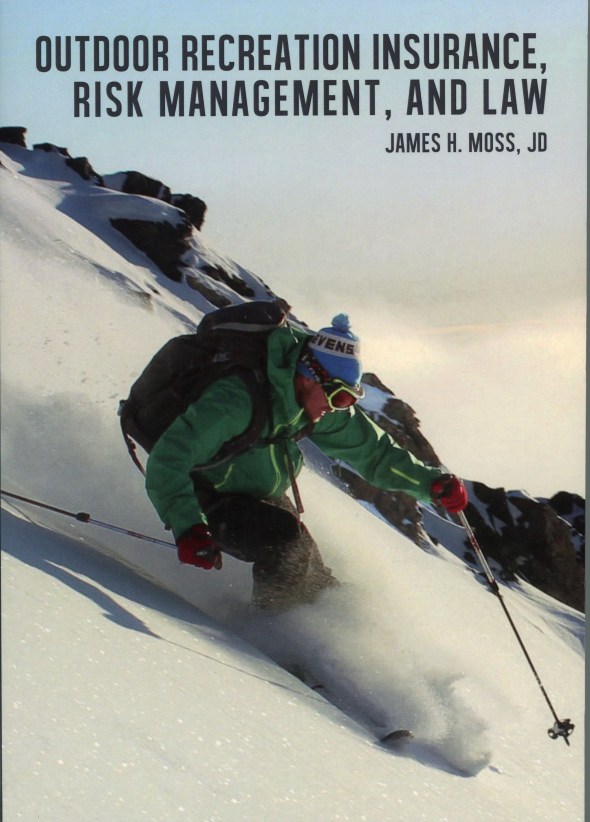
Jim is the author or co-author of six books about the legal issues in the outdoor recreation world; the latest is Outdoor Recreation Insurance, Risk Management

Outdoor Recreation Insurance, Risk Management, and Law
To see Jim’s complete bio go here and to see his CV you can find it here. To find out the purpose of this website go here.
G-YQ06K3L262
What do you think? Leave a comment.
If you like this let your friends know or post it on FB, Twitter or LinkedIn
 |
 |
 Threads |
 X (formerly known as Twitter) logo |
 Stimulus |
 Blue Sky |
Author: Outdoor Recreation Insurance, Risk Management and Law
Facebook Page: Outdoor Recreation & Adventure Travel Law
Email: Jim@Rec-Law.US
By Recreation Law Rec-law@recreation-law.com James H. Moss
@2024 Summit Magic Publishing, LLC
#AdventureTourism, #AdventureTravelLaw, #AdventureTravelLawyer, #AttorneyatLaw, #Backpacking, #BicyclingLaw, #Camps, #ChallengeCourse, #ChallengeCourseLaw, #ChallengeCourseLawyer, #CyclingLaw, #FitnessLaw, #FitnessLawyer, #Hiking, #HumanPowered, #HumanPoweredRecreation, #IceClimbing, #JamesHMoss, #JimMoss, #Law, #Mountaineering, #Negligence, #OutdoorLaw, #OutdoorRecreationLaw, #OutsideLaw, #OutsideLawyer, #RecLaw, #Rec-Law, #RecLawBlog, #Rec-LawBlog, #RecLawyer, #RecreationalLawyer, #RecreationLaw, #RecreationLawBlog, #RecreationLawcom, #Recreation-Lawcom, #Recreation-Law.com, #RiskManagement, #RockClimbing, #RockClimbingLawyer, #RopesCourse, #RopesCourseLawyer, #SkiAreas, #Skiing, #SkiLaw, #Snowboarding, #SummerCamp, #Tourism, #TravelLaw, #YouthCamps, #ZipLineLawyer, #RecreationLaw, #OutdoorLaw, #OutdoorRecreationLaw, #SkiLaw,
McDonald v. Brooklyn Boulders, LLC., 2016 N.Y. Misc. LEXIS 5211; 2016 NY Slip Op 32822(U)
Posted: July 31, 2018 Filed under: Assumption of the Risk, Climbing Wall, Legal Case, New York, Release (pre-injury contract not to sue) | Tags: Advice, Affirmative Defense, amend, amusement, appreciated, assumption of the risk, Bouldering, Brooklyn Boulders, Climb, Climbing, Climbing Wall, concealed, Dangerous Condition, Gym, Indoor Climbing Wall, instructional, leave to amend, mat, Mats, matting, Public Policy, reciprocal agreement, recreational, Release, risk doctrine, rock, Rock climbing, Sport, Teaching, team, The Rock Club, training, unaware, unreasonably, Velcro, Void, wasn't, watching Leave a commentMcDonald v. Brooklyn Boulders, LLC., 2016 N.Y. Misc. LEXIS 5211; 2016 NY Slip Op 32822(U)
[**1] Meghan Mcdonald, Plaintiff, – against – Brooklyn Boulders, LLC., Defendant. Index No. 503314/12
503314/12
SUPREME COURT OF NEW YORK, KINGS COUNTY
2016 N.Y. Misc. LEXIS 5211; 2016 NY Slip Op 32822(U)
April 12, 2016, Decided
NOTICE: THIS OPINION IS UNCORRECTED AND WILL NOT BE PUBLISHED IN THE PRINTED OFFICIAL REPORTS.
CORE TERMS: climbing, mat, climb, team, rock climbing, recreational, leave to amend, affirmative defense, risk doctrine, instructional, bouldering, void, appreciated, concealed, teaching, training, wasn’t, amend, sport’, Rock, gym, matting, reciprocal agreement, public policy, dangerous condition, unreasonably, amusement, watching, unaware, advice
JUDGES: [*1] PRESENT: HON. MARK I. PARTNOW, J.S.C.
OPINION BY: MARK I. PARTNOW
OPINION
Upon the foregoing papers, defendant Brooklyn Boulders, LLC (defendant or Brooklyn Boulders) moves for an order: 1) pursuant to CPLR §3212 granting summary judgment and the dismissal of plaintiff Meghan McDonald’s complaint against defendant; and 2) pursuant to CPLR §3025 (b) granting defendant leave to amend its answer to the complaint to include an additional affirmative defense.
[**2] Background
Plaintiff is employed as a program director and head coach of a youth rock climbing team at The Rock Club, an indoor rock climbing gym in New Rochelle, New York and has been so employed since 2006. On September 1, 2011, plaintiff went to Brooklyn Boulders with some of the members of her youth climbing team and other adults. Brooklyn Boulders is an indoor rock climbing and bouldering facility located in Brooklyn, New York. Plaintiff testified that this trip was a treat for her team and that she would be climbing that day too. It is undisputed that plaintiff signed a waiver before she began climbing and that she did not pay an entry fee pursuant to a reciprocal agreement in place between The Rock Club and Brooklyn Boulders as well as other rock climbing facilities. After [*2] approximately one and a half hours of bouldering with her team, plaintiff went to an area of the bouldering wall known as The Beast, which is very challenging in that it becomes nearly horizontal for some distance. It was her first time on the Beast, although she had been to Brooklyn Boulders on prior occasions. Plaintiff testified that she visually inspected the area below the Beast before she began her climb. Lance Pinn, the Chief Marketing Officer, President and founder of Brooklyn Boulders testified that there was foam matting system in place, with matting wall to wall in the area of the Beast. The largest pieces available were 9 feet by 7 feet so the area where the foam pieces met when placed on the ground was covered with Velcro to keep the foam matting pieces flush together.
[**3] Plaintiff finished her upward climb and then climbed down as far as she could and then looked down below to make sure there were no shoes in her way and that her spotter was out of the way. She stated that she knew that there were mats underneath so she jumped down a distance of approximately five feet. Her right foot landed on the mat but her left foot landed on the Velcro strip where two floor mats met. [*3] She testified that her left foot went through the Velcro into a space between the two mats. Plaintiff sustained an ankle fracture as a result and required surgeries and physical therapy.
Brooklyn Boulders’ Motion
Brooklyn Boulders moves for an order: 1) pursuant to CPLR §3212 granting summary judgment and the dismissal of plaintiff’s complaint against defendant; and 2) pursuant to CPLR §3025 (b) granting defendant leave to amend its answer to the complaint to include an additional affirmative defense.
Defendant argues that the liability waiver that plaintiff signed when she entered the facility releases it from liability. Defendant maintains that plaintiff was an expert climber and coach and understood the meaning of the waiver and appreciated the assumption of risk involved in the activity that she was engaged. Defendant also points out that she did not pay a fee to climb that day based upon the reciprocal program in place with other climbing facilities. Defendant claims that plaintiff was instructing her students that day as they observed her climbing and point to her testimony as follows:
[**4] Q: And were you teaching them, you know, what to do and what not to do?
A: I wasn’t teaching them, but if they had a question [*4] they would ask me hey, should I do this or do this or what do you think of this move I always give advice. (Page 30, lines 12-17).
Q. Did you ever teach any or give any instruction there?
A. Just of terms of like in my kids I probably give instruction everywhere I go. There are so many people that climb at Brooklyn Boulders that are total beginners. I’m often spotting brand new people and telling them how to spot one another. (Page 45, lines 5-12).
Defendant notes that although General Obligations Law (GOL) §5-326 renders contract clauses which release certain entities from liability void as against public policy, activities which are “instructional” as opposed to recreational are found to be outside the scope of GOL §5-326. Defendant maintains that here, plaintiff was at Brooklyn Boulders to instruct her team members and thus GOL §5-326 is not applicable. Moreover, defendant argues that the waiver at issue was explicit, comprehensive and expressly provided that Brooklyn Boulders was released from liability for personal injuries arising out of or connected with plaintiff’s participation in rock climbing.
In support of its motion, defendant submits the signed waiver which states, in pertinent part:
I acknowledge [*5] that climbing on an artificial climbing wall entails known and unanticipated risks which could result in physical or emotional injury, paralysis, death, or damage to myself, to property, or third parties. I understand that such risks simply cannot be eliminated without jeopardizing the essential [**5] qualities of the activity. I have examined the Climbing Wall and have full knowledge of the nature and extent of the risks associated with rock climbing and the use of the Climbing Wall, including but not limited to:
a:. All manner of injury resulting from my falling off or from the Climbing Wall and hitting the floor, wall faces, people or rope projections, whether permanently or temporarily in place, loose and/or damaged artificial holds, musculoskeletal injuries and/or overtraining; head injuries; or my own negligence . . . I further acknowledge that the above list is not inclusive of all possible risks associated with the Climbing Wall and related training facilities and I agree that such list in no way limits the extent or reach of this Assumption of Risk, Release and Indemnification . . .
Defendant also argues that since plaintiff did not pay a fee to climb that day that her activity was [*6] outside the scope of GOL §5-326.
Next defendant argues that the assumption of risk doctrine bars plaintiff’s claims because, as a general rule, a plaintiff who voluntarily participates in a sporting or recreational event is held to have consented to those commonly appreciated risks that are inherent in, and arise out of, the nature of the sport generally and flow from participation in such event.
Finally, defendant argues that it should be allowed to amend its answer to assert the affirmative defense of release. Defendant contends that it was unaware of the existence of the release and waiver when it served its answer. Moreover, defendant contends that plaintiff will not be prejudiced because she was, in fact, questioned about the release that she signed during her deposition.
[**6] Plaintiff opposes defendant’s motion arguing that General Obligations Law §5-326 renders the waiver and release that she signed void. She points out that defendant is attempting to circumvent this law by asserting that the activity in which plaintiff was involved was instructional as opposed to recreational and misstates her testimony in an attempt to mislead the court. Plaintiff contends that such behavior should be sanctioned. In support of her position [*7] that she was not at Brooklyn Boulders for instructional purposes, but, rather was there for a fun day of climbing, plaintiff points to her testimony that she brought some of the older members of her team to Brooklyn Boulders to climb. She testified that they all worked at The Rock Club so this was an end of summer treat for them to go and climb somewhere else and not have to work. (Page 62, lines 5-13). She further points to the following testimony:
Q: In September of 2011 when you went there on the date in question what was your purpose of being there?
A: I went there with a handful of kids who are on my climbing team, but it wasn’t a specific training day. Usually when we go it would be for training but this was just like a fun day. I was going to climb with them.
Q: And were they climbing around you.
A: Yeah, they were.(page 29, lines 14-25).
Q: And were you supervising them?
A: I wasn’t their active supervisor. I’m a coach though so I’m always watching what they do. But this was one of the few times that I was actually going to be climbing so it was kind of a treat for them I guess to be able to climb with me.
[**7] Q: Were they watching you?
A: A few of them were watching me yeah.
Q: And were [*8] you teaching them, you know, what to do and what not to do?
A: I wasn’t teaching them, but if they had a question they would ask me hey, should I do this or do this or what do you think of this move I always give advice (page 30, lines 2-17).
Plaintiff also contends that defendant incorrectly argues that GOL §5-326 does not apply because she cannot be classified a user since she did not pay to climb that day. In this regard, plaintiff contends that she is indeed a user and the law is applicable because there was a reciprocal agreement between the gym at which she was employed and Brooklyn Boulders pursuant to which employees were not required to pay a fee to use either gym. Thus, she contends the value of the reciprocity agreement is the compensation.
Next, plaintiff argues that the assumption of risk doctrine is not applicable where the risk was un-assumed, concealed or unreasonably increased. Plaintiff argues that the question of whether the gap in the mats at Brooklyn Boulders is a commonly appreciated risk inherent in the nature of rock climbing necessitates denial of the summary judgment motion. She claims that she did not assume the risk that there would be a gap in the matting that was in [*9] place as protection from a fall. Moreover, plaintiff maintains that defendant fails to proffer any evidence demonstrating when the mats were last inspected prior to plaintiff’s accident.
Plaintiff argues that issues as to whether dangerous or defective conditions exist on property and whether the condition is foreseeable can only be answered by a jury. Thus, she [**8] contends that whether the condition of the mats was dangerous and/or defective is an issue of fact and that defendant has failed to proffer any evidence that the mats were in a reasonably safe condition.
Finally, plaintiff opposes defendant’s request to amend its answer to add the affirmative defense of waiver. Plaintiff argues that the existence of the waiver was known and that it is disingenuous at best to assert otherwise. Plaintiff contends that this request, post note of issue, is highly prejudicial to plaintiff.
In reply, defendant argues that plaintiff’s demand for sanctions lacks merit and that plaintiff’s testimony establishes that she was in fact, instructing her students when her accident occurred. Defendant contends that the waiver applies. Next defendant claims that as far as inspection of its equipment it had a [*10] route setting department that checked its walls and mats and that bouldering climbers were responsible for enuring their own safety when climbing. Finally, defendant argues that the assumption of risk doctrine applies and that plaintiff visually inspected the area before the accident and that the Velcro covers were visible and moreover, she had the option to use additional mats underneath her while climbing. Defendant further contends that the mats did not constitute a dangerous condition. Finally, Brooklyn Boulders reiterates its request for leave to amend its answer to assert the affirmative defense.
[**9] Discussion
Leave to Amend
Generally, in the absence of prejudice or surprise to the opposing party, leave to amend pleadings should be freely granted unless the proposed amendment is palpably insufficient or patently devoid of merit (Yong Soon Oh v Hua Jin, 124 AD3d 639, 640, 1 N.Y.S.3d 307 [2015]; see Jones v LeFrance Leasing Ltd. Partnership, 127 AD3d 819, 821, 7 N.Y.S.3d 352 [2015]; Rodgers v New York City Tr. Auth., 109 AD3d 535, 537, 970 N.Y.S.2d 572 [2013]; Schwartz v Sayah, 83 AD3d 926, 926, 920 N.Y.S.2d 714 [2011]). A motion for leave to amend is committed to the broad discretion of the court (see Ravnikar v Skyline Credit-Ride, Inc., 79 AD3d 1118, 1119, 913 N.Y.S.2d 339 [2010]). However, where amendment is sought after the pleader has filed a note of issue, “a trial court’s discretion to grant a motion to amend should be exercised with caution” (Harris v Jim’s Proclean Serv., Inc., 34 AD3d 1009,1010, 825 N.Y.S.2d 291 [3d Dept 2006]).
Here, while the court is not satisfied with counsel’s explanation that he was unaware of the [*11] existence of the release and waiver signed by plaintiff at the time that the original answer was served, the court notes that plaintiff was questioned about the release and waiver during her May 6, 2014 deposition so the court finds that there is no surprise of prejudice in allowing defendant leave to serve its amended answer and assert the affirmative defense of release and waiver. Accordingly, that branch of defendant’s motion seeking leave to amend its answer to the complaint to include this affirmative defense is granted.
[**10] General Obligations Law §5-326
GOL §5-326 states that:
Every covenant, agreement or understanding in or in connection with, or collateral to, any contract, membership application, ticket of admission or similar writing, entered into between the owner or operator of any pool, gymnasium, place of amusement or recreation, or similar establishment and the user of such facilities, pursuant to which such owner or operator receives a fee or other compensation for the use of such facilities, which exempts the said owner or operator from liability for damages caused by or resulting from the negligence of the owner, operator or person in charge of such establishment, or their agents, servants or employees, shall [*12] be deemed to be void as against public policy and wholly unenforceable.
Such contracts or agreements are void as against public policy unless the entity can show that its facility is used for instructional purposes as opposed to recreational purposes. “The legislative intent of the statute is to prevent amusement parks and recreational facilities from enforcing exculpatory clauses printed on admission tickets or membership applications because the public is either unaware of them or not cognizant of their effect (see Lux v Cox, 32 F.Supp.2d 92, 99 [1998]; McDuffie v Watkins Glen Int’l, 833 F. Supp. 197, 202 [1993] ). Facilities that are places of instruction and training (see e.g. Millan v Brown, 295 AD2d 409, 411, 743 N.Y.S.2d 539 [2002]; Chieco v Paramarketing, Inc., 228 AD2d 462, 463, 643 N.Y.S.2d 668 [1996]; Baschuk v Diver’s Way Scuba, 209 AD2d 369, 370, 618 N.Y.S.2d 428 [1994] ), rather than “amusement or recreation” (see e.g. Meier v Ma-Do Bars, 106 AD2d 143, 145, 484 N.Y.S.2d 719 [1985] ), have been found to be outside the scope of the statute. “In assessing whether a facility is instructional or recreational, courts have [**11] examined, inter alia, the organization’s name, its certificate of incorporation, its statement of purpose and whether the money it charges is tuition or a fee for use of the facility” (Lemoine v Cornell Univ., 2 AD3d 1017, 1019, 769 N.Y.S.2d 313 [2003], lv denied 2 NY3d 701, 810 N.E.2d 912, 778 N.Y.S.2d 459 [2004]). In cases involving a mixed use facility, courts have focused less on a facility’s ostensible purpose and more on whether the person was at the facility for the purpose of receiving instruction (Id. At 1019; see Scrivener v Sky’s the Limit, 68 F Supp 2d 277, 281 [1999]; Lux v Cox, 32 F Supp 2d at 99). Where [*13] a facility “promotes . . . a recreational pursuit, to which instruction is provided as an ancillary service,” General Obligations Law § 5-326 applies even if the injury occurs while receiving instruction (Debell v Wellbridge Club Mgt., Inc., 40 AD3d 248, 249, 835 N.Y.S.2d 170 [2007]; Bacchiocchi v Ranch Parachute Club, 273 AD2d 173, 175, 710 N.Y.S.2d 54 [2000]).
Here, defendant asserts that GOL §5-326 is not applicable because plaintiff was at Brooklyn Boulders to instruct her team members. The court disagrees. Plaintiff’s testimony establishes that she was at Brooklyn Boulders with her team for a day of fun and not to teach them how to climb. Her testimony that she would give advice to the students if they asked does not rise to the level of providing rock climbing instruction on that day. Moreover, the court notes that the cases invloving the exemption for instrctional activities generally involve the person being instructed sustaining an injury and not the person who was providing the instruction. In addition, the court finds defendants’s argument that the fact that plaintiff did not pay a fee that day renders GOL §5-326 not applicable is equally unavailing. The reciprocal agreement that was in place between Brooklyn Boulders and The Rock Club, [**12] where plaintiff was employed, which allowed such employees to use other bouldering facilities without being charged a fee was a benefit of [*14] their employment and thus could be considered compensation. Accordingly, the court finds that the release and waiver signed by plaintiff is void pursuant to GOL §5-326.
Assumption of Risk
The assumption of the risk defense is based on the proposition that “by engaging in a sport or recreational activity, a participant consents to those commonly appreciated risks which are inherent in and arise out of the nature of the sport generally and flow from such participation” (Morgan v State of New York, 90 NY2d 471, 484, 685 N.E.2d 202, 662 N.Y.S.2d 421 [1997]; Paone v County of Suffolk, 251 AD2d 563, 674 N.Y.S.2d 761 [2d Dept 1998]), including the injury-causing events which are the known, apparent, or reasonably foreseeable risks of the participation (see Rosenbaum v Bayis Ne’Emon Inc., 32 AD3d 534, 820 N.Y.S.2d 326 [2d Dept 2006]; Colucci v Nansen Park, Inc., 226 AD2d 336, 640 N.Y.S.2d 578 [2d Dept 1996]). A plaintiff is deemed to have given consent limiting the duty of the defendant who is the proprietor of the sporting facility “to exercise care to make the conditions as safe as they appear to be. If the risks of the activity are fully comprehended or perfectly obvious, plaintiff has consented to them and defendant has performed its duty” (Turcotte v Fell, 68 NY2d 432, 502 N.E.2d 964, 510 N.Y.S.2d 49 [1986]). Stated otherwise, the duty of the defendant is to protect the plaintiff from injuries arising out of unassumed, concealed, or unreasonably increased risks (see Manoly v City of New York, 29 AD3d 649, 816 N.Y.S.2d 499 [2d Dept 2006]; Pascucci v Town of Oyster Bay, 186 AD2d 725, 588 N.Y.S.2d 663 [2d Dept 1992]). It is well settled that “awareness of [**13] risk is not to be determined in a vacuum. It is, rather, to [*15] be assessed against the background of the skill and experience of the particular plaintiff” (Maddox v City of New York, 66 NY2d 270, 278, 487 N.E.2d 553, 496 N.Y.S.2d 726 [1985]; see also Benitez v New York City Bd. of Educ., 73 NY2d 650, 657-658, 541 N.E.2d 29, 543 N.Y.S.2d 29 [1989]; Turcotte v Fell, 68 NY2d 432, 440, 502 N.E.2d 964, 510 N.Y.S.2d 49 [1986]; Latimer v City of New York, 118 AD3d 420, 421, 987 N.Y.S.2d 58 [2014]). When applicable, the assumption of risk doctrine “is not an absolute defense but a measure of the defendant’s duty of care” (Turcotte v Fell, 68 NY2d at 439). Thus, “a gym or athletic facility cannot evade responsibility for negligent behavior ‘by invoking a generalized assumption of risk doctrine as though it was some sort of amulet that confers automatic immunity’ (Jafri v Equinox Holdings, Inc., 2014 N.Y. Misc. LEXIS 5330, 4-5 [Sup. Ct, New York County quoting Mellon v Crunch & At Crunch Acquisition, LLC, 32 Misc 3d 1214[A], 934 N.Y.S.2d 35, 2011 NY Slip Op 51289[U] [Sup Ct, Kings County 2011]; Livshitz v United States Tennis Assn. Natl. Tennis Ctr., 196 Misc 2d 460, 466, 761 N.Y.S.2d 825 [Sup Ct, Queens County 2003]).
Furthermore, “in assessing whether a defendant has violated a duty of care within the genre of tort-sports activities and their inherent risks, the applicable standard should include whether the conditions caused by the defendants’ negligence are unique and created a dangerous condition over and above the usual dangers that are inherent in the sport’ (Morgan, 90 NY2d at 485. quoting Owen v R.J.S. Safety Equip., 79 NY2d 967, 970, 591 N.E.2d 1184, 582 N.Y.S.2d 998 [1992]; Georgiades v Nassau Equestrian Ctr. at Old Mill, Inc., 134 AD3d 887, 889, 22 N.Y.S.3d 467 [2d Dept 2015]; Weinberger v Solomon Schechter Sch. of Westchester, 102 AD3d 675, 678, 961 N.Y.S.2d 178 [2d Dept 2013]). Participants, however, do not assume risks which have been unreasonably increased or [**14] concealed over and above the usual dangers inherent in the activity (see Morgan, 90 NY2d at 485; Benitez, 73 NY2d at 657-658; Muniz v Warwick School Dist., 293 AD2d 724, 743 N.Y.S.2d 113 [2002]).
In this regard, the court finds that plaintiff has raised a question of fact regarding whether the condition of the mats, with the Velcro connection, increased the risk in the danger [*16] of the activity and caused a concealed dangerous condition. Thus it cannot be said that plaintiff assumed the particular risk that was present and caused her injuries.
Based upon the foregoing, that branch of Brooklyn Boulders motion seeking summary judgment dismissing plaintiff’s complaint is denied.
The foregoing constitutes the decision and order of the court.
ENTER,
/s/ Mark I Partnow
J. S. C.
HON. MARK I PARTNOW
SUPREME COURT JUSTICE
Holbrook v. Mccracken, 2004-Ohio-3291; 2004 Ohio App. LEXIS 2932
Posted: July 30, 2018 Filed under: Assumption of the Risk, Climbing Wall, Legal Case, Ohio | Tags: accelerated, announcement, assignment of error, assumption of the risk, Belay device, belayer, climber, Climbing Gym, Climbing Wall, Falling, Harness, Indoor Climbing Wall, Recreation, recreational activity, Rock climbing, rope, slipped Leave a commentTo Read an Analysis of this decision see: Assumption of the Risk is a valid defense against a claim by an injured indoor climber against the belayer who allegedly dropped him.
Holbrook v. Mccracken, 2004-Ohio-3291; 2004 Ohio App. LEXIS 2932
Matthew Holbrook, Plaintiff-appellant vs. Erin Mccracken, Defendant-appellee
NO. 83764
COURT OF APPEALS OF OHIO, EIGHTH APPELLATE DISTRICT, CUYAHOGA COUNTY
2004-Ohio-3291; 2004 Ohio App. LEXIS 2932
June 24, 2004, Date of Announcement of Decision
PRIOR HISTORY: [**1] CHARACTER OF PROCEEDING: Civil appeal from Cuyahoga County Court of Common Pleas. Case No. CV-466188.
DISPOSITION: AFFIRMED.
COUNSEL: For plaintiff-appellant: JACK G. FYNES, NATHAN A. HALL, Attorneys at Law, SHUMAKER, LOOP & KENDRICK, LLP, Toledo, Ohio.
For defendant-appellee: JAMES M. JOHNSON, Attorney at Law, KOETH, RICE & LEO CO., L.P.A., Cleveland, Ohio.
JUDGES: KENNETH A. ROCCO, JUDGE. JAMES J. SWEENEY, P.J. and DIANE KARPINSKI, J. CONCUR.
OPINION BY: KENNETH A. ROCCO
OPINION
ACCELERATED DOCKET
JOURNAL ENTRY and OPINION
KENNETH A. ROCCO, J.
[*P1] This cause came to be heard on the accelerated calendar pursuant to App.R. 11.1 and Loc.App.R. 11.1. The purpose of an accelerated appeal is to allow the appellate court to render a brief and conclusory decision. Crawford v. Eastland Shopping Mall Ass’n (1983), 11 Ohio App. 3d 158, 11 Ohio B. 240, 463 N.E.2d 655.
[*P2] Plaintiff-appellant Matthew Holbrook appeals from the trial court order that granted summary judgment to defendant-appellee Erin McCracken, thus terminating appellant’s personal injury action.
[*P3] Appellant was injured when he fell from an indoor rock wall he had climbed for recreation. At the time, appellee was acting as his “belayer, [**2] ” i.e., as appellant descended from his successful climb, appellee reversed the process of taking up slack and instead let out rope for him from the top of the wall through a harness system attached to her body. Appellee stated she thought she “wasn’t fast enough” at locking the smooth “new” rope before too much of it slipped through the device on her harness and slackened appellant’s line.
[*P4] In his sole assignment of error, appellant argues the trial court improperly determined the doctrine of primary assumption of the risk precluded appellee’s liability on appellant’s claim. This court disagrees.
[*P5] [HN1] The Ohio Supreme Court recently reaffirmed the applicability of that doctrine to recreational activities in Gentry v. Craycraft, 101 Ohio St.3d 141, 2004 Ohio 379, 802 N.E.2d 1116. In order to gain the thrill associated with rock climbing, the appellant voluntarily assumed the primary and “inherent risk” of the activity, viz., falling. Blankenship v. CRT Tree, 2002 Ohio 5354.
[*P6] Therefore, despite appellant’s expert’s opinion that appellee was “reckless” in permitting the rope to slip through her hands, [HN2] the risk of falling [**3] inherent to the activity of rock climbing can be “reduced***[but] cannot be eliminated.” Vorum v. Joy Outdoor Education Center, (Dec. 12, 1998), 1998 Ohio App. LEXIS 6139, Warren App. No. CA98-06-072. This is especially true when the injury results from simple human error. Gentry v. Craycraft, supra, P 14.
[*P7] Since there was no evidence that appellee acted either intentionally or recklessly when the rope she held slipped before the harness device could lock it in place, the trial court correctly concluded she was entitled to summary judgment on appellant’s claim.
[*P8] Accordingly, appellant’s assignment of error is overruled.
Judgment affirmed.
It is ordered that appellee recover of appellant costs herein taxed.
The court finds there were reasonable grounds for this appeal.
It is ordered that a special mandate issue out of this court directing the Cuyahoga County Court of Common Pleas to carry this judgment into execution.
A certified copy of this entry shall constitute the mandate pursuant to Rule 27 of the Rules of Appellate Procedure.KENNETH A. ROCCO JUDGE
JAMES J. SWEENEY, P.J. and
DIANE KARPINSKI, J. CONCUR
N.B. This entry is [**4] an announcement of the court’s decision. See App.R. 22(B), 22(D) and 26(A); Loc.App.R. 22. This decision will be journalized and will become the judgment and order of the court pursuant to App.R. 22(E) unless a motion for reconsideration with supporting brief, per App.R. 26(A), is filed within ten (10) days of the announcement of the court’s decision. The time period for review by the Supreme Court of Ohio shall begin to run upon the journalization of this court’s announcement of decision by the clerk per App.R. 22(E). See, also, S. Ct. Prac.R. II, Section 2(A)(1).
G-YQ06K3L262
Release for a health club which had a foam pit included language specific to the injury the plaintiff suffered, which the court used to deny the plaintiff’s claim.
Posted: July 30, 2018 Filed under: Health Club, Illinois, Release (pre-injury contract not to sue) | Tags: Ambiguity, Ambiguous, assumption of the risk, bones, Climbing, de novo, deposition, discovery, encompassed, exculpatory, Exculpatory clause, foam, Gym, Gymnastics, Health club, inherent, Inherent Risk, injury resulting, jumping, landing, Notice, physical condition, pit, Public Policy, Release, release agreement, releasing, Risk, risk of injury, Sport, springboard, Summary judgment, Supervision, surface, undersigned Leave a commentArgument made that the word inherent limited the risks the release covered and as such did not cover the injury the plaintiff received.
Macias, v. Naperville Gymnastics Club, 2015 IL App (2d) 140402-U; 2015 Ill. App. Unpub. LEXIS 448
State: Illinois, Appellate Court of Illinois, Second District
Plaintiff: Kamil Macias
Defendant: Naperville Gymnastics Club
Plaintiff Claims: negligent in its failure to properly supervise the open gym, train participants, and warn participants of hazards and dangers accompanied with activities and use of equipment in the open gym
Defendant Defenses: Release
Holding: For the Defendant
Year: 2015
Summary
Plaintiff was injured jumping headfirst into a foam pit at the defendant’s gym. The plaintiff had signed a release relieving the defendant of liability, which was upheld by the trial court and the appellate court.
For the first time, the plaintiff argued the release was limited by the language in the release because it used the term inherent in describing the risks. Inherent limits the risks, to those that are part and parcel of the activity and the injury that befell the plaintiff was a freak accident.
Facts
The plaintiff went to the defendant club during open hours when the public could attend with a friend. He paid an admission fee and signed a release. The club had a foam pit. The plaintiff watched other people jump into the pit then tried it himself. He jumped off the springboard and instead of landing feet first he landed head first in the pit.
The plaintiff broke his neck requiring extensive surgery and rehabilitation.
The defendant club filed a motion to dismiss based upon the release signed by the plaintiff. The trial court denied the motion to dismiss because the release was ambiguous.
During discovery, the plaintiff admitted he did not see the rules of the gym but did understand the risks of landing in the pit head first.
Walk around all pits and trampolines,” and he stated that he understood what this meant. The rules also stated: “Do not play on any equipment without proper supervision,” and “Do not do any gymnastics without proper supervision,” and plaintiff stated that he understood what these meant. Plaintiff also stated that he did not see a sign painted on the wall in the gym titled, “Loose foam pit rules.” That sign stated: “Look before you leap,” “No diving or belly flops,” and “Land on feet, bottom or back only.” Plaintiff acknowledged that he understood what these meant
After discovery, the defendant club filed a motion for summary judgment based on the additional information collected during discovery. The trial court granted that motion, and this appeal was dismissed.
Analysis: making sense of the law based on these facts.
The appellate court looked at contract law in Illinois.
The primary objective in construing a contract is to give effect to the parties’ intent, and to discover this intent the various contract provisions must be viewed as a whole. Words derive meaning from their context, and contracts must be viewed as a whole by examining each part in light of the other parts. Id. Contract language must not be rejected as meaningless or surplusage; it is presumed that the terms and provisions of a contract are purposely inserted and that the language was not employed idly.
A release is a contract. For the release to be valid and enforceable, it should:
…contain clear, explicit, and unequivocal language referencing the types of activities, circumstances, or situations that it encompasses and for which the plaintiff agrees to relieve the defendant from a duty of care. In this way, the plaintiff will be put on notice of the range of dangers for which he assumes the risk of injury, enabling him to minimize the risks by exercising a greater degree of caution.
The court found the injury suffered by the plaintiff fell within the scope of the possible injuries of the release and contemplated by the plaintiff upon signing the release.
Two clauses in the release stated the plaintiff was in good physical health and had proper physical condition to participate. The plaintiff argued these clauses made the release ambiguous; however, the appellate court did not find that to be true.
Here is the interesting argument in the case.
I have repeatedly stated that releases that limit releases to the inherent risk are limited in their scope. The plaintiff made that argument here.
Plaintiff argues that the use of “inherent risk” language throughout the release creates an ambiguity as to whether the language covers only dangers inherent in gymnastics and not freak accidents. We also reject this argument. As previously stated, the release specifically lists landing on landing surfaces as an inherent risk. Thus, there is no ambiguity as to whether plaintiff’s injury was covered by the release.
The plaintiff also argued his injury was not foreseeable because:
… (1) he lacked specialized knowledge of gymnastics and, in particular, foam pits, to appreciate the danger and foresee the possibility of injury, and (2) his injury was not the type that would ordinarily accompany jumping into a foam pit.
The argument on whether the injury was foreseeable is not whether the plaintiff knew of the risk but:
The relevant inquiry is not whether [the] plaintiff foresaw [the] defendants’ exact act of negligence,” but “whether [the] plaintiff knew or should have known” the accident “was a risk encompassed by his [or her] release.
The court found the injury the plaintiff received was on that was contemplated by the release.
Thus, the issue here is whether plaintiff knew or should have known that the accident was a risk encompassed by the release which he signed. As previously determined, the language of the release in this case was specific enough to put plaintiff on notice. In discussing inherent risks in the sport of gymnastics and use of the accompanying equipment, the release lists injuries resulting from landing on the landing surfaces, which includes injuries to bones, joints, tendons, or death.
The plaintiff also argued the release violated public policy because the release was presented to “opened its gym to the unskilled and inexperienced public” when it opened its gym to the public.
The court struck down this argument because the freedom to contract was greater than the limitation on damages issues.
The appellate court affirmed the trial court’s granting of the summary judgment for the defendant based on the release.
So Now What?
The inherent risk argument here was made but either not effectively argued by the plaintiff or ignored by the court. However, for the first time, the argument that the word inherent is a limiting word, not a word that expands the release was made in an argument.
What do you think? Leave a comment.
Copyright 2018 Recreation Law (720) 334 8529
If you like this let your friends know or post it on FB, Twitter or LinkedIn


Author: Outdoor Recreation Insurance, Risk Management and Law
Facebook Page: Outdoor Recreation & Adventure Travel Law
Email: Rec-law@recreation-law.com
By Recreation Law Rec-law@recreation-law.com James H. Moss
#AdventureTourism, #AdventureTravelLaw, #AdventureTravelLawyer, #AttorneyatLaw, #Backpacking, #BicyclingLaw, #Camps, #ChallengeCourse, #ChallengeCourseLaw, #ChallengeCourseLawyer, #CyclingLaw, #FitnessLaw, #FitnessLawyer, #Hiking, #HumanPowered, #HumanPoweredRecreation, #IceClimbing, #JamesHMoss, #JimMoss, #Law, #Mountaineering, #Negligence, #OutdoorLaw, #OutdoorRecreationLaw, #OutsideLaw, #OutsideLawyer, #RecLaw, #Rec-Law, #RecLawBlog, #Rec-LawBlog, #RecLawyer, #RecreationalLawyer, #RecreationLaw, #RecreationLawBlog, #RecreationLawcom, #Recreation-Lawcom, #Recreation-Law.com, #RiskManagement, #RockClimbing, #RockClimbingLawyer, #RopesCourse, #RopesCourseLawyer, #SkiAreas, #Skiing, #SkiLaw, #Snowboarding, #SummerCamp, #Tourism, #TravelLaw, #YouthCamps, #ZipLineLawyer, #RecreationLaw, #OutdoorLaw, #OutdoorRecreationLaw, #SkiLaw,
Macias, v. Naperville Gymnastics Club, 2015 IL App (2d) 140402-U; 2015 Ill. App. Unpub. LEXIS 448
Posted: July 29, 2018 Filed under: Health Club, Illinois, Release (pre-injury contract not to sue) | Tags: Ambiguity, Ambiguous, bones, Climbing, de novo, deposition, discovery, encompassed, exculpatory, Exculpatory clause, foam, Gym, Gymnastics, Inherent Risk, injury resulting, jumping, landing, Notice, physical condition, pit, Public Policy, release agreement, releasing, risk of injury, Sport, springboard, Summary judgment, Supervision, surface, undersigned Leave a commentMacias, v. Naperville Gymnastics Club, 2015 IL App (2d) 140402-U; 2015 Ill. App. Unpub. LEXIS 448
Kamil Macias, Plaintiff-Appellant, v. Naperville Gymnastics Club, Defendant-Appellee.
No. 2-14-0402
APPELLATE COURT OF ILLINOIS, SECOND DISTRICT
2015 IL App (2d) 140402-U; 2015 Ill. App. Unpub. LEXIS 448
March 10, 2015, Order Filed
NOTICE: THIS ORDER WAS FILED UNDER SUPREME COURT RULE 23 AND MAY NOT BE CITED AS PRECEDENT BY ANY PARTY EXCEPT IN THE LIMITED CIRCUMSTANCES ALLOWED UNDER RULE 23(e)(1).
PRIOR HISTORY: [**1] Appeal from the Circuit Court of Du Page County. No. 11-L-1418. Honorable Judges Hollis L. Webster and John T. Elsner, Judges, Presiding.
DISPOSITION: Affirmed.
CORE TERMS: gym, pit, landing, summary judgment, foam, exculpatory clause, gymnastics, release agreement, surface, inherent risk, jumping, discovery, ambiguity, exculpatory, deposition, injury resulting, public policy, risk of injury, physical condition, releasing, ambiguous, sport, bones, supervision, de novo, springboard, encompassed, notice, undersigned, climbing
JUDGES: JUSTICE BURKE delivered the judgment of the court. Presiding Justice Schostok and Justice Zenoff concurred in the judgment.
OPINION BY: BURKE
OPINION
ORDER
Held: Release agreement for the gym was sufficiently clear, explicit, and unequivocal to show intent to protect facility from liability arising from use of its “foam pit”; it was proper for the gym to raise the issue it had raised in the section 2-619 motion in a summary judgment motion as it alleged new facts which were developed during discovery that affected the validity of the release; affirmed.
[*P2] Plaintiff, Kamil Macias, filed a complaint against defendant, Naperville Gymnastics Club (the Club), for injuries he received after jumping off a springboard and landing head first into a “foam pit.” The trial court denied the Club’s motion to dismiss, pursuant to section 2-619 of the Code of Civil Procedure (Code) (735 ILCS 5/2-619 (West 2010)), but it later granted the Club’s motion for summary judgment based on a liability release agreement signed by plaintiff. Plaintiff raises several issues on appeal concerning the release and the effect of the earlier [**2] section 2-619 motion to dismiss. We affirm.
[*P3] I. BACKGROUND
[*P4] On January 15, 2011, plaintiff came to the Club with his friend. The Club offers “open gym” hours where members of the Club and the general public can attend. Plaintiff, who was not a member of the Club, paid a $10 admission fee and he signed a liability release agreement.
[*P5] A foam pit was located in the gym. After seeing participants jumping into the pit, plaintiff jogged up to a springboard in front of the pit, jumped onto the board and into the pit. While attempting to jump feet first, plaintiff’s body moved in the air, causing him to land head first, striking the bottom of the pit. Plaintiff immediately lost all feeling in his body below the neck. He remained in the pit covered by pieces of foam until he was extracted by the Naperville Fire Department. At the time, plaintiff was 20 years old, about 6 feet tall, and weighed 310 pounds. As a result of the accident, plaintiff suffered a broken neck, requiring extensive surgery and rehabilitation. Plaintiff filed a complaint alleging the Club was negligent in its failure to properly supervise the open gym, train participants, and warn participants of hazards and dangers accompanied with activities [**3] and use of equipment in the open gym.
[*P6] The Club filed a section 2-619(a)(9) motion to dismiss (735 ILCS 5/2-619(a)(9) (West 2010)), alleging that plaintiff signed a two-page liability release agreement that contained an exculpatory clause releasing the Club from liability for any acts of negligence.
[*P7] The trial court found the release ambiguous and denied the section 2-619(a)(9) motion without prejudice. In denying the motion, the judge stated that she felt it was inappropriate to dismiss the suit at that point, that there was case law on both sides of “these exculpatory clauses,” and the judge agreed that it was something that could be developed through discovery. She further stated, “But I think it’s something that is better suited for a summary judgment motion if the facts do bear that out from the defense’s perspective.”
[*P8] During discovery, plaintiff was questioned by defense counsel and testified to the following:
“Q. Okay. That first part of the form it says, ‘To gain admission to the activity areas of [the Club], all parts of this form must be read, understood, and signed.’ Do you see that?
A. Yes.
Q. And did you understand what that means?
A. Yes.
* * *
Q. Did you understand this to be an agreement on January 15th, 2011[,] between you and [the [**4] Club]?
A. Had I read this agreement I would have understood.
* * *
Q. And you understand that [the release] means that when you sign it that you’re agreeing to not bring any lawsuit against [the Club]?
A. Correct.
Q. And if you had read it on January 15th of 2011, that’s what you would have understood it to mean?
A. Correct.
* * *
Q. And you agree that the sport of gymnastics is a risky sport?
A. Correct.
Q: And you would have felt the same on January 15th, 2011[,] before your accident?
A. Yes.”
[*P9] At the entrance to the gym was a closed door with a window pane in it. Plaintiff did not recall seeing a sign on the door entitled, “Rules of the Gym.” Plaintiff reviewed the rules at his deposition and admitted that it said to “Walk around all pits and trampolines,” and he stated that he understood what this meant. The rules also stated: “Do not play on any equipment without proper supervision,” and “Do not do any gymnastics without proper supervision,” and plaintiff stated that he understood what these meant. Plaintiff also stated that he did not see a sign painted on the wall in the gym titled, “Loose foam pit rules.” That sign stated: “Look before you leap,” “No diving or belly flops,” and “Land on [**5] feet, bottom or back only.” Plaintiff acknowledged that he understood what these meant.
[*P10] After discovery, the Club filed a motion for summary judgment, arguing that plaintiff’s claim was barred by the exculpatory clause of the release signed by plaintiff. The motion included the deposition testimony and that (1) plaintiff denied being given any verbal instructions and denied seeing the warning signs or rules posted in the gym before he was injured, and (2) plaintiff admitted that he would have understood the terms of the liability release, had he read it. Following argument, the trial court granted the Club’s motion for summary judgment. This timely appeal follows.
[*P11] II. ANALYSIS
[*P12] A. Standard of Review
[*P13] Summary judgment is appropriate “if the pleadings, depositions, and admissions on file, together with the affidavits, if any, show that there is no genuine issue as to any material fact and that the moving party is entitled to a judgment as a matter of law.” 735 ILCS 5/2-1005(c) (West 2010). The motion should be denied if there are disputed facts, but also if reasonable people could draw different inferences from the undisputed facts. Wood v. National Liability & Fire Insurance Co., 324 Ill. App. 3d 583, 585, 755 N.E.2d 1044, 258 Ill. Dec. 225 (2001). We review an order granting summary judgment de novo. Pielet v. Pielet, 2012 IL 112064, ¶ 30, 978 N.E.2d 1000, 365 Ill. Dec. 497.
[*P14] We review the parties’ [**6] liability release agreement in accordance with well-established contract principles. Joyce v. Mastri, 371 Ill. App. 3d 64, 74, 861 N.E.2d 1102, 308 Ill. Dec. 537 (2007). The primary objective in construing a contract is to give effect to the parties’ intent, and to discover this intent the various contract provisions must be viewed as a whole. Kerton v. Lutheran Church Extension Fund, 262 Ill. App. 3d 74, 77, 634 N.E.2d 16, 199 Ill. Dec. 416 (1994). Words derive meaning from their context, and contracts must be viewed as a whole by examining each part in light of the other parts. Id. Contract language must not be rejected as meaningless or surplusage; it is presumed that the terms and provisions of a contract are purposely inserted and that the language was not employed idly. Id.
[*P15] In order for an exculpatory clause to be valid and enforceable, it should contain clear, explicit, and unequivocal language referencing the types of activities, circumstances, or situations that it encompasses and for which the plaintiff agrees to relieve the defendant from a duty of care. Calarco v. YMCA, 149 Ill. App. 3d 1037, 1040, 501 N.E.2d 268, 103 Ill. Dec. 247 (1986). In this way, the plaintiff will be put on notice of the range of dangers for which he assumes the risk of injury, enabling him to minimize the risks by exercising a greater degree of caution. Neumann v. Gloria Marshall Figure Salon, 149 Ill. App. 3d 824, 827, 500 N.E.2d 1011, 102 Ill. Dec. 910 (1986). The precise occurrence which results in injury need not have been contemplated by the parties at the time the contract [**7] was entered into. Schlessman v. Henson, 83 Ill. 2d 82, 86, 413 N.E.2d 1252, 46 Ill. Dec. 139 (1980). It should only appear that the injury falls within the scope of possible dangers ordinarily accompanying the activity and, thus, reasonably contemplated by the plaintiff. Garrison v. Combined Fitness Centre, Ltd., 201 Ill. App. 3d 581, 585, 559 N.E.2d 187, 147 Ill. Dec. 187 (1990). Further, when interpreting a contract containing an exculpatory clause, the court must interpret the scope of the exculpatory provision in the “context of the entire agreement.” Shorr Paper Products, Inc. v. Aurora Elevator, Inc., 198 Ill. App. 3d 9, 13, 555 N.E.2d 735, 144 Ill. Dec. 376 (1990). We review the interpretation of an exculpatory agreement or release of liability authorization de novo. Stratman v. Brent, 291 Ill. App. 3d 123, 137, 683 N.E.2d 951, 225 Ill. Dec. 448 (1997).
[*P16] In Garrison, a member of a health club who was injured when lifting weights on a bench press brought suit against the club and the manufacturer of the press. The trial court entered summary judgment in favor of the club, and the plaintiff appealed. The First District Appellate Court held that the exculpatory clause could not have been more clear or explicit, as it stated that each member bore the “sole risk” of injury that might result from the use of weights, equipment, or other apparatus provided and that the selection of the type of equipment to be used would be the “entire responsibility” of the member. The court found that the injury the plaintiff sustained clearly fell within the scope of possible dangers [**8] ordinarily accompanying the activity of weightlifting. Id. at 585. The court observed that the injury was of a type that would normally be contemplated by the parties at the time the contract was made and, therefore, the court held that it clearly fell within the parameters of the exculpatory clause. Id. See also Hussein v. L.A. Fitness International, LLC, 2013 IL App (1st) 121426, 987 N.E.2d 460, 369 Ill. Dec. 833; Neumann v. Gloria Marshall Figure Salon, 149 Ill. App. 3d 824, 500 N.E.2d 1011, 102 Ill. Dec. 910 (1986).
[*P17] Similar to Garrison and the cases cited above, the release agreement in the present case is clear and specific regarding the risks it covers and the release of the Club’s negligence. It specifically references the inherent risk of injury resulting from landing on landing surfaces, and plaintiff acknowledged in his deposition that this phrase includes the foam pit in which he was injured. The agreement also releases the Club from any and all claims, including those caused by its negligence. Furthermore, plaintiff’s signature certified that he recognized the dangers inherent with climbing and jumping activities and that he voluntarily assumed the risks.
[*P18] Nevertheless, plaintiff raises several arguments regarding the validity of the release and the effect of the earlier section 2-619 motion.
[*P19] B. Ambiguity of the Release
[*P20] 1. First Clause
[*P21] The first clause of the release, which is typed in capital letters, states: [**9]
“BY SIGNING THIS DOCUMENT YOU ACKNOWLEDGE THAT UNSUPERVISED USE OF ANY AREA OF FACILITY IS STRICTLY PROHIBITED AND COMPLETELY AT THE RISK OF THE PARTICIPANT AND THAT THE RULES [OF] EACH AREA BEING UTILIZED ARE UNDERSTOOD PRIOR TO PARTICIPATION!”
Plaintiff asserts that this clause is ambiguous as to whether supervision and a full understanding of the rules of the Club is a condition precedent to releasing defendant from liability. We agree that the first clause, standing alone, might be construed as stating that supervision and a full understanding of the rules of the Club is a condition preceding releasing the Club from liability. However, case law teaches that we must review the language of the release in its entirety in order to interpret the parties’ intent.
[*P22] The release contains a “Covenant Not to Sue for Injury or Damages,” which provides, in relevant part:
“Notice: This is a legally binding agreement. By signing this agreement, you waive your right to bring a court action to recover compensation or to obtain any other remedy for any injury to yourself *** however caused arising out of use of the facilities of [the Club].
I hereby acknowledge and agree that the sport of gymnastics [**10] and the use of the accompanying equipment has INHERENT RISKS. I have full knowledge of the nature and extent of all of the risks inherent in gymnastics and the use of the facilities of the gym, including but not limited to:
***
5. Injuries resulting from landing on the landing surfaces; and
6. Injuries to bones, joints, tendons, or death.
[*P23] The section of the release agreement entitled “Release Indemnification Liquidation Damages and Agreement to Arbitrate” states, in relevant part:
“In consideration of my use of the GYM, I the undersigned user, agree to release on behalf of myself *** [the Club] *** including but not limited to a claim of NEGLIGENCE.”
[*P24] The clause of the release immediately preceding plaintiff’s signature provides that “the undersigned recognize[s] the dangers inherent with climbing and jumping activities,” and the undersigned is “assuming the hazard of this risk upon myself because I wish to participate. I realize that I am subject to injury from this activity and that no form of pre-planning can remove all of the danger to which I am exposing myself.”
[*P25] In reading the release in its entirety, it is clear that the first clause of the release cannot be construed as plaintiff argues. The [**11] release contains no such limitations as it covers a number of activities, including “[i]njuries resulting from landing on the landing surfaces” (i.e. the “foam pit”), releasing the Club from negligence, and “the dangers inherent with climbing and jumping activities.”
[*P26] 2. Physical Condition Clause
[*P27] Two clauses of the release request the participant to agree that he or she is in good physical health and proper physical condition to participate. Plaintiff cites Calarco v. YMCA of Greater Metropolitan Chicago, 149 Ill. App. 3d 1037, 501 N.E.2d 268, 103 Ill. Dec. 247 (1986), and Macek v. Schooner’s Inc., 224 Ill. App. 3d 103, 586 N.E.2d 442, 166 Ill. Dec. 484 (1991), for the proposition that these types of clauses render the release ambiguous, as it is unclear whether the release only applies to injuries resulting from a participant’s physical ailments. In other words, the release does not apply to participants without physical ailments.
[*P28] We fail to follow the logic of plaintiff’s argument. However, the cases relied on by plaintiff are readily distinguishable. In Calarco, the plaintiff had been injured when metal weights from an exercise machine fell on her hand, breaking her bones. The plaintiff had agreed “to hold free from any and all liability the [defendant] *** for damages which [the plaintiff] may have or which may hereafter accrue to [the plaintiff] arising out of or connected with [the plaintiff’s] participation [**12] in any of the activities of the [defendant].” We held that the exculpatory clause in the membership application for the defendant’s facility was insufficient to protect the defendant from liability as a matter of law because the clause did not adequately describe the covered activities to clearly indicate that defendant’s negligence would be covered by the release. Calarco, 149 Ill. App. 3d at 1043-44. We further noted that the statement immediately following the alleged exculpatory language contained a declaration of physical health by the signer, and that the combination of the two provisions further complicated the interpretation of the release. Id.
[*P29] In Macek, the plaintiff participated in an arm wrestling contest with a machine that broke his arm. The court held that summary judgment was inappropriate because the release did not specify the covered activities but rather merely indicated that damages for “all injuries suffered” are waived. The court found further that the line immediately following the exculpatory language regarding the signer’s physical condition provided additional ambiguity. Id. at 106.
[*P30] In both Calarco and Marek, the releases did not specify the covered activities and did not specifically cover the defendants’ [**13] negligence. Both courts held that the physical condition clause simply added to the ambiguity of the release. However, contrary to Calarco and Marek, the release in this case clearly covers the activities in question and specifically releases defendant from liability for its negligence.
[*P31] 3. Inherent Risk Language
[*P32] Plaintiff argues that the use of “inherent risk” language throughout the release creates an ambiguity as to whether the language covers only dangers inherent in gymnastics and not freak accidents. We also reject this argument. As previously stated, the release specifically lists landing on landing surfaces as an inherent risk. Thus, there is no ambiguity as to whether plaintiff’s injury was covered by the release.
[*P33] C. Forseeability
[*P34] Plaintiff argues that his injury was not foreseeable because (1) he lacked specialized knowledge of gymnastics and, in particular, foam pits, to appreciate the danger and foresee the possibility of injury, and (2) his injury was not the type that would ordinarily accompany jumping into a foam pit.
[*P35] A plaintiff who expressly consents to relieve a defendant of an obligation of conduct toward the plaintiff assumes the risk of injury as a result of the [**14] defendant’s failure to adhere to the obligation. Larsen v. Vic Tanny International, 130 Ill. App. 3d 574, 576, 474 N.E.2d 729, 85 Ill. Dec. 769 (1984). The doctrine of assumption of risk presupposes, however, that the danger which causes the injury is such that it ordinarily accompanies the activities of the plaintiff, and that the plaintiff knows or should know both the danger and the possibility of injury prior to its occurrence. Id. at 576. The standard is a subjective one geared to a particular plaintiff, and the determination ordinarily will be made by a jury. Id. at 576-77.
[*P36] “The foreseeability of a specific danger defines the scope.” Cox v. U.S. Fitness, LLC, 2013 IL App (1st) 122442, ¶ 14, 377 Ill. Dec. 930, 2 N.E.3d 1211. “The relevant inquiry *** is not whether [the] plaintiff foresaw [the] defendants’ exact act of negligence,” but “whether [the] plaintiff knew or should have known” the accident “was a risk encompassed by his [or her] release.” Hellweg v. Special Events Management, 2011 IL App (1st) 103604, ¶ 7, 956 N.E.2d 954, 353 Ill. Dec. 826.
[*P37] Thus, the issue here is whether plaintiff knew or should have known that the accident was a risk encompassed by the release which he signed. As previously determined, the language of the release in this case was specific enough to put plaintiff on notice. In discussing inherent risks in the sport of gymnastics and use of the accompanying equipment, the release lists injuries resulting from landing on the landing surfaces, which includes [**15] injuries to bones, joints, tendons, or death. Plaintiff agreed that the foam pit was a landing surface and that some of the possible injuries that he could sustain at the gym from gymnastics activities included injuries to his bones, and he admitted at deposition that he had not read the release and that, had he read the release, he would have understood it to mean that he could not sue the gym for any injuries he sustained. Based on these facts, plaintiff should have known the risks of injury associated with the activity of jumping into the foam pit. Plaintiff participated in open gym, which reasonably contemplates participating in the use of the accompanying equipment. Plaintiff could have reasonably presumed that, should he jump from a springboard into the foam pit, he might land on his head. It is entirely foreseeable that, if plaintiff accidently fell on his head, he would be hurt by “landing on the landing surfaces,” a risk encompassed by the release agreement. See Oelze v. Score Sports Venture, 401 Ill. App. 3d 110, 121, 927 N.E.2d 137, 339 Ill. Dec. 596 (2010). Although plaintiff suffered a serious injury, we are bound by the release agreement. Accordingly, we find the trial court properly granted summary judgment on the basis that the release barred plaintiff’s negligence [**16] claim.
[*P38] D. Public Policy
[*P39] Plaintiff next argues that it would be against public policy to enforce the release in this case because the Club opened its gym to the unskilled and inexperienced public. Plaintiff does not cite any cases in support of this argument. In fact, the only case he cites, Hamer v. City Segway Tours of Chicago, LLC, 402 Ill. App. 3d 42, 930 N.E.2d 578, 341 Ill. Dec. 368 (2010), is inapposite to his position.
[*P40] Several cases have rejected plaintiff’s argument in the fitness club setting. See, e.g., Kubisen v. Chicago Health Clubs, 69 Ill. App. 3d 463, 388 N.E.2d 44, 26 Ill. Dec. 420 (1979); Owen v. Vic Tanny’s Enterprises, 48 Ill. App. 2d 344, 199 N.E.2d 280 (1964). Had plaintiff, an adult, read the release and disagreed with it, he could have simply refused to participate in open gym. “While exculpatory or limitation of damages clauses are not favored and must be strictly construed against a benefitting party [citation] the basis for their enforcement is the strong public policy favoring freedom of contract.” Rayner Covering Systems, Inc. v. Danvers Farmers Elevator Co., 226 Ill. App. 3d 507, 512, 589 N.E.2d 1034, 168 Ill. Dec. 634 (1992). There does not seem to be any reason in this case to depart from the strong public policy of allowing parties to freely enter into contracts.
[*P41] E. Section 2-619 Motion to Dismiss
[*P42] The Club filed a section 2-619 motion, alleging that plaintiff signed a two-page liability release that contained an exculpatory clause, which released the Club from liability for any acts of negligence. The trial court found the release was ambiguous and denied the motion. However, [**17] the court recognized that disputed facts might affect the validity of the release and indicated that the Club was free to raise the issue again in a summary judgment motion after facts surrounding the execution of the release were developed in discovery.
[*P43] Citing Makowski v. City of Naperville, 249 Ill. App. 3d 110, 117-18, 617 N.E.2d 1251, 187 Ill. Dec. 530 (1993), plaintiff acknowledges that a trial court may allow a party to reassert a defense after previously ruling on the merits only when new evidence is presented. Plaintiff claims that the summary judgment motion did not allege new facts but simply relied on the language of the release as it did in the Club’s section 2-619 motion. We disagree.
[*P44] The Club did allege additional facts in its summary judgment motion that were developed during discovery that affected the validity of the release. Those facts included plaintiff’s acknowledgment that he understood the meaning of the terms of the release, that he understood the inherent risks, and that he understood that the risk of “landing on landing surfaces” would include the foam pit where he was injured. He also testified that had he read the release he would have understood its language to mean that he could not sue the gym for any injuries he sustained. Since we review a summary judgment motion [**18] de novo (Pielet, 2012 IL 112064, ¶ 30), this evidence tends to defeat plaintiff’s ambiguity arguments.
[*P45] III. CONCLUSION
[*P46] For the reasons stated, we affirm the judgment of the Circuit Court of Du Page County granting the Club’s motion for summary judgment.
[*P47] Affirmed.
Plaintiff cannot assume a risk which is not inherent in the activity or which he does not know.
Posted: July 16, 2018 Filed under: Assumption of the Risk, Climbing Wall, New York | Tags: amusement, Assumption of risk, assumption of the risk, attraction, Carabiner, Climbing, Climbing Wall, constructive notice, dan-gerous condition, defective condition, failed to meet, festival, Harness, Mobile Climbing Wall, Premises Liability, Summary judgment, worn Leave a commentThe decision lacks any real information on how a carabiner detached from a harness on a mobile climbing wall. However, the decision makes the correct determination on whether the plaintiff assumed the risk under New York law.
Stillman v Mobile Mountain, Inc., 2018 N.Y. App. Div. LEXIS 4124; 2018 NY Slip Op 04149
State: New York, Supreme Court of New York, Appellate Division, Fourth Department
Plaintiff: Jacob Stillman
Defendant: Mobile Mountain, Inc.
Plaintiff Claims: negligence
Defendant Defenses: Assumption of the Risk and lack of constructive notice of an alleged defect
Holding: for the Plaintiff
Year: 2018
Summary
This case looks at assumption of risk as a defense, when the risk assumed is not “visible” or known to the injured plaintiff. The plaintiff fell from a mobile climbing wall when the carabiner used in the belay detached. The defense of assumption of risk failed because the risk was concealed or unreasonably enhanced according to the court.
Facts
The defendant set up its mobile climbing wall at the Eden Corn Festival. While climbing the carabiner detached from the harness and the plaintiff fell 18′ to the ground.
The climbing wall amusement attraction included a safety harness worn by the patron and a belay cable system that attached to the harness by use of a carabiner. There is no dispute that the carabiner detached from the safety harness worn by plaintiff, and that plaintiff fell approximately 18 feet to the ground below.
The defendant filed a motion to dismiss based on assumption of the risk and the defendant did not have any notice that the “defective” part of the wall was defective. What part of the wall that was defined as defective was never identified. The trial court denied the defendants motion and the defendant appealed.
Analysis: making sense of the law based on these facts.
Assumption of the risk in New York is a defense in athletic or recreational activities. If you engage in the activity, you assume the risks that are inherent in the activity.
The doctrine of assumption of the risk operates “as a defense to tort recovery in cases involving certain types of athletic or recreational activities” A person who engages in such an activity “consents to those commonly appreciated risks which are inherent in and arise out of the nature of the sport generally and flow from such participation”
However, a plaintiff cannot assume risks that the plaintiff does not know about, that are concealed, or are created due to the reckless or intentional conduct of the defendant.
However, “participants are not deemed to have assumed risks resulting from the reckless or intentional conduct of others, or risks that are concealed or unreasonably enhanced”
However, the analysis the court used to deny the plaintiff’s motion was the defendant failed to prove that falling from a climbing wall was an inherent risk of climbing.
Here, we conclude that the court properly denied that part of defendant’s motion based on assumption of the risk inasmuch as it failed to meet its initial burden of establishing that the risk of falling from the climbing wall is a risk inherent in the use and enjoyment thereof
It seems to be confusing to say the risk of falling off a wall, suspended in the air is not obvious. However, this is a New York decision, which are always brief. Therefore, the statement of the court encompasses the real risk, that the carabiner or part of the system would fail allowing the plaintiff to fall.
More importantly, the plaintiff could not assume the risk of the carabiner failing because it is not an inherent risk of the sport and because there is no way the plaintiff could have known, seen, or discovered the risk.
So Now What?
The decision lacks more information than it provides. How did the carabiner become detached? Carabiners do not fail and there is nothing indicating the carabiner did fail. Consequently, either the carabiner was never attached properly or the plaintiff opened the carabiner.
The decision does follow other decisions like this in all other states. How it is explained is just a little confusing.
What do you think? Leave a comment.
Copyright 2018 Recreation Law (720) 334 8529
If you like this let your friends know or post it on FB, Twitter or LinkedIn


Author: Outdoor Recreation Insurance, Risk Management and Law
Facebook Page: Outdoor Recreation & Adventure Travel Law
Email: Rec-law@recreation-law.com
By Recreation Law Rec-law@recreation-law.com James H. Moss
#AdventureTourism, #AdventureTravelLaw, #AdventureTravelLawyer, #AttorneyatLaw, #Backpacking, #BicyclingLaw, #Camps, #ChallengeCourse, #ChallengeCourseLaw, #ChallengeCourseLawyer, #CyclingLaw, #FitnessLaw, #FitnessLawyer, #Hiking, #HumanPowered, #HumanPoweredRecreation, #IceClimbing, #JamesHMoss, #JimMoss, #Law, #Mountaineering, #Negligence, #OutdoorLaw, #OutdoorRecreationLaw, #OutsideLaw, #OutsideLawyer, #RecLaw, #Rec-Law, #RecLawBlog, #Rec-LawBlog, #RecLawyer, #RecreationalLawyer, #RecreationLaw, #RecreationLawBlog, #RecreationLawcom, #Recreation-Lawcom, #Recreation-Law.com, #RiskManagement, #RockClimbing, #RockClimbingLawyer, #RopesCourse, #RopesCourseLawyer, #SkiAreas, #Skiing, #SkiLaw, #Snowboarding, #SummerCamp, #Tourism, #TravelLaw, #YouthCamps, #ZipLineLawyer, #RecreationLaw, #OutdoorLaw, #OutdoorRecreationLaw, #SkiLaw,
What the term “strictly construed” actually means when used to describe how a release will be viewed by the court.
Posted: July 9, 2018 Filed under: Kansas, Release (pre-injury contract not to sue), Skydiving, Paragliding, Hang gliding | Tags: assigns, assumption of the risk, automatic, Automatic Opener, consequential, Consumer, covenant, decedent, disclaimer, Diversity, implied warranties, mail, mail service, Notice, opening, Parachue, parachute, parachuter, Parachuting, personal injury, personal service, personally, predecessor, Release, saving, service of process, sky diving, Sport, statute of limitations, strict liability, Strictly Construed, Summary judgment, territorial limits, Unconscionable, Violation of Public Policy, warranty, Wrongful Death Leave a commentThe decision involves several legal issues, the one that concerns us is the issue of a release for a product. In Kansas, releases are strictly construed. In this case that meant that the language of the release did not meet the requirements of state law for a release. However, the court stretched incredibly far to come to that conclusion.
Fee v. Steve Snyder Enterprises, Inc.; Et. Al., 1986 U.S. Dist. LEXIS 28158
State: Kansas, United States District Court for the District of Kansas
Plaintiff: Patricia Fee
Defendant: Steve Snyder Enterprises, Inc.; Russell Young; SSE, Incorporated; Greene County Sport Parachute Center of Wellsville, Kansas, Inc.; and John Doe Corporation
Plaintiff Claims: Wrongful death and survival claims based on negligence, product liability and breach of warranty
Defendant Defenses: Statute of Limitations ran,
Holding: for the plaintiff
Year: 1986
Summary
The lawsuit was brought over the failure of an automatic opener, which did not during a sky dive. The widow sued the manufacture of the device and the sky-diving center who sold the device to the deceased. The deceased signed a release and indemnity agreement, two separate documents when purchasing the automatic opener.
In Kansas, releases are allowed but strictly construed. Here strict construction is used, improperly, to interpret the release in an extremely narrow way to allow the lawsuit to proceed.
Facts
The deceased died when he was sky diving, and his automatic opening device failed to open. The automatic opening device was manufactured by the defendant.
The plaintiff spent eight years attempting to serve the defendant, starting in 1977 and finally serving the defendant in 1985. This lead to a discussion about when the lawsuit actually started, which takes the first half of the decision. Because the defendant had avoided service of process, because he knew about it and made attempts not to get sued, the date of the lawsuit started was the date he was served. However, due to the defendant’s actions, the statute of limitations did not run.
The widow purchased the automatic opener for the deceased, although the dates in the decision must be incorrect. The decision states the device was purchased a year after the deceased died. The device failed the first time it was used by the decedent.
The deceased signed a release for the parachute center. The defendant manufacturer raised the release as a defense to the claims of the plaintiff against the manufacture as well as those claims against the dive center.
The release was on one side of the paper and on the reverse was an assumption of risk language. The deceased also signed a separate indemnify agreement. The decedent signed both agreements.
This decision is that of the Federal District Court in Kansas.
Analysis: making sense of the law based on these facts.
The court first looked at release law in Kansas. If not against public policy, then Kansas recognizes exculpatory agreements, releases. However, like many state’s releases, the courts in Kansas use the language that releases “are not favored by the law and are strictly construed against the party relying on them.” Strictly construed does not require the specific term negligence but must clearly appear to express the intent to release from liability the defendant.
It is not necessary; however, that the agreement contained specific or express language covering in so many words the party’s negligence, if the intention to exculpate the party from liability clearly ap-pears from the contract, the surrounding circumstances and the purposes and objects of the parties.
The court in reading the release found it did not stop the plaintiff’s claims.
The court first in looking at the language found the language covered use of the product but did not cover liability for “sale” of the product.
First, a review of the agreement itself shows that, although it specifically releases the Parachute Center from liability for injuries or death arising out of the “ownership, operation, use, maintenance or control” of many devices,” the agreement fails to mention any release of liability revolving around the sale of any product to the parachuter.
The court admitted the deceased understood that parachuting was dangerous, that was not enough. By making the determination that the product was defective when sold, the court found the release would not stand because you cannot release liability for selling a defective product.
Strictly construing the agreement; however, we do not believe that this should be interpreted to exempt the Parachute Center from a failure to use due care in furnishing safe equipment, or should allow it to sell a product in a defective condition unreasonably dangerous to the parachuter. To do so would impermissibly extend the terms of the agreement to situations not plainly within its language.
The court then determined the release would also not work to stop the plaintiff’s claims for breach of either express or implied warranty. The court found attempting to release the defendant parachute center from liability was unconscionable. Under Kansas law, a release could be used to stop warranty claims, unless that was found to be unconscionable.
We, therefore, hold that plaintiff’s action is not barred by the release, covenant not to sue and indemnity clause signed by the plaintiff’s decedent. Summary judgment in favor of the defendants Parachute Center and Russell Young is therefore, inappropriate.
The indemnification agreement seemed to be ignored in reaching this determination by the court.
So Now What?
Strict construction is a term that gives leeway to a court to review the language of the release to make sure it conforms to the language required under state law. However, that term was created and applied to release’s decades ago and rarely used now except in rare situations like this. When the judge wants the defendant to pay.
Probably the term was created when courts were first asked to apply releases to a plaintiff’s claims and wanted a way to soften the blow. Now days, in most states it is quoted in the decision at the beginning and never heard of again. Eventually if the courts review enough releases, the term is not even quoted.
Few states allow a release to be used to stop product liability claims. However, several states do and several states allow assumption of risk to stop product liability claims. A well-written release that incorporates assumption of risk language is still effective in many product liability cases.
Here, however, the court reached as far as it could to find that the release was barred from stopping the claims. Part of that desire to allow the suit to proceed was probably because of the actions of the manufacturer who spend eight years avoiding service of the lawsuit.
The rest, however, was simply a stretch to allow the lawsuit to proceed.
What do you think? Leave a comment.
 Jim Moss |
Jim Moss is an attorney specializing in the legal issues of the outdoor recreation community. He represents guides, guide services, and outfitters both as businesses and individuals and the products they use for their business. He has defended Mt. Everest guide services, summer camps, climbing rope manufacturers; avalanche beacon manufacturers, and many more manufacturers and outdoor industries. Contact Jim at Jim@Rec-Law.us |
Jim is the author or co-author of eight books about legal issues in the outdoor recreation world; the latest is Outdoor Recreation Insurance, Risk Management,

Outdoor Recreation Insurance, Risk Management, and Law
To see Jim’s complete bio go here and to see his CV you can find it here. To find out the purpose of this website go here.
If you are interested in having me write your release, download the form and return it to me.
Connect
If you like this let your friends know or post it on FB, Twitter, or LinkedIn
 Threads |
 Facebook Logo |
 X, Formerly Twitter |
 Recreation Law |
By Recreation Law Rec-law@recreation-law.com James H. Moss
@2023 Summit Magic Publishing, LLC
G-YQ06K3L262
#AdventureTourism, #AdventureTravelLaw, #AdventureTravelLawyer, #AttorneyatLaw, #Backpacking, #BicyclingLaw, #Camps, #ChallengeCourse, #ChallengeCourseLaw, #ChallengeCourseLawyer, #CyclingLaw, #FitnessLaw, #FitnessLawyer, #Hiking, #HumanPowered, #HumanPoweredRecreation, #IceClimbing, #JamesHMoss, #JimMoss, #Law, #Mountaineering, #Negligence, #OutdoorLaw, #OutdoorRecreationLaw, #OutsideLaw, #OutsideLawyer, #RecLaw, #Rec-Law, #RecLawBlog, #Rec-LawBlog, #RecLawyer, #RecreationalLawyer, #RecreationLaw, #RecreationLawBlog, #RecreationLawcom, #Recreation-Lawcom, #Recreation-Law.com, #RiskManagement, #RockClimbing, #RockClimbingLawyer, #RopesCourse, #RopesCourseLawyer, #SkiAreas, #Skiing, #SkiLaw, #Snowboarding, #SummerCamp, #Tourism, #TravelLaw, #YouthCamps, #ZipLineLawyer, #RecreationLaw, #OutdoorLaw, #OutdoorRecreationLaw, #SkiLaw,
Stillman v Mobile Mountain, Inc., 2018 N.Y. App. Div. LEXIS 4124; 2018 NY Slip Op 04149
Posted: July 6, 2018 Filed under: Assumption of the Risk, Climbing Wall, Legal Case, New York | Tags: amusement, assumption of the risk, attraction, Carabiner, Climbing, Climbing Wall, constructive notice, Dangerous Condition, defective condition, failed to meet, festival, Harness, Mobile Climbing Wall, Premises Liability, Summary judgment, worn Leave a commentStillman v Mobile Mountain, Inc., 2018 N.Y. App. Div. LEXIS 4124; 2018 NY Slip Op 04149
[**1] Jacob Stillman, Plaintiff-Respondent, v Mobile Mountain, Inc., Defendant-Appellant, et al., Defendants.
543 CA 17-01915
SUPREME COURT OF NEW YORK, APPELLATE DIVISION, FOURTH DEPARTMENT
2018 N.Y. App. Div. LEXIS 4124; 2018 NY Slip Op 04149
June 8, 2018, Decided
June 8, 2018, Entered
CORE TERMS: climbing, defective condition, carabiner, festival, harness, constructive notice, failed to meet, dangerous condition, premises liability, summary judgment, attraction, amusement, worn
COUNSEL: [*1] OSBORN, REED & BURKE, LLP, ROCHESTER (JEFFREY P. DIPALMA OF COUNSEL), FOR DEFENDANT-APPELLANT.
CONNORS LLP, BUFFALO (LAWLOR F. QUINLAN, III, OF COUNSEL), FOR PLAINTIFF-RESPONDENT.
JUDGES: PRESENT: SMITH, J.P., CARNI, DEJOSEPH, AND TROUTMAN, JJ.
OPINION
Appeal from an order of the Supreme Court, Erie County (Mark J. Grisanti, A.J.), entered March 28, 2017. The order, insofar as appealed from, denied that part of the motion of defendant Mobile Mountain, Inc., seeking summary judgment dismissing the complaint against it.
It is hereby ORDERED that the order so appealed from is unanimously affirmed without costs.
Memorandum: Plaintiff commenced this action seeking damages for injuries he sustained when he fell from an artificial rock climbing wall amusement attraction owned and operated by Mobile Mountain, Inc. (defendant) at the Eden Corn Festival. Insofar as relevant to this appeal, defendant moved for summary judgment dismissing the complaint against it on the grounds that the action is barred by the doctrine of assumption of the risk and, in the alternative, that it lacked constructive notice of any alleged defective condition causing the accident and injuries. Supreme Court denied that part of the motion, [*2] and we affirm.
The climbing wall amusement attraction included a safety harness worn by the patron and a belay cable system that attached to the harness by use of a carabiner. There is no dispute that the carabiner detached from the safety harness worn by plaintiff, and that plaintiff fell approximately 18 feet to the ground below.
The doctrine of assumption of the risk operates “as a defense to tort recovery in cases involving certain types of athletic or recreational activities” (Custodi v Town of Amherst, 20 NY3d 83, 87, 980 N.E.2d 933, 957 N.Y.S.2d 268 [2012]). A person who engages in such an activity “consents to those commonly appreciated risks which are inherent in and arise out of the nature of the sport generally and flow from such participation” (Morgan v State of New York, 90 NY2d 471, 484, 685 N.E.2d 202, 662 N.Y.S.2d 421 [1997]). However, “participants are not deemed to have assumed risks resulting from the reckless or intentional conduct of others, or risks that are concealed or unreasonably enhanced” (Custodi, 20 NY3d at 88). Here, we conclude that the court properly denied that part of defendant’s motion based on assumption of the risk inasmuch as it failed to meet its initial burden of establishing that the risk of falling from the climbing wall is a risk inherent in the use and enjoyment thereof (see generally Alvarez v Prospect Hosp., 68 NY2d 320, 324, 501 N.E.2d 572, 508 N.Y.S.2d 923 [1986]).
Defendant further contends that the court [*3] erred in denying that part of its motion based on lack of constructive notice of any alleged defective condition in the carabiner or the climbing wall. We reject that contention. Defendant casts the alleged defective condition as a dangerous condition on the property giving rise to premises liability (see generally Gordon v American Museum of Natural History, 67 NY2d 836, 837-838, 492 N.E.2d 774, 501 N.Y.S.2d 646 [1986]), and it thereafter attempts to establish its lack of liability based upon its lack of constructive notice of that condition (see generally Depczynski v Mermigas, 149 AD3d 1511, 1511-1512, 52 N.Y.S.3d 776 [4th Dept 2017]). Even [**2] assuming, arguendo, that the alleged defective condition constitutes a “dangerous condition on property” (Clifford v Woodlawn Volunteer Fire Co., Inc., 31 AD3d 1102, 1103, 818 N.Y.S.2d 715 [4th Dept 2006] [internal quotation marks omitted]), we conclude that defendant failed to establish either its own level of legal interest in the premises or its rights and obligations associated therewith. Indeed, the record is devoid of evidence regarding who owned the real property where the festival was held. Further, although defendant’s president testified at his deposition that defendant had a “contract” to operate the climbing wall at the festival, defendant failed to submit a copy of that contract or to otherwise establish the terms of or the identity of any other party to the alleged contract. We therefore conclude that defendant [*4] failed to meet its burden on that part of its motion based on premises liability (see generally Alvarez, 68 NY2d at 324).
Entered: June 8, 2018
A loss of consortium claim started as a way to compensate a husband for the loss of his wife and the duties she performed in the home, including sex.
Posted: July 2, 2018 Filed under: Maine, Racing, Release (pre-injury contract not to sue) | Tags: bleachers, Cause of action, citation omitted, civil action, claimant, common law, consortium, contractual, contractually, crew, derivative, Derivative Claim, extinguish, Indemnification, indemnity agreements, indirectly, loss of consortium, married, negligence claim, negligence liability, occasioned, own name, own negligence, particularity, pit, plain language, Public Policy, raceway, Release, releasee, spouse, tort action Leave a commentIn most states, a loss of consortium claim is a derivative claim, meaning that the claim is successful if the original claim, the husband’s claim is successful.
In Maine, a loss of consortium claim may be derivative or independent and is based on a statute.
Hardy et al. v. St. Clair d/b/a Wiscasset Raceway,1999 ME 142; 739 A.2d 368; 1999 Me. LEXIS 161
State: Maine, Supreme Judicial Court of Maine
Plaintiff: Brent D. Hardy et al.
Defendant: David St. Clair d/b/a Wiscasset Raceway
Plaintiff Claims:
Defendant Defenses:
Holding:
Year: 1999
Summary
In the majority of states, a loss of consortium claim is a derivative claim, and a release stops those claims as well as the original claim of the injured plaintiff. In Maine, a loss of consortium claim is a separate claim and not stopped when the plaintiff signs a release.
Facts
The husband was part of a pit crew for a race car. He signed a release to enter the track and work on the race car he crewed for. During the race, a specific set of seats in the bleachers were reserved for the pit crew. While sitting in the bleachers, a plank on a set of bleachers collapsed, injuring him.
The trial court granted summary judgment on the husband’s claim but allowed the wife’s loss of consortium claim to continue.
Maine’s loss of consortium claims was originally only available to a husband when a wife was injured. When the first claims from wives appeared based on husband’s injuries the courts determined it was not their job to make that decision on whether the wife had a claim, that it was the legislature’s responsibility. “However, “under common law, a wife had no cause of action for her loss of consortium occasioned by her husband’s injuries.”
The Maine legislature passed a law giving both husband and wife when married, loss of consortium claims. The statute stated the claims were available to be brought in the person’s own name or in their spouse’s name.
In most states, a loss of consortium claim is a derivative claim. This means the claim is brought with the injured spouse’s claim and is subject to the defenses to the injured spouse’s claim. Alternatively, the non-injured spouse can only win if the injured spouse wins.
Based on the language of the Maine Statute, the trial court determined the loss of consortium claim of the non-injured spouse could continue. The defendant appealed that decision and this is the Maine Supreme Court’s decision on that issue.
Analysis: making sense of the law based on these facts.
The court started by reviewing the release, and Maine release law. As in most states, the court started its analysis with:
Courts have traditionally disfavored contractual exclusions of negligence liability and have exercised a heightened degree of judicial scrutiny when interpreting contractual language [that] allegedly exempts a party from liability for his own negligence.”
Under Maine’s law, this means that a release must “expressly spell out with the greatest particularity the intention of the parties contractually to extinguish negligence liability” That means the court must look at the plain language of the agreement and determine the intent of the parties as set forth in the agreement.
Although the release was mainly written to cover injuries received as a member of the pit crew and stock-car racing, the court found that since the seating area where the injury occurred could only be occupied by members of a pit crew, the release covered the injuries the plaintiff suffered when the plank broke. The court stated.
…had Brent not been participating in the race events, he would not have been on the section of bleachers that collapsed because that section was reserved for members of the pit crews and not open to the general public
The plaintiff’s injuries were determined to have risen directly from the racing event. Overall, the court determined the agreement was written to extinguish negligence liability.
Finding the release prevented the claims of the husband, the court then turned to the issue of the loss of consortium claim of the spouse.
Looking at the law of releases, a release only bars’s claims of the person who signed the release. If the wife’s claims are derivative, then her claims would be barred also when the husband signed the release.
States adopting the derivative approach generally conclude that a cause of action for loss of consortium is subject to the same defenses available in the injured spouse’s underlying tort action. States adopting the independent approach generally conclude that a consortium claim is not subject to such defenses.
However, under the statute, the court found that loss of consortium claims in Maine are separate, independent causes of action. The wife’s loss of consortium claim could continue.
So Now What?
In Maine, and the minority of states that follow this line of reasoning, to bar all claims for injuries, a defendant is going to have to get a signature on a release for everyone who might have a claim based upon the injury of the injured person.
That could mean the spouse would have to sign a release, minor children if they are allowed, heirs of the plaintiff if he dies, or anyone else that could bring a claim all would have to release any possible defendant.
Understand if you live in a state where the loss of consortium claims is derivative and covered by a release or stand-alone and not covered by your release.
 James H. “Jim” Moss |
Jim Moss is an attorney specializing in the legal issues of the outdoor recreation community. He represents guides, guide services, and outfitters both as businesses and individuals and the products they use for their business. He has defended Mt. Everest guide services, summer camps, climbing rope manufacturers; avalanche beacon manufacturers and many more manufacturers and outdoor industries. Contact Jim at Jim@Rec-Law.us |
Jim is the author or co-author of six books about the legal issues in the outdoor recreation world; the latest is Outdoor Recreation Insurance, Risk Management

Outdoor Recreation Insurance, Risk Management, and Law
To see Jim’s complete bio go here and to see his CV you can find it here. To find out the purpose of this website go here.
G-YQ06K3L262
What do you think? Leave a comment.
If you like this let your friends know or post it on FB, Twitter or LinkedIn
|
|
|
Threads |
X (formerly known as Twitter) logo |
Stimulus |
Blue Sky |
Author: Outdoor Recreation Insurance, Risk Management and Law
Facebook Page: Outdoor Recreation & Adventure Travel Law
Email: Jim@Rec-Law.US
By Recreation Law Rec-law@recreation-law.com James H. Moss
@2023 Summit Magic Publishing, LLC
#AdventureTourism, #AdventureTravelLaw, #AdventureTravelLawyer, #AttorneyatLaw, #Backpacking, #BicyclingLaw, #Camps, #ChallengeCourse, #ChallengeCourseLaw, #ChallengeCourseLawyer, #CyclingLaw, #FitnessLaw, #FitnessLawyer, #Hiking, #HumanPowered, #HumanPoweredRecreation, #IceClimbing, #JamesHMoss, #JimMoss, #Law, #Mountaineering, #Negligence, #OutdoorLaw, #OutdoorRecreationLaw, #OutsideLaw, #OutsideLawyer, #RecLaw, #Rec-Law, #RecLawBlog, #Rec-LawBlog, #RecLawyer, #RecreationalLawyer, #RecreationLaw, #RecreationLawBlog, #RecreationLawcom, #Recreation-Lawcom, #Recreation-Law.com, #RiskManagement, #RockClimbing, #RockClimbingLawyer, #RopesCourse, #RopesCourseLawyer, #SkiAreas, #Skiing, #SkiLaw, #Snowboarding, #SummerCamp, #Tourism, #TravelLaw, #YouthCamps, #ZipLineLawyer, #RecreationLaw, #OutdoorLaw, #OutdoorRecreationLaw, #SkiLaw,
Good Samaritan Laws
Posted: June 27, 2018 Filed under: State | Tags: AED Good Samaritan, AED Good Samaritan Act, Good Samaritan, Good Samaritan law, Parable of the Good Samaritan Leave a commentThe Good, the Bad and the Unknown.
Good Samaritan laws were enacted by states to encourage people to assist injured citizens. The rise in Good Samaritan laws occurred with the rise with automobile accidents causing serious injury. However, the Good Samaritan laws have been stretched, restricted, changed and modified by public opinion leaving most with questions as to how the law is applied.
States enact Good Samaritan laws, and as such there are fifty different Good Samaritan laws, and those laws have been interpreted by the Courts fifty different ways. On top of that, almost a dozen states have enacted AED Good Samaritan laws and there is a Federal AED Good Samaritan law. This article is not intended to be the definitive research study on the issue, rather a general review of the legal issues, and you must check to understand how the Good Samaritan law is going to be applied to you in your state, or the state where you may be acting.
Finally, this is a study of the law. It is not a statement of the moral or ethical issues you may first in a situation where you may be needed to assist someone.
Good Samaritan laws only protect against lawsuits for bad First Aid. Good Samaritan law not to apply to the facts that caused the incident or anything that may apply after the first aid is tendered.
Good Samaritan laws only apply to individuals. Good Samaritan laws do not cover business, corporations or limited liability companies. If you are running an outfitting business and have an injured patron, your employees may incur liability for your organization by performing first aid. No matter what your employees do or how well they perform first aid, the business can still be held liable.
HOWEVER, your employees will incur liability for your business if they do not perform first aid. In the past ten years, three different states have held business liable for not allowing their employees to assist an injured party or for not assisting a Good Samaritan, who was assisting an injured party. In a Connecticut 2006 case, Parekh v. DST Output, 2006 Conn. Super. LEXIS 481, an employer was held liable when it failed to provide adequate medical care for an employee who was suffering an illness and died at work. In a New Jersey case, a business was held liable when it did not allow an employee to assist a patron who was suffering a heart attack. Finally, in a 2006 California court, Soldano v. O’Daniels, 141 Cal. App. 3d 443; 190 Cal. Rptr. 310; 1983 Cal. App. LEXIS 1539; 37 A.L.R.4th 1183 held a business liable when it refused to allow a Good Samaritan to call 911. The Good Samaritan came in from another store and asked to use the telephone to call 911. The business refused to allow the store to do so and injured party was shot. These are extreme cases; however, they show the courts believe that people should assist those in trouble and failing to do so is worse than doing so and messing up.
Good Samaritan laws do not protect anyone involved with the accident or organization where the accident occurred. Employees, who are given the responsibility of dealing with patrons, can be held liable for negligent first aid care for their patrons. Looking at it another way, Good Samaritan protects people passing buy and assisting someone they do not know who is injured. If you have a relationship with the injured or ill person, and the injury or illness occurred while that person was dealing with you, the Good Samaritan law will probably not provide protection. Examples are outfitter and guide statutes that require guides to have a first aid card. Because of the duty to provide first aid that is part of the requirement to have first aid training, there can be no protection under a Good Samaritan statute.
You are not covered by the Good Samaritan law if you placed the injured party in peril. This is also going to eliminate any protection under Good Samaritan laws for guides and outfitters. Because the outfitters and guides took the client out in the backcountry, that is the area of peril, where the guest was injured so the guide and outfitter are liable for the guest injuries.
Most Good Samaritan laws cover physicians the same way they cover any third party. Most Good Samaritan laws do not identify anyone who is not protected by the Good Samaritan statutes and a few specifically identify physicians as protected under the Good Samaritan law. However, that protection is still limited by the requirements set forth above. A physician who works at a hospital, on the staff is an employee or has a duty to everyone at the hospital and as such cannot use the Good Samaritan statutes to protect against a malpractice claim. The malpractice claim itself eliminates the Good Samaritan statutes from protecting you because the mal practice claim requires a relationship between a patient and physician. In a Good Samaritan law situation, the claim would be against an individual against another individual, who may or may not be a physician.
Good Samaritan laws only protect persons performing first aid. One of the big areas that has emerged is what can the Good Samaritan do. The normal answer would be to the extent of their first aid training and slightly beyond. However, that test can no longer be used because many first aid training programs are teaching beyond the scope of first aid. If your training is beyond the scope of first aid, you cannot act to your training because that exceeds the definition of first aid. The great issue is no legal definition exists for first aid.
Probably the best definition is the one used by the American Red Cross in its 2005 Guidelines for First Aid. First aid is defined by the ARC from National First Aid Science Advisory Board definition of: “assessments and interventions that can be performed by a bystander with no medical equipment.”
Do Something
Good Samaritan laws are fantastic. They provide protection so people can be taken care of by bystanders. Good Samaritan laws were not designed for outfitters and guides, lodges, or recreation providers and do not provide coverage or protection for these groups.
What do you think? Leave a comment.
Copyright 2018 Recreation Law (720) 334 8529
If you like this let your friends know or post it on FB, Twitter or LinkedIn


Author: Outdoor Recreation Insurance, Risk Management and Law
Facebook Page: Outdoor Recreation & Adventure Travel Law
Email: Rec-law@recreation-law.com
Google+: +Recreation
Twitter: RecreationLaw
Facebook: Rec.Law.Now
Facebook Page: Outdoor Recreation & Adventure Travel Law
Blog:
www.recreation-law.com
Mobile Site: http://m.recreation-law.com
By Recreation Law Rec-law@recreation-law.com James H. Moss
#AdventureTourism, #AdventureTravelLaw, #AdventureTravelLawyer, #AttorneyatLaw, #Backpacking, #BicyclingLaw, #Camps, #ChallengeCourse, #ChallengeCourseLaw, #ChallengeCourseLawyer, #CyclingLaw, #FitnessLaw, #FitnessLawyer, #Hiking, #HumanPowered, #HumanPoweredRecreation, #IceClimbing, #JamesHMoss, #JimMoss, #Law, #Mountaineering, #Negligence, #OutdoorLaw, #OutdoorRecreationLaw, #OutsideLaw, #OutsideLawyer, #RecLaw, #Rec-Law, #RecLawBlog, #Rec-LawBlog, #RecLawyer, #RecreationalLawyer, #RecreationLaw, #RecreationLawBlog, #RecreationLawcom, #Recreation-Lawcom, #Recreation-Law.com, #RiskManagement, #RockClimbing, #RockClimbingLawyer, #RopesCourse, #RopesCourseLawyer, #SkiAreas, #Skiing, #SkiLaw, #Snowboarding, #SummerCamp, #Tourism, #TravelLaw, #YouthCamps, #ZipLineLawyer,
Hardy et al. v. St. Clair d/b/a Wiscasset Raceway,1999 ME 142; 739 A.2d 368; 1999 Me. LEXIS 161
Posted: June 25, 2018 Filed under: Legal Case, Maine, Release (pre-injury contract not to sue) | Tags: bleachers, Cause of action, citation omitted, civil action, claimant, common law, consortium, contractual, contractually, crew, derivative, extinguish, Indemnification, indemnity agreements, indirectly, loss of consortium, married, negligence claim, negligence liability, occasioned, own name, own negligence, particularity, pit, plain language, Public Policy, raceway, releasee, spouse, tort action Leave a commentTo Read an Analysis of this decision see: A loss of consortium claim started as a way to compensate a husband for the loss of his wife and the duties she performed in the home, including sex.
Hardy et al. v. St. Clair d/b/a Wiscasset Raceway,1999 ME 142; 739 A.2d 368; 1999 Me. LEXIS 161
Brent D. Hardy et al. v. David St. Clair d/b/a Wiscasset Raceway
Wal-99-107
SUPREME JUDICIAL COURT OF MAINE
1999 ME 142; 739 A.2d 368; 1999 Me. LEXIS 161
September 10, 1999, Argued
October 15, 1999, Decided
DISPOSITION: [***1] Judgment affirmed.
CORE TERMS: consortium, spouse, loss of consortium, cause of action, derivative, raceway, public policy, common law, negligence liability, negligence claim, indemnity agreements, releasee, own negligence, own name, civil action, citation omitted, indemnification, contractual, extinguish, indirectly, occasioned, claimant, married, bleachers, crew, pit, plain language, tort action, particularity, contractually
COUNSEL: Attorneys for plaintiffs: James C. Munch III, Esq., (orally), Marvin G. Glazier, Esq., Vafiades, Brountas & Kominsky, Bangor, ME.
Attorneys for defendant: Richard L. Suter, Esq., (orally, George D. Hepner III, Esq., Suter & Hepner, P.A., Falmouth, ME.
JUDGES: Panel: RUDMAN, DANA, SAUFLEY, ALEXANDER, and CALKINS, JJ.
OPINION BY: RUDMAN
OPINION
[**369] RUDMAN, J.
[*P1] Brent D. Hardy and Carie Hardy appeal and David St. Clair cross-appeals from a summary judgment entered in the Superior Court (Waldo County, Marsano, J.) concluding that a release signed by Brent D. Hardy barred his negligence claim, but did not bar his wife’s claim for loss of consortium. We agree with the trial court and affirm the judgment.
[*P2] This action arises from injuries allegedly sustained by Brent D. Hardy at the Wiscasset Raceway, a facility owned by David St. Clair. As a condition to Brent’s service as a member of a pit crew supporting a race car racing at the raceway, Brent was required to sign a document entitled “Release and Waiver of Liability, Assumption of Risk and Indemnity Agreement.” Brent was injured when a plank on a set of bleachers at the raceway reserved for members of the [***2] pit crews collapsed under him. The trial court granted a summary judgment in favor of the raceway on the basis that the agreement barred Brent’s negligence claim, but concluded that the agreement did not bar Carie’s loss of consortium claim. This appeal ensued.
I.
[*P3] The Hardys contend that the agreement is ambiguous and violates Maine law and public policy and that the peril which caused Brent’s injury was not contemplated by the parties. “Courts [HN1] have traditionally disfavored contractual exclusions of negligence liability and have exercised a heightened degree of judicial scrutiny when interpreting contractual language [that] allegedly exempts a party from liability for his own negligence.” 1 [HN2] Doyle v. Bowdoin College, 403 A.2d 1206, 1207 (Me. 1979). Accordingly, a release must “expressly spell out with the greatest particularity the intention of the parties contractually to extinguish negligence liability.” Id. (internal quotations omitted). To discern the parties’ intention, we look to the plain language of the agreement.
1 Wiscasset Raceway cites Doyle v. Bowdoin College, 403 A.2d 1206, 1207-08 (Me. 1979) and Emery Waterhouse Co. v. Lea, 467 A.2d 986, 993 (Me. 1983). In support of its contention that, “under Maine law, release and indemnity agreements exempting the releasee/indemnitee from liability for his or her own negligence are considered lawful and are not against public policy.” In Doyle, 403 A.2d at 1207 n.2, we declined to address whether such agreements were unlawful and contrary to public policy, stating:
Because we do not construe the documents executed … as releases or indemnification agreements, we have no occasion to reach the further issue whether contractual provisions which relieve a party from liability for that party’s own negligence would be unenforceable and void as contravening public policy. See, e.g., Tunkl v. Regents of University of California, 60 Cal. 2d 92, 32 Cal. Rptr. 33, 383 P.2d 441 (1963); Prosser, Torts § 68 (4th ed. 1971).
In Emery Waterhouse Co., 467 A.2d at 993, we stated that “indemnity [HN3] clauses to save a party harmless from damages due to negligence may lawfully be inserted in contracts . . ., and such clauses are not against public policy.”
[*P4] [***3] The pertinent provisions of the Agreement state that, by signing the document, Brent:
2. HEREBY RELEASES, WAIVES, DISCHARGES AND COVENANTS NOT TO SUE [Wiscasset Raceway] FROM ALL LIABILITY [sic]… FOR ANY AND ALL LOSS OR DAMAGE, AND ANY CLAIM OR DEMANDS THEREFOR ON ACCOUNT OF INJURY TO THE PERSON OR PROPERTY … ARISING OUT OF OR RELATED TO THE EVENT(S), WHETHER CAUSED BY THE NEGLIGENCE OF THE RELEASEES OR OTHERWISE.
. . . .
[**370] 4. HEREBY ASSUMES FULL RESPONSIBILITY FOR ANY RISK OF BODILY INJURY, DEATH OR PROPERTY DAMAGE arising out of or related to the EVENT(S) whether caused by the NEGLIGENCE OF RELEASEES or otherwise.
. . . .
6. HEREBY agrees that this Release and Waiver of Liability, Assumption of Risk and Indemnity Agreement extends to all acts of negligence by the Releasees . . . and is intended to be as broad and inclusive as is permitted by the laws. . . .
The Agreement further provides:
I HAVE READ THIS RELEASE AND WAIVER OF LIABILITY, ASSUMPTION OF RISK AND INDEMNITY AGREEMENT, FULLY UNDERSTAND ITS TERMS, UNDERSTAND THAT I HAVE GIVEN UP SUBSTANTIAL RIGHTS BY SIGNING IT, AND INTEND MY SIGNATURE TO BE A COMPLETE AND [***4] UNCONDITIONAL RELEASE OF ALL LIABILITY TO THE GREATEST EXTENT ALLOWED BY LAW.
[*P5] According to the second and fourth paragraphs of the Agreement, Brent cannot recover for any injuries “arising out of or related to the EVENT(S).” The term “EVENT(S)” refers to Wiscasset Raceway’s “Regular Races & 50 Lap Heavyweight.” Although Brent did not receive injuries directly “arising out of or related to the events,” his injuries were related to the events and indirectly resulted from them. The race events did not directly cause the bleachers to collapse under Brent. However, had Brent not been participating in the race events, he would not have been on the section of bleachers that collapsed because that section was reserved for members of the pit crews and not open to the general public.
[*P6] In light of other broader language in the Agreement, however, this appeal does not turn on whether the Agreement expressly extinguishes Wiscasset Raceway’s negligence liability for injuries indirectly arising out of the racing events. The sixth paragraph provides that the scope of the Agreement “extends to all acts of negligence by [Wiscasset Raceway] . . . And is intended to be as broad [***5] and inclusive as is permitted by the laws.” Further, the last portion of the Agreement indicates that Brent intended his signature to be “A COMPLETE AND UNCONDITIONAL RELEASE OF ALL LIABILITY TO THE GREATEST EXTENT ALLOWED BY LAW.” Even when strictly construed against Wiscasset Raceway, the Agreement “expressly spell[s] out with the greatest particularity the intention of the parties contractually to extinguish negligence liability.” Doyle, 403 A.2d at 1207 (internal quotations omitted). In light of the plain language of the Agreement, the trial court did not err in concluding that the Agreement barred Brent’s negligence claim.
II.
[*P7] By way of cross-appeal, Wiscasset Raceway contends that the trial court erred in concluding that the Agreement did not bar Carie’s loss of consortium claim. Wiscasset Raceway argues that, “under Maine law, although a loss of consortium claim is often referred to as being both ‘derivative’ and ‘independent,’ such claims are often greatly limited by statutory and common law defenses associated with the injured spouse’s cause of action.” Wiscasset Raceway further contends that, regardless, the indemnification provision bars Carie’s [***6] loss of consortium claim. 2 In response, the Hardys argue that Carie’s consortium claim was independent, and [**371] that Brent did not have the ability to release her claim without her consent.
2 Although we recognize that the indemnification clause contained in the Agreement may render this determination a pyrrhic victory, the existence of that clause, by itself, cannot eliminate the noninjured spouse’s claim.
[*P8] “For centuries[,] courts have recognized a husband’s right to recover damages for the loss of consortium 3 when a tortious injury to his wife detrimentally affects the spousal relationship.” Macomber v. Dillman, 505 A.2d 810, 813 (Me. 1986). However, “under common law, a wife had no cause of action for her loss of consortium occasioned by her husband’s injuries.” Dionne v. Libbey-Owens Ford Co., 621 A.2d 414, 417 (Me. 1993). In 1965, in Potter v. Schafter, we declined to “judicially legislate” such a cause of action and, instead, deferred to the Legislature [***7] so that “the diverse interests affected by such proposition may be heard.” Potter v. Schafter, 161 Me. 340, 341-43, 211 A.2d 891, 892-93 (1965). In 1967, “fun response to our decision in Potter v. Schafter, the Legislature enacted section 167-A of Title 19[,] [which] provided that ‘[a] married woman may bring a civil action in her own name for loss of consortium of her husband.'” Dionne, 621 A.2d at 417 (footnote omitted) (citation omitted). Thereafter, the Legislature repealed section 167-A and replaced it with the gender-neutral section 302 of Title 14, which provides that [HN4] “[a] married person may bring a civil action in that person’s own name for loss of consortium of that person’s spouse.” 14 M.R.S.A. § 302.
3 [HN5] The term “consortium” refers to “the nonpecuniary interests a person may have in the company, cooperation, affection, and aid of another.” BRYAN A. GARNER, A DICTIONARY OF MODERN LEGAL USAGE 208 (2d ed. 1995). “Consortium” [HN6] means the “conjugal fellowship of husband and wife, and the right of each to the company, society, co-operation, affection, and aid of the other in every conjugal relation.” BLACK’S LAW DICTIONARY 309 (6th ed. 1990). BLACK’S LAW DICTIONARY further states:
Loss of “consortium” consists of several elements, encompassing not only material services but such intangibles as society, guidance, companionship, and sexual relations. Damages for loss of consortium are commonly sought in wrongful death actions, or when [a] spouse has been seriously injured through [the] negligence of another, or by [a] spouse against [a] third person alleging that he or she has caused [the] breaking-up of [the] marriage. [A] cause of action for
“consortium” occasioned
by injury to [a] marriage partner[] is a separate cause of
action belonging to
the
spouse of
the
injured
married partner and [,]
though
derivative
in the sense
of being occasioned by injury to [the]
spouse, is a
direct
injury to the spouse
who has lost the
consortium.
Id. (citations omitted) (emphasis added).
[*P9] [***8] As an initial matter, the Agreement did not directly bar Carie’s consortium claim because she did not sign it and was not a party to the contract. [HN7] A release is a contract that can only bar a claim if the claimant was a party to the agreement. See, e.g., Bowen v. Kil-Kare, Inc., 63 Ohio St. 3d 84, 585 N.E.2d 384, 392 (Ohio 1992); Arnold v. Shawano County Agric. Soc’y, 111 Wis. 2d 203, 330 N.W.2d 773, 779 (Wis. 1983). Hence, the issue facing us is whether, by expressly barring Brent’s negligence claim, the Agreement indirectly barred Carie’s consortium claim. Stated otherwise, we must determine whether a consortium claim is “derivative” or “independent.”
[*P10] Jurisdictions are divided over whether to treat a loss of consortium claim as a “derivative” or “independent” cause of action with regard to the underlying tort claim. 4
See, e.g., McCoy v. Colonial Baking [**372] Co., 572 So. 2d 850, 856-61 (Miss. 1990) (comparing positions of state courts); Carol J. Miller, Annotation, Injured Party’s Release of Tortfeasor as Barring
Spouse’s
Action for
Loss
of Consortium, 29 A.L.R.4th 1200 (1981) [***9] (analyzing state and federal cases). States adopting the derivative approach generally conclude that a cause of action for loss of consortium is subject to the same defenses available in the injured spouse’s underlying tort action. See Miller, supra. States adopting the independent approach generally conclude that a consortium claim is not subject to such defenses. See id.
4 The terms “derivative” and “independent” are imprecise, and may be misleading. See, Jo-Anne M. Balo, Loss of Consortium: A Derivative Injury Giving Rise to a Separate Cause of Action, 50 FORDHAM L. REV. 1344, 1351-54 (1982) (noting that “there is no precise definition of a derivative action”). According to another commentator:
Writers have observed that the conflict which has developed in such cases “suggests the need for basic explanations of which there has been something of a shortage” and that a court’s adoption of either the derivative or independent approach “sounds more like a conclusion than a reason.” The question confusing courts is whether the consortium claim is dependent upon the injury or the injured spouse’s cause of action.
Antonios P. Tsarouhas, Bowen v.
Kil-Kare,
Inc.: The Derivative
and
Independent Approach to Spousal Consortium, 19 OHIO N.U. L. REV. 987, 990-91 (1993) (citations omitted) (emphasis added).
[*P11] [***10] Although we have heretofore declined to address whether a consortium claim is “derivative” or “independent,” see, e.g., Morris v. Hunter, 652 A.2d 80, 82 (Me. 1994); Box v. Walker, 453 A.2d 1181, 1183 (Me. 1983), 5 our case law lends support for the trial court’s conclusion that consortium claims are separate, independent causes of action. In Taylor v. Hill, 464 A.2d 938, 944 (Me. 1983), we recognized that [HN8] a consortium claim, “though derived from an alleged injury to the person of [the claimant’s spouse], constitutes a distinct and separate cause of action.” Similarly, in Dionne, 621 A.2d at 418, we indicated that a wife’s statutory right to bring a consortium claim “belongs to the wife and is separate and apart from the husband’s right to bring his own action against the party responsible for his injuries.”
5 In Box v. Walker, 453 A.2d 1181, 1183 (Me. 1983), we declined to decide whether a consortium claim is “derivative” or “independent,” but noted that [HN9] “an independent cause of action accrues when the plaintiff is damaged by the negligent conduct of the defendant; the law will imply nominal damages from any violation of the plaintiffs rights.” Box v. Walker, 453 A.2d 1181, 1183 (Me. 1983).
[*P12] [***11] The express language of section 302 offers no support for the conclusion that a consortium claim is entirely “derivative.” See 14 M.R.S.A. § 302. To the contrary, section 302’s provision that a consortium claimant may bring a civil action “in that person’s own name” suggests that the cause of action is independent and separate from the underlying tort action of the victim spouse. 14 M.R.S.A. § 302. Further, we have recognized that the Legislature, by enacting the statutory predecessor to section 302, “established a separate right to the wife.” Dionne, 621 A.2d at 418 (holding that damages wife recovered under consortium claim were not subject to husband’s employer’s lien). Although derivative in the sense that both causes of action arise from the same set of facts, the injured spouse’s claim is based on the common law of negligence while the claim of the other spouse is based on statutory law. Each claim is independent of the other and the pre- or post-injury release of one spouse’s claim does not bar the other spouse’s claim. A consortium claim is an independent cause of action, and, therefore, the trial court committed no error in ruling that [***12] the Agreement failed to bar Carie’s consortium claim. 6
6 We need not determine whether a loss of consortium claim may be subject to traditional common law or statutory defenses to the claims of the injured spouse. We decide only that [HN10] a release of the injured spouse’s claim does not simultaneously release the loss of consortium claim of the noninjured spouse.
The entry is:
Judgment affirmed.
Fee v. Steve Snyder Enterprises, Inc.; et. Al., 1986 U.S. Dist. LEXIS 28158
Posted: June 25, 2018 Filed under: Kansas, Legal Case, Release (pre-injury contract not to sue), Skydiving, Paragliding, Hang gliding | Tags: assigns, automatic, consequential, Consumer, covenant, decedent, disclaimer, Diversity, implied warranties, mail, mail service, Notice, opening, parachute, parachuter, Parachuting, personal injury, personal service, personally, predecessor, saving, service of process, Sport, statute of limitations, strict liability, Summary judgment, territorial limits, Unconscionable, warranty, Wrongful Death Leave a commentTo Read an Analysis of this decision see
What the term “strictly construed” actually means when used to describe how a release will be viewed by the court.
Fee v. Steve Snyder Enterprises, Inc.; et. Al., 1986 U.S. Dist. LEXIS 28158
Patricia Fee, Plaintiff, v. Steve Snyder Enterprises, Inc.; Russell Young; SSE, Incorporated; Greene County Sport Parachute Center of Wellsville, Kansas, Inc.; and John Doe Corporation, Defendants
CIVIL ACTION No. 84-2323
UNITED STATES DISTRICT COURT FOR THE DISTRICT OF KANSAS
1986 U.S. Dist. LEXIS 28158
March 14, 1986
COUNSEL: [*1] John E. McKay, LAW OFFICES OF BENSON & McKAY, 911 Main Street, Suite 1430, Kansas City, Missouri 64105, (816) 842-7604; Mark R. Singer/Micheline Z. Burger ROMAIN, BURGER & SINGER, CHTD., The College View Building, 4500 College Blvd., Suite 103, Overland Park, Kansas 66221, (913)649-5224; Paul v. Herbers, James E. Cooling, Cooling, Herbers & Sears, P.C., P.O. Box 26770, Kansas City, MO 64196, (816) 474-0770; Russell C. Leffel, 7315 Frontage Road, Suite 111, Shawnee Mission, KS 66204, 913-362-9727, Neal E. Millert, Larry J. Tyrl, James, Millert, Houdek, Tyrl & Sommers, 804 Bryant Building, 1102 Grand, Kansas City, Missouri 64106, Randolph G. Austin, Speer, Austin, Holliday, & Ruddick, 261 N. Cherry, P.O. Box 1000, Olathe, Kansas 66061.
OPINION BY: O’CONNOR
OPINION
MEMORANDUM AND ORDER
EARL E. O’CONNOR, CHIEF JUDGE.
This matter is before the court on defendants’ motions for summary judgment and plaintiff’s motion for costs. This is a diversity action for wrongful death and survivorship based on claims of negligence, strict liability and breach of express and implied warranties.
I. Motion for Summary Judgment by Defendant SSE, Incorporated.
Defendant SSE, Incorporated, moves for [*2] summary judgment on the ground that plaintiff’s action is barred by the two-year statute of limitations found at K.S.A. 60-513(a). For the following reasons, defendant’s motion must be denied.
[HN1] Summary judgment is appropriate when the matters considered by the court disclose that “there is no genuine issue as to any material fact and that the moving party is entitled to a judgment as a matter of law.” Federal Rule of Civil Procedure 56(c). The court must look at the record in the light most favorable to the party opposing the motion. Prochaska v. Marcoux, 632 F.2d 848, 850 (10th Cir. 1980), cert. denied, 451 U.S. 984 (1981). Before summary judgment may be granted, the moving party must establish that it is entitled to summary judgment beyond a reasonable doubt. Ellis v. El Paso Natural Gas Co., 754 F.2d 884, 885 (10th Cir. 1985).
The uncontroverted facts relevant to this motion are as follows:
1. The plaintiff’s decedent died while skydiving on December 11, 1982, when his parachute failed to open. Decedent’s parachute was equipped with an automatic opening device, which was manufactured by the defendant SSE, Incorporated.
2. Plaintiff filed this lawsuit on August 13, [*3] 1984, consisting of wrongful death and survival claims based on negligence, product liability and breach of warranty. Plaintiff named Steve Snyder Enterprises, Inc., as a defendant, claiming that it was a Pennsylvania corporation that designed, manufactured and sold the defective device.
3. On August 14, 1984, the complaint was mailed to Steve Snyder Enterprises, Inc., at a New Jersey address.
4. Steve Snyder Enterprises, Inc., had changed its name to “SSE, Incorporated,” in November of 1977. Its corporate headquarters, however, remained at the same location.
5. SSE, Incorporated, received the complaint at the New Jersey address.
6. ln a telephone conversation with plaintiff’s counsel, the attorney for SSE, Incorporated, advised plaintiff’s counsel that neither SSE nor its predecessor corporation, Steve Snyder Enterprises, Inc., would accept service by mail.
7. On November 1, 1984, counsel for SSE, Incorporated, rated, wrote to plaintiff’s counsel, again informing him that SSE intended not to acknowledge the mail service.
8. On November 14, 1984, the complaint was again mailed to Steve Snyder Enterprises, Inc. SEE, Incorporated, received the complaint, but refused to sign or [*4] return an acknowledgement.
9. On December 7, 1984, plaintiff filed her first amended complaint, adding SSE, Incorporated, as a defendant.
10. From January 1985 to August 28, 1985, plaintiff’s process servers made thirty-three attempts to personally serve SSE, Incorporated.
11. On August 29, 1985, plaintiff successfully served Steve Snyder, the registered agent and president of SSE, Incorporated.
Defendant SSE, Incorporated, argues that summary judgment is appropriate on all of plaintiff’s claims because they are barred by the two-year statute of limitations for wrongful death actions set forth at K.S.A. 60-513(a)(5). The court notes, however, that not all of plaintiff’s claims are for wrongful death — Counts VI through VIII are survival actions based on negligence, strict liability and breach of express and implied warranties. Nevertheless, a similar two-year statute of limitations (see K.S.A. 60-13(a)(4)) applies to the negligence, strict liability and breach of warranty claims. See Grey v. Bradford-White Corp., 581 F.Supp. 725 (D. Kan. 1984). The court will therefore treat defendant’s motion as seeking summary judgment on all of plaintiff’s claims and not merely plaintiff’s [*5] wrongful death claims.
To decide whether plaintiff’s claims are barred by the two-year statute of limitations, we must first determine when plaintiff’s suit was commenced. [HN2] In a diversity action, the court must apply the state law prescribing when an action commences for statute of limitations purposes rather than Rule 3 of the Federal Rules of Civil Procedure. Walker v. Armco Steel Corp., 446 U.S. 740 (1980); Ragan v. Merchants Transfer & Warehouse Company, 337 U.S. 530 (1949). [HN3] Kansas law provides that an action is commenced at the time a petition is filed if service of process is obtained within ninety days. See K.S.A. 60-203(a)(1). If service is not obtained during the 90-day period, then the action is commenced at the time of service. Id.
Defendant argues that plaintiff’s action did not com- mence until August 29, 1985, when plaintiff personally served the agent of SSE, Incorporated, Steve Snyder. Accordingly, since plaintiff’s cause of action arose on December 11, 1982, her claims are barred by the two-year statute of limitations. We are not persuaded by defendant’s argument.
We conclude that plaintiff’s action was timely commenced under the saving provisions [*6] of K.S.A. 60-203(b). That section provides:
[HN4] If service of process or first publication purports to have been made within the time specified by subsection (a)(1) but is later adjudicated to have been invalid due to any irregularity in form or procedure or any defect in making service, the action shall nevertheless be deemed to have been commenced by the original filing of the petition if valid service is obtained or first publication is made within 90 days after that adjudication, except that the court may extend that time an additional 30 days upon a showing of good cause by the plaintiff.
Id.
Applying this statute to the facts in this case, we find that plaintiff purported to serve process by mail on August 14, 1984, only one day after the suit was filed. Service by mail is proper under a recent amendment to the Kansas Code of Civil Procedure. 1
See K.S.A. 60-314 (Supp. 1985). We find, however, that plaintiff’s service was invalid due to the defendant’s failure to complete and return the enclosed notice. Under the saving provision of section 60-203(b), we may nevertheless deem plaintiff’s action to have been commenced on the date plaintiff’s complaint was filed, [*7] so long as plaintiff makes personal service on the defendant within ninety days of this order.
1 We must look to the Kansas law prescribing the method of service. This is a diversity action in which plaintiff asserts jurisdiction over the defendant pursuant to the Kansas long-arm statute, K.S.A. 60-308. Fed. R. Civ. P. 4(f) provides that “process other than a subpoena may be served anywhere within the territorial limits of the state in which the district court is held, and when authorized by a statute of the United States or by these rules, beyond the territorial limits of that state.” There is no applicable federal statute that would allow service of process outside the state in this case. Thus, in order to obtain service beyond the territorial limits of the court, there must be authorization in “these rules.” Rule 4(e) provides for service of process on defendants who are not inhabitants of or found within the state. In pertinent part it states:
Whenever a statute or rule of court of the state in which the district is held provides (1) for service of a summons, or of a notice, or of an order in lieu of summons upon a party not an inhabitant of or found within the state, . . . service may . . . be made under the circumstances and in the manner prescribed in the [state] statute or rule.
Clearly, service by mail is a “manner” of service provided by the Kansas statute in this situation. See K.S.A. 60-314 (Supp. 1985).
[*8] Defendant also argues that because plaintiff’s mail service was directed to Steve Snyder Enterprises, Inc., rather than to SSE, Incorporated, it was totally ineffective. We find defendant’s argument meritless for two reasons. First, under the saving provision discussed above, plaintiff’s mistake in naming defendant’s predecessor corporation qualifies as a defect in the service that may be remedied by plaintiff reserving the defendant under its proper name within ninety days of this order. Second, [HN5] both the federal rules (Rule 15(c)) and Kansas law (K.S.A. 60-215(c)) allow for relation back of an amendment changing a party. Under these provisions, [HN6] a change in party relates back so long as the claim asserted arose out of the events set forth in the original complaint and
within the period provided by law for commencing the action against him, the party to be brought in by amendment (1) has received such notice of the institution of the action that he will not be prejudiced in maintaining his defense on the merits, and (2) knew or should have known that, but for a mistake concerning the identity of the proper party, the action would have been brought against him.
Federal Rule [*9] of Civil Procedure 15(c); K.S.A. 60-215(c).
In this case, an amendment changing defendant’s name from Steve Snyder Enterprises, Inc., to SSE, Incorporated, would clearly relate back. First, the claims asserted would be identical to those originally filed. Second, SSE, Incorporated, admits it had notice of this action within the statutory period. Counsel for SSE, Incorporated, informed plaintiff’s counsel in August and November of 1984 that SSE had received the mail service but chose not to acknowledge it. Third, SSE, Incorporated, knew that but for plaintiff’s confusion over the name of its predecessor corporation, the action would have been brought against it.
We therefore hold that plaintiff shall have ninety (90) days from the date of this order to personally serve the defendant SSE, Incorporated. Upon such service, plaintiff’s action will be deemed to have commenced on August 13, 1984, when the case was filed. Plaintiff’s claims will therefore be timely. If, however, plaintiff fails to serve SSE, Incorporated, within the 90-day time period, plaintiff’s action against this defendant will be deemed time-barred. Defendant’s motion for summary judgment will therefore be held in abeyance [*10] for ninety days from the date of this order to allow plaintiff to properly serve the defendant.
II. Plaintiff’s Motion for Costs.
Plaintiff moves for payment of the costs incurred in plaintiff’s previous attempts to personally serve defendant. [HN7] Costs are available pursuant to both Federal Rule of Civil Procedure 4(c)(2)(D) and K.S.A. 60-314:
Unless good cause is shown for not doing so the court shall order the payment of the costs of personal service by the person served if such person does not complete and return within 20 days after mailing, the notice and acknowledgment of receipt of summons.
Defendant in this case has shown no reason why costs should not be assessed against it. Defendant deliberately refused to acknowledge mail service and even went so far as to inform plaintiff that it was electing to assert its “right to service of process in the customary manner and not by mail.” Defendant’s Exhibit 4. Not only did defendant refuse mail service, but it also made every attempt to thwart personal service. Plaintiff was thus forced to attempt service at least thirty-three times against defendant. We therefore hold that plaintiff is entitled to recover costs in [*11] the amount of $1,628.47 as requested in her motion. Furthermore, plaintiff will be entitled to recover costs incurred in serving the defendant again, as discussed in part I above, upon plaintiff’s submission of proof of expenses.
III. Motion for Summary Judgment by Defendants Russell Young and Greene County Sport Parachute Center.
Defendant Russell Young moves for summary judgment on the ground that plaintiff’s decedent signed a release and covenant not to sue in favor of Greene County Sport Parachute Center of Wellsville, Kansas, Inc. (hereinafter the Parachute Center), and its employees and agents. The Parachute Center joins in said motion.
The material uncontroverted facts are as follows:
1. On May 8, 1982, plaintiff’s decedent signed a “Release and Covenant Not To Sue,” which read in pertinent part:
[I] do hereby fully and forever release and discharge the said Greene County Sport Parachute Center of Wellsville, Kansas, Inc. and their employees, servants, stockholders, agents, successors, assigns, and all other persons whomsoever directly or indirectly liable, from any and all other claims and demands, actions and cause of action, damages, costs, loss of services, [*12] expenses and any and all other claims of damages whatsoever, resulting from PERSONAL INJURIES, DEATH OR PROPERTY DAMAGES SUSTAINED BY ME, arising out of AIRCRAFT FLIGHTS, PARACHUTE JUMPS, or any other means of lift, ascent or descent from an aircraft of any nature, or arising out of the ownership, operation, use, maintenance or control of any vehicle, whether motor vehicle, aircraft, or otherwise, or any device, or mooring, while on the ground or in flight, and meaning and intending to include herein all such PERSONAL INJURIES, DEATH OR PROPERTY DAMAGE resulting from or in any way connected with or arising out of instructions, training, and ground or air operations incidental thereto.
This release and covenant not to sue is made and entered in consideration of the permission extended to me by Greene County Sport Parachute Center of Wellsville, Kansas, Inc. to participate in a course of parachuting instructions, parachuting training flying activities, ground or air operations incidental to parachuting and flying.
I further acknowledge that I will not rely on any oral or written representation of Greene County Sports Parachute Center of Wellsville, Kansas, Inc. or any agent thereof. [*13] I fully understand that there are dangerous risks in the sport of parachute jumping, and I assume said risks. . . .
I HAVE READ AND FULLY UNDERSTAND that Release and Covenant Not to Sue and sign the same as my own free act.
2. Plaintiff’s decedent also signed an “Indemnity Clause,” which read:
I acknowledge that Greene County Sport Parachute Center of Wellsville, Ks., Inc., is not an insurer of me. I do, for myself, my heirs, executors, administrators and assigns, hereby expressly stipulate, covenant and agree to indemnify and hold forever harmless the said Greene County Sport Parachute Center of Wellsville, Ks., Inc., and its employees, servants, stockholders, agents, successors, and assigns, and all other persons whomsoever against and from any and all actions, causes of action, claims and demands for damages, judgments, executions, costs, loss of services, expenses, compensation, including reimbursement of all legal costs and reasonable counsel fees incurred or paid by the said indemnified parties or any of them, for the investigation, prosecution or defense of any such action, cause of action or claim or demand for damages, and any and all other claims for damages, whatsoever, [*14] which may hereafter arise, or be instituted or recovered against said Greene County Sport Parachute Center of Wellsville, Ks., Inc., and its servants, employees, stockholders, agents, successors, assigns or any other person or persons whomsoever, by me or by any other person whomsoever, whether for the purpose of making or enforcing a claim for damages, on account of PERSONAL INJURIES, DEATH, OR PROPERTY DAMAGE sustained by me, or whether for the purpose of enforcing a claim for damages of any nature by any person whomsoever, on account of, or in any way resulting therefrom.
3. The decedent signed both the clause and release and certified that he had read them. His signature was witnessed by defendant Russell Young, President of the Parachute Center.
4. On the reverse side of the release, the decedent also signed and certified the following statements:
(9) I understand there are potential dangers and risks involved in this sport and acknowledge that the training I have received is intended to minimize such but is no guarantee or representation that there are none.
(10) I understand that parachuting is a potentially dangerous sport and that the proper functions of these parachutes [*15] or any parachute cannot be and is not guaranteed.
5. The decedent ordered and promised to pay for an automatic parachute opening device from the defendants Parachute Center and Russell Young. Young delivered the device to the decedent in December 1982.
6. The decedent used the device for the first time while skydiving on December 11, 1982. His parachute failed to open, he fell to the ground and was fatally injured.
7. The decedent’s widow paid the Parachute Center $254.60 for the device on January 27, 1983.
[HN8] Kansas courts have long recognized the validity of exculpatory agreements relieving a party from liability unless it would be against the settled public policy to do so. See, e.g., Belger Cartage Service, Inc. v. Holland Construction Co., 224 Kan. 320, 329, 582 P.2d 1111, 1118 (1978); Hunter v. American Rentals, 189 Kan. 615, 617, 371 P.2d 131, 133 (1962). Exculpatory contracts, however, “are not favored by the law and are strictly construed against the party relying on them.” Cason v. Geis Irrigation Co., 211 Kan. 406, 411, 507 P.2d 295, 299 (1973). Accord. Belger, 224 Kan. at 329, 582 P.2d at 1119. The terms of the agreement are not to be extended to [*16] situations not plainly within the language employed. Baker v. City of Topeka, 231 Kan. 328, 334, 644 P.2d 441, 446 (1982); Missouri Pacific Railroad Co. v. City of Topeka, 213 Kan. 658, 664, 518 P.2d 372, 377 (1973). It is not necessary, however, that the agreement contain specific or express language covering in so many words the party’s negligence, if the intention to exculpate the party from liability clearly appears from the contract, the surrounding circumstances and the purposes and objects of the parties. Bartlett v. Davis Corp., 219 Kan. 148, 159, 547 P.2d 800, 806 (1976).
After reviewing the language of the contract and the totality of the circumstances to determine the intent of these parties, we conclude that the release and indemnity clause do not preclude plaintiff’s action. First, a review of the agreement itself shows that, although it specifically releases the Parachute Center from liability for injuries or death arising out of the “ownership, operation, use, maintenance or control” of many device,” the agreement fails to mention any release of liability revolving around the sale of any product to the parachuter. Granted, there is a paragraph in [*17] which the parachuter states that he understands that parachuting is a potentially dangerous sport and that the proper function of the parachute cannot be guaranteed. Strictly construing the agreement, however, we do not believe that this should be interpreted to exempt the Parachute Center from a failure to use due care in furnishing safe equipment, or should allow it to sell a product in a defective condition unreasonably dangerous to the parachuter. To do so would impermissibly extend the terms of the agreement to situations not plainly within its language.
Other courts have held that similar releases exempt parachute centers and trainers only from injuries that ordinarily occur without any fault of the defendant. See Diedrich v. Wright, 550 F.Supp. 805 (N.D. Ill. 1982); Gross v. Sweet, 49 N.Y.2d 102, 424 N.Y.S.2d 65, 400 N.E.2d 306 (Ct.App. 1979). We agree with these courts that the language alerting the parachuter to the dangers in parachute jumping is used to drive home to the individual that he must enter into this sport with an apprehension of the risks inherent in the nature of the sport. See 550 F.Supp. at 808; 49 N.Y.2d at
, 424 N.Y.S.2d at 369, 400 [*18] N.E.2d at It does not, however, follow that he must accept enhanced exposure to injury or death based on the carelessness of the defendants in selling him a defective product or failing to warn him about its use.
Furthermore, we hold that the release was ineffective under Kansas law to limit liability for a breach of either an express or implied warranty. [HN9] With respect to disclaimer of express warranties, K.S.A. 84-2-719(3) provides:
Consequential damages may be limited or excluded unless the limitation or exclusion is unconscionable. Limitation of consequential damages for injury to the person in the case of consumer goods is prima facie unconscionable but limitation of damages where the loss is commercial is not.
In this case, the automatic opening device qualifies as a consumer good under K.S.A. 84-9-109. Under section 84-2-719(3), the defendants’ attempt to exclude consequential damages for personal injury was unconscionable and therefore unenforceable.
Furthermore, with respect to disclaimer of implied warranties of merchantability, [HN10] the Kansas Consumer Protection Act flatly prohibits in consumer cases the use of any limitation on remedies or liability for implied [*19] warranties, and declares that any such disclaimers are void. K.S.A. 50-639(a) and (e). See also id. at 84-2-719 (Kansas Comment).
We therefore hold that plaintiff’s action is not barred by the release, covenant not to sue and indemnity clause signed by plaintiff’s decedent. Summary judgment in favor of the defendants Parachute Center and Russell Young is therefore inappropriate.
IT IS THEREFORE ORDERED that defendants’ motion for summary judgment by Russell Young and Greene County Sport Parachute Center of Wellsville, Kansas, Inc., is denied.
IT IS FURTHER ORDERED that defendant’s motion for summary judgment by SSE, Incorporated, shall be held in abeyance until plaintiff obtains personal service upon SSE, Incorporated. Plaintiff shall have ninety (90) days from the date of this order to personally serve SSE, Incorporated. If plaintiff fails to so serve the defendant, defendant’s motion for summary judgment will be granted.
IT IS FURTHER ORDERED that plaintiff’s motion for costs to personally serve the defendant SSE, Incorporated, in the amount of $1,628.47, is granted.
Dated this 14th May of March, 1986, at Kansas City, Kansas.
G-YQ06K3L262
http://www.recreation-law.com
Whitewater rafting release upheld by the Alaska Supreme Court.
Posted: June 25, 2018 Filed under: Alaska, Release (pre-injury contract not to sue), Whitewater Rafting | Tags: acknowledgment, alert, appendix, Canyon, Climbing, drowning, exculpate, Gym, Inherent Risk, Inherent Risks, insinuate, instructors, Notice, Public Policy, purported, Rafting, reasonable steps, recreational, recreational activity, Release, rock, signature, signing, skilled, Summary judgment, training, trip, unrelated, waive, waived, Warning, Whitewater Leave a commentLanguage in the release stated the defendant would and had done their best to keep people adequate… that language almost voided the release. Don’t put in a release information that can be used against you!
Langlois v. Nova River Runners, Inc., 2018 Alas. LEXIS 31
State: Alaska, Supreme Court of Alaska
Plaintiff: Vanessa L. Langlois, Personal Representative of the Estate of Stephen J. Morton
Defendant: Nova River Runners, Inc.
Plaintiff Claims: Wrongful Death and multiple theories of Negligence
Defendant Defenses: Release
Holding: For the Defendant
Year: 2018
Summary
The deceased died whitewater rafting. Alaska has a six-prong test to determine if a release is valid. Here, the plaintiff argued the release in question failed on every point.
The Alaskan Supreme Court disagreed; however, on a few of the issues, the court struggled to have this release meet the requirements needed.
Facts
The defendant operated whitewater raft trips on Six Mile Creek near Hope, Alaska. The deceased signed a release prior to going rafting. No one could remember if the deceased read both sides of the release, however, ample time was given so the release could have been read.
The release is a 2-sided document. One side is labeled Participants Acknowledgment of Risk. The other side is where the participants acknowledge they have read the release.
The raft trip consists of three canyons. After the first two canyons, the participants are given an opportunity to get off the trip because the third canyon is the hardest. The deceased did not leave the trip. Sometime in the canyon is raft capsized, and the decedent died.
The spouse of the deceased brought his lawsuit on her behalf and as the executor (personal representative) of the estate. The trial court dismissed the plaintiff’s claims after the defendant filed a motion for summary judgment based on the release signed by the deceased. The plaintiff appealed.
The decision was heard by the Alaska Supreme Court. Alaska does not have an intermediate appellate court so appeals from the trial court go to the Supreme Court.
Analysis: making sense of the law based on these facts.
Alaska has a statute, Alaska Statute 09.65.290, that protects recreational defendants from liability from the inherent risks of the activity. The court recognized the statute is weak and stated that business in Alaska must supplement their protection by using a release.
The Alaska Supreme Court decided one prior decision concerning releases Donahue v. Ledgends, Inc., 2014 Alas. LEXIS 153, See Alaskan Supreme Court upholds releases for climbing gym and sets forth requirements on how releases will be upheld in AK. The court relied on its prior decision in Donahue to support its decision here.
In Donahue, the court created a six-part test to test the validity of a release.
…(1) the risk being waived must be specifically and clearly set forth (e.g. death, bodily injury, and property damage); (2) a waiver of negligence must be specifically set forth using the word “negligence”; (3) these factors must be brought home to the releasor in clear, emphasized language . . . ; (4) the release must not violate public policy; (5) if a release seeks to exculpate a defendant from liability for acts of negligence unrelated to inherent risks, the release must suggest an intent to do so; and (6) the release agreement must not represent or insinuate standards of safety or maintenance.
The plaintiff argued the release in this case did not satisfy the requirements set forth in Donahue.
The first argument was the release was not conspicuous and unequivocal because the release was two sided, and the sides did not appear to incorporate or be connected to each other.
The court did not agree with the argument because whether or not it was two different documents and whether or not the deceased read both sides was irrelevant because he signed the document. “We note that Participants in a recreational activity need not read a release for it to be binding if the language of the release is available to them.”
The next argument was different.
The Estate also argues that NOVA’s Release “does not specifically and clearly set forth the risk that the NOVA instructors may have been negligently trained or supervised, or that they may give inadequate warning or instructions.”
The court found that the language in the release was broad enough to cover this claim.
However, the Release covers this risk as well; it indemnifies the “Releasees” in capital letters from liability for injury or death, “whether arising from negligence of the Releasees or otherwise,” and specifically defines “Releasees” to include “employees.”
The court also found that in Donahue,
…we also observed that “[i]t would not be reasonable to conclude that [the defendant] sought a release only of those claims against it that did not involve the acts or omissions of any of its employees.”
The plaintiffs then argued that a release must use the word negligence in it. This is a requirement of many states. Here, however, the argument failed because the release did use the term negligence, several times. The plaintiff’s argued that each time the word negligence was used, it was used in a way that was different from the prior ways so the release was not clear and explicit.
Next the plaintiff’s argued the language was not clear and did not adequately define the activity. The court found this release used capital letters to highlight the clauses waiving negligence, and the negligence clause was not concealed from view.
The clause contained some legalese; however, releases should be read “as a whole” to determine whether or not the language in the release “clearly notify the prospective releasor of the effect of signing the agreement.”
The release was a general release in that it also included release language for glacier hiking and ice climbing. However, the inherent risks outlined in the release were the risks of whitewater rafting. With that risk language, the court found the reader would know they were signing a release.
Based on that language it is obvious the release would fail for ice climbing and glacier hiking?
The plaintiff’s argued the release violated public policy. However, the court outlined Alaska’s definition of public policy in relation to recreation activities.
In evaluating public policy arguments in the context of liability waivers, we have previously considered “[o]f particular relevance . . . the type of service performed and whether the party seeking exculpation has a decisive advantage in bargaining strength because of the essential nature of the service.”25 The type of service likely to inspire additional scrutiny on public policy grounds is “a service of great importance to the public, which is often a matter of practical necessity for some members of the public.
A release for recreational activities does not violate public policy in Alaska.
The plaintiffs also argued the “release suggests an intent to exculpate nova from liability for employee negligence.”
The court said, yes it does and that is OK. However, the court also specifically identified weaknesses in the release in this area. However, the weaknesses were not enough to void the release.
Ideally NOVA’s Release would include a more detailed description of the types of negligence it covers, such as “employee negligence” and “negligent training.” But doing so is not a requirement under Donahue. We therefore conclude that the Release suggests an intent to exculpate NOVA from liability for acts of employee negligence.
The plaintiffs also argued the defendants violated their own requirements set forth in the release. The release stated:
“…the concessionaire has taken reasonable steps to provide you with appropriate equipment and/or skilled guides so you can enjoy an activity for which you may not be skilled.”
The court worked around this stating the language before and after this [stupid] section defined the risks of the activity, which should have shown the deceased that no matter what steps taken, there were still risks. The court stated, read as a whole, the release outlined numerous risks of whitewater rafting.
The plaintiff argued a case out of Florida, which also had numerous safety standards the defendant promised to meet and had not, should be controlling here. The court had been struggling through four paragraphs eventually concluded.
NOVA’s Release contains only a single half-sentence, to that effect, adequately disclaimed: “Although the concessionaire has taken reasonable steps to provide you with appropriate equipment and/or skilled guides so you can enjoy an activity for which you may not be skilled, this activity is not without risk. Certain risks cannot be eliminated without destroying the unique character of the activity.” And the release in Kerr was much broader — promising to “try to make the [premises] safe” — than NOVA’s Release, which promises merely that the company takes “reasonable steps to provide . . . appropriate equipment and/or skilled guides” while acknowledging in context that these precautions could not mitigate all the risks posed by a whitewater rafting trip. The Estate’s reliance on Kerr is thus misplaced, and we conclude that the Release does not represent or insinuate standards of safety or maintenance.
The court found the release met all the six requirements needed in Alaska to be a release and upheld the trial court’s dismissal of the plaintiff’s claims.
So Now What?
If your release, and I hope, it does, covers more than one page, make sure the pages connect or relate to each other. First, if on just one piece of paper, at the bottom of each page put in the footer, “Please Read Other Side.” If the release is more than two pages, besides the admonition to read the other side include page numbers on the document.
Write the document so it flows. You don’t have to have a heading at the top of each page. The two different headings in this case raised the argument it was two separate and unrelated documents. If the document were two different documents, then the first page should have had a signature line also, which is what the plaintiff argued. With no signature line, the first page of the document was a separate document and could not be held against the deceased.
If the writing flows, the paragraph or idea continues on the next page, then this would have been a non-issue.
Next you have to write your release to cover not only could happen but will happen, and it is all tied back to your employees. Always protect your employees and write the release broadly so it covers all the possible actions or acts an employee could take that may lead to a claim.
Never create in your release in a way for the plaintiff to sue you. Never make promises, never say you operate at a level, never say you use the best or even adequate anything. That language in this release almost was enough to defeat the release, and it was obvious the court struggled to find a very weak argument to beat this part of the plaintiff’s claims.
What do you think? Leave a comment.
Copyright 2018 Recreation Law (720) 334 8529
If you like this let your friends know or post it on FB, Twitter or LinkedIn


Author: Outdoor Recreation Insurance, Risk Management and Law
Facebook Page: Outdoor Recreation & Adventure Travel Law
Email: Rec-law@recreation-law.com
By Recreation Law Rec-law@recreation-law.com James H. Moss
#AdventureTourism, #AdventureTravelLaw, #AdventureTravelLawyer, #AttorneyatLaw, #Backpacking, #BicyclingLaw, #Camps, #ChallengeCourse, #ChallengeCourseLaw, #ChallengeCourseLawyer, #CyclingLaw, #FitnessLaw, #FitnessLawyer, #Hiking, #HumanPowered, #HumanPoweredRecreation, #IceClimbing, #JamesHMoss, #JimMoss, #Law, #Mountaineering, #Negligence, #OutdoorLaw, #OutdoorRecreationLaw, #OutsideLaw, #OutsideLawyer, #RecLaw, #Rec-Law, #RecLawBlog, #Rec-LawBlog, #RecLawyer, #RecreationalLawyer, #RecreationLaw, #RecreationLawBlog, #RecreationLawcom, #Recreation-Lawcom, #Recreation-Law.com, #RiskManagement, #RockClimbing, #RockClimbingLawyer, #RopesCourse, #RopesCourseLawyer, #SkiAreas, #Skiing, #SkiLaw, #Snowboarding, #SummerCamp, #Tourism, #TravelLaw, #YouthCamps, #ZipLineLawyer, #RecreationLaw, #OutdoorLaw, #OutdoorRecreationLaw, #SkiLaw,
Alaska Recreational Assumption of the Risk
Posted: June 24, 2018 Filed under: Alaska, Assumption of the Risk | Tags: Alaska, Assumptio of the Risk, Assumption of risk, Inherent Risk, Recreation, Statutory Assumption of Risk Leave a commentALASKA STATUTES
Title 9. Code of Civil Procedure.
Chapter 65. Actions, Immunities, Defenses, and Duties.
Go to the Alaska Code Archive Directory
Alaska Stat. § 09.65.290 (2017)
Sec. 09.65.290. Civil liability for sports or recreational activities.
(a) A person who participates in a sports or recreational activity assumes the inherent risks in that sports or recreational activity and is legally responsible for all injuries or death to the person or other persons and for all damage to property that results from the inherent risks in that sports or recreational activity.
(b) This section does not require a provider to eliminate, alter, or control the inherent risks within the particular sports or recreational activity that is provided.
(c) This section does not apply to a civil action based on the
(1) negligence of a provider if the negligence was the proximate cause of the injury, death, or damage; or
(2) design or manufacture of sports or recreational equipment or products or safety equipment used incidental to or required by a sports or recreational activity.
(d) Nothing in this section shall be construed to conflict with or render as ineffectual a liability release agreement between a person who participates in a sports or recreational activity and a provider.
(e) In this section,
(1) “inherent risks” means those dangers or conditions that are characteristic of, intrinsic to, or an integral part of a sports or recreational activity;
(2) “provider” means a person or a federal, state, or municipal agency that promotes, offers, or conducts a sports or recreational activity, whether for pay or otherwise;
(3) “sports or recreational activity”
(A) means a commonly understood sporting activity, whether undertaken with or without permission, including baseball, softball, football, soccer, basketball, hockey, bungee jumping, parasailing, bicycling, hiking, swimming, skateboarding, horseback riding and other equine activity, dude ranching, mountain climbing, river floating, whitewater rafting, canoeing, kayaking, hunting, fishing, backcountry trips, mushing, backcountry or helicopter-assisted skiing, alpine skiing, Nordic skiing, snowboarding, telemarking, snow sliding, snowmobiling, off-road and all-terrain vehicle use;
(B) does not include
(i) boxing contests, sparring or wrestling matches, or exhibitions that are subject to the requirements of AS 05.10;
(ii) activities involving the use of devices that are subject to the requirements of AS 05.20; or
(iii) skiing or sliding activities at a ski area that are subject to the requirements of AS 05.45.
Western State University unveiling Outdoor Industry MBA for 2018-19
Posted: June 19, 2018 Filed under: Colorado | Tags: #MBA, MBA Program, Outdoor recreation, Outdoor Recreation MBA Program, Western State, Western State University Leave a comment
Photo by Eric Phillips.
The School of Graduate Studies at Western State Colorado University recently announced the formation of a new and innovative opportunity. Starting with the 2018-19 academic year, Western will offer an Outdoor Industry MBA.
The two-year, online program includes an MBA core as well as specific tracks for either the product or service side of the outdoor-recreation economy, which generates $887 billion annually in consumer spending, according to the Outdoor Industry Association. The program also includes residencies, immersion experiences and guest lectures from outdoor industry experts.
“The Outdoor Industry MBA at Western will give graduate students the tools and connections necessary to make forward-thinking change within this fast-growing industry,” said program director Pete Sherman. “We have a unique approach to class scheduling where we offer the industry-specific courses first. This way, students can apply content from class immediately to the workplace.”
Ideal candidates have a bachelor’s degree, professional experience in the industry and the desire to take their career to the next level. They have a lifestyle rooted in the outdoors, an aspiration to foster growth in this environmentally conscious, sustainable business sector and an interest in strengthening their network within the outdoor industry.
“The Outdoor Industry MBA’s clear focus on the business acumen required to lead the outdoor-recreation industry’s multibillion dollar economy is a significant measurement of Western’s and Colorado’s commitment to our talent pipeline,” said Luis Benitez, director of the Colorado Outdoor Recreation Industry Office.
Classes for Western’s inaugural Outdoor Industry MBA cohort begin Sept. 24, pending accreditation approval. For more information about this one-of-a-kind academic program, visit western.edu/outdoor-industry-mba.
“Western has always been a feeder school for the outdoor industry,” said Adam Howard ’97, president and CEO of Height of Land Media, publisher of Alpinist, Backcountry and Cross Country Skier magazines. “Given its location and culture around outdoor pursuits, I can’t think of a school more poised to bring this MBA program to fruition.”
For More Information Start Here: https://www.western.edu/news/western-unveiling-outdoor-industry-mba-2018-19
Older Nevada Supreme Court Decision holds releases are only proof of assumption of the risk if the release meets the assumption of risk requirements.
Posted: June 18, 2018 Filed under: Assumption of the Risk, Nevada, Release (pre-injury contract not to sue) | Tags: actual knowledge, assumption of the risk, essential element, fact finder, free fall simulator, free-fall, Freefall, Freefall Simulator, genuine issues, matter of law, Release, risks associated, simulator, Summary judgment, utilizing, voluntarily assumed Leave a commentIn Nevada to Assume the Risk, the plaintiff must voluntarily expose themselves to the risk and have actual knowledge of the risk.
Renaud v. 200 Convention Center Ltd. dba Flyaway, 102 Nev. 500; 728 P.2d 445; 1986 Nev. LEXIS 1623
State: Nevada, Supreme Court of Nevada
Plaintiff: Sherri Renaud
Defendant: Convention Center Ltd. dba Flyaway,
Plaintiff Claims: Negligence
Defendant Defenses: Release
Holding: For the Plaintiff
Year: 1986
Summary
Nevada Supreme Court holds a release is only proof of assumption of the risk and is NOT absolute proof. The defendant still must prove the plaintiff voluntarily assumed and have knowledge of the risk.
The good news is this decision has not been used in any additional Nevada decisions or a decision in any other state.
Facts
Plaintiff went to the defendant’s business wanting to experience a free fall simulator. Before participating, she signed a release.
After the plaintiff was injured and sued, the defendant filed a motion for summary judgment based on the release signed by the plaintiff. The motion was denied because it did not prove the plaintiff voluntarily assumed and understood the risks.
Analysis: making sense of the law based on these facts.
Under Nevada’s law, Assumption of the risk has a two-prong test to be proved.
First, there must have been voluntary exposure to the danger.
Second, there must have been actual knowledge of the risk assumed.
The plaintiff argued, and the Supreme Court agreed with her argument that she did not fully understand the risks of simulated free fall. That waiver of the facts, that can be interpreted in more than one way is enough to eliminate a motion for summary judgment.
So Now What?
Who knows why the Nevada Supreme Court made this decision. However, this shows the reason why you list the possible risks of your activity in your release. A pure legal document as a release can only be used as that, a pure legal release.
If the release is thrown out for any reason, if you have listed the risks of the activity in the release, you can argue it should be used to prove assumption of the risk.
Here when the court decides that a release is not longer a contract not to sue, but attempted proof of assumption of the risk, it becomes critical.
What do you think? Leave a comment.
Copyright 2018 Recreation Law (720) 334 8529
If you like this let your friends know or post it on FB, Twitter or LinkedIn


Author: Outdoor Recreation Insurance, Risk Management and Law
Facebook Page: Outdoor Recreation & Adventure Travel Law
Email: Rec-law@recreation-law.com
By Recreation Law Rec-law@recreation-law.com James H. Moss
#AdventureTourism, #AdventureTravelLaw, #AdventureTravelLawyer, #AttorneyatLaw, #Backpacking, #BicyclingLaw, #Camps, #ChallengeCourse, #ChallengeCourseLaw, #ChallengeCourseLawyer, #CyclingLaw, #FitnessLaw, #FitnessLawyer, #Hiking, #HumanPowered, #HumanPoweredRecreation, #IceClimbing, #JamesHMoss, #JimMoss, #Law, #Mountaineering, #Negligence, #OutdoorLaw, #OutdoorRecreationLaw, #OutsideLaw, #OutsideLawyer, #RecLaw, #Rec-Law, #RecLawBlog, #Rec-LawBlog, #RecLawyer, #RecreationalLawyer, #RecreationLaw, #RecreationLawBlog, #RecreationLawcom, #Recreation-Lawcom, #Recreation-Law.com, #RiskManagement, #RockClimbing, #RockClimbingLawyer, #RopesCourse, #RopesCourseLawyer, #SkiAreas, #Skiing, #SkiLaw, #Snowboarding, #SummerCamp, #Tourism, #TravelLaw, #YouthCamps, #ZipLineLawyer, #RecreationLaw, #OutdoorLaw, #OutdoorRecreationLaw, #SkiLaw,
Renaud v. 200 Convention Center Ltd. dba Flyaway, 102 Nev. 500; 728 P.2d 445; 1986 Nev. LEXIS 1623
Posted: June 17, 2018 Filed under: Legal Case, Nevada, Release (pre-injury contract not to sue) | Tags: actual knowledge, assumption of the risk, essential element, fact finder, free fall simulator, free-fall, Freefall, Freefall Simulator, genuine issues, matter of law, risks associated, simulator, Summary judgment, utilizing, voluntarily assumed Leave a commentRenaud v. 200 Convention Center Ltd. dba Flyaway, 102 Nev. 500; 728 P.2d 445; 1986 Nev. LEXIS 1623
Sherri Renaud, Appellant, v. 200 Convention Center Ltd. dba Flyaway, Respondent
No. 16700
Supreme Court of Nevada
102 Nev. 500; 728 P.2d 445; 1986 Nev. LEXIS 1623
December 4, 1986, Filed
PRIOR HISTORY: [***1] Appeal from a summary judgment. Eighth Judicial District Court, Clark County; Earle W. White, Jr., Judge.
DISPOSITION: Reversed and remanded.
CASE SUMMARY:
PROCEDURAL POSTURE: Appellant challenged a decision of the Eighth Judicial District Court, Clark County (Nevada), which granted respondent summary judgment in appellant’s negligence action.
OVERVIEW: Appellant filed a negligence claim against respondent for injuries she sustained while utilizing its free-fall simulator. Respondent had required that appellant sign a liability release form. The release purported to exculpate respondent of any liability for negligence that might occur while appellant was on its premises. The trial court granted respondent’s motion for summary judgment. On appeal, the court reversed and remanded. The court noted that appellant had denied appreciation of the risks associated with the free-fall simulator. The court held that, because there was a dispute as to whether appellant knowingly and voluntarily assumed the risks associated with the simulator, the matter was not appropriate for a determination as a matter of law.
OUTCOME: The court reversed the decision of the trial court, which granted respondent summary judgment in appellant’s negligence action, and remanded for further proceedings.
CORE TERMS: matter of law, simulator, summary judgment, actual knowledge, free-fall, genuine issues, fact finder, risks associated, voluntarily assumed, essential element, utilizing
COUNSEL: Albert D. Massi and Allen A. Cap, Las Vegas, for Appellant.
Dickerson, Miles, Pico & Mitchell and Shirley D. Lindsey, Las Vegas, for Respondent.
Jonathan C. Reed, Las Vegas, Nevada Trial Lawyers Association, Amicus Curiae.
JUDGES: Mowbray, C.J., Springer, J. Gunderson, J. Steffen, J. and Young, J.
OPINION BY: PER CURIAM
OPINION
[*500] [**446] Sherri Renaud filed a negligence claim against Flyaway for [*501] injuries she sustained while utilizing its free-fall simulator. Flyaway had required that Ms. Renaud sign a liability release form. The release purported to exculpate Flyaway of any liability for negligence that might occur while Ms. Renaud was on its premises. A motion for summary judgment was brought by Flyaway for the sole purpose of determining the validity of the signed release. The district court granted the motion, thereby barring further prosecution of the lawsuit. Because we agree with Ms. Renaud that genuine issues of fact exist, the order of the district court granting summary judgment in favor [***2] of Flyaway is reversed.
Discussion
It is well established that [HN1] summary judgment is appropriate only “where it is quite clear what the truth is, and where no genuine issue remains for trial.” In re Hilton Hotel, 101 Nev. 489, 492, 706 P.2d 137, 138 (1985). The moving party bears the burden of demonstrating that judgment as a matter of law is appropriate. Id. Additionally, upon review, all evidence is considered in a light most favorable to the non-moving party. Id.
Here, Flyaway (in its motion for summary judgment) successfully urged the trial court to accept the signed release as conclusive evidence that Ms. Renaud relieved Flyaway of liability for any injuries that she might sustain while utilizing the free-fall simulator. The determination that the release was valid indicated that Ms. Renaud assumed the risk of the injuries that she sustained. We do not agree that the release itself was sufficient to establish such a fact as a matter of law.
[HN2] Assumption of the risk is based on a theory of consent. In Sierra Pacific v. Anderson, 77 Nev. 68, 358 P.2d 892 (1961), this court asserted that in order for a litigant to have assumed the risk, two requirements must be met. [***3] First, there must have been voluntary exposure to the danger. Second, there must have been actual knowledge of the risk assumed. Id. at 73, 358 P.2d at 894. “A risk can be said to have been voluntarily assumed by a person only if it was known to him and he fully appreciated the danger.” Id. at 71-72, 358 P.2d at 894, quoting Papagni v. Purdue, 74 Nev. 32, 35, 321 P.2d 252, 253 (1958). As elucidated in Sierra, the essential element of the defense is the actual knowledge of the danger assumed. 77 Nev. at 71, 358 P.2d at 894.
Ms. Renaud denied appreciation of the risks associated with the free-fall simulator. Because actual knowledge of the risks assumed is an essential element of this defense, such a matter [*502] must be reserved for the fact finder. It is necessary to evaluate all the circumstances as they existed at the time the release was obtained. Considerations should include (but are not limited to) the following: the nature and extent of the injuries, the haste or lack thereof with which the release was obtained, and the understandings and expectations of the parties at the time of signing.
Thus, because there was a dispute as to whether Ms. Renaud [***4] knowingly and voluntarily assumed the risks associated with the simulator, the matter was not appropriate for a determination as a matter of law. E.g., Pacific Pools Constr. v. McClain’s Concrete, 101 Nev. 557, 706 P.2d at 849 (1985). See also O’Connell v. Walt Disney World Co., 413 So.2d 444 (Fla.Dist.Ct.App. 1982) (a signed liability waiver was deemed not sufficient as a matter of law to show that appellant subjectively understood the risks inherent in horseback riding and actually intended to assume those risks). Here, it is necessary for the fact finder to hear testimony and assess credibility. Accordingly, we reverse the ruling of the district court and remand the case for further proceedings consistent with this opinion. In light of our disposition, we decline to reach the other contentions raised on appeal.
Colorado Department of Public Health and Environment Orders Denver Water to Pollute our Waterways. Greenway Foundation Sues to Stop the Practice
Posted: June 14, 2018 Filed under: Colorado, Rivers and Waterways | Tags: Greenway Foundation, Pollution, Water Pollution 1 Comment
|
|||||||||||||||||
|


Release upheld in Ohio to stop negligence claims for indoor ski jumping. However, gross negligence claims survived.
Posted: June 11, 2018 Filed under: Assumption of the Risk, Indoor Recreation Center, Ohio, Release (pre-injury contract not to sue) | Tags: Assumption of risk, claims of negligence, Commercial Recreation Center, fact remains, Flips, foam, Foam Pit, genuine, genuine issue, Gymnastics, Indemnity, inducement, Inherent Risks, initial burden, Issue of Material Fact, liability claim, loss of consortium, matter of law, moving party, nonmoving party, pit, proprietor', Punitive damages, Reckless, recklessness, recreational activities, releasee, repose, Ski Flips, Sports, Summary judgment, waiver form, Wanton, willful Leave a commentMotions by the defendant eliminated a lot of the claims of the plaintiff; however, the reckless claims are always a pain used to negotiate a settlement. If the judge bought the idea, maybe the plaintiff can get the jury to buy the idea.
Cantu, et al, vs. Flytz Gymnastics, Inc., et al, 2016 Ohio Misc. LEXIS 12186
State: Ohio, Court of Common Pleas, Summit County, Civil Division
Plaintiff: Michael A. Cantu, et al,
Defendant: Flytz Gymnastics, Inc., et al,
Plaintiff Claims: Negligence, willful, wanton and reckless action and Product Liability
Defendant Defenses: Release, Assumption of the Risk and the Statute of Repose
Holding: For the Defendant and the Plaintiff
Year: 2016
Summary
Recreation activities have moved indoors for more than 75 years. Now, all sorts of outdoor recreation activities have moved indoors and created additional activities and variations of those activities.
This decision concerns injuries received when the plaintiff jumped into a foam pit. The plaintiff and friends were there to practice skiing jumps. When the plaintiff landed he became a quadriplegic and sued for negligence, gross negligence and product liability claims.
Facts
The plaintiff and his friends decided to go to the defendant’s facility to practice skiing flips. The facility had a foam pit where the participants could land. While using a springboard to go over a vault the plaintiff landed head first in the pit sustaining a spinal cord injury rendering him a quadriplegic.
The plaintiff was a minor and had been driven to the facility by his mother. Both, he and his mother signed the release to participate in the activity. His mother claimed the form was long, and she did not read it. (The release was one page.)
Kristine Cantu testified that, consistent with her practice related to any other sports release or waiver, she “never read them” because they were “usually lengthy.” Although she indicated that the Flytz Release and Waiver Form was also lengthy, the Court notes that the form is one page long,….
The plaintiff and his parents admitted they had signed releases before, knew that the activities were risky and had participated in other risky activities and had been injured doing so.
The defendants filed a motion for summary judgment, and this is the decision of the court.
Analysis: making sense of the law based on these facts.
Ohio allows a parent to sign away a minor’s right to sue. See States that allow a parent to sign away a minor’s right to sue and Zivich v. Mentor Soccer Club, Inc., 696 N.E.2d 201, 82 Ohio St.3d 367 (1998).
The release in question described the risks of the activity and included the risks that resulted in the plaintiff suffered, “including permanent disability, paralysis and death, which may be caused.”
A release is a contract and under Ohio law to be valid a contract must be “clear, unequivocal and unambiguous and it must be specific enough to cover only those claims of which the participant would be aware.” The court found this release met those requirements.
The plaintiffs argued the they were fraudulently induced to sign the release. A release signed by fraudulent inducement is voidable upon proof of the fraud. However, that fraud must be than saying you were misled if a reading of the contract would have shown that was not the case.
A person of ordinary mind cannot say that he was misled into signing a paper which was different from what he intended to sign when he could have known the truth by merely looking when he signed…. If a person can read and is not prevented from reading what he signs, he alone is responsible for his omission to read what he signs.”
The court found there was no fraud because the release itself was clear and there was no evidence from the plaintiff of any act or action that was fraudulent by the defendants.
The court granted the defendant’s motion for summary judgment to the negligence claims of the plaintiff.
The court also would have granted summary judgment to the defendants because the plaintiff assumed the risk of his injuries.
The Ohio Supreme Court has held that individuals engaged in recreational or sports activities “assume the ordinary risks of the activity and cannot recover for any injuries unless it can be shown that the other participant’s actions were either ‘reckless’ or ‘intentional’ as defined in Sections 500 and 8A of the Restatement of Torts 2d.”. “The doctrine of primary assumption of risk prevents a, Plaintiff from setting forth a prima facie case of negligence.” “Primary assumption of the risk relieves a recreation provider from any duty to eliminate the risks that are inherent in the activity…because such risk cannot be eliminated.”
The defense is not affected on whether or not the participant was able to appreciate the inherent dangers in the activity.
To defeat a primary assumption of risk defense the plaintiff must be able to prove the defendant’s conduct was reckless or intentional, and it does not matter if it is adults or minors organized or unorganized, supervised or unsupervised.
The plaintiff could not prove the actions of the defendant were reckless or intentional.
Under the doctrine of primary assumption of the risk, a, Plaintiff who voluntarily engages in a recreational activity or sporting event assumes the inherent risks of that activity and cannot recover for injuries sustained in engaging in the activity unless the defendant acted recklessly or intentionally in causing the injuries.
However, this part of the decision treads a narrow classification of the facts because the court found the plaintiff had pled enough facts for the reckless or intentional conduct claims to survive. The plaintiff pleaded and argued facts along with his expert witness “Defendant level of supervision and safety procedures, and whether, Defendant’s actions or inactions rose to the level of recklessness.”
The plaintiff’s expert argued the defendant failed to:
…ensure that Michael Cantu possessed an adequate level of performer readiness to safely participate in the intended activity,” “failing to provide adequate supervision of the open gym participants,” “failing to instruct Michael Cantu on how to land safely in a loose foam landing pit,” and “failing to provide a reasonably safe physical environment for the intended gymnastics activity,” specifically directing attention to the violative nature of the foam pit. Report at 3-6. Dr. George opines, among other things, that, given these violations and conduct, Defendants actions were “grossly inadequate” reckless and that, Defendants exhibited “willful and wanton” disregard for caution.
The final claim was a product liability claim arguing the foam pit was defective. The defendant argued the statute of repose applied.
The statute of repose is a statute that says if a claim against a product has not occurred in the first ten years after its creation, then no claims can be made after that period of time.
…no cause of action based on a product liability claim shall accrue against the manufacturer or supplier of a product later than ten years from the date that the product was delivered to its first purchaser or first lessee who was not engaged in a business in which the product was used the component in the production, construction, creation, assembly, or rebuilding of another product.
The foam pit had been constructed in 2000, and the plaintiff’s injury occurred in 2011. Consequently, the ten-year statute of repose had run preventing the plaintiff’s product liability claim.
The court granted the defendant’s motion for summary judgment for all claims of the plaintiff except for the claim of recklessness, which could lead to punitive damages.
So Now What?
Foam pits, trampolines, and free fall towers join climbing walls indoors as types of activities or training for outdoor recreation activities are popping up everywhere. What used to be confined to Olympic training venues can now be accessed on the corner with a credit card.
We are going to see more of these types of actions. Like any recreational activity, they advertise, make promises, and are still in a growing mode both in the number of locations and the learning process in how their liability will evolve.
What do you think? Leave a comment.
|
James H. “Jim” Moss, JD |
Jim Moss is an attorney specializing in the legal issues of the outdoor recreation community. He represents guides, guide services, and outfitters both as businesses and individuals and the products they use for their business. He has defended Mt. Everest guide services, summer camps, climbing rope manufacturers; avalanche beacon manufacturers, and many more manufacturers and outdoor industries. Contact Jim at Jim@Rec-Law.us |
Jim is the author or co-author of eight books about the legal issues in the outdoor recreation world; the latest is Outdoor Recreation Insurance, Risk

Outdoor Recreation Insurance, Risk Management and Law
To see Jim’s complete bio go here and to see his CV you can find it here. To find out the purpose of this website go here.
Author: Outdoor Recreation Insurance, Risk Management and Law To Purchase Go Here:
Connect
If you like this let your friends know or post it on FB, Twitter or LinkedIn
Facebook Page: Outdoor Recreation & Adventure Travel Law
LinkedIn https://www.linkedin.com/in/recreationlaw/
Threads https://www.threads.net/@recreation_law
X https://twitter.com/RecreationLaw
Email: Jim@Rec-Law.US
By Recreation Law Rec-law@recreation-law.com James H. Moss
@2018-2023 Summit Magic Publishing, LLC
G-YQ06K3L262
#AdventureTourism, #AdventureTravelLaw, #AdventureTravelLawyer, #AttorneyatLaw, #Backpacking, #BicyclingLaw, #Camps, #ChallengeCourse, #ChallengeCourseLaw, #ChallengeCourseLawyer, #CyclingLaw, #FitnessLaw, #FitnessLawyer, #Hiking, #HumanPowered, #HumanPoweredRecreation, #IceClimbing, #JamesHMoss, #JimMoss, #Law, #Mountaineering, #Negligence, #OutdoorLaw, #OutdoorRecreationLaw, #OutsideLaw, #OutsideLawyer, #RecLaw, #Rec-Law, #RecLawBlog, #Rec-LawBlog, #RecLawyer, #RecreationalLawyer, #RecreationLaw, #RecreationLawBlog, #RecreationLawcom, #Recreation-Lawcom, #Recreation-Law.com, #RiskManagement, #RockClimbing, #RockClimbingLawyer, #RopesCourse, #RopesCourseLawyer, #SkiAreas, #Skiing, #SkiLaw, #Snowboarding, #SummerCamp, #Tourism, #TravelLaw, #YouthCamps, #ZipLineLawyer, #RecreationLaw, #OutdoorLaw, #OutdoorRecreationLaw, #SkiLaw,
Cantu, et al, vs. Flytz Gymnastics, Inc., et al, 2016 Ohio Misc. LEXIS 12186
Posted: June 10, 2018 Filed under: Assumption of the Risk, Indoor Recreation Center, Legal Case, Ohio, Release (pre-injury contract not to sue) | Tags: Assumption of risk, claims of negligence, fact remains, foam, Foam Pit, genuine, genuine issue, Gymnastics, Indemnity, inducement, Inherent Risks, initial burden, Issue of Material Fact, liability claim, loss of consortium, matter of law, moving party, nonmoving party, pit, proprietor', Punitive damages, Quadriplegic, Reckless, recklessness, recreational activities, releasee, repose, Ski Flips, skiing, Sports, Summary judgment, waiver form, Wanton, willful Leave a commentTo Read an Analysis of this decision see
Release upheld in Ohio to stop negligence claims for indoor ski jumping. However, gross negligence claims survived.
Cantu, et al, vs. Flytz Gymnastics, Inc., et al, 2016 Ohio Misc. LEXIS 12186
Michael A. Cantu, et al, Plaintiffs vs. Flytz Gymnastics, Inc., et al, Defendants.
CASE NO. CV-2014-01-0317
State of Ohio, Court OF Common Pleas, Summit County, Civil Division
2016 Ohio Misc. LEXIS 12186
June 2, 2016, Filed
CORE TERMS: summary judgment, reckless, wanton, willful, gymnastics, waiver form, moving party, nonmoving party, pit, releasee, liability claim, recreational activities, issue of material fact, genuine, foam, claims of negligence, repose, sports, genuine issue, initial burden, punitive damages, recklessness, inducement, indemnity, matter of law, fact remains, loss of consortium, inherent risks, assumption of risk, proprietor’
JUDGES: [*1] TAMMY O’BRIEN, JUDGE
OPINION BY: TAMMY O’BRIEN
OPINION
ORDER
The matters before the Court are, Defendant, Flytz Gymnastics, Inc.’s Motion for Summary Judgment filed on January 29, 2016, and, Defendant, John King’s Motion for Summary Judgment filed on January 29, 2016., Plaintiffs filed Separate Briefs in Opposition to these motions on March 4, 2016. Both, Defendants, Flytz Gymnastics, Inc. (“Flytz”) and John King (“King”), filed Reply briefs on March 21, 2016. For the reasons which follow, the Court GRANTS IN PART AND DENIES IN PART, Defendants’ Motions for Summary Judgment.
ANALYSIS
A. Facts:
The instant action arises out of an incident which occurred on August 22, 2011. On that day, Plaintiff Michael Cantu, sustained catastrophic personal injury when he attempted to use a spring board to go over a vault at Flytz Gymnastics and landed head first into a foam block pit. See, Plaintiffs’ Amended Complaint., Plaintiff sustained a spinal cord injury which left him a quadriplegic. See, Plaintiffs’ Amended Complaint.
Plaintiffs, Michael Cantu and his parents, have sued Flytz and its owner, King, alleging that they are liable for his injury., Plaintiffs have alleged that Flytz was negligent with respect to the “open [*2] gym night” attended by Michael Cantu and his friends and that this negligence resulted in Michael’s injury., Plaintiffs have further alleged that the conduct of Flytz and its employees, including King, was willful, wanton and reckless. In addition, Plaintiffs have brought a product liability claim against Flytz under R.C. 2307.71 et seq., Plaintiff’s parents, Aaron and Kristine Cantu, have also asserted a loss of consortium claim.
On the day in question, Michael was with a group of friends when one of them suggested that the group go to Flytz. Michael Cantu depo. at 57. This friend had been to Flytz before to practice his skiing flips. Id. at p. 43. Michael Cantu testified that the group intended to use the trampoline to practice ski tricks. Id. at 43, 63 and 93. Michael’s mother, Kristine Cantu, drove the group to Flytz.
Cantu and his friends were given Nonmember Release and Waiver Forms to read and sign. Because Michael was a minor, his mother signed the form on his behalf. Flytz Motion for Summary Judgment Exhibit B at pp. 32 and 33. Both Michael and his mother have acknowledged that neither of them read the entire form before Kristine signed it. Exhibit A at 69 and 103; Exhibit B at 34 and 35.
Subsequent [*3] to his injury, Kristine Cantu claimed that, had she read the release, she would never have allowed her son to participate in the activities. However, there is undisputed testimony from both Kristine and Michael Cantu that, throughout his life, Michael Cantu participated in many sports activities and many recreational activities, and that his mother signed release forms on his behalf in the past. Flytz Motion, Exhibit A at 18, 103; Flytz Motion, Exhibit Bat 15-16.
Plaintiff Michael Cantu, was involved in many sports and recreational activities and both he and his mother testified that they were aware that, inherent in those activities, there was always the risk of injury. Michael had previously participated in football, karate, volleyball and golf, and was interested in skiing, snowboarding and skateboarding. In fact, Plaintiff acknowledged he had sustained prior sports injuries. Flytz Motion, Exhibit B at 13-18.
Defendant Flytz moves for summary judgment on several bases which include the, Plaintiffs’ execution of a Release and Waiver form, the doctrine of primary assumption of the risk, lack of evidence of willful and wanton conduct by the, Defendants, and the statute of repose., Defendant [*4] King also moves for summary judgment.
B. Law and Analysis:
1. Standard.
In reviewing, Defendants’ Motions for Summary Judgment, the Court must consider the following: (1) whether there is no genuine issue of material fact to be litigated; (2) whether in viewing the evidence in a light most favorable to the non-moving party it appears that reasonable minds could come to but one conclusion; and (3) whether the moving party is entitled to judgment as a matter of law. Dresher v. Burt, 75 Ohio St.3d 280, 662 N.E.2d 264 (1996); Wing v. Anchor Media, L.T.D., 59 Ohio St.3d 108, 570 N.E.2d 1095 (1991). If the Court finds that the non-moving party fails to make a sufficient showing on an essential element of the case with respect to which it has the burden of proof, summary judgment is appropriate. Celotex Corp. v. Catrett, 477 U.S. 317, 106 S. Ct. 2548, 91 L.E.2d 265 (1986).
Civ.R. 56(C) states the following, in part, in regards to summary judgment motions:
Summary judgment shall be rendered forthwith if the pleadings, depositions, answers to interrogatories, written admissions, affidavits, transcripts
of the evidence in the pending case, and written stipulations of fact, if any timely filed in the action, show that there is no genuine issue as to any material fact and that the moving party is entitled to judgment as a matter of law.
Where a party seeks summary judgment on the ground that the nonmoving party cannot [*5] prove its case, the moving party bears the initial burden of informing the trial court of the basis for the motion, and identifying those portions of the record that demonstrate the absence of a genuine issue of material fact on the essential element(s) of the nonmoving party’s claims. Dresner, 75 Ohio St.3d at 293. The Dresner court continued, the moving party cannot discharge its initial burden under Civ.R. 56 simply by making a conclusory assertion that the nonmoving party has no evidence to prove its case. Rather, the moving party must be able to specifically point to some evidence of the type listed in Civ.R. 56(C) which affirmatively demonstrates that the nonmoving party has no evidence to support the nonmoving party’s claims. If the moving party fails to satisfy its initial burden, the motion for summary judgment must be denied. However, if the moving party has satisfied its initial burden, the nonmoving party then has a reciprocal burden outlined in Civ.R. 56(E) to set forth specific facts showing that there is a genuine issue for trial and, if the nonmovant does not so respond, summary judgment, if appropriate, shall be entered against the nonmoving party.
Banks v. Ross Incineration, 9th App. No. 98CA007132 (Dec. 15, 1999).
In this case, [*6] as demonstrated below, this Court finds that summary judgment is appropriate as to the, Plaintiffs’ claims of negligence, but finds that a genuine issue of material fact exists as to, Plaintiffs’ claims of reckless and wanton conduct and punitive damages.
2. Release and Waiver of Liability, Assumption of Risk, and Indemnity Agreement (“Release and Waiver”).
The Release and Waiver Form signed by, Plaintiff Kristine Cantu, is entitled, “Nonmember/Special Event/Birthday Party Activity, Release and Waiver Form.” Flytz Motion, Exhibit C. After the name of the person and contact information, the verbiage of the release and waiver form warns that “this activity involves risks of serious bodily injury, including permanent disability, paralysis and death.” Id.
Kristine Cantu testified that, consistent with her practice related to any other sports release or waiver, she “never read them” because they were “usually lengthy.” Kristine Cantu depo. at 15-16. Although she indicated that the Flytz Release and Waiver Form was also lengthy, the Court notes that the form is one page long, as is shown in part below:
Release and Waiver of Liability, Assumption of Risk, and Indemnity Agreement
In consideration [*7] of participating in the activities and programs at FLYTZ GYMNASTICS, INC., I represent that I understand the nature of this activity and that I am qualified, in good health, and in proper physical condition to participate in such activity. I acknowledge that if I believe event conditions are unsafe, I will immediately discontinue participation in this activity. I fully understand that this activity involves risks of serious bodily injury, including permanent disability, paralysis and death, which may be caused by my own actions, or inactions, those of others participating in the event, the condition in which the event takes place, or the negligence of the “releasees” named below, and that there may be other risks either not known to me or not readily foreseeable at this time and I fully accept and assume all risks and all responsibility for losses, cost and damages I incur as a result of my participation in the activity.
I hereby release, discharge, and covenant not to sue FLYTZ GYNMASTICS, INC., its respective administrators, directors, agents, officers, volunteers, and employees, other participants, any sponsors, advertisers and if applicable, owners and lessors of premises on which [*8] the activity takes place (each considered one of the “RELEASEES” herein) from all liability, claims, damages, losses or damages, on my account caused, or alleged to be caused, in whole, or in part, by the negligence of the “releasees” or otherwise, including negligent rescue operations and further agree that if, despite this release, waiver of liability and assumption of risk, I, or anyone on my behalf makes a claim against any of the Releasees, I will indemnify, save and hold harmless each of the Releasees from any loss, liability, damage or cost which may incur as a result of such claim.
I have read the RELEASE AND WAIVER OF LIABIITY, ASSUMPTION OF RISK AND INDEMNITY AGREEMENT, understand that I have given up substantial rights by signing it and have signed it freely and without any inducement or assurance of any nature and intend it to be a complete and unconditional release of all liability to the greatest extent allowed by law and agree that if any portion of this agreement is held to be invalid the balance, notwithstanding, shall continue in full force and effect.
The form specifically acknowledges that the activities and programs at Flytz involved “risks of serious bodily injury, [*9] including permanent disability, paralysis and death which may be caused” by the releasee’s actions or by the actions of others. It further identifies that “there may be risks either not known” or “not readily foreseeable” and that the releasee “accepts and assumes all risks for losses and damages.” Id. The form further releases claims of negligence by Flytz and includes a covenant not to sue, as well as indemnity and hold harmless provisions. The release was signed by Kristine Cantu on behalf of her son and indicated that she understood all the risks involved.
It is well established in Ohio that participants in recreational activities and the proprietor of a venue for such an activity are free to enter into contracts designed to relieve the proprietor from responsibility to the participant for the proprietor’s acts of negligence. See, Bowen v. Kil-Kare, Inc. (1992), 63 Ohio St.3d 84, 585 N.E.2d 384; Zivich v. Mentor Soccer Club, Inc. 82 Ohio St.3d 367, 696 N.E.2d 201, 1998-Ohio-389. As noted by the Ninth District Court of Appeals, in order to be upheld, the contract must be clear, unequivocal and unambiguous and it must be specific enough to cover only those claims of which the participant would be aware. Levine v. Gross, 123 Ohio App.3d 326, 330, 704 N.E.2d 262 (9th Dist. 1997). In the instant action, the Release and Waiver Form signed by Kristine Cantu clearly meets these requirements.
Plaintiffs argue [*10] that the intake clerk, Stacey King, did not specifically advise Kristine that, by signing the forms, she would be absolving Flytz of liability for injuries sustained by her son, by his negligence or the negligence of others., Plaintiffs attempt to circumvent the Release and Waiver by alleging it is unenforceable because of fraud in the inducement. They argue that Kristine Cantu was induced to sign the form upon misrepresentations made by Stacey King.
The Court notes that, Plaintiffs have not pled fraud in their Amended Complaint. Even if, Plaintiffs can be found to have properly pled a claim of fraud in the inducement, a release obtained by fraudulent inducement is merely voidable upon proof of fraud. Holler v. horror Corp., (1990), 50 Ohio St.3d 10, 14 at ¶ 1 of the syllabus. “A person of ordinary mind cannot say that he was misled into signing a paper which was different from what he intended to sign when he could have known the truth by merely looking when he signed…. If a person can read and is not prevented from reading what he signs, he alone is responsible for his omission to read what he signs.” Haller, supra at 14. In the instant action, there is no evidence of fraud. The Court finds that, Plaintiffs were advised of [*11] serious inherent risks by virtue of the Release and Waiver Form. Accordingly, the Court GRANTS summary judgment on any claims of negligence.
3. Primary Assumption of Risk.
Even without the Release and Waiver, this Court would also find that the, Defendants are entitled to summary judgment related to the, Plaintiffs’ claims of negligence under the doctrine of primary assumption the risk.
The Ohio Supreme Court has held that individuals engaged in recreational or sports activities “assume the ordinary risks of the activity and cannot recover for any injuries unless it can be shown that the other participant’s actions were either ‘reckless’ or ‘intentional’ as defined in Sections 500 and 8A of the Restatement of Torts 2d.” Marchetti v. Kalish (1990), 53 Ohio St.3d 95, 559 N.E.2d 699, syllabus. “The doctrine of primary assumption of risk prevents a, Plaintiff from setting forth a prima facie case of negligence.” Aber v. Zurz, 9th Dist No. 23876, 2008-Ohio-778, ¶9. “Primary assumption of the risk relieves a recreation provider from any duty to eliminate the risks that are inherent in the activity…because such risk cannot be eliminated.” (Citations omitted.) Bastian v. McGannon, 9th Dist. Lorain No. 07CA009213, 2008-Ohio – l149, ¶11.
As noted by the Ohio Supreme Court, the determining fact in such cases is the conduct of the defendant, “not the [*12] participant’s or spectator’s ability or inability to appreciate the inherent dangers of the activity.” Gentry v. Craycraft, 101 Ohio St.3d 141, 802 N.E.2d 1116, 2004-Ohio-
379, ¶9. To survive a primary assumption of risk claim, the, Plaintiff must prove the defendant’s conduct was reckless or intentional. Furthermore, “the reckless/intentional standard of liability applies regardless of whether the activity was engaged in by children or adults, or was unorganized, supervised, or unsupervised.” Gentry, supra at ¶8.
In the instant action, there can be no dispute that, Plaintiff Michael Cantu was engaged in a recreational activity at the time of his injury. Likewise, there can be no dispute that a fall, like that sustained by Michael, is an inherent risk in gymnastics, particularly when one is using a springboard to go over a piece of equipment. As such, there can be no recovery by, Plaintiffs unless it can be shown that Flytz’s actions were either “reckless” or “intentional.” Gentry, supra at ¶6 quoting Marchetti, supra at syllabus; see also, Mainv. Gym X-Treme, 10th Dist. No. 11A0-643, 2102-Ohio-1315 (Under the doctrine of primary assumption of the risk, a, Plaintiff who voluntarily engages in a recreational activity or sporting event assumes the inherent risks of that activity and cannot recover for injuries sustained in engaging in the activity [*13] unless the defendant acted recklessly or intentionally in causing the injuries. Id. at ¶9.)
Accordingly, Defendants entitled to summary judgment related to the, Plaintiffs’ claims of negligence under the doctrine of primary assumption the risk. However, because the, Plaintiffs also claim that, Defendants acted in a reckless, willful and wanton manner, this does not end the analysis.
3. Reckless or Intentional Conduct and Punitive Damages.
The Supreme Court of Ohio has held that there can be no liability for injuries arising out of sporting or recreational activities unless the defendant was reckless or intentionally injured the, Plaintiff. Marchetti v. Kalish, 53 Ohio St.3d 95, 96-98, 559 N.E.2d 699 (1990). In this case, the Court finds that there are genuine issues of material fact as to whether or not, Defendants engaged in recklessness or willful or wanton conduct which resulted in injury to Michael Cantu.
All parties cite to testimony which appears to create genuine issues of material fact related to the instructions given by the, Defendants, Michael Cantu’s responding behavior, Defendant level of supervision and safety procedures, and whether, Defendants actions or inactions rose to the level of recklessness.
Plaintiffs have also cited the testimony [*14] of their expert, Gerald S. George, PhD. Dr. George reviewed industry rules and regulations and examined the facts and evidence in this case. Dr. George admitted that under “appropriate conditions, gymnastics is a reasonably safe and healthy activity for young people.” He, however, cautioned that “in the absence of appropriate safeguards, however, gymnastics becomes an unreasonably dangerous activity. Report at p. 2. Dr. George opines that, Defendants violated a number of safety regulations including “failing to ensure that Michael Cantu possessed an adequate level of performer readiness to safely participate in the intended activity,” “failing to provide adequate supervision of the open gym participants,” “failing to instruct Michael Cantu on how to land safely in a loose foam landing pit,” and “failing to provide a reasonably safe physical environment for the intended gymnastics activity,” specifically directing attention to the violative nature of the foam pit. Report at 3-6. Dr. George opines, among other things, that, given these violations and conduct, Defendants actions were “grossly inadequate” reckless and that, Defendants exhibited “willful and wanton” disregard for caution. [*15]
Upon this examination, the Court determines that genuine issues of material fact related to, Defendants’ alleged recklessness and/or willful and wanton conduct exist. Therefore, summary judgment is inappropriate on this issue. Because a question of fact remains on the issue of reckless and/or willful and wanton conduct, summary judgment on the issue of punitive damages is also denied.
4. Ohio’s Product Liability Statute, R.C. 2307.71et seq.
Defendants have also moved for summary judgment on the, Plaintiffs’ product liability claim related to the foam pit into which Michael Cantu fell., Defendants argue that this claim is barred by the statute of repose. This Court agrees.
The statute of repose applicable to claims of product liability, R.C. 2305.10 (C) (1) provides:
Except as provided in division (C)(2), (3), (4), (5), (6), and (7) of this section or in Section 2305.19 of the Revised Code, no cause of action based on a product liability claim shall accrue against the manufacturer or supplier of a product later than ten years from the date that the product was delivered to its first purchaser or first lessee who was not engaged in a business in which the product was used the component in the production, construction, creation, assembly, or rebuilding of another [*16] product.
The evidence demonstrated that the foam pit was constructed in 2000, and that there were no modifications to the pit at any time thereafter. John King depo. at 61, 67 and 85., Plaintiff’s accident occurred on August 22, 2011, 11 years after the installation of the foam pit. Pursuant to the specific language of R.C. 2305.10 (C) (1), Plaintiffs’ product liability claim is barred by the statute of repose.
From review of, Plaintiff’s brief, Plaintiffs appear to have abandoned this argument. Also, as discussed above, claims for negligence have been released by the, Plaintiffs. However, even barring that analysis, the statute of repose also applies to the, Plaintiffs’ product liability claim, and this claim is, therefore, barred.
5. Consortium.
The claims for loss of consortium by Michael Cantu’s parents, and punitive damages claim are directed at both, Defendants. A cause of action that is based upon loss of consortium is a derivative claim. Messmore v. Monarch Mach Tool Co., 11 Ohio App.3d 67 (9th Dist., 1983). As this Court has determined that, Plaintiff Michael Cantu is not entitled to recovery on negligence claims, the same applies to his parents. However, as genuine issues of material fact remain on the issues of reckless and/or willful and wanton conduct, as well [*17] as on punitive
damages, this Court denies summary judgment to both defendants on the loss of consortium and punitive damages claims.
CONCLUSION
Upon due consideration, after review of the briefs of the parties, the applicable law, exhibits, testimony and other evidence, the Court GRANTS, Defendants’ Motions for Summary Judgment as a matter of law on, Plaintiffs’ negligence claims. However, the Court finds that genuine issues of material fact remain as to whether, Defendants were reckless or acted in a willful or wanton manner. Accordingly the Court DENIES summary judgment as it pertains to, Plaintiffs’ claims of recklessness, and their claims for punitive damages.
The Final Pretrial previously schedule on July 22, 2016 at 8:30 AM, as well as the trial date of August 1, 2016, are confirmed.
IT IS SO ORDERED.
/s/ [Signature]
JUDGE TAMMY/O’BRIEN
Attorneys Terrance P. Gravens/Kimberly A. Brennan
Attorney Michael W. Czack
G-YQ06K3L262
http://www.recreation-law.com
California Proposition 65 is a nightmare for manufacturers and as usual, manufacturer bad dreams are felt by retailers.
Posted: June 6, 2018 Filed under: California | Tags: California Prop 65, California Proposition 65, Proposition 65 Leave a commentThis Article Has Updated Information For Manufacturers!
This article is a repeat with a few updates. This law is going into effect in less than three (3) months and will affect EVERY manufacturer selling in California or ONLINE!
Proposition 65 was passed by the voters in California in the late 80’s. The proposition required consumers to be notified if a product might contain a chemical that was carcinogenic or might cause harm to a fetus. The proposition required a simple warning label on any product that contained a chemical list maintained by the state.
The proposition was general ignored for the first 20 years as the state gradually added chemicals to the list. However, as the testing and research got better the list of chemicals started to grow exponentially. Now that list has 967 chemicals.
The list of chemicals on the list can be found here: Chemicals or Listed under Proposition 65. You can download a list of the chemicals here. There are currently 967 chemicals on the list and the list adds new chemicals yearly, sometimes more often.
The state recently determined that the consumer was not being adequately warned, and the warning did not provide enough information to the consumer. The regulations from Proposition 65 were changed, and the new regulations go into effect for all products sold after August 31, 2018. New warning label must be placed on products, in the catalog, on the website and maybe on an aisle of your store, for all products manufactured and for sale to the California consumer after August 31, 2018. That new warning is specific in what it must contain and must include the name of one of the chemicals on the list that can be found in the product.
Manufacturers can no longer place the general warning on everything, even if they did not know what the possible danger was.
The state also decided the enforcement of the warning needed to be kicked into a higher gear. With the new regulations, came a new way to enforce the law. Any consumer can act on behalf of the State of California and file a suit against any manufacturer who has not met the new regulations. Damages can be up to $2500 per day per product, court costs and attorney’s fees. The consumer who files the lawsuit will receive one-third of the money recovered.
This has created a new rush for law firms with an associate in or based in California. Consumers are being retained to buy products, have them tested to prepare to sue manufacturers. One consumer already purchased sixty products in one day from Backcountry.com and sent them for testing.
Consequently, this has created a mad rush for manufacturers to determine what is in their products and what labels must be added to their products.
If a manufacturer has a product that contains a chemical on the list the label must be on the product, hangtag, packaging so the consumer can identify it before purchase. The first warning below is for chemicals that are carcinogenic.
 |
WARNING
This product contains the following: Chemical 1 This product can expose you to chemicals including Chemical 1 which is [are] known to the State of California to cause cancer. For more information go to www.P65Warnings.ca.gov. |
| If the chemical is on the list because it may injure a fetus the warning must look like this. |
|
 |
WARNING This product contains the following: Chemical 1 This product can expose you to chemicals including Chemical 1 which is [are] known to the State of California to cause birth defects or other reproductive harm. For more information go to http://www.P65Warnings.ca.gov. |
| If your product contains chemicals that are on both lists, meaning the chemical can cause cancer or injury to a fetus, that warning must look like this. | |
 |
WARNING: This product can expose you to chemicals including [name of one or more chemicals], which is [are] known to the State of California to cause cancer and birth defects or other reproductive harm. For more information go to http://www.P65Warnings.ca.govwww.P65Warnings.ca.gov. |
| This is a different warning if you place the warning directly on the product. If the warning contains both a carcinogen and a toxicant, the safe harbor warning will look like this. | |
 |
WARNING: Cancer and Reproductive Harm – http://www.P65Warnings.ca.gov |
| These warning have a minimum type size or 6pt or nor smaller than the largest type size used for other consumer information on the product. | |
Current Manufacturer Issues
First, manufacturers are being contacted already about failing to meet the requirements of the current regulations. The law firms contacting the manufacturers are demanding large amounts of money.
No money is owed under the current regulations if a manufacturer fails to meet the requirements under the law, generally.
However, that has not stopped law firms from sending demand letters. Be aware of this issues and deals with them accordingly.
Supposedly, 60 products have been purchased at one non-California online retailer and based on testing; demand letters have been sent to manufacturers.
A second issue is California courts have said the standard language in commercial liability polices, the insurance policies you buy to protect against lawsuits DO NOT apply to California 65 claims. There are two reasons for this.
First, most policies only protect against claims based on negligence. There is no negligence in this matter, there is a violation of the regulation, so your insurance company and the courts are going to say that they have no duty to defend you.
Second, most policies have a specific exclusion for fines, fees or regulatory penalties. Although this penalty is being collected by private individuals and law firms, it is being done under the auspices of the California Attorney General’s office. As such, most policies are going to deny coverage for this reason also.
Finally, get your manufactures of the components or products you make on board now! Make sure they have supplied you with SDS (formerly MSDS) sheets that identify what is in the products you use to make your final product. If a component does not violate California Proposition, 65 regulations get that confirmed with the manufacturer and determine how claims are going to be dealt with if a demand comes in.
Monetary Claims are being made for products where the claimed components that violate the law have SDS sheets stating that the product does not violate California Proposition 65.
If your products are not made from US or UK manufactures who supply SDS sheets, then find out what is in your products immediately. If your manufacturer will not or cannot supply you with the information, you need you will probably have to hire a lab to test your products to determine what issues you face.
When working with an independent lab, determine in advance how any claims between you and third parties will be handled based upon the labs’ results if possible.
Where a retailer has to pay attention.
The retailer headache comes in three different forms. The first is a retailer who sells their own branded products. If you name is on the product, you are probably the manufacturer under California law unless it is clear the product was manufactured by a third party. Your hangtags with your bar code and price are not creating liability because the manufacture’s name is on everything else. However, a T-shirt with the name of your store name across the front probably makes you a manufacturer unless the packaging clearly identifies the true manufacturer of the shirt. Laying products out to be purchased without a warning label is possibly a thing of the past, unless you place a warning on the aisle or shelf where the product is displayed.
If you sell or probably give away anything advertising your store that based on the way, the product is identified, would lead a consumer to believe that you are the manufacturer you need to have the new warning labels on those products. However, the giveaways are a gray area because the regulations use the terms for sale to the public….
If you advertise the products, you sell on your own website, any product on your website that needs a label must have that warning on the website. So even though you are just the retailer, the consumer must be able to see the warning on your site (or if you still use one, your catalog). The warning must be visible to the consumer before purchase.
Retailers selling consumer products over the Internet must pay special attention to their new obligations under the updated rules. A compliant product label will no longer be sufficient to qualify the Internet seller for the safe harbor protection even if the label complies with the updated warning content requirements of the new regulation. For Internet sales, retailers must provide a Prop 65 warning for the product on the retailer’s website to fall within the safe harbor. Such website warnings must either:
- Be placed on the product’s display page,
- Be given via a hyperlink using the word “WARNING” placed on the product display page, or
- Be displayed, with a tie to the product for which the warning is being given, to the consumer before their purchase is completed (such as having the warning appear in the virtual shopping cart or on the last page before the consumer authorizes the use of their credit card during the checkout process).
The new rules will therefore, likely require many retailers to alter the coding of their websites and may force website redesigns.
https://www.mofo.com/resources/publications/170801-new-proposition-65-warning-regulations.html
The biggest burden that could be placed on a retailer is a manufacturer may opt to place signs in the aisles where their products are being sold. Then the burden shifts to the retailer to make sure the signs are up and visible to the consumer.
The actual requirements that create liability for retailers have a few additional ways to create liability; however, for the ski and snowboard retailer, those are unlikely.
The new regulations will relieve retailers from the responsibility of providing a Prop 65 warning if certain criteria are met. Retailers have often been caught up in the broad scope of Prop 65, which, until now, said little about who exactly needs to provide the warning. Retailers will no longer have to provide the warning unless:
- The retailer is selling the product under a brand or trademark that is owned or licensed by the retailer or an affiliated entity;
- the retailer has knowingly introduced a listed chemical into the product, or knowingly caused a listed chemical to be created in the product;
- The retailer has covered, obscured or altered a warning label that has been affixed to the product;
- The retailer has received a notice and warning materials from the manufacturer, producer, packager, importer, supplier, or distributor and the retailer has sold the product without conspicuously posting or displaying the warning; or
-
The retail seller has actual knowledge of a potential consumer product exposure requiring a warning and there is no manufacturer, producer, packager, importer, supplier or distributor
who:
- Meets the definition of a “person in the course of doing business,” and,
- Has a designated agent for service of process in California or has a place of business in California.
- Meets the definition of a “person in the course of doing business,” and,
Retailers are not totally exempted even if they do not have any of the above challenges. Manufacturer’s may attempt to pass the liability onto Retailers, which I would strongly advise against. Retailers are responsible for posting signs if required by the manufacturer and notifying the manufacturer that they have received the material to post.
The new system clarifies that manufacturers have the primary responsibility for providing Proposition 65 warnings. Manufacturers can choose whether to put warning labels on their products or to provide notices to their distributors, importers or retail outlets that a product may cause an exposure to a listed chemical that requires a warning and provides warning signs or other warning materials to the Retailer. Manufacturers can also enter written agreements with retailers to modify this allocation of responsibility as long as the consumer receives a clear and reasonable warning before he or she is exposed to a Proposition 65 chemicals.
Retailers must confirm that they received the notice and must use the warning signs or other materials provided by the manufacturer.
https://www.p65warnings.ca.gov/new-proposition-65-warnings
You are not out of the woods yet. Again, though, other than chemicals that might be on the list for waxing or repairing skis and snowboards, these probably might not apply.
A retailer can still be held responsible for failure to provide a required warning for the retailer’s private label products or where the retailer has:
- Knowingly introduced or caused a listed chemical to be created in a product;
- Covered, obscured or altered a product’s warning label;
- Received a warning notice and materials from the manufacturer or supplier, but sold the product without supplying the warning; or
- Actual knowledge of the potential consumer exposure requiring the warning, and there is no manufacturer or supplier who is subject to Prop. 65 (has 10 or more employees) and a place of business in California or a designated agent for service of process in California. Actual knowledge will be presumed within five days of receiving a 60-day notice of violation.
The last one, knowing of a problem is where the ski and snowboard retailer may be in trouble.
What if you suspect a manufacturer of product in your store has not properly labeled their products. Several apparel manufacturers are taking the position that the odds of them getting caught are so slim that they can take the risk. As a retailer, you will quickly know based upon the products you carry if they are labeled properly; that waterproof jackets or certain greases should carry a label. Supplier XYZ is not labeling their products are you liable.
The law is unclear and untested, except for one area. A California Court has already determined that the language of standard general liability insurance policies that protect against claims of negligence, do not apply to these types of lawsuits because they are based on violating a government regulation. So, any battle you might fight, you may be doing out of your own pocket.
What should you do?
Request a letter from your vendors stating that the products sold in your store have been reviewed, and the manufacturer has properly labeled the products that require labeling.
Ask vendors you work with to indemnify you for California Proposition 65 violations. The larger retailers you compete with are already requiring that.
Contact your insurance agent and see if your policy covers proposition 65 suits and if so, get that in writing.
You can download a copy of this article here! California Proposition 65
A Waiver is giving up a right and is revocable agreement. A release is a contractual agreement not to sue and can be made irrevocable. If you run a recreational or sporting activity, you want a release, not something where the people can change their minds.
Posted: May 28, 2018 Filed under: Assumption of the Risk, Connecticut, Release (pre-injury contract not to sue) | Tags: abolished, admit, Assumption of risk, assumption of the risk, comparative negligence, conceptually, contractual, Duty of care, exculpatory, favorable, Inherent Risks, legal doctrine, legal sufficiency, legally insufficient, legislatively, Motion to Strike, own negligence, participating, pre-injury, Pre-injury Release, present case, re-leasing, Release, relieve, risks inherent, risky, Rope Swiing, special defenses, statutory prohibition, struck, sustaining Leave a commentHere the defendant used a release. The plaintiff argued it was a waiver and assumption of the risk document and should be barred because they had been outlawed in Connecticut as a defense. The court agreed.
Rodriguez v. Brownstone Exploration & Discover Park, LLC, 2017 Conn. Super. LEXIS 844
State: CONNECTICUT, SUPERIOR COURT OF CONNECTICUT, JUDICIAL DISTRICT OF FAIRFIELD AT BRIDGEPORT
Plaintiff: Yulissa Rodriguez
Defendant: Brownstone Exploration & Discover Park, LLC
Plaintiff Claims:
Defendant Defenses:
Holding: for the defendant
Year: 2017
Summary
The plaintiff was injured using a rope swing at the defendant’s park.
Many states abolished the defense of Assumption of the risk. In this case, the plaintiff argued that the release she signed was just an assumption of the risk document and was void because that defense was abolished.
The plaintiff also argued the document was titled a waiver and therefore, was not a release. Both arguments of the defendant were struck down. The first because a waiver is not a release and the second because the document was no different from an assumption of the risk document, which was no longer a defense in Connecticut.
Facts
Plaintiff filed a motion to strike the first two affirmative defenses, or here; the court referred to them as special defenses, the defendant pleaded. When a defendant answers a complaint, the defendant can plead the defenses to the specific facts and legal claims, and the defendant can plead affirmative defenses. Affirmative defenses are a list of approved defenses, that if they are not pled, are lost to the defendant.
Release is an affirmative defense in most states and was pled in this case.
To get rid of the special defenses, the plaintiff filed a motion to strike.
“‘A party wanting to contest the legal sufficiency of a special defense may do so by filing a motion to strike.’ A motion to strike admits all facts well pleaded; it does not admit legal conclusions or the truth or accuracy of opinions stated in the pleadings.’ . . ‘In ruling on a motion to strike, the court must accept as true the facts alleged in the special defenses and construe them in the manner most favorable to sustaining their legal sufficiency.’ . . . ‘On the other hand, the total absence of any factual allegations specific to the dispute renders [a special defense] legally insufficient.
The court’s response to the motion to strike is here.
Analysis: making sense of the law based on these facts.
The plaintiff’s argument was because the courts had abolished the defense f assumption of the risk, the releases were not valid because they were only proof of assumption of the risk. The plaintiff argued:
“Waiver” and “Release” are, in actuality, based on assumption of risk because they purport to relieve defendant of liability for risks inherent in the activity, which by statute is not a valid defense in this negligence action.
The first affirmative defense was waiver. In vast majority of states, a waiver is different from a release. Waiver’s can be revoked. When you waive a right, a lot of states allow you to revoke that waiver. A release is a contract and can only be terminated by the terms of the agreement.
The court reviewed the prior defense of assumption of the risk.
‘Traditionally, the doctrine provided a defendant with a complete defense to a claim of negligence that centered on the conduct of the plaintiff . . . [T]he assumption of risk variants fall generally into two separate categories: (1) a negligence defense that the plaintiff’s conduct operated so as to relieve the defendant of a duty of care with regard to the plaintiff; and (2) a negligence defense that, while conceding that the defendant owed a duty of care and breached that duty, precludes recovery by the plaintiff because the plaintiff was aware of the defendant’s negligence and the risk thereby created, but nevertheless chose to confront such risk.
However, the courts and or legislatures had abolished the defense because they felt it had not kept up with the times. Instead, the concept of assumption of the risk was part of the facts the jury undertook to determine the damages to be awarded to the plaintiff. If the plaintiff assumed the risk, then the jury could reduce the damages the plaintiff would receive.
Since then, many courts have reinstated the defense of assumption of the risk as a defense in sport and recreational activities. Many legislatures have also brought back the defense in statutes covering sports and recreational activities, such as Skier Safety Statutes. However, Connecticut has not done that. In Connecticut, assumption of the risk is not a defense; it has been merged into comparative negligence.
In this case, the release signed by the plaintiff was titled “Assumption of Risk, Release of Liability, Waiver of Claims & Arbitration Agreement.” The plaintiff argued that the document was a written assumption of risk document and should be void.
Under Connecticut law a Waiver is “the voluntary relinquishment or abandonment of a known right or privilege.” This is quite different from a release, which is contractually giving a right to sue over an injury prior to the injury. Waiver’s can be oral or in writing. The common waiver you hear about all the time is a criminal suspect on TV being told their rights. At any time, the criminal defendant can change their mind and not give up their rights because they waived their rights, which are reversible.
Connecticut courts have recognized that pre-injury waiver as a defense to a claim based on inherent risks from an activity is not the same as a waiver of a claim of defendant’s own negligence.
The court continued its analysis of Connecticut law by reviewing Connecticut Supreme Court decisions on the issue. Here the court differentiated between inherent risks, which are still assumed and assumption of risk as a defense.
…the Supreme Court differentiated between pre-injury release from inherent risks of an activity, defined by reference to a dictionary definition of “inherent” as “structural or involved in the constitution or essential character of something,” from release of negligence that involves the exercise of some control over the activity and/or conditions by defendant.
The court then found that the language of the waiver was only a defense to the inherent risks of the activity. A waiver under Connecticut law is not a release.
The language of the waiver provision here is limited to “the inherent risks of this activity” and is not broad enough to exculpate defendant for its own negligence.
The defendant was unable to prove that there was a difference between their documents and the loss of the assumption of risk defense. Meaning the defendant lost their motion because the waiver was the same in this case as assumption of the risk, which had been abolished.
Defendant has failed to show that the waiver special defense is the same as the assumption of risk defense abolished by C.G.S. §52-572h(l). Stated otherwise, defendant has failed to show the statutory prohibition extended to waiver by contract. The motion to strike the First Special Defense is denied.
The second motion based on release was also denied for the same reason.
A contractual release of liability for inherent risks from an activity is not conceptually the same thing as assumption of risk from participation in a risky activity. Defendant has failed to show that the release special defense is the same as the assumption of risk defense abolished by C.G.S. §52-572h(l). Stated otherwise, defendant has failed to show the statutory prohibition extended to releases by contract. The motion to strike the Second Special Defense is denied.
So Now What?
This decision picked through, carefully, the differences between a defense that had been merged into a way to determine damages, assumption of the risk, and a contractual document to release the defendant from liability.
The decision is also confusing as hell!
The result is you must carefully write your release in Connecticut. You must define the risks and have the signor agree those risks are inherent in the activity.
What do you think? Leave a comment.
Copyright 2018 Recreation Law (720) 334 8529
If you like this let your friends know or post it on FB, Twitter or LinkedIn


Author: Outdoor Recreation Insurance, Risk Management and Law
Facebook Page: Outdoor Recreation & Adventure Travel Law
Email: Rec-law@recreation-law.com
By Recreation Law Rec-law@recreation-law.com James H. Moss
#AdventureTourism, #AdventureTravelLaw, #AdventureTravelLawyer, #AttorneyatLaw, #Backpacking, #BicyclingLaw, #Camps, #ChallengeCourse, #ChallengeCourseLaw, #ChallengeCourseLawyer, #CyclingLaw, #FitnessLaw, #FitnessLawyer, #Hiking, #HumanPowered, #HumanPoweredRecreation, #IceClimbing, #JamesHMoss, #JimMoss, #Law, #Mountaineering, #Negligence, #OutdoorLaw, #OutdoorRecreationLaw, #OutsideLaw, #OutsideLawyer, #RecLaw, #Rec-Law, #RecLawBlog, #Rec-LawBlog, #RecLawyer, #RecreationalLawyer, #RecreationLaw, #RecreationLawBlog, #RecreationLawcom, #Recreation-Lawcom, #Recreation-Law.com, #RiskManagement, #RockClimbing, #RockClimbingLawyer, #RopesCourse, #RopesCourseLawyer, #SkiAreas, #Skiing, #SkiLaw, #Snowboarding, #SummerCamp, #Tourism, #TravelLaw, #YouthCamps, #ZipLineLawyer, #RecreationLaw, #OutdoorLaw, #OutdoorRecreationLaw, #SkiLaw,