
In most cases, you assume the risk of the risks of the sport (but not all) unless the defendant did something to increase that risk to you.
Posted: October 12, 2015 Filed under: Assumption of the Risk, California, Skiing / Snow Boarding | Tags: assumption of the risk, California, Heavenly Valley Ski Area, Inherent Risk, skiing, snowboarding Leave a commentIn this case, the defendant was snowboarding without a retention strap. His snowboard got away from him hitting a young girl. The California Appellate Court held this was not a risk the plaintiff assumed when she went skiing.
State: California
Plaintiff: Jennifer Campbell
Defendant: Eric Derylo
Plaintiff Claims: Negligence
Defendant Defenses: Assumption of the Risk
Holding: For the Plaintiff
Year: 1999
Snowboarders argue they don’t have to wear retention straps because their binding keeps their snowboards attached to them. Snowboard bindings are not releasable. That is true until the Snowboarder sits down to adjust his board or boots and takes his bindings off or tears his bindings off his board.
Working at a ski area you see snowboards coming down the hill that have escaped from borders.
Most state laws also say that you cannot board a lift without a retention strap.
In this case, the plaintiff was skiing down a run at Heavenly Valley Ski Resort. She skied to an icy section, took off her skis and hiked down the icy section. She was sitting on the snow putting her skis back on when the accident occurred.
The defendant was snowboarding on the same run when he encountered the icy section. He sat down to take his snowboard off to walk down the icy section when his snowboard got away from him. The snowboard hit the plaintiff in the lower back.
California does not have a skier safety statute. El Dorado County, the county where Heavenly Valley Ski Resort is located does have a county ordinance requiring all skiers and boarders to have a safety retention strap on their skis and boards.
The skier responsibility code also used by Heavenly requires retention straps.
The plaintiff filed this lawsuit, and the defendant filed a motion for summary judgment based on assumption of the risk. The trial court granted the motion, and the plaintiff appealed.
Analysis: making sense of the law based on these facts.
The trial court’s supporting argument for granting the defendant’s motion for summary judgment was:
The trial court concluded that primary assumption of the risk barred plaintiff’s action because injury from runaway snowboards is an “everyday risk in the sport of skiing or snowboarding.” Plaintiff contends that primary assumption of risk does not bar this action because defendant’s use of a snowboard unequipped with a retention strap amounted to conduct outside the inherent nature of the sport.
The Appellate Court first went to the deciding case in California (and relied upon in most other states) concerning assumption of the risk. Knight v. Jewett (1992) 3 Cal. 4th 296 [11 Cal. Rptr. 2d 2, 834 P.2d 696]. The California Supreme Court in Knight defined assumption of the risk.
…ordinary duty of care to avoid injury to others is modified by the doctrine of “primary assumption of risk.” Primary assumption of the risk negates duty and constitutes a complete bar to recovery. .) Whether primary assumption of the risk applies depends on the nature of the sport or activity in question and the parties’ relationship to that activity. In the context of sports, the question turns on “whether a given injury is within the ‘inherent’ risk of the sport.”
The court then looked at California cases dealing with skiing where assumption of the risk was a basis for the defense.
…assumption of the risk applies to bar recovery for “. . . moguls on a ski run, trees bordering a ski run, snow-covered stumps, and numerous other conditions or obstacles such as variations in terrain, changes in surface or subsurface snow conditions, bare spots, other skiers, snow-making equipment, and myriad other hazards which must be considered inherent in the sport of skiing.”
Knight, Id, however, does not grant immunity to “all defendants participating in sporting activity.” Defendants have a duty of care not to increase the risks to another participant “over and above those inherent in the sport.”
Meaning if you increase the risk of a sport to another participant, you have eliminated the inherent risk from the sport. Inherent risks of a sport are assumed by the participants, whether or not those risks are truly inherent or identified as inherent by statute.
The court then applied a quasi but for test to determine if the actions of the defendants in cases increased the risk unnecessarily. In a baseball game, the actions of the mascot took a spectator’s attention away from the game, and he was hit with a foul bar. The game of baseball could be played without a mascot; therefore, having the mascot increased the risk to the spectators.
In a skiing case, you could ski without alcohol. Therefore, skiing drunk increases or changes the risk to the other skiers on the slope placing them at greater risk of a collision. Therefore, the inherent risk of skiing was changed when the defendant was drunk.
The court then looked at the present case as: “the question whether defendant’s use of a snowboard without a retention strap could be found by a jury to have increased the inherent risk of injury to coparticipants from a runaway snowboard.”
The court found that both the county ordinance and the Heavenly Valley Skier Responsibility Code which was posted at the resort require the use of a retention strap. Therefore, there was a demonstrated recognition that retention straps were a necessary safety equipment to reduce the risk of runaway ski equipment.
A jury could find that, by using a snowboard without the retention strap, in violation of the rules of the ski resort and a county ordinance, defendant unnecessarily increased the danger that his snowboard might escape his control and injure other participants such as plaintiff. The absence of a retention strap could therefore constitute conduct not inherent to the sport which increased the risk of injury.
A test in the drunken skier case upheld this conclusion.
[C]onduct is totally outside the range of ordinary activity involved in the sport (and thus any risks resulting from that conduct are not inherent to the sport) if the prohibition of that conduct would neither deter vigorous participation in the sport nor otherwise fundamentally alter the nature of the sport.”
When you assume the risk, those risks are the normal risks, even if they occur infrequently or rarely. More so, the risks you assume in a sport are not changed by the individual actions of one person.
The defendant also argued there was no proximate cause between this action in taking off his board and the injury the plaintiff suffered because the board could have gotten away from him at any time when he was taking it off to walk down the hill. The court looked at statements from the Defendant’s expert witness to refute that argument.
However, the declaration of plaintiff’s expert established that, used properly; the retention strap would have tethered defendant’s leg or boot to his snowboard. Defendant offered no evidence to refute the possibility that the strap would have provided him an opportunity to secure control of the board and prevent the accident.
The court reversed and sent the case back to the lower court for trial because “We conclude that defendant owed a duty of care not to increase the risks of skiing beyond those inherent to the sport.”
So Now What?
The first obvious issue is, do not snowboard without a retention strap or a way to secure your board from getting away. Even if you take your board off to walk down the slope or work on your board/binding you need to secure the board. Skis all have breaks nowadays, and if you drop a ski on the slope, it will stop.
More importantly, this case looks at the upper limit of assumption of an inherent risk in a sport.
The inherent risks of a sport are those risks that are part and parcel of the sport or activity. Without those risks, the sport would not be what it is. Remove the inherent risks and the sport has no value to the players.
In skiing, most ski area safety statutes have broadened the definition of the inherent risk of skiing to include numerous other risks. Several other state statutes have done the same for other activities.
California has not defined the inherent risk of skiing except through case law. Consequently, each new injury a skier suffers on the slope is defined afterward by the courts as being an assumed risk or not, rather than before the injured guest starts skiing.
Here, the inherent risks of skiing were tightened in California, and I would guess most other courts would come to the same conclusion.
What do you think? Leave a comment.
 |
Jim Moss is an attorney specializing in the legal issues of the outdoor recreation community. He represents guides, guide services, and outfitters both as businesses and individuals and the products they use for their business. He has defended Mt. Everest guide services, summer camps, climbing rope manufacturers; avalanche beacon manufacturers, and many more manufacturers and outdoor industries. Contact Jim at Jim@Rec-Law.us |
Jim is the author or co-author of eight books about the legal issues in the outdoor recreation world; the latest is Outdoor Recreation Insurance, Risk
Outdoor Recreation Insurance, Risk Management and Law
To see Jim’s complete bio go here and to see his CV you can find it here. To find out the purpose of this website go here.
Author: Outdoor Recreation Insurance, Risk Management and Law To Purchase Go Here:
Connect
If you like this let your friends know or post it on FB, Twitter or LinkedIn
Facebook Page: Outdoor Recreation & Adventure Travel Law
LinkedIn https://www.linkedin.com/in/recreationlaw/
Threads https://www.threads.net/@recreation_law
X https://twitter.com/RecreationLaw
Email: Jim@Rec-Law.US
By Recreation Law Rec-law@recreation-law.com James H. Moss
@2015-2023 Summit Magic Publishing, LLC
G-YQ06K3L262
#AdventureTourism, #AdventureTravelLaw, #AdventureTravelLawyer, #AttorneyatLaw, #Backpacking, #BicyclingLaw, #Camps, #ChallengeCourse, #ChallengeCourseLaw, #ChallengeCourseLawyer, #CyclingLaw, #FitnessLaw, #FitnessLawyer, #Hiking, #HumanPowered, #HumanPoweredRecreation, #IceClimbing, #JamesHMoss, #JimMoss, #Law, #Mountaineering, #Negligence, #OutdoorLaw, #OutdoorRecreationLaw, #OutsideLaw, #OutsideLawyer, #RecLaw, #Rec-Law, #RecLawBlog, #Rec-LawBlog, #RecLawyer, #RecreationalLawyer, #RecreationLaw, #RecreationLawBlog, #RecreationLawcom, #Recreation-Lawcom, #Recreation-Law.com, #RiskManagement, #RockClimbing, #RockClimbingLawyer, #RopesCourse, #RopesCourseLawyer, #SkiAreas, #Skiing, #SkiLaw, #Snowboarding, #SummerCamp, #Tourism, #TravelLaw, #YouthCamps, #ZipLineLawyer, Inherent Risk, Assumption of the Risk, skiing, snowboarding, Heavenly Valley Ski Area, California,
Campbell v. Derylo, 75 Cal. App. 4th 823; 89 Cal. Rptr. 2d 519; 1999 Cal. App. LEXIS 915; 99 Cal. Daily Op. Service 8401; 99 Daily Journal DAR 10709
Posted: October 10, 2015 Filed under: Assumption of the Risk, California, Legal Case, Skiing / Snow Boarding | Tags: assumption of the risk, California, Heavenly Valley Ski Area, Inherent Risk, skiing, snowboarding Leave a commentTo Read an Analysis of this decision see
In most cases you assume the risk of the risks of the sport (but not all) unless the defendant did something to increase that risk to you.
Campbell v. Derylo, 75 Cal. App. 4th 823; 89 Cal. Rptr. 2d 519; 1999 Cal. App. LEXIS 915; 99 Cal. Daily Op. Service 8401; 99 Daily Journal DAR 10709
JENNIFER CAMPBELL, a Minor, etc., Plaintiff and Appellant, v. ERIC DERYLO, Defendant and Respondent.
No. C030104.
COURT OF APPEAL OF CALIFORNIA, THIRD APPELLATE DISTRICT
75 Cal. App. 4th 823; 89 Cal. Rptr. 2d 519; 1999 Cal. App. LEXIS 915; 99 Cal. Daily Op. Service 8401; 99 Daily Journal DAR 10709
October 14, 1999, Decided
SUBSEQUENT HISTORY: [***1] Review Denied January 13, 2000, Reported at: 2000 Cal. LEXIS 132.
PRIOR HISTORY: APPEAL from a judgment of the Superior Court of El Dorado County. Super. Ct. No. SV1129. Suzanne N. Kingsbury, Judge.
DISPOSITION: The judgment is reversed. Plaintiff shall recover costs.
COUNSEL: Law offices of Edwin E. Williams and Edwin E. Williams for Plaintiff and Appellant.
Caulfield, Davies & Donahue, James R. Donahue and Catherine A. Woodbridge for Defendant and Respondent.
JUDGES: Opinion by Callahan, J., with Kolkey, J., concurring. Blease, Acting P. J., concurred in the result.
OPINION BY: CALLAHAN
OPINION
[*825] [**520] CALLAHAN, J.
Jamie Xelowski, as guardian ad litem of her daughter Jennifer Campbell, a minor, plaintiff, appeals from a judgment granting defendant summary judgment in this negligence action against defendant Eric Derylo. The trial court ruled that the doctrine of primary assumption of risk precluded plaintiff from recovering for injuries [**521] sustained when defendant’s runaway snowboard hit Jennifer in the back. We shall reverse the judgment.
FACTUAL AND PROCEDURAL BACKGROUND
On January 29, 1994, Jennifer, then 11 years old, was skiing down the World Cup [***2] ski run at the Heavenly Valley Ski Resort when she stopped and removed her skis due to ice on the slope. She walked down the remainder of the hill and at the bottom sat down to put her skis back on. At this time defendant Derylo, then age 17, was snowboarding down the same run. He stopped approximately 100 yards from the bottom and removed his snowboard due to fatigue and ice on the slope. After he had removed his feet from the bindings, the snowboard slid out of his control and down the slope, hitting Jennifer in the lower back.
An El Dorado County ordinance, as well as the skier responsibility code posted at Heavenly Valley, require participants to wear a retention strap that attaches to the bindings of the board and is secured to the snowboarder’s leg or boot. For purposes of this motion, it is uncontested that defendant’s snowboard was not equipped with such a strap on the day of the accident.
[*826] Defendant moved for summary judgment on the basis of assumption of risk. The trial court granted the motion on the ground that the danger of being injured by runaway snowboards was inherent in the sport of skiing and there was no evidence of recklessness on the part of defendant. [***3] Plaintiff appeals.
DISCUSSION
(1) [HN1] On appeal from an order granting summary judgment, the reviewing court conducts a de novo examination of the record to determine whether the moving party was entitled to summary judgment as a matter of law or whether genuine issues of material fact remain. ( [HN2] Krieger v. Nick Alexander Imports, Inc. (1991) 234 Cal. App. 3d 205, 212 [285 Cal. Rptr. 717].)
“We independently review the parties’ papers supporting and opposing the motion, using the same method of analysis as the trial court. . . . [HN3] The moving party bears the burden of proving that the claims of the adverse party are entirely without merit on any legal theory. . . . The opposition must demonstrate only the existence of at least one triable issue of fact . . ., and all doubts as to the propriety of granting the motion must be resolved in favor of the party opposing the motion.” ( Jackson v. Ryder Truck Rental, Inc. (1993) 16 Cal. App. 4th 1830, 1836 [20 Cal. Rptr. 2d 913], [***4] citations omitted.)
The trial court concluded that primary assumption of the risk barred plaintiff’s action because injury from runaway snowboards is an “everyday risk in the sport of skiing or snowboarding.” Plaintiff contends that primary assumption of risk does not bar this action because defendant’s use of a snowboard unequipped with a retention strap amounted to conduct outside the inherent nature of the sport.
(2a) In Knight v. Jewett (1992) 3 Cal. 4th 296 [11 Cal. Rptr. 2d 2, 834 P.2d 696] and its companion case Ford v. Gouin (1992) 3 Cal. 4th 339 [11 Cal. Rptr. 2d 30, 834 P.2d 724, 34 A.L.R.5th 769], the Supreme Court concluded that the [HN4] ordinary duty of care to avoid injury to others is modified by the doctrine of “primary assumption of risk.” Primary assumption of the risk negates duty and constitutes a complete bar to recovery. ( [HN5] Knight, supra, at pp. 309-310, 314-316.) Whether primary assumption of the risk applies depends on the nature [***5] of the sport or activity in question and the parties’ relationship to that activity. ( Id. at p. 313.) In the context of sports, the question turns on “whether a given injury is within the ‘inherent’ risk of the sport.” ( Staten v. Superior Court (1996) 45 Cal. App. 4th 1628, 1635 [53 Cal. Rptr. 2d 657].)
In Knight, a defendant carelessly knocked over a coparticipant and stepped [**522] on her hand during a touch football game. (3 Cal. 4th at pp. 300-301.) The [*827] conduct was deemed an inherent risk of the sport and therefore recovery was barred under primary assumption of risk. ( Id. at p. 321.) The court in Knight reasoned that “. . . vigorous participation in such sporting events likely would be chilled if legal liability were to be imposed on a participant on the basis of his or her ordinary careless conduct.” ( Id. at p. 318.)
In the context of skiing, courts have held that primary assumption of the risk applies to bar recovery for “. . . moguls on a ski run ( Knight v. Jewett, supra, 3 Cal. 4th 296, 315-316), trees bordering a ski run ( Danieley v. Goldmine Ski Associates, Inc. (1990) 218 Cal. App. 3d 111 [266 Cal. Rptr. 749]), [***6] snow-covered stumps ( Wright v. Mt. Mansfield Lift (D.Vt. 1951) 96 F. Supp. 786), and numerous other conditions or obstacles such as variations in terrain, changes in surface or subsurface snow conditions, bare spots, other skiers, snow-making equipment, and myriad other hazards which must be considered inherent in the sport of skiing.” ( O’Donoghue v. Bear Mountain Ski Resort (1994) 30 Cal. App. 4th 188, 193 [35 Cal. Rptr. 2d 467].) A runaway snowboard resulting from ordinary skier carelessness would seem to fit within the realm of those risks inherent to the sport. 1
1 We quickly dismiss plaintiff’s contention that there is a triable issue over whether plaintiff and defendant were coparticipants. At Heavenly Valley Ski Resort, skiers and snowboarders share the same slope. Both parties were in a designated ski area; moreover, putting on and taking off equipment is an integral part of the sport. Skiing, like ice skating, is a sport which may be engaged in just as well alone as with others. There is no requirement that athletes be acquainted with each other or join together in order to be considered coparticipants within the meaning of Knight. (See Staten v. Superior Court, supra, 45 Cal. App. 4th at p. 1633 [figure skater assumes risk of collision with other skaters even when skating solo, where “proximity to one another created certain risks of collision”].)
[***7] Knight however does not grant unbridled legal immunity to all defendants participating in sporting activity. The Supreme Court has stated that [HN6] “. . . it is well established that defendants generally do have a duty to use due care not to increase the risks to a participant over and above those inherent in the sport.” (3 Cal. 4th at pp. 315-316, italics added.) Thus, even though “defendants generally have no legal duty to eliminate (or protect a plaintiff against) risks inherent in the sport itself,” they may not increase the likelihood of injury above that which is inherent. ( Id. at p. 315.)
The principle is illustrated in the skiing context in Freeman v. Hale (1994) 30 Cal. App. 4th 1388, 1396 [36 Cal. Rptr. 2d 418]. In Freeman the defendant had consumed alcoholic beverages to the point of inebriation prior to skiing. While on the slopes defendant collided with plaintiff coparticipant, rendering her a quadriplegic. ( Id. at p. 1391.) The defendant claimed he was immune from liability because the plaintiff had assumed [***8] the risk of harm by participating in the sport. (Ibid.) The Fourth District reversed summary judgment for the defendant.
[*828] While conceding that inadvertent collisions are an inherent risk of skiing and therefore assumed by participants (30 Cal. App. 4th at p. 1395), Freeman pointed out that the consumption of alcoholic beverages, an activity not ordinarily associated with skiing, may have unnecessarily increased the risk of collision. Furthermore, “the increased risks presented by the consumption of alcohol are not inherent in the sport of skiing.” ( Id. at p. 1396.) A skier has a duty not to increase the risks of the sport beyond those inherent, and summary judgment is improper where the [**523] circumstances suggest that the defendant engaged in activity that increased the risk. ( Id. at p. 1397.)
In Lowe v. California League of Prof. Baseball (1997) 56 Cal. App. 4th 112, 123 [65 Cal. Rptr. 2d 105], the plaintiff was a spectator at a minor league baseball game. He was sitting in an uncovered section of the stadium when a foul ball struck him in the face. Immediately prior to being struck, the [***9] team’s mascot was behind the plaintiff and his tail was hitting the plaintiff on the head and shoulders. The plaintiff turned to see what the mascot was doing and as he was turning back around to face the field, a foul ball hit him. ( Id. at pp. 116-118.)
While agreeing that the risk of being hit with a foul ball was inherent in the sport of baseball and therefore assumed by spectators, the court, relying on Knight, held that the defendant had a duty not to increase the risk of a spectator being struck. ( Lowe v. California League of Prof. Baseball, supra, 56 Cal. App. 4th at p. 123.) Summary judgment was improper because, “. . . whether such antics [by the mascot] increased the inherent risk to plaintiff is an issue of fact to be resolved at trial.” (Ibid.; see also Branco v. Kearny Moto Park, Inc. (1995) 37 Cal. App. 4th 184, 193 [43 Cal. Rptr. 2d 392] [bicycle jump’s unsafe design may have increased risk to bicycle racers].)
Finally, in Yancey v. Superior Court (1994) 28 Cal. App. 4th 558 [33 Cal. Rptr. 2d 777], the court ruled that a participant in discus throwing owed a duty to a coparticipant [***10] to ascertain that the target area was clear before releasing the discus onto the playing field. In reversing summary judgment, the court found that the inherent risks of discus throwing do not include being injured by a discus thrown with no regard for its potential path. ( Id. at p. 566.)
(3a) Here, we are confronted with the question whether defendant’s use of a snowboard without a retention strap could be found by a jury to have [*829] increased the inherent risk of injury to coparticipants from a runaway snowboard. 2 The factual showing below demonstrates triable issues of fact.
2 At the hearing on the motion, plaintiff’s counsel listed four separate acts or omissions by defendant which he contended went beyond “ordinary careless conduct” and increased the inherent risk to Jennifer: (1) failure to wear a retention strap; (2) taking the board off on a steep slope without consideration for downhill skiers; (3) failure to move to the edge of the slope before removing his snowboard; and (4) failure to leave one foot in his snowboard and walk down the slope. This appeal focuses solely on the absence of a retention strap. We agree with plaintiff’s implicit concession that each of the other instances of misfeasance mentioned by counsel constitutes mere ordinary negligence which is not actionable under the doctrine of primary assumption of the risk.
[***11] Both El Dorado County Ordinance No. 9.20.040, subdivision A6, and the skier responsibility code which was posted at Heavenly Valley Ski Resort, require the use of a retention strap. These safety regulations demonstrate a recognition that retention straps reduce the risk of injury from runaway ski equipment. As the declaration of plaintiff’s expert explains, this requirement is especially important when it comes to snowboards because, unlike skis which are equipped with automatic braking devices, snowboards have no built-in stopping mechanism. A jury could find that, by using a snowboard without the retention strap, in violation of the rules of the ski resort and a county ordinance, defendant unnecessarily increased the danger that his snowboard might escape his control and injure other participants such as plaintiff. The absence of a retention strap could therefore constitute conduct not inherent to the sport which increased the risk of injury. 3
3 We decline to address the issue of whether Evidence Code section 669, read in conjunction with El Dorado County Ordinance No. 9.20.040, subdivision A6, establishes an independent duty of care which overrides the primary assumption of risk doctrine. The Supreme Court granted review in Cheong v. Antablin (1997) 16 Cal. 4th 1063 [68 Cal. Rptr. 2d 859, 946 P.2d 817], purportedly to settle this question, but ended up avoiding it by concluding that the ordinance evinced “no clear intent to modify common law assumption of risk principles.” ( Id. at p. 1069.) As evidenced by the four separate concurring opinions in Cheong (including one by the author of the majority opinion, Justice Chin), there appears to be no clear consensus on the high court about this issue.
[***12] [**524] (2b) Our conclusion is consistent with the test advanced by Freeman to determine what risks are inherent in a sport: [HN7] “[C]onduct is totally outside the range of ordinary activity involved in the sport (and thus any risks resulting from that conduct are not inherent to the sport) if the prohibition of that conduct would neither deter vigorous participation in the sport nor otherwise fundamentally alter the nature of the sport.” (30 Cal. App. 4th at p. 1394.) Freeman found that “[t]he consumption of alcoholic beverages could be prohibited during or shortly before skiing without fundamentally altering the nature of the sport.” ( Id. at p. 1396.) The doctrine of primary assumption of risk was not an absolute bar to recovery because the risks associated with skiing while under the influence of alcohol are not inherent in the sport and thus not assumed by fellow participants.
[*830] In Lowe the court used similar reasoning, to conclude that “. . . the antics of the mascot are not an essential or integral part of the playing of a baseball [***13] game,” and “the game can be played in the absence of such antics.” (56 Cal. App. 4th at p. 123.)
Thus, “. . . the key inquiry here is whether the risk which led to plaintiff’s injury involved some feature or aspect of the game which is inevitable or unavoidable in the actual playing of the game.” ( Lowe v. California League of Prof. Baseball, supra, 56 Cal. App. 4th at p. 123.) (3b) Use of a mandatory retention strap would not impede or alter the sport of snowboarding. On the contrary, retention straps can be used “without fundamentally altering the nature of the sport.” ( Freeman v. Hale, supra, 30 Cal. App. 4th at p. 1396.) Furthermore, use of a retention strap would in no way chill or deter vigorous participation in skiing or snowboarding. ( Knight v. Jewitt, supra, 3 Cal. 4th at p. 317.)
Defendant claims that he was entitled to summary judgment in any event, because he would necessarily have removed the strap in order to walk down the slope. According to this argument, the board would have hit plaintiff regardless of whether it was equipped with a strap. Defendant is essentially arguing that proximate cause [***14] was lacking as a matter of law.
However, the declaration of plaintiff’s expert established that, used properly, the retention strap would have tethered defendant’s leg or boot to his snowboard. Defendant offered no evidence to refute the possibility that the strap would have provided him an opportunity to secure control of the board and prevent the accident. The record therefore presents a triable issue as to whether defendant’s use of a snowboard without a retention strap was the proximate cause of plaintiff’s injuries. Since all inferences in a summary judgment dispute are to be drawn in favor of the party opposing the motion ( Tully v. World Savings & Loan Assn. (1997) 56 Cal. App. 4th 654, 660 [65 Cal. Rptr. 2d 545]), defendant did not eliminate proximate cause as a triable issue.
We conclude that defendant owed a duty of care not to increase the risks of skiing beyond those inherent to the sport. The doctrine of primary assumption of the risk is not an absolute bar to recovery on these facts, because the lack of a retention strap could be found by a jury to have increased the risk of harm to plaintiff beyond what was inherent in the sport of skiing. Defendant [***15] also did not establish as a matter of law that the lack of a retention strap was not a proximate cause of plaintiff’s injuries. Accordingly, summary judgment was improperly granted.
[*831] [**525] DISPOSITION
The judgment is reversed. Plaintiff shall recover costs.
Kolkey, J., concurred. Blease, Acting P. J., concurred in the result.
Respondent’s petition for review by the Supreme Court was denied January 13, 2000. Kennard, J., and Chin, J., were of the opinion that the petition should be granted.
G-YQ06K3L262
http://www.recreation-law.com
Louisiana State University loses climbing wall case because or climbing wall manual and state law.
Posted: October 5, 2015 Filed under: Climbing Wall, Louisiana, Release (pre-injury contract not to sue), Risk Management | Tags: assumption of the risk, Climbing Wall, Climbing Wall Manual, College, Manual, Release, risk management plan, Safety Clinic, University, Waiver Leave a commentLouisiana law prohibits the use of a release. That complicates any recreational activity in the state. However, the greater risk is creating a checklist for the plaintiff or in this case the court to use to determine if you breached the duty of care you owed the plaintiff.
State: Louisiana
Plaintiff: Brandy Lynn Fecke, Stephen C. Fecke, and Karen Fecke
Defendant: The Board of Supervisors of Louisiana State University and Agricultural and Mechanical College
Plaintiff Claims:
Defendant Defenses:
Holding: For the Plaintiff
Year: 2015
Louisiana State University converted a racquetball court into a climbing “gym.” It had two bouldering walls and one climbing wall. The climbing wall was 19′ climbing high, and the two bouldering walls were 13′ 1″ high. The plaintiff and a friend went to the climbing wall to work on a required assignment for an “Outdoor Living Skills Activity” course.
Upon arrival, the plaintiff paid to climb and signed a document entitled “Rock Climbing Wall Climbing Wall Participation Agreement.” The agreement was determined by the court to be a release which is void under Louisiana law. (See States that do not Support the Use of a Release.)
The plaintiff and her friend were then were asked if they had climbed before. The plaintiff had climbed twice ten years prior. They received some instruction, which was at issue during the appeal. The plaintiff choose to boulder because she did not want to wear a harness and bouldering was the easiest.
The court understood bouldering, which is quite unusual.
Bouldering is when a climber, with a partner standing behind the climber to act as a spotter in case the climber needs assistance, climbs up to a certain point on the wall and then traverses the wall side-to-side, in order to develop proficiency in climbing.
After bouldering to the top of the wall the plaintiff attempted to down climb and got stuck.
She lost her footing and hung from the wall. When she lost her grip after hanging for a few seconds, she let go of the wall and pushed herself away from the wall. As she fell, Ms. Fecke twirled around, facing away from the wall.
The plaintiff sustained severe injuries to her ankle that required three surgeries prior to the trial and might require more.
The case went to trial. The trial court dismissed the release because of La. C.C. art. 2004.
Louisiana Civil Code
Book 3. Of the different modes of acquiring the ownership of things
Code Title 4. Conventional obligations or contracts
Chapter 8. Effects of conventional obligations
Section 4. Damages
La. C.C. Art. 2004 (2015)
Art. 2004. Clause that excludes or limits liability
Any clause is null that, in advance, excludes or limits the liability of one party for intentional or gross fault that causes damage to the other party.
Any clause is null that, in advance, excludes or limits the liability of one party for causing physical injury to the other party.
The jury awarded the plaintiff $1,925,392.72 and additional $50,000 to her mother for loss of consortium. The trial court reduced the damages to $1,444,044.54, and the loss of consortium claim was reduced to $37,500. The judgment also received interest at 6.0%.
The University appealed.
Analysis: making sense of the law based on these facts.
The first issue on the appeal was the application of Louisiana law on the amount of money awarded as damages. This first issue will not be examined here. The second issue was whether the Rock Climbing Wall Participation Agreement was properly excluded during trial.
Originally, the Rock Climbing Wall Participation Agreement was excluded based on a Motion in Limine filed by the plaintiff. A Motion in Limine is a motion filed by a party that argues the evidence of the other side should be excluded because it violates a rule of evidence, or it violates the law. Arguing this type of issue in front of the jury just makes the jury wonder what you are hiding, and you want to have your arguments correct and in advance. A Motion in Limine is the most powerful motion in a litigator’s bag after the motion for summary judgment.
The defendant raised the issue at trial to have the Rock Climbing Wall Participation Agreement entered into evidence and lost that argument also. The trial court did read to the jury a summary of parts of the Rock Climbing Wall Participation Agreement that did not violate the constitution on releases.
The issue the university argued to allow the Rock Climbing Wall Participation Agreement to be entered into evidence and see by the jury was:
Ms. Fecke was sufficiently educated and understood the inherent risk of injury associated with the activity she was about to undertake and that the LSU UREC employees had properly screened Ms. Fecke prior to allowing her to climb the wall. The LSU Board avers that the Agreement constituted Ms. Fecke’s acknowledgment of the risks of climbing the wall, which is a significant factor in determining her fault, and that this information should have been presented to the jury.
The court found that paragraph four of the agreement violated the Louisiana State Constitution, (La. C.C. art. 2004). “Based on our review of the proffered Agreement, paragraph four is null pursuant to La. C.C. art. 2004 because it, in advance, excludes the liability of the LSU Board for causing physical injury to Ms. Fecke.”
The university argued the rest of the Rock Climbing Wall Participation Agreement should be allowed to be introduced to a jury because it would help the jury determine the risk assumed by the plaintiff and consequently, the percentage of damages she was responsible for.
The court then looked at when and how under Louisiana law, liability (negligence) was determined.
For liability for damages to attach under a duty-risk analysis, a plaintiff must prove five separate elements: (1) the defendant had a duty to conform his or her conduct to a specific standard of care (the duty element); (2) the defendant failed to conform his or her conduct to the appropriate standard of care (the breach of duty element); (3) the defendant’s substandard conduct was a cause in fact of the plaintiffs injuries (the cause in fact element); (4) the defendant’s substandard conduct was a legal cause of the plaintiffs injuries (the scope of protection element); and (5) actual damages (the damage element).
The court determined that rock climbing was recreational and like other, activities involved a substantial degree of risk. The duty of the climbing wall operator or gym operator was one of reasonable care, to provide a sound and secure environment.
Rock climbing is a recreational activity that involves substantial risk. Many other recreational activities such as weight lifting and swimming also involve a substantial degree of risk. The risks associated with these and other physically-challenging sports are well recognized. The duty on the gym operator, when these types of sports are conducted, is one of reasonable care under the circumstances — to provide a sound and secure environment for undertaking a clearly risky form of recreation and not that of removing every element of danger inherent in rock climbing.
The last sentence is important as the court found the climbing wall operator did not have a duty to warn about the potential for injury because of gravity. “The LSU Board did not have a duty to warn Ms. Fecke as a climber about the potential effect of gravity. A warning that “if you fall you might get hurt,” is obvious and universally known.”
The court did determine that to be found liable the gym must have failed to provide training and supervision and there must be a connection between the failure to train and supervise and the injury.
A gym and its facilities are not the insurers of the lives or safety of its patrons. A gym cannot be expected to foresee or guard against all dangers. Furthermore, the gym must only take reasonable precautions under the circumstances to avoid injury. To prove negligence on the part of the LSU Board, Ms. Fecke must show both a failure to provide reasonable training and supervision under the circumstances, as well as proof of a causal connection between the lack of reasonable training/supervision and the accident.
This was where the university lost the case. The university had created an extensive “Indoor Climbing Wall Manual” that covered all aspects of operating the climbing wall. It was probably created as a way to avoid liability. In this case the court used, the Indoor Climbing Wall Manual became a checklist to prove the defendant was liable.
The LSU UREC maintains an “Indoor Climbing Wall Manual,” which governs the rules, use, and maintenance of the indoor rock wall climbing facility. The manual requires the following of all employees of the indoor rock wall climbing facility:
The manual proved the climbing wall failed to train and failed to supervise. Nothing like your own documents proving the plaintiffs case.
The manual required all employees to know and enforce all rules of the climbing wall. The court then found ten rules in the manual that must be followed. The court then found additional rules that had to be followed beyond the first ten.
Furthermore, the LSU UREC employees are required to instruct patrons who intend to climb in accordance with the guidelines contained in a “safety clinic” document. The safety clinic requires the LSU UREC employees to give examples of danger areas and instruct climbers where to fall on crash pads, which must be placed underneath bouldering climbers at all times.
The rules went on to require the climbers be instructed in spotting techniques and have the climbers demonstrate spotting techniques. “The safety clinic also requires the LSU UREC employees to demonstrate how to properly descend the wall, and in the event of a fall, how to properly land on the ground to reduce injuries.”
The next two pages of the court’s opinion are running through the climbing manual as a checklist for everything the employees of the climbing wall failed to do. There was contradictory testimony, including one witness who said the plaintiff’s friend was in a position to spot but when she fell he moved away. However, the court did not seem to find the employees statements to be persuasive.
After our de novo review of the testimony and evidence presented at trial, we conclude that the LSU UREC employees failed to properly instruct, demonstrate, and certify that Ms. Fecke and Mr. Culotta understood the proper techniques for climbing the bouldering wall in accordance with their duties as described in the LSU UREC “Indoor Climbing Wall Manual” and the safety clinic document.
Legally, the climbing manual of the wall created the duty and the proof of the breach of the duty necessary to prove the case for the plaintiff.
Consequently, when reviewing whether the agreement should be allowed to be entered as evidence the appellate court decided that it might have been instructional to the jury.
The only portion of the excluded Agreement that might have prejudiced the LSU Board’s case is the portion in paragraph five wherein Ms. Fecke certified that she “agree[d] to abide by all rules of the sport as mandated by LSU University Recreation.” As discussed above, however, instruction as to those “rules” was not provided to Ms. Fecke by the LSU UREC employees nor was she properly screened or supervised as she climbed the bouldering wall.
However, the court also found that even if instructional, it was not sufficient of an issue to reverse the decision.
Thus, we find that the trial court legally erred in excluding a redacted version of the Agreement; however, we hold that the trial court’s error was not prejudicial. The inclusion of the remainder of the Agreement at trial could not have permissibly changed the jury’s verdict based on our de novo review of the record.
The court then went back and looked at how the damages were determined. Ultimately, the damages were lowered to $650,000.
So Now What
You can have manuals and checklists and other pieces of paper that tell your employees what they must do. However, if you do have these pieces of paper, you better have another employee standing around making sure everything on the paper is done.
If you write it down, call it a standard, a manual, procedure it will become proof that you owed a duty to someone and breached that duty. Your own documents are proof that you are negligent.
Here a comprehensive manual was written to protect patrons of the climbing gym, and it ended up being an easy way for the court to find the gym had failed in its duty. Where did the court find the duty? In the climbing wall, manual easily laid out in lists.
This case is relevant in another light. If your state law says releases are not valid, you may not want to risk using one. You would be better off creating an acknowledgement of risk form for guests to sign.
Better, create video showing guests what they can and should do and more importantly what they should not do. Have the guest acknowledge in the assumption of the risk form, that they have watched the video. That helps prove the guest knew and assumed the risk of the activity.
What do you think? Leave a comment.
 Jim Moss |
Jim Moss is an attorney specializing in the legal issues of the outdoor recreation community. He represents guides, guide services, and outfitters both as businesses and individuals and the products they use for their business. He has defended Mt. Everest guide services, summer camps, climbing rope manufacturers; avalanche beacon manufacturers, and many more manufacturers and outdoor industries. Contact Jim at Jim@Rec-Law.us |
Jim is the author or co-author of eight books about legal issues in the outdoor recreation world; the latest is Outdoor Recreation Insurance, Risk Management,
Outdoor Recreation Insurance, Risk Management, and Law
To see Jim’s complete bio go here and to see his CV you can find it here. To find out the purpose of this website go here.
If you are interested in having me write your release, download the form and return it to me.
Connect
If you like this let your friends know or post it on FB, Twitter, or LinkedIn
 Threads |
 Facebook Logo |
 X, Formerly Twitter |
 Recreation Law |
By Recreation Law Rec-law@recreation-law.com James H. Moss
@2015-2023 Summit Magic Publishing, LLC
G-YQ06K3L262
#AdventureTourism, #AdventureTravelLaw, #AdventureTravelLawyer, #AttorneyatLaw, #Backpacking, #BicyclingLaw, #Camps, #ChallengeCourse, #ChallengeCourseLaw, #ChallengeCourseLawyer, #CyclingLaw, #FitnessLaw, #FitnessLawyer, #Hiking, #HumanPowered, #HumanPoweredRecreation, #IceClimbing, #JamesHMoss, #JimMoss, #Law, #Mountaineering, #Negligence, #OutdoorLaw, #OutdoorRecreationLaw, #OutsideLaw, #OutsideLawyer, #RecLaw, #Rec-Law, #RecLawBlog, #Rec-LawBlog, #RecLawyer, #RecreationalLawyer, #RecreationLaw, #RecreationLawBlog, #RecreationLawcom, #Recreation-Lawcom, #Recreation-Law.com, #RiskManagement, #RockClimbing, #RockClimbingLawyer, #RopesCourse, #RopesCourseLawyer, #SkiAreas, #Skiing, #SkiLaw, #Snowboarding, #SummerCamp, #Tourism, #TravelLaw, #YouthCamps, #ZipLineLawyer, College, University, Climbing Wall, Assumption of the Risk, Risk Management Plan, Safety Clinic, Manual, Climbing Wall Manual,
Louisiana Civil Code
Posted: September 30, 2015 Filed under: Louisiana, Release (pre-injury contract not to sue) | Tags: Louisiana, Release, Releases / Waivers Leave a commentLouisiana Civil Code
Book 3. Of the different modes of acquiring the ownership of things
Code Title 4. Conventional obligations or contracts
Chapter 8. Effects of conventional obligations
Section 4. Damages
La. C.C. Art. 2004 (2015)
Art. 2004. Clause that excludes or limits liability
Any clause is null that, in advance, excludes or limits the liability of one party for intentional or gross fault that causes damage to the other party.
Any clause is null that, in advance, excludes or limits the liability of one party for causing physical injury to the other party.
Poorly written release and allegation of duress push whitewater rafting ligation to Pennsylvania Appellate court.
Posted: September 28, 2015 Filed under: Jurisdiction and Venue (Forum Selection), Pennsylvania, Release (pre-injury contract not to sue), Whitewater Rafting | Tags: Contract of Adhesion, Economic Compulsion. Duress, Guide, Guided River Trip, Jurisdiction, Lehigh River, Rafting, Venue, Whitewater Rafting Leave a commentRelease probably not written by an attorney, signed in one state for rafting in another state and probably one where the economics suggest an insurance company is playing plaintiff.
Mcdonald v. Whitewater Challengers, Inc., 2015 PA Super 104; 116 A.3d 99; 2015 Pa. Super. LEXIS 232
State: Pennsylvania
Plaintiff: Erin Mcdonald
Defendant: Whitewater Challengers, Inc., and Whitewater Challengers Outdoor Adventure Center, T/D/B/A Whitewater Challengers, Inc.
Plaintiff Claims: a. Failing to provide a river guide / instructor in plaintiff’s boat;
b. Failing to provide a properly inflated raft;
c. Failing to advise Plaintiff on the grade and / or class of the whitewater rapids;
d. Failing to properly instruct Plaintiff on how to safely and effectively maneuver fast and difficult rapids; and
e. Allowing an unsafe number of inexperienced rafters to operate a raft.
Defendant Defenses: Release
Holding: For Defendants
Year: 2015
The plaintiff was a teacher at a school that brought 72 kids whitewater rafting with the defendant on the Lehigh River. The school was located, and the plaintiff lived in New York. The defendant was located and the Lehigh River, where the rafting occurred, was in Pennsylvania.
While still at work two days before the trip her supervisor handed a release which she signed. The release had a venue clause which means any lawsuit must be in Pennsylvania but not a jurisdiction clause.
While rafting the plaintiff’s boat struck a rock ejecting the plaintiff from the raft which injured her.
The plaintiff and defendant filed various motions prior to trial. The plaintiff wanted New York law to apply because she had signed the release in New York and was from New York. (The plaintiff wanted the suit brought under New York law because New York does not recognize releases. See States that do not Support the Use of a Release.) The defendant wanted Pennsylvania law to apply, which generally upholds releases.
The court ruled against both parties and denied the release because the plaintiff made an allegation that she was forced to sign the release (duress) therefore, the release should be void. The trial court approved a motion to appeal these issues prior to trial and the appellate court accepted the appeal.
Analysis: making sense of the law based on these facts.
The plaintiff started her argument with three theories on the location where the release was signed was the proper jurisdiction for interpreting the law, New York.
The plaintiff also argued that because the defendant did not have a jurisdiction clause in its release, then obviously the defendant wanted New York law to apply.
Finally, she argued that because her medical bills and treatment would be generated and done in New York that law should apply.
She maintains that because she signed the release in New York, the contract was formed in New York. As a New York resident, McDonald asserts she is entitled to the benefit of New York law. McDonald claims that if Whitewater intended for Pennsylvania law to apply, then it should have included such a clause in its release. She points out that most of her medical treatment occurred in New York and that the New York State Insurance Fund has an interest in recouping her lost wages and medical expenses.
The court started its examination of the law to be applied by first looking at whether tort law or contract law applied. Tort law is the law of injuries and has different requirements to prove jurisdictional issues than contract law, which is what a release is. The court found that contract law applied without much analysis on how it came to that decision.
The court then looked at how a conflict of law’s decision was to be made by the courts when deciding in a contract basis where the contract is silent on the issue of jurisdiction.
…the first step in a choice of law analysis under Pennsylvania law is to determine whether [an actual] conflict exists between the laws of the competing states. If no [actual] conflict exists, further analysis is unnecessary. An actual conflict exists if “there are relevant differences between the laws.
The analysis of what law applies; New York or Pennsylvania is extensive. If only one state would be harmed (the interests of the party from that state), then the issue is a false conflict. If the interests of both states would be harmed (the residents of both states would be harmed) by the decision, then the issue is a true conflict issue. “In such a situation, the court must apply the law of the state whose interests would be harmed if its law were not applied.”
A third situation would exist if the parties of neither state would be harmed. This is called a “neither jurisdiction” issue. This occurs when the law of both states is identical.
In sum, in Pennsylvania, a conflict-of-law analysis not involving a statutory or contractual choice of law clause, first requires determining whether the laws in question actually conflict. If relevant differences between the laws exist, then we next classify the actual conflict as a “true conflict,” “false conflict,” or “unprovided-for conflict.”
Instantly, a New York statute voids clauses immunizing recreational facilities from liability for negligence because they violate New York’s public policy. Pennsylvania, however, recognizes the validity of such exculpatory clauses when they govern voluntary and hazardous recreational activities.
The court determined that this is a true conflict case where both parties would be harmed, based on their desire for the jurisdiction to be applied in their state.
The next issue once a true conflict has been determined is for the court to determine who (what state) would be harmed the most by a decision. “We thus ascertain whether New York “or Pennsylvania has the greater interest in the application of its law to the question now before us.”
The actual analysis came down to how the court looked at the issues.
But, comparable to the insurance policy in Walter, the instant release was executed for the purpose of protecting Whitewater, a Pennsylvania business that “had the right to expect that [the release] conformed to [Pennsylvania] law and that the laws of [Pennsylvania] would apply in interpreting the [release].” “[I]t seems only fair to permit” Whitewater to rely on Pennsylvania law when it acted within Pennsylvania. Whitewater should not be placed in jeopardy of liability exceeding that created by Pennsylvania law just because McDonald is a visitor from New York, a state offering higher protection.
The court decided that the law of Pennsylvania would apply. Because the activity where the accident occurred giving rise to the litigation occurred in Pennsylvania the court determined Pennsylvania law would control.
After carefully weighing the sovereign interests at stake, which include contacts establishing the significant relationships with each sovereign, we hold that Pennsylvania has the greater interest in the application of its law to this case.
The court then went into the analysis of the plaintiff’s claim the release should be thrown out because it was signed under duress.
[McDonald] had testified in her deposition that on May 17, 2006, the Headmaster of the School of the Holy Child handed the Release form to [McDonald], while she was between classes and walking through the school hallway and told her to sign it, since she would be one of the chaperones for the students on the rafting trip.
[McDonald] alleges she signed the Release form without reading it.
The plaintiff stated she did not read the release; however, because she had been on a previous whitewater trip.
The plaintiff next argued that she had no choice but to sign the release because it was required by her job. The court then looked at the issues the plaintiff faced in her annual performance evaluations and found that she would not suffer financially if she had not gone on the trip, therefore, she could not claim she was forced to sign the release.
The defendant argued that it did not compel or force the plaintiff to sign the release. If anyone did, her employer did. Since her employer was not a party to the contract, the release, then there could not be any duress.
To constitute duress or business compulsion there must be more than a mere threat which might possibly result in injury at some future time, such as a threat of injury to credit in the indefinite future. It must be such a threat that, in conjunction with other circumstances and business necessity, the party so coerced fears a loss of business unless he does so enter into the contract as demanded.
Because the defendant was not the party “forcing” the plaintiff to sign she could walk away from the release.
Instantly, we frame Whitewater’s question as whether one party to a contract can invoke duress when that duress was allegedly imposed by a non-party and not by the other party to the contract. More precisely, we examine whether McDonald can void the release by claiming the School of the Holy Child economically compelled her to sign the release with Whitewater. McDonald’s presumption is that economic compulsion, i.e., duress, by a non-party to a contract can be “transferred.”
Because the plaintiff was free to walk away from the rafting trip and consequently, the release, the court agreed with the defendant and found there was no duress. “It follows that the School of the Holy Child could not elicit the assent of McDonald by duress.”
Nor did the plaintiff ever claim that the defendant compelled her to sign the release, the only party that a claim of duress against whom the claim could be found. The defendant provided recreational services, which are not something that a claim of duress can be used.
Because a release is not a contract of adhesion, the plaintiff was not forced to sign it.
Thus, an exculpatory clause is not typically analyzed within the framework of whether it is a contract of adhesion. (“The signer is under no compulsion, economic or otherwise, to participate, much less to sign the exculpatory agreement, because it does not relate to essential services, but merely governs a voluntary recreational activity.”).
The court found that the plaintiff could not be compelled by anyone and was not compelled by the defendant to sign the release.
The court then looked at whether the release was viable under Pennsylvania law.
It is generally accepted that an exculpatory clause is valid where three conditions are met. First, the clause must not contravene public policy. Secondly, the contract must be between persons relating entirely to their own private affairs and thirdly, each party must be a free bargaining agent to the agreement so that the contract is not one of adhesion.
If the release is found to be valid, it must still be examined under Pennsylvania to see if it meets four more tests.
…unless the language of the parties is clear that a person is being relieved of liability for his own acts of negligence. In interpreting such clauses we listed as guiding standards that: 1) the contract language must be construed strictly, since exculpatory language is not favored by the law; 2) the contract must state the intention of the parties with the greatest particularity, beyond doubt by express stipulation, and no inference from words of general import can establish the intent of the parties; 3) the language of the contract must be construed, in cases of ambiguity, against the party seeking immunity from liability; and 4) the burden of establishing the immunity is upon the party invoking protection under the clause.
The court looked at Pennsylvania law and found releases were valid for inherently dangerous sporting activities.
Regarding the first element needed for a valid exculpatory clause, Pennsylvania courts have affirmed exculpatory releases for “skiing and other inherently dangerous sporting activities,” such as snowtubing and motorcycle racing. Other activities include automobile racing, paintballing, and whitewater rafting. Thus, Pennsylvania courts have held exculpatory clauses pertaining to inherently dangerous sporting activities do not “contravene any policy of the law.”
The court also found the release would be valid if it was between two parties for their own private affairs.
With respect to the second element, our Supreme Court held “[t]he validity of a contractual provision which exculpates a person from liability for his own acts of negligence is well settled if the contract is between persons relating entirely to their own private affairs.”
The court then examined the release and found it spells out the intention of the parties with particularity and shoes the intent of the parties to release the defendant from liability.
The court held the release was enforceable.
So Now What?
This case is long but brings up some interesting arguments to void releases and does a good job of explaining Pennsylvania law on releases.
First the argument that by leaving a specific clause out of a release is proof the person offering the release agrees to the lack of the clause is very scary. Most releases out there leave out a lot. I signed one the other day for an activity that left out both a jurisdiction and venue clause. I signed the release in Nevada where activity occurred. If injured, I would be allowed to sue the California Corporation in Nevada because by not putting the clause in the release it agreed to jurisdiction different from the venue clause.
Thankfully, this argument did not fly. However, it will be picked up in the future and used more often. You cannot tell when a judge or appellate panel will adopt it.
The duress argument is also valid. Duress cannot occur for recreational activities because like the public policy argument, the guest is free to walk away and loses nothing necessary for life. The duress argument is another one that might be brought when the person on the trip is therefore, more than their own enjoyment.
If they are an employee or volunteer of a church or other youth group, if they are required to do public service if they have an employer who wants them to participate, the argument is valid for duress; however, the wrong defendant is being sued. The duress must be brought by the person you are suing to void the release, not the person who made you sign it.
At the same time, it brings up the argument that this might be a subrogation claim brought by the plaintiff’s health insurance carrier or possibly worker’s compensation carrier. If the plaintiff was successful in arguing that the whitewater rafting, trip was part of her employment her injuries, lost wages, and other expenses would be covered by worker’s compensation. Her worker’s compensation insurance carrier then using the subrogation clause in the policy would have the right to sue any party that was the cause for the injuries.
A defense available to the plaintiff also bars any claims made by the insurer when applying the subrogation clause to sue. So a release signed by the plaintiff stops her lawsuit and also here insurer’s lawsuit.
Not having an enforceable jurisdiction clause in a release sent this litigation from the trial court to the appellate court and back again. In this case, it took nine years from the date of the accident, May 2006, and seven years from the start of the lawsuit, July 2008, for the case to be settled. The addition of “and jurisdiction” to the release would have probably ended the case before it got started.
Think about the stress of dealing with a lawsuit against you for seven years.
If you think, the analysis is painful to read, it is. The decision is 27 pages long. There is an entire semester of class on this one subject in law school called “Choice of Laws.” The analysis each time one party claims the lawsuit should be somewhere else or the law applied to the case should be other states not the state where the lawsuit is, is extensive. These cases also take forever.
A case where a person died on a river trip in Arizona was brought in Texas. Six years after the death the Texas Supreme Court sent the case to Arizona where it started all over again. Moki Mac River Expeditions, v. Drugg, 221 S.W.3d 569; 2007 Tex. LEXIS 188; 50 Tex. Sup. J. 498
Of note in the decision but not brought out in the decision was the fact the defendant does not put a guide in every boat on this section of the Lehigh River. One of the claims made by the plaintiff was “a. Failing to provide a river guide / instructor in [McDonald’s] boat;…”
For more articles on Jurisdiction and Venue see:
A Recent Colorado Supreme Court Decision lowers the requirements to be brought into the state to defend a lawsuit. http://rec-law.us/zfpK8Z
Buy something online and you may not have any recourse if it breaks or you are hurt http://rec-law.us/1rOEUQP
Four releases signed and all of them thrown out because they lacked one simple sentence! http://rec-law.us/vZoa7x
Jurisdiction and Venue (Forum Selection clauses) are extremely important in your releases. http://rec-law.us/1ggLMWR
Jurisdiction in Massachusetts allows a plaintiff to bring in Salomon France to the local court. http://rec-law.us/zdE1uk
Shark Feeding Death triggers debate http://rec-law.us/A1BmMF
The legal relationship created between manufactures and US consumers http://rec-law.us/tiyChu
This case is a summer camp lawsuit and the decision looks at venue and jurisdiction; however the complaint alleges medical malpractice against a camp! http://rec-law.us/yCRj3U
What do you think? Leave a comment.
If you like this let your friends know or post it on FB, Twitter or LinkedIn
 New Book: Outdoor Recreation Insurance, Risk Management and Law
Copyright 2015 Recreation Law (720) Edit Law
Email: Rec-law@recreation-law.com
Google+: +Recreation
Twitter: RecreationLaw
Facebook: Rec.Law.Now
Facebook Page: Outdoor Recreation & Adventure Travel Law
Blog: www.recreation-law.com
Mobile Site: http://m.recreation-law.com
By Recreation Law Rec-law@recreation-law.com James H. Moss
#AdventureTourism, #AdventureTravelLaw, #AdventureTravelLawyer, #AttorneyatLaw, #Backpacking, #BicyclingLaw, #Camps, #ChallengeCourse, #ChallengeCourseLaw, #ChallengeCourseLawyer, #CyclingLaw, #FitnessLaw, #FitnessLawyer, #Hiking, #HumanPowered, #HumanPoweredRecreation, #IceClimbing, #JamesHMoss, #JimMoss, #Law, #Mountaineering, #Negligence, #OutdoorLaw, #OutdoorRecreationLaw, #OutsideLaw, #OutsideLawyer, #RecLaw, #Rec-Law, #RecLawBlog, #Rec-LawBlog, #RecLawyer, #RecreationalLawyer, #RecreationLaw, #RecreationLawBlog, #RecreationLawcom, #Recreation-Lawcom, #Recreation-Law.com, #RiskManagement, #RockClimbing, #RockClimbingLawyer, #RopesCourse, #RopesCourseLawyer, #SkiAreas, #Skiing, #SkiLaw, #Snowboarding, #SummerCamp, #Tourism, #TravelLaw, #YouthCamps, #ZipLineLawyer, Whitewater Rafting, Rafting, Jurisdiction, Venue, Lehigh River, Guide, Guided River Trip, Contract of Adhesion, Economic Compulsion. Duress,
Mcdonald v. Whitewater Challengers, Inc., 2015 PA Super 104; 116 A.3d 99; 2015 Pa. Super. LEXIS 232
Posted: September 26, 2015 Filed under: Jurisdiction and Venue (Forum Selection), Pennsylvania, Release (pre-injury contract not to sue), Whitewater Rafting | Tags: Jurisdiction, Lehigh River, Rafting, Venue, Whitewater Rafting Leave a commentMcdonald v. Whitewater Challengers, Inc., 2015 PA Super 104; 116 A.3d 99; 2015 Pa. Super. LEXIS 232
Erin Mcdonald, Appellee v. Whitewater Challengers, Inc., and Whitewater Challengers Outdoor Adventure Center, T/D/B/A Whitewater Challengers, Inc., Appellants; Erin Mcdonald, Appellant v. Whitewater Challengers, Inc., and Whitewater Challengers Outdoor Adventure Center, T/D/B/A Whitewater Challengers, Inc., Appellees
No. 1221 MDA 2013, No. 1400 MDA 2013
SUPERIOR COURT OF PENNSYLVANIA
2015 PA Super 104; 116 A.3d 99; 2015 Pa. Super. LEXIS 232
April 29, 2015, Decided
April 29, 2015, Filed
PRIOR HISTORY: [**1] Appeal from the Order Entered March 28, 2013. In the Court of Common Pleas of Luzerne County. Civil Division No(s).: 6750-CV-2008. Appeal from the Order Entered March 28, 2013. In the Court of Common Pleas of Luzerne County. Civil Division No(s).: 6750-CV-2008.
JUDGES: BEFORE: PANELLA, SHOGAN, and FITZGERALD,1 JJ. OPINION BY FITZGERALD, J.
1 Former Justice specially assigned to the Superior Court.
OPINION BY: FITZGERALD
OPINION
[*101] OPINION BY FITZGERALD, J.:
Appellant/Cross-Appellee, Erin McDonald, appeals from the order entered in the Luzerne County Court of Common Pleas denying her motion for partial summary [*102] judgment adverse to Appellees/Cross-Appellants, Whitewater Challengers, Inc., a Pennsylvania corporation, and Whitewater Challengers Outdoor Adventure Center, trading or doing business as Whitewater Challengers, Inc. (collectively, “Whitewater”). McDonald, a New York resident, suggests the trial court erred by holding Pennsylvania law–and not New York law–applies to this case. Whitewater also appeals from the order denying their motion for summary judgment. Whitewater contends the trial court erred by concluding material issues of fact existed regarding whether McDonald was economically compelled to sign the contract [**2] at issue. We hold that when a New York resident signs an exculpatory release with a Pennsylvania corporation engaged in the business of whitewater rafting in Pennsylvania and is injured while whitewater rafting, Pennsylvania law applies. We further hold that McDonald cannot invoke economic compulsion against Whitewater and that judgment should be entered in Whitewater’s favor on liability. Thus, we affirm in part and reverse in part.
We state the facts as set forth by the trial court:
[McDonald] filed a complaint on [July] 24, 2008[,] alleging that on May 19, 2006, she was a school teacher employed by [t]he School of [the] Holy Child in Rye, New York.
She alleges that on [May 19, 2006], she and other School faculty members chaperoned seventy-two (72) seventh and eighth grade school children on a whitewater rafting “field trip” down a portion of the Lehigh River conducted by [Whitewater].
[McDonald’s] raft struck a large rock situated in the river bed, ejecting [her] from the raft onto the rock, allegedly causing her the injuries alleged in her complaint.
[McDonald’s] allegations of negligence, in paragraph 40 of her complaint, are as follows:
40. [Whitewater’s] negligence consisted of but was [**3] not limited to the following:
a. Failing to provide a river guide / instructor in [McDonald’s] boat;
b. Failing to provide a properly inflated raft;
c. Failing to advise [McDonald] on the grade and / or class of the whitewater rapids;
d. Failing to properly instruct [McDonald] on how to safely and effectively maneuver fast and difficult rapids; and
e. Allowing an unsafe number of inexperienced rafters to operate a raft.
[McDonald’s Compl., 7/24/08, at 9-10.]
At her place of employment, two (2) days before the excursion, [McDonald] signed [Whitewater’s] form “RELEASE OF LIABILITY” . . . .
Trial Ct. Op., 9/15/10, at 1-2.
We reproduce the release in pertinent part:
RELEASE OF LIABILITY — READ BEFORE SIGNING
In consideration of being allowed to participate in any way in the Whitewater Challengers program, its related events and activities, I (print name) Erin L. McDonald the undersigned, acknowledge, appreciate, and agree, that:
1. The risk of injury from the activities involved in this program is significant, including the potential for permanent paralysis and death, and while particular skills, equipment, and personal discipline may reduce [*103] this risk, the risk of serious injury does exist; and,
2. [**4] I KNOWINGLY AND FREELY ASSUME ALL SUCH RISKS, both known and unknown, EVEN IF ARISING FROM THE NEGLIGENCE OF THE RELEASEES or others, and I assume full responsibility for my participation; and
* * *
5. I, for myself and on behalf of my heirs, assigns, personal representatives and next of kin, HEREBY RELEASE, INDEMNIFY, AND HOLD HARMLESS, WHITEWATER CHALLENGERS, their officers, officials, agents and/or employees, other participants, sponsoring agencies, sponsors, advertisers, and, if applicable, owners and lessors of premises used for the activities (“Releasees”), WITH RESPECT TO ANY AND ALL INJURY, DISABILITY, DEATH, or loss or damage to person or property associated with my presence or participation, WHETHER ARISING FROM THE NEGLIGENCE OF THE RELEASEES OR OTHERWISE, to the fullest extent permitted by law; and,
6. Any claims or disputes arising from my participation in this program shall be venued in the Luzerne County Court in the town of Wilkes-Barre, PA, or in the Supreme Court of the State of Pennsylvania.
I HAVE READ THIS RELEASE OF LIABILITY AND ASSUMPTION OF RISK AGREEMENT. I FULLY UNDERSTAND ITS TERMS AND UNDERSTAND THAT I HAVE GIVEN UP SUBSTANTIAL RIGHTS BY SIGNING IT, AND SIGN [**5] IT FREELY AND VOLUNTARILY WITHOUT ANY INDUCEMENT.
Ex. D to Whitewater’s Mot. for Summ. J., 12/14/12.
On June 6, 2010, Whitewater filed a motion for summary judgment, which the court denied on September 15, 2010. Further discovery ensued, and a few years later, McDonald filed her motion for partial summary judgment and Whitewater filed a second motion for summary judgment. McDonald requested that the court void the release based on New York law. Whitewater asked the court to hold the release was valid under Pennsylvania law and to enforce the release, thus absolving it of liability.
On April 3, 2013,1 the trial court denied McDonald’s motion for partial summary judgment and Whitewater’s motion for summary judgment. Order, 4/3/13. With respect to its holding that Pennsylvania law applied, the court reasoned that our Supreme Court affirmed the validity of such exculpatory releases in inherently dangerous recreational activities, such as downhill skiing. Trial Ct. Op., 4/3/14, at 2-3.2 The trial court also refused to permit out-of-state customers of Pennsylvania recreational facilities “to bring their law with them,” because of the increased “financial/liability uncertainty.” Id. at 3. The court, however, [**6] refused to enforce the release against McDonald, finding material issues of fact existed regarding whether she was economically compelled to sign the release by the School of the Holy Child. Trial Ct. Op., 9/15/10, at 5.
1 The order was served on this date pursuant to Pa.R.C.P. 236; the order was time-stamped on March 28, 2013.
2 On March 13, 2014, this Court ordered the trial court to file a Pa.R.A.P. 1925(a) decision explaining the basis for its ruling. Order, 3/13/14. The trial court complied, and this matter is now ripe for disposition.
On April 18, 2013, Whitewater filed a brief in support of their motion for reconsideration [*104] or appellate certification.3 On April 25, 2013, McDonald filed a motion for reconsideration or appellate certification. The court granted Whitewater’s motion on May 2, 2013,4 and granted McDonald’s motion on May 28, 2013.5
3 The docket and certified record do not reflect the actual motion, although Whitewater’s certificate of service avers they filed it. The certificate of service, which did not include a date of service, was time-stamped on April 18, 2013.
4 The order was time-stamped on April 30, 2013, but the trial court did not serve notice until May 2, 2013.
5 The order was time-stamped on May 23, 2013, [**7] and the trial court served notice on May 28, 2013.
On May 28, 2013, Whitewater filed a petition for permission to file an interlocutory appeal per Pa.R.A.P. 1311. McDonald, on June 21, 2013, filed a petition to file an interlocutory appeal from the trial court’s May 28, 2013 order. This Court granted Whitewater’s petition on July 11, 2013, and McDonald’s petition on August 5, 2013.6
6 This Court consolidated both appeals sua sponte on March 12, 2014. Further, because the parties filed numerous briefs in both appeals, for ease of comprehension, we denote the parties’ briefs by docket number.
We address McDonald’s appeal first, which raises one issue:
Whether New York law should be applied to the facts of this case thereby rendering Whitewater’s Release as void and unenforceable under New York’s statutory and decisional law, where this case poses a legitimate conflict-of-law question, and New York has a more significant relationship to this controversy and the outcome of this case?
McDonald’s Brief, 1400 MDA 2013, at 6.
In support of her sole issue, McDonald argues the trial court erred by incorrectly applying the standard set forth in Griffith v. United Air Lines, Inc., 416 Pa. 1, 203 A.2d 796 (1964). She maintains that because she signed the release in New York, the contract was formed in New York. As a New [**8] York resident, McDonald asserts she is entitled to the benefit of New York law. McDonald claims that if Whitewater intended for Pennsylvania law to apply, then it should have included such a clause in its release. She points out that most of her medical treatment occurred in New York and that the New York State Insurance Fund has an interest in recouping her lost wages and medical expenses. We hold McDonald has not established entitlement to relief.
Initially, an order denying summary judgment is ordinarily a non-appealable interlocutory order. See Stewart v. Precision Airmotive, LLC, 2010 PA Super 168, 7 A.3d 266, 272 (Pa. Super. 2010). As noted above, however, the parties requested, and this Court granted, permission to file interlocutory appeals.7 Order, 3/12/14.
7 We acknowledge that [HN1] generally, when the issue is a question of law, an appellant may be entitled to review of an order denying summary judgment. Pridgen v. Parker Hannifin Corp., 588 Pa. 405, 421-22, 905 A.2d 422, 432-33 (2006) (holding collateral order doctrine applied to order denying summary judgment because party raised defense of statutory immunity). When the issue is a question of fact, appellate jurisdiction is lacking. See Stewart, 7 A.3d at 272. Thus, if an appellate court grants permission to appeal an order denying summary judgment, see 42 Pa.C.S. § 702, but later determines that the underlying issue is a question of [**9] fact, appellate jurisdiction is arguably lacking. See generally id.
The standard and scope of review is well-settled:
[HN2] Pennsylvania law provides that summary judgment may be granted only in [*105] those cases in which the record clearly shows that no genuine issues of material fact exist and that the moving party is entitled to judgment as a matter of law. The moving party has the burden of proving that no genuine issues of material fact exist. In determining whether to grant summary judgment, the trial court must view the record in the light most favorable to the nonmoving party and must resolve all doubts as to the existence of a genuine issue of material fact against the moving party. Thus, summary judgment is proper only when the uncontroverted allegations in the pleadings, depositions, answers to interrogatories, admissions of record, and submitted affidavits demonstrate that no genuine issue of material fact exists, and that the moving party is entitled to judgment as a matter of law. In sum, only when the facts are so clear that reasonable minds cannot differ, may a trial court properly enter summary judgment. With regard to questions of law, an appellate court’s scope of review is plenary. [**10] The Superior Court will reverse a grant of summary judgment only if the trial court has committed an error of law or abused its discretion.
Charlie v. Erie Ins. Exchange, 2014 PA Super 188, 100 A.3d 244, 250 (Pa. Super. 2014) (punctuation and citation omitted).
As a prefatory matter, we must ascertain whether to apply a tort or contract choice of law framework.8 Two cases are instructive: McCabe v. Prudential Prop. & Cas. Ins. Co., 356 Pa. Super. 223, 514 A.2d 582 (1986), and Nationwide Mut. Ins. Co. v. Walter, 290 Pa. Super. 129, 434 A.2d 164 (1981). In Walter, this Court addressed an exclusionary provision in an insurance policy issued to a New Jersey resident for a car involved in a Pennsylvania accident. Walter, 290 Pa. Super. at 133-34, 434 A.2d at 166. The car’s driver and passenger were both Pennsylvania residents. Id. at 137, 434 A.2d at 168. The exclusionary provision was invalid under New Jersey law and valid under Pennsylvania law. Id. at 135-36, 434 A.2d at 167. The Walter Court rejected the appellant’s argument that Pennsylvania law should apply because the accident occurred in Pennsylvania and the injured occupants of the car were Pennsylvania residents:
[The a]ppellant argues that Pennsylvania had the most significant contacts as the car was located in Pennsylvania when the accident occurred having been previously delivered to Bucks County Imports by [the insured], the accident occurred in Pennsylvania, and both occupants of the car at the time of the accident were Pennsylvania residents. [The a]ppellant overlooks [**11] the fact that these points of contact with Pennsylvania pertained to the alleged tort involved. We are concerned with the contract of insurance and as to the insurance policy New Jersey had the most significant contacts.
Id. at 137-38, 434 A.2d at 168.
8 A statutory choice of law analysis does not apply to this case.
In McCabe, this Court similarly addressed which state’s law applied in construing a Connecticut automobile insurance policy issued to a Connecticut resident. McCabe, 356 Pa. Super. at 225, 514 A.2d at 582. While in Pennsylvania, the Connecticut resident was involved in a car accident that injured a Pennsylvania resident. Id. The McCabe appellees argued that Pennsylvania law applied because, inter alia, the “victim is a resident of Pennsylvania, and the accident occurred there. Both [insurers] are licensed to do business in Pennsylvania.” Id. at 232, 514 A.2d at 586. The McCabe Court rejected that argument [*106] based upon the Walter Court’s reasoning. Id. Both Walter and McCabe stand for the proposition that [HN3] in a contract action involving an underlying tort and in which an insurance policy is at issue, the court will apply a contract law–and not a tort law–choice of law framework. Id.; Walter, 290 Pa. Super. at 137-38, 434 A.2d at 168; see also Tayar v. Camelback Ski Corp., 616 Pa. 385, 394, 47 A.3d 1190, 1196 (2012) (applying contract law to interpret clause exculpating defendant ski resort from liability [**12] in negligence action); Chepkevich v. Hidden Valley Resort, L.P., 607 Pa. 1, 26, 2 A.3d 1174, 1189 (2010) (same). Neither Chepkevich nor Tayar engaged in a choice of law analysis, but neither case looked beyond contract law in construing the clause. Thus, in the instant tort action involving a contractual exculpatory clause, but not involving an automobile insurance policy, we apply a contract choice of law framework. See Tayar, 616 Pa. at 394, 47 A.3d at 1196; Chepkevich, 607 Pa. at 26, 2 A.3d at 1189; McCabe, 356 Pa. Super. at 232, 514 A.2d at 586; Walter, 290 Pa. Super. at 137-38, 434 A.2d at 168; cf. Lahey v. Covington, 964 F. Supp. 1440, 1445 (D. Colo. 1996) (construing exculpatory agreement as barring plaintiff’s negligence claims for injuries that occurred while whitewater rafting); Bauer v. Aspen Highlands Skiing Corp., 788 F. Supp. 472, 474 (D. Colo. 1992) (invoking contractual standard of review in ascertaining whether exculpatory clause barred negligence claims).9
9 In Budtel Assocs., LP v. Cont’l Cas. Co., 2006 PA Super 370, 915 A.2d 640 (Pa. Super. 2006), our Court held that the Griffith rule applies to contract cases. Id. at 643-44. Budtel, however, did not involve a negligence claim.
Having ascertained a contract choice of law framework applies, we set forth the following as background10 with respect to choice of law principles applicable to cases not involving an explicit statutory11 or a contractual choice of law provision:12 [HN4] “the first step in a choice of law analysis under Pennsylvania law is to determine whether [an actual] conflict exists between the laws of the competing states. If no [actual] conflict exists, further analysis is unnecessary.” Budtel, 915 A.2d at 643 (citation [**13] omitted). An actual conflict exists if “there are relevant differences between the laws.” Hammersmith v. TIG Ins. Co., 480 F.3d 220, 230 (3d Cir. 2007).13
10 See Gregory E. Smith, Choice of Law in the United States, 38 Hastings L.J. 1041, 1131 (1987) (“No state has a more convoluted, eclectic approach to choice of law than Pennsylvania. On various occasions, its courts have applied the First and Second Restatements, the center of gravity approach, interest analysis and Professor Cavers’ ‘principles of preference.'”); accord Melville v. Am. Home Assurance Co., 443 F. Supp. 1064, 1076 (E.D. Pa. 1977) (“The opinions of the Pennsylvania courts both state and federal have left Pennsylvania’s choice of law rules and methodology with respect to contract cases in utter disarray; indeed, the courts have used facially inconsistent legal standards without acknowledging apparently conflicting precedent.”), rev’d, 584 F.2d 1306, 1313 (3d Cir. 1978) (predicting Pennsylvania would apply the Griffith choice of law framework to contract actions).
11 See, e.g., 42 Pa.C.S. § 5521(b) (“The period of limitation applicable to a claim accruing outside this Commonwealth shall be either that provided or prescribed by the law of the place where the claim accrued or by the law of this Commonwealth, whichever first bars the claim.”).
12 Synthes USA Sales, LLC v. Harrison, 2013 PA Super 324, 83 A.3d 242, 252 (Pa. Super. 2013) (“Choice of law provisions in contracts will generally be given effect.” (citation omitted)); Nationwide Mut. Ins. Co. v. West, 2002 PA Super 282, 807 A.2d 916, 920 (Pa. Super. 2002) (same).
13 With [**14] respect to federal decisions, we acknowledge the following:
[F]ederal court decisions do not control the determinations of the Superior Court. Our law clearly states that, absent a United States Supreme Court pronouncement, the decisions of federal courts are not binding on Pennsylvania state courts, even when a federal question is involved. . . . Whenever possible, Pennsylvania state courts follow the Third Circuit so that litigants do not improperly “walk across the street” to achieve a different result in federal court than would be obtained in state court.
NASDAQ OMX PHLX, Inc. v. PennMont Secs., 2012 PA Super 145, 52 A.3d 296, 303 (Pa. Super. 2012) (citations omitted); accord Parr v. Ford Motor Co., 2014 PA Super 281, 109 A.3d 682, 693 n.8 (Pa. Super. 2014) (en banc) (citations and punctuation omitted).
[*107] If an actual conflict exists, then we classify it as “true,” “false,” or “unprovided-for.” Cipolla v. Shaposka, 439 Pa. 563, 565, 267 A.2d 854, 855-56 (1970); Miller v. Gay, 323 Pa. Super. 466, 470, 470 A.2d 1353, 1355 (1983). A “true conflict” occurs “when the governmental interests of both jurisdictions would be impaired if their law were not applied.” Garcia v. Plaza Oldsmobile, Ltd., 421 F.3d 216, 220 (3d Cir. 2005). “A ‘false conflict’ exists if only one jurisdiction’s governmental interests would be impaired by the application of the other jurisdiction’s law. In such a situation, the court must apply the law of the state whose interests would be harmed if its law were not applied.”14 Lacey v. Cessna Aircraft Co., 932 F.2d 170, 187 (3d Cir. 1991) (footnote omitted); Kuchinic v. McCrory, 422 Pa. 620, 624, 222 A.2d 897, 899 (1966). In “unprovided-for” cases, “neither jurisdiction’s [**15] interests would be impaired if its laws are not applied.”15 Garcia, 421 F.3d at 220 (footnote omitted). If a true conflict is found, then we must determine “which state has the greater interest in the application of its law.”16 Cipolla, 439 Pa. at 566, 267 A.2d at 856.
14 We are aware that Pennsylvania federal and state courts have defined “false conflict” inconsistently. Upon reflection, we agree with the rationale advanced by the United States Court of Appeals for the Third Circuit in Hammersmith:
We think it is incorrect to use the term “false conflict” to describe the situation where the laws of two states do not differ. If two jurisdictions’ laws are the same, then there is no conflict at all, and a choice of law analysis is unnecessary. Thus, the first part of the choice of law inquiry is best understood as determining if there is an actual or real conflict between the potentially applicable laws. See, e.g., [Air Prods. & Chems., Inc. v. Eaton Metal Prods. Co., 272 F. Supp. 2d 482, 490 n.9 (E.D. Pa. 2003)] (“Before we even reach the ‘false conflict’ question, we must determine whether, for lack of better terminology, a ‘real conflict’ as opposed to ‘no conflict’ exists; that is, we must determine whether these states would actually treat this issue any differently.”).
Hammersmith, 480 F.3d at 230.
15 We leave for another day a determination of which state’s law applies in an [**16] “unprovided-for conflict” in contract cases. In tort cases, generally, the law of the state where the injury occurred is applied. See Miller, 323 Pa. Super. at 470-72, 470 A.2d at 1355-56.
16 If there is more than one issue, then Pennsylvania applies dépeçage, i.e., “different states’ laws may apply to different issues in a single case . . . .” Berg Chilling Sys., Inc. v. Hull Corp., 435 F.3d 455, 462 (3d Cir. 2006) (citation omitted); Broome v. Antlers’ Hunting Club, 595 F.2d 921, 924 (3d Cir. 1979) (predicting Pennsylvania Supreme Court would apply law of different states to separate issues). Although no court in this Commonwealth has explicitly held that Pennsylvania applies dépeçage, Pennsylvania federal courts have consistently applied the doctrine. Furthermore, the doctrine is arguably suggested by, if not harmonious with, the Griffith Court’s flexible choice of law framework. See Griffith, 416 Pa. at 21, 203 A.2d at 805. The United States Court of Appeals for the Third Circuit observed that dépeçage was implicit in Professor Cavers’ choice of law analysis, which our Supreme Court approvingly quoted in Cipolla. See Reyno v. Piper Aircraft Co., 630 F.2d 149, 167 n.73 (3d Cir. 1980) (holding dépeçage is “implicit in the analysis of Professor Cavers” (citing David Cavers, The Choice-of-Law Process 40-43 (1965))), rev’d on other grounds, 454 U.S. 235, 102 S. Ct. 252, 70 L. Ed. 2d 419 (1981); Cipolla, 439 Pa. at 567, 267 A.2d at 856-57 (quoting Cavers’ treatise, supra, extensively).
[*108] In Cipolla, our Supreme Court examined whether a true conflict existed between the tort [**17] laws of Delaware and Pennsylvania. Id. at 564, 267 A.2d at 855. The defendant was a Delaware resident and the plaintiff was a Pennsylvania resident. Id. The defendant, who was driving a car registered in Delaware, was driving the plaintiff home to Pennsylvania when they collided with another vehicle in Delaware. Id. The plaintiff sued the defendant for negligence only, and our Supreme Court examined which state’s law applied. Id. If Delaware law applied, then the plaintiff could not recover under a Delaware statute preventing a guest from recovering for the negligence of the host. Id. If Pennsylvania law applied, then the plaintiff could recover if he could establish the defendant’s negligence. Id. at 564-65, 267 A.2d at 855. The Cipolla Court reasoned that a true conflict existed because the plaintiff “is a resident of Pennsylvania which has adopted a plaintiff-protecting rule and [the defendant] is a resident of Delaware which has adopted a defendant-protecting rule” and thus a “deeper analysis” was required to determine “which state has the greater interest in the application of its law.” Id. at 565-66, 267 A.2d at 856.
Similarly, in Rosen v. Tesoro Petroleum Corp., 399 Pa. Super. 226, 582 A.2d 27 (1990), the Superior Court ascertained whether a true conflict existed between the laws of Pennsylvania and Texas regarding a malicious prosecution [**18] claim. Id. at 231, 582 A.2d at 30. In Pennsylvania, seizure of the plaintiff’s person or property is not a necessary element for malicious prosecution. Id. Texas, however, requires that a party alleging malicious prosecution suffer physical detention of the claimant’s person or property. Id. The Rosen Court held there was a true conflict because Texas wished “to assure every potential litigant free and open access to the judicial system without fear of a countersuit for malicious prosecution.” Id. at 232, 582 A.2d at 30. Pennsylvania, in contrast, provided “greater protection to those individuals and entities who may be forced to defend a baseless suit.” Id. at 233, 582 A.2d at 31. Thus, having concluded a true conflict existed, the Rosen Court then determined which state had “the greater interest in the application of its law on malicious prosecution to the instant matter.” Id. at 233, 582 A.2d at 31.
In sum, [HN5] in Pennsylvania, a conflict-of-law analysis not involving a statutory or contractual choice of law clause, first requires determining whether the laws in question actually conflict. E.g., Budtel, 915 A.2d at 643. If relevant differences between the laws exist, then we next classify the actual conflict as a “true conflict,” “false conflict,” or “unprovided-for conflict.” Cipolla, 439 Pa. at 565, 267 A.2d at 855-56; Miller, 323 Pa. Super. at 470, 470 A.2d at 1355.
Instantly, a New York statute [**19] voids clauses immunizing recreational facilities from liability for negligence because they violate New York’s public policy.17 N.Y. Gen. Oblig. Law § 5-326 (McKinney 2014). Pennsylvania, however, recognizes the validity of such exculpatory clauses when they govern voluntary and hazardous recreational activities. See, e.g., Chepkevich, [*109] 607 Pa. at 36, 2 A.3d at 1195. Because relevant differences exist between New York and Pennsylvania jurisprudence, see Hammersmith, 480 F.3d at 230, there is an actual conflict that we must classify as a “true conflict,” “false conflict,” or “unprovided-for conflict.”
17 No party has suggested the statute applies outside of New York. Cf. Garcia, 421 F.3d at 220 (noting, “In our conflicts-of-law analysis[,] the first issue that we must address is whether New York’s . . . [l]aw with respect to the issue at hand has extraterritorial application, and, accordingly, whether that law by its terms can be applied to determine liability for the Pennsylvania accident underlying this appeal.”)
Akin to Rosen, which identified a true conflict because of Pennsylvania’s and Texas’s diametrically opposing views on malicious prosecution, Pennsylvania provides greater protection to recreational facilities, unlike New York, which favors protecting participants injured at such facilities. See Rosen, 399 Pa. Super. at 232-33, 582 A.2d at 30-32. To paraphrase [**20] our Supreme Court in Cipolla, the fact that McDonald is a resident of New York, which has adopted a plaintiff-protecting rule, and Whitewater is a resident of Pennsylvania, which has adopted a defendant-protecting rule, demonstrates a true conflict. See Cipolla, 439 Pa. at 565-66, 267 A.2d at 856.
We thus ascertain whether New York “or Pennsylvania has the greater interest in the application of its law to the question now before us.” See id. at 565, 267 A.2d at 855.
[HN6] In determining which state has the greater interest in the application of its law, one method is to see what contacts each state has with the accident, the contacts being relevant only if they relate to the “policies and interest underlying the particular issue before the court.” [Griffith, 416 Pa. at 21, 203 A.2d at 805]. When doing this it must be remembered that a mere counting of contacts is not what is involved. The weight of a particular state’s contacts must be measured on a qualitative rather than quantitative scale.
* * *
Also, it seems only fair to permit a defendant to rely on his home state law when he is acting within that state.
Consider the response that would be accorded a proposal that was the opposite of this principle if it were advanced against a person living in the state of injury on behalf of a person coming there [**21] from a state having a higher standard of care or of financial protection. The proposal thus advanced would require the community the visitor entered to step up its standard of behavior for his greater safety or lift its financial protection to the level to which he was accustomed. Such a proposal would be rejected as unfair. By entering the state or nation, the visitor has exposed himself to the risk of the territory and should not subject persons living there to a financial hazard that their law had not created.
Inhabitants of a state should not be put in jeopardy of liability exceeding that created by their state’s laws just because a visitor from a state offering higher protection decides to visit there.
Id. at 566-67, 267 A.2d at 856-57 (citations, punctuation, and footnote omitted); accord Myers v. Commercial Union Assurance Cos., 506 Pa. 492, 496, 485 A.2d 1113, 1115-16 (1984).18
18 We acknowledge that other Pennsylvania state and federal courts have construed the Griffith interest analysis differently. In Gillan v. Gillan, 236 Pa. Super. 147, 345 A.2d 742 (1975), and Knauer v. Knauer, 323 Pa. Super. 206, 470 A.2d 553 (1983), the Superior Court interpreted Griffith as adopting the Restatement (Second) of Conflicts of Law § 188, and applied the Restatement to the contracts at issue. Knauer, 323 Pa. Super. at 215, 470 A.2d at 558; Gillan, 236 Pa. Super. at 150, 345 A.2d at 744. Our Commonwealth Court in Ario v. Underwriting Members of Lloyd’s of London Syndicates 33, 205 & 506, 996 A.2d 588 (Pa. Commw. 2010), similarly opined in an insurance contract case that Griffith “adopted the [**22] approach of the Restatement of Conflict of Laws, Second to resolving choice of law questions.” Id. at 595 (citations omitted). “We of course recognize that a decision of the Commonwealth Court is not binding precedent upon this Court; however, it may be considered for its persuasive value.” Holland v. Marcy, 2002 PA Super 381, 817 A.2d 1082, 1083 n.1 (Pa. Super. 2002) (en banc) (citation and punctuation omitted). Section 188 identifies several factors in resolving choice of law:
(a) the place of contracting,
(b) the place of negotiation of the contract,
(c) the place of performance,
(d) the location of the subject matter of the contract, and
(e) the domicil, residence, nationality, place of incorporation and place of business of the parties.
Restatement (Second) of Contracts § 188 (1971). In contrast, the Third Circuit has consistently opined that Griffith combined “the ‘approaches of both the Restatement II (contacts establishing significant relationships) and interests analysis (qualitative appraisal of the relevant States’ policies with respect to the controversy).'” Hammersmith, 480 F.3d at 231 (punctuation omitted) (quoting Melville, 584 F.2d at 1311).
[*110] For example, the Walter Court ascertained whether Pennsylvania or New Jersey law should apply to an automobile insurance policy. Walter, 290 Pa. Super. at 136, 434 A.2d at 167. The Walter Court reviewed each state’s contacts with the contract:
In this contract case, [**23] the state having the most vital contacts with the policy of insurance involved was New Jersey. The policy was issued in New Jersey by the appellant in June, 1972, to Mr. Walter, a resident of New Jersey. It was issued for the twofold purpose of giving insurance protection to Mr. Walter and others as set forth in the policy, and to comply with the requirements set forth in the New Jersey Motor Vehicle Security Responsibility Statute . . . . No matter where [Mr. Walter’s agent] drove [Mr. Walter’s] car or gave consent to others to operate his vehicle, [Mr. Walter] had the right to expect that his policy conformed to New Jersey law and that the laws of New Jersey would apply in interpreting the policy. Pennsylvania had no contact with the transaction involving the insurance policy. It was by mere happenstance that the automobile was involved in an accident while located in Pennsylvania. As noted in Griffith v. United Air Lines, Inc., 416 Pa. 1, 203 A.2d 796: “(T)he site of the accident purely fortuitous.”
Id. at 137, 434 A.2d at 167-68. Because, inter alia, the appellant “issued an insurance policy to [Mr. Walter] to cover an automobile located in New Jersey,” and he obtained the policy to comply with New Jersey laws, the Walter Court held New Jersey law applied. Id. at 138, 434 A.2d at 168.
In McCabe [**24] , this Court likewise examined each state’s contacts to a Connecticut insurance contract:
In the instant case, [the insurer] argues that Connecticut law would apply since [the insured] lived in Connecticut, and the . . . policy of Insurance was executed there. It also contends that “underlying these contacts are Connecticut’s sovereign interests that the rights of its residents and those who do business in its state are governed by Connecticut law and that its insurance law, as applied to the insurance policy, will be given full faith and credit by a sister state.” Finally, [the insurer] alleges that Connecticut has an interest in minimizing insurance premiums for its residents. . . .
Pennsylvania had no contact with the transaction involving the insurance policy. It was by mere happenstance that [*111] the Connecticut automobile owned and operated by [the insured] was involved in an accident while located in Pennsylvania. . . . At this time, we are concerned with contract of insurance, and, as to the insurance policy, Connecticut had the most significant contacts.
McCabe, 356 Pa. Super. at 232, 514 A.2d at 586.
Instantly, similar to McCabe and Walter, whose contracts were executed outside of Pennsylvania, the exculpatory clause was executed [**25] in New York by McDonald, a New York resident. See id.; Walter, 290 Pa. Super. at 137, 434 A.2d at 167-68. New York certainly has a sovereign interest in protecting McDonald and may wish, as she averred, to recoup the costs of her medical treatment. See McCabe, 356 Pa. Super. at 232, 514 A.2d at 586. But, comparable to the insurance policy in Walter, the instant release was executed for the purpose of protecting Whitewater, a Pennsylvania business that “had the right to expect that [the release] conformed to [Pennsylvania] law and that the laws of [Pennsylvania] would apply in interpreting the [release].” See Walter, 290 Pa. Super. at 137, 434 A.2d at 167-68. “[I]t seems only fair to permit” Whitewater to rely on Pennsylvania law when it acted within Pennsylvania. See Cipolla, 439 Pa. at 567, 267 A.2d at 856. Whitewater should not be placed in jeopardy of liability exceeding that created by Pennsylvania law just because McDonald is a visitor from New York, a state offering higher protection. See id. Unlike McCabe and Walter, the site of the accident was not fortuitous, as the underlying accident occurred at Whitewater’s place of business in Pennsylvania on a preplanned outing for which McDonald signed a contract. Cf. McCabe, 356 Pa. Super. at 232, 514 A.2d at 586; Walter, 290 Pa. Super. at 137, 434 A.2d at 167-68. After carefully weighing the sovereign interests at stake, which include contacts establishing the significant relationships with each sovereign, we [**26] hold that Pennsylvania has the greater interest in the application of its law to this case. See Cipolla, 439 Pa. at 566, 267 A.2d at 856. Accordingly, we discern no basis for reversing the trial court’s order on this point. See Charlie, 100 A.3d at 250.
We next address Whitewater’s appeal, which raised the following issues:
Whether the trial court erred by denying summary judgment on the basis of [McDonald’s] alleged, and mere belief, that she was “economically compelled” to sign the release by her employer?
Whether [Whitewater] was entitled to summary judgment because the “Release of Liability” is a valid and enforceable exculpatory clause involving a recreational activity as a matter of well-established Pennsylvania law?
Whether [McDonald’s] claims against Whitewater are barred by the valid and enforceable Release, which [McDonald] signed knowingly and fully conscious of its meaning, and which contains clear and unambiguous language expressly releasing [Whitewater] from any liability for negligent conduct and shows [McDonald’s] express waiver of her right to bring any such negligence claims?
Whitewater’s Brief, 1221 MDA 2013, at 5 (reordered to facilitate resolution).
We set forth the following as background.
[McDonald] had testified in her deposition that on May 17, 2006, the Headmaster [**27] of the School of the Holy Child handed the Release form to [McDonald], while she was between classes and walking through the school hallway and told her to sign it, since she would be one of the chaperones for the students on the rafting trip.
[McDonald] alleges she [*112] signed the Release form without reading it.
Trial Ct. Op., 9/15/10, at 2. McDonald explained “that she did not read the Release because she had previously been on a whitewater trip in 2004.” McDonald’s Mem. of Law in Opp’n to Whitewater’s Second Mot. for Summ. J., 1/14/13, at 6 (citation omitted).
At her deposition, McDonald testified about the circumstances of her departure from the School of the Holy Child:
[Whitewater’s counsel]. Why did you leave School of the Holy Child to go [elsewhere]?
A. Well, due to the accident, I was only able to work parttime and after–
* * *
A. And when [teaching] contracts were renewed [in February 2007], I was given a contract, but I only received a one percent increase and–
* * *
A. . . . despite the fact that I had, you know, superior evaluation and the fact that I had been hurt on the job, I was insulted by the one percent increase.
Q. Were you told by one of your supervisors that the reason you [**28] got a one percent increase was because of your reduced work and the fact that you were injured on the job?
A. No.
Q. Did anyone tell you that?
A. No.
Q. That’s something that you surmised–
A. Yes.
Q. –based on the circumstances?
A. Yes, sir.
Q. Well, it carried [sic] $5,000. I can’t do the math very quickly, but.
A. Okay, all right, and this one percent raise turned out to be what?
A. Approximately $610.
Q. Okay, and your raises, while you were at School of the Holy Child, were they always consistent with approximately the $5,000 increase?
A. Three years previous to that, I’d gotten a $20,000 boost because I was seen as being a master teacher.
Q. Okay, all right. And this $600 . . . you didn’t expect another $20,000 bump, but you thought you might get something closer to the 5 grand that you had gotten the previous year.
A. Yes.
Q. And when you didn’t, you surmised it was because of your injury.
A. Yes, and I wasn’t going to be able to do all the extras that are pretty much inherent in working in an independent school.
Q. Extras, such as what?
A. Chaperoning trips to Europe, did that. Attending trustees, board of trustees and faculty dinners. Participating in faulty/student games. All the extras that [**29] are just read into our contract.
Q. Okay, and those are things that you did prior to the accident.
A. Yeah.
Q. And you did not do them after the accident.
A. No.
Q. Okay, so when you got your one percent raise, is that when you quit, you resigned?
A. No, I looked for a job first.
Ex. C to McDonald’s Mem. of Law in Opp’n to Whitewater’s Second Mot. for Summ. J., at 11-14.
We reproduce the following exchange from the deposition testimony of Ann Sullivan, [*113] the head of the School of the Holy Child, regarding its annual job evaluations:
[McDonald’s counsel]. And in terms of conducting evaluations of employees, and in particular teachers, was participation in afterschool extracurriculars or school trips, was that a factor looked at in terms of doing the evaluation?
A. I think it’s discussed during the evaluation. If you look at the evaluation forms, which are very idiosyncratic, there are four buckets. One is professional competence, one is commitment–
Q. I’m going to ask you–
A. Let me give you the background–one is commitment to the community, the third is leadership, and the fourth is congruence with the mission. There was a lot of discussion as to what percent each of those buckets was taken into [**30] consideration, and, frankly, it varies, and there was no answer to that. And I have to say it was all of those ways, but to varying degrees. Some people are great community people and not so great in the classroom, some people are great in the classroom and not so great in the community life. So, you know, it wasn’t meant to be punitive. It was to recognize different contributions.
Q. All right, I understand. But I just want to make sure I understand correctly. Even though there were different ways–you indicated there were different wings [sic] attached to different factors, you are saying, if I understand correctly–I’m not trying to put words in your mouth–that participation in school trips and extracurricular activities was at least a factor?
A. I’m going to go back to that that it is a broader discussion of community than going on school trips. Sometimes it is class trips, sometimes it is attending events. You know, it’s broader than that. It’s not a quid pro quo. You don’t get an extra $500 added to your salary because you are a chaperon [sic].
Q. Right, I understand there wasn’t a specific dollar amount that was attached for any particular factor indicated on the evaluation form, [**31] but it was at least a factor that was put into the overall mix in conducting evaluations of faculty, is that fair to say?
A. But it could be something quite different. It could be being the moderator of the yearbook or the Model UN. You are a making this assumption that going on extracurricular trips was part of your evaluation. It’s only one of many, many possible factors. I want you to know many people did not go on trips. There are a lot of young parents in the school and they are not able to go away overnight because–
[Sullivan’s counsel]: Parents or teachers?
A. Parents who are teachers. There are teachers who are young parents, have infants and toddlers and couldn’t do those trips, and certainly it was great if they would go to a concert and they would show up at field hockey games.
[McDonald’s counsel]. I understand. No one was compelled to go on any particular trip, but participation in things was at least a factor identified in her evaluation, is that correct?
A. I read [in McDonald’s employment file] that her supervisor thanked her for going on trips and going to athletic events.
Q. Hum-hum.
A. But, you know, I could say that there were wonderful people who declined to go on the [**32] trips and there were no financial repercussions.
Q. Okay. No one was ever terminated for not going on any extracurricular trips?
[*114] A. Never. And they were not–their salaries were not reduced for not going on trips.
Q. And there was never an employee who was penalized in his or her paycheck for not going on a school extracurricular or participating in afterschool projects.
A. Right.
Ex. I to McDonald’s Mem. of Law in Opp’n to Whitewater’s Second Mot. for Summ. J., at 38-41.
In support of their first issue, Whitewater contends that economic compulsion does not apply because McDonald’s employer–and not Whitewater–compelled McDonald to sign the release. Regardless, Whitewater argues that McDonald failed to present evidence establishing her employer compelled her to sign. Whitewater asserts that the undisputed record demonstrated McDonald would have suffered no repercussions by not participating in rafting.19 We hold Whitewater is entitled to relief.
19 Whitewater also contends McDonald waived her defense of duress by failing to raise it in her answer to Whitewater’s new matter invoking the release as a defense. Whitewater’s Brief, 1221 MDA 2013, at 28 (citing only Tri-State Roofing Co. of Uniontown v. Simon, 187 Pa. Super. 17, 19, 142 A.2d 333, 334 (1958) [hereinafter “Tri-State“]). The Tri-State Court did not hold that when the [**33] defendant invokes a contract as a defense in a new matter, the plaintiff is bound to raise all affirmative defenses in its reply to the new matter. Rather, the Court was merely summarizing the procedural posture in which the defendant filed a reply alleging duress in response to the plaintiff’s new matter. See id. at 19, 142 A.2d at 335. Whitewater did not articulate any other basis for waiver, and it is well-settled that [HN7] we may not reverse on an argument not raised. See generally Pa.R.A.P. 302. Accordingly, we decline to hold McDonald waived her defense.
It is well-settled that [HN8] the standard of review for an order resolving summary judgment is abuse of discretion or error of law. Charlie, 100 A.3d at 250. Our Supreme Court defined duress as follows:
[HN9] The formation of a valid contract requires the mutual assent of the contracting parties. Mutual assent to a contract does not exist, however, when one of the contracting parties elicits the assent of the other contracting party by means of duress. Duress has been defined as:
That degree of restraint or danger, either actually inflicted or threatened and impending, which is sufficient in severity or apprehension to overcome the mind of a person of ordinary firmness . . . . The quality of firmness is assumed [**34] to exist in every person competent to contract, unless it appears that by reason of old age or other sufficient cause he is weak or infirm . . . . Where persons deal with each other on equal terms and at arm’s length, there is a presumption that the person alleging duress possesses ordinary firmness . . . . Moreover, in the absence of threats of actual bodily harm there can be no duress where the contracting party is free to consult with counsel . . . .
Degenhardt v. Dillon Co., 543 Pa. 146, 153-54, 669 A.2d 946, 950 (1996) (citations and punctuation omitted).
[HN10] Economic duress, i.e., business or economic compulsion, is a form of duress. Tri-State, 187 Pa. Super. at 20, 142 A.2d at 335. The Tri-State Court defined economic duress as follows:
To constitute duress or business compulsion there must be more than a mere threat which might possibly result in injury at some future time, such as a threat of injury to credit in the indefinite future. It must be such a threat that, in conjunction with other circumstances [*115] and business necessity, the party so coerced fears a loss of business unless he does so enter into the contract as demanded.
Id. at 20-21, 142 A.2d at 335 (citation and punctuation omitted). The Court applied the above principles in ascertaining “whether [the] plaintiff’s threat to breach its contract with the defendant, if defendant [**35] did not sign the release . . . , constituted duress.” Id. at 18, 142 A.2d at 334.
In Litten v. Jonathan Logan, Inc., 220 Pa. Super. 274, 286 A.2d 913 (1971), this Court addressed whether a prior, favorable oral contract or a subsequent, unfavorable written contract controlled. Id. at 276-77, 286 A.2d at 914. “Plaintiffs contend they were compelled under the duress and coercion of the defendant to enter into the written contract because defendant had maneuvered plaintiffs into an untenable economic crisis from which they could extricate themselves only by signing the agreement prepared by defendant.” Id. at 277, 286 A.2d at 914-15. The jury agreed with the plaintiffs, and the defendant appealed, arguing, inter alia, the court failed to instruct the jury properly regarding duress. Id. at 277, 286 A.2d at 915. This Court affirmed, holding the defendant economically compelled the plaintiff to execute the subsequent written contract. Id. at 281-82, 286 A.2d at 917. In affirming the jury verdict, this Court approvingly quoted the trial court’s jury charge, which identified the elements of economic duress:
(1) there exists such pressure of circumstances which compels the injured party to involuntarily or against his will execute an agreement which results in economic loss, and (2) the injured party does not have an immediate legal remedy. The cases cited by defendant on this point . . . are inapplicable [**36] because in those cases the defendants did not bring about the state of financial distress in which plaintiffs found themselves at the time of signing. In the instant case, the final and potentially fatal blow was prepared by defendant, which by its actions created the situation which left plaintiffs with no alternative but to sign the contract as written.
* * *
Business compulsion is not establish[ed] merely by proof that consent was secured by the pressure of financial circumstances, but a threat of serious financial loss may be sufficient to constitute duress and to be ground for relief where an ordinary suit at law or equity might not be an adequate remedy. . . .
Id. at 282-83, 286 A.2d at 917 (citations, punctuation, and footnote omitted).
In Chepkevich, our Supreme Court adverted to economic duress in resolving whether an exculpatory agreement should be construed as a contract of adhesion:
[D]ownhill skiing–like auto racing–is a voluntary and hazardous activity . . . . Moreover, an exculpatory agreement conditioning use of a commercial facility for such activities has not been construed as a typical contract of adhesion. The signer is under no compulsion, economic or otherwise, to participate, much less to sign the exculpatory agreement, [**37] because it does not relate to essential services, but merely governs a voluntary recreational activity. See [Schillachi v. Flying Dutchman Motorcycle Club, 751 F. Supp. 1169 (E.D. Pa. 1990)] (exculpatory clause valid under Pennsylvania law where activity is purely recreational); Grbac v. Reading Fair Co., 521 F. Supp. 1351, 1355 (W.D. Pa. 1981), aff’d, 688 F.2d 215 (3d Cir. 1982) (exculpatory clause releasing stock car racing company from liability for death arising out of recreational race not invalid contract of adhesion [*116] under Pennsylvania law). The signer is a free agent who can simply walk away without signing the release and participating in the activity, and thus the contract signed under such circumstances is not unconscionable. . . .
It is also apparent that the Release here is valid under the other elements of the [standard governing validity of exculpatory provisions set forth in Topp Copy Prods., Inc. v. Singletary, 533 Pa. 468, 626 A.2d 98 (1993), and Emp’rs Liab. Assurance Corp. v. Greenville Bus. Men’s Ass’n, 423 Pa. 288, 224 A.2d 620 (1966) (referred to as the Topp Copy/Employers Liability standard)], aside from adhesion contract concerns. First, the Release cannot be said to contravene any policy of the law. Indeed, the clear policy of this Commonwealth, as embodied by the [Skier’s Responsibility] Act, is to encourage the sport and to place the risks of skiing squarely on the skier. 42 Pa.C.S. § 7102(c)(2). Furthermore, Pennsylvania courts have upheld similar releases respecting skiing and other inherently dangerous sporting [**38] activities. See, e.g., Wang v. Whitetail Mountain Resort, 2007 PA Super 283, 933 A.2d 110 (Pa. Super. 2007) (citing Superior Court panel’s decision in instant case, but upholding release as applied to snow tubing accident); [Nissley v. Candytown Motorcycle Club, 2006 PA Super 349, 913 A.2d 887 (Pa. Super. 2006)] (upholding exculpatory agreement that released defendant motorcycle club from “all liability”); [Zimmer v. Mitchell & Ness, 253 Pa. Super. 474, 385 A.2d 437 (1978)] (upholding exculpatory clause releasing ski rental shop from liability for injury suffered when skier’s bindings failed to release during fall). And, finally, the Release [the appellee] signed is a contract between the ski resort and [the appellee] relating to their private affairs, specifically [the appellee’s] voluntary use of the resort’s facilities.
Chepkevich, 607 Pa. at 28-30, 2 A.3d at 1190-91. Thus, an exculpatory clause is not typically analyzed within the framework of whether it is an contract of adhesion. Id. at 29, 2 A.3d at 1191 (“The signer is under no compulsion, economic or otherwise, to participate, much less to sign the exculpatory agreement, because it does not relate to essential services, but merely governs a voluntary recreational activity.”).
The case of Gillingham v. Consol Energy, Inc., 2012 PA Super 133, 51 A.3d 841 (Pa. Super. 2012), appeal denied, 621 Pa. 679, 75 A.3d 1282 (2013), is also instructive. Technical Solutions contractually employed Gillingham to work full-time on a software development project located at one of Consol Energy’s properties; Gillingham was considered an independent contractor of [**39] Consol. Id. at 853-54. A few weeks later, Consol asked Gillingham to sign “a stack of documents,” which included
a waiver of his right to sue Consol in the event he was injured due to its negligence. He felt that he had to sign the pages in question since he was contractually obligated to provide his services on the project through Technical Solutions. Mr. Gillingham believed that he was not in a position to refuse to sign the documents presented to him by Consol, and he stated, “If I would have not signed them, I would have to leave the site . . . because it’s like saying, No, I’m not going to honor your agreement and protect this technology.” He also would have violated his contract with Technical Solutions.
Id. at 854 (citation omitted). While exiting a Consol building via an exterior metal stairway, Gillingham was injured when the stairway collapsed. Id. at 847.
[*117] Gillingham successfully sued Consol. Id. On appeal, Consol contended the trial court should have granted its request for judgment notwithstanding the verdict because of the release Gillingham signed. Id. at 852. Gillingham countered that he felt compelled to sign the Consol release because (1) “he was contractually obligated to provide his services on the [**40] project through Technical Solutions,” and (2) he would have violated his employment contract with Technical Solutions, i.e., his employer. Id. at 854. The Gillingham Court held the record was sufficient to have a jury ascertain whether “Gillingham, who was under contract to provide services on the project, was compelled to execute the documents due to Consol’s superior bargaining position.” Id. The Court thus affirmed the jury’s verdict in favor of Gillingham. Id.
Instantly, we frame Whitewater’s question as whether one party to a contract can invoke duress when that duress was allegedly imposed by a non-party and not by the other party to the contract. More precisely, we examine whether McDonald can void the release by claiming the School of the Holy Child economically compelled her to sign the release with Whitewater. McDonald’s presumption is that economic compulsion, i.e., duress, by a non-party to a contract can be “transferred.”
Under these unique facts, we decline McDonald’s apparent invitation to expand a doctrine traditionally invoked between contracting parties. Our Supreme Court held that [HN11] mutual assent is a prerequisite to contract formation and that such mutual assent is absent [**41] “when one of the contracting parties elicits the assent of the other contracting party by means of duress.” See Degenhardt, 543 Pa. at 153, 669 A.2d at 950. McDonald and Whitewater are the contracting parties to the release; the School of the Holy Child is not a contracting party. It follows that the School of the Holy Child could not elicit the assent of McDonald by duress. See id.
Further, McDonald does not claim Whitewater economically compelled her to sign the release. Unlike the plaintiff in Litten, McDonald has not alleged that Whitewater–a contracting party–maneuvered her into economic distress and compelled her to sign the contract. Cf. Litten, 220 Pa. Super. at 281-82, 286 A.2d at 917; Tri-State, 187 Pa. Super. at 18, 142 A.2d at 334 (resolving allegation of duress between contracting parties). Whitewater, which provided recreational services similar to the ski resort in Chepkevich, did not compel McDonald to participate, “much less . . . sign the exculpatory agreement.” See Chepkevich, 607 Pa. at 29, 2 A.3d at 1191. In contrast to Gillingham, in which the plaintiff was contractually obligated to work for Consol, the other contracting party, McDonald was not contractually obligated to participate in recreational activities at Whitewater. Cf. Gillingham, 51 A.3d at 854. Nor did she allege that she would have violated her contract with the School of the Holy Child if she did not [**42] sign the Whitewater release. Cf. id. (stating plaintiff would have violated his employment contract with Technical Solutions, his direct employer, if he did not sign Consol release). In sum, given the predicate condition of a threat by one contracting party against another contracting party, economic duress by a non-party to a contract does not appear easily amenable to concepts of “transference” in this case.20
20 We do not foreclose the possibility, however, in other cases.
Assuming, however, duress by a non-contracting party could be invoked to negate mutual assent between contracting parties, and assuming that the possibility of not receiving a raise greater than 1% is [*118] a cognizable economic loss, McDonald’s suggestion that unless she signed the release, she could potentially not receive such a raise is, on this record, too conjectural. See Litten, 220 Pa. Super. at 282, 286 A.2d at 917; Tri-State, 187 Pa. Super. at 20-21, 142 A.2d at 335 (holding duress is “more than a mere threat” of possible economic injury in indefinite future). McDonald notes she received only a 1% raise in February of 2007. See Ex. C to McDonald’s Mem. of Law in Opp’n to Whitewater’s Second Mot. for Summ. J., at 13. But a minimal raise, after the fact, does not alone demonstrate that when McDonald signed the [**43] release in May 2006, she did so because she feared economic injury, i.e., not receiving a raise greater than 1%.
Having resolved that economic compulsion is not available to McDonald, we address Whitewater’s last two issues together: whether the release is valid and enforceable and thus bars McDonald’s claims. Whitewater asserts the release met all the elements of the Topp Copy/Employers Liability standard governing the validity of exculpatory clauses. Whitewater thus contends the trial court erred by denying summary judgment on liability. Whitewater, we hold, is entitled to relief.
In Chepkevich, our Supreme Court resolved “whether a skier may maintain a negligence action against a ski resort for injuries sustained while skiing or whether suit is barred by statute and/or a release signed by the skier.” Chepkevich, 607 Pa. at 3, 2 A.3d at 1175.
The Release, printed on a single page and titled “RELEASE FROM LIABILITY,” stated:
Skiing, Snowboarding, and Snowblading, including the use of lifts, is a dangerous sport with inherent and other risks which include but are not limited to variations in snow and terrain, ice and icy conditions, moguls, rocks, debris (above and below the surface), bare spots, lift towers, poles, snowmaking [**44] equipment (including pipes, hydrants, and component parts), fences and the absence of fences and other natural and manmade objects, visible or hidden, as well as collisions with equipment, obstacles or other skiers. . . . All the risks of skiing and boarding present the risk of serious or fatal injury. By accepting this Season Pass I agree to accept all these risks and agree not to sue Hidden Valley Resort or their employees if injured while using their facilities regardless of any negligence on their part.
Id. at 5, 2 A.3d at 1176.
The Chepkevich Court set forth the three elements of the Topp Copy/Employers Liability standard for determining the validity and enforceability of an exculpatory clause:
[HN12] It is generally accepted that an exculpatory clause is valid where three conditions are met. First, the clause must not contravene public policy. Secondly, the contract must be between persons relating entirely to their own private affairs and thirdly, each party must be a free bargaining agent to the agreement so that the contract is not one of adhesion. In Dilks v. Flohr Chevrolet, 411 Pa. 425, 192 A.2d 682 (1963), we noted that once an exculpatory clause is determined to be valid, it will, nevertheless, still be unenforceable unless the language of the parties is clear [**45] that a person is being relieved of liability for his own acts of negligence. In interpreting such clauses we listed as guiding standards that: 1) the contract language must be construed strictly, since exculpatory language is not favored by the law; 2) the contract must state the intention [*119] of the parties with the greatest particularity, beyond doubt by express stipulation, and no inference from words of general import can establish the intent of the parties; 3) the language of the contract must be construed, in cases of ambiguity, against the party seeking immunity from liability; and 4) the burden of establishing the immunity is upon the party invoking protection under the clause.
Chepkevich, 607 Pa. at 26, 2 A.3d at 1189 (citations omitted). Our Supreme Court held the release was valid and enforceable, and concluded the release barred the skier’s negligence lawsuit.21 Id. at 3, 31, 35, 2 A.3d at 1175, 1192, 1195.
21 The Chepkevich Court also held that the skier’s lawsuit was alternatively barred by the Skier’s Responsibility Act, 42 Pa.C.S. § 7102. See Chepkevich, 607 Pa. at 25, 2 A.3d at 1188.
In Tayar, the plaintiff was injured while snow tubing at a ski resort. Tayar, 616 Pa. at 390, 47 A.3d at 1193. She raised claims of negligence and reckless conduct against the ski resort and one of its employees. Id. at 391, 47 A.3d at 1194 (summarizing trial court’s decision). In response, the defendants [**46] asserted the plaintiff’s claims were barred because she signed the following release:
CAMELBACK SNOW TUBING
ACKNOWLEDGMENT OF RISKS AND AGREEMENT NOT TO SUE
THIS IS A CONTRACT–READ IT
I understand and acknowledge that snow tubing, including the use of lifts, is a dangerous, risk sport and that there are inherent and other risks associated with the sport and that all of these risks can cause serious and even fatal injuries. I understand that part of the thrill, excitement and risk of snow tubing is that the snow tubes all end up in a common, runout area and counter slope at various times and speeds and that it is my responsibility to try to avoid hitting another snowtuber and it is my responsibility to try to avoid being hit by another snowtuber, but that, notwithstanding these efforts by myself and other snowtubers, there is a risk of collisions.
* * *
IN CONSIDERATION OF THE ABOVE AND OF BEING ALLOWED TO PARTICIPATE IN THE SPORT OF SNOWTUBING, I AGREE THAT I WILL NOT SUE AND WILL RELEASE FROM ANY AND ALL LIABILITY CAMELBACK SKI CORPORATION IF I OR ANY MEMBER OF MY FAMILY IS INJURED WHILE USING ANY OF THE SNOWTUBING FACILITIES OR WHILE BEING PRESENT AT THE FACILITIES, EVEN IF I CONTEND THAT [**47] SUCH INJURIES ARE THE RESULT OF NEGLIGENCE OR ANY OTHER IMPROPER CONDUCT ON THE PART OF THE SNOWTUBING FACILITY.
Id. at 388-89, 47 A.3d at 1192-93. The trial court agreed with the defendants that the release absolved them of liability. Id. at 390-91, 47 A.3d at 1194. The plaintiff appealed to the Superior Court on, inter alia, whether the release exculpated defendants from reckless conduct. Id. at 391, 47 A.3d at 1194. The Superior Court, in an en banc decision, held that the release was limited to negligent conduct only. Id. (summarizing Superior Court’s holding).
The Tayar Court granted allowance of appeal to address, among other issues, whether the release barred the plaintiff’s claim for reckless conduct. Id. at 392, 47 A.3d at 1194. Our Supreme Court initially [*120] observed that “exculpatory clauses releasing a party from negligence generally are not against public policy.” Id. at 401, 47 A.3d at 1200. The Tayar Court held that the above release did not exculpate the defendants from reckless conduct because of the fundamental differences between negligence and recklessness. Id. at 403, 47 A.3d at 1201. Thus, our Supreme Court held that the plaintiff’s claim for reckless conduct could proceed. Id. at 406, 47 A.3d at 1203.
Regarding the first element needed for a valid exculpatory clause, Pennsylvania courts have affirmed exculpatory releases for “skiing and other inherently dangerous [**48] sporting activities,” such as snowtubing and motorcycle racing. See Chepkevich, 607 Pa. at 30, 2 A.3d at 1191 (citing Wang, supra, and Nissley, supra). Other activities include automobile racing,22 paintballing,23 and whitewater rafting.24 Thus, [HN13] Pennsylvania courts have held exculpatory clauses pertaining to inherently dangerous sporting activities do not “contravene any policy of the law.”25 Chepkevich, 607 Pa. at 29, 2 A.3d at 1191.
22 Seaton v. E. Windsor Speedway, Inc., 400 Pa. Super. 134, 140, 582 A.2d 1380, 1383 (1990) (affirming summary judgment in favor of defendant based on valid and enforceable exculpatory agreement signed by plaintiff).
23 Martinez v. Skirmish, U.S.A., Inc., Civ. No. 07-5003, 2009 U.S. Dist. LEXIS 51628, *34, 2009 WL 1676144, *12 (E.D. Pa. June 15, 2009) (holding release was valid and enforceable against plaintiff’s negligence claim).
24 Wroblewski v. Ohiopyle Trading Post, Civ. No. 12-0780, 2013 U.S. Dist. LEXIS 119206, at *30, 2013 WL 4504448, at *9 (W.D. Pa. Aug. 22, 2013) (concluding release signed by plaintiff exculpated whitewater rafting company for plaintiff’s negligence claim).
25 Courts have held invalid exculpatory clauses involving bailees, banks, and common carriers. Dilks, 411 Pa. at 434 n.9, 192 A.2d at 687 n.9 (citing cases).
With respect to the second element, our Supreme Court held [HN14] “[t]he validity of a contractual provision which exculpates a person from liability for his own acts of negligence is well settled if the contract is between persons relating entirely to their own private affairs.” Dilks, 411 Pa. at 433, 192 A.2d at 687. Lastly, the third element’s reference to “contracts of adhesion” may be problematic given different facts, as the Chepkevich Court acknowledged. Chepkevich, 607 Pa. at 28 n.18, 2 A.3d at 1190 n.18. The Chepkevich [**49] Court conceded that if the plaintiff “could not dicker over the terms of the form contract,” the release could have been a contract of adhesion. Id. But our Supreme Court emphasized, “such contracts executed in the course of voluntary participation in recreational activities have not been declared unenforceable on these grounds, presumably because we recognize an inherent policy-based distinction between ‘essential’ activities (such as signing a residential lease) and voluntary, nonessential ones (such as engaging in dangerous sports).” Id. Finally, [HN15] absent fraud, “failure to read [the contract] is an unavailing excuse or defense and cannot justify an avoidance, modification or nullification of the contract or any provision thereof.” Standard Venetian Blind Co. v. Am. Empire Ins. Co., 503 Pa. 300, 305, 469 A.2d 563, 566 (1983) (citations omitted and alteration in original).
Instantly, Whitewater’s exculpatory clause addressing negligence does not contravene Pennsylvania’s public policy. See Tayar, 616 Pa. at 401, 47 A.3d at 1200; Chepkevich, 607 Pa. at 29, 2 A.3d at 1191. Pennsylvania state and federal courts have affirmed substantively identical clauses in other dangerous sporting activities, including whitewater rafting. See Chepkevich, 607 Pa. at 30, 2 A.3d at 1191 (collecting [*121] cases); see also Wroblewski, 2013 U.S. Dist. LEXIS 119206, at *30, 2013 WL 4504448, at *9. Second, the release between McDonald and Whitewater related entirely to her participation in a hazardous [**50] recreational activity. See Dilks, 411 Pa. at 433, 192 A.2d at 687. We acknowledge that McDonald chaperoned this trip and that, in general, chaperoning field trips, among other duties, was an “extra” duty inherent to working at the School of the Holy Child. See Ex. C to McDonald’s Mem. of Law in Opp’n to Whitewater’s Second Mot. for Summ. J., at 14. But McDonald did not identify any materials issues of fact contradicting Sullivan’s deposition testimony that no teacher was compelled to chaperone any particular trip. See Ex. I to McDonald’s Mem. of Law in Opp’n to Whitewater’s Second Mot. for Summ. J., at 40-41. Indeed, McDonald did not dispute that an employee was not required to participate in extracurricular trips to demonstrate commitment to the community–one of four areas employees are evaluated in each year. See id. Lastly, identical to the plaintiff in Chepkevich, McDonald voluntarily engaged in a non-essential activity. See Chepkevich, 607 Pa. at 28 n.18, 2 A.3d at 1190 n.18. Accordingly, we hold Whitewater’s exculpatory clause is valid. See id. at 26, 2 A.3d at 1189.
As for the clause’s enforceability, we examine whether the clause “spells out the intention of the parties with particularity and shows the intent to release [Whitewater] from liability by express stipulation.” See id. at 30, 2 A.3d at 1191. The instant [**51] clause was titled “RELEASE OF LIABILITY — READ BEFORE SIGNING” “in capital letters in large font at the top,” identical to the Chepkevich release. See id. at 31, 2 A.3d at 1192. The language releasing Whitewater from liability was written in the same size font as the body of the release and required McDonald’s signature. See id.
Whether or not [McDonald] availed herself of the opportunity to read the Release she signed, we cannot agree that a full-page, detailed agreement, written in normal font and titled “RELEASE [OF] LIABILITY” constitutes an insufficient effort on the part of [Whitewater] to inform [McDonald] of the fact that, by signing [the release], she was giving up any right she might have to sue for damages arising from injuries caused even by negligence.
See id. Further, McDonald voluntarily engaged in whitewater rafting and Whitewater did not compel her to sign the release. See id. McDonald admittedly did not attempt to negotiate the terms of the release. See id. Accordingly, we conclude the release is enforceable. See id. Because the release is valid and enforceable, the trial court erred by denying Whitewater’s motion for summary judgment on liability and thus, Whitewater is due relief. See Charlie, 100 A.3d at 250. The [**52] order below is affirmed with respect to its holding that Pennsylvania law applies and reversed to the extent it held material issues of fact existed regarding Whitewater’s liability.
Order affirmed in part and reversed in part. Case remanded with instructions to grant judgment in favor of Whitewater and adverse to McDonald and for further proceedings, as deemed necessary. Jurisdiction relinquished.
Judgment Entered.
Date: 4/29/2015
Fecke v. The Board of Supervisors of Louisiana State University, 2015 0017 (La.App. 1 Cir. 07/07/15); 2015 La. App. LEXIS 1357
Posted: September 26, 2015 Filed under: Assumption of the Risk, Climbing Wall, Legal Case, Louisiana | Tags: assumption of the risk, Climbing Wall, Climbing Wall Manual, College, Manual, risk management plan, Safety Clinic, University Leave a commentTo Read an Analysis of this decision see
Louisiana State University loses climbing wall case because or climbing wall manual and state law.
Fecke v. The Board of Supervisors of Louisiana State University, 2015 0017 (La.App. 1 Cir. 07/07/15); 2015 La. App. LEXIS 1357
Brandy Lynn Fecke, Stephen C. Fecke, and Karen Fecke versus The Board of Supervisors of Louisiana State University and Agricultural and Mechanical College
NO. 2015 CA 0017
COURT OF APPEAL OF LOUISIANA, FIRST CIRCUIT
2015 0017 (La.App. 1 Cir. 07/07/15); 2015 La. App. LEXIS 1357
July 7, 2015, Judgment Rendered
NOTICE:
THIS DECISION IS NOT FINAL UNTIL EXPIRATION OF THE FOURTEEN DAY REHEARING PERIOD.
SUBSEQUENT HISTORY: Rehearing denied by Fecke v. Bd. of Supervisor, 2015 La. App. LEXIS 1644 (La.App. 1 Cir., Sept. 3, 2015)
Rehearing denied by Fecke v. Bd. of Supervisiors, 2015 La. App. LEXIS 1679 (La.App. 1 Cir., Sept. 3, 2015)
PRIOR HISTORY: [*1] On Appeal from the 19th Judicial District Court. In and for the Parish of East Baton Rouge, State of Louisiana. No. C584652. The Honorable R. Michael Caldwell, Judge Presiding.
DISPOSITION: REVERSED IN PART, AMENDED IN PART, AND AFFIRMED AS AMENDED.
COUNSEL: John Neale deGravelles, Baton Rouge, Louisiana, Attorney for Plaintiffs/Appellees, Brandy L. Fecke, Stephen C. Fecke, and Karen Fecke.
James D. “Buddy” Caldwell, Attorney General, Patrick E. Henry, Darrell J. Saltamachia, John L. Dugas, Special Assistant Attorneys General, Baton Rouge, Louisiana and J. Elliott Baker, Special Assistant Attorney General, Covington, Louisiana, Attorneys for Defendant/Appellant, The Board of Supervisors of Louisiana State University and Agricultural and Mechanical College.
JUDGES: BEFORE: GUIDRY, THERIOT, AND DRAKE, JJ. Guidry. J. concurs in the result.
OPINION BY: DRAKE
OPINION
DRAKE, J.
The Board of Supervisors of Louisiana State University and Agricultural and Mechanical College (“LSU Board”) appeals a judgment on a jury verdict that awarded damages to the plaintiff for injuries she sustained in an indoor rock wall climbing accident. For the following reasons, we reverse and amend portions of the judgment and affirm as amended.
FACTS AND PROCEDURAL [*2] HISTORY
It is undisputed that on the evening of December 3, 2008, Brandy Lynn Fecke sustained injuries when she fell from a bouldering wall located at the LSU Recreation Center (“LSU UREC”) indoor rock climbing wall facility. Ms. Fecke, then a 23-three-year-old senior at LSU, and a fellow classmate, Chad Culotta, visited the indoor rock climbing facility to complete a required assignment for an Outdoor Living Skills Activity course. The indoor rock climbing facility at the LSU UREC is housed in a remodeled racquetball court. LSU converted the court into the rock climbing wall facility, with three rock wall climbing options: (i) a 19′ climbing wall; (ii) a 13′ 1″ bouldering wall located on the rear wall; (iii) and a 13′ 1″ bouldering wall located on a side wall.
After Ms. Fecke and Mr. Culotta paid for admission to enter the indoor rock climbing wall facility and received a receipt, the LSU UREC employees working the night of the accident signed Ms. Fecke and Mr. Culotta’s course forms to verify their completion of the rock wall climbing assignment for their Outdoor Living Skills Activity course. Ms. Fecke also executed a Rock Climbing Wall Participation Agreement, which was provided [*3] to her by the LSU UREC employees. The student workers inquired into their previous experience with rock climbing. Ms. Fecke testified that she climbed a rock wall twice before — once when she was eight years old and a second time when she was ten years old. Ms. Fecke also testified that she had “top lined” previously, that is, that she knew about climbing a wall wearing a harness and using safety ropes, i.e., belay ropes. The employees proceeded to go through the instructions for the rock wall climbing experience. They explained to Ms. Fecke and her classmate that they could climb the 19′ climbing wall with top ropes while wearing a harness, or they could climb one of the 13′ 1″ bouldering walls. Ms. Fecke wanted to climb the “easiest wall” and opted to climb the rear bouldering wall, which did not require her to wear a harness or climb with belay ropes. Bouldering is when a climber, with a partner standing behind the climber to act as a spotter in case the climber needs assistance, climbs up to a certain point on the wall and then traverses the wall side-to-side, in order to develop proficiency in climbing.
After instruction and a climbing demonstration by one of the employees, [*4] Ms. Fecke’s classmate climbed up and then traversed down the wall. Ms. Fecke then climbed the wall. After reaching the top of the wall, Ms. Fecke began her descent; however, she got stuck while traversing down the wall and was unable to climb down any further. She lost her footing and hung from the wall. When she lost her grip after hanging for a few seconds, she let go of the wall and pushed herself away from the wall. As she fell, Ms. Fecke twirled around, facing away from the wall. Ms. Fecke landed on her left foot and sustained multiple fractures to the talus bone in her left ankle, known as a comminuted talus fracture. Due to the severity of the fractures, Ms. Fecke underwent three surgeries and will require additional surgery, including either a permanent ankle fusion or an ankle replacement.
Ms. Fecke and her parents, Stephen and Karen Fecke, brought suit against the LSU Board for damages Ms. Fecke sustained as a result of the accident. Following a three-day jury trial, the jury returned a verdict in favor of Ms. Fecke, Karen Fecke, and Stephen Fecke and against the LSU Board, and awarded damages. The jury allocated 75% of the fault to the LSU Board and 25% of the fault to Ms. [*5] Fecke and awarded damages to Ms. Fecke as follows:
- Physical Pain and Suffering, Past and Future: $150,000.00
- Mental Pain and Suffering, Past and Future: $125,000.00
- Loss of Enjoyment of Life: $75,000.00
- Permanent Disability and Scarring: $165,000.00
- Past Medical Expenses: $60,392.72
- Fecke Future Medical Expenses: $1,000,000.00
- Loss of Future Earnings: $350,000.00
- TOTAL: $1,925,392.72
Additionally, the jury awarded damages to Karen Fecke as follows:
- Loss of Consortium and Society: $50,000.00
The jury awarded no damages to Stephen Fecke for loss of consortium and society.
Six months later, the trial court signed a judgment on October 3, 2014, and after adjusting the jury’s damage award based on the fault allocation, awarded damages to Ms. Fecke as follows:
- Physical Pain and Suffering, Past and Future: $112,500.00
- Mental Pain and Suffering, Past and Future: $93,750.00
- Loss of Enjoyment of Life: $56,250.00
- Permanent Disability and Scarring: $123,750.00
- Past Medical Expenses: $45,294.54
- Fecke Future Medical Expenses: $750,000.00
- Loss of Future Earnings: $262,500.00
- TOTAL: $1,444,044.54
The trial court also awarded Ms. Fecke all costs of the proceedings plus 6.0% judicial interest from the date [*6] of judicial demand until paid, pursuant to La. R.S. 13:5112(C). Furthermore, the trial court ordered that after being reduced for attorney’s fees and costs, Ms. Fecke’s future medical care award of $750,000 (plus judicial interest) be placed in a reversionary trust in accordance with La. R.S. 13:5106(B)(3)(c).1 Additionally, the trial court awarded damages to Karen Fecke as follows:
Loss of Consortium and Society: $37,500.00
The trial court also awarded Karen Fecke all costs of the proceedings plus 6.0% judicial interest from the date of judicial demand until paid, pursuant to La. R.S. 13:5112(C). Finally, the trial court cast the LSU Board with all costs of court, including but not limited to, the expert witness fees as follows:
- Dan Pervorse: $3,500.00
- Dr. James Lalonde: $1,400.00
- Dr. John F. Loupe: $900.00
- Stephanie Chalfin: $1,500.00
- Harold Asher: $3,000.00
The LSU Board now appeals the October 3, 2014 final judgment of the trial court, assigning three errors to the trial court’s application of the law pertinent to this case.
1 Although this point will be discussed more thoroughly in the first assignment of error, we note here, for clarification purposes, that the trial court’s judgment names the reversionary trust the “Future Medical Care Trust.” We observe [*7] the label “Future Medical Care Trust” appears nowhere in La. R.S. 13:5106, nor in any other provision in the Louisiana Governmental Claims Act, La. R.S. 13:5101-5113.
LAW AND DISCUSSION
Standard of Review
[HN1] The appellate court’s review of factual findings is governed by the manifest error/clearly wrong standard. The two-part test for the appellate review of a factual finding is: 1) whether there is a reasonable factual basis in the record for the finding of the trial court; and 2) whether the record further establishes that the finding is not manifestly erroneous. Mart v. Hill, 505 So. 2d 1120, 1127 (La. 1987). Thus, if there is no reasonable factual basis in the record for the fact-finder’s finding, no additional inquiry is necessary to conclude there was manifest error. However, if a reasonable factual basis exists, an appellate court may set aside a fact-finder’s factual finding only if, after reviewing the record in its entirety, it determines the finding was clearly wrong. See Stobart v. State, through Dept, of Transp. and Dev., 617 So. 2d 880, 882 (La. 1993).
[HN2] A legal error occurs when a trial court applies incorrect principles of law and such errors are prejudicial. Legal errors are prejudicial when they materially affect the outcome and deprive a party of substantial rights. When such a prejudicial error of law skews [*8] the trial court’s finding as to issues of material fact, the appellate court is required, if it can, to render judgment on the record by applying the correct law and determining the essential material facts de novo. Evans v. Lungrin, 97-0541 (La. 2/6/98), 708 So. 2d 731, 735. However, the above approach need not be considered when a jury has made some factual findings favorable to each party, and when the legal error affected only one of the findings, but does not interdict the entire fact-finding process. The appellate court should proceed to evaluate each jury finding pertinent to liability in order to determine the applicability of the manifest error rule to each. If only one of the jury’s factual findings is tainted by the application of incorrect principles of law that are prejudicial, the appellate court’s de novo review is limited to the jury finding so affected. Rideau v. State Farm Mut. Auto. Ins. Co., 06-0894 (La. App. 1 Cir. 8/29/07), 970 So. 2d 564, 571, writ denied, 07-2228 (La. 1/11/08), 972 So. 2d 1168.
Assignment of Error 1:
In the first assignment of error, the LSU Board contends the trial court erred by ordering that attorney’s fees and costs were payable out of Ms. Fecke’s damage award for her future medical care. The LSU Board further contends that the trial court erred by awarding Ms. Fecke interest on that award. Ms. Fecke counters that she is [*9] entitled by statute to receive interest on her future medical care damage award, and she further argues that the trial court is authorized by statute to award contractual attorney fees from that award prior to establishing the terms and provisions of a reversionary trust, which is to be created for her future medical care expenses. Thus, the first issue before this court is whether any interest, attorney’s fees, or costs are due and collectible by Ms, Fecke and her attorneys on and out of her damage award against LSU for future medical care. [HN3] As the facts in this matter are not in dispute and the issue on this assignment of error is purely one of the statutory interpretation of La. R.S. 13:5106, a section of the Louisiana Governmental Claims Act, this court will review the matter de novo, without deference to the legal conclusion of the trial court, and determine whether the error was prejudicial to the case. Turner v. Willis Knighton Med. Ctr., 12-0703 (La. 12/4/12), 108 So. 3d 60, 62; Duzon v. Stallworth, 01-1187 (La. App. 1 Cir. 12/11/02), 866 So. 2d 837, 861, writ denied sub nom., Duzon ex rel. Cmty. of Acquets & Gains v. Stallworth, 03-0589 (La. 5/2/03), 842 So. 2d 1101, and writ denied, 03-0605 (La. 5/2/03), 842 So. 2d 1110.
[HN4] Suits against the State of Louisiana, a state agency, or a political subdivision must be brought pursuant to the Louisiana Governmental Claims Act, La. R.S. 13:5101-5113 (“Act”). The Act applies to any suit in contract or for injury to person or property. La. R.S. 13:5101(B). Pursuant [*10] to the Act, the Legislature appropriates certain funds to pay claims against the State, its agencies, and political subdivisions. La. R.S. 13:5106(B)(1). The Act caps a claimant’s damages for personal injury at $500,000.00, exclusive of property damage, medical care and related benefits, loss of earnings, and loss of future earnings. La. R.S. 13:5106(B)(1).
[HN5] When a trial court determines that a plaintiff in a suit for personal injury against the state or a state agency is entitled to medical care and related benefits2 incurred subsequent to judgment, i.e. future medicals, the provisions of the Future Medical Care Fund (“FMCF”), La. R.S. 39:1533.2, apply to such cases. Louisiana Revised Statutes 13:5106(B)(3)(c) is the controlling statutory authority for personal injury claims against the state or a state agency:
In any suit for personal injury against the state or a state agency wherein the court pursuant to judgment determines that the claimant is entitled to medical care and related benefits that may be incurred subsequent to judgment, the court shall order that all medical care and related benefits incurred subsequent to judgment be paid from the Future Medical Care Fund as provided in R.S. 39:1533.2. Medical care and related benefits shall be paid directly to the provider as they are incurred [*11] . Nothing in this Subparagraph shall be construed to prevent the parties from entering into a settlement or compromise at any time whereby medical care and related benefits shall be provided but with the requirement that they shall be paid in accordance with this Subparagraph. [Emphasis added.]
[HN6] The FMCF is administered by the Office of Risk Management, through the Treasurer of the State of Louisiana. La. R.S. 39:1533.2(B).
2 Louisiana Revised Statutes 13:5106(D)(1) provides that:
[HN7] “Medical care and related benefits” for the purpose of this Section means all reasonable medical, surgical, hospitalization, physical rehabilitation, and custodial services, and includes drugs, prosthetic devices, and other similar materials reasonably necessary in the provision of such services.
In contrast, [HN8] when a trial court determines that a plaintiff in a suit for personal injury against a political subdivision is entitled to medical care and related benefits incurred subsequent to judgment, a reversionary trust is established for the benefit of the plaintiff and all future medical care is paid pursuant to the reversionary trust instrument. Louisiana Revised Statutes 13:5106(B)(3)(a)3 is the controlling statutory authority for personal injury claims against political subdivisions:
In any suit for personal injury [*12] against a political subdivision wherein the court, pursuant to judgment, determines that the claimant is entitled to medical care and related benefits that may be incurred subsequent to judgment, the court shall order that a reversionary trust be established for the benefit of the claimant and that all medical care and related benefits incurred subsequent to judgment be paid pursuant to the reversionary trust instrument. The reversionary trust instrument shall provide that such medical care and related benefits be paid directly to the provider as they are incurred. Nothing in this Paragraph shall be construed to prevent the parties from entering into a settlement or compromise at any time whereby medical care and related benefits shall be provided, but with the requirement of establishing a reversionary trust. [Emphasis added.]
The Act [HN9] does not limit the rights of a claimant to contract with respect to attorney’s fees and costs when the claimant’s future medical care is paid from a reversionary trust established by a political subdivision for that claimant’s future medical care. As provided for in Louisiana Revised Statutes 13:5106(D)(3):
[HN10] “Reversionary trust” means a trust established by a political subdivision for [*13] the exclusive benefit of the claimant to pay the medical care and related benefits as they accrue, including without limitation reasonable and necessary amounts for ah diagnosis, cure, mitigation, or treatment of any disease or condition from which the injured person suffers as a result of the injuries, and the sequelae thereof, sustained by the claimant on the date the injury was sustained. The trustee shall have the same fiduciary duties as imposed upon a trustee by the Louisiana Trust Code. Nothing herein shall limit the rights of claimants to contract with respect to attorney fees and costs. [Emphasis added.]
Louisiana Revised Statutes 13:5106(B)(3)(a) and (D)(3), [HN11] relative to the creation of reversionary trusts, were added by 1996 La. Acts No. 63, § 1 (effective May 9, 1996). 2000 La. Acts No. 20, § 1 (effective July 1, 2000) amended La. R.S. 13:5106(B)(3)(a) and (D)(3) to provide that the creation of reversionary trusts for the payment of future medical care specifically applies to personal injury claims against political subdivisions.
To ascertain which of the Act’s provisions regarding damage awards apply to Ms. Fecke’s case — either the provision applicable to an award against the state or a state agency, La. R.S. 13:5106(B)(3)(c), or the provision applicable to damage awards against [*14] a political subdivision, La. R.S. 13:5106(B)(3)(a) — this court must determine whether the LSU Board is classified as the “state or a state agency” or as a “political subdivision.” The Act defines a “state agency” as “any board, commission, department, agency, special district, authority, or other entity of the state.” La. R.S. 13:5102(A). The Act defines a “political subdivision” as “[a]ny parish, municipality, special district, school board, sheriff, public board, institution, department, commission, district, corporation, agency, authority, or an agency or subdivision of any of these, and other public or governmental body of any kind which is not a state agency.” La. R.S. 13:5102(B)(1).
[HN12] The starting point in the interpretation of any statute is the language of the statute itself. Whitley v. State ex rel. Bd. of Supervisors of Louisiana State Univ. Agr. Mech. College, 11-0040 (La. 7/1/11), 66 So. 3d 470, 474. When the wording of a section of the revised statutes is clear and free of ambiguity, the letter of it shall not be disregarded under the pretext of pursuing its spirit. La. C.C. art. 9; La. R.S. 1:4. “Words and phrases shall be read with their context and shall be construed according to the common and approved usage of the language.” La. R.S. 1:3. Based on the clear language of La. R.S. 13:5102(A) and (B), the LSU Board is a state agency.4 Because the LSU Board is a state agency, the Act’s provision applicable to [*15] awards for future medical care against the state or a state agency – La. R.S. 13:5106(B)(3)(c) DMASH applies to the instant case. Thus, the trial court legally erred in applying La. R.S. 13:5106(B)(3)(a) to this case. That legal error became prejudicial when the trial court rendered judgment on the jury’s verdict and ordered that Ms. Fecke’s damage award for her future medical care be placed in a reversionary trust, which the trial court referred to as a “Future Medical Care Trust.”5 We therefore amend the portion of the trial court’s October 3, 2014 final judgment that refers to a “Future Medical Care Trust” to refer to the “Future Medical Care Fund.”
4 We note that there is constitutional and statutory authority for the classification of the LSU Board as a state agency. We also note there is jurisprudence that has previously applied the Act to suits involving the LSU Board. In those instances, courts applied the provisions of the Act applicable to state agencies to the LSU Board. See La. Const, art. VIII, § 7; La. R.S. 13:5102(A): La. R.S. 39:1527(1); Whitley, 66 So. 3d at 476; LeBlanc v. Thomas, 08-2869 (La. 10/20/09), 23 So. 3d 241, 246; Student Govt. Association of Louisiana State Univ. Agr. & Meek College, Main Campus, Baton Rouge v. Board of Supervisors of Louisiana State Univ. Agr. & Meek College, 262 La. 849, 867-68, 264 So. 2d 916, 922 (1972) (Barham, J., dissenting); Hunter v. Louisiana State Univ. Agr. & Meek College ex rel. Louisiana Health Care Services Center for Univ. Hosp. at New Orleans, 10-1406 (La. App. 4 Cir. 6/8/11), 77 So. 3d 264, 267, reversed on other grounds, 11-2841 (La. 3/9/12), 82 So. 3d 268.
5 The trial court’s judgment ordered that Ms. Fecke’s future medicals be placed in a “Future Medical Care Trust” in accordance with La. R.S. 13:5106(B)(3)(c); however, as we have discussed, Section 5106(B)(3)(c) applies [*16] to the state and state agencies and governs the placement of a claimant’s future medicals in the Future Medical Care Fund, not a trust.
In addition to its argument that the trial court legally erred in establishing a reversionary trust for Ms. Fecke’s future medical care instead of ordering that those benefits be paid from the FMCF, the LSU Board further contends that the trial court legally erred when it (i) ordered that costs and judicial interest be paid out of and earned on Ms. Fecke’s damage award for future medicals, and (ii) ordered that attorney’s fees be taken out of that award prior to the establishment of a reversionary trust.
Section 5106(B)(3)(c), referring to La. R.S. 39:1533.2, [HN13] provides that a claimant’s future medicals are paid from the FMCF “directly to the provider as they are incurred.” The FMCF is established by La. R.S. 39:1533.2, which provides:
[HN14] A. There is hereby established in the state treasury the “Future Medical Care Fund”, hereinafter referred to as the “fund”. The fund shall consist of such monies transferred or appropriated to the fund for the purposes of funding medical care and related benefits that may be incurred subsequent to judgment rendered against the state or a state agency [*17] as provided by R.S. 13:5106 and as more specifically provided in R.S. 13:5106(B)(3)(c). All costs or expenses of administration of the fund shall be paid from the fund.
B. The fund shall be administered by the treasurer on behalf of the office of risk management for the benefit of claimants suing for personal injury who are entitled to medical care and related benefits that may be incurred subsequent to judgment. Except for costs or expenses of administration, this fund shall be used only for payment of losses associated with such claims. At the close of each fiscal year, the treasurer shall transfer to the Future Medical Care Fund from the Self-Insurance Fund an amount equal to the monies expended from the Future Medical Care Fund during that fiscal year. Monies in the fund shall be invested by the state treasurer in the same manner as monies in the state general fund. Interest earned on investment of monies in the fund shall be deposited in and credited to the fund. All unexpended and unencumbered monies in the fund at the end of the fiscal year shall remain in the fund. [Emphasis added.]
Ms. Fecke is entitled to receive costs and interest on her damage award in accordance with La. R.S. 13:5112 of the Act; however, pursuant to La. R.S. 39:1533.2 (which [*18] the Act refers to in Section 13:5106(B)(3)(c)), any interest specifically earned on the award for Ms. Fecke’s future medical care “shall be deposited in and credited to” the FMCF. Thus, to the extent that the October 3, 2014 judgment of the trial court awards interest directly to Ms. Fecke’s on her future medical care award, that portion of the judgment is hereby vacated.
[HN15] With regard to costs and attorney’s fees, this court notes that when a reversionary trust is established by a political subdivision for the payment of a claimant’s future medical care and related benefits, the statute does not limit the rights of a claimant to contract with respect to attorney fees and costs. La. R.S. 13:5106(D)(3). Ms. Fecke argues that this provision of the Act authorizes the trial court to approve her contract with her lawyer for reasonable attorney’s fees which may be deducted from the jury’s damage award for her future medical care, prior to the establishment of the reversionary trust. Ms. Fecke’s contention regarding reversionary trusts is valid, but, as we have previously held, the reversionary trust provisions contained in La, R.S. 13:5106(B)(3)(a) and (D)(3) do not apply to her suit for personal injury against the LSU Board.
Louisiana Revised Statutes 13:5106(D)(1) defines “[m]edical [*19] care and related benefits” as “all reasonable medical, surgical, hospitalization, physical rehabilitation, and custodial services, and includes drugs, prosthetic devices, and other similar materials reasonably necessary in the provision of such services.” Thus, the only monies to be paid to a provider from the FMCF for Ms. Fecke’s future medical care are those things defined in Section 13:5106(D)(1). Nowhere in the statutes pertaining to the FMCF does it provide for costs or attorney’s fees to be paid therefrom. Furthermore, costs and attorney’s fees are not “medical care and related benefits” set forth in La. R.S. 13:5106(D)(1). See Starr v. State ex rel. Dept. of Transp. & Dev., 46,226 (La. App. 2 Cir. 6/17/11), 70 So. 3d 128, 144, writs denied, 11-1835 (La. 10/21/11), 73 So. 3d 386, 11-1952 (La. 10/21/11), 73 So. 3d 387, 11-1625 (La. 10/21/11), 73 So. 3d 388 and 12-2146 (La. 10/12/12), 98 So. 3d 877.
We also note that a lump sum is not placed in the FMCF on Ms. Fecke’s behalf, out of which costs and attorney’s fees could be paid directly to her attorneys. As set forth in the statutory scheme, Ms. Fecke’s future medical care will be paid from the FMCF directly to her medical provider as her medical care is incurred.6 La. R.S. 13:5106(B)(3)(c). Therefore, the portions of the October 3, 2014 judgment of the trial court, which ordered that costs and attorney’s fees be paid out of Ms. Fecke’s damage award for her future medical care, are hereby vacated.
6 The statutory scheme that creates and governs the organization and management of the FMCF is analogous to the statutory scheme that creates and governs the “Patient’s Compensation Fund,” the fund established for the payment of medical malpractice claims. See La. R.S. 40:1299.43-44.
Assignment [*20] of Error 2:
In its second assignment of error, the LSU Board contends that the trial court erred in excluding from trial a one-page Rock Climbing Wall Participation Agreement (“Agreement”) that was provided to Ms. Fecke by the LSU UREC employees, which she executed prior to climbing the wall on the day of her accident. Prior to trial, Ms. Fecke filed a motion in limine to exclude the Agreement, arguing that the document constituted a waiver of liability to release the LSU Board from any and all liability for causing injury to Ms. Fecke. Such exclusion of liability waivers are null under Louisiana law. See La. C.C. art. 2004. The LSU Board opposed the motion. A hearing was held on Ms. Fecke’s motion in limine the day before commencement of the jury trial. The trial court granted the motion excluding the Agreement.
On the second day of the jury trial, the LSU Board moved to re-consider the motion in limine to exclude the Agreement. The LSU Board argued that portions of the Agreement unrelated to the liability waiver, such as certifications regarding Ms. Fecke’s health, mental, and physical condition should be permitted into evidence. The trial court considered entering into evidence a version of the Agreement [*21] that redacted any mention of a waiver of liability; however, the trial court reasoned that a redacted document may cause confusion for the jury who might speculate over the contents of the redacted portions of the Agreement. Recognizing the need to provide the information contained in the “non-waiver of liability” paragraphs of the Agreement to the jury without causing confusion, the trial court opted to instruct the jury that Ms. Fecke certified to the LSU UREC employees that she was in good health and had no mental or physical conditions that would interfere with her safety or the safety of others. The parties stipulated to the disclosure, and counsel for the LSU Board proffered the Agreement.
On appeal, the LSU Board argues that the Agreement was more than a mere waiver of liability. It argues that the Agreement establishes that Ms. Fecke was sufficiently educated and understood the inherent risk of injury associated with the activity she was about to undertake and that the LSU UREC employees had properly screened Ms. Fecke prior to allowing her to climb the wall. The LSU Board avers that the Agreement constituted Ms. Fecke’s acknowledgment of the risks of climbing the wall, [*22] which is a significant factor in determining her fault, and that this information should have been presented to the jury. Ultimately, the LSU Board contends the Agreement is relevant, highly probative, and its exclusion from evidence materially prejudiced the LSU Board in its ability to defend against Ms. Fecke’s allegations of negligence and the alleged breach of duty owed as the owner of the rock wall climbing facility. Specifically, the LSU Board argues that Ms. Fecke’s acknowledgement regarding the risk of bodily injury, representations regarding her physical and mental capacity and understanding that she alone was to determine whether she was fit to participate in the activity, and her agreement to direct any questions to the climbing wall staff constituted her informed consent and acknowledgement of the risk of climbing the indoor rock wall and are significant factors in determining her fault.
[HN16] All relevant evidence is admissible, except as otherwise provided by law. La. C.E. art. 402. Relevant evidence is evidence having any tendency to make the existence of any fact that is of consequence to the determination of the action more or less probable than it would be without the evidence. La. C.E. art. 401. The trial [*23] court has great discretion in its consideration of evidentiary matters such as motions in limine. See Heller v. Nobel Insurance Group, 00-0261 (La. 2/2/00), 753 So. 2d 841. Thus on review, an appellate court must determine whether the trial court abused its great discretion in ruling on a motion in limine. Id. [HN17] Pursuant to La. C.C.P. art. 1636, when a trial court rules against the admissibility of any evidence, the court shall either permit the party offering such evidence to make a complete record thereof or permit the party to make a statement setting forth the nature of the evidence. Article 1636 is mandatory, not discretionary. Williams v. Williams, 06-2491 (La. App. 1 Cir. 9/14/07), 970 So. 2d 633, 640. The purpose of requiring a proffer is to preserve excluded evidence so that the testimony or evidence is available for appellate review of a trial court’s erroneous ruling. When legal error has been found and a complete record has been made through a proffer, the appellate court is able to conduct a de novo review of the record, including the proffered evidence, to render a decision on appeal. Id. We now review the proffered Agreement de novo to determine whether the trial court committed legal error in excluding the Agreement and whether that legal error prejudiced the LSU Board’s defense.
The Agreement is a one-page document signed by Ms. Fecke [*24] that contains eight paragraphs. The first three paragraphs provide as follows:
I understand and agree that there is a risk of serious injury to me while utilizing University Recreation facilities, equipment, and programs and recognize every activity has a certain degree of risk, some more than others. By participating, I knowingly and voluntarily assume any and all risk of injuries, regardless of severity, which from time to time may occur as a result of my participation in athletic and other activities through LSU University Recreation.
I hereby certify I have adequate health insurance to cover any injury or damages that I may suffer while participating, or alternatively, agree to bear all costs associated with any such injury or damages myself.
I further certify that I am in good health and have no mental or physical condition or symptoms that could interfere with my safety or the safety of others while participating in any activity using any equipment or facilitates of LSU University Recreation. I understand and agree that I alone am responsible to determine whether I am physically and mentally fit to participate, perform, or utilize the activities, programs, equipment or facilities [*25] available at Louisiana State University, and that I am not relying on any advice from LSU University Recreation in this regard. To the extent I have any questions or need any information about my physical or mental condition or limitations, I agree to seek professional advice from a qualified physician.
The fourth paragraph of the Agreement provides as follows:
Further, I hereby RELEASE AND HOLD HARMLESS, the State of Louisiana, the Board of Supervisors of Louisiana State University and Agricultural & Mechanical College, and its respective members, officers, employees, student workers, student interns, volunteers, agents, representatives, institutions, and/or departments from any and all liability, claims, damages, costs, expenses, personal injuries, illnesses, death or loss of personal property resulting, in whole or in part, from my participation in, or use of, any facility, equipment, and/or programs of Louisiana State University.
The remaining paragraphs of the Agreement provide as follows:
I will wear proper protective equipment and I agree to abide by all rules of the sport as mandated by LSU University Recreation.
I, the undersigned, am at least eighteen (18) years of age [*26] or have a parent/legal guardian’s signature, will not use an auto-belay system if weighing less than 90 pounds, am physically fit, have read this participation agreement, and understand its terms and conditions. I agree not to climb onto the top of the structure and stay directly under the rope or belay system I am using. Any certifications, including belay certifications, are good only at the LSU’s Baton Rouge campus, Student Recreation Center, and are not transferable to any other person.
Any questions concerning equipment to be used should be directed to Climbing Wall Staff prior to engaging in this activity. The wall is not designed for rappelling from the top of the tower. Doing so may result in serious physical injury to the participant and/or bystanders.
At various times throughout the semester, University Recreation will be taking digital images, photographs, and/or videotapes of patrons [for] educational, promotional and informational purposes for use in department related print materials and on our Web site. When/if your likeness or image is used in a publication, there will be no identifying information provided. [Emphasis added.]
Louisiana Civil Code article 2004 provides:
[HN18] Any clause is null that, in advance, [*27] excludes or limits the liability of one party for intentional or gross fault that causes damage to the other party.
Any clause is null that, in advance, excludes or limits the liability of one party for causing physical injury to the other party.
Based on our review of the proffered Agreement, paragraph four is null pursuant to La. C.C. art. 2004 because it, in advance, excludes the liability of the LSU Board for causing physical injury to Ms. Fecke. The trial court properly excluded that portion of the Agreement from consideration by the jury. The issue then becomes whether a redacted version of the Agreement, with the remaining paragraphs that do not exclude or limit the liability of the LSU Board, should have come into evidence. As per the agreement of the parties, the trial court gave the jury an instruction, instead of providing a redacted version of the Agreement, and disclosed these minimal facts to the jury:
They stipulate that when Brandy Fecke arrived at the LSU Recreational Center on that evening she certified to them that she was in good health and had no mental or physical condition or symptoms that could interfere with her safety or the safety of others while participating in any [*28] activity using any equipment or facilities of LSU University Recreation; further, that she was at least 18 years of age and was physically fit. So that’s again, as I said, a stipulation is the parties agree those are the facts and they don’t need to have witnesses and so forth testify to that.
Despite the trial court’s instruction to the jury, the LSU Board argues that each paragraph of the Agreement is highly probative as to the fault of the parties and that this probative value substantially outweighs any potential confusion or misleading of the jury that could have resulted from the introduction of the Agreement at trial. During the jury trial, a rock climbing expert for the plaintiff, Dan Pervorse, testified regarding the LSU Board’s duty to Ms. Fecke. Mr. Pervorse stated that the LSU Board failed to provide Ms. Fecke with an adequate warning as to the potential for significant physical injury associated with rock climbing. He further stated that the LSU UREC employees failed to properly screen and instruct Ms. Fecke prior to allowing her to climb. Mr. Pervorse further testified that the LSU Board failed to follow proper safety procedures, including the requirement that a climber [*29] who is bouldering must have a spotter standing behind the climber to provide assistance to the climber and help prevent injuries. The LSU Board argues that had it been allowed to enter the Agreement into evidence and use it during its cross-examination of Mr. Pervorse, his expert testimony would have been significantly diminished and may have resulted in a different allocation of fault to the LSU Board.
[HN19] Louisiana courts have adopted a duty-risk analysis in determining whether to impose liability under the general negligence principles of La. C.C. art 2315. For liability for damages to attach under a duty-risk analysis, a plaintiff must prove five separate elements: (1) the defendant had a duty to conform his or her conduct to a specific standard of care (the duty element); (2) the defendant failed to conform his or her conduct to the appropriate standard of care (the breach of duty element); (3) the defendant’s substandard conduct was a cause in fact of the plaintiffs injuries (the cause in fact element); (4) the defendant’s substandard conduct was a legal cause of the plaintiffs injuries (the scope of protection element); and (5) actual damages (the damage element). Rideau, 970 So. 2d at 573.
[HN20] Rock climbing is a recreational [*30] activity that involves substantial risk. Many other recreational activities such as weight lifting and swimming also involve a substantial degree of risk. The risks associated with these and other physically-challenging sports are well recognized. The duty on the gym operator, when these types of sports are conducted, is one of reasonable care under the circumstances — to provide a sound and secure environment for undertaking a clearly risky form of recreation and not that of removing every element of danger inherent in rock climbing. Ravey v. Rockworks, LLC, 12-1305 (La. App. 3 Cir. 4/10/13), 111 So. 3d 1187, 1192. The LSU Board did not have a duty to warn Ms. Fecke as a climber about the potential effect of gravity. A warning that “if you fall you might get hurt,” is obvious and universally known. See Henshaw v. Audubon Park Com’n., 605 So. 2d 640, 643 (La. App. 4 Cir.), writ denied, 607 So. 2d 570 (La. 1992).
A gym and its facilities are not the insurers of the lives or safety of its patrons. A gym cannot be expected to foresee or guard against all dangers. Furthermore, the gym must only take reasonable precautions under the circumstances to avoid injury . Ravey, 111 So. 3d at 1190-91. To prove negligence on the part of the LSU Board, Ms. Fecke must show both a failure to provide reasonable training and supervision under the circumstances, as well as [*31] proof of a causal connection between the lack of reasonable training/supervision and the accident. See Ravey, 111 So. 3d at 1191.
The LSU UREC maintains an “Indoor Climbing Wall Manual,” which governs the rules, use, and maintenance of the indoor rock wall climbing facility. The manual requires the following of all employees of the indoor rock wall climbing facility:
1. Full knowledge of facilities and programs ….
2. Ability to seek answers to questions.
3. Provide consistency and continuity.
4. Carry out assigned routine and non-routine tasks.
5. Follow and enforce staff and program policies and procedures.
6. Maintain a safe and enjoyable recreation environment.
Employees are required to know and enforce all climbing wall and LSU UREC rules.
The manual distinguishes between the climbing wall and the bouldering wall. The climbing wall utilizes a safety rope belay system, where a climber climbs the wall while strapped into a harness and is “belayed” via ropes by an LSU UREC employee. Bouldering, as opposed to rope climbing while wearing a harness, does not involve the use of ropes and requires the climber to traverse the boulder wall from side-to-side instead of climbing up the wall. The manual lists the following [*32] rules for bouldering:
1. Before bouldering the climber must check in at the desk.
2. The number of climbers at any one time may be limited to ensure proper supervision. When people are using climbing ropes, bouldering on walls behind them, may be stopped. Bouldering may be limited based on climber’ s/belayer’s location on the wall.
3. The climber may not boulder above or below any other climbers and must be sure that pants pockets are empty.
4. A bouldering sequence may be marked with tape.
5. Only the climbing staff may switch holds if necessary.
6. Spotting is required as bouldering can become quite demanding and may involve moves increasing the possibility of the climber coming off the wall in an awkward position. A spotter is required, to provide assistance to prevent injuries. Help all spotters to make sure that they are using proper technique and understand the purpose of spotting.
7. Participants are required to properly use crash pads at all times, a spotter may help to position crash pads.
8. Intentional jumping off the wall is not allowed. Please, climb down.
9. Please remove all hand jewelry and long necklaces. Clean athletic shoes, running shoes, or climbing shoes are the [*33] only shoes permitted. Shirts must be worn at all times. Tie hair back when necessary.
10. Be safe, be creative, have fun! [Emphasis added.]
Furthermore, the LSU UREC employees are required to instruct patrons who intend to climb in accordance with the guidelines contained in a “safety clinic” document. The safety clinic requires the LSU UREC employees to give examples of danger areas and instruct climbers where to fall on crash pads, which must be placed underneath bouldering climbers at all times. The safety clinic requires the LSU UREC employees to give an example of the technique of spotting and have the participating climbers demonstrate spotting. Section 6 of the safety clinic provides:
a. Every climber must request a spotter when applicable, i.e. when climbing at one’s limit or climbing into a situation that could yield a long or awkward fall.
b. Proper spotting techniques:
i. The role of the spotter is to first assist the climber in landing properly on their feet in the upright position. Secondly, to protect the climber’s head from hitting something hard (floor, wall, etc).
ii. Hands up, thumbs in (spoons not forks).
iii. Dominant leg back, to use as a brace.
iv. Do not catch the climber; [*34] help them regain proper balancing while landing.
The safety clinic also requires the LSU UREC employees to demonstrate how to properly descend the wall, and in the event of a fall, how to properly land on the ground to reduce injuries.
At trial, Ms. Fecke, her friend Mr. Culotta, and the two LSU UREC employees who were working the night of the accident, Emanuel Andrews and Andrew Whitty, testified as to the events.7 Ms. Fecke testified that after having her course form signed and executing the Agreement, Mr. Whitty gave Ms. Fecke and Mr. Culotta a “few minutes or so” of instruction. She stated that the climbing wall employees made no clear distinction between rope climbing with a harness or bouldering. Mr. Whitty asked if she wanted to wear a harness, but she declined, stating that she and Mr. Culotta wanted to climb “whatever [wall] was easiest,” to which he indicated they could climb the back 13′ 1″ bouldering wall located on the rear wall. Ms. Fecke also testified that Mr. Whitty indicated to her that most people climbed without a harness and that it was “up to her” whether she wanted to climb while wearing a harness. Mr. Culotta suggested that she wear a harness, which Ms. [*35] Fecke took as a joke stating, “[t]he worker at the wall didn’t make me feel like it was necessary and said most people didn’t, so I didn’t think it was something I had to do.”
7 The deposition of Andrew Whitty was read in open court.
Ms. Fecke testified that the employees did not ask her to demonstrate her climbing ability. She further stated that the employees did not explain the technique of climbing with a spotter or that spotting was required in order to climb the boulder wall and that she and Mr. Culotta never spotted each other. In terms of climbing instruction given by the employees, Ms. Fecke testified that “[o]ne of the guys climbed about half the wall quickly and came back down” in about thirty seconds and asked if they had any questions, which she stated she and Mr. Culotta did not have at the time. Ms. Fecke testified that there wasn’t anything she “didn’t get” in terms of instruction about climbing the wall.
Mr. Culotta testified that he and Ms. Fecke arrived at the indoor rock wall climbing facility about an hour before closing. He stated that after he and Ms. Fecke indicated their relative climbing experience, the employees gave a “few minutes” of “some basic instruction,” [*36] and one of the employees demonstrated climbing up the wall in about thirty seconds. Mr. Culotta stated that he did not remember any discussion of the spotting technique during the instruction by the climbing wall employees. Mr. Culotta further testified that he never spotted Ms. Fecke.
Andrew Whitty, one of the climbing wall employees working the night of Ms. Fecke’s accident, testified that he went over the rules and regulations of the climbing facility with Ms. Fecke and Mr. Culotta since they were both new climbers. Mr. Whitty testified that if a patron was new to the climbing wall, the employees would have to give a “brief sort of instruction” during which the employees would go over certain things,” such as the difference between climbing with a rope and bouldering. Mr. Whitty stated that since Ms. Fecke and Mr. Culotta opted to climb the boulder wall since it was more convenient, he went over spotting techniques. Mr. Whitty testified that Mr. Culotta was spotting Ms. Fecke at the time of her fall. Mr. Whitty stated that he could not recall if there was a policy in place at the LSU UREC that required a spotter for a climber on the bouldering wall. He also could not recall whether [*37] there was policy or procedures manual for the climbing wall, and if there was, he stated he did not refer to it often. Mr. Whitty testified that climbers were not tested for proficiency prior to climbing.
Emanuel Andrews, the other employee working the night of Ms. Fecke’s accident, witnessed Ms. Fecke as she fell from the wall. Mr. Andrews was standing approximately twenty feet from where Ms. Fecke and Mr. Culotta were climbing, in the middle of the room, Mr. Andrews testified that while Ms. Fecke climbed the wall, Mr. Culotta was standing in the correct position to spot her, but that as she fell, Mr. Culotta moved away from the wall and out of the spotting position.
We also note that the plaintiff’s expert on rock wall climbing, Mr. Pervorse, testified that the spotting technique, which should be used any time a climber traverses a bouldering wall, involves “having a good stance, one foot forward, one foot back, slightly wider than shoulder width so that you have a good support base and, then your hands up.” He further stated that the purpose of spotting is to “slow [the climbers] fall, to keep them upright, keep them from falling over and hurting their self further by potentially [*38] falling off a mat and hitting their head, to help steadying them when they do land.”
After our de novo review of the testimony and evidence presented at trial, we conclude that the LSU UREC employees failed to properly instruct, demonstrate, and certify that Ms. Fecke and Mr. Culotta understood the proper techniques for climbing the bouldering wall in accordance with their duties as described in the LSU UREC “Indoor Climbing Wall Manual” and the safety clinic document. While the employees may have explained the spotting technique, Ms. Fecke and Mr. Culotta both testified that neither spotted the other as they climbed. Despite the LSU Board’s contention that the Agreement represents Ms. Fecke’s acknowledgment of the risks involved in rock wall climbing, as stated above, those risks are well-known. The only portion of the excluded Agreement that might have prejudiced the LSU Board’s case is the portion in paragraph five wherein Ms. Fecke certified that she “agree[d] to abide by all rules of the sport as mandated by LSU University Recreation.” As discussed above, however, instruction as to those “rules” was not provided to Ms. Fecke by the LSU UREC employees nor was she properly screened or supervised [*39] as she climbed the bouldering wall.
Paragraph four of the Agreement is null because it, in advance, excludes the liability of the LSU Board for causing physical injury to Ms. Fecke, but the remaining paragraphs of the Agreement are not illegal waivers of liability. Thus, we find that the trial court legally erred in excluding a redacted version of the Agreement; however, we hold that the trial court’s error was not prejudicial. The inclusion of the remainder of the Agreement at trial could not have permissibly changed the jury’s verdict based on our de novo review of the record.
Assignment of Error 3:
In the third and final assignment of error, the LSU Board asserts that the trial court improperly instructed the jury on the award of damages for the “loss of future earnings” when the trial court should have instructed the jury on damages for the “loss of future earning capacity.” It is undisputed that at the time of Ms. Fecke’s accident, she was an unemployed senior college student at LSU. Ms. Fecke later graduated from LSU with a degree in kinesiology and obtained a secondary degree as a physical therapy assistant. At the time of trial, she was employed as a physical therapy assistant, [*40] but testified that she had recently taken on a less strenuous, and lower paid, physical therapy assistant job due to her injuries. The LSU Board argues that because Ms. Fecke was unemployed at the time of her accident, she suffered no loss of earning or loss of future earnings, but rather suffered a loss of future earning capacity.
The distinction between a damage award for the loss of future earnings and the loss of future earning capacity is crucial in this case because as a state agency, the LSU Board’s liability for damages for an award of loss of future earning capacity is included in the $500,000.00 cap on damages pursuant to La. R.S. 13:5106(B)(1). In contrast, damages for a loss of future earnings, as was awarded by the jury to Ms. Fecke based on the instruction given by the trial court, are excluded from the $500,000.00 damages cap, La. R.S. 13:5106(B)(1); see also Cooper v. Public Belt R.R., 03-2116 (La. App. 4 Cir. 10/6/04), 886 So. 2d 531, 539, writ denied, 04-2748 (La. 1/28/05), 893 So. 2d 75 (the $500,000.00 cap on damages in actions against governmental units applied to damages for loss of future earning capacity; loss of future earning capacity was not the same as a loss of future earnings, and thus, it did not fall within an exception to the cap). It therefore behooves this court to determine whether or not the jury [*41] instruction given by the trial court on a loss of future earnings was proper.
Louisiana Code of Civil Procedure article 1792(B) [HN21] requires a district judge to instruct the jury on the law applicable to the case submitted to them. The trial court is responsible for reducing the possibility of confusing the jury and may exercise the right to decide what law is applicable and what law the trial court deems inappropriate. Wooley v. Lucksinger, 09-0571 (La. 4/1/11), 61 So. 3d 507, 573. The question here is whether the district judge adequately instructed the jury, as that concept has been defined in the jurisprudence:
[HN22] Adequate jury instructions are those which fairly and reasonably point out the issues and which provide correct principles of law for the jury to apply to those issues. The trial judge is under no obligation to give any specific jury instructions that may be submitted by either party; the judge must, however, correctly charge the jury. If the trial court omits an applicable, essential legal principle, its instruction does not adequately set forth the issues to be decided by the jury and may constitute reversible error.
Wooley, 61 So. 3d at 574 (citing Adams v. Rhodia, Inc., 07-2110 (La. 5/21/08), 983 So. 2d 798, 804.).
Generally, the giving of an allegedly erroneous jury instruction will not constitute grounds for reversal unless the instruction is erroneous and the complaining [*42] party has been injured or prejudiced thereby. In fact, Louisiana jurisprudence is well established that a reviewing court must exercise great restraint before it reverses a jury verdict due to an erroneous jury instruction. Wooley, 61 So. 3d at 574. When a reviewing court finds the jury was erroneously instructed and the error probably contributed to the verdict, an appellate court must set aside the verdict. Wooley, 61 So. 3d at 574.
[HN23] In order to determine whether an erroneous jury instruction was given, reviewing courts must assess the targeted portion of the instruction in the context of the entire jury charge to determine if the charges adequately panicle the correct principles of law as applied to the issues framed in the pleadings and the evidence and whether the charges adequately guided the jury in its determination. The ultimate inquiry on appeal is whether the jury instructions misled the jury to such an extent that the jurors were prevented from dispensing justice. The law is clear the review function is not complete once error is found. Prejudice to the complaining party cannot automatically be assumed from the mere fact of an error. Instead, the reviewing court must then compare the degree of the error with the [*43] adequacy of the jury instructions as a whole and the circumstances of the case. Wooley, 61 So. 3d at 574.
Louisiana Revised Statutes 13:5106(D)(2) [HN24] defines “loss of future earnings” as “any form of economic loss which the claimant will sustain after the trial as a result of the injury … which forms the basis of the claim.” In contrast, loss of earning capacity is not the same as lost earnings. Rather, earning capacity refers to a person’s potential. Batiste v New Hampshire Ins. Co., 94-1467 (La. App. 3 Cir. 5/3/95), 657 So. 2d 168, 170, writ denied, 95-1413 (La. 9/22/95), 660 So. 2d 472. The Louisiana Supreme Court has held that damages for a loss of earning capacity should be estimated on the injured person’s ability to earn money, rather than what he actually earned before the injury. Earning capacity in itself is not necessarily determined by actual loss. Hobgood v. Aucoin, 574 So. 2d 344, 346 (La. 1990); Folse v. Fakouri, 371 So. 2d 1120, 1124 (La. 1979). The claimant need not be working or even in a certain profession to recover an award for loss of future earning capacity. Brandao v. Wal-Mart Stores, Inc., 35,368 (La, App. 2 Cir. 12/19/01), 803 So. 2d 1039, 1043, writ denied, 02-0493 (La. 4/26/02), 814 So. 2d 558. Damages may be assessed for the deprivation of what the injured plaintiff could have earned despite the fact that he may never have seen fit to take advantage of that capacity. The theory is that the injury done him has deprived him of a capacity he would have been entitled to enjoy even though he [*44] never profited from it monetarily. Hobgood, 574 So 2d at 346; Folse, 371 So. 2d at 1124.
[HN25] An award for loss of earning capacity is inherently speculative and cannot be calculated with absolute certainty. The most the courts can do is exercise sound discretion and make an award that in light of all facts and circumstances is fair to both parties while not being unduly oppressive to either. In determining whether a personal injury plaintiff is entitled to recover for the loss of earning capacity, the trial court should consider whether and how much plaintiffs current condition disadvantages her in the work force. Henry v. National Union Fire Ins. Co., 542 So. 2d 102, 107, writ denied, 544 So. 2d 405 (La. 1989) and 544 So. 2d 405 (La. 1989). Factors to be considered in fixing awards for loss of earning capacity include: age, life expectancy, work life expectancy, past work record, appropriate discount rate, the annual wage rate increase or productivity increase, prospects for rehabilitation, probable future earning capacity, loss of earning ability, and the inflation factor or decreasing purchasing power of the applicable currency. Henry, 542 So. 2d at 107; Brandao, 803 So. 2d at 1043.
Experts at trial testified that Ms. Fecke would likely have to change career paths — from a physical therapy assistant to a job in a more sedentary position — at some undetermined point [*45] in the future due to her injuries. Stephanie Chalfin, a vocational rehabilitation expert, presented options for potential new careers for Ms. Fecke. Harold Asher, a certified public accountant and an expert in the projection of economic loss testified as to Ms. Fecke’s potential maximum salary as a physical therapy assistant (which was provided by Ms. Chalfin). Mr. Asher then calculated the difference between the hypothetical salary and Ms. Fecke’s potential earning capacity under three scenarios: Ms. Fecke remaining in her field as a physical therapy assistant, obtaining employment as a social worker, or obtaining employment as a rehabilitation counselor. Mr. Asher projected his figures over the anticipated work life of Ms. Fecke and considered a number of factors including her age, how long he expected her to continue working, her motivation to work, growth rate, and wages anticipated each year of her work life.
The jury instructions were lengthy, and this is the only reference therein to a damage award for “loss of future earnings”:
Under the loss of future earnings component of damages, the plaintiff is entitled to recover damages for the deprivation of what she should have earned [*46] but for the injury. Such damages are calculated on the plaintiff’s ability to earn money in her chosen career compared to what she can now earn because of her injury. In determining such an award, you may consider plaintiff’s physical condition and mental status before and after this incident, her work record, her earnings in prior years, the probability or improbability that she would have earned similar amounts in the remainder of her work life, and similar factors. And since, if you make an award, plaintiff would be receiving today sums of money that otherwise she would only receive over a number of years in the future, the law requires that you discount or reduce it to its present value, which is what the experts in this case have already done.
The LSU Board objected to the jury instruction given by the trial court regarding damages for “loss of future earnings.” The trial court, after citing to the Fourth Circuit’s decision in Cooper, 886 So. 2d 531, and the Louisiana Supreme Court’s decision in Folse, 371 So. 2d 1120, stated:
The cases dealing with loss of future earnings dealt with cases where the injured plaintiff was already in a certain career or profession or job description and they could not continue on in that same [*47] job. The evidence in this case was that Ms. Fecke was, despite her injury, able to qualify and go into her chosen profession of physical therapy assistant, but because of her injury will not be able to continue in that type of employment and must therefore seek other employment which may or may not pay less, as indicated by the experts who testified.
So for that reason, I felt that this was more loss of future earnings as opposed to loss of earning capacity. So that’s why I gave that charge as opposed to a future earning capacity charge or a future earning capacity entry on the verdict form.
Unlike the trial court’s reasoning, [HN26] the Louisiana Supreme Court has drawn a distinction between “pecuniary loss” and a “loss of earning capacity.” The supreme court explained the rationale behind the concept of loss of future earning capacity as opposed to loss of future earnings by stating that “the theory is that the injury done him has deprived him of a capacity he would have been entitled to enjoy even though he never profited from it monetarily.” Folse, 371 So. 2d at 1123. Further, by noting that proof of loss of future earning capacity does not require proof of future monetary loss, the supreme court reinforces [*48] the conclusion that loss of future earning capacity is not an “economic loss” within the intendment of La. R.S. 13:5106(D)(2). See Folse, 371 So. 2d at 1123. Therefore, like the Fourth Circuit in Cooper, we hold that “pecuniary loss,” as used in Folse by the supreme court, is synonymous with “economic loss” as employed in La. R.S. 13:5106(D)(2). See Cooper, 886 So. 2d at 539. Thus, Ms. Fecke suffered a loss of future earning capacity as a result of her injury. It is impossible for her to receive an award for loss of earnings or loss of future earnings because she suffered no economic loss as a result of her accident since she was unemployed at the time.
The jury awarded damages estimated on Ms. Fecke’s potential to earn money in the future, which is her future earning capacity. Based on the law, the expert testimony, and the evidence introduced at trial, we find that the trial court’s instruction regarding loss of future earnings was erroneous. Furthermore, we find that the error was prejudicial to the LSU Board, particularly with regard to the $500,000.00 liability cap, pursuant to La. R.S. 13:5106(B)(1), on a damage award for a loss of future earning capacity. The error resulted in an award to Ms. Fecke that was a larger amount than she was statutorily entitled to receive. The judgment warrants [*49] amendment based on the degree of this error combined with the adequacy of the jury instructions as a whole and the circumstances of this case. Therefore, we amend the portion of the October 3, 2014 judgment of the trial court, which awarded Ms. Fecke damages for loss of future earnings, to award Ms. Fecke those damages as her loss of future earning capacity. We furthermore amend the judgment to cap Ms. Fecke’s damages, exclusive of her medical care and related benefits, at $500,000.00 in accordance with La. R.S. 13:5106(B)(1).
We further note that the modification of Ms. Fecke’s damages award extinguishes the loss of consortium award to Karen Fecke. Louisiana Revised Statutes 13:5106(D)(4) [HN27] provides that “‘[d]erivative claims’ include but are not limited to claims for survival or loss of consortium.” A claim for loss of consortium pursuant to La. C.C. art. 2315(B) is a derivative claim, derived from damages to the primary plaintiff. An award of general damages in the maximum amount of $500,000.00 as allowed by statute in actions against state agencies and/or political subdivisions of the state serves to legally extinguish any derivative awards for loss of consortium, services, and society. See Jenkins v. State ex rel. Dept. of Transp, & Dev., 06-1804 (La. App. 1 Cir. 8/19/08), 993 So. 2d 749, 778, writ denied, 08-2471 (La. 12/19/08), 996 So. 2d 1133. We therefore reverse the trial court’s judgment in part and vacate [*50] the award of damages for loss of consortium to Karen Fecke.
DECREE
We amend the portion of the trial court’s October 3, 2014 final judgment, which orders that Ms. Fecke’s award of $750,000.00 for medical care and related benefits incurred subsequent to judgment be placed in a reversionary “Future Medical Care Trust,” to order that Ms. Fecke’s award of $750,000,00 for medical care and related benefits incurred subsequent to judgment be paid from the Future Medical Care Fund in accordance with La. R.S. 39:1533.2. The portions of the judgment awarding interest directly to Ms. Fecke and ordering that attorney’s fees and costs be paid out of Ms. Fecke’s damage award for her medical care and related benefits incurred subsequent to judgment are hereby reversed. Furthermore, the portion of the October 3, 2014 judgment of the trial court, which awarded Ms. Fecke damages in the following amounts:
Physical Pain and Suffering, Past and Future: $112,500.00
Mental Pain and Suffering, Past and Future: $93,750.00
Loss of Enjoyment of Life: $56,250.00
Permanent Disability and Scarring: $123,750.00
Loss of Future Earnings: $262,500.00
TOTAL (exclusive of medical care and related benefits) $648,750.00
is hereby amended [*51] to cap the total amount of damages, exclusive of medical care and related benefits, to $500,000.00 as mandated by La. R.S. 13:5106(B)(1). We reverse and vacate the trial court’s award for loss of consortium to Karen Fecke. The remainder of the judgment is affirmed,
REVERSED IN PART, AMENDED IN PART, AND AFFIRMED AS AMENDED.
G-YQ06K3L262
http://www.recreation-law.com
When you are mountain biking on land you are unfamiliar with, probably private land, any condition of the land causing any injury is your responsibility to find.
Posted: September 21, 2015 Filed under: Michigan, Mountain Biking | Tags: Deliberate Indifference, Gross negligence, Landowner, Mountain biking, Premises Liability, Recreational Use Act Leave a commentMichigan mountain biker that struck a cable gate liable for his own injuries because of the Michigan Recreational Use Statute. Actions of the land owner in creating the gate were not gross negligence when they had posted the property with no trespass signs.
Schoonbeck v. Kelly, 2015 Mich. App. LEXIS 223
State: Michigan, Court of Appeals of Michigan
Plaintiff: Thomas H. Schoonbeck
Defendant: v Casey J. Kelly, a/k/a Casey James Kelly, Nicholas Thomas Donajkowski, and Roger W. Nielsen
Plaintiff Claims: negligence and gross negligence
Defendant Defenses: Michigan Recreational Use Statute
Holding: for the defendant land owner and land lessee
Year: 2015
The plaintiff was mountain biking on private land that was adjacent to state land. While traveling down a trail he was injured when he struck a cable being used as a gate strung between two trees. The cable had a “No Trespassing” sign facing away from the plaintiff’s direction of travel so people coming onto the land could see the sign.
The land was owned by one defendant, Nielsen, who leased the land to Donajkowski and Kelly to use for hunting. Donajkowski and Kelly created the cable gate because it was the cheapest and easiest gate to erect. They also placed “no trespassing” signs around the property and at the corners of the property.
The plaintiff sued for negligence and gross negligence. The defendants filed a motion for summary disposition on the negligence claim and argued that installing a gate was not gross negligence. The trial court agreed, and this appeal followed.
Analysis: making sense of the law based on these facts.
The Michigan Recreational Use statute is very comprehensive. The statute covers any cause of action, which is a “concurrence of facts giving rise to the obligation sought to be enforced against the defendant.” on the land. That definition also is based on premise’s liability law, which is the law that is based on ownership of land.
The plaintiff’s argued the statute was based on laws occurring on the land, not of the land. Mainly the law dealt with nuisance claims, which is “unreasonable interference with a common right enjoyed by the general public.”
However, the argument failed in total because the nuisance argument was not raised in the lower court so it could not be argued in the appellate court.
The next argument was whether erecting (stringing) a cable gate on the land was gross negligence. The plaintiff argued the gate case created with “deliberate indifference to the likelihood that an injury would result.”
The court then looked at the definition of gross negligence in Michigan.
A person’s conduct is grossly negligent if the person engages in “conduct so reckless as to demonstrate a substantial lack of concern for whether an injury results.” “Evidence of ordinary negligence does not create a material question of fact concerning gross negligence.” Willful and wanton misconduct occurs when the defendant acted “with a set purpose to accomplish the results which followed the act,” which “implies malice.” “Willful and wanton misconduct is not a high degree of negligence; rather, it is in the same class as intentional wrongdoing.”
The plaintiff argued the defendants should have done more. They should have built a gate at the other end of the property, notified neighbors the land was now closed or turned the No Trespassing sign around. However, allegations that someone could have done more are not proof that what was done was gross negligence. “To be grossly negligent, a person must disregard precautions or safety in a way that suggests that he or she does not care about the welfare of others.”
The allegations of the plaintiff were the defendants could have done more, not that what they did was grossly negligent.
At best, Schoonbeck has only alleged that Donajkowski and Kelly could have done more. He has not provided any evidence that their actions showed a substantial lack of concern for whether an injury might result.
The actions of the defendant were not grossly negligent and the Michigan Recreational Use Statute provides protection for the negligence claims. The trial court dismissal of the complaint was upheld.
So Now What?
I don’t have mostly indifference to the plaintiff in this case. Mountain biking is defined by its falls, just like skiing. Not falling, not trying hard enough, etc.
Here the landowner/lease did what every other landowner did. The real sole issue was, whether the landowner should have done more when the status to the land allegedly changed. However, the plaintiff did not even prove that. The prior landowner did not allow mountain biking or other activities; he just did not go out and try to stop them.
If you own the land, and you don’t want people on it, do what the law requires to protect your land.
If you are a mountain biker, make sure you know where you are before you go barreling down a trail. Much like a terrain park skiing, check out the jumps before cruising through them.
 What do you think? Leave a comment.
If you like this let your friends know or post it on FB, Twitter or LinkedIn
Author: Outdoor Recreation Insurance, Risk Management and Law
Copyright 2015 Recreation Law (720) Edit Law
Email: Rec-law@recreation-law.com
Google+: +Recreation
Twitter: RecreationLaw
Facebook: Rec.Law.Now
Facebook Page: Outdoor Recreation & Adventure Travel Law
Blog: www.recreation-law.com
Mobile Site: http://m.recreation-law.com
By Recreation Law Rec-law@recreation-law.com James H. Moss
#AdventureTourism, #AdventureTravelLaw, #AdventureTravelLawyer, #AttorneyatLaw, #Backpacking, #BicyclingLaw, #Camps, #ChallengeCourse, #ChallengeCourseLaw, #ChallengeCourseLawyer, #CyclingLaw, #FitnessLaw, #FitnessLawyer, #Hiking, #HumanPowered, #HumanPoweredRecreation, #IceClimbing, #JamesHMoss, #JimMoss, #Law, #Mountaineering, #Negligence, #OutdoorLaw, #OutdoorRecreationLaw, #OutsideLaw, #OutsideLawyer, #RecLaw, #Rec-Law, #RecLawBlog, #Rec-LawBlog, #RecLawyer, #RecreationalLawyer, #RecreationLaw, #RecreationLawBlog, #RecreationLawcom, #Recreation-Lawcom, #Recreation-Law.com, #RiskManagement, #RockClimbing, #RockClimbingLawyer, #RopesCourse, #RopesCourseLawyer, #SkiAreas, #Skiing, #SkiLaw, #Snowboarding, #SummerCamp, #Tourism, #TravelLaw, #YouthCamps, #ZipLineLawyer, Recreational Use Act, Landowner, Mountain Biking, Gross Negligence, Deliberate Indifference, Premises Liability,
Schoonbeck v. Kelly, 2015 Mich. App. LEXIS 223
Posted: September 15, 2015 Filed under: Legal Case, Michigan, Mountain Biking | Tags: Deliberate Indifference, Gross negligence, Landowner, Mountain biking, Premises Liability, Recreational Use Act Leave a commentSchoonbeck v. Kelly, 2015 Mich. App. LEXIS 223
Thomas H. Schoonbeck, Plaintiff-Appellant, v Casey J. Kelly, a/k/a Casey James Kelly, Nicholas Thomas Donajkowski, and Roger W. Nielsen, Defendants-Appellees.
No. 318771
COURT OF APPEALS OF MICHIGAN
2015 Mich. App. LEXIS 223
February 10, 2015, Decided
NOTICE: THIS IS AN UNPUBLISHED OPINION. IN ACCORDANCE WITH MICHIGAN COURT OF APPEALS RULES, UNPUBLISHED OPINIONS ARE NOT PRECEDENTIALLY BINDING UNDER THE RULES OF STARE DECISIS.
PRIOR HISTORY: [*1] Muskegon Circuit Court. LC No. 12-048517-NO.
CORE TERMS: gate, trespassing, cable, gross negligence, wanton misconduct, willful, causes of action, installed, trail, nuisance claims, grossly negligent, recreational, material fact, premises liability, motorcycles, installing, favorable, struck, tenant, lessee, bike, snowmobiles, land use, claims of negligence, facts giving rise, questions of fact, de novo, genuine issue, nonmoving party, reasonable minds
COUNSEL: For THOMAS H. SCHOONBECK: ALANA LYNN WIADUCK, MUSKEGON, MI.
For CASEY J. KELLY: JAMES M SEARER, MUSKEGON, MI.
For ROGER W. NIELSEN: JOSEPH P VANDERVEEN, GRAND RAPIDS, MI.
JUDGES: Before: O’CONNELL, P.J., and SAWYER and MARKEY, JJ.
OPINION
Per Curiam.
Plaintiff, Thomas H. Schoonbeck, appeals as of right the trial court’s order granting summary disposition under MCR 2.116(C)(10) in favor of defendants, Casey James Kelly, Nicholas Thomas Donajkowski, and Roger W. Nielsen. Schoonbeck was injured when he struck a cable gate while riding a dirt bike on property that Nielsen had leased to Donajkowski and Kelly. The trial court ruled that the recreational land use act (the Act), 324.73301, barred Schoonbeck’s claims. We affirm.
I. FACTS
In September 2010, Schoonbeck was riding a dirt bike on Nielsen’s property when he struck a cable gate that was suspended across a trail between two trees. According to Trooper Brian Cribbs’s report of the incident, the cable was installed along a fairly straight section of the trail that had a “very slight curve” about 87 feet before where Schoonbeck struck it. A 10 x 14-inch sign that read “Private Property — No Trespassing” was attached to the middle of the cable. The sign faced the opposite direction from which Schoonbeck was traveling.
At his deposition, Nielsen testified that he had rented the property for hunting [*2] and recreational purposes to Donajkowski and Kelly at the time of the accident. A two-track trail traversed the property from the southwest to the northeast. In affidavits, various neighbors stated that the property did not have “no trespassing” signs and that they walked, rode bikes, and used motorcycles or snowmobiles on the property’s trails. Nielsen testified that he had previously seen some evidence that people rode motorcycles or snowmobiles across the property. However, according to Nielsen and Donajkowski, there were “no trespassing” ribbons at the corners of the property and “no trespassing” signs along its borders.
Kelly testified that he was not aware that motorcycles or snowmobiles crossed the property, but he wanted to inform people that the property was private because it abutted state land. Donajkowski testified that he wanted to put a gate on the trail to stop traffic. Nielsen testified that Donajkowski asked to install a gate on the property and complained that people were trespassing on it with motorcycles and off-road vehicles.
According to Kelly, about a week after leasing the property, he and Donajkowski installed “no trespassing” signs and a cable gate with a “no [*3] trespassing” sign on it. They installed a cable gate because it was the easiest kind of gate to install. It was Kelly’s first time on the property and Donajkowski’s second time on the property. Donajkowski testified that the “no trespassing” sign faced outward from the property.
In August 2012, Schoonbeck filed this suit. He alleged claims of negligence and gross negligence against Nielsen, Donajkowski, and Kelly. In May 2013, Nielsen moved for summary disposition under MCR 2.116(C)(8) and (10). In pertinent part, Nielsen contended that the Act barred Schoonbeck’s claims because Donajkowski and Kelly’s act of installing the cable gate was not grossly negligent or malicious. Donajkowski and Kelly also moved for summary disposition, adopting Nielsen’s arguments and further contending that they were not grossly negligent and did not commit willful or wanton misconduct. Schoonbeck responded that the Act did not apply and, even if it did apply, there were material questions of fact regarding whether Donajkowski and Kelly were grossly negligent or committed willful and wanton misconduct.
In a brief written opinion, the trial court granted the defendants’ motions under MCR 2.116(C)(10). It determined that the Act barred Schoonbeck’s [*4] claims. Schoonbeck now appeals.
II. STANDARDS OF REVIEW
This Court reviews de novo the trial court’s decision on a motion for summary disposition. Maiden v Rozwood, 461 Mich 109, 118; 597 NW2d 817 (1999). A party is entitled to summary disposition under MCR 2.116(C)(10) if “there is no genuine issue as to any material fact, and the moving party is entitled to judgment . . . as a matter of law.” The trial court must consider all the documentary evidence in the light most favorable to the nonmoving party. MCR 2.116(G)(5); Maiden, 461 Mich at 120. A genuine issue of material fact exists if, when viewing the record in the light most favorable to the nonmoving party, reasonable minds could differ on the issue. Allison v AEW Capital Mgt, LLP, 481 Mich 419, 425; 751 NW2d 8 (2008).
This Court reviews de novo issues of statutory interpretation. Neal v Wilkes, 470 Mich 661, 664; 685 NW2d 648 (2004). When interpreting a statute, our goal is to give effect to the intent of the Legislature. Id. at 665. The statute’s language is the best indicator of the Legislature’s intent. Id. If the language of a statute is unambiguous, we must enforce the statute as written. United States Fidelity & Guaranty Co v Mich Catastrophic Claims Ass’n (On Rehearing), 484 Mich 1, 13; 795 NW2d 101 (2009). This Court should not read language into an unambiguous statute. McCormick v Carrier, 487 Mich 180, 209; 795 NW2d 517 (2010).
III. APPLICATION OF THE RECREATIONAL LAND USE ACT
First, Schoonbeck contends the Act does not apply because it is limited to premises liability causes of action. We disagree.
The Act provides that “a [*5] cause of action” generally does not arise from a nonpaying outdoor recreational user’s use of an owner’s land unless the user’s injuries were caused by the owner’s gross negligence or willful and wanton misconduct:
Except as otherwise provided in this section, a cause of action shall not arise for injuries to a person who is on the land of another without paying to the owner, tenant, or lessee of the land a valuable consideration for the purpose of fishing, hunting, trapping, camping, hiking, sightseeing, motorcycling, snowmobiling, or any other outdoor recreational use or trail use, with or without permission, against the owner, tenant, or lessee of the land unless the injuries were caused by the gross negligence or willful and wanton misconduct of the owner, tenant, or lessee. [MCL 324.73301(1).]
A cause of action is a “concurrence of facts giving rise to the obligation sought to be enforced against the defendant.” Davis v Kramer Bros Freight Lines, Inc, 361 Mich 371, 376-377; 105 NW2d 29 (1960); also see Black’s Law Dictionary (9th ed) (“A group of operative facts giving rise to one or more bases for suing; a factual situation that entitles one person to obtain a remedy in court from another person.”).
The plain language of the statute bars any cause of action, not only those [*6] causes of action that sound in premises liability. Had the Legislature wished to limit the statute to a narrower set of circumstances, it could have used the words “cause in action sounding in premises liability” rather than the more general term “cause of action.” See Neal, 470 Mich at 665-666. It did not do so. We decline to read additional language into the statute and, therefore, we reject Schoonbeck’s argument that the Act only applies to claims sounded in premises liability.
Second, Schoonbeck contends that the trial court erred by granting summary disposition because the Act does not apply to nuisance claims. “A public nuisance is an unreasonable interference with a common right enjoyed by the general public.” Cloverleaf Car Co v Phillips Petroleum Co, 213 Mich App 186, 190; 540 NW2d 297 (1995). In this case, regardless of whether revoking an implied license to trespass constitutes a nuisance or whether the Act bars nuisance claims, Schoonbeck did not assert a nuisance claim in his complaint. He asserted only claims of negligence and gross negligence. Since Schoonbeck did not plead a nuisance claim, nor does he provide argument to support that the trial court erred by granting summary disposition on potentially meritorious claims that the plaintiff did not raise, we fail to see how he [*7] can be deemed to have addressed a nuisance claim. Moreover, we decline to make Schoonbeck’s arguments for him. See VanderWerp v Plainfield Charter Twp, 278 Mich App 624, 633; 752 NW2d 479 (2008). Accordingly, we reject this assertion because Schoonbeck did not allege a nuisance claim.
IV. GROSS NEGLIGENCE AND WILLFUL OR WANTON MISCONDUCT
Schoonbeck contends that the trial court erroneously granted summary disposition because there was a question of material fact regarding whether Donajkowski and Kelly’s installation of the cable gate showed a deliberate indifference to the likelihood that an injury would result. We conclude that Schoonbeck did not show a genuine issue of material fact regarding whether Donajkowski and Kelly acted with gross negligence or willful and wanton misconduct.
A person’s conduct is grossly negligent if the person engages in “conduct so reckless as to demonstrate a substantial lack of concern for whether an injury results.” Maiden, 461 Mich at 123; Xu v Gay, 257 Mich App 263, 269; 668 NW2d 166 (2003). “Evidence of ordinary negligence does not create a material question of fact concerning gross negligence.” Maiden, 461 Mich at 122-123. Willful and wanton misconduct occurs when the defendant acted “with a set purpose to accomplish the results which followed the act,” which “implies malice.” Boumelhem v Bic Corp, 211 Mich App 175, 185; 535 NW2d 574 (1995). “Willful and wanton misconduct is not a high degree [*8] of negligence; rather, it is in the same class as intentional wrongdoing.” Id.
Even accepting Schoonbeck’s assertions that Donajkowski and Kelly should have installed a gate at the other end of the property, faced a second sign inward on the gate, or informed the neighbors they were installing the gate, these allegations do not show a genuine question of material fact on the issue of gross negligence. An allegation that an actor could have done more or acted differently is not evidence of ordinary negligence, much less gross negligence. Tarlea v Crabtree, 263 Mich App 80, 90; 687 NW2d 333 (2004). To be grossly negligent, a person must disregard precautions or safety in a way that suggests that he or she does not care about the welfare of others. Id. At best, Schoonbeck has only alleged that Donajkowski and Kelly could have done more. He has not provided any evidence that their actions showed a substantial lack of concern for whether an injury might result.
In contrast, Donajkowski and Kelly provided evidence that they did not act with a deliberate indifference of whether an injury could result from installing the cable gate. Donajkowski and Kelly installed a “no trespassing” sign near the entrance to the property and hung a “no trespassing” [*9] sign from the cable gate. They installed the cable gate and sign on a fairly straight area of the trail. They also installed additional “no trespassing” signs. These signs faced toward the road, the logical direction from which to expect traffic would approach the gate. We conclude that, viewing the evidence in the light most favorable to Schoonbeck, reasonable minds could not differ concerning whether Donajkowski and Kelly’s action was so reckless that it showed a substantial lack of concern for whether an injury resulted. We conclude that the trial court did not err by granting summary disposition under MCR 2.116(C)(10).
V. CONCLUSION
We conclude that the Act is not limited to premises liability actions. Further, we conclude that the trial court did not err by granting summary disposition under MCR 2.116(C)(10) when Schoonbeck provided no evidence from which a reasonable juror could conclude that Donajkowski and Kelly acted recklessly.
We affirm. As the prevailing parties, defendants may tax costs. MCR 7.219.
/s/ Peter D. O’Connell
/s/ David H. Sawyer
/s/ Jane E. Markey
If you are injured by someone because they were avoiding someone who was negligent, can you sue the person who was negligent?
Posted: September 14, 2015 Filed under: Assumption of the Risk, Cycling, New York | Tags: assumption of the risk, Bike Lane, Causation, Choice of Two Evils, Cycling, Proximate Cause Leave a commentThis is a little off subject for me but something I’ve always wondered about. Here a car moves into the bike lane and the first rider stops; the second rider hits the first, injured and sues the driver.
State: New York, Supreme Court of New York, Appellate Division, Fourth Department
Plaintiff: Carol M. Stone and Roger E. Stone
Defendant: Jesse D. Neustradter and Craig E. Brittin
Plaintiff Claims: Negligence
Defendant Defenses: No Negligence
Holding: For the Plaintiff
Year: 2015
The facts are argued two different ways in this appeal; however, the court accepted the plaintiff’s version. The plaintiff was riding behind her husband. A car driven by the plaintiff moved into the bike lane. The husband took evasive actions to avoid being hit by the car and collided with his wife the plaintiff.
Here are the facts from the decision.
Defendants’ submissions included the deposition testimony of the husband, who testified that he was bicycling just ahead of plaintiff, with both of them traveling to the right of the white fog line in a “bike lane.” The husband further testified that plaintiffs were descending a hill when he saw the vehicle moving in the driveway approximately 15 feet ahead of them, and that the vehicle moved past the end of the driveway approximately two feet into the “bike lane.” He also testified that when he first saw the vehicle, he yelled to the driver as loud as he could to alert the driver to their presence. He then veered to the left for fear of being struck by the vehicle, and plaintiff’s bicycle struck his bicycle
The vehicle did not make contact with either rider. This fact was sufficient for the trial court to dismiss the case finding no negligence because there was no contact. The trial court found the sole cause of the accident was the “uncontrolled operation of a bicycle ridden by the husband.” (?)
The appellate court found otherwise and reversed.
Analysis: making sense of the law based on these facts.
The appellate court held that the defendant did not prove they were not negligent or not the proximate cause of the accident.
Specifically, defendants’ submissions failed to eliminate all questions of fact whether the driver was negligent in encroaching onto the shoulder of the road, thereby blocking the pathway of the oncoming bicycles, or in operating the vehicle as it approached the road from the driveway that was partially obscured by landscaping.
The trial court also found that the husband riding the bicycle was the sole proximate cause of the accident. “Defendants therefore also failed to establish as a matter of law that the husband’s operation of his bicycle was the sole proximate cause of the accident.” Meaning that the only reason for the accident was the way the husband rode his bicycle which is how the lower court seemed to have looked at this case.
The appellate court saw the issues differently.
We conclude that there are questions of fact whether the driver was driving in a reasonable manner and whether the driver’s actions set off a chain of events that caused the husband to take action in evading the vehicle, which led to the collision between the plaintiffs’ bicycles.
The court also dismissed the defense of assumption of the risk, which is a great benefit if you are a cyclist. “Finally, we conclude that “assumption of the risk does not apply to the fact pattern in this appeal, which does not fit comfortably within the parameters of the doctrine“”
If not, in every bicycle accident, the driver would have the opportunity to say he was not at fault because the cyclists assumed the risk of riding a bicycle.
So Now What?
This is a case where I support the plaintiff. I’m also a cyclist which should be disclosed. However, how often have you been in a situation where you thought you have the choice of two evils? I can hit the other car which is causing the accident or hit the innocent car, cyclists, or pedestrian.
If you are the real cause of the accident, even though your car was hit, you may still be sued for the accident for any injuries.
Here if a car swerves or bakes suddenly taking out the entire pace line, every injured cyclist can sue the driver for causing the accident.
 What do you think? Leave a comment.
If you like this let your friends know or post it on FB, Twitter or LinkedIn
Author: Outdoor Recreation Insurance, Risk Management and Law
Copyright 2015 Recreation Law (720) Edit Law
Email: Rec-law@recreation-law.com
Google+: +Recreation
Twitter: RecreationLaw
Facebook: Rec.Law.Now
Facebook Page: Outdoor Recreation & Adventure Travel Law
Blog: www.recreation-law.com
Mobile Site: http://m.recreation-law.com
By Recreation Law Rec-law@recreation-law.com James H. Moss
#AdventureTourism, #AdventureTravelLaw, #AdventureTravelLawyer, #AttorneyatLaw, #Backpacking, #BicyclingLaw, #Camps, #ChallengeCourse, #ChallengeCourseLaw, #ChallengeCourseLawyer, #CyclingLaw, #FitnessLaw, #FitnessLawyer, #Hiking, #HumanPowered, #HumanPoweredRecreation, #IceClimbing, #JamesHMoss, #JimMoss, #Law, #Mountaineering, #Negligence, #OutdoorLaw, #OutdoorRecreationLaw, #OutsideLaw, #OutsideLawyer, #RecLaw, #Rec-Law, #RecLawBlog, #Rec-LawBlog, #RecLawyer, #RecreationalLawyer, #RecreationLaw, #RecreationLawBlog, #RecreationLawcom, #Recreation-Lawcom, #Recreation-Law.com, #RiskManagement, #RockClimbing, #RockClimbingLawyer, #RopesCourse, #RopesCourseLawyer, #SkiAreas, #Skiing, #SkiLaw, #Snowboarding, #SummerCamp, #Tourism, #TravelLaw, #YouthCamps, #ZipLineLawyer, Cycling, Bike Lane, Proximate Cause, Assumption of the Risk, Causation,
Stone v Neustradter, 129 A.D.3d 1615; 2015 N.Y. App. Div. LEXIS 5188; 2015 NY Slip Op 05327; 12 N.Y.S.3d 450
Posted: September 7, 2015 Filed under: Cycling, Legal Case, New York | Tags: assumption of the risk, Bike Lane, Causation, Cycling, Proximate Cause 2 CommentsStone v Neustradter, 129 A.D.3d 1615; 2015 N.Y. App. Div. LEXIS 5188; 2015 NY Slip Op 05327; 12 N.Y.S.3d 450
[***1] Carol M. Stone and Roger E. Stone, Plaintiffs-Appellants, v Jesse D. Neustradter and Craig E. Brittin, Defendants-Respondents.
626 CA 14-02028
SUPREME COURT OF NEW YORK, APPELLATE DIVISION, FOURTH DEPARTMENT
129 A.D.3d 1615; 2015 N.Y. App. Div. LEXIS 5188; 2015 NY Slip Op 05327; 12 N.Y.S.3d 450
June 19, 2015, Decided
June 19, 2015, Entered
NOTICE:
THE LEXIS PAGINATION OF THIS DOCUMENT IS SUBJECT TO CHANGE PENDING RELEASE OF THE FINAL PUBLISHED VERSION. THIS OPINION IS UNCORRECTED AND SUBJECT TO REVISION BEFORE PUBLICATION IN THE OFFICIAL REPORTS.
CORE TERMS: bicycle, driver, driveway, proximate cause, bicycling, matter of law, questions of fact, approached, collided, yelled, struck, bike, lane, feet, looked
COUNSEL: [**1] SMITH, MINER, O’SHEA & SMITH, LLP, BUFFALO (PHILIP J. O’SHEA, JR., OF COUNSEL), FOR PLAINTIFFS-APPELLANTS.
TIFFANY L. D’ANGELO, ROCHESTER, FOR DEFENDANTS-RESPONDENTS.
JUDGES: PRESENT: SMITH, J.P., CARNI, LINDLEY, VALENTINO, AND WHALEN, JJ.
OPINION
[*1616] Appeal from an order of the Supreme Court, Erie County (Diane Y. Devlin, J.), entered January 14, 2014. The order granted the motion of defendants for summary judgment and dismissed the complaint.
[EDITOR’S NOTE: This document reflects the format of the Official New York Appellate Division Reports.] It is hereby ORDERED that the order so appealed from is unanimously reversed on the law without costs, the motion is denied, and the complaint is reinstated.
Memorandum: Plaintiffs commenced this action seeking damages for injuries sustained by Carol M. Stone (plaintiff) when her bicycle collided with the bicycle of her husband, Roger E. Stone (husband), after he took evasive action to avoid a vehicle driven by defendant Jesse D. Neustradter (driver) and owned by defendant Craig E. Brittin (owner). From the driveway of the owner’s residence, the driver approached the road on which plaintiffs were bicycling and stopped. He looked right, then looked left, and to his left he observed the bicycles colliding. It is undisputed that the vehicle did not make contact with either [**2] of the plaintiffs or their bicycles. Following discovery, defendants moved for summary judgment dismissing the complaint on the grounds that the driver was not negligent, the sole proximate cause of the accident was the “uncontrolled” operation of the bicycle ridden by the husband, and plaintiff assumed the risk of bicycling.
We agree with plaintiffs that Supreme Court erred in granting the motion. We conclude that defendants failed to meet their burden of establishing as a matter of law that the driver was not negligent or that his actions were not a proximate cause of the accident (see generally Zuckerman v City of New York, 49 NY2d 557, 562, 404 N.E.2d 718, 427 N.Y.S.2d 595). Specifically, defendants’ submissions failed to eliminate all questions of fact whether the driver was negligent in encroaching onto the shoulder of the road, thereby blocking the pathway of the oncoming bicycles, or in operating the vehicle as it approached the road from the driveway that was partially obscured by landscaping. Defendants therefore also failed to establish as a matter of law that the husband’s operation of his bicycle was the sole proximate cause of the accident. Defendants’ submissions included the deposition testimony of the husband, who testified that he was bicycling [**3] just ahead of plaintiff, with both of them traveling to the right of the white fog line in a “bike lane.” The husband further testified that plaintiffs were descending a hill [*1617] when he saw the vehicle moving in the driveway approximately 15 feet ahead of them, and that the vehicle moved past the end of the driveway approximately two feet into the “bike lane.” He also testified that when he first saw the vehicle, he yelled to the driver as loud as he could to alert the driver to their presence. He then veered to the left for fear of being struck by the vehicle, and plaintiff’s bicycle struck his bicycle. After the bicycles collided, he yelled at the driver and occupants of the vehicle for “barreling out of [the] driveway” without looking. We conclude that there are questions of fact whether the driver was driving in a reasonable manner and whether the driver’s actions set off a chain of [***2] events that caused the husband to take action in evading the vehicle, which led to the collision between the plaintiffs’ bicycles (see Sheffer v Critoph, 13 AD3d 1185, 1186, 787 N.Y.S.2d 584; see generally Tutrani v County of Suffolk, 10 NY3d 906, 907, 891 N.E.2d 726, 861 N.Y.S.2d 610). We agree with plaintiffs that the lack of contact between a bicycle and the vehicle would not preclude a factual finding that the driver was negligent [**4] in his operation of the vehicle and that any such negligence proximately caused the accident (see Tutrani, 10 NY3d at 907).
Finally, we conclude that “assumption of the risk does not apply to the fact pattern in this appeal, which does not fit comfortably within the parameters of the doctrine” (Custodi v Town of Amherst, 20 NY3d 83, 89, 980 N.E.2d 933, 957 N.Y.S.2d 268).
Entered: June 19, 2015
Do you have contracts with all of your athletes? Manufacturers who provide more than swag to athletes may be sued without a written agreement.
Posted: September 7, 2015 Filed under: Contract, Cycling, Massachusetts, Mountain Biking | Tags: Athlete, BMX, Competitor, Cycling team, Cyclists, Defamation, Diamondback, Misrepresentation, Negligent Misrepresentation, Nicholi Rogatkin, Raleigh, Raleigh America, Raleigh America Inc., Sponsored Athlete, Sponsorship Leave a commentIn this case the manufacturer one because the damages were not able to be proven, however, this is just the tip of the iceberg on what could happen. What if the rider was injured, and you were their largest contributor to their income?
Rogatkin v. Raleigh America Inc., 69 F. Supp. 3d 294; 2014 U.S. Dist. LEXIS 164154
State: Massachusetts, UNITED STATES DISTRICT COURT FOR THE DISTRICT OF MAS-SACHUSETTS
Plaintiff: Nicholi Rogatkin, Minor by His Father and Next Friend, Vladmir Rogatkin
Defendant: Raleigh America Inc./Diamondback BMX, and John Does 1-8
Plaintiff Claims: : unauthorized use of name and portrait or picture in violation of Mass. Gen. Laws ch. 214 § 3A (Count I); unfair and/or deceptive business practices in violation of Mass. Gen. Laws ch. 93A, §§ 2 & 11 (Count II); defamation (Count III); negligent misrepresentation (Count IV); unjust enrichment (Count V); promissory estoppel (Count VI); and intentional misrepresentation (Count VII).
Defendant Defenses: No evidence and No damages
Holding: for the defendant
Year: 2014
The plaintiff was a very talented BMX rider starting at a very early age. The defendant started sponsoring him at age 11 in 2007. That sponsorship continued for five years until 2012 when the plaintiff moved on to another sponsorship. During that time, the sponsorship started as a bike and other equipment and grew to a monthly income and travel expenses. During that time the plaintiff wore the defendant’s logos and sent photographs and videos to the defendant to be used on their website.
The plaintiff one year flew out to the defendants, at the defendant’s expense to be photographed for the defendant’s catalog. The defendant started asking for in 2010 and was told that he had a great career ahead of him.
Prior to receiving income, the plaintiff and defendant did not have any contract between them. Once the defendant started receiving a monthly income the plaintiff signed a Team Rider Sponsorship Agreement. The agreement was signed by the plaintiff’s father on behalf of the plaintiff. The agreement provided the plaintiff with a monthly payment, and the defendant got unlimited promotional use of the plaintiff’s name and likeness.
At no time, was the plaintiff restricted from receiving sponsorship from other manufacturers. Eventually, the plaintiff was picked up by other manufacturers, including other bike manufacturers. Eventually, he went to one of the manufacturers as a high-paid rider and left the defendant. Soon thereafter the plaintiff, by and through his father, sued the defendant. The claims total seven counts.
unauthorized use of name and portrait or picture in violation of Mass. Gen. Laws ch. 214 § 3A (Count I);
unfair and/or deceptive business practices in violation of Mass. Gen. Laws ch. 93A, §§ 2 & 11 (Count II);
defamation (Count III);
negligent misrepresentation (Count IV);
unjust enrichment (Count V);
promissory estoppel (Count VI);
and intentional misrepresentation (Count VII).
Basically, the plaintiff sued to get more money believing that he was not compensated enough by the defendant for his work prior to leaving. He did not win any of these arguments. The judge granted the defendants motion for summary judgment.
Analysis: making sense of the law based on these facts.
The decisions starts with an analysis of the defamation claim. To prove defamation on Massachusetts law the plaintiff must prove:
…the defendant was at fault for the publication of a false statement regarding the plaintiff, capable of damaging the plaintiff’s reputation in the community, which either caused economic loss or is actionable without proof of economic loss.
The plaintiff based his claims on the theory that the defendant did not change the photos on its website fast enough to match the growth of the plaintiff and his riding larger bikes. For a year or so after he had advanced from a 16” (wheel size) bike to 18” then 20” bikes he was pictured on the website riding 16” bikes.
Although Rogatkin admits that the accused material was accurate and non-defamatory when published, he contends that as he grew in age and skill, his static portrayal by Raleigh took on a defamatory undertone.
Because the information was valid at the time it was posted, and the plaintiff’s date of birth was on the site, the court found no major issue with not changing photographs as quickly as the plaintiff wanted. The court even had fun with this argument.
Although Raleigh did not update Rogatkin’s biography with the march of time (the court knows of no duty the law imposes to do as much), it published Rogatkin’s accurate date of birth on the same page — a reasonable assurance that the public would never confuse Rogatkin with, say, Peter Pan or Benjamin Button.
More importantly the plaintiff could not offer any evidence showing that by failing to change the photographs, he had suffered an injury.
A false statement is defamatory if it “would tend to hold the plaintiff up to scorn, hatred, ridicule or contempt, in the minds of any considerable and respectable segment in the community
The court then had fun and brought in Shirley Temple in its analysis of the negative publicity claimed by the plaintiff.
The publication of Rogatkin’s age (12) and characterizing him as a “kid” in a biography is no more susceptible to a defamatory meaning than biographical references to Ambassador Shirley Temple as a child actor or as “America’s Little Darling.
A biography, like a photograph, is a faithful snapshot of a person taken at a particular time in his or her life.
The court also looked at the argument made by the plaintiff as one of not suffering injury from not showing him riding larger bikes, but of failing to post more images of him on larger bikes, which could not be actionable.
Rogatkin alleges that Raleigh’s continued publication of images of him as a 16-inch bike rider led to ridicule and scorn because he was not shown riding a larger bike. This is not an objection to the publications, but to the lack of publication of photos showing Rogatkin riding larger bikes. Rogatkin has not identified any support for the novel proposition that the absence of publication may form the basis of a defamation claim.
The court then looked at the first count, unauthorized use of the name and image of the plaintiff.
The statute at issue allows a private right of action when an image had been used for commercial advertising without the consent of the person. The defendant argued that the emails between them showed consent to use the images. The court agreed.
…Rogatkin does not disagree that he condoned Raleigh’s use of his name and images for purposes of advertising at the time of publication, or that he attended the various photo shoots (such as the one in Seattle in 2008) with any expectation other than that his name and image would be used by Raleigh to promote sales of its bikes.
The court also brought up the fact the emails from the plaintiff complained they were not posting enough photographs of him on the defendant’s website. Again, the plaintiff could not show any damages from the posting of his images. Just because Raleigh made money from using his injuries is not damages for injury upon the plaintiff. “Because Rogatkin has adduced no material evidence of damages attributable to the use of his name and image, Raleigh is entitled to summary judgment on Count I.”
Next the court took on claims IV, VI and VII, Intentional/Negligent Misrepresentation, and Promissory Estoppel.
Under Massachusetts’s law to win a claim of misrepresentation, the plaintiff had to show false statement that induced him to do something.
To sustain a claim of misrepresentation, a plaintiff must show a false statement of material fact made to induce the plaintiff to act, together with reliance on the false statement by the plaintiff to the plaintiff’s detriment. . . . The speaker need not know ‘that the statement is false if the truth is reasonably susceptible of actual knowledge, or otherwise expressed, if, through a modicum of diligence, accurate facts are available to the speaker.’
However, even if the defendant had made a false representation, the plaintiff had to prove he was worse off based on the false representation.
…a plaintiff must allege that (1) a promisor makes a promise which he should reasonably expect to induce action or forbearance of a definite and substantial character on the part of the promisee, (2) the promise does induce such action or forbearance, and (3) injustice can be avoided only by enforcement of the promise.
The plaintiff could have rejected the sponsorship from the defendant, and the plaintiff was free to contract with other manufacturers for sponsorship.
On top of that, the plaintiff could not prove a promissory estoppel claim because he could not prove any terms or elements to create a legal claim.
Under Massachusetts law, “as with a claim for breach of contract, [i]n order to establish the existence of an enforceable promise under promissory estoppel, the plaintiff must show that the defendants’ promise included enough essential terms so that a contract including them would be capable of being enforced.”
Count V, unjust enrichment was reviewed by the court next.
The plaintiff claimed that the defendant unfairly profited from his work and photographs by paying him minimally. To prove an unjust enrichment claim the plaintiff must show:
(1) a benefit conferred upon the defendant by the plaintiff;
(2) an appreciation or knowledge of the benefit by the defendant; and
(3) the acceptance or retention of the benefit by the defendant under circumstances which make such acceptance or retention inequitable.
Damages from an unjust enrichment claim are the disgorgement of the property unjustly appropriated.
Because unjust enrichment is a theory of equitable recovery, and not a separate cause of action, a court may not order restitution as a form of damages; it may only require a party to disgorge property that has been wrongfully appropriated from the rightful possession of the other party.
First because the relationship between the parties was voluntary there were no fraud or “unjust” actions by the defendant. On top of that, the plaintiff benefited from the relationship just as the defendants did.
He also benefited materially from the relationship in terms of equipment, gear, and travel expenses. If Rogatkin found the terms of his association with Raleigh unsatisfactory, he was free to renegotiate, or leave to pursue other opportunities (both of which he eventually did). Because Raleigh did not unfairly retain any benefit conferred by Rogatkin,….
Here again, the plaintiff could show no damages nor could he even show injury in this case.
The court looked at Count II then, Unfair and/or Deceptive Business Practices under Chapter 93A, a Massachusetts statute.
Here again, the plaintiff did not successfully argue this claim because he could not prove that the defendant was unethical, unscrupulous and a fraud.
Rogatkin has not shown that Raleigh’s actions fell within “the penumbra of some common-law, statutory, or other established concept of unfairness . . . or [was] immoral, unethical, oppressive or unscrupulous . . . [or] cause[d] substantial injury to consumers (or competitors or other businessmen).
These arguments were all based in fraud or contract. In all cases, the damages cannot be what the defendant got from third parties but what it cost the plaintiff in dealing with the defendant. Here the plaintiff could not show any damages that qualified, in fact, the court found the plaintiff had benefited from the relationship and at worse was a bad negotiator.
So Now What?
Once you put someone’s image on your website or your give something, specifically to someone based upon their relationship with your product you better have that relationship in writing.
Once you hand product to someone to sue in an effort to promote your product and create a long-term relationship with that person that is not defined by other facts, such as product testers, writers, reviewers, etc., you might look at immortalizing that relationship in writing.
Most states have laws concerning the unauthorized use of someone’s likeness without their permission. That is an easy reason to see why you should have an agreement.
The facts here are another reason. A written contract outlining the relationship from the beginning would have eliminated this lawsuit.
However, this can get worse.
The IRS wants to know what your relationship is. Without an agreement, the IRS is free to determine that relationship on its own with little help. (Although a contract is not persuasive, it helps when dealing with the IRS.) If the sponsored athlete is only sponsored by you and uses your equipment and does not pay taxes, the IRS can look to you for failing to pay withholding for the “employee.” The IRS wants it money and will work hard to get it from anyone who can write a check easily.
Another group that wants money is the athlete’s health insurance carrier or the unpaid hospital and doctors if the athlete does not have any insurance. The health insurance carrier through its subrogation clause can look to anyone it believes is legally responsible for the damages it paid out for the injured athlete’s medical bills. The insurer may see the action as the same way the IRS does; the injured athlete was an employee and should have been covered under your worker’s compensation insurance. A successful lawsuit on this issue will not only cost you money in paying the health insurance company, but double more for penalties to your worker’s comp carrier for not listing the athlete.
The health insurance carrier could also come after you if it believes the bike or another product was defective. Again, a contract with the athlete would eliminate both arguments.
Unpaid medical bills can also trigger claims based on either an employee theory or on the legal theory that you were legally responsible for encouraging the athlete.
It is easy to get these contracts written. You need to specify general issues like medical coverage, health insurance, taxes and the legal definition of the parties and that relationship. More importantly you need to define what you are going to do and all limits to that relationship so that no matter who or what, they cannot exceed the limits placed in the agreement.
You want to get your product out there, and you want to help up-and-coming athletes. However, taking the time to establish legally the relationship will make everyone’s life easier from the start.
Who knows, fifty years from now, that signature on an athlete’s first contract might have value in itself.
What do you think? Leave a comment.
 If you like this let your friends know or post it on FB, Twitter or LinkedIn
Author: Outdoor Recreation Insurance, Risk Management and Law
Copyright 2015 Recreation Law (720) Edit Law
Email: Rec-law@recreation-law.com
Google+: +Recreation
Twitter: RecreationLaw
Facebook: Rec.Law.Now
Facebook Page: Outdoor Recreation & Adventure Travel Law
Blog: www.recreation-law.com
Mobile Site: http://m.recreation-law.com
By Recreation Law Rec-law@recreation-law.com James H. Moss
#AdventureTourism, #AdventureTravelLaw, #AdventureTravelLawyer, #AttorneyatLaw, #Backpacking, #BicyclingLaw, #Camps, #ChallengeCourse, #ChallengeCourseLaw, #ChallengeCourseLawyer, #CyclingLaw, #FitnessLaw, #FitnessLawyer, #Hiking, #HumanPowered, #HumanPoweredRecreation, #IceClimbing, #JamesHMoss, #JimMoss, #Law, #Mountaineering, #Negligence, #OutdoorLaw, #OutdoorRecreationLaw, #OutsideLaw, #OutsideLawyer, #RecLaw, #Rec-Law, #RecLawBlog, #Rec-LawBlog, #RecLawyer, #RecreationalLawyer, #RecreationLaw, #RecreationLawBlog, #RecreationLawcom, #Recreation-Lawcom, #Recreation-Law.com, #RiskManagement, #RockClimbing, #RockClimbingLawyer, #RopesCourse, #RopesCourseLawyer, #SkiAreas, #Skiing, #SkiLaw, #Snowboarding, #SummerCamp, #Tourism, #TravelLaw, #YouthCamps, #ZipLineLawyer, BMX, Diamondback, Raleigh, Athlete, Sponsored Athlete, Cyclists, Competitor, Raleigh America Inc., Raleigh America, Nicholi Rogatkin, Cycling Team, Sponsorship, Defamation, Misrepresentation, Negligent Misrepresentation
No written signature on the release so there is no release, even though the plaintiff acknowledged she would have signed one.
Posted: August 31, 2015 Filed under: Colorado, Release (pre-injury contract not to sue) | Tags: All Terrain Vehicle, ATV, Hiking, Jeep Tours, Meeting of the Minds, Mtn. Bike, Nova Guides, Release Leave a commentA contract requires a meeting of the minds and the agreement to contract. Even though the defendant proved the plaintiff had the intent, the defendant could not prove their own intent.
Soucy, v. Nova Guides, Inc., 2015 U.S. Dist. LEXIS 95438
State: Colorado
Plaintiff: Megan Soucy
Defendant: Nova Guides, Inc.
Plaintiff Claims: Negligence
Defendant Defenses: Release
Holding: for the Plaintiff
Year: 2015
Warning, this case is probably not over so any decision, here can be altered, changed or appealed. However, the decision is so interesting it was worth the review.
The case involves an All-Terrain Vehicle (ATV) accident. Normally, engines are outside the scope of these articles. However, the facts surrounding the incident are not at issue or even discussed. The main issue is the defense of release raised by the plaintiff.
The plaintiff, her mother and sister were visiting Colorado. While there the party contracted with the defendant for a jeep tour. During that tour, all three signed a release. Two days later, the parties came back and contracted for an ATV tour. The mother and sister signed the release, but the plaintiff did not.
The release for both activities was identical, in fact, it covered, Jeep Tours, ATV, Mtn. Bike, and Hiking in one document. Dependent upon what activity the person signed up for the appropriate box was checked. For the first tour, the box Jeep Tour was checked. The mother and sisters ATV box was checked for the second tour.
The release in the language even spoke the risks of ATV tours but all in the same sentence as the other tours.
I/We have asked to participate in the sports of mountain biking, all terrain vehicle riding, hiking, and jeep touring and related activities with Nova Guides, Inc. I understand mountain biking, all terrain vehicle use, hiking and jeep touring also include the risk of falling from said vehicles.
However, because the box for the only release the plaintiff signed was for a jeep tour, the court did not by the argument it also applied to the ATV tour.
The interrogatory answers of the plaintiff and her testimony in deposition indicated she knew releases were required, understood them, had signed them in the past and would have signed one if asked for the ATV tour.
Moreover, with respect to the tours with Nova in July 2012, Soucy testified that, had a waiver of liability been presented to her on July 11, 2012, she would have signed it. In fact, Soucy attested that she believed the waiver of liability she executed on July 9, 2012 for the Jeep tour carried over for her participation in the July 11, 2012 ATV tour.
This decision is based on a Motion for Summary judgment filed by the defendant based on “release” which was denied by the court.
Analysis: making sense of the law based on these facts.
Under Colorado law contracts can be formed orally and based on the party’s intent.
Under Colorado law, contractual conditions may be express or implied. When interpreting a contract, courts consider “the facts and circumstances attending its execution, so as to learn the intentions of the parties.
A release is an agreement that follows the rules of interpretation and construction of contracts.
By her acts of paying for and taking the ATV tour after admitting she would have signed a release the court found the necessary intent on the part of the plaintiff.
Accordingly, the Court concludes it is not disputed that Soucy paid for a commercial service, willingly received that service, and believed the waiver she signed on July 9, 2012 — in which she “assume[d] the risk of personal injury, death, and property damage … which may result from [her] participation … in … all terrain vehicle riding” and waived “any claims based on negligence or breach of warranty [she] might assert on [her] own behalf … against Nova Guides, Inc.” — was valid and necessary for her participation in the ATV tour on July 11, 2012.
However, the reason why the court dismissed the defendant’s motion for summary judgment was the court could not find the same intent on the part of the defendant.
A contract implied in fact arises from the parties’ conduct that evidences a mutual intention to enter into a contract, and such a contract has the same legal effect as an express contract. … [thus, t]o be enforceable, a contract requires mutual assent to an exchange for legal consideration.” (emphasis added). Nova has proffered no evidence of its intention that Soucy be bound by an agreement to waive liability for the ATV tour on July 11, 2012; that is, nothing in the record demonstrates that either Hilley or any Nova personnel asked Soucy to execute or otherwise agree to a waiver for that tour, either by verbally asking her or by presenting her with a written agreement. Nor has Nova provided any affidavit evidencing, or even an argument by Nova concerning, its intent for this verbal agreement.
Because the defendant could not and did not offer any evidence that it had the same intent as the plaintiff, there was no proof of the intent to contract by the defendant, and the motion was denied.
However, for an oral agreement to be enforceable, there must be mutual assent from both parties. The evidence proffered by the parties does not show that Nova intended to be bound by an agreement with Soucy to waive liability for the ATV tour on July 11, 2012. Because an issue as to this material fact exists, the Defendant’s Motion for Summary Judgment is denied.
Again, this is not a final decision. The issue can be reargued before or at trial with the defendant showing the intent to contract.
So Now What?
There are several major flaws in this case by the defendant besides not being able to prove the intent to contract. This is a classic case of making your release complicated thinking it will save your butt, and the complications created a nightmare.
The first is the defendant is using a release with check boxes. If the wrong box is checked or not checked, then the release has no value. The same thing could have been accomplished, and the case ended if the boxes were eliminated.
The second is no system to make sure the release is signed by all adults and by adults for all children before the trip starts. The classic example was a rafting company that required participants to hand in their release to receive their PFD. No release, no PFD. No PFD you could not board the bus to go to the put in.
While working for one whitewater rafting company the shop manager realized one person had not signed a release. She ran and caught the bus before it pulled out and asked who had not signed the release. No one said anything. She said OK, everyone off the bus; you can get back on when I call your name. She had every release with her, and the bus was not leaving until everyone had signed.
The non-signer, not pretty sheepish, raised his hand and was handed a release to sign.
Normally, I write releases around activities. You can cover the risks of most paddlesports in one release for kayaking, rafting, stand up paddleboards, etc. Oceans pose different threats than lakes and streams so ocean activities are on a different release.
Here, however, the release combined the risks of human powered and motorized activities. Jeep tours and ATV tours probably run similar risks. However, they also have different state laws applicable to them. Mountain biking has different risks than hiking. Dependent upon the area where the mountain biking occurs and the hiking you might be able to cover the risks in one document.
However, to be on the safe side, I think three different releases should be used. Jeep and ATV tours on one, mountain biking on the second and hiking on the third. It would be easy to track them, having each one printed on a separate color of paper. You know based upon the color of the paper on the release what the customers are expecting and where they should be going.
Don’t make your release complicated in an attempt to make it work, or make it cover too much. This is one instance where killing a few more trees to write the release may save a hundred trees in defending a lawsuit.
What do you think? Leave a comment.
If you like this let your friends know or post it on FaceBook, Twitter or LinkedIn
Copyright 2015 Recreation Law (720) Edit Law
Email: Rec-law@recreation-law.com
Google+: +Recreation
Twitter: RecreationLaw
Facebook: Rec.Law.Now
Facebook Page: Outdoor Recreation & Adventure Travel Law
Blog: www.recreation-law.com
Mobile Site: http://m.recreation-law.com
By Recreation Law Rec-law@recreation-law.com James H. Moss
#AdventureTourism, #AdventureTravelLaw, #AdventureTravelLawyer, #AttorneyatLaw, #Backpacking, #BicyclingLaw, #Camps, #ChallengeCourse, #ChallengeCourseLaw, #ChallengeCourseLawyer, #CyclingLaw, #FitnessLaw, #FitnessLawyer, #Hiking, #HumanPowered, #HumanPoweredRecreation, #IceClimbing, #JamesHMoss, #JimMoss, #Law, #Mountaineering, #Negligence, #OutdoorLaw, #OutdoorRecreationLaw, #OutsideLaw, #OutsideLawyer, #RecLaw, #Rec-Law, #RecLawBlog, #Rec-LawBlog, #RecLawyer, #RecreationalLawyer, #RecreationLaw, #RecreationLawBlog, #RecreationLawcom, #Recreation-Lawcom, #Recreation-Law.com, #RiskManagement, #RockClimbing, #RockClimbingLawyer, #RopesCourse, #RopesCourseLawyer, #SkiAreas, #Skiing, #SkiLaw, #Snowboarding, #SummerCamp, #Tourism, #TravelLaw, #YouthCamps, #ZipLineLawyer, Jeep Tours, ATV, Mtn. Bike, Hiking, All Terrain Vehicle, All-Terrain Vehicle, Nova Guides, Release, Meeting of the Minds,
Soucy, v. Nova Guides, Inc., 2015 U.S. Dist. LEXIS 95438
Posted: August 30, 2015 Filed under: Colorado, Legal Case, Release (pre-injury contract not to sue) | Tags: All Terrain Vehicle, ATV, Hiking, Jeep Tours, Meeting of the Minds, Mtn. Bike, Nova Guides, Release Leave a commentSoucy, v. Nova Guides, Inc., 2015 U.S. Dist. LEXIS 95438
Megan Soucy, Plaintiff, v. Nova Guides, Inc., Defendant.
Civil Action No. 14-cv-01766-MEH
UNITED STATES DISTRICT COURT FOR THE DISTRICT OF COLORADO
2015 U.S. Dist. LEXIS 95438
July 20, 2015, Decided
July 20, 2015, Filed
COUNSEL: [*1] For Megan Soucy, Plaintiff: Gregory A. Gold, Sommer D. Luther, LEAD ATTORNEYS, Gold Law Firm, L.L.C, The, Greenwood Village, CO; Joel Stuart Rosen, Cohen Placitella & Roth, Philadelphia, PA.
For Nova Guides, Inc., Defendant: David James Nowak, Tracy Lynn Zuckett , White & Steele, P.C., Denver, CO.
JUDGES: Michael E. Hegarty, United States Magistrate Judge.
OPINION BY: Michael E. Hegarty
OPINION
ORDER ON MOTION FOR SUMMARY JUDGMENT
Michael E. Hegarty, United States Magistrate Judge.
Before the Court is Defendant’s Motion for Summary Judgment [filed May 28, 2015; docket #18]. The motion is fully briefed, and the Court finds that oral argument will not assist in its adjudication of the motion. Based on the record herein and for the reasons that follow, the Court denies the Defendant’s motion.1
1 On September 8, 2014, the parties consented to this Court’s jurisdiction pursuant to 28 U.S.C. § 636(c).
BACKGROUND
I. Procedural History
Plaintiff Megan Soucy (“Soucy”) initiated this action on June 24, 2014, alleging essentially that Defendant Nova Guides, Inc. (“Nova”) was negligent in causing her injuries when the all-terrain vehicle (“ATV”) she was driving overturned during a trail ride. Complaint, docket #1. In response to the Complaint, Nova filed [*2] an Answer asserting 13 affirmative defenses, including “Plaintiff’s claims may be barred or limited by contracts entered into by the parties.” Answer, docket #7.
Thereafter, the Court held a Scheduling Conference on September 22, 2014 at which the Court set deadlines for discovery and the filing of dispositive motions. Dockets ## 12, 13. Discovery progressed and, well before the deadline, Nova filed the present motion for summary judgment arguing no triable issues exist as to whether Soucy contractually waived her claims in this action. See docket #18. Specifically, Nova contends that its Waiver of Liability is valid pursuant to Colorado law and the waiver is enforceable despite lacking Plaintiff’s signature. Id.
Soucy counters that she was never presented with nor signed a Waiver of Liability before the July 11, 2012 tour during which she was injured. She argues that the July 9, 2012 waiver she signed before a Jeep tour did not apply to the July 11 ATV tour, since only the Jeep tour was referenced in the July 9 waiver. She further asserts that any release that may be construed as signed on her behalf by her mother is unenforceable. Finally, Soucy contends that any evidence of her intent [*3] is factually and legally irrelevant.
Nova replies arguing that Soucy’s own testimony demonstrates she intended to be bound by the Waiver of Liability, despite its lack of her signature.
II. Findings of Fact
The Court makes the following findings of fact viewed in the light most favorable to Soucy, who is the non-moving party in this matter.
1. While vacationing in Vail, Colorado in July 2012, Soucy, her mother, and her sisters participated in a jeep tour on July 9, 2012 and an ATV tour on July 11, 2012, both guided by Ben Hilley of Nova Guides, Inc. Deposition of Megan Soucy, April 6, 2015 (“Soucy Depo”), 97: 20-25; 129: 12 – 130: 16, docket #19-1.
2. Soucy was 20 years old in July 2012. Id., 136: 23 – 137: 4.
3. Based on her past experience, Soucy understood she must typically execute a waiver of liability before engaging in activities such as “ATVing” and the “safari trip” (also referred to as the “Jeep tour”). Id., 143: 13-20; 145: 16-20.
4. Prior to participating in the Jeep tour on July 9, 2012, Soucy signed a Lease Agreement and Waiver of Liability, on which a handwritten check mark appears next to “Jeep tour” as the type of tour selected (the other options are “ATV,” “Mtn. Bike,” and “Hiking”). Id., 144: [*4] 4-145: 7; see also Nova Guides Lease Agreement and Waiver of Liability, July 9, 2012, docket #19-2.
5. Nova’s Waiver of Liability includes the following language:
PARTICIPANT’S AGREEMENT TO ASSUME THE RISKS OF PERSONAL INJURY AND PROPERTY DAMAGE ASSOCIATED WITH MOUNTAIN BIKING, ALL TERRAIN VEHICLE RIDING, HIKING, AND JEEP TOURS AND TO RELEASE NOVA GUIDES, INC., ITS OFFICERS, DIRECTORS, EMPLOYEES AND AGENTS, THE U.S. FOREST SERVICE, AND THE U.S. GOVERNMENT FROM ANY AND ALL LIABILITY IN CONNECTION WITH MOUNTAIN BIKING, ALL TERRAIN VEHICLE RIDING, HUMMER AND JEEP TOURING ACTIVITIES.
*THIS IS A RELEASE OF LIABILITY. PLEASE READ BEFORE SIGNING. DO NOT SIGN OR INITIAL THE RELEASE IF YOU DO NOT UNDERSTAND OR DO NOT AGREE WITH ITS TERMS.
1. I/We have asked to participate in the sports of mountain biking, all terrain vehicle riding, hiking, and jeep touring and related activities with Nova Guides, Inc. … I understand mountain biking, all terrain vehicle use, hiking and jeep touring also include the risk of falling from said vehicles. I understand that accidents or illness can occur in remote places without medical facilities. … I understand that route or activity, chosen as a part of our outdoor [*5] adventure may not be the safest, but has been chosen for its interest. I UNDERSTAND THAT THE ACTIVITIES OF MOUNTAIN BIKING, ALL TERRAIN VEHICLE RIDING, HIKING, JEEP TOURING, like all outdoor activities involve the risk of contact with wild animals, falls, equipment failure, collisions and/or contact with manmade or natural objects and other riders and drivers which can result in personal injury, property damage and death.
2. I expressly assume all risk of personal injury, death, and property damage set forth in paragraph 1 above which may result from my participation and my minor children’s participation in mountain biking, all terrain vehicle riding, hiking, and jeep touring and waive any claims based on negligence or breach of warranty I might assert on my own behalf or on behalf of my minor children against Nova Guides, Inc., its officers, directors, agents and employees, the U.S. Forest Service, and the U.S. Government for personal injuries, death, and/or property damage sustained while participating in mountain biking activities, all terrain vehicle riding, hummer and jeep touring with Nova Guides, Inc.
Nova Guides Lease Agreement and Waiver of Liability, docket #19-2.
6. Soucy recognized [*6] that operating an ATV involves a risk of injury. Id.; see also Soucy Depo, 154: 8-13.
7. Prior to Soucy’s and her family’s participation in the ATV tour on July 11, 2012, Soucy’s mother, Susan Pesot, completed and signed a Lease Agreement and Waiver of Liability, on which a handwritten check mark appears next to “ATV” as the type of tour selected. Deposition of Susan Pesot, April 7, 2015 (“Pesot Depo”), 92: 2 – 93: 7; see also Nova Guides Lease Agreement and Waiver of Liability, July 11, 2012, docket #19-3.
8. Soucy did not sign the July 11, 2012 Waiver of Liability. Id.
9. Pesot signed the waiver only on behalf of herself and her two minor children (Soucy’s sisters). Pesot Depo, 92: 12-17. She listed Soucy and Soucy’s other sister as participants on the ATV tour “because Ben told [her] to write down all the people who will be driving the vehicles.” Id., 93: 2-13.
10. Pesot did not sign the waiver on behalf of Soucy, who was not a minor, nor asked Soucy to sign the waiver because “that was not [her] responsibility to have [Soucy] sign it.” Id., 92: 12-25, 93: 1.
11. Also, Hilley did not ask Soucy to sign the waiver; however, Soucy would have signed the Waiver of Liability completed by Pesot on July 11, [*7] 2012, had it been presented to her by Hilley or Pesot and she were asked specifically to sign it. Soucy Depo, 215: 4-8 and 217: 7-15.
12. Soucy thought the Waiver of Liability she signed on July 9, 2012 “carried over” for the ATV tour in which she participated on July 11, 2012. Id., 144: 4 – 145:14.
13. Soucy participated in the ATV tour on July 11, 2012. Id., 171: 17-21.
LEGAL STANDARDS
A motion for summary judgment serves the purpose of testing whether a trial is required. Heideman v. S. Salt Lake City, 348 F.3d 1182, 1185 (10th Cir. 2003). The Court shall grant summary judgment if the pleadings, depositions, answers to interrogatories, admissions, or affidavits show there is no genuine issue of material fact, and the moving party is entitled to judgment as a matter of law. Fed. R. Civ. P. 56(c). A fact is material if it might affect the outcome of the suit under the governing substantive law. Anderson v. Liberty Lobby, Inc., 477 U.S. 242, 255, 106 S. Ct. 2505, 91 L. Ed. 2d 202 (1986).
The moving party bears the initial responsibility of providing to the Court the factual basis for its motion. Celotex Corp. v. Catrett, 477 U.S. 317, 323, 106 S. Ct. 2548, 91 L. Ed. 2d 265 (1986). “The moving party may carry its initial burden either by producing affirmative evidence negating an essential element of the nonmoving party’s claim, or by showing that the nonmoving party does not have enough evidence to carry its burden of persuasion at trial.” Trainor v. Apollo Metal Specialties, Inc., 318 F.3d 976, 979 (10th Cir. 2002). Only admissible evidence [*8] may be considered when ruling on a motion for summary judgment. World of Sleep, Inc. v. La-Z-Boy Chair Co., 756 F.2d 1467, 1474 (10th Cir. 1985).
The non-moving party has the burden of showing there are issues of material fact to be determined. Celotex, 477 U.S. at 322. That is, if the movant properly supports a motion for summary judgment, the opposing party may not rest on the allegations contained in his complaint, but must respond with specific facts showing a genuine factual issue for trial. Fed. R. Civ. P. 56(e); Scott v. Harris, 550 U.S. 372, 380, 127 S. Ct. 1769, 167 L. Ed. 2d 686 (2007) (“[t]he mere existence of some alleged factual dispute between the parties will not defeat an otherwise properly supported motion for summary judgment; the requirement is that there be no genuine issue of material fact.”) (emphasis in original) (citation omitted); see also Hysten v. Burlington Northern & Santa Fe Ry., 296 F.3d 1177, 1180 (10th Cir. 2002). These specific facts may be shown “‘by any of the kinds of evidentiary materials listed in Rule 56(c), except the mere pleadings themselves.'” Pietrowski v. Town of Dibble, 134 F.3d 1006, 1008 (10th Cir. 1998) (quoting Celotex, 477 U.S. at 324). “[T]he content of summary judgment evidence must be generally admissible and . . . if that evidence is presented in the form of an affidavit, the Rules of Civil Procedure specifically require a certain type of admissibility, i.e., the evidence must be based on personal knowledge.” Bryant v. Farmers Ins. Exch., 432 F.3d 1114, 1122 (10th Cir. 2005). “The court views the record and draws all inferences in the light most favorable to the non-moving party.” [*9] Pepsi-Cola Bottling Co. of Pittsburg, Inc. v. Pepsico, Inc., 431 F.3d 1241, 1255 (10th Cir. 2005).
ANALYSIS
Here, it is undisputed that Soucy did not sign a form waiver of liability for the ATV tour guided by Nova on July 11, 2012. According to Soucy, that is the end of the story. However, Nova argues the lack of a signature on a written agreement “is not always necessary to create a binding agreement.” Motion, docket #18 at 10. Nova contends that Colorado law allows consideration of the parties’ intent in the formation of a contract. Id. Soucy counters that extrinsic evidence, such as the parties’ intent, “is not admissible in a case where the court properly determines as a matter of law that an agreement is unambiguous.” Response, docket #19 at 17. Soucy argues alternatively that, “whether the parties have entered a contract is a question of fact.” Id. at 18.
The Court finds that, because Soucy does not challenge the validity and enforceability of Nova’s waiver of liability, the question is not whether terms of a formal contract are ambiguous (since no formal contract exists between Soucy and Nova from July 11, 2012), but whether an agreement between Soucy and Nova was formed on July 11, 2012 before Soucy was injured on the tour.
Under Colorado law, contractual conditions may be express [*10] or implied. Lane v. Urgitus, 145 P.3d 672, 679 (Colo. 2006) (determining whether an agreement to arbitrate existed between the parties) (citing Goodson v. Am. Standard Ins. Co., 89 P.3d 409, 414 (Colo. 2004)). When interpreting a contract, courts consider “the facts and circumstances attending its execution, so as to learn the intentions of the parties.” Id. (quoting Eisenhart v. Denver, 27 Colo. App. 470, 478, 150 P. 729, (1915), aff’d, 64 Colo. 141, 170 P. 1179 (1918)). “In contractual settings, [courts] can look to the circumstances surrounding the contract’s formation in construing the contract, in order to carry out the intent of the contracting parties.” Id. (citing Lazy Dog Ranch v. Telluray Ranch Corp., 965 P.2d 1229, 1235 (Colo. 1998)); see also James H. Moore & Assocs. Realty, Inc. v. Arrowhead at Vail, 892 P.2d 367, 372 (Colo. App. 1994) (“Generally, whether a contract exists is a question of fact to be determined by all of the surrounding circumstances.”).
Whether the parties to an oral agreement become bound prior to the drafting and execution of a contemplated formal writing is a question largely of intent on their part. Mohler v. Park Cnty. Sch. Dist. RE-2, 32 Colo. App. 388, 515 P.2d 112, 114 (Colo. App. 1973). “That intent can be inferred from their actions and may be determined by their conduct prior to the time the controversy arose.” Id. (citing Coulter v. Anderson, 144 Colo. 402, 357 P.2d 76 (Colo. 1960)); see also Moore, 892 P.2d at 372.
“A release [of liability] is an agreement to which the general rules of interpretation and construction apply.” Squires v. Breckenridge Outdoor Educ. Ctr., 715 F.3d 867, 878 (10th Cir. 2013). In Squires, the court analyzed extrinsic evidence including a letter and the plaintiff’s statements of belief to determine whether a waiver of liability was [*11] procured through fraudulent inducement. Id. at 878-79.
Here, in response to questions by Nova’s counsel, Soucy testified during her deposition that:
o Based on her past experience, she understood she must typically execute a waiver of liability before engaging in activities such as “ATVing” and the “Jeep tour”;
o Prior to participating in the Jeep tour on July 9, 2012, she signed a Nova Guides Lease Agreement and Waiver of Liability;
o She recognized that operating an ATV involves a risk of injury;
o She did not sign an identical form Waiver of Liability prior to participating in the ATV tour on July 11, 2012;
o She would have signed the Waiver of Liability completed by her mother on July 11, 2012, had it been presented to her by Hilley or her mother and she were asked specifically to sign it; and
o She thought the Waiver of Liability she signed on July 9, 2012 “carried over” for the ATV tour in which she participated on July 11, 2012.
While Soucy’s counsel asked her questions during the deposition, his questions did not concern any waiver of liability. Soucy Depo, 254: 9 – 255: 17. In addition, Soucy did not provide an affidavit or other testimony in response to the present motion. Nova argues that [*12] “the clear, undisputed evidence from plaintiff’s own testimony is that she intended to assent and be bound by Nova Guide’s Waiver of Liability when she participated in the July 11, 2012 ATV tour.” Reply, docket #22 at 5. The Court must agree.
At her deposition, Soucy confirmed not only that she understood the concept of a waiver of liability, but also that she was familiar with such a document, as she had executed waivers in the past.
Q. Are you familiar with the concept of a waiver of liability?
A. Yes.
Q. Have you executed those type of documents in certain situations where you wanted to do an activity and it required a waiver?
A. Yes, yes.
Soucy Depo, 125: 1-7. Moreover, with respect to the tours with Nova in July 2012, Soucy testified that, had a waiver of liability been presented to her on July 11, 2012, she would have signed it. Id., 215: 4-8 and 217: 7-15. In fact, Soucy attested that she believed the waiver of liability she executed on July 9, 2012 for the Jeep tour carried over for her participation in the July 11, 2012 ATV tour.
Q. — did you understand before engaging in an activity such as ATV’ing, that you would typically execute a waiver of liability?
…
THE WITNESS: Yes.
Q. So that’s [*13] something you were familiar with. Did you at the time think that that was the document that he gave your mother?
…
A. I think, actually, the day before, when we got on that thing, Melissa and I filled something out.
Q. So you think that when you kind of took the safari trip —
A. Right.
Q. — where you were in a vehicle, that you actually filled something out?
A. We may have, yeah.
Q. You, yourself, as opposed to your mother?
A. Yes.
Q. Did you read it?
A. I don’t remember.
Q. Do you remember what it was or what it said?
A. No.
Q. And when you say “we,” do you mean you and all your sisters?
A. Melissa and I, separate from my mom.
Q. Did your mother also execute a document on the safari trip?
A. I believe so.
Q. And did Mr. Hilley, on the safari trip, explain what you were executing?
A. I don’t remember.
Q. Did you at the time think it was a waiver of liability?
A. Yeah. I think– and that’s why when we were in the car the next day, I just thought that kind of carried over or something.
Q. So when you were in the bus, going to do the ATV tour, you thought that what you had signed the day before carried over?
…
THE WITNESS: Right.
…
Q. But you generally understood that with respect to these type of activities, [*14] you did need to execute a waiver of liability?
…
THE WITNESS: Yes.
Soucy Depo, 143: 16 – 145: 20. Importantly, Soucy then participated in the ATV tour on July 11, 2012, which presumes that Soucy paid the required fee and Nova performed the requested service of guiding the tour. Soucy’s testimony does not appear to be vague. She assents to the proposition that she believed a waiver of liability she actually signed relating to one activity applied to another activity as well. She does not attempt to contradict that sworn testimony, so it was uncontroverted.
Accordingly, the Court concludes it is not disputed that Soucy paid for a commercial service, willingly received that service, and believed the waiver she signed on July 9, 2012 — in which she “assume[d] the risk of personal injury, death, and property damage … which may result from [her] participation … in … all terrain vehicle riding” and waived “any claims based on negligence or breach of warranty [she] might assert on [her] own behalf … against Nova Guides, Inc.” — was valid and necessary for her participation in the ATV tour on July 11, 2012.
However, an agreement requires intent to be bound by all parties. “A contract implied in [*15] fact arises from the parties’ conduct that evidences a mutual intention to enter into a contract, and such a contract has the same legal effect as an express contract. … [thus, t]o be enforceable, a contract requires mutual assent to an exchange for legal consideration.” Winter v. Indus. Claim Appeals Office, 321 P.3d 609, 614, 2013 COA 126 (Colo. App. 2013) (citations omitted) (emphasis added). Nova has proffered no evidence of its intention that Soucy be bound by an agreement to waive liability for the ATV tour on July 11, 2012; that is, nothing in the record demonstrates that either Hilley or any Nova personnel asked Soucy to execute or otherwise agree to a waiver for that tour, either by verbally asking her or by presenting her with a written agreement. Nor has Nova provided any affidavit evidencing, or even an argument by Nova concerning, its intent for this verbal agreement. Under the circumstances presented here, the Court will not infer such intention. See Celotex Corp., 477 U.S. at 323 (the moving party bears the initial responsibility of providing to the court the factual basis for its motion).
Accordingly, a genuine issue of material fact exists as to whether an agreement was formed by both parties on July 11, 2012 before Soucy participated in the ATV tour and, thus, summary judgment is [*16] improper.
CONCLUSION
Soucy’s deposition testimony reflects her conduct, beliefs and intent regarding whether she agreed to waive Nova’s liability for any negligence claims resulting from the ATV tour on July 11, 2012. No genuine issues of material fact arise from this testimony or any other evidence provided by Soucy as to whether her assent to such agreement existed. The Court must conclude, then, that the evidence demonstrates Soucy’s agreement to waive Nova’s liability for the injuries she suffered on July 11, 2012.
However, for an oral agreement to be enforceable, there must be mutual assent from both parties. The evidence proffered by the parties does not show that Nova intended to be bound by an agreement with Soucy to waive liability for the ATV tour on July 11, 2012. Because an issue as to this material fact exists, the Defendant’s Motion for Summary Judgment [filed May 28, 2015; docket #18] is denied.
Entered and dated at Denver, Colorado, this 20th day of July, 2015.
BY THE COURT:
/s/ Michael E. Hegarty
Michael E. Hegarty
United States Magistrate Judge
Pacific Cycle not liable for alleged defective skewer sold to plaintiff by Wal-Mart
Posted: August 24, 2015 Filed under: Cycling, Mountain Biking, Tennessee | Tags: assembly, bicycle, burden of proof, Campground, Consumer, Cycling, Dangerous Condition, defective condition, deposition, entitled to judgment, favorable, front wheel, genuine, genuine issue, hearsay, Issue of Material Fact, Manufacture, Manufacturer, Marketing, matter of law, Mongoose, Mountain bike, moving party, non-moving, Product liability, Products Liability, Proximate Cause, Quick Release, remember, rode, seller, Skewer, Summary judgment, Tennessee, TPLA, unreasonably, unreasonably dangerous, Wheel Leave a commentTo win a lawsuit you must have evidence to support your claim.
Burnett v. Pacific Cycle, Inc. 2007 U.S. Dist. LEXIS 55719
State: Tennessee, United States District Court for the Eastern District of Tennessee
Plaintiff: A.B. By Next Friend, Rachelle Burnett,
Defendant: Pacific Cycle, Inc. and Wal-Mart Stores East, L.P.,
Plaintiff Claims: Pacific was negligent in its design and manufacture of the bicycle, rendering the bicycle defective and unreasonably dangerous. Plaintiffs further allege that defendant Wal-Mart Stores East, L.P. was negligent in the assembly, marketing, distribution, and sale of the bicycle
Defendant Defenses: Motion to Dismiss for failure to state a claim
Holding: Case was dismissed
Year: 2007
This case concerns a Mongoose DXR bicycle manufactured by Pacific Cycle and sold by Wal-Mart in Tennessee. The bike was purchased fully assembled. The bike was ridden regularly by the minor plaintiff for the next four years. No maintenance was performed on the bike during that time.
The bike was equipped with a quick release. No one admitted ever opening or removing the quick release. While camping, the minor plaintiff was riding the bicycle when he suffered injuries to his face and head. The plaintiff did not remember the accident.
The defendants filed a motion for summary judgment, which was granted.
Analysis: making sense of the law based upon these facts.
The case was brought under the Tennessee Product Liability Act. To prove a claim under the act the plaintiff “must prove that the product in question was “in a defective condition or unreasonably dangerous at the time, it left the control of the manufacturer or seller.” A defective condition is one that renders a product “unsafe for normal or anticipatable handling and consumption.”
An unreasonably dangerous product under the act is defined as:
…dangerous to an extent beyond that which would be contemplated by the ordinary consumer who purchases it, with the ordinary knowledge common to the community as to its characteristics, or that the product because of its dangerous condition would not be put on the market by a reasonably prudent manufacturer or seller, assuming that the manufacturer or seller knew of its dangerous condition.
Consequently, the plaintiff must show a product is defective or unreasonably dangerous. The defect or unreasonable dangerous condition was the proximate cause and the cause, in fact, for the injury to the plaintiff. A mere malfunction of the product does not create liability. Nor is an injury to the plaintiff alone sufficient to prove a case.
Because the plaintiff could not remember the accident, there was no proof that a defect caused the injury to him.
Plaintiffs have not established that the alleged defect or unreasonably dangerous condition of the Bicycle was the proximate cause or the cause, in fact, of the accident. A.B. admits that he cannot remember whether the Bicycle’s front wheel came off before the accident, which would effectively have caused the accident, or after the accident.
There was also expert testimony from the defendant’s expert who stated the accident was not caused by the quick release.
So Now What?
This is a simple case that analyzes the product liability requirements necessary to prove a case in Tennessee. The pivotal issue was no one saw the accident nor was the plaintiff able to remember the accident.
On top of that the plaintiff did not hire an expert witness to support or prove its claims. Consequently, the only evidence from an expert the court had in front of it was from the defendant’s expert.
No evidence to prove the case in front of the court, the court must rule for the defendant.
|
Jim Moss is an attorney specializing in the legal issues of the outdoor recreation community. He represents guides, guide services, and outfitters both as businesses and individuals and the products they use for their business. He has defended Mt. Everest guide services, summer camps, climbing rope manufacturers; avalanche beacon manufacturers, and many more manufacturers and outdoor industries. Contact Jim at Jim@Rec-Law.us |
Jim is the author or co-author of six books about the legal issues in the outdoor recreation world; the latest is Outdoor Recreation Insurance, Risk Management and Law.
Outdoor Recreation Insurance, Risk Management and Law
To see Jim’s complete bio go here and to see his CV you can find it here. To find out the purpose of this website go here.
G-YQ06K3L262
What do you think? Leave a comment.
If you like this let your friends know or post it on FB, Twitter or LinkedIn
Author: Outdoor Recreation Insurance, Risk Management and Law
Facebook Page: Outdoor Recreation & Adventure Travel Law
Email: Jim@Rec-Law.US
By Recreation Law Rec-law@recreation-law.com James H. Moss
@2015-2023 Summit Magic Publishing, LLC
#AdventureTourism, #AdventureTravelLaw, #AdventureTravelLawyer, #AttorneyatLaw, #Backpacking, #BicyclingLaw, #Camps, #ChallengeCourse, #ChallengeCourseLaw, #ChallengeCourseLawyer, #CyclingLaw, #FitnessLaw, #FitnessLawyer, #Hiking, #HumanPowered, #HumanPoweredRecreation, #IceClimbing, #JamesHMoss, #JimMoss, #Law, #Mountaineering, #Negligence, #OutdoorLaw, #OutdoorRecreationLaw, #OutsideLaw, #OutsideLawyer, #RecLaw, #Rec-Law, #RecLawBlog, #Rec-LawBlog, #RecLawyer, #RecreationalLawyer, #RecreationLaw, #RecreationLawBlog, #RecreationLawcom, #Recreation-Lawcom, #Recreation-Law.com, #RiskManagement, #RockClimbing, #RockClimbingLawyer, #RopesCourse, #RopesCourseLawyer, #SkiAreas, #Skiing, #SkiLaw, #Snowboarding, #SummerCamp, #Tourism, #TravelLaw, #YouthCamps, #ZipLineLawyer, Tennessee, Product Liability, Bicycle, Cycling, Mountain Bike, Mongoose, TPLA, Skewer, Quick Release,
Spectators; they do not sign a release. They may not be able to assume the risk, what duty is owed to a spectator?
Posted: August 17, 2015 Filed under: Maryland, Sports | Tags: duty, MARYLAND, Maryland Court of Appeals, Maryland Supreme Court, Rugby, Special Relationship, Spectators 2 CommentsOrganizers of a rugby tournament owed no duty to spectators at the tournament who were free to do at any time from the dangers and risks of lighting.
State: Maryland, Court of Appeals for Maryland
Plaintiff: Judith Edwards Patton (wife of Donald Patton), acting in both an individual capacity and as personal representative of the estate of Donald Patton; Sophia P. Patton and Robert C. Patton (the parents of Donald Patton); Robert Carson Patton, II; and Meredith Patton (Donald’s daughter).
Defendant: United States of America Rugby Football Union, Ltd., d/b/a USA Rugby (“USA Rugby”), the Mid- Atlantic Rugby Football Union, Inc. ( “MARFU”), the Potomac Rugby Union, Inc. (“PRU”), the Potomac Society of Rugby Football Referees, Inc. (“Referees’ Society”), Kevin Eager, n2 and Steven Quigg,
Plaintiff Claims: liable in tort for the death of Donald Patton and the injuries suffered by Robert Patton. This liability, Appellants contended, was due to Defendants’/Appellees’ failure to employ proper policies and procedures to protect players and spectators at the tournament from lightning strikes
Defendant Defenses: No duty, Maryland Recreational Use Statute and release signed by the survivor plaintiff/rugby player
Holding:
Year: 2004
This case is a little different for this site; it concerns a rugby game. However, the instrumentality causing the injury was a lighting strike to a player and a spectator.
The plaintiff’s father and son attended a rugby match for the son to play and the father to cheer. A game commenced which the son was playing. The father was on the sidelines watching the game. During the game, a thunderstorm developed and lightning struck in the area. The rugby match was continued even though several other games in the tournament had been ended because of the weather.
Eventually, the match ended. The two plaintiffs’ then ran to some trees where they had left their belongings and took off for their car. On the way, lightning struck killing the father and severely injuring the son.
The plaintiffs were the surviving player and the relatives of the deceased. The defendants were the sponsoring organization, the local organization, the referee association and individual defendants. The plaintiff’s claimed the defendants should have:
(a) Have and implement proper policies and procedures regarding the protection of players and spectators from adverse weather conditions and lightning;
“(b) Have and implement a policy regarding the safe evacuation of players and spectators from the fields of play at its matches when lightning is present;
“(c) Safeguard the health, safety, and welfare of the players and spectators at its matches;
“(d) Terminate the rugby match and tournament when lightning is present;
“(e) Monitor and detect dangerous conditions associated with its matches; and
“(f) Train, supervise, monitor and control actions of officials prior to ensure the safety of the participants and spectators from dangerous lightning strikes.”
Several motions to dismiss were filed and the complaint was amended to defeat the motions. Eventually, the court dismissed the plaintiff’s complaint, and the appellate court stepped in after the dismissal and issued a writ of certiorari removing it from the Court of Special Appeals to the Appellate Court. The Appellate Court is the top court in Maryland, similar to the Supreme Court in other states.
A supreme court rarely issues a writ to remove a case before the intermediary appellate court has had a chance to review the case.
Analysis: making sense of the law based on these facts.
Under Maryland law, the plaintiffs have to prove one or more of the defendants were negligent. That means:
“(1) that the defendant was under a duty to protect the plaintiff from injury,
(2) that the defendant breached that duty,
(3) that the plaintiff suffered actual injury or loss, and
(4) that the loss or injury proximately resulted from the defendant’s breach of the duty
The requirements to prove negligence in Maryland are similar or identical to most other states.
The issue thought court stated was whether a legal duty was owed in this case.
As established in Maryland jurisprudence over a century ago: there can be no negligence where there is no duty that is due; for negligence is the breach of some duty that one person owes to another.
The first and most important step in determining whether a duty exists is to asses several issues in the relationship between the plaintiff(s) and the defendant(s) to determine if a legal duty is owed.
In determining the existence of a duty, we consider, among other things: the foreseeability of harm to the plaintiff, the degree of certainty that the plaintiff suffered the injury, the closeness of the connection between the defendant’s conduct and the injury suffered, the moral blame attached to the defendant’s conduct, the policy of preventing future harm, the extent of the burden to the defendant and consequences to the community of imposing a duty to exercise care with resulting liability for breach, and the availability, cost and prevalence of insurance for the risk involved.
Of these, the major test is one of foreseeability. “The foreseeability test “is simply intended to reflect current societal standards with respect to an acceptable nexus between the negligent act and the ensuing harm.”” At the same time, a legal duty does not necessarily exist because of a moral duty.
Even if the foreseeability test is passed by the plaintiff that alone does not prove the existence of a duty.
Duty can be created by ““(1) by statute or rule; (2) by contractual or other private relationship; or (3) indirectly or impliedly by virtue of the relationship between the tortfeasor and a third party.”
Whether a duty exists is also based on policy reasons; whether a type of behavior should be encouraged or discouraged for the benefit of all.
The plaintiffs argued that a special relationship existed between the defendants and the injured, the third way a duty is created set forth above. The plaintiff’s argued this based on their idea that a special relationship exists as spectators at sporting events.
A participant in a sporting event, by the very nature of the sport, trusts that his personal welfare will be protected by those controlling the event. Stated another way, it is reasonably foreseeable that both the player, and the player’s father, will continue to participate in the match, as []long as the match is not stopped by the governing bodies in charge. It also is reasonably foreseeable that, when matches are played in thunderstorms, there is a substantial risk of injury from lightning. And finally, it is reasonably foreseeable that a father will not abandon his son, when he sees those who have assumed responsibility for his son’s welfare placing his son in a perilous condition . . . .
Honestly, I would suspect that most spectators at most sporting events would believe the above to be true.
Here the court did not agree with the idea that a special relationship had been created or existed with spectators.
…the creation of a ‘special duty’ by virtue of a ‘special relationship’ between the parties can be established by either (1) the inherent nature of the relationship between the parties; or (2) by one party undertaking to protect or assist the other party, and thus often inducing reliance upon the conduct of the acting party.”
The court stated that generally, for a duty to exist, there must be an element of dependence, which is lacking in this case. The court raised another case that failed to find a special duty. IN that case a woman died of hypothermia because the emergency telephone operator gave an incorrect address to the policeman looking for the woman.
..“for a “special relationship” to exist between an emergency telephone operator and a person in need of assistance, it must be shown that the telephone operator affirmatively acted to protect the decedent or a specific group of individuals like the decedent, thereby inducing specific reliance by an individual on the telephone operator’s conduct.
There must be an element of ceding self-control by the injured party to the defendant to create a duty which is lacking in the present case.
In a special relationship, one person entrusts himself to the control and protection of another, with a consequent loss of control to protect himself. The duty to protect is imposed upon the person in control because he is in the best position to provide a place of safety. Thus, the determination whether a duty-imposing special relationship exists in a particular case involves the determination whether the plaintiff entrusted himself to the control and protection of the defendant, with a consequent loss of control to protect himself.
The court then looked at the risk presented by thunderstorms and found that there was less liability owed by a defendant to the risk created by lightning. The court, quoting another state court found “…risks and dangers associated with playing golf in a lightning storm are rather obvious to most adults.”
The Court concluded that “it is reasonable to infer that a reasonably prudent adult can recognize the approach of a severe thunderstorm and know that it is time to pack up the clubs and leave before the storm begins to wreak havoc.”
The court agreed with the trial court and found the defendants did not owe a duty to the plaintiffs based on their relationship and because the risks of thunderstorms were known to all.
So Now What?
Would this case have had a different outcome of the plaintiff had paid to attend the event and was at a specific location because the defendant told the spectator they paid to be at that location, or they were only allowed at a particular location?
In this case, the plaintiffs were free to leave the tournament at any time.
Spectators create a very different risk for event organizers. Do spectators at ski races understand a skier can leave the course and hit them? Do spectators at any match with a ball understand the ball always leaves the field of play and can cause injury to them?
Bicycle races are famous for spectators being allowed on the track where they commonly interfere with racers, but do they understand that they may also receive an injury by being there.
However, once the event organizer attempts to provide additional safeguards or warnings for the spectators, they may change the relationship between themselves and the spectators crating liability. You can protect the participants in the event, match or race and at the same time provide protection to spectators, but providing protection for spectators may increase your liability and in some cases increase the risk to players of the game.
Spectators for a risk manager are a difficult risk to understand and deal with.
What do you think? Leave a comment.
If you like this let your friends know or post it on FaceBook, Twitter or LinkedIn
Copyright 2015 Recreation Law (720) Edit Law
Email: Rec-law@recreation-law.com
Google+: +Recreation
Twitter: RecreationLaw
Facebook: Rec.Law.Now
Facebook Page: Outdoor Recreation & Adventure Travel Law
Blog: www.recreation-law.com
Mobile Site: http://m.recreation-law.com
By Recreation Law Rec-law@recreation-law.com James H. Moss
#AdventureTourism, #AdventureTravelLaw, #AdventureTravelLawyer, #AttorneyatLaw, #Backpacking, #BicyclingLaw, #Camps, #ChallengeCourse, #ChallengeCourseLaw, #ChallengeCourseLawyer, #CyclingLaw, #FitnessLaw, #FitnessLawyer, #Hiking, #HumanPowered, #HumanPoweredRecreation, #IceClimbing, #JamesHMoss, #JimMoss, #Law, #Mountaineering, #Negligence, #OutdoorLaw, #OutdoorRecreationLaw, #OutsideLaw, #OutsideLawyer, #RecLaw, #Rec-Law, #RecLawBlog, #Rec-LawBlog, #RecLawyer, #RecreationalLawyer, #RecreationLaw, #RecreationLawBlog, #RecreationLawcom, #Recreation-Lawcom, #Recreation-Law.com, #RiskManagement, #RockClimbing, #RockClimbingLawyer, #RopesCourse, #RopesCourseLawyer, #SkiAreas, #Skiing, #SkiLaw, #Snowboarding, #SummerCamp, #Tourism, #TravelLaw, #YouthCamps, #ZipLineLawyer, Rugby, Maryland, Maryland Supreme Court, Maryland Court of Appeals, Special Relationship, Duty, Spectators,
Patton v. United States Of America Rugby Football, Union, LTD., 381 Md. 627; 851 A.2d 566; 2004 Md. LEXIS 308
Posted: August 15, 2015 Filed under: Legal Case, Maryland, Sports | Tags: duty, MARYLAND, Maryland Court of Appeals, Maryland Supreme Court, Rugby, Special Relationship, Spectators Leave a commentPatton v. United States Of America Rugby Football, Union, LTD., 381 Md. 627; 851 A.2d 566; 2004 Md. LEXIS 308
Judith Edwards Patton, Individually, and as the surViving Spouse of Donald Lee Patton, and as Personal Representative and Executor for the Estate of Donald Lee pattOn, et al. V. United States of America Rugby Football, Union, ltd. D/b/a USA Rugby, et al.
No. 113, September Term, 2003
Court of Appeals of Maryland
381 Md. 627; 851 A.2d 566; 2004 Md. LEXIS 308
June 10, 2004, Filed
Prior History: [***1] Appeal from the Circuit Court for Anne Arundel County pursuant to certiorari to the Court of Special Appeals. Rodney C. Warren, JUDGE.
Patton v. USA Rugby, 379 Md. 224, 841 A.2d 339, 2004 Md. LEXIS 61 (2004)
Disposition: Affirmed.
Headnotes: Torts – Negligence – Duty – Special Relationship
An amateur rugby player and his father, who was a spectator, were struck by lightning at a rugby tournament. The player was injured and the spectator killed. Various members of the family filed suit alleging negligence against the rugby tournament organizers, the game referee, and related organizations for not taking precautions to avert the incident.
Held: The element of dependence and ceding of control by the injured party that is needed to find a “special relationship” is absent in this case. Our decision is consistent with our view of narrowly construing the “special relationship” exception so as not to impose broad liability for every group activity. The rugby player and spectator were free to leave the voluntary, amateur tournament at any time and their movements were not restricted by the tournament organizers. An amateur sporting event is a voluntary affair, and the participants are capable of leaving the field under their own volition if they feel their lives are in danger. The changing weather conditions were visible to all competent adults. The spectators and participants could have sought shelter at any time they deemed it appropriate to do so. It is unreasonable to impose a duty on the organizers of amateur outdoor events to warn spectators or adult participants of a weather condition that everyone present is fully able to observe and react to on his or her own. The approach of a thunderstorm is readily apparent to reasonably prudent adults and, therefore, it is every adult ‘s responsibility to protect himself or herself from the weather. There was no “special relationship” and, therefore, no legal duty to protect spectators and participants from the storm.
Counsel: Argued by W. David Allen of Crofton, MD. for Appellants.
Argued BY Kristine A. Crosswhite (Crosswhite, McKenna, Limbrick & Sinclair, LLP of Baltimore, MD) on brief for Appellees.
Judges: Bell, C.J., Raker, Wilner, Cathell, Harrell, Battaglia, Greene, JJ.
Opinion by Harrell, J. Bell, C.J., joins in judgment only.
Opinion by: Harrell
Opinion:
[*630] [**567] Opinion by Harrell, J.
On 17 June 2000, Robert Carson Patton, II, and his father, Donald Lee Patton, while at an amateur rugby tournament in Annapolis, were struck by lightning. Robert, a player in the tournament, was seriously injured, but survived. Donald, a spectator watching his son play, died. Robert and various other members of the Patton family filed suit in the Circuit Court for Anne Arundel County alleging negligence against the rugby tournament organizers, referee, and related organizations with regard to the episode.
Defendants filed Motions to Dismiss arguing they owed no legal duty to Robert and Donald Patton. A hearing was held and, on 10 July 2003, the Circuit Court dismissed the action. The Patton family appealed. This Court, on its own initiative and before the appeal could be decided in the Court of Special Appeals, issued a writ of certiorari to determine whether any of the defendants, under the circumstances alleged in the complaint, owed a legal duty [***2] to Robert and Donald Patton. Patton v. USA Rugby, 379 Md. 224, 841 A.2d 339 (2004).
I.
A. The Lightning Strike
Based on Appellants’ amended complaint, we assume the [*631] truth of the following factual allegations: n1
[**568] Sometime during the early morning of 17 June 2000, Robert and Donald Patton arrived at playing fields adjacent to the Annapolis Middle School in Anne Arundel County, Maryland. Robert was to play rugby for the Norfolk Blues Rugby Club. Donald intended to support his son as a spectator. Robert and Donald, along with other participants and spectators, placed their equipment and belongings under a row of trees adjacent to the playing fields.
– – – – – – – – – – – – – – Footnotes – – – – – – – – – – – – – – –
n1 See Valentine v. On Target, Inc., 353 Md. 544, 548, 727 A.2d 947, 949 (1999) (“as the result of the trial court’s granting a motion to dismiss, as opposed to the granting of summary judgment or judgment entered after trial, the Court will assume the truth of all well- pleaded facts and any reasonable inferences that can be properly drawn therefrom”) (citations omitted).
– – – – – – – – – – – – End Footnotes- – – – – – – – – – – – – – [***3]
The rugby tournament was coordinated by Steven Quigg and was sanctioned by the United States of America Rugby Football Union, Ltd., d/b/a USA Rugby, and Mid-Atlantic Rugby Football Union, Inc. Rugby matches involving over two dozen teams began at approximately 9:00 a.m. and were planned to continue throughout the day. It was a warm, muggy day. The weather forecast for Annapolis was for possible thunderstorms. At some point prior to the start of the twenty minute match between the Norfolk Blues and the Washington Rugby Football Club (“the match”), a thunderstorm passed through the area surrounding the Annapolis Middle School. At the start of the match, rain commenced; lightning could be seen and thunder could be heard proximate to the lightning flashes. By this time, the National Weather Service had issued a thunderstorm “warning” for the Annapolis area.
Kevin Eager, a member of the Potomac Society of Rugby Football Referees, Inc., was the volunteer referee for the afternoon match in which Robert Patton was a participant. Under the direction of Eager, the match continued as the rain increased in intensity, the weather conditions deteriorated, and the lighting flashed directly overhead. [***4] Other matches at [*632] the tournament ended. Robert Patton continued to play the match through the rain and lightning and his father continued to observe as a spectator until the match was stopped just prior to its normal conclusion.
Upon the termination of the match, Robert and Donald fled the playing fields to the area under the trees where they left their possessions. As they began to make their exit from under the trees to seek the safety of their car, each was struck by lightning. Donald died. Robert Patton sustained personal injuries and was hospitalized, but recovered.
B. Circuit Court Proceedings
Appellants here and Plaintiffs below are Judith Edwards Patton (wife of Donald Patton), acting in both an individual capacity and as personal representative of the estate of Donald Patton; Sophia P. Patton and Robert C. Patton (the parents of Donald Patton); Robert Carson Patton, II; and Meredith Patton (Donald’s daughter). They sued the United States of America Rugby Football Union, Ltd., d/b/a USA Rugby (“USA Rugby”), the Mid- Atlantic Rugby Football Union, Inc. ( “MARFU”), the Potomac Rugby Union, Inc. (“PRU”), the Potomac Society of Rugby Football Referees, Inc. (“Referees’ Society”), [***5] Kevin Eager, n2 and Steven Quigg, alleging that Defendants were liable in tort for the death of Donald Patton and the injuries suffered by Robert Patton. This liability, Appellants contended, was due to Defendants’/Appellees’ failure to employ proper policies and procedures to protect players and spectators at the tournament from lightning strikes.
– – – – – – – – – – – – – – Footnotes – – – – – – – – – – – – – – –
n2 Kevin Eager never was served with process.
– – – – – – – – – – – – End Footnotes- – – – – – – – – – – – – –
Appellants alleged that Appellees each had a duty to, but failed to, do one or more of the following acts:
“(a) Have and implement proper policies and procedures regarding the protection [**569] of players and spectators from adverse weather conditions and lightning; [*633]
“(b) Have and implement a policy regarding the safe evacuation of players and spectators from the fields of play at its matches when lightning is present;
“(c) Safeguard the health, safety, and welfare of the players and spectators at its matches;
“(d) Terminate the rugby match and tournament when lightning is present;
“(e) Monitor and detect dangerous conditions [***6] associated with its matches; and
“(f) Train, supervise, monitor and control actions of officials prior to ensure the safety of the participants and spectators from dangerous lightning strikes.”
On 26 August 2002, the Referees’ Society filed a Motion to Dismiss all claims pending against it on the ground that the Referees’ Society owed no tort duty to Robert or Donald Patton as a matter of law. Thereafter, on 16 September 2002, USA Rugby, MARFU, and Steven Quigg filed a joint Motion to Dismiss in which they adopted the arguments of the Referees’ Society and advanced the additional argument that Maryland’s Recreational Land Use Statute, found in Maryland Code (1974, 2000 Repl. Vol., 2003 Supp.), § 5-1101, et seq. of the Natural Resources Article, conferred tort immunity on them for injuries arising from recreational use of premises, i.e., playing rugby on the Annapolis Middle School fields. n3
– – – – – – – – – – – – – – Footnotes – – – – – – – – – – – – – – –
n3 PRU was not served with process at the time that USA Rugby, MARFU, and Mr. Quigg filed their Motion to Dismiss and, consequently, PRU was not included in that motion as a moving party. PRU timely filed an Answer to Appellants’ original Complaint on 15 October 2002, and thereafter, was included as a moving party on all pending defense motions.
– – – – – – – – – – – – End Footnotes- – – – – – – – – – – – – – [***7]
Appellants, on 30 December 2002, filed an amended complaint. On 9 January 2003, USA Rugby, MARFU, PRU, and Mr. Quigg filed a second Motion to Dismiss, or in the alternative, for Summary Judgment. The Motion to Dismiss argued that: (1) Appellees owed the Pattons no legally cognizable tort duty as a matter of law; (2) Appellees are immune from tort liability under Maryland’s Recreational Land Use Statute; [*634] and (3) the claims of Robert were barred by waiver. On 13 January 2002, the Referees’ Society also filed a Motion to Dismiss the amended complaint.
The pending motions were heard on 5 February 2003. The Circuit Court, subsequently, issued an order granting the pending motions to dismiss and, on 17 November 2003, issued a Memorandum Opinion explaining the reasons for the dismissal.
Based on Maryland precedents and caselaw from other jurisdictions, the Circuit Court concluded that Appellees did not owe a duty of care to Robert or Donald Patton. The Circuit Court noted generally that courts in other jurisdictions have found that “landowners” or their equivalent do not have a duty to warn invitees of the risk of lightning. As regards Donald Patton, the Circuit Court stated:
“Decedent [***8] Donald Patton was a nonpaying spectator at a rugby match organized and overseen by [Appellees]. There is no indication from the record that Decedent had entrusted himself to the control and protection of [Appellees], indeed he was free to leave the tournament at any time. Additionally, there is no indication that he had lost the ability to monitor changing weather conditions and act accordingly. While [Appellants] allege the storm began near the beginning of the match, it was not until the conclusion of the game, that Decedent and plaintiff Robert Patton, attempted to escape the storm by running towards [**570] the tree line adjacent to the open field to retrieve their belongings. It was here that both were struck by lightning.
“The inherently unpredictable nature of weather and the patent dangerousness of lightning make it unreasonable to impose a duty upon [Appellees] to protect spectators from the type [of] injury that occurred here.”
As regards Robert Patton, the Circuit Court stated that “while it is arguable that [Appellees] had a greater duty to protect plaintiff Robert Patton, a player/participant from injury, they were under no duty to protect and warn him of [***9] lightening strikes and other acts of nature.” The hearing [*635] judge relied on cases from other jurisdictions involving lightning strikes on golf courses to conclude that “lightning is a universally known danger created by the elements” and, in the absence of evidence that Appellants created a greater hazard than brought about by natural causes, there is no duty to warn and protect. The Circuit Court expressly rejected as grounds for its grant of Appellees’ motions to dismiss both Maryland’s Recreational Land Use Statute, and waiver argument based on language contained in Robert Patton’s alleged execution of a USA Rugby Participant Enrollment Form. This appeal follows, therefore, from a dismissal of the amended complaint based solely on the ground that there was no legal duty owed to Robert or Donald Patton. Appellants present the following question for our consideration:
Did the trial court err, when it found that Appellees had no duty to protect Appellants from lightning injuries and granted Appellees’ motions to dismiss for failure to state a claim upon which relief can be granted?
II.
Maryland Rule 2-322(b)(2) provides for the filing of a motion to dismiss for failure to state a [***10] claim upon which relief can be granted. We have stated that:
The granting of a motion to dismiss is proper when, even if the facts and allegations as set forth in the complaint were proven to be true, the complaint would nevertheless fail to state a claim upon which relief could be granted. . . . It will be affirmed if the record reveals any legally sound reason for the decision.
Valentine v. On Target, Inc., 353 Md. 544, 548-49, 727 A.2d 947, 949 (1999) (citations omitted).
III.
A.
For a plaintiff to state a prima facie claim in negligence, he or she must prove the existence of four elements by [*636] alleging facts demonstrating
“(1) that the defendant was under a duty to protect the plaintiff from injury, (2) that the defendant breached that duty, (3) that the plaintiff suffered actual injury or loss, and (4) that the loss or injury proximately resulted from the defendant’s breach of the duty.” Remsburg v. Montgomery, 376 Md. 568, 582, 831 A.2d 18, 26 (2003) (quoting Muthukumarana v. Montgomery Co., 370 Md. 447, 486, 805 A.2d 372, 395 (2002), and cases cited therein). Generally, whether there is adequate proof of the required [***11] elements to succeed in a negligence action is a question of fact to be determined by the fact-finder. The existence of a legal duty, however, is a question of law to be decided by the court. Valentine, 353 Md. at 549, 727 A.2d at 949. As established in Maryland jurisprudence over a century ago: there can be no negligence where there is no duty that is due; for negligence is the breach of some duty that one person [**571] owes to another. It is consequently relative and can have no existence apart from some duty expressly or impliedly imposed. In every instance before negligence can be predicated of a given act, back of the act must be sought and found a duty to the individual complaining, the observance of which duty would have averted or avoided the injury. . . . As the duty owed varies with circumstances and with the relation to each other of the individuals concerned, so the alleged negligence varies, and the act complained of never amounts to negligence in law or in fact; if there has been no breach of duty. Bobo v. State, 346 Md. 706, 714, 697 A.2d 1371, 1375 (1997) (quoting West Virginia Cent. & P.R. v. State ex rel. Fuller, 96 Md. 652, 666, 54 A. 669, 671-72 (1903)). [***12] “Our analysis of a negligence cause of action usually begins with the question of whether a legally cognizable duty existed.” Remsburg , 376 Md. at 582, 831 A.2d at 26.
When assessing whether a tort duty may exist, we often have recourse to the definition in W. Page Keeton, et al., Prosser and Keeton on The Law of Torts § 53 (5th ed. 1984), which characterizes “duty” as “an obligation, to which the law will give recognition and effect, to conform to a particular [*637] standard of conduct toward another.” Id. In determining the existence of a duty, we consider, among other things: the foreseeability of harm to the plaintiff, the degree of certainty that the plaintiff suffered the injury, the closeness of the connection between the defendant’s conduct and the injury suffered, the moral blame attached to the defendant’s conduct, the policy of preventing future harm, the extent of the burden to the defendant and consequences to the community of imposing a duty to exercise care with resulting liability for breach, and the availability, cost and prevalence of insurance for the risk involved.
Ashburn v. Anne Arundel County, 306 Md. 617, 627, 510 A.2d 1078, 1083 (1986) [***13] (citation omitted). Where the failure to exercise due care creates risks of personal injury, “the principal determinant of duty becomes foreseeability.” Jacques v. First Nat’l Bank of Maryland, 307 Md. 527, 535, 515 A.2d 756, 760 (1986) (citations omitted). The foreseeability test “is simply intended to reflect current societal standards with respect to an acceptable nexus between the negligent act and the ensuing harm.” Dobbins v. Washington Suburban Sanitary Comm’n, 338 Md. 341, 348, 658 A.2d 675, 678 (1995) (quoting Henley v. Prince George’s County, 305 Md. 320, 333, 503 A.2d 1333, 1340 (1986)).
In determining whether a duty exists, “it is important to consider the policy reasons supporting a cause of action in negligence. The purpose is to discourage or encourage specific types of behavior by one party to the benefit of another party.” Valentine, 353 Md. at 550, 727 A.2d at 950. “While foreseeability is often considered among the most important of these factors, its existence alone does not suffice to establish a duty under Maryland law.” Remsburg, 376 Md. at 583, 831 A.2d at 26. As we clarified [***14] in Ashburn: the fact that a result may be foreseeable does not itself impose a duty in negligence terms. This principle is apparent in the acceptance by most jurisdictions and by this Court of the general rule that there is no duty to control a third person’s conduct so as to prevent personal harm to another, unless a “special relationship” exists either between [*638] the actor and the third person or between the actor and the person injured. Ashburn, 306 Md. at 628, 510 A.2d at 1083 (citations omitted). In addition, “a tort [**572] duty does not always coexist with a moral duty.” Jacques, 307 Md. at 534, 515 A.2d at 759 (citing W. Page Keeton, et al., Prosser and Keeton on The Law of Torts § 56 (5th ed. 1984)). We have held that such a “special duty” to protect another may be established “(1) by statute or rule; (2) by contractural or other private relationship; or (3) indirectly or impliedly by virtue of the relationship between the tortfeasor and a third party.” Bobo, 346 Md. at 715, 697 A.2d at 1376 (internal citations omitted).
B.
Appellants allege that a “special relationship” existed between Appellees (USA Rugby, MARFU, [***15] PRU, the Referees’ Society, and Steven Quigg) and Robert and Donald Patton sufficient to recognize the existence of a duty to protect the latter, the breach of which gave rise to an action for negligence.
Appellants argue that:
A participant in a sporting event, by the very nature of the sport, trusts that his personal welfare will be protected by those controlling the event. Stated another way, it is reasonably foreseeable that both the player, and the player’s father, will continue to participate in the match, as []long as the match is not stopped by the governing bodies in charge. It also is reasonably foreseeable that, when matches are played in thunderstorms, there is a substantial risk of injury from lightning. And finally, it is reasonably foreseeable that a father will not abandon his son, when he sees those who have assumed responsibility for his son’s welfare placing his son in a perilous condition . . . .
Appellants essentially contend that the tournament organizers had a duty to protect Robert and Donald, and to extricate them, from the dangers of playing in and viewing, respectively, a sanctioned rugby match during a thunderstorm. [*639] Appellees counter that [***16] “there is no ‘special relationship’ between Mr. Patton, Sr., Mr. Patton and the Appellees which would require the Appellees to protect and warn these individuals of the dangers associated with lightning.” Appellees argue that they “had no ability to control the activities of players or spectators at any time,” and “there is no evidence in the record that Mr. Patton, Sr. and Mr. Patton were dependent upon or relied upon the Appellees in any way, shape or form.”
We said in Remsburg that “the creation of a ‘special duty’ by virtue of a ‘special relationship’ between the parties can be established by either (1) the inherent nature of the relationship between the parties; or (2) by one party undertaking to protect or assist the other party, and thus often inducing reliance upon the conduct of the acting party.” Remsburg, 376 Md. at 589-90, 831 A.2d at 30. We conclude that Appellants here did not establish by either of these methods a triable issue as to the existence of a “special relationship.” Id.
In Remsburg, among other issues, we focused on whether a “special relationship” was created because of an implied or indirect relationship between the parties. [***17] Id. We held that the leader of a hunting party was under no special duty to protect a property owner who was shot by a member of the leader’s hunting party. We found insufficient the relationship of dependence between the leader of the hunting party and the injured property owner. This meant there was no duty on the part of the leader to protect the property owner from being accidentally shot by a hunting party member. 376 Md. at 593, 831 A.2d at 33. In holding that the inherent nature of the relationship between the parties did not give rise to a “special relationship” and, hence, a tort duty, we again approved [**573] the traditional “special relationships” that consistently have been associated with the “special relationship” doctrine. 376 Md. at 593-94, 831 A.2d at 32-33. We adopted previously as Maryland common law § 314A of the Restatement, entitled “Special Relations Giving Rise to a Duty to Aid or Protect,” which provides that:
[*640] (1) [a] common carrier is under a duty to its passengers to take reasonable action
(a) to protect them against unreasonable risk of physical harm . . . .
(2) An innkeeper is under a similar duty to his guests.
(3) [***18] A possessor of land who holds it open to the public is under a similar duty to members of the public who enter in response to his invitation.
(4) One who is required by law to take or who voluntarily takes the custody of another under circumstance such as to deprive the other of his normal opportunities for protection is under a similar duty to the other.
Restatement (Second) of Torts § 314A (1965); see Southland Corp. v. Griffith, 332 Md. 704, 719, 633 A.2d 84, 91 (1993). Although the foregoing list is not exhaustive, our caselaw where we have found a duty arises consistently requires an element of dependence that is lacking in the present case. See, e.g., Todd v. Mass Transit Admin., 373 Md. 149, 165, 816 A.2d 930, 939 (2003) (finding that an employee of a common carrier has a legal duty to take affirmative action for the aid or protection of a passenger under attack by another passenger); Southland, 332 Md. at 720, 633 A.2d at 91 (finding that a convenience store, through its employee and by virtue of a special relationship between the business and its customers, owed a legal duty to a customer being [***19] assaulted in store parking lot to call the police for assistance when requested to do so).
As stated in Remsburg, “while we have permitted some flexibility in defining this limited exception, such as including the employer-to-employee relationship and also that of business owner-to-patron, we have been careful not to expand this class of ‘special relationships’ in such a manner as to impose broad liability for every group outing.” Remsburg, 376 Md. at 594, 831 A.2d at 33. Similarly, in Muthukumarana v. Montgomery County, 370 Md. 447, 805 A.2d 372 (2002), we declined to recognize that a “special relationship” existed between two child victims of the sequelae of a domestic dispute and an emergency telephone operator. In Muthukumarana, the operator, [*641] a police services aide, received a frantic call from Ms. Muthukumarana reporting that her husband had assaulted her in their house and then run upstairs. 370 Md. at 468-70, 805 A.2d at 384-86. The police services aide talked with Ms. Muthukumarana on the phone for one minute and forty seconds until the husband returned downstairs and shot and killed the two children huddled at her side [***20] and then himself. Id. Ms. Muthukumarana sued the police services aide and her supervisors alleging that they had a tort duty of care to the decedent children and herself and that that duty was breached by, among other things, a failure to timely advise her to leave the premises. Id.
In Fried v. Archer, the companion case to Muthukumarana, we also declined to find that a “special relationship” existed between a woman who died of hypothermia due to exposure to the elements and an emergency telephone system operator who erroneously reported the location of the woman to police officers on patrol who therefore failed to discover the victim before her demise. In Fried, a communications officer employed by the Harford County Sheriff’s Office received an anonymous [**574] call n4 reporting a female laying semi- conscious in the woods behind a particular building. 370 Md. at 458, 805 A.2d at 379. The communications officer, however, provided police officers with the wrong location of the woman. 370 Md. at 460, 805 A.2d at 379. The responding officers were unable to locate the victim, who died of hypothermia. 370 Md. at 460, 805 A.2d at 380. [***21] The decedent’s mother sued the communications officer and her supervisors alleging that they had a tort duty of care to the decedent and that that duty was breached by the failure to provide the police officers with the decedent’s correct location. 370 Md. at 461, 805 A.2d at 380.
– – – – – – – – – – – – – – Footnotes – – – – – – – – – – – – – – –
n4 The call, it turned out, was placed by one of the young men who caused the young woman to become unconscious and placed her in the vulnerable location outdoors on a cold, rainy night.
– – – – – – – – – – – – End Footnotes- – – – – – – – – – – – – –
We applied the “special relationship” doctrine to the circumstances surrounding the emergency telephone operators in both cases and held that no “special relationship” existed [*642] between them and the plaintiffs. 370 Md. at 486, 805 A.2d at 395. We reasoned that for a “special relationship” to exist between an emergency telephone operator and a person in need of assistance, it must be shown that the telephone operator affirmatively acted to protect the decedent or a specific group of individuals like the decedent, thereby inducing [***22] specific reliance by an individual on the telephone operator’s conduct. 370 Md. at 496, 805 A.2d at 401.
The element of dependence and ceding of self-control by the injured party that is needed under Remsberg and Muthukumarana/Fried is absent in the present case. n5 There is no credible evidence that the two adults, Robert and Donald Patton, entrusted themselves to the control and protection of Appellees.
Accordingly, we follow our admonition in Remsburg to avoid expanding the “special relationship” exception in such a manner as to impose broad liability for every group activity. Remsburg, 376 Md. at 594, 831 A.2d at 33. Our decision here, in line with Remsberg and Muthukumarana/Fried, is consistent with our view of narrowly construing the “special relationship” exception.
– – – – – – – – – – – – – – Footnotes – – – – – – – – – – – – – – –
n5 There may be a degree of dependency and ceding of control that could trigger a “special relationship” in, for example, a Little League game where children playing in the game are reliant on the adults supervising them.
– – – – – – – – – – – – End Footnotes- – – – – – – – – – – – – – [***23]
Of the relevant cases from our sister states, we find Dykema v. Gus Macker Enters., Inc., 196 Mich. App. 6, 492 N.W.2d 472 (Mich. Ct. App. 1992) to be particularly persuasive in the present case. In Dykema, the Michigan Court of Appeals held that the sponsors of an outdoor basketball tournament had no duty to warn a tournament spectator of an approaching thunderstorm that ultimately caused his injury. Dykema, 492 N.W.2d at 474-75. A thunderstorm struck the area of the tournament. The plaintiff, while running for shelter, was struck by a falling tree limb and paralyzed. Dykema, 492 N.W.2d at 473.
Like Maryland, Michigan recognizes the general rule that there is no tort duty to aid or protect another in the absence [*643] of a generally recognized “special relationship.” Dykema, 492 N.W.2d at 474. The Michigan court stated that:
The rationale behind imposing a legal duty to act in these special relationships is based on the element of control. In a special relationship, one person entrusts himself to the control and protection of another, with a consequent loss of control to protect himself. The duty to protect is [***24] imposed upon the person in control because he is in the best position to provide a place of safety. Thus, the determination whether a duty-imposing special relationship exists in a particular [**575] case involves the determination whether the plaintiff entrusted himself to the control and protection of the defendant, with a consequent loss of control to protect himself.
Id. (citations omitted). Like the situation of the plaintiff and tournament sponsors in Dykema, Appellants here cannot be said to have entrusted themselves to the control and protection of the rugby tournament organizers. Id. ( “Plaintiff was free to leave the tournament at anytime, and his movements were not restricted by Defendant.”). We do not agree that, as Appellants argue, “the participants in the tournament, in effect, cede control over their activities to those who are putting on the event.” Robert and Donald Patton were free to leave the voluntary, amateur tournament at any time and their ability to do so was not restricted in any meaningful way by the tournament organizers. An adult amateur sporting event is a voluntary affair, and the participants are capable of leaving the playing field on their [***25] own volition if they feel their lives or health are in jeopardy. The changing weather conditions in the present case presumably were observable to all competent adults. Robert and Donald Patton could have sought shelter at any time they deemed it appropriate to do so. n6
– – – – – – – – – – – – – – Footnotes – – – – – – – – – – – – – – –
n6 The Dykema court continued its reasoning by assuming that, “even if [Dykema] had succeeded in establishing that a special relationship existed . . . we are unable to find precedent for imposing a duty upon an organizer of an outdoor event such as this basketball tournament to warn a spectator of approaching severe weather.” Dykema, 492 N.W.2d at 475. Citing Hames v. State, 808 S.W.2d 41, 45 (Tenn. 1991), the Michigan Court of Appeals alternatively held that, because the “approach of a thunderstorm is readily apparent to reasonably prudent people . . . it would be unreasonable to impose a duty . . . to warn . . . of a condition that the spectator is fully able to observe and react to on his own.” Id.
There is a line of cases, not dependent on analysis of whether a special relationship existed, that rely on the ability of competent adults to perceive the approach of thunderstorms and to appreciate the natural risks of lightning associated with thunderstorms to justify finding no breach of an ordinary duty of care owed to a plaintiff, whether that duty is recognized by common law, undertaken by the conduct of a defendant, or implied from the conduct of a defendant. For example, in Hames, the Supreme Court of Tennessee held that the State’s failure to provide lightning proof shelters and lightning warning devices at a State-owned golf course was not actionable in negligence. Hames, 808 S.W.2d at 45. Like Robert and Donald Patton, the golfer in Hames began to play his sport of choice on an overcast day. On the day that the golfer was struck by lightning, no signs were posted informing patrons what to do in the event of a thunderstorm and no effort was made to clear the golf course by course employees. Hames, 808 S.W.2d at 42. Approximately 25 minutes after the golfer began to play golf, a thunderstorm moved through the area. He was struck and killed by lightning while seeking cover on a small hill underneath some trees.
The plaintiff in Hames argued that the U.S. Golf Association’s Rules and Regulations created a golf course standard of care that required posting of lightning warnings and precautions. Hames, 808 S.W.2d at 43. The plaintiff’s argument in Hames is analogous to Appellants’ argument in the present case, i.e., the National Collegiate Athletic Association guidelines constitute a lightning safety standard of care for outdoor sporting events.
As well as finding no proximate cause, the Tennessee Court found that the “risks and dangers associated with playing golf in a lightning storm are rather obvious to most adults.” Hames, 808 S.W.2d at 45. The Court noted that it would have taken the decedent golfer two minutes to reach the relative safety of the clubhouse, but instead he remained on the golf course. Id. The Court concluded that “it is reasonable to infer that a reasonably prudent adult can recognize the approach of a severe thunderstorm and know that it is time to pack up the clubs and leave before the storm begins to wreak havoc.” Id. Accordingly, even though the State, as owner-operator of the golf course, owed Hames a general duty “to exercise reasonable care under all the attendant circumstances to make the premises safe . . . the defendant’s conduct did not fall below the applicable standard of care.” Hames, 808 S.W.2d at 44-46.
In Caldwell v. Let the Good Times Roll Festival, 717 So. 2d 1263, 1274 (La. Ct. App. 1998), the Louisiana Court of Appeals held that the City of Shreveport and two co-sponsors of an outdoor festival had neither a general nor specific duty to warn spectators of an approaching severe thunderstorm that caused injuries due to its high winds. The court in Caldwell observed that:
Most animals, especially we who are in the higher order, do not have to be told or warned about the vagaries of the weather, that wind and clouds may produce a rainstorm; that a rainstorm and wind and rain may suddenly escalate to become more severe and dangerous to lives and property. A thundershower may suddenly become a thunderstorm with destructive wind and lightning. A thunderstorm in progress may escalate to produce either or both tornadoes and hail, or even a rare and unexpected micro burst . . . all of which are extremely destructive to persons and property. Caldwell, 717 So. 2d at 1271. See also Seelbinder v. County of Volusia, 821 So. 2d 1095, 1097 (Fla. Dist. Ct. App. 2002) (“We begin by joining the almost universally agreed view that the County, in its capacity as “landowner” or the equivalent, did not have a duty to warn invitees, including beachgoers that there was a risk of being struck by lightning.”) (citations omitted); Grace v. City of Oklahoma City, 1997 OK CIV APP 90, 953 P.2d 69, 71 (Okla. Civ. Ct. App. 1997) (“Lightning is a universally known danger created by the elements. [The golf course owner] has no duty to warn its invitees of the patent danger of lightning or to reconstruct or alter its premises to protect against lightning[,]” and “all persons on the property are expected to assume the burden of protecting themselves from them.”); McAuliffe v. Town of New Windsor, 178 A.D.2d 905, 906, 577 N.Y.S.2d 942 (N.Y. App. Div. 1991) (upon the commencement of rain and thunder, the danger of lightning was admittedly apparent to plaintiff and there is no special duty to warn a specific swimmer against a condition that is readily observable by the reasonable use of one’s senses). The reasoning in the foregoing cases, although not explicated in terms of special relationship analysis as such, is consistent with the result reached in the present case.
– – – – – – – – – – – – End Footnotes- – – – – – – – – – – – – – [***26]
[*645] [**576] JUDGMENT OF THE CIRCUIT COURT FOR ANNE ARUNDEL COUNTY AFFIRMED. COSTS TO BE PAID BY APPELLANTS.
Chief Judge Bell joins in the judgment only.
Need an Internship: Audubon Society of Greater Denver has two in the Education Programs this Fall
Posted: August 6, 2015 Filed under: Colorado Leave a commentThe Audubon Society of Greater Denver is looking for two creative and energetic interns to assist with our education programs this fall!
These for-credit internship positions start in August/September 2015—December 2015 with possible winter/summer extensions. Candidates must be currently attending college/university and pursuing or holding a degree in education, environmental sciences, biology, geology, or related fields.
Please see attached document for details. Applications are due by August 28, 2015.
Please share far & wide with those who might be interested! J
Cheers,
Emily

Emily B. Hertz
School Programs Coordinator
9308 S. Wadsworth Blvd.
Littleton, CO 80128
303-973-9530
schoolprograms
Education Internship ASGD 2015-16.pdf
The assumption of risk defense is still available when the claim is based on a condition of the land. This defense is called the open and obvious doctrine.
Posted: July 27, 2015 Filed under: Michigan, Summer Camp | Tags: assumption of the risk, Condition of the Land, Open and Obvious, Special Needs Camp, St. Francis Camp on the Lake, summer camp Leave a comment
A landowner must protect invitees from hidden dangers. If the danger could have been seen or was seen, then it is open and obvious and the landowner must not protect the invitees from the danger.
Watkins, Jr., v St. Francis Camp on the Lake, 2010 Mich. App. LEXIS 1814
State: Michigan, Court of Appeals of Michigan
Plaintiff: Robert Vincent Watkins, Jr.
Defendant: St. Francis Camp on the Lake
Plaintiff Claims:
Defendant Defenses: Open and Obvious defect in the land
Holding: For the defendant
Year: 2010
The plaintiff was attending the defendant camp. The camp was run for people with special needs. The plaintiff suffered from cerebral palsy and was a quadriplegic. At the time of the accident, the plaintiff was 34 years old.
At the camp, a water slide was created. The slide was a 100’ long tarp, 20’ wide and placed upon a hill. Water was prayed on the tarp along with soap. Some of the campers used inner tubes on the slide; others just went down on the buttocks.
At the bottom was a little ditch, 2.5’ long 2’ wide and 12-18” deep. The ditch had mud and water in it. When someone going down slide hit the ditch it would flip them.
On the day before the incident, the plaintiff had gone down the slide four or five times. He would ride down the hill on an inner tube with a camp counselor in an inner tube behind the plaintiff. After each ride, the plaintiff and tubes would be loaded on a golf cart and taken to the top of the hill.
The second day the plaintiff was injured on the slide during the flip, injuring his foot. He had already gone down the slide twice before his injury.
The plaintiff sued for his injuries. The trial court dismissed the plaintiff’s complaint, and the plaintiff appealed.
Analysis: making sense of the law based on these facts.
The basis for the dismissal was the condition of the land that caused the plaintiff’s injuries was open and obvious. The plaintiff argued that this was a case not based upon the land but based upon the actions of the defendant. The actions of the defendant would set up a negligence claim. A claim based upon the condition of the land would be determined on the duty owed by the landowner to the plaintiff as an invitee.
Under Michigan’s law, the duty owed by a landowner to an invite was:
Generally, a premises possessor owes a duty of care to an invitee to exercise reasonable care to protect the invitee from an unreasonable risk of harm caused by a dangerous condition on the land. This duty generally does not encompass a duty to protect an invitee from “open and obvious” dangers. However, if there are “special aspects” of a condition that make even an “open and obvious” danger “unreasonably dangerous,” the premises possessor maintains a duty to undertake reasonable precautions to protect invitees from such danger.
The appellate court also found the claims rose from the land; therefore, the liability was from the relationship between the landowner and the plaintiff-invitee.
That is, the question was whether defendant had a duty as the owner of the land to protect plaintiff from harm and thus provide a water slide activity that was free from danger by not allowing a ditch at the bottom of the slide to exist, which propelled participants into the air.
Even if actions of the defendants contributed to the injury it was not enough to alter the relationship to create a negligence claim.
Consequently, although some alleged conduct on the part of defendant may have been involved-i.e. failing to protect plaintiff from harm, allowing the ditch to form, and/or failing to train staff to recognize the danger involved in allowing participants to hit the ditch and be propelled into the air-this does not change the fact that, as a matter of law, this negligence claim was based on premises liability law.
Because the condition was open and obvious, one that the plaintiff knew about normally because they could have or should have seen it and in this case did see it and did encounter it, there was no liability owed by the landowner-defendant.
Plaintiff argued that because the counselor’s did not recognize the danger, the danger could not be open and obvious.
However, simply because one counselor did not see any danger in operating the slide (all the evidence pointed to the conclusion that all campers enjoyed the slide) does not result in a conclusion that an average user of ordinary intelligence would not have been able to discover the danger and the risk presented upon casual inspection by going down a water slide, hitting the ditch, and flipping into the air.
Evidence of prior injuries would be needed to convert the actions of the counselors from that of a landowner to simple defendants. If the counselors kept the slide open after a person had been injured and then the plaintiff received his injury, then the open and oblivious claim may not work.
This argument fails for the simple reason that in a premises liability action when determining whether a condition is open and obvious, “the fact-finder must consider the ‘condition of the premises,’ not the condition of the plaintiff.”
The appellate court affirmed the dismissal of the case by the trial court.
So Now What?
In this specific case, you can look at the open and obvious defense as similar to the defense of assumption of the risk.
More importantly always examine every possible defense when you are faced with a suit. Here, the answer was easy, although having campers launched into the air may not provide an open and obvious defense in all states.
If you are a camp or landowner, what you need to constantly be aware of and even search for are the non-open and obvious dangers on the land. Those things that cannot be seen by casual observation or that should have been seen by observation are what will hold you liable.
What do you think? Leave a comment.
If you like this let your friends know or post it on FaceBook, Twitter or LinkedIn
Copyright 2015 Recreation Law (720) Edit Law
Email: Rec-law@recreation-law.com
Google+: +Recreation
Twitter: RecreationLaw
Facebook: Rec.Law.Now
Facebook Page: Outdoor Recreation & Adventure Travel Law
Blog: www.recreation-law.com
Mobile Site: http://m.recreation-law.com
By Recreation Law Rec-law@recreation-law.com James H. Moss
#AdventureTourism, #AdventureTravelLaw, #AdventureTravelLawyer, #AttorneyatLaw, #Backpacking, #BicyclingLaw, #Camps, #ChallengeCourse, #ChallengeCourseLaw, #ChallengeCourseLawyer, #CyclingLaw, #FitnessLaw, #FitnessLawyer, #Hiking, #HumanPowered, #HumanPoweredRecreation, #IceClimbing, #JamesHMoss, #JimMoss, #Law, #Mountaineering, #Negligence, #OutdoorLaw, #OutdoorRecreationLaw, #OutsideLaw, #OutsideLawyer, #RecLaw, #Rec-Law, #RecLawBlog, #Rec-LawBlog, #RecLawyer, #RecreationalLawyer, #RecreationLaw, #RecreationLawBlog, #RecreationLawcom, #Recreation-Lawcom, #Recreation-Law.com, #RiskManagement, #RockClimbing, #RockClimbingLawyer, #RopesCourse, #RopesCourseLawyer, #SkiAreas, #Skiing, #SkiLaw, #Snowboarding, #SummerCamp, #Tourism, #TravelLaw, #YouthCamps, #ZipLineLawyer, Open and Obvious, Condition of the Land, Assumption of the Risk, Summer Camp, Special Needs Camp, St. Francis Camp on the Lake,
Do not waste paper if you are not going to do it right. Use the magic words needed for a release.
Posted: July 20, 2015 Filed under: Challenge or Ropes Course, New York, Release (pre-injury contract not to sue) | Tags: challenge course, General Obligations Law, Negligence, New York, Release, Ropes course Leave a commentChallenge course in New York loses lawsuit because their release was poorly written. Besides New York General Obligations Law § 5-326 did not apply to a non-profit treatment facility.
Barone, v. St. Joseph’s Villa, 255 A.D.2d 973; 679 N.Y.S.2d 782; 1998 N.Y. App. Div. LEXIS 12242
State: New York, Supreme Court of New York, Appellate Division, Fourth Department
Plaintiff: Carol Barone
Defendant: St. Joseph’s Villa
Plaintiff Claims: Negligence
Defendant Defenses: Release
Holding: for the plaintiff
Year: 1998
All we know in this three paragraph decision is the plaintiff was injured when she fell while “participating in a “challenge’” course” owned by the defendant.
The trial court dismissed the plaintiff’s complaint because of the release she signed. The plaintiff appealed arguing that New York General Obligations Law § 5-326 prevented the defendant from using a release and appealed.
Analysis: making sense of the law based on these facts.
In the second paragraph, the court looked at New York General Obligations Law § 5-326 and held that it did not apply in this case because “defendant is not the owner or operator of a “pool, gymnasium, place of amusement or recreation, or similar establishment”
New York General Obligations Law § 5-326 states:
§ 5-326. Agreements exempting pools, gymnasiums, places of public amusement or recreation and similar establishments from liability for negligence void and unenforceable
Every covenant, agreement or understanding in or in connection with, or collateral to, any contract, membership application, ticket of admission or similar writing, entered into between the owner or operator of any pool, gymnasium, place of amusement or recreation, or similar establishment and the user of such facilities, pursuant to which such owner or operator receives a fee or other compensation for the use of such facilities, which exempts the said owner or operator from liability for damages caused by or resulting from the negligence of the owner, operator or person in charge of such establishment, or their agents, servants or employees, shall be deemed to be void as against public policy and wholly unenforceable.
[emphasize added]
The defendant was a non-profit residence for needy adolescents and provided mental health and community services. The challenge course was part of its therapeutic purpose.
The release was not voided because of the New York statute. The court on its own and not as part of the appeal, looked at the wording of the release at issue.
The release was void because under New York law, a release had to have clear and explicit language. The release used the language “plaintiff will hold defendant and its agents “harmless from all damages, losses and expenses” “arising out of [plaintiff’s] use of the premises, operations, or facilities of [defendant]”.
The court stated the release did not mention the word negligence. “Thus, the release may not be construed to bar the claim that plaintiff was injured as a result of defendant’s negligence.”
If you read the release, you can see how the court could interpret the release to mean you can’t sue if you fall down in the hallway. However, if you fall down in the hallway because we tripped you, then the release was void because that was a negligent act not covered by the release.
The appellate court reversed the lower court because the language of the release was insufficient to top a claim of negligence because it did not use the word negligence in the release.
So Now What?
Figure it took three years for the appeal to be heard from the date of the accident, conservatively. Figure legal fees are roughly $50,000 a year more or less to get to this point.
Figure the owners/managers/directors of the defendant spent 500 hours fighting the lawsuit by prepping for and attending depositions, answering discovery, spending time with the attorneys, and worrying at night.
Think it was worth using a badly written release or would they have been better off spending a couple of thousand dollars have a release written properly?
|
Jim Moss is an attorney specializing in the legal issues of the outdoor recreation community. He represents guides, guide services, outfitters both as businesses and individuals and the products they use for their business. He has defended Mt. Everest guide services, summer camps, climbing rope manufacturers; avalanche beacon manufactures and many more manufacturers and outdoor industries. Contact Jim at Jim@Rec-Law.us |
Jim is the author or co-author of six books about the legal issues in the outdoor recreation world; the latest is Outdoor Recreation Insurance, Risk Management and Law.
To see Jim’s complete bio go here and to see his CV you can find it here. To find out the purpose of this website go here.
G-YQ06K3L262
What do you think? Leave a comment.
If you like this let your friends know or post it on FB, Twitter or LinkedIn
Author: Outdoor Recreation Insurance, Risk Management and Law

Outdoor Recreation Insurance, Risk Management and Law
Facebook Page: Outdoor Recreation & Adventure Travel Law
Email: Jim@Rec-Law.US
By Recreation Law Rec-law@recreation-law.com James H. Moss
@2015-2023 Summit Magic Publishing, LLC
#AdventureTourism, #AdventureTravelLaw, #AdventureTravelLawyer, #AttorneyatLaw, #Backpacking, #BicyclingLaw, #Camps, #ChallengeCourse, #ChallengeCourseLaw, #ChallengeCourseLawyer, #CyclingLaw, #FitnessLaw, #FitnessLawyer, #Hiking, #HumanPowered, #HumanPoweredRecreation, #IceClimbing, #JamesHMoss, #JimMoss, #Law, #Mountaineering, #Negligence, #OutdoorLaw, #OutdoorRecreationLaw, #OutsideLaw, #OutsideLawyer, #RecLaw, #Rec-Law, #RecLawBlog, #Rec-LawBlog, #RecLawyer, #RecreationalLawyer, #RecreationLaw, #RecreationLawBlog, #RecreationLawcom, #Recreation-Lawcom, #Recreation-Law.com, #RiskManagement, #RockClimbing, #RockClimbingLawyer, #RopesCourse, #RopesCourseLawyer, #SkiAreas, #Skiing, #SkiLaw, #Snowboarding, #SummerCamp, #Tourism, #TravelLaw, #YouthCamps, #ZipLineLawyer, Challenge Course, Ropes Course, New York, General Obligations Law, Release, Negligence,
Watkins, Jr., v St. Francis Camp on the Lake, 2010 Mich. App. Lexis 1814
Posted: July 20, 2015 Filed under: Assumption of the Risk, Michigan, Summer Camp | Tags: assumption of the risk, Condition of the Land, Open and Obvious, Special Needs Camp, St. Francis Camp on the Lake, Summer Camp Leave a commentWatkins, Jr., v St. Francis Camp on the Lake, 2010 Mich. App. Lexis 1814
Robert Vincent Watkins, Jr., Plaintiff-Appellant, v St. Francis camp on the lake, Defendant-Appellee.
No. 292578
Court of Appeals of Michigan
2010 Mich. App. LEXIS 1814
September 28, 2010, Decided
NOTICE: THIS IS AN UNPUBLISHED OPINION. IN ACCORDANCE WITH MICHIGAN COURT OF APPEALS RULES, UNPUBLISHED OPINIONS ARE NOT PRECEDENTIALLY BINDING UNDER THE RULES OF STARE DECISIS.
PRIOR HISTORY: [*1]
Hillsdale Circuit Court. LC No. 08-000601-NI.
CORE TERMS: water slide, ditch, camper, slide, went down, premises liability, amend, times, counselor, tube, matter of law, nuisance, flipped, invitee, futile, hit, air, obvious danger, pleaded, bottom, rolled, feet, leave to amend, physical condition, duty to protect, duty of care, liability case, liability claim, dangerous condition, ordinary intelligence
JUDGES: Before: MURPHY, C.J., and SAWYER and MURRAY, JJ. MURPHY, C.J. (concurring).
OPINION
PER CURIAM.
Plaintiff Robert Watkins, Jr., appeals by leave granted the trial court’s June 1, 2009, order granting defendant summary disposition, and its order denying his motion to amend. We affirm.
I. FACTS
Plaintiff, who is disabled, was injured using a water slide at a summer camp that defendant St. Francis Camp on the Lake runs for people with special needs. Plaintiff, who suffers from cerebral palsy and is confined to a wheelchair because he is a quadriplegic, was approximately 34 years old at the time of the accident and was living with his parents. At the time of the accident, plaintiff was employed at the Roscommon county courthouse as a mail clerk, where he worked for the previous 15 years for about 20 hours per week. Plaintiff did not have a legal guardian.
A water slide was at the camp. The water slide consisted of a tarp, which was approximately 100 feet long and 20 feet wide, placed on a hill. Water was then sprayed onto the tarp and soap was put onto the campers so that the campers would slide down the tarp faster. Some of the campers would use inner tubes [*2] when going down the hill and some would slide down the hill on their buttocks. At the bottom of the slide was a “little ditch,” which was approximately two and one-half feet long, two feet wide, and 12 to 18 inches deep. There was water and mud in the ditch, and if a camper hit the ditch when sliding down the hill, which “pretty much everybody hit the ditch,” the camper would flip.
Robert Seger was a camp counselor while plaintiff was at the camp. Seger indicated that the camp basically “let the campers decide what they feel they can and can’t do. They try not to place any limitations on anybody. They want them to have the best experience possible there.” Camp counselors kept notes throughout the week about the campers. Seger’s notes about plaintiff reflected, “July 15th, Sunday. Robert W. excited to be at the new camp. Very happy and pleasant all day. Likes to try new things and is determined to do as much as he can do on his own.” Seger’s notes also reflected, “July 17th, Tuesday. Robert W. says he really likes the camp. The best one he has been to. Took him on the slip and slide. He does not let his physical limitations stop him from trying anything new. He loves the water slide.” [*3] 1
1 Plaintiff’s mother completed plaintiff’s camper medical information form and indicated on the form that plaintiff has suffered from cerebral palsy since birth, was a quadriplegic, used an electric wheelchair, and had a colostomy as well as arthritis and speech problems. One of the questions on the form provided, “Should camper’s activities be limited due to physical condition or illness?” Plaintiff’s mother circled “Yes” and explained “Spine/disc narrowing-disc bulging, and disc herniation.”
Seger testified that, on Tuesday, plaintiff went down the water slide four or five times. Seger testified that plaintiff was loaded onto a tube at the top of the hill, then a camp counselor sat in a tube behind plaintiff’s tube and went down the hill holding onto plaintiff’s tube. Plaintiff was subsequently loaded onto a golf cart and driven back up to the top of the hill. On Wednesday, plaintiff went down the water slide approximately four more times. Seger testified:
So Robby rolled a couple times, got up laughing. It was fine the first day. And that’s when, I believe the second day, he really took a good flip. Elizabeth went down with him on the slide as well. I believe that’s the day he might [*4] have, when he rolled might have hit his foot on the ground too hard. He might have caught it in the ditch down at the bottom. I am not quite too sure exactly the circumstances that led to bones being broken in his foot. But when he complained about it I noticed the bruising and said something to the nurse and had her examine it.
Seger further testified regarding the last two times that plaintiff went down the water slide on Wednesday:
The third time I do remember him flipping. He went one time after that which he flipped as well. So-I’m sorry. Like I said, I can’t necessarily-I don’t remember specific times, but his last two times he flipped really hard. And that’s when he decided he was done. He didn’t want to go anymore. And he had some scratches caused from the gravel from the rolling over. And I think I remember that there was-he complained-got the wind knocked out of him when they rolled over, because he had lain there for a bit. And we went down to check everything out, make sure he was okay, checked his colostomy bag. Because I mean, like I said, he rolled over pretty good. And he said he just kind of had the wind knocked out of him but he was fine. So we got him cleaned up, wiped [*5] the mud off of his face, put him back in the golf cart, took him to the top of the hill. And that was close to the end of the activity, but he didn’t want to go anymore anyways.
On March 6, 2008, plaintiff filed a complaint, which alleged the following:
7. On or about July 19, 2007, the Defendant and its agents and employees, including all camp instructors and supervisors, owed certain duties and obligations to the Plaintiff and those similarly situated, including but not limited to:
a. Ensuring that they were kept from harm;
b. Utilizing all means and methods to ensure that they would not cause serious and permanent injury to Plaintiff;
c. To abide by the wishes and request of any guardian or parent of the Plaintiff or other similar situated individuals so as to ensure that the Plaintiff was not exposed to an increase[d] risk of harm and injury in the activities undertaken during said time at the camp;
d. To ensure that individuals attending the facility such as the Plaintiff herein were protected from severe and permanent injury and damage during the course of normal activity;
e. To ensure that injuries and damages sustained by the Plaintiff or other[s] similar[ly] situated while staying [*6] at the camp were properly and adequately diagnosed and treated and then appropriate and prompt medical attention was provided to these individuals and the Plaintiff herein by qualified and competent medical professionals;
f. To ensure that the facility properly and adequately trained its personnel to recognize the dangers in activities, which they may undertake with campers so as to reduce or eliminate the danger for severe and permanent injury and damage; and
g. Such other duties and obligations as may be identified throughout the course of discovery.
On April 17, 2009, defendant moved for summary disposition, pursuant to MCR 2.116(C)10), arguing that this was a premises liability case and that the alleged hazard was open and obvious. Plaintiff moved to amend his complaint in order to add a claim of nuisance in fact and moved to amend the scheduling order in order to extend scheduling dates 60 days so that he would have enough time to complete discovery. Plaintiff also opposed defendant’s motion.
At the hearing on the motion to amend the complaint, the trial court concluded:
This isn’t a nuisance case. This isn’t an issue that’s something open to the general public. It is for simply the [*7] private campers. You’ve got a negligence action, I think. It would appear that Mr. Watkins-at least from the briefs I’ve read thus far, subject to the arguments of both of you, I believe it’s Friday-didn’t even agree to this activity. It would appear that he simply was picked up out of a wheelchair, put on an inner tube, and he was accompanied by a counselor down the hill. This isn’t a nuisance case, it’s a negligence case. Doesn’t even appear to be a premises liability case.
So I think we’re-it would be futile to amend the complaint at this time. We’ll proceed with the complaint as drafted . . . .
At the hearing, the trial court also indicated that it was denying plaintiff’s request to have the scheduling order dates extended.
At the subsequent hearing on defendant’s motion for summary disposition, the trial court held:
This case has been described as a premises liability case. The reason the Court doesn’t consider it a negligence case in general is that I’m not sitting here with a patient that — or an individual that is not cognizant of what is going on around him. The staff followed his directions.
* * *
[I]n this particular case I’m dealing with a ditch at the bottom of a hill where [*8] water accumulates. As I have described here, based on the depositions, the condition was open, the condition was obvious, it was observed by Mr. Watkins, it was observed by everyone around. This could not be expected that this would result in a serious injury-severe injury. The condition of the premises cannot be considered unreasonable. You don’t have a situation where we could have an especially high likelihood of injury.
Hence, the trial court concluded that defendant’s motion for summary disposition should be granted because plaintiff’s claims were based on premises liability law and the condition was open and obvious and without special aspects that would remove the condition from the open and obvious danger doctrine. The trial court noted, however, that the claim relating to the failure to obtain proper medical services in a timely fashion remained pending. At the end of the hearing on the motion for summary disposition, the trial court entertained plaintiff’s motion for entry of order to dismiss the case without prejudice, which the trial court also granted.
II. ANALYSIS
Plaintiff argues that his claims of negligence should not have been summarily dismissed as claims sounding only [*9] in premises liability because it was defendant’s conduct in not properly and adequately training its personnel to recognize the dangers in activities that led to his injuries. Further, an objective reading of the complaint results in a finding that the negligence clearly involved the conduct of individuals with regard to the water slide activity. Thus, plaintiff’s claims should not have been dismissed on the basis of premises liability law because premises liability law does not apply to conduct.
We review de novo a trial court’s decision to grant summary disposition. Coblentz v City of Novi, 475 Mich 558, 567; 719 NW2d 73 (2006). We review the record in the same manner as the trial court to determine whether the movant was entitled to judgment as a matter of law. Morales v Auto-Owners Ins, 458 Mich 288, 294; 582 NW2d 776 (1998). A motion under MCR 2.116(C)(10) tests the factual sufficiency of the complaint. Maiden v Rozwood, 461 Mich 109, 120; 597 NW2d 817 (1999). In evaluating a motion for summary disposition brought under this subsection, a reviewing court considers affidavits, pleadings, depositions, admissions and other evidence submitted by the parties, MCR 2.116(G)(5), in the [*10] light most favorable to the party opposing the motion. Coblentz, 475 Mich at 567-568. Where the proffered evidence fails to establish a genuine issue regarding any material fact, the moving party is entitled to judgment as a matter of law. MCR 2.116(C)(10); MCR 2.116(G)(4); Coblentz, 475 Mich at 568.
Generally, where an injury arises out of a condition on the land, rather than conduct or activity, the action lies in premises liability. James v Alberts, 464 Mich 12, 18-19; 626 NW2d 158 (2001); Laier v Kitchen, 266 Mich App 482, 493; 702 NW2d 199 (2005). In other words:
In a premises liability claim, liability emanates merely from the defendant’s duty as an owner, possessor, or occupier of land. However, that does not preclude a separate claim grounded on an independent theory of liability based on the defendant’s conduct . . . . [Id.]
Premises liability law has been summarized by the Michigan Supreme Court as follows:
Generally, a premises possessor owes a duty of care to an invitee to exercise reasonable care to protect the invitee from an unreasonable risk of harm caused by a dangerous condition on the land. This duty generally does not encompass a duty to protect an invitee from “open [*11] and obvious” dangers. However, if there are “special aspects” of a condition that make even an “open and obvious” danger “unreasonably dangerous,” the premises possessor maintains a duty to undertake reasonable precautions to protect invitees from such danger. [Mann v Shusteric Enterprises, Inc, 470 Mich 320, 328; 683 NW2d 573 (2004) (citations omitted).]
The test to determine if a danger is open and obvious is whether an average user of ordinary intelligence would have been able to discover the danger and the risk presented upon casual inspection. Joyce v Rubin, 249 Mich App 231, 238; 642 NW2d 360 (2002).
We conclude, viewing the evidence in the light most favorable to plaintiff, that defendant’s alleged liability emanated from its duty as the owner of the land. Coblentz, 475 Mich at 568; Laier, 266 Mich App at 493. That is, the question was whether defendant had a duty as the owner of the land to protect plaintiff from harm and thus provide a water slide activity that was free from danger by not allowing a ditch at the bottom of the slide to exist, which propelled participants into the air. Id. The theory of liability directly related to a condition on the land, i.e. the premises. James, 464 Mich at 18-19. [*12] Consequently, although some alleged conduct on the part of defendant may have been involved-i.e. failing to protect plaintiff from harm, allowing the ditch to form, and/or failing to train staff to recognize the danger involved in allowing participants to hit the ditch and be propelled into the air-this does not change the fact that, as a matter of law, this negligence claim was based on premises liability law. Bertrand v Alan Ford, Inc, 449 Mich 606, 609; 537 NW2d 185 (1995); Laier, 266 Mich App at 489. 2 Indeed, in Laier we specifically held that the open and obvious doctrine applied to a claim pleaded as “a failure to warn of a dangerous condition or as a breach of a duty in allowing the dangerous condition to exist.” Id. at 489 (emphasis added). Accordingly, the trial court correctly determined that this case was based on premises liability law and analyzed the case under that theory. Id.
2 That is, of course, except for the negligence claim related to plaintiff’s subsequent care and treatment at the camp, which the trial court indicated remained pending, at least until the order dismissing the case without prejudice.
The undisputed facts reveal that the condition was also open and [*13] obvious. Joyce, 249 Mich App at 238. The testimony reflected that almost every time a camper went down the water slide, they hit the ditch and flipped or became covered in mud. In addition, plaintiff specifically testified that before he went down the water slide, he saw other people go down the water slide and fly into the air. Further, the testimony established that plaintiff went down the water slide several times before he was injured and that plaintiff was enjoying the water slide. We find on the record before us that an average user of ordinary intelligence would have been able to discover the danger and the risk presented upon casual inspection. Id. Based on the foregoing, the danger of going down the water slide, hitting the ditch, and flipping into the air, was open and obvious. Id.
Plaintiff argues that because a counselor at the camp did not recognize the danger, there was genuine issue of material fact on whether the condition was open and obvious. However, simply because one counselor did not see any danger in operating the slide (all the evidence pointed to the conclusion that all campers enjoyed the slide) does not result in a conclusion that an average user of ordinary [*14] intelligence would not have been able to discover the danger and the risk presented upon casual inspection by going down a water slide, hitting the ditch, and flipping into the air. Joyce, 249 Mich App at 238. Additionally, there was no evidence of prior injuries. Viewing the evidence in a light most favorable to plaintiff, there is no genuine issue of material fact whether the condition was open and obvious, Coblentz, 475 Mich at 567-568, and no special aspects to this condition were presented. Lugo v Ameritech Corp, 464 Mich 512, 516-520; 629 NW2d 384 (2001). Hence, plaintiff’s claim was barred by the open and obvious doctrine.
In addition, plaintiff argues that defendant should have known or anticipated that, given plaintiff’s physical condition and his parent’s requested restrictions, plaintiff could have been hurt if propelled into the air after hitting the ditch. This argument fails for the simple reason that in a premises liability action when determining whether a condition is open and obvious, “the fact-finder must consider the ‘condition of the premises,’ not the condition of the plaintiff.” Mann, 470 Mich at 329. Hence, plaintiff’s physical condition was not pertinent to [*15] the determination that the condition was open and obvious. Id.
Plaintiff also argues that the trial court abused its discretion when it denied him the opportunity to amend his pleadings with additional theories of ordinary negligence. The grant or denial of leave to amend is within the trial court’s discretion. Weymers v Khera, 454 Mich 639, 654; 563 NW2d 647 (1997). Thus, “[we] will not reverse a trial court’s decision regarding leave to amend unless it constituted an abuse of discretion that resulted in injustice.” PT Today, Inc v Comm’r of the Office of Financial & Ins Servs, 270 Mich App 110, 142; 715 NW2d 398 (2006). “Leave to amend the pleadings should be freely granted to the nonprevailing party upon a grant of summary disposition unless the amendment would be futile or otherwise unjustified.” Lewandowski v Nuclear Mgt, Co, LLC, 272 Mich App 120, 126-127; 724 NW2d 718 (2006). Specifically, “[a]n amendment is futile where the paragraphs or counts the plaintiff seeks to add merely restate, or slightly elaborate on, allegations already pleaded.” Dowerk v Oxford Charter Twp, 233 Mich App 62, 76; 592 NW2d 724 (1998).
For two reasons the trial court did not abuse it’s discretion. First, [*16] the exclusive focus of plaintiff’s motion to amend was to amend the complaint to allege a “nuisance”, and plaintiff does not challenge the trial court’s conclusion that nuisance is not properly pleaded under these facts. Second, an amendment would have been futile because plaintiff’s alleged additional theories of ordinary negligence merely restated, and slightly elaborated on, the theories of negligence that plaintiff already pleaded. Id. And, as already stated above, the open and obvious doctrine applied because defendant’s alleged liability emanated from defendant’s duty as the owner of the land to protect plaintiff from harm, including in allowing the danger to exist. Bertrand, 449 Mich at 609; Laier, 266 Mich App at 493. In other words, the open and obvious doctrine applied to plaintiff’s alleged theories of negligence, which were set forth in his complaint, as well as plaintiff’s alleged additional theories of ordinary negligence (except as noted in footnote 2, supra) because defendant’s alleged liability emanated from defendant’s duty as the owner of the land to protect plaintiff from harm. Id. Thus, there was no abuse of discretion that resulted in an injustice because granting [*17] plaintiff leave to amend his complaint would have been futile. Dowerk, 233 Mich App at 76; Weymers, 454 Mich at 654.
Affirmed.
/s/ David H. Sawyer
/s/ Christopher M. Murray
CONCUR BY: William B. Murphy
CONCUR
MURPHY, C.J. (concurring).
I find it unnecessary to determine whether plaintiff’s lawsuit sounded solely in premises liability law. Assuming that plaintiff alleged an independent cause of action on a pure negligence theory, I would hold, as a matter of law, that defendant owed no specific duty of care to plaintiff that encompassed protecting him from or keeping him off the water slide. I would also analyze the premises liability claim in a slightly different manner. Accordingly, I respectfully concur.
“The elements of an action for negligence are (i) duty, (ii) general standard of care, (iii) specific standard of care, (iv) cause in fact, (v) legal or proximate cause, and (vi) damage.” Moning v Alfono, 400 Mich 425, 437; 254 NW2d 759 (1977). As a general rule, there is no common law duty that obligates one person to protect another person from danger. Dawe v Dr Reuven Bar-Levav & Associates, PC, 485 Mich 20, 25; 780 NW2d 272 (2010). An exception exists when there is a special relationship between a plaintiff [*18] and the defendant. Id. at 25-26. The Dawe Court, quoting Williams v Cunningham Drug Stores, Inc, 429 Mich 495, 499; 418 NW2d 381 (1988), observed:
“The rationale behind imposing a duty to protect in these special relationships is based on control. In each situation one person entrusts himself to the control and protection of another, with a consequent loss of control to protect himself. The duty to protect is imposed upon the person in control because he is best able to provide a place of safety.” [Dawe, 485 Mich at 26.]
Here, plaintiff’s allegations that presumably sounded in negligence were in the nature of claims that defendant had failed to protect him from or keep him off the water slide. Despite his physical limitations, plaintiff is an adult who was fully aware of the ditch at the end of the water slide, and there is nothing in the record to suggest that he was incapable of appreciating any potential dangers, nor that he was incapable of making his own informed decision whether to engage in the activity of using the water slide. The record reflects that plaintiff did not have a guardian and that he was employed as a mail clerk. This case does not present a situation in which plaintiff [*19] entrusted himself to the control and protection of defendant, as he never lost the ability to protect himself, which could have been accomplished by simply declining to participate in the activity. Defendant never forced plaintiff to use the water slide. Indeed, plaintiff later decided against further using the slide. I would hold, as a matter of law, that defendant owed no specific duty of care to plaintiff that encompassed protecting him from or keeping him off the water slide.
With respect to plaintiff’s claims predicated on premises liability law, this case is not truly one that concerns the open and obvious danger doctrine. Rather, we have a situation in which defendant had no duty because plaintiff had actual knowledge of the hazard and chose to proceed. Plaintiff knew that camp patrons, including himself, had flipped over in the ditch, considering that he had slid down the slide and flipped previously, and given that he observed others doing the same. As indicated in Bertrand v Alan Ford, Inc, 449 Mich 606, 610; 537 NW2d 185 (1995), liability will not be imposed on a landowner where a hazard is known or is open and obvious. “[T]he open and obvious doctrine will cut off liability [*20] if the invitee should have discovered the condition and realized its danger.” Id. at 611 (emphasis added). Thus, liability or a duty evaporates when a danger is open and obvious, as it should have been discovered, or when the danger was actually known, as it had been discovered, which is the case here. Plaintiff’s premises liability claim thus fails, as I do not find that the condition remained unreasonably dangerous despite plaintiff’s knowledge of it. Id.
In all other respects, I agree with the majority’s opinion.
I respectfully concur.
/s/ William B. Murphy
Barone, v. St. Joseph’s Villa, 255 A.D.2d 973; 679 N.Y.S.2d 782; 1998 N.Y. App. Div. LEXIS 12242
Posted: July 15, 2015 Filed under: Challenge or Ropes Course, Legal Case, New York, Release (pre-injury contract not to sue) | Tags: challenge course, General Obligations Law, Negligence, New York, Release, Ropes course Leave a commentTo Read an Analysis of this decision see: Don’t waste paper if you are not going to do it right. Use the magic words needed for a release.
Barone, v. St. Joseph’s Villa, 255 A.D.2d 973; 679 N.Y.S.2d 782; 1998 N.Y. App. Div. LEXIS 12242
Carol Barone, Appellant, v. St. Joseph’s Villa, Respondent.
(Appeal No. 2.)
1430.
Supreme Court of New York, Appellate Division, Fourth Department
255 A.D.2d 973; 679 N.Y.S.2d 782; 1998 N.Y. App. Div. LEXIS 12242
November 13, 1998, Decided
November 13, 1998, Filed
Prior History: [***1] (Appeal No. 2.) (Appeal from Order of Supreme Court, Monroe County, Bergin, J. – Reargument.)
Judges: Present—Denman, P. J., Hayes, Pigott, Jr., and Fallon, JJ.
Opinion: [*973] [**783] Order unanimously reversed on the law with costs, motion for summary judgment denied and complaint reinstated.
Plaintiff commenced this action to recover for personal injuries that she sustained in a fall while participating in a “challenge” course owned by defendant. Supreme Court granted defendant’s motion for summary judgment dismissing the complaint based on a release signed by plaintiff before she was injured and, upon reargument, adhered to its determination. On appeal, plaintiff contends that the release is unenforceable under General Obligations Law § 5-326 and cannot be construed to bar a claim alleging defendant’s negligence.
General Obligations Law § 5-326 does not apply to this case because defendant is not the owner or operator of a “pool, gymnasium, place of amusement or recreation, or similar establishment” (General Obligations Law § 5-326; see, Lago v Krollage, 78 NY2d 95, 101; Gross v Sweet, 49 NY2d 102, 107; [***2] [*974] Tedesco v Triborough Bridge & Tunnel Auth., 250 AD2d 758; Chieco v Paramarketing, Inc., 228 AD2d 462, 463; Perelman v Snowbird Ski Shop, 215 AD2d 809, 810). Defendant is a not-for-profit entity that operates a residence for needy adolescents and provides mental health and other community services; it maintains the “challenge” course for therapeutic purposes as part of its mission to deliver mental health and other support services. Because the statute does not apply to this case, the release is not void thereunder.
We conclude, however, that the release may not be construed to exculpate defendant for its own negligence absent clear and explicit language to that effect (see, Gross v Sweet, supra, at 107-110; see also, Lago v Krollage, supra, at 99-100; Ciofalo v Tanney Gyms, 10 NY2d 294, 297). The release recites that plaintiff will hold defendant and its agents “harmless from all damages, losses and expenses” “arising out of [plaintiff’s] use of the premises, operations, or facilities of [defendant].” Defendant’s negligence is not mentioned. Thus, the release [***3] may not be construed to bar the claim that plaintiff was injured as a result of defendant’s negligence (see, Bennett v Genesee Marina, 237 AD2d 908, 908-909; Machowski v Gallant, 234 AD2d 933, 934). (Appeal from Order of Supreme Court, Monroe County, Bergin, J.—Reargument.)
Present—Denman, P. J., Hayes, Pigott, Jr., and Fallon, JJ.
Great analysis of the “Rescue Doctrine” in a ballooning case from South Dakota
Posted: July 13, 2015 Filed under: Skydiving, Paragliding, Hang gliding, South Dakota | Tags: Ballooning, FAA, Negligence, Negligence per se, Regulations, Rescue Doctrine, South Dakota, Supreme Court Leave a commentThe rescue doctrine was created so that the person causing the injury or putting the plaintiff in peril also is responsible for any rescuer of the plaintiff.
Thompson v. Summers, 1997 SD 103; 567 N.W.2d 387; 1997 S.D. LEXIS 103
State: South Dakota, Supreme Court of South Dakota
Plaintiff: Marvin Thompson
Defendant: Charles Summers
Plaintiff Claims: General negligence claims
Defendant Defenses: no duty
Holding: for the Plaintiff
Year: 1997
This is an interesting case that never fully played out so we don’t know the outcome of the case. A balloonist, eventual defendant, was teaching a student to fly and was attempting to land. Another balloon instructor on the ground, who had taught the instructor in the balloon, thought the landing was not going to be good and attempted to help with the landing.
The balloonist on the ground thought the balloon was going to hit high-voltage power lines. As the balloon got lower to the ground, the balloonist on the ground, the plaintiff, ran over and grabbed the balloon in an attempt to stop the balloon. The balloon hit the power lines and the plaintiff, rescuer, suffered burns over 60% of his body. The two people in the balloon were not injured.
The plaintiff sued the defendant for not employing the rip cord, which opens the balloon to release the hot air. The plaintiff argued failing to employ the rip cord was negligence. (The obvious issue here is what duty was owed by the balloonist to the plaintiff on the ground, other than to not land on him.)
This is confusing, in that failing to protect yourself from injury is a negligent act to one who is injured rescuing you? It is difficult to understand in this case the liability owed to an intervener for your failure to act. Stated another way, your liability because the intervener expected you to act in a certain way?
South Dakota only has one appellate court, the South Dakota Supreme Court. The trial court dismissed the plaintiff’s complaint, and the plaintiff appealed to the supreme court of South Dakota.
The trial court dismissed the complaint on the defendant’s motion to dismiss. Meaning this case was dismissed prior to any discovery or even an answer from the defendant. Therefore, when the appellate court reviews the issues, it must do so to look for any allegations by the plaintiff that may support a claim. This analysis is not whether a claim was supported or could be won in court, just whether or not it, there was any possibly that the case could be.
Analysis: making sense of the law based on these facts.
The court started its analysis by looking at the rescue doctrine. The rescue doctrine is an odd, but arguably valid legal argument. If you attempt to assist someone who needs rescued, are injured during that assistance, the person who caused the accident is also responsible for your injuries.
This theory provides that one who, through negligence, jeopardizes the safety of another, may be held liable for injuries sustained by a “rescuer” who attempts to save the other from injury.
A rescuer’s right of action against the initial negligent actor rests upon the view that one who imperils another at a place where there may be bystanders, must take into account the chance that some bystander will yield to the impulse to save life or even property from destruction and will attempt a rescue; negligence which creates peril invites rescue and, should the rescuer be hurt in the process, the tortfeasor will be held liable not only to the primary victim, but to the rescuer as well.
There is an argument that the rescue doctrine was not properly raised at the trial court level and a variation of the rescue doctrine a dissenting opinion. The dissenting opinion agreed with the outcome of the majority, but felt the analysis of the rescue doctrine was premature. Either way, the court looked at the argument and found it applied to this case.
One argument made by the defendant was that he could not be liable, unless he requested the assistance or at least knew about the assistance.
Summers claims that he would have had to request Thompson’s assistance to establish a duty under these circumstances. At the very least, he argues, Summers must have been aware of Thompson’s presence. At oral argument, counsel for Summers went so far as to state there must be a “relationship” between the plaintiff and the defendant before a duty can be established. On the contrary, it is foreseeability of injury to another, not a relationship with another, which is a prerequisite to establishing a duty necessary to sustain a negligence cause of action. See SDCL 20-9-1, wherein the Legislature codified the common law of negligence: “Every person is responsible for injury to the person, property, or rights of another caused by his willful acts or caused by his want of ordinary care or skill, subject in the latter cases to the defense of contributory negligence.”
The court did not buy this argument. “As indicated above, “negligence which creates peril invites rescue and, should the rescuer be hurt in the process, the tortfeasor will be held liable not only to the primary victim, but to the rescuer as well”
Not only, that unconscious victims or rescuers the victim does not know about would leave rescuers risking their cost of their own injuries.
Danger invites rescue. The cry of distress is the summons to relief. The law does not ignore these reactions of the mind in tracing conduct to its consequences. It recognizes them as normal. It places their effects within the range of the natural and probable. The wrong that imperils life is a wrong to the imperiled victim; it is a wrong also to his rescuer.
The court also looked at other theories how the plaintiff’s claim may have merit.
One was the argument that the defendant breached federal regulations created by the Federal Aviation Administration. Breaching a statute creates a negligence per se action. “This court has consistently held that “an unexcused violation of a statute enacted to promote safety constitutes negligence per se.”
Whether Summers violated one or more of these statutes and regulations, and if so, whether the violation was the proximate cause of Thompson’s injuries constitutes a question for the factfinder.
However, here again, any breach of an FAA regulation would inure to the passenger, not the rescuer; I would think? However it was held to support the claim of the plaintiff/rescuer here.
However, the court seemed to circle back to that argument when it stated:
With regard to the proximate cause issue, this court has recognized that the mere violation of a statute is insufficient to support an action for damages. Rather, a plaintiff must show that the violation of a statutory duty was the proximate cause of his injury to support a recovery in negligence.
The court sent the case back to the trial court for further proceedings and closed with this summary.
Negligence is the breach of a legal duty imposed by statute or common law.” Thompson clearly outlined a claim under a common-law negligence theory. (“The three necessary elements of actionable negligence are: (1) A duty on the part of the defendant; (2) a failure to perform that duty; and (3) an injury to the plaintiff resulting from such a failure.”). The rescue doctrine is part of the common law of negligence.
So Now What?
The biggest issue which is confusing is the original claim must be based on a negligent act which never occurred to the possible plaintiff, just the defendant. How can the defendant be liable for his own rescue? What negligent act on the part of the defendant created the liability to create the liability for the rescuer?
Where the rescue doctrine comes into play in the outdoor recreation and adventure travel field that creates problems is when other guests attempt to help. Whenever someone is in a jam, everyone wants to help, and you may need everyone’s help. If another guest is injured when helping, and you were the legally the cause of the original accident, you could be liable for the guests who helped also.
Does that mean guests cannot help? No, many times you may need the guests to assist in rescuing someone. Just make sure they know their job, are doing it in a safe way and keep your eyes on them.
Will a release work to stop the claims of the injured guest/rescuer? I have no idea, maybe, but no court that I know of has ever looked at the issue.
What do you think? Leave a comment.
If you like this let your friends know or post it on FaceBook, Twitter or LinkedIn
Copyright 2015 Recreation Law (720) Edit Law
Email: Rec-law@recreation-law.com
Google+: +Recreation
Twitter: RecreationLaw
Facebook: Rec.Law.Now
Facebook Page: Outdoor Recreation & Adventure Travel Law
Blog: www.recreation-law.com
Mobile Site: http://m.recreation-law.com
By Recreation Law Rec-law@recreation-law.com James H. Moss
#AdventureTourism, #AdventureTravelLaw, #AdventureTravelLawyer, #AttorneyatLaw, #Backpacking, #BicyclingLaw, #Camps, #ChallengeCourse, #ChallengeCourseLaw, #ChallengeCourseLawyer, #CyclingLaw, #FitnessLaw, #FitnessLawyer, #Hiking, #HumanPowered, #HumanPoweredRecreation, #IceClimbing, #JamesHMoss, #JimMoss, #Law, #Mountaineering, #Negligence, #OutdoorLaw, #OutdoorRecreationLaw, #OutsideLaw, #OutsideLawyer, #RecLaw, #Rec-Law, #RecLawBlog, #Rec-LawBlog, #RecLawyer, #RecreationalLawyer, #RecreationLaw, #RecreationLawBlog, #RecreationLawcom, #Recreation-Lawcom, #Recreation-Law.com, #RiskManagement, #RockClimbing, #RockClimbingLawyer, #RopesCourse, #RopesCourseLawyer, #SkiAreas, #Skiing, #SkiLaw, #Snowboarding, #SummerCamp, #Tourism, #TravelLaw, #YouthCamps, #ZipLineLawyer, Rescue Doctrine, Ballooning, Regulations, FAA, South Dakota, Supreme Court, Negligence, Negligence Per Se,
Church was not liable for injuries on a canoe trip because the church did not control the land along the river.
Posted: July 6, 2015 Filed under: Florida, Paddlesports | Tags: Canoe Livery, Canoe Trip, Canoeing, Church Group, duty, Guide, Quadriplegic Leave a commentThere can be no negligence if there is no duty; no control means no duty.
State: Florida, Court of Appeal of Florida, First District
Plaintiff: John Clark
Defendant: Lumbermans Mutual Insurance Company and Orange Park Assembly of God
Plaintiff Claims: duty to warn of the shallowness of the water in the beach area, failed to determine in advance the safe and unsafe areas to swim along the St. Mary’s River, and failed to point out proper sites for swimming and diving by the trip members, failed to adequately supervise the canoeing trip
Defendant Defenses: No duty
Holding: for the defendant
Year: 1985
This is a simple and sad case. A church organized a canoe trip through a livery. One of the obvious benefits of a summer canoe trip was swimming and playing in the water. The plaintiff and his friend in their canoe got to a beach first, beached their canoe, and dove into the water.
The friend dove into the water first, and the plaintiff followed in the same direction and dove second. The plaintiff’s dive was different, not a shallow dive. He broke his neck and rendered himself a quadriplegic.
There were no obstructions in the water where the accident occurred and the 21-year-old plaintiff was knowledgeable about water sports and activities.
The plaintiff sued the church and the church’s insurance company. The trial court dismissed the complaint. The canoe livery was not part of this suit, and it is unknown if they were ever defendants. This appeal followed.
Analysis: making sense of the law based on these facts.
The basics of the plaintiff’s claims were the defendant’s church organized the trip. Therefore, they were responsible of all aspects of the trip. That control allegedly included the land along the trip as well as the participants. The plaintiff was 21 and argued the church was in control of him, even though he acted without the church’s knowledge or consent and before the “church” through an assistant minister arrived on the scene.
The court first went through the steps under Florida’s law to determine the requirements to dismiss a case. Motions to dismiss are rarely granted.
In order to prevail on a motion for summary judgment in a negligence action, the defendant must show either no negligence on his part proximately resulting in injury to the plaintiff, or that the plaintiff’s negligence was the sole proximate cause of his injury.
Negligence requires more than the mere occurrence of an accident.
The plaintiff argued that the defendant church was in control of the trip, acting as a guide for the trip, and by allowing him to access the beach was liable as a landowner for the beach. The plaintiff argued defendant’s church constructively possessed the beach.
The court did not accept this argument because the plaintiff arrived at the beach first and before the leader of the trip; the assistant minister who was a paid employee, arrived minutes later. Upon the “church’s” arrival, no one tried to exercise de facto control over the beach or the activity that was argued was control over the beach.
The next argument was the church was liable for not making sure the beach was safe. However, the plaintiff found the beach and dove without the church’s permission. On top of that, there were no obstructions in the river, which would make the beach or river unsafe.
The court also looked at the age of the plaintiff. The plaintiff “possessed sufficient maturity to appreciate the danger, and was not in a dependency relationship with the appellee church.”
Another argument was the one that created concern and interest. “Appellant also maintains that the church assumed a duty of due care by voluntarily acting as a “tour guide” in organizing and conducting the canoeing trip upon which appellant was injured…”
A prior case Florida case on appeal had held a tour service liable for an accident that occurred in a museum because they had the ability to check out where the tour was going. This legal theory is based on “an action undertaken for the benefit of another, even if performed gratuitously, must be performed in accordance with the duty to exercise due care.”
The court held that the tour company was a common carrier in the other decision, and it did not apply in this case because the circumstances did not create a duty on the part of the church. The liability of a common carrier is the highest owed to a party. Common carriers are usually defined as airlines, trains those transportation services where the customer has no ability to protect themselves or control their situation. The court also found:
Even assuming, arguendo, that the church owed a duty of adequate supervision to appellant, the breach of which would render it liable for ordinary negligence, appellant can be barred from recovery if his own action in diving into the shallow water was the sole proximate cause of his accident.
This statement sounds like an assumption of the risk argument but is actually a duty statement. There is no liability, unless there is a duty. There cannot be a duty when one is acting on one’s own. “A plaintiff is barred from recovering damages for loss or injury caused by the negligence of another only when the plaintiff’s negligence is the sole legal cause of the damage.”
So Now What?
Sad when a young man spends the rest of his life in a wheelchair. However, the actions that caused his injuries were solely those of his own doing.
The argument that you are a guide when you undertake to organize a trip was interesting. A lot of this would hinge on how you are accomplishing this, and what you were saying to get the trip put together. It is important when creating outings or trips like this to identify the responsibilities of the parties. Identify in advance, who is responsible for what. You should always identify that adults are always responsible for themselves.
That division of responsibility is best explained in writing and accepted in writing by the customer. That document is normally called a release.
The way you outline the responsibilities you or the organization you represent when you start organizing a trip will create the duties you will owe. The younger the people on the trip, (kids), and the more the people rely on your statements, the greater the chance you will be held to a duty. If you imply you are creating a duty, then you have created a duty and you will be liable for breaching that duty.
The bigger issue is the assigning of a greater duty by the courts based on the type of tour being offered. You need to identify in advance that your actions in moving your customers from one location to the activity are done as part of the activity, not as a common carrier. Your liability in the transportation is incidental to the activity, or you may be held to a higher standard of care for all parts of the activity.
What do you think? Leave a comment.
 Jim Moss |
Jim Moss is an attorney specializing in the legal issues of the outdoor recreation community. He represents guides, guide services, and outfitters both as businesses and individuals and the products they use for their business. He has defended Mt. Everest guide services, summer camps, climbing rope manufacturers; avalanche beacon manufacturers, and many more manufacturers and outdoor industries. Contact Jim at Jim@Rec-Law.us |
Jim is the author or co-author of eight books about legal issues in the outdoor recreation world; the latest is Outdoor Recreation Insurance, Risk Management,
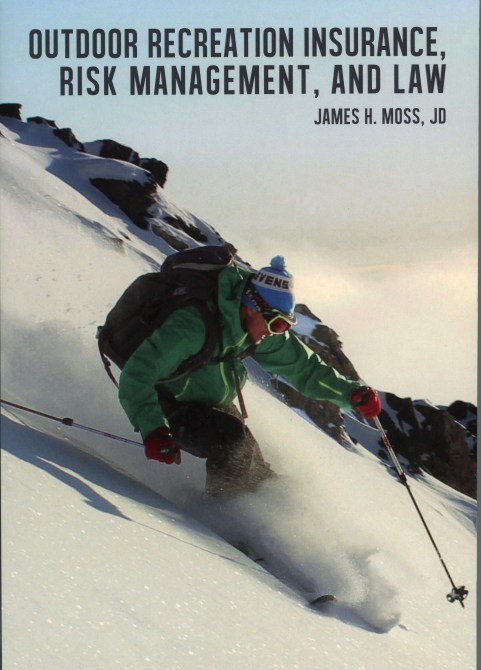
Outdoor Recreation Insurance, Risk Management, and Law
To see Jim’s complete bio go here and to see his CV you can find it here. To find out the purpose of this website go here.
If you are interested in having me write your release, download the form and return it to me.
Connect
If you like this let your friends know or post it on FB, Twitter, or LinkedIn
Facebook Page: Outdoor Recreation & Adventure Travel Law
LinkedIn https://www.linkedin.com/in/recreationlaw/
Threads https://www.threads.net/@recreation_law
X https://twitter.com/RecreationLaw
Email: Jim@Rec-Law.US
By Recreation Law Rec-law@recreation-law.com James H. Moss
@2015-2023 Summit Magic Publishing, LLC
G-YQ06K3L262
#AdventureTourism, #AdventureTravelLaw, #AdventureTravelLawyer, #AttorneyatLaw, #Backpacking, #BicyclingLaw, #Camps, #ChallengeCourse, #ChallengeCourseLaw, #ChallengeCourseLawyer, #CyclingLaw, #FitnessLaw, #FitnessLawyer, #Hiking, #HumanPowered, #HumanPoweredRecreation, #IceClimbing, #JamesHMoss, #JimMoss, #Law, #Mountaineering, #Negligence, #OutdoorLaw, #OutdoorRecreationLaw, #OutsideLaw, #OutsideLawyer, #RecLaw, #Rec-Law, #RecLawBlog, #Rec-LawBlog, #RecLawyer, #RecreationalLawyer, #RecreationLaw, #RecreationLawBlog, #RecreationLawcom, #Recreation-Lawcom, #Recreation-Law.com, #RiskManagement, #RockClimbing, #RockClimbingLawyer, #RopesCourse, #RopesCourseLawyer, #SkiAreas, #Skiing, #SkiLaw, #Snowboarding, #SummerCamp, #Tourism, #TravelLaw, #YouthCamps, #ZipLineLawyer, Canoe Livery, Church Group, Canoe Trip, Canoeing, Quadriplegic, Duty, Guide,


 Recreation Law