
Parveen v. Tiki Tubing, LLC, 2011 1477 (La.App. 1 Cir. 03/23/12); 2012 La. App. Unpub. LEXIS 115
Posted: June 8, 2014 Filed under: Assumption of the Risk, Legal Case, Louisiana, Rivers and Waterways | Tags: Amite River, assumption of the risk, CPR, Custody and Control, Defendant, drowning, Livery, Louisiana, Tiki, Tiki bar, Tubing Leave a commentParveen v. Tiki Tubing, LLC, 2011 1477 (La.App. 1 Cir. 03/23/12); 2012 La. App. Unpub. LEXIS 115
Neelam Parveen, Individually and on Behalf of Mansoor Raja and their Minor Children Versus Tiki Tubing, LLC and Abc Insurance Company
NO. 2011 CA 1477
COURT OF APPEAL OF LOUISIANA, FIRST CIRCUIT
2011 1477 (La.App. 1 Cir. 03/23/12); 2012 La. App. Unpub. LEXIS 115
March 23, 2012, Judgment Rendered
NOTICE: NOT DESIGNATED FOR PUBLICATION.
PLEASE CONSULT THE LOUISIANA RULES OF APPELLATE PROCEDURE FOR CITATION OF UNPUBLISHED OPINIONS.
SUBSEQUENT HISTORY: Writ denied by Parveen v. Tiki Tubing, LLC, 90 So. 3d 1063, 2012 La. LEXIS 1798 (La., June 15, 2012)
PRIOR HISTORY: [*1]
On Appeal from the 21st Judicial District Court, in and for the Parish of Livingston, State of Louisiana. District Court No. 128,216. The Honorable Elizabeth P. Wolfe, Judge Presiding.
DISPOSITION: AFFIRMED.
COUNSEL: Nicholas M. Graphia, Monroe, La., Counsel for Plaintiff/Appellant, Neelam Parveen, individually and on behalf of Mansoor Raja and their minor children.
C. David Vasser, Jr., Baton Rouge, La., Counsel for Defendant/Appellee, Tiki Tubing, L.L.C.
JUDGES: BEFORE: CARTER, C.J., PARRO AND HIGGINBOTHAM, JJ.
OPINION BY: CARTER
OPINION
[Pg 2] CARTER, C.J.
The plaintiff appeals the summary judgment dismissing her suit for damages arising from the drowning death of her husband. For the reasons that follow, we affirm.
STATEMENT OF FACTS AND PROCEDURAL HISTORY
Tiki Tubing, L.L.C. (Tiki) is a commercial enterprise located on the banks of the Amite River. During peak summer months, Tiki employs 10-15 full time employees. For a fee, Tiki provides customers with parking, tube rental, a bus ride upstream, and a beach entry and exit on the river. The tubing route on the Amite River takes approximately four hours to complete. The Tiki website describes the Amite River as “smooth and slow moving and … 1 to 3 feet deep with a few deeper holes from [*2] 6 to 8 feet deep.” The website continues: “All bodies of water have some inherent risks. Tiki . . . and its affiliates assume no liability for personal injury or loss of personal property.” The tubers are grouped together at the Tiki hut and bused upstream to the ingress point on the river. At this point, the tubers select their tubes and enter the water.
According to John Fore, the managing member of Tiki, there are no warning signs posted at the hut or along the river. Tiki provides life jackets free of charge to customers; however, customers are not required to wear them. Neither Fore nor the Tiki employees were aware of any prior drowning on the tubing route. There are no lifeguards or rescuers on staff, and employees are not trained in water safety or in cardiopulmonary resuscitation (CPR). Tiki employees do not travel the river with the tubers, and there is no emergency equipment along the river route or at the Tiki [Pg 3] facility. Tiki does hire off-duty Livingston Parish Deputies as independent contractors to assist with crowd control, public drinking, drugs, broken glass, and unlocking of cars. The deputies are not posted on the tubing route; they are not hired to handle medical [*3] emergencies.
On June 21, 2009, 37-year-old Mansoor Raja and two of his friends decided to tube the Amite River. Raja had never tubed before, and after reading about Tiki from its internet website, Raja, Akhlaq Akhtar, and Tariq Mehmood drove to the facility. The group was presented with a liability waiver at the hut, and Akhtar printed all three men’s names on the bottom of the sheet.1 Although Raja was with Akhtar when Akhtar completed the form, Raja did not read or sign the waiver. Akhtar remembered the men being given a document containing safety instructions and that this information also was posted on a board. According to Akhtar, all three men read the instructions, which specifically mentioned the availability of life jackets. Akhtar asked the other men if they needed life jackets, but the general consensus was that the water would not be deep enough and that the life jackets were not needed. The waiver sheet is the only “warning” at the Tiki facility.
1 The waiver is entitled “Participant’s Agreement, Release, and Assumption of Risk.” The bottom of the form has multiple lines upon which customers write their names.
The three men boarded the bus, rode upstream, retrieved their tubes, [*4] and entered the river. According to Akhtar, Raja and Mehmood were playing around and getting caught in trees in the water. Akhtar tried to rush the other two men along so that they would not get separated from the group. The water was shallow, and Raja and Mehmood were leaving their tubes and [Pg 4] swimming freely in the river. The three men continued in this fashion for 15 to 20 minutes.
On the river trip, Raja was “getting excited.” He would leave his tube, swim downstream with the current, then wait for his tube to float to him. Raja did this four or five times. The men stopped to take a photograph, after which Raja said he would swim just one more length. Suddenly, while swimming ahead of his tube, Raja disappeared under the water. Then, Mehmood began having trouble in the water. Akhtar floated toward his friends and was able to help Mehmood get hold of the tube and out of the water. Raja, however, panicked and was unable to grasp the tube. According to Akhtar, the water was “too far deep” and moving much faster underneath the surface. Akhtar did not leave his tube in an attempt to pull Raja from the water because, according to Akhtar, the water was too deep and the current would [*5] have pulled him under too. Akhtar explained: “If you go to somebody who’s drowning, he’ll take you with him even if you are [a] good swimmer….”
Other floaters, noticing the commotion, began calling for help; the authorities were alerted with a call to 911, and another tuber ran toward the ingress point where several employees were working to notify them that someone was “lost.” Christopher Seese, a teenage employee of Tiki, stated that he first thought someone had simply gotten off his tube and run off. Upon realizing there was a problem, three employees ran to the scene. Fifteen to twenty tubers were sitting on the beach, and several tubers were swimming around in the deeper area of the river. The employees immediately entered the river. It took Christopher five to ten minutes to [Pg 5] locate Raja in the eight-foot-deep pocket in the river by dragging his foot in the water. Raja’s body was resting against a submerged log. According to Christopher, the current in the pocket was no stronger than the rest of the river; however, the water was deeper. It was estimated that it took an additional three to four minutes to get Raja out of the water and onto the shore.
Raja was brought to [*6] the shore, and another tuber was the first to attempt CPR. Because he was on the opposite side of the river, Akhtar estimated that it took him ten minutes to get to Raja after he was pulled from the water. Upon reaching shore, Akhtar observed that the unidentified tuber was performing CPR incorrectly, so Akhtar took over.2 Akhtar blew air into Raja’s chest, and Tiki employee Jacob Bourgeois assisted with chest compressions. Ultimately, four different people performed chest compressions on Raja, assisting Akhtar with CPR until the rescue helicopter arrived. According to Akhtar, Raja’s pulse was restored and he was warm to the touch prior to the arrival of paramedics and being airlifted to a hospital. Raja’s death certificate indicates he died the next day, June 22, 2009.
2 Akhtar explained that he had received training in CPR during military service.
Raja’s surviving spouse, Neelam Parveen, filed this wrongful death and survival action for damages against Tiki and its insurer, alleging Tiki’s negligent acts and omissions were a proximate cause of Raja’s death. After answering the petition, Tiki filed a motion for summary judgment, alleging Tiki did not breach any legal duty to Raja. Subsequent [*7] to the filing of Tiki’s motion for summary judgment, but prior to the hearing on the motion, the trial court granted the plaintiff leave to file a supplemental and amending [Pg 6] petition for damages. Therein the plaintiff alleged that she was entitled to punitive damages under general maritime law in that Tiki’s conduct was grossly negligent, reckless, and wanton. Thereafter, the plaintiff filed an opposition to Tiki’s motion for summary judgment, with attachments thereto, as well as a supplemental opposition.
Following a hearing, the trial court granted Tiki’s motion for summary judgment, and the plaintiff’s claims against Tiki were dismissed with prejudice. The plaintiff appeals, asserting several arguments in support of her position that summary judgment was improperly granted.
SUMMARY JUDGMENT
A motion for summary judgment is a procedural device used to avoid a full-scale trial when there is no genuine issue of material fact. All Crane Rental of Georgia, Inc. v. Vincent, 10-0116 (La. App. 1 Cir. 9/10/10), 47 So. 3d 1024, 1027, writ denied, 10-2227 (La. 11/19/10), 49 So. 3d 387. Summary judgment is properly granted if the pleadings, depositions, answers to interrogatories, and admissions [*8] on file, together with affidavits, if any, show that there is no genuine issue of material fact and that the mover is entitled to judgment as a matter of law. La. Code Civ. Proc. Ann. art. 966B. Summary judgment is favored and designed to secure the just, speedy, and inexpensive determination of every action. La. Code Civ. Proc. Ann. art. 966A(2).
Appellate courts review evidence de novo under the same criteria that govern the trial court’s determination of whether summary judgment is appropriate. All Crane, 47 So. 3d at 1027. On a motion for summary judgment, the burden of proof is on the mover. La. Code Civ. Proc. Ann. art. 966C(2) [Pg 7]. If, however, the mover will not bear the burden of proof at trial on the matter that is before the court on the motion, the mover’s burden does not require that all essential elements of the adverse party’s claim, action, or defense be negated. Id. Instead, the mover must point out to the court that there is an absence of factual support for one or more elements essential to the adverse party’s claim, action, or defense. Id. Thereafter, the adverse party must produce factual evidence sufficient to establish that he will be able to satisfy his evidentiary [*9] burden of proof at trial. Id. If the adverse party fails to meet this burden, there is no genuine issue of material fact, and the mover is entitled to summary judgment as a matter of law. La. Code Civ. Proc. Ann. art. 966C(2); All Crane, 47 So. 3d at 1027.
In ruling on a motion for summary judgment, the court’s role is not to evaluate the weight of the evidence or to determine the truth of the matter but, instead, to determine whether there is a genuine issue of triable fact. All Crane, 47 So. 3d at 1027. A court cannot make credibility decisions on a motion for summary judgment. Id. In deciding a motion for summary judgment, the court must assume that all of the witnesses are credible. Id. Factual inferences reasonably drawn from the evidence must be construed in favor of the party opposing the motion, and all doubt must be resolved in the opponent’s favor. Id. Whether a particular fact in dispute is “material” for summary judgment purposes is viewed in light of the substantive law applicable to the case. Richard v. Hall, 03-1488 (La. 4/23/04), 874 So. 2d 131, 137.
[Pg 8] DISCUSSION
The plaintiff advances several theories of recovery for the alleged negligence or gross negligence of Tiki. [*10] Broadly stated, the plaintiff maintains that Tiki had custody of the tubing route on the Amite River and, accordingly, that Tiki owed its patrons a duty to maintain the river so that its guests would not be injured by the river’s vices and defects, a duty to train Tiki employees in emergency rescue and life-saving procedures, and a duty to properly warn Tiki customers of the hazards associated with tubing on the Amite River. The plaintiff also alleges that once Tiki employees involved themselves in attempted life-saving procedures on Raja, those employees assumed a duty to perform those life-saving measures properly.
The elements of a cause of action in tort are fault, causation, and damage. Seals v. Morris, 410 So. 2d 715, 718 (La. 1981). The existence of a legal duty and a breach of that duty are prerequisites to any determination of fault. Id. Although the determination of whether to assign a legal duty is fact-specific, the issue of whether there is a duty ultimately is a question of law. Bowman v. City of Baton Rouge/Parish of East Baton Rouge, 02-1376 (La. App. 1 Cir. 5/9/03), 849 So. 2d 622, 627, writ denied, 03-1579 (La. 10/3/03), 855 So. 2d 315. The inquiry is whether the plaintiff [*11] has any law–statutory, jurisprudential, or arising from general principles of fault– to support her claim. Faucheaux v. Terrebonne Consol. Government, 615 So. 2d 289, 292 (La. 1993); Fredericks v. Daiquiris & Creams of Mandeville, L.L.C, 04-0567 (La. App. 1 Cir. 3/24/05), 906 So. 2d 636, 639, writ denied, 05-1047 (La. 6/17/05), 904 So. 2d 706.
[Pg 9] Under Louisiana Civil Code article 2317, “[w]e are responsible, not only for the damage occasioned by our own act, but for that which is caused by the act of persons for whom we are answerable, or of the things which we have in our custody.” Louisiana Civil Code article 2317.1 modifies Article 2317 and provides in pertinent part:
[The] custodian of a thing is answerable for damage occasioned by its ruin, vice, or defect, only upon a showing that he knew or, in the exercise of reasonable care, should have known of the ruin, vice, or defect which caused the damage, that the damage could have been prevented by the exercise of reasonable care, and that he failed to exercise such reasonable care.
The plaintiff alleges that in accordance with Article 2317.1, Tiki, as custodian3 of the tubing route on the Amite River, owed a duty to its patrons [*12] to employ safety measures to prevent drowning and to discover any unreasonably dangerous condition and to either correct the condition or warn of its existence. In order to prevail on a claim of negligence under Articles 2317 and 2317.1, the plaintiff will have the ultimate burden at trial of proving by a preponderance of the evidence each of the following elements: (1) Tiki is the custodian of the portion of the Amite River that includes the tubing route; (2) that portion of the Amite River is defective and that the defect presented an unreasonable risk of harm; (3) Tiki knew or should have known of the defect; (4) the plaintiff was damaged by the defect; and (5) Tiki could have prevented the damage to the plaintiff by the exercise of reasonable care, which Tiki failed to exercise. See Riggs v. Opelousas General Hosp. Trust Authority, 08-591 (La. App. 3 Cir. 11/5/08), 997 So. 2d 814, 817. Failure to prove any one of these elements will defeat the [Pg 10] plaintiff’s claim and thus establish the defendant’s entitlement to summary judgment. See Grogan v. Women’s and Children’s Hospital, Inc., 07-1297 (La. App. 3 Cir. 4/16/08), 981 So. 2d 162, 165.
3 There are no allegations or evidence [*13] suggesting that Tiki owned the area of the river, or the land abutting that portion of the river, in which Raja drowned.
The Louisiana Supreme Court has instructed that determining who has custody of a thing is a fact-driven determination. Dupree v. City of New Orleans, 99-3651 (La. 8/31/00), 765 So. 2d 1002, 1009. Courts should consider: (1) whether the person bears such a relationship as to have the right of direction and control over the thing; and (2) what, if any, kind of benefit the person derives from the thing. Dupree, 765 So. 2d at 1009. “The person who has custody or garde of a thing is he who has the legal duty to prevent its vice or defect from harming another.” Id. at 1009. This court has held that a state-owned river cannot be in the custody of a landowner. See Tobey v. State, 454 So. 2d 144, 145 (La. App. 1st Cir. 1984) (a tubing accident did not result from any condition of the land).
Even if the plaintiff were to establish that material issues of fact remain in dispute regarding custody of the tubing route on the Amite River, the plaintiff also must prove that the portion of the Amite River at issue suffered from a vice or defect in order to recover damages under Articles 2317 [*14] and 2317.1. A defect is defined as a condition that creates an unreasonable risk of harm. Moory v. Allstate Ins. Co., 04-0319 (La. App. 1 Cir. 2/11/05), 906 So. 2d 474, 480, writ denied, 05-0668 (La. 4/29/05), 901 So. 2d 1076. The record establishes that Raja drowned in an area of the river described as a drop or a deep pocket. This court has held that the “existence of a hole in a natural lake, that renders the depth of the lake deeper than other portions, would not, ipso facto, constitute a defective [Pg 11] condition.”4 Johnson v. City of Morgan City, 99-2968 (La. App. 1 Cir. 12/22/00), 787 So. 2d 326, 330-31, writ denied, 01-0134 (La. 3/16/01), 787 So. 2d 315. Further, “variations in water depth within natural swimming areas are standard.” Johnson, 787 So. 2d at 330. Citing this court in Johnson, the Fourth Circuit has concluded that there is no distinction between a hole in a lake and a drop off in a river. Sevin v. Parish of Plaquemines, 04-1439 (La. App. 4 Cir. 4/27/05), 901 So. 2d 619, 623-24, writ denied, 05-1790 (La. 1/27/06), 922 So. 2d 550. The plaintiff fails to establish that the deeper pocket in this natural body of water constitutes a defect for purposes of Article 2317.1.
4 Moreover, [*15] not every defect gives rise to statutory liability under Articles 2317 and 2317.1. Ruschel v. St. Amant, 11-78 (La. App. 5 Cir. 5/24/11), 66 So. 3d 1149, 1153. The defect must be of such a nature as to constitute a dangerous condition that reasonably would be expected to cause injury to a prudent person using ordinary care under the circumstances. Ruschel, 66 So. 3d at 1153.
The plaintiff argues that Tiki had a duty to provide an adequate and correct warning to customers regarding the dangers of tubing and the depth and current of the Amite River, and also had a duty to post lifeguards along the tubing route.5 Tubing has been defined as an activity that is obviously and inherently dangerous. See Tobey, 454 So. 2d at 146. Drowning because of currents is a natural and inevitable risk to swimmers in a natural body of water. See Hall v. Lemieux, 378 So. 2d 130, 132 (La. App. 4th Cir. 1979), [Pg 12] writ denied, 381 So. 2d 1220 (La. 1980). When a risk is obvious, there is no duty to warn or protect against it. Moory, 906 So. 2d at 478. Akhtar described Raja as “not a good swimmer.”6 Despite his limited swimming abilities and knowing that the water was over his head in parts, Raja voluntarily [*16] left his tube to swim freely in the river without a life jacket, allowing the current to carry him away from his tube.
5 Louisiana’s general negligence liability provision is found in Louisiana Civil Code article 2315. Louisiana courts have adopted a duty-risk analysis in determining whether to impose liability under Article 2315. Pinsonneault v. Merchants & Farmers Bank & Trust Co., 01-2217 (La. 4/3/02), 816 So. 2d 270, 275. In order for liability to attach under a duty-risk analysis, the plaintiff must prove five separate elements: (1) the defendant had a duty to conform his or her conduct to a specific standard of care (the duty element); (2) the defendant failed to conform his or her conduct to the appropriate standard of care (the breach of duty element); (3) the defendant’s substandard conduct was a cause-in-fact of the plaintiff’s injuries (the cause-in-fact element); (4) the defendant’s substandard conduct was a legal cause of the plaintiff’s injuries (the scope of protection element); and (5) actual damages (the damage element). Pinsonneault, 816 So. 2d at 275-76.
6 During the few times that Akhtar and Raja swam together in a pool, Raja would swim one pool length at a time, keeping [*17] his head out of the water the entire time. Raja would go in water over his head; however, he would hold onto a “pipe.”
Finally, citing to Harris v. Pizza Hut of La., Inc., 455 So. 2d 1364 (La. 1984), the plaintiff argues that Tiki assumed a duty when its employees attempted life-saving measures on Raja and then breached that duty by improperly performing CPR on Raja. In Harris, the supreme court held that a restaurant had a duty, once it hired a security guard, to have that guard protect patrons from the criminal activities of third persons in a reasonable and prudent manner. Id. at 1369. This court has recognized that the negligent breach of an assumed duty may create civil liability. McGowan v. Victory and Power Ministries, 99-0235 (La. App. 1 Cir. 3/31/00), 757 So. 2d 912, 914. If a person voluntarily or gratuitously undertakes a task that he otherwise has no duty to perform, he must nevertheless perform that task in a reasonable or prudent manner. McGowan, 757 So. 2d at 914; see La. Civ. Code Ann. art. 2315.
Tiki employees acknowledged having no formal CPR training. Akhtar stated that he had been trained in CPR, and Akhtar was performing breathing assistance on Raja, while several [*18] others–including Tiki employees–assisted with chest compressions on Raja. The affidavit of the [Pg 13] plaintiff’s expert, Dr. Adam Broussard, set forth the CPR guidelines and concluded that, based on Jacob’s deposition, “the responders did not correctly perform CPR.” Dr. Broussard’s affidavit establishes that early CPR “performed correctly is the single most important intervention that can be performed in the field by a lay person.”
Raja was pulled from the water after being submerged for at least ten minutes. Akhtar stated that when Raja was brought up to the surface, he was not moving and not conscious. Akhtar began breathing into Raja with the assistance of four others, who took turns doing chest compressions. Akhtar observed that after the second person’s turn with chest compressions, Raja was warm to the touch and a pulse was discernible. Although Dr. Broussard’s affidavit establishes that CPR was performed improperly, his affidavit does not establish that the efforts of Tiki employees were unreasonable, imprudent, or, more importantly, a cause-in-fact of Raja’s death or that there was a reasonable probability that proper CPR would have been lifesaving in these circumstances.
CONCLUSION
The [*19] plaintiff failed to produce factual evidence sufficient to establish that she would be able to meet her burden at trial of proving by a preponderance of the evidence all of the elements of a cause of action in negligence or gross negligence. Despite not being a good swimmer, Raja willingly entered the river without a life jacket and chose to swim away from his tube. It was Raja’s own imprudent actions that led to his tragic death. See Sevin, 901 So. 2d at 624. For the above-stated reasons, we affirm the trial court’s grant of summary judgment in favor of the defendant, Tiki [Pg 14] Tubing, L.L.C, dismissing the suit filed against it by Neelam Parveen, individually and on behalf of Mansoor Raja and their minor children. Costs of this appeal are assessed to the plaintiff, Neelam Parveen.
AFFIRMED.
WordPress Tags: Tiki,Unpub,LEXIS,Neelam,Behalf,Mansoor,Raja,Minor,Children,Versus,Insurance,Company,COURT,APPEAL,LOUISIANA,CIRCUIT,March,Judgment,NOTICE,PUBLICATION,CONSULT,RULES,APPELLATE,PROCEDURE,CITATION,OPINIONS,SUBSEQUENT,HISTORY,Writ,June,PRIOR,Judicial,District,Parish,Livingston,State,Honorable,Elizabeth,Wolfe,Judge,DISPOSITION,COUNSEL,Nicholas,Graphia,Monroe,Plaintiff,Appellant,David,Vasser,Baton,Rouge,Defendant,Appellee,JUDGES,CARTER,PARRO,HIGGINBOTHAM,OPINION,death,husband,STATEMENT,FACTS,PROCEDURAL,enterprise,Amite,River,employees,customers,tube,rental,beach,hours,feet,injury,tubers,tubes,John,member,life,jackets,Neither,lifeguards,rescuers,resuscitation,equipment,Deputies,contractors,drugs,cars,emergencies,Akhlaq,Akhtar,Tariq,Mehmood,waiver,sheet,Although,instructions,information,consensus,Participant,Agreement,Release,Assumption,Risk,trees,length,swimmer,commotion,tuber,Christopher,Seese,employee,Upon,area,foot,chest,Jacob,Bourgeois,compressions,helicopter,arrival,hospital,certificate,spouse,survival,action,insurer,omissions,Therein,Thereafter,opposition,attachments,arguments,SUMMARY,device,fact,Crane,Georgia,Vincent,admissions,affidavits,Code,Proc,determination,criteria,Instead,absence,role,truth,decisions,Factual,inferences,opponent,Whether,purposes,Richard,Hall,DISCUSSION,theories,recovery,negligence,custody,patrons,guests,vices,procedures,tort,causation,Seals,Morris,existence,prerequisites,Bowman,East,Faucheaux,Terrebonne,Consol,Government,Fredericks,Daiquiris,Creams,Mandeville,Under,Civil,article,custodian,vice,accordance,Articles,preponderance,Riggs,Opelousas,General,Hosp,Trust,Failure,entitlement,Grogan,Women,allegations,Supreme,Dupree,Orleans,Courts,person,relationship,direction,landowner,Tobey,accident,Moory,Allstate,depth,Johnson,Morgan,Further,variations,areas,Fourth,distinction,Sevin,Plaquemines,Moreover,Ruschel,Amant,dangers,currents,swimmers,Lemieux,Despite,abilities,jacket,provision,analysis,Pinsonneault,Merchants,Farmers,Bank,injuries,scope,protection,Harris,Pizza,restaurant,manner,McGowan,Victory,Power,Ministries,task,assistance,affidavit,Adam,Broussard,guidelines,intervention,efforts,CONCLUSION,Costs,upstream,four,website,three,five

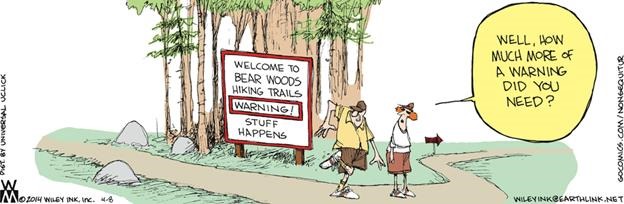
Stuff Happens People need to know that!
Posted: April 17, 2014 Filed under: Assumption of the Risk | Tags: assumption of the risk, Stuff Happens, Warnings Leave a commentWhat more do you have to say?
What do you think? Leave a comment.
If you like this let your friends know or post it on FB, Twitter or LinkedIn
Copyright 2014 Recreation Law (720) Edit Law
Email: Rec-law@recreation-law.com
Google+: +Recreation
Twitter: RecreationLaw
Facebook: Rec.Law.Now
Facebook Page: Outdoor Recreation & Adventure Travel Law
Mobile Site: http://m.recreation-law.com
By Recreation Law Rec-law@recreation-law.com James H. Moss #Authorrank
<rel=”author” link=” https://plus.google.com/u/0/b/112453188060350225356/” />
#AdventureTourism, #AdventureTravelLaw, #AdventureTravelLawyer, #AttorneyatLaw, #Backpacking, #BicyclingLaw, #Camps, #ChallengeCourse, #ChallengeCourseLaw, #ChallengeCourseLawyer, #CyclingLaw, #FitnessLaw, #FitnessLawyer, #Hiking, #HumanPowered, #HumanPoweredRecreation, #IceClimbing, #JamesHMoss, #JimMoss, #Law, #Mountaineering, #Negligence, #OutdoorLaw, #OutdoorRecreationLaw, #OutsideLaw, #OutsideLawyer, #RecLaw, #Rec-Law, #RecLawBlog, #Rec-LawBlog, #RecLawyer, #RecreationalLawyer, #RecreationLaw, #RecreationLawBlog, #RecreationLawcom, #Recreation-Lawcom, #Recreation-Law.com, #RiskManagement, #RockClimbing, #RockClimbingLawyer, #RopesCourse, #RopesCourseLawyer, #SkiAreas, #Skiing, #SkiLaw, #Snowboarding, #SummerCamp, #Tourism, #TravelLaw, #YouthCamps, #ZipLineLawyer, Stuff Happens, Warnings, Assumption of the Risk,
WordPress Tags: Stuff,Happens,People,Leave,Twitter,LinkedIn,Recreation,Edit,Email,Google,RecreationLaw,Facebook,Page,Outdoor,Adventure,Travel,Blog,Mobile,Site,James,Moss,Authorrank,author,AdventureTourism,AdventureTravelLaw,AdventureTravelLawyer,AttorneyatLaw,BicyclingLaw,Camps,ChallengeCourse,ChallengeCourseLaw,ChallengeCourseLawyer,CyclingLaw,FitnessLaw,FitnessLawyer,HumanPoweredRecreation,JamesHMoss,JimMoss,Negligence,OutdoorLaw,OutdoorRecreationLaw,OutsideLaw,OutsideLawyer,RecLaw,RecLawBlog,LawBlog,RecLawyer,RecreationalLawyer,RecreationLawBlog,RecreationLawcom,Lawcom,RiskManagement,RockClimbingLawyer,RopesCourse,RopesCourseLawyer,SkiAreas,SkiLaw,SummerCamp,Tourism,TravelLaw,YouthCamps,ZipLineLawyer,Warnings,Assumption,Risk
Morgan et al., v. Ohio Conference of the United Church of Christ et al., 2012-Ohio-453; 2012 Ohio App. LEXIS 385
Posted: April 7, 2014 Filed under: Assumption of the Risk, Legal Case, Ohio, Summer Camp | Tags: assumption of the risk, Chaperone, Hike, Night Hike, Ohio, Primary Assumption of the Risk, Stream Crossing Leave a commentBrian Morgan et al., Plaintiffs-Appellants, v. Ohio Conference of the United Church of Christ et al., Defendants-Appellees.
No. 11AP-405
COURT OF APPEALS OF OHIO, TENTH APPELLATE DISTRICT, FRANKLIN COUNTY
2012-Ohio-453; 2012 Ohio App. LEXIS 385
February 7, 2012, Rendered
PRIOR HISTORY: [**1]
APPEAL from the Franklin County Court of Common Pleas. (C.P.C. No. 10CVC-03-4516).
DISPOSITION: Judgment affirmed.
COUNSEL: Rourke & Blumenthal, LLP, Kenneth S. Blumenthal and Jonathan R. Stoudt; Cloppert, Latanick, Sauter & Washburn, and Robert L. Washburn, for appellants.
Philipp & Gregory, Ronald D. Gregory and Jeffrey T. Peters, for appellees.
JUDGES: DORRIAN, J. KLATT and SADLER, JJ., concur.
OPINION BY: DORRIAN
OPINION
(ACCELERATED CALENDAR)
DECISION
DORRIAN, J.
[*P1] Plaintiffs-appellants, Brian Morgan (“Morgan”) and his wife Amie Morgan (collectively “appellants”), appeal from the April 4, 2011 judgment of the Franklin County Court of Common Pleas in favor of defendants-appellees, Ohio Conference of the United Church of Christ (“OCUCC”) and Templed Hills Camp and Conference Center (“Templed Hills”) (collectively “appellees”). For the following reasons, we affirm.
[*P2] On November 12, 13, and 14, 2007, Morgan was scheduled to attend the Nature’s Classroom program at Templed Hills as a teacher chaperone for sixth grade students of Worthington City Schools. The school district contracted with the owner of the site, OCUCC, to send the students. The contract set forth a fee of $7,565 for the group’s participation. (Affidavit of Mark Glassbrenner, [**2] ¶4; Exhibit A-A to Affidavit.) On the evening of November 13, Morgan volunteered to act as a chaperone on one of the group’s night hikes. Morgan had chaperoned students annually from approximately 2002 to 2007 and attended the night hike every year. The night hike had originally been scheduled for the evening of November 12, but was postponed to the second evening due to rain. (Affidavit of Kristi Patrick, ¶6; Affidavit of Kathy Mikkelson, ¶6.)
[*P3] The night hike was led by Matthew Marsh (“Marsh”), a Nature’s Classroom instructor. Marsh testified that the purpose of the night hike was to use your other senses when your eyes were not as heightened as during the daylight. Marsh picked the trail and had been using that same trail for the night hikes he had been leading twice a week for the last seven months. It was an established trail and wider than shoulder length. Other trails on the property were harder to traverse. Marsh stated that the evening was a clear night, not cloudy, and the moon was out so the trail could be seen. The adults were also told to bring flashlights.
[*P4] The group met at approximately 7:30 p.m. and started with a game called “Bat & Moth,” where one child is blindfolded [**3] and the children attempt to escape. It is similar to the game Marco Polo. The game lasted approximately 20 to 25 minutes, after which the group entered the woods. After several minutes of hiking, they had to cross a creek bed, but it was a receding creek so there was not much water in it. Marsh stood in the middle of the creek bed on a rock with his flashlight and helped every child cross by holding their hand, and then he helped Morgan cross. While Marsh was counting the kids on the other side of the creek, he saw Morgan shift his weight and fall on his stomach. Marsh tried to call his supervisor on his radio and his cell phone but could not reach her. Then he called 911. When the EMTs arrived, Marsh took the students to an area away from Morgan.
[*P5] Morgan testified to a slightly different version of facts. He had never been on that particular trail and thought it was very overgrown. He was not advised to take a flashlight on the hike and remembered the night being cloudy. Morgan testified that as he approached the creek Marsh was there to help him cross and had a flashlight. Morgan did not remember specifically, but thinks he used Marsh’s shoulder to step on a tree stump or rock as [**4] he took a long stride to cross the creek. After a few seconds, Marsh gave some directions for the next activity and Morgan took a step with his right foot, lost traction and fell. He knew immediately that he was seriously injured. Morgan suffered severe injuries to his left arm and shoulder. Morgan testified he had to ask Marsh to call 911 several times before Marsh called them.
[*P6] Morgan and his wife filed a complaint against OCUCC and Templed Hills as the owners and operators of the site and the employers of Marsh for damages Morgan suffered resulting from Marsh’s negligence, as well as for Amie Morgan’s loss of consortium. A stipulation of dismissal pursuant to Civ.R. 41 was filed.
[*P7] The claim was refiled on March 22, 2010. Appellees filed a motion for summary judgment, contending that appellants’ claims were barred by the affirmative defense of primary assumption of the risk and by the Ohio recreational user statute, R.C. 1533.181. Appellees argued that Morgan assumed the risk of his injury by voluntarily participating in the night hike and that, under the circumstances, appellees owed no duty to protect Morgan from injury. Appellees also argued that Ohio’s recreational statute, R.C. 1533.181, [**5] barred his claims because Morgan was a recreational user and, as such, appellees owed no duty to Morgan as a hiker pursuant to the statute.
[*P8] In opposition to appellees’ motion, Morgan argued that the doctrine of primary assumption of the risk does not bar his cause of action, as the dangers presented by Marsh’s negligence were not inherent to hiking. Also, Morgan argued that the recreational user statute was inapplicable to these facts because the negligence alleged was based on the negligence of an employee, not a theory of premises liability. Additionally, Morgan claimed he was not a recreational user because he was a business invitee.
[*P9] By decision and entry filed April 4, 2011, the trial court granted appellees’ motion for summary judgment finding that the doctrine of primary assumption of the risk barred appellants’ claims. The doctrine removed any duty on appellees’ part to protect Morgan from risks inherent to the activity of night hiking.
[*P10] Appellants assert one assignment of error on appeal:
The trial court erred in granting the motion for summary judgment filed by the Appellees Ohio Conference United Church of Christ and Templed Hills holding that the doctrine of primary assumption [**6] of the risk bars Plaintiffs from recovering on their claims for negligence and loss of consortium.
[*P11] In their assignment of error, appellants challenge the granting of the motion for summary judgment, contending that the doctrine of primary assumption of the risk is inapplicable to these facts. [HN1] By asserting a negligence action, appellants were required to prove by a preponderance of the evidence that appellees owed them a duty of care, that the duty was breached and that the breach proximately caused Morgan’s injuries. Strother v. Hutchinson, 67 Ohio St.2d 282, 285, 423 N.E.2d 467 (1981). Under the law of negligence, a defendant’s duty to a plaintiff depends on the relationship between the parties and the foreseeability of injury to someone in the plaintiff’s position. Simmers v. Bentley Constr. Co., 64 Ohio St.3d 642, 645, 1992 Ohio 42, 597 N.E.2d 504 (1992).
[*P12] [HN2] The doctrine of primary assumption of the risk has often been applied to cases involving sporting events and recreational activities. Crace v. Kent State Univ., 185 Ohio App. 3d 534, 2009 Ohio 6898, ¶12, 924 N.E.2d 906, citing Ballinger v. Leaniz Roofing, Ltd., 10th Dist. No. 07AP-696, 2008 Ohio 1421, ¶8, 2008 WL 802722, citing Anderson v. Ceccardi, 6 Ohio St.3d 110, 114, 6 Ohio B. 170, 451 N.E.2d 780 (1983). Whether to [**7] apply the affirmative defense of primary assumption of the risk presents an issue of law for the court to determine. Crace at ¶12, citing Gallagher v. Cleveland Browns Football Co., 74 Ohio St.3d 427, 435, 1996 Ohio 320, 659 N.E.2d 1232 (1996). We therefore review the trial court’s decision de novo. Crace at ¶12, citing Cleveland Elec. Illum. Co. v. Pub. Util. Comm., 76 Ohio St. 3d 521, 523, 1996 Ohio 298, 668 N.E.2d 889 (1996), citing Indus. Energy Consumers of Ohio Power Co. v. Pub. Utils. Comm., 68 Ohio St. 3d 559, 563, 1994 Ohio 435, 629 N.E.2d 423 (1994).
[*P13] [HN3] Under the doctrine of primary assumption of the risk, a plaintiff who voluntarily engages in a recreational activity or sporting event assumes the inherent risks of that activity and cannot recover for injuries sustained in engaging in the activity unless the defendant acted recklessly or intentionally in causing the injuries. Crace at ¶13, citing Santho v. Boy Scouts of Am., 168 Ohio App. 3d 27, 2006 Ohio 3656, ¶12, 857 N.E.2d 1255. The doctrine is based on the fiction that the plaintiff has “tacitly consented” to the risk of injury inherent in the activity. Collier v. Northland Swim Club, 35 Ohio App.3d 35, 37, 518 N.E.2d 1226 (10th Dist.1987). The rationale behind the doctrine is that certain risks are so intrinsic in some activities that the risk of injury [**8] is unavoidable. Crace at ¶13, citing Collier. The test for applying the doctrine of primary assumption of the risk to recreational activities and sporting events requires that “(1) the danger is ordinary to the game, (2) it is common knowledge that the danger exists, and (3) the injury occurs as a result of the danger during the course of the game.” Santho at ¶12.
[*P14] [HN4] The affirmative defense of primary assumption of the risk completely negates a negligence claim because the defendant owes no duty to protect the plaintiff against the inherent risks of the recreational activity in which the plaintiff engages. Crace at ¶15, citing Gentry v. Craycraft, 101 Ohio St.3d 141, 144, 2004 Ohio 379, 802 N.E.2d 1116, citing Prosser & Keeton, Law of Torts (5th Ed.1984) 496, Section 68; see also Gallagher at 431, citing Prosser & Keeton, 496-97, Section 28 (“Primary assumption of risk ‘is really a principle of no duty, or no negligence, and so denies the existence of any underlying cause of action.'”). Primary assumption of the risk serves to negate the duty of care owed by the defendant to the plaintiff. Wolfe v. Bison Baseball, Inc., 10th Dist. No. 09AP-905, 2010 Ohio 1390, ¶18, 2010 WL 254597. “Because a successful [**9] primary assumption of risk defense means that the duty element of negligence is not established as a matter of law, the defense prevents the plaintiff from even making a prima facie case.” Id. at ¶21, citing Gallagher at 431-32.
[*P15] [HN5] With the doctrine of primary assumption of the risk, the injured plaintiff’s subjective consent to and appreciation for the inherent risks of the recreational activity are immaterial to the analysis. Crace, 185 Ohio App. 3d 534, ¶16, citing Gentry at 144. The types of risks inherent to an activity are those risks that are foreseeable and customary risks of the sport or recreational activity. Deutsch v. Birk, 189 Ohio App. 3d 129, 2010 Ohio 3564, ¶12 (937 N.E.2d 638, 12th Dist.), citing Thompson v. McNeill, 53 Ohio St.3d 102, 104-106, 559 N.E.2d 705 (1990). In accordance with these principles, this court held in Gehri v. Capital Racing Club, Inc., 10th Dist. No. 96APE10-1307, 1997 Ohio App. LEXIS 2527, 1997 WL 324175 (June 12, 1997), that “primary assumption of [the] risk requires an examination of the activity itself and not plaintiff’s conduct. If the activity is one that is inherently dangerous and from which the risks cannot be eliminated, then a finding of primary assumption of [the] risk is appropriate.” 1997 Ohio App. LEXIS 2527, [WL] at *4. [**10] “The law simply deems certain risks as accepted by the plaintiff regardless of actual knowledge or consent.” Crace at ¶16. The focus in primary assumption of the risk is on the defendant’s conduct, whether such conduct was reckless or intentional. Gentry at ¶9.
[*P16] In the instant case, the trial court noted that hiking is a recreational activity to which the doctrine applies, and hiking contains an inherent risk of slipping, tripping or falling that cannot be eliminated, even more so with hiking at night. (Apr. 4, 2011 Decision, 2.) Appellants argue that primary assumption of the risk does not apply to these facts because the risks which led to the injury in this case could have been eliminated if Marsh had chosen a different trail. However, this is essentially a claim that Marsh’s conduct was reckless. In Marchetti v. Kalish, 53 Ohio St.3d 95, 100, 559 N.E.2d 699 (1990), fn. 3, the Supreme Court of Ohio cited the comments f and g to Section 500 of the Restatement of Torts 2d, 590, which defined the three mental states of tortious conduct, as follows:
f. Intentional misconduct and recklessness contrasted. [HN6] Reckless misconduct differs from intentional wrongdoing in a very important particular. While an act [**11] to be reckless must be intended by the actor, the actor does not intend to cause the harm which results from it. It is enough that he realizes or, from facts which he knows, should realize that there is a strong probability that harm may result, even though he hopes or even expects that his conduct will prove harmless. However, a strong probability is a different thing from the substantial certainty without which he cannot be said to intend the harm in which his act results.
g. Negligence and recklessness contrasted. [HN7] Reckless mis-conduct differs from negligence in several important particulars. It differs from that form of negligence which consists in mere inadvertence, incompetence, unskillfulness, or a failure to take precautions to enable the actor adequately to cope with a possible or probable future emergency, in that reckless misconduct requires a conscious choice of a course of action, either with knowledge of the serious danger to others involved in it or with knowledge of facts which would disclose this danger to any reasonable man. It differs not only from the above-mentioned form of negligence, but also from that negligence which consists in intentionally doing an act with [**12] knowledge that it contains a risk of harm to others, in that the actor to be reckless must recognize that his conduct involves a risk substantially greater in amount than that which is necessary to make his conduct negligent. The difference between reckless misconduct and conduct involving only such a quantum of risk as is necessary to make it negligent is a difference in the degree of the risk, but this difference of degree is so marked as to amount substantially to a difference in kind.
[*P17] Appellants argue that Marsh should have chosen a different path for the hikers that evening. However, appellants did not allege that Marsh was reckless in choosing that path. The trial court specifically found that [HN8] hiking, especially night hiking, involves the risk of tripping, slipping and falling. Hiking does involve these risks. Morgan volunteered to participate in the night hike and assumed these risks. The court in Shaner v. Smoot, 7th Dist. No. 712, 2001 Ohio 3429, 2001 WL 1243920, found that persons involved in recreational activities assume the ordinary risks of the activity and the failure to warn of the ordinary risks does not subject one to liability. In Shaner, the plaintiff was injured [**13] while riding a motorcycle in tall grass with tree stumps scattered throughout the area. The plaintiff was aware that there were tree stumps in the area where he was riding. However, the court found that the risk of hitting a tree stump was an ordinary risk of riding a motorcycle in such a location, and the defendants could not be liable for failure to warn of an ordinary risk assumed by the plaintiff.
[*P18] Appellants concede that there are risks inherent in hiking that cannot be avoided. However, appellants contend that the risks which led to Morgan’s particular injury could have been avoided if Marsh had picked a trail which was better maintained with less-demanding obstacles. Thus, appellants argue, implied assumption of the risk is more appropriate to these facts, which has been merged into Ohio’s comparative negligence statute, R.C. 2315.19. However, these risks were not risks out of the ordinary for night hiking.
[*P19] In California, the courts have addressed similar issues and applied primary assumption of the risk, finding that a defendant is only liable for a plaintiff’s injuries if the defendant’s conduct is reckless or totally outside the range of the ordinary activity involved in the [**14] sport or activity. In Andia v. Full Service Travel, S.D.Cal. No. 06cv0437 WQH (JMA), 2007 U.S. Dist. LEXIS 88247, 2007 WL 4258634 (Nov. 29, 2007), the plaintiff was a passenger on the defendant’s cruise ship and participated in a shore expedition known as the HL 15, the Kilauea Lava Viewing Hike. The plaintiff slipped on one of the rocks and fell, fracturing her foot. She filed a negligence action, and the court found that the doctrine of primary assumption of the risk applied, negating the defendant’s duty to prevent the plaintiff from slipping and falling on lava rock, an inherent risk of the activity of lava hiking.
[*P20] In Kane v. Natl. Ski Patrol Sys., Inc., 88 Cal.App.4th 204, 209, 105 Cal.Rptr.2d 600 (2001), a ski instructor led participants in a skills clinic for a voluntary ski patrol. The participants were reluctant to proceed to the most difficult portion of the trail, which was icy and contained trees, rocks, and stumps, but the instructor encouraged them to go. The two plaintiffs were injured, one fell to his death and the other one suffered a broken leg. The court granted summary judgment in favor of the defendant, holding that the doctrine of primary assumption of the risk applied, negating the defendant’s [**15] duty of care. The court held that [HN9] “an instructor’s assessment errors–either in making the necessarily subjective judgment of skill level or the equally subjective judgment about the difficulty of the conditions–are in no way ‘outside the range of the ordinary activity involved in the sport.'” Id. at 214.
[*P21] Similarly, here, any assessment error in the subjective judgment of the path chosen by the Nature’s Classroom instructor, if any, is not outside the range of the ordinary activity involved in night hiking. As we have said, tripping, slipping, and falling are inherent risks of night hikes, regardless of the trail chosen.
[*P22] In Kalter v. Grand Circle Travel, 631 F.Supp.2d 1253 (C.D.Cal.2009), the plaintiff suffered serious injuries when she fell while hiking at Inca ruins at Machu Picchu. The plaintiff filed a negligence action against the vacation tour operator, but the court applied the primary assumption of the risk doctrine, finding that hiking across uneven and challenging terrain is an inherent risk when hiking in ancient ruins, and inherent in this activity is the risk that one will fall and become injured.
[*P23] This case law from California is similar to our Ohio law. Morgan attempts [**16] to argue that the conditions which led to his injury, attempting to cross a creek up a slippery embankment in dark, wet conditions, were not inherent to hiking. However, Morgan had already crossed the creek when he fell, and the dark is inherent in night hiking regardless of the trail chosen, and the ground was wet because it had been raining the day before. That was the reason the hike had been postponed. Despite Morgan’s attempt to argue that the risks were heightened, we find, under these facts, that these risks were inherent risks to night hiking.
[*P24] Appellants rely on Byer v. Lucas, 7th Dist. No. 08AP-351, 2009 Ohio 1022, 2009 WL 581710, to argue that the risks involved here outweigh the ordinary risks involved in the recreational activity that the plaintiff was engaged. In Byer, the plaintiff filed a negligence action against the owner and driver of a tractor pulling a hay wagon as part of party festivities. The defendant was drinking alcohol at the party. The plaintiff was riding in the wagon. The defendant stopped the wagon at the top of a steep hill and advised the passengers that they could get out of the wagon and either walk down the hill or wait to be picked up by a truck [**17] to return to the party. Apparently, the plaintiff did not hear the warning and remained on the wagon. The defendant lost control of the wagon, and plaintiff was ejected and treated for severe injuries. Plaintiff filed suit alleging negligence and intentional and reckless conduct. On appeal, the court found there were risks that were not ordinary, customary, or foreseeable to a hayride.
[*P25] Ordinary risks for a hayride include “getting scratched by tree braches [sic], being bounced around on a wagon, and even losing one’s balance and falling off the wagon.” Id. at ¶30. In Byer, however, the court found risks that were out of the ordinary for a hayride, including the choice of route, the driver control and severe injuries. The driver chose to drive down the steep hill while another driver took a safer route. The tractor and wagon careened down the hill out of control. Many passengers were thrown from the wagon. Finally, the plaintiff suffered severe injuries including cuts to her head, requiring stitches, and two segments of her tailbone were fractured.
[*P26] The choice of route, down a steep hill, the out-of-control nature of the ride and the injuries the plaintiff received were not risks that [**18] would be expected from a hayride. The court found that “a farm tractor and its wagon cascading down a steep hill out of control and jackknifing to a stop throwing passengers from it is not an inherent risk of a hayride.” Id. at ¶39. Thus, the court found primary assumption of the risk inapplicable. But Byer is distinguishable from the case at hand. The court in Byer found the risks were not inherent to the recreational activity, whereas here, we find the risks were inherent to night hiking. Also in Byer, the plaintiff alleged that the defendant’s conduct was intentional or reckless. Here, the only allegation is that Marsh’s conduct was negligent. Thus, the facts of Byer distinguish it from the facts at hand.
[*P27] Under the doctrine of primary assumption of the risk, appellees owed no duty to protect appellants from the inherent risks of injury related to the night hike. Since the primary assumption of the risk negates the duty element of appellants’ negligence claim, appellants are precluded from making a prima facie case of negligence, and the trial court did not err in granting appellees’ motion for summary judgment. Amie Morgan’s claim also fails because it is dependent upon her husband’s [**19] successful claim. Appellants’ assignment of error is overruled.
[*P28] For the foregoing reasons, appellants’ assignment of error is overruled, and we affirm the judgment of the Franklin County Court of Common Pleas.
Judgment affirmed.
KLATT and SADLER, JJ., concur.
WordPress Tags: Morgan,Ohio,Conference,Church,Christ,LEXIS,Brian,Plaintiffs,Appellants,Defendants,Appellees,COURT,APPEALS,TENTH,APPELLATE,DISTRICT,FRANKLIN,February,PRIOR,HISTORY,APPEAL,Common,Pleas,DISPOSITION,Judgment,COUNSEL,Rourke,Blumenthal,Kenneth,Jonathan,Stoudt,Cloppert,Latanick,Sauter,Washburn,Robert,Philipp,Gregory,Ronald,Jeffrey,Peters,JUDGES,DORRIAN,KLATT,SADLER,OPINION,CALENDAR,DECISION,wife,Amie,April,OCUCC,Hills,Camp,Center,November,Nature,Classroom,teacher,students,Worthington,Schools,owner,participation,Affidavit,Mark,Glassbrenner,Exhibit,Kristi,Patrick,Kathy,Mikkelson,Matthew,Marsh,instructor,purpose,length,adults,flashlights,Moth,Marco,Polo,woods,creek,supervisor,radio,cell,EMTs,area,version,tree,foot,traction,injuries,complaint,owners,operators,employers,negligence,consortium,stipulation,dismissal,March,assumption,user,statute,injury,hiker,opposition,doctrine,action,dangers,Also,employee,theory,premises,assignment,error,preponderance,Strother,Hutchinson,Under,defendant,plaintiff,relationship,Simmers,Bentley,Constr,events,Crace,Kent,State,Univ,Ballinger,Leaniz,Dist,Anderson,Ceccardi,Whether,Gallagher,Cleveland,Browns,Football,Elec,Illum,Util,Comm,Indus,Energy,Consumers,Power,Utils,event,Santho,Scouts,Collier,Northland,Swim,Club,rationale,danger,knowledge,Gentry,Craycraft,Prosser,Keeton,Torts,Section,Primary,principle,existence,Wolfe,Bison,Baseball,analysis,Deutsch,Birk,Thompson,McNeill,accordance,Gehri,Capital,June,examination,Marchetti,Kalish,Supreme,Restatement,Intentional,misconduct,actor,particulars,inadvertence,incompetence,failure,precautions,difference,degree,path,hikers,Shaner,Smoot,motorcycle,location,obstacles,Thus,California,Andia,Full,Service,Travel,expedition,Kilauea,Lava,Hike,Kane,Natl,Patrol,Rptr,participants,skills,clinic,trees,death,errors,skill,Kalter,Grand,Circle,Supp,Inca,Machu,Picchu,vacation,operator,terrain,embankment,Despite,Byer,Lucas,driver,wagon,festivities,alcohol,hill,passengers,truck,Ordinary,Many,segments,Here,allegation,husband,hikes,pursuant,prima,facie,tractor,hayride
In Ohio, Primary Assumption of the Risk is a complete bar to claims for injuries from hiking at night.
Posted: April 7, 2014 Filed under: Assumption of the Risk, Ohio, Summer Camp | Tags: Assumption of risk, assumption of the risk, Chaperone, Hike, Night Hike, Ohio, Primary Assumption of the Risk, Recreation, Stream Crossing 1 CommentThis decision held that falling down while hiking at night was an inherent risk of hiking, especially at night.
Morgan et al., v. Ohio Conference of the United Church of Christ et al., 2012-Ohio-453; 2012 Ohio App. LEXIS 385
Date of the Decision: February 7, 2012
Plaintiff: Brian Morgan and his wife Amie Morgan
Defendant: Ohio Conference of the United Church of Christ (“OCUCC”) and Templed Hills Camp and Conference Center
Plaintiff Claims: negligence
Defendant Defenses: defendant assumed the risks of hiking at night, falling was an inherent risk of hiking
Holding: for the defendants
Ohio has a statute that requires kids to receive some of their education about the outdoors in the outdoors. This law was passed in the early 70’s. I know I was a camp counselor for one of these trips as a senior in high school.
This case comes from a school group going to a camp for outdoor classroom. The plaintiff had done this for five consecutive years, and for five years had participated as a chaperone on the “night hike.” During the night hike, after crossing a stream the plaintiff fell injuring his shoulder.
The plaintiff sued. The defendant camp filed a motion to dismiss claiming the plaintiff assumed the risk, which was granted by the court and this appeal followed. Due to the evidence presented the appellate court viewed the motion as a motion for summary judgment.
Summary of the case
The Ohio Appellate court extensively reviewed Primary Assumption of the Risk under Ohio Law.
Under the doctrine of primary assumption of the risk, a plaintiff who voluntarily engages in a recreational activity or sporting event assumes the inherent risks of that activity and cannot recover for injuries sustained in engaging in the activity unless the defendant acted recklessly or intentionally in causing the injuries. The doctrine is based on the fiction that the plaintiff has “tacitly consented” to the risk of injury inherent in the activity. The rationale behind the doctrine is that certain risks are so intrinsic in some activities that the risk of injury is unavoidable. The test for applying the doctrine of primary assumption of the risk to recreational activities and sporting events requires that “(1) the danger is ordinary to the game, (2) it is common knowledge that the danger exists, and (3) the injury occurs as a result of the danger during the course of the game.”
The effect of a court finding that the plaintiff assumed the risk as defined, by Primary Assumption of the Risk, is a complete bar to the plaintiff’s claims.
The affirmative defense of primary assumption of the risk completely negates a negligence claim because the defendant owes no duty to protect the plaintiff against the inherent risks of the recreational activity in which the plaintiff engages.
The court then explained how Primary Assumption of the Risk worked to stop a claim by the plaintiff.
Primary assumption of risk ‘is really a principle of no duty, or no negligence, and so denies the existence of any underlying cause of action. Primary assumption of the risk serves to negate the duty of care owed by the defendant to the plaintiff. “Because a successful primary assumption of risk defense means that the duty element of negligence is not established as a matter of law, the defense prevents the plaintiff from even making a prima facie case.”
To prevail at trial, the plaintiff has to make a prima facie case. That means the plaintiff has to plead and prove enough facts to prove their case. If the defendant or the court can show the risks of the activity which caused the injury to the plaintiff were inherent to the activity, then the plaintiff is prevented from even making his or her case.
The risks of the activity that are sufficient to prove Primary Assumption of the Risk are “…types of risks inherent to an activity are those risks that are foreseeable and customary risks of the sport or recreational activity.”
The telling issue, as the court explained, is not of the actions of the parties but of the risk. “If the activity is one that is inherently dangerous and from which the risks cannot be eliminated, then a finding of primary assumption of [the] risk is appropriate.”
The court also looked at the defendant’s side of the facts. “The focus in primary assumption of the risk is on the defendant’s conduct, whether such conduct was reckless or intentional.” If the conduct of the defendant was not reckless or intentional, if the defendant did not do anything that increased the risk to the injured plaintiff in a reckless or intentional way than the defense stands.
In the instant case, the trial court noted that hiking was a recreational activity to which the doctrine applies, and hiking contains an inherent risk of slipping, tripping or falling that cannot be eliminated, even more so with hiking at night.
The court then looked at how Ohio defines tortious conduct. It came from the plaintiff’s argument that the defendant increased the risk by reckless choosing the trail that the plaintiff fell on.
Intentional misconduct and recklessness contrasted. Reckless misconduct differs from intentional wrongdoing in a very important particular. While an act to be reckless must be intended by the actor, the actor does not intend to cause the harm which results from it. It is enough that he realizes or, from facts which he knows, should realize that there is a strong probability that harm may result, even though he hopes or even expects that his conduct will prove harmless. However, a strong probability is a different thing from the substantial certainty without which he cannot be said to intend the harm in which his act results.
Negligence and recklessness contrasted. Reckless mis-conduct differs from negligence in several important particulars. It differs from that form of negligence which consists in mere inadvertence, incompetence, unskillfulness, or a failure to take precautions to enable the actor adequately to cope with a possible or probable future emergency, in that reckless misconduct requires a conscious choice of a course of action, either with knowledge of the serious danger to others involved in it or with knowledge of facts which would disclose this danger to any reasonable man. It differs not only from the above-mentioned form of negligence, but also from that negligence which consists in intentionally doing an act with knowledge that it contains a risk of harm to others, in that the actor to be reckless must recognize that his conduct involves a risk substantially greater in amount than that which is necessary to make his conduct negligent. The difference between reckless misconduct and conduct involving only such a quantum of risk as is necessary to make it negligent is a difference in the degree of the risk, but this difference of degree is so marked as to amount substantially to a difference in kind.
Because the conduct of the employee, the guide of the night hike, was not intentional or reckless, the plaintiff was prevented from brining his claims because of the defense of Primary Assumption of the Risk.
So Now What?
The issues you need to understand when looking at the risks of outdoor or recreational activities are which risks are of what type. Those risks that are not inherent in the activity are the ones that you are at the greatest risk of losing a lawsuit over unless you can prove the guest knew and assumed the risks or released you from their injury prior to the activity.
This does not mean you should not inform your guests of all the risks. On the contrary, knowledgeable guests are happier guests and usually injury-free guests. Any injury is a problem for you no matter how small and a problem for the entire group all the time.
What this means is when you list the risks of the activity you need to make sure you know which ones may need special attention for your guests. Those they do not recognize or understand which may include some inherent risks, and those that are obvious.
What do you think? Leave a comment.
If you like this let your friends know or post it on FaceBook, Twitter or LinkedIn
Copyright 2014 Recreation Law (720) Edit Law
Email: Rec-law@recreation-law.com
Google+: +Recreation
Twitter: RecreationLaw
Facebook: Rec.Law.Now
Facebook Page: Outdoor Recreation & Adventure Travel Law
Blog: www.recreation-law.com
Mobile Site: http://m.recreation-law.com
By Recreation Law Rec-law@recreation-law.com James H. Moss #Authorrank
<rel=”author” link=” https://plus.google.com/u/0/b/112453188060350225356/” />
#AdventureTourism, #AdventureTravelLaw, #AdventureTravelLawyer, #AttorneyatLaw, #Backpacking, #BicyclingLaw, #Camps, #ChallengeCourse, #ChallengeCourseLaw, #ChallengeCourseLawyer, #CyclingLaw, #FitnessLaw, #FitnessLawyer, #Hiking, #HumanPowered, #HumanPoweredRecreation, #IceClimbing, #JamesHMoss, #JimMoss, #Law, #Mountaineering, #Negligence, #OutdoorLaw, #OutdoorRecreationLaw, #OutsideLaw, #OutsideLawyer, #RecLaw, #Rec-Law, #RecLawBlog, #Rec-LawBlog, #RecLawyer, #RecreationalLawyer, #RecreationLaw, #RecreationLawBlog, #RecreationLawcom, #Recreation-Lawcom, #Recreation-Law.com, #RiskManagement, #RockClimbing, #RockClimbingLawyer, #RopesCourse, #RopesCourseLawyer, #SkiAreas, #Skiing, #SkiLaw, #Snowboarding, #SummerCamp, #Tourism, #TravelLaw, #YouthCamps, #ZipLineLawyer, Ohio, Primary Assumption of the Risk, Assumption of the Risk, Night Hike, Hike, Chaperone, Stream Crossing,
WordPress Tags: Ohio,Primary,Assumption,Risk,injuries,decision,Morgan,Conference,Church,Christ,LEXIS,Date,February,Plaintiff,Brian,wife,Amie,Defendant,OCUCC,Hills,Camp,Center,Claims,negligence,Defenses,defendants,statute,education,counselor,classroom,judgment,Summary,Appellate,Under,doctrine,event,injury,rationale,events,danger,knowledge,principle,existence,action,argument,Intentional,misconduct,actor,particulars,inadvertence,incompetence,failure,precautions,difference,degree,employee,lawsuit,guest,guests,attention,Leave,FaceBook,Twitter,LinkedIn,Recreation,Edit,Email,Google,RecreationLaw,Page,Outdoor,Adventure,Travel,Blog,Mobile,Site,James,Moss,Authorrank,author,AdventureTourism,AdventureTravelLaw,AdventureTravelLawyer,AttorneyatLaw,BicyclingLaw,Camps,ChallengeCourse,ChallengeCourseLaw,ChallengeCourseLawyer,CyclingLaw,FitnessLaw,FitnessLawyer,HumanPoweredRecreation,JamesHMoss,JimMoss,OutdoorLaw,OutdoorRecreationLaw,OutsideLaw,OutsideLawyer,RecLaw,RecLawBlog,LawBlog,RecLawyer,RecreationalLawyer,RecreationLawBlog,RecreationLawcom,Lawcom,RiskManagement,RockClimbingLawyer,RopesCourse,RopesCourseLawyer,SkiAreas,SkiLaw,SummerCamp,Tourism,TravelLaw,YouthCamps,ZipLineLawyer,Hike,Stream,five,prima,facie,ones

Really neat assumption of the risk agreement. But will it work? Should it be a release?
Posted: April 2, 2014 Filed under: Assumption of the Risk, Paddlesports | Tags: Acknowledgement of Risk, assumption of the risk, Florida, Release, WaterTribe Leave a commentWithout the word negligence or giving up your right to sue it is not a release.
A friend sent me this assumption of the risk form. You can find it here. It is on the WaterTribe website. It is fun to read and well written. Three long pages of warnings about the risks of boating.
However there is no place to sign. So there is no way to prove that anyone signed the form.
There is also no use of the magic word negligence or language where the party is giving up the right to sue.
The document says you have to sign a release, however searching the site did not turn one up. However it might be a member’s only location on the site. Does the release tie into or relate back to this form. That would provide great assumption of risk proof.
Do Something
However this is nothing wrong with this document. It tells the truth that if you don’t read and pay attention to what it says you can get hurt or die.
Maybe we need more documents that drive home the risk, rather than legally dance around it.
What do you think? Leave a comment.
If you like this let your friends know or post it on FB, Twitter or LinkedIn
Copyright 2013 Recreation Law (720) Edit Law
Email: Rec-law@recreation-law.com
Google+: +Recreation
Twitter: RecreationLaw
Facebook: Rec.Law.Now
Facebook Page: Outdoor Recreation & Adventure Travel Law
Mobile Site: http://m.recreation-law.com
By Recreation Law Rec-law@recreation-law.com James H. Moss #Authorrank
<rel=”author” link=” https://plus.google.com/u/0/b/112453188060350225356/” />
#RecreationLaw, #Recreation-Law.com, #OutdoorLaw, #OutdoorRecreationLaw, #AdventureTravelLaw, #law, #TravelLaw, #JimMoss, #JamesHMoss, #Tourism, #AdventureTourism, #Rec-Law, #RiskManagement, #CyclingLaw, #BicyclingLaw, #FitnessLaw, #Recreation-Law.com, #Backpacking, #Hiking, #Mountaineering, #IceClimbing, #RockClimbing, #RopesCourse, #ChallengeCourse, #SummerCamp, #Camps, #YouthCamps, #Skiing, #Ski Areas, #Negligence, #Snowboarding, #RecreationLaw, #@RecreationLaw, #Cycling.Law, #SkiLaw, #Outside.Law, #Recreation.Law, #RecreationLaw.com, #OutdoorLaw, #RecreationLaw, #OutdoorRecreationLaw, #AdventureTravelLaw, #Law, #TravelLaw, #JimMoss, #JamesHMoss, #AttorneyatLaw, #Tourism, #AdventureTourism, #RecLaw, #RecLawBlog, #RecreationLawBlog, #RiskManagement, #HumanPowered, #HumanPoweredRecreation,# CyclingLaw, #BicyclingLaw, #FitnessLaw, #RecreationLaw.com, #Backpacking, #Hiking, #Mountaineering, #IceClimbing, #RockClimbing, #RopesCourse, #ChallengeCourse, #SummerCamp, #Camps, #YouthCamps, #Skiing, #Ski Areas, #Negligence, #Snowboarding, sport and recreation laws, ski law, cycling law, Colorado law, law for recreation and sport managers, bicycling and the law, cycling and the law, ski helmet law, skiers code, skiing accidents, Recreation Lawyer, Ski Lawyer, Paddlesports Lawyer, Cycling Lawyer, Recreational Lawyer, Fitness Lawyer, Rec Lawyer, Challenge Course Lawyer, Ropes Course Lawyer, Zip Line Lawyer, Rock Climbing Lawyer, Adventure Travel Lawyer, Outside Lawyer, Recreation Lawyer, Ski Lawyer, Paddlesports Lawyer, Cycling Lawyer, #RecreationalLawyer, #FitnessLawyer, #RecLawyer, #ChallengeCourseLawyer, #RopesCourseLawyer, #ZipLineLawyer, #RockClimbingLawyer, #AdventureTravelLawyer, #OutsideLawyer, Good Samaritan, Samaritan, First Aid, Assumption of the Risk, Acknowledgement of Risk, Release, WaterTribe, Florida,
WordPress Tags: assumption,agreement,Should,negligence,friend,WaterTribe,Three,warnings,member,location,Does,truth,attention,Maybe,Leave,Twitter,LinkedIn,Recreation,Edit,Email,Google,RecreationLaw,Facebook,Page,Outdoor,Adventure,Travel,Blog,Mobile,Site,James,Moss,Authorrank,author,OutdoorLaw,OutdoorRecreationLaw,AdventureTravelLaw,TravelLaw,JimMoss,JamesHMoss,Tourism,AdventureTourism,RiskManagement,CyclingLaw,BicyclingLaw,FitnessLaw,RopesCourse,ChallengeCourse,SummerCamp,Camps,YouthCamps,Areas,SkiLaw,Outside,AttorneyatLaw,RecLaw,RecLawBlog,RecreationLawBlog,HumanPoweredRecreation,Colorado,managers,helmet,accidents,Lawyer,Paddlesports,Recreational,Challenge,Course,Ropes,Line,Rock,RecreationalLawyer,FitnessLawyer,RecLawyer,ChallengeCourseLawyer,RopesCourseLawyer,ZipLineLawyer,RockClimbingLawyer,AdventureTravelLawyer,OutsideLawyer,Samaritan,Risk,Acknowledgement,Release,Florida
Most references in case law to assumption of the risk are to this California decision. The basis for understanding Assumption of the Risk is this decision based on an injured finger during a pickup football game.
Posted: March 17, 2014 Filed under: Assumption of the Risk, California, Sports | Tags: Acknowledgement of Risk, Assumption of risk, assumption of the risk, California, California Supreme Court, Inherent Risk, Jewett, Kendra Knight, Knight, Knight v. Jewett, Michael Jewett, Primary Assumption of the Risk, reasonable implied assumption of risk, Secondary Assumption of the Risk, Summary judgment, unreasonable implied assumption of risk Leave a commentThe definition of primary and secondary assumption of the risk was clearly set forth in this decision. This decision also related primary assumption of the risk with the inherent risk of an activity. The decision also eliminated the equally confusing reasonable implied assumption of risk, unreasonable implied assumption of risk theories.
Date of the Decision: 1992
Plaintiff: Kendra Knight
Defendant: Michael Jewett
Plaintiff Claims: negligence and assault and battery
Defendant Defenses: assumption of the risk
Holding: for the defendant
Most references to assumption of the risk when needed to clarify the definition in a decision come back to this seminal case: Knight v. Jewett.
The injury in this case occurred during a football game during half time of a super bowl game. The plaintiff and defendant were guests invited to watch the game. Each team had 4-5 players of both sexes. It was purely a pick-up football game. The plaintiff and defendant were on opposite teams.
The court never determined which set of facts were controlling in the case. Generally, the plaintiff and defendant ran into each other during a play. The plaintiff maintained she told the defendant not to play so hard. On the next play, the defendant stepped on the plaintiff’s hand while she was on the ground, injuring her finger.
The injury resulted in three operations and eventual amputation of the finger.
The plaintiff filed suit, which the trial court dismissed based upon the defendant’s motion for summary judgment where he argued assumption of the risk by the plaintiff prevented her recover. The court of appeals affirmed the trial court decision, and the case was appealed to the California Supreme Court which led to this discussion.
Summary of the case
The California Supreme Court wrote extensively about the history and nature of assumption of the risk. A little of that decision will be reviewed here.
The court ruled the basics of negligence claims. “As a general rule, persons have a duty to use due care to avoid injury to others, and may be held liable if they’re careless conduct injures another person.” It then looked at this in comparison of sports and recreation.
In the sports setting, however, conditions or conduct that otherwise might be viewed as dangerous often are an integral part of the sport itself. Thus, although moguls on a ski run pose a risk of harm to skiers that might not exist were these configurations removed, the challenge and risks posed by the moguls are part of the sport of skiing, and a ski resort has no duty to eliminate them.
The court then examined the issue of inherent risk of a sport or activity. An inherent risk is one that without those risks, the sport would not exist. Another way of looking at it is you cannot participate in the sport without possibly experiencing the inherent risks of the sport.
Although defendants generally have no legal duty to eliminate (or protect a plaintiff against) risks inherent in the sport itself, it is well established that defendants generally do have a duty to use due care not to increase the risks to a participant over and above those inherent in the sport.
As sports evolved, the actions of other parties in an activity might exceed or be considered careless, but still part of the sport. “In some situations, however, the careless conduct of others is treated as an “inherent risk” of a sport, thus barring recovery by the plaintiff.”
This then leads to the variations in how the courts interpreted the defense.
“The divergent results of the foregoing cases lead naturally to the question how courts are to determine when careless conduct of another properly should be considered an “inherent risk” of the sport that (as a matter of law) is assumed by the injured participant.
The issue of the careless coparticipant in a sport or recreational activity has generally been resolved in the US as a risk of the sport.
The overwhelming majority of the cases, both within and outside California, that have addressed the issue of coparticipant liability in such a sport, have concluded that it is improper to hold a sports participant liable to a coparticipant for ordinary careless conduct committed during the sport–for example, example, for an injury resulting from a carelessly thrown ball or bat during a baseball game–and that liability properly may be imposed on a participant only when he or she intentionally injures another player or engages in reckless conduct that is totally outside the range of the ordinary activity involved in the sport.
The court looked at the history of the defense and found that it has been used in several different ways and was a very confusing defense.
Indeed, almost a half-century ago, Justice Frankfurter described the term “assumption of risk” as a classic example of a felicitous phrase, “undiscriminatingly used to express different and sometimes contradictory ideas,” and whose uncritical use “bedevils the law.”
The defense had been applied in California to cases where spectators were injured at sporting events where it was determined that no duty was owed to the spectator. In other cases, it was used in sport and other activities where:
… it was clear that the defendant had breached a legal duty of care to the plaintiff, and the inquiry focused on whether the plaintiff knowingly and voluntarily had chosen to encounter the specific risk of harm posed by the defendant’s breach of duty.
The court then reviewed comparative fault or the doctrine of contributory negligence. Until the adoption of the doctrine, it did not matter what assumption of risk theory was used, both prevented recovery. However, after the adoption of the doctrine it became important to define which theory applied. One was merged with contributory negligence and the other either by exemption in a statute or by court decision was allowed to survive.
Contributory Negligence was the result of a change in how liability and consequently, damages were applied by a jury. Instead of determining who won or lost, completely, the jury was tasked with determining what percentage of fault applied to the parties in a case. If the plaintiff was less at fault than the defendant, the percentage of fault is different in each state, and then the defendant recovered that percentage of the damages.
However, that division of the fault left many in the sports and recreation field at a loss when the plaintiff did assume the risk of injuries which the court felt should bar a claim.
The court then started to define the new approach of assumption of the risk.
First, in “primary assumption of risk” cases–where the defendant owes no duty to protect the plaintiff from a particular risk of harm–a plaintiff who has suffered such harm is not entitled to recover from the defendant, whether the plaintiff’s conduct in undertaking the activity was reasonable or unreasonable.
Second, in “secondary assumption of risk” cases–involving instances in which the defendant has breached the duty of care owed to the plaintiff–the defendant is not entitled to be entirely relieved of liability for an injury proximately caused by such breach, simply because the plaintiff’s conduct in encountering the risk of such an injury was reasonable rather than unreasonable.
The basic distinction results in a totally different result. The first prevents the plaintiff from recovering, and the second may affect the plaintiff’s recovery. By that I mean one is a complete bar to the plaintiff’s recovery and the second, because of comparative negligence may reduce or limit the plaintiff’s recovery.
This third classification is different. However, if you look at the injuries of different sports it makes sense; compare the risks of jump rope versus the risk of boxing.
Third and finally, the question, whether the defendant owed a legal duty to protect the plaintiff from a particular risk of harm does not turn on the reasonableness or unreasonableness of the plaintiff’s conduct, but rather on the nature of the activity or sport in which the defendant is engaged and the relationship of the defendant and the plaintiff to that activity or sport.
The court reached the following conclusions with respect to how the two different applications of the theory would be applied to the facts and the result.
In cases involving “primary assumption of risk”–where, by virtue of the nature of the activity and the parties’ relationship to the activity, the defendant owes no legal duty to protect the plaintiff from the particular risk of harm that caused the injury–the doctrine continues to operate as a complete bar to the plaintiff’s recovery.
Secondary assumption of risk was defined as:
In cases involving “secondary assumption of risk”–where the defendant does owe a duty of care to the plaintiff, but the plaintiff proceeds to encounter a known risk imposed by the defendant’s breach of duty–the doctrine is merged into the comparative fault scheme, and the trier of fact, in apportioning the loss resulting from the injury, may consider the relative responsibility of the parties.
Coparticipants in sports were then defined to be protected from their careless acts because the injured participant assumed the risk.
Accordingly, we conclude that a participant in an active sport breaches a legal duty of care to other participants–i.e., engages in conduct that properly may subject him or her to financial liability–only if the participant intentionally injures another player or engages in conduct that is so reckless as to be totally outside the range of the ordinary activity involved in the sport.
As such the defendant in this case was found not to be liable to the plaintiff because the defendant’s carelessness was a risk of the activity, and the plaintiff assumed the risk under the primary assumption of risk doctrine.
So Now What?
First, this court wrote a decision that is still referenced today and is used by the majority of states to define assumption of the risk; primary and secondary for a state.
The real issue, and the one that courts face every day, is to determine the inherent risks of an activity and what defines careless acts on the part of coparticipant. Leaving this decision to a judge or a jury that does not understand the activity could lead to confusion and losing decisions.
In that vein, when a statute is written such as equine or ski safety acts, then the statute defines the inherent risks of the activity. A long and comprehensive list such as that in the Colorado Ski Safety Act broadens the risks inherent in skiing.
In that vein, make sure you release does not limit the risks that are covered by your release. If your release just prevents suits for the inherent risks of the activity, those risks that in many states, the plaintiff must accept and assume any way you may be limiting the scope of your release.
Always educate your guests on all of the risks of the activity or as many as you possibly can. You want your guests to be informed of the risks, the more a guest knows and understands the better the experience. At the same time, the more the guest knows, the more the issue becomes primary assumption of the risk, a complete bar rather than secondary assumption of the risk.
What do you think? Leave a comment.
If you like this let your friends know or post it on FaceBook, Twitter or LinkedIn
Copyright 2014 Recreation Law (720) Edit Law
Email: Rec-law@recreation-law.com
Google+: +Recreation
Twitter: RecreationLaw
Facebook: Rec.Law.Now
Facebook Page: Outdoor Recreation & Adventure Travel Law
Blog: www.recreation-law.com
Mobile Site: http://m.recreation-law.com
By Recreation Law Rec-law@recreation-law.com James H. Moss #Authorrank
<rel=”author” link=” https://plus.google.com/u/0/b/112453188060350225356/” />
#AdventureTourism, #AdventureTravelLaw, #AdventureTravelLawyer, #AttorneyatLaw, #Backpacking, #BicyclingLaw, #Camps, #ChallengeCourse, #ChallengeCourseLaw, #ChallengeCourseLawyer, #CyclingLaw, #FitnessLaw, #FitnessLawyer, #Hiking, #HumanPowered, #HumanPoweredRecreation, #IceClimbing, #JamesHMoss, #JimMoss, #Law, #Mountaineering, #Negligence, #OutdoorLaw, #OutdoorRecreationLaw, #OutsideLaw, #OutsideLawyer, #RecLaw, #Rec-Law, #RecLawBlog, #Rec-LawBlog, #RecLawyer, #RecreationalLawyer, #RecreationLaw, #RecreationLawBlog, #RecreationLawcom, #Recreation-Lawcom, #Recreation-Law.com, #RiskManagement, #RockClimbing, #RockClimbingLawyer, #RopesCourse, #RopesCourseLawyer, #SkiAreas, #Skiing, #SkiLaw, #Snowboarding, #SummerCamp, #Tourism, #TravelLaw, #YouthCamps, #ZipLineLawyer,Kendra Knight, Michael Jewett, Assumption of the Risk, Acknowledgement of Risk, Primary Assumption of the Risk, Secondary Assumption of the Risk, Inherent Risk, reasonable implied assumption of risk, unreasonable implied assumption of risk, Knight, Jewett, Knight v. Jewett,
WordPress Tags: Most,references,assumption,California,decision,basis,Risk,football,definition,theories,Jewett,Rptr,LEXIS,Service,Journal,Date,Plaintiff,Kendra,Defendant,Michael,Claims,negligence,Defenses,injury,guests,team,players,sexes,teams,amputation,judgment,Supreme,Court,discussion,Summary,history,basics,person,comparison,recreation,Thus,moguls,configurations,resort,Another,Although,defendants,participant,situations,recovery,variations,example,ball,player,century,Justice,Frankfurter,spectators,events,spectator,doctrine,adoption,theory,exemption,statute,Contributory,jury,Instead,percentage,injuries,Second,instances,distinction,classification,Third,relationship,conclusions,virtue,Secondary,trier,fact,Coparticipants,participants,decisions,vein,Colorado,scope,guest,Leave,FaceBook,Twitter,LinkedIn,Edit,Email,Google,RecreationLaw,Page,Outdoor,Adventure,Travel,Blog,Mobile,Site,James,Moss,Authorrank,author,AdventureTourism,AdventureTravelLaw,AdventureTravelLawyer,AttorneyatLaw,BicyclingLaw,Camps,ChallengeCourse,ChallengeCourseLaw,ChallengeCourseLawyer,CyclingLaw,FitnessLaw,FitnessLawyer,HumanPoweredRecreation,JamesHMoss,JimMoss,OutdoorLaw,OutdoorRecreationLaw,OutsideLaw,OutsideLawyer,RecLaw,RecLawBlog,LawBlog,RecLawyer,RecreationalLawyer,RecreationLawBlog,RecreationLawcom,Lawcom,RiskManagement,RockClimbingLawyer,RopesCourse,RopesCourseLawyer,SkiAreas,SkiLaw,SummerCamp,Tourism,TravelLaw,YouthCamps,ZipLineLawyer,Acknowledgement,Primary,Inherent,coparticipant,whether
Knight v. Jewett, 3 Cal. 4th 296; 834 P.2d 696; 11 Cal. Rptr. 2d 2; 1992 Cal. LEXIS 3969; 92 Cal. Daily Op. Service 7261; 92 Daily Journal DAR 11765; 92 Daily Journal DAR 11870
Posted: February 17, 2014 Filed under: Assumption of the Risk, California, Legal Case, Sports | Tags: Assumption of risk, assumption of the risk, California, California Supreme Court, Football, Primary Assumption of the Risk, Secondary Assumption of the Risk, Superior court, Tort, Touch Football Leave a commentKnight v. Jewett, 3 Cal. 4th 296; 834 P.2d 696; 11 Cal. Rptr. 2d 2; 1992 Cal. LEXIS 3969; 92 Cal. Daily Op. Service 7261; 92 Daily Journal DAR 11765; 92 Daily Journal DAR 11870
Kendra Knight, Plaintiff and Appellant, v. Michael Jewett, Defendant and Respondent.
No. S019021
3 Cal. 4th 296; 834 P.2d 696; 11 Cal. Rptr. 2d 2; 1992 Cal. LEXIS 3969; 92 Cal. Daily Op. Service 7261; 92 Daily Journal DAR 11765; 92 Daily Journal DAR 11870
August 24, 1992, Decided
PRIOR HISTORY: Superior Court of San Diego County, No. N39325, Don Martinson, Judge.
DISPOSITION: The judgment of the Court of Appeal, upholding the summary judgment entered by the trial court, is affirmed.
CASE SUMMARY:
CALIFORNIA OFFICIAL REPORTS SUMMARY Plaintiff brought an action for negligence and assault and battery for injuries she sustained when defendant knocked her over and stepped on her finger during an informal touch football game. The trial court granted summary judgment for defendant. (Superior Court of San Diego County, No. N39325, Don Martinson, Judge.) The Court of Appeal, Fourth Dist., Div. One, No. D010463, affirmed.
Plaintiff brought an action for negligence and assault and battery for injuries she sustained when defendant knocked her over and stepped on her finger during an informal touch football game. The trial court granted summary judgment for defendant. (Superior Court of San Diego County, No. N39325, Don Martinson, Judge.) The Court of Appeal, Fourth Dist., Div. One, No. D010463, affirmed.
The Supreme Court affirmed. Addressing the continued viability of the doctrine of implied assumption of risk in light of the adoption of comparative negligence principles, the court held that in cases involving primary assumption of the risk, where, by virtue of the nature of the activity and the parties’ relationship to the activity, the defendant owes no legal duty to protect the plaintiff from the particular risk of harm that caused the injury, the plaintiff’s recovery is completely barred. By contrast, the court held, in cases involving secondary assumption of the risk, where the defendant does owe a duty of care to the plaintiff but the plaintiff proceeds to encounter a known risk imposed by the defendant’s breach of duty, the doctrine has been merged into the comparative fault scheme, and the trier of fact, in apportioning the loss resulting from the injury, may consider the relative responsibility of the parties. The court held that the trial court properly granted summary judgment for defendant, since he did not breach a legal duty of care owed to plaintiff when he engaged in the conduct that injured her and, therefore, her action was barred by the primary assumption of the risk doctrine. At most, the court held, the declarations established that defendant was careless or negligent, and his conduct was not even closely comparable to the type of conduct that is so reckless as to be totally outside of the range of the ordinary activity involved in the sport, which type of conduct is a prerequisite to the imposition of legal liability upon a participant in such a sport. (Opinion by George, J., with Lucas, C. J., and Arabian, J., concurring. Separate concurring and dissenting opinion by Mosk, J. Separate concurring and dissenting opinion by Panelli, J., with Baxter, J., concurring. Separate dissenting opinion by Kennard, J.)
HEADNOTES
CALIFORNIA OFFICIAL REPORTS HEADNOTES
Classified to California Digest of Official Reports
(1a) (1b) (1c) (1d) (1e) Negligence § 37–Exercise of Care by Plaintiff–Assumption of Risk–Viability in Light of Comparative Negligence Doctrine–Primary Versus Secondary Assumption of Risk: Words, Phrases, and Maxims–Primary Assumption of Risk; Secondary Assumption of Risk. –Primary assumption of the risk, which involves conduct of a defendant that does not breach a legal duty of care to the plaintiff, has not been merged into the comparative negligence system, but continues to operate as a complete bar to a plaintiff’s recovery. This is so because by engaging in such conduct, the defendant has not breached a legal duty of care to the plaintiff, and thus there is no reason to invoke comparative fault principles. By contrast, secondary assumption of risk, which involves a breach of a duty owed to a plaintiff who knowingly encounters a risk of injury caused by that breach, has been merged into the comparative fault system, and a defendant’s liability in such a case is assessed in terms of the percentage of his or her fault. In such a case, the injury may have been caused by the combined effect of the defendant’s and the plaintiff’s culpable conduct, and to retain assumption of risk as a complete defense in such a case would be contrary to the basic principle that when both parties are partially at fault, placing all of the loss on one of the parties is inherently inequitable.
[See 6 Witkin, Summary of Cal. Law (9th ed. 1988) Torts, § 1104 et seq.]
(2) Negligence § 48.5–Exercise of Care Toward Particular Persons–Fireman’s Rule. –Under the firefighter’s rule, a person who starts a fire is not liable for an injury sustained by a firefighter who is summoned to fight the fire. The most persuasive explanation for this rule is that the party who negligently started the fire had no legal duty to protect the firefighter from the very danger that he or she is employed to confront. (Per George, J., Lucas, C. J., and Arabian, J.)
(3) Negligence § 9–Elements of Actionable Negligence–Duty of Care–Sports Activities–Question for Court. –In cases involving personal injury sustained during sports activities, the question of the existence and scope of a defendant’s duty of care is a legal question that depends on the nature of the sport or activity in question and on the parties’ general relationship to the activity, and is an issue to be decided by the court rather than the jury. (Per George, J., Lucas, C. J., and Arabian, J.)
(4) Negligence § 36–Exercise of Care by Plaintiff–Comparative Negligence. –The comparative fault doctrine is a flexible, commonsense concept, under which a jury properly may consider and evaluate the relative responsibility of various parties for an injury, whether their responsibility rests on negligence, strict liability, or other theories of responsibility, in order to arrive at an equitable apportionment or allocation of loss. (Per George, J., Lucas, C. J., and Arabian, J.)
(5) Premises Liability § 6–Owner’s Duty of Care–Dangerous Conditions. –A property owner ordinarily is required to use due care to eliminate dangerous conditions on his or her property. (Per George, J., Lucas, C. J., and Arabian, J.)
(6a) (6b) Premises Liability § 6–Owner’s Duty of Care–Dangerous Conditions–Ski Resorts. –Although moguls on a ski run pose a risk of harm to skiers that might not exist if those configurations were removed, the challenge and risks posed by the moguls are part of the sport of skiing, and a ski resort has no duty to eliminate them. A ski resort does, however, have a duty to use due care to maintain its towropes in a safe, working condition so as not to expose skiers to an increased risk of harm. The latter type of risk, posed by a ski resort’s negligence, clearly is not an inherent risk of the sport assumed by a participant. (Per George, J., Lucas, C. J., and Arabian, J.)
(7a) (7b) Negligence § 10–Elements of Actionable Negligence–Standard of Care–Lower Standard for Sports Activities. –Although a defendant generally has no legal duty to eliminate, or to protect a plaintiff against, the risks inherent in a sport, a defendant generally does have a duty to use due care not to increase the risks to a participant over and above those inherent in the sport. In some situations, the careless conduct of others is considered an inherent risk of a sport for which recovery is barred. (Per George, J., Lucas, C. J., and Arabian, J.)
(8a) (8b) Negligence § 9–Elements of Actionable Negligence–Duty of Care–Sports Activities–Participant’s Duty of Care. –A sporting event participant is not liable for ordinary careless conduct engaged in during the sport, but only for intentionally injuring another player or engaging in reckless conduct that is totally outside the range of ordinary activity involved in the sport. This is so because in the heat of an active sporting event, a participant’s normal energetic conduct often includes accidentally careless behavior, and vigorous participation in sporting events might be chilled if legal liability were to be imposed on a participant on the basis of his or her ordinary careless conduct. In such a sport, even when a participant’s conduct violates a rule of the game and may subject the violator to internal sanctions prescribed by the sport itself, imposition of legal liability for such conduct might well alter fundamentally the nature of the sport by deterring participants from vigorously engaging in activity that falls close to, but on the permissible side of, a prescribed rule.
(9a) (9b) Negligence § 37–Exercise of Care by Plaintiff–Assumption of Risk–Player Injured in Touch Football Game. –In a touch football player’s action against an opposing player for negligence and assault and battery arising from an injury sustained during a touch football game, the trial court properly granted summary judgment for defendant. Defendant, in engaging in the conduct that injured plaintiff, did not breach a legal duty of care owed to plaintiff and, therefore, plaintiff’s recovery was barred by the primary assumption of risk doctrine. The declarations filed in support of and in opposition to the motion established that defendant was, at most, careless or negligent in knocking over plaintiff, stepping on her hand, and injuring her finger. Although plaintiff maintained that defendant’s rough play was reckless, the conduct alleged was not even closely comparable to the type of conduct that is so reckless as to be totally outside of the range of the ordinary activity involved in the sport, which type of conduct is a prerequisite to the imposition of legal liability upon a participant in such a sport.
COUNSEL: Steven H. Wilhelm for Plaintiff and Appellant.
Daley & Heft, Sarah H. Mason, Dennis W. Daley, Joseph M. Hnylka and Patricia A. Shaffer for Defendant and Respondent.
JUDGES: Opinion by George, J., with Lucas, C. J., and Arabian, J., concurring. Separate concurring and dissenting opinion by Mosk, J. Separate concurring and dissenting opinion by Panelli, J., with Baxter, J., concurring. Separate dissenting opinion by Kennard, J.
OPINION BY: GEORGE, J.
OPINION
[*299] [**697] [***3] In this case, and in the companion case of Ford v. Gouin, post, page 339 [11 Cal.Rptr.2d 30, 834 P.2d 724], we face the question of the [*300] proper application of the “assumption of risk” doctrine in light of this court’s adoption of comparative fault principles in Li v. Yellow Cab Co. (1975) 13 Cal.3d 804 [119 Cal.Rptr. 858, 532 P.2d 1226, 78 A.L.R.3d 393]. Although the Li decision itself addressed this issue, subsequent Court of Appeal decisions have differed in their interpretation of Li‘s discussion of this point. We granted review to resolve the conflict among the Courts of Appeal.
I
We begin with a summary of the facts of this case, as set forth in the declarations and deposition transcripts submitted in support of and in opposition to defendant’s motion for summary judgment.
On January 25, 1987, the day of the 1987 Super Bowl football game, plaintiff Kendra Knight and defendant Michael Jewett, together with a number of other social acquaintances, attended a Super Bowl party at the home of a mutual friend. During half time of the Super Bowl, several guests decided to play an informal game of touch football on an adjoining dirt lot, using a “peewee” football. Each team had four or five players and included both women and men; plaintiff and defendant were on opposing teams. No rules were explicitly discussed before the game.
Five to ten minutes into the game, defendant ran into plaintiff during a play. According to plaintiff, at that point she told defendant “not to play so rough or I was going to have to stop playing.” Her declaration stated that “[defendant] seemed to acknowledge my statement and left me with the impression that he would play less rough prospectively.” In his deposition, defendant recalled that plaintiff had asked him to “be careful,” but did not remember plaintiff saying that she would stop playing.
On the very next play, plaintiff sustained the injuries that gave rise to the present lawsuit. As defendant recalled the incident, his team was on defense on that play, and he jumped up in an attempt to intercept a pass. He touched the ball but did not catch it, and in coming down he collided with plaintiff, knocking her over. When he landed, he stepped backward onto plaintiff’s right hand, injuring her hand and little finger.
Both plaintiff and Andrea Starr, another participant in the game who was on the [**698] [***4] same team as plaintiff, recalled the incident differently from defendant. According to their declarations, at the time plaintiff was injured, Starr already had caught the pass. Defendant was running toward Starr, when he ran into plaintiff from behind, knocked her down, and stepped on her hand. Starr also stated that, after knocking plaintiff down, defendant continued [*301] running until he tagged Starr, “which tag was hard enough to cause me to lose my balance, resulting in a twisting or spraining of my ankle.”
The game ended with plaintiff’s injury, and plaintiff sought treatment shortly thereafter. After three operations failed to restore the movement in her little finger or to relieve the ongoing pain of the injury, plaintiff’s finger was amputated. Plaintiff then instituted the present proceeding, seeking damages from defendant on theories of negligence and assault and battery.
After filing an answer, defendant moved for summary judgment. Relying on the Court of Appeal decision in Ordway v. Superior Court (1988) 198 Cal.App.3d 98 [243 Cal.Rptr. 536], defendant maintained that “reasonable implied assumption of risk” continues to operate as a complete defense after Li v. Yellow Cab Co., supra, 13 Cal.3d 804 (hereafter Li), and that plaintiff’s action was barred under that doctrine. In this regard, defendant asserted that “[b]y participating in [the touch football game that resulted in her injury], plaintiff … impliedly agreed to reduce the duty of care owed to her by defendant … to only a duty to avoid reckless or intentionally harmful conduct,” and that the undisputed facts established both that he did not intend to injure plaintiff and that the acts of defendant which resulted in plaintiff’s injury were not reckless. In support of his motion, defendant submitted his own declaration setting forth his version of the incident, as summarized above, and specifically stating that he did not intend to step on plaintiff’s hand or to injure her. Defendant also attached a copy of plaintiff’s deposition in which plaintiff acknowledged that she frequently watched professional football on television and thus was generally familiar with the risks associated with the sport of football, and in which she conceded that she had no reason to believe defendant had any intention of stepping on her hand or injuring her.
In opposing the summary judgment motion, plaintiff first noted that, in contrast to the Ordway decision, the Court of Appeal decision in Segoviano v. Housing Authority (1983) 143 Cal.App.3d 162 [191 Cal.Rptr. 578] specifically held that the doctrine of “reasonable implied assumption of risk” had been eliminated by the adoption of comparative fault principles, and thus under Segoviano the basic premise of defendant’s summary judgment motion was untenable and plaintiff was entitled to have the lawsuit proceed under comparative fault principles.
Furthermore, plaintiff maintained that even were the trial court inclined to follow the Ordway decision, there were numerous disputed material facts that precluded the granting of summary judgment in favor of defendant. First, plaintiff noted there was a clear dispute between defendant’s and [*302] plaintiff’s recollection of the specific facts of the play in which plaintiff was injured, and, in particular, of the details of defendant’s conduct that caused plaintiff’s injury. She claimed that under the facts as described by plaintiff and Starr, defendant’s conduct was at least reckless.
Second, plaintiff vigorously disputed defendant’s claim that, by participating in the game in question, she impliedly had agreed to reduce the duty of care, owed to her by defendant, to only a duty to avoid reckless or intentionally harmful conduct. Plaintiff maintained in her declaration that in view of the casual, social setting, the circumstance that women and men were joint participants in the game, and the rough dirt surface on which the game was played, she anticipated from the outset that it was the kind of “mock” football game in which there would be no forceful pushing or hard hitting or shoving. Plaintiff also asserted that the declarations and depositions of other players in the game, included in her opposition papers, demonstrated that the other participants, including defendant, [**699] [***5] shared her expectations and assumptions that the game was to be a “mellow” one and not a serious, competitive athletic event. 1 Plaintiff claimed that there had been no injuries during touch football games in which she had participated on previous occasions, and that in view of the circumstances under which the game was played, “[t]he only type of injury which I reasonably anticipated would have been something in the nature of a bruise or bump.”
1 The portion of defendant’s deposition attached to plaintiff’s opposition included the following passage:
“Q: …. [F]rom your perspective–and I asked this same question of both of your friends yesterday–is the standard of care in which you were going to be dealing with people out there in the play field different, in your opinion, when you’re playing in that kind of a game, that is, the one that happened on that day versus if you’re out there playing in the exact same place and with a bunch of guys and no girls.
“A: Yeah, it would be different. Yes.
“Q: So, theoretically, you should be much more careful when the women are out there than if it was a bunch of guys?
“A: Right.”
In addition, in further support of her claim that there was at least a factual dispute as to whether she impliedly had agreed to assume the risk of injury from the type of rough play defendant assertedly engaged in, plaintiff relied on the portion of her declaration in which she stated that (1) she specifically had told defendant, immediately prior to the play in question, that defendant was playing too rough and that she would not continue to play in the game if he was going to continue such conduct, and (2) defendant had given plaintiff the impression he would refrain from such conduct. Plaintiff maintained that her statement during the game established that a disputed factual issue existed as to whether she voluntarily had chosen to assume the risks of the type of conduct allegedly engaged in by defendant.
[*303] In his reply to plaintiff’s opposition, defendant acknowledged there were some factual details–“who ran where, when and how”–that were in dispute. He contended, however, that the material facts were not in dispute, stating those facts were “that plaintiff was injured in the context of playing touch football.”
After considering the parties’ submissions, the trial court granted defendant’s motion for summary judgment. On appeal, the Court of Appeal, recognizing the existing conflict in appellate court decisions with regard to the so-called “reasonable implied assumption of risk” doctrine, concluded that Ordway v. Superior Court, supra, 198 Cal.App.3d 98, rather than Segoviano v. Housing Authority, supra, 143 Cal.App.3d 162, should be followed, and further concluded that under the Ordway decision there were no disputed material facts to be determined. The Court of Appeal, holding that the trial court properly had granted summary judgment in favor of defendant, affirmed the judgment.
As noted, we granted review to resolve the conflict among Court of Appeal decisions as to the proper application of the assumption of risk doctrine in light of the adoption of comparative fault principles in Li, supra, 13 Cal.3d 804.
II
As every leading tort treatise has explained, the assumption of risk doctrine long has caused confusion both in definition and application, because the phrase “assumption of risk” traditionally has been used in a number of very different factual settings involving analytically distinct legal concepts. (See, e.g., Prosser & Keeton on Torts (5th ed. 1984) § 68, pp. 480-481; 4 Harper et al., The Law of Torts (2d ed. 1986) § 21.0, pp. 187-189; Schwartz, Comparative Negligence (2d ed. 1986) § 9.1, p. 154; 3 Speiser et al., The American Law of Torts (1986) § 12:46- 12:47, pp. 636-640.) Indeed, almost a half-century ago, Justice Frankfurter described the term “assumption of risk” as a classic example of a felicitous phrase, “undiscriminatingly used to express different and sometimes contradictory ideas,” and whose uncritical use “bedevils the law.” ( Tiller v. Atlantic Coast Line R. Co. (1943) 318 U.S. 54, 68 [87 L.Ed. 610, 618, 63 [***6] S. [**700] Ct. 444, 143 A.L.R. 967] (conc. opn. of Frankfurter, J.).)
In some settings–for example, most cases involving sports-related injuries–past assumption of risk decisions largely have been concerned with defining the contours of the legal duty that a given class of defendants–for example, owners of baseball stadiums or ice hockey rinks–owed to an [*304] injured plaintiff. (See, e.g., Quinn v. Recreation Park Assn. (1935) 3 Cal.2d 725, 729 [46 P.2d 144] [baseball stadium owner]; [***16] Shurman v. Fresno Ice Rink (1949) 91 Cal.App.2d 469, 474-477 [205 P.2d 77] [hockey rink owner].) In other settings, the assumption of risk terminology historically was applied to situations in which it was clear that the defendant had breached a legal duty of care to the plaintiff, and the inquiry focused on whether the plaintiff knowingly and voluntarily had chosen to encounter the specific risk of harm posed by the defendant’s breach of duty. (See, e.g., Vierra v. Fifth Avenue Rental Service (1963) 60 Cal.2d 266, 271 [32 Cal.Rptr. 193, 383 P.2d 777] [plaintiff hit in eye by flying piece of metal in area adjacent to drilling]; Prescott v. Ralphs Grocery Co. (1954) 42 Cal.2d 158, 161-162 [265 P.2d 904] [plaintiff injured on wet sidewalk on store premises].)
Prior to the adoption of comparative fault principles of liability, there often was no need to distinguish between the different categories of assumption of risk cases, because if a case fell into either category, the plaintiff’s recovery was totally barred. With the adoption of comparative fault, however, it became essential to differentiate between the distinct categories of cases that traditionally had been lumped together under the rubric of assumption of risk. This court’s seminal comparative fault decision in Li, supra, 13 Cal.3d 804, explicitly recognized the need for such differentiation, and attempted to explain which category of assumption of risk cases should be merged into the comparative fault system and which category should not. Accordingly, in considering the current viability of the assumption of risk doctrine in California, our analysis necessarily begins with the Li decision.
In Li, our court undertook a basic reexamination of the common law doctrine of contributory negligence. As Li noted, contributory negligence generally has been defined as ” ‘conduct on the part of the plaintiff which falls below the standard to which he should conform for his own protection, and which is a legally contributing cause cooperating with the negligence of the defendant in bringing about the plaintiff’s harm.’ ” ( Li, supra, 13 Cal.3d at p. 809, quoting Rest.2d Torts, § 463.) Prior to Li, the common law rule was that ” ‘[e]xcept where the defendant has the last clear chance, the plaintiff’s contributory negligence bars recovery against a defendant whose negligent conduct would otherwise make him liable to the plaintiff for the harm sustained by him.’ ” ( Li, supra, at pp. 809-810, italics added, quoting Rest.2d Torts, § 467.)
In Li, supra, 13 Cal.3d 804, we observed that “[i]t is unnecessary for us to catalogue the enormous amount of critical comment that has been directed over the years against the ‘all-or-nothing’ approach of the doctrine of contributory negligence. The essence of that criticism has been constant and [*305] clear: the doctrine is inequitable in its operation because it fails to distribute responsibility in proportion to fault …. The basic objection to the doctrine–grounded in the primal concept that in a system in which liability is based on fault, the extent of fault should govern the extent of liability–remains irresistible to reason and all intelligent notions of fairness.” (Id. at pp. 810-811, italics added.) After taking additional note of the untoward practical consequences of the doctrine in the litigation of cases and the increasing rejection of the doctrine in other jurisdictions, the Li court concluded that “[w]e are likewise persuaded that logic, practical experience, and fundamental justice counsel against the retention of the doctrine rendering contributory negligence a complete bar to recovery–and that it should be replaced in this [**701] state by a [***7] system under which liability for damage will be borne by those whose negligence caused it in direct proportion to their respective fault.” (Id. at pp. 812-813.)
After determining that the “all-or-nothing” contributory negligence doctrine should be replaced by a system of comparative negligence, the Li court went on to undertake a rather extensive discussion of the effect that the adoption of comparative negligence would have on a number of related tort doctrines, including the doctrines of last clear chance and assumption of risk. ( Li, supra, 13 Cal.3d at pp. 823-826.)
Under the last clear chance doctrine, a defendant was rendered totally liable for an injury, even though the plaintiff’s contributory negligence had played a role in the accident, when the defendant had the “last clear chance” to avoid the accident. With regard to that doctrine, the Li decision, supra, 13 Cal.3d 804, observed: “Although several states which apply comparative negligence concepts retain the last clear chance doctrine [citation], the better reasoned position seems to be that when true comparative negligence is adopted, the need for last clear chance as a palliative of the hardships of the ‘all-or-nothing’ rule disappears and its retention results only in a windfall to the plaintiff in direct contravention of the principle of liability in proportion to fault. [Citations.]” (Id. at p. 824.) Accordingly, the court concluded that the doctrine should be “subsumed under the general process of assessing liability in proportion to fault.” (Id. at p. 826.)
(1a) With respect to the effect of the adoption of comparative negligence on the assumption of risk doctrine–the issue before us today–the Li decision, supra, 13 Cal.3d 804, stated as follows: “As for assumption of risk, we have recognized in this state that this defense overlaps that of contributory negligence to some extent and in fact is made up of at least two distinct defenses. ‘To simplify greatly, it has been observed … that in one kind of situation, to wit, where a plaintiff unreasonably undertakes to encounter a [*306] specific known risk imposed by a defendant’s negligence, plaintiff’s conduct, although he may encounter that risk in a prudent manner, is in reality a form of contributory negligence …. Other kinds of situations within the doctrine of assumption of risk are those, for example, where plaintiff is held to agree to relieve defendant of an obligation of reasonable conduct toward him. Such a situation would not involve contributory negligence, but rather a reduction of defendant’s duty of care.’ ( Grey v. Fibreboard Paper Products Co. (1966) 65 Cal.2d 240, 245-246 [53 Cal.Rptr. 545, 418 P.2d 153]; see also Fonseca v. County of Orange (1972) 28 Cal.App.3d 361, 368-369 [104 Cal.Rptr. 566]; see generally, 4 Witkin, Summary of Cal. Law [(8th ed. 1974)], Torts, § 723, pp. 3013-3014; 2 Harper & James, The Law of Torts [(1st ed. 1956)] § 21.1, pp. 1162-1168; cf. Prosser, Torts [(4th ed. 1971)] § 68, pp. 439-441.) We think it clear that the adoption of a system of comparative negligence should entail the merger of the defense of assumption of risk into the general scheme of assessment of liability in proportion to fault in those particular cases in which the form of assumption of risk involved is no more than a variant of contributory negligence. (See generally, Schwartz, [Comparative Negligence (1st ed. 1974)] ch. 9, pp. 153-175.)” ( Li. supra, 13 Cal.3d at pp. 824-825, original italics.)
As this passage indicates, the Li decision, supra, 13 Cal.3d 804, clearly contemplated that the assumption of risk doctrine was to be partially merged or subsumed into the comparative negligence scheme. Subsequent Court of Appeal decisions have disagreed, however, in interpreting Li, as to what category of assumption of risk cases would be merged into the comparative negligence scheme.
A number of appellate decisions, focusing on the language in Li indicating that assumption of risk is in reality a form [**702] [***8] of contributory negligence “where a plaintiff unreasonably undertakes to encounter a specific known risk imposed by a defendant’s negligence” (13 Cal.3d at p. 824), have concluded that Li properly should be interpreted as drawing a distinction between those assumption of risk cases in which a plaintiff “unreasonably” encounters a known risk imposed by a defendant’s negligence and those assumption of risk cases in which a plaintiff “reasonably” encounters a known risk imposed by a defendant’s negligence. (See, e.g., Ordway v. Superior Court, supra, 198 Cal.App.3d 98, 103-105.) These decisions interpret Li as subsuming into the comparative fault scheme those cases in which the plaintiff acts unreasonably in encountering a specific known risk, but retaining the assumption of risk doctrine as a complete bar to recovery in those cases in which the plaintiff acts reasonably in encountering such a risk. Although aware of the apparent anomaly of a rule under which a plaintiff who acts reasonably is completely barred from recovery while a plaintiff who acts unreasonably [*307] only has his or her recovery reduced, these decisions nonetheless have concluded that this distinction and consequence were intended by the Li court. 2
2 In Ordway v. Superior Court, supra, 198 Cal.App.3d 98, the court suggested that the differentiation in the treatment accorded reasonable and unreasonable plaintiffs under an approach viewing “reasonable implied assumption of risk” as a complete bar to recovery was only “superficially anomalous” (Id. at p. 104), and could be explained by reference to “the expectation of the defendant. He or she is permitted to ignore reasonably assumed risks and is not required to take extraordinary precautions with respect to them. The defendant must, however, anticipate that some risks will be unreasonably undertaken, and a failure to guard against these may result in liability.” (Id. at p. 105.)
Even when the matter is viewed from the defendant’s perspective, however, this suggested dichotomy is illogical and untenable. From the standpoint of a potential defendant, it is far more logical to require that the defendant take precautions with respect to risks that the defendant reasonably can foresee being undertaken, than it would be to impose liability only for risks that the defendant is less likely to anticipate will be encountered.
Ordway also attempted to explain the anomaly by reformulating the distinction between reasonable and unreasonable assumption of risk as one between plaintiffs who make a “knowing and intelligent” choice and those who act “negligent[ly] or careless[ly]” ( Ordway v. Superior Court, supra, 198 Cal.App.3d 98, 105), and the dissenting opinion cites this reformulated terminology with approval. (See dis. opn. by Kennard, J., post, p. 332.) The Li decision, however, specifically subsumed within comparative fault those assumption of risk cases in which a defendant ” ‘unreasonably undertakes to encounter a specific known risk’ ” ( Li, supra, 13 Cal.3d 804, 824, italics omitted and added), i.e., cases in which a defendant makes a knowing, but unreasonable, choice to undertake a risk. Indeed, in recasting the “unreasonable” assumption of risk category to include only those cases in which the plaintiff merely was careless and did not act with actual knowledge of the risk, Ordway inadvertently redefined the unreasonable assumption of risk category out of existence. The pre-Li decisions clearly held that where a plaintiff was injured as the result of a defendant’s breach of duty, the assumption of risk doctrine applied only to those instances in which the plaintiff actually knew of and appreciated the specific risk and nonetheless chose to encounter the risk. (See, e.g., Vierra v. Fifth Avenue Rental Service, supra, 60 Cal.2d 266, 271 [“Actual, and not merely constructive, knowledge of the danger is required.”].)
In our view, these decisions–regardless whether they reached the correct result on the facts at issue–have misinterpreted Li by suggesting that our decision contemplated less favorable legal treatment for a plaintiff who reasonably encounters a known risk than for a plaintiff who unreasonably encounters such a risk. Although the relevant passage in Li indicates that the assumption of risk doctrine would be merged into the comparative fault scheme in instances in which a plaintiff ” ‘unreasonably undertakes to encounter a specific known risk imposed by a defendant’s negligence’ ” (13 Cal.3d at p. 824), nothing in this passage suggests that the assumption of risk doctrine should survive as a total bar to the plaintiff’s recovery whenever a plaintiff acts reasonably in encountering such a risk. Instead, this portion of our opinion expressly contrasts the category of assumption of risk cases which ” ‘involve contributory negligence’ ” (and which therefore [**703] [***9] should be merged into the comparative fault scheme) with those assumption of risk [*308] cases which involve ” ‘a reduction of defendant’s duty of care.’ ” (Id. at p. 825.)
Indeed, particularly when the relevant passage in Li, supra, 13 Cal.3d at pages 824-825, is read as a whole and in conjunction with the authorities it cites, we believe it becomes clear that the distinction in assumption of risk cases to which the Li court referred in this passage was not a distinction between instances in which a plaintiff unreasonably encounters a known risk imposed by a defendant’s negligence and instances in which a plaintiff reasonably encounters such a risk. Rather, the distinction to which the Li court referred was between (1) those instances in which the assumption of risk doctrine embodies a legal conclusion that there is “no duty” on the part of the defendant to protect the plaintiff from a particular risk–the category of assumption of risk that the legal commentators generally refer to as “primary assumption of risk”–and (2) those instances in which the defendant does owe a duty of care to the plaintiff but the plaintiff knowingly encounters a risk of injury caused by the defendant’s breach of that duty–what most commentators have termed “secondary assumption of risk.” 3 Properly interpreted, the relevant passage in Li provides that the category of assumption of risk cases that is not merged into the comparative negligence system and in which the plaintiff’s recovery continues to be completely barred involves those cases in which the defendant’s conduct did not breach a legal duty of care to the plaintiff, i.e., “primary assumption of risk” cases, whereas cases involving “secondary assumption of risk” properly are merged into the comprehensive comparative fault system adopted in Li. 4
3 The introductory passage from the Harper and James treatise on The Law of Torts, that was cited with approval in Li, stated in this regard: “The term assumption of risk has led to no little confusion because it is used to refer to at least two different concepts, which largely overlap, have a common cultural background, and often produce the same legal result. But these concepts are nevertheless quite distinct rules involving slightly different policies and different conditions for their application. (1) In its primary sense the plaintiff’s assumption of a risk is only the counterpart of the defendant’s lack of duty to protect the plaintiff from that risk. In such a case plaintiff may not recover for his injury even though he was quite reasonable in encountering the risk that caused it. Volenti non fit injuria. (2) A plaintiff may also be said to assume a risk created by defendant’s breach of duty towards him, when he deliberately chooses to encounter that risk. In such a case, except possibly in master and servant cases, plaintiff will be barred from recovery only if he was unreasonable in encountering the risk under the circumstances. This is a form of contributory negligence. Hereafter we shall call this ‘assumption of risk in a secondary sense.’ ” (2 Harper & James, The Law of Torts (1st ed. 1956) § 21.1, p. 1162, fns. omitted, cited in Li, supra, 13 Cal.3d 804, 825.)
4 Although in the academic literature “express assumption of risk” often has been designated as a separate, contract-based species of assumption of risk distinct from both primary and secondary assumption of risk (see, e.g., Prosser & Keeton on Torts (5th ed. 1984) § 68, p. 496), cases involving express assumption of risk are concerned with instances in which, as the result of an express agreement, the defendant owes no duty to protect the plaintiff from an injury-causing risk. Thus in this respect express assumption of risk properly can be viewed as analogous to primary assumption of risk. One leading treatise describes express assumption of risk in the following terms: “In its most basic sense, assumption of risk means that the plaintiff, in advance, has given his express consent to relieve the defendant of an obligation of conduct toward him, and to take his chances of injury from a known risk arising from what the defendant is to do or leave undone …. The result is that the defendant is relieved of legal duty to the plaintiff; and being under no duty, he cannot be charged with negligence.” (Prosser & Keeton on Torts, supra, § 68, pp. 480-481, fn. omitted, second italics added.)
Since Li, California cases uniformly have recognized that so long as an express assumption of risk agreement does not violate public policy (see, e.g., Tunkl v. Regents of University of California (1963) 60 Cal.2d 92, 95-101 [32 Cal.Rptr. 33, 383 P.2d 441, 6 A.L.R.3d 693]), such an agreement operates to relieve the defendant of a legal duty to the plaintiff with respect to the risks encompassed by the agreement and, where applicable, to bar completely the plaintiff’s cause of action. (See, e.g., Madison v. Superior Court (1988) 203 Cal.App.3d 589, 597-602 [250 Cal.Rptr. 299], and cases cited.)
[*309] Although the difference between the “primary assumption of risk”/”secondary [**704] [***10] assumption of risk” nomenclature and the “reasonable implied assumption of risk”/”unreasonable implied assumption of risk” terminology embraced in many of the recent Court of Appeal decisions may appear at first blush to be only semantic, the significance extends beyond mere rhetoric. First, in “primary assumption of risk” cases–where the defendant owes no duty to protect the plaintiff from a particular risk of harm–a plaintiff who has suffered such harm is not entitled to recover from the defendant, whether the plaintiff’s conduct in undertaking the activity was reasonable or unreasonable. Second, in “secondary assumption of risk” cases–involving instances in which the defendant has breached the duty of care owed to the plaintiff–the defendant is not entitled to be entirely relieved of liability for an injury proximately caused by such breach, simply because the plaintiff’s conduct in encountering the risk of such an injury was reasonable rather than unreasonable. Third and finally, the question whether the defendant owed a legal duty to protect the plaintiff from a particular risk of harm does not turn on the reasonableness or unreasonableness of the plaintiff’s conduct, but rather on the nature of the activity or sport in which the defendant is engaged and the relationship of the defendant and the plaintiff to that activity or sport. (2) (See fn. 5) For these reasons, use of the “reasonable implied assumption of risk”/”unreasonable implied assumption of risk” terminology, as a means of differentiating between the cases in which a plaintiff is barred from bringing an action and those in which he or she is not barred, is more misleading than helpful. 5
5 In addition to the sports setting, the primary assumption of risk doctrine also comes into play in the category of cases often described as involving the “firefighter’s rule.” (See Terhell v. American Commonwealth Associates (1985) 172 Cal.App.3d 434, 437 [218 Cal.Rptr. 256].) In its most classic form, the firefighter’s rule involves the question whether a person who negligently has started a fire is liable for an injury sustained by a firefighter who is summoned to fight the fire; the rule provides that the person who started the fire is not liable under such circumstances. (See, e.g., Walters v. Sloan (1977) 20 Cal.3d 199, 202 [142 Cal.Rptr. 152, 571 P.2d 609].) Although a number of theories have been cited to support this conclusion, the most persuasive explanation is that the party who negligently started the fire had no legal duty to protect the firefighter from the very danger that the firefighter is employed to confront. (See, e.g., Baker v. Superior Court (1982) 129 Cal.App.3d 710, 719-721 [181 Cal.Rptr. 311]; Nelson v. Hall (1985) 165 Cal.App.3d 709, 714 [211 Cal.Rptr. 668]. See generally 6 Witkin, Summary of Cal. Law (9th ed. 1988) Torts, § 739, pp. 69-70 [discussing rule as one illustration of duty approach]; Anicet v. Gant (Fla.Dist.Ct.App. 1991) 580 So.2d 273, 276 [“a person specifically hired to encounter and combat particular dangers is owed no independent tort duty by those who have created those dangers ….”].) Because the defendant in such a case owes no duty to protect the firefighter from such risks, the firefighter has no cause of action even if the risk created by the fire was so great that a trier of fact could find it was unreasonable for the firefighter to choose to encounter the risk. This example again demonstrates that primary assumption of risk is not the same as “reasonable implied assumption of risk.”
[*310] (1b) Our reading of Li, supra, 13 Cal.3d 804, insofar as it draws a distinction between assumption of risk cases in which the defendant has not breached any legal duty to the plaintiff and those in which the defendant has breached a legal duty, is supported not only by the language of Li itself and the authorities it cites, but also, and perhaps most significantly, by the fundamental principle that led the Li court to replace the all-or-nothing contributory negligence defense with a comparative fault scheme. In “primary assumption of risk” cases, it is consistent with comparative fault principles totally to bar a plaintiff from pursuing a cause of action, because when the defendant has not breached a legal duty of care to the plaintiff, the defendant has not committed any conduct which would warrant the imposition of any liability whatsoever, and thus there is no occasion at all for invoking comparative fault principles. (See Prosser & Keeton on Torts, supra, § 68, at pp. 496-497.) By contrast, in the “secondary assumption of risk” context, the defendant has breached a duty of care owed to the plaintiff. When a risk of harm is created or imposed by a defendant’s breach of duty, and a plaintiff who chose to encounter the risk is injured, comparative fault principles preclude automatically placing [**705] [***11] all of the loss on the plaintiff, because the injury in such a case may have been caused by the combined effect of the defendant’s and the plaintiff’s culpable conduct. To retain assumption of risk as a complete defense in such a case would fly in the face of Li‘s basic holding that when both parties are partially at fault for an injury, a rule which places all of the loss on one of the parties is inherently inequitable. (See id. at pp. 497-498.)
Thus, just as the court in Li reasoned it would be improper to retain the last clear chance doctrine as a means of imposing all liability on a defendant in cases in which the defendant is aware of the risk of harm created by the plaintiff’s negligence but fails to take the “last clear chance” to avoid the injury ( Li, supra, 13 Cal.3d at p. 824), we believe the Li court similarly recognized that, in the assumption of risk context, it would be improper to [*311] impose all responsibility on a plaintiff who is aware of a risk of harm created by the defendant’s breach of duty but fails to avert the harm. In both instances, comparative fault principles call for a sharing of the burden of liability.
The dissenting opinion suggests, however, that, even when a defendant has breached its duty of care to the plaintiff, a plaintiff who reasonably has chosen to encounter a known risk of harm imposed by such a breach may be totally precluded from recovering any damages, without doing violence to comparative fault principles, on the theory that the plaintiff, by proceeding in the face of a known risk, has “impliedly consented” to any harm. (See dis. opn. by Kennard, J., post, pp. 331-333.) For a number of reasons, we conclude this contention does not withstand analysis.
First, the argument that a plaintiff who proceeds to encounter a known risk has “impliedly consented” to absolve a negligent defendant of liability for any ensuing harm logically would apply as much to a plaintiff who unreasonably has chosen to encounter a known risk, as to a plaintiff who reasonably has chosen to encounter such a risk. As we have seen, however, Li explicitly held that a plaintiff who ” ‘unreasonably undertakes to encounter a specific known risk imposed by a defendant’s negligence’ ” ( Li, supra, 13 Cal.3d at p. 824) is not completely barred from recovery; instead, the recovery of such a plaintiff simply is reduced under comparative fault principles. Thus, the dissenting opinion’s implied consent argument is irreconcilable with Li itself.
Second, the implied consent rationale rests on a legal fiction that is untenable, at least as applied to conduct that represents a breach of the defendant’s duty of care to the plaintiff. It may be accurate to suggest that an individual who voluntarily engages in a potentially dangerous activity or sport “consents to” or “agrees to assume” the risks inherent in the activity or sport itself, such as the risks posed to a snow skier by moguls on a ski slope or the risks posed to a water skier by wind-whipped waves on a lake. But it is thoroughly unrealistic to suggest that, by engaging in a potentially dangerous activity or sport, an individual consents to (or agrees to excuse) a breach of duty by others that increases the risks inevitably posed by the activity or sport itself, even where the participating individual is aware of the possibility that such misconduct may occur.
A familiar example may help demonstrate this point. Although every driver of an automobile is aware that driving is a potentially hazardous activity and that inherent in the act of driving is the risk that he or she will be injured by the negligent driving of another, a person who voluntarily [*312] chooses to drive does not thereby “impliedly consent” to being injured by the negligence of another, nor has such a person “impliedly excused” others from performing their duty to use due care for the driver’s safety. Instead, the driver reasonably expects that if he or she is injured by another’s negligence, i.e., by the breach of the other person’s duty to use due care, the driver will be entitled to compensation for his or her injuries. Similarly, although a patient who undergoes elective surgery is aware that inherent in such an operation is the risk of injury in the event the surgeon [**706] [***12] is negligent, the patient, by voluntarily encountering such a risk, does not “impliedly consent” to negligently inflicted injury or “impliedly agree” to excuse the surgeon from a normal duty of care, but rather justifiably expects that the surgeon will be liable in the event of medical malpractice.
Thus, there is no merit to the dissenting opinion’s general claim that simply because a person is aware an activity involves a risk of harm that may arise from another’s negligence and voluntarily proceeds to participate in that activity despite such knowledge, that person should be barred from obtaining any recovery on the theory that he or she impliedly consented to the risk of harm. As we shall discuss in part III, legal liability for an injury which occurs during a sporting event is significantly affected by the assumption of risk doctrine, but only because the doctrine has been utilized in framing the duty of care owed by a defendant in the context of a sporting event, and not because the plaintiff in such a case has, in any realistic sense of the term, “consented” to relieve the defendant of liability.
Third, the dissenting opinion’s claim that the category of cases in which the assumption of risk doctrine operates to bar a plaintiff’s cause of action after Li properly should be gauged on the basis of an implied consent analysis, rather than on the duty analysis we have described above, is, in our view, untenable for another reason. In support of its implied consent theory, the dissenting opinion relies on a number of pre-Li cases, which arose in the “secondary assumption of risk” context, and which held that, in such a context, application of the assumption of risk doctrine was dependent on proof that the particular plaintiff subjectively knew, rather than simply should have known, of both the existence and magnitude of the specific risk of harm imposed by the defendant’s negligence. (See Vierra v. Fifth Avenue Rental Service, supra, 60 Cal.2d 266, 271- 275; Prescott v. Ralphs Grocery Co., supra, 42 Cal.2d 158, 161-162.) Consequently, as the dissenting opinion acknowledges, were its implied consent theory to govern application of the assumption of risk doctrine in the sports setting, the basic liability of a defendant who engages in a sport would depend on variable factors that the defendant frequently would have no way of ascertaining (for example, the particular plaintiff’s subjective knowledge and expectations), rather than on [*313] the nature of the sport itself. As a result, there would be drastic disparities in the manner in which the law would treat defendants who engaged in precisely the same conduct, based on the often unknown, subjective expectations of the particular plaintiff who happened to be injured by the defendant’s conduct.
Such an approach not only would be inconsistent with the principles of fairness underlying the Li decision, but also would be inimical to the fair and efficient administration of justice. If the application of the assumption of risk doctrine in a sports setting turned on the particular plaintiff’s subjective knowledge and awareness, summary judgment rarely would be available in such cases, for, as the present case reveals, it frequently will be easy to raise factual questions with regard to a particular plaintiff’s subjective expectations as to the existence and magnitude of the risks the plaintiff voluntarily chose to encounter. (3) By contrast, [HN1] the question of the existence and scope of a defendant’s duty of care is a legal question which depends on the nature of the sport or activity in question and on the parties’ general relationship to the activity, and is an issue to be decided by the court, rather than the jury. (See, e.g., 6 Witkin, Summary of Cal. Law, supra, Torts, § 748, pp. 83-86 and cases cited.) Thus, the question of assumption of risk is much more amenable to resolution by summary judgment under a duty analysis than under the dissenting opinion’s suggested implied consent approach.
(1c) An amicus curiae in the companion case has questioned, on a separate ground, the duty approach to the post-Li assumption of risk doctrine, suggesting that if a plaintiff’s action may go forward whenever a defendant’s breach of duty has played some role, however minor, in a plaintiff’s [**707] [***13] injury, a plaintiff who voluntarily engages in a highly dangerous sport–for example, skydiving or mountain climbing–will escape any responsibility for the injury so long as a jury finds that the plaintiff was not “unreasonable” in engaging in the sport. This argument rests on the premise that, under comparative fault principles, a jury may assign some portion of the responsibility for an injury to a plaintiff only if the jury finds that the plaintiff acted unreasonably, but not if the jury finds that the plaintiff knowingly and voluntarily, but reasonably, chose to engage in a dangerous activity. Amicus curiae contends that such a rule frequently would permit voluntary risk takers to avoid all responsibility for their own actions, and would impose an improper and undue burden on other participants.
Although we agree with the general thesis of amicus curiae’s argument that persons generally should bear personal responsibility for their own actions, the suggestion that a duty approach to the doctrine of assumption of risk is inconsistent with this thesis rests on a mistaken premise. (4) Past [*314] California cases have made it clear that [HN2] the “comparative fault” doctrine is a flexible, commonsense concept, under which a jury properly may consider and evaluate the relative responsibility of various parties for an injury (whether their responsibility for the injury rests on negligence, strict liability, or other theories of responsibility), in order to arrive at an “equitable apportionment or allocation of loss.” (See Daly v. General Motors Corp. (1978) 20 Cal.3d 725, 734-742 [144 Cal.Rptr. 380, 575 P.2d 1162]; Safeway Stores, Inc. v. Nest-Kart (1978) 21 Cal.3d 322, 328-332 [146 Cal.Rptr. 550, 579 P.2d 441]; Far West Financial Corp. v. D & S Co. (1988) 46 Cal.3d 796, 804, fn. 7 [251 Cal.Rptr. 202, 760 P.2d 399].)
(1d) Accordingly, contrary to amicus curiae’s assumption, we believe that under California’s comparative fault doctrine, a jury in a “secondary assumption of risk” case would be entitled to take into consideration a plaintiff’s voluntary action in choosing to engage in an unusually risky sport, whether or not the plaintiff’s decision to encounter the risk should be characterized as unreasonable, in determining whether the plaintiff properly should bear some share of responsibility for the injuries he or she suffered. (See, e.g., Kirk v. Washington State University (1987) 109 Wn.2d 448 [746 P.2d 285, 290-291]. See generally Schwartz, Comparative Negligence, supra, § 9.5, p. 180; Diamond, Assumption of Risk After Comparative Negligence: Integrating Contract Theory into Tort Doctrine (1991) 52 Ohio St. L.J. 717, 748-749.) Thus, [HN3] in a case in which an injury has been caused by both a defendant’s breach of a legal duty to the plaintiff and the plaintiff’s voluntary decision to engage in an unusually risky sport, application of comparative fault principles will not operate to relieve either individual of responsibility for his or her actions, but rather will ensure that neither party will escape such responsibility.
It may be helpful at this point to summarize our general conclusions as to the current state of the doctrine of assumption of risk in light of the adoption of comparative fault principles in Li, supra, 13 Cal.3d 804, general conclusions that reflect the view of a majority of the justices of the court (i.e., the three justices who have signed this opinion and Justice Mosk (see conc. and dis. opn. by Mosk, J., post, p. 321)). 6 [HN4] In cases involving “primary assumption of [**708] [***14] risk”–where, by virtue of the nature of the activity and the parties’ [*315] relationship to the activity, the defendant owes no legal duty to protect the plaintiff from the particular risk of harm that caused the injury–the doctrine continues to operate as a complete bar to the plaintiff’s recovery. [HN5] In cases involving “secondary assumption of risk”–where the defendant does owe a duty of care to the plaintiff, but the plaintiff proceeds to encounter a known risk imposed by the defendant’s breach of duty–the doctrine is merged into the comparative fault scheme, and the trier of fact, in apportioning the loss resulting from the injury, may consider the relative responsibility of the parties.
6 Although Justice Mosk agrees that, in this context, a defendant’s liability should be analyzed under a duty analysis, he is of the view that the “primary” and “secondary” assumption of risk terminology is potentially confusing and would prefer entirely to eliminate the doctrine of implied assumption of risk as a bar to recovery and simply to apply comparative fault principles to determine liability. (See conc. and dis. opn. by Mosk, J., post, pp. 321-322.) Because the Li decision, supra, 13 Cal.3d 804, 824-825, indicated that the preexisting assumption of risk doctrine was to be only partially merged into the comparative fault system, the analysis set forth in the present opinion (distinguishing between primary and secondary assumption of risk) in our view more closely reflects the Li holding than does Justice Mosk’s proposal.
Accordingly, in determining the propriety of the trial court’s grant of summary judgment in favor of the defendant in this case, our inquiry does not turn on the reasonableness or unreasonableness of plaintiff’s conduct in choosing to subject herself to the risks of touch football or in continuing to participate in the game after she became aware of defendant’s allegedly rough play. Nor do we focus upon whether there is a factual dispute with regard to whether plaintiff subjectively knew of, and voluntarily chose to encounter, the risk of defendant’s conduct, or impliedly consented to relieve or excuse defendant from any duty of care to her. Instead, our resolution of this issue turns on whether, in light of the nature of the sporting activity in which defendant and plaintiff were engaged, defendant’s conduct breached a legal duty of care to plaintiff. We now turn to that question.
III
[HN6] As a general rule, persons have a duty to use due care to avoid injury to others, and may be held liable if their careless conduct injures another person. (See Civ. Code, § 1714 .) (5) Thus, for example, a property owner ordinarily is required to use due care to eliminate dangerous conditions on his or her property. (See, e.g., Rowland v. Christian (1968) 69 Cal.2d 108 [70 Cal.Rptr. 97, 443 P.2d 561, 32 A.L.R.3d 496].) In the sports setting, however, conditions or conduct that otherwise might be viewed as dangerous often are an integral part of the sport itself. (6a) Thus, although moguls on a ski run pose a risk of harm to skiers that might not exist were these configurations removed, the challenge and risks posed by the moguls are part of the sport of skiing, and a ski resort has no duty to eliminate them. (See generally Annot. (1987) 55 A.L.R.4th 632.) In this respect, the nature of a sport is highly relevant in defining the duty of care owed by the particular defendant.
(7a) [HN7] Although defendants generally have no legal duty to eliminate (or protect a plaintiff against) risks inherent in the sport itself, it is well [*316] established that defendants generally do have a duty to use due care not to increase the risks to a participant over and above those inherent in the sport. (6b) Thus, although a ski resort has no duty to remove moguls from a ski run, it clearly does have a duty to use due care to maintain its towropes in a safe, working condition so as not to expose skiers to an increased risk of harm. The cases establish that the latter type of risk, posed by a ski resort’s negligence, clearly is not a risk (inherent in the sport) that is assumed by a participant. (See generally Annot. (1979) 95 A.L.R.3d 203.)
(7b) In some situations, however, the careless conduct of others is treated as an “inherent risk” of a sport, thus barring recovery by the plaintiff. For example, numerous cases recognize that in a game of baseball, a player generally cannot recover if he or she is hit and injured by a carelessly thrown ball (see, e.g., Mann v. Nutrilite, Inc. (1955) 136 Cal.App.2d 729, 734-735 [289 P.2d 282]), and that in a game of basketball, recovery is not permitted for an injury caused by a carelessly extended elbow (see, e.g., Thomas v. Barlow (1927) 5 N.J. Misc. 764 [138 A. 208]). The divergent results of the foregoing cases lead naturally to the question how courts are to determine when careless conduct of another properly should [***15] be considered an “inherent [**709] risk” of the sport that (as a matter of law) is assumed by the injured participant.
Contrary to the implied consent approach to the doctrine of assumption of risk, discussed above, the duty approach provides an answer which does not depend on the particular plaintiff’s subjective knowledge or appreciation of the potential risk. Even where the plaintiff, who falls while skiing over a mogul, is a total novice and lacks any knowledge of skiing whatsoever, the ski resort would not be liable for his or her injuries. (See Brown v. San Francisco Baseball Club (1950) 99 Cal.App.2d 484, 488- 492 [222 P.2d 19] [baseball spectator’s alleged ignorance of the game did not warrant imposing liability on stadium owner for injury caused by a carelessly thrown ball].) And, on the other hand, even where the plaintiff actually is aware that a particular ski resort on occasion has been negligent in maintaining its towropes, that knowledge would not preclude the skier from recovering if he or she were injured as a result of the resort’s repetition of such deficient conduct. In the latter context, although the plaintiff may have acted with knowledge of the potential negligence, he or she did not consent to such negligent conduct or agree to excuse the resort from liability in the event of such negligence.
Rather than being dependent on the knowledge or consent of the particular plaintiff, resolution of the question of the defendant’s liability in such cases turns on whether the defendant had a legal duty to avoid such conduct or to [*317] protect the plaintiff against a particular risk of harm. As already noted, the nature of a defendant’s duty in the sports context depends heavily on the nature of the sport itself. Additionally, the scope of the legal duty owed by a defendant frequently will also depend on the defendant’s role in, or relationship to, the sport.
The latter point is demonstrated by a review of one of the numerous cases involving an injury sustained by a spectator at a baseball game. In Ratcliff v. San Diego Baseball Club (1938) 27 Cal.App.2d 733 [81 P.2d 625], a baseball spectator was injured when, walking in the stands between home plate and first base during a game, she was hit by an accidentally thrown bat. She sued both the player who threw the bat and the baseball stadium owner. The jury returned a verdict in favor of the player, but found the stadium owner liable. On appeal, the Court of Appeal affirmed.
Had the Ratcliff court utilized an implied consent analysis, the court would have looked only to the knowledge of the particular plaintiff (the spectator) to determine whether the risk of being hit by an accidentally thrown bat was an inherent risk of the sport of baseball assumed by the plaintiff, and would have treated the plaintiff’s action against both defendants similarly with regard to such risk. The Ratcliff court did not analyze the case in that manner, however. Instead, the court implicitly recognized that two different potential duties were at issue–(1) the duty of the ballplayer to play the game without carelessly throwing his bat, and (2) the duty of the stadium owner to provide a reasonably safe stadium with regard to the relatively common (but particularly dangerous) hazard of a thrown bat. Because each defendant’s liability rested on a separate duty, there was no inconsistency in the jury verdict absolving the batter of liability but imposing liability on the stadium owner for its failure to provide the patron “protection from flying bats, at least in the area where the greatest danger exists and where such an occurrence is reasonably to be expected.” ( Ratcliff v. San Diego Baseball Club, supra, 27 Cal.App.2d at p. 736.)
Other cases also have analyzed in a similar fashion the duty of the owner of a ballpark or ski resort, in the process defining the risks inherent in the sport not only by virtue of the nature of the sport itself, but also by reference to the steps the sponsoring business entity reasonably should be obligated to take in order to minimize the risks without altering the nature of the sport. (See, e.g., Quinn v. Recreation Park Assn., supra, 3 Cal.2d 725, 728-729 [discussing separately the potential liability of a player and a baseball stadium owner for injury to a spectator]; [**710] Shurman v. Fresno Ice Rink, supra, 91 Cal.App.2d 469, 474-477 [discussing duty owed by owner of ice hockey rink to spectators].) [*318]
Even a cursory review of the numerous sports injury cases reveals the diverse categories of defendants whose alleged misconduct may be at issue in such cases. Thus, for example, suits have been brought against owners of sports facilities such as baseball stadiums and ski resorts (see, e.g., Quinn v. Recreation Park Assn., supra, 3 Cal.2d 725; Danieley v. Goldmine Ski Associates, Inc. (1990) 218 Cal.App.3d 111 [266 Cal.Rptr. 749]), against manufacturers and reconditioners of sporting equipment (see, e.g., Holdsworth v. Nash Mfg., Inc. (1987) 161 Mich.App. 139 [409 N.W.2d 764]; Gentile v. MacGregor Mfg. Co. (1985) 201 N.J.Super. 612 [493 A.2d 647]), against sports instructors and coaches (see, e.g., Scroggs v. Coast Community College Dist. (1987) 193 Cal.App.3d 1399 [239 Cal.Rptr. 916]; Morris v. Union High School Dist. A (1931) 160 Wash. 121 [294 P. 998]), and against coparticipants (see, e.g., [**716] Tavernier v. Maes (1966) 242 Cal.App.2d 532 [51 Cal.Rptr. 575]), alleging that such persons, either by affirmative misconduct or by a failure to act, caused or contributed to the plaintiff’s injuries. These cases demonstrate that in the sports setting, as elsewhere, the nature of the applicable duty or standard of care frequently varies with the role of the defendant whose conduct is at issue in a given case.
In the present case, defendant was a participant in the touch football game in which plaintiff was engaged at the time of her injury, and thus the question before us involves the circumstances under which a participant in such a sport may be held liable for an injury sustained by another participant.
(8a) The overwhelming majority of the cases, both within and outside California, that have addressed the issue of coparticipant liability in such a sport, have concluded that [HN8] it is improper to hold a sports participant liable to a coparticipant for ordinary careless conduct committed during the sport–for example, for an injury resulting from a carelessly thrown ball or bat during a baseball game–and that liability properly may be imposed on a participant only when he or she intentionally injures another player or engages in reckless conduct that is totally outside the range of the ordinary activity involved in the sport. (See, e.g., Gauvin v. Clark (1989) 404 Mass. 450 [537 N.E.2d 94, 96-97] and cases cited.)
In reaching the conclusion that a coparticipant’s duty of care should be limited in this fashion, the cases have explained that, in the heat of an active sporting event like baseball or football, a participant’s normal energetic conduct often includes accidentally careless behavior. The courts have concluded that vigorous participation in such sporting events likely would be chilled if legal liability were to be imposed on a participant on the basis of his or her ordinary careless conduct. The cases have recognized that, in such a sport, even when a participant’s conduct violates a rule of the game and [*319] may subject the violator to internal sanctions prescribed by the sport itself, imposition of legal liability for such conduct might well alter fundamentally the nature of the sport by deterring participants from vigorously engaging in activity that falls close to, but on the permissible side of, a prescribed rule.
A sampling of the cases that have dealt with the question of the potential tort liability of such sports participants is instructive. In Tavernier v. Maes, supra, 242 Cal.App.2d 532, for example, the Court of Appeal upheld a verdict denying recovery for an injury sustained by the plaintiff second baseman as an unintended consequence of the defendant baserunner’s hard slide into second base during a family picnic softball game. Similarly, in Gaspard v. Grain Dealers Mutual Insurance Company (La.Ct.App. 1961) 131 So.2d 831, the plaintiff baseball player was denied recovery when he was struck on the head by a bat which accidentally flew out of the hands of the defendant batter during a school game. (See also Gauvin v. Clark, supra, 404 Mass. 450 [537 N.E.2d 94, 96-97] [plaintiff hockey player injured when hit [**711] [***17] with hockey stick by opposing player; court held that defendant’s liability should be determined by whether he acted “with reckless disregard of safety”]; Marchetti v. Kalish (1990) 53 Ohio.St.3d 95 [559 N.E.2d 699, 703] [child injured while playing “kick the can”; “we join the weight of authority … and require that before a party may proceed with a cause of action involving injury resulting from recreational or sports activity, reckless or intentional conduct must exist”]; Kabella v. Bouschelle (1983) 100 N.M. 461 [672 P.2d 290, 294] [plaintiff injured in informal tackle football game; court held that “a cause of action for personal injuries between participants incurred during athletic competition must be predicated upon recklessness or intentional conduct, ‘not mere negligence’ “]; Ross v. Clouser (Mo. 1982) 637 S.W.2d 11, 13-14 [plaintiff third baseman injured in collision with baserunner; court held that “a cause of action for personal injuries incurred during athletic competition must be predicated on recklessness, not mere negligence”]; Moe v. Steenberg (1966) 275 Minn. 448 [147 N.W.2d 587, 33 A.L.R.3d 311] [plaintiff ice skater denied recovery for injury incurred when another skater, who was skating backwards, accidentally tripped over her after she had fallen on the ice]; Thomas v. Barlow, supra, 5 N.J. Misc. 764 [138 A. 208] [recovery denied when appellate court concluded that plaintiff’s injury, incurred during a basketball game, resulted from an accidental contact with a member of the opposing team].)
By contrast, in Griggas v. Clauson (1955) 6 Ill.App.2d 412 [128 N.E.2d 363], the court upheld liability imposed on the defendant basketball player who, during a game, wantonly assaulted a player on the opposing team, apparently out of frustration with the progress of the game. And, in Bourque v. Duplechin (La.Ct.App. 1976) 331 So.2d 40, the court affirmed a judgment [*320] imposing liability for an injury incurred during a baseball game when the defendant baserunner, in an ostensible attempt to break up a double play, ran into the plaintiff second baseman at full speed, without sliding, after the second baseman had thrown the ball to first base and was standing four to five feet away from second base toward the pitcher’s mound; in upholding the judgment, the court stated that defendant “was under a duty to play softball in the ordinary fashion without unsportsmanlike conduct or wanton injury to his fellow players.” (Id. at p. 42.) (See also Averill v. Luttrell (1957) 44 Tenn.App. 56 [311 S.W.2d 812] [defendant baseball catcher properly held liable when, deliberately and without warning, he hit a batter in the head with his fist]; Hackbart v. Cincinnati Bengals, Inc. (10th Cir. 1979) 601 F.2d 516 [trial court erred in absolving defendant football player of liability when, acting out of anger and frustration, he struck a blow with his forearm to the back of the head of an opposing player, who was kneeling on the ground watching the end of a pass interception play]; Overall v. Kadella (1984) 138 Mich.App. 351 [361 N.W.2d 352] [hockey player permitted to recover when defendant player intentionally punched him in the face at the conclusion of the game].)
In our view, the reasoning of the foregoing cases is sound. Accordingly, we conclude that a participant in an active sport breaches a legal duty of care to other participants–i.e., engages in conduct that properly may subject him or her to financial liability–only if the participant intentionally injures another player or engages in conduct that is so reckless as to be totally outside the range of the ordinary activity involved in the sport. 7
7 As suggested by the cases described in the text, the limited duty of care applicable to coparticipants has been applied in situations involving a wide variety of active sports, ranging from baseball to ice hockey and skating. Because the touch football game at issue in this case clearly falls within the rationale of this rule, we have no occasion to decide whether a comparable limited duty of care appropriately should be applied to other less active sports, such as archery or golf. We note that because of the special danger to others posed by the sport of hunting, past cases generally have found the ordinary duty of care to be applicable to hunting accidents. (See, e.g., Summers v. Tice (1948) 33 Cal.2d 80, 83 [199 P.2d 1, 5 A.L.R.2d 91].)
(9a) As applied to the present case, the foregoing legal principle clearly supports [**712] [***18] the trial court’s entry of summary judgment in favor of defendant. The declarations filed in support of and in opposition to the summary judgment motion establish that defendant was, at most, careless or negligent in knocking over plaintiff, stepping on her hand, and injuring her finger. Although plaintiff maintains that defendant’s rough play as described in her declaration and the declaration of Andrea Starr properly can be characterized as “reckless,” the conduct alleged in those declarations is not even closely comparable to the kind of conduct–conduct so reckless as to be totally [*321] outside the range of the ordinary activity involved in the sport–that is a prerequisite to the imposition of legal liability upon a participant in such a sport.
Therefore, we conclude that defendant’s conduct in the course of the touch football game did not breach any legal duty of care owed to plaintiff. Accordingly, this case falls within the primary assumption of risk doctrine, and thus the trial court properly granted summary judgment in favor of defendant. Because plaintiff’s action is barred under the primary assumption of risk doctrine, comparative fault principles do not come into play.
The judgment of the Court of Appeal, upholding the summary judgment entered by the trial court, is affirmed.
Lucas, C. J., and Arabian, J., concurred.
DISSENT BY: MOSK, J., PANELLI, J.,
DISSENT
Concurring and Dissenting.
(1e)
(8b)
(9b)
Because I agreed with the substance of the majority opinion in Li v. Yellow Cab Co. (1975) 13 Cal.3d 804 [119 Cal.Rptr. 858, 532 P.2d 1226, 78 A.L.R.3d 393] (see id. at p. 830), I concur generally with Justice George’s analysis as set forth in part II of the lead opinion. And like the lead opinion, I conclude that the liability of sports participants should be limited to those cases in which their misconduct falls outside the range of the ordinary activity involved the sport. As part I of the lead opinion explains, the kind of overexuberant conduct that is alleged here was not of that nature. I therefore agree that defendant was entitled to summary judgment, for the reasons set forth in part III of the lead opinion.
But I would go farther than does the lead opinion. Though the opinion’s interpretation of Li v. Yellow Cab Co. (supra, 13 Cal.3d 804) is reasonable, I believe the time has come to eliminate implied assumption of risk entirely. The all-or- nothing aspect of assumption of risk is as anachronistic as the all-or- nothing aspect of contributory negligence. As commentators have pointed out, the elements of assumption of risk “are accounted for already in the negligence prima facie case and existing comparative fault defense.” (Wildman & Barker, Time to Abolish Implied Assumption of a Reasonable Risk in California (1991) 25 U.S.F. L.Rev. 647, 679.) Plaintiffs’ behavior can be analyzed under comparative fault principles; no separate defense is needed. (See ) Wildman and Barker explain cogently that numerous California cases invoke both a duty analysis–which I prefer–and an unnecessary implied assumption of risk analysis in deciding a defendant’s liability. (See id. at p. 657 & fn. 58.) In the case before us, too, the invocation of assumption of risk is superfluous: far better to limit the [*322] analysis to concluding that a participant owes no duty to avoid conduct of the type ordinarily involved in the sport.
Were we to eliminate the doctrine of assumption of risk, we would put an end to the doctrinal confusion that now surrounds apportionment of fault in such cases. Assumption of risk now stands for so many different legal concepts that its utility has diminished. A great deal of the confusion surrounding the concept “stems from the fact that the term ‘assumption of risk’ has several different meanings and is often applied without recognizing these different meanings.” ( Rini v. Oaklawn Jockey Club (8th Cir. 1988) 861 F.2d 502, 504-505.) Courts vainly attempt to analyze conduct in such esoteric terms as primary assumption of risk, secondary assumption of risk, reasonable implied assumption of risk, unreasonable implied assumption of risk, etc. Since courts have difficulty in assessing [**713] [***19] facts under the rubric of such abstruse distinctions, it is unlikely that juries can comprehend such distinctions.
Justice Frankfurter explained in a slightly different context, “The phrase ‘assumption of risk’ is an excellent illustration of the extent to which uncritical use of words bedevils the law. A phrase begins life as a literary expression; its felicity leads to its lazy repetition; and repetition soon establishes it as a legal formula, undiscriminatingly used to express different and sometimes contradictory ideas.” ( Tiller v. Atlantic Coast Line R. Co. (1943) 318 U.S. 54, 68 [87 L.Ed. 610, 618, 63 S.Ct. 444, 143 A.L.R. 967] (conc. opn. of Frankfurter, J.).) Thus the Rini court, in attempting to determine the viability of assumption of risk in light of the Arkansas comparative fault law, was forced to identify “four types of assumption of risk ….” ( Rini v. Oaklawn Jockey Club, supra, 861 F.2d at p. 505.) These included “implied secondary reasonable assumption of risk” and “implied secondary unreasonable assumption of risk.” (Id. at p. 506.)
I would eliminate the confusion that continued reliance on implied assumption of risk appears to cause, and would simply apply comparative fault principles to determine liability.
Concurring and Dissenting.
I concur in the majority opinion solely with respect to the result reached. The majority correctly affirms the judgment of the Court of Appeal, which upheld the summary judgment entered by the trial court. I dissent, however, from the reasoning of the majority opinion. Instead, I reach a like result by adopting and applying the “consent-based” analysis set forth in the dissenting opinion by Justice Kennard. While I subscribe to the analysis of the dissenting opinion with respect to the doctrine of implied assumption of the risk, I am not in accord [*323] with how it would dispose of this case. I believe that defendant met the burden of demonstrating that plaintiff assumed the risk of injury by her participation in the touch football game.
As the dissenting opinion explains: “To establish the defense [of implied assumption of the risk], a defendant must prove that the plaintiff voluntarily accepted a risk with knowledge and appreciation of that risk. (Prescott v. Ralphs Grocery Co. [(1954)] 42 Cal.2d 158, 161 [265 P.2d 904].)” (Dis. opn., post, p. 326.) As the dissenting opinion further explains: “A defendant need not prove, however, that the plaintiff ‘had the prescience to foresee the exact accident and injury which in fact occurred.’ ( Sperling v. Hatch (1970) 10 Cal.App.3d 54, 61 [88 Cal.Rptr. 704].)” (Ibid.)
There is no question that plaintiff voluntarily chose to play touch football. 1 The undisputed facts in this case also show that plaintiff knew of and accepted the risks associated with the game. Plaintiff was an avid football fan. She had participated in games of touch football in the past. She was aware of the fact that in touch football players try to deflect the ball from receiving players. Plaintiff admitted that the players in the game in question could expect to receive “bumps” and “bruises.” These facts indicate that plaintiff knew and appreciated that physical injury resulting from contact, such as being knocked to the ground, was possible when playing touch football. Defendant was not required to prove more, such as that plaintiff knew or appreciated that a “serious injury” or her particular injury could result from the expected physical contact.
1 Plaintiff points to her request to the defendant during the game to temper his roughness to demonstrate that she did not assume the risk of being injured. She claims that defendant “seemed to acknowledge [her] statement” and “left [her] with the impression that he would play less rough.” Plaintiff’s reported request to defendant does not defeat summary judgment. She continued to play the game. As demonstrated below, she knew that physical contact and resulting injury could occur during a touch football game.
To support the conclusion that summary judgment be reversed under the consent-based approach, the dissenting opinion stresses the broad range of activities that [**714] [***20] can be part of a “touch football game” and that few rules were delineated for the particular game in which plaintiff was injured. I find these facts to be irrelevant to the question at hand. The risk of physical contact and the possibility of resulting injury is inherent in the game of football, no matter who is playing the game or how it is played. While the players who participated in the game in question may have wanted a “mellow” and “noncompetitive” game, such expectations do not alter the fact that anyone who has observed or played any form of football understands that it is a contact sport and that physical injury can result from such physical contact.
[*324] The undisputed facts of this case amply support awarding defendant summary judgment based upon plaintiff’s implied assumption of the risk. I, therefore, concur in affirming the judgment of the Court of Appeal.
Baxter, J., concurred.
KENNARD, J.
I disagree with the plurality opinion both in its decision to affirm summary judgment for defendant and in its analytic approach to the defense of assumption of risk.
We granted review in this case and its companion, Ford v. Gouin (post, p. 339 [11 Cal.Rptr.2d 30, 834 P.2d 724]), to resolve a lopsided conflict in the Courts of Appeal on whether our adoption 17 years ago of a system of comparative fault in Li v. Yellow Cab Co. (1975) 13 Cal.3d 804 [119 Cal.Rptr. 858, 532 P.2d 1226, 78 A.L.R.3d 393] (hereafter Li) necessarily abolished the affirmative defense of implied assumption of risk. 1 When confronted with this issue, the overwhelming majority of appellate courts in this state have held that, except to the extent it was subsumed within the former doctrine of contributory negligence this court abolished in Li, implied assumption of risk continues as a complete defense. I would so hold in this case, adhering to the traditional analysis of implied assumption of risk established by a long line of California cases, both before and after Li.
1 Of the several Court of Appeal decisions that considered this issue, only one concluded that our adoption in Li of a system of comparative fault necessarily abolished the traditional defense of assumption of risk.
Not content with deciding the straightforward issue before us–whether the defense of implied assumption of risk survived Li–the plurality opinion uses this case as a forum to advocate a radical transformation of tort law. The plurality proposes to recast the analysis of implied assumption of risk from a subjective evaluation of what a particular plaintiff knew and appreciated about the encountered risk into a determination of the presence or absence of duty legally imposed on the defendant. By thus transforming an affirmative defense into an element of the plaintiff’s negligence action, the plurality would abolish the defense without acknowledging that it is doing so.
The plurality opinion also announces a rule that those who engage in active sports do not owe coparticipants the usual duty of care–as measured by the standard of a reasonable person in like or similar circumstances–to avoid inflicting physical injury. According to the plurality, a sports participant has no duty to avoid conduct inherent in a particular sport. Although I agree that in organized sports contests played under well-established rules participants have no duty to avoid the very conduct that constitutes the sport, [*325] I cannot accept the plurality’s nearly boundless expansion of this general principle to eliminate altogether the “reasonable person” standard as the measure of duty actually owed between sports participants.
The ultimate question posed by this case is whether the trial court properly granted summary judgment for defendant. Deriving the facts from the evidence that the parties presented to the trial court on defendant’s motion for summary judgment, and relying on well-established summary judgment principles, I conclude that defendant is not entitled to summary judgment. In reaching a contrary conclusion, the plurality mischaracterizes the nature of the athletic contest during which plaintiff incurred [**715] [***21] her injury. The evidence reveals that rather than an organized match with well-defined rules, it was an impromptu and informal game among casual acquaintances who entertained divergent views about how it would be played. This inconclusive record simply does not permit a pretrial determination that plaintiff knew and appreciated the risks she faced or that her injury resulted from a risk inherent in the game.
I
To explain my conclusion that implied assumption of risk survives as an affirmative defense under the system of comparative fault this court adopted in Li in 1975, I first summarize the main features of the defense as established by decisions published before Li.
In California, the affirmative defense of assumption of risk has traditionally been defined as the voluntary acceptance of a specific, known and appreciated risk that is or may have been caused or contributed to by the negligence of another. ( Prescott v. Ralphs Grocery Co. (1954) 42 Cal.2d 158, 162 [265 P.2d 904]; see Hayes v. Richfield Oil Corp. (1952) 38 Cal.2d 375, 384-385 [240 P.2d 580].) Assumption of risk may be proved either by the plaintiff’s spoken or written words (express assumption of risk), or by inference from the plaintiff’s conduct (implied assumption of risk). Whether the plaintiff knew and appreciated the specific risk, and voluntarily chose to encounter it, has generally been a jury question. (See 6 Witkin, Summary of Cal. Law (9th ed. 1988) Torts, § 1110, p. 523.)
The defense of assumption of risk, whether the risk is assumed expressly or by implication, is based on consent. ( Vierra v. Fifth Avenue Rental Service (1963) 60 Cal.2d 266, 271 [32 Cal.Rptr. 193, 383 P.2d 777]; see Prosser & Keeton, Torts (5th ed. 1984) § 68, p. 484.) Thus, in both the express and implied forms, the defense is a specific application of the maxim that one “who consents to an act is not wronged by it.” ( Civ. Code, § 3515.) This [*326] consent, we have explained, “will negative liability” ( Prescott v. Ralphs Grocery Co., supra, 42 Cal.2d 158, 161; see also Gyerman v. United States Lines Co. (1972) 7 Cal.3d 488, 498, fn. 10 [102 Cal.Rptr. 795, 498 P.2d 1043] [“In assumption of the risk the negligent party’s liability is negated ….”]), and thus provides a complete defense to an action for negligence.
The elements of implied assumption of risk deserve some explanation. To establish the defense, a defendant must prove that the plaintiff voluntarily accepted a risk with knowledge and appreciation of that risk. ( Prescott v. Ralphs Grocery Co., supra, 42 Cal.2d 158, 161.) The normal risks inherent in everyday life, such as the chance that one who uses a public highway will be injured by the negligence of another motorist, are not subject to the defense, however, because they are general rather than specific risks. (See Hook v. Point Montara Fire Protection Dist. (1963) 213 Cal.App.2d 96, 101 [28 Cal.Rptr. 560].)
The defense of implied assumption of risk depends on the plaintiff’s “actual knowledge of the specific danger involved.” ( Vierra v. Fifth Avenue Rental Service, supra, 60 Cal.2d 266, 274.) Thus, one who “knew of the general danger in riding in a bucket of the mine owner’s aerial tramway, did not assume the risk, of which he had no specific knowledge, that the traction cable was improperly spliced.” (Id. at p. 272, italics added, referring to Bee v. Tungstar Corp. (1944) 65 Cal.App.2d 729, 733 [151 P.2d 537]; see also Carr v. Pacific Tel. Co. (1972) 26 Cal.App.3d 537, 542-543 [103 Cal.Rptr. 120].) A defendant need not prove, however, that the plaintiff “had the clairvoyance to foresee the exact accident and injury which in fact occurred.” ( Sperling v. Hatch (1970) 10 Cal.App.3d 54, 61 [88 Cal.Rptr. 704].) “Where the facts are such that the plaintiff must have had knowledge of the hazard, the situation is equivalent to actual knowledge and there may be an assumption of the risk ….” ( Prescott v. Ralphs Grocery Co., supra, 42 Cal.2d at 162.) Indeed, certain well-known risks of harm may be within the general “common knowledge. [***22] ” ( Tavernier v. Maes (1966) 242 Cal.App.2d 532, 546 [51 Cal.Rptr. 575].)
As set forth earlier, a person’s assumption of risk must be voluntary. “The plaintiff’s acceptance of a risk is not voluntary if the defendant’s tortious conduct has left him [or her] no reasonable alternative course of conduct in order to [P] (a) avert harm to himself [or herself] or another, or [P] (b) exercise or protect a right or privilege of which the defendant has no right to deprive him [or her].” ( Rest.2d Torts, § 496E, subd. (2); see also Curran v. Green Hills Country Club (1972) 24 Cal.App.3d 501, 505-506 [101 Cal.Rptr. 158].) [*327]
This requirement of voluntariness precludes assertion of the defense of assumption of risk by a defendant who has negligently caused injury to another through conduct that violates certain safety statutes or ordinances such as those designed to protect a class of persons unable to provide for their own safety for reasons of inequality of bargaining power or lack of knowledge. (See Finnegan v. Royal Realty Co. (1950) 35 Cal.2d 409, 430-431 [218 P.2d 17] [violation of fire- safety ordinance]; Fonseca v. County of Orange (1972) 28 Cal.App.3d 361, 366, 368 [104 Cal.Rptr. 566] [violation of safety order requiring scaffolding and railings at bridge construction site]; see also Mason v. Case (1963) 220 Cal.App.2d 170, 177 [33 Cal.Rptr. 710].) Thus, a worker who, to avoid loss of livelihood, continues to work in the face of safety violations does not thereby assume the risk of injury as a result of those violations. (See, e.g., Lab. Code, § 2801; Fonseca v. County of Orange, supra, 28 Cal.App.3d 361.) In such cases, the implied agreement upon which the defense is based is contrary to public policy and therefore unenforceable.
Our 1975 decision in Li, supra, 13 Cal.3d 804, marked a fundamental change in California law governing tort liability based on negligence. Before Li, a person’s own lack of due care for his or her safety, known as contributory negligence, completely barred that person from recovering damages for injuries inflicted by the negligent conduct of another. In Li, we held that a lack of care for one’s own safety would no longer entirely bar recovery, and that juries thereafter should compare the fault or negligence of the plaintiff with that of the defendant to apportion loss between the two. (Id. at pp. 828-829.)
Before it was abolished by Li, supra, 13 Cal.3d 804, the defense of contributory negligence was sometimes confused with the defense of implied assumption of risk. Although this court had acknowledged that the two defenses may “arise from the same set of facts and frequently overlap” ( Vierra v. Fifth Avenue Rental Service, supra, 60 Cal.2d 266, 271), we had emphasized that they were nonetheless “essentially different” (Ibid.) because they were “based on different theories” ( Prescott v. Ralphs Grocery Co., supra, 42 Cal.2d 158, 161). Contributory negligence was premised on a lack of due care or, stated another way, a departure from the reasonable person standard, whereas implied assumption of risk has always depended on a voluntary acceptance of a risk with knowledge and appreciation of that risk. (Id. at pp. 161-162; Gonzalez v. Garcia (1977) 75 Cal.App.3d 874, 878 [142 Cal.Rptr. 503].)
The standards for evaluating a plaintiff’s conduct under the two defenses were entirely different. Under contributory negligence, the plaintiff’s conduct was measured against the objective standard of a hypothetical reasonable person. ( Gonzalez v. Garcia, supra, 75 Cal.App.3d 874, 879.) Implied [*328] assumption of risk, in contrast, has always depended upon the plaintiff’s subjective mental state; the relevant inquiry is whether the plaintiff actually knew, appreciated, and voluntarily consented to assume a specific risk of injury. ( Grey v. Fibreboard Paper Products Co. (1966) 65 Cal.2d 240, 243-245 [53 Cal.Rptr. 545, 418 P.2d 153].)
We said in Li, albeit in dictum, that our adoption of a system of comparative fault would to some extent necessarily impact [**717] [***23] the defense of implied assumption of risk. ( Li, supra, 13 Cal.3d 804, 826.) We explained: “As for assumption of risk, we have recognized in this state that this defense overlaps that of contributory negligence to some extent and in fact is made up of at least two distinct defenses. ‘To simplify greatly, it has been observed … that in one kind of situation, to wit, where a plaintiff unreasonably undertakes to encounter a specific known risk imposed by a defendant’s negligence, plaintiff’s conduct, although he [or she] may encounter that risk in a prudent manner, is in reality a form of contributory negligence …. Other kinds of situations within the doctrine of assumption of risk are those, for example, where plaintiff is held to agree to relieve defendant of an obligation of reasonable conduct toward him [or her]. Such a situation would not involve contributory negligence, but rather a reduction of defendant’s duty of care.’ [Citations.] We think it clear that the adoption of a system of comparative negligence should entail the merger of the defense of assumption of risk into the general scheme of assessment of liability in proportion to fault in those particular cases in which the form of assumption of risk involved is no more than a variant of contributory negligence.” ( Li, supra, 13 Cal.3d 804, 824-825, original italics.)
Although our adoption in Li of a system of comparative fault eliminated contributory negligence as a separate defense, it did not alter the basic attributes of the implied assumption of risk defense or call into question its theoretical foundations, as we affirmed in several cases decided after Li. For example, in Walters v. Sloan (1977) 20 Cal.3d 199 [142 Cal.Rptr. 152, 571 P.2d 609], we said that “one who has knowingly and voluntarily confronted a hazard cannot recover for injuries sustained thereby.” (At p. 204; see also Ewing v. Cloverleaf Bowl (1978) 20 Cal.3d 389, 406 [143 Cal.Rptr. 13, 572 P.2d 1155] [acknowledging the continued viability of the assumption of risk defense after the adoption of comparative fault].) Thereafter, in Lipson v. Superior Court (1982) 31 Cal.3d 362 [182 Cal.Rptr. 629, 644 P.2d 822], we reiterated that “the defense of assumption of risk arises when the plaintiff voluntarily undertakes to encounter a specific known risk imposed by defendant’s conduct.” (At p. 375, fn. 8.)
The Courts of Appeal directly addressed this issue in several cases, which were decided after Li, supra, 13 Cal.3d 804, and which considered whether, [*329] and to what extent, implied assumption of risk as a complete defense survived our adoption in Li of a system of comparative fault. The first of these cases was Segoviano v. Housing Authority (1983) 143 Cal.App.3d 162 [191 Cal.Rptr. 578] (hereafter Segoviano).
In Segoviano, the plaintiff was injured during a flag football game when an opposing player pushed him to the ground as the plaintiff was running along the sidelines trying to score a touchdown. Although the jury found that the opposing player was negligent, and that this negligence was a legal cause of the plaintiff’s injury, it also found that the plaintiff’s participation in the game was a negligent act that contributed to the injury. Applying the instructions it had been given on comparative negligence, the jury apportioned fault for the injury between the two players and reduced the plaintiff’s award in accord with that apportionment. (143 Cal.App.3d at p. 166.)
To determine whether the jury had acted properly in making a comparative fault apportionment, the Segoviano court began its analysis by distinguishing those cases in which the plaintiff’s decision to encounter a known risk was “unreasonable” from those in which it was “reasonable.” ( Segoviano, supra, 143 Cal.App.3d 162, 164.) In so doing, Segoviano relied on this court’s language in Li, which I have quoted on page 328, ante, that a plaintiff’s conduct in “unreasonably” undertaking to encounter a specific known risk was “a form of contributory negligence” that would be merged “into the general scheme of assessment of liability in proportion to [***24] [**718] fault.” ( Li, supra, 13 Cal.3d 804, 824-825.)
The Segoviano court defined an “unreasonable” decision to encounter a known risk as one that “falls below the standard of care which a person of ordinary prudence would exercise to avoid injury to himself or herself under the circumstances.” ( Segoviano, supra, 143 Cal.App.3d 162, 175, citing Rest.2d Torts, § 463.) The Segoviano court cited a person’s voluntary choice to ride with a drunk driver as an example of an “unreasonable” decision. (Id. at p. 175; see Gonzalez v. Garcia, supra, 75 Cal.App.3d 874, 881; Paula v. Gagnon (1978) 81 Cal.App.3d 680, 685 [146 Cal.Rptr. 702].) Because an “unreasonable” decision to risk injury is neglect for one’s own safety, the Segoviano court observed, a jury can appropriately compare the negligent plaintiff’s fault with that of the negligent defendant and apportion responsibility for the injury, applying comparative fault principles to determine the extent of the defendant’s liability. ( Segoviano, supra, at pp. 164, 170.)
By contrast, the plaintiff’s decision to play flag football was, in the Segoviano court’s view, an example of a “reasonable” decision to encounter a known risk of injury. Although the risk of being injured during a flag [*330] football game could be avoided altogether by choosing not to play, this did not render the plaintiff’s decision to play “unreasonable.” ( Segoviano, supra, 143 Cal.App.3d 162, 175.) Rather, the court said, a person who participates in a game of flag football is not negligent in doing so, because the choice does not fall below the standard of care that a person of ordinary prudence would exercise to avoid being injured. The Segoviano court concluded that such cases, in which there is no negligence of the plaintiff to compare with the negligence of the defendant, cannot be resolved by comparative fault apportionment of the plaintiff’s damages. (Id. at pp. 174-175.)
The Segoviano court next considered whether the defense of implied assumption of risk, to the extent it had not merged into comparative fault, continued to provide a complete defense to an action for negligence following our decision in Li (supra, 13 Cal.3d 804). The court asked, in other words, whether a plaintiff’s voluntary and nonnegligent decision to encounter a specific known risk was still a complete bar to recovery, or no bar at all.
In resolving this issue, the court found persuasive a commentator’s suggestion that ” ‘it would be whimsical to treat one who has unreasonably assumed the risk more favorably … than one who reasonably assumed the risk ….’ ” ( Segoviano, supra, 143 Cal.App.3d 162, 169, quoting Fleming, The Supreme Court of California 1974-1975, Forward: Comparative Negligence at Last–By Judicial Choice (1976) 64 Cal.L.Rev. 239, 262.) To avoid this “whimsical” result, in which “unreasonable” plaintiffs were allowed partial recovery by way of a comparative fault apportionment while “reasonable” plaintiffs were entirely barred from recovery of damages, the Segoviano court concluded that our decision in Li, supra, 13 Cal.3d 804, must mean that the defense of implied assumption of risk had been abolished in all those instances in which it had not merged into the system of comparative fault, and that only express assumption of risk survived as a complete defense to an action for negligence. ( Segoviano, supra, 143 Cal.App.3d 162, 169-170.) The Segoviano court thus held that the defense of implied assumption of risk “plays no part in the comparative negligence system of California.” (Id. at p. 164.) Various Court of Appeal decisions soon challenged this holding of Segoviano.
One decision characterized Segoviano‘s analysis as “suspect.” ( Rudnick v. Golden West Broadcasters (1984) 156 Cal.App.3d 793, 800, fn. 4 [202 Cal.Rptr. 900].) Another case disregarded it entirely in reaching a contrary result ( Nelson v. Hall (1985) 165 Cal.App.3d 709, 714 [211 Cal.Rptr. [***25] 668] [**719] [“Where assumption of the risk is not merely a form of contributory negligence,” it remains “a complete defense.”]; accord, Neinstein v. Los Angeles Dodgers, Inc. (1986) 185 Cal.App.3d 176, 183 [229 Cal.Rptr. 612]; Willenberg v. Superior Court (1986) 185 Cal.App.3d 185, 186-187 [229 Cal.Rptr. [*331] 625]). And in Ordway v. Superior Court (1988) 198 Cal.App.3d 98, 104 [243 Cal.Rptr. 536] (hereafter Ordway), the court rejected Segoviano outright, holding instead that “reasonable” implied assumption of risk continued as a complete defense under the newly adopted system of comparative fault.
The Court of Appeal that decided Ordway, supra, interpreted Li‘s reference to a form of assumption of risk under which ” ‘plaintiff is held to agree to relieve defendant of an obligation of reasonable conduct toward him [or her]’ ” ( Li, supra, 13 Cal.3d at p. 824) as describing a doctrine that the Ordway court termed “reasonable” implied assumption of risk. This doctrine, the Ordway court concluded, was unaffected by Li‘s adoption of a system of comparative negligence and remained a complete defense after Li. ( Ordway, supra, 198 Cal.App.3d 98, 103-104.) According to Ordway, a plaintiff who voluntarily and reasonably assumes a risk, “whether for recreational enjoyment, economic reward, or some similar purpose,” is deemed thereby to have agreed to reduce the defendant’s duty of care and “cannot prevail.” (Id. at p. 104.)
After concluding that the defense of implied assumption of risk remained viable after this court’s decision in Li, supra, 13 Cal.3d 804, the Ordway court discussed the preclusive impact of the defense on the facts of the case before it. Ordway involved a negligence action brought by a professional jockey who had been injured in a horse race when another jockey, violating a rule of the California Horse Racing Board, crossed into the plaintiff’s lane. The court first noted that professional jockeys must be aware that injury-causing accidents are both possible and common in horse racing, as in other sports activities. ( Ordway, supra, 198 Cal.App.3d 98, 111.) The court observed that although the degree of risk to be anticipated would vary with the particular sport involved, a plaintiff may not recover from a coparticipant for a sports injury if the coparticipant’s injury-causing actions fell within the ordinary expectations of those engaged in the sport. (Id. at pp. 111-112.) On this basis, the Ordway court held that the plaintiff jockey’s action was barred.
Other decisions by the Courts of Appeal that have addressed implied assumption of risk have followed Ordway, supra, 198 Cal.App.3d 98. ( Nunez v. R’Bibo (1989) 211 Cal.App.3d 559, 562- 563 [260 Cal.Rptr. 1]; Von Beltz v. Stuntman, Inc. (1989) 207 Cal.App.3d 1467, 1477-1478 [255 Cal.Rptr. 755]; King v. Magnolia Homeowners Assn. (1988) 205 Cal.App.3d 1312, 1316 [253 Cal.Rptr. 140].) In my view, Ordway was correct in its conclusions that the defense of implied assumption of risk survived this court’s adoption in Li (supra, 13 Cal.3d 804) of a system of comparative fault, and that the defense remains a complete bar to recovery in negligence cases in which the plaintiff has knowingly and voluntarily consented to encounter a specific risk. [*332]
Ordway was also correct in its observation that the terms “unreasonable” and “reasonable” are confusing when used to distinguish the form of implied assumption of risk that has merged into the system of comparative fault from the form that has not so merged. As Ordway suggested, the reasonable/unreasonable labels would be more easily understood by substituting the terms “knowing and intelligent,” for “reasonable,” and “negligent or careless” for “unreasonable.” ( Ordway, supra, 198 Cal.App.3d 98, 105.)
The defense of implied assumption of risk is never based on the “reasonableness” of the plaintiff’s conduct, as such, but rather on a recognition that a person generally should be required to accept responsibility for the normal consequences of a freely chosen course of conduct. (See Simons, [**720] [***26] Assumption of Risk and Consent in the Law of Torts: A Theory of Full Preference (1987) 67 B.U. L.Rev. 213, 258 [“consent is neither reasonable nor unreasonable[;] [i]t simply expresses what plaintiff wants or prefers”].) In implied assumption of risk situations, the plaintiff’s conduct often defies legal characterization as either reasonable or unreasonable. Even when this is not so, and a court or jury could appropriately determine whether the plaintiff’s conduct was reasonable, the distinction to be drawn is not so much between reasonable and unreasonable conduct. Rather, the essential distinction is between conduct that is deliberate and conduct that is merely careless. Referring to “reasonable” implied assumption of risk lends unwarranted credence to the charge that the law is “whimsical” in treating unreasonable behavior more favorably than behavior that is reasonable. There is nothing arbitrary or whimsical in requiring plaintiffs to accept responsibility for the consequences of their considered and deliberate choices, while at the same time apportioning liability between a plaintiff and a defendant who have both exhibited carelessness.
In those cases that have merged into comparative fault, partial recovery is permitted, not because the plaintiff has acted unreasonably, but because the unreasonableness of the plaintiff’s apparent choice provides compelling evidence that the plaintiff was merely careless and could not have truly appreciated and voluntarily consented to the risk, or because enforcement of the implied agreement on which the defense is based would be contrary to sound public policy. In these cases, implied assumption of risk is simply not available as a defense, although comparative negligence may be.
In those cases in which a plaintiff’s decision to encounter a specific known risk was not the result of carelessness (that is, when the plaintiff’s conduct is not merely a form of contributory negligence), nothing in this court’s adoption in Li (supra, 13 Cal.3d 804) of a system of comparative fault suggests that implied assumption of risk must or should be eliminated [*333] as a complete defense to an action for negligence. I would hold, therefore, that the defense continues to exist in such situations unaffected by this court’s adoption in Li of a comparative fault system.
II
The plurality opinion approaches the viability of implied assumption of risk after Li, supra, 13 Cal.3d 804, in a fashion altogether different from the traditional consent analysis I have described. It begins by conceding that Li effected only a partial merger of the assumption of risk defense into the system of comparative fault. It then concludes, with no foundational support in California law, that the actual effect of this partial merger was to bifurcate implied assumption of risk into two subcategories that the plurality calls “primary” and “secondary” assumption of risk.
The plurality’s “secondary assumption of risk” category includes those situations in which assumption of risk is merely a variant of contributory negligence. In those situations, under the plurality approach, implied assumption of risk merges into comparative fault; a trial court presented with a “secondary” case would therefore instruct the jury only on the principles of damage apportionment based on comparative fault, but not on implied assumption of risk as a separate and complete defense. Thus, implied assumption of risk does not survive as a separate and complete defense in these “secondary” cases.
Under the plurality’s approach, implied assumption of risk fares no better in the “primary assumption of risk” cases. That category includes only those cases in which the defendant owes no duty to the plaintiff. Without duty, of course, there is no basis for a negligence action and thus no need for an affirmative defense to negligence. Consequently, implied assumption of risk ceases to operate as an affirmative defense in these “primary” cases.
The plurality purports to interpret Li, supra, 13 Cal.3d 804, but instead works a sleight-of-hand switch on the assumption of risk defense. [**721] [***27] In those situations in which implied assumption of risk does not merge into comparative fault, the plurality recasts what has always been a question of the plaintiff’s implied consent into a question of the defendant’s duty. This fundamental alteration of well-established tort principles was not preordained by Li nor was it a logical evolution of California law either before or after this court’s decision in Li. Seizing on Li‘s statement that a plaintiff who assumes the risk thereby reduces a defendant’s duty of care, the plurality concludes that defendants had no duty of care in the first place. The plurality presents its analysis as merely an integration of the defense of implied [*334] assumption of risk into the system of comparative fault, but this “integration” is in truth a complete abolition of a defense that California courts have adhered to for more than 50 years. I see no need or justification for this drastic revision of California law.
III
On a motion for summary judgment, a defendant can establish implied assumption of risk as a complete defense to negligence by submitting uncontroverted evidence that the plaintiff sustained the injury while engaged in voluntarily chosen activity under circumstances showing that the plaintiff knew or must have known that the specific risks of the chosen activity included the injury suffered. (See Code Civ. Proc., § 437c, subds. (a), (c), (f); Garcia v. Rockwell Internat. Corp. (1986) 187 Cal.App.3d 1556, 1560 [142 Cal.Rptr. 503]; Fireman’s Fund Ins. Co. v. City of Turlock (1985) 170 Cal.App.3d 988, 994 [216 Cal.Rptr. 796].) In this case, the trial court entered summary judgment for defendant, ruling that the evidence supporting the motion established assumption of risk under the traditional consent analysis.
The undisputed, material facts are as follows: Plaintiff, defendant, and six or eight other guests gathered at the home of a mutual friend to watch a television broadcast of the 1987 Super Bowl football game. During the game’s half time, the group went to an adjacent dirt lot for an informal game of touch football. The participants divided into two teams, each including men as well as women. They used a child’s soft, “peewee-size” football for the game. The players expected the game to be “mellow” and “noncompetitive,” without any “forceful pushing, hard hitting or hard shoving.”
Plaintiff and defendant were on opposing teams. Plaintiff was an avid fan of televised professional football, but she had played touch football only rarely and never with this particular group. When defendant ran into her early in the game, plaintiff objected, stating that he was playing too roughly and if he continued, she would not play. Plaintiff stated in her declaration that defendant “seemed to acknowledge [her] statement” and “left [her] with the impression that he would play less rough.” On the very next play, defendant knocked plaintiff down and inflicted the injury for which she seeks recovery.
We have held that summary judgment “is a drastic measure” that should “be used with caution.” ( Molko v. Holy Spirit Assn. (1988) 46 Cal.3d 1092, 1107 [252 Cal.Rptr. 122, 762 P.2d 46].) On appeal from a summary judgment, well-settled rules dictate that the moving party’s evidence supporting the motion be strictly construed and that doubts about granting the motion be [*335] resolved in favor of the party that opposed the motion. (Ibid.) Applying those rules here, I conclude that defendant has not established implied assumption of risk as a complete defense to plaintiff’s action for negligence.
Notably missing from the undisputed facts is any evidence that plaintiff either knew or must have known that by participating in this particular game she would be engaging in a sport that would subject players to being knocked to the ground. She had played touch football only rarely, never with these players, and just before her injury had expressly told defendant that her participation in the touch football game was conditioned on him not being so rough. Moreover, the game was not even a regular game of touch football. When deposed, defendant conceded that this [**722] [***28] touch football game was highly unusual because the teams consisted of both men and women and the players used a child’s peewee ball. He agreed that the game was not “regulation football,” but was more of a “mock” football game.
“Touch football” is less the name of a game than it is a generic description that encompasses a broad spectrum of activity. At one end of the spectrum is the “traditional” aggressive sandlot game, in which the risk of being knocked down and injured should be immediately apparent to even the most casual observer. At the other end is the game that a parent gently plays with young children, really little more than a game of catch. Here, defendant may prevail on his summary judgment motion only if the undisputed facts show that plaintiff knew this to be the type of game that involved a risk of being knocked to the ground. As explained above, such knowledge by the plaintiff was not established. Accordingly, the trial court erred in granting summary judgment for defendant on the ground that plaintiff had assumed the risk of injury.
IV
To uphold the grant of summary judgment for defendant, the plurality relies on a form of analysis virtually without precedent in this state. As an offshoot of its advocacy of the primary/secondary approach to implied assumption of risk, the plurality endorses a categorical rule under which coparticipants in active sports have no duty to avoid conduct “inherent” in the sport, and thus no liability for injuries resulting from such conduct. Applying the rule to the facts shown here, the plurality concludes that plaintiff’s injury resulted from a risk “inherent” in the sport she played and that defendant owed her no duty to avoid the conduct that caused this injury.
Generally, a person is under a legal duty to use ordinary care, measured by the conduct of a hypothetical reasonable person in like or similar circumstances, to avoid injury to others. ( Civ. Code, § 1714, subd. (a).) Judicially [*336] fashioned exceptions to this general duty rule must be clearly supported by public policy. ( Burgess v. Superior Court (1992) 2 Cal.4th 1064, 1079 [9 Cal.Rptr.2d 615, 831 P.2d 1197].) The plurality’s no-duty-for-sports rule is such a judicially fashioned exception to the general duty rule. Under the plurality’s rule, a sports participant’s conduct is not evaluated by the “reasonable person” standard. Rather, the player is exempted from negligence liability for all injuries resulting from conduct that is “inherent” in the sport.
The plurality’s no-duty-for-sports rule derives from cases in a few jurisdictions concluding that a participant’s liability for injuries to a coparticipant during competitive sports must be based on reckless or intentional conduct. (See Gauvin v. Clark (1989) 404 Mass. 450 [537 N.E.2d 94]; Kabella v. Bouschelle (1983) 100 N.M. 461 [672 P.2d 290]; Ross v. Clouser (Mo. 1982) 637 S.W.2d 11; Nabozny v. Barnhill (1975) 31 Ill.App.3d 212 [334 N.E.2d 258, 77 A.L.R.3d 1294].) Although these courts have chosen to explain the rule in terms of the absence of duty, the consent analysis of implied assumption of risk would provide an equally satisfactory explanation. (See Ordway, supra, 198 Cal.App.3d 98, 110-112.) The reason no duty exists in these competitive sports situations is that, as the Massachusetts Supreme Court has explained in Gauvin, each participant has a right to infer that the others have agreed to undergo a type of physical contact that would otherwise constitute assault and battery. 2 ( Gauvin v. Clark, supra, 537 N.E.2d at p. 96.) Without some reference to mutual consent or implied agreement among coparticipants, the no-duty-for-sports rule would be difficult to explain and justify. Thus, the rationale of the rule, even in no-duty garb, is harmonious with the traditional logic of implied assumption of risk.
2 In adopting a rule of no duty for organized competitive sports, the Massachusetts court candidly acknowledged that legislative abolition of the assumption of risk defense had forced it to shift the focus of analysis from the plaintiff’s knowing confrontation of risk to the scope of the defendant’s duty of care. ( Gauvin v. Clark, supra, 537 N.E.2d at p. 97, fn. 5.)
[**723] [***29] Although there is nothing inherently wrong with the plurality’s no-duty rule as applied to organized, competitive, contact sports with well- established modes of play, it should not be extended to other, more casual sports activities, such as the informal “mock” football game shown by the evidence in this case. Outside the context of organized and well-defined sports, the policy basis for the duty limitation–that the law should permit and encourage vigorous athletic competition ( Gauvin v. Clark, supra, 537 N.E.2d at p. 96)–is considerably weakened or entirely absent. Thus, the no-duty-for-sports rule logically applies only to organized sports contests played under well-settled, official rules ( Gauvin v. Clark, supra, 537 N.E.2d 94 [college varsity hockey game]; Ross v. Clouser, supra, 637 S.W.2d 11 [church league softball game]; Nabozny v. Barnhill, supra, 334 N.E.2d 258 [organized, [*337] amateur soccer game]), or on unequivocal evidence that the sport as played involved the kind of physical contact that generally could be expected to result in injury ( Kabella v. Bouschelle, supra, 670 P.2d 290).
The plurality may believe that its no-duty rule for sports participants will facilitate early resolution of personal injury actions by demurrer or motions for summary judgment and thus provide relief to overburdened trial courts by eliminating the need for jury trials in many of these cases. But the plurality fails to explain just how trial courts will be able to discern, at an early stage in the proceedings, which risks are inherent in a given sport.
Under the plurality’s no-duty-for-sports rule, a sports participant is exempted from negligence liability for all injuries resulting from conduct that is within “the range of ordinary activity involved in the sport.” (Plur. opn., ante, at p. 320.) Under this approach, as the plurality acknowledges, “the nature of a defendant’s duty in the sports context depends heavily on the nature of the sport itself.” (Id., ante, at p. 317.)
The issue framed by the plurality’s no-duty approach can be decided on demurrer only if the plaintiff has alleged in the complaint that the injury resulted from a risk inherent in an injury-causing sport, something careful pleaders are unlikely to do. And because summary judgment depends on uncontroverted material facts, early adjudication of the duty issue by summary judgment is equally doubtful. In cases involving all but the most well-known professional sports, plaintiffs will usually be able to counter defense evidence seeking to establish what risks are inherent in the sport. Cases that cannot be resolved by demurrer or summary judgment will, under the plurality’s approach, proceed to trial solely under comparative fault, leaving the jury no opportunity to decide whether the plaintiff made a knowing and voluntary decision to assume the risk.
The plurality’s resolution of this case amply illustrates the difficulty of attempting to decide the question of duty by motion for summary judgment. To sustain summary judgment under the plurality’s approach, the defendant must have conclusively negated the element of duty necessary to the plaintiff’s negligence case. ( Molko v. Holy Spirit Assn., supra, 46 Cal.3d 1092, 1107.) Therefore, under the plurality approach, defendant here is entitled to summary judgment only if he negated the element of duty by presenting undisputed evidence showing that his injury-causing conduct was within the range of activity ordinarily involved in the sport he was then playing.
But what is “the range of the ordinary activity” involved in touch football? As I have previously explained, the generic term “touch football” encompasses such a broad range of activity that it is difficult to conceive of an [*338] “ordinary” game. Even if such a game could be identified, defendant offered no evidence in support of his motion for summary judgment to show that players are knocked to the ground in the “ordinary” game. In the absence of uncontroverted evidence on this material fact, defendant was not entitled to summary judgment.
[**724] [***30] As mentioned earlier, defendant admitted at his deposition that this was not a “regulation football” game, and that it was more of a “mock” game because it was played by both men and women using a child’s peewee ball. Given the spontaneous and irregular form of the game, it is not surprising that the participants demonstrated uncertainty about the bounds of appropriate conduct. One participant, asked at deposition whether defendant had done anything “out of the normal,” touched the nub of the problem by replying with this query: “Who’s [sic; whose] normal? My normal?”
Defendant did not present uncontroverted evidence that his own rough level of play was “inherent” in or normal to the particular game being played. In the view of one of the players, defendant was playing “considerably rougher than was necessary.” Other players described defendant as a fast runner and thought he might have been playing too hard. Absent uncontroverted evidence that defendant’s aggressive style of play was appropriate, there is no basis for the plurality’s conclusion that his injury-causing conduct in knocking plaintiff to the ground was within the range of ordinary and acceptable behavior for the ill-defined sports activity in which plaintiff was injured.
Defendant did not meet his burden to establish by undisputed evidence a legal entitlement to summary judgment. The record fails to support summary judgment under either the traditional consent approach to the defense of assumption of risk or the plurality’s no-duty approach. Thus, the trial court erred in granting defendant’s motion for summary judgment, and the Court of Appeal erred in affirming that judgment. I would reverse.
Does your outdoor recreation brochure have a disclaimer or warn your guest of possible risks?
Posted: December 11, 2013 Filed under: Uncategorized | Tags: assumption of the risk, Brochure, Maui, Risk Leave a commentDo you need to tell your guests they could be hurt, and you are not responsible?
I was walking around in a tourist town on Maui, HI the other day and spotted several brochure racks advertising all sorts of outdoor recreation activities. (Warning, reach for brochures at your own risk; they are guarded by timeshare sales people. “Aloha, where are you from?” in the local language means “I have a time share to sell means,”) I grabbed one out of curiosity and then started looking through all of them. None of them say anything about the risk of the activity. The fact you could be injured or that the business was not responsible was nowhere on any of the brochures.
Try explaining to a timeshare salesman that you want to look at the brochures and not book a trip and not buy a timeshare. Then explain why you are looking at the brochures. That was very effective in stopping the “pitch.” I guess the liability warning on brochure talk I can give is effective against time share sellers.
So?
I always think that when you walk into a courtroom, you should be able to say to the jury, they knew before they signed up (paid their money) they could get hurt. Although not a defense, the statement “I never knew I could get hurt” strikes a chord with juries.
A brochure with a warning on this defeats that argument. So does your website.
On top of that, is there a moral or ethical obligation to let someone know, that there is some risk in your sport, every sport. The smiling faces on the brochures (main where the same faces, by the way) were for marketing. You want people to have fun, but if someone does not….
Am I wrong? Is it OK when reaching for the dollar or the credit card of your guest to allow your brochure to do all the talking? What if you tell them of the risk after they have paid? Is that “fair.”
How is that going to be viewed by the jury? If I were representing the plaintiff, I would project a picture of the plaintiff in the hospital next to the picture on the brochure on the wall. I would ask the jury what is missing in that picture compared to what occurred to my client.
In the hospital, my client does not look beautiful or happy.
What do you think? Leave a comment.
If you like this let your friends know or post it on FB, Twitter or LinkedIn
Copyright 2013 Recreation Law (720) Edit Law
Email: Rec-law@recreation-law.com
Google+: +Recreation
Twitter: RecreationLaw
Facebook: Rec.Law.Now
Facebook Page: Outdoor Recreation & Adventure Travel Law
Mobile Site: http://m.recreation-law.com
By Recreation Law Rec-law@recreation-law.com James H. Moss #Authorrank
<rel=”author” link=” https://plus.google.com/u/0/b/112453188060350225356/” />
#RecreationLaw, #Recreation-Law.com, #OutdoorLaw, #OutdoorRecreationLaw, #AdventureTravelLaw, #law, #TravelLaw, #JimMoss, #JamesHMoss, #Tourism, #AdventureTourism, #Rec-Law, #RiskManagement, #CyclingLaw, #BicyclingLaw, #FitnessLaw, #Recreation-Law.com, #Backpacking, #Hiking, #Mountaineering, #IceClimbing, #RockClimbing, #RopesCourse, #ChallengeCourse, #SummerCamp, #Camps, #YouthCamps, #Skiing, #Ski Areas, #Negligence, #Snowboarding, #RecreationLaw, #@RecreationLaw, #Cycling.Law, #SkiLaw, #Outside.Law, #Recreation.Law, #RecreationLaw.com, #OutdoorLaw, #RecreationLaw, #OutdoorRecreationLaw, #AdventureTravelLaw, #Law, #TravelLaw, #JimMoss, #JamesHMoss, #AttorneyatLaw, #Tourism, #AdventureTourism, #RecLaw, #RecLawBlog, #RecreationLawBlog, #RiskManagement, #HumanPowered, #HumanPoweredRecreation,# CyclingLaw, #BicyclingLaw, #FitnessLaw, #RecreationLaw.com, #Backpacking, #Hiking, #Mountaineering, #IceClimbing, #RockClimbing, #RopesCourse, #ChallengeCourse, #SummerCamp, #Camps, #YouthCamps, #Skiing, #Ski Areas, #Negligence, #Snowboarding, sport and recreation laws, ski law, cycling law, Colorado law, law for recreation and sport managers, bicycling and the law, cycling and the law, ski helmet law, skiers code, skiing accidents, Recreation Lawyer, Ski Lawyer, Paddlesports Lawyer, Cycling Lawyer, Recreational Lawyer, Fitness Lawyer, Rec Lawyer, Challenge Course Lawyer, Ropes Course Lawyer, Zip Line Lawyer, Rock Climbing Lawyer, Adventure Travel Lawyer, Outside Lawyer, Recreation Lawyer, Ski Lawyer, Paddlesports Lawyer, Cycling Lawyer, #RecreationalLawyer, #FitnessLawyer, #RecLawyer, #ChallengeCourseLawyer, #RopesCourseLawyer, #ZipLineLawyer, #RockClimbingLawyer, #AdventureTravelLawyer, #OutsideLawyer, Good Samaritan, Samaritan, First Aid, Maui, Timeshare, Brochure, Risk, Assumption of the Risk,
Will New York entertain counterclaims for attorney fees and costs to a prevailing defendant?
Posted: July 29, 2013 Filed under: New York, Release (pre-injury contract not to sue), Skydiving, Paragliding, Hang gliding | Tags: assumption of the risk, Hang gliding, Negligence, New York, New York City, Paragliding, Plaintiff, Public Policy, Recreation, Release, Skydiving, Summary judgment, Tandem, Tandem Skydiving 3 CommentsUnderlying claim is dismissed for assumption of the risk. Falling out of the sky is obviously dangerous.
Plaintiff: Lisa Nutley
Defendant: SkyDive the Ranch
Plaintiff Claims: Negligence
Defendant Defenses: Release and Assumption of the risk, counterclaim for attorney fees based on the release
Holding: for the defendant on the claims based on assumption of the risk
This is an interesting case. To understand the case, I’ve also posted the trial court opinion leading to the appeal of this case.
The spouse of the plaintiff bought her a tandem sky dive as a gift. During the jump, the main shoot did not open. The reserve shoot did open. During the jump, the plaintiff broke her third and fourth fingers on her right hand. She sued for negligence.
The defendant filed a motion for summary judgment to dismiss the plaintiff’s claims based on the three releases she had signed and the video and instruction she had watched.
The trial court denied the motion for summary judgment (Nutley v. Skydive The Ranch, 22 Misc. 3d 1122(A); 881 N.Y.S.2d 365; 2009 N.Y. Misc. LEXIS 274; 2009 NY Slip Op 50223(U); 241 N.Y.L.J. 23) and the defendant appealed.
Summary of the case
The basis of the denial of the motion for summary judgment is a New York statute which prohibited the use of a release for recreational activities. New York General Obligations Law (“GOL”) §5-326. The lawsuit was dismissed because the trial court found the defendant operated a sky-diving facility as a recreational business. The Defendant had argued that it was an educational business which does not fall under §5-326.
The appellate court found the releases were void under the New York statute.
The appellate court found that the risks of the activity were fairly obvious, and the plaintiff had assumed the risk of her injuries.
Here, the risk of the main parachute failing to open during a tandem sky dive was perfectly obvious. Indeed, plaintiff was given a reserve parachute. Plaintiff failed to raise a triable issue of fact as to whether the injury-causing event resulted from defendant’s negligence, creating unique and dangerous conditions beyond those inherent in the sport
The court then went back to its decision on releases and found the language attempting to release the defendant for negligence was void; however, the rest of the release was still valid.
So much of the waiver and release signed by plaintiff as purports to exempt defendant from its own negligence is void under General Obligations Law § 5-326. Severance of that provision leaves the rest of the contract intact…
Part of one of the releases had included a clause that any suit required the plaintiff to pay the defendant’s damages of attorney fees and costs. The defendant filed a counterclaim against the plaintiff based upon this clause. The court did not rule on this issue finding that the trial court needed to look into whether this clause violated public policy as advanced by the statute that voids releases.
As to defendant’s counterclaims, however, we note that whether agreements not to sue a defendant and to pay its attorney’s fees and litigation costs might transgress the public policy of promoting recreational activities advanced by § 5-326 does not appear to have been considered by the courts.
The matter was sent back to the trial court to determine if the counterclaim for attorney fees and costs of the defendant violated New York Public policy and for any defenses the plaintiff may have to the defendant’s counterclaims.
So Now What?
The defendant lost on the defense of release, but won on the defense of assumption of the risk. The defendant might win on the opportunity to sue the plaintiff for attorney fees and costs in the assumption of risk agreements (since the releases are void).
This case appears to be fairly clear in its approach and decision. You can get hurt if you fall out of the sky. That is pretty obvious. Therefore, you assume the risk.
The argument about the sky-diving facility being an educational business rather than recreation is discussed in the trial court decision. That argument made by the defendant was based on Lemoine v Cornell University, 2 A.D.3d 1017; 769 N.Y.S.2d 313; 2003 N.Y. App. Div. LEXIS 13209 (NY 2003). In Lemoine, the university was subject to the statute which voids releases in New York, but because it was an educational organization and not one for recreation, the statute did not apply.
What is different is the issue that the court held out the possibility that a demand for attorney fees and costs to a prevailing defendant may be viable in New York.
Four years has passed since this decision, and no other cases have been reported. Consequently, as of this time we do not have a decision to rely upon for this issue.
Even if there is not a valid claim because it violates public policy, there are several other theories on how a defendant can recover attorney fees in situations like this that may survive.
What do you think? Leave a comment.
If you like this let your friends know or post it on FaceBook, Twitter or LinkedIn
Copyright 2013 Recreation Law (720) Edit Law
Email: Rec-law@recreation-law.com
Google+: +Recreation
Twitter: RecreationLaw
Facebook: Rec.Law.Now
Facebook Page: Outdoor Recreation & Adventure Travel Law
Blog: www.recreation-law.com
Mobile Site: http://m.recreation-law.com
By Recreation Law Rec-law@recreation-law.com James H. Moss #Authorrank
<rel=”author” link=” https://plus.google.com/u/0/b/112453188060350225356/” />
#RecreationLaw, #@RecreationLaw, #Cycling.Law #Fitness.Law, #Ski.Law, #Outside.Law, #Recreation.Law, #Recreation-Law.com, #Outdoor Law, #Recreation Law, #Outdoor Recreation Law, #Adventure Travel Law, #law, #Travel Law, #Jim Moss, #James H. Moss, #Attorney at Law, #Tourism, #Adventure Tourism, #Rec-Law, #Rec-Law Blog, #Recreation Law, #Recreation Law Blog, #Risk Management, #Human Powered, #Human Powered Recreation,# Cycling Law, #Bicycling Law, #Fitness Law, #Recreation-Law.com, #Backpacking, #Hiking, #Mountaineering, #Ice Climbing, #Rock Climbing, #Ropes Course, #Challenge Course, #Summer Camp, #Camps, #Youth Camps, #Skiing, #Ski Areas, #Negligence, #Snowboarding, #RecreationLaw, #@RecreationLaw, #Cycling.Law #Fitness.Law, #SkiLaw, #Outside.Law, #Recreation.Law, #RecreationLaw.com, #OutdoorLaw, #RecreationLaw, #OutdoorRecreationLaw, #AdventureTravelLaw, #Law, #TravelLaw, #JimMoss, #JamesHMoss, #AttorneyatLaw, #Tourism, #AdventureTourism, #RecLaw, #RecLawBlog, #RecreationLawBlog, #RiskManagement, #HumanPowered, #HumanPoweredRecreation,# CyclingLaw, #BicyclingLaw, #FitnessLaw, #RecreationLaw.com, #Backpacking, #Hiking, #Mountaineering, #IceClimbing, #RockClimbing, #RopesCourse, #ChallengeCourse, #SummerCamp, #Camps, #YouthCamps, #Skiing, #Ski Areas, #Negligence, #Snowboarding, sport and recreation laws, ski law, cycling law, Colorado law, law for recreation and sport managers, bicycling and the law, cycling and the law, ski helmet law, skiers code, skiing accidents, Recreation Lawyer, Ski Lawyer, Paddlesports Lawyer, Cycling Lawyer, Recreational Lawyer, Fitness Lawyer, Rec Lawyer, Challenge Course Lawyer, Ropes Course Lawyer, Zip Line Lawyer, Rock Climbing Lawyer, Adventure Travel Lawyer, Outside Lawyer, Recreation Lawyer, Ski Lawyer, Paddlesports Lawyer, Cycling Lawyer, #RecreationalLawyer, #FitnessLawyer, #RecLawyer, #ChallengeCourseLawyer, #RopesCourseLawyer, #ZipLineLawyer, #RockClimbingLawyer, #AdventureTravelLawyer, #OutsideLawyer, Skydiving, Release, Public Policy, Assumption of the Risk, Tandem, Tandem Skydiving,
WordPress Tags: York,attorney,defendant,assumption,Nutley,SkyDive,Ranch,Slip,LEXIS,Appel,Plaintiff,Lisa,Claims,Negligence,Defenses,Release,opinion,spouse,tandem,gift,fourth,judgment,instruction,Misc,Summary,basis,denial,statute,General,Obligations,lawsuit,injuries,Here,fact,injury,event,decision,waiver,Severance,provision,Part,clause,policy,agreements,litigation,Public,argument,recreation,Lemoine,Cornell,Four,theories,situations,Leave,FaceBook,Twitter,LinkedIn,Edit,Email,Google,RecreationLaw,Page,Outdoor,Adventure,Travel,Blog,Mobile,Site,James,Moss,Authorrank,author,Outside,Tourism,Risk,Management,Human,Rock,Ropes,Course,Challenge,Summer,Camp,Camps,Youth,Areas,SkiLaw,OutdoorLaw,OutdoorRecreationLaw,AdventureTravelLaw,TravelLaw,JimMoss,JamesHMoss,AttorneyatLaw,AdventureTourism,RecLaw,RecLawBlog,RecreationLawBlog,RiskManagement,HumanPoweredRecreation,CyclingLaw,BicyclingLaw,FitnessLaw,RopesCourse,ChallengeCourse,SummerCamp,YouthCamps,Colorado,managers,helmet,accidents,Lawyer,Paddlesports,Recreational,Line,RecreationalLawyer,FitnessLawyer,RecLawyer,ChallengeCourseLawyer,RopesCourseLawyer,ZipLineLawyer,RockClimbingLawyer,AdventureTravelLawyer,OutsideLawyer,counterclaims,counterclaim,appellate,whether,upon
Nutley v SkyDive the Ranch, 2009 NY Slip Op 6153; 883 N.Y.S.2d 530; 2009 N.Y. App. Div. LEXIS 5999 (N.Y. Appel. First 2009)
Posted: July 29, 2013 Filed under: Assumption of the Risk, Legal Case, New York, Release (pre-injury contract not to sue), Skydiving, Paragliding, Hang gliding | Tags: assumption of the risk, Public Policy, Release, Skydiving, Paragliding, Hang gliding, Tandem, Tandem Skydiving Leave a commentNutley v SkyDive the Ranch, 2009 NY Slip Op 6153; 883 N.Y.S.2d 530; 2009 N.Y. App. Div. LEXIS 5999 (N.Y. Appel. First 2009)
[*1] Lisa Nutley, Plaintiff-Respondent, v SkyDive the Ranch, Defendant-Appellant.
862, 108665/06
SUPREME COURT OF NEW YORK, APPELLATE DIVISION, FIRST DEPARTMENT
2009 NY Slip Op 6153; 883 N.Y.S.2d 530; 2009 N.Y. App. Div. LEXIS 5999
August 11, 2009, Decided
August 11, 2009, Entered
PRIOR HISTORY: Nutley v. Skydive The Ranch, 22 Misc. 3d 1122A, 881 N.Y.S.2d 365, 2009 N.Y. Misc. LEXIS 274 (2009)
CORE TERMS: counterclaim, summary judgment, sport, attorney’s fees, enter judgment, recreational activity, parachute, default
COUNSEL: [***1] The Law Offices of David M. Schreier, New York (Steven E. Kurtz of counsel), for appellant.
McMahon, Martine & Gallagher, LLP Brooklyn (Patrick W. Brody of counsel), for respondent.
JUDGES: Tom, J.P., Friedman, Catterson, Moskowitz, Richter, JJ.
OPINION
[**530] Order, Supreme Court, New York County (Martin Shulman, J.), entered January 28, 2009, which denied defendant’s motion for summary judgment dismissing the complaint and for a default judgment on its counterclaim for attorney’s fees and [**531] costs, unanimously modified, on the law, the motion granted to the extent of awarding defendant summary judgment, the complaint dismissed, and otherwise affirmed, without costs. The Clerk is directed to enter judgment accordingly. Plaintiff is directed to respond to defendant’s counterclaims within 60 days of the date of this order.
Defendant demonstrated prima facie entitlement to summary judgment on the doctrine of assumption of risk. Plaintiff was engaged in a sport or recreational activity, the commonly appreciated risks of which are inherent in, and arise out of, the nature of the sport generally and are consequent upon such participation (see e.g. Morgan v State of New York, 90 NY2d 471, 484, 685 N.E.2d 202, 662 N.Y.S.2d 421 [1997]). Here, the risk [***2] of the main parachute failing to open during a tandem sky dive was perfectly obvious. Indeed, plaintiff was given a reserve parachute. Plaintiff failed to raise a triable issue of fact as to whether the injury-causing event resulted from defendant’s negligence, creating unique and dangerous conditions beyond those inherent in the sport (id. at 485).
So much of the waiver and release signed by plaintiff as purports to exempt defendant from its own negligence is void under General Obligations Law § 5-326. Severance of that provision leaves the rest of the contract intact (see Caruso v Allnet Communication Servs., 242 AD2d 484, 485, 662 N.Y.S.2d 468 [1997]). As to defendant’s counterclaims, however, we note that whether agreements not to sue a defendant and to pay its attorney’s fees and litigation costs might transgress the public policy of promoting recreational activities advanced by § 5-326 does not appear to have been considered by the courts (cf. Ciofalo v Vic Tanney Gyms, 10 NY2d 294, 297, 177 N.E.2d 925, 220 N.Y.S.2d 962 [1961] [exculpatory clause not barred by “overriding public interest”]), the parties have not briefed the issue, and we do not reach it (see Brown v Christopher St. Owners Corp., 87 NY2d 938, 939, 663 N.E.2d 1251, 641 N.Y.S.2d 221 [1996]; Bacchiocchi v Ranch Parachute Club, 273 AD2d 173, 176, 710 N.Y.S.2d 54 [2000]). [***3] Defendant’s motion to enter judgment by default (CPLR 3215[c]) was appropriately denied in the exercise of discretion (cf. Charles F. Winsom Gems v D. Gumbiner, Inc., 85 A.D.2d 69, 71, 448 N.Y.S.2d 471 [1982], [*2] affd 57 NY2d 813, 441 N.E.2d 1118, 455 N.Y.S.2d 600 [1982]), and plaintiff should be afforded the opportunity to assert any defenses she might have to defendant’s counterclaims.
THIS CONSTITUTES THE DECISION AND ORDER OF THE SUPREME COURT, APPELLATE DIVISION, FIRST DEPARTMENT.
ENTERED: AUGUST 11, 2009
WordPress Tags: Nutley,SkyDive,Ranch,Slip,LEXIS,Appel,Lisa,Plaintiff,Respondent,Defendant,Appellant,SUPREME,COURT,YORK,APPELLATE,DIVISION,DEPARTMENT,August,PRIOR,HISTORY,Misc,TERMS,judgment,attorney,COUNSEL,Offices,David,Schreier,Steven,Kurtz,McMahon,Martine,Gallagher,Brooklyn,Patrick,Brody,JUDGES,Friedman,Catterson,Moskowitz,Richter,OPINION,Order,Martin,Shulman,January,complaint,extent,Clerk,entitlement,doctrine,assumption,participation,Morgan,State,Here,tandem,fact,injury,event,negligence,waiver,General,Obligations,Severance,provision,Caruso,Allnet,Communication,Servs,agreements,litigation,policy,Ciofalo,Tanney,Gyms,clause,Brown,Christopher,Owners,Corp,Bacchiocchi,Parachute,Club,CPLR,discretion,Charles,Winsom,Gems,Gumbiner,CONSTITUTES,DECISION,counterclaim,counterclaims,whether
Assumption of Risk — Checklist
Posted: July 24, 2013 Filed under: Assumption of the Risk, Contract | Tags: Acknowledgment of Risk, assumption of the risk Leave a commentYour second best or maybe only defense to a lawsuit.
The second most important section in a release is the Assumption of Risk or Acknowledgement of Risk section. Assumption of the risk is the second defense when a defense of release is not available. This means if your state does not recognize release as a defense, you should have the best assumption of risk document you can create. See States that do not Support the Use of a Release.
Assumption of the risk may be the only defense you have for claims or injuries from minors. A minor is someone who is too young and therefore, legally unable to contract. See The age that minors become adults.
Assumption of the risk is also valuable in case your defense of release is thrown out for any reason. Your legal agreement, formerly your release, may still be able to prove your guest assumed the risk of their injury.
In some states, Assumption of Risk has been incorporated into Contributory Negligence. The overall effect is the similar. Do not allow the legal definitions to stop you from fully explaining the risks to your client.
To prove Assumption of Risk, you must prove your client knew and understood or appreciated the specific risk that caused the injury. Assumption or Risk includes everything your client hears, sees, or understood before undertaking the activity.
Remember these points when writing an Assumption of Risk section in a release or an A/R document.
- Your Assumption of Risk section should contain the worst-case scenarios for your operation and activities.
- Your Assumption of Risk section should contain the most common hazards, injuries, and risk of your activity no matter how minor.
Contact your insurance company for a list of the claims they have had over the past several years in your activity to determine what should be included in your Assumption of Risk language.
- Make sure your Assumption of Risk section includes all the risks of your activity.
Rafting includes side hikes. Rock climbing includes hikes to the site and debris falling from the cliff. Rope’s courses include group activities as well as high element activities. Overnight trips include sleeping in a tent or outdoors which may be a new experience and a new risk to your guests.
- Assumption of Risk must be stated from your client’s point of view. You understand the risks. Your clients do not.
- Be sure to incorporate a reference or the specific statutes in your state that affect your program. Examples would be covering specific statutes like the Colorado Equine Liability Act if you have horses in your program or the Colorado Ski Act if your program skis.
- Look for any videos that may explain the risk and incorporate those in your safety talk or post them to your site.
- Answer questions honestly about the risks. Never mislead a guest about the risks of the activity.
- Your guest must agree to assume the risk and must agree that they understand the risk.
- The more information you provide your guest the greater your chance of showing your guest assumed the risk.
Assumption of the risk is not the best defense; however, if it is or becomes your only defense, you will be glad you took the effort to work with your attorney to write the risks into your release.
For other articles about Assumption of the Risk See
Release saves riding school, even after defendant tried to show plaintiff how to win the case. http://rec-law.us/14DC7Ad
Plaintiff tried multiple ways to sue whitewater rafting company http://rec-law.us/12l5Ycc
In this cycle race case, the release was void by state law, but could still be used to prove assumption of the risk. http://rec-law.us/OzpHzk
New York Decision explains the doctrine of Primary Assumption of the Risk for cycling. http://rec-law.us/QrTtLl
South Carolina Supreme Court writes a clear decision on Assumption of the Risk for sporting activities. http://rec-law.us/HhuYbY
Rhode Island, applying New Hampshire law states a skier assumes the risk of a collision. http://rec-law.us/Opca1N
Assumption of the risk is used to defeat a claim for injuries on a ropes course http://rec-law.us/SDZlBt
Assumption of the Risk http://rec-law.us/wMtiET
What do you think? Leave a comment.
If you like this let your friends know or post it on FB, Twitter or LinkedIn
Copyright 2013 Recreation Law (720) Edit Law
Email: Rec-law@recreation-law.com
Google+: +Recreation
Twitter: RecreationLaw
Facebook: Rec.Law.Now
Facebook Page: Outdoor Recreation & Adventure Travel Law
Mobile Site: http://m.recreation-law.com
By Recreation Law Rec-law@recreation-law.com James H. Moss #Authorrank
<rel=”author” link=” https://plus.google.com/u/0/b/112453188060350225356/” />
#RecreationLaw, #@RecreationLaw, #Cycling.Law #Fitness.Law, #Ski.Law, #Outside.Law, #Recreation.Law, #Recreation-Law.com, #Outdoor Law, #Recreation Law, #Outdoor Recreation Law, #Adventure Travel Law, #law, #Travel Law, #Jim Moss, #James H. Moss, #Attorney at Law, #Tourism, #Adventure Tourism, #Rec-Law, #Rec-Law Blog, #Recreation Law, #Recreation Law Blog, #Risk Management, #Human Powered, #Human Powered Recreation,# Cycling Law, #Bicycling Law, #Fitness Law, #Recreation-Law.com, #Backpacking, #Hiking, #Mountaineering, #Ice Climbing, #Rock Climbing, #Ropes Course, #Challenge Course, #Summer Camp, #Camps, #Youth Camps, #Skiing, #Ski Areas, #Negligence, #Snowboarding, #RecreationLaw, #@RecreationLaw, #Cycling.Law #Fitness.Law, #SkiLaw, #Outside.Law, #Recreation.Law, #RecreationLaw.com, #OutdoorLaw, #RecreationLaw, #OutdoorRecreationLaw, #AdventureTravelLaw, #Law, #TravelLaw, #JimMoss, #JamesHMoss, #AttorneyatLaw, #Tourism, #AdventureTourism, #RecLaw, #RecLawBlog, #RecreationLawBlog, #RiskManagement, #HumanPowered, #HumanPoweredRecreation,# CyclingLaw, #BicyclingLaw, #FitnessLaw, #RecreationLaw.com, #Backpacking, #Hiking, #Mountaineering, #IceClimbing, #RockClimbing, #RopesCourse, #ChallengeCourse, #SummerCamp, #Camps, #YouthCamps, #Skiing, #Ski Areas, #Negligence, #Snowboarding, sport and recreation laws, ski law, cycling law, Colorado law, law for recreation and sport managers, bicycling and the law, cycling and the law, ski helmet law, skiers code, skiing accidents, Recreation Lawyer, Ski Lawyer, Paddlesports Lawyer, Cycling Lawyer, Recreational Lawyer, Fitness Lawyer, Rec Lawyer, Challenge Course Lawyer, Ropes Course Lawyer, Zip Line Lawyer, Rock Climbing Lawyer, Adventure Travel Lawyer, Outside Lawyer, Recreation Lawyer, Ski Lawyer, Paddlesports Lawyer, Cycling Lawyer, #RecreationalLawyer, #FitnessLawyer, #RecLawyer, #ChallengeCourseLawyer, #RopesCourseLawyer, #ZipLineLawyer, #RockClimbingLawyer, #AdventureTravelLawyer, #OutsideLawyer, Good Samaritan, Samaritan, First Aid, EMS, Emergency Medical Systems, AR, A/R, Assumption of Risk Assumption of the Risk, Acknowledgement of Risk,
WordPress Tags: Assumption,Risk,Checklist,lawsuit,Acknowledgement,Support,Release,injuries,minors,adults,agreement,guest,injury,Contributory,Negligence,definitions,client,Remember,scenarios,Contact,insurance,Make,Rock,debris,cliff,Rope,tent,guests,clients,reference,statutes,Examples,Colorado,Equine,horses,Look,Answer,information,effort,attorney,defendant,plaintiff,whitewater,OzpHzk,York,Decision,doctrine,Primary,QrTtLl,South,Carolina,Supreme,Court,HhuYbY,Rhode,Island,Hampshire,collision,SDZlBt,Leave,Twitter,LinkedIn,Recreation,Edit,Email,Google,RecreationLaw,Facebook,Page,Outdoor,Adventure,Travel,Blog,Mobile,Site,James,Moss,Authorrank,author,Outside,Tourism,Management,Human,Ropes,Course,Challenge,Summer,Camp,Camps,Youth,Areas,SkiLaw,OutdoorLaw,OutdoorRecreationLaw,AdventureTravelLaw,TravelLaw,JimMoss,JamesHMoss,AttorneyatLaw,AdventureTourism,RecLaw,RecLawBlog,RecreationLawBlog,RiskManagement,HumanPoweredRecreation,CyclingLaw,BicyclingLaw,FitnessLaw,RopesCourse,ChallengeCourse,SummerCamp,YouthCamps,managers,helmet,accidents,Lawyer,Paddlesports,Recreational,Line,RecreationalLawyer,FitnessLawyer,RecLawyer,ChallengeCourseLawyer,RopesCourseLawyer,ZipLineLawyer,RockClimbingLawyer,AdventureTravelLawyer,OutsideLawyer,Samaritan,Emergency,Medical,Systems,hikes
Strava wins lawsuit claim it was responsible for cyclist death
Posted: June 11, 2013 Filed under: Assumption of the Risk, California, Cycling | Tags: assumption of the risk, Berkeley California, Cycling, Flint, King of the Mountain, Law, Lawsuit, Litigation, Plaintiff, Strava, Summary judgment Leave a commentHopefully, Strava can receive sanctions for defending against this stupid suit.
Background:
Strava is an online website where cyclists and/or runners can post their ride/run information, track changes, share their ride/run information and on certain sections of the country be rated as the “king” of the section. The plaintiff was king of the mountain which is the shortest amount of time to climb and descend.
The plaintiff lost his ranking as king of a mountain. He was attempting to regain this title when he was struck and killed by a car.
His family filed suit claim that Strava was liable.
Stupid right!
Strava filed a motion for summary judgment, which was granted by the court. Simply, the deceased assumed the risk of his injuries, or in this case, the plaintiff assumed the risk of his death. “Plaintiff’s claim is precluded as a matter of law because Mr. Flint impliedly assumed the risks of bicycling…” and “that the defendant (Strava) has shown that bicycling is an inherent risky activity.”
As part of its defense, Strava countersued the plaintiffs. I was never able to find a specific statement as to the claims of the countersuit. The status of those claims is unknown. However, I hope they are still alive and Strava can recover its costs and attorney’s fees for defending this action.
This from a guy who hates lawsuits, but once in a while, for both sides, it should be done.
See Strava wins dismissal of civil suit over Berkeley deathor One-year-old lawsuit against Strava dismissed
What do you think? Leave a comment.
If you like this let your friends know or post it on FB, Twitter or LinkedIn
Copyright 2013 Recreation Law (720) Edit Law
Email: Rec-law@recreation-law.com
Google+: +Recreation
Twitter: RecreationLaw
Facebook: Rec.Law.Now
Facebook Page: Outdoor Recreation & Adventure Travel Law
Mobile Site: http://m.recreation-law.com
By Recreation Law Rec-law@recreation-law.com James H. Moss #Authorrank
<rel=”author” link=” https://plus.google.com/u/0/b/112453188060350225356/” />
#RecreationLaw, #@RecreationLaw, #Cycling.Law #Fitness.Law, #Ski.Law, #Outside.Law, #Recreation.Law, #Recreation-Law.com, #Outdoor Law, #Recreation Law, #Outdoor Recreation Law, #Adventure Travel Law, #law, #Travel Law, #Jim Moss, #James H. Moss, #Attorney at Law, #Tourism, #Adventure Tourism, #Rec-Law, #Rec-Law Blog, #Recreation Law, #Recreation Law Blog, #Risk Management, #Human Powered, #Human Powered Recreation,# Cycling Law, #Bicycling Law, #Fitness Law, #Recreation-Law.com, #Backpacking, #Hiking, #Mountaineering, #Ice Climbing, #Rock Climbing, #Ropes Course, #Challenge Course, #Summer Camp, #Camps, #Youth Camps, #Skiing, #Ski Areas, #Negligence, #Snowboarding, #RecreationLaw, #@RecreationLaw, #Cycling.Law #Fitness.Law, #SkiLaw, #Outside.Law, #Recreation.Law, #RecreationLaw.com, #OutdoorLaw, #RecreationLaw, #OutdoorRecreationLaw, #AdventureTravelLaw, #Law, #TravelLaw, #JimMoss, #JamesHMoss, #AttorneyatLaw, #Tourism, #AdventureTourism, #RecLaw, #RecLawBlog, #RecreationLawBlog, #RiskManagement, #HumanPowered, #HumanPoweredRecreation,# CyclingLaw, #BicyclingLaw, #FitnessLaw, #RecreationLaw.com, #Backpacking, #Hiking, #Mountaineering, #IceClimbing, #RockClimbing, #RopesCourse, #ChallengeCourse, #SummerCamp, #Camps, #YouthCamps, #Skiing, #Ski Areas, #Negligence, #Snowboarding, sport and recreation laws, ski law, cycling law, Colorado law, law for recreation and sport managers, bicycling and the law, cycling and the law, ski helmet law, skiers code, skiing accidents, Recreation Lawyer, Ski Lawyer, Paddlesports Lawyer, Cycling Lawyer, Recreational Lawyer, Fitness Lawyer, Rec Lawyer, Challenge Course Lawyer, Ropes Course Lawyer, Zip Line Lawyer, Rock Climbing Lawyer, Adventure Travel Lawyer, Outside Lawyer, Recreation Lawyer, Ski Lawyer, Paddlesports Lawyer, Cycling Lawyer, #RecreationalLawyer, #FitnessLawyer, #RecLawyer, #ChallengeCourseLawyer, #RopesCourseLawyer, #ZipLineLawyer, #RockClimbingLawyer, #AdventureTravelLawyer, #OutsideLawyer, Strava, King of the Mountain, Litigation, Lawsuit,
WordPress Tags: Strava,lawsuit,death,Background,runners,information,plaintiff,mountain,Stupid,judgment,injuries,Flint,defendant,plaintiffs,statement,status,attorney,action,lawsuits,dismissal,Berkeley,Leave,Twitter,LinkedIn,Recreation,Edit,Email,Google,RecreationLaw,Facebook,Page,Outdoor,Adventure,Travel,Blog,Mobile,Site,James,Moss,Authorrank,author,Outside,Tourism,Risk,Management,Human,Rock,Ropes,Course,Challenge,Summer,Camp,Camps,Youth,Areas,Negligence,SkiLaw,OutdoorLaw,OutdoorRecreationLaw,AdventureTravelLaw,TravelLaw,JimMoss,JamesHMoss,AttorneyatLaw,AdventureTourism,RecLaw,RecLawBlog,RecreationLawBlog,RiskManagement,HumanPoweredRecreation,CyclingLaw,BicyclingLaw,FitnessLaw,RopesCourse,ChallengeCourse,SummerCamp,YouthCamps,Colorado,managers,helmet,accidents,Lawyer,Paddlesports,Recreational,Line,RecreationalLawyer,FitnessLawyer,RecLawyer,ChallengeCourseLawyer,RopesCourseLawyer,ZipLineLawyer,RockClimbingLawyer,AdventureTravelLawyer,OutsideLawyer,Litigation
Missouri decision about ski rental form and a release that does not conform to MO law spell a mess for the ski resort
Posted: March 4, 2013 Filed under: Assumption of the Risk, Missouri, Ski Area, Skiing / Snow Boarding | Tags: assumption of the risk, Business Invitee, Carrie Lewis, Failure to Warn, Inc., Invitee, Landowner, Law, Lesa Moffatt, Missouri, Resort, Ski, ski area, Ski Resort, skiing, Snow Creek Leave a commentLewis v. Snow Creek, Inc., 6 S.W.3d 388; 1999 Mo. App. LEXIS 421
A judge that works hard to find problems does not help.
This case is an appeal of two separate ski area injuries that were combined on appeal. The facts in each case, as set forth by the appellate court are identical. The plaintiffs were both represented by the same attorney.
The plaintiffs went to Snow Creek to ski. They rented ski equipment at Snow Creek. While standing in line to get their ski equipment, they were handed the rental form which contained release language.
Both women claimed they felt pressure to move along and did not have enough time to read and “fully comprehend” the rental form. Both went skiing at the resort and fell on ice suffering injuries and sued the ski area. The claims were:
I. Defendant owed a duty to plaintiff as a business invitee, and breached that duty by failure to warn of the icy condition where the fall occurred;
II. Defendant negligently adjusted and maintained the bindings on Plaintiff’s skis because they failed to release when the plaintiffs fell, injuring the plaintiff’s leg;
III. Defendant created a dangerous condition by making artificial snow; and
IV. IV. Defendant was grossly negligent in failing to warn plaintiff of the dangerous condition on its premises.
The defense used assumption of the risk as its defense. It could not use release, because it has failed to plead release as an affirmative defense. An affirmative defense is one of two dozen or so releases that must be pled, or they are waived. Here the defense firm forgot or did not know to plead the affirmative defense of release, thus it could not be used to stop the lawsuit.
Summary of the court’s analysis
The court first looked at the legal issues of a land owner. In most states, a ski area statute, takes the land owner duties off the table. Missouri had no skier statute so that a land owner, ski area, owes someone on its land a duty based on how the person on the land is defined. Missouri like most states defines people on land of another as:
· Trespasser
· Invitee
· Business Invitee
Here, the injured skiers were either “invitees” or “business invitees.”
An invitee “is a person who is invited to enter or remain on land for a purpose directly or indirectly connected with business dealings with the possessor of the land.” As business invitees, the Appellants were entitled to reasonable and ordinary care by Respondent to make its premises safe. A possessor of land is liable to an invitee only if the possessor:
(a) knows or by the exercise of reasonable care would discover the condition, and should realize that it involves an unreasonable risk of harm to such invitees, and
(b) should expect that they will not discover or realize the danger or will fail to protect themselves against it, and
(c) fails to exercise reasonable care to protect them against the danger.
The issue then becomes whether the ice on the ski area was open and obvious. The plaintiff claimed the ice was covered by a layer of snow. The defendant argued that the plaintiffs had skied the run several times in the past and therefore, had to have known about the ice. Because there was a difference in the facts, the judge could not make the decision for the ski area and had to send the case back to the trial court for trial.
The next legal issue was whether the plaintiffs assumed the risk. The court defined the four types of assumption of the risk a plaintiff can encounter under Missouri’s law.
· Express
· Implied
· Primary
· Implied Secondary
Express assumption of risk occurs when the plaintiff expressly agrees in advance that the defendant owes him no duty. Recovery is completely barred since there is no duty in the first place.
The release identified the risk as snow. Because the plaintiffs claimed they fell on ice, the release did not bar the claim because the plaintiff did not assume the risk of ice.
Then the judge went out to argue that the release was ineffective anyway, even though later in the opinion the judge in one paragraph denies the defense of release.
Under Missouri’s law a release must be written with “clear, unambiguous, unmistakable, and conspicuous language…”
The language of the exculpatory clause must effectively notify a party that he or she is releasing the other party from claims arising from the other party’s own negligence. General language will not suffice. “The words ‘negligence’ or ‘fault’ or their equivalents must be used conspicuously so that a clear and unmistakable waiver and shifting of risk occurs.” Whether a contract is ambiguous is a question of law to be decided by the court. “An ambiguity arises when there is duplicity, indistinctness, or uncertainty in the meaning of the words used in the contract.
The court found, even though the release used the term negligence, it was not enough.
In 49 other states 99.999% of the time, use of the word negligence would have been satisfactory!
In this case, the court found the term negligence to be too broad and to include intentional torts and gross negligence. Both types of claims are barred under Missouri’s law. “[T]here is no question that one may never exonerate oneself from future liability for intentional torts or for gross negligence, or for activities involving the public interest.”
The court held the word negligence in this release was too broad and covered claims that could not be released.
The exculpatory clause uses general language, to wit, “any claim based on . . . other legal theory.” This language includes intentional torts, gross negligence or any other cause of action not expressly listed. “A contract that purports to relieve a party from any and all claims but does not actually do so is duplicitous, indistinct and uncertain.”
The court also found the form was not effective as a release because the heading was Snow Creek Ski Area Rental Form. That did not notify the signers of the form that they were signing a release. The title was in large type and could not be construed to be a document attempting to relieve the ski area of liability.
The release clause language was in 5 point type at the bottom of the form. The court found “A provision that would exempt its drafter from any liability occasioned by his fault should not compel resort to a magnifying glass and lexicon.” “The language and format of the exculpatory clause leaves doubt that a reasonable person agreeing to the clause actually would understand what future claims he or she is waiving.”
The court then went back to the assumption of the risk discussion.
Implied assumption of risk includes two sub-categories, implied primary and implied secondary. Implied primary assumption of risk involves the question of whether the defendant had a duty to protect the plaintiff from the risk of harm. It applies where the parties have voluntarily entered a relationship in which the plaintiff assumes well-known incidental risks.
Implied primary assumption of the risk is a complete bar to recovery under Missouri’s law.
…implied secondary assumption of the risk occurs when the defendant owes a duty of care to the plaintiff but the plaintiff knowingly proceeds to encounter a known risk imposed by the defendant’s breach of duty. In implied secondary assumption of the risk cases, the question is whether the plaintiff’s action is reasonable or unreasonable. If the plaintiff’s action is reasonable, he is not barred from recovery. If the plaintiff’s conduct in encountering a known risk is unreasonable, it is to be considered by the jury as one element of fault. This case involves implied primary assumption of the risk.
The discussion came down to whether or not falling on ice while skiing was an inherent risk of skiing. With no statute for guidance, the court could not answer the question and sent this issue back to the lower court for a jury to decide. “…there is a genuine dispute regarding whether encountering the ice in this case is an inherent risk of skiing.”
The third claim was the release. As stated above, because the release was not pled as an affirmative defense, the court with one paragraph eliminated the defense.
The fourth claim was that artificial snow created a dangerous condition. A land owner does not have to protect invitees against conditions that are open and obvious. Artificial snow is obvious.
So Now What?
The appellate court in this case worked hard to justify throwing the win in the lower court out. It worked so hard it was somewhat scary, but educational on Missouri’s law.
1. Give your guests the opportunity to read and review your release. Post the release on line so they can review it when they are checking out your business or site. Give it to them on a clip board, first page up, so they can read it. Let them know they have all the time in the world to read it and ask questions.
2. Releases must list the risks of the activity. The perfect example of that is this case. If the release fails for any reason, then the release can be used to prove the guest assumption of the risk. Here the release language was so limited that the document could not be used to assume the risk of the accident.
3. No release should have any type on it of less than 10 points or the smallest type allowed by the court in pleadings. PERIOD! That means 5, 6 or 8 point type is too small and can’t be used in a release.
4. If you have a release, make sure you hand it to your insurance company and your attorney. When you send notice of your claim to your insurance company send copies of all important documents, including a copy of the release. Hand an identical packet to the adjuster if one is assigned to the case. Get one to your attorney and make sure they understand what it says. (Crazy I know but do it.)
5. If you do not have a statute that defines the risks of your activity, you cannot use a release written by someone for a state that does. You must list the risks of your activity, sport or program. You must list the major risks and the minor ones. You must list the risks that you encounter all the time and those you rarely encounter.
And even when you are prepared you can have a judge, who does not understand the sport and does not want you to win.
Plaintiff: Lesa Moffatt and Carrie Lewis
Defendant: Snow Creek, Inc.
Plaintiff Claims: Landowner duty, failure to warn, negligent adjustment of ski bindings, gross negligence
Defendant Defenses: Assumption of the Risk
Holding: for the plaintiff, sent back for trial on 3 of the 4 arguments.
What do you think? Leave a comment.
If you like this let your friends know or post it on FaceBook, Twitter or LinkedIn
Copyright 2013 Recreation Law (720) Edit Law
Email: blog@rec-law.us
Twitter: RecreationLaw
Facebook: Rec.Law.Now
Facebook Page: Outdoor Recreation & Adventure Travel Law
Blog: www.recreation-law.com
Mobile Site: http://m.recreation-law.com
By Recreation Law Rec-law@recreation-law.com James H. Moss Jim Moss
#RecreationLaw, #@RecreationLaw, #Cycling.Law #Fitness.Law, #Ski.Law, #Outside.Law, #Recreation.Law, #Recreation-Law.com, #Outdoor Law, #Recreation Law, #Outdoor Recreation Law, #Adventure Travel Law, #law, #Travel Law, #Jim Moss, #James H. Moss, #Attorney at Law, #Tourism, #Adventure Tourism, #Rec-Law, #Rec-Law Blog, #Recreation Law, #Recreation Law Blog, #Risk Management, #Human Powered, #Human Powered Recreation,# Cycling Law, #Bicycling Law, #Fitness Law, #Recreation-Law.com, #Backpacking, #Hiking, #Mountaineering, #Ice Climbing, #Rock Climbing, #Ropes Course, #Challenge Course, #Summer Camp, #Camps, #Youth Camps, #Skiing, #Ski Areas, #Negligence, #Snowboarding, #RecreationLaw, #@RecreationLaw, #Cycling.Law #Fitness.Law, #SkiLaw, #Outside.Law, #Recreation.Law, #RecreationLaw.com, #OutdoorLaw, #RecreationLaw, #OutdoorRecreationLaw, #AdventureTravelLaw, #Law, #TravelLaw, #JimMoss, #JamesHMoss, #AttorneyatLaw, #Tourism, #AdventureTourism, #RecLaw, #RecLawBlog, #RecreationLawBlog, #RiskManagement, #HumanPowered, #HumanPoweredRecreation,# CyclingLaw, #BicyclingLaw, #FitnessLaw, #RecreationLaw.com, #Backpacking, #Hiking, #Mountaineering, #IceClimbing, #RockClimbing, #RopesCourse, #ChallengeCourse, #SummerCamp, #Camps, #YouthCamps, #Skiing, #Ski Areas, #Negligence, #Snowboarding, sport and recreation laws, ski law, cycling law, Colorado law, law for recreation and sport managers, bicycling and the law, cycling and the law, ski helmet law, skiers code, skiing accidents, Recreation Lawyer, Ski Lawyer, Paddlesports Lawyer, Cycling Lawyer, Recreational Lawyer, Fitness Lawyer, Rec Lawyer, Challenge Course Lawyer, Ropes Course Lawyer, Zip Line Lawyer, Rock Climbing Lawyer, Adventure Travel Lawyer, Outside Lawyer, Recreation Lawyer, Ski Lawyer, Paddlesports Lawyer, Cycling Lawyer, #RecreationalLawyer, #FitnessLawyer, #RecLawyer, #ChallengeCourseLawyer, #RopesCourseLawyer, #ZipLineLawyer, #RockClimbingLawyer, #AdventureTravelLawyer, #OutsideLawyer, Lesa Moffatt, Carrie Lewis, Snow Creek, Inc., Skiing, Ski Area, Assumption of the Risk, Landowner, Failure to Warn, Invitee, Business Invitee,
WordPress Tags: Missouri,decision,rental,resort,Lewis,Creek,LEXIS,area,injuries,plaintiffs,attorney,equipment,Both,women,Defendant,plaintiff,failure,bindings,premises,assumption,Here,lawsuit,Summary,analysis,owner,statute,duties,person,Trespasser,Invitee,purpose,dealings,possessor,Appellants,Respondent,danger,layer,difference,Primary,Secondary,Recovery,opinion,paragraph,Under,clause,negligence,General,equivalents,waiver,Whether,torts,theory,action,Form,provision,lexicon,discussion,categories,relationship,jury,guidance,fourth,Artificial,Give,guests,Post,Releases,example,guest,accident,PERIOD,insurance,Hand,packet,Crazy,Lesa,Moffatt,Carrie,Claims,Landowner,adjustment,Defenses,Risk,arguments,Leave,FaceBook,Twitter,LinkedIn,Recreation,Edit,Email,RecreationLaw,Page,Outdoor,Adventure,Travel,Blog,Mobile,Site,Outside,Moss,James,Tourism,Management,Human,Rock,Ropes,Course,Challenge,Summer,Camp,Camps,Youth,Areas,SkiLaw,OutdoorLaw,OutdoorRecreationLaw,AdventureTravelLaw,TravelLaw,JimMoss,JamesHMoss,AttorneyatLaw,AdventureTourism,RecLaw,RecLawBlog,RecreationLawBlog,RiskManagement,HumanPoweredRecreation,CyclingLaw,BicyclingLaw,FitnessLaw,RopesCourse,ChallengeCourse,SummerCamp,YouthCamps,Colorado,managers,helmet,accidents,Lawyer,Paddlesports,Recreational,Line,RecreationalLawyer,FitnessLawyer,RecLawyer,ChallengeCourseLawyer,RopesCourseLawyer,ZipLineLawyer,RockClimbingLawyer,AdventureTravelLawyer,OutsideLawyer,Warn,appellate,skiers,invitees,exculpatory
Lewis v. Snow Creek, Inc., 6 S.W.3d 388; 1999 Mo. App. LEXIS 421
Posted: March 4, 2013 Filed under: Assumption of the Risk, Legal Case, Missouri, Ski Area, Skiing / Snow Boarding | Tags: Appeal, Appellant, assumption of the risk, Business Invitee, Carrie Lewis, Failure to Warn, Inc., Invitee, Landowner, Lesa Moffatt, Plaintiff, ski area, skiing, Snow Creek, St. Louis Missouri, Summary judgment, Supreme Court Leave a commentLewis v. Snow Creek, Inc., 6 S.W.3d 388; 1999 Mo. App. LEXIS 421
Carrie Lewis, Lesa Moffatt, Appellants, v. Snow Creek, Inc., Respondent.
WD 55070
COURT OF APPEALS OF MISSOURI, WESTERN DISTRICT
6 S.W.3d 388; 1999 Mo. App. LEXIS 421
March 31, 1999, Opinion Filed
SUBSEQUENT HISTORY: [**1] Respondent’s Motion for Rehearing and/or Transfer to Supreme Court Passed June 1, 1999. Respondent’s Motion for Rehearing and/or Transfer to the Supreme Court Denied July 27, 1999. Opinion Readopted and Mandate Issued January 6, 2000, Reported at: 2000 Mo. App LEXIS 7.
PRIOR HISTORY: Appeal from the Circuit Court of Platte County, Missouri. The Honorable Ward B. Stuckey, Judge.
DISPOSITION: Affirmed in part and reversed in part.
COUNSEL: Fritz Edmunds, Jr., Overland Park, KS, for Appellants.
Thomas Magee, St. Louis, MO, for Respondent.
JUDGES: Albert A. Riederer Judge. Lowenstein and Stith, JJ., concur.
OPINION BY: ALBERT A. RIEDERER
OPINION
[*391] This is an appeal from summary judgments granted in each of two separate suits filed by two different plaintiffs making identical claims against Respondent. Pursuant to a motion filed by Appellants and Respondent, the cases have been consolidated on appeal. Because we find that there is disputed evidence regarding both Respondent’s liability as a possessor of land and Appellant’s implied assumption of the risk, and because we find that express assumption of the risk did not apply under the facts in this record, we reverse on those issues. However, because there is no disputed evidence regarding count III of the petitions, and because Respondent is entitled to judgment as a matter of law on that count, we affirm as to that count.
Factual and Procedural Background
On January 8, 1995, Appellant Lesa Moffatt rented skis at Snow [**2] Creek Ski Area and signed a “Snow Creek Ski Area Rental Form.” On January 21, 1995, Appellant Carrie Lewis rented skis at Snow Creek Ski Area and signed a “Snow Creek Ski Area Rental Form.” The form states in pertinent part:
10. I hereby release from any legal liability the ski area and its owners, agents and employees, as well as the manufacturers and distributors of this equipment from any and all liability for damage and injury or death to myself or to any person or property resulting from the selection, installation, maintenance, adjustment or use of this equipment and for any claim based upon negligence, breach of warranty, contract or other legal theory, accepting myself the full responsibility for any and all such damage, injury or death which may result.
This document was signed by both Lewis and Moffatt during the process of renting equipment. Lewis and Moffatt both stood in line with people in front of and behind them when they received this form. The form had to be completed before obtaining skis and equipment. Both Lewis and Moffatt claim that they felt pressured to move along and did not have an adequate opportunity to read and fully comprehend the rental form.
Lewis [**3] and Moffatt both fell on ice at Snow Creek and were injured. Lewis and Moffatt each filed a separate petition against Respondent which included the same four counts: I. Defendant owed a duty to plaintiff as a business invitee, and breached that duty by failure to warn of the icy condition where the fall occurred; II. Defendant negligently adjusted and maintained the bindings on Plaintiff’s skis because they failed to properly release when plaintiff fell, injuring plaintiff’s leg; III. Defendant created a dangerous condition by making artificial snow; and IV. Defendant was grossly negligent in failing to warn plaintiff of the dangerous condition on its premises. Respondent generally [*392] denied Appellant’s claims in its answer and asserted affirmative defenses of comparative fault and assumption of the risk.
Respondent filed a motion for summary judgment in each case. Respondent submitted as evidence the “Snow Creek Ski Area Rental Form” and the deposition of the plaintiff in each case. In response to Respondent’s motions for summary judgment, each Appellant submitted additional evidence in the form of her own affidavit. Both motions for summary judgment were granted. Lewis’ and Moffatt’s [**4] claims are identical, and they have been consolidated on appeal.
Standard of Review
[HN1] Our standard of review of a summary judgment is essentially de novo. Lawrence v. Bainbridge Apartments, 957 S.W.2d 400, 403 (Mo. App. 1997) (citing, ITT Commercial Finance Corp., v. Mid-America Marine Supply Corp., 854 S.W.2d 371, 376 (Mo. banc 1993)). We review the record in the light most favorable to the party against whom judgment was entered and grant the non-moving party the benefit of all reasonable inferences from the record. Id. [HN2] To be entitled to summary judgment a movant must demonstrate that there is no genuine dispute of material fact and that he or she is entitled to judgment as a matter of law. Id.
In accordance with the law, we analyze whether summary judgment is appropriate on the record developed by the parties and presented to this court. The Respondent advances several arguments why summary judgment is appropriate. First, it claims as a possessor of land, it has no duty to warn a business invitee of dangers which are open and obvious as a matter of law and that the ice alleged to have caused the fall and injury was [**5] open and obvious as a matter of law. Second, it claims Appellants expressly assumed the risk of this injury by signing the Rental Form. Third, it claims Appellants impliedly assumed the risk of this injury by engaging in the sport of skiing. Fourth, it claims the Rental Form operates as a release.
I. Duty of the Possessor of Land
Respondent claims that the presence of ice on a ski slope should be determined to be an open and obvious danger as a matter of law.
A. Duty Owed To A Business Invitee
” [HN3] The standard of care owed by a possessor of land is dependent upon the status of the injured party.” Peterson v. Summit Fitness, Inc., 920 S.W.2d 928, 932 (Mo. App. 1996). An invitee “is a person who is invited to enter or remain on land for a purpose directly or indirectly connected with business dealings with the possessor of the land.” Harris v. Niehaus, 857 S.W.2d 222, 225 (Mo. banc 1993) (quoting, Restatement (Second) of Torts, § 332 (1965). As [HN4] business invitees, the Appellants were entitled to reasonable and ordinary care by Respondent to make its premises safe. Peterson, 920 S.W.2d at 932. A possessor of land is [**6] liable to an invitee only if the possessor:
(a) knows or by the exercise of reasonable care would discover the condition, and should realize that it involves an unreasonable risk of harm to such invitees, and
(b) should expect that they will not discover or realize the danger or will fail to protect themselves against it, and
(c) fails to exercise reasonable care to protect them against the danger.
Id. Generally, [HN5] a possessor of land does not have a duty to protect invitees against conditions that are open and obvious as a matter of law. Id. at 933. “The exception to this rule is where ‘the possessor should anticipate the harm despite such knowledge or obviousness.'” Id. A condition is open and obvious if invitees should reasonably be expected to discover it. Id.
Given the preceding principles, the pivotal question is whether the ice was an open and obvious condition on the land [*393] as a matter of law. If we determine the ice was an open and obvious condition on the land as a matter of law, Respondent as possessor has no liability – unless he should anticipate the harm despite such knowledge or obviousness. Id. [**7] Thus, the next question would be whether Respondent could reasonably rely on its invitees – skiers – to protect themselves from the danger of ice or whether Respondent should have expected that skiers would not appreciate the danger thus posed. Harris, 857 S.W.2d at 226. We need not reach the second question because this court is unwilling, under the facts as developed in this case, to declare that the conditions on Respondent’s property, which allegedly caused the fall, were open and obvious as a matter of law. To the contrary, we find there is a genuine dispute regarding a material fact: the nature and character of the ice alleged to have caused the fall. “For purposes of Rule 74.04, [HN6] a ‘genuine issue’ exists where the record contains competent materials that evidence two plausible, but contradictory, accounts of the essential facts.” ITT, 854 S.W.2d at 382. “A ‘genuine issue’ is a dispute that is real, not merely argumentative, imaginary or frivolous.” Id. In this case, Appellants characterized the ice as large areas of thick impenetrable ice hidden under a dusting of snow. The evidence is that the Appellants fell on ice which they did not see because [**8] of the snow. Respondent maintained that both Appellants encountered ice on trails that the Appellants had been down several times before they fell. This is not sufficient evidence for this court to find that the ice Appellants encountered was an open and obvious danger as a matter of law. It is not clear that the Appellants should have reasonably been expected to have discovered the icy condition. Peterson, 920 S.W.2d at 933. ” [HN7] When there is disputed evidence – as in this case – on whether the landowner had reason to expect this type of accident . . ., the case properly belongs to the jury.” Harris, 857 S.W.2d at 229. Therefore, we find that Respondent was not entitled to summary judgment because there is a genuine issue regarding the ice, and the ice in question was not an open and obvious danger as a matter of law.
II. Assumption of Risk
Appellants claim that the trial court erred in granting summary judgment because the defense of assumption of the risk requires a jury determination as to disputed material facts. Specifically, Appellants claim that a jury should decide whether they knew of the ice and whether they understood and appreciated the [**9] danger posed by the ice. Respondent claims that the Appellants’ injuries were the result of a risk inherent in the sport of skiing, and therefore, the Appellants assumed the risk, or in the alternative, that Appellants expressly assumed the risk by signing the rental form. [HN8] Assumption of risk is generally categorized as express, implied primary, and implied secondary (reasonable and unreasonable). Sheppard v. Midway R-1 School District, 904 S.W.2d 257, 261-62 (Mo. App. 1995).
A. Express Assumption of Risk
[HN9] Express assumption of risk occurs when the plaintiff expressly agrees in advance that the defendant owes him no duty. Id. Recovery is completely barred since there is no duty in the first place. Id. Respondent argues that the Rental Form, signed by both Appellants, specifically mentioned the snow. Respondent correctly argues that the Rental Form relieves it of liability for injury due to snow. The evidence is that the Appellants knew about the snow and voluntarily assumed that risk. However, we cannot agree that the Rental Form relieves Respondent from injury liability due to ice. First, the Rental Form did not mention injury due to ice. [**10] In addition, the Rental Form could only relieve Respondent of such liability if the general reference to “negligence” is sufficient to do so. The clause of the Rental Form reads as follows:
[*394] 10. I hereby release from any legal liability the ski area and its owners, agents and employees, as well as the manufacturers and distributors of this equipment from any and all liability for damage and injury or death to myself or to any person or property resulting from the selection, installation, maintenance, adjustment or use of this equipment and for any claim based upon negligence, breach of warranty, contract or other legal theory, accepting myself the full responsibility for any and all such damage, injury or death which may result.
” [HN10] Although exculpatory clauses in contracts releasing an individual from his or her own future negligence are disfavored, they are not prohibited as against public policy.” Alack v. Vic Tanny International of Missouri, Inc., 923 S.W.2d 330, 334 (Mo. 1996). “However, contracts exonerating a party from acts of future negligence are to be ‘strictly construed against the party claiming the benefit of the contract, and clear and explicit language [**11] in the contract is required to absolve a person from such liability.'” Id. (quoting, Hornbeck v. All American Indoor Sports, Inc., 898 S.W.2d 717, 721 (Mo. App. 1995)).
“Historically, [HN11] Missouri appellate courts have required that a release from one’s own future negligence be explicitly stated.” 923 S.W.2d at 336 (emphasis in original). The Court in Alack determined that the best approach was to follow precedent and decisions from our state as well as others and to require [HN12] clear, unambiguous, unmistakable, and conspicuous language in order to release a party from his or her own future negligence. 923 S.W.2d at 337. The language of the exculpatory clause must effectively notify a party that he or she is releasing the other party from claims arising from the other party’s own negligence. Id. General language will not suffice. Id. “The words ‘negligence’ or ‘fault’ or their equivalents must be used conspicuously so that a clear and unmistakable waiver and shifting of risk occurs.” Id. [HN13] Whether a contract is ambiguous is a question of law to be decided by the court. Id. “An ambiguity arises when there is [**12] duplicity, indistinctness, or uncertainty in the meaning of the words used in the contract.” Id.
Respondent’s exculpatory clause uses the term “negligence.” However, that does not end our inquiry. We must determine whether the exculpatory clause uses “clear, unmistakable, unambiguous and conspicuous language.” Id. The exculpatory clause purports to shield Respondent from “any claim based on negligence and . . . any claim based upon . . . other legal theory. . . .” Alack teaches us that “there is no question that one may never exonerate oneself from future liability for intentional torts or for gross negligence, or for activities involving the public interest.” Id. Respondent argues that the language from paragraph 8 of the rental form “does not purport to release defendant from liability for intentional torts, gross negligence, or activities involving the public interest ” and that use of the word “negligence” results in a clear understanding of the acts for which liability is released. We disagree. The exculpatory clause uses general language, to wit, “any claim based on . . . other legal theory.” This language includes intentional torts, [**13] gross negligence or any other cause of action not expressly listed. ” [HN14] A contract that purports to relieve a party from any and all claims but does not actually do so is duplicitous, indistinct and uncertain.” Id. Here, the Rental Form purports to relieve Respondent of all liability but does not do so. Thus, it is duplicitous, indistinct and uncertain, Id., and thence arises an ambiguity. Rodriguez v. General Accident, 808 S.W.2d 379, 382 (Mo. banc 1991).
In addition, the exculpatory language and its format did not effectively notify the Appellants that they were releasing Respondent from claims arising from its negligence. The form the Appellants signed was entitled “Snow Creek Ski Area Rental Form.” It did not indicate it [*395] was a release. This title was in large type and could not be reasonably construed to include release of liability. By contrast, the exculpatory clause is in approximately 5 point type at the bottom of the form. “[ [HN15] A] provision that would exempt its drafter from any liability occasioned by his fault should not compel resort to a magnifying glass and lexicon.” Alack, 923 S.W.2d at 335. The Appellants had to sign [**14] the Rental Form to receive ski equipment and had to do so while in a line. The language and format of the exculpatory clause leaves doubt that a reasonable person agreeing to the clause actually would understand what future claims he or she is waiving. Id. at 337-38. The language drafted by Respondent is not “unambiguous” or “conspicuous,” and thus does not meet the standard of Alack. Id.
Thus, Respondent cannot rely on that language to claim the Appellants expressly assumed the risk of the injury complained of in the petition.
B. Implied Assumption of Risk
[HN16] Implied assumption of risk includes two sub-categories, implied primary and implied secondary. Implied primary assumption of risk involves the question of whether the defendant had a duty to protect the plaintiff from the risk of harm. Sheppard, 904 S.W.2d at 261. It applies where the parties have voluntarily entered a relationship in which the plaintiff assumes well-known incidental risks. Id. The plaintiff’s consent is implied from the act of electing to participate in the activity. Id. Implied primary assumption of the risk is also a complete bar [**15] to recovery. Id. at 262. On the other hand, [HN17] implied secondary assumption of the risk occurs when the defendant owes a duty of care to the plaintiff but the plaintiff knowingly proceeds to encounter a known risk imposed by the defendant’s breach of duty. Id. In implied secondary assumption of the risk cases, the question is whether the plaintiff’s action is reasonable or unreasonable. Id. If the plaintiff’s action is reasonable, he is not barred from recovery. Id. If the plaintiff’s conduct in encountering a known risk is unreasonable, it is to be considered by the jury as one element of fault. Id. This case involves implied primary assumption of the risk.
Appellants claim the trial court erred when it ruled, “the court finds that the Plaintiff assumed the risk of injury by skiing on the Defendant’s ski slope and that Plaintiff’s injuries were of a type inherent to the sport of skiing and that this incident involves dangers so obvious that the Defendant does not owe a duty to the Plaintiff and therefore is not required to warn the Plaintiff of such danger.” Respondent argues that the Appellants are barred by [**16] implied primary assumption of risk because by engaging in the sport of skiing, they impliedly assumed the risk of falling on the ice.
“Generally, [HN18] assumption of risk in the sports context involves primary assumption of risk because the plaintiff has assumed certain risks inherent in the sport or activity.” Id.
[HN19] Under comparative fault, if the plaintiff’s injury is the result of a risk inherent in the sport in which he was participating, the defendant is relieved from liability on the grounds that by participating in the sport, the plaintiff assumed the risk and the defendant never owed the plaintiff a duty to protect him from that risk. If, on the other hand, the plaintiff’s injury is the result of negligence on the part of the defendant, the issue regarding the plaintiff’s assumption of that risk and whether it was a reasonable assumption of risk, is an element of fault to be compared to the defendant’s negligence by the jury.
Id. at 263-64. [HN20] The basis of implied primary assumption of risk is the plaintiff’s consent to accept the risk. Id. “If the risks of the activity are perfectly obvious or fully comprehended, plaintiff has consented to [**17] them and defendant has performed [*396] his or her duty.” Martin v. Buzan, 857 S.W.2d 366, 369 (Mo. App. 1993).
[HN21] As a “defending party,” Respondent may establish a right to summary judgment by showing that there is no genuine dispute as to the existence of each of the facts necessary to support its properly pleaded affirmative defense and that those factors show Respondent is entitled to judgment as a matter of law. ITT, 854 S.W.2d at 381. In order for Respondent to have established its right to summary judgment based upon implied primary assumption of the risk, Respondent had to show that there was no genuine dispute that the Appellants’ injuries were the result of falling on ice, and that ice was a risk inherent in the sport of skiing. While there is no question that the Appellants’ injuries were a result of falling on ice, there is a genuine dispute regarding whether encountering the ice in this case is an inherent risk of skiing. Respondent notes that many states including Colorado, Idaho, Maine, Michigan, Montana, New Hampshire, New Jersey, New Mexico, Ohio, and West Virginia have all enacted statutes which codify assumption of the risk as is pertains to the sport [**18] of snow skiing. However, there is no such statute in Missouri, and this court is not willing to say, as a blanket rule, that all ice encountered on Respondent’s property is an inherent risk in the sport of snow skiing. There is a genuine dispute as to the nature of the ice. Was it “large areas of thick impenetrable ice hidden under a dusting of snow on the ski slopes,” as the Appellants claim, or was it ice on the slopes that the Appellants had been over several times prior to falling. These are questions which must be answered by a fact-finder. [HN22] While the basis of implied primary assumption of the risk is the plaintiff’s consent to accept the risk, the plaintiff must be aware of the facts that create the danger and they must appreciate the danger itself. Shepard, 904 S.W.2d at 264. Thus, the standard is a subjective one: “what the particular plaintiff in fact sees, knows, understands and appreciates.” Id. Here, the record does not include evidence that the Appellants were aware of the facts that created the danger or that they appreciated the danger itself. In fact, there was only evidence to the contrary, that the Appellants did not know, understand or appreciate [**19] the ice because it was under snow.
Therefore, we find that summary judgment cannot, on this record, be based upon express or implied primary assumption of the risk.
III. Release
Respondent argues on appeal that the “Rental Form” operated as a release. Respondent did not plead release as an affirmative defense in its answer. [HN23] Release is an affirmative defense that must be pleaded in an answer. Rule 55.08. Failure to plead an affirmative defense constitutes a waiver of the defense. Leo’s Enterprises, Inc. v. Hollrah, 805 S.W.2d 739, 740 (Mo. App. 1991). Since Respondent did not plead the affirmative defense of release, summary judgment would not be proper based upon the theory of release.
Artificial Snow
We affirm the trial court’s grant of summary judgment on Count III of the Appellants’ petitions. The Appellants state in Count III of their petitions that Respondent created a dangerous condition by making artificial snow and dispersing it on the ski slope and that Respondent owed a duty to them as business invitees not to create dangerous conditions on the premises. The trial court was correct in granting Respondent’s summary judgment [**20] on Count III, because [HN24] a possessor of land does not have a duty to protect invitees against conditions that are open and obvious as a matter of law. Peterson, 920 S.W.2d at 933. A condition is open and obvious if invitees should reasonably be expected to discover it. Id. Respondent could be liable only if it was not reasonable [*397] for it to expect the Appellants to see and appreciate the risk and to take reasonable precautions. Harris, 857 S.W.2d at 226. Artificial snow at Snow Creek is an open and obvious condition, and it is reasonable for Respondent to expect the Appellants to see and appreciate the risk of artificial snow and to take appropriate precautions.
Conclusion
The judgment of the trial court is affirmed as to Count III of each of the petitions. It is reversed and remanded for further proceedings on counts I, II, & IV.
Albert A. Riederer, Judge
Lowenstein and Stith, JJ., concur.
WordPress Tags:
By Recreation Law Rec-law@recreation-law.com James H. Moss Jim Moss
Lewis,Creek,LEXIS,Carrie,Lesa,Moffatt,Appellants,Respondent,COURT,APPEALS,MISSOURI,WESTERN,DISTRICT,March,Opinion,SUBSEQUENT,HISTORY,Motion,Transfer,Supreme,June,Mandate,January,PRIOR,Appeal,Circuit,Platte,Honorable,Ward,Stuckey,Judge,DISPOSITION,COUNSEL,Fritz,Edmunds,Overland,Park,Thomas,Magee,Louis,JUDGES,Albert,Riederer,Lowenstein,Stith,judgments,plaintiffs,Pursuant,possessor,Appellant,assumption,judgment,Factual,Procedural,Background,Area,Rental,Form,owners,agents,employees,manufacturers,distributors,equipment,injury,death,person,selection,installation,maintenance,adjustment,negligence,theory,Both,Defendant,plaintiff,failure,bindings,premises,response,affidavit,Standard,Review,Lawrence,Bainbridge,Apartments,Commercial,Finance,Corp,America,Marine,inferences,fact,accordance,arguments,dangers,Second,Third,Fourth,Land,presence,danger,Invitee,status,Peterson,Summit,purpose,dealings,Harris,Niehaus,Restatement,Torts,exception,knowledge,Given,Thus,purposes,Rule,areas,landowner,accident,jury,Risk,determination,injuries,Sheppard,Midway,School,Recovery,addition,reference,clause,Although,clauses,policy,Alack,Tanny,International,Hornbeck,American,Indoor,Sports,emphasis,precedent,decisions,General,equivalents,waiver,Whether,paragraph,action,Here,Rodriguez,provision,resort,lexicon,categories,relationship,incident,context,Under,basis,Martin,Buzan,existence,factors,Colorado,Idaho,Maine,Michigan,Montana,Hampshire,Jersey,Mexico,Ohio,West,Virginia,statutes,statute,finder,Shepard,Release,Enterprises,Hollrah,Artificial,Count,precautions,Conclusion,proceedings,skis,hereby,upon,banc,invitees,skiers,exculpatory
Pennsylvania case reviews the requirements for a valid release in ski accident claim.
Posted: January 14, 2013 Filed under: Assumption of the Risk, Pennsylvania, Release (pre-injury contract not to sue), Ski Area, Skiing / Snow Boarding | Tags: Assumption of risk, assumption of the risk, Inc., Liberty Mountain Resort, Pennsylvania, Pennsylvania Supreme Court, Release, Season Pass, Ski, Ski Liberty, Ski Liberty Operating Corp, Snow Time Leave a commentCahill v. Ski Liberty Operating Corp., 2006 Pa. Dist. & Cnty. Dec. LEXIS 444; 81 Pa. D. & C.4th 344
Release barred claims for injuries from falling on icy slopes
The plaintiff was a season pass holder at the defendant’s resort and an expert skier. While skiing one day he fell on an icy spot created when a snowmaking hydrant malfunctioned and spread water around the area which froze.
Ski Liberty requires season pass holders to sign a release. To get a season pass, skiers first sign up on-line. The online sign up required the plaintiff to click through an acknowledgement of the terms of the season pass which included the release.
A skier then had to sign a written release at the time the season pass was picked up or at the resort. The court specifically set forth the following issues it found important in determining the validity of the release. The release stated the parties intended to be legally bound. That information was conspicuous location above the signature line.
The plaintiff sued because “Ski Liberty was negligent for failing to maintain the ski slopes in a safe manner and/or failing to adequately warn concerning the icy area.” The plaintiff’s injuries were to his face, back, ribs and left hand. The plaintiff’s wife sued for loss of consortium.
What I found interesting was the plaintiff claimed that he did not know there was ice on the slope. I’ve skied through the east and a lot in Pennsylvania. The slopes are all ice, finding snow is the rare occasion.
Summary of the case
The decision starts with the court quoting the Pennsylvania Supreme Court requirements for a valid release.
The contract must not contravene any policy of the law. It must be a contract between individuals relating to their private affairs. Each party must be a free bargaining agent, not simply one drawn into an adhesion contract, with no recourse but to reject the entire transaction…[T]o be enforceable, several additional standards must be met. First, we must construe the agreement strictly and against the party asserting it. Finally, the agreement must spell out the intent of the parties with the utmost particularity.
The court then found the requirements were met by the release at issue. The plaintiff was not forced to enter the contract but did so voluntarily. There was no evidence of coercion or inducement. The activity, skiing, is recreational and not essential to the plaintiff’s personal or economic well-being. The release does not contravene public policy because the issues were private in nature and did not affect the rights of the public.
The court then reviewed the Pennsylvania ski statute and found the statute pointed out that skiing had risks. The court also found the statute suggested it was the policy of the state of Pennsylvania to enforce the doctrine of assumption of risk who engages in skiing.
The language of the release spelled out with particularity the intent of the parties. The captions clearly advise the signor of the content and purpose of the release and worked as a notice of the risk as well as a release of liability. The release then in bold letters released the defendant of any liability.
The application of the releases to use of Ski Liberty facilities is not only spelled out specifically in the document but is reinforced by other references to the releases throughout the body of the document.
The court then looked at the plaintiff’s argument that a hazardous condition created by the defendant and known by the defendant is not an inherent risk to the sport of skiing. If the risk was not inherent, then the plaintiff argued the release was void and assumption of risk did not apply.
The court did not agree and dismissed the plaintiff’s argument with a great statement.
His [plaintiff’s] experience undoubtedly has taught him that the sport of skiing is not conducted in the pristine and controlled atmosphere of a laboratory but rather occurs in the often hostile and fickle atmosphere of a south central Pennsylvania winter. Those familiar with skiing, such as Cahill, are aware that nature’s snow is regularly supplemented with a man-made variety utilizing water and a complex system of sprayers, hydrants, and pipes. Human experience also teaches us that water equipment frequently leaves puddles which, in freezing temperatures, will rapidly turn to ice. The risks caused by this variety of ever-changing factors are not only inherent in downhill skiing but, perhaps, are the very nature of the sport.
So Now What?
The decision outlines quite plainly. What is needed to write a release in Pennsylvania. More importantly it points out several points that courts look for to determine if the defendant as acting in a way as to not hide the release and to make sure the defendant truly understood what they were signing.
Those items include:
· Conspicuous notice of the legal purpose of the document
· Plenty of time to review the release before signing
· Captions that point out the legal ramifications rather than hiding them
· Important language in the release in bold print
· A release written in plain English that is understandable by the signor
· A section that explains the possible risks of the activity
· References in the document to outside sources to assist the signor in understanding the document
Courts hate to uphold releases where there is nothing but the pure letter of the contract to rely upon. If the release clearly informed the signor of the risks and the signor had to have known they were signing a release, then the court can easily decide for the defendant.
Plaintiffs: Timothy Joseph Cahill and Anne Leslie Cahill
Defendants: Ski Liberty Operating Corp. t/d/b/a Ski Liberty and t/d/b/a Liberty Mountain Resort and Snow Time, Inc.,
Plaintiff Claims: Ski Liberty was negligent for failing to properly maintain the ski slopes in a safe manner and/or failing to adequately warn concerning the icy area.
Defendant Defenses: Release and Assumption of the Risk
Holding: Release was valid and barred the claims of the plaintiffs
 |
Jim Moss is an attorney specializing in the legal issues of the outdoor recreation community. He represents guides, guide services, and outfitters both as businesses and individuals and the products they use for their business. He has defended Mt. Everest guide services, summer camps, climbing rope manufacturers; avalanche beacon manufacturers, and many more manufacturers and outdoor industries. Contact Jim at Jim@Rec-Law.us |
Jim is the author or co-author of six books about the legal issues in the outdoor recreation world; the latest is Outdoor Recreation Insurance, Risk Management and Law.
Outdoor Recreation Insurance, Risk Management and Law
To see Jim’s complete bio go here and to see his CV you can find it here. To find out the purpose of this website go here.
G-YQ06K3L262
What do you think? Leave a comment.
If you like this let your friends know or post it on FB, Twitter or LinkedIn
Author: Outdoor Recreation Insurance, Risk Management and Law
Facebook Page: Outdoor Recreation & Adventure Travel Law
Email: Jim@Rec-Law.US
By Recreation Law Rec-law@recreation-law.com James H. Moss
@2023 Summit Magic Publishing, LLC
#RecreationLaw, #@RecreationLaw, #Cycling.Law #Fitness.Law, #Ski.Law, #Outside.Law, #Recreation.Law, #Recreation-Law.com, #Outdoor Law, #Recreation Law, #Outdoor Recreation Law, #Adventure Travel Law, #law, #Travel Law, #Jim Moss, #James H. Moss, #Attorney at Law, #Tourism, #Adventure Tourism, #Rec-Law, #Rec-Law Blog, #Recreation Law, #Recreation Law Blog, #Risk Management, #Human Powered, #Human Powered Recreation,# Cycling Law, #Bicycling Law, #Fitness Law, #Recreation-Law.com, #Backpacking, #Hiking, #Mountaineering, #Ice Climbing, #Rock Climbing, #Ropes Course, #Challenge Course, #Summer Camp, #Camps, #Youth Camps, #Skiing, #Ski Areas, #Negligence, #Snowboarding, #RecreationLaw, #@RecreationLaw, #Cycling.Law #Fitness.Law, #SkiLaw, #Outside.Law, #Recreation.Law, #RecreationLaw.com, #OutdoorLaw, #RecreationLaw, #OutdoorRecreationLaw, #AdventureTravelLaw, #Law, #TravelLaw, #JimMoss, #JamesHMoss, #AttorneyatLaw, #Tourism, #AdventureTourism, #RecLaw, #RecLawBlog, #RecreationLawBlog, #RiskManagement, #HumanPowered, #HumanPoweredRecreation,# CyclingLaw, #BicyclingLaw, #FitnessLaw, #RecreationLaw.com, #Backpacking, #Hiking, #Mountaineering, #IceClimbing, #RockClimbing, #RopesCourse, #ChallengeCourse, #SummerCamp, #Camps, #YouthCamps, #Skiing, #Ski Areas, #Negligence, #Snowboarding, sport and recreation laws, ski law, cycling law, Colorado law, law for recreation and sport managers, bicycling and the law, cycling and the law, ski helmet law, skiers code, skiing accidents, Recreation Lawyer, Ski Lawyer, Paddlesports Lawyer, Cycling Lawyer, Recreational Lawyer, Fitness Lawyer, Rec Lawyer, Challenge Course Lawyer, Ropes Course Lawyer, Zip Line Lawyer, Rock Climbing Lawyer, Adventure Travel Lawyer, Outside Lawyer, Recreation Lawyer, Ski Lawyer, Paddlesports Lawyer, Cycling Lawyer, #RecreationalLawyer, #FitnessLawyer, #RecLawyer, #ChallengeCourseLawyer, #RopesCourseLawyer, #ZipLineLawyer, #RockClimbingLawyer, #AdventureTravelLawyer, #OutsideLawyer, Ski Liberty, Liberty Mountain Resort, Snow Time, Inc., Release, Assumption of the Risk,
WordPress Tags: Pennsylvania,requirements,Cahill,Corp,Dist,LEXIS,Release,injuries,plaintiff,holder,defendant,resort,area,holders,information,location,signature,manner,wife,consortium,Summary,decision,Supreme,Court,policy,individuals,affairs,agent,adhesion,recourse,transaction,agreement,coercion,inducement,statute,doctrine,assumption,captions,purpose,facilities,references,argument,statement,atmosphere,laboratory,winter,system,sprayers,Human,equipment,temperatures,factors,items,Conspicuous,ramifications,Important,English,Courts,letter,Plaintiffs,Timothy,Joseph,Anne,Leslie,Defendants,Mountain,Time,Claims,Defenses,Risk,Leave,FaceBook,Twitter,LinkedIn,Recreation,Edit,Email,RecreationLaw,Page,Outdoor,Adventure,Travel,Blog,Mobile,Site,Outside,Moss,James,Attorney,Tourism,Management,Rock,Ropes,Course,Challenge,Summer,Camp,Camps,Youth,Areas,Negligence,SkiLaw,OutdoorLaw,OutdoorRecreationLaw,AdventureTravelLaw,TravelLaw,JimMoss,JamesHMoss,AttorneyatLaw,AdventureTourism,RecLaw,RecLawBlog,RecreationLawBlog,RiskManagement,HumanPoweredRecreation,CyclingLaw,BicyclingLaw,FitnessLaw,RopesCourse,ChallengeCourse,SummerCamp,YouthCamps,Colorado,managers,helmet,accidents,Lawyer,Paddlesports,Recreational,Line,RecreationalLawyer,FitnessLawyer,RecLawyer,ChallengeCourseLawyer,RopesCourseLawyer,ZipLineLawyer,RockClimbingLawyer,AdventureTravelLawyer,OutsideLawyer,skier,skiers,signor
The standard of care for a ropes or challenge course changes based on who is running it and who is using it
Posted: June 4, 2012 Filed under: Assumption of the Risk, Challenge or Ropes Course, New York | Tags: #AR, assumption of the risk, challenge course, Expert Witness, New York, Project Adventure, School, School district Leave a commentLinthwaite v. Mount Sinai Union Free School District, 2011 N.Y. Misc. LEXIS 6525; 2011 NY Slip Op 33569U
A school owes a higher degree of care to students then a non-school.

This decision was based on a motion for summary judgment filed by the defendants in this matter. The court denied the motion for summary judgment because there were numerous facts at issue. If there are facts that cannot be resolved or are at dispute a motion for summary judgment cannot be granted. The basis for denial was the motion filed by the defendants was deficient on several grounds.
The plaintiff was a student of the defendant. She was participating in a rope’s course described by the court as a challenge by choice event. She was injured when she fell off a low element wall, a wall, attempting to help another student over the wall. Her complaint alleged the defendants had actual and constructive notice of the dangerous conditions which lead to her injury.
The defendant argued the plaintiff assumed the risk of the activity, that it was not negligent in its supervision, and that it did not fail to provide a safe place.
So?
Because the defendant was a school, the court reviewed the standard of care that a school owed to a student.
Schools are under a duty to adequately supervise the students in their charge and they will be held liable for foreseeable injuries proximately related to the absence of adequate supervision. The school’s standard of duty to a student is what a reasonable prudent parent would have done under the same circumstances. “The standard for determining whether a school was negligent in executing its supervisory responsibility is, whether a parent of ordinary prudence, placed in the identical situation and armed with the same information, would invariably have provided greater supervision”
Schools are under a duty to adequately supervise its students and can be held liable for foreseeable injuries proximately caused by the failure of supervision. The standard of care for a school is higher than the standard of care for a commercial challenge course, meaning the school owes a higher degree of review and supervision to prevent injuries of students.
The plaintiff must show that the school had sufficient specific knowledge or notice of the dangerous condition or conduct and the breach of the duty to supervise was the cause of the injury.
In order to support its motion the defendants presented attorney affidavits, pleadings and a report from its expert witness. The report from the expert witness went through all the issues and said the school met the standard of care for each of those issues. However, the expert witness failed to attach or explain the standards, failed to identify any support or identify any support for his opinions, and the judge ignored the report.
The expert witness just can’t state a fact; the fact or opinion in the report must be substantiated by research, experience or other information in the field. Worse the expert kept referring to the work of a builder in the industry and then never produced any proof from the builder.
Neither the expert or either party has submitted a copy of the industry standards for Project Adventure, the number and positioning of spotters for the specific activity, the student to adult ratio, the instructions given to spotters, or the instructions to be provided to students participating in the event pursuant to the industry standard.
The next issue that the court quickly dismissed was the extension of the assumption of the risk defense labeled challenge by choice. A witness for the defense testified that the plaintiff was informed the event was a challenge by choice activity and what that meant. Meaning the plaintiff did not have to participate in any or all the activities.
However, the plaintiff came back and testified that during the activity she was told she had to undertake the wall. “However, when it came time for the wall activity, she and her friends were told they had to do it; they were not told that there would be repercussions if they did not do it.” This is enough to create a factual issue that defeats a motion for summary judgment.
This is another problem in this type of activity. The challenge by choice theory is usually repudiated by the defendant during the activity.
The court then listed all the issues the plaintiff had introduced that were still at issue.
Additional factual issues exist as to whether the supervision and spotting was adequate, whether the spotters were properly trained and instructed, and whether a parent of ordinary prudence, placed in the identical situation and armed with the same information, would have provided greater supervision to the students, including adequate placement and training of the appropriate number of spotters.
The defendant’s expert witness had covered all of these issues; however, he had failed to support his opinion in his report with the standards he constantly referred to:
Although Mr. Demas averred that the use of helmets, matting, or the belay system is not consistent with industry standards, he does not state what the industry standard is, and whether the failure to provide such safety equipment is inconsistent with industry standards.
The defendant’s motion for summary judgment was denied.
So Now What?
A school can rarely use a release to stop lawsuits. In New York, it may or not have worked anyway because of New York laws on releases. See States that do not Support the Use of a Release and New York Law Restricting the Use of Releases.
However, the assumption of risk defense could have been stronger if pre-activity work had been done to support the defense.

Assumption of the risk usually means the person assuming the risk knows about, understands and assumes those risks. See Assumption of the Risk. Those risks can be explained in a way that can be reproduced for the court such as a video. For a great example of how this can be done see the OARSWhitewater Orientation Video Series. These videos cover 90% of the risks of whitewater. A plaintiff would be hard-pressed to argue they did not know and understand the risks if they saw the videos.
To prove the client saw the videos, you can have the client prove it in writing. A written (express) assumption of the risk document is a great way to prove the plaintiff assumed the risk. The document can list the major risks and the ones that occur frequently. A jurisdiction and venue clause can be included as well as a statement saying the client has seen and understood the videos.
Plaintiffs will always argue that they were told incorrectly, did not understand, or as in this case, were told conflicting, things that lead to their injury. If your only defense is assumption of the risk, you must be prepared to prove that your version of what happened as well as well, the plaintiff knew and assumed is the only version.
You also need to make sure your expert witness report will meet the scrutiny of the court.
What do you think? Leave a comment.
If you like this let your friends know or post it on FB, Twitter or LinkedIn
Copyright 2012 Recreation Law (720) Edit Law
Twitter: RecreationLaw
Facebook: Rec.Law.Now
Facebook Page: Outdoor Recreation & Adventure Travel Law
Mobile Site: http://m.recreation-law.com
#RecreationLaw, #@RecreationLaw, #Cycling.Law #Fitness.Law, #Ski.Law, #Outside.Law, #Recreation.Law, #Recreation-Law.com, #Outdoor Law, #Recreation Law, #Outdoor Recreation Law, #Adventure Travel Law, #law, #Travel Law, #Jim Moss, #James H. Moss, #Attorney at Law, #Tourism, #Adventure Tourism, #Rec-Law, #Rec-Law Blog, #Recreation Law, #Recreation Law Blog, #Risk Management, #Human Powered, #Human Powered Recreation,# Cycling Law, #Bicycling Law, #Fitness Law, #Recreation-Law.com, #Backpacking, #Hiking, #Mountaineering, #Ice Climbing, #Rock Climbing, #Ropes Course, #Challenge Course, #Summer Camp, #Camps, #Youth Camps, #Skiing, #Ski Areas, #Negligence, #Snowboarding, #RecreationLaw, #@RecreationLaw, #Cycling.Law #Fitness.Law, #SkiLaw, #Outside.Law, #Recreation.Law, #RecreationLaw.com, #OutdoorLaw, #RecreationLaw, #OutdoorRecreationLaw, #AdventureTravelLaw, #Law, #TravelLaw, #JimMoss, #JamesHMoss, #AttorneyatLaw, #Tourism, #AdventureTourism, #RecLaw, #RecLawBlog, #RecreationLawBlog, #RiskManagement, #HumanPowered, #HumanPoweredRecreation,# CyclingLaw, #BicyclingLaw, #FitnessLaw, #RecreationLaw.com, #Backpacking, #Hiking, #Mountaineering, #IceClimbing, #RockClimbing, #RopesCourse, #ChallengeCourse, #SummerCamp, #Camps, #YouthCamps, #Skiing, #Ski Areas, #Negligence, #Snowboarding, sport and recreation laws, ski law, cycling law, Colorado law, law for recreation and sport managers, bicycling and the law, cycling and the law, ski helmet law, skiers code, skiing accidents, Recreation Lawyer, Ski Lawyer, Paddlesports Lawyer, Cycling Lawyer, Recreational Lawyer, Fitness Lawyer, Rec Lawyer, Challenge Course Lawyer, Ropes Course Lawyer, Zip Line Lawyer, Rock Climbing Lawyer, Adventure Travel Lawyer, Outside Lawyer, Recreation Lawyer, Ski Lawyer, Paddlesports Lawyer, Cycling Lawyer, #RecreationalLawyer, #FitnessLawyer, #RecLawyer, #ChallengeCourseLawyer, #RopesCourseLawyer, #ZipLineLawyer, #RockClimbingLawyer, #AdventureTravelLawyer, #OutsideLawyer, Ropes Course, Challenge Course, Climbing Wall, Challenge by Choice, Mount Sinai Union Free School District, Sachem School District, #NY, New York, #AR, Assumption of the Risk,
WordPress Tags: Linthwaite,Mount,Sinai,Union,Free,School,District,Misc,LEXIS,Slip,degree,students,decision,judgment,defendants,basis,denial,plaintiff,student,defendant,event,complaint,injury,supervision,Schools,injuries,absence,prudence,situation,information,failure,knowledge,attorney,affidavits,opinions,fact,opinion,Worse,builder,industry,Neither,Project,Adventure,ratio,instructions,extension,assumption,repercussions,theory,Additional,placement,Although,Demas,helmets,system,equipment,lawsuits,York,laws,States,Support,Release,Releases,person,Risk,example,OARS,Whitewater,Orientation,Video,Series,client,jurisdiction,venue,clause,statement,Plaintiffs,version,scrutiny,Leave,Twitter,LinkedIn,Recreation,Edit,RecreationLaw,Facebook,Page,Outdoor,Travel,Blog,Mobile,Site,Outside,Moss,James,Tourism,Management,Human,Rock,Ropes,Course,Challenge,Summer,Camp,Camps,Youth,Areas,Negligence,SkiLaw,OutdoorLaw,OutdoorRecreationLaw,AdventureTravelLaw,TravelLaw,JimMoss,JamesHMoss,AttorneyatLaw,AdventureTourism,RecLaw,RecLawBlog,RecreationLawBlog,RiskManagement,HumanPoweredRecreation,CyclingLaw,BicyclingLaw,FitnessLaw,RopesCourse,ChallengeCourse,SummerCamp,YouthCamps,Colorado,managers,helmet,accidents,Lawyer,Paddlesports,Recreational,Line,RecreationalLawyer,FitnessLawyer,RecLawyer,ChallengeCourseLawyer,RopesCourseLawyer,ZipLineLawyer,RockClimbingLawyer,AdventureTravelLawyer,OutsideLawyer,Wall,Choice,Sachem,whether,spotters
Linthwaite v. Mount Sinai Union Free School District, 2011 N.Y. Misc. LEXIS 6525; 2011 NY Slip Op 33569U
Posted: June 4, 2012 Filed under: Assumption of the Risk, Challenge or Ropes Course, Legal Case, New York | Tags: assumption of the risk, challenge course, Mount Sinai, New York, New York City, Plaintiff, Ropes course, Sachem School District Leave a commentLinthwaite v. Mount Sinai Union Free School District, 2011 N.Y. Misc. LEXIS 6525; 2011 NY Slip Op 33569U
[**1] Rebecca Linthwaite, Plaintiff, – against – Mount Sinai Union Free School District and Sachem School District, Defendants. Index No. 09-26360
09-26360
SUPREME COURT OF NEW YORK, SUFFOLK COUNTY
2011 N.Y. Misc. LEXIS 6525; 2011 NY Slip Op 33569U
December 28, 2011, Decided
NOTICE: THIS OPINION IS UNCORRECTED AND WILL NOT BE PUBLISHED IN THE PRINTED OFFICIAL REPORTS.
CORE TERMS: summary judgment, supervision, industry standards, school district, spotters, adventure, spotting, teacher, rope, certified transcript, entitlement, notice, supporting papers, factual issues, issues of fact, extracurricular activity, citations omitted, participating, supervising, proximately, positioning, photograph, opposing, platform, matter of law, notice of claim, cross claims, issue of liability, claims asserted, prima facie
COUNSEL: [*1] For Plaintiff: GLYNN MERCEP & PURCELL LLP, Stony Brook, New York.
For Mount Sinai UFSD, Defendant: CONGDON, FLAHERTY, O’CALLAGHAN, et al., Uniondale, New York.
For Sachem SD, Defendant: DONAHUE, MCGAHAN, CATALANO, et al., Jericho, New York.
JUDGES: PRESENT: Hon. W. GERARD ASHER, Justice of the Supreme Court.
OPINION BY: W. GERARD ASHER
OPINION
Upon the following papers numbered 1 to 46 read on these motions for summary judgment; Notice of Motion/ Order to Show Cause and supporting papers (001) 1-14; Notice of Cross Motion and supporting papers (002) 15-34; Answering Affidavits and supporting papers 35-39; Replying Affidavits and supporting papers 40-41; 42-44; Other 45-46, (and after hearing counsel in support and opposed to the motion) it is,
ORDERED that motion (001) by the defendant, Mount Sinai Union Free School District, pursuant to CPLR 3212 for summary judgment dismissing the complaint on the issue of liability is denied; and it is further
ORDERED that motion (002) by the defendant, Sachem Central School, pursuant to CPLR 3212 for summary judgment dismissing the complaint and cross claims asserted against it on the issue of liability is denied.
In this action, the plaintiff asserts that the defendants, Sachem [*2] School District (“Sachem”) and Mount Sinai Union Free School District (“Mount Sinai”), were negligent in failing to provide proper instruction and safety equipment, and in supervising the plaintiff while she was taking part in a Mount [**2] plaintiff, after having climbed to the top of a ten foot climbing wall in a “challenge by choice” event, tried to help another student over the wail, lost her balance, and fell backwards. The plaintiff asserts that the defendants had actual and constructive notice of the dangerous conditions which caused her to sustain injury.
In motion (001), the defendant, Mount Sinai, seeks summary judgment dismissing the complaint on the basis that it was not negligent in supervising the plaintiff or in failing to provide a safe and padded area and to warn students not to help others over the wall. It further asserts that the plaintiff assumed the risk of the extracurricular activity, that it exercised reasonable care, that the plaintiff’s injuries were not the result of any breach of duty owed to the plaintiff, that the climbing wall was not located on the grounds of Mount Sinai, and that Mount Sinai did not maintain the wall.
In motion (002), Sachem seeks summary [*3] judgment dismissing the complaint and cross claims against it on the basis that it did not breach any duty to the plaintiff, and that its alleged negligence did not proximately cause the injuries claimed by the plaintiff.
The proponent of a summary judgment motion must make a prima facie showing of entitlement to judgment as a matter of law, tendering sufficient evidence to eliminate any material issues of fact from the case. To grant summary judgment it must clearly appear that no material and triable issue of fact is presented (Friends of Animals v Associated Fur Mfrs., 46 NY2d 1065, 390 N.E.2d 298, 416 NYS2d 790 [1979]; Sillman v Twentieth Century-Fox Film Corporation, 3 NY2d 395, 144 N.E.2d 387, 165 NYS2d 498 [1957]). The movant has the initial burden of proving entitlement to summary judgment (Winegrad v N.Y.U. Medical Center, 64 NY2d 851, 476 N.E.2d 642, 487 NYS2d 316 [1985]). Failure to make such a showing requires denial of the motion, regardless of the sufficiency of the opposing papers (Winegrad v N.Y.U. Medical Center, supra). Once such proof has been offered, the burden then shifts to the opposing party, who, in order to defeat the motion for summary judgment, must proffer evidence in admissible form…and must “show [*4] facts sufficient to require a trial of any issue of fact” (CPLR 3212 [b]; Zuckerman v City of New York, 49 NY2d 557, 404 N.E.2d 718, 427 NYS2d 595 [1980]). The opposing party must assemble, lay bare and reveal his proof in order to establish that the matters set forth in his pleadings are real and capable of being established (Castro v Liberty Bus Co., 79 AD2d 1014, 435 NYS2d 340 [2d Dept 1981]).
In support of motion (001), Mount Sinai has submitted, inter alia, an attorney’s affirmation; copies of the notice of claim dated July 2, 2008, summons and complaint, its answer with a cross claim asserted against Sachem, discovery demands, and plaintiff’s verified bill of particulars; a photograph of the wall; copy of the unsigned but certified transcript of the General Municipal Law 50-h hearing of Rebecca Linthwaite dated January 8, 2009; copies of the signed and certified transcript of the examination before trial of Rebecca Linthwaite dated September 21, 2010; the unsigned but certified transcript of Margaret Tuttie on behalf of Sachem dated November 29, 2010; the signed transcript of Karen Blumenthal on behalf of Mount Sinai dated November 29, 2010; and the affidavit of Kenneth R. Demas dated March 15, [*5] 2011, with attendant curriculum vitae.
In support of motion (002), Sachem has submitted, inter alia, two attorney’s affirmations; copies of the notices of claim dated July 2, 2008 with a copy of a photograph of a wall; a copy of the summons and complaint, defendants’ respective answers with cross claims, Mount Sinai’s answer to the cross [**3] claim, plaintiff’s verified bills of particulars: photographs of the wall; a copy of the signed General Municipal Law 50-h transcript of Rebecca Linthwaite dated January 8, 2009; copies of the signed transcript of the examination before trial of Rebecca Linthwaite dated September 21, 2010; Mission Statement by Sachem; the signed and certified transcript of Margaret Tuttle on behalf of Sachem dated November 29, 2010; another copy of the Mission Statement of Sachem with annexed letter from Karen Blumenthal, undated, and a copy of the student accident report signed by Karen Blumenthal; the signed transcript of the examination before trial of Karen Blumenthal on behalf of Mount Sinai dated November 29, 2010; the affidavit of Kenneth R. Demas dated March 15, 2011 with attendant curriculum vitae; and a demand and response to the demand for discovery and [*6] inspection.
Schools are under a duty to adequately supervise the students in their charge and they will be held liable for foreseeable injuries proximately related to the absence of adequate supervision (Mirand v City of New York, 84 NY2d 44, 637 N.E.2d 263, 614 NYS2d 372 [1994]). The school’s standard of duty to a student is what a reasonable prudent parent would have done under the same circumstances (NY PJI 2:227). “The standard for determining whether a school was negligent in executing its supervisory responsibility is, [w]hether a parent of ordinary prudence, placed in the identical situation and armed with the same information, would invariably have provided greater supervision” (Mirand v City of New York, 190 AD2d 282, 598 NYS2d 464, aff’d 84 NY2d 44, 637 N.E.2d 263, 614 NYS2d 372 [1994]; see, In the Matter of the Claim of Jane Doe v Board of Education of Penfield School District, et al, 2006 NY Slip Op 51615U, 12 Misc3d 1197A, 824 NYS2d 768 [Sup. Ct. of New York, Monroe County 2006]).
As set forth in Bowles v The Board of Education of the City of New York and the City of New York, 15 Misc. 3d 1110[A], 839 N.Y.S.2d 431, 2007 NY Slip op 50573[U] [Supreme Court of New York, Kings County 2007], “Schools are under a duty to adequately supervise the students [*7] in their charge and they will be held liable for foreseeable injuries proximately related to the absence of adequate supervision…. To find that a school district has breached its duty to provide adequate supervision, a plaintiff must show that the district had sufficient specific knowledge or notice of the dangerous conduct and that the alleged breach was the proximate cause of the injuries sustained…. Moreover, when an accident occurs in so short a span of time that even the most intense supervision could not have prevented it any lack of supervision is not the proximate cause of the injury and summary judgment in favor of the [defendant school district] is warranted.” citing, Ronan v School District of the City of New Rochelle, citations omitted, quoting Mirand v City of New York, citations omitted, Nocilla v Middle Country School Dist., citations omitted.
Based upon the evidentiary submissions, it is determined that neither Sachem nor Mount Sinai have established prima facie entitlement to summary judgement dismissing the complaint due to the existence of factual issues in the moving papers which preclude summary judgment.
Kenneth Demas set forth in his affidavit that he has been [*8] in the adventure education field since 1982 and has been certified as a national trainer for Project Adventure for 23 years. He set forth the transcripts and materials reviewed and states that the level of supervision was appropriate and in keeping with the nature of the activity. He stated that the Sachem teacher. Margaret Tuttle, was in a position which enabled her to move to either direction in front of or behind the wall, and permitted her to move to an appropriate position in the event that additional spotting was required. He states that both teachers were placed appropriately. He continues that both teachers responded to the loss of balance of Rebecca [**4] in addition to other spotters being present. He continues that the instructions given by Ms. Tuttle was appropriate and in keeping with the accepted model for instruction on this activity. While explaining the challenge to the group, Ms. Tuttle walked the group to the front and rear of the wall and explained the responsibilities associated with each side. She was clear that students were spotters from beginning to end. Demas continues that instruction in any Adventure Education program never explains how to do a particular challenge, [*9] as students, while working together, are to utilize previously learned concepts and experiences to solve the problem. He continues that the wall is considered a low element, and that spotting is the accepted safety procedure for the activity. The use of helmets, matting, and the belay systems is not consistent with industry standards, Demas continues that level 2 certification, which both Karen Blumenthal of Mount Sinai and Tuttle have, involves both a written test and hands on application of skills, such as quality and clarity of instructions, as well as spotting technique, positioning, and practice.
The affidavit of Mr. Demas is not supported by admissible evidence. Expert testimony is limited to facts in evidence (see Allen v Uh, 82 AD3d 1025, 919 NYS2d 179 [2d Dept 2011]; Hornbrook v Peak Resorts, Inc. 194 Misc2d 273, 754 NYS2d 132 [Sup Ct, Tomkins County 2002]; Marzuillo v Isom, 277 AD2d 362, 716 NYS2d 98 [2d Dept 2000]; Stringile v Rothman, 142 AD2d 637, 530 NYS2d 838 [2d Dept 1988]; O’Shea v Sarro, 106 AD2d 435, 482 NYS2d 529 [2d Dept 1984]), which evidence has not been provided herein. Neither the expert or either party has submitted a copy of the industry standards for Project [*10] Adventure, [*11] the number and positioning of spotters for the specific activity, the student to adult ratio, the instructions given to spotters, or the instructions to be provided to students participating in the event pursuant to the industry standard. Although Demas avers that teacher training involves spotting technique, positioning and practice, he does not set forth the standards for the same or aver that such was utilized during the event in which the plaintiff sustained injury. The exact number of students participating has not been established, as Ms. Blumenthal stated she had about fifty students in her two classes and was unsure how many students attended the field trip, but thought it was about 40 students. There was only one teacher supervising the students until Ms. Blumenthal arrived at that particular event, immediately prior to the plaintiff’s fall. Although the defendants claim that Project Adventure is an extracurricular activity and that the plaintiff assumed the risk of the activity, the plaintiff testified that this class was taken in place of the usual physical education class. Thus whether the class was for credit or was an extracurricular activity has not been established.
There [*12] was testimony by Ms. Blumenthal that the event in which the plaintiff was injured was “challenge by choice”, meaning each student did not have to participate in the event. However, the plaintiff testified that her understanding of “challenge by choice” was that she could do the activity by her own free will and that no one was to be forced into an activity. However, when it came time for the wall activity, she and her friends were told they had to do it; they were not told that there would be repercussions if they did not do it. Thus, there are factual issues concerning the definition of “challenge by choice”, if the students had a choice as to participating in the event, or whether there was pressure exerted on them to participate.
There are further factual issues concerning whether the students were properly instructed with regard to the presence and the use of the ropes on the back of the wall, and whether the ropes were suitable to stabilize the student and prevent the student from falling off the narrow platform. The [**5] plaintiff testified that on the date of the incident, there were no mats or other safety precautions. The rope that was on the back wall was used for walking down [*13] the wall and was not there to stabilize when up on the platform. She never noticed loops on the ropes. Ms. Tuttle testified that she tells students there are ropes to put a hand in, if needed, and that there will be spoilers to help them walk down. Additional factual issues exist as to whether the supervision and spotting was adequate, whether the spotters were properly trained and instructed, and whether a parent of ordinary prudence, placed in the identical situation and armed with the same information, would have provided greater supervision to the students including adequate placement and training of the appropriate number of spotters. Although Mr. Demas averred that the use of helmets, matting, or the belay system is not consistent with industry standards, he does not state what the industry standard is, and whether the failure to provide such safety equipment is inconsistent with industry standards. A further question exists as to whether the platform was constructed pursuant to industry standards.
Since defendants failed to establish their entitlement to judgment as a matter of law, the burden has not shifted to the plaintiff to raise a triable issue of tact (see, Krayn v Torella, 40 A.D.3d 588, 833 NYS2d 406, NY Slip Op 03885 [2d Dept 2007] [*14] ; Walker v Village of Ossining, 18 AD3d 867, 796 NYS2d 658 [2d Dept 2005]).
Accordingly, motions (001) and (002) by Sachem and Mount Sinai for summary judgment dismissing the complaint are denied.
Date: Dec. 28, 2011
/s/ W. Gerard Asher
J.S.C.
South Carolina Supreme Court writes a clear decision on Assumption of the Risk for sporting activities.
Posted: December 12, 2011 Filed under: Assumption of the Risk | Tags: Assumption of risk, assumption of the risk, Boy Scouts of America, BSA, Cub Scout, Duty of care, Recklessness (law), softball, South Carolina, South Carolina Supreme Court 2 CommentsCole v. Boy Scouts of America, 2011 S.C. LEXIS 383
Defendants not liable because the plaintiff assumed the risk of his injuries when playing softball.
The plaintiff was on a Cub Scout outing with his son and their Cub Scout Pack. As part of the outing the fathers and sons were playing softball. During the play, things got a little intense, and the Unit Leader stepped in to cool things down. The plaintiff volunteered to be the catcher because he was afraid one of the boys would be hit by a bat or ball.
The defendant Wagner was on second base when the batter hit a long ball. Wagner was running home when the plaintiff Cole stepped in front of home plate. The resulting collision injured both parties.
The plaintiff sued Wagner the runner, the Boy Scouts of America, Indian Waters Council of the BSA, Cub Scout Pack 48, and Faith Presbyterian Church. The plaintiff claimed losses for personal injury, loss of consortium, and negligent infliction of emotional distress.
The plaintiff settled with all the other defendants. The defendant Wagner filed a motion for summary judgment, which was granted and the case was appealed to the South Carolina Supreme Court.
So? Summary of the case
The court first reviewed the legal definition of Assumption of the Risk in South Carolina.
Primary implied assumption of risk arises when the plaintiff impliedly assumes those risks that are inherent in a particular activity.”
The doctrine of primary implied assumption of risk “goes to the initial determination of whether the defendant’s legal duty encompasses the risk encountered by the plaintiff.” To establish a claim for negligence, a plaintiff must first show that the defendant owed a duty of care to the plaintiff.
The plaintiff assumed the risk of his injuries when he decided to play softball. It did not matter if the game was organized or not, supervised or not, the playing of softball a player assumes the risks of the sport. Nor does it matter if the sport is amateur or professional.
The court also found that softball was a contact sport that increased the risks of the sport and the level of risk any player must assume.
Nor does violating a rule of the game change the risk assumed. As the court stated:
If no one ever violated the rules, then there would be no need for penalty shots in basketball, a penalty box in hockey, or flags on the field in football. Collisions at home plate are common, mainly because catchers often attempt to keep a runner from scoring by blocking the plate with their body.
The plaintiff also argued the defendant was reckless. However, the court did not find any recklessness in the facts or pleadings and found the level of activity argued by the plaintiff did not rise to the level of recklessness necessary to create liability. The court found recklessness or willfulness is conduct “so grossly negligent that a person of ordinary reason and prudence would then have been conscious of the probability of resulting injury.”
Recklessness implies the doing of a negligent act knowingly . . . [or] the conscious failure to exercise due care.” “Due care” can be defined as “that degree of care which a person of ordinary prudence and reason would exercise under the same circumstances.”
The actions of the defendant were within the scope of risks to be assumed in softball.
The likelihood of someone running too fast to stop or playing more aggressively than anticipated is part of the competitive atmosphere of athletics.” Almost all contact sports, especially ones that require protective gear as part of their equipment, involve conduct that a reasonably prudent person would recognize may result in injury.
Accordingly, a player assumes the risk of ordinary recklessness committed within the course of the game.
The court differentiated intentional conduct that was so reckless as to be outside of the scope of the game. The players have a reciprocal duty to not intentionally injure each other. did not allege that the defendant’s conduct was intentional.
So Now What?
This is a great decision for youth volunteers and coaches as well as anyone who engages in sports in South Carolina. You can do so without fear of being sued for playing the game.
The issue is to make sure that everyone plays the game within the general rules of the sport, does not intentional injure someone and that everyone has fun.
Backyards are now safe for games again!
What do you think? Leave a comment.
Copyright 2011 Recreation Law (720) Edit Law, Recreation.Law@Gmail.com
Twitter: RecreationLaw
Facebook: Rec.Law.Now
Facebook Page: Outdoor Recreation & Adventure Travel Law
Blog: http://www.recreation-law.com
Mobile Site: http://m.recreation-law.com
#RecreationLaw, #@RecreationLaw, #Cycling.Law #Fitness.Law, #Ski.Law, #Outside.Law, #Recreation.Law, #Recreation-Law.com, #Outdoor Law, #Recreation Law, #Outdoor Recreation Law, #Adventure Travel Law, #law, #Travel Law, #Jim Moss, #James H. Moss, #Attorney at Law, #Tourism, #Adventure Tourism, #Rec-Law, #Rec-Law Blog, #Recreation Law, #Recreation Law Blog, #Risk Management, #Human Powered, #Human Powered Recreation,# Cycling Law, #Bicycling Law, #Fitness Law, #Recreation-Law.com, #Backpacking, #Hiking, #Mountaineering, #Ice Climbing, #Rock Climbing, #Ropes Course, #Challenge Course, #Summer Camp, #Camps, #Youth Camps, #Skiing, #Ski Areas, #Negligence, #Snowboarding, #RecreationLaw, #@RecreationLaw, #Cycling.Law #Fitness.Law, #SkiLaw, #Outside.Law, #Recreation.Law, #RecreationLaw.com, #OutdoorLaw, #RecreationLaw, #OutdoorRecreationLaw, #AdventureTravelLaw, #Law, #TravelLaw, #JimMoss, #JamesHMoss, #AttorneyatLaw, #Tourism, #AdventureTourism, #RecLaw, #RecLawBlog, #RecreationLawBlog, #RiskManagement, #HumanPowered, #HumanPoweredRecreation,# CyclingLaw, #BicyclingLaw, #FitnessLaw, #RecreationLaw.com, #Backpacking, #Hiking, #Mountaineering, #IceClimbing, #RockClimbing, #RopesCourse, #ChallengeCourse, #SummerCamp, #Camps, #YouthCamps, #Skiing, #Ski Areas, #Negligence, #Snowboarding, #BoyScoutsofAmerica, #IndianWatersCouncil #FaithPresbyterianChurch, #BSA, #Softball, #AssumptionOfTheRisk
WordPress Tags: South,Carolina,Supreme,Court,decision,Assumption,Risk,Cole,Scouts,America,LEXIS,Defendants,plaintiff,injuries,Scout,Pack,sons,Unit,Leader,boys,ball,defendant,Wagner,collision,runner,Indian,Waters,Council,Faith,Presbyterian,Church,injury,consortium,judgment,Summary,definition,Primary,doctrine,determination,negligence,player,football,Collisions,person,prudence,failure,degree,scope,atmosphere,athletics,Almost,gear,equipment,players,youth,Backyards,Leave,Recreation,Edit,Gmail,Twitter,RecreationLaw,Facebook,Page,Outdoor,Adventure,Travel,Blog,Mobile,Site,Outside,Moss,James,Attorney,Tourism,Management,Human,Rock,Ropes,Course,Challenge,Summer,Camp,Camps,Areas,SkiLaw,OutdoorLaw,OutdoorRecreationLaw,AdventureTravelLaw,TravelLaw,JimMoss,JamesHMoss,AttorneyatLaw,AdventureTourism,RecLaw,RecLawBlog,RecreationLawBlog,RiskManagement,HumanPoweredRecreation,CyclingLaw,BicyclingLaw,FitnessLaw,RopesCourse,ChallengeCourse,SummerCamp,YouthCamps,BoyScoutsofAmerica,IndianWatersCouncil,FaithPresbyterianChurch,Softball,AssumptionOfTheRisk
Whitman et al., v. Zeidman, 16 A.D.3d 197; 791 N.Y.S.2d 54; 2005 N.Y. App. Div. LEXIS 2505
Posted: October 10, 2011 Filed under: Assumption of the Risk, Legal Case, New York, Skier v. Skier, Skiing / Snow Boarding | Tags: arranging, assumption of the risk, bunny, canceled, causal, Downhill, essons, failed to raise, instructing, interrupted, issue of fact, Negligence, novices, reasonable care, Reckless, risk of injury, risk-enhancing, ski area, Skier, skiing, Slope, snowboarding, sponsored, Sport, Summary judgment, supervising, trip Leave a commentWhitman et al., v. Zeidman, 16 A.D.3d 197; 791 N.Y.S.2d 54; 2005 N.Y. App. Div. LEXIS 2505
Harrison Whitman et al., Appellants, v. Michael Zeidman, an Infant, by Sarit Zeidman, His Parent and Legal Guardian, et al., Respondents.
5616
SUPREME COURT OF NEW YORK, APPELLATE DIVISION, FIRST DEPARTMENT
16 A.D.3d 197; 791 N.Y.S.2d 54; 2005 N.Y. App. Div. LEXIS 2505
March 15, 2005, Decided
March 15, 2005, Entered
CORE TERMS: lessons, snowboarding, risk of injury, summary judgment, failed to raise, issue of fact, reasonable care, risk-enhancing, supervising, instructing, interrupted, sponsored, arranging, downhill, reckless, canceled, skiing, novices, causal, skier, bunny, slope, sport, trip
COUNSEL: Law Offices of Renee Simon Lesser, P.C., New York (W. Matthew Sakkas of counsel), for appellants.
Acito, Klein & Candiloros, New York (Francesca A. Sabbatino of counsel), for Zeidman respondents.
Carol R. Finocchio, New York (Mary Ellen O’Brien of counsel), for National Council of Young Israel, respondent.
JUDGES: Concur–Buckley, P.J., Andrias, Friedman, Gonzalez, Sweeny, JJ.
OPINION
[*197] [**55] Order, Supreme Court, New York County (Shirley Werner Kornreich, J.), entered January 9, 2004, which granted defendants’ motion and cross motion for summary judgment dismissing the complaint, unanimously affirmed, without costs.
Plaintiff Harrison Whitman was injured in a collision with defendant Michael Zeidman while snowboarding. By “engaging in a sport or recreational activity, a participant consents to those commonly appreciated risks which are inherent in and arise out of the nature of the sport generally and flow from such participation” ( [***2] Morgan v State of New York, 90 NY2d 471, 484, 685 NE2d 202, 662 NYS.2d 421 [1997]). The risk of injury caused by another skier is inherent in downhill skiing (General Obligations Law § 18-101). Defendant submitted proof that he did not engage in instances of reckless, intentional or other risk-enhancing conduct not inherent in snowboarding that might have caused the accident, and plaintiff failed to raise an issue of fact (see Kaufman v Hunter Mtn. Ski Bowl, 240 AD2d 371, 657 NYS2d 773 [1997], lv denied 91 NY2d 805, 668 NYS2d 560, 691 NE2d 632 [1998]).
Although defendant National Council of Young Israel sponsored the trip, it exercised reasonable care in supervising the participants by arranging for lessons to be provided, and once the lessons were canceled, instructing those who were novices to stay on the “bunny” slope (see generally Fintzi v New Jersey YMHA-YWHA Camps, 97 NY2d 669, 765 NE2d 288, 739 NYS2d 85 [2001]). Furthermore, the actions of the participants interrupted the causal link between National Council’s alleged negligence and plaintiff’s injury (see [***3] Boltax v Joy Day Camp, 67 NY2d 617, 490 NE2d 527, 499 NYS2d 660 [1986]). Concur–Buckley, P.J., Andrias, Friedman, Gonzalez and Sweeny, JJ.
Conning v. Dietrich, 2011 NY Slip Op 51340U; 32 Misc. 3d 1215A; 2011 N.Y. Misc. LEXIS 3481
Posted: September 19, 2011 Filed under: Assumption of the Risk, Cycling, Legal Case, New York, Racing, Triathlon | Tags: #Cyclist, amusement, Assumption of risk, assumption of the risk, bicycle, bicyclist, cross-claims, Cycling, experienced, Hazard, issues of fact, mile, Paceline, participated, participating, Recreation, recreational, ride, riding, risk of injuries, roadway, route, shoulder, speed, Sport, Summary judgment, training, triable, Triathlon, verified, weekend Leave a commentConning v. Dietrich, 2011 NY Slip Op 51340U; 32 Misc. 3d 1215A; 2011 N.Y. Misc. LEXIS 3481
Suzanne M. Conning, Plaintiff, against Robert J. Dietrich, BROOKLYN TRIATHLON CLUB and JOHN STEWART, Defendants.
32474/08
SUPREME COURT OF NEW YORK, KINGS COUNTY
2011 NY Slip Op 51340U; 32 Misc. 3d 1215A; 2011 N.Y. Misc. LEXIS 3481
July 15, 2011, Decided
NOTICE: THIS OPINION IS UNCORRECTED AND WILL NOT BE PUBLISHED IN THE PRINTED OFFICIAL REPORTS.
CORE TERMS: bicycle, training, triathlon, route, summary judgment, shoulder, weekend, roadway, ride, cyclist, riding, participating, cycling, recreational, risk of injuries, issues of fact, participated, cross-claims, bicyclist, verified, hazard, sport, assumption of risk, experienced, recreation, amusement, triable, speed, mile, paceline
HEADNOTES
[**1215A] Negligence–Assumption of Risk–Injury during Cycling Event. Release–Scope of Release.
COUNSEL: [***1] For CONNING, Plaintiff: Alan T. Rothbard, Esq., Harrison & Rothbard, P.C., forest Hills, NY.
For DIETRICH, Defendant: Michael J. Caulfield, Esq., Connors & Connors, PC, Staten Island NY.
For STEWART & BTC, Defendant: French & Casey LLP, NY NY.
JUDGES: HON. ARTHUR M. SCHACK, J. S. C.
OPINION BY: ARTHUR M. SCHACK
OPINION
Arthur M. Schack, J. [*2]
Plaintiff SUZANNE M. CONNING (CONNING), a resident of Brooklyn (Kings County), fell off a bicycle while participating in an August 2, 2008 triathlon training ride on New York State Route 28, a designated state bicycle route, in Ulster County. After her fall she was struck by an automobile owned and operated by defendant ROBERT J. DIETRICH (DIETRICH). Plaintiff had been training intensively for two upcoming triathlons she planned to enter. Defendant BROOKLYN TRIATHLON CLUB (BTC) organized weekend trips to allow triathletes, such as plaintiff CONNING, to train for upcoming events. Defendant BTC designated defendant JOHN STEWART (STEWART) to lead its cycling training the weekend of plaintiff CONNING’s accident.
Defendants BTC and STEWART move for summary judgment and dismissal of plaintiff’s verified complaint and all cross-claims against them, pursuant to CPLR Rule 3212, alleging, among [***2] other things, that: plaintiff CONNING assumed the risk of injuries she sustained by voluntarily participating in defendant BTC’s triathlon training weekend; and, plaintiff CONNING signed a valid waiver of liability releasing defendants BTC and STEWART from any liability that they may sustain in a BTC event. Defendant DIETRICH moves for summary judgment and dismissal of plaintiff’s verified complaint and all cross-claims against him, pursuant to CPLR Rule 3212, alleging that: plaintiff CONNING caused her own accident by following the cyclist in front of her too closely; and, there is no evidence that defendant DIETRICH failed to use reasonable care in the operation of his motor vehicle. Plaintiff opposes both motions. For the reasons to follow, the Court grants summary judgment to defendants BTC and STEWART and denies summary judgment to defendant DIETRICH.
Background
Plaintiff CONNING had experience as a “triathalete” before the subject accident, having participated in three prior triathlons and other organized bicycling events, including a thirty-five (35) mile bike tour in September or October 2006. When plaintiff lived in Arizona, from 2001-2005, she participated several times per [***3] month in organized and informal cycling rides and mountain biked several times per year. Subsequently, plaintiff moved to New York and joined BTC in November 2007. In 2008, plaintiff began participating in instructional cycling rides with BTC members. Plaintiff Conning testified in her examination before trial (EBT) that: she gradually increased the frequency of her rides and the distance covered to develop endurance and strength; her training rides included bike paths in Brooklyn with pedestrians and highways with motor vehicles; and, she was aware of the potential hazards a cyclist encounters on roads, including small stones, ruts and cracks.
Defendant BTC organized a triathlon training weekend for the first weekend of August 2008, based in Phoenicia, New York, to train its members in the skills necessary for triathlon events. Plaintiff signed BTC’s waiver of liability, on July 29, 2008, before commencing training with BTC. Then, plaintiff CONNING voluntarily took part in BTC’s three (3) day training camp in preparation for her planned participation in upcoming triathlons. Plaintiff testified, in her [*3] EBT, that on Friday, August 1, 2008, she participated in a twenty (20) mile bicycle [***4] ride and then chose to take a thirty-five (35) mile ride the next day, led by defendant STEWART. In the August 2, 2008-ride, the six riders stayed in a paceline if the road was straight and level. In a paceline, bicycle riders, to reduce wind resistance, ride in a line with each bicycle approximately twelve to eighteen inches behind each other.
After the group traveled about twenty-five (25) miles, while on Route 28, plaintiff CONNING was last in the paceline, to keep weaker cyclists in front of her. The paceline was on the shoulder of Route 28, separated from vehicular traffic by a white line. Plaintiff CONNING testified, in her EBT, that while she was following a fellow cyclist, Cindy Kaplan, she observed the shoulder narrowing and a difference in elevation between the shoulder and the gravel area to the right of the shoulder. When plaintiff observed Ms. Kaplan leave the shoulder and swerve right onto the gravel surface, plaintiff voluntarily followed. Plaintiff testified, in her EBT, that she then attempted to get her bicycle back onto the shoulder, at which point the front wheel of her bicycle caught the slight rise in the shoulder’s elevation. This caused her wheels to stop and [***5] plaintiff CONNING was propelled over her bicycle’s handlebars onto Route 28’s roadway. Then, plaintiff CONNING was struck by defendant DIETRICH’s vehicle, which was traveling on Route 28. Further, plaintiff admitted that prior to the accident she never complained about roadway conditions to STEWART.
Summary Judgment Standard
The proponent of a summary judgment motion must make a prima facie showing of entitlement to judgment as a matter of law, tendering sufficient evidence to eliminate any material issues of fact from the case. (See Alvarez v Prospect Hospital, 68 NY2d 320, 324, 501 N.E.2d 572, 508 N.Y.S.2d 923 [1986]; Zuckerman v City of New York, 49 NY2d 557, 562, 404 N.E.2d 718, 427 N.Y.S.2d 595 [1980]; Sillman v Twentieth Century-Fox Film Corp., 3 NY2d 395, 404, 144 N.E.2d 387, 165 N.Y.S.2d 498 [1957]). Failure to make such a showing requires denial of the motion, regardless of the sufficiency of the opposing papers. (Winegrad v New York University Medical Center, 64 NY2d 851, 476 N.E.2d 642, 487 N.Y.S.2d 316 [1985]; Qlisanr, LLC v Hollis Park Manor Nursing Home, Inc., 51 AD3d 651, 652, 857 N.Y.S.2d 234 [2d Dept 2008]; Greenberg v Manlon Realty, 43 AD2d 968, 969, 352 N.Y.S.2d 494 [2nd Dept 1974]).
CPLR Rule 3212 (b) requires that for a court to grant summary judgment the court must determine if the movant’s papers justify holding as a matter of law [***6] “that there is no defense to the cause of action or that the cause of action or defense has no merit.” The evidence submitted in support of the movant must be viewed in the light most favorable to the non-movant. (Boyd v Rome Realty Leasing Ltd. Partnership, 21 AD3d 920, 921, 801 N.Y.S.2d 340 [2d Dept 2005]; Marine Midland Bank, N.A. v Dino & Artie’s Automatic Transmission Co., 168 AD2d 610, 563 N.Y.S.2d 449 [2d Dept 1990]). Summary judgment shall be granted only when there are no issues of material fact and the evidence requires the court to direct judgment in favor of the movant as a matter of law. (Friends of Animals, Inc., v Associated Fur Mfrs., 46 NY2d 1065, 390 N.E.2d 298, 416 N.Y.S.2d 790 [1979]; Fotiatis v Cambridge Hall Tenants Corp., 70 AD3d 631, 632, 895 N.Y.S.2d 456 [2d Dept 2010]).
Plaintiff’s assumption of risk
Defendants BTC and STEWART make a prima facie entitlement to summary judgment and dismissal of the verified complaint and cross-claims against them because plaintiff CONNING assumed any risks involved with bicycle riding and she executed defendant BTC’s valid waiver of liability. The Court of Appeals, in Turcotte v Fell (68 NY2d 432, 502 N.E.2d 964, 510 N.Y.S.2d 49 [1986]), held, at 437: [*4]
It is fundamental that to recover in a negligence action a plaintiff must establish that the defendant [***7] owed him a duty to use reasonable care, and that it breached that duty . . . The statement that there is or is not a duty, however, begs the essential question — whether the plaintiff’s interests are entitled to legal protection against the defendant’s conduct. Thus, while the determination of the existence of a duty and the concomitant scope of that duty involve a consideration not only of the wrongfulness of the defendant’s action or inaction, they also necessitate an examination of plaintiff’s reasonable expectations of the care owed to him by others.
Further, in Turcotte at 438-439, the Court instructed that risks involved with sporting events:
are incidental to a relationship of free association between the defendant and the plaintiff in the sense that either party is perfectly free to engage in the activity or not as he wishes. Defendant’s duty under such circumstances is a duty to exercise care to make the conditions as safe as they appear to be. If the risks of the activity are fully comprehended or perfectly obvious, plaintiff has consented to them and defendant has performed its duty.
The doctrine of assumption of risk is “intended to facilitate free and vigorous participation [***8] in athletic activities.” (Benitez v New York City Bd. of Educ., 73 NY2d 650, 657, 541 N.E.2d 29, 543 N.Y.S.2d 29 (1989). However, “[a]s a general rule, [sporting event] participants may be held to have consented, by their participation, to those injury-causing events which are known, apparent or reasonably foreseeable consequences of the participation (see Maddox v City of New York, 66 NY2d 270, 277-278, 487 N.E.2d 553, 496 N.Y.S.2d 726 [1985]).” (Turcotte at 439). (See Benitez at 657; Murphy v Steeplechase Amusement Co., 250 NY 479, 482, 166 N.E. 173 [1929]). To establish plaintiff’s assumption of risk, “it is not necessary . . . that the injured plaintiff have foreseen the exact manner in which the injury occurred, so long as he or she is aware of the potential for injury from the mechanism from which the injury results.” (Maddox at 278). “If a participant makes an informed estimate of the risks involved in the activity and willingly undertakes them, then there can be no liability if he is injured as a result of those risks.” (Turcotte at 437). Further, the Turcotte Court, at 438, in defining the risk assumed, instructed that:
in its most basic sense it “means that the plaintiff, in advance, has given his * * * consent to relieve the defendant of an obligation [***9] of conduct toward him, and to take his chances of injury from a known risk arising from what the defendant is to do or leave undone. The situation is then the same as where the plaintiff consents to the infliction of what would otherwise be an intentional tort, except that the consent is to run the risk of unintended injury * * * The result is that the defendant is relieved of legal duty to the plaintiff; and being under no duty, he cannot be charged with negligence” (Prosser and Keeton, Torts § 68, at 480-481 [5th ed]; 4 Harper, James & Gray, [*5] Torts § 21.0 et seq. [2d ed]; Restatement [Second] of Torts § 496A comments b, c; see also, Bohlen, Voluntary Assumption of Risk, 20 Harv. L Rev 14 [assumption of risk is another way of finding no duty of care]; Comment, Assumption of Risk and Vicarious Liability in Personal Injury Actions Brought by Professional Athletes, 1980 Duke LJ 742).
Assumption of risk is frequently invoked in connection with voluntary participation in sports and recreational activities. “By engaging in a sport or recreational activity, a participant consents to those commonly-appreciated risks which are inherent in and arise out of the nature of the sport generally and [***10] flow from such participation.” (Rivera v Glen Oaks Village Owners, Inc., 41 AD3d 817, 820, 839 N.Y.S.2d 183 [2d Dept 2007]). In Sanchez v City of New York (25 AD3d 776, 808 N.Y.S.2d 422 [2d Dept 2006]), the Court dismissed plaintiff’s complaint because “the injured plaintiff assumed the risks inherent in playing baseball in the gymnasium where she sustained her injuries, including those risks associated with any readily observable defect or obstacle in the place where the sport was played.” In Cuesta v Immaculate Conception Roman Catholic Church (168 AD2d 411, 562 N.Y.S.2d 537 [2d Dept 1990]) the Court granted summary judgment to defendant. Plaintiff, voluntarily acted as an umpire in his son’s Little League game. While standing behind the pitcher, he was struck in the eye by a ball thrown by the catcher. The Court held, at 411, that “[t]he injury is one common to the sport of baseball, and was foreseeable by the plaintiff prior to accepting the job as umpire.” In an assumption of risk case, “[p]laintiff can avoid summary judgment only by demonstrating that the risk of injury was somehow unreasonably increased or concealed in the instant circumstances.” (Mondelice v Valley Stream Cent. High School Dist., 2002 N.Y. Misc. LEXIS 1292, 2002 NY Slip Op 50403 [U], *3 [***11] [Sup Ct, Nassau County 2002, Winslow, J.]).
Plaintiff CONNING, in the instant action, was aware of the inherent risks involved in triathlon participation. She was an experienced cyclist and prior to her accident previously participated in triathlons and cycling events. In addition, she participated in weekly training for triathlon events. At the time of her accident no risks inherent in bicycling were veiled or concealed from her. “[B]y engaging in a sport or recreation activity, a participant consents to those commonly appreciated risks which are inherent in and arise out of the nature of the sport generally and flow from such participation.” (Morgan v State, 90 NY2d 471, 484, 685 N.E.2d 202, 662 N.Y.S.2d 421 [1997]). (See Marino v Bingler, 60 AD3d 645, 874 N.Y.S.2d 542 [2d Dept 2009]; Lumley v Motts, 1 AD3d 573, 768 N.Y.S.2d 24 [2d Dept 2003]; Cook v Komorowski, 300 AD2d 1040, 752 N.Y.S.2d 475 [4th Dept 2002]). “A reasonable person of participatory age or experience must be expected to know” that there are risks inherent with cycling. (Morgan at 488) A known, apparent or reasonably foreseeable consequence of participating in a sporting activity will be considered an inherent risk. (See Turcotte at 439; Tilson v Russo, 30 AD3d 856, 857, 818 N.Y.S.2d 311 [3d Dept. 2006]; Rubenstein v Woodstock Riding Club, 208 AD2d 1160, 617 N.Y.S.2d 603 [3d Dept. 1994]). [***12] Plaintiff, an experienced bicyclist, was aware of risks, in cycling on Route 28, when she left the shoulder where her training group was riding and went onto adjacent gravel. She should have been aware that road bikes of the type she was riding are designed to be ridden on pavement and their handling is greatly compromised on gravel.
Moreover, whether the risk of injury is open and obvious is a determinative factor in assessing plaintiff’s comparative fault. (See Palladino v Lindenhurst Union Free School Dist., 84 AD3d 1194, 924 N.Y.S.2d 474 [2d Dept 2011]; Krebs v Town of Wallkill, 84 AD3d 742, 922 N.Y.S.2d 516 [2d Dept 2011]; Bendig v [*6] Bethpage Union Free School Dist., 74 AD3d 1263, 1264, 904 N.Y.S.2d 731 [2d Dept 2010]; Mondelli v County of Nassau, 49 A.D.3d 826, 827, 854 N.Y.S.2d 224 [2d Dept 2008]; Mendoza v Village of Greenport, 52 AD3d 788, 861 N.Y.S.2d 738[2d Dept 2008]). Plaintiff CONNING, in the instant matter, alleges that defendants BTC and STEWART were negligent in allowing her to ride on “a decrepit and narrow path.” However, plaintiff rode her bicycle on the shoulder of Route 28 for one-tenth of a mile (about two city blocks) before her accident. She was able to observe the roadway as she was riding on the shoulder. Also, despite observing the narrowing of the [***13] shoulder, she continued to ride. Plaintiff, did not, as she knew she could have, slowed down or stopped.
Moreover, even for experienced cyclists “[t]he risk of striking a hole and falling is an inherent risk of riding a bicycle on most outdoor surfaces.” (Goldberg v Town of Hempstead, 289 AD2d 198, 733 N.Y.S.2d 691 [2d Dept. 2001]). Similarly, “the risk of encountering ruts and bumps while riding a bicycle over a rough roadway . . . is so obvious . . . or should be to an experienced bicyclist . . . that, as a matter of law, plaintiff assumed any risk inherent in the activity.” (Furgang v Club Med, 299 AD2d 162, 753 N.Y.S.2d 359 [1d Dept 2002]). Plaintiff, in the instant action, was participating in a guided bicycle tour conducted by defendants BTC and STEWART when she hit a rut, an inherent risk, and fell off her bicycle. (See Rivera v Glen Oaks Village Owners, Inc. at 820-821; Reistano v Yonkers Bd. of Educ., 13 AD3d 432, 785 N.Y.S.2d 711 [2d Dept 2004]). In Werbelow v State of New York (7 Misc 3d 1011[A], 801 N.Y.S.2d 244, 2005 NY Slip Op 50549[U] [Ct Cl, 2005]), a self-proclaimed “rather competent rollerblader” was injured after she fell over a “crack” on a New York State bicycle path and the Court found that plaintiff assumed the risk of injury. The Werbelow Court held, at *3, [***14] that “there is no indication that there were unreasonably increased risks’ in this case, or that defendant acted recklessly, intentionally, or concealed the risks, such that the doctrine of assumption of risk would not apply.” “Since the risk of striking a hole and falling is an inherent risk in riding a bicycle on most outdoor surfaces and the defective condition in this case was open and obvious, the infant plaintiff assumed the risk of riding her bicycle on the ballfield.” (Goldberg at 692). (See Rivera v Glen Oaks Village Owners, Inc. at 820). In the instant action, a rut in the road surface or a change in elevation between the shoulder and gravel area or a “decrepit and narrow” shoulder were not unique conditions created by either STEWART or BTC.
It is clear that defendants BTC and STEWART did not take plaintiff on an unreasonably dangerous roadway surface. The EBT testimony demonstrates that the cyclists did not anticipate that every patch of the roadway would be smooth. Cindy Kaplan, one of the cyclists in plaintiff’s training group, testified that “[i]n general the entire route was appropriate, the entire weekend was appropriate because that’s how the roads are Upstate . . . [***15] I guess you can’t expect it to be perfectly paved the whole time.” Plaintiff CONNING came into contact with a ledge or lip in the roadway while trying to get back on the path she diverged from. Unable to navigate the ledge or lip, she fell and was then struck by defendant DIETRICH’s passing car. Prior to plaintiff’s accident, defendant STEWART was diligent in pointing any roadway hazards to the bicycle riders in his group. The shoulder narrowing cannot be considered a roadway hazard because it was open, obvious and not something for cyclists to avoid. Thus, it is manifest that CONNING understood and assumed the risks of the activities she partook in based upon her prior participation in triathlons and cycling events before the date of her accident. Plaintiff CONNING assumed the risk in choosing to participate in the August 2, 2008 cycling event on Route 28 conducted by defendant BTC and led by defendant STEWART, with its known and obvious [*7] risks.
Plaintiff’s waiver of liability
Plaintiff CONNING, on July 29, 2008, signed defendant BTC’s waiver of liability making her aware of the risk of injury prior to her participation in BTC’s triathlon training weekend. This waiver states, in pertinent [***16] part:
I ACKNOWLEDGE that there may be traffic or persons ON THE course route, and I ASSUME THE RISK OF RUNNING, BIKING, SWIMMING OR PARTICIPATING IN ANY OTHER BTC EVENT. I also ASSUME ANY AND ALL OTHER RISKS associated with participating in BTC events including but not limited to falls, contact and/or effects with other participants, effects of weather including heat and/or humidity, defective equipment, the condition of the roads, water hazards, contact with other swimmers or boats, and any hazard that may be posed by spectators or volunteers. All such risks being known and appreciated by me, I further acknowledge that these risks include risks that may be the result of the negligence of the persons or entities mentioned above . . . or of other persons [or] entities. I AGREE NOT TO SUE any of the person or entities mentioned above . . . for any of the claims, losses or liabilities that I have waived, released or discharged herein. [Emphasis added]
It is undisputed that plaintiff CONNING, prior to and as a condition of participating in BTC’s training weekend, read and executed BTC’s waiver of liability. Therefore, she was aware of the risks explicitly stated in the waiver. Once “risks [***17] of the activity are fully comprehended or perfectly obvious” to plaintiff, plaintiff is deemed to have accepted the risks by taking part in the activity. (Turcotte at 439).
It is firmly established that a valid release which is clear and unambiguous on its face and which is knowingly and voluntarily entered into will be enforced as a private agreement between parties.” (Appel v Ford Motor Co., 111 AD2d 731, 732, 490 N.Y.S.2d 228 [2d Dept 1985]). Absent fraud, duress or undue influence, a party who signs a waiver will be bound by its terms. (Skluth v United Merchants & Mfrs., Inc., 163 AD2d 104, 106, 559 N.Y.S.2d 280 [1d Dept. 1990]). Plaintiff CONNING does not claim that she was fraudulently induced or unduly influenced or forced to sign BTC’s waiver of liability. She participated in BTC’s training weekend of her own free will and signed BTC’s waiver of liability as a condition of her participation in BTC’s events. A plain reading of the waiver of liability demonstrates that it relieves BTC and STEWART from liability for any injuries sustained by plaintiff CONNING, whether or not caused by defendants’ negligence.
In Castellanos v Nassau/Suffolk Dek Hockey, Inc. (232 AD2d 354, 648 N.Y.S.2d 143 [2d Dept 1996]), the Court found that the [***18] injury waiver form executed by plaintiff, an experienced deck hockey player, who participated in a deck hockey game at premises owned by one defendant and maintained or controlled by another defendant, was enforceable. The Court held, at 355, that:
The language of the agreement clearly expresses the intention of the parties to relieve the “organizers, sponsors, supervisors, participants, owners of the business and owners of the premises” of liability (see Lago v Krollage, 78 NY2d 95, 99-100, 575 N.E.2d 107, 571 N.Y.S.2d 689 [1991]). Moreover, the [*8] agreement is similarly clear in reciting that the plaintiff was aware of and assumed the risks associated with participating in the game of deck hockey (see Chieco v Paramarketing, Inc., 228 AD2d 462, 643 N.Y.S.2d 668 [2d Dept 1996]).
“In the absence of a contravening public policy, exculpatory provisions in a contract, purporting to insulate one of the parties from liability resulting from that party’s own negligence, although disfavored by the courts, generally are enforced, subject to various qualifications.” (Lago v Krollage at 99). However, an exculpatory agreement, as a matter of public policy, is void, “where it purports to grant exemption from liability for willful or grossly negligent [***19] acts or where a special relationship exists between the parties such that an overriding public interest demands that such a contract provision be rendered ineffectual.” (Lago v Krollage at 100). Thus, “it is clear . . . that the law looks with disfavor upon agreements intended to absolve an individual from the consequences of his negligence . . . and although they are, with certain exceptions, enforceable like any other contract . . . such agreements are always subjected to the closest of judicial scrutiny and will be strictly construed against their drawer.” (Abramowitz v New York University Dental Center, College of Dentistry, 110 AD2d 343, 345, 494 N.Y.S.2d 721 [2d Dept 1985]). (See Lago v Krollage at 100; Gross v Sweet, 49 NY2d 102, 106-107, 400 N.E.2d 306, 424 N.Y.S.2d 365 [1979]; Sterling Investors Services, Inc. v 1155 Nobo Associates, LLC, 30 AD3d 579, 581, 818 N.Y.S.2d 513 [2d Dept 2006]; Dubovsky & Sons, Inc. v Honeywell, Inc., 89 AD2d 993, 994, 454 N.Y.S.2d 329 [2d Dept 1982]).
In 1996, the New York Legislature, as a matter of public policy, enacted General Obligations Law (GOL) § 5-326, which states:
“[e]very covenant, agreement or understanding in or in connection with . . . any contract . . . entered into between the owner or operator of any . . . place of [***20] amusement or recreation . . . and the user of such facilities, pursuant to which such owner or operator receives a fee or other compensation for the use of such facilities, which exempts the said owner or operator from liability for damages caused by or resulting from the negligence of the owner, operator or person in charge of such establishment, or their agents, servants or employees, shall be deemed to be void as against public policy and wholly unenforceable.
Despite plaintiff CONNING’s contention that GOL § 5-326 applies to the instant action, it does not. Plaintiff CONNING did not sign BTC’s waiver of liability to participate in a “place of amusement or recreation” owned or operated by defendant BTC. Clearly, BTC does not own or operate Route 28 and plaintiff paid a fee to defendant BTC for training weekend expenses, not for her use of Route 28. Moreover, GOL § 5-326 does not apply to participants engaged in training events, because they are not recreational. The primary purpose of plaintiff CONNING’s August 2, 2008-ride was triathlon training.
Plaintiff, in Tedesco v Triborough Bridge & Tunnel Auth. (250 AD2d 758, 673 N.Y.S.2d 181 [2d Dept. 1998]), was injured on the Verrazano Narrows Bridge during [***21] a “five borough bicycle tour.” The Court held, at 758, that the release plaintiff signed was enforceable “since the Verrazano Narrows Bridge, where the plaintiff Tedesco was injured, is not a place of amusement or recreation.'” Similarly, in Brookner v New York Roadrunners Club, Inc. (51 AD3d 841, 858 N.Y.S.2d 348 [2d Dept 2008]), [*9] plaintiff sustained injuries in the 2004 New York Marathon, while running on a Brooklyn street. Plaintiff, prior to the race, signed defendant’s waiver of liability. The Court held GOL § 5-326 inapplicable to plaintiff because he paid an entry fee to participate in the Marathon, not an admission fee for use of a city-owned street. Further, the Court held, at 842, that “the public roadway in Brooklyn where the plaintiff alleges that he was injured is not a place of amusement or recreation.'” Similarly, in Bufano v. National Inline Roller Hockey Ass’n. (272 A.D.2d 359, 707 N.Y.S.2d 223 [2d Dept 2000]), the Court held that a member of an inline roller hockey league assumed the risk of injuries sustained from a fight with another player during a game. The Court held, at 359, that GOL § 5-326 did not “void the release Bufano signed, since the $25 he paid was not paid to the owner or operator of a recreational [***22] facility.” Further, the Court instructed, at 359-360, that “the liability release he signed expressed in clear and unequivocal language the intent to relieve the defendants of all liability for personal injuries to Bufano caused by defendants’ negligence. Thus, the release is enforceable.”
Plaintiff CONNING, in the instant action, paid $40 annual membership dues to BTC and paid BTC a registration fee for the August 2008 triathlon training weekend. She signed BTC’s waiver of liability to train on a “course route,” and did not pay a fee to use a “place of amusement or recreation.” Thus, GOL § 5-326 does not void the BTC waiver of liability signed by CONNING. (See Lago v Krollage at 101; Schwartz v Martin, 82 AD3d 1201, 1203, 919 N.Y.S.2d 217 [2d Dept 2011]; Fazzinga v Westchester Track Club, 48 AD3d 410, 411-412, 851 N.Y.S.2d 278 [2d Dept 2008]; Millan v Brown, 295 AD2d 409, 411, 743 N.Y.S.2d 539 [2d Dept 2002]). Further, the waiver of liability signed by plaintiff CONNING expressly relieves defendant BTC and its “employees, representatives, and any agents,” such as defendant STEWART from liability for injuries she sustained during the triathlon training weekend.
New York State Courts have uniformly found that when a sporting activity is [***23] “instructional” rather than “recreational” a waiver of liability will not be deemed void under GOL § 5-326. The Court in Boateng v Motorcycle Safety School, Inc. (51 AD3d 702, 703, 858 N.Y.S.2d 312 [2d Dept. 2008]), held that the release signed by a student motorcyclist, who fell from a motorcycle during a training session, was enforceable and not voided by GOL § 5-326 because “the defendants submitted evidence that the raceway premises, which the defendant leased to conduct its classes, were used for instructional, not recreational or amusement purposes.” (See Thiele v Oakland Valley, Inc., 72 AD3d 803, 898 N.Y.S.2d 481 [2d Dept 2010]; Baschuk v Diver’s Way Scuba, Inc. 209 AD2d 369, 370, 618 N.Y.S.2d 428 [2d Dept 1994]). Plaintiff CONNING, at the time of her accident was not taking a recreational bicycle ride but engaged in triathlon training supervised by defendant STEWART, an agent of defendant BTC. Plaintiff registered with BTC to participate in a triathlon training weekend to train for upcoming triathlons in which she planned to participate. Defendant BTC advertised the August 2008 training weekend as instructional, for participants to develop triathlon skills. Plaintiff confirmed this in her EBT testimony.
Defendants BTC and STEWART [***24] demonstrated that plaintiff CONNING knowingly and voluntarily executed a valid waiver of liability and assumed the risk of injury by riding her bicycle on a public roadway. Plaintiff CONNING’s arguments, in opposition to the instant motion of defendants BTC and STEWART, that her August 2, 2008-ride was “recreational” are mistaken. Moreover, the risks inherent in plaintiff CONNING’s August 2, 2008-instructional [*10] bicycle ride, that she consented to, were fully comprehended by plaintiff and obvious to her as an experienced cyclist. Therefore, without material issues of fact, the motion of defendants BTC and STEWART for summary judgment and dismissal of the verified complaint against them and all cross-claims against them is granted.
Defendant DIETRICH’s motion for summary judgment
Defendant DIETRICH’S summary judgment motion on liability is denied because of the existence of triable issues of fact. “It is well established that on a motion for summary judgment the court is not to engage in the weighing of evidence. Rather, the court’s function is to determine whether by no rational process could the trier of facts find for the nonmoving party’ (Jastrzebski v North Shore School Dist., 223 AD2d 677, 637 N.Y.S.2d 439 [2d Dept 1996]).” [***25] (Scott v Long Island Power Authority, 294 AD2d 348, 741 N.Y.S.2d 708 [2d Dept 2002]). Moreover, “[s]ummary judgment is a drastic remedy which should only be employed when there is no doubt as to the absence of triable issues.” (Stukas v Streiter, 83 AD3d 18, 23, 918 N.Y.S.2d 176 [2d Dept 2011]). As will be explained, there is no doubt that in the instant action, there are triable issues of fact that must be resolved at trial by the finder of fact. (Sillman v Twentieth Century-Fox Film Corp. at 404).
Defendant DIETRICH, the owner and operator of the motor vehicle that collided with plaintiff CONNING, admitted in his deposition that he was aware of the presence of plaintiff CONNING and other bicycle riders about 200 feet before the accident occurred [EBT – p. 19]. He also acknowledged that in the seconds before the accident, his wife, the front seat passenger “said I see a line of bikers up there. Slow down. Be careful.’ Then she said one of them might hit a stone or something in the road and fall into the road. [EBT – p. 17, lines 10-14].'” Further, defendant DIETRICH testified [EBT – p. 18] that he clearly saw the bicycle riders that his wife had spoken about and that the section of Route 28 where the subject accident [***26] occurred was straight [EBT – p. 20]. Moreover, defendant DIETRICH lived near the scene of the accident [EBT – p.10], on many prior occasions had observed bicycle riders on Route 28 [EBT – p. 22] and knew that Route 28 was a designated state bike route [EBT – p. 26]. Defendant DIETRICH stated that the speed limit on Route 28 was 55 miles per hour [EDT – p.23] and prior to the accident he was driving at that rate of speed [EBT – p. 24] until he saw the bikers and reduced his speed [EBT – pp. 39-40].
Defendant DIETRICH’s counsel, in P 22 of his affirmation in support of the motion, offers conjecture, without expert opinion, that “the plaintiff was following the bicyclist in front of her too closely which prevented her from properly using her senses to see what was before her. This caused her to lose control of the bicycle and to fall into the side of the defendant’s vehicle.” Plaintiff CONNING and the other cyclists were traveling in a paceline. If counsel for defendant DIETRICH believes that the paceline or the spacing of the bicycles was improper, counsel for defendant DIETRICH was obligated to present expert opinion in evidentiary form. However, counsel for defendant DIETRICH failed [***27] to do so.
Both plaintiff CONNING and defendant DIETRICH were under the same duty to operate their respective bicycle and motor vehicle in a safe manner, keep a safe lookout and avoid collisions. “A person riding a bicycle on a roadway is subject to all of the duties applicable to the driver of a vehicle (see Vehicle and Traffic Law [VTL] § 1231). (Thoresz v Vallone, 70 AD3d 1031, 894 N.Y.S.2d 769 [2d Dept 2010]). The Court, in Palma v Sherman (55 AD3d 891, 867 N.Y.S.2d 111 [2d Dept 2009], instructed: [*11]
In general, a motorist is required to keep a reasonably vigilant lookout for bicyclists, to sound the vehicle’s horn when a reasonably prudent person would do so in order to warn a bicyclist of danger, and to operate the vehicle with reasonable care to avoid colliding with anyone on the road. A bicyclist is required to use reasonable care for his or her own safety, to keep a reasonably vigilant lookout for vehicles, and to avoid placing himself or herself in a dangerous position (see Vehicle and Traffic Law § 1146; Rosenberg v Kotsek, 41 AD3d 573, 837 N.Y.S.2d 343 [2d Dept 2007]; Trzepacz v Jara, 11 AD3d 531, 782 N.Y.S.2d 852 [2d Dept 2004]; Redcross v State of New York, 241 AD2d 787, 660 N.Y.S.2d 211 [3d Dept 1997]; PJI 2:76A). Each is required to obey the statutes governing [***28] traffic and is entitled to assume that the other also will do so (see Rosenberg v Kotsek, 41 AD3d 573, 837 N.Y.S.2d 343 [2d Dept 2007]; Trzepacz v Jara, 11 AD3d 531, 782 N.Y.S.2d 852 [2d Dept 2004]; Redcross v State of New York, 241 AD2d 787, 660 N.Y.S.2d 211 [3d Dept 1997]; PJI 2:76A).
In the instant action there are material issues of fact whether defendant DIETRICH used that level of ordinary care that a reasonably prudent person would have used under the same circumstances and if not, whether the subject accident was foreseeable. (See PJI 2:10; PJI 2:12). “Whether a breach of duty has occurred, of course, depends upon whether the resulting injury was a reasonably foreseeable consequence of the defendants’ conduct.” (Danielenko v Kinney Rent A Car, Inc., 57 NY2d 198, 204, 441 N.E.2d 1073, 455 N.Y.S.2d 555 [1982]). Defendant DIETRICH had a duty of care to keep his vehicle under control and to reduce his speed to a safe level, which is clear from his acknowledgment that he took his foot off the gas pedal prior to the accident. VTL § 1180 (a) states that “[n]o person shall drive a vehicle at a speed greater than is reasonable and prudent under the conditions and having regard to the actual and potential hazards then existing [Emphasis added].” Thus, there is a triable issue [***29] of fact whether defendant DIETRICH’s rate of speed was “reasonable and prudent under the conditions and having regard to the actual and potential hazards then existing.” Also, VTL § 1146 requires a driver to “exercise due care to avoid colliding with any bicyclist.” It is a triable issue whether defendant DIETRICH could have avoided his collision with plaintiff CONNING.
The Court, by determining that triable issues of fact exist, denies defendant DIETRICH’s motion for summary judgment and dismissal of plaintiff’s verified complaint and all cross-claims against him.
Conclusion
Accordingly, it is
ORDERED, that the motion of defendants BROOKLYN TRIATHLON CLUB and JOHN STEWART for summary judgment and dismissal of the verified complaint and all cross-claims against them, pursuant to CPLR Rule 3212, is granted; and it is further;
ORDERED, that the motion of defendant ROBERT J. DIETRICH for summary judgment [*12] and dismissal of the verified complaint and all cross-claims against him, pursuant to CPLR Rule 3212, is denied.
This constitutes the Decision and Order of the Court.
ENTER
HON. ARTHUR M. SCHACK
J. S. C.
Allison v. Charter Rivers Hospital, Inc, 334 S.C. 611; 514 S.E.2d 601; 1999 S.C. App. LEXIS 43
Posted: April 4, 2011 Filed under: Assumption of the Risk, Legal Case, South Carolina | Tags: assumption of the risk, challenge course, Elements, Hospital, Ropes course Leave a commentTo Read an Analysis of this case see Assumption of the risk is used to defeat a claim for injuries on a ropes course.
Allison v. Charter Rivers Hospital, Inc, 334 S.C. 611; 514 S.E.2d 601; 1999 S.C. App. LEXIS 43
Margaret H. Allison, Appellant, v. Charter Rivers Hospital, Inc., Respondent.
Opinion No. 2965
Court of Appeals of South Carolina
334 S.C. 611; 514 S.E.2d 601; 1999 S.C. App. LEXIS 43
February 9, 1999, Submitted
March 15, 1999, Filed
Prior History: [***1] Appeal From Lexington County. William P. Keesley, Circuit Court Judge.
Disposition: Affirmed.
Counsel: Robert J. Thomas and Robert P. Wood, both of Rogers, Townsend & Thomas, of Columbia, for appellant.
Monteith P. Todd, of Sowell, Todd, Laffitte, Beard & Watson, of Columbia, for respondent.
Judges: Hearn, J. Huff and Stilwell, JJ., concur.
Opinion By: Hearn
Opinion: [*612] [**602]
Hearn, J: Margaret Allison brought this action against Charter Rivers Hospital, Inc. for injuries she allegedly sustained while participating in a ropes course n1 as part of her treatment at Charter. The trial court denied Allison’s motion to strike Charter’s defense of assumption of risk as a total bar to her recovery and presented the issue to the jury. The jury returned a [*613] general verdict in favor of Charter. Allison appeals. We affirm. n2
– – – – – – – – – – – – – – Footnotes – – – – – – – – – – – – – – –
n1 A “ropes course” is an activity used to build trust and self-confidence. In the activity involved in this case, the participants walked across a rope strung between trees while holding onto an overhead wire. While one participant crosses the rope, four others follow on the ground, acting as spotters to catch the participant if he or she falls. [***2]
n2 We decide this case without oral argument pursuant to Rule 215, SCACR.
– – – – – – – – – – – – End Footnotes- – – – – – – – – – – – – –
Facts
Allison entered Charter in April of 1992 for treatment of her addiction to prescriptive medication. During the years preceding her admission, she had led a very inactive lifestyle.Five days after she entered Charter, she learned she was scheduled to participate in a ropes course. Allison inquired about the ropes course from Katherine McCall, who was in charge of the activity. Katherine explained the course involved walking on a rope between three trees and that the activity would help Allison to build trust. Allison expressed to Katherine her reservations about doing anything physical because of her [**603] lack of past physical activity. Allison also asked several patients about the ropes course. A woman in her seventies and a younger girl with back problems told Allison that they chose not to participate in the course. After collecting this information, Allison decided to participate in the course.
At the beginning of the activity, Allison and the other participants circled around Katherine. Katherine asked them [***3] to raise their hands and pledge to at least attempt the activity. The group warmed up with a game similar to tag. As soon as she started to run, Allison fell on her left knee. She immediately told Katherine about her injury. Katherine instructed her to sit out the remainder of the tag game, which lasted around three or four minutes. The group then proceeded to the ropes course. While walking to the course, Allison again expressed her reservations about participating in the activity. Katherine asked her to at least try and assured her that if she fell, the group would catch her.
According to Allison, the purpose of the ropes course was to build trust and self-confidence. The object of the exercise was for the group to catch the participant as she fell, thereby building the participant’s trust in the group.
Allison explained that a participant was to walk backwards on a rope strung [*614] between trees while holding onto a wire from above. The bottom rope was approximately two and a half feet from the ground at the base trees but sagged and swayed in the middle. She stated the participants were instructed to let go of the wire from above if they fell. Four members of the group, acting as spotters, [***4] were to follow Allison to catch her if she fell.
Allison watched all the other participants and waited until last to try the tension traverse herself. She saw a male patient fall and scrape his shin. When it was her turn, the group lifted her up onto the rope, and she caught hold of the top wire. She testified she was about four feet from the tree when she fell.
The group was not able to break her fall, and she landed on her right knee.
Katherine and some of the participants tried to life her, but Allison passed out from the pain. She was taken by ambulance to the emergency room at Lexington Medical Center.
Allison filed a complaint against Charter in October of 1993. Charter asserted as defenses a general denial of negligence, assumption of risk, and contributory negligence. At the close of the evidence, Allison moved to strike the defense of assumption of risk. She argued that because of the South Carolina Supreme Court’s decision abolishing contributory negligence as a complete bar to recovery, n3 the doctrine of assumption of risk was narrowly limited and did not apply to her case. In the alternative, she argued that if the doctrine of assumption of risk applied, there was no [***5] evidence in the record to support the defense. The trial court denied the motion. The jury returned a general verdict in favor of Charter.
– – – – – – – – – – – – – – Footnotes – – – – – – – – – – – – – – –
n3 The South Carolina Supreme Court abrogated the doctrine of contributory negligence in favor of comparative negligence for all causes of action arising on or after July 1, 1991. Nelson v. Concrete Supply Co., 303 S.C. 243, 399 S.E.2d 783 (1991). This cause of action arose in 1992. In response to Allison’s motion to strike, Charter withdrew the defense of contributory negligence at the trial.
– – – – – – – – – – – – End Footnotes- – – – – – – – – – – – – –
DISCUSSION
Allison argues the defense of assumption of risk was not available to Charter as a complete defense to her action. [*615] She relies on this court’s decision in Davenport v. Cotton Hope Plantation Horizontal Property Regime, 325 S.C. 507, 482 S.E.2d 569 (Ct. App. 1997), aff’d as modified, 333 S.C. 71, 508 S.E.2d 565 (1998). In Davenport, we held “assumption of risk is no longer a complete defense to an injured person’s negligence claim. Assumption of risk is [***6] to be treated as another facet of comparative negligence rather than as an absolute bar to recovery.” Davenport, 325 S.C. at 516, 482 S.E.2d at 574. The South Carolina Supreme Court recently affirmed this holding and abolished assumption of risk as a bar to absolute recovery. Davenport, 333 S.C. 71, 508 S.E.2d 565 (1998). The court held “that a plaintiff is not barred from recovery by the doctrine of assumption of risk unless the degree of fault arising therefrom is greater than the negligence [**604] of the defendant.” 333 S.C. at 87, 508 S.E.2d at 573-4.
The supreme court, however, limited its ruling to apply only to Davenport and to all causes of action arising or accruing after November 8, 1998, the date of the supreme court’s opinion. The court held: “Thus, except for this case, if a cause of action arose or accrued prior to our decision today, it will be governed by the common law form of assumption of risk, if applicable, as it existed under South Carolina case law before this opinion.” Davenport, 333 S.C. at 87-88, 508 S.E.2d at 574. In view of the supreme court’s decision to limit the application of its holding in Davenport, we hold the trial judge [***7] did not err in refusing to strike the defense of assumption of risk as a complete bar to Allison’s action.
Allison next asserts there was no evidence in the record to support the defense of assumption of risk. We disagree.
The defense of assumption of risk is generally a question of fact for the jury. Baxley v. Rosenblum, 303 S.C. 340, 347, 400 S.E.2d 502, 507 (Ct. App. 1991). Allison’s motion to strike the defense of assumption of risk was essentially a motion for a directed verdict on the issue. When ruling on a motion for a directed verdict, the trial judge must view the evidence in the light most favorable to the party opposing the motion. Moore v. Levitre, 294 S.C. 453, 454-5, 365 S.E.2d 730, 730 (1988); Baxley, 303 S.C. at 346, 400. N.E.2d at 506. If the evidence supports more than one reasonable inference with [*616] respect to a claim or defense, the judge must deny the motion and submit the case to the jury. Moore, 294 S.C. at 455, 365 S.E.2d at 730; Baxley, 303 S.C. at 346, 400. N.E.2d at 506. This court may only reverse the denial of a motion for directed verdict when there is no evidence to support the ruling below. Creech v. South Carolina Wildlife & Marine [***8] Resources Dep’t, 328 S.C. 24, 28-9, 491 S.E.2d 571, 573 (1997).
Under prior case law, the defense of assumption of risk required four elements: “(1) the plaintiff must have knowledge of the facts constituting a dangerous condition; (2) the plaintiff must know the condition is dangerous; (3) the plaintiff must appreciate the nature and extent of the danger; and (4) the plaintiff must voluntarily expose himself to the danger.” Davenport, 333 S.C. at 78-79, 508 S.E.2d at 569; see also Senn v. Sun Printing Co., 295 S.C. 169, 173, 367 S.E.2d 456, 458 (Ct. App. 1988).
The ropes course instructor and several patients explained the ropes course to Allison. Allison was aware that two patients had elected not to participate in the course because of their physical condition. She was also aware the object of the activity was for the participants to be caught by their fellow participants as they fell. Furthermore, before attempting the tension traverse, Allison observed the other participants’ attempts, including that of a man who skinned his shin and required medical attention.
We find the record contains sufficient evidence of the elements of assumption of risk to create [***9] a jury issue.
Affirmed.
Huff and Stilwell, JJ., concur.


 Recreation Law