
Pacific Cycle not liable for alleged defective skewer sold to plaintiff by Wal-Mart
Posted: August 24, 2015 Filed under: Cycling, Mountain Biking, Tennessee | Tags: assembly, bicycle, burden of proof, Campground, Consumer, Cycling, Dangerous Condition, defective condition, deposition, entitled to judgment, favorable, front wheel, genuine, genuine issue, hearsay, Issue of Material Fact, Manufacture, Manufacturer, Marketing, matter of law, Mongoose, Mountain bike, moving party, non-moving, Product liability, Products Liability, Proximate Cause, Quick Release, remember, rode, seller, Skewer, Summary judgment, Tennessee, TPLA, unreasonably, unreasonably dangerous, Wheel Leave a commentTo win a lawsuit you must have evidence to support your claim.
Burnett v. Pacific Cycle, Inc. 2007 U.S. Dist. LEXIS 55719
State: Tennessee, United States District Court for the Eastern District of Tennessee
Plaintiff: A.B. By Next Friend, Rachelle Burnett,
Defendant: Pacific Cycle, Inc. and Wal-Mart Stores East, L.P.,
Plaintiff Claims: Pacific was negligent in its design and manufacture of the bicycle, rendering the bicycle defective and unreasonably dangerous. Plaintiffs further allege that defendant Wal-Mart Stores East, L.P. was negligent in the assembly, marketing, distribution, and sale of the bicycle
Defendant Defenses: Motion to Dismiss for failure to state a claim
Holding: Case was dismissed
Year: 2007
This case concerns a Mongoose DXR bicycle manufactured by Pacific Cycle and sold by Wal-Mart in Tennessee. The bike was purchased fully assembled. The bike was ridden regularly by the minor plaintiff for the next four years. No maintenance was performed on the bike during that time.
The bike was equipped with a quick release. No one admitted ever opening or removing the quick release. While camping, the minor plaintiff was riding the bicycle when he suffered injuries to his face and head. The plaintiff did not remember the accident.
The defendants filed a motion for summary judgment, which was granted.
Analysis: making sense of the law based upon these facts.
The case was brought under the Tennessee Product Liability Act. To prove a claim under the act the plaintiff “must prove that the product in question was “in a defective condition or unreasonably dangerous at the time, it left the control of the manufacturer or seller.” A defective condition is one that renders a product “unsafe for normal or anticipatable handling and consumption.”
An unreasonably dangerous product under the act is defined as:
…dangerous to an extent beyond that which would be contemplated by the ordinary consumer who purchases it, with the ordinary knowledge common to the community as to its characteristics, or that the product because of its dangerous condition would not be put on the market by a reasonably prudent manufacturer or seller, assuming that the manufacturer or seller knew of its dangerous condition.
Consequently, the plaintiff must show a product is defective or unreasonably dangerous. The defect or unreasonable dangerous condition was the proximate cause and the cause, in fact, for the injury to the plaintiff. A mere malfunction of the product does not create liability. Nor is an injury to the plaintiff alone sufficient to prove a case.
Because the plaintiff could not remember the accident, there was no proof that a defect caused the injury to him.
Plaintiffs have not established that the alleged defect or unreasonably dangerous condition of the Bicycle was the proximate cause or the cause, in fact, of the accident. A.B. admits that he cannot remember whether the Bicycle’s front wheel came off before the accident, which would effectively have caused the accident, or after the accident.
There was also expert testimony from the defendant’s expert who stated the accident was not caused by the quick release.
So Now What?
This is a simple case that analyzes the product liability requirements necessary to prove a case in Tennessee. The pivotal issue was no one saw the accident nor was the plaintiff able to remember the accident.
On top of that the plaintiff did not hire an expert witness to support or prove its claims. Consequently, the only evidence from an expert the court had in front of it was from the defendant’s expert.
No evidence to prove the case in front of the court, the court must rule for the defendant.
 |
Jim Moss is an attorney specializing in the legal issues of the outdoor recreation community. He represents guides, guide services, and outfitters both as businesses and individuals and the products they use for their business. He has defended Mt. Everest guide services, summer camps, climbing rope manufacturers; avalanche beacon manufacturers, and many more manufacturers and outdoor industries. Contact Jim at Jim@Rec-Law.us |
Jim is the author or co-author of six books about the legal issues in the outdoor recreation world; the latest is Outdoor Recreation Insurance, Risk Management and Law.
Outdoor Recreation Insurance, Risk Management and Law
To see Jim’s complete bio go here and to see his CV you can find it here. To find out the purpose of this website go here.
G-YQ06K3L262
What do you think? Leave a comment.
If you like this let your friends know or post it on FB, Twitter or LinkedIn
Author: Outdoor Recreation Insurance, Risk Management and Law
Facebook Page: Outdoor Recreation & Adventure Travel Law
Email: Jim@Rec-Law.US
By Recreation Law Rec-law@recreation-law.com James H. Moss
@2015-2023 Summit Magic Publishing, LLC
#AdventureTourism, #AdventureTravelLaw, #AdventureTravelLawyer, #AttorneyatLaw, #Backpacking, #BicyclingLaw, #Camps, #ChallengeCourse, #ChallengeCourseLaw, #ChallengeCourseLawyer, #CyclingLaw, #FitnessLaw, #FitnessLawyer, #Hiking, #HumanPowered, #HumanPoweredRecreation, #IceClimbing, #JamesHMoss, #JimMoss, #Law, #Mountaineering, #Negligence, #OutdoorLaw, #OutdoorRecreationLaw, #OutsideLaw, #OutsideLawyer, #RecLaw, #Rec-Law, #RecLawBlog, #Rec-LawBlog, #RecLawyer, #RecreationalLawyer, #RecreationLaw, #RecreationLawBlog, #RecreationLawcom, #Recreation-Lawcom, #Recreation-Law.com, #RiskManagement, #RockClimbing, #RockClimbingLawyer, #RopesCourse, #RopesCourseLawyer, #SkiAreas, #Skiing, #SkiLaw, #Snowboarding, #SummerCamp, #Tourism, #TravelLaw, #YouthCamps, #ZipLineLawyer, Tennessee, Product Liability, Bicycle, Cycling, Mountain Bike, Mongoose, TPLA, Skewer, Quick Release,
USA ProChallenge gear is now available. Race is a month away. Get Ready
Posted: July 23, 2015 Filed under: Cycling | Tags: #USAProChallenge, Bicycle Racing, Cycling, USA ProChallenge 1 Comment| |
| |
|
|

| | | |
| |
|
|

| | | |
| |
|
|
| | | |
| |
|
|


| | | |
| |
|
|

| | | |
| |
|
|
| | | |
| |
|
|
| |
Cycling Needs Your Support: Contact your Senator to keep the Manchin Amendment
Posted: July 14, 2015 Filed under: Cycling | Tags: Amendment, Cycling, Senate, The League of American Bicyclists Leave a comment
|
|||
|
|||


People for Bikes: Electrict Bike bill moving through California Legislature, Stalled in New York
Posted: July 7, 2015 Filed under: Cycling | Tags: Cycling, E-Bikes, Electric Bikes, legislation Leave a comment
|

Burnett v. Pacific Cycle, Inc. 2007 U.S. Dist. LEXIS 55719
Posted: July 6, 2015 Filed under: Cycling, Legal Case, Mountain Biking, Tennessee | Tags: assembly, bicycle, burden of proof, Campground, Consumer, Cycling, Dangerous Condition, defective condition, deposition, entitled to judgment, favorable, front wheel, genuine, genuine issue, hearsay, Issue of Material Fact, Manufacture, Manufacturer, Marketing, matter of law, Mongoose, Mountain bike, moving party, non-moving, Product liability, Products Liability, Proximate Cause, Quick Release, remember, rode, seller, Skewer, Summary judgment, Tennessee, TPLA, unreasonably, unreasonably dangerous, Wheel 1 CommentTo Read an Analysis of this decision see Pacific Cycle not liable for alleged defective skewer sold to the plaintiff by Wal-Mart
Burnett v. Pacific Cycle, Inc. 2007 U.S. Dist. LEXIS 55719
A.B. By Next Friend, Rachelle Burnett, Plaintiffs, v. Pacific Cycle, Inc. and Wal-Mart Stores East, L.P., Defendants.
No.: 3:06-CV-266
UNITED STATES DISTRICT COURT FOR THE EASTERN DISTRICT OF TENNESSEE
2007 U.S. Dist. LEXIS 55719
July 31, 2007, Filed
COUNSEL: [*1] For A.B., next friend Rachelle Burnett, Plaintiff: Lori L Jessee, LEAD ATTORNEY, Bacon, Jessee & Perkins, Morristown, TN; Sidney W Gilreath, Timothy A Housholder, LEAD ATTORNEYS, Gilreath & Associates, PC, Knoxville, TN.
For Pacific Cycle, Inc., Wal-Mart Stores East, L.P., Defendants: Travis J Graham, LEAD ATTORNEY, Gentry, Locke, Rakes & Moore, LLP, Roanoke, VA.
JUDGES: Thomas A. Varlan, UNITED STATES DISTRICT JUDGE.
OPINION BY: Thomas A. Varlan
OPINION
MEMORANDUM OPINION
This civil action is before the Court on the defendants’ Motion for Summary Judgment [Doc. 12]. Plaintiffs, A.B. and next friend Rachelle Burnett (“Plaintiffs”), claim that A.B. was injured in a bicycle accident because of the negligence of the defendants. [Doc. 1] Specifically, Plaintiffs allege that defendant Pacific Cycle, Inc. (“Pacific”) was negligent in its design and manufacture of the bicycle, rendering the bicycle defective and unreasonably dangerous. [Id. at PP 9-13] Plaintiffs further allege that defendant Wal-Mart Stores East, L.P. (“Wal-Mart”) was negligent in the assembly, marketing, distribution, and sale of the bicycle in question. [Id. at PP 14-16] In their motion for summary judgment, the defendants argue that, pursuant to Fed. R. Civ. P. 56, [*2] they are entitled to judgment as a matter of law because Plaintiffs cannot prove that the bicycle was defective or unreasonably dangerous, nor can they prove that A.B.’s injury was caused by the alleged defect. Plaintiffs have not responded to the instant motion and the time for doing so has passed. See L.R. 7.1(a), 7.2.
The Court has carefully reviewed the pending motion, along with the supporting brief in light of the entire record and controlling law. For the reasons set forth herein, the defendants’ motion for summary judgment will be granted.
I. Relevant Facts
In approximately December, 2000, Plaintiffs purchased a Mongoose DXR / MGX mountain bike (the “Bicycle”) from the Jefferson City, Tennessee Wal-Mart. [Doc. 1 at P 5] The Bicycle was fully assembled when purchased. [Doc. 13, Attachment 2 at p. 3] The Bicycle’s front wheel was equipped with a quick release mechanism which allows the front wheel to be detached. [Doc. 1 at P 8] Plaintiffs never manually removed the front wheel from the Bicycle. [Doc. 13, Attachment 2 at p. 3, 5] Other than simple maintenance, including inflating the tires and oiling the chain, no work was ever performed on the Bicycle while in Plaintiffs’ possession. [*3] [Id. at p. 4]
A.B. rode the Bicycle frequently in the following years, varying from once a week to once every few days. [Doc. 13, Attachment 4 at p. 5] A.B. normally only rode the Bicycle in Plaintiffs’ driveway, yard, and at a nearby church. [Id. at p. 4] In June, 2004, Plaintiffs went on a camping trip and brought the Bicycle. [Doc. 13, Attachment 3 at p. 6] The Bicycle was transported to the campground in the back of Plaintiffs’ truck. [Id.] The wheels were not removed while the Bicycle was in transit to the campground. [Id.] Plaintiffs arrived at the campground on the afternoon of June 24, 2004. [Id.] A.B. did not ride his bicycle on June 24, 2004, but did ride it some on June 25, 2004 with no difficulty. [Id.] On June 26, 2004, A.B. again rode his bicycle around the campground, but this time had an accident and sustained a severe injuries to his face and head. [Id.] A.B. remembers “riding [the Bicycle] back to the campsite, and then . . . looking over and seeing this big family, and then everything went black.” [Doc. 13, Attachment 4 at p. 7] A.B. does not remember how the accident happened. [Id.] The accident was witnessed by an unknown camper [Id. at p. 8], but there is no evidence [*4] of record that the unknown camper has ever been identified. At the time of the accident, A.B. was just riding along on a smooth, gravel road, and was not trying to perform any tricks. [Id. at p. 10] A.B. does not remember whether the front wheel of the Bicycle came off before or after the accident. [Id.]
II. Standard of Review
Under Fed. R. Civ. P. 56(c), summary judgment is proper if “the pleadings, depositions, answers to interrogatories, admissions on file, together with the affidavits, if any, show that there is no genuine issue of material fact and that the moving party is entitled to judgment as a matter of law.” The burden of establishing there is no genuine issue of material fact lies upon the moving party. Celotex Corp. v. Catrett, 477 U.S. 317, 330 n.2, 106 S. Ct. 2548, 91 L. Ed. 2d 265 (1986). The court must view the facts and all inferences to be drawn therefrom in the light most favorable to the non-moving party. Matsushita Elec. Indus. Co. v. Zenith Radio Corp., 475 U.S. 574, 587, 106 S. Ct. 1348, 89 L. Ed. 2d 538 (1986); Burchett v. Kiefer, 310 F.3d 937, 942 (6th Cir. 2002). To establish a genuine issue as to the existence of a particular element, the non-moving party must point to evidence in the record upon which a reasonable jury could [*5] find in its favor. Anderson v. Liberty Lobby, Inc., 477 U.S. 242, 248, 106 S. Ct. 2505, 91 L. Ed. 2d 202 (1986). The genuine issue must also be material; that is, it must involve facts that might affect the outcome of the suit under the governing law. Id.
The judge’s function at the point of summary judgment is limited to determining whether sufficient evidence has been presented to make the issue of fact a proper jury question, and not to weigh the evidence, judge the credibility of witnesses, and determine the truth of the matter. Id. at 249. Thus, “[t]he inquiry performed is the threshold inquiry of determining whether there is the need for trial — whether, in other words, there are any genuine factual issues that properly can be resolved only by a finder of fact because they may reasonably be resolved in favor of either party.” Id. at 250.
III. Tennessee Product Liability Act
Plaintiffs claim that Pacific was negligent in the design, manufacture, and sale of the Bicycle and caused the Bicycle to be in a defective or unreasonably dangerous condition at the time of the sale in violation of the Tennessee Product Liability Act (“TPLA”). Plaintiffs further allege that Wal-Mart was negligent in the assembly, marketing, [*6] distribution, and sale of the Bicycle and caused the Bicycle to be in a defective or unreasonably dangerous condition at the time of the sale in violation of the TPLA.
In order to recover against a manufacturer or seller under the TPLA, a plaintiff must prove that the product in question was “in a defective condition or unreasonably dangerous at the time it left the control of the manufacturer or seller.” Tenn. Code Ann. § 29-28-105(a). The TPLA defines a “defective” condition as “a condition of a product that renders it unsafe for normal or anticipatable handling and consumption.” Tenn. Code Ann. § 29-28-102(2). The TPLA defines “unreasonably dangerous” as a product
dangerous to an extent beyond that which would be contemplated by the ordinary consumer who purchases it, with the ordinary knowledge common to the community as to its characteristics, or that the product because of its dangerous condition would not be put on the market by a reasonably prudent manufacturer or seller, assuming that the manufacturer or seller knew of its dangerous condition.
Tenn. Code Ann. § 29-28-102(8). “These statutory definitions essentially codify the ‘consumer expectation test’ as the basis in Tennessee [*7] for assessing products liability.” Tatum v. Cordis Corp., 758 F. Supp. 457, 461 (M.D. Tenn. 1991).
“Thus, regardless of the theory, the plaintiff must show that something is wrong with a product that makes it defective or unreasonably dangerous.” Bradley v. Danek Medical, Inc., No. 96-3121, 1999 U.S. Dist. LEXIS 6449, at *25 (W.D. Tenn. Mar. 29, 1999) (citations omitted). Additionally, the plaintiff must show that the alleged defect or unreasonably dangerous condition of the product was both the proximate cause and the cause in fact of the plaintiff’s injury. Pride v. BIC Corp., 218 F.3d 566, 580 (6th Cir. 2000). “[A] device failure or malfunction will not, without more, render a manufacturer liable.” Bradley, 1999 U.S. Dist. LEXIS 6449, at *25 (citing Harwell v. American Medical Sys., Inc., 803 F. Supp. 1287, 1298 (M.D. Tenn. 1992)). “Moreover, the fact that plaintiff was injured is not proof of defect.” Id. (citing Fulton v. Pfizer Hosp. Products Group, Inc., 872 S.W.2d 908, 911 (Tenn. Ct. App. 1993).
In the instant case, Plaintiffs have presented no proof in support of their claims, instead relying solely on their complaint. The plaintiffs’ complaint, even if accepted as true for [*8] purposes of summary judgment, consists of allegations which are not acceptable proof under Rule 56. Mere notice pleading is not sufficient to defeat a well-pled summary judgment motion. See Garth v. University of Kentucky Medical Center, No. 92-5177, 1992 U.S. App. LEXIS 14677, at *3-4 (6th Cir. June 16, 1992) (“To survive a motion for summary judgment, [the plaintiff] was required to do more than rest on her pleadings; she was required to demonstrate that a genuine issue for trial existed.”); Teamsters Local Union No. 486 v. Andersen Sand and Gravel Co., No. 82-1124, 711 F.2d 1059, 1983 U.S. App. LEXIS 13044, at *6 (6th Cir. May 11, 1983) (“Where the district court has afforded a party opposing summary judgment under Rule 56 an opportunity to set forth specific facts showing there is a genuinely disputed factual issue for trial and that opportunity has been ignored, summary judgment is appropriate if the movant has carried his burden of proof.”). After reviewing the record in the light most favorable to Plaintiffs, the Court finds that Plaintiffs have failed to carry their burden and that the defendants’ motion for summary judgment should be granted.
Plaintiffs have not established that the alleged [*9] defect or unreasonably dangerous condition of the Bicycle was the proximate cause or the cause in fact of the accident. A.B. admits that he can not remember whether the Bicycle’s front wheel came off before the accident, which would effectively have caused the accident, or after the accident. [Doc. 13, Attachment 4 at p. 10] Nor is there any other evidence of record as to the cause of the accident. The Court notes that Ms. Burnett did indicate during her deposition that A.B. “told me before that he remembered the wheel coming off and it going forward,” but that testimony is inadmissible hearsay and not based upon Ms. Burnett’s own personal knowledge. Jacklyn v. Schering-Plough Healthcare Prods. Sales Corp., 176 F.3d 921, 927 (6th Cir. 1999) (“hearsay evidence may not be considered on summary judgment”).
In contrast, the defendants have presented expert testimony proving that the accident was not caused by quick release mechanism on the Bicycle’s front tire and that the Bicycle was not defective nor unreasonably dangerous. [Doc. 13, Attachment 3] Accordingly, the Court finds that Plaintiffs have not carried their burden of proof with respect to identifying a defect or dangerous condition [*10] of the Bicycle and showing that the defect or dangerous condition was the proximate cause and the cause in fact of the plaintiff’s injury, and thus defendants’ motion for summary judgment will be granted.
IV. Conclusion
For the reasons set forth herein, the defendants’ motion for summary judgment [Doc. 12] will be GRANTED and Plaintiffs’ claims will be DISMISSED with prejudice.
ORDER ACCORDINGLY.
s/ Thomas A. Varlan
UNITED STATES DISTRICT JUDGE
People for Bikes: They making riding better for everyone.
Posted: July 3, 2015 Filed under: Cycling, Mountain Biking | Tags: Bicycling, Cycling, People for Bikes, x, y, z Leave a comment
|


Volunteer Registration is Now Open for the USA ProChallenge
Posted: June 19, 2015 Filed under: Uncategorized | Tags: Bicycle Racing, Cycling, USA ProChallenge Leave a comment| |
| |
|
|

| | | |
| |
|
|
| | | |
| |
|
|
| | | |
| |
|
|
| | | |

Complete this Survey to Promote Cycling and Tourism in Washington
Posted: June 11, 2015 Filed under: Adventure Travel, Cycling, Mountain Biking, Washington | Tags: #Tourism, Bike Trail, Cycling, Hiking Trail, Mt Shuksan, Mt. Baker, Survey, Trail, Washington Leave a commentBy participating in this survey you will help a grassroots citizens group realize a pedestrian path along the Mt Baker Highway corridor.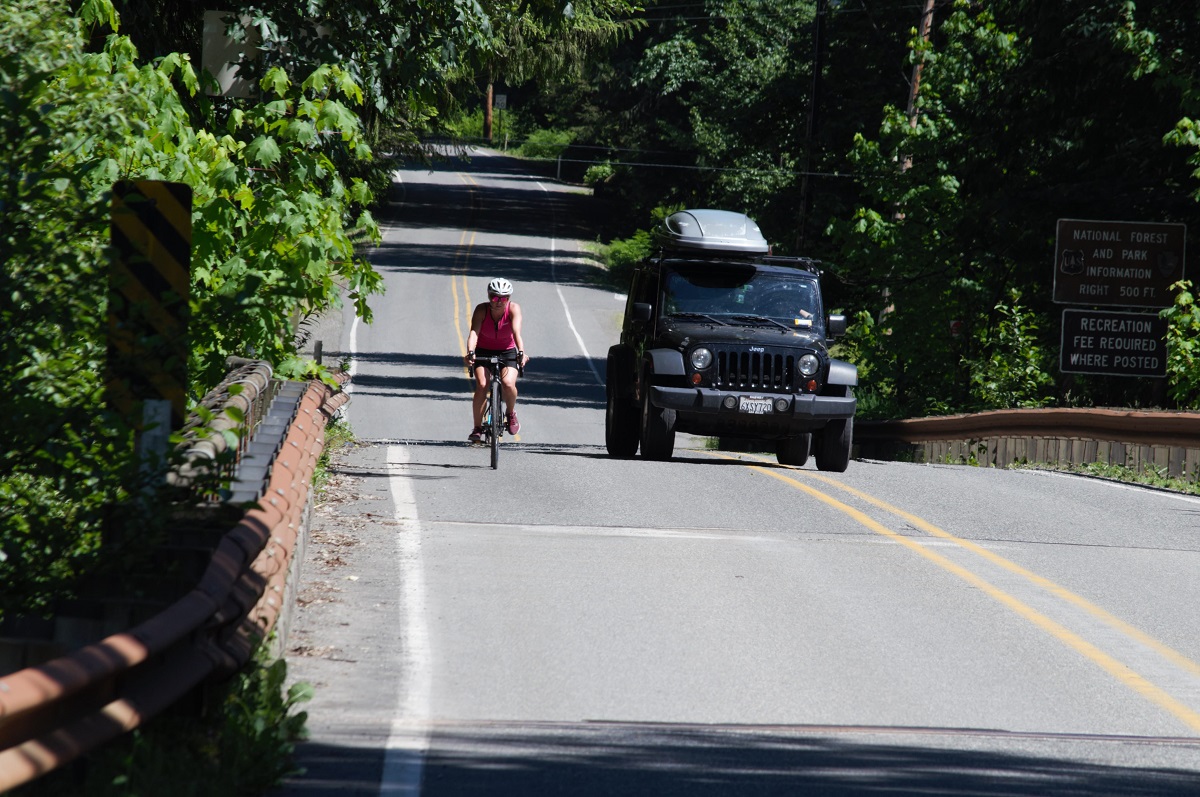
Mt Baker Highway, AKA Washington State Highway 542 stretches 58 miles from sea level in Bellingham, Washington to Artist’s Point at an elevation of 5,140 feet – a scenic overlook above tree line that on clear days treats visitors to sublime views of Mt Baker and Mt Shuksan.
Since 1992 Whatcom County has had plans to build a pedestrian pathway from Bellingham to Artist’s Point and dubbed it the Bay to Baker Trail (B2B). However due to a number of factors little has been accomplished. Right of way has been established in some areas, and in those areas some sections of the trail is under water for much of the year, some travel heavily undercut banks 100 feet above the North Fork Nooksack River, and at least one section acts as the local garbage dump.
Due to its beauty the highway attracts heavy traffic during the winter ski and summer hiking seasons. RVs, families coming up to recreate in SUVs, sports cars, sport motorcycles traveling at triple digits due to virtually no speed enforcement, and road cyclists all share this road. To compound the mix there are residential communities on the highway with limited options for residents to safely walk or ride bikes to community destination. At the local middle school if a child shows up to school with their bike they are sent home due to the hazard that riding on the road represents.
The mild winter that the Pacific Northwest experienced this last year was a shock to the small, tourist dependent communities in the shadow of Mt Baker. Businesses closed and residents watched as skiers, snowboarders and snowmobilers, who bring much needed revenue to the area, disappeared. It was a call to action as residents and business owners realized that perhaps some diversification of recreational opportunities was in order.
Inventorying the material that they had to work with, a group of residents and business owners has banded together in an attempt to motivate government to take action on the Bay to Baker Trail. John Adam, owner of Glacier Ski Shop, believes that pedestrian infrastructure will not only make the area more attractive to visitors, but will also provide residents with a safe option to getting in a vehicle and burning fossil fuels when they need a quart of milk. Paul Engel, who owns Wild and Scenic River Tours, added that, “Hundreds of reports show that when pedestrian pathways are created in a community it brings nothing but good – the population is healthier, vehicular traffic is reduced, property values are stable and local businesses see more traffic. Everyone benefits”
It would be easy to see why businesses would want to increase tourist traffic, and a small group of locals have pointed fingers at them and stating that they just want to “cash in”. When in reality it is more a matter of staying in businesses. And while a very small group of locals oppose the trail effort, the vast majority are for it. One of those is Marty Grabijas, a product developer in the outdoor industry. According to Marty, “What we have here is so special. The access to big wilderness and high alpine environments is incredible, and I can see why some want this to remain their private paradise. However no matter how much we want it we can’t turn the clock back. We do however have an opportunity to engineer the Mt Baker Highway corridor for the future. With a pedestrian pathway we can reduce vehicle congestion, and provide residents and visitors with a safe way to get around on foot or on a bike. My motive for being involved is to create safe places to walk and ride for everyone. The Mt Baker area is visually stunning, and with a safe pathway in the highway corridor a bike is the perfect vehicle for visiting services in one of the several small towns, or connecting to Forest Service roads and exploring the area.”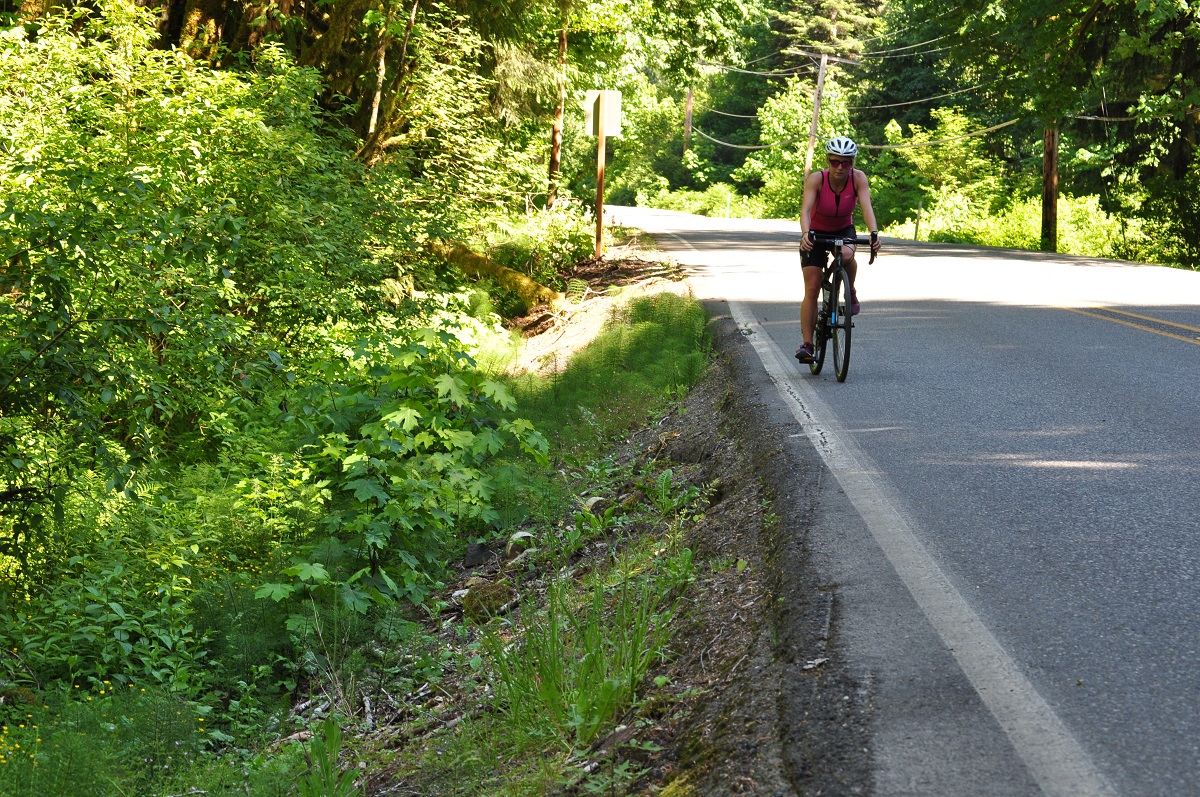
This citizens group is in the due diligence stage of forming a pedestrian and equestrian advocacy group. Part of that process is showing a want and need for pedestrian pathways by gauging interest of residents, visitors and potential visitors. By participating in their survey you will provide them with the data points they need to attempt to secure funding in Whatcom County’s 2017 / 18 budget to see portions of the Bay to Baker Trail become reality.
Regardless if you have been to the Mt Baker area, your feedback is valuable.
Go to the Survey Here: https://www.surveymonkey.com/s/MTBAKERTA
What do you think? Leave a comment.
If you like this let your friends know or post it on FB, Twitter or LinkedIn
Copyright 2015 Recreation Law (720) Edit Law
Email: Rec-law@recreation-law.com
Google+: +Recreation
Twitter: RecreationLaw
Facebook: Rec.Law.Now
Facebook Page: Outdoor Recreation & Adventure Travel Law
Blog: www.recreation-law.com
Mobile Site: http://m.recreation-law.com
By Recreation Law Rec-law@recreation-law.com James H. Moss
#AdventureTourism, #AdventureTravelLaw, #AdventureTravelLawyer, #AttorneyatLaw, #Backpacking, #BicyclingLaw, #Camps, #ChallengeCourse, #ChallengeCourseLaw, #ChallengeCourseLawyer, #CyclingLaw, #FitnessLaw, #FitnessLawyer, #Hiking, #HumanPowered, #HumanPoweredRecreation, #IceClimbing, #JamesHMoss, #JimMoss, #Law, #Mountaineering, #Negligence, #OutdoorLaw, #OutdoorRecreationLaw, #OutsideLaw, #OutsideLawyer, #RecLaw, #Rec-Law, #RecLawBlog, #Rec-LawBlog, #RecLawyer, #RecreationalLawyer, #RecreationLaw, #RecreationLawBlog, #RecreationLawcom, #Recreation-Lawcom, #Recreation-Law.com, #RiskManagement, #RockClimbing, #RockClimbingLawyer, #RopesCourse, #RopesCourseLawyer, #SkiAreas, #Skiing, #SkiLaw, #Snowboarding, #SummerCamp, #Tourism, #TravelLaw, #YouthCamps, #ZipLineLawyer, Mt. Baker, Survey, Washington, Mt Baker, Mt Shuksan, Trail, Cycling, Tourism, Bike Trail, Hiking Trail,
Official national bicycle network expands to 8,992 miles with addition of three new routes in Idaho and Utah; eighteen states now have U.S. Bicycle Routes.
Posted: June 2, 2015 Filed under: Cycling | Tags: Adventure Cycling, Adventure Cycling Association, Bicycle route System, Cycling, National Corridor Plan, U.S. Bicycle Route System, USBRS, x, y, z Leave a comment
Official national bicycle network expands to 8,992 miles with addition of three new routes in Idaho and Utah; eighteen states now have U.S. Bicycle Routes.
Missoula, Montana, May 26, 2015 — Adventure Cycling Association and the American Association of State Highway and Transportation Officials (AASHTO) today announced that AASHTO has approved 919 miles of new U.S. Bicycle Routes (USBRs): USBR 10 in Idaho and USBR 70 and 79 in Utah. The U.S. Bicycle Route System (USBRS) now encompasses 8,992 miles of routes in eighteen states and the District of Columbia.
“Today’s announcement carries even greater significance because of where the new routes are located,” said Bud Wright, AASHTO’s executive director. “Utah and Idaho are only the second and third Western states to be added to the US Bicycle Route System, but we’re confident more will follow as we connect the entire nation from coast to coast.”
The U.S. Bicycle Route System is a developing national network of numbered and signed bicycle routes that connect people, communities, and the nation. Similar to emerging international and regional networks, such as Europe’s EuroVelo network and Quebec’s La Route Verte, the U.S. Bicycle Route System provides important recreational and transportation options for the active traveler. Currently, more than forty states are working to develop route corridors into official U.S. Bicycle Routes to be approved by AASHTO at their spring and fall meetings.
”Adding almost 1,000-miles of U.S. Bicycle Routes is a testament to the growing interest in bicycle travel all over the country,” said Jim Sayer, executive director of Adventure Cycling Association. “These designations are the result of hard work by the states and their local partners along with support provided by Adventure Cycling staff. It’s a true partnership for active travel and transportation across America.”
U.S. Bicycle Route 10 in Idaho (137 miles with Alternates)
U.S. Bicycle Route 10 includes a 66-mile section that travels through northern Idaho to Montana using U.S. 2, Idaho 200 and local routes. Along the way, the route parallels historic water paths in the Panhandle region and follows railroad beds established more than a century ago.
The route travels between the Bonner County communities of Oldtown and Sandpoint on U.S. 2, Sandpoint and Clark Fork on Idaho 200, and between Clark Fork and Heron, Mont. on River Road and Clark Fork Road.
Brian Shea, the Statewide Bicycle/Pedestrian Coordinator for the Idaho Transportation Department, said, “We are excited to share this new route which includes some of the most beautiful areas of our state with bicycle travelers who, in turn, will provide economic opportunities for our local businesses and communities.”
The route features services in Oldtown, Priest River, Dover, Sandpoint, Ponderay, Kootenai, Hope, East Hope and Clark Fork such as restaurants, bike shops, lodging, campgrounds, grocery stores and emergency services to accommodate the needs of touring cyclists. There are many scenic vistas and points of interest along the corridor as well as alternate routes and side trips aligning with or giving access to the growing trail system in Bonner County.
USBR 10 parallels historic water routes in the region, including the northerly bank of the Pend Oreille River between Newport, Wash. and Sandpoint, the northerly and easterly shoreline of Lake Pend Oreille, and the south bank of the Clark Fork River into Montana. Albeni Falls Dam near Oldtown and Cabinet Gorge Dam near Clark Fork can be viewed and visited along the route.
The route uses three Scenic Byways: the International Selkirk Loop, the Panhandle Historic River Passages State Scenic Byway and the Pend Oreille National Scenic Byway.
USBR 10 follows the Great Northern Railway bed between Oldtown and Sandpoint and the Northern Pacific Railway bed between Sandpoint and Montana, both established in the 1890s and in operation today as main rail freight corridors. The railways opened up the Lake Pend Oreille area some 80 years after the early fur trader, David Thompson, established a trading post near what is now Clark Fork.
The area is rich in trading, mining, timber, fishing, and tourism history. Many seasonal events occur throughout the area during the touring season ranging from farmers’ markets to cycling events at Schweitzer Mountain Resort to The Festival at Sandpoint, Sandpoint’s music festival. Area businesses welcome touring cyclists and encourage travelers to enjoy the many features of Bonner County.
In endorsing the route, Bonner County’s Board of Commissioners stated, “We recognize that bicycle tourism is a growing industry in North America, contributing $47 billion a year to the economies of communities that provide facilities for such tourists. This community stands to benefit from this opportunity economically and from the health and environmental benefits of encouraging bicycle travel in our region.”
More information and a link to the map can be found on the ITD website.
U.S. Bicycle Route 70 and 79 in Utah (782 miles)
U.S. Bicycle Routes 70 and 79 combine to create a transverse route across southern Utah that connects the Nevada and Colorado borders. The U.S. Bicycle Route 79 portion of this route travels 130 miles in a southeasterly direction through the high elevation desert of the Basin and Range Province, providing travelers with a unique scenic experience and unmatched solitude. The route follows paved, two-lane highways through a landscape dominated by sagebrush, piñon pine, and expansive views, and connects to Route 70 in Cedar City, where cyclists can access food, water, and bicycle shops.
The Route 70 portion of this route travels 450 miles through the unique red rock landscape of southern Utah, passing through sinuous canyon country, through high elevation pine forests in the Dixie National Forest, and crossing the Colorado River near Lake Powell. Route 70 also travels past Bryce Canyon National Park and Capitol Reef National Park, two of the crown jewels of Utah’s iconic “Big Five” parks. The red rock hoodoos at Bryce and the sprawling vistas at Capitol Reef are truly once in a lifetime sights that all travelers should have on their must-see list. This route follows paved, two-lane, county, state, and U.S. roads, which pass through small, rural towns that provide cyclists with the opportunity to re-supply with food and water.
USBRS 70 and 79 offer cyclists the opportunity to experience Utah’s stunning red rock landscape and make these routes a truly unique part of the U.S. Bicycle Route network.
“The Utah Department of Transportation is pleased that the efforts of all of Utah’s communities and transportation partners are being recognized with the approval of USBR 79 and USBR 70 in Utah,” said Carlos Braceras, UDOT Executive Director. “In Utah we know that biking plays an important role in Keeping Utah Moving, which is helping drive our great quality of life and economy. National bike routes such as these play a significant role in providing active transportation options for the citizens of Utah and the rest of the United States.”
For more information about bicycing in Utah, visit the UDOT website.
U.S. Bicycle Route 45 realignment in Minnesota (26 miles added)
Originally designated in 2013, The Minnesota Department of Transportation has realigned U.S. Bicycle Route 45 to incorporate changes in coordination with the installation of guide signs along the entire route.
The route, also known as the Mississippi River Trail (MRT), is now twenty-six miles longer and includes improvements such as: roadway realignments due to construction, improved shoulders on nearby roads, new bridges, opportunities to bring cyclists closer to the Mississippi River, and newly-built off-road paths and trails, which appeal to a broader bicycling audience. The route includes seven percent more off-road facilities, and incorporates long continuous sections of three state trails and numerous miles of regional and local paths.
“MnDOT worked with local communities and Department of Natural Resources partners since 2013 to identify sign locations,” said Tim Mitchell, Minnesota Department of Transportation bicycle and pedestrian coordinator. “In just a few years, our partners made many improvements worthy of a statewide realignment and we are pleased to incorporate them into a route that’s better, safer, and offers an even greater opportunity for adventure and cultural enrichment along one of the world’s great rivers.”
The MRT/USBR 45 connects existing shouldered highways, low-use roads, and off-road paths for bicyclists to closely follow the Mississippi River from the headwaters at Itasca State Park to the Iowa border. The route begins where the Mississippi is just a small stream surrounded by towering white pines. It winds through forests and farm fields, passes through the Twin Cities of Minneapolis and St. Paul and the National Park Service’s Mississippi National River and Recreation Area, and through charming, historic river towns. It offers challenging climbs in the limestone bluffs of southeastern Minnesota, rewarded with long scenic views of the river valley. The route is sometimes on two sides of the river, offering a linear long distance bikeway along with opportunities for short loop rides if crossing from one side to another.
Two ribbon-cutting events and a bike ride will be held this summer to commemorate the project completion. The events will be Aug. 27 in Itasca State Park and Aug. 31 in St. Paul. They coincide with the inaugural eight-day, 470-mile “Headwaters to Hills” tour from Aug. 26 to Sept. 2. For more information about the ride, go to http://www.bikemn.org/headwaters-to-hills.
“With the project completion, it’s time to recognize the partners’ accomplishments,” said Liz Walton, MRT/USBR 45 project manager. “Many MRT cities worked hard to encourage safe bicycling for both for residents and visitors alike and to invite them to enjoy the river and what their communities have to offer. The route celebrates the people, places, and stories that have made Minnesota communities great. What better way to experience all that than on a bike.”
Detailed route maps and other information are available on the MNDOT website.
The Largest Bike Route Network in the World
The U.S. Bicycle Route System will eventually be the largest bicycle route network in the world, encompassing more than 50,000 miles of routes. Adventure Cycling Association has provided dedicated staff support to the project since 2005, including research support, meeting coordination, and technical guidance for states implementing routes. Adventure Cycling recently completed a makeover of the web pages devoted to the U.S. Bicycle Route System with improved layout and easy to find implementation tools, including route criteria, designation resources, and links to official sign guidance documents and studies. Adventure Cycling also provides an updated list of links to maps and other resources for cyclists wishing to ride an established U.S. Bicycle Route on its Maps & Route Resources page.
AASHTO’s support for the project is crucial to earning the support of federal and state agencies. AASHTO is a nonprofit, nonpartisan association representing highway and transportation departments in all 50 states, the District of Columbia, and Puerto Rico. A powerful voice in the transportation sector, AASHTO’s primary goal is to foster the development of an integrated national transportation system.
Support for the U.S. Bicycle Route System comes from Adventure Cycling members, donors, foundations, and a group of business sponsors that participate in the annual Build It. Bike It. Be a Part of It. fundraiser each May.
Learn more at www.adventurecycling.org/usbrs.
Colorado Safe Routes to Schools Bill in Danger: Need your Help ASAP
Posted: April 30, 2015 Filed under: Cycling | Tags: Bicycle Colorado, Bicycling, Colorado, Colorado Senate, Cycling, Legislative session, Riding a bike, Safe Routes to School Leave a comment
|

 Please call or email your state senator TODAY and ask them to support House Bill 1003—Safe Routes to School. If the bill does not pass the Colorado Senate, the Safe Routes to School program will die.
2015 USA Pro Challenge Route will Attract Great Racers and Great Fans
Posted: April 30, 2015 Filed under: Colorado, Cycling | Tags: #USAProChallenge, Bicycle Racing, Cycling, x, y, z Leave a comment
USA PRO CHALLENGE ANNOUNCES 2015 ROUTE WITH EPIC MOUNTAINTOP FINISH AND ALTITUDE INFUSED TIME TRIAL
New Host Communities Arapahoe Basin and Copper Mountain
Promise to Delight Fans
DENVER (April 28, 2015) – The 2015 USA Pro Challenge swings into action in its fifth year with a new circuit start in Steamboat Springs on Monday, August 17th and then it makes its way through another eight stunning host cities for the race finale in Denver on Sunday, August 23, 2015.
The Rocky Mountains of Colorado serve as home for the USA Pro Challenge, and every year since its inception over a million fans get to witness the world’s best cyclists, iconic routes and lung-piercing climbs of the seven stage event. With the State of Colorado containing 28 of the 50 highest peaks in the United States, it’s no surprise the race is a favorite for the world’s top teams and cyclists.
“Each of our 2015 host cities offers something unique and special to the 5th anniversary of the Pro Challenge,” said Shawn Hunter, CEO of USA Pro Challenge. “We’re confident that this year’s route will provide the most exciting week of racing yet. We have added new cities and a dramatic mountaintop finish that will prove to be a fierce battleground for riders eager to show they have what it takes to compete on a new climb up Loveland Pass.”
The Pro Challenge has grown into the largest spectator event in Colorado history with tremendous crowds enjoying the weeklong race action and event festivities. New additions to this year’s race include: Arapahoe Basin, Loveland Pass, Copper Mountain and a lung buster time-trial in Breckenridge, a new twist for a familiar host city of past races. This year the USA Pro Challenge also pays homage to the inaugural race in 2011 with a repeat of that year’s final stage – from Golden to Denver.
The 2015 USA Pro Challenge race is back with a combination of familiar host cities and new communities added into the mix.
Highlights of the route include:
Stage 1 – Steamboat Springs Circuit – Monday, August 17, 2015
After a brief venture onto the rolling roads of Routt County in 2013, the USA Pro Challenge knew it had to make a return to put on a classic circuit race. The quiet roads offer straights, twists, and a few rather steep surprises. Match that with the fan favorite host city of Steamboat Springs, and you have the makings of a great opening stage. This 49-mile circuit will be completed twice by the peloton, creating great spectator opportunities both in Steamboat Springs and for on course locations like the Rt. 27 KOM climb and the town of Oak Creek. Will Steamboat Springs be treated to another classic sprint finish or will the challenges of Routt County create an opportunity for a surprise first yellow jersey of 2015? Either way, the fans of Steamboat Springs will be treated to quite a show.
Stage 2 – Steamboat Springs to Arapahoe Basin – Tuesday, August 18, 2015
As the Pro Challenge says goodbye to its overall start host, Steamboat Springs, it welcomes a new member to the family with the race’s first visit to Arapahoe Basin. Leaving Steamboat Springs there is little time to settle in before the pros have to tackle Rabbit Ears Pass. From there, this familiar route heads south through Kremmling, around the Green Mtn. Reservoir, and continues through Silverthorne and Dillon. Unlike years past, the 2015 Pro Challenge will then turn east and suffer 5 miles up Loveland Pass to Arapahoe Basin. Look for jerseys to change hands, dreams fulfilled for some, expectations dashed for others, on this new mountain top finish.
Stage 3 – Copper Mountain to Aspen – Wednesday, August 19, 2015
Another new twist on an old favorite, but this time it is the opening that changes. Copper Mountain plays host to its first ever Pro Challenge stage and sends off Stage 3 in style, while familiar terrain and fans await the race on Independence Pass and the run into Aspen.
No rest for the weary this day as the climbing starts right away with the ascent of Freemont Pass, followed by the gorgeous shores of Turquoise Lake and then a quick sprint through Leadville. However that is only the appetizer as the main course awaits on the upper slopes of Independence Pass and then it’s down the breathtaking descent into Aspen where some of the most memorable moments in Pro Challenge history have played out.
Oh, and by the way, over half of Stage 3 takes place above 10,000 feet. Bring your lungs.
Stage 4 – Aspen to Breckenridge – Thursday, August 20, 2015
This crowd-pleasing stage from 2013 is back for an encore in 2015 as it connects the Pro Challenge’s two most visited towns; Aspen and Breckenridge. Starting off with 20 miles of climbing up Independence Pass is a rude wake up call, but that is only the beginning. The racers still have the climbs of Trout Creek Pass and Hoosier Pass to conquer, while sprints in Buena Vista and Fairplay dot the route to Breckenridge. Once in town, one final obstacle stands between the riders and victory, the wall up Moonstone road and the drop down Boreas Pass to the finish where the always boisterous crowds of Breckenridge await.
Stage 5 – Breckenridge Time Trial – Friday, August 21, 2015
Completely new for 2015, the Breckenridge Time Trial will test all of a rider’s skills and will produce a truly worthy winner. The 8.5-mile time trial starts out flat for the pure time trialists. However, it’s not long before it’s back onto the climb up Moonstone road, still fresh in the pain file from the day before and a real test of climbing skills. Finally, the race could be won or lost going downhill this day, as racers will push the limits on the Boreas Pass descent to shave seconds off their time. Whoever wins the day will certainly be one who can hammer the flats, dance up the climbs, and carve down the descents.
Stage 6 – Loveland to Ft. Collins – Saturday, August 22, 2015
The start and finish location of Stage 6 may be familiar, but what lies between the two is new and challenging.
The early flats and sprints in Windsor and Loveland hide the wicked side of the route that waits in the second half. It may not have the grand names or the huge elevation numbers, but the lower and smaller climbs of this stage still have a serious sting. Climbing the north side of Carter Lake and then onto the new climb up Rist Canyon should get everyone’s attention. It may also present one of the last chances for overall contenders to make a move. Wrapping up with the jagged rollers of Horsetooth Reservoir before bombing into Ft. Collins, this stage proves that a race doesn’t need to reach 12’000’ to be epic.
Stage 7 – Golden to Denver – Sunday, August 23, 2015
For a finale the Pro Challenge goes back to its roots. This route was the final stage of the first Pro Challenge in 2011 and introduced the world to the cycling crowds on the Front Range.
After a short loop north of Golden the race will tackle its main obstacle of the day, the 4-mile climb of Lookout Mtn. Another quick pass of Golden and the race is screaming through Wheat Ridge and Lakewood en route to downtown Denver. Four laps of the familiar Denver circuit await and Civic Center Park, City Park, and 17th street will be treated to blazing speeds as the last prizes of the week are fought for over tooth and nail.
One of the most highly anticipated events on the race calendar, the 2015 USA Pro Challenge will test the riders’ strength and endurance over a 605 mile course. To give fans the opportunity to see their heroes up close and in action, each stage, with the exception of the individual time trial, will start with at least one circuit lap in the start city before leaving town
Host city information, maps and elevation profiles are available on the race website http://www.usaprocyclingchallenge.com/route
About the USA Pro Challenge
Referred to as “America’s Race,” the USA Pro Challenge will take place August 17-23, 2015 and an inaugural Women’s USA Pro Challenge will take place from August 21-23, 2015. For seven consecutive days, the world’s top male and female athletes race through the majestic Colorado Rockies, reaching higher altitudes than they’ve ever had to endure. One of the largest cycling events in U.S. history and the largest spectator event in the history of the state, the USA Pro Challenge is back for 2015. Featuring a challenging course, the fifth annual race will spotlight the best of the best in professional cycling and some of America’s most beautiful scenery.
.
After 40 Years, the Ride Continues: Adventure Cycling Seeks to Reconnect with Bikecentennial & TransAm Cyclists
Posted: April 28, 2015 Filed under: Cycling | Tags: Adventure Cycling Association, American Canoe Association, Bicycling, Cherry Hill, Cycling, Glacier National Park (U.S.), Missoula, Montana, National Park Foundation, National Park Service, National Public Lands Day, National Wildlife Federation, New Jersey, x, y, z Leave a comment
After 40 Years, the Ride Continues: Adventure Cycling Seeks to Reconnect with Bikecentennial & TransAm Cyclists
Adventure Cycling’s 40th anniversary celebration in 2016 will include events, tours, reunions, ’76 retro merchandise and more.
MISSOULA, MONTANA, April 22, 2015 —Adventure Cycling Association has been creating social networks since the launch of Bikecentennial in 1976. Now, the largest cycling membership organization in North America wants to reconnect with those involved in Bikecentennial and cyclists who have ridden all or part of the TransAmerica Trail between 1976 and today. In preparation for a yearlong 40th anniversary celebration in 2016, Adventure Cycling invites Bikecentennial and TransAm cyclists to fill out an online form to share their contact and trip information. Anyone interested in participating or volunteering in the 40th anniversary events can also fill out the online form.
“We are looking to reconnect and honor the contributions made by our original Bikecentennial family and those who have cycled our first route, the TransAmerica Bicycle Trail.” stated Eva Dunn-Froebig, events and outreach coordinator for Adventure Cycling. “We are also excited to engage present and future generations with a great lineup of events open to people of all ages.”
Adventure Cycling was founded as Bikecentennial, a 4,250-mile TransAmerican bicycle ride in the summer of 1976, with over 4,100 participants. Today, Adventure Cycling has over 48,000 members, guided tours, an award-winning magazine, 44,673 miles of bicycle routes, an online store, and bicycle travel advocacy programs.
In addition to reconnecting with TranAm and Bikecentennial 76 cyclists, Adventure Cycling is looking to engage anyone who is interested in celebrating 40 years of bike travel with family-friendly events, special tours, retro merchandise, and more. Those interested can fill out the online form.


The 40th anniversary will include The Montana Bicycle Celebration, July 15 – 17, 2016 in Missoula, Montana—home of Adventure Cycling’s headquarters—and will bring together bike travelers from all over the world for celebratory Bikecentennial reunions and parties with inspirational speakers, and music, art and film. Organized bike rides throughout the weekend will showcase Missoula’s trail system including the completed 50-mile Bitterroot Trail south of Missoula. On the same weekend, Tour of Montana will host professional bike races, an expo, and a Gran Fondo.
Two new annual events, set to kick off in 2016, will inspire a bike travel movement throughout North America. National Bike Travel Weekend, June 3 – 5, 2016, will motivate bike travelers from all over North America to go on bike overnights through a festive online community. Adventure Cycling will provide do-it-yourself resources and an interactive map that will connect bike travelers during what will be the most prolific weekend of bike travel in North America. Bike to Your National Park Day on September 24, 2016 will celebrate the National Park Service’s centennial, National Public Lands Day, and Adventure Cycling’s 40th anniversary by promoting bike travel to and within national parks, state parks, and other recreational areas.
In honor of the 40th anniversary, in 2016, Adventure Cycling will offer extra TransAmerica Trail tours and other special epic tours, including on Bicycle Route 66, the Underground Railroad and the Great Divide. Sign-ups will be available on the Adventure Cycling website in the summer of 2015.
For those who cannot attend Adventure Cycling’s events or tours and want to plan their own reunion or ride, Adventure Cycling will provide online tools and resources to help plan Do-It-Yourself Reunions and Celebrations throughout 2016.
Adventure Cycling will also have retro-themed jerseys and merchandise available in the Cyclosource store throughout 2016. Other Bikecentennial projects include a beautiful, large format, picture-laden book about the TransAmerican Trail co-authored by Greg Siple, a co-founder of Adventure Cycling, and longtime Adventure Cycling staff member Mac McCoy; special bike giveaways; a commemorative beer; an online project that will recognize 40 bicyclists who have made significant contributions to the bike travel community; and an archival project with Story Corps to preserve the fulfilling and transformative memories of Bikecentennial cyclists and other bike adventurers.
“Bikecentennial started with a vision to encourage more people to experience bike travel and was fueled by the passion of a small group of dedicated staff and volunteers,” Siple says. “Bikecentennial 76 continues to inspire bike travelers of all ages and backgrounds 40 years later.”
Adventure Cycling invites the public to share photos, stories and words of wisdom from Bikecentennial, now, and any time in between at adventurecycling.tumblr.com.
For more information about Adventure Cycling’s 40th anniversary visit adventurecycling.org/40th.
3 Great Updates from Bicycle Colorado, June 24, Colorado Bike to Work day
Posted: April 4, 2015 Filed under: Cycling, Youth Camps | Tags: Bicycle Colorado, Bicycling, Cycling, x, y, z Leave a comment
|

Carlton Reid, author of Roads Were Not Built for Cars doing Book Tour in the US
Posted: April 3, 2015 Filed under: Uncategorized | Tags: Author, Bicycles, Book Tour, Cycling, Roads were not Built for Cars, x, y, z Leave a comment |
||
|
||
|
||
| If you enjoyed the print and digital versions of Roads Were Not Built For Cars perhaps you’ll be interested in the live tour? Yup, I’m going out on the, er, road, and will be appearing in a wide variety of venues over the next few months. I’ll be in the UK, Canada, France and both US coasts, including giving a talk to the Congressional Bike Caucus in Washington, D.C.The tour details can be found on roadswerenotbuiltforcars.com and on Facebook (where you can even “track” me – yoiks). If you fancy coming to any of the talks make sure to hit the “like” buttons or click on the RSVP boxes.Later in the year there will be more UK dates announced, and one in Germany, too. I’m also back in the US in June so may give talks in Salt Lake City, Seattle and Portland, Oregon. Track me to plug in to these updates.
Cheers. Carlton PS The second free chapter of the book goes online tomorrow. The first went out last week. The URL will always be the same: roadswerenotbuiltforcars.com/fulltext |
||

New Bicycle Standards coming from ISO: ISO 4210:2014
Posted: March 31, 2015 Filed under: Cycling | Tags: #ISO, bicycle, Bicycle Standards, Cycling, Standards, x, y, z Leave a comment |

|



It’s a balance, healthy kids versus safe kids, health adults versus safe adults, polluted air versus clean air or more importantly, personal choice versus you telling me what to do.
Posted: March 18, 2015 Filed under: Cycling | Tags: biking, Cycling, Helmets, Sweden Leave a commentStudy from Sweden looks at the effects of cycling after a 2005 law requiring children to wear helmets while riding bikes.
This article came from a study by the Swedish Association of Transportation Planners. The article, What happens when you mandate helmet-wearing among young Swedish cyclists? is based on the study.
These are quotes from the article. Emphasize in bold is mine.
Mandatory helmet laws have been controversial in that they seem to have a limited effect on the number of head injuries, if at all, but instead are correlated with a decrease in cycling numbers.
Graph 1 shows the number of head injuries as a share of injuries to all parts of the body. The downward sloping lines indicate that head injuries are falling faster than other injuries.
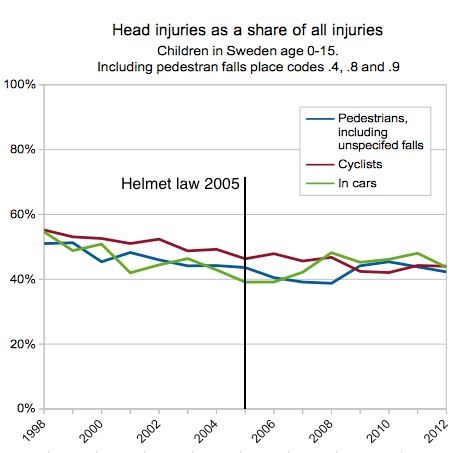
As we can see there does not seem to be a difference between the trends of the different modes, suggesting that if there is any fall in the share of head injuries it is likely to be an effect of something that also applies to other or all road users.
However there does seem to be another effect of helmet laws, namely a decline in cycling among school children. In 1983 57% of children aged 7-9 had permission from their parents to bike to school without adult companion, and for the age group 10-12, 94% had such permission. By the year 2007 this had decreased to 25% and 79% respectively. Bearing in mind, the helmet law was introduced in 2005, we can’t be sure of a correlation, because the data consists of surveys from 1983 and then 2007. But we do also have data recording that the share of school journeys by bicycle fell from 33% in 2006 one year after the legislation to 29% in year 2012. The evidence does suggest that the effect of the helmet law primarily is that fewer children bike to school.
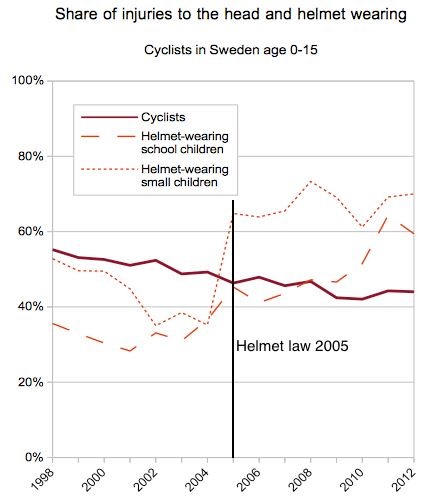
So the data does show a decline in cycling, but without annual surveys it’s hard to be sure of a correlation. However, a Danish report made the same link between declining cycling to school and helmet promotion and safety/scare campaigns. They determined that half the decline in cycling was caused by these campaigns, and half was caused by other factors such as more car traffic and longer distances to school.
From my perspective, laws telling me how to live don’t work, and this study shows that. Whether I wear a helmet is more personal issue that I should be allowed to decide.
More importantly, cycling increases the cyclist’s health, decreases air pollution and general promotes health. That is a greater benefit to all of us then the individual benefit of forcing someone to do something they may or may not want to do.
See: What happens when you mandate helmet-wearing among young Swedish cyclists?
Other Articles about this subject:
Bike Share programs flourish when helmets are not required http://rec-law.us/WrqmXI
Study shows that head injuries are on the rise on the slopes even though more people are wearing helmets http://rec-law.us/U91O73
Law requires helmets, injuries down fatalities up? http://rec-law.us/YwLcea
Great editorial questioning why we need laws to “protect” us from ourselves. http://rec-law.us/Ayswbo
Survey of UK physicians shows them against mandatory bicycle helmet laws. http://rec-law.us/sYuH07
Recent UK poll shows that 10% of cyclists would quite biking if there was a compulsory helmet law. http://rec-law.us/t1ByWk
What do you think? Leave a comment.
If you like this let your friends know or post it on FB, Twitter or LinkedIn
Copyright 2015 Recreation Law (720) Edit Law
Email: Rec-law@recreation-law.com
Google+: +Recreation
Twitter: RecreationLaw
Facebook: Rec.Law.Now
Facebook Page: Outdoor Recreation & Adventure Travel Law
Blog: www.recreation-law.com
Mobile Site: http://m.recreation-law.com
By Recreation Law Rec-law@recreation-law.com James H. Moss
#AdventureTourism, #AdventureTravelLaw, #AdventureTravelLawyer, #AttorneyatLaw, #Backpacking, #BicyclingLaw, #Camps, #ChallengeCourse, #ChallengeCourseLaw, #ChallengeCourseLawyer, #CyclingLaw, #FitnessLaw, #FitnessLawyer, #Hiking, #HumanPowered, #HumanPoweredRecreation, #IceClimbing, #JamesHMoss, #JimMoss, #Law, #Mountaineering, #Negligence, #OutdoorLaw, #OutdoorRecreationLaw, #OutsideLaw, #OutsideLawyer, #RecLaw, #Rec-Law, #RecLawBlog, #Rec-LawBlog, #RecLawyer, #RecreationalLawyer, #RecreationLaw, #RecreationLawBlog, #RecreationLawcom, #Recreation-Lawcom, #Recreation-Law.com, #RiskManagement, #RockClimbing, #RockClimbingLawyer, #RopesCourse, #RopesCourseLawyer, #SkiAreas, #Skiing, #SkiLaw, #Snowboarding, #SummerCamp, #Tourism, #TravelLaw, #YouthCamps, #ZipLineLawyer, Cycling, Helmets, Sweden, Biking
MassBike Bills Receive Substantial Sponsors
Posted: March 10, 2015 Filed under: Cycling | Tags: Cycling, Massachusetts, MassBikes, Safe Riding, Safe Routhes, x, y, z Leave a comment
|


New App helps you Track and Maintain your Bike
Posted: January 31, 2015 Filed under: Cycling, Mountain Biking | Tags: bicycle, Cycling, Feedback, Feedback Sports, Maintenance, x, y, z Leave a comment
|
||||||||||||||||
|
||||||||||||||||
|
 There’s an art to proper bike maintenance.Organization is the first step.


 Get out there and ride this Winter…just don’t forget to bring the bikes in for a little warmth and TLC after.*Remember: If you’re cold, they’re cold.

|
USA Pro Challenge Stage 6 Route Announced: Loveland to Fort Collins
Posted: January 6, 2015 Filed under: Colorado, Cycling | Tags: Bicycle Race, Colorado, Cycling, Fort Collins, Loveland, USA Pro Challenge Leave a commentStage 6 of 2015 USA Pro Challenge will take Riders from Loveland to Fort Collins
Fans Helped Shape Stage 6 of Colorado Professional Cycling Race
Denver (Dec. 22, 2014) – With the majority of the host cities announced for the 2015 USA Pro Challenge, organizers looked to fans to help determine the start and finish locations for Stage 6. Thousands of fans submitted their opinions, providing more than 20 start and finish city options. In the end, nearly half the responses encouraged a return to Northern Colorado resulting in a Stage 6 start in Loveland and a finish in Fort Collins.
“Loveland and Fort Collins have been such great host cities in the past and we’re looking forward to visiting them again,” said Shawn Hunter, CEO of the USA Pro Challenge. “Last year, we gave fans the chance to weigh in on the final stage of the race and we got a huge response with people voicing their support for the two different options. This year, the fans once again showed their passion for the sport through an overwhelming number of responses regarding where Stage 6 should take place.”
After the initial host cities announcement just over two weeks ago, during which six of the seven stages for the 2015 race were revealed, fans were given the opportunity to provide suggestions for Stage 6 through Facebook and the race website.
USA Pro Challenge fan Michael DePalma wanted a return to Northern Colorado stating it, “offers some of the most spectacular cycling opportunities in the state.” And many spoke to returning to areas that were greatly damaged by the 2013 floods. Gary Crews said the Pro Challenge will, “help us further recover from the flooding and put a smile on the face of riders and residents alike.”
With the fans’ opinions taken into account, the Stage 6 host cities have been determined. And while the host cities are familiar to the race, after visiting them in 2013, the route through Larimer County promises to be new and unique in 2015.
“It has been incredible to witness the outpouring of support from the Northern Colorado community who has rallied together to bring back the USA Pro Challenge in 2015,” said Local Organizing Member Eric Thompson. “We are honored to have been selected for Stage 6 next summer and look forward to sharing the excitement with the cycling fans that made it happen.”
Taking place Aug. 17-23, the host cities and stages of the 2015 USA Pro Challenge include:
- Stage 1: Monday, Aug. 17 – Steamboat Springs Circuit Race
- Stage 2: Tuesday, Aug. 18 – Steamboat Springs to Arapahoe Basin
- Stage 3: Wednesday, Aug. 19 – Copper Mountain Resort to Aspen
- Stage 4: Thursday, Aug. 20 – Aspen to Breckenridge
- Stage 5: Friday, Aug. 21 – Breckenridge Individual Time Trial
- Stage 6: Saturday, Aug. 22 – Loveland to Fort Collins
- Stage 7: Sunday, Aug. 23 – Golden to Denver
Additional details regarding the start and finish locations of the 2015 race, as well as the specific, detailed route will be announced in the spring.
About the USA Pro Challenge
Referred to as “America’s Race,” the USA Pro Challenge will take place August 17-23, 2015. For seven consecutive days, the world’s top athletes race through the majestic Colorado Rockies, reaching higher altitudes than they’ve ever had to endure. One of the largest cycling events in U.S. history and the largest spectator event in the history of the state, the USA Pro Challenge is back for 2015.
More information can be found online at www.USAProChallenge.com and on Twitter at @USAProChallenge.
The Adventure Cycling Association shows more routes to travel the USA by bike
Posted: December 26, 2014 Filed under: Cycling | Tags: Adventure Cycling, Association, biking, Cycling, Routes, x, y, z Leave a comment

U.S. Bicycle Route System grows to over 8,000 miles
Official national bicycle network expands to 8,042 miles with addition of five new routes
MISSOULA, MONTANA, November 16, 2014 — Adventure Cycling Association and the American Association of State Highway and Transportation Officials (AASHTO) today announced that AASHTO’s Special Committee on U.S. Route Numbering has approved 1,253 miles of new U.S. Bicycle Routes (USBRs): USBR 1 in Massachusetts and Florida, USBR 10 in Michigan, USBR 11 in Maryland, and USBR 90 in Florida. Realignments were also approved for USBR 76 and USBR 1 in Virginia, which were originally designated in 1982. The U.S. Bicycle Route System (USBRS) now encompasses 8,042 miles of routes in 16 states and the District of Columbia.
“We continue to be impressed by the strong work of state Departments of Transportation and congratulate them on their designations,” said AASHTO Executive Director Bud Wright. “We also wish to acknowledge our partnership with Adventure Cycling Association and the expertise they bring to the process.”
The U.S. Bicycle Route System is a developing national network of numbered and signed bicycle routes that connect people, communities, and the nation. Similar to emerging international networks, such as Europe’s EuroVelo network and Quebec’s La Route Verte, the U.S. Bicycle Route System provides important recreational and transportation options for the active traveler. Currently, more than 40 states are working to develop route corridors into official U.S. Bicycle Routes to be approved by AASHTO at their spring and fall meetings.
“With each new route and each new state in the U.S. Bicycle Route System, we will soon see this network reach every corner of America, from urban to rural areas” said Jim Sayer, executive director of Adventure Cycling Association. “Given the project’s momentum, we expect that, over time, the USBRS will become the largest official bicycle route network on the planet.”
U.S. Bicycle Route 1 in Florida (584.4 miles)
U.S. Bicycle Route 1 follows Florida’s Atlantic coast from Key West to Jacksonville, where it ends at the Georgia State Line. Much of USBR 1 follows the East Coast Greenway and Adventure Cycling Association’s Atlantic Coast Route. The route includes many scenic beaches and intersects cities and towns along the way.
Florida Department of Transportation Secretary Ananth Prasad commented, “We’re very pleased that Florida now joins other states in establishing U.S. Bicycle Routes. Milepost 0 in Key West will now be the starting point for U.S. Bicycle Route 1 as it is for U.S. Highway 1. The Sunshine State invites cyclists to enjoy our great state.”
State Bicycle Coordinator DeWayne Carver said that FLDOT plans to designate more U.S. Bicycle Routes in the near future.
U.S. Bicycle Route 90 in Florida (423.8 miles)
U.S. Bicycle Route 90 is an east-west route that connects the Alabama border to Florida’s Atlantic Coast in Butler Beach, just south of St Augustine. The route partly follows Adventure Cycling’s Southern Tier route and traverses rural north Florida through pastures, forests, and small towns, with a few “big city” stops in Pensacola and Tallahassee.
Florida DOT Secretary Ananth Prasad said, “cyclists can now follow USBR 90 across Florida from the coast to Alabama. We’ll guarantee to keep the route free from snow year-round and provide plenty of sunshine.”
Bicyclists interested in riding U.S. Bicycle Routes in Florida can find maps, turn-by-turn directions and other information at http://www.dot.state.fl.us/planning/policy/usbr.
U.S. Bicycle Route 11 in Maryland (34 miles)
US Bicycle Route 11 runs for 34 miles from the Pennsylvania state line northwest of Hagerstown to Harpers Ferry, West Virginia. There are a variety of urban and scenic attractions along the route, which follows a combination of rural roads, state highways and off-road trails. Cyclists can stop in downtown Hagerstown and explore its historical and art museums located in the picturesque Hagerstown City Park. For bicycle travelers interested in civil war history, there are many historical attractions along or near the route, including the National War Correspondents Memorial in Gathland State Park, the Antietam National Battlefield, and Harpers Ferry National Historical Park. USBR 11 also traverses the traffic-free, scenic Chesapeake and Ohio Canal Towpath (also designated as U.S. Bicycle Route 50) for 2.6 miles until it reaches Harpers Ferry.
“US Bicycle Route 11 will be a great asset for bicyclists and Washington County businesses,” said Richard Cushwa, Acting Chair of the Maryland Bicycle and Pedestrian Advisory Committee. “By connecting with U.S. Bicycle Route 50, this designation will help enhance safety, travel, and tourism throughout Western Maryland and beyond.”
For more information on bicycling in Maryland, visit the Maryland Department of Transportation Bicycle and Pedestrian site at http://1.usa.gov/1uLsgp3.
U.S. Bicycle Route 1 in Massachusetts (18 miles)
The Massachusetts Department of Transportation has designated two new segments along U.S. Bicycle Route 1, adding 18 miles to the route, which now totals 38 miles. The two new segments offer a glimpse of what makes Massachusetts a special place for local and long-distance travelers alike, with an array of landscapes and settlements along urban and rural byways.
The more northerly segment of USBR 1 in Salisbury and Newburyport straddles the majestic Merrimack River. USBR 1 here offers views of watercraft, and reminders of the area’s rich nautical history. While the Salisbury Old Eastern Marsh Trail provides proximity to expansive Atlantic Ocean beaches, Newburyport’s Clipper City Rail Trail reminds riders that the City’s clipper ships were once the fastest on the seas, spawning a global maritime trade. Both communities also offer nature preserves and museums in close proximity to USBR 1.
Further south, USBR 1 traverses through the communities of Topsfield, Wenham, Danvers, and Peabody, which are removed from the Atlantic and offer a different experience of Massachusetts. The Topsfield Linear Common and Wenham Swamp Walk wind their way through these communities, and riders are treated to a number of river crossings. Wetlands remind cyclists of glacial epochs long past, and boardwalks provide opportunities to explore these landscapes and natural history. Timeless town centers and deep woods also attract riders. Further south, USBR 1 enters busier settlements via the Danvers Rail Trail and Independence Greenway where cyclists can buy needed provisions.
U.S. Bicycle Route 10 in Michigan (193 miles)
U.S Bicycle Route 10 stretches for 193 miles along U.S. 2 and connects the eastern and central portions of Michigan’s Upper Peninsula. The eastern terminus connects with U.S. Bicycle Route 35 in St. Ignace. As the route travels west to Iron Mountain, Michigan, travelers are presented with stunning views of the Mackinac Bridge, rolling sand dunes along Lake Michigan, and tourist attractions like the famous Mystery Spot. The gently rolling route passes numerous parks, state and national forest lands, and scenic overlooks. Along the way, small lumber towns and rural communities offer everything a bicycle traveler could need every 20 to 30 miles.
A recent study initiated by the Michigan Department of Transportation showed that bicycling brings $668 million per year in economic benefits to Michigan’s economy. The state’s third U.S. Bicycle Route designation, USBR 10 will bring bicycle tourism revenue and new economic growth opportunities to Michigan’s Upper Peninsula. The designation is also part of a regional effort to complete U.S. Bicycle Routes around Lake Michigan and market the area as an active tourism destination.
Kerry Irons, a USBRS coordinator for Adventure Cycling based in Michigan, noted that “with the addition of USBR 10, Michigan is now tied with Florida for second place among states for USBR mileage (1,008 miles), with Alaska having the highest mileage (1,414 miles). We’re looking forward to the connection of USBR 37 to Wisconsin and the completion of USBRs all the way around Lake Michigan.”
U.S. Bicycle Route 1 Realignment in Virginia (6 miles added)
The Virginia Department of Transportation has realigned U.S. Bicycle Route 1 in Northern Virginia to provide a safer and more reliable route for cyclists. Increased traffic volumes, changes to access through Ft. Belvoir, and the closure of a bridge on Gunston Cove Rd were all factors which triggered a re-evaluation of the existing route. The realignment improved the scenic appeal of the route by adding more mileage along the Potomac River.
USBR 1 in Northern Virginia travels by several interesting and historic sites including Historic Occoquan, Mt. Vernon (Home of George Washington), Woodlawn Plantation, the Pope-Leighey house (designed by Frank Lloyd Wright), George Washington’s Grist Mill, and Old Town Alexandria. The route now ends at the 14th St Bridge in Washington DC.
United States Bicycle Route 76 Realignment in Virginia (6 miles removed)
The Virginia Department of Transportation (VDOT) has realigned U.S. Bicycle Route 76 in the Staunton District to provide a safer, more direct route for cyclists. The route was realigned just north of Lexington to Route 56 near Vesuvius and matches the existing Adventure Cycling TransAmerica Trail route. The new route follows roads with lower-volume traffic and avoids two interstate interchanges.
This section of USBR 76 passes through the historic city of Lexington, home of the Virginia Military Institute and Washington and Lee University. For eastbound cyclists, this section of USBR 76 is the last part of the route in the Shenandoah Valley and skirts the western foot of the Blue Ridge Mountains. The northern end of the realignment ends at Route 56 which then quickly climbs 2000 feet over four miles to the Blue Ridge Parkway. The 17-mile section of the Blue Ridge Parkway offers numerous scenic views and is consistently noted as one of the highlights of the TransAmerica Trail by cross country cyclists. Maps of the TransAmerica Trail are available at Adventure Cycling and more information about the USBR 76 route changes is available on the VDOT website.
The U.S. Bicycle Route System will eventually be the largest bicycle-route network in the world, encompassing more than 50,000 miles of routes. Adventure Cycling Association has provided dedicated staff support to the project since 2005, including research support, meeting coordination, and technical guidance for states implementing routes. Adventure Cycling also provides an updated list of links to maps and other resources for cyclists wishing to ride an established U.S. Bicycle Route on its Use a U.S. Bicycle Route page.
AASHTO’s support for the project is crucial to earning the support of federal and state agencies. AASHTO is a nonprofit, nonpartisan association representing highway and transportation departments in all 50 states, the District of Columbia, and Puerto Rico. A powerful voice in the transportation sector, AASHTO’s primary goal is to foster the development of an integrated national transportation system.
Support for the U.S. Bicycle Route System comes from Adventure Cycling members, donors, and a group of business sponsors that participate in the annual Build It. Bike It. Be a Part of It. fundraiser each May. The U.S. Bicycle Route System is supported in part by grants from the Tawani Foundation, Lazar Foundation, and Climate Ride.
Learn more at www.adventurecycling.org/usbrs.
UVEX Bicycle Helmets being recalled
Posted: December 16, 2014 Filed under: Cycling | Tags: Bicycle helmet, Chinstrap, Cycling, EVEX Sports, Head injury, Product Recall, Recall, Uvex Leave a commentIdentifying Information: This recall involves seven models of UVEX helmets. The helmets come in a variety of colors with different colored chin straps. The helmets have a model number inside the helmet under the fitting pad on the top right side. The affected helmet model numbers are XB017, XB022, XB025, XB027, XB032, XB036 and XB038.
Remedy UVEX Sports Inc. toll-free at (844) 767-0656 from 9:30 a.m. to 6:30 p.m. ET Monday through Friday, or online at http://www.uvex-sports.us and click on “Recall” for more information.
Units: 46,800
Year Manufactured: September 2009 through June 2014 for about $100 to $260.
Incidents/Injuries: None reported.
Uvex Sports GmbH & Co. KG, Germany
Retailers: If you are a retailer of a recalled product you have a duty to notify your customers of a recall. If you can, email your clients or include the recall information in your next marketing communication to your clients. Post any Recall Poster at your stores and contact the manufacturer to determine how you will handle any recalls.
For more information on this see:
For Retailers
Recalls Call for Retailer Action
Combination of a Products Liability statute, an Expert Witness Report that was just not direct enough and odd facts holds a retailer liable as manufacture for product defect.
Product Liability takes a different turn. You must pay attention, just not rely on the CPSC.
Retailer has no duty to fit or instruct on fitting bicycle helmet
Summary Judgment granted for bicycle manufacturer and retailer on a breach of warranty and product liability claim.
For Manufacturers
The legal relationship created between manufactures and US consumers
What do you think? Leave a comment.
If you like this let your friends know or post it on FB, Twitter or LinkedIn
Copyright 2013 Recreation Law (720) Edit Law
Email: Rec-law@recreation-law.com
Google+: +Recreation
Twitter: RecreationLaw
Facebook: Rec.Law.Now
Facebook Page: Outdoor Recreation & Adventure Travel Law
Blog: www.recreation-law.com
Mobile Site: http://m.recreation-law.com
#AdventureTourism, #AdventureTravelLaw, #AdventureTravelLawyer, #AttorneyatLaw, #Backpacking, #BicyclingLaw, #Camps, #ChallengeCourse, #ChallengeCourseLaw, #ChallengeCourseLawyer, #CyclingLaw, #FitnessLaw, #FitnessLawyer, #Hiking, #HumanPowered, #HumanPoweredRecreation, #IceClimbing, #JamesHMoss, #JimMoss, #Law, #Mountaineering, #Negligence, #OutdoorLaw, #OutdoorRecreationLaw, #OutsideLaw, #OutsideLawyer, #RecLaw, #Rec-Law, #RecLawBlog, #Rec-LawBlog, #RecLawyer, #RecreationalLawyer, #RecreationLaw, #RecreationLawBlog, #RecreationLawcom, #Recreation-Lawcom, #Recreation-Law.com, #RiskManagement, #RockClimbing, #RockClimbingLawyer, #RopesCourse, #RopesCourseLawyer, #SkiAreas, #Skiing, #SkiLaw, #Snowboarding, #SummerCamp, #Tourism, #TravelLaw, #YouthCamps, #ZipLineLawyer, Recall, Bicycle Helmet, UVEX, EVEX Sports, Head Injury, Chinstrap, Cycling,
1 Million People Sign Up for People for Bikes!
Posted: December 7, 2014 Filed under: Cycling | Tags: Cycling, x, y, z Leave a comment
|
||||||||||||||


Buy something online and you may not have any recourse if it breaks or you are hurt. Sell stuff without a plan to sell in a specific state may prevent you from being sued in that state.
Posted: December 1, 2014 Filed under: Jurisdiction and Venue (Forum Selection), New York | Tags: Cycling, Fourteenth Amendment, Handlebar, Long Arm Statute, Minimum Contacts, New York, New York City, US Constitution Leave a commentPersonal jurisdiction is the term given to whether or not a defendant can be sued in a particular location. What that means is the legal issue is whether the court has the legal right to have the defendant brought before it. Another way of defining it is whether or not the defendant has done enough to have the minimum contacts with the state or the people of the state to be brought into the state for a lawsuit.
Boyce v. Cycle Spectrum, Inc., et al., 2014 U.S. Dist. LEXIS 96545
State: New York, US District Court for the Eastern District of New York
Plaintiff: Timothy Boyce and Courtney Boyce
Defendant: HL Corp is the party in the motion. The following defendants were sued: Cycle Spectrum, Inc.; AZ Velo Imports, Inc.; CS Velo AZ Inc.; AZ Desert Velo, Inc.; CS Bike, Inc.; CS Velo HT, Inc.; Velo Bdbi Support, Inc.; Cycle Support, Inc.; Spratt Cycle Support, Inc.; Windsor America Corporation; and (USA)
Plaintiff Claims: Probably negligence but it does not say
Defendant Defenses: Jurisdiction, whether the court has the legal authority to compel the defendant HL Corp to a trial in New York
Holding: for the defendant
Year: 2014
This is a mixed emotion’s case, but it is also an “I told you so” case. The plaintiff purchased a bicycle online. While riding the bike the handlebars broke injuring the plaintiff. The defendant HL Corp manufactures and sells bicycle parts, and the plaintiff attempted to sue the defendant.
The defendant, however, did not sell parts in New York or to someone knowing that they would be sold in New York. The defendant HL filed a motion to dismiss for lack of personal jurisdiction.
Analysis: making sense of the law based on these facts.
Whether a court has jurisdiction over a defendant is a two-part test. The first is whether the law of the state, the long-arm statute, allows the defendant to be brought to a local court and how. The second is whether bringing the defendant to a local court would violate the defendant’s 14th Amendment of the US Constitution.
Under New York Law jurisdiction is established when the defendant “…”expects or should reasonably expect [its actions] to have consequences in the state and derives substantial revenue from interstate or international commerce.” The test for this has five steps.
(1) the defendant’s tortious act was committed outside New York, (2) the cause of action arose from that act, (3) the tortious act caused an injury to a person or property in New York, (4) the defendant expected or should reasonably have expected that his or her action would have consequences in New York, and (5) the defendant derives substantial revenue from interstate or international commerce.
The fourth element was at issue here, “the defendant expected or should reasonably have expected that his or her action would have consequences in New York”
The court found that bicycles are a local product, not like cars, which can be sold in one state and the seller can reasonably expect to show up in another state. Therefore, there was no reasonable expectation that a product sold for a bicycle in one state would show up in another state. Nor did the defendant have distribution or sales agreements with its customers who would create an expectation that the defendants’ products would show up in New York.
Consequently, it was not foreseeable or reasonable under New York law that the defendants’ products would show up in New York.
The allegations and conceivable facts are insufficient to establish specific jurisdiction under New York law. (“The ‘reasonable expectation’ test . . . is not satisfied by ‘[t]he mere likelihood that a product will find its way into the forum state . . . .”
The next issue was whether or not by allowing the defendant to be sued in New York it would violate the defendant’s Fourteenth Amendment. The Fourteenth Amendment is:
All persons born or naturalized in the United States, and subject to the jurisdiction thereof, are citizens of the United States and of the state wherein they reside. No state shall make or enforce any law which shall abridge the privileges or immunities of citizens of the United States; nor shall any state deprive any person of life, liberty, or property, without due process of law; nor deny to any person within its jurisdiction the equal protection of the laws.
Section 2.
Representatives shall be apportioned among the several states according to their respective numbers, counting the whole number of persons in each state, excluding Indians not taxed. But when the right to vote at any election for the choice of electors for President and Vice President of the United States, Representatives in Congress, the executive and judicial officers of a state, or the members of the legislature thereof, is denied to any of the male inhabitants of such state, being twenty-one years of age, and citizens of the United States, or in any way abridged, except for participation in rebellion, or other crime, the basis of representation therein shall be reduced in the proportion which the number of such male citizens shall bear to the whole number of male citizens twenty-one years of age in such state.
Section 3.
No person shall be a Senator or Representative in Congress, or elector of President and Vice President, or hold any office, civil or military, under the United States, or under any state, who, having previously taken an oath, as a member of Congress, or as an officer of the United States, or as a member of any state legislature, or as an executive or judicial officer of any state, to support the Constitution of the United States, shall have engaged in insurrection or rebellion against the same, or given aid or comfort to the enemies thereof. But Congress may by a vote of two-thirds of each House, remove such disability.
Section 4.
The validity of the public debt of the United States, authorized by law, including debts incurred for payment of pensions and bounties for services in suppressing insurrection or rebellion, shall not be questioned. But neither the United States nor any state shall assume or pay any debt or obligation incurred in aid of insurrection or rebellion against the United States, or any claim for the loss or emancipation of any slave; but all such debts, obligations and claims shall be held illegal and void.
Section 5.
The Congress shall have power to enforce, by appropriate legislation, the provisions of this article.
The Fourteenth Amendment is usually heard in modern society when looking at voting laws and laws that may treat a member of another state differently than the residents of a state. More importantly, it is the civil rights amendment.
The jurisdiction test under the Fourteenth Amendment has been defined as:
In a recent opinion, a plurality of the Supreme Court addressed this argument: “The principal inquiry in cases of this sort is whether the defendant’s activities manifest an intention to submit to the power of a sovereign. . . . [A]s a general rule, it is not enough that the defendant might have predicted that its goods will reach the forum State.”
The Fourteenth Amendment protects defendants “without meaningful ties to the forum state from being subjected to binding judgments within in its jurisdiction” This is a two-part test, whether the defendant has (1) minimum contacts and (2) whether this analysis is reasonable. The test for minimum contacts is whether the defendant has sufficient contacts with the state to “justify the court’s exercise of personal jurisdiction.”
The reasonableness test is:
..whether the assertion of personal jurisdiction comports with ‘traditional notions of fair play and substantial justice’–that is, whether it is reasonable to exercise personal jurisdiction under the circumstances of the particular case.”
Again, the court found that the requirements for the defendant to be sued in New York in this case would violate the defendant’s Constitutional rights under the Fourteenth Amendment.
So Now What?
It is extremely difficult to explain, “minimum contacts” and how someone in one state can be sued in another. It is a nightmare in law school and one of the basic hurdles for first-year law students. students. Understand minimum contacts and continue moving down the path to being a lawyer.
Here is what you should come away with. As much as a manufacturer wants to sell products, doing so may cost you more than it is worth. Investigate the liability of selling in a state by looking at how easy it is to be drawn into a state court there, the number of products you have to sell there to justify the risk and whether your products are already there.
From a consumer standpoint, remember no matter how good the deal, if it goes bad, you just can’t walk down the street and exchange the broken product for a new one. Not much comes from China, Taiwan or Vietnam with a warranty. Any warranty is going to come from the US business that brings it in. If you bring it in, you are supplying the warranty.
No insurance follows most products from the foreign manufacturer as exemplified here. Consequently, if you are injured, you better have good health insurance because you won’t be recovering from the manufacturer. Make sure the money you save, pays for the health, life and disability insurance you may need.
|
Jim Moss is an attorney specializing in the legal issues of the outdoor recreation community. He represents guides, guide services, outfitters both as businesses and individuals and the products they use for their business. He has defended Mt. Everest guide services, summer camps, climbing rope manufacturers; avalanche beacon manufactures and many more manufacturers and outdoor industries. Contact Jim at Jim@Rec-Law.us |
Jim is the author or co-author of six books about the legal issues in the outdoor recreation world; the latest is Outdoor Recreation Insurance, Risk Management and Law.
To see Jim’s complete bio go here and to see his CV you can find it here. To find out the purpose of this website go here.
G-YQ06K3L262
What do you think? Leave a comment.
Outdoor Recreation Insurance, Risk Management and Law
If you like this let your friends know or post it on FB, Twitter or LinkedIn
Author: Outdoor Recreation Insurance, Risk Management and Law
Facebook Page: Outdoor Recreation & Adventure Travel Law
Email: Jim@Rec-Law.US
By Recreation Law Rec-law@recreation-law.com James H. Moss
@2014-2023 Summit Magic Publishing, LLC
#AdventureTourism, #AdventureTravelLaw, #AdventureTravelLawyer, #AttorneyatLaw, #Backpacking, #BicyclingLaw, #Camps, #ChallengeCourse, #ChallengeCourseLaw, #ChallengeCourseLawyer, #CyclingLaw, #FitnessLaw, #FitnessLawyer, #Hiking, #HumanPowered, #HumanPoweredRecreation, #IceClimbing, #JamesHMoss, #JimMoss, #Law, #Mountaineering, #Negligence, #OutdoorLaw, #OutdoorRecreationLaw, #OutsideLaw, #OutsideLawyer, #RecLaw, #Rec-Law, #RecLawBlog, #Rec-LawBlog, #RecLawyer, #RecreationalLawyer, #RecreationLaw, #RecreationLawBlog, #RecreationLawcom, #Recreation-Lawcom, #Recreation-Law.com, #RiskManagement, #RockClimbing, #RockClimbingLawyer, #RopesCourse, #RopesCourseLawyer, #SkiAreas, #Skiing, #SkiLaw, #Snowboarding, #SummerCamp, #Tourism, #TravelLaw, #YouthCamps, #ZipLineLawyer, New York, Minimum Contacts, Fourteenth Amendment, Cycling, Handlebar, Long Arm Statute, US Constitution,


 Recreation Law