
Wethington v. Swainson, d/b/a/ Pegasus Airsport Center, 2015 U.S. Dist. LEXIS 169145
Posted: March 29, 2016 Filed under: Legal Case, Oklahoma, Release (pre-injury contract not to sue), Skydiving, Paragliding, Hang gliding | Tags: Exculpatory Agreement, Exculpatory clause, Minor, OK, Oklahoma, Release, Skydiving Leave a commentWethington v. Swainson, d/b/a/ Pegasus Airsport Center, 2015 U.S. Dist. LEXIS 169145
Holly Wethington and Makenzie Wethington, Plaintiffs, v. Robert Swainson, d/b/a/ Pegasus Airsport Center, Defendant.
Case No. CIV-14-899-D
UNITED STATES DISTRICT COURT FOR THE WESTERN DISTRICT OF OKLAHOMA
2015 U.S. Dist. LEXIS 169145
December 18, 2015, Decided
December 18, 2015, Filed
SUBSEQUENT HISTORY: Sanctions allowed by, in part, Sanctions disallowed by, in part Wethington v. Swainson, 2015 U.S. Dist. LEXIS 171126 (W.D. Okla., Dec. 23, 2015)
Motion granted by Wethington v. Swainson, 2016 U.S. Dist. LEXIS 7421 (W.D. Okla., Jan. 22, 2016)
COUNSEL: [*1] For Holly Wethington, individually, Mackenzie Wethington, Plaintiffs: James E Weger, LEAD ATTORNEY, Jones Gotcher & Bogan, Tulsa, OK; Robert E Haslam, Haslam & Gallagher, Fort Worth, TX.
Robert Swainson, doing business as Pegasus Airsport Center, Defendant, Pro se.
Robert Swainson, Third Party Plaintiff, Pro se.
Joseph Wethington, Third Party Defendant, Pro se.
Robert Swainson, Counter Claimant, Pro se.
For Holly Wethington, individually, Counter Defendant: James E Weger, LEAD ATTORNEY, Jones Gotcher & Bogan, Tulsa, OK; Robert E Haslam, Haslam & Gallagher, Fort Worth, TX.
JUDGES: TIMOTHY D. DEGIUSTI, UNITED STATES DISTRICT JUDGE.
OPINION BY: TIMOTHY D. DEGIUSTI
OPINION
ORDER
The determinative issue before the Court concerns the authority of a parent to bind their minor child to an exculpatory agreement, which functions to preclude a defendant’s liability for negligence, before an injury has even occurred. Holly and Makenzie Wethington, mother and daughter (“Plaintiffs”), bring this action against Defendant Robert Swainson, d/b/a/ Pegasus Airsport Center, for injuries suffered by Makenzie while skydiving.1 Under theories of negligence and breach of contract, Plaintiffs contend Defendant (1) provided inadequate training to [*2] Makenzie in preparation for the parachute jump, (2) selected a person to provide radio assistance who had no prior experience, (3) provided old equipment that malfunctioned during Makenzie’s jump, and (4) permitted Makenzie to use a parachute she was ill-prepared to use and which was inappropriate for her skill level. Before the Court is Defendant’s Motion for Summary Judgment [Doc. No. 24], to which Plaintiffs have filed their response in opposition [Doc. No. 30]. The matter is fully briefed and at issue.
1 At the time this action was brought, Makenzie was a minor. She has since become eighteen and will thus be referenced by name.
BACKGROUND
The following facts are undisputed. On January 24, 2014, Makenzie, who was then sixteen years old and accompanied by her parents, went to Defendant to learn how to skydive. As part of the registration process, Makenzie executed a Registration Form and Medical Statement. Near the bottom of the document, Makenzie initialed a disclaimer which read:
I FURTHER UNDERSTAND THAT SKYDIVING AND GLIDING ARE VERY SERIOUS AND HAZARDOUS SPORTS IN WHICH I COULD SUSTAIN SERIOUS AND PERMANENT INJURIES OR EVEN DEATH
Makenzie underwent an instruction course that included [*3] determining the condition of the parachute after deployment, gaining control and resolving any deployment problems and, if necessary, activating her emergency parachute. In connection with her registration and training, Makenzie and her parents both signed and/or initialed an accompanying document entitled “Agreement, Release of Liability and Acknowledgment of Risk” (the Release). The Release contained numerous exculpatory provisions, which stated in pertinent part:
1. RELEASE FROM LIABILITY. I hereby RELEASE AND DISCHARGE [Defendant] from any and all liability claims, demands or causes of action that I may hereafter have for injuries and damages arising out of my participation in parachuting and other aviation activities, including but not limited to LOSSES CAUSED BY THE NEGLIGENCE OR OTHER FAULT OF THE RELEASED PARTIES.
2. COVENANT NOT TO SUE. I further agree that I WILL NOT SUE OR MAKE A CLAIM AGAINST [Defendant] for damages or other losses sustained as a result of my participation in parachuting and other aviation activities.
* * *
5. ACKNOWLEDGMENT OF RISK. I understand and acknowledge that parachuting activities have inherent dangers that no amount of care, caution, instruction or [*4] expertise can eliminate and I EXPRESSLY AND VOLUNTARILY ACKNOWLEDGE ALL RISK OF DEATH OR PERSONAL INJURY SUSTAINED WHILE PARTICIPATING IN PARACHUTING AND OTHER AVIATION ACTIVITIES WHETHER OR NOT CAUSED BY THE NEGLIGENCE OR OTHER FAULT OF THE RELEASED PARTIES, including but not limited to equipment malfunction from whatever cause or inadequate training.
* * *
9. ENFORCEABILITY. I agree that if any portion of this Agreement, Release of Liability and Acknowledgment of risk is found to be unenforceable or against public policy, that only that portion shall fall and all other portions shall remain in full force and effect. . . . I also specifically waive any unenforceability or any public policy argument that I may make or that may be made on behalf of my estate or by anyone who would sue because of injury, damage or death as a result of my participation in parachuting and other aviation activities.
10. LEGAL RIGHTS. It has been explained to me, and I expressly recognize that this Agreement, Release of Liability and Acknowledgment of Risk is a contract pursuant to which I am giving up important legal rights, and it is my intention to do so.
(Emphasis added).
Near the bottom of the form, Makenzie [*5] read and rewrote the following statement: “I hereby certify that I have read this Agreement, Release of Liability and Acknowledgment of Risk, that I fully understand the contents of this contract, that I wish to be bound by its terms, and that I have signed this contract of my own free will.” This statement was signed and dated by Makenzie and initialed by her mother. At the bottom of the Release, under the heading, “RATIFICATION BY PARENT/GUARDIAN if participant is under 18-years-of-age,” both parents attested that they had read the agreement, understood its terms, and agreed to be bound thereby.
Makenzie received four hours of training and instruction. She was assigned a used parachute based on her size and weight. Defendant employed the assistance of Jacob Martinez to act as radio controller. Mr. Martinez’s duty was to help guide the jumpers onto the landing area and it was his first time to assist with the radio. Upon Makenzie’s jump, her chute malfunctioned, causing her to spin with increasing rapidity towards the ground. Makenzie landed at a high speed and impact, causing her to sustain serious injuries.
STANDARD OF DECISION
“Summary judgment is proper if, viewing the evidence in [*6] the light most favorable to the non-moving party, there is no genuine dispute as to any material fact and the movant is entitled to judgment as a matter of law.” Bonidy v. U.S. Postal Service, 790 F.3d 1121, 1124 (10th Cir. 2015) (citing Peterson v. Martinez, 707 F.3d 1197, 1207 (10th Cir. 2013)). The Court’s function at the summary judgment stage is not to weigh the evidence and determine the truth of the matter asserted, but to determine whether there is a genuine issue for trial. Tolan v. Cotton, U.S. , 134 S.Ct. 1861, 1866, 188 L.Ed.2d 895 (2014). An issue is “genuine” if there is sufficient evidence on each side so that a rational trier of fact could resolve the issue either way. Adler v. Wal-Mart Stores, Inc., 144 F.3d 664, 670 (10th Cir. 1998). An issue of fact is “material” if under the substantive law it is essential to the proper disposition of the claim. Id. Once the moving party has met its burden, the burden shifts to the nonmoving party to present sufficient evidence in specific, factual form to establish a genuine factual dispute. Bacchus Indus., Inc. v. Arvin Indus., Inc., 939 F.2d 887, 891 (10th Cir. 1991).
The nonmoving party may not rest upon the mere allegations or denials of its pleadings. Rather, it must go beyond the pleadings and establish, through admissible evidence, there is a genuine issue of material fact that must be resolved by the trier of fact. Salehpoor v. Shahinpoor, 358 F.3d 782, 786 (10th Cir. 2004). Unsupported conclusory allegations do not create an issue of fact. Finstuen v. Crutcher, 496 F.3d 1139, 1144 (10th Cir. 2007).
DISCUSSION
Defendant contends the Release absolves him from all liability [*7] for any injury suffered by Makenzie. Plaintiffs respond that Defendant’s motion should be denied because (1) Makenzie was a minor when she signed the Release, rendering it invalid under Oklahoma law,2 (2) Defendant is clearly liable under the theories asserted, and (3) this Court had a duty to protect Makenzie as a minor.
2 In Oklahoma, a minor is any person under eighteen (18) years of age. 15 Okla. Stat. § 13.
“An exculpatory clause releases in advance the second party for any harm the second party might cause the first party after the contract is entered.” Arnold Oil Properties LLC v. Schlumberger Tech. Corp., 672 F.3d 1202, 1206-07 (10th Cir. 2012) (citation omitted). While generally enforceable, such clauses are considered “distasteful to the law.” Schmidt v. United States, 1996 OK 29, P 8, 912 P.2d 871, 874 (emphasis in original).3 Exculpatory clauses are enforceable only if they meet the three following criteria:
(1) Their language must evidence a clear and unambiguous intent to exonerate the would-be defendant from liability for the sought-to-be-recovered damages;
(2) At the time the contract was executed, there must have been no vast difference in bargaining power between parties; and
(3) Enforcement of the clause would not (a) be injurious to public health, public morals or confidence in administration of the law or (b) so undermine the security of individual [*8] rights vis-a-vis personal safety or private property as to violate public policy.
Schmidt, 912 P.2d at 874. “The clause will never avail to relieve a party from liability for intentional, willful or fraudulent acts or gross, wanton negligence.” Id. at 874 (citations omitted, emphasis in original); Satellite System, Inc. v. Birch Telecom of Okla., Inc., 2002 OK 61, P 11, 51 P.3d 585, 589 (“Oklahoma has a strong legislative public policy against contracts which attempt ‘to exempt anyone from responsibility for his own fraud, or willful injury to the person or property of another.'”) (citing 15 Okla. Stat. § 212).
3 Notwithstanding this admonition, courts should void contract clauses on public-policy grounds “rarely, with great caution and in cases that are free from doubt.” Union Pacific R. Co. v. U.S. ex rel. U.S. Army Corps of Engineers, 591 F.3d 1311, 1321 (10th Cir. 2010) (quoting Shepard v. Farmers Ins. Co., 1983 OK 103, P 3, 678 P.2d 250, 251).
Oklahoma courts, and others, have upheld exculpatory contracts similar to the present Release, i.e., contracts that exculpate the defendant from injuries suffered by plaintiffs while skydiving. See Manning v. Brannon, 1998 OK CIV APP 17, PP 15-17, 956 P.2d 156, 158-59 (exculpatory contract relieving defendant from any liability for injuries to plaintiff from parachuting activities was valid and enforceable); see also Scrivener v. Sky’s the Limit, Inc., 68 F. Supp. 2d 277, 280 (S.D.N.Y. 1999); Paralift, Inc. v. Superior Court, 23 Cal.App.4th 748, 756, 29 Cal.Rptr.2d 177, 181 (1993); Jones v. Dressel, 623 P.2d 370, 376 (Colo. 1981). This Court, likewise, finds the Release is generally valid on its face.
First, the Release states in clear and unequivocal terms the intention of the parties to excuse Defendant from liability caused [*9] by Defendant’s negligence, equipment failure, or inadequate instruction. Plaintiffs signed and initialed several clauses containing the headings, RELEASE FROM LIABILITY, COVENANT NOT TO SUE, and ACKNOWLEDGMENT OF RISK. Mrs. Wethington and her husband signed a ratification stating they had read the Release, understood its terms, and agreed to be bound thereby. Second, there is no evidence of unequal bargaining power. “Oklahoma courts consider two factors in determining parties’ relative bargaining power: ‘(1) the importance of the subject matter to the physical or economic wellbeing of the party agreeing to the release, and (2) the amount of free choice that party could have exercised when seeking alternate services.'” Arnold Oil, 672 F.3d at 1208 (quoting Schmidt, 912 P.2d at 874). There is no evidence that skydiving was necessary or important to Plaintiffs’ wellbeing. In fact, when asked why she wanted to skydive, Makenzie answered, “It’s on my bucket list.” Moreover, Plaintiffs do not contend Makenzie had no choice but to agree to be trained by and jump with Defendant as opposed to going elsewhere. Third, as noted, Oklahoma courts have upheld such releases as not against public policy. See Manning, 956 P.2d at 159 (“we find a exculpatory contract in the [*10] context of a high-risk sport such as sky diving not against the public policy of this state.”).
Plaintiffs nevertheless maintain the Release is voidable because Makenzie was a minor when she signed it and her subsequent suit disaffirmed the agreement. It is also true that as a matter of public policy, courts have protected minors from improvident and imprudent contractual commitments by declaring the contract of a minor is voidable at the election of the minor after she attains majority. See 15 Okla. Stat. § 19. “A release is a contract.” Corbett v. Combined Communications Corp., 1982 OK 135, P 5, 654 P.2d 616, 617. Under Oklahoma law, a minor’s right to rescind a contract is unaffected by the approval or consent of a parent. Gomes v. Hameed, 2008 OK 3, P 26, 184 P.3d 479, 489 (citing Gage v. Moore, 1948 OK 214, P 8, 200 Okla. 623, 198 P.2d 395, 396).
In this case, however, Makenzie’s parents also knowingly signed the Release on her behalf, ratifying and affirming its exculpatory content, and agreeing to be bound thereby. Nevertheless, Defendant refers this Court to no controlling authority that permits the parent of a minor to, on the minor’s behalf, release or waive the minor’s prospective claim for negligence. The Court is unaware of any such authority, and therefore must predict how the Oklahoma Supreme Court would rule on the question. Ortiz v. Cooper Tire & Rubber Co., No. CIV-13-32-D, 2015 U.S. Dist. LEXIS 41544, 2015 WL 1498713, at *5 (W.D. Okla. Mar. 31, 2015) (“A [*11] federal court sitting in diversity must apply state law as propounded by the forum’s highest court. Absent controlling precedent, the federal court must attempt to predict how the state’s highest court would resolve the issue.”) (quoting Royal Maccabees Life Ins. Co. v. Choren, 393 F.3d 1175, 1180 (10th Cir. 2005)).
Although the cases are split on the issue, it is well-recognized that the majority of state courts considering the issue have held a parent may not release a minor’s prospective claim for negligence. See Fedor v. Mauwehu Council, Boy Scouts of Am., 21 Conn. Supp. 38, 143 A.2d 466, 467-68 (Conn. 1958); Kirton v. Fields, 997 So.2d 349, 356 (Fla. 2008) (pre-injury release executed by parent on behalf of minor is unenforceable against minor or the minor’s estate in a tort action arising from injuries resulting from participation in a commercial activity); Hojnowski v. Vans Skate Park, 187 N.J. 323, 901 A.2d 381, 386 (N.J. 2006) (New Jersey public policy prohibits parents of a minor child from releasing a minor child’s potential tort claim arising out of the use of a commercial recreational facility); Meyer v. Naperville Manner, Inc., 262 Ill. App. 3d 141, 634 N.E.2d 411, 414, 199 Ill. Dec. 572 (Ill. App. Ct. 1994) (“[I]n the absence of statutory or judicial authorization, a parent cannot waive, compromise, or release a minor child’s cause of action merely because of the parental relationship . . . . This rule has also been extended to render ineffective releases or exculpatory agreements for future tortious conduct by other persons where such releases had been signed by parents on [*12] behalf of their minor children.”); Galloway v. State, 790 N.W.2d 252, 256 (Iowa 2010) (public policy precluded enforcement of parent’s pre-injury waiver of her child’s cause of action for injuries caused by negligence); Doyle v. Bowdoin College, 403 A.2d 1206, 1208 n. 3 (Me. 1979) (“a parent, or guardian, cannot release the child’s or ward’s, cause of action.”); Childress v. Madison County, 777 S.W.2d 1, 6-7 (Tenn. Ct. App. 1989); Woodman v. Kera, LLC, 280 Mich. App. 125, 760 N.W.2d 641, 655-56 (Mich. Ct. App. 2008) (pre-injury waivers effectuated by parents on behalf of their minor children are not presumptively enforceable); Apicella v. Valley Forge Military Acad. & Junior Coll., 630 F.Supp. 20, 24 (E.D. Penn. 1985) (“Under Pennsylvania law, parents do not possess the authority to release the claims or potential claims of a minor child merely because of the parental relationship.”); Munoz v. II Jaz Inc., 863 S.W.2d 207, 209-10 (Tex. App. 1993) (statute which empowered parents to make legal decisions concerning their child did not give parents power to waive child’s cause of action for personal injuries); Scott v. Pacific West Mountain Resort, 119 Wn.2d 484, 834 P.2d 6, 11-12 (Wash. 1992) (“A parent does not have legal authority to waive a child’s own future cause of action for personal injuries resulting from a third party’s negligence”).4
4 Of the cases enforcing pre-injury releases executed by parents on behalf of minor children, most involve state-enacted legislation permitting such waiver or the minor’s participation in school-run or community-sponsored activities. See, e.g., Squires v. Breckenridge Outdoor Educ. Ctr., 715 F.3d 867, 874 (10th Cir. 2013); Hohe v. San Diego Unified Sch. Dist., 224 Cal. App. 3d 1559, 1564, 274 Cal. Rptr. 647, 649-50 (1990); BJ’s Wholesale Club, Inc. v. Rosen, 435 Md. 714, 80 A.3d 345, 362 (Md. 2013); Sharon v. City of Newton, 437 Mass. 99, 769 N.E.2d 738, 746-47 (Mass. 2002); Zivich v. Mentor Soccer Club, Inc., 82 Ohio St. 3d 367, 1998 Ohio 389, 696 N.E.2d 201, 205 (Ohio 1998).
These decisions have invalidated such agreements on the grounds that (1) parents have no [*13] such power, or (2) the agreements violate public policy. The underlying rationale employed by many is that courts, acting in the role as parens patriae, have a duty to protect minors. Oklahoma recognizes its duty to protect minor children. Baby F. v. Oklahoma County District Court, 2015 OK 24, P 23, 348 P.3d 1080, 1088. In Oklahoma, a parent or guardian may not settle a child’s claim without prior court approval. See 30 Okla. Stat. § 4-702 (“A guardian, with the approval of the court exercising jurisdiction in the suit or proceeding, may compromise and settle any claim made by, on behalf of or against the ward in such suit or proceeding.”). As aptly summarized by the Washington Supreme Court in Scott:
Since a parent generally may not release a child’s cause of action after injury, it makes little, if any, sense to conclude a parent has the authority to release a child’s cause of action prior to an injury. In situations where parents are unwilling or unable to provide for a seriously injured child, the child would have no recourse against a negligent party to acquire resources needed for care and this is true regardless of when relinquishment of the child’s rights might occur.
Scott, 834 P.2d at 11-12 (emphasis added).
Based on the case law in Oklahoma and other jurisdictions, the Court is led to the conclusion [*14] that (1) Makenzie’s acknowledgment and execution of the Release is of no consequence and does not preclude her claims against Defendant, and (2) the Oklahoma Supreme Court would find that an exculpatory agreement regarding future tortious conduct, signed by parents on behalf of their minor children, is unenforceable. Accordingly, to the extent the Release purports to bar Makenzie’s own cause of action against Defendant, it is voidable. Plaintiffs correctly argue that commencement of this lawsuit constitutes a disaffirmance of the Release (see, e.g., Gage, supra; Ryan v. Morrison, 1913 OK 598, 40 Okla. 49, 135 P. 1049), and the contract is void ab initio. Grissom v. Beidleman, 1912 OK 847, P 8, 35 Okla. 343, 129 P. 853, 857 (“The disaffirmance of a contract made by an infant nullifies it and renders it void ab initio; and the parties are returned to the same condition as if the contract had never been made.”). The ratification signed by Makenzie’s parents is likewise unenforceable as a bar to Makenzie’s claims. The Release, however, is otherwise conspicuous and clear so as to bar the parents’ cause of action based upon injury to their child. Therefore, Mrs. Wethington’s causes of action, individually, are barred.5
5 As noted, exculpatory clauses cannot excuse one for, inter alia, gross negligence. The statutory definition [*15] of gross negligence is “want of slight care and diligence.” 25 Okla. Stat. § 6. Under Oklahoma law, “gross negligence” requires the intentional failure to perform a manifest duty in reckless disregard of consequences or in callous indifference to life, liberty, or property of another. Palace Exploration Co. v. Petroleum Dev. Co., 374 F.3d 951, 954 (10th Cir. 2004). Plaintiffs expressly plead in their Complaint only causes of action for negligence and breach of contract. Moreover, although Plaintiffs’ Complaint seeks punitive damages based on Defendant’s alleged “gross, willful, and intentional acts,” Compl., P 8, Plaintiffs neither argue nor present any evidence indicating Defendant’s actions constituted anything beyond ordinary negligence.
CONCLUSION
Defendant’s Motion for Summary Judgment [Doc. No. 24] is GRANTED IN PART and DENIED IN PART. Defendant’s motion is granted as to Plaintiff Holly Wethington’s claims and denied as to Plaintiff Makenzie Wethington’s claim for negligence. Since the skydiving contract is rendered void ab initio by means of Makenzie’s lawsuit, her breach of contract claim cannot proceed as a matter of law.
IT IS SO ORDERED this 18th day of December, 2015.
/s/ Timothy D. DeGiusti
TIMOTHY D. DeGIUSTI
UNITED STATES DISTRICT JUDGE
Oklahoma Federal Court opinion: the OK Supreme Court would void a release signed by the parent for a minor.
Posted: December 28, 2015 Filed under: Oklahoma, Release (pre-injury contract not to sue), Skydiving, Paragliding, Hang gliding | Tags: Minor, Minor's right to sue, Oklahoma, Oklahoma Supreme Court, parent, Release Leave a commentMinor injured in a sky-diving accident is allowed to sue because the release, she and her parents signed are void under Oklahoma law. Parents are not allowed to sue for their claims because of the release.
Wethington v. Swainson, 2015 U.S. Dist. LEXIS 169145
State: Oklahoma, United States District Court for the Western District of Oklahoma
Plaintiff: Holly Wethington and Makenzie Wethington
Defendant: Robert Swainson, d/b/a/ Pegasus Airsport
Plaintiff Claims: (1) provided inadequate training to [*2] Makenzie in preparation for the parachute jump, (2) selected a person to provide radio assistance who had no prior experience, (3) provided old equipment that malfunctioned during Makenzie’s jump, and (4) permitted Makenzie to use a parachute she was ill-prepared to use and which was inappropriate for her skill level
Defendant Defenses: Release
Holding: for the defendant for the claims of the parents, for the plaintiff for her claims
Year: 2015
The minor plaintiff was sixteen years old when she wanted to check another item off her bucket list. She went to the defendant’s sky-diving business along with her parents.
First, the minor plaintiff completed a Registration Form and Medical Statement which included a notice that sky diving was dangerous. The minor plaintiff also signed a release. Her parents also signed the release. The release required the minor plaintiff to write out a statement that she knew she was signing a release and understood the risks. She wrote this out and signed it. The bottom of the release also had a ratification paragraph which the Parent/Guardian was required to sign that stated they understood the risks and released the defendants. Both parents signed this.
In total, a warning in one document, a release signed by all three parents, an additional clause signed by the paragraphs and a written paragraph written and signed by the minor plaintiff is normally far in excess of what a party signs before engaging in recreational activities.
The minor plaintiff then received four houses of training. On her first jump, her parachute malfunctioned, and she hit the ground sustaining injuries.
The defendants filed for a motion for summary judgment based on the release.
Analysis: making sense of the law based on these facts.
The court started by looking at the issues surrounding release law in Oklahoma. “An exculpatory clause releases in advance the second party for any harm the second party might cause the first party after the contract is entered.” Releases are enforceable in Oklahoma but are “distasteful.”
At the same time, releases in Oklahoma should not be voided because of public policy grounds. “Notwithstanding this admonition, courts should void contract clauses on public-policy grounds “rarely, with great caution and in cases that are free from doubt.” Public policy grounds are the normal way releases signed by minors are voided.
Releases in Oklahoma have to meet three criteria to be valid.
(1) Their language must evidence a clear and unambiguous intent to exonerate the would-be defendant from liability for the sought-to-be-recovered damages;
(2) At the time the contract was executed, there must have been no vast difference in bargaining power between parties; and
(3) Enforcement of the clause would not (a) be injurious to public health, public morals or confidence in administration of the law or (b) so undermine the security of individual rights vis-a-vis personal safety or private property as to violate public policy.
The court also stated that under Oklahoma law releases cannot work to prevent “liability for intentional, willful or fraudulent acts or gross, wanton negligence.”
After reviewing the release the court found the release was valid.
First, the Release states in clear and unequivocal terms the intention of the parties to excuse Defendant from liability caused by Defendant’s negligence, equipment failure, or inadequate instruction. Plaintiffs signed and initialed several clauses containing the headings, RELEASE FROM LIABILITY, COVENANT NOT TO SUE, and ACKNOWLEDGMENT OF RISK. Mrs. Wethington and her husband signed a ratification stating they had read the Release, understood its terms, and agreed to be bound thereby.
The court then looked at whether there was inequality in the bargaining power of the plaintiff and found none.
Second, there is no evidence of unequal bargaining power. “Oklahoma courts consider two factors in determining parties’ relative bargaining power: ‘(1) the importance of the subject matter to the physical or economic wellbeing of the party agreeing to the release, and (2) the amount of free choice that party could have exercised when seeking alternate services.'” There is no evidence that skydiving was necessary or important to Plaintiffs’ wellbeing. In fact, when asked why she wanted to skydive, Makenzie answered, “It’s on my bucket list.”
The court found the plaintiffs were not bound to sky dive with the defendant; she was free to sky dive with anyone. Therefore, the plaintiff was not under any pressure or requirement to sky dive with the defendant.
The court then looked at Oklahoma law to see if parents could sign away a minor’s right to sue.
It is also true that as a matter of public policy, courts have protected minors from improvident and imprudent contractual commitments by declaring the contract of a minor is voidable at the election of the minor after she attains majority. Under Oklahoma law, a minor’s right to rescind a contract is unaffected by the approval or consent of a parent.
The court also found that for a claim to be approved for a minor for an injury resulting in a settlement, the court had to approve the settlement.
However, the court found this case was complicated by the fact the minor plaintiff’s parents had also signed the release. “In this case, however, Makenzie’s parents also knowingly signed the Release on her behalf, ratifying and affirming its exculpatory content, and agreeing to be bound thereby.”
The Oklahoma Supreme Court did not rule on the issue. Federal courts hearing cases based on the diversity of the parties dealing with state law issues must apply the law of the state where the lawsuit is based or the law that applies.
…federal court sitting in diversity must apply state law as propounded by the forum’s highest court. Absent controlling precedent, the federal court must attempt to predict how the state’s highest court would resolve the issue.
The next issue is disaffirmance of the contract. A minor must disaffirm a contract after reaching the age of majority or the contract is valid. The plaintiffs argued, and the court agreed that the filing of the lawsuit disaffirmed the release. “Plaintiffs correctly argue that commencement of this lawsuit constitutes a disaffirmance of the Release, and the contract is void ab initio.”
For more on this see Rare issue this case looked at a release signed by a minor that prevented a suit for his injuries after turning age 18. However, this decision was later overturned in Oregon Supreme Court finds release signed at ski area is void as a violation of public policy.
The court also examined the issue that the parents signed the release and found it had no bearing on the case. However, the release did stop claims by the parents.
The ratification signed by Makenzie’s parents is, likewise, unenforceable as a bar to Makenzie’s claims. The Release, however, is otherwise conspicuous and clear so as to bar the parents’ cause of action based upon injury to their child.
When a minor is injured, the minor can sue and the parents can sue. Dependent upon the state, the claims of the parents may include those of the minor or may be solely based on the parents’ loss.
The court then ruled that the minor claim was valid and not barred by the release. The parent’s claims, specifically the named plaintiff, the minor plaintiff’s mother, were barred by the release.
Defendant’s motion is granted as to Plaintiff Holly Wethington’s claims and denied as to Plaintiff Makenzie Wethington’s claim for negligence. Since the skydiving contract is rendered void ab initio by means of Makenzie’s lawsuit, her breach of contract claim cannot proceed as a matter of law.
So Now What?
The minor plaintiff can sue, and the mother cannot.
This decision is not controlling in Oklahoma. The Oklahoma Supreme Court could still rule that a parent can sign away a minor’s right to sue.
At the same time, this decision outlines release law in Oklahoma and does a great job. As far as how the Oklahoma Supreme Court will rule, the Federal District Court knows the Supreme Court in the state where they sit better than any other person, and I would vote with the Federal Court.
As in other cases in the majority of states, a parent cannot sign away a minor’s right to sue. To see the States where a parent can sign away a minor’s right to sue and the decisions deciding that issue see States that allow a parent to sign away a minor’s right to sue.
 What do you think? Leave a comment.
If you like this let your friends know or post it on FB, Twitter or LinkedIn
Author: Outdoor Recreation Insurance, Risk Management and Law
Copyright 2015 Recreation Law (720) Edit Law
Email: Rec-law@recreation-law.com
Google+: +Recreation
Twitter: RecreationLaw
Facebook: Rec.Law.Now
Facebook Page: Outdoor Recreation & Adventure Travel Law
Blog: www.recreation-law.com
Mobile Site: http://m.recreation-law.com
By Recreation Law Rec-law@recreation-law.com James H. Moss
#AdventureTourism, #AdventureTravelLaw, #AdventureTravelLawyer, #AttorneyatLaw, #Backpacking, #BicyclingLaw, #Camps, #ChallengeCourse, #ChallengeCourseLaw, #ChallengeCourseLawyer, #CyclingLaw, #FitnessLaw, #FitnessLawyer, #Hiking, #HumanPowered, #HumanPoweredRecreation, #IceClimbing, #JamesHMoss, #JimMoss, #Law, #Mountaineering, #Negligence, #OutdoorLaw, #OutdoorRecreationLaw, #OutsideLaw, #OutsideLawyer, #RecLaw, #Rec-Law, #RecLawBlog, #Rec-LawBlog, #RecLawyer, #RecreationalLawyer, #RecreationLaw, #RecreationLawBlog, #RecreationLawcom, #Recreation-Lawcom, #Recreation-Law.com, #RiskManagement, #RockClimbing, #RockClimbingLawyer, #RopesCourse, #RopesCourseLawyer, #SkiAreas, #Skiing, #SkiLaw, #Snowboarding, #SummerCamp, #Tourism, #TravelLaw, #YouthCamps, #ZipLineLawyer, Oklahoma, Oklahoma Supreme Court, Release, Minor, Parent, Minor’s right to sue,
Federal Judge holds that North Carolina law supports a release signed by the mother of a minor plaintiff to stop a lawsuit
Posted: May 4, 2015 Filed under: Challenge or Ropes Course, North Carolina, Release (pre-injury contract not to sue) | Tags: Cam Lejeune, Marine Corps Base Camp Lejeune, Minor, North Carolina, parent, Quasi-Estoppel, Release, Reserve Officers Training Corp., ROTC, United States District Court for the Eastern District of North Carolina, United States federal judge, Waiver Leave a commentStill not a decision by the NC Supreme Court which is controlling on this issue, however a very interesting case and a very staunch support of the idea that a parent can sign away a minor’s right to sue.
Kelly, v. United States of America, 2014 U.S. Dist. LEXIS 135289
State: North Carolina, United States District Court for the Eastern District of North Carolina, Southern Division
Plaintiff: Morgan Kelly, Pamela Kelly, and Terry Kelly
Defendant: United States of America
Plaintiff Claims: negligence
Defendant Defenses: Release
Holding: For the Defendant
Year: 2014
A prior decision in this case was written about in North Carolina may allow a parent to sign away a minor’s right to sue for injuries when the minor is engaged in non-profit activities sponsored by schools, volunteers, or community organizations which reviewed Kelly v. United States of America, 2011 U.S. Dist. LEXIS 89741.
This is a decision by a federal court. Federal courts do not make decisions changing state law. Federal Courts can only apply state law to the facts in front of them. If the law is not settled it may surmise what the law it, however the courts of the state where the federal court sits, in this case North Carolina, are not bound by the law. Other websites have reported that federal courts can change the effect of the law in a state which is not true. That is why the precautionary warning on this decision. The North Carolina Supreme Court can rule on this issue at some future date and say the opposite of what this decision says. So until the issue of whether a parent can sign away a minor’s right to sue is reviewed by a state appellate or Supreme Court in North Carolina, not is set in stone.
A quick review of the facts: the minor plaintiff, age fifteen, was injured during a confidence course (obstacle course?) while attending a ROTC weekend at United States Marine Corps Base Camp Lejeune. The mother of the minor signed a release so the minor could attend the weekend.
There are several new facts which were argued in this phase of the case, and not in the prior decision, which are interesting. Allegedly the release was it was signed, was signed with the parent believing the twin sister was attending the camp. However at the time the release was signed there were no names on the release. The sister did not attend, the plaintiff did and the plaintiff filled in her name on the release. An information packet was sent to all attendee’s high schools which described the confidence course. However neither of the minor’s parents saw the packet.
All aspects of the trip were free for the cadets except they had to pay for their meals at the Camp Lejeune dining facility at a reduced rate and pay for anything the plaintiff purchased at the Post Exchange.
Prior to undertaking the confidence course the minor and other cadets completed two obstacle courses. The actual element the minor was injured on was the “slide for life.” While climbing the slide for life the minor fell suffering injuries.
Analysis: making sense of the law based on these facts.
The first issue was whether a parent could sign a release and release the minor’s right to sue. The court found in this decision and in the prior decision a parent could sign away a minor’s right to sue.
It does not appear that North Carolina courts have ruled on whether a liability waiver signed by a parent on behalf of a minor child is enforceable, yet numerous courts in other jurisdictions have upheld pre-injury liability waivers signed by parents on behalf of minors in the context of litigation filed against schools, municipalities, and clubs providing activities for children.
The court then reviewed other state law where the court’s had allowed a parent to sign away a minor’s right to sue. The court in reviewing those decisions found them analogous to these facts and applicable to this case.
… the court continues to find that these cases are analogous to the circumstances here, where the facilities and instruction of the NJROTC program were provided at no expense and students were charged only for personal purchases from the Post Exchange and for meals at discount rate.
The court found numerous reasons within those cases why the courts upheld the releases.
… the public is best served when risks or costs of litigation regarding such programs are minimized.
… public interest by respecting the realm of parental authority to weigh the risks and costs of physical injury to their children against the benefits of the child’s participation in an activity.
North Carolina, the law to be applied in this case by the court:
…recognized a public interest in respecting parents’ authority over certain life decisions for their children. North Carolina has recognized a public interest in respecting parents’ authority over certain life decisions for their children.
The court remains persuaded by the analysis of those courts upholding liability waivers signed by parents in the context of litigation against schools, municipalities and clubs, which either implicitly or explicitly found the risk presented by such waivers to be outweighed by interests in providing non-commercial activities and respecting parental authority.
The court also found that this case was not controlled by a public interest argument. The court also found that there was no recognized North Carolina public interest in voiding the release to protect minors over the wishes of the parents. “First, neither the defendant’s status as a government body, nor the volunteer status of a program’s personnel, are controlling factors in the analysis.”
The concluded this analysis and denied a public interest argument in the Federal Tort Claims Act (FTCA).
In turn, JROTC programs promote the community welfare by instilling the values and benefits noted above in the community’s children. Finally, the mere fact that the United States has waived its sovereign immunity through the FTCA does not mean that it should be denied the use of a waiver that other non-governmental volunteer or non-profit organizations could employ. On the contrary, the FTCA only makes the United States liable “in the same manner and to the same extent as a private individual under like circumstances.”
The FTCA is the statute that describes how and for what reasons the federal government, including the military can be sued.
The court then looked at the actual release to see if it met the law of North Carolina to be valid. The plaintiff argued there was no meeting of the minds, a basic requirement for a contract, which a release is. This is also referred to as a “mutual mistake.” “However, a unilateral mistake, unaccompanied by fraud, imposition, undue influence or like circumstances is insufficient to avoid a contract.”
Because the mistake, if any, was only a unilateral mistake, it was not enough to void the release. Unilateral mistake meaning only one part to the contract knew about the problem or was affected by the problem.
The plaintiff then argued that because the release was signed by the mother for one daughter who did not go but used by the second daughter who did go, the plaintiff, the release was void. The court found that even if the release was void for this reason, because the plaintiff’s took advantage of the opportunity, which could not be accepted without a release, they had ratified and affirmed the release.
North Carolina courts have held that, when a release is originally invalid or voidable, it may be ratified and affirmed by subsequent acts accepting the benefits.
Similarly, under the North Carolina theory of quasi-estoppel, also known as “estoppel by benefit,” a party who “accepts a transaction or instrument and then accepts benefits under it may be estopped to take a later position inconsistent with the prior acceptance of that same transaction or instrument.”
The doctrine is grounded “upon a party’s acquiescence or acceptance of payment or benefits, by virtue of which that party is thereafter prevented from maintaining a position inconsistent with those acts.”
Since the opportunities of the weekend could not be accepted or taken without a signed release, the plaintiff could not after accepting the benefits argue the release was void.
Here, the benefits of the Liability Waiver for plaintiff Pamela Kelly consisted of her daughter’s participation in the NJROTC orientation program, with the attendant benefits of introducing her to the culture, skills, and values that the NJROTC seeks to impart.
By accepting the benefit of her child’s attendance at the orientation session, knowing that a liability waiver was required for attendance, plaintiff Pamela Kelly cannot now disavow the effect of the instrument she signed that allowed her child to attend.
The next issue the plaintiff argued was the release did not identify the risks in the release. “As an alternative ground for denying summary judgment, plaintiffs argue that the Liability Waiver cannot be enforced because the government did not identify the risks that the form covered.”
The plaintiff’s argued they did not know their daughter would be engaging in the risky behavior and activities that caused her injury.
Consequently, they state they anticipated that plaintiff Morgan Kelly would only be visiting Camp Lejeune to observe equipment and other military activities, and that she would only be performing the same activities that she had performed in the past, such as marching in formations, drills, and “ground-based physical fitness training.
The court found this was not required under the law. Here the contract language was clear and the intention of the release for one party to waive the negligence and any accompanying risks of the other party was evident.
The heart of a contract is the intention of the parties,” which “must be determined from the language of the contract, the purposes of the contract, the subject matter and the situation of the parties at the time the contract is executed.” Liability waivers are disfavored under North Carolina law, and strictly construed against the parties seeking to enforce them. However, when the language is clear and unambiguous, construction of the agreement is a matter of law for the court, and the court cannot look beyond the terms of the contract to determine the parties’ intent.
The language was clear and unambiguous in its intent.
As such, the waiver provides ample notice to plaintiffs of the potential for a wide range of activities at the event, not limited in any way to marching, drills, or “ground-based physical fitness training.” Plaintiffs do not allege that they were affirmatively misled as to the nature of the activities that would comprise the event, or that they were prevented from inquiring into the activities or the associated risks.
The next argument was the plaintiff had disaffirmed the release by filing the complaint. “Plaintiffs also argue that summary judgment should be denied because plaintiff Morgan Kelly has disaffirmed it (by filing complaint) and because the Liability.” They buttressed this argument stating the language in the release referred to the plaintiff not a parent. However the court found the plaintiff’s had not provided any legal authority to support their argument.
Yet plaintiffs have not cited any case holding that a form such as that used here, which expressly waives both the claims of the child and her guardians, and which is signed by one of those guardians, cannot be enforced against the guardian who signed it. The court again holds that the Liability Waiver is enforceable to bar the claims of both Morgan and Pamela Kelly.
The next issue was whether the release, signed by the mother and effective against the claims of the mother and daughter also prohibited claims of the father.
The question remains whether the Liability Waiver is effective against the claims of plaintiff Terry Kelly, who did not sign the document, and denies ever seeing it prior to plaintiff Morgan Kelly’s orientation visit.
The court reasoned the release could not be used against the father if he did not know of the release. If you do not know of the contract you cannot be held to the contract even under a quasi-estoppel theory argued earlier in the case.
However the plaintiff’s themselves destroyed this argument. The release had both names of the parents written in by hand. The father in his deposition did not definitively state that the handwriting was not his. The plaintiff’s also argued the thought the release was not an original (which is not a valid evidentiary argument). The court then ordered the plaintiff’s had additional time to visually inspect the document and determine if it was the one they signed.
No additional arguments or support for the argument was made that the release was not the original or not signed by the parents. The court, then found that claim was no longer valid because it did not create a genuine issue concerning the release which is necessary to deny a motion for summary judgment.
Plaintiffs had opportunity to review the original Release Form, and to have it assessed by an expert if deemed necessary. An opponent of summary judgment “must produce more than frivolous assertions, unsupported statements, illusory issues and mere suspicions.”
The court then went back to the quasi-estoppel claim to further foreclose that argument by the plaintiff: “… because the record shows that plaintiff Terry Kelly accepted the benefits of the Release Form as it applied to the orientation visit.” The court further stated:”[A] party will not be allowed to accept benefits which arise from certain terms of a contract and at the same time deny the effect of other terms of the same agreement”
The court summed up that argument by stating:
The same principle operates here, where plaintiff Terry Kelly signed a Release Form surrendering claims related to his daughter’s participation in NJROTC training, then allowed his daughter to attend a NJROTC training orientation visit. On the evidence, there is no genuine issue that plaintiff Terry Kelly accepted that plaintiff Morgan Kelly’s “membership in the Naval Junior Reserve Officers Training Corps training,” included the orientation visit. In consideration of this training, including the orientation visit, he released “claims, demands, actions, or causes of action, due to . . . injury.” De-fendant reasonably relied on plaintiff Terry Kelly’s writing, in addition to his acquiescence to his [*35] daughter’s attendance at the orientation visit. Plaintiff Terry Kelly cannot be allowed to accept the benefits of the Release Form through his daughter’s attendance, while at the same time denying the release that was required as a condition of that attendance.
That eliminated the last claim and argument by the plaintiff and summary judgement was granted.
So Now What?
Although this decision may not be controlling in North Carolina until the North Carolina state courts rule on it, the court effectively argued each point why the release should be valid. On top of that, I do not know if this case is being appealed, which again, may change the outcome.
One point that was argued that I continually argue to do, to save the time and cost of defending a release is to put in the release the risks the plaintiff will be assuming. If the release is thrown out of court, you can get the release in front of the jury to prove the plaintiff assumed the risk of the injury.
This is great legal reasoning on release law. This is a good case to keep handy when you are arguing why a release is valid. Whether your state allows a parent to sign away a minor’s right to sue or not, the legal analysis used here can be used in many different release cases.
What do you think? Leave a comment.
If you like this let your friends know or post it on FaceBook, Twitter or LinkedIn
Copyright 2015 Recreation Law (720) Edit Law
Email: Rec-law@recreation-law.com
Google+: +Recreation
Twitter: RecreationLaw
Facebook: Rec.Law.Now
Facebook Page: Outdoor Recreation & Adventure Travel Law
Blog: www.recreation-law.com
Mobile Site: http://m.recreation-law.com
By Recreation Law Rec-law@recreation-law.com James H. Moss
#AdventureTourism, #AdventureTravelLaw, #AdventureTravelLawyer, #AttorneyatLaw, #Backpacking, #BicyclingLaw, #Camps, #ChallengeCourse, #ChallengeCourseLaw, #ChallengeCourseLawyer, #CyclingLaw, #FitnessLaw, #FitnessLawyer, #Hiking, #HumanPowered, #HumanPoweredRecreation, #IceClimbing, #JamesHMoss, #JimMoss, #Law, #Mountaineering, #Negligence, #OutdoorLaw, #OutdoorRecreationLaw, #OutsideLaw, #OutsideLawyer, #RecLaw, #Rec-Law, #RecLawBlog, #Rec-LawBlog, #RecLawyer, #RecreationalLawyer, #RecreationLaw, #RecreationLawBlog, #RecreationLawcom, #Recreation-Lawcom, #Recreation-Law.com, #RiskManagement, #RockClimbing, #RockClimbingLawyer, #RopesCourse, #RopesCourseLawyer, #SkiAreas, #Skiing, #SkiLaw, #Snowboarding, #SummerCamp, #Tourism, #TravelLaw, #YouthCamps, #ZipLineLawyer, ROTC, Cam Lejeune, Reserve Officers Training Corp., Release, Waiver, Minor, Parent, Quasi-Estoppel,
Kelly, v. United States of America, 2014 U.S. Dist. LEXIS 135289
Posted: April 21, 2015 Filed under: Challenge or Ropes Course, Legal Case, North Carolina, Release (pre-injury contract not to sue) | Tags: Benefit, Minor, Orientation, Release, ROTC, training Leave a commentKelly, v. United States of America, 2014 U.S. Dist. LEXIS 135289
Morgan Kelly, Pamela Kelly, and Terry Kelly, Plaintiffs, v. United States of America, Defendant.
NO. 7:10-CV-172-FL
UNITED STATES DISTRICT COURT FOR THE EASTERN DISTRICT OF NORTH CAROLINA, SOUTHERN DIVISION
2014 U.S. Dist. LEXIS 135289
September 25, 2014, Decided
September 25, 2014, Filed
PRIOR HISTORY: Kelly v. United States, 809 F. Supp. 2d 429, 2011 U.S. Dist. LEXIS 89741 (E.D.N.C., 2011)
CORE TERMS: orientation, training, summary judgment, public interest, guardian, non-commercial, attend, cadet, attendance, signature, daughter’s, public policy, enforceable, genuine, waive, obstacle, quasi-estoppel, participating, recreational, undersigned, pre-injury, parental, affirmative defense, genuine issue, transportation, municipalities, educational, unambiguous, discovery, workshop
COUNSEL: [*1] For Morgan Kelly, Pamela Kelly, Terry Kelly, Plaintiffs: Steven Michael Stancliff, LEAD ATTORNEY, James L. Chapman , IV, Crenshaw, Ware and Martin, P.L.C., Norfolk, VA.
For United States of America, Defendant: Matthew Lee Fesak, R. A. Renfer , Jr., LEAD ATTORNEYS, U.S. Attorney’s Office, Raleigh, NC.
JUDGES: LOUISE W. FLANAGAN, United States District Judge.
OPINION BY: LOUISE W. FLANAGAN
OPINION
ORDER
This matter comes before the court on defendant’s motion for summary judgment pursuant to Federal Rule of Civil Procedure 56. (DE 93). This matter has been fully briefed, and the issues raised are ripe for review. For the following reasons, the court grants defendant’s motion.
STATEMENT OF THE CASE
The court refers to and incorporates the case history provided in previous orders, including its recent order on defendant’s motion to dismiss plaintiffs’ claims for gross negligence. Kelly v. United States, No. 7:10-CV-172, 2014 U.S. Dist. LEXIS 114376, 2014 WL 4098943 (E.D.N.C. Aug. 18, 2014) (“August 2014 Order”). Pertinent to the instant motion, plaintiffs commenced this action on September 2, 2010, pursuant to the Federal Tort Claims Act (“FTCA”), 28 U.S.C. §§ 2671, et seq., seeking damages in excess of ten million dollars ($10,000,000.00) for injuries allegedly suffered by plaintiff Morgan Kelly, daughter of plaintiffs Terry and Pamela Kelly. The [*2] court previously issued an order August 11, 2011, granting in part and denying in part plaintiffs’ motion to strike, in particular allowing defendant to raise the affirmative defense that plaintiff Pamela Kelly had waived plaintiffs’ claims. Kelly v. United States, 809 F. Supp. 2d 429, 437-38 (E.D.N.C. 2011) (“August 2011 Order”).
On November 25, 2013, defendant filed the instant motion for summary judgment, which also included the motion to dismiss plaintiffs’ gross negligence claim. Plaintiffs responded in opposition on February 27, 2014, and defendant replied on March 13, 2014.
Plaintiffs’ memorandum in opposition included a motion pursuant to Federal Rule of Civil Procedure 56(d) for additional discovery regarding the use, allocation and disposition of monies received from Navy Junior Reserve Officer Training Corps (“NJROTC”) cadets in exchange for the cadets’ attendance in the July 2007 orientation visit at issue in this case. The court granted plaintiff’s motion on March 31, 2014, and subsequently issued an order on scheduling directing the parties to complete the additional discovery by May 30, 2014. Plaintiffs were given until June 13, 2014, to file a supplemental brief in opposition to the government’s motion. However, the deadline passed without such brief being filed.
On August [*3] 18, 2014, the court granted defendant’s motion to dismiss. The order noted that it did not address the motion for summary judgment on plaintiffs’ remaining claims. August 2014 Order, 2014 U.S. Dist. LEXIS 114376, 2014 WL 4098943, at *1, n. 1. This motion comes now before the court.
STATEMENT OF FACTS
The facts, viewed in the light most favorable to the nonmoving party, may be summarized as follows:
In July 2007, plaintiff Morgan Kelly, then fifteen (15) years of age, was a cadet in the NJROTC program at her high school. Plaintiff Morgan Kelly’s twin sister, Magan Kelly, also was a NJROTC cadet. The NJROTC program included an orientation visit to United States Marine Corps Base Camp Lejeune (“Camp Lejeune”).
Prior to the orientation visit, plaintiffs received a “Waiver of Liability and Assumption of Risk Agreement.” (“Liability Waiver”) (DE 94-3). The Liability Waiver included the following language:
In consideration of the privilege of participating in an organized event in a training area at Camp Lejeune, North Carolina, and further recognizing the voluntary nature of my participation in this event, I, the undersigned person, intending to be legally bound, hereby promise to waive for myself, my guardians, heirs, executor, [*4] administrators, legal representatives and any other persons on my behalf, any and all rights and claims for damages, demands, and any other actions whatsoever, including those attributable to simple negligence, which I may have against any of the following persons or entities: the United States of America . . . which said injuries arise out of my participation in the activities comprising the aforesaid event; as well as any use by me of any Marine Corps Base, Camp Lejeune, North Carolina, or government equipment or facilities in conjunction with and furtherance of such participation by me. I FURTHER VERIFY THAT I HAVE FULL KNOWLEDGE OF THE RISKS ASSOCIATED WITH ATTENDING THIS EVENT. I EXPRESSLY, KNOWINGLY, AND VOLUNTARILY ASSUME THE RISKS INVOLVED IN THE PLANNED ACTIVITIES INCLUDING TRANSPORTATION TO AND FROM THE EVENT, AND AGREE TO HOLD THE UNITED STATES HARMLESS FOR ANY RESULTING INJURY. I understand that this assumption of risk agreement shall remain in effect until notice of cancellation is received by the Commanding General, Marine Corps Base, Camp Lejeune, North Carolina. I understand that, should I decline to execute this agreement, I will not be permitted to attend the organized [*5] event.
(DE 94-3 at 1). (See attached as Addendum A hereto.)
Below this language, the form provided lines for the signature and printed name of the minor participant, along with lines for the signature of a parent or guardian, “on behalf of” the minor. Morgan and Magan’s mother, plaintiff Pamela Kelly, signed the form, believing that she was signing it for Magan. She left the blanks which required Magan’s name for Magan to complete. However, plaintiff Pamela Kelly did not sign a form for her other daughter because plaintiff Morgan Kelly originally planned to attend a sailing trip in Florida at the time of the orientation.
Subsequently, plaintiff Morgan Kelly’s sailing trip was cancelled, and she joined the orientation visit. She signed and printed her name onto the Liability Waiver in the spaces that her mother had left for Magan Kelly. The Liability Waiver, in its unredacted format, includes Magan Kelly’s social security number, but it is unclear how this number appeared on the form or who wrote it. The Liability Waiver does not otherwise mention Magan Kelly. It is unclear whether a separate form was submitted for Magan Kelly or whether she attended the orientation.
While planning the [*6] orientation visit, Operations Specialist Frank Acevedo (“Acevedo”) sent a packet of information to plaintiff Morgan Kelly’s high school, including a list of training activities and a brief description of an obstacle course challenge known as the “Confidence Course.” However, neither plaintiff Pamela Kelly nor plaintiff Terry Kelly received a copy of this information packet prior to the orientation visit, and neither parent otherwise communicated with Acevedo or any other government representative from Camp Lejeune before the orientation visit.
The orientation visit began on July 23, 2007. During the visit, the cadets were allowed to use government facilities at Camp Lejeune at no expense, and were not charged for the instruction they received. Cadets were responsible only for paying for meals eaten at a Camp Lejeune dining facility at a Discount Meal Rate, and for personal purchases made at a Post Exchange.1
1 Although plaintiffs’ memorandum in opposition questioned defendant’s characterization of how the money received from students was used, plaintiffs failed to renew any challenge or provide any support for such a challenge after the court granted their request for additional discovery [*7] on the matter. As such, the court finds that plaintiffs do not object to the government’s description of the collection and use of money from the NJROTC cadets.
On July 27, 2007, plaintiff Morgan Kelly, along with the other cadets, completed two obstacle courses prior to undertaking the series of obstacles known as the “Confidence Course.” Before the cadets completed the Confidence Course, two Marine instructors from the School of Infantry provided preliminary instructions, the content of which is disputed.2 The final obstacle of the Confidence Course, called the “Slide for Life,” was a climbing apparatus. Defendant knew that the Slide for Life posed a substantial risk of death or serious bodily injury if it were not successfully negotiated. However, defendant did not assess plaintiff Morgan Kelly’s physical capabilities before she climbed the Slide for Life. Nor did defendant provide any safety harnesses, restraints, or other protection systems that would prevent her from falling. While attempting to climb the Slide for Life, plaintiff Morgan Kelly fell and suffered injuries.
2 Defendant asserts that the instructors “provided a safety brief and a demonstration of how to navigate each obstacle,” [*8] (Def.’s Mem. in Supp. at 1-2) (DE 94), while plaintiffs assert that Marine instructors provided only a “walk-through” of the course, without safety warnings. (Pls.’s Mem. in Opp. at 4) (DE 101).
COURT’S DISCUSSION
A. Standard of Review 3
3 Plaintiffs’ arguments in opposition to the motion for summary judgment raise several issues addressed by the court in its August 2011 Order on motion to strike. The court considers anew plaintiffs’ arguments under the standard applicable to the instant motion for summary judgment.
Summary judgment is appropriate where an examination of the pleadings, affidavits, and other discovery materials properly before the court demonstrates “that there is no genuine dispute as to any material fact and the movant is entitled to judgment as a matter of law.” Fed. R. Civ. P. 56(a); see also Anderson v. Liberty Lobby, Inc., 477 U.S. 242, 247-48, 106 S. Ct. 2505, 91 L. Ed. 2d 202 (1986) (holding that a factual dispute is “material” only if it might affect the outcome of the suit and “genuine” only if there is sufficient evidence for a reasonable jury to find for the non-moving party).
The party seeking summary judgment “bears the initial responsibility of informing the district court of the basis for its motion, and identifying those portions of [the record] which it believes demonstrate [*9] the absence of a genuine issue of material fact.” Celotex Corp. v. Catrett, 477 U.S. 317, 323, 106 S. Ct. 2548, 91 L. Ed. 2d 265 (1986). Once the moving party has met its burden, the non-moving party must then “set forth specific facts showing that there is a genuine issue for trial.” Matsushita Elec. Indus. Co. v. Zenith Radio Corp., 475 U.S. 574, 586-87, 106 S. Ct. 1348, 89 L. Ed. 2d 538 (1986). There is no issue for trial unless there is sufficient evidence favoring the non-moving party for a jury to return a verdict for that party. Anderson, 477 U.S. at 250. In making this determination, the court must view the inferences drawn from the underlying facts in the light most favorable to the nonmoving party. United States v. Diebold, Inc., 369 U.S. 654, 655, 82 S. Ct. 993, 8 L. Ed. 2d 176 (1962).
B. Analysis
Defendant’s motion for summary judgment rests on its argument that the Liability Waiver bars plaintiffs’ claims. As detailed in the court’s August 2011 Order on plaintiffs’ motion to strike, liability waivers are generally enforceable under North Carolina law.4 See Kelly v. United States, 809 F. Supp. 2d 429, 433 (E.D.N.C. 2011) (citing Hall v. Sinclair Refining Co., 242 N.C. 707, 709, 89 S.E.2d 396 (1955)). Moreover, because plaintiff Morgan Kelly is a minor and has disaffirmed her waiver by filing complaint, her own waiver is unenforceable under North Carolina law. See id. at 434 (citing Baker v. Adidas Am., Inc., 335 F. App’x 356, 359 (4th Cir. 2009); Creech v. Melnik, 147 N.C. App. 471, 475, 556 S.E.2d 587 (2001); Freeman v. Bridger, 49 N.C. 1 (1856)).
4 In actions under the FTCA, “federal courts apply the substantive law of the state in which the act or omission giving rise to the action occurred.” Myrick v. United States, 723 F.2d 1158, 1159 (4th Cir. 1983). Because the alleged act or omission giving rise to the action occurred in North Carolina, [*10] North Carolina law governs the nature and extent of the government’s liability for plaintiffs’ injuries.
It does not appear that North Carolina courts have ruled on whether a liability waiver signed by a parent on behalf of a minor child is enforceable, yet numerous courts in other jurisdictions have upheld pre-injury liability waivers signed by parents on behalf of minors in the context of litigation filed against schools, municipalities, and clubs providing activities for children. See, e.g., Gonzalez v. City of Coral Gables, 871 So. 2d 1067, 1067-68 (Fla. Dist. Ct. App. 2004); Sharon v. City of Newton, 437 Mass. 99, 106-12, 769 N.E.2d 738 (2002); Zivich v. Mentor Soccer Club, Inc., 82 Ohio St. 3d 367, 374, 1998 Ohio 389, 696 N.E.2d 201 (1998); Hohe v. San Diego Unified Sch. Dist., 224 Cal. App. 3d 1559, 1564-65, 274 Cal. Rptr. 647 (1990). In its August 2011 Order the court held that North Carolina would similarly uphold a pre-injury waiver executed by a parent on behalf of a minor child in the context of the facts alleged here. Kelly, 809 F. Supp. 2d at 437. Now on plaintiffs’ motion for summary judgment, the court continues to find that these cases are analogous to the circumstances here, where the facilities and instruction of the NJROTC program were provided at no expense and students were charged only for personal purchases from the Post Exchange and for meals at discount rate.
Plaintiffs nevertheless argue that the Liability Waiver is contrary to public policy. For support, they point to the Fourth Circuit’s recent decision in McMurray v. United States, 551 F. App’x 651 (4th Cir. 2014). Although contracts [*11] seeking to release a party from liability for negligence generally are enforceable in North Carolina, the public policy exception prohibits a person from contracting to protect himself from “liability for negligence in the performance of a duty of public service, or where a public duty is owed, or public interest is involved, or where public interest requires the performance of a private duty.” McMurray, 551 F. App’x at 653-54 (quoting Hall, 242 N.C. at 710).5
5 Exculpatory clauses or contracts are also not enforceable when the provisions violate a statute, or are gained through inequality of bargaining power. McMurray, 551 F. App’x at 653; Hall, 242 N.C. at 709-10. The August 2011 Order rejected plaintiffs’ arguments that these two factors applied to the Liability Waiver. Kelly, 809 F. Supp. 2d at 434, n. 6. Plaintiffs have not raised those arguments again here.
In McMurray, the plaintiff, a high school guidance counselor, completed a release of liability form in order to attend a workshop for educational professionals hosted by the Marine Corps at its facility on Parris Island, South Carolina. Id. at 652. The document released the government from any injuries arising out of participation in the workshop, including “riding in government-provided transportation (to include transportation to and from the Educator’s Workshop.)” Id. The [*12] plaintiff subsequently was injured when the Marine recruiter who drove her to the workshop ran a red light and collided with another car. Id. Noting the numerous statutes, regulations and cases governing public roads in North Carolina, the court determined that the state had a “strong public-safety interest in careful driving and the observance of all traffic-related rules and regulations.” Id. at 654. The court concluded that allowing the government to be released from the duty to use reasonable care when driving would violate that policy, and accordingly held the release unenforceable under North Carolina law. Id. at 656.
Plaintiffs argue that the Liability Waiver is contrary to an “equally compelling interest,” in this case being, “the obligation of the government to exercise reasonable care for the safety of minor school children participating in a congressionally-sanctioned (and funded) JROTC program.” (Pls.’s Mem. in Opp. at 20). Protecting the safety of minor school children in programs like JROTC (and NJROTC) is undoubtedly a matter of public interest. However, this case also involves a countervailing public interest in facilitating JROTC’s provision of non-commercial services to children on a [*13] voluntary basis without the risks and overwhelming costs of litigation.
The public’s interest in the benefits provided by JROTC programs is embodied in federal statutes and regulations governing these programs’ purpose and administration, which set forth such objectives as instilling in students “the values of citizenship, service to the United States, and personal responsibility and a sense of accomplishment,” 10 U.S.C. § 2031(a)(2), along with imparting other benefits such as good communication skills, an appreciation of physical fitness, and a knowledge of basic military skills. 32 C.F.R. § 542.4. Moreover, North Carolina has demonstrated a public interest in the non-commercial provision of educational or recreational activities, by enacting statutes such as the recreational use statute, N.C. Gen. Stat. § 38A-4, which encourages landowners to allow public use of their land without charge for educational or recreational purposes by limiting their duty of care to that of refraining from willful or wanton infliction of injury.
The cases from other jurisdictions which have upheld liability waivers such as the one at issue here have concluded that the public is best served when risks or costs of litigation regarding such programs are minimized. [*14] See Zivich, 82 Ohio St. 3d at 372 (“[W]e conclude that although [plaintiff], like many children before him, gave up his right to sue for the negligent acts of others, the public as a whole received the benefit of these exculpatory agreements. Because of this agreement, the Club was able to offer affordable recreation and to continue to do so without the risks and overwhelming costs of litigation.”); Hohe, 224 Cal. App. 3d at 1564 (“The public as a whole receives the benefit of such waivers so that groups such as Boy and Girl Scouts, Little League, and parent-teacher associations are able to continue without the risks and sometimes overwhelming costs of litigation. Thousands of children benefit from the availability of recreational and sports activities.”).
Courts have also found that such releases serve the public interest by respecting the realm of parental authority to weigh the risks and costs of physical injury to their children against the benefits of the child’s participation in an activity. Sharon, 437 Mass. at 109; Zivich, 82 Ohio St. 3d at 374. Likewise, North Carolina has recognized a public interest in respecting parents’ authority over certain life decisions for their children. See Doe v. Holt, 332 N.C. 90, 97, 418 S.E.2d 511 (1992) (“[R]easonable parental decisions concerning children should [not] be reviewed in the courts of this state. Such decisions [*15] make up the essence of parental discretion, discretion which allows parents to shape the views, beliefs and values their children carry with them into adulthood. These decisions are for the parents to make, and will be protected as such.”).
The court remains persuaded by the analysis of those courts upholding liability waivers signed by parents in the context of litigation against schools, municipalities and clubs, which either implicitly or explicitly found the risk presented by such waivers to be outweighed by interests in providing non-commercial activities and respecting parental authority. See Sharon, 437 Mass. at 105 (“In weighing and analyzing [plaintiff’s] public policy arguments, we must also consider other important public policies of the Commonwealth implicated in the resolution of this issue . . . .); Zivich, 82 Ohio St. 3d at 370-71 (“[T]he proper focus is not whether the release violates public policy but rather that public policy itself justifies the enforcement of this agreement.”).
Plaintiffs’ reliance on McMurray is misplaced. The public interest considered in that case, careful driving and observance of traffic rules and regulations, is not at issue here. Nor did that case address whether any contrary public interest was at [*16] stake which might justify the waiver.
Plaintiffs argue that other cases upholding liability waivers signed by parents on behalf of their children are not applicable in this case, because the claims here are directed against the United States and because the JROTC is not a community-based or volunteer-run activity. They note that the officials conducting the orientation visit acted as paid servants of the United States. They argue that the economic considerations at issue in cases from other jurisdictions are not applicable here, where the United States government is self-insured and has waived its immunity. However, none of these arguments are persuasive.
First, neither the defendant’s status as a government body, nor the volunteer status of a program’s personnel, are controlling factors in the analysis. In Sharon, the court upheld a liability waiver in the context of a suit against the city government for a cheerleading program coached by a public school employee, not a volunteer. Sharon, 437 Mass. at 100. Furthermore, the JROTC program is community-based, in that schools must apply for a unit, 10 U.S.C. § 2031(a)(1), and may decide to eliminate the program from their curriculum. See Esquivel v. San Francisco Unified Sch. Dist., 630 F. Supp. 2d 1055 (N.D. Cal. 2008). In this way, JROTC programs are run in cooperation [*17] with the community, and rely on the community for support. In turn, JROTC programs promote the community welfare by instilling the values and benefits noted above in the community’s children. Finally, the mere fact that the United States has waived its sovereign immunity through the FTCA does not mean that it should be denied the use of a waiver that other non-governmental volunteer or non-profit organizations could employ. On the contrary, the FTCA only makes the United States liable “in the same manner and to the same extent as a private individual under like circumstances.” 28 U.S.C. § 2674.
It is clear that the July 2007 NJROTC orientation program was offered with a noncommercial purpose, and that students attended voluntarily. Because a liability waiver signed by a parent would be enforceable by a private person offering a non-commercial, voluntary activity of this nature, the United States should also be able to use a parent-signed liability waiver for the noncommercial, voluntary NJROTC orientation visit. See Sharon, 437 Mass. at 111-12 (holding that Massachusetts Tort Claims Act (“MTCA”) would not prevent municipalities from using liability waivers as a precondition for participation in voluntary activities that they [*18] sponsored, because the MTCA gave such municipalities the same defenses as private parties in tort claims).
Aside from their public policy argument, plaintiffs contend that advance court approval is necessary for a parent to extinguish a minor’s personal injury claim. However, their argument is little more than an abbreviated version of their previous argument supporting their motion to strike. The cases they cite do not address the specific circumstances here, of a pre-injury liability waiver in the context of a non-commercial activity provided to children on a voluntary basis. For instance, plaintiffs quote from Justice White’s concurring opinion in International Union v. Johnson Controls, Inc., 499 U.S. 187, 111 S. Ct. 1196, 113 L. Ed. 2d 158 (1991), which recognized that “the general rule is that parents cannot waive causes of action on behalf of their children . . . .” (Pls’. Mem. in Opp. at 21) (quoting Int’l Union, 499 U.S. at 213-14.). The context of this quote was the concurring opinion’s speculation as to a potential justification for an employer’s fetal-protection policy, as a means of avoiding claims brought by children for injuries caused by torts committed prior to conception. Int’l Union, 499 U.S. at 212-14. This is far different than a pre-injury waiver for a non-commercial activity provided to children on a voluntary basis, where [*19] the activity does not generate its own profits and the benefits of the waiver extend to the entire community. Moreover, as the quote itself shows, the rule against parental waivers is only “general.” Id. at 213.
Plaintiffs also cite to the North Carolina cases of Sell v. Hotchkiss, 264 N.C. 185, 191, 141 S.E.2d 259 (N.C. 1965) and Creech, 147 N.C. App. at 475, neither of which involved non-commercial, voluntary activities like the NJROTC program. Moreover, both of these cases involved post-injury liability waivers. Concerns underlying courts’ reluctance to allow parents to dispose of childrens’ existing claims, such as the concern that the hardships posed by caring for an injured child will lead the parents to act for their own financial interest, or that the parents will be more vulnerable to fraud or coercion in such circumstances, are mitigated in the pre-injury release context. See Zivich, 82 Ohio St. 3d at 373. The cases from other jurisdictions noted above, where liability waivers signed by parents were upheld, did not require prior court approval for those waivers. E.g. Gonzalez, 871 So. 2d at 1067-68; Sharon, 437 Mass. at 106-12; Zivich, 82 Ohio St. 3d at 374; Hohe, 224 Cal. App. 3d at 1564-65. Further, as a practical matter, requiring prior court approval would seriously encumber the process for participation in non-commercial, educational activities such as the NJROTC program. Such prior approval is not required.
Having [*20] affirmed that a liability waiver is not unenforceable in the abstract, analysis turns to the particular agreement itself. First, plaintiffs argue that this Liability Waiver should not be enforced because the parties did not reach a “meeting of the minds,” alleging that plaintiff Pamela Kelly believed she was signing the form for plaintiff Morgan Kelly’s twin sister, Magan. A release from liability is subject to avoidance by showing that its execution resulted from mutual mistake. George v. McClure, 266 F. Supp. 2d 413, 418 (M.D.N.C. 2001); see also Marriott Fin. Servs., Inc. v. Capitol Funds, Inc., 288 N.C. 122, 136, 217 S.E.2d 551 (1975). However, a unilateral mistake, unaccompanied by fraud, imposition, undue influence or like circumstances is insufficient to avoid a contract. Marriott Fin. Servs., 288 N.C. at 136. Plaintiffs do not argue that defendant mistakenly believed that the Liability Waiver, to which plaintiff Morgan Kelly admittedly signed her own name, was intended to cover Magan Kelly. Nor do they argue that the government acted in a fraudulent manner or that other like circumstances were present. They have shown no more than a unilateral mistake.
In addition, plaintiff Pamela Kelly cannot avoid the contract because she subsequently allowed plaintiff Morgan Kelly to attend the orientation session, knowing that a liability waiver was required. See (DE 94-3 [*21] at 1) (noting that those who failed to sign the waiver would “not be permitted to attend the organized event”). North Carolina courts have held that, when a release is originally invalid or voidable, it may be ratified and affirmed by subsequent acts accepting the benefits. Presnell v. Liner, 218 N.C. 152, 154, 10 S.E.2d 639 (1940); see also VF Jeanswear Ltd. P’ship v. Molina, 320 F. Supp. 2d 412, 422 (M.D.N.C. 2004). Similarly, under the North Carolina theory of quasi-estoppel, also known as “estoppel by benefit,” a party who “accepts a transaction or instrument and then accepts benefits under it may be estopped to take a later position inconsistent with the prior acceptance of that same transaction or instrument.” Whitacre P’ship v. Biosignia, Inc., 358 N.C. 1, 18, 591 S.E.2d 870 (2004). The doctrine is grounded “upon a party’s acquiescence or acceptance of payment or benefits, by virtue of which that party is thereafter prevented from maintaining a position inconsistent with those acts.” Godley v. Pitt Cnty., 306 N.C. 357, 361-62, 293 S.E.2d 167 (1982).6
6 The court notes that defendant did not raise the defense of estoppel in its answer. Generally, estoppel is an affirmative defense that should be raised in the pleadings under Federal Rule of Civil Procedure 8(c). Fed. R. Civ. P. 8(c); Simmons v. Justice, 196 F.R.D. 296, 298 (W.D.N.C. 2000). However, “[I]f an affirmative defense is raised in a manner that does not result in unfair surprise to the opposing party, failure to comply with Rule 8(c) will not result in waiver of the defense.” Simmons, 196 F.R.D. at 298 (quoting United States v. Cook, No. 94-1938, 1995 U.S. App. LEXIS 24342, 1995 WL 508888 (4th Cir. Aug. 29, 1995)). The requirement of pleading [*22] an affirmative defense may be waived if evidence of the defense is admitted into the record without objection. Caterpillar Overseas, S.A. v. Marine Transp. Inc., 900 F.2d 714, 725, n. 7 (4th Cir. 1990). “Courts have been more lenient in the context of motions for summary judgment.” Grunley Walsh U.S., LLC v. Raap, No. 1:08-CV-446, 2009 U.S. Dist. LEXIS 38609, 2009 WL 1298244, at *5 (E.D. Va. May 6, 2009). The defense of quasi-estoppel was raised in defendant’s memorandum supporting summary judgment, and plaintiffs did not object to the defense in their memorandum in opposition. In this instance, no unfair surprise exists and defendant may assert this defense.
Zivich provides a helpful illustration of what constitutes “acceptance” of the benefits of a liability waiver in the context of non-commercial, voluntary recreational activities. Zivich, 82 Ohio St.3d at 375. There, the court held that a mother’s execution of a release would bar the claims of her husband for their son’s soccer practice injury. Id. The court noted that the father “was the parent who was at the practice field” on the evening of that the injury occurred. It held that his “conduct convey[ed] an intention to enjoy the benefits of his wife’s agreement and be bound by it.” Id.
Here, the benefits of the Liability Waiver for plaintiff Pamela Kelly consisted of her daughter’s participation in the NJROTC orientation program, [*23] with the attendant benefits of introducing her to the culture, skills, and values that the NJROTC seeks to impart. By accepting the benefit of her child’s attendance at the orientation session, knowing that a liability waiver was required for attendance, plaintiff Pamela Kelly cannot now disavow the effect of the instrument she signed that allowed her child to attend.
As an alternative ground for denying summary judgment, plaintiffs argue that the Liability Waiver cannot be enforced because the government did not identify the risks that the form covered. Plaintiffs Pamela and Terry Kelly both allege that they never received any information concerning the risks of injury associated with plaintiff Morgan Kelly’s use of the obstacle course. (P. Kelly Decl. ¶¶ 6-11; T. Kelly Decl. ¶¶ 6-11). Consequently, they state they anticipated that plaintiff Morgan Kelly would only be visiting Camp Lejeune to observe equipment and other military activities, and that she would only be performing the same activities that she had performed in the past, such as marching in formations, drills, and “ground-based physical fitness training.” (P. Kelly Decl., ¶ 10; T. Kelly Decl., ¶ 10.)
As a contract, the Liability [*24] Waiver is subject to the recognized rules of contract construction. Adder v. Holman & Moody, 288 N.C. 484, 492, 219 S.E.2d 190 (1975). “The heart of a contract is the intention of the parties,” which “must be determined from the language of the contract, the purposes of the contract, the subject matter and the situation of the parties at the time the contract is executed.” Id. Liability waivers are disfavored under North Carolina law, and strictly construed against the parties seeking to enforce them. Hall, 242 N.C. at 709. However, when the language is clear and unambiguous, construction of the agreement is a matter of law for the court, and the court cannot look beyond the terms of the contract to determine the parties’ intent. Root v. Allstate Ins. Co., 272 N.C. 580, 583, 158 S.E.2d 829 (1968).
In an analogous case, Waggoner v. Nags Head Water Sports, Inc., No. 97-1394, 1998 U.S. App. LEXIS 6792, 1998 WL 163811 (4th Cir. April 6, 1998), the plaintiff rented a jet ski from the defendant, signing a rental agreement in which she “assume[d] all risk of accident or damages to my person . . . which may be incurred from or be connected in any manner with my use, operation or rental of the craft checked above.” 1998 U.S. App. LEXIS 6792, [WL] at *1. Plaintiff alleged that she did not understand that the form allowed defendant to escape liability for negligence. Id. Nevertheless, the court held that the clear and unambiguous language of the clause would bar her claim. 1998 U.S. App. LEXIS 6792, [WL] at *3-4.
Here, the Liability Waiver states [*25] in clear and unambiguous language that it is made “[i]n consideration of the privilege of participating in an organized event in a training area at Camp Lejeune,” and that it serves to waive “any and all rights and claims . . . including those attributable to simple negligence . . . which said injuries arise out of my participation in the activities comprising the aforesaid event; as well as any use by me of any Marine Corps Base, Camp Lejeune, North Carolina, or government equipment or facilities in conjunction with and furtherance of such participation by me.” (DE 94-3).
As such, the waiver provides ample notice to plaintiffs of the potential for a wide range of activities at the event, not limited in any way to marching, drills, or “ground-based physical fitness training.” Plaintiffs do not allege that they were affirmatively misled as to the nature of the activities that would comprise the event, or that they were prevented from inquiring into the activities or the associated risks. They have not provided any reason for the court to look beyond the language clearly and unambiguously covering the circumstances of plaintiff Morgan Kelly’s injury. See Root, 272 N.C. at 583; Waggoner, 1998 U.S. App. LEXIS 6792, 1998 WL 163811 at *3-4; see also Kondrad v. Bismarck Park Dist., 2003 ND 4, 655 N.W. 2d 411, 413-14 (N.D. 2003) (Waiver language relinquishing [*26] all claims for injuries that would occur “on account of my participation of [sic] my child/ward in this program” exonerated park district from liability, even though child’s accident occurred during activity that was not “associated with the program;” language of waiver and release was “clear and unambiguous,” and “not limited only to injuries incurred while participating in activities associated with the program, but to all injuries incurred by the child on account of his participation in the program.”).
Plaintiffs also argue that summary judgment should be denied because plaintiff Morgan Kelly has disaffirmed it (by filing complaint) and because the Liability Waiver does not include express language waiving plaintiff Pamela Kelly’s claims on behalf of herself and her child. As noted above, the Liability Waiver refers to “my participation” in the “organized event” and states “I understand that, should I decline to execute this agreement, I will not be permitted to attend the organized event.” (DE 94-3, at 1). This issue, too, was addressed in the court’s order on plaintiffs’ motion to strike. Kelly, 809 F. Supp. 2d at 434-37. There, the court held that, despite plaintiff Morgan Kelly’s disaffirmation of the Liability [*27] Waiver, the document was nevertheless enforceable as signed by her parent. Id. Although the language of the Liability Waiver was written from plaintiff Morgan Kelly’s perspective, its plain language nevertheless stated that “I, the undersigned person, intending to be legally bound, hereby promise to waive for myself, my guardians, heirs, executor, administrators, legal representatives and any other persons on my behalf . . . .” Id. at 438, n. 8.
Plaintiffs cite cases from other jurisdictions enforcing liability waivers signed by parents in which the waiver was tailored from the perspective of the signing parent. Hamill v. Cheley Colo. Camps, Inc., 262 P. 3d 945, 948 (Colo. App. 2011) (“I, on behalf of myself and my child, hereby release . . .”); Sharon, 437 Mass. at 100-01 (“[I] the undersigned [father of] . . . a minor, do hereby consent to [her] participation in voluntary athletic programs and do forever RELEASE . . . all claims or right of action for damages which said minor has or hereafter may acquire.”). Yet plaintiffs have not cited any case holding that a form such as that used here, which expressly waives both the claims of the child and her guardians, and which is signed by one of those guardians, cannot be enforced against the guardian who signed it. The court again holds that the Liability [*28] Waiver is enforceable to bar the claims of both Morgan and Pamela Kelly.
The question remains whether the Liability Waiver is effective against the claims of plaintiff Terry Kelly, who did not sign the document, and denies ever seeing it prior to plaintiff Morgan Kelly’s orientation visit. (T. Kelly Decl. ¶ 14). Defendant nevertheless argues that plaintiff Terry Kelly’s claims should also be barred, asserting the doctrine of quasi-estoppel described above. As noted above, quasi-estoppel is applied when a party “accepts a transaction or instrument and then accepts benefits under it may be estopped to take a later position inconsistent with the prior acceptance of that same transaction or instrument.” Whitacre P’ship, 358 N.C. at 18. The doctrine faces problems in application to the Liability Waiver, however, where defendant has not directed the court to evidence that plaintiff Terry Kelly knew of the Liability Waiver or its terms.
However, it is not necessary to decide whether plaintiff Pamela Kelly’s signature could bind her husband under these circumstances, because defendant produced a document referred to as the “Naval Junior Reserve Officers Training Corps (NJROTC) Standard Release Form.” (DE 94-4) (“Release Form”) [*29] (See Attached as Addendum B hereto). Page 2 of the Release Form, dated July 13, 2007, provides the following:
I, Terry A Kelly, being the legal parent/guardian of Morgan Kelly, a member of the Naval Junior Reserve Officers Training Corps, in consideration of the continuance of his/her membership in the Naval Junior Reserve Officers Training Corps training, do hereby release from any and all claims, demands, actions, or causes of action, due to death, injury, or illness, the government of the United States and all its officers, representatives, and agents acting officially and also the local, regional, and national Navy Officials of the United States.
(DE 94-4 at 2).
In the paragraph quoted above, the names of plaintiffs Terry and Morgan Kelly are written by hand. Plaintiff Terry Kelly’s declaration provides that page 2 “appears to contains [sic] my handwriting, but I would have to see the original to be certain.” (T. Kelly Decl. at ¶ 16).
Plaintiffs Terry and Pamela Kelly have attempted to challenge the Release Form, stating that they “do not believe that Document No. 94-4 is a genuine document.” In particular, they note that the front page, referenced as page 2 (the certification is appended [*30] as the first page of this filing), is identified as standard form “CNET 5800-4 (Rev. 1-00)” while the final page of the document, which includes a privacy act notification under which plaintiff Pamela Kelly’s name is signed, is identified as “CNET – General 5800/4 (REV. 1-95).” (DE 94-4 at 3; T. Kelly Decl. at ¶ 16; P. Kelly Decl. at ¶ 16). Like her husband, plaintiff Pamela Kelly declares that the writing on page 3 “looks like my signature, but I would need to see the original to be certain.” (P. Kelly Decl. at ¶ 16). She states that she does “not know when Page 3 of 3 was signed or for what purpose.” (Id.).
On April 27, 2011, the court amended its case management order to permit plaintiffs
to have until May 1, 2011, at their option, to visually inspect any original release and/or waiver document or documents relied upon by defendant at defendant’s counsel’s office. This deadline is without prejudice to plaintiffs’ right to have such document or documents examined by experts at a later date, if they deem necessary.
(April 27, 2011, order, p.1, DE 19).
It appears plaintiffs reviewed the Liability Waiver at defendant’s counsel’s office, but not the Release Form. (T. Kelly Decl. at ¶ 15; [*31] P. Kelly Decl. at ¶ 15). No separate request to review was made.
Plaintiffs’ arguments are insufficient to create a genuine issue concerning the Release Form, which is accompanied by a Certificate of Authenticity executed by the Compliance Officer of plaintiff Morgan Kelly’s school district, and notarized by a notary public. (DE 94-4 at 1). “Unsupported speculation . . . is not sufficient to defeat a summary judgment motion.” Ash v. UPS, 800 F.2d 409, 411-12 (4th Cir. 1986)). Plaintiffs had opportunity to review the original Release Form, and to have it assessed by an expert if deemed necessary. An opponent of summary judgment “must produce more than frivolous assertions, unsupported statements, illusory issues and mere suspicions.” Fed. Deposit Ins. Corp. v. Rodenberg, 571 F. Supp. 455, 457 (D. Md. 1983); see also 10A Wright, Miller & Kane, Fed. Practice and Procedure: Civil 3d § 2727 at 510-12 (1998) (“Neither frivolous assertions nor mere suspicions will suffice to justify a denial of summary judgment.”). It is little more than speculation to argue that the Release Form is not genuine, based merely on minor distinctions in form designations between pages. Similarly, plaintiffs’ allegations that they would “have to see the original” to be sure of their signatures amount to nothing more than mere suspicions, [*32] and they had this opportunity. Furthermore, neither Terry nor Pamela Kelly expressly denies seeing or writing on the pages where their names appear. This cannot create a genuine issue for summary judgment.7
7 To the extent plaintiffs’ challenge is an attack on the document’s authentication under Federal Rules of Evidence 901 and 902, it still fails to create a genuine issue of material fact. A party may show the existence of a genuine dispute of material fact by objecting “that the material cited to support or dispute a fact cannot be presented in a form that would be admissible in evidence.” Fed. R. Civ. P. 56(c)(2). However, the Certificate of Authenticity signed by the school district’s Compliance Officer satisfies the court that this document could be made admissible in evidence at trial.
The document therefore shows plaintiff Terry Kelly’s acceptance of a transaction whereby his claims were released “in consideration of” plaintiff Morgan Kelly’s continued participation in NJROTC training activities. The Release Form refers to “any and all claims.” In Waggoner, the court held that “the term ‘all claims’ must doubtless include a claim for negligence.” Waggoner, 1998 U.S. App. LEXIS 6792, 1998 WL 163811, at *4. See also Young v. Prancing Horse, Inc., No. COA04-727, 2005 N.C. App. LEXIS 1108, 2005 WL 1331065, at *2 (N.C. App. June 7, 2005) (“[W]e cannot agree with plaintiff [*33] that the absence of the word ‘negligence’ makes the release inoperable to bar this claim . . . . With all due regard to the severity of the injuries suffered by plaintiff, they are of the type contemplated and intended by this release.”).
Even if the Release Form failed to refer to the orientation visit in sufficiently specific terms, quasi-estoppel must operate to bar plaintiff Terry Kelly’s claims, because the record shows that plaintiff Terry Kelly accepted the benefits of the Release Form as it applied to the orientation visit. By detailing the kind of activities that he “understood” and “anticipated” his child would be involved in when she arrived at the orientation visit, plaintiff Terry Kelly’s declaration discloses that he knew plaintiff Morgan Kelly would be visiting Camp Lejeune. (T. Kelly Decl. at ¶ 10). He also alleges that “[a] monetary payment was required as a condition of Morgan’s attendance at the orientation visit,” indicating that he consented to payment for the visit. Id. at ¶ 5. He does not allege any objection to his daughters’ attendance or participation. He does not allege that he was estranged from his family, or that he was kept unaware of the upcoming activity. [*34]
“[A] party will not be allowed to accept benefits which arise from certain terms of a contract and at the same time deny the effect of other terms of the same agreement.” Brooks v. Hackney, 329 N.C. 166, 173, 404 S.E.2d 854 (1991). In Brooks, the court determined that even though an agreement to convey real property was invalid because its terms were not sufficiently definite, the plaintiff was estopped from denying its validity because he had made regular payments on the agreement, and therefore that the defendants reasonably relied on the writing. Id. at 171-73.
The same principle operates here, where plaintiff Terry Kelly signed a Release Form surrendering claims related to his daughter’s participation in NJROTC training, then allowed his daughter to attend a NJROTC training orientation visit. On the evidence, there is no genuine issue that plaintiff Terry Kelly accepted that plaintiff Morgan Kelly’s “membership in the Naval Junior Reserve Officers Training Corps training,” included the orientation visit. In consideration of this training, including the orientation visit, he released “claims, demands, actions, or causes of action, due to . . . injury.” Defendant reasonably relied on plaintiff Terry Kelly’s writing, in addition to his acquiescence to his [*35] daughter’s attendance at the orientation visit. Plaintiff Terry Kelly cannot be allowed to accept the benefits of the Release Form through his daughter’s attendance, while at the same time denying the release that was required as a condition of that attendance.
With all of plaintiffs’ claims disposed by waiver and release, summary judgment must be granted.
CONCLUSION
For the reasons set forth above, the court GRANTS defendant’s motion for summary judgment. (DE 93). The clerk is DIRECTED to close this case.
SO ORDERED, this the 25th day of September, 2014.
/s/ Louise W. Flanagan
LOUISE W. FLANAGAN
United States District Judge
ADDENDUM A
Waiver of liability and Assumption of Risk Agreement United States Marine Corps
Dated: July 20, 2007
EXHIBIT B
WAIVER OF LIABILITY AND ASSUMPTION OF RISK AGREEMENT UNITED STATES MARINE CORPS
In consideration of the privilege of participating in an organized event in a training area at Camp Lejeune, North Carolina, and further recognizing the voluntary nature of my participation in this event, I, the undersigned person, intending to be legally bound, hereby promise to waive for myself, my guardians, heirs, executor, administrators, legal representatives and any other [*36] persons on my behalf, any and all rights and claims for damages, demands, and any other actions whatsoever, including those attributable to simple negligence, which I may have against any of the following persons or entities: the United States of America; the Depart of Defense; the Department of the Navy; the United States Marine Corps; Marine Corps Base, Camp Lejeune, North Carolina; any and all individuals assigned to or employed by the United States, including but not limited to the Secretary of Defense; the Secretary of the Navy; the Commandant of the Marine Corps; Commanding General, Marine Corps Base, Camp Lejeune, North Carolina; in both their official and personal capacities; any medical support personnel assigned thereto; and these, persons’ or entities’ representatives, successors, and assigns; which said injuries arise out of my participation in the activities comprising the aforesaid event; as well as any use by me of any Marine Corps Base, Camp Lejeune, North Carolina, or government equipment, or facilities in conjunction with and furtherance of such participation by me. I FURTHER VERIFY THAT I HAVE FULL KNOWLEDGE OF THE RISKS ASSOCIATED WITH ATTENDING THIS EVENT. I EXPRESSLY, [*37] KNOWINGLY, AND VOLUNTARILY ASSUME THE RISKS INVOLVED IN THE PLANNED ACTIVITIES INCLUDING TRANSPORTATION TO AND FROM THE EVENT, AND AGREE TO HOLD THE UNITED STATES HARMLESS FOR ANY RESULTING INJURY. I understand that this assumption of risk agreement shall remain in effect until notice of cancellation is received by the Commanding General, Marine Corps Base, Camp Lejeune, North Carolina. I understand that, should I decline to execute this agreement, I will not be permitted to attend the organized event.
(Signature of Witness)
[TEXT REDACTED BY THE COURT]
/s/ Morgan E. Kelly 7/19/07
(Signature) (Date)
Morgan E. Kelly
(Printed Name)
/s/ Pamela D. Kelly
(Signature of Parent/Guardian)
on behalf of Morgan
(Name of Minor)
Date: 7-20-07
Participants Information/POC Page
FOR OFFICIAL USE ONLY
(Please Print Legibly)
Participant Last Name, First Name, Initial: Kelly Pamela D
Parent/Guardian Name: Pam Kelly
Home Phone: [TEXT REDACTED BY THE COURT]
Work Phone: [TEXT REDACTED BY THE COURT]
Cellular Phone: [TEXT REDACTED BY THE COURT]
Alternative Adult to be Contacted in Case of Emergency and Relation to Participant: Terry Kelly
Home Phone: [TEXT REDACTED BY THE COURT]
Work Phone: [TEXT REDACTED BY THE [*38] COURT]
Cellular Phone: [TEXT REDACTED BY THE COURT]
Does the Participant have Any Allergies or Special Medical Conditions? None
ADDENDUM B
Naval Junior Reserve Officers Training Corps (NJROTC)
Standard Release Form With Certificate of Authenticity
Dated: July 13, 2007
EXHIBIT 2
CERTIFICATE OF AUTHENTICITY
The undersigned certifies that I am the person responsible for keeping of school and\or student records in behalf of the Henry County Board of Education and that the within and attached is a true and accurate copy of certain school system records of
Morgan Kelly (DOB: [TEXT REDACTED BY THE COURT])
thereof kept in the normal course of business of the Henry County School System. This Certificate of Authenticity may be used in lieu of the personal appearance of the person certifying hereto.
/s/ Archie Preston Malcom
Archie Preston Malcom, Bd.D
Compliance Officer (Contracted)
11-14-2013
Sworn to and subscribed before me on this 14th day of November 2013
/s/ Slyvia S/ Burch
Notary Public
My Commission Expires: 07/21/16
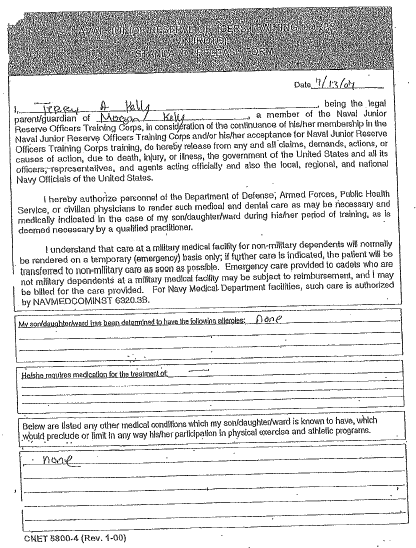
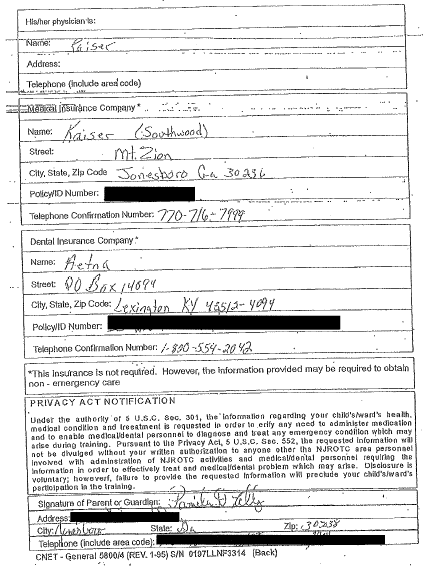
Sanislo, et al., v. Give Kids The World, Inc., 157 So. 3d 256; 2015 Fla. LEXIS 214; 40 Fla. L. Weekly S 79
Posted: April 19, 2015 Filed under: Florida, Legal Case, Release (pre-injury contract not to sue) | Tags: Minor, Negligence, Release Leave a commentTo Read an Analysis of this decision see
Simple Florida camp case with final sentences that provide insight into how courts look at what influenced their decision.
Sanislo, et al., v. Give Kids The World, Inc., 157 So. 3d 256; 2015 Fla. LEXIS 214; 40 Fla. L. Weekly S 79
Stacy Sanislo, et al., Petitioners, vs. Give Kids The World, Inc., Respondent.
No. SC12-2409
SUPREME COURT OF FLORIDA
157 So. 3d 256; 2015 Fla. LEXIS 214; 40 Fla. L. Weekly S 79
February 12, 2015, Decided
PRIOR HISTORY: [*1] (Osceola County). Fifth District – Case No. 5D11-748. Application for Review of the Decision of the District Court of Appeal – Certified Direct Conflict of Decisions.
Give Kids The World, Inc. v. Sanislo, 98 So. 3d 759, 2012 Fla. App. LEXIS 17750 (Fla. Dist. Ct. App. 5th Dist., 2012)
COUNSEL: Christopher Vincent Carlyle and Shannon McLin Carlyle of The Carlyle Appellate Law Firm, The Villages, Florida; and Michael J. Damaso, II of Wooten, Kimbrough & Normand, P.A., Orlando, Florida, for Petitioners.
Dennis Richard O’Connor, Derek James Angell, and Matthew J. Haftel of O’Connor & O’Connor, LLC, Winter Park, Florida, for Respondent.
Bard Daniel Rockenbach of Burlington & Rockenbach, P.A., West Palm Beach, Florida, for Amicus Curiae Florida Justice Association.
JUDGES: LABARGA, C.J., and PERRY, J., concur. CANADY and POLSTON, JJ., concur in result. LEWIS, J., dissents with an opinion, in which PARIENTE and QUINCE, JJ., concur.
OPINION
PER CURIAM.
This case is before the Court for review of the decision of the Fifth District Court of Appeal in Give Kids the World, Inc. v. Sanislo, 98 So. 3d 759 (Fla. 5th DCA 2012), in which the Fifth District held that an exculpatory clause was effective to bar a negligence action despite the absence of express language referring to release of the defendant for its own negligence or negligent acts. The district court certified that its decision is in direct conflict with [*2] the decisions of the First, Second, Third, and Fourth District Courts of Appeal in Levine v. A. Madley Corp., 516 So. 2d 1101 (Fla. 1st DCA 1987); Van Tuyn v. Zurich Am. Ins. Co., 447 So. 2d 318 (Fla. 4th DCA 1984); Goyings v. Jack & Ruth Eckerd Found., 403 So. 2d 1144 (Fla. 2d DCA 1981); and Tout v. Hartford Accident & Indem. Co., 390 So. 2d 155 (Fla. 3d DCA 1980). We have jurisdiction. See art. V, § 3(b)(4), Fla. Const. For the following reasons, we approve the Fifth District’s decision in Give Kids the World and disapprove the decisions of the First, Second, Third, and Fourth District Courts of Appeal.
FACTS AND PROCEDURAL HISTORY
This action arose as a result of a negligence action brought against Give Kids the World, Inc., (Give Kids the World), a non-profit organization that provides free “storybook” vacations to seriously ill children and their families at its resort village,1 by Stacy and Eric Sanislo, a married couple who brought their seriously ill child to the village, for injuries sustained by Ms. Sanislo while on the vacation.
1 Fulfillment of a child’s wish is accomplished in conjunction with the Make-A-Wish Foundation. See Give Kids the World, 98 So. 3d at 760 n.1.
As part of the application process for the “storybook” vacation, the Sanislos filled out and signed a wish request form, which contained language releasing Give Kids the World from any liability for any potential cause of action. After the wish was granted, the Sanislos arrived at the resort village located in Kissimmee, Florida, and again signed a liability [*3] release form. The wish request form and liability release form both provide, in pertinent part:
I/we hereby release Give Kids the World, Inc. and all of its agents, officers, directors, servants, and employees from any liability whatsoever in connection with the preparation, execution, and fulfillment of said wish, on behalf of ourselves, the above named wish child and all other participants. The scope of this release shall include, but not be limited to, damages or losses or injuries encountered in connection with transportation, food, lodging, medical concerns (physical and emotional), entertainment, photographs and physical injury of any kind. . . .
I/we further agree to hold harmless and to release Give Kids the World, Inc. from and against any and all claims and causes of action of every kind arising from any and all physical or emotional injuries and/or damages which may happen to me/us. . . .
While at the resort village, the Sanislos and their children participated in the horse-drawn wagon ride operated by Heavenly Hoofs, Inc. The wagon, manufactured by codefendant Thornlea Carriages, Inc., was equipped with a rear, pneumatic lift to allow those in wheelchairs to participate in [*4] the ride. The carriage was carrying the Sanislos’ children. The Sanislos stepped onto the wheelchair lift of the wagon to pose for a picture and the lift collapsed due to weight overload, causing injuries to Ms. Sanislo’s left hip and lower back.
The Sanislos subsequently brought suit in the circuit court for Osceola County against Give Kids the World alleging Ms. Sanislo’s injuries were caused by Give Kids the World’s negligence. See id. at 761. Give Kids the World asserted an affirmative defense of release, and filed a motion for summary judgment arguing that the Sanislos signed releases that precluded an action for negligence. Id. The Sanislos also filed a motion for partial summary judgment on Give Kids the World’s affirmative defense of release. The trial court granted the Sanislos’ motion for summary judgment and denied Give Kids the World’s motion for summary judgment. Thus, the negligence action proceeded to trial. Following a jury verdict, judgment was entered in the Sanislos’ favor awarding them $55,443.43 for damages incurred as a result of the injury and costs of $16,448.61.
On appeal to the Fifth District, Give Kids the World argued that the lower court erred by denying its pretrial [*5] motion for summary judgment on its affirmative defense of release because the release was unambiguous and did not contravene public policy. The Fifth District reversed the trial court’s denial of summary judgment, holding that an exculpatory clause releasing Give Kids the World from liability for “any and all claims and causes of action of every kind arising from any and all physical or emotional injuries and/or damages which may happen to me/us” barred the negligence action despite the lack of a specific reference to “negligence” or “negligent acts” in the exculpatory clause. Id. at 761-62. The Fifth District reasoned that exculpatory clauses are effective if the wording of the exculpatory clause is clear and understandable so that an ordinary and knowledgeable person would know what he or she is contracting away, and that the court had previously rejected “‘the need for express language referring to release of the defendant for “negligence” or “negligent acts” in order to render a release effective to bar a negligence action.'” Id. at 761 (quoting Cain v. Banka, 932 So. 2d 575, 578 (Fla. 5th DCA 2006)). The Fifth District also held that the bargaining power of the parties should not be considered because it was outside of the public utility or public function [*6] context and the Sanislos were not required to request a vacation with Give Kids the World or go on the vacation.
In Levine, Van Tuyn, Goyings, and Tout, the remaining four district courts of appeal held that exculpatory clauses are ineffective to bar a negligence action unless there is express language referring to release of the defendant for its own negligence or negligent acts. Accordingly, the conflict presented for this Court’s resolution is whether an exculpatory clause is ambiguous and thus ineffective to bar a negligence action due to the absence of express language releasing a party from its own negligence or negligent acts.
The Sanislos argue that express language regarding negligence is necessary to render an exculpatory clause effective to bar an action for negligence because this Court has held that indemnification agreements, which are similar in nature to an exculpatory clause, require a specific provision protecting the indemnitee for its own negligence in order to be effective. Further, the Sanislos argue that an ordinary and knowledgeable person does not expect a release to relieve a party from liability for failure to provide reasonable care; thus, any document intending [*7] to do so must include specific, unambiguous language to that effect. Give Kids the World, however, argues that use of the term “negligence” should not be required because: (1) the term “liability” is more readily understandable than “negligence” to an ordinary and knowledgeable person; (2) the language of this exculpatory clause would be rendered meaningless if found ineffective; (3) indemnification agreements and exculpatory clauses serve different purposes and involve differing allocations of risks; and (4) this rule has been rejected by many states. For the reasons discussed below, we hold that an exculpatory clause is not ambiguous and, therefore, ineffective simply because it does not contain express language releasing a defendant from liability for his or her own negligence or negligent acts; such an approach could render similar provisions meaningless and fail to effectuate the intent of the parties.
ANALYSIS
The issue presented–the enforceability of a pre-injury exculpatory clause that does not contain express language releasing a party of liability for its own negligence or negligent acts–is a question of law arising from undisputed facts. Thus, [HN1] the standard of review is de [*8] novo. See Kirton v. Fields, 997 So. 2d 349, 352 (Fla. 2008) (citing D’Angelo v. Fitzmaurice, 863 So. 2d 311, 314 (Fla. 2003) (stating that the standard of review for pure questions of law is de novo and no deference is given to the judgment of the lower courts)).
[HN2] Public policy disfavors exculpatory contracts because they relieve one party of the obligation to use due care and shift the risk of injury to the party who is probably least equipped to take the necessary precautions to avoid injury and bear the risk of loss. Applegate v. Cable Water Ski, L.C., 974 So. 2d 1112, 1114 (Fla. 5th DCA 2008) (citing Cain, 932 So. 2d at 578); see Levine, 516 So. 2d at 1103 (“The rule is that [HN3] an exculpatory clause may operate to absolve a defendant from liability arising out of his own negligent acts, although such clauses are not favored by the courts.”); Goyings, 403 So. 2d at 1146 (same). Nevertheless, because of a countervailing policy that favors the enforcement of contracts, as a general proposition, unambiguous exculpatory contracts are enforceable unless they contravene public policy. Applegate, 974 So. 2d at 1114 (citing Cain, 932 So. 2d at 578); Ivey Plants, Inc. v. FMC Corp., 282 So. 2d 205, 208 (Fla. 4th DCA 1973); Restatement (Second) of Torts § 496B (1965). Exculpatory clauses are unambiguous and enforceable where the intention to be relieved from liability was made clear and unequivocal and the wording was so clear and understandable that an ordinary and knowledgeable person will know what he or she is contracting away. Cain, 932 So. 2d at 578 (citing Gayon v. Bally’s Total Fitness Corp., 802 So. 2d 420, 420-21 (Fla. 3d DCA 2001)); Raveson v. Walt Disney World Co., 793 So. 2d 1171, 1173 (Fla. 5th DCA 2001); cf. Univ. Plaza Shopping Ctr., Inc. v. Stewart, 272 So. 2d 507, 509 (Fla. 1973) ( [HN4] “‘A contract of indemnity will not be construed to indemnify [*9] the indemnitee against losses resulting from his own negligent acts unless such intention is expressed in clear and unequivocal terms. . . .'”).
The liability release forms signed in this case provided that the Sanislos released Give Kids the World from “any liability whatsoever in connection with the preparation, execution, and fulfillment of said wish . . .” and “any and all claims and causes of action of every kind arising from any and all physical or emotional injuries and/or damages which may happen to me/us. . . .” Further, the form states that the scope of the release includes “damages or losses or injuries encountered in connection with transportation, food, lodging, medical concerns (physical and emotional), entertainment, photographs and physical injury of any kind.” Although this exculpatory clause otherwise clearly and unequivocally includes negligence as its express terms encompass any liability, any and all claims and causes of action, and damages or losses or injuries encountered on the vacation, the issue before this Court is whether an exculpatory clause’s terms “clearly and unequivocally” release a party of liability for its own negligence or negligent acts when the [*10] clause does not contain express language regarding negligence or negligent acts.2
2 The Sanislos do not argue that the exculpatory clause here is void because it is against public policy. This claim is barred. Hoskins v. State, 75 So. 3d 250, 257 (Fla. 2011) (noting that an argument not raised in the initial brief is barred).
As noted above, in Give Kids the World, the Fifth District reaffirmed its position that exculpatory clauses are not ambiguous, equivocal, and unenforceable to bar negligence actions simply because they do not contain express language referring to release of the defendant for negligence or negligent acts. Id. at 761. The First, Second, Third, and Fourth Districts, however, relying on this Court’s holding in University Plaza regarding indemnity agreements, have held that an exculpatory clause is only effective to bar a negligence action if it clearly states that it releases a party from liability for his or her own negligence. Levine, 516 So. 2d at 1103; Van Tuyn, 447 So. 2d at 320; Goyings, 403 So. 2d at 1146 (reasoning that “This duty to undertake reasonable care expressed in the first part of the provision would be rendered meaningless if the exculpatory clause absolved appellees from liability.”); and Tout, 390 So. 2d at 156 (citing Ivey Plants, 282 So. at 209 (relying on University Plaza to conclude that the language in the indemnification agreement [*11] did not preclude maintenance of an action predicated on the alleged negligence of the defendant)).
Here, both parties argue the merits of extending the holding stated in University Plaza in the context of indemnity agreements to exculpatory clauses and hold-harmless agreements. The Sanislos contend that indemnity agreements and exculpatory clauses achieve the same result–abdication of responsibility for one’s own negligence–and therefore, should be treated the same. Give Kids the World, on the other hand, contends that it is sensible to require specificity in indemnity agreements because both parties to the contract can conceivably cause injury to an unknown third party, whereas exculpatory clauses shift the risk of injury and liability from one contracting party–usually a purveyor of voluntary amusements or a non-profit service provider–to the other contracting party, a voluntary consumer of the amusement or service. To determine whether the holding in University Plaza should be applied in this context, we examine University Plaza and its progeny, and out of state case law.
University Plaza
In University Plaza, University Plaza Shopping Center leased space in its building to a tenant [*12] who used the space to operate a barbershop. During the lease, a gas line exploded underneath the barbershop causing fatal injuries to a barber. The barber’s widow sued University Plaza Shopping Center for wrongful death alleging that the landlord negligently installed and maintained the gas line under the barbershop, which caused the explosion that led to the barber’s fatal injuries. University Plaza Shopping Center then instituted a third-party complaint against the tenant and his insurer seeking to impose liability on them based on an indemnity provision, which provided in pertinent part that the tenant would indemnify and save harmless the landlord from and against any and all claims for damages in and about the demised premises, and against any and all claims for personal injury or loss of life in and about the demised premises. Univ. Plaza, 272 So. 2d at 508-09. University Plaza Shopping Center conceded that the gas line was under, but not part of, the leased premises. Thus, the trial court entered a summary judgment for the tenant finding that an indemnity agreement stated in general terms does not apply to liability resulting from the sole negligence of the indemnitee. Further, the trial court found that the [*13] policy of insurance procured by the tenant was only applicable when the tenant was liable, and the tenant was free from liability for the gas line explosion. On appeal, the First District affirmed. This Court accepted certiorari review based on a decisional conflict because the Third District, in Thomas Awning & Tent Co., Inc. v. Toby’s Twelfth Cafeteria, Inc., 204 So. 2d 756 (Fla. 3d DCA 1967), held that indemnification for “any loss or claims” encompasses the indemnitee’s negligence.
The central issue in University Plaza was whether a contract of indemnity stated in general terms of “any and all claims” indemnifies the indemnitee for damages resulting from his sole negligence. Univ. Plaza, 272 So. 2d at 509. This Court noted that “divergent views” on the particular issue existed throughout the United States, but that the basic premise was that an indemnity contract does not indemnify the indemnitee against losses resulting from the indemnitee’s negligent acts unless such intention is expressed in clear and unequivocal terms. Id. The Court observed that the divergence in views across the country turned on an interpretation of the words “clear and unequivocal” and that three approaches existed: (1) the contract must contain a specific provision providing for indemnification in the event the indemnitee is negligent; [*14] (2) promises to indemnify against “any and all claims” include losses attributed solely to the negligence of the indemnitee because “all” means “all without exception”; and (3) the express use of the terms “negligence” or “negligent acts” is not required if the contractual language and any other factors indicate the intention to clearly and unequivocally indemnify for the indemnitee’s own negligence. Id. at 509-10.
In concluding that [HN5] the best alternative was to require a specific provision protecting the indemnitee from liability solely caused by his own negligence,3 this Court reasoned that its “basic objective in construing the indemnity provision is to give effect to the intent of the parties involved. . .” and that “the use of the general terms ‘indemnify . . . against any and all claims’ does not disclose an intention to indemnify for consequences arising solely from the negligence of the indemnitee.” Id. at 511 (emphasis omitted). The Court further reasoned that in the context presented, “the phraseology logically relates to the tenant’s occupation of the leased premises–not some outside (though proximately close) independent act of negligence of the landlord. . . . It might be likened to a ‘common [*15] stairway’ in an apartment complex. . . . One would not expect liability to extend under a shopowner’s policy for a landlord’s negligently maintained common walkway or mall in front of a series of shops.” Id. at 512 (emphasis omitted). Finally, we concluded our reasoning by stating that the other alternatives listed above impute an intent to indemnify for liability occasioned by the indemnitee’s sole negligence, which is a “harsh result not necessarily contemplated by the parties nor condoned by this Court.” Id. Six years later, we considered whether this rule applied to situations where the indemnitee was jointly liable due to his or her own negligence in Charles Poe Masonry, Inc. v. Spring Lock Scaffolding Rental Equip. Co., 374 So. 2d 487, 489 (Fla. 1979).
3 This Court did not follow the United States Supreme Court’s decision in United States v. Seckinger, 397 U.S. 203, 212 n.17, 90 S. Ct. 880, 25 L. Ed. 2d 224 (1970), in which the Supreme Court declined to hold that language in indemnification agreements needed to explicitly state that the indemnification extended to injuries caused by the indemnitee’s own negligence, and recognized that contract interpretation is largely an individualized process “with the conclusion in a particular case turning on the particular language used against the background of other indicia of the parties’ intention.”
Charles Poe Masonry
In Charles Poe Masonry [*16] , an employee of Charles Poe Masonry was injured when he fell from a scaffold on a construction site. The employee filed an action alleging the manufacturer of the scaffold, Spring Lock, was negligent, breached the implied warranty, and was strictly liable for his injuries. The scaffold had been leased by Spring Lock to Charles Poe Masonry. The lease agreement provided in pertinent part that the lessee assumed all responsibility for claims asserted by any person whatsoever growing out of the erection and maintenance, use, or possession of the scaffolding equipment, and that the lessee agreed to hold the lessor harmless from such claims. Id. at 489. Thus, Spring Lock filed a third-party complaint against Charles Poe Masonry for contractual indemnity.4 Id. at 488.
4 Spring Lock also filed the third-party complaint against Charles Poe Masonry for common law indemnity, which this Court held was unavailable for the reasons expressed in Houdaille Industries, Inc. v. Edwards, 374 So. 2d 490 (Fla. 1979).
In considering whether the provision barred a negligence action, we found that the provision at issue was “exactly the sort of ‘general terms’ which we held in University Plaza do not disclose an intention to indemnify for consequences arising from the wrongful acts of the indemnitee” [*17] and that the public policy reasons expressed in University Plaza applied with equal force to instances where the indemnitor and indemnitee were jointly liable. Id. at 489-90 (“Under classical principles of indemnity, courts of law rightfully frown upon the underwriting of wrongful conduct, whether it stands alone or is accompanied by other wrongful acts.”). Further, we reasoned that the language of the provision demonstrated “nothing more than an undertaking by [Charles Poe Masonry] to hold Spring Lock harmless from any vicarious liability which might result from [Charles Poe Masonry’s] erection, maintenance or use of the scaffold.” Id. at 489.
We reaffirmed these principles thirteen years later in Cox Cable Corp. v. Gulf Power Co., 591 So. 2d 627 (Fla. 1992).
Cox Cable
In Cox Cable, Cox Cable Corporation and Gulf Power Company entered into a written contract authorizing Cox Cable to attach its cables, wires, and appliances to Gulf Power’s utility poles. The contract also provided that Cox Cable was to ensure the safe installation and maintenance of any wires, cables, or devices attached to the poles and indemnify Gulf Power against claims for personal injury and property damages. Cox Cable hired a cable installation contractor to perform the installation, and the [*18] cable installation contractor’s employee suffered electrical burns when he overtightened a guy wire during the course of installation. This employee sued Gulf Power alleging that its failure to warn him of the danger was negligent. Gulf Power then filed a third-party complaint against Cox Cable seeking indemnification.5 Id. at 628-29. The indemnity agreement provided in pertinent part that the licensee was to indemnify and save the licensor forever harmless against any and all claims and demands for damages to property and injury or death to any persons including, but not restricted to, employees of the licensee and employees of any contractor or subcontractor performing work for the licensee which may arise out of or be caused by the erection, maintenance, presence, use or removal of the aforementioned attachments. Id. at 629.
5 Gulf Power also claimed breach of contract and alleged that Cox Cable’s negligence was the sole and proximate cause of the employee’s injuries.
On appeal, the district court stated that the degree of specificity required for indemnification in cases of joint negligence was less stringent than in cases where the indemnitee is solely negligent. This Court, however, reaffirmed the principles [*19] established in University Plaza and Charles Poe Masonry in holding that the district court had erred by applying a less stringent standard to cases involving parties who are jointly liable, and that the language of the provision before it was insufficiently clear and unequivocal. Accordingly, it is clear that since 1973 and as recently as 1992, this Court has found that [HN6] an indemnity agreement only indemnifies the indemnitee for his or her own negligence or negligent acts if the agreement contains a specific provision protecting the indemnitee from liability caused by his or her own negligence.
[HN7] The principles underlying our case law regarding indemnity agreements, however, are not applicable to exculpatory clauses. Generally, “[i]ndemnification provides a party entitled to indemnification the right to claim reimbursement for its actual loss, damage, or liability from the responsible party. . . .” First Baptist Church of Cape Coral, Florida, Inc. v. Compass Constr., Inc., 115 So. 3d 978, 986 (Fla. 2013) (Lewis, J., dissenting) (emphasis added) (citing Black’s Law Dictionary 837 (9th ed. 2009)); see also Dade Cnty. Sch. Bd. v. Radio Station WQBA, 731 So. 2d 638, 643 (Fla. 1999) ( [HN8] “A contract for indemnity is an agreement by which the promisor agrees to protect the promisee against loss or damages by reason of liability to a third party.”). Further, “[i]ndemnification serves the purpose of holding [*20] the indemnified party harmless by shifting the entire loss or damage incurred by the indemnified party–who has without active negligence or fault ‘been obligated to pay, because of some vicarious, constructive, derivative, or technical liability’–to the responsible party who should bear the cost because it was that party’s wrongdoing for which the indemnified party is held liable.” Compass Constr., 115 So. 3d at 986 (Lewis, J., dissenting) (emphasis added); see also Rosati v. Vaillancourt, 848 So. 2d 467, 470 (Fla. 5th DCA 2003) ( [HN9] “Indemnity is a right which inures to one who discharges a duty owed by him but which, as between himself and another, should have been discharged by the other.” (citing Houdaille Indust., Inc. v. Edwards, 374 So. 2d 490, 492-93 (Fla. 1979))). These contracts are typically negotiated at arm’s length between sophisticated business entities and can be viewed as an effort to allocate the risk of liability. Gross v. Sweet, 49 N.Y.2d 102, 400 N.E.2d 306, 310, 424 N.Y.S.2d 365 (N.Y. 1979). Thus, it would not be apparent that a party has agreed to indemnify a party for liability incurred due to that party’s own negligent conduct based on general language in an indemnification agreement.
[HN10] An exculpatory clause, on the other hand, shifts the risk of injury and deprives one of the contracting parties of his or her right to recover damages suffered due to the negligent act of the other contracting party. See Ivey Plants, 282 So. 2d at 207. Thus, [*21] although indemnification agreements can sometimes produce the same result as an exculpatory provision by shifting responsibility for the payment of damages back to the injured party, see O’Connell v. Walt Disney World Co., 413 So. 2d 444, 446 (Fla. 5th DCA 1982), Florida courts recognize a distinction between exculpatory clauses and indemnity clauses.6 Acosta v. Rentals (N. Am.), Inc., No. 8:12-CV-01530-EAK-TGW, 2013 U.S. Dist. LEXIS 31392, 2013 WL 869520 (M.D. Fla. Mar. 7, 2013).
6 In Yang v. Voyagaire Houseboats, Inc., 701 N.W.2d 783, 792 n.6 (Minn. 2005), the court noted that [HN11] although it had previously recognized similarities between exculpatory clauses and indemnity agreements, the “[i]ndemnification clauses are subject to greater scrutiny because they release negligent parties from liability, but also may shift liability to innocent parties.”
These distinctions are evidenced in this Court’s precedent noted above. In University Plaza and Charles Poe Masonry, this Court recognized that [HN12] indemnification agreements are construed subject to the general rules of contract construction–the Court looks to the intentions of the parties. See Dade Cnty. Sch. Bd., 731 So. 2d at 643 (noting that indemnity contracts are subject to the general rules of contractual construction). Thus, given the typical purpose of indemnification, and that the parties’ apparent intent was to reduce the risk of vicarious liability, we were reluctant to decipher an intent to indemnify a party [*22] for its own wrongdoing through the parties’ use of general terms. See Univ. Plaza, 272 So. 2d at 512 (noting that the language of the agreement appeared to relate to injuries occurring due to the tenant’s occupation of the leased premises–liability would not logically extend to a landlord’s negligently maintained common walkway); Charles Poe Masonry, 374 So. 2d at 489 (noting that the language of the lease agreement appeared to be an undertaking by the indemnitor to indemnify the indemnitee from any vicarious liability). Further, because courts “frown upon the underwriting of wrongful conduct. . .,” specificity is required in the indemnity context. See id. at 489-90 (holding that courts should not allow underwriting of wrongful conduct). In short, because indemnification agreements allocate the risk of liability for injuries to an unknown third party, specificity is required so that the indemnitor is well aware that it is accepting liability for both its negligence and the negligence of the indemnitee. Exculpatory clauses, however, primarily release a party from liability for its own negligence and not vicarious liability.7 See Heil Valley Ranch, Inc. v. Simkin, 784 P.2d 781, 784-85 (Colo. 1989) (noting, in a release relieving a party from liability for any injuries due to horseback riding, that any claim the injured party could [*23] have asserted would have been based on negligence). Further, releasing a party from liability does not result in the underwriting of wrongful conduct or shift liability to an innocent party. Thus, discerning the intent of the parties regarding the scope of an exculpatory clause involves less uncertainty than in an indemnification context. Accordingly, University Plaza and its progeny do not control our conclusion here.
7 Indeed, the petitioner in this case could not indicate what this liability release form covered if not the negligence of Give Kids the World.
Review of out-of-state precedent illustrates that many states have expressly rejected the requirement that an exculpatory clause contain an explicit provision releasing a party from liability for his or her own negligence or negligent acts.
Out-of-State Precedent
State courts across the country have rendered four different standards for determining whether language in an exculpatory clause clearly and unequivocally releases a party from liability for negligence. 57A Am. Jur. 2d Negligence § 53 (2004). First, recognizing that “the intentions of the parties with regard to an exculpatory provision in a contract should be delineated with the greatest of particularity,” [*24] an exculpatory clause will be given effect if the agreement clearly and unambiguously expresses the parties’ intention to release a party from liability for his or her own negligence by using the words “negligence” or “negligent acts” and specifically including injuries definitely described as to time and place. 57A Am. Jur. 2d Negligence § 53 (citing Jones v. Dressel, 623 P.2d 370 (Colo. 1981); Wright v. Loon Mountain Recreation Corp., 140 N.H. 166, 663 A.2d 1340 (N.H. 1995)). Second, a specific reference to negligence is not required if the clause clearly and specifically indicates an intent to release the defendant from liability for a personal injury caused by the defendant’s negligence. See 57A Am. Jur. 2d Negligence § 53 (citing Seigneur v. Nat’l Fitness Inst., Inc., 132 Md. App. 271, 752 A.2d 631 (Md. Ct. Spec. App. 2000); Swartzentruber v. Wee-K Corp., 117 Ohio App. 3d 420, 690 N.E.2d 941 (Ohio Ct. App. 1997); Empress Health & Beauty Spa, Inc. v. Turner, 503 S.W.2d 188 (Tenn. 1973); Russ v. Woodside Homes, Inc., 905 P.2d 901 (Utah Ct. App. 1995); Blide v. Rainier Mountaineering, Inc., 30 Wn. App. 571, 636 P.2d 492 (Wash. Ct. App. 1981)). Third, a specific reference to negligence is not required if protection against negligence is the only reasonable construction of the contract. See, e.g., American Druggists’ Ins. Co. v. Equifax, Inc., 505 F. Supp. 66, 68-69 (S.D. Ohio 1980) (applying Ohio law). Fourth, a specific reference to negligence is not required if the hazard experienced was clearly within the contemplation of the provision. See, e.g., Blide, 636 P.2d 493). Courts, however, have required words conveying a similar import; a release will not cover negligence if it neither specifically refers to negligence nor contains any other language that could relate to negligence. See 57A Am. Jur. 2d Negligence § 53 (citing Lewis v. Snow Creek, Inc., 6 S.W.3d 388 (Mo. Ct. App. 1999) (retransferred to Mo. Ct. of Appeals (Dec. 21, 1999) and opinion adopted [*25] and reinstated after retransfer (Jan. 6, 2000)); Sivaslian v. Rawlins, 88 A.D.2d 703, 451 N.Y.S.2d 307 (N.Y. App. Div. 1982); Colton v. New York Hospital, 98 Misc. 2d 957, 414 N.Y.S.2d 866 (N.Y. Sup. Ct. 1979)). According to American Jurisprudence, however, “the better practice is to expressly state the word ‘negligence’ somewhere in the exculpatory provision.”8 57A Am. Jur. 2d Negligence § 53; see Give Kids the World, 98 So. 3d at 763 (Cohen, J., concurring specially) (“The better view is to require an explicit provision to that effect. . . . I would suggest that the average ordinary and knowledgeable person would not understand from such language that they were absolving an entity from a duty to use reasonable care.”).
8 Although many courts have noted that it may be “better practice” to include the term “negligence” in contracts, our jurisprudence recognizes that the term “negligence” may not be understood by the average ordinary and knowledgeable person. For instance, the legal term “negligence” is defined for juries. See Fla. Std. Jury Instr. (Civ.) 401.4. Thus, the inclusion of the terms “negligence” or “negligent acts” may not clarify the meaning of an exculpatory contract for the average ordinary and knowledgeable person at all.
Although some courts have suggested that “the better practice” for contracting parties is to require an explicit provision releasing a party from liability for his or her own negligence or negligent acts, most [*26] states have expressly rejected such a requirement. For instance, the Supreme Court of Kentucky does not require the word “negligence,” but reviews the contractual language to determine whether it satisfies any one of four standards articulated by the court. Hargis v. Baize, 168 S.W.3d 36, 47 (Ky. 2005) (“. . . a preinjury release will be upheld only if (1) it explicitly expresses an intention to exonerate by using the word ‘negligence’; or (2) it clearly and specifically indicates an intent to release a party from liability for a personal injury caused by that party’s own conduct; or (3) protection against negligence is the only reasonable construction of the contract language; or (4) the hazard experienced was clearly within the contemplation of the provision.”); see Cumberland Valley Contractors, Inc. v. Bell Cnty. Coal Corp., 238 S.W.3d 644, 649-50 (Ky. 2007) (finding that the wording of the release was “unmistakable” and that “‘the hazard experienced was clearly within the contemplation of the provision.'”).
The Colorado Supreme Court has “examined the actual language of the agreement for legal jargon, length and complication, and any likelihood of confusion or failure of a party to recognize the full extent of the release provisions. . .” and has “also made clear that the specific terms ‘negligence’ and ‘breach of [*27] warranty’ are not invariably required for an exculpatory agreement to shield a party from claims based on negligence and breach of warranty.” Chadwick v. Colt Ross Outfitters, Inc., 100 P.3d 465, 467 (Colo. 2004) (citing Heil Valley Ranch, 784 P.2d at 785). Indeed, in Heil, the Colorado Supreme Court noted several factors supporting the enforceability of the exculpatory clause: (1) the agreement was written in terms free from legal jargon; (2) the clause was not inordinately long or complicated; (3) when the agreement was read to the injured party at a deposition she indicated that she understood it; (4) the release specifically addressed a risk that adequately described the circumstances of the injury; and (5) it was difficult to imagine any claims that the injured party could have asserted other than negligence. 784 P.2d at 785. However, in Wycoff v. Grace Community Church of Assemblies of God, 251 P.3d 1260, 1265 (Colo. App. 2010), the court of appeals noted that in every Colorado Supreme Court case upholding an exculpatory clause, the clause “contained some reference to waiving personal injury claims based on the activity being engaged in.” Thus, a release form that did not reference the relevant activity or that personal injury claims were specifically waived was unenforceable.
Other states have similarly held that reference to negligence is not required. The Supreme Court of Hawai’i [*28] has held that an exculpatory clause that did not include specific language pertaining to negligence was effective to bar simple negligence claims, but not gross negligence or willful misconduct. See Courbat v. Dahana Ranch, Inc., 111 Haw. 254, 141 P.3d 427, 439-40 (Haw. 2006). In Massachusetts, an exculpatory clause releasing a party from liability for “any and all liability, loss, damage, costs, claims and/or causes of action, including but not limited to all bodily injuries” occurring during a motorcycle safety course was deemed “unambiguous and comprehensive” despite the absence of language specifically mentioning negligence. Cormier v. Cent. Mass. Chapter of the Nat’l Safety Council, 416 Mass. 286, 620 N.E.2d 784, 785 (Mass. 1993).
The following states also hold that the word “negligence” is not required. See, e.g., Adloo v. H.T. Brown Real Estate, Inc., 344 Md. 254, 686 A.2d 298, 304 (Md. 1996) (“To be sure, as the weight of authority makes clear . . . the exculpatory clause need not contain or use the word ‘negligence’ or any other ‘magic words.'”); Cudnik v. William Beaumont Hosp., 207 Mich. App. 378, 525 N.W.2d 891, 894 n.3 (Mich. App. 1994) (holding exculpatory agreement executed by patient before receiving radiation therapy was void as against public policy, but noting that exculpatory clause was not void for ambiguity because it “quite clearly attempts to absolve defendant of all liability ‘of every kind and character’ arising out of the radiation therapy” despite no reference to negligence); Mayfair Fabrics v. Henley, 48 N.J. 483, 226 A.2d 602, 605 (N.J. 1967) (“But there are no required words [*29] of art and, whatever be the language used or the rule of construction applied, the true goal is still the ascertainment and effectuation of the intent of the parties.”); Reed v. Univ. of N.D., 1999 ND 25, 589 N.W.2d 880, 885-86 (N.D. 1999); Estey v. MacKenzie Eng’g Inc., 324 Ore. 372, 927 P.2d 86, 89 (Or. 1996) (noting that the Supreme Court of Oregon had previously upheld clauses releasing others from liability “‘from whatever cause arising,'” and “‘all liability, cost and expense,'” and declining “to hold that the word ‘negligence’ must expressly appear in order for an exculpatory or limitation of liability clause to be effective against a negligence claim”); Empress Health & Beauty Spa, Inc. v. Turner, 503 S.W.2d 188, 190 (Tenn. 1973); Russ v. Woodside Homes, Inc., 905 P.2d 901, 906 (Utah Ct. App. 1995); Fairchild Square Co. v. Green Mountain Bagel Bakery, Inc., 163 Vt. 433, 658 A.2d 31, 34 (Vt. 1995); Scott ex rel. Scott v. Pac. W. Mountain Resort, 119 Wn.2d 484, 834 P.2d 6, 9-10 (Wash. 1992) (en banc) (rejecting proposed requirement of “the word ‘negligence’ or language with similar import” and holding “[c]ourts should use common sense in interpreting purported releases, and the language ‘hold harmless . . . from all claims’ logically includes negligent conduct”); Murphy v. N. Am. River Runners, Inc., 186 W. Va. 310, 412 S.E.2d 504, 511 (W. Va. 1991); Atkins v. Swimwest Family Fitness Ctr., 2005 WI 4, 277 Wis. 2d 303, 691 N.W.2d 334, 341 (Wis. 2005) (noting that “this court has never specifically required exculpatory clauses to include the word ‘negligence,'” but has recognized that its inclusion would be “very helpful”); Schutkowski v. Carey, 725 P.2d 1057, 1061 (Wyo. 1986) (adopting a “common sense” approach “based on the clear intent of the parties rather than specific ‘negligence’ terminology” for interpreting exculpatory clauses); Sanchez v. Bally’s Total Fitness Corp., 68 Cal. App. 4th 62, 79 Cal. Rptr. 2d 902, 904 (Cal. Ct. App. 1998)9 (noting that courts look to the intent of the parties [*30] and use of the term “negligence” is not dispositive); Neighborhood Assistance Corp. v. Dixon, 265 Ga. App. 255, 593 S.E.2d 717 (Ga. Ct. App. 2004); Finagin v. Ark. Dev. Fin. Auth., 355 Ark. 440, 139 S.W.3d 797 (Ark. 2003) (noting that courts are not restricted to the literal language of the contract and will consider the facts and circumstances surrounding the execution of the release to determine the intent of the parties).10
9 In Benedek v. PLC Santa Monica, LLC, 104 Cal. App. 4th 1351, 129 Cal. Rptr. 2d 197 (Cal. Ct. App. 2002), the injured party did not contend that the release is ineffective due to the ambiguity of the language. Thus, Division Five of the Second Appellate District did not address this issue. However, California law appears to provide that a release need not achieve perfection, but “must be clear, unambiguous, and explicit in expressing the intent of the subscribing parties.”
10 It is also evident that federal courts in circuits finding complete limitations on liability enforceable in maritime contracts hold that express reference to the terms “negligence” or “negligent acts” is not required. See Cook v. Crazy Boat of Key West, Inc., 949 So. 2d 1202 (Fla. 3d DCA 2007) (“State laws requiring specific reference to the releasee’s negligence therefore conflict with federal law and may not be applied in cases involving federal maritime law.”).
Other jurisdictions, however, require express use of the terms “negligence” or “negligent acts.” See Sweeney v. City of Bettendorf, 762 N.W.2d 873, 878-79 (Iowa 2009) (requiring specific reference to exculpee’s own negligence); McCune v. Myrtle Beach Indoor Shooting Range, Inc., 364 S.C. 242, 612 S.E.2d 462 (S.C. Ct. App. 2005); [*31] Powell v. Am. Health Fitness Ctr. of Fort Wayne, Inc., 694 N.E.2d 757, 761 (Ind. Ct. App. 1998); Morganteen v. Cowboy Adventures, Inc., 190 Ariz. 463, 949 P.2d 552 (Ariz. Ct. App. 1997); Alack v. Vic Tanny Int’l of Mo., Inc., 923 S.W.2d 330, 337-38 (Mo. 1996) (holding that express language is required because “[o]ur traditional notions of justice are so fault-based that most people might not expect such a relationship to be altered, regardless of the length of an exculpatory clause, unless done so explicitly”); Dresser Indus., Inc. v. Page Petroleum, Inc., 853 S.W.2d 505, 508-09 (Tex. 1993) (applying an “express negligence doctrine” because “indemnity agreements, releases, exculpatory agreements, or waivers, all operate to transfer risk” and such agreements are “an extraordinary shifting of risk”); Macek v. Schooner’s Inc., 224 Ill. App. 3d 103, 586 N.E.2d 442, 166 Ill. Dec. 484 (Ill. App. Ct. 1991); Kissick v. Schmierer, 816 P.2d 188, 190-91 (Alaska 1991).11 The Supreme Court of Connecticut held that express language was required explaining that
A person of ordinary intelligence reasonably could believe that, by signing this release, he or she was releasing the defendant only from liability for damages caused by dangers inherent in the activity of snowtubing. A requirement of express language releasing the defendant from liability for its negligence prevents individuals from inadvertently relinquishing valuable legal rights. Furthermore, the requirement that parties seeking to be released from liability for their negligence expressly so indicate does not impose on them any significant cost.
Hyson v. White Water Mountain Resorts of Conn., Inc., 265 Conn. 636, 829 A.2d 827, 831 (Conn. 2003). In New York, the Court of Appeals of New York held that in order for a party to shed [*32] its ordinary responsibility of due care, express use of the terms “negligence,” “negligent acts,” or words conveying a similar import are required because although parties may be alerted to dangers inherent in dangerous activities, “it does not follow that [parties are] aware of, much less intended to accept, any enhanced exposure to injury occasioned by the carelessness of the very persons on which [the parties] depend[] for [his or her] safety. . . . Thus, whether on a running reading or a careful analysis, the agreement could most reasonably be taken merely as driving home the fact that the defendant was not to bear any responsibility for injuries that ordinarily and inevitably would occur, without any fault of the defendant.” Gross, 400 N.E.2d at 309-11.
11 In Alaska, however, indemnification agreements do not require specific words regarding indemnity for the indemnitee’s own negligence. Kissick, 816 P.2d at 192 (Compton, J., dissenting) (citing Manson-Osberg Co. v. State, 552 P.2d 654, 659 (Alaska 1976)).
Although we agree that it may be better practice to expressly refer to “negligence” or “negligent acts” in an exculpatory clause, we find that the reasoning employed by the states that do not require an express reference to render an exculpatory clause effective to bar a negligence action [*33] is more persuasive, particularly in the context presented here. As discussed above, the courts’ basic objective in interpreting a contract is to give effect to the parties’ intent. Further, as the United States Supreme Court has observed, [HN13] contract interpretation is largely an individualized process “with the conclusion in a particular case turning on the particular language used against the background of other indicia of the parties’ intention.” United States v. Seckinger, 397 U.S. 203, 212 n.17, 90 S. Ct. 880, 25 L. Ed. 2d 224 (1970). As a result, we are reluctant to hold that all exculpatory clauses that are devoid of the terms “negligence” or “negligent acts” are ineffective to bar a negligence action despite otherwise clear and unambiguous language indicating an intent to be relieved from liability in such circumstances. Application of such a bright-line and rigid rule would tend to not effectuate the intent of the parties and render such contracts otherwise meaningless.12 The contract at issue demonstrates as much.
12 In a concurring opinion in Florida Department of Financial Services v. Freeman, Justice Cantero referred to several Florida Supreme Court cases discussing the freedom of contract and noted that this Court had previously recognized that [HN14] “‘while there is no such [*34] thing as an absolute freedom of contract, nevertheless, freedom is the general rule and restraint is the exception.'” 921 So. 2d 598, 607 (Cantero, J., concurring) (quoting Larson v. Lesser, 106 So. 2d 188, 191 (Fla. 1958)). Further, Justice Cantero noted that “[t]his freedom . . . ‘includes freedom to make a bad bargain.'” Id. at 607 (quoting Posner v. Posner, 257 So. 2d 530, 535 (Fla. 1972)). Finally, Justice Cantero acknowledged that courts may not “‘rewrite contracts or interfere with freedom of contracts or substitute [their] judgment for that of the parties to the contract in order to relieve one of the parties from apparent hardships of an improvident bargain.'” Id. at 607 (quoting Quinerly v. Dundee Corp., 159 Fla. 219, 31 So. 2d 533, 534 (Fla. 1947)).
The wish request form and liability release form signed by the Sanislos released Give Kids the World and all of its agents, officers, directors, servants, and employees from “any liability whatsoever in connection with the preparation, execution, and fulfillment of said wish. . . .” The language of the agreement then provided that the scope of the agreement included “damages or losses or injuries encountered in connection with transportation, food, lodging, medical concerns (physical and emotional), entertainment, photographs and physical injury of any kind. . . .” This agreement clearly conveys that Give Kids the World would be released [*35] from any liability, including negligence, for damages, losses, or injuries due to transportation, food, lodging, entertainment, and photographs. With regard to Give Kids the World and the wish fulfilled for the Sanislos, it is unclear what this agreement would cover if not the negligence of Give Kids the World and its agents, officers, directors, servants, and employees, given that exculpatory clauses are unenforceable to release a party of liability for an intentional tort. See Loewe v. Seagate Homes, Inc., 987 So. 2d 758, 760 (Fla. 5th DCA 2008) (citing Kellums v. Freight Sales Ctrs., Inc., 467 So. 2d 816 (Fla. 5th DCA 1985), and L. Luria & Son, Inc. v. Honeywell, Inc., 460 So. 2d 521 (Fla. 4th DCA 1984)). Further, this agreement specifically operates to release Give Kids the World in connection with circumstances that are not inherently dangerous. Thus, this is not a situation where a person of ordinary intelligence would believe that the release “could most reasonably be taken merely as driving home the fact that the defendant was not to bear any responsibility for injuries that ordinarily and inevitably would occur, without any fault of the defendant.” Cf. Gross, 400 N.E.2d at 309-10; Hyson, 829 A.2d at 831 (requiring the use of the word “negligence” in a release pertaining to snowtubing). Accordingly, this agreement would be rendered meaningless if it is deemed ineffective to bar a negligence action solely on the basis of the absence of [*36] the legal terms of art “negligence” or “negligent acts” from the otherwise clear and unequivocal language in the agreement.
Despite our conclusion, however, we stress that our holding is not intended to render general language in a release of liability per se effective to bar negligence actions. As noted previously, [HN15] exculpatory contracts are, by public policy, disfavored in the law because they relieve one party of the obligation to use due care. Applegate, 974 So. 2d at 1114 (citing Cain, 932 So. 2d at 578); see Levine, 516 So. 2d at 1103 (“The rule is that an exculpatory clause may operate to absolve a defendant from liability arising out of his own negligent acts, although such clauses are not favored by the courts.”); Goyings, 403 So. 2d at 1146 (same). Further, exculpatory clauses are only unambiguous and enforceable where the language unambiguously demonstrates a clear and understandable intention to be relieved from liability so that an ordinary and knowledgeable person will know what he or she is contracting away. Cain, 932 So. 2d at 578 (citing Gayon, 802 So. 2d at 420); Raveson, 793 So. 2d at 1173; cf. Univ. Plaza, 272 So. 2d at 509 (“‘A contract of indemnity will not be construed to indemnify the indemnitee against losses resulting from his own negligent acts unless such intention is expressed in clear and unequivocal terms.'”). Moreover, as we stated in University Plaza, this [*37] Court’s “basic objective . . . is to give effect to the intent of the parties. . . .” Id. at 511 (emphasis deleted). Accordingly, our decision is merely a rejection of the Sanislos’ invitation to extend University Plaza, which applies to indemnity agreements, to exculpatory clauses.
CONCLUSION
For the foregoing reasons, we conclude that [HN16] the absence of the terms “negligence” or “negligent acts” in an exculpatory clause does not render the agreement per se ineffective to bar a negligence action. Accordingly, we approve the Fifth District’s decision in Give Kids the World and disapprove the decisions of the First, Second, Third, and Fourth District Courts of Appeal in Levine v. A. Madley Corp., 516 So. 2d 1101 (Fla. 1st DCA 1987); Van Tuyn v. Zurich Am. Ins. Co., 447 So. 2d 318 (Fla. 4th DCA 1984); Goyings v. Jack & Ruth Eckerd Found., 403 So. 2d 1144 (Fla. 2d DCA 1981); and Tout v. Hartford Accident & Indem. Co., 390 So. 2d 155 (Fla. 3d DCA 1980).
It is so ordered.
LABARGA, C.J., and PERRY, J., concur.
CANADY and POLSTON, JJ., concur in result.
LEWIS, J., dissents with an opinion, in which PARIENTE and QUINCE, JJ., concur.
DISSENT BY: LEWIS
DISSENT
LEWIS, J., dissenting.
Today the majority leaves our most vulnerable citizens open to catastrophe from those who seek to shield themselves from their own fault. Florida precedent mandates that because the advance liability release and hold harmless agreement signed by the Sanislos did not explicitly and unambiguously warn that Give Kids the World [*38] would be released and held harmless for its own failure to exercise reasonable care as previously outlined and required under Florida law, no such waiver was made. I disagree with the decision of the majority that such explicit warning is required only for valid indemnity agreements, but not for combined releases, indemnification, and hold harmless agreements, such as the document in this case.
In University Plaza Shopping Center v. Stewart, 272 So. 2d 507, 509 (Fla. 1973), the Court considered whether an indemnity agreement in which one party agreed to indemnify another for “any and all claims” included those that arose solely out of the negligence of the indemnitee. The Court concluded that indemnification agreements will be effective against the negligence of the indemnitee only if that intention is expressed in clear and unequivocal terms. Id. The Court then held that an agreement to indemnify against “any and all claims” does not clearly and unequivocally express the intent to include claims that result exclusively from the negligence of the indemnitee. Id. at 511. The majority provides no logical basis to ignore that well established principle.
As the majority recognizes but fails to apply, exculpatory clauses that protect a party from his or her own negligence [*39] are disfavored. See Slip Op. at 7, 32; see also Charles Poe Masonry, Inc. v. Spring Lock Scaffolding Rental Equip. Co., 374 So. 2d 487, 489 (Fla. 1979). Based on this policy, the Court in Charles Poe Masonry extended the holding of University Plaza to apply even where the indemnified party is jointly liable with the indemnitor. See id. at 489-90 (“Under classical principles of indemnity, courts of law rightfully frown upon the underwriting of wrongful conduct, whether it stands alone or is accompanied by other wrongful acts.”). Additionally, courts strictly construe exculpatory clauses against the party that seeks to be relieved of liability. See Cain v. Banka, 932 So. 2d 575, 580 (Fla. 5th DCA 2006); see also Sunny Isles Marina, Inc. v. Adulami, 706 So. 2d 920, 922 (Fla. 3d DCA 1998). Courts have consistently required that explicit language be used in agreements that attempt to contract away liability for one’s own negligence, and the language must be sufficiently clear and understandable such that an ordinary and knowledgeable person will comprehend the rights that he or she relinquishes. Gillette v. All Pro Sports, LLC, 135 So. 3d 369, 370 (Fla. 5th DCA 2014). The language here has previously been held to be insufficient. The public policy that disfavors exculpatory clauses should apply with equal force to all contracts that operate to remove a party’s obligation to act with reasonable care.
Moreover, a hold harmless agreement is simply another term for an indemnification agreement. See 42 [*40] C.J.S. Indemnity § 23 (2014) (“The term ‘hold harmless’ means to fully compensate the indemnitee for all loss or expense, and an agreement to hold harmless is a contract of indemnity that requires the indemnitor to prevent loss to the indemnitee or to reimburse the indemnitee for all losses suffered from the designated peril.”) (footnotes omitted); see also Black’s Law Dictionary 887 (10th ed. 2014) (stating that “indemnity clause” may also be termed “hold-harmless clause”). Accordingly, because the Court has previously held that indemnification agreements are ineffective against the negligence of the party being indemnified unless they clearly and explicitly state this intent in language that can be understood by an ordinary and knowledgeable person, agreements to release and hold harmless without such language should be deemed similarly ineffective.
The rational basis for this principle of law is that a general release and hold harmless agreement may not sufficiently warn the untrained signing party that the other party will not be responsible for its own negligent acts. The signing party may instead understand the contract as an agreement that exempts the other party from any injury [*41] that occurs as a result of a third party. For example, in this case, the Sanislos signed a contract that was both a release and a hold harmless agreement, and a number of other entities were involved in carrying out the wish that Give Kids the World granted, including food vendors and transportation providers. The Sanislos could have understood that Give Kids the World would not be liable for the negligence of these other entities, and may not have understood that Give Kids the Worlds would not be liable for its own negligence. As established under Florida law, a specific provision that explicitly states that a party will be released and held harmless for liability for its own negligence would clarify the nature of the release so that individuals would have full knowledge of what risks they undertake by signing such a contract. There simply is no rational or logical legal reasoning that would require one to explicitly state a party will be indemnified for its own negligence as a condition of validity as is the current law, but not required to do so if that agreement also includes a release!
For these reasons, I dissent.
PARIENTE and QUINCE, JJ., concur.
G-YQ06K3L262
http://www.recreation-law.com
Utah courts like giving money to injured kids. This decision does clarify somewhat murky prior decisions about the defenses provided to a ski area in Utah: there are none.
Posted: November 10, 2014 Filed under: Release (pre-injury contract not to sue), Ski Area, Skiing / Snow Boarding, Utah | Tags: Alta Ski Area, Canons, Canyons Ski Area, Competitor, Minor, Park City, Park City Mountain Resort, Salt Lake City, ski area, Ski Practice., Ski Racing, Snowbird, Talisker, Utah, Utah's Inherent Risks of Skiing Act Leave a commentA minor was hurt during ski racing practice by hitting a mound of machine-made snow. The Utah Skier Safety Act is weak and Utah Supreme Court interpretations of the act do nothing but weaken it more. This act clarified those weaknesses and what a Utah ski area can do to protect itself from lawsuits, which is not much really. This court, not finding the act weak enough, agreed with the Utah Supreme Court and eliminated releases as a defense for ski areas in the state of Utah.
State: Utah
Plaintiff: Philip Rutherford and Wendy Rutherford, on Behalf of Their Minor Child, Levi Rutherford
Defendant: Talisker Canyons Finance Co., LLC and ASC UTAH, LLC (The Canyons Ski Area) and the U.S. Ski and Snowboard Association
Plaintiff Claims: the machine that produced the snow mound was not functioning properly, that the Ski Resort could have warned patrons of the hazard by marking the mound or closing the trail, and that the Ski Resort did not adequately monitor the snowmaking taking place on the Retreat run that day
Defendant Defenses: release, Utah Ski Act,
Holding: For the Plaintiff
Year: 2014
Utah famously does not award money for adults who are injured; however, if a minor is injured, as a defendant, be prepared to write a big check. For such a conservative state, the judgments for a minor’s injuries can be massive. In this case, the trial court bent over backwards to allow a case by a minor to proceed even with numerous valid defenses. In all but one case, the appellate court agreed with the plaintiffs.
The minor was going to a race practice. He skied down the hill without changing his position and not turning. He hit a mound of man-made snow and was hurt. His parents sued.
The plaintiff’s sued the resort, Canyons which was identified in the case citation by two different names. The plaintiff also sued the US Ski and Snowboard Association, which were not part of the appeal, but mentioned frequently.
The defendants filed an interlocutory appeal after all of their motions of summary judgment were denied. An Interlocutory appeal is one that is made to a higher court before the lower court has issued a final ruling. The appeal is based on intermediary rulings of the trial court. The appeal can only be heard upon a limited set of rules, which are set out by each of the courts. Interlocutory appeals are rare, normally, when the decision of the lower court will force a new trial because of the rulings if the case goes to trial.
Analysis: making sense of the law based on these facts.
The first issue is the application of the Utah’s Inherent Risks of Skiing Act to the case. The trial court ruled the plaintiff was not a competitor as defined by the act. Like many state ski acts the act; a competitor assumes greater risks, and the ski area owes fewer duties to competitors. The trial court based this decision on its review of the facts and determined:
…skiing on an open run that any member of the public could ski on” and that his accident indisputably did not occur during a ski race, while skiing through gates, or while otherwise “negotiating for training purposes something that had been specifically designated as a race course
However, the plaintiffs in their motions and pleadings as well as the plaintiff’s expert witness report stated the minor plaintiff was engaged in race training and practice. The appellate court reversed the trial court’s decision on this. However, instead of holding the plaintiff was a competitor and assumed more risk; the appellate court required the trial court to determine if plaintiff’s “engagement in race training at the time of his injury is truly undisputed by the parties.”
The next issue was whether the phrase machine-made snow in the act was an inherent risk or an exemption from the risks assumed. The plaintiff’s argued the snow machine was malfunctioning and because of that the resort was negligent. The statute states:
§ 78B-4-402. Definitions
(b) snow or ice conditions as they exist or may change, such as hard pack, powder, packed powder, wind pack, corn, crust, slush, cut-up snow, or machine-made snow;
The appellate court agreed with the trial court because the supreme court of Utah had found the Utah act:
…does not purport to grant ski area operators complete immunity from all negligence claims initiated by skiers” but protects ski-area operators “from suits to recover for injuries caused by one or more of the dangers listed [in the Act] only to the extent those dangers, under the facts of each case, are integral aspects of the sport of skiing.
This interpretation of the act is the exact opposite of how statutes are normally interpreted and how all other courts have interpreted other state skier safety acts. Instead of providing protection, the act simply lists items the act may protect from litigation. The act is to be interpreted every time by the trial court to determine if the risk encountered by the skier in Utah was something the act my say the skier assumed.
This means most injuries will receive some money from the ski area. The injured skier can sue and the resort and its insurance company will settle for a nominal amount rather than pay the cost of going to trial to prove the injury was something that was an inherent risk as defined by the Utah’s Inherent Risks of Skiing Act.
The court as part of this analysis then looked at the phrase “inherent risk.”
The term ‘inherent risk of skiing,’ using the ordinary and accepted meaning of the term ‘inherent,’ refers to those risks that are essential characteristics of skiing–risks that are so integrally related to skiing that the sport cannot be undertaken without confronting these risks.
This is a normal definition applied to inherent risk. However, the court then went on and quoted the Utah Supreme court as stating.
The court divided these risks into two categories, the first of which represents “those risks, such as steep grades, powder, and mogul runs, which skiers wish to confront as an essential characteristic of skiing.” Under the Act, “a ski area operator is under no duty to make all of its runs as safe as possible by eliminating the type of dangers that skiers wish to confront as an integral part of skiing.”
The second category of risks consists of those hazards which no one wishes to confront but cannot be alleviated by the use of reasonable care on the part of a ski resort,” such as weather and snow conditions that may “suddenly change and, without warning, create new hazards where no hazard previously existed. For this category of risks, “[t]he only duty ski area operators have . . . is the requirement set out in [the Act] that they warn their patrons, in the manner prescribed in the statute, of the general dangers patrons must confront when participating in the sport of skiing.
Then the interpretation of the Supreme Court decision goes off the chart.
However, this does not exonerate a ski-area operator from any “duty to use ordinary care to protect its patrons”; “if an injury was caused by an unnecessary hazard that could have been eliminated by the use of ordinary care, such a hazard is not, in the ordinary sense of the term, an inherent risk of skiing and would fall outside of [the Act].”
Instead of the act providing protection from a list of risks that are part and parcel of skiing, the act in Utah only provides of hazards that if not eliminated will still allow litigation. That is any injury is worth filing suit over because the cost of defending the case will exceed the cost of settling.
How does this apply in this case? The act refers to machine made snow. The complaint states the plaintiff was injured because the snow making machine was not functioning properly. There was no allegation that the snow was at issue, which is protected by the act, just the machine that makes the snow. However, this was enough for the trial court and the appellate court to say the act did not provide immunity for the ski area.
That is the defense of the tree on the side of the road scared me, so I opened the passenger-side door and knocked down the pedestrian. If the snow making machine was malfunctioning, unless it is making “bad” snow that has nothing to do with hitting a mound of snow.
The next issue is the defense of release. This part of the decision actually makes sense.
The US Ski and Snowboard Association has members sign releases. The majority of racing members of the USSA are minors, hoping to become major racers for the US. The USSA is based in Park City, Utah. Utah has always held that a parent cannot sign away a minor’s right to sue. So the USSA made its choice of law provision Colorado in an attempt to take advantage of Colorado’s laws on releases and minors and releases. (See States that allow a parent to sign away a minor’s right to sue.)
However, courts won’t and this court did not, let you get away with such a stretch. The venue and jurisdiction clause in a release must have a basis with where the defendant is located, where the activity (and as such accident) happens or where the plaintiff lives. Here the USSA is based in Park City Utah, the plaintiff lives in Utah and the accident happened in Utah; the Utah trial court and Appellate court properly held the jurisdiction and venue clause in the release was not valid.
On top of that, you need to justify why you are using a foreign state for venue and jurisdiction, in the jurisdiction and venue clause in the release. You need to state with a reasonable degree of plausibility why you are putting the venue in a certain place if it is not the location where the parties are located or the accident occurred. State in the release that in order to control litigation, the jurisdiction and venue of any action will be in the state where the defendant is located.
The release was thrown out before getting to whether a parent can sign away a minor’s right to sue, which the Utah Supreme Court has never upheld. (See States that allow a parent to sign away a minor’s right to sue.) However, the appellate court reviewed this issue and also threw the release out because Utah does not allow a parent to sign away a minor’s right to sue. (The Utah Equine and Livestock Activities Act has been amended to allow a parent to sign away a minor’s right to sue for Equine injuries.)
The court then looked at what releases are viable in the ski industry in Utah. In 90 days, the Utah Supreme Court voided a release in a ski case and then upheld a release in a ski case. (See Utah Supreme Court Reverses long position on releases in a very short period of time.) This court stated the differences where a release is void under Utah’s law for recreational skiers. “Our supreme court has interpreted this public policy statement as prohibiting pre-injury releases of liability for negligence obtained by ski-area operators from recreational skiers.”
The public policy statement is the preamble of the Utah’s Inherent Risks of Skiing Act.
The Legislature finds that the sport of skiing is practiced by a large number of residents of Utah and attracts a large number of nonresidents, significantly contributing to the economy of this state. It further finds that few insurance carriers are willing to provide liability insurance protection to ski area operators and that the premiums charged by those carriers have risen sharply in recent years due to confusion as to whether a skier assumes the risks inherent in the sport of skiing. It is the purpose of this act; therefore, to clarify the law in relation to skiing injuries and the risks inherent in that sport, to establish as a matter of law that certain risks are inherent in that sport, and to provide that, as a matter of public policy, no person engaged in that sport shall recover from a ski operator for injuries resulting from those inherent risks.
Simply put this is an analysis of the action of the legislature, by the court, to say, the legislature gave you this, so we, the court, are going to take away releases.
In other words, the Act prohibits pre-injury releases of liability for negligence entirely, regardless of the age of the skier who signed the release or whether the release was signed by a parent on behalf of a child.
The court explained that the Act was designed to strike a “bargain” with ski-area operators by freeing them “from liability for inherent risks of skiing so that they could continue to shoulder responsibility for noninherent risks by purchasing insurance.
The court then looked at whether this release could be applied if the plaintiff was a competitive skier? (Yeah, confusing to me also.)
Following that confusing analysis this court then determined the release by a competitive skier was also invalid, contrary to what the Supreme Court had decided in Berry v. Greater Park City Co., 2007 UT 87, ¶ 17, 171 P.3d 442. However, the court rationalized the analysis by saying the amendment to the ski act, which occurred before the Berry decision, but after the accident giving rise to Berry, made a competitive skier the same as a recreational skier for the purposes of the act therefore no releases were valid in Utah for skiing.
Here is the conclusion of the case.
The trial court’s determination that Levi was not engaged in race training at the time of his injury, especially in the face of the fact, apparently undisputed by the parties, that he was injured during racing practice, was improper in the context of the Ski Resort’s motions for summary judgment. The trial court correctly denied the Ski Resort’s joinder in the Ski Team’s motion for summary judgment based on the Act and correctly granted the Rutherfords’ related partial motion for summary judgment, based on the court’s determination that there were disputed issues of material fact regarding the applicability of the machine-made snow exemption. We affirm the trial court’s denial of the Ski Resort’s motion for summary judgment based on the USSA release and the court’s determination that the Colorado choice-of-law provision in the USSA release is inapplicable here. We agree with the trial court that the release, as it pertains to the Ski Resort, is unenforceable under Utah law, but base this conclusion on different grounds than the trial court.
It almost reads like it is a normal case. The court sent the issue back to the lower court, basically handing the plaintiff the decision. The only thing left to do is determine the amount.
So Now What?
It’s a kid thing in Utah. Kids get hurt the courts’ hand out money. Even the ski industry is not big enough, or organized enough, to do anything about it.
I don’t know of any other reason why this decision would come out this way.
This decision which eliminates releases as a defense for the ski area may trickle down to other recreational activities. Let’s hope not.
So we know the following about Utah and ski areas.
1. Releases are not a valid defense unless you are racing, actually on the course for a race or practice.
2. A competitor under the Utah’s Inherent Risks of Skiing Act is only a competitor when racing or running gates.
3. The Utah’s Inherent Risks of Skiing Act only sets out the defenses available to a ski area if they ski area was not negligent and could not have prevented the accident or risk which caused the accident.
4. Minor’s in Utah always win.
What do you think? Leave a comment.
If you like this let your friends know or post it on FaceBook, Twitter or LinkedIn
Copyright 2014 Recreation Law (720) Edit Law
Email: Rec-law@recreation-law.com
Google+: +Recreation
Twitter: RecreationLaw
Facebook: Rec.Law.Now
Facebook Page: Outdoor Recreation & Adventure Travel Law
Blog: www.recreation-law.com
Mobile Site: http://m.recreation-law.com
By Recreation Law Rec-law@recreation-law.com James H. Moss #Authorrank
#AdventureTourism, #AdventureTravelLaw, #AdventureTravelLawyer, #AttorneyatLaw, #Backpacking, #BicyclingLaw, #Camps, #ChallengeCourse, #ChallengeCourseLaw, #ChallengeCourseLawyer, #CyclingLaw, #FitnessLaw, #FitnessLawyer, #Hiking, #HumanPowered, #HumanPoweredRecreation, #IceClimbing, #JamesHMoss, #JimMoss, #Law, #Mountaineering, #Negligence, #OutdoorLaw, #OutdoorRecreationLaw, #OutsideLaw, #OutsideLawyer, #RecLaw, #Rec-Law, #RecLawBlog, #Rec-LawBlog, #RecLawyer, #RecreationalLawyer, #RecreationLaw, #RecreationLawBlog, #RecreationLawcom, #Recreation-Lawcom, #Recreation-Law.com, #RiskManagement, #RockClimbing, #RockClimbingLawyer, #RopesCourse, #RopesCourseLawyer, #SkiAreas, #Skiing, #SkiLaw, #Snowboarding, #SummerCamp, #Tourism, #TravelLaw, #YouthCamps, #ZipLineLawyer, Utah’s Inherent Risks of Skiing Act, Utah, Talisker, Canons, Ski Area, Canyons Ski Area, Minor, Competitor, Ski Area, Ski Racing, Ski Practice.
Rutherfordv. Talisker Canyons Finance Co., LLC, 2014 UT App 190; 767 Utah Adv. Rep. 41; 2014 Utah App. LEXIS 201
Posted: November 6, 2014 Filed under: Jurisdiction and Venue (Forum Selection), Legal Case, Minors, Youth, Children, Release (pre-injury contract not to sue), Ski Area, Skiing / Snow Boarding, Utah | Tags: Bone fracture, Canyons, Competitor, Minor, Release, Ski binding, skiing, United States Ski Team, US Ski and Snowboard Association, USSA, UT, Utah, Utah Ski Act Leave a commentRutherfordv. Talisker Canyons Finance Co., LLC, 2014 UT App 190; 767 Utah Adv. Rep. 41; 2014 Utah App. LEXIS 201
Philip Rutherford and Wendy Rutherford, on Behalf of Their Minor Child, Levi Rutherford, Plaintiffs and Appellees, v. Talisker Canyons Finance Co., LLC and ASC UTAH, LLC, Defendants and Appellants.
No. 20120990-CA
COURT OF APPEALS OF UTAH
2014 UT App 190; 767 Utah Adv. Rep. 41; 2014 Utah App. LEXIS 201
August 14, 2014, Filed
NOTICE:
THIS OPINION IS SUBJECT TO REVISION BEFORE PUBLICATION IN THE OFFICIAL REPORTER.
PRIOR HISTORY: [**1] Third District Court, Silver Summit Department. The Honorable Todd M. Shaughnessy. No. 100500564.
COUNSEL: Eric P. Lee, M. Alex Natt, Elizabeth Butler, and Timothy C. Houpt, Attorneys, for Appellants.
David A. Cutt, Attorney, for Appellees.
JUDGES: JUDGE JAMES Z. DAVIS authored this Opinion, in which JUDGE GREGORY K. ORME and SENIOR JUDGEPAMELA T. GREENWOOD concurred.1 DAVIS, Judge.
1 The Honorable Pamela T. Greenwood, Senior Judge, sat by special assignment as authorized by law. See generally Utah Code Jud. Admin. R. 11-201(6).
OPINION BY: JAMES Z. DAVIS
OPINION
DAVIS, Judge:
[*P1] Talisker Canyons Finance Co., LLC and ASC Utah, LLC (collectively, the Ski Resort) bring this interlocutory appeal challenging the trial court’s denial of their motion for summary judgment and the trial court’s grant of partial summary judgment in favor of Philip and Wendy Rutherford, on behalf of their minor child, Levi Rutherford (collectively, the Rutherfords). We affirm in part, vacate in part, and remand for further proceedings in accordance with this decision.
BACKGROUND
[*P2] In 2010, ten-year-old Levi Rutherford was a member of the Summit Ski Team, a ski racing club that is affiliated with the United States Ski and Snowboard Association (the USSA). The Ski [**2] Team trained primarily at the Canyons, a ski resort near Park City, Utah, with the resort’s permission and subject to the resort’s requirement that the Ski Team carry liability insurance. The Ski Team’s liability insurance was provided through its affiliation with USSA. All Summit Ski Team participants were required to become USSA members, and USSA membership required applicants to execute a release indemnifying USSA from any injury the individual may suffer in connection with his participation in USSA-associated activities, regardless of USSA’s negligence. Because of Levi’s age, his father, Philip Rutherford, executed the release on Levi’s behalf. In that agreement, the term “USSA” is defined as including, inter alia, local ski clubs and ski and snowboard facility operators.
[*P3] On January 15, 2010, Levi and his seven-year-old brother were at the Canyons to attend a Ski Team race-training session. The brothers rode a chairlift that carried them along the length of the “Retreat” ski run where the Ski Team was setting up for practice. Snowmaking machines along the Retreat run were actively making snow at this time. After exiting the chairlift, Levi and his brother skied down Retreat.2 Levi [**3] skied down the slope maintaining a racing stance and without making any turns. Near the bottom of the run, Levi fell when he collided with a mound of man-made snow that was of a different and wetter consistency than other snow on the run. Levi sustained injuries as a result of his fall.
2 It is unclear whether the Ski Team coaches instructed Levi and his brother to take a warm-up run down Retreat or whether the brothers did so of their own accord. See infra note 7.
[*P4] The Rutherfords filed a complaint against the Ski Resort and the Ski Team, seeking damages for Levi’s injuries, which they claim were caused by the defendants’ negligence. As against the Ski Resort specifically, the Rutherfords alleged that the machine that produced the snow mound was not functioning properly, that the Ski Resort could have warned patrons of the hazard by marking the mound or closing the trail, and that the Ski Resort did not adequately monitor the snowmaking taking place on the Retreat run that day.
[*P5] The parties filed several motions for summary judgment. The Ski Team submitted motions for summary judgment on the basis that Utah’s Inherent Risks of Skiing Act (the Act) precluded the Rutherfords’ claims against [**4] it because Levi was indisputably injured when he crashed into a mound of machine-made snow, an inherent risk of skiing for which ski-area operators are exempted from liability under the Act. See generally Utah Code Ann. §§ 78B-4-401 to -404 (LexisNexis 2012) (Inherent Risks of Skiing Act); id. § 78B-4-402(1)(b) (machine-made snow exemption). The Ski Team also contended that it had no duty to protect Levi from a risk inherent to skiing and that it otherwise did not owe him a general duty of care as alleged by the Rutherfords. The Ski Resort joined in the Ski Team’s motions, specifically arguing that the Act exempts the Ski Resort, as a ski-area operator, from any duty to protect Levi from the inherent risk of skiing posed by the mound of machine-made snow. The Ski Resort did not argue that any of the Act’s exemptions other than the machine-made snow exemption applied in this case. The Rutherfords moved for partial summary judgment, arguing that the Act did not bar their claims against the Ski Resort.
[*P6] The trial court rejected the Ski Team’s argument that it is entitled to protection under the Act but granted the Ski Team’s motion for summary judgment on the negligence issue, dismissing with prejudice the Rutherfords’ negligence [**5] claim against it. The trial court concluded that “the Ski Team did not owe Levi a general duty of reasonable care to protect him from harm as alleged by [the Rutherfords]” and that even assuming that it did, “given the undisputed facts in this case, no reasonable jury could find that the Ski Team breached such a duty.”3 The trial court denied the Ski Resorts’ joinder in the Ski Team’s motion for summary judgment based on the Act, ruling that the applicability of the Act and the machine-made snow exemption to the Ski Resort depended on the resolution of disputed facts, namely, whether the snowmaking equipment along Retreat was functioning properly. The trial court granted the Rutherfords’ motion for partial summary judgment based on their argument that the Act did not bar their claims against the Ski Resort.
3 The Ski Team is not a party to this interlocutory appeal.
[*P7] The Ski Resort also filed a motion for summary judgment on the basis that the USSA release that Mr. Rutherford signed on behalf of his son barred Levi’s claims. The court denied the motion based on its determinations (1) that the waiver’s Colorado choice-of- law provision “is unenforceable and . . . Utah law applies to the [**6] USSA release”; (2) that the release is unenforceable under Utah law based on the Utah Supreme Court’s decision in Hawkins ex rel. Hawkins v. Peart, 2001 UT 94, 37 P.3d 1062; and (3) that even if the release was enforceable under Utah or Colorado law, Levi was not racing at the time of his injury or otherwise engaged in the activities covered by the release because the Ski Team’s practice had not yet begun. The Ski Resort petitioned for interlocutory review, which was granted by our supreme court and assigned to this court.
ISSUES AND STANDARD OF REVIEW
[*P8] The Ski Resort contends that the trial court erroneously granted the Rutherfords’ motion for partial summary judgment after finding that Levi was not engaged in race training at the time of his injury and that an exemption in the Act regarding competitive skiing did not bar the Rutherfords’ claims. See Utah Code Ann. § 78B-4-402(1)(g) (competitive-skiing exemption). The Ski Resort also asserts that the trial court’s interpretation of the Act’s machine-made snow exemption was incorrect and that, as a matter of law, summary judgment should be entered for the Ski Resort based on either the machine-made snow exemption or the competitive-skiing exemption. Last, the Ski Resort argues that the trial court erred in determining that [**7] the Colorado choice-of-law provision in the USSA release was not enforceable, that the release was not enforceable under Utah law, and that the release was nevertheless inapplicable here, where Levi was engaged in an activity not covered by the release when he was injured.
[*P9] [HN1] Summary judgment is appropriate “only when all the facts entitling the moving party to a judgment are clearly established or admitted” and the “undisputed facts provided by the moving party . . . preclude[], as a matter of law, the awarding of any relief to the losing party.” Smith v. Four Corners Mental Health Ctr., Inc., 2003 UT 23, ¶ 24, 70 P.3d 904 (alteration in original) (citations and internal quotation marks omitted); see also Utah R. Civ. P. 56(c). “We also note that summary judgment is generally inappropriate to resolve negligence claims and should be employed only in the most clear-cut case.” White v. Deseelhorst, 879 P.2d 1371, 1374 (Utah 1994) (citation and internal quotation marks omitted). “An appellate court reviews a trial court’s legal conclusions and ultimate grant or denial of summary judgment for correctness, and views the facts and all reasonable inferences drawn therefrom in the light most favorable to the nonmoving party.” Orvis v. Johnson, 2008 UT 2, ¶ 6, 177 P.3d 600 (citations and internal quotation marks omitted).
ANALYSIS
I. The Distinction Between Competitive Skiing and Recreational [**8] Skiing
[*P10] [HN2] The Act exempts ski resorts from liability for injuries sustained by individuals engaged in “competitive” skiing, including injuries sustained as a result of an individual’s “participation in, or practicing or training for, competitions or special events.” See Utah Code Ann. § 78B-4-402(1)(g) (LexisNexis 2012).4 Here, a determination that Levi was injured while engaged in competitive, as opposed to recreational, skiing under the Act could be case-determinative.5
4 Except where otherwise noted, we cite the most recent version of the Utah Code for the convenience of the reader.
5 The applicability of the USSA release could also turn on whether Levi was injured while engaged in one of the activities specifically enumerated in the release; if he was not, then the release cannot apply, rendering irrelevant the question of the release’s enforceability under Utah or Colorado law. The release defines the covered activities as “skiing and snowboarding in their various forms, as well as preparation for, participation in, coaching, volunteering, officiating and related activities in alpine, nordic, freestyle, disabled, and snowboarding competitions and clinics” “in which USSA is involved in any way.” Because USSA employs different [**9] terminology to describe the competitive skiing activities covered by the release, a determination that Levi was not injured while competitively skiing under the terms of the Act would not necessarily foreclose a finding that he was engaged in an activity covered by the release. However, because we determine that the release is unenforceable for other reasons, see infra ¶ 30, we need not address whether Levi was injured while engaging in an activity covered by the release.
[*P11] In their complaint, the Rutherfords allege that Levi was injured during Ski Team practice, stating, “[T]he Summit Ski Team instructed Levi to ski down the Retreat run. . . . As Levi was skiing down Retreat, he crashed into [a mound of snow] and sustained serious injuries . . . .” Similarly, in the Rutherfords’ motions for partial summary judgment as to the enforceability of the Act and the USSA release, they state, “Levi was injured while participating in racing practice as a member of [the Ski Team].”6 Further, the Rutherfords’ expert witness, whose statement was submitted with the Rutherfords’ summary judgment filings, based his expert report and evaluation on the premise that Levi was engaged in race training and practice. [**10] In its response to the Rutherfords’ motions, the Ski Resort agreed that it was an undisputed fact that “Levi was injured while participating in racing practice as a member of the [Ski Team].”7
6 On appeal, the Rutherfords assert that they “never alleged that Levi was injured while ski racing” but only that he “was injured in connection with Ski Team practice,” and that it was through discovery that they learned that Levi was injured before practice started. To the extent this sentiment is contradictory to the allegations contained in the Rutherfords’ complaint, we note that [HN3] “[a]n admission of fact in a pleading is a judicial admission and is normally conclusive on the party making it.” See Baldwin v. Vantage Corp., 676 P.2d 413, 415 (Utah 1984); see also Amgen Inc. v. Connecticut Ret. Plans & Trust Funds, 133 S. Ct. 1184, 1197 n.6, 185 L. Ed. 2d 308 (2013) (holding that a party was bound by an admission in its answer); Belnap v. Fox, 69 Utah 15, 251 P. 1073, 1074 (Utah 1926) (overturning a finding entered by the trial court because the finding was “against and in conflict with the admission in the answer of the principal defendant”). But see Baldwin, 676 P.2d at 415 (recognizing “that an admission may be waived where the parties treat the admitted fact as an issue”).
7 The Ski Team, although not a party to this appeal, disputed in part the Rutherfords’ assertion that Levi was injured during practice, stating, “[A]lthough Levi was injured [**11] during a practice in which the [Ski Team] had intended to conduct race training, he was injured while free skiing and not while running gates.” The Ski Team’s summary judgment filings imply that there is a factual dispute as to whether a “warm-up” run can constitute part of the Ski Team’s race training. See supra note 2.
[*P12] The trial court, however, likened Levi to a recreational skier, rather than a competitive skier, and determined that Levi’s accident occurred while he was “skiing on an open run that any member of the public could ski on” and that his accident indisputably did not occur during a ski race, while skiing through gates, or while otherwise “negotiating for training purposes something that had been specifically designated as a race course.” The trial court made this ruling in the context of rejecting the Ski Resort’s argument that the USSA release is enforceable under Utah law. Thus, while the specific details in the trial court’s ruling are not entirely in conflict with the parties’ undisputed statement of fact that Levi was injured during race training, the court’s comparison of Levi to a recreational skier amounts to a rejection of the parties’ undisputed statement of [**12] fact. This ruling also implies a distinction between injuries sustained during a competition and injuries sustained during training for competition that is not made in the Act’s provision that “participation in, or practicing or training for, competitions” are all inherent risks of skiing. See Utah Code Ann. § 78B-4-402(1)(g). We conclude that the trial court improperly made a finding in the summary judgment context and that its finding is contrary to what appear to be undisputed facts. We vacate this ruling and direct the trial court to reconsider the parties’ arguments in light of the undisputed statements of fact as set forth in the Rutherfords’ and the Ski Resort’s pleadings and motion filings.8 See Staker v. Ainsworth, 785 P.2d 417, 419 (Utah 1990) ( [HN4] “Where a triable issue of material fact exists, the cause will be remanded for determination of that issue.”). We likewise leave for the trial court’s determination the question of whether Levi’s engagement in race training at the time of his injury is truly undisputed by the parties.
8 Although we often provide guidance for the trial court on remand by addressing “[i]ssues that are fully briefed on appeal and are likely to be presented on remand,” State v. James, 819 P.2d 781, 795 (Utah 1991), we do not address whether the competitive-skiing exemption precludes the Rutherfords’ [**13] claims against the Ski Resort based on the parties’ agreement that Levi was injured while engaged in race training. That argument was not presented below, nor was it sufficiently briefed on appeal. See McCleve Props., LLC v. D. Ray Hult Family Ltd. P’ship, 2013 UT App 185, ¶ 19, 307 P.3d 650 (determining that [HN5] “it is better to leave” a legal issue that was not addressed by the parties in briefing “for the district court to address in the first instance based on appropriate briefing by the parties” than to “endeavor to provide the district court with guidance”); cf. Medley v. Medley, 2004 UT App 179, ¶ 11 n.6, 93 P.3d 847 (declining to provide the trial court with guidance on a legal issue likely to arise on remand where the court of appeals had “no consensus on whether [it] should offer guidance . . . and, if so, what any such guidance should be”).
II. The Machine-Made Snow Exemption
[*P13] The Ski Resort next argues that the trial court erroneously denied its motion for summary judgment based on the machine-made snow exemption under the Act, particularly where the machine that produced the snow mound that Levi skied into “was indisputably making snow.” (Emphasis omitted.) [HN6] The Act identifies as an inherent risk of skiing “snow or ice conditions as they exist or may change, such as hard pack, powder, packed powder, wind pack, corn, crust, [**14] slush, cut-up snow, or machine-made snow.” Utah Code Ann. § 78B-4-402(1)(b); see also id. § 78B-4-402(1)(d) (immunizing ski-area operators from injuries caused by “variations or steepness in terrain, whether natural or as a result of slope design, snowmaking or grooming operations”).
[*P14] The Ski Resort contends that the Rutherfords’ “allegations fall squarely into” the machine-made snow exemption given the Rutherfords’ own assertion that Levi was injured when he came into contact with a patch of wet, machine-made snow. As a result, the Ski Resort argues, the trial court “erred in ruling that a mere allegation of malfunctioning snowmaking equipment was sufficient to force a jury trial.”9
9 Because we ultimately reject the Ski Resort’s interpretation of the Act, we do not address the Rutherfords’ argument that the Ski Resort’s interpretation renders the Act unconstitutional.
[*P15] The trial court ruled,
Solely for purposes of this Motion, the existence of ongoing snowmaking is an inherent risk of skiing and a type of danger that skiers wish to confront. Among other things, plaintiff claims that the snowmaking equipment in this particular case was not functioning properly. That claim creates a question of fact as to whether skiers wish to confront [**15] this type of risk and whether that risk could be eliminated through the exercise of reasonable care.
The trial court’s ruling recognizes the principles explained in Clover v. Snowbird Ski Resort, 808 P.2d 1037 (Utah 1991). In that case, our supreme court expressly rejected Snowbird Ski Resort’s argument that recovery from the resort for “any injury occasioned by one or more of the dangers listed in [the Act] is barred by the statute because, as a matter of law, such an accident is caused by an inherent risk of skiing.” Id. at 1044–45. Instead, the court held that [HN7] the Act “does not purport to grant ski area operators complete immunity from all negligence claims initiated by skiers” but protects ski-area operators “from suits to recover for injuries caused by one or more of the dangers listed [in the Act] only to the extent those dangers, under the facts of each case, are integral aspects of the sport of skiing.” Id. at 1044 (emphasis added). The court interpreted the Act as providing a non-exclusive list of dangers that must be analyzed on a case-by-case basis to determine whether a given danger is “inherent” in the sport. Id. at 1044–45 (alteration in original) (quoting Utah Code Ann. § 78-27-52(1) (current version at id. § 78B-4-402(1) (LexisNexis 2012))).
[*P16] The court explained, [HN8] “The term ‘inherent risk of skiing,’ using [**16] the ordinary and accepted meaning of the term ‘inherent,’ refers to those risks that are essential characteristics of skiing–risks that are so integrally related to skiing that the sport cannot be undertaken without confronting these risks.” Id. at 1047. The court divided these risks into two categories, the first of which represents “those risks, such as steep grades, powder, and mogul runs, which skiers wish to confront as an essential characteristic of skiing.” Id. Under the Act, “a ski area operator is under no duty to make all of its runs as safe as possible by eliminating the type of dangers that skiers wish to confront as an integral part of skiing.” Id.
[*P17] [HN9] “The second category of risks consists of those hazards which no one wishes to confront but cannot be alleviated by the use of reasonable care on the part of a ski resort,” such as weather and snow conditions that may “suddenly change and, without warning, create new hazards where no hazard previously existed.” Id. For this category of risks, “[t]he only duty ski area operators have . . . is the requirement set out in [the Act] that they warn their patrons, in the manner prescribed in the statute, of the general dangers patrons must confront [**17] when participating in the sport of skiing.” Id. However, this does not exonerate a ski-area operator from any “duty to use ordinary care to protect its patrons”; “if an injury was caused by an unnecessary hazard that could have been eliminated by the use of ordinary care, such a hazard is not, in the ordinary sense of the term, an inherent risk of skiing and would fall outside of [the Act].” Id. The Clover court then applied its interpretation of the Act to the facts before it, stating that because “the existence of a blind jump with a landing area located at a point where skiers enter the run is not an essential characteristic of an intermediate run,” the plaintiff could “recover if she [could] prove that [the ski resort] could have prevented the accident through the use of ordinary care.” Id. at 1048; see also White v. Deseelhorst, 879 P.2d 1371, 1374–75 (Utah 1994) (reaffirming the approach taken by the court in Clover and concluding that summary judgment was precluded by the question of fact as to whether “an unmarked cat track on the blind side of a ridge” was a risk that the ski resort “could have alleviated . . . through the exercise of ordinary care”).
[*P18] In light of how narrowly the Clover court’s ruling suggests the inherent risk determination [**18] ought to be framed, we agree with the trial court here that summary judgment in favor of the Ski Resort is not appropriate on this claim. The trial court recognized that under the facts of this case, “the existence of ongoing snowmaking is an inherent risk of skiing and a type of danger that skiers wish to confront” but that the Rutherfords’ allegations that the equipment “was not functioning properly,” “[a]mong other things,” created questions of fact as to “whether skiers wish to confront [the] type of risk” created by malfunctioning snowmaking equipment and “whether that risk could be eliminated through the exercise of reasonable care.” Cf. Moradian v. Deer Valley Resort Co., No. 2:10-CV-00615-DN, 2012 U.S. Dist. LEXIS 116075, 2012 WL 3544820, at *4 (D. Utah Aug. 16, 2012) (affirming summary judgment in favor of a ski resort based on a provision in Utah’s Inherent Risks of Skiing Act that immunizes ski-area operators from injuries sustained by a patron’s collision with other patrons because “[t]his type of collision cannot be completely prevented even with the exercise of reasonable care, and is an inherent risk in the sport of skiing,” and rejecting the plaintiff’s speculation that the individual that collided with him was a Deer Valley employee as insufficient “to create [**19] a genuine issue of material fact necessary to defeat summary judgment”). Accordingly, we affirm the trial court’s ruling that questions of fact regarding the applicability of the machine-made snow exemption preclude summary judgment on this issue, and we likewise reject the Ski Resort’s argument that the inclusion of machine-made snow as an inherent risk of skiing in the Act is, by itself, sufficient to immunize the resort from liability in this case.10 See White, 879 P.2d at 1374 ( [HN10] “Courts cannot determine that a risk is inherent in skiing simply by asking whether it happens to be one of those listed in [the Act].”).
10 It is notable, as the Ski Resort points out in its opening brief, that the language of the Act has broadened since the issuance of Clover. See Clover v. Snowbird Ski Resort, 808 P.2d 1037, 1044 (Utah 1991). At the time Clover was decided, the Act listed “snow or ice conditions” as inherent risks. Id. [HN11] In the current version of the Act, those same risks are described as “snow or ice conditions, as they exist or may change, such as hard pack, powder, packed powder, wind pack, corn, crust, slush, cut-up snow, or machine-made snow.” See Act of March 1, 2006, ch. 126, § 1, 2006 Utah Laws 549, 549 (codified at Utah Code Ann. § 78B-4-402(1)(b) (LexisNexis 2012)). The Ski Resort contends that this expansion [**20] supports the “practical” necessity of interpreting “the Act broadly when allegations regarding the consistency of snow are in issue” because “the consistency of the snow cannot be objectively tested, measured, retained, analyzed, photographed, or reliably documented.” That this element may be hard to prove, however, is not a persuasive reason to otherwise repudiate our supreme court’s precedent rebuffing the notion that the presence of a risk on the list in the Act is necessarily the end of the inquiry. See White v. Deseelhorst, 879 P.2d 1371, 1374 (Utah 1994); Clover, 808 P.2d at 1044. We likewise reject the Ski Resort’s argument that the post-Clover amendment to the statute adding the competitive-skiing exemption conflicts with the Clover analysis in a manner that “would render the statutory language nonsensical.”
III. Enforceability of the USSA Release
[*P19] To the extent our analysis of the issues raised under the Act may not be dispositive of this case on remand, we next address the parties’ arguments related to the USSA release. See State v. James, 819 P.2d 781, 795 (Utah 1991) ( [HN12] “Issues that are fully briefed on appeal and are likely to be presented on remand should be addressed by [the appellate] court.”). The Ski Resort challenges the trial court’s determination that the Colorado choice-of-law provision [**21] in the USSA release was not enforceable in this case and the court’s subsequent application of Utah law. The Ski Resort contends that the USSA release is enforceable under both Utah and Colorado law and that as a result, the release immunizes it from the Rutherfords’ claims.11 We address each argument in turn.
11 Because of the manner in which we resolve the issues under this heading, we decline to address what impact, if any, the fact that the Ski Resort is not a signatory to the USSA release may have on the applicability of the release to the Ski Resort.
A. The Colorado Choice-of-Law Provision
[*P20] The Ski Resort contends that the trial court erred in ruling that the Colorado choice-of-law provision in the USSA release was not enforceable based on the court’s determination that “Utah is the only state that has an interest in the outcome of the case.” The Ski Resort explains that USSA’s operation as a national organization justifies the need for the choice-of-law provision. It also explains that the USSA designated Colorado law because the USSA holds “more major events in Colorado than any other state” and “more USSA athletes compete in Colorado than any other state,” thereby giving Colorado [**22] “a particular interest in the outcome of this case.” [HN13] We review the trial court’s choice-of-law analysis for correctness. See One Beacon Am. Ins. Co. v. Huntsman Polymers Corp., 2012 UT App 100, ¶ 24, 276 P.3d 1156.
[*P21] [HN14] “Since Utah is the forum state, Utah’s choice of law rules determine the outcome of” whether Utah law or Colorado law applies. See Waddoups v. Amalgamated Sugar Co., 2002 UT 69, ¶ 14, 54 P.3d 1054. To determine whether the choice of Colorado law will govern our substantive interpretation of the USSA release, we must determine first whether “‘two or more states have an interest in the determination of the particular issue'” in this case and, if so, we then analyze whether Colorado has a “‘substantial relationship to the parties or the transaction'” or there is a “‘reasonable basis for the parties[‘] choice.'” Prows v. Pinpoint Retail Sys., Inc., 868 P.2d 809, 811 (Utah 1993) (quoting Restatement (Second) of Conflict of Laws § 187(2)(a) & cmt. d (Supp. 1988)).
[*P22] In Prows v. Pinpoint Retail Systems, Inc., 868 P.2d 809 (Utah 1993), a Canadian company that conducted business throughout the United States sought to enforce a New York choice-of-law provision contained in a contract it entered into with a Utah-based business. Id. at 810–11. The Utah Supreme Court recognized that although “New York has no substantial relationship to the parties or the transaction, there is a reasonable basis for [the Canadian company’s] choosing New York law to govern the [contract]”–“to limit the number of forums in which it may be required to bring [**23] or defend an action.” Id. at 811 (internal quotation marks omitted). Nonetheless, the court concluded that “[t]he existence of that ‘reasonable basis,’ . . . [was] without effect” because “New York [had] no interest in the determination of [the] case.” Id. The court identified various “relevant contacts” that Utah had with the case and concluded that Utah was “the only state with an interest in the action.” Id. (internal quotation marks omitted). Specifically, the court noted that a “Utah plaintiff brought this suit against a Utah defendant and a Canadian defendant,” that the contract “was to be performed in Utah,” that the contract “was signed in Utah, and [that] the alleged breach and tortious conduct occurred [in Utah].” Id. In other words, without any similar relevant contacts, New York had no interest in the case for the choice-of-law provision to be enforceable. Id.
[*P23] Besides analyzing what contacts a state may have with the case, Prows does not provide much guidance for our analysis of whether Colorado has an interest in this case. Indeed, Prows appears to use the terms “interest in,” “substantial relationship,” and “relevant contacts” interchangeably. Accordingly, we look to the Restatement [**24] for guidance. See American Nat’l Fire Ins. Co. v. Farmers Ins. Exch., 927 P.2d 186, 190 (Utah 1996) (noting that [HN15] Utah courts should apply the test “explained in Restatement of Conflict section 188” to resolve “a conflict of laws question in a contract dispute”). The Restatement lists several factors a court might consider in analyzing the significance of a state’s relationship to the parties and transaction at issue, including, “(a) the place of contracting, (b) the place of negotiation of the contract, (c) the place of performance, (d) the location of the subject matter of the contract, and (e) the domicil, residence, nationality, place of incorporation and place of business of the parties.” Restatement (Second) of Conflict of Laws § 188(2) (1971).
[*P24] Here, any interest the state of Colorado may have in this case arises out of the possibility that Levi could have competed in Colorado at some point during the relevant ski season as a USSA member because USSA holds most of its competitions in Colorado and that is where most USSA athletes compete. According to the Ski Resort, “at the time they entered the contract, the parties did not know and could not have known the full geographic scope of where the [USSA] contract was to be performed.” All of these factors, however, relate to the reasonableness of USSA’s choice of Colorado law, not Colorado’s interest [**25] in or substantial relationship with the parties in this case or the transaction at issue. As dictated by Prows, USSA’s interest in having one state’s laws apply to its contracts with its members located throughout the country, and the logic behind its choice of Colorado law specifically, does not vest in the state of Colorado a “substantial relationship” or “interest in” the parties or the transaction before us. See Prows, 868 P.2d at 811. And, as in Prows, the state of Utah clearly has an interest in the determination of this case; the Rutherfords entered into the USSA release while domiciled in Utah, they remained domiciled in Utah at the time of Levi’s injury, Levi’s injury occurred in Utah, USSA is a Utah entity, and the Ski Resort’s principal place of business is in Utah. See id. Accordingly, the choice-of-law provision does not control in this case and we rely on Utah law to determine the enforceability of the release.
B. Enforceability of the USSA Release under Utah Law
[*P25] The Ski Resort argues that even if the Colorado law provision does not apply here, the USSA release is enforceable under Utah law. The trial court determined that the release was unenforceable under Utah law based on case law describing [**26] a general policy in Utah rejecting pre-injury releases signed by parents on behalf of minors and, alternatively, based on its determination that Levi was a recreational skier and pre-injury releases executed by recreational skiers are not valid under the Act. We agree with the trial court that the release, as it may apply to the Ski Resort, is unenforceable under Utah law, but we reach this conclusion based on somewhat different reasoning. See Bailey v. Bayles, 2002 UT 58, ¶ 13, 52 P.3d 1158 ( [HN16] “[A]n appellate court may affirm the judgment appealed from if it is sustainable on any legal ground or theory apparent on the record.” (emphasis, citation, and internal quotation marks omitted)).
1. Enforceability of the USSA Release Based on Levi’s Status as a Minor
[*P26] The trial court ruled that Utah law rejects pre-injury releases signed by a parent on behalf of a minor, rendering the USSA release invalid in Utah. The trial court interpreted Utah case law as “prevent[ing] enforcement of the USSA release,” relying specifically on one Utah Supreme Court case in which the court rejected as against public policy a pre-injury release signed by a parent on behalf of a minor as a prerequisite to the minor’s participation in a recreational horseback ride. See Hawkins ex rel. Hawkins v. Peart, 2001 UT 94, ¶¶ 2, 13-14, 37 P.3d 1062, superseded [**27] by statute, Utah Code Ann. § 78B-4-203(2)(b) (LexisNexis 2012), as recognized in Penunuri v. Sundance Partners, Ltd., 2013 UT 22, ¶ 21 n.43, 301 P.3d 984.
[*P27] In Hawkins, a minor was injured when she was thrown off of a horse during a guided trail ride. Id. ¶ 3. She filed suit against the company that provided the horses and trail guides based on various claims of negligence. Id. The guide company argued that a release signed by the minor’s mother prior to the horseback ride precluded her suit. Id. In addressing the parties’ arguments, the supreme court recognized that releases for liability are, in general, permitted in most jurisdictions “for prospective negligence, except where there is a strong public interest in the services provided.” Id. ¶ 9. The court recognized various standards and criteria employed in other jurisdictions to aid in “determining public policy limitations on releases” but declined to specifically adopt any one standard. Id. ¶¶ 9-10. Instead, the Hawkins court held that “[i]n the absence of controlling statutes or case law,” “general statements of policy found in statutes detailing the rights of minors and the responsibilities of guardians” demonstrate a public policy in Utah disfavoring “contracts releasing individuals or entities from liability for future injuries to [**28] minors.” Id. ¶¶ 7, 11-13. The court was also persuaded by the “clear majority of courts treating the issue” that “have held that a parent may not release a minor’s prospective claim for negligence.” Id. ¶ 10 (collecting cases). Most notably, the court adopted the holding expressed by the Washington Supreme Court that “‘[s]ince a parent generally may not release a child’s cause of action after injury, it makes little, if any, sense to conclude a parent has authority to release a child’s cause of action prior to an injury.'” Id. ¶¶ 10, 13 (alteration in original) (quoting Scott ex rel. Scott v. Pacific W. Mountain Resort, 119 Wn.2d 484, 834 P.2d 6, 11-12 (Wash. 1992)). The Hawkins court affirmed the trial court’s ruling that because “the general rule permitting release of liability did not apply where a parent signs the contract on behalf of a minor,” the release signed by Hawkins’s mother on her behalf was unenforceable. Id. ¶¶ 6, 13.
[*P28] Since the Utah Supreme Court’s decision in Hawkins, the statute applicable in that case–the Limitations on Liability for Equine and Livestock Activities Act (the Equine Act)–has been amended to specifically “permit[] a parent to sign a release on behalf of a minor.” See Penunuri, 2013 UT 22, ¶ 21 n.43, 301 P.3d 984; see also Utah Code Ann. §§ 78B-4-201 to -203 (LexisNexis 2012) (Equine Act); id. § 78B-4-203(2)(b) (permitting a parent to sign a release). [**29] [HN17] Our supreme court recently recognized that Hawkins remains a valid example of how to determine whether a contract offends public policy when the public policy is not clearly discernible in the applicable statutes or case law. See Penunuri, 2013 UT 22, ¶ 28, 301 P.3d 984 & n.43. The court also explained that a public policy statement arrived at in the manner undertaken in Hawkins does not take precedence over express policy language in a controlling statute. See id. (indicating that, to the extent Hawkins conflicts with the amended Equine Act, the Equine Act controls and the conclusion in Hawkins is overruled).
[*P29] Here, the Act includes a clear “legislative expression[] of public policy” regarding the specific industry and activities at issue; thus, we need not undertake a Hawkins-like public policy analysis. See Rothstein v. Snowbird Corp., 2007 UT 96, ¶¶ 11, 19, 175 P.3d 560. The public policy statement in the Act provides,
[HN18] The Legislature finds that the sport of skiing is practiced by a large number of residents of Utah and attracts a large number of nonresidents, significantly contributing to the economy of this state. It further finds that few insurance carriers are willing to provide liability insurance protection to ski area operators and that the premiums charged by those carriers [**30] have risen sharply in recent years due to confusion as to whether a skier assumes the risks inherent in the sport of skiing. It is the purpose of this act, therefore, to clarify the law in relation to skiing injuries and the risks inherent in that sport, to establish as a matter of law that certain risks are inherent in that sport, and to provide that, as a matter of public policy, no person engaged in that sport shall recover from a ski operator for injuries resulting from those inherent risks.
Utah Code Ann. § 78B-4-401 (LexisNexis 2012). [HN19] Our supreme court has interpreted this public policy statement as prohibiting pre-injury releases of liability for negligence obtained by ski-area operators from recreational skiers. Rothstein, 2007 UT 96, ¶¶ 16-17, 175 P.3d 560. And the court has outright rejected the notion that releases of liability serve the purpose of the Act–to immunize ski-area operators from liability generally–stating,
This reasoning fails to account for the Legislature’s inescapable public policy focus on insurance and ignores the reality that the Act’s core purpose is not to advance the cause of insulating ski area operators from their negligence, but rather to make them better able to insure themselves against the risk of loss occasioned [**31] by their negligence.
Id. ¶ 17.
[*P30] In other words, [HN20] the Act prohibits pre-injury releases of liability for negligence entirely, regardless of the age of the skier that signed the release or whether the release was signed by a parent on behalf of a child. The Act does not differentiate among the “large number” of residents and nonresidents engaged in the sport of skiing that “significantly contribut[e] to the economy of this state” based on the participant’s age. Accordingly, we reject the trial court’s determination that the USSA release is unenforceable because it was signed by a parent on behalf of a minor; rather, the release is unenforceable based on the Act’s policy statement.
2. Enforceability of the USSA Release Based on Levi’s Status as a Competitive or Recreational Skier
[*P31] The trial court also determined that the USSA release was unenforceable in this case based on its determination that Levi was injured while engaging in recreational skiing, rather than competitive skiing. Utah courts have interpreted the Act’s policy statement as prohibiting pre-injury releases signed by recreational skiers, see Rothstein, 2007 UT 96, ¶¶ 3, 16, 175 P.3d 560, while permitting pre-injury releases signed by competitive skiers, see Berry v. Greater Park City Corp., 2007 UT 87, ¶¶ 18, 24, 171 P.3d 442. Here, the trial court [**32] rejected the release’s enforceability by likening Levi to the recreational skier in Rothstein.
[*P32] As previously discussed, our supreme court in Rothstein v. Snowbird Corp., 2007 UT 96, 175 P.3d 560, explained that [HN21] the Act was enacted in recognition that the ski industry, which plays a “prominent role in Utah’s economy,” was in the midst of an “insurance crisis.” Id. ¶ 14. To achieve the Act’s goal of ensuring that ski-area operators had access to “insurance at affordable rates,” the Act prohibited “skiers from recovering from ski area operators for injuries resulting from the inherent risks of skiing.” Id. ¶¶ 13, 15. The court explained that the Act was designed to strike a “bargain” with ski-area operators by freeing them “from liability for inherent risks of skiing so that they could continue to shoulder responsibility for noninherent risks by purchasing insurance.” Id. ¶ 16. Accordingly, the Rothstein court concluded that “[b]y extracting a preinjury release from Mr. Rothstein for liability due to [the ski resort’s] negligent acts, [the resort] breached [the Act’s] public policy bargain.” Id.
[*P33] However, not long before Rothstein, our supreme court in Berry v. Greater Park City Corp., 2007 UT 87, 171 P.3d 442, deemed a pre-injury release enforceable based on the type of skiing involved in that case. [**33] Id. ¶¶ 18, 24. The pre-injury release in that case was signed in favor of a ski resort by an adult prior to, and as prerequisite for, his participation in a skiercross race. Id. ¶¶ 2-3. The Berry court recognized that the vitality of Utah’s ski industry is a matter of public interest, as evidenced by the enactment of the Act, and “that most jurisdictions that permit [pre-injury] releases draw the line [of enforceability of those releases] at attempts to limit liability for activities in which there is a strong public interest.” Id. ¶¶ 12, 17. The court then applied a six-part test to determine whether skiercross racing is an activity “in which there is strong public interest.” Id. ¶¶ 12, 15 (citing Tunkl v. Regents of the Univ. of Cal., 60 Cal. 2d 92, 32 Cal. Rptr. 33, 383 P.2d 441, 445-46 (Cal. 1963) (in bank)). The Berry court determined that “skiercross racing” “has simply not generated sufficient public interest either through its popularity or because of hazards associated with it to generate a call for intervention of state regulatory authority” and that it is therefore “subject to a separate analysis for the purpose of evaluating the enforceability of preinjury releases,” even though “the services provided by a business operating a recreational ski area and the services provided [**34] by a business sponsoring a competitive ski race may be covered by the provisions of the Act.” Id. ¶¶ 17-18. Accordingly, the supreme court held “that the release Mr. Berry executed in favor of [the ski resort was] enforceable.” Id. ¶ 24.
[*P34] Here, the Ski Resort asserted, and the trial court agreed, “that the critical distinction between Berry and Rothstein is that the plaintiff in Berry signed a release as a condition of participating in a competitive skiercross racing event, while the plaintiff in Rothstein was simply a recreational skier who signed a release when he purchased a ski pass.” Based on that distinction and the seemingly undisputed fact as between the Ski Resort and the Rutherfords that Levi was injured during race training, the Ski Resort argued that the USSA release was enforceable under Utah law because this case “more closely resembles Berry than Rothstein.”
[*P35] However, [HN22] the Act was amended in 2006 to expand the definition of “the sport of skiing to include participation in, or practicing or training for, competitions or special events.”12 See Act of March 1, 2006, ch. 126, § 1, 2006 Utah Laws 549, 549 (codified at Utah Code Ann. § 78B-4-402(1)(g) (LexisNexis 2012)). This amendment indicates the legislature’s intent [**35] that competitive skiing, including practicing and training for competitions, should be treated the same way as recreational skiing.13 Cf. Collins v. Schweitzer, Inc., 21 F.3d 1491, 1493-94 (9th Cir. 1994) (holding that Idaho’s similar act precludes claims brought by competitive skiers against ski resorts, particularly in light of the fact that the statute “does not distinguish between injuries suffered during racing and injuries suffered during other types of skiing”); Brush v. Jiminy Peak Mountain Resort, Inc., 626 F. Supp. 2d 139, 148–49 (D. Mass. 2009) (determining that a USSA waiver was valid under Colorado law and also concluding that a Massachusetts statute requiring ski-area operators to operate their ski areas “in a reasonably safe manner” does not impose on ski-area operators a “greater duty to racing skiers than to other, perhaps less experienced, recreational skiers” because [c]ompetitive skiers . . . have the same responsibility to avoid collisions with objects off the trail as other skiers”); Rowan v. Vail Holdings, Inc., 31 F. Supp. 2d 889, 901 (D. Colo. 1998) (explaining that Colorado law defines “[c]ompetitor” as “a skier actually engaged in competition or in practice therefor with the permission of the ski area operator on any slope or trail or portion thereof designated by the ski area operator for the purpose of competition” (citation and internal quotation marks omitted)); Lackner v. North, 135 Cal. App. 4th 1188, 37 Cal. Rptr. 3d 863, 869, 875 (Cal. Ct. App. 2006) (holding that a ski resort has no [**36] duty to eliminate or protect a recreational skier from a collision with a participant in a snowboarding race and that the resort had no duty to supervise the race participants as they warmed up on a designated training run prior to a competition). In conjunction with Rothstein, the amendment supports the conclusion that pre-injury releases extracted by ski-area operators from competitive skiers are also contrary to public policy.
12 Although both Rothstein and Berry were decided in 2007, long after the May 1, 2006 effective date of the amendment to the Act, neither case acknowledges the amended text; the only reference to the amendment was in the Berry court’s inclusion of the 2007 supplement as part of its general citation to where the Act was codified. See Berry v. Greater Park City Co., 2007 UT 87, ¶ 17, 171 P.3d 442.
13 During the Senate floor debates on the 2006 amendment to the Act, Senator Lyle Hillyard, the sponsor of the bill amending the Act, explained that the “dramatic change[s] of our skiing” industry since the Act’s initial passage required that the Act be updated to “also include[] the sports of recreational, competitive, or professional skiing so that we cover not just the sport, but also the competitive and professional part.” Recording of Utah [**37] Senate Floor Debates, 56th Leg., Gen. Sess. (Feb. 13, 2006) (statements of Sen. Lyle Hillyard). This and other proposed changes were intended “to make [the Act] more compatible with what the ski industry is now doing.” Id. (Feb. 14, 2006). Senator Hillyard also noted that “there is no intention in [the proposed 2006 amendment] to exempt the negligence of the ski resort,” clarifying, “We are just talking about the inherent risks when people go skiing. . . . It’s just bringing the statute . . . up to date and clarify[ing its] policy and so that’s what we’ve done is taken those words and given better definitions and more specificity.” Id. (Feb. 13, 2006).
[*P36] To the extent our interpretation of the Act and its 2006 amendment may seem to be in conflict with the holding in Berry, we note that the plaintiff in that case was injured in February 2001, long before the Act contained the competitive-skiing exemption. Accordingly, [HN23] because the Act does not contain a specific provision permitting the retroactive application of the 2006 amendment, we presume the Berry court abided by “[t]he well-established general rule . . . that statutes not expressly retroactive should only be applied prospectively.” In re J.P., 648 P.2d 1364, 1369 n.4 (Utah 1982) [**38] ; see also Utah Code Ann. § 68-3-3 (LexisNexis 2011) (“A provision of the Utah Code is not retroactive, unless the provision is expressly declared to be retroactive.”). Therefore, we construe Berry as applying an older version of the Act and interpreting the Act as it existed prior to the insertion of the competitive-skiing exemption at issue in this case. As it applies to the Ski Resort, we determine that the USSA release is unenforceable because it is contrary to the holding in Rothstein, to the purpose of the Act’s 2006 amendment, and to the public policy statement in the Act, all of which reject pre-injury releases executed by competitive and recreational skiers of all ages in favor of ski-area operators.
CONCLUSION
[*P37] The trial court’s determination that Levi was not engaged in race training at the time of his injury, especially in the face of the fact, apparently undisputed by the parties, that he was injured during racing practice, was improper in the context of the Ski Resort’s motions for summary judgment. The trial court correctly denied the Ski Resort’s joinder in the Ski Team’s motion for summary judgment based on the Act and correctly granted the Rutherfords’ related partial motion for summary judgment, based on the court’s determination that there were disputed issues of material fact regarding the applicability of the machine-made snow exemption. We affirm the trial court’s denial of the Ski Resort’s motion for summary judgment based on the USSA release and the court’s determination that the Colorado choice-of-law provision in the USSA release is inapplicable here. We agree with the trial court that the release, as it pertains to the [**39] Ski Resort, is unenforceable under Utah law, but base this conclusion on different grounds than the trial court. We remand this case for further proceedings consistent with this decision.
The Iowa Supreme Court reaffirms a Permission Slip is not a release, but leaves open the argument that releases may stop a minor’s claim for negligence.
Posted: July 21, 2014 Filed under: Assumption of the Risk, Iowa, Legal Case, Sports | Tags: assumption of the risk, Baseball, Baseball Game, Bat, Bettendorf Parks and Recreation, City of Bettendorf, Code of Iowa, Duty of care, Inherent Risk Doctrine, Iowa, Iowa Supreme Court, Minor, negligent supervision, Plaintiff, Recreation Department, Spectator Leave a commentCity Parks Department sued for injuries of an eight-year-old girl hit by a flying bat at a baseball game field trip.
Sweeney v. City of Bettendorf, 762 N.W.2d 873; 2009 Iowa Sup. LEXIS 26
State: Supreme Court of Iowa
Plaintiff: Tara Sweeney, Individually, and by Cynthia Sweeney, Her Mother and Next Friend
Defendant: City of Bettendorf and Bettendorf Parks and Recreation
Plaintiff Claims: Negligence
Defendant Defenses: Release (Permission Slip), No duty owed,
Holding: Split, the permission slip was not a release however there triable issues to the defense of duty owed
Year: 2009
The city recreation department would take kids on field trips to see minor-league baseball games in other cities. The plaintiff was an eight-year-old girl who loved baseball and her mother. The minor went on several of these field trips in the past. Her mother signed the permission slip and she went off on the trip.
In the past, the participants had sat behind home plate which was protected by netting from flying objects. This time the kids were taken to bleachers along the third baseline. They were told they had to sit there and could not move.
During the game, a player lost his grip on the bat which sailed down the third baseline hitting the girl. The minor had turned to talk to her friend when she was struck. No adults were around at the time.
The plaintiffs sued for negligent. The defendant filed a motion for summary judgment citing a permission slip the mother had signed as a release and that the plaintiff had not shown a breach of duty owed to the injured minor.
The plaintiff’s opposed the motion for summary judgment arguing:
The plaintiffs further argued that even if the permission slip amounted to a valid release, it was fatally flawed because it purported to release only the Department and not the City. Finally, plaintiffs asserted even if the permission slip amounted to an anticipatory release of future claims based on acts or omissions of negligence, statutory and common law public policy prevents a parent from waiving such claims on behalf of a minor child.
The trial court granted the motion for summary judgment based on the permission slip no evidence of a breach of duty. The plaintiff’s appealed.
Summary of the case
The court reviewed several procedural issues and then looked into releases under Iowa law. The court found the permission slip was deficient in many ways.
…the permission slip contains no clear and unequivocal language that would notify a casual reader that by signing the document, a parent would be waiving all claims relating to future acts or omissions of negligence by the City. The language at issue here refers only to “accidents” generally and contains nothing specifically indicating that a parent would be waiving potential claims for the City’s negligence.
Based on the language in the permission slip the court found it could not enforce the release because it was not a release.
Next the court looked at whether being hit by a bat at a baseball game was an inherent risk of being a spectator at a baseball game. In Iowa this is called the inherent risk doctrine. (This doctrine is very similar to a secondary assumption of risk argument.) What created a difference in this issue, is the issue of whether a flying bat is an inherent risk, is a defense of the baseball team/promoter/owner or field rather than a city recreation department field trip.
In the majority of cases, spectators sitting outside protective netting at baseball stadiums have been unable to recover from owners or operators for injuries related to errant bats and balls on the ground that such injuries were an “inherent risk” of attending the game.
Regardless of whether the approach is characterized as involving inherent risk or a limited duty, courts applying the doctrine have held that the owner or operator of a baseball stadium is not liable for injury to spectators from flying bats and balls if the owner or operator provided screened seating sufficient for spectators who may be reasonably anticipated to desire such protection and if the most dangerous areas of the stands, ordinarily the area behind home plate, were so protected.
Because the inherent risk was not one of a field trip, the court found differently than if the defense was argued by the owner of the field. The issue was not one of attending a sporting event invited by the event, but supervision of a minor child by a recreation department.
A negligent supervision case is fundamentally different than a case involving premises liability. The eight-year-old child in this case made no choice, but instead sat where she was told by the Department. The plaintiffs further claim that there was inadequate adult supervision where the child was seated. The alleged negligence in this case does not relate to the instrumentality of the injury, but instead focuses on the proper care and supervision of children in an admittedly risky environment.
As a negligent supervision case, the recreation department owed a different type and a higher degree of care to the minor.
Viewed as a negligent supervision case, the City had a duty to act reasonably, under all the facts and circumstances, to protect the children’s safety at the ball park. The gist of the plaintiffs’ claim is that a substantial cause of the injury was the supervisors’ decision to allow the children, who cannot be expected to be vigilant at all times during a baseball game, to be seated in what a jury could conclude was an unreasonably hazardous location behind third base instead of behind the safety of protective netting.
Add to this the change in sitting and the restrictions the adults placed on where the minors could sit and the court found there was a clear issue as to liability.
The third issue reviewed by the court was whether the recreation department failed to provide an adequate level of care to the minor. Here the court agreed with the recreation department. Not because the level of care was sufficient, but because the plaintiff could not prove the level of care was inadequate.
There was a dissent in this case, which argued that the risk of being hit by a bat was an inherent risk of attending a baseball game and that the permission slip was a valid release.
The case was then sent back for trial on the negligence claims of the plaintiff.
So Now What?
What is of interest is the single sentence that argues a release signed by an adult stops the claims of a minor. It was argued by the plaintiff’s as one of the ways the permission slip was invalid. However, the court did not look at the issue in its review and decision in the case.
The court’s review was quite clear on releases. If you do not have the proper language in your release, you are only killing trees. It was a stretch, and a good one, by the recreation department to argue that a document intended to prove the minor could be on a field trip was also a release of claims.
Releases are different legal documents and require specific language.
You also need to remember that defenses that are available to a lawsuit are not just based on the activity, like baseball, but the relationship of the parties to the activity. If the minor child had attended the baseball game on her own or with her parents, the Iowa Inherent Risk Doctrine would have probably prevented a recovery. However, because the duty owed was not from a baseball game to a spectator, but from a recreation department to a minor in its care, the inherent risk defense was not available.
What do you think? Leave a comment.
If you like this let your friends know or post it on FaceBook, Twitter or LinkedIn
Copyright 2014 Recreation Law (720) Edit Law
Email: Rec-law@recreation-law.com
Google+: +Recreation
Twitter: RecreationLaw
Facebook: Rec.Law.Now
Facebook Page: Outdoor Recreation & Adventure Travel Law
Blog: www.recreation-law.com
Mobile Site: http://m.recreation-law.com
By Recreation Law Rec-law@recreation-law.com James H. Moss #Authorrank
<rel=”author” link=” https://plus.google.com/u/0/b/112453188060350225356/” />
#AdventureTourism, #AdventureTravelLaw, #AdventureTravelLawyer, #AttorneyatLaw, #Backpacking, #BicyclingLaw, #Camps, #ChallengeCourse, #ChallengeCourseLaw, #ChallengeCourseLawyer, #CyclingLaw, #FitnessLaw, #FitnessLawyer, #Hiking, #HumanPowered, #HumanPoweredRecreation, #IceClimbing, #JamesHMoss, #JimMoss, #Law, #Mountaineering, #Negligence, #OutdoorLaw, #OutdoorRecreationLaw, #OutsideLaw, #OutsideLawyer, #RecLaw, #Rec-Law, #RecLawBlog, #Rec-LawBlog, #RecLawyer, #RecreationalLawyer, #RecreationLaw, #RecreationLawBlog, #RecreationLawcom, #Recreation-Lawcom, #Recreation-Law.com, #RiskManagement, #RockClimbing, #RockClimbingLawyer, #RopesCourse, #RopesCourseLawyer, #SkiAreas, #Skiing, #SkiLaw, #Snowboarding, #SummerCamp, #Tourism, #TravelLaw, #YouthCamps, #ZipLineLawyer, City of Bettendorf, Bettendorf Parks and Recreation, Recreation Department, Baseball, Baseball Game, Spectator, Bat, Negligent Supervision, Inherent Risk Doctrine, Assumption of the Risk, Minor,
WordPress Tags: Iowa,Supreme,Court,Permission,Slip,argument,negligence,Parks,Department,injuries,girl,Sweeney,Bettendorf,LEXIS,State,Plaintiff,Tara,Cynthia,Mother,Friend,Defendant,Recreation,Claims,Defenses,Release,Split,league,cities,participants,bleachers,player,adults,plaintiffs,judgment,omissions,policy,Summary,reader,accidents,spectator,doctrine,assumption,difference,team,promoter,owner,spectators,stadiums,owners,operators,balls,operator,stadium,injury,protection,areas,area,event,supervision,premises,environment,degree,ball,park,gist,supervisors,decision,jury,location,restrictions,minors,Here,trees,Releases,lawsuit,relationship,parents,Inherent,Risk,recovery,Leave,FaceBook,Twitter,LinkedIn,Edit,Email,Google,RecreationLaw,Page,Outdoor,Adventure,Travel,Blog,Mobile,Site,James,Moss,Authorrank,author,AdventureTourism,AdventureTravelLaw,AdventureTravelLawyer,AttorneyatLaw,BicyclingLaw,Camps,ChallengeCourse,ChallengeCourseLaw,ChallengeCourseLawyer,CyclingLaw,FitnessLaw,FitnessLawyer,HumanPoweredRecreation,JamesHMoss,JimMoss,OutdoorLaw,OutdoorRecreationLaw,OutsideLaw,OutsideLawyer,RecLaw,RecLawBlog,LawBlog,RecLawyer,RecreationalLawyer,RecreationLawBlog,RecreationLawcom,Lawcom,RiskManagement,RockClimbingLawyer,RopesCourse,RopesCourseLawyer,SkiAreas,SkiLaw,SummerCamp,Tourism,TravelLaw,YouthCamps,ZipLineLawyer,Baseball,Game,Negligent,Minor,third,whether
New Minnesota statute attempted to eliminate releases and thankfully, might have made release law in MN better
Posted: July 2, 2014 Filed under: Minnesota, Release (pre-injury contract not to sue) | Tags: Greater than Ordinary Negligence, Gross, Intentional Negligence, Minnesota, Minor, Negligence, parent, Release, Right to Sue, Wanton, Wilful Leave a commentThankfully, law does not change anything and to some extent, helps to reinforce releases in Minnesota and releases for minors.
Several attempts were made this year to eliminate releases in Minnesota. The statute specifically includes recreational activities in its language. The result signed into law prevents releases from relieving liability for greater than ordinary negligence.
Even if the language is in the release the language is severable, which means it does not void the release, just the specific language.
However, the law does not change anything because greater than ordinary negligence, gross, will, wanton or intentional negligence, have never been covered by a release.
Here is the new statute.
JUDICIAL PROOF
CHAPTER 604. CIVIL LIABILITY
ACTIONS INVOLVING FAULT GENERALLY
Minn. Stat. § 604.055 (2014)
604.055 WAIVER OF LIABILITY FOR NEGLIGENT CONDUCT
Subdivision 1. Certain agreements are void and unenforceable. –An agreement between parties for a consumer service, including a recreational activity, that purports to release, limit, or waive the liability of one party for damage, injuries, or death resulting from conduct that constitutes greater than ordinary negligence is against public policy and void and unenforceable.
The agreement, or portion thereof, is severable from a release, limitation, or waiver of liability for damage, injuries, or death resulting from conduct that constitutes ordinary negligence or for risks that are inherent in a particular activity.
Subd. 2. Party or parties. –For the purposes of this section, “party” or “parties” includes a person, agent, servant, or employee of that party or parties, and includes a minor or another who is authorized to sign or accept the agreement on behalf of the minor.
Subd. 3. Other void and unenforceable agreements. –This section does not prevent a court from finding that an agreement is void and unenforceable as against public policy on other grounds or under other law.
Subd. 4. Nonapplication to certain claims. –This section does not apply to claims against the state pursuant to section 3.736 or a municipality pursuant to section 466.02.
HISTORY: 2013 c 118 s 1
NOTES:
The good news is the definition of a party to the release includes a “…minor or another who is authorized to sign or accept the agreement on behalf of the minor.” That adds more support to Minnesota law, which has allowed a parent to sign away a minor’s right to sue. See Minnesota decision upholds parent’s right to sign away a minor’s right to sue.
Greater interest is the rest of the definition of a party. “…accept the agreement on behalf of the minor.” Can a Scoutmaster or Little League coach who has been told by the minor’s parents you can sign stuff for my kid, release someone from liability? Legally, it seems like a stretch, but this is the best argument I’ve ever seen for such actions.
The bill appears to be a compromise from an attempt to eliminate releases totally and after the arguments, this was the result. Thank heavens!
This does one thing; it legislatively states that releases are OK. You can’t argue now, that releases are void in Minnesota for any legislative reason. And maybe someone other than a parent can sign away a minor’s right to sue.
What do you think? Leave a comment.
If you like this let your friends know or post it on FB, Twitter or LinkedIn
Copyright 2013 Recreation Law (720) Edit Law
Email: Rec-law@recreation-law.com
Google+: +Recreation
Twitter: RecreationLaw
Facebook: Rec.Law.Now
Facebook Page: Outdoor Recreation & Adventure Travel Law
Mobile Site: http://m.recreation-law.com
By Recreation Law Rec-law@recreation-law.com James H. Moss #Authorrank
<rel=”author” link=” https://plus.google.com/u/0/b/112453188060350225356/” />
#RecreationLaw, #Recreation-Law.com, #OutdoorLaw, #OutdoorRecreationLaw, #AdventureTravelLaw, #law, #TravelLaw, #JimMoss, #JamesHMoss, #Tourism, #AdventureTourism, #Rec-Law, #RiskManagement, #CyclingLaw, #BicyclingLaw, #FitnessLaw, #Recreation-Law.com, #Backpacking, #Hiking, #Mountaineering, #IceClimbing, #RockClimbing, #RopesCourse, #ChallengeCourse, #SummerCamp, #Camps, #YouthCamps, #Skiing, #Ski Areas, #Negligence, #Snowboarding, #RecreationLaw, #@RecreationLaw, #Cycling.Law, #SkiLaw, #Outside.Law, #Recreation.Law, #RecreationLaw.com, #OutdoorLaw, #RecreationLaw, #OutdoorRecreationLaw, #AdventureTravelLaw, #Law, #TravelLaw, #JimMoss, #JamesHMoss, #AttorneyatLaw, #Tourism, #AdventureTourism, #RecLaw, #RecLawBlog, #RecreationLawBlog, #RiskManagement, #HumanPowered, #HumanPoweredRecreation,# CyclingLaw, #BicyclingLaw, #FitnessLaw, #RecreationLaw.com, #Backpacking, #Hiking, #Mountaineering, #IceClimbing, #RockClimbing, #RopesCourse, #ChallengeCourse, #SummerCamp, #Camps, #YouthCamps, #Skiing, #Ski Areas, #Negligence, #Snowboarding, sport and recreation laws, ski law, cycling law, Colorado law, law for recreation and sport managers, bicycling and the law, cycling and the law, ski helmet law, skiers code, skiing accidents, Recreation Lawyer, Ski Lawyer, Paddlesports Lawyer, Cycling Lawyer, Recreational Lawyer, Fitness Lawyer, Rec Lawyer, Challenge Course Lawyer, Ropes Course Lawyer, Zip Line Lawyer, Rock Climbing Lawyer, Adventure Travel Lawyer, Outside Lawyer, Recreation Lawyer, Ski Lawyer, Paddlesports Lawyer, Cycling Lawyer, #RecreationalLawyer, #FitnessLawyer, #RecLawyer, #ChallengeCourseLawyer, #RopesCourseLawyer, #ZipLineLawyer, #RockClimbingLawyer, #AdventureTravelLawyer, #OutsideLawyer, Good Samaritan, Samaritan, First Aid, Minnesota, Release, Gross, Wilful, Wanton, Intentional Negligence, Negligence, Greater than Ordinary Negligence, Parent, Minor, Right to Sue,
Yauger v. Skiing Enterprises, Inc., 196 Wis. 2d 485; 538 N.W.2d 834; 1995 Wisc. App. LEXIS 1022
Posted: April 14, 2014 Filed under: Legal Case, Minors, Youth, Children, Release (pre-injury contract not to sue), Ski Area, Skiing / Snow Boarding, Wisconsin | Tags: fatality, Minor, parent, Season Pass, ski area, Summary judgment, Yauger 1 CommentYauger v. Skiing Enterprises, Inc., 196 Wis. 2d 485; 538 N.W.2d 834; 1995 Wisc. App. LEXIS 1022
Michael Yauger and Brenda Yauger, Plaintiffs-Appellants, v. Skiing Enterprises, Inc., d/b/a Hidden Valley Ski Area, a Wisconsin corporation, and Investors Insurance Company of America, a foreign corporation, Defendants-Respondents.
No. 94-2683
COURT OF APPEALS OF WISCONSIN
196 Wis. 2d 485; 538 N.W.2d 834; 1995 Wisc. App. LEXIS 1022
July 12, 1995, Oral Argument
August 23, 1995, Opinion Released
August 23, 1995, Opinion Filed
PRIOR HISTORY: [***1] APPEAL from a judgment of the circuit court for Manitowoc County: ALLAN J. DEEHR, Judge.
DISPOSITION: Affirmed.
COUNSEL: On behalf of the plaintiffs-appellants, the cause was submitted on the briefs of Gary L. Bendix and John M. Bruce of Savage, Gregorski, Webster, Stangel & Bendix, S.C. of Manitowoc. There was oral argument by John M. Bruce.
On behalf of the defendants-respondents, there was a brief and oral argument by Thomas B. Hartley of Guttormsen, Hartley & Guttormsen of Kenosha.
JUDGES: Before Anderson, P.J., Brown and Snyder, JJ.
OPINION BY: BROWN
OPINION
[**836] [*490] BROWN, J. We are asked to gauge whether the exculpatory contract in this case is void as against public policy. Here, Brenda and Michael Yauger brought a wrongful death action against Hidden Valley Ski Area after their eleven-year-old daughter, Tara, was killed when she struck the concrete base of a ski lift tower. The trial court dismissed the claim finding that the [*491] Yaugers’ contract with Hidden Valley for a season pass contained a valid exculpatory clause. The Yaugers now reassert their challenge that [***2] it is void.
The following facts were taken from the appellate record consisting of the pleadings, affidavits and depositions. On October 8, 1992, Michael Yauger submitted an application for a family season pass at Hidden Valley. This form is reproduced at the end of the opinion. The pass cost roughly $ 720. Although only Michael signed the application, his wife and two daughters (then ages ten and eight) were named on the form. Depositions reveal that Michael submitted the application in person at the Hidden Valley Ski Shop.
The Yauger family was familiar with Hidden Valley. Michael had skied there approximately sixty times in the three seasons prior to the accident, and Tara had skied there about fifty times prior to her accident. The record also shows that the Yauger family had a season pass at the resort the prior year.
On March 7, 1993, Tara suffered her fatal accident. The exact facts surrounding her death are unsettled, but the record currently suggests that she struck the side of a concrete base of a ski lift tower. The Yaugers sued Hidden Valley that October, claiming that this support was not adequately padded.
After limited discovery, Hidden Valley and its insurer [***3] sought summary judgment on grounds that the exculpatory release within the Yaugers’ contract for a season pass barred them from bringing this claim since it arose out of the “certain inherent risks in skiing.” The Yaugers responded that the clause was invalid as against public policy because it was not knowingly entered into by each of the Yaugers, was ambiguous and overbroad and also attempted to encompass protections provided under Wisconsin’s safe-place law.
[*492] The trial court granted Hidden Valley’s motion. It focused its analysis on the phrase “certain inherent risks in skiing” and reasoned that it covered the type of injury that killed Tara, namely, the risk that a skier will collide with a stationary object. It also rejected the Yaugers’ argument that Brenda Yauger was not bound by the exculpatory clause, finding that her express endorsement was not necessary since she received the benefit of the season pass.
We are reviewing a grant of summary judgment; thus, § 802.08(2), STATS., governs [**837] the analysis. See Decade’s Monthly Income and Appreciation Fund v. Whyte & Hirschboeck, S.C., 164 Wis. 2d 227, 230, 474 N.W.2d 766, 767 (Ct. App. 1991), aff’d, 173 Wis.2d 665, [***4] 495 N.W.2d 335 (1993). [HN1] Summary judgment is appropriate when there are no material issues of fact and the moving party is entitled to judgment as a matter of law. Id. Moreover, this appeal concerns the interpretation of a contract which appellate courts address de novo. Id. at 230-31, 474 N.W.2d at 767. Therefore, to defeat Hidden Valley’s motion for summary judgment the Yaugers must show that material facts are in dispute, or that the trial court erred in its analysis of the exculpatory clause. See id. at 230-31, 474 N.W.2d at 767.
We first turn to the analysis of the season pass and its exculpatory clause. Wisconsin law does not favor these agreements and courts therefore examine with care the facts of each case to ascertain whether enforcement will contravene public policy. See Merten v. Nathan, 108 Wis. 2d 205, 210-11, 321 N.W.2d 173, 176 (1982). The goal is to strike a balance between conflicting principles of contract and tort law. See id. at 211, 321 N.W.2d at 177. [HN2] Freedom of contract suggests that [*493] courts should abstain from interfering in people’s relationships and personal affairs. See id. On [***5] the other hand, tort law recognizes that those responsible for causing harm through negligence should bear the cost of the harm and should not be allowed to circumvent this duty through contract. See id. at 211-12, 321 N.W.2d at 177.
A review of the recent supreme court cases on this issue indicates that there are two aspects to the question of whether an exculpatory contract violates public policy. In Dobratz v. Thomson, 161 Wis. 2d 502, 468 N.W.2d 654 (1991), the court cited with approval § 195 of the RESTATEMENT (SECOND) OF CONTRACTS (1979), which sets out a series of situations in which an exculpatory contract would violate public policy. Id. at 515-16, 468 N.W.2d at 658-59 (citing Arnold v. Shawano County Agric. Soc’y, 111 Wis. 2d 203, 210-11, 330 N.W.2d 773, 777 (1983)). The first element tests the effect of the exculpatory clause, e.g., does it exempt an employer from suits by an employee. See id. 1
1 This two-prong analysis was also discussed in Discount Fabric House v. Wisconsin Telephone Co., 117 Wis. 2d 587, 602, 345 N.W.2d 417, 424-25 (1984), where the court faced a challenge to an exculpatory release that served to cover any errors in telephone directory advertising. The court explained that the analysis of such contracts involves an assessment of the “commercial reasonableness” of the terms (substantive) and the relationship between the parties during negotiations (procedural). Id.
[***6] The Yaugers’ assertion that the exculpatory clause in Hidden Valley’s season pass application contravenes the safe-place statute, § 101.11, STATS., fits this line of analysis. In further support of this argument they cite Meyer v. Val-Lo-Will Farms, Inc., 14 Wis. 2d 616, 111 [*494] N.W.2d 500 (1961), for the proposition that a for-profit winter sports park was subject to the safe-place law. In substance, they argue that the exculpatory clause violates public policy because it seeks to relieve Hidden Valley of the duty imposed by the statute. See RESTATEMENT (SECOND) OF CONTRACTS § 195(2)(c). 2 The trial court rejected this argument, reasoning that the safe-place statute did not create a special cause of action, but established a higher duty of care for what would ordinarily be addressed through common law negligence.
2 The applicability of the safe-place statute, § 101.11, STATS., in situations where frequenters challenge exculpatory contracts was raised, but left unanswered, in Kellar v. Lloyd, 180 Wis. 2d 162, 178-81, 509 N.W.2d 87, 93-94 (Ct. App. 1993).
[***7] While we agree with the trial court’s result, a different analysis is appropriate. Moreover, we need not decide the issue of whether the safe-place law imposed a special statutory duty on Hidden Valley. We hold that even if the statute does apply, a potential defendant may still bargain for an exclusion.
As noted above, the supreme court has endorsed § 195 of the RESTATEMENT (SECOND) OF CONTRACTS. See Merten, 108 Wis. 2d at 212-13, 321 N.W.2d at 177-78. 3 [*495] The [**838] official comment to this section, however, suggests that the enumerated standards are not a litmus test for these agreements; it states: “the rigor of this rule may, however, be mitigated by a fairly bargained for agreement to limit liability to a reasonable agreed value in return for a lower rate.” RESTATEMENT (SECOND) OF CONTRACTS § 195 cmt. a.
3 We recognize that the exact status of RESTATEMENT (SECOND) OF CONTRACTS § 195 (1979), is somewhat clouded. In Dobratz v. Thomson, 161 Wis. 2d 502, 515-16, 468 N.W.2d 654, 658-59 (1991), the court expressly quoted all the subsections after noting that it had originally “referred with approval” to them in Arnold v. Shawano County Agric. Soc’y, 111 Wis. 2d 203, 210-11, 330 N.W.2d 773, 777 (1983). When one examines the Arnold opinion, however, it includes only a general reference to the RESTATEMENT. Indeed, the rule in § 195(2)(c), which provides the basis for the Yaugers’ argument, was not referred to in the discussion. See Arnold, 111 Wis. 2d at 210-11, 330 N.W.2d at 777. Moreover, in the supreme court’s most recent exploration of these issues, the majority opinion made no reference to § 195, although it did reaffirm its confidence in the Dobratz decision. Richards v. Richards, 181 Wis. 2d 1007, 1014, 513 N.W.2d 118, 121 (1994). We have located a federal district court case in which the various subsections of § 195 were found to be a component of Wisconsin law and formed the basis for voiding an exculpatory contract. See RepublicBank Dallas, N.A. v. First Wisconsin Nat’l Bank, 636 F. Supp. 1470, 1473 (E.D. Wis. 1986) (voiding clause exempting liability for harm arising out of reckless or intentional acts). We thus find that § 195 continues to be a valid component of Wisconsin common law.
[***8] The process envisioned by the drafters of this comment aptly describes the transaction between the Yaugers and Hidden Valley. The Yaugers wanted a discount on their skiing. The resort was a willing supplier, but recognized that the increase in days skied would directly increase the risk of an accident and the potential for a damages claim. Hidden Valley therefore sought a release from liability. Gauging the deal at the time when the parties entered into the contract, we cannot say that the exchange was totally unreasonable. The Yaugers obtained their discount, but lost the right to bring a claim arising out of an accident which may never have occurred. Here, freedom of contract requires that we not delve deeper into the merits of this agreement. [*496] See Merten, 108 Wis. 2d at 211, 321 N.W.2d at 177. 4
4 Of course the above analysis certainly does not summarize all the concerns of the bargaining parties. The Yaugers and Hidden Valley were also making allowances for the risk that there would be no snow that season. The key to understanding our analysis, however, is to recognize that courts rarely are able to do a better job of writing contracts than the parties themselves.
[***9] The second prong of the public policy question entails examining the circumstances surrounding the bargaining process. See Dobratz, 161 Wis. 2d at 516 n.2, 468 N.W.2d at 659. For example, in Richards v. Richards, 181 Wis. 2d 1007, 1010, 513 N.W.2d 118, 119 (1994), 5 the supreme court was asked to review an exculpatory contract signed by a passenger in a commercial, long-haul truck. The plaintiff was married to a driver employed by the defendant and was asked to sign a “passenger authorization” before joining her husband on the road. Id. at 1012, 513 N.W.2d at 119. Within the form was a clause releasing the defendant from liability for any harm that might occur during her travels. Id. Still, the wife brought suit after she and her husband were involved in an accident. The lower courts found that the release was valid and granted summary [*497] judgment for the defendant. Id. at 1010, 513 N.W.2d at 119.
5 We discuss Richards in detail because it represents the supreme court’s most recent analysis of how flaws in the specific terms of an agreement, or the circumstances of the bargaining process, may serve as grounds for voiding an exculpatory agreement. For other examples, see Merten v. Nathan, 108 Wis. 2d 205, 214-15, 321 N.W.2d 173, 178 (1982) (release invalidated because defendant misrepresented a fact during the negotiation process), and Eder v. Lake Geneva Raceway, 187 Wis. 2d 596, 610-11, 523 N.W.2d 429, 434 (Ct. App. 1994) (release clause found to be ambiguous).
[***10] After its review of the contract, however, the supreme court found it to be void as contrary to public policy. Id. at 1011, 513 N.W.2d at 119. The majority pointed to three aspects of the agreement, which together led to this conclusion. First, the contract served two purposes. The court emphasized that the exculpatory clause was not distinguishable from other components of the document. It reasoned that highlighting the release provision would have provided greater protection for the signing party. See id. at 1017, 513 N.W.2d at 122.
Next, the court found that the contract was over-inclusive. It applied not only to the [**839] defendant, but also to all of its affiliates. Moreover, it did not delineate the nature of claims that would be excluded, such as those arising from negligence but not from intentional acts. Also, the time period through which the exclusion would apply was not limited. The majority found that the contract was lopsided in favor of the defendant and should therefore be construed against the company. See id. at 1017-18, 513 N.W.2d at 122.
Finally, the court noted that the release was embodied in a standard form contract, and the defendant [***11] did not inform the plaintiff of the purpose and effect of the authorization. This suggested that there was little or no opportunity to dicker about the terms. Id. at 1019, 513 N.W.2d at 123.
The Yaugers cite Richards and raise a number of arguments, each suggesting that they and Hidden Valley were not on equal footing when they entered into this agreement. The many issues they raise can be distilled into three central points. First, the Yaugers contend that the release clause, which was a single [*498] term in the season pass application, was never pointed out to Michael before he completed and signed the form. See Richards, 181 Wis. 2d at 1019, 513 N.W.2d at 123. They further assert that summary judgment was inappropriate because Hidden Valley presented no evidence on this issue.
We are not persuaded. This agreement was signed in October, at least one month prior to the skiing season. There was no sense of urgency. Michael could have taken the form home for further consideration. In addition, the Yaugers had purchased a season pass for the prior year. Therefore, Michael had a source of knowledge from which to draw comparisons. Compare Eder v. Lake [***12] Geneva Raceway, 187 Wis. 2d 596, 609, 523 N.W.2d 429, 433 (Ct. App. 1994)(noting that parties signing the release were not allowed onto the racetrack grounds until they signed the release form).
Next, the Yaugers assert that the language within the exculpatory clause is ambiguous. It specifically addressed “certain inherent risks in skiing.” They question what constitutes these “inherent risks” and whether the clause only applies to a “certain” number of these dangers. In addition, they note that Hidden Valley did not provide any evidence which would identify these risks. The Yaugers also raise concerns that the clause (which is composed of a single sentence) reads to limit Hidden Valley’s liability for any injury occurring on the premises. They stress that this could be reasonably interpreted as an attempt to limit the resort’s liability for any accident on the premises, such as a slip and fall in the restaurant. See Richards, 181 Wis. 2d at 1017-18, 513 N.W.2d at 122.
The trial court concluded that the terminology covered the obvious dangers in skiing, viz, falling down or [*499] colliding with another skier or a fixed object, and that the “any injury” language was limited [***13] to those harms arising out of these risks. We agree.
[HN3] Whether a contract is ambiguous is a question of law. Borchardt v. Wilk, 156 Wis. 2d 420, 427, 456 N.W.2d 653, 656 (Ct. App. 1990). We test whether the term is reasonable or fairly susceptible of more than one construction. Id. [HN4] A clause is not ambiguous, however, merely because its language is general or broad. See Wilke v. First Federal Savs. & Loan Ass’n, 108 Wis. 2d 650, 654, 323 N.W.2d 179, 181 (Ct. App. 1982).
This was a contract between Hidden Valley and a season pass holder. The contracting skier, therefore, could reasonably be expected to have some knowledge about the sport. The Yaugers’ interest in skiing is further demonstrated by their willingness to commit over seven hundred dollars to skiing that season. 6 The record also reveals that the Yaugers had a similar pass at the resort the prior year. We are thus hesitant to accept their arguments that such language would lead to confusion among parties executing these agreements. The language is plain and simple. It aptly describes the risks that [**840] arise whenever one’s skis are in contact with the slope. 7
6 The season pass was not refundable.
[***14]
7 Very similar language can be found in Wisconsin’s recreational responsibility law. See § 895.525(3), STATS. (“A participant in a recreational activity … accepts the risks inherent in the recreational activity ….”) (emphasis added). Moreover, several states have adopted specific skier responsibility laws which codify these terms. For example, Colorado law provides, in part:
“Inherent dangers and risks of skiing” means those dangers or conditions which are an integral part of the sport of skiing, including changing weather conditions; snow conditions as they exist or may change, such as ice, hard pack, powder, packed powder, wind pack, corn, crust, slush, cut-up snow, and machine-made snow; surface or subsurface conditions such as bare spots, forest growth, rocks, stumps, streambeds, and trees, or other natural objects, and collisions with such natural objects; impact with lift towers, signs, posts, fences or enclosures, hydrants, water pipes, other man-made structures and their components; variations in steepness or terrain, whether natural or as a result of slope design, snowmaking or grooming operations, including but not limited to roads and catwalks or other terrain modifications; collisions with other skiers; and the failure of skiers to ski within their own abilities.
COLO. REV. STAT. ANN. § 33-44-103(10) (West Supp. 1994) (emphasis added).
Further discussion of these laws, and judicial efforts in providing interpretation, are set forth in Arthur N. Frakt and Janna S. Rankin, Surveying the Slippery Slope: The Questionable Value of Legislation to Limit Ski Area Liability, 28 IDAHO L. REV. 227 (1991-92).
[***15] [*500] Finally, the Yaugers argue that the exculpatory clause should be held void because it was “not clearly identified or distinguished.” See Richards, 181 Wis. 2d at 1017, 513 N.W.2d at 122.
The trial court noted that although the exculpatory language was not highlighted, there was no indication that it was disguised and therefore did not provide grounds for rendering the agreement void. Indeed, the clause is set out in a separate paragraph.
Any break in text requires the reader to pause and thus provides a moment for reflection.
The face of the application does not otherwise suggest that Hidden Valley was trying to trick season pass holders into signing away their rights. It was an application form. Not only did the applicants have to sign the agreement, but they had to furnish information [*501] such as their address, age, other family member names, etc. In sum, the form and application process provided ample opportunity for Michael to consider the terms of the agreement.
We have addressed a variety of concerns about the exculpatory clause of the season pass contract. Although no single point is troublesome enough to render the clause void, Richards suggests that [***16] courts may consider all these aspects together when making a determination about the effects of public policy. See id. at 1011, 513 N.W.2d at 119. But even the totality of the circumstances presented here does not warrant that this contract be set aside. The contracting process simply does not raise any concern of overreaching by the party seeking to be released from liability. 8
8 The Yaugers raised one other challenge to the exculpatory clause relating to the contract language. They assert that under Hortman v. Otis Erecting Co., 108 Wis. 2d 456, 463, 322 N.W.2d 482, 485-86 (Ct. App. 1982), an agreement which indemnifies a party for its own negligence must specifically include the term “negligence.” As the defendants contend, however, this specific argument was not presented to the trial court and is therefore waived on appeal. See, e.g., Bank One, Appleton, N.A. v. Reynolds, 176 Wis. 2d 218, 222, 500 N.W.2d 337, 339 (Ct. App. 1993).
We now turn to the second issue presented. [***17] Although we have found that the exculpatory clause serves as a bar to the Yaugers’ claim, Brenda nonetheless asserts that it should not run against her individually since she did not expressly acknowledge these terms, nor did she authorize her husband to execute a contract releasing these claims. In support of her argument, she draws an analogy to Arnold v. Shawano County Agri. Soc’y, 111 Wis. 2d 203, 214-15, 330 N.W.2d 773, 779 (1983), where the court held that a [*502] spouse’s claim for consortium rights is not defeated by a valid exculpatory contract running against the deceased.
In dismissing this claim the trial court distinguished Arnold, stating:
In this case the plaintiff Brenda Yauger did not sign the application, but the application was made on her behalf and for her [**841] benefit, which is not the factual situation in Arnold. And she is specifically identified and money is specifically paid for her membership, for her use, and the use of her daughter ….
Although we agree in substance with the trial court’s analysis, we feel it necessary to elaborate further. We add that Brenda’s claim is barred by the exculpatory clause because it is so intertwined [***18] with that of her husband, and thus it was reasonable for Hidden Valley to assume that Michael was acting on her behalf when he executed the agreement.
The Yaugers’ claim has three components: loss of consortium, Tara’s medical expenses and the cost of her funeral. See § 895.04(4), STATS. The right to pursue a claim for these losses accrues to Michael and Brenda as the “parents of the deceased.” See id. This is not a situation in which one parent’s recovery is limited or barred by his or her negligence. See § 895.04(7). This distinction recently was addressed in Chang v. State Farm Mut. Auto. Ins. Co., 182 Wis. 2d 549, 561, 514 N.W.2d 399, 403 (1994), where the court noted: “the right to sue and recover damages under the wrongful death statute must be distinguished from the ownership and allocation of the recovery itself.”
Brenda alleges that she never authorized her husband to enter into this exculpatory clause (and bargain [*503] away her right to pursue a potential claim), nor was she aware of its effects. Nevertheless, she shared equally in the benefits that arose to her family, and the face of the application form would suggest that all [***19] named parties are bound by its terms.
Although there is little case law applying the principles of agency in transactions between married persons and third parties, Smart v. Estate of Ford, 23 Wis. 2d 60, 65-66, 126 N.W.2d 573, 576 (1964), summarized the Wisconsin rule that third parties may reasonably believe that one spouse had authority to act on behalf of the other. Here, we are dealing with the Yaugers’ joint interest in the companionship of their beloved daughter. Michael completed the season pass application on behalf of his whole family and paid the appropriate sum. Absent any evidence that Brenda informed Hidden Valley that she was not bound by this agreement, the Yaugers should both be held by the terms of the application.
By the Court.–Judgment affirmed.
WordPress Tags: Yauger,Enterprises,Wisc,LEXIS,Michael,Brenda,Plaintiffs,Appellants,Hidden,Valley,Area,Wisconsin,corporation,Investors,Insurance,Company,America,Defendants,Respondents,COURT,APPEALS,Oral,Argument,August,Opinion,PRIOR,HISTORY,APPEAL,judgment,circuit,Manitowoc,ALLAN,DEEHR,Judge,DISPOSITION,COUNSEL,Gary,Bendix,John,Bruce,Savage,Gregorski,Webster,Stangel,Thomas,Hartley,Guttormsen,Kenosha,JUDGES,Anderson,Brown,Snyder,policy,Here,death,action,daughter,Tara,Yaugers,clause,affidavits,October,cost,Although,wife,daughters,Depositions,person,Shop,accident,resort,March,discovery,insurer,protections,analysis,injury,endorsement,STATS,Decade,Income,Appreciation,Fund,Whyte,Hirschboeck,Summary,fact,Moreover,interpretation,agreements,enforcement,Merten,Nathan,goal,tort,Freedom,relationships,affairs,negligence,aspects,Dobratz,Thomson,approval,RESTATEMENT,SECOND,CONTRACTS,series,situations,Arnold,Shawano,Agric,employer,employee,prong,Discount,Fabric,House,errors,relationship,negotiations,assertion,statute,Meyer,Farms,proposition,winter,park,substance,Kellar,Lloyd,defendant,exclusion,agreement,status,subsections,reference,basis,discussion,exploration,confidence,decision,Richards,district,component,RepublicBank,Dallas,Bank,Supp,transaction,supplier,allowances,example,truck,plaintiff,driver,authorization,husband,road,Within,Still,flaws,examples,negotiation,Eder,Lake,Geneva,Raceway,conclusion,purposes,components,provision,protection,Also,purpose,arguments,urgency,addition,knowledge,comparisons,Compare,racetrack,dangers,premises,restaurant,terminology,Whether,Borchardt,Wilk,construction,Wilke,Federal,Savs,Loan,holder,dollars,Very,participant,emphasis,laws,Colorado,Inherent,corn,crust,slush,machine,growth,trees,collisions,impact,enclosures,variations,terrain,roads,catwalks,modifications,failure,abilities,COLO,STAT,West,Further,efforts,Arthur,Frakt,Janna,Rankin,Slippery,Slope,Questionable,Value,Legislation,Limit,IDAHO,indication,paragraph,text,reader,moment,reflection,holders,applicants,information,member,determination,Hortman,Otis,Appleton,Reynolds,analogy,Agri,spouse,consortium,situation,money,membership,funeral,parents,recovery,distinction,Chang,State,Farm,Auto,ownership,allocation,agency,transactions,Smart,Estate,Ford,companionship,Absent,behalf,exculpatory,appellate,three,skier,skiers,third

States that allow a parent to sign away a minor’s right to sue
Posted: April 10, 2014 Filed under: Minors, Youth, Children, Release (pre-injury contract not to sue) | Tags: Alaska, Arizona, Colorado, Florida, Minor, minors, Right to Sue, Ski Resort, Virginia Leave a commentIf your state is not listed here, you should assume a parent cannot waive a minor’s right to sue in your state.
|
State |
By Statute |
Restrictions |
|
Alaska |
Alaska: Sec. 09.65.292 |
Sec. 05.45.120 does not allow using a release by ski areas for ski injuries |
|
Arizona |
ARS § 12-553 |
Limited to Equine Activities |
|
Colorado |
C.R.S. §§13-22-107 |
|
|
Florida Statute § 744.301 (3) |
|
|
|
Virginia |
Chapter 62. Equine Activity Liability § 3.2-6202. Liability limited; liability actions prohibited |
Allows a parent to sign a release for a minor for equine activities |
|
|
By Case Law |
|
|
California |
Hohe v. San Diego Unified Sch. Dist., 224 Cal.App.3d 1559, 274 Cal.Rptr. 647 (1990) |
|
|
Florida |
Allows a release signed by a parent to require arbitration of the minor’s claims |
|
|
Florida |
Gonzalez v. City of Coral Gables, 871 So.2d 1067, 29 Fla. L. Weekly D1147 |
Release can be used for volunteer activities and by government entities |
|
Massachusetts |
Sharon v. City of Newton, 437 Mass. 99; 769 N.E.2d 738; 2002 Mass. LEXIS 384 |
|
|
Minnesota |
Moore vs. Minnesota Baseball Instructional School, 2009 Minn. App. Unpub. LEXIS 299 |
|
|
North Dakota |
McPhail v. Bismarck Park District, 2003 ND 4; 655 N.W.2d 411; 2003 N.D. LEXIS 3 |
|
|
Ohio |
Zivich v. Mentor Soccer Club, Inc., 696 N.E.2d 201, 82 Ohio St.3d 367 (1998) |
|
|
Wisconsin |
Osborn v. Cascade Mountain, Inc., 655 N.W.2d 546, 259 Wis. 2d 481, 2002 Wisc. App. LEXIS 1216, 2003 WI App 1 |
However the decision in Atkins v. Swimwest Family Fitness Center, 2005 WI 4; 2005 Wisc. LEXIS 2 may void all releases in the state |
|
|
On the Edge, but not enough to really rely on |
|
|
North Carolina |
Kelly v. United States of America, 2011 U.S. Dist. LEXIS 89741 |
Ruling is by the Federal District Court and only a preliminary motion |
What do you think? Leave a comment.
Copyright 2011 Recreation Law (720) Edit Law, Recreation.Law@Gmail.com
Twitter: RecreationLaw
Facebook: Rec.Law.Now
Facebook Page: Outdoor Recreation & Adventure Travel Law
Mobile Site: http://m.recreation-law.com
#AdventureTourism, #AdventureTravelLaw, #AdventureTravelLawyer, #AttorneyatLaw, #Backpacking, #BicyclingLaw, #Camps, #ChallengeCourse, #ChallengeCourseLaw, #ChallengeCourseLawyer, #CyclingLaw, #FitnessLaw, #FitnessLawyer, #Hiking, #HumanPowered, #HumanPoweredRecreation, #IceClimbing, #JamesHMoss, #JimMoss, #Law, #Mountaineering, #Negligence, #OutdoorLaw, #OutdoorRecreationLaw, #OutsideLaw, #OutsideLawyer, #RecLaw, #Rec-Law, #RecLawBlog, #Rec-LawBlog, #RecLawyer, #RecreationalLawyer, #RecreationLaw, #RecreationLawBlog, #RecreationLawcom, #Recreation-Lawcom, #Recreation-Law.com, #RiskManagement, #RockClimbing, #RockClimbingLawyer, #RopesCourse, #RopesCourseLawyer, #SkiAreas, #Skiing, #SkiLaw, #Snowboarding, #SummerCamp, #Tourism, #TravelLaw, #YouthCamps, #ZipLineLawyer, #minor, #release, #ParentSignature, #NC, #NorthCarolina, #Alaska, #AK, #AZ, #Arizona, #CO, #Colorado, #Florida, #FL, #CA, #California, #MA, #Massachusetts, #Minnesota, #MN, #ND, #NorthDakota, #OH, #Ohio, #WI, #Wisconsin, #Hohe, #SanDiego, #SanDiegoUnifiedSchoolDistrict, #GlobalTravelMarketing, #Shea, #Gonzalez, #CityOfCoralGables, #Sharon, #CityofNewton, #Moore, #MinnesotaBaseballInstructionalSchool, #McPhail, #BismarkParkDistrict, #Zivich, #MentorSoccerClub, #Osborn, #CascadeMountain, #Atkins, #SwimwestFamilyFitnessCenter, Minor, Minors, Right to Sue,
WordPress Tags: States,State,Statute,Restrictions,Alaska,areas,injuries,Arizona,Equine,Activities,Colorado,Florida,Virginia,Chapter,Allows,Case,California,Hohe,Diego,Dist,Rptr,Global,Travel,Shea,LEXIS,arbitration,Gonzalez,Coral,Gables,Release,government,entities,Massachusetts,Sharon,Newton,Mass,Minnesota,Baseball,Instructional,School,Minn,Unpub,North,Dakota,McPhail,Bismarck,Park,District,Ohio,Zivich,Mentor,Soccer,Club,Wisconsin,Osborn,Cascade,Mountain,Wisc,decision,Atkins,Swimwest,Center,Edge,Carolina,America,Federal,Court,Leave,Recreation,Edit,Gmail,Twitter,RecreationLaw,Facebook,Page,Outdoor,Adventure,Blog,Mobile,Site,AdventureTourism,AdventureTravelLaw,AdventureTravelLawyer,AttorneyatLaw,BicyclingLaw,Camps,ChallengeCourse,ChallengeCourseLaw,ChallengeCourseLawyer,CyclingLaw,FitnessLaw,FitnessLawyer,HumanPoweredRecreation,JamesHMoss,JimMoss,Negligence,OutdoorLaw,OutdoorRecreationLaw,OutsideLaw,OutsideLawyer,RecLaw,RecLawBlog,LawBlog,RecLawyer,RecreationalLawyer,RecreationLawBlog,RecreationLawcom,Lawcom,RiskManagement,RockClimbingLawyer,RopesCourse,RopesCourseLawyer,SkiAreas,SkiLaw,SummerCamp,Tourism,TravelLaw,YouthCamps,ZipLineLawyer,ParentSignature,NorthCarolina,NorthDakota,SanDiego,SanDiegoUnifiedSchoolDistrict,CityOfCoralGables,CityofNewton,MinnesotaBaseballInstructionalSchool,BismarkParkDistrict,MentorSoccerClub,CascadeMountain,SwimwestFamilyFitnessCenter,Minor,Minors
Indiana decision upholds release signed by mother for claims of an injured daughter for the inherent risks of softball. However, language of the decision may apply to well written releases to stop all claims for negligence.
Posted: March 31, 2014 Filed under: Indiana, Minors, Youth, Children, Release (pre-injury contract not to sue) | Tags: base, Brian Thompson, Indiana, Inherent Risk, Minor, Negligence, parent, Plaintiff, Release, Sliding, softball, Summary judgment, YMCA 3 CommentsDecision appears to add Indiana to the list of states were a parent can sign away a minor’s right to sue for injuries.
Wabash County Young Men’s Christian Association, Inc. v. Thompson, 2012 Ind. App. LEXIS 428
Date of the Decision: August 31, 2012
Plaintiff: Wabash County Young Men’s Christian Association, Inc. f/k/a Wabash Community Service, Appellant-Defendant
Defendant: Taylor M. Thompson, a minor, by next friends, Brian Thompson and Charlene Thompson
Plaintiff (Defendant on Appeal) Claims: negligent and violated its duty to protect Taylor by its failure to inspect, warn, and implement preventive measures designed to eliminate or reduce dangers posed by the condition of the second base “such that it was fixed as a rigid obstacle for participants to encounter while sliding into the base and, thereby, posing a clear safety hazard
Defendant Defenses: Release
Holding: Release signed by the mother of the injured plaintiff (defendant on appeal) barred claims for the inherent risks of playing softball
Again, the plaintiff on appeal was the defendant in the trial court. The defendant at the trial court level filed a motion to dismiss. The motion was denied, and the defendant appealed that decision. Because of that timeline, the defendant became the plaintiff on appeal. Because of the confusion, I’ll just refer to the parties by their names: YMCA and Thompson.
The mother of Thompson, 17 years old at the time of her injury, signed a release to allow her daughter to play softball. The release was quite bad. It did not contain solid language, the word release, or explain any risks except the inherent risks of softball. The trial court rejected the YMCA’s argument and denied its motion for summary judgment based on the release.
The YMCA appealed the decision to the Indiana Appellate Court which reversed the decision.
Of note and of interest, Indian defines negligence in three steps, not the normal four steps as defined by the appellate court in this case.
In order to prevail on a claim of negligence, a plaintiff is required to prove:
(1) a duty owed by the defendant to the plaintiff;
(2) a breach of that duty by the defendant; and
(3) an injury to the plaintiff proximately caused by the breach.”
Basically, Indiana combines the majority third and fourth step into Indiana’s third step to define the requirements to prove negligence.
Summary of the case
Thompson first argued that an Indiana statute required any release for a minor to be approved by the court before it became effective. Many states require court approval of the settlement of the claims of minors.
The court quickly dismissed this argument because the statute in question was part of the probate law of Indiana and only dealt with post injury claims. Thompson did not raise any other arguments against the release so the court declared the release valid.
The court then went through the requirements for a valid release under Indiana’s law.
It is well established in Indiana that exculpatory agreements are not against public policy. “Generally, parties are permitted to agree that a party owes no obligation of care for the benefit of another, and thus, shall not be liable for consequences that would otherwise be considered negligent.” However, this court has held that an exculpatory clause will not act to absolve a party from liability unless it “‘specifically and explicitly refer[s] to the negligence of the party seeking release from liability.'” An exculpatory clause may be found sufficiently specific and explicit on the issue of negligence even in the absence of the word itself. Furthermore, an exculpatory clause not referring to the negligence of the releasee may act to bar liability for those damages incurred which are inherent in the nature of the activity.
Of greater note was this statement from the court. “The requirement of specificity is only necessary when the risk of harm is a latent danger, i.e. the defendant’s own negligence.”
This may lead you to believe, and I believe properly that a properly written release would top a minor’s claim for negligence under Indiana Law.
The court concluded the release signed by the mother did not release the YMCA for all negligent acts because it was written so poorly. However, it will release the YMCA for what was stated in the release, the inherent risks of softball.
The court then reviewed whether sliding into a base was an inherent risk of softball.
Sliding into second base, notwithstanding its rigidity, is an activity inherent in the nature of playing baseball or softball and we conclude that Taylor’s injury was derived from a risk inherent in the nature of the activity.
So Now What?
It appears that Indiana will allow a parent to sign away a minor’s right to sue. A well-written release, including the magic word negligence, which identifies the risks other than the inherent risks, would stop a claim for negligence.
A well-written release would have eliminated half of this decision, maybe even the appeal. If the proper language, the magic word negligence and a broader definition of the risks were in the release, this case would have been decided faster and with less worthy.
What do you think? Leave a comment.
If you like this let your friends know or post it on FaceBook, Twitter or LinkedIn
Copyright 2014 Recreation Law (720) Edit Law
Email: Rec-law@recreation-law.com
Google+: +Recreation
Twitter: RecreationLaw
Facebook: Rec.Law.Now
Facebook Page: Outdoor Recreation & Adventure Travel Law
Blog: www.recreation-law.com
Mobile Site: http://m.recreation-law.com
By Recreation Law Rec-law@recreation-law.com James H. Moss #Authorrank
<rel=”author” link=” https://plus.google.com/u/0/b/112453188060350225356/” />
#AdventureTourism, #AdventureTravelLaw, #AdventureTravelLawyer, #AttorneyatLaw, #Backpacking, #BicyclingLaw, #Camps, #ChallengeCourse, #ChallengeCourseLaw, #ChallengeCourseLawyer, #CyclingLaw, #FitnessLaw, #FitnessLawyer, #Hiking, #HumanPowered, #HumanPoweredRecreation, #IceClimbing, #JamesHMoss, #JimMoss, #Law, #Mountaineering, #Negligence, #OutdoorLaw, #OutdoorRecreationLaw, #OutsideLaw, #OutsideLawyer, #RecLaw, #Rec-Law, #RecLawBlog, #Rec-LawBlog, #RecLawyer, #RecreationalLawyer, #RecreationLaw, #RecreationLawBlog, #RecreationLawcom, #Recreation-Lawcom, #Recreation-Law.com, #RiskManagement, #RockClimbing, #RockClimbingLawyer, #RopesCourse, #RopesCourseLawyer, #SkiAreas, #Skiing, #SkiLaw, #Snowboarding, #SummerCamp, #Tourism, #TravelLaw, #YouthCamps, #ZipLineLawyer, Minor, Parent, Release, Negligence, Softball, Sliding, Base, Inherent Risk,
WordPress Tags: Indiana,decision,daughter,negligence,injuries,Wabash,Young,Christian,Association,Thompson,LEXIS,Date,August,Plaintiff,Service,Appellant,Defendant,Taylor,Brian,Charlene,Appeal,Claims,failure,dangers,obstacle,participants,Defenses,Release,Again,YMCA,injury,argument,judgment,Appellate,Court,Indian,fourth,requirements,Summary,statute,Many,approval,settlement,minors,probate,arguments,agreements,policy,obligation,consequences,clause,absence,statement,requirement,danger,definition,Leave,FaceBook,Twitter,LinkedIn,Recreation,Edit,Email,Google,RecreationLaw,Page,Outdoor,Adventure,Travel,Blog,Mobile,Site,James,Moss,Authorrank,author,AdventureTourism,AdventureTravelLaw,AdventureTravelLawyer,AttorneyatLaw,BicyclingLaw,Camps,ChallengeCourse,ChallengeCourseLaw,ChallengeCourseLawyer,CyclingLaw,FitnessLaw,FitnessLawyer,HumanPoweredRecreation,JamesHMoss,JimMoss,OutdoorLaw,OutdoorRecreationLaw,OutsideLaw,OutsideLawyer,RecLaw,RecLawBlog,LawBlog,RecLawyer,RecreationalLawyer,RecreationLawBlog,RecreationLawcom,Lawcom,RiskManagement,RockClimbingLawyer,RopesCourse,RopesCourseLawyer,SkiAreas,SkiLaw,SummerCamp,Tourism,TravelLaw,YouthCamps,ZipLineLawyer,Minor,Parent,Softball,Base,Inherent,Risk,third,exculpatory
Wabash County Young Men’s Christian Association, Inc. v. Thompson, 2012 Ind. App. LEXIS 428
Posted: March 31, 2014 Filed under: Indiana, Legal Case, Release (pre-injury contract not to sue), Sports | Tags: IN, Indiana, Indianapolis, Inherent Risk, Judgment as a matter of law, Magic Words, Minor, Motion (legal), Negligence, parent, Release, Summary judgment, YMCA Leave a commentWabash County Young Men’s Christian Association, Inc. v. Thompson, 2012 Ind. App. LEXIS 428
Wabash County Young Men’s Christian Association, Inc. f/k/a Wabash Community Service, Appellant-Defendant, vs. Taylor M. Thompson, a minor, by next friends, Brian Thompson and Charlene Thompson, Appellees-Plaintiffs.
No. 85A05-1203-CT-138
COURT OF APPEALS OF INDIANA
2012 Ind. App. LEXIS 428
August 31, 2012, Decided
August 31, 2012, Filed
PRIOR HISTORY: [*1]
APPEAL FROM THE WABASH CIRCUIT COURT. The Honorable Robert R. McCallen, III, Judge. Cause No. 85C01-1110-CT-839.
COUNSEL: FOR APPELLANT: RANDALL W. GRAFF, ORFEJ P. NAJDESKI, LESLIE B. POLLIE, Kopka, Pinkus, Dolin & Eads, LLC, Indianapolis, Indiana.
FOR APPELLEES: JOSEF MUSSER, Spitzer Herriman Stephenson, Holderead Musser & Conner, LLP, Marion, Indiana.
JUDGES: BROWN, Judge. FRIEDLANDER, J., and PYLE, J., concur.
OPINION BY: BROWN
OPINION
OPINION – FOR PUBLICATION
BROWN, Judge
Wabash County Young Men’s Christian Association, Inc., (“YMCA”) appeals the trial court’s order denying its motion for summary judgment. The YMCA raises one issue which we revise and restate as whether the trial court erred in denying the YMCA’s motion for summary judgment. We reverse.
The relevant facts follow. On October 13, 2011, Taylor Thompson, by next friends Brian Thompson and Charlene Thompson, filed a complaint against the YMCA alleging that she was at the premises known as the Field of Dreams which was owned by the YMCA on May 28, 2009, and was injured when she slid into second base while participating in the Wabash Metro Summer Baseball/Softball League.1 The complaint alleged that the YMCA was negligent and violated its duty to protect Taylor [*2] by its failure to inspect, warn, and implement preventive measures designed to eliminate or reduce dangers posed by the condition of the second base “such that it was fixed as a rigid obstacle for participants to encounter while sliding into the base and, thereby, posing a clear safety hazard.” Appellant’s Appendix at 7. The complaint alleged that Taylor suffered serious and permanent physical injury.
1 The complaint indicated that Taylor was seventeen years old at the time of the filing of the complaint.
On November 22, 2011, the YMCA filed a Motion to Dismiss And/Or Change of Venue Pursuant to Trial Rule 12(B)(6). The YMCA alleged that Charlene, Taylor’s mother, executed a contractual document for Taylor’s participation in the Wabash Metro Summer Baseball/Softball League, and the YMCA attached the document to the motion. The form contains the following statement:
I (parent or guardian) Charlene Thompson hereby give permission for Taylor Thompson to participate in Metro League Baseball/Softball. I further understand that injuries can occur and will not hold the field, sponsor, coaching staff or league responsible for injury or medical expenses incurred while participating in practice [*3] or playing in a game. I also affirm that my child is physically fit to participate in athletic activities.
Id. at 12. The YMCA alleged that Taylor contractually agreed that there was an inherent risk to her participation in the softball game that could result in injury and that she contractually agreed that she would hold the YMCA, as alleged owner of the field, harmless for any injuries or medical expenses resulting from such injuries.
On December 22, 2011, Taylor filed a response to the YMCA’s motion to dismiss and argued that “in the case of minors, a person claiming tort damages on behalf of the minor against another person has power to execute a release on the minor’s behalf, however, the release must be approved by the Court before being effective.” Appellant’s Appendix at 14. Taylor also alleged that the document YMCA relies upon did not contemplate an injury from the negligent maintenance of the property, rather, it contemplates the foreseeable injuries which can inherently occur while playing baseball or softball. Taylor argued that the YMCA was not a party to the understanding evidenced by the document.
On December 30, 2011, the court held a hearing on the YMCA’s motion. On [*4] January 18, 2012, the court denied the YMCA’s motion to dismiss. On February 16, 2012, the YMCA filed a motion to certify the interlocutory order, which the court granted on February 21, 2012. On April 16, 2012, this court accepted jurisdiction pursuant to Ind. Appellate Rule 14(B).
The issue is whether the trial court erred by denying summary judgment to the YMCA. Initially, we note that the YMCA’s motion to dismiss was filed pursuant to Ind. Trial Rule 12(B)(6) and attached the form completed by Taylor’s mother. Therefore, we will review the YMCA’s motion to dismiss as a motion for summary judgment. [HN1] See Ind. Trial Rule 12(B) (“If, on a motion, asserting the defense number (6), to dismiss for failure of the pleading to state a claim upon which relief can be granted, matters outside the pleading are presented to and not excluded by the court, the motion shall be treated as one for summary judgment and disposed of as provided in Rule 56.”); New Albany-Floyd Cnty. Educ. Ass’n v. Ammerman, 724 N.E.2d 251, 255 n.7 (Ind. Ct. App. 2000) (“Although the trial court specifically granted Holman’s motion to dismiss and did not rule on his motion for summary judgment, we must nevertheless treat [*5] the former as a motion for summary judgment on review.”); Galbraith v. Planning Dep’t of City of Anderson, 627 N.E.2d 850, 852 (Ind. Ct. App. 1994) (treating the trial court’s dismissal of plaintiff’s complaint as a summary judgment for the defendant when plaintiff submitted an affidavit and the trial court acknowledged that it considered matters outside the pleadings).
[HN2] Summary judgment is appropriate only where there is no genuine issue of material fact and the moving party is entitled to judgment as a matter of law. Ind. Trial Rule 56(C); Mangold ex rel. Mangold v. Ind. Dep’t of Natural Res., 756 N.E.2d 970, 973 (Ind. 2001). All facts and reasonable inferences drawn from those facts are construed in favor of the nonmovant. Mangold, 756 N.E.2d at 973. [HN3] Our review of a summary judgment motion is limited to those materials designated to the trial court. Id. [HN4] We must carefully review a decision on summary judgment to ensure that a party was not improperly denied its day in court. Id. at 974. [HN5] “[A] motion for summary judgment that is unopposed should be granted only if the designated materials, regardless of whether they stand unopposed by materials designated by the nonmovant, warrant it.” [*6] Starks v. Village Green Apartments, 854 N.E.2d 411, 415 (Ind. Ct. App. 2006), abrogated on other grounds by Klotz v. Hoyt, 900 N.E.2d 1 (Ind. 2009).
[HN6] In reviewing a grant of summary judgment we face the same issues as the trial court and follow the same process. Klinker v. First Merchants Bank, N.A., 964 N.E.2d 190, 193 (Ind. 2012). [HN7] Under Trial Rule 56(C), the moving party bears the burden of making a prima facie showing that there are no genuine issues of material fact and that it is entitled to judgment as a matter of law. Id. If it is successful, the burden shifts to the nonmoving party to designate evidence establishing the existence of a genuine issue of material fact. Id.
[HN8] “In order to prevail on a claim of negligence, a plaintiff is required to prove: (1) a duty owed by the defendant to the plaintiff; (2) a breach of that duty by the defendant; and (3) an injury to the plaintiff proximately caused by the breach.” Peters v. Forster, 804 N.E.2d 736, 738 (Ind. 2004). [HN9] In negligence cases, summary judgment is “rarely appropriate.” Rhodes v. Wright, 805 N.E.2d 382, 387 (Ind. 2004). “This is because negligence cases are particularly fact sensitive and are governed by a standard of the [*7] objective reasonable person–one best applied by a jury after hearing all of the evidence.” Id. Nevertheless, a defendant is entitled to judgment as a matter of law when the undisputed material facts negate at least one element of the plaintiff’s claim. Id. at 385.
We initially address Taylor’s argument that while Indiana law requires that a parent claiming tort damages on behalf of a minor against another person has power to execute a release on the minor’s behalf, the release must be approved by the court to be valid. Taylor cites Ind. Code § 29-3-9-7(b) which provides:
[HN10] Whenever a minor has a disputed claim against another person, whether arising in contract, tort, or otherwise, and a guardian for the minor and the minor’s property has not been appointed, the parents of the minor may compromise the claim. However, before the compromise is valid, it must be approved by the court upon filing of a petition requesting the court’s approval. If the court approves the compromise, it may direct that the settlement be paid in accordance with IC 29-3-3-1. If IC 29-3-3-1 is not applicable, the court shall require that a guardian be appointed and that the settlement be delivered to the guardian [*8] upon the terms that the court directs.
Taylor argues that “[n]o Indiana statute, rule, or decision authorizes a parent of a minor to sign a pre-tort waiver.” Appellee’s Brief at 5. Taylor also argues that “the Indiana statute requiring court approval of minor’s claim settlement arises out of a public policy of favoring protection of minors with respect to contractual obligations” and “[t]he statute guards minors against improvident compromises made by their parents.” Id.
The YMCA argues that Taylor’s reliance on Ind. Code § 29-3-9-7(b) “is misplaced and has no bearing on the subject matter at issue in this case, which involves a vastly different legal scenario having nothing to do with probating a disputed claim a minor has against another person.” Appellant’s Brief at 8. The YMCA also argues that if Taylor’s argument is accepted, it would render all releases signed by parents to allow their children to participate in school and sporting events ineffective and meaningless. The YMCA contends that “[i]t would be impossible for parents to obtain court approval for every release or hold harmless agreement for every club, hobby, camp, and sporting activity for each of their children.” Id. at 9.
We [*9] observe that the referenced statute governs a post-injury claim and falls under Title 29, which governs probate law, and not the issue in this case. Further, Taylor does not point to any other authority indicating that the release form was invalid. Under the circumstances, we conclude that the release form is valid. See Bellew v. Byers, 272 Ind. 37, 38, 396 N.E.2d 335, 336 (1979) (addressing a minor’s compromise claim in which the parent and natural guardian was paid an amount for the injuries to her three children in return for a release), abrogated on other grounds by Huffman v. Monroe Cnty. Cmty. Sch. Corp., 588 N.E.2d 1264 (Ind. 1992); Zivich v. Mentor Soccer Club, Inc., 82 Ohio St. 3d 367, 1998 Ohio 389, 696 N.E.2d 201, 206-207 (Ohio 1998) (holding that it was not appropriate to equate a pre-injury release with a post-injury release and that parents have the authority to bind their minor children to exculpatory agreements in favor of volunteers and sponsors of nonprofit sport activites where the cause of action sounds in negligence).
We next turn to whether the release applies to Taylor’s injury. The YMCA argues that the release form applies to Taylor’s action of sliding into second base during the softball game. [*10] The YMCA also argues that “one can take almost any on-field mishap and seek to couch it in terms of negligence by arguing for more padding, softer playing surfaces, rule changes, etc., but the fact remains that the injury arose because of a risk inherent in the game.” Appellant’s Reply Brief at 3. Taylor argues that the YMCA’s repeated reference to her injury being the result of her sliding into second base without referencing the accompanying allegations of the complaint that the injury was caused by the negligent maintenance of the second base is a glaring omission throughout the YMCA’s argument.
“It is well established in Indiana that [HN11] exculpatory agreements are not against public policy.” Stowers v. Clinton Cent. Sch. Corp., 855 N.E.2d 739, 749 (Ind. Ct. App. 2006), trans. denied. [HN12] “Generally, parties are permitted to agree that a party owes no obligation of care for the benefit of another, and thus, shall not be liable for consequences that would otherwise be considered negligent.” Marsh v. Dixon, 707 N.E.2d 998, 1000 (Ind. Ct. App. 1999), trans. denied. However, this court has held that an exculpatory clause will not act to absolve a party from liability unless it “‘specifically [*11] and explicitly refer[s] to the negligence of the party seeking release from liability.'” Id. (quoting Powell v. Am. Health Fitness Ctr. of Fort Wayne, Inc., 694 N.E.2d 757, 761 (Ind. Ct. App. 1998)). [HN13] An exculpatory clause may be found sufficiently specific and explicit on the issue of negligence even in the absence of the word itself. Anderson v. Four Seasons Equestrian Ctr., Inc., 852 N.E.2d 576, 581 (Ind. Ct. App. 2006), trans. denied. Furthermore, [HN14] an exculpatory clause not referring to the negligence of the releasee may act to bar liability for those damages incurred which are inherent in the nature of the activity. Id. [HN15] The requirement of specificity is only necessary when the risk of harm is a latent danger, i.e. the defendant’s own negligence. Id. at 581-582.
The form signed by Taylor’s mother did not release the YMCA of liability for all negligent acts because the form did not contain any specific or explicit reference to the negligence of the YMCA or owner of the field. See Stowers, 855 N.E.2d at 749 (“The Stowers’ proposed instruction set out that the Release Forms did not absolve Clinton Central of liability for negligent acts if they did not contain language specifically referring [*12] to negligence; thus, it was a correct statement of the law.”). Thus, we must determine whether Taylor’s injury was derived from a risk inherent in the nature of the activity. See Anderson, 852 N.E.2d at 581 (holding that an exculpatory clause not referring to the negligence of the releasee may act to bar liability for those damages incurred which are inherent in the nature of the activity).
Sliding into second base, notwithstanding its rigidity, is an activity inherent in the nature of playing baseball or softball and we conclude that Taylor’s injury was derived from a risk inherent in the nature of the activity. See id. at 584-585 (observing that the plaintiff was injured when attempting to mount her horse and concluding that the plaintiff’s damages were inherent in the nature of the activity of horse riding and that the trial court did not err by granting summary judgment to the defendants). The release attached to the YMCA’s motion to dismiss indicated that the owner of the field would not be responsible for any injury or medical expenses “incurred while participating in practice or playing in a game.” Appellant’s Appendix at 12. Based upon the language in the release, we conclude [*13] that the YMCA met its burden of making a prima facie showing that there were no genuine issues of material fact and that it was entitled to judgment as a matter of law and that the burden then shifted to Taylor who did not designate any evidence to show that an issue of material fact existed. Accordingly, we conclude that the trial court erred by denying the YMCA’s motion for summary judgment.
For the foregoing reasons, we reverse the trial court’s denial of the YMCA’s motion for summary judgment.
Reversed.
FRIEDLANDER, J., and PYLE, J., concur.
WordPress Tags: Wabash,Young,Christian,Association,Thompson,LEXIS,Service,Appellant,Defendant,Taylor,Brian,Charlene,Appellees,Plaintiffs,COURT,APPEALS,INDIANA,August,PRIOR,HISTORY,APPEAL,FROM,CIRCUIT,Honorable,Robert,McCallen,Judge,Cause,COUNSEL,RANDALL,GRAFF,ORFEJ,NAJDESKI,LESLIE,POLLIE,Kopka,Pinkus,Dolin,Eads,Indianapolis,JOSEF,MUSSER,Spitzer,Herriman,Stephenson,Holderead,Conner,Marion,JUDGES,BROWN,FRIEDLANDER,PYLE,OPINION,PUBLICATION,YMCA,judgment,October,complaint,premises,Field,Dreams,Metro,Summer,Baseball,Softball,League,failure,dangers,obstacle,participants,Appendix,injury,November,Motion,Dismiss,Change,Venue,Pursuant,Trial,Rule,participation,statement,guardian,permission,injuries,owner,December,response,minors,person,tort,maintenance,January,February,April,jurisdiction,Appellate,relief,Albany,Floyd,Educ,Ammerman,Although,Holman,Galbraith,Anderson,dismissal,plaintiff,affidavit,Summary,fact,Mangold,Natural,inferences,decision,Starks,Village,Apartments,Klotz,Hoyt,Klinker,Merchants,Bank,Under,existence,negligence,Peters,Forster,Rhodes,jury,argument,Code,parents,approval,settlement,accordance,statute,waiver,Appellee,Brief,policy,protection,obligations,reliance,scenario,events,agreement,hobby,Title,probate,Further,Bellew,Byers,Huffman,Monroe,Corp,Zivich,Mentor,Soccer,Club,Ohio,agreements,action,mishap,reference,allegations,omission,Stowers,Clinton,Cent,obligation,consequences,Marsh,Dixon,clause,Powell,Health,Fort,Wayne,absence,Four,Seasons,Equestrian,requirement,danger,instruction,Release,Forms,Central,Thus,horse,defendants,denial,whether,behalf,upon,nonmovant,prima,facie,exculpatory,trans,releasee
States that allow a parent to sign away a minor’s right to sue
Posted: March 26, 2014 Filed under: Minors, Youth, Children, Release (pre-injury contract not to sue) | Tags: Alaska, Arizona, Camp, Colorado, Exculpatory Agreement, Minor, parent, Recreation, Release, Waiver Leave a commentIf your state is not listed here, you should assume a parent cannot waive a minor’s right to sue in your state.
What do you think? Leave a comment.
If you like this let your friends know or post it on FB, Twitter or LinkedIn
Copyright 2013 Recreation Law (720) Edit Law
Email: Rec-law@recreation-law.com
Google+: +Recreation
Twitter: RecreationLaw
Facebook: Rec.Law.Now
Facebook Page: Outdoor Recreation & Adventure Travel Law
Mobile Site: http://m.recreation-law.com
By Recreation Law Rec-law@recreation-law.com James H. Moss #Authorrank
<rel=”author” link=” https://plus.google.com/u/0/b/112453188060350225356/” />
#RecreationLaw, #@RecreationLaw, #Cycling.Law #Fitness.Law, #Ski.Law, #Outside.Law, #Recreation.Law, #Recreation-Law.com, #Outdoor Law, #Recreation Law, #Outdoor Recreation Law, #Adventure Travel Law, #law, #Travel Law, #Jim Moss, #James H. Moss, #Attorney at Law, #Tourism, #Adventure Tourism, #Rec-Law, #Rec-Law Blog, #Recreation Law, #Recreation Law Blog, #Risk Management, #Human Powered, #Human Powered Recreation,# Cycling Law, #Bicycling Law, #Fitness Law, #Recreation-Law.com, #Backpacking, #Hiking, #Mountaineering, #Ice Climbing, #Rock Climbing, #Ropes Course, #Challenge Course, #Summer Camp, #Camps, #Youth Camps, #Skiing, #Ski Areas, #Negligence, #Snowboarding, #RecreationLaw, #@RecreationLaw, #Cycling.Law #Fitness.Law, #SkiLaw, #Outside.Law, #Recreation.Law, #RecreationLaw.com, #OutdoorLaw, #RecreationLaw, #OutdoorRecreationLaw, #AdventureTravelLaw, #Law, #TravelLaw, #JimMoss, #JamesHMoss, #AttorneyatLaw, #Tourism, #AdventureTourism, #RecLaw, #RecLawBlog, #RecreationLawBlog, #RiskManagement, #HumanPowered, #HumanPoweredRecreation,# CyclingLaw, #BicyclingLaw, #FitnessLaw, #RecreationLaw.com, #Backpacking, #Hiking, #Mountaineering, #IceClimbing, #RockClimbing, #RopesCourse, #ChallengeCourse, #SummerCamp, #Camps, #YouthCamps, #Skiing, #Ski Areas, #Negligence, #Snowboarding, #minor, #release, #ParentSignature, #NC, #NorthCarolina,#Alaska, #AK, #AZ, #Arizona, #CO, #Colorado, #Florida, #FL, #CA, #California, #MA, #Massachusetts, #Minnesota, #MN, #ND, #NorthDakota, #OH, #Ohio, #WI, #Wisconsin, #Hohe, #SanDiego, #SanDiegoUnifiedSchoolDistrict, #GlobalTravelMarketing, #Shea, #Gonzalez, #CityOfCoralGables, #Sharon, #CityofNewton, #Moore, #MinnesotaBaseballInstructionalSchool, #McPhail, #BismarkParkDistrict, #Zivich, #MentorSoccerClub, #Osborn, #CascadeMountain, #Atkins, #SwimwestFamilyFitnessCenter, Delware, Maryland, Retail Store, Child Care,
WordPress Tags: States,State,Statute,Restrictions,Alaska,areas,injuries,Arizona,Equine,Activities,Colorado,Release,horse,Camp,Florida,Case,California,Hohe,Diego,Dist,Rptr,Delaware,Hong,Hockessin,Athletic,Club,Super,LEXIS,decision,signature,venue,minors,Global,Travel,Shea,Allows,arbitration,Gonzalez,Coral,Gables,government,entities,Maryland,Wholesale,Rosen,injury,area,parents,Massachusetts,Sharon,Newton,Mass,Minnesota,Baseball,Instructional,School,Minn,Unpub,North,Dakota,McPhail,Bismarck,Park,District,Ohio,Zivich,Mentor,Soccer,Appellate,Wisconsin,Osborn,Cascade,Mountain,Wisc,Atkins,Swimwest,Center,Edge,Carolina,America,Federal,Court,Leave,Twitter,LinkedIn,Recreation,Edit,Email,Google,RecreationLaw,Facebook,Page,Outdoor,Adventure,Blog,Mobile,Site,James,Moss,Authorrank,author,Keywords,Outside,Attorney,Tourism,Risk,Management,Human,Rock,Ropes,Course,Challenge,Summer,Camps,Youth,Negligence,SkiLaw,OutdoorLaw,OutdoorRecreationLaw,AdventureTravelLaw,TravelLaw,JimMoss,JamesHMoss,AttorneyatLaw,AdventureTourism,RecLaw,RecLawBlog,RecreationLawBlog,RiskManagement,HumanPoweredRecreation,CyclingLaw,BicyclingLaw,FitnessLaw,RopesCourse,ChallengeCourse,SummerCamp,YouthCamps,ParentSignature,NorthCarolina,NorthDakota,SanDiego,SanDiegoUnifiedSchoolDistrict,CityOfCoralGables,CityofNewton,MinnesotaBaseballInstructionalSchool,BismarkParkDistrict,MentorSoccerClub,CascadeMountain,SwimwestFamilyFitnessCenter,Delware,Retail,Child,Care
Maryland top court allows a parent to sign away a minor’s right to sue. Release was not fantastic, but good enough.
Posted: March 24, 2014 Filed under: Maryland, Minors, Youth, Children, Release (pre-injury contract not to sue) | Tags: BJ's Wholesale Club, BJ’s Wholesale Kid’s Club, Court of Appeals, Court of Special Appeals, Maryland Court of Appeals, Maryland Court of Special Appeals, Maryland Courts, Minor, parent, Release, Waiver Leave a commentParents signed a release to drop kids off at a “kids’ club” while they shopped in the defendant’s store (wholesale club). The release was in the agreement to use the club. Also included in the agreement was an indemnification clause which the court did not rule on.
BJ’s Wholesale Club, Inc. v. Rosen, 435 Md. 714; 80 A.3d 345; 2013 Md. LEXIS 897
Date of the Decision: November 27, 2013
Plaintiff: (Original) Russell Rosen, et. al.
Defendant: (Original) BJ’s Wholesale Club, Inc.
Plaintiff Claims: Defendant had a duty to exercise reasonable care to protect its patrons in the play area from injury. Defendant agents and employees knew or should have known that placing an elevated play structure directly over carpet adhered to a concrete floor would pose a danger to children playing there. The defendant breached its duty of care by placing.
Defendant Defenses: Release and indemnification
Holding: For the defendant (plaintiff in the appeal)
In this Maryland Supreme Court decision, the party named first in the citation to the case is the party that appealed the lower-court opinion. So the original defendant is the party that appealed the decision in the last court and thus is listed as the plaintiff in the citation.
The defendant is a wholesale club. Generally, you pay a yearly fee to shop in the club which sells items for lower prices. As an incentive, this club had a play area called the BJ’s Incredible Kids’ Club. To be able to leave your kids at the club while you shop you had to sign “BJ’s Incredible Kids’ Club Rules.”
The rules contained a release and indemnification clause.
In the kid’s club, there was an elevated plastic play apparatus called Harry the Hippo. Harry the Hippo was approximately 38” high at its peak. The injured plaintiff was a five-year-old boy who fell off the hippo landing on the floor. The floor was carpeted with no padding covering the concrete. The young boy suffered a severe “acute epidural hematoma.” This required surgery to save his life.
The family sued. The trial court dismissed the plaintiff’s complaint based on the release. The next level of court in Maryland, the Court of Special Appeals, reversed the trial court. The case was appealed and accepted by the highest court, in this case, the Court of Appeals of Maryland.
Summary of the case
The court first examined the club agreement which contained the release. The release language was just one paragraph long but did contain a clause that released the negligence of the club. The agreement also had rules, one of which was you could not leave your kid in the club for more than 90 minutes.
Right below the release, or exculpatory clause as it was called by the court, was an indemnification clause. The indemnification clause was in smaller font but printed in bold right above the signature line.
The court then worked through the requirements for releases to be valid in Maryland as reviewed by the lower courts in their decisions.
Generally, Maryland Courts will uphold exculpatory clauses that are executed by adults on their own behalf. “There are circumstances, however, under which the public interest will not permit an exculpatory clause in a contract.” “Public policy will not permit exculpatory agreements in transactions affecting the public interest.” “The ultimate determination of what constitutes the public interest must be made considering the totality of the circumstances of any given case against the backdrop of current societal expectations.”
The court then specifically reviewed exculpatory clauses under Maryland law.
An exculpatory clause is a “contractual provision relieving a party from liability resulting from a negligent or wrongful act.” By entering into an exculpatory agreement, “the parties expressly . . . agree in advance that the defendant is under no obligation of care for the benefit of the plaintiff, and shall not be liable for the consequences of conduct which would otherwise be negligent.”
…”[i]n the absence of legislation to the contrary, exculpatory clauses are generally valid, and the public policy of freedom of contract is best served by enforcing the provisions of the clause.” We also have opined that exculpatory clauses are to be construed strictly, requiring that the language of any such clause “clearly and specifically indicates the intent to release the defendant from liability for personal injury caused by the defendant’s negligence.”
The court then reviewed when exculpatory clauses would not be upheld in Maryland. An exculpatory will not protect from liability from intentional harm or extreme forms of negligence. Extreme forms of negligence are generally referred to herein as greater than normal negligence and in Maryland include reckless, wanton or gross negligence.
Second, an exculpatory clause cannot be part of a contract that was the product of grossly unequal bargaining power. That means when a party has no choice but to sign the agreement, because that person has no bargaining power so that he is at the mercy of the other’s negligence.
Remember, for the argument of unequal bargaining power to be a valid defense to a release, the agreement must be for something necessary for the health, welfare or safety of the person signing the agreement. Babysitting or recreational activities are not such necessities that create a true unequal bargaining power that would void a release.
The final group that would void a release are transactions affecting the public interest. Transactions affecting the public interest seem to be very similar to the unequal bargaining power argument but are viewed by the court from the context of why rather than who. Two were not at issue in this case; public service obligations such as an agreement between a consumer and an electric company and “other transactions “so important to the public good that an exculpatory clause would be patently offensive.”” The example the court gave to explain the second type of contract was in the reverse; an agreement between a health club and a consumer “of no great public importance or practical necessity.”
The court went into depth is reasoning on rejecting the public service obligation because it was the basis for the dissent in the case from two other justices.
The third category of public service exceptions to releases, the court and the dissent stated were not easily defined. In a prior Maryland case, this exception was developed by referring to the California decision in Tunkl v. Regents of University of California, 60 Cal. 2d 92, 32 Cal. Rptr. 33, 383 P.2d 441, 444-46 (Cal. 1963). However, the court found that Tunkl was not valid in defining this exception.
We declined, however, to adopt the Tunkl factors, determining that the “fluid nature of the public interest” renders strict reliance on “the presence or absence of six fixed factors” arbitrary and inappropriate. We recognized, instead, that while the factors may be persuasive to evaluate the public interest, “[t]he ultimate determination of what constitutes the public interest must be made considering the totality of the circumstances of any given case against the backdrop of current societal expectations.”
The best description the court could identify was “societal expectations.” These expectations are best found by looking at the statute and common law. Here the court examined the laws defining the relationship between the parent and the child. Under Maryland law, the parents are given almost absolute control over the acts, welfare, growth, and raising of their child. The presumption in Maryland is the parents are going to act in the best interest of the child.
The societal expectation that parents should make significant decisions pertaining to a child’s welfare is manifest in statutes that enable parents to exercise their authority on behalf of their minor child in the most important aspects of a child’s life, including significant physical and mental health decisions. Parents are empowered, on behalf of their children to: consent to medical treatment, consent to having their children give blood, consent to the use of a tanning device by their child, and to authorize another family member to consent to the immunization of a minor child. Parents are also empowered to commit a child, under certain conditions, to: a public or private service that provides treatment for individuals with mental disorders, as well as a private therapeutic group home that provides access to a range of diagnostic and therapeutic mental health services.
“Parents also are empowered to permit a fifteen to seventeen-year-old child to marry.” Based on the court’s review of these and other statutes, the court found parents in Maryland were empowered to make significant decisions on behalf of children. The next argument was then whether the courts had a duty or obligation to step in and replace the decision-making of a parent and when.
The major argument to support this argument is courts in Maryland approve settlements affecting children who were injured as plaintiffs in lawsuits. This is normal in most states and has been developed for many reasons; the main one is to prevent a negligent defendant from taking advantage of a naïve or unknowing parent. However, in Maryland, there were exceptions to this law, which allowed parents to settle some claims without judicial review. Based on that exception the court found this argument was not controlling.
We conclude, therefore, that Mr. Rosen’s execution of an exculpatory agreement on behalf of Ephraim to allow him to use the Kids’ Club was not a transaction affecting the public interest within the meaning of Wolf, which otherwise would have impugned the effect of the agreement.
The next argument presented by the injured parties was a commercial entity was better able to bear the risk of loss by purchasing insurance than these parents. The court found several flaws with this argument. Basically, was who was going to determine what a commercial enterprise was. The court used this example to make its point.
For example, is a Boy Scout or Girl Scout, YMCA, or church camp a commercial establishment or a community-based activity? Is a band trip to participate in the Macy’s Thanksgiving Day parade a school or commercial activity? What definition of commercial is to be applied?
The final argument was that the state had a parens patriae obligation to the children of the state. Parens patriae is the legal power of the state to protect those who do not have the legal authority to protect themselves. Minor’s incapacitated adults or adults who mental status is not at the state’s minimum level.
However, under Maryland law the obligation of the state under parens patriae only arises if the parental rights have been abrogated pursuant to a statute. No statute required the courts to intervene, and no statute had removed the injured minor from the legal authority of his parents. Finally, parens patriae is applied when a minor has been adjudicated or become involved in the juvenile delinquency system, which was not present in this case.
The court reversed the lower court’s ruling and sent the case back to the trial court for dismissal.
So Now What?
Maryland now joins the slowing growing ranks of states that allow a parent to sign a release and give up their minor child’s right to sue.
For a complete list see: States that allow a parent to sign away a minor’s right to sue.
 |
Jim Moss is an attorney specializing in the legal issues of the outdoor recreation community. He represents guides, guide services, outfitters both as businesses and individuals and the products they use for their business. He has defended Mt. Everest guide services, summer camps, climbing rope manufacturers; avalanche beacon manufactures and many more manufacturers and outdoor industries. Contact Jim at Jim@Rec-Law.us |
Jim is the author or co-author of six books about the legal issues in the outdoor recreation world; the latest is Outdoor Recreation Insurance, Risk Management and Law.
To see Jim’s complete bio go here and to see his CV you can find it here. To find out the purpose of this website go here.
G-YQ06K3L262
What do you think? Leave a comment.
If you like this let your friends know or post it on FB, Twitter or LinkedIn
Author: Outdoor Recreation Insurance, Risk Management and Law

Outdoor Recreation Insurance, Risk Management and Law
Facebook Page: Outdoor Recreation & Adventure Travel Law
Email: Jim@Rec-Law.US
By Recreation Law Rec-law@recreation-law.com James H. Moss
@2014-2023 Summit Magic Publishing, LLC
<rel=”author” link=” https://plus.google.com/u/0/b/112453188060350225356/” />
#AdventureTourism, #AdventureTravelLaw, #AdventureTravelLawyer, #AttorneyatLaw, #Backpacking, #BicyclingLaw, #Camps, #ChallengeCourse, #ChallengeCourseLaw, #ChallengeCourseLawyer, #CyclingLaw, #FitnessLaw, #FitnessLawyer, #Hiking, #HumanPowered, #HumanPoweredRecreation, #IceClimbing, #JamesHMoss, #JimMoss, #Law, #Mountaineering, #Negligence, #OutdoorLaw, #OutdoorRecreationLaw, #OutsideLaw, #OutsideLawyer, #RecLaw, #Rec-Law, #RecLawBlog, #Rec-LawBlog, #RecLawyer, #RecreationalLawyer, #RecreationLaw, #RecreationLawBlog, #RecreationLawcom, #Recreation-Lawcom, #Recreation-Law.com, #RiskManagement, #RockClimbing, #RockClimbingLawyer, #RopesCourse, #RopesCourseLawyer, #SkiAreas, #Skiing, #SkiLaw, #Snowboarding, #SummerCamp, #Tourism, #TravelLaw, #YouthCamps, #ZipLineLawyer, Minor, Parent, BJ’s Wholesale Club, BJ’s Wholesale Kid’s Club, Release, Waiver,
WordPress Tags: Maryland,Release,Parent,defendant,agreement,Also,clause,Wholesale,Club,Rosen,LEXIS,Date,Decision,November,Plaintiff,Original,Russell,Claims,patrons,area,injury,agents,employees,carpet,danger,Defenses,Supreme,Court,citation,opinion,items,incentive,Incredible,Kids,Rules,apparatus,Harry,Hippo,surgery,life,complaint,Special,Appeals,Summary,paragraph,negligence,signature,requirements,decisions,Courts,clauses,adults,Public,policy,agreements,transactions,determination,backdrop,expectations,provision,obligation,consequences,absence,legislation,freedom,Extreme,Second,product,person,mercy,Remember,argument,health,welfare,Baby,necessities,context,obligations,consumer,example,importance,depth,basis,justices,category,exceptions,exception,California,Tunkl,Regents,Rptr,factors,reliance,presence,description,statute,Here,laws,relationship,Under,parents,growth,presumption,expectation,statutes,aspects,treatment,blood,device,member,immunization,individuals,settlements,plaintiffs,lawsuits,advantage,execution,Ephraim,transaction,Wolf,insurance,flaws,enterprise,Scout,Girl,YMCA,establishment,band,Macy,definition,Parens,Minor,status,delinquency,system,dismissal,States,Leave,FaceBook,Twitter,LinkedIn,Recreation,Edit,Email,Google,RecreationLaw,Page,Outdoor,Adventure,Travel,Blog,Mobile,Site,James,Moss,Authorrank,author,AdventureTourism,AdventureTravelLaw,AdventureTravelLawyer,AttorneyatLaw,BicyclingLaw,Camps,ChallengeCourse,ChallengeCourseLaw,ChallengeCourseLawyer,CyclingLaw,FitnessLaw,FitnessLawyer,HumanPoweredRecreation,JamesHMoss,JimMoss,OutdoorLaw,OutdoorRecreationLaw,OutsideLaw,OutsideLawyer,RecLaw,RecLawBlog,LawBlog,RecLawyer,RecreationalLawyer,RecreationLawBlog,RecreationLawcom,Lawcom,RiskManagement,RockClimbingLawyer,RopesCourse,RopesCourseLawyer,SkiAreas,SkiLaw,SummerCamp,Tourism,TravelLaw,YouthCamps,ZipLineLawyer,Waiver,indemnification,exculpatory,behalf,patriae
BJ’s Wholesale Club, Inc. v. Rosen, 435 Md. 714; 80 A.3d 345; 2013 Md. LEXIS 897
Posted: February 20, 2014 Filed under: Legal Case, Maryland, Minors, Youth, Children, Release (pre-injury contract not to sue) | Tags: Amicus Curiae, Baltimore, BJ's Wholesale Club, Incredible Kids Club, MARYLAND, Maryland Court of Appeals, MD, Minor, Release, Release / Waiver, Waiver, Wholesale Club Leave a commentBJ’s Wholesale Club, Inc. v. Rosen, 435 Md. 714; 80 A.3d 345; 2013 Md. LEXIS 897
BJ’s Wholesale Club, Inc. v. Russell Rosen, Individually, etc., et al.
No. 99, September Term, 2012
COURT OF APPEALS OF MARYLAND
435 Md. 714; 80 A.3d 345; 2013 Md. LEXIS 897
November 27, 2013, Filed
PRIOR HISTORY: Certiorari to the Court of Special Appeals (Circuit Court for Baltimore County), Thomas). Bollinger JUDGE.
Rosen v. BJ’s Wholesale Club, Inc, 206 Md. App. 708, 51 A.3d 100, 2012 Md. App. LEXIS 100 (2012)
DISPOSITION: [***1] JUDGMENT OF THE COURT OF SPECIAL APPEALS REVERSED AND CASE REMANDED TO THAT COURT WITH INSTRUCTIONS TO AFFIRM THE JUDGMENT OF THE CIRCUIT COURT FOR BALTIMORE COUNTY. RESPONDENT TO PAY COSTS.
COUNSEL: ARGUED BY Christopher R. Dunn (Jeffrey T. Brown, DeCaro, Doran, Siciliano Gallagher & DeBlasis, LLP of Bowie, MD) on brief FOR PETITIONER.
ARGUED BY Ari S. Casper (Denis C. Mitchell, Stein. Mitchell, Muse & Cipollone, LLP of Washington, DC) on brief FOR RESPONDENT.
Amicus Curiae brief of the Maryland Association for Justice, H. David Leibensperger, Esquire, Berman, Sobin, Gross, Feldman & Darby, LLP, Towson, MD 21204.
JUDGES: ARGUED BEFORE Barbera, C.J., Harrell, Battaglia, Greene, Adkins, McDonald, and *Raker, Irma S. (Retired, Specially Assigned), JJ. Opinion by Battaglia, J. Adkins and McDonald, JJ., dissent.
OPINION BY: Battaglia
OPINION
[**346] [*716] Opinion by Battaglia, J.
This case requires us to consider the enforceability of a clause, which contained both an exculpatory provision and indemnification language, in an agreement executed by a parent on behalf of his minor son permitting his son’s use of a free supervised play area called the “Incredible Kids’ Club” (Kids’ Club) offered by BJ’s Wholesale Club, Inc. (BJ’s), a commercial wholesale retail center at its location in Owings Mills, Maryland. The Kids’ Club contained a number of different amusement items, including, for instance, a plastic apparatus called “Harry the Hippo” for children to use while their parents shopped.
To use the Kids’ Club, BJ’s requires parents to sign an agreement, entitled “BJ’s Incredible Kids’ Club Rules” mandating usage restrictions1 and, more pertinent to this matter, also contains an exculpatory [***2] clause that provides that:
I hereby acknowledge that the participation in BJ’s Incredible Kids Club (the “Play Center”) is a benefit offered to me [*717] as a part of my BJ’s Wholesale Club membership. I further acknowledge that I have read, understood and I voluntarily agree to abide by all of the rules appearing above and/or rules as posted in the Play Center and registration area. In consideration for this service, I, individually and on behalf of my child, do hereby waive, release and forever discharge BJ’s Wholesale Club, Inc.; its subsidiaries and affiliates and their respective agents, employees, officers, directors, shareholders, successors and assigns from any and all claims and causes of action of any kind or nature which are in any way related, directly or [**347] indirectly, to the use of Play Center which I may have or that hereafter may accrue including any such claims or causes of action caused in whole or in part by the negligence of BJ’s Wholesale Club, Inc., its subsidiaries and affiliates, and their respective agents, employees, officers, directors, successors and assigns. I understand that my child is here at my own risk and expense and agree that neither I nor my child will bring [***3] any claim or cause of action of any kind or nature against BJ’s Wholesale Club, Inc., its subsidiaries and affiliates and their respective agents, employees, officers, directors, successors and assigns.
Immediately below in the same paragraph is found an indemnification clause:
I further agree to indemnify, defend and hold harmless BJ’s Wholesale Club, Inc., its subsidiaries and affiliates and their respective agents, employees, officers, directors, successors and assigns from any claims or causes of action of any kind arising from my or my child’s use of the Play Center. By placing my signature below, I acknowledge and agree that I have read this agreement, understood all of the terms and conditions contained herein, and that this agreement will be in full force and effect during each of my or my child’s visit to the Play Center. This agreement shall remain in full force and effect at all times whether my child is dropped off at the Play Center by me or any one else.
[*718] This language appears in smaller font than the remaining agreement, but is printed in bold letters just above the line for the parent or guardian’s signature.2
1 These rules included, inter alia, that the Kids’ Club was to [***4] be used only by toilet trained children, it was to be used for a maximum of ninety minutes, and that BJ’s reserved the right to exclude children from the Kids’ Club if it determined that the child had a contagious or communicable disease.
2 The Rosens have not argued that the Incredible Kids’ Club Rules agreement was unconscionable as was discussed in Walther v. Sovereign Bank, 386 Md. 412, 430, 872 A.2d 735, 746 (2005).
On July 17, 2005, Russell Rosen executed the “BJ’s Incredible Kids’ Club Rules,” inclusive of both the exculpation and indemnification clauses, on behalf of his three minor children, including his son, Ephraim Rosen. Approximately fifteen months later, Beily Rosen, his wife, went shopping at the BJ’s’ Owings Mills location and dropped off then five-year old Ephraim at the Kids’ Club where, according to the Rosens’ Complaint filed in the Circuit Court for Baltimore County, Ephraim was injured:
7. [T]he play area was under the control and supervision of BJ’s and its agents and employees, and BJ’s had actual or apparent control of the play area.
8. The play area consisted of a number of different amusement items for children. The entire play area is covered by carpet. In most [***5] of the play area, the carpet covers a thick layer of resilient foam padding. In other areas, the carpet was adhered directly to a concrete floor. There were no markings to delineate where the floor was padded and where it was not.
9. On October 22, 2006, Beily Rosen went shopping at BJ’s with Ephraim. She left Ephraim in the play area.
10. While in the play area, Ephraim was playing on an elevated plastic play apparatus known as Harry the Hippo.
11. The Hippo was approximately 38″ high at its peak and varied in height along the rest of the structure.
12. The Hippo was placed in such a manner that a child who fell forward would land directly on top of the concrete floor covered by only a thin layer of carpet.
[*719] 13. Ephraim fell off the front of the structure landing head first directly on [**348] the concrete floor covered only by a thin layer of carpet.
14. Ephraim was crying profusely after the fall. His mother was notified to retrieve Ephraim from the play area.
15. That day Ephraim was taken to Sinai Hospital in Baltimore, Maryland. A CT scan of his head revealed that Ephraim had suffered a large acute epidural hematoma in the right temporal, and parietal convexity with extensive mass effect.3
16. [***6] Ephraim was transferred to Johns Hopkins in Baltimore, Maryland. There he underwent an emergent, right frontal temporal parietal craniectomy for evacuation of the epidural hematoma. The surgery saved4 Ephraim’s life.
The Complaint plead a cause of action in negligence, asserting that:
17. BJ’s had a duty to exercise reasonable care to protect its patrons in the play area from injury.
18. BJ’s agents and employees knew or should have known that placing an elevated play structure directly over carpet adhered to a concrete floor would pose a danger to children playing there.
19. BJ’s breached its duty of care by placing The Hippo in an area without sufficient padding.
BJ’s filed an Answer containing a general denial; after the parties began discovery, BJ’s filed a counterclaim against the [*720] Rosens, alleging breach of contract for failing to indemnify, defend, and hold BJ’s harmless pursuant to the indemnification clause.
3 According to Stedman’s Medical Dictionary, a hematoma refers to a “localized mass of extravasated blood that is relatively or completely confined within an organ or tissue, a space, or a potential space; the blood is usually clotted (or partly clotted), and, depending on its [***7] duration, may manifest various degrees of organization and decolorization.” Stedman’s Medical Dictionary 863 (28th ed. 2006). The location of the hematoma, the “temporal” region, is defined as the “surface [region] of the head corresponding approximately to the outlines of the temporal bone.” Id. at 1667.
4 According to Stedman’s Medical Dictionary, a craniectomy is an “[e]xcission of a portion of the skull, without replacement of the bone.” Stedman’s Medical Dictionary 454 (28th ed. 2006).
Thereafter, BJ’s filed a motion for summary judgment under Rule 2-5015 alleging [**349] that no factual matters were in dispute and that, pursuant to our decision in Wolf v. Ford, 335 Md. 525, 644 A.2d 522 (1994), the exculpatory clause was valid and barred the Rosens’ claims as a matter of law.6 The Rosens filed an opposition, contending that, among other things, the exculpatory and indemnification clauses were unenforceable, [*721] because they violated Maryland’s public policy interest of protecting children.
5 Rule 2-501 provides in relevant part:
[HN1] a) Motion. Any party may make a motion for summary judgment on all or part of an action on the ground that there is no genuine dispute as to any material fact and that [***8] the party is entitled to judgment as a matter of law. The motion shall be supported by affidavit if it is (1) filed before the day on which the adverse party’s initial pleading or motion is filed or (2) based on facts not contained in the record.
(b) Response. A response to a written motion for summary judgment shall be in writing and shall (1) identify with particularity each material fact as to which it is contended that there is a genuine dispute and (2) as to each such fact, identify and attach the relevant portion of the specific document, discovery response, transcript of testimony (by page and line), or other statement under oath that demonstrates the dispute. A response asserting the existence of a material fact or controverting any fact contained in the record shall be supported by an affidavit or other written statement under oath.
* * *
(f) Entry of Judgment. The court shall enter judgment in favor of or against the moving party if the motion and response show that there is no genuine dispute as to any material fact and that the party in whose favor judgment is entered is entitled to judgment as a matter of law. By order pursuant to Rule 2-602 (b), the court may direct entry [***9] of judgment (1) for or against one or more but less than all of the parties to the action, (2) upon one or more but less than all of the claims presented by a party to the action, or (3) for some but less than all of the amount requested when the claim for relief is for money only and the court reserves disposition of the balance of the amount requested. If the judgment is entered against a party in default for failure to appear in the action, the clerk promptly shall send a copy of the judgment to that party at the party’s last known address appearing in the court file.
6 The parties agreed to stay discovery pending resolution of the enforceability of the exculpatory and indemnification provisions, which was ratified in a court order.
After holding a hearing, Judge Thomas J. Bollinger, Sr., of the Circuit Court for Baltimore County granted summary judgment for BJ’s:
The issue before the Court is one of first impression in Maryland. The question is the enforceability of an exculpatory clause signed by one or more of the parents on behalf of their minor child. The Plaintiffs argue that enforcement of such agreements should be void for being against public policy.
Since Maryland has yet to [***10] establish any alternative law for adults who sign exculpatory clauses for their children [the trial court] must use the general rule in determining the validity of [the] agreement. Generally, Maryland Courts will uphold exculpatory clauses that are executed by adults on their own behalf. Wolf v. Ford, 335 Md. 525, 535, 644 A.2d 522 (1994). “There are circumstances, however, under which the public interest will not permit an exculpatory clause in a contract[].” Id. at 531. “Public policy will not permit exculpatory agreements in transactions affecting the public interest.” Id. at 532. “The ultimate determination of what constitutes the public interest must be made considering the totality of the circumstances of any given case against the backdrop of current societal expectations.” Id. at 535.
While this Court recognizes that the Maryland Court of Appeals has intended to create a public interest exception, without further guidance, this Court is not capable of evaluating “the totality of the circumstances” against a “backdrop of current societal expectations.” Id. Consequently, this Court lacks any ability to pronounce public policy grounds to invalidate the clause that Mr. Rosen signed on behalf [***11] of his minor child.
(alteration in original).7 The Rosens filed a timely notice of [*722] appeal in the Court of Special Appeals, and in a reported opinion, the Court of Special Appeals reversed. Rosen v. BJ’s Wholesale Club, Inc., 206 Md. App. 708, 716, 51 A.3d 100 (2012).
7 The Rosens, thereafter, filed a motion to alter or amend judgment pursuant to Rule 2-534, which was denied.
In so doing, the Court of Special Appeals struck down the exculpation and indemnification clauses, acknowledging that while our decision in Wolf validated exculpatory clauses, “[t]here are circumstances . . . under which the public interest will not permit an exculpatory clause in a contract[.]” Id. at 716, 51 A.3d at 105, quoting Wolf, 335 Md. at 531, 644 A.2d 522 (alterations in original). Our intermediate appellate court explored authority from our sister states such as that from New Jersey, Hojnowski v. Vans Skate Park, 187 N.J. 323, 901 A.2d 381 (N.J. 2006), and Florida, Kirton v. Fields, 997 So.2d 349 [**350] (Fla. 2008), to bolster its conclusion that an agreement entered into by a parent barring a future negligence claim asserted by a child against a commercial enterprise is unenforceable. Rosen, 206 Md. App. at 719-22, 51 A.3d at 107-10. [***12] The court further opined that the State has a “parens patrie interest in caring for those, such as minors, who cannot care for themselves [that] tilts the scales in favor of invalidating a parent’s agreement to release his or her child’s future tort claims against ‘commercial enterprise[s],'” id. at 727, 51 A.3d at 112, quoting In re Najasha B., 409 Md. 20, 33, 972 A.2d 845 (2009), which “‘derive economic benefit from’ the provision of their services, [so that] ‘they are better able to bear the costs associated with injuries than the children or their families,’ as they can ‘spread the costs of insurance among [their] customers.'” Id. at 728, 51 A.3d at 112, quoting Hojnowski, 901 A.2d at 388.
BJ’s petitioned this Court for a writ of certiorari, which we granted, to consider:
1. In limiting its analysis and holding to “commercial enterprises,” did the Court of Special Appeals incorrectly create a distinction not previously recognized in determining the validity of exculpatory agreements in Maryland?
[*723] 2. Did the Court of Special Appeals err in both disregarding and misinterpreting Maryland public policy in adopting what it described as the “majority view”?
3. Did the Court of Special Appeals [***13] err in applying the same flawed public policy rationale in holding the indemnification clause invalid?8
BJ’s Wholesale Club v. Rosen, 429 Md. 528, 56 A.3d 1241 (2012). All of these questions essentially ask us to review the trial court’s decision de novo, as only matters of law present themselves. See, e.g., Uninsured Employers’ Fund v. Danner, 388 Md. 649, 658, 882 A.2d 271, 277 (2005); Johnson v. Mayor & City Council of Baltimore City, 387 Md. 1, 6, 874 A.2d 439, 442 (2005). These questions, moreover, require us to consider the contours of our decision in Wolf, which held that [HN2] an exculpatory agreement will be permitted except in certain circumstances, including “in transactions affecting the public interest.” Wolf, 335 Md. at 531-32, 644 A.2d at 525-26.
8 Because we conclude that the exculpatory provision is enforceable, thereby precluding the Rosens’ claim as a matter of law, we do not reach BJ’s third question.
Initially, BJ’s argues that we should refrain from opining on the enforcement of an exculpatory clause against a minor child in the absence of any legislation prohibiting such clauses, arguing that “declaration of public policy [is] best left to the Legislature.” For this proposition, [***14] BJ’s counsel relied at oral argument on our recent decision in Warr v. JMGM Group, LLC, 433 Md. 170, 70 A.3d 347(2013), in which we declined to adopt dram shop liability.9 That case, however, is inapposite; in Warr the Legislature had previously considered, and declined [*724] to adopt on a number of occasions, the policy the Petitioners in Warr sought, while in the present case, as conceded by counsel at oral argument, the validity or lack thereof of exculpatory [**351] agreements executed by a parent on behalf of a minor child, has not been considered by the Legislature.
9 “The term ‘dram shop liability’ refers to ‘[c]ivil liability of a commercial seller of alcoholic beverages for personal injury caused by an intoxicated customer.’ Blacks Law Dictionary 568 (9th ed. 2009). ‘Dram shop’ is an archaic term for a bar or tavern. Black’s Law Dictionary 567. The term ‘dram’ is an antiquated unit of fluid measurement, equivalent to one eighth of a liquid ounce, used by apothecaries; its use in the phrase ‘dram shop’ was a result of the fact that taverns often sold hard alcohol by the dram.” Warr v. JMGM Group, LLC, 433 Md. 170, 173 n.1, 70 A.3d 347, 349 n.1 (2013) (alteration in original).
[HN3] An exculpatory [***15] clause is a “contractual provision relieving a party from liability resulting from a negligent or wrongful act.” Black’s Law Dictionary (9th ed. 2009). By entering into an exculpatory agreement, “the parties expressly . . . agree in advance that the defendant is under no obligation of care for the benefit of the plaintiff, and shall not be liable for the consequences of conduct which would otherwise be negligent.” Wolf, 335 Md. at 531, 644 A.2d at 525, quoting W. Page Keeton, et al., Prosser and Keeton on the Law of Torts, § 68, at 482 (5th ed. 1984) and citing Restatement (Second) of Contracts § 195 (1981). We have had occasion to address the validity of exculpatory clauses most recently in Wolf,10 determining that “[i]n the absence of legislation to the contrary, exculpatory clauses are generally valid, and the public policy of freedom of contract is best served by enforcing the provisions of the clause.” Id. at 531, 644 A.2d at 525. We also have opined that exculpatory clauses are to be construed [*725] strictly, requiring that the language of any such clause “clearly and specifically indicates the intent to release the defendant from liability for personal injury caused by the defendant’s [***16] negligence.” Adloo v. H.T. Brown Real Estate, Inc., 344 Md. 254, 266, 686 A.2d 298, 304 (1996), quoting Barnes v. New Hampshire Karting Ass’n, 509 A.2d 151, 154, 128 N.H. 102 (N.H. 1986).
10 We first considered the enforceability of an exculpation agreement when executed by an adult on her own behalf in Eastern Avenue Corp. v. Hughes, 228 Md. 477, 180 A.2d 486 (1962), in which a tenant sued her landlord for injuries she sustained after tripping over a raised area in the parking lot adjacent to her building. Bertha Hughes had previously executed a lease agreement containing an exculpatory clause, which stated that the landlord would not be held liable for injuries arising from “failure to keep the demised premises in repair.” Id. at 480, 180 A.2d at 488. After suit was filed, the jury awarded the tenant damages and the trial court denied the landlord’s motion notwithstanding the verdict. We reversed, and in so doing, we noted that “[a]lmost all of the courts that have passed on the question have held exculpatory clauses valid,” and we were, therefore, “constrained to follow the great weight of authority.” Id. at 479, 180 A.2d at 488. The General Assembly has subsequently declared that, in the context [***17] of landlord-tenant agreements, such exculpatory clauses in leases as void as against public policy. Md. Code (1974, 2010 Repl. Vol.), § 8-105 of the Real Property Article.
In Wolf, after articulating the general acceptance of exculpatory clauses, we elucidated various exceptions to their validity. Persuaded by the rigor of Winterstein v. Wilcom, 16 Md. App. 130, 293 A.2d 821(1972), we recognized that [HN4] there were circumstances in which enforcement of an exculpatory clause could be precluded, the first two being:
First, a party will not be permitted to excuse its liability for intentional harms or for the more extreme forms of negligence, i.e., reckless, wanton, or gross. Winterstein, 16 Md.App. at 136, 293 A.2d at 824; Restatement, Second, Contracts § 195(1); Keeton, supra. Second, the contract cannot be the product of grossly unequal bargaining power. “When one party is at such an obvious disadvantage in bargaining power that the effect of the contract is to put him at the mercy of the other’s negligence, the agreement is void as against public policy.” Winterstein, 16 Md.App. at 135-36, 293 A.2d at 824; Keeton, supra.
Wolf, 335 Md. at 531, 644 A.2d at 526. The third circumstance precluding [***18] enforceability was when a transaction affects the public interest:
Third, [HN5] public policy will not permit exculpatory agreements in transactions affecting [**352] the public interest. Winterstein, 16 Md.App. at 136, 293 A.2d at 824. This last category includes the performance of a public service obligation, e.g., public utilities, common carriers, innkeepers, and public warehousemen. It also includes those transactions, not readily susceptible to definition or broad categorization, that are so important to the public good that an exculpatory clause would be “patently offensive,” such that “‘the common sense of the entire community would . . . pronounce it’ [*726] invalid.” Md. Nat’l Cap. P. & P. v. Wash. Nat’l Arena, 282 Md. 588, 606, 386 A.2d 1216, 1228 (1978), quoting Estate of Woods, Weeks & Co., 52 Md. 520, 536 (1879).
Id. at 531-32, 644 A.2d at 525-26.
“Transactions affecting public interest,” under Wolf encompasses three distinct categories, two of which are not relevant here, because they were not relied upon by Judge Bollinger in reaching his decision in this matter, those being: public service obligations, see, e.g., Collins v. Virginia Power & Elec. Co., 204 N.C. 320, 168 S.E. 500, 504 (N.C. 1933) (invalidating [***19] an exculpatory agreement between a customer and a telegraph company); Bowman & Bull Co. v. Postal Tel.-Cable Co., 290 Ill. 155, 124 N.E. 851, 852 (Ill. 1919) (invalidating an exculpatory clause between a customer and a telegraph-service provider); Reeder v. W. Gas & Power Co., 42 Wn.2d 542, 256 P.2d 825 (Wash. 1953) (invalidating an exculpatory clause between a customer and gas-service provider); and other transactions “so important to the public good that an exculpatory clause would be patently offensive.” Wolf, 335 Md. at 532, 644 A.2d at 526 (citation and quotations omitted); e.g., Wartsila NSD N. Am., Inc. v. Hill Int’l, Inc., 530 F.3d 269 (3d Cir. 2008) (applying Maryland law and holding that an exculpatory clause in an agreement between a construction consulting firm and an engineering firm was enforceable because construction consulting is not essential to the public good); Seigneur v. Nat’l Fitness Inst., Inc., 132 Md. App. 271, 284, 752 A.2d 631, 637 (2000) (holding that an exculpatory agreement between a customer and a health club was enforceable because services provided by a health club are “not . . . of great public importance nor of practical necessity”).
Judge Bollinger, rather, relied upon a final [***20] catch-all category of the public interest exception to the validity of exculpatory clause, which he recognized was not easily defined, opining that: “While . . . the Maryland Court of Appeals has intended to create a public interest exception, without further guidance, [I am] not capable of evaluating ‘the totality of the circumstances’ against ‘a backdrop of current societal expectations.'” In Wolf, we attempted to define the contours of this category [*727] of the public interest exception by dissecting Winterstein, in which the Court of Special Appeals had adopted a six-factor test established by the Supreme Court of California in the case of Tunkl v. Regents of University of California, 60 Cal. 2d 92, 32 Cal. Rptr. 33, 383 P.2d 441, 444-46 (Cal. 1963), which held that a transaction affects the public interest when:
[HN6] [T]he attempted but invalid exemption involves a transaction which exhibits some or all of the following characteristics. It concerns a business of a type generally thought suitable for public regulation. The party seeking exculpation is engaged in performing a service of great importance to the public, which is often a matter of practical necessity for some members of the public. The party holds himself out [***21] as willing to perform this service for any member of the public who seeks it, or at least for any member coming within certain established standards. As a result of the [**353] essential nature of the service, in the economic setting of the transaction, the party invoking exculpation possesses a decisive advantage of bargaining strength against any member of the public who seeks his services. In exercising a superior bargaining power the party confronts the public with a standardized adhesion contract of exculpation,\ and makes no provision whereby a purchaser may pay additional reasonable fees and obtain protection against negligence. Finally, as a result of the transaction, the person or property of the purchaser is placed under the control of the seller, subject to the risk of carelessness by the seller or his agents.
Id. at 445-46 (footnotes omitted). We declined, however, to adopt the Tunkl factors, determining that [HN7] the “fluid nature of the public interest” renders strict reliance on “the presence or absence of six fixed factors” arbitrary and inappropriate. We recognized, instead, that while the factors may be persuasive to evaluate the public interest, “[t]he ultimate determination of [***22] what constitutes the public interest must be made considering the totality of the circumstances of any given case against the backdrop of [*728] current societal expectations.” Wolf, 335 Md. at 535, 644 A.2d at 527.
The concept of “societal expectations,” then, was undefined in Wolf, as Judge Bollinger noted, as he grappled with its application in this case. Our decision in declining to offer a precise definition, however, was based on our recognition that [HN8] the “public interest” is an amorphous concept not easily defined. Nevertheless, we agree with the parties and the Court of Special Appeals that, in discerning societal expectations, we should look to relevant statutory and common law. See Porterfield v. Mascari II, Inc., 374 Md. 402, 427, 823 A.2d 590, 605 (2003); Maryland Nat. Bank v. Comptroller of Treasury, 264 Md. 536, 549, 287 A.2d 291, 298 (1972).
[HN9] Section 5-203(b) of the Family Law Article, Maryland Code (1974, 2012 Repl. Vol.) defines globally the role of a parent, providing that “the parents of a minor child . . . are . . . responsible for the child’s support, care, nurture, welfare, and education[.]” Closely associated with these obligations and duties is our long-standing recognition [***23] that “parents are presumed to act in their children’s best interests,” Boswell v. Boswell, 352 Md. 204, 240, 721 A.2d 662, 679 (1998), which is evinced throughout our cases, including those involving custody, visitation, and adoption disputes. There are, thus, clear societal expectations set forth in the law that parents should make decisions pertaining to their children’s welfare, and that those decisions are generally in the child’s best interest.
[HN10] The societal expectation that parents should make significant decisions pertaining to a child’s welfare is manifest in statutes that enable parents to exercise their authority on behalf of their minor child in the most important aspects of a child’s life, including significant physical and mental health decisions. Parents are empowered, on behalf of their children to: consent to medical treatment, see Section 20-102 of the Health-General Article, Maryland Code (2000, 2009 Repl. Vol., 2013 Supp.); consent to having their children give blood, Section 20-101(b) of the Health-General Article, Maryland Code (2000, 2009 Repl. Vol.); consent to the use of a tanning [*729] device by their child,11 Section 20-106(b) of the Health-General Article, Maryland [***24] Code (2000, 2009 Repl. Vol.); and to authorize [**354] another family member to consent to the immunization of a minor child, Section 18-4A-02(a) of the Health-General Article, Maryland Code (2000, 2009 Repl. Vol.). Parents are also empowered to commit a child, under certain conditions, to: a public or private service that provides treatment for individuals with mental disorders, see Section 10-610 of the Health-General Article, Maryland Code (2000, 2009 Repl. Vol.), as well as a private therapeutic group home that provides access to a range of diagnostic and therapeutic mental health services. See Section 10-923 of the Heath-General Article, Maryland Code (2000, 2009 Repl. Vol.).
11 A tanning device is defined by the statute as “any equipment that emits radiation used for tanning of the skin, including sunlamps, tanning booths, or tanning beds.” Md. Code (2000, 2009 Repl. Vol.), § 20-106 of the Health-General Article.
[HN11] In addition to empowering parents to make significant health decisions, the General Assembly also has directly enabled parents on behalf of a child to make the most significant decisions pertaining to a child’s education and employment. With respect to education, parents may: choose [***25] to home school their children, Section 7-301(a)(1) of the Education Article, Maryland Code (1978, 2008 Repl. Vol., 2013 Supp.); and choose to defer compulsory schooling for one year if a parent determines that the child is not mature enough to begin schooling. Section 7-301(a)(2) of the Education Article, Maryland Code (1978, 2008 Repl. Vol., 2013 Supp.). Additionally, Section 7-305(c) of the Education Article, Maryland Code (1978, 2008 Repl. Vol., 2013 Supp.) mandates that a parent meet with a school superintendent in the event that a child is suspended for more than ten days or expelled from school. With respect to a child’s employment, a child may not work more than is statutorily permitted without a parent giving written consent, Section 3-211(b)(1) of the Labor and Employment Article, Maryland Code (1999, 2008 Repl. Vol.); and if the minor child is working for the parent, the wage and hour restrictions are not applicable, thereby leaving it to the parent’s [*730] discretion as to how much the child should work. Maryland Code (1999, 2008 Repl. Vol.), Section 3-403(a)(7) of the Labor and Employment Article.
[HN12] Parents also are empowered to permit a fifteen to seventeen-year old child to marry, [***26] see Section 2-301 of the Family Law Article, Maryland Code (1999, 2012 Repl. Vol., 2013 Supp.); to use corporal punishment to discipline their children, Section 4-501(b)(2) of the Family Law Article, Maryland Code (1999, 2012 Repl. Vol.); to apply on behalf of a minor child to the “Address Confidentiality Program,” a program designed to ensure that domestic violence victims addresses are kept confidential and from their perpetrators, Section 4-522(a)(2) of the Family Law Article, Maryland Code (1999, 2012 Repl. Vol.); to bring an action on behalf of their minor child parent for unpaid support payments under the Maryland Uniform Interstate Support Act, Section 10-314 of the Family Law Article, Maryland Code (1999, 2012 Repl. Vol.); and to consent to a child obtaining a hunting license. Section 10-301(h) of the Natural Resources Article, Maryland Code (2000, 2012 Repl. Vol.).
From this brief survey of various pieces of legislation, it is clear that parents are empowered to make significant decisions on behalf of their children. The Rosens, though, have asserted that there are significant limitations on parental decision-making apparent in legislation, including [HN13] Section 5-502(b)(1) of the Family Law Article, [***27] Maryland Code (1999, 2012 Repl. Vol.), containing a statement that it is the State’s policy “to protect minor children whose care has been relinquished to others,” which appears as part of a large regulatory scheme applicable to child and foster care facilities. The policy statement, however, merely recognizes the obvious, that children are vulnerable and are entitled to protection. It does not suggest [**355] in any manner, however, that parents are incapable of or limited in contracting on their behalf.
The Rosens also have advanced a number of cases that they assert reflect limitations on parental decision-making, all of which, however, are inapposite to define societal expectations [*731] with respect to a parent’s role in contracting on behalf of her minor child. To support their argument, the Rosens assert first the ability of a minor to disaffirm a contract entered into with an adult, as determined in Schmidt v. Prince George’s Hospital, 366 Md. 535, 553, 784 A.2d 1112, 1122 (2001); the inability to defend on the basis of contributory negligence against children as young as five, as opined on in Taylor v. Armiger, 277 Md. 638, 648-49, 358 A.2d 883, 888 (1976); and the prohibition against a [***28] parent abdicating her parental responsibilities by contracting away her obligation to support her minor child, as discussed in Geramifar v. Geramifar, 113 Md. App. 495, 503, 688 A.2d 475, 478 (1997). None of these cases, however, involve a parent acting on behalf of a minor child, and we, therefore, glean no limitations on parental authority from these decisions.
The Rosens, likewise, posit McCormack v. Board of Education of Baltimore County, 158 Md. App. 292, 310, 857 A.2d 159, 169 (2004), as a limitation on parental exculpation, in which the Court of Special Appeals opined that a parent is permitted to assert or waive the psychologist-patient privilege on behalf of her child absent a substantial conflict of interest with the child. McCormack, too, has no bearing on this matter; it does not address a parent’s right to contract on behalf of her child. The Rosens also rely upon Grimes v. Kennedy Krieger Institute, Inc., 366 Md. 29, 782 A.2d 807 (2001), a case in which we considered whether it was appropriate for children to be used in a potentially hazardous nontherapuetic research study; as we made clear in Grimes, though, “[t]he issue in these specific contested cases does not relate [***29] primarily to the authority of the parent, but to the procedures of [the researchers] and similar entities that may be involved in such health-related studies.” Id. at 104, 782 A.2d at 852. The Court of Special Appeals did not rely on these decisions in reaching its decision, nor de we find them persuasive; these decisions do not impose any limitations on a parent’s right to contract on behalf of her child.
With specific reference to a child’s cause of action and parental authority, [HN14] Section 6-405 of the Courts and Judicial Proceedings Article, [*732] Maryland Code (1974, 2013 Repl. Vol.),12 empowers parents to terminate litigation on behalf of their minor children; it provides that “[a]ny action . . . brought by a next friend for the benefit of a minor [**356] may be settled by the next friend,”13 which unequivocally affords parents the authority to settle or release negligence claims on behalf of their minor children. See, e.g., Clark v. Southern Can Co., 116 Md. 85, 81 A. 271, 273-74 (1911); Bernstein v. Kapneck, 290 Md. 452, 454, 430 A.2d 602, 603 (1981). Section 6-405(b) of the Courts and Judicial Proceedings Article, moreover, provides that “[i]f the next friend is not a parent or person in loco [***30] parentis of the child, the settlement is not effective unless approved by the parent or other person responsible for the child,” thereby empowering parents with the authority to prevent a settlement.
12 Section 6-405 of the Courts and Judicial Proceedings Article provides in full:
[HN15] (a) In general. — Any action, including one in the name of the State, brought by a next friend for the benefit of a minor may be settled by the next friend.
(b) Limitation. — If the next friend is not a parent or person in loco parentis of the child, the settlement is not effective unless approved by the parent or other person responsible for the child.
(c) Where no parent or other person responsible. — If both parents are dead, and there is no person responsible for the care and custody of the child, the settlement is not effective unless approved by the court in which the suit was brought. Approval may be granted only on the written application by the next friend, under oath, stating the facts of the case, and why the settlement is in the best interest of the child.
Md. Code (1974, 2013 Repl. Vol), § 6-405 of the Courts & Judicial Proceedings Article. All references to Section 6-405 of the Courts and Judicial Proceedings Article [***31] (“Section 6-405”) throughout are to Maryland Code (1974, 2013 Repl. Vol), unless otherwise noted.
13 The language of Section 6-405 originated in the Laws of 1898 and has remained the same over the years: “The next friend . . . who shall have brought any suit at law for the benefit of any infant or infants, shall have authority to compromise and settle said suit and the cause of action[.]” 1898 Md. Laws, Chap. 241.
[HN16] The language of Section 6-405(a) of the Courts and Judicial Proceedings Article, which permits a parent to settle a child’s existing claims without judicial interference, notably, is in stark contrast to other states’ statutes and rules that require [*733] judicial oversight to settle a child’s claim, which form the foundation for cases upon which the cases posited by the Rosens rely. See, e.g., Cooper v. Aspen Skiing Co., 48 P.3d 1229, 1233 (Col. 2002) (noting that pursuant to Colorado statutory law a child’s claim can be settled only by court approval or by a conservator,14 and concluding, therefore, because a parent generally could not release a minor child’s existing claim it “makes little, if any, sense to conclude a parent has the authority to release a child’s cause of action [***32] prior to an injury”);15 Meyer v. Naperville Manner, Inc., 262 Ill. App. 3d 141, 634 N.E.2d 411, 414, 199 Ill. Dec. 572 (Ill. App. 1994) (opining that pursuant to its statutory and common law a parent may not settle a minor child’s cause of action without court approval,16 [*734] and concluding, therefore, that ” [s]ince a parent generally may not release a minor child’s cause of action after an injury, there is no compelling reason to conclude [**357] that a parent has the authority to release a child’s cause of action prior to the injury”); Hojnowski, 901 A.2d at 387 (noting that pursuant to N.J. R. Super. Tax Surr. Cts. Civ. R. 4:44 a parent could not settle a minor child’s tort claim without court approval, and opining that the purposes underlying the prohibition against a parent settling a minor child’s tort claim after a cause of action accrues apply equally to a prospective waiver of negligence); Hawkins v. Peart, 2001 UT 94, 37 P.3d 1062, 1066 (Utah 2001) (noting that pursuant to Utah statutory law a child’s cause of action could only be settled if approved by the court or settled by a conservator,17 and concluding, therefore, that because a parent could not “unilaterally release a child’s claims after a child’s injury . . . a parent does not [***33] have the authority to release a child’s claims before an injury” (emphasis in original)); Scott v. Pac. W. Mountain Resort, 119 Wn.2d 484, 834 P.2d 6, 11-12 (Wash. 1992) (noting that a parent could not settle a minor child’s cause of action pursuant to Wash. Sup. Ct. Spec. P. R. 98.16W without court approval, and concluding that “[s]ince a parent generally may not release a child’s cause of action after injury, it makes little, if any, sense to conclude a parent has the authority to release a child’s cause of action prior to an injury”). Thus, the cases upon which the Rosens rely are inapposite, because parents in Maryland, rather than the courts, are authorized to make decisions to terminate tort claims on behalf of their children pursuant to Section 6-405.18
14 The Colorado Supreme Court in Cooper v. Aspen Skiing Co., 48 P.3d 1229, 1234 (Col. 2002) observed that a court could ratify a settlement pursuant to Section 15-14-412(1)(b) of the Colorado Revised Statutes Annotated (2001). A Colorado court could also appoint a conservator pursuant to Section 15-14-412(1)(b) of the Colorado Revised Statutes Annotated (2001), and pursuant to Section 15-14-413 of the Colorado Revised Statutes Annotated (2001) [***34] a parent was not a minor child’s conservator as a matter of right, but rather, only by appointment by the court.
15 Significantly, even though a parent’s right to terminate an existing claim on behalf of a child is limited in Colorado, its legislature has abrogated the holding in Cooper, 48 P.3d 1229 by providing that, “a parent of a child may, on behalf of the child, release or waive the child’s prospective claim for negligence.” Col. Rev. Stat. Ann. (2010), § 13-22-107. In so doing, the Legislature emphasized the significant role of the parent, declaring “[t]hese are proper parental choices on behalf of children that should not be ignored. So long as the decision is voluntary and informed, the decision should be given the same dignity as decisions regarding schooling, medical treatment, and religious education . . . .” Col. Rev. Stat. Ann. (2010), § 13-22-107(1)(a)(v).
16 The Illinois court in Meyer v. Naperville Manner, Inc., 262 Ill. App. 3d 141, 634 N.E.2d 411, 414, 199 Ill. Dec. 572 (Ill. App. 1994), cited its prior decision in Mastroianni v. Curtis, 78 Ill. App. 3d 97, 397 N.E.2d 56, 33 Ill. Dec. 723 (Ill. App. 1979), for the proposition that a parent may not settle a claim without court approval. The Mastrioianni court interpreted Ill. Rev. Stat. 1963, ch. [***35] 3, par. 215, now codified at 755 Ill. Comp. Stat. 5/19-8 (1992), which provided: “By leave of court * * * [a] guardian * * * may compound or compromise any claim or any interest of the ward * * * in any personal estate * * * upon such terms as the court directs.” Mastroianni, 397 N.E.2d at 58 (alterations in original).
17 The Utah Supreme Court observed in Hawkins v. Peart, 2001 UT 94, 37 P.3d 1062, 1066 (Utah 2001) that a settlement must be approved by the court pursuant to Section 75-5-408 of the Utah Code Annotated (1993), or by a conservator pursuant to Section 75-5-410 of the Utah Code Annotated (1993), and that a parent may only be a conservator if appointed by the court pursuant to Section 75-5-410(1) of the Utah Code Annotated (1993).
18 This societal expectation is further elucidated in our cases applying Section 6-405, in which we have affirmed a parent’s decision to terminate a claim on behalf of her minor child, even when, as in the matter before the Court, the benefit of hindsight illustrates that the decision to release the child’s claim was not in the child’s best interest. In Bernstein v. Kapneck, 290 Md. 452, 430 A.2d 602 (1981), for example, a five-year-old child was injured in a [***36] two-car accident in Bethesda, Maryland and, acting under the authority of Section 6-405, the child’s mother settled a tort claim on behalf of the child arising out of the accident for $7,500. It was discovered, thereafter, that the child developed a seizure disorder resulting from a brain injury she had sustained in the accident, and accordingly, the mother sought to set aside the settlement, which had been enrolled as a consent judgment. We declined to set aside the judgment, opining that “society will be best served by adherence to the traditional methodology for interpreting contracts in general,” id. at 458, 430 A.2d at 606, and interpreted the release to conclude that it clearly and unambiguously released the parties from all injuries known and unknown, and therefore, barred the child’s claim. And, although we did not discuss specifically parental rights in Bernstein, our adherence to our societal expectation that parents should be able to make decisions to terminate their children’s litigation is implicit in our holding.
[*735] The Rosens contend, alternatively, that Section 6-405 is without relevance, arguing that a prospective waiver of a negligence claim as exculpation is “fundamentally [***37] different” from a release of an existing claim; our intermediate appellate court similarly opined that unlike a release of an existing claim, an exculpatory clause that prospectively releases a party from liability for negligence “may remove an important incentive to act with reasonable care.” Rosen, 206 Md. App. at 724, 51 A.3d at 110-11, quoting Hawkins, 37 P.3d at 1066. The intermediate appellate court also noted other differences between the two types of releases that, ostensibly, justified their limiting parental authority to prospectively waive a claim for negligence:
[**358] [Prospective exculpatory] clauses are “routinely imposed in a unilateral manner without any genuine bargaining or opportunity to pay a fee for insurance,” unlike post-injury releases of liability, which “involve actual negotiations concerning ascertained rights and liabilities,” and that, “if anything, the policies relating to restrictions on a parent’s right to compromise an existing claim apply with even greater force in the preinjury, exculpatory clause scenario.”
[*736] Id. at 724-25, 51 A.3d at 110-11, quoting Hawkins, 37 P.3d at 1066.
The policy dichotomy proscribed, however, by the Rosens and the Court of Special Appeals [***38] has at its core stereotypes that warrant further exploration by the Legislature, rather than that which should be relied upon in judicial decision-making. The preconceptions utilized are pro hac differentiation19 not in conformity with any of the schemata delineated empowering a parent to act on behalf of a minor child. Section 6-405 reveals a societal expectation that parents, and not courts, should determine whether to release a child’s claim for negligence; superimposing a legislative purpose to exclude prospective exculpation is without foundation.
19 In fact, there are arguments counter to those proffered by the Rosens and the Court of Special Appeals, as identified in Judge LaVecchia’s dissenting opinion in Hojnowski v. Vans Skate Park:
There is an important difference between the present pre-injury waiver and [post-injury waivers] . . . . Because the pre-injury setting does not involve the specter of a potential monetary settlement that looms over post-injury settlements, conflicts are of little concern in the pre-injury setting.
Hojnowski v. Vans Skate Park, 187 N.J. 323, 901 A.2d 381, 396 (N.J. 2006) (LaVecchia, J., dissenting). These differences, among others, may justify a more protective [***39] rule when a parent settles an existing claim, rather than when she executes a prospective waiver of negligence:
A parent dealing with an existing claim is simultaneously coping with an injured child; such a situation creates a potential for parental action contrary to that child’s ultimate best interests.
>A parent who signs a release before her child participates in recreational activity, however, faces an entirely different situation. First, such a parent has no financial motivation to sign the release. To the contrary, because a parent must pay for medical care, she risks her financial interests by signing away the right to recover damages. Thus, the parent would better serve her financial interests by refusing to sign the release.
A parent who dishonestly or maliciously signs a preinjury release in deliberate derogation of his child’s best interest . . . seems unlikely . . . .
Moreover, parents are less vulnerable to coercion and fraud in a preinjury setting . . . . A parent signing a future release is thus more able to reasonably assess the possible consequences of waiving the right to sue.
Angeline Purdy, Note, Scott v. Pacific West Mountain Resort: Erroneously Invalidating Parental [***40] Releases of A Minor’s Future Claim, 68 Wash. L. Rev. 457, 474 (1993) (footnotes omitted).
[*737] The Rosens assert, however, that parental decision-making with respect to a minor child’s tort claim is limited by [HN17] Sections 13-401 et seq. of the Estates and Trusts Article, Maryland Code (2001, 2011 Repl. Vol.), requiring, inter alia, that tort awards recovered by a minor exceeding $5,000 be placed in trust, and moreover, limits access to those funds for limited reasons, such as educational or medical needs. Section 13-402 of the Estates and Trusts Article clearly states, in reference to Sections 13-401 et seq., that “judgment in tort should be preserved for the benefit of the minor,” limiting the parent’s use of the settlement or judgment money, but not the authority to terminate a claim.
The Rosens similarly advance Section 5-201 of the Courts and Judicial Proceedings Article, [**359] Maryland Code (1974, 2013 Repl. Vol.), as a limitation on parental decision-making with respect to a child’s tort claim. [HN18] Section 5-201 tolls the statute of limitations when a minor has been injured, providing that that a cause of action “accrues . . . within the lesser of three years or the applicable period of limitations [***41] after the date the disability is removed.” The statute serves to provide a child with an opportunity to pursue a claim upon attaining the age of majority only if the child’s parent did not pursue the claim on the child’s behalf during her minority. A parent continues to have the power to initiate and terminate a suit during infancy.20 We, therefore, glean no limitations on a parent’s right to terminate a minor child’s tort claim from these statutes.
20 The Rosens have similarly asserted [HN19] Section 10-910 of the Courts and Judicial Proceedings Article, Maryland Code (1974, 2013 Repl. Vol.), prohibiting the imputation of the negligence of a parent or a custodian to a minor child and argue that it acts to prevent parental decision-making from barring a minor child’s tort claim. This statute acts only to prevent the doctrine of contributory negligence from being asserted against a minor. See Caroline v. Reicher, 269 Md. 125, 130, 304 A.2d 831, 834 (1973). It does not, however, limit a parent’s decision to terminate a child’s claim, as authorized in Section 6-405.
Now that we have explored societal expectations as discerned by statutory and common law, we turn to the juxtaposition of the instant [***42] facts against those expectations. [*738] This case involves the decision made by Mr. Rosen to sign an exculpatory agreement on his behalf and that of his children. Our review of our statutes and cases reflect a societal expectation that a parent’s decision-making is not limited. The Court of Special Appeals, likewise, did not assert any limitation on a parent’s right to prospectively waive a minor child’s tort claim. We conclude, therefore, that Mr. Rosen’s execution of an exculpatory agreement on behalf of Ephraim to allow him to use the Kids’ Club was not a transaction affecting the public interest within the meaning of Wolf, which otherwise would have impugned the effect of the agreement.
The Court of Special Appeals’s decision, however, rested upon two other considerations aside from the Wolf decision. The intermediate appellate court rooted its opinion on a perceived distinction between commercial and non-commercial enterprises, opining that “because commercial enterprises ‘derive economic benefit from’ the provision of their services, ‘they are better able to bear the costs associated with injures than the children or their families,'” because they could better afford to insure against [***43] a risk of loss than a non-commercial entity. Rosen, 206 Md. App. at 728, 51 A.3d at 112, quoting Hojnowski, 901 A.2d at 381. The Rosens have likewise posited this argument, contending that “BJ’s, a profitable company, can insure against injuries at its Play Center.” The distinction between commercial and non-commercial entities, however, is without support in our jurisprudence; we have upheld the legitimacy of exculpatory agreements in commercial settings against adults and the policy arguments upon which we have validated or invalidated exculpatory clauses know no such distinction. The Court of Special Appeals opined, however, that “a minor child is far less capable of looking out for his own safety and welfare than an adult, a difference which, in [its] view, justifies a more protective rule for children.” Rosen, 206 Md. App. at 728, citing Kirton v. Fields, 997 So.2d 349, 359-60 (Fla. 2008) (Anstead, J., concurring).21 [**360] Whether a [*739] child’s judgment renders him less capable of looking out for his own welfare heeds true whether or not he or she is playing on a school playground or in a commercial setting. As we have explained, parents are charged with protecting the welfare of their [***44] children, and we will defer to a parent’s determination that the potential risks of an activity are outweighed by the perceived benefit to the child when she executes an exculpation agreement.
21 Subsequent to the Supreme Court of Florida’s decision in Kirton v. Fields, 997 So.2d 349 (Fla. 2008), the Florida legislature “limit[ed] [Kirton’s] holding by permitting parents to release a commercial activity provider for a child’s injuries occurring as a result of the inherent risk of the activity under certain circumstances.” Claire’s Boutiques, Inc. v. Locastro, 85 So. 3d 1192, 1199 (Fla. Dist. Ct. App. 2012), citing Fla. Stat. Ann. (2010), § 744.301.
Whether an agreement prospectively waiving a claim for negligence executed by a parent on behalf of a child should be invalidated because a commercial entity may better be able to bear the risk of loss than a non-commercial entity by purchasing insurance, moreover, is for a matter of legislative fact-finding as well as discussion of the relative balance sheets of a commercial entity and of a self-insurer, such as the State, or a religious organization, such as the Catholic Church, for example. The inherent difficultly of this line drawing was [***45] elucidated by Justice Charles Wells of the Supreme Court of Florida in his dissent in Kirton v. Fields:
For example, is a Boy Scout or Girl Scout, YMCA, or church camp a commercial establishment or a community-based activity? Is a band trip to participate in the Macy’s Thanksgiving Day parade a school or commercial activity? What definition of commercial is to be applied?
The importance of this issue cannot be overstated because it affects so many youth activities and involves so much monetary exposure. Bands, cheerleading squads, sports teams, church choirs, and other groups that often charge for their activities and performances will not know whether they are a commercial activity because of the fees and ticket sales. How can these groups carry on their activities that are so needed by youth if the groups face exposure to large damage claims either by paying defense costs or damages? [*740] Insuring against such claims is not a realistic answer for many activity providers because insurance costs deplete already very scarce resources.
Kirton, 997 So. 2d at 363 [***46] (Wells, J., dissenting). As a result, we do not adopt the commercial, non-commercial dichotomy posited by the Court of Special Appeals.22
22 The Rosens and the Court of Special Appeals place significant emphasis on decisions of our sister courts that have determined that a parentally-executed exculpatory agreement is unenforceable in the commercial setting. Rosen, 206 Md. App. at 719, 51 A.3d at 107. As we explained, supra, many of these decisions rely on a legal basis not present in Maryland, that being the inability of a parent to unilaterally settle a child’s tort claim. See, e.g., Meyer v. Naperville Manner, Inc., 262 Ill. App. 3d 141, 634 N.E.2d 411, 414, 199 Ill. Dec. 572 (Ill. App. 1994). We have, moreover, explained that the commercial, non-commercial dichotomy also has no basis in Maryland law, and to the extent any policy basis may exist, it is more properly explored by the Legislature. We, therefore, find unpersuasive the decisions of our sister courts that have supported their conclusions based on the commercial nature of the contracting party. See, e.g., Hojnowski, 901 A.2d at 388-89. We note, finally, that some of them have enforced a parentally-executed exculpatory agreement in the non-commercial setting, and [***47] have supported their holdings on bases other than the non-commercial nature of the activity. See, e.g., Zivich v. Mentor Soccer Club, Inc., 82 Ohio St. 3d 367, 1998 Ohio 389, 696 N.E.2d 201, 207 (Ohio 1998) (enforcing a parentally-signed exculpatory agreement against a minor child in favor of a non-profit soccer club, opining that the parent “did her best to protect [the injured child’s] interests and [the court] will not disturb her judgment”).
[**361] The decision of the Court of Special Appeals also rested on the exercise of the State’s parens patrie authority:
“The State of Maryland has a parens patriae interest in caring for those, such as minors, who cannot care for themselves and the child’s welfare is a consideration that is of transcendent importance when the child might . . . be in jeopardy.” In re Najasha B., 409 Md. 20, 33, 972 A.2d 845 (2009) (quotation omitted). Although this quote is drawn from a child-access case, the important public policy it proclaims is broad and certainly applies here, where adults may be jeopardizing the future welfare of their children by signing releases like the one at issue. It is this parens patriae interest which tilts the scales in favor of invalidating a parent’s agreement to release [***48] his or her child’s future tort [*741] claims against a “commercial enterprise,” even though such an agreement, if executed by the parent on his or her own behalf, may be enforceable.
Rosen, 206 Md. App. at 727, 51 A.3d at 112, citing Wolf, 335 Md. at 531, 644 A.2d 522. [HN20] The application of the parens patriae doctrine has generally been invoked only in proceedings where parental rights have been abrogated, pursuant to a statutory scheme, as in CINA cases.23 E.g., In re Najasha B., 409 Md. 20, 972 A.2d 845 (2009). The State only interjects itself in CINA cases, however, because it is alleged that the parents are unfit or incapable of performing the parenting function. Section 3-801(f) of the Courts and Judicial Proceedings Article, Maryland Code (1974, 2013 Repl. Vol.) (defining a CINA as a “child who requires court intervention because . . . [t]he child’s parents . . . are unable or unwilling to give proper care and attention to the child and the child’s needs”); Section 5-323(d) of the Family Law Article, Maryland Code (1999, 2012 Repl. Vol.) (providing that factors to be considered when terminating parental rights include, among others, parental abuse, parental contact with the child, parental [***49] support of the child, and parental disability making her unable to care for the child’s needs); Section 5-323(b) of the Family Law Article, Maryland Code (1999, 2012 Repl. Vol.) (declaring that a guardianship petition may not be granted without parental consent unless the Juvenile Court “finds by clear and convincing evidence that a parent is unfit to remain in a parental relationship with the child or that exceptional circumstances exist that would make a continuation of the parental relationship detrimental to the best interests of the child such that terminating the rights of the parent is in a child’s best interests . . .”). By invoking the State’s parens patriae authority in the present [*742] matter, the Court of Special Appeals relied on our decision in In re Najasha B., 409 Md. 20, 972 A.2d 845. In re Najasha, however, only reflects the State’s intervention when a parent is unfit or incapable of performing the parenting function, which has not been alleged in the present case.
23 [HN21] “A ‘CINA’ means a child in need of assistance’ who requires court intervention because: “(1) The child has been abused, has been neglected, has a developmental disability, or has a mental disorder; and (2) The [***50] child’s parents, guardian, or custodian are unable or unwilling to give proper care and attention to the child and the child’s needs.’ [Md. Code (1974, 2006 Repl. Vol., 2008 Supp.)], § 3-801(f) and (g) [of the Courts and Judicial Proceedings Article].'” In re Najasha B., 409 Md. 20, 21-22 n.1, 972 A.2d 845, 846 n.1 (2009).
We have also applied the parens patriae doctrine in cases in which we have observed that the juvenile delinquency systems [**362] is an “extension of the doctrine of parens patriae, [which] viewed juvenile offenders to be in need of protection and rehabilitation rather than punishment.” In re Victor B., 336 Md. 85, 90, 646 A.2d 1012, 1014 (1994); see also In re Johnson, 254 Md. 517, 529, 255 A.2d 419, 425 (1969); Ex Parte Cromwell, 232 Md. 305, 308 192 A.2d 775, 777 (1963). The application of parens patriae in the juvenile delinquency context has no relevance to the matter sub judice, because the child is not an offender.
We have, thus, never applied parens patriae to invalidate, undermine, or restrict a decision, such as the instant one, made by a parent on behalf of her child in the course of the parenting role. We conclude, therefore, that the Court of Special Appeals erred [***51] by invoking the State’s parens patriae authority to invalidate the exculpatory clause in the Kids’ Club Rules agreement.
JUDGMENT OF THE COURT OF SPECIAL APPEALS REVERSED AND CASE REMANDED TO THAT COURT WITH INSTRUCTIONS TO AFFIRM THE JUDGMENT OF THE CIRCUIT COURT FOR BALTIMORE COUNTY. RESPONDENT TO PAY COSTS.
DISSENT BY: Adkins
DISSENT
The Majority holds that exculpatory agreements in which parents prospectively waive their child’s legal claims arising from a commercial entity’s negligence are valid. Relying on Wolf v. Ford, 335 Md. 525, 535, 644 A.2d 522, 527 (1994), the Majority bases its decision on a societal expectation, enunciated by Maryland statutes and common law, that parents have the authority to make decisions concerning their child’s welfare. [*743] In adopting a position held by a minority of states, the Majority has ignored the significant public policy interests in invalidating these prospective exculpatory agreements when a commercial entity contracts with a consumer. Such exculpatory agreements are directly adverse to the interests of minors, and ultimately shift the costs of commercial entities’ negligence to families and the State. For these reasons, I respectfully dissent.
In Wolf v. Ford, [***52] this Court hoped to promote freedom of contract by announcing that we would generally enforce exculpatory clauses. 335 Md. at 535, 644 A.2d at 527. Nevertheless, we recognized three exceptions to enforcement when exculpatory agreements: (1) covered extreme forms of negligence; (2) were a result of unequal bargaining power; or, (3) covered transactions that affected the public interest. Wolf, 335 Md. at 531-32, 644 A.2d at 525-26. Concerning the third exception, we declined to adopt the test followed by other states and the federal circuit for when a transaction involves the public interest. Wolf, 335 Md. at 535, 644 A.2d at 527. Instead, we announced a totality of the circumstances test based on societal expectations. Id. (“The ultimate determination of what constitutes the public interest must be made considering the totality of the circumstances of any given case against the backdrop of current societal expectations.”).
We did not take the opportunity to define “societal expectations” in Wolf. Although the appropriate method for defining the legal concept of “societal expectations” is debatable, I do not quarrel with the Majority’s conclusion that “parents are empowered to make significant [***53] decisions on behalf of their children.” Maj. Slip Op. at 16.
Yet when dealing with children, we must keep in mind that circuit courts act as parens patriae, and parental authority is [**363] subject to judicial determinations of public policy affecting the welfare of minor children.1 In applying Wolf to decide whether [*744] the exculpatory and indemnification clauses required by BJ’s Wholesale Club, Inc. adversely affect the public interest, we bear in mind our parens patriae role with respect to minor children.
1 As this Court has explained,
The parens patriae jurisdiction of circuit courts in this State is well established. The words parens patriae, meaning, “father of the country,” refer to the State’s sovereign power of guardianship over minors and other persons under disability. It is a fundamental common law concept that the jurisdiction of courts of equity over such persons is plenary so as to afford whatever relief may be necessary to protect the individual’s best interests.
Wentzel v. Montgomery Gen. Hosp., Inc., 293 Md. 685, 702, 447 A.2d 1244, 1253 (1982) (citations omitted); see also In re Adoption/Guardianship of Victor A., 386 Md. 288, 300-01, 872 A.2d 662, 669 (2005) (“A parent’s right [***54] to raise his or her children, however, is not beyond limitation, and there may be countervailing considerations that the State, pursuant to its parens patriae authority, must protect.”).
Although Maryland has not considered the enforceability of exculpatory agreements such as these, many other jurisdictions have done so, and the majority have held them unenforceable. See Galloway v. State, 790 N.W.2d 252, 258 (Iowa 2010) (“Like a clear majority of other courts deciding such releases are unenforceable, we believe the strong policy in favor of protecting children must trump any competing interest of parents and tortfeasors in their freedom to contractually nullify a minor child’s personal injury claim before an injury occurs.”); see also Kirton v. Fields, 997 So.2d 349, 356 (Fla. 2008) (“In holding that pre-injury releases executed by parents on behalf of minor children are unenforceable for participation in commercial activities, we are in agreement with the majority of other jurisdictions.”), superseded by statute, Fla. Stat. Ann. § 744.301 (West); Woodman v. Kera, LLC, 486 Mich. 228, 785 N.W.2d 1 (Mich. 2010) (pre-injury waiver of liability of commercial children’s play facility unenforceable); Doyle v. Bowdoin College, 403 A.2d 1206, 1208 n.3 (Me. 1979) [***55] (parent or guardian cannot release college and directors of summer hockey clinic); Hawkins v. Peart, 2001 UT 94, 37 P.3d 1062 (Utah 2001) (parent’s release and indemnification of commercial trail guide service violates public policy), superseded by statute Utah Code Ann. 1953 § 78B-4-203 as recognized in Penunuri v. [*745] Sundance Partners, Ltd., 2013 UT 22, 301 P.3d 984, 990 n.43 (Utah 2013); see also 75 A.L.R. 6th 1 (originally published in 2012) (“The general rule has been stated throughout the years as follows: generally, a parent cannot compromise or release a minor child’s cause of action absent statutory authority.”). The Court of Special Appeals aptly describes such exculpatory clauses as promoting a “misalignment of incentives,” and points out that commercial enterprises are in a better position not only to control their premises and employees, but also to carry insurance against liability for negligence. Rosen v. BJ’s Wholesale Club, Inc., 206 Md. App. 708, 725-28, 51 A.3d 100, 111-12 (2012).
In rejecting this majority rule, the Majority places heavy weight on a Maryland statute that authorizes a parent to terminate litigation on behalf of their minor children. Section 6-405(a) of the Courts and Judicial Proceedings Article (“CJP”), [***56] provides: “[a]ny action . . . brought by a next friend for the benefit of a minor may be settled by the next friend.” Md. Code (1973, 2013 Repl. Vol.). The majority reasons that because Maryland legislation has given parents the power to settle lawsuits [**364] for their children, they should also be able to release their children’s claims of negligence before any injury occurs.2 But it fails to grapple with Petitioner’s claim that a pre-injury waiver of a negligence claim is “fundamentally different” from a release of a claim post-injury. I agree with Petitioner, and submit that the differences between a pre-injury and post-injury release cannot be overstated. With a preinjury release, the business that secures the release is immunized from the effects of future negligent conduct. This [*746] immunization has a natural tendency to foster negligent practices which are injurious to children. On the other hand, a post-injury release, or settlement of a litigation under CJP § 6-405(b) does not foster negligent practices because the negligent act has already occurred. Moreover, with a post-injury release, the parent is informed of the nature of the negligence, the extent of the child’s injury, and is [***57] in a position to negotiate. This pre-injury versus post-injury distinction is vitally important, and the Majority, in my view, glosses over it.
2 To be sure, some out-of-state cases rely on the absence of a right to settle pending litigation as one of the factors supporting their conclusion that such exculpatory clauses are not enforceable. See, e.g., Scott v. Pacific West Mountain Resort, 119 Wn.2d 484, 834 P.2d 6 (Wash. 1992); Hawkins v. Peart, 2001 UT 94, 37 P.3d 1062 (Utah 2001). Maryland by statute has granted parents the right to settle litigation on behalf of their children. See CJP § 6-405. But, as I explain in the text, I do not view this statutory authorization for parents to settle litigation on behalf of their children, as support for a decision to enforce a pre-injury exculpatory clause.
I would not extrapolate from CJP § 6-405, as the Majority does, that the General Assembly created a policy that means that a parent can release from all liability a business that promises to care for their children in return for their shopping dollars. Section 6-405 is legislation that promotes the settlement of lawsuits, a longstanding public policy goal. See Chertkof v. Harry C. Weiskittel Co., 251 Md. 544, 550, 248 A.2d 373, 377 (1968) [***58] (“Courts look with favor upon the compromise or settlement of law suits in the interest of efficient and economical administration of justice and the lessening of friction and acrimony.”). But unlike pre-injury exculpatory clauses, settlement of lawsuits resolves only past conduct, and has little to no impact on an organization’s incentive to maintain safe practices and safe premises. In objectively examining the terms of CJP § 6-405, we have no reason to think that the legislature also considered and rejected as unimportant the negative ramifications of parents handing over the care of their children, and giving the caretaker immunity from negligence. In deciding whether businesses who take responsibility for children can immunize themselves from liability for negligence, we should not rest on CJP § 6-405 to delineate policy. Rather, we should note the absence of any legislation authorizing parents to sign pre-injury releases for their children. In addition to their fundamental rights to raise their children, parents have been given various rights by statute, but never has the legislature authorized them to execute this type of release.
When the Wolf test is properly applied, we look [***59] to the totality of the public interests touched by exculpatory clauses. [*747] Wolf, 335 Md. at 535, 644 A.2d at 527. Parents are signing away their child’s legal right without knowing what injury will befall their child, without equal bargaining strength and without the opportunity to negotiate. Id. In cases like this, where the exculpatory clause is signed as part of a membership agreement at a shopping center, parents may not even be fully cognizant of the decision they are making. Hojnowski [**365] v. Vans Skate Park, 187 N.J. 323, 334, 901 A.2d 381 (N.J. 2006) (“[A]t the time a parent decides to release the potential tort claims of his or her child, the parent may not fully understand the consequences of that action[.]”) Indeed, at the time that this agreement was signed, one of the Petitioners’ children had not yet been born.
If the business entity’s negligence leads to injury of a child, the burden of dealing with the aftermath shifts from the responsible tortfeasor to the backs of young families in Maryland, and potentially, the State itself. The Majority does not address this concern, or identify it as a policy interest that should factor into its totality of the circumstances test. In this case, five-year-old [***60] Ephraim Rosen allegedly suffered serious injury when he fell off the “Hippo” play apparatus, onto a concrete floor covered only by thin carpet, without the thick foam padding located in most of the play area. As a result, he required emergency transportation and a craniectomy. Assuming the truth of the allegations, the burden for paying for this medical care has shifted from the negligent party, who is in the best position to insure against its negligence, to the victim, or perhaps the hospital, or a governmental entity.
The Majority worries that holding this exculpatory clause unenforceable would negatively impact non-profit entities who provide services for children, and that recognizing an exception for commercial entities would lead to inscrutable line-drawing issues. Maj. Slip Op. at 26-28. Relying on a dissenting opinion in Kirton, 997 So.2d at 363, the Majority posits that the line between commercial and non-commercial entities will be difficult to draw. Maj. Slip Op. at 27-28. I do not share these misgivings, [*748] because I believe we sit to draw such lines. I am confident that we could do so in a principled manner.
Finally, although the question is a closer one, I agree with the [***61] Court of Special Appeals that the same public policy interests that render such exculpatory clauses unenforceable apply with equal force to the indemnification clause. Undoubtedly, the same public policy interests concerning cost-shifting apply. Moreover, the parens patriae interest is meant to afford “protection in the law to the rights of those who are unable effectively to protect those rights themselves.” Childress v. Madison County, 777 S.W.2d 1, 7 (Tenn. Ct. App. 1989). And the same issues that prevent a parent from adequately protecting their children in signing the exculpatory clause–namely, the unequal bargaining position and inability to negotiate–are at play when signing the indemnification clause. I agree with our intermediate court that to hold otherwise “would be contradictory [and] . . . effectively undercut a minor’s rights to sue by allowing indemnity clauses that make such suits for all realistic purposes unlikely.” Rosen v. BJ’s Wholesale Club, Inc., 206 Md. App. 708, 732, 51 A.3d 100, 115 (citing Cooper v. Aspen Skiing Co., 48 P.3d 1229, 1237 (Colo. 2002)).
Judge McDonald authorizes me to state that he shares the views set forth in this dissenting opinion.
WordPress Tags: Wholesale,Club,Rosen,LEXIS,Russell,September,Term,COURT,APPEALS,MARYLAND,November,PRIOR,HISTORY,Certiorari,Special,Circuit,Thomas,Bollinger,JUDGE,DISPOSITION,JUDGMENT,CASE,INSTRUCTIONS,AFFIRM,RESPONDENT,COSTS,COUNSEL,Christopher,Dunn,Jeffrey,Brown,DeCaro,Doran,Siciliano,Gallagher,DeBlasis,Bowie,PETITIONER,Casper,Denis,Mitchell,Stein,Muse,Washington,Amicus,Curiae,Association,Justice,David,Leibensperger,Esquire,Berman,Sobin,Gross,Feldman,Darby,Towson,JUDGES,Barbera,Harrell,Battaglia,Greene,Adkins,McDonald,Raker,Irma,Opinion,clause,provision,agreement,area,Incredible,Kids,location,Owings,Mills,amusement,items,instance,apparatus,Harry,Hippo,parents,Rules,usage,restrictions,participation,Play,Center,membership,registration,subsidiaries,agents,employees,officers,directors,shareholders,successors,action,negligence,expense,paragraph,signature,guardian,toilet,disease,Rosens,Walther,Sovereign,Bank,exculpation,clauses,Ephraim,wife,Complaint,supervision,carpet,layer,areas,markings,October,manner,Sinai,Hospital,Johns,Hopkins,evacuation,surgery,life,patrons,injury,danger,Answer,denial,discovery,Stedman,Medical,Dictionary,blood,organ,tissue,duration,degrees,region,skull,Thereafter,Rule,decision,Wolf,Ford,opposition,policy,Motion,fact,affidavit,Response,transcript,testimony,statement,oath,existence,Entry,relief,money,failure,clerk,Plaintiffs,enforcement,agreements,adults,Courts,Public,transactions,determination,backdrop,expectations,exception,guidance,alteration,alterations,Jersey,Hojnowski,Vans,Skate,Park,Florida,Kirton,Fields,conclusion,enterprise,State,minors,tort,Najasha,injuries,families,insurance,customers,writ,analysis,enterprises,distinction,rationale,Employers,Fund,Danner,Johnson,Mayor,Council,contours,absence,legislation,declaration,Legislature,proposition,argument,Warr,JMGM,Group,dram,Petitioners,seller,beverages,customer,Blacks,tavern,Black,unit,measurement,ounce,taverns,alcohol,defendant,obligation,plaintiff,consequences,Page,Keeton,Prosser,Torts,Restatement,Second,Contracts,freedom,Adloo,Real,Estate,Barnes,Hampshire,Eastern,Avenue,Corp,Hughes,tenant,landlord,Bertha,premises,jury,verdict,General,context,Code,Repl,Article,acceptance,exceptions,Winterstein,Wilcom,product,disadvantage,mercy,circumstance,transaction,Third,category,performance,utilities,carriers,innkeepers,definition,categorization,Wash,Arena,Woods,Weeks,categories,obligations,Collins,Virginia,Power,Elec,Bowman,Bull,Postal,Cable,provider,Reeder,citation,quotations,Wartsila,Hill,construction,Seigneur,Inst,health,importance,factor,Supreme,California,Tunkl,Regents,Rptr,exemption,characteristics,regulation,member,advantage,strength,adhesion,purchaser,protection,person,footnotes,factors,reliance,presence,concept,recognition,Porterfield,Mascari,Comptroller,Treasury,Section,role,welfare,education,duties,Boswell,custody,visitation,adoption,decisions,expectation,statutes,aspects,treatment,Supp,device,immunization,individuals,Heath,statute,equipment,radiation,booths,beds,addition,employment,superintendent,event,Labor,hour,discretion,punishment,Program,violence,victims,perpetrators,payments,Uniform,Interstate,Support,Natural,Resources,From,limitations,facilities,Schmidt,Prince,George,basis,Taylor,Armiger,prohibition,Geramifar,McCormack,Board,limitation,Grimes,Kennedy,Krieger,Institute,procedures,researchers,entities,reference,Judicial,Proceedings,litigation,friend,Clark,Southern,Bernstein,Kapneck,settlement,Where,Approval,references,Laws,infant,infants,Chap,interference,foundation,Cooper,Aspen,Colorado,Meyer,Naperville,Super,Surr,purposes,waiver,Hawkins,Peart,Utah,emphasis,Scott,Mountain,Resort,Spec,Thus,appointment,Stat,Illinois,Mastroianni,Curtis,Mastrioianni,Comp,ward,example,accident,Bethesda,seizure,brain,adherence,methodology,relevance,incentive,differences,Prospective,negotiations,liabilities,policies,scenario,dichotomy,exploration,preconceptions,differentiation,schemata,purpose,arguments,LaVecchia,difference,waivers,specter,settlements,situation,motivation,Moreover,coercion,fraud,Angeline,Purdy,Note,Pacific,West,Parental,Releases,Minor,Future,Claim,Sections,Estates,Trusts,infancy,imputation,custodian,doctrine,Caroline,Reicher,juxtaposition,execution,settings,Anstead,Whether,playground,Subsequent,Claire,Boutiques,Locastro,Dist,discussion,sheets,self,insurer,Catholic,Church,Charles,Wells,Scout,Girl,YMCA,establishment,band,Macy,youth,exposure,Bands,squads,teams,choirs,performances,ticket,sales,providers,extent,conclusions,holdings,Zivich,Mentor,Soccer,Ohio,jeopardy,quotation,Although,CINA,intervention,attention,guardianship,Juvenile,relationship,continuation,assistance,delinquency,systems,extension,offenders,rehabilitation,Victor,Parte,Cromwell,offender,DISSENT,consumer,Instead,method,Slip,determinations,jurisdiction,Wentzel,Montgomery,Hosp,citations,jurisdictions,Galloway,Iowa,Woodman,Kera,Mich,Doyle,Bowdoin,College,clinic,Penunuri,Sundance,Partners,lawsuits,tendency,text,authorization,dollars,goal,Chertkof,Weiskittel,administration,friction,acrimony,impact,ramifications,caretaker,Rather,aftermath,transportation,truth,allegations,victim,misgivings,cost,Madison,Tenn,Colo,exculpatory,indemnification,behalf,hereby,alia,three,five,epidural,hematoma,parietal,craniectomy,pursuant,unenforceable,upon,appellate,parens,patrie,enforceable,supra,loco,parentis,conservator,ince,preinjury,patriae
Moore v. Minnesota Baseball Instructional School, 2009 Minn. App. Unpub. LEXIS 299
Posted: February 20, 2014 Filed under: Legal Case, Minnesota, Minors, Youth, Children, Release (pre-injury contract not to sue), Sports | Tags: Baseball, Minneapolis, Minnesota, Minnesota Baseball Instructional School, Minor, parent, Release Leave a commentMoore v. Minnesota Baseball Instructional School, 2009 Minn. App. Unpub. LEXIS 299
Terry Moore, as father and natural guardian for minor, Thaddeus J. Moore, Appellant, vs. Minnesota Baseball Instructional School, Respondent.
A08-0845
2009 Minn. App. Unpub. LEXIS 299
March 31, 2009, Filed
NOTICE: THIS OPINION WILL BE UNPUBLISHED AND MAY NOT BE CITED EXCEPT AS PROVIDED BY MINNESOTA STATUTES.
PRIOR HISTORY: [*1]
Hennepin County District Court File No. 27-CV-07-11022.
DISPOSITION: Affirmed.
COUNSEL: For Appellant: Wilbur W. Fluegel, Fluegel Law Office, Minneapolis, MN; and Stuart L. Goldenberg, Goldenberg & Johnson, Minneapolis, MN.
For Respondent: Marianne Settano, Theresa Bofferding, Law Office of Settano & Van Cleave, Bloomington, MN.
JUDGES: Considered and decided by Worke, Presiding Judge; Hudson, Judge; and Connolly, Judge.
OPINION BY: CONNOLLY
OPINION
UNPUBLISHED OPINION
CONNOLLY, Judge
Appellant Terry Moore initiated this negligence action in district court on behalf of his minor son, T.J., following an incident in which T.J.’s eye was permanently injured while T.J. was participating in a baseball camp operated by respondent Minnesota Baseball Instructional School. The district court granted summary judgment to respondent. Because appellant had signed a valid agreement releasing respondent from liability for T.J.’s injury prior to enrolling in the camp, we affirm.
FACTS
Respondent operates summer baseball-instructional camps for students of varying ages. T.J. participated in one of respondent’s camps during June 2005. The camp was located on the grounds of the University of Minnesota. On the camp’s final day, students walked from Siebert baseball [*2] stadium to Sanford residence hall to have lunch. When the students were done eating lunch, they were given the option of going to a television lounge in the residence hall or going to the residence hall’s courtyard. T.J. and a number of other students went to the courtyard to play. While in the courtyard, students began throwing woodchips at each other. T.J. sustained a permanent eye injury when he was struck by a woodchip thrown by another student.
After T.J.’s father initiated suit, respondent moved the district court for summary judgment, arguing that an exculpatory clause contained in the camp’s registration materials insulated it from liability. The district court agreed with respondent and granted summary judgment. Appellant contends that the district court erred because there are material facts in dispute. Specifically, appellant argues that there are fact issues as to whether T.J.’s mother signed the emergency medical information form in question and whether the form contained the exculpatory clause as it is described by respondent. Appellant also contends that, if it does exist, then the district court erred in interpreting and upholding the exculpatory clause in the release. [*3] This appeal follows.
DECISION
[HN1] “On an appeal from summary judgment, we ask two questions: (1) whether there are any genuine issues of material fact and (2) whether the [district] court[] erred in [its] application of the law.” State by Cooper v. French, 460 N.W.2d 2, 4 (Minn. 1990). “[T]here is no genuine issue of material fact for trial when the nonmoving party presents evidence which merely creates a metaphysical doubt as to a factual issue and which is not sufficiently probative with respect to an essential element of the nonmoving party’s case to permit reasonable persons to draw different conclusions.” DLH, Inc. v. Russ, 566 N.W.2d 60, 71 (Minn. 1997).
I. It is not in dispute that T.J.’s mother signed the assumption-of-risk-and-release agreement.
Respondent was unable to produce the assumption-of-risk agreement and release signed by T.J.’s mother. Appellant contends that, because of this, there is a material factual dispute about whether T.J.’s mother signed the agreement.
Lee Swanson is respondent’s director. In his deposition, Swanson was asked about the method through which participants sign up for respondent’s camp. He explained that parents have the option of enrolling their children [*4] online, and that T.J.’s mother used this process to enroll her son. In order to enroll her son, T.J.’s mother first went to the camp’s website and filled out the enrollment form online. After filling out the form online, T.J.’s mother clicked on a link that submitted the enrollment form. Respondent has been able to produce a document generated from the camp’s archives as confirmation that T.J.’s mother filled out the enrollment form. Swanson testified that this document was based on information that is sent to the camp electronically upon the completion of a student’s enrollment form. Swanson testified that the camp does not receive the actual completed enrollment form.
Respondent has also produced a spreadsheet containing the roster of students who participated in the June 2005 camp that lists T.J. as a camp participant. Respondents were unable to produce a copy of the online enrollment form that T.J.’s mother filled out; however, they were able to produce a 2007 version of the enrollment form, and Swanson testified it was the same as the 2005 version that T.J.’s mother would have filled out:
ATTORNEY: I’m showing you what has been purported to in your interrogatory answers to be the [*5] summer camp enrollment [form] of ’07 which was the same — there’s a little note that says same as ’05; is that correct?
SWANSON: That’s correct.
ATTORNEY: That’s Exhibit Number 5? 1
SWANSON: Correct.
ATTORNEY: Do you recall anything different about this particular enrollment form from the one that existed in ’05?
SWANSON: That is the same.
1 Exhibit 5 is a copy of the 2007 summer enrollment form.
Swanson was next questioned about an emergency medical form that a student’s parent must sign before that student is allowed to participate in the camp:
ATTORNEY: This is Exhibit Number 7, can you identify what that is for us, please?
SWANSON: This is our emergency medical information form that a parent or guardian has to fill out, it gives specific information about primary contacts, about medical histories, about emergency contacts, it also gives information provided for policy numbers, insurance in case we have to ship the kid to the emergency room for some problem. Also it has a Recognition and Assumption of Risk Agreement that the parent or guardian has to sign along with the camper’s signature.
ATTORNEY: Is this something that’s on-line or is this sent to the parents to sign?
SWANSON: It is available [*6] on-line, but every kid that registers gets an e-mail sent, an attachment with this.
ATTORNEY: Do you have a specific copy of this that the Moores actually signed?
SWANSON: We were not able to retrieve it. Generally I have to destroy these because of valuable information or personal information on these.
ATTORNEY: Okay.
. . . .
ATTORNEY: Do you know for certain that this form was in place as of June of ’05?
SWANSON: Yes.
ATTORNEY: What happens if you don’t get a copy of this form
SWANSON: Kid cannot participate in camp.
ATTORNEY: So it is fair to say that your testimony is going to be that even though you couldn’t find a copy of this if he showed up to camp without his parents signing it he would not be allowed to participant
SWANSON: Correct.
ATTORNEY: So is it fair to say that you can make that assumption then that they did sign this agreement?
SWANSON: Yes.
ATTORNEY Okay. That’s Exhibit Number Seven?
SWANSON: Yes.
(Emphasis added.)
Exhibit seven contains the assumption-of-risk agreement that is at the heart of this appeal. It, under the headline “RECOGNITION & ASSUMPTION OF RISK AGREEMENT,” reads:
I, the undersigned parent/legal guardian of , authorize said child’s participation in the Minnesota [*7] Baseball Instructional School (MBIS) camp. It is my understanding that participation in the activities that make up MBIS is not without some inherent risk of injury. As such, in consideration of my child’s participation in the MBIS camp, I hereby release, waive, discharge, and covenant not to sue the MBIS and any and all Directors, Officers, and Instructors and the Regents of the University of Minnesota and its Directors, Officers, or Employee from any and all liability, claims, demands, action, and causes of action whatsoever arising out of or related to any loss, damage, or injury including death, that may be sustained by my child, whether caused by the negligence of the releases, or otherwise while participating in such activity, or while in, or upon the premises where the activity is being conducted.
The following colloquy occurred when respondent’s attorney questioned T.J.’s mother about the assumption-of-risk agreement:
QUESTION: Okay. I’m showing you what’s been marked Deposition Exhibit No. 2. Do you recognize that document?
ANSWER: I don’t recall it specifically.
QUESTION: Do you recall that that is an emergency medical information — or should I say — let me rephrase that. Do [*8] you recall filling out a health information form and emergency medical form for T.J. to attend the Minnesota Baseball Instructional School in either 2004 or 2005?
ANSWER: I don’t recall.
QUESTION: Okay. Do you deny having filled out an emergency form for T.J.?
ANSWER: I must have.
QUESTION: Okay. I’m going to ask you to look at both pages of that form and see if you recognize that form.
ANSWER: I don’t recall the form.
QUESTION: Okay. I’d like you specifically to read the second page of the form, recognition and assumption of risk agreement, and I’d like you to read that to yourself and tell me if you recognize that.
ANSWER: I don’t recall the form.
QUESTION: Do you deny having filled it out
ANSWER: I do not deny it, I just don’t recall.
(Emphasis added.)
Based on the above deposition testimony, there is no material fact in dispute that T.J.’s mother signed the emergency medical form containing the assumption of risk agreement. Swanson testified that the 2007 enrollment form he produced was the same as the 2005 version that T.J.’s mother would have used. He was able to produce a document generated from archived enrollment data that indicates T.J. enrolled in the camp. He was also able to produce [*9] a roster, containing T.J.’s name, of children who participated in the 2005 camp. Finally, he produced a copy of an emergency medical form that is e-mailed to parents upon completion of the enrollment form. He testified that this was the same version of the emergency medical form that was in place in 2005. He testified that a student would not be allowed to participate in the camp unless the emergency medical form was signed and returned to respondent. The emergency medical form contained the assumption-of-risk agreement with the release language.
T.J.’s mother does not deny filling out the emergency medical form containing the assumption-of-risk agreement. She only states that she does not recall filling it out but admits that she must have filled it out. Because she does not claim that she did not fill out the emergency medical form, and because Swanson testified that she did fill out the form, it is simply not in dispute that T.J.’s mother filled out the form. Appellant argues, in essence, that the district court made a credibility determination in giving greater weight to Swanson’s testimony than to T.J.’s mother. This is not the case because Swanson’s testimony and T.J.’s mother’s [*10] testimony are not in conflict. Swanson testified that T.J.’s mother filled out the emergency medical form. T.J.’s mother’s testimony does not contradict Swanson’s testimony; she only states that she does not remember filling it out, but that she must have filled it out, and that she does not deny doing so.
Finally, the text of the assumption-of-risk agreement is not in dispute. Swanson produced the 2007 version of the agreement and testified that the 2007 version is the same as the 2005 version. Appellant disputes this in his brief, but points to no evidence that contradicts this testimony. T.J.’s father did not present any evidence that the emergency medical form produced by respondent was different from the 2005 agreement that she “must have” filled out. In sum, there are no material facts in dispute. The district court did not make any credibility determinations and did not weigh the evidence. It simply applied the law to undisputed facts.
II. The exculpatory clause releases respondent from liability for any damage resulting from T.J.’s injury.
[HN2] “The interpretation of a contract is a question of law if no ambiguity exists, but if ambiguous, it is a question of fact . . . .” City of Va. v. Northland Office Props. Ltd. P’ship, 465 N.W.2d 424, 427 (Minn. App. 1991), [*11] review denied (Minn. Apr. 18, 1991).
[HN3] It is settled Minnesota law that, under certain circumstances, “parties to a contract may, without violation of public policy, protect themselves against liability resulting from their own negligence.” Schlobohm v. Spa Petite, Inc., 326 N.W.2d 920, 922-23 (Minn. 1982). The “public interest in freedom of contract is preserved by recognizing [release and exculpatory] clauses as valid.” Id. at 923. (citing N. Pac. Ry. v. Thornton Bros., 206 Minn. 193, 196, 288 N.W. 226, 227 (1939)). But releases of liability are not favored by the law and are strictly construed against the benefited party. Id. “If the clause is either ambiguous in scope or purports to release the benefited party from liability for intentional, willful or wanton acts, it will not be enforced.” Id.
Appellant contends the district court erred in interpreting the exculpatory clause contained in the assumption-of-risk-and-release agreement because the events leading to T.J.’s injury were not covered by the exculpatory clause, and because T.J.’s injuries occurred on premises not covered by the exculpatory clause.
Regarding appellant’s first contention, the district court did not err in concluding [*12] that the events that resulted in T.J.’s injuries were covered by the exculpatory clause. Appellant’s argument on this point is that woodchip throwing is not an inherent risk of playing baseball. While this may be true, it is not dispositive in this case. As respondent noted, the “inherent risk” language found in the assumption-of-risk-and-release agreement is extraneous to the exculpatory clause because the sentence containing the “inherent risk” language precedes the exculpatory language. However, more important to the resolution of this appeal is determining what actions are covered by the term “activities” as it is used in the exculpatory clause. Appellant attempts to define the term “activities” narrowly, to mean only activities directly related to the game of baseball. This is contrary to a plain reading of the assumption-of-risk-and-release agreement. The first time “activities” occurs in the agreement, it is used to describe “the activities that make up the MBIS.” It is not limited to the activity of playing baseball; instead, it covers all of the activities encompassed by the respondent’s camp. Lunch-break activities were part of respondent’s camp. T.J. was injured during the [*13] lunch break. As such, the exculpatory clause, under a plain reading, does cover T.J.’s injury.
Regarding appellant’s second contention, the district court did not err in concluding that T.J.’s injuries occurred on premises covered by the exculpatory clause. Appellant argues that the residence hall courtyard, in which the injury occurred, is not part of the “premises” used for specific baseball instructional activities. As explained above, appellant’s definition is too narrow. As used in the assumption-of-risk-and-release agreement, “activities” refers to all of the activities that are part of the camp, rather than just activities directly related to baseball. Because lunch-break activities are part of the camp, those activities are covered by the assumption-of-risk-and-release agreement. As a result, the premises where lunch-break activities occurred are covered by the exculpatory clause.
III. The exculpatory clause does not violate public policy.
Finally, the district court was correct in concluding that the exculpatory clause did not violate public policy. 2
2 Appellant does not contend that T.J. was injured as a result of respondent’s intentional conduct.
[HN4] Even if a release clause is [*14] unambiguous in scope and is limited only to negligence, courts must still ascertain whether its enforcement will contravene public policy. On this issue, a two-prong test is applied:
Before enforcing an exculpatory clause, both prongs of the test are examined, to-wit: (1) whether there was a disparity of bargaining power between the parties (in terms of a compulsion to sign a contract containing an unacceptable provision and the lack of ability to negotiate elimination of the unacceptable provision) . . . and (2) the types of services being offered or provided (taking into consideration whether it is a public or essential service).
Id. (citations omitted).
The two-prong test describes what is generally known as a “contract of adhesion.” Anderson v. McOskar Enters., 712 N.W.2d 796, 800 (Minn. App. 2006). As explained in Schlobohm, [HN5] a contract of adhesion is
a contract generally not bargained for, but which is imposed on the public for necessary service on a ‘take it or leave it’ basis. Even though a contract is on a printed form and offered on a ‘take it or leave it’ basis, those facts alone do not cause it to be an adhesion contract. There must be a showing that the parties were greatly [*15] disparate in bargaining power, that there was no opportunity for negotiation and that the services could not be obtained elsewhere.
326 N.W.2d at 924-25.
Here, it is not in dispute that the exculpatory clause was part of a take-it-or-leave-it agreement. Neither appellant nor respondent argues that T.J.’s mother had the ability to negotiate the agreement. What the parties do dispute is the nature of the services being offered by respondent. Appellant argues that instructional baseball training is an educational activity and, thus, an essential public service. We disagree. Instructional baseball training is not a service that is either of great importance to the public, or a practical necessity for some members of the public. Furthermore, the services provided by respondent are not essential because there are other avenues to obtain instructional baseball training for children. See id. at 926 ( [HN6] “[I]n the determination of whether the enforcement of an exculpatory clause would be against public policy, the courts consider whether the party seeking exoneration offered services of great importance to the public, which were a practical necessity for some members of the public.”).
Because the [*16] district court did not err (1) in concluding that there was no material fact in dispute; (2) in interpreting the exculpatory clause; and (3) determining that the exculpatory clause did not violate public policy, we affirm.
Affirmed.
WordPress Tags: Minnesota,Baseball,Instructional,School,Minn,Unpub,LEXIS,Terry,guardian,Thaddeus,Appellant,Respondent,COURT,APPEALS,March,NOTICE,OPINION,EXCEPT,STATUTES,PRIOR,HISTORY,Hennepin,District,File,DISPOSITION,COUNSEL,Wilbur,Fluegel,Office,Minneapolis,Stuart,Goldenberg,Johnson,Marianne,Settano,Theresa,Cleave,Bloomington,JUDGES,Worke,Judge,Hudson,negligence,action,incident,judgment,agreement,injury,FACTS,students,June,Siebert,stadium,Sanford,residence,hall,option,television,courtyard,student,clause,registration,fact,information,DECISION,State,Cooper,French,conclusions,Russ,assumption,Swanson,director,method,participants,parents,enrollment,confirmation,completion,spreadsheet,roster,participant,Respondents,version,ATTORNEY,Exhibit,Number,Correct,histories,policy,insurance,room,Also,Recognition,Risk,camper,signature,attachment,Moores,Okay,testimony,Seven,Emphasis,participation,MBIS,covenant,Directors,Officers,Instructors,Regents,Employee,death,premises,colloquy,QUESTION,Deposition,ANSWER,health,data,essence,determination,text,determinations,interpretation,Northland,Props,Phip,violation,Schlobohm,Petite,freedom,clauses,Thornton,Bros,scope,events,injuries,contention,argument,Lunch,definition,enforcement,prong,prongs,compulsion,provision,elimination,citations,adhesion,Anderson,McOskar,Enters,basis,negotiation,Here,Neither,importance,avenues,exoneration,woodchip,exculpatory,whether,upon
McPhail v. Bismarck Park District, 2003 ND 4; 655 N.W.2d 411; 2003 N.D. LEXIS 3
Posted: February 20, 2014 Filed under: Cycling, Legal Case, Minors, Youth, Children, North Dakota, Release (pre-injury contract not to sue) | Tags: bicycle, Bismarck Park District, Cycling, Minor, ND, North Dakota, parent, Park District, Release Leave a commentMcPhail v. Bismarck Park District, 2003 ND 4; 655 N.W.2d 411; 2003 N.D. LEXIS 3
Scott Kondrad, a minor, by and through Shari McPhail as next friend, Plaintiff and Appellant v. Bismarck Park District, Defendant and Appellee
No. 20020196
2003 ND 4; 655 N.W.2d 411; 2003 N.D. LEXIS 3
January 17, 2003, Filed
Prior History: [***1] Appeal from the District Court of Burleigh County, South Central Judicial District, the Honorable Bruce A. Romanick, Judge.
Disposition: AFFIRMED.
Counsel: Michael Ray Hoffman, Bismarck, N.D., for plaintiff and appellant.
Randall J. Bakke, Smith Bakke Oppegard Porsborg Wolf, Bismarck, N.D., for defendant and appellee.
Judges: Opinion of the Court by Maring, Justice. Mary Muehlen Maring, William A.
Neumann, Dale V. Sandstrom, Carol Ronning Kapsner, Gerald W. VandeWalle, C.J.
Opinion By: Mary Muehlen Maring
Opinion
[**412] Maring, Justice.
[*P1] Scott Kondrad, a minor, by and through his mother, Shari McPhail, as next friend, appealed from a summary judgment dismissing his action for damages against the Bismarck Park District for injuries suffered in a bicycle accident.
We hold a waiver and release signed by McPhail exonerates the Park District for its alleged negligence in this case, and we affirm.
I
[*P2] The bicycle accident occurred on September 9, 1999, at the Pioneer Elementary School while Kondrad was [***2] participating in BLAST, an after-school care program operated by the Park District. Kondrad fell on the school grounds while riding a bicycle owned by a child who was not part of the BLAST program. Kondrad injured his arm in the fall, and McPhail subsequently sued the Park District for damages on Kondrad’s behalf, asserting Kondrad’s injuries were the result of the Park District’s negligent supervision of the children in the BLAST program. The Park District moved for a summary judgment, claiming McPhail had released the Park District from liability for the accident.
The district court construed the waiver and release signed by McPhail, determined it exonerated the Park District from liability, and granted the Park District’s motion for dismissal of the case.
II
[*P3] On appeal, Kondrad asserts the district court erred in granting the summary judgment dismissal and in concluding that the waiver and release signed by McPhail exonerated the Park District from liability for its alleged negligence.
[*P4] Summary judgment under N.D.R.Civ.P. 56 is a procedural device for properly disposing of a lawsuit without trial if, after viewing the evidence in the light most favorable to [***3] the nonmoving party, there are no genuine issues of material fact or conflicting inferences which can reasonably be drawn from undisputed facts, or if the only issues to be resolved are questions of law. Jose v. Norwest Bank, 1999 ND 175, P7, 599 N.W.2d 293. Whether the district court properly granted summary judgment is a question of law and is reviewed de novo. Garofalo v. St. Joseph’s Hosp., 2000 ND 149, P6, 615 N.W.2d 160. On appeal, we review the evidence in the light most favorable to the party opposing the motion for summary judgment, giving that party the benefit of all favorable inferences that reasonably can be drawn from the evidence. Olander [**413] Contracting Co. v. Gail Wachter Invs., 2002 ND 65, P9, 643 N.W.2d 29.
[*P5] Resolution of this appeal requires us to interpret the “Parent Agreement” signed by McPhail when she enrolled Kondrad in the BLAST program, which included the following waiver and release language:
I recognize and acknowledge that there are certain risks of physical injury to participant in this program and I agree to assume the full risk of any such injuries, damages or loss regardless of [***4] severity which I or my child/ward may sustain as a result of participating in any activities associated with this program. I waive and relinquish all claims that I, my insurer, or my child/ward may have against the Park District and its officers, servants, and employees from any and all claims from injuries, damages or loss which I or my child/ward may have or which may accrue to me or my child/ward on account of my participation of my child/ward in this program.
Kondrad argues this language must be interpreted as exonerating the Park District from liability for damages only as to injuries sustained during “activities associated with” the BLAST program. The Park District has conceded that riding a bicycle was not an activity associated with the program. Kondrad asserts the release does not, therefore, exonerate the Park District from liability if its negligence resulted in Kondrad incurring injuries while riding the bicycle. The Park District asserts the waiver is unambiguous and released the Park District from liability for any and all injuries sustained by Kondrad while participating in the BLAST program. The Park District argues the waiver and release exonerated it from [***5] liability for negligence resulting in injury or damages to Kondrad while participating in the program irrespective of whether, at the time of the injury, Kondrad was involved in a planned activity associated with the program.
[*P6] Generally, the law does not favor contracts exonerating parties from liability for their conduct. Reed v. Univ. of North Dakota, 1999 ND 25, P22, 589 N.W.2d 880. However, the parties are bound by clear and unambiguous language evidencing an intent to extinguish liability, even though exculpatory clauses are construed against the benefitted party. Id. When a contract is reduced to writing, the intention of the parties is to be ascertained from the writing alone, if possible. N.D.C.C. § 9-07-04; Meide v. Stenehjem ex rel. State, 2002 ND 128, P7, 649 N.W.2d 532. The construction of a written contract to determine its legal effect is a question of law for the court to decide, and, on appeal, this Court will independently examine and construe the contract to determine if the trial court erred in its interpretation of it. Egeland v. Continental Res., Inc., 2000 ND 169, P10, 616 N.W.2d 861. [***6] The issue whether a contract is ambiguous is a question of law. Lenthe Invs., Inc. v. Serv. Oil, Inc., 2001 ND 187, P14, 636 N.W.2d 189. An unambiguous contract is particularly amenable to summary judgment. Meide, 2002 ND 128, P7, 649 N.W.2d 532.
[*P7] We conclude the language of waiver and release under the agreement signed by McPhail is clear and unambiguous. We construe all provisions of a contract together to give meaning to every sentence, phrase, and word. U.S. Bank Nat’l Ass’n v. Koenig, 2002 ND 137, P9, 650 N.W.2d 820. The assumption of risk and waiver clauses are separate and distinct. Each contains a clearly expressed meaning and consequence. Under the assumption of risk clause, McPhail agreed to assume the full risk of injury and damages resulting from Kondrad participating in [**414] any activities associated with the BLAST program. In addition, under the waiver and release clause, McPhail waived and relinquished all claims against the Park District for injuries or damages incurred on account of Kondrad’s participation in the BLAST program. The language of waiver and release is not limited to only those injuries incurred [***7] while participating in activities associated with the program, but to all injuries incurred by the child on account of his participation in the program.
[*P8] It is undisputed that Kondrad’s bicycle accident occurred on the school grounds while Kondrad was participating in the BLAST program. This is the very type of situation for which the Park District, under the release language, insulated itself from liability for alleged negligence while operating the after-school care program. Under the unambiguous language of the agreement, McPhail exonerated the Park District from liability for injury and damages incurred by Kondrad while participating in the program and caused by the alleged negligence of the Park District. 1
– – – – – – – – – – – – – – Footnotes – – – – – – – – – – – – – – -1
Under N.D.C.C. § 9-08-02 a party is precluded from contractually exonerating itself from liability for willful acts. See Reed v. Univ. of North Dakota, 1999 ND 25, P22 n.4, 589 N.W.2d 880. The release in this case is not specifically limited to exonerating the Park District from liability for only negligent conduct.
However, Kondrad’s claim against the Park District is based on negligence, and he has not argued the release is invalid because it purports to exonerate the Park District from liability for intentional or willful acts. We do not, therefore, address that issue in this opinion.
– – – – – – – – – – – – End Footnotes- – – – – – – – – – – – – –
[***8] III
[*P9] We hold the Parent Agreement signed by McPhail clearly and unambiguously exonerates the Park District for injuries sustained by Kondrad while participating in the BLAST program and which were allegedly caused by the negligent conduct of the Park District. We further hold, therefore, the district court did not err in granting summary judgment dismissing Kondrad’s action against the Park District, and we affirm.
[*P10] Mary Muehlen Maring
William A. Neumann
Dale V. Sandstrom
Carol Ronning Kapsner
Gerald W. VandeWalle, C.J.
WordPress Tags: McPhail,Bismarck,Park,District,LEXIS,Scott,Kondrad,Shari,friend,Plaintiff,Appellant,Defendant,Appellee,Supreme,Court,North,Dakota,January,Prior,History,Appeal,Burleigh,South,Central,Judicial,Honorable,Bruce,Romanick,Judge,Disposition,Counsel,Michael,Hoffman,Randall,Bakke,Smith,Oppegard,Porsborg,Wolf,Judges,Opinion,Justice,Mary,Muehlen,William,Neumann,Dale,Sandstrom,Carol,Kapsner,Gerald,VandeWalle,judgment,action,injuries,bicycle,accident,waiver,negligence,September,Pioneer,Elementary,School,BLAST,supervision,dismissal,Summary,device,lawsuit,fact,inferences,Jose,Norwest,Bank,Whether,Garofalo,Joseph,Hosp,Olander,Gail,Wachter,Invs,Resolution,Parent,Agreement,injury,participant,ward,insurer,officers,servants,employees,account,participation,Univ,clauses,intention,Meide,Stenehjem,State,construction,interpretation,Egeland,Continental,Lenthe,Serv,Koenig,assumption,consequence,Under,clause,addition,situation,Footnotes
Parental control: should you, are you accepting responsibility for kids and when you should or can you not.
Posted: July 30, 2013 Filed under: Equine Activities (Horses, Donkeys, Mules) & Animals, Minors, Youth, Children | Tags: Acceptance of responsibility, Child, Children Youth and Family, Family, Minor, parent, Philanthropy, Volunteer, Westernaires, Youth Program 1 CommentOnce you accept responsibility, you are opening yourself up for any problem the minor may encounter.
This scenario came to me, and my reaction was the exact opposite of the person telling me about it.
Child is enrolled in a program. One parent enrolled the child. The other parent is making rules for how the child will act and what the child will wear (safety gear) while attending the program.
It is a community program, not away from home; it is something you drop your child off should participate in.
The one parent sends a letter to the program stating they expect the program to make sure the child wears the specific equipment. It is optional for all other participants to wear the specific equipment.
How the program responds will determine who is going to pay the child’s medical bills. Basically, the parent created a standard that if accepted by the program creates a duty upon the program.
My response.
I would have sent a letter to both parents that states:
It is your kid; we are not a babysitting service. If you want to make sure your child wears the gear, then you need to be here making sure your child is wearing the gear. You are allowed, in fact, encouraged to attend all practices, programs and meetings. If your child is here, you better be here too.
The other person’s response.
They’d better made sure the kid wears the gear.
The legal issue and concern?
The program is run by volunteers. One parent is saying to volunteers if you do not do what I say I am going to sue you if my child is hurt. The program has hundreds of kids, seriously hundreds of kids some nights, and a few volunteers, (when were there ever enough volunteers.)
The parent is making a duty that the program can either accept or not accept and if they do nothing they are accepting the standard created by the program. “I am not responsible for your child.”
Will this create a duty on the part of every other child in the program?
We are not legally responsible for your child; you are. (See A Parent (or Guardian) is still in control of a child, no matter what the volunteer may want, http://rec-law.us/zN0jcl). The program has no responsibility if the parent is present. Why accept the possibility that you cannot control a teenager and therefore, will get sued because of it?
Why Volunteer and Put Up with Crap like This!
What type of parent are you that you can’t take the time to spend time with your child but threaten litigation if your child gets hurt. “Here you take your time to take care of my kid and I’m going to sue you over it.”
Actually, I just would have thrown the kid out of the program. No program, run by volunteers for other people’s kids need this.
Kid programs are not where parents drop off kids and go on with their lives. Kid programs are where families work to help the community, and the kid to grow, learn and expand their horizons. Kids programs are not so parents get a break from their kids. Youth programs are for youth and that does not mean that those adults who take time away from their family should be subject to suit by parents who won’t take the time.
If you volunteer your time and someone who does not volunteer puts a burden on you to watch their kid how would you feel?
If you are volunteering your time, and some parent comes to you and says you have to do things this way, hand them the clipboard and whistle and walk away. It is not worth it.
Other articles about the legal issues of Volunteers:
Adult volunteer responsibility ends when the minor is delivered back to his parents. http://rec-law.us/yVBckK
A Parent (or Guardian) is still in control of a child, no matter what the volunteer may want. http://rec-law.us/zN0jcl
Adult volunteer responsibility ends when the minor is delivered back to his parents. http://rec-law.us/wynrnO
What do you think? Leave a comment.
If you like this let your friends know or post it on FB, Twitter or LinkedIn
Copyright 2013 Recreation Law (720) Edit Law
Email: Rec-law@recreation-law.com
Google+: +Recreation
Twitter: RecreationLaw
Facebook: Rec.Law.Now
Facebook Page: Outdoor Recreation & Adventure Travel Law
Mobile Site: http://m.recreation-law.com
By Recreation Law Rec-law@recreation-law.com James H. Moss #Authorrank
<rel=”author” link=” https://plus.google.com/u/0/b/112453188060350225356/” />
#RecreationLaw, #@RecreationLaw, #Cycling.Law #Fitness.Law, #Ski.Law, #Outside.Law, #Recreation.Law, #Recreation-Law.com, #Outdoor Law, #Recreation Law, #Outdoor Recreation Law, #Adventure Travel Law, #law, #Travel Law, #Jim Moss, #James H. Moss, #Attorney at Law, #Tourism, #Adventure Tourism, #Rec-Law, #Rec-Law Blog, #Recreation Law, #Recreation Law Blog, #Risk Management, #Human Powered, #Human Powered Recreation,# Cycling Law, #Bicycling Law, #Fitness Law, #Recreation-Law.com, #Backpacking, #Hiking, #Mountaineering, #Ice Climbing, #Rock Climbing, #Ropes Course, #Challenge Course, #Summer Camp, #Camps, #Youth Camps, #Skiing, #Ski Areas, #Negligence, #Snowboarding, #RecreationLaw, #@RecreationLaw, #Cycling.Law #Fitness.Law, #SkiLaw, #Outside.Law, #Recreation.Law, #RecreationLaw.com, #OutdoorLaw, #RecreationLaw, #OutdoorRecreationLaw, #AdventureTravelLaw, #Law, #TravelLaw, #JimMoss, #JamesHMoss, #AttorneyatLaw, #Tourism, #AdventureTourism, #RecLaw, #RecLawBlog, #RecreationLawBlog, #RiskManagement, #HumanPowered, #HumanPoweredRecreation,# CyclingLaw, #BicyclingLaw, #FitnessLaw, #RecreationLaw.com, #Backpacking, #Hiking, #Mountaineering, #IceClimbing, #RockClimbing, #RopesCourse, #ChallengeCourse, #SummerCamp, #Camps, #YouthCamps, #Skiing, #Ski Areas, #Negligence, #Snowboarding, sport and recreation laws, ski law, cycling law, Colorado law, law for recreation and sport managers, bicycling and the law, cycling and the law, ski helmet law, skiers code, skiing accidents, Recreation Lawyer, Ski Lawyer, Paddlesports Lawyer, Cycling Lawyer, Recreational Lawyer, Fitness Lawyer, Rec Lawyer, Challenge Course Lawyer, Ropes Course Lawyer, Zip Line Lawyer, Rock Climbing Lawyer, Adventure Travel Lawyer, Outside Lawyer, Recreation Lawyer, Ski Lawyer, Paddlesports Lawyer, Cycling Lawyer, #RecreationalLawyer, #FitnessLawyer, #RecLawyer, #ChallengeCourseLawyer, #RopesCourseLawyer, #ZipLineLawyer, #RockClimbingLawyer, #AdventureTravelLawyer, #OutsideLawyer, Westernaires, Youth Program, Volunteer, Parent, Minor,
WordPress Tags: Parental,Once,scenario,reaction,person,Child,gear,letter,equipment,participants,response,parents,fact,meetings,nights,Parent,Guardian,teenager,Volunteer,Crap,litigation,Here,families,horizons,Kids,Youth,adults,worth,Volunteers,Adult,Leave,Twitter,LinkedIn,Recreation,Edit,Email,Google,RecreationLaw,Facebook,Page,Outdoor,Adventure,Travel,Blog,Mobile,Site,James,Moss,Authorrank,author,Outside,Attorney,Tourism,Risk,Management,Human,Rock,Ropes,Course,Challenge,Summer,Camp,Camps,Areas,Negligence,SkiLaw,OutdoorLaw,OutdoorRecreationLaw,AdventureTravelLaw,TravelLaw,JimMoss,JamesHMoss,AttorneyatLaw,AdventureTourism,RecLaw,RecLawBlog,RecreationLawBlog,RiskManagement,HumanPoweredRecreation,CyclingLaw,BicyclingLaw,FitnessLaw,RopesCourse,ChallengeCourse,SummerCamp,YouthCamps,Colorado,managers,helmet,accidents,Lawyer,Paddlesports,Recreational,Line,RecreationalLawyer,FitnessLawyer,RecLawyer,ChallengeCourseLawyer,RopesCourseLawyer,ZipLineLawyer,RockClimbingLawyer,AdventureTravelLawyer,OutsideLawyer,Westernaires,Program,Minor,hundreds
Wynne, Jr., v. Summerland, Inc., 2012 Conn. Super. LEXIS 2684 (Conn Super 2012)
Posted: July 22, 2013 Filed under: Connecticut, Legal Case, Minors, Youth, Children, Summer Camp | Tags: Bicycling, Camp Director, Camp Kenwood, Connecticut, Cycling, Minor, statute, Summary judgment, Summer Camp, Summerland Leave a commentWynne, Jr., v. Summerland, Inc., 2012 Conn. Super. LEXIS 2684 (Conn Super 2012)
John F. Wynne, Jr., Administrator of the Estate of Hunter E. Brothers v. Summerland, Inc. dba Camp Kenwood et al.
LLICV095006358S
SUPERIOR COURT OF CONNECTICUT, JUDICIAL DISTRICT OF LITCHFIELD AT LITCHFIELD
2012 Conn. Super. LEXIS 2684
November 1, 2012, Decided
November 2, 2012, Filed
NOTICE: THIS DECISION IS UNREPORTED AND MAY BE SUBJECT TO FURTHER APPELLATE REVIEW. COUNSEL IS CAUTIONED TO MAKE AN INDEPENDENT DETERMINATION OF THE STATUS OF THIS CASE.
JUDGES: [*1] John W. Pickard, J.
OPINION BY: John W. Pickard
OPINION
MEMORANDUM OF DECISION
This is a wrongful death action arising out of the death of Hunter E. Brothers (“Brothers”), a thirteen-year-old camper at Camp KenWood, a summer youth camp in Kent, Connecticut. Brothers died while engaged in a mountain biking activity supervised by two counselors from the camp. The defendant, Summerland, Inc. d/b/a Camp KenWood operated the camp. The defendants, David B. Miskit and Sharon B. Miskit (“the Miskits”), are directors of Camp KenWood. All defendants have moved for summary judgment (#152). The plaintiff, John F. Wynne, Jr., Administrator of the Estate of Hunter E. Brothers, objects (#158). The court heard oral argument on September 17, 2012.
I. Personal Liability of David and Sharon Miskit
The first basis of the motion for summary judgment is stated by the defendants as follows: “There is no genuine issue of material fact that David Miskit and Sharon Miskit, as officers of a corporation, do not incur personal liability for the corporation’s torts merely because of their official position. There is no evidence of any independently tortious conduct on the part of either David or Sharon Miskit, nor is there any evidence [*2] that Summerland served merely as their alter ego. Thus, summary judgment should enter in favor of David Miskit and Sharon Miskit.”
Paragraph 30 of the third count of the plaintiff’s complaint is based on negligence and is directed against the Miskits as follows: “David Miskit, as President of Summerland, and David and Sharon Miskit, as Directors of Camp KenWood, owed a duty of care to Brothers, because Brothers was a minor child who was entrusted to the care of David and Sharon Miskit, and under Section 19-13-B27a(s) of the Regulations of Connecticut State Agencies, which provides as follows: ‘The camp director shall be responsible at all times for the health, comfort and safety of campers.'” Thus, David Miskit is sued as President of Summerland, Inc. and as a director of Camp Kenwood. Sharon Miskit is sued only as a director of Camp Kenwood.
The Miskits claim that there is no genuine issue of material fact that they do not incur personal liability for the corporations’ torts merely because of their official position. The plaintiff argues that the Miskits, as directors of Camp KenWood, owed Hunter a duty of care imposed by the statutes and regulations of the State of Connecticut. The [*3] plaintiff did not present a serious argument that David Miskit owed a duty of care to Brothers merely because he was the President of Summerland, Inc.
Before discussing the Miskits’ basis for summary judgment, it is necessary to distinguish between directors of corporations and directors of youth camps. [HN1] The position of director of a youth camp is one which is provided for in the statutes which regulate youth camps. C.G.S. §19a-422(c) provides: “[T]here shall be adequate and competent staff, which includes the camp director or assistant director, one of whom shall be on site at all times the camp is in operation, activities specialists, counselors and maintenance personnel, of good character and reputation.” C.G.S. §19a-428(a) provides that: “The Commissioner of Public Health shall adopt regulations, in accordance with the provisions of chapter 54, relating to the safe operation of youth camps, including, but not limited to, personnel qualifications for director and staff . . .”
The regulations adopted by the Commissioner of Public Health pertaining to youth camps are found in Regs., Connecticut State Agencies §19-13-B27a. Subsection (n) of that regulation provides, in part: [HN2] “(1) No person [*4] shall establish, conduct or maintain a youth camp without adequate and competent staff. (2) The camp director shall be over the age of twenty-one and of good character, shall not have been convicted of any offense involving moral turpitude, shall be certified as mentally competent by a physician, shall not use improperly any narcotic or controlled drug, and shall uphold and maintain the standards required under the Youth Camping Act. Except for those persons who have already served at least one summer as a camp director, a camp director shall have at least sixteen weeks administrative or supervisory experience, in an organized camp or in lieu thereof equivalent training or experience in camping satisfactory to the commissioner.” Subsection (s) of that regulation provides [HN3] “Responsibility of management. The camp director shall be responsible at all times for the health, comfort and safety of campers and staff and shall have responsibility for maintaining in good repair all sanitary appliances on the camp ground. He shall promptly prosecute or cause to be ejected from such ground any person who willfully or maliciously damages such appliances.”
[HN4] The statutory and regulatory scheme with [*5] respect to youth camps is clear that the director of a youth camp must be an individual, not a corporation. Also, the position of director of a youth camp is distinct from the position of director of the corporation which owns and operates the summer camp. A youth camp director is an employee and/or an agent of the camp when performing his or her duties. In summary, the director of a youth camp functions as the chief on-site official of the camp and is charged with certain responsibilities including to the safety of campers. Therefore, the statutes and regulations create a duty which the director owes to campers who attend the camp.
Turning to the first basis for summary judgment, the defendants are correct that David Miskit, as President of Summerland, Inc., cannot be liable for the negligence of the corporation absent evidence that he used the corporation as his alter ego. The plaintiff has not made the allegations which would be necessary to pierce the corporate veil. The real ground for the liability of the Miskits rests not on their status as directors or officers of Summerland, Inc., or on piercing the corporate veil, but upon their liability as directors of Camp KenWood.
The motion [*6] for summary judgment and the supporting brief never address the real ground of liability alleged by the plaintiff against the Miskits that as directors of Camp Kenwood they breached their statutory and regulatory duty to be responsible for the health, comfort and safety of the campers including Brothers. Instead, the defendants focus on whether the Miskits can be liable based upon their official capacities at Summerland, Inc. The last two sentences of the defendants’ brief on this point reads: “In short, David and Sharon Miskit have been named as party defendants merely because they are officers of Summerland, Inc. Officers of a corporation, however, do not incur personal liability for its torts merely because of their official position. Inasmuch as there is no evidence of any independently tortious conduct on the part of either David or Sharon Miskit, nor any evidence that Summerland served as their alter ego, they are entitled to summary judgment on all of the plaintiff’s claims.”
[HN5] The statutes and regulations of the State of Connecticut create a duty on the part of camp directors to care for the “health, comfort and safety of campers.” As co-directors of Camp KenWood, the Miskits [*7] are alleged to have breached this duty.1 The documentary evidence submitted by the plaintiff creates a genuine issue of material fact about whether, in fact, the Miskits breached their duty. ” [HN6] Practice Book §17-49 provides that summary judgment shall be rendered forthwith if the pleadings, affidavits and any other proof submitted show that there is no genuine issue as to any material fact and that the moving party is entitled to judgment as a matter of law. In deciding a motion for summary judgment, the trial court must view the evidence in the light most favorable to the nonmoving party.” (Internal quotation marks omitted.) Sherman v. Ronco, 294 Conn. 548, 553-54, 985 A.2d 1042 (2010).
1 In paragraph thirty-one of the third count the plaintiffs allege that David and Sharon Miskit breached their duty of care to Hunter through their negligence, in that:
a. They failed to adequately supervise and train Summerland employees with respect to the use of mountain bicycles by campers, CPR techniques and emergency first aid skills:
b. They failed to provide adequate instruction to Camp KenWood’s campers, including Brothers, in the safety precautions necessary for mountain bicycle trips over steep [*8] and uneven terrain, including but not limited to the negotiation or avoidance of dangerous hills and curves and the adequate securing of a helmet:
c. they failed to have a policy which pre-screened and approved appropriate areas for mountain bicycle riding for campers of various ages;
d. They failed to have a policy that prohibited Camp KenWood’s employees from taking young campers on off-camp premises mountain bicycle trips that were not safe for young children.”
II. Open and Obvious
The defendants’ second basis for summary judgment is that, because the geography of Bald Hill Road was an open and obvious condition, the defendants had no duty to warn Brothers about it. The defendants argue that, as a matter of law, the court should determine that there is clear and undisputed evidence that the risk of riding a bicycle down Bald Hill Road was so open and obvious to thirteen-year-old Brothers that it would negate any duty to warn on the part of the two counselors who were supervising her. In support of that proposition the defendants have presented the court with portions of deposition transcripts and other documents. They argue that the grade and contours of Bald Hill Road were easily observable [*9] by Brothers. Also, the two counselors testified that they stopped with Brothers at the top of Bald Hill Road and told her that the hill got steeper near the bottom and that she would need to control her speed with her brakes. Based upon this discussion, the defendants argue that Brothers was actually aware of the condition of the road. The defendants have cited the court to various cases in which courts have held that dangerous conditions were open and obvious as a matter of law.
The plaintiff argues that the issue of whether the condition of Bald Hill Road is open and obvious is a genuine question of fact which cannot be decided on a motion for summary judgment. I agree. The documentary evidence about Bald Hill Road presents a genuine issue of fact as to whether the steep part of Bald Hill Road can be seen from the top of the hill. Brothers had never been on Bald Hill Road. Whether the discussion she had with the counselors at the top of the hill was sufficient to alert her to the danger is a question of fact as well.
Furthermore, unlike most of the cases cited by the defendants, this is not a premises liability case. There are nine separate allegations of negligence directed against [*10] Summerland, Inc., only one of which relates to a failure to warn. The defendants have not addressed these other allegations of negligence in the motion for summary judgment.
III. Conclusion
For the reasons given above, the motion for summary judgment is denied.
BY THE COURT,
John W. Pickard
Delaware decision upholds a release signed by a parent against a minor’s claims
Posted: August 13, 2012 Filed under: Delaware, Health Club, Playground | Tags: Adventure travel, DE, Delaware, Delaware Supreme Court, Hockessin Delaware, Minor, New Castle County Delaware, Release Leave a commentHong v. Hockessin Athletic Club, 2012 Del. Super. LEXIS 340
One more state recognizes the need to allow people to decide to waive a claim to allow their children to participate.
In this case, the mother of the injured child filed a claim after the child was hurt on playground equipment at a health club. The child was three years old when he fell and broke his arm.
The release was contained in the Membership Application and Agreement. Both parents signed the agreement and listed their three children on the agreement as members of the club.
The plaintiffs sued for negligence, which was not clearly defined in the case or as set forth by the court in the complaint.
Summary of the case
Delaware requires that the language in a release be crystal clear and unequivocal. The parties to the release must contemplate a release when they make the agreement. The crystal clear and unequivocal language is met if the contract provisions include language “specifically referring to the negligence of the protected party.” The court in reviewing the release stated:
Here, Hong signed a comprehensive waiver of liability and release in connection with her Membership Agreement that expressly stated that she (and all others on her membership) assumed the risk of “any injury or damage incurred while engaging in any physical exercise or activity or use of any club facility on the premises,” including the use of “any equipment in the facility” and participation “in any activity, class, program, instruction, or any event sponsored by HAC.”
HAC is the acronym for the defendant health club, Hockessin Athletic Club.
The plaintiff argued that the release only applied to activities “sponsored” by HAC such as classes, not just injuries from being there.
The court then looked at the complaint on its whole and found the complaint failed to allege any claim of negligence with specificity. Consequently, the court found the complaint also was to be dismissed because the complaint failed to state a claim.
So Now What?
Maybe this will place Delaware in the category of a state where a parent can sign away a minor’s right to sue. However, this is a decision of the trial court, and this case can still be appealed to the Delaware Supreme Court. If this case is not appealed, it may be the start.
So for the time being, you cannot rely on this case, and you probably can only rely on it if it is not appealed for the County of New Castle Delaware.
This case also points out the importance of making sure your release is written correctly. Here the court stated that a release must include the word negligence of the defendant or person to be protected.
|
James H. “Jim” Moss |
Jim Moss is an attorney specializing in the legal issues of the outdoor recreation community. He represents guides, guide services, outfitters both as businesses and individuals and the products they use for their business. He has defended Mt. Everest guide services, summer camps, climbing rope manufacturers, avalanche beacon manufacturers, and many more manufacturers and outdoor industries. Contact Jim at Jim@Rec-Law.us |
Jim is the author or co-author of six books about the legal issues in the outdoor recreation world; the latest is Outdoor Recreation Insurance, Risk Management
Outdoor Recreation Insurance, Risk Management, and Law
To see Jim’s complete bio go here and to see his CV you can find it here. To find out the purpose of this website go here.
G-YQ06K3L262
What do you think? Leave a comment.
If you like this let your friends know or post it on FB, Twitter or LinkedIn
 |
 |
 Threads |
 X (formerly known as Twitter) logo |
 Blue Sky |
 Stimulus |
Author: Outdoor Recreation Insurance, Risk Management and Law
Facebook Page: Outdoor Recreation & Adventure Travel Law
Email: Jim@Rec-Law.US
By Recreation Law Rec-law@recreation-law.com James H. Moss
@2024 Summit Magic Publishing, LLC
#RecreationLaw, #@RecreationLaw, #Cycling.Law #Fitness.Law, #Ski.Law, #Outside.Law, #Recreation.Law, #Recreation-Law.com, #Outdoor Law, #Recreation Law, #Outdoor Recreation Law, #Adventure Travel Law, #law, #Travel Law, #Jim Moss, #James H. Moss, #Attorney at Law, #Tourism, #Adventure Tourism, #Rec-Law, #Rec-Law Blog, #Recreation Law, #Recreation Law Blog, #Risk Management, #Human Powered, #Human Powered Recreation,# Cycling Law, #Bicycling Law, #Fitness Law, #Recreation-Law.com, #Backpacking, #Hiking, #Mountaineering, #Ice Climbing, #Rock Climbing, #Ropes Course, #Challenge Course, #Summer Camp, #Camps, #Youth Camps, #Skiing, #Ski Areas, #Negligence, #Snowboarding, #RecreationLaw, #@RecreationLaw, #Cycling.Law #Fitness.Law, #SkiLaw, #Outside.Law, #Recreation.Law, #RecreationLaw.com, #OutdoorLaw, #RecreationLaw, #OutdoorRecreationLaw, #AdventureTravelLaw, #Law, #TravelLaw, #JimMoss, #JamesHMoss, #AttorneyatLaw, #Tourism, #AdventureTourism, #RecLaw, #RecLawBlog, #RecreationLawBlog, #RiskManagement, #HumanPowered, #HumanPoweredRecreation,# CyclingLaw, #BicyclingLaw, #FitnessLaw, #RecreationLaw.com, #Backpacking, #Hiking, #Mountaineering, #IceClimbing, #RockClimbing, #RopesCourse, #ChallengeCourse, #SummerCamp, #Camps, #YouthCamps, #Skiing, #Ski Areas, #Negligence, #Snowboarding, sport and recreation laws, ski law, cycling law, Colorado law, law for recreation and sport managers, bicycling and the law, cycling and the law, ski helmet law, skiers code, skiing accidents, Recreation Lawyer, Ski Lawyer, Paddlesports Lawyer, Cycling Lawyer, Recreational Lawyer, Fitness Lawyer, Rec Lawyer, Challenge Course Lawyer, Ropes Course Lawyer, Zip Line Lawyer, Rock Climbing Lawyer, Adventure Travel Lawyer, Outside Lawyer, Recreation Lawyer, Ski Lawyer, Paddlesports Lawyer, Cycling Lawyer, #RecreationalLawyer, #FitnessLawyer, #RecLawyer, #ChallengeCourseLawyer, #RopesCourseLawyer, #ZipLineLawyer, #RockClimbingLawyer, #AdventureTravelLawyer, #OutsideLawyer, Health Club, Hockessin Athletic Club, Eastern Athletic Clubs, LLC, minor, Delaware, DE, release, parent
WordPress Tags: Delaware,decision,Hong,Hockessin,Athletic,Club,Super,LEXIS,playground,equipment,health,Membership,Application,Agreement,Both,parents,plaintiffs,negligence,complaint,Summary,crystal,Here,waiver,connection,injury,premises,participation,instruction,event,acronym,defendant,plaintiff,injuries,Maybe,category,Supreme,Court,Castle,importance,person,Leave,Twitter,LinkedIn,Recreation,Edit,RecreationLaw,Facebook,Page,Outdoor,Adventure,Travel,Blog,Mobile,Site,Outside,Moss,James,Attorney,Tourism,Risk,Management,Human,Rock,Ropes,Course,Challenge,Summer,Camp,Camps,Youth,Areas,SkiLaw,OutdoorLaw,OutdoorRecreationLaw,AdventureTravelLaw,TravelLaw,JimMoss,JamesHMoss,AttorneyatLaw,AdventureTourism,RecLaw,RecLawBlog,RecreationLawBlog,RiskManagement,HumanPoweredRecreation,CyclingLaw,BicyclingLaw,FitnessLaw,RopesCourse,ChallengeCourse,SummerCamp,YouthCamps,Colorado,managers,helmet,accidents,Lawyer,Paddlesports,Recreational,Line,RecreationalLawyer,FitnessLawyer,RecLawyer,ChallengeCourseLawyer,RopesCourseLawyer,ZipLineLawyer,RockClimbingLawyer,AdventureTravelLawyer,OutsideLawyer,Eastern,Clubs,three
Ohio Appellate decision upholds the use of a release for a minor for a commercial activity.
Posted: June 11, 2012 Filed under: Minors, Youth, Children, Ohio, Release (pre-injury contract not to sue) | Tags: #OH, Minor, Ohio, Release Leave a commentWolfe v. AmeriCheer, Inc., 2012 Ohio 941; 2012 Ohio App. LEXIS 827
More support that the original Zivich decision did not just apply to non-profits or charities.
Many decisions from other states have dismissed Ohio’s court decision upholding the right of a parent to sign away a minor’s right to sue. Several other state courts have dismissed the Ohio decision Zivich v. Mentor Soccer Club, Inc., 696 N.E.2d 201, 82 Ohio St.3d 367 (1998), decision as “non-persuasive.” These courts have identified the decision as applying only to charities or non-profits to keep insurance costs down.
This decision from an Ohio Appellate court dismisses those ideas and holds a release used by a commercial enterprise signed by a parent on behalf of minor stops the lawsuit by the minor.
This case involved an accident at a cheerleading competition. (Yes, it is outside the normal range of cases I write about; however, it is valuable to the outdoor recreation community.) The plaintiff was 13 years of age and part of a cheerleading team sponsored by a commercial business. This team was not part of a public or private school.
The competition was put on by the defendant. To enter the competition the mother of the plaintiff had to sign a Medical Treatment Authorization and Release of Liability. The language of the release part of the form is included in the decision, but that language barely makes the minimum language necessary to be a release.
The plaintiff was a “base” who supported and lifted other cheerleaders into the air. In this case, the “flyer” fell landing on the plaintiff injuring her. She suffered a T8 spinal compression fracture.
The plaintiff sued based on the:
…wreckless, wanton and complete disregard for the safety of Plaintiff, Defendant failed to provide the proper spotters and coaching, as a result Plaintiff was caused to sustain severe and permanent injuries to her person when her team members fell onto her person.
She claimed the failure of the spotters to be in a proper position was more than negligence it “constituted reckless and wanton disregard for Lindsay’s [the plaintiff] safety.” These allegations would take the issue out of simple negligence, which can be protected by a release, to an issue that must be decided by a jury.
The defendants argued the release and the doctrine of primary assumption of the risk. The trial court granted the defendants motion for summary judgment holding both the release and the doctrine of primary assumption of the risk barred the plaintiff’s claims.
So?
In Ohio, the doctrine of Primary Assumption of the risk is occurs when a plaintiff:
…voluntarily engaged in a recreational activity assumes the inherent risks of that activity and cannot recover for injuries sustained while engaging in that activity unless the defendant acted recklessly or intentionally in causing the injuries
As long as the rules of the game or sport are being followed or someone is acting recklessly or intentionally, a player cannot recover from their injuries.
Negligence is synonymous with:
…with heedlessness, thoughtlessness, inattention, inadvertence, and oversight, and conveys the idea of inadvertence as distinguished from premeditated or formed intention, or a conscious purpose to do a wrong act or to omit the performance of a duty.
Negligence is not converted into wanton misconduct unless the evidence establishes a disposition to perversity on the part of the tortfeasor.
Contrast negligence with Willful, wanton or reckless conduct which is defined by Ohio’s law as:
….a failure to exercise any care whatsoever by one who owes a duty of care to another, and the failure must occur under circumstances where there is a great probability that harm will result from the lack of care
Evidence of willful, wanton or reckless conduct can be shown by acts of “…stubbornness, obstinacy, or persistency in opposing that which is right, reasonable, correct, or generally accepted as a course to follow in protecting the safety of others.”
Reckless disregard for the safety of another occurs if one does an act or intentionally fails to do an act which it is his duty to the other to do, knowing or having reason to know of facts which would lead a reasonable person to realize, not only that his conduct creates an unreasonable risk of harm to another, but also that such risk is substantially greater than that which is necessary to make his conduct negligent.
The court characterized the cheerleading competition as a sporting event. As such, unreasonable risk by participants at a sporting event must take into account the way the particular game is played, including the rules, customs and foreseeable conduct of the participants.
To continue her claim based on the greater than simple negligence allegations, the complaint and motions of the plaintiff must assert acts or omissions on the part of the defendant that prove the willful, wanton or reckless conduct or misconduct. The court could not find anything in the pleadings or the motions that supported those claims.
These facts do not demonstrate a disposition to perversity on the part of the spotters or a failure to exercise any care whatsoever. Therefore, an issue as to whether the spotters’ conduct was wanton does not exist.
The court upheld the lower court decision. In doing so the court did make one statement, which was quite interesting.
It is unfortunate that Lindsay was seriously injured at the competition, and we realize that, because of the accident, she has suffered a great deal. However, there was no evidence of recklessness or wantonness that renders AmeriCheer [Defendant] liable for damages.
So Now What?
This decision upholds the prior decision in Zivich. Decisions that I’ve written about where Zivich was dismissed will not be changed, but those decisions will have a lesser effect in the future. See Delaware holds that mothers signature on contract forces change of venue for minors claims and Alabama follows the majority of states and does not allow a parent to sign away a minor’s right to sue, (Zivich only applies to charities), Texas follows majority with appellate court decision holding a parent cannot sign away a minor’s right to sue and Iowa does not allow a parent to sign away a minor’s right to sue (Zivich only applies to protect volunteers).
This case also supports the use of a release in Ohio to stop a lawsuit by a minor when a minor is injured and the release is signed by a parent or guardian.
What do you think? Leave a comment.
If you like this let your friends know or post it on FB, Twitter or LinkedIn
Copyright 2012 Recreation Law (720) Edit Law
Twitter: RecreationLaw
Facebook: Rec.Law.Now
Facebook Page: Outdoor Recreation & Adventure Travel Law
Blog: www.recreation-law.com
Mobile Site: http://m.recreation-law.com
#RecreationLaw, #@RecreationLaw, #Cycling.Law #Fitness.Law, #Ski.Law, #Outside.Law, #Recreation.Law, #Recreation-Law.com, #Outdoor Law, #Recreation Law, #Outdoor Recreation Law, #Adventure Travel Law, #law, #Travel Law, #Jim Moss, #James H. Moss, #Attorney at Law, #Tourism, #Adventure Tourism, #Rec-Law, #Rec-Law Blog, #Recreation Law, #Recreation Law Blog, #Risk Management, #Human Powered, #Human Powered Recreation,# Cycling Law, #Bicycling Law, #Fitness Law, #Recreation-Law.com, #Backpacking, #Hiking, #Mountaineering, #Ice Climbing, #Rock Climbing, #Ropes Course, #Challenge Course, #Summer Camp, #Camps, #Youth Camps, #Skiing, #Ski Areas, #Negligence, #Snowboarding, #RecreationLaw, #@RecreationLaw, #Cycling.Law #Fitness.Law, #SkiLaw, #Outside.Law, #Recreation.Law, #RecreationLaw.com, #OutdoorLaw, #RecreationLaw, #OutdoorRecreationLaw, #AdventureTravelLaw, #Law, #TravelLaw, #JimMoss, #JamesHMoss, #AttorneyatLaw, #Tourism, #AdventureTourism, #RecLaw, #RecLawBlog, #RecreationLawBlog, #RiskManagement, #HumanPowered, #HumanPoweredRecreation,# CyclingLaw, #BicyclingLaw, #FitnessLaw, #RecreationLaw.com, #Backpacking, #Hiking, #Mountaineering, #IceClimbing, #RockClimbing, #RopesCourse, #ChallengeCourse, #SummerCamp, #Camps, #YouthCamps, #Skiing, #Ski Areas, #Negligence, #Snowboarding, sport and recreation laws, ski law, cycling law, Colorado law, law for recreation and sport managers, bicycling and the law, cycling and the law, ski helmet law, skiers code, skiing accidents, Recreation Lawyer, Ski Lawyer, Paddlesports Lawyer, Cycling Lawyer, Recreational Lawyer, Fitness Lawyer, Rec Lawyer, Challenge Course Lawyer, Ropes Course Lawyer, Zip Line Lawyer, Rock Climbing Lawyer, Adventure Travel Lawyer, Outside Lawyer, Recreation Lawyer, Ski Lawyer, Paddlesports Lawyer, Cycling Lawyer, #RecreationalLawyer, #FitnessLawyer, #RecLawyer, #ChallengeCourseLawyer, #RopesCourseLawyer, #ZipLineLawyer, #RockClimbingLawyer, #AdventureTravelLawyer, #OutsideLawyer, #AmeriCheer, #Cheerleading, Cheerleading Compeition, Competition, Minor, Ohio, OH, Release, Zivich, #Wiffful, #Wanton, #Reckless,
WordPress Tags: Ohio,Appellate,decision,Wolfe,AmeriCheer,LEXIS,Zivich,charities,Many,decisions,Several,Mentor,Soccer,Club,insurance,enterprise,lawsuit,accident,competition,recreation,plaintiff,team,defendant,Medical,Treatment,Authorization,Release,cheerleaders,compression,injuries,person,failure,negligence,Lindsay,allegations,jury,defendants,doctrine,assumption,judgment,Primary,player,inattention,inadvertence,intention,purpose,performance,misconduct,disposition,Contrast,Willful,Evidence,obstinacy,event,participants,account,complaint,omissions,statement,Delaware,signature,venue,minors,Alabama,Texas,Iowa,guardian,Leave,Twitter,LinkedIn,Edit,RecreationLaw,Facebook,Page,Outdoor,Adventure,Travel,Blog,Mobile,Site,Outside,Moss,James,Attorney,Tourism,Risk,Management,Human,Rock,Ropes,Course,Challenge,Summer,Camp,Camps,Youth,Areas,SkiLaw,OutdoorLaw,OutdoorRecreationLaw,AdventureTravelLaw,TravelLaw,JimMoss,JamesHMoss,AttorneyatLaw,AdventureTourism,RecLaw,RecLawBlog,RecreationLawBlog,RiskManagement,HumanPoweredRecreation,CyclingLaw,BicyclingLaw,FitnessLaw,RopesCourse,ChallengeCourse,SummerCamp,YouthCamps,laws,Colorado,managers,helmet,accidents,Lawyer,Paddlesports,Recreational,Line,RecreationalLawyer,FitnessLawyer,RecLawyer,ChallengeCourseLawyer,RopesCourseLawyer,ZipLineLawyer,RockClimbingLawyer,AdventureTravelLawyer,OutsideLawyer,Compeition,Minor,Wiffful,Wanton,spotters


 Recreation Law