
A Year in the Wilderness: Couple plan to spend a Year Canoeing the Boundary Waters. I’m Jealous
Posted: August 5, 2015 Filed under: Youth Camps, Zip Line Leave a comment
|
 Dear friend,

The assumption of risk defense is still available when the claim is based on a condition of the land. This defense is called the open and obvious doctrine.
Posted: July 27, 2015 Filed under: Michigan, Summer Camp | Tags: assumption of the risk, Condition of the Land, Open and Obvious, Special Needs Camp, St. Francis Camp on the Lake, summer camp Leave a comment
A landowner must protect invitees from hidden dangers. If the danger could have been seen or was seen, then it is open and obvious and the landowner must not protect the invitees from the danger.
Watkins, Jr., v St. Francis Camp on the Lake, 2010 Mich. App. LEXIS 1814
State: Michigan, Court of Appeals of Michigan
Plaintiff: Robert Vincent Watkins, Jr.
Defendant: St. Francis Camp on the Lake
Plaintiff Claims:
Defendant Defenses: Open and Obvious defect in the land
Holding: For the defendant
Year: 2010
The plaintiff was attending the defendant camp. The camp was run for people with special needs. The plaintiff suffered from cerebral palsy and was a quadriplegic. At the time of the accident, the plaintiff was 34 years old.
At the camp, a water slide was created. The slide was a 100’ long tarp, 20’ wide and placed upon a hill. Water was prayed on the tarp along with soap. Some of the campers used inner tubes on the slide; others just went down on the buttocks.
At the bottom was a little ditch, 2.5’ long 2’ wide and 12-18” deep. The ditch had mud and water in it. When someone going down slide hit the ditch it would flip them.
On the day before the incident, the plaintiff had gone down the slide four or five times. He would ride down the hill on an inner tube with a camp counselor in an inner tube behind the plaintiff. After each ride, the plaintiff and tubes would be loaded on a golf cart and taken to the top of the hill.
The second day the plaintiff was injured on the slide during the flip, injuring his foot. He had already gone down the slide twice before his injury.
The plaintiff sued for his injuries. The trial court dismissed the plaintiff’s complaint, and the plaintiff appealed.
Analysis: making sense of the law based on these facts.
The basis for the dismissal was the condition of the land that caused the plaintiff’s injuries was open and obvious. The plaintiff argued that this was a case not based upon the land but based upon the actions of the defendant. The actions of the defendant would set up a negligence claim. A claim based upon the condition of the land would be determined on the duty owed by the landowner to the plaintiff as an invitee.
Under Michigan’s law, the duty owed by a landowner to an invite was:
Generally, a premises possessor owes a duty of care to an invitee to exercise reasonable care to protect the invitee from an unreasonable risk of harm caused by a dangerous condition on the land. This duty generally does not encompass a duty to protect an invitee from “open and obvious” dangers. However, if there are “special aspects” of a condition that make even an “open and obvious” danger “unreasonably dangerous,” the premises possessor maintains a duty to undertake reasonable precautions to protect invitees from such danger.
The appellate court also found the claims rose from the land; therefore, the liability was from the relationship between the landowner and the plaintiff-invitee.
That is, the question was whether defendant had a duty as the owner of the land to protect plaintiff from harm and thus provide a water slide activity that was free from danger by not allowing a ditch at the bottom of the slide to exist, which propelled participants into the air.
Even if actions of the defendants contributed to the injury it was not enough to alter the relationship to create a negligence claim.
Consequently, although some alleged conduct on the part of defendant may have been involved-i.e. failing to protect plaintiff from harm, allowing the ditch to form, and/or failing to train staff to recognize the danger involved in allowing participants to hit the ditch and be propelled into the air-this does not change the fact that, as a matter of law, this negligence claim was based on premises liability law.
Because the condition was open and obvious, one that the plaintiff knew about normally because they could have or should have seen it and in this case did see it and did encounter it, there was no liability owed by the landowner-defendant.
Plaintiff argued that because the counselor’s did not recognize the danger, the danger could not be open and obvious.
However, simply because one counselor did not see any danger in operating the slide (all the evidence pointed to the conclusion that all campers enjoyed the slide) does not result in a conclusion that an average user of ordinary intelligence would not have been able to discover the danger and the risk presented upon casual inspection by going down a water slide, hitting the ditch, and flipping into the air.
Evidence of prior injuries would be needed to convert the actions of the counselors from that of a landowner to simple defendants. If the counselors kept the slide open after a person had been injured and then the plaintiff received his injury, then the open and oblivious claim may not work.
This argument fails for the simple reason that in a premises liability action when determining whether a condition is open and obvious, “the fact-finder must consider the ‘condition of the premises,’ not the condition of the plaintiff.”
The appellate court affirmed the dismissal of the case by the trial court.
So Now What?
In this specific case, you can look at the open and obvious defense as similar to the defense of assumption of the risk.
More importantly always examine every possible defense when you are faced with a suit. Here, the answer was easy, although having campers launched into the air may not provide an open and obvious defense in all states.
If you are a camp or landowner, what you need to constantly be aware of and even search for are the non-open and obvious dangers on the land. Those things that cannot be seen by casual observation or that should have been seen by observation are what will hold you liable.
What do you think? Leave a comment.
If you like this let your friends know or post it on FaceBook, Twitter or LinkedIn
Copyright 2015 Recreation Law (720) Edit Law
Email: Rec-law@recreation-law.com
Google+: +Recreation
Twitter: RecreationLaw
Facebook: Rec.Law.Now
Facebook Page: Outdoor Recreation & Adventure Travel Law
Blog: www.recreation-law.com
Mobile Site: http://m.recreation-law.com
By Recreation Law Rec-law@recreation-law.com James H. Moss
#AdventureTourism, #AdventureTravelLaw, #AdventureTravelLawyer, #AttorneyatLaw, #Backpacking, #BicyclingLaw, #Camps, #ChallengeCourse, #ChallengeCourseLaw, #ChallengeCourseLawyer, #CyclingLaw, #FitnessLaw, #FitnessLawyer, #Hiking, #HumanPowered, #HumanPoweredRecreation, #IceClimbing, #JamesHMoss, #JimMoss, #Law, #Mountaineering, #Negligence, #OutdoorLaw, #OutdoorRecreationLaw, #OutsideLaw, #OutsideLawyer, #RecLaw, #Rec-Law, #RecLawBlog, #Rec-LawBlog, #RecLawyer, #RecreationalLawyer, #RecreationLaw, #RecreationLawBlog, #RecreationLawcom, #Recreation-Lawcom, #Recreation-Law.com, #RiskManagement, #RockClimbing, #RockClimbingLawyer, #RopesCourse, #RopesCourseLawyer, #SkiAreas, #Skiing, #SkiLaw, #Snowboarding, #SummerCamp, #Tourism, #TravelLaw, #YouthCamps, #ZipLineLawyer, Open and Obvious, Condition of the Land, Assumption of the Risk, Summer Camp, Special Needs Camp, St. Francis Camp on the Lake,
Watkins, Jr., v St. Francis Camp on the Lake, 2010 Mich. App. Lexis 1814
Posted: July 20, 2015 Filed under: Assumption of the Risk, Michigan, Summer Camp | Tags: assumption of the risk, Condition of the Land, Open and Obvious, Special Needs Camp, St. Francis Camp on the Lake, Summer Camp Leave a commentWatkins, Jr., v St. Francis Camp on the Lake, 2010 Mich. App. Lexis 1814
Robert Vincent Watkins, Jr., Plaintiff-Appellant, v St. Francis camp on the lake, Defendant-Appellee.
No. 292578
Court of Appeals of Michigan
2010 Mich. App. LEXIS 1814
September 28, 2010, Decided
NOTICE: THIS IS AN UNPUBLISHED OPINION. IN ACCORDANCE WITH MICHIGAN COURT OF APPEALS RULES, UNPUBLISHED OPINIONS ARE NOT PRECEDENTIALLY BINDING UNDER THE RULES OF STARE DECISIS.
PRIOR HISTORY: [*1]
Hillsdale Circuit Court. LC No. 08-000601-NI.
CORE TERMS: water slide, ditch, camper, slide, went down, premises liability, amend, times, counselor, tube, matter of law, nuisance, flipped, invitee, futile, hit, air, obvious danger, pleaded, bottom, rolled, feet, leave to amend, physical condition, duty to protect, duty of care, liability case, liability claim, dangerous condition, ordinary intelligence
JUDGES: Before: MURPHY, C.J., and SAWYER and MURRAY, JJ. MURPHY, C.J. (concurring).
OPINION
PER CURIAM.
Plaintiff Robert Watkins, Jr., appeals by leave granted the trial court’s June 1, 2009, order granting defendant summary disposition, and its order denying his motion to amend. We affirm.
I. FACTS
Plaintiff, who is disabled, was injured using a water slide at a summer camp that defendant St. Francis Camp on the Lake runs for people with special needs. Plaintiff, who suffers from cerebral palsy and is confined to a wheelchair because he is a quadriplegic, was approximately 34 years old at the time of the accident and was living with his parents. At the time of the accident, plaintiff was employed at the Roscommon county courthouse as a mail clerk, where he worked for the previous 15 years for about 20 hours per week. Plaintiff did not have a legal guardian.
A water slide was at the camp. The water slide consisted of a tarp, which was approximately 100 feet long and 20 feet wide, placed on a hill. Water was then sprayed onto the tarp and soap was put onto the campers so that the campers would slide down the tarp faster. Some of the campers would use inner tubes [*2] when going down the hill and some would slide down the hill on their buttocks. At the bottom of the slide was a “little ditch,” which was approximately two and one-half feet long, two feet wide, and 12 to 18 inches deep. There was water and mud in the ditch, and if a camper hit the ditch when sliding down the hill, which “pretty much everybody hit the ditch,” the camper would flip.
Robert Seger was a camp counselor while plaintiff was at the camp. Seger indicated that the camp basically “let the campers decide what they feel they can and can’t do. They try not to place any limitations on anybody. They want them to have the best experience possible there.” Camp counselors kept notes throughout the week about the campers. Seger’s notes about plaintiff reflected, “July 15th, Sunday. Robert W. excited to be at the new camp. Very happy and pleasant all day. Likes to try new things and is determined to do as much as he can do on his own.” Seger’s notes also reflected, “July 17th, Tuesday. Robert W. says he really likes the camp. The best one he has been to. Took him on the slip and slide. He does not let his physical limitations stop him from trying anything new. He loves the water slide.” [*3] 1
1 Plaintiff’s mother completed plaintiff’s camper medical information form and indicated on the form that plaintiff has suffered from cerebral palsy since birth, was a quadriplegic, used an electric wheelchair, and had a colostomy as well as arthritis and speech problems. One of the questions on the form provided, “Should camper’s activities be limited due to physical condition or illness?” Plaintiff’s mother circled “Yes” and explained “Spine/disc narrowing-disc bulging, and disc herniation.”
Seger testified that, on Tuesday, plaintiff went down the water slide four or five times. Seger testified that plaintiff was loaded onto a tube at the top of the hill, then a camp counselor sat in a tube behind plaintiff’s tube and went down the hill holding onto plaintiff’s tube. Plaintiff was subsequently loaded onto a golf cart and driven back up to the top of the hill. On Wednesday, plaintiff went down the water slide approximately four more times. Seger testified:
So Robby rolled a couple times, got up laughing. It was fine the first day. And that’s when, I believe the second day, he really took a good flip. Elizabeth went down with him on the slide as well. I believe that’s the day he might [*4] have, when he rolled might have hit his foot on the ground too hard. He might have caught it in the ditch down at the bottom. I am not quite too sure exactly the circumstances that led to bones being broken in his foot. But when he complained about it I noticed the bruising and said something to the nurse and had her examine it.
Seger further testified regarding the last two times that plaintiff went down the water slide on Wednesday:
The third time I do remember him flipping. He went one time after that which he flipped as well. So-I’m sorry. Like I said, I can’t necessarily-I don’t remember specific times, but his last two times he flipped really hard. And that’s when he decided he was done. He didn’t want to go anymore. And he had some scratches caused from the gravel from the rolling over. And I think I remember that there was-he complained-got the wind knocked out of him when they rolled over, because he had lain there for a bit. And we went down to check everything out, make sure he was okay, checked his colostomy bag. Because I mean, like I said, he rolled over pretty good. And he said he just kind of had the wind knocked out of him but he was fine. So we got him cleaned up, wiped [*5] the mud off of his face, put him back in the golf cart, took him to the top of the hill. And that was close to the end of the activity, but he didn’t want to go anymore anyways.
On March 6, 2008, plaintiff filed a complaint, which alleged the following:
7. On or about July 19, 2007, the Defendant and its agents and employees, including all camp instructors and supervisors, owed certain duties and obligations to the Plaintiff and those similarly situated, including but not limited to:
a. Ensuring that they were kept from harm;
b. Utilizing all means and methods to ensure that they would not cause serious and permanent injury to Plaintiff;
c. To abide by the wishes and request of any guardian or parent of the Plaintiff or other similar situated individuals so as to ensure that the Plaintiff was not exposed to an increase[d] risk of harm and injury in the activities undertaken during said time at the camp;
d. To ensure that individuals attending the facility such as the Plaintiff herein were protected from severe and permanent injury and damage during the course of normal activity;
e. To ensure that injuries and damages sustained by the Plaintiff or other[s] similar[ly] situated while staying [*6] at the camp were properly and adequately diagnosed and treated and then appropriate and prompt medical attention was provided to these individuals and the Plaintiff herein by qualified and competent medical professionals;
f. To ensure that the facility properly and adequately trained its personnel to recognize the dangers in activities, which they may undertake with campers so as to reduce or eliminate the danger for severe and permanent injury and damage; and
g. Such other duties and obligations as may be identified throughout the course of discovery.
On April 17, 2009, defendant moved for summary disposition, pursuant to MCR 2.116(C)10), arguing that this was a premises liability case and that the alleged hazard was open and obvious. Plaintiff moved to amend his complaint in order to add a claim of nuisance in fact and moved to amend the scheduling order in order to extend scheduling dates 60 days so that he would have enough time to complete discovery. Plaintiff also opposed defendant’s motion.
At the hearing on the motion to amend the complaint, the trial court concluded:
This isn’t a nuisance case. This isn’t an issue that’s something open to the general public. It is for simply the [*7] private campers. You’ve got a negligence action, I think. It would appear that Mr. Watkins-at least from the briefs I’ve read thus far, subject to the arguments of both of you, I believe it’s Friday-didn’t even agree to this activity. It would appear that he simply was picked up out of a wheelchair, put on an inner tube, and he was accompanied by a counselor down the hill. This isn’t a nuisance case, it’s a negligence case. Doesn’t even appear to be a premises liability case.
So I think we’re-it would be futile to amend the complaint at this time. We’ll proceed with the complaint as drafted . . . .
At the hearing, the trial court also indicated that it was denying plaintiff’s request to have the scheduling order dates extended.
At the subsequent hearing on defendant’s motion for summary disposition, the trial court held:
This case has been described as a premises liability case. The reason the Court doesn’t consider it a negligence case in general is that I’m not sitting here with a patient that — or an individual that is not cognizant of what is going on around him. The staff followed his directions.
* * *
[I]n this particular case I’m dealing with a ditch at the bottom of a hill where [*8] water accumulates. As I have described here, based on the depositions, the condition was open, the condition was obvious, it was observed by Mr. Watkins, it was observed by everyone around. This could not be expected that this would result in a serious injury-severe injury. The condition of the premises cannot be considered unreasonable. You don’t have a situation where we could have an especially high likelihood of injury.
Hence, the trial court concluded that defendant’s motion for summary disposition should be granted because plaintiff’s claims were based on premises liability law and the condition was open and obvious and without special aspects that would remove the condition from the open and obvious danger doctrine. The trial court noted, however, that the claim relating to the failure to obtain proper medical services in a timely fashion remained pending. At the end of the hearing on the motion for summary disposition, the trial court entertained plaintiff’s motion for entry of order to dismiss the case without prejudice, which the trial court also granted.
II. ANALYSIS
Plaintiff argues that his claims of negligence should not have been summarily dismissed as claims sounding only [*9] in premises liability because it was defendant’s conduct in not properly and adequately training its personnel to recognize the dangers in activities that led to his injuries. Further, an objective reading of the complaint results in a finding that the negligence clearly involved the conduct of individuals with regard to the water slide activity. Thus, plaintiff’s claims should not have been dismissed on the basis of premises liability law because premises liability law does not apply to conduct.
We review de novo a trial court’s decision to grant summary disposition. Coblentz v City of Novi, 475 Mich 558, 567; 719 NW2d 73 (2006). We review the record in the same manner as the trial court to determine whether the movant was entitled to judgment as a matter of law. Morales v Auto-Owners Ins, 458 Mich 288, 294; 582 NW2d 776 (1998). A motion under MCR 2.116(C)(10) tests the factual sufficiency of the complaint. Maiden v Rozwood, 461 Mich 109, 120; 597 NW2d 817 (1999). In evaluating a motion for summary disposition brought under this subsection, a reviewing court considers affidavits, pleadings, depositions, admissions and other evidence submitted by the parties, MCR 2.116(G)(5), in the [*10] light most favorable to the party opposing the motion. Coblentz, 475 Mich at 567-568. Where the proffered evidence fails to establish a genuine issue regarding any material fact, the moving party is entitled to judgment as a matter of law. MCR 2.116(C)(10); MCR 2.116(G)(4); Coblentz, 475 Mich at 568.
Generally, where an injury arises out of a condition on the land, rather than conduct or activity, the action lies in premises liability. James v Alberts, 464 Mich 12, 18-19; 626 NW2d 158 (2001); Laier v Kitchen, 266 Mich App 482, 493; 702 NW2d 199 (2005). In other words:
In a premises liability claim, liability emanates merely from the defendant’s duty as an owner, possessor, or occupier of land. However, that does not preclude a separate claim grounded on an independent theory of liability based on the defendant’s conduct . . . . [Id.]
Premises liability law has been summarized by the Michigan Supreme Court as follows:
Generally, a premises possessor owes a duty of care to an invitee to exercise reasonable care to protect the invitee from an unreasonable risk of harm caused by a dangerous condition on the land. This duty generally does not encompass a duty to protect an invitee from “open [*11] and obvious” dangers. However, if there are “special aspects” of a condition that make even an “open and obvious” danger “unreasonably dangerous,” the premises possessor maintains a duty to undertake reasonable precautions to protect invitees from such danger. [Mann v Shusteric Enterprises, Inc, 470 Mich 320, 328; 683 NW2d 573 (2004) (citations omitted).]
The test to determine if a danger is open and obvious is whether an average user of ordinary intelligence would have been able to discover the danger and the risk presented upon casual inspection. Joyce v Rubin, 249 Mich App 231, 238; 642 NW2d 360 (2002).
We conclude, viewing the evidence in the light most favorable to plaintiff, that defendant’s alleged liability emanated from its duty as the owner of the land. Coblentz, 475 Mich at 568; Laier, 266 Mich App at 493. That is, the question was whether defendant had a duty as the owner of the land to protect plaintiff from harm and thus provide a water slide activity that was free from danger by not allowing a ditch at the bottom of the slide to exist, which propelled participants into the air. Id. The theory of liability directly related to a condition on the land, i.e. the premises. James, 464 Mich at 18-19. [*12] Consequently, although some alleged conduct on the part of defendant may have been involved-i.e. failing to protect plaintiff from harm, allowing the ditch to form, and/or failing to train staff to recognize the danger involved in allowing participants to hit the ditch and be propelled into the air-this does not change the fact that, as a matter of law, this negligence claim was based on premises liability law. Bertrand v Alan Ford, Inc, 449 Mich 606, 609; 537 NW2d 185 (1995); Laier, 266 Mich App at 489. 2 Indeed, in Laier we specifically held that the open and obvious doctrine applied to a claim pleaded as “a failure to warn of a dangerous condition or as a breach of a duty in allowing the dangerous condition to exist.” Id. at 489 (emphasis added). Accordingly, the trial court correctly determined that this case was based on premises liability law and analyzed the case under that theory. Id.
2 That is, of course, except for the negligence claim related to plaintiff’s subsequent care and treatment at the camp, which the trial court indicated remained pending, at least until the order dismissing the case without prejudice.
The undisputed facts reveal that the condition was also open and [*13] obvious. Joyce, 249 Mich App at 238. The testimony reflected that almost every time a camper went down the water slide, they hit the ditch and flipped or became covered in mud. In addition, plaintiff specifically testified that before he went down the water slide, he saw other people go down the water slide and fly into the air. Further, the testimony established that plaintiff went down the water slide several times before he was injured and that plaintiff was enjoying the water slide. We find on the record before us that an average user of ordinary intelligence would have been able to discover the danger and the risk presented upon casual inspection. Id. Based on the foregoing, the danger of going down the water slide, hitting the ditch, and flipping into the air, was open and obvious. Id.
Plaintiff argues that because a counselor at the camp did not recognize the danger, there was genuine issue of material fact on whether the condition was open and obvious. However, simply because one counselor did not see any danger in operating the slide (all the evidence pointed to the conclusion that all campers enjoyed the slide) does not result in a conclusion that an average user of ordinary [*14] intelligence would not have been able to discover the danger and the risk presented upon casual inspection by going down a water slide, hitting the ditch, and flipping into the air. Joyce, 249 Mich App at 238. Additionally, there was no evidence of prior injuries. Viewing the evidence in a light most favorable to plaintiff, there is no genuine issue of material fact whether the condition was open and obvious, Coblentz, 475 Mich at 567-568, and no special aspects to this condition were presented. Lugo v Ameritech Corp, 464 Mich 512, 516-520; 629 NW2d 384 (2001). Hence, plaintiff’s claim was barred by the open and obvious doctrine.
In addition, plaintiff argues that defendant should have known or anticipated that, given plaintiff’s physical condition and his parent’s requested restrictions, plaintiff could have been hurt if propelled into the air after hitting the ditch. This argument fails for the simple reason that in a premises liability action when determining whether a condition is open and obvious, “the fact-finder must consider the ‘condition of the premises,’ not the condition of the plaintiff.” Mann, 470 Mich at 329. Hence, plaintiff’s physical condition was not pertinent to [*15] the determination that the condition was open and obvious. Id.
Plaintiff also argues that the trial court abused its discretion when it denied him the opportunity to amend his pleadings with additional theories of ordinary negligence. The grant or denial of leave to amend is within the trial court’s discretion. Weymers v Khera, 454 Mich 639, 654; 563 NW2d 647 (1997). Thus, “[we] will not reverse a trial court’s decision regarding leave to amend unless it constituted an abuse of discretion that resulted in injustice.” PT Today, Inc v Comm’r of the Office of Financial & Ins Servs, 270 Mich App 110, 142; 715 NW2d 398 (2006). “Leave to amend the pleadings should be freely granted to the nonprevailing party upon a grant of summary disposition unless the amendment would be futile or otherwise unjustified.” Lewandowski v Nuclear Mgt, Co, LLC, 272 Mich App 120, 126-127; 724 NW2d 718 (2006). Specifically, “[a]n amendment is futile where the paragraphs or counts the plaintiff seeks to add merely restate, or slightly elaborate on, allegations already pleaded.” Dowerk v Oxford Charter Twp, 233 Mich App 62, 76; 592 NW2d 724 (1998).
For two reasons the trial court did not abuse it’s discretion. First, [*16] the exclusive focus of plaintiff’s motion to amend was to amend the complaint to allege a “nuisance”, and plaintiff does not challenge the trial court’s conclusion that nuisance is not properly pleaded under these facts. Second, an amendment would have been futile because plaintiff’s alleged additional theories of ordinary negligence merely restated, and slightly elaborated on, the theories of negligence that plaintiff already pleaded. Id. And, as already stated above, the open and obvious doctrine applied because defendant’s alleged liability emanated from defendant’s duty as the owner of the land to protect plaintiff from harm, including in allowing the danger to exist. Bertrand, 449 Mich at 609; Laier, 266 Mich App at 493. In other words, the open and obvious doctrine applied to plaintiff’s alleged theories of negligence, which were set forth in his complaint, as well as plaintiff’s alleged additional theories of ordinary negligence (except as noted in footnote 2, supra) because defendant’s alleged liability emanated from defendant’s duty as the owner of the land to protect plaintiff from harm. Id. Thus, there was no abuse of discretion that resulted in an injustice because granting [*17] plaintiff leave to amend his complaint would have been futile. Dowerk, 233 Mich App at 76; Weymers, 454 Mich at 654.
Affirmed.
/s/ David H. Sawyer
/s/ Christopher M. Murray
CONCUR BY: William B. Murphy
CONCUR
MURPHY, C.J. (concurring).
I find it unnecessary to determine whether plaintiff’s lawsuit sounded solely in premises liability law. Assuming that plaintiff alleged an independent cause of action on a pure negligence theory, I would hold, as a matter of law, that defendant owed no specific duty of care to plaintiff that encompassed protecting him from or keeping him off the water slide. I would also analyze the premises liability claim in a slightly different manner. Accordingly, I respectfully concur.
“The elements of an action for negligence are (i) duty, (ii) general standard of care, (iii) specific standard of care, (iv) cause in fact, (v) legal or proximate cause, and (vi) damage.” Moning v Alfono, 400 Mich 425, 437; 254 NW2d 759 (1977). As a general rule, there is no common law duty that obligates one person to protect another person from danger. Dawe v Dr Reuven Bar-Levav & Associates, PC, 485 Mich 20, 25; 780 NW2d 272 (2010). An exception exists when there is a special relationship between a plaintiff [*18] and the defendant. Id. at 25-26. The Dawe Court, quoting Williams v Cunningham Drug Stores, Inc, 429 Mich 495, 499; 418 NW2d 381 (1988), observed:
“The rationale behind imposing a duty to protect in these special relationships is based on control. In each situation one person entrusts himself to the control and protection of another, with a consequent loss of control to protect himself. The duty to protect is imposed upon the person in control because he is best able to provide a place of safety.” [Dawe, 485 Mich at 26.]
Here, plaintiff’s allegations that presumably sounded in negligence were in the nature of claims that defendant had failed to protect him from or keep him off the water slide. Despite his physical limitations, plaintiff is an adult who was fully aware of the ditch at the end of the water slide, and there is nothing in the record to suggest that he was incapable of appreciating any potential dangers, nor that he was incapable of making his own informed decision whether to engage in the activity of using the water slide. The record reflects that plaintiff did not have a guardian and that he was employed as a mail clerk. This case does not present a situation in which plaintiff [*19] entrusted himself to the control and protection of defendant, as he never lost the ability to protect himself, which could have been accomplished by simply declining to participate in the activity. Defendant never forced plaintiff to use the water slide. Indeed, plaintiff later decided against further using the slide. I would hold, as a matter of law, that defendant owed no specific duty of care to plaintiff that encompassed protecting him from or keeping him off the water slide.
With respect to plaintiff’s claims predicated on premises liability law, this case is not truly one that concerns the open and obvious danger doctrine. Rather, we have a situation in which defendant had no duty because plaintiff had actual knowledge of the hazard and chose to proceed. Plaintiff knew that camp patrons, including himself, had flipped over in the ditch, considering that he had slid down the slide and flipped previously, and given that he observed others doing the same. As indicated in Bertrand v Alan Ford, Inc, 449 Mich 606, 610; 537 NW2d 185 (1995), liability will not be imposed on a landowner where a hazard is known or is open and obvious. “[T]he open and obvious doctrine will cut off liability [*20] if the invitee should have discovered the condition and realized its danger.” Id. at 611 (emphasis added). Thus, liability or a duty evaporates when a danger is open and obvious, as it should have been discovered, or when the danger was actually known, as it had been discovered, which is the case here. Plaintiff’s premises liability claim thus fails, as I do not find that the condition remained unreasonably dangerous despite plaintiff’s knowledge of it. Id.
In all other respects, I agree with the majority’s opinion.
I respectfully concur.
/s/ William B. Murphy
Are you looking for the Best Ski Season forecasts and Now summer biking and hiking Forecasts
Posted: June 13, 2015 Filed under: Youth Camps, Zip Line | Tags: Forecasts, Weather, Weather Forecasts, x, y, z Leave a comment
|


Public Meeting to Protect the Grand Canyon and the People around the National Park
Posted: June 12, 2015 Filed under: Youth Camps, Zip Line | Tags: x, y, z Leave a commentPlease consider attending an upcoming PUBLIC MEETING to discuss the threat of URANIUM MINING near Grand Canyon:
Date: Thursday, June 18th at 6:00 PM
Place: Firecreek Coffee Company, 22 E Route 66, Flagstaff, AZ

Grand Canyon River Guides Association
Here’s the scoop:
Uranium haul trucks, coming soon to a highway near you…
The Canyon Uranium Mine, six miles from the Grand Canyon’s south rim, is set to resume operations in June 2015. If this happens, mine owner Energy Fuels plans to truck uranium ore through Flagstaff and dozens of other northern Arizona and southern Utah communities en route to the White Mesa Uranium Mill outside Blanding, Utah.
Jointly hosted by the Grand Canyon Trust, the Center for Biological Diversity and the Sierra Club, the meeting will be an occasion to share information and answer questions about the potentially devastating impacts of uranium mining on water, wildlife, human and environmental health. Join us for the discussion and find out what you can do to help protect the Grand Canyon and our communities from the toxic legacy of radioactive contamination.
Learn more: http://www.grandcanyontrust.org/blog/small-likelihood-permanent-contamination

gcimage
Rules support lawsuits. Education supports the program. You can’t watch kids 24 hours a day, you can’t anticipate all risks so don’t tell parents (make rules that say) you can.
Posted: June 3, 2015 Filed under: Adventure Travel, Minors, Youth, Children | Tags: Flea bites, Israel, minors, parents, Sand Fleas Leave a commentKids on a trip to Israel are bitten by sand fleas. Kids get a disease. Group promised to monitor and protect kids. Parents sued for bites to kids.
Educate the parents. Kids can probably get hurt even if you wrap them in bubble wrap. You will try hard, but you can’t promise you can keep you safe. If you make promises that say you will protect kids, the parents expect perfection. They can’t protect their kids, and they know it so why would you be stupid enough to say something like that!
Marketing makes Promises Risk Management has to Pay For.
You want the kids on the trip. You know they’ll have a great time, and they’ll learn things. But don’t go so far as to make a declaration you cannot back up 100%. You will be sued if any injury occurs to any kids.
On top of that, your release will be thrown out possible because you made a material misrepresentation affecting the contract. If the court finds this, then the parties are placed in a position as if the contract had not occurred – no release.
Fraudulent inducement is another way to throw out a release. You lied to me about the safety of my kids; you fraudulent induced me to sign the release. Therefore, the release should be thrown out.
Do Something
Educate the parents on the risks. Tell the parents these are not all the risks, just some of the risks.
Don’t do something.
Don’t make statements you can’t possible back up!
See Jewish groups sued over sand fly bites during youth trip to Israel
What do you think? Leave a comment.
If you like this let your friends know or post it on FB, Twitter or LinkedIn
Copyright 2015 Recreation Law (720) Edit Law
Email: Rec-law@recreation-law.com
Google+: +Recreation
Twitter: RecreationLaw
Facebook: Rec.Law.Now
Facebook Page: Outdoor Recreation & Adventure Travel Law
Blog: www.recreation-law.com
Mobile Site: http://m.recreation-law.com
By Recreation Law Rec-law@recreation-law.com James H. Moss
#AdventureTourism, #AdventureTravelLaw, #AdventureTravelLawyer, #AttorneyatLaw, #Backpacking, #BicyclingLaw, #Camps, #ChallengeCourse, #ChallengeCourseLaw, #ChallengeCourseLawyer, #CyclingLaw, #FitnessLaw, #FitnessLawyer, #Hiking, #HumanPoYoured, #HumanPoYouredRecreation, #IceClimbing, #JamesHMoss, #JimMoss, #Law, #Mountaineering, #Negligence, #OutdoorLaw, #OutdoorRecreationLaw, #OutsideLaw, #OutsideLawyer, #RecLaw, #Rec-Law, #RecLawBlog, #Rec-LawBlog, #RecLawyer, #RecreationalLawyer, #RecreationLaw, #RecreationLawBlog, #RecreationLawcom, #Recreation-Lawcom, #Recreation-Law.com, #RiskManagement, #RockClimbing, #RockClimbingLawyer, #RopesCourse, #RopesCourseLawyer, #SkiAreas, #Skiing, #SkiLaw, #Snowboarding, #SummerCamp, #Tourism, #TravelLaw, #YouthCamps, #ZipLineLawyer, Israel, Sand Fleas, Flea bites, Minors, Parents, Youth
US Army and BSA not liable for injured kids on Army base. No control by the BSA and recreational use defense by US Army.
Posted: May 25, 2015 Filed under: Minors, Youth, Children, Missouri | Tags: agency, Boy Scouts, Boy Scouts of America, BSA, Fort Leonard Wood, Recreational Use Statute, Respondeat Superior Leave a commentAgency requires more than just relationship; it requires actual control over the alleged agents.
Wilson v. United States, 989 F.2d 953; 1993 U.S. App. LEXIS 6165, (8th Cir. 1993)
State: Missouri, United States Court of Appeals for the Eighth Circuit
Plaintiff: Mark D. Wilson; Janet L. Wilson, Jason S. Harbian; Michael Harbian; Sharon Harbian; Daniel R. Winfrey, a Minor, by Susan Crump, his Mother and Next Friend, and; Susan Crump
Defendant: United States of America; the Boy Scouts of America
Plaintiff Claims: Federal Tort Claims Act, and against the Boy Scouts of America (BSA) pursuant to Missouri state law, for negligent supervision and failure to train the adult supervisors
Defendant Defenses: No relationship between the BSA and the adult volunteers and the Missouri Recreational Use Statute
Holding: for the Defendant
Year: 1993
A group of Boy Scouts and their adult leaders were at Fort Leonard Wood, a US Army military post for the weekend to participate in the Army’s Youth Tour Program. The boys and adults stayed in a barrack. Stacked beside the barrack were aluminum alloy irrigation pipes that were approximately 30’ long. The pipes were stacked there when not in use for six years.
Three of the boys grabbed one of the pipes and carried it 20’ west of the building and raised it to a vertical position. It came in contact with a high-voltage line injuring two boys and killing one.
Because one of the defendants was the United States, as the owner of the land and property under the supervision and control of the US Army, the case was brought in the Federal District Court of Missouri for the Eastern District of Missouri.
The trial court dismissed the claims of all plaintiffs because of the Missouri recreational use act for the defendant US Army, and the BSA did not owe the plaintiff’s a duty of care. The plaintiff’s appealed.
Analysis
To sue an agency of the United States, your claims must meet the requirements of the Federal Tort Claims Act. The act allows the defendant to assert any defense allowed under the act and as allowed under the law of the state where the incident occurred.
In this case, the defendant US raised the defense provided by the Missouri Recreational Land Use Statute, Mo. Rev. Stat. §§ 537.345 – 537.348. The act provides immunity to landowners who make their property available for recreation without an entry charge.
Except as provided in sections 537.345 to 537.348, an owner of land owes no duty of care to any person who enters on the land without charge to keep his land safe for recreational use or to give any general or specific warning with respect to any natural or artificial condition, structure, or personal property thereon.
Recreational use is defined by the act as “hunting, fishing, camping, picnicking, biking, nature study [and] winter sports.”
The immunity is available unless the landowner is:
…found to have been either maliciously or grossly negligent in failing to guard or warn against a dangerous condition which the owner knew or should have known to be dangerous, or if the landowner negligently failed to warn or guard against an ultrahazardous condition. Other exceptions to the nonliability of the statute include injuries occurring on or in any “noncovered land,” which is defined as land used primarily for commercial, industrial or manufacturing purposes.
The Army charged $2.00 per person to say in the building. The plaintiff’s argued that the recreational use act then did not apply to the defendant US Army.
1) the Army charged $ 2.00 per person to be billeted in Building 1614; (2) the United States receives an economic benefit from offering its land; (3) the Boy Scouts were not members of the “general public,” and thus were not covered by the Act; (4) the injury occurred on “noncovered land;” and (5) the United States negligently failed to protect against an ultrahazardous condition.
The Fort was called an open military post. That means that members of the public were allowed to visit the post. The post was open to the public for “fishing, hunting, hiking, camping, picnicking or canoeing.” The Fort also offered the Youth Tour Program which allowed national youth organizations such as the BSA special programs not available to the general public. These programs included “visits to the Fort’s museum, an indoor rifle range, an obstacle course and a cannon range.”
If the youth group or in this case, the BSA, want to spend the night, the Army charges a $2.00 per person fee.
This fee covers the cost of maintaining and equipping the facility with mattresses, toilet paper, soap, and other supplies. If a troop chooses to stay overnight but no beds are available, the lodging fee is reduced to $ 1.00 per person/per night.
The application of the Missouri Recreational Use Statute, construes fees in the act as defined to enter upon the land. The $2.00 fee was paid to stay overnight in the building, entrance onto the base was free.
There is no evidence in the record to indicate that this fee would have been charged to either participate in the Youth Tour Program, or to enter Fort Leonard Wood, if the scouts had elected not to stay overnight. In fact, all the Fort Leonard Wood documents relating to this fee provide that it is a “lodging” fee, and that it is assessed on a per person/per night basis.
The remaining arguments presented by the plaintiffs were quickly dismissed by the court in a paragraph for each argument.
The court then turned to the claims against the Boy Scouts of America. In order to hold the National Council of the BSA liable for the acts of the volunteer adult leaders in Missouri, the plaintiff has to prove an agency relationship existed between the BSA and the adults. This would allow the plaintiff’s to argue a vicarious liability claim against the BSA.
The appellants claim the BSA had the right to control and supervise Troop 392’s adults, that the BSA is liable for the negligent acts of the troop’s adult leaders which were committed within the scope and course of their agency relationship, and further that the troop’s adult leaders were clothed with implied and apparent authority to act on behalf of the BSA when they were present at Fort Leonard Wood.
The court then accurately related the legal relationship between the BSA national office and volunteers of a unit.
The Boy Scouts of America is a congressionally chartered benevolent national organization, which is divided into geographic areas known as local councils. Three hundred ninety-eight local councils are chartered in the United States. Local sponsors, such as schools, churches or civic organizations apply for charters from the BSA through their local council. Local volunteers form a patrol leaders’ council to plan troop activities. BSA does not conduct or require any training for these adult volunteers. Troops do not need permission from BSA before participating in activities, with the exception of tours outside the United States or five hundred miles or more from the local council. The BSA had no advanced notice of Troop 392’s trip to Fort Leonard Wood. The troop was not required, nor did it receive, permission from the BSA to go to Fort Leonard Wood.
The court then examined the requirements of respondeat superior, needed to hold an employer liable for the acts of an employee.
Liability based on respondeat superior requires some evidence that a master-servant relationship existed between the parties. The test to determine if respondeat superior applies is whether the person sought to be charged as a master had “the right or power to control and direct the physical conduct of the other in the performance of the act.” If there is no right to control, there is no liability.
The plaintiff failed to produce any evidence that the BSA national council has any control over the “specific activities of individual troops, or that it had a duty to control, supervise or train volunteer leaders for the Fort Leonard Wood activity.”
The appellate court upheld the lower court’s dismissal of the case.
So Now What?
This is another situation where the recreational use statute has been parsed by how the many paid were used by the landowner. Money paid to enter the land does not allow the landowner to use the defense of the state recreational use statute. Money paid for other things once on the land may still allow the use of the statute as a defense.
However, this is a narrow reading of the law and would be specific to each state law. Make sure you have consulted with a local attorney familiar with the law before making this decision to charge for other items.
The Boy Scouts of America do not supervise, control or have any power or authority over its volunteers.
What do you think? Leave a comment.
If you like this let your friends know or post it on FaceBook, Twitter or LinkedIn
Copyright 2015 Recreation Law (720) Edit Law
Email: Rec-law@recreation-law.com
Google+: +Recreation
Twitter: RecreationLaw
Facebook: Rec.Law.Now
Facebook Page: Outdoor Recreation & Adventure Travel Law
Blog: www.recreation-law.com
Mobile Site: http://m.recreation-law.com
By Recreation Law Rec-law@recreation-law.com James H. Moss
#AdventureTourism, #AdventureTravelLaw, #AdventureTravelLawyer, #AttorneyatLaw, #Backpacking, #BicyclingLaw, #Camps, #ChallengeCourse, #ChallengeCourseLaw, #ChallengeCourseLawyer, #CyclingLaw, #FitnessLaw, #FitnessLawyer, #Hiking, #HumanPowered, #HumanPoweredRecreation, #IceClimbing, #JamesHMoss, #JimMoss, #Law, #Mountaineering, #Negligence, #OutdoorLaw, #OutdoorRecreationLaw, #OutsideLaw, #OutsideLawyer, #RecLaw, #Rec-Law, #RecLawBlog, #Rec-LawBlog, #RecLawyer, #RecreationalLawyer, #RecreationLaw, #RecreationLawBlog, #RecreationLawcom, #Recreation-Lawcom, #Recreation-Law.com, #RiskManagement, #RockClimbing, #RockClimbingLawyer, #RopesCourse, #RopesCourseLawyer, #SkiAreas, #Skiing, #SkiLaw, #Snowboarding, #SummerCamp, #Tourism, #TravelLaw, #YouthCamps, #ZipLineLawyer, BSA, Boy Scouts, Boy Scouts of America, Fort Leonard Wood, Recreational Use Statute, Agency, Respondeat Superior,
Wilson v. United States of America, 989 F.2d 953; 1993 U.S. App. LEXIS 6165
Posted: May 24, 2015 Filed under: Legal Case, Minors, Youth, Children, Missouri | Tags: agency, Boy Scouts, Boy Scouts of America, BSA, Fort Leonard Wood, Recreational Use Statute, Respondeat Superior Leave a commentWilson v. United States of America, 989 F.2d 953; 1993 U.S. App. LEXIS 6165
Mark D. Wilson; Janet L. Wilson, Appellants, v. United States of America; The Boy Scouts of America, Appellees. Mark D. Wilson; Janet L. Wilson, Plaintiffs, v. The Boy Scouts of America, Defendants. Jason S. Harbian; Michael Harbian; Sharon Harbian; Daniel R. Winfrey, a Minor, by Susan Crump, his Mother and Next Friend, and; Susan Crump, Appellants, v. United States of America; The Boy Scouts of America, Appellees.
No. 92-1438, No. 92-3363
UNITED STATES COURT OF APPEALS FOR THE EIGHTH CIRCUIT
989 F.2d 953; 1993 U.S. App. LEXIS 6165
September 18, 1992, Submitted
March 29, 1993, Filed
SUBSEQUENT HISTORY: [**1] Rehearing Denied May 10, 1993, Reported at: 1993 U.S. App. LEXIS 10903.
PRIOR HISTORY: Appeals from the United States District Court for the Eastern District of Missouri. District No. 89-1696-C-7. Jean C. Hamilton, U.S. District Judge.
DISPOSITION: Affirmed
CASE SUMMARY:
COUNSEL: For MARK D. WILSON, JANET L. WILSON, Plaintiffs – Appellants: Alan E. DeWoskin, 314-727-6330, Suite 426, 225 S. Meramec Avenue, St. Louis, MO 63105.
For UNITED STATES OF AMERICA, Defendant – Appellee: Joseph Moore, Asst. U.S. Attorney, 314-539-3280, U.S. ATTORNEY’S OFFICE, 1114 Market Street, St. Louis, MO 63101. Robert William Cockerham, BROWN & JAMES, 705 Olive Street, Suite 1100, St. Louis, MO 63101, 314-421-3400. For BOY SCOUTS, OF AMERICA, Defendants – Appellees: Russell F. Watters, Robert William Cockerham, Thomas Michael Ward, BROWN & JAMES, 705 Olive Street, Suite 1100, St. Louis, MO 63101, 314-421-3400.
JUDGES: Before HANSEN, Circuit Judge, and HEANEY and ROSS, Senior Circuit Judges.
OPINION BY: ROSS
OPINION
[*954] ROSS, Senior Circuit Judge.
Appellants Mark Wilson and Janet Wilson, the parents of Anthony Wilson, and [*955] Jason Harbian and Daniel Winfrey, and their parents, appeal from the trial court’s 1 grant of summary judgment in favor of appellees United States of America and the Boy Scouts of America, in an action arising out of the death of Anthony Wilson and the injuries sustained by Jason Harbian and Daniel Winfrey.
1 The Honorable Jean C. Hamilton, United States District Judge for the Eastern District of Missouri.
On April 22, 1988, Anthony Wilson, Daniel Winfrey and Jason Harbian, members of Troop 392 of the Boy Scouts of America, St. Louis Area Council, along with other boy scouts and five adult leaders, went to Fort Leonard Wood, a United States Army military post, on a boy scout trip as part of the Army’s Youth Tour Program. A pile of lightweight aluminum [**2] alloy irrigation pipes, approximately thirty feet in length, were stacked outside Building 1614, where the troop was billeted for the weekend. The pipes had been used for irrigation of the athletic field adjacent to the building, and when not in use, were stored alongside the building. The pipes had been stacked in this manner for approximately six years.
On the second night of their weekend stay, at approximately 10:30 p.m., Anthony, age thirteen, and five or six other scouts, ages twelve to sixteen, were outside Building 1614, while the leaders were inside the building. Anthony, Daniel and Jason picked up one of the aluminum pipes, carried it approximately twenty feet west of the building, and raised it to a near vertical position, causing the pipe to come in contact with a 7,200 volt power line which ran over the building. All three scouts received electric shocks; Anthony died as a result of the injuries he sustained.
Mark and Janet Wilson brought a wrongful death action against the United States pursuant to the Federal Tort Claims Act, and against the Boy Scouts of America (BSA) pursuant to Missouri state law, for negligent supervision and failure to train the adult supervisors. [**3] Sometime later the Harbian/Winfrey plaintiffs filed personal injury actions against both the United States and the BSA, and eventually these cases were consolidated with the Wilson case for trial. Motions for summary judgment filed by the United States and the BSA were eventually granted as against all appellants. 2
2 On December 4, 1992, following oral argument of the Wilson appeal before this court, the Harbian and Winfrey cases were consolidated with the Wilson appeal. All parties agree that these cases arose from the same occurrence and are identical in material fact and law. The Harbians and the Winfreys rely on the briefs and oral argument submitted in the Wilson appeal. The Wilsons, Harbians and Winfreys will be collectively referred to as “appellants.”
The appellants’ theory of recovery against the BSA is based on an alleged agency relationship between the BSA and the adult volunteers supervising the scouts. The district court granted the BSA’s motion for summary judgment, concluding [**4] that appellants failed to produce any evidence that the national organization of the BSA had a duty to control, supervise or train volunteer leaders for the Fort Leonard Wood activity. The district court also granted the United States’ motion for summary judgment based on its finding that the United States owed no duty of care to the scouts because they were recreational users of the property under Missouri’s Recreational Land Use Statute. See Mo. Rev. Stat. § 537.346. After careful consideration of each allegation raised by the appellants, we affirm the decision of the district court.
I. United States of America
The action against the United States arises [HN1] under the Federal Tort Claims Act (FTCA), 28 U.S.C. §§ 2671-2680, thus, the “United States shall be liable . . . in the same manner and to the same extent as a private individual under like circumstances.” Id. at § 2674. Further, the United States is “entitled to assert any defense based upon judicial or legislative immunity which otherwise would have been available to the employee of the United States . . . as well as any other defenses to which the United States is entitled.” [**5] Id. Therefore, the United States is entitled to [*956] the benefit of state recreational use statutes, if applicable, when it is sued under the Federal Tort Claims Act. See Hegg v. United States, 817 F.2d 1328, 1329 (8th Cir. 1987) (construing the Iowa Recreational Use Statute); Umpleby v. United States, 806 F.2d 812, 815 (8th Cir. 1986) (applying North Dakota’s Recreational Use Statute).
[HN2] The Missouri Recreational Land Use Statute, Mo. Rev. Stat. §§ 537.345 – 537.348 immunizes landowners who make their property available for the recreational use of others without an entry charge. The statute specifically provides:
[HN3] Except as provided in sections 537.345 to 537.348, an owner of land owes no duty of care to any person who enters on the land without charge to keep his land safe for recreational use or to give any general or specific warning with respect to any natural or artificial condition, structure, or personal property thereon.
Id. at § 537.346. “Charge” is defined in the statute as:
[HN4] the admission price or fee asked by an owner of land or an invitation or permission without price or fee to use land for recreational [**6] purposes when such invitation or permission is given for the purpose of sales promotion, advertising or public goodwill in fostering business purposes.
Id. at § 537.345(1). “Recreational use” as defined in the statute includes outdoor activities, such as “hunting, fishing, camping, picnicking, biking, nature study [and] winter sports. Id. at § 537.345(4).
[HN5] While providing for a general immunity against liability, a landowner may nonetheless be liable if found to have been either maliciously or grossly negligent in failing to guard or warn against a dangerous condition which the owner knew or should have known to be dangerous, or if the landowner negligently failed to warn or guard against an ultrahazardous condition. Id. at § 537.348(1). Other exceptions to the nonliability of the statute include injuries occurring on or in any “noncovered land,” which is defined as land used primarily for commercial, industrial or manufacturing purposes. Id. at § 537.348(3)(d).
The appellants contend that the Missouri Recreational Land Use Statute does not apply to the United States because (1) the Army charged $ 2.00 per person to be billeted in Building 1614; (2) the United States [**7] receives an economic benefit from offering its land; (3) the Boy Scouts were not members of the “general public,” and thus were not covered by the Act; (4) the injury occurred on “noncovered land;” and (5) the United States negligently failed to protect against an ultrahazardous condition.
A.
Fort Leonard Wood is an open military post, where members of the public can freely enter without being stopped or questioned by guards or military police. Specified areas are open to the public for fishing, hunting, hiking, camping, picnicking or canoeing. Many tours are given to various groups, such as senior citizens and church and school groups, free of charge. The Fort also offers a Youth Tour Program which is open only to national youth organizations, such as the Boy Scouts of America. The program includes activities which are not available to the general public, such as visits to the Fort’s museum, an indoor rifle range, an obstacle course and a cannon range.
If a troop in the Youth Tour Program chooses to stay overnight in Building 1614, a $ 2.00 per person/per night lodging fee is charged. This fee covers the cost of maintaining and equipping the facility with mattresses, toilet paper, [**8] soap, and other supplies. If a troop chooses to stay overnight but no beds are available, the lodging fee is reduced to $ 1.00 per person/per night. Significantly, the lodging fee is charged on a per person/per night basis, while there is no charge for the tour itself, which is offered only on Saturdays.
The interpretation of the various recreational use statutes is controlled by the precise language of each statute. Courts that have construed recreational land use statutes with language similar to the Missouri statute have interpreted “charge” as ” [*957] an admission fee to enter the land.” For example, in Genco v. Connecticut Light and Power Co., 7 Conn. App. 164, 508 A.2d 58, 62 (Conn. App. Ct. 1986), noting that the Connecticut General Statute § 52-557f defines “charge” as “the admission price or fee asked in return for invitation or permission to enter or go upon the land,” the court held that “the only way to avoid inconsistent application of the Act . . . is to interpret the word ‘charge’ as an actual admission price paid for permission to enter the land at the time of its use for recreational purposes.” Id. (emphasis added).
Furthermore, a parking fee paid by [**9] a camper is not a charge within the meaning of the Nebraska Recreational Use Statute, which defines “charge” as “the amount of money asked in return for an invitation to enter or go upon the land.” Garreans v. City of Omaha, 216 Neb. 487, 345 N.W.2d 309, 313 (Neb. 1984) (emphasis added). In Garreans, the court noted that the
charges were made for the right to park a camper on a pad, for the right to pitch a tent in a tent camping area, and for the use of camper dumping facilities. Payment of the fee . . . did not entitle . . . [the person paying the fee] to a greater right to use any of the park’s other facilities than that had by the general public.
Id.
As in Jones v. United States, 693 F.2d 1299, 1303 (9th Cir. 1982), where a one dollar fee was charged the injured plaintiff to rent an inner tube for snow sliding, the fee paid by the scouts to bunk in Building 1614 was not “charged to members of the public for entry on to the land or for use of the land.” Id. Rather, the scouts paid the $ 2.00 fee to bunk in Building 1614, but entered the park without paying a fee. The Jones court held that the plaintiff [**10] “could have used . . . the Park without making any payment if she had brought her own tube.” Id. Similarly, the appellants could have used Fort Leonard Wood without making this $ 2.00 payment if they had chosen not to stay overnight. The Missouri statute does not provide that the immunity for an entire parcel should be nullified if a landowner charges for admission to a different portion of the parcel, nor would such a rule be consistent with the statute’s purpose. “Consideration should not be deemed given . . . unless it is a charge necessary to utilize the overall benefits of a recreational area so that it may be regarded as an entrance or admission fee.” Moss v. Department of Natural Resources, 62 Ohio St. 2d 138, 404 N.E.2d 742, 745 (Ohio 1980) (emphasis added).
The appellants herein paid $ 2.00 per night for the right to stay overnight in Building 1614. There is no evidence in the record to indicate that this fee would have been charged to either participate in the Youth Tour Program, or to enter Fort Leonard Wood, if the scouts had elected not to stay overnight. In fact, all of the Fort Leonard Wood documents relating to this fee provide that it is a “lodging” [**11] fee and that it is assessed on a per person/per night basis. The appellants have failed to present any evidence that the fee was required in order to enter Fort Leonard Wood.
B.
The remainder of appellants’ arguments with regard to the liability of the United States are also without merit. The appellants contend that the United States is outside the protection of the Missouri Recreational Land Use Statute because the scouts are not “members of the general public.” They contend that because only members of national youth organizations are eligible to participate in the Youth Tour Program, the scouts should be treated as guests or invitees. Appellants’ argument, however, relies upon a distinction not made within the language of the Missouri Recreational Land Use Statute. The plain language of the statute indicates that a landowner owes no duty of care “to any person who enters on the land without charge” for recreational purposes. Mo. Rev. Stat. § 537.346 (emphasis added).
We also reject the appellants’ argument that the United States is outside the protection of the Missouri statute because the Army’s purpose in allowing admission to Fort Leonard Wood is to develop public [*958] goodwill [**12] in fostering a business purpose. See Mo. Rev. Stat. § 537.345(1). When Boy Scout troops visit the Fort, they are not recruited or encouraged in any way to join the Army, nor are any records kept of scouts who have participated in the Youth Tour Program. Further, appellants have failed to establish that the Army operates as a business within the intended meaning of the statute.
Finally, appellants’ argument that Building 1614 was essentially a commercial “hotel” located in a “populated, residential area,” and therefore falls within the “noncovered land” exception of section 537.348(3)(d) is without merit. The record does not support appellants’ contention that the Fort was “predominately used for residential purposes,” nor that Building 1614 was operated as a commercial enterprise. Nor can we accept appellants’ argument that the United States acted with willful and wanton disregard for the safety of the troops or negligently failed to protect them against an ultrahazardous condition. There simply has been no evidence presented to establish either of these theories.
The judgment of the district court granting summary judgment in favor of the United States is affirmed.
II. Boy [**13] Scouts of America
The appellants also challenge the district court’s grant of summary judgment in favor of the Boy Scouts of America. The appellants contend there is a genuine issue of material fact as to whether an agency relationship existed between the BSA and the adult volunteers of Troop 392 so as to provide for vicarious liability for any negligence on the part of the adult leaders. The appellants claim the BSA had the right to control and supervise Troop 392’s adults, that the BSA is liable for the negligent acts of the troop’s adult leaders which were committed within the scope and course of their agency relationship, and further that the troop’s adult leaders were clothed with implied and apparent authority to act on behalf of the BSA when they were present at Fort Leonard Wood.
The appellants first argue that the district court improperly considered the affidavit of Lloyd Roitstein, Area Director in the North Central Region of the Boy Scouts of America, in considering the relationship between the national organization and the individual troops because the affidavit was not based on personal knowledge. We agree with the district court that Roitstein’s role as an Area Director [**14] establishes his personal familiarity with the Boy Scout organization and conclude that the affidavit was properly considered.
The Boy Scouts of America is a congressionally chartered benevolent national organization, which is divided into geographic areas known as local councils. Three hundred ninety-eight local councils are chartered in the United States. Local sponsors, such as schools, churches or civic organizations apply for charters from the BSA through their local council. Local volunteers form a patrol leaders’ council to plan troop activities. BSA does not conduct or require any training for these adult volunteers. Troops do not need permission from BSA before participating in activities, with the exception of tours outside the United States or five hundred miles or more from the local council. The BSA had no advanced notice of Troop 392’s trip to Fort Leonard Wood. The troop was not required, nor did it receive, permission from the BSA to go to Fort Leonard Wood.
[HN6] Under the doctrine of respondeat superior an employer is liable for the negligent acts or omissions of his employee which are committed within the scope of his employment. Light v. Lang, 539 S.W.2d 795, 799 (Mo. App. Ct. 1976). [**15] Liability based on respondeat superior requires some evidence that a master-servant relationship existed between the parties. Usrey v. Dr. Pepper Bottling Co., 385 S.W.2d 335, 338 (Mo. Ct. App. 1964). The test to determine if respondeat superior applies is whether the person sought to be charged as a master had “the right or power to control and direct the physical conduct of the other in the performance of the act.” Id. at 339. If there is no right to control, there is no liability.
Courts of other jurisdictions that have addressed the issue now before this court have rejected the imposition of liability against the BSA or the local councils, [*959] noting the lack of control these entities exercise over individual troops and their sponsoring organizations. For example, in Mauch v. Kissling, 56 Wash. App. 312, 783 P.2d 601 (Wash. Ct. App. 1989), the court found there was no basis for the doctrine of apparent authority because the plaintiff had not presented evidence that BSA consented to or had control of the scoutmaster’s activities. Id. at 605.
Similarly, in Anderson v. Boy Scouts of America, Inc., 226 Ill. App. 3d 440, 589 N.E.2d 892, 168 Ill. Dec. 492 (Ill. App. Ct. 1992), [**16] the court found the plaintiffs had failed to establish that an agency relationship existed between the plaintiffs and the local council or the BSA:
We find no provisions in the charter, bylaws, rules and regulations promulgated by the BSA, nor can plaintiffs cite to any provisions within these documents, which specifically grant BSA or its district councils direct supervisory powers over the method or manner in which adult volunteer scout leaders accomplish their tasks.
Id. at 894-95.
Recently, the Missouri Court of Appeals considered the Wilson’s cause of action against the St. Louis Area Council of the Boy Scouts of America, arising from the same circumstances of the instant case. The Missouri court dismissed the suit against the local council, finding that “Council neither controlled the actions of the troop leaders nor ran the program at Fort Leonard Wood.” While the Missouri state court decision involved the local council, it is instructional here because the relationship between the national organization and the individual troop leaders is even more remote.
Appellants also contend that sufficient facts establish a jury question as [**17] to whether a principal/agent relationship existed under a theory of implied agency or apparent authority. Implied agency and apparent authority, however, are based on manifestations by the principal which causes a third person reasonably to believe that an agent of the principal is authorized to do certain acts. Barton v. Snellson, 735 S.W.2d 160, 162 (Mo. Ct. App. 1987). Appellants contend the use of common uniforms, emblems, books and awards in the scouting program, a national insurance program, issuance of the national membership card and other printed materials locally, as well as other indicia of a relationship between BSA and the local council, create a manifestation of authority upon which an innocent third party might reasonably rely.
Appellants fail, however, to produce any evidence that BSA manifested that it had direct control over the specific activities of individual troops or that it had a duty to control, supervise or train volunteer leaders for the Fort Leonard Wood activity. On the contrary, the Boy Scout Handbook clearly provides, “what the troop does is planned by the patrol leaders’ council.” The organizational structure of the BSA [**18] leaves the control of the specific activities at the level closest to the individual troop. Appellants have produced no direct or circumstantial evidence to suggest that in this case BSA manifested control.
In summary, we conclude that the district court properly granted summary judgment in favor of the Boy Scouts of America and the United States. The judgment of the district court is affirmed.
Summer camp being sued for injury from falling off horse wins lawsuit because the plaintiff failed to find an expert to prove their case.
Posted: April 13, 2015 Filed under: Connecticut, Equine Activities (Horses, Donkeys, Mules) & Animals, Summer Camp | Tags: Day Camp, Expert Qualifications, Expert Witness, Horse, horseback riding, Pony, Summer Camp Leave a commentFailure of the plaintiff to find an expert witness in a case requiring an expert results in dismissal of the plaintiff’s complaint.
Ellis v. YMCA Camp Mohawk, Inc., 615 Fed. Appx. 697; 2015 U.S. App. LEXIS 16057
State: Connecticut, United States District Court for the District of Connecticut
Plaintiff: Louisa R. Ellis, PPA Elizabeth Ellis and Elizabeth Ellis
Defendant: Y.M.C.A. Camp Mohawk, Inc.
Plaintiff Claims: negligence and consequential damages
Defendant Defenses: Plaintiff cannot prove their case because they do not have an expert witness qualified to prove their claims.
Holding: Plaintiff
Year: 2014
The plaintiff attended the day camp of the defendants. One of the activities was horseback riding. For one of various reasons, the plaintiff was given a pony to ride rather than a horse. While riding the horse, the plaintiff fell over the shoulder or head of the horse suffering injuries.
The plaintiff sued for negligence and consequential damages (which is slightly confusing). The plaintiff hired an expert witness to prove their case that had no qualifications as a horse expert. The plaintiff’s expert was then disqualified. Because under Connecticut law, an expert witness was needed to prove the plaintiff’s case, the case was dismissed. The plaintiff appealed.
Analysis: making sense of the law based upon these facts.
The court first looked at what an expert witness is and when a case requires an expert witness. An expert witness is a person that is qualified to prove testimony as an expert because of their knowledge, skill, experience, training or education. “…the expert’s scientific, technical, or other specialized knowledge [must] help the trier of fact to understand the evidence or to determine a fact in issue.”
The plaintiff’s expert had no “education, training, or experience related to horseback riding. In fact, there is no mention of “horses” or “horseback riding” anywhere in his curriculum vitae.” His work experience also provided no background in horses or horseback riding. Consequently, the plaintiff’s expert was not qualified to be an expert witness.
The next issue was whether or not an expert was needed to prove the case.
Thus, the issue the court must resolve is whether the answers to the questions presented by the allegations of negligence in the plaintiffs’ complaint are beyond the ordinary understanding, knowledge, or experience of the average judge or juror.
The court then looked at whether the average jury would know enough about horses to understand the case. This court looked at a prior ruling on the subject:
The court observed that “[w]e are well into the age of the automobile, and the general public in the twenty-first century is not generally as acquainted with horsemanship as it arguably was at the beginning of the twentieth century.” Therefore, the court concluded; it was necessary “for the plaintiffs to produce expert testimony to establish both the standard of care to which the defendant was to be held and a breach of that standard.”
The court reached this conclusion. “The services being provided by the defendant, i.e. horseback riding lessons to minor children, are specialized and beyond the ordinary understanding, knowledge and experience of jurors.”
Because the plaintiff did not have an expert witness, the plaintiff was unable to prove their case. The court upheld the dismissal of the case.
So Now What?
This is an extremely rare decision, in fact, the first I have ever read. It is paramount that if you are involved in litigation, you assist your defense attorney in finding the best expert witness you can for your case. That means two things.
1. The expert has the necessary qualifications to be an expert.
2. The expert has the ability to convey their opinion to the jury in a way the jury will understand.
You can have the most qualified person in the world as your expert but if he or she is unable to convey the message in a way the jury will understand you may still lose your case.
What do you think? Leave a comment.
 Jim Moss |
Jim Moss is an attorney specializing in the legal issues of the outdoor recreation community. He represents guides, guide services, and outfitters both as businesses and individuals and the products they use for their business. He has defended Mt. Everest guide services, summer camps, climbing rope manufacturers; avalanche beacon manufacturers, and many more manufacturers and outdoor industries. Contact Jim at Jim@Rec-Law.us |
Jim is the author or co-author of eight books about legal issues in the outdoor recreation world; the latest is Outdoor Recreation Insurance, Risk Management,
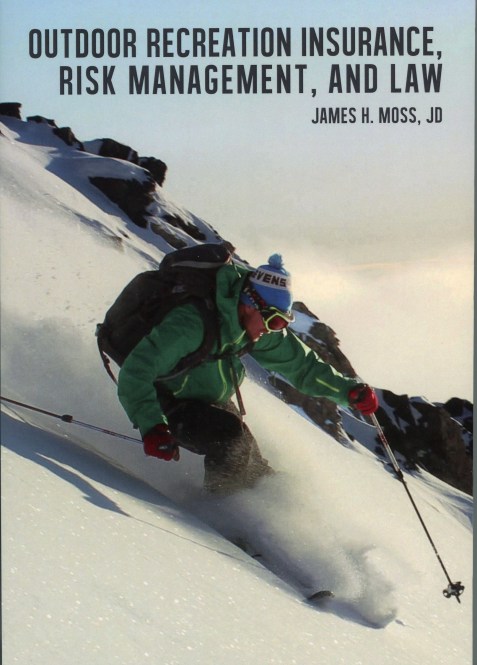
Outdoor Recreation Insurance, Risk Management, and Law
To see Jim’s complete bio go here and to see his CV you can find it here. To find out the purpose of this website go here.
If you are interested in having me write your release, download the form and return it to me.
Connect
If you like this let your friends know or post it on FB, Twitter, or LinkedIn
 Threads |
 Facebook Logo |
 X, Formerly Twitter |
 Recreation Law |
By Recreation Law Rec-law@recreation-law.com James H. Moss
@2023 Summit Magic Publishing, LLC
G-YQ06K3L262
#AdventureTourism, #AdventureTravelLaw, #AdventureTravelLawyer, #AttorneyatLaw, #Backpacking, #BicyclingLaw, #Camps, #ChallengeCourse, #ChallengeCourseLaw, #ChallengeCourseLawyer, #CyclingLaw, #FitnessLaw, #FitnessLawyer, #Hiking, #HumanPowered, #HumanPoweredRecreation, #IceClimbing, #JamesHMoss, #JimMoss, #Law, #Mountaineering, #Negligence, #OutdoorLaw, #OutdoorRecreationLaw, #OutsideLaw, #OutsideLawyer, #RecLaw, #Rec-Law, #RecLawBlog, #Rec-LawBlog, #RecLawyer, #RecreationalLawyer, #RecreationLaw, #RecreationLawBlog, #RecreationLawcom, #Recreation-Lawcom, #Recreation-Law.com, #RiskManagement, #RockClimbing, #RockClimbingLawyer, #RopesCourse, #RopesCourseLawyer, #SkiAreas, #Skiing, #SkiLaw, #Snowboarding, #SummerCamp, #Tourism, #TravelLaw, #YouthCamps, #ZipLineLawyer, Summer Camp, Day Camp, Horse, Pony, Horseback Riding, Expert Witness, Expert Qualifications,
3 Great Updates from Bicycle Colorado, June 24, Colorado Bike to Work day
Posted: April 4, 2015 Filed under: Cycling, Youth Camps | Tags: Bicycle Colorado, Bicycling, Cycling, x, y, z Leave a comment
|

Fees are charged, recreation is happening, but can the recreational use act still protect a claim, yes, if the fees are not for the recreation
Posted: March 30, 2015 Filed under: Minors, Youth, Children, Nebraska | Tags: City Park, Fee, Immunity, Limited Liability, Nebraska, Omaha, Park, Recreational Use Leave a commentThe grandparents were charged to camp at a city park, the plaintiffs, grandchildren, were not charged to be in the park so the Nebraska Recreational use act provides immunity.
Garreans, Jr., v. City of Omaha, 216 Neb. 487; 345 N.W.2d 309; 1984 Neb. LEXIS 942
State: Nebraska, Supreme Court of Nebraska
Plaintiff: John Garreans, Jr., a minor, by his next friend and father, John Garreans, Sr., et al.
Defendant: City of Omaha, a municipal corporation
Plaintiff Claims: failed to observe, inspect, and remove the 55-gallon drum; had failed to warn the public of the dangerous nature of the drum; was guilty of willful negligence
Defendant Defenses: Recreational Use Statute
Holding: for the defendant
Year: 1984
This is an older case. However, it has been followed and clarifies some of the issues concerning the recreational use law. The grandparents of one of the plaintiffs went camping in the city park. They paid a fee that the Supreme Court defined as a fee to “park a camper on a pad, for the right to pitch a tent in a tent camping area, and for the use of camper dumping facilities…” Anyone else visiting the park, including the plaintiff, entered the park for no charge.
The plaintiffs were the grandsons, of the grandparents who paid the fee. The plaintiff’s grandchildren had not paid any fee nor had his parents to enter and play in the park. While the children were there they had been given firecrackers to use by his father. A 55-gallon drum that was obviously not a trash barrel was sitting next to a trash barrel.
The drum was closed except for a plug which was removed on the top of the drum. The drum had a flammable sign on its side. The plaintiffs were using the drum to set the firecrackers on and light them. One child dropped a lit firecracker into the drum which exploded causing injuries to the plaintiff.
The trial court found for the plaintiff and found the city, which owned the park had:
…failed to properly supervise the area around camper pad No. 25; had failed to observe, inspect, and remove the 55-gallon drum; had failed to warn the public of the dangerous nature of the drum; was guilty of willful negligence; and that the plaintiffs were not contributorily negligent.
The defendant city appealed.
Analysis: making sense of the law based on these facts.
The Nebraska Recreational Use statute has been re-written so the sections quoted in this case may not be accurate today. The court quoted:
Neb. Rev. Stat. § 37-1002 (Reissue 1978) provides: “Subject to the provisions of section 37-1005, an owner of land owes no duty of care to keep the premises safe for entry or use by others for recreational purposes, or to give any warning of a dangerous condition, use, structure, or activity on such premises to persons entering for such purposes.”
The new Nebraska Recreational Use statute states:
§ 37-731. Landowner; duty of care.
Subject to section 37-734, an owner of land owes no duty of care to keep the premises safe for entry or use by others for recreational purposes or to give any warning of a dangerous condition, use, structure, or activity on such premises to persons entering for such purposes.
The court then focused on the term charge. The plaintiff argued the grandparents had paid a charge. Therefore, the recreational use statute did not apply.
However, the court found the money paid by the grandparents was not to enter on the land, but to access specific services.
The evidence in the present case is undisputed that no charge was made by the city for the right to enter N.P. Dodge Park. Those entering the park paid no admission fee. Charges were made for the right to park a camper on a pad, for the right to pitch a tent in a tent camping area, and for the use of camper dumping facilities. Payment of the fee by Mrs. Stoops did not entitle her to a greater right to use any of the park’s other facilities than that had by the general public.
The court looked at other decisions, which had decided the fee issue based on the same analysis.
Georgia
…a fee paid to park a vehicle in a park was held not to constitute a charge for admission, as no charge was made upon those who entered on foot. [Washington], wherein a fee for use of an inner tube was held not to be a charge within the contemplation of Washington’s recreational use statute.
Ohio
It is conceded that the Mosses and decedent O’Neal did not pay a fee ‘to enter’ the parks; rather, the consideration paid went for the purchase of gas, food and for the rental of a canoe.
Additionally, the plaintiff’s and their parents did not pay to enter on the land. The fee was paid by a grandparent, not the plaintiff. The grandparents entered the park at a different time and now with their children or grandchildren.
The next issue was whether the actions of the city in managing the park and not finding or removing the barrel were willful or wanton. Under Nebraska law willful and wanton is defined as:
In order for an action to be willful or wanton, the evidence must show that one acted with actual knowledge that a danger existed and that he intentionally failed to act to prevent the harm which was reasonably likely to result. The term imparts knowledge and consciousness that injury is likely to result from the act done or omission to act, and a constructive intention as to the consequences. To constitute willful misconduct there must be actual knowledge, or its legal equivalent, of the peril to be apprehended, coupled with a conscious failure to avert injury. To constitute willful negligence the act done or omitted must be intended or must involve such reckless disregard of security and right as to imply bad faith. Wanton negligence has been said to be doing or failing to do an act with reckless indifference to the consequences and with consciousness that the act or omission would probably cause serious injury.
The court found the city had acted correctly because the barrel had not been found by the city in its normal operation. If the city had found the barrel, the city stated the barrel would have been removed. The court then stated the not only was the city not willful and wanton, but the plaintiffs were contributorily negligent by their actions.
Contributory negligence has been replaced by joint and several liability. At the time, being found contributorily negligence would have been a complete bar to recovery by the plaintiffs. This analysis was based on the law which prohibited the use of fireworks by the city and by park regulation.
The court reversed the trial court decision finding for the city.
So Now What?
This is an old decision which still stands today and has been followed in numerous courts, which define their statutes this way. If you are a landowner whose land is open for recreation, this may provide a narrow window where you can open the land for free and yet recover some of your costs for extra services you may provide for people who wish to pay for those services.
What do you think? Leave a comment.
 James H. “Jim” Moss |
Jim Moss is an attorney specializing in the legal issues of the outdoor recreation community. He represents guides, guide services, and outfitters both as businesses and individuals and the products they use for their business. He has defended Mt. Everest guide services, summer camps, climbing rope manufacturers; avalanche beacon manufacturers, and many more manufacturers and outdoor industries. Contact Jim at Jim@Rec-Law.us |
Outdoor Recreation Insurance, Risk Management, and Law
Jim is the author or co-author of eight books about legal issues in the outdoor recreation world; the latest is Outdoor Recreation Insurance, Risk Management, and Law. To Purchase Go Here:
To see Jim’s complete bio go here and to see his CV you can find it here. To find out the purpose of this website go here.
If you are interested in having me write your release, download the form and return it to me.
If you like this let your friends know or post it on FB, Twitter, or LinkedIn
By Recreation Law Rec-law@recreation-law.com James H. Moss
@2023 Summit Magic Publishing, LLC
G-YQ06K3L262
 Threads |
 X (formerly known as Twitter) logo |
 Recreation Law logo |
 Stimulus |
 |
 Mastodon |
 |
 Blue Sky Logo |
#AdventureTourism, #AdventureTravelLaw, #AdventureTravelLawyer, #AttorneyatLaw, #Backpacking, #BicyclingLaw, #Camps, #ChallengeCourse, #ChallengeCourseLaw, #ChallengeCourseLawyer, #CyclingLaw, #FitnessLaw, #FitnessLawyer, #Hiking, #HumanPowered, #HumanPoweredRecreation, #IceClimbing, #JamesHMoss, #JimMoss, #Law, #Mountaineering, #Negligence, #OutdoorLaw, #OutdoorRecreationLaw, #OutsideLaw, #OutsideLawyer, #RecLaw, #Rec-Law, #RecLawBlog, #Rec-LawBlog, #RecLawyer, #RecreationalLawyer, #RecreationLaw, #RecreationLawBlog, #RecreationLawcom, #Recreation-Lawcom, #Recreation-Law.com, #RiskManagement, #RockClimbing, #RockClimbingLawyer, #RopesCourse, #RopesCourseLawyer, #SkiAreas, #Skiing, #SkiLaw, #Snowboarding, #SummerCamp, #Tourism, #TravelLaw, #YouthCamps, #ZipLineLawyer, Park, City Park, Omaha, Nebraska, Recreational Use, Immunity, Limited Liability, Fee,
Federal Court in Idaho holds camp not liable for assault on third party by runaway minors.
Posted: March 16, 2015 Filed under: Idaho, Minors, Youth, Children, Summer Camp | Tags: assault, Big Sky Summer Adventure Program, Camp, Custody and Control, Explorations, Float Trip, Idaho, LLC., Montana, Phoenix Mountain Collaborative, Run away, Runaway, Summer Camp, Treatment Program, Trout Creek, Youth Camp Leave a commentThe Court did find that the camp was still in the custody and control of the minors during the assault which occurred three days after the youth had run away from the camp.
Gadman v. Martin, 2014 U.S. Dist. LEXIS 83883
State: Idaho, United States District Court for the District of Idaho
Plaintiff: Vera Gadman
Defendant: Joseph Martin; Marshall Dittrich; Penelope James; and Phoenix Mountain Collaborative, LLC.
Plaintiff Claims: Negligence
Defendant Defenses: No duty
Year: 2014
Holding: for the defendant
This case is about the escape of two boys from a summer program for “troubled” youth. These programs have achieved fame and notoriety based on various issues of successes and failures, as well as abuse. However, this legal issue is important to anyone who is taking care of youth at a camp… In this one two kids at the camp ran away and then assaulted a third party. The person the runaway kids assaulted then sued the camp for her injuries.
The defendant camp was operated in Montana. During one part of the session, the youth were rafting the Clark Fork River. The Clark Fork flows from Montana to Idaho. One night during the river trip the campers were on property owned by the defendant camp. The youth ran away.
Neither of the youth who ran away from the camp had a history of violence. They seemed to be enrolled in the program because of drug use and generally being really stupid kids. Both youth has been on a run-away watch a system developed by the camp and had their journals and shoes removed. However, their shoes were returned to them for the rafting trip.
The school had a “Run Watch Policy” which the court pointed out, quoted from and found the school had not followed. “Explorations will take all reasonable precautions pertinent to each individual student so as to reduce the possibility of their escape from our custody.”
The defendant camp filed a motion for summary judgment, and this decision is based on that motion.
Analysis: making sense of the law based on these facts.
The defense was based on two theories.
1) they owed no duty to Ms. Gadman [plaintiff] and
2) the actions of Mr. Dittrich and Mr. Martin (youth runaways) were not foreseeable [to cause injury to the plaintiff] to either Explorations or Ms. James [defendants].
The determination under Idaho law as to whether the defendants owed a duty of care to the plaintiff’s when they are in charge of youth “who are dangerous or who have dangerous propensities“ is a two-part test.
The first part requires a determination of whether the supervising body actually has control over the individual in question, and then secondly, if so, a determination must be made whether the harm caused by the individual was foreseeable.
The court then looked at the first part of the test.
One who takes charge of a third person whom he knows or should know to be likely to cause bodily harm to others if not controlled is under a duty to exercise reasonable care to control the third person to prevent him from doing such harm.
The first part of the test is whether or not the supervising authority has actual control over the youth. Here the youth were not allowed to leave the camp without the camps or the youth’s parent’s permissions. Even though the youth had voluntarily, and without permission, left the campsite and been away from the camp for two days at the time of the attack, the court held the camp was still in control, for the purposes of the test, of the youth.
Ordinarily, there is no affirmative duty to assist or protect someone unless special circumstances exist. The analysis is not what is the relationship between the affected third party and the youth in this case, but the relationship between the youth and the camp. “Thus, the duty alleged in this case would have to arise from a supervisory relationship where Ms. James/Explorations exercised some level of control over Mr. Martin and Mr. Dittrich.”
The fact the youth ran away was not valid excuse or abrogation of control by the camp.
Explorations was responsible for the care and custody of the youth participants in its programs. The minor participants could not leave the program without their parents’ permission. When asked if the participants of the outdoor program were “free to leave,” Ms. James stated in her deposition that participants who were minor could only leave if they had their parents’ permission, otherwise they were not free to leave. Ms. James went on to state that the steps taken to assure participants do not leave are that “care is provided, oversight and care, with our instructor team the entire time the students are there.”
Most of this analysis was based on the camps Run Watch Policy and Run Watch Kit for leaders. Because the camp knew the kids would run away and prepared for it, they knew it was possible and consequently, the court felt they did not give up control over a kid when the kid did run. “The Court finds upon these undisputed facts that Mr. Martin and Mr. Dittrich were in the custody and control of Explorations at the time of the attack.”
The next issue was the foreseeability question. In this case, the question was not whether it was foreseeable that the kids would run away, but whether it was foreseeable, the kids would assault a third party.
Foreseeability, ‘contemplates more than the mere possibility of aggressive tendencies…. The concept of foreseeability is much more narrowly drawn in this circumstance, … i.e. violence, particularly of a sexual nature, toward members of the public … must be manifest or ostensible, and highly likely to occur.
The plaintiff argued the violent acts of the defendant were foreseeable because of the youth’s drug use and prior attendance at treatment facilities. However, the court did not agree with this.
Although the boys had struggled in various aspects of their lives before attending Explorations, there is nothing in their histories that was known to Explorations that made their actions on July 31, 2011 [date of the attack] foreseeable.
The theft of drugs by one participant who had run away in the past, nor the fact that the kids had been planning to run away did not change the court’s opinion of this. The planning though, was only discovered the history of the youth, after the youth had been caught. Both arguments by the plaintiffs were too speculative according to the court.
The court held therefore, that the defendant camp was not liable.
So Now What?
Although the defendant won this case, it was a close one. All camps should read this with the understanding that a minor that has been delivered to them by their parents are in their custody and control until they are delivered back to their parents.
Whether or not this can be moderated by contract, I’m not sure.
This case would have gone the other way if the youth had a history of violence. The defendant notified the boy’s parents and law enforcement within 90 minutes of the discovery the boys were missing. Even calling law enforcement did not change the issue of control.
What do you think? Leave a comment.
 Jim Moss |
Jim Moss is an attorney specializing in the legal issues of the outdoor recreation community. He represents guides, guide services, and outfitters both as businesses and individuals and the products they use for their business. He has defended Mt. Everest guide services, summer camps, climbing rope manufacturers; avalanche beacon manufacturers, and many more manufacturers and outdoor industries. Contact Jim at Jim@Rec-Law.us |

Outdoor Recreation Insurance, Risk Management, and Law
Jim is the author or co-author of eight books about legal issues in the outdoor recreation world; the latest is Outdoor Recreation Insurance, Risk Management, and Law. To Purchase Go Here:
To see Jim’s complete bio go here and to see his CV you can find it here. To find out the purpose of this website go here.
If you are interested in having me write your release, download the form and return it to me.
If you like this let your friends know or post it on FB, Twitter, or LinkedIn
By Recreation Law Rec-law@recreation-law.com James H. Moss
@2023 Summit Magic Publishing, LLC
G-YQ06K3L262
|
Blue Sky Logo |
|
Mastodon |
|
Stimulus |
Recreation Law logo |
X (formerly known as Twitter) logo |
Threads |
#AdventureTourism, #AdventureTravelLaw, #AdventureTravelLawyer, #AttorneyatLaw, #Backpacking, #BicyclingLaw, #Camps, #ChallengeCourse, #ChallengeCourseLaw, #ChallengeCourseLawyer, #CyclingLaw, #FitnessLaw, #FitnessLawyer, #Hiking, #HumanPowered, #HumanPoweredRecreation, #IceClimbing, #JamesHMoss, #JimMoss, #Law, #Mountaineering, #Negligence, #OutdoorLaw, #OutdoorRecreationLaw, #OutsideLaw, #OutsideLawyer, #RecLaw, #Rec-Law, #RecLawBlog, #Rec-LawBlog, #RecLawyer, #RecreationalLawyer, #RecreationLaw, #RecreationLawBlog, #RecreationLawcom, #Recreation-Lawcom, #Recreation-Law.com, #RiskManagement, #RockClimbing, #RockClimbingLawyer, #RopesCourse, #RopesCourseLawyer, #SkiAreas, #Skiing, #SkiLaw, #Snowboarding, #SummerCamp, #Tourism, #TravelLaw, #YouthCamps, #ZipLineLawyer, Camp, Custody and Control, Summer Camp, Youth Camp, Phoenix Mountain Collaborative, LLC., Big Sky Summer Adventure Program, Explorations, Trout Creek, Montana, Idaho, Assault, Float Trip, Run away, Runaway, Treatment Program,
Gadman v. Martin, 2014 U.S. Dist. LEXIS 83883
Posted: February 26, 2015 Filed under: Idaho, Legal Case, Minors, Youth, Children, Youth Camps | Tags: assault, Big Sky Summer Adventure Program, Camp, Custody and Control, Explorations, Float Trip, Idaho, LLC., Montana, Phoenix Mountain Collaborative, Run away, Runaway, Summer Camp, Treatment Program, Trout Creek, Youth Camp 3 CommentsTo Read an Analysis of this decision see
Federal Court in Idaho holds camp not liable for assault on third party by runaway minors.
Gadman v. Martin, 2014 U.S. Dist. LEXIS 83883
Vera Gadman, Plaintiff, v. Joseph Martin; Marshall Dittrich; Penelope James; and Phoenix Mountain Collaborative, LLC., Defendants.
Case No. 2:13-CV-00327-EJL
UNITED STATES DISTRICT COURT FOR THE DISTRICT OF IDAHO
2014 U.S. Dist. LEXIS 83883
June 17, 2014, Decided
June 17, 2014, Filed
CORE TERMS: foreseeable, violent, summary judgment, staff, violence, genuine, youth, ran, violent acts, deposition, non-moving, custody, owed, van, issue of material fact, adverse party, citation omitted, propensity, foreseen, commit, runaway, duty of care, undisputed, instructor, detention, outdoor, missing, assault, shoes, violent behavior
COUNSEL: [*1] For Vera Gadman, Plaintiff: James M Bendell, Grupp Law Office, Coeur D’Alene, ID.
For Marshall Dittrich, Defendant: Michael L Haman, LEAD ATTORNEY, Haman Law Office, Coeur d’Alene, ID.
For Penelope James, Phoenix Mountain Collaborative, LLC, Defendants: Mark A Ellingsen, LEAD ATTORNEY, WITHERSPOON KELLEY, Coeur d’Alene, ID.
JUDGES: Honorable Edward J. Lodge, U. S. District Judge.
OPINION BY: Edward J. Lodge
OPINION
MEMORANDUM DECISION AND ORDER
INTRODUCTION
Pending before the Court in the above-entitled matter are Defendants’, Phoenix Mountain Collaborative, LLC and Penelope James, Motion for Summary Judgment and related Motions. The parties have filed their responsive briefing and the matters are ripe for the Court’s consideration.1 Having fully reviewed the record, the Court finds that the facts and legal arguments are adequately presented in the briefs and record. Accordingly, in the interest of avoiding further delay, and because the Court conclusively finds that the decisional process would not be significantly aided by oral argument, this matter shall be decided on the record before this Court without oral argument.
1 Mr. Dittrich filed a response to Plaintiff’s opposition to the Motion for Summary Judgment wherein [*2] he takes no position on the Motion but responds only to clarify the record. (Dkt. 17.)
FACTUAL AND PROCEDURAL BACKGROUND
In the summer of 2011, Defendants Joseph Martin and Marshall Dittrich were participants in a 52-day outdoor program known as the Big Sky Summer Adventure Program operated by Explorations in Trout Creek, Montana. Explorations is an entity that offers both full time residential programs and summer outdoor adventure programs for youths who may have struggled in the past either academically, socially, with interpersonal relationships, or with substance use/experimentation issues. Explorations also offers counseling sessions and life skills training. Explorations is owned and operated by Defendant Phoenix Mountain Collaborative, LLC.2 The Defendant Penelope James is the managing member of Explorations who reviews the applications for enrollment at Explorations’ camps.
2 The Court will refer to Phoenix Mountain Collaborative, LLC as “Explorations” in this Order. The Court also refers to both Ms. James and Explorations collectively as “Explorations” in this Order.
On July 29, 2011, the Explorations outdoor program was finishing a float trip down the Clark Fork River which runs [*3] from Montana to Idaho. That evening, around 10:00 p.m., the students and staff camped out on the Explorations’ property. The next morning around 8:00 a.m., an Explorations’ staff member noticed Mr. Martin and Mr. Dittrich were missing. A search was conducted but the boys were not found on the property. At 9:30 a.m. Ms. James notified local law enforcement and the boys’ parents that they had run away and were missing.
The location of the two boys was not known until July 31, 2011. On that day the Plaintiff, Vera Gadman, was driving her vehicle in Clark Fork, Idaho when she saw Mr. Martin and Mr. Dittrich, hitchhiking along Highway 200. Ms. Gadman stopped her car and offered them a ride. The boys asked Ms. Gadman to take them somewhere they could camp. After driving to a couple of locations, Ms. Gadman stopped at the east end of David Thompson Road and showed the boys where they could camp on a map. At that stop, Mr. Martin and Mr. Dittrich then brutally assaulted and battered Ms. Gadman including allegedly choking, strangling, and striking her in the head with a glass bottle, throwing and striking her with rocks, and committing other acts of violence and terror against her. (Dkt. 1 at [*4] ¶ 13.) As a result, Ms. Gadman claims she suffered serious physical and emotional injuries and incurred significant damages. Ms. Gadman has filed this action raising a negligence claim against the Defendants seeking to recover for the damages she suffered from the attack. Defendants Exploration and Ms. James have filed this Motion for Summary Judgment which the Court takes up in this Order.
STANDARD OF REVIEW
Motions for summary judgment are governed by Rule 56 of the Federal Rules of Civil Procedure. Rule 56 provides, in pertinent part, that judgment “shall be rendered forthwith if the pleadings, depositions, answers to interrogatories, and admissions on file, together with the affidavits, if any, show that there is no genuine issue as to any material fact and that the moving party is entitled to judgment as a matter of law.” Fed. R. Civ. P. 56(c).
The Supreme Court has made it clear that under Rule 56 summary judgment is mandated if the non-moving party fails to make a showing sufficient to establish the existence of an element which is essential to the non-moving party’s case and upon which the non-moving party will bear the burden of proof at trial. See Celotex Corp. v. Catrett, 477 U.S. 317, 322, 106 S. Ct. 2548, 91 L. Ed. 2d 265 (1986). [*5] If the non-moving party fails to make such a showing on any essential element, “there can be no ‘genuine issue of material fact,’ since a completely failure of proof concerning an essential element of the nonmoving party’s case necessarily renders all other facts immaterial.” Id. at 323.3
3 See also, Rule 56(e) which provides, in part: When a motion for summary judgment is made and supported as provided in this rule, an adverse party may not rest upon the mere allegations or denials of the adverse party’s pleadings, but the adverse party’s response, by affidavits or as otherwise provided in this rule, must set forth specific facts showing that is a genuine issue for trial. If the adverse party does not so respond, summary judgment, if appropriate, shall be entered against the adverse party.
Moreover, under Rule 56, it is clear that an issue, in order to preclude entry of summary judgment, must be both “material” and “genuine.” An issue is “material” if it affects the outcome of the litigation. An issue, before it may be considered “genuine,” must be established by “sufficient evidence supporting the claimed factual dispute . . . to require a jury or judge to resolve the parties’ differing [*6] versions of the truth at trial.” Hahn v. Sargent, 523 F.2d 461, 464 (1st Cir. 1975) (quoting First Nat’l Bank v. Cities Serv. Co. Inc., 391 U.S. 253, 289, 88 S. Ct. 1575, 20 L. Ed. 2d 569 (1968)). The Ninth Circuit cases are in accord. See, e.g., British Motor Car Distributors, Ltd. v. San Francisco Automotive Industries Welfare Fund, 882 F.2d 371 (9th Cir. 1989).
According to the Ninth Circuit, in order to withstand a motion for summary judgment, a party
(1) must make a showing sufficient to establish a genuine issue of fact with respect to any element for which it bears the burden of proof; (2) must show that there is an issue that may reasonably be resolved in favor of either party; and (3) must come forward with more persuasive evidence than would otherwise be necessary when the factual context makes the non-moving party’s claim implausible.
Id. at 374 (citation omitted).
Of course, when applying the above standard, the court must view all of the evidence in the light most favorable to the non-moving party. Anderson v. Liberty Lobby, Inc., 477 U.S. 242, 255, 106 S. Ct. 2505, 91 L. Ed. 2d 202 (1986); Hughes v. United States, 953 F.2d 531, 541 (9th Cir. 1992).
ANALYSIS
1. Motion for Extension of Time to File Statement of Genuine issues of Fact
Plaintiff’s Motion asks [*7] for leave of the Court to file a late Statement of Genuine Issues of Fact in response to the Motion for Summary Judgment. (Dkt. 23.) Plaintiff mistakenly failed to file the Statement of Fact as required by the rules. Defendants oppose the Motion arguing the proposed Statement of Facts fails to satisfy the requirements of Federal Rule of Civil Procedure 56(c) and Local Civil Rule 7.1. (Dkt. 24.) The Court has reviewed the briefing and materials on this issue and will grant the Plaintiff’s Motion and allow her to file the late Statement of Facts. While the filings is untimely, the Court finds the interests of justice are best served by deciding the Motion for Summary Judgments on its merits and there is little prejudice suffered by Defendants as a result of the late filing.
2. Defendants’ Motion for Summary Judgment
Explorations and Ms. James seek dismissal of the negligence claim against them arguing 1) they owed no duty to Ms. Gadman and 2) the actions of Mr. Dittrich and Mr. Martin were not foreseeable to either Explorations or Ms. James. (Dkt. 16.) Ms. Gadman opposes the Motion and asserts that a genuine issue of material fact exists as to whether Explorations and/or Ms. James owed [*8] a duty to her. (Dkt. 19.)
On the question of whether Ms. James and/or Explorations owed a duty of care to Ms. Gadman under Idaho law, both parties cite to and discuss Caldwell v. Idaho Youth Ranch, Inc., 132 Idaho 120, 968 P.2d 215 (Idaho 1998) but arrive at opposite conclusions. In Caldwell, the Idaho Supreme Court held that the Idaho Youth Ranch did not owe a duty of care to a third-party for the violent acts committed upon the third-party by a minor who had, several months prior, been released from an Idaho Youth Ranch program. There the court concluded that the minor was not in the custody or control of the Youth Ranch at the time he committed the violent acts upon the third-party.
In reaching this conclusion, the Idaho Supreme Court discussed the “duty owed by those in charge of persons who are dangerous or who have dangerous propensities,” quoting the duty is as described in the Restatement (Second) of Torts, § 319, which provides:
§ 319. Duty of Those in Charge of Person Having Dangerous Propensities. One who takes charge of a third person whom he knows or should know to be likely to cause bodily harm to others if not controlled is under a duty to exercise reasonable care to control the third [*9] person to prevent him from doing such harm.
Caldwell, 968 P.2d at 218 (quoting Restatement (Second) of Torts, § 319 (1977)). The court then identified the two components of the duty:
The first part requires a determination of whether the supervising body actually has control over the individual in question, and then secondly, if so, a determination must be made whether the harm caused by the individual was foreseeable.
Id. at 218-19. The parties in this case dispute both components — whether Ms. James/Explorations had control over the boys and whether the harm caused by the boys was foreseeable.
A. Control
“No liability exists under the law of torts unless the person from whom relief is sought owed a duty to the allegedly injured party.” Jones v. Starnes, 150 Idaho 257, 245 P.3d 1009, 1012 (Idaho 2011) (quoting Vickers v. Hanover Constr. Co., Inc., 125 Idaho 832, 875 P.2d 929, 932 (Idaho 1994)). “Ordinarily, ‘there is no affirmative duty to act to assist or protect another absent unusual circumstances, which justifies imposing such an affirmative responsibility. An affirmative duty to aid or protect arises only when a special relationship exists between the parties.'” Rees v. State, Dept. of Health and Welfare, 143 Idaho 10, 137 P.3d 397, 402 (Idaho 2006) [*10] (quoting Coghlan v. Beta Theta Pi Fraternity, 133 Idaho 388, 987 P.2d 300, 311 (1999)) (citations omitted). “Determining when a special relationship exists sufficient to impose an affirmative duty requires an evaluation of ‘the sum total of those considerations of policy which lead the law to say that a particular plaintiff is entitled to protection.'” Id. (quoting Coghlan, 987 P.2d at 311 (quoting W. Prosser, Law of Torts 333 (3d ed. 1964))).
The general duty which arises in many relations to take reasonable precautions for the safety of others may include the obligation to exercise control over the conduct of third persons…. [Some] relationships are custodial by nature, requiring the defendant to control his charge and to guard other persons against his dangerous propensities…. The same rule has been applied to hospitals and psychotherapists who have charge of dangerous mental patients, and to those who have charge of dangerous criminals. … Yet, in the absence of the requisite relationship, there generally is no duty to protect others against harm from third persons.
Caldwell, 968 P.2d at 218 (quoting Sterling, 723 P.2d at 768-69) (citation omitted). “[T]he key to this duty is the supervising [*11] individual’s relationship to the supervised individual, rather than a direct relationship with the endangered person or class of persons.” Caldwell, 968 P.2d at 218 (discussing Sterling v. Bloom, 111 Idaho 211, 723 P.2d 755, 769 (Idaho 1986) superseded in part on other grounds by Idaho Code § 6-904A)). Thus, the duty alleged in this case would have to arise from a supervisory relationship where Ms. James/Explorations exercised some level of control over Mr. Martin and Mr. Dittrich.
The parties in this case disagree on the level of “control” Explorations had over the youths. Explorations argues that it provides “recreational programs and counseling for children” but maintains it is “not a state run juvenile detention center or institution.” (Dkt. 16 at 1, 9.) Participation in Exploration is voluntarily and there is no physical detention or connection to the criminal justice system. (Dkt. 16 at 2, 9.) Explorations’ briefing argues that the attendees may leave the Exploration program at any time. (Dkt. 16 at 9.)
Ms. Gadman counters that Explorations and Ms. James exercised supervisory control over the students such that a special relationship was formed which gives rise to a duty. (Dkt. 19.) Ms. Gadman [*12] points out that Ms. James testified in her deposition that students are not free to leave Explorations once they are enrolled, there had been kids in the past who had ran away from camp but were caught, and described the procedures Explorations had in place for preventing kids from escaping.
The Court finds facts in this case are distinct from those in Caldwell where it was undisputed that the violent offender had been released from the Idaho Youth Ranch several months before committing the murder. There the Idaho Supreme Court found the Idaho Youth Ranch did not have control over the offender such that a duty of care was owed. In contrast here, Explorations did have control over Mr. Martin or Mr. Dittrich and had not released them from its custody — they ran away.
Although it is not akin to a juvenile detention facility, Explorations was responsible for the care and custody of the youth participants in its programs. The minor participants could not leave the program without their parents’ permission. When asked if the participants of the outdoor program were “free to leave,” Ms. James stated in her deposition that participants who were minor could only leave if they had their parents’ [*13] permission, otherwise they were not free to leave.4 (Dkt. 19-10 at 12.) Ms. James went on to state that the steps taken to assure participants do not leave are that “care is provided, oversight and care, with our instructor team the entire time the students are there.” (Dkt. 19-10 at 13.)
4 Both Mr. Martin and Mr. Dittrich were seventeen at the time they were at Explorations.
Participants have ran away from Explorations in the past. Explorations has run away prevention measures called “Run Watch” which are written set of procedures and guidelines designed for responding to a runaway or missing student. (Dkt. 19-10 at 28-29) (Dkt. 19-6, Ex. F.) The Run Watch Policy states: “Explorations will take all reasonable precautions pertinent to each individual student so as to reduce the possibility of their escape from our custody.” (Dkt. 19-10 at 30) (Dkt. 19-6, Ex. F.) Under the Run Watch guidelines, one instructor in each group has a “run kit” which is intended to provide the instructor in pursuit of the student with whatever equipment that would be necessary to ensure the safety of the instructor. (Dkt. 19-10 at 30) (Dkt. 19-6, Ex. F.) A student is placed on Run Watch when: the student just [*14] had a run attempt; the student verbalized a threat to do so; the instructional team perceives a student to be a run threat; or escorts, operations directors, or a therapist suggests it. (Dkt. 19-6, Ex. F.) Explorations also has written procedures for handling the situations involving an “Accompanied Runaway” and an “Unaccompanied Runaway/Missing Student.” (DKt. 19-6, Ex. F.)
In this case, Explorations was aware the boys had planned to leave and actually took measures to thwart their plan by taking their shoes and journals. When their shoes were later returned, the boys executed their plan to run away from Explorations. The attack upon Ms. Gadman occurred two days after the boys left Explorations. While Explorations may not be akin to a juvenile detention facility, it is in charge of the custody and care of the children who are participating in its programs. This includes more than merely providing shelter, food, and programing. The relationship between Explorations and Mr. Dittrich and Mr. Martin was custodial. The Court finds upon these undisputed facts that Mr. Martin and Mr. Dittrich were in the custody and control of Explorations at the time of the attack. The Court next considers [*15] the second duty requirement: whether the harm caused by the individual was foreseeable.
B. Foreseeable Actions
“The question whether a risk of harm is foreseeable is generally a question for the trier of fact. Summary judgment is appropriate, however, if evidence is presented establishing the absence of any genuine issue of material fact concerning the general risk of harm.” Caldwell, 968 P.2d at 220 (citation omitted). Under the Idaho Tort Claims Act, “Foreseeability, ‘contemplates more than the mere possibility of aggressive tendencies…. The concept of foreseeability is much more narrowly drawn in this circumstance, … i.e. violence, particularly of a sexual nature, toward members of the public … must be manifest or ostensible, and highly likely to occur.'” Caldwell, 968 P.2d at 220 (quoting Harris v. State Dep’t of Health and Welfare, 123 Idaho 295, 847 P.2d 1156, 1160 (Idaho 1992)). In Caldwell, the Idaho Supreme Court recognized that “human behavior is difficult to predict with certainty, leading to the necessity for claimants to demonstrate that the harmful behavior should have been highly predictable based upon demonstrated past conduct.” 968 P.2d at 220 (citing cases).
Ms. Gadman argues [*16] Mr. Martin’s and Mr. Dittrich’s violent acts were foreseeable because both had a prior history of drug abuse and had previously attended treatment programs. (Dkt. 19.) Mr. Dittrich had also previously ran away from home and his school records include a history of “explosive and unpredictable behavior.” While at Explorations, Ms. Gadman points out that Mr. Martin had stole medications from an unlocked Explorations travel van which he ingested and then went an entire week without sleeping causing him to behave erratically and hallucinate. These factors known to Explorations, she argues, made their attack on her foreseeable.
i. Mr. Martin’s and Mr. Dittrich’s Prior Histories
Prior to attending Explorations, Mr. Martin had serious substance abuse issues that his parents knew of and he had been enrolled in different treatment programs. (Dkt. 19-8 at 7-16, 32-33.) Explorations and Ms. James were aware of Mr. Martin’s prior drug problems. In his deposition, Mr. Martin testified that after arriving at Explorations he talked with Ms. James about the problems that had brought him to the program including his prior drug use. (Dkt. 16-4 at 33-34.) Mr. Dittrich also had behavior issues having been [*17] previously kicked out of school, ran away from home, and had also previously attended treatment programs. (Dkt. 19-9 at 7-9.)
Prior to the assault on Ms. Gadman, however, neither Mr. Martin nor Mr. Dittrich had any criminal history. (Dkt. 16-4 at 39, 54) (Dkt. 18 at 56.) Mr. Martin testified in his deposition that he was “unaware” he had any type of propensity for violent behavior prior to the attack and stated he had never been violent before the incident with Ms. Gadman. (Dkt. 16-4 at 39-40.) Mr. Dittrich testified that neither he nor his parents ever told Explorations about any propensity for violence. (Dkt. 18 at 57.)
Although the boys had struggled in various aspects of their lives before attending Explorations, there is nothing in their histories that was known to Explorations that made their actions on July 31, 2011 foreseeable. (Dkt. 16-2, Aff. James.)
ii. Conduct at the Explorations Program
a. No Violent or Threatening Behavior
There is no evidence that either Mr. Martin or Mr. Dittrich engaged in any threatening or violent actions while at Explorations. In his deposition, Mr. Martin denied having committed any violent acts or threatening anyone while at the Explorations camp. [*18] (Dkt. 16-4 at 40-41.) Mr. Martin also testified he never observed Mr. Dittrich commit any violent acts or threaten anyone while he was at Explorations. (Dkt. 16-4 at 41.) In her affidavit, Ms. James states that she had not witnessed and there had been no reports that either boy had demonstrated any acts of aggression or violence to anyone at Explorations. (Dkt. 16-2 at ¶¶ 12-14.)
b. Mr. Martin’s Theft of Drugs
When he arrived at Explorations, Mr. Martin had been off drugs for less than two months. (Dkt. 16-4 at 46-47.) Mr. Martin stated he began using drugs again within a few days of being at Explorations by taking drugs located in the Explorations van. (Dkt. 16-4 at 18-19, 47-48, 62-63.) The Explorations’ staff learned that someone had taken drugs from the van and they confronted the group about it. (Dkt. 19-8 at 49-52.) At that time, Mr. Martin denied taking the drugs but testified that a couple of days before he ran away from camp he vaguely told one of the staff members that he had taken the drugs from the van and was “freaking out,” or “bugging out a little” and “hearing things.” (Dkt. 19-8 at 50-52, 64, 70.) Ms. James also testified that Mr. Martin had admitted to stealing pills [*19] from the Explorations van approximately ten days before he walked away from the program. (Dkt. 19-10 at 55-56.) Ms. James testified that after Mr. Martin admitted to taking the pills, she assumed that someone had ingested the pills. (Dkt. 19-10 at 106.) Mr. Martin testified that he had taken the drugs before Explorations knew of the boys’ plan to runaway. (Dkt. 19-10 at 97.)
The theft and taking of the medications from the Explorations’ van does not make the violence committed upon Ms. Gadman foreseeable. Clearly Mr. Martin’s behavior was out of line, but there were no indications that he would soon become aggressively violent such that the actions he took on July 31, 2011 were foreseeable to Explorations.5
5 In support of her response brief, Ms. Gadman has filed articles discussing the side effects of the drug Adderall, lack of sleep, and the connection between drugs and violence. (Dkt. 19, Ex. A, B, C.) Defendants have objected to the Court’s consideration of these exhibits arguing they are inadmissible. The Court agrees that the articles are not appropriate for consideration pursuant to Federal Rule of Civil Procedure 56(c).
As to the fact that Mr. Martin was hallucinating from the [*20] drugs, again the Court finds the undisputed facts do not give rise to anything that would have made Mr. Martins’ later violent actions foreseeable. Mr. Martin testified that after he had lied to the Explorations’ staff and repeatedly denied being the one who took the drugs, a day or two before they ran away he “mentioned” to staff that he was “freaking out” and “bugging out.” (Dkt. 19-8 at 51-53.) In describing what he told the Explorations’ staff, Mr. Martin testified that he “wouldn’t even call it a conversation. I mentioned I was freaking out a little” and that he “didn’t tell them I needed anything. I didn’t ask for help.” (Dkt. 19-8 at 52-53.) There is simply no basis from these facts from which Explorations could have predicted Mr. Martin would soon commit the violent assault upon Ms. Gadman. The fact that he stole drugs, ingested them, and was experiencing the side effects of the drugs does not make it highly predictable or likely that he would become violent; particularly since there was no known history of any violent behavior either prior to Mr. Martin attending Explorations program or while he was at the program.
c. The Plan to Run Away
Explorations’ field staff had learned [*21] of Mr. Dittrich’s and Mr. Martin’s plan to runaway on either July 19th or 20th. (Dkt. 19-10 at 40, 96.) Once they learned of the boys’ plan to leave, the Explorations’ staff confronted the boys about their plan and then instituted a lockdown. (Dkt. 19-8 at 22, 70-71) (Dkt. 19-9 at 19.) During the lockdown the two were separated in the campsite, the staff took away their shoes and journals, and did not allow them to talk to anyone else. (Dkt. 19-9 at 19.) Mr. Dittrich testified that they were later given back their shoes to use on the white-water rafting trip. (Dkt. 19-9 at 30-31.)
That they had planned to run away from Explorations and find drugs does not make their subsequent violent attack upon Ms. Gadman foreseeable. If anything, the plan and the drug use without any violence was consistent with the boys’ known histories. Ms. Gadman asserts that the violence was foreseeable because the boys would necessarily have to steal in order to obtain the drugs and other life necessities. The Court finds that argument is too speculative. In fact just the opposite proved to be true in light of the fact that the boys were given rides and marijuana from others when they were on the run all without [*22] them having to commit any violent acts. (Dkt. 19-9 at 37.)
Ms. Gadman also argues Mr. Dittrich’s second journal contained a list of items and supplies they would need when they left the program making the resulting assault foreseeable. (Dkt. 19 at 15.) (Dkt. 19-9 at 20-30, 78.) Mr. Dittrich testified that the staff at Explorations was not aware of his list. (Dkt. 18 at 78.) He further stated that the references to a knife, gun, and weapon in general were not intended to be used as a weapon against another person but for protection. (Dkt. 18 at 79-81.) Ms. Gadman asserts the staff should have looked at Mr. Dittrich’s second journal and discovered the “disturbing information.” (Dkt. 19 at 15.) This argument is also too speculative. The journal entries were started two to four days before the boys ran away and then later completed after the boys had left Explorations. (Dkt. 19-9 at 29.) While it may seem obvious in hindsight to argue that Explorations should have looked at Mr. Dittrich’s second journal, the fact remains that Explorations was not aware of the journal entries and there are no facts going to show that they should have foreseen any future violent acts by these boys.
C. [*23] Conclusion
The Court finds there is no genuine issue of material fact that supports a finding that Explorations and/or Ms. James could have foreseen the violent attack committed upon Ms. Gadman. Even considering the cumulative facts known by Explorations — i.e. the boys’ prior history, Mr. Martin’s theft and use of the drugs while at the camp, and their plan to run away — the violent assault on Ms. Gadman was not foreseeable. It is simply too attenuated to expect Explorations to have foreseen the attack based on what they knew about the boys prior to their running away.
Neither boy had any history of violent behavior or any criminal history. In reviewing both boys’ applications, Ms. James interviewed each of the boys’ parents, therapists, and educational consultants. None of these contacts conveyed any concerns that either boy was violent, likely because neither boy had any prior history of violence. While at Explorations, the boys did not commit any acts of violence or demonstrate any aggression. Although Explorations was aware of Mr. Martin’s history of substance abuse, that fact, even when considered in the context of the totality of the circumstances known by Explorations, does not [*24] make his later violent actions foreseeable. As to the fact that one of Mr. Dittrich’s schools had scored him at the highest end of “explosive and unpredictable behavior,” that notation was made eleven years before he attended the Explorations program. (Dkt. 19-10 at 80.) The Court finds the undisputed facts establish that the boys’ violent attack was not highly predictable or likely and, therefore, was not foreseeable. See Caldwell, 968 P.2d at 220.
It is notable that at the time they left the program the boys themselves had not even decided where they were going let alone contemplated attacking anyone. Mr. Martin testified that when they left Explorations his intention was just to get to a city so he could use drugs again but denied he had any intention of committing violence on anyone. (Dkt. 16-4 at 42.) It was not until after the boys had left Explorations that they discussed stealing a car and assaulting someone to get a car. (Dkt. 16-4 at 43-44.) If they themselves did not know or had not yet decided to commit a violent action, there certainly is no way the staff at Explorations could have foreseen the actions such that anyone could say the violence was “highly likely to occur.” [*25] Caldwell, 968 P.2d at 220 (citation omitted). Because there is no genuine issue of material fact in dispute that show Explorations and/or Ms. James could have foreseen the violent actions of Mr. Martin and Mr. Dittrich, the Court finds they did not owe a duty of care to Ms. Gadman. The Motion for Summary Judgment is granted.
ORDER
NOW THEREFORE IT IS HEREBY ORDERED as follows:
1) Plaintiff’s Motion to Extend Time (Dkt. 23) is GRANTED.
2) Defendants’ Motion for Summary Judgment (Dkt. 16) is GRANTED. The claim against Defendants Phoenix Mountain Collaborative, LLC and Penelope James is HEREBY DISMISSED.
DATED: June 17, 2014
/s/ Edward J. Lodge
Honorable Edward J. Lodge
U. S. District Judge
G-YQ06K3L262
http://www.recreation-law.com
UIAA Ice Climbing Competition set to Begin
Posted: December 12, 2014 Filed under: Youth Camps, Zip Line | Tags: x, y, z Leave a comment
|
|||||


| UIAA | Monbijoustrasse 61 Postfach CH-3000 | Bern | Switzerland |
Lotz et al., v. The Claremont Club et al., 2013 Cal. App. Unpub. LEXIS 5748
Posted: December 12, 2014 Filed under: Assumption of the Risk, California, Health Club, Legal Case, Minors, Youth, Children, Release (pre-injury contract not to sue) | Tags: Ambiguous, Assumption of risk, Day Care, Dodgeball, Gross negligence, Gym, Health club, Release, Summary judgment Leave a commentLotz et al., v. The Claremont Club et al., 2013 Cal. App. Unpub. LEXIS 5748
Nicholas, a Minor, etc., Plaintiffs and Appellants, Defendants and Respondents.
B242399
COURT OF APPEAL OF CALIFORNIA, SECOND APPELLATE DISTRICT, DIVISION TWO
August 15, 2013, Opinion Filed
NOTICE: NOT TO BE PUBLISHED IN OFFICIAL REPORTS. CALIFORNIA RULES OF COURT, RULE 8.1115(a), PROHIBITS COURTS AND PARTIES FROM CITING OR RELYING ON OPINIONS NOT CERTIFIED FOR PUBLICATION OR ORDERED PUBLISHED, EXCEPT AS SPECIFIED BY RULE 8.1115(b). THIS OPINION HAS NOT BEEN CERTIFIED FOR PUBLICATION OR ORDERED PUBLISHED FOR THE PURPOSES OF RULE 8.1115.
PRIOR HISTORY: [*1]
APPEAL from a judgment of the Superior Court of Los Angeles County, No. KC061412, Peter J. Meeka, Judge.
DISPOSITION: Reversed and remanded.
CORE TERMS: dodgeball, triable, membership, ball, summary judgment, issues of fact, gross negligence, sport, playing, racquetball, played, inherent risk, hit, childcare, assumption of risk, ambiguity, risk of injury, risk of harm, rubber ball, matter of law, participating, aggressively, supervised, training, thrown, riding, player, risk doctrine, risk doctrine, evidence showed
COUNSEL: Magaña, Cathcart & McCarthy and Charles M. Finkel for Plaintiffs and Appellants.
Manning & Kass, Ellrod, Ramirez, Trester, Anthony J. Ellrod and David J. Wilson for Defendants and Respondents.
JUDGES: FERNS, J. *; ASHMANN-GERST, Acting P. J., CHAVEZ, J. concurred.
* Judge of the Los Angeles Superior Court, assigned by the Chief Justice pursuant to article VI, section 6 of the California Constitution.
OPINION BY: FERNS, J.
OPINION
The trial court granted summary judgment in favor of defendants and respondents The Claremont Club (Club) and Adam Qasem (Qasem) on the complaint brought by minor Nicholas Lotz (Nicholas) by and through his guardian ad litem Deborah Lotz (Deborah) and Deborah individually (sometimes collectively appellants). 1 Nicholas was injured in a dodgeball game that took place while he was in the Club’s childcare program. The trial court ruled that a release signed by Nicholas’s father barred appellants’ claims and there was no evidence showing the Club’s conduct amounted to gross negligence beyond the scope of the release. It further ruled the primary assumption of risk doctrine [*2] barred appellants’ claims.
1 We use first names for convenience only; no disrespect is intended.
We reverse. The evidence offered by appellants showed there were triable issues of material fact regarding the scope and application of multiple releases, whether the Club’s and Qasem’s conduct constituted gross negligence and whether their conduct increased the risk of harm inherent in the game of dodgeball.
FACTUAL AND PROCEDURAL BACKGROUND
Club Membership.
In 2001, Thomas Lotz (Thomas) signed The Claremont Club Membership Agreement (Membership Agreement) and completed a membership information form indicating that he was seeking a family membership for himself, Deborah and their two children. On the information form, Thomas put a check mark by some of the specified sports and activities in which he and his family were interested in participating. Dodgeball was not included among the list of activities.
The Membership Agreement included a section entitled “Waiver of Liability” that provided in relevant part: “IT IS EXPRESSLY AGREED THAT USE OF THE CLUB FACILITIES, PARTICIPATION IN CLUB-SPONSORED OUTSIDE ACTIVITIES OR EVENTS AND TRANSPORTATION PROVIDED BY THE CLUB SHALL BE UNDERTAKEN BY A MEMBER [*3] OR GUEST AT HIS/HER SOLE RISK AND THE CLUB SHALL NOT BE LIABLE FOR ANY INJURIES OR ANY DAMAGE TO ANY MEMBER OR GUEST . . . .” The provision further stated that the member voluntarily assumed the risk of personal injury and released the Club and its employees from every demand, claim or liability on account of any personal injury.
On the same day he signed the Membership Agreement, Thomas signed a separate document captioned Waiver of Liability, Assumption of Risk and Indemnity Agreement (Waiver) that contained a provision stating: “This Agreement constitutes my sole and only agreement respecting release, waiver of liability, assumption of the risk, and indemnity concerning my involvement in The Claremont Club.” The Waiver further provided in part: “I, for myself, my spouse, if any, my heirs, personal representative or assigns, and anyone claiming through or under me do hereby release, waive, discharge, and covenant not to sue The Claremont Club . . . for liability from any and all claims including the negligence of the Claremont Club, resulting in damages or personal injury . . . .” The Waiver further identified certain activities provided at the Club–again excluding dodgeball–together [*4] with the risks arising therefrom, and required Thomas to assert that his participation was voluntary and “that I knowingly assume all such risks.” The Waiver’s concluding paragraph provided for Thomas’s understanding “THAT I AM GIVING UP SUBSTANTIAL RIGHTS, INCLUDING MY RIGHT TO SUE.”
Together with a Club attorney, Club president and chief executive officer Mike Alpert helped prepare the Waiver. According to Alpert, only the Waiver–not the waiver of liability contained in the Membership Agreement–was in full force and effect at the time Thomas signed both documents. None of the documents that Thomas and Deborah signed in connection with their Club membership informed them that dodgeball would be played on Club premises.
Nicholas Is Injured in a Dodgeball Game at the Club.
The “InZone” was part of the Club’s childcare department; it provided a clubhouse environment for older children that included ping pong, foosball and video games. In-house sports and a specialized fitness room were also available as part of the InZone. A document provided to parents describing InZone activities identified a number of sports in which a child might participate; it did not mention dodgeball.
On April 13, [*5] 2005, Deborah checked 10-year-old Nicholas into the InZone between 4:30 and 5:00 p.m. No one advised Deborah or Thomas that Nicholas might be playing dodgeball as part of the InZone activities. That day, Club employee Qasem was scheduled to work at the front desk. Eighteen-year-old Qasem had worked part-time at the Club for approximately one year as a lifeguard, weight room attendant and at the front desk. He had never worked in the InZone and the Club had not provided him with any training to work with children.
At some point during his shift, Qasem left the front desk to work in the children’s fitness room. He was the only individual supervising approximately eight to 15 children, including Nicholas. One of the children suggested the group play dodgeball, and Qasem agreed. He took the children to the Club’s racquetball court because he had observed dodgeball being played there once or twice. The Club’s written policies, however, stated “[o]nly racquetball, handball, squash and Wally ball may be played on the racquetball courts.” Qasem had never played dodgeball at the Club, nor had he ever seen any written rules concerning dodgeball.
Though Qasem was uncertain whether he provided the [*6] children with any rules before they began playing the game, he may have told them to throw the ball below their waists. During the game, anywhere from three to six balls were being thrown at one time; each rubber ball was filled with air and was about the size of a soccer ball. About 20 minutes into the game, Qasem threw a ball using a sidearm motion hard and fast toward Nicholas. The ball hit Nicholas’s face and slammed his head into the wall behind him, leaving tooth marks on the wall. Nicholas suffered multiple dental injuries as a result of being hit by the ball.
At the time of the game, Qasem was six feet tall and weighed approximately 145 pounds. According to Nicholas, Qasem had been playing aggressively throughout the game. By playing in the game, Qasem had also violated the Club’s then unwritten policy that supervisors not participate in dodgeball games with the children. No one had previously been injured in a dodgeball game at the Club. After that game, Qasem was disciplined for failing to follow childcare policies and procedures, and one of his superiors instructed him not to play dodgeball at the Club.
Nicholas had previously played dodgeball at school. Though the players [*7] were instructed to not throw the ball at other players’ heads, he understood there was some risk of being hit in the head with the ball. The balls used at school, however, were similar to a Nerf ball and softer than those used at the InZone. Had Thomas and Deborah been advised that Nicholas would be playing dodgeball on a racquetball court with rubber balls, they would not have given their permission for him to do so.
The Intramural Rules of Dodgeball provide the game is one in which players try to hit others with a ball and avoid being hit themselves. “The main objective is to eliminate all members of the opposing team by hitting them with thrown balls, catching a ball thrown by a member of the opposing team, or forcing them outside of the court boundaries.” The National Dodgeball League Rules and Regulations of Play specify that a player committing a “headshot”–hitting another player in the head by a high thrown ball–will be deemed out of the game.
The Pleadings and Summary Judgment.
In June 2011, appellants filed their complaint alleging negligence and gross negligence and seeking general and special damages. They alleged that Nicholas was injured as a result of the Club’s negligently [*8] and recklessly “a. hiring, employing, training, entrusting, instructing, and supervising defendant ADAM QASEM; [¶] b. failing to adequately [] protect children under the care of defendant ADAM QASEM; [¶] c. participating in a game of dodge ball in an unreasonably forceful and dangerous manner so as to endanger the health, safety and welfare of children placed by their parents into the care of defendants.”
In December 2011, the Club and Qasem moved for summary judgment. They argued that appellants’ negligence claims were barred by Thomas’s execution of a release and express assumption of risk, and according to the assumption of risk doctrine. They further argued their actions did not rise to the level of gross negligence. In support of their motion, they submitted the Membership agreement, appellants’ discovery responses, deposition excerpts and Qasem’s declaration. They also sought judicial notice of several principles related to dodgeball rules and manner of play.
Appellants opposed the motion and filed evidentiary objections. They argued that triable issues of material fact existed concerning the scope of the Waiver, whether the Club’s conduct amounted to gross negligence and whether [*9] Nicholas’s injury was the result of an inherent risk of the game of dodgeball. They offered deposition excerpts, Club policies, medical records and several declarations in support of their arguments. Sports and Recreational Consultants president Steve Bernheim opined that the Club “did not take the proper measures to protect the children who were in its care, custody and control during the dodgeball game in which Nicholas Lotz was injured.” More specifically, the children were not provided with game-appropriate rules, the racquetball court was an insufficient space, use of the rubber balls was inappropriate and an adult should not have been playing with the children. He further opined that Qasem acted recklessly and that his conduct, coupled with the other conditions of the game, increased the risks inherent in the game of dodgeball and were outside the range of ordinary activity associated with the sport.
The Club replied and also filed evidentiary objections. At a March 2012 hearing, the trial court granted the motion. Though the trial court edited the proposed judgment to eliminate any reasons for its ruling, at the hearing the trial court first referred to childhood dodgeball experience [*10] as the basis for its decision: “When I went to school, we called it Warball, and we didn’t use Nerf balls because there weren’t any. It was a ball. When it hit you, it stung. And we all knew that. Everybody knew it. And it was just one of those games you played in school, and high school for that matter.” Turning to the evidence, the trial court construed the Waiver to apply to Thomas’s family members as well as Thomas, reasoning that the Club would have expected Thomas to be executing a release on behalf of all family members when he joined. The trial court further explained that even if it were to ignore the Waiver, appellants’ claims would be barred by the assumption of risk doctrine. It further found that the Club’s and Qasem’s conduct did not rise to the level of gross negligence as a matter of law, reasoning there was no evidence that Qasem was trying to injure Nicholas and that such an injury could have occurred in the context of any type of sport. It did not rule on any of the evidentiary objections.
Judgment was entered in June 2012, and this appeal followed.
DISCUSSION
Appellants maintain that the trial court erred in granting summary judgment and assert they offered evidence [*11] sufficient to create triable issues of fact concerning the scope and application of the Waiver, the existence of gross negligence and the application of the assumption of risk defense. We agree that triable issues of fact preclude the granting of summary judgment.
I. Standard of Review.
We review a grant of summary judgment de novo and independently determine whether the facts not subject to triable dispute warrant judgment for the moving party as a matter of law. (Intel Corp. v. Hamidi (2003) 30 Cal.4th 1342, 1348; Aguilar v. Atlantic Richfield Co. (2001) 25 Cal.4th 826, 849-850.) To secure summary judgment, the moving defendant must show that one or more elements of the cause of action cannot be established, or that there is a complete defense to the cause of action, and that it “is entitled to judgment as a matter of law.” (Aguilar v. Atlantic Richfield Co., supra, at p. 850.) Once that burden is met, the burden “shifts to the [other party] to show that a triable issue of one or more material facts exists as to that cause of action.” (Code Civ. Proc., § 437c, subd. (p)(2); Aguilar v. Atlantic Richfield Co., supra, at p. 850.)
We assume the role of the trial court and redetermine the [*12] merits of the motion. (Barber v. Marina Sailing, Inc. (1995) 36 Cal.App.4th 558, 562.) “In doing so, we must strictly scrutinize the moving party’s papers. [Citation.] The declarations of the party opposing summary judgment, however, are liberally construed to determine the existence of triable issues of fact. [Citation.] All doubts as to whether any material, triable issues of fact exist are to be resolved in favor of the party opposing summary judgment. [Citation.]” (Ibid.; accord, Hamburg v. Wal-Mart Stores, Inc. (2004) 116 Cal.App.4th 497, 502.) “Because a summary judgment denies the adversary party a trial, it should be granted with caution. [Citation.]” (Acosta v. Glenfed Development Corp. (2005) 128 Cal.App.4th 1278, 1292.) The court’s role is to focus “on issue finding; it does not resolve issues of fact. The court seeks to find contradictions in the evidence, or inferences reasonably deducible from the evidence, which raise a triable issue of material fact.” (Ibid.)
II. Appellants Raised Triable Issues of Fact as to Whether the Waiver Applied to Release Their Claims.
At the hearing on the motion, the trial court indicated that one basis for its ruling was the application of [*13] a written release. It stated: “Here, dad is signing the release on behalf of the family. Mom could have signed the release on behalf of the family and had a check and paid for the membership. And even though there are some slight twists and turns here, I guess nothing is ever completely crystal clear. I think the release really hurts the plaintiff or plaintiffs here.” Though the trial court’s comments fail to demonstrate whether it relied on the Membership Agreement or the Waiver as providing the operative release, the Club argues on appeal that the release contained in the Membership Agreement was clear and unambiguous, and applied to release appellants’ claims.
“California courts require a high degree of clarity and specificity in a [r]elease in order to find that it relieves a party from liability for its own negligence.” (Cohen v. Five Brooks Stable (2008) 159 Cal.App.4th 1476, 1488 (Cohen).) Thus, “to be effective, an agreement which purports to release, indemnify or exculpate the party who prepared it from liability for that party’s own negligence or tortious conduct must be clear, explicit and comprehensible in each of its essential details. Such an agreement, read as a whole, [*14] must clearly notify the prospective releaser or indemnitor of the effect of signing the agreement.” (Ferrell v. Southern Nevada Off-Road Enthusiasts, Ltd. (1983) 147 Cal.App.3d 309, 318.) Waiver and release forms are strictly construed against the defendant. (Lund v. Bally’s Aerobic Plus, Inc. (2000) 78 Cal.App.4th 733, 738.) But “a release need not achieve perfection” to be effective. (National & Internat. Brotherhood of Street Racers, Inc. v. Superior Court (1989) 215 Cal.App.3d 934, 938.) A release is sufficient if it “‘constitutes a clear and unequivocal waiver with specific reference to a defendant’s negligence.'” (Paralift, Inc. v. Superior Court (1993) 23 Cal.App.4th 748, 755.)
Here, Thomas represented in his membership application that he sought Club membership on behalf of his family. The release contained in the Membership Agreement provided that the member and guests assumed the risk of Club activities and released the Club from liability for participation in Club activities. A contract in which a party expressly assumes a risk of injury is, if applicable, a complete defense to a negligence action. (See Knight v. Jewett (1992) 3 Cal.4th 296, 308, fn. 4 (Knight); Sweat v. Big Time Auto Racing, Inc. (2004) 117 Cal.App.4th 1301, 1304.) [*15] Moreover, it is well settled a parent may execute a release on behalf of his or her child. (Aaris v. Las Virgenes Unified School Dist. (1998) 64 Cal.App.4th 1112, 1120 (Aaris); Hohe v. San Diego Unified Sch. Dist. (1990) 224 Cal.App.3d 1559, 1565.) By offering evidence of the Membership Agreement, the Club met its threshold burden to demonstrate a complete defense to appellants’ negligence claims.
In contrast to the trial court, however, we conclude the evidence offered by appellants showing that the release was not “crystal clear” satisfied their burden to demonstrate triable issues of material fact. As summarized in Benedek v. PLC Santa Monica (2002) 104 Cal.App.4th 1351, 1357: “The determination of whether a release contains ambiguities is a matter of contractual construction. [Citation.] ‘An ambiguity exists when a party can identify an alternative, semantically reasonable, candidate of meaning of a writing. [Citations.] An ambiguity can be patent, arising from the face of the writing, or latent, based on extrinsic evidence.’ [Citation.] The circumstances under which a release is executed can give rise to an ambiguity that is not apparent on the face of the release. [Citation.] [*16] If an ambiguity as to the scope of the release exists, it should normally be construed against the drafter. [Citations.]”
Here, appellants demonstrated an ambiguity by offering evidence that the Waiver–not the Membership Agreement–contained the operative release. The Waiver contained language effectively negating any other release, providing: “This Agreement constitutes my sole and only agreement respecting release, waiver of liability, assumption of the risk, and indemnity concerning my involvement in The Claremont Club. Any prior written or oral agreements, promises, representations concerning the subject matter contained in this Agreement and not expressly set forth in this Agreement have no force or effect.” Club president Alpert testified that only the Waiver was the operative agreement at the time Thomas joined the Club. The Waiver, however, inconsistently provided in one paragraph that Thomas was giving up his right to sue on behalf of his spouse and heirs, and in another paragraph that he was relinquishing only his personal right to sue. Other language in the Waiver that “I hereby assert that my participation is voluntary and that I knowingly assume all such risks” likewise [*17] suggested that the Waiver was intended to be personal only. Given appellants’ identification of an “alternative, semantically reasonable” construction of the Waiver, the evidence created a triable issue of fact concerning whether and to what extent the Waiver applied to appellants’ claims. (See Solis v. Kirkwood Resort Co. (2001) 94 Cal.App.4th 354, 360.)
Beyond the issue of whether the Waiver or the Membership Agreement contained the operative release, appellants demonstrated a triable issue of fact as to whether the language of either document contemplated the type of injuries suffered by Nicholas. Both the Membership Agreement and the Waiver released the Club from liability for personal injury from Club activities. “‘Where a participant in an activity has expressly released the defendant from responsibility for the consequences of any act of negligence, “the law imposes no requirement that [the participant] have had a specific knowledge of the particular risk which resulted in his death [or injury.]” . . . Not every possible specific act of negligence by the defendant must be spelled out in the agreement or discussed by the parties. . . . Where a release of all liability for any [*18] act of negligence is given, the release applies to any such negligent act, whatever it may have been. . . . “It is only necessary that the act of negligence, which results in injury to the releasor, be reasonably related to the object or purpose for which the release is given.“‘ [Citation.]” (Leon v. Family Fitness Center (#107), Inc. (1998) 61 Cal.App.4th 1227, 1234-1235 (Leon).) 2
2 The Leon court separately evaluated an assumption of risk provision and a general release in a health club membership agreement. (Leon, supra, 61 Cal.App.4th at pp. 1234, 1235.) It reasoned that for an assumption of the risk provision to be effective, “‘it must also appear that its terms were intended by both parties to apply to the particular conduct of the defendant which has caused the harm.'” (Id. at p. 1234.) We find this analysis sufficiently similar to that required for a general release to engage in a single evaluation.
Appellants offered evidence creating a triable issue of fact as to whether an injury from a child playing dodgeball was sufficiently related to the purpose of the release. Neither Thomas nor Deborah were ever informed that Nicholas would be playing dodgeball at the Club. Dodgeball [*19] was not identified as a Club activity in any of the Club materials. It was not listed as an activity in either the Membership Agreement or the Waiver. It did not appear on the list of Club activities in the membership information form. According to the Club’s written policies, it was not among the activities permitted to be played on the Club’s racquetball courts. Likewise, the Club maintained a policy to preclude supervisors from engaging in dodgeball games with children.
These circumstances are analogous to those in Cohen, supra, 159 Cal.App.4th 1476. There, the plaintiff was injured during a horseback ride when the guide unexpectedly caused his horse to gallop, knowing that it would cause the horses following to do the same, and the plaintiff was unable to control her galloping horse. (Id. at p. 1480.) Before riding, the plaintiff had signed a release that described some but not all of the risks inherent in horseback riding and provided that she agreed “‘to assume responsibility for the risks identified herein and those risks not specifically identified.‘ (Italics added.)” (Id. at p. 1486.) Finding this language unambiguous, the trial court granted summary judgment. (Id. at pp. 1482-1483.) [*20] The appellate court reversed, reasoning the exculpatory provision was problematic, as “[t]he ‘risks not specifically identified’ could refer to the risks inherent in horseback riding left unidentified by the phrase ‘some, but not all,’ which seems to us the most reasonable assumption, but it might also refer to risks arising out of respondent’s negligence that increase[] the inherent risks.” (Id. at p. 1486.) Stated another way, the court explained that “[t]he Release presented to appellant clearly does not unambiguously, let alone explicitly, release respondent from liability for injuries caused by its negligence or that of its agents and employees which increase a risk inherent in horseback riding.” (Id. at p. 1488.)
At a minimum, appellants’ evidence that dodgeball was an undisclosed risk and an activity contrary to the Club’s written policies raised a triable issue of fact as to whether it was a risk that was reasonably related to the purpose for which any release was given. Evidence of Qasem’s conduct likewise raised a triable issue of fact as to whether such a risk was encompassed by the Waiver. (See Cohen, supra, 159 Cal.App.4th at p. 1489 [“Nothing in the Release clearly, unambiguously, [*21] and explicitly indicates that it applies to risks and dangers attributable to respondent’s negligence or that of an employee that may not be inherent in supervised recreational trail riding,” italics omitted]; see also Sweat v. Big Time Auto Racing, Inc., supra, 117 Cal.App.4th at p. 1308 [release in favor of racetrack owner for injuries suffered while in a racetrack’s restricted area did not apply to injuries sustained after defectively constructed bleachers collapsed]; Leon, supra, 61 Cal.App.4th at p. 1235 [release that allowed the plaintiff to engage in fitness activities at a health club did not apply to injuries from a collapsed sauna bench].)
On the other hand, the circumstances here bear no similarity to those in Aaris, supra, 64 Cal.App.4th 1112, a case on which the Club relies. There, the court found that a high school cheerleader and her family assumed the risk of injuries resulting from cheerleading activities. On the basis of that finding, the court also affirmed summary judgment on the ground that a release of liability for school activities barred any claim for injuries. The court reasoned that the assumption of risk doctrine “embodies the legal conclusion that defendant [*22] owed no duty to protect appellant from the risk of harm inherent in the athletic activity. [Citation.] There being no duty, there was no negligence.” (Id. at p. 1120.) Ignoring that the Aaris court’s holding was based on a finding of no negligence rather than any application of the release, the Club emphasizes that the release applied notwithstanding its failure to specify “cheerleading,” and argues that the Membership Agreement’s and Waiver’s references to Club activities must therefore similarly be construed to encompass dodgeball. But in Aaris, the only reasonable inference to be drawn from the evidence was that the sole purpose of the release was to address injuries resulting from cheerleading. Here, Thomas and Deborah did not even know that Nicholas would be participating in a dodgeball game. Moreover, the trial court in Aaris ruled that the undisputed evidence showed “‘that the instructor did not increase the risk of harm inherent in the activity, the participants received adequate and proper[] training in technique and safety, and they were properly and reasonably supervised.'” (Id. at p. 1117.) In sharp contrast, appellants’ evidence showed that Qasem should not have been playing [*23] dodgeball and played aggressively, he violated the Club’s written policy concerning use of the racquetball court and no one else was supervising the game.
Finally, appellants offered evidence to show that the InZone was part of the Club’s childcare department. On the day of the dodgeball game, Deborah signed Nicholas in to the Club’s InZone program. Club wellness director Denise Johnson testified that she was aware children played dodgeball on the racquetball courts while being supervised under the childcare department. To the extent that the Club’s Membership Agreement or Waiver purported to release it from liability for injuries occurring in its childcare program, appellants raised a triable issue of fact as to whether such an agreement would be void against public policy. (Gavin W. v. YMCA of Metropolitan Los Angeles (2003) 106 Cal.App.4th 662, 676 [“we hold that exculpatory agreements that purport to relieve child care providers of liability for their own negligence are void as against public policy”].)
In sum, the evidence offered on summary judgment demonstrated that the Membership Agreement and/or the Waiver did not clearly and explicitly release the Club from liability for Nicholas’s [*24] injuries. In view of the ambiguities concerning whether the Membership Agreement or the Waiver applied, whether the language in either document was sufficient to cover the Club’s conduct and whether any release violated public policy, a trier of fact could find that the Club was not released from liability. (See Zipusch v. LA Workout, Inc. (2007) 155 Cal.App.4th 1281, 1288 [“if a release is ambiguous, and it is not clear the parties contemplated redistributing the risk causing the plaintiff’s injury, then the contractual ambiguity should be construed against the drafter, voiding the purported release”].) The undisputed evidence failed to show the Club and Qasem were absolved from liability as a matter of law according to the Membership Agreement or the Waiver.
III. Appellants Raised Triable Issues of Fact Whether the Club Was Liable for Gross Negligence.
In City of Santa Barbara v. Superior Court (2007) 41 Cal.4th 747, 751 (Santa Barbara), our State’s highest court held “that an agreement made in the context of sports or recreational programs or services, purporting to release liability for future gross negligence, generally is unenforceable as a matter of public policy.” Relying on Santa [*25] Barbara, appellants opposed the Club’s summary judgment motion on the alternative ground that, even if the Club’s most comprehensive release language was unambiguous, there was a triable issue of fact as to whether the Club’s conduct amounted to gross negligence. The trial court ruled: “It is not gross negligence. He wasn’t trying to injure the child on purpose, any more than a child would be injured playing hockey or soccer, or anything like that.” Again, we disagree.
California courts define “‘gross negligence'” “as either a ‘”‘want of even scant care'”‘ or ‘”‘an extreme departure from the ordinary standard of conduct.'”‘ [Citations.]” (Santa Barbara, supra, 41 Cal.4th at p. 754; accord, Eriksson v. Nunnink (2011) 191 Cal.App.4th 826, 857.) Gross negligence “connotes such a lack of care as may be presumed to indicate a passive and indifferent attitude toward results.” (Calvillo-Silva v. Home Grocery (1998) 19 Cal.4th 714, 729, disapproved on other grounds in Aguilar v. Atlantic Richfield Co., supra, 25 Cal.4th at p. 853, fn. 19.) In contrast to willful misconduct, gross negligence does not require an intent to do harm or to act with absolute disregard of the consequences. (Meek v. Fowler (1935) 3 Cal.2d 420, 425; [*26] see also Hawaiian Pineapple Co. v. Ind. Acc. Com. (1953) 40 Cal.2d 656, 662 [“While gross negligence may involve an intent to perform the act or omission, wilful misconduct involves the further intent that the performance be harmful or that it be done with a positive, active and absolute disregard of the consequences”].) Though not always, “[g]enerally it is a triable issue of fact whether there has been such a lack of care as to constitute gross negligence. [Citations.]” (Decker v. City of Imperial Beach (1989) 209 Cal.App.3d 349, 358; accord, Santa Barbara, supra, at pp. 767, 781.)
Appellants offered sufficient evidence to create a triable issue of fact as to whether the Club’s and Qasem’s conduct amounted to gross negligence. According to the undisputed evidence, while the Club’s policies prohibited dodgeball being played on the racquetball courts, Club employees–including the childcare director–knew the courts were used for children’s dodgeball games. Nonetheless, none of the Club’s materials identified dodgeball as an available activity. Consistent with the Club’s failure to acknowledge dodgeball as an ongoing activity, it failed to promulgate rules to insure the game was played [*27] safely. When Nicholas was dropped off at the InZone program, no one advised his parents that he might play dodgeball. In this particular instance, children initiated a dodgeball game while being supervised by an 18-year-old front desk clerk who had no childcare training. Qasem selected inflated rubber balls for the game and participated aggressively in the game with the children, even though the Club’s policy was that supervisors not play dodgeball. Nicholas was injured after Qasem threw the ball extremely hard and extremely fast, using a sidearm motion.
On the basis of this evidence, appellants offered Bernheim’s expert opinion that “the injury to Nicholas Lotz occurred during an extreme departure from what must be considered as the ordinary standard of conduct when children are playing dodgeball and are supposed to be . . . supervised.” We agree that appellants’ evidence was sufficient to raise a triable issue of fact as to whether the Club’s and Qasem’s conduct was an extreme departure from ordinary care or, at a minimum, demonstrated passivity and indifference toward results. A trier of fact could find gross negligence on the basis of the Club’s failure to address the repeated violation [*28] of its own policy prohibiting dodgeball play on the racquetball courts, failure to implement rules or policies designed to protect those playing dodgeball and failure to provide any training to individuals assigned to supervise the children in its childcare program. Triable issues existed as to whether the Club’s and Qasem’s conduct was grossly negligent and therefore outside the scope of any release in either the Membership Agreement or the Waiver.
IV. Appellants Raised Triable Issues of Fact Whether the Assumption of Risk Doctrine Barred Liability.
As a further basis for granting summary judgment, the trial court determined that the Club met its burden to show the primary assumption of risk doctrine was a viable defense and that appellants failed to offer any effective rebuttal. It analogized the circumstances here to those in a previous case in which it found the doctrine barred recovery to a high school student injured during a soccer game. We fail to see the analogy.
“Primary assumption of risk occurs where a plaintiff voluntarily participates in a sporting event or activity involving certain inherent risks. For example, an errantly thrown ball in baseball or a carelessly extended [*29] elbow in basketball are considered inherent risks of those respective sports. [Citation.] Primary assumption of risk is a complete bar to recovery. [Citation.] [¶] Primary assumption of risk is merely another way of saying no duty of care is owed as to risks inherent in a given sport or activity. The overriding consideration in the application of this principle is to avoid imposing a duty which might chill vigorous participation in the sport and thereby alter its fundamental nature. [Citation.]” (Wattenbarger v. Cincinnati Reds, Inc. (1994) 28 Cal.App.4th 746, 751-752, citing Knight, supra, 3 Cal.4th 296.) “Knight however does not grant unbridled legal immunity to all defendants participating in sporting activity. The Supreme Court has stated that ‘. . . it is well established that defendants generally do have a duty to use due care not to increase the risks to a participant over and above those inherent in the sport.‘ ([Knight, supra,] 3 Cal.4th at pp. 315-316, italics added.) Thus, even though ‘defendants generally have no legal duty to eliminate (or protect a plaintiff against) risks inherent in the sport itself,’ they may not increase the likelihood of injury above that which is [*30] inherent. (Id. at p. 315.)” (Campbell v. Derylo (1999) 75 Cal.App.4th 823, 827.) Thus, “when the plaintiff claims the defendant’s conduct increased the inherent risks of a sport, summary judgment on primary assumption of risk grounds is unavailable unless the defendant disproves the theory or establishes a lack of causation. [Citations.]” (Huff v. Wilkins (2006) 138 Cal.App.4th 732, 740.)
Much of appellants’ evidence that we deemed sufficient to raise a triable issue of fact on the question of gross negligence likewise created a triable issue as to whether the Club and Qasem increased the risk of harm inherent in the game of dodgeball. 3 Certainly, being hit by a ball is one of the objectives of and hence an inherent risk in the game of dodgeball. But appellants’ evidence tended to show that the Club and Qasem increased that risk in a number of ways, including by playing on an enclosed racquetball court which was neither intended nor permitted to be used for dodgeball; by selecting rubber balls for the game; by allowing an adult untrained in childcare not only to participate in the game with the children but also to abdicate any supervisory role over them during the game; and by enabling [*31] that adult to play aggressively with the children. Given the totality of the circumstances, we cannot say, as a matter of law, that Nicholas assumed the risk of being hit in the head with a ball.
3 We acknowledge that the application of the primary assumption of risk doctrine is a question of law. (Knight, supra, 3 Cal.4th at p. 313.) But where a defendant engages in conduct that is not an inherent risk of the sport and the imposition of a duty of care will neither alter the nature of nor chill participation in the sport, the question becomes one of ordinary negligence, with the remaining elements beyond duty to be determined by a trier of fact. (Yancey v. Superior Court (1994) 28 Cal.App.4th 558, 565-567.)
Other courts have similarly reversed a grant of summary judgment where the plaintiff’s evidence raised a triable issue of fact as to whether the defendant’s conduct increased the inherent risks in a sport or other recreational activity. Lowe v. California League of Prof. Baseball (1997) 56 Cal.App.4th 112 is particularly instructive. There, the plaintiff filed suit after he was injured by a foul ball while watching a baseball game, and the trial court granted summary judgment, finding [*32] the doctrine of primary assumption of risk barred his claims. (Id. at p. 120.) In reversing, the appellate court relied on evidence showing the plaintiff was hit when he turned toward a team mascot who had repeatedly tapped his shoulder. (Id. at pp. 117-118, 123.) The court explained that while foul balls represent an inherent risk to spectators attending a baseball game, “we hold that the antics of the mascot are not an essential or integral part of the playing of a baseball game. In short, the game can be played in the absence of such antics. Moreover, whether such antics increased the inherent risk to plaintiff is an issue of fact to be resolved at trial.” (Id. at p. 123; see also Vine v. Bear Valley Ski Co. (2004) 118 Cal.App.4th 577, 591 [though skiers assume the risk of injury from the sport, triable issue of fact existed whether ski resort’s jump design increased the risk of harm]; Morgan v. Fuji Country USA, Inc. (1995) 34 Cal.App.4th 127, 134 [while a golfer assumes the risk of being hit by a golf ball, golf course owner owes a duty to minimize that risk, and the plaintiff raised a triable issue of fact as to whether that duty was breached where evidence showed the design [*33] of certain holes may have increased that risk].)
We find no merit to the Club’s and Qasem’s argument that appellants’ evidence demonstrated merely that their conduct may have increased the severity of Nicholas’s injuries as opposed to increasing the risk of injury. In Calhoon v. Lewis (2000) 81 Cal.App.4th 108, the plaintiff suffered injury when he fell off his skateboard and hit a metal pipe protruding from a planter in the defendants’ driveway. Finding the primary assumption of risk doctrine barred his claims, the court rejected the plaintiff’s argument that the concealed metal pipe increased his risk of harm: “[The plaintiff] was injured because he fell. As [he] concedes, falling is an inherent risk of skateboarding, and the presence of the pipe or the planter had nothing to do with his falling down. The fact that [his] injuries were more severe than they would have been if the pipe had not been in the planter does not make the assumption of risk doctrine inapplicable. The Knight exception applies when the defendant increased the risk of injury beyond that inherent in the sport, not when the defendant’s conduct may have increased the severity of the injury suffered.” (Id. at p. 116.) [*34] Here, in contrast, appellants’ evidence showed that the Club and Qasem increased the risk of injury by initiating the dodgeball game in which Nicholas participated. This was not the type of situation where Nicholas would have been playing dodgeball absent the Club’s and Qasem’s involvement. Moreover, the evidence raised a triable issue of fact as to whether the Club and Qasem increased the risk of injury by permitting dodgeball play on the racquetball court, by failing to adopt rules for safe play, by Qasem’s failing to act as a supervisor during the game, by his selecting rubber balls for the game and by his participating aggressively in the game. The Club and Qasem were not entitled to summary judgment on the ground the primary assumption of risk doctrine barred appellants’ claims.
DISPOSITION
The judgment is reversed and the matter is remanded with directions for the trial court to vacate its order granting summary judgment and to enter a new order denying summary judgment. Appellants are entitled to their costs on appeal.
, J. *
* Judge of the Los Angeles Superior Court, assigned by the Chief Justice pursuant to article VI, section 6 of the California Constitution.
FERNS
We concur:
, Acting [*35] P. J. ASHMANN-GERST , J. CHAVEZ
USA ProChallenge Host Cities for 2015 Announced. Different cities, Going to be a slightly Different Race. Cool!
Posted: December 6, 2014 Filed under: Youth Camps, Zip Line | Tags: Arapahoe Basin, Bicycle Racing, Colorado, Copper Mountain (Colorado), Denver, Individual time trial, Steamboat Springs, Tejay Van Garderen, x, y, z Leave a commentHost Cities Announced for 2015 USA Pro Challenge
Fans Can Help Shape the Route for America’s Most Difficult Professional Cycling Race
Colorado’s largest sporting event is back for 2015, and today race officials unveiled seven of the host cities that will be highlighted as starts and finishes for the 2015 USA Pro Challenge. Taking place Aug. 17-23, the race will feature several dramatic changes for 2015, including a new overall start in beautiful Steamboat Springs, new host communities Arapahoe Basin and Copper Mountain and a challenging individual time trial course in in the scenic town of Breckenridge. And with six of the seven stages set, organizers are looking to fans to help determine the location of Stage 6.
“The start and finish cities for the 2015 USA Pro Challenge are going to create some unique challenges for the riders while also showcasing some of Colorado’s most beautiful regions to our worldwide audience,” said Rick Schaden, owner of the USA Pro Challenge. “We are always humbled by the amount of interest we receive from cities across the state that want to host the race and we feel confident that the partners we’ve selected this year will help us continue to raise the bar for professional cycling in America.”
After drawing more than 1 million fans each year and generating $130 million in economic impact to the State of Colorado in 2014 alone, the USA Pro Challenge will make its return with an overall start in Steamboat Springs. Over the course of seven days of intensely competitive racing, the world’s best riders will return to iconic Colorado cities that have been key parts of the race in previous years, such as Aspen and Denver.
In a mix of new and prior host cities, the stages of the 2015 USA Pro Challenge include:
- Stage 1: Monday, Aug. 17 – Steamboat Springs Circuit Race
- Stage 2: Tuesday, Aug. 18 – Steamboat Springs to Arapahoe Basin
- Stage 3: Wednesday, Aug. 19 – Copper Mountain Resort to Aspen
- Stage 4: Thursday, Aug. 20 – Aspen to Breckenridge
- Stage 5: Friday, Aug. 21 – Breckenridge Individual Time Trial
- Stage 6: Saturday, Aug. 22 – ???
- Stage 7: Sunday, Aug. 23 – Golden to Denver
Last year, fans weighed in on the final stage and ultimately determined a route that took the riders from Boulder, through Golden and finished in Downtown Denver. Due to overwhelming fan interest and support, organizers are again letting people have a say in the course. Fans will be able to help shape the race by logging on to www.prochallenge.com/2015stage6 before 11:59 p.m. MT December 12, and giving their opinion on what part of the state Stage 6 should visit.
“Last year we turned to our dedicated fans to help determine the route for the final stage of the Pro Challenge,” said Shawn Hunter, CEO of the USA Pro Challenge. “The enthusiasm and valuable opinions that we received convinced us that we should look to our supporters again for their input on the 2015 race. We know our fans are passionate about the sport and we’re looking forward to hearing where they want Stage 6 to go.”
A new overall start for the Pro Challenge, Steamboat Springs, with a population of just more than 12,000, should see that number at least double on race day. Located just west of the Continental Divide and Rabbit Ears Pass, Steamboat is the perfect location to kick off the race and showcase Colorado’s unique scenic beauty. And as the Colorado city that has produced more Olympians than any other, the riders should feel right at home.
In one of the most significant changes to the 2015 route, Breckenridge will host the individual time trial. Located 9,600 ft. above sea level, this course will test the riders with challenging, hilly terrain. With these additions combined with new host cities Arapahoe Basin and Copper Mountain Resort, the 2015 course will create dramatic moments for the riders and fans.
Known for lung-searing altitudes and intense climbs through the Colorado Rockies, the race is the largest spectator event in the history of the state. The 2014 USA Pro Challenge saw part-time Aspen resident Tejay van Garderen of BMC Racing Team take the overall win for the second year in a row this past August in Denver.
“I am so happy to hear the USA Pro Challenge is going through Aspen again,” said van Garderen. “It is always great to be able to race in front of my family and close friends. Of course, I am curious to see the route they will pick and I am expecting it to be the most challenging route yet.”
Additional details regarding the exact start and finish locations of the 2015 race, as well as the specific, detailed route will be announced in the spring.
Georgia court finds no requirement for an employee to intervene when higher trained first aid providers are present.
Posted: November 24, 2014 Filed under: Georgia, Health Club, Minors, Youth, Children | Tags: American Heart Association, Automated external defibrillator, duty, first aid, Fraud, GA, Georgia, Higher Medical Authority, Negligence, Proximate Causation, Proximate Cause, y, YMCA Leave a commentSixteen-year-old collapsed at the defendant’s YMCA. A sheriff’s deputy and EMT provided CPR. The court held that the congenital heart disease had no causal connection to Y’s negligence if there was any. The court also held the Y was not negligent because the employees did nothing, because highly trained medical personnel were already attending to the victim.
Goins et al. v. The Family Y et al. 326 Ga. App. 522; 757 S.E.2d 146; 2014 Ga. App. LEXIS 216; 2014 Fulton County D. Rep. 909
State: Georgia, Court of Appeals
Plaintiff: James and Jennifer Goins
Defendant: The Family YMCA
Plaintiff Claims: negligence and fraud
Defendant Defenses: No duty and proximate causation
Holding: for the defendant
Year: 2014
The plaintiffs are the parents of a sixteen-year-old who died walking on a treadmill at the defendant Family Y (YMCA). It was determined the deceased died from congenital heart disease.
The plaintiffs brought their son to the YMCA to get ready for baseball season and to lose some weight. They chose the Y because it was a safe and positive environment with adequate well-trained employees “on hand at all times and that these employees would have access to life-saving equipment and would know how to use it.”
(This is an example of looking at the website and brochure post-accident and looking for information or is this why they picked the Y?)
An employee of the Y saw the deceased fall and immediately called 911. She did not go to the deceased because she said there was a sheriff’s deputy who was a first responder and had another first aid training attending to the deceased. Soon thereafter, an EMT also assisted the deceased.
The parents, plaintiff’s, sued the defendant because their son:
…was under the “personal care” of a Y employee who had no CPR or first aid training, in spite of representations made by the fitness center. The Goins also claimed that the Y employees stood around and did nothing after Brant collapsed. The complaint alleged that the AED or defibrillator was locked away and not available in case of emergency. There was also a fraud count in which the Goins contended that the Y made misrepresentations to them that led them to believe that the Y was a “safe and positive” environment for their son.
The trial court dismissed their claims, and the plaintiff’s appealed.
Analysis: making sense of the law based on these facts.
The first issue was whether there was a duty to render first aid and whether the representations that the Y misled the parents. The court first outlined the requirements to prove negligence in Georgia.
The essential elements of a negligence claim are the existence of a legal duty; breach of that duty; a causal connection between the defendant’s conduct and the plaintiff’s injury; and damages. Thus, the threshold issue in a negligence action is whether and to what extent the defendant owes a legal duty to the plaintiff. This issue is a question of law.
The plaintiffs argued there was a special relationship between themselves and the Y because the Y assumed a special duty to supervise minor children. The appellate court shot down that argument with one sentence. “Brant Goins was 16 years of age and the only duty undertaken by the Y was to provide him with a personal trainer to help him lose weight. It is undisputed that this is what occurred.”
The second issue on appeal was the negligence claim. As stated above to prove negligence, there must be a connection between the injury and the breach of the duty. Here the duty was alleged to be a lack of training, as advertised by the Y., However, the court could not find a connection. CPR would not have saved the deceased’s life and the people attempting to do so were better trained then the employees. “…the [plaintiff’s] cannot show a causal connection between Mason’s or any other employee’s lack of CPR training and Brant Goins’ death.” A casual connection is less than the proximate causation required to prove negligence.
It is undisputed that there was an emergency medical technician, and a deputy sheriff trained as a first-responder present at the time of Brant’s collapse. There would have been no reason for a Y employee to interfere with the care being given by the two qualified first responders.
The final issue was the fraud claim. The fraud claim was based on the allegations that the Y promised the plaintiff’s that the YMCA was a safe and positive environment and that there would be adequate and well-trained employees, and the employees would have access to life-saving equipment.
There was not argument that this did not occur. The plaintiff’s then tried to tie together the fact these things did not occur and that because their son had died, proving negligence. (The absence of facts does not prove a point in most cases and those facts that exist must link to each other in a legal way.) However, the court did not find this to be proved either.
Even assuming that the Goins could establish the other elements of their fraud claim, they can show no damage as the result of this claimed fraud. The EMT and the deputy were clearly the most highly trained people present in administering CPR. Neither called for a defibrillator and both testified that a defibrillator, would not be used on someone with a pulse who was still breathing.
Not brought up in the decision on this argument was proximate causation. There was no connection between the facts that if the Y had not done any of the issues pled in the fraud that the misrepresentation had anything to do with the death of their son.
The appellate court affirmed the lower court’s decision.
So Now What?
First, it is great to have a court require a special relationship or acceptance of a duty that can be proved, not just argued and based on trying to tie loose facts together. The Y’s acceptance of the deceased minor to provide a trainer came with no other requirements, and the Y did nothing to create additional duties which it could be held too.
This is critical that in bringing in business, you don’t make promises that either you can’t complete or that may come back to haunt you.
Second, although specifically identified, the issue of higher medical care prevailed. I’ve never seen this issue argued in a case, that the person with the higher medical care, once they step in, are in charge and owes any duty. We are all taught this issue in first aid classes, but courts have never identified it. Here the court uses the argument and supports it.
Too often we start any defense of a lawsuit by lining up the defenses. All too often in the outdoor recreation community, we need to see if (1) we did anything wrong and (2) is there a connection with what was done incorrectly or not done and the injury. That is, was a duty breached and was there a proximate connection between the breach and the injury.
Amazing how a well-argued decision can be so short.
What do you think? Leave a comment.
 Jim Moss |
Jim Moss is an attorney specializing in the legal issues of the outdoor recreation community. He represents guides, guide services, and outfitters both as businesses and individuals and the products they use for their business. He has defended Mt. Everest guide services, summer camps, climbing rope manufacturers; avalanche beacon manufacturers, and many more manufacturers and outdoor industries. Contact Jim at Jim@Rec-Law.us |

Outdoor Recreation Insurance, Risk Management, and Law
Jim is the author or co-author of eight books about legal issues in the outdoor recreation world; the latest is Outdoor Recreation Insurance, Risk Management, and Law. To Purchase Go Here:
To see Jim’s complete bio go here and to see his CV you can find it here. To find out the purpose of this website go here.
If you are interested in having me write your release, download the form and return it to me.
If you like this let your friends know or post it on FB, Twitter, or LinkedIn
By Recreation Law Rec-law@recreation-law.com James H. Moss
@2023 Summit Magic Publishing, LLC
G-YQ06K3L262
|
Blue Sky Logo |
|
|
Recreation Law logo |
Mastodon |
X (formerly known as Twitter) logo |
Stimulus |
Threads |
#AdventureTourism, #AdventureTravelLaw, #AdventureTravelLawyer, #AttorneyatLaw, #Backpacking, #BicyclingLaw, #Camps, #ChallengeCourse, #ChallengeCourseLaw, #ChallengeCourseLawyer, #CyclingLaw, #FitnessLaw, #FitnessLawyer, #Hiking, #HumanPowered, #HumanPoweredRecreation, #IceClimbing, #JamesHMoss, #JimMoss, #Law, #Mountaineering, #Negligence, #OutdoorLaw, #OutdoorRecreationLaw, #OutsideLaw, #OutsideLawyer, #RecLaw, #Rec-Law, #RecLawBlog, #Rec-LawBlog, #RecLawyer, #RecreationalLawyer, #RecreationLaw, #RecreationLawBlog, #RecreationLawcom, #Recreation-Lawcom, #Recreation-Law.com, #RiskManagement, #RockClimbing, #RockClimbingLawyer, #RopesCourse, #RopesCourseLawyer, #SkiAreas, #Skiing, #SkiLaw, #Snowboarding, #SummerCamp, #Tourism, #TravelLaw, #YouthCamps, #ZipLineLawyer, Negligence, Duty, Proximate Causation, Proximate Cause, YMCA, Y, Fraud, Georgia, GA, First Aid, Higher Medical Authority,
What is happening at theBradford Washburn American Mountaineering Musemen
Posted: November 8, 2014 Filed under: Youth Camps, Zip Line | Tags: x, y, z Leave a comment
|

Rutherfordv. Talisker Canyons Finance Co., LLC, 2014 UT App 190; 767 Utah Adv. Rep. 41; 2014 Utah App. LEXIS 201
Posted: November 6, 2014 Filed under: Jurisdiction and Venue (Forum Selection), Legal Case, Minors, Youth, Children, Release (pre-injury contract not to sue), Ski Area, Skiing / Snow Boarding, Utah | Tags: Bone fracture, Canyons, Competitor, Minor, Release, Ski binding, skiing, United States Ski Team, US Ski and Snowboard Association, USSA, UT, Utah, Utah Ski Act Leave a commentRutherfordv. Talisker Canyons Finance Co., LLC, 2014 UT App 190; 767 Utah Adv. Rep. 41; 2014 Utah App. LEXIS 201
Philip Rutherford and Wendy Rutherford, on Behalf of Their Minor Child, Levi Rutherford, Plaintiffs and Appellees, v. Talisker Canyons Finance Co., LLC and ASC UTAH, LLC, Defendants and Appellants.
No. 20120990-CA
COURT OF APPEALS OF UTAH
2014 UT App 190; 767 Utah Adv. Rep. 41; 2014 Utah App. LEXIS 201
August 14, 2014, Filed
NOTICE:
THIS OPINION IS SUBJECT TO REVISION BEFORE PUBLICATION IN THE OFFICIAL REPORTER.
PRIOR HISTORY: [**1] Third District Court, Silver Summit Department. The Honorable Todd M. Shaughnessy. No. 100500564.
COUNSEL: Eric P. Lee, M. Alex Natt, Elizabeth Butler, and Timothy C. Houpt, Attorneys, for Appellants.
David A. Cutt, Attorney, for Appellees.
JUDGES: JUDGE JAMES Z. DAVIS authored this Opinion, in which JUDGE GREGORY K. ORME and SENIOR JUDGEPAMELA T. GREENWOOD concurred.1 DAVIS, Judge.
1 The Honorable Pamela T. Greenwood, Senior Judge, sat by special assignment as authorized by law. See generally Utah Code Jud. Admin. R. 11-201(6).
OPINION BY: JAMES Z. DAVIS
OPINION
DAVIS, Judge:
[*P1] Talisker Canyons Finance Co., LLC and ASC Utah, LLC (collectively, the Ski Resort) bring this interlocutory appeal challenging the trial court’s denial of their motion for summary judgment and the trial court’s grant of partial summary judgment in favor of Philip and Wendy Rutherford, on behalf of their minor child, Levi Rutherford (collectively, the Rutherfords). We affirm in part, vacate in part, and remand for further proceedings in accordance with this decision.
BACKGROUND
[*P2] In 2010, ten-year-old Levi Rutherford was a member of the Summit Ski Team, a ski racing club that is affiliated with the United States Ski and Snowboard Association (the USSA). The Ski [**2] Team trained primarily at the Canyons, a ski resort near Park City, Utah, with the resort’s permission and subject to the resort’s requirement that the Ski Team carry liability insurance. The Ski Team’s liability insurance was provided through its affiliation with USSA. All Summit Ski Team participants were required to become USSA members, and USSA membership required applicants to execute a release indemnifying USSA from any injury the individual may suffer in connection with his participation in USSA-associated activities, regardless of USSA’s negligence. Because of Levi’s age, his father, Philip Rutherford, executed the release on Levi’s behalf. In that agreement, the term “USSA” is defined as including, inter alia, local ski clubs and ski and snowboard facility operators.
[*P3] On January 15, 2010, Levi and his seven-year-old brother were at the Canyons to attend a Ski Team race-training session. The brothers rode a chairlift that carried them along the length of the “Retreat” ski run where the Ski Team was setting up for practice. Snowmaking machines along the Retreat run were actively making snow at this time. After exiting the chairlift, Levi and his brother skied down Retreat.2 Levi [**3] skied down the slope maintaining a racing stance and without making any turns. Near the bottom of the run, Levi fell when he collided with a mound of man-made snow that was of a different and wetter consistency than other snow on the run. Levi sustained injuries as a result of his fall.
2 It is unclear whether the Ski Team coaches instructed Levi and his brother to take a warm-up run down Retreat or whether the brothers did so of their own accord. See infra note 7.
[*P4] The Rutherfords filed a complaint against the Ski Resort and the Ski Team, seeking damages for Levi’s injuries, which they claim were caused by the defendants’ negligence. As against the Ski Resort specifically, the Rutherfords alleged that the machine that produced the snow mound was not functioning properly, that the Ski Resort could have warned patrons of the hazard by marking the mound or closing the trail, and that the Ski Resort did not adequately monitor the snowmaking taking place on the Retreat run that day.
[*P5] The parties filed several motions for summary judgment. The Ski Team submitted motions for summary judgment on the basis that Utah’s Inherent Risks of Skiing Act (the Act) precluded the Rutherfords’ claims against [**4] it because Levi was indisputably injured when he crashed into a mound of machine-made snow, an inherent risk of skiing for which ski-area operators are exempted from liability under the Act. See generally Utah Code Ann. §§ 78B-4-401 to -404 (LexisNexis 2012) (Inherent Risks of Skiing Act); id. § 78B-4-402(1)(b) (machine-made snow exemption). The Ski Team also contended that it had no duty to protect Levi from a risk inherent to skiing and that it otherwise did not owe him a general duty of care as alleged by the Rutherfords. The Ski Resort joined in the Ski Team’s motions, specifically arguing that the Act exempts the Ski Resort, as a ski-area operator, from any duty to protect Levi from the inherent risk of skiing posed by the mound of machine-made snow. The Ski Resort did not argue that any of the Act’s exemptions other than the machine-made snow exemption applied in this case. The Rutherfords moved for partial summary judgment, arguing that the Act did not bar their claims against the Ski Resort.
[*P6] The trial court rejected the Ski Team’s argument that it is entitled to protection under the Act but granted the Ski Team’s motion for summary judgment on the negligence issue, dismissing with prejudice the Rutherfords’ negligence [**5] claim against it. The trial court concluded that “the Ski Team did not owe Levi a general duty of reasonable care to protect him from harm as alleged by [the Rutherfords]” and that even assuming that it did, “given the undisputed facts in this case, no reasonable jury could find that the Ski Team breached such a duty.”3 The trial court denied the Ski Resorts’ joinder in the Ski Team’s motion for summary judgment based on the Act, ruling that the applicability of the Act and the machine-made snow exemption to the Ski Resort depended on the resolution of disputed facts, namely, whether the snowmaking equipment along Retreat was functioning properly. The trial court granted the Rutherfords’ motion for partial summary judgment based on their argument that the Act did not bar their claims against the Ski Resort.
3 The Ski Team is not a party to this interlocutory appeal.
[*P7] The Ski Resort also filed a motion for summary judgment on the basis that the USSA release that Mr. Rutherford signed on behalf of his son barred Levi’s claims. The court denied the motion based on its determinations (1) that the waiver’s Colorado choice-of- law provision “is unenforceable and . . . Utah law applies to the [**6] USSA release”; (2) that the release is unenforceable under Utah law based on the Utah Supreme Court’s decision in Hawkins ex rel. Hawkins v. Peart, 2001 UT 94, 37 P.3d 1062; and (3) that even if the release was enforceable under Utah or Colorado law, Levi was not racing at the time of his injury or otherwise engaged in the activities covered by the release because the Ski Team’s practice had not yet begun. The Ski Resort petitioned for interlocutory review, which was granted by our supreme court and assigned to this court.
ISSUES AND STANDARD OF REVIEW
[*P8] The Ski Resort contends that the trial court erroneously granted the Rutherfords’ motion for partial summary judgment after finding that Levi was not engaged in race training at the time of his injury and that an exemption in the Act regarding competitive skiing did not bar the Rutherfords’ claims. See Utah Code Ann. § 78B-4-402(1)(g) (competitive-skiing exemption). The Ski Resort also asserts that the trial court’s interpretation of the Act’s machine-made snow exemption was incorrect and that, as a matter of law, summary judgment should be entered for the Ski Resort based on either the machine-made snow exemption or the competitive-skiing exemption. Last, the Ski Resort argues that the trial court erred in determining that [**7] the Colorado choice-of-law provision in the USSA release was not enforceable, that the release was not enforceable under Utah law, and that the release was nevertheless inapplicable here, where Levi was engaged in an activity not covered by the release when he was injured.
[*P9] [HN1] Summary judgment is appropriate “only when all the facts entitling the moving party to a judgment are clearly established or admitted” and the “undisputed facts provided by the moving party . . . preclude[], as a matter of law, the awarding of any relief to the losing party.” Smith v. Four Corners Mental Health Ctr., Inc., 2003 UT 23, ¶ 24, 70 P.3d 904 (alteration in original) (citations and internal quotation marks omitted); see also Utah R. Civ. P. 56(c). “We also note that summary judgment is generally inappropriate to resolve negligence claims and should be employed only in the most clear-cut case.” White v. Deseelhorst, 879 P.2d 1371, 1374 (Utah 1994) (citation and internal quotation marks omitted). “An appellate court reviews a trial court’s legal conclusions and ultimate grant or denial of summary judgment for correctness, and views the facts and all reasonable inferences drawn therefrom in the light most favorable to the nonmoving party.” Orvis v. Johnson, 2008 UT 2, ¶ 6, 177 P.3d 600 (citations and internal quotation marks omitted).
ANALYSIS
I. The Distinction Between Competitive Skiing and Recreational [**8] Skiing
[*P10] [HN2] The Act exempts ski resorts from liability for injuries sustained by individuals engaged in “competitive” skiing, including injuries sustained as a result of an individual’s “participation in, or practicing or training for, competitions or special events.” See Utah Code Ann. § 78B-4-402(1)(g) (LexisNexis 2012).4 Here, a determination that Levi was injured while engaged in competitive, as opposed to recreational, skiing under the Act could be case-determinative.5
4 Except where otherwise noted, we cite the most recent version of the Utah Code for the convenience of the reader.
5 The applicability of the USSA release could also turn on whether Levi was injured while engaged in one of the activities specifically enumerated in the release; if he was not, then the release cannot apply, rendering irrelevant the question of the release’s enforceability under Utah or Colorado law. The release defines the covered activities as “skiing and snowboarding in their various forms, as well as preparation for, participation in, coaching, volunteering, officiating and related activities in alpine, nordic, freestyle, disabled, and snowboarding competitions and clinics” “in which USSA is involved in any way.” Because USSA employs different [**9] terminology to describe the competitive skiing activities covered by the release, a determination that Levi was not injured while competitively skiing under the terms of the Act would not necessarily foreclose a finding that he was engaged in an activity covered by the release. However, because we determine that the release is unenforceable for other reasons, see infra ¶ 30, we need not address whether Levi was injured while engaging in an activity covered by the release.
[*P11] In their complaint, the Rutherfords allege that Levi was injured during Ski Team practice, stating, “[T]he Summit Ski Team instructed Levi to ski down the Retreat run. . . . As Levi was skiing down Retreat, he crashed into [a mound of snow] and sustained serious injuries . . . .” Similarly, in the Rutherfords’ motions for partial summary judgment as to the enforceability of the Act and the USSA release, they state, “Levi was injured while participating in racing practice as a member of [the Ski Team].”6 Further, the Rutherfords’ expert witness, whose statement was submitted with the Rutherfords’ summary judgment filings, based his expert report and evaluation on the premise that Levi was engaged in race training and practice. [**10] In its response to the Rutherfords’ motions, the Ski Resort agreed that it was an undisputed fact that “Levi was injured while participating in racing practice as a member of the [Ski Team].”7
6 On appeal, the Rutherfords assert that they “never alleged that Levi was injured while ski racing” but only that he “was injured in connection with Ski Team practice,” and that it was through discovery that they learned that Levi was injured before practice started. To the extent this sentiment is contradictory to the allegations contained in the Rutherfords’ complaint, we note that [HN3] “[a]n admission of fact in a pleading is a judicial admission and is normally conclusive on the party making it.” See Baldwin v. Vantage Corp., 676 P.2d 413, 415 (Utah 1984); see also Amgen Inc. v. Connecticut Ret. Plans & Trust Funds, 133 S. Ct. 1184, 1197 n.6, 185 L. Ed. 2d 308 (2013) (holding that a party was bound by an admission in its answer); Belnap v. Fox, 69 Utah 15, 251 P. 1073, 1074 (Utah 1926) (overturning a finding entered by the trial court because the finding was “against and in conflict with the admission in the answer of the principal defendant”). But see Baldwin, 676 P.2d at 415 (recognizing “that an admission may be waived where the parties treat the admitted fact as an issue”).
7 The Ski Team, although not a party to this appeal, disputed in part the Rutherfords’ assertion that Levi was injured during practice, stating, “[A]lthough Levi was injured [**11] during a practice in which the [Ski Team] had intended to conduct race training, he was injured while free skiing and not while running gates.” The Ski Team’s summary judgment filings imply that there is a factual dispute as to whether a “warm-up” run can constitute part of the Ski Team’s race training. See supra note 2.
[*P12] The trial court, however, likened Levi to a recreational skier, rather than a competitive skier, and determined that Levi’s accident occurred while he was “skiing on an open run that any member of the public could ski on” and that his accident indisputably did not occur during a ski race, while skiing through gates, or while otherwise “negotiating for training purposes something that had been specifically designated as a race course.” The trial court made this ruling in the context of rejecting the Ski Resort’s argument that the USSA release is enforceable under Utah law. Thus, while the specific details in the trial court’s ruling are not entirely in conflict with the parties’ undisputed statement of fact that Levi was injured during race training, the court’s comparison of Levi to a recreational skier amounts to a rejection of the parties’ undisputed statement of [**12] fact. This ruling also implies a distinction between injuries sustained during a competition and injuries sustained during training for competition that is not made in the Act’s provision that “participation in, or practicing or training for, competitions” are all inherent risks of skiing. See Utah Code Ann. § 78B-4-402(1)(g). We conclude that the trial court improperly made a finding in the summary judgment context and that its finding is contrary to what appear to be undisputed facts. We vacate this ruling and direct the trial court to reconsider the parties’ arguments in light of the undisputed statements of fact as set forth in the Rutherfords’ and the Ski Resort’s pleadings and motion filings.8 See Staker v. Ainsworth, 785 P.2d 417, 419 (Utah 1990) ( [HN4] “Where a triable issue of material fact exists, the cause will be remanded for determination of that issue.”). We likewise leave for the trial court’s determination the question of whether Levi’s engagement in race training at the time of his injury is truly undisputed by the parties.
8 Although we often provide guidance for the trial court on remand by addressing “[i]ssues that are fully briefed on appeal and are likely to be presented on remand,” State v. James, 819 P.2d 781, 795 (Utah 1991), we do not address whether the competitive-skiing exemption precludes the Rutherfords’ [**13] claims against the Ski Resort based on the parties’ agreement that Levi was injured while engaged in race training. That argument was not presented below, nor was it sufficiently briefed on appeal. See McCleve Props., LLC v. D. Ray Hult Family Ltd. P’ship, 2013 UT App 185, ¶ 19, 307 P.3d 650 (determining that [HN5] “it is better to leave” a legal issue that was not addressed by the parties in briefing “for the district court to address in the first instance based on appropriate briefing by the parties” than to “endeavor to provide the district court with guidance”); cf. Medley v. Medley, 2004 UT App 179, ¶ 11 n.6, 93 P.3d 847 (declining to provide the trial court with guidance on a legal issue likely to arise on remand where the court of appeals had “no consensus on whether [it] should offer guidance . . . and, if so, what any such guidance should be”).
II. The Machine-Made Snow Exemption
[*P13] The Ski Resort next argues that the trial court erroneously denied its motion for summary judgment based on the machine-made snow exemption under the Act, particularly where the machine that produced the snow mound that Levi skied into “was indisputably making snow.” (Emphasis omitted.) [HN6] The Act identifies as an inherent risk of skiing “snow or ice conditions as they exist or may change, such as hard pack, powder, packed powder, wind pack, corn, crust, [**14] slush, cut-up snow, or machine-made snow.” Utah Code Ann. § 78B-4-402(1)(b); see also id. § 78B-4-402(1)(d) (immunizing ski-area operators from injuries caused by “variations or steepness in terrain, whether natural or as a result of slope design, snowmaking or grooming operations”).
[*P14] The Ski Resort contends that the Rutherfords’ “allegations fall squarely into” the machine-made snow exemption given the Rutherfords’ own assertion that Levi was injured when he came into contact with a patch of wet, machine-made snow. As a result, the Ski Resort argues, the trial court “erred in ruling that a mere allegation of malfunctioning snowmaking equipment was sufficient to force a jury trial.”9
9 Because we ultimately reject the Ski Resort’s interpretation of the Act, we do not address the Rutherfords’ argument that the Ski Resort’s interpretation renders the Act unconstitutional.
[*P15] The trial court ruled,
Solely for purposes of this Motion, the existence of ongoing snowmaking is an inherent risk of skiing and a type of danger that skiers wish to confront. Among other things, plaintiff claims that the snowmaking equipment in this particular case was not functioning properly. That claim creates a question of fact as to whether skiers wish to confront [**15] this type of risk and whether that risk could be eliminated through the exercise of reasonable care.
The trial court’s ruling recognizes the principles explained in Clover v. Snowbird Ski Resort, 808 P.2d 1037 (Utah 1991). In that case, our supreme court expressly rejected Snowbird Ski Resort’s argument that recovery from the resort for “any injury occasioned by one or more of the dangers listed in [the Act] is barred by the statute because, as a matter of law, such an accident is caused by an inherent risk of skiing.” Id. at 1044–45. Instead, the court held that [HN7] the Act “does not purport to grant ski area operators complete immunity from all negligence claims initiated by skiers” but protects ski-area operators “from suits to recover for injuries caused by one or more of the dangers listed [in the Act] only to the extent those dangers, under the facts of each case, are integral aspects of the sport of skiing.” Id. at 1044 (emphasis added). The court interpreted the Act as providing a non-exclusive list of dangers that must be analyzed on a case-by-case basis to determine whether a given danger is “inherent” in the sport. Id. at 1044–45 (alteration in original) (quoting Utah Code Ann. § 78-27-52(1) (current version at id. § 78B-4-402(1) (LexisNexis 2012))).
[*P16] The court explained, [HN8] “The term ‘inherent risk of skiing,’ using [**16] the ordinary and accepted meaning of the term ‘inherent,’ refers to those risks that are essential characteristics of skiing–risks that are so integrally related to skiing that the sport cannot be undertaken without confronting these risks.” Id. at 1047. The court divided these risks into two categories, the first of which represents “those risks, such as steep grades, powder, and mogul runs, which skiers wish to confront as an essential characteristic of skiing.” Id. Under the Act, “a ski area operator is under no duty to make all of its runs as safe as possible by eliminating the type of dangers that skiers wish to confront as an integral part of skiing.” Id.
[*P17] [HN9] “The second category of risks consists of those hazards which no one wishes to confront but cannot be alleviated by the use of reasonable care on the part of a ski resort,” such as weather and snow conditions that may “suddenly change and, without warning, create new hazards where no hazard previously existed.” Id. For this category of risks, “[t]he only duty ski area operators have . . . is the requirement set out in [the Act] that they warn their patrons, in the manner prescribed in the statute, of the general dangers patrons must confront [**17] when participating in the sport of skiing.” Id. However, this does not exonerate a ski-area operator from any “duty to use ordinary care to protect its patrons”; “if an injury was caused by an unnecessary hazard that could have been eliminated by the use of ordinary care, such a hazard is not, in the ordinary sense of the term, an inherent risk of skiing and would fall outside of [the Act].” Id. The Clover court then applied its interpretation of the Act to the facts before it, stating that because “the existence of a blind jump with a landing area located at a point where skiers enter the run is not an essential characteristic of an intermediate run,” the plaintiff could “recover if she [could] prove that [the ski resort] could have prevented the accident through the use of ordinary care.” Id. at 1048; see also White v. Deseelhorst, 879 P.2d 1371, 1374–75 (Utah 1994) (reaffirming the approach taken by the court in Clover and concluding that summary judgment was precluded by the question of fact as to whether “an unmarked cat track on the blind side of a ridge” was a risk that the ski resort “could have alleviated . . . through the exercise of ordinary care”).
[*P18] In light of how narrowly the Clover court’s ruling suggests the inherent risk determination [**18] ought to be framed, we agree with the trial court here that summary judgment in favor of the Ski Resort is not appropriate on this claim. The trial court recognized that under the facts of this case, “the existence of ongoing snowmaking is an inherent risk of skiing and a type of danger that skiers wish to confront” but that the Rutherfords’ allegations that the equipment “was not functioning properly,” “[a]mong other things,” created questions of fact as to “whether skiers wish to confront [the] type of risk” created by malfunctioning snowmaking equipment and “whether that risk could be eliminated through the exercise of reasonable care.” Cf. Moradian v. Deer Valley Resort Co., No. 2:10-CV-00615-DN, 2012 U.S. Dist. LEXIS 116075, 2012 WL 3544820, at *4 (D. Utah Aug. 16, 2012) (affirming summary judgment in favor of a ski resort based on a provision in Utah’s Inherent Risks of Skiing Act that immunizes ski-area operators from injuries sustained by a patron’s collision with other patrons because “[t]his type of collision cannot be completely prevented even with the exercise of reasonable care, and is an inherent risk in the sport of skiing,” and rejecting the plaintiff’s speculation that the individual that collided with him was a Deer Valley employee as insufficient “to create [**19] a genuine issue of material fact necessary to defeat summary judgment”). Accordingly, we affirm the trial court’s ruling that questions of fact regarding the applicability of the machine-made snow exemption preclude summary judgment on this issue, and we likewise reject the Ski Resort’s argument that the inclusion of machine-made snow as an inherent risk of skiing in the Act is, by itself, sufficient to immunize the resort from liability in this case.10 See White, 879 P.2d at 1374 ( [HN10] “Courts cannot determine that a risk is inherent in skiing simply by asking whether it happens to be one of those listed in [the Act].”).
10 It is notable, as the Ski Resort points out in its opening brief, that the language of the Act has broadened since the issuance of Clover. See Clover v. Snowbird Ski Resort, 808 P.2d 1037, 1044 (Utah 1991). At the time Clover was decided, the Act listed “snow or ice conditions” as inherent risks. Id. [HN11] In the current version of the Act, those same risks are described as “snow or ice conditions, as they exist or may change, such as hard pack, powder, packed powder, wind pack, corn, crust, slush, cut-up snow, or machine-made snow.” See Act of March 1, 2006, ch. 126, § 1, 2006 Utah Laws 549, 549 (codified at Utah Code Ann. § 78B-4-402(1)(b) (LexisNexis 2012)). The Ski Resort contends that this expansion [**20] supports the “practical” necessity of interpreting “the Act broadly when allegations regarding the consistency of snow are in issue” because “the consistency of the snow cannot be objectively tested, measured, retained, analyzed, photographed, or reliably documented.” That this element may be hard to prove, however, is not a persuasive reason to otherwise repudiate our supreme court’s precedent rebuffing the notion that the presence of a risk on the list in the Act is necessarily the end of the inquiry. See White v. Deseelhorst, 879 P.2d 1371, 1374 (Utah 1994); Clover, 808 P.2d at 1044. We likewise reject the Ski Resort’s argument that the post-Clover amendment to the statute adding the competitive-skiing exemption conflicts with the Clover analysis in a manner that “would render the statutory language nonsensical.”
III. Enforceability of the USSA Release
[*P19] To the extent our analysis of the issues raised under the Act may not be dispositive of this case on remand, we next address the parties’ arguments related to the USSA release. See State v. James, 819 P.2d 781, 795 (Utah 1991) ( [HN12] “Issues that are fully briefed on appeal and are likely to be presented on remand should be addressed by [the appellate] court.”). The Ski Resort challenges the trial court’s determination that the Colorado choice-of-law provision [**21] in the USSA release was not enforceable in this case and the court’s subsequent application of Utah law. The Ski Resort contends that the USSA release is enforceable under both Utah and Colorado law and that as a result, the release immunizes it from the Rutherfords’ claims.11 We address each argument in turn.
11 Because of the manner in which we resolve the issues under this heading, we decline to address what impact, if any, the fact that the Ski Resort is not a signatory to the USSA release may have on the applicability of the release to the Ski Resort.
A. The Colorado Choice-of-Law Provision
[*P20] The Ski Resort contends that the trial court erred in ruling that the Colorado choice-of-law provision in the USSA release was not enforceable based on the court’s determination that “Utah is the only state that has an interest in the outcome of the case.” The Ski Resort explains that USSA’s operation as a national organization justifies the need for the choice-of-law provision. It also explains that the USSA designated Colorado law because the USSA holds “more major events in Colorado than any other state” and “more USSA athletes compete in Colorado than any other state,” thereby giving Colorado [**22] “a particular interest in the outcome of this case.” [HN13] We review the trial court’s choice-of-law analysis for correctness. See One Beacon Am. Ins. Co. v. Huntsman Polymers Corp., 2012 UT App 100, ¶ 24, 276 P.3d 1156.
[*P21] [HN14] “Since Utah is the forum state, Utah’s choice of law rules determine the outcome of” whether Utah law or Colorado law applies. See Waddoups v. Amalgamated Sugar Co., 2002 UT 69, ¶ 14, 54 P.3d 1054. To determine whether the choice of Colorado law will govern our substantive interpretation of the USSA release, we must determine first whether “‘two or more states have an interest in the determination of the particular issue'” in this case and, if so, we then analyze whether Colorado has a “‘substantial relationship to the parties or the transaction'” or there is a “‘reasonable basis for the parties[‘] choice.'” Prows v. Pinpoint Retail Sys., Inc., 868 P.2d 809, 811 (Utah 1993) (quoting Restatement (Second) of Conflict of Laws § 187(2)(a) & cmt. d (Supp. 1988)).
[*P22] In Prows v. Pinpoint Retail Systems, Inc., 868 P.2d 809 (Utah 1993), a Canadian company that conducted business throughout the United States sought to enforce a New York choice-of-law provision contained in a contract it entered into with a Utah-based business. Id. at 810–11. The Utah Supreme Court recognized that although “New York has no substantial relationship to the parties or the transaction, there is a reasonable basis for [the Canadian company’s] choosing New York law to govern the [contract]”–“to limit the number of forums in which it may be required to bring [**23] or defend an action.” Id. at 811 (internal quotation marks omitted). Nonetheless, the court concluded that “[t]he existence of that ‘reasonable basis,’ . . . [was] without effect” because “New York [had] no interest in the determination of [the] case.” Id. The court identified various “relevant contacts” that Utah had with the case and concluded that Utah was “the only state with an interest in the action.” Id. (internal quotation marks omitted). Specifically, the court noted that a “Utah plaintiff brought this suit against a Utah defendant and a Canadian defendant,” that the contract “was to be performed in Utah,” that the contract “was signed in Utah, and [that] the alleged breach and tortious conduct occurred [in Utah].” Id. In other words, without any similar relevant contacts, New York had no interest in the case for the choice-of-law provision to be enforceable. Id.
[*P23] Besides analyzing what contacts a state may have with the case, Prows does not provide much guidance for our analysis of whether Colorado has an interest in this case. Indeed, Prows appears to use the terms “interest in,” “substantial relationship,” and “relevant contacts” interchangeably. Accordingly, we look to the Restatement [**24] for guidance. See American Nat’l Fire Ins. Co. v. Farmers Ins. Exch., 927 P.2d 186, 190 (Utah 1996) (noting that [HN15] Utah courts should apply the test “explained in Restatement of Conflict section 188” to resolve “a conflict of laws question in a contract dispute”). The Restatement lists several factors a court might consider in analyzing the significance of a state’s relationship to the parties and transaction at issue, including, “(a) the place of contracting, (b) the place of negotiation of the contract, (c) the place of performance, (d) the location of the subject matter of the contract, and (e) the domicil, residence, nationality, place of incorporation and place of business of the parties.” Restatement (Second) of Conflict of Laws § 188(2) (1971).
[*P24] Here, any interest the state of Colorado may have in this case arises out of the possibility that Levi could have competed in Colorado at some point during the relevant ski season as a USSA member because USSA holds most of its competitions in Colorado and that is where most USSA athletes compete. According to the Ski Resort, “at the time they entered the contract, the parties did not know and could not have known the full geographic scope of where the [USSA] contract was to be performed.” All of these factors, however, relate to the reasonableness of USSA’s choice of Colorado law, not Colorado’s interest [**25] in or substantial relationship with the parties in this case or the transaction at issue. As dictated by Prows, USSA’s interest in having one state’s laws apply to its contracts with its members located throughout the country, and the logic behind its choice of Colorado law specifically, does not vest in the state of Colorado a “substantial relationship” or “interest in” the parties or the transaction before us. See Prows, 868 P.2d at 811. And, as in Prows, the state of Utah clearly has an interest in the determination of this case; the Rutherfords entered into the USSA release while domiciled in Utah, they remained domiciled in Utah at the time of Levi’s injury, Levi’s injury occurred in Utah, USSA is a Utah entity, and the Ski Resort’s principal place of business is in Utah. See id. Accordingly, the choice-of-law provision does not control in this case and we rely on Utah law to determine the enforceability of the release.
B. Enforceability of the USSA Release under Utah Law
[*P25] The Ski Resort argues that even if the Colorado law provision does not apply here, the USSA release is enforceable under Utah law. The trial court determined that the release was unenforceable under Utah law based on case law describing [**26] a general policy in Utah rejecting pre-injury releases signed by parents on behalf of minors and, alternatively, based on its determination that Levi was a recreational skier and pre-injury releases executed by recreational skiers are not valid under the Act. We agree with the trial court that the release, as it may apply to the Ski Resort, is unenforceable under Utah law, but we reach this conclusion based on somewhat different reasoning. See Bailey v. Bayles, 2002 UT 58, ¶ 13, 52 P.3d 1158 ( [HN16] “[A]n appellate court may affirm the judgment appealed from if it is sustainable on any legal ground or theory apparent on the record.” (emphasis, citation, and internal quotation marks omitted)).
1. Enforceability of the USSA Release Based on Levi’s Status as a Minor
[*P26] The trial court ruled that Utah law rejects pre-injury releases signed by a parent on behalf of a minor, rendering the USSA release invalid in Utah. The trial court interpreted Utah case law as “prevent[ing] enforcement of the USSA release,” relying specifically on one Utah Supreme Court case in which the court rejected as against public policy a pre-injury release signed by a parent on behalf of a minor as a prerequisite to the minor’s participation in a recreational horseback ride. See Hawkins ex rel. Hawkins v. Peart, 2001 UT 94, ¶¶ 2, 13-14, 37 P.3d 1062, superseded [**27] by statute, Utah Code Ann. § 78B-4-203(2)(b) (LexisNexis 2012), as recognized in Penunuri v. Sundance Partners, Ltd., 2013 UT 22, ¶ 21 n.43, 301 P.3d 984.
[*P27] In Hawkins, a minor was injured when she was thrown off of a horse during a guided trail ride. Id. ¶ 3. She filed suit against the company that provided the horses and trail guides based on various claims of negligence. Id. The guide company argued that a release signed by the minor’s mother prior to the horseback ride precluded her suit. Id. In addressing the parties’ arguments, the supreme court recognized that releases for liability are, in general, permitted in most jurisdictions “for prospective negligence, except where there is a strong public interest in the services provided.” Id. ¶ 9. The court recognized various standards and criteria employed in other jurisdictions to aid in “determining public policy limitations on releases” but declined to specifically adopt any one standard. Id. ¶¶ 9-10. Instead, the Hawkins court held that “[i]n the absence of controlling statutes or case law,” “general statements of policy found in statutes detailing the rights of minors and the responsibilities of guardians” demonstrate a public policy in Utah disfavoring “contracts releasing individuals or entities from liability for future injuries to [**28] minors.” Id. ¶¶ 7, 11-13. The court was also persuaded by the “clear majority of courts treating the issue” that “have held that a parent may not release a minor’s prospective claim for negligence.” Id. ¶ 10 (collecting cases). Most notably, the court adopted the holding expressed by the Washington Supreme Court that “‘[s]ince a parent generally may not release a child’s cause of action after injury, it makes little, if any, sense to conclude a parent has authority to release a child’s cause of action prior to an injury.'” Id. ¶¶ 10, 13 (alteration in original) (quoting Scott ex rel. Scott v. Pacific W. Mountain Resort, 119 Wn.2d 484, 834 P.2d 6, 11-12 (Wash. 1992)). The Hawkins court affirmed the trial court’s ruling that because “the general rule permitting release of liability did not apply where a parent signs the contract on behalf of a minor,” the release signed by Hawkins’s mother on her behalf was unenforceable. Id. ¶¶ 6, 13.
[*P28] Since the Utah Supreme Court’s decision in Hawkins, the statute applicable in that case–the Limitations on Liability for Equine and Livestock Activities Act (the Equine Act)–has been amended to specifically “permit[] a parent to sign a release on behalf of a minor.” See Penunuri, 2013 UT 22, ¶ 21 n.43, 301 P.3d 984; see also Utah Code Ann. §§ 78B-4-201 to -203 (LexisNexis 2012) (Equine Act); id. § 78B-4-203(2)(b) (permitting a parent to sign a release). [**29] [HN17] Our supreme court recently recognized that Hawkins remains a valid example of how to determine whether a contract offends public policy when the public policy is not clearly discernible in the applicable statutes or case law. See Penunuri, 2013 UT 22, ¶ 28, 301 P.3d 984 & n.43. The court also explained that a public policy statement arrived at in the manner undertaken in Hawkins does not take precedence over express policy language in a controlling statute. See id. (indicating that, to the extent Hawkins conflicts with the amended Equine Act, the Equine Act controls and the conclusion in Hawkins is overruled).
[*P29] Here, the Act includes a clear “legislative expression[] of public policy” regarding the specific industry and activities at issue; thus, we need not undertake a Hawkins-like public policy analysis. See Rothstein v. Snowbird Corp., 2007 UT 96, ¶¶ 11, 19, 175 P.3d 560. The public policy statement in the Act provides,
[HN18] The Legislature finds that the sport of skiing is practiced by a large number of residents of Utah and attracts a large number of nonresidents, significantly contributing to the economy of this state. It further finds that few insurance carriers are willing to provide liability insurance protection to ski area operators and that the premiums charged by those carriers [**30] have risen sharply in recent years due to confusion as to whether a skier assumes the risks inherent in the sport of skiing. It is the purpose of this act, therefore, to clarify the law in relation to skiing injuries and the risks inherent in that sport, to establish as a matter of law that certain risks are inherent in that sport, and to provide that, as a matter of public policy, no person engaged in that sport shall recover from a ski operator for injuries resulting from those inherent risks.
Utah Code Ann. § 78B-4-401 (LexisNexis 2012). [HN19] Our supreme court has interpreted this public policy statement as prohibiting pre-injury releases of liability for negligence obtained by ski-area operators from recreational skiers. Rothstein, 2007 UT 96, ¶¶ 16-17, 175 P.3d 560. And the court has outright rejected the notion that releases of liability serve the purpose of the Act–to immunize ski-area operators from liability generally–stating,
This reasoning fails to account for the Legislature’s inescapable public policy focus on insurance and ignores the reality that the Act’s core purpose is not to advance the cause of insulating ski area operators from their negligence, but rather to make them better able to insure themselves against the risk of loss occasioned [**31] by their negligence.
Id. ¶ 17.
[*P30] In other words, [HN20] the Act prohibits pre-injury releases of liability for negligence entirely, regardless of the age of the skier that signed the release or whether the release was signed by a parent on behalf of a child. The Act does not differentiate among the “large number” of residents and nonresidents engaged in the sport of skiing that “significantly contribut[e] to the economy of this state” based on the participant’s age. Accordingly, we reject the trial court’s determination that the USSA release is unenforceable because it was signed by a parent on behalf of a minor; rather, the release is unenforceable based on the Act’s policy statement.
2. Enforceability of the USSA Release Based on Levi’s Status as a Competitive or Recreational Skier
[*P31] The trial court also determined that the USSA release was unenforceable in this case based on its determination that Levi was injured while engaging in recreational skiing, rather than competitive skiing. Utah courts have interpreted the Act’s policy statement as prohibiting pre-injury releases signed by recreational skiers, see Rothstein, 2007 UT 96, ¶¶ 3, 16, 175 P.3d 560, while permitting pre-injury releases signed by competitive skiers, see Berry v. Greater Park City Corp., 2007 UT 87, ¶¶ 18, 24, 171 P.3d 442. Here, the trial court [**32] rejected the release’s enforceability by likening Levi to the recreational skier in Rothstein.
[*P32] As previously discussed, our supreme court in Rothstein v. Snowbird Corp., 2007 UT 96, 175 P.3d 560, explained that [HN21] the Act was enacted in recognition that the ski industry, which plays a “prominent role in Utah’s economy,” was in the midst of an “insurance crisis.” Id. ¶ 14. To achieve the Act’s goal of ensuring that ski-area operators had access to “insurance at affordable rates,” the Act prohibited “skiers from recovering from ski area operators for injuries resulting from the inherent risks of skiing.” Id. ¶¶ 13, 15. The court explained that the Act was designed to strike a “bargain” with ski-area operators by freeing them “from liability for inherent risks of skiing so that they could continue to shoulder responsibility for noninherent risks by purchasing insurance.” Id. ¶ 16. Accordingly, the Rothstein court concluded that “[b]y extracting a preinjury release from Mr. Rothstein for liability due to [the ski resort’s] negligent acts, [the resort] breached [the Act’s] public policy bargain.” Id.
[*P33] However, not long before Rothstein, our supreme court in Berry v. Greater Park City Corp., 2007 UT 87, 171 P.3d 442, deemed a pre-injury release enforceable based on the type of skiing involved in that case. [**33] Id. ¶¶ 18, 24. The pre-injury release in that case was signed in favor of a ski resort by an adult prior to, and as prerequisite for, his participation in a skiercross race. Id. ¶¶ 2-3. The Berry court recognized that the vitality of Utah’s ski industry is a matter of public interest, as evidenced by the enactment of the Act, and “that most jurisdictions that permit [pre-injury] releases draw the line [of enforceability of those releases] at attempts to limit liability for activities in which there is a strong public interest.” Id. ¶¶ 12, 17. The court then applied a six-part test to determine whether skiercross racing is an activity “in which there is strong public interest.” Id. ¶¶ 12, 15 (citing Tunkl v. Regents of the Univ. of Cal., 60 Cal. 2d 92, 32 Cal. Rptr. 33, 383 P.2d 441, 445-46 (Cal. 1963) (in bank)). The Berry court determined that “skiercross racing” “has simply not generated sufficient public interest either through its popularity or because of hazards associated with it to generate a call for intervention of state regulatory authority” and that it is therefore “subject to a separate analysis for the purpose of evaluating the enforceability of preinjury releases,” even though “the services provided by a business operating a recreational ski area and the services provided [**34] by a business sponsoring a competitive ski race may be covered by the provisions of the Act.” Id. ¶¶ 17-18. Accordingly, the supreme court held “that the release Mr. Berry executed in favor of [the ski resort was] enforceable.” Id. ¶ 24.
[*P34] Here, the Ski Resort asserted, and the trial court agreed, “that the critical distinction between Berry and Rothstein is that the plaintiff in Berry signed a release as a condition of participating in a competitive skiercross racing event, while the plaintiff in Rothstein was simply a recreational skier who signed a release when he purchased a ski pass.” Based on that distinction and the seemingly undisputed fact as between the Ski Resort and the Rutherfords that Levi was injured during race training, the Ski Resort argued that the USSA release was enforceable under Utah law because this case “more closely resembles Berry than Rothstein.”
[*P35] However, [HN22] the Act was amended in 2006 to expand the definition of “the sport of skiing to include participation in, or practicing or training for, competitions or special events.”12 See Act of March 1, 2006, ch. 126, § 1, 2006 Utah Laws 549, 549 (codified at Utah Code Ann. § 78B-4-402(1)(g) (LexisNexis 2012)). This amendment indicates the legislature’s intent [**35] that competitive skiing, including practicing and training for competitions, should be treated the same way as recreational skiing.13 Cf. Collins v. Schweitzer, Inc., 21 F.3d 1491, 1493-94 (9th Cir. 1994) (holding that Idaho’s similar act precludes claims brought by competitive skiers against ski resorts, particularly in light of the fact that the statute “does not distinguish between injuries suffered during racing and injuries suffered during other types of skiing”); Brush v. Jiminy Peak Mountain Resort, Inc., 626 F. Supp. 2d 139, 148–49 (D. Mass. 2009) (determining that a USSA waiver was valid under Colorado law and also concluding that a Massachusetts statute requiring ski-area operators to operate their ski areas “in a reasonably safe manner” does not impose on ski-area operators a “greater duty to racing skiers than to other, perhaps less experienced, recreational skiers” because [c]ompetitive skiers . . . have the same responsibility to avoid collisions with objects off the trail as other skiers”); Rowan v. Vail Holdings, Inc., 31 F. Supp. 2d 889, 901 (D. Colo. 1998) (explaining that Colorado law defines “[c]ompetitor” as “a skier actually engaged in competition or in practice therefor with the permission of the ski area operator on any slope or trail or portion thereof designated by the ski area operator for the purpose of competition” (citation and internal quotation marks omitted)); Lackner v. North, 135 Cal. App. 4th 1188, 37 Cal. Rptr. 3d 863, 869, 875 (Cal. Ct. App. 2006) (holding that a ski resort has no [**36] duty to eliminate or protect a recreational skier from a collision with a participant in a snowboarding race and that the resort had no duty to supervise the race participants as they warmed up on a designated training run prior to a competition). In conjunction with Rothstein, the amendment supports the conclusion that pre-injury releases extracted by ski-area operators from competitive skiers are also contrary to public policy.
12 Although both Rothstein and Berry were decided in 2007, long after the May 1, 2006 effective date of the amendment to the Act, neither case acknowledges the amended text; the only reference to the amendment was in the Berry court’s inclusion of the 2007 supplement as part of its general citation to where the Act was codified. See Berry v. Greater Park City Co., 2007 UT 87, ¶ 17, 171 P.3d 442.
13 During the Senate floor debates on the 2006 amendment to the Act, Senator Lyle Hillyard, the sponsor of the bill amending the Act, explained that the “dramatic change[s] of our skiing” industry since the Act’s initial passage required that the Act be updated to “also include[] the sports of recreational, competitive, or professional skiing so that we cover not just the sport, but also the competitive and professional part.” Recording of Utah [**37] Senate Floor Debates, 56th Leg., Gen. Sess. (Feb. 13, 2006) (statements of Sen. Lyle Hillyard). This and other proposed changes were intended “to make [the Act] more compatible with what the ski industry is now doing.” Id. (Feb. 14, 2006). Senator Hillyard also noted that “there is no intention in [the proposed 2006 amendment] to exempt the negligence of the ski resort,” clarifying, “We are just talking about the inherent risks when people go skiing. . . . It’s just bringing the statute . . . up to date and clarify[ing its] policy and so that’s what we’ve done is taken those words and given better definitions and more specificity.” Id. (Feb. 13, 2006).
[*P36] To the extent our interpretation of the Act and its 2006 amendment may seem to be in conflict with the holding in Berry, we note that the plaintiff in that case was injured in February 2001, long before the Act contained the competitive-skiing exemption. Accordingly, [HN23] because the Act does not contain a specific provision permitting the retroactive application of the 2006 amendment, we presume the Berry court abided by “[t]he well-established general rule . . . that statutes not expressly retroactive should only be applied prospectively.” In re J.P., 648 P.2d 1364, 1369 n.4 (Utah 1982) [**38] ; see also Utah Code Ann. § 68-3-3 (LexisNexis 2011) (“A provision of the Utah Code is not retroactive, unless the provision is expressly declared to be retroactive.”). Therefore, we construe Berry as applying an older version of the Act and interpreting the Act as it existed prior to the insertion of the competitive-skiing exemption at issue in this case. As it applies to the Ski Resort, we determine that the USSA release is unenforceable because it is contrary to the holding in Rothstein, to the purpose of the Act’s 2006 amendment, and to the public policy statement in the Act, all of which reject pre-injury releases executed by competitive and recreational skiers of all ages in favor of ski-area operators.
CONCLUSION
[*P37] The trial court’s determination that Levi was not engaged in race training at the time of his injury, especially in the face of the fact, apparently undisputed by the parties, that he was injured during racing practice, was improper in the context of the Ski Resort’s motions for summary judgment. The trial court correctly denied the Ski Resort’s joinder in the Ski Team’s motion for summary judgment based on the Act and correctly granted the Rutherfords’ related partial motion for summary judgment, based on the court’s determination that there were disputed issues of material fact regarding the applicability of the machine-made snow exemption. We affirm the trial court’s denial of the Ski Resort’s motion for summary judgment based on the USSA release and the court’s determination that the Colorado choice-of-law provision in the USSA release is inapplicable here. We agree with the trial court that the release, as it pertains to the [**39] Ski Resort, is unenforceable under Utah law, but base this conclusion on different grounds than the trial court. We remand this case for further proceedings consistent with this decision.
New Ohio law allows Camps and Schools to obtain Epinephrine in their name for kids
Posted: October 16, 2014 Filed under: Minors, Youth, Children, Ohio, Summer Camp | Tags: Autoinjector, Day Camp, Epinephrine, Summer Camp Leave a commentSmart law might save a few kids and not create criminals of the adults to care for them.
The entire law is attached below, but in short, schools as defined in the act and camps can now go to pharmacies and obtain epinephrine for their kids. There must be a plan in place on how to store and use the epinephrine and the persons administering the epinephrine must be educated in its use.
Summer Camps and Day Camps as defined by state law can also obtain epinephrine for their kids. The law provides immunity from lawsuits for camps and people who use the autoinjectors under the law.
The law is a good step forward. Every other state should adopt a similar law.
Again thanks to Danny Twilley for bringing this to my attention.
The act can be seen here: http://www.legislature.state.oh.us/bills.cfm?ID=130_HB_296
Here is the new law. I’ve highlighted sections that are important.
AN ACT
To amend sections 3313.713, 3313.718, 4729.51, and 4729.60 and to enact sections 3313.7110, 3313.7111, 3314.143, 3326.28, 3328.29, and 5101.76 of the Revised Code to permit schools and camps to procure and use epinephrine autoinjectors in accordance with prescribed policies, to exempt them from licensing requirements related to the possession of epinephrine autoinjectors, and to declare an emergency.
Be it enacted by the General Assembly of the State of Ohio:
SECTION 1. That sections 3313.713, 3313.718, 4729.51, and 4729.60 be amended and sections 3313.7110, 3313.7111, 3314.143, 3326.28, 3328.29, and 5101.76 of the Revised Code be enacted to read as follows:
Sec. 3313.713. (A) As used in this section:
(1) “Drug” means a drug, as defined in section 4729.01 of the Revised Code, that is to be administered pursuant to the instructions of the prescriber, whether or not required by law to be sold only upon a prescription.
(2) “Federal law” means the “Individuals with Disabilities Education Act of 1997,” 111 Stat. 37, 20 U.S.C. 1400, as amended.
(3) “Prescriber” has the same meaning as in section 4729.01 of the Revised Code.
(B) The board of education of each city, local, exempted village, and joint vocational school district shall, not later than one hundred twenty days after September 20, 1984, adopt a policy on the authority of its employees, when acting in situations other than those governed by sections 2305.23, 2305.231, and 3313.712, and 3313.7110 of the Revised Code, to administer drugs prescribed to students enrolled in the schools of the district. The policy shall provide either that:
(1) Except as otherwise required by federal law, no person employed by the board shall, in the course of such employment, administer any drug prescribed to any student enrolled in the schools of the district.
(2) Designated persons employed by the board are authorized to administer to a student a drug prescribed for the student. Effective July 1, 2011, only employees of the board who are licensed health professionals, or who have completed a drug administration training program conducted by a licensed health professional and considered appropriate by the board, may administer to a student a drug prescribed for the student. Except as otherwise provided by federal law, the board’s policy may provide that certain drugs or types of drugs shall not be administered or that no employee shall use certain procedures, such as injection, to administer a drug to a student.
(C) No drug prescribed for a student shall be administered pursuant to federal law or a policy adopted under division (B) of this section until the following occur:
(1) The board, or a person designated by the board, receives a written request, signed by the parent, guardian, or other person having care or charge of the student, that the drug be administered to the student.
(2) The board, or a person designated by the board, receives a statement, signed by the prescriber, that includes all of the following information:
(a) The name and address of the student;
(b) The school and class in which the student is enrolled;
(c) The name of the drug and the dosage to be administered;
(d) The times or intervals at which each dosage of the drug is to be administered;
(e) The date the administration of the drug is to begin;
(f) The date the administration of the drug is to cease;
(g) Any severe adverse reactions that should be reported to the prescriber and one or more phone numbers at which the prescriber can be reached in an emergency;
(h) Special instructions for administration of the drug, including sterile conditions and storage.
(3) The parent, guardian, or other person having care or charge of the student agrees to submit a revised statement signed by the prescriber to the board or a person designated by the board if any of the information provided by the prescriber pursuant to division (C)(2) of this section changes.
(4) The person authorized by the board to administer the drug receives a copy of the statement required by division (C)(2) or (3) of this section.
(5) The drug is received by the person authorized to administer the drug to the student for whom the drug is prescribed in the container in which it was dispensed by the prescriber or a licensed pharmacist.
(6) Any other procedures required by the board are followed.
(D) If a drug is administered to a student, the board of education shall acquire and retain copies of the written requests required by division (C)(1) and the statements required by divisions (C)(2) and (3) of this section and shall ensure that by the next school day following the receipt of any such statement a copy is given to the person authorized to administer drugs to the student for whom the statement has been received. The board, or a person designated by the board, shall establish a location in each school building for the storage of drugs to be administered under this section and federal law. All such drugs shall be stored in that location in a locked storage place, except that drugs that require refrigeration may be kept in a refrigerator in a place not commonly used by students.
(E) No person who has been authorized by a board of education to administer a drug and has a copy of the most recent statement required by division (C)(2) or (3) of this section given to the person in accordance with division (D) of this section prior to administering the drug is liable in civil damages for administering or failing to administer the drug, unless such person acts in a manner that constitutes gross negligence or wanton or reckless misconduct.
(F) A board of education may designate a person or persons to perform any function or functions in connection with a drug policy adopted under this section either by name or by position, training, qualifications, or similar distinguishing factors.
(G) A policy adopted by a board of education pursuant to this section may be changed, modified, or revised by action of the board.
(H) Nothing in this section shall be construed to require a person employed by a board of education to administer a drug to a student unless the board’s policy adopted in compliance with this section establishes such a requirement. A board shall not require an employee to administer a drug to a student if the employee objects, on the basis of religious convictions, to administering the drug.
Nothing in this section affects the application of section 2305.23, 2305.231, or 3313.712, or 3313.7110 of the Revised Code to the administration of emergency care or treatment to a student.
Nothing in this section affects the ability of a public or nonpublic school to participate in a school-based fluoride mouth rinse program established by the director of health pursuant to section 3701.136 of the Revised Code. Nothing in this section affects the ability of a person who is employed by, or who volunteers for, a school that participates in such a program to administer fluoride mouth rinse to a student in accordance with section 3701.136 of the Revised Code and any rules adopted by the director under that section.
Sec. 3313.718. (A) As used in this section, “prescriber” has the same meaning as in section 4729.01 of the Revised Code.
(B) Notwithstanding section 3313.713 of the Revised Code or any policy adopted under that section, a student of a school operated by a city, local, exempted village, or joint vocational school district or a student of a chartered nonpublic school may possess and use an epinephrine autoinjector to treat anaphylaxis, if all of the following conditions are satisfied:
(1) The student has the written approval of the prescriber of the autoinjector and, if the student is a minor, the written approval of the parent, guardian, or other person having care or charge of the student. The prescriber’s written approval shall include at least all of the following information:
(a) The student’s name and address;
(b) The names and dose of the medication contained in the autoinjector;
(c) The date the administration of the medication is to begin;
(d) The date, if known, that the administration of the medication is to cease;
(e) Acknowledgment that the prescriber has determined that the student is capable of possessing and using the autoinjector appropriately and has provided the student with training in the proper use of the autoinjector;
(f) Circumstances in which the autoinjector should be used;
(g) Written instructions that outline procedures school employees should follow in the event that the student is unable to administer the anaphylaxis medication or the medication does not produce the expected relief from the student’s anaphylaxis;
(h) Any severe adverse reactions that may occur to the child using the autoinjector that should be reported to the prescriber;
(i) Any severe adverse reactions that may occur to another child, for whom the autoinjector is not prescribed, should such a child receive a dose of the medication;
(j) At least one emergency telephone number for contacting the prescriber in an emergency;
(k) At least one emergency telephone number for contacting the parent, guardian, or other person having care or charge of the student in an emergency;
(l) Any other special instructions from the prescriber.
(2) The school principal and, if a school nurse is assigned to the student’s school building, the school nurse has received copies of the written approvals required by division (B)(1) of this section.
(3) The school principal or, if a school nurse is assigned to the student’s school building, the school nurse has received a backup dose of the anaphylaxis medication from the parent, guardian, or other person having care or charge of the student or, if the student is not a minor, from the student.
If these conditions are satisfied, the student may possess and use the autoinjector at school or at any activity, event, or program sponsored by or in which the student’s school is a participant.
(C) Whenever a student uses an autoinjector at school or at any activity, event, or program sponsored by or in which the student’s school is a participant or whenever a school employee administers anaphylaxis medication to a student at such times that was possessed by the student pursuant to the written approvals described in division (B)(1) of this section, a school employee shall immediately request assistance from an emergency medical service provider.
(D)(1) A school district, member of a school district board of education, or school district employee is not liable in damages in a civil action for injury, death, or loss to person or property allegedly arising from a district employee’s prohibiting a student from using an autoinjector because of the employee’s good faith belief that the conditions of division (B) of this section had not been satisfied. A school district, member of a school district board of education, or school district employee is not liable in damages in a civil action for injury, death, or loss to person or property allegedly arising from a district employee’s permitting a student to use an autoinjector because of the employee’s good faith belief that the conditions of division (B) of this section had been satisfied. Furthermore, when a school district is required by this section to permit a student to possess and use an autoinjector because the conditions of division (B) of this section have been satisfied, the school district, any member of the school district board of education, or any school district employee is not liable in damages in a civil action for injury, death, or loss to person or property allegedly arising from the use of the autoinjector by a student for whom it was not prescribed.
This section does not eliminate, limit, or reduce any other immunity or defense that a school district, member of a school district board of education, or school district employee may be entitled to under Chapter 2744. or any other provision of the Revised Code or under the common law of this state.
(2) A chartered nonpublic school or any officer, director, or employee of the school is not liable in damages in a civil action for injury, death, or loss to person or property allegedly arising from a school employee’s prohibiting a student from using an autoinjector because of the employee’s good faith belief that the conditions of division (B) of this section had not been satisfied. A chartered nonpublic school or any officer, director, or employee of the school is not liable in damages in a civil action for injury, death, or loss to person or property allegedly arising from a school employee’s permitting a student to use an autoinjector because of the employee’s good faith belief that the conditions of division (B) of this section had been satisfied. Furthermore, when a chartered nonpublic school is required by this section to permit a student to possess and use an autoinjector because the conditions of division (B) of this section have been satisfied, the chartered nonpublic school or any officer, director, or employee of the school is not liable in damages in a civil action for injury, death, or loss to person or property allegedly arising from the use of the autoinjector by a student for whom it was not prescribed.
Sec. 3313.7110. (A) The board of education of each city, local, exempted village, or joint vocational school district may procure epinephrine autoinjectors for each school operated by the district to have on the school premises for use in emergency situations identified under division (C)(5) of this section. A district board that elects to procure epinephrine autoinjectors under this section is encouraged to maintain, at all times, at least two epinephrine injectors at each school operated by the district.
(B) A district board that elects to procure epinephrine autoinjectors under this section shall require the district’s superintendent to adopt a policy governing their maintenance and use. Before adopting the policy, the superintendent shall consult with a licensed health professional authorized to prescribe drugs, as defined in section 4729.01 of the Revised Code.
(C) A component of a policy adopted by a superintendent under division (B) of this section shall be a prescriber-issued protocol specifying definitive orders for epinephrine autoinjectors and the dosages of epinephrine to be administered through them. The policy also shall do all of the following:
(1) Identify the one or more locations in each school operated by the district in which an epinephrine autoinjector must be stored;
(2) Specify the conditions under which an epinephrine autoinjector must be stored, replaced, and disposed;
(3) Specify the individuals employed by or under contract with the district board, in addition to a school nurse licensed under section 3319.221 of the Revised Code or an athletic trainer licensed under Chapter 4755. of the Revised Code, who may access and use an epinephrine autoinjector to provide a dosage of epinephrine to an individual in an emergency situation identified under division (C)(5) of this section;
(4) Specify any training that employees or contractors specified under division (C)(3) of this section, other than a school nurse or athletic trainer, must complete before being authorized to access and use an epinephrine autoinjector;
(5) Identify the emergency situations, including when an individual exhibits signs and symptoms of anaphylaxis, in which a school nurse, athletic trainer, or other employees or contractors specified under division (C)(3) of this section may access and use an epinephrine autoinjector;
(6) Specify that assistance from an emergency medical service provider must be requested immediately after an epinephrine autoinjector is used;
(7) Specify the individuals, in addition to students, school employees or contractors, and school visitors, to whom a dosage of epinephrine may be administered through an epinephrine autoinjector in an emergency situation specified under division (C)(5) of this section.
(D) A school or school district, a member of a district board of education, or a district or school employee or contractor is not liable in damages in a civil action for injury, death, or loss to person or property that allegedly arises from an act or omission associated with procuring, maintaining, accessing, or using an epinephrine autoinjector under this section, unless the act or omission constitutes willful or wanton misconduct.
This section does not eliminate, limit, or reduce any other immunity or defense that a school or school district, member of a district board of education, or district or school employee or contractor may be entitled to under Chapter 2744. or any other provision of the Revised Code or under the common law of this state.
(E) A school district board of education may accept donations of epinephrine autoinjectors from a wholesale distributor of dangerous drugs or a manufacturer of dangerous drugs, as defined in section 4729.01 of the Revised Code, and may accept donations of money from any person to purchase epinephrine autoinjectors.
(F) A district board that elects to procure epinephrine autoinjectors under this section shall report to the department of education each procurement and occurrence in which an epinephrine autoinjector is used from a school’s supply of epinephrine autoinjectors.
Sec. 3313.7111. (A) With the approval of its governing authority, a chartered or nonchartered nonpublic school may procure epinephrine autoinjectors in the manner prescribed by section 3313.7110 of the Revised Code. A chartered or nonchartered nonpublic school that elects to do so shall comply with all provisions of that section as if it were a school district.
(B) A chartered or nonchartered nonpublic school, a member of a chartered or nonchartered nonpublic school governing authority, or an employee or contractor of the school is not liable in damages in a civil action for injury, death, or loss to person or property that allegedly arises from an act or omission associated with procuring, maintaining, accessing, or using an epinephrine autoinjector under this section, unless the act or omission constitutes willful or wanton misconduct.
(C) A chartered or nonchartered nonpublic school may accept donations of epinephrine autoinjectors from a wholesale distributor of dangerous drugs or a manufacturer of dangerous drugs, as defined in section 4729.01 of the Revised Code, and may accept donations of money from any person to purchase epinephrine autoinjectors.
(D) A chartered or nonchartered nonpublic school that elects to procure epinephrine autoinjectors under this section shall report to the department of education each procurement and occurrence in which an epinephrine autoinjector is used from the school’s supply of epinephrine autoinjectors.
Sec. 3314.143. (A) With the approval of its governing authority, a community school established under this chapter may procure epinephrine autoinjectors in the manner prescribed by section 3313.7110 of the Revised Code. A community school that elects to do so shall comply with all provisions of that section as if it were a school district.
(B) A community school, a member of a community school governing authority, or a community school employee or contractor is not liable in damages in a civil action for injury, death, or loss to person or property that allegedly arises from an act or omission associated with procuring, maintaining, accessing, or using an epinephrine autoinjector under this section, unless the act or omission constitutes willful or wanton misconduct.
This division does not eliminate, limit, or reduce any other immunity or defense that a community school or governing authority, member of a community school governing authority, or community school employee or contractor may be entitled to under Chapter 2744. or any other provision of the Revised Code or under the common law of this state.
(C) A community school may accept donations of epinephrine autoinjectors from a wholesale distributor of dangerous drugs or a manufacturer of dangerous drugs, as defined in section 4729.01 of the Revised Code, and may accept donations of money from any person to purchase epinephrine autoinjectors.
(D) A community school that elects to procure epinephrine autoinjectors under this section shall report to the department of education each procurement and occurrence in which an epinephrine autoinjector is used from the school’s supply of epinephrine autoinjectors.
Sec. 3326.28. (A) With the approval of its governing body, a STEM school established under this chapter may procure epinephrine autoinjectors in the manner prescribed by section 3313.7110 of the Revised Code. A STEM school that elects to do so shall comply with all provisions of that section as if it were a school district.
(B) A STEM school, a member of a STEM school governing body, or a STEM school employee or contractor is not liable in damages in a civil action for injury, death, or loss to person or property that allegedly arises from an act or omission associated with procuring, maintaining, accessing, or using an epinephrine autoinjector under this section, unless the act or omission constitutes willful or wanton misconduct.
This division does not eliminate, limit, or reduce any other immunity or defense that a STEM school or governing body, member of a STEM school governing body, or STEM school employee or contractor may be entitled to under Chapter 2744. or any other provision of the Revised Code or under the common law of this state.
(C) A STEM school may accept donations of epinephrine autoinjectors from a wholesale distributor of dangerous drugs or a manufacturer of dangerous drugs, as defined in section 4729.01 of the Revised Code, and may accept donations of money from any person to purchase epinephrine autoinjectors.
(D) A STEM school that elects to procure epinephrine autoinjectors under this section shall report to the department of education each procurement and occurrence in which an epinephrine autoinjector is used from the school’s supply of epinephrine autoinjectors.
Sec. 3328.29. (A) With the approval of its board of trustees, a college-preparatory boarding school established under this chapter may procure epinephrine autoinjectors in the manner prescribed by section 3313.7110 of the Revised Code. A college-preparatory boarding school that elects to do so shall comply with all provisions of that section as if it were a school district.
(B) A college-preparatory boarding school, a member of a college-preparatory boarding school board of trustees, or a college-preparatory boarding school employee or contractor is not liable in damages in a civil action for injury, death, or loss to person or property that allegedly arises from an act or omission associated with procuring, maintaining, accessing, or using an epinephrine autoinjector under this section, unless the act or omission constitutes willful or wanton misconduct.
This division does not eliminate, limit, or reduce any other immunity or defense that a college-preparatory boarding school or board of trustees, member of a college-preparatory boarding school board of trustees, or college-preparatory boarding school employee or contractor may be entitled to under Chapter 2744. or any other provision of the Revised Code or under the common law of this state.
(C) A college-preparatory boarding school may accept donations of epinephrine autoinjectors from a wholesale distributor of dangerous drugs or a manufacturer of dangerous drugs, as defined in section 4729.01 of the Revised Code, and may accept donations of money from any person to purchase epinephrine autoinjectors.
(D) A college-preparatory boarding school that elects to procure epinephrine autoinjectors under this section shall report to the department of education each procurement and occurrence in which an epinephrine autoinjector is used from a school’s supply of epinephrine autoinjectors.
Sec. 4729.51. (A) No (1) Except as provided in division (A)(2) of this section, no person other than a registered wholesale distributor of dangerous drugs shall possess for sale, sell, distribute, or deliver, at wholesale, dangerous drugs, except as follows:
(1)(a) A pharmacist who is a licensed terminal distributor of dangerous drugs or who is employed by a licensed terminal distributor of dangerous drugs may make occasional sales of dangerous drugs at wholesale;
(2)(b) A licensed terminal distributor of dangerous drugs having more than one establishment or place may transfer or deliver dangerous drugs from one establishment or place for which a license has been issued to the terminal distributor to another establishment or place for which a license has been issued to the terminal distributor if the license issued for each establishment or place is in effect at the time of the transfer or delivery.
(2) A manufacturer of dangerous drugs may donate epinephrine autoinjectors to any of the following:
(a) The board of education of a city, local, exempted village, or joint vocational school district;
(b) A community school established under Chapter 3314. of the Revised Code;
(c) A STEM school established under Chapter 3326. of the Revised Code;
(d) A college-preparatory boarding school established under Chapter 3328. of the Revised Code;
(e) A chartered or nonchartered nonpublic school.
(B)(1) No registered wholesale distributor of dangerous drugs shall possess for sale, or sell, at wholesale, dangerous drugs to any person other than the following:
(a) Except as provided in division (B)(2)(a) of this section, a licensed health professional authorized to prescribe drugs;
(b) An optometrist licensed under Chapter 4725. of the Revised Code who holds a topical ocular pharmaceutical agents certificate;
(c) A registered wholesale distributor of dangerous drugs;
(d) A manufacturer of dangerous drugs;
(e) Subject to division (B)(3) of this section, a licensed terminal distributor of dangerous drugs;
(f) Carriers or warehouses for the purpose of carriage or storage;
(g) Terminal or wholesale distributors of dangerous drugs who are not engaged in the sale of dangerous drugs within this state;
(h) An individual who holds a current license, certificate, or registration issued under Title 47 XLVII of the Revised Code and has been certified to conduct diabetes education by a national certifying body specified in rules adopted by the state board of pharmacy under section 4729.68 of the Revised Code, but only with respect to insulin that will be used for the purpose of diabetes education and only if diabetes education is within the individual’s scope of practice under statutes and rules regulating the individual’s profession;
(i) An individual who holds a valid certificate issued by a nationally recognized S.C.U.B.A. diving certifying organization approved by the state board of pharmacy in rule, but only with respect to medical oxygen that will be used for the purpose of emergency care or treatment at the scene of a diving emergency;
(j) Except as provided in division (B)(2)(b) of this section, a business entity that is a corporation formed under division (B) of section 1701.03 of the Revised Code, a limited liability company formed under Chapter 1705. of the Revised Code, or a professional association formed under Chapter 1785. of the Revised Code if the entity has a sole shareholder who is a licensed health professional authorized to prescribe drugs and is authorized to provide the professional services being offered by the entity;
(k) Except as provided in division (B)(2)(c) of this section, a business entity that is a corporation formed under division (B) of section 1701.03 of the Revised Code, a limited liability company formed under Chapter 1705. of the Revised Code, a partnership or a limited liability partnership formed under Chapter 1775. of the Revised Code, or a professional association formed under Chapter 1785. of the Revised Code, if, to be a shareholder, member, or partner, an individual is required to be licensed, certified, or otherwise legally authorized under Title XLVII of the Revised Code to perform the professional service provided by the entity and each such individual is a licensed health professional authorized to prescribe drugs;
(l) With respect to epinephrine autoinjectors that may be possessed under section 3313.7110, 3313.7111, 3314.143, 3326.28, or 3328.29 of the Revised Code, any of the following: the board of education of a city, local, exempted village, or joint vocational school district; a chartered or nonchartered nonpublic school; a community school established under Chapter 3314. of the Revised Code; a STEM school established under Chapter 3326. of the Revised Code; or a college-preparatory boarding school established under Chapter 3328. of the Revised Code;
(m) With respect to epinephrine autoinjectors that may be possessed under section 5101.76 of the Revised Code, any of the following: a residential camp, as defined in section 2151.011 of the Revised Code; a child day camp, as defined in section 5104.01 of the Revised Code; or a child day camp operated by any county, township, municipal corporation, township park district created under section 511.18 of the Revised Code, park district created under section 1545.04 of the Revised Code, or joint recreation district established under section 755.14 of the Revised Code.
(2) No registered wholesale distributor of dangerous drugs shall possess for sale, or sell, at wholesale, dangerous drugs to any of the following:
(a) A prescriber who is employed by a pain management clinic that is not licensed as a terminal distributor of dangerous drugs with a pain management clinic classification issued under section 4729.552 of the Revised Code;
(b) A business entity described in division (B)(1)(j) of this section that is, or is operating, a pain management clinic without a license as a terminal distributor of dangerous drugs with a pain management clinic classification issued under section 4729.552 of the Revised Code;
(c) A business entity described in division (B)(1)(k) of this section that is, or is operating, a pain management clinic without a license as a terminal distributor of dangerous drugs with a pain management clinic classification issued under section 4729.552 of the Revised Code.
(3) No registered wholesale distributor of dangerous drugs shall possess dangerous drugs for sale at wholesale, or sell such drugs at wholesale, to a licensed terminal distributor of dangerous drugs, except as follows:
(a) In the case of a terminal distributor with a category I license, only dangerous drugs described in category I, as defined in division (A)(1) of section 4729.54 of the Revised Code;
(b) In the case of a terminal distributor with a category II license, only dangerous drugs described in category I and category II, as defined in divisions (A)(1) and (2) of section 4729.54 of the Revised Code;
(c) In the case of a terminal distributor with a category III license, dangerous drugs described in category I, category II, and category III, as defined in divisions (A)(1), (2), and (3) of section 4729.54 of the Revised Code;
(d) In the case of a terminal distributor with a limited category I, II, or III license, only the dangerous drugs specified in the certificate furnished by the terminal distributor in accordance with section 4729.60 of the Revised Code.
(C)(1) Except as provided in division (C)(4) of this section, no person shall sell, at retail, dangerous drugs.
(2) Except as provided in division (C)(4) of this section, no person shall possess for sale, at retail, dangerous drugs.
(3) Except as provided in division (C)(4) of this section, no person shall possess dangerous drugs.
(4) Divisions (C)(1), (2), and (3) of this section do not apply to a registered wholesale distributor of dangerous drugs, a licensed terminal distributor of dangerous drugs, or a person who possesses, or possesses for sale or sells, at retail, a dangerous drug in accordance with Chapters 3719., 4715., 4723., 4725., 4729., 4730., 4731., and 4741. of the Revised Code.
Divisions (C)(1), (2), and (3) of this section do not apply to an individual who holds a current license, certificate, or registration issued under Title XLVII of the Revised Code and has been certified to conduct diabetes education by a national certifying body specified in rules adopted by the state board of pharmacy under section 4729.68 of the Revised Code, but only to the extent that the individual possesses insulin or personally supplies insulin solely for the purpose of diabetes education and only if diabetes education is within the individual’s scope of practice under statutes and rules regulating the individual’s profession.
Divisions (C)(1), (2), and (3) of this section do not apply to an individual who holds a valid certificate issued by a nationally recognized S.C.U.B.A. diving certifying organization approved by the state board of pharmacy in rule, but only to the extent that the individual possesses medical oxygen or personally supplies medical oxygen for the purpose of emergency care or treatment at the scene of a diving emergency.
Division (C)(3) of this section does not apply to the board of education of a city, local, exempted village, or joint vocational school district, a school building operated by a school district board of education, a chartered or nonchartered nonpublic school, a community school, a STEM school, or a college-preparatory boarding school for the purpose of possessing epinephrine autoinjectors under section 3313.7110, 3313.7111, 3314.143, 3326.28, or 3328.29 of the Revised Code.
Division (C)(3) of this section does not apply to a residential camp, as defined in section 2151.011 of the Revised Code, a child day camp, as defined in section 5104.01 of the Revised Code, or a child day camp operated by any county, township, municipal corporation, township park district created under section 511.18 of the Revised Code, park district created under section 1545.04 of the Revised Code, or joint recreation district established under section 755.14 of the Revised Code for the purpose of possessing epinephrine autoinjectors under section 5101.76 of the Revised Code.
(D) No licensed terminal distributor of dangerous drugs shall purchase for the purpose of resale dangerous drugs from any person other than a registered wholesale distributor of dangerous drugs, except as follows:
(1) A licensed terminal distributor of dangerous drugs may make occasional purchases of dangerous drugs for resale from a pharmacist who is a licensed terminal distributor of dangerous drugs or who is employed by a licensed terminal distributor of dangerous drugs;
(2) A licensed terminal distributor of dangerous drugs having more than one establishment or place may transfer or receive dangerous drugs from one establishment or place for which a license has been issued to the terminal distributor to another establishment or place for which a license has been issued to the terminal distributor if the license issued for each establishment or place is in effect at the time of the transfer or receipt.
(E) No licensed terminal distributor of dangerous drugs shall engage in the sale or other distribution of dangerous drugs at retail or maintain possession, custody, or control of dangerous drugs for any purpose other than the distributor’s personal use or consumption, at any establishment or place other than that or those described in the license issued by the state board of pharmacy to such terminal distributor.
(F) Nothing in this section shall be construed to interfere with the performance of official duties by any law enforcement official authorized by municipal, county, state, or federal law to collect samples of any drug, regardless of its nature or in whose possession it may be.
(G) Notwithstanding anything to the contrary in this section, the board of education of a city, local, exempted village, or joint vocational school district may deliver epinephrine autoinjectors to a school under its control for the purpose of possessing epinephrine autoinjectors under section 3313.7110 of the Revised Code.
Sec. 4729.60. (A) Before a registered wholesale distributor of dangerous drugs may sell dangerous drugs at wholesale to any person, other than the persons specified in divisions (B)(1)(a) to (d) and (B)(1), (f) to (h), (l), and (m) of section 4729.51 of the Revised Code, such wholesale distributor shall obtain from the purchaser and the purchaser shall furnish to the wholesale distributor a certificate indicating that the purchaser is a licensed terminal distributor of dangerous drugs. The certificate shall be in the form that the state board of pharmacy shall prescribe, and shall set forth the name of the licensee, the number of the license, a description of the place or establishment or each place or establishment for which the license was issued, the category of licensure, and, if the license is a limited category I, II, or III license, the dangerous drugs that the licensee is authorized to possess, have custody or control of, and distribute.
If no certificate is obtained or furnished before a sale is made, it shall be presumed that the sale of dangerous drugs by the wholesale distributor is in violation of division (B) of section 4729.51 of the Revised Code and the purchase of dangerous drugs by the purchaser is in violation of division (C) of section 4729.51 of the Revised Code. If a registered wholesale distributor of dangerous drugs obtains or is furnished a certificate from a terminal distributor of dangerous drugs and relies on the certificate in selling dangerous drugs at wholesale to the terminal distributor of dangerous drugs, the wholesale distributor of dangerous drugs shall be deemed not to have violated division (B) of section 4729.51 of the Revised Code in making the sale.
(B) Before a licensed terminal distributor of dangerous drugs may purchase dangerous drugs at wholesale, the terminal distributor shall obtain from the seller and the seller shall furnish to the terminal distributor the number of the seller’s registration certificate to engage in the sale of dangerous drugs at wholesale.
If no registration number is obtained or furnished before a purchase is made, it shall be presumed that the purchase of dangerous drugs by the terminal distributor is in violation of division (D) of section 4729.51 of the Revised Code and the sale of dangerous drugs by the seller is in violation of division (A) of section 4729.51 of the Revised Code. If a licensed terminal distributor of dangerous drugs obtains or is furnished a registration number from a wholesale distributor of dangerous drugs and relies on the registration number in purchasing dangerous drugs at wholesale from the wholesale distributor of dangerous drugs, the terminal distributor shall be deemed not to have violated division (D) of section 4729.51 of the Revised Code in making the purchase.
Sec. 5101.76. (A) A residential camp, as defined in section 2151.011 of the Revised Code, a child day camp, as defined in section 5104.01 of the Revised Code, or a child day camp operated by any county, township, municipal corporation, township park district created under section 511.18 of the Revised Code, park district created under section 1545.04 of the Revised Code, or joint recreation district established under section 755.14 of the Revised Code may procure epinephrine autoinjectors for use in emergency situations identified under division (C)(5) of this section. A camp that elects to procure epinephrine autoinjectors under this section is encouraged to maintain at least two epinephrine autoinjectors at all times.
(B) A camp that elects to procure epinephrine autoinjectors under this section shall adopt a policy governing their maintenance and use. Before adopting the policy, the camp shall consult with a licensed health professional authorized to prescribe drugs, as defined in section 4729.01 of the Revised Code.
(C) A component of a policy adopted by a camp under division (B) of this section shall be a prescriber-issued protocol specifying definitive orders for epinephrine autoinjectors and the dosages of epinephrine to be administered through them. The policy also shall do all of the following:
(1) Identify the one or more locations in which an epinephrine autoinjector must be stored;
(2) Specify the conditions under which an epinephrine autoinjector must be stored, replaced, and disposed;
(3) Specify the individuals employed by or under contract with the camp who may access and use an epinephrine autoinjector to provide a dosage of epinephrine to an individual in an emergency situation identified under division (C)(5) of this section;
(4) Specify any training that employees or contractors specified under division (C)(3) of this section must complete before being authorized to access and use an epinephrine autoinjector;
(5) Identify the emergency situations, including when an individual exhibits signs and symptoms of anaphylaxis, in which employees or contractors specified under division (C)(3) of this section may access and use an epinephrine autoinjector;
(6) Specify that assistance from an emergency medical service provider must be requested immediately after an epinephrine autoinjector is used;
(7) Specify the individuals to whom a dosage of epinephrine may be administered through an epinephrine autoinjector in an emergency situation specified under division (C)(5) of this section.
(D) A camp or camp employee or contractor is not liable in damages in a civil action for injury, death, or loss to person or property that allegedly arises from an act or omission associated with procuring, maintaining, accessing, or using an epinephrine autoinjector under this section, unless the act or omission constitutes willful or wanton misconduct.
This section does not eliminate, limit, or reduce any other immunity or defense that a camp or camp employee or contractor may be entitled to under Chapter 2744. or any other provision of the Revised Code or under the common law of this state.
(E) A camp may accept donations of epinephrine autoinjectors from a wholesale distributor of dangerous drugs, as defined in section 4729.01 of the Revised Code, and may accept donations of money from any person to purchase epinephrine autoinjectors.
(F) A camp that elects to procure epinephrine autoinjectors under this section shall report to the department of job and family services each procurement and occurrence in which an epinephrine autoinjector is used from a camp’s supply of epinephrine autoinjectors.
SECTION 2. That existing sections 3313.713, 3313.718, 4729.51, and 4729.60 of the Revised Code are hereby repealed.
Section 3. This act is hereby declared to be an emergency measure necessary for the immediate preservation of the public peace, health, and safety. The reason for such necessity is that allergic reactions can be life-threatening and Ohio schools and camps presently lack authorization to procure epinephrine autoinjectors to treat emergency anaphylaxis. Because anaphylaxis can lead to death or permanent damage within minutes, authorization to procure and timely administer epinephrine is critical. Therefore, this act shall go into immediate effect.
What do you think? Leave a comment.
If you like this let your friends know or post it on FB, Twitter or LinkedIn
Copyright 2013 Recreation Law (720) Edit Law
Email: Rec-law@recreation-law.com
Google+: +Recreation
Twitter: RecreationLaw
Facebook: Rec.Law.Now
Facebook Page: Outdoor Recreation & Adventure Travel Law
Blog: www.recreation-law.com
Mobile Site: http://m.recreation-law.com
#AdventureTourism, #AdventureTravelLaw, #AdventureTravelLawyer, #AttorneyatLaw, #Backpacking, #BicyclingLaw, #Camps, #ChallengeCourse, #ChallengeCourseLaw, #ChallengeCourseLawyer, #CyclingLaw, #FitnessLaw, #FitnessLawyer, #Hiking, #HumanPowered, #HumanPoweredRecreation, #IceClimbing, #JamesHMoss, #JimMoss, #Law, #Mountaineering, #Negligence, #OutdoorLaw, #OutdoorRecreationLaw, #OutsideLaw, #OutsideLawyer, #RecLaw, #Rec-Law, #RecLawBlog, #Rec-LawBlog, #RecLawyer, #RecreationalLawyer, #RecreationLaw, #RecreationLawBlog, #RecreationLawcom, #Recreation-Lawcom, #Recreation-Law.com, #RiskManagement, #RockClimbing, #RockClimbingLawyer, #RopesCourse, #RopesCourseLawyer, #SkiAreas, #Skiing, #SkiLaw, #Snowboarding, #SummerCamp, #Tourism, #TravelLaw, #YouthCamps, #ZipLineLawyer, Epinephrine, Autoinjector, Summer Camp, Day Camp,
Strange, camp director/AMGA certified rock guide charged with endangering children, on climbing trip
Posted: October 8, 2014 Filed under: Climbing, Criminal Liability, Minors, Youth, Children, Ohio, Summer Camp | Tags: Abrasion (medical), Camp Otterbein, child endangerment criminal liability, Civil law (common law), civil liability, Hocking Hills, Hocking Hills Rock Climbing Rappelling, Ohio, Rappelling, Rock climbing, Scott G. Seese, Summer Camp, United Methodist Church, West Ohio Conference 2 CommentsObviously, there are some facts missing, this is really dumb, there is an overzealous prosecutor; someone in the family knows someone in county office or the plaintiff’s attorney pushed to have the county sheriff make their case for them.
It’s really sad to see an 11-year-old girl injured. It’s said to have a group of kids scared by the experience. However, there are some things about this that are confusing.
Here are the facts from the article. The defendant & defendant, first in a criminal case and second in a civil case was the camp director of a church summer camp; Camp Otterbein (an affiliate of West Ohio Conference of the United Methodist Church). The defendant took the kids to Hocking Hills Rock Climbing Rappelling to do something.
During the day either a female camper was lowered or rappelled into a hole. (I’m guessing it was a formation, why would you lower someone into a hole?) The rock formations are small and composed of long ago eroded water features. (I grew up in the area and have been there several times.) The article describes her as rappelling, however, when questioned the article states she said she was lowered in when she became stuck.
It is not clear what time she started her descent; however, she was not rescued until 1:30 AM. The girl suffers from compartment syndrome, which allegedly started to occur after she was discharged from the hospital.
The defendant allegedly created a substantial risk to the health or safety of a child, by violating a duty of care, protection, or support, which is the definition of child endangerment. (It’s a 10 page statute, so I’ll not post it. It is a good statute; however, it is also the statute used to hold adults criminally liable when a kid gets in trouble because the adult allowed or left the child in a position to get in trouble.)
The child suffered:
…she suffered injuries including redness and bruising around her thighs due to the harness; bruising and abrasions on the right side of her stomach; abrasions on her back from her neck to her buttocks; abrasions on her right shoulder; bruising in her armpits; and lacerations between her legs where the harness was holding her.
I highlighted the injuries that would come whether you were trapped or not wearing a harness. The severity of those types of injuries might be increased based upon the length of time in the harness. However, if she was wedged, then she might not have had any weight on the harness. Also the injuries under her armpits suggest she was wearing a full body harness, but that is only speculation.
There were two things that did get my attention in the article. The girl admitted to investigators that she had volunteered to go down the hole, and no one had forced her to do so.
The second was that the mother told park rangers that she was going to find an attorney. (My kids stuck in a hole, but I’m going to find an attorney…..)
The defendant camp director was a certified “instructor” through the AMGA.
I’m trying to get more information about this accident/incident. Not much will be forth coming until after a plea bargain or criminal trial and then only what is in the criminal files. The civil case will take longer.
What a mess.
The article is: Camp director charged with endangering children
Please read the article, you might see things differently. Thanks to D. Twilley for sending me the link.
What do you think? Leave a comment.
If you like this let your friends know or post it on FB, Twitter or LinkedIn
Copyright 2013 Recreation Law (720) Edit Law
Email: Rec-law@recreation-law.com
Google+: +Recreation
Twitter: RecreationLaw
Facebook: Rec.Law.Now
Facebook Page: Outdoor Recreation & Adventure Travel Law
Blog: www.recreation-law.com
Mobile Site: http://m.recreation-law.com
#AdventureTourism, #AdventureTravelLaw, #AdventureTravelLawyer, #AttorneyatLaw, #Backpacking, #BicyclingLaw, #Camps, #ChallengeCourse, #ChallengeCourseLaw, #ChallengeCourseLawyer, #CyclingLaw, #FitnessLaw, #FitnessLawyer, #Hiking, #HumanPowered, #HumanPoweredRecreation, #IceClimbing, #JamesHMoss, #JimMoss, #Law, #Mountaineering, #Negligence, #OutdoorLaw, #OutdoorRecreationLaw, #OutsideLaw, #OutsideLawyer, #RecLaw, #Rec-Law, #RecLawBlog, #Rec-LawBlog, #RecLawyer, #RecreationalLawyer, #RecreationLaw, #RecreationLawBlog, #RecreationLawcom, #Recreation-Lawcom, #Recreation-Law.com, #RiskManagement, #RockClimbing, #RockClimbingLawyer, #RopesCourse, #RopesCourseLawyer, #SkiAreas, #Skiing, #SkiLaw, #Snowboarding, #SummerCamp, #Tourism, #TravelLaw, #YouthCamps, #ZipLineLawyer, Camp Otterbein, West Ohio Conference, United Methodist Church, Summer Camp, Rappelling, Rock Climbing, Hocking Hills, child endangerment criminal liability, civil liability, Scott G. Seese,
Want to Get Out, Have Fun, Meet Great People and Get Educated?
Posted: September 19, 2014 Filed under: Youth Camps, Zip Line | Tags: Arches National Park, Colorado River, Hiking, Moab, Rafting, Utah Leave a comment
|



|
||||||||||||

Zip line put away for the season still found and plaintiff gets injured on rigged system.
Posted: September 15, 2014 Filed under: Massachusetts, Summer Camp, Zip Line | Tags: 4H, 4H Camp, Employee, Essex County 4H Club Camp, Herberchuk, Inc., Massachusetts, Summary judgment, Summer Camp, Teleglobe, zip line, Zip Wire, Zip-line Leave a comment4H Camp was not liable for a group of people who rig a zip line and borrow a ladder to get to the platform.
(Permanent URL)
Herberchuk v. Essex County 4H Club Camp, Inc. et al., 1999 Mass. Super. LEXIS 99
Date of the Decision: 1999
Plaintiff: Alicia Herberchuk
Defendant: Essex County 4H Club Camp, Inc, and Teleglobe Communications, Inc.
Plaintiff Claims: negligence
Defendant Defenses: no duty owed
Holding: for the defendants
The plaintiff attended an event with other employees at a 4H camp that had been rented for the event. The event was not sponsored by the defendant employer Teleglobe but was an event for employees of Teleglobe.
The camp had a zip wire which had been closed for the season. The ladder leading up to the platform for the launch of the zip line had been removed and there was no pulley, harness, or other equipment at the zip wire. The plaintiff had noticed upon her arrival that there was no ladder leading up to the platform.
A ladder had been found, and other people at the event were using the zip wire by holding on to a green nylon rope to ride down the wire. The plaintiff decided she wanted to ride the wire. She climbed up the ladder. The ladder that had been found did not reach the platform, and the plaintiff had to pull herself up to the platform.
The plaintiff grabbed the nylon rope and leaped off the platform where she fell injuring herself. The plaintiff sued the 4H camp and her employer. The defendants filed motions for summary judgment, which was granted by the trial court. The plaintiff appealed.
Summary of the case
The first issue presented was the duty of the landowner, the 4H camp to the attendees.
A property owner has a duty to maintain its property “in a reasonably safe condition in view of all the circumstances, including the likelihood of injury to others, the seriousness of the injury, and the burden of avoiding the risk.” A defendant is not required to “supply a place of maximum safety, but only one, which would be safe to a person who exercises such minimum care as the circumstances reasonably indicate.” “A landowner has no duty to protect lawful visitors on his property from risks that would be obvious to persons of average intelligence.”
The court took notice that the camp had removed all the equipment to operate the zip wire, including the ladder. The plaintiff still decided to use the zip wire knowing this. The 4H camp did not have a duty to warn the plaintiff of the dangers of the zip wire because the dangers were obvious with no safety equipment or instruction on how to use it. “There is no duty to warn of dangers obvious to persons of average intelligence.”
The appellate court agreed with the trial court and dismissed the claims against the landowner, the 4H camp.
The next claim was against the employer of the plaintiff. This claim was thrown out even faster. The event was not sponsored by Teleglobe; the money for the event came from employees through a raffle. Finally, the plaintiff was not required to attend the event as part of her employment and was not paid to be there.
So Now What?
As we all know, if there is a way to have more fun or get injured humans can find it and do it. The only thing you could do in this case is take the platform down or hide all ladders at the camp.
As a landowner always understand your obligations to people on your land, whether they pay to be there or not.
If your employees want to do something like this, understand your corporate responsibilities in assisting or not assisting in the event.
 James H. “Jim” Moss |
Jim Moss is an attorney specializing in the legal issues of the outdoor recreation community. He represents guides, guide services, outfitters both as businesses and individuals and the products they use for their business. He has defended Mt. Everest guide services, summer camps, climbing rope manufacturers, avalanche beacon manufacturers, and many more manufacturers and outdoor industries. Contact Jim at Jim@Rec-Law.us |
Jim is the author or co-author of six books about the legal issues in the outdoor recreation world; the latest is Outdoor Recreation Insurance, Risk Management
Outdoor Recreation Insurance, Risk Management, and Law
To see Jim’s complete bio go here and to see his CV you can find it here. To find out the purpose of this website go here.
G-YQ06K3L262
What do you think? Leave a comment.
If you like this let your friends know or post it on FB, Twitter or LinkedIn
|
Blue Sky |
Threads |
X (formerly known as Twitter) logo |
Stimulus |
 |
 |
Author: Outdoor Recreation Insurance, Risk Management and Law
Facebook Page: Outdoor Recreation & Adventure Travel Law
Email: Jim@Rec-Law.US
By Recreation Law Rec-law@recreation-law.com James H. Moss
@2024 Summit Magic Publishing, LLC
<rel=”author” link=” https://plus.google.com/u/0/b/112453188060350225356/” />
#AdventureTourism, #AdventureTravelLaw, #AdventureTravelLawyer, #AttorneyatLaw, #Backpacking, #BicyclingLaw, #Camps, #ChallengeCourse, #ChallengeCourseLaw, #ChallengeCourseLawyer, #CyclingLaw, #FitnessLaw, #FitnessLawyer, #Hiking, #HumanPowered, #HumanPoweredRecreation, #IceClimbing, #JamesHMoss, #JimMoss, #Law, #Mountaineering, #Negligence, #OutdoorLaw, #OutdoorRecreationLaw, #OutsideLaw, #OutsideLawyer, #RecLaw, #Rec-Law, #RecLawBlog, #Rec-LawBlog, #RecLawyer, #RecreationalLawyer, #RecreationLaw, #RecreationLawBlog, #RecreationLawcom, #Recreation-Lawcom, #Recreation-Law.com, #RiskManagement, #RockClimbing, #RockClimbingLawyer, #RopesCourse, #RopesCourseLawyer, #SkiAreas, #Skiing, #SkiLaw, #Snowboarding, #SummerCamp, #Tourism, #TravelLaw, #YouthCamps, #ZipLineLawyer, 4H, 4H Camp, Summer Camp, Zip Line, Zip Wire, Employee, Herberchuk, Essex County 4H Club Camp, Inc., Teleglobe,
WordPress Tags: plaintiff,system,Camp,platform,Permanent,Herberchuk,Essex,Club,Mass,Super,LEXIS,Date,Decision,Alicia,Defendant,Teleglobe,Communications,Claims,negligence,Defenses,defendants,event,employees,employer,pulley,equipment,arrival,judgment,Summary,landowner,owner,injury,person,visitors,intelligence,dangers,instruction,money,employment,humans,About,obligations,Leave,FaceBook,Twitter,LinkedIn,Recreation,Edit,Call,Email,Google,RecreationLaw,Page,Outdoor,Adventure,Travel,Blog,Mobile,Site,James,Moss,Authorrank,author,AdventureTourism,AdventureTravelLaw,AdventureTravelLawyer,AttorneyatLaw,BicyclingLaw,Camps,ChallengeCourse,ChallengeCourseLaw,ChallengeCourseLawyer,CyclingLaw,FitnessLaw,FitnessLawyer,HumanPoweredRecreation,JamesHMoss,JimMoss,OutdoorLaw,OutdoorRecreationLaw,OutsideLaw,OutsideLawyer,RecLaw,RecLawBlog,LawBlog,RecLawyer,RecreationalLawyer,RecreationLawBlog,RecreationLawcom,Lawcom,RiskManagement,RockClimbingLawyer,RopesCourse,RopesCourseLawyer,SkiAreas,SkiLaw,SummerCamp,Tourism,TravelLaw,YouthCamps,ZipLineLawyer,Summer,Line,Wire,Employee,nylon
Herberchuk v. Essex County 4H Club Camp, Inc. et al., 1999 Mass. Super. LEXIS 99
Posted: August 31, 2014 Filed under: Assumption of the Risk, Legal Case, Massachusetts, Summer Camp, Zip Line | Tags: 4H, Defendant, Employee, MA, Massachusetts, Summary judgment, Summer Camp, zip line, Zip Wire, Zip-line Leave a commentTo Read an Analysis of this decision see: Zip line put away for the season still found and plaintiff gets injured on rigged system.
Herberchuk v. Essex County 4H Club Camp, Inc. et al., 1999 Mass. Super. LEXIS 99
Alicia Herberchuk v. Essex County 4H Club Camp, Inc. et al.
96-4863
SUPERIOR COURT OF MASSACHUSETTS, AT MIDDLESEX
1999 Mass. Super. LEXIS 99
March 11, 1999, Decided
JUDGES: [*1] Raymond J. Brassard, Justice of the Superior Court.
OPINION BY: RAYMOND J. BRASSARD
OPINION
MEMORANDUM OF DECISION AND ORDER ON DEFENDANTS’ MOTIONS FOR SUMMARY JUDGMENT
Plaintiff, Alicia Herberchuk (“Ms. Herberchuk”), brought this action for recovery of damages for injuries sustained while on land owned by defendant, Essex County 4H Club Camp, Inc. (“4H”), while attending an outing accompanied by co-workers employed by defendant, Teleglobe Communications, Inc. (“Teleglobe”). The plaintiff alleges that the injuries were caused by the negligence of the defendants and that there are genuine issues of material fact which preclude the entry of summary judgment on the issue of liability. For the reasons set forth below, defendants’ motions for summary judgment are ALLOWED.
BACKGROUND
Viewing the facts available at this summary judgment stage in the light most favorable to the nonmoving party, Ms. Herberchuk, the undisputed facts are as follows.
On August 28, 1993, Ms. Herberchuk attended an employee outing at a campground owned by 4-H. The campground had been rented through a third party under the name of Teleglobe by certain of its employees, but not by Teleglobe itself. At the cookout [*2] Ms. Herberchuk observed other guests using an apparatus known as a zipwire. The zipwire was used by children who attended the 4H’s camp during the summer months. Using the zipwire involved climbing up a ladder which reached to a platform mounted on a tree, and then leaving the platform to traverse the entire length of the wire. Proper use of the zipwire required a safety helmet, a safety harness, a drag line, and several people assisting the rider. The zipwire also included an 8 inch square 2,000 pound-test pulley to which the safety harness was attached. At the end of the camping season all removable equipment, including the safety equipment, was required to be removed from the zipwire, leaving only the cable and the platform.
On the date in question, a ladder found on or near the campground was propped against the tree upon which the platform was mounted by unidentified parties allowing guests to access the zipwire. Hanging from the zipwire was a nylon rope described as green in color which other guests were using to slide down the wire. No rules or instructions on how to use the zipwire were posted on or near the apparatus on the day in question. After watching several other [*3] people use the zipwire, Ms. Herberchuk decided she wanted to use the apparatus. In order to reach the zipwire, the plaintiff climbed the ladder. Although the ladder did not reach the platform at the end of the wire, Ms. Herberchuk was able to reach the platform by pulling herself up by her hands. Once on the platform Ms. Herberchuk wrapped the rope around her hands as she had seen others do and pushed herself off. Instead of traveling down the wire, however, Ms. Herberchuk fell to the ground sustaining serious injuries, including two elbow fractures and a fractured jaw. As result of these events Ms. Herberchuk commenced this lawsuit against 4H and Teleglobe. Both 4H and Teleglobe have moved for summary judgment on the issue of liability.
DISCUSSION
[HN1] Summary judgment shall be granted where there are no issues of material fact and the moving party is entitled to as a matter of law. Kourouvacilis v. General Motors Corp., 410 Mass. 706, 716, 575 N.E.2d 734 (1991); Cassesso v. Comm’r of Correction, 390 Mass. 419, 422, 456 N.E.2d 1123 (1983); Community Nat’l Bank v. Dawes, 369 Mass. 550, 553, 340 N.E.2d 877 (1976); Mass.R.Civ.P. 56(c). The moving party bears the burden of affirmatively demonstrating the [*4] absence of a triable issue and that, therefore, she is entitled to judgment as a matter of law. Pederson v. Time, Inc., 404 Mass. 14, 17, 532 N.E.2d 1211 (1989). If the moving party establishes the absence of a triable issue, in order to defeat a motion for summary judgment, the opposing party must respond and allege facts which would establish the existence of disputed material facts. Id.
[HN2] A judge, when ruling on a motion for summary judgment must consider “the pleadings, depositions, answers to interrogatories, and admissions on file, together with the affidavits, if any, in determining whether summary judgment is appropriate.” Flesner v. Technical Communications Corporation et al., 410 Mass. 805, 807, 575 N.E.2d 1107 (1991). Where no genuine issue of material fact exists, “the judge must ask himself not whether he thinks the evidence unmistakably favors one side or the other but whether a fair-minded jury could return a verdict for the plaintiff on the evidence presented.” Id. citing Anderson v. Liberty Lobby, Inc., 477 U.S. 242, 252, 91 L. Ed. 2d 202, 106 S. Ct. 2505 (1986).
1. The Claim Against 4-H.
[HN3] A property owner has a duty to maintain its property [*5] “in a reasonably safe condition in view of all the circumstances, including the likelihood of injury to others, the seriousness of the injury, and the burden of avoiding the risk.” Mounsey v. Ellard, 363 Mass. 693, 708, 297 N.E.2d 43 (1973). A defendant is not required to “supply a place of maximum safety, but only one which would be safe to a person who exercises such minimum care as the circumstances reasonably indicate.” Toubiana v. Priestly, 402 Mass. 84, 88, 520 N.E.2d 1307 (1988). “A landowner has no duty to protect lawful visitors on his property from risks that would be obvious to persons of average intelligence.” Id. at 89.
In the present case, Ms. Herberchuk claims there are genuine issues of fact concerning the condition in which the zipwire was kept, as well as, what actions 4-H took to prevent unauthorized use of the apparatus. The evidence on the record, for the purposes of this motion, includes affidavits from both Ms. Herberchuk and Mr. Charles G. Ingersoll, a member of the 4-H Board of Trustees, as well as exhibits, including photographs of the area immediately before the accident.
In his affidavit, Mr. Ingersoll states that, while not having [*6] a specific memory of doing so the summer during which Ms. Herberchuk was injured, it was his practice to remove and put away for the winter all those removable parts and safety equipment associated with the zipwire at the end of each camping season (before the outing). Mr. Ingersol also stated that the ladder used by the plaintiff to get to the platform was not one of those presently used by the camp and that the pulley was not on the line the day of the outing. Ms. Herberchuk admitted in her affidavit that when she first arrived at the outing there was no ladder attached to the tree and that when she attempted to make her way to the platform she had to pull herself up because the wooden ladder placed there did not reach the platform. Ms. Herberchuk stated further that she did not know if the pulley was attached to the wire or where the strap had come from.
[HN4] “The question to be decided is whether the jury reasonably could have concluded that, in view of all the circumstances, an ordinarily prudent person in the defendant’s position would have taken steps, not taken by the defendant, to prevent the accident that occurred.” Id. at 89. In this case the evidence shows that 4-H [*7] had removed both the ladder and the safety equipment used with the zipwire during the camping season. Upon arriving at the outing Ms. Herberchuk saw no ladder allowing entry to the platform rendering the zipwire inaccessible, it being twenty feet above the ground. Ms. Herberchuk chose to use the zipwire without the benefit of safety equipment or instructions on the use of the device. Ms. Herberchuk also admitted in her deposition that she knew there was a chance she could be injured but decided to use the apparatus. Further, 4-H did not have a duty to warn Ms. Herberchuk of the obvious dangers involved with using the zipwire without safety equipment or instruction. “There is no duty to warn of dangers obvious to persons of average intelligence.” Thorson v. Mandell, 402 Mass. 744, 749, 525 N.E.2d 375 (1988). On this evidence, a fair minded jury could not return a verdict for the plaintiff.
2. The Claim Against Teleglobe.
[HN5] “Before liability for negligence can be imposed there must first be a legal duty owed by the defendant to the plaintiff, and a breach of that duty proximately resulting in the injury.” Davis v. Westwood Group, 420 Mass. 739, 743, 652 N.E.2d 567 (1995). [*8] Ms. Herberchuk urges that Teleglobe played a part in the organization and funding of the outing at which the plaintiff was injured. The evidence, however, is to the contrary. First, the outing was organized by Teleglobe employees because the company no longer sponsored such events. Second, the money to pay for the outing was raised by a group of employees independent of Teleglobe through the use of a raffle. Finally, Ms. Herberchuk’s attendance was not required by her employment and she received no compensation for attending. On this evidence a reasonable jury could not find that Teleglobe owed any duty to Ms. Herberchuk.
ORDER
For the foregoing reasons, it is hereby ORDERED that defendants’, 4-H and Teleglobe, motions for summary judgment are ALLOWED.
Raymond J, Brassard
Justice of the Superior Court
Dated: March 11, 1999
G-YQ06K3L262
An Automobile Club that is concerned about the Environment: You should join!
Posted: July 31, 2014 Filed under: Youth Camps, Zip Line | Tags: Better World Club, bicycle, Electric bicycle, Home insurance, Umbrella insurance, Vehicle insurance, x, y, z Leave a commentI’ve posted about the Better World Club several times because they provide bicycle as well as automobile breakdown insurance. Car needs a jump call the Better World Club. Bike breaks a wheel, call the Better World Club.
The Better World Club started because its competitor supported the petroleum industry (and pollution). That is another important message that gets lost. Check them out, read the email below.
|


 In reaction to EPA’s increasingly rigid environmental regulations and Obama’s squeeze on carbon emissions, diesel truck drivers are using a technique that originated in truck-pull competitions to deliberately emit clouds of black soot onto individuals and, their favorite target, Prius drivers.
 And that’s exactly what one does to “roll coal.”
 Recently, those who subscribe to this subculture have been getting bold by using social media to promote and parade these ignorant stunts.


 Recreation Law