
Duty of care for a Massachusetts campground is to warn of dangerous conditions.
Posted: May 18, 2015 Filed under: Assumption of the Risk, Camping, Massachusetts | Tags: Camper, Campground, Commercial Campground, Inc., Land Owner, Landowner, Pathway, Restroom, Shower, Vacation Camp Resorts International, Yogi Bear's Jellystone Park Campground Leave a commentPlaintiff assumes the risk of his injury at a commercial campground if there is not dangerous condition and/or he knows about the condition because he walks the trail during the day.
State: Massachusetts, Appeals Court of Massachusetts
Plaintiff: Anthony Monaco
Defendant: Vacation Camp Resorts International, Inc.’s (VCRI’s) Yogi Bear’s Jellystone Park Campground
Plaintiff Claims: negligent in failing to light the “pathway”3 and maintain it in a safe condition, to warn against its use, or to construct a graded path in its place
Defendant Defenses: Assumption of the Risk
Holding: for the defendant
Year: 2014
This case involves a commercial campground. The plaintiff was walking up to the restroom at night and fell on the path. He sued for his injuries. The plaintiff sued the campground and others who were never clearly identified in the appellate decision.
The lower court stated the plaintiff assumed the risk based upon the defendant’s motion for summary judgment, and the plaintiff appealed.
Analysis: making sense of the law based on these facts.
The court first reviewed the requirements for a negligence suit to succeed under Massachusetts law and condensed the four steps to one sentence. “To succeed in an action for negligence, the plaintiff must establish duty, breach, causation, and damages.” The duty of care is only owed to those who are foreseeably endangered by the contact with the defendant.
Not every risk that might be foreseen gives rise to a duty to avoid a course of conduct; a duty arises because the likelihood and magnitude of the risk perceived is such that the conduct is unreasonably dangerous.
The duty of a land owner in Massachusetts is that of reasonable care “under all the circumstances in the maintenance and operation of their property.”
Although landowners should anticipate and take measures to avoid the risks that their property poses to invitees, they are not obligated to “consistently and constantly” check for dangerous conditions. The law does not impose a duty on landowners to exercise precautions, unless the dangers are “readily observable” by landowners and imperceptible to invitees. That is, an open and obvious danger negates the existence of a duty of care.
The fact that the plaintiff was injured does not create a legal obligation or duty on the part of the defendant. Evidence is needed to support the lack of care or proof the landowner k of the dangerous condition.
…evidence, other than “the obviousness of the steep slope,” that the pathway posed an apparent danger. To support his claim, the plaintiff submitted expert testimony that the pathway was “rutted,” “uneven,” and “unlit,” and did not comport with International Building Code standards.
The plaintiff had descended the hill earlier and had not seen a dangerous condition. In fact, the plaintiff had been using the campground for eighteen years and had used the path three times the day he fell.
Nor had a dangerous condition on the hillside been identified or spotted during the camps annual inspection.
Both parties had ample opportunities to observe the campground, yet neither noticed any unreasonable dangers. The only risk associated with the pathway was the open and obvious nature of its slope and uneven terrain, which did not impose any duty on the defendants to light or otherwise improve the path.
The court held the defendants owed not duty to protect the plaintiff from the conditions on the pathway.
So Now What?
The requirement that a landowner is not obligated to consistently and constantly check for dangerous conditions is not found in all states. In most states if the dangerous condition exists, the landowner must fix it or warn of it.
The obligations or duties owed to people on your land are usually based upon the reasons why the injured person was originally upon your land. In Massachusetts that issue is not discussed.
Here the obligation was to warn or correct dangerous conditions. It did not matter why the person was on the land.
What do you think? Leave a comment.
If you like this let your friends know or post it on FaceBook, Twitter or LinkedIn
Copyright 2015 Recreation Law (720) Edit Law
Email: Rec-law@recreation-law.com
Google+: +Recreation
Twitter: RecreationLaw
Facebook: Rec.Law.Now
Facebook Page: Outdoor Recreation & Adventure Travel Law
Blog: www.recreation-law.com
Mobile Site: http://m.recreation-law.com
By Recreation Law Rec-law@recreation-law.com James H. Moss
#AdventureTourism, #AdventureTravelLaw, #AdventureTravelLawyer, #AttorneyatLaw, #Backpacking, #BicyclingLaw, #Camps, #ChallengeCourse, #ChallengeCourseLaw, #ChallengeCourseLawyer, #CyclingLaw, #FitnessLaw, #FitnessLawyer, #Hiking, #HumanPowered, #HumanPoweredRecreation, #IceClimbing, #JamesHMoss, #JimMoss, #Law, #Mountaineering, #Negligence, #OutdoorLaw, #OutdoorRecreationLaw, #OutsideLaw, #OutsideLawyer, #RecLaw, #Rec-Law, #RecLawBlog, #Rec-LawBlog, #RecLawyer, #RecreationalLawyer, #RecreationLaw, #RecreationLawBlog, #RecreationLawcom, #Recreation-Lawcom, #Recreation-Law.com, #RiskManagement, #RockClimbing, #RockClimbingLawyer, #RopesCourse, #RopesCourseLawyer, #SkiAreas, #Skiing, #SkiLaw, #Snowboarding, #SummerCamp, #Tourism, #TravelLaw, #YouthCamps, #ZipLineLawyer, Vacation Camp Resorts International, Inc., Yogi Bear’s Jellystone Park Campground, Camper, Campground, Landowner, Land Owner, Pathway, Restroom, Shower, Commercial Campground,
Monaco v. Vacation Camp Resorts International, Inc., 86 Mass. App. Ct. 1125; 21 N.E.3d 187; 2014 Mass. App. Unpub. LEXIS 1272
Posted: May 17, 2015 Filed under: Assumption of the Risk, Camping, Legal Case, Massachusetts | Tags: Camper, Campground, Commercial Campground, Inc., Land Owner, Landowner, Pathway, Restroom, Shower, Vacation Camp Resorts International, Yogi Bear's Jellystone Park Campground Leave a commentMonaco v. Vacation Camp Resorts International, Inc., 86 Mass. App. Ct. 1125; 21 N.E.3d 187; 2014 Mass. App. Unpub. LEXIS 1272
Anthony Monaco vs. Vacation Camp Resorts International, Inc., & another.1
1 Jayne Cohen.
14-P-141
APPEALS COURT OF MASSACHUSETTS
86 Mass. App. Ct. 1125; 21 N.E.3d 187; 2014 Mass. App. Unpub. LEXIS 1272
December 18, 2014, Entered
NOTICE: DECISIONS ISSUED BY THE APPEALS COURT PURSUANT TO ITS RULE 1:28 ARE PRIMARILY ADDRESSED TO THE PARTIES AND, THEREFORE, MAY NOT FULLY ADDRESS THE FACTS OF THE CASE OR THE PANEL’S DECISIONAL RATIONALE. MOREOVER, RULE 1:28 DECISIONS ARE NOT CIRCULATED TO THE ENTIRE COURT AND, THEREFORE, REPRESENT ONLY THE VIEWS OF THE PANEL THAT DECIDED THE CASE. A SUMMARY DECISION PURSUANT TO RULE 1:28, ISSUED AFTER FEBRUARY 25, 2008, MAY BE CITED FOR ITS PERSUASIVE VALUE BUT, BECAUSE OF THE LIMITATIONS NOTED ABOVE, NOT AS BINDING PRECEDENT.
PUBLISHED IN TABLE FORMAT IN THE MASSACHUSETTS APPEALS COURT REPORTS.
PUBLISHED IN TABLE FORMAT IN THE NORTH EASTERN REPORTER.
DISPOSITION: [*1] Judgment affirmed.
CORE TERMS: pathway, campground, landowners, summary judgment, favorable, allowance, obvious danger, duty of care, citation omitted, unreasonably dangerous, obstructions, deposition, anticipate, precautions, unexpected, invitees, uneven, slope, fault, owe, shower, paved, path, owed
JUDGES: Cypher, Fecteau & Massing, JJ.
OPINION
MEMORANDUM AND ORDER PURSUANT TO RULE 1:28
Anthony Monaco seeks to recover for serious injuries he sustained when he fell down a grassy hill that campers used to reach a shower building located on Vacation Camp Resorts International, Inc.’s (VCRI’s) Yogi Bear’s Jellystone Park Campground in New Hampton, New Hampshire. The plaintiff alleges that VCRI and Jayne Cohen2 were negligent in failing to light the “pathway”3 and maintain it in a safe condition, to warn against its use, or to construct a graded path in its place. A Superior Court judge allowed the defendants’ motion for summary judgment, reasoning that traversing the shortcut in lieu of existing paved pathways, and in darkness, is an “obvious baseline danger,” and that the defendants therefore owed no duty. We affirm.
2 Cohen served as president of Vacation Camp Resorts International, Inc., during the time of the incident in question.
3 Construing the record in the light most favorable to the plaintiff, and noting that the shower building was marked with a “restroom” sign visible from the paved road above, we accept the plaintiff’s characterization [*2] of the route between the road and the building as a pathway.
In reviewing the trial court judge’s allowance of a motion for summary judgment, we consider the evidence submitted with the motion, which may include “pleadings, depositions, answers to interrogatories, and admissions on file, together with the affidavits.” Highlands Ins. Co. v. Aerovox, Inc., 424 Mass. 226, 232, 676 N.E.2d 801 (1997) (citation omitted). See Mass.R.Civ.P. 56(c), as amended, 436 Mass. 1404 (2002). We construe inferences drawn from the record in the light most favorable to the nonmoving party, and review de novo the trial court judge’s application of the law to the facts. LeBlanc v. Logan Hilton Joint Venture, 463 Mass. 316, 318, 974 N.E.2d 34 (2012). Allowance of the motion will survive appellate review so long as there is “no genuine issue” of “material fact” and “the moving party is entitled to a judgment as a matter of law.” Id. at 325-326. Mass.R.Civ.P. 56(c).
To succeed in an action for negligence, the plaintiff must establish duty, breach, causation, and damages. Ronayne v. State, 137 N.H. 281, 284, 632 A.2d 1210 (1993).4 “[P]ersons owe a duty of care ‘only to those who they foreseeably endanger by their conduct.'” Manchenton v. Auto Leasing Corp., 135 N.H. 298, 304, 605 A.2d 208 (1992) [*3] (citation omitted). “Not every risk that might be foreseen gives rise to a duty to avoid a course of conduct; a duty arises because the likelihood and magnitude of the risk perceived is such that the conduct is unreasonably dangerous.” Id. at 305.
4 The trial court judge determined that New Hampshire’s substantive law governed this action. The parties do not dispute that the choice of New Hampshire law is appropriate under the circumstances of this case.
“[O]wners and occupiers of land owe plaintiffs a duty of reasonable care under all the circumstances in the maintenance and operation of their property.” Werne v. Exec. Women’s Golf Assn., 158 N.H. 373, 376, 969 A.2d 346 (2009). Although landowners should anticipate and take measures to avoid the risks that their property poses to invitees, they are not obligated to “consistently and constantly” check for dangerous conditions. See Pesaturo v. Kinne, 161 N.H. 550, 555, 20 A.3d 284 (2011). The law does not impose a duty on landowners to exercise precautions, unless the dangers are “readily observable” by landowners and imperceptible to invitees. Ibid. Lawrence v. Hollerich, 394 N.W.2d 853, 855 (Minn. App. Ct. 1986). That is, an open and obvious danger negates the [*4] existence of a duty of care. Allen v. Dover Co-Recreational Softball League, 148 N.H. 407, 422, 807 A.2d 1274 (2002).
The mere fact that the plaintiff was injured does not trigger a legal duty on the defendants. He must produce some evidence, other than “the obviousness of the steep slope,” that the pathway posed an apparent danger. Lawrence, 394 N.W.2d at 856. To support his claim, the plaintiff submitted expert testimony that the pathway was “rutted,” “uneven,” and “unlit,” and did not comport with International Building Code standards. However, other evidence revealed that the condition of the pathway, as it appeared to both parties, posed no greater risk than walkways maintained by landowners in their ordinary exercise of care. Cf. Paquette v. Joyce, 117 N.H. 832, 835, 379 A.2d 207 (1977). Monaco testified at his deposition that he was not aware of any treacherous condition as he was descending the hill, and Cohen never observed any “unexpected,” unreasonably dangerous condition, Ahern v. Amoskeag Mfg. Co., 75 N.H. 99, 101, 102, 71 A. 213 (1908), during her annual visual inspections of the campground. Thus, Monaco’s inattention to obvious dangers on the pathway was the only risk presented, which did not impose on the [*5] defendants a duty to exercise precautions. Contrast Hacking v. Belmont, 143 N.H. 546, 553, 736 A.2d 1229 (1999) (defendant liable for “unreasonably increased or concealed” risks not inherent in the game of basketball).
Moreover, “[t]here is nothing unfamiliar about the inability to perceive in the dark obstructions to the course of one who walks without light.” Ahern, supra at 101. That is, “[i]f there may be obstructions whose presence cannot be ascertained by the eye, due care requires the use of some other sense to detect them.” Ibid. When the evidence is “uncontradicted” that the plaintiff was familiar with the area where the accident occurred and that the injury occurred because of an “unexpected” condition, the defendant is not at fault for failing to anticipate it. Ibid. Unless the defendant had superior knowledge of the danger, “[i]t cannot reasonably be found that of two persons of equal knowledge and of equal ability to appreciate and understand a danger, one is in fault for not apprehending the danger and the other is not.” Id. at 102.
In this case, Monaco’s knowledge and appreciation of the condition of the pathway was equal to the defendants’. Monaco had camped on the campground once per [*6] year for eighteen years and had used the pathway three times without incident on the day of his fall. Likewise, VCRI had been operating the campground for over two decades, and Cohen was VCRI’s president for approximately six years. Both parties had ample opportunities to observe the campground, yet neither noticed any unreasonable dangers. The only risk associated with the pathway was the open and obvious nature of its slope and uneven terrain, which did not impose any duty on the defendants to light or otherwise improve the path.
Conclusion. Drawing all inferences from the record in the light most favorable to the plaintiff, we conclude that the defendants owed no duty to protect him against the injury-causing condition of the pathway. The allowance of the defendants’ motion for summary judgment was proper.
Judgment affirmed.
By the Court (Cypher, Fecteau & Massing, JJ.5),
5 The panelists are listed in order of seniority.
Entered: December 18, 2014.
2014-2015 In bound ski/board fatalities
Posted: May 13, 2015 Filed under: Ski Area, Skiing / Snow Boarding, Snow Tubing | Tags: fatality, ski area, skiing, snowboarding, Tubing Leave a commentIt is depressing to start working on this every year. I hope it at some point in time can provide answers rather than news.
Fatalities are high even though the number of skiers is down?
This list is not guaranteed to be accurate. The information is found from web searches and news dispatches. Those references are part of the chart. If you have a source for information on any fatality please leave a comment or contact me. Thank you.
If this information is incorrect or incomplete please let me know. This is up to date as of April 4, 2015. Thanks.
Skiing and Snowboarding are still safer than being in your kitchen or bathroom. This information is not to scare you away from skiing but to help you understand the risks.
Red type is natural or medical conditions that occurred in-bounds on the slopes
Green Type is Fatalities while sledding at the Resort
Blue Type is a Lift Accidents
2014 – 2015 Ski Season Fatalities
|
# |
Date |
State |
Resort |
Where |
Trail Difficulty |
How |
Cause |
Ski/ Board |
Age |
Sex |
Home town |
Helmet |
Reference |
Ref # 2 |
|
1 |
11/15 |
CO |
Breckenridge |
|
|
|
Natural |
|
48 |
M |
Boulder, CO |
|
|
|
|
2 |
12/8 |
CO |
Eldora |
Jolly Jug |
|
Hit tree |
|
Ski |
22 |
M |
Coral Springs, FL (CU student) |
Yes |
||
|
3 |
12/12 |
CO |
Keystone |
Spring Dipper |
Intermediate |
Hit Tree |
Blunt force trauma |
Boarder |
26 |
M |
Silverthorne |
Yes |
||
|
4 |
|
MI |
Pine Knob |
|
|
Hit tree |
|
Ski |
51 |
F |
Shelby Township |
|
||
|
5 |
12/28 |
WY |
Jackson Hole |
Brush Alley |
|
Found inverted in the snow |
Asphyxiation |
Skier |
54 |
M |
Pepper Pike, OH |
|
||
|
6 |
12/30 |
NY |
Hunter Mtn |
D Lift |
|
Ski caught lift tower |
Fall |
Skier |
44 |
F |
Brooklyn, NY |
|
||
|
7 |
1/31 |
OR |
Mt. Hood Skibowl |
Middle Reynolds Trail |
Expert |
Caught an edge, fell, landing on his head and chest |
blunt-force head trauma |
Skier |
37 |
M |
Medford, OR |
|
||
|
8 |
|
CO |
Keystone Resort |
Elk Run |
Intermediate |
|
|
|
18 |
M |
|
Yes |
||
|
9 |
1/7 |
UT |
Snowbird Ski Resort |
base of the Little Cloud chairlift |
|
struck a tree |
|
Skier |
63 |
M |
Salt Lake City, UT |
Yes |
||
|
10 |
1/13 |
NH |
Nashoba Valley Ski Area |
|
|
Hit a tree |
|
|
13 |
M |
Westford, NH |
|
|
|
|
11 |
1/17 |
MA |
Nashoba Valley Ski Area |
Lobo trail |
Expert |
Hit a tree |
|
Skier |
13 |
M |
Westford |
Yes |
||
|
12 |
1/18 |
CA |
Northstar California ski resort |
Rail Splitter |
Advanced |
|
|
Skier |
67 |
M |
Van Nuys |
|
|
|
|
13 |
1/18 |
AZ |
Arizona Snowbowl |
|
|
Medical episode & fell to snow |
|
Skier |
46 |
M |
Newbury, CA |
|
||
|
14 |
1/19 |
CO |
Copper Mtn |
|
|
Medical |
|
Board |
55 |
F |
Reeds Spring, MO |
Yes |
||
|
15 |
1/22 |
VT |
Stowe Mountain Resort |
|
|
|
|
|
64 |
M |
|
|
|
|
|
16 |
1/23 |
WA |
Mission Ridge Ski |
|
|
lost control on a ski run |
|
Skier |
17 |
M |
|
|
|
|
|
17 |
1/23 |
CO |
Crested Butte |
Lower Treasury |
Intermediate |
Hit a tree |
multiple traumatic chest injuries |
Skier |
13 |
M |
Olathe, CO |
Yes |
||
|
18 |
|
VT |
Stowe Mountain Resort |
|
|
|
medical-related |
Skier |
64 |
M |
|
|
|
|
|
19 |
2/6 |
VT |
Burke Mountain Resort |
|
|
Hit a tree |
|
Skier |
27 |
F |
St. Johnsbury, VT |
Yes |
||
|
20 |
2/7 |
UT |
Park City Mtn Resort |
|
|
hit a padded pole |
aorta ruptured |
Skier |
25 |
M |
|
|
|
|
|
21 |
2/11 |
CO |
Keystone Resort |
Anticipation |
Intermediate |
Hit a tree |
blunt force trauma |
Skier |
43 |
M |
Conifer, CO |
Yes |
||
|
22 |
2/14 |
NM |
Ski Santa Fe |
|
|
struck a tree |
|
Skier |
33 |
F |
El Paso, Texas |
|
|
|
|
23 |
2/7 |
CO |
|
|
|
|
|
Skier |
60 |
M |
|
|
|
|
|
24 |
2/23 |
CO |
Breckenridge Ski Resort |
|
|
|
multiple skull fractures |
Skier |
22 |
M |
|
No |
||
|
25 |
2/26 |
CO |
Breckenridge Ski Resort |
Northstar |
Intermediate |
Hit tree |
|
Skier |
46 |
M |
Rolling Meadows, IL |
Yes |
||
|
26 |
2/25 |
WI |
Granite Peak |
|
|
Went off a jump came down on his neck and head area |
Severe brain injury |
Boarder |
29 |
M |
Oshkosh, WI |
Yes |
||
|
27 |
3/9 |
NH |
Wildcat Mtn |
Lower Polecat trail |
|
lost control, tumbled down the trail and fell over a 60-foot drop |
|
Skier |
34 |
M |
North Conway, NH |
Yes |
||
|
28 |
3/8 |
WA |
Lookout Pass |
Rainbow Ridge |
|
hit a tree |
|
|
61 |
F |
Silverton, ID |
Yes |
||
|
29 |
3/9 |
CO |
Winter Park |
|
|
|
|
|
34 |
M |
North Conway, NH |
|
|
|
|
30 |
3/9 |
NH |
Wildcat Mountain |
|
|
veered into a tree-covered area |
|
|
|
|
|
|
|
|
|
31 |
2/14 |
WI |
|
|
|
|
traumatic brain injury |
Boarder |
25 |
F |
Chicago, IL |
|
||
|
32 |
3/17 |
NH |
Bretton Woods Ski Resort |
|
|
|
|
Boarder |
23 |
M |
Pelham |
|
||
|
33 |
3/22 |
VT |
Killington Resort |
High Road Trail |
Intermediate |
Hit a Tree |
|
Skier |
23 |
M |
Nashua, NH |
Yes |
||
|
34 |
3/25 |
ME |
Sunday River ski resort |
Black Hole |
Expert |
Went off trail |
|
Skier |
35 |
M |
Bethel, ME |
Yes |
||
|
35 |
3/25 |
WV |
Snowshoe Mountain |
|
|
|
|
Skier |
|
M |
|
|
|
|
|
37 |
3/29 |
MI |
Crystal Mountain |
North Face |
|
lose control, striking a tree |
|
Skier |
40 |
M |
Ludington, MI |
Yes |
||
|
38 |
3/28 |
WY |
Jackson Hole Mountain Resort |
|
|
collapsed during the alpine leg of Saturday’s Pole Pedal Paddle race |
cerebral aneurism |
Skier |
58 |
F |
|
|
||
|
39 |
4/12 |
UT |
Deer Valley Resort |
Birdseye run |
Intermediate |
Hit lift tower |
|
Skier |
42 |
M |
Pinebrook, UT |
|
|
|
|
40 |
4/9 |
CO |
Steamboat Ski Area |
Rainbow trail |
|
|
complicated fractures to his C1 and C2 cervical vertebrae |
Skier |
63 |
M |
Steamboat Springs, CO |
|
||
|
41 |
4/19 |
WA |
White Pass Ski Area |
Cool Air |
|
started falling backward. She tried to right herself. The woman crashed into a tree, |
blunt force injuries |
Skier |
60 |
F |
Olympia. WA |
|
||
|
42 |
4/30 |
OR |
Mount Bachelor |
Leeway run |
|
lost control and hit a tree. |
|
Skier |
29 |
M |
Bend, OR |
Yes |
Our condolences go to the families of the deceased. Our thoughts extend to the families and staff at the areas who have to deal with these tragedies.
5 Medical causes, 1 lift accident and 17-18 fatalities 16 hitting trees or 2 hitting lift towers.
The numbers were relatively low through the middle of February and then started to climb recently. 20 fatalities in the West, 5 in the Midwest and 10 in the East. I suspect that was based on weather. No snow in the West and too much snow in the East.
If you are unable to view the entire table Email me at Jim@Rec-law.us and put Ski Area Fatality Chart in the subject line. I’ll reply with a PDF of the chart.
What do you think? Leave a comment.
If you like this let your friends know or post it on FB, Twitter or LinkedIn
Copyright 2015 Recreation Law (720) Edit Law
Email: Rec-law@recreation-law.com
Google+: +Recreation
Twitter: RecreationLaw
Facebook: Rec.Law.Now
Facebook Page: Outdoor Recreation & Adventure Travel Law
Blog: www.recreation-law.com
Mobile Site: http://m.recreation-law.com
#AdventureTourism, #AdventureTravelLaw, #AdventureTravelLawyer, #AttorneyatLaw, #Backpacking, #BicyclingLaw, #Camps, #ChallengeCourse, #ChallengeCourseLaw, #ChallengeCourseLawyer, #CyclingLaw, #FitnessLaw, #FitnessLawyer, #Hiking, #HumanPowered, #HumanPoweredRecreation, #IceClimbing, #JamesHMoss, #JimMoss, #Law, #Mountaineering, #Negligence, #OutdoorLaw, #OutdoorRecreationLaw, #OutsideLaw, #OutsideLawyer, #RecLaw, #Rec-Law, #RecLawBlog, #Rec-LawBlog, #RecLawyer, #RecreationalLawyer, #RecreationLaw, #RecreationLawBlog, #RecreationLawcom, #Recreation-Lawcom, #Recreation-Law.com, #RiskManagement, #RockClimbing, #RockClimbingLawyer, #RopesCourse, #RopesCourseLawyer, #SkiAreas, #Skiing, #SkiLaw, #Snowboarding, #SummerCamp, #Tourism, #TravelLaw, #YouthCamps, #ZipLineLawyer, Skiing, Snowboarding, Fatality, Ski Area, Tubing, Breckenridge, Chair Lift, Hunter Mountain, Jackson Hole, Pine Knob, Eldora, Keystone, Breckenridge, Eldora, Keystone, Pine Knob, Jackson Hole, Hunter Mtn, Mt. Hood Skibowl, Snowbird Ski Resort, Nashoba Valley Ski Area, Northstar California ski resort, Arizona Snowbowl, Copper Mtn, Keystone Resort, Stowe Mountain Resort, Mission Ridge Ski, Crested Butte, Breckenridge, Mr. Bachelor, White Pass Ski Area, Deer Valley Ski Resort, Steamboat Springs Ski Resort,
You guys confuse me and I need Answers to Write articles you want!
Posted: May 7, 2015 Filed under: Activity / Sport / Recreation | Tags: Opinion poll, Outdoor recreation, What do you do?, Who are you? 1 CommentI’ll write a post and think this is great, thinking it will get tons of readers and it doesn’t. The other day I wrote post that I thought was sort of OK, but not great, and it got the largest readership ever.
The post Monday, April 27 was one of the most earth shattering decisions in outdoor recreation in over a decade. Yet it received almost 20% less hits then the week before. You all have indemnification clauses in your release and to date they have all been nullified by the court. Now there is a decisions that supports indemnification clauses with great legal language.
I need to know more about you. If I am to write what you need to know, and want to know, I need to know more about you. I’m developing a Friday Poll. Every Friday, for awhile, (or until I’m so confused I don’t know what I’m doing). I’m going to ask a question or two about you. You won’t get anything for answering except hopefully, posts that you want.
Here is the first one. Please answer so I know more about you. Click on your profession below.
If you profession is not listed here, email me and let me know. jim@rec-law.us
Thanks!

Federal Judge holds that North Carolina law supports a release signed by the mother of a minor plaintiff to stop a lawsuit
Posted: May 4, 2015 Filed under: Challenge or Ropes Course, North Carolina, Release (pre-injury contract not to sue) | Tags: Cam Lejeune, Marine Corps Base Camp Lejeune, Minor, North Carolina, parent, Quasi-Estoppel, Release, Reserve Officers Training Corp., ROTC, United States District Court for the Eastern District of North Carolina, United States federal judge, Waiver Leave a commentStill not a decision by the NC Supreme Court which is controlling on this issue, however a very interesting case and a very staunch support of the idea that a parent can sign away a minor’s right to sue.
Kelly, v. United States of America, 2014 U.S. Dist. LEXIS 135289
State: North Carolina, United States District Court for the Eastern District of North Carolina, Southern Division
Plaintiff: Morgan Kelly, Pamela Kelly, and Terry Kelly
Defendant: United States of America
Plaintiff Claims: negligence
Defendant Defenses: Release
Holding: For the Defendant
Year: 2014
A prior decision in this case was written about in North Carolina may allow a parent to sign away a minor’s right to sue for injuries when the minor is engaged in non-profit activities sponsored by schools, volunteers, or community organizations which reviewed Kelly v. United States of America, 2011 U.S. Dist. LEXIS 89741.
This is a decision by a federal court. Federal courts do not make decisions changing state law. Federal Courts can only apply state law to the facts in front of them. If the law is not settled it may surmise what the law it, however the courts of the state where the federal court sits, in this case North Carolina, are not bound by the law. Other websites have reported that federal courts can change the effect of the law in a state which is not true. That is why the precautionary warning on this decision. The North Carolina Supreme Court can rule on this issue at some future date and say the opposite of what this decision says. So until the issue of whether a parent can sign away a minor’s right to sue is reviewed by a state appellate or Supreme Court in North Carolina, not is set in stone.
A quick review of the facts: the minor plaintiff, age fifteen, was injured during a confidence course (obstacle course?) while attending a ROTC weekend at United States Marine Corps Base Camp Lejeune. The mother of the minor signed a release so the minor could attend the weekend.
There are several new facts which were argued in this phase of the case, and not in the prior decision, which are interesting. Allegedly the release was it was signed, was signed with the parent believing the twin sister was attending the camp. However at the time the release was signed there were no names on the release. The sister did not attend, the plaintiff did and the plaintiff filled in her name on the release. An information packet was sent to all attendee’s high schools which described the confidence course. However neither of the minor’s parents saw the packet.
All aspects of the trip were free for the cadets except they had to pay for their meals at the Camp Lejeune dining facility at a reduced rate and pay for anything the plaintiff purchased at the Post Exchange.
Prior to undertaking the confidence course the minor and other cadets completed two obstacle courses. The actual element the minor was injured on was the “slide for life.” While climbing the slide for life the minor fell suffering injuries.
Analysis: making sense of the law based on these facts.
The first issue was whether a parent could sign a release and release the minor’s right to sue. The court found in this decision and in the prior decision a parent could sign away a minor’s right to sue.
It does not appear that North Carolina courts have ruled on whether a liability waiver signed by a parent on behalf of a minor child is enforceable, yet numerous courts in other jurisdictions have upheld pre-injury liability waivers signed by parents on behalf of minors in the context of litigation filed against schools, municipalities, and clubs providing activities for children.
The court then reviewed other state law where the court’s had allowed a parent to sign away a minor’s right to sue. The court in reviewing those decisions found them analogous to these facts and applicable to this case.
… the court continues to find that these cases are analogous to the circumstances here, where the facilities and instruction of the NJROTC program were provided at no expense and students were charged only for personal purchases from the Post Exchange and for meals at discount rate.
The court found numerous reasons within those cases why the courts upheld the releases.
… the public is best served when risks or costs of litigation regarding such programs are minimized.
… public interest by respecting the realm of parental authority to weigh the risks and costs of physical injury to their children against the benefits of the child’s participation in an activity.
North Carolina, the law to be applied in this case by the court:
…recognized a public interest in respecting parents’ authority over certain life decisions for their children. North Carolina has recognized a public interest in respecting parents’ authority over certain life decisions for their children.
The court remains persuaded by the analysis of those courts upholding liability waivers signed by parents in the context of litigation against schools, municipalities and clubs, which either implicitly or explicitly found the risk presented by such waivers to be outweighed by interests in providing non-commercial activities and respecting parental authority.
The court also found that this case was not controlled by a public interest argument. The court also found that there was no recognized North Carolina public interest in voiding the release to protect minors over the wishes of the parents. “First, neither the defendant’s status as a government body, nor the volunteer status of a program’s personnel, are controlling factors in the analysis.”
The concluded this analysis and denied a public interest argument in the Federal Tort Claims Act (FTCA).
In turn, JROTC programs promote the community welfare by instilling the values and benefits noted above in the community’s children. Finally, the mere fact that the United States has waived its sovereign immunity through the FTCA does not mean that it should be denied the use of a waiver that other non-governmental volunteer or non-profit organizations could employ. On the contrary, the FTCA only makes the United States liable “in the same manner and to the same extent as a private individual under like circumstances.”
The FTCA is the statute that describes how and for what reasons the federal government, including the military can be sued.
The court then looked at the actual release to see if it met the law of North Carolina to be valid. The plaintiff argued there was no meeting of the minds, a basic requirement for a contract, which a release is. This is also referred to as a “mutual mistake.” “However, a unilateral mistake, unaccompanied by fraud, imposition, undue influence or like circumstances is insufficient to avoid a contract.”
Because the mistake, if any, was only a unilateral mistake, it was not enough to void the release. Unilateral mistake meaning only one part to the contract knew about the problem or was affected by the problem.
The plaintiff then argued that because the release was signed by the mother for one daughter who did not go but used by the second daughter who did go, the plaintiff, the release was void. The court found that even if the release was void for this reason, because the plaintiff’s took advantage of the opportunity, which could not be accepted without a release, they had ratified and affirmed the release.
North Carolina courts have held that, when a release is originally invalid or voidable, it may be ratified and affirmed by subsequent acts accepting the benefits.
Similarly, under the North Carolina theory of quasi-estoppel, also known as “estoppel by benefit,” a party who “accepts a transaction or instrument and then accepts benefits under it may be estopped to take a later position inconsistent with the prior acceptance of that same transaction or instrument.”
The doctrine is grounded “upon a party’s acquiescence or acceptance of payment or benefits, by virtue of which that party is thereafter prevented from maintaining a position inconsistent with those acts.”
Since the opportunities of the weekend could not be accepted or taken without a signed release, the plaintiff could not after accepting the benefits argue the release was void.
Here, the benefits of the Liability Waiver for plaintiff Pamela Kelly consisted of her daughter’s participation in the NJROTC orientation program, with the attendant benefits of introducing her to the culture, skills, and values that the NJROTC seeks to impart.
By accepting the benefit of her child’s attendance at the orientation session, knowing that a liability waiver was required for attendance, plaintiff Pamela Kelly cannot now disavow the effect of the instrument she signed that allowed her child to attend.
The next issue the plaintiff argued was the release did not identify the risks in the release. “As an alternative ground for denying summary judgment, plaintiffs argue that the Liability Waiver cannot be enforced because the government did not identify the risks that the form covered.”
The plaintiff’s argued they did not know their daughter would be engaging in the risky behavior and activities that caused her injury.
Consequently, they state they anticipated that plaintiff Morgan Kelly would only be visiting Camp Lejeune to observe equipment and other military activities, and that she would only be performing the same activities that she had performed in the past, such as marching in formations, drills, and “ground-based physical fitness training.
The court found this was not required under the law. Here the contract language was clear and the intention of the release for one party to waive the negligence and any accompanying risks of the other party was evident.
The heart of a contract is the intention of the parties,” which “must be determined from the language of the contract, the purposes of the contract, the subject matter and the situation of the parties at the time the contract is executed.” Liability waivers are disfavored under North Carolina law, and strictly construed against the parties seeking to enforce them. However, when the language is clear and unambiguous, construction of the agreement is a matter of law for the court, and the court cannot look beyond the terms of the contract to determine the parties’ intent.
The language was clear and unambiguous in its intent.
As such, the waiver provides ample notice to plaintiffs of the potential for a wide range of activities at the event, not limited in any way to marching, drills, or “ground-based physical fitness training.” Plaintiffs do not allege that they were affirmatively misled as to the nature of the activities that would comprise the event, or that they were prevented from inquiring into the activities or the associated risks.
The next argument was the plaintiff had disaffirmed the release by filing the complaint. “Plaintiffs also argue that summary judgment should be denied because plaintiff Morgan Kelly has disaffirmed it (by filing complaint) and because the Liability.” They buttressed this argument stating the language in the release referred to the plaintiff not a parent. However the court found the plaintiff’s had not provided any legal authority to support their argument.
Yet plaintiffs have not cited any case holding that a form such as that used here, which expressly waives both the claims of the child and her guardians, and which is signed by one of those guardians, cannot be enforced against the guardian who signed it. The court again holds that the Liability Waiver is enforceable to bar the claims of both Morgan and Pamela Kelly.
The next issue was whether the release, signed by the mother and effective against the claims of the mother and daughter also prohibited claims of the father.
The question remains whether the Liability Waiver is effective against the claims of plaintiff Terry Kelly, who did not sign the document, and denies ever seeing it prior to plaintiff Morgan Kelly’s orientation visit.
The court reasoned the release could not be used against the father if he did not know of the release. If you do not know of the contract you cannot be held to the contract even under a quasi-estoppel theory argued earlier in the case.
However the plaintiff’s themselves destroyed this argument. The release had both names of the parents written in by hand. The father in his deposition did not definitively state that the handwriting was not his. The plaintiff’s also argued the thought the release was not an original (which is not a valid evidentiary argument). The court then ordered the plaintiff’s had additional time to visually inspect the document and determine if it was the one they signed.
No additional arguments or support for the argument was made that the release was not the original or not signed by the parents. The court, then found that claim was no longer valid because it did not create a genuine issue concerning the release which is necessary to deny a motion for summary judgment.
Plaintiffs had opportunity to review the original Release Form, and to have it assessed by an expert if deemed necessary. An opponent of summary judgment “must produce more than frivolous assertions, unsupported statements, illusory issues and mere suspicions.”
The court then went back to the quasi-estoppel claim to further foreclose that argument by the plaintiff: “… because the record shows that plaintiff Terry Kelly accepted the benefits of the Release Form as it applied to the orientation visit.” The court further stated:”[A] party will not be allowed to accept benefits which arise from certain terms of a contract and at the same time deny the effect of other terms of the same agreement”
The court summed up that argument by stating:
The same principle operates here, where plaintiff Terry Kelly signed a Release Form surrendering claims related to his daughter’s participation in NJROTC training, then allowed his daughter to attend a NJROTC training orientation visit. On the evidence, there is no genuine issue that plaintiff Terry Kelly accepted that plaintiff Morgan Kelly’s “membership in the Naval Junior Reserve Officers Training Corps training,” included the orientation visit. In consideration of this training, including the orientation visit, he released “claims, demands, actions, or causes of action, due to . . . injury.” De-fendant reasonably relied on plaintiff Terry Kelly’s writing, in addition to his acquiescence to his [*35] daughter’s attendance at the orientation visit. Plaintiff Terry Kelly cannot be allowed to accept the benefits of the Release Form through his daughter’s attendance, while at the same time denying the release that was required as a condition of that attendance.
That eliminated the last claim and argument by the plaintiff and summary judgement was granted.
So Now What?
Although this decision may not be controlling in North Carolina until the North Carolina state courts rule on it, the court effectively argued each point why the release should be valid. On top of that, I do not know if this case is being appealed, which again, may change the outcome.
One point that was argued that I continually argue to do, to save the time and cost of defending a release is to put in the release the risks the plaintiff will be assuming. If the release is thrown out of court, you can get the release in front of the jury to prove the plaintiff assumed the risk of the injury.
This is great legal reasoning on release law. This is a good case to keep handy when you are arguing why a release is valid. Whether your state allows a parent to sign away a minor’s right to sue or not, the legal analysis used here can be used in many different release cases.
What do you think? Leave a comment.
If you like this let your friends know or post it on FaceBook, Twitter or LinkedIn
Copyright 2015 Recreation Law (720) Edit Law
Email: Rec-law@recreation-law.com
Google+: +Recreation
Twitter: RecreationLaw
Facebook: Rec.Law.Now
Facebook Page: Outdoor Recreation & Adventure Travel Law
Blog: www.recreation-law.com
Mobile Site: http://m.recreation-law.com
By Recreation Law Rec-law@recreation-law.com James H. Moss
#AdventureTourism, #AdventureTravelLaw, #AdventureTravelLawyer, #AttorneyatLaw, #Backpacking, #BicyclingLaw, #Camps, #ChallengeCourse, #ChallengeCourseLaw, #ChallengeCourseLawyer, #CyclingLaw, #FitnessLaw, #FitnessLawyer, #Hiking, #HumanPowered, #HumanPoweredRecreation, #IceClimbing, #JamesHMoss, #JimMoss, #Law, #Mountaineering, #Negligence, #OutdoorLaw, #OutdoorRecreationLaw, #OutsideLaw, #OutsideLawyer, #RecLaw, #Rec-Law, #RecLawBlog, #Rec-LawBlog, #RecLawyer, #RecreationalLawyer, #RecreationLaw, #RecreationLawBlog, #RecreationLawcom, #Recreation-Lawcom, #Recreation-Law.com, #RiskManagement, #RockClimbing, #RockClimbingLawyer, #RopesCourse, #RopesCourseLawyer, #SkiAreas, #Skiing, #SkiLaw, #Snowboarding, #SummerCamp, #Tourism, #TravelLaw, #YouthCamps, #ZipLineLawyer, ROTC, Cam Lejeune, Reserve Officers Training Corp., Release, Waiver, Minor, Parent, Quasi-Estoppel,
Recall: Felt Cruiser bicycles
Posted: May 2, 2015 Filed under: Cycling | Tags: bicycle, Consumer Product Safety Council, CPSC, Cruiser, El Guapo, Felt, Felt Deep Six, Recall Leave a commentHazard: The bicycle’s brakes can fail, posing a crash hazard.
Remedy: Replace
Consumer Contact: Felt Bicycles toll-free at (866) 433-5887 from 8 a.m. to 5 p.m. PT Monday through Friday or online at http://www.feltbicycles.com/ and click on “Notices” for more information.
Recall Details
Units: About 200
Description: This recall involves beach cruiser style Felt Deep Six and El Guapo model bicycles with one speed and coaster brakes. “Felt” and “Deep Six” or “El Guapo” are printed on the bicycle’s frame. The Deep Six was sold in black cherry with white sidewall tires and the El Guapo was sold in matte black with white tires. The Deep Six has a serial number between YI31106188 and YI31106287. The El Guapo has a serial number between YI31106288 and YI31106387. The serial number is printed on the bicycle’s bottom bracket.
Incidents/Injuries: Felt Bicycles has received 26 reports of incidents with the recalled bicycles. No injuries have been reported.
Remedy: Consumers should immediately stop using the recalled bicycles and contact your local Felt bicycle dealer for a free inspection and replacement of the rear hub cog/driver.
Sold at: Bicycle specialty stores nationwide from June 2014 through March 2015 for between $600 and $750.
Distributor(s): Felt Bicycles, of Irvine, Calif.
Manufactured in: Taiwan
Retailers: If you are a retailer of a recalled product you have a duty to notify your customers of a recall. If you can, email your clients or include the recall information in your next marketing communication to your clients. Post any Recall Poster at your stores and contact the manufacturer to determine how you will handle any recalls.
For Retailers
Recalls Call for Retailer Action
Combination of a Products Liability statute, an Expert Witness Report that was just not direct enough and odd facts holds a retailer liable as manufacture for product defect.
Product Liability takes a different turn. You must pay attention, just not rely on the CPSC.
Retailer has no duty to fit or instruct on fitting bicycle helmet
Summary Judgment granted for bicycle manufacturer and retailer on a breach of warranty and product liability claim.
For Manufacturers
The legal relationship created between manufactures and US consumers
What do you think? Leave a comment.
If you like this let your friends know or post it on FB, Twitter or LinkedIn
Copyright 2015 Recreation Law (720) Edit Law
Email: Rec-law@recreation-law.com
Google+: +Recreation
Twitter: RecreationLaw
Facebook: Rec.Law.Now
Facebook Page: Outdoor Recreation & Adventure Travel Law
Blog: www.recreation-law.com
Mobile Site: http://m.recreation-law.com
#AdventureTourism, #AdventureTravelLaw, #AdventureTravelLawyer, #AttorneyatLaw, #Backpacking, #BicyclingLaw, #Camps, #ChallengeCourse, #ChallengeCourseLaw, #ChallengeCourseLawyer, #CyclingLaw, #FitnessLaw, #FitnessLawyer, #Hiking, #HumanPowered, #HumanPoweredRecreation, #IceClimbing, #JamesHMoss, #JimMoss, #Law, #Mountaineering, #Negligence, #OutdoorLaw, #OutdoorRecreationLaw, #OutsideLaw, #OutsideLawyer, #RecLaw, #Rec-Law, #RecLawBlog, #Rec-LawBlog, #RecLawyer, #RecreationalLawyer, #RecreationLaw, #RecreationLawBlog, #RecreationLawcom, #Recreation-Lawcom, #Recreation-Law.com, #RiskManagement, #RockClimbing, #RockClimbingLawyer, #RopesCourse, #RopesCourseLawyer, #SkiAreas, #Skiing, #SkiLaw, #Snowboarding, #SummerCamp, #Tourism, #TravelLaw, #YouthCamps, #ZipLineLawyer, Recall, Recall, CPSC, Consumer Product Safety Council, Felt, Cruiser, Bicycle, Felt Deep Six, El Guapo,
You guys confuse me.
Posted: May 1, 2015 Filed under: Activity / Sport / Recreation | Tags: Opinion poll, Outdoor recreation, What do you do?, Who are you? 1 CommentI’ll write a post and think this is great, thinking it will get tons of readers and it doesn’t. The other day I wrote post that I thought was sort of OK, but not great, and it got the largest readership ever.
The post Monday, April 27 was one of the most earth shattering decisions in outdoor recreation in over a decade. Yet it received almost 20% less hits then the week before. You all have indemnification clauses in your release and to date they have all been nullified by the court. Now there is a decisions that supports indemnification clauses with great legal language.
I need to know more about you. If I am to write what you need to know, and want to know, I need to know more about you. I’m developing a Friday Poll. Every Friday, for awhile, (or until I’m so confused I don’t know what I’m doing). I’m going to ask a question or two about you. You won’t get anything for answering except hopefully, posts that you want.
Here is the first one. Please answer so I know more about you.
Thanks!
Colorado Safe Routes to Schools Bill in Danger: Need your Help ASAP
Posted: April 30, 2015 Filed under: Cycling | Tags: Bicycle Colorado, Bicycling, Colorado, Colorado Senate, Cycling, Legislative session, Riding a bike, Safe Routes to School Leave a comment
|

 Please call or email your state senator TODAY and ask them to support House Bill 1003—Safe Routes to School. If the bill does not pass the Colorado Senate, the Safe Routes to School program will die.
2015 USA Pro Challenge Route will Attract Great Racers and Great Fans
Posted: April 30, 2015 Filed under: Colorado, Cycling | Tags: #USAProChallenge, Bicycle Racing, Cycling, x, y, z Leave a comment
USA PRO CHALLENGE ANNOUNCES 2015 ROUTE WITH EPIC MOUNTAINTOP FINISH AND ALTITUDE INFUSED TIME TRIAL
New Host Communities Arapahoe Basin and Copper Mountain
Promise to Delight Fans
DENVER (April 28, 2015) – The 2015 USA Pro Challenge swings into action in its fifth year with a new circuit start in Steamboat Springs on Monday, August 17th and then it makes its way through another eight stunning host cities for the race finale in Denver on Sunday, August 23, 2015.
The Rocky Mountains of Colorado serve as home for the USA Pro Challenge, and every year since its inception over a million fans get to witness the world’s best cyclists, iconic routes and lung-piercing climbs of the seven stage event. With the State of Colorado containing 28 of the 50 highest peaks in the United States, it’s no surprise the race is a favorite for the world’s top teams and cyclists.
“Each of our 2015 host cities offers something unique and special to the 5th anniversary of the Pro Challenge,” said Shawn Hunter, CEO of USA Pro Challenge. “We’re confident that this year’s route will provide the most exciting week of racing yet. We have added new cities and a dramatic mountaintop finish that will prove to be a fierce battleground for riders eager to show they have what it takes to compete on a new climb up Loveland Pass.”
The Pro Challenge has grown into the largest spectator event in Colorado history with tremendous crowds enjoying the weeklong race action and event festivities. New additions to this year’s race include: Arapahoe Basin, Loveland Pass, Copper Mountain and a lung buster time-trial in Breckenridge, a new twist for a familiar host city of past races. This year the USA Pro Challenge also pays homage to the inaugural race in 2011 with a repeat of that year’s final stage – from Golden to Denver.
The 2015 USA Pro Challenge race is back with a combination of familiar host cities and new communities added into the mix.
Highlights of the route include:
Stage 1 – Steamboat Springs Circuit – Monday, August 17, 2015
After a brief venture onto the rolling roads of Routt County in 2013, the USA Pro Challenge knew it had to make a return to put on a classic circuit race. The quiet roads offer straights, twists, and a few rather steep surprises. Match that with the fan favorite host city of Steamboat Springs, and you have the makings of a great opening stage. This 49-mile circuit will be completed twice by the peloton, creating great spectator opportunities both in Steamboat Springs and for on course locations like the Rt. 27 KOM climb and the town of Oak Creek. Will Steamboat Springs be treated to another classic sprint finish or will the challenges of Routt County create an opportunity for a surprise first yellow jersey of 2015? Either way, the fans of Steamboat Springs will be treated to quite a show.
Stage 2 – Steamboat Springs to Arapahoe Basin – Tuesday, August 18, 2015
As the Pro Challenge says goodbye to its overall start host, Steamboat Springs, it welcomes a new member to the family with the race’s first visit to Arapahoe Basin. Leaving Steamboat Springs there is little time to settle in before the pros have to tackle Rabbit Ears Pass. From there, this familiar route heads south through Kremmling, around the Green Mtn. Reservoir, and continues through Silverthorne and Dillon. Unlike years past, the 2015 Pro Challenge will then turn east and suffer 5 miles up Loveland Pass to Arapahoe Basin. Look for jerseys to change hands, dreams fulfilled for some, expectations dashed for others, on this new mountain top finish.
Stage 3 – Copper Mountain to Aspen – Wednesday, August 19, 2015
Another new twist on an old favorite, but this time it is the opening that changes. Copper Mountain plays host to its first ever Pro Challenge stage and sends off Stage 3 in style, while familiar terrain and fans await the race on Independence Pass and the run into Aspen.
No rest for the weary this day as the climbing starts right away with the ascent of Freemont Pass, followed by the gorgeous shores of Turquoise Lake and then a quick sprint through Leadville. However that is only the appetizer as the main course awaits on the upper slopes of Independence Pass and then it’s down the breathtaking descent into Aspen where some of the most memorable moments in Pro Challenge history have played out.
Oh, and by the way, over half of Stage 3 takes place above 10,000 feet. Bring your lungs.
Stage 4 – Aspen to Breckenridge – Thursday, August 20, 2015
This crowd-pleasing stage from 2013 is back for an encore in 2015 as it connects the Pro Challenge’s two most visited towns; Aspen and Breckenridge. Starting off with 20 miles of climbing up Independence Pass is a rude wake up call, but that is only the beginning. The racers still have the climbs of Trout Creek Pass and Hoosier Pass to conquer, while sprints in Buena Vista and Fairplay dot the route to Breckenridge. Once in town, one final obstacle stands between the riders and victory, the wall up Moonstone road and the drop down Boreas Pass to the finish where the always boisterous crowds of Breckenridge await.
Stage 5 – Breckenridge Time Trial – Friday, August 21, 2015
Completely new for 2015, the Breckenridge Time Trial will test all of a rider’s skills and will produce a truly worthy winner. The 8.5-mile time trial starts out flat for the pure time trialists. However, it’s not long before it’s back onto the climb up Moonstone road, still fresh in the pain file from the day before and a real test of climbing skills. Finally, the race could be won or lost going downhill this day, as racers will push the limits on the Boreas Pass descent to shave seconds off their time. Whoever wins the day will certainly be one who can hammer the flats, dance up the climbs, and carve down the descents.
Stage 6 – Loveland to Ft. Collins – Saturday, August 22, 2015
The start and finish location of Stage 6 may be familiar, but what lies between the two is new and challenging.
The early flats and sprints in Windsor and Loveland hide the wicked side of the route that waits in the second half. It may not have the grand names or the huge elevation numbers, but the lower and smaller climbs of this stage still have a serious sting. Climbing the north side of Carter Lake and then onto the new climb up Rist Canyon should get everyone’s attention. It may also present one of the last chances for overall contenders to make a move. Wrapping up with the jagged rollers of Horsetooth Reservoir before bombing into Ft. Collins, this stage proves that a race doesn’t need to reach 12’000’ to be epic.
Stage 7 – Golden to Denver – Sunday, August 23, 2015
For a finale the Pro Challenge goes back to its roots. This route was the final stage of the first Pro Challenge in 2011 and introduced the world to the cycling crowds on the Front Range.
After a short loop north of Golden the race will tackle its main obstacle of the day, the 4-mile climb of Lookout Mtn. Another quick pass of Golden and the race is screaming through Wheat Ridge and Lakewood en route to downtown Denver. Four laps of the familiar Denver circuit await and Civic Center Park, City Park, and 17th street will be treated to blazing speeds as the last prizes of the week are fought for over tooth and nail.
One of the most highly anticipated events on the race calendar, the 2015 USA Pro Challenge will test the riders’ strength and endurance over a 605 mile course. To give fans the opportunity to see their heroes up close and in action, each stage, with the exception of the individual time trial, will start with at least one circuit lap in the start city before leaving town
Host city information, maps and elevation profiles are available on the race website http://www.usaprocyclingchallenge.com/route
About the USA Pro Challenge
Referred to as “America’s Race,” the USA Pro Challenge will take place August 17-23, 2015 and an inaugural Women’s USA Pro Challenge will take place from August 21-23, 2015. For seven consecutive days, the world’s top male and female athletes race through the majestic Colorado Rockies, reaching higher altitudes than they’ve ever had to endure. One of the largest cycling events in U.S. history and the largest spectator event in the history of the state, the USA Pro Challenge is back for 2015. Featuring a challenging course, the fifth annual race will spotlight the best of the best in professional cycling and some of America’s most beautiful scenery.
.
After 40 Years, the Ride Continues: Adventure Cycling Seeks to Reconnect with Bikecentennial & TransAm Cyclists
Posted: April 28, 2015 Filed under: Cycling | Tags: Adventure Cycling Association, American Canoe Association, Bicycling, Cherry Hill, Cycling, Glacier National Park (U.S.), Missoula, Montana, National Park Foundation, National Park Service, National Public Lands Day, National Wildlife Federation, New Jersey, x, y, z Leave a comment
After 40 Years, the Ride Continues: Adventure Cycling Seeks to Reconnect with Bikecentennial & TransAm Cyclists
Adventure Cycling’s 40th anniversary celebration in 2016 will include events, tours, reunions, ’76 retro merchandise and more.
MISSOULA, MONTANA, April 22, 2015 —Adventure Cycling Association has been creating social networks since the launch of Bikecentennial in 1976. Now, the largest cycling membership organization in North America wants to reconnect with those involved in Bikecentennial and cyclists who have ridden all or part of the TransAmerica Trail between 1976 and today. In preparation for a yearlong 40th anniversary celebration in 2016, Adventure Cycling invites Bikecentennial and TransAm cyclists to fill out an online form to share their contact and trip information. Anyone interested in participating or volunteering in the 40th anniversary events can also fill out the online form.
“We are looking to reconnect and honor the contributions made by our original Bikecentennial family and those who have cycled our first route, the TransAmerica Bicycle Trail.” stated Eva Dunn-Froebig, events and outreach coordinator for Adventure Cycling. “We are also excited to engage present and future generations with a great lineup of events open to people of all ages.”
Adventure Cycling was founded as Bikecentennial, a 4,250-mile TransAmerican bicycle ride in the summer of 1976, with over 4,100 participants. Today, Adventure Cycling has over 48,000 members, guided tours, an award-winning magazine, 44,673 miles of bicycle routes, an online store, and bicycle travel advocacy programs.
In addition to reconnecting with TranAm and Bikecentennial 76 cyclists, Adventure Cycling is looking to engage anyone who is interested in celebrating 40 years of bike travel with family-friendly events, special tours, retro merchandise, and more. Those interested can fill out the online form.


The 40th anniversary will include The Montana Bicycle Celebration, July 15 – 17, 2016 in Missoula, Montana—home of Adventure Cycling’s headquarters—and will bring together bike travelers from all over the world for celebratory Bikecentennial reunions and parties with inspirational speakers, and music, art and film. Organized bike rides throughout the weekend will showcase Missoula’s trail system including the completed 50-mile Bitterroot Trail south of Missoula. On the same weekend, Tour of Montana will host professional bike races, an expo, and a Gran Fondo.
Two new annual events, set to kick off in 2016, will inspire a bike travel movement throughout North America. National Bike Travel Weekend, June 3 – 5, 2016, will motivate bike travelers from all over North America to go on bike overnights through a festive online community. Adventure Cycling will provide do-it-yourself resources and an interactive map that will connect bike travelers during what will be the most prolific weekend of bike travel in North America. Bike to Your National Park Day on September 24, 2016 will celebrate the National Park Service’s centennial, National Public Lands Day, and Adventure Cycling’s 40th anniversary by promoting bike travel to and within national parks, state parks, and other recreational areas.
In honor of the 40th anniversary, in 2016, Adventure Cycling will offer extra TransAmerica Trail tours and other special epic tours, including on Bicycle Route 66, the Underground Railroad and the Great Divide. Sign-ups will be available on the Adventure Cycling website in the summer of 2015.
For those who cannot attend Adventure Cycling’s events or tours and want to plan their own reunion or ride, Adventure Cycling will provide online tools and resources to help plan Do-It-Yourself Reunions and Celebrations throughout 2016.
Adventure Cycling will also have retro-themed jerseys and merchandise available in the Cyclosource store throughout 2016. Other Bikecentennial projects include a beautiful, large format, picture-laden book about the TransAmerican Trail co-authored by Greg Siple, a co-founder of Adventure Cycling, and longtime Adventure Cycling staff member Mac McCoy; special bike giveaways; a commemorative beer; an online project that will recognize 40 bicyclists who have made significant contributions to the bike travel community; and an archival project with Story Corps to preserve the fulfilling and transformative memories of Bikecentennial cyclists and other bike adventurers.
“Bikecentennial started with a vision to encourage more people to experience bike travel and was fueled by the passion of a small group of dedicated staff and volunteers,” Siple says. “Bikecentennial 76 continues to inspire bike travelers of all ages and backgrounds 40 years later.”
Adventure Cycling invites the public to share photos, stories and words of wisdom from Bikecentennial, now, and any time in between at adventurecycling.tumblr.com.
For more information about Adventure Cycling’s 40th anniversary visit adventurecycling.org/40th.
A federal district court in Massachusetts upholds indemnification clause in a release.
Posted: April 27, 2015 Filed under: Massachusetts, Racing, Racing, Release (pre-injury contract not to sue), Triathlon | Tags: #race, Conscious Pain and Suffering, Duty to Warn, Estate, Indemnification, Negligent infliction of emotional distress, Personal Representative, Release, swimming, Triathlon, USA Triathlon, Waiver, Wrongful Death Leave a commentAll prior decisions have found that indemnification clauses in releases are not effective because it creates a conflict of interest within a family.
Angelo, v. USA Triathlon, 2014 U.S. Dist. LEXIS 131759
State: Massachusetts, United States District Court for the District of Massachusetts
Plaintiff: Cheryl Angelo, Personal Representative of the Estate of Richard Angelo,
Defendant: USA Triathlon
Plaintiff Claims: wrongful death, conscious pain and suffering, and negligent infliction of emotional distress
Defendant Defenses: Release and indemnification
Holding: not a final ruling
Year: 2014
I cannot determine if this case is over, however, the ruling is quite interesting and worth the risk of having to reverse this post.
The deceased joined the USA Triathlon (USAT) and in doing so signed a Waiver and Release of Liability, Assumption of Risk and Indemnity Agreement. The deceased signed the document electronically. The deceased registered online for the National Age Group Championship in Vermont and again signed an “indemnity agreement” electronically. The two releases were identical.
The deceased died during the triathlon during the swim portion of the event. The deceased wife and personal representative of his estate brought this lawsuit in Federal District Court of Massachusetts.
The defendant USAT filed a motion for summary judgment, and this review is of the court’s ruling on that motion.
Analysis: making sense of the law based on these facts.
The motion for Summary Judgment was a partial motion on the counterclaim of the defendant based on the indemnity provisions in the two releases.
The court refers to the releases as “the indemnity agreements” which create a lot of confusion when reading the decision. The court first examined Massachusetts law relating to releases.
Under Massachusetts law, “[c]ontracts of indemnity are to be fairly and reasonably construed in order to ascertain the intention of the parties and to effectuate the purpose sought to be accomplished.”
And then Massachusetts law on indemnity agreements.
Indemnity contracts that exempt a party from liability arising from their own ordinary negligence are not illegal. Further, contracts of indemnity can survive a decedent’s death and become an obligation of a decedent’s estate.
The language in the indemnification agreement was deemed by the court to be broad. The plaintiff argued the release was ambiguous as to who the release applied to. However, the court disagreed finding the release:
…clearly states that “I . . . agree to Indemnify, Defend and Hold Harmless” the released parties from liability “of any kind or nature . . . which may arise out of, result from, or relate to my participation in the Event.” Both the scope of the indemnity and the party bound by the agreement are clear and unambiguous.
The court then looked at how the release affected the specific claims of the plaintiff. The first count in the complaint was based on wrongful death, and the third was for wrongful death because of gross negligence of the defendant and included a claim for punitive damages.
The court looked at the damages that might be recoverable under these two theories because how the money was identified would determine if the money could be recovered on the indemnification claim.
That means the indemnification claim is against the person who signed the release or in this case their estate. The deceased could not pledge his wife’s assets to the indemnification because he could not sign for her, only his assets. “The decedent, while having authority to bind his estate, lacked authority to bind his surviving family members who did not sign the indemnity agreements and are not bound thereby.” The wrongful-death claim money is not an asset of the state; it is held by the personal representative on behalf of the heirs to the estate. So any money recovered under the wrongful-death statute or claim would not be subject to indemnification.
That is because “w]rongful death is not, in any traditional sense, a claim of the decedent.”
Accordingly, to satisfy the indemnity obligation, USAT may look to the assets of the decedent’s estate. (noting that a contract of indemnity agreed to by a decedent became an obligation of the decedent’s estate). USAT may not, however, look to any recovery on the wrongful death claim for satisfaction, as that recovery would be held in trust for the statutory beneficiaries and would not become an asset of the estate.
Then the court looked to see if the release would stop gross negligence claims. The court found no “controlling authority” on this issue, but held that it would not stop a claim for gross negligence based on the law of appellate decisions in the state.
In the closely analogous context of releases, the Massachusetts Appeals Court has held that, for reasons of public policy, a release would not be enforced to exempt a party from liability for grossly negligent conduct, though otherwise effective against ordinary negligence.
So the court found the release would stop the negligence claims and dismissed count one of the complaints and found that the release would not stop a claim for gross negligence and allowed count three to proceed.
However, the court also stated the motion was denied if the indemnification provision in the release attempted to be satisfied from the wrongful-death proceeds. Alternatively, the indemnification clause would apply to any money received for any successful claim other than wrongful death.
The second claim was for conscious pain and suffering of the decedent. Under Massachusetts law, conscious pain and suffering is a claim of the decedent, brought on behalf of the decedent by his estate. The release barred this claim and would allow the defendant to be indemnified by it. “By executing the two agreements, the decedent both released his claim of conscious pain and suffering caused by USAT’s negligence and indemnified USAT for any losses occasioned by such a claim.”
Putting aside the release for a moment, if the personal representative of the decedent received any recovery for his conscious suffering, USAT would be able to reach that recovery to satisfy the decedent’s indemnity obligation. Thus, USAT’s Motion for Summary Judgment is ALLOWED insofar as the claim for conscious suffering caused by USAT’s negligence was both released and indemnified.
The fourth count was for Negligent Infliction of Emotional Distress, which was inflicted on the wife of the decedent who was present at the race. The original complaint was only brought in the name of the personal representative, not her name individually. Consequently, the court agreed to allow the plaintiff to amend her complaint to bring this claim.
However, the court also found that any money received by the plaintiff on her claim for negligent infliction of emotional distress would also be subject to the indemnification claims of the defendant.
The indemnity language in those agreements is broad enough to reach a claim for negligent infliction of emotional distress as a claim “aris[ing] out of” the decedent’s participation in the triathlon. Thus, USAT is entitled to indemnification on any losses resulting from such a claim.
However, the indemnification claim was only applicable to any money paid on this claim to the decedent, not the decedent’s wife. Again, the decedent could not pledge his wife’s assets by his signature.
The court looked at the defendant’s claim that the defense costs of the action should be paid based on the indemnification clause. The court agreed with the defendant’s argument for the costs too.
The language of the indemnity agreements does clearly obligate the decedent’s estate to make USAT whole on these losses. As with the claims discussed above, USAT may seek indemnity from the decedent’s estate for their defense costs, which predate this Motion as well as prospective costs to the extent that the plaintiff chooses to proceed on at least one claim, which is subject to indemnification.
So any money the lawsuit received that was payable to the estate was subject to the indemnification clause in the release, and that money could be received based on money paid or the cost of defending the lawsuit and recovering the money. Money held in trust, based on a wrongful-death claim was not subject to indemnification.
The release blocked all claims of the decedent and any claims of the wife that were derivative of the decedent’s claims.
Effectively, the case is over because there is no way to get any money, that would not be subject to indemnification. Then any other asset of the estate would be subject to the indemnification due to the cost of defending the lawsuit.
So Now What?
The reasoning for the motion for summary judgment is simple. If the defendant is able to act on the indemnification, any money received by the plaintiff will just turn around and go back to the defendant. Consequently, the damages are reduced to about zero and the chances of settling skyrocket.
However, the importance of the motion is the court upheld the indemnification clause! Normally courts through these out as being a violation of the doctrine or parental immunity, or because they create a conflict of interest between members of a family.
I have never seen an indemnification clause upheld in a recreational release.
See Indemnification agreements? What are you signing?
 |
Jim Moss is an attorney specializing in the legal issues of the outdoor recreation community. He represents guides, guide services, outfitters both as businesses and individuals and the products they use for their business. He has defended Mt. Everest guide services, summer camps, climbing rope manufacturers; avalanche beacon manufactures and many more manufacturers and outdoor industries. Contact Jim at Jim@Rec-Law.us |
Jim is the author or co-author of six books about the legal issues in the outdoor recreation world; the latest is Outdoor Recreation Insurance, Risk Management and Law.
To see Jim’s complete bio go here and to see his CV you can find it here. To find out the purpose of this website go here.
G-YQ06K3L262
What do you think? Leave a comment.
If you like this let your friends know or post it on FB, Twitter or LinkedIn
Author: Outdoor Recreation Insurance, Risk Management and Law

Outdoor Recreation Insurance, Risk Management and Law
Facebook Page: Outdoor Recreation & Adventure Travel Law
Email: Jim@Rec-Law.US
By Recreation Law Rec-law@recreation-law.com James H. Moss
@2023 Summit Magic Publishing, LLC
#AdventureTourism, #AdventureTravelLaw, #AdventureTravelLawyer, #AttorneyatLaw, #Backpacking, #BicyclingLaw, #Camps, #ChallengeCourse, #ChallengeCourseLaw, #ChallengeCourseLawyer, #CyclingLaw, #FitnessLaw, #FitnessLawyer, #Hiking, #HumanPowered, #HumanPoweredRecreation, #IceClimbing, #JamesHMoss, #JimMoss, #Law, #Mountaineering, #Negligence, #OutdoorLaw, #OutdoorRecreationLaw, #OutsideLaw, #OutsideLawyer, #RecLaw, #Rec-Law, #RecLawBlog, #Rec-LawBlog, #RecLawyer, #RecreationalLawyer, #RecreationLaw, #RecreationLawBlog, #RecreationLawcom, #Recreation-Lawcom, #Recreation-Law.com, #RiskManagement, #RockClimbing, #RockClimbingLawyer, #RopesCourse, #RopesCourseLawyer, #SkiAreas, #Skiing, #SkiLaw, #Snowboarding, #SummerCamp, #Tourism, #TravelLaw, #YouthCamps, #ZipLineLawyer, Release, Indemnification. Triathlon, Swimming, Race, Estate, Wrongful Death, Personal Representative,
Golden Bike Shop: Bike Junkies Fest Sunday May 3 & Beer
Posted: April 26, 2015 Filed under: Cycling, Mountain Biking | Tags: Bike Junkies Fest, Free Beer, Golden Bike Shop, Mountain Bikes, Mountain biking, x, y, z Leave a comment

River Runner’s Hall of Fame May 15th, Green River Utah
Posted: April 25, 2015 Filed under: Paddlesports | Tags: River Guide, River Runners, Whitewater Rafting, x, y, z 1 Comment
Trek Recalls Bicycles Equipped with Front Disc Brakes to Replace Quick Release Lever Due to Crash Hazard
Posted: April 24, 2015 Filed under: Cycling, Mountain Biking | Tags: Consumer Product Safety Council, CPSC, Disc Brake, Recall, Skewer, Trek Leave a commentThis is going to be the first of many from bicycle and wheel manufacturers.
Name of Product: Trek bicycles equipped with front disc brakes
Hazard: An open quick release lever on the bicycle’s front wheel hub can come into contact with the front disc brake assembly, causing the front wheel to come to a sudden stop or separate from the bicycle, posing a risk of injury to the rider.
Remedy: Replace
Consumers should stop using the bicycles immediately and contact an authorized Trek retailer for free installation of a new quick release on the front wheel. Trek will provide each owner who participates in the recall with a $20 coupon that is redeemable by December 31, 2015 toward any Bontrager merchandise. (The coupon has no cash value.)
Consumer Contact: Trek at (800) 373-4594 from 8 a.m. to 6 p.m. CT Monday through Friday, or online at http://www.trekbikes.com and click on Safety & Recalls at the bottom of the page for more information.
Recall Details
Units: About 900,000 in the U.S. and 98,000 in Canada
Description: This recall involves all models of Trek bicycles from model years 2000 through 2015 equipped with front disc brakes and a black or silver quick release lever on the front wheel hub that opens far enough to contact the disc brake (see Figures 1 and 2). Bicycles with front quick release levers that do not open a full 180 degrees from the closed position, are not included in this recall.
Incidents/Injuries: Trek reports three incidents, all including injuries. One incident resulted in quadriplegia. One incident resulted in facial injuries. One incident resulted in a fractured wrist.
Sold at: Bicycle stores nationwide from about September 1999 through April 2015 for between $480 and $1,650.
Importer: Trek Bicycle Corporation, of Waterloo, Wis.
Manufactured in: Taiwan and China (bicycles)
Manufactured in: Taiwan (quick release)
Retailers: If you are a retailer of a recalled product you have a duty to notify your customers of a recall. If you can, email your clients or include the recall information in your next marketing communication to your clients. Post any Recall Poster at your stores and contact the manufacturer to determine how you will handle any recalls.
For more information on this see:
For Retailers
Recalls Call for Retailer Action
Combination of a Products Liability statute, an Expert Witness Report that was just not direct enough and odd facts holds a retailer liable as manufacture for product defect.
Product Liability takes a different turn. You must pay attention, just not rely on the CPSC.
Retailer has no duty to fit or instruct on fitting bicycle helmet
Summary Judgment granted for bicycle manufacturer and retailer on a breach of warranty and product liability claim.
For Manufacturers
The legal relationship created between manufactures and US consumers
What do you think? Leave a comment.
If you like this let your friends know or post it on FB, Twitter or LinkedIn
Copyright 2015 Recreation Law (720) Edit Law
Email: Rec-law@recreation-law.com
Google+: +Recreation
Twitter: RecreationLaw
Facebook: Rec.Law.Now
Facebook Page: Outdoor Recreation & Adventure Travel Law
Blog: www.recreation-law.com
Mobile Site: http://m.recreation-law.com
#AdventureTourism, #AdventureTravelLaw, #AdventureTravelLawyer, #AttorneyatLaw, #Backpacking, #BicyclingLaw, #Camps, #ChallengeCourse, #ChallengeCourseLaw, #ChallengeCourseLawyer, #CyclingLaw, #FitnessLaw, #FitnessLawyer, #Hiking, #HumanPowered, #HumanPoweredRecreation, #IceClimbing, #JamesHMoss, #JimMoss, #Law, #Mountaineering, #Negligence, #OutdoorLaw, #OutdoorRecreationLaw, #OutsideLaw, #OutsideLawyer, #RecLaw, #Rec-Law, #RecLawBlog, #Rec-LawBlog, #RecLawyer, #RecreationalLawyer, #RecreationLaw, #RecreationLawBlog, #RecreationLawcom, #Recreation-Lawcom, #Recreation-Law.com, #RiskManagement, #RockClimbing, #RockClimbingLawyer, #RopesCourse, #RopesCourseLawyer, #SkiAreas, #Skiing, #SkiLaw, #Snowboarding, #SummerCamp, #Tourism, #TravelLaw, #YouthCamps, #ZipLineLawyer, Recall, Recall, CPSC, Consumer Product Safety Council, Trek, Skewer, Disc Brake,
Gorsuch Recalls ERTLRENZ Ski Boot Heat Liners Due to Fire Hazard Recall Summary
Posted: April 24, 2015 Filed under: Skiing / Snow Boarding | Tags: Consumer Product Safety Council, CPSC, Ertlrenz Trim Heat. Foam Heat ski boot liners, Gorsuch, Gorsuch Boot Heaters, Gorsuch Ski Boot Heaters, Heaters, Liners, Ski boot, Warmers Leave a commentName of Product: Ertlrenz Trim Heat and Foam Heat ski boot liners
Hazard: Liner can overheat when charging, posing a fire hazard.
Remedy: Repair or replace
Consumers should immediately stop using the heat liners and return the product with accessories (charger/remote control) to Gorsuch LTD or a Gorsuch store for repair or replacement.
Consumer Contact: Call Gorsuch Ltd toll free at (844) 451-8650 between 9 a.m. and 5 p.m. ET Monday through Friday, or visit http://www.gorsuch.com and click on Recall Heat Liners for more information.
Units: About 300
Description: The ERTLRENZ Trim Heat and Foam Heat are handmade, customized, black inner heat liners for ski boots. Every product is accompanied by a charger and a remote control for the heating system. There also is an accompanying ERTLRENZ instruction manual supplied with the heat liners at the time of purchase.
Sold at: Gorsuch Ltd. stores in Aspen, Vail and Beaver Creek from November 2011 through March 2015 for about $690.
Incidents/Injuries: Gorsuch received three reports of the heat liners smoldering during the charging process. No injuries have been reported.
Importer: Gorsuch Ltd., of Avon, Colo.
Manufactured in: Germany and Austria
Retailers: If you are a retailer of a recalled product you have a duty to notify your customers of a recall. If you can, email your clients or include the recall information in your next marketing communication to your clients. Post any Recall Poster at your stores and contact the manufacturer to determine how you will handle any recalls.
For more information on this see:
For Retailers
Recalls Call for Retailer Action
Combination of a Products Liability statute, an Expert Witness Report that was just not direct enough and odd facts holds a retailer liable as manufacture for product defect.
Product Liability takes a different turn. You must pay attention, just not rely on the CPSC.
Retailer has no duty to fit or instruct on fitting bicycle helmet
Summary Judgment granted for bicycle manufacturer and retailer on a breach of warranty and product liability claim.
For Manufacturers
The legal relationship created between manufactures and US consumers
What do you think? Leave a comment.
If you like this let your friends know or post it on FB, Twitter or LinkedIn
Copyright 2015 Recreation Law (720) Edit Law
Email: Rec-law@recreation-law.com
Google+: +Recreation
Twitter: RecreationLaw
Facebook: Rec.Law.Now
Facebook Page: Outdoor Recreation & Adventure Travel Law
Blog: www.recreation-law.com
Mobile Site: http://m.recreation-law.com
#AdventureTourism, #AdventureTravelLaw, #AdventureTravelLawyer, #AttorneyatLaw, #Backpacking, #BicyclingLaw, #Camps, #ChallengeCourse, #ChallengeCourseLaw, #ChallengeCourseLawyer, #CyclingLaw, #FitnessLaw, #FitnessLawyer, #Hiking, #HumanPowered, #HumanPoweredRecreation, #IceClimbing, #JamesHMoss, #JimMoss, #Law, #Mountaineering, #Negligence, #OutdoorLaw, #OutdoorRecreationLaw, #OutsideLaw, #OutsideLawyer, #RecLaw, #Rec-Law, #RecLawBlog, #Rec-LawBlog, #RecLawyer, #RecreationalLawyer, #RecreationLaw, #RecreationLawBlog, #RecreationLawcom, #Recreation-Lawcom, #Recreation-Law.com, #RiskManagement, #RockClimbing, #RockClimbingLawyer, #RopesCourse, #RopesCourseLawyer, #SkiAreas, #Skiing, #SkiLaw, #Snowboarding, #SummerCamp, #Tourism, #TravelLaw, #YouthCamps, #ZipLineLawyer, Recall, Recall, CPSC, Consumer Product Safety Council, Ski Boot, Warmers, Liners, Heaters, Gorsuch, Gorsuch Boot Heaters, Gorsuch Ski Boot Heaters, Ertlrenz Trim Heat. Foam Heat ski boot liners,
Kelly, v. United States of America, 2014 U.S. Dist. LEXIS 135289
Posted: April 21, 2015 Filed under: Challenge or Ropes Course, Legal Case, North Carolina, Release (pre-injury contract not to sue) | Tags: Benefit, Minor, Orientation, Release, ROTC, training Leave a commentKelly, v. United States of America, 2014 U.S. Dist. LEXIS 135289
Morgan Kelly, Pamela Kelly, and Terry Kelly, Plaintiffs, v. United States of America, Defendant.
NO. 7:10-CV-172-FL
UNITED STATES DISTRICT COURT FOR THE EASTERN DISTRICT OF NORTH CAROLINA, SOUTHERN DIVISION
2014 U.S. Dist. LEXIS 135289
September 25, 2014, Decided
September 25, 2014, Filed
PRIOR HISTORY: Kelly v. United States, 809 F. Supp. 2d 429, 2011 U.S. Dist. LEXIS 89741 (E.D.N.C., 2011)
CORE TERMS: orientation, training, summary judgment, public interest, guardian, non-commercial, attend, cadet, attendance, signature, daughter’s, public policy, enforceable, genuine, waive, obstacle, quasi-estoppel, participating, recreational, undersigned, pre-injury, parental, affirmative defense, genuine issue, transportation, municipalities, educational, unambiguous, discovery, workshop
COUNSEL: [*1] For Morgan Kelly, Pamela Kelly, Terry Kelly, Plaintiffs: Steven Michael Stancliff, LEAD ATTORNEY, James L. Chapman , IV, Crenshaw, Ware and Martin, P.L.C., Norfolk, VA.
For United States of America, Defendant: Matthew Lee Fesak, R. A. Renfer , Jr., LEAD ATTORNEYS, U.S. Attorney’s Office, Raleigh, NC.
JUDGES: LOUISE W. FLANAGAN, United States District Judge.
OPINION BY: LOUISE W. FLANAGAN
OPINION
ORDER
This matter comes before the court on defendant’s motion for summary judgment pursuant to Federal Rule of Civil Procedure 56. (DE 93). This matter has been fully briefed, and the issues raised are ripe for review. For the following reasons, the court grants defendant’s motion.
STATEMENT OF THE CASE
The court refers to and incorporates the case history provided in previous orders, including its recent order on defendant’s motion to dismiss plaintiffs’ claims for gross negligence. Kelly v. United States, No. 7:10-CV-172, 2014 U.S. Dist. LEXIS 114376, 2014 WL 4098943 (E.D.N.C. Aug. 18, 2014) (“August 2014 Order”). Pertinent to the instant motion, plaintiffs commenced this action on September 2, 2010, pursuant to the Federal Tort Claims Act (“FTCA”), 28 U.S.C. §§ 2671, et seq., seeking damages in excess of ten million dollars ($10,000,000.00) for injuries allegedly suffered by plaintiff Morgan Kelly, daughter of plaintiffs Terry and Pamela Kelly. The [*2] court previously issued an order August 11, 2011, granting in part and denying in part plaintiffs’ motion to strike, in particular allowing defendant to raise the affirmative defense that plaintiff Pamela Kelly had waived plaintiffs’ claims. Kelly v. United States, 809 F. Supp. 2d 429, 437-38 (E.D.N.C. 2011) (“August 2011 Order”).
On November 25, 2013, defendant filed the instant motion for summary judgment, which also included the motion to dismiss plaintiffs’ gross negligence claim. Plaintiffs responded in opposition on February 27, 2014, and defendant replied on March 13, 2014.
Plaintiffs’ memorandum in opposition included a motion pursuant to Federal Rule of Civil Procedure 56(d) for additional discovery regarding the use, allocation and disposition of monies received from Navy Junior Reserve Officer Training Corps (“NJROTC”) cadets in exchange for the cadets’ attendance in the July 2007 orientation visit at issue in this case. The court granted plaintiff’s motion on March 31, 2014, and subsequently issued an order on scheduling directing the parties to complete the additional discovery by May 30, 2014. Plaintiffs were given until June 13, 2014, to file a supplemental brief in opposition to the government’s motion. However, the deadline passed without such brief being filed.
On August [*3] 18, 2014, the court granted defendant’s motion to dismiss. The order noted that it did not address the motion for summary judgment on plaintiffs’ remaining claims. August 2014 Order, 2014 U.S. Dist. LEXIS 114376, 2014 WL 4098943, at *1, n. 1. This motion comes now before the court.
STATEMENT OF FACTS
The facts, viewed in the light most favorable to the nonmoving party, may be summarized as follows:
In July 2007, plaintiff Morgan Kelly, then fifteen (15) years of age, was a cadet in the NJROTC program at her high school. Plaintiff Morgan Kelly’s twin sister, Magan Kelly, also was a NJROTC cadet. The NJROTC program included an orientation visit to United States Marine Corps Base Camp Lejeune (“Camp Lejeune”).
Prior to the orientation visit, plaintiffs received a “Waiver of Liability and Assumption of Risk Agreement.” (“Liability Waiver”) (DE 94-3). The Liability Waiver included the following language:
In consideration of the privilege of participating in an organized event in a training area at Camp Lejeune, North Carolina, and further recognizing the voluntary nature of my participation in this event, I, the undersigned person, intending to be legally bound, hereby promise to waive for myself, my guardians, heirs, executor, [*4] administrators, legal representatives and any other persons on my behalf, any and all rights and claims for damages, demands, and any other actions whatsoever, including those attributable to simple negligence, which I may have against any of the following persons or entities: the United States of America . . . which said injuries arise out of my participation in the activities comprising the aforesaid event; as well as any use by me of any Marine Corps Base, Camp Lejeune, North Carolina, or government equipment or facilities in conjunction with and furtherance of such participation by me. I FURTHER VERIFY THAT I HAVE FULL KNOWLEDGE OF THE RISKS ASSOCIATED WITH ATTENDING THIS EVENT. I EXPRESSLY, KNOWINGLY, AND VOLUNTARILY ASSUME THE RISKS INVOLVED IN THE PLANNED ACTIVITIES INCLUDING TRANSPORTATION TO AND FROM THE EVENT, AND AGREE TO HOLD THE UNITED STATES HARMLESS FOR ANY RESULTING INJURY. I understand that this assumption of risk agreement shall remain in effect until notice of cancellation is received by the Commanding General, Marine Corps Base, Camp Lejeune, North Carolina. I understand that, should I decline to execute this agreement, I will not be permitted to attend the organized [*5] event.
(DE 94-3 at 1). (See attached as Addendum A hereto.)
Below this language, the form provided lines for the signature and printed name of the minor participant, along with lines for the signature of a parent or guardian, “on behalf of” the minor. Morgan and Magan’s mother, plaintiff Pamela Kelly, signed the form, believing that she was signing it for Magan. She left the blanks which required Magan’s name for Magan to complete. However, plaintiff Pamela Kelly did not sign a form for her other daughter because plaintiff Morgan Kelly originally planned to attend a sailing trip in Florida at the time of the orientation.
Subsequently, plaintiff Morgan Kelly’s sailing trip was cancelled, and she joined the orientation visit. She signed and printed her name onto the Liability Waiver in the spaces that her mother had left for Magan Kelly. The Liability Waiver, in its unredacted format, includes Magan Kelly’s social security number, but it is unclear how this number appeared on the form or who wrote it. The Liability Waiver does not otherwise mention Magan Kelly. It is unclear whether a separate form was submitted for Magan Kelly or whether she attended the orientation.
While planning the [*6] orientation visit, Operations Specialist Frank Acevedo (“Acevedo”) sent a packet of information to plaintiff Morgan Kelly’s high school, including a list of training activities and a brief description of an obstacle course challenge known as the “Confidence Course.” However, neither plaintiff Pamela Kelly nor plaintiff Terry Kelly received a copy of this information packet prior to the orientation visit, and neither parent otherwise communicated with Acevedo or any other government representative from Camp Lejeune before the orientation visit.
The orientation visit began on July 23, 2007. During the visit, the cadets were allowed to use government facilities at Camp Lejeune at no expense, and were not charged for the instruction they received. Cadets were responsible only for paying for meals eaten at a Camp Lejeune dining facility at a Discount Meal Rate, and for personal purchases made at a Post Exchange.1
1 Although plaintiffs’ memorandum in opposition questioned defendant’s characterization of how the money received from students was used, plaintiffs failed to renew any challenge or provide any support for such a challenge after the court granted their request for additional discovery [*7] on the matter. As such, the court finds that plaintiffs do not object to the government’s description of the collection and use of money from the NJROTC cadets.
On July 27, 2007, plaintiff Morgan Kelly, along with the other cadets, completed two obstacle courses prior to undertaking the series of obstacles known as the “Confidence Course.” Before the cadets completed the Confidence Course, two Marine instructors from the School of Infantry provided preliminary instructions, the content of which is disputed.2 The final obstacle of the Confidence Course, called the “Slide for Life,” was a climbing apparatus. Defendant knew that the Slide for Life posed a substantial risk of death or serious bodily injury if it were not successfully negotiated. However, defendant did not assess plaintiff Morgan Kelly’s physical capabilities before she climbed the Slide for Life. Nor did defendant provide any safety harnesses, restraints, or other protection systems that would prevent her from falling. While attempting to climb the Slide for Life, plaintiff Morgan Kelly fell and suffered injuries.
2 Defendant asserts that the instructors “provided a safety brief and a demonstration of how to navigate each obstacle,” [*8] (Def.’s Mem. in Supp. at 1-2) (DE 94), while plaintiffs assert that Marine instructors provided only a “walk-through” of the course, without safety warnings. (Pls.’s Mem. in Opp. at 4) (DE 101).
COURT’S DISCUSSION
A. Standard of Review 3
3 Plaintiffs’ arguments in opposition to the motion for summary judgment raise several issues addressed by the court in its August 2011 Order on motion to strike. The court considers anew plaintiffs’ arguments under the standard applicable to the instant motion for summary judgment.
Summary judgment is appropriate where an examination of the pleadings, affidavits, and other discovery materials properly before the court demonstrates “that there is no genuine dispute as to any material fact and the movant is entitled to judgment as a matter of law.” Fed. R. Civ. P. 56(a); see also Anderson v. Liberty Lobby, Inc., 477 U.S. 242, 247-48, 106 S. Ct. 2505, 91 L. Ed. 2d 202 (1986) (holding that a factual dispute is “material” only if it might affect the outcome of the suit and “genuine” only if there is sufficient evidence for a reasonable jury to find for the non-moving party).
The party seeking summary judgment “bears the initial responsibility of informing the district court of the basis for its motion, and identifying those portions of [the record] which it believes demonstrate [*9] the absence of a genuine issue of material fact.” Celotex Corp. v. Catrett, 477 U.S. 317, 323, 106 S. Ct. 2548, 91 L. Ed. 2d 265 (1986). Once the moving party has met its burden, the non-moving party must then “set forth specific facts showing that there is a genuine issue for trial.” Matsushita Elec. Indus. Co. v. Zenith Radio Corp., 475 U.S. 574, 586-87, 106 S. Ct. 1348, 89 L. Ed. 2d 538 (1986). There is no issue for trial unless there is sufficient evidence favoring the non-moving party for a jury to return a verdict for that party. Anderson, 477 U.S. at 250. In making this determination, the court must view the inferences drawn from the underlying facts in the light most favorable to the nonmoving party. United States v. Diebold, Inc., 369 U.S. 654, 655, 82 S. Ct. 993, 8 L. Ed. 2d 176 (1962).
B. Analysis
Defendant’s motion for summary judgment rests on its argument that the Liability Waiver bars plaintiffs’ claims. As detailed in the court’s August 2011 Order on plaintiffs’ motion to strike, liability waivers are generally enforceable under North Carolina law.4 See Kelly v. United States, 809 F. Supp. 2d 429, 433 (E.D.N.C. 2011) (citing Hall v. Sinclair Refining Co., 242 N.C. 707, 709, 89 S.E.2d 396 (1955)). Moreover, because plaintiff Morgan Kelly is a minor and has disaffirmed her waiver by filing complaint, her own waiver is unenforceable under North Carolina law. See id. at 434 (citing Baker v. Adidas Am., Inc., 335 F. App’x 356, 359 (4th Cir. 2009); Creech v. Melnik, 147 N.C. App. 471, 475, 556 S.E.2d 587 (2001); Freeman v. Bridger, 49 N.C. 1 (1856)).
4 In actions under the FTCA, “federal courts apply the substantive law of the state in which the act or omission giving rise to the action occurred.” Myrick v. United States, 723 F.2d 1158, 1159 (4th Cir. 1983). Because the alleged act or omission giving rise to the action occurred in North Carolina, [*10] North Carolina law governs the nature and extent of the government’s liability for plaintiffs’ injuries.
It does not appear that North Carolina courts have ruled on whether a liability waiver signed by a parent on behalf of a minor child is enforceable, yet numerous courts in other jurisdictions have upheld pre-injury liability waivers signed by parents on behalf of minors in the context of litigation filed against schools, municipalities, and clubs providing activities for children. See, e.g., Gonzalez v. City of Coral Gables, 871 So. 2d 1067, 1067-68 (Fla. Dist. Ct. App. 2004); Sharon v. City of Newton, 437 Mass. 99, 106-12, 769 N.E.2d 738 (2002); Zivich v. Mentor Soccer Club, Inc., 82 Ohio St. 3d 367, 374, 1998 Ohio 389, 696 N.E.2d 201 (1998); Hohe v. San Diego Unified Sch. Dist., 224 Cal. App. 3d 1559, 1564-65, 274 Cal. Rptr. 647 (1990). In its August 2011 Order the court held that North Carolina would similarly uphold a pre-injury waiver executed by a parent on behalf of a minor child in the context of the facts alleged here. Kelly, 809 F. Supp. 2d at 437. Now on plaintiffs’ motion for summary judgment, the court continues to find that these cases are analogous to the circumstances here, where the facilities and instruction of the NJROTC program were provided at no expense and students were charged only for personal purchases from the Post Exchange and for meals at discount rate.
Plaintiffs nevertheless argue that the Liability Waiver is contrary to public policy. For support, they point to the Fourth Circuit’s recent decision in McMurray v. United States, 551 F. App’x 651 (4th Cir. 2014). Although contracts [*11] seeking to release a party from liability for negligence generally are enforceable in North Carolina, the public policy exception prohibits a person from contracting to protect himself from “liability for negligence in the performance of a duty of public service, or where a public duty is owed, or public interest is involved, or where public interest requires the performance of a private duty.” McMurray, 551 F. App’x at 653-54 (quoting Hall, 242 N.C. at 710).5
5 Exculpatory clauses or contracts are also not enforceable when the provisions violate a statute, or are gained through inequality of bargaining power. McMurray, 551 F. App’x at 653; Hall, 242 N.C. at 709-10. The August 2011 Order rejected plaintiffs’ arguments that these two factors applied to the Liability Waiver. Kelly, 809 F. Supp. 2d at 434, n. 6. Plaintiffs have not raised those arguments again here.
In McMurray, the plaintiff, a high school guidance counselor, completed a release of liability form in order to attend a workshop for educational professionals hosted by the Marine Corps at its facility on Parris Island, South Carolina. Id. at 652. The document released the government from any injuries arising out of participation in the workshop, including “riding in government-provided transportation (to include transportation to and from the Educator’s Workshop.)” Id. The [*12] plaintiff subsequently was injured when the Marine recruiter who drove her to the workshop ran a red light and collided with another car. Id. Noting the numerous statutes, regulations and cases governing public roads in North Carolina, the court determined that the state had a “strong public-safety interest in careful driving and the observance of all traffic-related rules and regulations.” Id. at 654. The court concluded that allowing the government to be released from the duty to use reasonable care when driving would violate that policy, and accordingly held the release unenforceable under North Carolina law. Id. at 656.
Plaintiffs argue that the Liability Waiver is contrary to an “equally compelling interest,” in this case being, “the obligation of the government to exercise reasonable care for the safety of minor school children participating in a congressionally-sanctioned (and funded) JROTC program.” (Pls.’s Mem. in Opp. at 20). Protecting the safety of minor school children in programs like JROTC (and NJROTC) is undoubtedly a matter of public interest. However, this case also involves a countervailing public interest in facilitating JROTC’s provision of non-commercial services to children on a [*13] voluntary basis without the risks and overwhelming costs of litigation.
The public’s interest in the benefits provided by JROTC programs is embodied in federal statutes and regulations governing these programs’ purpose and administration, which set forth such objectives as instilling in students “the values of citizenship, service to the United States, and personal responsibility and a sense of accomplishment,” 10 U.S.C. § 2031(a)(2), along with imparting other benefits such as good communication skills, an appreciation of physical fitness, and a knowledge of basic military skills. 32 C.F.R. § 542.4. Moreover, North Carolina has demonstrated a public interest in the non-commercial provision of educational or recreational activities, by enacting statutes such as the recreational use statute, N.C. Gen. Stat. § 38A-4, which encourages landowners to allow public use of their land without charge for educational or recreational purposes by limiting their duty of care to that of refraining from willful or wanton infliction of injury.
The cases from other jurisdictions which have upheld liability waivers such as the one at issue here have concluded that the public is best served when risks or costs of litigation regarding such programs are minimized. [*14] See Zivich, 82 Ohio St. 3d at 372 (“[W]e conclude that although [plaintiff], like many children before him, gave up his right to sue for the negligent acts of others, the public as a whole received the benefit of these exculpatory agreements. Because of this agreement, the Club was able to offer affordable recreation and to continue to do so without the risks and overwhelming costs of litigation.”); Hohe, 224 Cal. App. 3d at 1564 (“The public as a whole receives the benefit of such waivers so that groups such as Boy and Girl Scouts, Little League, and parent-teacher associations are able to continue without the risks and sometimes overwhelming costs of litigation. Thousands of children benefit from the availability of recreational and sports activities.”).
Courts have also found that such releases serve the public interest by respecting the realm of parental authority to weigh the risks and costs of physical injury to their children against the benefits of the child’s participation in an activity. Sharon, 437 Mass. at 109; Zivich, 82 Ohio St. 3d at 374. Likewise, North Carolina has recognized a public interest in respecting parents’ authority over certain life decisions for their children. See Doe v. Holt, 332 N.C. 90, 97, 418 S.E.2d 511 (1992) (“[R]easonable parental decisions concerning children should [not] be reviewed in the courts of this state. Such decisions [*15] make up the essence of parental discretion, discretion which allows parents to shape the views, beliefs and values their children carry with them into adulthood. These decisions are for the parents to make, and will be protected as such.”).
The court remains persuaded by the analysis of those courts upholding liability waivers signed by parents in the context of litigation against schools, municipalities and clubs, which either implicitly or explicitly found the risk presented by such waivers to be outweighed by interests in providing non-commercial activities and respecting parental authority. See Sharon, 437 Mass. at 105 (“In weighing and analyzing [plaintiff’s] public policy arguments, we must also consider other important public policies of the Commonwealth implicated in the resolution of this issue . . . .); Zivich, 82 Ohio St. 3d at 370-71 (“[T]he proper focus is not whether the release violates public policy but rather that public policy itself justifies the enforcement of this agreement.”).
Plaintiffs’ reliance on McMurray is misplaced. The public interest considered in that case, careful driving and observance of traffic rules and regulations, is not at issue here. Nor did that case address whether any contrary public interest was at [*16] stake which might justify the waiver.
Plaintiffs argue that other cases upholding liability waivers signed by parents on behalf of their children are not applicable in this case, because the claims here are directed against the United States and because the JROTC is not a community-based or volunteer-run activity. They note that the officials conducting the orientation visit acted as paid servants of the United States. They argue that the economic considerations at issue in cases from other jurisdictions are not applicable here, where the United States government is self-insured and has waived its immunity. However, none of these arguments are persuasive.
First, neither the defendant’s status as a government body, nor the volunteer status of a program’s personnel, are controlling factors in the analysis. In Sharon, the court upheld a liability waiver in the context of a suit against the city government for a cheerleading program coached by a public school employee, not a volunteer. Sharon, 437 Mass. at 100. Furthermore, the JROTC program is community-based, in that schools must apply for a unit, 10 U.S.C. § 2031(a)(1), and may decide to eliminate the program from their curriculum. See Esquivel v. San Francisco Unified Sch. Dist., 630 F. Supp. 2d 1055 (N.D. Cal. 2008). In this way, JROTC programs are run in cooperation [*17] with the community, and rely on the community for support. In turn, JROTC programs promote the community welfare by instilling the values and benefits noted above in the community’s children. Finally, the mere fact that the United States has waived its sovereign immunity through the FTCA does not mean that it should be denied the use of a waiver that other non-governmental volunteer or non-profit organizations could employ. On the contrary, the FTCA only makes the United States liable “in the same manner and to the same extent as a private individual under like circumstances.” 28 U.S.C. § 2674.
It is clear that the July 2007 NJROTC orientation program was offered with a noncommercial purpose, and that students attended voluntarily. Because a liability waiver signed by a parent would be enforceable by a private person offering a non-commercial, voluntary activity of this nature, the United States should also be able to use a parent-signed liability waiver for the noncommercial, voluntary NJROTC orientation visit. See Sharon, 437 Mass. at 111-12 (holding that Massachusetts Tort Claims Act (“MTCA”) would not prevent municipalities from using liability waivers as a precondition for participation in voluntary activities that they [*18] sponsored, because the MTCA gave such municipalities the same defenses as private parties in tort claims).
Aside from their public policy argument, plaintiffs contend that advance court approval is necessary for a parent to extinguish a minor’s personal injury claim. However, their argument is little more than an abbreviated version of their previous argument supporting their motion to strike. The cases they cite do not address the specific circumstances here, of a pre-injury liability waiver in the context of a non-commercial activity provided to children on a voluntary basis. For instance, plaintiffs quote from Justice White’s concurring opinion in International Union v. Johnson Controls, Inc., 499 U.S. 187, 111 S. Ct. 1196, 113 L. Ed. 2d 158 (1991), which recognized that “the general rule is that parents cannot waive causes of action on behalf of their children . . . .” (Pls’. Mem. in Opp. at 21) (quoting Int’l Union, 499 U.S. at 213-14.). The context of this quote was the concurring opinion’s speculation as to a potential justification for an employer’s fetal-protection policy, as a means of avoiding claims brought by children for injuries caused by torts committed prior to conception. Int’l Union, 499 U.S. at 212-14. This is far different than a pre-injury waiver for a non-commercial activity provided to children on a voluntary basis, where [*19] the activity does not generate its own profits and the benefits of the waiver extend to the entire community. Moreover, as the quote itself shows, the rule against parental waivers is only “general.” Id. at 213.
Plaintiffs also cite to the North Carolina cases of Sell v. Hotchkiss, 264 N.C. 185, 191, 141 S.E.2d 259 (N.C. 1965) and Creech, 147 N.C. App. at 475, neither of which involved non-commercial, voluntary activities like the NJROTC program. Moreover, both of these cases involved post-injury liability waivers. Concerns underlying courts’ reluctance to allow parents to dispose of childrens’ existing claims, such as the concern that the hardships posed by caring for an injured child will lead the parents to act for their own financial interest, or that the parents will be more vulnerable to fraud or coercion in such circumstances, are mitigated in the pre-injury release context. See Zivich, 82 Ohio St. 3d at 373. The cases from other jurisdictions noted above, where liability waivers signed by parents were upheld, did not require prior court approval for those waivers. E.g. Gonzalez, 871 So. 2d at 1067-68; Sharon, 437 Mass. at 106-12; Zivich, 82 Ohio St. 3d at 374; Hohe, 224 Cal. App. 3d at 1564-65. Further, as a practical matter, requiring prior court approval would seriously encumber the process for participation in non-commercial, educational activities such as the NJROTC program. Such prior approval is not required.
Having [*20] affirmed that a liability waiver is not unenforceable in the abstract, analysis turns to the particular agreement itself. First, plaintiffs argue that this Liability Waiver should not be enforced because the parties did not reach a “meeting of the minds,” alleging that plaintiff Pamela Kelly believed she was signing the form for plaintiff Morgan Kelly’s twin sister, Magan. A release from liability is subject to avoidance by showing that its execution resulted from mutual mistake. George v. McClure, 266 F. Supp. 2d 413, 418 (M.D.N.C. 2001); see also Marriott Fin. Servs., Inc. v. Capitol Funds, Inc., 288 N.C. 122, 136, 217 S.E.2d 551 (1975). However, a unilateral mistake, unaccompanied by fraud, imposition, undue influence or like circumstances is insufficient to avoid a contract. Marriott Fin. Servs., 288 N.C. at 136. Plaintiffs do not argue that defendant mistakenly believed that the Liability Waiver, to which plaintiff Morgan Kelly admittedly signed her own name, was intended to cover Magan Kelly. Nor do they argue that the government acted in a fraudulent manner or that other like circumstances were present. They have shown no more than a unilateral mistake.
In addition, plaintiff Pamela Kelly cannot avoid the contract because she subsequently allowed plaintiff Morgan Kelly to attend the orientation session, knowing that a liability waiver was required. See (DE 94-3 [*21] at 1) (noting that those who failed to sign the waiver would “not be permitted to attend the organized event”). North Carolina courts have held that, when a release is originally invalid or voidable, it may be ratified and affirmed by subsequent acts accepting the benefits. Presnell v. Liner, 218 N.C. 152, 154, 10 S.E.2d 639 (1940); see also VF Jeanswear Ltd. P’ship v. Molina, 320 F. Supp. 2d 412, 422 (M.D.N.C. 2004). Similarly, under the North Carolina theory of quasi-estoppel, also known as “estoppel by benefit,” a party who “accepts a transaction or instrument and then accepts benefits under it may be estopped to take a later position inconsistent with the prior acceptance of that same transaction or instrument.” Whitacre P’ship v. Biosignia, Inc., 358 N.C. 1, 18, 591 S.E.2d 870 (2004). The doctrine is grounded “upon a party’s acquiescence or acceptance of payment or benefits, by virtue of which that party is thereafter prevented from maintaining a position inconsistent with those acts.” Godley v. Pitt Cnty., 306 N.C. 357, 361-62, 293 S.E.2d 167 (1982).6
6 The court notes that defendant did not raise the defense of estoppel in its answer. Generally, estoppel is an affirmative defense that should be raised in the pleadings under Federal Rule of Civil Procedure 8(c). Fed. R. Civ. P. 8(c); Simmons v. Justice, 196 F.R.D. 296, 298 (W.D.N.C. 2000). However, “[I]f an affirmative defense is raised in a manner that does not result in unfair surprise to the opposing party, failure to comply with Rule 8(c) will not result in waiver of the defense.” Simmons, 196 F.R.D. at 298 (quoting United States v. Cook, No. 94-1938, 1995 U.S. App. LEXIS 24342, 1995 WL 508888 (4th Cir. Aug. 29, 1995)). The requirement of pleading [*22] an affirmative defense may be waived if evidence of the defense is admitted into the record without objection. Caterpillar Overseas, S.A. v. Marine Transp. Inc., 900 F.2d 714, 725, n. 7 (4th Cir. 1990). “Courts have been more lenient in the context of motions for summary judgment.” Grunley Walsh U.S., LLC v. Raap, No. 1:08-CV-446, 2009 U.S. Dist. LEXIS 38609, 2009 WL 1298244, at *5 (E.D. Va. May 6, 2009). The defense of quasi-estoppel was raised in defendant’s memorandum supporting summary judgment, and plaintiffs did not object to the defense in their memorandum in opposition. In this instance, no unfair surprise exists and defendant may assert this defense.
Zivich provides a helpful illustration of what constitutes “acceptance” of the benefits of a liability waiver in the context of non-commercial, voluntary recreational activities. Zivich, 82 Ohio St.3d at 375. There, the court held that a mother’s execution of a release would bar the claims of her husband for their son’s soccer practice injury. Id. The court noted that the father “was the parent who was at the practice field” on the evening of that the injury occurred. It held that his “conduct convey[ed] an intention to enjoy the benefits of his wife’s agreement and be bound by it.” Id.
Here, the benefits of the Liability Waiver for plaintiff Pamela Kelly consisted of her daughter’s participation in the NJROTC orientation program, [*23] with the attendant benefits of introducing her to the culture, skills, and values that the NJROTC seeks to impart. By accepting the benefit of her child’s attendance at the orientation session, knowing that a liability waiver was required for attendance, plaintiff Pamela Kelly cannot now disavow the effect of the instrument she signed that allowed her child to attend.
As an alternative ground for denying summary judgment, plaintiffs argue that the Liability Waiver cannot be enforced because the government did not identify the risks that the form covered. Plaintiffs Pamela and Terry Kelly both allege that they never received any information concerning the risks of injury associated with plaintiff Morgan Kelly’s use of the obstacle course. (P. Kelly Decl. ¶¶ 6-11; T. Kelly Decl. ¶¶ 6-11). Consequently, they state they anticipated that plaintiff Morgan Kelly would only be visiting Camp Lejeune to observe equipment and other military activities, and that she would only be performing the same activities that she had performed in the past, such as marching in formations, drills, and “ground-based physical fitness training.” (P. Kelly Decl., ¶ 10; T. Kelly Decl., ¶ 10.)
As a contract, the Liability [*24] Waiver is subject to the recognized rules of contract construction. Adder v. Holman & Moody, 288 N.C. 484, 492, 219 S.E.2d 190 (1975). “The heart of a contract is the intention of the parties,” which “must be determined from the language of the contract, the purposes of the contract, the subject matter and the situation of the parties at the time the contract is executed.” Id. Liability waivers are disfavored under North Carolina law, and strictly construed against the parties seeking to enforce them. Hall, 242 N.C. at 709. However, when the language is clear and unambiguous, construction of the agreement is a matter of law for the court, and the court cannot look beyond the terms of the contract to determine the parties’ intent. Root v. Allstate Ins. Co., 272 N.C. 580, 583, 158 S.E.2d 829 (1968).
In an analogous case, Waggoner v. Nags Head Water Sports, Inc., No. 97-1394, 1998 U.S. App. LEXIS 6792, 1998 WL 163811 (4th Cir. April 6, 1998), the plaintiff rented a jet ski from the defendant, signing a rental agreement in which she “assume[d] all risk of accident or damages to my person . . . which may be incurred from or be connected in any manner with my use, operation or rental of the craft checked above.” 1998 U.S. App. LEXIS 6792, [WL] at *1. Plaintiff alleged that she did not understand that the form allowed defendant to escape liability for negligence. Id. Nevertheless, the court held that the clear and unambiguous language of the clause would bar her claim. 1998 U.S. App. LEXIS 6792, [WL] at *3-4.
Here, the Liability Waiver states [*25] in clear and unambiguous language that it is made “[i]n consideration of the privilege of participating in an organized event in a training area at Camp Lejeune,” and that it serves to waive “any and all rights and claims . . . including those attributable to simple negligence . . . which said injuries arise out of my participation in the activities comprising the aforesaid event; as well as any use by me of any Marine Corps Base, Camp Lejeune, North Carolina, or government equipment or facilities in conjunction with and furtherance of such participation by me.” (DE 94-3).
As such, the waiver provides ample notice to plaintiffs of the potential for a wide range of activities at the event, not limited in any way to marching, drills, or “ground-based physical fitness training.” Plaintiffs do not allege that they were affirmatively misled as to the nature of the activities that would comprise the event, or that they were prevented from inquiring into the activities or the associated risks. They have not provided any reason for the court to look beyond the language clearly and unambiguously covering the circumstances of plaintiff Morgan Kelly’s injury. See Root, 272 N.C. at 583; Waggoner, 1998 U.S. App. LEXIS 6792, 1998 WL 163811 at *3-4; see also Kondrad v. Bismarck Park Dist., 2003 ND 4, 655 N.W. 2d 411, 413-14 (N.D. 2003) (Waiver language relinquishing [*26] all claims for injuries that would occur “on account of my participation of [sic] my child/ward in this program” exonerated park district from liability, even though child’s accident occurred during activity that was not “associated with the program;” language of waiver and release was “clear and unambiguous,” and “not limited only to injuries incurred while participating in activities associated with the program, but to all injuries incurred by the child on account of his participation in the program.”).
Plaintiffs also argue that summary judgment should be denied because plaintiff Morgan Kelly has disaffirmed it (by filing complaint) and because the Liability Waiver does not include express language waiving plaintiff Pamela Kelly’s claims on behalf of herself and her child. As noted above, the Liability Waiver refers to “my participation” in the “organized event” and states “I understand that, should I decline to execute this agreement, I will not be permitted to attend the organized event.” (DE 94-3, at 1). This issue, too, was addressed in the court’s order on plaintiffs’ motion to strike. Kelly, 809 F. Supp. 2d at 434-37. There, the court held that, despite plaintiff Morgan Kelly’s disaffirmation of the Liability [*27] Waiver, the document was nevertheless enforceable as signed by her parent. Id. Although the language of the Liability Waiver was written from plaintiff Morgan Kelly’s perspective, its plain language nevertheless stated that “I, the undersigned person, intending to be legally bound, hereby promise to waive for myself, my guardians, heirs, executor, administrators, legal representatives and any other persons on my behalf . . . .” Id. at 438, n. 8.
Plaintiffs cite cases from other jurisdictions enforcing liability waivers signed by parents in which the waiver was tailored from the perspective of the signing parent. Hamill v. Cheley Colo. Camps, Inc., 262 P. 3d 945, 948 (Colo. App. 2011) (“I, on behalf of myself and my child, hereby release . . .”); Sharon, 437 Mass. at 100-01 (“[I] the undersigned [father of] . . . a minor, do hereby consent to [her] participation in voluntary athletic programs and do forever RELEASE . . . all claims or right of action for damages which said minor has or hereafter may acquire.”). Yet plaintiffs have not cited any case holding that a form such as that used here, which expressly waives both the claims of the child and her guardians, and which is signed by one of those guardians, cannot be enforced against the guardian who signed it. The court again holds that the Liability [*28] Waiver is enforceable to bar the claims of both Morgan and Pamela Kelly.
The question remains whether the Liability Waiver is effective against the claims of plaintiff Terry Kelly, who did not sign the document, and denies ever seeing it prior to plaintiff Morgan Kelly’s orientation visit. (T. Kelly Decl. ¶ 14). Defendant nevertheless argues that plaintiff Terry Kelly’s claims should also be barred, asserting the doctrine of quasi-estoppel described above. As noted above, quasi-estoppel is applied when a party “accepts a transaction or instrument and then accepts benefits under it may be estopped to take a later position inconsistent with the prior acceptance of that same transaction or instrument.” Whitacre P’ship, 358 N.C. at 18. The doctrine faces problems in application to the Liability Waiver, however, where defendant has not directed the court to evidence that plaintiff Terry Kelly knew of the Liability Waiver or its terms.
However, it is not necessary to decide whether plaintiff Pamela Kelly’s signature could bind her husband under these circumstances, because defendant produced a document referred to as the “Naval Junior Reserve Officers Training Corps (NJROTC) Standard Release Form.” (DE 94-4) (“Release Form”) [*29] (See Attached as Addendum B hereto). Page 2 of the Release Form, dated July 13, 2007, provides the following:
I, Terry A Kelly, being the legal parent/guardian of Morgan Kelly, a member of the Naval Junior Reserve Officers Training Corps, in consideration of the continuance of his/her membership in the Naval Junior Reserve Officers Training Corps training, do hereby release from any and all claims, demands, actions, or causes of action, due to death, injury, or illness, the government of the United States and all its officers, representatives, and agents acting officially and also the local, regional, and national Navy Officials of the United States.
(DE 94-4 at 2).
In the paragraph quoted above, the names of plaintiffs Terry and Morgan Kelly are written by hand. Plaintiff Terry Kelly’s declaration provides that page 2 “appears to contains [sic] my handwriting, but I would have to see the original to be certain.” (T. Kelly Decl. at ¶ 16).
Plaintiffs Terry and Pamela Kelly have attempted to challenge the Release Form, stating that they “do not believe that Document No. 94-4 is a genuine document.” In particular, they note that the front page, referenced as page 2 (the certification is appended [*30] as the first page of this filing), is identified as standard form “CNET 5800-4 (Rev. 1-00)” while the final page of the document, which includes a privacy act notification under which plaintiff Pamela Kelly’s name is signed, is identified as “CNET – General 5800/4 (REV. 1-95).” (DE 94-4 at 3; T. Kelly Decl. at ¶ 16; P. Kelly Decl. at ¶ 16). Like her husband, plaintiff Pamela Kelly declares that the writing on page 3 “looks like my signature, but I would need to see the original to be certain.” (P. Kelly Decl. at ¶ 16). She states that she does “not know when Page 3 of 3 was signed or for what purpose.” (Id.).
On April 27, 2011, the court amended its case management order to permit plaintiffs
to have until May 1, 2011, at their option, to visually inspect any original release and/or waiver document or documents relied upon by defendant at defendant’s counsel’s office. This deadline is without prejudice to plaintiffs’ right to have such document or documents examined by experts at a later date, if they deem necessary.
(April 27, 2011, order, p.1, DE 19).
It appears plaintiffs reviewed the Liability Waiver at defendant’s counsel’s office, but not the Release Form. (T. Kelly Decl. at ¶ 15; [*31] P. Kelly Decl. at ¶ 15). No separate request to review was made.
Plaintiffs’ arguments are insufficient to create a genuine issue concerning the Release Form, which is accompanied by a Certificate of Authenticity executed by the Compliance Officer of plaintiff Morgan Kelly’s school district, and notarized by a notary public. (DE 94-4 at 1). “Unsupported speculation . . . is not sufficient to defeat a summary judgment motion.” Ash v. UPS, 800 F.2d 409, 411-12 (4th Cir. 1986)). Plaintiffs had opportunity to review the original Release Form, and to have it assessed by an expert if deemed necessary. An opponent of summary judgment “must produce more than frivolous assertions, unsupported statements, illusory issues and mere suspicions.” Fed. Deposit Ins. Corp. v. Rodenberg, 571 F. Supp. 455, 457 (D. Md. 1983); see also 10A Wright, Miller & Kane, Fed. Practice and Procedure: Civil 3d § 2727 at 510-12 (1998) (“Neither frivolous assertions nor mere suspicions will suffice to justify a denial of summary judgment.”). It is little more than speculation to argue that the Release Form is not genuine, based merely on minor distinctions in form designations between pages. Similarly, plaintiffs’ allegations that they would “have to see the original” to be sure of their signatures amount to nothing more than mere suspicions, [*32] and they had this opportunity. Furthermore, neither Terry nor Pamela Kelly expressly denies seeing or writing on the pages where their names appear. This cannot create a genuine issue for summary judgment.7
7 To the extent plaintiffs’ challenge is an attack on the document’s authentication under Federal Rules of Evidence 901 and 902, it still fails to create a genuine issue of material fact. A party may show the existence of a genuine dispute of material fact by objecting “that the material cited to support or dispute a fact cannot be presented in a form that would be admissible in evidence.” Fed. R. Civ. P. 56(c)(2). However, the Certificate of Authenticity signed by the school district’s Compliance Officer satisfies the court that this document could be made admissible in evidence at trial.
The document therefore shows plaintiff Terry Kelly’s acceptance of a transaction whereby his claims were released “in consideration of” plaintiff Morgan Kelly’s continued participation in NJROTC training activities. The Release Form refers to “any and all claims.” In Waggoner, the court held that “the term ‘all claims’ must doubtless include a claim for negligence.” Waggoner, 1998 U.S. App. LEXIS 6792, 1998 WL 163811, at *4. See also Young v. Prancing Horse, Inc., No. COA04-727, 2005 N.C. App. LEXIS 1108, 2005 WL 1331065, at *2 (N.C. App. June 7, 2005) (“[W]e cannot agree with plaintiff [*33] that the absence of the word ‘negligence’ makes the release inoperable to bar this claim . . . . With all due regard to the severity of the injuries suffered by plaintiff, they are of the type contemplated and intended by this release.”).
Even if the Release Form failed to refer to the orientation visit in sufficiently specific terms, quasi-estoppel must operate to bar plaintiff Terry Kelly’s claims, because the record shows that plaintiff Terry Kelly accepted the benefits of the Release Form as it applied to the orientation visit. By detailing the kind of activities that he “understood” and “anticipated” his child would be involved in when she arrived at the orientation visit, plaintiff Terry Kelly’s declaration discloses that he knew plaintiff Morgan Kelly would be visiting Camp Lejeune. (T. Kelly Decl. at ¶ 10). He also alleges that “[a] monetary payment was required as a condition of Morgan’s attendance at the orientation visit,” indicating that he consented to payment for the visit. Id. at ¶ 5. He does not allege any objection to his daughters’ attendance or participation. He does not allege that he was estranged from his family, or that he was kept unaware of the upcoming activity. [*34]
“[A] party will not be allowed to accept benefits which arise from certain terms of a contract and at the same time deny the effect of other terms of the same agreement.” Brooks v. Hackney, 329 N.C. 166, 173, 404 S.E.2d 854 (1991). In Brooks, the court determined that even though an agreement to convey real property was invalid because its terms were not sufficiently definite, the plaintiff was estopped from denying its validity because he had made regular payments on the agreement, and therefore that the defendants reasonably relied on the writing. Id. at 171-73.
The same principle operates here, where plaintiff Terry Kelly signed a Release Form surrendering claims related to his daughter’s participation in NJROTC training, then allowed his daughter to attend a NJROTC training orientation visit. On the evidence, there is no genuine issue that plaintiff Terry Kelly accepted that plaintiff Morgan Kelly’s “membership in the Naval Junior Reserve Officers Training Corps training,” included the orientation visit. In consideration of this training, including the orientation visit, he released “claims, demands, actions, or causes of action, due to . . . injury.” Defendant reasonably relied on plaintiff Terry Kelly’s writing, in addition to his acquiescence to his [*35] daughter’s attendance at the orientation visit. Plaintiff Terry Kelly cannot be allowed to accept the benefits of the Release Form through his daughter’s attendance, while at the same time denying the release that was required as a condition of that attendance.
With all of plaintiffs’ claims disposed by waiver and release, summary judgment must be granted.
CONCLUSION
For the reasons set forth above, the court GRANTS defendant’s motion for summary judgment. (DE 93). The clerk is DIRECTED to close this case.
SO ORDERED, this the 25th day of September, 2014.
/s/ Louise W. Flanagan
LOUISE W. FLANAGAN
United States District Judge
ADDENDUM A
Waiver of liability and Assumption of Risk Agreement United States Marine Corps
Dated: July 20, 2007
EXHIBIT B
WAIVER OF LIABILITY AND ASSUMPTION OF RISK AGREEMENT UNITED STATES MARINE CORPS
In consideration of the privilege of participating in an organized event in a training area at Camp Lejeune, North Carolina, and further recognizing the voluntary nature of my participation in this event, I, the undersigned person, intending to be legally bound, hereby promise to waive for myself, my guardians, heirs, executor, administrators, legal representatives and any other [*36] persons on my behalf, any and all rights and claims for damages, demands, and any other actions whatsoever, including those attributable to simple negligence, which I may have against any of the following persons or entities: the United States of America; the Depart of Defense; the Department of the Navy; the United States Marine Corps; Marine Corps Base, Camp Lejeune, North Carolina; any and all individuals assigned to or employed by the United States, including but not limited to the Secretary of Defense; the Secretary of the Navy; the Commandant of the Marine Corps; Commanding General, Marine Corps Base, Camp Lejeune, North Carolina; in both their official and personal capacities; any medical support personnel assigned thereto; and these, persons’ or entities’ representatives, successors, and assigns; which said injuries arise out of my participation in the activities comprising the aforesaid event; as well as any use by me of any Marine Corps Base, Camp Lejeune, North Carolina, or government equipment, or facilities in conjunction with and furtherance of such participation by me. I FURTHER VERIFY THAT I HAVE FULL KNOWLEDGE OF THE RISKS ASSOCIATED WITH ATTENDING THIS EVENT. I EXPRESSLY, [*37] KNOWINGLY, AND VOLUNTARILY ASSUME THE RISKS INVOLVED IN THE PLANNED ACTIVITIES INCLUDING TRANSPORTATION TO AND FROM THE EVENT, AND AGREE TO HOLD THE UNITED STATES HARMLESS FOR ANY RESULTING INJURY. I understand that this assumption of risk agreement shall remain in effect until notice of cancellation is received by the Commanding General, Marine Corps Base, Camp Lejeune, North Carolina. I understand that, should I decline to execute this agreement, I will not be permitted to attend the organized event.
(Signature of Witness)
[TEXT REDACTED BY THE COURT]
/s/ Morgan E. Kelly 7/19/07
(Signature) (Date)
Morgan E. Kelly
(Printed Name)
/s/ Pamela D. Kelly
(Signature of Parent/Guardian)
on behalf of Morgan
(Name of Minor)
Date: 7-20-07
Participants Information/POC Page
FOR OFFICIAL USE ONLY
(Please Print Legibly)
Participant Last Name, First Name, Initial: Kelly Pamela D
Parent/Guardian Name: Pam Kelly
Home Phone: [TEXT REDACTED BY THE COURT]
Work Phone: [TEXT REDACTED BY THE COURT]
Cellular Phone: [TEXT REDACTED BY THE COURT]
Alternative Adult to be Contacted in Case of Emergency and Relation to Participant: Terry Kelly
Home Phone: [TEXT REDACTED BY THE COURT]
Work Phone: [TEXT REDACTED BY THE [*38] COURT]
Cellular Phone: [TEXT REDACTED BY THE COURT]
Does the Participant have Any Allergies or Special Medical Conditions? None
ADDENDUM B
Naval Junior Reserve Officers Training Corps (NJROTC)
Standard Release Form With Certificate of Authenticity
Dated: July 13, 2007
EXHIBIT 2
CERTIFICATE OF AUTHENTICITY
The undersigned certifies that I am the person responsible for keeping of school and\or student records in behalf of the Henry County Board of Education and that the within and attached is a true and accurate copy of certain school system records of
Morgan Kelly (DOB: [TEXT REDACTED BY THE COURT])
thereof kept in the normal course of business of the Henry County School System. This Certificate of Authenticity may be used in lieu of the personal appearance of the person certifying hereto.
/s/ Archie Preston Malcom
Archie Preston Malcom, Bd.D
Compliance Officer (Contracted)
11-14-2013
Sworn to and subscribed before me on this 14th day of November 2013
/s/ Slyvia S/ Burch
Notary Public
My Commission Expires: 07/21/16
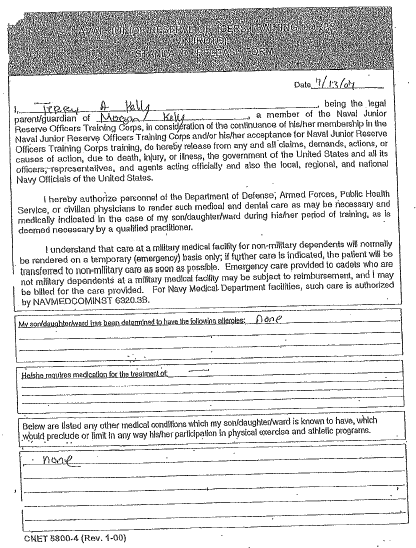
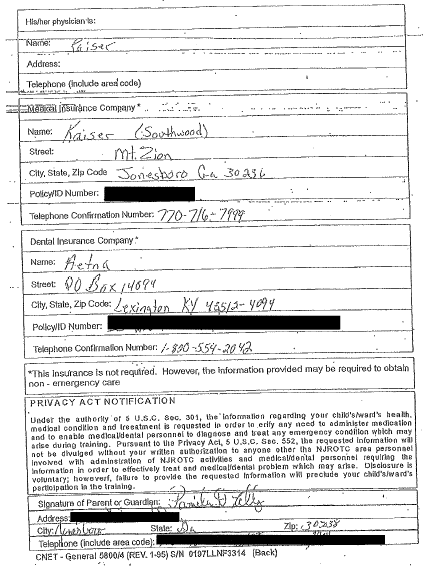
Kindrich III et al., v. Long Beach Yacht Club et al., 167 Cal. App. 4th 1252; 84 Cal. Rptr. 3d 824; 2008 Cal. App. LEXIS 1705
Posted: April 21, 2015 Filed under: Assumption of the Risk, California, Legal Case, Paddlesports | Tags: assumption of the risk, Boating, duty, Primary Assumption of the Risk, Secondary Assumption of the Risk Leave a commentKindrich III et al., v. Long Beach Yacht Club et al., 167 Cal. App. 4th 1252; 84 Cal. Rptr. 3d 824; 2008 Cal. App. LEXIS 1705
Carl Kindrich III et al., Plaintiffs and Appellants, v. Long Beach Yacht Club et al., Defendants and Respondents.
G038290
COURT OF APPEAL OF CALIFORNIA, FOURTH APPELLATE DISTRICT, DIVISION THREE
167 Cal. App. 4th 1252; 84 Cal. Rptr. 3d 824; 2008 Cal. App. LEXIS 1705
October 28, 2008, Filed
COUNSEL: Brunick, McElhaney & Beckett and Steven K. Beckett for Plaintiffs and Appellants.
Cogswell Nakazawa & Chang, Christina L. Owen and Dena S. Aghabeg for Defendants and Respondents.
JUDGES: Opinion by Rylaarsdam, J., with Sills, P. J., concurring. Dissenting opinion by Bedsworth, J.
OPINION BY: Rylaarsdam [*1255]
OPINION
[**825] RYLAARSDAM, J.–Plaintiff Carl Kindrich III was injured while disembarking from a boat after participating in casting his late father’s ashes [**826] into the ocean. He sued defendants Long Beach Yacht Club, the owner of the boat and the dock, and Charles Fuller, the boat’s skipper, alleging they had been negligent in their use and maintenance of both the boat and the dock–specifically because they failed either to have someone on the dock to assist in tying off the boat when it returned, or to ensure that the portable steps, previously used in boarding the boat, would be available for his use when he attempted to disembark. Carl’s wife, Barbara, and son, Michael, also sued. Barbara claimed loss of consortium, and Michael claimed emotional distress suffered as an aural percipient witness to his father’s injury. (Because [***2] all three plaintiffs have the same last name, we will refer to them by their first names to avoid confusion and not out of disrespect.)
The trial court granted summary judgment to defendants, reasoning the doctrine of primary assumption of risk applied to Carl’s decision to jump off the boat onto the dock. All plaintiffs appeal, contending the court improperly concluded that the act of jumping onto the dock was an activity subject to the complete defense of primary assumption of risk. We agree that the court’s analysis was incorrect. Carl was not engaged in the type of sporting event where the doctrine of primary assumption of risk should be applied. At most Carl may have assumed risks, categorized as secondary assumption of risk, which are subsumed in contributory negligence. Whether he was contributorily negligent and, if so, how his negligence compares with that of defendants, if any, are questions of fact to be resolved by the trier of fact.
Defendants also contend summary judgment was properly granted because they were not negligent. But this is another question of fact and not subject to summary judgment. Defendants’ additional issues, whether Barbara suffered damages and whether [***3] Michael’s awareness of his father’s accident qualifies him as a “bystander” entitled to recover on a theory of negligent infliction of emotional distress, also raise questions of fact.
We therefore reverse the summary judgment.
FACTS AND PROCEDURAL HISTORY
The complaint alleges that plaintiffs and some of their relatives and friends gathered at the Yacht Club to participate in a “burial at sea” of the ashes of Carl’s late father. The Yacht Club arranged for the attendees to be taken to the burial site on a boat it owned and maintained and assigned Fuller to pilot that boat. The Yacht Club provided portable stairs on the dock to assist the [*1256] attendees in boarding. Plaintiffs contend that, when the boat returned to the dock, the portable steps were no longer in place. According to the complaint, Fuller told Carl to tie off the boat; there was no one on the dock waiting to do so. As Carl “started to jump from the side of the boat onto the dock … , the boat and dock moved relative to each other causing [Carl] to fall and injure himself.”
Plaintiffs allege causes of action for Carl’s personal injury, Barbara’s loss of consortium, and emotional distress suffered by Michael when he witnessed [***4] his father’s accident.
Defendants moved for summary judgment. They argued that Carl’s claim failed as a matter of law because (1) he assumed any risk of injury from his voluntary decision to jump onto the dock from the boat; and (2) they did not breach any duty of care they might have owed him and had no actual or constructive notice that the portable stairs may not have been in place when the boat returned to the [**827] dock. They also asserted that Barbara’s claim failed as a matter of law, both because it was derivative of Carl’s claim and because her discovery responses revealed no loss of consortium damages. Finally, defendants maintained Michael’s claim failed as a matter of law because it was derivative of Carl’s and because Michael was not actually aware of his father’s injury until after it had occurred.
These are the relevant undisputed facts offered in support of the motion: Carl’s father, a member of the Yacht Club before he died, had expressed the wish to be “buried at sea.” The Yacht Club agreed to assist with such a burial and permitted the Kindrich family to use one of its boats, without charge, for the ceremony. The Yacht Club also agreed to let Fuller, one of its long-standing [***5] members and a good friend of Carl’s father, pilot the boat for the ceremony.
Carl, Barbara, and Michael, along with other family members, used portable steps located on the dock to board the boat for the ceremony. After the ceremony was over, Carl and Michael were up on the bridge with Fuller, who piloted the boat back to the dock. According to Carl’s testimony, “[a]fter the burial, we were bringing the boat in and … not too far from the dock, [Fuller] looked to me and says ‘We have to tie up the boat, and someone else will have to help.’ And Michael and I were the only two on the bridge … . And so Michael said that he would help … . [¶] … When [Fuller] turned the boat into the dock and we had gotten up to the dock and we were getting ready to get off the boat, Mike, my son, jumped to the dock. We didn’t see the steps. The steps weren’t there. And then after Mike jumped off, I jumped off, also … .” [*1257]
Carl stated that at the moment he jumped off the boat, it was hit by the wake from another boat, causing it to “go up as he stepped off the boat and when he came down onto the deck, he broke his leg.” The boat used for the burial ceremony does not require more than two [***6] people to tie it up when it reaches the dock–one person to operate the boat and one person on the dock to tie the lines.
Plaintiffs opposed the summary judgment, arguing this was not a proper case for applying the doctrine of primary assumption of the risk, and the case could not be summarily adjudicated on the basis that defendants acted with reasonable care as a matter of law. Plaintiffs argued there were numerous factual disputes relating to whether defendants satisfied the duty of care they owed to the passengers on their boat, and those issues must ultimately be resolved by a jury.
At the hearing, the court explained its initial thinking in favor of granting the summary judgment: “We have some conflicts in the facts as to whether he jumped, or stepped, or lowered himself, or whatever, but that doesn’t matter. What didn’t happen was he wasn’t pushed. He wasn’t ordered. He voluntarily undertook an activity that was inherently dangerous; namely, disembarking from a moving boat obviously onto the dock and he hurt himself. [¶] I believe that without really much hesitation that … primary assumption of the risk applies and the motions should be granted for summary judgment.”
Although [***7] plaintiffs’ counsel attempted to persuade the court that Fuller directed Carl to assist in tying up the boat, and thus his decision to jump from the boat should not be regarded as voluntary, the court did not agree. “[Carl] assumed the risk of something in this recreational activity going wrong. [¶] It did go wrong. The precise wrong is irrelevant. One way or the other he voluntarily disembarked the boat … with the idea of going onto [**828] the dock, and this was an unsafe thing to do.”
The formal order granting the motion cited two bases. First, the court found that “even if the portable steps were actually missing when the vessel … arrived back at dock after the burial at sea, [d]efendants had no notice, constructive or actual, of their absence. … [¶] The Court additionally finds that [d]efendants are entitled to summary adjudication on their Fourth Affirmative Defense because when [p]laintiff … made the deliberate and conscious decision to jump from the vessel … to the dock, he, with full knowledge thereof, knowingly and voluntarily assumed the risk of sustaining injury. (See Meintsma v. United States [(9th Cir. 1947)] 164 F.2d 976 … ; see also DeRoche v. Commodore Cruise Line, Ltd. (1994) 31 Cal.App.4th 802, 810 [46 Cal. Rptr. 2d 468] [***8] (‘[It] is settled that there is no duty to warn of a danger that is as obvious to the injured party as to the defendant.’).)” [*1258]
The order granted summary judgment against Barbara and Michael as well, concluding Barbara’s claim for loss of consortium was derivative as a matter of law and that any distinct claim for emotional distress was precluded by the fact she did not actually witness Carl’s injury. As to Michael’s claim, the court concluded that a bystander’s recovery for extreme emotional distress was dependent upon a determination the injury he witnessed was negligently inflicted. Since Carl’s negligence claim failed, Michael’s did as well.
DISCUSSION
Primary Versus Secondary Assumption of Risk
(1) Even were we to conclude that Carl’s decision to jump off the boat was a voluntary one, and that therefore he assumed a risk inherent in doing so, this is not enough to provide a complete defense. [HN1] Because voluntary assumption of risk as a complete defense in a negligence action was abandoned in Li v. Yellow Cab Co. (1975) 13 Cal.3d 804, 829 [119 Cal. Rptr. 858, 532 P.2d 1226], only the absence of duty owed a plaintiff under the doctrine of primary assumption of risk would provide such a defense. But that doctrine does not come [***9] into play except when a plaintiff and a defendant are engaged in certain types of activities, such as an “active sport.” That was not the case here; plaintiff was merely the passenger on a boat. Under Li, he may have been contributorily negligent but this would only go to reduce the amount of damages to which he is entitled.
Before Li, contributory negligence and voluntary assumption of risk were distinct and complete defenses in an action for negligence. Under certain circumstances, the “last clear chance” doctrine provided relief from the harshness of the rules. Li changed all that. It adopted the doctrine of comparative negligence and held that “[t]he [HN2] doctrine of last clear chance is abolished, and the defense of assumption of risk is also abolished to the extent that it is merely a variant of the former doctrine of contributory negligence; both of these are to be subsumed under the general process of assessing liability in proportion to negligence.” (Li v. Yellow Cab Co., supra, 13 Cal.3d at p. 829.)
Li recognized that there are at least two distinct forms of assumption of risk. “As for assumption of risk, we have recognized in this state that this defense overlaps that of contributory [***10] negligence to some extent and in fact is made up of at least two distinct defenses. ‘To simplify greatly, it has been observed … that in one kind of situation, to wit, where a plaintiff unreasonably undertakes to encounter a specific known risk imposed by a defendant’s negligence, [**829] plaintiff’s conduct, although he may encounter that risk in a prudent manner, is in reality a form of contributory negligence … . [*1259] Other kinds of situations within the doctrine of assumption of risk are those, for example, where plaintiff is held to agree to relieve defendant of an obligation of reasonable conduct toward him. Such a situation would not involve contributory negligence, but rather a reduction of defendant’s duty of care.’ [Citations.] We think it clear that the adoption of a system of comparative negligence should entail the merger of the defense of assumption of risk into the general scheme of assessment of liability in proportion to fault in those particular cases in which the form of assumption of risk involved is no more than a variant of contributory negligence. [Citation.]” (Li v. Yellow Cab Co., supra, 13 Cal.3d at pp. 824-825.)
(2) So, [HN3] to the extent that “‘”a plaintiff unreasonably [***11] undertakes to encounter a specific known risk imposed by a defendant’s negligence,”‘” he or she is subject to the defense of comparative negligence but not to an absolute defense. (Knight v. Jewett (1992) 3 Cal.4th 296, 305-306 [11 Cal. Rptr. 2d 2, 834 P.2d 696].) This type of comparative negligence has been referred to as ” ‘secondary assumption of risk.’ ” (Id. at p. 308.) Assumption of risk that is based upon the absence of a defendant’s duty of care is called ” ‘primary assumption of risk.’ ” (Ibid.) “First, in ‘primary assumption of risk’ cases–where the defendant owes no duty to protect the plaintiff from a particular risk of harm–a plaintiff who has suffered such harm is not entitled to recover from the defendant, whether the plaintiff’s conduct in undertaking the activity was reasonable or unreasonable. Second, in ‘secondary assumption of risk’ cases–involving instances in which the defendant has breached the duty of care owed to the plaintiff–the defendant is not entitled to be entirely relieved of liability for an injury proximately caused by such breach, simply because the plaintiff’s conduct in encountering the risk of such an injury was reasonable rather than unreasonable.” (Id. at p. 309.)
Primary assumption [***12] of risk, “‘”where plaintiff is held to agree to relieve defendant of an obligation of reasonable conduct toward him”‘” (Knight v. Jewett, supra, 3 Cal.4th at p. 306), remains as a complete defense. That defense was not fully developed until our Supreme Court decided Knight v. Jewett. There, Knight sued Jewett for negligence and assault and battery after she was injured when Jewett knocked her over and stepped on her finger during a touch football game. In affirming summary judgment for the defendant, the court held that under the doctrine of primary assumption of risk, the defendant did not owe the plaintiff a duty. It “conclude[d] that a participant in an active sport breaches a legal duty of care to other participants–i.e., engages in conduct that properly may subject him or her to financial liability–only if the participant intentionally injures another player or engages in conduct that is so reckless as to be totally outside the range of the ordinary activity involved in the sport.” (Id. at p. 320, fn. omitted.) [*1260]
(3) Knight shifted the focus of assumption of risk from a plaintiff’s “subjective knowledge and awareness” of the risk to the nature of the activity in question. (Knight v. Jewett, supra, 3 Cal.4th at p. 313.) [***13] [HN4] “In cases involving ‘primary assumption of risk’–where, by virtue of the nature of the activity and the parties’ relationship to the [**830] activity, the defendant owes no legal duty to protect the plaintiff from the particular risk of harm that caused the injury–the doctrine continues to operate as a complete bar to the plaintiff’s recovery.” (Id. at pp. 314-315.) Knight justified maintaining the defense in a sports setting because there “conditions or conduct that otherwise might be viewed as dangerous often are an integral part of the sport itself” (id. at p. 315), and imposing liability “might well alter fundamentally the nature of the sport by deterring participants from vigorously engaging in activity that falls close to, but on the permissible side of, a prescribed rule” (id. at p. 319). The focus of the questions should consider the nature of the activity and the relationship of the parties to the activity. (Id. at p. 315.)
There are situations other than active sports where under the doctrine of primary assumption of risk a plaintiff is held to agree to relieve a defendant of an obligation of reasonable conduct toward him or her. For example, Knight stated, “In addition to the sports [***14] setting, the primary assumption of risk doctrine also comes into play in the category of cases often described as involving the ‘firefighter’s rule.’ [Citation.] In its most classic form, the firefighter’s rule involves the question whether a person who negligently has started a fire is liable for an injury sustained by a firefighter who is summoned to fight the fire; the rule provides that the person who started the fire is not liable under such circumstances. [Citation.] Although a number of theories have been cited to support this conclusion, the most persuasive explanation is that the party who negligently started the fire had no legal duty to protect the firefighter from the very danger that the firefighter is employed to confront. [Citations.] Because the defendant in such a case owes no duty to protect the firefighter from such risks, the firefighter has no cause of action even if the risk created by the fire was so great that a trier of fact could find it was unreasonable for the firefighter to choose to encounter the risk.” (Knight v. Jewett, supra, 3 Cal.4th at pp. 309-310, fn. 5.)
Other examples of primary assumption of risk are the so-called veterinarian’s rule (e.g., Priebe v. Nelson (2006) 39 Cal.4th 1112, 1121, fn. 1 [47 Cal. Rptr. 3d 553, 140 P.3d 848]) [***15] or where the plaintiff is hired to undertake a particular, dangerous job (e.g., Farnam v. State of California (2000) 84 Cal.App.4th 1448, 1455 [101 Cal. Rptr. 2d 642]; Herrle v. Estate of Marshall (1996) 45 Cal.App.4th 1761, 1765 [53 Cal. Rptr. 2d 713]). But for purposes of this case, we need only consider whether Carl’s injuries occurred while he was engaged in an “active sport,” which relieved defendants of a duty of care. [*1261]
There are more than 100 published cases defining what is and what is not an “active sport” qualifying for application of the doctrine of primary assumption of risk. “Since the decision in Knight, which involved a recreational game of touch football, our state Supreme Court and appellate courts have examined the applicability of the primary assumption of the risk defense in a wide variety of cases involving sports and recreational activities. In Ford[ v. Gouin (1992)] 3 Cal.4th 339 [11 Cal. Rptr. 2d 30, 834 P.2d 724], the companion case to Knight, the Supreme Court expanded the doctrine and applied it to the noncompetitive, nonteam sporting activity of waterskiing. The Supreme Court has applied the doctrine to other sports, including intercollegiate baseball (Avila v. Citrus Community College Dist. (2006) 38 Cal.4th 148, 161 [**831] [41 Cal. Rptr. 3d 299, 131 P.3d 383]), swimming (Kahn[ v. East Side Union High School Dist. (2003)] 31 Cal.4th [990,] 1004-1005 [4 Cal. Rptr. 3d 103, 75 P.3d 30] [***16] [examining coach’s relationship to sport]), and snow skiing (Cheong v. Antablin (1997) 16 Cal.4th 1063, 1067-1068 [68 Cal. Rptr. 2d 859, 946 P.2d 817] …). [Citation.] The Courts of Appeal have applied the primary assumption of the risk rule in cases involving snow skiing (Connelly v. Mammoth Mountain Ski Area (1995) 39 Cal.App.4th 8 [45 Cal. Rptr. 2d 855]), ‘off-roading’ with a motorcycle or ‘dune buggy’ (Distefano v. Forester (2001) 85 Cal.App.4th 1249, 1255, 1259-1265 [102 Cal. Rptr. 2d 813]), skateboarding (Calhoon v. Lewis (2000) 81 Cal.App.4th 108, 115-117 [96 Cal. Rptr. 2d 394]), figure ice skating (Staten v. Superior Court (1996) 45 Cal.App.4th 1628, 1632-1636 [53 Cal. Rptr. 2d 657]), and long-distance group bicycle riding (Moser v. Ratinoff (2003) 105 Cal.App.4th 1211, 1218-1223 [130 Cal. Rptr. 2d 198]), to name a few.” (Truong v. Nguyen (2007) 156 Cal.App.4th 865, 878-879 [67 Cal. Rptr. 3d 675] [primary assumption of risk applied to bar action for injury to passenger on jet ski].)
In Record v. Reason (1999) 73 Cal.App.4th 472 [86 Cal. Rptr. 2d 547], the court held that where the plaintiff was injured when he fell off an inner tube while being towed behind a motor boat, primary assumption of risk applied. In doing so, the court considered the issue of whether a particular activity was a “sport” such that the doctrine should be applied. [***17] After reviewing a substantial number of cases applying primary assumption of risk to a variety of activities, the court concluded that “[c]ompiling all of the distinguishing factors, it appears that an activity falls within the meaning of ‘sport’ if the activity is done for enjoyment or thrill, requires physical exertion as well as elements of skill, and involves a challenge containing a potential risk of injury.” (Id. at p. 482.) Although we agree with the result in Record its reliance on a plaintiff’s subjective reasons for participating in a sport seems inconsistent with Knight‘s test, which focuses on whether imposing liability would “alter fundamentally the nature of the sport by deterring participants from” vigorous participation. (Knight v. Jewett, supra, 3 Cal.4th at p. 319.) [*1262]
(4) Stimson v. Carlson (1992) 11 Cal.App.4th 1201, 1205 [14 Cal. Rptr. 2d 670] applied primary assumption of risk to sailing where the plaintiff was one of the crew operating the boat; the court noted that sailing involves swinging booms and physical participation of crew. But in our case, plaintiff was not a participant in the “sport” of boating or in any “active sport.” He was a passenger. Thus [HN5] this activity does not fall within [***18] the test set out in Knight, i.e., that to hold defendants owed no duty to plaintiffs would “alter fundamentally the nature of [a] sport by deterring participants from” vigorous participation. (Knight v. Jewett, supra, 3 Cal.4th at p. 319.)
This case is more analogous to Shannon v. Rhodes (2001) 92 Cal.App.4th 792 [112 Cal. Rptr. 2d 217]. There a six-year-old child and her siblings sued the owner and operator of a ski boat for negligence arising from injuries sustained by the child when she fell from the boat into the boat’s propeller. The Court of Appeal reversed summary judgment, holding that primary assumption of risk did not apply. The court noted, “Our analysis begins by examining with what activity the Knight court was concerned. In Knight, the court came to the commonsense conclusion that when two people are playing a sport together one should not be liable to the other for injuries sustained while playing that sport [**832] absent some recklessness or intentional misconduct. [Citation.] The parties in Knight were engaged in a recreational game of football, clearly a physical activity and ‘sport’ within any common understanding of the word.” (Id. at p. 796.) Shannon held that the defense did not apply where [***19] the plaintiff was merely a passenger in the ski boat. (Id. at p. 801.)
Shannon distinguished Ford v. Gouin, supra, 3 Cal.4th 339, the waterskiing case, by noting that in Ford, our Supreme Court “explicitly used the language ‘noncompetitive but active sports activity’ in applying the doctrine to waterskiing. [Citation.] A review of the reasoning set forth in Ford makes clear that the court focused on the physical skill and risk involved in the waterskiing itself to conclude that the activity of waterskiing was a sport, and the boat driver a coparticipant in that sport. [Citation.] The same certainly cannot be said of a mere passenger in a boat … .” (Shannon v. Rhodes, supra, 92 Cal.App.4th at p. 798.)
(5) Here, the trial court characterized the activity in which plaintiff engaged as “jumping” rather than boating. We disagree that [HN6] we must surgically separate an activity’s constituent parts apart from the general activity in which the plaintiff was engaged. Carl was engaged in boating, not in jumping. If he had been a jumper, in the sense of one who competes in athletic events, our conclusion would be different. But he was disembarking from the boat; his method of doing so, be it leaping, jumping, stepping off, or walking the gangplank, [***20] did not turn his activity into an “active sport.” [*1263]
We therefore conclude that the doctrine of primary assumption of risk does not bar plaintiffs’ action.
Defendants’ Remaining Arguments
(6) We need not expend a great deal of time dealing with the rest of defendants’ arguments. Although these were not the basis for the grant of summary judgment, we will comment briefly. Defendants contend they acted with reasonable care. But this argument should be made not to us but to the trier of facts. [HN7] Whether reasonable care has been exercised is normally a question of fact. (Butigan v. Yellow Cab Co. (1958) 49 Cal.2d 652, 656 [320 P.2d 500].) Even if defendants were not responsible for the removal of the steps, and they contend the steps were there, this would only be one possible theory of liability. And, in light of the conflicting evidence, it is not for us to decide whether the steps were removed and, if so, by whom.
(7) As to defendants’ argument that Carl’s wife, Barbara, did not sustain damages to support her loss of consortium claim, the contention rests on the absence of evidence of physical injuries. But, as plaintiffs point out, “[a]lthough [HN8] loss of consortium may have physical consequences, it is principally a form [***21] of mental suffering.” (Rodriguez v. Bethlehem Steel Corp. (1974) 12 Cal.3d 382, 401 [115 Cal. Rptr. 765, 525 P.2d 669].)
(8) Defendants’ final argument is equally specious. [HN9] Whether or not Carl’s son, Michael, had such a contemporaneous sensory awareness of the accident as to satisfy the requirements of Thing v. La Chusa (1989) 48 Cal.3d 644, 668-669 [257 Cal. Rptr. 865, 771 P.2d 814] is again a question of fact, not to be resolved by us.
DISPOSITION
The judgment is reversed. Appellants shall recover their costs.
Sills, P. J., concurred.
DISSENT BY: BEDSWORTH
DISSENT
BEDSWORTH, J., Dissenting.–“No good deed goes unpunished” has become a truism of modern life. Today, [**833] by allowing suit against a yacht club that tried to help one of the sons of a member in his time of grief, only to be sued when he hurt himself intruding into their conduct of the good deed, my colleagues give this sad commentary on modern society the force of law. I respectfully dissent from that.
Carl Kindrich III was injured when he jumped off a boat and onto a dock. He did so voluntarily, after he knew his adult son, Michael, had already [*1264] gotten onto the dock to assist in tying off the boat. There is absolutely no evidence that anyone suggested, let alone required, that Kindrich himself must get off the boat prior [***22] to the time the stairs were put into place on the dock for the egress of passengers. Nonetheless, Kindrich, along with his wife and son, sued both the Long Beach Yacht Club and Charles Fuller, the Yacht Club member who captained the boat, alleging they were responsible for his injuries.
The trial court granted summary judgment to defendants, and I would affirm that judgment. I believe the trial court properly concluded that Kindrich’s specific act of “jumping onto the dock,” rather than the more generic and sedate “boating” was the relevant “activity” for purposes of assessing his assumption of risk. In my view, jumping or stepping some two and one-half or three feet off the side of a boat onto a dock–merely because portable steps had not yet been put into place–is no more an integral part of “boating” than diving out a window–because no one has yet opened the door–is an integral part of visiting a house.
This was not an outing or an excursion. It was not a leisurely sail. The trip was made to dispose of the ashes of Kindrich’s father. The injury in question was not the result of “boating.” Kindrich was not swept off the boat by a wave or hit by a jib. He jumped off the [***23] boat at the conclusion of the trip before the boat had been tied up. His injury was the result of his sudden decision he would leap off the boat rather than waiting for his son to finish tying it off and ensuring debarkation could be safely accomplished.
It is undisputed that defendants did not expect, let alone require, that passengers would have to jump off this particular boat as part of the “boating” experience. To my mind, the existence of portable stairs, which had been used by these passengers when boarding the boat, and were intended to be kept on the dock for the passengers to use in both getting on and off the boat, rather conclusively establishes the lack of any such expectation. And Kindrich’s own testimony demonstrates that even he did not consider jumping off the side of the boat onto the dock to be a normal part of this boat ride, let alone an integral part of the activity of “boating” in general. As Kindrich explained it, he not only did not expect that anyone else on the boat would be jumping off, he believed them unable to do it. 1
1 As Kindrich explained in his deposition, “Jim, my brother, has a back to where he can’t do a lot of jumping; Mary Ann would not be capable [***24] of doing it; Lisa wouldn’t be capable of doing it; my grandsons would not be capable of doing it. And the other two gentlemen would not be capable of doing it.”
Moreover, there is no evidence that anyone–either Fuller or the Yacht Club–imposed some special obligation on Kindrich to jump off the boat and [*1265] be on the dock while it was being tied up. Instead, Kindrich’s own testimony establishes that (1) Fuller merely stated (either directly to Kindrich or generally to him and his son) that it was necessary to tie up the boat, and “someone else” would have to assist; (2) Kindrich’s son immediately volunteered to do that; and (3) Kindrich was aware his son [**834] had already jumped onto the dock for the purpose of tying off lines before his own ill-fated attempt to follow suit. Even assuming it was actually necessary for “someone” to be on the dock–a fact disputed below–it is uncontested that need had been met prior to Kindrich’s jump.
Under these facts, it is clear that jumping off the boat before the stairs were in place was not a requirement placed generally on those who were passengers on the boat, and it was not a requirement placed specifically on Kindrich by any defendant. 2 Hence, [***25] Kindrich’s decision to do so was simply an optional, and entirely voluntary act, which must be distinguished, for analytical purposes, from any normal aspect of “boating.”
2 Of course, I do not mean to suggest Kindrich necessarily thought through these events with the specificity I have just employed. Presumably, he just figured if Fuller needed help getting the boat tied onto the dock, he was willing to do whatever he could to assist. But that instinct is the essence of volunteerism: “Somebody ought to do it, might as well be me” is not the same thing as being specifically assigned a task. And the fact Fuller might even have appreciated having two people on the dock is not the same thing as concluding he actually directed Kindrich to get onto the dock–by whatever means possible–as soon as the boat arrived. Based upon the evidence in this case, the trial court correctly determined Kindrich was acting voluntarily when he jumped off the boat.
As my colleagues seem to concede, when Kindrich’s activity is construed not as an integral part of “boating” but rather as simply an impetuous act of “jumping off the boat,” it falls within the scope of “athletic” endeavors, which includes those [***26] noncompetitive activities requiring some level of “physical skill and risk,” and thus primary assumption of the risk would apply. (See Ford v. Gouin (1992) 3 Cal.4th 339, 345 [11 Cal. Rptr. 2d 30, 834 P.2d 724]; Shannon v. Rhodes (2001) 92 Cal.App.4th 792, 798 [112 Cal. Rptr. 2d 217].) Because I see it that way, I would apply that doctrine, and grant the summary judgment.
But I should also note that I disagree with the majority’s analysis for an additional reason. As they explain, they considered Kindrich’s situation to be more analogous to Shannon v. Rhodes, supra, 92 Cal.App.4th 792, in which the injured plaintiff, a six-year-old child, was merely a passenger when she fell out of a boat that lurched unexpectedly, than to Stimson v. Carlson (1992) 11 Cal.App.4th 1201 [14 Cal. Rptr. 2d 670], in which the court applied primary assumption of the risk to a plaintiff who was injured while serving as a crewmember on a sailboat. If that is the analysis, it would lead me to the opposite conclusion. After all, a cornerstone of Kindrich’s theory of liability [*1266] is the assertion he had agreed to help with the docking of the boat, which is why–unlike the other passengers–he could not simply wait for the stairs to be put in place before getting onto the dock. If we accept [***27] his view, it seems clear that at the time of the accident, Kindrich had assumed the role of “crew,” rather than remaining a mere passenger. That would bring him within the majority’s characterization of Stimson. For that reason as well, I would affirm the judgment.
My colleagues have expanded civil liability beyond previous decisional law and beyond my ability to sign on. This ship will have to sail without me.
Respondents’ petition for review by the Supreme Court was denied February 11, 2009, S168902. Werdegar, J., did not participate therein.
Angelo, v. USA Triathlon, 2014 U.S. Dist. LEXIS 131759
Posted: April 21, 2015 Filed under: Legal Case, Massachusetts, Racing, Triathlon | Tags: #race, Estate, Indemnification, Negligent infliction of emotional distress, Pain and Suffering, Personal Representative, Release, swimming, Triathlon, USA Triathlon, USAT, Wrongful Death Leave a commentTo Read an Analysis of this decision see: A federal district court in Massachusetts upholds indemnification clause in a release.
Angelo, v. USA Triathlon, 2014 U.S. Dist. LEXIS 131759
Cheryl Angelo, Personal Representative of the Estate of Richard Angelo, Plaintiff, v. USA Triathlon, Defendant.
Civil Action No. 13-12177-LTS
UNITED STATES DISTRICT COURT FOR THE DISTRICT OF MASSACHUSETTS
2014 U.S. Dist. LEXIS 131759
September 18, 2014, Decided
September 19, 2014, Filed
COUNSEL: [*1] For Cheryl Angelo, Plaintiff: Alan L. Cantor, LEAD ATTORNEY, Joseph A. Swartz, Peter J. Towne, Swartz & Swartz, Boston, MA.
For USA TRIATHLON, Defendant: Douglas L. Fox, Shumway, Giguere, Fox PC, Worcester, MA.
JUDGES: Leo T. Sorokin, United States District Judge.
OPINION BY: Leo T. Sorokin
OPINION
MEMORANDUM AND ORDER ON DEFENDANT’S MOTION FOR PARTIAL SUMMARY JUDGMENT
SOROKIN, D.J.
This action arises from a tragic set of facts in which Richard Angelo died while participating in the swim portion of a triathlon organized by the defendant, USA Triathlon (“USAT”). Plaintiff Cheryl Angelo (“the plaintiff”), as personal representative of Richard Angelo (“Angelo” or “the decedent”), has brought claims of wrongful death, conscious pain and suffering, and negligent infliction of emotional distress. USAT has counterclaimed for indemnity against any liability and legal costs associated with this action pursuant to indemnity agreements executed by the decedent prior to his participation in the triathlon. USAT has now moved for partial summary judgment on its claim for indemnity. Doc. No. 18. The plaintiff has opposed the Motion. Doc. No. 19. For the reasons stated below, USAT’s Motion is ALLOWED IN PART and DENIED IN PART.
I. [*2] STATEMENT OF FACTS
The following facts are stated in the light most favorable to the plaintiff as the nonmoving party, although the key facts for the purposes of this motion are not disputed. Angelo was a member of USAT since, at the latest, 2011. Doc. No. 18-1 at 1 ¶ 3. When Angelo last renewed his membership on August 12, 2011, he agreed to and electronically signed a “Waiver and Release of Liability, Assumption of Risk and Indemnity Agreement.” Id. at 1 ¶ 3, 4. That agreement only required the member to execute the document, and, accordingly, the plaintiff did not sign the form. Id. at 4-5. That document contained a provision that, in its entirety, reads as follows:
4. I hereby Release, Waive and Covenant Not to Sue, and further agree to Indemnify, Defend and Hold Harmless the following parties: USAT, the Event Organizers and Promoters, Race Directors, Sponsors, Advertisers, Host Cities, Local Organizing Committees, Venues and Property Owners upon which the Event takes place, Law Enforcement Agencies and other Public Entities providing support for the Event, and each of their respective parent, subsidiary and affiliated companies, officers, directors, partners, shareholders, members, agents, employees [*3] and volunteers (Individually and Collectively, the “Released Parties” or “Event Organizers”), with respect to any liability, claim(s), demand(s), cause(s) of action, damage(s), loss or expense (including court costs and reasonable attorneys [sic] fees) of any kind or nature (“Liability”) which may arise out of, result from, or relate to my participation in the Event, including claims for Liability caused in whole or in part by the negligence of the Released Parties. I further agree that if, despite this Agreement, I, or anyone on my behalf, makes a claim for Liability against any of the Released Parties, I will indemnify, defend and hold harmless each of the Released Parties from any such Liability which any [sic] may be incurred as the result of such claim.
Id. at 4.
USAT arranged to hold its National Age Group Championship on August 18, 2012, in Burlington, Vermont. Id. at 2 ¶ 5. On February 17, 2012, Angelo registered for the championship and, as part of his registration, electronically signed an indemnity agreement identical to the one excerpted above. Id. at 2 ¶ 6. As with the prior agreement, only Angelo as the participant was required to, and in fact did, sign the form. Doc. Nos. 18-1 at 33-34, 19-2 [*4] at 3. Angelo competed in that triathlon and died during his participation in the swim portion of that event or shortly thereafter. Doc. No. 18-2 at 11-12.
The plaintiff, the decedent’s wife and the personal representative of his estate, then brought this action in Essex Superior Court, alleging wrongful death, conscious pain and suffering by the decedent, gross negligence resulting in the decedent’s death, and negligent infliction of emotional distress suffered by the plaintiff, who was present at the site of the race. Doc. No. 6 at 12-16. USAT subsequently removed the action to this Court. Doc. No. 1.
II. STANDARD OF REVIEW
Summary judgment is appropriate when “the movant shows that there is no genuine dispute as to any material fact and the movant is entitled to judgment as a matter of law.” Fed. R. Civ. P. 56(a). Once a party “has properly supported its motion for summary judgment, the burden shifts to the non-moving party, who ‘may not rest on mere allegations or denials of his pleading, but must set forth specific facts showing there is a genuine issue for trial.'” Barbour v. Dynamics Research Corp., 63 F.3d 32, 37 (1st Cir. 1995) (quoting Anderson v. Liberty Lobby, Inc., 477 U.S. 242, 256, 106 S. Ct. 2505, 91 L. Ed. 2d 202 (1986)). The Court is “obliged to []view the record in the light most favorable to the nonmoving party, and to draw all reasonable inferences [*5] in the nonmoving party’s favor.” LeBlanc v. Great Am. Ins. Co., 6 F.3d 836, 841 (1st Cir. 1993). Even so, the Court is to ignore “conclusory allegations, improbable inferences, and unsupported speculation.” Prescott v. Higgins, 538 F.3d 32, 39 (1st Cir. 2008) (quoting Medina-Muñoz v. R.J. Reynolds Tobacco Co., 896 F.2d 5, 8 (1st Cir. 1990)). A court may enter summary judgment “against a party who fails to make a showing sufficient to establish the existence of an element essential to that party’s case, and on which that party will bear the burden of proof at trial.” Celotex Corp. v. Catrett, 477 U.S. 317, 322, 106 S. Ct. 2548, 91 L. Ed. 2d 265 (1986).
III. DISCUSSION
USAT has moved for partial summary judgment on their counterclaim for indemnity.1 USAT asserts that the decedent’s execution of the two release and indemnity agreements (“the indemnity agreements”) released or indemnified, or both, all claims that arise from his participation in the National Age Group Championship, including all claims brought by the plaintiff in this action. The plaintiff counters that the indemnity agreements could not function to release her claims for wrongful death or negligent infliction of emotional distress, and that an indemnity agreement is not enforceable insofar as it exempts the indemnitee from liability for its own grossly negligent conduct.
1 The Court understands this motion for summary judgment to be limited to the scope of the release and indemnity agreement [*6] and its application to the plaintiff’s claims as raised in the Complaint and as amplified in the motion papers. Despite USAT’s argument to the contrary, the Court does not believe this motion to be an appropriate vehicle to address the substantive merits of the plaintiff’s pleadings or claims.
Under Massachusetts law,2 “[c]ontracts of indemnity are to be fairly and reasonably construed in order to ascertain the intention of the parties and to effectuate the purpose sought to be accomplished.” Post v. Belmont Country Club, Inc., 60 Mass. App. Ct. 645, 805 N.E.2d 63, 69 (Mass. App. Ct. 2004) (quoting Shea v. Bay State Gas Co., 383 Mass. 218, 418 N.E.2d 597, 600 (Mass. 1981)). Indemnity contracts that exempt a party from liability arising from their own ordinary negligence are not illegal. Id. at 70. Further, contracts of indemnity can survive a decedent’s death and become an obligation of a decedent’s estate. Id. at 71.
2 The parties do not contend that the law of any other state applies.
Here, the language in the indemnity provision is broad. The plaintiff argues, briefly, that the indemnity agreements are ambiguous as to who is bound by the agreements. The Court disagrees. The agreement clearly states that “I . . . agree to Indemnify, Defend and Hold Harmless” the released parties from liability “of any kind or nature . . . which may arise out of, result from, or relate to my participation [*7] in the Event.” Doc. No. 18-1 at 4. By the plain language of the provision, the signatory of the agreement agreed to indemnify USAT for any losses arising from his participation in the triathlon, including losses and damages associated with lawsuits arising from his participation. See Post, 805 N.E.2d at 70. Both the scope of the indemnity and the party bound by the agreement are clear and unambiguous. A close examination is required, however, to ascertain the applicability of the provision to the specific claims raised and the sources available to satisfy the indemnity.
A. Counts 1 and 3: Wrongful Death
The first count in the plaintiff’s Complaint alleges wrongful death due to USAT’s negligence. The third count alleges wrongful death due to USAT’s gross negligence and seeks punitive damages. Under Massachusetts law, an action for wrongful death is “brought by a personal representative on behalf of the designated categories of beneficiaries” set forth by statute. Gaudette v. Webb, 362 Mass. 60, 284 N.E.2d 222, 229 (Mass. 1972); see Mass. Gen. Laws ch. 229, §§ 1, 2. “The money recovered upon a wrongful death claim is not a general asset of the probate estate, but constitutes a statutory trust fund, held by the administratrix as trustee for distribution to the statutory beneficiaries.”3 Marco v. Green, 415 Mass. 732, 615 N.E.2d 928, 932 (Mass. 1993) (quoting Sullivan v. Goulette, 344 Mass. 307, 182 N.E.2d 519, 523 (Mass. 1962)). These [*8] aspects of Massachusetts law have led another judge of this Court to the conclusion that “[w]rongful death is not, in any traditional sense, a claim of the decedent.” Chung v. StudentCity.com, Inc., Civ. A. 10-10943-RWZ, 2011 U.S. Dist. LEXIS 102370, 2011 WL 4074297, at *2 (D. Mass. Sept. 9, 2011).
3 The Massachusetts Legislature has created limited statutory exceptions whereby the recovery on a wrongful death claim may be reached to pay certain specified expenses. Mass. Gen. Laws ch. 229, § 6A. None of those exceptions are implicated by the present Motion. See id.
As stated above, the indemnity agreements signed by the decedent, by their terms, clearly were intended to indemnify losses arising from an action for wrongful death as a claim “aris[ing] out of” the decedent’s participation in the triathlon. Thus, USAT is entitled to indemnity on losses resulting from that claim. That does not end the matter, however, because the parties raise the question of where USAT may look in order to satisfy the indemnity obligation. The decedent, while having authority to bind his estate, see Post, 805 N.E.2d at 71, lacked authority to bind his surviving family members who did not sign the indemnity agreements and are not bound thereby, see Chung, 2011 U.S. Dist. LEXIS 102370, 2011 WL 4074297, at *2. Accordingly, to satisfy the indemnity obligation, USAT may look to the assets of the decedent’s estate. See [*9] Post, 805 N.E.2d at 71 (noting that a contract of indemnity agreed to by a decedent became an obligation of the decedent’s estate). USAT may not, however, look to any recovery on the wrongful death claim for satisfaction, as that recovery would be held in trust for the statutory beneficiaries and would not become an asset of the estate. See Estate of Bogomolsky v. Estate of Furlong, Civ. A. 14-12463-FDS, 2014 U.S. Dist. LEXIS 86998, 2014 WL 2945927, at *2 (D. Mass. June 26, 2014).4 USAT concedes this outcome as to the plaintiff’s negligent infliction of emotional distress claim, Doc. No. 20 at 11-12, and given the structure of wrongful death claims in Massachusetts, there is no reason for a different result as to the wrongful death claims.5
4 In Estate of Bogomolsky, a recent decision of another session of this Court, Judge Saylor came to the same conclusion, finding that a judgment creditor of a decedent’s estate would not be able to restrain the proceeds of an insurance policy distributed pursuant to the wrongful death statute, as the proceeds of the policy were held in trust for the decedent’s next of kin and did not belong to the decedent’s estate. Estate of Bogomolsky, 2014 U.S. Dist. LEXIS 86998, 2014 WL 2945927, at *2.
5 While the plaintiff notes that the Massachusetts Appeals Court has reserved the question of whether an indemnification provision would be [*10] enforced to effectively release the claims of people who were not signatories of such an agreement, see Post, 805 N.E.2d at 70-71, this case, as in Post, does not present that circumstance, as the indemnity agreements in this case do not purport to extinguish the plaintiff’s right to bring her claims nor her right to recover on those claims.
Count three of the plaintiff’s Complaint, alleging that the decedent’s death was a result of USAT’s gross negligence, raises the issue of whether Massachusetts courts would enforce an indemnity contract to the extent it functioned to indemnify a party’s own gross negligence. The Court has uncovered no controlling authority from the Supreme Judicial Court of Massachusetts on this issue, nor any case of the Massachusetts Appeals Court on point. In such a case, “[w]here the state’s highest court has not definitively weighed in, a federal court applying state law ‘may consider analogous decisions, considered dicta, scholarly works, and any other reliable data tending convincingly to show how the highest court in the state would decide the issue at hand.'” Janney Montgomery Scott LLC v. Tobin, 571 F.3d 162, 164 (1st Cir. 2009) (quoting N. Am. Specialty Ins. Co. v. Lapalme, 258 F.3d 35, 38 (1st Cir. 2001)).
In the closely analogous context of releases, the Massachusetts Appeals Court has held that, for reasons of public policy, [*11] a release would not be enforced to exempt a party from liability for grossly negligent conduct, though otherwise effective against ordinary negligence. Zavras v. Capeway Rovers Motorcycle Club, Inc., 44 Mass. App. Ct. 17, 687 N.E.2d 1263, 1265 (Mass. App. Ct. 1997). The Supreme Judicial Court, although not adopting that holding, has noted that public policy reasons exist for treating ordinary negligence differently from gross negligence when enforcing releases. Sharon v. City of Newton, 437 Mass. 99, 769 N.E.2d 738, 748 n.12 (Mass. 2002). Finally, Judge Saylor of this Court, examining this caselaw, has concluded that the Supreme Judicial Court would not enforce an indemnity agreement to the extent it provided for indemnification of a party’s own gross negligence. CSX Transp., Inc. v. Mass. Bay Transp. Auth., 697 F. Supp. 2d 213, 227 (D. Mass. 2010).
This Court, having studied the caselaw, agrees with and reaches the same conclusion as Judge Saylor: specifically that Massachusetts courts would not enforce an indemnity provision insofar as it relieved a party from liability stemming from its own gross negligence. Thus, the indemnity agreements executed by the decedent are not enforceable to the extent they would require the decedent’s estate to indemnify losses arising from USAT’s grossly negligent conduct.6
6 This conclusion would gain significance if the plaintiff were to be awarded punitive damages owing to USAT’s alleged gross negligence. Punitive damages [*12] awarded under the wrongful death statute, unlike compensatory damages under that statute, are considered general assets of the decedent’s estate. Burt v. Meyer, 400 Mass. 185, 508 N.E.2d 598, 601-02 (Mass. 1987). Any punitive damages, however, could not be reached in satisfaction of the indemnity obligation because gross negligence or more culpable conduct is the predicate upon which an award of punitive damages is based under the statute. See Mass. Gen. Laws ch. 229, § 2.
Accordingly, USAT’s Motion for Summary Judgment as to the plaintiff’s claims of wrongful death is ALLOWED insofar as it seeks indemnity from the decedent’s estate for USAT’s allegedly negligent conduct. The Motion is DENIED insofar as it seeks to satisfy the indemnity obligation from any amounts recovered on the wrongful death claim and insofar as the agreement would require the decedent’s estate to indemnify liability arising from USAT’s grossly negligent conduct.
B. Count 2: Conscious Pain and Suffering
The second count of the plaintiff’s Complaint alleges that USAT’s negligence caused the decedent’s conscious pain and suffering. Under Massachusetts law, a claim for conscious pain and suffering is a claim of the decedent, which may be brought on the decedent’s behalf by his or her personal representative. [*13] Gaudette, 284 N.E.2d at 224-25; see Mass. Gen. Laws ch. 229, § 6. Any recovery on such a claim is held as an asset of the decedent’s estate. Mass. Gen. Laws ch. 229, § 6. By executing the two agreements, the decedent both released his claim of conscious pain and suffering caused by USAT’s negligence and indemnified USAT for any losses occasioned by such a claim. Putting aside the release for a moment, if the personal representative of the decedent received any recovery for his conscious suffering, USAT would be able to reach that recovery to satisfy the decedent’s indemnity obligation. See Estate of Bogomolsky, 2014 U.S. Dist. LEXIS 86998, 2014 WL 2945927, at *2. Thus, USAT’s Motion for Summary Judgment is ALLOWED insofar as the claim for conscious suffering caused by USAT’s negligence was both released and indemnified.
In response to this argument, however, the plaintiff has stated her intent to proceed on the conscious suffering count only on a theory of gross negligence, and not to proceed upon ordinary negligence. As noted above, both the release and the indemnity provisions of the agreements are unenforceable to exempt USAT from liability for their own grossly negligent conduct. See CSX, 697 F. Supp. 2d at 227; Zavras, 687 N.E.2d at 1265. Thus, insofar as the plaintiff chooses to proceed on the conscious pain and suffering count only on a theory of gross negligence, USAT’s Motion for Summary [*14] Judgment is DENIED. If she chooses to so proceed, the plaintiff shall amend her Complaint accordingly.
C. Count 4: Negligent Infliction of Emotional Distress
The fourth and final count of the plaintiff’s Complaint alleges USAT’s negligent infliction of emotional distress on the plaintiff, who was present at the race venue. As an initial matter, the plaintiff, as currently denominated in the Complaint, only brings claims as personal representative of the estate of the decedent. Negligent infliction of emotional distress, however, alleges a harm directly against the plaintiff in her individual capacity, see Cimino v. Milford Keg, Inc., 385 Mass. 323, 431 N.E.2d 920, 927 (Mass. 1982), and thus cannot be brought in a representative capacity.
In response, the plaintiff has indicated her intent to amend her Complaint to bring this claim in her individual capacity. The Court will allow the amendment, as it is not futile in light of the Court’s rulings on the indemnity agreements. The indemnity language in those agreements is broad enough to reach a claim for negligent infliction of emotional distress as a claim “aris[ing] out of” the decedent’s participation in the triathlon. Thus, USAT is entitled to indemnification on any losses resulting from such a claim. As conceded by [*15] USAT, however, any recovery on the emotional distress claim would belong to the plaintiff individually, and thus USAT would not be able to use that recovery to satisfy the indemnity and may look only to the estate of the decedent. Doc. No. 20 at 11-12. Accordingly, the plaintiff may so amend her Complaint to perfect her claim of negligent infliction of emotional distress.
D. Defense Costs
USAT also claims an entitlement to defense costs arising from the provisions in the indemnity agreements obligating the signatory to defend and hold harmless USAT. The language of the indemnity agreements does clearly obligate the decedent’s estate to make USAT whole on these losses. As with the claims discussed above, USAT may seek indemnity from the decedent’s estate for their defense costs which predate this Motion as well as prospective costs to the extent that the plaintiff chooses to proceed on at least one claim which is subject to indemnification.7 See Mt. Airy Ins. Co. v. Greenbaum, 127 F.3d 15, 19 (1st Cir. 1997) (“[U]nder Massachusetts law, if an insurer has a duty to defend one count of a complaint, it must defend them all.” (citing Aetna Cas. & Surety Co. v. Continental Cas. Co., 413 Mass. 730, 604 N.E.2d 30, 32 n.1 (Mass. 1992)).
7 Should the plaintiff decide to proceed only on those claims that, following the reasoning of this Order, are not subject to the [*16] indemnity obligation, the parties may request leave to brief the issue of USAT’s entitlement to prospective defense costs at that time.
IV. CONCLUSION
In conclusion, USAT’s Motion for Summary Judgment, Doc. No. 18, is ALLOWED as set forth above insofar as USAT seeks to establish the release of the conscious pain and suffering claim and indemnity from the decedent’s estate for the claims wrongful death, conscious pain and suffering, and negligent infliction of emotional distress caused by USAT’s ordinary negligence. USAT’s Motion is DENIED, however, insofar as it argues for release of or indemnity on any claims caused by their own gross negligence and insofar as it seeks satisfaction of the indemnity obligation from any recovery on the wrongful death or emotional distress claims. The plaintiff shall amend the Complaint within seven days to more clearly specify the capacity in which each claim is brought and add the allegations of gross negligence, both as described in the plaintiff’s papers. The defendant shall respond to the Amended Complaint within seven days of its filing. The Court will hold a Rule 16 conference on October 21, 2014 at 1 p.m.
SO ORDERED.
/s/ Leo T. Sorokin
Leo T. Sorokin
United [*17] States District Judge
Civia Cycles Recalls Hyland Bicycles, Aluminum Civia Fenders Due to Crash Hazard
Posted: April 21, 2015 Filed under: Cycling | Tags: bicycle, Civia, Civia Cycles, Civia Fenders, Consumer Product Safety Council, CPSC, Hyland Bicycles, Recall Leave a commentName of Product: Hyland Bicycles and Aluminum Fenders
Hazard: The fender mounting bracket can break or bend, posing a fall hazard to the rider.
Remedy: Refund.
Consumers should immediately stop riding bicycles with the recalled fenders and contact an authorized Civia Cycles dealer to receive a $60 credit.
Consumer Contact: Civia Cycles toll-free at (877) 311-7686 from 8 a.m. to 6 p.m. CT Monday through Friday or online at http://www.civiacycles.com and click on Safety Recall for more information.
Recall Details
Units: About 1,000
Description: This recall includes all Civia aluminum fenders sold separately as aftermarket sets and all Civia Hyland bicycles sold with the fenders as original equipment. The recalled fenders are round, size 700c x 35mm and have the Civia logo on the front and rear sides of each fender. Fender sets came in black, blue, green, olive, red and silver. Hyland bicycles came in blue, green, olive and red. The bikes have “Hyland” on the top tube, “Civia” on the down tube and the Civia logo on the seat tube.
Incidents/Injuries: Civia has received one report in which a consumer stated that a bracket broke and resulted in the consumer suffering a cervical spine injury and nerve damage.
Sold at: Independent bicycle retailers nationwide and online from April 2008 through March 2013 for about $60 per Civia fender set and between $1,200 and $4,500 for Civia Hyland bicycles.
Importer: Civia Cycles, of Bloomington, Minn.
Retailers: If you are a retailer of a recalled product you have a duty to notify your customers of a recall. If you can, email your clients or include the recall information in your next marketing communication to your clients. Post any Recall Poster at your stores and contact the manufacturer to determine how you will handle any recalls.
For more information on this see:
For Retailers
Recalls Call for Retailer Action
Combination of a Products Liability statute, an Expert Witness Report that was just not direct enough and odd facts holds a retailer liable as manufacture for product defect.
Product Liability takes a different turn. You must pay attention, just not rely on the CPSC.
Retailer has no duty to fit or instruct on fitting bicycle helmet
Summary Judgment granted for bicycle manufacturer and retailer on a breach of warranty and product liability claim.
For Manufacturers
The legal relationship created between manufactures and US consumers
What do you think? Leave a comment.
If you like this let your friends know or post it on FB, Twitter or LinkedIn
Copyright 2015 Recreation Law (720) Edit Law
Email: Rec-law@recreation-law.com
Google+: +Recreation
Twitter: RecreationLaw
Facebook: Rec.Law.Now
Facebook Page: Outdoor Recreation & Adventure Travel Law
Blog: www.recreation-law.com
Mobile Site: http://m.recreation-law.com
#AdventureTourism, #AdventureTravelLaw, #AdventureTravelLawyer, #AttorneyatLaw, #Backpacking, #BicyclingLaw, #Camps, #ChallengeCourse, #ChallengeCourseLaw, #ChallengeCourseLawyer, #CyclingLaw, #FitnessLaw, #FitnessLawyer, #Hiking, #HumanPowered, #HumanPoweredRecreation, #IceClimbing, #JamesHMoss, #JimMoss, #Law, #Mountaineering, #Negligence, #OutdoorLaw, #OutdoorRecreationLaw, #OutsideLaw, #OutsideLawyer, #RecLaw, #Rec-Law, #RecLawBlog, #Rec-LawBlog, #RecLawyer, #RecreationalLawyer, #RecreationLaw, #RecreationLawBlog, #RecreationLawcom, #Recreation-Lawcom, #Recreation-Law.com, #RiskManagement, #RockClimbing, #RockClimbingLawyer, #RopesCourse, #RopesCourseLawyer, #SkiAreas, #Skiing, #SkiLaw, #Snowboarding, #SummerCamp, #Tourism, #TravelLaw, #YouthCamps, #ZipLineLawyer, Recall, Recall, CPSC, Consumer Product Safety Council, Civia, Bicycle, Recall, Civia Cycles, Hyland Bicycles, Civia Fenders,
Plaintiff in a ropes course injury (Nitro Swing) fails because she assumed the risk
Posted: April 20, 2015 Filed under: Assumption of the Risk, Challenge or Ropes Course, New York | Tags: assumption of the risk, challenge course, Nitro Crossing, Nitro Swing, Ropes course, YMCA, YMCA of Greater New York Leave a commentIt is wonderful when the court looks at the facts and says plainly, no way you are going to win a case because this is a stupid claim, and your expert is clueless.
State: New York, Supreme Court of New York, Appellate Division, First Department
Plaintiff: Kathleen Sajkowski et al
Defendant: Young Men’s Christian Association of Greater New York
Plaintiff Claims: negligent in failing to place shock absorbing material such as wood chips below the Nitro Crossing
Defendant Defenses: Assumption of the Risk
Holding: For the defendant
Year: 2000
This case is written so clearly that most of this article will be quotes from the opinion.
The plaintiff participated in a Wellness for Life weekend put on by the defendant YMCA. One of the activities was a Nitro Swing. The court described the Nitro Swing as:
This event involved nothing more than swinging from a rope. The rope dangled just about 1 1/2 feet from the ground in the center of an imaginary pit that was actually flat, bare dirt. Those who chose to participate in the Nitro Crossing would start out by standing on a log that was lying at ground level. Then, holding on to the rope, they would swing approximately five to seven feet to another log that was also lying at ground level.
Don’t you just love the first sentence! “This event involved nothing more than swinging from a rope.” It distilled the essence of the lawsuit and removed the marketing and hyperbole that clouds life and litigation now days.
While waiting for her turn the plaintiff saw several other participants lose their grip on the rope and fall. When she tried the Nitro Swing she also lost her grip on the rope and fell injuring her ankle.
The plaintiff sued. The trial court dismissed her lawsuit based on assumption of the risk, and the plaintiff appealed the decision.
Analysis: making sense of the law based on these facts.
The court said the plaintiff assumed the risk.
…by engaging in a sport or recreational activity, a participant consents to those commonly appreciated risks which are inherent in and arise out of the nature of the sport generally and flow from such participation.” This encompasses those risks that are associated with the construction of the playing field and any open and obvious defects on it. Thus, if the risks of an activity are fully comprehended or perfectly obvious, one who participates in the activity is deemed to have consented to the risks. Furthermore, where the risk is open and obvious, the mere fact that a defendant could have provided safer conditions is irrelevant
Then the court states in very plain English:
It is also incontrovertible that the risks involved were not concealed and that plaintiff fully comprehended them since she had seen several other participants fall just moments earlier. Moreover, to the extent that the Nitro Crossing failed to have shock absorbing material beneath it, this was nothing more than an open and obvious condition of the playing surface, which, as noted, is not actionable….
The plaintiff, then through the opinion of her expert witness tried to convince the court that the defendant should have padded the ground beneath the swing. The court did not really appreciate her expert’s opinion.
Plaintiff attempts to avoid the foregoing analysis by establishing that the Nitro Crossing was constructed or operated in violation of prevailing industry standards. Specifically, it is alleged that shock absorbing material beneath the Nitro Crossing was required, as well as proper training for plaintiff with regard to her participation in the activity.
The reason was the expert used by the plaintiff dug up standards for gymnastics for children under 12.
In seeking to demonstrate such violations, plaintiff submitted expert evidence that analogized the Nitro Crossing to a gymnastics event and pointed to the requirements for construction of playgrounds built for children under 12 years of age.
Then the court sort of slams the case closed.
She was only swinging from a rope with her body suspended just barely off the ground. The instructions for such an activity are simple and straightforward–hold the rope and swing. Similarly incongruous was plaintiff’s reliance on standards for the proper construction of playgrounds built for children under 12 years of age. The Nitro Crossing, after all, was not part of a children’s playground.
As much as appellate courts are allowed to, the above paragraph is pretty much an “up yours” in legalese.
So Now What?
Sure, Always Use a Release, but in this case for this particular event, it did not matter.
This is a situation where no matter how stupid the claim or how valid the defenses; the plaintiff still gave rolled the dice hoping for a very sympathetic judge or an easy settlement. The defendant and their insurance company, thankfully, stood up to the stupid claims and fought them; probably to a greater cost than any settlement.
Even in outdoor recreation, you get bad lawsuits. Thankfully, this one was fought all the way rather than settled.
What do you think? Leave a comment.
If you like this let your friends know or post it on FaceBook, Twitter or LinkedIn
Copyright 2015 Recreation Law (720) Edit Law
Email: Rec-law@recreation-law.com
Google+: +Recreation
Twitter: RecreationLaw
Facebook: Rec.Law.Now
Facebook Page: Outdoor Recreation & Adventure Travel Law
Blog: www.recreation-law.com
Mobile Site: http://m.recreation-law.com
By Recreation Law Rec-law@recreation-law.com James H. Moss
#AdventureTourism, #AdventureTravelLaw, #AdventureTravelLawyer, #AttorneyatLaw, #Backpacking, #BicyclingLaw, #Camps, #ChallengeCourse, #ChallengeCourseLaw, #ChallengeCourseLawyer, #CyclingLaw, #FitnessLaw, #FitnessLawyer, #Hiking, #HumanPowered, #HumanPoweredRecreation, #IceClimbing, #JamesHMoss, #JimMoss, #Law, #Mountaineering, #Negligence, #OutdoorLaw, #OutdoorRecreationLaw, #OutsideLaw, #OutsideLawyer, #RecLaw, #Rec-Law, #RecLawBlog, #Rec-LawBlog, #RecLawyer, #RecreationalLawyer, #RecreationLaw, #RecreationLawBlog, #RecreationLawcom, #Recreation-Lawcom, #Recreation-Law.com, #RiskManagement, #RockClimbing, #RockClimbingLawyer, #RopesCourse, #RopesCourseLawyer, #SkiAreas, #Skiing, #SkiLaw, #Snowboarding, #SummerCamp, #Tourism, #TravelLaw, #YouthCamps, #ZipLineLawyer, Ropes Course, Challenge Course, Nitro Swing, YMCA, YMCA of Greater New York, Assumption of the Risk, Nitro Crossing,
Colorado Agency now regulating Zip Lines and Ropes Courses in Ohio
Posted: April 18, 2015 Filed under: Challenge or Ropes Course, Colorado, Zip Line | Tags: Colorado, Ropes course, x, y, z, Zip Lines Leave a commentFrom: OPS Amusement Rides and Devices Program [mailto:cdle_amusements@state.co.us]
Sent: Monday, April 06, 2015 3:26 PM
To: undisclosed-recipients:
Subject: Proposed Revisions to the Amusement Rides and Devices Regulations and New Certificate of Inspection Form
Dear Amusement Rides and Devices Stakeholder,
The Amusement Rides and Devices Program hosted a stakeholder meeting on February 20, 2015, to discuss proposed changes to our rules, which included:
- adding language for the regulation of challenge courses and trampoline parks;
- improving current language in regulation regarding zip lines;
- adding language for patron responsibility;
- clarifying language for reportable injuries; and
- updating and/or including applicable standards and definitions.
We took all comments and feedback provided during the meeting into consideration and have postponed the effective date of the proposed changes to July 30, 2015, in order to conduct a second stakeholder meeting to discuss the revisions made after the meeting on February 20th. A draft copy of the revised proposed regulations is attached to this email for your review.
The second stakeholder meetings is scheduled for Tuesday, April 28, 2015 at 1 pm in Conference Room 5C at the CDLE offices (633 17th Street, Denver, Colorado 80202). If you cannot attend the meeting, we encourage you to submit feedback to Scott Narreau at scott.narreau or 303-318-8495. If you plan to attend the meeting:
- Please RSVP by sending an email to cdle_amusements; include your organization’s name and your contact information in your email.
- When you arrive for the meeting, please check in on the 2nd floor, and then you will be directed to the 5th floor conference room.
In addition to the rule changes, we have also made changes to our Certificate of Inspection form. The purpose of changing the form is to further streamline the application process by reducing the amount of documentation submitted to our office. With the new form, a Third-Party Inspector can submit inspection certification information for up to 10 devices on one single form. We have attached a draft copy of the new Certificate of Inspection form to this email. We encourage you to review it and advise us if these or other changes would benefit you as either an operator or a Third-Party inspector.
As always, we thank you for your participation in our program.
Kind regards,
Division of Oil and Public Safety
Amusement Rides and Devices Program

We Keep Colorado Working.
P 303.318.8552 | F 303.318.8488
633 17th St., Suite 500, Denver, CO 80202
cdle_amusements | www.colorado.gov/ops/amusementrides
**How are we doing? Please complete this survey to provide your feedback: OPS Customer Survey.**
Amusements Certificate of Inspection (Draft).pdf
Amusement Rides and Devices Proposed Rule Changes Effective 07-30-15 (Draft).pdf
Lahey v. Covington, 964 F. Supp. 1440 (Dist Colo 1996)
Posted: April 16, 2015 Filed under: Colorado, Legal Case, Release (pre-injury contract not to sue), Whitewater Rafting | Tags: Inc., Rafting, Release, Twin Lakes Expeditions, White water, White Water Rafting, Whitewater Rafting Leave a commentLahey v. Covington, 964 F. Supp. 1440 (Dist Colo 1996)
Carol Lahey, Plaintiff, v. Rick Covington d/b/a Twin Lakes Expeditions, Inc., and Douglas (Blues) Voisard, Defendants and Third-Party Plaintiffs, v. Rob Mobilian, Third-Party Defendant.
Civil Action No. 95 N 1396
United States District Court for the District of Colorado
964 F. Supp. 1440; 1996 U.S. Dist. LEXIS 21247
April 29, 1996, Decided
April 29, 1996, FILED; May 1, 1996, ENTERED
Disposition: [**1] Mobilian’s motion for judgment on the pleadings Granted.
Defendants’ motion for summary judgment Granted in part and Denied in part.
Counsel: For Carol Lahey, plaintiff: William A. Trine, Williams & Trine, P.C., Boulder, CO U.S.A.
For Twin Lakes Expeditions, Inc., a Colorado corporation, defendant: James V. Pearson, Pearson, Milligan & Horowitz, P.C., Denver, CO U.S.A. For Rick Covington, defendant: James V. Pearson, (See above). For Douglas (Blues) Voisard, defendant: James V. Pearson, (See above).
For Twin Lakes Expeditions, Inc., counter-claimant: James V. Pearson, Pearson, Milligan & Horowitz, P.C., Denver, CO U.S.A. For Rick Covington, counter-claimant: James V. Pearson, (See above). For Douglas (Blues) Voisard, counter-claimant: James V. Pearson, (See above).
For Twin Lakes Expeditions, Inc., third-party plaintiff: James V. Pearson, (See above). For Rick Covington, third-party plaintiff: James V. Pearson, (See above). For Douglas (BLUES) Voisard, third-party plaintiff: James V. Pearson, (See above).
For Carol Lahey, counter-defendant: William A. Trine, Williams & Trine, P.C., Boulder, CO U.S.A.
For Rob Mobilian, third-party defendant: Ira M. Long, Jr., Roos, [**2] Cohen & Long, P.C., Denver, CO U.S.A.
Judges: Edward W. Nottingham, United States District Judge
Opinion by: Edward W. Nottingham
Opinion:
[*1441] Order and Memorandum of Decision
This is a personal injury action. Plaintiff Carol Lahey alleges that she suffered serious injuries during a white-water rafting trip as a result of the negligence and willful and wanton conduct of Defendants and Third-Party Plaintiffs Rick Covington d/b/a Twin Lakes Expeditions, Inc., and Douglas (Blues) Voisard [hereinafter “defendants”]. Defendants allege that, pursuant to an indemnity agreement, both plaintiff and Third-Party Defendant Rob Mobilian (“Mobilian”) are liable to defendants for any fees and costs they incur in connection with this lawsuit. The matter is before the court on (1) “Third-Party Defendant’s Motion for Judgment on the Pleadings” filed November 15, 1995, and (2) “Defendants’ and Third-Party Plaintiffs’ Motion for Summary Judgment” filed January 19, [*1442] 1996. Jurisdiction is based on 28 U.S.C.A. § 1332 (West 1993).
Facts
At all times relevant to this case, Covington owned and operated Twin Lakes Expeditions, Inc., a white-water rafting company located in Twin Lakes, Colorado. (Defs.’ and Third-Party [**3] Pls.’ Br. in Supp. of Mot. for Summ. J., Statement of Undisputed Material Facts P A [filed Jan. 19, 1996] [hereinafter “Defs.’ Summ. J. Br.”]; admitted at Pl.’s Mem. Br. in Opp’n to Defs.’ Mot. for Summ. J., Resp. to Statement of Undisputed Material Facts P A [filed Feb. 5, 1996] [hereinafter “Pl.’s Resp. to Summ. J. Mot.”]; Mobilian’s Br. in Opp’n to Mot. for Summ. J., Resp. to Statement of Undisputed Facts [filed Feb. 9, 1995] [hereinafter “Mobilian’s Resp. to Summ. J. Mot.”] [incorporating “Pl.’s Resp. to Summ. J. Mot., Resp. to Undisputed Material Facts”].) At all times relevant to this case, Voisard worked for Twin Lakes as a rafting guide. (Defs.’ Summ. J. Br., Statement of Undisputed Material Facts P B; admitted at Pl.’s Resp. to Summ. J. Mot., Resp. to Statement of Undisputed Material Facts P B; Mobilian’s Resp. to Summ. J. Mot., Resp. to Statement of Undisputed Facts.)
At sometime prior to June 1, 1993, Mobilian scheduled a white-water rafting trip for himself and his family with Covington and Twin Lakes. (Defs.’ Summ. J. Br., Statement of Undisputed Material Facts P C; admitted at Pl.’s Resp. to Summ. J. Mot., Resp. to Statement of Undisputed Material [**4] Facts P C; Mobilian’s Resp. to Summ. J. Mot., Resp. to Statement of Undisputed Facts.) Mobilian is plaintiff’s brother. (See Answer, Countercl. and Third-Party Compl. P 15 [filed Sept. 15, 1995]; Am. Answer to Third-Party Compl. P 3 [filed Nov. 7, 1995].) On the morning of June 1, 1993, plaintiff, Mobilian, and family members arrived at Twin Lakes for the purpose of taking a white-water rafting trip. (See Pl.’s Resp. to Summ. J. Mot., Ex. A [Mobilian Dep. at 15-16].)
At the Twin Lakes office, plaintiff and Mobilian signed identical release agreements. (See Defs.’ Summ. J. Br., Exs. A [copy of release signed by plaintiff], B [copy of release signed by Mobilian].) Plaintiff did not read the release before she signed it. (Pl.’s Resp. to Summ. J. Mot. at 18.) The releases provided:
I recognize that there is a significant element of risk in whitewater rafting or any adventure expedition, sport or activity associated with the outdoors which I have voluntarily applied to participate in.
I fully understand that any activity associated with Twin Lakes Expeditions may include hazards and exposures connected in the outdoors which do involve risk and that I [**5] am aware of the risks and dangers inherent with the activities that I and/or my family, including any minor children, are involved in. I am mentally and physically capable of participating in the activities contracted for and willingly assume the risk of injury as my responsibility, including loss of control, collisions with other participants, trees, rocks, and other man made or natural obstacles, whether they are obvious or not obvious.
. . . .
As lawful consideration for being permitted by Twin Lakes Expeditions to participate in the activities involved, the undersigned, for himself and/or his heirs and assigns, hereby releases the State of Colorado, Bureau of Land Management, Twin Lakes Expeditions and employees of Twin Lakes Expeditions from any liability for claims or lawsuits brought by the undersigned and arising out of the activities provided by the concessioner.
I agree to defend, indemnify and hold harmless Twin Lakes Expeditions, the United States Forest Service and Parks Department, and all State or Government agencies, and private property [sic] the activities may be conducted on, and all of their officers, members, affiliated organizations, agents and employees [**6] for any injury or death caused by or resulting from me or my family’s participation in the activities associated with Twin Lakes Expeditions both scheduled and unscheduled whether or not such injury or death was caused by their negligence or from any other causes.
I assume complete and full responsibility for my family and myself, including any minor children, for bodily injury, loss of [*1443] life, loss of personal property and expenses thereof.
I have carefully read the agreement, fully understand and accept the terms and conditions explained and stated herein and acknowledge that this release shall be effective and legally binding upon me, my heirs, my estate, assigns[,] legal guardians and my personal representatives during the entire period of participation in the activities.
DO NOT SIGN THE RELEASE IF YOU DO NOT UNDERSTAND OR DO NOT AGREE WITH ITS TERMS.
(Id.)
After signing the releases, plaintiff, Mobilian, and the others embarked on a white-water rafting trip. (See Pl.’s Resp. to Summ. J. Mot., Ex. A [Mobilian Dep. at 21].) They went to the “Numbers” section of the Arkansas River. (See Am. Compl. in Tort for Damages P 10 [filed Aug. 24, 1995] [**7] [hereinafter “Am. Compl.”]; Answer, Countercl. and Third-Party Compl. P 10 [filed Sept. 15, 1995].) Plaintiff testified that, at the time of the trip, she understood that she faced the following risks: (1) she might fall into the river; (2) she might be swept away from her raft; (3) she might strike rocks in the river; and (4) she could be injured. (Defs.’ Summ. J. Br., Statement of Undisputed Material Facts P F; admitted at Pl.’s Resp. to Summ. J. Mot., Resp. to Statement of Undisputed Material Facts P F; Mobilian’s Resp. to Summ. J. Mot., Resp. to Statement of Undisputed Facts.).
Covington testified that, on June 1, 1993, “Numbers” were a Class IV-plus set of rapids. (Pl.’s Resp. to Summ. J. Mot., Ex. D [Covington Dep. at 128 11. 16-18].) He described the condition of the river as “high” but not “any more challenging that day than any other day.” (Id., Ex. D [Covington Dep. at 136 11. 6-11].) On June 1, 1993, the water flow at the “Numbers” measured 3.8 feet high on the Scott’s Bridge Gauge. (Defs.’ Summ. J. Br., Statement of Undisputed Material Facts P L; admitted at Pl.’s Resp. to Summ. J. Mot., Resp. to Statement of Undisputed Material Facts P L; Mobilian’s [**8] Resp. to Summ. J. Mot., Resp. to Statement of Undisputed Facts.) The Arkansas Headwater Recreation Area, apparently a white-water rafting regulatory group, recommends against commercial rafting through the “Numbers” when the water flow measures 4.0 feet high or more on the Scott’s Bridge Gauge. (Summ. J. Br., Statement of Undisputed Material Facts P M; admitted at Pl.’s Resp. to Summ. J. Mot., Resp. to Statement of Undisputed Material Facts P M; Mobilian’s Resp. to Summ. J. Mot., Resp. to Statement of Undisputed Facts.) Covington testified that his company policy was not to take people rafting through the “Numbers” if the water was four feet high or more. (See Defs.’ Summ. J. Br., Ex. H [Covington Dep. at 160 1. 23 to 161 1.7]; Pl.’s Resp. to Summ. J. Mot., Ex. D [Covington Dep. at 169 11. 4].) He explained that “anything up to [four] feet . . . was certainly not only acceptable, but a fine rafting level, exciting, and a guide’s favorite, if you want to put it that way.” (See Defs.’ Summ. J. Br., Ex. H [Covington Dep. at 161 ll. 4-7].)
During the trip, plaintiff was in a raft guided by Voisard. (Defs.’ Summ. J. Br., Statement of Undisputed Material Facts P K; [**9] admitted at Pl.’s Resp. to Summ. J. Mot., Resp. to Statement of Undisputed Material Facts P K; Mobilian ‘s Resp. to Summ. J. Mot., Resp. to Statement of Undisputed Facts.) As plaintiff ‘s raft entered “rapid number 4,” Voisard was thrown out of the raft. (Defs.’ Summ. J. Br., Statement of Undisputed Material Facts P N; admitted at Pl.’s Resp. to Summ. J. Mot., Resp. to Statement of Undisputed Material Facts P N; Mobilian’s Resp. to Summ. J. Mot., Resp. to Statement of Undisputed Facts.) Shortly thereafter, the raft capsized, tossing plaintiff into the river. (Id.) Plaintiff maintains that, as she was swept through the rapids, she incurred multiple injuries and, as a result, has had to undergo surgery and physical therapy. (Am. Compl. P 29.)
On May 31, 1995, plaintiff filed a complaint against defendants in this court, alleging that defendants were liable for (1) negligence and (2) willful and wanton conduct. (See Compl. [filed May 31, 1995].) On August 24, 1995, plaintiff filed an amended complaint, in which she corrected her allegation regarding Covington’s residence. (See Am. Compl.) [*1444] On September 15, 1995, defendants filed an answer to the amended complaint, a [**10] counterclaim against plaintiff, and a third-party complaint against Mobilian. (See Answer, Countercl. and Third-Party Compl.) In their counterclaim, defendants assert that, according to the terms of the release agreement, plaintiff is obligated to indemnify defendants for “all of their damages, attorneys’ fees, costs and other expenses incurred as a result of” her participation in the June 1, 1993, rafting trip. (See id. at 7-8.) Similarly in their third-party claim against Mobilian, defendants assert that, according to the terms of the release agreement, Mobilian must indemnify defendants for all of the fees and costs they incur in connection with this lawsuit.
The motions currently before the court present the following three issues:
(1) whether the release agreement bars plaintiff’s negligence claims; (2) whether plaintiff has presented evidence that defendants acted willfully and wantonly; (3) whether, by signing the release agreement, plaintiff and Mobilian agreed to indemnify defendants for their expenses in connection with this lawsuit. In his motion for judgment on the pleadings, Mobilian argues that the release agreement is unclear and ambiguous and counter to public [**11] policy and, thus, does not obligate him to indemnify defendants. In their motion for summary judgment, defendants maintain that: (1) plaintiff’s negligence claims are barred by the release agreement; (2) plaintiff has not presented evidence that defendants acted willfully and wantonly in taking her on the rafting trip; and (3) Mobilian is obligated to indemnify defendants for their expenses in connection with this lawsuit. I begin with the issues raised in defendants’ motion for summary judgment.
ANALYSIS
1. Defendants’ Motion for Summary Judgment
a. Legal Standard
Pursuant to rule 56(c) of the Federal Rules of Civil Procedure, the court may grant summary judgment where “the pleadings, depositions, answer to interrogatories, and admissions on file, together with the affidavits, if any, show that there is no genuine issue as to any material facts and the . . . moving party is entitled to judgment as a matter of law.” Fed. R. Civ. P. 56(c); see Anderson v. Liberty Lobby, Inc., 477 U.S. 242, 250, 106 S. Ct. 2505, 2511, 91 L. Ed. 2d 202 (1986); Concrete Works, Inc. v. City and County of Denver, 36 F.3d 1513, 1517 (10th Cir. 1994), cert. denied, 514 U.S. 1004, 131 L. Ed. [**12] 2d 196, 115 S. Ct. 1315 (1995). The moving party bears the initial burden of showing an absence of evidence to support the nonmoving party’s case. Celotex Corp. v. Catrett, 477 U.S. 317, 325, 106 S. Ct. 2548, 2554, 91 L. Ed. 2d 265 (1986). “Once the moving party meets this burden, the burden shifts to the nonmoving party to demonstrate a genuine issue for trial on a material matter.” Concrete Works, Inc., 36 F.3d at 1518 (citing Celotex Corp., 477 U.S. at 325, 106 S. Ct. at 2554). The nonmoving party may not rest solely on the allegations in the pleadings, but must instead designate “specific facts showing that there is a genuine issue for trial.” Celotex Corp., 477 U.S. at 324, 106 S. Ct. at 2553, see Fed. R. Civ. P. 56(e). The court may consider only admissible evidence when ruling on a summary judgment motion. See World of Sleep, Inc. v. La-Z-Boy Chair Co., 756 F.2d 1467, 1474 (10th Cir.), cert. denied, 474 U.S. 823, 106 S. Ct. 77, 88 L. Ed. 2d 63 (1985). Additionally, the factual record must be viewed in the light most favorable to the nonmoving party. Concrete Works, Inc., 36 F.3d at 1518 (citing Applied Genetics Int’l, Inc. v. First Affiliated [**13] Sec., Inc., 912 F.2d 1238, 1241 [10th Cir. 1990]).
b. Negligence
Colorado law disfavors exculpatory agreements such as the release agreement at issue here. See Heil Valley Ranch, Inc. v. Simkin, 784 P.2d 781, 783 (Colo. 1989) (en banc). Thus, they are strictly construed against the drafter. Anderson v. Eby, 998 F.2d 858, 861 (10th Cir. 1993) (quoting Jones v. Dressel, 623 P.2d 370, 376 [Colo. 1981] [en banc]); Potter v. National Handicapped Sports , 849 F. Supp. 1407, 1409 (D. Colo. 1994). Nevertheless, an exculpatory agreement is “not necessarily void . . . as long as one party [*1445] is not ‘at such obvious disadvantage in bargaining power that the effect of the contract is to put him at the mercy of the other’s negligence.’” Heil Valley Ranch, Inc., 784 P.2d at 784 (quoting W. Page Keeton, et al., Prosser and Keeton on the Law of Torts § 68, at 482 [5th ed. 1984].) The release agreement at issue here is not the sort where one party is at so great a disadvantage as to render the agreement void. See Jones, 623 P.2d at 374-75.
In determining whether an exculpatory agreement is valid, the court must consider the following four factors: “’(1) [**14] the existence of a duty to the public; (2) the nature of the service performed; (3) whether the contract was fairly entered into; and (4) whether the intention of the parties is expressed in clear and unambiguous language.’” Id. at 784 (quoting Jones, 623 P.2d at 376). Whether an exculpatory agreement is valid is a question of law for the court. Jones, 623 P.2d at 376; Potter, 849 F. Supp. at 1409. “For an exculpatory agreement to fail under the first factor, the party seeking exculpation must be engaged in providing a service of great importance to the public, which is often a matter of practical necessity for some members of the public.” Potter, 849 F. Supp. at 1409. Such is not the case here. As in Potter, the activity at issue—white-water rafting—is recreational in nature. Thus, “by definition and common sense, it is neither a matter of great public importance nor a matter of practical necessity.” Id. (citing Bauer v. Aspen Highlands Skiing Corp., 788 F. Supp. 472, 474 [D. Colo. 1992]).
The second factor, “the nature of the activity,” involves an assessment of whether the activity can be described as an “essential service.” See Potter, [**15] 849 F. Supp. at 1410; Jones, 784 P.2d. at 784. Clearly white-water rafting is neither. See Potter, 849 F. Supp. at 1409. Regarding the third factor, plaintiff testified that she does not feel that she was treated unfairly by Twin Lake’s requirement that she sign the release form before going on the rafting trip. (Def.’s Summ. J. Br., Ex. G [Pl.’s Dep. at 131 l. 23 to 132 l.
1].) Because plaintiff has presented no evidence which contradicts her testimony, I conclude that she entered into the release fairly. Thus, only the fourth factor, whether the terms of the exculpatory agreement are clear and unambiguous, remains to be considered.
The release agreement in this case is short (just over one page), written in simple, clear terms, free of legal jargon, and uncomplicated. Thus, under the standard expressed in Heil Valley Ranch, Inc., it appears to be clear and unambiguous. See Heil Valley Ranch, Inc., 784 P.2d at 785; see also Potter, 849 F. Supp. at 1410. Plaintiff maintains, however, that the agreement is not clear because, even if she had read it, n1 it would not have fully apprised her of the risks she would encounter on the rafting trip. Specifically, plaintiff [**16] complains that the release did not inform her of the following: (1) she would not be given an opportunity to observe “rapid number 4” before proceeding through it; (2) she would not be given an opportunity to determine what risks were inherent in “rapid number 4” before proceeding through it; (3) she would not be given an opportunity to walk around “rapid number 4” instead of rafting through it; and (4) Voisard could fall out of the raft and, consequently, be unable to direct and navigate the raft. (See Pl.’s Resp. to Summ. J. Mot. At 16.)
– – – – – – – – – – – – – – Footnotes – – – – – – – – – – – – – – –
n1 Even though plaintiff did not read the agreement before signing it, she is nevertheless bound by its terms since there is no evidence that she was fraudulently induced to sign it. See Day v. Snowmass Stables, Inc., 810 F. Supp. 289, 294 (D. Colo. 1993).
– – – – – – – – – – – – End Footnotes- – – – – – – – – – – – – –
Colorado law does not require that an exculpatory agreement describe in detail each specific risk that the signor might encounter. See Heil Valley Ranch, Inc., 784 P.2d at 785; see also Potter, 849 F. Supp. [**17] at 1410-11. Rather, an exculpatory agreement bars a claim if the agreement clearly reflects the parties’ intent to extinguish liability for that type of claim. See id.
Plaintiff asserts that the above-listed risks of which she allegedly was not informed were the product of defendants’ negligence. (Pl.’s Resp. to Summ. J. Mot. at 16.) The release agreement states in plain language, however, that plaintiff agreed to “hold harmless Twin Lakes Expeditions . . . and all of [its] officers . . . and employees for any injury . . . whether [*1446] or not such injury . . . was caused by their negligence. . . . “ (Defs.’ Summ. J. Br., Ex. A [copy of release agreement signed by plaintiff] [emphasis supplied].) Thus, the exculpatory agreement clearly reflects an intent to preclude claims based on defendants’ negligence. See Potter, 849 F. Supp. at 1411.
I conclude that the exculpatory portion of the release agreement is valid as a matter of law. See Heil Valley Ranch, Inc., 784 P.2d at 784; Jones, 623 P.2d at 378; see also Anderson, 998 F.2d at 861-62; Potter, 849 F. Supp. at 1410.
Consequently, it bars plaintiff’s claims to the extent that they are based on defendants’ [**18] alleged negligence. See id. Accordingly, defendants are entitled to summary judgment on plaintiff’s negligence claims. See id.c.
Willful and Wanton Conduct
In Colorado, “willful and wanton conduct” is conduct which an actor realizes is highly hazardous and poses a strong probability of injury to another but nevertheless knowingly and voluntarily chooses to engage in. See Steeves v. Smiley, 144 Colo. 5, 354 P.2d 1011, 1013-14 (Colo. 1960); Hodges v. Ladd, 143 Colo. 143, 352 P.2d 660, 663 (Colo. 1960) (en banc); Colo. Rev. Stat. § 13-21-102(1)(b) (1987) (concerning exemplary damages). Here, plaintiff claims that defendants are liable for willful and wanton conduct because they concealed from her the fact that the risks she would face on the rafting trip were greater that those usually involved in white-water rafting. (See Pl.’s Resp. to Summ. J. Br. at 13-14.) She maintains that “defendants knew that the [’Numbers’] stretch of the river was extremely dangerous and that only skilled and experienced rafters could safely maneuver the rapids.” (See id. at 13.)
Plaintiff’s claim, however, is wholly unsupported by the record. Plaintiff presents no evidence [**19] that defendants knew that the risks posed by rafting through the “Numbers” were greater than usual for the sport of white-water rafting, let alone any evidence that the risks were, in fact, greater. To the contrary, Covington’s uncontroverted testimony is that the river ‘s water-height on the day of plaintiff’s trip was appropriate for rafting according to industry standards as well as his company policy, and that the “Numbers” was not any more dangerous on June 1, 1993, than on any other day. (See Def.’s Summ. J. Br., Ex. H [Covington Dep. at 160 l. 21 to 164 l. 25]; Pl.’s Resp. to Summ. J. Mot., Ex. D [Covington Dep. at 136 ll. 6-12].) Plaintiff has introduced nothing to suggest that defendants did not believe that, in taking plaintiff on the rafting trip, they were acting (1) in conformance with industry standards, (2) in conformance with their company standards, and (3) in what they knew to be a reasonably safe manner, given the nature of white-water rafting. Thus, because plaintiff has failed to introduce evidence that defendants’ conduct rises to the level of willful and wanton, I conclude that defendants are entitled to summary judgment on that claim. Concrete [**20] Works, Inc., 36 F.3d at 1518 (citing Celotex Corp., 477 U.S. at 325, 106 S. Ct. at 2554).
d. Indemnity
As indicated above, defendants maintain that, by signing the release agreement, plaintiff agreed to indemnify them for their attorneys’ fees and other expenses incurred in connection with this lawsuit. Similarly, defendants argue that, because Mobilian is plaintiff’s brother, the indemnity clause in the release agreement obligates him to indemnify defendants for any costs they incur in connection with this lawsuit, including attorneys’ fees and costs.
In general, indemnity agreements, like exculpatory agreements, are strictly construed under Colorado law. Public Serv. Co. of Colo. v. United Cable Television of Jeffco, Inc., 829 P.2d 1280, 1284 (Colo. 1992) (en banc). For an indemnity agreement to be enforceable, it must contain clear and unequivocal language which manifests the parties’ intent that the indemnitee be indemnified for the expenses at issue. See id.; Williams v. White Mountain Constr. Co., Inc. , 749 P.2d 423, 426 (Colo. 1988) (en banc).
Here, the relevant language provides, “I agree to . . . indemnify [defendants] . . . for any injury or [**21] death caused by or resulting from me or my family’s participation [*1447] [in the rafting activity].” (Defs.’ Summ. J. Br., Exs. A [copy of release signed by plaintiff], B [copy of release signed by Mobilian].) That language does not clearly and unequivocally state that the signor agrees to pay the attorney’s fees and costs associated with a lawsuit such as this. In fact, it seems more likely that the clause means that the signor agrees to pay expenses such as medical bills which result from her or her family member’s physical injury during a rafting trip. Further, with respect to defendant’s claim against Mobilian, the term “family” is not clearly and unequivocally broad enough to encompass the signor’s adult sister as opposed to only the signor’s spouse and children. Thus, I conclude that the language of the indemnity clause does not obligate plaintiff or Mobilian to indemnify defendants for the attorneys’ fees and other expenses they incur in connection with this lawsuit. See Public Serv. Co. of Colo., 829 P.2d at 1284; Williams, 749 P.2d at 426. Accordingly, defendants’ summary judgment motion is denied on the issue of plaintiff’s and Mobilian’s indemnity obligations. [**22] I need not reach the parties’ further arguments on that issue.
2. Mobilian’s Motion for Judgment on the Pleadings
As indicated above, Mobilian moves for judgment on the pleadings with respect to his obligation to indemnify defendants for their attorneys’ fees and other expenses incurred in connection with this lawsuit. A motion for judgment on the pleadings is a motion to dismiss that is filed after the pleadings are closed.
Fed. R. Civ. P. 12(c); 2A James W. Moore, Moore’s Federal Practice P 12.15 (2d ed. 1995). The standard of review for such a motion is as follows:
For purposes of the motion, all well-pleaded material allegations of the non-moving party’s pleading are to be taken as true, and all allegations of the moving party which have been denied are taken as false. Conclusions of law are not deemed admitted. On the basis of the facts so admitted, the court may grant judgment only if the moving party is clearly entitled to judgment. 2A Moore P 12.15; Hamilton v. Cunningham, 880 F. Supp. 1407, 1410 (D. Colo. 1995). I therefore accept as true all allegations set forth by defendants. See id. “A judgment on the pleadings is appropriate [**23] when, even if all allegations in the complaint are true, the moving party is entitled to judgment as a matter of law.” Westlands Water Dist. v. Firebaugh Canal, 10 F.3d 667, 670 (9th Cir. 1993) (citation omitted).
Here, for the reasons explained in the previous section, I conclude as a matter of law that Mobilian is not obligated to indemnify defendants for their expenses in connection with this lawsuit. Accordingly, Mobilian’s motion for judgment on the pleadings is granted.
3. Conclusion
Based on the foregoing, it is therefore
ORDERED as follows:
1. Mobilian’s motion for judgment on the pleadings is GRANTED.
2. Defendants’ motion for summary judgment is GRANTED in part and DENIED in part.
3. Defendants’ motion for summary judgment is GRANTED with respect to plaintiff’s claims of negligence and willful and wanton conduct.
4. Defendants’ motion for summary judgment is DENIED with respect to defendants’ claim that plaintiff and Mobilian are obligated to indemnify defendants for their attorneys’ fees and other costs incurred in connection with this lawsuit.
5. Defendants’ third-party claim is hereby dismissed.
Dated this 29 day of April, 1996.
By The [**24] Court:
Edward W. Nottingham
United States District Judge
Sajkowski et al., v. Young Men’s Christian Association of Greater New York, 269 A.D.2d 105; 702 N.Y.S.2d 66; 2000 N.Y. App. Div. LEXIS 968
Posted: April 16, 2015 Filed under: Assumption of the Risk, Challenge or Ropes Course, Legal Case, New York | Tags: assumption of the risk, challenge course, Nitro Crossing, Nitro Swing, Ropes course, YMCA, YMCA of Greater New York Leave a commentSajkowski et al., v. Young Men’s Christian Association of Greater New York, 269 A.D.2d 105; 702 N.Y.S.2d 66; 2000 N.Y. App. Div. LEXIS 968
Kathleen Sajkowski et al., Appellants, v. Young Men’s Christian Association of Greater New York, Respondent.
2180
SUPREME COURT OF NEW YORK, APPELLATE DIVISION, FIRST DEPARTMENT
269 A.D.2d 105; 702 N.Y.S.2d 66; 2000 N.Y. App. Div. LEXIS 968
February 1, 2000, Decided
February 1, 2000, Entered
COUNSEL: [***1] For Plaintiffs-Appellants: Charles H. Dobkin.
For Defendant-Respondent: Laura Getreu.
JUDGES: Concur–Nardelli, J. P., Ellerin, Lerner, Andrias and Friedman, JJ.
OPINION
[*105] [**66] Order, Supreme Court, New York County (Lorraine Miller, J.), entered July 20, 1998, which granted defendant’s motion for summary judgment dismissing the complaint, unanimously affirmed, without costs.
The Young Men’s Christian Association of Greater New York (YMCA) sponsored a “Wellness for Life” weekend program for adults who wished to engage in exercise and outdoor activities. Among the activities [**67] that were offered at the program was an obstacle course that included an event called the Nitro Crossing. This event involved nothing more than swinging from a rope. The rope dangled just about 1 1/2 feet from the ground in the center of an imaginary pit that was actually flat, bare dirt. Those who chose to participate in the Nitro Crossing would start out by standing on a log that was lying at ground level. Then, holding on to the rope, they would swing approximately five to seven feet to another log that was also lying at ground level.
Plaintiff, Kathleen Sajkowski, an attendee [***2] at the weekend program, stood in line with several other participants and waited for her turn to swing on the rope. While she was waiting, she observed that several participants lost their grip and fell while swinging. When her turn came, she grasped the rope and began to swing. Approximately at the midway point of the imaginary pit, plaintiff lost her grip and fell, injuring her ankle. Plaintiff, alleging, inter alia, that defendant YMCA was negligent in failing to place shock absorbing material such as wood chips below the Nitro Crossing, commenced this action. No claim was made that the rope broke or was otherwise defective. Thereafter, defendant moved for summary judgment dismissing the complaint, asserting that plaintiff assumed the risk of participating in this activity. We conclude that the assumption of risk doctrine is applicable to plaintiff’s injury.
In Morgan v State of New York (90 NY2d 471, 484), the Court of Appeals reaffirmed the principle that, [HN1] “by engaging in a [*106] sport or recreational activity, a participant consents to those commonly [***3] appreciated risks which are inherent in and arise out of the nature of the sport generally and flow from such participation.” This encompasses those risks that are associated with the construction of the playing field and any open and obvious defects on it ( Maddox v City of New York, 66 NY2d 270, 277). Thus, if the risks of an activity are fully comprehended or perfectly obvious, one who participates in the activity is deemed to have consented to the risks ( Morgan v State of New York, supra; see also, Turcotte v Fell, 68 NY2d 432, 439). Furthermore, where the risk is open and obvious, the mere fact that a defendant could have provided safer conditions is irrelevant ( Simoneau v State of New York, 248 AD2d 865).
In considering plaintiff’s injury, it is apparent that the risk of falling while swinging from a rope is inherent in participation in such an activity (cf., Hofflich v Mendell, 235 AD2d 784; compare, Roska v Town of Cheektowaga, 251 AD2d 984). It is also incontrovertible that the risks involved were not concealed and that plaintiff fully comprehended them since she had seen several [***4] other participants fall just moments earlier. Moreover, to the extent that the Nitro Crossing failed to have shock absorbing material beneath it, this was nothing more than an open and obvious condition of the playing surface, which, as noted, is not actionable ( Maddox v City of New York, supra; see also, Sheridan v City of New York, 261 AD2d 528; Paone v County of Suffolk, 251 AD2d 563; Brown v City of New York, 251 AD2d 361; compare, Warren v Town of Hempstead, 246 AD2d 536 [defect concealed]; Cronson v Town of N. Hempstead, 245 AD2d 331).
Plaintiff attempts to avoid the foregoing analysis by establishing that the Nitro Crossing was constructed or operated in violation of prevailing industry standards. Specifically, it is alleged that shock absorbing material beneath the Nitro Crossing was required, as well as proper training for plaintiff with regard to her participation in the activity. These violations, it is asserted, exposed plaintiff to unreasonably enhanced risks, which she cannot be deemed to have assumed (see, Morgan v State of New York, supra, at 485; [***5] [**68] see also, Greenburg v Peekskill City School Dist., 255 AD2d 487; Clark v State of New York, 245 AD2d 413; Stackwick v Young Men’s Christian Assn., 242 AD2d 878). In seeking to demonstrate such violations, plaintiff submitted expert evidence that analogized the Nitro Crossing to a gymnastics event and pointed to the requirements for construction of playgrounds built for children under 12 years of age.
[*107] What becomes apparent is that the comparison of the Nitro Crossing to a gymnastics event is incongruous. * Simply stated, plaintiff was not dismounting from uneven bars, or doing a tumbling routine during a floor exercise–activities completely different in degree, complexity, and danger from the activity at issue here. Nor was she engaged in an activity that required any specialized kind of training, instruction, or skill. She was only swinging from a rope with her body suspended just barely off the ground. The instructions for such an activity are simple and straightforward–hold the rope and swing. Similarly incongruous was plaintiff’s reliance on standards for the proper construction of playgrounds built [***6] for children under 12 years of age. The Nitro Crossing, after all, was not part of a children’s playground.
* For the same reasons plaintiff’s claim that defendant should have provided a spotter is without merit. Moreover, since plaintiff immediately fell to the ground when she lost her grip on the rope, the presence of a spotter would not have prevented this accident.
We also note that the balance of the expert evidence failed to demonstrate that defendant violated any prevailing standards in constructing the Nitro Crossing (see, Simoneau v State of New York, supra; cf., Greenburg v Peekskill City School Dist., supra; Clark v State of New York, supra; Stackwick v Young Men’s Christian Assn., supra).
In view of the foregoing, Supreme Court properly granted defendant’s motion and dismissed the complaint.
Concur–Nardelli, J. P., Ellerin, Lerner, Andrias and Friedman, JJ.
Summer camp being sued for injury from falling off horse wins lawsuit because the plaintiff failed to find an expert to prove their case.
Posted: April 13, 2015 Filed under: Connecticut, Equine Activities (Horses, Donkeys, Mules) & Animals, Summer Camp | Tags: Day Camp, Expert Qualifications, Expert Witness, Horse, horseback riding, Pony, Summer Camp Leave a commentFailure of the plaintiff to find an expert witness in a case requiring an expert results in dismissal of the plaintiff’s complaint.
Ellis v. YMCA Camp Mohawk, Inc., 615 Fed. Appx. 697; 2015 U.S. App. LEXIS 16057
State: Connecticut, United States District Court for the District of Connecticut
Plaintiff: Louisa R. Ellis, PPA Elizabeth Ellis and Elizabeth Ellis
Defendant: Y.M.C.A. Camp Mohawk, Inc.
Plaintiff Claims: negligence and consequential damages
Defendant Defenses: Plaintiff cannot prove their case because they do not have an expert witness qualified to prove their claims.
Holding: Plaintiff
Year: 2014
The plaintiff attended the day camp of the defendants. One of the activities was horseback riding. For one of various reasons, the plaintiff was given a pony to ride rather than a horse. While riding the horse, the plaintiff fell over the shoulder or head of the horse suffering injuries.
The plaintiff sued for negligence and consequential damages (which is slightly confusing). The plaintiff hired an expert witness to prove their case that had no qualifications as a horse expert. The plaintiff’s expert was then disqualified. Because under Connecticut law, an expert witness was needed to prove the plaintiff’s case, the case was dismissed. The plaintiff appealed.
Analysis: making sense of the law based upon these facts.
The court first looked at what an expert witness is and when a case requires an expert witness. An expert witness is a person that is qualified to prove testimony as an expert because of their knowledge, skill, experience, training or education. “…the expert’s scientific, technical, or other specialized knowledge [must] help the trier of fact to understand the evidence or to determine a fact in issue.”
The plaintiff’s expert had no “education, training, or experience related to horseback riding. In fact, there is no mention of “horses” or “horseback riding” anywhere in his curriculum vitae.” His work experience also provided no background in horses or horseback riding. Consequently, the plaintiff’s expert was not qualified to be an expert witness.
The next issue was whether or not an expert was needed to prove the case.
Thus, the issue the court must resolve is whether the answers to the questions presented by the allegations of negligence in the plaintiffs’ complaint are beyond the ordinary understanding, knowledge, or experience of the average judge or juror.
The court then looked at whether the average jury would know enough about horses to understand the case. This court looked at a prior ruling on the subject:
The court observed that “[w]e are well into the age of the automobile, and the general public in the twenty-first century is not generally as acquainted with horsemanship as it arguably was at the beginning of the twentieth century.” Therefore, the court concluded; it was necessary “for the plaintiffs to produce expert testimony to establish both the standard of care to which the defendant was to be held and a breach of that standard.”
The court reached this conclusion. “The services being provided by the defendant, i.e. horseback riding lessons to minor children, are specialized and beyond the ordinary understanding, knowledge and experience of jurors.”
Because the plaintiff did not have an expert witness, the plaintiff was unable to prove their case. The court upheld the dismissal of the case.
So Now What?
This is an extremely rare decision, in fact, the first I have ever read. It is paramount that if you are involved in litigation, you assist your defense attorney in finding the best expert witness you can for your case. That means two things.
1. The expert has the necessary qualifications to be an expert.
2. The expert has the ability to convey their opinion to the jury in a way the jury will understand.
You can have the most qualified person in the world as your expert but if he or she is unable to convey the message in a way the jury will understand you may still lose your case.
What do you think? Leave a comment.
 Jim Moss |
Jim Moss is an attorney specializing in the legal issues of the outdoor recreation community. He represents guides, guide services, and outfitters both as businesses and individuals and the products they use for their business. He has defended Mt. Everest guide services, summer camps, climbing rope manufacturers; avalanche beacon manufacturers, and many more manufacturers and outdoor industries. Contact Jim at Jim@Rec-Law.us |
Jim is the author or co-author of eight books about legal issues in the outdoor recreation world; the latest is Outdoor Recreation Insurance, Risk Management,
Outdoor Recreation Insurance, Risk Management, and Law
To see Jim’s complete bio go here and to see his CV you can find it here. To find out the purpose of this website go here.
If you are interested in having me write your release, download the form and return it to me.
Connect
If you like this let your friends know or post it on FB, Twitter, or LinkedIn
 Threads |
 Facebook Logo |
 X, Formerly Twitter |
 Recreation Law |
By Recreation Law Rec-law@recreation-law.com James H. Moss
@2023 Summit Magic Publishing, LLC
G-YQ06K3L262
#AdventureTourism, #AdventureTravelLaw, #AdventureTravelLawyer, #AttorneyatLaw, #Backpacking, #BicyclingLaw, #Camps, #ChallengeCourse, #ChallengeCourseLaw, #ChallengeCourseLawyer, #CyclingLaw, #FitnessLaw, #FitnessLawyer, #Hiking, #HumanPowered, #HumanPoweredRecreation, #IceClimbing, #JamesHMoss, #JimMoss, #Law, #Mountaineering, #Negligence, #OutdoorLaw, #OutdoorRecreationLaw, #OutsideLaw, #OutsideLawyer, #RecLaw, #Rec-Law, #RecLawBlog, #Rec-LawBlog, #RecLawyer, #RecreationalLawyer, #RecreationLaw, #RecreationLawBlog, #RecreationLawcom, #Recreation-Lawcom, #Recreation-Law.com, #RiskManagement, #RockClimbing, #RockClimbingLawyer, #RopesCourse, #RopesCourseLawyer, #SkiAreas, #Skiing, #SkiLaw, #Snowboarding, #SummerCamp, #Tourism, #TravelLaw, #YouthCamps, #ZipLineLawyer, Summer Camp, Day Camp, Horse, Pony, Horseback Riding, Expert Witness, Expert Qualifications,


 Recreation Law
Comments Needed to Stop Development at the Grand Canyon South Rim & Loss of more Water
Posted: May 12, 2015 | Author: Recreation Law | Filed under: Arizona, Paddlesports, Rivers and Waterways | Tags: Comment Period, Development, Grand Canyon, x, y, z | Leave a commentHow to comment
The scoping process for the town of Tusayan’s roadway and utility easement application will run through June 2. To submit a comment online visit comments-southwestern-kaibab with “Tusayan Roadway Easements” in the subject line.
The Forest Service also will hold three public scoping meetings:
or
you can write to:
Michael Williams, Forest Supervisor
Kaibab National Forest
Williams Ranger District
742 S Clover RD
Williams, AZ 86046
Your own comments are usually better than a talking points form letter. I would suggest you express your concerns about impacts on the GC National Park, including but not limited to night sky, water, wildlife, traffic. You might question the need for such a project as well as better definitions of the scope of the project beyond the easements.
The cumulative effects should be considered. Irreparable and irreversible damage could be done with out a complete and thorough EIS. Insist on one.
Naturally, you will want to comment on the national and international significance of the Grand Canyon Canyon .
Your comments thoughts and frustrations will not be considered if you do not make them formally known.
For those in the area, try to attend one of the public scoping meetings. If you do attend and do comment at more than one meeting, do not repeat yourself, alter your presentation.
Rate this:
Share this: