
2014-2015 In bound ski/board fatalities
Posted: March 4, 2015 Filed under: Ski Area, Skiing / Snow Boarding | Tags: Arizona Snowbowl, Breckenridge, Chair Lift, Copper Mtn, Crested Butte, Eldora, fatality, Hunter Mountain, Hunter Mtn, Jackson Hole, Keystone, Keystone Resort, Mission Ridge Ski, Mt. Hood Skibowl, Nashoba Valley Ski Area, Northstar California ski resort, Pine Knob, ski area, skiing, Snowbird Ski Resort, snowboarding, Stowe Mountain Resort, Tubing 2 CommentsIt is depressing to start working on this every year. I hope it at some point in time can provide answers rather than news.
This list is not guaranteed to be accurate. The information is found from web searches and news dispatches. Those references are part of the chart. If you have a source for information on any fatality please leave a comment or contact me. Thank you.
If this information is incorrect or incomplete please let me know. This is up to date as of February 26, 2015. Thanks.
Skiing and Snowboarding are still safer than being in your kitchen or bathroom. This information is not to scare you away from skiing but to help you understand the risks.
Red type is natural or medical conditions that occurred inbounds on the slopes
Green Type is Fatalities while sledding at the Resort
Blue Type is a Lift Accidents
2014 – 2015 Ski Season Fatalities
|
# |
Date |
State |
Resort |
Where |
Trail Difficulty |
How |
Cause |
Ski/ Board |
Age |
Sex |
Home town |
Helmet |
Reference |
Ref # 2 |
|
1 |
11/15 |
CO |
Breckenridge |
|
|
|
Natural |
|
48 |
M |
Boulder, CO |
|
|
|
|
2 |
12/8 |
CO |
Eldora |
Jolly Jug |
|
Hit tree |
|
Ski |
22 |
M |
Coral Springs, FL (CU student) |
Yes |
||
|
3 |
12/12 |
CO |
Keystone |
Spring Dipper |
Intermediate |
Hit Tree |
Blunt force trauma |
Boarder |
26 |
M |
Silverthorne |
Yes |
||
|
4 |
|
MI |
Pine Knob |
|
|
Hit tree |
|
Ski |
51 |
F |
Shelby Township |
|
||
|
5 |
12/28 |
WY |
Jackson Hole |
Brush Alley |
|
Found inverted in the snow |
Asphyxiation |
Skier |
54 |
M |
Pepper Pike, OH |
|
||
|
6 |
12/30 |
NY |
Hunter Mtn |
D Lift |
|
Ski caught lift tower |
Fall |
Skier |
44 |
F |
Brooklyn, NY |
|
||
|
7 |
1/31 |
OR |
Mt. Hood Skibowl |
Middle Reynolds Trail |
Expert |
Caught an edge, fell, landing on his head and chest |
blunt-force head trauma |
Skier |
37 |
M |
Medford, OR |
|
||
|
8 |
|
CO |
Keystone Resort |
Elk Run |
Intermediate |
|
|
|
18 |
M |
|
Yes |
||
|
9 |
1/7 |
UT |
Snowbird Ski Resort |
base of the Little Cloud chairlift |
|
struck a tree |
|
Skier |
63 |
M |
Salt Lake City, UT |
Yes |
||
|
10 |
1/17 |
MA |
Nashoba Valley Ski Area |
Lobo trail |
Expert |
Hit a tree |
|
Skier |
13 |
M |
Westford |
Yes |
||
|
11 |
1/18 |
CA |
Northstar California ski resort |
Rail Splitter |
Advanced |
|
|
Skier |
67 |
M |
Van Nuys |
|
|
|
|
12 |
1/18 |
AZ |
Arizona Snowbowl |
|
|
Medical episode & fell to snow |
|
Skier |
46 |
M |
Newbury, CA |
|
||
|
13 |
1/19 |
CO |
Copper Mtn |
|
|
Medical |
|
Board |
55 |
F |
Reeds Spring, MO |
Yes |
||
|
14 |
1/22 |
VT |
Stowe Mountain Resort |
|
|
|
|
|
64 |
M |
|
|
|
|
|
15 |
1/23 |
WA |
Mission Ridge Ski |
|
|
lost control on a ski run |
|
Skier |
17 |
M |
|
|
|
|
|
16 |
1/23 |
CO |
Crested Butte |
Lower Treasury |
Intermediate |
Hit a tree |
multiple traumatic chest injuries |
Skier |
13 |
M |
Olathe, CO |
Yes |
||
|
17 |
|
VT |
Stowe Mountain Resort |
|
|
|
medical-related |
Skier |
64 |
M |
|
|
|
|
|
18 |
2/6 |
VT |
Burke Mountain Resort |
|
|
Hit a tree |
|
Skier |
27 |
F |
St. Johnsbury, VT |
Yes |
||
|
19 |
2/7 |
UT |
Park City Mtn Resort |
|
|
hit a padded pole |
aorta ruptured |
Skier |
25 |
M |
|
|
|
|
|
20 |
2/11 |
CO |
Keystone Resort |
Anticipation |
Intermediate |
Hit a tree |
blunt force trauma |
Skier |
43 |
M |
Conifer, CO |
Yes |
||
|
21 |
2/14 |
NM |
Ski Santa Fe |
|
|
struck a tree |
|
Skier |
33 |
F |
El Paso, Texas |
|
|
|
|
22 |
2/7 |
CO |
|
|
|
|
|
Skier |
60 |
M |
|
|
|
|
|
22 |
2/23 |
CO |
Breckenridge Ski Resort |
|
|
|
multiple skull fractures |
Skier |
22 |
M |
|
No |
||
|
23 |
2/26 |
CO |
Breckenridge Ski Resort |
Northstar |
Intermediate |
Hit tree |
|
Skier |
46 |
M |
Rolling Meadows, IL |
Yes |
|
Our condolences go to the families of the deceased. Our thoughts extend to the families and staff at the areas who have to deal with these tragedies.
5 Medical causes, 1 lift accident and 17-18 fatalities 11 hitting trees or a pole
If you are unable to view the entire table Email me at Jim@Rec-law.us and put Ski Area Fatality Chart in the subject line. I’ll reply with a PDF of the chart.
What do you think? Leave a comment.
If you like this let your friends know or post it on FB, Twitter or LinkedIn
Copyright 2015 Recreation Law (720) Edit Law
Email: Rec-law@recreation-
Our Our condolences go to the families of the deceased. Our thoughts extend to the families and staff at the areas who have to deal with these tragedies.
5 Medical causes, 1 lift accident and 17-18 fatalities 11 hitting trees or a pole
If you are unable to view the entire table Email me at Jim@Rec-law.us and put Ski Area Fatality Chart in the subject line. I’ll reply with a PDF of the chart.
What do you think? Leave a comment.
If you like this let your friends know or post it on FB, Twitter or LinkedIn
Copyright 2015 Recreation Law (720) Edit Law
Google+: +Recreation
Twitter: RecreationLaw
Facebook: Rec.Law.Now
Facebook Page: Outdoor Recreation & Adventure Travel Law
Blog: www.recreation-law.com
Mobile Site: http://m.recreation-law.com
#AdventureTourism, #AdventureTravelLaw, #AdventureTravelLawyer, #AttorneyatLaw, #Backpacking, #BicyclingLaw, #Camps, #ChallengeCourse, #ChallengeCourseLaw, #ChallengeCourseLawyer, #CyclingLaw, #FitnessLaw, #FitnessLawyer, #Hiking, #HumanPowered, #HumanPoweredRecreation, #IceClimbing, #JamesHMoss, #JimMoss, #Law, #Mountaineering, #Negligence, #OutdoorLaw, #OutdoorRecreationLaw, #OutsideLaw, #OutsideLawyer, #RecLaw, #Rec-Law, #RecLawBlog, #Rec-LawBlog, #RecLawyer, #RecreationalLawyer, #RecreationLaw, #RecreationLawBlog, #RecreationLawcom, #Recreation-Lawcom, #Recreation-Law.com, #RiskManagement, #RockClimbing, #RockClimbingLawyer, #RopesCourse, #RopesCourseLawyer, #SkiAreas, #Skiing, #SkiLaw, #Snowboarding, #SummerCamp, #Tourism, #TravelLaw, #YouthCamps, #ZipLineLawyer, Skiing, Snowboarding, Fatality, Ski Area, Tubing, Breckenridge, Chair Lift, Hunter Mountain, Jackson Hole, Pine Knob, Eldora, Keystone, Breckenridge, Eldora, Keystone, Pine Knob, Jackson Hole, Hunter Mtn, Mt. Hood Skibowl, Snowbird Ski Resort, Nashoba Valley Ski Area, Northstar California ski resort, Arizona Snowbowl, Copper Mtn, Keystone Resort, Stowe Mountain Resort, Mission Ridge Ski, Crested Butte, Breckenridge,
Platzer v. Mammoth Mountain Ski Area, 104 Cal. App. 4th 1253; 128 Cal. Rptr. 2d 885; 2002 Cal. App. LEXIS 5246; 2003 Cal. Daily Op. Service 24; 2003 Daily Journal DAR 5
Posted: February 22, 2015 Filed under: California, Legal Case, Release (pre-injury contract not to sue), Ski Area, Skiing / Snow Boarding | Tags: Chair Lift, Gross negligence, Mammoth Mountain Ski Area, Platzer, Public Policy, Release, ski area Leave a commentPlatzer v. Mammoth Mountain Ski Area, 104 Cal. App. 4th 1253; 128 Cal. Rptr. 2d 885; 2002 Cal. App. LEXIS 5246; 2003 Cal. Daily Op. Service 24; 2003 Daily Journal DAR 5
Joseph Platzer, a Minor, etc., et al., Plaintiffs and Appellants, v. Mammoth Mountain Ski Area, Defendant and Respondent.
No. C038663.
COURT OF APPEAL OF CALIFORNIA, THIRD APPELLATE DISTRICT
104 Cal. App. 4th 1253; 128 Cal. Rptr. 2d 885; 2002 Cal. App. LEXIS 5246; 2003 Cal. Daily Op. Service 24; 2003 Daily Journal DAR 5
December 30, 2002, Decided
December 30, 2002, Filed
COUNSEL: Law Offices of Robert E. Schroth and Robert E. Schroth for Plaintiffs and Appellants.
Lauria, Tokunaga & Gates and Mark D. Tokunaga for Defendant and Respondent.
JUDGES: (Opinion by Callahan, J., with Sims, Acting P. J., and Morrison, J., concurring.)
OPINION BY: CALLAHAN
OPINION
CALLAHAN, [*1255] J.
[**886] Eight-year-old Joseph Platzer (Joseph) was injured when he fell from the J-6 chairlift during a ski lesson at June Mountain Ski Area (June Mountain) in December 1998. Dagmar Platzer (Dagmar), Joseph’s mother and guardian at litem, sued Mammoth Mountain Ski Area (Mammoth), June Mountain’s corporate operator, for damages on Joseph’s behalf. The court granted Mammoth’s motion for summary adjudication, and dismissed all causes of action based on negligence. Thereafter, the trial jury returned a verdict in favor of Mammoth on the issue of gross negligence.
In this appeal from the judgment, Joseph contends the court erred in granting Mammoth’s motion for summary adjudication. He challenges the [*1256] implied finding that a release [***2] signed by his mother barred all claims for simple negligence against Mammoth, a common carrier. Joseph also maintains the court erred in admitting the release at trial, and instructing the jury that ordinary negligence was inapplicable to the case. We affirm the judgment.
I. THE RELEASE
On December 30, 1998, Dagmar enrolled Joseph in the June Mountain Sports School. She signed a document entitled “Release of Liability and Medical Authorization” WHICH READ IN RELEVANT PART:
“I have enrolled the afore-named child or children (‘Child’) in the program (‘Program’). I understand the Child’s participation in the Program involves exposure to the inherent risks of skiing and/or snowboarding that cannot be eliminated. I also understand that the Child’s participation in the Program may require the use of ski lifts and that the Child may ride lifts alone, with other guests or with other children and that the use of lifts by the Child involves a potential risk of injury.
“Individually and as the parent or guardian of the Child, I HEREBY EXPRESSLY ASSUME ALL RISKS associated with the Child’s participation in the Program including all risks associated with skiing and/or snowboarding, [***3] riding the lifts and skiing/snowboarding on terrain or using equipment intended to improve or enhance the Child’s skiing/snowboarding skills.
“Despite my understanding of the foregoing risks, I, individually and as the parent or legal guardian of the Child, AGREE NOT TO SUE AND TO RELEASE FROM LIABILITY AND TO DEFEND, INDEMNIFY AND HOLD HARMLESS MAMMOTH/JUNE SKI RESORT and their representatives, owners, employees and agents for any damage or injury arising out of the Child’s participation in the Program regardless of the cause, including NEGLIGENCE. [P] . . . [P]
[**887] “I understand that the foregoing is a LIABILITY RELEASE and a MEDICAL AUTHORIZATION that is legally binding on me, the Child, our heirs and our legal representatives and I sign it of my own free will. I acknowledge that the foregoing is binding during the 1998-1999 ski season.”
II. SUMMARY ADJUDICATION OF CLAIMS BASED ON ORDINARY NEGLIGENCE
Mammoth moved for summary judgment based on the release signed by Dagmar. The parties later stipulated that Mammoth’s motion would be [*1257] deemed a motion for summary adjudication, and Joseph filed an amended complaint alleging gross negligence by Mammoth as a common carrier. [***4] The court granted the motion for summary adjudication.(1a) On appeal, Joseph maintains that Mammoth cannot contract away its liability for ordinary negligence, and the release is void as against public policy.
[HN1] The trial court shall grant defendant’s motion for summary adjudication “only if it completely disposes of a cause of action, an affirmative defense, a claim for damages, or an issue of duty.” (Code Civ. Proc., § 437c, subd. (f).) We review the trial court’s ruling de novo (Westlye v. Look Sports, Inc. (1993) 17 Cal.App.4th 1715, 1727 [22 Cal. Rptr. 2d 781] (Westlye)), and conclude there was no error.
The dispositive question in this appeal is whether the release signed by Dagmar absolved Mammoth of liability for ordinary negligence. Citing Tunkl v. Regents of University of California (1963) 60 Cal.2d 92 [32 Cal. Rptr. 33, 383 P.2d 441] (Tunkl) and Civil Code section 1668, 1 Joseph argues that regardless of the language of Civil Code section 2175, 2 contracts purporting to exempt common carriers from liability for negligence are void as being against public policy. Mammoth [***5] counters by citing a maxim of statutory construction: “Expressio unius est exclusio alterius: The mention of one thing implies the exclusion of another.” It reasons that the Legislature’s reference to gross negligence–but not ordinary negligence–in Civil Code section 2175 means it intended to exclude ordinary negligence from the purview of the statute. As these arguments suggest, the resolution of this appeal requires our consideration of two lines of cases–those involving Civil Code section 2175 and releases dealing with common carriers, and those involving releases void under Tunkl and Civil Code section 1668 as against public policy.
1 Civil Code section 1668 provides: [HN2] “All contracts which have for their object, directly or indirectly, to exempt anyone from responsibility for his own fraud, or willful injury to the person or property of another, or violation of law, whether willful or negligent, are against the policy of the law.”
2 Civil Code section 2175 states that [HN3] “[a] common carrier cannot be exonerated, by any agreement made in anticipation thereof, from liability for the gross negligence, fraud, or willful wrong of himself or his servants.” (Italics added.)
[***6] [HN4] “Every one who offers to the public to carry persons, property, or messages, excepting only telegraphic messages, is a common carrier of whatever he thus offers to carry.” (Civ. Code, § 2168.) Common carriers for reward “must use the utmost care and diligence for their safe carriage, must provide everything necessary for that purpose, and must exercise to that end a reasonable degree of skill.” (Civ. Code, § 2100.) There is no dispute chairlift operators like Mammoth are common carriers. ( [*1258] [**888] Squaw Valley Ski Corp. v. Superior Court (1992) 2 Cal.App.4th 1499, 1508 [3 Cal. Rptr. 2d 897] (Squaw Valley).(2))
[HN5] “At common law a common carrier might make any other contract relative to the carriage of property intrusted to it, save one exempting it from liability for any kind of negligence. This rule was founded upon considerations of public policy, it being deemed derogatory thereto to allow a common carrier to contract against its own negligence, because to permit this had a tendency to promote negligence. But, as far as ordinary negligence is concerned, the rule at common law has been abrogated by our code (sec. 2174) 3 to the [***7] extent that the shipper and carrier may now contract for the purpose of limiting the liability of the latter therefor. The prohibition of the common law against a carrier limiting his liability for any kind of negligence is declared in this state by section 2175 only to apply to the limitation for gross negligence.” (Donlon Bros. v. Southern Pacific Co. (1907) 151 Cal. 763, 770 [91 P. 603], italics added; see also Walther v. Southern Pacific Co. (1911) 159 Cal. 769, 772-773 [116 P. 51].) (1b)) Mammoth is correct that nothing in Civil Code sections 2174 and 2175 prevented it from negotiating a release from liability for ordinary negligence.
3 Civil Code section 2174 reads: “The obligations of a common carrier cannot be limited by general notice on his part, but may be limited by special contract.”
The next question is whether public policy bars enforcement of such a release.(3) In Tunkl, a case arising under [***8] the more general contract provisions of Civil Code section 1668, the Supreme Court considered the validity of a release from liability for future negligence imposed as a condition for admission to the University of California Los Angeles Medical Center, a charitable research hospital. (Tunkl, supra, 60 Cal. 2d at p. 94.) It concluded that “an agreement between a hospital and an entering patient affects the public interest and that, in consequence, the exculpatory provision included within it must be invalid under Civil Code section 1668.” (Ibid.) Of interest here is the Supreme Court’s description of the types of transactions that involve the public interest. An “attempted but invalid exemption involves a transaction which exhibits some or all of the following characteristics. It concerns a business of a type generally thought suitable for public regulation. The party seeking exculpation is engaged in performing a service of great importance to the public, which is often a matter of practical necessity for some members of the public. The party holds himself out as willing to perform this service for any member of the public who [***9] seeks it, or at least for any member coming within certain established standards. As a result of the essential nature of the service, in the economic setting of the transaction, the party invoking exculpation possesses a decisive advantage of bargaining strength against any member of the public who seeks his services. [*1259] In exercising a superior bargaining power the party confronts the public with a standardized adhesion contract of exculpation, and makes no provision whereby a purchaser may pay additional reasonable fees and obtain protection against negligence. Finally, as a result of the transaction, the person or property of the purchaser is placed under the control of the seller, subject to the risk of carelessness by the seller or his agents.” (Id. at pp. 98-101, fns. omitted.(1c))
California courts have consistently declined to apply Tunkl and invalidate exculpatory agreements in the recreational sports context. ( [**889] Westlye, supra, 17 Cal. App.4th at pp. 1734, 1735 [22 Cal. Rptr. 2d 781] [adjustment of ski bindings]; see also Hulsey v. Elsinore Parachute Center (1985) 168 Cal. App. 3d 333, 343 [214 Cal. Rptr. 194] [parachute jumping] (Hulsey).) The Hulsey [***10] court distinguished parachute jumping from activities that Tunkl and its progeny have found to affect the public interest. “First, parachute jumping is not subject to the same level of public regulation as is the delivery of medical and hospital services. Second, the Tunkl agreement was executed in connection with services of great importance to the public and of practical necessity to anyone suffering from a physical infirmity or illness. Parachute jumping, on the other hand, is not an activity of great importance to the public and is a matter of necessity to no one. [P] Finally, because of the essential nature of medical treatment, the consuming party in Tunkl had little or no choice but to accept the terms offered by the hospital. . . . Purely recreational activities such as sport parachuting can hardly be considered ‘essential.’ ” (Hulsey, supra, at pp. 342-343.)
The court in Okura v. United States Cycling Federation (1986) 186 Cal. App. 3d 1462 [231 Cal. Rptr. 429] (Okura) distinguished bicycle racing in a similar manner. “Measured against the public interest in hospitals and hospitalization, escrow transactions, banking transactions and [***11] common carriers, this transaction is not one of great public importance. There is no compelling public interest in facilitating sponsorship and organization of the leisure activity of bicycle racing for public participation. The number of participants is relatively minute compared to the public use of hospitals, banks, escrow companies and common carriers. Also, the risks involved in running such an event certainly do not have the potential substantial impact on the public as the risks involved in banking, hospitals, escrow companies and common carriers. The service certainly cannot be termed one that ‘is often a matter of practical necessity for some members of the public.’ (Tunkl . . ., supra, 60 Cal. 2d at p. 99.)” (Okura, supra, at p. 1467.)
Defendant Mammoth is a common carrier in the recreational sports setting. One fact favors enforcing the release, the other does not. We conclude the release is effective for two reasons.
[*1260] First, [HN6] Civil Code sections 2174 and 2175 govern release agreements affecting the liability of common carriers. Civil Code section 1668 speaks more generally to contracts [***12] that “exempt anyone from responsibility for his own fraud, or willful injury to the person or property of another, or violation of law, whether willful or negligent, . . .” (Italics added.) [HN7] A specific statute on a subject controls over a general provision. (Code Civ. Proc., § 1859; Div. of Labor Law Enforcement v. Moroney (1946) 28 Cal.2d 344, 346 [170 P.2d 3]; Kennedy v. City of Ukiah (1977) 69 Cal. App. 3d 545, 552 [138 Cal. Rptr. 207].) Accordingly, Civil Code sections 2174 and 2175 govern the release at issue here.
Second, although Mammoth’s chairlift operations fit the statutory definition of common carrier (Civ. Code, § 2168; Squaw Valley, supra, 2 Cal. App. 4th at pp. 1507-1508), it differs from the typical common carriers–airlines, railroads, freight lines–in significant ways. “Skiing, like other athletic or recreational pursuits, however beneficial, is not an essential activity.” (Olsen v. Breeze, Inc. (1996) 48 Cal.App.4th 608, 621-622 [55 Cal. Rptr. 2d 818].) [HN8] Public Utilities Code section 212, subdivision [***13] (c) expressly excludes chairlift operators from regulation by the Public Utilities Commission. (Squaw Valley, [**890] supra, 2 Cal. App. 4th at pp. 1511-1512.) We already explained that courts routinely exclude recreational sports from the purview of Tunkl, concluding that such activities are not of great public importance or practical necessity. (See Westlye, supra, 17 Cal.App.4th at pp. 1734, 1735; Okura, supra, 186 Cal. App. 3d at p. 1467; Hulsey, supra, 168 Cal. App. 3d at pp. 342-343.)
III. ADMISSION OF THE RELEASE AT TRIAL
Joseph argues the court erred in admitting the release into evidence over his objection, but fails to cite the grounds for his objection at trial, or explain how he was prejudiced by admission of that evidence. On appeal he states in general terms that the release was irrelevant and highly prejudicial once the court ruled that the release exonerated Mammoth from ordinary negligence. He declares in conclusionary fashion that “[t]he only value the release had at trial was to the defendant, who used it to the prejudice of the Plaintiff.”
(4) [HN9] “Where inadmissible evidence is offered, the party who desires to raise the point [***14] of erroneous admission on appeal must object at the trial, specifically stating the grounds of the objection, and directing the objection to the particular evidence that the party seeks to exclude. . . . [F]ailure to object at all waives the defect.” ( [*1261] 3 Witkin, Cal. Evidence (4th ed. 2000) Presentation At Trial, § 371, pp. 459-460.) The reporter’s transcript indicates that Joseph’s counsel objected to admission of the release, and the court overruled the objection. However, neither the reporter’s transcript nor the clerk’s transcript reveals the grounds for his objection, or confirms he objected on grounds of relevancy. Joseph “must affirmatively show error by an adequate record.” (9 Witkin, Cal. Procedure (4th ed. 1997) Appeal, § 518, p. 562.(1d))
However, even if we were to assume Joseph preserved his evidentiary objection for consideration on appeal, we conclude the release was relevant to the issue of gross negligence. Among other things, it described the inherent risks of skiing and using the ski lifts. The court did not abuse its discretion in admitting the release into evidence.
IV. JURY INSTRUCTIONS ON GROSS NEGLIGENCE
Joseph also contends the court erred in instructing [***15] the jury “that ordinary negligence was inapplicable in this case and that plaintiff would have to prove Defendant was guilty of gross negligence.” In light of our conclusion the trial court did not err in granting Mammoth’s motion for summary adjudication and dismissing all causes of action based on ordinary negligence, we reject Joseph’s claim of instructional error.
DISPOSITION
The judgment is affirmed.
Sims, Acting P. J., and Morrison, J., concurred.
Appellants’ petition for review by the Supreme Court was denied April 9, 2003.
More than allegations and plaintiff’s testimony to sustain a motion for summary judgment for a binding defect in West Virginia
Posted: February 16, 2015 Filed under: Release (pre-injury contract not to sue), Skiing / Snow Boarding, West Virginia | Tags: Adidas America Incorporated, Appellees, Binding, Coal River Canoe Livery, Dynastar, Elk Mountain Outfitters, Elk River Outfitters, Inc., Ltd., Negligence, Product liability, Salomon North American, ski area, Ski Rental, Skis Dynastar, Snowshoe, Toe Piece, West Virginia Leave a commentFailure of the plaintiff to keep the broken binding or have any other proof the binding broke would have changed the outcome of the case.
Mrotek, v. Coal River Canoe Livery, Ltd., 214 W. Va. 490; 590 S.E.2d 683; 2003 W. Va. LEXIS 179
State: West Virginia
Plaintiff: Daniel Mrotek
Defendant: Coal River Canoe Livery, Ltd., d/b/a Elk River Outfitters, d/b/a Elk Mountain Outfitters, Inc., d/b/a Elk Mountain Outfitters, Appellees, and Elk Mountain Outfitters, Inc., v. Skis Dynastar, Inc., d/b/a Dynastar and Adidas America Incorporated, d/b/a Salomon North American, Inc.
Plaintiff Claims: negligence and product liability
Defendant Defenses: Plaintiff did not produce any evidence of negligence on the part of the defendant. Alternatively, the court found that plaintiff signed a valid release.
Year: 2003
Holding: for the defendant
The plaintiff from Florida with a group of friends went to Snowshoe Ski Area in West Virginia for four days of skiing. He first rented skis from the defendant. While renting he signed a release.
While skiing he fell. He claimed the toe piece of one of the bindings came off. Both the plaintiff and one of his friends testified they through the toe piece away.
The plaintiff exchanged the skis for another pair with the defendant. The defendant testified the skis were in good condition and rented out the next day. The plaintiff did not report the ski binding failed nor did he report an accident to anyone.
Upon the plaintiff’s return to Florida, he was suffering head aches and blurred vision. He eventually needed four surgeries and had a permanent shunt placed in his head.
The plaintiff sued the defendant rental business. The rental business filed claims against the ski and binding manufacturer as third party defendants. The trial court, called a Circuit Court in West Virginia dismissed the claims of the plaintiff against the defendant. By doing so the third party claims are also dismissed against the third party defendants. The plaintiff appealed.
Analysis: making sense of the law based on these facts.
The basis of the court’s ruling in favor of the defendant was the plaintiff “failed to identify any act or omission allegedly committed by EMO, which in any way caused or contributed to the alleged skiing accident.” In a negligence claim, the negligence must be proved, it cannot be imputed or presumed.
“Self-serving assertions without factual support in the record will not defeat a motion for summary judgment.”
After examining all the evidence the court found” The only reasonable conclusion that could be reached from all the evidence is that Mr. Mrotek fell while skiing.”
The defendant had no evidence of a broken ski or binding. The plaintiff had not told the defendant the binding was broken and had not registered a claim. No third party saw the broken binding other than the friend who testified it had been thrown away.
The party opposing summary judgment must satisfy the burden of proof by offering more than a mere ‘scintilla of evidence,’ and must produce evidence sufficient for a reasonable jury to find in a nonmoving party’s favor.
In order to establish a prima facie case of negligence in West Virginia, it must be shown that the defendant has been guilty of some act or omission[.]”). Consequently, summary judgment was appropriate under the facts of this case.
So Now What?
This case would have been totally different if the plaintiff had kept the toe piece, photographed it or pointed out the problem to a third party or the defendant; anything to support his claim other than his statements.
The main reason for this statement is releases in West Virginia have been disfavored whenever they reach the West Virginia Supreme Court. (See States that do not Support the Use of a Release.)
The defendant did the correct thing by following the protocol set up by the ski rental industry. The ski was examined, and nothing was found to be defective so the ski and binding were rented out the next day. If necessary, the defendant could have brought in the rental receipts showing the ski and bindings had been rented and how often after the plaintiff’s incident.
What do you think? Leave a comment.
If you like this let your friends know or post it on FaceBook, Twitter or LinkedIn
Copyright 2015 Recreation Law (720) Edit Law
Email: Rec-law@recreation-law.com
Google+: +Recreation
Twitter: RecreationLaw
Facebook: Rec.Law.Now
Facebook Page: Outdoor Recreation & Adventure Travel Law
Blog: www.recreation-law.com
Mobile Site: http://m.recreation-law.com
By Recreation Law Rec-law@recreation-law.com James H. Moss
#AdventureTourism, #AdventureTravelLaw, #AdventureTravelLawyer, #AttorneyatLaw, #Backpacking, #BicyclingLaw, #Camps, #ChallengeCourse, #ChallengeCourseLaw, #ChallengeCourseLawyer, #CyclingLaw, #FitnessLaw, #FitnessLawyer, #Hiking, #HumanPowered, #HumanPoweredRecreation, #IceClimbing, #JamesHMoss, #JimMoss, #Law, #Mountaineering, #Negligence, #OutdoorLaw, #OutdoorRecreationLaw, #OutsideLaw, #OutsideLawyer, #RecLaw, #Rec-Law, #RecLawBlog, #Rec-LawBlog, #RecLawyer, #RecreationalLawyer, #RecreationLaw, #RecreationLawBlog, #RecreationLawcom, #Recreation-Lawcom, #Recreation-Law.com, #RiskManagement, #RockClimbing, #RockClimbingLawyer, #RopesCourse, #RopesCourseLawyer, #SkiAreas, #Skiing, #SkiLaw, #Snowboarding, #SummerCamp, #Tourism, #TravelLaw, #YouthCamps, #ZipLineLawyer, West Virginia, Ski Area, Snowshoe, Binding, Ski Rental, Toe Piece, Product Liability, Negligence, Coal River Canoe Livery, Ltd., Elk River Outfitters, Elk Mountain Outfitters, Inc., Elk Mountain Outfitters, Appellees, Elk Mountain Outfitters, Inc., Skis Dynastar, Inc., Dynastar, Adidas America Incorporated, Salomon North American, Inc.,
Mrotek, v. Coal River Canoe Livery, Ltd., 214 W. Va. 490; 590 S.E.2d 683; 2003 W. Va. LEXIS 179
Posted: February 16, 2015 Filed under: Legal Case, Release (pre-injury contract not to sue), Skiing / Snow Boarding, West Virginia | Tags: Binding, Negligence, Product liability, ski area, Ski Rental, Snowshoe, Toe Piece, West Virginia Leave a commentMrotek, v. Coal River Canoe Livery, Ltd., 214 W. Va. 490; 590 S.E.2d 683; 2003 W. Va. LEXIS 179
Daniel Mrotek, an Individual, Plaintiff Below, Appellant, v. Coal River Canoe Livery, Ltd., d/b/a Elk River Outfitters, d/b/a Elk Mountain Outfitters, Inc., d/b/a Elk Mountain Outfitters, Defendants below, Appellees, and Elk Mountain Outfitters, Inc., A Corporation, Defendant/Third-Party Plaintiff Below, Appellees, v. Skis Dynastar, Inc., d/b/a Dynastar and Adidas America Incorporated, d/b/a Salomon North American, Inc., Third-Party Defendants Below, Appellees.
No. 31395
SUPREME COURT OF APPEALS OF WEST VIRGINIA
214 W. Va. 490; 590 S.E.2d 683; 2003 W. Va. LEXIS 179
November 18, 2003, Submitted
December 3, 2003, Filed
PRIOR HISTORY: [***1] Appeal from the Circuit Court of Pocahontas County. Honorable James J. Rowe, Judge. Civil Action No. 99-C-37.
DISPOSITION: AFFIRMED.
SYLLABUS BY THE COURT
1. “A circuit court’s entry of summary judgment is reviewed de novo.” Syllabus point 1, Painter v. Peavy, 192 W. Va. 189, 451 S.E.2d 755 (1994).
2. “Summary judgment is appropriate where the record taken as a whole could not lead a rational trier of fact to find for the nonmoving party, such as where the nonmoving party has failed to make a sufficient showing on an essential element of the case that it has the burden to prove.” Syllabus point 4, Painter v. Peavy, 192 W. Va. 189, 451 S.E.2d 755 (1994).
COUNSEL: Larry E. Losch, William A. McCourt, Jr., Summersville, West Virginia, Attorneys for Appellant.
William J. Hanna, Robert P. Lorea, Flaherty, Sensabaugh & Bonasso, Charleston, West Virginia, Attorneys for Appellee, Elk Mountain Outfitters, Inc.
Rob J. Aliff, Jackson & Kelly, Charleston, West Virginia, Attorney for Appellee, Skis Dynastar.
Robert M. Steptoe, Jr. [***2] , Steptoe & Johnson, Clarksburg, West Virginia, Attorneys for Appellee, Adidas American, Inc.
M. Hance Price, Steptoe & Johnson, Martinsburg, West Virginia, Attorney for Adidas American, Inc.
OPINION
[*491] [**684] Per Curiam:
This appeal was filed by Daniel Mrotek, appellant/plaintiff below (hereinafter referred to as “Mr. Mrotek”), from an order of the Circuit Court of Pocahontas County granting summary judgment in favor of Coal River Canoe, Ltd., d/b/a Elk Mountain Outfitters, Inc. (hereinafter referred to as “EMO”), appellee/defendant below. Mr. Mrotek filed an action against EMO alleging that he sustained injuries as a result of his use of an allegedly defective ski that he rented from EMO. The circuit court granted summary judgment on two alternative grounds. The circuit court found that Mr. Mrotek did not produce any evidence of negligence on the part of EMO. Alternatively, the court found that Mr. Mrotek signed a valid release of his right to sue EMO for any injury caused by its equipment. In this appeal, Mr. Mrotek contends that genuine issues of material fact are in dispute as to whether EMO supplied him with a defective ski and that the release from liability he signed was unenforceable. [***3] Upon review of the briefs and record in this case, we affirm.
I.
FACTUAL AND PROCEDURAL HISTORY
Mr. Mrotek is a resident of Florida. On December 28, 1997, Mr. Mrotek and a group of seven friends came to Snowshoe, West Virginia, for a four day skiing vacation. Upon their arrival, Mr. Mrotek and some of his companions rented skiing equipment from EMO. As part of the rental transaction, EMO required all customers to read and execute a document releasing EMO from any harm caused by its equipment. Mr. Mrotek signed the release.
Shortly after renting the ski equipment, Mr. Mrotek and his companions ventured off to engage in night skiing. During the first run of the evening Mr. Mrotek fell and apparently hit his head. A skiing companion, Herman Serpa, saw Mr. Mrotek fall and came to his aid. Mr. Serpa states that he noticed that a toe binding on Mr. Mrotek’s right ski was missing. Mr. Serpa states that he found the toe binding with three rusty screws protruding from it. The toe binding was allegedly thrown away by either Mr. Serpa or Mr. Mrotek. However, neither man appears to have recalled who threw away the toe binding.
Mr. Serpa allegedly returned the defective ski and received [***4] a replacement. Mr. Mrotek did not report the incident to EMO even though, as a result of the fall, he allegedly “became very dizzy, sick at his stomach with vomiting along with severe headaches.”
Upon returning to Florida, Mr. Mrotek sought medical treatment for blurred vision, nausea and exhaustion. A medical examination revealed Mr. Mrotek suffered from Papilledema, i.e., fluid on the brain caused by a damaged ventricle. On February 16, 1998, Mr. Mrotek underwent surgery to place a shunt in his skull to drain the excess fluid. Due to complications, Mr. Mrotek eventually underwent three more surgeries. Although Mr. Mrotek has recovered from the problems caused by the excess fluid, he must permanently have “a small tube running underneath his skin from his brain down his neck and into his heart to maintain the pressure and stability inside his skull.”
Mr. Mrotek filed this action against EMO [**685] [*492] in 1999, 1 alleging EMO supplied him with a defective ski which caused him to fall and sustain a head injury. 2 After a period of discovery, EMO moved for summary judgment. By order entered June 17, 2002, the circuit court granted summary judgment in favor of EMO. 3 This appeal is a result [***5] of the circuit court’s ruling.
1 The record submitted on appeal is extremely sparse and does not contain the pleadings.
2 EMO filed a third-party complaint against the suppliers of the ski, Skis Dynastar, Inc. and Salomon North American, Inc., for indemnity or contribution.
3 The circuit court’s order also dismissed EMO’s third-party complaint.
II.
STANDARD OF REVIEW
The standard for our review of an order granting summary judgment is well established. [HN1] “A circuit court’s entry of summary judgment is reviewed de novo.” Syl. pt. 1, Painter v. Peavy, 192 W. Va. 189, 451 S.E.2d 755 (1994). Insofar as “‘appellate review of an entry of summary judgment is plenary, this Court, like the circuit court, must view the entire record in the light most hospitable to the party opposing summary judgment, indulging all reasonable inferences in that party’s favor.'” Provident Life and Accident Ins. Co. v. Bennett, 199 W. Va. 236, 238, 483 S.E.2d 819, 821 (1997) (quoting [***6] Asaad v. Res-Care, Inc., 197 W. Va. 684, 687, 478 S.E.2d 357, 360 (1996)). We have made clear that [HN2] “summary judgment is appropriate [only] if ‘there is no genuine issue as to any material fact and . . . the moving party is entitled to a judgment as a matter of law.'” Pritt v. Republican Nat’l Comm., 210 W. Va. 446, 452, 557 S.E.2d 853, 859 (2001) (quoting W. Va.R. Civ. P. 56(c)). Further, [HN3] “summary judgment is appropriate where the record taken as a whole could not lead a rational trier of fact to find for the nonmoving party, such as where the nonmoving party has failed to make a sufficient showing on an essential element of the case that it has the burden to prove.” Syl. pt. 4, Painter v. Peavy, 192 W. Va. 189, 451 S.E.2d 755 (1994). With these standards as our guide, we now address the issues asserted on appeal.
III.
DISCUSSION
The dispositive issue in this case is the determination by the circuit court that Mr. Mrotek “failed to identify any act or omission allegedly committed by EMO which in any way caused or contributed to the alleged skiing accident.” [HN4] This Court has observed that “it is an elementary principle [***7] of law that negligence will not be imputed or presumed. The bare fact of an injury standing alone, without supporting evidence, is not sufficient to justify an inference of negligence.” Walton v. Given, 158 W. Va. 897, 902, 215 S.E.2d 647, 651 (1975). 4 Moreover, [HN5] “negligence . . . is a jury question when the evidence is conflicting or the facts are such that reasonable men may draw different conclusions from them.” Burgess v. Jefferson, 162 W. Va. 1, 3, 245 S.E.2d 626, 628 (1978).
4 Mr. Mrotek contends that the doctrine of res ipsa loquitur should be applied to the facts of this case to overcome summary judgment. [HN6] “Pursuant to the evidentiary rule of res ipsa loquitur, it may be inferred that harm suffered by the plaintiff is caused by negligence of the defendant when (a) the event is of a kind which ordinarily does not occur in the absence of negligence; (b) other responsible causes, including the conduct of the plaintiff and third persons, are sufficiently eliminated by the evidence; and (c) the indicated negligence is within the scope of the defendant’s duty to the plaintiff.” Syl. pt. 4, Foster v. City of Keyser, 202 W.Va. 1, 501 S.E.2d 165 (1997). Clearly, under the Foster formulation of [HN7] res ipsa loquitur, the doctrine simply has no application to falling while skiing–which is an extremely frequent incident that can occur without any negligence. See Syl. pt. 2, Farley v. Meadows, 185 W.Va. 48, 404 S.E.2d 537 (1991) [HN8] (“The doctrine of res ipsa loquitur cannot be invoked where the existence of negligence is wholly a matter of conjecture and the circumstances are not proved, but must themselves be presumed, or when it may be inferred that there was no negligence on the part of the defendant. The doctrine applies only in cases where defendant’s negligence is the only inference that can reasonably and legitimately be drawn from the circumstances.”).
[***8] The primary evidence relied upon by Mr. Mrotek was the deposition [**686] testimony of Mr. Serpa. Mr. Mrotek presented the deposition [*493] testimony of Mr. Serpa to show that the toe binding on the right ski came loose. Mr. Serpa testified that he found a piece of the binding with three rusty screws protruding from it. There was also testimony by Mr. Serpa that he returned the defective ski to EMO and was given a replacement. There was also evidence to show that the skis rented by Mr. Mrotek were not tested for weakness by EMO prior to 1997-98 ski season.
EMO took the position that nothing happened to the skis that were rented to Mr. Mrotek. According to EMO’s records the skis rented to Mr. Mrotek were returned in good condition and were rented out again the day after Mr. Mrotek returned them. EMO presented an affidavit from its management employee, Charlie McDaniels. Mr. McDaniels indicated that the bindings used on the skis rented by EMO were made of aluminum or were galvanized and would not rust.
In looking at the evidence in the light most favorable to Mr. Mrotek, we do not find a material issue of fact in dispute. EMO presented evidence to establish that no defect existed in the skis rented [***9] to Mr. Mrotek. In fact, there was evidence that Mr. Mrotek examined the skis before renting them and found nothing wrong. EMO also established that they had no record to show that Mr. Serpa or Mr. Mrotek turned in a broken ski. Mr. Mrotek presented bare testimonial evidence to show that a toe binding broke loose from the right ski. No actual evidence was introduced showing the defective ski or the parts that were allegedly broken from the ski. See Williams v. Precision Coil, Inc., 194 W. Va. 52, 61 n.14, 459 S.E.2d 329, 338 n.14 (1995) [HN9] (“Self-serving assertions without factual support in the record will not defeat a motion for summary judgment.”). The only reasonable conclusion that could be reached from all the evidence is that Mr. Mrotek fell while skiing. [HN10] The mere fact of falling while skiing is not actionable negligence. See Painter v. Peavy, 192 W. Va. 189, 192-93, 451 S.E.2d 755, 758-59 (1994) [HN11] (“The party opposing summary judgment must satisfy the burden of proof by offering more than a mere ‘scintilla of evidence,’ and must produce evidence sufficient for a reasonable jury to find in a nonmoving party’s favor.”); Syl. pt.1, in part, Parsley v. General Motors Acceptance Corp., 167 W. Va. 866, 280 S.E.2d 703 (1981) [***10] [HN12] (“In order to establish a prima facie case of negligence in West Virginia, it must be shown that the defendant has been guilty of some act or omission[.]”). Consequently, summary judgment was appropriate under the facts of this case. 5
5 Because we affirm the circuit court’s initial reason for granting summary judgment, we need not address the issue involving the release signed by Mr. Mrotek.
IV.
CONCLUSION
In view of the foregoing, the circuit court’s order granting summary judgment in favor of EMO is affirmed.
Affirmed.
CAIC Launches Mobile Avalanche App to help you Stay Alive in the Backcountry
Posted: February 13, 2015 Filed under: Avalanche, Colorado | Tags: x, y, z Leave a commentWe are proud to announce that we have launched version 1 of our mobile app in partnership with Black Diamond Equipment and the Northwest Avalanche Center.
The mobile app project aligns directly with our effort to make the avalanche forecast easily accessible across a variety of platforms. Version 1 of the mobile app consolidates and optimizes the daily zone avalanche forecasts for all 10 zones across Colorado. It also makes it incredibly easy to submit observations directly from your device to the CAIC Observation database.
Our partnership with Black Diamond and NWAC merges technology with a common goal to provide avalanche information, education and support for our incredible community of backcountry skiers.
The app is available on both Android and IOS platforms. Go get it and let us know what you think!
Assumption of Risk used to defend against claim for injury from snow tubing in Minnesota
Posted: February 9, 2015 Filed under: Assumption of the Risk, Minnesota, Snow Tubing | Tags: Afton Alps Recreation Area, assumption of the risk, Minnesota, Primary Assumption of the Risk, Snow Tubing, Tubing Leave a commentCourt in its ruling referred to the language on the lift ticket as additional proof that plaintiff had knowledge of the risk.
Dawson v. Afton Alps Recreation Area, 2014 Minn. App. Unpub. LEXIS 1047
State: Minnesota, Court of Appeals of Minnesota
Plaintiff: Donya L. Dawson
Defendant: Afton Alps Recreation Area
Plaintiff Claims: Negligence
Defendant Defenses: Assumption of Risk
Year: 2014
Holding: for the Defendant
The plaintiff went tubing at the defendant’s property. She failed to stop and collided with a fence at the end of the run. She had been tubing before in the past couple of years. She purchased a ticket to tube but did not read the disclaimer language on the back of the ticket before she affixed it to her jacket.
The language on the lift ticket was quite extensive and outlined the risks of tubing.
The plaintiff could see the fence which was behind a snow barrier when she was standing at the top of the tubing run. The plaintiff tubed for about 1.5 hours when she linked her tube with her boyfriends. At the end of the run the plaintiff “flipped out of her tube” hitting the fence injuring her leg.
The plaintiff sued, and the trial court granted the defendant’s motion for summary judgment stating the plaintiff’s claims were barred by the doctrine of primary assumption of the risk.
Analysis: making sense of the law based on these facts.
Primary assumption of the risk is a complete bar to a recovery by a plaintiff. Under Minnesota law, primary assumption of the risk is defined as:
Primary assumption of the risk arises when parties have voluntarily entered a relationship in which plaintiff assumes well-known, incidental risks. The defendant has no duty to protect the plaintiff from the well-known, incidental risks assumed, and the defendant is not negligent if any injury to the plaintiff arises from an incidental risk . . . .
In primary assumption of the risk, by voluntarily entering into a situation where the defendant’s negligence is obvious, by his conduct, the plaintiff consents to the defendant’s negligence and agrees to undertake to look out for himself and relieve the defendant of the duty.
The court also stated that in Minnesota for a person to assume the risk, they must:
The application of primary assumption of the risk requires that a person who voluntarily takes the risk (1) knows of the risk, (2) appreciates the risk, and (3) has a chance to avoid the risk.”
The knowledge required when knowing the risk is actual knowledge of the risk. That means the plaintiff could not be held to know the risk of tubing and hitting the fence if she had not seen the fence. Actual knowledge that there was a fence at the end of the run is required, not just the knowledge that you can be hurt tubing.
The court then broke down the requirements and discussed each component of the steps necessary to prove assumption of the risk. The first is, was there a duty of care owed by the defendant to the plaintiff. Under Minnesota law, a person operating a place of amusement owes a duty to make the amusement reasonable safe.
(holding that “[a] private person operating a place of public amusement is under an affirmative duty to make it reasonably safe for his patrons”). “But the landowner’s duty to entrants does not include situations where the risk of harm is obvious or known to the plaintiff, unless the landowner should anticipate the harm despite the obviousness of the risk.
The court found that the plaintiff had the opportunity to discover the risks of tubing, knew about those risks thus she accepted the risks of tubing.
Dawson wore a release ticket on her jacket that stated that snowtubing can be hazardous, and by using the ticket to snowtube at Afton Alps, she recognized and accepted all dangers “whether they are marked or unmarked” and “assume[d] the burden” of snowtubing “under control at all times.
Next the court looked at whether the plaintiff had knowledge and appreciated of the risk. Knowledge must be “Actual knowledge of a sport’s risks may be inferred from experience in the sport.”
The plaintiff argued she did not know she could be hurt hitting the fence.
The court basically did not buy it. The plaintiff knew she could be injured if she hit other objects or other tubers. The plaintiff knew the hill was icy that night and knew she was unable to control the tube as it went down the hill. The plaintiff knew the activity was not safe and wore a ticket that stated it was not safe.
The court concluded that if the plaintiff wanted to avoid the risks, she could have not gone tubing that evening.
So Now What?
I found this statement in the decision to be quite interesting. “Snowtubing is a sport, like skiing, in which “participants travel down slippery hills at high speed with limited ability to stop or turn.” This might be interesting and provide help either direction in a skiing case in Minnesota.
Assumption of the risk is the second defense available to most outdoor recreation providers. However, proving assumption of the risk is difficult. Here it was a lot easier because the plaintiff had gone tubing before and had been tubing for an hour and half the nigh to the incident as well as saw the risk before encountering it.
Keep track of who visits your operation. Repeat visitors may tell you of the dozens of times they have stopped by in the past and then on the stand say it was a first time for them. Assumption of the risk is hard to prove without prior experience, videos or proof the persons assumed the risk in writing.
What do you think? Leave a comment.
 James H. “Jim” Moss |
Jim Moss is an attorney specializing in the legal issues of the outdoor recreation community. He represents guides, guide services, and outfitters both as businesses and individuals and the products they use for their business. He has defended Mt. Everest guide services, summer camps, climbing rope manufacturers; avalanche beacon manufacturers, and many more manufacturers and outdoor industries. Contact Jim at Jim@Rec-Law.us |
Jim is the author or co-author of eight books about legal issues in the outdoor recreation world; the latest is Outdoor Recreation Insurance, Risk Management,
Outdoor Recreation Insurance, Risk Management, and Law
To see Jim’s complete bio go here and to see his CV you can find it here. To find out the purpose of this website go here.
If you are interested in having me write your release, download the form and return it to me.
Connect
If you like this let your friends know or post it on FB, Twitter, or LinkedIn
 Threads |
 X, Formerly Twitter |
 Facebook Logo |
 |
By Recreation Law Rec-law@recreation-law.com James H. Moss
@2015-2023 Summit Magic Publishing, LLC
G-YQ06K3L262
#AdventureTourism, #AdventureTravelLaw, #AdventureTravelLawyer, #AttorneyatLaw, #Backpacking, #BicyclingLaw, #Camps, #ChallengeCourse, #ChallengeCourseLaw, #ChallengeCourseLawyer, #CyclingLaw, #FitnessLaw, #FitnessLawyer, #Hiking, #HumanPowered, #HumanPoweredRecreation, #IceClimbing, #JamesHMoss, #JimMoss, #Law, #Mountaineering, #Negligence, #OutdoorLaw, #OutdoorRecreationLaw, #OutsideLaw, #OutsideLawyer, #RecLaw, #Rec-Law, #RecLawBlog, #Rec-LawBlog, #RecLawyer, #RecreationalLawyer, #RecreationLaw, #RecreationLawBlog, #RecreationLawcom, #Recreation-Lawcom, #Recreation-Law.com, #RiskManagement, #RockClimbing, #RockClimbingLawyer, #RopesCourse, #RopesCourseLawyer, #SkiAreas, #Skiing, #SkiLaw, #Snowboarding, #SummerCamp, #Tourism, #TravelLaw, #YouthCamps, #ZipLineLawyer, Minnesota, tubing, Snow tubing, Afton Alps Recreation Area, Assumption of the Risk, Primary Assumption of the Risk,
Dawson v. Afton Alps Recreation Area, 2014 Minn. App. Unpub. LEXIS 1047
Posted: February 8, 2015 Filed under: Assumption of the Risk, Legal Case, Minnesota, Snow Tubing | Tags: Afton Alps Recreation Area, assumption of the risk, Minnesota, Primary Assumption of the Risk, Snow Tubing, Tubing Leave a commentTo Read an Analysis of this decision see
Assumption of Risk used to defend against claim for injury from snow tubing in Minnesota
Dawson v. Afton Alps Recreation Area, 2014 Minn. App. Unpub. LEXIS 1047
Donya L. Dawson, Appellant, vs. Afton Alps Recreation Area, Respondent.
A14-0194
COURT OF APPEALS OF MINNESOTA
2014 Minn. App. Unpub. LEXIS 1047
September 22, 2014, Filed
NOTICE: THIS OPINION WILL BE UNPUBLISHED AND MAY NOT BE CITED EXCEPT AS PROVIDED BY MINNESOTA STATUTES.
SUBSEQUENT HISTORY: Review denied by Dawson v. Afton Alps Rec. Area, 2014 Minn. LEXIS 685 (Minn., Dec. 16, 2014)
PRIOR HISTORY: [*1] Washington County District Court File No. 82-CV-13-224.
DISPOSITION: Affirmed.
CORE TERMS: snowtubing, fence, ticket, colliding, tube, barrier, pillow, well-known, incidental, snowtuber, skiing, sport, summary judgment, review denied, collision, snowtubed, speed, record supports, actual knowledge, genuine, icy, snowboarding, snowtube, descent, jacket, tubing, linked, user, hit, matter of law
COUNSEL: For Appellant: James W. Balmer, Falsani, Balmer, Peterson, Quinn & Beyer, Duluth, Minnesota.
For Respondent: Jeffrey J. Lindquist, Pustorino, Tilton, Parrington & Lindquist, PLLC, Minneapolis, Minnesota.
JUDGES: Considered and decided by Reyes, Presiding Judge; Hooten, Judge; and Willis, Judge*.
* Retired judge of the Minnesota Court of Appeals, serving by appointment pursuant to Minn. Const. art. VI, § 10.
OPINION BY: WILLIS
OPINION
UNPUBLISHED OPINION
WILLIS, Judge
Appellant sustained injuries from colliding with a fence while snowtubing and brought a negligence action against the owner and operator of the snowtubing business. The district court entered summary judgment in favor of the owner, concluding that the doctrine of primary assumption of the risk barred appellant’s claim. We affirm.
FACTS
In January 2012, appellant Donya Dawson went snowtubing at respondent Afton Alps Recreation Area with a group of friends. Dawson, who was 41 years old, had snowtubed at least once in the preceding two years. A friend of Dawson’s signed a release in order to get Dawson’s ticket; Dawson affixed the ticket to her jacket. The ticket contained the following language:
The [*2] purchaser or user of this ticket agrees and understands that skiing, snowboarding, and tubing can be hazardous. Trail conditions vary constantly because of weather changes and individual use. Ice, variations in terrain, moguls, forest growth, rocks and debris, lift towers and other obstacles and hazards, including other skiers, snowboarders and tubers may exist throughout the area. Be aware that snowmaking and snowgrooming may be in progress at any time. Always stay in control.
In using the ticket and skiing, snowboarding or tubing at the area, such dangers are recognized and accepted whether they are marked or unmarked. Ski, snowboard and tube on slopes of your ability and read trail maps.
The user realizes that falls and collisions do occur and injuries may result and therefore assumes the burdens of skiing, snowboarding and tubing under control at all times.
. . . .
The user of this ticket assumes all risk of personal injury or loss or damage to property.
While Dawson did not read the fine print of the ticket, she testified that she had read similar language on a ticket when she snowtubed previously.
Standing at the top of the hill, Dawson saw that there was a fence directly behind a [*3] pillow barrier at the foot of the hill. The pillow barrier was composed of several large, foam-filled pads that were tied together with thick rope and that in turn were tied to the fence. Dawson testified that the conditions on the hill were icy and that she had no control over the speed or direction of travel of her tube during the descent. On her first run, Dawson snowtubed down the hill with five of her friends. All six linked their tubes together. When Dawson reached the bottom of the hill, she “flipped upside down” as she hit the pillow barrier. An Afton Alps employee told her that the facility allowed only two snowtubers to go down the hill together because linking tubes increases the speed of descent. Dawson testified that she continued to snowtube down the hill linked with a friend’s tube, and she hit the pillow barrier “very hard” each time. After snowtubing for approximately an hour and a half, Dawson and her boyfriend snowtubed down the hill with their tubes linked together. At the end of the run, Dawson flipped off her tube and her body hit the fence, injuring her left leg.
Dawson asserts that her bodily injury was directly and proximately caused by Afton Alps’s negligence. [*4] The district court granted Afton Alps’s motion for summary judgment, concluding that Dawson’s claims were barred by the doctrine of primary assumption of the risk. This appeal follows.
DECISION
“On appeal from summary judgment, we must review the record to determine whether there is any genuine issue of material fact and whether the district court erred in its application of the law.” Dahlin v. Kroening, 796 N.W.2d 503, 504-05 (Minn. 2011). “[T]he applicability of primary assumption of the risk may be decided by the court as a matter of law when reasonable people can draw only one conclusion from undisputed facts. . . . [A]n appellate court reviews that decision de novo.” Grady v. Green Acres, Inc., 826 N.W.2d 547, 549-50 (Minn. App. 2013) (alterations in original).
Primary assumption of the risk acts as a complete bar to a plaintiff’s recovery. Armstrong v. Mailand, 284 N.W.2d 343, 348 (Minn. 1979). Minnesota courts have applied primary assumption of the risk to cases involving participants in inherently dangerous sporting activities. See Wagner v. Obert Enters., 396 N.W.2d 223, 226 (Minn. 1986) (rollerskating); see also Grisim v TapeMark Charity Pro-Am Golf Tournament, 415 N.W.2d 874, 876 (Minn. 1987) (golf); Moe v. Steenberg, 275 Minn. 448, 450-51, 147 N.W.2d 587, 589 (1966) (ice skating); Peterson ex rel. Peterson v. Donahue, 733 N.W.2d 790, 793 (Minn. App. 2007) (skiing), review denied (Minn. Aug. 21, 2007); Schneider ex rel. Schneider v. Erickson, 654 N.W.2d 144, 152 (Minn. App. 2002) (paintball); Snilsberg v. Lake Wash. Club, 614 N.W.2d 738, 746-47 (Minn. App. 2000) (diving), review denied (Minn. Oct. 17, 2000); Jussila v. U.S. Snowmobile Ass’n, 556 N.W.2d 234, 237 (Minn. App. 1996), (snowmobile racing), review denied (Minn. Jan. 29, 1997); Swagger v. City of Crystal, 379 N.W.2d 183, 184-85 (Minn. App. 1985) (softball), review denied (Minn. Feb. 19, 1986). In Grady, this court recently held that primary assumption of [*5] the risk applies to adult snowtubers because it is an inherently dangerous sport. 826 N.W.2d at 552.
Here, the doctrine of primary assumption of the risk relates to Afton Alps’s legal duty to protect Dawson, a snowtuber, from the risk of harm.
Primary assumption of the risk arises when parties have voluntarily entered a relationship in which plaintiff assumes well-known, incidental risks. The defendant has no duty to protect the plaintiff from the well-known, incidental risks assumed, and the defendant is not negligent if any injury to the plaintiff arises from an incidental risk . . . .
In primary assumption of the risk, by voluntarily entering into a situation where the defendant’s negligence is obvious, by his conduct, the plaintiff consents to the defendant’s negligence and agrees to undertake to look out for himself and relieve the defendant of the duty.
Id. at 550.
“The application of primary assumption of the risk requires that a person who voluntarily takes the risk (1) knows of the risk, (2) appreciates the risk, and (3) has a chance to avoid the risk.” Id. at 551 (citing Peterson, 733 N.W.2d at 792). “Application of the doctrine requires actual, rather than constructive, knowledge.” Snilsberg, 614 N.W.2d at 746.
A. Duty of Care
“The first step in determining whether primary [*6] assumption of the risk applies is to determine whether the defendant owed a duty to the plaintiff.” Grady, 826 N.W.2d at 550. Afton Alps acknowledges that it owed Dawson the duty of reasonable care. See Phillips v. Wild Mountain Sports, Inc., 439 N.W.2d 58, 59 (Minn. App. 1989) (holding that “[a] private person operating a place of public amusement is under an affirmative duty to make it reasonably safe for his patrons”). “But the landowner’s duty to entrants does not include situations where the risk of harm is obvious or known to the plaintiff, unless the landowner should anticipate the harm despite the obviousness of the risk.” Snilsberg, 614 N.W.2d at 744.
Dawson argues that Afton Alps breached its duty because it failed to warn her that she could be injured by colliding with the fence, and Afton Alps should have either removed or properly cushioned the fence. But Dawson offers no evidence other than her own argument that such measures would have lessened the inherent risks associated with snowtubing. See Grady, 826 N.W.2d at 550 (dismissing appellant’s assertion that respondent was negligent in reducing risk of collision with another snowtuber when it failed to provide numerous safety measures on the course).
A well-known, incidental risk of snowtubing is the possibility of colliding with a fixed object. Snowtubing is a sport, [*7] like skiing, in which “participants travel down slippery hills at high speed with limited ability to stop or turn.” Id. Even if Afton Alps had a duty to warn, it met that duty when it informed Dawson of the risk of possibly colliding into a fixed object, such as the fence. Dawson wore a release ticket on her jacket that stated that snowtubing can be hazardous, and by using the ticket to snowtube at Afton Alps, she recognized and accepted all dangers “whether they are marked or unmarked” and “assume[d] the burden” of snowtubing “under control at all times.”
B. Knowledge and appreciation of the risk
Actual knowledge of a sport’s risks may be inferred from experience in the sport. Grady, 826 N.W.2d at 551; see also Snilsberg, 614 N.W.2d at 746 (concluding that appellant’s actual knowledge of the danger of diving into the lake from the dock was established by her general knowledge as an experienced swimmer and diver and specific knowledge of the shallow water at the dock).
Dawson argues that she did not have actual knowledge that she could suffer severe harm from colliding with the fence while snowtubing. But the record supports the district court’s determination that Dawson had such actual knowledge. Dawson testified that she had general knowledge [*8] of snowtubing because she had done it at least once before. Dawson also had specific knowledge that she could collide with the fence while snowtubing–she saw that the fence was located directly behind the pillow barrier at the foot of the hill. Dawson knew of the icy conditions on the hill that evening and that she was unable to control her tube as it went down the hill. An Afton Alps employee told Dawson after her first run that linking tubes increases the speed of descent. Despite her knowledge of these risks, she continued to snowtube down the hill.
The record also supports the district court’s conclusion that Dawson appreciated the risk of being injured by colliding with the fence. Dawson wore a ticket on her jacket stating that she acknowledged that “obstacles and hazards . . . may exist throughout the area” and “collisions do occur and injuries may result,” and that she “recognized and accepted those dangers” and “assume[d] all risk of personal injury.”
Although Dawson insisted that she was unaware that she could be injured by colliding with the fence, she testified that it was possible that she could collide with other persons or objects while snowtubing and that snowtubing is a sport [*9] that cannot be made completely safe. The record supports the district court’s conclusion that Dawson knew and appreciated the risk of a collision with the fence.
The district court also properly concluded that Dawson had a chance to avoid the risk. See Grady, 826 N.W.2d at 552 (concluding appellant had the chance to avoid the risk of colliding with another snowtuber by not going down the hill). Dawson could have avoided the risk by not snowtubing that evening. The district court noted that when Dawson stood at the top of the hill, “she could see and appreciate the conditions then existing” and that she “was aware from her previous trips down the hill that the hill was icy and that she would in all likelihood run into the [pillow barrier], and possibly the fence, at the end of her run.” The record supports the district court’s conclusion.
C. Expert testimony
Dawson argues that primary assumption of the risk is inapplicable here because her liability expert testified that the fence was not a well-known risk incidental to snowtubing. But colliding with a fixed object is a well-known risk of snowtubing, and here the fence was an obvious fixed object. No genuine issue for trial exists when “the record taken as a [*10] whole could not lead a rational trier of fact to find for the nonmoving party.” DLH, Inc. v. Russ, 566 N.W.2d 60, 69 (Minn. 1997) (quoting Matsushita Elec. Indus. Co. v. Zenith Radio Corp.., 475 U.S. 574, 587, 106 S. Ct. 1348, 1356, 89 L. Ed. 2d 538 (1986)). No genuine issue of fact exists here because the evidence is conclusive, and there is no fact issue for a jury to decide. See Snilsberg, 614 N.W.2d at 744 (holding that applicability of primary assumption of the risk is “[g]enerally a question for the jury” but that it “may be decided as a matter of law” when the evidence is conclusive).
The record supports the district court’s determination that Dawson’s injuries resulted from the inherent risks of snowtubing, and it did not err by granting Afton Alps’s motion for summary judgment.
Affirmed.
G-YQ06K3L262
http://www.recreation-law.com
Research Project on Understanding Travel Behavior in Avalanche Terrain Needs You
Posted: February 3, 2015 Filed under: Avalanche | Tags: avalanche, Montana State University, Snowmobile, x, y, z Leave a commentScientists from the Snow and Avalanche Lab at Montana State University are seeking more participants for their project examining decision making and travel in avalanche terrain.
Their project aims to collect GPS location information (from your smartphone) and survey responses from backcountry skiers and riders to better understand what types of terrain are used, and how decisions are made. Their focus is on backcountry skiers and riders of all abilities and experience. You need not be an expert backcountry skier to participate in this research.
More information: If you want to participate, or learn more about their project aims, research questions and approaches, please visit their web page:
www.montana.edu/snowscience/tracks
or their companion site directed toward snowmobilers at:
www.montana.edu/snowscience/sleds
2014-2015 In bound ski/board fatalities
Posted: January 28, 2015 Filed under: Ski Area, Skiing / Snow Boarding | Tags: Arizona Snowbowl, Breckenridge, Chair Lift, Copper Mtn, Crested Butte, Eldora, fatality, Hunter Mountain, Hunter Mtn, Jackson Hole, Keystone, Keystone Resort, Mission Ridge Ski, Mt. Hood Skibowl, Nashoba Valley Ski Area, Northstar California ski resort, Pine Knob, ski area, skiing, Snowbird Ski Resort, snowboarding, Stowe Mountain Resort, Tubing Leave a commentIt is depressing to start working on this every year. I hope it at some point in time can provide answers rather than news.
This list is not guaranteed to be accurate. The information is found from web searches and news dispatches. Those references are part of the chart. If you have a source for information on any fatality please leave a comment or contact me. Thank you.
If this information is incorrect or incomplete please let me know. This is up to date as of January 25, 2015. Thanks.
Skiing and Snowboarding are still safer than being in your kitchen or bathroom. This information is not to scare you away from skiing but to help you understand the risks.
Red type is natural or medical conditions that occurred inbounds on the slopes
Green Type is Fatalities while sledding at the Resort
Blue Type is a Lift Accidents
2014 – 2015 Ski Season Fatalities
|
# |
Date |
State |
Resort |
Where |
Trail Difficulty |
How |
Cause |
Ski/ Board |
Age |
Sex |
Home town |
Helmet |
Reference |
Ref # 2 |
|
1 |
11/15 |
CO |
Breckenridge |
|
|
|
Natural |
|
48 |
M |
Boulder, CO |
|
|
|
|
2 |
12/8 |
CO |
Eldora |
Jolly Jug |
|
Hit tree |
|
Ski |
22 |
M |
Coral Springs, FL (CU student) |
Yes |
||
|
3 |
12/12 |
CO |
Keystone |
Spring Dipper |
Intermediate |
Hit Tree |
Blunt force trauma |
Boarder |
26 |
M |
Silverthorne |
Yes |
||
|
4 |
|
MI |
Pine Knob |
|
|
Hit tree |
|
Ski |
51 |
F |
Shelby Township |
|
||
|
5 |
12/28 |
WY |
Jackson Hole |
Brush Alley |
|
Found inverted in the snow |
Asphyxiation |
Skier |
54 |
M |
Pepper Pike, OH |
|
||
|
6 |
12/30 |
NY |
Hunter Mtn |
D Lift |
|
Ski caught lift tower |
Fall |
Skier |
44 |
F |
Brooklyn, NY |
|
||
|
7 |
1/31 |
OR |
Mt. Hood Skibowl |
Middle Reynolds Trail |
Expert |
Caught an edge, fell, landing on his head and chest |
blunt-force head trauma |
Skier |
37 |
M |
Medford, OR |
|
||
|
8 |
|
CO |
Keystone Resort |
Elk Run |
Intermediate |
|
|
|
18 |
M |
|
Yes |
||
|
9 |
1/7 |
UT |
Snowbird Ski Resort |
base of the Little Cloud chairlift |
|
struck a tree |
|
Skier |
63 |
M |
Salt Lake City, UT |
Yes |
||
|
10 |
1/17 |
MA |
Nashoba Valley Ski Area |
Lobo trail |
Expert |
Hit a tree |
|
Skier |
13 |
M |
Westford |
Yes |
||
|
11 |
1/18 |
CA |
Northstar California ski resort |
Rail Splitter |
Advanced |
|
|
Skier |
67 |
M |
Van Nuys |
|
|
|
|
12 |
1/18 |
AZ |
Arizona Snowbowl |
|
|
Medical episode & fell to snow |
|
Skier |
46 |
M |
Newbury, CA |
|
||
|
13 |
1/19 |
CO |
Copper Mtn |
|
|
Medical |
|
Board |
55 |
F |
Reeds Spring, MO |
Yes |
||
|
14 |
1/22 |
VT |
Stowe Mountain Resort |
|
|
|
|
|
64 |
M |
|
|
|
|
|
15 |
1/23 |
WA |
Mission Ridge Ski |
|
|
lost control on a ski run |
|
Skier |
17 |
M |
|
|
|
|
|
16 |
1/23 |
CO |
Crested Butte |
Lower Treasury |
Intermediate |
Hit a tree |
multiple traumatic chest injuries |
Skier |
13 |
M |
Olathe, CO |
Yes |
Our condolences go to the families of the deceased. Our thoughts extend to the families and staff at the areas who have to deal with these tragedies.
If you are unable to view the entire table Email me at Jim@Rec-law.us and put Ski Area Fatality Chart in the subject line. I’ll reply with a PDF of the chart.
What do you think? Leave a comment.
If you like this let your friends know or post it on FB, Twitter or LinkedIn
Copyright 2015 Recreation Law (720) Edit Law
Email: Rec-law@recreation-law.com
Google+: +Recreation
Twitter: RecreationLaw
Facebook: Rec.Law.Now
Facebook Page: Outdoor Recreation & Adventure Travel Law
Blog: www.recreation-law.com
Mobile Site: http://m.recreation-law.com
#AdventureTourism, #AdventureTravelLaw, #AdventureTravelLawyer, #AttorneyatLaw, #Backpacking, #BicyclingLaw, #Camps, #ChallengeCourse, #ChallengeCourseLaw, #ChallengeCourseLawyer, #CyclingLaw, #FitnessLaw, #FitnessLawyer, #Hiking, #HumanPowered, #HumanPoweredRecreation, #IceClimbing, #JamesHMoss, #JimMoss, #Law, #Mountaineering, #Negligence, #OutdoorLaw, #OutdoorRecreationLaw, #OutsideLaw, #OutsideLawyer, #RecLaw, #Rec-Law, #RecLawBlog, #Rec-LawBlog, #RecLawyer, #RecreationalLawyer, #RecreationLaw, #RecreationLawBlog, #RecreationLawcom, #Recreation-Lawcom, #Recreation-Law.com, #RiskManagement, #RockClimbing, #RockClimbingLawyer, #RopesCourse, #RopesCourseLawyer, #SkiAreas, #Skiing, #SkiLaw, #Snowboarding, #SummerCamp, #Tourism, #TravelLaw, #YouthCamps, #ZipLineLawyer, Skiing, Snowboarding, Fatality, Ski Area, Tubing, Breckenridge, Chair Lift, Hunter Mountain, Jackson Hole, Pine Knob, Eldora, Keystone, Breckenridge, Eldora, Keystone, Pine Knob, Jackson Hole, Hunter Mtn, Mt. Hood Skibowl, Snowbird Ski Resort, Nashoba Valley Ski Area, Northstar California ski resort, Arizona Snowbowl, Copper Mtn, Keystone Resort, Stowe Mountain Resort, Mission Ridge Ski, Crested Butte,
Companion Rescue Workshop is being put on by A-Basin Ski Area with the proceeds going to the Colorado Avalanche Information Center
Posted: January 20, 2015 Filed under: Avalanche, Ski Area, Skiing / Snow Boarding | Tags: A Basin, Arapahoe Basin, avalanche, CAIC, Colorado Avalanche Information Center Leave a commentIf you go outside in the winter time you should take this course.
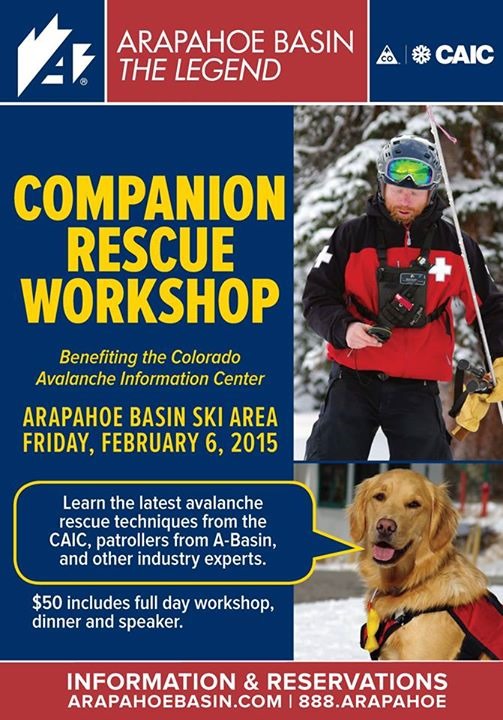
Arapahoe Basin Ski Patrol is putting on this class.
Join CAIC, A-Basin Ski Patrol and patrollers from neighboring ski areas for a day of classroom instruction and hands-on outdoor scenarios on how to make solo and group avalanche rescues.
*A Lift Ticket or Season Pass is REQUIRED for this workshop*
Price includes pasta dinner and special presentation about being prepared in the backcountry after the workshop.
Price $50.00
Companion Rescue Workshop Pasta Dinner
Pasta for everyone! Join us after the Companion Rescue Workshop for a pasta dinner and special presentation about being prepared in the backcountry in the A-Frame (vegetarian options available).
Open to everyone, even if you’re not participating in the workshop! Bring your friends and join us in the A-Frame. All proceeds go to the CAIC.
What do you think? Leave a comment.
If you like this let your friends know or post it on FB, Twitter or LinkedIn
Copyright 2015 Recreation Law (720) Edit Law
Email: Rec-law@recreation-law.com
Google+: +Recreation
Twitter: RecreationLaw
Facebook: Rec.Law.Now
Facebook Page: Outdoor Recreation & Adventure Travel Law
Blog: www.recreation-law.com
Mobile Site: http://m.recreation-law.com
By Recreation Law Rec-law@recreation-law.com James H. Moss #Authorrank
#AdventureTourism, #AdventureTravelLaw, #AdventureTravelLawyer, #AttorneyatLaw, #Backpacking, #BicyclingLaw, #Camps, #ChallengeCourse, #ChallengeCourseLaw, #ChallengeCourseLawyer, #CyclingLaw, #FitnessLaw, #FitnessLawyer, #Hiking, #HumanPowered, #HumanPoweredRecreation, #IceClimbing, #JamesHMoss, #JimMoss, #Law, #Mountaineering, #Negligence, #OutdoorLaw, #OutdoorRecreationLaw, #OutsideLaw, #OutsideLawyer, #RecLaw, #Rec-Law, #RecLawBlog, #Rec-LawBlog, #RecLawyer, #RecreationalLawyer, #RecreationLaw, #RecreationLawBlog, #RecreationLawcom, #Recreation-Lawcom, #Recreation-Law.com, #RiskManagement, #RockClimbing, #RockClimbingLawyer, #RopesCourse, #RopesCourseLawyer, #SkiAreas, #Skiing, #SkiLaw, #Snowboarding, #SummerCamp, #Tourism, #TravelLaw, #YouthCamps, #ZipLineLawyer, Colorado Avalanche Information Center, CAIC, Arapahoe Basin, A Basin, Avalanche,
To sue a Vermont ski area, there must be more than a web presence to sue in New York.
Posted: January 19, 2015 Filed under: Jurisdiction and Venue (Forum Selection), New York, Ski Area | Tags: Jurisdiction, Killington, Killington Ltd., New York, Race Camp, ski area, Ski Racing, Vermont Leave a commentPlaintiff injured at Killington ski area tried to sue Killington in New York court because Killington had a website that the New York plaintiff could access online. New York’s long-arm statute requires more than a website to bring a foreign defendant to a New York court.
State: New York, Supreme Court of New York, Appellate Division, Second Department
Plaintiff: Claudia Mejia-Haffner and her husband, Steven R. Haffner
Defendant: Killington, Ltd.
Plaintiff Claims:
Defendant Defenses: The court had no personal jurisdiction over it.
Holding: For the defendant
Year: 2014
The plaintiff was a resident of New York. The defendant is a ski area in Vermont. The plaintiff signed up for a ski race camp at the defendant’s ski area online through a third party American Ski Racing Association. The ski race camp was taught at Killington by Killington employees.
During the camp the plaintiff was instructed to try turning with her boots unbuckled. She did, falling and injuring herself. She and her husband sued Killington in a New York court. The trial court dismissed the case for lack of personal jurisdiction over the defendant Killington.
The plaintiff’s appealed.
Analysis: making sense of the law based upon these facts.
The court first reviewed the requirements of the New York Long Arm Statute and what is required to bring a foreign, non-New York, defendant into a New York courtroom.
A foreign corporation is amenable to suit in New York courts under CPLR 301 if it has engaged in such a continuous and systematic course of doing business’ here that a finding of its presence’ in this jurisdiction is warranted” Mere solicitation of business within New York will not subject a defendant to New York’s jurisdiction Instead, a plaintiff asserting jurisdiction under CPLR 301 must satisfy the standard of “solicitation plus,” which requires a showing of ” activities of substance in addition to solicitation'” (
A long-arm statute is the law that outlines under that state’s law the amount of presence a foreign defendant must have and how a foreign defendant can be brought into the state and sued.
Advertising alone is not enough to establish jurisdiction in New York. The foreign defendant must engage in substantial activity within the state.
…the section of New York’s long-arm statute at issue in this case, grants New York courts jurisdiction over nondomiciliaries when the action arises out of the nondomiciliaries’ “transact[ion of] any business within the state or contract [] . . . to supply goods or services in the state”
For substantial activity to occur, the acts within the state must be purposeful.
Purposeful activities are those with which a defendant, through volitional acts, avails itself of the privilege of conducting activities within the forum State, thus invoking the benefits and protections of its laws
Obviously purposeful will have a different definition and result for a manufacturer than for an outfitter. That means a manufacturer knows its products will be in the state, versus an outfitter who will be guiding its guests someplace out of state. Knowing your product will be sold inside the state increases the amount of activity according to the courts.
Based on the allegations in the complaint and the statements in the injured plaintiff’s affidavit, there is no substantial relationship between Killington’s maintenance of a website through which a person in New York could purchase services and the alleged tort that occurred. Such allegations are “too remote from [Killington’s] alleged sales and promotional activities to support long-arm jurisdiction under CPLR 302(a)(1)”
The court affirmed the trial court decision and dismissed Killington from the case.
So Now What?
Jurisdiction, whether a court has the ability to bring a defendant in front of it so that its orders are binding on the defendant varies by state. Therefore, you need to understand what states you may be brought into court in and how. In New York, this decision indicates it is not as easy as in other states.
If the plaintiff’s wants to sue Killington, they will have to go and sue in Vermont. That places a substantial burden on the plaintiff to find an attorney in Vermont and to finance litigation in Vermont. Jurisdiction can be a very effective defense against a lawsuit.
Here Killington did not do enough to be brought into a New York court.
What was not brought into the case was whether the plaintiff’s had signed a release? However, Vermont has been anti release with the ski industry so a release may have limited value. Maybe only of value for use in an out of the state court.
Other Articles on Jurisdiction
A Recent Colorado Supreme Court Decision lowers the requirements to be brought into the state to defend a lawsuit. http://rec-law.us/zfpK8Z
Buy something online and you may not have any recourse if it breaks or you are hurt http://rec-law.us/1rOEUQP
Four releases signed and all of them thrown out because they lacked one simple sentence! http://rec-law.us/vZoa7x
Jurisdiction and Venue (Forum Selection clauses) are extremely important in your releases. http://rec-law.us/1ggLMWR
Jurisdiction in Massachusetts allows a plaintiff to bring in Salomon France to the local court. http://rec-law.us/zdE1uk
|
James H. “Jim” Moss |
Jim Moss is an attorney specializing in the legal issues of the outdoor recreation community. He represents guides, guide services, outfitters both as businesses and individuals and the products they use for their business. He has defended Mt. Everest guide services, summer camps, climbing rope manufacturers; avalanche beacon manufactures and many more manufacturers and outdoor industries. Contact Jim at Jim@Rec-Law.us |
Jim is the author or co-author of six books about the legal issues in the outdoor recreation world; the latest is Outdoor Recreation Insurance, Risk Management and Law.
Outdoor Recreation Insurance, Risk Management, and Law
To see Jim’s complete bio go here and to see his CV you can find it here. To find out the purpose of this website go here.
G-YQ06K3L262
What do you think? Leave a comment.
If you like this let your friends know or post it on FB, Twitter or LinkedIn
 |
 |
 Threads |
 X (formerly known as Twitter) logo |
 Blue Sky |
 Stimulus |
Author: Outdoor Recreation Insurance, Risk Management and Law
Facebook Page: Outdoor Recreation & Adventure Travel Law
Email: Jim@Rec-Law.US
By Recreation Law Rec-law@recreation-law.com James H. Moss
#AdventureTourism, #AdventureTravelLaw, #AdventureTravelLawyer, #AttorneyatLaw, #Backpacking, #BicyclingLaw, #Camps, #ChallengeCourse, #ChallengeCourseLaw, #ChallengeCourseLawyer, #CyclingLaw, #FitnessLaw, #FitnessLawyer, #Hiking, #HumanPowered, #HumanPoweredRecreation, #IceClimbing, #JamesHMoss, #JimMoss, #Law, #Mountaineering, #Negligence, #OutdoorLaw, #OutdoorRecreationLaw, #OutsideLaw, #OutsideLawyer, #RecLaw, #Rec-Law, #RecLawBlog, #Rec-LawBlog, #RecLawyer, #RecreationalLawyer, #RecreationLaw, #RecreationLawBlog, #RecreationLawcom, #Recreation-Lawcom, #Recreation-Law.com, #RiskManagement, #RockClimbing, #RockClimbingLawyer, #RopesCourse, #RopesCourseLawyer, #SkiAreas, #Skiing, #SkiLaw, #Snowboarding, #SummerCamp, #Tourism, #TravelLaw, #YouthCamps, #ZipLineLawyer, Ski Area, Killington Ltd., Killington, Ski Racing, Race Camp, Jurisdiction, New York, Vermont,
Colorado Avalanche Information Center Update: New Mobile Apps Coming
Posted: January 8, 2015 Filed under: Avalanche, Skiing / Snow Boarding | Tags: x, y, z Leave a commentIf you Ski inbounds or out, make a donation to your local Avalanche Information Center today!
2014 has been a great year and it looks like it will go out with some great powder riding!
This past year has been very productive for the Friends of CAIC and the CAIC and we wanted to give you an update on where we are investing our time and your dollars. Last Spring, we held our first annual fundraising campaign. We asked you, our users, to invest in avalanche forecasting and education throughout the State of Colorado. You responded and donated over $115,000 during that one campaign! The tremendous amount of support was incredibly humbling and we are very thankful to have such a solid supporter base.
Because of your support during the Spring campaign and over this past year, we have been able to make an impact on the CAIC’s avalanche forecasting program as well as avalanche education throughout the State of Colorado.
First, we are very proud to announce that in the coming months of 2015, we will be launching version 1 (V1) of the CAIC mobile app. The app will be available for both Apple and Android devices. V1 will provide a mobile platform for our avalanche forecast products. We are really excited to get feedback from our users and will utilize that feedback in future versions as we add functionality.
It is important to us that the public safety information we provide is readily available for our users. Therefore, we are continuing to evolve and develop the CAIC website. We have made several changes and improvements to the site and email products over the summer and are constantly trying to improve the user experience. We sincerely appreciate your feedback on the site and urge you to continue to send your thoughts our way.
Additionally, because avalanche education is a cornerstone of the Friends of CAIC mission, we are working in collaboration with the Utah Avalanche Center to develop an education program for Colorado schools called, “Know Before You Go”. Utah has seen tremendous success with this program and we are excited to bring it to our youth in 2015/2016.
Of course all of these programs take money and we couldn’t have started them or accomplished them without your support. Thank you! Your donations are making an impact.
There is still work to be done and we are striving to go bigger in 2015. We hope you will be along for the ride and consider making an end of year donation. There are only 3 days left to make a tax-deductible donation for 2014. Please consider making a donation here: www.friendsofcaic.org.
From all of us at the CAIC, we hope you have a safe, powder filled 2015.
2014-2013 In bound ski/board fatalities
Posted: January 7, 2015 Filed under: Ski Area, Skiing / Snow Boarding | Tags: Breckenridge, Chair Lift, Eldora, fatality, Hunter Mountain, Jackson Hole, Keystone, Pine Knob, ski area, skiing, snowboarding, Tubing Leave a commentIt is depressing to start working on this every year. I hope it at some point in time can provide answers rather than news.
This list is not guaranteed to be accurate. The information is found from web searches and news dispatches. Those references are part of the chart. If you have a source for information on any fatality please leave a comment or contact me. Thank you.
If this information is incorrect or incomplete please let me know. This is up to date as of January 1, 2015. Thanks.
Skiing and Snowboarding are still safer than being in your kitchen or bathroom. This information is not to scare you away from skiing but to help you understand the risks.
Red type is natural or medical conditions that occurred inbounds on the slopes
Green Type is Fatalities while sledding at the Resort
Blue Type is a Lift Accidents
2013 – 2014 Ski Season Fatalities
|
# |
Date |
State |
Resort |
Where |
Trail Difficulty |
How |
Cause |
Ski/ Board |
Age |
Sex |
Home town |
Helmet |
Reference |
Ref # 2 |
|
1 |
11/15 |
CO |
Breckenridge |
|
|
|
Natural |
|
48 |
M |
Boulder, CO |
|
|
|
|
2 |
12/8 |
CO |
Eldora |
Jolly Jug |
|
Hit tree |
|
Ski |
22 |
M |
Coral Springs, FL (CU student) |
Yes |
||
|
3 |
12/12 |
CO |
Keystone |
Spring Dipper |
Intermediate |
Hit Tree |
Blunt force trauma |
Boarder |
26 |
M |
Silverthorne |
Yes |
||
|
4 |
|
MI |
Pine Knob |
|
|
Hit tree |
|
Ski |
51 |
F |
Shelby Township |
|
||
|
5 |
12/28 |
WY |
Jackson Hole |
Brush Alley |
|
Found inverted in the snow |
Asphyxiation |
Skier |
54 |
M |
Pepper Pike, OH |
|
|
|
|
6 |
12/30 |
NY |
Hunter Mtn |
D Lift |
|
Ski caught lift tower |
Fall |
Skier |
44 |
F |
Brooklyn, NY |
|
Our condolences go to the families of the deceased. Our thoughts extend to the families and staff at the areas who have to deal with these tragedies.
If you are unable to view the entire table Email me at Jim@Rec-law.us and put Ski Area Fatality Chart in the subject line. I’ll reply with a PDF of the chart.
What do you think? Leave a comment.
If you like this let your friends know or post it on FB, Twitter or LinkedIn
Copyright 2013 Recreation Law (720) Edit Law
Email: Rec-law@recreation-law.com
Google+: +Recreation
Twitter: RecreationLaw
Facebook: Rec.Law.Now
Facebook Page: Outdoor Recreation & Adventure Travel Law
Blog: www.recreation-law.com
Mobile Site: http://m.recreation-law.com
#AdventureTourism, #AdventureTravelLaw, #AdventureTravelLawyer, #AttorneyatLaw, #Backpacking, #BicyclingLaw, #Camps, #ChallengeCourse, #ChallengeCourseLaw, #ChallengeCourseLawyer, #CyclingLaw, #FitnessLaw, #FitnessLawyer, #Hiking, #HumanPowered, #HumanPoweredRecreation, #IceClimbing, #JamesHMoss, #JimMoss, #Law, #Mountaineering, #Negligence, #OutdoorLaw, #OutdoorRecreationLaw, #OutsideLaw, #OutsideLawyer, #RecLaw, #Rec-Law, #RecLawBlog, #Rec-LawBlog, #RecLawyer, #RecreationalLawyer, #RecreationLaw, #RecreationLawBlog, #RecreationLawcom, #Recreation-Lawcom, #Recreation-Law.com, #RiskManagement, #RockClimbing, #RockClimbingLawyer, #RopesCourse, #RopesCourseLawyer, #SkiAreas, #Skiing, #SkiLaw, #Snowboarding, #SummerCamp, #Tourism, #TravelLaw, #YouthCamps, #ZipLineLawyer, Skiing, Snowboarding, Fatality, Ski Area, Tubing, Breckenridge, Chair Lift, Hunter Mountain, Jackson Hole, Pine Knob, Eldora, Keystone,
Haffner, et al., v Killington, Ltd., 119 A.D.3d 912; 990 N.Y.S.2d 561; 2014 N.Y. App. Div. LEXIS 5452; 2014 NY Slip Op 05522
Posted: January 6, 2015 Filed under: Jurisdiction and Venue (Forum Selection), Legal Case, New York, Ski Area, Skiing / Snow Boarding | Tags: Jurisdiction, Killington, Killington Ltd., New York, Race Camp, ski area, Ski Racing, Vermont Leave a commentTo Read an Analysis of this decision see: To sue a Vermont ski area, there must be more than a web presence to sue in New York.
Haffner, et al., v Killington, Ltd., 119 A.D.3d 912; 990 N.Y.S.2d 561; 2014 N.Y. App. Div. LEXIS 5452; 2014 NY Slip Op 05522
Claudia Mejia-Haffner, et al., appellants, v Killington, Ltd., respondent, et al., defendants. (Index No. 30370/10)
2012-02569
SUPREME COURT OF NEW YORK, APPELLATE DIVISION, SECOND DEPARTMENT
119 A.D.3d 912; 990 N.Y.S.2d 561; 2014 N.Y. App. Div. LEXIS 5452; 2014 NY Slip Op 05522
July 30, 2014, Decided
COUNSEL: [***1] Gordon & Haffner, LLP, Bayside, N.Y. (Steven R. Haffner, Pro se, of counsel), for appellants.
Ryan Smith & Carbine, P.C., Glens Falls, N.Y. (Mark F. Werle of counsel), for respondent.
JUDGES: MARK C. DILLON, J.P., THOMAS A. DICKERSON, LEONARD B. AUSTIN, SANDRA L. SGROI, JJ. DILLON, J.P., DICKERSON, AUSTIN and SGROI, JJ., concur.
OPINION
[**562] [*912] DECISION & ORDER
In an action, inter alia, to recover damages for personal injuries, etc., the plaintiffs appeal from an order of the Supreme Court, Queens County (Grays, J.), dated December 19, 2011, which granted the motion of the defendant Killington, Ltd., for summary judgment dismissing the complaint insofar as asserted against it.
ORDERED that the order is affirmed, with costs.
The plaintiff Claudia Mejia-Haffner and her husband, the plaintiff Steven R. Haffner, enrolled in a ski racing instructional camp operated by Killington/Pico Ski Resort Partners, LLC, sued herein as Killington, Ltd. (hereinafter Killington), at Killington’s ski resort in Vermont. The plaintiffs made their reservations through the American Ski Racing Association. While participating in the camp, Mejia-Haffner (hereinafter the injured plaintiff) was injured, and the plaintiffs commenced this action [***2] against, among others, Killington.
Killington moved for summary judgment dismissing the complaint insofar as asserted against it on the ground, inter alia, that it was not subject to personal jurisdiction in New York. The Supreme Court granted Killington’s motion for summary judgment finding, among other things, that New York did not have jurisdiction over Killington.
[**563] [HN1] “A foreign corporation is amenable to suit in New York courts under CPLR 301 if it has engaged in such a continuous and systematic course of doing business’ here that a finding of its presence’ in this jurisdiction is warranted” (Landoil Resources Corp. v Alexander & Alexander Servs., 77 NY2d 28, 33, 565 N.E.2d 488, 563 N.Y.S.2d 739, quoting Laufer v Ostrow, 55 NY2d 305, 309-310, 434 N.E.2d 692, 449 N.Y.S.2d 456; see [*913] Cardone v Jiminy Peak, 245 AD2d 1002, 1003, 667 N.Y.S.2d 82; Sedig v Okemo Mtn., 204 AD2d 709, 710, 612 N.Y.S.2d 643). [HN2] Mere solicitation of business within New York will not subject a defendant to New York’s jurisdiction (see Cardone v Jiminy Peak, 245 AD2d at 1003; Sedig v Okemo Mtn., 204 AD2d at 710). Instead, a plaintiff asserting jurisdiction under CPLR 301 must satisfy the standard of “solicitation plus,” which requires a showing of ” activities of substance in addition to solicitation'” (Arroyo v Mountain School, 68 AD3d 603, 604, 892 N.Y.S.2d 74, quoting Laufer v Ostrow, 55 NY2d at 310; see Cardone v Jiminy Peak, 245 AD2d at 1003; Sedig v Okemo Mtn., 204 AD2d at 710).
Even assuming that Killington engaged in substantial advertising in New York, as the plaintiffs claim, the plaintiffs have not demonstrated that Killington also engaged in substantial activity within this State sufficient to satisfy the solicitation-plus standard. Contrary [***3] to the plaintiffs’ contention, this Court’s decision in Grimaldi v Guinn (72 AD3d 37, 49-50, 895 N.Y.S.2d 156) does not stand for the principle that a business’s interactive website, accessible in New York, subjects it to suit in this State for all purposes. Instead, the Grimaldi decision stands only for the more limited principle that [HN3] a website may support specific jurisdiction in New York where the claim asserted has some relationship to the business transacted via the website (see id.; see also Paterno v Laser Spine Inst., 112 AD3d 34, 973 N.Y.S.2d 681). Here, even Killington’s alleged substantial solicitation in New York constitutes no more than solicitation (see Cardone v Jiminy Peak, 245 AD2d at 1004; see also Arroyo v Mountain School, 68 AD3d at 603-604; Sedig v Okemo Mtn., 204 AD2d at 710; Chamberlain v Jiminy Peak, 155 AD2d 768, 547 N.Y.S.2d 706).
[HN4] CPLR 302(a)(1), the section of New York’s long-arm statute at issue in this case, grants New York courts jurisdiction over nondomiciliaries when the action arises out of the nondomiciliaries’ “transact[ion of] any business within the state or contract [] . . . to supply goods or services in the state” (CPLR 302[a][1]). [HN5] Pursuant to CPLR 302(a)(1), jurisdiction is proper “even though the defendant never enters New York, so long as the defendant’s activities here were purposeful and there is a substantial relationship between the transaction and the claim asserted” (Fischbarg v Doucet, 9 NY3d 375, 380, 880 N.E.2d 22, 849 N.Y.S.2d 501 [internal quotation marks and citations omitted]; see Deutsche Bank Sec., Inc. v Montana Bd. of Invs., 7 NY3d 65, 71, 850 N.E.2d 1140, 818 N.Y.S.2d 164; Kreutter v McFadden Oil Corp., 71 NY2d 460, 467, 522 N.E.2d 40, 527 N.Y.S.2d 195; Muse Collections, Inc. v Carissima Bijoux, Inc., 86 AD3d 631, 927 N.Y.S.2d 389). “Purposeful activities are those [***4] with which a defendant, through volitional acts, avails itself of the privilege of conducting activities within [*914] the forum State, thus invoking the benefits and protections of its laws'” (Fischbarg v Doucet, 9 NY3d at 380, [**564] quoting McKee Elec. Co. v Rauland-Borg Corp., 20 NY2d 377, 382, 229 N.E.2d 604, 283 N.Y.S.2d 34; see Grimaldi v Guinn, 72 AD3d at 44; Sedig v Okemo Mtn., 204 AD2d at 710).
[HN6] Although a plaintiff is not required to plead and prove personal jurisdiction in the complaint (see Fischbarg v Doucet, 9 NY3d at 381 n 5; Halas v Dick’s Sporting Goods, 105 AD3d 1411, 964 N.Y.S.2d 808; Cadle Co. v Ayala, 47 AD3d 919, 920, 850 N.Y.S.2d 563; Ying Jun Chen v Lei Shi, 19 AD3d 407, 407-408, 796 N.Y.S.2d 126), where jurisdiction is contested, the ultimate burden of proof rests upon the plaintiff (see Halas v Dick’s Sporting Goods, 105 AD3d at 1411; Arroyo v Mountain School, 68 AD3d at 604; Shore Pharm. Providers, Inc. v Oakwood Care Ctr., Inc., 65 AD3d 623, 624, 885 N.Y.S.2d 88; Stardust Dance Prods., Ltd. v Cruise Groups Intl., Inc., 63 AD3d 1262, 1264, 881 N.Y.S.2d 192; Ying Jun Chen v Lei Shi, 19 AD3d at 407; Armouth Intl. v Haband Co., 277 AD2d 189, 190, 715 N.Y.S.2d 438).
Here, the plaintiffs alleged that Killington’s negligence stemmed from the injured plaintiff being injured after having been instructed by ski instructors to unbuckle her ski boots as part of a training exercise so that when she fell, her ski bindings failed to release. They also alleged that Killington was negligent due to the instructors’ failure to warn her of the dangers of such activity. Further, the injured plaintiff submitted an affidavit, in opposition to Killington’s motion, stating that her injury occurred when another skier ran over the tails of her skis, causing her to fall and her bindings to fail to release, since she had been skiing with her boots unbuckled as instructed and that she was unaware that skiing with her boots unbuckled would disable the ski bindings [***5] until she was informed of this information by the ski patrol. Based on the allegations in the complaint and the statements in the injured plaintiff’s affidavit, there is no substantial relationship between Killington’s maintenance of a website through which a person in New York could purchase services and the alleged tort that occurred. Such allegations are “too remote from [Killington’s] alleged sales and promotional activities to support long-arm jurisdiction under CPLR 302(a)(1)” (Sedig v Okemo Mtn., 204 AD2d at 710-711; see Meunier v Stebo, Inc., 38 AD2d 590, 591, 328 N.Y.S.2d 608). Thus, Killington is not subject to long-arm jurisdiction under CPLR 302(a)(1).
The plaintiffs’ contention that the complaint contains a breach of contract cause of action relating to their purchase of reservations in New York is improperly raised for the first time on appeal, and therefore is not properly before this Court.
[*915] Furthermore, contrary to their contention, the plaintiffs have not made ” a sufficient start'” to warrant holding the motion in abeyance while discovery is conducted on the issue of jurisdiction (Shore Pharm. Providers, Inc. v Oakwood Care Ctr., Inc., 65 AD3d at 624, quoting Peterson v Spartan Indus., 33 NY2d 463, 467, 310 N.E.2d 513, 354 N.Y.S.2d 905; see Amigo Foods Corp. v Marine Midland Bank-N.Y., 39 NY2d 391, 395, 348 N.E.2d 581, 384 N.Y.S.2d 124; Stardust Dance Prods., Ltd. v Cruise Groups Intl., Inc., 63 AD3d at 1265; Ying Jun Chen v Lei Shi, 19 AD3d at 408). The plaintiffs have not alleged facts which would support personal jurisdiction under either CPLR 301 or under CPLR 302(a)(1), and thus have failed to indicate how further discovery might lead to evidence showing [***6] that [**565] personal jurisdiction exists here (see Lang v Wycoff Hgts. Med. Ctr., 55 AD3d 793, 794, 866 N.Y.S.2d 313).
In light of the foregoing, we need not reach the parties’ remaining contentions.
DILLON, J.P., DICKERSON, AUSTIN and SGROI, JJ., concur.
Oregon Supreme Court finds release signed at ski area is void as a violation of public policy. Less than a week later the lawsuits are being filed in droves.
Posted: January 5, 2015 Filed under: Oregon, Release (pre-injury contract not to sue), Ski Area, Skiing / Snow Boarding | Tags: Bagley, Jump, Oregon, paraplegic, Public Policy, Release, Supreme Court, Terrain park 1 CommentThis is a monumental decision that will affect all recreational activities in Oregon, not just ski areas. A decision that will give injured plaintiffs of any recreational activity the opportunity to void releases for any number or reasons.
Bagley v. Mt. Bachelor, Inc., dba Mt. Bachelor Ski and Summer Resort, 2014 Ore. LEXIS 994
State: Oregon Supreme Court
Plaintiff: Myles A. Bagley, Al Bagley, and Lauren Bagley
Defendant: Mt. Bachelor, Inc., dba Mt. Bachelor Ski and Summer Resort
Plaintiff Claims: negligent in the design, construction, maintenance, and inspection of the jump in the terrain park.
Defendant Defenses: Release
Holding: for the Plaintiff
Year: 2014
Prior Article written about the Appellate Decision in this Case: Rare issue this case looked at a release signed by a minor that prevented a suit for his injuries after turning age 18
The facts of this case have been copies from Rare issue this case looked at a release signed by a minor that prevented a suit for his injuries after turning age 18.
This is a rare review of release or contract law because the odds are against it. A contract is voidable by the minor when the minor signs the contract. However, if the contract is, in effect, when the minor reaches the age of majority, the minor can either disaffirm the contract which puts the parties back in the position before the contract was signed or if he or she fails to do that he or she takes advantages of the benefits of the contract and continues to use it the contract is in force.
To determine the age of majority or the age a minor becomes an adult in each state see The age that minors become adults.
The minor signed a season pass release at the defendant ski area. His father signed a minor release and indemnity agreement. Two weeks later and before the plaintiff had started snowboarding, he turned 18. Once he started snowboarding, after reaching age 18, he boarded at the defendant’s resort 26 different days, and his pass was scanned 119 times.
Going through the terrain park where he seemed to spend most of his time, the plaintiff was injured on a jump which resulted in permanent paralysis.
The minor and his parents sued the resort. The trial court dismissed his complaints after the defendant filed a motion for summary judgment based on the release the minor had signed.
The court also brought out in this case, signs posted at lifts terminals which restated the ticket was a release of liability. Oregon is the only court that had held that a lift ticket purchased to ski was a release. See Silva v. Mt. Bachelor, Inc., 2008 U.S. Dist. LEXIS 55942.
Analysis: making sense of the law based on these facts.
The court first stated it had not reviewed releases in decades. The court then reviewed the legal importance of contracts.
It is a truism that a contract validly made between competent parties is not to be set aside lightly. (“When two or more persons competent for that purpose, upon a sufficient consideration, voluntarily agree to do or not to do a particular thing which may be lawfully done or omitted, they should be held to the consequences of their bargain.”). The right to contract privately is part of the liberty of citizenship, and an important office of the courts is to enforce contractual rights and obligations. (so stating). As this court has stated, however, “contract rights are [not] absolute; * * * [e]qually fundamental with the private right is that of the public to regulate it in the common interest.”
The only contracts that will not be enforced, according to this decision, are those that are contrary to law, morality or public policy.
It is elementary that public policy requires that * * * contracts [between competent parties], when entered into freely and voluntarily, shall be held sacred and shall be enforced by the courts of justice, and it is only when some other overpowering rule of public policy * * * intervenes, rendering such agreement illegal, that it will not be enforced.
The court then looked at what issues surrounding or in a contract will void a contract based on a public policy issue. It is not that a contract may be harsh to one party to the contract. “…[t]he test is the evil tendency of the contract and not its actual injury to the public in a particular instance…” However, the court then did a 180-degree turn and stated that in this case:
Thus, for the sake of convenience–if not doctrinal convergence–we address the parties’ public policy arguments in the context of our analysis of whether, in the particular circumstances of this case, enforcement of the release would be unconscionable.
The court then proceeded to build its argument on why this contract was a violation of public policy. It first divided public policy into two types procedural or substantive.
Procedural unconscionability refers to the conditions of contract formation and focuses on two factors: oppression and surprise.
Oppression exists when there is inequality in bargaining power between the parties, resulting in no real opportunity to negotiate the terms of the contract and the absence of meaningful choice. Surprise involves whether terms were hidden or obscure from the vantage of the party seeking to avoid them.
Generally speaking, factors such as ambiguous contract wording and fine print are the hallmarks of surprise.
In contrast, the existence of gross inequality of bargaining power, a takeit- or-leave-it bargaining stance, and the fact that a contract involves a consumer transaction, rather than a commercial bargain, can be evidence of oppression.
Substantive unconscionability was then defined as how the terms of the contract are viewed.
… generally refers to the terms of the contract, rather than the circumstances of formation, and focuses on whether the substantive terms contravene the public interest or public policy.
Either issue, whether the issues in how the contract was created, procedural unconscionability, or the terms of the agreement itself, substantive unconscionability, can void a contract.
The court then went to review the contract in light of any legislation related to the activity. Although Oregon has a Skier Responsibility Act, the court did not find it was instructive in this case.
The court did find that under Oregon law, it could void a release if the results would be harsh. “Finally, this court has held that another factor for determining whether an anticipatory release may be unenforceable is the possibility of a harsh or inequitable result for the releasing party.”
The court then listed the ways a contract could be voided under Oregon law.
We glean from those decisions that relevant procedural factors in the determination of whether enforcement of an anticipatory release would violate public policy or be unconscionable include whether the release was conspicuous and unambiguous; whether there was a substantial disparity in the parties’ bargaining power; whether the contract was offered on a take-it-or-leave-it basis; and whether the contract involved a consumer transaction.
Relevant substantive considerations include whether enforcement of the release would cause a harsh or inequitable result to befall the releasing party; whether the releasee serves an important public interest or function; and whether the release purported to disclaim liability for more serious misconduct than ordinary negligence.
The court refused to provide details or procedures that would void a contract. Rather the court relied on a “totality of the circumstances” test. This means it provides great leeway for a court to determine if the facts swayed a judge, not whether the facts met any set requirements.
Nothing in our previous decisions suggests that any single factor takes precedence over the others or that the listed factors are exclusive. Rather, they indicate that a determination whether enforcement of an anticipatory release would violate public policy or be unconscionable must be based on the totality of the circumstances of a particular transaction.
The court then compared the ways it had found (created) to void a contract under Oregon law to the present situation.
This was not an agreement between equals. Only one party to the contract-defendant-was a commercial enterprise, and that party exercised its superior bargaining strength by requiring its patrons, including plaintiff, to sign an anticipatory release on a take-it-or-leave-it basis as a condition of using its facilities.
This analysis completely ignored the fact the contract covered recreational activities that most other states have found remove the take it or leave it bargaining issue. The exception being Atkins v. Swimwest Family Fitness Center, 2005 WI 4; 2005 Wisc. LEXIS 2. See Wisconsin decision has left the status of release law in Wisconsin in jeopardy.
The court found because the plaintiff had no opportunity to negotiate the terms or cost then there was an inequality of bargaining power between the plaintiff and the defendant. “Simply put, plaintiff had no meaningful alternative to defendant’s take-it-or-leave-it terms if he wanted to participate in downhill snowboarding.”
The court found this alone was not enough to void the release. The court then looked at whether the results of enforcing the contract would be harsh and found this to be true.
As pertinent here, we conclude that the result would be harsh because, accepting as true the allegations in plaintiff’s complaint, plaintiff would not have been injured if defendant had exercised reasonable care in designing, constructing, maintaining, or inspecting the jump on which he was injured. And that harsh result also would be inequitable because defendant, not its patrons, has the expertise and opportunity to foresee and control hazards of its own creation on its premises, and to guard against the negligence of its employees.
This analysis completely ignores the issue of whether or not the plaintiff could have examined the jump or had gone over the jump before. The defendant had introduced evidence that the season pass had been used dozens of times prior to the accident.
The court then ignored the Oregon Skier Responsibility Law and stated that even though the act had reduced the liability of a ski area it had not changed its common law liability for those conditions that are not inherent in the activity.
Skier Responsibility Law provides that “[t]o the extent an injury is caused by an inherent risk of skiing, a skier will not recover against a ski area operator; to the extent an injury is a result of [ski area operator] negligence, comparative negligence applies
The court summed up its analysis to this point stating.
In short, because (1) accepting as true the allegations in plaintiff’s complaint, plaintiff would not have been injured if defendant had exercised reasonable care in designing, constructing, maintaining, or inspecting the jump on which he was injured; and (2) defendant, not its patrons, had the expertise and opportunity–indeed, the common law duty–to foresee and avoid unreasonable risks of its own creation on its business premises, we conclude that the enforcement of the release would cause a harsh and inequitable result, a factor that militates against its enforcement.
The court then looked at whether a ski area served an important public interest or function. The court found it did by adding an exception to the essential public service requirement stating that serving the public was enough.
However, like other places of public accommodation such as inns or public warehouses, defendant’s business premises–including its terrain park–are open to the general public virtually without restriction, and large numbers of skiers and snowboarders regularly avail themselves of its facilities. To be sure, defendants’ business facilities are privately owned, but that characteristic does not overcome a number of legitimate public interests concerning their operation
Because the public was invited to ski, the release violated Oregon Public Policy.
Accordingly, we reject defendant’s argument that the fact that skiing and snowboarding are “non-essential” activities compels enforcement of the release in this case. Instead, we conclude that defendant’s business operation is sufficiently tied to the public interest as to require the performance of its private duties to its patrons
The court then looked at the legal issues in a way I have never heard of before. The court accepted the plaintiff’s argument that the release was intended to prevent claims for negligence as well as for gross negligence, reckless, or intentional conduct. Although the court did not accept the argument in this case, it left the argument open for future cases.
The court summed up its opinion over a page and a half. The fact the release was written broadly caused the court’s concern.
That said, the release is very broad; it applies on its face to a multitude of conditions and risks, many of which (such as riding on a chairlift) leave defendant’s patrons vulnerable to risks of harm of defendant’s creation
However, the entire basis of its analysis was the court did not like the fact this injured plaintiff would not recover.
In the ultimate step of our unconscionability analysis, we consider whether those procedural and substantive considerations outweigh defendant’s interest in enforcing the release at issue here.
So Now What?
This case not only opened up lawsuits against ski areas but turned any recreation provider into a target. In just two weeks since the decision came down several high-dollar lawsuits have been filed in Oregon. See Mt. Hood Meadows snowboarder claims teen slammed into her, sues teen’s parents for $955,000 and Fallen tree causes Portland mountain bike racer to crash, fracture neck, $273,000 suit says.
By stating that any provider was subject to the public policy exception to releases, the court effectively found that anyone injured by a recreation provider could have their releases voided.
If you are Oregon and have a release you may want to put in that the release is only for claims of ordinary negligence. This violates every principal I have espoused over the years, but here the court found that failing to have such a clause may make an argument for voiding a release.
This decision is stretched to reach its decision, and it is written quite vaguely and broadly giving future plaintiff’s dozens of ways of voiding a release. Catastrophic injuries are going to be more likely, based on this analysis, to void a release; however, those are the ones that attract the money.
Oregon ski area ticket prices are going to increase because Oregon ski area insurance is going up.
|
Jim Moss is an attorney specializing in the legal issues of the outdoor recreation community. He represents guides, guide services, outfitters both as businesses and individuals and the products they use for their business. He has defended Mt. Everest guide services, summer camps, climbing rope manufacturers; avalanche beacon manufactures and many more manufacturers and outdoor industries. Contact Jim at Jim@Rec-Law.us |
Jim is the author or co-author of six books about the legal issues in the outdoor recreation world; the latest is Outdoor Recreation Insurance, Risk Management and Law.
To see Jim’s complete bio go here and to see his CV you can find it here. To find out the purpose of this website go here.
G-YQ06K3L262
What do you think? Leave a comment.
If you like this let your friends know or post it on FB, Twitter or LinkedIn
Author: Outdoor Recreation Insurance, Risk Management and Law

Outdoor Recreation Insurance, Risk Management and Law
Facebook Page: Outdoor Recreation & Adventure Travel Law
Email: Jim@Rec-Law.US
By Recreation Law Rec-law@recreation-law.com James H. Moss
@2015-2023 Summit Magic Publishing, LLC
#AdventureTourism, #AdventureTravelLaw, #AdventureTravelLawyer, #AttorneyatLaw, #Backpacking, #BicyclingLaw, #Camps, #ChallengeCourse, #ChallengeCourseLaw, #ChallengeCourseLawyer, #CyclingLaw, #FitnessLaw, #FitnessLawyer, #Hiking, #HumanPowered, #HumanPoweredRecreation, #IceClimbing, #JamesHMoss, #JimMoss, #Law, #Mountaineering, #Negligence, #OutdoorLaw, #OutdoorRecreationLaw, #OutsideLaw, #OutsideLawyer, #RecLaw, #Rec-Law, #RecLawBlog, #Rec-LawBlog, #RecLawyer, #RecreationalLawyer, #RecreationLaw, #RecreationLawBlog, #RecreationLawcom, #Recreation-Lawcom, #Recreation-Law.com, #RiskManagement, #RockClimbing, #RockClimbingLawyer, #RopesCourse, #RopesCourseLawyer, #SkiAreas, #Skiing, #SkiLaw, #Snowboarding, #SummerCamp, #Tourism, #TravelLaw, #YouthCamps, #ZipLineLawyer, Bagley, Oregon, Supreme Court, Release, Public Policy, Terrain Park, Jump, Paraplegic,
Saving yourself while sacrificing the rest of an industry. Is anyone going to buy you a drink for winning when you just made it easier to sue them?
Posted: December 31, 2014 Filed under: Ski Area, Skiing / Snow Boarding | Tags: Alta, Forest Service, Operation Plan, permit, skiing, Snowboard, United States Forest Service, US Forest Service, USFS, Utah, Winter Operation Plan Leave a commentIn the US Forest Service response to the lawsuit to open snowboarding at Alta, allegations were made by the USFS that are going to come back and haunt all other ski areas in states with weak skier safety statutes.
Alta is one of three ski areas that do not allow snowboarding. Deer Valley and Mad River Glen are the other two. Alta and the US Forest Service were sued last year by a group of snowboarders wanting to open Alta to snowboarding. The lawsuit was based on Federal constitutional law, and the legal arguments have little relevance here. Except the USFS defense to the lawsuit placed into the record some statements that can create havoc in lawsuits against other ski areas.
A ski area operating on USFS land must file an Operation Plan. If the resort is open year round the plan may have two plans, a Winter Operation Plan and a Summer Operation Plan. The USFS in referencing the Alta’s Winter Operation plan quotes it stating:
Additionally, the Operating Plan provides that Alta reserves the right to exclude those whose “skiing device” is deemed to create an “unnecessary risk,” causes “undue damage to the quality of the snow,” and “is not consistent with [Alta’s] business management decisions.”
In another section of the USFS motion they quote the plan as:
Alta Ski Area reserves the right to exclude any type of skiing device that they deem creates an unnecessary risk to other skiers and/or the user of the device, or any device that they deem causes undue damages to the quality of the snow, or is not consistent with their business management decisions.
So snowboards have been labeled by a ski area and the USFS as an “unnecessary risk.” That risk in the second paragraph applies to other skiers on the mountain and the user. Another issue I find almost comical is the argument that snowboarders have a blind spot.
First, snowboarders go down the mountain facing sideways, whereas skiers go down the mountain facing forward and directly downhill. ECF No. 2, ¶ 87. A snowboarder’s side-ways orientation creates a blind-spot that they must turn into; skiers do not turn into their blind spot.
But so do skiers, and walkers, and people on an inner tube going down the hill. The blind spot is directly behind your head (your eyes) were you can’t see. That blind spot is not based on what is on your feet, but is based on your orientation to the other people. A snowboarder going downhill has an identical blind spot to a skier crossing the hill. Neither can see behind them.
The issue is where a ski area can be sued for injuries of a skier; any injuries the skier alleges were caused by the snowboarder are going to be buttressed by the USFS motion and Alta’s Winter Operation Plan. Maybe even if injuries they do to themselves?
Are these issues critical to other ski areas? Hopefully not. However, they may be thrown up in other cases and can provide testimony that can influence a jury.
What do you think? Leave a comment.
If you like this let your friends know or post it on FB, Twitter or LinkedIn
Copyright 2013 Recreation Law (720) Edit Law
Email: Rec-law@recreation-law.com
Google+: +Recreation
Twitter: RecreationLaw
Facebook: Rec.Law.Now
Facebook Page: Outdoor Recreation & Adventure Travel Law
Blog: www.recreation-law.com
Mobile Site: http://m.recreation-law.com
#AdventureTourism, #AdventureTravelLaw, #AdventureTravelLawyer, #AttorneyatLaw, #Backpacking, #BicyclingLaw, #Camps, #ChallengeCourse, #ChallengeCourseLaw, #ChallengeCourseLawyer, #CyclingLaw, #FitnessLaw, #FitnessLawyer, #Hiking, #HumanPowered, #HumanPoweredRecreation, #IceClimbing, #JamesHMoss, #JimMoss, #Law, #Mountaineering, #Negligence, #OutdoorLaw, #OutdoorRecreationLaw, #OutsideLaw, #OutsideLawyer, #RecLaw, #Rec-Law, #RecLawBlog, #Rec-LawBlog, #RecLawyer, #RecreationalLawyer, #RecreationLaw, #RecreationLawBlog, #RecreationLawcom, #Recreation-Lawcom, #Recreation-Law.com, #RiskManagement, #RockClimbing, #RockClimbingLawyer, #RopesCourse, #RopesCourseLawyer, #SkiAreas, #Skiing, #SkiLaw, #Snowboarding, #SummerCamp, #Tourism, #TravelLaw, #YouthCamps, #ZipLineLawyer, Alta, Snowboard, Skiing, USFS, US Forest Service, Forest Service, Permit, Winter Operation Plan, Operation Plan, Utah,
Victim statement in criminal Skier v. Skier collision is the bigger problem for the ski and outdoor industry
Posted: December 24, 2014 Filed under: Ski Area, Skier v. Skier | Tags: Alpine skiing, ski area, Ski Resort, skier collision, skier v. skier, skiing, Telluride Ski Resort, United States Forest Service Leave a commentVictim in court stated she was not aware that skiing was a dangerous sport.
This is a sad situation. A skier, possibly skiing to fast and/or out of control hit a beginner skier. Both suffered serious injuries. Both of them have had their life changed forever.
However that is not what caught my eye. At the sentencing hearing the victim made this statement.
“I never thought of skiing being a life-threatening sport,” Vitt [victim] said. “I could not have been more wrong.”
Granted it was probably a statement made in court to make a point, but it is very scary. It means that the skier missed the signs indicating skiing was a risk sport. Missed the back of their lift ticket or did not read their season pass. They never saw any of the reports of injuries or fatalities or they did not understand the risk when riding up the lift.
OR
We in the outdoor recreation industry are not doing a good job of informing guests of the risk.
Should We Do Something
Should we? Should we spend more time explaining the actual risks of skiing to clients?
See Punishment handed down in ski accident
What do you think? Leave a comment.
If you like this let your friends know or post it on FB, Twitter or LinkedIn
Copyright 2013 Recreation Law (720) Edit Law
Email: Rec-law@recreation-law.com
Google+: +Recreation
Twitter: RecreationLaw
Facebook: Rec.Law.Now
Facebook Page: Outdoor Recreation & Adventure Travel Law
Blog: www.recreation-law.com
Mobile Site: http://m.recreation-law.com
#AdventureTourism, #AdventureTravelLaw, #AdventureTravelLawyer, #AttorneyatLaw, #Backpacking, #BicyclingLaw, #Camps, #ChallengeCourse, #ChallengeCourseLaw, #ChallengeCourseLawyer, #CyclingLaw, #FitnessLaw, #FitnessLawyer, #Hiking, #HumanPowered, #HumanPoweredRecreation, #IceClimbing, #JamesHMoss, #JimMoss, #Law, #Mountaineering, #Negligence, #OutdoorLaw, #OutdoorRecreationLaw, #OutsideLaw, #OutsideLawyer, #RecLaw, #Rec-Law, #RecLawBlog, #Rec-LawBlog, #RecLawyer, #RecreationalLawyer, #RecreationLaw, #RecreationLawBlog, #RecreationLawcom, #Recreation-Lawcom, #Recreation-Law.com, #RiskManagement, #RockClimbing, #RockClimbingLawyer, #RopesCourse, #RopesCourseLawyer, #SkiAreas, #Skiing, #SkiLaw, #Snowboarding, #SummerCamp, #Tourism, #TravelLaw, #YouthCamps, #ZipLineLawyer, Skiing, Ski Area, Telluride Ski Resort, Skier v. Skier, Skier collision,
Bagley v. Mt. Bachelor, Inc., dba Mt. Bachelor Ski and Summer Resort, 2014 Ore. LEXIS 994
Posted: December 22, 2014 Filed under: Legal Case, Oregon, Ski Area, Skiing / Snow Boarding | Tags: Age of Majority, Boarder, Boarding, Disaffirm, Inc., Mount Bachelor, Mt. Bachelor, Mt. Bachelor Ski and Summer Resort, Myles A. Bagley, Oregon, Release, ski area, Ski Resort, Snowboard, Snowboarder, snowboarding, Terrain park Leave a commentTo Read an Analysis of this decision see: Oregon Supreme Court finds release signed at ski area is void as a violation of public policy. Less than a week later the lawsuits are being filed in droves.
Bagley v. Mt. Bachelor, Inc., dba Mt. Bachelor Ski and Summer Resort, 2014 Ore. LEXIS 994
Myles A. Bagley, individually, Petitioner on Review, and Al Bagley, individually; and Lauren Bagley, individually, Plaintiffs, v. Mt. Bachelor, Inc., dba Mt. Bachelor Ski and Summer Resort, Respondent on Review, and John DOES 1-10, Defendants.
SC S061821
SUPREME COURT OF OREGON
2014 Ore. LEXIS 994
May 7, 2014, Argued and Submitted
December 18, 2014, Filed
PRIOR HISTORY: CC 08CV0118SF; CA A148231. On review from the Court of Appeals. [*1] *
* Appeal from Deschutes County Circuit Court, Stephen P. Forte, Judge. 258Or App 390, 310 P3d 692 (2013).
COUNSEL: Kathryn H. Clarke, Portland, argued the cause and filed the briefs for petitioner on review. With her on the briefs was Arthur C. Johnson.
Andrew C. Balyeat, Balyeat & Eager, LLP, Bend, argued the cause and filed the brief for respondent on review.
Michael J. Estok, Lindsay Hart, LLP, Portland, filed a brief on behalf of amicus curiae Oregon Association of Defense Counsel.
Kristian Roggendorf, Roggendorf Law LLC, Lake Oswego, filed a brief on behalf of amicus curiae Oregon Trial Lawyers Association.
JUDGES: BREWER, J.
OPINION BY: BREWER
OPINION
En Banc
BREWER, J.
The issue on review in this case is whether an anticipatory release1 of a ski area operator’s liability for its own negligence in a ski pass agreement is enforceable in the face of an assertion that the release violates public policy and is unconscionable. Plaintiff suffered serious injuries while snowboarding over a jump in defendant ski area operator’s “terrain [*2] park,” and brought this action alleging that defendant was negligent in the design, construction, maintenance, and inspection of the jump. Defendant moved for summary judgment based on an affirmative defense of release; plaintiff filed a cross-motion for partial summary judgment on the ground that the release was unenforceable as a matter of law. The trial court granted defendant’s summary judgment motion and denied plaintiff’s cross-motion. Plaintiff appealed, asserting, among other arguments, that the trial court erred in concluding that the release did not violate public policy and that it was neither substantively nor procedurally unconscionable. The Court of Appeals affirmed. Bagley v. Mt. Bachelor, Inc., 258 Or App 390, 310 P3d 692 (2013). Because we conclude that enforcement of the release would be unconscionable, we reverse and remand.
1 By “anticipatory release,” we refer to an exculpatory agreement that purports to immunize–before an injury occurs–the released party from liability for its own tortious conduct.
FACTS AND PROCEDURAL BACKGROUND
We review the trial court’s rulings on summary judgment to determine whether “there is no genuine issue as to any material fact” and whether “the moving party is entitled to prevail as a matter of law.” [*3] ORCP 47 C. We view the historical facts set out in the summary judgment record, along with all reasonable inferences that may be drawn from them, in the light most favorable to the nonmoving party–plaintiff on defendant’s motion for summary judgment, and defendant on plaintiff’s cross-motion. Id.; Vaughn v. First Transit, Inc., 346 Or 128, 132, 206 P3d 181 (2009). The historical facts in the record largely relate to the enforceability of the release at issue. Defendant’s summary judgment motion did not address the issues of negligence, causation, or damages. Therefore, insofar as those issues are relevant to the enforceability of the release, we accept as true the allegations in plaintiff’s complaint. ORCP 47 C (adverse party on summary judgment has burden of producing evidence only “on any issue raised in the motion as to which adverse party would have burden of persuasion at trial”).
On September 29, 2005, plaintiff purchased a season pass from defendant for use at defendant’s ski area. Plaintiff was a skilled and experienced snowboarder, having purchased season passes from defendant for each of the preceding three years and having classified his skill level as of early 2006, before being injured, as an “advanced expert.” Upon purchasing the season pass, plaintiff [*4] executed a written “release and indemnity agreement” that defendant required of all its patrons. That document provided, in pertinent part:
“In consideration of the use of a Mt. Bachelor pass and/or Mt. Bachelor’s premises, I/we agree to release and indemnify Mt. Bachelor, Inc., its officers and directors, owners, agents, landowners, affiliated companies, and employees (hereinafter ‘Mt. Bachelor, Inc.’) from any and all claims for property damage, injury, or death which I/we may suffer or for which I/we may be liable to others, in any way connected with skiing, snowboarding, or snowriding. This release and indemnity agreement shall apply to any claim even if caused by negligence. The only claims not released are those based upon intentional misconduct.
“* * * * *
“The undersigned(s) have carefully read and understand this agreement and all of its terms on both sides of this document. This includes, but is not limited to, the duties of skiers, snowboarders, or snowriders. The undersigned(s) understand that this document is an agreement of release and indemnity which will prevent the undersigned(s) or the undersigneds’ estate from recovering damages from Mt. Bachelor, Inc. in the event [*5] of death or injury to person or property. The undersigned(s), nevertheless, enter into this agreement freely and voluntarily and agree it is binding on the undersigned(s) and the undersigneds’ heirs and legal representatives.
“By my/our signature(s) below, I/we agree that this release and indemnity agreement will remain in full force and effect and I will be bound by its terms throughout this season and all subsequent seasons for which I/we renew this season pass.
“See reverse side of this sheet * * * for duties of skiers, snowboarders, or snow riders which you must observe.”
(Capitalization omitted.)2 The reverse side of the document detailed the “Duties of Skiers” under ORS 30.985 and ORS 30.990 and also included a printed notification that “Skiers/Snowboarders/Snowriders Assume Certain Risks” under ORS 30.975–the “inherent risks of skiing.”3
2 Although defendant relies on several documents that, it asserts, separately and collectively released it from liability for plaintiff’s injuries, for convenience we refer to those documents in the singular throughout this opinion as “the release.” In addition to the releases discussed in the text, plaintiff’s father also executed a “minor release and indemnity agreement” on plaintiff’s [*6] behalf, containing essentially the same terms as the other releases, because plaintiff was not yet eighteen years old when he bought the season pass. Plaintiff asserted before the trial court and the Court of Appeals that he was entitled to–and effectively did–disavow the release after he reached majority. For reasons explained in its opinion, the Court of Appeals affirmed the trial court’s rejection of that argument. Plaintiff did not seek review of that holding in this court and we do not address it here.
3 As elaborated below, Oregon has enacted statutes specifically pertaining to skiing and ski areas. See ORS 30.970 – 30.990. Those statutes, among other provisions, set out the “duties” of skiers, require that ski area operators inform skiers of those duties, establish notice requirements and a statute of limitations pertaining specifically to injury or death while skiing, and provide that those who engage in the sport of skiing accept and assume the risks inherent in that activity.
On November 18, 2005, plaintiff began using the pass, which stated, in part:
“Read this release agreement
“In consideration for each lift ride, the ticket user releases and agrees to hold harmless and indemnify Mt. Bachelor, [*7] Inc., and its employees and agents from all claims for property damage, injury or death even if caused by negligence. The only claims not released are those based upon intentional misconduct.”
(Capitalization omitted.) Further, the following sign was posted at each of defendant’s ski lift terminals:
“YOUR TICKET IS A RELEASE
“The back of your ticket contains a release of all claims against Mt. Bachelor, Inc. and its employees or agents. Read the back of your ticket before you ride any lifts or use any of the facilities of Mt. Bachelor, Inc. If you purchase a ticket from someone else, you must provide this ticket release information to that person or persons.
“Skiers and lift passengers who use tickets at this resort release and agree to hold harmless and indemnify Mt. Bachelor, Inc., its employees and agents from all claims for property damage, injury or death which he/she may suffer or for which he/she may be liable to others, arising out of the use of Mt. Bachelor’s premises, whether such claims are for negligence or any other theory of recovery, except for intentional misconduct.
“If you do not agree to be bound by the terms and conditions of the sale of your ticket, please do not purchase [*8] the ticket or use the facilities at Mt. Bachelor.
“Presentation of this ticket to gain access to the premises and facilities of this area is an acknowledgment of your agreement to the terms and conditions outlined above.”
(Capitalization in original.)
Beginning on November 18, 2005, plaintiff used his season pass to ride defendant’s lifts at least 119 times over the course of 26 days that he spent snowboarding at the ski area. On February 16, 2006, while snowboarding over a human-made jump in defendant’s “air chamber” terrain park, plaintiff sustained serious injuries resulting in his permanent paralysis. Approximately four months later, plaintiff provided defendant with notice of his injuries under ORS 30.980(1), which requires that “[a] ski area operator shall be notified of any injury to a skier * * * within 180 days after the injury[.]” Within two years after he was injured, plaintiff brought this action; his complaint alleged negligence on defendant’s part in designing, constructing, maintaining, and inspecting the jump on which plaintiff was injured. Defendant answered, in part, by invoking the affirmative defense of release, pointing to the above-quoted documents.
In its summary judgment motion, [*9] defendant asserted that plaintiff “admittedly understood that he [had] entered into a release agreement and was snowboarding under its terms on the date of [the] accident.” Defendant argued that the release conspicuously and unambiguously disclaimed its future liability for negligence, and that the release was neither unconscionable nor contrary to public policy under Oregon law, because “skiers and snowboarders voluntarily choose to ski and snowboard and ski resorts do not provide essential public services.” Thus, defendant reasoned, there was no material issue of fact as to whether the release barred plaintiff’s action, and defendant was entitled to judgment as a matter of law.
In his cross-motion for partial summary judgment, plaintiff asserted that the release was unenforceable because it was contrary to public policy and was “both substantively and procedurally unconscionable.” The trial court rejected plaintiff’s public policy and unconscionability arguments, reasoning that “[s]now riding is not such an essential service which requires someone such as [p]laintiff to be forced to sign a release in order to obtain the service.” Accordingly, the trial court granted summary judgment in defendant’s [*10] favor and denied plaintiff’s cross-motion for partial summary judgment.
As noted, the Court of Appeals affirmed. The court initially observed that the line between the public policy and unconscionability doctrines on which plaintiff relied was not clearly delineated:
“We assume without deciding that the ‘void as contrary to public policy’ doctrine pertaining to this type of case has not been superseded by later-evolved principles concerning substantive unconscionability. See Restatement[(Second) of Contracts], § 208 comment a [(1981)] (unconscionability analysis generally ‘overlaps’ with public-policy analysis).”
Bagley, 258 Or App at 403 n 7. The court then proceeded separately to analyze plaintiff’s arguments. It first concluded that the release did not violate public policy. In particular, the court understood plaintiff to rely on an uncodified Oregon public policy that gives primacy to the tort duties of landowners and business operators to provide safe premises for invitees. In rejecting plaintiff’s argument, the Court of Appeals relied on several factors. First, the court observed that the release “clearly and unequivocally” expressed defendant’s intent to disclaim liability for negligence. Id. at 405 (“[W]e are hard-pressed to envision [*11] a more unambiguous expression of ‘the expectations under the contract'[.]”). Second, the court noted that anticipatory releases that disclaim liability only for ordinary negligence do not necessarily offend public policy where they pertain exclusively to recreational activities and, most importantly, where the party seeking to relieve itself from liability does not provide an essential public service. Id. The court noted that a ski resort primarily offers recreational activities that, with possible exceptions that do not apply in this case, such as training for search-and-rescue personnel, do not constitute essential public services. Id. at 406. Third, the court stated that plaintiff’s claims were based on ordinary negligence and did not implicate a violation of any heightened duty of care. Id.
The court then rejected plaintiff’s unconscionability argument for essentially the same reasons. First, the court concluded, the release was not procedurally unconscionable in that it did not surprise plaintiff (that is, it was conspicuous and unambiguous) and it was not impermissibly oppressive, because, even though offered on a “take it or leave it basis,” plaintiff always could choose not to engage [*12] in the non-essential recreational activity that defendant offered. Id. at 407-08. The court also concluded that the release was not essentially unfair and, therefore, was not substantively unconscionable. Id. at 409. Although “favorable” to defendant, the release was not impermissibly so, the court stated, because a person does not need to ski or snowboard, but rather merely desires to do so. That is, the patron is free to walk away rather than accept unjust terms. Id. at 409-10. For those reasons, the court affirmed the trial court’s summary judgment rulings and its dismissal of plaintiff’s action.
ANALYSIS
The parties’ dispute in this case involves a topic–the validity of exculpatory agreements–that this court has not comprehensively addressed in decades. Although the specific issue on review–the validity of an anticipatory release of a ski area operator’s liability for negligence–is finite and particular, it has broader implications insofar as it lies at the intersection of two traditional common law domains–contract and tort–where, at least in part, the legislature has established statutory rights and duties that affect the reach of otherwise governing common law principles.
It is a truism that a contract validly [*13] made between competent parties is not to be set aside lightly. Bliss v. Southern Pacific Co. et al, 212 Or 634, 646, 321 P2d 324 (1958) (“When two or more persons competent for that purpose, upon a sufficient consideration, voluntarily agree to do or not to do a particular thing which may be lawfully done or omitted, they should be held to the consequences of their bargain.”). The right to contract privately is part of the liberty of citizenship, and an important office of the courts is to enforce contractual rights and obligations. W. J. Seufert Land Co. v. Greenfield, 262 Or 83, 90-91, 496 P2d 197 (1972) (so stating). As this court has stated, however, “contract rights are [not] absolute; * * * [e]qually fundamental with the private right is that of the public to regulate it in the common interest.” Christian v. La Forge, 194 Or 450, 469, 242 P2d 797 (1952) (internal quotation marks omitted).
That “common,” or public, interest is embodied, in part, in the principles of tort law. As a leading treatise explains:
“It is sometimes said that compensation for losses is the primary function of tort law * * * [but it] is perhaps more accurate to describe the primary function as one of determining when compensation is to be required.
“* * * * *
“[Additionally, t]he ‘prophylactic’ factor of preventing future harm has been quite important in the field of torts. The courts are concerned not only with compensation [*14] of the victim, but with admonition of the wrongdoer.”
W. Page Keeton, Prosser and Keeton on the Law of Torts § 4, 20-25 (5th ed 1984). See also Dan B. Dobbs, The Law of Torts, § 8, 12 (2000) (most commonly mentioned aims of tort law are compensation of injured persons and deterrence of undesirable behavior). A related function of the tort system is to distribute the risk of injury to or among responsible parties. Prosser and Keeton, § 4, 24-25.4
4 See also Rizutto v. Davidson Ladders, Inc., 280 Conn 225, 235, 905 A2d 1165 (2006) (fundamental purposes of the tort system are “compensation of innocent parties, shifting the loss to responsible parties or distributing it among appropriate entities, and deterrence of wrongful conduct.”).
One way in which courts have placed limits on the freedom of contract is by refusing to enforce agreements that are illegal. Uhlmann v. Kin Daw, 97 Or 681, 688, 193 P 435 (1920) (an illegal agreement is void and unenforceable). According to Uhlmann:
“An agreement is illegal if it is contrary to law, morality or public policy. Plain examples of illegality are found in agreements made in violation of some statute; and, stating the rule broadly, an agreement is illegal if it violates a statute or cannot be performed without violating a statute.”
Id. at 689 (internal citation omitted); see also Eldridge et al. v. Johnston, 195 Or 379, 405, 245 P2d 239 (1952) (“It is elementary that [*15] public policy requires that * * * contracts [between competent parties], when entered into freely and voluntarily, shall be held sacred and shall be enforced by the courts of justice, and it is only when some other overpowering rule of public policy * * * intervenes, rendering such agreement illegal, that it will not be enforced.”).
In determining whether an agreement is illegal because it is contrary to public policy, “[t]he test is the evil tendency of the contract and not its actual injury to the public in a particular instance.” Pyle v. Kernan, 148 Or 666, 673-74, 36 P2d 580 (1934). The fact that the effect of a contract provision may be harsh as applied to one of the contracting parties does not mean that the agreement is, for that reason alone, contrary to public policy, particularly where “the contract in question was freely entered into between parties in equal bargaining positions and did not involve a contract of adhesion, such as some retail installment contracts and insurance policies.” Seufert, 262 Or at 92.
As we discuss in more detail below, courts determine whether a contract is illegal by determining whether it violates public policy as expressed in relevant constitutional and statutory provisions and in case law, see, e.g., Delaney v. Taco Time Int’l, Inc., 297 Or 10, 681 P2d 114 (1984) (looking to those [*16] sources to determine whether discharge of at-will employee violated public policy), and by considering whether it is unconscionable. With respect to the doctrine of unconscionability, one commentator has explained:
“The concept of unconscionability was meant to counteract two generic forms of abuses: the first of which relates to procedural deficiencies in the contract formation process, such as deception or a refusal to bargain over contract terms, today often analyzed in terms of whether the imposedupon party had meaningful choice about whether and how to enter the transaction; and the second of which relates to the substantive contract terms themselves and whether those terms are unreasonably favorable to the more powerful party, such as terms that impair the integrity of the bargaining process or otherwise contravene the public interest or public policy; terms (usually of an adhesion or boilerplate nature) that attempt to alter in an impermissible manner fundamental duties otherwise imposed by the law, fine-print terms, or provisions that seek to negate the reasonable expectations of the nondrafting party, or unreasonably and unexpectedly harsh terms having nothing to do with price [*17] or other central aspects of the transaction.”
Richard A. Lord, 8 Williston on Contracts § 18.10, 91 (4th ed 2010). As that passage suggests, the doctrine of unconscionability reflects concerns related specifically to the parties and their formation of the contract, but it also has a broader dimension that converges with an analysis of whether a contract or contract term is illegal because it violates public policy.5
5 This court has not distinguished between contracts that are illegal because they violate public policy and contracts that are unenforceable because they are unconscionable. However, a difference in focus between the two concepts has been described in this way:
“[O]ur public policy analysis asks whether the contract provision at issue threatens harm to the public as a whole, including by contravening the constitution, statutes, or judicial decisions of [this state]. In contrast, an unconscionability analysis asks whether the agreement, by its formation or by its terms, is so unfair that the court cannot enforce it consistent with the interests of justice.”
Phoenix Ins. Co. v. Rosen, 242 Ill 2d 48, 61, 949 NE2d 639 (2011). As that passage suggests, the two doctrines are aimed at similar concerns: unfairness or oppression in contract formation or terms that [*18] are sufficiently serious as to justify the conclusion that the contract contravenes the interests of justice.
Recognizing that convergence, this court often has relied on public policy considerations to determine whether a contract or contract term is sufficiently unfair or oppressive to be deemed unconscionable. See, e.g., William C. Cornitius, Inc. v. Wheeler, 276 Or 747, 754-55, 556 P2d 666 (1976) (treating lessee’s unconscionability defense as grounded in public policy); Cone v. Gilmore, 79 Or 349, 352-54, 155 P 192 (1916) (analyzing unconscionability challenge to contract enforcement based on public policy considerations); Balfour v. Davis 14 Or 47, 53, 12 P 89 (1886) (referring to unconscionability interchangeably with public policy considerations). Other authorities also have described the two doctrines in functionally the same terms, see, e.g., E. Allen Farnsworth, 1 Farnsworth on Contracts, § 4.28, 577 (3d ed 2004) (comparing unconscionability to violation of public policy), or as involving substantially overlapping considerations, see Restatement (Second) of Contracts § 208 comment a (1981) (policy against unconscionable contracts or contract terms “overlaps with rules which render particular bargains or terms unenforceable on grounds of public policy”).
As discussed, the Court of Appeals concluded that the release at issue here did not violate public policy and was not [*19] unconscionable for essentially the same reasons: it was conspicuous and unambiguous, and it related to a recreational activity, not an essential public service. Likewise, neither party has suggested that different legal standards apply in determining whether the release at issue in this case violates public policy or is unconscionable. Thus, for the sake of convenience–if not doctrinal convergence–we address the parties’ public policy arguments in the context of our analysis of whether, in the particular circumstances of this case, enforcement of the release would be unconscionable.6
6 We emphasize that it is not necessary to decide in this case whether the doctrines always are identical in practical effect or whether they may vary in their application depending on the particular circumstances of a given case. It suffices to say that we discern no difference in their practical application in this case and, therefore, for the sake of convenience, we consider plaintiff’s violation of public policy theory in the context of his unconscionability arguments.
Oregon courts have recognized their authority to refuse to enforce unconscionable contracts since the nineteenth century. See Balfour, 14 Or 47 (refusing [*20] to award attorney fees because amount specified in contract was unconscionable); see also Caples v. Steel, 7 Or 491 (1879) (court may refuse specific performance if bargain is unconscionable). Unconscionability is “assessed as of the time of contract formation,” and the doctrine “applies to contract terms rather than to contract performance.” Best v. U.S. National Bank, 303 Or 557, 560, 739 P2d 554 (1987) (“Unconscionability is a legal issue that must be assessed as of the time of contract formation.”); Tolbert v. First National Bank, 312 Or 485, 492 n 4, 823 P2d 965 (1991) (same).
Unconscionability may be procedural or substantive. Procedural unconscionability refers to the conditions of contract formation and focuses on two factors: oppression and surprise. See, e.g., John Edward Murray, Jr., Murray on Contracts § 96(b), 555-56 (4th ed 2001) (describing components of procedural unconscionability). Oppression exists when there is inequality in bargaining power between the parties, resulting in no real opportunity to negotiate the terms of the contract and the absence of meaningful choice. Vasquez-Lopez v. Beneficial Oregon, Inc., 210 Or App 553, 566-567, 152 P3d 940, 948 (2007); Acorn v. Household Intern. Inc., 211 F Supp 2d 1160, 1168 (ND Cal. 2002). Surprise involves whether terms were hidden or obscure from the vantage of the party seeking to avoid them. Id. Generally speaking, factors such as ambiguous contract wording and fine print are the hallmarks of surprise. In contrast, the existence of gross inequality of [*21] bargaining power, a takeit- or-leave-it bargaining stance, and the fact that a contract involves a consumer transaction, rather than a commercial bargain, can be evidence of oppression.
Substantive unconscionability, on the other hand, generally refers to the terms of the contract, rather than the circumstances of formation, and focuses on whether the substantive terms contravene the public interest or public policy.7 See Restatement § 208 comment a; Williston on Contracts § 18.10 at 91. Both procedural and substantive deficiencies–frequently in combination–can preclude enforcement of a contract or contract term on unconscionability grounds. Restatement § 208 comment a.8
7 It sometimes can be difficult to categorize the factors on which a determination of unconscionability may be based as distinctly procedural or substantive, and even factors usually considered in assessing procedural unconscionability can help establish a violation of public policy. For example, the passage quoted above from Williston on Contracts § 18.10, 356 Or at suggests that adhesive and fine-print terms may be substantively unconscionable. Indeed, the author goes on to say that “[t]he distinction between procedural and substantive abuses * * * may become quite blurred.” [*22] Williston on Contracts § 18.10 at 108-111.
8 In some jurisdictions, courts require both procedural and substantive unconscionability before they will invalidate a contract. See, e.g., Armendariz v. Found. Health Psychcare Servs., Inc., 24 Cal 4th 83, 114, 99 Cal Rptr 2d 745, 6 P3d 669, 690 (2000) (procedural and substantive unconscionability must both be present in order for a court to exercise its discretion to refuse to enforce a contract or clause under the doctrine of unconscionability); Blue Cross Blue Shield of Ala. v. Rigas, 923 So 2d 1077, 1087 (Ala 2005) (“To avoid an arbitration provision on the ground of unconscionability, the party objecting to arbitration must show both procedural and substantive unconscionability.”). This court has not addressed that issue, and because, as explained below, we conclude that both procedural and substantive considerations support the conclusion that the release here is unconscionable, we do not decide that issue in this case.
Identifying whether a contract is procedurally unconscionable requires consideration of evidence related to the specific circumstances surrounding the formation of the contract at issue. By contrast, the inquiry into substantive unconscionability can be more complicated. To discern whether, in the context of a particular transaction, substantive concerns relating to unfairness or oppression are sufficiently [*23] important to warrant interference with the parties’ freedom to contract as they see fit, courts frequently look to legislation for relevant indicia of public policy. When relevant public policy is expressed in a statute, the issue is one of legislative intent. See Uhlmann, 97 Or at 689-90 (so stating). In that situation, the court must examine the statutory text and context to determine whether the legislature intended to invalidate the contract term at issue.9 Id.
9 Many jurisdictions that limit or prohibit the use of anticipatory releases from negligence liability on public policy grounds do so as a matter of statutory enactment, rather than common law. For example, Great Britain and the States of Louisiana and Montana have statutory provisions that forbid contracts exculpating one party from liability for negligence that results in personal injury. Unfair Contract Terms Act of 1977, ch 50, § 2(1) (Eng) (“A person cannot by reference to any contract term or to a notice given to persons generally or to particular persons exclude or restrict his liability for death or personal injury resulting from negligence.”); La Civ Code Ann art 2004 (“Any clause is null that, in advance, excludes or limits the liability of one party for causing physical injury [*24] to the other party.”); Mont Code Ann § 28-2-702 (“All contracts that have for their object, directly or indirectly, to exempt anyone from responsibility * * * for violation of law, whether willful or negligent, are against the policy of the law.”); see also Miller v. Fallon County, 222 Mont 214, 221, 721 P2d 342 (1986) (under statute, prospective release from liability for negligence is against the policy of the law and illegal, despite being a private contract between two persons without significant public implications).
Some states use statutes to make anticipatory releases from liability for negligence void as against public policy as to businesses providing recreational activities to the public. NY Gen Oblig Law § 5-326 (every contract between recreational business owner and user of facility, pursuant to which owner receives payment for use of facilities, that exempts owner from liability for damages resulting from owner’s negligence “shall be deemed void as against public policy and wholly unenforceable”); Haw Rev Stat § 663-1.54(a) (“Any person who owns or operates a business providing recreational activities to the public * * * shall be liable for damages resulting from negligent acts or omissions of the person which cause injury.”).
Other states have enacted more narrowly crafted statutes that deal with specific [*25] recreational activities, including skiing. For example, an Alaska statute specifically prohibits ski area operators from requiring skiers to enter into agreements releasing them from liability in exchange for the use of the facilities. Alaska Stat Ann § 05.45.120. In North Carolina, a statute imposes a duty on ski area operators “[n]ot to engage willfully or negligently in any type of conduct that contributes to or causes injury to another person or his properties.” NC Gen Stat § 99C-2(c)(7); NC Gen Statute § 9C-3 (violation of duties of ski area operator that causes injury or damage shall constitute negligence); see also Strawbridge v. Sugar Mountain Resort, Inc., 320 F Supp 2d 425, 433 (WD NC 2004) (in light of statutory duty imposed on ski area operators not to negligently engage in conduct that causes injury, exculpatory clause on back of lift ticket was unenforceable).
Still other states have statutes that pertain specifically to skiing and, although not addressing releases, prescribe ski area operator duties and provide that operators will be liable for a violation of those duties. Colo Rev Stat § 33-44-104(1) (violation of duties of ski area operator constitutes negligence to extent such violation causes injury to any person or damage to property); see also Anderson v. Vail Corp., 251 P3d 1125, 1129-30 (Colo App 2010) (if ski area operator violated statutory duties, exculpatory agreement would not release operator from [*26] liability); Idaho Code § 6-1107 (“Any ski area operator shall be liable for loss or damages caused by its failure to follow the duties set forth in [other sections of the Idaho Code pertaining to duties of ski area operators], where the violation of duty is causally related to the loss or damage suffered.”); NM Stat Ann § 24-15-11 (to same effect); ND Cent Code § 53-09-07 (same); W Va Code § 20-3A-6 (same); Utah Code Ann § 78B-4-401(public policy of Utah Inherent Risks of Skiing Act is to make ski area operators better able to insure themselves against the risk of loss occasioned by their negligence); see also Rothstein v. Snowbird Corp., 175 P3d 560, 564 (Utah 2007) (by extracting a pre-injury release from plaintiff for liability due to ski resort’s negligent acts, resort breached public policy underlying Utah Inherent Risks of Skiing Act).
Frequently, however, the argument that a contract term is sufficiently unfair or oppressive as to be unenforceable is grounded in one or more factors that are not expressly codified; in such circumstances, the common law has a significant role to play. As the commentary to the Restatement (Second) of Contracts explains:
“Only infrequently does legislation, on grounds of public policy, provide that a term is unenforceable. When a court reaches that conclusion, it usually does so on the basis of a public policy [*27] derived either from its own perception of the need to protect some aspect of the public welfare or from legislation that is relevant to the policy although it says nothing explicitly about enforceability.”
Restatement § 178 comment b.
This court has considered whether enforcement of an anticipatory release would violate an uncodified public policy in only a few cases. Although, in those cases, this court has not expressly analyzed the issue through the lens of unconscionability, it has followed an approach that is generally consistent with the application of that doctrine. That is, the court has not declared such releases to be per se invalid, but neither has it concluded that they are always enforceable. Instead, the court has followed a multi-factor approach:
“Agreements to exonerate a party from liability or to limit the extent of the party’s liability for tortious conduct are not favorites of the courts but neither are they automatically voided. The treatment courts accord such agreements depends upon the subject and terms of the agreement and the relationship of the parties.”
K-Lines v. Roberts Motor Co., 273 Or 242, 248, 541 P2d 1378 (1975).
In K-Lines, this court upheld a limitation of liability contained in a commercial sales agreement. The court held that the [*28] fact
“[t]hat one party may possess greater financial resources than the other is not proof that such a disparity of bargaining power exists that a limitation of liability provisions should be voided.
“When the parties are business concerns dealing in a commercial setting and entering into an unambiguous agreement with terms commonly used in commercial transactions, the contract will not be deemed a contract of adhesion in the absence of evidence of unusual circumstances.”
Id. at 252-53. The court also noted that, in an earlier decision, it had stated: Cite as 356 Or 543 (2014) 559
“‘There is nothing inherently bad about a contract provision which exempts one of the parties from liability. The parties are free to contract as they please, unless to permit them to do so would contravene the public interest.'”
Id. at 248 (quoting Irish & Swartz Stores v. First Nat’l Bk., 220 Or 362, 375, 349 P2d 814 (1960), overruled on other grounds by Real Good Food v First National Bank, 276 Or 1057, 557 P2d 654 (1976)).10
10 In K-Lines, which, as noted, involved a commercial transaction, the court distinguished between releases from liability for ordinary negligence and releases involving more serious misconduct, concluding that the latter violate public policy, but that the former are not necessarily unenforceable. K-Lines, 273 Or at 249.
Soon after deciding K-Lines, this court, in Real Good Food, held that a bank-serving [*29] as a bailee for depositors-could not limit its liability for the negligence of its employees. Relying on the Restatement (Second) of Torts, the court held:
“Where the defendant is a common carrier, an innkeeper, a public warehouseman, a public utility, or is otherwise charged with a duty of public service, and the agreement to assume the risk relates to the defendant’s performance of any part of that duty, it is well settled that it will not be given effect. Having undertaken the duty to the public, which includes the obligation of reasonable care, such defendants are not free to rid themselves of their public obligation by contract, or by any other agreement.”
Id. at 1061 (quoting Restatement (Second) of Torts § 496B comment g (1965)).11 The court in Real Good Food concluded that “[b]anks, like common carriers and utility companies, perform an important public service,” and the release therefore violated public policy and was unenforceable. 276 Or at 1061.
11 Restatement (Second)of Torts § 496B provides:
“A plaintiff who by contract or otherwise expressly agrees to accept a risk of harm arising from the defendant’s negligent or reckless conduct cannot recover for such harm, unless the agreement is invalid as contrary to public policy.”
According [*30] to the comments to that section, an exculpatory agreement should be upheld if it is freely and fairly made, if it is between parties who are in an equal bargaining position, and if there is no societal interest with which it interferes. Restatement (Second) of Torts § 496B comment b. Comments e-j set out a non-exclusive list of situations in which releases may interfere with societal interests, insofar as they are contrary to public policy. Among other things, in addition to situations like those described in the passage quoted above, the Restatement refuses to give effect to express liability releases where there is a substantial disparity in bargaining power. Restatement (Second) of Torts § 496B comment j.
Finally, this court has held that another factor for determining whether an anticipatory release may be unenforceable is the possibility of a harsh or inequitable result for the releasing party. Commerce & Industry Ins. v. Orth, 254 Or 226, 231-32, 458 P2d 926 (1969) (so stating); Estey v. MacKenzie Engineering Inc., 324 Or 372, 376-77, 927 P2d 86 (1996) (court’s inquiry into intent of parties to immunize against negligence “focuse[s] not only on the language of the contract, but also on the possibility of a harsh or inequitable result that would fall on one party by immunizing the other party from the consequences of his or her own negligence”).
We glean from those [*31] decisions that relevant procedural factors in the determination of whether enforcement of an anticipatory release would violate public policy or be unconscionable include whether the release was conspicuous and unambiguous; whether there was a substantial disparity in the parties’ bargaining power; whether the contract was offered on a take-it-or-leave-it basis; and whether the contract involved a consumer transaction. Relevant substantive considerations include whether enforcement of the release would cause a harsh or inequitable result to befall the releasing party; whether the releasee serves an important public interest or function; and whether the release purported to disclaim liability for more serious misconduct than ordinary negligence. Nothing in our previous decisions suggests that any single factor takes precedence over the others or that the listed factors are exclusive. Rather, they indicate that a determination whether enforcement of an anticipatory release would violate public policy or be unconscionable must be based on the totality of the circumstances of a particular transaction. The analysis in that regard is guided, but not limited, by the factors that this court [*32] previously has identified; it is also informed by any other considerations that may be relevant, including societal expectations.12
12 Justice Peterson eloquently described the role of societal expectations in informing the development of both the common law and legislation:
“The beauty and strength of the common-law system is its infinite adaptability to societal change. Recent decisions of this court are illustrative. In Heino v. Harper, 306 Or 347, 349-50, 759 P2d 253 (1988), the court abolished interspousal immunity, holding ‘that the common-law rule of interspousal immunity is no longer available in this state to bar negligence actions between spouses.’ In Winn v. Gilroy, 296 Or 718, 734, 681 P2d 776 (1984), the court abolished parental tort immunity for negligent injury to minor children. Nineteen years earlier, in Wights v. Staff Jennings, 241 Or 301, 310, 405 P2d 624 (1965), stating that ‘it is the function of the judiciary to modify the law of torts to fit the changing needs of society,’ the court held that a seller of a product may be held strictly liable for injuries to a plaintiff not in privity with the seller.
“The development of the common law occurs in an environment in which tensions abound. On occasion, the Legislative Assembly passes laws in response to decisions of this court. Products liability decisions of this court led to the enactment [*33] of a series of products liability statutes now found in ORS 30.900 to 30.927. A decision of this court involving an injury to a skier, Blair v. Mt. Hood Meadows Development Corp., 291 Or 293, 630 P2d 827, modified, 291 Or 703, 634 P2d 241 (1981), led to the enactment of statutes concerning skiing activities, ORS 30.970 to 30.990.
“On the other hand, this court, in deciding common-law issues presented to it, has ascertained public policy by looking to legislative enactments. The legislature is incapable of passing laws that govern every conceivable situation that might arise, however. The common-law court is the institution charged with the formulation and application of rules of governing law in situations not covered by constitution, legislation, or rules.”
Buchler v. Oregon Corrections Div., 316 Or 499, 518-19, 853 P2d 798 (1993) (Peterson, J., concurring).
With those principles in mind, we first consider the factors that usually are described as procedural, viz., those pertaining to the formation of the agreement. Plaintiff does not contend that the release was inconspicuous or ambiguous; that is, plaintiff does not contend that he was surprised by its terms. Thus, that factor weighs in favor of enforcement. Other procedural factors, however, point in a different direction. This was not an agreement between equals. Only one party to the contract-defendant-was a commercial enterprise, and that [*34] party exercised its superior bargaining strength by requiring its patrons, including plaintiff, to sign an anticipatory release on a take-it-or-leave-it basis as a condition of using its facilities. As the Restatement (Second) of Torts, section 496B, explains, a release may not be enforced
“where there is such a disparity in bargaining power between the parties that the agreement does not represent a free choice on the part of the plaintiff. The basis for such a result is the policy of the law which relieves the party who is at such a disadvantage from harsh, inequitable, and unfair contracts which he is forced to accept by the necessities of his situation. The disparity in bargaining power may arise from the defendant’s monopoly of a particular field of service, from the generality of use of contract clauses insisting upon assumption of risk by those engaged in such a field, so that the plaintiff has no alternative possibility of obtaining the service without the clause; or it may arise from the exigencies of the needs of the plaintiff himself, which leave him no reasonable alternative to the acceptance of the offered terms.”
Id. comment j (emphasis added).
Also, plaintiff had no opportunity in this [*35] case to negotiate for different terms or pay an additional fee for protection against defendant’s negligence. What makes the substantial disparity in the parties’ bargaining positions even more significant in this circumstance is the limited number of ski areas that provide downhill skiing and snow-boarding opportunities in Oregon, and the generality of the use of similar releases among that limited commercial cohort.13 Simply put, plaintiff had no meaningful alternative to defendant’s take-it-or-leave-it terms if he wanted to participate in downhill snowboarding. Although that factor is not, by itself, dispositive,
“[w]hen one party is in such a superior bargaining position that it totally dictates all terms of the contract and the only option presented to the other party is to take it or leave it, some quantum of procedural unconscionability is established. The party who drafts such a contract of adhesion bears the responsibility of assuring that the provisions of the contract are not so one-sided as to be unconscionable.”
Strand v. U.S. Bank Nat. Ass’n, 693 NW2d 918, 925 (ND 2005).
13 In an excerpt from the transcript of plaintiff’s deposition that was included in the summary judgment record, plaintiff testified that he had never been to a ski resort [*36] where a release such as the one at issue here was not required.
We next consider the substantive factors that are relevant to our inquiry. The parties have identified the following relevant factors: whether enforcement of the release would cause a harsh or inequitable result; whether defendant’s recreational business operation serves an important public interest or function; and whether the release purported to disclaim liability for more serious misconduct than ordinary negligence.
We begin with the question whether enforcement of the release would cause a harsh and inequitable result to befall the releasing party, in this case, plaintiff. As discussed, this court has recognized the importance of that consideration in other cases. See, e.g., Estey, 324 Or at 376. As pertinent here, we conclude that the result would be harsh because, accepting as true the allegations in plaintiff’s complaint, plaintiff would not have been injured if defendant had exercised reasonable care in designing, constructing, maintaining, or inspecting the jump on which he was injured. And that harsh result also would be inequitable because defendant, not its patrons, has the expertise and opportunity to foresee and control hazards [*37] of its own creation on its premises, and to guard against the negligence of its employees. Moreover, defendant alone can effectively spread the cost of guarding and insuring against such risks among its many patrons.
Those public policy considerations are embodied in the common law of business premises liability. Business owners and operators have a heightened duty of care toward patrons–invitees14–with respect to the condition of their premises that exceeds the general duty of care to avoid unreasonable risks of harm to others. Hagler v. Coastal Farm Holdings, Inc., 354 Or 132, 140-41, 309 P3d 1073 (2013); Garrison v. Deschutes County, 334 Or 264, 272, 48 P3d 807 (2002) (business invitee rule is a “special duty”). As this court explained in Woolston v. Wells, 297 Or 548, 557-58, 687 P2d 144 (1984):
“In general, it is the duty of the possessor of land to make the premises reasonably safe for the invitee’s visit. The possessor must exercise the standard of care above stated to discover conditions of the premises that create an unreasonable risk of harm to the invitee. The possessor must exercise that standard of care either to eliminate the condition creating that risk or to warn any foreseeable invitee of the risk so as to enable the invitee to avoid the harm.”
Furthermore, a business operator’s obligation to make its premises reasonably safe for its invitees includes taking into account [*38] the use to which the premises are put. See, e.g., Ragnone v. Portland School Dist. No. 1J, 291 Or 617, 621 n 3, 633 P2d 1287 (1981) (so stating); Mickel v. Haines Enterprises, Inc., 240 Or 369, 371-72, 400 P2d 518 (1965) (owner must “take reasonable precautions to protect the invitee from dangers which are foreseeable from the arrangement or use of the premises.”).
14 An “invitee” is “[a] person who has an express or implied invitation to enter or use another’s premises, such as a business visitor or a member of the public to whom the premises are held open.” Bryan A Garner, Black’s Law Dictionary 846 (8th ed 1999).
The legislature has statutorily modified those duties to some extent in the Skier Responsibility Law, ORS 30.970 to 30.990. Under ORS 30.975, skiers assume certain risks:
“In accordance with ORS 31.600 [pertaining to contributory negligence] and notwithstanding ORS 31.620 (2) [abolishing the doctrine of implied assumption of risk], an individual who engages in the sport of skiing, alpine or nordic, accepts and assumes the inherent risks of skiing insofar as they are reasonably obvious, expected or necessary.”
ORS 30.970(1) describes “inherent risks of skiing”:
“‘Inherent risks of skiing’ includes, but is not limited to, those dangers or conditions which are an integral part of the sport, such as changing weather conditions, variations or steepness in terrain, [*39] snow or ice conditions, surface or subsurface conditions, bare spots, creeks and gullies, forest growth, rocks, stumps, lift towers and other structures and their components, collisions with other skiers and a skier’s failure to ski within the skier’s own ability.”
ORS 30.985 prescribes the duties of skiers, which generally deal with behaving safely while skiing.
By providing that a skier assumes the “inherent risks of skiing,” ORS 30.975 reduced ski area operators’ heightened common law duty to discover and guard against certain natural and inherent risks of harm. However, the Skier Responsibility Law did not abrogate the common-law principle that skiers do not assume responsibility for unreasonable conditions created by a ski area operator insofar as Cite as 356 Or 543 (2014) 565 those conditions are not inherent to the activity. See Nolan v. Mt. Bachelor, Inc., 317 Or 328, 336, 856 P2d 305 (1993) (Skier Responsibility Law provides that “[t]o the extent an injury is caused by an inherent risk of skiing, a skier will not recover against a ski area operator; to the extent an injury is a result of [ski area operator] negligence, comparative negligence applies”). It follows that the public policy underlying the common-law duty of a ski area operator to exercise reasonable care to avoid creating [*40] risks of harm to its business invitees remains applicable in this case.
In short, because (1) accepting as true the allegations in plaintiff’s complaint, plaintiff would not have been injured if defendant had exercised reasonable care in designing, constructing, maintaining, or inspecting the jump on which he was injured; and (2) defendant, not its patrons, had the expertise and opportunity–indeed, the commonlaw duty–to foresee and avoid unreasonable risks of its own creation on its business premises, we conclude that the enforcement of the release would cause a harsh and inequitable result, a factor that militates against its enforcement.
To continue our analysis, we next consider whether defendant’s business operation serves an important public interest or function. The parties sharply disagree about the importance of that factor to our resolution of this case. According to defendant, that factor is paramount here, because, as a matter of law, anticipatory releases of negligence liability are unenforceable only when a defendant provides an “essential” public service.
Although this court has not previously addressed that precise issue in the context of a release involving a recreational [*41] activity, other courts have done so. As defendant observes, courts in several jurisdictions that lack statutory prohibitions of anticipatory releases of liability for negligence have upheld such releases (at least in part) on the ground that the activity at issue did not involve an “essential” public service.15 However, courts in other jurisdictions have taken the opposite approach, concluding that, regardless of whether the release involves an essential public service, anticipatory releases that immunize a party from the consequences of its own negligence can violate public policy or be unconscionable.
15 See, e.g., Malecha v. St. Croix Valley Skydiving Club, Inc., 392 NW 2d 727 (Minn App 1986) (upholding an exculpatory agreement entered into between a skydiving operation and a patron); Chepkevich v. Hidden Valley Resort, 607 Pa 1, 2 A3d 1174 (2010) (skiing); Pearce v. Utah Athletic Foundation, 179 P3d 760 (Utah 2008) (bobsledding); Benedek v. PLC Santa Monica, LLC, 104 Cal App 4th 1351, 129 Cal Rptr 2d 197 (2002) (health club); Henderson v. Quest Expeditions, Inc., 174 SW3d 730, (Tenn Ct App 2005) (whitewater rafting).
For example, in Dalury v. S-K-I, Ltd., 164 Vt 329, 670 A2d 795 (1995), the Vermont Supreme Court rejected the argument that anticipatory releases of negligence liability necessarily are enforceable in the context of recreational activities because such activities are not essential. 670 A2d at 799. In that case, the plaintiff sustained serious injuries when he collided with a metal pole that formed part of the control maze for a ski-lift line. He brought a negligence action against the [*42] defendant ski area operator, alleging that it had negligently designed, built, and placed the maze pole. The trial court granted the defendant’s motion for summary judgment based on an anticipatory release that the plaintiff had signed absolving the defendant of liability for negligence.
On appeal, the court noted that the release was conspicuous and unambiguous, but it nevertheless concluded that the release violated public policy. Id. at 797. The court began its analysis with the Restatement (Second) of Torts § 496B comment b, which states that an anticipatory release should be upheld if (1) it is freely and fairly made, (2) between parties who are in equal bargaining positions, and (3) there is no societal interest with which it interferes. Dalury, 670 A2d at 797. The parties’ dispute focused on the last issue. The defendant urged the court to conclude that, because skiing-like other recreational activities-is not a necessity of life, the sale of a lift ticket is a purely private transaction that implicates no public interest. The court concluded that “no single formula will reach the relevant public policy issues in every factual context.” Id. at 798. Rather, the court stated that it would consider “the totality of the circumstances [*43] of any given case against the backdrop of current societal expectations.” Id.
The court found a significant public policy consideration in the case in the law of premises liability; in particular, the court stated, business owners–including ski area operators–owe a duty of care to make their premises safe for patrons where their operations create a foreseeable risk of harm. Id. at 799. The court observed that
“[d]efendants, not recreational skiers, have the expertise and opportunity to foresee and control hazards, and to guard against the negligence of their agents and employees. They alone can properly maintain and inspect their premises, and train their employees in risk management. They alone can insure against risks and effectively spread the cost of insurance among their thousands of customers. Skiers, on the other hand, are not in a position to discover and correct risks of harm, and they cannot insure against the ski area’s negligence.
“If defendants were permitted to obtain broad waivers for their liability, an important incentive for ski areas to manage risk would be removed with the public bearing the cost of the resulting injuries. * * * It is illogical, in these circumstances, to undermine the [*44] public policy underlying business invitee law and allow skiers to bear risks they have no ability or right to control.”
Id.
Turning to the defendant’s argument that the release was enforceable because ski resorts do not provide an essential public service, the court stated that, “[w]hile interference with an essential public service surely affects the public interest, those services do not represent the universe of activities that implicate public concerns.” Id. The court held that, “when a facility becomes a place of public accommodation, it ‘render[s] a service which has become of public interest in the manner of the innkeepers and common carriers of old.'” Id. at 799-800 (quoting Lombard v. Louisiana, 373 U.S. 267, 279, 83 S Ct 1122, 10 L Ed 2d 338 (1963)) (internal quotation marks omitted).
Finally, the court’s analysis was informed by a statute that placed the “inherent risks” of any sport on the participant, insofar as the risks were obvious and necessary.16 The court stated that “[a] ski area’s own negligence * * * is neither an inherent risk nor an obvious and necessary one in the sport of skiing,” and, therefore, “a skier’s assumption of the inherent risks of skiing does not abrogate the ski area’s duty to warn of or correct dangers which in the exercise of reasonable prudence in [*45] the circumstances could have been foreseen and corrected.” Dalury, 670 A2d at 800 (internal quotation marks omitted).17
16 Vermont Statutes Annotated title 12, section 1037, provides:
“Notwithstanding the provisions of section 1036 of this title, a person who takes part in any sport accepts as a matter of law the dangers that inhere therein insofar as they are obvious and necessary.”
17 For similar reasons, the Connecticut Supreme Court also has declined to enforce an anticipatory release of negligence liability in the face of the defendant’s contention that recreational activities do not implicate the public interest. Hanks v. Powder Ridge Restaurant Corp., 276 Conn 314, 885 A2d 734 (2005). Hanks was a negligence action brought by a plaintiff who was injured when his foot was caught between his snowtube and the artificial bank of a snowtubing run at a ski resort operated by the defendant. The defendant relied on an anticipatory release that the plaintiff had signed that purported to absolve the defendant from liability for its negligence. The court acknowledged that the release was conspicuous and unambiguous, but ultimately agreed with the Vermont Supreme Court that determining what constitutes the public interest required consideration of all relevant circumstances, including that the plaintiff lacked sufficient knowledge and authority to discern [*46] whether, much less ensure that, the snowtubing runs were maintained in a reasonably safe condition. Id. at 331. Thus, the court held, “it is illogical to permit snowtubers, and the public generally, to bear the costs of risks that they have no ability or right to control.” Id. at 332.
We, too, think that the fact that defendant does not provide an essential public service does not compel the conclusion that the release in this case must be enforced. As the court stated in Dalury, “[w]hile interference with an essential public service surely affects the public interest, those services do not represent the universe of activities that implicate public concerns.” 670 A2d at 799. It is true that ski areas do not provide the kind of public service typically associated with government entities or heavily regulated private enterprises such as railroads, hospitals, or banks. See Real Good Food, 276 Or at 1061 (“Banks, like common carriers and utility companies, perform an important public service, and, for that very reason, are subject to state and federal regulation.”). However, like other places of public accommodation such as inns or public warehouses, defendant’s business premises–including its terrain park–are open to the general public virtually without [*47] restriction, and large numbers of skiers and snowboarders regularly avail themselves of its facilities. To be sure, defendants’ business facilities are privately owned, but that characteristic does not overcome a number of legitimate public interests concerning their operation.18
18 Public accommodations laws that prohibit discrimination against potential users of the facility are just one example of limitations imposed by law that affect the use of defendant’s premises. See, e.g., ORS 447.220 (explaining purpose of ORS 447.210-280 to make places of public accommodation accessible to persons with disability); ORS 447.210 (defining public accommodation to include “places of recreation”); ORS 659A.403 (prohibiting discrimination in places of public accommodation); ORS 659A.400 (defining places of public accommodation for purposes of ORS 659A.403 to include places offering “amusements”).
The major public interests at stake are those underlying the law of business premises liability. The policy rationale is to place responsibility for negligently created conditions of business premises on those who own or control them, with the ultimate goal of mitigating the risk of injury-producing accidents. Hagler, 354 Or at 140-41; Garrison, 334 Or at 272. In that setting, where a business operator extends a general invitation [*48] to enter and engage in activities on its premises that is accepted by large numbers of the public, and those invitees are subject to risks of harm from conditions of the operator’s creation, their safety is a matter of broad societal concern. See Dalury, 670 A2d 799 (“[W]hen a substantial number of such sales take place as a result of the [operator’s] general invitation to the public to utilize the facilities and services in question, a legitimate public interest arises.”). The public interest, therefore, is affected by the performance of the operator’s private duties toward them. See, e.g., Strawbridge v. Sugar Mountain Resort, Inc., 320 F Supp 2d 425, 433-34 (WD NC 2004) (holding, under North Carolina law, that “the ski industry is sufficiently regulated and tied to the public interest” to preclude enforcement of anticipatory release, based on the principle that “a party cannot protect himself by contract[ing] against liability for negligence * * * where * * * public interest is involved, or where public interest requires the performance of a private duty”). Accordingly, we reject defendant’s argument that the fact that skiing and snowboarding are “non-essential” activities compels enforcement of the release in this case. Instead, we conclude that defendant’s business operation is sufficiently tied [*49] to the public interest as to require the performance of its private duties to its patrons.
Finally, we consider the nature of the conduct to which the release would apply in this case. Defendant makes a fair point that, although the release purports to immunize it from liability for any misconduct short of intentional conduct, plaintiff’s claim is based on ordinary negligence. Defendant notes that this court has held that an anticipatory release violates public policy where it purports to immunize the releasee from liability for gross negligence, reckless, or intentional conduct, but a release that disclaims liability only for ordinary negligence more often is enforced. K-Lines, 273 Or at 249. That statement is correct as a general comment on the validity of anticipatory releases, but, of course, whether any particular release will be enforced depends on the various factors that we discuss in this opinion. In the circumstances of this transaction, the fact that plaintiff’s claim is based on negligence rather than on more egregious conduct carries less weight than the other substantive factors that we have considered or than it would, for example, in a commercial transaction between parties of relatively [*50] equal bargaining power.19
19 Defendant does not contend that the release would be enforceable against a claim based on alleged gross negligence or reckless conduct.
SUMMARY AND APPLICATION
To summarize, our analysis leads to the conclusion that permitting defendant to exculpate itself from its own negligence would be unconscionable. As discussed, important procedural factors supporting that conclusion include the substantial disparity in the parties’ bargaining power in the particular circumstances of this consumer transaction, and the fact that the release was offered to plaintiff and defendant’s other customers on a take-it-or-leave-it basis.
There also are indications that the release is substantively unfair and oppressive. First, a harsh and inequitable result would follow if defendant were immunized from negligence liability, in light of (1) defendant’s superior ability to guard against the risk of harm to its patrons arising from its own negligence in designing, creating, and maintaining its runs, slopes, jumps, and other facilities; and (2) defendant’s superior ability to absorb and spread the costs associated with insuring against those risks. Second, because defendant’s business premises [*51] are open to the general public virtually without restriction, large numbers of skiers and snowboarders regularly avail themselves of its facilities, and those patrons are subject to risks of harm from conditions on the premises of defendant’s creation, the safety of those patrons is a matter of broad societal concern. The public interest, therefore, is affected by the performance of defendant’s private duties toward them under business premises liability law.
In the ultimate step of our unconscionability analysis, we consider whether those procedural and substantive considerations outweigh defendant’s interest in enforcing the release at issue here. Restatement (Second) of Contracts § 178 comment b (“[A] decision as to enforceability is reached only after a careful balancing, in the light of all the circumstances, of the interest in the enforcement of the particular promise against the policy against the enforcement of such terms.”). Defendant argues that, in light of the inherent risks of skiing, it is neither unfair nor oppressive for a ski area operator to insist on a release from liability for its own negligence. As defendant explains,
“[W]hen the plaintiff undertook this activity, he exposed himself [*52] to a high risk of injury. Only he controlled his speed, course, angle, ‘pop’ and the difficulty of his aerial maneuver. Skiing and snowboarding requires [sic] the skier to exercise appropriate caution and good judgment. Sometimes, even despite the exercise of due care, accidents and injuries occur.”
Further, defendant contends, denying enforcement of such a release
“improperly elevates premises liability tort law above the freedom to contract, fails to take into account the countervailing policy interest of providing recreational opportunities to the public, fails to recognize that certain recreational activities are inherently dangerous and fails to consider the fact that the ski area operator has little, if any, control over the skier/snowboarder.”
Defendant’s arguments have some force. After all, skiing and snow boarding are activities whose allure and risks derive from a unique blend of factors that include natural features, artificial constructs, and human engagement. It may be difficult in such circumstances to untangle the causal forces that lead to an injury-producing accident. Moreover, defendant is correct that several relevant factors weigh in favor of enforcing the release. [*53] As discussed, the release was conspicuous and unambiguous, defendant’s alleged misconduct in this case was negligence, not more egregious conduct, and snowboarding is not a necessity of life.
That said, the release is very broad; it applies on its face to a multitude of conditions and risks, many of which (such as riding on a chairlift) leave defendant’s patrons vulnerable to risks of harm of defendant’s creation. Accepting as true the allegations in plaintiff’s complaint, defendant designed, created, and maintained artificial constructs, including the jump on which plaintiff was injured.20 Even in the context of expert snowboarding in defendant’s terrain park, defendant was in a better position than its invitees to guard against risks of harm created by its own conduct.
20 We reiterate that the issues of whether defendant actually was negligent in one or more of the particulars alleged by plaintiff, whether and the extent to which plaintiff was comparatively negligent, and the extent to which either party’s negligence actually caused plaintiff’s injuries, are not before us on review.
A final point deserves mention. It is axiomatic that public policy favors the deterrence of negligent conduct. [*54] 2 Farnsworth on Contracts § 5.2, 9-12 (“[i]n precedents accumulated over centuries,” courts have relied on policy “against the commission or inducement of torts and similar wrongs”). Although that policy of deterrence has implications in any case involving the enforceability of an anticipatory release of negligence liability, here, that policy bolsters the other considerations that weigh against enforcement of the release. As the parties readily agree, the activities at issue in this case involve considerable risks to life and limb. Skiers and snowboarders have important legal inducements to exercise reasonable care for their own safety by virtue of their statutory assumption of the inherent risks of skiing. By contrast, without potential exposure to liability for their own negligence, ski area operators would lack a commensurate legal incentive to avoid creating unreasonable risks of harm to their business invitees. See Alabama Great Southern Railroad Co. v. Sumter Plywood Corp., 359 So 2d 1140, 1145 (Ala 1978) (human experience shows that exculpatory agreements induce a lack of care). Where, as here, members of the public are invited to participate without restriction in risky activities on defendant’s business premises (and many do), and where the risks of harm posed by operator negligence [*55] are appreciable, such an imbalance in legal incentives is not conducive to the public interest.
Because the factors favoring enforcement of the release are outweighed by the countervailing considerations that we have identified, we conclude that enforcement of the release at issue in this case would be unconscionable.21 And, because the release is unenforceable, genuine issues of fact exist that preclude summary judgment in defendant’s favor. It follows that the trial court erred in granting defendant’s motion for summary judgment and in denying plaintiff’s cross-motion for partial summary judgment, and that the Court of Appeals erred in affirming the judgment dismissing plaintiff’s action.
21 By so concluding, we do not mean to suggest that a business owner or operator never may enforce an anticipatory release or limitation of negligence liability from its invitees. As explained, multiple factors may affect the analysis, including, among others, whether a legally significant disparity in the parties’ bargaining power existed that made the release or limitation unfairly adhesive, whether the owner/operator permitted a patron to pay additional reasonable fees to obtain protection against negligence, [*56] the extent to which the business operation is tied to the public interest, including whether the business is open to and serves large numbers of the general public without restriction, and the degree to which the personal safety of the invitee is subjected to the risk of carelessness by the owner/ operator.
The decision of the Court of Appeals is reversed. The judgment of the trial court is reversed and the case is remanded to that court for further proceedings.
Avalanche Center.org Support Your Local Avalanche Center
Posted: December 9, 2014 Filed under: Avalanche | Tags: x, y, z Leave a comment
|

Colorado District court judge rules a ski area release does not cover the back entrance to a restaurant
Posted: December 3, 2014 Filed under: Colorado, Release (pre-injury contract not to sue), Ski Area | Tags: Alpine skiing, ASC, Aspen Highlands, Aspen Skiing Company, Assumption of risk, backdoor, Cloud 9, Cloud 9 restaurant, Release, restaurant, Ski Resort, SkiCo, skiing, Winter sport Leave a commentSeason pass holder went in the back door of restaurant to warm up. Slipped and fell in kitchen on way back out. Ski area sued for broken elbow.
This case has a long way to go as the trial has not even occurred. However it is sort of interesting based on the limited information available. Basically the language of the release was not enough to stop a lawsuit over a slip and fall in a building on the mountain.
The basis for the judge’s ruling, based on the article, is the term “facility” is not defined in the release to include restaurants. More importantly no release probably covers the back door entrance.
Bigger will be the response by the ski area.
· Will they put “employee only signs” on the back doors of all their buildings?
· Will they modify their release to provide better coverage for their buildings
· Will they put signs and mats down as the court seems to want?
Let me know your picks!
See Judge rules against SkiCo’s waiver in lawsuit
What do you think? Leave a comment.
If you like this let your friends know or post it on FB, Twitter or LinkedIn
Copyright 2013 Recreation Law (720) Edit Law
Email: Rec-law@recreation-law.com
Google+: +Recreation
Twitter: RecreationLaw
Facebook: Rec.Law.Now
Facebook Page: Outdoor Recreation & Adventure Travel Law
Blog: www.recreation-law.com
Mobile Site: http://m.recreation-law.com
#AdventureTourism, #AdventureTravelLaw, #AdventureTravelLawyer, #AttorneyatLaw, #Backpacking, #BicyclingLaw, #Camps, #ChallengeCourse, #ChallengeCourseLaw, #ChallengeCourseLawyer, #CyclingLaw, #FitnessLaw, #FitnessLawyer, #Hiking, #HumanPowered, #HumanPoweredRecreation, #IceClimbing, #JamesHMoss, #JimMoss, #Law, #Mountaineering, #Negligence, #OutdoorLaw, #OutdoorRecreationLaw, #OutsideLaw, #OutsideLawyer, #RecLaw, #Rec-Law, #RecLawBlog, #Rec-LawBlog, #RecLawyer, #RecreationalLawyer, #RecreationLaw, #RecreationLawBlog, #RecreationLawcom, #Recreation-Lawcom, #Recreation-Law.com, #RiskManagement, #RockClimbing, #RockClimbingLawyer, #RopesCourse, #RopesCourseLawyer, #SkiAreas, #Skiing, #SkiLaw, #Snowboarding, #SummerCamp, #Tourism, #TravelLaw, #YouthCamps, #ZipLineLawyer, Release, Aspen Skiing Company, ASC, SkiCo, Cloud 9 restaurant, Cloud 9, Aspen Highlands, backdoor, restaurant,
Some People can Never wait for Winter and G3 Knows Them
Posted: November 28, 2014 Filed under: Skiing / Snow Boarding | Tags: Backcountry skiing, G3, Genuine Guide Gear Leave a comment
|


Colorado Avalanche Information Center has a new Email Design: Informative and Easy to Understand
Posted: November 25, 2014 Filed under: Avalanche | Tags: avalanche, backcountry, CAIC, Colorado, Colorado Avalanche Information Center, Forecast Leave a comment
Weather Forecast for 11,000ftIssued Thursday, November 20, 2014 at 6:36 AM by Scott Toepfer
© 2008-2014 Colorado Avalanche Information Center. All rights reserved. |


The harder a court works to justify its decision the more suspect the reasoning. In this case, a ski area is liable for injuries to a spectator no matter what risks she knew and assumed.
Posted: November 17, 2014 Filed under: Assumption of the Risk, Pennsylvania, Ski Area, Skiing / Snow Boarding | Tags: assumption of the risk, Doctrine of Voluntary Assumption of Risk, Inc., No Duty Rule, Pennsylvania, Pennsylvania Skier's Responsibility Act, Restatement (Second) of Torts, ski area, Ski Shawnee, skiing 2 CommentsNeither the Pennsylvania Skier’s Responsibility Act, assumption of the risk, nor the No Duty Rule were enough to stop this lawsuit. Spectators are always at risk. Either that or the defense attorneys failed to discover the necessary elements to prove their case in a deposition.
Barillari v. Ski Shawnee, Inc., 986 F. Supp. 2d 555; 2013 U.S. Dist. LEXIS 161029
State: Pennsylvania, US District Court for the Middle District of Pennsylvania
Plaintiff: Colleen Barillari and William Barillari
Defendant: Ski Shawnee, Inc.
Plaintiff Claims: negligence
Defendant Defenses: Pennsylvania Skier’s Responsibility Act and Assumption of the Risk
Holding: for the plaintiff
Year: 2013
The plaintiff was a skier. On the day in question, she was not skiing but was watching her husband take a lesson. She was standing on the snow but not close enough, in her opinion, to be at risk. She was behind a tape that separated the ski run from the instruction area. She was standing on a ski run though.
The plaintiffs are residents of New Jersey; Ski Shawnee is located in Pennsylvania. Residents of two different states gave the Federal District Court jurisdiction for the case. The federal court system was created so residents of two different states involved in litigation did not feel like the home state was favoring the person who lived there.
Standing there a skier collided with her. She filed a complaint alleging negligence and her husband filed a claim for loss of consortium. The ski area filed a motion for summary judgment based on the Pennsylvania Skier’s Responsibility Act and assumption of the risk which the court denied with this decision.
Analysis: making sense of the law based on these facts.
The defense relied upon two distinct but similar theories for its case, The Pennsylvania Skier’s Responsibility Act and assumption of the risk. The court went through an extensive analysis of the law and other, mostly conflicting case law in its decision. What was even more interesting though was the court applied traditional definitions of assumption of the risk in its analysis of the Pennsylvania Skier’s Responsibility Act even though the act defines the risks assumed by a skier as under the doctrine of voluntary assumption of the risk.
(c) Downhill skiing.
(2) The doctrine of voluntary assumption of risk as it applies to downhill skiing injuries and damages is not modified by subsections (a) and (a.1).
The doctrine of voluntary assumption of risk has been defined by Pennsylvania courts as “where one, with full knowledge or full opportunity of knowledge, voluntarily-assumes a danger he is barred from recovery under the doctrine of voluntary assumption of risk:” As interpreted by another decision “plaintiff knew of the risk, appreciated its character and voluntarily chose to accept it.”
Here the court started with the RESTATEMENT (SECOND) OF TORTS, § 496A which defines the doctrine of assumption of risk as “”[a] plaintiff who voluntarily assumes a risk of harm arising from the negligent or reckless conduct of the defendant cannot recover for such harm.” The Restatement of Torts is a compendium of the law put together by experts, mostly legal professors who have reviewed the law of the states in their area of expertise and put it down in the restatement. It is the basis of research and provides a foundation for understanding the law on a particular subject. Rarely do courts adopt the restatement as is. It is modified and adapted based on prior case law in the state and how the state supreme court follows the law.
The court then stated that when this definition and defense, assumption of the risk, is applied to sport it is called the No Duty Rule, “the principle that an owner or operator of a place of amusement has no duty to protect the user from any hazards inherent in the activity.”
Under Pennsylvania law when applied to ski areas this has been interpreted to mean “ski resorts have no duty to protect skiers from risks that are ‘common, frequent, and expected,’ and thus ‘inherent’ to the sport of downhill skiing.”
Consequently, “[w]here there is no duty, there can be no negligence, and thus when inherent risks are involved, negligence principles are irrelevant–the Comparative Negligence Act is inapplicable–and there can be no recovery based on allegations of negligence.
The court stated Pennsylvania had a two-step analysis to determine whether a plaintiff is subject to the rule.
First, this Court must determine whether [the Plaintiff] was engaged in the sport of downhill skiing at the time of her injury. If that answer is affirmative, we must then determine whether the risk of being hit . . . by another skier . . . is one of the ‘inherent risks’ of downhill skiing . . .
The court then looked at several if not all instances where Pennsylvania courts had determined someone was skiing and assumed the risk. At the end of the analysis, the court stated the plaintiff was a spectator at the time of the incident. Then the court stated that the plaintiff could assume the risk of a collision with another skier, but did not assume the risk of a collision with a skier when she was a spectator because she did not know she could be hit by a skier as a spectator…..standing on a run at the base of a hill.
Because the court found the spectator, who was a skier did not understand that standing on a ski run would be subject to the possibility of being hit by another skier, she did not know the risk and therefore, could not assume the risk. Under the Pennsylvania Skier’s Responsibility Act the plaintiff did not assume the risk and the defendant would not rely on the protection it afforded.
The court then analyzed whether the plaintiff assumed the risk with a traditional definition.
The decision spent two paragraphs describing the defense as a hydra that would not die. Under Pennsylvania law, there are four different types of assumption of risk. The court defined two of them: “One form of this polymorphic doctrine is a voluntary assumption of the risk, where the plaintiff makes a conscious, voluntary decision to encounter a risk of which he is aware.”
A second related corollary of the assumption of risk doctrine is sometimes titled the “no-duty rule.” It applies when a plaintiff tacitly agrees to relieve the defendant of a duty by entering a certain relationship with the defendant, when the plaintiff is then injured by an inherent risk of that activity, such as a spectator at a sporting event.
The court determined the two remaining types of assumption of the risk did not apply in this case in a footnote.
The two remaining forms of assumption of the risk do not apply to this case. These are i) express assumption of the risk; and, ii) situations in which the plaintiff’s conduct in voluntarily encountering a known risk is itself unreasonable.
Under Pennsylvania law assumption of the risk is a three-step process (even though the decision stated earlier it was only two):
[t]o grant summary judgement on [that basis] the court must conclude, as a matter of law: (1) the party consciously appreciated the risk that attended a certain endeavor; (2) assumed the risk of injury by engaging in the endeavor despite the appreciation of the risk involved; and (3) that injury sustained was, in fact, the same risk of injury that was appreciated and assumed. This assumption of risk defense is established as a matter of law “only where it is beyond question that the plaintiff voluntarily and knowingly proceeded in the face of an obvious and dangerous condition.” Moreover, “[t]he mere fact one engages in activity that has some inherent danger does not mean that one cannot recover from a negligent party when injury is subsequently sustained.”
The court focused on the knowledge of the plaintiff. “Rather, the plaintiff must be aware of “the particular danger” from which he is subsequently injured in order to voluntarily assume that risk as a matter of law.”
Again, the court went through several Pennsylvania cases distinguishing the definition of assumption of the risk the judge wanted to use from the other cases in Pennsylvania. The court then held:
Mrs. Barillari did not voluntarily assume the risk of her injury under this doctrine because there are no facts demonstrating she was specifically aware of the risk of the type of harm she suffered–namely, a skier crashing into a spectator.
This decision was based on the plaintiff’s statement:
Rather, Mrs. Barillari stated she was not worried about a skier crashing into her, “because [she] was close enough to the ribbon and [she] was with other people that were just watching. [She] wasn’t standing with a bunch of skiers. [She] was standing with spectators.”
Under this logic, you would not know you could be hit skiing by a skier if you were standing in a group of trees……on the side of a run.
Like the plaintiffs in Bolyard and Handschu, Mrs. Barillari did not possess the requisite conscious appreciation of the specific risk of harm that caused her injury.
The court then went back and looked at whether the No Duty Rule applied in this case. The No Duty Rule is defined as:
…the plaintiff has entered voluntarily into some relation with the defendant which he knows to involve the risk, and so is regarded as tacitly or impliedly agreeing to relieve the defendant of responsibility, and to take his own chances.
Again, the court wove its way through the Pennsylvania case law, even at one point stating the No Duty Rule applied to spectators. However, the court found the rule did not apply in this case because there was a difference in the risk the rule applied to. The risk the rule applied to must be a necessary element of the sport, not just a possible risk.
Applying these principles to the case before the Court, the no-duty rule cannot protect the Defendant and bar Mrs. Barillari’s claim. The Defendant asserts that this case is directly analogous to the example of a spectator at a baseball game being hit by a foul ball–Mrs. Barillari was a spectator by a ski slope that was hit by a skier. Although a skier crashing into spectators may be a foreseeable risk inherent in the sport of skiing, it is not a necessary and inherent element of that sport
The court summed up its decision by stating the burden on ski areas to protect spectators would not be that great.
Furthermore, charging ski facilities with the ordinary duty of care to protect spectators from ski crashes, rather than shielding them with “no-duty,” will not in any way affect the essence of skiing. The ski resort may erect mesh fences, snow walls, ropes, and other sorts of precautions around the sides and at the base of the slopes without impeding the rhythmic descent of countless alpine enthusiasts.
So Now What?
Spectators will be protected because in the future I’m sure they will not be allowed anywhere near the slopes in Pennsylvania for fear of being sued.
One of the biggest holes in all ski area defenses is spectators. Either watching friends or loved one’s ski or attending an event or race, spectators are always subject to injury. I believe only the Colorado Skier Safety act has been interpreted broadly enough, because it is written broadly enough to protect the ski area from suits by spectators.
Not only do spectators get hit by skiers, they get knocked by racers who leave the trail and plow into them. The slip and fall getting on or off the slope, and they get lost hiking up or down the hill appearing suddenly on an open run or not appearing for hours.
This case is a great look at the law of Assumption of the Risk in Pennsylvania. Other than that, it is a judicial greased pig to reach a decision that the court wanted.
|
Jim Moss is an attorney specializing in the legal issues of the outdoor recreation community. He represents guides, guide services, outfitters both as businesses and individuals and the products they use for their business. He has defended Mt. Everest guide services, summer camps, climbing rope manufacturers; avalanche beacon manufactures and many more manufacturers and outdoor industries. Contact Jim at Jim@Rec-Law.us |
Jim is the author or co-author of six books about the legal issues in the outdoor recreation world; the latest is Outdoor Recreation Insurance, Risk Management and Law.
To see Jim’s complete bio go here and to see his CV you can find it here. To find out the purpose of this website go here.
G-YQ06K3L262
What do you think? Leave a comment.
If you like this let your friends know or post it on FB, Twitter or LinkedIn
Author: Outdoor Recreation Insurance, Risk Management and Law
Outdoor Recreation Insurance, Risk Management and Law
Facebook Page: Outdoor Recreation & Adventure Travel Law
Email: Jim@Rec-Law.US
By Recreation Law Rec-law@recreation-law.com James H. Moss
@2014-2023 Summit Magic Publishing, LLC
#AdventureTourism, #AdventureTravelLaw, #AdventureTravelLawyer, #AttorneyatLaw, #Backpacking, #BicyclingLaw, #Camps, #ChallengeCourse, #ChallengeCourseLaw, #ChallengeCourseLawyer, #CyclingLaw, #FitnessLaw, #FitnessLawyer, #Hiking, #HumanPowered, #HumanPoweredRecreation, #IceClimbing, #JamesHMoss, #JimMoss, #Law, #Mountaineering, #Negligence, #OutdoorLaw, #OutdoorRecreationLaw, #OutsideLaw, #OutsideLawyer, #RecLaw, #Rec-Law, #RecLawBlog, #Rec-LawBlog, #RecLawyer, #RecreationalLawyer, #RecreationLaw, #RecreationLawBlog, #RecreationLawcom, #Recreation-Lawcom, #Recreation-Law.com, #RiskManagement, #RockClimbing, #RockClimbingLawyer, #RopesCourse, #RopesCourseLawyer, #SkiAreas, #Skiing, #SkiLaw, #Snowboarding, #SummerCamp, #Tourism, #TravelLaw, #YouthCamps, #ZipLineLawyer, No Duty Rule, Assumption of the Risk, Pennsylvania Skier’s Responsibility Act, Pennsylvania, Skiing, Ski Area, Ski Shawnee, Inc., Restatement (Second) of Torts, Doctrine of Voluntary Assumption of Risk,
Recall of Detonators used in Ski Patrol Avalanche Work: Snowlauncher Avalauncher System
Posted: November 14, 2014 Filed under: Avalanche, Ski Area | Tags: Avaluncher, Detonator, Recall, Ski Patrol Avalanche, Snowlauncher, Snowlauncher Avalauncher Leave a comment
Utah courts like giving money to injured kids. This decision does clarify somewhat murky prior decisions about the defenses provided to a ski area in Utah: there are none.
Posted: November 10, 2014 Filed under: Release (pre-injury contract not to sue), Ski Area, Skiing / Snow Boarding, Utah | Tags: Alta Ski Area, Canons, Canyons Ski Area, Competitor, Minor, Park City, Park City Mountain Resort, Salt Lake City, ski area, Ski Practice., Ski Racing, Snowbird, Talisker, Utah, Utah's Inherent Risks of Skiing Act Leave a commentA minor was hurt during ski racing practice by hitting a mound of machine-made snow. The Utah Skier Safety Act is weak and Utah Supreme Court interpretations of the act do nothing but weaken it more. This act clarified those weaknesses and what a Utah ski area can do to protect itself from lawsuits, which is not much really. This court, not finding the act weak enough, agreed with the Utah Supreme Court and eliminated releases as a defense for ski areas in the state of Utah.
State: Utah
Plaintiff: Philip Rutherford and Wendy Rutherford, on Behalf of Their Minor Child, Levi Rutherford
Defendant: Talisker Canyons Finance Co., LLC and ASC UTAH, LLC (The Canyons Ski Area) and the U.S. Ski and Snowboard Association
Plaintiff Claims: the machine that produced the snow mound was not functioning properly, that the Ski Resort could have warned patrons of the hazard by marking the mound or closing the trail, and that the Ski Resort did not adequately monitor the snowmaking taking place on the Retreat run that day
Defendant Defenses: release, Utah Ski Act,
Holding: For the Plaintiff
Year: 2014
Utah famously does not award money for adults who are injured; however, if a minor is injured, as a defendant, be prepared to write a big check. For such a conservative state, the judgments for a minor’s injuries can be massive. In this case, the trial court bent over backwards to allow a case by a minor to proceed even with numerous valid defenses. In all but one case, the appellate court agreed with the plaintiffs.
The minor was going to a race practice. He skied down the hill without changing his position and not turning. He hit a mound of man-made snow and was hurt. His parents sued.
The plaintiff’s sued the resort, Canyons which was identified in the case citation by two different names. The plaintiff also sued the US Ski and Snowboard Association, which were not part of the appeal, but mentioned frequently.
The defendants filed an interlocutory appeal after all of their motions of summary judgment were denied. An Interlocutory appeal is one that is made to a higher court before the lower court has issued a final ruling. The appeal is based on intermediary rulings of the trial court. The appeal can only be heard upon a limited set of rules, which are set out by each of the courts. Interlocutory appeals are rare, normally, when the decision of the lower court will force a new trial because of the rulings if the case goes to trial.
Analysis: making sense of the law based on these facts.
The first issue is the application of the Utah’s Inherent Risks of Skiing Act to the case. The trial court ruled the plaintiff was not a competitor as defined by the act. Like many state ski acts the act; a competitor assumes greater risks, and the ski area owes fewer duties to competitors. The trial court based this decision on its review of the facts and determined:
…skiing on an open run that any member of the public could ski on” and that his accident indisputably did not occur during a ski race, while skiing through gates, or while otherwise “negotiating for training purposes something that had been specifically designated as a race course
However, the plaintiffs in their motions and pleadings as well as the plaintiff’s expert witness report stated the minor plaintiff was engaged in race training and practice. The appellate court reversed the trial court’s decision on this. However, instead of holding the plaintiff was a competitor and assumed more risk; the appellate court required the trial court to determine if plaintiff’s “engagement in race training at the time of his injury is truly undisputed by the parties.”
The next issue was whether the phrase machine-made snow in the act was an inherent risk or an exemption from the risks assumed. The plaintiff’s argued the snow machine was malfunctioning and because of that the resort was negligent. The statute states:
§ 78B-4-402. Definitions
(b) snow or ice conditions as they exist or may change, such as hard pack, powder, packed powder, wind pack, corn, crust, slush, cut-up snow, or machine-made snow;
The appellate court agreed with the trial court because the supreme court of Utah had found the Utah act:
…does not purport to grant ski area operators complete immunity from all negligence claims initiated by skiers” but protects ski-area operators “from suits to recover for injuries caused by one or more of the dangers listed [in the Act] only to the extent those dangers, under the facts of each case, are integral aspects of the sport of skiing.
This interpretation of the act is the exact opposite of how statutes are normally interpreted and how all other courts have interpreted other state skier safety acts. Instead of providing protection, the act simply lists items the act may protect from litigation. The act is to be interpreted every time by the trial court to determine if the risk encountered by the skier in Utah was something the act my say the skier assumed.
This means most injuries will receive some money from the ski area. The injured skier can sue and the resort and its insurance company will settle for a nominal amount rather than pay the cost of going to trial to prove the injury was something that was an inherent risk as defined by the Utah’s Inherent Risks of Skiing Act.
The court as part of this analysis then looked at the phrase “inherent risk.”
The term ‘inherent risk of skiing,’ using the ordinary and accepted meaning of the term ‘inherent,’ refers to those risks that are essential characteristics of skiing–risks that are so integrally related to skiing that the sport cannot be undertaken without confronting these risks.
This is a normal definition applied to inherent risk. However, the court then went on and quoted the Utah Supreme court as stating.
The court divided these risks into two categories, the first of which represents “those risks, such as steep grades, powder, and mogul runs, which skiers wish to confront as an essential characteristic of skiing.” Under the Act, “a ski area operator is under no duty to make all of its runs as safe as possible by eliminating the type of dangers that skiers wish to confront as an integral part of skiing.”
The second category of risks consists of those hazards which no one wishes to confront but cannot be alleviated by the use of reasonable care on the part of a ski resort,” such as weather and snow conditions that may “suddenly change and, without warning, create new hazards where no hazard previously existed. For this category of risks, “[t]he only duty ski area operators have . . . is the requirement set out in [the Act] that they warn their patrons, in the manner prescribed in the statute, of the general dangers patrons must confront when participating in the sport of skiing.
Then the interpretation of the Supreme Court decision goes off the chart.
However, this does not exonerate a ski-area operator from any “duty to use ordinary care to protect its patrons”; “if an injury was caused by an unnecessary hazard that could have been eliminated by the use of ordinary care, such a hazard is not, in the ordinary sense of the term, an inherent risk of skiing and would fall outside of [the Act].”
Instead of the act providing protection from a list of risks that are part and parcel of skiing, the act in Utah only provides of hazards that if not eliminated will still allow litigation. That is any injury is worth filing suit over because the cost of defending the case will exceed the cost of settling.
How does this apply in this case? The act refers to machine made snow. The complaint states the plaintiff was injured because the snow making machine was not functioning properly. There was no allegation that the snow was at issue, which is protected by the act, just the machine that makes the snow. However, this was enough for the trial court and the appellate court to say the act did not provide immunity for the ski area.
That is the defense of the tree on the side of the road scared me, so I opened the passenger-side door and knocked down the pedestrian. If the snow making machine was malfunctioning, unless it is making “bad” snow that has nothing to do with hitting a mound of snow.
The next issue is the defense of release. This part of the decision actually makes sense.
The US Ski and Snowboard Association has members sign releases. The majority of racing members of the USSA are minors, hoping to become major racers for the US. The USSA is based in Park City, Utah. Utah has always held that a parent cannot sign away a minor’s right to sue. So the USSA made its choice of law provision Colorado in an attempt to take advantage of Colorado’s laws on releases and minors and releases. (See States that allow a parent to sign away a minor’s right to sue.)
However, courts won’t and this court did not, let you get away with such a stretch. The venue and jurisdiction clause in a release must have a basis with where the defendant is located, where the activity (and as such accident) happens or where the plaintiff lives. Here the USSA is based in Park City Utah, the plaintiff lives in Utah and the accident happened in Utah; the Utah trial court and Appellate court properly held the jurisdiction and venue clause in the release was not valid.
On top of that, you need to justify why you are using a foreign state for venue and jurisdiction, in the jurisdiction and venue clause in the release. You need to state with a reasonable degree of plausibility why you are putting the venue in a certain place if it is not the location where the parties are located or the accident occurred. State in the release that in order to control litigation, the jurisdiction and venue of any action will be in the state where the defendant is located.
The release was thrown out before getting to whether a parent can sign away a minor’s right to sue, which the Utah Supreme Court has never upheld. (See States that allow a parent to sign away a minor’s right to sue.) However, the appellate court reviewed this issue and also threw the release out because Utah does not allow a parent to sign away a minor’s right to sue. (The Utah Equine and Livestock Activities Act has been amended to allow a parent to sign away a minor’s right to sue for Equine injuries.)
The court then looked at what releases are viable in the ski industry in Utah. In 90 days, the Utah Supreme Court voided a release in a ski case and then upheld a release in a ski case. (See Utah Supreme Court Reverses long position on releases in a very short period of time.) This court stated the differences where a release is void under Utah’s law for recreational skiers. “Our supreme court has interpreted this public policy statement as prohibiting pre-injury releases of liability for negligence obtained by ski-area operators from recreational skiers.”
The public policy statement is the preamble of the Utah’s Inherent Risks of Skiing Act.
The Legislature finds that the sport of skiing is practiced by a large number of residents of Utah and attracts a large number of nonresidents, significantly contributing to the economy of this state. It further finds that few insurance carriers are willing to provide liability insurance protection to ski area operators and that the premiums charged by those carriers have risen sharply in recent years due to confusion as to whether a skier assumes the risks inherent in the sport of skiing. It is the purpose of this act; therefore, to clarify the law in relation to skiing injuries and the risks inherent in that sport, to establish as a matter of law that certain risks are inherent in that sport, and to provide that, as a matter of public policy, no person engaged in that sport shall recover from a ski operator for injuries resulting from those inherent risks.
Simply put this is an analysis of the action of the legislature, by the court, to say, the legislature gave you this, so we, the court, are going to take away releases.
In other words, the Act prohibits pre-injury releases of liability for negligence entirely, regardless of the age of the skier who signed the release or whether the release was signed by a parent on behalf of a child.
The court explained that the Act was designed to strike a “bargain” with ski-area operators by freeing them “from liability for inherent risks of skiing so that they could continue to shoulder responsibility for noninherent risks by purchasing insurance.
The court then looked at whether this release could be applied if the plaintiff was a competitive skier? (Yeah, confusing to me also.)
Following that confusing analysis this court then determined the release by a competitive skier was also invalid, contrary to what the Supreme Court had decided in Berry v. Greater Park City Co., 2007 UT 87, ¶ 17, 171 P.3d 442. However, the court rationalized the analysis by saying the amendment to the ski act, which occurred before the Berry decision, but after the accident giving rise to Berry, made a competitive skier the same as a recreational skier for the purposes of the act therefore no releases were valid in Utah for skiing.
Here is the conclusion of the case.
The trial court’s determination that Levi was not engaged in race training at the time of his injury, especially in the face of the fact, apparently undisputed by the parties, that he was injured during racing practice, was improper in the context of the Ski Resort’s motions for summary judgment. The trial court correctly denied the Ski Resort’s joinder in the Ski Team’s motion for summary judgment based on the Act and correctly granted the Rutherfords’ related partial motion for summary judgment, based on the court’s determination that there were disputed issues of material fact regarding the applicability of the machine-made snow exemption. We affirm the trial court’s denial of the Ski Resort’s motion for summary judgment based on the USSA release and the court’s determination that the Colorado choice-of-law provision in the USSA release is inapplicable here. We agree with the trial court that the release, as it pertains to the Ski Resort, is unenforceable under Utah law, but base this conclusion on different grounds than the trial court.
It almost reads like it is a normal case. The court sent the issue back to the lower court, basically handing the plaintiff the decision. The only thing left to do is determine the amount.
So Now What?
It’s a kid thing in Utah. Kids get hurt the courts’ hand out money. Even the ski industry is not big enough, or organized enough, to do anything about it.
I don’t know of any other reason why this decision would come out this way.
This decision which eliminates releases as a defense for the ski area may trickle down to other recreational activities. Let’s hope not.
So we know the following about Utah and ski areas.
1. Releases are not a valid defense unless you are racing, actually on the course for a race or practice.
2. A competitor under the Utah’s Inherent Risks of Skiing Act is only a competitor when racing or running gates.
3. The Utah’s Inherent Risks of Skiing Act only sets out the defenses available to a ski area if they ski area was not negligent and could not have prevented the accident or risk which caused the accident.
4. Minor’s in Utah always win.
What do you think? Leave a comment.
If you like this let your friends know or post it on FaceBook, Twitter or LinkedIn
Copyright 2014 Recreation Law (720) Edit Law
Email: Rec-law@recreation-law.com
Google+: +Recreation
Twitter: RecreationLaw
Facebook: Rec.Law.Now
Facebook Page: Outdoor Recreation & Adventure Travel Law
Blog: www.recreation-law.com
Mobile Site: http://m.recreation-law.com
By Recreation Law Rec-law@recreation-law.com James H. Moss #Authorrank
#AdventureTourism, #AdventureTravelLaw, #AdventureTravelLawyer, #AttorneyatLaw, #Backpacking, #BicyclingLaw, #Camps, #ChallengeCourse, #ChallengeCourseLaw, #ChallengeCourseLawyer, #CyclingLaw, #FitnessLaw, #FitnessLawyer, #Hiking, #HumanPowered, #HumanPoweredRecreation, #IceClimbing, #JamesHMoss, #JimMoss, #Law, #Mountaineering, #Negligence, #OutdoorLaw, #OutdoorRecreationLaw, #OutsideLaw, #OutsideLawyer, #RecLaw, #Rec-Law, #RecLawBlog, #Rec-LawBlog, #RecLawyer, #RecreationalLawyer, #RecreationLaw, #RecreationLawBlog, #RecreationLawcom, #Recreation-Lawcom, #Recreation-Law.com, #RiskManagement, #RockClimbing, #RockClimbingLawyer, #RopesCourse, #RopesCourseLawyer, #SkiAreas, #Skiing, #SkiLaw, #Snowboarding, #SummerCamp, #Tourism, #TravelLaw, #YouthCamps, #ZipLineLawyer, Utah’s Inherent Risks of Skiing Act, Utah, Talisker, Canons, Ski Area, Canyons Ski Area, Minor, Competitor, Ski Area, Ski Racing, Ski Practice.


 Recreation Law