
New Jersey decision explains the reasoning why ski areas owe the highest degree of care to people riding chairlifts.
Posted: April 25, 2016 Filed under: New Jersey, Ski Area, Skiing / Snow Boarding | Tags: Chair Lift, Common Carrier, Great American Recreation, Highest Degree of Care, Loading Area, New Jersey, NJ, ski area Leave a commentChair lifts are to be operated under the common carrier standard of care by ski areas in New Jersey.
State: New Jersey
Plaintiff: Kathleen A. D’Amico and Allen N. D’Amico
Defendant: Great American Recreation, Inc.
Plaintiff Claims: negligent in its operation and supervision of the ski lift
Defendant Defenses:
Holding: for the plaintiff
Year: 1992
The facts don’t lend themselves to what you would normally think as a chairlift accident. However, the decision explains in easy detail why the court requires the operator of a chairlift to operate it at the highest degree of care for the riders.
The plaintiff was in line to ride the chairlift. When she was next to board, another skier, skied into the path of the chair. The intervening skier hit the chair the plaintiff was to ride making the chair swing and hitting the plaintiff. The plaintiff suffered injuries from being hit by the chair.
The plaintiff and her husband sued. Prior to trial, the plaintiff moved for a motion in limine determining the standard of care of a ski area to riders of a chairlift. This decision is the result of that motion.
Analysis: making sense of the law based on these facts.
The court looked at decisions from all the other states where the question had been answered. What is the duty of care owed by an operator of a chair lift to a passenger.
At the time of this decision, most other states that had looked into the issue had determined that the standard of care was that of a common carrier. A common carrier is required to exercise the highest degree of care to is passengers.
A passenger of a common carrier places himself in the care of that common carrier. A passenger is unable to use his own faculties in order to prevent or avoid accidents and is forced to rely on the common carrier to ensure that accidents are avoided. The carrier has this responsibility because they exercise control of the equipment used in the transportation of the passenger. Only the carrier can ensure that the equipment is in proper working order and is being operated correctly.
Just like a passenger on a train who has no opportunity to ensure that the locomotive is operating properly, a skier cannot determine whether a ski lift is operating properly. When skiers board a ski lift, they are entrusting their care in the hands of another. Once they have committed themselves to riding that chair up the mountain, they are powerless to control their own safety. The chair lifts the skier off the ground as she sits down. The chair is suspended off the ground at considerable distance. The skier has no ability to stop the cable from moving. Furthermore, a skier can’t exit the chair once it has begun its ascent. Because of the skier’s helplessness, ski lift operators should be held to the highest standard of care.
The defendant argued it was not a common carrier because it did not hold itself out to the public as a transportation carrier. Also, the transportation provided by the chairlift was incidental to the sport of skiing. However, the court did not buy that argument.
However, skiers come to ski areas to ski. If ski areas did not provide transportation up a mountain, it would be impossible for skiers to ski down the mountain. Transportation of skiers up the mountain is one of the primary functions of a ski area operator. It is the reason skiers purchase “lift tickets”.
The ski area also argued that the plaintiff was not on the lift when she was injured. However, the court did not agree with this argument either.
The fact that this plaintiff was not physically on the lift when she was injured does not help defendant. The duty of care of a common carrier includes providing a safe means of ingress and egress for its passengers.
The court summed up its analysis.
Based upon the applicable well-reasoned decisions from other jurisdictions and the analysis set forth above, this court holds that ski area operators are common carriers in the operation of ski lifts. It is, of course, within the power of the Legislature to follow the examples of New York and New Hampshire and amend existing law to exclude ski lift operators from common carrier liability. Great American Recreation will be held to the standard of care applicable to other types of common carriers in the operation of its Vernon Valley chairlift. This standard has been de-scribed as the highest possible care consistent with the nature of the undertaking involved.
So Now What?
There were still defenses available to the defendant ski area. The first is the intervening skier. The actions that lead to the injury of the plaintiff were not caused by the ski area but by a third party who intervened, was between the actions of the ski area and the injury to the plaintiff.
However, in New Jersey, from the moment a skier gets on the loading ramp until the skier leaves, the ski area is held to the highest degree of care to riders of its lifts, that of a common carrier.
Don’t know how this applies to lift lines?
 What do you think? Leave a comment.
If you like this let your friends know or post it on FB, Twitter or LinkedIn
Author: Outdoor Recreation Insurance, Risk Management and Law
Copyright 2016 Recreation Law (720) Edit Law
Email: Rec-law@recreation-law.com
Google+: +Recreation
Twitter: RecreationLaw
Facebook: Rec.Law.Now
Facebook Page: Outdoor Recreation & Adventure Travel Law
Blog: www.recreation-law.com
Mobile Site: http://m.recreation-law.com
By Recreation Law Rec-law@recreation-law.com James H. Moss
#AdventureTourism, #AdventureTravelLaw, #AdventureTravelLawyer, #AttorneyatLaw, #Backpacking, #BicyclingLaw, #Camps, #ChallengeCourse, #ChallengeCourseLaw, #ChallengeCourseLawyer, #CyclingLaw, #FitnessLaw, #FitnessLawyer, #Hiking, #HumanPowered, #HumanPoweredRecreation, #IceClimbing, #JamesHMoss, #JimMoss, #Law, #Mountaineering, #Negligence, #OutdoorLaw, #OutdoorRecreationLaw, #OutsideLaw, #OutsideLawyer, #RecLaw, #Rec-Law, #RecLawBlog, #Rec-LawBlog, #RecLawyer, #RecreationalLawyer, #RecreationLaw, #RecreationLawBlog, #RecreationLawcom, #Recreation-Lawcom, #Recreation-Law.com, #RiskManagement, #RockClimbing, #RockClimbingLawyer, #RopesCourse, #RopesCourseLawyer, #SkiAreas, #Skiing, #SkiLaw, #Snowboarding, #SummerCamp, #Tourism, #TravelLaw, #YouthCamps, #ZipLineLawyer, NJ, New Jersey, Common Carrier, Chair Lift, Ski Area, Highest Degree of Care, Great American Recreation, Loading Area,
Jiminy Peak Mountain Report, LLC, v. Wiegand Sports, LLC, 2016 U.S. Dist. LEXIS 34209
Posted: April 23, 2016 Filed under: Contract, Insurance, Legal Case, Massachusetts | Tags: amount in controversy, asserting, bodily injury, Certificate of Insurance, Coaster, contractual, cross-claims, cross-motions, declaratory, disclosures, disputed, duty to defend, fully performed, Indemnification, Insurance policy, insured, insurer, Jimmy Peak, judgment ordering, liability claims, Liability insurance, Navigator, negligence claim, owe, own expense, Premium, principal place of business, publicly, separately, seriously injured, state law, threshold amount, traded, wholly-owned subsidiary, Wiegand Leave a commentTo Read an Analysis of this decision see: Indemnification between businesses requires a contract outlining the type of indemnification and a certificate of insurance from one party to the other so the insurance company knows it is on the hook.
Jiminy Peak Mountain Report, LLC, v. Wiegand Sports, LLC, 2016 U.S. Dist. LEXIS 34209
Jiminy Peak Mountain Report, LLC, Plaintiff, v. Wiegand Sports, LLC, and, Navigators Specialty Insurance, CO., Defendants.
Civil Action No. 14-40115-MGM
UNITED STATES DISTRICT COURT FOR THE DISTRICT OF MASSACHUSETTS
2016 U.S. Dist. LEXIS 34209
March 16, 2016, Decided
March 16, 2016, Filed
COUNSEL: [*1] For Jiminy Peak Mountain Resort, LLC, Plaintiff: Jennifer C. Sheehan, Matthew D. Sweet, Richard J. Shea, Hamel, Marcin, Dunn, Reardon & Shea, P.C., Boston, MA.
For Navigators Specialty Insurance Company, Defendant: David A. Grossbaum, LEAD ATTORNEY, Matthew R. Watson, Hinshaw & Culbertson LLP, Boston, MA.
JUDGES: MARK G. MASTROIANNI, United States District Judge.
OPINION BY: MARK G. MASTROIANNI
OPINION
MEMORANDUM AND ORDER ON CROSS-MOTIONS FOR JUDGMENT ON THE PLEADINGS
(Dkt. Nos. 40 & 42)
MASTROIANNI, U.S.D.J.
I. Introduction
Plaintiff, Jiminy Peak Mountain Resort, LLC (“Jiminy”) operates a ski area in Hancock, Massachusetts. In 2005 it entered into a contract with Defendant, Wiegand Sports, LLC (“Wiegand”), to purchase a Wiegand, Alpine Coaster (the “Coaster”). The Coaster opened to the public in 2006. In August of 2012, two minors were seriously injured while riding the Coaster. The parents of the minors subsequently filed two lawsuits (together, the “Underlying Action”), each asserting claims against Jiminy and Wiegand. Jiminy subsequently filed this suit against Wiegand and Defendant, Navigators Specialty Insurance, Co. (“Navigators”), Wiegand’s insurer at the time the minors were injured, seeking a declaratory judgment [*2] ordering Wiegand and Navigators to pay the defense costs incurred by Jiminy in the Underlying Action. Before the court are cross-motions for judgment on the pleadings from Jiminy and Navigators. Jiminy and Wiegand have stipulated to the dismissal of their cross-claims, agreeing to litigate those claims in the Underlying Action, rather than in this lawsuit.
II. Jurisdiction
In this action, Jiminy seeks an order requiring Navigators to pay Jiminy’s past and future defense costs in the Underlying Action based on the terms of the contract between Jiminy and Wiegand and the insurance policy Navigators issued to Wiegand. The relief is requested pursuant to state law. Federal courts have jurisdiction over suits brought pursuant to state law where there is complete diversity of citizenship between the adversaries and the amount in controversy exceeds a threshold amount of $75,000. 28 U.S.C. § 1332; Arbaugh v. Y&H Corp., 546 U.S. 500, 513, 126 S. Ct. 1235, 163 L. Ed. 2d 1097 (2006). Based on the content of the complaint and the corporate disclosures filed by the parties (Dkt. Nos. 20, 21, 55), the court finds that (1) Jiminy is a Massachusetts limited liability company, owned by two other Massachusetts limited liability companies, which in turn are owned by members who reside in Massachusetts [*3] and (2) Navigators is incorporated in Delaware, has its principal place of business in Connecticut, and is a wholly-owned subsidiary of the publicly traded Navigators Group, Inc., less than ten percent (10%) of which is owned by any other single publicly traded corporation.1 Plaintiff asserts the amount in controversy exceeds the statutory threshold amount. In the absence of any challenge from Defendant, the court finds it has jurisdiction in this case pursuant to 28 U.S.C. § 1332.
1 Though Jiminy is no longer pursuing its claim against Wiegand, the court notes that Wiegand, as a wholly-owned subsidiary of a German entity with its principal place of business in Salt Lake City, Utah, is also diverse with respect to Jiminy. (Compl. ¶ 7, Dkt. No. 1, Corp. Disclosure, ¶ 1, Dkt. No. 19.)
III. Standard of Review
“‘A motion for judgment on the pleadings [under Rule 12(c)] is treated much like a Rule 12(b)(6) motion to dismiss,’ with the court viewing ‘the facts contained in the pleadings in the light most favorable to the nonmovant and draw[ing] all reasonable inferences therefrom.'” In re Loestrin 24 Fe Antitrust Litig., No. 14-2071, 2016 U.S. App. LEXIS 3049, 2016 WL 698077, at *8 (1st Cir. Feb. 22, 2016) (quoting Pérez-Acevedo v. Rivero-Cubano, 520 F.3d 26, 29 (1st Cir. 2008)). Where, as here, the court is presented with cross-motions for judgment on the pleadings, the court’s role is [*4] “to determine whether either of the parties deserves judgment as a matter of law on facts that are not disputed.” Curran v. Cousins, 509 F.3d 36, 44 (1st Cir. 2007) (internal citations omitted)). As in the case of a motion under Rule 12(b)(6), the court is permitted to consider documents central to the plaintiff’s claims where the authenticity of the documents is not disputed and the complaint adequately references the documents. Id. (citing Watterson v. Page, 987 F.2d 1, 3 (1st Cir. 1993)).
IV. Background
In December of 2005, Jiminy and Wiegand entered into a “Consulting, Purchase, Delivery, Assembly and Inspection Contract” (the “Contract”). (Compl. ¶ 9, Dkt. No. 1.) Pursuant to this contract, Jiminy agreed to purchase the Coaster and Wiegand agreed to deliver, assemble, and inspect it. (Id.) Section 8 of the Contract, titled “Rights and Obligations of [Jiminy]” included in its final subsection, 8(j), language stating that Wiegand would purchase product liability insurance for the Coaster, but that Jiminy was required to pay a portion of the premium, the amount of which would be determined based on the purchase price of the Coaster, and Jiminy would then be listed as an additional insured. (Compl. Ex. A, Contract, § 8(j), Dkt. No. 1-1.) (Id.) The Contract did not set forth the term during which Wiegand’s product [*5] liability insurance policy would apply, but did provide that Jiminy would have the option to continue as an additional insured during subsequent periods, provided it continued to pay the “same premium ratio.” Id. The same section also provided that Jiminy would separately maintain a personal injury insurance policy “at its own expense at all times so long as [it] operates [the Coaster].” (Id.) The Complaint does not assert that Jiminy continued to pay premiums to remain an additional insured under Wiegand’s product liability insurance policy.
Separately at Section 12, titled “Indemnification,” the Contract provided that:
in the event of a product liability suit against [Wiegand], [Wiegand] “shall, at its own expense, defend any suit or proceeding brought against [Jiminy] and shall fully protect and indemnify [Jiminy] against any and all losses, liability, cost, recovery, or other expense in or resulting from such . . . suit (provided, however, [Jiminy] has fully performed all ongoing maintenance obligations).
(Id. at § 12(A)(1).)
The following paragraph then provided that Jiminy would
protect, indemnify, defend and hold [Wiegand] harmless from and against any and all losses of [Wiegand] arising out of or sustained, [*6] in each case, directly or indirectly, from . . . any default by [Jiminy] . . . including without limitation, from defective/bad maintenance and/or operation of the Alpine Coaster caused by [Jiminy’s] gross negligence or willful misconduct.
(Id. at § 12(A)(2).)
Under Section 18, the Contract is to be interpreted in accordance with Massachusetts law.
(Id. at § 18.)
The Coaster was installed and became operational in 2006. In August of 2012, two minors were seriously injured while riding the Coaster. At the time of the accident, Wiegand had a general commercial liability insurance policy with Navigators (“Policy”). (Policy, Ex. C, Dkt. No. 1-3.) The Policy Period ran from March 1, 2012 through March 1, 2013. Id. Pursuant to Section I(1)(a), the Policy provided that Navigators would “pay those sums that [Wiegand] becomes legally obligated to pay as damages because of ‘bodily injury’ . . . to which [the Policy] applies.” (Id. at Section I(1)(a).) The obligation established under Section I(1)(a) is further defined in Section I(2)(b) as excluding certain types of damages, including those assumed in a contract, unless assumed in an “insured contract.” (Id. at Section I(2)(b).) In the case of an “insured contract,” “reasonable [*7] attorney fees and necessary litigation expenses incurred by or for a party other than an insured [was] deemed to be damages because of ‘bodily injury’ . . . , provided . . . that the party’s defense [had] also been assumed in the same ‘insured contract'” and the damages arise in a suit to which the Policy applied. (Id.) An “insured contract” is defined in the Policy as including “[t]hat part of any other contract or agreement pertaining to [Wiegand’s] business . . . under which [Wiegand] assume[d] the tort liability of another party to pay for ‘bodily injury’ . . . to a third person or organization.” (Id. at Section V(9)(f)). “Tort liabililty” is, in turn, defined as “a liability that would be imposed by law in the absence of any contract or agreement.” (Id.)
The parents of the minors injured on the Coaster in August of 2012 subsequently filed the Underlying Action against Jiminy and Wiegand.2 (Compl., Ex. B, Compls. in Underlying Action, Dkt. No. 1-2.) The six-count complaints3 both include a negligence claim against Jiminy (Count I), a negligence claim against Wiegand (Count II), products liability claims against Wiegand (Counts III and IV), breach of implied warranty of merchantability claim against [*8] Wiegand (Count V), and a loss of consortium claim against Wiegand and Jiminy (Count VI). (Id.) After the Underlying Action was filed, Jiminy filed this action against Wiegand and Navigators, seeking a declaratory judgment ordering Wiegand and Navigators to pay the defense costs incurred by Jiminy in connection with the Underlying Action. (Compl., Dkt. No. 1.) As mentioned above, Jiminy and Wiegand agreed to the dismissal of Jiminy’s claim seeking declaratory judgment from Wiegand in this action and instead are litigating the issues in the Underlying Action.
2 These suits were initially filed in the Eastern District of New York, but have since been transferred to this court where they are proceeding as a consolidated case – 13-cv-30108-MGM. The claims brought on behalf of the minors have already been settled. The only remaining claims in those cases are the cross-claims between Jiminy and Wiegand.
3 In both complaints, the claims are actually labeled 1-5 and 7.
V. Discussion
Both Jiminy and Navigators have moved for judgment on the pleadings. Navigators argues that as an insurer it owes a duty to defend its insured, Wiegand, but it does not owe a direct duty to defend Jiminy because Jiminy [*9] is not an additional insured under the Policy.4 Further, the duty Navigators has under the Policy to pay defense costs to a non-insured party pursuant to a contractual liability of its insured only requires it to make payments to the insured, and only when the insured has actually requested payment. In this case, Navigators asserts that even if Wiegand is found to owe Jiminy its defense costs, it will be up to Wiegand to determine whether it wishes to pay the amount or to make a claim to Navigators. Since Navigators owes no duty directly to Jiminy and it would be up to Wiegand to determine whether to make a claim in the event judgment is entered against it with respect to Jiminy’s defense costs, Navigators argues judgment on the pleadings should enter in its favor.
4 In its filings and at oral argument, Jiminy was clear that it was not claiming to be an additional insured under the Policy.
For its part, Jiminy begins its argument with the Contract, asserting first that the language in the Contract at § 12(A)(1) clearly establishes that Wiegand has a duty to pay Jiminy’s defense costs regardless of any potential factual disputes between Jiminy and Wiegand, provided (1) the defense costs are incurred [*10] in litigation in which there is a product liability claim against Wiegand and (2) Jiminy is also a defendant named in the action.5 As the Underlying Action includes product liability claims against Wiegand, as well as other claims against Jiminy, Jiminy asserts the two requirements are met. Jiminy then turns to the Policy, arguing that the Contract is an “insured contract” for purposes of the Policy. Finally, Jiminy argues that since the Policy provides coverage for liability assumed by Wiegand in an “insured contract,” Navigator, as an insurer, is required under Massachusetts law, to pay for Jiminy’s defense, without regard to the resolution of the dispute between Wiegand and Jiminy.
5 Initially, in its memorandum in support of its motion for judgment on the pleadings, Jiminy argued that it would also be necessary to establish that there were no disputes as to whether Jiminy had “fully performed all ongoing maintenance obligations.” (Compl., Ex. B, Contract §12(A)(1).) Subsequently, in its opposition to Navigators’ motion for judgment on the pleadings, Jiminy instead argued that the requirement regarding maintenance obligations applied only to indemnification claims.
Navigators has not contested, [*11] at least relative to the purpose of the motions currently before the court, that the Contract between Jiminy and Wiegand is an “insured contract” for purposes of the Policy. Also, Navigators does not dispute or that the Underlying Action is the type of litigation covered under the Policy. The court begins its analysis by considering whether Massachusetts law allows Jiminy to compel payment from Navigators based on Navigators’ obligations to its insured, Wiegand. Massachusetts law imposes on insurers a “broad duty to defend its insured against any claims that create a potential for indemnity.” Doe v. Liberty Mut. Ins. Co., 423 Mass. 366, 667 N.E.2d 1149, 1151 (Mass. 1996). This duty is broad and attaches whenever the claims in the complaint match up with the language in the policy. See Liberty Mut. Ins. Co. v. SCA Services, Inc., 412 Mass. 330, 588 N.E.2d 1346, 1347 (Mass. 1992). However, the cases cited by the parties all involve cases in which the court discussed the duty in the context of the insured.
Jiminy has not cited any cases in which a court imposed on an insurer a duty to defend a third-party beneficiary of a policy. Instead, Jiminy argues the language of the Policy providing coverage for defense costs of a third-party pursuant to an “insured contract” shows the parties’ intention that Navigators would pay such costs and, therefore, such language [*12] should be construed to impose upon Navigators a duty to make payment directly to Jiminy. The court disagrees. As demonstrated by the provisions in the Policy that allow for the designation of an additional insured, Navigators and Wiegand knew how to extend Navigators’ duties as an insurer to other parties. Damages, including defense costs, associated with “insured contracts” were handled differently, indicating that Navigators and Wiegand did not, in fact, intend that in a case like this one Navigators would have any direct obligations to Jiminy based on the Contract. The Contract also included provisions regarding both additional insureds and “insured contracts,” suggesting that Jiminy, like Navigators and Wiegand, understood that Wiegand’s promise to pay Jiminy’s defense costs would not grant Jiminy the status of an “additional insured” with respect to Navigators.
In the absence of a contractual relationship between Navigators and Jiminy, the court finds no legal basis for ordering Navigators to pay Jiminy’s defense costs directly. Any obligation upon Navigators to pay such costs will arise only after an insured, in this case Wiegand, makes a claim for payment and then its only obligation [*13] will be to Wiegand. Judgment on the pleadings in favor of Navigators is, therefore, appropriate.
VI. Conclusion
For the Foregoing reasons, Plaintiff’s Motion for Judgment on the Pleadings is hereby DENIED and Defendant’s Motion for Judgment on the Pleadings is hereby ALLOWED.
It is So Ordered.
/s/ Mark G. Mastroianni
MARK G. MASTROIANNI
United States District Judge
G-YQ06K3L262
Turnbough v. Ladner, 754 So. 2d 467; 1999 Miss. LEXIS 375
Posted: April 23, 2016 Filed under: Legal Case, Mississippi, Release (pre-injury contract not to sue), Scuba Diving | Tags: #scuba, Bends, MISSISSIPPI, negotiation, Open Water Dive, Release, scuba diving Leave a commentTurnbough v. Ladner, 754 So. 2d 467; 1999 Miss. LEXIS 375
Michael Turnbough v. Janet Ladner
NO. 97-CT-01179-SCT
SUPREME COURT OF MISSISSIPPI
754 So. 2d 467; 1999 Miss. LEXIS 375
December 9, 1999, Decided
PRIOR HISTORY: [**1] COURT FROM WHICH APPEALED: HARRISON COUNTY CIRCUIT COURT. DATE OF JUDGMENT: 09/04/1997. TRIAL JUDGE: HON. KOSTA N. VLAHOS.
Original Opinion of December 18, 1998, Reported at: 1998 Miss. App. LEXIS 1011.
DISPOSITION: REVERSED AND REMANDED.
CASE SUMMARY:
COUNSEL: ATTORNEYS FOR APPELLANT: JOE SAM OWEN, ROBERT P. MYERS, JR.
ATTORNEYS FOR APPELLEE: ROBERT M. FREY, MICHAEL E. McWILLIAMS.
JUDGES: McRAE, JUSTICE. SULLIVAN AND PITTMAN, P.JJ., BANKS AND WALLER, JJ., CONCUR. MILLS, J., DISSENTS WITH SEPARATE WRITTEN OPINION JOINED BY PRATHER, C.J., SMITH AND COBB, JJ.
OPINION BY: MCRAE
OPINION
[*468] ON WRIT OF CERTIORARI
NATURE OF THE CASE: CIVIL – PERSONAL INJURY
EN BANC.
McRAE, JUSTICE, FOR THE COURT:
P1. Michael Turnbough suffered decompression sickness after participating in a certification scuba dive led by Janet Ladner. Turnbough subsequently filed suit against Ladner alleging she was negligent in planning and supervising the dive. Ladner filed a motion for summary judgment, which the Circuit Court of Harrison County granted based on an anticipatory release that Turnbough had signed in favor of Ladner. Turnbough appealed, the Court of Appeals affirmed, and we granted certiorari. We [**2] reverse the Court of Appeals, as well as the trial court, and remand for further proceedings consistent with this opinion. We hold that the release executed by Turnbough did not exclude from liability the type of negligence which forms the basis for Turnbough’s complaint; and therefore, the trial court’s grant of summary judgment was error.
FACTS
P2. Michael Turnbough decided in 1994 that he wanted to obtain his open-water certification as a scuba diver. He had previously been certified as a scuba diver, but his certification had expired back in the 1980’s. Turnbough enrolled in a scuba diving class offered by Gulfport Yacht Club and taught by Janet Ladner. Upon learning from Ladner that all of the participants would be required to execute a release in favor of her and the Gulfport Yacht Club in order to participate in the class, Turnbough questioned a fellow student who also happened to be an attorney. After Turnbough’s classmate informed him that such releases were unenforceable, Turnbough then executed the document entitled “Liability Release and Express Assumption of Risk.” The release, in pertinent part, stated
Further, I understand that diving with compressed [**3] air involves certain inherent risks: decompression sickness [and others]. . . .
P3. At the conclusion of the six- week course, the class convened in Panama City, Florida to perform the first of their “check-out dives” in order to receive certification. On Saturday, July 23, 1994, the class performed two dives from the beach. However, Turnbough’s participation in the first dive was cut short by a leaking tank. He completed the second dive with no apparent problems. The next morning, Sunday, July 24, 1994, the class performed two dives from a dive boat. Two dives of sixty feet each were scheduled, but because the dive boat had engine problems, the first dive site was only forty-six to forty-eight feet deep. The second dive descended to sixty feet, and Ladner calculated the maximum time allowable for the second dive as thirty-eight minutes.
P4. Turnbough began to feel the first effects of decompression sickness, commonly known as “the bends,” on his way back to Gulfport that evening. The next day Turnbough began experiencing a pain that he described as “arthritic” in his joints. On Tuesday, Turnbough began attempting to contact Ladner to inform her of his symptoms. He continued [**4] to make attempts to contact her throughout the week, finally reaching her on Friday. Ladner advised Turnbough to call a diver’s hotline, which in turn instructed him to seek medical attention at a dive hospital. Turnbough received treatment for decompression sickness at the Jo Ellen Smith Hospital in New Orleans. Turnbough states that he was told by the doctors at the hospital who ran the dive profile that the dive was too long, and there should have been a decompression stop before the [*469] divers surfaced. He further states that he was told that he could never dive again. Tom Ebro, an expert in water safety and scuba diving, opined that Ladner was negligent in planning the depths of the dives as well as in failing to make safety stops and that these errors significantly increased the risk that her students might suffer decompression illness.
P5. On February 10, 1995, Turnbough filed suit against Ladner. In his complaint, Turnbough alleged that Ladner was negligent in her supervision of the dive and in exposing him to decompression injury. Ladner filed a motion for summary judgment on October 27, 1995, based on the release Turnbough had signed. The circuit court granted the motion, [**5] and dismissed the case.
P6. Turnbough appealed, asserting that the release should be declared void as against public policy, and the case was assigned to the Court of Appeals. The Court of Appeals found that the release was a contract of a purely personal nature and did not violate Mississippi public policy because scuba diving does not implicate a public concern. We subsequently granted certiorari.
DISCUSSION
P7. [HN1] The law does not look with favor on contracts intended to exculpate a party from the liability of his or her own negligence although, with some exceptions, they are enforceable. However, such agreements are subject to close judicial scrutiny and are not upheld unless the intention of the parties is expressed in clear and unmistakable language. 57A Am. Jur. 2d Negligence § 65, at 124 (1989); see also Willard Van Dyke Prods., Inc. v. Eastman Kodak Co., 12 N.Y.2d 301, 189 N.E.2d 693, 695, 239 N.Y.S.2d 337 (N.Y. 1963) (“clear and unequivocal terms”). “Clauses [HN2] limiting liability are given rigid scrutiny by the courts, and will not be enforced unless the limitation is fairly and honestly negotiated and understandingly entered into. [**6] ” Farragut v. Massey, 612 So. 2d 325, 330 (Miss. 1992) (quoting 17 Am. Jur. 2d Contracts § 297, at 298 n.74 (1991).
P8. [HN3] The wording of an exculpatory agreement should express as clearly and precisely as possible the extent to which a party intends to be absolved from liability. Bradley Realty Corp. v. New York, 54 A.D.2d 1104, 389 N.Y.S.2d 198, 199-200 (N.Y. App. Div. 1976); Hertzog v. Harrison Island Shores, Inc., 21 A.D.2d 859, 251 N.Y.S.2d 164, 165 (N.Y. App. Div. 1964). Failing that, we do not sanction broad, general “waiver of negligence” provisions, and strictly construe them against the party asserting them as a defense. See Leach v. Tingle, 586 So. 2d 799, 801 (Miss. 1991); State Farm Mut. Auto. Ins. Co. v. Scitzs, 394 So. 2d 1371, 1372 (Miss. 1981).
P9. [HN4] In further determining the extent of exemption from liability in releases, this Court has looked to the intention of the parties in light of the circumstances existing at the time of the instrument’s execution. Farragut, 612 So. 2d at 330. The affidavit of [**7] Tom Ebro, an expert in water safety and scuba diving, shows that the alleged negligent acts on which Turnbough’s claim is based could not have been contemplated by the parties. Ebro stated that Ladner’s instruction fell “woefully short” of minimally acceptable standards of scuba instruction. Specifically, he averred that Ladner negligently planned the depths of the dives and failed to make safety stops which significantly increased the risk of decompression illness, especially with a student class. Assuming Turnbough was aware of the inherent risks in scuba diving, it does not reasonably follow that he, a student, intended to waive his right to recover from Ladner for failing to follow even the most basic industry safety standards. This is especially true since Ladner, who held herself out as an expert scuba instructor and is presumed to have superior knowledge, is the very one on whom Turnbough depended for safety. In this case it appears that Ladner may have miscalculated the amount of time for the dive or may have failed to take into account [*470] previous dives. This is important because nitrogen builds up in the body while underwater and, with too much nitrogen, the “bends” and permanent [**8] damage including loss of life may occur. Surely it cannot be said from the language of the agreement that Turnbough intended to accept any heightened exposure to injury caused by the malfeasance of an expert instructor. Turnbough, by executing the release, did not knowingly waive his right to seek recovery for injuries caused by Ladner’s failure to follow basic safety guidelines that should be common knowledge to any instructor of novice students.
P10. We have held in Quinn that [HN5] contracts attempting to limit the liabilities of one of the parties would not “be enforced unless the limitation is fairly and honestly negotiated and understood by both parties.” Quinn v. Mississippi State Univ., 720 So. 2d 843, 851 (Miss. 1998) (citation omitted). In this case, Turnbough signed a pre-printed contract, the terms of which were not negotiated. Since the contract was not negotiated and contained a broad waiver of negligence provision, the terms of the contract should be strictly construed against the party seeking to enforce such a provision. See Leach v. Tingle, 586 So. 2d at 801; State Farm Mut. Auto. Ins. Co. v. Scitzs, 394 So. 2d at 1372. [**9]
P11. Although waivers are commonly used and necessary for some activities and the attendant risks and hazards associated with them, those who wish to relieve themselves from responsibility associated with a lack of due care or negligence should do so in specific and unmistakable terms. The agreement in this case fails to do that.
CONCLUSION
P12. We therefore reverse the judgment of the Court of Appeals and the trial court’s summary judgment and we remand this case to the trial court for further proceedings consistent with this opinion.
P13. REVERSED AND REMANDED FOR PROCEEDINGS CONSISTENT WITH THIS OPINION.
SULLIVAN AND PITTMAN, P.JJ., BANKS AND WALLER, JJ., CONCUR. MILLS, J., DISSENTS WITH SEPARATE WRITTEN OPINION JOINED BY PRATHER, C.J., SMITH AND COBB, JJ.
DISSENT BY: MILLS
DISSENT
MILLS, JUSTICE, DISSENTING:
P14. The majority finds that summary judgment was not appropriate in this case, and therefore reverses and remands for a trial. Because the trial court was correct in granting summary judgment, I respectfully dissent.
P15. We must determine the validity of an unambiguous release dealing with admittedly hazardous activities signed [**10] with full awareness of all the risks and dangers by Turnbough in favor of Ladner. The record shows that Turnbough consulted a fellow classmate who also happened to be an attorney. Turnbough’s classmate gratuitously informed him that such releases were unenforceable. Turnbough then proceeded to sign the release but he now seeks to have the release invalidated on the basis that such releases are unenforceable. Turnbough’s conduct in this matter shows that he entered into a binding contract with no intention of honoring it and every intention of breaking it at a later time should it become convenient.
P16. Directly addressing the facts of this case, the release in question states in pertinent part:
I, Michael Turnbough, hereby affirm that I have been advised and thoroughly informed of the inherent dangers of skin diving and scuba diving.
Further, I understand that diving with compressed air involves certain inherent risks: decompression sickness [and others]. . . .
I understand and agree that neither my instructor(s) Janet Ladner [nor the Yacht Cub or other participants] may [*471] be held liable or responsible in any way for any injury, death, or other damages to me or my family, [**11] heirs, or assigns that may occur as a result of my participation in this diving class or as a result of the negligence of any party, including the Released Parties, whether passive or active.
P17. In my opinion such unambiguous releases comport with the public policy of the State of Mississippi and should be enforced. The failure to enforce such releases when dealing with obviously risky activities, such as scuba diving, will have a chilling effect on the numerous sporting activities and other events of obvious danger. We should allow reasonable adults to assume such risks when they choose to engage in activities of greater than usual danger.
P18. Releases are not only meant to save the party in whose favor it is executed from being held ultimately liable, but are also intended to allow such a party to avoid the costs and anxiety of having to fully litigate the matter. Summary judgment is the appropriate mechanism to do just that. Summary judgment may be granted “if the pleadings, depositions, answers to interrogatories and admissions on file, together with the affidavits, if any, show that there is no genuine issue as to any material fact and that the moving party is entitled [**12] to a judgment as a matter of law.” M.R.C.P. 56(c). “A ‘material’ fact tends to resolve any of the issues, properly raised by the parties.” Mississippi Road Supply Company, Inc. v. Zurich-American Insurance Company, 501 So. 2d 412, 414 (Miss. 1987) (quoting Pearl River County Board of Supervisors v. South East Collections Agency, Inc., 459 So. 2d 783, 785 (Miss.1984)).
P19. Finally, the record in this case indicates that Turnbough, after signing a release he did not intend to honor, admittedly consumed several alcoholic beverages at a local cabaret just hours before his dive in violation of clear warnings given to him by Ladner. Today’s majority opinion favors those who recklessly ignore sober warnings, intentionally sign agreements that they have no intention of fulfilling and then throw themselves upon the mercy of the Courts to reward their dishonest and reckless behavior. This Court should not reward such conduct. I would therefore affirm the trial court’s grant of summary judgment in favor of Ladner.
P20. I respectfully dissent.
PRATHER, C.J., SMITH AND COBB, JJ., JOIN THIS OPINION.
Colyer v. First United Methodist Church of New Albany, 2016 Miss. App. LEXIS 160
Posted: April 22, 2016 Filed under: Adventure Travel, Legal Case, Mississippi, Release (pre-injury contract not to sue) | Tags: Church Mission, duty, Foreseeability, Issue of Material Fact, Mission, Release, Researching Risk, Risk, Supervision, Wrongful Death Leave a commentColyer v. First United Methodist Church of New Albany, 2016 Miss. App. LEXIS 160
Deliah Colyer, as Natural Mother and Next Friend of Marshuan Braxton, Deceased, and on Behalf of all Wrongful Death Beneficiaries of Marshuan Braxton, Deceased, Appellant v. First United Methodist Church of New Albany and John Does 1-15, APPELLEES
NO. 2014-CA-01636-COA
COURT OF APPEALS OF MISSISSIPPI
2016 Miss. App. LEXIS 160
March 29, 2016, Decided
PRIOR HISTORY: [*1] COURT FROM WHICH APPEALED: UNION COUNTY CIRCUIT COURT. DATE OF JUDGMENT: 09/22/2014. TRIAL JUDGE: HON. ROBERT WILLIAM ELLIOTT. TRIAL COURT DISPOSITION: SUMMARY JUDGMENT GRANTED TO APPELLEES.
DISPOSITION: REVERSED AND REMANDED.
COUNSEL: FOR APPELLANT: JOSHUA A. TURNER.
FOR APPELLEES: WILTON V. BYARS III, JOSEPH LUKE BENEDICT.
JUDGES: BEFORE IRVING, P.J., CARLTON AND JAMES, JJ. LEE, C.J., BARNES AND FAIR, JJ., JOIN THIS OPINION. WILSON, J., JOINS THIS OPINION IN PART. CARLTON, J., SPECIALLY CONCURRING.
OPINION BY: JAMES
OPINION
NATURE OF THE CASE: CIVIL – WRONGFUL DEATH
BEFORE IRVING, P.J., CARLTON AND JAMES, JJ.
JAMES, J., FOR THE COURT:
P1. This case arises out of a wrongful-death action filed by Deliah Colyer on behalf of her deceased son, Marshuan Braxton. The trial court granted summary judgment in favor of First United Methodist Church of New Albany. On appeal, Colyer argues that the trial court erred by granting summary judgment. Finding error, we reverse and remand this case for a trial.
FACTS
P2. On June 20, 2009, Braxton, along with other minors and adult chaperones, flew from Memphis, Tennessee, to Costa Rica on a mission trip. Braxton, a seventeen-year-old, was expecting to begin his senior year at New Albany High School when classes [*2] resumed for the 2009-2010 school year. The purpose of the mission trip was to construct a sanctuary in Villa Briceno, Costa Rica, and conduct other mission activities. The trip was led by Amanda Gordon, associate pastor of First United Methodist Church of New Albany, Mississippi (FUNA). Amanda coordinated the trip with missionary Wil Bailey through the regional United Methodist missions group. There were fifteen members on the mission trip from FUNA, with nine adults and six minors. Five other individuals, four adults and one minor, from First United Methodist Church of Brandon, Mississippi, also joined.
P3. Before leaving for the mission trip, Elnora Howell, Braxton’s legal guardian and grandmother, signed two documents before a notary public as a condition of Braxton participating. These documents included a New Albany First United Methodist Church Youth Medical / Parent Consent form and a Parental Consent form. Braxton also signed a document entitled “Int. Missionary Profile and Release of Claim” that contained warnings about the dangers associated with participating in the mission trip.
P4. The group arrived in San Isidro, Costa Rica, on June 20. On June 21, 2009, the group left [*3] San Isidro to travel to the worksite in Villa Briceno. Since they expected to ride on the bus for several hours, Bailey suggested they stop for lunch at a scenic site on their way to Villa Briceno. The group stopped and ate at a roadside café. After leaving the café, they stopped at the Dominicalito, a beach, located near the Pacific Ocean. The weather was clear, and there were a few picnic tables in the area. A few locals were also there. The group intended to go on a brief excursion and take photographs. The bus driver suggested two or three areas on the beach for the group to visit.
P5. The group separated into two or three smaller groups and headed to the suggested areas. Braxton, Mattie Carter, and Josh Creekmore, along with adult chaperones, Sam Creekmore and Mike Carter, went to a rock formation and climbed onto it to observe crabs. The adults eventually climbed down and walked behind the rock formation. Braxton, Mattie, and Josh stayed up top and continued to observe the crabs. While Braxton, Mattie, and Josh were still up top, a large wave crashed into the rock formation and knocked them into the ocean.
P6. Mike and Sam immediately climbed back on the rock formation and saw [*4] Braxton, Mattie, and Josh swimming with their heads above water. The wave current, however, began to wash the minors away from the rock formation. Sam instructed them to swim around the rocks into an inlet area to reach safety on the beach. Mike climbed down closer to the water level. A second wave rose and knocked Mike into the ocean, and the current took him in the opposite direction of Braxton, Mattie, and Josh. Mike was eventually rescued by a local Costa Rican resident that had a life jacket and rope. Braxton, unfortunately, disappeared into the water before Mike was rescued. Mattie and Josh, however, were able to swim out onto the beach after being in the water for about five minutes.
P7. Adam Gordon and his wife, Amanda, went to a different area of the beach, but because of the distance and obstructions blocking their view they were unable to see the minors. Adam testified that he was knocked down by a wave at the same time that the wave reached the area where Braxton, Josh, and Mattie were located. Amanda was standing nearby and saw the wave approaching Adam. Amanda yelled to her husband and then saw the wave knock him down. According to the Gordons, only one or two minutes [*5] passed before they had turned the corner of the taller rock formation and could see the rock where Braxton had been located. And it was at that time that they saw Mattie and Josh getting out of the water and Mike being rescued. However, according to Josh, fifteen to twenty minutes passed between Adam being knocked down by the large wave and the minors being swept into the water by another large wave.
P8. The mission-trip members immediately began to seek help after seeing people on the beach reacting and in the water. The locals contacted emergency services by telephone, and residents in the area helped. The ambulance and local authorities arrived. Thereafter, everyone at the beach began to look for Braxton. The mission-trip group stayed on the beach for over three hours after the incident until darkness ended their search. Regrettably, Braxton’s body was found the next day and identified by Amanda, Adam, and Sam.
PROCEDURAL HISTORY
P9. The complaint was filed on November 10, 2011, in the Circuit Court of Union County, Mississippi. FUNA filed its answer and defenses on March 16, 2012, and, after conducting discovery, filed it motion for summary judgment on March 5, 2014. A hearing was [*6] held on April 28, 2014, and resulted in the circuit court granting Colyer’s request for additional time to conduct discovery. Colyer conducted additional discovery and depositions followed by the parties providing supplemental briefing. Another hearing was held on September 16, 2014. After considering all of the sworn evidence and the arguments of counsel, the circuit court found that no genuine issue of material fact existed to support Colyer’s claims of negligence. The circuit court entered an order granting FUNA’s motion for summary judgment on September 23, 2014.
STANDARD OF REVIEW
P10. [HN1] We review the trial court’s grant or denial of summary judgment under a de novo standard. Moss Point Sch. Dist. v. Stennis, 132 So. 3d 1047, 1049-50 (P10) (Miss. 2014).
[HN2] Summary judgment is appropriate and shall be rendered if the pleadings, depositions, answers to interrogatories and admissions on file, together with the affidavits, if any, show that there is no genuine issue as to any material fact and that the moving party is entitled to judgment as a matter of law. Importantly, the party opposing summary judgment may not rest upon the mere allegations or denials of his pleadings, but his response, by affidavit or as otherwise provided in this rule, must set forth specific [*7] facts showing that there is a genuine issue for trial. If he does not so respond, summary judgment, if appropriate, will be entered against him.
Karpinsky v. Am. Nat’l Ins., 109 So. 3d 84, 88 (P10) (Miss. 2013) (internal citations and quotation marks omitted). “[T]he evidence must be viewed in the light most favorable to the party against whom the motion has been made.” One S. Inc. v. Hollowell, 963 So. 2d 1156, 1160 (P6) (Miss. 2007).
I. The trial court erred by granting summary judgment, as genuine issues of material fact existed.
P11. Colyer alleges that FUNA was negligent and FUNA owed a duty to supervise Braxton while the group was on the mission trip. FUNA’s position is that no negligence existed and that summary judgment was proper. [HN3] The elements of a prima facie case of negligence are duty, breach, causation, and damages. Grisham v. John Q. Long V.F.W. Post, No. 4057 Inc., 519 So. 2d 413, 416 (Miss. 1988); Burnham v. Tabb, 508 So. 2d 1072, 1074 (Miss. 1987). Colyer contends that FUNA owed a duty to Braxton to provide ordinary care while supervising him during this trip. Colyer alleges that the duty was breached, and that the negligent acts or omissions of FUNA caused the death of Braxton.
P12. FUNA agrees that a duty was owed to supervise Braxton, but FUNA contends that Braxton’s age at the time of his death diminishes that duty. Nevertheless, our supreme court has held that [HN4] adequacy of supervision is a question for the jury. Summers v. St. Andrew’s Episcopal Sch., 759 So. 2d 1203, 1215 (PP48-50) (Miss. 2000); see also James v. Gloversville Enlarged Sch. Dist., 155 A.D.2d 811, 548 N.Y.S.2d 87, 88-89 (N.Y. App. Div. 1989). Therefore, [*8] regardless of Braxton’s age, a jury must decide what constitutes proper and adequate supervision. See Todd v. First Baptist Church of W. Point, 993 So. 2d 827, 829 (P12) (Miss. 2008).
P13. There are also disputed facts regarding whether it was reasonable to expect Amanda to give Braxton warning after she witnessed her husband being knocked down by a wave. And we have determined that [HN5] “[c]ontradictory statements by a witness go to the weight and credibility of that witness[‘s] testimony, not its sufficiency, and a summary judgment motion does not place the trial court in the role of weighing testimony and determining the credibility of witnesses.” Jamison v. Barnes, 8 So. 3d 238, 245 (P17) (Miss. Ct. App. 2008) (citation omitted).
P14. Additionally, Colyer alleges other acts of negligence: (1) failure to research the dangers of the Pacific coast and (2) allowing the children, including Braxton, to go onto a dangerous rock structure on the coast of the Pacific Ocean without any knowledge of oceanic activities in Costa Rica.
P15. We conclude that there are genuine issues of material fact as to whether FUNA provided ordinary care while supervising Braxton during this trip, and so we reverse the grant of summary judgment.
II. The trial court erred in granting summary judgment by considering the waivers of Howell and Braxton.
P16. Even though Colyer [*9] raised this issue, it does not appear that the judge considered the waiver. In his opinion, the judge stated:
[The plaintiff] claims that the defendant is liable for the wrongful death of Marshuan Braxton, who die[d] from drowning during a mission trip to Costa Rica on June 21, 2009. Viewing the facts in a light most favorable to the plaintiff, the court finds no genuine issues of material fact exist[ ] to support [the] plaintiff’s claim of negligence against the defendant. Therefore, this Court finds as a matter of law [the] defendant’s motion to dismiss shall be granted.
P17. FUNA admits that it does not appear that the court relied on the release. However, FUNA states that the waivers are valid and bar recovery. It is undisputed that the parties in this appeal are not the same parties that executed the waivers. It appears that one of the waivers was signed by Howell, who was Braxton’s grandmother. She signed a “parental consent form,” but she is not a party to this action. Braxton, a seventeen-year-old minor at the time, appeared to have signed the release waiver.
P18. [HN6] Pursuant to Mississippi Code Annotated section 93-19-13 (Rev. 2013), Braxton could not legally sign a contract of this nature to waive liability.1 Braxton’s contract [*10] was not legally binding because of his age and the nature of the contract. FUNA also alleges that the wrongful-death beneficiaries are bound by the contract of Braxton since they are third-party beneficiaries of Braxton’s contract. [HN7] “[O]rdinary contract principals require a meeting of the minds between the parties in order for agreements to be valid.” Am. Heritage Life Ins. v. Lang, 321 F.3d 533, 538 (5th Cir. 2003) (internal quotations and citations omitted). A contract cannot bind a nonparty. E.E.O.C. v. Waffle House Inc., 534 U.S. 279, 308, 122 S. Ct. 754, 151 L. Ed. 2d 755 (2002).
1 [HN8] “All persons eighteen (18) years of age or older, if not otherwise disqualified, or prohibited by law, shall have the capacity to enter into binding contractual relationships affecting personal property. Nothing in this section shall be construed to affect any contracts entered into prior to July 1, 1976. In any legal action founded on a contract entered into by a person eighteen (18) years of age or older, the said person may sue in his own name as an adult and be sued in his own name as an adult and be served with process as an adult.” See also Garrett v. Gay, 394 So. 2d 321, 322 (Miss. 1981).
P19. The two waivers executed in this case are not binding on Colyer and the trial court was correct in not giving any effect to these two waivers in its opinion.
CONCLUSION
P20. There is sufficient evidence before this Court [*11] to show that genuine issues of material fact exist as to whether FUNA’s supervision was negligent. Therefore, the trial court’s grant of summary judgment is reversed, and this case is remanded for a trial.
P21. THE JUDGMENT OF THE UNION COUNTY CIRCUIT COURT IS REVERSED, AND THIS CASE IS REMANDED FOR A TRIAL. ALL COSTS OF THIS APPEAL ARE ASSESSED TO THE APPELLEES.
LEE, C.J., IRVING, P.J., BARNES AND FAIR, JJ., CONCUR. WILSON, J., CONCURS IN RESULT ONLY WITHOUT SEPARATE WRITTEN OPINION. CARLTON, J., SPECIALLY CONCURS WITH SEPARATE WRITTEN OPINION, JOINED BY LEE, C.J., BARNES AND FAIR, JJ.; WILSON, J., JOINS IN PART. GRIFFIS, P.J., DISSENTS WITHOUT SEPARATE WRITTEN OPINION. ISHEE AND GREENLEE, JJ., NOT PARTICIPATING.
CONCUR BY: CARLTON
CONCUR
CARLTON, J., SPECIALLY CONCURRING:
P22. I specially concur with the majority’s opinion in this case, and I write specially to address the material questions of fact raised herein. With respect to the negligence claims raised, the question as to whether a duty to warn arose from the relationship between the parties constitutes a question of law. See Pritchard v. Von Houten, 960 So. 2d 568, 579 (P27) (Miss. Ct. App. 2007). Questions of law are reviewed de novo. Id. at 576 (P20). However, the questions as to causation and foreseeability include material [*12] questions of fact. P23. In this case, a duty clearly arose from the relationship between Braxton, a seventeen-year-old minor, and Amanda, the associate pastor and leader of FUNA’s youth mission trip. At the very least, FUNA, by and through its employee, Amanda, bore a duty to use ordinary care to plan and supervise this international mission trip composed of church members to Costa Rica and its shores on the Pacific Ocean. As the facts of this case reflect, a duty also arose and existed to supervise Braxton on the rock formations of the Costa Rica Pacific coastline. Accordingly, I find that genuine issues of material fact exist as to whether FUNA, through its employee, Amanda, negligently failed to warn of dangerous conditions that she knew or should have known existed on the beaches of Costa Rica’s Pacific Ocean edge, and whether Amanda, as the mission-trip leader, negligently planned and supervised this international mission trip. See Garrett v. Nw. Miss. Junior Coll., 674 So. 2d 1, 3 (Miss. 1996).2
2 In Garrett, 674 So. 2d at 3, the Mississippi Supreme Court relied upon Roberts v. Robertson County Board of Education, 692 S.W.2d 863, 870 (Tenn. Ct. App. 1985), where the Tennessee Court of Appeals imposed a duty of care upon a high-school vocational teacher “to take those precautions that any ordinarily reasonable and prudent person would take to protect his [*13] shop students from the unreasonable risk of injury.”
P24. In Pritchard, 960 So. 2d at 579 (P27),3 we recognized that “[a]n important component of the existence of a duty is that the injury is reasonably foreseeable.” The Pritchard court further explained:
A defendant charged with a duty to exercise ordinary care must only take reasonable measures to remove or protect against foreseeable hazards that he knows about or should know about in the exercise of due care. Such a defendant must safeguard against reasonable probabilities, and is not charged with foreseeing all occurrences, even though such occurrences are within the range of possibility. A defendant whose conduct is reasonable in light of the foreseeable risks will not be found liable for negligence.
Id. at (P29) (internal citations and quotation marks omitted); see also Donald v. Amoco Prod. Co., 735 So. 2d 161, 175 (P48) (Miss. 1999). While duty constitutes an issue of law, causation is generally a question of fact for the jury. Brown v. State Farm Fire & Cas. Co., No. 06-CV-199, 2007 U.S. Dist. LEXIS 40816, 2007 WL 1657417, at *4 (S.D. Miss. June 4, 2007).
3 The court in Pritchard, 960 So. 2d at 579 (P27), found that a vocational teacher “has the duty to take those precautions that any ordinary reasonable and prudent person would take to protect his shop students from the unreasonable risk of injury.”
P25. In Foster ex rel. Foster v. Bass, 575 So. 2d 967, 972 (Miss. 1990), the supreme court stated that “in order to recover for an injury to a [*14] person or property, by reason of negligence or want of due care, there must be shown to exist some obligation or duty toward the plaintiff which the defendant has left undischarged or unfulfilled.” Issues of fact as to foreseeability and breach of duty preclude summary judgment. See Summers ex rel. Dawson v. St. Andrew’s Episcopal Sch. Inc., 759 So. 2d 1203, 1214 (PP48-51) (Miss. 2000) (reversing summary judgment on negligent-supervision claim because issues of fact as to foreseeability existed).
P26. In this case, the record reflects that Amanda served as both the associate minister and youth minister at FUNA. Amanda testified that she was responsible for planning the trip to Costa Rica and that she recruited others to participate in this international mission trip. She provided that she had led youth mission trips before and had traveled with youth groups internationally before. Amanda testified that she had consulted with team leaders from another church who had traveled to Costa Rica on youth mission trips, but she admitted to failing to check with the United States State Department online travel advisory warnings, or any other travel advisories, as to any unsafe beach, tide, or surf conditions in Costa Rica. She also admitted to not instructing or warning Braxton or any other youth [*15] about beach safety or about the dangerous surf or riptides of Coast Rica’s Pacific Coast.4
4 Compare Rygg v. Cnty. of Maui, 98 F. Supp. 2d 1129, 1132-33 (D. Haw. 1999).
P27. Geographically, Costa Rica sits between the Carribean Sea and the Pacific Ocean. The record reflects that the youth group was on the Pacific Ocean side of Costa Rica, and that Braxton and other members of the mission team began climbing on volcanic-rock formations that were separated from the shore by shallow water. Braxton and Josh climbed on and over the rock formation to the Pacific Ocean side, and then they climbed down by the Pacific Ocean’s edge, where they saw some crabs. While watching the crabs, waves from the Pacific Ocean knocked Braxton and Josh off of the rock formation, into the ocean, and into the current of the dangerous riptides. Josh explained that the waves knocked them into different currents.
P28. Regarding the traumatic events, Josh testified that he was standing on the rock formation with Braxton when a wave knocked them off of the rock and into the water. Josh testified that two more waves hit them as they tried to climb back onto the rock. Josh recalled getting pushed back under water after the second wave hit. When he came back [*16] to the surface, Braxton was grabbing his back, and the water had pushed the two of them close enough to the rock that they had fallen off of that they could try to climb back up. When the water from the wave subsided, they slid back down into the water, and Josh and Braxton then became separated by different currents. Josh testified that he was pushed into a current separate from Braxton, taking them in different directions. Josh recalled looking back and watching Braxton climb onto a smaller rock. When a third wave hit them, he and Braxton went under water again, and when he came back up, he could no longer see Braxton. Josh testified that prior to the trip, no one warned him of unsafe tide, surf, waves, or other conditions existing on the Pacific Ocean coast of Costa Rica. He also testified that he brought a swim suit with him on the trip.
P29. The record contains pictures of the location where Braxton was knocked off of the volcanic-rock formation and into the Pacific Ocean. Josh described the top of the rock that he and Braxton climbed on as twenty feet high above the water, and stated that he and Braxton were on the ocean side of the formation, ten feet from the top, when the wave [*17] swept them off. Josh provided that water completely surrounded the rock on all sides, separating the rock from dry sand by approximately thirty to forty feet of ankle-deep water on one side. Josh explained that the water was deeper on the ocean side of the rock where he and Braxton were knocked in the water.
P30. Josh testified that he recalled Adam, a grown man who weighed approximately 340 pounds, slipping into the water before the wave hit him and Braxton. Adam testified that he was knocked down by a seven-to-eight-foot wave. Josh recalled that Adam was swept into the water about fifteen to twenty minutes before a different wave swept him and Braxton into the ocean.
P31. The record reflects existing material questions of fact as to whether the church, through its mission-trip leader and employee, Amanda, negligently breached its duty to Braxton, a minor, to plan and supervise this international mission trip and to warn Braxton of the dangerous beach and surf conditions on Costa Rica’s Pacific coast. Therefore, the trial court erred in granting summary judgment since triable issues of material fact exist in this case. In planning and supervising this trip, a duty existed to warn of [*18] the hidden dangers and perils not in plain view that FUNA and its mission trip leader, Amanda, knew, or should have known, existed. Additionally, once the tide rose and the large waves knocked the adults down, Amanda bore a duty to supervise and warn Braxton of the dangerous conditions.
P32. The trial court’s decision failed to address the Youth Medical/Parental Consent form waivers or their applicability in this case. However, the enforceability of the waivers was argued on appeal, and I write briefly to address this issue. Jurisprudence reflects that the preinjury waivers herein are unenforceable with respect to the negligence claims for wrongful death raised in this case against the church for its negligence in planning, supervising, and failing to warn of the dangerous beach and ocean conditions on this mission trip to Costa Rica. See Ghane v. Mid-S. Inst. of Self Def. Shooting Inc., 137 So. 3d 212, 221-22 (P23) (Miss. 2014). The language in the waivers in this case applied to church-mission-related activities and related risks. The waivers contained no language regarding the liability or risks of recreational activities such as hiking, swimming, or rock climbing on Costa Rica’s beaches on the Pacific Ocean or the risks of the dangerous riptides and dangerous ocean surf. [*19] Public policy prohibits the use of preinjury waivers of liability for personal injury due to future acts of a defendant’s own negligence. See Turnbough v. Ladner, 754 So. 2d 467, 469 (P8) (Miss. 1999) (waiver unenforceable where it did not express intent of student to accept any heightened exposure to injury caused by malfeasance of instructor’s failure to follow safety guidelines); Rice v. Am. Skiing Co., No. CIV.A.CV-99-06, 2000 Me. Super. LEXIS 90, 2000 WL 33677027, at *2 (Me. Super. Ct. May 8, 2000). For a waiver to be valid and enforceable, it must not be ambiguous and it must be specific in wording as to the liability. See Turnbough, 754 So. 2d at 469 (P8). Waivers will be strictly construed against the defendant. Id. When a waiver contains ambiguous language, it cannot be construed as a waiver of liability for injuries that result from the negligence of the defendant. Id. at 470 (P9).
P33. As stated, the evidence in the record reflects material questions of fact exist as to foreseeability and breach of duty for negligent failure to plan and supervise the mission trip and failure to warn of the dangerous beach and surf conditions of Costa Rica’s Pacific coast.5 Therefore, summary judgment must be reversed and the case remanded.
5 Compare Diamond Crystal Salt Co. v. Thielman, 395 F.2d 62, 65 (5th Cir. 1968) (plaintiff was injured on a guided tour of a mine where “the danger was not obvious, and if the dangerous condition [*20] had in fact been observed it would not have been appreciated by persons of ordinary understanding”); see also Martinez v. United States, 780 F.2d 525, 527 (5th Cir. 1986) (duty to warn at shallow swimming area of federal park); Wyatt v. Rosewood Hotels & Resorts LLC, 47 V.I. 551, 2005 WL 1706134, at *4-5 (D.V.I. 2005).
LEE, C.J., BARNES AND FAIR, JJ., JOIN THIS OPINION. WILSON, J., JOINS THIS OPINION IN PART.
Brunton Outdoors Recalls Battery Packs Due to Fire Hazard
Posted: April 22, 2016 Filed under: Uncategorized | Tags: Brunton, Brunton’s Impel and Impel 2 rechargeable, Consumer Product Safety Council, CPSC, Impel, Impel 2, portable battery packs, Recall, rechargeable Leave a commentRecall Summary
http://www.cpsc.gov/en/Recalls/2016/Brunton-Outdoors-Recalls-Battery-Packs/
Name of Product: Rechargeable battery packs
Recall Date: April 19, 2016
Recall Number: 16-148
Hazard: The power packs’ lithium ion polymer batteries can overheat and catch on fire during charging, posing a fire hazard.
Remedy: Refund
Consumers should immediately stop using the recalled power packs and contact Brunton for instructions on how to return the product for a full refund.
Consumer Contact: Brunton Outdoor at 800-443-4871 from 10 a.m. to 7 p.m. ET Monday through Friday or online at http://www.brunton.com and click on Impel Charger Product Recall the top or bottom of the page for more information.
Recall Details
Photos Available At http://www.cpsc.gov/en/Recalls/2016/Brunton-Outdoors-Recalls-Battery-Packs/
Units: About 1,050 in the U.S. (in addition, about 40 were sold in Canada)
Description: This recall involves Brunton’s Impel and Impel 2 rechargeable, portable battery packs that are used to charge cell phones, tablets, laptops and other devices. The Impel battery came in a rubberized shell in dark gray with orange or blue and the Impel 2 in light gray with black trim. The battery packs can be plugged into an A/C wall outlet, a 12 volt car charger or an attachable solar panel for recharging. They measure about 7.5 inches long by 7 inches wide by 1 inch thick. The lithium ion polymer battery packs have 16, and 19 volt outputs and a USB port. The Impel model also has a 12 volt output. Brunton is embossed on the top of the battery pack, along with the power button and five LED lights.
Incidents/Injuries: The firm has received two reports of battery packs overheating and catching on fire; with one incident resulting in about $25,000 of property damage and another one in a garage burning down with property and smoke damage to the adjacent residence. No injuries have been reported.
Sold by: Adorama, Austin Canoe & Kayak, Moontrail, REI, The Clymb and other outdoor equipment retailers nationwide and online at http://www.amazon.com, http://www.backcountry.com, http://www.bhphotovideo.com, http://www.forestry-suppliers.com, and http://www.opticsplanet.com from February 2011 through May 2015 for about $300.
Importer: Brunton Outdoor Inc., of Louisville, Colo.
Manufactured in: China
Retailers: If you are a retailer of a recalled product you have a duty to notify your customers of a recall. If you can, email your clients or include the recall information in your next marketing communication to your clients. Post any Recall Poster at your stores and contact the manufacturer to determine how you will handle any recalls.
For more information on this see:
For Retailers
Recalls Call for Retailer Action
Combination of a Products Liability statute, an Expert Witness Report that was just not direct enough and odd facts holds a retailer liable as manufacture for product defect.
Product Liability takes a different turn. You must pay attention, just not rely on the CPSC.
Retailer has no duty to fit or instruct on fitting bicycle helmet
Summary Judgment granted for bicycle manufacturer and retailer on a breach of warranty and product liability claim.
For Manufacturers
The legal relationship created between manufactures and US consumers
 What do you think? Leave a comment.
If you like this let your friends know or post it on FB, Twitter or LinkedIn
Author: Outdoor Recreation Insurance, Risk Management and Law
Copyright 2016 Recreation Law (720) Edit Law
Email: Rec-law@recreation-law.com
Google+: +Recreation
Twitter: RecreationLaw
Facebook: Rec.Law.Now
Facebook Page: Outdoor Recreation & Adventure Travel Law
Blog: www.recreation-law.com
Mobile Site: http://m.recreation-law.com
By Recreation Law Rec-law@recreation-law.com James H. Moss
#AdventureTourism, #AdventureTravelLaw, #AdventureTravelLawyer, #AttorneyatLaw, #Backpacking, #BicyclingLaw, #Camps, #ChallengeCourse, #ChallengeCourseLaw, #ChallengeCourseLawyer, #CyclingLaw, #FitnessLaw, #FitnessLawyer, #Hiking, #HumanPowered, #HumanPoweredRecreation, #IceClimbing, #JamesHMoss, #JimMoss, #Law, #Mountaineering, #Negligence, #OutdoorLaw, #OutdoorRecreationLaw, #OutsideLaw, #OutsideLawyer, #RecLaw, #Rec-Law, #RecLawBlog, #Rec-LawBlog, #RecLawyer, #RecreationalLawyer, #RecreationLaw, #RecreationLawBlog, #RecreationLawcom, #Recreation-Lawcom, #Recreation-Law.com, #RiskManagement, #RockClimbing, #RockClimbingLawyer, #RopesCourse, #RopesCourseLawyer, #SkiAreas, #Skiing, #SkiLaw, #Snowboarding, #SummerCamp, #Tourism, #TravelLaw, #YouthCamps, #ZipLineLawyer, Recall, CPSC, Consumer Product Safety Council, Brunton’s Impel and Impel 2 rechargeable, portable battery packs, Brunton, Impel, Impel 2, rechargeable, portable battery packs,
Rollerblade USA Recalls Helmets Due to Head Injury Hazard
Posted: April 21, 2016 Filed under: Uncategorized | Tags: helmet, rollerblade, Rollerblade Helmet, Rollerblade inline skating helmets Leave a commentRecall Summary
Name of Product: Rollerblade inline skating helmets
http://www.cpsc.gov/en/Recalls/2016/Rollerblade-USA-Recalls-Helmets/
Recall Date: April 13, 2016
Recall Number: 16-142
Hazard: The helmet’s plastic shell can crack where the straps attach, causing the helmet to shift and move on the wearer’s head. This can result in a head injury hazard to the user in the event of a fall.
Remedy: Refund
Consumers should immediately stop using the recalled helmets and contact the firm for instructions on receiving a full refund.
Consumer Contact: Rollerblade USA at 800-232-7655 from 8:30 a.m. to 5 p.m. ET Monday through Friday, email at RCS@Rollerblade.com or online at http://www.rollerblade.com and click on Product Recall for more information.
Recall Details
Photos Available At http://www.cpsc.gov/en/Recalls/2016/Rollerblade-USA-Recalls-Helmets/
Units: About 500
Description: This recall involves black Rollerblade brand Maxxum helmets. “Rollerblade” is printed on the side of the helmet, a white inline skate logo is printed on the back of the helmet and a label on the inside of the helmet contains the model number “YJ-219” and production date of October 2014 or earlier. The SKU number 06520210100 is printed on the helmet’s box.
Incidents/Injuries: None reported
Sold at: Inline Warehouse, Paragon Athletic Goods, Summit Sports and other sporting goods stores and Rollerblade helmet dealers nationwide and online at http://www.amazon.com, http://www.inlineskates.com, http://www.inlinewarehouse.com and http://www.rollerblade.com from November 2014 through January 2016 for about $60.
Importer: Rollerblade USA, of West Lebanon, N.H.
Manufactured in: China
Retailers: If you are a retailer of a recalled product you have a duty to notify your customers of a recall. If you can, email your clients or include the recall information in your next marketing communication to your clients. Post any Recall Poster at your stores and contact the manufacturer to determine how you will handle any recalls.
For more information on this see:
For Retailers
Recalls Call for Retailer Action
Combination of a Products Liability statute, an Expert Witness Report that was just not direct enough and odd facts holds a retailer liable as manufacture for product defect.
Product Liability takes a different turn. You must pay attention, just not rely on the CPSC.
Retailer has no duty to fit or instruct on fitting bicycle helmet
Summary Judgment granted for bicycle manufacturer and retailer on a breach of warranty and product liability claim.
For Manufacturers
The legal relationship created between manufactures and US consumers
 What do you think? Leave a comment.
If you like this let your friends know or post it on FB, Twitter or LinkedIn
Author: Outdoor Recreation Insurance, Risk Management and Law
Copyright 2016 Recreation Law (720) Edit Law
Email: Rec-law@recreation-law.com
Google+: +Recreation
Twitter: RecreationLaw
Facebook: Rec.Law.Now
Facebook Page: Outdoor Recreation & Adventure Travel Law
Blog: www.recreation-law.com
Mobile Site: http://m.recreation-law.com
By Recreation Law Rec-law@recreation-law.com James H. Moss
#AdventureTourism, #AdventureTravelLaw, #AdventureTravelLawyer, #AttorneyatLaw, #Backpacking, #BicyclingLaw, #Camps, #ChallengeCourse, #ChallengeCourseLaw, #ChallengeCourseLawyer, #CyclingLaw, #FitnessLaw, #FitnessLawyer, #Hiking, #HumanPowered, #HumanPoweredRecreation, #IceClimbing, #JamesHMoss, #JimMoss, #Law, #Mountaineering, #Negligence, #OutdoorLaw, #OutdoorRecreationLaw, #OutsideLaw, #OutsideLawyer, #RecLaw, #Rec-Law, #RecLawBlog, #Rec-LawBlog, #RecLawyer, #RecreationalLawyer, #RecreationLaw, #RecreationLawBlog, #RecreationLawcom, #Recreation-Lawcom, #Recreation-Law.com, #RiskManagement, #RockClimbing, #RockClimbingLawyer, #RopesCourse, #RopesCourseLawyer, #SkiAreas, #Skiing, #SkiLaw, #Snowboarding, #SummerCamp, #Tourism, #TravelLaw, #YouthCamps, #ZipLineLawyer, Recall, CPSC, Consumer Product Safety Council, rollerblade, Helmet, Rollerblade Helmet, Rollerblade inline skating helmets
Allegations of fraud inducing a non-English speaking client to sign a release are enough to void the release in California.
Posted: April 18, 2016 Filed under: California, Health Club, Release (pre-injury contract not to sue) | Tags: 24 Hour Fitness, fitness, Fraud, Increase the Risk, Misrepresentation, Misrepresentation and Fraud, Release, Safety Zone, Treadmill 2 CommentsSecond issue, intentionally increasing the risk to the plaintiff after the release has been signed is also enough to void a release.
State: California
Plaintiff: Etelvina Jimenez et al.
Defendant: 24 Hour Fitness USA, Inc.
Plaintiff Claims: 1) the liability release is not enforceable against plaintiffs’ claim of gross negligence; (2) the release was obtained by fraud and misrepresentation; and (3) the release only encompasses reasonably foreseeable risks and Etelvina’s injury was not reasonably foreseeable at the time she signed the release.
Defendant Defenses: Release
Holding: for the plaintiff
Year: 2015
This is a fitness center case that has two very important issues in the appellate court decision. The first is proof of a product liability claim against the defendant fitness facility for failing to follow the manufacturer’s recommendations. The second is the release may be void because the plaintiff did not read or understand English, and she was fraudulent induced to sign the release.
The plaintiff went to the defendant fitness facility to join. At the time, she did not read or speak English. The plaintiff was directed to the membership manager. During their interaction, he used gestures and pointed to the monthly price on a computer monitor.
On the day she joined, she was directed to the membership manager, Justin Wilbourn. She was then required to sign a membership agreement. However, Etelvina could not read or speak English, and Wilbourn did not speak Spanish. Wilbourn knew Etelvina did not read or speak English. Nevertheless, he did not call a Spanish-speaking employee to help him translate. Instead, he pointed to his computer screen to a figure, $24.99, indicating the membership fee, and made pumping motions with his arms like he were exercising. Etelvina understood the numbers, which are identical in Spanish, and she understood Wilbourn’s physical gestures to mean that if she paid that amount, she could use the facility. She could not read anything else. Wilbourn then pointed to the lines in the agreement for Etelvina to sign.
The plaintiff signed the release and had been a member for two years when the incident occurred.
The plaintiff was injured when she fell off a treadmill. She does not remember the incident. Expert witnesses for the plaintiff established she fell and suffered a head injury when she struck an exposed steel foot of a leg exercise machine. The exposed foot was 3’ 10” behind the treadmill she was on. The owner’s manual of the treadmill and an expert witness hired by the plaintiff stated the safety area behind the treadmill should be 6’ x 3’.
However, the treadmill manufacturer’s owner’s manual instructed in a section titled “Treadmill Safety Features”: “[I]t is important to keep the area around the treadmill open and free from encumbrances such as other equipment. The minimum space requirement needed for user safety and proper maintenance is three feet wide by six feet deep … directly behind the running belt.” The manufacturer’s assembly guide for the treadmill also says to provide a minimum six-foot clearance behind the treadmill for “user safety” and maintenance.
The defendant filed a motion for summary judgment, which was granted and the plaintiff appealed.
Analysis: making sense of the law based on these facts.
The court first laid out when a motion for summary judgment should be granted by the trial court. The party filling the motion must argue there are not factual issues, only legal issues and the law is on the side of the party filing. The responding party then to stop the granting of the motion must argue there are factual issues still at issue. When looking at the motions any decision that must be decided must be done so in favor of the party opposing the motion.
A trial court properly grants summary judgment where no triable issue of material fact exists and the moving party is entitled to judgment as a matter of law.” “[G]enerally, from commencement to conclusion, the party moving for summary judgment bears the burden of persuasion that there is no triable issue of material fact fact, that he is entitled to judgment as a matter of law.” If a defendant shows that one or more elements of a cause of action cannot be established or that there is a complete defense to that cause of action, the burden shifts to the plaintiff to show that a triable issue exists as to one or more material facts. If the trial court finds that no triable issue of fact exists, it then has the duty to determine the issue of law.
The court then looked at the definition of ordinary negligence and gross negligence under California law.
“‘Ordinary negligence’–an unintentional tort–consists of a failure to exercise the degree of care in a given situation that a reasonable person under similar circumstances would employ to protect others from harm.’Gross negligence’ long has been defined in California and other jurisdictions as either a ‘”‘want of even scant care'”‘ or ‘”‘an extreme departure from the ordinary standard of conduct.’
The court then examined the arguments concerning the product liability claims. The defendant argued that there was no industry standard of care for a safety zone around the treadmill. However, the court did not buy the argument because the manufacturer’s manual described a safety zone that should be observed.
24 Hour contends that there was no industry standard regarding a treadmill safety zone. They offer no cases or examples of any industry standard that violates a manufacturer’s safety directions. Indeed, it could be reasonably inferred that it is unlikely an industry would develop a standard that violates the express safety directions of the manufacturer.
The plaintiff’s pointed to three different requirements for a safety zone. The manufacturer’s owner’s manual, the manufacturer’s assembly instructions and the testimony of an expert witness of the plaintiff.
(1) the treadmill manufacturer’s owner’s manual instructed in its “Treadmill Safety Features” section that “[t]he minimum space requirement needed for user safety and proper maintenance is three feet wide by six feet deep”; (2) the manufacturer’s assembly guide for the treadmill also instructs that the treadmill requires a minimum six-foot-deep clearance behind it “for user safety and proper maintenance” (italics added); and (3) plaintiffs’ expert, Waldon, declared that “[f]or the safety of the users and in order to minimize injury, it is important that a safety zone behind the treadmill be kept clear of other machines and obstacles so that users falling off or pushed off the rear of the treadmill do not strike such objects,” and he opined that 24 Hour’s act of placing other exercise equipment inside the safety zone “greatly increased the risk of injury to [Etelvina].”
The evidence presented by the plaintiff the court found could be viewed as an industry standard.
In our view, based on the evidence plaintiffs presented, a jury could reasonably find that (1) it is standard practice in the industry to provide a minimum six-foot safety zone behind treadmills, based on the owner’s manual, assembly guide, and Waldon’s declaration as an expert; (2) 24 Hour did not provide this minimum six-foot safety zone, as declared by Neuman; and (3) the failure to provide the minimum safety zone was an extreme departure from the ordinary standard of conduct, as implied in Waldon’s declaration.
Later in reinforcing its statement the court found the only reason to place so many pieces of equipment so close together would be to make more money. “It can be inferred that 24 Hour did so for the purpose of placing more machines into its facility to accommodate more members to make more money.”
The next issue was the issue that the release was obtained by fraud and misrepresentation.
Plaintiffs contend that there are triable issues of fact as to whether 24 Hour obtained Etelvina’s sig-nature on the liability release through fraud and misrepresentation, which would invalidate the release as to all of plaintiffs’ theories of recovery.
The court looked at what a release is and when it can be voided.
A release may negate the duty element of a negligence action.” As we have noted, in order to absolve itself of responsibility for any ordinary negligence, it was 24 Hour’s burden to establish the validity of the release “as applied to the case at hand.”
Generally, a person who signs an instrument may not avoid the impact of its terms on the ground that she failed to read it before signing. However, a release is invalid when it is procured by misrepresentation, overreaching, deception, or fraud. “It has often been held that if the releaser was under a misapprehension, not due to his own neglect, as to the nature or scope of the release, and if this misapprehension was induced by the misconduct of the releasee, then the release, regardless of how comprehensively worded, is binding only to the extent actually intended by the releaser.”
The defendant argued there was no evidence that the employee made affirmative representations that the plaintiff to believe she was signing anything other than what was in front of her, the release.
Another significant issue the court found was the failure of the defendant employee to follow his own policy in this case and find a Spanish-speaking employee to translate. The defendant argued it had no duty to translate the release to the plaintiff.
However, the court stated it does not require a strong showing of misconduct to go to a jury on fraud and misrepresentation, only a slight showing. “A strong showing of misconduct” by the plaintiff is not necessary to demonstrate the existence of a triable issue of fact here; only a “‘slight showing'” is required.”
Here, if a jury were to be persuaded that Wilbourn made misrepresentations to Etelvina about the contents of the agreement by making nonverbal gestures indicating that what she was signing related only to being allowed to exercise if she paid the price on the computer screen, it would be entitled to find that Etelvina’s signature on the release was produced by misrepresentation and that the release is not enforceable against her.
Looking at all the facts and inferences construed in the favor of the plaintiff the court found the evidence could be interpreted by a jury to be fraud.
The last issue and the one that should be a clear warning to all, is the change in the risk by the defendant after the plaintiff signed the release. The person signing the release assumes the standard safety precautions are being undertaken by the defendant at the time the release is signed. If those precautions are changed, meaning increased by the defendant after the release is signed, the release may be unenforceable.
On appeal, plaintiffs also contend that the release is unenforceable because a release only encompasses risks that are foreseeable at the time it is signed, and it was not reasonably foreseeable that 24 Hour would intentionally increase the risk of danger to its treadmill users.
However, the plaintiff’s did not raise this argument at the trial court so the court did not rule on it. However, the court clearly thought it would be sufficient to void the release in this case.
So Now What?
There are two clear issues here that everyone should be aware of. The first is if the manufacturer of a product says this is how the product should be used; this can be interpreted as the standard of care and how you MUST use the product. That use of the product includes any safety information the product describes.
The second is any act that could be interpreted as fraudulent can be used to void a release. The release was not voided because the plaintiff could not read or understand it. The release was sent back to determine if the actions of the defendant were fraudulent in inducing the plaintiff to sign the release.
The final issue is the change of the risk after the release is signed. The court seems to say that at the time the release is signed the risk can be assumed by the plaintiff to be the normal risks associated with the activity or sport. If at any time after the release is signed, the actions of the defendant change or increase those risks, the release maybe void by the plaintiff.
 What do you think? Leave a comment.
If you like this let your friends know or post it on FB, Twitter or LinkedIn
Author: Outdoor Recreation Insurance, Risk Management and Law
Copyright 2016 Recreation Law (720) Edit Law
Email: Rec-law@recreation-law.com
Google+: +Recreation
Twitter: RecreationLaw
Facebook: Rec.Law.Now
Facebook Page: Outdoor Recreation & Adventure Travel Law
Blog: www.recreation-law.com
Mobile Site: http://m.recreation-law.com
By Recreation Law Rec-law@recreation-law.com James H. Moss
#AdventureTourism, #AdventureTravelLaw, #AdventureTravelLawyer, #AttorneyatLaw, #Backpacking, #BicyclingLaw, #Camps, #ChallengeCourse, #ChallengeCourseLaw, #ChallengeCourseLawyer, #CyclingLaw, #FitnessLaw, #FitnessLawyer, #Hiking, #HumanPowered, #HumanPoweredRecreation, #IceClimbing, #JamesHMoss, #JimMoss, #Law, #Mountaineering, #Negligence, #OutdoorLaw, #OutdoorRecreationLaw, #OutsideLaw, #OutsideLawyer, #RecLaw, #Rec-Law, #RecLawBlog, #Rec-LawBlog, #RecLawyer, #RecreationalLawyer, #RecreationLaw, #RecreationLawBlog, #RecreationLawcom, #Recreation-Lawcom, #Recreation-Law.com, #RiskManagement, #RockClimbing, #RockClimbingLawyer, #RopesCourse, #RopesCourseLawyer, #SkiAreas, #Skiing, #SkiLaw, #Snowboarding, #SummerCamp, #Tourism, #TravelLaw, #YouthCamps, #ZipLineLawyer, Product Liability, Fitness, 24 Hour Fitness, Release, Fraud, Misrepresentation, Misrepresentation and Fraud, Treadmill, Safety Zone, Increase the Risk,
Coleman Recalls Flashlights Due to Fire Hazard
Posted: April 14, 2016 Filed under: Uncategorized | Tags: #Coleman, Consumer Product Safety Council, CPSC, Flashlight, Lithium Ion, Recall Leave a commentRecall Summary
Name of Product: Coleman® CTAC Lithium-Ion Flashlights
http://www.cpsc.gov/en/Recalls/2016/Coleman-Recalls-Flashlights/
Recall Date: April 12, 2016
Recall Number: 16-140
Hazard: The lithium-ion batteries can overheat, posing a fire hazard to consumers.
Remedy: Refund
Consumers should immediately stop using the recalled flashlights and contact Coleman for instructions on returning the flashlights for a full refund.
Consumer Contact: Coleman at 800-835-3278 from 7 a.m. to 5 p.m. CT Monday through Friday, email at consumerservice@coleman.com or online at http://www.coleman.com and click on “Safety Information” under the “Customer Support” tab at the bottom of the page and then click on “CTAC Lithium-Ion Flashlight Recall” for more information.
Recall Details
Photos Available At http://www.cpsc.gov/en/Recalls/2016/Coleman-Recalls-Flashlights/
Units: About 8,500 in the United States (in addition, about 500 were sold in Canada)
Description: This recall involves three models of Coleman® CTAC Lithium-Ion Flashlights. Models include CTAC20 (model 2000013874), CTAC40 (model 2000013873) and CTAC60 (model 2000013872). The flashlights are black, with “Coleman” printed in white along the handle and have the model number in white print on the upper portion of the handle next to the light. The flashlights are 6.5 inches long. The lithium-ion batteries inside the flashlights are red with the Coleman logo printed in white on the battery.
Incidents/Injuries: Coleman has received two reports of the flashlight batteries overheating, catching fire and causing minor property damage. No injuries have been reported.
Sold at: Academy Sports + Outdoors, Green Supply, Sportsman’s Supply Company and sporting goods stores nationwide and online at http://www.coleman.com and http://www.amazon.com from January 2014 through August 2015 for between $65 and $75.
Manufacturer: Kaper Industrial LTD, of Hong Kong, China
Importer: The Coleman Company Inc., Wichita, Kan.
Manufactured in: China
Retailers: If you are a retailer of a recalled product you have a duty to notify your customers of a recall. If you can, email your clients or include the recall information in your next marketing communication to your clients. Post any Recall Poster at your stores and contact the manufacturer to determine how you will handle any recalls.
For more information on this see:
For Retailers
Recalls Call for Retailer Action
Combination of a Products Liability statute, an Expert Witness Report that was just not direct enough and odd facts holds a retailer liable as manufacture for product defect.
Product Liability takes a different turn. You must pay attention, just not rely on the CPSC.
Retailer has no duty to fit or instruct on fitting bicycle helmet
Summary Judgment granted for bicycle manufacturer and retailer on a breach of warranty and product liability claim.
For Manufacturers
The legal relationship created between manufactures and US consumers
 What do you think? Leave a comment.
If you like this let your friends know or post it on FB, Twitter or LinkedIn
Author: Outdoor Recreation Insurance, Risk Management and Law
Copyright 2016 Recreation Law (720) Edit Law
Email: Rec-law@recreation-law.com
Google+: +Recreation
Twitter: RecreationLaw
Facebook: Rec.Law.Now
Facebook Page: Outdoor Recreation & Adventure Travel Law
Blog: www.recreation-law.com
Mobile Site: http://m.recreation-law.com
By Recreation Law Rec-law@recreation-law.com James H. Moss
#AdventureTourism, #AdventureTravelLaw, #AdventureTravelLawyer, #AttorneyatLaw, #Backpacking, #BicyclingLaw, #Camps, #ChallengeCourse, #ChallengeCourseLaw, #ChallengeCourseLawyer, #CyclingLaw, #FitnessLaw, #FitnessLawyer, #Hiking, #HumanPowered, #HumanPoweredRecreation, #IceClimbing, #JamesHMoss, #JimMoss, #Law, #Mountaineering, #Negligence, #OutdoorLaw, #OutdoorRecreationLaw, #OutsideLaw, #OutsideLawyer, #RecLaw, #Rec-Law, #RecLawBlog, #Rec-LawBlog, #RecLawyer, #RecreationalLawyer, #RecreationLaw, #RecreationLawBlog, #RecreationLawcom, #Recreation-Lawcom, #Recreation-Law.com, #RiskManagement, #RockClimbing, #RockClimbingLawyer, #RopesCourse, #RopesCourseLawyer, #SkiAreas, #Skiing, #SkiLaw, #Snowboarding, #SummerCamp, #Tourism, #TravelLaw, #YouthCamps, #ZipLineLawyer, Recall, CPSC, Consumer Product Safety Council, Coleman, Flashlight, Lithium-ion, Lithium-ion battery,
Gross Negligence: It exists, now days seemingly everywhere; can you fight it with paperwork?
Posted: April 13, 2016 Filed under: Release (pre-injury contract not to sue) | Tags: Gross negligence, Negligence, New Orleans, Release, Sport & Recreation Law Association, SRLA, Waiver Leave a commentMerry Moiseichik, R.Ed, J.D., University of Arkansas
Jim Moss, Esq, Recreation Law

Gross Negligence: It exists, now days seemingly everywhere; can you fight it with paperwork?
This presentation looks at the differences between states on how they define gross negligence and how a gross negligence claim affects release law.
Sport and Recreation Law Association Annual conference 2016
 What do you think? Leave a comment.
If you like this let your friends know or post it on FB, Twitter or LinkedIn
Author: Outdoor Recreation Insurance, Risk Management and Law
Copyright 2016 Recreation Law (720) Edit Law
Email: Rec-law@recreation-law.com
Google+: +Recreation
Twitter: RecreationLaw
Facebook: Rec.Law.Now
Facebook Page: Outdoor Recreation & Adventure Travel Law
Blog: www.recreation-law.com
Mobile Site: http://m.recreation-law.com
By Recreation Law Rec-law@recreation-law.com James H. Moss
#AdventureTourism, #AdventureTravelLaw, #AdventureTravelLawyer, #AttorneyatLaw, #Backpacking, #BicyclingLaw, #Camps, #ChallengeCourse, #ChallengeCourseLaw, #ChallengeCourseLawyer, #CyclingLaw, #FitnessLaw, #FitnessLawyer, #Hiking, #HumanPowered, #HumanPoweredRecreation, #IceClimbing, #JamesHMoss, #JimMoss, #Law, #Mountaineering, #Negligence, #OutdoorLaw, #OutdoorRecreationLaw, #OutsideLaw, #OutsideLawyer, #RecLaw, #Rec-Law, #RecLawBlog, #Rec-LawBlog, #RecLawyer, #RecreationalLawyer, #RecreationLaw, #RecreationLawBlog, #RecreationLawcom, #Recreation-Lawcom, #Recreation-Law.com, #RiskManagement, #RockClimbing, #RockClimbingLawyer, #RopesCourse, #RopesCourseLawyer, #SkiAreas, #Skiing, #SkiLaw, #Snowboarding, #SummerCamp, #Tourism, #TravelLaw, #YouthCamps, #ZipLineLawyer, Gross Negligence, SRLA, Negligence, Release, Waiver, Sport & Recreation Law Association, New Orleans,
Question answered; Colorado Premises Liability Act supersedes Colorado Ski Area Safety act. Standard of care owed skiers on chairlift’s reasonable man standard?
Posted: April 11, 2016 Filed under: Colorado, Ski Area, Skiing / Snow Boarding | Tags: Chair Lift, Common Carrier, Invitee, Keystone, Landowner, Liftie, Negligence, Premises Liability Act, Vail Leave a commentThis decision was appealed in Brigance, v. Vail Summit Resorts, Inc., 2018 U.S. App. LEXIS 397
Two decisions, if allowed to stand, will change the ski industry immensely. The standard of care owed to a passenger on a chairlift will drop considerably and allow ski areas a defense for the first time. At the same time, it should eliminate lawsuits by people who haven’t or should not be on a chairlift to begin with.
Brigance v. Vail Summit Resorts, Inc., 2016 U.S. Dist. LEXIS 31662
State: Colorado; United States District Court for the District of Colorado
Plaintiff: Teresa Brigance
Defendant: Vail Summit Resorts, Inc.
Plaintiff Claims: for (1) negligence, (2) negligence per se, (3) negligent supervision/training, (4) negligence (respondeat superior), (5) negligent hiring, and (6) premises liability pursuant to Colorado Revised Statutes § 13-21-115
Defendant Defenses: Colorado Premises Liability Act
Holding: for Defendant in dismissing some of the plaintiff’s claims
Year: 2016
This is another decision in a case that is probably still on going. The decision is a response to motions, there could still be a trial and appeal of all of the issues examined here.
Vail, owner of Keystone Ski Area where this accident occurred was sued for an injury a skier received getting off the lift. The plaintiff was taking a lesson from an instructor, an employee of the ski area. She was instructed on how to load and unload the lift. (I’m guessing she was a beginner based on this statement.) While unloading from the lift the back of her ski boots became wedged under the lip of the chair resulting in an injury to the plaintiff.
(That happens all the time loading a chair lift to me. My boots are high in the back, and a lot of chairs catch them. I can get money for that? I should ski every day and quit this job. Wait, this job doesn’t pay at all!)
The plaintiff sued. Vail filed a motion to dismiss the parts of the complaint and amended complaint of the plaintiff.
Analysis: making sense of the law based on these facts.
The court first looked at Vail’s argument the negligence and negligence per se claims should be dismissed. The court defined a negligence per se claim differentiating it from a negligence claim.
In contrast to negligence, negligence per se occurs when a defendant violates a statute adopted for the public’s safety and the violation proximately causes the plaintiff’s injury.” Plaintiff must also show that the statute was intended to protect against the type of injury the plaintiff suffered and that the plaintiff is a member of the group of persons the statute was intended to protect. If those requirements are met, “then the statute conclusively establishes the defendant’s standard of care and violation of the statute is a breach of [defendant’s] duty.”
Negligence per se occurs when the defendant violates a statute that the defendant was required to follow and the statute was intended to protect the person or the public from injury.
Vail’s argument was the complaint did not identify a specific statute that was violated. The complaint referred to the Colorado Skier Safety Act and the Colorado Passenger Tramway Safety Act, but not a particular part of either act that was violated.
The Colorado Skier Safety Act and the Colorado Passenger Tramway Safety Act both allow for negligence per se claims.
Under the Skier Safety Act, “a violation by a ski area operator of any requirement of this article or any rule or regulation promulgated by the passenger tramway safety board pursuant to section 25-5-704(1)(a), C.R.S., shall, to the extent such violation causes injury to any person or damage to property, constitute negligence on the part of such operator.
However, the plaintiff failed to identify the specific part of the statute that was violated by the defendant. Even if an act was identified, the violation of the act must be clearly established by the plaintiff.
Nevertheless, this language does not provide a statutory standard of care which is adequate to support Plaintiff’s claim for negligence per se. This Court has previously held that a claim for negligence per se requires a statute, “the violation of which can be clearly established. In other words, the relevant statute needs to prescribe or proscribe some relatively discrete action.
The negligence per se claims were dismissed because the plaintiff failed to identify the specific act and the specific injury the act was created to prevent.
The next issue was the application of the Colorado Premises Liability Act to the facts. The defendant Vail had argued in an earlier decision (See Colorado Premises Liability Act eliminated common law claims of negligence as well as CO Ski Area Safety Act claims against a landowner.) that the Premises Liability Act preempted the Colorado Skier Safety Act. The same argument was being made here.
The Colorado Premises Liability Act contains the following provision.
In any civil action brought against a landowner by a person who alleges injury occurring while on the real property of another and by reason of the condition of such property, or activities conducted or circumstances existing on such property, the landowner shall be liable only as provided in subsection (3) of this section.
This provision was further supported in an earlier Colorado Supreme Court decision, Vigil v. Franklin, which held the Premises Liability Act preempted all other types and forms of liability of a landowner. “Ultimately, the Court held that the Premises Liability Act “abrogate[s] the common law with respect to landowner duties.“
The common law negligence claim no longer exists against a landowner, is it now a Premises Liability Act claim. This was supported earlier in the Raup decision, (See Colorado Premises Liability Act eliminated common law claims of negligence as well as CO Ski Area Safety Act claims against a landowner.) “…holding that when a common law negligence claim is founded on negligent maintenance of a ski area, such a claim is within the scope of the Premises Liability Act and must be dismissed.”
In this case, the incident occurred on land of the defendant.
Claim One is a common law negligence claim. Plaintiff also alleges that her injury occurred while on the property of Defendant, the admitted landowner. Therefore, the claim would be preempted by the Premises Liability Act if the alleged injury occurred “by reason of the condition of such property, or activities conducted or circumstances existing on such property.”
The plaintiff argued that a negligence claim survives because of the Defendant’s failure to “maintain a proper distance between the chair and the ground at the unloading point, and/or [failure] to property operate and/or maintain the chair lift.”
However, the court found the plaintiff’s argument actually proved the issue. The incident occurred on the ground.
The alleged failures to maintain the conditions of the property clearly fall under the Premises Liability Act. Furthermore, failing to properly operate the chair lift is an “activity conducted” on the property that also falls under the Premises Liability Act.
The court went further to state the operation of the chair lift occurs on the land, is conducted on the ground that is the Defendants thus it is controlled by the Premises Liability Act.
Consequently, the plaintiff’s negligence claims were against a landowner and were preempted by the Colorado Premises Liability Act.
The final issue before the court was the defendant’s arguments that the claims against the individuals, the liftie and the ski instructor were duplicative in that as employees of the defendant, if proven the defendant was liable anyway. So those claims were the same as the other claims against the defendant Vail and should be dismissed. The court agreed.
So Now What?
The result is that instead of owing a skier on a chair lift the highest degree of care, that of a common carrier, the ski area owes a degree of care set forth to an invitee of a landowner.
13-21-115. Actions against landowners
(3)(c) (I) Except as otherwise provided in subparagraph (II) of this paragraph (c), an invitee may recover for damages caused by the landowner’s unreasonable failure to exercise reasonable care to protect against dangers of which he actually knew or should have known.
That degree of care is the unreasonable failure to exercise reasonable care to protect against dangers which the landowner knew about or should have known about. This standard of care is significantly lower than that of a common carrier.
Again, this case is not over so the results could change!
 What do you think? Leave a comment.
If you like this let your friends know or post it on FB, Twitter or LinkedIn
Author: Outdoor Recreation Insurance, Risk Management and Law
Copyright 2016 Recreation Law (720) Edit Law
Email: Rec-law@recreation-law.com
Google+: +Recreation
Twitter: RecreationLaw
Facebook: Rec.Law.Now
Facebook Page: Outdoor Recreation & Adventure Travel Law
Blog: www.recreation-law.com
Mobile Site: http://m.recreation-law.com
By Recreation Law Rec-law@recreation-law.com James H. Moss
#AdventureTourism, #AdventureTravelLaw, #AdventureTravelLawyer, #AttorneyatLaw, #Backpacking, #BicyclingLaw, #Camps, #ChallengeCourse, #ChallengeCourseLaw, #ChallengeCourseLawyer, #CyclingLaw, #FitnessLaw, #FitnessLawyer, #Hiking, #HumanPowered, #HumanPoweredRecreation, #IceClimbing, #JamesHMoss, #JimMoss, #Law, #Mountaineering, #Negligence, #OutdoorLaw, #OutdoorRecreationLaw, #OutsideLaw, #OutsideLawyer, #RecLaw, #Rec-Law, #RecLawBlog, #Rec-LawBlog, #RecLawyer, #RecreationalLawyer, #RecreationLaw, #RecreationLawBlog, #RecreationLawcom, #Recreation-Lawcom, #Recreation-Law.com, #RiskManagement, #RockClimbing, #RockClimbingLawyer, #RopesCourse, #RopesCourseLawyer, #SkiAreas, #Skiing, #SkiLaw, #Snowboarding, #SummerCamp, #Tourism, #TravelLaw, #YouthCamps, #ZipLineLawyer, Vail, Keystone, Common Carrier, Landowner, Premises Liability Act, Liftie, Invitee, Chair Lift, Negligence,
Why is the Standard of Care lower in Skiing than in other Sports?
Posted: April 6, 2016 Filed under: Assumption of the Risk, Ski Area, Skier v. Skier, Skiing / Snow Boarding | Tags: Assumed Risk, assumption of the risk, Collision, Ordinary Negligence, Reckless, skier v. skier, skiing, snowboarding, Standard of Care Leave a commentSport and Recreation Law Association Annual conference 2016
Merry Moiseichik, R.Ed, J.D, University of Arkansas
Jim Moss, Esq, Recreation Law
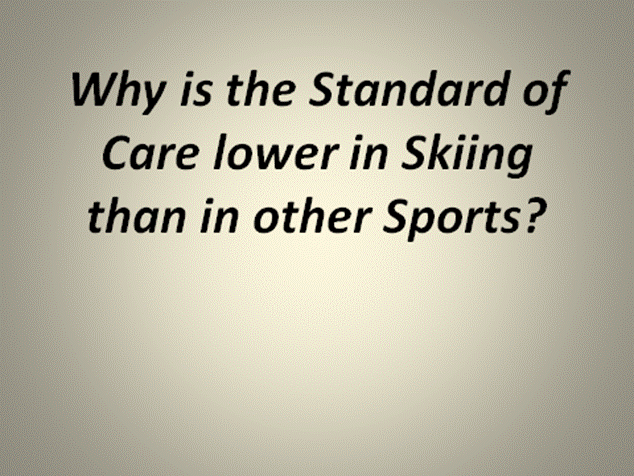
Why is the Standard of Care lower in Skiing than in other Sports?
This presentation looks at the different standards of care applied to collisions between people on a ski slope. Some states apply a negligence standard, some a reckless standard and some say the participants assume the risk of their injury in the sport.
 What do you think? Leave a comment.
If you like this let your friends know or post it on FB, Twitter or LinkedIn
Author: Outdoor Recreation Insurance, Risk Management and Law
Copyright 2016 Recreation Law (720) Edit Law
Email: Rec-law@recreation-law.com
Google+: +Recreation
Twitter: RecreationLaw
Facebook: Rec.Law.Now
Facebook Page: Outdoor Recreation & Adventure Travel Law
Blog: www.recreation-law.com
Mobile Site: http://m.recreation-law.com
By Recreation Law Rec-law@recreation-law.com James H. Moss
#AdventureTourism, #AdventureTravelLaw, #AdventureTravelLawyer, #AttorneyatLaw, #Backpacking, #BicyclingLaw, #Camps, #ChallengeCourse, #ChallengeCourseLaw, #ChallengeCourseLawyer, #CyclingLaw, #FitnessLaw, #FitnessLawyer, #Hiking, #HumanPowered, #HumanPoweredRecreation, #IceClimbing, #JamesHMoss, #JimMoss, #Law, #Mountaineering, #Negligence, #OutdoorLaw, #OutdoorRecreationLaw, #OutsideLaw, #OutsideLawyer, #RecLaw, #Rec-Law, #RecLawBlog, #Rec-LawBlog, #RecLawyer, #RecreationalLawyer, #RecreationLaw, #RecreationLawBlog, #RecreationLawcom, #Recreation-Lawcom, #Recreation-Law.com, #RiskManagement, #RockClimbing, #RockClimbingLawyer, #RopesCourse, #RopesCourseLawyer, #SkiAreas, #Skiing, #SkiLaw, #Snowboarding, #SummerCamp, #Tourism, #TravelLaw, #YouthCamps, #ZipLineLawyer, Skiing, Snowboarding, Collision, Skier v. Skier, Standard of Care, Ordinary Negligence, Reckless, Assumed Risk, Assumption of the Risk
Colorado Premises Liability act eliminated common law claims of negligence as well as CO Ski Area Safety Act claims against a landowner.
Posted: April 4, 2016 Filed under: Colorado, Ski Area | Tags: Chair Lift, Colorado Premises Liability Act, Comfort Bar, Premises Liability, Summer, Vail Leave a commentCase is a major change in the liability of a ski area to the skiers and boarders who ride any lift in Colorado.
Raup, v. Vail Summit Resorts, Inc., 2016 U.S. Dist. LEXIS 11499
State: Colorado, United States District Court for the District of Colorado
Plaintiff: Carolyn S. Raup
Defendant: Vail Summit Resorts, Inc.
Plaintiff Claims: Premises Liability Act, and for negligence, including negligence per se
Defendant Defenses: The negligence claims are Colorado Premises Liability Act
Holding: for the Defendant
Year: 2016
This case may be ongoing the decision may not be final. However, the ruling is game changing and changes a large section of the law in Colorado.
The plaintiff was riding a chairlift at one of the defendants Vail resorts during the summer. The Colorado Tramway Act requires lifts operated during the summer to have a comfort bar available to riders. As the plaintiff and two other riders were approaching the top terminal, they had intended to ride the lift back down.
The liftie (top terminal lift employee), ran out and started yelling at the rides to raise the safety bar and exit the lift.
The plaintiff and friends did not understand or know that riding around the terminal would trigger the emergency stop. The riders also did not know that the download capacity of a lift is very different from the upload capacity of the lift. Many times that download capacity is 25 to 33% of the upload capacity. That means instead of loading every chair downhill you may only be allowed to load every third or fourth chair.
The other two riders were able to exit the lift running down the exit ramp. The plaintiff fell suffering severe injuries. The plaintiff brought this suit in the Federal District Court of Colorado. Vail moved to dismiss the claims of negligence and negligence per se brought by the plaintiff.
The court granted Vail’s motion with the following analysis.
Analysis: making sense of the law based on these facts.
The court first looked at the requirements for the plaintiff to survive a motion to dismiss under Colorado law.
To survive a motion to dismiss under Rule 12(b)(6), the party asserting the claim “must allege that ‘enough factual matter, taken as true, [makes] his claim for relief … plausible on its face.'” (quotation and internal quotation marks omitted). “A claim has facial plausibility when the [pleaded] factual content [ ] allows the court to draw the reasonable inference that the defendant is liable for the misconduct alleged.’
Thus, a party asserting a claim “must include enough facts to ‘nudge[] h[er] claims across the line from conceivable to plausible.
A motion to dismiss is filed normally before the defendant has filed an answer to the complaint. The motion is filed when their allegations in the complaint are not supported by the law or misstate the law. The court rarely grants these motions because as started above, there must be just a plausible claim to survive.
In this case, the issue was the claims of the plaintiff were not available under the law. Meaning the law did not allow the plaintiff to make those types of claims against a defendant.
In this case, the Colorado Premises Liability Act, the act which controls the liability of a landowner to people on his land, was the only way the plaintiff could sue. More importantly, did the Colorado Premises Liability Act preclude not only common law claims (negligence) against a landowner but also claims brought under the Colorado Skier Safety Act based on a ski area being the landowner.
An earlier interpretation by the Colorado Supreme Court in two different cases preempted the common law claims. “
I agree with Vail that the Vigil and Lombard cases make clear that all common law claims involving landowner duties, including negligence and negligence per se claims, are abrogated by the Premises Liability Act which provides the exclusive remedy.
The plaintiff argued the Colorado Tramway Act still allowed negligence claims. The act was interpreted by a Supreme Court Decision in Bayer v. Crested Butte Mountain Resort, Inc., 960 P.2d 70, 80 (Colo. 1998), which held the ski area owed the highest degree of care to a rider on a chair lift, that of a common carrier.
However, the court found that Bayer had preempted by the Vigil act quoted above.
Six years after Bayer, the Colorado Supreme Court in Vigil made clear that the Premises Liability Act preempted all common law claims and provided the sole method of recovering against a landowner. Vigil, 103 P.3d at 328. The fact that Vigil did not reference Bayer does not change this result.
The plaintiff then argued the acts of the leftie were negligent and created a separate claim for negligence. However, again, the court found the actions were covered by the Premises Liability Act.
Vail’s duty of care to invitees such as Plaintiff is defined under the Premises Liability Act, which makes clear that it applies in actions by a person who alleges injury while on the property of another and by reasons of either the condition of the property or activities conducted on the property. This encompasses the allegations at issue in this case, including the injuries allegedly sustained by Plaintiff by activities of Vail’s employee in ordering Plaintiff and her fellow passengers to disembark from the chairlift. As such, the Premises Liability Act provides the only standard for recovery.
The court granted Vail’s motion to dismiss and dismissed the plaintiff’s negligence claims leaving only the premises liability claims.
So Now What?
Does this mean there is now a lower duty owed to riders of chairlifts in Colorado because they are classified as invitees under the Colorado Premises Liability Act? I don’t know.
However, it is clear; the Colorado Premises Liability Act supersedes all other recreational specific statutes that then limits the recovery against most recreation providers due to injuries on the land (or waters?).
REMEMBER, THIS CASE IS NOT OVER AND HAS NOT BEEN APPEALED. THE DECISION REVIEWED HERE COULD CHANGE.
 What do you think? Leave a comment.
If you like this let your friends know or post it on FB, Twitter or LinkedIn
Author: Outdoor Recreation Insurance, Risk Management and Law
Copyright 2016 Recreation Law (720) Edit Law
Email: Rec-law@recreation-law.com
Google+: +Recreation
Twitter: RecreationLaw
Facebook: Rec.Law.Now
Facebook Page: Outdoor Recreation & Adventure Travel Law
Blog: www.recreation-law.com
Mobile Site: http://m.recreation-law.com
By Recreation Law Rec-law@recreation-law.com James H. Moss
#AdventureTourism, #AdventureTravelLaw, #AdventureTravelLawyer, #AttorneyatLaw, #Backpacking, #BicyclingLaw, #Camps, #ChallengeCourse, #ChallengeCourseLaw, #ChallengeCourseLawyer, #CyclingLaw, #FitnessLaw, #FitnessLawyer, #Hiking, #HumanPowered, #HumanPoweredRecreation, #IceClimbing, #JamesHMoss, #JimMoss, #Law, #Mountaineering, #Negligence, #OutdoorLaw, #OutdoorRecreationLaw, #OutsideLaw, #OutsideLawyer, #RecLaw, #Rec-Law, #RecLawBlog, #Rec-LawBlog, #RecLawyer, #RecreationalLawyer, #RecreationLaw, #RecreationLawBlog, #RecreationLawcom, #Recreation-Lawcom, #Recreation-Law.com, #RiskManagement, #RockClimbing, #RockClimbingLawyer, #RopesCourse, #RopesCourseLawyer, #SkiAreas, #Skiing, #SkiLaw, #Snowboarding, #SummerCamp, #Tourism, #TravelLaw, #YouthCamps, #ZipLineLawyer, Vail, Summer, Chair Lift, Comfort Bar, Premises Liability, Colorado Premises Liability Act,
Black Diamond Recalls to Inspect Carabiners Due to Fall Hazard
Posted: April 2, 2016 Filed under: Uncategorized | Tags: Black Diamond, Black Diamond Equipment, Carabiner, Consumer Product Safety Council, CPSC, Recall, Rock climbing Leave a commentName of Product: Black Diamond Carabiners for Climbing
http://www.cpsc.gov/en/Recalls/2016/Black-Diamond-Recalls-to-Inspect-Carabiners/
Recall Summary
Hazard: The carabiner can unexpectedly open and allow the rope to become detached, posing a risk of injury or death to climbers from a fall.
Remedy: Replace
Consumers should immediately stop using the recalled carabineers and contact Black Diamond for instructions on inspecting and returning the product for a free replacement. Instructions are also available on the firm’s website.
Consumer Contact: Black Diamond at 800-755-5552 from 8 a.m. to 5 p.m. MT Monday through Friday or online at http://blackdiamondequipment.com and click on “Recall for Inspection: Carabiner & Quickdraws” for more information on inspecting the product. Consumers can also email the firm at warranty@bdel.com.
Recall Details
Photos Available At http://www.cpsc.gov/en/Recalls/2016/Black-Diamond-Recalls-to-Inspect-Carabiners/
Units: About 1.16 million (in addition, 81,000 were sold in Canada)
Description: This recall involves 16 models of Black Diamond brand carabiners with manufacturing date codes between 4350 and 6018. “Black Diamond” or the Black Diamond logo is printed on the front of the carabiners. The manufacturing date code is printed on the side of the carabiners. All carabiner colors are included in the recall. They were sold individually or as part of a climbing gear set. The following carabiners are included in the recall.
|
Black Diamond carabiners sold individually |
||
|
Carabiner Name |
Carabiner Name |
|
|
MINI PEARABINER SCREWGATE |
POSITRON BENT CARABINER |
|
|
OVAL CARABINER |
NITRON STRAIGHT CARABINER |
|
|
OVALWIRE CARABINER |
NITRON BENT CARABINER |
|
|
LIGHT D CARABINER |
NEUTRINO CARABINER |
|
|
HOTWIRE CARABINER |
POSITRON SCREWGATE CARABINER |
|
|
OZ CARABINER |
NITRON SCREWGATE CARABINER |
|
|
HOODWIRE CARABINER |
ROCKLOCK SCREWGATE CARABINER |
|
|
POSITRON STRAIGHT CARABINER |
VAPORLOCK SCREWGATE CARABINER |
|
|
Black Diamond carabiners sold as a set or in combination with other products |
||
|
Product Name |
|
Included Carabiner(s) |
|
FREEWIRE QUICKDRAW- 12cm |
|
HOTWIRE CARABINER (2) |
|
FREEWIRE QUICKDRAW- 18cm |
|
HOTWIRE CARABINER (2) |
|
POSIWIRE QUICKDRAW- 12cm |
|
POSITRON STRAIGHT CARABINER (2), HOTWIRE CARABINER (2) |
|
POSIWIRE QUICKDRAW- 18cm |
|
POSITRON STRAIGHT CARABINER (2), HOTWIRE CARABINER (2) |
|
POSITRON QUICKDRAW- 18cm |
|
POSITRON STRAIGHT CARABINER (2), POSITRON BENT CARABINER (2) |
|
POSITRON QUICKDRAW- 12cm |
|
POSITRON STRAIGHT CARABINER (2), POSITRON BENT CARABINER (2) |
|
POSITRON QUICKPACK |
|
POSITRON STRAIGHT CARABINER (6), POSITRON BENT CARABINER (6) |
|
POSIWIRE QUICKPACK |
|
POSITRON STRAIGHT CARABINER (6), POSITRON BENT CARABINER (6) |
|
FREEWIRE QUICKPACK 12cm |
|
HOTWIRE CARABINER (12) |
|
FREEWIRE QUICKPACK 18cm |
|
HOTWIRE CARABINER (12) |
|
POSITRON QUICKPACK 12cm |
|
POSITRON STRAIGHT CARABINER (6), POSITRON BENT CARABINER (6) |
|
POSITRON QUICKPACK 18cm |
|
POSITRON STRAIGHT CARABINER (6), POSITRON BENT CARABINER (6) |
|
POSIWIRE QUICKPACK 12cm |
|
POSITRON STRAIGHT CARABINER (6), HOTWIRE CARABINER (6) |
|
POSIWIRE QUICKPACK 18cm |
|
POSITRON STRAIGHT CARABINER (6), HOTWIRE CARABINER (6) |
|
NEUTRINO RACKPACK |
|
NEUTRINO CARABINER (6) |
|
HOTWIRE RACKPACK |
|
HOTWIRE CARABINER (6) |
|
HOTWIRE 3 PACK |
|
HOTWIRE CARABINER (3) |
|
POSITRON SCREWGATE 3 PACK |
|
POSITRON SCREWGATE CARABINER (3) |
|
OVAL 3 PACK |
|
OVAL CARABINER (3) |
|
WIRED HEX SET #4-10 |
|
OVALWIRE CARABINER (1) |
|
STOPPER SET #4-13 |
|
OVALWIRE CARABINER (1) |
|
BIG AIR PACKAGE |
|
ROCKLOCK SCREWGATE CARABINER (1) |
|
BIG AIR XP PACKAGE |
|
MINI PEARABINER SCREWGATE (1) |
|
MOMENTUM DS COMBO |
|
ROCKLOCK SCREWGATE CARABINER (1) |
|
MOMENTUM HARNESS PACKAGE |
|
ROCKLOCK SCREWGATE CARABINER (1) |
|
PRIMROSE HARNESS PACKAGE |
|
ROCKLOCK SCREWGATE CARABINER (1) |
Incidents/Injuries: None reported
Sold at: Eastern Mountain Sports, The Gear Coop, Hansen Mountaineering, REI and other specialty outdoor stores nationwide and online at Backcountry.com, BlackDiamond.com and Bouldering.com from December 2014 to January 2016 for between $6 and $15.
Importer/Distributor: Black Diamond Equipment Ltd., of Salt Lake City, Utah
Manufactured in: U.S.
Retailers: If you are a retailer of a recalled product you have a duty to notify your customers of a recall. If you can, email your clients or include the recall information in your next marketing communication to your clients. Post any Recall Poster at your stores and contact the manufacturer to determine how you will handle any recalls.
For more information on this see:
For Retailers
Recalls Call for Retailer Action
Combination of a Products Liability statute, an Expert Witness Report that was just not direct enough and odd facts holds a retailer liable as manufacture for product defect.
Product Liability takes a different turn. You must pay attention, just not rely on the CPSC.
Retailer has no duty to fit or instruct on fitting bicycle helmet
Summary Judgment granted for bicycle manufacturer and retailer on a breach of warranty and product liability claim.
For Manufacturers
The legal relationship created between manufactures and US consumers
 What do you think? Leave a comment.
If you like this let your friends know or post it on FB, Twitter or LinkedIn
Author: Outdoor Recreation Insurance, Risk Management and Law
Copyright 2016 Recreation Law (720) Edit Law
Email: Rec-law@recreation-law.com
Google+: +Recreation
Twitter: RecreationLaw
Facebook: Rec.Law.Now
Facebook Page: Outdoor Recreation & Adventure Travel Law
Blog: www.recreation-law.com
Mobile Site: http://m.recreation-law.com
By Recreation Law Rec-law@recreation-law.com James H. Moss
#AdventureTourism, #AdventureTravelLaw, #AdventureTravelLawyer, #AttorneyatLaw, #Backpacking, #BicyclingLaw, #Camps, #ChallengeCourse, #ChallengeCourseLaw, #ChallengeCourseLawyer, #CyclingLaw, #FitnessLaw, #FitnessLawyer, #Hiking, #HumanPowered, #HumanPoweredRecreation, #IceClimbing, #JamesHMoss, #JimMoss, #Law, #Mountaineering, #Negligence, #OutdoorLaw, #OutdoorRecreationLaw, #OutsideLaw, #OutsideLawyer, #RecLaw, #Rec-Law, #RecLawBlog, #Rec-LawBlog, #RecLawyer, #RecreationalLawyer, #RecreationLaw, #RecreationLawBlog, #RecreationLawcom, #Recreation-Lawcom, #Recreation-Law.com, #RiskManagement, #RockClimbing, #RockClimbingLawyer, #RopesCourse, #RopesCourseLawyer, #SkiAreas, #Skiing, #SkiLaw, #Snowboarding, #SummerCamp, #Tourism, #TravelLaw, #YouthCamps, #ZipLineLawyer, Recall, CPSC, Consumer Product Safety Council, Black Diamond, Carabiner, Rock Climbing, Black Diamond Equipment,
Black Diamond Recalls Nylon Runners Due to Fall Hazard
Posted: April 1, 2016 Filed under: Uncategorized | Tags: Black Diamond, Black Diamond Equipment, Consumer Product Safety Council, CPSC, Nylon Runners, Recall, Runners Leave a commentName of Product: Nylon Runners
http://www.cpsc.gov/en/Recalls/2016/Black-Diamond-Recalls-Nylon-Runners/
Recall Summary
Hazard: A nylon runner with a tape splice (two cut ends joined by masking tape) will fail in normal use, posing a risk of death or injury due to a fall.
Remedy: Replace
Consumers should immediately stop using the recalled nylon runners, inspect for the presence of a tape splice and contact Black Diamond for instructions on obtaining a free replacement nylon runner.
Consumer Contact: Black Diamond at 800-775-5552 from 8 a.m. to 5 p.m. MT Monday through Friday or online at http://blackdiamondequipment.com and click on “Recall for Inspection: Nylon Runners” for more information. Consumers can also email the firm at warranty@bdel.com.
Recall Details
Photos Available At http://www.cpsc.gov/en/Recalls/2016/Black-Diamond-Recalls-Nylon-Runners/
Units: About 185,000 (in addition, 23,600 were sold in Canada)
Description: This recall involves Black Diamond 18 mm wide nylon runners that are 60 cm/24 inch or 120 cm/48 inches long that have a tape splice (two cut ends joined by masking tape). The nylon runners were sold in red, blue, gold, green, gray and purple. “CE 0333” and 2014 or 2015 are printed on the sewn-in label.
Incidents/Injuries: None reported
Sold at: Eastern Mountain Sports, Hansen Mountaineering, The Gear Coop, Peak Experiences Inc., REI and other specialty outdoor stores nationwide and online at Backcountry.com and BlackDiamond.com from January 2014 through February 2016 for between $5 and $9.
Importer/Distributor: Black Diamond Ltd., of Salt Lake City, Utah
Manufactured in: China
Retailers: If you are a retailer of a recalled product you have a duty to notify your customers of a recall. If you can, email your clients or include the recall information in your next marketing communication to your clients. Post any Recall Poster at your stores and contact the manufacturer to determine how you will handle any recalls.
For more information on this see:
For Retailers
Recalls Call for Retailer Action
Combination of a Products Liability statute, an Expert Witness Report that was just not direct enough and odd facts holds a retailer liable as manufacture for product defect.
Product Liability takes a different turn. You must pay attention, just not rely on the CPSC.
Retailer has no duty to fit or instruct on fitting bicycle helmet
Summary Judgment granted for bicycle manufacturer and retailer on a breach of warranty and product liability claim.
For Manufacturers
The legal relationship created between manufactures and US consumers
 What do you think? Leave a comment.
If you like this let your friends know or post it on FB, Twitter or LinkedIn
Author: Outdoor Recreation Insurance, Risk Management and Law
Copyright 2016 Recreation Law (720) Edit Law
Email: Rec-law@recreation-law.com
Google+: +Recreation
Twitter: RecreationLaw
Facebook: Rec.Law.Now
Facebook Page: Outdoor Recreation & Adventure Travel Law
Blog: www.recreation-law.com
Mobile Site: http://m.recreation-law.com
By Recreation Law Rec-law@recreation-law.com James H. Moss
#AdventureTourism, #AdventureTravelLaw, #AdventureTravelLawyer, #AttorneyatLaw, #Backpacking, #BicyclingLaw, #Camps, #ChallengeCourse, #ChallengeCourseLaw, #ChallengeCourseLawyer, #CyclingLaw, #FitnessLaw, #FitnessLawyer, #Hiking, #HumanPowered, #HumanPoweredRecreation, #IceClimbing, #JamesHMoss, #JimMoss, #Law, #Mountaineering, #Negligence, #OutdoorLaw, #OutdoorRecreationLaw, #OutsideLaw, #OutsideLawyer, #RecLaw, #Rec-Law, #RecLawBlog, #Rec-LawBlog, #RecLawyer, #RecreationalLawyer, #RecreationLaw, #RecreationLawBlog, #RecreationLawcom, #Recreation-Lawcom, #Recreation-Law.com, #RiskManagement, #RockClimbing, #RockClimbingLawyer, #RopesCourse, #RopesCourseLawyer, #SkiAreas, #Skiing, #SkiLaw, #Snowboarding, #SummerCamp, #Tourism, #TravelLaw, #YouthCamps, #ZipLineLawyer, Recall, CPSC, Consumer Product Safety Council, Black Diamond, Black Diamond Equipment, Runners, Nylon Runners,
De Castro v. Odetah Camping Resort, Inc., 2015 Conn. Super. LEXIS 2297
Posted: March 31, 2016 Filed under: Connecticut, Legal Case, Rivers and Waterways | Tags: Campground, Causation, CN, Connecticut, Lake, Life Jacket, Lifeguard, Proximate Causation, Proximate Cause, swimming Leave a commentDe Castro v. Odetah Camping Resort, Inc., 2015 Conn. Super. LEXIS 2297
Adelson Luiz De Castro, Administrator of the Estate of Jose Luiz De Castro v. Odetah Camping Resort, Inc.
FBTCV126026625
SUPERIOR COURT OF CONNECTICUT, JUDICIAL DISTRICT OF FAIRFIELD AT BRIDGEPORT
2015 Conn. Super. LEXIS 2297
September 2, 2015, Decided
September 2, 2015, Filed
NOTICE: THIS DECISION IS UNREPORTED AND MAY BE SUBJECT TO FURTHER APPELLATE REVIEW. COUNSEL IS CAUTIONED TO MAKE AN INDEPENDENT DETERMINATION OF THE STATUS OF THIS CASE.
JUDGES: [*1] Michael P. Kamp, J.
OPINION BY: Michael P. Kamp
OPINION
MEMORANDUM OF DECISION RE DEFENDANT’S MOTION TO SET ASIDE THE VERDICT AND MOTION FOR JUDGMENT NOTWITHSTANDING THE VERDICT
PROCEDURAL BACKGROUND
The defendant, Odetah Camping Resort, Inc., has filed a renewal of its motion for directed verdict and a motion to set aside the jury’s verdict.1 The trial commenced on April 28, 2015, and evidence concluded on May 6, 2015, when the defense rested its case. The jury received the charge on the law on May 6, 2015. On May 6, 2015, the jury returned a verdict for the plaintiff, Adelson Luiz DeCastro, Administrator of the Estate of Jose Luiz DeCastro, and awarded total damages of $229,155.96. Regarding the question of comparative negligence, the jury found the plaintiff’s decedent, Jose DeCastro, was 49% responsible for his own injuries.
1 The defendant originally moved for a directed verdict at the close of the plaintiff’s case in chief. At that time, the court reserved decision, and the defendant commenced its defense. On close of the defendant’s case, the matter was submitted to the jury.
The defendant filed its motion to set aside the verdict on May 15, 2015. The plaintiff filed its objection to the defendant’s motion [*2] on May 19, 2015. On June 22, 2015, the court heard the matter at short calendar and took the papers.
The defendant argues in its motion that the plaintiff failed to prove beyond the realm of surmise and speculation that the defendant’s negligence was the proximate cause of the death of the decedent. This argument is based upon a lack of evidence as to what actually caused the decedent to drown.
II
FACTS
After a trial, the jury could have found as follows. On July 7, 2011, the decedent and a group of friends went to the defendant resort located in Bozrah, Connecticut. In order to gain entrance, the decedent paid an entrance fee. The defendant is an approximately 100-acre campground that offers multiple recreational activities. In addition to facilities to accommodate overnight camping, the defendant offers sporting facilities, which include a pool as well as volleyball, tennis, and basketball courts. The defendant abuts a large, thirty-two-acre freshwater lake, which includes a small beach, and offers swimming and boating activities. A portion of the lake that is adjacent to the beach has a designated swim area. The boundaries of the swim area are designated by a rope line and buoys. Just [*3] beyond the roped off swimming area are two inflatable platforms. One was described as a platform or trampoline, and the other was described as an “iceberg.” Both inflatable devices were attractions to be used by the resort guests. The defendant did not provide lifeguards at the pool or lake swim area. A single sign was posted at one end of the beach area, indicating: “No Lifeguard on Duty. Swim at Your Own Risk.” No employees of the defendant directly supervised the lake swimming area.
On July 9, 2011, the decedent and his friend, Saulo Sousa, entered the designated swimming area for the purpose of swimming out to the trampoline just beyond the buoy line. When Sousa reached the rope line, he observed the decedent immediately behind him in the water. The depth of the water at this location was approximately six feet. As Sousa lifted the rope line to duck under it, he observed the decedent diving forward and under the rope. When Sousa reached the trampoline, he climbed on it but did not observe the decedent. After spending a few minutes on the trampoline, Sousa reentered the water and swam to the shore. After unsuccessfully attempting to locate the decedent, employees of the defendant [*4] were notified that he was missing. After a brief search, 911 emergency services were dispatched, and Bozrah firefighters and rescue personnel responded to the scene. When notified that the decedent was last seen in the designated swim area near the buoy line, firefighter Colin Laffey entered the water and located the decedent floating unresponsive just below the surface of the water just inside the buoy line. Laffey testified that he located the decedent in an area where the depth of the water was less than six feet. The decedent was brought to shore, and CPR was administered. The decedent was then transported by ambulance to Backus Hospital, but never regained consciousness and was pronounced dead. A postmortem autopsy determined the cause of death to be asphyxia due to submersion. The postmortem examination was negative for any signs of illness, traumatic injury, or any preexisting medical condition or disease. A toxicology examination was negative for the presence of any drugs, alcohol, or medication.
The decedent’s drowning was unwitnessed despite the fact that there were numerous people in the water and on the beach. Although other members of the decedent’s group, including his [*5] girlfriend, were on the beach adjacent to the swimming area, no one saw him in distress or struggling in the water. He was identified by his friends as a good or strong swimmer.
III
DISCUSSION
Practice Book §16-37 provides, in relevant part: “Whenever a motion for a directed verdict made at any time after the close of the plaintiff’s case in chief is denied or for any reason is not granted, the judicial authority is deemed to have submitted the action to the jury subject to a later determination of the legal questions raised by the motion.” “Directed verdicts are not favored . . . A trial court should direct a verdict only when a jury could not reasonably and legally have reached any other conclusion . . . In reviewing the trial court’s decision to direct a verdict in favor of a defendant we must consider the evidence in the light most favorable to the plaintiff . . . Although it is the jury’s right to draw logical deductions and make reasonable inferences from the facts proven . . . it may not resort to mere conjecture and speculation . . . A directed verdict is justified if . . . the evidence is so weak that it would be proper for the court to set aside a verdict rendered for the other party.” (Internal [*6] quotation marks omitted.) Riccio v. Harbour Village Condominium Assn., Inc., 281 Conn. 160, 163, 914 A.2d 529 (2007). “A verdict may be directed . . . where the claim is that there is insufficient evidence to sustain a favorable verdict.” (Internal quotation marks omitted.) Beale v. Yale-New Haven Hospital, 89 Conn.App. 556, 565-66, 874 A.2d 259 (2005).
Likewise, “[a] trial court may set aside a verdict on a finding that the verdict is manifestly unjust because, given the evidence presented, the jury mistakenly applied a legal principle or because there is no evidence to which the legal principles of the case could be applied . . . A verdict should not be set aside, however, where it is apparent that there was some evidence on which the jury might reasonably have reached its conclusion . . . This limitation on a trial court’s discretion results from the constitutional right of litigants to have issues of fact determined by a jury.” (Internal quotation marks omitted.) Deas v. Diaz, 121 Conn.App. 826, 841, 998 A.2d 200, cert. denied, 298 Conn. 905, 3 A.3d 69 (2010), rev’d on other grounds, Saleh v. Ribeiro Trucking, LLC, 303 Conn. 276, 32 A.3d 318 (2011).
“[T]o establish a prima facie case, the proponent must submit evidence which, if credited, is sufficient to establish the fact or facts which it is adduced to prove . . . [T]he evidence offered by the plaintiff is to be taken as true and interpreted in the light most favorable to [the plaintiff], and every reasonable inference is to be drawn in [the plaintiff’s] [*7] favor.” (Internal quotation marks omitted.) Cadle Co. v. Errato, 71 Conn.App. 447, 455-56, 802 A.2d 887, cert. denied, 262 Conn. 918, 812 A.2d 861 (2002). “The credibility and weight to be attributed to any evidence offered [at trial] is solely within the province of the jury.” Murteza v. State, 7 Conn.App. 196, 208-09, 508 A.2d 449, cert. denied, 200 Conn. 803, 510 A.2d 191 (1986). “[I]t is not the function of [the trial] court to sit as the seventh juror when [it] review[s] the sufficiency of the evidence . . . rather, [it] must determine, in the light most favorable to sustaining the verdict, whether the totality of the evidence, including reasonable inferences therefrom, supports the [trier’s] verdict . . . In making this determination, [t]he evidence must be given the most favorable construction in support of the verdict of which it is reasonably capable . . . In other words, [i]f the [trier] could reasonably have reached its conclusion, the verdict must stand, even if [the trial] court disagrees with it.” (Internal quotation marks omitted.) O’Connor v. Larocque, 302 Conn. 562, 612, 31 A.3d 1 (2011).
“In order to make out a prima facie case of negligence, the plaintiff must submit evidence that, if credited, is sufficient to establish duty, breach of duty, causation, and actual injury . . . A defendant’s duty and breach of duty is measured by a reasonable care standard, which is the care [that] a reasonably prudent person would use under [*8] the circumstances . . . After the plaintiff establishes that the defendant did not exercise reasonable care, the plaintiff has the burden of proving that the defendant’s negligence caused the plaintiff’s injuries. To do so, the plaintiff must first establish causation in fact, that is, that the injury would not have occurred but for the actor’s conduct . . . The plaintiff then must show proximate cause . . . Proximate cause requires that the defendant’s conduct [was] a substantial factor in bringing about the plaintiff’s injuries and that there was an unbroken sequence of events that tied [the plaintiff’s] injuries to the [defendant’s conduct] . . . Proximate cause does not require the plaintiff to remove from the realm of possibility all other potential causes of the accident . . . Instead, the plaintiff must establish that it is more likely than not that the cause on which the plaintiff relies was in fact a proximate cause of the accident. The more likely than not standard ensures that the causal connection . . . [is] based [on] more than conjecture or surmise.” (Citations omitted; emphasis omitted; internal quotation marks omitted.) Rawls v. Progressive Northern Insurance Company, 310 Conn. 768, 776-77, 83 A.3d 576 (2014).
The defendant’s primary argument is that no one [*9] witnessed the decedent’s drowning, and there was no evidence offered as to what caused him to drown. The defendant relies on Wu v. Fairfield, 204 Conn. 435, 528 A.2d 364 (1987). In Wu, the plaintiff’s decedent who was fifteen years old, went to Lake Mohegan, a freshwater lake, with her mother and two brothers for an afternoon of swimming. Id., 437. There was a designated swim area marked by a buoy line. At the time of the occurrence, there were four lifeguards on duty. Id. Those lifeguards had observed that the plaintiff’s decedent was a poor swimmer and had warned her twice to return to the shallow portion of the designated swim area. Id. When an approaching storm prompted the lifeguards to clear the water, the plaintiff’s decedent did not return to shore. Id. After a search, one of the lifeguards found the decedent’s body at the bottom of the lake in the designated swim area but beyond the shallow portion. Id., 437-38. The plaintiff alleged that the town and several of its employees, the lifeguards, were negligent in the performance of their duties. Id., 436. A jury returned a verdict for the defendants. Id. The plaintiff then filed a motion to set aside the verdict, which motion was denied. Id. In affirming the trial court’s denial of the plaintiff’s [*10] motion to set aside the verdict, the court held that “[w]hile it is undisputed that the decedent drowned, there was no evidence tying any negligence on the defendant lifeguards’ part to her death . . . Here, the plaintiff presented no evidence other than that the victim perished in an unwitnessed drowning. The plaintiff failed to establish an unbroken sequence of events causally flowing from the defendant lifeguards’ arguably negligent supervision to the decedent’s drowning.” Id., 440.
In this case, the plaintiff’s May 4, 2015 amended complaint contained two specifications of negligence as to the conduct of the defendant. The first allegation was that the defendant was negligent in failing to provide lifeguards. The second allegation was that the defendant was negligent when it knew or should have known of the danger associated with encouraging its guests to swim to its recreational flotation devices, yet failed to take reasonable steps to secure their safety in doing so. In response to jury interrogatories submitted by the court the jury found that the defendant was negligent with regard to the second specification but not the first. With regard to the claim of negligence concerning encouraging [*11] swimmers to use the flotation devices, the plaintiff relied on testimony that the owner’s manual for the two devices contained warnings that recommended users wear life vests. Although life vests were available in a shed adjacent to the lake swim area, the defendant did not require guests entering the lake or using any of the flotation devices to wear them. In addition, the plaintiff argued that the defendant failed to properly supervise and monitor the swimming area and had an inadequate emergency rescue plan.
The plaintiff offered the testimony of Gerald Dworkin, an aquatic safety expert. Dworkin offered opinion testimony regarding the defendant’s lack of safety measures including its failure to have lifeguards monitoring the swim area. Dworkin was also critical of the defendant’s lack of an emergency safety plan. Dworkin did not, however, offer any opinion testimony as to what actually caused the decedent to drown. He affirmed that it was an unwitnessed drowning. In addition, although the owner’s manuals for the flotation devices recommended the use of life vests, the decedent was not using either device when he drowned; the little evidence there is indicates he never left the designated [*12] swim area. The flotation devices were located outside that designated area.
Here, as in Wu, the plaintiff presented no evidence other than that the decedent died in an unwitnessed drowning. There was no evidence as to what caused the decedent to drown. In the absence of any such evidence, any number of factual possibilities could explain this accident. Without any evidence as to what caused this unfortunate incident, only speculation and conjecture could link the plaintiff’s drowning to the negligent conduct of the defendant. The plaintiff failed to present any evidence to establish an unbroken sequence of events causally flowing from the defendant’s conduct that the jury found negligent to the decedent’s drowning. “The establishment of proximate cause is an essential element of a negligence claim and the parties recognize that if proximate cause is lacking, the plaintiff cannot prevail.” Wu v. Town Of Fairfield, supra, 204 Conn. 441.
Viewing the evidence in the light most favorable to the plaintiff, based on the evidence presented by the plaintiff, no reasonable juror could find that the negligence of the defendant caused or was a substantial factor in causing the decedent’s death by drowning. The lack of any evidence as to what [*13] caused this drowning is fatal to the plaintiff’s case.
IV
CONCLUSION
Because the plaintiff failed to establish that the negligent conduct of the defendant was the proximate cause of the decedent’s drowning, the defendant’s motion to set aside the verdict is granted. Judgment may enter for the defendant.
KAMP, J.
Summer 2015 Commercial Fatalities
Posted: March 30, 2016 Filed under: Paddlesports, Skiing / Snow Boarding | Tags: 2015, All American Adventures, Bay Shore Camp, Calving, Chugach Powder Guides, Colorado River, fatality, Flipped, Funnel Falls, Geyser Whitewater Expedition, Glacier, Summer, Westwater Canyon, Whitewater Rafting Leave a commentThis list is not guaranteed to be accurate. The information is found from web searches and news dispatches. Those references are part of the chart. If you have a source for information on any fatality please leave a comment or contact me. Thank you.
If this information is incorrect or incomplete please let me know. This is up to date as of December 31, 2015. Thanks.
Rafting, Mountaineering and other summer sports are probably still safer than your kitchen or bathroom. This information is not to scare you away from any activity but to help you understand the risks and to study.
Red is a probable death due to medical issues unrelated to the activity
Dark blue is a death of an employee while working
|
Date |
Activity |
State |
Location |
What |
Age |
Sex |
Location 2 |
Reference |
|
Company |
|
3/2 |
Backcountry Skiing |
AK |
Chugach Mountains |
Calving Glacier |
28 |
M |
|
|
Chugach Powder Guides |
|
|
5/22 |
Whitewater Rafting |
CO |
Clear Creek |
Raft Flipped |
47 |
F |
M258.5 |
|
All American Adventures |
|
|
5/31 |
Whitewater Rafting |
MT |
Gallatin River |
Raft Flipped |
43 |
M |
House Rock |
|
Geyser Whitewater Expedition |
|
|
6/5 |
Whitewater Rafting |
UT |
Colorado River, Westwater |
Raft Flipped |
50 |
M |
Funnel Falls |
|
|
|
|
6/10 |
Whitewater Rafting |
CO |
Arkansas River, Brown’s Canyon, |
Raft high sided |
11 |
M |
Big Drop |
|
The Adventure Company |
|
|
6/11 |
Zip Line |
NC |
Camp Cheerio |
|
12 |
F |
|
|
YMCA |
|
|
|
Whitewater Rafting |
CO |
Arkansas River |
|
52 |
M |
Salt Lick |
|
|
|
|
|
Whitewater Rafting |
CO |
Animas |
|
|
M |
|
|
|
Mild to Wild |
|
6/13 |
Whitewater Rafting |
CO |
Roaring Fork River |
|
44 |
F |
|
Blazing Adventures |
||
|
6/22 |
Hiking on Whitewater Rafting Trip |
AZ |
Colorado River |
Missing after hike |
22 |
M |
Pumpkin Springs, Swamper on trip |
Tours West |
||
|
6/23 |
Wakeboarding |
GA |
Carters Lake |
|
23 |
M |
|
|
Cohutta Springs Youth Camp |
|
|
|
Whitewater Rafting |
NM |
Rio Grande |
|
52 |
M |
|
|
|
|
|
7/4 |
Whitewater Rafting |
CO |
Clear Creek |
|
20 |
M |
|
|
Mile High Rafting |
|
|
7/6 |
Whitewater Rafting |
CO |
Poudre River |
Medical |
76 |
M |
|
|
A1 Wildwater Rafting |
|
|
7/13 |
Ropes Course |
SC |
Freebird |
|
16 |
F |
|
|
Carolina Point Young Life Camp |
|
|
7/14 |
Zip Line |
UT |
Zip line |
Fell off platform |
54 |
M |
Grabbed guest who pulled him off |
|
Kanab Zipline |
|
|
7/18 |
Whitewater Rafting |
CO |
Dizzy Lizzy |
Fell out of raft |
35 |
M |
|
|
|
|
|
9/25/15 |
Zip Line |
MI |
Huron County |
Fell from zip line |
85 |
M |
|
|
Bay Shore Camp |
|
|
9/27 |
Cycling Time Trial |
CA |
Yolo County |
Hit by car |
57 |
M |
County Road 19, west of Interstate 505 near Esparto |
|
Northern California Nevada Cycling Association |
If you are unable to read the chart, you can download a copy of this as a PDF here.
Our condolences go to the families of the deceased. Our thoughts extend to the families and staff at the areas who have to deal with these tragedies.
What do you think? Leave a comment.
If you like this let your friends know or post it on FB, Twitter or LinkedIn
Copyright 2016 Recreation Law (720) Edit Law
What do you think? Leave a comment.

If you like this let your friends know or post it on FB, Twitter or LinkedIn
Author: Outdoor Recreation Insurance, Risk Management and Law
Email: Rec-law@recreation-law.com
Google+: +Recreation
Twitter: RecreationLaw
Facebook: Rec.Law.Now
Facebook Page: Outdoor Recreation & Adventure Travel Law
Blog: www.recreation-law.com
Mobile Site: http://m.recreation-law.com
#AdventureTourism, #AdventureTravelLaw, #AdventureTravelLawyer, #AttorneyatLaw, #Backpacking, #BicyclingLaw, #Camps, #ChallengeCourse, #ChallengeCourseLaw, #ChallengeCourseLawyer, #CyclingLaw, #FitnessLaw, #FitnessLawyer, #Hiking, #HumanPowered, #HumanPoweredRecreation, #IceClimbing, #JamesHMoss, #JimMoss, #Law, #Mountaineering, #Negligence, #OutdoorLaw, #OutdoorRecreationLaw, #OutsideLaw, #OutsideLawyer, #RecLaw, #Rec-Law, #RecLawBlog, #Rec-LawBlog, #RecLawyer, #RecreationalLawyer, #RecreationLaw, #RecreationLawBlog, #RecreationLawcom, #Recreation-Lawcom, #Recreation-Law.com, #RiskManagement, #RockClimbing, #RockClimbingLawyer, #RopesCourse, #RopesCourseLawyer, #SkiAreas, #Skiing, #SkiLaw, #Snowboarding, #SummerCamp, #Tourism, #TravelLaw, #YouthCamps, #ZipLineLawyer, Fatality, Summer, 2015, Whitewater Rafting, Glacier, Calving, Flipped, Chugach Powder Guides, All American Adventures, Geyser Whitewater Expedition, Colorado River, Westwater Canyon, Funnel Falls, Bay Shore Camp
Colorado Premises Liability Act
Posted: March 30, 2016 Filed under: Colorado | Tags: Invitee, Landowner, Licensee, Premises Liability, Premises Liability Act, Trespasser Leave a commentCOLORADO REVISED STATUTES
TITLE 13. COURTS AND COURT PROCEDURE
DAMAGES AND LIMITATIONS ON ACTIONS
ARTICLE 21.DAMAGES
PART 1. GENERAL PROVISIONS
C.R.S. 13-21-115 (2015)
13-21-115. Actions against landowners
(1) For the purposes of this section, “landowner” includes, without limitation, an authorized agent or a person in possession of real property and a person legally responsible for the condition of real property or for the activities conducted or circumstances existing on real property.
(1.5) The general assembly hereby finds and declares:
(a) That the provisions of this section were enacted in 1986 to promote a state policy of responsibility by both landowners and those upon the land as well as to assure that the ability of an injured party to recover is correlated with his status as a trespasser, licensee, or invitee;
(b) That these objectives were characterized by the Colorado supreme court as “legitimate governmental interests” in Gallegos v. Phipps, No. 88 SA 141 (September 18, 1989);
(c) That the purpose of amending this section in the 1990 legislative session is to assure that the language of this section effectuates these legitimate governmental interests by imposing on landowners a higher standard of care with respect to an invitee than a licensee, and a higher standard of care with respect to a licensee than a trespasser;
(d) That the purpose of this section is also to create a legal climate which will promote private property rights and commercial enterprise and will foster the availability and affordability of insurance;
(e) That the general assembly recognizes that by amending this section it is not reinstating the common law status categories as they existed immediately prior to Mile Hi Fence v. Radovich, 175 Colo. 537, 489 P.2d 308 (1971) but that its purpose is to protect landowners from liability in some circumstances when they were not protected at common law and to define the instances when liability will be imposed in the manner most consistent with the policies set forth in paragraphs (a), (c), and (d) of this subsection (1.5).
(2) In any civil action brought against a landowner by a person who alleges injury occurring while on the real property of another and by reason of the condition of such property, or activities conducted or circumstances existing on such property, the landowner shall be liable only as provided in subsection (3) of this section. Sections 13-21-111, 13-21-111.5, and 13-21-111.7 shall apply to an action to which this section applies. This subsection (2) shall not be construed to abrogate the doctrine of attractive nuisance as applied to persons under fourteen years of age. A person who is at least fourteen years of age but is less than eighteen years of age shall be presumed competent for purposes of the application of this section.
(3) (a) A trespasser may recover only for damages willfully or deliberately caused by the landowner.
(b) A licensee may recover only for damages caused:
(I) By the landowner’s unreasonable failure to exercise reasonable care with respect to dangers created by the landowner of which the landowner actually knew; or
(II) By the landowner’s unreasonable failure to warn of dangers not created by the landowner which are not ordinarily present on property of the type involved and of which the landowner actually knew.
(c) (I) Except as otherwise provided in subparagraph (II) of this paragraph (c), an invitee may recover for damages caused by the landowner’s unreasonable failure to exercise reasonable care to protect against dangers of which he actually knew or should have known.
(II) If the landowner’s real property is classified for property tax purposes as agricultural land or vacant land, an invitee may recover for damages caused by the landowner’s unreasonable failure to exercise reasonable care to protect against dangers of which he actually knew.
(3.5) It is the intent of the general assembly in enacting the provisions of subsection (3) of this section that the circumstances under which a licensee may recover include all of the circumstances under which a trespasser could recover and that the circumstances under which an invitee may recover include all of the circumstances under which a trespasser or a licensee could recover.
(4) In any action to which this section applies, the judge shall determine whether the plaintiff is a trespasser, a licensee, or an invitee, in accordance with the definitions set forth in subsection (5) of this section. If two or more landowners are parties defendant to the action, the judge shall determine the application of this section to each such landowner. The issues of liability and damages in any such action shall be determined by the jury or, if there is no jury, by the judge.
(5) As used in this section:
(a) “Invitee” means a person who enters or remains on the land of another to transact business in which the parties are mutually interested or who enters or remains on such land in response to the landowner’s express or implied representation that the public is requested, expected, or intended to enter or remain.
(b) “Licensee” means a person who enters or remains on the land of another for the licensee’s own convenience or to advance his own interests, pursuant to the landowner’s permission or consent. “Licensee” includes a social guest.
(c) “Trespasser” means a person who enters or remains on the land of another without the landowner’s consent.
(6) If any provision of this section is found by a court of competent jurisdiction to be unconstitutional, the remaining provisions of the section shall be deemed valid.
HISTORY: Source: L. 86: Entire section added, p. 683, § 1, effective May 16.L. 90: (1.5), (3.5), (5), and (6) added and (3) and (4) amended, p. 867, § 1, effective April 20.L. 2006: (2) amended, p. 344, § 1, effective April 5.
Editor’s note: Subsections (5)(a) and (5)(c), as they were enacted in House Bill 90-1107, were relettered on revision in 2002 as (5)(c) and (5)(a), respectively.
RECENT ANNOTATIONS
A seller of property pursuant to an installment land contract is not a “landowner” and not responsible for injury to a third party on the property despite being the record title holder of the property if the seller is not in possession of the property at the time of the injury and is not otherwise legally responsible for the conditions, activities, or circumstances on the property pursuant to the contract. Lucero v. Ulvestad, 2015 COA 98, — P.3d — [published July 16, 2015].
ANNOTATION
Law reviews. For article, “Legal Aspects of Health and Fitness Clubs: A Healthy and Dangerous Industry”, see 15 Colo. Law. 1787 (1986). For article, “The Landowners’ Liability Statute”, see 18 Colo. Law. 208 (1989). For article, “The Changing Boundaries of Premises Liability after Gallegos”, see 18 Colo. Law. 2121 (1989). For article, “Recreational Use Of Agricultural Lands”, see 23 Colo. Law. 529 (1994). For article, “The Colorado Premises Liability Statute”, see 25 Colo. Law. 71 (May 1996). For article, “Stealth Statute: The Unexpected Reach of the Colorado Premises Liability Act”, see 40 Colo. Law. 27 (March 2011).
Constitutionality. The phrase “deliberate failure to exercise reasonable care” found in subsection (3)(c) is not unconstitutionally vague. Giebink v. Fischer, 709 F. Supp. 1012 (D. Colo. 1989).
This section does not violate article II, § 6, of the state constitution since that provision is a mandate to the judiciary and not the legislature. Giebink v. Fischer, 709 F. Supp. 1012 (D. Colo. 1989).
This section does not violate article V, section 25 of the state constitution since this provision applies uniformly to all landowners. Giebink v. Fischer, 709 F. Supp. 1012 (D. Colo. 1989).
This section does not violate equal protection since the provision of limited protection to landowners is reasonably related to the protection of the state economy. Giebink v. Fischer, 709 F. Supp. 1012 (D. Colo. 1989).
Unconstitutionality. This section violates both the federal and state constitutional guarantees of equal protection of the laws. Gallegos v. Phipps, 779 P.2d 856 (Colo. 1989); Klausz v. Dillion Co., Inc., 779 P.2d 863 (Colo. 1989) (disagreeing with Giebink v. Fischer cited above) (decided prior to 1990 amendments).
The Colorado Premises Liability Act provides the exclusive remedy against a landowner for physical injuries sustained on the landowner’s property. Henderson v. Master Klean Janitorial, Inc., 70 P.3d 612 (Colo. App. 2003); Vigil v. Franklin, 103 P.3d 322 (Colo. 2004); Anderson v. Hyland Hills Park & Recreation Dist., 119 P.3d 533 (Colo. App. 2004); Sweeney v. United Artists Theater Circuit, 119 P.3d 538 (Colo. App. 2005).
Section applies to conditions, activities, and circumstances on a property that the landowner is liable for in its capacity as a landowner. Defendant, in its capacity as a landowner, was responsible for the activities conducted and conditions on its premises, including the process of assisting a customer with loading a freezer he had purchased from defendant. Larrieu v. Best Buy Stores, L.P., 2013 CO 38, 303 P.3d 558.
This section preempts the common law creation of both landowner duties and defenses to those duties. Consequently, the open and obvious danger doctrine cannot be asserted by a landowner as a defense to a premises liability law suit. Vigil v. Franklin, 103 P.3d 322 (Colo. 2004).
Section does not require that damages resulting from landowner’s negligence be assessed without regard to negligence of the injured party or fault of a nonparty. Union Pac. R.R. v. Martin, 209 P.3d 185 (Colo. 2009).
Section does not abrogate statutorily created defenses, which were available to landowners before the 2006 amendment and afterward. The trial court correctly allowed defendants’ affirmative defenses of comparative negligence and assumption of the risk. Tucker v. Volunteers of Am. Colo. Branch, 211 P.3d 708 (Colo. App. 2008), aff’d on other grounds sub nom. Volunteers of Am. v. Gardenswartz, 242 P.3d 1080 (Colo. 2010).
Premises Liability Act never expressly excluded the statutory defense of comparative negligence from its coverage, and limiting the statutory protection provided to landowners would tend to increase liability rather than protect landowners from liability. DeWitt v. Tara Woods Ltd. P’ship, 214 P.3d 466 (Colo. App. 2008) (decided under law in effect prior to 2006 amendment).
Statute does not have to expressly bar waiver by contract for the contract provision to be invalid because it is contrary to public policy. Stanley v. Creighton Co., 911 P.2d 705 (Colo. App. 1996).
Holding title to property is not dispositive in determining who is a landowner under subsection (1). Wark v. U.S., 269 F.3d 1185 (10th Cir. 2001).
The term “landowner” is no more expansive than the common law definition. Wark v. U.S., 269 F.3d 1185 (10th Cir. 2001).
A landowner is any person in possession of real property and such possession need not necessarily be to the exclusion of all others. Therefore, for purposes of this section, a landowner can be an independent contractor. Pierson v. Black Canyon Aggregates, Inc., 48 P.3d 1215 (Colo. 2002).
This section offers its protection to a person who is legally conducting an activity on the property or legally creating a condition on the property. Such person or entity is responsible for the activity or condition and, therefore, prospectively liable to an entrant onto the property. Pierson v. Black Canyon Aggregates, Inc., 48 P.3d 1215 (Colo. 2002); Wycoff v. Grace Cmty. Church, 251 P.3d 1260 (Colo. App. 2010).
Defendant is not a “landowner” where there is no evidence that it was in possession of the sidewalk or that it was responsible for creating a condition on the sidewalk or conducting an activity on the sidewalk that caused plaintiff’s injuries. Jordan v. Panorama Orthopedics & Spine Ctr., PC, 2013 COA 87, — P.3d –.
The test for determining if a victim is an invitee is whether she or he was on the premises to transact business in which the parties are mutually interested. Grizzell v. Hartman Enters., Inc., 68 P.3d 551 (Colo. App. 2003).
Trial court erred in ruling that plaintiff was defendant’s licensee rather than invitee. Therefore, jury instructions minimized the duties defendant owed to plaintiff under the Premises Liability Act. Wycoff v. Seventh Day Adventist Ass’n, 251 P.3d 1258 (Colo. App. 2010).
If the victim was on the premises at an employee’s invitation for either the employee’s benefit, victim’s benefit, or their mutual benefit, then she or he was a licensee or trespasser not an invitee. Grizzell v. Hartman Enters., Inc., 68 P.3d 551 (Colo. App. 2003).
Volunteers are generally classified as licensees. Grizzell v. Hartman Enters., Inc., 68 P.3d 551 (Colo. App. 2003); Rieger v. Wat Buddhawararam of Denver, Inc., 2013 COA 156, 338 P.3d 404.
So long as a landowner retains possession of its property, it cannot delegate the duties imposed on it by subsection (1). Jules v. Embassy Props., Inc., 905 P.2d 13 (Colo. App. 1995).
When a landowner is vicariously liable under the nondelegability doctrine for acts or omissions of other defendants, the trial court should instruct the jury to determine the respective shares of fault of the landowner and the other defendants. But, in entering a judgment, the court shall aggregate the fault of the landowner with any other defendants for whom the landowner is vicariously liable. Reid v. Berkowitz, 2013 COA 110M, 315 P.3d 185.
But possession of property is not dependent upon title and need not be exclusive. Under this section, a party not an owner or lessee may nevertheless be a “landowner” if the party either maintains control over the property or is legally responsible for either the condition of the property or for activities conducted on the property. Henderson v. Master Klean Janitorial, Inc., 70 P.3d 612 (Colo. App. 2003).
However, a contractor who would otherwise be categorized as a “landowner” during time of work on property is not liable if, at the time of the accident in question, the contractor was neither in possession of the property nor conducting any activity related to the property. In such a case, the plaintiff is not required to prove that defendant contractor had actual knowledge of the alleged dangerous condition. Land-Wells v. Rain Way Sprinkler & Lands., 187 P.3d 1152 (Colo. App. 2008); Collard v. Vista Paving Corp., 2012 COA 208, 292 P.3d 1232.
Contractor who had a legal responsibility for the condition of the premises and who was potentially liable for injuries resulting from that condition held to be a “landowner” for purposes of this section. Henderson v. Master Klean Janitorial, Inc., 70 P.3d 612 (Colo. App. 2003).
When a public entity provides a public building for public use, it owes a nondelegable duty to protect invitees from an unreasonable risk to their health and safety due to a negligent act or omission in constructing or maintaining the facility. Springer v. City & County of Denver, 13 P.3d 794 (Colo. 2000).
Owner of property adjacent to public sidewalk does not have a duty to pedestrians to clear sidewalk of snow merely because it complied with snow removal ordinance from time to time and on a voluntary basis in order to avoid the imposition of penalties. Burbach v. Canwest Invs., LLC, 224 P.3d 437 (Colo. App. 2009).
Snow removal ordinance does not make public sidewalks the “property of” adjacent property owners. The court therefore properly granted summary judgement since owner of property adjacent to public sidewalk was not legally responsible for the condition of the sidewalk. Burbach v. Canwest Invs., LLC, 224 P.3d 437 (Colo. App. 2009).
A landlord retaining sufficient control over an area or instrumentality has a duty to exercise due care in maintaining that area or instrumentality. Nordin v. Madden, 148 P.3d 218 (Colo. App. 2006).
In effect, this section establishes two separate elements for landowner liability: (1) Breach of a duty to use reasonable care to protect against a danger on the property, and (2) actual or constructive knowledge of the danger. Sofford v. Schindler Elevator Corp., 954 F. Supp. 1459 (D. Colo. 1997).
Statute’s requirement that the landowner “knew or should have known” of the danger can be satisfied by actual or constructive knowledge. Lombard v. Colo. Outdoor Educ. Ctr., 187 P.3d 565 (Colo. 2008).
Plaintiff presented sufficient evidence to overcome defendant’s motion for summary judgment on the issue of knowledge because, as the builder, defendant had actual or constructive knowledge of the violation of a building code provision that was intended to ensure the safety of those on the premises, such as plaintiff. Lombard v. Colo. Outdoor Educ. Ctr., 187 P.3d 565 (Colo. 2008).
Plaintiff may overcome summary judgment on the issue of a landowner’s unreasonable failure to exercise reasonable care by presenting evidence that the landowner violated a statute or ordinance that was intended to protect the plaintiff from the type of injury plaintiff suffered. Lombard v. Colo. Outdoor Educ. Ctr., 187 P.3d 565 (Colo. 2008).
A plaintiff may recover against the landowner pursuant to the statute only and not under any other theory of negligence. The language of the premises liability statute makes clear that a party may no longer bring a negligence per se claim against a landowner to recover for damages caused on the premises. Lombard v. Colo. Outdoor Educ. Ctr., 187 P.3d 565 (Colo. 2008).
Building code violation may be evidence that owners failed to use reasonable care. Trial court did not err in tendering to a jury an instruction that included this statement, while rejecting other jury instructions that misstated the relationship between the common law and the premises liability act. Lombard v. Colo. Outdoor Educ. Ctr., Inc., 266 P.3d 412 (Colo. App. 2011).
No lessor liability for injuries. Under this section, as under common law, a lessor who has transferred possession and control over the leased premises to a lessee has no liability for injuries resulting from a dangerous condition of the premises absent proof as to one of the exceptions. Perez v. Grovert, 962 P.2d 996 (Colo. App. 1998).
Under this section, a landlord who has transferred control of the premises to a tenant is no longer a “person in possession” of the real property and is not liable for injuries resulting from a danger on the premises unless the landlord had actual knowledge of the danger before the transfer. Wilson v. Marchiondo, 124 P.3d 837 (Colo. App. 2005).
And no landowner liability for injuries occurring on that portion of an easement exclusively owned, maintained, and controlled by easement holder. deBoer v. Jones, 996 P.2d 754 (Colo. App. 2000); deBoer v. Ute Water Conservancy Dist., 17 P.3d 187 (Colo. App. 2000).
The reservation of the right of inspection and the right of maintenance and repairs is generally not a sufficient attribute of control to support imposition of tort liability on the lessor for injuries to the tenant or third parties. Wilson v. Marchiondo, 124 P.3d 837 (Colo. App. 2005).
This section does not reflect an intention to extend the application of the premises liability doctrine to the negligent supply of a chattel by a landowner. Geringer v. Wildhorn Ranch, Inc., 706 F. Supp. 1442 (D. Colo. 1988).
This section does not apply to ski accident cases which are governed by the Ski Safety Act, article 44 of title 33, C.R.S. Calvert v. Aspen Skiing Co., 700 F. Supp. 520 (D. Colo. 1988).
This section would apply to ski accident cases which involve dangerous conditions that are not ordinarily present at ski areas since the Ski Safety Act, article 44 of title 33, C.R.S., protects skiers against only those dangerous conditions that are commonly present at ski areas. Giebink v. Fischer, 709 F. Supp. 1012 (D. Colo. 1989).
Claim of spectator injured by flying puck at hockey rink governed by this section. The common law “no duty” rule for injuries suffered by spectators at sporting events was superceded by this section. Teneyck v. Roller Hockey Colo., Ltd., 10 P.3d 707 (Colo. App. 2000).
Subsection (2) does not apply when plaintiff is a co-owner of the area where the injuries were sustained, because the injury could not have occurred on the real property of another. Acierno v. Trailside Townhome Ass’n, Inc., 862 P.2d 975 (Colo. App. 1993).
Jury instructions presenting a general negligence theory with regard to an invitee was not prejudicial error, even if there is a meaningful difference between a failure to exercise reasonable care, in the instruction, and an unreasonable failure to exercise reasonable care, from the statute. Lawson v. Safeway, Inc., 878 P.2d 127 (Colo. App. 1994); Thornbury v. Allen, 991 P.2d 335 (Colo. App. 1999).
Because plaintiff is a landowner, trial court should have applied the standard of care in this section rather than the standard of care for operators of amusement devices contained in the jury instructions. Anderson v. Hyland Hills Park & Recreation Dist., 119 P.3d 533 (Colo. App. 2004).
The provisions of this act do not apply to the common areas of a townhome complex that are owned by a townhome owners association, because the townhome owners have a continuing right of access to the common areas in the townhome complex by virtue of their status as owners, regardless of whether the association has given consent. Trailside Townhome Ass’n, Inc. v. Acierno, 880 P.2d 1197 (Colo. 1994).
Rather, the relationship between the townhome owners association and the townhome owners is controlled by the duties specified in the operative documents creating the townhome complex and the association, to the extent those duties are consistent with public policy. Trailside Townhome Ass’n, Inc. v. Acierno, 880 P.2d 1197 (Colo. 1994).
Under this section, a tenant is classified as an invitee, as a customer of the landlord in a continuing business relationship that is mutually beneficial, regardless of the particular activity in which the tenant was engaged when injured. Maes v. Lakeview Assocs., Ltd., 892 P.2d 375 (Colo. App. 1994), aff’d, 907 P.2d 580 (Colo. 1995); Pedge v. RM Holdings, Inc., 75 P.3d 1126 (Colo. App. 2002).
Plaintiff who paid admission was invitee and not a social guest. Social hosts do not typically require their guests to sign permission slips and pay for their hospitality. Wycoff v. Grace Cmty. Church, 251 P.3d 1260 (Colo. App. 2010).
Cyclist was an invitee at the time of the accident. While there was no evidence that cyclist was on a bike path in response to landowner’s express representation that the public was requested, expected, or intended to enter or remain on the property, there was evidence of an implied representation of this through “Bicycle Path, No Motorized Vehicles” signs. Nelson v. United States, 20 F. Supp. 3d 1108 (D. Colo. 2014).
Cyclist was a licensee where there was evidence of a course of conduct and usage in connection with a bike path before cyclist’s accident that showed that the landowner knew that people were using the path for recreational purposes and did not affirmatively preclude them from its use. Nelson v. United States, 20 F. Supp. 3d 1108 (D. Colo. 2014).
A social guest of a tenant is a licensee absent a showing that the guest entered the premises to transact business with the landlord or that the landlord represented that the guest was expected to enter or remain. Wilson v. Marchiondo, 124 P.3d 837 (Colo. App. 2005).
Contractor with legal responsibility for the condition of the premises owes an employee of a lessor of the premises a duty of care which this section imposes upon a landowner with respect to an invitee. Henderson v. Master Klean Janitorial, Inc., 70 P.3d 612 (Colo. App. 2003).
The liability of a landowner to a licensee under this section is to be limited to situations in which the landowner possesses an active awareness of the dangerous condition. Wright v. Vail Run Resort Cmty. Ass’n, 917 P.2d 364 (Colo. App. 1996); Grizzell v. Hartman Enters., Inc., 68 P.3d 551 (Colo. App. 2003).
Attractive nuisance doctrine applies to all children, regardless of their classification within the trespasser-licensee-invitee trichotomy. S.W. v. Towers Boat Club, Inc., 2013 CO 72, 315 P.3d 1257.
Summary judgment in favor of landlord proper in absence of any evidence concerning landlord’s knowledge of alleged defect. Casey v. Christie Lodge Owners Ass’n, 923 P.2d 365 (Colo. App. 1996).
Section covers claims for negligent supervision and retention when a claim relates to the condition of property. Casey v. Christie Lodge Owners Ass’n, 923 P.2d 365 (Colo. App. 1996).
Section does not abrogate claims that also arise under dog bite statute. Plaintiff bitten by defendant’s dogs on property where defendant qualified as a “landowner” could bring a claim under this section. Legro v. Robinson, 2012 COA 182, 328 P.3d 238, aff’d on other grounds, 2014 CO 40, 325 P.3d 1053.
The term “consent” includes both express and implied consent. The fact that the term “express or implied” is used with respect to an “invitee” but not with respect to a “licensee” or a “trespasser” does not preclude implied consent from being sufficient to make one entering property a “licensee” and not a “trespasser”. Corder v. Folds, 2012 COA 174, 292 P.3d 1177.
Brigance v. Vail Summit Resorts, Inc., 2016 U.S. Dist. LEXIS 31662
Posted: March 30, 2016 Filed under: Colorado, Legal Case, Ski Area | Tags: Chair Lift, Common Carrier, Invitee, Keystone, Landowner, Liftie, Neglignece, Premises Liability Act, Vail Leave a commentBrigance v. Vail Summit Resorts, Inc., 2016 U.S. Dist. LEXIS 31662
Teresa Brigance, Plaintiff, v. Vail Summit Resorts, Inc., Defendant.
Civil Action No. 15-cv-1394-WJM-NYW
UNITED STATES DISTRICT COURT FOR THE DISTRICT OF COLORADO
2016 U.S. Dist. LEXIS 31662
March 11, 2016, Decided
March 11, 2016, Filed
COUNSEL: [*1] For Teresa Brigance, Plaintiff: Trenton Jeffrey Ongert, Bloch & Chapleau, LLC, Denver, CO.
For Vail Summit Resorts, Inc., Defendant: Edward Timothy Walker, Samuel Nathan Shapiro, Vail Resorts Management Company, Legal Department, Broomfield, CO.
JUDGES: William J. Martínez, United States District Judge.
OPINION BY: William J. Martínez
OPINION
ORDER GRANTING IN PART AND DENYING IN PART DEFENDANT’S PARTIAL MOTION TO DISMISS AMENDED COMPLAINT
Plaintiff Teresa Brigance (“Plaintiff”) brings this action against Defendant Vail Summit Resorts, Inc. (“Defendant”). This matter is before the Court on Defendant’s Motion to Dismiss Amended Complaint (“Motion”) pursuant to Federal Rule of Civil Procedure 12(b)(6). (ECF No. 17.) Defendant filed the Motion on August 28, 2015. (Id.) On September 25, 2015, Plaintiff filed her Response to the Motion. (ECF No. 27.) Defendant filed its Reply on October 13, 2015. (ECF No. 31.) For the reasons set forth below, the Motion is granted in part and denied in part.
I. STANDARD OF REVIEW
Under Rule 12(b)(6), a party may move to dismiss a claim in a complaint for “failure to state a claim upon which relief can be granted.” The 12(b)(6) standard requires the Court to “assume the truth of the plaintiff’s well-pleaded factual allegations and view them [*2] in the light most favorable to the plaintiff.” Ridge at Red Hawk, LLC v. Schneider, 493 F.3d 1174, 1177 (10th Cir. 2007). In ruling on such a motion, the dispositive inquiry is “whether the complaint contains ‘enough facts to state a claim to relief that is plausible on its face.'” Id. (quoting Bell Atl. Corp. v. Twombly, 550 U.S. 544, 570, 127 S. Ct. 1955, 167 L. Ed. 2d 929 (2007)). “Thus, ‘a well-pleaded complaint may proceed even if it strikes a savvy judge that actual proof of those facts is improbable, and that a recovery is very remote and unlikely.'” Id. (quoting Twombly, 550 U.S. at 556).
II. BACKGROUND
The following allegations are taken from Plaintiff’s Amended Complaint (“Complaint”). (ECF No. 6.) The Court assumes these allegations to be true for purposes of this motion.
On March 23, 2015, Plaintiff visited the Keystone ski area, which is owned and operated by Defendant. (Id. ¶ 9.) Plaintiff participated in a ski lesson which was taught by Megan McKinney, an employee of Defendant. (Id. ¶ 6.) Ms. McKinney instructed Plaintiff on the procedures for getting on and off the chair lift. (Id. ¶ 7.) The chair lift was operated by an unknown chair lift operator who was also an employee of Defendant and whom the Court will refer to as John Doe. (Id. ¶ 26.) While unloading from the chair lift, Plaintiff’s ski boot became wedged between the chair and the ground at the [*3] unloading area, causing injury to Plaintiff. (Id. ¶ 8.)
Plaintiff filed this lawsuit on June 30, 2015. (ECF No. 1.) Plaintiff then filed an Amended Complaint on July 27, 2015. (ECF No. 6.) Plaintiff asserted numerous claims arising out of events related to the chair lift incident. (See id.) Plaintiff asserts claims for (1) negligence, (2) negligence per se, (3) negligent supervision/training, (4) negligence (respondeat superior), (5) negligent hiring, and (6) premises liability pursuant to Colorado Revised Statutes § 13-21-115. (See id.)
III. ANALYSIS
Defendant, through its Motion, moves to dismiss all of Plaintiff’s claims except for the premises liability claim. (ECF No. 17.) Defendant argues that Plaintiff’s claim for negligence per se (Claim Two) should be dismissed for failure to state a claim. (Id. at 4.) Defendant further contends that Plaintiff’s claims for negligence (Claim One) and negligence per se should be dismissed as they are preempted by the Premises Liability Act. (Id. at 2.) Lastly, Defendant argues that Plaintiff’s claims for negligent supervision/training, negligence (respondeat superior), and negligent hiring should be dismissed as duplicative. (Id. at 6.) The Court will discuss these arguments in turn.
A. Negligence Per Se
[*4] Defendant argues that Plaintiff fails to state a claim for negligence per se. (ECF No. 17 at 4.) “In contrast to negligence, negligence per se occurs when a defendant violates a statute adopted for the public’s safety and the violation proximately causes the plaintiff’s injury.” Scott v. Matlack, Inc., 39 P.3d 1160, 1166 (Colo. 2002). Plaintiff must also show that the statute was intended to protect against the type of injury the plaintiff suffered and that the plaintiff is a member of the group of persons the statute was intended to protect. Id. If those requirements are met, “then the statute conclusively establishes the defendant’s standard of care and violation of the statute is a breach of [defendant’s] duty.” Id.
In its Motion, Defendant asserts that Plaintiff’s Amended Complaint fails to identify any statutory standard of care that has been violated. (ECF No. 17 at 4.) Plaintiff identifies two statutes as the basis of her negligence per se claim: the Skier Safety Act and the Passenger Tramway Safety Act. (ECF No. 6 ¶¶ 18-19.)
As to the Skier Safety Act, certain violations of that Act do constitute negligence per se. See Stamp v. Vail Corp., 172 P.3d 437, 443 (Colo. 2007). Under the Skier Safety Act, “a violation by a ski area operator of any requirement of this article or any rule or regulation promulgated by the passenger tramway safety board pursuant to section 25-5-704(1)(a), C.R.S., shall, to the extent such violation causes injury to any person or damage to property, constitute negligence on the part of such operator.” Colo. Rev. Stat. § 33-44-104(2). However, Plaintiff fails to identify any requirement of that article–the Skier Safety Act–which has been violated. Instead, Plaintiff alleges that Defendant violated § 25-5-706(3)(d)–(e) of the Passenger Tramway Safety Act.1 Colo. Rev. Stat. § 25-5-706(3)(d)–(e). (See also ECF No. 6 ¶¶ 18, 20-21.) Section 25-5-706(3)(d)–(e) identifies certain situations in which the passenger tramway safety board may take disciplinary action. However, § 25-5-706(3)(d)–(e) is not a [*5] rule or regulation promulgated by the passenger tramway safety board and therefore Plaintiff does not properly state a claim for negligence per se under the Skier Safety Act.
1 Plaintiff identifies this language as coming from § 25-5-706(2)(d)–(e). However, it is clear that Plaintiff is actually referring to § 25-5-706(3)(d)–(e), since the language Plaintiff quotes is from that subsection of the statute.
In its response to the Motion, Plaintiff argues that the Passenger Tramway Safety Act provides a statutory standard of care independent of the Skier Safety Act. Specifically, Plaintiff stresses that § 25-5-706(3)(d)–(e) allows for disciplinary action to be taken if there is either “[w]illful or wanton misconduct in the operation or maintenance of a passenger tramway” or “[o]peration of a passenger tramway while a condition exists in the design, construction, operation, or maintenance of the passenger tramway which endangers the public health, safety, or welfare, which condition was known, or reasonably should have been known, by the area operator.”
Nevertheless, this language does not provide a statutory standard of care which is adequate to support Plaintiff’s claim for negligence per se. This Court has previously held that a claim for negligence per se requires a [*6] statute, “the violation of which can be clearly established.” Hendrickson v. Doyle, F. Supp. 3d , , 2015 U.S. Dist. LEXIS 166362, 2015 WL 8533769, at *5 (D. Colo. Dec. 11, 2015). “In other words, the relevant statute needs to prescribe or proscribe some relatively discrete action.” Id. The language of § 25-5-706(3)(d) proscribes willful or wanton misconduct and § 25-5-706(3)(e) proscribes something akin to negligent conduct. This is not statutory language prescribing or proscribing some discrete action (e.g., all chairs must be two feet removed from the ground at the unloading area). Therefore, the Court finds that Plaintiff has failed to state a claim for negligence per se. The Court grants the Motion as to Claim Two and dismisses Claim Two without prejudice.
B. Premises Liability Act Preemption
The Colorado Premises Liability Act contains the following provision:
In any civil action brought against a landowner by a person who alleges injury occurring while on the real property of another and by reason of the condition of such property, or activities conducted or circumstances existing on such property, the landowner shall be liable only as provided in subsection (3) of this section.
Colo. Rev. Stat. § 13-21-115(2). Defendant does not dispute that it meets the statutory definition of a “landowner”. (ECF No. 17 at n.1.) Based on its status as a landowner and the language of [*7] § 13-21-115(2), Defendant asserts that it can only be found liable, if at all, under the Premises Liability Act. (Id. at 4.) Therefore, Defendant argues that Claims One and Two are preempted and must be dismissed. (Id. at 3-4.)
To support its argument, Defendant cites the Colorado Supreme Court in Vigil v. Franklin, 103 P.3d 322 (Colo. 2004). In that case, the court held that the language of § 13-21-115(2) was “specific in its terms and without ambiguity,” and demonstrated that the General Assembly intended “to completely occupy the field and supercede existing law in the area” of premises liability. Vigil, 103 P.3d at 328. Furthermore, “[t]his language, coupled with the precisely drawn landowner duties in subsection (3), leaves no room for application of common law tort duties.” Id. Ultimately, the Court held that the Premises Liability Act “abrogate[s] the common law with respect to landowner duties.” Id. at 330.
This Court has interpreted the Colorado Supreme Court’s opinion in Vigil and has held that “all common law claims involving landowner duties, including negligence . . . are abrogated by the Premises Liability Act which provides the exclusive remedy.” Raup v. Vail Summit Resorts, Inc., F. Supp. 3d , , 2016 U.S. Dist. LEXIS 11499, 2016 WL 374463, at *3 (D. Colo. Feb. 1, 2016); see also Giebink v. Fischer, 709 F. Supp. 1012, 1017 (D. Colo. 1989) (holding that when a common law negligence claim is founded on negligent maintenance of a ski area, such a claim is within the scope of the Premises Liability Act [*8] and must be dismissed).
Claim One is a common law negligence claim. (See ECF No. 6.) Plaintiff also alleges that her injury occurred while on the property of Defendant, the admitted landowner. (Id.) Therefore, the claim would be preempted by the Premises Liability Act if the alleged injury occurred “by reason of the condition of such property, or activities conducted or circumstances existing on such property.” Colo. Rev. Stat. § 13-21-115(2).
Plaintiff alleges in Claim One that her injury occurred due to Defendant’s failure “to maintain a proper distance between the chair and the ground at the unloading point, and/or [failure] to property operate and/or maintain the chair lift.” (ECF No. 6 ¶ 15.) The alleged failures to maintain the conditions of the property clearly fall under the Premises Liability Act. Furthermore, failing to properly operate the chair lift is an “activity conducted” on the property that also falls under the Premises Liability Act. See Colo. Rev. Stat. § 13-21-115(2); see also Raup, 2016 U.S. Dist. LEXIS 11499, 2016 WL 374463, at *4 (holding that the affirmative actions of a chair lift operator, in directing passengers to exit the lift, qualified as activity conducted on the property for the purposes of the Premises Liability Act).
The Court thus has little difficulty in concluding [*9] that Plaintiff’s common law negligence claim is preempted by the Premises Liability Act. Accordingly, the Court grants the Motion as to Claim One and dismisses Claim One with prejudice. Since the Court dismissed Plaintiff’s claim for negligence per se in the previous section, the Court need not discuss, let alone decide, whether that claim should also be dismissed based on Defendant’s preemption argument.2
2 Defendant does not argue that Claims Three, Four, and Five are preempted by the Premises Liability Act. Therefore, the Court will also not address that issue.
C. Imputed Liability Claims
Defendant admits that both Megan McKinney and chair lift operator John Doe were employees of Defendant. (ECF No. 17 at 7.) Defendant further admits that both were acting within the scope of their employment at the time of Plaintiff’s incident. (Id.) As such, Defendant admits that it is liable under the theory of respondeat superior for whatever negligent acts or omissions of those two employees, if any, caused Plaintiff’s injuries. (See id.)
Defendant argues that, because it is vicariously liable for the employees’ negligent acts, claims based on other theories of imputed liability–Claims Three and Five–are [*10] duplicative and should be dismissed.3 (Id. at 7-8.) Defendant cites two trial court decisions from Colorado state court in which those courts dismissed claims based on theories of imputed liability that they found to be duplicative. (See id.) However, Defendant provides no state appellate precedential support for its position. (See id.)
3 In the heading for its third argument in the Motion, Defendant asserts that Plaintiff’s fourth claim for negligence (respondeat superior) should also be dismissed. (ECF No. 17 at 6, 8.) However, Defendant, in its discussion, does not argue that Claim Four should be dismissed. (Id. at 6-8.) Defendant’s argument in that section is limited to arguing that Claims Three and Five should be dismissed because they are duplicative of Claim Four. (See id.)
Moreover, Defendant fails to acknowledge that “[p]laintiffs may seek duplicative relief under federal and state statutes and common [law].” Big Cats of Serenity Springs, Inc. v. Vilsack, 84 F. Supp. 3d 1179, 1198 (D. Colo. 2015). The pursuit of alternative claims for similar relief is expressly permitted by the Federal Rules of Civil Procedure. See Fed. R. Civ. P. 8(d)(2) (“A party may set out 2 or more statements of a claim or defense alternatively or hypothetically, either in a single count or defense or in separate ones.”). Plaintiff may not recover [*11] for the same injury under multiple theories of imputed liability, and at some point Plaintiff may have to choose between her theories. However, that is not a reason to dismiss any of Plaintiff’s claims at this stage. Accordingly, the Court denies Defendant’s Motion as to Claims Three, Four, and Five.4
4 In its reply, Defendant argues that Plaintiff’s claim for negligent hiring should also be dismissed on the grounds that Plaintiff failed to plead “what knowledge [Defendant] had or should have had at the time its employees were hired.” (ECF No. 31 at 6.) This argument was not made in the Motion itself and therefore the Court need not and will not consider it.
IV. CONCLUSION
For the reasons set forth above, the Court ORDERS as follows:
1. Defendant’s Partial Motion to Dismiss Amended Complaint (ECF No. 17) is GRANTED IN PART and DENIED IN PART;
2. Defendant’s Motion to Dismiss is GRANTED as to Claim One (Negligence) and Claim Two (Negligence Per Se) and DENIED as to all other claims;
3. Claim One of Plaintiff’s Amended Complaint (ECF No. 6) is DISMISSED WITH PREJUDICE; and
4. Claim Two of Plaintiff’s Amended Complaint (ECF No. 6) is DISMISSED WITHOUT PREJUDICE.
Dated this 11th day of March, 2016. [*12]
BY THE COURT:
/s/ William J. Martínez
William J. Martínez
United States District Judge
Colorado Passenger Tramway Act
Posted: March 30, 2016 Filed under: Colorado, Skiing / Snow Boarding | Tags: Chair Lift, Colorado Tramway Act, Palma Lift, Rope Tow, Ski lift, Tramway, Tramway Board Leave a commentCOLORADO REVISED STATUTES
TITLE 25. HEALTH
PRODUCTS CONTROL AND SAFETY
ARTICLE 5.PRODUCTS CONTROL AND SAFETY
PART 7. PASSENGER TRAMWAY SAFETY
25-5-701. Legislative declaration
25-5-703. Passenger tramway safety board – composition – termination
25-5-703.5. Board subject to termination – repeal of article. (Repealed)
25-5-704. Powers and duties of board
25-5-705. Responsibilities of area operators
25-5-706. Disciplinary action – administrative sanctions – grounds
25-5-707. Orders – enforcement
25-5-708. Disciplinary proceedings
25-5-709. Passenger tramway licensing required
25-5-710. Application for new construction or major modification
25-5-711. Application for licensing
25-5-712. Licensing of passenger tramways
25-5-713. Licensing and certification fees
25-5-714. Disposition of fees and fines
25-5-715. Inspections and investigations – costs – reports
25-5-717. Provisions in lieu of others
25-5-718. Governmental immunity – limitations on liability
25-5-719. Independent contractors – no general immunity
25-5-720. Confidentiality of reports and other materials
C.R.S. 25-5-701 (2015)
25-5-701. Legislative declaration
In order to assist in safeguarding life, health, property, and the welfare of this state, it is the policy of the state of Colorado to establish a board empowered to prevent unnecessary mechanical hazards in the operation of passenger tramways and to assure that reasonable design and construction are used for, that accepted safety devices and sufficient personnel are provided for, and that periodic inspections and adjustments are made which are deemed essential to the safe operation of, passenger tramways.
HISTORY: Source: L. 65: p. 709, § 1. C.R.S. 1963: § 66-25-1.L. 76: Entire section amended, p. 660, § 1, effective May 27.L. 77: Entire section amended, p. 1288, § 2, effective July 1.L. 83: Entire section amended, p. 1071, § 1, effective May 25.L. 93: Entire section amended, p. 1533, § 3, effective July 1.
Cross references: For agricultural and animal products standards, see title 35; for automotive products standards, see parts 8 and 9 of article 20 of title 8.
ANNOTATION
Law reviews. For article, “Ski Injury Liability”, see 43 U. Colo. L. Rev. 307 (1972). For article, “Changes in Colorado Ski Law”, see 13 Colo. Law. 407 (1984). For article, “The Development of the Standard of Care in Colorado Ski Cases”, see 15 Colo. Law. 373 (1986).
Neither this act nor the Ski Safety Act of 1979 (article 44 of title 33, C.R.S.) preempts or supersedes the common law standard of care applicable to ski lift operators, to use the highest degree of care commensurate with the practical operation of the lift, regardless of the season. The general assembly did not intend for the regulations adopted by the board to preclude common law negligence actions against ski lift operators or the duty to exercise the highest degree of care. Bayer v. Crested Butte Mountain Resort, 960 P.2d 70 (Colo. 1998).
25-5-702. Definitions
As used in this part 7, unless the context otherwise requires:
(1) “Area operator” means a person who owns, manages, or directs the operation and maintenance of a passenger tramway. “Area operator” may apply to the state or any political subdivision or instrumentality thereof.
(1.5) “Board” means the passenger tramway safety board created by section 25-5-703.
(1.7) “Commercial recreational area” means an entity using passenger tramways to provide recreational opportunities to the public for a fee.
(2) “Industry” means the activities of all those persons in this state who own, manage, or direct the operation of passenger tramways.
(3) “License” means the formal, legal, written permission of the board to operate a passenger tramway.
(4) “Passenger tramway” means a device used to transport passengers uphill on skis, or in cars on tracks, or suspended in the air by the use of steel cables, chains, or belts, or by ropes, and usually supported by trestles or towers with one or more spans. “Passenger tramway” includes, but is not limited to, the following devices:
(a) Fixed-grip lifts. “Fixed-grip lift” means an aerial lift on which carriers remain attached to a haul rope. The tramway system may be either continuously or intermittently circulating, and may be either monocable or bicable.
(b) Detachable-grip lifts. “Detachable-grip lift” means an aerial lift on which carriers alternately attach to and detach from a moving haul rope. The tramway system may be monocable or bicable.
(c) Funiculars. “Funicular” means a device in which a passenger car running on steel or wooden tracks is attached to and propelled by a steel cable, and any similar devices.
(d) Chair lifts. “Chair lift” means a type of transportation on which passengers are carried on chairs suspended in the air and attached to a moving cable, chain, or link belt supported by trestles or towers with one or more spans, and any similar devices.
(e) Surface lifts. “Surface lift” means a J-bar, T-bar, or platter pull and any similar types of devices or means of transportation which pull skiers riding on skis by means of an attachment to a main overhead cable supported by trestles or towers with one or more spans.
(f) Rope tows. “Rope tow” means a type of transportation which pulls the skier riding on skis as the skier grasps the rope manually, and any similar devices.
(g) Portable aerial tramway devices. “Portable aerial tramway device” means any device designed for temporary use and operation, without permanent foundations, in changing or variable locations, with a capacity of less than five persons, which transports equipment or personnel, and is not used or intended to be used by the general public.
(h) Portable tramway devices. “Portable tramway device” means any device designed to be used and operated as a rope tow or surface lift without permanent foundations and intended for temporary use in changing or variable locations, when used within the boundary of a recognized ski area.
(i) Private residence tramways. “Private residence tramway” means a device installed at a private residence or installed in multiple dwellings as a means of access to a private residence in such multiple dwelling buildings, so long as the tramway is so installed that it is not accessible to the general public or to other occupants of the building.
(j) Reversible aerial tramways. “Reversible aerial tramway” means a device on which passengers are transported in cable-supported carriers and are not in contact with the ground or snow surface, and in which the carriers reciprocate between terminals.
(k) Conveyors. “Conveyor” means a type of transportation by which skiers, or passengers on recreational devices, are transported uphill on top of a flexible, moving element such as a belt or a series of rollers.
(4.5) “Program administrator” means the person who manages the board’s offices on a day-to-day basis and works with the supervisory tramway engineer and the board in implementing the policies, decisions, and orders of the board.
(5) “Qualified tramway design engineer” or “qualified tramway construction engineer” means an engineer licensed by the state board of licensure for architects, professional engineers, and professional land surveyors pursuant to part 1 of article 25 of title 12, C.R.S., to practice professional engineering in this state.
(6) “Staff” means the program administrator, the supervisory tramway engineer, and their clerical staff.
(7) “Supervisory tramway engineer” means the tramway engineer who works with the program administrator and the board in implementing the policies, decisions, and orders of the board.
HISTORY: Source: L. 65: p. 709, § 1. C.R.S. 1963: § 66-25-2.L. 76: (1) and (4)(c) amended and (1.5) and (5) added, p. 661, § 2, effective May 27.L. 83: (5) amended, p. 1072, § 2, effective May 25.L. 93: (1), (3), and (4) amended and (1.7), (4.5), (6), and (7) added, p. 1533, § 4, effective July 1.L. 2001: (4)(k) added, p. 118, § 3, effective July 1.L. 2004: (5) amended, p. 1311, § 57, effective May 28.L. 2006: (5) amended, p. 743, § 11, effective July 1.
25-5-703. Passenger tramway safety board – composition – termination
(1) There is hereby created a passenger tramway safety board of six appointive members and one member designated by the United States forest service. The appointive members shall be appointed by the governor from persons representing the following interests: Two members to represent the industry or area operators; two members to represent the public at large; one member who is a licensed professional engineer not employed by a ski area or related industry; and one member familiar with or experienced in the tramway industry who may represent the passenger tramway manufacturing or design industry or an area operator. No person shall be so appointed or designated except those who, by reason of knowledge or experience, shall be deemed to be qualified. Such knowledge or experience shall be either from active and relevant involvement in the design, manufacture, or operation of passenger tramways or as a result of extensive and relevant involvement in related activities. The governor, in making such appointments, shall consider recommendations made to him or her by the membership of the particular interest from which the appointments are to be made.
(2) Each of the appointed members shall be appointed for a term of four years and until a successor is appointed and qualified and no board member shall serve more than two consecutive four-year terms. A former board member may be reappointed to the board after having vacated the board for one four-year term. Vacancies on the board, for either an unexpired term or for a new term, shall be filled through prompt appointment by the governor. The member of the board designated by the United States forest service shall serve for such period as such federal agency shall determine and shall serve without compensation or reimbursement of expenses.
(3) The governor may remove any member of the board for misconduct, incompetence, or neglect of duty.
(4) Board members appointed by the governor shall have been residents of this state for at least three years.
(5) No member of the board who has any form of conflict of interest or the potential thereof shall participate in consideration of the deliberations on matters to which such conflict may relate; such conflicts may include, but are not limited to, a member of the board having acted in any consulting relationship or being directly or indirectly involved in the operation of the tramway in question.
(6) A majority of the board shall constitute a quorum. When necessary, the board may conduct business telephonically during a public meeting for purposes of obtaining a quorum, facilitating the participation of members in remote locations, or both.
(7) The provisions of section 24-34-104, C.R.S., concerning the termination schedule for regulatory bodies of the state unless extended as provided in that section, are applicable to the passenger tramway safety board created by this section.
HISTORY: Source: L. 65: p. 711, § 1. C.R.S. 1963: § 66-25-3.L. 76: Entire section amended, p. 661, § 3, effective May 27.L. 77: Entire section amended, p. 1289, § 3, effective July 1.L. 93: Entire section amended, p. 1535, § 5, effective July 1.L. 2001: (1) amended, p. 119, § 4, effective July 1.L. 2008: (1) amended, p. 369, § 4, effective July 1.
ANNOTATION
Law reviews. For article, “Ski Injury Liability”, see 43 U. Colo. L. Rev. 307 (1972).
25-5-703.5. Board subject to termination – repeal of article. (Repealed)
HISTORY: Source: L. 76: Entire section added, p. 627, § 39, effective July 1.L. 91: Entire section amended, p. 688, § 56, effective April 20.L. 93: Entire section repealed, p. 1536, § 6, effective July 1.
25-5-704. Powers and duties of board
(1) The board has the following powers and duties in addition to those otherwise described by this part 7:
(a) To promulgate, amend, and repeal such rules as may be necessary and proper to carry out the provisions of this article. In adopting such rules, the board may use as general guidelines the standards contained in the “American National Standard for Passenger Ropeways – Aerial Tramways and Aerial Lifts, Surface Lifts, Tows, and Conveyors – Safety Requirements”, as adopted by the American national standards institute, incorporated, as amended from time to time. Such rules shall not be discriminatory in their application to area operators and procedures of the board with respect thereto shall be as provided in section 24-4-103, C.R.S., with respect to rule-making.
(b) To investigate matters relating to the exercise and performance of the powers and duties of the board;
(c) To receive complaints concerning violations of this part 7;
(d) To conduct meetings, hold hearings, and take evidence in all matters relating to the exercise and performance of the powers and duties of the board, subpoena witnesses, administer oaths, and compel the testimony of witnesses and the production of books, papers, and records relevant to the subject inquiry. The program administrator may issue subpoenas on behalf of the board at the board’s direction. If any person refuses to obey any subpoena so issued, the board may petition the district court, setting forth the facts, and thereupon the court in a proper case shall issue its subpoena. The board may appoint an administrative law judge pursuant to part 10 of article 30 of title 24, C.R.S., to take evidence and to make findings and report them to the board. The board may elect to hear the matter itself with the assistance of an administrative law judge, who shall rule on the evidence and otherwise conduct the hearing in accordance with the “State Administrative Procedure Act”, article 4 of title 24, C.R.S.
(e) To discipline area operators in accordance with this part 7;
(f) To approve and renew licenses in accordance with this part 7;
(g) To elect officers;
(h) To establish standing or temporary technical and safety committees composed of persons with expertise in tramway-related fields to review, as the board deems necessary, the design, construction, maintenance, and operation of passenger tramways and to make recommendations to the board concerning their findings. Committees established pursuant to this paragraph (h) shall meet as deemed necessary by the board or the supervisory tramway engineer.
(i) To collect fees, established pursuant to section 24-34-105, C.R.S., for any application for a new construction or major modification, for any application for licensing, and for inspection and accident investigations;
(j) To cause the prosecution and enjoinder of all persons violating such provisions and to incur the necessary expenses thereof;
(k) To delegate duties to the program administrator;
(l) To keep records of its proceedings and of all applications.
HISTORY: Source: L. 65: p. 711, § 1. C.R.S. 1963: § 66-25-4.L. 77: Entire section amended, p. 1289, § 4, effective July 1.L. 79: Entire section amended, p. 912, § 15, effective July 1.L. 93: Entire section amended, p. 1536, § 7, effective July 1.L. 2001: (1)(a) and (1)(i) amended, p. 119, § 5, effective July 1.
25-5-705. Responsibilities of area operators
The primary responsibility for design, construction, maintenance, operation, and inspection rests with the area operators of passenger tramway devices.
HISTORY: Source: L. 65: p. 711, § 1. C.R.S. 1963: § 66-25-5.L. 76: Entire section amended, p. 661, § 4, effective May 27.L. 93: Sections 25-5-705 to 25-5-719 R&RE, p. 1538, § 8, effective July 1.
25-5-706. Disciplinary action – administrative sanctions – grounds
(1) Disciplinary action of the board pursuant to this section shall be taken in accordance with the “State Administrative Procedure Act”, article 4 of title 24, C.R.S.
(2) Disciplinary action of the board may be imposed as an alternative to or in conjunction with the issuance of orders or the pursuit of other remedies provided by section 25-5-707 or 25-5-716, and may consist of any of the following:
(a) Denial, suspension, revocation, or refusal to renew the license of any passenger tramway. The board may summarily suspend a license pursuant to the authority granted by this part 7 or article 4 of title 24, C.R.S.
(b) (I) When a complaint or investigation discloses an instance of misconduct that, in the opinion of the board, does not warrant formal action by the board but that should not be dismissed as being without merit, issuance and sending of a letter of admonition, by certified mail, to the area operator.
(II) When a letter of admonition is sent by the board, by certified mail, to an area operator such area operator shall be advised that he or she has the right to request in writing, within twenty days after receipt of the letter, that formal disciplinary proceedings be initiated to adjudicate the propriety of the conduct upon which the letter of admonition is based.
(III) If the request for adjudication is timely made, the letter of admonition shall be deemed vacated and the matter shall be processed by means of formal disciplinary proceedings.
(c) Assessment of a fine, not to exceed ten thousand dollars per act or omission or, in the case of acts or omissions found to be willful, fifty thousand dollars per act or omission, against any area operator;
(d) Imposition of reasonable conditions upon the continued licensing of a passenger tramway or upon the suspension of further disciplinary action against an area operator.
(3) The board may take disciplinary action for any of the following acts or omissions:
(a) Any violation of the provisions of this part 7 or of any rule or regulation of the board promulgated pursuant to section 25-5-704 when the act or omission upon which the violation is based was known to, or reasonably should have been known to, the area operator;
(b) Violation of any order of the board issued pursuant to provisions of this part 7;
(c) Failure to report any incident or accident to the board as required by any provision of this part 7 or any rule or regulation of the board promulgated pursuant to section 25-5-704 when the incident or accident was known to, or reasonably should have been known to, the area operator;
(d) Willful or wanton misconduct in the operation or maintenance of a passenger tramway;
(e) Operation of a passenger tramway while a condition exists in the design, construction, operation, or maintenance of the passenger tramway which endangers the public health, safety, or welfare, which condition was known, or reasonably should have been known, by the area operator;
(f) Operation of a passenger tramway by an operator whose license has been suspended;
(g) Failure to comply with an order issued under section 25-5-707 or 25-5-716.
HISTORY: Source: L. 65: p. 711, § 1. C.R.S. 1963: § 66-25-6.L. 86: Entire section amended, p. 974, § 1, effective April 3.L. 93: Sections 25-5-705 to 25-5-719 R&RE, p. 1538, § 8, effective July 1.L. 2004: (2)(b) amended, p. 1863, § 123, effective August 4.L. 2006: (3)(f) and (3)(g) added, p. 96, § 64, effective August 7.
25-5-707. Orders – enforcement
(1) If, after investigation, the board finds that a violation of any of its rules or regulations exists or that there is a condition in passenger tramway design, construction, operation, or maintenance endangering the safety of the public, it shall forthwith issue its written order setting forth its findings and the corrective action to be taken and fixing a reasonable time for compliance therewith. Such order shall be served upon the area operator involved in accordance with the Colorado rules of civil procedure or the “State Administrative Procedure Act”, article 4 of title 24, C.R.S., and shall become final unless the area operator applies to the board for a hearing in the manner provided in section 24-4-105, C.R.S.
(2) If any area operator fails to comply with a lawful order of the board issued under this section within the time fixed thereby, the board may take further action as permitted by sections 25-5-706 and 25-5-716 and may commence an action seeking injunctive relief in the district court of the judicial district in which the relevant passenger tramway is located.
(3) Any person who violates an order issued pursuant to this section shall be subject to a civil penalty of not more than five thousand dollars for each day during which such violation occurs.
(4) Any area operator who operates a passenger tramway which has not been licensed by the board or the license of which has been suspended, or who fails to comply with an order issued under this section or section 25-5-716, commits a class 3 misdemeanor and shall be punished as provided in section 18-1.3-501, C.R.S. Fines collected pursuant to this section shall be deposited in the general fund of the state.
HISTORY: Source: L. 65: p. 711, § 1. C.R.S. 1963: § 66-25-7.L. 86: (3) and (4) amended, p. 974, § 2, effective April 3.L. 93: Sections 25-5-705 to 25-5-719 R&RE, p. 1539, § 8, effective July 1.L. 2002: (4) amended, p. 1537, § 268, effective October 1.
25-5-708. Disciplinary proceedings
(1) The board may investigate all matters which present grounds for disciplinary action as specified in this part 7.
(2) Disciplinary hearings shall be conducted by the board or by an administrative law judge in accordance with section 25-5-704 (1) (d).
(3) Any person aggrieved by a final action or order of the board may appeal such action to the Colorado court of appeals in accordance with section 24-4-106 (11), C.R.S.
HISTORY: Source: L. 65: p. 712, § 1. C.R.S. 1963: § 66-25-8.L. 67: p. 200, § 1.L. 76: (1) amended and (2) added, p. 662, § 6, effective May 27.L. 77: (1) amended, p. 1290, § 6, effective July 1.L. 79: Entire section R&RE, p. 1661, § 120, effective July 19.L. 83: (2) repealed, p. 1073, § 6, effective May 25.L. 93: Sections 25-5-705 to 25-5-719 R&RE, p. 1540, § 8, effective July 1.
25-5-709. Passenger tramway licensing required
(1) The state, through the board, shall license all passenger tramways, unless specifically exempted by law, establish reasonable standards of design and operational practices, and cause to be made such inspections as may be necessary in carrying out the provisions of this section.
(2) A passenger tramway shall not be operated in this state unless it has been licensed by the board. No new passenger tramway shall be initially licensed in this state unless its design and construction have been certified to this state as complying with the rules and regulations of the board promulgated pursuant to section 25-5-704. Such certification shall be made by a qualified tramway design engineer or a qualified tramway construction engineer, whichever the case requires.
(3) The board shall have no jurisdiction over the construction of a new private residence tramway or over any modifications to an existing private residence tramway when such tramway is not used, or intended to be used, by the general public.
(4) The board shall have no jurisdiction over a portable aerial tramway device.
(5) The board shall have no jurisdiction over a portable tramway device when such tramway device is not used, or intended to be used, by the general public.
HISTORY: Source: L. 65: p. 712, § 1. C.R.S. 1963: § 66-25-9.L. 73: p. 1373, § 29.L. 79: Entire section amended, p. 1661, § 121, effective July 19.L. 93: Sections 25-5-705 to 25-5-719 R&RE, p. 1540, § 8, effective July 1.L. 2001: (3) and (5) amended, p. 119, § 6, effective July 1.
25-5-710. Application for new construction or major modification
Any new construction of a passenger tramway or any major modification to an existing installation shall not be initiated unless an application for such construction or major modification has been made to the board and a permit therefor has been issued by the board.
HISTORY: Source: L. 65: p. 712, § 1. C.R.S. 1963: § 66-25-10.L. 67: p. 200, § 2;L. 76: (1)(f) amended and (1)(g) added, p. 662, § 7, effective May 27;L. 77: (1)(b) amended, p. 308, § 14, effective June 10; (1)(h), (1)(i), and (2) added, p. 1290, § § 8, 7, effective July 1.L. 79: (1)(i) amended, p. 1661, § 122, effective July 19;L. 83: (1)(f) amended and (1)(g) repealed, pp. 1072, 1073, § § 5, 6, effective May 25;L. 86: (1)(a) to (1)(c) amended, p. 975, § 3, effective April 3.L. 87: (1)(b) amended, p. 971, § 83, effective March 13.L. 88: (1)(h) amended, p. 317, § 11, effective April 14.L. 91: (1)(a) amended, p. 1917, § 40, effective June 1.L. 93: Sections 25-5-705 to 25-5-719 R&RE, p. 1540, § 8, effective July 1.
ANNOTATION
Law reviews. For note, “Exculpatory Clauses and Public Policy: A Judicial Dilemma”, see 53 U. Colo. L. Rev. 793 (1982).
25-5-711. Application for licensing
Each year, every area operator of a passenger tramway shall apply to the board, in such form as the board shall designate, for licensing of the passenger tramways which such area operator owns or manages or the operation of which such area operator directs. The application shall contain such information as the board may reasonably require in order for it to determine whether the passenger tramway sought to be licensed by such area operator complies with the intent of this part 7 as specified in section 25-5-701 and the rules and regulations promulgated by the board pursuant to section 25-5-704.
HISTORY: Source: L. 65: p. 713, § 1. C.R.S. 1963: § 66-25-11.L. 77: Entire section amended, p. 637, § 5, effective July 1; entire section amended, p. 1291, § 9, effective July 1.L. 86: Entire section amended, p. 975, § 4, effective April 3.L. 93: Sections 25-5-705 to 25-5-719 R&RE, p. 1540, § 8, effective July 1.
25-5-712. Licensing of passenger tramways
(1) The board shall issue to the applying area operator without delay licensing certificates for each passenger tramway owned, managed, or the operation of which is directed by such area operator when the board is satisfied:
(a) That the facts stated in the application are sufficient to enable the board to fulfill its duties under this part 7; and
(b) That each such passenger tramway sought to be licensed has been inspected by an inspector designated by the board according to procedures established by the board and that such inspection disclosed no unreasonable safety hazard and no violations of the provisions of this part 7 or the rules and regulations of the board promulgated pursuant to section 25-5-704.
(2) In order to satisfy itself that the conditions described in subsection (1) of this section have been fulfilled, the board may cause to be made such inspections described in section 25-5-715 as it may reasonably deem necessary.
(3) Repealed.
(4) Licenses shall expire on dates established by the board.
(5) Each area operator shall cause the licensing certificate, or a copy thereof, for each passenger tramway thus licensed to be displayed prominently at the place where passengers are loaded thereon.
HISTORY: Source: L. 65: p. 714, § 1. C.R.S. 1963: § 66-25-12.L. 77: Entire section amended, p. 1291, § 10, effective July 1.L. 86: Entire section amended, p. 976, § 5, effective April 3.L. 93: Sections 25-5-705 to 25-5-719 R&RE, p. 1541, § 8, effective July 1.L. 2001: (3) repealed, p. 120, § 7, effective July 1.
25-5-713. Licensing and certification fees
The application for new construction or major modification and the application for licensing shall be accompanied by a fee established pursuant to section 24-34-105, C.R.S.
HISTORY: Source: L. 65: p. 714, § 1. C.R.S. 1963: § 66-25-13.L. 77: Entire section amended, p. 1291, § 11, effective July 1.L. 86: Entire section amended, p. 976, § 6, effective April 6.L. 93: Sections 25-5-705 to 25-5-719 R&RE, p. 1541, § 8, effective July 1.L. 2001: Entire section amended, p. 120, § 8, effective July 1.
25-5-714. Disposition of fees and fines
(1) All fees collected by the board under the provisions of this part 7 shall be transmitted to the state treasurer, who shall credit the same pursuant to section 24-34-105, C.R.S., and the general assembly shall make annual appropriations pursuant to said section for expenditures of the board incurred in the performance of its duties under this part 7, which expenditures shall be made from such appropriations upon vouchers and warrants drawn pursuant to law.
(2) Fines collected pursuant to section 25-5-707 shall be deposited in the general fund of the state.
HISTORY: Source: L. 65: p. 714, § 1. C.R.S. 1963: § 66-25-14.L. 93: Sections 25-5-705 to 25-5-719 R&RE, p. 1541, § 8, effective July 1.L. 2006: Entire section amended, p. 96, § 65, effective August 7.
25-5-715. Inspections and investigations – costs – reports
(1) The board may cause to be made such inspection of the design, construction, operation, and maintenance of passenger tramways as the board may reasonably require.
(2) Such inspections shall include, at a minimum, two inspections per year or per two thousand hours of operation, whichever occurs first, of each passenger tramway, one of which inspections shall be during the high use season and shall be unannounced, and shall be carried out under contract by independent contractors selected by the board or by the supervisory tramway engineer. Additional inspections may be required by the board if the area operator does not, in the opinion of the board, make reasonable efforts to correct any deficiencies identified in any prior inspection or if the board otherwise deems such additional inspections necessary. The board shall provide in its rules and regulations that no facility shall be shut down for the purposes of a regular inspection during normal operating hours unless sufficient daylight is not available for the inspection.
(3) The board may employ independent contractors to make such inspections for reasonable fees plus expenses. The expenses incurred by the board in connection with the conduct of inspections provided for in this part 7 shall be paid in the first instance by the board, but each area operator of the passenger tramway which was the subject of such inspection shall, upon notification by the board of the amount due, reimburse the board for any charges made by such personnel for such services and for the actual expenses of each inspection.
(4) The board may cause an investigation to be made in response to an accident or incident involving a passenger tramway, as the board may reasonably require. The board may employ independent contractors to make such investigations for reasonable fees plus expenses. The expenses incurred by the board in connection with the conduct of investigations provided for in this part 7 shall be paid in the first instance by the board, and thereafter one or more area operators may be billed for work performed pursuant to subsection (3) of this section.
(5) If, as the result of an inspection, it is found that a violation of the board’s rules and regulations exists, or a condition in passenger tramway design, construction, operation, or maintenance exists, endangering the safety of the public, an immediate report shall be made to the board for appropriate investigation and order.
HISTORY: Source: L. 65: p. 714, § 1. C.R.S. 1963: § 66-25-15.L. 86: Entire section amended, p. 976, § 7, effective April 3.L. 93: Sections 25-5-705 to 25-5-719 R&RE, p. 1542, § 8, effective July 1.
25-5-716. Emergency shutdown
When facts are presented tending to show that an unreasonable hazard exists in the continued operation of a passenger tramway, after such verification of said facts as is practical under the circumstances and consistent with the public safety, the board, any member thereof, or the supervisory tramway engineer may, by an emergency order, require the area operator of said tramway forthwith to cease using the same for the transportation of passengers. Such emergency order shall be in writing and signed by a member of the board or the supervisory tramway engineer, and notice thereof may be served by the supervisory tramway engineer, any member of the board, or as provided by the Colorado rules of civil procedure or the “State Administrative Procedure Act”, article 4 of title 24, C.R.S. Such service shall be made upon the area operator or the area operator’s agent immediately in control of said tramway. Such emergency shutdown shall be effective for a period not to exceed seventy-two hours from the time of service. The board shall conduct an investigation into the facts of the case and shall take such action under this part 7 as may be appropriate.
HISTORY: Source: L. 65: p. 714, § 1. C.R.S. 1963: § 66-25-16.L. 93: Sections 25-5-705 to 25-5-719 R&RE, p. 1543, § 8, effective July 1.
25-5-717. Provisions in lieu of others
The provisions for regulation, registration, and licensing of passenger tramways and the area operators thereof under this part 7 shall be in lieu of all other regulations or registration or licensing requirements, and passenger tramways shall not be construed to be common carriers within the meaning of the laws of this state.
HISTORY: Source: L. 65: p. 715, § 1. C.R.S. 1963: § 66-25-17.L. 77: Entire section amended, p. 1292, § 13, effective July 1.L. 85: Entire section amended, p. 411, § 23, effective July 1.L. 93: Sections 25-5-705 to 25-5-719 R&RE, p. 1543, § 8, effective July 1.
ANNOTATION
Even though a ski lift operator is not a common carrier, the attendant circumstances of operating a ski lift demand that the ski lift operator be held to the highest degree of care commensurate with the practical operation of the lift. Bayer v. Crested Butte Mountain Resort, 960 P.2d 70 (Colo. 1998).
25-5-718. Governmental immunity – limitations on liability
The board, any member of the board, any person on the staff of the board, any technical advisor appointed by the board, any member of an advisory committee appointed by the board, and any independent contractor hired to perform or acting as a state tramway inspector on behalf of the board with whom the board contracts for assistance shall be provided all protections of governmental immunity provided to public employees by article 10 of title 24, C.R.S., including but not limited to the payment of judgments and settlements, the provision of legal defense, and the payment of costs incurred in court actions. These protections shall be provided to the board, board members, staff, technical advisors, committee members, and independent contractors hired to perform or acting as a state tramway inspector on behalf of the board only with regard to actions brought because of acts or omissions committed by such persons in the course of official board duties.
HISTORY: Source: L. 65: p. 715, § 1. C.R.S. 1963: § 66-25-18.L. 93: Sections 25-5-705 to 25-5-719 R&RE, p. 1543, § 8, effective July 1.
ANNOTATION
Law reviews. For article, “Ski Injury Liability”, see 43 U. Colo. L. Rev. 307 (1972).
25-5-719. Independent contractors – no general immunity
The provisions of section 25-5-718 shall be construed as a specific exception to the general exclusion of independent contractors hired to perform or acting as a state tramway inspector on behalf of the board from the protections of governmental immunity provided in article 10 of title 24, C.R.S.
HISTORY: Source: L. 86: Entire section added, p. 977, § 8, effective April 3.L. 93: Sections 25-5-705 to 25-5-719 R&RE, p. 1543, § 8, effective July 1.
25-5-720. Confidentiality of reports and other materials
(1) Reports of investigations conducted by an area operator or by a private contractor on an area operator’s behalf and filed with the board or the board’s staff shall be presumed to be privileged information exempt from public inspection under section 24-72-204 (3) (a) (IV), C.R.S., except as may be ordered by a court of competent jurisdiction.
(2) Except as otherwise provided in subsection (1) of this section, all information in the possession of the board’s staff and all final reports to the board shall be open to public inspection in accordance with part 2 of article 72 of title 24, C.R.S.
HISTORY: Source: L. 93: Entire section added, p. 1544, § 9, effective July 1.
25-5-721. Repeal of part
(1) This part 7 is repealed, effective July 1, 2019.
(2) Prior to such repeal, the passenger tramway safety board shall be reviewed as provided for in section 24-34-104, C.R.S.
HISTORY: Source: L. 93: Entire section added, p. 1544, § 9, effective July 1.L. 2001: (1) amended, p. 120, § 9, effective July 1.L. 2008: (1) amended, p. 369, § 1, effective July 1.
D’Amico, v. Great American Recreation, Inc., 265 N.J. Super. 496; 627 A.2d 1164; 1992 N.J. Super. LEXIS 499
Posted: March 29, 2016 Filed under: Legal Case, New Jersey, Ski Area, Skiing / Snow Boarding | Tags: Chair Lift, Common Carrier, Great American Recreation, Highest Degree of Care, Loading Area, New Jersey, NJ, ski area Leave a commentD’Amico, v. Great American Recreation, Inc., 265 N.J. Super. 496; 627 A.2d 1164; 1992 N.J. Super. LEXIS 499
Kathleen A. D’Amico and Allen N. D’Amico, her husband, Plaintiffs, v. Great American Recreation, Inc., a Corporation of the State of New Jersey, Defendant
DOCKET No. W-029746-88
Superior Court of New Jersey, Law Division, Sussex County
265 N.J. Super. 496; 627 A.2d 1164; 1992 N.J. Super. LEXIS 499
December 24, 1992, Decided
SUBSEQUENT HISTORY: [***1] Approved for Publication June 9, 1993.
CASE SUMMARY:
COUNSEL: Craig L. Klafter for plaintiffs (Hanlon, Lavigne, Herzfeld & Rubin, attorneys).
Samuel A. DeGonge for defendant (Samuel A. DeGonge, attorneys).
JUDGES: RUSSELL, J.S.C.
OPINION BY: RUSSELL
OPINION
[***2] [*497] [**1165] On February 27, 1987, plaintiff was injured while attempting to board a ski lift at defendant’s ski resort, Vernon Valley. Functionally, [*498] chairlifts consist of a series of metal and wooden chairs which are suspended from a wire cable. They are spaced evenly apart along the cable which rests on wheels attached to tall steel towers. At the bottom and top of the mountain, there is a large wheel which reverses the direction of the cable to enable the chairs to go up and down the mountain. The skier skis to a waiting area to board the lift. As the chair comes closer, the skier sits down onto the chair and is picked up off the snow and transported up the mountain. A safety bar across the front of the chair is lowered into place to prevent the skier from falling out of the chair.
Plaintiff was in the boarding area of the ski lift when the accident occurred. As she was waiting for the chair, an unidentified skier skied into the path of the chair. He struck the chair intended to transport plaintiff up the mountain. As a result, the chair began to swing and struck plaintiff causing serious injury. Plaintiff alleged, inter alia, that defendant ski area was negligent in its operation and supervision of the ski lift. Plaintiff moved in limine for an order declaring defendant to be a common carrier in the operation of the ski lift.
This issue has not been addressed by any reported decisions in New Jersey. Plaintiff seeks to have this court adopt the reasoning of the Third District Court of Appeals of California in Squaw Valley Ski Corp. v. Superior Court, 2 Cal.App.4th 1499, 3 Cal.Rptr.2d 897, (1992) that a ski area is a common carrier in the operation of its ski lifts and the highest standard of care applies
There are two New Jersey statutes which regulate ski areas, N.J.S.A. 5:13-1 et seq. (hereinafter “Ski Act”) and N.J.S.A. 34:4A-1 et seq. (hereinafter “Ski Lift Safety Act”). Neither act resolves the issue presently before this court. The Ski Act imposes duties on ski area operators and skiers involving the act of [***3] skiing. The Ski Lift Safety Act authorizes the adoption of standards for the construction, operation and inspection of ski lifts.
Plaintiff asserts that the New Jersey Ski Lift Safety Act of 1975 was modeled after a similar statute in New Hampshire originally [*499] enacted in 1957. Plaintiff derives this assertion from the similarity between the statements of purpose of the two acts. N.J.S.A. 34:4A-2 and N.H.R.S.A. 225-1:1. However, the definition of a ski area operator is significantly different in that a provision of the New Hampshire statute was added in 1965 to specifically provide that ski area operators shall not be deemed to be common carriers. Plaintiff argues that since the New Jersey Legislature was relying largely on the New Hampshire statute when it adopted the Ski Lift Safety Act, the absence of a comparable provision excluding common carrier liability evidences an intent to impose such liability.
There is nothing in the legislative history of the Ski Act or the Ski Lift Safety Act which indicates such an intent. However, the similarity between the New Hampshire and New Jersey statutes indicates that the Legislature was aware of the New Hampshire law [***4] and presumably they were also aware of the 1967 New York law which also specifically excludes ski lift operators from common carrier liability. N.Y.Trans.Law Sec. 2(6).
[HN1] It is a long-standing tenet of statutory construction that the legislature will not be said to change the common law without clear statutory language. See State v. Dalglish, 86 N.J. 503, 432 A.2d 74 (1981). Furthermore, [HN2] N.J.S.A. 34:4A-4 specifically provides that the Ski Lift Safety Act shall not “reduce or diminish the standard of care imposed upon passenger tramway operators under existing law.”
New Jersey case law provides little assistance in this matter; however, a number of other courts have grappled with this issue. In 1959, the Appellate Division of the New York Supreme Court decided Grauer v. New York, 9 A.D.2d 829, 192 N.Y.S.2d 647 (1959). The court held that the state of New York would be deemed to be a common carrier in the operation of a chair lift at a state park. The court noted that in [**1166] the operation of the chair lift, “(a) fee was charged for transportation and the public was invited [***5] to use the service.” Id. 192 N.Y.S.2d at 649. This holding by the New York Court was later overturned by the Legislature in 1967 [*500] when it amended New York’s transportation law. See N.Y.Trans. Law Sec. 2(6).
In Fisher v. Mt. Mansfield Co., 283 F.2d 533 (2nd Cir.1960), the court upheld the trial judge’s ruling that the standard of care of a common carrier applied to a Vermont ski lift operator. In Summit County Development Corp. v. Bagnoli, 166 Colo. 27, 441 P.2d 658 (1968), the trial judge instructed the jury that the ski area operator owed plaintiff the highest degree of care because it was a common carrier in the operation of its ski lifts. The Colorado Supreme Court upheld this decision.
In Allen v. New Hampshire, 110 N.H. 42, 260 A.2d 454 (1969), the court applied the standard of care of a common carrier to a ski lift operator. New Hampshire later changed its law through legislative action. N.H.R.S.A. Sec. 225-A:1. See Bolduc v. Herbert Schneider Corp., 117 N.H. 566, 374 A.2d 1187 (1977).
[***6] In one case, Pessl v. Bridger Bowl, 164 Mont. 389, 524 P.2d 1101 (1974), the court did not apply the common carrier standard to a ski lift operator because of specific state legislation preventing such application. See Mont.Code Ann. Sec. 69-6615 (1947).
Grauer, Fisher, Bagnoli, Allen and Pessl were all decided before the New Jersey Legislature adopted the Ski Lift Safety Act in 1975. As such, the Legislature must be said to have been aware of the trend of courts addressing this issue to hold ski lift operators to the standard of care of common carriers. See Guzman v. City of Perth Amboy, 214 N.J.Super. 167, 518 A.2d 758 (App.Div.1980).
This trend was continued in the recent, well reasoned decision of Squaw Valley Ski Corp. v. Superior Court, 2 Cal.App.4th 1499, 3 Cal.Rptr.2d 897 (1992). The court defined [HN3] a common carrier as “any entity which holds itself out to the public generally and indifferently to transport goods or persons from place to place for profit” and held that a ski lift operator fit within [***7] this definition. Id. at 1508, 3 Cal.Rptr.2d 897.
[*501] The defendant in the Squaw Valley case and the defendant in the case sub judice both argued that a ski lift operator is not a common carrier because ski lift riders are required to possess special equipment and skills in order to use the lift, hence, a ski lift is not offered for use indiscriminately to the general public. This court agrees with the conclusion of the Squaw Valley Court that defendant’s argument must fail. [HN4] A common carrier does not lose its status as such merely because the nature of its services is specialized. All members of the general public who possess the necessary equipment and expertise may avail themselves of the Vernon Valley chair lift.
The rationale behind requiring common carriers to exercise the highest degree of care furthers its application here. A passenger of a common carrier places himself in the care of that common carrier. A passenger is unable to use his own faculties in order to prevent or avoid accidents and is forced to rely on the common carrier to ensure that accidents are avoided. The carrier has this responsibility [***8] because they exercise control of the equipment used in the transportation of the passenger. Only the carrier can ensure that the equipment is in proper working order and is being operated correctly.
Just like a passenger on a train who has no opportunity to ensure that the locomotive is operating properly, a skier cannot determine whether a ski lift is operating properly. When skiers board a ski lift, they are entrusting their care in the hands of another. Once they have committed themselves to riding that chair up the mountain, they are powerless to control their own safety. The chair lifts the skier off the ground as she sits down. The chair is suspended off the ground at considerable distance. The skier has no ability to stop the cable from moving. Furthermore, a skier can’t exit the chair once it has begun [**1167] its ascent. Because of the skier’s helplessness, ski lift operators should be held to the highest standard of care.
Defendant argues that it should not be deemed to be a common carrier because “(i)t does not hold itself out to the public for [*502] compensation for the transportation of persons.” Great American Recreation asserts that the transportation of skiers [***9] up the mountain is only “incidental” to its business. Ski areas provide customers with many services including snow making, trail grooming and maintenance, lessons, parking, equipment rentals and restaurant facilities. However, skiers come to ski areas to ski. If ski areas did not provide transportation up a mountain, it would be impossible for skiers to ski down the mountain. Transportation of skiers up the mountain is one of the primary functions of a ski area operator. It is the reason skiers purchase “lift tickets”.
Defendant also argues that holding ski lift area operators to the standard of care of a common carrier would necessitate holding operators of elevators, escalators and other people movers to the standard of care of common carriers. However, many states have imposed this standard of care on operators of these devices. See, e.g., Kaminsky v. Arthur Rubloff & Co., 72 Ill.App.2d 68, 218 N.E.2d 860 (1906) (elevator); Norman v. Thomas Emery’s Sons, Inc., 7 Ohio App.2d 41, 218 N.E.2d 480 (1942) (elevator); [***10] Vandagriff v. J.C. Penney Co., 228 Cal.App.2d 579, 39 Cal.Rptr. 671 (1964). But see Tolman v. Wieboldt Stores, Inc., 38 Ill.2d 519, 233 N.E.2d 33 (1968) (holding that escalators are not common carriers). The reported New Jersey decisions involving elevators or escalators do not address the issue of whether to hold the operators to the standard of care of a common carrier. See Pisano v. S. Klein on the Square, 78 N.J.Super. 375, 188 A.2d 622 (1963); Dombrowska v. Kresge-Newark, Inc., 75 N.J.Super. 271, 183 A.2d 111 (App.Div.1962).
The fact that this plaintiff was not physically on the lift when she was injured does not help defendant. [HN5] The duty of care of a common carrier includes providing a safe means of ingress and egress for its passengers. See Buchner v. Erie Railroad Co., 17 N.J. 283, 111 A.2d 257 (1955).
Based upon the applicable well-reasoned decisions from other jurisdictions and the analysis set forth above, [HN6] this court holds that ski area operators are common carriers in the operation of ski [*503] lifts. It is, of course, within the [***11] power of the Legislature to follow the examples of New York and New Hampshire and amend existing law to exclude ski lift operators from common carrier liability. Great American Recreation will be held to the standard of care applicable to other types of common carriers in the operation of its Vernon Valley chairlift. This standard has been described as the highest possible care consistent with the nature of the undertaking involved. Harpell v. Public Serv. Coord. Transp., 20 N.J. 309, 120 A.2d 43 (1956). See Model Jury Charges 5.31.
Wethington v. Swainson, d/b/a/ Pegasus Airsport Center, 2015 U.S. Dist. LEXIS 169145
Posted: March 29, 2016 Filed under: Legal Case, Oklahoma, Release (pre-injury contract not to sue), Skydiving, Paragliding, Hang gliding | Tags: Exculpatory Agreement, Exculpatory clause, Minor, OK, Oklahoma, Release, Skydiving Leave a commentWethington v. Swainson, d/b/a/ Pegasus Airsport Center, 2015 U.S. Dist. LEXIS 169145
Holly Wethington and Makenzie Wethington, Plaintiffs, v. Robert Swainson, d/b/a/ Pegasus Airsport Center, Defendant.
Case No. CIV-14-899-D
UNITED STATES DISTRICT COURT FOR THE WESTERN DISTRICT OF OKLAHOMA
2015 U.S. Dist. LEXIS 169145
December 18, 2015, Decided
December 18, 2015, Filed
SUBSEQUENT HISTORY: Sanctions allowed by, in part, Sanctions disallowed by, in part Wethington v. Swainson, 2015 U.S. Dist. LEXIS 171126 (W.D. Okla., Dec. 23, 2015)
Motion granted by Wethington v. Swainson, 2016 U.S. Dist. LEXIS 7421 (W.D. Okla., Jan. 22, 2016)
COUNSEL: [*1] For Holly Wethington, individually, Mackenzie Wethington, Plaintiffs: James E Weger, LEAD ATTORNEY, Jones Gotcher & Bogan, Tulsa, OK; Robert E Haslam, Haslam & Gallagher, Fort Worth, TX.
Robert Swainson, doing business as Pegasus Airsport Center, Defendant, Pro se.
Robert Swainson, Third Party Plaintiff, Pro se.
Joseph Wethington, Third Party Defendant, Pro se.
Robert Swainson, Counter Claimant, Pro se.
For Holly Wethington, individually, Counter Defendant: James E Weger, LEAD ATTORNEY, Jones Gotcher & Bogan, Tulsa, OK; Robert E Haslam, Haslam & Gallagher, Fort Worth, TX.
JUDGES: TIMOTHY D. DEGIUSTI, UNITED STATES DISTRICT JUDGE.
OPINION BY: TIMOTHY D. DEGIUSTI
OPINION
ORDER
The determinative issue before the Court concerns the authority of a parent to bind their minor child to an exculpatory agreement, which functions to preclude a defendant’s liability for negligence, before an injury has even occurred. Holly and Makenzie Wethington, mother and daughter (“Plaintiffs”), bring this action against Defendant Robert Swainson, d/b/a/ Pegasus Airsport Center, for injuries suffered by Makenzie while skydiving.1 Under theories of negligence and breach of contract, Plaintiffs contend Defendant (1) provided inadequate training to [*2] Makenzie in preparation for the parachute jump, (2) selected a person to provide radio assistance who had no prior experience, (3) provided old equipment that malfunctioned during Makenzie’s jump, and (4) permitted Makenzie to use a parachute she was ill-prepared to use and which was inappropriate for her skill level. Before the Court is Defendant’s Motion for Summary Judgment [Doc. No. 24], to which Plaintiffs have filed their response in opposition [Doc. No. 30]. The matter is fully briefed and at issue.
1 At the time this action was brought, Makenzie was a minor. She has since become eighteen and will thus be referenced by name.
BACKGROUND
The following facts are undisputed. On January 24, 2014, Makenzie, who was then sixteen years old and accompanied by her parents, went to Defendant to learn how to skydive. As part of the registration process, Makenzie executed a Registration Form and Medical Statement. Near the bottom of the document, Makenzie initialed a disclaimer which read:
I FURTHER UNDERSTAND THAT SKYDIVING AND GLIDING ARE VERY SERIOUS AND HAZARDOUS SPORTS IN WHICH I COULD SUSTAIN SERIOUS AND PERMANENT INJURIES OR EVEN DEATH
Makenzie underwent an instruction course that included [*3] determining the condition of the parachute after deployment, gaining control and resolving any deployment problems and, if necessary, activating her emergency parachute. In connection with her registration and training, Makenzie and her parents both signed and/or initialed an accompanying document entitled “Agreement, Release of Liability and Acknowledgment of Risk” (the Release). The Release contained numerous exculpatory provisions, which stated in pertinent part:
1. RELEASE FROM LIABILITY. I hereby RELEASE AND DISCHARGE [Defendant] from any and all liability claims, demands or causes of action that I may hereafter have for injuries and damages arising out of my participation in parachuting and other aviation activities, including but not limited to LOSSES CAUSED BY THE NEGLIGENCE OR OTHER FAULT OF THE RELEASED PARTIES.
2. COVENANT NOT TO SUE. I further agree that I WILL NOT SUE OR MAKE A CLAIM AGAINST [Defendant] for damages or other losses sustained as a result of my participation in parachuting and other aviation activities.
* * *
5. ACKNOWLEDGMENT OF RISK. I understand and acknowledge that parachuting activities have inherent dangers that no amount of care, caution, instruction or [*4] expertise can eliminate and I EXPRESSLY AND VOLUNTARILY ACKNOWLEDGE ALL RISK OF DEATH OR PERSONAL INJURY SUSTAINED WHILE PARTICIPATING IN PARACHUTING AND OTHER AVIATION ACTIVITIES WHETHER OR NOT CAUSED BY THE NEGLIGENCE OR OTHER FAULT OF THE RELEASED PARTIES, including but not limited to equipment malfunction from whatever cause or inadequate training.
* * *
9. ENFORCEABILITY. I agree that if any portion of this Agreement, Release of Liability and Acknowledgment of risk is found to be unenforceable or against public policy, that only that portion shall fall and all other portions shall remain in full force and effect. . . . I also specifically waive any unenforceability or any public policy argument that I may make or that may be made on behalf of my estate or by anyone who would sue because of injury, damage or death as a result of my participation in parachuting and other aviation activities.
10. LEGAL RIGHTS. It has been explained to me, and I expressly recognize that this Agreement, Release of Liability and Acknowledgment of Risk is a contract pursuant to which I am giving up important legal rights, and it is my intention to do so.
(Emphasis added).
Near the bottom of the form, Makenzie [*5] read and rewrote the following statement: “I hereby certify that I have read this Agreement, Release of Liability and Acknowledgment of Risk, that I fully understand the contents of this contract, that I wish to be bound by its terms, and that I have signed this contract of my own free will.” This statement was signed and dated by Makenzie and initialed by her mother. At the bottom of the Release, under the heading, “RATIFICATION BY PARENT/GUARDIAN if participant is under 18-years-of-age,” both parents attested that they had read the agreement, understood its terms, and agreed to be bound thereby.
Makenzie received four hours of training and instruction. She was assigned a used parachute based on her size and weight. Defendant employed the assistance of Jacob Martinez to act as radio controller. Mr. Martinez’s duty was to help guide the jumpers onto the landing area and it was his first time to assist with the radio. Upon Makenzie’s jump, her chute malfunctioned, causing her to spin with increasing rapidity towards the ground. Makenzie landed at a high speed and impact, causing her to sustain serious injuries.
STANDARD OF DECISION
“Summary judgment is proper if, viewing the evidence in [*6] the light most favorable to the non-moving party, there is no genuine dispute as to any material fact and the movant is entitled to judgment as a matter of law.” Bonidy v. U.S. Postal Service, 790 F.3d 1121, 1124 (10th Cir. 2015) (citing Peterson v. Martinez, 707 F.3d 1197, 1207 (10th Cir. 2013)). The Court’s function at the summary judgment stage is not to weigh the evidence and determine the truth of the matter asserted, but to determine whether there is a genuine issue for trial. Tolan v. Cotton, U.S. , 134 S.Ct. 1861, 1866, 188 L.Ed.2d 895 (2014). An issue is “genuine” if there is sufficient evidence on each side so that a rational trier of fact could resolve the issue either way. Adler v. Wal-Mart Stores, Inc., 144 F.3d 664, 670 (10th Cir. 1998). An issue of fact is “material” if under the substantive law it is essential to the proper disposition of the claim. Id. Once the moving party has met its burden, the burden shifts to the nonmoving party to present sufficient evidence in specific, factual form to establish a genuine factual dispute. Bacchus Indus., Inc. v. Arvin Indus., Inc., 939 F.2d 887, 891 (10th Cir. 1991).
The nonmoving party may not rest upon the mere allegations or denials of its pleadings. Rather, it must go beyond the pleadings and establish, through admissible evidence, there is a genuine issue of material fact that must be resolved by the trier of fact. Salehpoor v. Shahinpoor, 358 F.3d 782, 786 (10th Cir. 2004). Unsupported conclusory allegations do not create an issue of fact. Finstuen v. Crutcher, 496 F.3d 1139, 1144 (10th Cir. 2007).
DISCUSSION
Defendant contends the Release absolves him from all liability [*7] for any injury suffered by Makenzie. Plaintiffs respond that Defendant’s motion should be denied because (1) Makenzie was a minor when she signed the Release, rendering it invalid under Oklahoma law,2 (2) Defendant is clearly liable under the theories asserted, and (3) this Court had a duty to protect Makenzie as a minor.
2 In Oklahoma, a minor is any person under eighteen (18) years of age. 15 Okla. Stat. § 13.
“An exculpatory clause releases in advance the second party for any harm the second party might cause the first party after the contract is entered.” Arnold Oil Properties LLC v. Schlumberger Tech. Corp., 672 F.3d 1202, 1206-07 (10th Cir. 2012) (citation omitted). While generally enforceable, such clauses are considered “distasteful to the law.” Schmidt v. United States, 1996 OK 29, P 8, 912 P.2d 871, 874 (emphasis in original).3 Exculpatory clauses are enforceable only if they meet the three following criteria:
(1) Their language must evidence a clear and unambiguous intent to exonerate the would-be defendant from liability for the sought-to-be-recovered damages;
(2) At the time the contract was executed, there must have been no vast difference in bargaining power between parties; and
(3) Enforcement of the clause would not (a) be injurious to public health, public morals or confidence in administration of the law or (b) so undermine the security of individual [*8] rights vis-a-vis personal safety or private property as to violate public policy.
Schmidt, 912 P.2d at 874. “The clause will never avail to relieve a party from liability for intentional, willful or fraudulent acts or gross, wanton negligence.” Id. at 874 (citations omitted, emphasis in original); Satellite System, Inc. v. Birch Telecom of Okla., Inc., 2002 OK 61, P 11, 51 P.3d 585, 589 (“Oklahoma has a strong legislative public policy against contracts which attempt ‘to exempt anyone from responsibility for his own fraud, or willful injury to the person or property of another.'”) (citing 15 Okla. Stat. § 212).
3 Notwithstanding this admonition, courts should void contract clauses on public-policy grounds “rarely, with great caution and in cases that are free from doubt.” Union Pacific R. Co. v. U.S. ex rel. U.S. Army Corps of Engineers, 591 F.3d 1311, 1321 (10th Cir. 2010) (quoting Shepard v. Farmers Ins. Co., 1983 OK 103, P 3, 678 P.2d 250, 251).
Oklahoma courts, and others, have upheld exculpatory contracts similar to the present Release, i.e., contracts that exculpate the defendant from injuries suffered by plaintiffs while skydiving. See Manning v. Brannon, 1998 OK CIV APP 17, PP 15-17, 956 P.2d 156, 158-59 (exculpatory contract relieving defendant from any liability for injuries to plaintiff from parachuting activities was valid and enforceable); see also Scrivener v. Sky’s the Limit, Inc., 68 F. Supp. 2d 277, 280 (S.D.N.Y. 1999); Paralift, Inc. v. Superior Court, 23 Cal.App.4th 748, 756, 29 Cal.Rptr.2d 177, 181 (1993); Jones v. Dressel, 623 P.2d 370, 376 (Colo. 1981). This Court, likewise, finds the Release is generally valid on its face.
First, the Release states in clear and unequivocal terms the intention of the parties to excuse Defendant from liability caused [*9] by Defendant’s negligence, equipment failure, or inadequate instruction. Plaintiffs signed and initialed several clauses containing the headings, RELEASE FROM LIABILITY, COVENANT NOT TO SUE, and ACKNOWLEDGMENT OF RISK. Mrs. Wethington and her husband signed a ratification stating they had read the Release, understood its terms, and agreed to be bound thereby. Second, there is no evidence of unequal bargaining power. “Oklahoma courts consider two factors in determining parties’ relative bargaining power: ‘(1) the importance of the subject matter to the physical or economic wellbeing of the party agreeing to the release, and (2) the amount of free choice that party could have exercised when seeking alternate services.'” Arnold Oil, 672 F.3d at 1208 (quoting Schmidt, 912 P.2d at 874). There is no evidence that skydiving was necessary or important to Plaintiffs’ wellbeing. In fact, when asked why she wanted to skydive, Makenzie answered, “It’s on my bucket list.” Moreover, Plaintiffs do not contend Makenzie had no choice but to agree to be trained by and jump with Defendant as opposed to going elsewhere. Third, as noted, Oklahoma courts have upheld such releases as not against public policy. See Manning, 956 P.2d at 159 (“we find a exculpatory contract in the [*10] context of a high-risk sport such as sky diving not against the public policy of this state.”).
Plaintiffs nevertheless maintain the Release is voidable because Makenzie was a minor when she signed it and her subsequent suit disaffirmed the agreement. It is also true that as a matter of public policy, courts have protected minors from improvident and imprudent contractual commitments by declaring the contract of a minor is voidable at the election of the minor after she attains majority. See 15 Okla. Stat. § 19. “A release is a contract.” Corbett v. Combined Communications Corp., 1982 OK 135, P 5, 654 P.2d 616, 617. Under Oklahoma law, a minor’s right to rescind a contract is unaffected by the approval or consent of a parent. Gomes v. Hameed, 2008 OK 3, P 26, 184 P.3d 479, 489 (citing Gage v. Moore, 1948 OK 214, P 8, 200 Okla. 623, 198 P.2d 395, 396).
In this case, however, Makenzie’s parents also knowingly signed the Release on her behalf, ratifying and affirming its exculpatory content, and agreeing to be bound thereby. Nevertheless, Defendant refers this Court to no controlling authority that permits the parent of a minor to, on the minor’s behalf, release or waive the minor’s prospective claim for negligence. The Court is unaware of any such authority, and therefore must predict how the Oklahoma Supreme Court would rule on the question. Ortiz v. Cooper Tire & Rubber Co., No. CIV-13-32-D, 2015 U.S. Dist. LEXIS 41544, 2015 WL 1498713, at *5 (W.D. Okla. Mar. 31, 2015) (“A [*11] federal court sitting in diversity must apply state law as propounded by the forum’s highest court. Absent controlling precedent, the federal court must attempt to predict how the state’s highest court would resolve the issue.”) (quoting Royal Maccabees Life Ins. Co. v. Choren, 393 F.3d 1175, 1180 (10th Cir. 2005)).
Although the cases are split on the issue, it is well-recognized that the majority of state courts considering the issue have held a parent may not release a minor’s prospective claim for negligence. See Fedor v. Mauwehu Council, Boy Scouts of Am., 21 Conn. Supp. 38, 143 A.2d 466, 467-68 (Conn. 1958); Kirton v. Fields, 997 So.2d 349, 356 (Fla. 2008) (pre-injury release executed by parent on behalf of minor is unenforceable against minor or the minor’s estate in a tort action arising from injuries resulting from participation in a commercial activity); Hojnowski v. Vans Skate Park, 187 N.J. 323, 901 A.2d 381, 386 (N.J. 2006) (New Jersey public policy prohibits parents of a minor child from releasing a minor child’s potential tort claim arising out of the use of a commercial recreational facility); Meyer v. Naperville Manner, Inc., 262 Ill. App. 3d 141, 634 N.E.2d 411, 414, 199 Ill. Dec. 572 (Ill. App. Ct. 1994) (“[I]n the absence of statutory or judicial authorization, a parent cannot waive, compromise, or release a minor child’s cause of action merely because of the parental relationship . . . . This rule has also been extended to render ineffective releases or exculpatory agreements for future tortious conduct by other persons where such releases had been signed by parents on [*12] behalf of their minor children.”); Galloway v. State, 790 N.W.2d 252, 256 (Iowa 2010) (public policy precluded enforcement of parent’s pre-injury waiver of her child’s cause of action for injuries caused by negligence); Doyle v. Bowdoin College, 403 A.2d 1206, 1208 n. 3 (Me. 1979) (“a parent, or guardian, cannot release the child’s or ward’s, cause of action.”); Childress v. Madison County, 777 S.W.2d 1, 6-7 (Tenn. Ct. App. 1989); Woodman v. Kera, LLC, 280 Mich. App. 125, 760 N.W.2d 641, 655-56 (Mich. Ct. App. 2008) (pre-injury waivers effectuated by parents on behalf of their minor children are not presumptively enforceable); Apicella v. Valley Forge Military Acad. & Junior Coll., 630 F.Supp. 20, 24 (E.D. Penn. 1985) (“Under Pennsylvania law, parents do not possess the authority to release the claims or potential claims of a minor child merely because of the parental relationship.”); Munoz v. II Jaz Inc., 863 S.W.2d 207, 209-10 (Tex. App. 1993) (statute which empowered parents to make legal decisions concerning their child did not give parents power to waive child’s cause of action for personal injuries); Scott v. Pacific West Mountain Resort, 119 Wn.2d 484, 834 P.2d 6, 11-12 (Wash. 1992) (“A parent does not have legal authority to waive a child’s own future cause of action for personal injuries resulting from a third party’s negligence”).4
4 Of the cases enforcing pre-injury releases executed by parents on behalf of minor children, most involve state-enacted legislation permitting such waiver or the minor’s participation in school-run or community-sponsored activities. See, e.g., Squires v. Breckenridge Outdoor Educ. Ctr., 715 F.3d 867, 874 (10th Cir. 2013); Hohe v. San Diego Unified Sch. Dist., 224 Cal. App. 3d 1559, 1564, 274 Cal. Rptr. 647, 649-50 (1990); BJ’s Wholesale Club, Inc. v. Rosen, 435 Md. 714, 80 A.3d 345, 362 (Md. 2013); Sharon v. City of Newton, 437 Mass. 99, 769 N.E.2d 738, 746-47 (Mass. 2002); Zivich v. Mentor Soccer Club, Inc., 82 Ohio St. 3d 367, 1998 Ohio 389, 696 N.E.2d 201, 205 (Ohio 1998).
These decisions have invalidated such agreements on the grounds that (1) parents have no [*13] such power, or (2) the agreements violate public policy. The underlying rationale employed by many is that courts, acting in the role as parens patriae, have a duty to protect minors. Oklahoma recognizes its duty to protect minor children. Baby F. v. Oklahoma County District Court, 2015 OK 24, P 23, 348 P.3d 1080, 1088. In Oklahoma, a parent or guardian may not settle a child’s claim without prior court approval. See 30 Okla. Stat. § 4-702 (“A guardian, with the approval of the court exercising jurisdiction in the suit or proceeding, may compromise and settle any claim made by, on behalf of or against the ward in such suit or proceeding.”). As aptly summarized by the Washington Supreme Court in Scott:
Since a parent generally may not release a child’s cause of action after injury, it makes little, if any, sense to conclude a parent has the authority to release a child’s cause of action prior to an injury. In situations where parents are unwilling or unable to provide for a seriously injured child, the child would have no recourse against a negligent party to acquire resources needed for care and this is true regardless of when relinquishment of the child’s rights might occur.
Scott, 834 P.2d at 11-12 (emphasis added).
Based on the case law in Oklahoma and other jurisdictions, the Court is led to the conclusion [*14] that (1) Makenzie’s acknowledgment and execution of the Release is of no consequence and does not preclude her claims against Defendant, and (2) the Oklahoma Supreme Court would find that an exculpatory agreement regarding future tortious conduct, signed by parents on behalf of their minor children, is unenforceable. Accordingly, to the extent the Release purports to bar Makenzie’s own cause of action against Defendant, it is voidable. Plaintiffs correctly argue that commencement of this lawsuit constitutes a disaffirmance of the Release (see, e.g., Gage, supra; Ryan v. Morrison, 1913 OK 598, 40 Okla. 49, 135 P. 1049), and the contract is void ab initio. Grissom v. Beidleman, 1912 OK 847, P 8, 35 Okla. 343, 129 P. 853, 857 (“The disaffirmance of a contract made by an infant nullifies it and renders it void ab initio; and the parties are returned to the same condition as if the contract had never been made.”). The ratification signed by Makenzie’s parents is likewise unenforceable as a bar to Makenzie’s claims. The Release, however, is otherwise conspicuous and clear so as to bar the parents’ cause of action based upon injury to their child. Therefore, Mrs. Wethington’s causes of action, individually, are barred.5
5 As noted, exculpatory clauses cannot excuse one for, inter alia, gross negligence. The statutory definition [*15] of gross negligence is “want of slight care and diligence.” 25 Okla. Stat. § 6. Under Oklahoma law, “gross negligence” requires the intentional failure to perform a manifest duty in reckless disregard of consequences or in callous indifference to life, liberty, or property of another. Palace Exploration Co. v. Petroleum Dev. Co., 374 F.3d 951, 954 (10th Cir. 2004). Plaintiffs expressly plead in their Complaint only causes of action for negligence and breach of contract. Moreover, although Plaintiffs’ Complaint seeks punitive damages based on Defendant’s alleged “gross, willful, and intentional acts,” Compl., P 8, Plaintiffs neither argue nor present any evidence indicating Defendant’s actions constituted anything beyond ordinary negligence.
CONCLUSION
Defendant’s Motion for Summary Judgment [Doc. No. 24] is GRANTED IN PART and DENIED IN PART. Defendant’s motion is granted as to Plaintiff Holly Wethington’s claims and denied as to Plaintiff Makenzie Wethington’s claim for negligence. Since the skydiving contract is rendered void ab initio by means of Makenzie’s lawsuit, her breach of contract claim cannot proceed as a matter of law.
IT IS SO ORDERED this 18th day of December, 2015.
/s/ Timothy D. DeGiusti
TIMOTHY D. DeGIUSTI
UNITED STATES DISTRICT JUDGE
Jimenez et al., v. 24 Hour Fitness USA, Inc., 237 Cal. App. 4th 546; 188 Cal. Rptr. 3d 228; 2015 Cal. App. LEXIS 494
Posted: March 29, 2016 Filed under: California, Health Club, Legal Case, Release (pre-injury contract not to sue) | Tags: 24 Hour Fitness, fitness, Fraud, Increase the Risk, Misrepresentation, Misrepresentation and Fraud, Product liability, Release, Safety Zone, Treadmill Leave a commentJimenez et al., v. 24 Hour Fitness USA, Inc., 237 Cal. App. 4th 546; 188 Cal. Rptr. 3d 228; 2015 Cal. App. LEXIS 494
Etelvina Jimenez et al., Plaintiffs and Appellants, v. 24 Hour Fitness USA, Inc., Defendant and Respondent.
C071959
COURT OF APPEAL OF CALIFORNIA, THIRD APPELLATE DISTRICT
237 Cal. App. 4th 546; 188 Cal. Rptr. 3d 228; 2015 Cal. App. LEXIS 494
June 9, 2015, Opinion Filed
SUBSEQUENT HISTORY: Time for Granting or Denying Review Extended Jimenez v. 24 Hour Fitness USA, Inc., 2015 Cal. LEXIS 8476 (Cal., Aug. 10, 2015)
Review denied by, Request denied by Jimenez v. 24 Hour Fitness United States, 2015 Cal. LEXIS 9252 (Cal., Sept. 23, 2015)
PRIOR HISTORY: [***1] APPEAL from a judgment of the Superior Court of Sacramento County, No. 34201100096852-CUPOGDS, David I. Brown, Judge.
DISPOSITION: Reversed.
COUNSEL: Moseley Collins III and Thomas G. Minder for Plaintiffs and Appellants.
Bruce L. Davis and Jack C. Nick for Defendant and Respondent.
JUDGES: Opinion by Murray, J., with Blease, Acting P. J., and Hull, J., concurring.
OPINION BY: Murray, J.
OPINION
[**230] MURRAY, J.–Plaintiffs Etelvina and Pedro Jimenez appeal from summary judgment in favor of defendant 24 Hour Fitness USA, Inc. (24 Hour), in plaintiffs’ negligence action stemming from a catastrophic injury sustained by Etelvina while using a treadmill at 24 Hour. Plaintiffs asserted that 24 Hour was grossly negligent in setting up the treadmill in a manner that violated the manufacturer’s safety instructions. 24 Hour moved for summary judgment, contending that it was not liable as a matter of law because Etelvina signed a liability release when she joined the gym. The trial court agreed and granted summary judgment.
On appeal, plaintiffs contend that the trial court erred in granting summary judgment in 24 Hour’s favor because (1) the liability release is not enforceable against plaintiffs’ claim of gross negligence; (2) the release was obtained [***2] by fraud and misrepresentation; and (3) the release only encompasses reasonably foreseeable risks and Etelvina’s injury was not reasonably foreseeable at the time she signed the release.
The third contention is forfeited for purposes of this appeal, but we agree with the first two contentions. Accordingly, we reverse. [*549]
FACTUAL AND PROCEDURAL BACKGROUND
Undisputed Facts1
1 The facts are taken from plaintiffs’ and 24 Hour’s separate statements of fact. The only fact that was specifically disputed was 24 Hour’s claim that plaintiffs did not identify “any statutory violation committed by 24 Hour.” Plaintiffs disputed this assertion, responding that Civil Code section 1668 precludes releases obtained through fraud. 24 Hour did not dispute any of plaintiffs’ facts but did object to most of them on various evidentiary grounds, and the trial court overruled these objections. The court’s ruling on defendant’s objections is not challenged on appeal. Accordingly, plaintiffs’ separate statement of facts is undisputed for purposes of our review on appeal. (See Guz v. Bechtel National, Inc. (2000) 24 Cal.4th 317, 334 [100 Cal. Rptr. 2d 352, 8 P.3d 1089] [“On [HN1] appeal after a motion for summary judgment has been granted, we review the record de novo, considering all the evidence set forth in the moving and opposition papers [***3] except that to which objections have been made and sustained.”].)
Plaintiffs filed a complaint against 24 Hour stating causes of action for premises [**231] liability, general negligence, and loss of consortium. The action arose out of injuries Etelvina sustained on January 16, 2011, while exercising at a 24 Hour facility in Sacramento, California. Etelvina’s expert opined that she fell backwards off of a moving treadmill and sustained severe head injuries when she hit her head on the exposed steel foot of a leg exercise machine that 24 Hour placed approximately three feet 10 inches behind the treadmill.
24 Hour filed an answer to the complaint generally denying the allegations and claiming several affirmative defenses, including the defense that plaintiffs’ claims were barred by a liability release.
At the time of her injuries, Etelvina was a member of 24 Hour. She joined 24 Hour approximately two years before the day she sustained her injury, and thereafter, she used the facilities regularly several times per week. On the day she joined, she was directed to the membership manager, Justin Wilbourn. She was then required to sign a membership agreement. However, Etelvina could not read or speak [***4] English, and Wilbourn did not speak Spanish. Wilbourn knew Etelvina did not read or speak English. Nevertheless, he did not call a Spanish-speaking employee to help him translate. Instead, he pointed to his computer screen to a figure, $24.99, indicating the membership fee, and made pumping motions with his arms like he was exercising. Etelvina understood the numbers, which are identical in Spanish, and she understood Wilbourn’s physical gestures to mean that if she paid that amount, she could use the facility. She could not read anything else. Wilbourn then pointed to the lines in the agreement for Etelvina to sign.
The membership agreement contained a liability release provision, which provided: “Using the 24 Hour USA, Inc. (24 Hour) facilities involves the risk [*550] of injury to you or your guest, whether you or someone else causes it. Specific risks vary from one activity to another and the risks range from minor injuries to major injuries, such as catastrophic injuries including death. In consideration of your participation in the activities offered by 24 Hour, you understand and voluntarily accept this risk and agree that 24 Hour, its officers, directors, employees, volunteers, agents [***5] and independent contractors will not be liable for any injury, including, without limitation, personal, bodily, or mental injury, economic loss or any damage to you, your spouse, guests, unborn child, or relatives resulting from the negligence of 24 Hour or anyone on 24 Hour’s behalf or anyone using the facilities whether related to exercise or not. … By signing below, you acknowledge and agree that you have read the foregoing and know of the nature of the activities at 24 Hour and you agree to all the terms on pages 1 through 4 of this agreement and acknowledge that you have received a copy of it and the membership policies.”
Wilbourn did not point out the release to Etelvina or make any other indications about the scope of the agreement aside from his gestures mimicking exercise and the fee. Etelvina believed she signed an agreement only to pay the monthly fee of [**232] $24.99. In her declaration supporting plaintiffs’ separate statement, Etelvina declared that “Wilbourn misrepresented the agreement and deceived [her]. He hid from [her] that she was also signing a release of liability.” Etelvina also declared that Wilbourn “misled” and “defrauded” her, and she relied on Wilbourn’s “indication [***6] of the meaning of the contract.”2
2 Plaintiffs also submitted a declaration by Etelvina’s sister, Emelia Villaseñor, who declared that she went through the same process at 24 Hour and was similarly misled as to the contents of the membership agreement.
Etelvina has no memory of the incident leading to her injuries. However, Laurence H. Neuman, an expert on civil engineering and accident reconstruction, investigated the incident. In the course of his investigation, Neuman determined that the 24 Hour location in question had 21 treadmill machines. In the area where Etelvina fell, “the distance directly behind the running belt of the treadmill to the closest piece of equipment was 3 feet 10 inches.” Neuman determined that other treadmills in the gym were placed with an even shorter distance between the running belts and other gym equipment, approximately three feet. These measurements reflect the same conditions present at the time of Etelvina’s injuries.
However, the treadmill manufacturer’s owner’s manual instructed in a section titled “Treadmill Safety Features”: “[I]t is important to keep the area around the treadmill open and free from encumbrances such as other equipment. The minimum space [***7] requirement needed for user safety and proper [*551] maintenance is three feet wide by six feet deep … directly behind the running belt.” (Italics added.) The manufacturer’s assembly guide for the treadmill also says to provide a minimum six-foot clearance behind the treadmill for “user safety” and maintenance. Neuman determined that none of the 21 treadmills at this 24 Hour location had a six-foot safety clearance. Neuman concluded that 24 Hour’s act of placing other exercise equipment within the six-foot safety zone increased the risk of injury to persons using the treadmills.
Dr. James P. Dickens assessed Etelvina’s injuries, her medical records, and Neuman’s findings, and he determined that Etelvina fell backward while using the treadmill and “struck her head, fracturing the right occipital bone and right temporal bone.” Dr. Dickens noted that while the gym floor is covered with shock-absorbing material, there was a leg exercise machine with an exposed steel foot that was approximately three feet 10 inches behind the treadmill’s moving belt. Dr. Dickens opined that it was unlikely that Etelvina would have suffered the skull fractures had her head landed on the shock-absorbing floor [***8] coverings behind the treadmill and she likely hit her head on the leg machine. Additionally, Barton Waldon, a certified personal fitness trainer, opined that it is foreseeable that treadmill users occasionally trip, stumble, or fall off treadmills. Waldon declared that “[f]or the safety of the users and in order to minimize injury, it is important that a safety zone behind the treadmill be kept clear of other machines and obstacles so that users falling off or pushed off the rear of the treadmill do not strike such objects.” Accordingly, Waldon opined that 24 Hour’s act of placing exercise equipment inside the safety zone “greatly increased the risk of injury to [Etelvina].”
In his deposition, Wilbourn, the membership manager for 24 Hour, said that he did not remember meeting Etelvina, although he identified himself as the employee [**233] who assisted her based on his signature on her membership agreement. Wilbourn testified that typically, when he encountered a potential customer who only spoke Spanish, his habit and custom was to have a Spanish-speaking employee handle the signup for that potential customer.
Motion for Summary Judgment
24 Hour filed a motion for summary judgment, or in the alternative, [***9] summary adjudication, asserting that plaintiffs’ claims were barred by the release. As for the loss of consortium cause of action, 24 Hour argued the claim was barred because it was derivative of plaintiffs’ negligence and premises liability causes of action. Plaintiffs opposed the motion, contending that the release was invalid because 24 Hour was grossly negligent and because 24 Hour obtained the release through fraud. However, plaintiffs did not specifically raise the argument that the release did not encompass [*552] Etelvina’s injury because it was not reasonably foreseeable to her at the time she signed the release that 24 Hour would intentionally increase her risk of injury.
Plaintiffs argued that due to 24 Hour’s fraud in obtaining Etelvina’s signature on the release, the release was ineffective. Plaintiffs further argued that the holding in Randas v. YMCA of Metropolitan Los Angeles (1993) 17 Cal.App.4th 158, 163 [21 Cal. Rptr. 2d 245] (Randas), does not apply here, because in this case, unlike in Randas, there was overreaching and fraud. The court inquired how Etelvina could know that Wilbourn misrepresented the nature of the release if she could not understand English. Plaintiffs’ counsel replied that Wilbourn communicated with her about the purported contents of the membership [***10] agreement through gesturing and pointing at the numbers on the computer screen. The court then inquired about the gross negligence exception to enforcing releases, pointing out that plaintiffs did not specifically allege a cause of action for gross negligence in their complaint. Plaintiffs responded that under California law, there is not a distinct cause of action for gross negligence and alleging general negligence suffices.3 Plaintiffs also contended that the question of gross negligence is a question of fact to be resolved by the jury rather than a matter of law to be resolved on summary judgment. The court questioned whether there was an industry standard on the appropriate safety clearance behind treadmills. Plaintiffs contended that the industry standard is evidenced in the manufacturer’s directions and Waldon’s declaration. The court expressed concern that Waldon’s “assumption is predicated upon the fact that she was on the treadmill. If you assume she was not on the treadmill, and we don’t have any tissue or hair or blood on a piece of equipment that would allow us to pinpoint where it is, we can’t really know what was happening at the time of the accident.” The court indicated [***11] that while that circumstance did not necessarily mean defendant should prevail, it was something for the court to consider. Plaintiffs’ counsel responded that the court identified a factual dispute in the case for a jury to decide.
3 24 Hour does not make a contrary argument on appeal. We agree with plaintiffs that [HN2] California does not recognize a distinct common law cause of action for gross negligence apart from negligence. (City of Santa Barbara v. Superior Court (2007) 41 Cal.4th 747, 779-780 [62 Cal. Rptr. 3d 527, 161 P.3d 1095] (Santa Barbara); Continental Ins. Co. v. American Protection Industries (1987) 197 Cal.App.3d 322, 329-330 [242 Cal. Rptr. 784].) As a degree of negligence, “[g]ross negligence is pleaded by alleging the traditional elements of negligence: duty, breach, causation, and damages.” (Rosencrans v. Dover Images, Ltd. (2011) 192 Cal.App.4th 1072, 1082 [122 Cal. Rptr. 3d 22] (Rosencrans).)
[**234] During oral argument in the trial court, 24 Hour focused on the question of whether there was evidence of gross negligence, claiming it was impossible to detect the cause of plaintiffs’ injuries because she could not remember what happened. The trial court observed that this might be “a question of [*553] proof at trial.” The court then asked defense counsel why Etelvina’s testimony that Wilbourn misrepresented the content of the release would not create a factual issue for trial. Defense counsel responded that there was no evidence of “an affirmative act to deceive.” The court took the matter [***12] under submission.
The trial court granted 24 Hour’s motion. In its ruling, the court wrote that plaintiffs failed to present any evidence that Wilbourn “made any affirmative representations that led [Etelvina] to believe she was signing something other than what the agreement, on its face, purported to be.” The court further wrote that “[t]he fact that [Etelvina] elected to sign the agreement without understanding all of its terms cannot be considered the fault of [24 Hour].” With respect to the gross negligence argument, the court was persuaded by 24 Hour’s argument that, as a matter of law, a space of three to four feet as opposed to the recommended six-foot safety zone cannot constitute gross negligence, because “it does not reflect an ‘extreme departure from the ordinary standard of conduct.'” The court reasoned that 24 Hour’s “placement of the treadmill constitutes at most, ordinary negligence.” Consequently, the court ruled that plaintiffs “failed to demonstrate a triable issue of material fact with regard to the enforceability of the release.”
DISCUSSION
I. Standards of Review
[HN3] “A trial court properly grants summary judgment where no triable issue of material fact exists and the moving [***13] party is entitled to judgment as a matter of law.” (Merrill v. Navegar, Inc. (2001) 26 Cal.4th 465, 476 [110 Cal. Rptr. 2d 370, 28 P.3d 116] (Merrill), citing Code Civ. Proc., § 437c, subd. (c).) “[G]enerally, from commencement to conclusion, the party moving for summary judgment bears the burden of persuasion that there is no triable issue of material fact and that he is entitled to judgment as a matter of law.” (Aguilar v. Atlantic Richfield Co. (2001) 25 Cal.4th 826, 850 [107 Cal. Rptr. 2d 841, 24 P.3d 493], fn. omitted (Aguilar).) If a defendant shows that one or more elements of a cause of action cannot be established or that there is a complete defense to that cause of action, the burden shifts to the plaintiff to show that a triable issue exists as to one or more material facts. (Doe v. California Lutheran High School Assn. (2009) 170 Cal.App.4th 828, 834 [88 Cal. Rptr. 3d 475], citing Aguilar, supra, 25 Cal.4th at p. 849.) If the trial court finds that no triable issue of fact exists, it then has the duty to determine the issue of law. (California School of Culinary Arts v. Lujan (2003) 112 Cal.App.4th 16, 22 [4 Cal. Rptr. 3d 785].)
[HN4] On appeal, we review the trial court’s decision de novo. (Merrill, supra, 26 Cal.4th at p. 476.) We independently review the papers supporting and [*554] opposing the motion, considering all the evidence offered in connection with the motion and any inferences that the evidence reasonably supports, applying the same rules and standards as the trial court. (Ibid.) We view the evidence in the light most favorable to plaintiffs as the losing parties. (Saelzler v. Advanced Group 400 (2001) 25 Cal.4th 763, 768-769 [107 Cal. Rptr. 2d 617, 23 P.3d 1143].) In liberally construing the evidence [**235] in favor of the party opposing the motion, we resolve [***14] all doubts concerning the evidence in favor of the opponent. (Miller v. Department of Corrections (2005) 36 Cal.4th 446, 460 [30 Cal. Rptr. 3d 797, 115 P.3d 77].)
II. Gross Negligence
A. The Parties’ Contentions
24 Hour contends it met its burden of showing that plaintiffs could not establish the duty element of their negligence cause of action by producing a valid release and the burden thus shifted to plaintiffs to show a triable issue of material fact. (Cf. Aguilar, supra, 25 Cal.4th at p. 849.) 24 Hour contends that plaintiffs failed to meet this burden and, accordingly, summary judgment was appropriate. Conversely, plaintiffs contend that there are triable issues of fact regarding the question of whether 24 Hour’s conduct constituted gross negligence, which would preclude 24 Hour’s reliance on the release to absolve it from liability. 24 Hour responds that the question of gross negligence was properly decided as a matter of law because plaintiffs’ allegation of gross negligence was unsupported in their summary judgment pleadings. Viewing the evidence in a light most favorable to plaintiffs, liberally construing that evidence and resolving all doubts in their favor, we disagree with 24 Hour.
B. Analysis
(1) ” [HN5] While often referred to as a defense, a release of future liability is more appropriately characterized as an express [***15] assumption of the risk that negates the defendant’s duty of care, an element of the plaintiff’s case. ‘”… The result is that the defendant is relieved of legal duty to the plaintiff; and being under no duty, he cannot be charged with negligence.” [Citation.]'” (Eriksson v. Nunnink (2015) 233 Cal.App.4th 708, 719 [183 Cal. Rptr. 3d 234] (Eriksson II).) In a summary judgment motion, the defendant bears the burden of establishing the validity of a release “as applied to the case at hand.” (Santa Barbara, supra, 41 Cal.4th at p. 780, fn. 58; see Eriksson v. Nunnink (2011) 191 Cal.App.4th 826, 856 [120 Cal. Rptr. 3d 90] (Eriksson I).)
[HN6] A release cannot absolve a party from liability for gross negligence. (Santa Barbara, supra, 41 Cal.4th at pp. 750-751, 776-777.) In Santa Barbara, our [*555] high court reasoned that “the distinction between ‘ordinary and gross negligence’ reflects ‘a rule of policy’ that harsher legal consequences should flow when negligence is aggravated instead of merely ordinary.” (Id. at p. 776, quoting Donnelly v. Southern Pacific Co. (1941) 18 Cal.2d 863, 871 [118 P.2d 465].) A liability release, “to the extent it purports to release liability for future gross negligence, violates public policy and is unenforceable.” (Santa Barbara, at p. 751.)
(2) The issue we must determine here is whether, with all facts and inferences construed in plaintiffs’ favor, the conduct shown by plaintiffs’ evidence could be found to constitute gross negligence. If so, then it is a question of fact for the jury to determine whether the [***16] release in this case was unenforceable for that reason. As our high court has noted, [HN7] whether conduct constitutes gross negligence is generally a question of fact, depending on the nature of the act and the surrounding circumstances shown by the evidence. (Santa Barbara, supra, 41 Cal.4th at pp. 767, 781 [reasoning that whether the evidence showed lack of care sufficient to constitute gross negligence was a triable issue of fact [**236] in that case].) The Courts of Appeal have followed suit, holding that generally, [HN8] it is a triable issue of fact whether a defendant’s lack of care constitutes gross negligence. (Decker v. City of Imperial Beach (1989) 209 Cal.App.3d 349, 358 [257 Cal. Rptr. 356] (Decker).) And when reviewing summary judgment based on the absence of a triable issue of fact as to gross negligence, we must resolve every reasonable doubt in favor of the plaintiffs. (Rosencrans, supra, 192 Cal.App.4th at p. 1088.)
“‘Ordinary negligence’–an unintentional tort–consists of a failure to exercise the degree of care in a given situation that a reasonable person under similar circumstances would employ to protect others from harm. [Citation.] [¶] [HN9] ‘Gross negligence’ long has been defined in California and other jurisdictions as either a ‘”‘want of even scant care'”‘ or ‘”‘an extreme departure from the ordinary standard of conduct.'”‘” (Santa Barbara, supra, 41 Cal.4th at pp. 753-754; see Eastburn v. Regional Fire Protection Authority (2003) 31 Cal.4th 1175, 1185-1186 [7 Cal. Rptr. 3d 552, 80 P.3d 656] (Eastburn).)
In [***17] Santa Barbara, a developmentally disabled child attended a special summer camp for disabled children run by the city. (Santa Barbara, supra, 41 Cal.4th at pp. 750-753.) Because she had frequent seizures, the child was assigned a counselor to monitor her closely. (Id. at p. 752.) However, when her counselor momentarily turned her attention away from the child, who was at that time swimming toward the side of the pool, the child suffered a seizure and drowned. (Id. at p. 753.) The city contended that a release signed by the child’s mother had absolved the city of liability for any negligence. (Id. at pp. 750, 753.) On appeal, our high court held that the family’s gross [*556] negligence claim was not barred by the release because an agreement purporting to protect the releasee from liability for conduct rising to the level of gross negligence is against public policy. (Id. at pp. 770-777.)
In Rosencrans, where the court concluded there was a question of fact regarding gross negligence, the showing was similar to the showing in the instant case. In that case, a motorcyclist was injured during motocross practice.4 (Rosencrans, supra, 192 Cal.App.4th at pp. 1077, 1083.) The plaintiffs presented two pieces of evidence in opposition to the defendant’s summary judgment motion, indicating that there was an industry standard to provide caution flaggers [***18] on motocross tracks: (1) the “‘Brett Downey Safety Foundation Instructional Manual for Caution Flaggers,'” which provided that caution flaggers should be at their stations at all times while motorcyclists are on the course (id. at p. 1086) and (2) a motocross safety expert’s declaration that “the common practice for motocross tracks is to have caution flaggers at their assigned posts at all times …” (ibid.). The court held that because “it is standard practice in the industry to have caution flaggers on their platforms at all times … ,” the defendant’s failure to provide a caution flagger raised a triable issue of material fact on the question of gross negligence. (Id. at pp. 1081, 1086-1087.)
4 “Motocross is a sport in which people ride motorcycles and perform jumps off of ramps, while in a setting filled with dust and other people on motorcycles.” (Rosencrans, supra, 192 Cal.App.4th at p. 1083.)
[**237] 24 Hour contends that there was no industry standard regarding a treadmill safety zone. They offer no cases or examples of any industry standard that violates a manufacturer’s safety directions. Indeed, it could be reasonably inferred that it is unlikely an industry would develop a standard that violates the express safety directions of the manufacturer. Plaintiffs, on the other [***19] hand, presented three pieces of evidence indicating a possible industry standard on treadmill safety zones: (1) the treadmill manufacturer’s owner’s manual instructed in its “Treadmill Safety Features” section that “[t]he minimum space requirement needed for user safety and proper maintenance is three feet wide by six feet deep” (italics added); (2) the manufacturer’s assembly guide for the treadmill also instructs that the treadmill requires a minimum six-foot-deep clearance behind it “for user safety and proper maintenance” (italics added); and (3) plaintiffs’ expert, Waldon, declared that “[f]or the safety of the users and in order to minimize injury, it is important that a safety zone behind the treadmill be kept clear of other machines and obstacles so that users falling off or pushed off the rear of the treadmill do not strike such objects,” and he opined that 24 Hour’s act of placing other exercise equipment inside the safety zone “greatly increased the risk of injury to [Etelvina].” This evidence is similar to the evidence presented in Rosencrans. While Waldon did not expressly use the words “common practice” or [*557] “industry standard,” such is an inference that his declaration reasonably [***20] supports, particularly when viewed in tandem with the manufacturer’s safety directions.
(3) In our view, based on the evidence plaintiffs presented, a jury could reasonably find that (1) it is standard practice in the industry to provide a minimum six-foot safety zone behind treadmills, based on the owner’s manual, assembly guide, and Waldon’s declaration as an expert; (2) 24 Hour did not provide this minimum six-foot safety zone, as declared by Neuman; and (3) the failure to provide the minimum safety zone was an extreme departure from the ordinary standard of conduct, as implied in Waldon’s declaration. Accordingly, plaintiffs created a triable issue of fact as to whether the failure to provide the minimum six-foot safety zone constituted an extreme departure from the ordinary standard of conduct.
While the issue of whether there has been gross negligence is generally a triable issue of fact, we recognize that such is not always the case. (See Decker, supra, 209 Cal.App.3d at p. 358.) For example, in a recent case involving 24 Hour, the Court of Appeal affirmed summary judgment grounded in part on the trial court’s determination that there was no triable issue of fact as to gross negligence. (Grebing v. 24 Hour Fitness USA, Inc. (2015) 234 Cal.App.4th 631, 639 [184 Cal. Rptr. 3d 155] (Grebing).) The contrast to our [***21] case supports our conclusion that, looking at the evidence in a light most favorable to plaintiffs, there is a triable issue of fact as to gross negligence in this case.
In Grebing, the plaintiff, who had twice signed 24 Hour’s release, was injured using a low row machine, when a clip failed causing a handlebar to break free from the cable and strike him in the forehead. (Grebing, supra, 234 Cal.App.4th at p. 634.) The evidence disclosed that the clip was the wrong clip, broken, or not working for the machine on which the plaintiff was exercising. (Id. at p. 635.) Some machines in the facility were missing clips and apparently members moved clips to other machines. Fifteen minutes before the plaintiff’s injury, another member reported [**238] that a different machine had a crooked clip. (Ibid.) The court held that to the extent the plaintiff was claiming 24 Hour should have inspected and replaced broken or improper clips on all machines within the 15 minutes after the other member’s complaint, that claim was insufficient to raise a triable issue of gross negligence. (Id. at p. 639.) Further, the court noted that “it is undisputed that 24 Hour took several measures to ensure that its exercise equipment and facility were well maintained. For example, it hired [***22] a facilities technician whose job was to conduct a daily inspection of the facility and perform preventative maintenance. If the facilities technician was unavailable, 24 Hour had a practice of requiring other staff members to conduct the inspection and perform any required maintenance.” (Ibid.) The Grebing court [*558] concluded, “In view of these measures, 24 Hour’s conduct cannot reasonably be regarded as demonstrating a want of even scant care or an extreme departure from the ordinary standard of conduct.” (Ibid.)
Here, unlike in Grebing where there was no notice, 24 Hour knew it was violating the manufacturer’s express safety directions when it deliberately arranged the gym equipment without providing a six-foot safety zone for the treadmills. It can be inferred that 24 Hour did so for the purpose of placing more machines into its facility to accommodate more members to make more money. And unlike in Grebing, where 24 Hour acted reasonably by conducting daily equipment inspections, there were no mitigation measures that would have prevented the injury plaintiffs alleged occurred here. We are not persuaded by 24 Hour’s argument that because it provided shock-absorbing flooring materials, [***23] it exhibited “some care” and a jury would be precluded from finding gross negligence. A shock-absorbing floor makes little difference when it is covered with gym equipment upon which members could fall and severely injure themselves. Thus, we cannot agree that this purported mitigation measure precludes a jury finding of gross negligence.
In reaching our conclusion, we also reject 24 Hour’s argument, as adopted by the trial court, that “the provision of three to four feet of space as opposed to the recommended six feet cannot, as a matter of law, constitute gross negligence as it does not reflect ‘an extreme departure from the ordinary standard of conduct.'” The misdirected focus on the two-to-three-foot difference between 24 Hour’s spacing and the recommended minimum spacing impliedly suggests that such difference was negligible and not “an extreme departure.” However, when one thinks of the minimum safety zone recommended by the treadmill manufacturer in terms of the height of adult human beings and the high likelihood of a person falling off a treadmill impacting nearby equipment as close as three feet, it seems clear that the reduced zone established by 24 Hour here can hardly be [***24] considered a “safety” zone at all. Accordingly, it strikes us that a departure of two to three feet from the recommended minimum six-foot safety zone makes a great difference under these circumstances. Without any expert testimony indicating otherwise and in light of plaintiffs’ expert’s declaration corroborating the manufacturer’s directions and the financial motivation that can be inferred from the evidence, we cannot agree that as a matter of law, the spacing of the machines demonstrates at least scant care and is not an extreme departure from the ordinary standard of conduct.
24 Hour contends that if the facts in several cases it cites do not amount to gross negligence, then the facts in this case certainly do not. In our view, 24 Hour’s cited cases are distinguishable. [*559] [**239]
24 Hour cites Decker as a comparable case on gross negligence. In Decker, a surfer became entangled in the tether of a submerged lobster trap and drowned after the city pursued an antiquated surf rescue method, the “lifeline rescue method.” (Decker, supra, 209 Cal.App.3d at pp. 352-353, 360.) There was evidence that the rescue personnel arrived promptly and made diligent efforts to attempt to rescue the surfer both with the sheriff’s dive team and with a helicopter, [***25] but the dive team used a rescue method disfavored for surf rescues. (Id. at pp. 360-361, 363.) The court reasoned that this evidence “could support a finding that use of the lifeline rescue method is a disfavored surf rescue method and would not be used by an experienced, trained surf rescuer but it does not support a finding the sheriff’s dive team was grossly negligent for having used this method given their lack of training or experience in surf rescue.” (Id. at p. 360, italics added.) The Decker court also noted that the plaintiff did not contest the validity of the sheriff’s first rescue attempt with the helicopter, which also failed. (Id. at pp. 360-361.) The failure to train for and use a specialized rescue method during an otherwise diligent rescue effort that included another undisputed rescue method is very different from 24 Hour’s failure to follow the treadmill manufacturer’s explicit directions to maintain a minimum six-foot safety zone. The conduct in Decker was, at best, passive negligence by people who did not know any better and did not create or even increase the risk of injury whereas in our case defendant’s conduct actively created or increased the risk of injury to treadmill users by deliberately setting up the [***26] equipment in a dangerous manner.
In DeVito v. State of California (1988) 202 Cal.App.3d 264 [248 Cal. Rptr. 330] (DeVito), another case upon which 24 Hour relies, a hiker swung from a firehose hung over a tree limb in a mountain canyon on public land, lost her grip, and fell down a steep slope, sustaining injuries. The appellate court affirmed dismissal of her complaint against the state on demurrer, primarily focusing on a statute, Government Code section 831.7, which provides “a public entity is not liable to ‘any person who participates in a hazardous recreational activity … for any … injury … arising out of that … activity.'” (DeVito, at pp. 267, 270.) The court noted that under the statute, “‘tree rope swinging'” is listed as one such hazardous recreational activity, and the primary issue on appeal was one of interpreting this statute. (Ibid.) The court, in a single, short paragraph, only briefly discussed the plaintiff’s secondary argument that the state engaged in gross negligence, concluding in summary fashion that no facts alleged in the complaint supported the allegation of gross negligence. (Id. at p. 272.)
DeVito is distinguishable on several bases. First, in this case, plaintiffs here did allege facts in their summary judgment opposition which support a finding of gross negligence, as discussed [***27] ante. Second, as in Decker, the plaintiff in DeVito did not allege facts indicating that the defendant actively [*560] created or increased the risk of harm. Instead, the plaintiff alleged that the state failed to “‘guard or warn of [a] known dangerous condition,'” which would not ordinarily rise to the level of gross negligence. (DeVito, supra, 202 Cal.App.3d at pp. 267, 272.) Third, and significantly, the court’s opinion in DeVito focused on the plaintiff’s failure “to guard or warn” argument because the gross negligence argument was barely raised and not supported in the plaintiff’s argument on appeal. (See id. at p. 272.) [**240] The court noted, “We could, but choose not to, ignore this contention since it is set forth in a single sentence of appellant’s opening brief, unsupported by either argument or authority.” (Id. at fn. 7.) Accordingly, DeVito provides little analysis of the gross negligence exception to liability releases and equally little support to 24 Hour’s position.
A third case cited by 24 Hour is even less helpful. Eastburn, supra, 31 Cal.4th 1175, involved a claim of gross negligence based on a 911 operator putting the plaintiff on hold. An injured child and her parents sued, contending that the child suffered injuries because of the failure to provide prompt emergency response to [***28] the 911 call. (Id. at p. 1179.) Our high court affirmed the trial court’s finding that the plaintiffs would be unable to allege gross negligence to amend their defective complaint. (Id. at pp. 1179, 1185-1186.) On this point, the court wrote: “Plaintiffs’ briefs before the Court of Appeal made the additional allegation that the 911 dispatcher put them ‘on hold’ during their telephone conversation, but such conduct would hardly amount to gross negligence or bad faith. The case law has defined gross negligence as ‘”the want of even scant care or an extreme departure from the ordinary standard of conduct.”‘ [Citations.] Nothing in plaintiffs’ pleadings or appellate briefs points to such extreme conduct. Accordingly, the trial court properly sustained the demurrer without leave to amend.” (Id. at pp. 1185-1186.) Eastburn provides no factual analogue suitable for comparison to our case.
At oral argument, in addition to Grebing, supra, 234 Cal.App.4th 631, 24 Hour cited two other recent cases, which we also find distinguishable. In Honeycutt v. Meridian Sports Club, LLC (2014) 231 Cal.App.4th 251 [179 Cal. Rptr. 3d 473], the plaintiff sued a sports club for a knee injury she sustained while attempting a kicking maneuver in a kickboxing class taught by a personal trainer. (Id. at pp. 254-255.) The trainer attempted to correct the plaintiff’s form by holding her kicking leg while he instructed [***29] her how to pivot her planted leg. (Ibid.) To support her claim that the defendant was grossly negligent, the plaintiff presented an expert declaration asserting that “an instructor should not touch the student, and instead should demonstrate and verbalize the maneuver and regress to an easier maneuver if the kick was too difficult for the student’s skills.” (Id. at p. 259.) On appeal from summary judgment in the defendant’s favor, the Court of Appeal reasoned that there was no triable issue of fact as to gross negligence because “[a] mere [*561] difference of opinion as to how a student should be instructed does not constitute evidence of gross negligence.” (Id. at p. 260.) This strikes us as a quintessential case of, at most, ordinary negligence. Unlike our case, there was no evidence that the defendant violated something like an industry standard, or manufacturer’s safety directions or otherwise made an extreme departure from the ordinary standard of conduct.
Defendant also cited Eriksson II, supra, 233 Cal.App.4th 708 at oral argument and ignored Eriksson I. In Eriksson I, the plaintiffs’ daughter was killed in an equestrian mishap. The Court of Appeal reviewed the trial court’s ruling granting summary judgment. Looking at the evidence [***30] in a light most favorable to the plaintiffs, the court concluded that the plaintiffs produced evidence sufficient to support a jury finding [**241] that a riding coach was grossly negligent in persuading the mother to allow her daughter to compete in an equestrian competition on a recently injured and unfit horse. (Eriksson I, supra, 191 Cal.App.4th at p. 857.) Following a remand for trial, the trial court entered judgment after the plaintiffs’ case-in-chief. The trial court found, based on the trial evidence, that the defendant’s conduct did not rise to the level of gross negligence. (Eriksson II, at p. 718.) On review, the Court of Appeal reasoned that because the defendant “established the validity of the release in the sense that it was binding and enforceable against [the plaintiffs],” the plaintiffs then had the burden of establishing that the defendant was grossly negligent in their case-in-chief at trial. (Id. at pp. 733-734.) Based on this procedural posture, the Eriksson II court applied a deferential standard of review (as opposed to the de novo review of the summary judgment in Eriksson I). The court “review[ed] the record to determine whether the evidence establishe[d], as a matter of law” that the defendant was grossly negligent. (Id. at p. 734, italics added.) The court determined [***31] that the plaintiffs failed to meet this burden at trial; however, it did not publish the portion of the opinion analyzing why the trial evidence failed to establish that the defendant was grossly negligent as a matter of law. (Ibid.) Accordingly, the case is of little utility to 24 Hour. In any event, due to the vastly different procedural posture and deferential standard of review, Eriksson II is distinguishable from our case. Indeed, the court in Eriksson I, citing Santa Barbara, noted that in the context of a summary judgment motion, the defendant bears the burden of establishing the validity of a release “as applied to the case at hand.” (Eriksson I, at p. 856, italics omitted, quoting Santa Barbara, supra, 41 Cal.4th at p. 780, fn. 58.) And as we have noted, our high court held that [HN10] a release from liability for gross negligence is invalid and unenforceable. (Santa Barbara, at pp. 750-751.) Thus, the opinion in Eriksson I is far more instructive where the Court of Appeal reversed the summary judgment in the defendant’s favor, reasoning that the plaintiffs showed there were material issues of fact as to whether the defendant was grossly negligent. (Eriksson I, at p. 857.) [*562]
In the trial court, 24 Hour did not explicitly dispute plaintiffs’ separate statement of facts in [***32] its moving papers; instead it opted to object to most of plaintiffs’ facts instead. On appeal, 24 Hour repeatedly disputed plaintiffs’ factual allegations in its brief. Specifically, defendant makes much of the fact that Etelvina cannot remember her fall, contending there is no “evidence that she actually fell backwards off of a moving treadmill.” However, this argument ignores plaintiffs’ expert declarations opining what likely happened to Etelvina based on her injuries, the location of her fall, and accident reconstruction. Although 24 Hour’s factual presentation in its briefing does not view the facts in the light most favorable to plaintiffs, we must do so. And while the experts’ opinions may or may not be credible at trial, this is an inherently factual issue for a jury to decide.5
5 24 Hour notes its objections to plaintiffs’ evidence and contends that these expert opinions are inadmissible. However, the trial court overruled 24 Hour’s evidentiary objections, and 24 Hour does not challenge this ruling on appeal. Accordingly, this argument is forfeited. (Salehi v. Surfside III Condominium Owners Assn. (2011) 200 Cal.App.4th 1146, 1161-1162 [132 Cal. Rptr. 3d 886].)
[**242] We emphasize that “we are not passing judgment upon the merits of plaintiffs’ allegations; rather, we are viewing the allegations [***33] in the light most favorable to plaintiffs, as required by the law.” (Rosencrans, supra, 192 Cal.App.4th at p. 1089.) A jury may very well conclude that Etelvina was not injured in the manner alleged, that there was no industry standard on treadmill safety clearances, and that 24 Hour’s conduct did not rise to the level of gross negligence, but we are unwilling to reach these conclusions as a matter of law based on the record before us. In a case involving disputes of fact such as how and where Etelvina fell and whether there is an industry standard on treadmill safety zones, summary judgment is a “drastic remedy.” (Mateel Environmental Justice Foundation v. Edmund A. Gray Co. (2003) 115 Cal.App.4th 8, 17 [9 Cal. Rptr. 3d 486].) Accordingly, we conclude that the trial court erred in ruling that plaintiffs did not present a triable issue of fact regarding whether 24 Hour engaged in gross negligence.
III. Fraud and Misrepresentation
A. The Parties’ Contentions
Plaintiffs contend that there are triable issues of fact as to whether 24 Hour obtained Etelvina’s signature on the liability release through fraud and misrepresentation, which would invalidate the release as to all of plaintiffs’ theories of recovery. In the trial court, plaintiffs presented the declarations of Etelvina and her sister, another 24 Hour member, testifying that before they [***34] signed their respective releases, the 24 Hour employees misrepresented and concealed the contents of the agreements. Specifically, Etelvina declared that [*563] Wilbourn gestured and pointed to represent that the agreement was to pay a certain amount of money per month for the gym membership and that she relied on that representation when she signed the release. However, the trial court ruled that plaintiffs presented “no evidence that Mr. Wilbourn made any affirmative representations that led [Etelvina] to believe she was signing something other than what the agreement, on its face, purported to be.”
On appeal, plaintiffs argue that 24 Hour failed to conclusively establish the enforceability of the release because they produced evidence that Wilbourn did not act in good faith and made affirmative misrepresentations to Etelvina through nonverbal gestures and by pointing to the monthly payment amount on his computer screen. Additionally, plaintiffs point out Wilbourn violated his own policy as the membership manager of referring Spanish-speaking customers to sign up with Spanish-speaking employees.6 24 Hour responds that it owed no duty to translate or explain the agreement to Etelvina, and [***35] the material facts alleged by plaintiffs do not raise a triable issue of whether Wilbourn misrepresented the contents of the agreement.
6 Plaintiffs repeatedly refer to this as a 24 Hour policy, but citations to Wilbourn’s deposition reveal that the questions directed toward him and his answers related to what he did and his habit and custom.
B. Analysis
(4) ” [HN11] A release may negate the duty element of a negligence action.” (Benedek v. PLC Santa Monica (2002) 104 Cal.App.4th 1351, 1356 [129 Cal. Rptr. 2d 197].) As we have noted, in order to absolve itself of responsibility for any ordinary negligence, it was 24 Hour’s burden to establish the validity of the release “as [**243] applied to the case at hand.” (Santa Barbara, supra, 41 Cal.4th at p. 780, fn. 58; see Eriksson I, supra, 191 Cal.App.4th at p. 856.)
Generally, a person who signs an instrument may not avoid the impact of its terms on the ground that she failed to read it before signing. (Randas, supra, 17 Cal.App.4th at p. 163.) However, a release is invalid when it is procured by misrepresentation, overreaching, deception, or fraud. (Ibid.) “It has often been held that if the releaser was under a misapprehension, not due to his own neglect, as to the nature or scope of the release, and if this misapprehension was induced by the misconduct of the releasee, then the release, regardless of how comprehensively worded, is binding only to the extent actually [***36] intended by the releaser.” (Casey v. Proctor (1963) 59 Cal.2d 97, 103 [28 Cal. Rptr. 307, 378 P.2d 579], fn. omitted.) “In cases providing the opportunity for overreaching, the releasee has a duty to act in good faith and the releaser must have a full understanding of his legal rights. [Citations.] Furthermore, it is the province of the jury to determine whether the circumstances afforded the opportunity for overreaching, whether the releasee [*564] engaged in overreaching and whether the releaser was misled. [Citation.]” (Frusetta v. Hauben (1990) 217 Cal.App.3d 551, 558 [266 Cal. Rptr. 62] (Frusetta).) A “strong showing of misconduct” by the plaintiff is not necessary to demonstrate the existence of a triable issue of fact here; only a “‘slight showing'” is required. (Id. at pp. 559-560.)
(5) Here, if a jury were to be persuaded that Wilbourn made misrepresentations to Etelvina about the contents of the agreement by making nonverbal gestures indicating that what she was signing related only to being allowed to exercise if she paid the price on the computer screen, it would be entitled to find that Etelvina’s signature on the release was produced by misrepresentation and that the release is not enforceable against her. (See Seeger v. Odell (1941) 18 Cal.2d 409, 414 [115 P.2d 977] [one [HN12] who has been induced by fraudulent misrepresentations to sign agreement is entitled to have agreement set aside]; Blankenheim v. E. F. Hutton & Co. (1990) 217 Cal.App.3d 1463, 1474 [266 Cal. Rptr. 593] [same]; see [***37] also American T. Co. v. California etc. Ins. Co. (1940) 15 Cal.2d 42, 65 [98 P.2d 497] [“Regardless of whether one is under a duty to speak or disclose facts, one who does speak must speak the whole truth, and not by partial suppression or concealment make the utterance untruthful and misleading.”].) Thus, we must determine whether, with all facts and inferences construed in plaintiffs’ favor, the conduct shown by plaintiffs’ evidence could be found to constitute fraud. If so, then it is a question of fact for the jury to determine whether the release in this case was ineffective.
In Frusetta, a personal injury case, the plaintiff asserted that an insurance adjuster who worked for Twentieth Century Insurance Company told her that a preprinted check was to be a partial payment for injuries she suffered in a car accident, and the adjuster represented to her that another payment would be forthcoming. (Frusetta, supra, 217 Cal.App.3d at p. 554.) The check included the words, “‘Bodily injury in full and final settlement.'” (Ibid.) The reverse of the check stated that if “‘”Full and Final Settlement” is printed on the front of the draft, endorsement of the draft constitutes a full Release of all claims known or unanticipated which the under-signed has or may hereafter have against the Payor … .'” (Ibid.) The plaintiff endorsed [***38] and cashed the check, and Twentieth [**244] Century claimed that by doing so, she released it from any further liability. (Id. at pp. 554-555.) The Frusetta court reasoned, “it is clearly possible that a jury might find the circumstances demonstrated fraud or overreaching on the part of Twentieth Century. If a jury accepted [the plaintiff’s] testimony a Twentieth Century adjuster stated to her the check was a partial settlement and the rest would be paid later, then it might be found Twentieth Century violated its duty to act in good faith.” (Id. at p. 558.) Accordingly, the court held there was a triable issue of fact as to whether “a [*565] fraud or misrepresentation … induced a party’s signing of a release ‘[where] it substantially contribute[d] to his decision to manifest his assent.'” (Id. at pp. 556-557.)
A recent Ninth Circuit case applying California law, Doe v. Gangland Productions, Inc. (9th Cir. 2013) 730 F.3d 946 (Gangland), is also instructive. There, the plaintiff sued two production companies for broadcasting a television documentary without concealing his identity. (Id. at pp. 951-952.) In an anti-SLAPP motion to strike the complaint, among other arguments, the defendants contended that the plaintiff’s claims were barred because he signed a release consenting to disclosure of his real identity in the broadcast [***39] and waiving all claims for liability. (Id. at pp. 957-958.) In order to overcome the anti-SLAPP motion, the plaintiff had to demonstrate a probability of prevailing on the merits of his claims. (Id. at p. 957.) In a declaration, the plaintiff stated that he was dyslexic, illiterate, and that he informed the Gangland producer who asked him to sign the release that he had “‘extreme difficulty reading.'” (Id. at p. 952.) The plaintiff also stated that “when he was provided the alleged release, [the producer] told him it was ‘just a receipt’ for his $300 payment for the interview. Because of these representations, [the plaintiff] did not ask his girlfriend to read out loud the document before he signed it.” (Id. at p. 958.) The court reasoned that the plaintiff “made a sufficient showing of fraud in the execution of the release, which, if true, would render the release void.” (Ibid.)
In reaching its conclusion, the court in Gangland cited Mairo v. Yellow Cab Co. (1929) 208 Cal. 350 [281 P. 66]. In Mairo, the California Supreme Court reviewed a directed verdict in the defendant’s favor, where the trial court concluded that the plaintiff had waived his rights by executing several releases. (Id. at pp. 351-352.) The plaintiff was an illiterate Russian immigrant who understood little spoken English. (Id. [***40] at p. 351.) He was injured after being hit by the defendant’s taxicab and during the course of his medical treatment, the defendant had him sign several releases in exchange for the payment of his medical treatment. (Id. at pp. 351-352.) The plaintiff asserted that the defendant misrepresented the true contents of the releases and that he believed they were merely a permit to operate on him and receipts. (Id. at p. 352.) The court held that if the true nature of the releases was “misrepresented to [the plaintiff] so that he did not know what he was really signing, they are, of course, void. But under the conflicting evidence here it is impossible to tell whether such was the fact. This also was an issue which should have gone to the jury and it was, therefore, erroneous for the trial court to direct said verdict for defendant.” (Ibid.; see Meyer v. Haas (1899) 126 Cal. 560, 562 [58 P. 1042] [holding that a release was void where the releaser could not read English and understood little spoken English, and the releasee “did not convey full information as to [the release’s] contents”].) [*566]
[**245] Defendant dismisses the application of Frusetta and other cases where there was “affirmative misrepresentation or fraud” regarding the nature or character of the document in question, [***41] because here there was no verbal misrepresentation. However, in our view, this is a distinction without a difference. 24 Hour contends that these nonverbal communications cannot, as a matter of law, amount to affirmative misrepresentations because Etelvina “could not reasonably have relied upon anything Mr. Wilbourn said” since he spoke a different language. 24 Hour’s argument implies that nonverbal communications cannot be misrepresentative or induce reasonable reliance. We reject this argument. While it may be less reasonable for a plaintiff to rely on nonverbal communications in a case where the parties speak the same language, in this case, gesturing was virtually the only form of communication between Wilbourn and Etelvina. It is undisputed that Etelvina did not speak English and Wilbourn did not speak Spanish. Further, Wilbourn knew Etelvina did not speak or read English. And he knew that Etelvina did not read the contract, including the terms setting forth the release, even though, as the membership manager, he must have known that the release says, “By signing below, you acknowledge and agree that you have read the foregoing …” provisions of the release. (Italics added.) Under [***42] these circumstances, already ripe for misrepresentation and overreaching, Wilbourn’s gestures and pointing may very well have misrepresented the nature of the document Etelvina signed. This is an inherently factual question for a jury to decide. (See Jordan v. Guerra (1943) 23 Cal.2d 469, 475 [144 P.2d 349] [“[I]t [HN13] is for the trier of the facts to determine what the plaintiff understood was covered by the writing and whether his understanding different from the writing was induced by the defendant.”].)
24 Hour relies heavily on Randas, supra, 17 Cal.App.4th 158, arguing that under Randas, a case involving a release signed by a person who did not speak English, it had no duty to translate or explain the membership agreement to Etelvina and that Etelvina had no one to blame but herself. Randas does not help 24 Hour because there was no claim of fraud or overreaching in that case and the releasee had no reason to think the releaser could not read the release. Indeed, the Randas court made a point of those circumstances, specifically noting, “Appellant made no claim of respondent’s fraud or overreaching. Nor did appellant claim that respondent had reason to suspect she did not or could not read the release she had signed and which in full captions above and below her signature stated: [***43] ‘I Have Read This Release.'” (Id. at p. 163.) Here, plaintiffs’ theory is fraud and overreaching. And it is clear that Wilbourn knew Etelvina could not and did not read the release.
Accordingly, we reverse the trial court’s ruling on this basis as well. [*567]
IV. Foreseeability That 24 Hour Would Intentionally Increase the Risk of Danger
On appeal, plaintiffs also contend that the release is unenforceable because a release only encompasses risks that are foreseeable at the time it is signed, and it was not reasonably foreseeable that 24 Hour would intentionally increase the risk of danger to its treadmill users. However, plaintiffs did not pursue this argument below in either their opposition to the summary judgment motion or during oral argument on the motion. Additionally, plaintiffs did not allege that 24 Hour engaged in intentional conduct in their complaint or raise undisputed facts pertaining [**246] to this foreseeability theory in their separate statement of facts. Accordingly, we decline to consider this argument for the first time on appeal. (See Greenwich S.F., LLC v. Wong (2010) 190 Cal.App.4th 739, 767 [118 Cal. Rptr. 3d 531] [reasoning that [HN14] generally, theories not raised in the trial court cannot be asserted for the first time on appeal, particularly where it is unclear whether [***44] the theory raises a pure question of law].)
DISPOSITION
The judgment is reversed. 24 Hour shall pay plaintiffs’ costs on appeal. (See Cal. Rules of Court, rule 8.278(a)(1) & (5).)
Blease, Acting P. J., and Hull, J., concurred.
Admission and Festivities for All during National Park Week April 16-24 at all National Parks
Posted: March 29, 2016 Filed under: Uncategorized | Tags: #FindYourPark, National Parks, NPS Leave a comment
|


Free Admission and Festivities for All during National Park Week April 16-24
All Americans Encouraged to #FindYourPark and Celebrate the NPS Centennial
Washington, D.C. (March 23, 2016) As the National Park Service (NPS) celebrates 100 years of protecting and preserving the nation’s parks and monuments, all Americans are encouraged to get out and #FindYourPark during National Park Week, April 16 through 24. All National Park Service entrance fees will be waived for the week so choose a park, near or far, and discover what makes it unique.
Each of the 410 national parks is a thread in the tapestry that tells the story of our country – its beautiful landscapes, diverse culture, and rich heritage. Throughout the year, and especially during National Park Week, the NPS and the National Park Foundation, invite everyone to discover and share their own unique connections to our public lands.
“We have an amazing variety of special events taking place during the centennial,” said National Park Service Director Jonathan B. Jarvis. “Some commemorate our first hundred years, but many others look to the future, to the next 100 years, and will help connect with and create the next generation of park visitors, supporters and advocates. It is through them that America’s lands and stories will be preserved and passed on to future generations.”
“With free admission to parks all week long, National Park Week is the perfect opportunity to check out a new location, revisit one of your favorite parks, and perhaps invite a friend who has never visited a park before to join you,” said Will Shafroth, president of the National Park Foundation, the official charity of America’s national parks. “It’s a great time to experience and celebrate our parks and historic places, and discover and share with each other how these treasured places are vital and relevant to people from all backgrounds from all over the country.”
National Park Week will kick off with National Junior Ranger Day on Saturday, April 16. Parks will host kid oriented activities and distribute the new Centennial Junior Ranger booklet and badge. Throughout the week, many parks will also host Every Kid in a Park events, which encourage fourth grade students to visit national parks and other public lands by offering a free annual pass.
Other highlights during the week include an education summit on April 20, Earth Day events on April 22, a national park InstaMeet on April 23, and Park RxDay on April 24. Park Rx is a community health initiative where medical doctors “prescribe” time in parks to promote wellness and help prevent and treat chronic disease. More than a dozen national parks will offer health screenings and recreational activities, including an event with the U.S. Surgeon General.
Visit www.FindYourPark.com to learn more about National Park Week activities throughout the country.
Find Your Park/Encuentra Tu Parque is a public awareness and education movement to inspire people from all backgrounds to connect with, celebrate, and support America’s national parks and community-based programs that help revitalize communities and commemorate local heritage.
Here is another reason to write releases carefully. Release used the term inherent to describe the risks which the court concluded made the risk inherently dangerous and voids the release.
Posted: March 28, 2016 Filed under: Missouri, Release (pre-injury contract not to sue) | Tags: airbag, Bungee Jumping, fair, Missouri, MO, safety manual, St. Louis Leave a commentThe defendant bungee jump operator failed to attach the bungee to the platform. Plaintiff fell into an airbag that had been partially deflated due to the bungee hitting the back first. TV news crew recorded it all.
Hatch v. V.P. Fair Foundation, Inc., 990 S.W.2d 126; 1999 Mo. App. LEXIS 315
State: Missouri
Plaintiff: Loren Martin Hatch
Defendants: V.P. Fair Foundation, Inc. Respondent/Cross-Appellant, and Northstar Entertainment, Inc.,
Plaintiff Claims:
Defendant Defenses:
Holding: for the plaintiff
Year: 1999
Honestly, this case is a summary of the issues I’ve been pushing for years. Better, you might call it, what you need to do as a defendant to make sure the plaintiff wins no matter how great your defense counsel is. Believe me, the defense team in this case was awesome; they just had an uphill battle. Consequently, I wish I had read it years before this to have shoved us in the right direction earlier.
There are two different defendants in this case. Sometimes the decision looks at both defendants equally and sometimes individually; consequently, it gets confusing. The defendant V.P. Fair Foundation, Inc., puts on an annual multi-day fair in downtown St. Louis to celebrate the Fourth of July.
Defendant V.P. Fair Foundation, Inc., (Fair) hired the defendant Northstar Entertainment, Inc., (Northstar) to provide a bungee jumping attraction for the fair.
The plaintiff was the first person to jump on the day of the incident. The plaintiff arrived when the attraction opened but before any employees of Defendant, Northstar arrived. When the Northstar employees arrived, the Northstar employees weighed the plaintiff, and had him sign a release of liability and a log book.
The plaintiff was placed in a harness around his ankles and waist and fastened the bungee cord to the harness. The plaintiff then walked to the bungee cage and entered the cage with a Northstar employee who was the jumpmaster, a reporter, and a cameraman for the local TV station. A crane lifted the cage into the air 170 feet above the ground. The cage door was opened; the bungee cord straightened out, and the plaintiff was told he was “was locked in and safe to jump.”
Unfortunately, no one attached the bungee cord to the crane, and when Hatch leaped off the platform, he plunged 170 feet to the ground. Initially, Hatch fell head-first. Although not attached, the bungee cord momentarily snagged on the bungee cage and stretched out. Breaking loose, the cord recoiled and struck Hatch as it passed him. The force of the recoil apparently reversed Hatch’s position so that his descent was upright. The bungee cord and tackle, together weighing between seventy-five and eighty pounds, reached the airbag first and partially deflated it prior to his landing. After landing feet-first in the airbag, Hatch was taken to the hospital. As a result of the fall, Hatch sustained serious injuries to his back, legs, and shoulders.
A tape of the event was shown to the jury.
The plaintiff suffered serious back, leg and shoulder injuries. He was eventually fired from his job as an accountant because he missed so many days at work because he could not concentrate.
The plaintiff sued the defendants on multiple negligence theories. Prior to trial, several motions for summary judgment were granted for the defendants. At trial, the plaintiff’s case was down to two “questions of whether Northstar acted recklessly and whether bungee jumping constituted an inherently dangerous activity were submitted to the jury.” The jury found that bungee jumping was inherently dangerous and awarded the plaintiff $500,000.
The defendants filed a motion for J.N.O.V. (see Skiing collision in Utah were the collision was caused by one skier falling down in front of the other skier for a definition of J.N.O.V.) The court granted the defendant’s Motion for Judgment Not Withstanding the Verdict.
Everyone then appealed.
Analysis: making sense of the law based on these facts.
The court looked at a couple of factual issues. A safety manual was created by an association of bungee-jumping businesses. The defendant Northstar adopted the manual. However, the safety manual was ignored by the Northstar employees. The court specifically pointed out the following issues the Northstar employees did not follow from the safety manual.
The manual called for a crew of six, Northstar supplied only a crew of five; the manual specified that the controller must be twenty-five years old, Northstar’s controller was eighteen years old; the manual required every piece of equipment to be inspected daily and recorded on a checklist, there was no record of an inspection on July 5, 1993, indicating that Northstar’s employees either failed to inspect the equipment, failed to record the inspections, or failed to do both; the manual required a test jump before opening the bungee jump to the public, Northstar failed to conduct a test jump on the day of Hatch’s fall.
The court then looked at the plaintiff’s appeal issues starting with the J.N.O.V on the Premises Liability claim. The plaintiff’s suit was based on the duty a landowner owes to people on its land, in this case, the Defendant’s Fair’s duty to the plaintiff.
The plaintiff was classified as an invitee of the Defendant Fair. That means the defendant owed the plaintiff a duty of ordinary and reasonable care to prevent injury to the plaintiff. That care can be eliminated if the landowner hires an independent contractor to do work rather than the landowner himself. The liability is shifted to the contractor. In this case Defendant Fair hired Defendant Northstar and shifted the liability of a bungee jump on the land of Defendant Fair to Defendant Northstar.
However, hiring an independent contractor is not an absolute shift of liability.
Nevertheless, there are at least two exceptions under which a non-negligent landowner may be held vicariously liable for the negligence of an independent contractor: the landowner control exception and the inherently dangerous activity exception.
The issue in this case was the inherently dangerous activity exception.
Under this exception, a landowner who hires an independent contractor to perform an inherently dangerous activity has a nondelegable duty to take special precautions to prevent injury from the activity. The landowner “remains liable for the torts of the contractor, simply for commissioning the activity. The liability attaches without any need for showing that the employer is in any respect negligent. It is purely vicarious.
Several theories abound about using contractors to shift liability; however, they are rarely if ever successful. It may shift liability initially; however, the person hiring the independent contractor can always be found liable for something if the independent contractor was negligent.
The theory upon which this liability is based is that a person who engages a contractor to do work of an inherently dangerous character remains subject to an absolute, nondelegable duty to see that it is performed with that degree of care which is appropriate to the circumstances, or in other words, to see that all reasonable precautions shall be taken during its performance, to the end that third persons may be effectually protected against injury.
Not brought up in this trial but important is even if you shift the liability to an independent contractor, you are still liable for hiring the wrong contractor. In some state’s proof you hired, the wrong contractor is the independent contractor was negligent.
The court then looked at the issues of the J.N.O.V.
An appellate court will affirm the entry of a judgment notwithstanding the verdict only when all of the evidence and reasonable inferences drawn therefrom are so strongly against the plaintiff’s case that there is no room for reasonable minds to differ and the defendant was entitled to judgment as a matter of law. Only when the plaintiff has failed to make a submissible case should the trial court grant a motion for judgment notwithstanding the verdict. Id. To determine whether a plaintiff, who obtained a jury verdict, has made a submissible case, we view the evidence in a light most favorable to the plaintiff, giving plaintiff the benefit of all reasonable inferences.
The issue then fell on whether or not bungee jumping was an inherently dangerous activity. The trial court found that bungee jumping could be performed safely; therefore, it was not an inherently dangerous activity.
Under Missouri’s law, an inherently dangerous activity is “an activity that necessarily presents a substantial risk of harm unless adequate precautions are taken.” Taken from the Missouri Jury Instructions, MAI 16.08.
Proof of the fact bungee jumping was an inherently dangerous activity was found by the court in the release the Defendant Northstar had the plaintiff sign.
Northstar’s release form contained the following language:
The participant is fully aware that bungee-jumping and all associated activities is a calculated risk sport and contains inherent risk and dangers (including serious injury or death) that no amount of care, caution, instruction, or expertise can eliminate. [Emphasize added]
No other evidence was looked at by the court to prove the activity was inherently dangerous. Because the release said the sport had inherent risks the court found the sport was inherently dangerous!
The next issue was whether the action of failing to attach the bungee cord to the cage was collateral negligence. ”Collateral negligence occurs when the negligence is unusual or foreign to the normal contemplated risks of performing the activity.” If the actions of Defendant Northstar were collateral, then Defendant Fair would not be vicariously liable. Meaning if the actions of a contractor were collateral the landowner was not liable.
The issue then becomes should the landowner has contemplated that Defendant Northstar would have failed to hookup the bungee cord to the cage. “…the proper focus for the factfinder is whether the landowner contemplated or should have contemplated the type of negligence committed by the independent contractor.
The test is whether or not the independent contractor’s acts were or should have been within the contemplation of the landowner. The Restatement provides that a landowner may be required to contemplate abnormal or unusual kinds of negligence if the circumstances under which the activity is performed give the landowner warning of special reasons to take precautions or some special risk of harm to others inherent in the activity.
The court found that the landowner, Defendant Fair, should have contemplated that the employee of Defendant Northstar would have failed to hook the bungee cord to the cage.
The participant’s safety in making a bungee jump depends in large part on the security of the bungee cord. The risk that a participant could be injured as a result of any failure of the cord, its attachment, or the persons operating the jump is a peculiar risk that V.P. Fair should have contemplated. Accordingly, Hatch made a submissible case under the inherently dangerous activity exception.
The court then found the entry of the J.N.O.V. was incorrect.
The next issue the court touched upon was a claim by the plaintiff whom the defendants were operating as a joint venture. A joint venture is a legal entity used where businesses or people join together for a limited purpose to accomplish a goal. “A joint venture is an “association of persons to carry out a single business enterprise for profit, for which purpose they combine their property, money, effects, skill and knowledge.”
A joint venture requires:
(1) an express of implied agreement among the members; (2) a common purpose to be carried out by the members; (3) a community of pecuniary interests in that common purpose; and (4) an equal voice, giving an equal right of control in the direction of the enterprise.
The trial court found, and the appellate court agreed there was no joint venture here.
…there was no agreement between V.P. Fair and Northstar to share profits and losses from the bungee jumping operation and because V.P. Fair did not exercise sufficient control over the bungee jumping operation.
The court could not find a joint venture between Defendant Fair and Defendant Northstar. The Appellate court upheld the trial court’s granting of the defendants’ Motion for Summary judgment on this issue.
The court then went and reviewed the issues brought up by the Defendant’s appeal. The defendants argued that Missouri does not recognize a claim for recklessness.
Recklessness looks to the tortfeasor’s state of mind. Recklessness is an aggravated form of negligence which differs in quality, rather than in degree, from ordinary lack of care. It is applied to conduct which is negligent, rather than intentional, but which is so far from a proper state of mind that it is treated in many respects as if it were so intended.
The court then differentiated recklessness from negligence.
Negligence is one kind of tort, an unintentional injury usually predicated upon failure to observe a prescribed standard of care while a willful, wanton, reckless injury is another kind of tort, an intentional injury often based upon an act done in utter disregard of the consequences. Reckless conduct may be negligent in that it is unreasonable but it is and must be something more than unreasonable, “it must contain a risk of harm to others in excess of that necessary to make the conduct unreasonable and therefore, negligent.” “The actor’s (defendant’s) conduct is in reckless disregard of the safety of another if he intentionally does an act or fails to do an act which it is his duty to the other to do, knowing or having reason to know of facts which would lead a reasonable man to realize that the actor’s conduct not only creates an unreasonable risk of bodily harm to the other but also involves a high degree of probability that substantial harm will result to him.”
The release signed by the plaintiff stopped the plaintiff’s simple or ordinary negligence claims. However, under Missouri’s law, like the majority of states, a release cannot bar a claim for more than negligence. “There is no question that one may never exonerate oneself from future liability for intentional torts or for gross negligence, or for activities involving the public interest.”
Since the release only stopped the negligence claim the recklessness was a valid claim under Missouri’s law.
The next issue raised by the Defendants was remittitur. Simply stated remittitur is a request to reduce the damages awarded by the plaintiff because they are too great. For a court to reduce excessive damages it must find:
(1) present and future loss of income, (2) medical expenses, (3) plaintiff’s age, (4) the nature and severity of the injuries, (5) economic factors, (6) awards given in similar cases, and (7) the superior opportunity of the trial court and jury to appraise plaintiff’s injuries and other damages.
The court found that both the damages awarded by the jury were substantiated by the injury and damages the plaintiff had suffered, and none of the defendants failed to prove to the judge the requirements for a remittitur were met. “We do not find that the verdict is so grossly excessive as to shock the conscience or that both the jury, and the judge abused their discretion.”
The case was sent back to the trial court for the judgment to be reinstated against the defendants in the amount of $500,000.00.
So Now What?
First, if you are going to adopt a manual, a standard, a program an emergency plan, you have to understand it, explain it and use it. Saying you are trying to be safe while ignoring safety issues does not work. Worse, as in this case, adopting the manual was proof that what you did was wrong, and proof that what you did was more than simple negligence. It showed the appellate court that you failed the plaintiff miserably because it was there in black and white.
Second, the whole theory that you can shift liability away from yourself by hiring an independent contractor does not work. In this case, that act increased the liability of the defendant and provided no defense because the actions of the defendant who was negligent were not controllable by the other defendant.
If it is your land, your operation, or your business, your liability may change its name, however, it never leaves. Instead of being sued for negligence, you will be sued for negligently hiring a bad contractor. Instead of having a defense to litigation, you will be liable with no defense because you had no control over the independent contractor.
If you walk into court looking bad, or in this case having a video prove you are bad, your chances of winning are slim.
 Jim Moss |
Jim Moss is an attorney specializing in the legal issues of the outdoor recreation community. He represents guides, guide services, outfitters both as businesses and individuals and the products they use for their business. He has defended Mt. Everest guide services, summer camps, climbing rope manufacturers, avalanche beacon manufactures and many more manufacturers and outdoor industries. Contact Jim at Jim@Rec-Law.us |
Jim is the author or co-author of six books about the legal issues in the outdoor recreation world; the latest is Outdoor Recreation Insurance, Risk Management

Outdoor Recreation Insurance, Risk Management, and Law
To see Jim’s complete bio go here and to see his CV you can find it here. To find out the purpose of this website go here.
G-YQ06K3L262
What do you think? Leave a comment.
If you like this let your friends know or post it on FB, Twitter or LinkedIn
 Stimulus |
 X (formerly known as Twitter) logo |
 Threads |
 Blue Sky |
 |
 |
Author: Outdoor Recreation Insurance, Risk Management and Law
Facebook Page: Outdoor Recreation & Adventure Travel Law
Email: Jim@Rec-Law.US
By Recreation Law Rec-law@recreation-law.com James H. Moss
@2024 Summit Magic Publishing, LLC
#AdventureTourism, #AdventureTravelLaw, #AdventureTravelLawyer, #AttorneyatLaw, #Backpacking, #BicyclingLaw, #Camps, #ChallengeCourse, #ChallengeCourseLaw, #ChallengeCourseLawyer, #CyclingLaw, #FitnessLaw, #FitnessLawyer, #Hiking, #HumanPowered, #HumanPoweredRecreation, #IceClimbing, #JamesHMoss, #JimMoss, #Law, #Mountaineering, #Negligence, #OutdoorLaw, #OutdoorRecreationLaw, #OutsideLaw, #OutsideLawyer, #RecLaw, #Rec-Law, #RecLawBlog, #Rec-LawBlog, #RecLawyer, #RecreationalLawyer, #RecreationLaw, #RecreationLawBlog, #RecreationLawcom, #Recreation-Lawcom, #Recreation-Law.com, #RiskManagement, #RockClimbing, #RockClimbingLawyer, #RopesCourse, #RopesCourseLawyer, #SkiAreas, #Skiing, #SkiLaw, #Snowboarding, #SummerCamp, #Tourism, #TravelLaw, #YouthCamps, #ZipLineLawyer, MO, Missouri, Bungee Jumping, St. Louis, fair, airbag, safety manual,


 Recreation Law