
Hatch v. V.P. Fair Foundation, Inc., 990 S.W.2d 126; 1999 Mo. App. LEXIS 315
Posted: March 27, 2016 Filed under: Legal Case, Missouri, Release (pre-injury contract not to sue) | Tags: airbag, Bungee Jumping, fair, Missouri, MO, safety manual, St. Louis Leave a commentTo Read an Analysis of this decision see: Here is another reason to write releases carefully. Release used the term inherent to describe the risks which the court concluded made the risk inherently dangerous and voids the release.
Hatch v. V.P. Fair Foundation, Inc., 990 S.W.2d 126; 1999 Mo. App. LEXIS 315
Loren Martin Hatch, Appellant/Cross-Respondent, vs. V.P. Fair Foundation, Inc. Respondent/Cross-Appellant, and Northstar Entertainment, Inc., Respondent/Cross-Appellant.
Nos. ED73279, ED73280
COURT OF APPEALS OF MISSOURI, EASTERN DISTRICT, DIVISION TWO
990 S.W.2d 126; 1999 Mo. App. LEXIS 315
March 16, 1999, Filed
SUBSEQUENT HISTORY: [**1] As Corrected March 30, 1999.
PRIOR HISTORY: Appeal from the Circuit Court of the City of St. Louis. Hon. Floyd McBride.
DISPOSITION: JUDGMENT NOTWITHSTANDING THE VERDICT IN FAVOR OF V.P. FAIR REVERSED AND REMANDED FOR ENTRY OF JUDGMENT AGAINST V.P. FAIR IN ACCORDANCE WITH THE VERDICT. REMAINDER OF JUDGMENT AFFIRMED.
COUNSEL: Richard C. Witzel, David A. Dimmitt, Witzel, Kearns, Kenney & Dimmitt, St. Louis, MO. Alan G. Kimbrell Louis, MO, for appellant/cross-respondent.
Thomas C. Walsh, Elizabeth C. Carver, St. Louis, MO, for respondents/cross-appellants.
JUDGES: James R. Dowd, Judge, Kathianne Knaup Crane, P.J., concurs. Mary Rhodes Russell, J., concurs.
OPINION BY: JAMES R. DOWD
OPINION
[*130] OPINION
This is an appeal and a cross-appeal from a judgment entered on a jury verdict in a personal injury lawsuit commenced by Loren Martin Hatch against defendants V.P. Fair Foundation, Inc. (“V.P. Fair”) and Northstar Entertainment, Inc. (“Northstar”) to recover damages for injuries Hatch suffered when Northstar failed to attach the bungee cord to the crane when he made a bungee jump. The jury awarded Hatch $ 5,000,000, finding V.P. Fair vicariously liable on a premises liability theory and Northstar liable on a recklessness theory. Hatch appeals from the trial court’s grant of V.P. [**2] Fair’s motion for judgment notwithstanding the verdict on his premises liability claim and from the trial court’s entry of summary judgment on two of his other claims against V.P. Fair. He also appeals from the trial court’s grant of summary judgment on his negligence [*131] claim against Northstar. In their cross-appeal, 1 defendants claim that the trial court erred in submitting Hatch’s recklessness claim to the jury and in defining recklessness for the jury. Defendants also contend that the trial court abused its discretion in overruling their motion for a remittitur of the jury’s verdict. We reverse the judgment notwithstanding the verdict in favor of V.P. Fair and remand for entry of judgment against V.P. Fair in accordance with the verdict. In all other respects the judgment is affirmed.
1 V.P. Fair has joined Northstar’s cross-appeal as a “conditional cross-appellant” to assert errors in the denial of its motion for new trial that would become viable if the judgment notwithstanding the verdict in its favor is reversed. See Rule 72.01(c)(1).
[**3] I. Factual Background
V.P. Fair organizes an annual multi-day fair in downtown St. Louis to celebrate the Fourth of July. The fair offers a variety of events and activities, including air shows, musical performances, food stands, and amusement rides. In 1993, V.P. Fair contracted with Northstar for the provision of a bungee jumping 2 attraction. On July 5, 1993, Hatch and a group of his friends arrived at the fair between 10:30 and 10:45 a.m. Although the fair and all of its activities were scheduled to open at 10:00 a.m., Northstar’s employees had yet to arrive at the site. Hatch purchased a ticket to bungee jump and waited approximately fifteen minutes until Northstar’s employees arrived and set up the attraction. Hatch was then called into a tent area where he was weighed and signed a log book. He also signed a document written by Northstar, entitled “Release and Waiver of Liability and Indemnity Agreement.”
2 The bungee jump in this case was designed to allow participants to jump from a substantial height secured by an elastic cord attached to a crane. A participant’s fall is arrested when the cord reaches its length, stretches, and recoils, causing the participant to bounce. Following the jump, the participant is slowly lowered to the ground and unhooked.
[**4] Hatch was then prepared for his bungee jump. He was to be the first jumper of the day. A Northstar employee placed a harness around Hatch’s waist and ankles, and fastened the bungee cord to the harness. Hatch walked to the bungee cage where he joined Paul Murray, Northstar’s jumpmaster, and a reporter and cameraman from a local television station. A crane lifted the bungee cage 170 feet above the ground, and Murray opened the cage door and straightened out the bungee cord inside the cage. Murray then directed Hatch to the front of the cage and told him that he was locked in and safe to jump. Unfortunately, no one had attached the bungee cord to the crane, and when Hatch leaped off the platform, he plunged 170 feet to the ground. Initially, Hatch fell head-first. Although not attached, the bungee cord momentarily snagged on the bungee cage and stretched out. Breaking loose, the cord recoiled and struck Hatch as it passed him. The force of the recoil apparently reversed Hatch’s position so that his descent was upright. The bungee cord and tackle, together weighing between seventy-five and eighty pounds, reached the airbag first and partially deflated it prior to his landing. After [**5] landing feet-first in the airbag, Hatch was taken to the hospital. As a result of the fall, Hatch sustained serious injuries to his back, legs, and shoulders. A tape depicting the premises, the preparation for the jump, and the jump itself was shown to the jury.
At some point prior to the 1993 fair, Northstar adopted a safety manual. The manual was created by an association of bungee jumping businesses in an effort to provide safety guidelines for operating a bungee jumping attraction. The manual’s safety procedures were largely ignored by Northstar’s crew. The manual called for a crew of six, Northstar supplied only a crew of five; the manual specified that the controller must be twenty-five years old, Northstar’s controller was eighteen years [*132] old; the manual required every piece of equipment to be inspected daily and recorded on a checklist, there was no record of an inspection on July 5, 1993, indicating that Northstar’s employees either failed to inspect the equipment, failed to record the inspections, or failed to do both; the manual required a test jump before opening the bungee jump to the public, Northstar failed to conduct a test jump on the day of Hatch’s fall.
After [**6] his fall, Hatch instituted this lawsuit against Northstar and V.P. Fair. The second amended petition consisted of eight counts and contained several theories of recovery. Count I of the second amended petition (“Careless Disregard–Joint Venture”) sought damages from both defendants, jointly and severally, for negligence based on the theory of joint venture. Count II (“Negligence/Careless Disregard–Northstar Entertainment, Inc.”) sought damages from Northstar for negligence in failing to take reasonable efforts to ensure the safety of the bungee jumping operation. Count III (“Negligence/Careless Disregard–V.P. Fair Foundation, Inc.”) sought damages from V.P. Fair for its negligence in failing to inspect Northstar’s bungee jumping operation to ensure that it was being operated in a reasonably safe manner. Count IV (“Premises Liability–Defendant V.P. Fair Foundation, Inc.”) sought damages from V.P. Fair on a premises liability theory for negligence in (1) inviting the public onto its premises which were not in a reasonably safe condition for intended use, (2) failing to warn the public of the existence of a dangerous condition, and (3) failing to inspect the premises and to discover [**7] the defective conditions. Count V (“Gross Negligence/Conscious Disregard–Joint Venture”) sought damages from both defendants, jointly and severally, for gross negligence or recklessness on a joint venture theory. Count VI (“Gross Negligence/Conscious Disregard–Northstar Entertainment, Inc.”) sought damages from Northstar based on Northstar’s gross negligence or recklessness in failing to inspect the bungee jumping equipment and in failing to attach the bungee cord to the crane or cage assembly prior to Hatch’s jump. Count VII (“Gross Negligence/Conscious Disregard–V.P. Fair Foundation, Inc.”) sought damages from V.P. Fair based on its gross negligence or recklessness in failing to inspect Northstar’s bungee jumping operation. Count VIII (“Premises Liability–Defendant V.P. Fair Foundation, Inc.”) sought damages from V.P. Fair based on its gross negligence or recklessness in (1) inviting the public onto its premises when the premises were not in a reasonably safe condition, (2) failing to warn the public of the existence of a dangerous condition on the premises, and (3) failing to inspect the premises and to discover the defective condition.
Prior to trial, defendants filed [**8] motions for summary judgment. The court granted summary judgment in favor of defendants on Counts I and V, finding no joint venture because there was no agreement between V.P. Fair and Northstar to share profits and losses from the bungee jumping operation and because V.P. Fair did not exercise sufficient control over the bungee jumping operation. The court also granted summary judgment in favor of Northstar on Count II, finding that the release signed by Hatch barred his negligence claim against Northstar. As to Count IV, the court found that V.P. Fair could be liable under a premises liability theory only if bungee jumping was an inherently dangerous activity. It entered summary judgment in favor of V.P. Fair on Count VII because it did not state a viable claim against V.P. Fair independently of Count IV. It also entered summary judgment on Count VIII.
Hatch proceeded to trial on Counts IV and VI. 3 The questions of whether Northstar acted recklessly and whether bungee jumping constituted an inherently dangerous activity were submitted to the jury. [*133] On the recklessness claim, the jury returned a verdict in favor of Hatch and against Northstar. The jury also found that bungee [**9] jumping was an inherently dangerous activity and returned a verdict in favor of Hatch and against V.P. Fair on the premises liability claim. The jury awarded Hatch $ 5,000,000 in damages, and the trial court entered a judgment against defendants in that amount. Defendants filed post-trial motions for judgment notwithstanding the verdict, new trial, and remittitur. The trial court granted V.P. Fair’s motion for judgment notwithstanding the verdict and overruled the remaining post-trial motions. This appeal followed.
3 It appears that Hatch abandoned Count III at trial.
On appeal, Hatch contends that the trial court erred in: (1) granting V.P. Fair’s motion for judgment notwithstanding the verdict on the basis that bungee jumping is not an inherently dangerous activity, (2) sustaining V.P. Fair’s motion for summary judgment on the ground that defendants were not engaged in a joint venture, (3) sustaining V.P. Fair’s motion for summary judgment on the premises liability claim based on retained control because [**10] V.P. Fair did not surrender sufficient control of the premises to avoid liability for the dangerous condition to which patrons of the bungee jumping operation were exposed, and (4) sustaining Northstar’s motion for summary judgment on his claim for negligence and holding that the release he signed exculpated Northstar from liability for its future negligence. We hold that there was sufficient evidence to support a finding that bungee jumping is an inherently dangerous activity and that the risk was not caused by collateral negligence; therefore, the trial court erred in granting the judgment notwithstanding the verdict in favor of V.P. Fair. Accordingly, we reverse the judgment notwithstanding the verdict in favor of V.P. Fair and remand for entry of judgment in accordance with the verdict. However, we hold that the trial court did not err in sustaining V.P. Fair’s motion for summary judgment on the grounds that it was not engaged in a joint venture. Because V.P. Fair is vicariously liable as a landowner under the inherently dangerous activity exception, we do not need to address the question of whether it is also liable based on retained control. We likewise need not reach the merits [**11] of the question of whether Hatch’s release released Northstar’s negligence because, even if Hatch had a claim for negligence against Northstar, he has already been awarded damages for his injuries based on his recklessness claim against Northstar.
In their cross-appeal, defendants argue that the trial court erred in: (1) submitting Hatch’s claim of recklessness to the jury because Missouri does not recognize a cause of action for recklessness; and (2) overruling defendants’ motion for new trial because the jury instruction defining the term “recklessness” failed to include a standard of care. Defendants also claim that the trial court abused its discretion in overruling their motion for remittitur of the jury’s verdict. We find no error in the points raised on cross-appeal.
II. Hatch’s Appeal
A. Judgment Notwithstanding the Verdict – Premises Liability
In his first point, Hatch argues that the trial court erred in granting V.P. Fair’s motion for judgment notwithstanding the verdict on the basis of its finding that as a matter of law bungee jumping is not an inherently dangerous activity. The parties agree that for the purposes of tort liability, V.P. Fair is [**12] considered a landowner of the fairgrounds.
[HN1] In general, a landowner owes a duty of ordinary and reasonable care to invitees to prevent injury to the invitee. Hunt v. Jefferson Arms Apartment Co., 679 S.W.2d 875, 879 (Mo.App. E.D.1984). A well-recognized exception to this general rule exists when a landowner hires an independent contractor. A landowner is not vicariously liable for injuries to third [*134] parties caused by the negligence of the independent contractor or his employees. Lawrence v. Bainbridge Apartments, 957 S.W.2d 400, 403-04 (Mo.App. W.D.1997). Thus, by hiring an independent contractor, the landowner may shift the duty to use reasonable and ordinary care to prevent injury to the independent contractor. Halmick v. SBC Corporate Servs., Inc., 832 S.W.2d 925, 927 (Mo.App. E.D.1992).
[HN2] Nevertheless, there are at least two exceptions under which a non-negligent landowner may be held vicariously liable for the negligence of an independent contractor: the landowner control exception and the inherently dangerous activity exception. Lawrence, 957 S.W.2d at 404. As previously stated, in this opinion we reach only the application of the inherently dangerous activity [**13] exception.
As a preliminary matter, the parties disagree whether the determination of whether an activity is inherently dangerous is a question of law or fact. Defendants argue that Zueck v. Oppenheimer Gateway Properties, Inc., 809 S.W.2d 384 (Mo. banc 1991), stands for the proposition that the issue of whether an activity is inherently dangerous is entirely one of law. We disagree. By noting that the question is initially one of law, Zueck simply enunciated the firmly rooted principle that the trial court must initially decide as a question of law whether or not a plaintiff has made a submissible case. Id. at 386. The court noted that for the purposes of its opinion in Zueck it was assuming that the work in issue was inherently dangerous, thereby removing any issue of unresolved fact. Id. The court did not engage in any further discussion of the matter or purport to overrule any appellate decisions to the contrary.
Furthermore, at the time Zueck was decided, substantial authority indicated that the question of whether a particular activity is “inherently dangerous” is generally a question of fact for the jury. See Smith v. Inter-County Telephone [**14] Co., 559 S.W.2d 518, 524 (Mo. banc 1977); Nance v. Leritz, 785 S.W.2d 790, 792 (Mo.App. E.D.1990); Floyd v. Benson, 753 S.W.2d 945, 948 (Mo.App. S.D.1988); Donovan v. General Motors, 762 F.2d 701, 703 (8th Cir. 1985). Therefore, we find Zueck does not stand for the proposition that the question of whether a specific activity is inherently dangerous is solely a question of law. Developments after the Supreme Court handed down Zueck also support this conclusion. After Zueck, the Missouri Supreme Court Committee on Jury Instructions adopted MAI 16.08, which leaves for the jury the ultimate question of whether an activity is inherently dangerous. Accordingly, we hold that [HN3] the determination of whether an activity is inherently dangerous, while initially a question of law, is ultimately a question of fact.
[HN4] Landowner liability under the inherently dangerous activity exception is a species of premises liability. Matteuzzi v. Columbus Partnership, L.P., 866 S.W.2d 128, 130 (Mo. banc 1993). Under this exception, a landowner who hires an independent contractor to perform an inherently dangerous activity has a nondelegable duty to take special precautions to [**15] prevent injury from the activity. Id. The landowner “remains liable for the torts of the contractor, simply for commissioning the activity. The liability attaches without any need for showing that the employer is in any respect negligent. It is purely vicarious.” Ballinger v. Gascosage Elec. Coop., 788 S.W.2d 506, 511 (Mo. banc 1990).
The theory upon which this liability is based is that a person who engages a contractor to do work of an inherently dangerous character remains subject to an absolute, nondelegable duty to see that it is performed with that degree of care which is appropriate to the circumstances, or in other words, to see that all reasonable precautions shall be taken during its performance, to the end that third persons may be effectually protected against injury.
[*135] 41 Am.Jur.2d Independent Contractors sec. 41 (1968).
[HN5] A landowner who hires an independent contractor to perform an inherently dangerous activity, however, is not vicariously liable for every act of an independent contractor that causes injury to a third party. According to the Restatement (Second) of Torts, 4 the inherently dangerous activity exception applies only where “the harm [**16] results from the negligence of the contractor in failing to take precautions against the danger involved in the work itself, which the employer should contemplate at the time of the contract.” Restatement (Second) of Torts sec. 427 cmt. d (1965). On the other hand, if the contractor’s negligence is “collateral,” the general rule of landowner non-liability applies. Nance, 785 S.W.2d at 793; Restatement (Second) of Torts sec. 426 cmt. a (1965).
4 In Ballinger, the court stated that the Restatement correctly reflects Missouri law with respect to the inherently dangerous activity exception. 788 S.W.2d at 511. MAI 16.08, which was adopted after the Ballinger decision, cites the Restatement as authority.
[HN6] The Restatement defines collateral negligence as “negligence which is unusual or abnormal, or foreign to the normal or contemplated risks of doing the work, as distinguished from negligence which creates only the normal or contemplated risk.” Restatement (Second) of Torts sec. 426 cmt. a (1965). Under [**17] this rule,
a landowner is not required to contemplate or anticipate abnormal or unusual kinds of negligence on the part of the contractor, or negligence in the performance of the operative details of the work which ordinarily may be expected to be carried out with proper care, unless the circumstances under which the work is done give him warning of some special reason to take precautions, or some special risk of harm to others inherent in the work.
Restatement (Second) of Torts sec. 426 cmt. b (1965).
[HN7] An appellate court will affirm the entry of a judgment notwithstanding the verdict only when all of the evidence and reasonable inferences drawn therefrom are so strongly against the plaintiff’s case that there is no room for reasonable minds to differ and the defendant was entitled to judgment as a matter of law. Thieme v. Tour-Toiseshell, Inc., 887 S.W.2d 795, 796 (Mo.App. E.D.1994). Only when the plaintiff has failed to make a submissible case should the trial court grant a motion for judgment notwithstanding the verdict. Id. To determine whether a plaintiff, who obtained a jury verdict, has made a submissible case, we view the evidence in a light most favorable [**18] to the plaintiff, giving plaintiff the benefit of all reasonable inferences. Id.
In its judgment notwithstanding the verdict, the trial court first concluded that bungee jumping was not inherently dangerous as a matter of law because the evidence indicated that bungee jumping could be done safely. In so holding, the trial court relied on dicta found in Reed v. Ocello, 859 S.W.2d 242 (Mo.App. E.D.1993), in which this Court stated “if there is a safe way to perform the activity, it is not inherently dangerous, and the general rule of landowner non-liability applies.” Id. at 245; see also Lammert v. Lesco Auto Sales, 936 S.W.2d 846, 850 (Mo.App. E.D.1996) (relying on Reed for the same proposition).
In our view the dicta in Reed and Lammert directly contradicts Ballinger v. Gascosage Electric Cooperative, 788 S.W.2d 506 (Mo. banc 1990), in which the court stated that [HN8] “the essence of inherent danger . . . is the need for special precaution. It is not sufficient for the defendant to show that the work can be done safely.” Id. at 509; see also W. Keeton, et al., Prosser and Keeton on The Law of Torts 512-15 (5th ed. 1984). The holdings [**19] in Reed and Lammert correctly hold that the [*136] activity in question in those cases was not inherently dangerous, however, the dicta indicating that an activity is not inherently dangerous if it can be performed safely should not be followed. Accordingly, the trial court erred in entering judgment notwithstanding the verdict in favor of V.P. Fair.
[HN9] To initially determine whether an activity is inherently dangerous, Zueck, 809 S.W.2d at 384, the trial judge should begin by ascertaining the nature of the activity and the manner in which the activity is ordinarily performed. If after considering these factors the trial court concludes the activity does not involve some peculiar risk of harm, then the activity is not inherently dangerous as a matter of law. If the trial court does not so find, then the question should be submitted to the jury pursuant to MAI 16.08.
In this case, while there was evidence that the activity could be done safely, there was also evidence, including Northstar’s release form itself, 5 which would support a conclusion that by its very nature the activity involves some peculiar risk of physical harm. Thus, the trial court erred in determining [**20] as a matter of law that bungee jumping is not inherently dangerous.
5 Northstar’s release form contained the following language:
The participant is fully aware that bungee-jumping and all associated activities is a calculated risk sport and contains inherent risk and dangers (including serious injury or death) that no amount of care, caution, instruction, or expertise can eliminate.
Having found sufficient evidence to support a finding that the bungee jump in this case was inherently dangerous, we must next determine if Northstar’s failure to attach the bungee cord is an act of collateral negligence. In its judgment notwithstanding the verdict, the trial court found that Northstar’s failure to attach the bungee cord was an act of collateral negligence. Collateral negligence would preclude a finding that the V.P. Fair is vicariously liable. We conclude that the trial court misinterpreted the collateral negligence rule.
[HN10] Collateral negligence occurs when the negligence is unusual or foreign to the [**21] normal contemplated risks of performing the activity. Restatement (Second) of Torts sec. 426 cmt. a (1965). A landowner is not immune from liability simply because the independent contractor’s negligence contributed to the third party’s injury. Nance, 785 S.W.2d at 793. Instead, the proper focus for the factfinder is whether the landowner contemplated or should have contemplated the type of negligence committed by the independent contractor. Id.; Restatement (Second) of Torts sec. 426 cmt. b (1965). As to what an employer is and is not expected to contemplate, the Restatement provides the following example:
[HN11] An employer may hire a contractor to make an excavation, reasonably expecting that the contractor will proceed in the normal and usual manner with bulldozer or with pick and shovel. When the contractor, for his own reasons, decides to use blasting instead, and the blasting is done in a negligent manner, so that it injures the plaintiff, such negligence is “collateral” to the contemplated risk, and the employer is not liable. If, on the other hand, the blasting is provided for or contemplated by the contract, the negligence in the course of the operation is within the [**22] risk contemplated, and the employer is responsible for it.
Id.
[HN12] The test is whether or not the independent contractor’s acts were or should have been within the contemplation of the landowner. The Restatement provides that a landowner may be required to contemplate abnormal or unusual kinds of negligence if the circumstances under which the activity is performed give the landowner warning of special reasons to take precautions or some special risk of harm to others inherent in the activity. [*137] Restatement (Second) of Torts sec. 426 cmt. b (1965). Here, because of the extreme height involved, V.P. Fair should have been aware of a special risk of injury to bungee jumping participants if Northstar failed to properly attach the bungee cord. V.P. Fair had the opportunity to argue to the jury that Northstar’s actions were not and should not have been within its contemplation. The participant’s safety in making a bungee jump depends in large part on the security of the bungee cord. The risk that a participant could be injured as a result of any failure of the cord, its attachment, or the persons operating the jump is a peculiar risk that V.P. Fair should have contemplated. Accordingly, [**23] Hatch made a submissible case under the inherently dangerous activity exception.
The trial court properly instructed the jury under MAI 16.08 to determine whether bungee jumping was inherently dangerous. 6 We are satisfied that in considering whether the activity of bungee jumping was inherently dangerous, the jury reasonably could have found that unless adequate precautions were taken, bungee jumping necessarily presents a substantial risk of harm. In addition, the jury reasonably could have found that the risk of injury from a fall is a risk that inheres in bungee jumping itself in the absence of adequate precautions and that the risk was not negligently created solely as the result of the improper manner in which Northstar performed the work. Because Hatch made a submissible case under the inherently dangerous activity exception, the trial court erred in entering judgment notwithstanding the verdict.
6 [HN13] MAI 16.08 defines inherently dangerous activity as an activity that necessarily presents a substantial risk of harm unless adequate precautions are taken.
The Notes on Use accompanying MAI 16.08 [HN14] authorize the defendant to request the court to further instruct the jury that an inherently dangerous activity does not include a risk of harm that is not inherent in or a normal part of the work to be performed and that is negligently created solely as a result of the improper manner in which the work under the contract is performed.
This additional provision, which defendants requested be given, properly submitted the question of whether or not Northstar’s negligence was collateral and, if it was, whether or not it was the sole cause of the risk of harm.
[**24] V.P. Fair argues that the judgment notwithstanding the verdict can be sustained on other grounds set forth in its motion for judgment notwithstanding the verdict, even if not relied on by the trial court. See Budding v. Garland Floor Co., 939 S.W.2d 419, 421 (Mo.App. E.D.1996). It requests that we sustain the judgment notwithstanding the verdict on the ground that the inherently dangerous activity exception permits a landowner to be held vicariously liable only for an independent contractor’s negligent acts and not for its reckless acts or on the ground that its release precludes Hatch’s premises liability claim.
Neither of these grounds was raised in V.P. Fair’s motion for directed verdict. [HN15] Rule 72.01(a) requires that a motion for a directed verdict state the specific grounds therefore. Rule 72.01(b) provides that when a motion for directed verdict is not granted, “the court is deemed to have submitted the action to the jury subject to a later determination of the legal questions raised by the motion.” A motion for judgment notwithstanding the verdict is a motion “to have judgment entered in accordance with the motion for a directed verdict.” Id. For this reason a sufficient [**25] motion for a directed verdict is required to preserve the motion for judgment notwithstanding the verdict and for appeal. Fust v. Francois, 913 S.W.2d 38, 45 (Mo.App. E.D.1995). V.P. Fair’s failure to raise these issues as grounds for its motion for directed verdict precluded it from obtaining a judgment notwithstanding the verdict in its favor on these grounds and further precludes it from obtaining appellate review of the trial [*138] court’s failure to enter judgment notwithstanding the verdict on these grounds. Id.
B. Summary Judgment Issues
In his next three points Hatch asserts the trial court erred in entering summary judgment against him on his claims based on joint venture, premises liability based on retention of control, and Northstar’s negligence. For the reasons stated in Part I, we only address the joint venture claim.
1. Preservation of Error
Defendants initially challenge our jurisdiction to consider any of the points of error based on the summary judgment because they were not raised in the motion for new trial. They argue that for the same reasons that error in granting a directed verdict must be preserved in the motion for new trial, a summary [**26] judgment should be likewise preserved. We disagree. [HN16] On appeal we treat summary judgments as the equivalent of court-tried cases and do not require that such judgments be preserved for review in motions for new trial. Title Ins. Corp. of St. Louis v. United States, 432 S.W.2d 787, 790 (Mo.App. 1968). This rule applies whether or not any issues in the case which were not resolved by summary judgment proceeded to trial.
2. Joint Venture
Hatch asserts the trial court erred in entering summary judgment against him on his claims that V.P. Fair was jointly liable with Northstar on the grounds of joint venture. We disagree. [HN17] A joint venture is an “association of persons to carry out a single business enterprise for profit, for which purpose they combine their property, money, effects, skill and knowledge.” Labor Discount Ctr., Inc. v. State Bank & Trust Co. of Wellston, 526 S.W.2d 407, 424 (Mo.App. 1975) (internal quotations omitted). The elements of a joint venture are: (1) an express of implied agreement among the members; (2) a common purpose to be carried out by the members; (3) a community of pecuniary interests in that common purpose; and (4) an equal voice, giving an [**27] equal right of control in the direction of the enterprise. Eads v. Kinstler Agency, Inc., 929 S.W.2d 289, 292 (Mo.App. W.D.1996).
No express agreement between V.P. Fair and Northstar to act as joint venturers was in the summary judgment record. Further, no such agreement could be implied because the parties’ contract expressly included an addendum that Northstar is an independent contractor and is not authorized to act as an agent or employee of V.P. Fair. [HN18] The existence of a different type of express contract is in itself inconsistent with a claimed relationship of joint venture by implication. Martin v. City of Washington, 848 S.W.2d 487, 495 (Mo. banc 1993); see also Jeff-Cole Quarries, Inc. v. Bell, 454 S.W.2d 5, 16 (Mo. 1970). A court may not imply a joint venture where it is evident a different business form was involved. Rosenfeld v. Brooks, 895 S.W.2d 132, 135 (Mo.App. E.D.1995).
In addition, the record did not support a finding that the parties had a community of pecuniary interest. [HN19] The mere fact that both parties have an economic interest in the activity does not make them joint venturers. Eads, 929 S.W.2d at 292. The community of pecuniary interest requires [**28] that the parties have a right to share in the profits and a duty to share in the losses. United States Fidelity & Guar. Co. v. Houf, 695 S.W.2d 924, 928 (Mo.App. E.D.1985); Labor Discount Ctr., 526 S.W.2d at 424-25. Profit is defined as the excess of income over expenditures. Labor Discount Ctr., 526 S.W.2d at 424. The summary judgment record established that V.P. Fair’s fee was to come out of Northstar’s gross income from the bungee jump operation whether or not Northstar made any profit, and V.P. Fair was not to share in any of Northstar’s losses.
[*139] Lastly, the record does not support a finding that V.P. Fair had an equal right to control the bungee jump. There must be some active participation in the enterprise and some control over the subject matter thereof or property engaged therein. Jeff-Cole Quarries, 454 S.W.2d at 15. The evidence that V.P. Fair chose the site, permitted Northstar to use its logo, took tickets and payment, controlled the crowd, and lined up prospective jumpers does not establish that V.P. Fair had any voice, much less an equal voice, in the details of the operation of the bungee jump. See Archer v. Outboard Marine Corp., 908 S.W.2d 701, [**29] 703 (Mo.App. W.D.1995). Further, defendants presented uncontradicted testimony that no one from the V.P. Fair was in control of physical activities of Northstar’s employees or the manner in which the bungee jump was conducted.
The trial court did not err in granting summary judgment in V.P. Fair’s favor on Counts I and V. This point is denied.
III. Northstar’s and V.P. Fair’s Cross-Appeal
A. Recklessness Claim
1. Existence of a Cause of Action for Recklessness
Defendants contend that Missouri does not recognize a cause of action for recklessness, and therefore, the trial court erred in submitting Hatch’s recklessness claim against Northstar to the jury. In support of their argument, defendants rely chiefly upon Fowler v. Park Corp., 673 S.W.2d 749, 755 (Mo. banc 1984), in which the court noted that “there are no legal degrees of negligence.” We disagree with defendants’ argument.
When the Fowler court said that there are no legal degrees of negligence in Missouri, it was referring to the fact that Missouri does not recognize a doctrine, originally developed in bailment law, which recognizes three “degrees” of negligence: slight negligence, [**30] which is the failure to use great care; ordinary negligence, which is the failure to use ordinary care; and gross negligence, which is the failure to use even slight care. See Prosser and Keeton sec. 34, at 210; see also 57A Am.Jur.2d Negligence secs. 240-43 (1989). This theory has been rejected by the courts of most states, including Missouri. See Fowler, 673 S.W.2d at 755; Virginia D. v. Madesco Investment Corp., 648 S.W.2d 881, 886 n. 11 (Mo. banc 1983). [HN20] The prevailing view is that “there are no ‘degrees’ of care or negligence as a matter of law; there are only different amounts of care, as a matter of fact.” Prosser and Keeton sec. 34, at 211.
[HN21] The fact that Missouri does not recognize legal degrees of negligence has nothing to do with whether Missouri recognizes a cause of action for recklessness. Recklessness looks to the tortfeasor’s state of mind. Id. Recklessness is an aggravated form of negligence which differs in quality, rather than in degree, from ordinary lack of care. Id. It is applied to conduct which is negligent, rather than intentional, but which is so far from a proper state of mind that it is treated in many respects as if it were so [**31] intended. Id. at 212-13.
Missouri recognizes a cause of action for recklessness which our supreme court has explained and defined as follows:
[HN22] Negligence is one kind of tort, an unintentional injury usually predicated upon failure to observe a prescribed standard of care (52 Am.Jur., Sec. 20) while a willful, wanton, reckless injury is another kind of tort, an intentional injury often based upon an act done in utter disregard of the consequences. 52 Am.Jur., Secs. 22, 23; 38 Am.Jur., Secs. 4, 5. Reckless conduct may be negligent in that it is unreasonable but it is and must be something more than unreasonable, “it must contain a risk of harm to others in excess of that necessary to make the conduct unreasonable and therefore, negligent.” 2 Restatement, Torts, p. 1294. “The actor’s (defendant’s) conduct [*140] is in reckless disregard of the safety of another if he intentionally does an act or fails to do an act which it is his duty to the other to do, knowing or having reason to know of facts which would lead a reasonable man to realize that the actor’s conduct not only creates an unreasonable risk of bodily harm to the other but also involves a high degree of probability that substantial [**32] harm will result to him.” 2 Restatement, Torts, Secs. 500, 501.
Nichols v. Bresnahan, 357 Mo. 1126, 212 S.W.2d 570, 573 (Mo. 1948).
In this case Hatch proceeded on his recklessness claim after the trial court found that his release precluded his negligence claim but did not release Northstar’s recklessness. ” [HN23] There is no question that one may never exonerate oneself from future liability for intentional torts or for gross negligence, or for activities involving the public interest.” Alack v. Vic Tanny Int’l of Missouri, Inc., 923 S.W.2d 330, 337 (Mo. banc 1996). This point is denied.
2. Definition of Recklessness in Jury Instructions
Defendants next claim that the trial court erroneously defined recklessness in its instruction to the jury in that the instruction failed to include a standard or degree of care by which to measure Northstar’s actions. We do not reach the merits of this point because Northstar failed to preserve this issue for review.
[HN24] In order to preserve claims of instructional error for review, counsel is required to make specific objections to the instruction at trial and again raise the error in the motion for new trial. Rule 70.03 [**33] provides:
Counsel shall make specific objections to instructions considered erroneous. No party may assign as error the giving or failure to give instructions unless that party objects thereto before the jury retires to consider its verdict, stating distinctly the matter objected to and the grounds of the objection.
Defendants did not make a specific objection at trial to the failure to include a standard of care in Instruction No. 6 at trial. Rather, they objected on different grounds. Counsel stated:
First, it’s not in MAI. Second, there is no independent cause of action for recklessness for Missouri. Third, the standard here is gross negligence and the recklessness definition tendered by the plaintiff is not the proper definition for gross negligence.
[HN25] Where an alleged error relating to an instruction differs from the objections made to the trial court, the error may not be reviewed on appeal. Seidel v. Gordon A. Gundaker Real Estate Co., 904 S.W.2d 357, 364 (Mo.App. E.D.1995); Wilson v. Kaufmann, 847 S.W.2d 840, 846-47 (Mo.App. E.D.1992).
Northstar argues that the objection was not insufficient because a different, more generalized standard should apply [**34] to instructions which are not in MAI and the objection that was given should have alerted the trial judge to the irregularity of the entire submission. We disagree. First, Rule 70.03 is not limited to those instructions which are in MAI. Second, even if one objection can preserve a different one, a contention with which we disagree, none of the specific objections raised was a valid objection and in no way alerted the trial judge to the fact that there might be a different or valid problem with the instruction.
Northstar next requests that if the objection was not preserved, we review for plain error because of the seriousness of the error. We decline to do so. This was a long and complex trial. If the instruction was as seriously erroneous as Northstar contends, counsel should have made that flaw known to the trial court prior to submission to the jury. [HN26] Rule 70.03 is designed to prevent retrials for instructional error which was not brought to the trial court’s attention prior to submission. This point is denied.
[*141] B. Remittitur
In their final point of error, defendants contend that the trial court abused its discretion in refusing to enter a remittitur of the jury’s verdict [**35] because it exceeds reasonable compensation for Hatch’s injuries and damages. Specifically, defendants claim that the damages award greatly exceeds Hatch’s economic damages and is out of line with similar cases.
[HN27] Although the trial court has broad discretion in ordering a remittitur, the assessment of damages is primarily the function of the jury. King v. Unidynamics Corp., 943 S.W.2d 262, 268 (Mo.App. E.D.1997). We will not disturb the trial court’s decision whether or not to reduce damages absent an abuse of discretion so grossly excessive that it shocks the conscience and convinces this Court that both the trial judge and the jury have abused their discretion. Id. In reviewing whether a verdict is excessive, our review is limited to the evidence supporting the verdict. Wright v. Fox-Stanley Photo Prods., Inc., 639 S.W.2d 407, 410 (Mo.App. E.D.1982).
[HN28] There is no precise formula for determining whether a verdict is excessive, and each case must be considered on its own facts with the ultimate test being what fairly and reasonably compensates plaintiff for the injuries sustained. Seabaugh v. Milde Farms, Inc., 816 S.W.2d 202, 211 (Mo. banc 1991). In Magnuson [**36] by Mabe v. Kelsey-Hayes Co., 844 S.W.2d 448, 458 (Mo.App. W.D.1992), the court listed several factors to assist in the determination of whether an award is excessive. These factors include: (1) present and future loss of income, (2) medical expenses, (3) plaintiff’s age, (4) the nature and severity of the injuries, (5) economic factors, (6) awards given in similar cases, and (7) the superior opportunity of the trial court and jury to appraise plaintiff’s injuries and other damages. Id.
As a result of his fall, Hatch sustained serious injuries to his back, legs, and shoulders. He has undergone six surgeries, including the placement and subsequent removal of spinal hardware devices. Hatch suffers from chronic pain syndrome and depression for which he takes pain medication and antidepressants. He is no longer able to engage in many of the activities he enjoyed prior to the accident. He cannot exercise, participate in sports or actively interact with his four children. Hatch, who was thirty-nine years old at the time of the accident, was terminated by his employer for excessive absences due to his injuries. Prior to his fall, he maintained an exemplary work record and had consistently [**37] received outstanding evaluations. He is presently unable to work as an auditor or accountant because of his inability to concentrate due to ongoing pain and physical limitations. An economic expert testified that Hatch’s past wage losses were $ 37,000 and that his future wage losses were $ 670,000. His medical expenses at the time of trial totaled $ 150,000.
Defendants argue that the jury’s award is excessive when compared to similar cases. This, however, is not the sole test. Fowler v. Park Corp., 673 S.W.2d 749, 758 n.15 (Mo. banc 1984); Bender v. Burlington-Northern R.R. Co., 654 S.W.2d 194, 202 (Mo.App. S.D.1983). The trial court was in the best position to evaluate the evidence regarding Hatch’s injuries and damages. We do not find that the verdict is so grossly excessive as to shock the conscience or that both the jury and the judge abused their discretion. Point denied.
The judgment is affirmed in part and reversed in part. The case is remanded with directions to reinstate the verdict against V.P. Fair and to enter judgment thereon.
James R. Dowd, Judge
Kathianne Knaup Crane, [**38] P.J., concurs.
Mary Rhodes Russell, J., concurs.
G-YQ06K3L262
SRAM Recalls Zipp Bicycle Quick Releases Due to Crash and Injury Hazards
Posted: March 25, 2016 Filed under: Cycling | Tags: Consumer Product Safety Council, CPSC, Recall, SRAM, Zipp Bicycle Quick Releases 1 Commenthttp://www.cpsc.gov/en/Recalls/2016/SRAM-Recalls-Zipp-Bicycle-Quick-Releases/
Recall Summary
Name of Product: Zipp® bicycle quick releases
Hazard: The quick releases can fail to engage in the closed position, posing crash and injury hazards to the rider.
Remedy: Replace
Consumers should immediately stop using any bicycles equipped with the recalled quick releases and contact SRAM or their local bicycle dealer for a free replacement quick release.
Consumer Contact: SRAM at 800-346-2928 from 9 a.m. to 8 p.m. ET Monday through Thursday and from 9 a.m. to 6 p.m. ET on Fridays, or visit http://www.sram.com or http://www.zipp.com and click on Recall Notice for more information.
Recall Details
Photos available at http://www.cpsc.gov/en/Recalls/2016/SRAM-Recalls-Zipp-Bicycle-Quick-Releases/
Units: About 6,400
Description: This recalls involves SRAM’s Zipp stainless steel or titanium quick releases. They were sold as aftermarket components or as part of the 202 DB V2, 303 DB V2, 404 Firestrike V2, 202 Firecrest V3, 303 Firecrest V3, 404 Firecrest V3, 808 Firecrest V3 or 808 NSW wheels. The quick release has a curved, black lever. Zipp appears on the lever. Only quick releases without a marking at the center of the underside of the lever, below the Zipp logo are included on this recall.
Incidents/Injuries: The firm has received three incident reports of the quick release failing. No injuries have been reported.
Sold at: Specialty bicycle stores nationwide from March 2015 through December 2015 for about $47 for the stainless steel quick release and about $84 for the titanium quick release. Wheel sets equipped with the quick releases were sold for between $1,000 and $3,600.
Distributor: SRAM LLC, of Chicago, Ill.
Manufacturer: Ful Chee Ent Co., Ltd., of Taichung City, Taiwan
Manufactured in: Taiwan
Retailers: If you are a retailer of a recalled product you have a duty to notify your customers of a recall. If you can, email your clients or include the recall information in your next marketing communication to your clients. Post any Recall Poster at your stores and contact the manufacturer to determine how you will handle any recalls.
For more information on this see:
For Retailers
Recalls Call for Retailer Action
Combination of a Products Liability statute, an Expert Witness Report that was just not direct enough and odd facts holds a retailer liable as manufacture for product defect.
Product Liability takes a different turn. You must pay attention, just not rely on the CPSC.
Retailer has no duty to fit or instruct on fitting bicycle helmet
Summary Judgment granted for bicycle manufacturer and retailer on a breach of warranty and product liability claim.
For Manufacturers
The legal relationship created between manufactures and US consumers
 What do you think? Leave a comment.
If you like this let your friends know or post it on FB, Twitter or LinkedIn
Author: Outdoor Recreation Insurance, Risk Management and Law
Copyright 2016 Recreation Law (720) Edit Law
Email: Rec-law@recreation-law.com
Google+: +Recreation
Twitter: RecreationLaw
Facebook: Rec.Law.Now
Facebook Page: Outdoor Recreation & Adventure Travel Law
Blog: www.recreation-law.com
Mobile Site: http://m.recreation-law.com
By Recreation Law Rec-law@recreation-law.com James H. Moss
#AdventureTourism, #AdventureTravelLaw, #AdventureTravelLawyer, #AttorneyatLaw, #Backpacking, #BicyclingLaw, #Camps, #ChallengeCourse, #ChallengeCourseLaw, #ChallengeCourseLawyer, #CyclingLaw, #FitnessLaw, #FitnessLawyer, #Hiking, #HumanPowered, #HumanPoweredRecreation, #IceClimbing, #JamesHMoss, #JimMoss, #Law, #Mountaineering, #Negligence, #OutdoorLaw, #OutdoorRecreationLaw, #OutsideLaw, #OutsideLawyer, #RecLaw, #Rec-Law, #RecLawBlog, #Rec-LawBlog, #RecLawyer, #RecreationalLawyer, #RecreationLaw, #RecreationLawBlog, #RecreationLawcom, #Recreation-Lawcom, #Recreation-Law.com, #RiskManagement, #RockClimbing, #RockClimbingLawyer, #RopesCourse, #RopesCourseLawyer, #SkiAreas, #Skiing, #SkiLaw, #Snowboarding, #SummerCamp, #Tourism, #TravelLaw, #YouthCamps, #ZipLineLawyer, Recall, CPSC, Consumer Product Safety Council, SRAM, , Zipp Bicycle Quick Releases,
Pelican Products Recalls Flashlights and Replacement Battery Packs Due to Fire Hazard
Posted: March 24, 2016 Filed under: Uncategorized | Tags: Consumer Product Safety Council, CPSC, Flashlight, Pelican, Recall, Replacement Battery Pack Leave a commentHazard: The battery packs in the flashlights can overheat, posing a fire hazard to consumers.
Recall Summary
Name of Product: Pelican flashlights and replacement battery packs
Remedy: Replace
Consumers should immediately stop using the recalled flashlights and replacement battery packs and contact Pelican for instructions on returning the flashlights for free installation of a new battery pack or to exchange replacement battery packs that were sold separately for a new replacement battery pack.
Consumer Contact: Pelican Products toll-free at 877-619-0289 or 310-257-5691 from 8 a.m. to 5 p.m. PT Monday through Friday, via email at 9410L@pelican.com or online at http://www.pelican.com and click on “Recall Information” at the bottom of the page for more information.
Recall Details
Photos available at http://www.cpsc.gov/en/Recalls/2016/Pelican-Products-Recalls-Flashlights-And-Replacement-Battery-Packs/
Units: About 3,800 flashlights and 150 replacement battery packs (in addition, about 800 flashlights and 18 replacement battery packs were sold in Canada).
Description: This recall involves Pelican 9410L flashlights equipped with lithium ion battery packs and replacement battery packs. The flashlights are yellow and black. “Pelican 9410L” is printed on the front of the flashlights and on the top of the handle. The recalled flashlights have manufacturer part number 9410-021-245 or 9410-021-110 printed on the packaging. The manufacturer part number for the recalled battery pack is 9413-301-001 and is printed on a label on the battery’s shrink wrap. Only battery packs that contain green shrink wrapped cells are included in the recall.
Incidents/Injuries: Pelican has received two reports of overheating battery packs. No injuries have been reported.
Sold at: Sports and specialty stores nationwide, online at Amazon.com and other industrial supply dealers or distributors from May 2014 through January 2016 for between $240 to $280 for the flashlights and between $50 and $70 for the replacement battery packs.
Manufacturer: Pelican Products Inc., of Torrance, Calif., (flashlights) and HYB Battery Co. Ltd., of China (batteries).
Manufactured in: United States and China
Retailers: If you are a retailer of a recalled product you have a duty to notify your customers of a recall. If you can, email your clients or include the recall information in your next marketing communication to your clients. Post any Recall Poster at your stores and contact the manufacturer to determine how you will handle any recalls.
For more information on this see:
For Retailers
Recalls Call for Retailer Action
Combination of a Products Liability statute, an Expert Witness Report that was just not direct enough and odd facts holds a retailer liable as manufacture for product defect.
Product Liability takes a different turn. You must pay attention, just not rely on the CPSC.
Retailer has no duty to fit or instruct on fitting bicycle helmet
Summary Judgment granted for bicycle manufacturer and retailer on a breach of warranty and product liability claim.
For Manufacturers
The legal relationship created between manufactures and US consumers
 What do you think? Leave a comment.
If you like this let your friends know or post it on FB, Twitter or LinkedIn
Author: Outdoor Recreation Insurance, Risk Management and Law
Copyright 2016 Recreation Law (720) Edit Law
Email: Rec-law@recreation-law.com
Google+: +Recreation
Twitter: RecreationLaw
Facebook: Rec.Law.Now
Facebook Page: Outdoor Recreation & Adventure Travel Law
Blog: www.recreation-law.com
Mobile Site: http://m.recreation-law.com
By Recreation Law Rec-law@recreation-law.com James H. Moss
#AdventureTourism, #AdventureTravelLaw, #AdventureTravelLawyer, #AttorneyatLaw, #Backpacking, #BicyclingLaw, #Camps, #ChallengeCourse, #ChallengeCourseLaw, #ChallengeCourseLawyer, #CyclingLaw, #FitnessLaw, #FitnessLawyer, #Hiking, #HumanPowered, #HumanPoweredRecreation, #IceClimbing, #JamesHMoss, #JimMoss, #Law, #Mountaineering, #Negligence, #OutdoorLaw, #OutdoorRecreationLaw, #OutsideLaw, #OutsideLawyer, #RecLaw, #Rec-Law, #RecLawBlog, #Rec-LawBlog, #RecLawyer, #RecreationalLawyer, #RecreationLaw, #RecreationLawBlog, #RecreationLawcom, #Recreation-Lawcom, #Recreation-Law.com, #RiskManagement, #RockClimbing, #RockClimbingLawyer, #RopesCourse, #RopesCourseLawyer, #SkiAreas, #Skiing, #SkiLaw, #Snowboarding, #SummerCamp, #Tourism, #TravelLaw, #YouthCamps, #ZipLineLawyer, Recall, CPSC, Consumer Product Safety Council, Pelican, Flashlight, Replacement Battery Pack,
2015-2016 In bound ski/board fatalities
Posted: March 23, 2016 Filed under: Avalanche, Ski Area, Skier v. Skier, Skiing / Snow Boarding | Tags: Aspen, Bear Valley, Blue Mountain, Blue Mountain Ski Area, Burke Mountain, Burke Mountain Ski Area, Cascade Mountain, Cascade Mountain Ski Hill, Chair Lift, fatality, Heavenly Mountain, Jackson Hole, Mount Snow, Mt. Waterman, Park City, Park City Mtn Resort, ski area, skiing, Snoqualmie Pass, Snowbasin, snowboarding, Solider Mountain, Squaw Valley resort, Steamboat Springs Ski Resort, Tubing, Vail, Whiteface, Winter Park Leave a commentThis list is not guaranteed to be accurate. The information is found from web searches and news dispatches. Those references are part of the chart. If you have a source for information on any fatality please leave a comment or contact me. Thank you.
If this information is incorrect or incomplete please let me know. This is up to date as of March 21, 2016. Thanks.
Skiing and Snowboarding are still safer than being in your kitchen or bathroom. This information is not to scare you away from skiing but to help you understand the risks.
Red type is natural or medical conditions that occurred inbounds on the slopes
Green Type is Fatalities while sledding at the Resort
Blue Type is a Lift Accidents
Purple Tye is Employee or Ski Patroller
2015 – 2016 Ski Season Fatalities
|
# |
Date |
State |
Resort |
Where |
Trail Difficulty |
How |
Cause |
Ski/ Board |
Age |
Sex |
Home town |
Helmet |
Reference |
Ref # 2 |
|
1 |
11/29/15 |
CA |
Bear Mountain |
|
|
she collided with a metal stairway |
|
Ski |
21 |
F |
Jackson Township CA |
|
||
|
2 |
12/7/15 |
WY |
Jackson Hole |
Moran Run |
Blue |
Hit tree |
|
Board |
23 |
F |
Boston, MA |
Y |
||
|
3 |
12/15/15 |
CO |
Steamboat |
|
|
fell, landing face down in the snow |
|
Ski |
70 |
M |
Louisville CO |
|
||
|
4 |
12/19/15 |
WA |
Snoqualmie Pass |
Silver Fir |
|
tree-well |
|
Ski |
50 |
M |
North Bend, WA |
|
||
|
5 |
12/22/15 |
WY |
Jackson Hole |
Sundance run |
|
found inverted in a tree well |
|
Ski |
25 |
F |
Jackson Hole, WY |
Y |
||
|
6 |
12/23/15 |
NY |
Whiteface Lake Placid |
Summit Express |
Blue |
fell and struck his head |
blunt impact to the head |
Board |
26 |
M |
Litiz, PA |
N |
|
|
|
7 |
12/23/15 |
CA |
Bear Valley |
|
|
|
|
Ski |
71 |
M |
|
|
||
|
8 |
1/6/16 |
CO |
Vail |
|
|
|
tree well |
Board |
25 |
M |
Avon, CO |
|
||
|
9 |
1/12/16 |
UT |
Park City |
|
Intermediate |
|
|
|
60 |
M |
|
|
|
|
|
10 |
1/20 |
CO |
Keystone |
Elk Run |
|
Hit a tree |
|
|
27 |
M |
Boulder, CO |
|
||
|
11 |
1/24/16 |
VT |
Mount Snow |
Ripcord |
Double Diamond |
Hit Tree |
Blunt Force Trauma |
Board |
57 |
M |
Simsbury CT |
Yes |
||
|
12 |
1/28/16 |
CO |
Winter Park |
|
|
|
|
Skier |
24 |
M |
Kalamazoo, MI |
|
|
|
|
13 |
1/30/16 |
ID |
Solider Mountain |
|
|
Hit building |
|
Ski |
14 |
F |
Twin Falls, ID |
Yes |
||
|
14 |
2/3/16 |
PA |
Blue Mountain Ski Area |
|
|
|
blunt-force trauma |
|
35 |
M |
Tacoma, WA |
|
||
|
15 |
2/6 |
CA |
Mt. Waterman |
|
|
struck a tree |
|
|
60 |
M |
Winnetka, CA |
|
||
|
16 |
2/6 |
WI |
Cascade Mountain Ski Hill |
|
|
struck a tree |
|
|
24 |
F |
Oconto Falls, WI |
No |
||
|
17 |
2/6 |
UT |
Park City Mtn Resort |
Tombstone |
|
collapsed |
|
|
67 |
M |
UT |
|
|
|
|
18 |
2/15/16 |
VT |
Burke Mountain Ski Area |
Big Dipper Trail |
|
collided with a tree |
|
|
58 |
M |
Watertown |
No |
||
|
19 |
2/16 |
NV |
Heavenly Mountain Resort |
Crossover and Comet ski runs |
|
striking a tree |
|
|
77 |
F |
Madison, WI |
|
||
|
20 |
2/22/16 |
UT |
Snowbasin Ski |
Janis’ trail |
|
crashing into a tree, |
|
|
56 |
M |
NJ |
N |
|
|
|
21 |
2/22/16 (2/15) |
CO |
Aspen |
|
Taking Lesson |
Fell down |
Head injury |
|
68 |
M |
CO, |
|
||
|
22 |
2/22/16 |
NY |
Gore Mountain Ski Center |
|
Double Black Diamond |
struck several trees |
|
|
65 |
M |
Minerva, NY |
Y |
||
|
23 |
2/25 |
CO |
Beaver Creek |
|
Intermediate |
Hit a sign attached to a wooden post between runs |
blunt force trauma to the chest |
|
39 |
M |
Knoxville, TN |
Y |
||
|
24 |
2/26 |
MI |
Crystal Mountain |
Cheers Race Course |
Intermediate |
Lost control & slid backward |
|
|
58 |
M |
Traverse City, MI |
Y |
||
|
25 |
2/27 |
PA |
Seven Springs |
Wagner Trail |
|
Skier v. Skier Collision |
|
|
51 |
M |
Delmont |
|
||
|
26 |
2/27 |
|
Squaw Valley resort |
Headwall |
|
fell and slid down the slope through a stand of trees, suffering multiple injuries |
|
|
62 |
F |
Olympic Valley |
Y |
||
|
27 |
3/1 |
CO |
Breckenridge Ski Resort |
Sundown |
intermediate |
he collided with another skier, lost control and ran into a tree |
blunt force trauma injuries |
|
26 |
M |
Breckenridge, CO |
N |
||
|
28 |
|
|
Beaver Mountain Ski Resort |
|
|
struck a tree |
|
|
18 |
M |
Camano Island, WA |
|
||
|
|
3/6 |
WI |
Cascade Mountain Ski Hill |
|
|
running into a tree |
|
|
|
F |
Oconto Falls, WI |
N |
|
|
|
30 |
3/6 |
NV |
Mt. Rose Ski Tahoe |
Galena run |
|
reportedly fallen or collapsed |
|
|
43 |
M |
Reno, NV |
|
||
|
31 |
3/9 |
CO |
Telluride Ski Resort |
Gold Hill |
|
lost his skis and tumbled down a steep, wooded terrain |
|
|
49 |
M |
Colorado Springs, CO |
|
|
|
|
32 |
3/9 |
CO |
Copper Mountain |
American Flyer |
Intermediate |
hit a tree |
blunt force trauma injuries |
|
19 |
M |
Arlington, VA |
Y |
||
|
33 |
|
MT |
|
|
|
in some trees near a ski lift |
|
|
82 |
M |
CA |
|
|
|
|
34 |
3/19 |
CO |
Telluride |
Coonskin |
Black Diamond |
skis detached from his boots |
crashed into trees |
|
69 |
M |
Greenwood, S.C. |
|
||
|
35 |
3/20 |
UT |
Snowbird |
Chip’s Run |
|
|
hitting a rock |
|
55 |
m |
|
|
Download a PDF of this chart here.
Our condolences go to the families of the deceased. Our thoughts extend to the families and staff at the ski areas who have to deal with these tragedies.
What do you think? Leave a comment.
If you like this let your friends know or post it on FB, Twitter or LinkedIn
Copyright 2016 Recreation Law (720) Edit Law
Email: Rec-law@recreation-law.com
Google+: +Recreation
Twitter: RecreationLaw
Facebook: Rec.Law.Now
Facebook Page: Outdoor Recreation & Adventure Travel Law
Blog: www.recreation-law.com
Mobile Site: http://m.recreation-law.com
#AdventureTourism, #AdventureTravelLaw, #AdventureTravelLawyer, #AttorneyatLaw, #Backpacking, #BicyclingLaw, #Camps, #ChallengeCourse, #ChallengeCourseLaw, #ChallengeCourseLawyer, #CyclingLaw, #FitnessLaw, #FitnessLawyer, #Hiking, #HumanPowered, #HumanPoweredRecreation, #IceClimbing, #JamesHMoss, #JimMoss, #Law, #Mountaineering, #Negligence, #OutdoorLaw, #OutdoorRecreationLaw, #OutsideLaw, #OutsideLawyer, #RecLaw, #Rec-Law, #RecLawBlog, #Rec-LawBlog, #RecLawyer, #RecreationalLawyer, #RecreationLaw, #RecreationLawBlog, #RecreationLawcom, #Recreation-Lawcom, #Recreation-Law.com, #RiskManagement, #RockClimbing, #RockClimbingLawyer, #RopesCourse, #RopesCourseLawyer, #SkiAreas, #Skiing, #SkiLaw, #Snowboarding, #SummerCamp, #Tourism, #TravelLaw, #YouthCamps, #ZipLineLawyer, Skiing, Snowboarding, Fatality, Ski Area, Tubing, Chair Lift, Jackson Hole, Steamboat Springs Ski Resort, Snoqualmie Pass, Mount Snow, Park City,
Our condolences go to the families of the deceased. Our thoughts extend to the families and staff at the ski areas who have to deal with these tragedies.
If you cannot read the entire chart you can download it here.
What do you think? Leave a comment.
If you like this let your friends know or post it on FB, Twitter or LinkedIn
Copyright 2016 Recreation Law (720) Edit Law
Email: Rec-law@recreation-law.com
Google+: +Recreation
Twitter: RecreationLaw
Facebook: Rec.Law.Now
Facebook Page: Outdoor Recreation & Adventure Travel Law
Blog: www.recreation-law.com
Mobile Site: http://m.recreation-law.com
Vail, Bear Valley, Whiteface, Snoqualmie Pass, Burke Mountain Ski Area, Park City Mtn Resort, Cascade Mountain Ski Hill, Mt. Waterman, Blue Mountain Ski Area, Solider Mountain, Solider Mountain, Winter Park, Aspen, Snowbasin, Heavenly Mountain, Burke Mountain, Park City, Cascade Mountain, Blue Mountain, Mt. Waterman, Squaw Valley resort,
SRAM Recalls Zipp Bicycle Wheel Hubs Due to Crash and Injury Hazards
Posted: March 22, 2016 Filed under: Cycling | Tags: Consumer Product Safety Council, CPSC, Recall, SRAM, Zipp Bicycle Wheel Hubs Leave a commentName of Product: Zipp 88 aluminum front hubs
http://www.cpsc.gov/en/Recalls/2016/SRAM-Recalls-Zipp-Bicycle-Wheel-Hubs/
Recall Summary
Hazard: The hub flanges on the front hubs can fail, posing a crash and injury hazard.
Remedy: Replace
Consumers should immediately stop using bicycles equipped with the recalled front hubs and contact SRAM or local bicycle dealer for a free replacement hub.
Consumer Contact: SRAM at 800-346-2928 between 9 a.m. and 8 p.m. ET Monday through Thursday and 9 a.m. to 6 p.m. ET on Friday, or visit http://www.sram.com or http://www.zipp.com and click on “Recall Notice” for more information.
Recall Details
Photos available at http://www.cpsc.gov/en/Recalls/2016/SRAM-Recalls-Zipp-Bicycle-Wheel-Hubs/
Units: About 54,000 (In addition, about 2,900 were sold in Canada)
Description: This recall includes SRAM’s Zipp bicycle wheel hubs. The model names of the affected hubs are ZIPP 88v6, 88v7 and 88v8. The Z logo is printed on the hub. The wheel hubs come in black, silver and falcon grey. The diameter of the clinch nut is approximately 1.46 inches. Some of the hubs were sold as part of wheel sets installed on new bicycles. SRAM will post a list of affected bicycle brands and models on its website at http://www.sram.com.
Incidents/Injuries: SRAM has received one report in the U.S. of hub flange failure that could have led to wheel collapse. No injuries have been reported in the U.S.
Sold at: Specialty bicycle stores nationwide from May 2010 through January 2015. The front hubs sold for about $215. Complete front wheels with the hubs sold for between $1,035 and $1,325. The front wheel was also sold as a wheel set with a rear wheel for between $2,300 and $2,950.
Distributor: SRAM LLC, of Chicago, Ill.
Manufacturers: Prodigy Group, of Mooresville, Ind. and Decoletaje Y Fujacion, of Spain.
Manufactured in: U.S. and Spain
Note: Health Canada’s press release is available at: http://healthycanadians.gc.ca/recall-alert-rappel-avis/hc-sc/2016/57544r-eng.php
Retailers: If you are a retailer of a recalled product you have a duty to notify your customers of a recall. If you can, email your clients or include the recall information in your next marketing communication to your clients. Post any Recall Poster at your stores and contact the manufacturer to determine how you will handle any recalls.
For more information on this see:
For Retailers
Recalls Call for Retailer Action
Combination of a Products Liability statute, an Expert Witness Report that was just not direct enough and odd facts holds a retailer liable as manufacture for product defect.
Product Liability takes a different turn. You must pay attention, just not rely on the CPSC.
Retailer has no duty to fit or instruct on fitting bicycle helmet
Summary Judgment granted for bicycle manufacturer and retailer on a breach of warranty and product liability claim.
For Manufacturers
The legal relationship created between manufactures and US consumers
 What do you think? Leave a comment.
If you like this let your friends know or post it on FB, Twitter or LinkedIn
Author: Outdoor Recreation Insurance, Risk Management and Law
Copyright 2016 Recreation Law (720) Edit Law
Email: Rec-law@recreation-law.com
Google+: +Recreation
Twitter: RecreationLaw
Facebook: Rec.Law.Now
Facebook Page: Outdoor Recreation & Adventure Travel Law
Blog: www.recreation-law.com
Mobile Site: http://m.recreation-law.com
By Recreation Law Rec-law@recreation-law.com James H. Moss
#AdventureTourism, #AdventureTravelLaw, #AdventureTravelLawyer, #AttorneyatLaw, #Backpacking, #BicyclingLaw, #Camps, #ChallengeCourse, #ChallengeCourseLaw, #ChallengeCourseLawyer, #CyclingLaw, #FitnessLaw, #FitnessLawyer, #Hiking, #HumanPowered, #HumanPoweredRecreation, #IceClimbing, #JamesHMoss, #JimMoss, #Law, #Mountaineering, #Negligence, #OutdoorLaw, #OutdoorRecreationLaw, #OutsideLaw, #OutsideLawyer, #RecLaw, #Rec-Law, #RecLawBlog, #Rec-LawBlog, #RecLawyer, #RecreationalLawyer, #RecreationLaw, #RecreationLawBlog, #RecreationLawcom, #Recreation-Lawcom, #Recreation-Law.com, #RiskManagement, #RockClimbing, #RockClimbingLawyer, #RopesCourse, #RopesCourseLawyer, #SkiAreas, #Skiing, #SkiLaw, #Snowboarding, #SummerCamp, #Tourism, #TravelLaw, #YouthCamps, #ZipLineLawyer, Recall, CPSC, Consumer Product Safety Council, SRAM, Zipp Bicycle Wheel Hubs,
Michigan decision rules skier who fell into half pipe after landing a jump could not recover based on 2 different sections of the Michigan Ski Area Safety Act.
Posted: March 21, 2016 Filed under: Michigan, Ski Area | Tags: Christine Marshall, Half Pipe, Inc., Jump, Marvin Marshall, Michigan Ski Safety Act, Skier Safety Act, Terrain park, v Boyne USA Leave a commentLanguage of the Michigan Ski Area Safety Act used to stop plaintiff’s claims two different ways.
Marshall, v Boyne USA, Inc., 2012 Mich. App. LEXIS 928
State: Michigan, Court of Appeals of Michigan
Plaintiff: Marvin Marshall and Christine Marshall
Defendant: v Boyne USA, Inc.,
Plaintiff Claims: Plaintiffs filed the instant action, alleging that defendant was negligent in failing to adequately mark the boundaries of the half pipe.
Defendant Defenses: plaintiffs’ claim was barred both under the Ski Area Safety Act (SASA), MCL 408.321 et seq., and by reason of two liability releases, one that plaintiff signed when he rented the ski equipment and a second that was printed on the back of his lift ticket.
Holding: for the defendant
Year: 2012
Plaintiff was skiing with a friend. In the morning, they had skied through the terrain park but had not skied the half pipe. In the afternoon, they went back to the terrain park and skied several jumps again. Plaintiff also noticed the warning sign at the entrance of the terrain park.
The half pipe in this case appears to be a trough lower than the height of the ski slope based upon the description in the decision. As the plaintiff landed a jump, he allegedly slid to a stop and then fell into the half pipe suffering injuries.
The plaintiff and his spouse sued the resort. The resort filed a motion for summary disposition (similar to a motion for summary judgment) with the court based on:
…plaintiffs’ claim was barred both under the Ski Area Safety Act (SASA), MCL 408.321 et seq., and by reason of two liability releases, one that plaintiff signed when he rented the ski equipment and a second that was printed on the back of his lift ticket.
That motion was denied, and the defendants appealed the denial to the Michigan Appellate Court.
Analysis: making sense of the law based upon these facts.
The court firs looked at the Michigan Ski Area Safety Act. The court found the claims of the plaintiff were barred by the act. Under the Michigan act, a skier assumes the risks of the sport that are necessary or not obvious.
We agree with defendant that SASA bars plaintiffs’ claim. Under SASA, a skier assumes the risk for those dangers that inhere in the sport of skiing unless those dangers are unnecessary or not obvious. Among the risks assumed are “variations in terrain.” MCL 408.342(2).
Because the actions of the plaintiff were covered under the act, the court then looked to see if the actions of the defendant ski area were in violation of any duty imposed under the act. The court did not find any violations of the act.
Moreover, defendant did not breach a duty imposed under the act. MCL 408.326a imposes a duty on the ski resort to mark certain hazards involving equipment and fixtures, which is not relevant here, as well as a duty to place a sign at the top of a run, slope or trail with certain information regarding the difficulty of that run, slope or trail. There is no dispute that defendant complied with this requirement.
The plaintiff argued that failing to mark the half pipe breached a duty to the plaintiff. However, the court found the plaintiff accepted that risk of an unmarked half pipe when he chose to ski into the terrain park and passed the warning sign.
By choosing to ski in the terrain park, which was marked with signage as required by the SASA, and which contained the half pipe that plaintiff saw earlier that day, plaintiff is held to have accepted the danger as a matter of law.
The defendant raised two additional arguments in its defense. The first was a release signed by the plaintiff when he rented his ski equipment and the “release” on the back of his lift ticket. Because the statute barred his claims and the lawsuit would be dismissed, the court did not look into either of those defenses.
The court reversed the trial court decision.
There was also a dissent in the case. The dissent agreed with the majority that the case should be reversed by based its decision to reverse on other grounds.
The dissent found the terrain park and the half pipe were necessary installations in a terrain park. However, the dissent agreed with the plaintiff’s that the half pipe was not obvious, which is what the dissent believes persuaded the trial court to deny the defendant’s motion.
However, because the plaintiff to actual knowledge of the half pipe that he observed earlier in the day while skiing he could not claim it was a hidden danger.
The dissent also felt the plaintiff should lose because the plaintiff failed to maintain reasonable control of his course and speed at all times as required by the Michigan Ski Area Safety Act.
I would conclude that the obligation to reasonably control one’s course includes the expectation that a plaintiff will avoid known hazards. Here, plaintiff’s failure to reasonably control his course of travel after executing a jump resulted in him coming up to and falling into the half pipe that he admittedly knew was located in that area of the terrain pipe. For that reason, I would reverse and remand.
The case was sent back to the trial court to be dismissed.
So Now What?
It’s nice when a plan comes together, and a statute is written so the court’s interpretation of the statute proceeds along the same lines as the writers of the statute intended.
The Michigan Ski Area Safety Act is a very effective act, almost as encompassing as Colorado’s. The act was written to make sure that injured skiers could only sue if the ski area actually did something to injure the plaintiffs.
The facts in this case also do not lead you to believe the plaintiff stretched the truth. His actions in skiing across the mountain to hit a jump which sent him further across the mountain diagonally were not super intelligent. However, did not result in any injury except his own.
 What do you think? Leave a comment.
If you like this let your friends know or post it on FB, Twitter or LinkedIn
Author: Outdoor Recreation Insurance, Risk Management and Law
Copyright 2016 Recreation Law (720) Edit Law
Email: Rec-law@recreation-law.com
Google+: +Recreation
Twitter: RecreationLaw
Facebook: Rec.Law.Now
Facebook Page: Outdoor Recreation & Adventure Travel Law
Blog: www.recreation-law.com
Mobile Site: http://m.recreation-law.com
By Recreation Law Rec-law@recreation-law.com James H. Moss
#AdventureTourism, #AdventureTravelLaw, #AdventureTravelLawyer, #AttorneyatLaw, #Backpacking, #BicyclingLaw, #Camps, #ChallengeCourse, #ChallengeCourseLaw, #ChallengeCourseLawyer, #CyclingLaw, #FitnessLaw, #FitnessLawyer, #Hiking, #HumanPowered, #HumanPoweredRecreation, #IceClimbing, #JamesHMoss, #JimMoss, #Law, #Mountaineering, #Negligence, #OutdoorLaw, #OutdoorRecreationLaw, #OutsideLaw, #OutsideLawyer, #RecLaw, #Rec-Law, #RecLawBlog, #Rec-LawBlog, #RecLawyer, #RecreationalLawyer, #RecreationLaw, #RecreationLawBlog, #RecreationLawcom, #Recreation-Lawcom, #Recreation-Law.com, #RiskManagement, #RockClimbing, #RockClimbingLawyer, #RopesCourse, #RopesCourseLawyer, #SkiAreas, #Skiing, #SkiLaw, #Snowboarding, #SummerCamp, #Tourism, #TravelLaw, #YouthCamps, #ZipLineLawyer, Marvin Marshall, Christine Marshall, v Boyne USA, Inc., Terrain Park, Half-Pipe, Half Pipe, Jump, Michigan Ski Safety Act, Skier Safety Act,
4th annual Experience Industry Management Conference
Posted: March 19, 2016 Filed under: Uncategorized | Tags: Brigham Young University, BYU, Experience Industry, Fire Fly, Provo, Ragnar Events, SLC Comic Con, UT Leave a commentThe 4th annual Experience Industry Management Conference is coming up in just a few weeks (March 29-30) at Brigham Young University in Provo, UT. The goal of the conference is to create a common ground for idea sharing, networking, and collaboration for students, professionals, and academics interested in the design, implementation, and evaluation of meaningful experiences across a variety of contexts and industries (e.g., events, recreation, sports marketing/management, tourism, hospitality, etc.). The conference theme for this year is Experience Design.
This year’s conference will feature an excellent selection of experience design related speakers, workshops, and networking events. Announced speakers include:
- Dan Farr: Founder of SLC Comic Con
- Fire Fly: Firefly has opened for some of the biggest names in country music including: LeAnn Rimes, and Blake Shelton
- Tanner Bell: President of Ragnar Events
- Davis Smith: CEO of Cotopaxi
- Todd Manwaring: Director of BYU’s Ballard Center for Economic Self-Reliance and Peery Social Entrepreneurship Program
- Lee Moreau, Principal at Continuum
- Shane Lewis: Senior Story Artist Avalanche Software, subsidiary of Disney Interactive Studios
The Conference will be preceded by a one day research retreat on March 28. The research retreat will have a mixture of research presentation, work in progress sessions, and round tables all with a focus on experience related research.
For more information regarding the conference and to register please visit: http://marriottschool.byu.edu/event/eimconf2016/home
Snowboard Boots with Boa Secondary Reels Recalled by Boa Due to Fall Hazard
Posted: March 18, 2016 Filed under: Uncategorized | Tags: BOA, Consumer Product Safety Council, CPSC, Recall Leave a commentHazard: The secondary reel can become stuck in the open position, causing the fit at the forefoot of the boot or tongue to loosen and posing a fall hazard.
http://www.cpsc.gov/en/Recalls/2016/Snowboard-Boots-with-Boa-Secondary-Reels-Recalled-by-Boa/
Recall Summary
Name of Product: Snowboard Boots with Boa Secondary Reels
Remedy: Repair
Consumers should immediately stop using the snowboard boots and contact the retailer where the boots were purchased or Boa for a free repair kit. Free replacement reels and a repair tool will be provided with instructions. A repair video is also available at https://vimeo.com/boa/M3v2fix.
Consumer Contact: Boa Technology, Inc., toll free at 1-844-203-1297, email at info@boatechnology.com or online at http://www.boatechnology.com and click on “2015/16 Snowboard + Ski Boot Secondary Reel Recall” for more information.
Recall Details
Photos available at http://www.cpsc.gov/en/Recalls/2016/Snowboard-Boots-with-Boa-Secondary-Reels-Recalled-by-Boa/
Units: About 33,000 (in addition, about 4,500 in Canada)
Description: This recall involves snowboard boots with the M3v2 secondary reel dials, which are used to adjust the fit at the forefoot and tongue of the boots. This recall involves all sizes and colors of the following snowboard boot brand models containing the M3v2 reel:
• 32 (Binary)
• Burton (Photon, Concord, Felix)
• DC (Control)
• DeeLuxe (Spark Summit, Vicious)
• Flow (Helios Focus)
• Head (Six Boa Focus)
• K2 (Darko)
• Ride (Fuze, Lasso, Triad, Hera, Norris)
• Rome (Inferno, Memphis)
• Salomon (Dialogue Focus)
• Scarpa (EVO F1)
If the M3v2 reel has an adhesive sticker dot on the front, then the recalled dial has already been replaced and nothing further needs to be done.
Incidents/Injuries: The firm received two reports of incidents. No injuries have been reported.
Sold at: REI and other retailers nationwide and online, including at REI.com and Backcountry.com, from June 2015 through October 2015 for between $100 to $750.
Distributor: Boa Technology, Inc., of Denver, Colo.
Manufactured in: China
Retailers: If you are a retailer of a recalled product you have a duty to notify your customers of a recall. If you can, email your clients or include the recall information in your next marketing communication to your clients. Post any Recall Poster at your stores and contact the manufacturer to determine how you will handle any recalls.
For more information on this see:
For Retailers
Recalls Call for Retailer Action
Combination of a Products Liability statute, an Expert Witness Report that was just not direct enough and odd facts holds a retailer liable as manufacture for product defect.
Product Liability takes a different turn. You must pay attention, just not rely on the CPSC.
Retailer has no duty to fit or instruct on fitting bicycle helmet
Summary Judgment granted for bicycle manufacturer and retailer on a breach of warranty and product liability claim.
For Manufacturers
The legal relationship created between manufactures and US consumers
![clip_image002[4]](https://recreation-law.com/wp-content/uploads/2016/02/clip_image00241.jpg "clip_image002[4]") What do you think? Leave a comment.
What do you think? Leave a comment.
If you like this let your friends know or post it on FB, Twitter or LinkedIn
Author: Outdoor Recreation Insurance, Risk Management and Law
Copyright 2016 Recreation Law (720) Edit Law
Email: Rec-law@recreation-law.com
Google+: +Recreation
Twitter: RecreationLaw
Facebook: Rec.Law.Now
Facebook Page: Outdoor Recreation & Adventure Travel Law
Blog: www.recreation-law.com
Mobile Site: http://m.recreation-law.com
By Recreation Law Rec-law@recreation-law.com James H. Moss
#AdventureTourism, #AdventureTravelLaw, #AdventureTravelLawyer, #AttorneyatLaw, #Backpacking, #BicyclingLaw, #Camps, #ChallengeCourse, #ChallengeCourseLaw, #ChallengeCourseLawyer, #CyclingLaw, #FitnessLaw, #FitnessLawyer, #Hiking, #HumanPowered, #HumanPoweredRecreation, #IceClimbing, #JamesHMoss, #JimMoss, #Law, #Mountaineering, #Negligence, #OutdoorLaw, #OutdoorRecreationLaw, #OutsideLaw, #OutsideLawyer, #RecLaw, #Rec-Law, #RecLawBlog, #Rec-LawBlog, #RecLawyer, #RecreationalLawyer, #RecreationLaw, #RecreationLawBlog, #RecreationLawcom, #Recreation-Lawcom, #Recreation-Law.com, #RiskManagement, #RockClimbing, #RockClimbingLawyer, #RopesCourse, #RopesCourseLawyer, #SkiAreas, #Skiing, #SkiLaw, #Snowboarding, #SummerCamp, #Tourism, #TravelLaw, #YouthCamps, #ZipLineLawyer, Recall, CPSC, Consumer Product Safety Council, BOA,
National Park Service Offers $15 Million in Grants for Outdoor Recreation in Cities
Posted: March 17, 2016 Filed under: Uncategorized | Tags: Department of the Interior, Grants, NPS, Outdoor recreation Leave a comment
|
|||
| National Park Service News Release | |||
National Park Service Offers $15 Million in Grants for Outdoor Recreation in CitiesWASHINGTON – National Park Service Director Jonathan B. Jarvis today opened the application period for $15 million of grants to develop outdoor recreation spaces in urban areas. “We are excited to offer these competitive grants which will be matched with local partnerships to create safe outdoor recreation places for people, especially young people, in neighborhoods of America’s cities,” Jarvis said. The National Park Services (NPS) Outdoor Recreation Legacy Partnership Program (ORLP) competitive grants are made available through the Land and Water Conservation Fund (LWCF) and are just the second round of such grants. The NPS obligated $2.9 million of the grants for pilot projects last year. Communities and partners matched that money with projects in eight cities worth a total of $6.1 million. “I think Congress recognized the value of the projects and partnerships and they responded with a fivefold increase in project grant dollars this year,” Jarvis said. “We’re looking to build on the excitement generated by these pilot projects and grants to add many more projects across the country.” The NPS will entertain project proposals ranging from $250,000 to $750,000 each, and planning grants up to $75,000. Projects must have matching funds and partners. Outside of the planning grants, funding for eligible projects can be used to acquire and/or develop land to create new, or reinvigorate existing, public parks and other outdoor recreation spaces in neighborhoods that are underserved or lack such opportunities. Jarvis also announced a pilot planning grant program mini-competition, which will fund special studies to help guide park and recreation investment to where it is needed most in urbanized areas. The ORLP grants complement the existing NPS LWCF State and Local Assistance Program in targeting national priorities to create new opportunities for outdoor play as well as development or enhancement of outdoor recreation partnerships in cities. Selected projects will showcase how partners at all levels can work collaboratively to leverage investment and support close-to-home recreation opportunities that will connect youth to public lands. Since its establishment in 1964, the Land and Water Conservation Fund has conserved land in every state and supported tens of thousands of state and local projects. The fund does not use taxpayer dollars; the primary source of income derives from fees paid by oil and gas companies drilling offshore in waters owned by the American people. President Obama proposed full funding for the Land and Water Conservation Fund in the Fiscal Year 2017 budget, and is pursuing permanent authorization in annual mandatory funding for the Fund’s programs beginning in 2018. Who may apply? State and local government agencies (e.g., cities, counties, legal subdivisions such as park districts, etc.) and federally-recognized Indian tribes within or serving areas delineated by the Census Bureau from the 2010 census as having populations of 50,000 or more people and consisting of densely settled territory. How do I apply? Proposals should be developed in cooperation with the lead agency for LWCF in each state. The full funding opportunity announcement and pre-application materials are available online at grants.gov. Please look for Funding Opportunity Number P16AS00065; Title: Land and Water Conservation Fund Outdoor Recreation Legacy Partnership Program. When is the deadline for applications? Applications are due on Friday, May 20, 2016. |

Tourism Naturally Conference
Posted: March 15, 2016 Filed under: Uncategorized | Tags: #Tourism, Conference, Tourism Naturally Leave a comment
|
Marshall, v Boyne USA, Inc., 2012 Mich. App. LEXIS 928
Posted: March 15, 2016 Filed under: Legal Case, Michigan, Ski Area | Tags: Christine Marshall, Half Pipe, Inc., Jump, Marvin Marshall, Michigan Ski Safety Act, Skier Safety Act, Terrain park, v Boyne USA Leave a commentMarshall, v Boyne USA, Inc., 2012 Mich. App. LEXIS 928
Marvin Marshall and Christine Marshall, Plaintiffs-Appellees, v Boyne USA, Inc., Defendant-Appellant.
No. 301725
COURT OF APPEALS OF MICHIGAN
2012 Mich. App. LEXIS 928
May 15, 2012, Decided
NOTICE: THIS IS AN UNPUBLISHED OPINION. IN ACCORDANCE WITH MICHIGAN COURT OF APPEALS RULES, UNPUBLISHED OPINIONS ARE NOT PRECEDENTIALLY BINDING UNDER THE RULES OF STARE DECISIS.
SUBSEQUENT HISTORY: Leave to appeal denied by Marshall v. Boyne United States, Inc., 2012 Mich. LEXIS 2153 (Mich., Dec. 5, 2012)
PRIOR HISTORY: [*1]
Charlevoix Circuit Court. LC No. 10-091822-NF.
CORE TERMS: half pipe, terrain, skiing, ski, jump, skied, hit, inhere, hazard, trail, sport, downhill, feet, Safety Act SASA, ski resort, skier, slope, top, morning, timing, reversing, booth, edge
JUDGES: Before: HOEKSTRA, P.J., and SAWYER and SAAD, JJ. HOEKSTRA, P.J., (concurring).
OPINION
Per Curiam.
Defendant appeals by leave granted from the circuit court’s order denying defendant’s motion for summary disposition. We reverse and remand.
In 2009, plaintiff Marvin Marshall was skiing at defendant’s ski resort at Boyne Mountain in Charlevoix County with a friend, Randy. They skied several trails that morning, and also skied in the terrain park. Plaintiff was familiar with and had skied in terrain parks, which he described as having “jumps and different obstacles[.]” Plaintiff saw a warning sign at the entrance to the terrain park, but he did not read it.
The terrain park contained a half pipe that was about twenty feet deep. A half pipe is a ski attraction created by a trench in the snow that extends downhill. Skiers ski inside of the half pipe. On the morning of February 5, plaintiff saw the half pipe in the terrain park, but he did not ski into it. Plaintiff skied in an area just to the right of the half pipe.
After lunch, plaintiff and his friend went into the terrain park for a second time. They entered the terrain park from the left side this time. [*2] Plaintiff skied down the terrain park and hit the edges of a series of jumps. When plaintiff was halfway down the hill, Randy yelled to him and plaintiff stopped. Randy said that there was a good jump to their right that would be “good to hit.” Randy went first, and plaintiff followed. Plaintiff proceeded laterally across the hill (to the right, if one is facing downhill). Plaintiff “came almost straight across because there was enough of an incline . . . [he] didn’t have to come downhill much.”
Plaintiff successfully navigated the jump, which caused him to go up into the air about 12 to 15 feet. He landed and came to a stop by turning quickly to the right and power-sliding to a stop. As he looked around for Randy, plaintiff felt his feet go over the edge of the half pipe. He slid down the side a little bit, and then hit the bottom. Plaintiff shattered his left calcaneus (heel) and the top of his tibia, and broke his hip and right arm. He also fractured his left eye socket where his pole hit his head when he fell.
Plaintiffs filed the instant action, alleging that defendant was negligent in failing to adequately mark the boundaries of the half pipe. Defendant moved for summary disposition, [*3] arguing that plaintiffs’ claim was barred both under the Ski Area Safety Act (SASA), MCL 408.321 et seq., and by reason of two liability releases, one that plaintiff signed when he rented the ski equipment and a second that was printed on the back of his lift ticket. The trial court denied the motion, concluding that there remained issues of fact. Thereafter, we granted defendant’s motion for leave to appeal. We review the trial court’s decision de novo. Anderson v Pine Knob Ski Resort, Inc, 469 Mich 20, 23; 664 NW2d 756 (2003).
We agree with defendant that SASA bars plaintiffs’ claim. Under SASA, a skier assumes the risk for those dangers that inhere in the sport of skiing unless those dangers are unnecessary or not obvious. Anderson, 469 Mich at 26. Among the risks assumed are “variations in terrain.” MCL 408.342(2). Moreover, defendant did not breach a duty imposed under the act. MCL 408.326a imposes a duty on the ski resort to mark certain hazards involving equipment and fixtures, which is not relevant here, as well as a duty to place a sign at the top of a run, slope or trail with certain information regarding the difficulty of that run, slope or trail. There is no dispute that [*4] defendant complied with this requirement. Rather, plaintiffs argue that defendant breached a duty not imposed by the statute: to mark the half pipe itself. But Anderson makes clear that when SASA resolves a matter, common-law principles are no longer a consideration. Anderson, 469 Mich at 26-27. By choosing to ski in the terrain park, which was marked with signage as required by the SASA, and which contained the half pipe that plaintiff saw earlier that day, plaintiff is held to have accepted the danger as a matter of law. Anderson, 469 Mich at 25-26.
Accordingly, defendant was entitled to summary disposition by application of SASA. In light of this conclusion, we need not consider whether defendant was also entitled to summary disposition under the liability waivers.
Reversed and remanded to the trial court with instructions to enter an order of summary disposition in defendant’s favor. We do not retain jurisdiction. Defendant may tax costs.
/s/ David H. Sawyer
/s/ Henry William Saad
CONCUR BY: HOEKSTRA
CONCUR
Hoekstra, P.J., (concurring).
Although I join with the majority in reversing, I write separately because my reason for reversing differs from that of the majority.
In Anderson v Pine Knob Ski Resort, Inc, 469 Mich 20, 26; 664 NW2d 756 (2003), [*5] the Supreme Court concluded that if a hazard inheres in the sport of skiing, it is covered by the Michigan’s Ski Area Safety Act (SASA), MCL 408.321 et seq., unless it is unnecessary or not obvious.
Here, it is undisputed that the half pipe, like the timing booth in Anderson, inheres to the sport of skiing and is a necessary installation in a terrain park. But unlike the timing booth in Anderson, plaintiff, in my opinion, makes an arguable claim that the half pipe was not obvious to persons skiing cross-hill. It appears that this argument persuaded the trial court to deny defendant’s motion for summary judgment.
But even assuming a fact question exists regarding whether the half pipe was not obvious, plaintiff admitted to actual knowledge of the location of the half pipe from having observed it earlier that same day while skiing. When skiing, a plaintiff is required by the SASA to “maintain reasonable control of his speed and course at all times,” MCL 408.342 (emphasis added). I would conclude that the obligation to reasonably control one’s course includes the expectation that a plaintiff will avoid known hazards. Here, plaintiff’s failure to reasonably control his course of travel after [*6] executing a jump resulted in him coming up to and falling into the half pipe that he admittedly knew was located in that area of the terrain pipe. For that reason, I would reverse and remand.
/s/ Joel P. Hoekstra
Tobogganing is added to the NJ Skier Safety Act, yet in this case, it allows the ski area to be sued.
Posted: March 14, 2016 Filed under: Minors, Youth, Children, New Jersey, Ski Area | Tags: Duty of care, Hazard, New Jersey, New Jersey Skier Safety Act, ski area, Toboggan, Trespasser, Ultra Hazard, Warning Leave a commentHowever, the courts in this case seemed to want the plaintiffs to win no matter what.
State: New Jersey, Superior Court of New Jersey, Appellate Division
Plaintiff: Patrick Brett and Elisa Ramundo
Defendant: Great American Recreation, Inc. et al.
Plaintiff Claims: Negligence
Defendant Defenses: (1) defendant owed no duty to plaintiffs under either the common law or the Statute because they were trespassers at the time of the accident, and (2) even if plaintiffs were not barred from recovery as trespassers, the facts of this case do not render defendant liable under the terms of the Statute.
Holding: For the plaintiff’s
Year: 1995
This is an old decision; however, it explains how a statute created to and passed to protect an activity, can be used to hold the operators of the activity liable.
There are numerous claims, cross claims, third party claims and claimants. Several parties were dismissed prior to trial. Basically, everyone who was brought into the lawsuit also made claims against the people bringing them in and anyone else that could have any liability.
Thirteen college friends intended to spend the weekend in a condo owned by the uncle of one of the thirteen. The condo was sitting next to the Great Gorge North ski area. Between the ski area and the condos was a vacant strip of land. The land is owned by two condo associations, including one of the plaintiffs were staying in.
During the day, the vacant strip of land is used by the ski area as a bunny hill. When the ski hill is closed the lights are turned off. However, the lights are turned back on later in the night for the groomers to operate.
One of the party of 13 found in the condo a toboggan. After the lights were turned back on, several of the thirteen went tobogganing on the bunny hill. They were not alone tobogganing; other people were tobogganing, sledding and using the hill after it had closed but with the lights on.
Different people in the group used the toboggan at different times; taking turns because the toboggan could only hold six at a time. On the third run, the toboggan was launched higher up the hill.
The toboggan went down the bunny hill across a fifty to sixty foot flat section of land, over a flattened snow fence then over the edge of a 20’ embankment landing in the parking lot below. One of the six was able to fall off the toboggan before it went over the embankment. The five remaining riders were seriously injured landing in the parking lot and hitting a light pole.
Security guards were employed by the defendant condo association. Part of their duties included keeping people off the bunny hill. However, this night the security guards were shorthanded, and hill was not checked. The plaintiff’s even argued that the defendants were negligent because they failed to eject people on the bunny hill.
Stonehill employed security personnel to police the entire condominium area, including the Bunny Buster trail. That policing included keeping trespassers off the trail at night, but the security force was short-handed that night and failed to police the trail. Defendant’s attorney argued in his summation that Stonehill was negligent because it failed to have its security force eject after-hours trespassers.
The case proceeded to trial, and the plaintiffs were awarded $2,475,000 among the five of them. The damages were apportioned under comparative negligence as: plaintiffs 22%, defendant 54% and Stonehill 24% (one of the condo associations).
The defendants appealed.
Analysis: making sense of the law based on these facts.
The court first pointed out that even if the plaintiffs were found to be trespassers that did not mean, under New Jersey law that no duty was owed to the trespassers. If the land contained a dangerous instrumentality, then a duty is owed to a trespasser to warn them of the danger.
Traditionally, a landowner owed no duty to a trespasser other than to refrain from acts willfully injurious.” The Court held, however, that even traditionally there was a higher standard of care due a trespasser “when the property owned by the landowner can be classified as a dangerous instrumentality.” Here, the design of the Bunny Buster trail rendered it unexpectedly dangerous.
In this case, the court concluded that next to a bunny hill, an embankment is a dangerous instrumentality. The court’s opinion of the situation is pretty clear in the next discussion when the embankment is called a fatal trap.
Here, on one side of that relationship are young people attracted to a condominium because of its proximity to snow trails and who, not unexpectedly, used defendant’s adjacent lighted trail to toboggan after skiing hours. On the other side of the relationship is the operator of the trail, which, as designed, was a near-fatal trap to those using the trail to toboggan.
New Jersey has a Skier Safety Act. The court found that the New Jersey Skier Safety Act applied to this case.
To determine whether it applies to the exclusion of common-law principles, one must look at two sections of the Statute: N.J.S.A. 5:13-4, which lists the duties of skiers, 1 and N.J.S.A. 5:13-5, which describes the risks that a skier is deemed to have assumed. If a factfinder finds that a skier was injured because he or she had violated one or more of those statutory duties or is deemed by the Statute to have assumed one or more of the stated risks of skiing, the Statute applies.
Once it is determined the act applies, the court, or jury, determines if the injuries of the plaintiff were caused by the ski operators violation of the act. If so the plaintiff recovers.
If the factfinder finds that the injuries were not proximately caused by the ski operator’s violation of any of its statutory responsibilities, the Statute bars the injured skier from recovering compensation from the operator. If the factfinder finds that the injuries were proximately caused by the ski operator’s violation of one or more of its statutory responsibilities, the skier is entitled to recover under principles of comparative negligence.
The court also found the plaintiff’s violated one statute of the New Jersey Skier Safety Act. The plaintiff’s failed to maintain control of their toboggan and did not know their abilities.
Here it is obvious that plaintiffs violated at least one of the statutory duties and therefore the Statute applies. [HN7] N.J.S.A. 5:13-4d provides:
A skier shall be the sole judge of his ability to negotiate any trail, slope, or uphill track and shall not attempt to ski or otherwise traverse any trail, slope or other area which is beyond the skier’s ability to negotiate.
The court also found the plaintiff’s assumed the risk because they still went down the slope. However, this assumption of the risk, the court found was not a complete bar, but only proved the plaintiffs contributed to their injuries. Which is contrary to how the assumption of risk provision reads and is somewhat contrary to earlier statements in the case?
It is important to note that these statutory violations and risk assumptions do not affect the percentage of a skier’s comparative negligence. That determination is left to the factfinder if it finds that the skier contributed to his or her own injuries by violating one or more of the skier’s responsibilities. The skiers’ statutory violations and risk assumptions initially serve merely to invoke application of the Statute.
This interpretation of the statute effectively render’s the inherent risk section of the statute void. An inherent risk is a risk that is part of the activity. In inherent risk is something that cannot be removed from the activity without rendering the activity moot. You cannot sue for an injury you receive from an inherent risk of the activity, allegedly. Skier Safety Acts are written to broaden the risks that are inherent and to make them, if assumed an absolute bar to a claim, in most states.
However, in New Jersey, this is not the case.
It is important to note that these statutory violations and risk assumptions do not affect the percentage of a skier’s comparative negligence. That determination is left to the factfinder if it finds that the skier contributed to his or her own injuries by violating one or more of the skier’s responsibilities. The skiers’ statutory violations and risk assumptions initially serve merely to invoke application of the Statute.
The case took a somewhat amusing turn. The court reviewed the plaintiff’s claim that a stronger fence should have been built and that the defendants were liable because they had not built a fence strong enough to keep the plaintiff’s from going over the embankment. Aren’t the injuries going to be different when a toboggan going fast enough to over an embankment hits a fence, but still severe?
The argument then went back to the New Jersey Skier Safety Act. The act differentiates between manmade hazards and natural ones. The statute defines a ski area as real property “…”utilized for skiing, operating toboggans, sleds, or similar vehicles during the skiing season.”
However, the court simply stated, “Being borne off an embankment after reaching the bottom of a trail is not an inherent risk of tobogganing.”
Then the court looked at the hazard and determined the act required removal of a hazard. If the hazard could not be removed, then the plaintiff’s had to be warned of the hazard.
Where physical removal of a hazard is not possible, reasonable warnings of the hazard may constitute its practicable removal. The Statute impliedly contemplates that an operator at least has a duty to post suitable warnings of danger. It will be recalled that N.J.S.A. 5:13-5 expressly charges skiers with the reciprocal duty “to heed all posted warnings.”
The decision then went back to the duty owed to trespassers. The defendants argued the New Jersey Skier Safety Act does not apply to trespassers. However, the court stated that even if the plaintiffs were trespassers a high duty was owed with or without the New Jersey Skier Safety Act.
We already suggested that even at common law, defendant may owe plaintiffs a duty of reasonable care because their presence on the lighted trail was reasonably foreseeable, the risk of grave injury was great and the duty of care was not delegable.
The court then summed out the analysis it was making to allow a recovery by the plaintiffs.
Plaintiffs were not merely “in” the ski area; they were “utilizing the ski area for recreational purposes such as . . . operating toboggans.” They were therefore skiers entitled to recover under principles of comparative negligence if defendant violated any of its limited statutory responsibilities.
The statutory responsibility was the failure to remove the embankment or post a warning about it.
A major issue at trial was whether defendant violated any of its statutory responsibilities. The focus was on the meaning of [HN10] N.J.S.A. 5:13-3, which provides in relevant part:
a. It shall be the responsibility of the operator to the extent practicable, to:
* * * *
(3) Remove as soon as practicable obvious, man-made hazards.
The appellate court upheld the jury’s decision and award at trial.
So Now What?
In New Jersey, you must make your property safe for all users of the property, even if they are doing so without our permission. If you cannot remove the hazard, you must post a warning of the hazard, if the hazard is considered ultra-hazardous.
Simply put, risk management is not controlling what people are expected to do at your program or business. Risk Management is looking at all aspects of the operation and finding ways that people can be hurt doing things other than what they came for.
The Zip Line may be perfect but is someone can mistake an anchor for a zip line you will be sued. See Federal court voids release in Vermont based on Vermont’s unique view of release law. Someone uses the equipment incorrectly, and the court is going to hold you to the fire. See Sometimes you get screwed; here Petzl was shafted by the court.
However, a person can use a piece of equipment, try a ride, climb up or down; they will do it wrong, be hurt and sue.
Risk Management is looking at things from every point of view, for every age group, for every activity, if you don’t think those people, those age groups or that activity can be done.
 |
Jim Moss is an attorney specializing in the legal issues of the outdoor recreation community. He represents guides, guide services, outfitters both as businesses and individuals and the products they use for their business. He has defended Mt. Everest guide services, summer camps, climbing rope manufacturers; avalanche beacon manufactures and many more manufacturers and outdoor industries. Contact Jim at Jim@Rec-Law.us |
Jim is the author or co-author of six books about the legal issues in the outdoor recreation world; the latest is Outdoor Recreation Insurance, Risk Management and Law.
Outdoor Recreation Insurance, Risk Management and Law
To see Jim’s complete bio go here and to see his CV you can find it here. To find out the purpose of this website go here.
G-YQ06K3L262
What do you think? Leave a comment.
If you like this let your friends know or post it on FB, Twitter or LinkedIn
Author: Outdoor Recreation Insurance, Risk Management and Law
Facebook Page: Outdoor Recreation & Adventure Travel Law
Email: Jim@Rec-Law.US
By Recreation Law Rec-law@recreation-law.com James H. Moss
@2016-2023 Summit Magic Publishing, LLC
#AdventureTourism, #AdventureTravelLaw, #AdventureTravelLawyer, #AttorneyatLaw, #Backpacking, #BicyclingLaw, #Camps, #ChallengeCourse, #ChallengeCourseLaw, #ChallengeCourseLawyer, #CyclingLaw, #FitnessLaw, #FitnessLawyer, #Hiking, #HumanPowered, #HumanPoweredRecreation, #IceClimbing, #JamesHMoss, #JimMoss, #Law, #Mountaineering, #Negligence, #OutdoorLaw, #OutdoorRecreationLaw, #OutsideLaw, #OutsideLawyer, #RecLaw, #Rec-Law, #RecLawBlog, #Rec-LawBlog, #RecLawyer, #RecreationalLawyer, #RecreationLaw, #RecreationLawBlog, #RecreationLawcom, #Recreation-Lawcom, #Recreation-Law.com, #RiskManagement, #RockClimbing, #RockClimbingLawyer, #RopesCourse, #RopesCourseLawyer, #SkiAreas, #Skiing, #SkiLaw, #Snowboarding, #SummerCamp, #Tourism, #TravelLaw, #YouthCamps, #ZipLineLawyer, Toboggan, New Jersey, Hazard, Ultra Hazard, Warning, New Jersey Skier Safety Act, Ski Area, Trespasser, Duty of Care,
Brett, v. Great American Recreation, Inc., et al., 279 N.J. Super. 306; 652 A.2d 774; 1995 N.J. Super. LEXIS 53
Posted: March 13, 2016 Filed under: Legal Case, New Jersey, Ski Area | Tags: Duty of care, Hazard, New Jersey, New Jersey Skier Safety Act, ski area, Toboggan, Trespasser, Ultra Hazard, Warning Leave a commentTo Read an Analysis of this decision see Tobogganing is added to the NJ Skier Safety Act, yet in this case, it allows the ski area to be sued.
Brett, v. Great American Recreation, Inc., et al., 279 N.J. Super. 306; 652 A.2d 774; 1995 N.J. Super. LEXIS 53
Patrick Brett and Elisa Ramundo, Plaintiffs-Respondents, v. Great American Recreation, Inc., Defendant-Appellant, and Stonehill Property Owners Association, Inc., Hotel Section Condominium Council, Inc., Defendants/Third-Party-Plaintiffs, and Rudolph Maurizzi, Defendant/Third-Party-Plaintiff/Respondent, v. Denise Mcdade, Nancy Morgan, Third-Party-Defendants. Karen Furman, Plaintiff-Respondent, v. Great American Recreation, Inc., Defendant-Appellant, and Stonehill Property Owners Association Inc., Hotel Section Condominium Council, Inc., Defendants/Third-Party-Plaintiffs, v. Rudolph Maurizzi, Third-Party-Defendant/Respondent. Donald Pisarcik, Plaintiff-Respondent, v. Great American Recreation, Inc., Defendant-Appellant, and Stone Hill Property Owners Association Inc., Hotel Section Condominium Council, Inc., Defendants, and Rudolph Maurizzi, Defendant-Respondent. Megan Russell, Plaintiff-Respondent, v. Great American Recreation, Inc., Defendant-Appellant, and Stone Hill Property Owners Association Inc., Hotel Section Condominium Council, Inc., Defendants/Third-Party-Plaintiffs, and Rudolph Maurizzi, Lisa Carmelitano, Third-Party-Defendants/Respondents, and Karen Furman, Third-Party-Defendant.
A-4010-92T3
SUPERIOR COURT OF NEW JERSEY, APPELLATE DIVISION
279 N.J. Super. 306; 652 A.2d 774; 1995 N.J. Super. LEXIS 53
November 29, 1994, Argued
February 8, 1995, Decided
SUBSEQUENT HISTORY: [***1] Approved for Publication February 8, 1995. As Amended.
Certification granted Brett v. Great Am. Recreation, 141 N.J. 97, 660 A.2d 1196, 1995 N.J. LEXIS 379 (1995)
Affirmed by Brett v. Great Am. Rec., 144 N.J. 479, 677 A.2d 705, 1996 N.J. LEXIS 787 (1996)
PRIOR HISTORY: On appeal from Superior Court of New Jersey, Law Division, Union County.
COUNSEL: Samuel A. DeGonge argued the cause for appellant Great American Recreation, Inc. (Samuel J. McNulty, on the brief).
Philip G. Auerbach argued the cause for respondents Patrick Brett, Elisa Ramundo, Karen Furman and Donald Pisarcik (Auerbach & Cox, attorneys; Mr. Auerbach, on the brief).
John P. Doran argued the cause for respondent Megan Russell.
Anthony P. Pasquarelli argued the cause for respondent Rudolph Maurizzi (Methfessel & Werbel, attorneys; Jared E. Stolz, of counsel and on the brief).
Kevin J. Decoursey argued the cause for respondent Lisa Carmelitano (O’Toole & Couch, attorneys; Michael Della Rovere, on the brief).
JUDGES: Before Judges BRODY, LONG and ARNOLD M. STEIN. The opinion of the Court was delivered by BRODY, P.J.A.D.
OPINION BY: Warren Brody
OPINION
[*310] [**776] The opinion of the Court was delivered by
BRODY, P.J.A.D.
Plaintiffs in this consolidated personal injury action are five of thirteen college friends, then twenty and twenty-one years old, who had planned to be together for a winter weekend at a condominium in Vernon Township. The owner of the condominium, third-party defendant Rudolph Maurizzi, is the uncle of third-party defendant [***2] Lisa Carmelitano, one of the group. He allowed the group to use his condominium, which is one of many such buildings built along the slope of Great Gorge North on either side of a vacant strip of land. During the winter, the vacant strip, which is about a thousand feet long, is the Bunny Buster ski trail. Defendants Stonehill Property Owners Association, Inc. and Hotel [*311] Section Condominium Council, Inc. (Stonehill) own the land that contains the condominiums and the Bunny Buster trail. Defendant Great American Recreation, Inc. (defendant) operates the trail as a business under the terms of an easement from Stonehill.
Members of the group arrived on Friday at different times. Early arrivals spent part of the day skiing along various trails in the area. When they finished skiing, some of those returning to the condominium used or crossed the Bunny Buster trail even though defendant had turned off the lights on the trail because by then it had closed for the day. Between ten and eleven o’clock that night, after everyone in the group had arrived at the condominium, defendant turned on the Bunny Buster trail lights to enable its employees to groom the trail for the next day. Grooming [***3] is accomplished by using motor vehicles to pull heavy rollers over the trail to tamp down the snow.
Earlier that day, one member of the group discovered a toboggan that Maurizzi had stored in his condominium with other snow equipment. After the lights were turned on, the group decided to slide down part of the trail on the toboggan. There was evidence that other people at the time were using the trail for sledding and tobogganing. The toboggan could hold no more than six people so members of the group took turns riding it. The first two runs were uneventful.
[**777] The third run, with six on board, was a disaster. Starting from a point a bit higher than where the first two runs had begun, the toboggan slid down the trail, across a fifty- to sixty-foot flat expanse of snow at the base of the trail, over a flattened snow fence, and then over the edge of a twenty-foot dirt embankment to a parking lot below. One of the six fell off the toboggan before it dropped over the edge, thereby escaping injury. The other five, the plaintiffs, were seriously injured as their bodies hit the embankment, the parking lot and a parking-lot light pole. There was evidence that, at the time of the rescue operation, [***4] other people, not associated with plaintiffs’ group, who were tobogganing [*312] escaped injury by tumbling off their toboggan just before it dropped over the edge.
Claims against all third-party defendants were dismissed on their motions for partial summary judgment. Plaintiffs settled with Stonehill before trial. The jury found that under the New Jersey Ski Statute (Statute), N.J.S.A. 5:13-1 et seq., plaintiffs as a group, defendant and Stonehill were all negligent. The jury apportioned the negligence as follows: plaintiffs 22%, defendant 54% and Stonehill 24%. The jury found that fair and adequate total compensation to all plaintiffs would be $ 2,475,000.
Defendant’s main arguments are: (1) defendant owed no duty to plaintiffs under either the common law or the Statute because they were trespassers at the time of the accident, and (2) even if plaintiffs were not barred from recovery as trespassers, the facts of this case do not render defendant liable under the terms of the Statute. Defendant raised these issues when it moved, unsuccessfully, for involuntary dismissal upon the conclusion of plaintiffs’ presentation of evidence, R. 4:37-2(b), and for judgment at the close [***5] of all evidence, R. 4:40-1. For reasons that follow, we conclude that defendant is liable under the Statute and that the Statute does not bar the claims of trespassers.
Before discussing those issues, we note that, contrary to defendant’s contention, although plaintiffs were trespassers at the time of the accident their claims would not necessarily be barred at common law. ” [HN1] Traditionally, a landowner owed no duty to a trespasser other than to refrain from acts willfully injurious.” Renz v. Penn Cent. Corp., 87 N.J. 437, 461, 435 A.2d 540 (1981). The Court held, however, that even traditionally there was a higher standard of care due a trespasser “when the property owned by the landowner can be classified as a dangerous instrumentality.” Id. at 462, 435 A.2d 540. Here, the design of the Bunny Buster trail rendered it unexpectedly dangerous. As this accident demonstrated, tobogganers who reached the bottom of the trail would be carried by momentum over the edge of a twenty-foot embankment resulting in serious injury.
[*313] The Court in Hopkins v. Fox & Lazo Realtors, 132 N.J. 426, 625 A.2d 1110 (1993), [***6] signaled its movement away from the rigid common-law distinctions among the standards of care due trespassers, licensees and invitees. There the Court held that a real estate broker owed a duty of reasonable care to a prospective home buyer who was injured when she failed to notice a step and fell while viewing the premises. She was there to attend an “open house” conducted by the broker. In imposing a duty of care on the broker, thereby departing from the common-law requirement that only the property owner had such a duty, the Court said:
The inquiry should be not what common law classification or amalgam of classifications most closely characterizes the relationship of the parties, but . . . whether in light of the actual relationship between the parties under all of the surrounding circumstances the imposition on the broker of a general duty to exercise reasonable care in preventing foreseeable harm to its open-house customers is fair and just. That approach is itself rooted in the philosophy of the common law.
[Id. at 438, 625 A.2d 1110]
Here, on one side of that relationship are young people attracted to a condominium because of its proximity [***7] to snow trails and who, not unexpectedly, used defendant’s adjacent lighted trail to toboggan after skiing hours. On the other side of the relationship is the operator of the trail, which, as designed, [**778] was a near-fatal trap to those using the trail to toboggan. Without having to decide the question, we suggest that even if the Ski Statute did not apply, the operator would have a common-law duty to take reasonable measures to warn such trespassers of that latent danger.
Indeed, such an obligation was recognized by defendant in its cross-claim against Stonehill. Stonehill employed security personnel to police the entire condominium area, including the Bunny Buster trail. That policing included keeping trespassers off the trail at night, but the security force was short-handed that night and failed to police the trail. Defendant’s attorney argued in his summation that Stonehill was negligent because it failed to have its security force eject after-hours trespassers. We add that [HN2] the duty of an owner or occupier of land to warn of such a serious [*314] danger may not be delegable. Hopkins, supra, at 441, 625 A.2d 1110 (citing Sanna v. National Sponge Co., 209 N.J.Super. 60, 506 A.2d 1258 (App.Div.1986)). [***8]
The Legislature enacted the Ski Statute in 1979 in response to a decision by the Vermont Supreme Court that deprived operators of ski areas of the absolute defense of assumption of risk. Sunday v. Stratton Corp., 136 Vt. 293, 390 A.2d 398 (1978), held that in adopting comparative negligence by statute the legislature of that state intended to replace the absolute defense of assumption of risk with the defense of plaintiff’s comparative negligence. Our Legislature was thus moved to consider whether its adoption of the doctrine of comparative negligence in 1973 left ski area operators unfairly vulnerable to personal injury actions caused by accidents that are an inherent risk of skiing and related sports such as toboganning. See generally Reisman v. Great Am. Recreation, 266 N.J.Super. 87, 92-95, 628 A.2d 801 (App.Div.), certif. denied, 134 N.J. 560, 636 A.2d 519 (1993).
[HN3] Actions against a ski operator for personal injuries sustained by a skier on its ski slope are governed by common-law negligence principles unless the Ski Statute applies. Reisman, supra,266 N.J. Super. at 97, 628 A.2d 801. [***9] The Statute, however, has wide application.
To determine whether it applies to the exclusion of common-law principles, one must look at two sections of the Statute: N.J.S.A. 5:13-4, which lists the duties of skiers, 1 and N.J.S.A. 5:13-5, which describes the risks that a skier is deemed to have assumed. If a factfinder finds that a skier was injured because he or she had violated one or more of those statutory duties or is deemed by the Statute to have assumed one or more of the stated risks of skiing, the Statute applies. The common law, and not the Statute, was applied in Reisman because there the skier’s injury [*315] was the result of neither the violation of a statutory duty nor the assumption of a statutory risk. He was injured while properly proceeding slowly down a beginner’s slope when a drunken skier knocked him to the ground.
1 [HN4] N.J.S.A. 5:13-2c defines “skier” to include “a person utilizing the ski area for recreational purposes such as . . . operating toboggans.”
[HN5] Once it is determined that the [***10] Statute applies, one must look at N.J.S.A. 5:13-3, which lists the responsibilities of the ski operator. 2 If the factfinder finds that the injuries were not proximately caused by the ski operator’s violation of any of its statutory responsibilities, the Statute bars the injured skier from recovering compensation from the operator. If the factfinder finds that the injuries were proximately caused by the ski operator’s violation of one or more of its statutory responsibilities, the skier is entitled to recover under principles of comparative negligence. N.J.S.A. 5:13-6.
2 [HN6] N.J.S.A. 5:13-2a defines “operator” to include “a person . . . who . . . manages . . . the operation of an area where individuals come to . . . operate . . . toboggans.”
Here it is obvious that plaintiffs violated at least one of the statutory duties and therefore the Statute applies. [HN7] N.J.S.A. 5:13-4d provides:
A skier shall be the sole judge of his ability to negotiate any trail, slope, or uphill track and shall not attempt to ski or otherwise [***11] traverse any trail, slope or other [**779] area which is beyond the skier’s ability to negotiate.
Plaintiffs were not able to negotiate the Bunny Buster trail. It is also obvious that plaintiffs are deemed to have assumed at least one statutory risk. [HN8] N.J.S.A. 5:13-5 provides in part:
Each skier is assumed to know the range of his ability, and it shall be the duty of each skier to conduct himself within the limits of such ability, to maintain control of his speed and course at all times while skiing, to heed all posted warnings and to refrain from acting in a manner which may cause or contribute to the injury of himself or others.
Given that assumption, plaintiffs acted in a manner that contributed to their own injury.
It is important to note that these [HN9] statutory violations and risk assumptions do not affect the percentage of a skier’s comparative [*316] negligence. That determination is left to the factfinder if it finds that the skier contributed to his or her own injuries by violating one or more of the skier’s responsibilities. The skiers’ statutory violations and risk assumptions initially serve merely to invoke application of the Statute.
A major issue at trial was whether [***12] defendant violated any of its statutory responsibilities. The focus was on the meaning of [HN10] N.J.S.A. 5:13-3, which provides in relevant part:
a. It shall be the responsibility of the operator to the extent practicable, to:
* * * *
(3) Remove as soon as practicable obvious, man-made hazards.
Much of the confusion in arguing the liability issue at trial was caused by the next subsection of the Statute, which expressly excuses an operator from certain specific responsibilities to skiers. In that regard, [HN11] N.J.S.A. 5:13-3 provides in relevant part:
b. No operator shall be responsible to any skier or other person because of its failure to comply with any provisions of subsection 3.a. if such failure was caused by:
* * * *
(3) Subject to the provisions of subsection 3.a.(3), the location of man-made facilities and equipment necessary for the ordinary operation of the ski area, such as . . . fencing of any type. . . .
Plaintiffs argued that the man-made hazard for which defendant was responsible was fencing. At first they seemed to suggest that the snow fence was a direct cause of the accident because it constituted a ramp that “launched” the toboggan down the embankment. Defendant [***13] responded by claiming the benefit of subsection -3b(3), which relieved it of any responsibility for the “location” of “fencing” “necessary for the ordinary operation of the ski area.”
As plaintiffs developed their case with expert testimony, however, it became apparent that they were not claiming that the flimsy snow fence was a cause of the accident, but rather that a cause of the accident was defendant’s failure to erect a more resistant fence that would restrain a toboggan and its passengers from [*317] going over the edge of the embankment. Aside from whether such a fence would effectively reduce injury or be “practicable” (a requirement of section -3a), defendant argued that the absence of a stronger fence was still related to the location of fencing and therefore not actionable because of subsection -3b(3).
The trial judge rejected defendant’s argument when he denied its motions. He interpreted “man-made hazards” comprehensively to include the design of the trail, which directed toboggans, known to be difficult if not impossible to control, over the edge of the twenty-foot embankment and down to the parking lot and light pole. As he understood the Legislature’s intent, the requirement [***14] that operators “remove . . . man-made hazards” was broad enough to include warning people not to use the trail for tobogganing. The judge instructed the jury that “remove” not only means “to . . . uproot” but also means “to eliminate or reduce or obviate.” This left the jury free to decide whether the hazard of falling over the edge of the embankment could be removed by warnings. We agree with the trial judge.
[**780] [HN12] An obvious man-made hazard, as contemplated in N.J.S.A. 5:13-3a(3), is a man-made danger, obvious to an operator, that is not an inherent risk of using a “ski area.” A ski area is defined in part by N.J.S.A. 5:13-2b as real property “utilized for skiing, operating toboggans, sleds, or similar vehicles during the skiing season.” Being borne off an embankment after reaching the bottom of a trail is not an inherent risk of tobogganing.
Where physical removal of a hazard is not possible, reasonable warnings of the hazard may constitute its practicable removal. The Statute impliedly contemplates that an operator at least has a duty to post suitable warnings of danger. It will be recalled that N.J.S.A. 5:13-5 expressly charges skiers with the reciprocal duty “to heed [***15] all posted warnings.”
Defendant argues alternatively that even if plaintiffs may recover under the Ski Statute, the Statute does not apply to trespassers. We already suggested that even at common law, [*318] defendant may owe plaintiffs a duty of reasonable care because their presence on the lighted trail was reasonably foreseeable, the risk of grave injury was great and the duty of care was not delegable. We find nothing in the statute that suggests that the Legislature meant to supplant the common law in that respect. The Statute does not exempt trespassers from the definition of skiers to whom operators have a limited responsibility. We quote the [HN13] N.J.S.A. 5:13-2c definition in full:
“Skier” means a person utilizing the ski area for recreational purposes such as skiing or operating toboggans, sleds or similar vehicles, and including anyone accompanying the person. Skier also includes any person in such ski area who is an invitee, whether or not said person pays consideration.
[Emphasis added.]
Plaintiffs were not merely “in” the ski area; they were “utilizing the ski area for recreational purposes such as . . . operating toboggans.” They were therefore skiers entitled to recover [***16] under principles of comparative negligence if defendant violated any of its limited statutory responsibilities.
Our understanding of the Legislature’s intent is fortified by a change in the Assembly bill before it became the Statute. The bill originally contained a section that read:
No operator shall be liable to any person who is a trespasser, which shall include, but not be limited to, persons using the facilities who fail, when required to do so, to pay lift fees or other fees required in connection with the use of these facilities. The operator shall be liable to skiers and others only as specified in this section.
[A. 1650, 198th Leg., 1st Sess. § 3(c) (1978).]
That provision was deleted before the Statute was adopted. The Statement accompanying the final version of the bill stated in part, “The complete removal of liability on the part of a ski area operator to trespassers would be eliminated.” Assembly Judiciary, Law, Public Safety and Defense Committee Statement to Assembly No. 1650 (November 20, 1978).
The two remaining arguments that we will briefly address are that the motion judge erroneously granted partial summary judgments to Maurizzi and to Carmelitano. [***17] The motions were properly granted.
[*319] There was no evidence presented in opposition to Maurizzi’s motion that he authorized plaintiffs to use his toboggan, which he had stored in his home. There was no evidence that a toboggan is so inherently dangerous that Maurizzi should have secured it from use by adults. There was no evidence that Maurizzi knew that using the toboggan on the Bunny Buster trail would be especially dangerous.
As to Carmelitano, although there was evidence, presented in opposition to her motion, that some members of the group drank beer at the condominium before the accident, there was no evidence that Carmelitano served the beer, much less that she served it to anyone who was visibly intoxicated. Indeed, there was no evidence that beer-drinking was a cause of the accident. See Gustavson v. Gaynor, 206 N.J.Super. 540, 503 A.2d 340 (App.Div.1985), certif. denied, 103 N.J. 476, 511 A.2d 655 (1986).
[**781] We are satisfied from a careful reading of this record that the remaining issues that defendant has raised in its brief are clearly without merit and therefore require no discussion. R. 2:11-3(e)(1)(E).
[***18] Affirmed.
BYA Sports Recalls Skyline Backyard Zipline Kits Due to Fall Hazard
Posted: March 11, 2016 Filed under: Uncategorized | Tags: Consumer Product Safety Council, CPSC, Recall, zip line, Zipline Leave a commentName of Product: Bring Your Adventure Sports (BYA) Skyline Zipline Kits
Recall Summary
http://www.cpsc.gov/en/Recalls/2016/BYA-Outdoors-Recalls-Skyline-Backyard-Zipline-Kits/
Hazard: A crimp in the zipline can fail allowing the cable to pull free or become slack while in use, posing a fall hazard to the user.
Remedy: Replace
Consumers should immediately stop using the recalled zipline kits and contact BYA Sports for a free replacement kit.
Consumer Contact: BYA Sports collect at 303-443-0163 from 8 a .m. to 5 p.m. MT Monday through Friday, or online at http://www.BYAsports.com and click on the Recall Information tab for more information.
Recall Details
Photos available at http://www.cpsc.gov/en/Recalls/2016/BYA-Outdoors-Recalls-Skyline-Backyard-Zipline-Kits/
Units: About 5,700 (in addition, 990 units were sold in Canada)
Description: This recall involves BYA Sports Skyline backyard zipline kits sold in 60-, 75- and 90-foot cable lengths. The kits were sold in camouflage packaging containing a main cable, trolley, short cable, turnbuckle and u-clamps. The following bar codes are found on the bottom left side of the packaging: 7456111220012 (60-ft.), 7456111220029 (75-ft.), and 7456111220036 (90 ft.). The BYA logo and “Skyline (60, 75 or) 90 Zipline Kit” are printed on the front of the packaging.
Incidents/Injuries: CPSC and the firm have received nine reports of cable failure, including six reports of injuries. In three of the reported incidents, consumers sustained bruising and other unknown injuries from a fall. In the remaining three reported incidents, consumers reported head injuries.
Sold at: REI and other sporting goods stores nationwide and online at promotive.com from August 2013 through July 2015 for between $100 and $130.
Importer/Distributor/Manufacturer: BYA Sports, of Louisville, Colo.
Manufactured in: China
Retailers: If you are a retailer of a recalled product you have a duty to notify your customers of a recall. If you can, email your clients or include the recall information in your next marketing communication to your clients. Post any Recall Poster at your stores and contact the manufacturer to determine how you will handle any recalls.
For more information on this see:
For Retailers
Recalls Call for Retailer Action
Combination of a Products Liability statute, an Expert Witness Report that was just not direct enough and odd facts holds a retailer liable as manufacture for product defect.
Product Liability takes a different turn. You must pay attention, just not rely on the CPSC.
Retailer has no duty to fit or instruct on fitting bicycle helmet
Summary Judgment granted for bicycle manufacturer and retailer on a breach of warranty and product liability claim.
For Manufacturers
The legal relationship created between manufactures and US consumers
 What do you think? Leave a comment.
If you like this let your friends know or post it on FB, Twitter or LinkedIn
Author: Outdoor Recreation Insurance, Risk Management and Law
Copyright 2016 Recreation Law (720) Edit Law
Email: Rec-law@recreation-law.com
Google+: +Recreation
Twitter: RecreationLaw
Facebook: Rec.Law.Now
Facebook Page: Outdoor Recreation & Adventure Travel Law
Blog: www.recreation-law.com
Mobile Site: http://m.recreation-law.com
By Recreation Law Rec-law@recreation-law.com James H. Moss
#AdventureTourism, #AdventureTravelLaw, #AdventureTravelLawyer, #AttorneyatLaw, #Backpacking, #BicyclingLaw, #Camps, #ChallengeCourse, #ChallengeCourseLaw, #ChallengeCourseLawyer, #CyclingLaw, #FitnessLaw, #FitnessLawyer, #Hiking, #HumanPowered, #HumanPoweredRecreation, #IceClimbing, #JamesHMoss, #JimMoss, #Law, #Mountaineering, #Negligence, #OutdoorLaw, #OutdoorRecreationLaw, #OutsideLaw, #OutsideLawyer, #RecLaw, #Rec-Law, #RecLawBlog, #Rec-LawBlog, #RecLawyer, #RecreationalLawyer, #RecreationLaw, #RecreationLawBlog, #RecreationLawcom, #Recreation-Lawcom, #Recreation-Law.com, #RiskManagement, #RockClimbing, #RockClimbingLawyer, #RopesCourse, #RopesCourseLawyer, #SkiAreas, #Skiing, #SkiLaw, #Snowboarding, #SummerCamp, #Tourism, #TravelLaw, #YouthCamps, #ZipLineLawyer, Recall, CPSC, Consumer Product Safety Council, Zipline, Zip Line,
2015-2016 In bound ski/board fatalities
Posted: March 9, 2016 Filed under: Avalanche, Ski Area, Skier v. Skier, Skiing / Snow Boarding | Tags: Aspen, Bear Valley, Blue Mountain, Blue Mountain Ski Area, Burke Mountain, Burke Mountain Ski Area, Cascade Mountain, Cascade Mountain Ski Hill, Chair Lift, fatality, Heavenly Mountain, Jackson Hole, Mount Snow, Mt. Waterman, Park City, Park City Mtn Resort, ski area, skiing, Snoqualmie Pass, Snowbasin, snowboarding, Solider Mountain, Squaw Valley resort, Steamboat Springs Ski Resort, Tubing, Vail, Whiteface, Winter Park 2 CommentsThis list is not guaranteed to be accurate. The information is found from web searches and news dispatches. Those references are part of the chart. If you have a source for information on any fatality please leave a comment or contact me. Thank you.
If this information is incorrect or incomplete please let me know. This is up to date as of March 1, 2016. Thanks.
Skiing and Snowboarding are still safer than being in your kitchen or bathroom. This information is not to scare you away from skiing but to help you understand the risks.
Red type is natural or medical conditions that occurred inbounds on the slopes
Green Type is Fatalities while sledding at the Resort
Blue Type is a Lift Accidents
Purple Tye is Employee or Ski Patroller
2015 – 2016 Ski Season Fatalities
|
# |
Date |
State |
Resort |
Where |
Trail Difficulty |
How |
Cause |
Ski/ Board |
Age |
Sex |
Home town |
Helmet |
Reference |
Ref # 2 |
|
1 |
11/29/15 |
CA |
Bear Mountain |
|
|
she collided with a metal stairway |
|
Ski |
21 |
F |
Jackson Township CA |
|
||
|
2 |
12/7/15 |
WY |
Jackson Hole |
Moran Run |
Blue |
Hit tree |
|
Board |
23 |
F |
Boston, MA |
Y |
||
|
3 |
12/15/15 |
CO |
Steamboat |
|
|
fell, landing face down in the snow |
|
Ski |
70 |
M |
Louisville CO |
|
||
|
4 |
12/19/15 |
WA |
Snoqualmie Pass |
Silver Fir |
|
tree-well |
|
Ski |
50 |
M |
North Bend, WA |
|
||
|
5 |
12/22/15 |
WY |
Jackson Hole |
Sundance run |
|
found inverted in a tree well |
|
Ski |
25 |
F |
Jackson Hole, WY |
Y |
||
|
6 |
12/23/15 |
NY |
Whiteface Lake Placid |
Summit Express |
Blue |
fell and struck his head |
blunt impact to the head |
Board |
26 |
M |
Litiz, PA |
N |
|
|
|
7 |
12/23/15 |
CA |
Bear Valley |
|
|
|
|
Ski |
71 |
M |
|
|
||
|
8 |
1/6/16 |
CO |
Vail |
|
|
|
tree well |
Board |
25 |
M |
Avon, CO |
|
||
|
9 |
1/12/16 |
UT |
Park City |
|
Intermediate |
|
|
|
60 |
M |
|
|
|
|
|
10 |
1/20 |
CO |
Keystone |
Elk Run |
|
Hit a tree |
|
|
27 |
M |
Boulder, CO |
|
||
|
11 |
1/24/16 |
VT |
Mount Snow |
Ripcord |
Double Diamond |
Hit Tree |
Blunt Force Trauma |
Board |
57 |
M |
Simsbury CT |
Yes |
||
|
12 |
1/28/16 |
CO |
Winter Park |
|
|
|
|
Skier |
24 |
M |
Kalamazoo, MI |
|
|
|
|
13 |
1/30/16 |
ID |
Solider Mountain |
|
|
Hit building |
|
Ski |
14 |
F |
Twin Falls, ID |
Yes |
||
|
14 |
2/3/16 |
PA |
Blue Mountain Ski Area |
|
|
|
blunt-force trauma |
|
35 |
M |
Tacoma, WA |
|
||
|
15 |
2/6 |
CA |
Mt. Waterman |
|
|
struck a tree |
|
|
60 |
M |
Winnetka, CA |
|
||
|
16 |
2/6 |
WI |
Cascade Mountain Ski Hill |
|
|
struck a tree |
|
|
24 |
F |
Oconto Falls, WI |
No |
||
|
17 |
2/6 |
UT |
Park City Mtn Resort |
Tombstone |
|
collapsed |
|
|
67 |
M |
UT |
|
|
|
|
18 |
2/15/16 |
VT |
Burke Mountain Ski Area |
Big Dipper Trail |
|
collided with a tree |
|
|
58 |
M |
Watertown |
No |
||
|
19 |
2/16 |
NV |
Heavenly Mountain Resort |
Crossover and Comet ski runs |
|
striking a tree |
|
|
77 |
F |
Madison, WI |
|
||
|
20 |
2/22/16 |
UT |
Snowbasin Ski |
Janis’ trail |
|
crashing into a tree, |
|
|
56 |
M |
NJ |
N |
|
|
|
21 |
2/22/16 (2/15) |
CO |
Aspen |
|
Taking Lesson |
Fell down |
Head injury |
|
68 |
M |
CO, |
|
||
|
22 |
2/22/16 |
NY |
Gore Mountain Ski Center |
|
Double Black Diamond |
struck several trees |
|
|
65 |
M |
Minerva, NY |
Y |
||
|
23 |
2/25 |
CO |
Beaver Creek |
|
Intermediate |
|
|
|
39 |
M |
Knoxville, TN |
|
||
|
24 |
2/26 |
MI |
Crystal Mountain |
Cheers Race Course |
Intermediate |
Lost control & slid backward |
|
|
58 |
M |
Traverse City, MI |
Y |
||
|
25 |
2/27 |
PA |
Seven Springs |
Wagner Trail |
|
Skier v. Skier Collision |
|
|
51 |
M |
Delmont |
|
||
|
26 |
2/27 |
|
Squaw Valley resort |
Headwall |
|
fell and slid down the slope through a stand of trees, suffering multiple injuries |
|
|
62 |
F |
Olympic Valley |
Y |
Download a PDF of this Chart Here: 2015 – 2016 Ski Season Deaths 3.2.16
Our condolences go to the families of the deceased. Our thoughts extend to the families and staff at the ski areas who have to deal with these tragedies.
If you cannot read the entire chart you can download it here.
What do you think? Leave a comment.
If you like this let your friends know or post it on FB, Twitter or LinkedIn
Copyright 2015 Recreation Law (720) Edit Law
Email: Rec-law@recreation-law.com
Google+: +Recreation
Twitter: RecreationLaw
Facebook: Rec.Law.Now
Facebook Page: Outdoor Recreation & Adventure Travel Law
Blog: www.recreation-law.com
Mobile Site: http://m.recreation-law.com
#AdventureTourism, #AdventureTravelLaw, #AdventureTravelLawyer, #AttorneyatLaw, #Backpacking, #BicyclingLaw, #Camps, #ChallengeCourse, #ChallengeCourseLaw, #ChallengeCourseLawyer, #CyclingLaw, #FitnessLaw, #FitnessLawyer, #Hiking, #HumanPowered, #HumanPoweredRecreation, #IceClimbing, #JamesHMoss, #JimMoss, #Law, #Mountaineering, #Negligence, #OutdoorLaw, #OutdoorRecreationLaw, #OutsideLaw, #OutsideLawyer, #RecLaw, #Rec-Law, #RecLawBlog, #Rec-LawBlog, #RecLawyer, #RecreationalLawyer, #RecreationLaw, #RecreationLawBlog, #RecreationLawcom, #Recreation-Lawcom, #Recreation-Law.com, #RiskManagement, #RockClimbing, #RockClimbingLawyer, #RopesCourse, #RopesCourseLawyer, #SkiAreas, #Skiing, #SkiLaw, #Snowboarding, #SummerCamp, #Tourism, #TravelLaw, #YouthCamps, #ZipLineLawyer, Skiing, Snowboarding, Fatality, Ski Area, Tubing, Chair Lift, Jackson Hole, Steamboat Springs Ski Resort, Snoqualmie Pass, Mount Snow, Park City, Vail, Bear Valley, Whiteface, Snoqualmie Pass, Burke Mountain Ski Area, Park City Mtn Resort, Cascade Mountain Ski Hill, Mt. Waterman, Blue Mountain Ski Area, Solider Mountain, Solider Mountain, Winter Park, Aspen, Snowbasin, Heavenly Mountain, Burke Mountain, Park City, Cascade Mountain, Blue Mountain, Mt. Waterman, Squaw Valley resort,
2016 Gravel Grinder Championship Series
Posted: March 9, 2016 Filed under: Cycling | Tags: #race, Cycling, Gravel Grinder, Mountain biking, Race Series Leave a comment
307 Million People visited US National Parks in 2015
Posted: March 8, 2016 Filed under: Uncategorized | Tags: National Parks, NPS, Visitation Leave a comment
|
|||
| National Park Service News Release | |||
| National Park Service Certifies 2015 Visitation at 307 Million
Reports Annual Top 10 Lists and Other Highlights WASHINGTON – President Theodore Roosevelt was reelected in 1904, the same year rangers started counting national park visitors. There were more than 120,000 visits to America’s 11 national parks in the first year of counting. This week, the National Park Service (NPS) certified 2015 national park visitation at more than 307 million. It also released its popular Top 10 list of the most visited national park sites. “The popularity of national parks is well known, but last year’s numbers really are extraordinary,” said National Park Service Director Jonathan B. Jarvis. “As the National Park Service celebrates its 100th year, we’re preparing to welcome more visitors than ever including a new generation of park supporters and advocates who are discovering their own national park adventures.” Today’s figures were an increase from the unofficial visitation total of 305 million reported by the NPS in January. The difference is attributed to the recently-completed NPS visitation audit. 2015 visitation highlights include:
Notable park milestones in 2015
Overnight stays in park campgrounds and backcountry were up over 2014. Total overnight stays (sum of all categories) were up 6 percent over 2014. Highlights:
All Parks of the National Park System
National Parks
|
What is Skiing? In New Hampshire, the definition does not include tubbing in 2004.
Posted: March 7, 2016 Filed under: New Hampshire, Ski Area, Snow Tubing | Tags: Definition, New Hampshire Skier Safety Act, Ragged Mountain, Skier, Snow Tubing, Tubing, tubing hill Leave a commentDefinition of the New Hampshire Skier Safety Act in 2004 was not written broadly enough to include tubing.
Sweeney v. Ragged Mountain Ski Area, Inc., 151 N.H. 239; 855 A.2d 427; 2004 N.H. LEXIS 126
State: New Hampshire, Supreme Court of New Hampshire
Plaintiff: Alaina Sweeney
Defendant: Ragged Mountain Ski Area, Inc.
Plaintiff Claims: Negligence
Defendant Defenses: New Hampshire Skier Safety Act
Holding: Reversed and Remanded, sent back to trial for the Plaintiff
Year: 2004
Colorado’s ski area statute uses the term skier to describe anyone on the resort property. That means the term skier also includes snowboarders, telemark skiers, bike skiers, Nordic skier and tubers.
The plaintiff went tubing at the defendant’s tubbing hill. The hill was only for tubing and did not allow skiing on the tubing hill. No employees were present at the tubing hill when the plaintiff was tubing. While tubing she crossed from one lane to the other and collided with another tuber.
She sued, and the ski area argued to the trial court that the New Hampshire Ski Area Safety Act defined skier to include tubers. The trial court agreed and dismissed the complaint.
The plaintiff appealed.
Analysis: making sense of the law based on these facts.
The New Hampshire Ski Area Safety Act has been amended since this case to include in the definition of skier a snow tuber. At the time of this case, the definition of skier, which is what the controlled was defined “A “skier” is defined as “a person utilizing the ski area under the control of a ski area operator for the purpose of utilizing the ski slopes, trails, jumps or other areas.”
A court look or examining a statute cannot broaden the definitions in the statute unless the statute specifically grants the court that right. Although the courts are the final arbiter of a statute, the review is limited to what the legislature put into the statute.
We are the final arbiter of the intent of the legislature as expressed in the words of the statute considered as a whole. We first examine the language of the statute, and, where possible, we ascribe the plain and ordinary meanings to the words used. Id. When the language of a statute is plain and unambiguous, we need not look beyond it for further indication of legislative intent.
When a statute such as this one changes the common law, the statute must be interpreted strictly. The presumption in a law like this is the statute took away rights, not created or added additional ones. Here the statute created immunity for ski areas, taking away the common law right to sue so the statute was to be interpreted strictly.
Accordingly, then, immunity provisions barring the common law right to recover are to be strictly construed. We have often stated that we will not interpret a statute to abrogate the common law unless the statute clearly expresses that intent.
The court then looked at how ski slopes, trails, jumps or other areas were defined in the act to see if that included tubing hills. However, that definition was also specific and narrow.
Ski slopes, trails and areas” are further defined as “only those areas designated by the alpine or nordic ski operator on trail boards or maps . . . to be used by skiers for the purpose of participating in the sport of skiing.
Again, tubing was not part of the definition of the act. “Thus, a “skier” is limited to one who “participates in the sport of skiing,” and, as such, the statutory references to “skiers” necessarily inform our interpretation of the “sport of skiing.”
The court then went back and examined other parts of the New Hampshire Ski Safety Act to see if any part of the act could be used to provide protection to the ski area. The declaration, the first part of the statute detailing why the statute was created and the value of the statute to the state did not include a reference to tubing, only to skiing.
It shall be the policy of the state of New Hampshire to define the primary areas of responsibility of skiers and other users of alpine (downhill) and nordic (cross country and ski jumps) areas, recognizing that the sport of skiing and other ski area activities involve risks and hazards which must be assumed as a matter of law by those engaging in such activities, regardless of all safety measures taken by the ski area operators.
The court found that based on the declaration, the purpose and focus of the statute was for alpine and Nordic ski area. Because the plaintiff was not utilizing an alpine or Nordic slope, the plaintiff was not a skier. As such there was no protection afforded by the New Hampshire Skier Safety Act because the act, at the time of the lawsuit, only protected ski areas from skiers.
The trial court dismissal was overthrown, and the case sent back to proceed to trial.
So Now What?
There is an old adage that says the law grinds slowly but grinds finely. Meaning the law works slowly but when it works to solve the problem. Here the New Hampshire Skier Safety Act was probably enacted prior to the interest in tubing. Many other states with skier safety statutes have broader definitions of a skier who in most cases includes tubing. In some cases, the definition of a skier is a person on the ski area for any purpose.
Here the act was written narrowly, the definitions were not broad enough to include tubing. Nor were the definitions able to be broadened because that power was not provided to the court by the legislature when it passed the act.
Of real interest is the idea that no employees were present on the tubing hill at the time of the accident. It does not say, but the tubing hill probably did not include a lift and people walked up hill pulling a tube.
Either way, if you are in doubt as to whether or not a statute may provide protection to you for the activity you are selling, you should use a release.
 What do you think? Leave a comment.
If you like this let your friends know or post it on FB, Twitter or LinkedIn
Author: Outdoor Recreation Insurance, Risk Management and Law
Copyright 2016 Recreation Law (720) Edit Law
Email: Rec-law@recreation-law.com
Google+: +Recreation
Twitter: RecreationLaw
Facebook: Rec.Law.Now
Facebook Page: Outdoor Recreation & Adventure Travel Law
Blog: www.recreation-law.com
Mobile Site: http://m.recreation-law.com
By Recreation Law Rec-law@recreation-law.com James H. Moss
#AdventureTourism, #AdventureTravelLaw, #AdventureTravelLawyer, #AttorneyatLaw, #Backpacking, #BicyclingLaw, #Camps, #ChallengeCourse, #ChallengeCourseLaw, #ChallengeCourseLawyer, #CyclingLaw, #FitnessLaw, #FitnessLawyer, #Hiking, #HumanPowered, #HumanPoweredRecreation, #IceClimbing, #JamesHMoss, #JimMoss, #Law, #Mountaineering, #Negligence, #OutdoorLaw, #OutdoorRecreationLaw, #OutsideLaw, #OutsideLawyer, #RecLaw, #Rec-Law, #RecLawBlog, #Rec-LawBlog, #RecLawyer, #RecreationalLawyer, #RecreationLaw, #RecreationLawBlog, #RecreationLawcom, #Recreation-Lawcom, #Recreation-Law.com, #RiskManagement, #RockClimbing, #RockClimbingLawyer, #RopesCourse, #RopesCourseLawyer, #SkiAreas, #Skiing, #SkiLaw, #Snowboarding, #SummerCamp, #Tourism, #TravelLaw, #YouthCamps, #ZipLineLawyer, Ragged Mountain, Tubing, Snow Tubing, Tubing Hill, New Hampshire Skier Safety Act, Definition, Skier,
Sweeney v. Ragged Mountain Ski Area, Inc., 151 N.H. 239; 855 A.2d 427; 2004 N.H. LEXIS 126
Posted: March 6, 2016 Filed under: Legal Case, New Hampshire, Ski Area, Snow Tubing | Tags: Definition, New Hampshire Skier Safety Act, Ragged Mountain, Skier, Snow Tubing, Tubing, tubing hill Leave a commentSweeney v. Ragged Mountain Ski Area, Inc., 151 N.H. 239; 855 A.2d 427; 2004 N.H. LEXIS 126
Alaina Sweeney v. Ragged Mountain Ski Area, Inc.
No. 2003-719
SUPREME COURT OF NEW HAMPSHIRE
151 N.H. 239; 855 A.2d 427; 2004 N.H. LEXIS 126
May 6, 2004, Argued
July 15, 2004, Opinion Issued
SUBSEQUENT HISTORY: [***1] Released for Publication July 15, 2004.
PRIOR HISTORY: Merrimack.
DISPOSITION: Reversed and remanded.
COUNSEL: Wiggin & Nourie, P.A., of Manchester (Peter E. Hutchins on the brief and orally), for the plaintiff.
Wadleigh, Starr & Peters, P.L.L.C., of Manchester (Robert E. Murphy, Jr. on the brief and orally), for the defendant.
JUDGES: GALWAY, J. BRODERICK, C.J., and NADEAU, DALIANIS and DUGGAN, JJ., concurred.
OPINION BY: GALWAY
OPINION
[*240] [**428] GALWAY, J. The plaintiff, Alaina Sweeney, appeals an order of the Superior Court (Fitzgerald, J.) granting a motion to dismiss filed by the defendant, Ragged Mountain Ski Area, Inc. (Ragged Mountain). We reverse and remand.
The relevant facts follow. On March 21, 2001, the plaintiff went snow tubing at Ragged Mountain, which operates, among other things, snow tube runs. The snow tube area was designated only for snow tubing, and was not used for alpine or nordic skiing. When the plaintiff went snow tubing, no employees of Ragged Mountain were present to instruct her on the proper use of the snow tube. The plaintiff made a few “runs” down the snow tube trail. On [***2] her last run, she crossed the center line between snow tube lanes, [**429] continued down the adjacent lane, and ultimately collided with another snow tuber.
The plaintiff brought a negligence claim against Ragged Mountain for injuries sustained as a result of the collision. Ragged Mountain moved to dismiss, alleging that RSA 225-A:24, I (2000) barred recovery because it precludes claims brought by those injured in the “sport of skiing,” which, Ragged Mountain argued, includes snow tubing. The plaintiff argued that the statute does not apply to snow tubers. The court granted Ragged Mountain’s motion to dismiss.
On appeal, the plaintiff first argues that RSA 225-A:24, I, does not bar her claim because it does not apply to snow tubers. Because we agree, we need not address her other arguments.
The plaintiff contends that pursuant to RSA 225-A:24, I, ski area operators are granted immunity from liability only when claims are filed by those who participate in the “sport of skiing.” She argues that because snow tubing is not the “sport of skiing,” RSA 225-A:24, I, does not preclude her [***3] recovery. Ragged Mountain disagrees, arguing that the “sport of skiing” includes snow tubing.
[HN1] “In reviewing the trial court’s grant of a motion to dismiss, our task is to ascertain whether the allegations pleaded in the plaintiff’s writ are reasonably susceptible of a construction that would permit recovery.” Rayeski v. Gunstock Area, 146 N.H. 495, 496, 776 A.2d 1265 (2001) (quotation omitted). “We assume all facts pleaded in the plaintiff’s writ are true, and we construe all reasonable inferences drawn from those facts in the plaintiff’s favor.” Id. “We then engage in a threshold inquiry that tests the facts in the complaint against the applicable law.” Id. (quotation omitted). If the facts fail to constitute a basis for legal relief, we will uphold the granting of [*241] the motion to dismiss. Cambridge Mut. Fire Ins. Co. v. Crete, 150 N.H. 673, 674-75, 846 A.2d 521, 523 (2004).
The question before us is one of statutory interpretation-whether RSA 225-A:24, I, grants immunity to ski area operators against claims for injuries brought by snow tubers. [HN2] We are the final arbiter of the intent of the legislature as expressed in [***4] the words of the statute considered as a whole. In the Matter of Jacobson & Tierney, 150 N.H. 513, 515, 842 A.2d 77 (2004). We first examine the language of the statute, and, where possible, we ascribe the plain and ordinary meanings to the words used. Id. When the language of a statute is plain and unambiguous, we need not look beyond it for further indication of legislative intent. Id.
Furthermore, [HN3] “statutes in derogation of the common law are to be interpreted strictly.” 3 N. Singer, Sutherland Statutory Construction § 61:6, at 255 (6th ed. rev. 2001). While a statute may abolish a common law right, “there is a presumption that the legislature has no such purpose.” Id. § 61.1, at 222. If such a right is to be taken away, “it must be noted clearly by the legislature.” Id. at 222-23. Accordingly, then, immunity provisions barring the common law right to recover are to be strictly construed. We have often stated that we will not interpret a statute to abrogate the common law unless the statute clearly expresses that intent. See State v. Hermsdorf, 135 N.H. 360, 363, 605 A.2d 1045 (1992); see also Douglas v. Fulis, 138 N.H. 740, 742, 645 A.2d 76 (1994). [***5]
RSA 225-A:24, entitled, “Responsibilities of Skiers and Passengers,” states, in relevant part:
[HN4] It is hereby recognized that, regardless of all safety measures which may be taken by the ski area operator, skiing as [**430] a sport and the use of passenger tramways associated therewith may be hazardous to the skiers or passengers. Therefore:
I. Each person who participates in the sport of skiing accepts as a matter of law, the dangers inherent in the sport, and to that extent may not maintain an action against the operator for any injuries which result from such inherent risks, dangers, or hazards. The categories of such risks, hazards or dangers which the skier or passenger assumes as a matter of law include but are not limited to the following: variations in terrain, surface or subsurface snow or ice conditions; bare spots; rocks, trees, stumps and other forms of forest growth or debris; . . . pole lines and plainly marked or visible snow making equipment; collisions with other skiers or other persons or with any of the categories included in this paragraph.
[*242] RSA 225-A:24, I (emphasis added). As we have previously [***6] held, RSA 225-A:24, I, [HN5] limits skiers’ recovery, thereby functioning as an immunity provision for ski area operators. See Nutbrown v. Mount Cranmore, 140 N.H. 675, 680-81, 671 A.2d 548 (1996). In enacting this provision, “the legislature intended to supersede and replace a skier’s common law remedies for risks inherent in the sport of skiing.” Berniger v. Meadow Green-Wildcat Corp., 945 F.2d 4, 7 (1st. Cir. 1991). The question we must answer today is whether that statute also replaces the plaintiff’s common law remedy. In answering this question, we need not precisely define the “sport of skiing,” nor list every activity encompassed within that phrase.
Because the phrase “sport of skiing,” is not specifically defined, we look to other provisions of the statutory scheme for guidance. [HN6] A “skier” is defined as “a person utilizing the ski area under the control of a ski area operator for the purpose of utilizing the ski slopes, trails, jumps or other areas.” RSA 225-A:2, II (2000). “Ski slopes, trails and areas” are further defined as “only those areas designated by the alpine or nordic ski operator [***7] on trail boards or maps . . . to be used by skiers for the purpose of participating in the sport of skiing.” RSA 225-A:2, IV (2000) (emphasis added). Thus, a “skier” is limited to one who “participates in the sport of skiing,” and, as such, the statutory references to “skiers” necessarily inform our interpretation of the “sport of skiing.”
We next look to the declaration of policy set forth at the beginning of the statutory scheme for guidance. See RSA 225-A:1 (2000). RSA 225-A:1 states, in part:
[HN7] It shall be the policy of the state of New Hampshire to define the primary areas of responsibility of skiers and other users of alpine (downhill) and nordic (cross country and ski jumps) areas, recognizing that the sport of skiing and other ski area activities involve risks and hazards which must be assumed as a matter of law by those engaging in such activities, regardless of all safety measures taken by the ski area operators.
(Emphasis added.) This provision indicates that the focus of the statutory scheme is upon those who utilize alpine and nordic areas. It further indicates that [***8] alpine areas are those used for downhill activities, while nordic areas are those used for cross country activities and ski jumps. While utilizing the alpine and nordic areas may not be the sole, defining characteristic of a skier, the policy provision indicates that it is an essential characteristic nonetheless.
Here, the plaintiff was not utilizing an alpine or nordic slope. Rather, as the trial court found, she was utilizing a snow tube run designated [*243] exclusively for snow tubing. Accordingly, we do not believe [**431] she was a skier, or other user of alpine or nordic areas, and, therefore, we cannot conclude that she “participated in the sport of skiing” as intended by the legislature in RSA 225-A:24, I.
Although Ragged Mountain looks to the same statutory provisions we have referenced for support, we believe those provisions are consistent with our more narrow interpretation of RSA 225-A:24, I. [HN8] Nothing in those provisions clearly expresses a legislative intent to preclude a snow tuber, injured while sliding down a run used exclusively for snow tubing, from recovering for her injuries. See Hermsdorf, 135 N.H. at 363. [***9]
Ragged Mountain first relies upon the statutory definition of “skier,” RSA 225-A:2, II, to support its position. Given that the statute broadly defines “skier,” Ragged Mountain argues that the “sport of skiing” must be similarly broadly defined. We disagree. Ragged Mountain errs in reading the definition of “skier” in isolation. As explained above, [HN9] when that definition is read in conjunction with RSA 225-A:2, IV and RSA 225-A:1, it appears that a “skier” does not include a person snow tubing on a track designated solely for snow tubing. At the very least, we cannot conclude that the statute “clearly expresses” an intent to abrogate the common law right to recover of a snow tuber injured while using a track designated solely for snow tubing. Hermsdorf, 135 N.H. at 363.
Ragged Mountain also relies upon RSA 225-A:1, the policy provision prefacing the statutory scheme, to support its claim. It argues that because the policy provision of the statute “clearly encompasses more than traditional downhill skiing,” the “sport of skiing” must include snow tubing.
[HN10] To the extent [***10] that RSA 225-A:1 contemplates winter sports activities other than skiing, it is concerned only with winter sport activities that occur on alpine and nordic slopes. See RSA 225-A:1. The plaintiff in the instant case was not utilizing an alpine or nordic slope, but rather was injured while utilizing a snow tube on a track designated solely for snow tubing. Nothing in the policy provision, then, clearly expresses the legislative intent to extinguish the common law claims of snow tubers injured on a track designated solely for snow tubing.
Because Ragged Mountain cannot point to a statutory provision that clearly expresses a legislative intent to abrogate the plaintiff’s common law right to recover, we conclude that the plaintiff’s claim is not precluded by RSA 225-A:24, I. See Hermsdorf, 135 N.H. at 363. We reverse the trial court’s order granting Ragged Mountain’s motion to dismiss and remand [*244] for further proceedings consistent with this opinion. In light of our opinion, we need not address the plaintiff’s remaining arguments on appeal.
Reversed and remanded.
BRODERICK, C.J., and [***11] NADEAU, DALIANIS and DUGGAN, JJ., concurred.
Snow and Avalanche Laboratory at Montana State University Research Project you might win a pair of G3 Skis
Posted: March 5, 2016 Filed under: Avalanche | Tags: G3, Gunuine Guide Gear, Ion Bindings Leave a comment
|


Call for Presentations—2016 NAAEE Conference and Research Symposium
Posted: March 4, 2016 Filed under: Youth Camps, Zip Line | Tags: Environmental Education, NAAEE, National American Association of Enviromental Education Leave a comment
NAAEE is seeking compelling proposals that inform environmental educators about proven practices; explore emerging issues in EE research; advance diversity, equity, and inclusion in the field; and motivate the pursuit of excellence.Please help us spread the word by sharing this announcement with your professional networks. Visit NAAEE.org/conference for information on submitting proposals or volunteering as a reviewer.
|

Arizona Voters Overwhelmingly Support Grand Canyon National Monument, New Poll Finds
Posted: March 3, 2016 Filed under: Uncategorized | Tags: Arizona, Grand Canyon, Grand Canyon National Park, National Park Service Leave a commentArizona Voters Overwhelmingly Support Grand Canyon National Monument, New Poll Finds
| Sierralara/Shutterstock |
Flying in the face of those who claim it would be unpopular to give the greater Grand Canyon watershed national monument status, a new nonpartisan poll finds that not only is there tremendous support for it but that it cuts across geographical and political lines.
“The results were overwhelming, and they demonstrated both strong and broad support [in] Arizona,” says Dave Metz of the research firm Fairbank, Maslin, Maullin, Metz & Associates, which polled hundreds of Arizona voters in January.
The pollsters discovered that 80 percent of Arizona voters support or strongly support the Grand Canyon National Heritage Monument, as outlined in a bill U.S. Congressman Raul Grijalva submitted to the U.S. House of Representatives last year.
Grijalva brought together a broad coalition of native tribes, environmental groups, and local stakeholders to design the bill, which if passed, would permanently protect 1.7 million acres of land and prevent any new uranium mines.

| Courtesy of FM3 |
“More than half of Arizonans say more needs to be done to protect air, land, and water around the Grand Canyon, and they clearly see establishing that monument as an effective way of reaching that goal,” Metz says, adding that “the sentiment that the area around the Grand Canyon needs protection has grown over time.”
A similar poll conducted in 2009 found only 43 percent of people supported it, and a poll last year found that 73 percent of Arizonans support it.
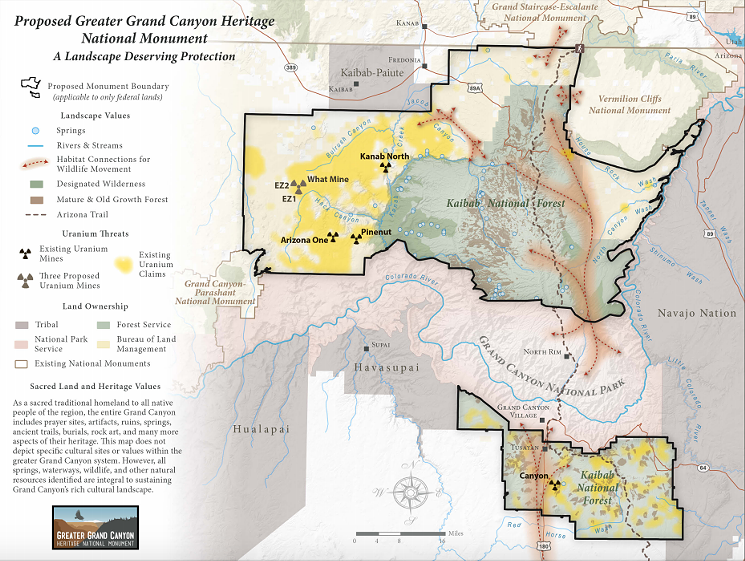
| Courtesy of Grand Canyon Trust |
Local native tribes and environmental groups have talked about wanting national monument status for the Grand Canyon for years, and Grijalva’s efforts to make it a reality have solicited nothing short of a political firestorm among enemies of the bill.
Leading the charge is U.S. Congressman Paul Gosar, who has railed against the monument proposal for months. Gosar claims it would cost hundreds of jobs, destroy the local economy, and hinder sportsmen or other recreational users of the area.
| U.S. Congressman Raul Grijalva
Courtesy of Raul Grijalva |
In an interview earlier this year, Grijalva told New Times that Gosar’s “opposition is based on myths” and that he “needs to own up to the fact that he’s on the fringe of every public-land argument we have in this country.”
The benefit of this, Grijalva explained, helps “put the opposition of some in context with many . . . It’s important to deal with what the public wants and thinks, as opposed to letting this discussion be mired in half-truths, false information, and the sheer cry from opposition that doesn’t represent the vast majority of the people in Arizona.”
Both Metz and Grijalva say they were impressed by the broad appeal of the monument, as men and women across the state expressed support for the idea of national monuments in general and the Grand Canyon monument in particular.
According to the poll results, there is support for the Grand Canyon monument among:
- 76 percent of men and 84 percent of women,
- 65 percent of registered Republicans, 84 percent of independents, and 95 percent of Democrats,
- 78 percent of people living in Congressional District 1, which is where the proposed monument would be,
- 79 percent of white voters, 86 percent of Latino voters, and 87 percent of all voters of color, including Native Americans,
- 81 percent of people living in urban areas, 83 percent in suburban areas, 79 percent in small towns, and 73 percent in rural areas,
- And 76 percent of hunters and anglers.
| Joe Jiang/Flickr |
Unlike past polls, this most recent one also asked voters how their opinion of elected officials could be influenced by a vote for or against the monument:
“Voters were three times as likely to say they would support a politician who backed the establishment of the monument,” Metz says. “So not only do voters indicate that it’s a good idea, but they say that they’ll be more supportive of members of Congress who act to make the monument reality.”
Last year, Grijalva, along with Arizona U.S. Representatives Ann Kirkpatrick and Ruben Gallego, authored a public letter detailing their support for the monument. In the months since, however, Kirkpatrick has distanced herself from that stance, explaining that she’s still considering the statements of many local stakeholders.
But with public opinion clearly on his side, Grijalva says he’s ready to continue the fight: “As we go forward, we have strong support from the people in Arizona, the first nations most affected by this monument designation, [as well as] hunters and anglers and people that use our public land.
“I think we can start to put aside the shrill debate that occurs on this issue” and start taking “the steps to build public support.”
Cutting your Worker’s Compensation Costs
Posted: March 2, 2016 Filed under: Uncategorized | Tags: Employees, Worker’s Comp, Worker’s Compensation, Worker’s Compensation Insurance Leave a commentWhy do Worker’s Compensation costs keep climbing?
The pen, the memo and the edict from senior management have been the standard way to shake up employees and to reduce worker’s compensation claims.
However, any act to reduce injuries of employees while sitting in an office is futile and at best only irritates your employees.
So? What does it take to change Worker’s Compensation at your business?
It takes you getting out of the office. You need to understand the issues your employees are facing, and you must learn those issues from your employees.
It takes a commitment from you to move from reports to people, from memos to personality, from hiding in an office to “hands on.”
It requires time; however, if you do believe in the cost of injuries to your business, the investment of time is well spent.
It requires training your employees in issues that have always been the domain of management.
It takes understanding what your employees are thinking when they are injured.
Do Something
Deal with problems, just don’t write about them.
 What do you think? Leave a comment.
If you like this let your friends know or post it on FB, Twitter or LinkedIn
Author: Outdoor Recreation Insurance, Risk Management and Law
Copyright 2016 Recreation Law (720) Edit Law
Email: Rec-law@recreation-law.com
Google+: +Recreation
Twitter: RecreationLaw
Facebook: Rec.Law.Now
Facebook Page: Outdoor Recreation & Adventure Travel Law
Blog: www.recreation-law.com
Mobile Site: http://m.recreation-law.com
By Recreation Law Rec-law@recreation-law.com James H. Moss
#AdventureTourism, #AdventureTravelLaw, #AdventureTravelLawyer, #AttorneyatLaw, #Backpacking, #BicyclingLaw, #Camps, #ChallengeCourse, #ChallengeCourseLaw, #ChallengeCourseLawyer, #CyclingLaw, #FitnessLaw, #FitnessLawyer, #Hiking, #HumanPowered, #HumanPoweredRecreation, #IceClimbing, #JamesHMoss, #JimMoss, #Law, #Mountaineering, #Negligence, #OutdoorLaw, #OutdoorRecreationLaw, #OutsideLaw, #OutsideLawyer, #RecLaw, #Rec-Law, #RecLawBlog, #Rec-LawBlog, #RecLawyer, #RecreationalLawyer, #RecreationLaw, #RecreationLawBlog, #RecreationLawcom, #Recreation-Lawcom, #Recreation-Law.com, #RiskManagement, #RockClimbing, #RockClimbingLawyer, #RopesCourse, #RopesCourseLawyer, #SkiAreas, #Skiing, #SkiLaw, #Snowboarding, #SummerCamp, #Tourism, #TravelLaw, #YouthCamps, #ZipLineLawyer, Worker’s Compensation, Employees, Worker’s Compensation Insurance, Worker’s Comp,
Skiing collision in Utah where the collision was caused by one skier falling down in front of the other skier
Posted: February 29, 2016 Filed under: Skier v. Skier, Skiing / Snow Boarding, Utah, Youth Camps | Tags: Collision, Downhill Skier, skier collision, skier v. skier, Uphill Skier, Utah Leave a commentIs that a collision, an obstacle, a reason for a lawsuit? Skiers fall all the time.
State: Utah, Court of Appeals of Utah
Plaintiff: Gary Ricci
Defendant: Charles Schoultz, M.D.
Plaintiff Claims: Negligence
Defendant Defenses: no negligence
Holding: for the defendant
Year: 1998
Sometimes you stumble across a case that catches your eye from the way the facts are described by the court. This is one of them.
The two skiers were advanced skiers skiing on an easy run. Both were skiing under control. The defendant was part of a ski school class. The defendant was taking small easy turns as part of his class. Just as he was being passed by the plaintiff, he reached the top of a crest and slowed down, lost control and fell into the path of the plaintiff.
The two collided and slid into a tree at a high rate of speed. The plaintiff hit the tree suffering injuries. The defendant was able to ski away on his own.
At trial, the plaintiff argued that the defendant was negligent because he fell on an easy run.
At trial, Ricci argued that since Schoultz’s fall took place on one of the easiest runs at Snowbird under near perfect conditions, there was no possible reason for Schoultz to have fallen except for his own negligence.
The jury found the defendant was negligent and returned a verdict in favor of the plaintiff. The trial judge then granted the defendant’s j.n.o.v. (judgment notwithstanding the verdict). This was based on the court’s opinion that there was no negligence on the part of the defendant. “There was a duty not to be negligent. However, there was no negligence on the part of the defendant in this case.” Thus, the trial judge granted Schoultz’s j.n.o.v. motion, or alternatively granted a new trial.”
A JNOV is a fantasy. They never occur because as long as there is some evidence of negligence and a decision by the jury a trial judge is not going to overturn a jury verdict. To overturn a judgment by a jury the trial judge:
…[is] justified in granting a j.n.o.v. only if, after looking at the evidence and all of its reasonable inferences in a light most favorable to [the nonmoving party], the trial court concludes that there [is] no competent evidence to support a verdict in [the nonmoving party’s] favor.
Consequently, the burden to grant a JNOV and overturn the jury’s verdict is very high and never done.
The appellate court has the same standard in reviewing a JNOV granted by the trial court.
“On appeal, we apply the same standard. In determining whether competent evidence supports the verdict, we accept as true all testimony and reasonable inferences flowing therefrom that tend to prove [the nonmoving party’s] case, and we disregard all conflicts and evidence that tend to disprove its case. Thus, if we determine that there was competent evidence supporting the jury’s verdict, we must reverse the trial court’s grant of the j.n.o.v.
The plaintiff appealed the JNOV which granted a judgment for the defendant.
Analysis: making sense of the law based on these facts.
The appellate court looked at other collision cases were the cases rested on whether or not the defendant was negligent. Something was required to support the idea that the plaintiff was negligent in those cases that had found negligence, such as the defendant drinking a large quantity of alcohol.
The court found several cases where collisions on the slopes had occurred, but the defendant was found not to be liable because there was no evidence of negligence on the part of the defendant.
…the Tenth Circuit Court of Appeals affirmed the trial court’s ruling that the plaintiff could not recover from defendant for injuries sustained in a mid-mountain ski collision. Similar to the case at bar, the defendant was skiing behind the plaintiff and failed to alert plaintiff of his presence before they collided. The LaVine court specifically rejected the appellant’s claim of negligence: “Appellant contends that the collision itself conclusively establishes the defendant’s negligence and the plaintiff’s right to recover. We disagree.”
In another decision the court reviewed, there was the same statement that care was owed by the defendant. The defendant is not the insurer of the plaintiff and not responsible for everything that happens to a skier on the slopes.
The Dillworth court stated some collisions between skiers may be as a result of the obvious and necessary risks inherent in skiing, and accidents might occur despite the exercise of ordinary and reasonable care and without negligence by either skier. . . . Like all others, skiers owe that degree of care an ordinary prudent person would exercise under like or similar circumstances. One skier is not the insurer of another skier’s safety nor, absent negligence, is one skier liable to another for inadvertent or accidental contact. . . . Thus . . . skiers who lose control even while exercising due care–that is, have breached no duty owed to other skiers–may pose a danger which is inherent, obvious and necessary to participate in the sport of skiing.
The court found that falling down on the slope is not proof of negligence. Without something to indicate that the defendant was negligent, a plaintiff cannot recover.
In sum, a skier does have a duty to other skiers to ski reasonably and within control. However, an inadvertent fall on a ski slope, alone, does not constitute a breach of this duty. We conclude, after a careful review of the trial record, that Ricci failed to introduce any competent evidence that Schoultz was skiing negligently before his sudden and unexpected fall in front of Ricci. Ricci himself testified about the conditions and events just before the accident, noting that up to one second before the collision, Schoultz was skiing in control.
Ricci’s evidence, including all reasonable inferences drawn from it, is simply insufficient for a jury to have concluded that Schoultz skied negligently.
The appellate court upheld the trial court’s granting of the JNOV and did not look at the other issues raised by the plaintiff on appeal.
There was a dissent in the opinion that argued there was enough evidence based on his analysis of the facts to support the jury finding. However, the facts presented were circumstantial based on the dissenting judge’s review of the evidence.
So Now What?
This was a rare case. There seems to be an assumption in all ski collision cases that if two people are on a slope together, and they collide with one person must have been negligent. This decision and the two other decisions the court pointed out show that is not the case. Not every collision on a ski slope is a negligent act.
At the same time, this is fairly easy to see and understand the issues because the party causing the collision, even though the “downhill” skier was the party that probably generated the issues to start the collision.
However, falling down is not negligence on a ski slope, at least in Utah.
 What do you think? Leave a comment.
If you like this let your friends know or post it on FB, Twitter or LinkedIn
Author: Outdoor Recreation Insurance, Risk Management and Law
Copyright 2016 Recreation Law (720) Edit Law
Email: Rec-law@recreation-law.com
Google+: +Recreation
Twitter: RecreationLaw
Facebook: Rec.Law.Now
Facebook Page: Outdoor Recreation & Adventure Travel Law
Blog: www.recreation-law.com
Mobile Site: http://m.recreation-law.com
By Recreation Law Rec-law@recreation-law.com James H. Moss
#AdventureTourism, #AdventureTravelLaw, #AdventureTravelLawyer, #AttorneyatLaw, #Backpacking, #BicyclingLaw, #Camps, #ChallengeCourse, #ChallengeCourseLaw, #ChallengeCourseLawyer, #CyclingLaw, #FitnessLaw, #FitnessLawyer, #Hiking, #HumanPowered, #HumanPoweredRecreation, #IceClimbing, #JamesHMoss, #JimMoss, #Law, #Mountaineering, #Negligence, #OutdoorLaw, #OutdoorRecreationLaw, #OutsideLaw, #OutsideLawyer, #RecLaw, #Rec-Law, #RecLawBlog, #Rec-LawBlog, #RecLawyer, #RecreationalLawyer, #RecreationLaw, #RecreationLawBlog, #RecreationLawcom, #Recreation-Lawcom, #Recreation-Law.com, #RiskManagement, #RockClimbing, #RockClimbingLawyer, #RopesCourse, #RopesCourseLawyer, #SkiAreas, #Skiing, #SkiLaw, #Snowboarding, #SummerCamp, #Tourism, #TravelLaw, #YouthCamps, #ZipLineLawyer, Utah, Collision, Skier v. Skier, Skier Collision, Uphill Skier, Downhill Skier,
Ricci v. Schoultz, M.D., 963 P.2d 784; 348 Utah Adv. Rep. 24; 1998 Utah App. LEXIS 57; 75 A.L.R.5th 745
Posted: February 28, 2016 Filed under: Equine Activities (Horses, Donkeys, Mules) & Animals, Legal Case, Skier v. Skier, Skiing / Snow Boarding, Utah | Tags: Collision, Downhill Skier, skier collision, skier v. skier, Uphill Skier, Utah Leave a commentRicci v. Schoultz, M.D., 963 P.2d 784; 348 Utah Adv. Rep. 24; 1998 Utah App. LEXIS 57; 75 A.L.R.5th 745
Gary Ricci, Plaintiff and Appellant, v. Charles Schoultz, M.D., Defendant and Appellee.
Case No. 971189-CA
COURT OF APPEALS OF UTAH
963 P.2d 784; 348 Utah Adv. Rep. 24; 1998 Utah App. LEXIS 57; 75 A.L.R.5th 745
July 23, 1998, Filed
PRIOR HISTORY: [**1] Third District, Salt Lake Department. The Honorable Homer F. Wilkinson.
COUNSEL: Jeffrey D. Eisenberg, Alan W. Mortensen, and Paul M. Simmons, Salt Lake City, for Appellant.
Paul M. Belnap, Robert L. Janicki, and Darren K. Nelson, Salt Lake City, for Appellee.
JUDGES: Before Judith M. Billings, Judge. I CONCUR: Russell W. Bench, Judge. Gregory K. Orme, Judge, Dissenting.
OPINION BY: JUDITH M. BILLINGS
OPINION
[*785] OPINION
BILLINGS, Judge:
Appellant Gary Ricci appeals the trial court’s grant of a judgment notwithstanding the verdict (j.n.o.v.) to Dr. Charles Schoultz, dismissing Ricci’s negligence claims. We affirm.
FACTS
The parties had completely different versions of how the accident occurred. [HN1] “We must review the record and determine whether there is any basis in the evidence, including reasonable inferences which could be drawn therefrom, to support the jury’s determination that [Schoultz] was negligent.” Braithwaite v. West Valley City Corp., 921 P.2d 997, 999 (Utah 1996). Thus, we recite the facts in a light most favorable to Ricci.
On April 12, 1994, Ricci and Schoultz were skiing [**2] at Snowbird Ski Resort (Snowbird) in Salt Lake County, Utah. Both parties were advanced skiers. On the sunny morning of the accident they were skiing an “easy run” that was groomed and had only a few skiers on it. Schoultz was skiing down Anderson Hill when Ricci reached the top of the run. Ricci began to ski towards the bottom and in the direction of Schoultz. Schoultz was taking a ski lesson and was making a number of small controlled turns as he descended. Schoultz and Ricci were both skiing at the same speed and in control throughout their descent. However, Schoultz slowed as he approached a small crest on the ski run and Ricci closed to within a few feet behind Schoultz. Schoultz unexpectedly lost control of his skis, and within a few seconds he fell to the left, and into Ricci, who was unable to avoid Schoultz. The two skiers slid into a tree well, with Ricci striking the tree with some force. Ricci suffered significant injuries and was eventually life-flighted to a local hospital. Schoultz was merely bruised and skied down the mountain on his own.
At trial, Ricci argued that since Schoultz’s fall took place on one of the easiest runs at Snowbird under near perfect conditions, [**3] there was no possible reason for Schoultz to have fallen except for his own negligence. The jury found that Schoultz was negligent, and that his failure to ski in control was the cause of the accident. Schoultz moved for a j.n.o.v. on the grounds that Ricci failed to demonstrate that Schoultz, by falling unexpectedly in front of him, had breached any duty he owed to Ricci. The trial judge agreed: “There was a duty not to be negligent. But there was no negligence on the part of defendant in this case.” Thus, the trial judge granted Schoultz’s j.n.o.v. motion, or alternatively granted a new trial. Ricci now appeals.
STANDARD OF REVIEW
Our standard for reviewing a trial court’s grant of a j.n.o.v. is strict: [HN2] “‘In passing on a motion for a j.n.o.v., . . . a trial court has no latitude and must be correct.'” Braithwaite, 921 P.2d at 999 (quoting Crookston v. Fire Ins. Exch., 817 P.2d 789, 799 (Utah 1991)). Further,
“The trial court [is] justified in granting a j.n.o.v. only if, after looking at the evidence and all of its reasonable inferences in a light most favorable to [the nonmoving party], the trial court concludes that there [is] no competent evidence to support [**4] a verdict in [the nonmoving party’s] favor.”
Id. (quoting Gold Standard, Inc. v. Getty Oil Co., 915 P.2d 1060, 1066 (Utah 1996)). “On appeal, we apply the same standard. In determining whether competent evidence supports the verdict, we accept as true all testimony and reasonable inferences flowing therefrom that tend to prove [the nonmoving party’s] case, and we disregard all conflicts [*786] and evidence that tend to disprove its case.” Gold Standard, 915 P.2d at 1066 (citing Koer v. Mayfair Mkts., 19 Utah 2d 339, 340, 431 P.2d 566, 568-69 (1967) (additional citation omitted). Thus, if we determine that there was competent evidence supporting the jury’s verdict, we must reverse the trial court’s grant of the j.n.o.v.
ANALYSIS
Although there is no helpful Utah authority, other state and federal courts have dealt with similar ski collision cases.
In LaVine v. Clear Creek Skiing Corp., 557 F.2d 730, 735 (10th Cir. 1977), the Tenth Circuit Court of Appeals affirmed the trial court’s ruling that the plaintiff could not recover from defendant for injuries sustained in a mid-mountain ski collision. Similar to the case at bar, the defendant was skiing behind [**5] the plaintiff and failed to alert plaintiff of his presence before they collided. See id. at 735. The LaVine court specifically rejected the appellant’s claim of negligence: “Appellant contends that the collision itself conclusively establishes the defendant’s negligence and the plaintiff’s right to recover. We disagree.” Id.
More recently, in Dillworth v. Gambardella, 970 F.2d 1113, 1114 (2d Cir. 1992), the Second Circuit Court of Appeals dealt with a similar issue: “Whether collisions between skiers require as a matter of law . . . a finding of negligence on the part of at least one skier.” In Dillworth, the parties had significantly different versions of the facts leading up to the mid-mountain collision, but the result was the same as this case–significant injuries to the party bringing the cause of action. See id. at 1114-15. The Dillworth court stated [HN3] some collisions between skiers may be as a result of the obvious and necessary risks inherent in skiing, and accidents might occur despite the exercise of ordinary and reasonable care and without negligence by either skier. . . . Like all others, skiers owe that degree of care an ordinary prudent person [**6] would exercise under like or similar circumstances. One skier is not the insurer of another skier’s safety nor, absent negligence, is one skier liable to another for inadvertent or accidental contact. . . . Thus . . . skiers who lose control even while exercising due care–that is, have breached no duty owed to other skiers–may pose a danger which is inherent, obvious and necessary to participate in the sport of skiing.
Id. at 1122 (citing LaVine, 557 F.2d 734-35) (additional citations omitted).
Cases that have supported a finding of negligence in a ski collision have required proof of some negligent conduct before the collision. For example, in Freeman v. Hale, 30 Cal. App. 4th 1388, 36 Cal. Rptr. 2d 418, 420 (Cal. Ct. App. 1994), two skiers collided while descending a ski slope and the plaintiff suffered severe injuries as a result of the accident. In Freeman, however, the defendant had consumed a large quantity of alcohol, and was inebriated when the collision occurred. See 36 Cal. Rptr. 2d at 420. The California Court of Appeals succinctly summarized its conclusion that a negligence regime was the proper way to analyze liability: “While Hale did not have a duty [**7] to avoid an inadvertent collision with Freeman, he did have a duty to avoid increasing the risk of such a collision.” Id. at 423-24 (citing Knight v. Jewett, 3 Cal. 4th 296, 834 P.2d 696, 710-11 (Cal. 1992)). The Freeman court concluded that alcohol consumption was not an integral aspect of skiing, and that by consuming alcohol prior to and during his skiing, defendant breached his duty to plaintiff “‘not to increase the risks to a participant over and above those inherent in the sport.'” 36 Cal. Rptr. 2d at 421 (quoting Knight, 834 P.2d at 710).
In sum, [HN4] a skier does have a duty to other skiers to ski reasonably and within control. However, an inadvertent fall on a ski slope, alone, does not constitute a breach of this duty. We conclude, after a careful review of the trial record, that Ricci failed to introduce any competent evidence that Schoultz was skiing negligently before his sudden and unexpected fall in front of Ricci. Ricci himself testified about the conditions and events just before the accident, noting that up to one second before the collision, Schoultz was skiing in control. Schoultz’s [*787] loss of control and fall, by itself, does not establish his negligence.
Ricci’s [**8] evidence, including all reasonable inferences drawn from it, is simply insufficient for a jury to have concluded that Schoultz skied negligently. We conclude the trial court was correct in determining that Schoultz did not breach his duty of reasonable care to Ricci by accidentally falling into Ricci when there was no evidence that Schoultz was skiing negligently at the time of his fall. Because we agree with the trial court’s ruling, we do not reach the questions of whether a new trial should have been granted or whether the trial court’s decisions to exclude Schoultz’s expert witness testimony were proper.
CONCLUSION
Some collisions between skiers are an inherent risk of skiing and may occur absent negligence, as in this case. Thus, we affirm the trial court’s grant of a judgment notwithstanding the verdict.
Judith M. Billings, Judge
I CONCUR:
Russell W. Bench, Judge
DISSENT BY: GREGORY K. ORME
DISSENT
ORME, Judge (dissenting):
By focusing on the evidence plaintiff presented, rather than all evidence in the record and the reasonable inferences that can be drawn therefrom, my colleagues take a too narrow view of our role in reviewing a trial court’s reversal of a [**9] jury’s verdict. Simply stated, the question is not whether the evidence plaintiff presented supports the jury’s verdict; rather, it is whether any evidence from whatever source will support it. See Gold Standard, Inc. v. Getty Oil Co., 915 P.2d 1060, 1066 (Utah 1996) (“In determining whether competent evidence supports the verdict, we accept as true all testimony and reasonable inferences flowing therefrom that tend to prove [the nonmoving party’s] case, and we disregard all conflicts and evidence that tend to disprove its case.”). As the Fifth Circuit has noted,
on motions for directed verdict and for judgment notwithstanding the verdict the Court should consider all of the evidence– not just that evidence which supports the non-mover’s case–but in the light and with all reasonable inferences most favorable to the party opposed to the motion.Boeing Co. v. Shipman, 411 F.2d 365, 374 (5th Cir. 1969) (en banc), overruled on other grounds, Gautreaux v. Scurlock Marine, Inc., 107 F.3d 331, 336, 339 (5th Cir. 1997). Accord Guilbeau v. W. W. Henry Co., 85 F.3d 1149, 1161 (5th Cir. 1996), cert. denied, 136 L. Ed. 2d 713, 117 S. Ct. 766 (1997); Lamb [**10] ex rel. Shepard v. Sears, Roebuck & Co., 1 F.3d 1184, 1187 (11th Cir. 1993); Epoch Producing Corp. v. Killiam Shows Inc., 522 F.2d 737, 743 (2d Cir. 1975), cert. denied, 424 U.S. 955, 47 L. Ed. 2d 360, 96 S. Ct. 1429 (1976); Anderson v. Lykes Pasco Packing Co., 503 So. 2d 1269, 1271-72 (Fla. Dist. Ct. App. 1986); Millet v. Cormier, 671 So. 2d 1101, 1107-08 (La. Ct. App.), cert. denied, 673 So. 2d 1036 (La. 1996).
In this case, the jury might well have believed defendant’s testimony that he was skiing in complete control until immediately before the accident, that his skis did not come apart, and that he did not fall. Rejecting defendant’s testimony that he was hit from behind by plaintiff, which was essentially impossible given where the two ended up after the collision, the jury was also free to disbelieve plaintiff’s recollection that defendant’s skis separated and defendant merely fell into plaintiff’s path. The jury could nonetheless have believed plaintiff’s testimony that, immediately prior to the collision, he was skiing in control and a safe distance from defendant and defendant’s apparently intended route. Mindful that plaintiff and defendant ended up [**11] in a heap well off the ski run, in a position consistent with defendant hitting into plaintiff at high speed, the jury might well have inferred that the only way the accident could have occurred was if defendant, fully in control, carelessly and precipitously turned sharply to the left, hitting the unsuspecting plaintiff, who had every reason to assume defendant was going to continue with his pattern of tight turns as plaintiff passed uneventfully on the left.
To be sure, this is not exactly the theory plaintiff developed at trial, but it is a scenario that emerges quite readily if one reviews all the evidence and all reasonable inferences that could be drawn therefrom in the light [*788] most favorable to the jury’s verdict. If that is what the jury concluded, then the accident was caused by defendant’s negligence, not an inadvertent fall. Accordingly, the trial court should not have disturbed the jury’s verdict, and we should reinstate it.
Gregory K. Orme, Judge


 Recreation Law
