
Sign up for this Newsletter if you Are, Work for, or Volunteer for a Non-Profit
Posted: February 25, 2016 Filed under: Uncategorized | Tags: Hip Tips, Non-Profit, Questus, Questus Strategies Leave a comment
|


It’s coming up on that time of year: Remember Interns are not slaves and the Department of Labor enforces that.
Posted: February 24, 2016 Filed under: Uncategorized | Tags: Department of Labor, DOL, Intern, Internship, Slave Leave a commentInternship Programs Under The Fair Labor Standards Act
This fact sheet provides general information to help determine whether interns must be paid the minimum wage and overtime under the Fair Labor Standards Act for the services that they provide to “for-profit” private sector employers.
Background
The Fair Labor Standards Act (FLSA) defines the term “employ” very broadly as including to “suffer or permit to work.” Covered and non-exempt individuals who are “suffered or permitted” to work must be compensated under the law for the services they perform for an employer. Internships in the “for-profit” private sector will most often be viewed as employment, unless the test described below relating to trainees is met. Interns in the “for-profit” private sector who qualify as employees rather than trainees typically must be paid at least the minimum wage and overtime compensation for hours worked over forty in a workweek.
The Test for Unpaid Interns
There are some circumstances under which individuals who participate in “for-profit” private sector internships or training programs may do so without compensation. The Supreme Court has held that the term “suffer or permit to work” cannot be interpreted so as to make a person whose work serves only his or her own interest an employee of another who provides aid or instruction. This may apply to interns who receive training for their own educational benefit if the training meets certain criteria. The determination of whether an internship or training program meets this exclusion depends upon all of the facts and circumstances of each such program.
The following six criteria must be applied when making this determination:
1. The internship, even though it includes actual operation of the facilities of the employer, is similar to training which would be given in an educational environment;
2. The internship experience is for the benefit of the intern;
3. The intern does not displace regular employees, but works under close supervision of existing staff;
4. The employer that provides the training derives no immediate advantage from the activities of the intern; and on occasion its operations may actually be impeded;
5. The intern is not necessarily entitled to a job at the conclusion of the internship; and
6. The employer and the intern understand that the intern is not entitled to wages for the time spent in the internship.
If all of the factors listed above are met, an employment relationship does not exist under the FLSA, and the Act’s minimum wage and overtime provisions do not apply to the intern. This exclusion from the definition of employment is necessarily quite narrow because the FLSA’s definition of “employ” is very broad. Some of the most commonly discussed factors for “for-profit” private sector internship programs are considered below.
Similar To An Education Environment And The Primary Beneficiary Of The Activity
In general, the more an internship program is structured around a classroom or academic experience as opposed to the employer’s actual operations, the more likely the internship will be viewed as an extension of the individual’s educational experience (this often occurs where a college or university exercises oversight over the internship program and provides educational credit). The more the internship provides the individual with skills that can be used in multiple employment settings, as opposed to skills particular to one employer’s operation, the more likely the intern would be viewed as receiving training. Under these circumstances the intern does not perform the routine work of the business on a regular and recurring basis, and the business is not dependent upon the work of the intern. On the other hand, if the interns are engaged in the operations of the employer or are performing productive work (for example, filing, performing other clerical work, or assisting customers), then the fact that they may be receiving some benefits in the form of a new skill or improved work habits will not exclude them from the FLSA’s minimum wage and overtime requirements because the employer benefits from the interns’ work.
Displacement And Supervision Issues
If an employer uses interns as substitutes for regular workers or to augment its existing workforce during specific time periods, these interns should be paid at least the minimum wage and overtime compensation for hours worked over forty in a workweek. If the employer would have hired additional employees or required existing staff to work additional hours had the interns not performed the work, then the interns will be viewed as employees and entitled compensation under the FLSA. Conversely, if the employer is providing job shadowing opportunities that allow an intern to learn certain functions under the close and constant supervision of regular employees, but the intern performs no or minimal work, the activity is more likely to be viewed as a bona fide education experience. On the other hand, if the intern receives the same level of supervision as the employer’s regular workforce, this would suggest an employment relationship, rather than training.
Job Entitlement
The internship should be of a fixed duration, established prior to the outset of the internship. Further, unpaid internships generally should not be used by the employer as a trial period for individuals seeking employment at the conclusion of the internship period. If an intern is placed with the employer for a trial period with the expectation that he or she will then be hired on a permanent basis, that individual generally would be considered an employee under the FLSA.
Where to Obtain Additional Information
This publication is for general information and is not to be considered in the same light as official statements of position contained in the regulations.
For additional information, visit our Wage and Hour Division Website: http://www.wagehour.dol.gov and/or call our toll-free information and helpline, available 8 a.m. to 5 p.m. in your time zone, 1-866-4USWAGE (1-866-487-9243).
The FLSA makes a special exception under certain circumstances for individuals who volunteer to perform services for a state or local government agency and for individuals who volunteer for humanitarian purposes for private non-profit food banks. WHD also recognizes an exception for individuals who volunteer their time, freely and without anticipation of compensation for religious, charitable, civic, or humanitarian purposes to non-profit organizations. Unpaid internships in the public sector and for non-profit charitable organizations, where the intern volunteers without expectation of compensation, are generally permissible. WHD is reviewing the need for additional guidance on internships in the public and non-profit sectors.
Do Something
Follow the DOL guidelines when working with someone who expects more than getting you coffee.
 What do you think? Leave a comment.
If you like this let your friends know or post it on FB, Twitter or LinkedIn
Author: Outdoor Recreation Insurance, Risk Management and Law
Copyright 2016 Recreation Law (720) Edit Law
Email: Rec-law@recreation-law.com
Google+: +Recreation
Twitter: RecreationLaw
Facebook: Rec.Law.Now
Facebook Page: Outdoor Recreation & Adventure Travel Law
Blog: www.recreation-law.com
Mobile Site: http://m.recreation-law.com
By Recreation Law Rec-law@recreation-law.com James H. Moss
#AdventureTourism, #AdventureTravelLaw, #AdventureTravelLawyer, #AttorneyatLaw, #Backpacking, #BicyclingLaw, #Camps, #ChallengeCourse, #ChallengeCourseLaw, #ChallengeCourseLawyer, #CyclingLaw, #FitnessLaw, #FitnessLawyer, #Hiking, #HumanPowered, #HumanPoweredRecreation, #IceClimbing, #JamesHMoss, #JimMoss, #Law, #Mountaineering, #Negligence, #OutdoorLaw, #OutdoorRecreationLaw, #OutsideLaw, #OutsideLawyer, #RecLaw, #Rec-Law, #RecLawBlog, #Rec-LawBlog, #RecLawyer, #RecreationalLawyer, #RecreationLaw, #RecreationLawBlog, #RecreationLawcom, #Recreation-Lawcom, #Recreation-Law.com, #RiskManagement, #RockClimbing, #RockClimbingLawyer, #RopesCourse, #RopesCourseLawyer, #SkiAreas, #Skiing, #SkiLaw, #Snowboarding, #SummerCamp, #Tourism, #TravelLaw, #YouthCamps, #ZipLineLawyer, DOL, Department of Labor, Intern, Internship, Slave,
Experience Industry Management Conference and Research Retreat Updates
Posted: February 23, 2016 Filed under: Youth Camps, Zip Line | Tags: Conference, Experience Industry Management Leave a commentThe Annual Experience Industry Management (EIM) Conference hosted by the Department of Recreation Management at BYU will take place March 29-30, 2016 in Provo, UT.
This three-day event brings together academics and professionals from a variety of fields and industries to talk about the provision of meaningful experiences. The conference also provides excellent networking opportunities for current students interested in experience industry related careers.
This year’s conference will features an excellent selection of experience design related speakers, workshops, and networking events. Announced speakers include:
- Dan Farr, Founder of SLC Comic Con
- Fire Fly
- Tanner Bell, President of Ragnar Events
- Davis Smith, CEO of Cotopaxi
- Todd Manwaring, Director of BYU’s Ballard Center for Economic Self-Reliance and Peery Social Entrepreneurship Program
A research retreat on Monday, March 28 precedes the conference. The day will provide researchers the opportunity to: generate and share research ideas by leading a roundtable discussion, share work in progress, and/or present completed research. The intent is to provide a setting different than a traditional research symposium by creating time and space for discussion of ideas. The hope is to bring a group of academics together who have a shared interest in studying and understanding experiences from the participant and provider perspective and who are eager to discuss ideas. We define experiences quite broadly and hope to attract a diverse array of researchers, research topics, and discussion areas. It will be a collaborative and intimate experience with ample opportunities for interaction.
For more information and to register visit: http://marriottschool.byu.edu/event/eimconf2016/home
The abstract submission deadline for the EIM Research Retreat is February 16th. See the attachment for more information.
Mat Duerden, PhD
Assistant Professor
Department of Recreation Management
Marriott School of Management
Brigham Young University
801-422-3834
EIM CALL FOR ABSTRACTS (Research Retreat).docx
Pennsylvania Supreme Court decision on duty to have and use an AED defines how statutes are to be interpreted and when liability can attach and cannot attach to a statute.
Posted: February 22, 2016 Filed under: First Aid, Medical, Pennsylvania | Tags: AED, AED Good Samaritan, Automatic External Defibrillator, Good Samaritan, Gulph Mills Tennis Club, Immunity, Negligence, Pennsylvania Leave a commentThe law that creates a safe harbor from civil liability for being a Good Samaritan does not create a duty to act. There still is no legal requirement to act as a Good Samaritan, however, if you do, you cannot be sued.
Atcovitz v. Gulph Mills Tennis Club, Inc, 571 Pa. 580; 812 A.2d 1218; 2002 Pa. LEXIS 2832
State: Pennsylvania, Supreme Court of Pennsylvania
Plaintiff: Jerry Atcovitz and Roslyn Atcovitz
Defendant: Gulph Mills Tennis Club, Inc, Jkst, Inc. and Gulph Mills/Jkst Tennis Club, Inc., Lafayette Ambulance Rescue Squad I
Plaintiff Claims: whether a tennis club owes a duty of care to its members to acquire and maintain an automated external defibrillator, hereinafter “AED,” on its premises for emergency use
Defendant Defenses: No duty
Holding: for the defendant Tennis Club
Year: 2002
The plaintiff was playing tennis at the defendant’s tennis club. While playing he suffered a stroke which was secondary to a heart attack. Within one minute tennis club, members started CPR on the plaintiff and ten minutes later an ambulance arrived. The ambulance administered defibrillation and transported the plaintiff to the hospital.
The plaintiff had a history of heart problems for twenty years, including a previous heart attack and bypass surgery. The tennis club did not know of the plaintiff’s medical history.
The heart attack and stroke left the defendant unable to concentrate or think, is unable to walk or get out of bed and requires assistance in all aspects of his life.
The plaintiff and his wife sued the defendant tennis club for not having an AED and not using it: “…had [Gulph Mills] possessed an AED device and used it on [Atcovitz] promptly, his injuries would have been significantly less and; therefore, that [Gulph Mills] is liable to him for damages.”
The plaintiff’s moved for summary judgment to prevent the defendant from asserting the defenses. The defendant then cross-filed a motion for summary judgment which the trial court granted. The case was appealed and the Pennsylvania Appellate court, called the Superior Court, reversed. The case was then appealed to the Pennsylvania Supreme Court.
Between the incident that the plaintiff suffered and the decision by the trial court to dismiss the Pennsylvania legislature passed an AED Good Samaritan Act. The Appellate court based some of the reasoning for its decision on the AED Good Samaritan Act the legislature passed.
Analysis: making sense of the law based on these facts.
The court started out by defining the specific issues it would look at as well as the procedural definitions it must follow. This provides a clear look at how Pennsylvania courts make decisions.
The Supreme Court first reviewed the standard of review the court must use. “Our standard of review is clear: the trial court’s order will be reversed only where it is established that the court committed an error of law or clearly abused its discretion.”
The court then reviewed under Pennsylvania law the requirements for granting a motion for summary judgment.
Summary judgment is appropriate only in those cases where the record clearly demonstrates that there is no genuine issue of material fact and that the moving party is entitled to judgment as a matter of law. The reviewing court must view the record in the light most favorable to the nonmoving party, resolving all doubts as to the existence of a genuine issue of material fact against the moving party. When the facts are so clear that reasonable minds cannot differ, a trial court may properly enter summary judgment.
The court then defined the elements necessary to successfully plead a negligence claim under Pennsylvania.
The elements necessary to plead an action in negligence are: (1) the existence of a duty or obligation recognized by law, requiring the actor to conform to a certain standard of conduct; (2) a failure on the part of the defendant to conform to that duty, or a breach thereof; (3) a causal connection between the defendant’s breach and the resulting injury; and (4) actual loss or damage suffered by the complainant.
The court then further defined the element of duty in a negligence case. “A duty, in negligence cases, may be defined as an obligation, to which the law will give recognition and effect, to conform to a particular standard of conduct toward another.“
This definition was supported by the definition of duty in a legal treatise, Prosser and Keeton on the Law of Torts. This is the book referenced by courts in defining the law.
These are shifting sands, and no fit foundation. There is a duty if the court says there is a duty; the law, like the Constitution, is what we make it. Duty is only a word with which we state our conclusion that there is or is not to be liability; it necessarily begs the essential question. When we find a duty, breach and damage, everything has been said. The word serves a useful purpose in directing attention to the obligation to be imposed upon the defendant, rather than the causal sequence of events; beyond that it serves none. In the decision whether or not there is a duty, many factors interplay: The hand of history, our ideas of morals and justice, the convenience of administration of the rule, and our social ideas as to where the loss should fall. In the end, the court will decide whether there is a duty on the basis of the mores of the community, “always keeping in mind the fact that we endeavor to make a rule in each case that will be practical and in keeping with the general understanding of mankind.”
The bad news issue the law changes as everything else in the US changes, Public policy and public opinion are just some of the factors that affect the law. The good news is the law attempts to stay current with the changing issues facing the law. Albeit a lot slower than most might wish, but it does change. “Thus, the legal concept of duty is necessarily rooted in often amorphous public policy considerations, which may include our perception of history, morals, justice, and society.”
The care as defined by a legal duty was further broken down by the court.
In Althaus, this Court enunciated several discrete factors, derived from the aforementioned principles, that our courts are to balance [HN6] in determining whether a common law duty of care exists: (1) the relationship between the parties; (2) the social utility of the actor’s conduct; (3) the nature of the risk imposed and foreseeability of the harm incurred; (4) the consequences of imposing a duty upon the actor; and (5) the overall public interest in the proposed solution.
Thus the court takes in other issues in looking at determining how a case is to be decided, however, the law and prior decisions come first. Making a change requires a major commitment by the courts to go down a different path and dismiss the prior cases leading down the old path. Consequently, you rarely see these changes, what you do see is slight modifications of the direction the path is taking.
Major changes are left to the legislature to respond more quickly to the issues facing the public. In this case, the court looked at the legislature’s intent in creating an AED Good Samaritan Act.
…the overall public interest in the proposed solution. The Legislature’s enactments and the ensuing regulations reveal that acquisition, maintenance, and use of an AED, along with AED training requirements, are highly regulated. Where our lawmakers have so thoroughly considered the statewide application and implications of a subject, this Court must refrain from imposing additional requirements upon that legislation.
The appellate court used the newly enacted AED Good Samaritan Act to hold the defendant liable. The Supreme Court looked at the act differently in relation to this decision. The Supreme Court saw the act as proof that the legislature intended the issues surrounding AEDs was highly regulated. “Rather, they are relevant to demonstrate that the acquisition, maintenance, and use of an AED, along with AED training requirements, are highly regulated.”
When reviewing an act, the information within the law enacted by the legislature is the only information that can be reviewed. Anything not included in the act is therefore excluded from the analysis. “We must infer that, [HN11] under the doctrine of expressio unius est exclusio alterius, the inclusion of a specific matter in a statute implies the exclusion of other matters.”
The AED Act provides immunity for trained AED users and immunity for untrained users who use an AED in good faith.
The AED Good Samaritan Act, which was adopted two years after Atcovitz sustained his injuries, provides civil immunity for trained users of AEDs and requires that [HN12] “expected users shall complete training in the use of an AED. . . .” As an exception to that general rule, the AED Good Samaritan Act also provides civil immunity to untrained individuals who, in good faith, use an AED in an emergency as an ordinary, reasonably prudent individual would do under the same or similar circumstances. Significantly, the AED Good Samaritan Act defines “good faith” as including “a reasonable opinion that the immediacy of the situation is such that the use of an AED should not be postponed until emergency medical services personnel arrive or the person is hospitalized.”
The act, consequently, only creates a safe harbor for using an AED. It does not create liability for someone who does not use an AED.
Thus, the AED Good Samaritan Act merely creates an exception for imposing liability on an untrained individual who uses an AED in limited emergency situations; it does not authorize its use by any such individual.
In addition, it does not indicate that the Legislature aimed to dispense with the regulations governing the training and use of AEDs. Simply, the existence of a civil immunity provision for Good Samaritans who use an AED in an emergency situation cannot impose a duty on a business establishment to ac-quire, maintain, and use such a device on its premises.
The act cannot, then be used to create liability for not using an AED; it only removes liability for someone who does use an AED.
Neither the EMS Act nor the AED Good Samaritan Act imposed a duty upon Gulph Mills to acquire, maintain, and use an AED. Appellees do not cite any other case, statute, or regulation that would have imposed such a duty on Gulph Mills at the time of Atcovitz’s injuries in January 1996. Because Gulph Mills did not owe a duty to carry an AED, Appellees could not have established a prima facie claim of negligence.
There was a dissenting opinion, in this case. The dissent agreed with the majority opinion; it disagreed on how broad the decision was and thought several of the issues should be sent back for review by the trial court.
So Now What?
First understand there is a difference between what is moral, ethical, and legal. My job is not to help you decide on those issues. My job is to help you understand the law when you are faced with the issues. You can be morally and ethically right and be sued and lose. You can have no morals or ethics and be sued and lose. How you balance those aspects of your life, and how you approach the issues you face in your life is not the subject of these articles. How the law applies to the facts set forth in the specific cases may affect your choices is what the article is about.
The good news is the decision prevents lawsuits for not having an AED or using an AED in Pennsylvania.
This case also defines how it would look at the reverse. If the law restricted the use of a device, the application of the law would not only allow for civil liability but possibly criminal liability also.
 |
Jim Moss is an attorney specializing in the legal issues of the outdoor recreation community. He represents guides, guide services, outfitters both as businesses and individuals and the products they use for their business. He has defended Mt. Everest guide services, summer camps, climbing rope manufacturers; avalanche beacon manufactures and many more manufacturers and outdoor industries. Contact Jim at Jim@Rec-Law.us |
Jim is the author or co-author of six books about the legal issues in the outdoor recreation world; the latest is Outdoor Recreation Insurance, Risk Management and Law.
To see Jim’s complete bio go here and to see his CV you can find it here. To find out the purpose of this website go here.
G-YQ06K3L262
What do you think? Leave a comment.
If you like this let your friends know or post it on FB, Twitter or LinkedIn
Author: Outdoor Recreation Insurance, Risk Management and Law

Outdoor Recreation Insurance, Risk Management and Law
Facebook Page: Outdoor Recreation & Adventure Travel Law
Email: Jim@Rec-Law.US
By Recreation Law Rec-law@recreation-law.com James H. Moss
@2023 Summit Magic Publishing, LLC
#AdventureTourism, #AdventureTravelLaw, #AdventureTravelLawyer, #AttorneyatLaw, #Backpacking, #BicyclingLaw, #Camps, #ChallengeCourse, #ChallengeCourseLaw, #ChallengeCourseLawyer, #CyclingLaw, #FitnessLaw, #FitnessLawyer, #Hiking, #HumanPowered, #HumanPoweredRecreation, #IceClimbing, #JamesHMoss, #JimMoss, #Law, #Mountaineering, #Negligence, #OutdoorLaw, #OutdoorRecreationLaw, #OutsideLaw, #OutsideLawyer, #RecLaw, #Rec-Law, #RecLawBlog, #Rec-LawBlog, #RecLawyer, #RecreationalLawyer, #RecreationLaw, #RecreationLawBlog, #RecreationLawcom, #Recreation-Lawcom, #Recreation-Law.com, #RiskManagement, #RockClimbing, #RockClimbingLawyer, #RopesCourse, #RopesCourseLawyer, #SkiAreas, #Skiing, #SkiLaw, #Snowboarding, #SummerCamp, #Tourism, #TravelLaw, #YouthCamps, #ZipLineLawyer, Good Samaritan, AED Good Samaritan, Negligence, Immunity, AED, Automatic External Defibrillator,
Head USA Recalls Ski and Snowboard Helmets Due to Head Injury Hazard
Posted: February 19, 2016 Filed under: Uncategorized | Tags: Agent, Alia, Andor, Arise, Arosa, Avril, Consumer Product Safety Council, CPSC, Head, Head Ski Helmet, Head Snowboard Helment, Recall, Ski Helmet, Snowboard Helmet Leave a commentName of Product: Head Ski and snowboard helmets
http://www.cpsc.gov/en/Recalls/2016/Head-USA-Recalls-Ski-and-Snowboard-Helmets/
Consumers should stop using this product unless otherwise instructed. It is illegal to resell or attempt to resell a recalled consumer product.
Recall Summary
Hazard: The helmets do not comply with the impact requirements of safety standards for helmets, posing a risk of head injury.
Remedy: Replacement – Consumers should immediately stop using the recalled helmets and contact Head USA to receive a free replacement helmet.
Consumer Contact: Head USA at 800-874-3235 from 9 a.m. to 7 p.m. ET Monday through Friday or online at http://www.head.com then click on Customer Service and then on 2015 Helmet Recall for more information.
Recall Details
Units: About 260 in the United States (in addition, 180 were sold in Canada).
Description: This recall involves six models of HEAD ski and snowboard helmets: Agent, Alia, Andor, Arise, Arosa and Avril. They were sold in sizes M/L and XL/XXL in black, blue, green white and yellow, with straps in a variety of colors. HEAD, the model name, size and “Production Code: Dec. 2014” are printed on stickers that can be found by lifting the lining above the right earpiece.
Incidents/Injuries: None reported
Sold at: Specialty ski and snowboard shops and online from January 2015 through December 2015 for between $80 and $120.
Importer/Distributor: Head USA, of Boulder, Colo.
Manufactured in: Taiwan
Retailers: If you are a retailer of a recalled product you have a duty to notify your customers of a recall. If you can, email your clients or include the recall information in your next marketing communication to your clients. Post any Recall Poster at your stores and contact the manufacturer to determine how you will handle any recalls.
For more information on this see:
For Retailers
Recalls Call for Retailer Action
Combination of a Products Liability statute, an Expert Witness Report that was just not direct enough and odd facts holds a retailer liable as manufacture for product defect.
Product Liability takes a different turn. You must pay attention, just not rely on the CPSC.
Retailer has no duty to fit or instruct on fitting bicycle helmet
Summary Judgment granted for bicycle manufacturer and retailer on a breach of warranty and product liability claim.
For Manufacturers
The legal relationship created between manufactures and US consumers
 What do you think? Leave a comment.
If you like this let your friends know or post it on FB, Twitter or LinkedIn
Author: Outdoor Recreation Insurance, Risk Management and Law
Copyright 2016 Recreation Law (720) Edit Law
Email: Rec-law@recreation-law.com
Google+: +Recreation
Twitter: RecreationLaw
Facebook: Rec.Law.Now
Facebook Page: Outdoor Recreation & Adventure Travel Law
Blog: www.recreation-law.com
Mobile Site: http://m.recreation-law.com
By Recreation Law Rec-law@recreation-law.com James H. Moss
#AdventureTourism, #AdventureTravelLaw, #AdventureTravelLawyer, #AttorneyatLaw, #Backpacking, #BicyclingLaw, #Camps, #ChallengeCourse, #ChallengeCourseLaw, #ChallengeCourseLawyer, #CyclingLaw, #FitnessLaw, #FitnessLawyer, #Hiking, #HumanPowered, #HumanPoweredRecreation, #IceClimbing, #JamesHMoss, #JimMoss, #Law, #Mountaineering, #Negligence, #OutdoorLaw, #OutdoorRecreationLaw, #OutsideLaw, #OutsideLawyer, #RecLaw, #Rec-Law, #RecLawBlog, #Rec-LawBlog, #RecLawyer, #RecreationalLawyer, #RecreationLaw, #RecreationLawBlog, #RecreationLawcom, #Recreation-Lawcom, #Recreation-Law.com, #RiskManagement, #RockClimbing, #RockClimbingLawyer, #RopesCourse, #RopesCourseLawyer, #SkiAreas, #Skiing, #SkiLaw, #Snowboarding, #SummerCamp, #Tourism, #TravelLaw, #YouthCamps, #ZipLineLawyer, Recall, CPSC, Consumer Product Safety Council, Head, Ski Helmet, Snowboard Helmet, Head Ski Helmet, Head Snowboard Helment, Agent, Alia, Andor, Arise, Arosa, Avril,
National Parks maintenance backlog reaches $11.9 Billion Dollars
Posted: February 18, 2016 Filed under: Uncategorized | Tags: Maintenance, National Park Service, NPS Leave a comment
|
|||
| National Park Service News Release | |||
| Release Date: February 5, 2016
Contact: Jeffrey Olson, Jeffrey_olson 202-208-6843 National Parks maintenance backlog reaches $11.9 billion WASHINGTON – The National Park Service (NPS) this week released its Fiscal Year 2015 deferred maintenance statistics for national parks. The $11.93 billion nationwide total is a $440 million increase from the previous year. Deferred maintenance is necessary work – performed on infrastructure, such as roads and bridges, visitor centers, trails and campgrounds – that has been delayed for more than one year. Aging facilities, increasing use of park facilities and scarce resources contribute to the growing backlog. “While Congress provided increases this year, the annual bill for maintenance in America’s national parks is still almost twice as much as is appropriated,” said National Park Service Director Jonathan B. Jarvis. Congressional funding for the National Park Service in 2016 includes an additional $90 million for non-transportation maintenance. Congress also passed a new highway bill which will provide a $28 million increase for transportation projects in parks this year. Funding for transportation-related maintenance and construction will continue to rise, by $8 million per year for five years, until it reaches $300 million per year in 2020. Nearly every unit in the National Park System has maintenance items that have been deferred. Regions regularly evaluate and prioritize project submissions to ensure available dollars make a difference, and will be using the new funds to address the highest priorities. For details about deferred maintenance at a particular national park, visit go.nps.gov/deferredmaint and click on the “NPS Asset Inventory Summary by Park” report. Even though more maintenance items had to be deferred in 2015, these increases from Congress are welcome. Jarvis said they are part of a multifaceted approach to end the growth of deferred maintenance and eventually have enough resources to keep pace with annual maintenance responsibilities. “We have a lot yet to do but I think everything is moving in the right direction,” Jarvis said of the deferred maintenance issue. “Congress has pitched in with base funding and with additional funds for the Centennial Challenge – a program that enables us to leverage private and non-profit partner contributions to complete important projects that improve visitor services in parks. There is more Congress can do through the Centennial Act now under consideration including short-term mandatory appropriations.” |

Rules support lawsuits. Education supports the program.
Posted: February 17, 2016 Filed under: Uncategorized | Tags: #Safety, education, Guest Education, Lawsuits, Participant Education, Rules, Safety Talk Leave a commentThe longer I work in this industry, the more I believe a couple of things.
1. We can’t keep people safe or accident free. Any program anyone advocating this position is ignoring the realities of life.
You can have the safest ropes’ course or zip line in the world, and someone can fall down on the stairs leading to the first element. You can bubble wrap a kid and stick him in a padded room, and he can get hurt. Stick two kids in the room and both will get hurt.
This does not mean you should not attempt to run a safe program within industry standards. What it means is the industry standards and the “people” promoting them should accept the realities of life.
If you are working with someone promising to make your program safe, they are lying to you. Remember you have a first-aid kit at home and most people die in the bathroom. People are going to get hurt in your program at some point if you are running long enough.
2. Since people get hurt no matter what we do, we might as well be prepared for it. Prepared means you and them. Prepared means knowing the most likely reasons why and how people get hurt at your program. Prepared means have the appropriate first-aid kit and training. However, your preparation is not enough.
Your guests need to be prepared also.
3. The best way to keep people from getting hurt is to educate them. Padding, protecting and eliminating only goes so far. People fall getting into and out of their cars in your parking lot. You can pad our parking lot, or you can know it is going to happen and be prepared.
People, hopefully, know their cars and parking lots. However, you program is a big blank in their knowledge inventory. If they get hurt getting out of their car, they can get hurt getting into your boat, into your harness, into any part of your program. People get hurt before the program begins and yet 99% of the work to keep people safe, we all (including me) do is just about the program.
(At the same time writing an article about the dangers of sidewalks or parking lot risks is just not fun.)
4. Rules (laws), regulations and industry standards don’t work. The number-one reason they don’t work is your customers don’t know or understand them. On top of that they don’t know or understand what the rules are supposed to do or why. The more rules you make for your program the more ways you set yourself up for a lawsuit. The more an industry works to make standards/regulations the more ways your participant can break one with no idea what why or how.
Your risk management manual, emergency plan or other such as documents are probably more helpful to the plaintiff in a lawsuit than to your defense.
Rules support lawsuits. Education supports the program.
Concentrate on educating your customers then. This does not mean to ignore changes in the industry that might make the program safer. This means that you can do more to keep someone’s safe if they understand how they are going to get hurt.
The legal principle of assumption of the risk was based on this. If you knew what you were getting into and got hurt you could not sue. This still holds true in most states for sports or recreational activities.
More importantly you are doing your customers a better service of educating them rather than threatening them. (Most releases contain several threats if you read them.)
Even better and ignoring the legal issues, participants who understand what they are getting into will have a better time. Their chances of getting hurt will be reduced and consequently, the entire trip will be better with no injuries. Your guests can reach for their goals of entertainment, enjoyment or growth and still present a great program to them.
· Education is better than a threat. It worked for you.
· Education is better than a release; one lasts forever, and the other one is hopefully never used.
· Education shows you care, not that you don’t care.
Make your program safe but make your guests or participants knowledgeable. Help them understand their safety, their risk and their responsibility to keep themselves safe.
You and your program will be better off, and your guests will have been more fun.
 What do you think? Leave a comment.
If you like this let your friends know or post it on FB, Twitter or LinkedIn
Author: Outdoor Recreation Insurance, Risk Management and Law
Copyright 2016 Recreation Law (720) Edit Law
Email: Rec-law@recreation-law.com
Google+: +Recreation
Twitter: RecreationLaw
Facebook: Rec.Law.Now
Facebook Page: Outdoor Recreation & Adventure Travel Law
Blog: www.recreation-law.com
Mobile Site: http://m.recreation-law.com
By Recreation Law Rec-law@recreation-law.com James H. Moss
#AdventureTourism, #AdventureTravelLaw, #AdventureTravelLawyer, #AttorneyatLaw, #Backpacking, #BicyclingLaw, #Camps, #ChallengeCourse, #ChallengeCourseLaw, #ChallengeCourseLawyer, #CyclingLaw, #FitnessLaw, #FitnessLawyer, #Hiking, #HumanPowered, #HumanPoweredRecreation, #IceClimbing, #JamesHMoss, #JimMoss, #Law, #Mountaineering, #Negligence, #OutdoorLaw, #OutdoorRecreationLaw, #OutsideLaw, #OutsideLawyer, #RecLaw, #Rec-Law, #RecLawBlog, #Rec-LawBlog, #RecLawyer, #RecreationalLawyer, #RecreationLaw, #RecreationLawBlog, #RecreationLawcom, #Recreation-Lawcom, #Recreation-Law.com, #RiskManagement, #RockClimbing, #RockClimbingLawyer, #RopesCourse, #RopesCourseLawyer, #SkiAreas, #Skiing, #SkiLaw, #Snowboarding, #SummerCamp, #Tourism, #TravelLaw, #YouthCamps, #ZipLineLawyer, Rules, Lawsuits, Education, Safety, Guest Education, Participant Education, Safety Talk,
10th annual Colorado Environmental Film Festival: Attend, Volunteer, Spread the Word!
Posted: February 16, 2016 Filed under: Youth Camps, Zip Line | Tags: Colorado, Environmental Film Festival, Film Festival, Golden, Volunteer Leave a comment
Please join me!!!! You can buy tickets in advance at certain Whole Foods stores. Visit www.ceff.net for locations and details.
Or volunteer:
We’re using VolunteerSpot (the leading online Sign-up and reminder tool) to organize our upcoming Sign-ups for the 10th Annual Colorado Environmental Film Festival February 18-20, 2016.
Here’s how it works in 3 easy steps:
1) Click this link to see our Sign-up on VolunteerSpot: http://vols.pt/GaNPio
2) Review the options listed and choose the spot(s) you like.
3) Sign up! It’s Easy – you will NOT need to register an account or keep a password on VolunteerSpot.
Note: VolunteerSpot does not share your email address with anyone. If you prefer not to use your email address, please contact ceffchair and we can sign you up manually.
Skier is unable to hold ski area liable in Vermont for injuries received in an unknown way from an unknown person.
Posted: February 15, 2016 Filed under: Ski Area, Skiing / Snow Boarding, Vermont | Tags: Causation, Jay Peak, Pro Se, Pro Se Plaintiff, Proximate Causation, ski area, Vermont 1 CommentSecond Circuit bends over backwards to assist pro se plaintiff who fails to prove his case.
Gemmink v. Jay Peak Inc., 807 F.3d 46; 2015 U.S. App. LEXIS 20768
State: Vermont, United States Court of Appeals for the Second Circuit
Plaintiff: Paul A. Gemmink,
Defendant: Jay Peak Inc.
Plaintiff Claims: negligently permitted dangerous jumps on its ski trails and that, in consequence of such a constructed jump at the Kokomo-Northwest Passage intersection, Gemmink suffered a collision with another skier resulting in harm to his left side
Defendant Defenses: No Duty and No Negligence
Holding: For the Defendant
Year: 2015
This case is a rarity; it is a decision by the Second Circuit Court of Appeals. That court is one step below the US Supreme Court and one of the highest courts in the land. Consequently, to have any of the federal appellate courts issue an opinion about a skiing case is very rare. The Second Circuit Court of Appeals hears appeals from federal courts in New York, Connecticut, and Vermont.
The second issue making this case rare but sort of explains the reason why the Second Circuit heard the case, is the case is Pro Se. That means the Plaintiff was representing himself without an attorney. Pro Se cases are rarely successful and are very difficult for all the parties involved because of the procedural issues a litigant must follow to stay in court. Lawyers take a yearlong class on civil procedure in law school and work overtime not to miss procedural deadlines.
At the same time, judges bend over backwards and here the Second Circuit did too, to make sure the Pro Se litigant has the best opportunity to have his or her day in court.
Consequently, when the plaintiff, Gemmink, who was pro se lost at the trial level and successfully filed an appeal to the Second Circuit, the court based on the decision bent over backwards to respond to the plaintiff’s claims.
The plaintiff and his daughter were skiing at the defendant ski area Jay Peak. The plaintiff was following his daughter down the hill. The daughter reached the bottom of the hill and realized her father was not with her.
The plaintiff was found unconscious or regaining consciousness and combative up on the hill by the ski patrol. The plaintiff had no memory of what happened.
The plaintiff was found near trees. The daughter had seen a ski jump close to the location of where her father was found “leading her and her father to surmise that another patron “fl[ew] of[f] the jump” and collided with Gemmink.” The plaintiff’s injuries were such that he attributed them to someone coming from the right and were consistent with the theory that someone going over the jump hit him.
Gemmink suffered fractures to his left ribs and left transverse processes in the incident, injuries that, according to Gemmink, are usually attributable to a significant impact coming from right to left, and are therefore, at least consistent with the theory that a skier jumped from the right of the intersection into Gemmink.
The trial court dismissed the claims of the plaintiff for failing to establish that the defendant’s alleged negligence was the cause of his injuries. The plaintiff successfully filed this appealed to the Second Circuit Court of Appeals.
Analysis: making sense of the law based on these facts.
The court, as usual started its decision with the requirements for a party to defeat a motion for summary judgment.
Where, as here, the party opposing summary judgment bears the burden of proof at trial, summary judgment should be granted if the moving party can “point to an absence of evidence to support an essential element of the nonmoving party’s claim.” The court draws all inferences in favor of the nonmoving party, but the opposing party “must come forward with specific evidence demonstrating the existence of a genuine dispute of material fact.”
The court adopted the theory relied upon by the trial court, that the structure and maintenance of the alleged ski jump was sufficient to cause the injuries the plaintiff claimed based on the facts the plaintiff alleged. Again, this is rarely done when all parties are represented by attorneys. The attorney relying on this assumption would have to prove it using evidence.
The court then summarized its requirements in this case to determine whether the plaintiff presented enough evidence for a jury to rule in his favor.
The issue before us, then, is a not-infrequent one in tort cases: whether the plaintiff proffered sufficient evidence for a jury to find, more probably than not, that the ground for liability (here, the assumed negligence) was the cause of the plaintiff’s injury.
Thus the issue was explained to require a showing of evidence sufficient to prove that the defendant was the reason why the plaintiff was injured, and that injury was based on a breach of duty to the plaintiff by the defendant ski area.
Thus, in considering whether a plaintiff has proven causation, a trier of fact asks whether it is likely that the harm that occurred resulted from the negligence (or from another basis of liability) attributed to the defendant. In other words, is the reason that the defendant’s behavior is deemed risky, and the defendant deemed potentially liable, the harm that, in fact, occurred?
Here the court obviously looked at the issue as to whether the plaintiff assumed the risk, not based on what the defendant had done or failed to do, but based on whether the sport or the actions of the plaintiff were the cause for his injuries.
In essence, the greater the risk that the defendant’s conduct will result in the harm the plaintiff suffered, the more likely that a jury will be allowed to find that such conduct was the cause of that harm.
Here the evidence was solely circumstantial. There was no video, no witnesses, and no pictures, nothing to assist the plaintiff in proving his case other than the plaintiff and his daughter’s opinion and the injuries which could be been occurred as the plaintiff surmised. When only circumstantial evidence is available at trial, then the burden to prove the facts falls on the party using the evidence, but that burden is greater because of the nature of the evidence.
First, where one party has knowledge or access to information that renders that party better able than his adversary to explain what actually transpired, courts have tended to put the onus on that party to do so. This principle–that the party with superior knowledge bears the burden of coming forward with evidence–has always served as a basis of finding negligence under the doctrine of res ipsa loquitur.
In this case, the only party with any knowledge or access to the information was the plaintiff, thus the plaintiff had the sole burden to prove his circumstantial evidence.
Thus, the requirement that the plaintiff be able circumstantially to show a link between the expected risk of defendant’s conduct and what actually occurred tends to be greater when the plaintiff is better able to explain what happened, and is considerably less when, instead, it is the defendant who can better or more easily proffer evidence of what, in fact, occurred.
The court then brought in another issue, whether the circumstantial evidence offered by the plaintiff under the law of the state that is being applied, Vermont, allows for an error in determining the value or likelihood of the evidence. Meaning if there is a gray area in valuing the evidence does state law fall one way or the other, in making the final determination on its value.
If an erroneous finding of causation is, in the law of the jurisdiction, more harmful than an erroneous finding of no causation, the requirements of circumstantial evidence and knowledge grow stronger. Conversely, where the law of the jurisdiction makes clear that an erroneous finding of no causation is more harmful, the requirements are diminished.
The court then applied the three factors to this case. The first was whether there was a legal link between the maintenance of the ski jump and the injuries of the plaintiff. Maintenance in this case does not mean creation or grooming of the jump as in a terrain park, but whether the jump was allowed to exist by the defendant. The court found that any link was too tenuous to allow.
The first factor favors the defendant. The causal link between Jay Peak’s assumed negligence in its maintenance of ski jumps and the injury incurred by the plaintiff is far too attenuated to sustain Gemmink’s claim. Our common experience does not tell us that this kind of lack of maintenance results in accidents of this sort with any frequency.
This, the first argument, went in favor of the defendant. The court added in reaching this decision, that the plaintiff offered no additional evidence or expert witness to show a stronger link.
Generally, expert . . . testimony is required to support a finding of causation where the link is obscure and abstruse such that a layperson can have no well-founded knowledge and can do no more than indulge in mere speculation.
The second issue, who had evidence on what happened, the court found neither side won or actually it was a neutral result based on an analysis. “The second is, at most, neutral. Neither Gemmink nor Jay Peak has greater knowledge or access to information concerning what actually happened on the Kokomo trail.”
The third factor was interesting. Applying the test of how the state wanted the court to decide when faced with an issue that was “close call” or in a very small gray area. Here the court found that under Vermont law, the liability of a ski area is almost strict liability. That means liability with no room for error or limited if any defenses. Own a ski area and you own the safety of the people you invite to ski on the mountain.
We turn, then, to the third factor: Is this an area where, in Vermont, liability of ski operators to skiers is close to strict, so that whether negligence was the cause of the alleged injury is a matter that, in uncertainty, should be decided in favor of the skier? Or is this an area where the risk of injury, even in the presence of negligence on the part of the ski operator, is assumed primarily by the skier, so that the requirement of causation is fairly placed on the skier (unless either (a) the evidentiary link between the evidence of negligence and causation of the kind of harm that occurred is particularly strong, or (b) the defendant is in a distinctly better position to tell us what happened)? Or, finally, is Vermont relatively indifferent to error in one direction or the other, offering no reason to favor either the plaintiff or defendant?
The court determined that Vermont follows the approach of symmetrical indifference. Vermont still allowed the defense of assumption of the risk for injuries caused by engaging in a sport. The court then found that Vermont prefers to err on the side of finding no causation. Meaning any cause of the injury must be proven not just alleged. If there was a gray area after analysis by the court, meaning if there was no clear decision, then Vermont law held there was not caused, thus no negligence.
By statute, although assumption of risk has generally been subsumed in comparative negligence, 12 V.S.A. § 1036, it has been expressly retained as to sporting events, 12 V.S.A. § 1037. This would suggest that Vermont prefers to err on the side of finding no causation with respect to sport injuries like the one that here occurred.
The Vermont law concerning ski areas was proof of that issue. (See Vermont Skier Safety Act) Vermont law was interpreted by Vermont courts to offer a symmetrical approach how Vermont wants a court to consider the facts.
The court then applying the factors controlling how Vermont law was to be applied and found it could not find a link between the defendant ski area Jay Peak and the plaintiff’s injuries. There was no causation or link between the two that could be upheld legally.
Consequently, we are left to infer causation, then, from only the placement of the ski jumps and the nature of Gemmink’s injuries. We cannot infer a causal link between Jay Peak’s assumed negligence in its maintenance of ski jumps and the injury incurred on the facts presented, and the plaintiff does not provide sufficient evidence to support a link between his injuries and alleged theory of causation. Under these circumstances, the district court was clearly correct in its holding that the evidence adduced by Gemmink was not sufficient to raise a question for the jury.
For negligence to exist, there must be a duty, a breach of that duty and injury and proximate causation. Here the court did not look at whether or not there was a duty, but just focused on whether there is a legal relationship, causation, between the injuries and anything the defendant had done.
The Second Circuit Court of Appeals upheld the trial court decision and affirmed the dismissal of the plaintiff’s case.
So Now What?
As you can tell the court jumped through narrow hoops to provide a way to say to the plaintiff you did not prove your case and based on what you have provided cannot prove your case. I seriously doubt the court has ever created such a difficult to write and understand, yet reasoned decision before.
When confronted with a pro se plaintiff, I constantly begged them to find an attorney. I wanted someone other than the opposing attorney to explain what was going on and why. I copied and sent the law, sent notices of deadlines and requirements all in an attempt to allow the court to rule in my favor. Not because of what I did, but because the opposing side had no case and the court did not need to extend the case any longer than necessary before ruling to make sure the opposing party received a fair and just hearing.
This decision also would have been much different in most other states that allow skiing. Vermont, the largest ski state in the East has always held that ski resorts are liable for the injuries of its patrons. (See The very first lawsuit against a ski area reviewing Wright et al. v. Mt. Mansfield Lift, Inc., et al. 96 F. Supp. 786; 1951 U.S. Dist. LEXIS 2524) Because of Vermont’s unique view of the responsibility of a ski area, to dismiss a case against a ski resort creates a difficult decision when explaining a case clearly without any evidence of fault against the defendant ski area.
What do you think? Leave a comment.
 Jim Moss |
Jim Moss is an attorney specializing in the legal issues of the outdoor recreation community. He represents guides, guide services, and outfitters both as businesses and individuals and the products they use for their business. He has defended Mt. Everest guide services, summer camps, climbing rope manufacturers; avalanche beacon manufacturers, and many more manufacturers and outdoor industries. Contact Jim at Jim@Rec-Law.us |
Outdoor Recreation Insurance, Risk Management, and Law
Jim is the author or co-author of eight books about legal issues in the outdoor recreation world; the latest is Outdoor Recreation Insurance, Risk Management, and Law. To Purchase Go Here:
To see Jim’s complete bio go here and to see his CV you can find it here. To find out the purpose of this website go here.
If you are interested in having me write your release, download the form and return it to me.
If you like this let your friends know or post it on FB, Twitter, or LinkedIn
By Recreation Law Rec-law@recreation-law.com James H. Moss
@2023 Summit Magic Publishing, LLC
G-YQ06K3L262
 Threads |
 X (formerly known as Twitter) logo |
 Recreation Law logo |
 Stimulus |
 |
 Mastodon |
 |
 Blue Sky Logo |
#AdventureTourism, #AdventureTravelLaw, #AdventureTravelLawyer, #AttorneyatLaw, #Backpacking, #BicyclingLaw, #Camps, #ChallengeCourse, #ChallengeCourseLaw, #ChallengeCourseLawyer, #CyclingLaw, #FitnessLaw, #FitnessLawyer, #Hiking, #HumanPowered, #HumanPoweredRecreation, #IceClimbing, #JamesHMoss, #JimMoss, #Law, #Mountaineering, #Negligence, #OutdoorLaw, #OutdoorRecreationLaw, #OutsideLaw, #OutsideLawyer, #RecLaw, #Rec-Law, #RecLawBlog, #Rec-LawBlog, #RecLawyer, #RecreationalLawyer, #RecreationLaw, #RecreationLawBlog, #RecreationLawcom, #Recreation-Lawcom, #Recreation-Law.com, #RiskManagement, #RockClimbing, #RockClimbingLawyer, #RopesCourse, #RopesCourseLawyer, #SkiAreas, #Skiing, #SkiLaw, #Snowboarding, #SummerCamp, #Tourism, #TravelLaw, #YouthCamps, #ZipLineLawyer, Vermont, Ski Area, Jay Peak, Pro Se, Pro Se Plaintiff, Causation, Proximate Causation,
GO3 Project and the Estes Institute will be co-hosting the Best of Both Worlds International Conference on environmental education and Education for Sustainable Development (ESD)
Posted: February 12, 2016 Filed under: Uncategorized | Tags: Education for Sustainable Development, Environmental Education, Estes Institute, GO3, Sustainable Development Leave a comment
 |
|
|

Scubapro Recalls Dive Computers Due to Serious Injury Hazard
Posted: February 11, 2016 Filed under: Uncategorized | Tags: Consumer Product Safety Council, CPSC, Dive Computer, Galileo Luna, Recall, Scubapro, Sol Dive Computers Leave a commentHazard: A short circuit allows the dive computer’s screen to freeze or display inaccurate information, posing a risk of serious injury to a diver underwater, including decompression sickness.
Remedy: Replace
Consumers should immediately stop using the recalled dive computers and contact Scubapro to arrange for a free replacement dive computer.
Manufactured in: United State Name of Product: Galileo Luna and Sol Dive Computers
Consumer Contact: Scubapro at 800-790-3757 from 8 a.m. to 5 p.m. PT Monday through Friday or online at http://www.scubapro.com and click on “Galileo Recall” for more information.
Recall Details
Units: About 1,500
Description: The recall includes the 2015 models of UWATEC Galileo Luna and Sol dive computers. Only dive computers with the following serial numbers are included in the recall.
Galileo LUNA dive computers have serial numbers 150422 0058 001 to 150903 0338 005 and Galileo SOL dive computers have serial numbers 150423 0202 001 to 150921 0001 005. The serial number is stamped on the back of the computer and printed on a label on the product packaging.
Incidents/Injuries: Scubapro has received three reports of the dive computer screens freezing. No injuries have been reported.
Sold at: Authorized Scubapro dealers nationwide from May 2015 through January 2016 for between $700 and $1,200.
Importer: Johnson Outdoors Diving LLC, of El Cajon, Calif.
Manufactured in: Indonesia
Retailers: If you are a retailer of a recalled product you have a duty to notify your customers of a recall. If you can, email your clients or include the recall information in your next marketing communication to your clients. Post any Recall Poster at your stores and contact the manufacturer to determine how you will handle any recalls.
For more information on this see:
For Retailers
Recalls Call for Retailer Action
Combination of a Products Liability statute, an Expert Witness Report that was just not direct enough and odd facts holds a retailer liable as manufacture for product defect.
Product Liability takes a different turn. You must pay attention, just not rely on the CPSC.
Retailer has no duty to fit or instruct on fitting bicycle helmet
Summary Judgment granted for bicycle manufacturer and retailer on a breach of warranty and product liability claim.
For Manufacturers
The legal relationship created between manufactures and US consumers
 What do you think? Leave a comment.
If you like this let your friends know or post it on FB, Twitter or LinkedIn
Author: Outdoor Recreation Insurance, Risk Management and Law
Copyright 2016 Recreation Law (720) Edit Law
Email: Rec-law@recreation-law.com
Google+: +Recreation
Twitter: RecreationLaw
Facebook: Rec.Law.Now
Facebook Page: Outdoor Recreation & Adventure Travel Law
Blog: www.recreation-law.com
Mobile Site: http://m.recreation-law.com
By Recreation Law Rec-law@recreation-law.com James H. Moss
#AdventureTourism, #AdventureTravelLaw, #AdventureTravelLawyer, #AttorneyatLaw, #Backpacking, #BicyclingLaw, #Camps, #ChallengeCourse, #ChallengeCourseLaw, #ChallengeCourseLawyer, #CyclingLaw, #FitnessLaw, #FitnessLawyer, #Hiking, #HumanPowered, #HumanPoweredRecreation, #IceClimbing, #JamesHMoss, #JimMoss, #Law, #Mountaineering, #Negligence, #OutdoorLaw, #OutdoorRecreationLaw, #OutsideLaw, #OutsideLawyer, #RecLaw, #Rec-Law, #RecLawBlog, #Rec-LawBlog, #RecLawyer, #RecreationalLawyer, #RecreationLaw, #RecreationLawBlog, #RecreationLawcom, #Recreation-Lawcom, #Recreation-Law.com, #RiskManagement, #RockClimbing, #RockClimbingLawyer, #RopesCourse, #RopesCourseLawyer, #SkiAreas, #Skiing, #SkiLaw, #Snowboarding, #SummerCamp, #Tourism, #TravelLaw, #YouthCamps, #ZipLineLawyer, Recall, CPSC, Consumer Product Safety Council, Scubapro, Dive Computer, Galileo Luna, Sol Dive Computers,
Pennsylvania Good Samaritan Act
Posted: February 11, 2016 Filed under: Pennsylvania | Tags: Good Samaritan, Good Samaritan law, Pennsylvania Good Samaritan Act Leave a commentPennsylvania Consolidated Statutes
Title 42. Judiciary and Judicial Procedure
Part VII. Civil Actions and Proceedings
Chapter 83. Particular Rights and Immunities
Subchapter C. Immunities Generally
42 Pa.C.S. § 8331 (2016)
§ 8331. Medical good Samaritan civil immunity.
(a) General rule. —
Any physician or any other practitioner of the healing arts or any registered nurse, licensed by any state, who happens by chance upon the scene of an emergency or who arrives on the scene of an emergency by reason of serving on an emergency call panel or similar committee of a county medical society or who is called to the scene of an emergency by the police or other duly constituted officers of a government unit or who is present when an emergency occurs and who, in good faith, renders emergency care at the scene of the emergency, shall not be liable for any civil damages as a result of any acts or omissions by such physician or practitioner or registered nurse in rendering the emergency care, except any acts or omissions intentionally designed to harm or any grossly negligent acts or omissions which result in harm to the person receiving emergency care.
(b) Definition. —
As used in this section “good faith” shall include, but is not limited to, a reasonable opinion that the immediacy of the situation is such that the rendering of care should not be postponed until the patient is hospitalized.
HISTORY: Act 1976-142 (S.B. 935), P.L. 586, § 2, approved July 9, 1976, See section of this act for effective date information.
NOTES:
EDITOR’S NOTES.
Section 2 of Act 1976-142 enacted new subchapter C, “Immunities Generally.”
1. Neither the Emergency Medical Services Act, Pa. Stat. Ann. tit. 35, §§ 6921 to 6938, nor the AED Good Samaritan Act, 42 Pa. Cons. Stat. § 8331.2, imposed a duty upon a tennis club to acquire, maintain, and use an automated external defibrillator, as defined in 42 Pa. Cons. Stat. § 8331.2(f), and summary judgment was properly entered against a tennis player who suffered a stroke while playing tennis and sought damages for the club’s negligence in failing to have a defibrillator available for such an emergency. Atcovitz v. Gulph Mills Tennis Club, Inc., 571 Pa. 580, 812 A.2d 1218, 2002 Pa. LEXIS 2832 (Pa. 2002).
2. Good Samaritan statute did not apply to a situation where a doctor received a telephone call from a hospital and provided advice for treatment of a hospitalized patient who was suffering from respiratory difficulties; the statute did not provide the doctor with a defense to an action resulting from the death of the patient and the doctor’s summary judgment motion was denied. The Good Samaritan statute did not apply because the doctor was not at the scene of an emergency, as required by 42 Pa.C.S. § 8331(a), and § 8331(b) implied that the statute did not apply to hospitalized patients. Phebus v. UPMC Horizon, 71 Pa. D. & C.4th 513, 2005 Pa. Dist. & Cnty. Dec. LEXIS 68 (Pa. County Ct. 2005).
3. Neither the Emergency Medical Services Act, Pa. Stat. Ann. tit. 35, §§ 6921 to 6938, nor the AED Good Samaritan Act, 42 Pa. Cons. Stat. § 8331.2, imposed a duty upon a tennis club to acquire, maintain, and use an automated external defibrillator, as defined in 42 Pa. Cons. Stat. § 8331.2(f), and summary judgment was properly entered against a tennis player who suffered a stroke while playing tennis and sought damages for the club’s negligence in failing to have a defibrillator available for such an emergency. Atcovitz v. Gulph Mills Tennis Club, Inc., 571 Pa. 580, 812 A.2d 1218, 2002 Pa. LEXIS 2832 (Pa. 2002).
4. Good Samaritan statute did not apply to a situation where a doctor received a telephone call from a hospital and provided advice for treatment of a hospitalized patient who was suffering from respiratory difficulties; the statute did not provide the doctor with a defense to an action resulting from the death of the patient and the doctor’s summary judgment motion was denied. The Good Samaritan statute did not apply because the doctor was not at the scene of an emergency, as required by 42 Pa.C.S. § 8331(a), and § 8331(b) implied that the statute did not apply to hospitalized patients. Phebus v. UPMC Horizon, 71 Pa. D. & C.4th 513, 2005 Pa. Dist. & Cnty. Dec. LEXIS 68 (Pa. County Ct. 2005).
5. Neither the Emergency Medical Services Act, Pa. Stat. Ann. tit. 35, §§ 6921 to 6938, nor the AED Good Samaritan Act, 42 Pa. Cons. Stat. § 8331.2, imposed a duty upon a tennis club to acquire, maintain, and use an automated external defibrillator, as defined in 42 Pa. Cons. Stat. § 8331.2(f), and summary judgment was properly entered against a tennis player who suffered a stroke while playing tennis and sought damages for the club’s negligence in failing to have a defibrillator available for such an emergency. Atcovitz v. Gulph Mills Tennis Club, Inc., 571 Pa. 580, 812 A.2d 1218, 2002 Pa. LEXIS 2832 (Pa. 2002).
3943. 14-246 Pennsylvania Transaction Guide–Legal Forms § 246.31, Division 1 Individuals and Families, Standard of Care Owed by Health Care Providers.
3944. 38 P.L.E. PHYSICIANS AND SURGEONS § 25, Pennsylvania Law Encyclopedia, Acts or Omissions Constituting Malpractice, Copyright 2013, Matthew Bender & Company, Inc., a member of the LexisNexis Group.
Pennsylvania AED Good Samaritan Act
Posted: February 11, 2016 Filed under: Pennsylvania | Tags: AED, AED Good Samaritan Act, Good Samaritan, Pennsylvania 1 CommentPennsylvania Consolidated Statutes
Title 42. Judiciary and Judicial Procedure
Part VII. Civil Actions and Proceedings
Chapter 83. Particular Rights and Immunities
Subchapter C. Immunities Generally
42 Pa.C.S. § 8331.2 (2016)
§ 8331.2. Good Samaritan civil immunity for use of automated external defibrillator.
(a) General rule. —
Any person who in good faith acquires and maintains an AED or uses an AED in an emergency shall not be liable for any civil damages as a result of any acts or omissions by an individual using the AED, except if acts or omissions intentionally designed to harm or any grossly negligent acts or omissions result in harm to the individual receiving the AED treatment.
(b) Requirements. —
Any person who acquires and maintains an AED for use in accordance with this section shall:
(1) Ensure that expected AED users receive training pursuant to subsection (c).
(2) Maintain and test the AED according to the manufacturer’s operational guidelines.
(3) Provide instruction requiring the user of the AED to utilize available means to immediately contact and activate the emergency medical services system.
(4) Assure that any appropriate data or information is made available to emergency medical services personnel or other health care providers as requested.
(c) Training. —
For purposes of this section, expected AED users shall complete training in the use of an AED consistent with American Red Cross, American Heart Association or other national standards as identified and approved by the Department of Health in consultation with the Pennsylvania Emergency Health Services Council.
(d) Obstruction of emergency medical services personnel. —
Nothing in this section shall relieve a person who uses an AED from civil damages when that person obstructs or interferes with care and treatment being provided by emergency medical services personnel or a health professional.
(e) Exception. —
Any individual who lacks the training set forth in subsection (c) but who has access to an AED and in good faith uses an AED in an emergency as an ordinary, reasonably prudent individual would do under the same or similar circumstances shall receive immunity from civil damages as set forth in subsection (a).
(f) Definitions. —
As used in this section, the following words and phrases shall have the meanings given to them in this subsection:
“Automated external defibrillator” or “AED.” –A portable device that uses electric shock to restore a stable heart rhythm to an individual in cardiac arrest.
“Emergency.” –A situation where an individual is believed to be in cardiac arrest or is in need of immediate medical attention to prevent death or serious injury.
“Good faith.” –Includes a reasonable opinion that the immediacy of the situation is such that the use of an AED should not be postponed until emergency medical services personnel arrive or the person is hospitalized.
HISTORY: Act 1998-126 (H.B. 1897), P.L. 949, § 11, approved Dec. 15, 1998, eff. Jan. 1, 1999; Act 2012-125 (S.B. 351), P.L. 1081, § 1, approved July 5, 2012, eff. in 60 days.
NOTES:
AMENDMENT NOTES.
The 2012 amendment rewrote (a); deleted “not be liable for civil damages provided that the person” at the end of the introductory language of (b); rewrote (c), which formerly read: “For purposes of this section, expected AED users shall complete training in the use of an AED provided by the American National Red Cross or the American Heart Association or through an equivalent course of instruction approved by the Department of Health in consultation with a technical committee of the Pennsylvania Emergency Health Services Council”; deleted (e); in (f), substituted “or is” for “and” in the definition of “Emergency”; and made related changes.
Go back to the top of LexisNexis (R) NotesCASE NOTES
1. Trial court properly entered summary judgment in favor of a tennis club in a negligence action by a stroke victim because neither the Emergency Medical Services Act nor the Good Samaritan Act imposed a duty upon the club to acquire, maintain, and use an automated external defibrillator. Atcovitz v. Gulph Mills Tennis Club, Inc., 571 Pa. 580, 812 A.2d 1218, 2002 Pa. LEXIS 2832 (Pa. 2002).
2. Unpublished decision: Court recommended the affirmance of its decision granting judgment to a health club in an executor’s suit brought after the club’s patron collapsed and died after suffering sudden cardiac arrest while exercising at the club. While the executor maintained that the club had a duty to have an automated external defibrillator (AED) on its premises, the court rejected this contention, noting that, under binding state supreme court precedent, a sports club had no duty under the Emergency Medical Services Act or the Good Samaritan Act to acquire, maintain, or use an AED. Goldin v. Bally Total Fitness Corp., 2011 Phila. Ct. Com. Pl. LEXIS 54 (Pa. C.P.), aff’d, 38 A.3d 931, 2011 Pa. Super. LEXIS 5470 (Pa. Super. Ct. 2011).
3946. Definitions, see20 Pa.C.S. § 5483.
3947. 28 Pa. Code § 1051.2(2014), PART EMERGENCY MEDICAL SERVICES.
3948. 28 Pa. Code § 1051.51(2014), PART EMERGENCY MEDICAL SERVICES.
3949. 36 P.L.E. NEGLIGENCE § 2, Pennsylvania Law Encyclopedia, Duty To Exercise Care, Copyright 2013, Matthew Bender & Company, Inc., a member of the LexisNexis Group.
3950. 6-LIV Remick’s Pennsylvania Orphans’ Court Practice § 54.01, CHAPTER LIV Health Care, Living Wills, Health Care Agents and Representatives, and Out-of-Hospital Nonresuscitation Act.
Crisis Communication
Posted: February 10, 2016 Filed under: Cycling, Mountain Biking | Tags: Bicycling, Colorado Bicycle Event Coalition, Crisis, Cycling, Cycling Event, Guests, Injured Guest, Lawsuit Prevention Leave a commentWhat do you do when someone gets hurt?
http://www.slideshare.net/JHMoss/crisis-communication-57527422
Audience: Colorado Bicycle Event Coalition
Location: REI Downtown, Denver, COlorado
Date: January 21, 2016
Presentation: Crisis Communication
For additional articles on the subject see:
10 Signs of Great Risk Management http://rec-law.us/sUzpHT
7 Mistakes Made by People who are called Defendant http://rec-law.us/stli09
Crisis Response http://rec-law.us/ul6Nrl
Reasons Why People Sue http://rec-law.us/uZ5RKR
Ten Commandments of Dealing with People in a Crisis http://rec-law.us/KoI8Xo
Remember the law changes constantly, this presentation may be out of date. Check back at www.recreation-law.com and with your attorney to make sure the information is still valid.
What do you think? Leave a comment.
If you like this let your friends know or post it on FB, Twitter or LinkedIn
Copyright 2016 Recreation Law (720) Edit Law
Email: Rec-law@recreation-law.com
Google+: +Recreation
Twitter: RecreationLaw
Facebook: Rec.Law.Now
Facebook Page: Outdoor Recreation & Adventure Travel Law
Blog: www.recreation-law.com
Mobile Site: http://m.recreation-law.com
By Recreation Law Rec-law@recreation-law.com James H. Moss #Authorrank
<rel=”author” link=” https://plus.google.com/u/0/b/112453188060350225356/” />
#AdventureTourism, #AdventureTravelLaw, #AdventureTravelLawyer, #AttorneyatLaw, #Backpacking, #BicyclingLaw, #Camps, #ChallengeCourse, #ChallengeCourseLaw, #ChallengeCourseLawyer, #CyclingLaw, #FitnessLaw, #FitnessLawyer, #Hiking, #HumanPowered, #HumanPoweredRecreation, #IceClimbing, #JamesHMoss, #JimMoss, #Law, #Mountaineering, #Negligence, #OutdoorLaw, #OutdoorRecreationLaw, #OutsideLaw, #OutsideLawyer, #RecLaw, #Rec-Law, #RecLawBlog, #Rec-LawBlog, #RecLawyer, #RecreationalLawyer, #RecreationLaw, #RecreationLawBlog, #RecreationLawcom, #Recreation-Lawcom, #Recreation-Law.com, #RiskManagement, #RockClimbing, #RockClimbingLawyer, #RopesCourse, #RopesCourseLawyer, #SkiAreas, #Skiing, #SkiLaw, #Snowboarding, #SummerCamp, #Tourism, #TravelLaw, #YouthCamps, #ZipLineLawyer, Crisis Communication, Crisis, Guests, Injured Guest, Lawsuit Prevention, Cycling, Bicycling, Cycling Event, Colorado Bicycle Event Coalition,
Atcovitz v. Gulph Mills Tennis Club, Inc, 571 Pa. 580; 812 A.2d 1218; 2002 Pa. LEXIS 2832
Posted: February 9, 2016 Filed under: Pennsylvania | Tags: AED, AED Good Samaritan, Automatic External Defibrillator, Good Samaritan, Gulph Mills Tennis Club, Immunity, Negligence, Pennsylvania Leave a commentTo Read an Analysis of this decision see: Pennsylvania Supreme Court decision on duty to have and use an AED defines how statutes are to be interpreted and when liability can attach and cannot attach to a statute.
Atcovitz v. Gulph Mills Tennis Club, Inc, 571 Pa. 580; 812 A.2d 1218; 2002 Pa. LEXIS 2832
Jerry Atcovitz and Roslyn Atcovitz, H/W, v. Gulph Mills Tennis Club, Inc, Jkst, Inc. and Gulph Mills/Jkst Tennis Club, Inc., Lafayette Ambulance Rescue Squad I; appeal of: Gulph Mills Tennis Club, Inc., Jkst, Inc. and Gulph Mills/Jkst Tennis Club
No. 29 EAP 2001
SUPREME COURT OF PENNSYLVANIA
571 Pa. 580; 812 A.2d 1218; 2002 Pa. LEXIS 2832
April 8, 2002, Argued
December 20, 2002, Decided
PRIOR HISTORY: [***1] Appeal from the Order of the Superior Court entered January 16, 2001, at No. 3061 EDA 1999, reversing and remanding the Order of the Court of Common Pleas of Philadelphia County, Civil Division, entered September 13, 1999, at No. 1357 January Term 1998. Trial Court Judge: Flora Barth Wolf, Judge. Intermediate Court Judges: Joseph A. Del Sole, President Judge, Joseph A. Hudock and Correale F. Stevens, JJ.
Atcovitz v. Gulph Mills Tennis Club, Inc., 2001 PA Super 16, 766 A.2d 1280, 2001 Pa. Super. LEXIS 16 (2001).
DISPOSITION: Reversed. Trial court’s grant of summary judgment in favor of Gulph Mills affirmed.
COUNSEL: For Gulph Mills Tennis Club, Inc., APPELLANT: Lucien R. Tharaud, Esq.
For Gulph Mills/JKST Tennis Club, Inc., APPELLANT: Charles W. Craven, Esq.
For Jerry Atcovitz and Rosyln Atcovitz, h/w, APPELLEE: Alfred Anthony Brown, Esq. and J. Craig Currie, Esq.
JUDGES: BEFORE: ZAPPALA, C.J., AND CAPPY, CASTILLE, NIGRO, NEWMAN, SAYLOR AND EAKIN, JJ. MR. CHIEF JUSTICE ZAPPALA. Mr. Justice Cappy files a concurring opinion. Mr. Justice Nigro files a dissenting opinion in which Mr. Justice Saylor joins.
OPINION BY: ZAPPALA
OPINION
[**1220] MR. CHIEF JUSTICE ZAPPALA [*583]
We granted allowance of appeal in this case to determine whether a tennis club owes a duty of care to its members to acquire and maintain an automated external defibrillator, hereinafter “AED,” on its premises for emergency use. 1 For the reasons that follow, we hold that such clubs do not owe a duty to have an AED available on their premises.
1 An AED is [HN1] “[a] portable device that uses electric shock to restore a stable heart rhythm to an individual in cardiac arrest.” 42 Pa.C.S. § 8331.2(f).
[***2] On January 16, 1996, Jerry Atcovitz suffered a stroke, secondary to a heart attack, while playing tennis at the Gulph Mills Tennis Club. 2 Within a minute of his collapse, two tennis club members administered cardiopulmonary resuscitation and called for an ambulance. Approximately ten minutes later, emergency medical technicians arrived and administered a series of defibrillation shocks with an AED and transported Atcovitz to a hospital. 3 Although he survived the incident, Atcovitz “sustained severe and permanent injuries, including anoxic encephalopathy with multiple permanent central nervous system disorders. He is no longer able to think or concentrate, is no longer able to walk or get out of bed unassisted, and requires assistance in virtually every aspect of his life.” R. 42a-43a.
2 Atcovitz was then sixty-four years old and had a twenty-year history of heart problems, including a previous heart attack and bypass surgery. Appellees do not assert that Gulph Mills had knowledge of such history.
3 Atcovitz did not respond to any of the AED shocks administered by the emergency medical technicians, but did subsequently respond to a transcutaneous pacemaker. From this, Gulph Mills remarks that Atcovitz was suffering from “atrial fibrillation,” as opposed to “ventricular fibrillation.” Thus, Gulph Mills implies that, even if Atcovitz would have received electrical defibrillation immediately after he collapsed, it would not have had any beneficial effect. Appellant’s Br. at 6; see also R. 30a, 147a-149a. This Court, however, must view the record in the light most favorable to the nonmoving party in reviewing a grant of summary judgment. Thus, we must operate under the assumption that earlier use of an AED would have mitigated Atcovitz’s injuries.
[***3] [*584] Appellees, Jerry Atcovitz and his wife, Roslyn, sued Gulph Mills for negligence in the Court of Common Pleas of Philadelphia County. 4 Specifically, they claimed that, “had [Gulph Mills] possessed an AED device and used it on [Atcovitz] promptly, his injuries would have been significantly less and, therefore, that [Gulph Mills] is liable to him for damages.” Trial Ct. Op. at 2. In its defense, Gulph Mills asserted that, at the time of Atcovitz’s injury, its employees would not have been permitted by law to use an AED.
4 Atcovitz also sued Lafayette Ambulance Rescue Squad, but the parties eventually agreed to dismissal of the rescue squad with prejudice. R. 111a-112a.
In an attempt to preclude Gulph Mills from asserting its defense, Appellees moved for partial summary judgment, which the trial court denied. Immediately prior to trial, however, Appellees orally moved for reconsideration of their motion. At the same time, Gulph Mills cross-moved [**1221] for summary judgment. 5 The trial court granted Gulph Mills’s [***4] cross-motion for summary judgment and dismissed the case. The court based its grant of summary judgment on the Emergency Medical Services Act, 6 hereinafter the “EMS Act,” and the regulations issued pursuant thereto. The court concluded that, at the time of Atcovitz’s injury, Gulph Mills’s employees were legally prohibited from using an AED. Thus, the court held that Gulph Mills “cannot be held negligent for failure to use the device.” Trial Ct. Op. at 4.
5 The Superior Court, citing Pennsylvania Rule of Civil Procedure 1035.2, reproved the trial court for considering a motion for summary judgment on the day of trial. Atcovitz v. Gulph Mills Tennis Club, Inc., 2001 PA Super 16, 766 A.2d 1280, 1281 n.2 (Pa. Super. 2001). The court’s admonition, however, seemed to overlook that the parties had agreed to reconsideration of Appellees’ motion and consideration of Gulph Mills’s cross-motion. R. 8a-14a. Indeed, the motions presented a pure question of law that would avoid the time and expense of trial if Gulph Mills prevailed, which, ultimately, it did.
6 Act of July 3, 1985, P.L. 164, No. 45, § 1, as amended, 35 P.S. §§ 6921- 6938.
[***5] Appellees filed a timely appeal to the Superior Court, which reversed the trial court’s order granting summary judgment. See Atcovitz v. Gulph Mills Tennis Club, Inc., 2001 PA Super 16, 766 A.2d 1280, [*585] 1281 n.2 (Pa. Super. 2001). The court opined that the trial court’s reliance on the EMS Act was inappropriate because it was designed for and aimed at the administration of emergency services by trained and licensed professionals. As the EMS Act did not contain any provision addressing emergency actions by untrained lay persons, i.e., Gulph Mills’s employees, the court concluded that the trial court’s grant of summary judgment could not be supported by reference to the EMS Act or its implementing regulations.
The court also addressed the effect of 42 Pa.C.S. § 8331.2, hereinafter the “AED Good Samaritan Act,” which provides “Good Samaritan civil immunity” for use of an AED in certain instances. It specifically provides immunity for untrained individuals who, in good faith, use an AED in an emergency as an ordinary, reasonably prudent individual would do under the same or similar circumstances. Id. at § 8331.2(e). Although the [***6] AED Good Samaritan Act was enacted after Atcovitz’s injuries, the court found that its passage evinced the Legislature’s desire that use of AEDs not be restricted solely to trained professionals. Accordingly, the court held that the trial court erred as a matter of law in granting Gulph Mills’s motion for summary judgment. See Atcovitz, 766 A.2d at 1282. Subsequently, Gulph Mills petitioned this Court for allowance of appeal, which we granted. See Atcovitz v. Gulph Mills Tennis Club, Inc., 566 Pa. 656, 782 A.2d 541 (Pa. 2001) (table).
[HN2] This Court’s scope of review of an order granting summary judgment is plenary. Basile v. H & R Block, Inc., 563 Pa. 359, 761 A.2d 1115, 1118 (Pa. 2000). Our standard of review is clear: the trial court’s order will be reversed only where it is established that the court committed an error of law or clearly abused its discretion. Id. Summary judgment is appropriate only in those cases where the record clearly demonstrates that there is no genuine issue of material fact and that the moving party is entitled to judgment as a matter of law. Pa.R.Civ.P. 1035.2; see also Murphy v. Duquesne Univ. of the Holy Ghost, 565 Pa. 571, 777 A.2d 418, 429 (Pa. 2001). [***7] [*586] The reviewing court must view the record in the light most favorable to the nonmoving party, resolving all doubts as to the existence of a genuine issue of material fact against the moving party. Basile, 761 [**1222] A.2d at 1118. When the facts are so clear that reasonable minds cannot differ, a trial court may properly enter summary judgment. Id. (citing Cochran v. GAF Corp., 542 Pa. 210, 666 A.2d 245, 248 (Pa. 1995)).
[HN3] The elements necessary to plead an action in negligence are: (1) the existence of a duty or obligation recognized by law, requiring the actor to conform to a certain standard of conduct; (2) a failure on the part of the defendant to conform to that duty, or a breach thereof; (3) a causal connection between the defendant’s breach and the resulting injury; and (4) actual loss or damage suffered by the complainant. Orner v. Mallick, 515 Pa. 132, 527 A.2d 521, 523 (Pa. 1987) (citing Morena v. South Hills Health Sys., 501 Pa. 634, 462 A.2d 680, 684 n.5 (Pa. 1983)); see also W. Page Keeton et al., Prosser and Keeton on the Law of Torts § 30 at 164 (5th ed. 1984). Here, we must focus our analysis on [***8] the threshold element of duty. 7 Only therein may we resolve the fundamental question of whether the plaintiff’s interests are entitled to legal protection against the defendant’s conduct.
7 Appellees argue that the issue of duty was not considered by the lower courts and, therefore, may not be addressed by this Court. Appellees’ Br. at 4-5 (citing Pa.R.A.P. 302). Instead, Appellees assert that “the sole question under review is whether the law of this Commonwealth, at the time of Mr. Atcovitz’s cardiac arrest in January of 1996, made it illegal for Gulph Mills to have and use an [AED].” Id. at 4 (emphasis in original). Appellees’ characterization of the issue is too narrowly focused. Gulph Mills’s illegality defense is a subsidiary argument of the broader issue of duty, i.e., whether there was no duty because carrying an AED would have been illegal. Thus, the issue properly before this Court’s plenary review remains whether Gulph Mills owed a duty of care to Atcovitz to acquire and maintain an AED on its premises for emergency use.
[***9] [HN4] “A duty, in negligence cases, may be defined as an obligation, to which the law will give recognition and effect, to conform to a particular standard of conduct toward another.” Law of Torts, supra, § 53 at 356. This Court has embraced [*587] an oft-quoted passage articulating the considerations that underlie the concept of common law duty:
These are shifting sands, and no fit foundation. There is a duty if the court says there is a duty; the law, like the Constitution, is what we make it. Duty is only a word with which we state our conclusion that there is or is not to be liability; it necessarily begs the essential question. When we find a duty, breach and damage, everything has been said. The word serves a useful purpose in directing attention to the obligation to be imposed upon the defendant, rather than the causal sequence of events; beyond that it serves none. In the decision whether or not there is a duty, many factors interplay: The hand of history, our ideas of morals and justice, the convenience of administration of the rule, and our social ideas as to where the loss should fall. In the end the court will decide whether there is a duty on the basis of the mores of the [***10] community, “always keeping in mind the fact that we endeavor to make a rule in each case that will be practical and in keeping with the general understanding of mankind.”
D. Prosser, Palsgraf Revisited, 52 Mich.L.Rev. 1, 15 (1953) (quoting Palsgraf v. Long Island R.R. Co., 248 N.Y. 339, 162 N.E. 99, 104 (N.Y. 1928) (Andrews, J., dissenting)); Althaus ex rel. Althaus v. Cohen, 562 Pa. 547, 756 A.2d 1166, 1169 (Pa. 2000); Sinn v. Burd, 486 Pa. 146, 404 A.2d 672, 681 (Pa. 1979). Thus, [HN5] the legal concept of duty is necessarily rooted in often amorphous public policy considerations, which may include our perception of history, morals, justice, and society. Althaus, [**1223] 756 A.2d at 1169 (citing Gardner v. Consolidated Rail Corp., 524 Pa. 445, 573 A.2d 1016, 1020 (Pa. 1990)).
In Althaus, this Court enunciated several discrete factors, derived from the aforementioned principles, that our courts are to balance [HN6] in determining whether a common law duty of care exists: (1) the relationship between the parties; (2) the social utility of the actor’s conduct; (3) the nature of the risk imposed and foreseeability [***11] of the harm incurred; (4) the consequences of imposing a duty upon the actor; and (5) the overall public interest in the proposed solution. Althaus, 756 A.2d at 1169. [*588] Within this construct, we must resolve whether Gulph Mills owed a duty to Atcovitz to acquire and maintain an AED.
Here, our analysis turns upon the fifth Althaus factor, i.e., the overall public interest in the proposed solution. The Legislature’s enactments and the ensuing regulations reveal that acquisition, maintenance, and use of an AED, along with AED training requirements, are highly regulated. Where our lawmakers have so thoroughly considered the statewide application and implications of a subject, this Court must refrain from imposing additional requirements upon that legislation.
Looking first to the EMS Act, the Legislature aspired [HN7] “to assure readily available and coordinated emergency medical services of the highest quality to the people of Pennsylvania.” 35 P.S. § 6922(a). To accomplish this purpose, the Secretary of Health is required [HN8] “to plan, guide, assist and coordinate the development of areawide emergency medical services systems into a unified Statewide [***12] system and to coordinate the system with similar systems in neighboring states.” 35 P.S. § 6925(a). For that reason, [HN9] the Department of Health has adopted comprehensive regulations implementing the provisions of the EMS Act, including regulations establishing the qualifications, duties, and certification procedures for those involved in providing emergency medical services. See 28 Pa. Code §§ 1001.1- 1015.2. Similar to the EMS Act, the stated purpose of the regulations [HN10] “is to plan, guide, assist and coordinate the development of regional EMS systems into a unified Statewide system and to coordinate the system with similar systems in neighboring states, and to otherwise implement the Department’s responsibilities under the act consistent with the Department’s rulemaking authority.” Id. at § 1001.1.
To achieve these goals, the EMS Act and its implementing regulations explicitly classify and identify the capacities, training requirements, and qualifications of individuals who are authorized to deliver emergency medical services. See, e.g., 35 P.S. § 6931 (delineating [***13] emergency medical services personnel). Although the Superior Court’s observation [*589] that the EMS Act and its regulations do not specifically refer to the use of AEDs by untrained individuals is correct, we do not agree with the court’s conclusion that the EMS Act and its regulations are irrelevant to the issue of whether Gulph Mills had a duty to use an AED on its premises. Rather, they are relevant to demonstrate that the acquisition, maintenance, and use of an AED, along with AED training requirements, are highly regulated. Indeed, the implication of the Legislature’s exclusion of untrained laypersons from the EMS Act and its regulations is to preclude unqualified and untrained individuals from administering emergency medical services using an AED. We must infer that, [HN11] under the doctrine of expressio unius est exclusio alterius, the inclusion of a specific matter in a statute implies the exclusion of other matters. Pane v. Commonwealth, Dep’t of Highways, 422 Pa. 489, 222 A.2d 913, 915 (Pa. 1966) (citing Cali v. City of Philadelphia, 406 Pa. 290, 177 A.2d 824, 832 (Pa. 1962)). It [**1224] would be absurd for the governmental system charged with rendering [***14] effective emergency medical care to hinder the delivery of that care using AEDs through the system, while ordinary citizens would be duty-bound to acquire, maintain, and use AEDs free from any regulation by the Department of Health.
Likewise, the Superior Court also misconstrued the AED Good Samaritan Act as evincing the Legislature’s intention that the EMS Act should not restrict the use of AEDs to trained professionals. The AED Good Samaritan Act, which was adopted two years after Atcovitz sustained his injuries, provides civil immunity for trained users of AEDs and requires that [HN12] “expected users shall complete training in the use of an AED. . . .” 42 Pa.C.S. §§ 8331.2(a), (c). [HN13] As an exception to that general rule, the AED Good Samaritan Act also provides civil immunity to untrained individuals who, in good faith, use an AED in an emergency as an ordinary, reasonably prudent individual would do under the same or similar circumstances. Id. at § 8331.2(e). Significantly, the AED Good Samaritan Act defines [HN14] “good faith” as including “a reasonable opinion that the immediacy of the situation is such that the use of an AED should not be postponed [***15] until emergency [*590] medical services personnel arrive or the person is hospitalized.” Id. at § 8331.2(f).
Thus, the AED Good Samaritan Act merely creates an exception for imposing liability on an untrained individual who uses an AED in limited emergency situations; it does not authorize its use by any such individual. Indeed, the exception expresses that personnel under the EMS Act are the preferred users of AEDs: it applies only to instances where emergency medical services personnel are unavailable. In addition, it does not indicate that the Legislature aimed to dispense with the regulations governing the training and use of AEDs. Simply, the existence of a civil immunity provision for Good Samaritans who use an AED in an emergency situation cannot impose a duty on a business establishment to acquire, maintain, and use such a device on its premises. 8
8 Even if the AED Good Samaritan Act imposed a duty upon Gulph Mills to carry an AED, it would not control this case. The Legislature did not adopt it until two years after Atcovitz sustained his injuries
[***16] Neither the EMS Act nor the AED Good Samaritan Act imposed a duty upon Gulph Mills to acquire, maintain, and use an AED. Appellees do not cite any other case, statute, or regulation that would have imposed such a duty on Gulph Mills at the time of Atcovitz’s injuries in January 1996. Because Gulph Mills did not owe a duty to carry an AED, Appellees could not have established a prima facie claim of negligence. See Orner, 515 Pa. 132, 527 A.2d 521. Thus, there was no genuine issue of material fact and Gulph Mills was entitled to judgment as a matter of law. See Basile, 563 Pa. 359, 761 A.2d 1115. We reverse the order of the Superior Court and affirm the trial court’s grant of summary judgment in favor of Gulph Mills.
Mr. Justice Cappy files a concurring opinion.
Mr. Justice Nigro files a dissenting opinion in which Mr. Justice Saylor joins.
CONCUR BY: CAPPY
CONCUR
CONCURRING OPINION
MR. JUSTICE CAPPY
I join the majority opinion to the extent that it holds that we must balance the factors in Althaus ex rel. Althaus v. [*591] Cohen, 562 Pa. 547, 756 A.2d 1166 (Pa. 2000). After evaluating all five factors, I agree [***17] that no duty exists here.
DISSENT BY: NIGRO
DISSENT
[**1225] DISSENTING OPINION
MR. JUSTICE NIGRO
While I do not necessarily disagree with the majority’s conclusion that a tennis club does not owe a duty to its members to acquire and maintain an automated external defibrillator (“AED”) on its premises for emergency use, that issue is not before us here. The only issue that the Superior Court considered below was whether the Emergency Medical Services Act, 35 Pa.C.S. §§ 6921- 6938, and the Department of Health regulations promulgated pursuant to that Act specifically prohibited Appellants from using an AED. Concluding that they did not, the Superior Court reversed the trial court’s entry of summary judgment in favor of Appellants on the basis of those authorities. Atcovitz v. Gulph Mills Tennis Club, Inc., 2001 PA Super 16, 766 A.2d 1280, 1282 (Pa. Super. 2001) (“Although we make no finding on the ultimate merits of [plaintiffs’] claim, we find that the trial court erred as a matter of law in granting [defendant’s] motion for summary judgment on the basis of the statutes and regulations cited.”) As I agree [***18] with the Superior Court’s conclusion in that regard, I would affirm the Superior Court’s order and remand the case to the trial court to consider in the first instance whether there is any basis on which to conclude that Appellants owed a duty to Appellees.
Mr. Justice Saylor joins the dissenting opinion.
America’s National Parks Received a New Record with the Number of Visitors attending 2015
Posted: February 9, 2016 Filed under: Uncategorized | Tags: National Parks, NPS, Visitation, Visitors Leave a comment
America’s National Parks: Record Number of Visitors in 2015WASHINGTON – WASHINGTON – More than 305 million people visited national parks in 2015, eclipsing the all-time visitation record that the National Park Service saw in the previous year. The unofficial visitation numbers for 2015 were announced by National Park Service Director Jonathan B. Jarvis, as the National Park Service (NPS) is celebrating its centennial year. “The increasing popularity of our national parks comes as we are actively reaching out to new audiences and inviting them to explore the depth and breadth of the national park system,” Jarvis said. “The 409 parks we care for preserve natural, cultural and historic landscapes across 84 million acres in all 50 states, the District of Columbia and U.S. Territories, and they tell stories that reflect the great diversity of our nation.” Record visitation tests the capacity of the park system and challenges parks to continue to provide great experiences for all visitors. Jarvis said park managers are adjusting to make sure they have sufficient staff to provide interpretive programs, answer visitor questions, respond to emergencies and to keep restrooms, campgrounds and other facilities clean. Park visitors can plan their trips to avoid peak crowds by visiting the most popular parks in spring and fall and by visiting early in the morning or later in the day. Visitors can also take advantage of shuttles and walking trails at some parks, including Yosemite and Glacier and Acadia national parks. “Even with record breaking visitation, visitors can still find quiet places in the parks for those willing to seek them out,” Jarvis said. “I can take you to Yosemite Valley on the Fourth of July and within five minutes get you to a place where you are all alone.” Much of the increase in national park visitation is the result of the National Park Foundation’s “Find Your Park” media campaign. The campaign has sparked interest from travelers and also from communities near national parks, state tourism agencies and Congress. In late December 2015, Congress approved a nine percent funding increase for the National Park Service, which will help the agency continue to provide excellent visitor services as visitation increases. “The increase in Congressional appropriations comes at a critical time for the National Park Service and will help us to serve the growing number of visitors,” Jarvis said. “We look forward to continuing to work with Congress as it considers additional legislation in support of the National Park Service Centennial, which would further improve the national parks by encouraging philanthropy and volunteerism, while also allowing us to improve visitor services and connect with a new generation of national park visitors.” By the Numbers: Unofficially, the NPS recorded more than 305 million visits during 2015. That is an increase of more than 12 million visits, and more than four percent, over the 2014 figure of 292.8 million visits. About 365 of 409 parks in the national park system record visitation numbers. The NPS has recorded more than 13 billion visits to parks since park managers began counting visitors in 1904, some 12 years before the NPS was created. Official statistics including the most-visited parks of the national park system and the most-visited national parks will be released in late February. |
Gemmink v. Jay Peak Inc., 807 F.3d 46; 2015 U.S. App. LEXIS 20768
Posted: February 8, 2016 Filed under: Legal Case, Ski Area, Skiing / Snow Boarding, Vermont | Tags: Causation, Jay Peak, Pro Se, Pro Se Plaintiff, Proximate Cause, Second Circuit Court of Appeals, ski area, Vermont Leave a commentTo Read an Analysis of this decision see
Skier is unable to hold ski area liable in Vermont for injuries received in an unknown way from an unknown person.
Gemmink v. Jay Peak Inc., 807 F.3d 46; 2015 U.S. App. LEXIS 20768
Paul A. Gemmink, Plaintiff-Appellant, — v. — Jay Peak Inc., Defendant-Appellee.
Docket No. 14-2725-cv
UNITED STATES COURT OF APPEALS FOR THE SECOND CIRCUIT
807 F.3d 46; 2015 U.S. App. LEXIS 20768
August 19, 2015, Argued
November 30, 2015, Decided
PRIOR HISTORY: [**1] Pro se plaintiff Paul Gemmink was injured while skiing at defendant Jay Peak’s ski resort. Although Gemmink could not recall the circumstances of his injury, he came to believe that he had been injured in a collision with another skier as a result of Jay Peak’s negligent maintenance of ski jumps on its property. As a result, Gemmink brought an action to recover against Jay Peak for his injuries. The District Court granted summary judgment to Jay Peak, finding that Gemmink had failed to establish that any negligence on the part of Jay Peak was the cause of Gemmink’s injuries. We affirm the judgment of the District Court.
Gemmink v. Jay Peak, Inc., 2014 U.S. Dist. LEXIS 87912 (D. Vt., June 23, 2014)
COUNSEL: PAUL A. GEMMINK, Pro se.
THOMAS P. AICHER, Cleary Shahi & Aicher, P.C., Rutland, VT, for Defendant-Appellee.
JUDGES: Before: CALABRESI, STRAUB, POOLER, Circuit Judges. Judge POOLER joins only Parts I and II(B) of the opinion.
OPINION BY: CALABRESI
OPINION
[*47] CALABRESI, Circuit Judge:
I. BACKGROUND
On February 21, 2011, Paul Gemmink and his daughter, Christine, visited the [*48] Jay Peak ski resort in Jay, Vermont. The two skied down the Northwest Passage trail, with Christine preceding her father as she turned onto the Kokomo trail, which intersected the Northwest Passage trail. When Christine reached the base [**2] of the ski lift at the end of the trail, she noticed that her father had failed to follow her descent. Instead, a Jay Peak ski patroller would find Gemmink “combative and in obvious pain,” lying on his back by a tree on the left side of the Kokomo trail, near the Kokomo-Northwest Passage intersection. App’x at 31. Gemmink had been rendered unconscious and, though argumentative, could not recall or provide an account of the incident. Christine, however, had observed a ski jump situated near the trees on the right side of the intersection, leading her and her father to surmise that another patron “fl[ew] of[f] the jump” and collided with Gemmink. Id. at 30, 32. Gemmink suffered fractures to his left ribs and left transverse processes in the incident, injuries that, according to Gemmink, are usually attributable to a significant impact coming from right to left, and are therefore at least consistent with the theory that a skier jumped from the right of the intersection into Gemmink.
Proceeding pro se, Gemmink brought this action against Jay Peak to recover for injuries that he claims were sustained as a result of Jay Peak’s negligence. Specifically, Gemmink asserts that Jay Peak negligently permitted dangerous jumps on [**3] its ski trails and that, in consequence of such a constructed jump at the Kokomo-Northwest Passage intersection, Gemmink suffered a collision with another skier resulting in harm to his left side. The District Court (Murtha, J.) granted Jay Peak’s motion for summary judgment, finding that Gemmink had failed to establish that Jay Peak’s alleged negligence was the cause of his injuries. Gemmink now appeals.
II. DISCUSSION
A.
[HN1] This Court reviews a grant of summary judgment de novo. Amerex Group, Inc. v. Lexington Ins. Co., 678 F.3d 193, 199 (2d Cir. 2012). [HN2] Where, as here, the party opposing summary judgment bears the burden of proof at trial, summary judgment should be granted if the moving party can “point to an absence of evidence to support an essential element of the nonmoving party’s claim.” Goenaga v. March of Dimes Birth Defects Found., 51 F.3d 14, 18 (2d Cir. 1995). [HN3] The court draws all inferences in favor of the nonmoving party, but the opposing party “must come forward with specific evidence demonstrating the existence of a genuine dispute of material fact.” Robinson v. Concentra Health Servs., Inc., 781 F.3d 42, 44 (2d Cir. 2015).
Before the district court, it was assumed that the negligence of Jay Peak in the structure and maintenance of the jumps was sufficiently made out to survive summary judgment. Accordingly, for purposes of this opinion, we will assume arguendo that Gemmink has established such [**4] a potential basis for liability on the part of Jay Peak. The issue before us, then, is a not-infrequent one in torts cases: whether the plaintiff proffered sufficient evidence for a jury to find, more probably than not, that the ground for liability (here, the assumed negligence) was the cause of the plaintiff’s injury.
As Professor Abraham has demonstrated in his recent article, [HN4] a showing of cause-in-fact almost always involves circumstantial evidence. See Kenneth S. Abraham, Self-Proving Causation, 99 Va. L. Rev. 1811, 1815-16 (2013). Thus, in considering whether a plaintiff has proven causation, a trier of fact asks whether it is [*49] likely that the harm that occurred resulted from the negligence (or from another basis of liability) attributed to the defendant. In other words, is the reason that the defendant’s behavior is deemed risky, and the defendant deemed potentially liable, the harm that in fact occurred?
In such circumstances, as then-Chief Judge Cardozo set out in Martin v. Herzog, 228 N.Y. 164, 126 N.E. 814 (N.Y. 1920), a jury can assume that the injury occurred as the expected or ordinary result of the defendant’s conduct. Id. at 816. If for some reason it was not the ordinary result of the defendant’s conduct, that the “extraordinary” had occurred must be shown by the party [**5] wishing to counter causation. For example, if a defendant proprietor has failed to install lights on its stairways after dark, and a person coming down the stairs in the dark of night falls and injures himself, one can fairly assume that the failure to illuminate the stairs caused the injury. And it will be up to the defendant to show that something extraordinary happened, say, that an animal scampered up the stairs and tripped the injured person instead. In essence, the greater the risk that the defendant’s conduct will result in the harm the plaintiff suffered, the more likely that a jury will be allowed to find that such conduct was the cause of that harm.
[HN5] In addition to considering the strength of the circumstantial evidence linking injury and harm, however, the cases dealing with questions of causation take into account two other factors. First, where one party has knowledge or access to information that renders that party better able than his adversary to explain what actually transpired, courts have tended to put the onus on that party to do so. This principle–that the party with superior knowledge bears the burden of coming forward with evidence–has always served as a basis [**6] of finding negligence under the doctrine of res ipsa loquitur. See, e.g., Griffen v. Manice, 166 N.Y. 188, 194-96, 59 N.E. 925 (1901). But it also serves as a basis for finding causation. See Williams v. Utica Coll. Of Syracuse Univ., 453 F.3d 112, 120-21 (2d Cir. 2006); Williams v. KFC Nat. Mgmt. Co., 391 F.3d 411, 431-32 (2d Cir. 2004) (Calabresi, J., concurring). Thus, the requirement that the plaintiff be able circumstantially to show a link between the expected risk of defendant’s conduct and what actually occurred tends to be greater when the plaintiff is better able to explain what happened, and is considerably less when, instead, it is the defendant who can better or more easily proffer evidence of what, in fact, occurred.
But cases of this sort also involve a third factor. Thus, [HN6] in deciding whether sufficient proof of causation has been proffered to get to a jury, courts consider whether the law of the jurisdiction is indifferent as to error in one direction or the other. If an erroneous finding of causation is, in the law of the jurisdiction, more harmful than an erroneous finding of no causation, the requirements of circumstantial evidence and knowledge grow stronger. Conversely, where the law of the jurisdiction makes clear that an erroneous finding of no causation is more harmful, the requirements are diminished. Compare Williams v. Utica Coll. Of Syracuse Univ., 453 F.3d at 121 (finding summary judgment against plaintiff appropriate [**7] because, inter alia, New York courts placed only a minimal duty on the defendant to avert the type of harm incurred, which is “close to saying that if an error is to be made in this context, it is better made in favor of the defendant“) (emphasis added), with Williams v. KFC Nat. Mgmt. Co., 391 F.3d at 432 (finding summary judgment against plaintiff inappropriate because, inter alia, of “the absence of any reason to [*50] prefer erring in favor of [the defendant] rather than the plaintiff”).
B.
With these three factors in mind, we turn to the case before us. The first factor favors the defendant. The causal link between Jay Peak’s assumed negligence in its maintenance of ski jumps and the injury incurred by the plaintiff is far too attenuated to sustain Gemmink’s claim. Our common experience does not tell us that this kind of lack of maintenance results in accidents of this sort with any frequency. And plaintiff has failed to proffer expert testimony suggesting a stronger link. See Human Rights Comm’n v. LaBrie, Inc., 164 Vt. 237, 668 A.2d 659, 667 (Vt. 1995) (“Generally, expert . . . testimony is required to support a finding of causation where the link is obscure and abstruse such that a layperson can have no well founded knowledge and can do no more than indulge in mere speculation.”) (internal quotation marks [**8] omitted).
The second is, at most, neutral. Neither Gemmink nor Jay Peak has greater knowledge or access to information concerning what actually happened on the Kokomo trail.
We turn, then, to the third factor: Is this an area where, in Vermont, liability of ski operators to skiers is close to strict, so that whether negligence was the cause of the alleged injury is a matter that, in uncertainty, should be decided in favor of the skier? Or is this an area where the risk of injury, even in the presence of negligence on the part of the ski operator, is assumed primarily by the skier, so that the requirement of causation is fairly placed on the skier (unless either (a) the evidentiary link between the evidence of negligence and causation of the kind of harm that occurred is particularly strong, or (b) the defendant is in a distinctly better position to tell us what happened)? Or, finally, is Vermont relatively indifferent to error in one direction or the other, offering no reason to favor either the plaintiff or defendant?
A review of Vermont law suggests that it follows the approach of symmetrical indifference. [HN7] By statute, although assumption of risk has generally been subsumed in comparative [**9] negligence, 12 V.S.A. § 1036, it has been expressly retained as to sporting events, 12 V.S.A. § 1037. This would suggest that Vermont prefers to err on the side of finding no causation with respect to sport injuries like the one that here occurred. At the same time, however, the decision of whether the risk borne by the plaintiff in the sporting event was sufficiently “obvious and necessary” as to be assumed generally forms a jury question under Vermont law. See Estate of Frant v. Haystack Grp., Inc., 162 Vt. 11, 641 A.2d 765, 770-71 (Vt. 1994) (rejecting the conclusion that “by enacting § 1037, the legislature intended to provide more protection from liability for ski areas” and stating that “§ 1037 is broad enough . . . [that s]kiers should be deemed to assume only those skiing risks that the skiing industry is not reasonably required to prevent,” as determined by “a jury [applying] a contemporary sense of what constitutes an obvious or necessary risk”). Vermont’s approach stands in notable contrast both to Connecticut, where participants in sporting events rarely assume the risk of that participation, see, e.g., Jagger v. Mohawk Mt. Ski Area, Inc., 269 Conn. 672, 849 A.2d 813, 827 (2004), and to New York, where assumption of risk is powerfully applied by courts to bar recovery by participants in sporting events, see, e.g., Martin v. New York, 64 A.D.3d 62, 878 N.Y.S.2d 823, 825-26 (App. Div. 3rd Dept. 2009); N.Y. Gen. Obl. Law § 18-106. This contrast reinforces [*51] our conclusion that Vermont [**10] wants us to treat errors in this area pretty much symmetrically.
Consequently, we are left to infer causation, then, from only the placement of the ski jumps and the nature of Gemmink’s injuries. We cannot infer a causal link between Jay Peak’s assumed negligence in its maintenance of ski jumps and the injury incurred on the facts presented, and the plaintiff does not provide sufficient evidence to support a link between his injuries and alleged theory of causation. Under these circumstances, the district court was clearly correct in its holding that the evidence adduced by Gemmink was not sufficient to raise a question for the jury.
III. CONCLUSION
The judgment of the District Court is, therefore, AFFIRMED.
G-YQ06K3L262
http://www.recreation-law.com
Release lacked language specifying the length of time it was valid. Since the court could not determine the time the case was sent to a jury for that determination.
Posted: February 8, 2016 Filed under: Pennsylvania, Release (pre-injury contract not to sue) | Tags: Business Invitee, Contract, FactFinder, Go Kart, Go Kart Racing, Missing Phrase, Missing Term, Open and Obvious, Release, Time Leave a commentRelease lacked one clause and consequently, failed to protect the defendant sending the case to trial.
Weinrich v. Lehigh Valley Grand Prix Inc, 2015 Pa. Dist. & Cnty. Dec. LEXIS 79
State: Pennsylvania: Common Pleas Court of Lehigh County, Pennsylvania, Civil Division
Plaintiff: Nicholas Weinrich
Defendant: Lehigh Valley Grand Prix Inc, incorrectly Identified As Lehigh Valley Grand Prix LLC
Plaintiff Claims: Negligence
Defendant Defenses: Release & Premises Liability
Holding: For the Plaintiff
Year: 2015
This is an interesting case. The activity is outside the normal area of the law covered by this site; however, the legal issues are very important to everyone reading these posts.
The plaintiff was injured driving a go-kart around the defendant’s go-kart track. This was the second time the plaintiff had been at the go-kart track; the first time was about six months prior.
While driving around the track a piece of plastic from the guard rail was sticking into the track. The plaintiff drove past it and it hit is leg giving him a two-inch laceration.
The plaintiff had signed a release the first time he attended the go-kart track which was six months prior to the date of his injury. He did not sign one the second time when he was injured. The defendant stated that people who have already signed a release are not asked to sign one again.
The defendant filed a motion for summary judgment based on the release the Pennsylvania Premises Liability Act. The act stated that a defendant’s business did not owe a duty to the business invitee for open and obvious hazards.
Analysis: making sense of the law based on these facts.
First, the court reviewed the requirements for a release to be valid in Pennsylvania.
First, the clause must not contravene public policy. Secondly, the contract must be between persons relating entirely to their own private affairs and thirdly; each party must be a free bargaining agent to the agreement so that the contract is not one of adhesion.
The next issue was whether a release for recreational issues violates public policy in Pennsylvania. Again, releases for recreational activities do not violate Pennsylvania public policy concerns. Participants are free to go to any recreational facility or none at all.
In the context of recreational activities, releases generally function as a bar to liability because the party executing the release is free to choose whether or not he or she wants to participate in the activity. Such releases do not contravene public policy. However, where the injury was caused by recklessness or gross negligence, enforcement of the release would contravene public policy and the releases are thereby rendered void under those circumstances.
The court then got into the real issue. The plaintiff argued the release was not valid because he had signed the release six months prior to the date of his injury. The issue then resolved around when a contract terminates. Normally, a contract terminates based on a date or time frame which is based on language within the contract itself. This release had no language as to how long the release was supposed to last. “The salient issue in evaluating the instant waiver is that the language on the form neither limits the time for its applicability nor specifies the event or occasion to which it applies.”
Generally, time frames are to be determined by the parties to the agreement. If not by the parties, then the language of the release is to be examined for an indication of time. Failing language in the release terminating the agreement, the court can infer from the parties intended performance, which must be within a reasonable amount of time.
Since the release had no language on termination, then the court determined the release terminated within a reasonable amount of time. Since this was not defined, then a term, phrase or clause was missing from the release.
If an essential term is left out of a contract, the court can infer the term. (An essential term is always the one that the issue resolves around in court.)
In this case, the release Plaintiff executed is silent as to duration. Based on the foregoing case law, the Court determines that this is an essential term which is left out of the agreement. Therefore, a reasonable term is to be imposed instead of invalidating the release as a whole. Id. Because contract principles further dictate that contractual duration is presumed to be for a reasonable amount of time in the absence of a specified time for performance, the parties’ release must therefore be deemed to apply for a reasonable period of time.
However, since the reasonable period of time is not set forth by the industry, parties, the release or the law, that time period must be determined by the factfinder. The fact finder when a case has been set for a jury trial is the jury. “What constitutes a reasonable time, however, is generally a question of fact to be resolved by the factfinder.”
Consequently, Defendant’s argument in support of summary judgment based on the existence of a release must be denied. Summary judgment is only appropriate where there is no genuine issue of material fact. Whether six months following the execution of a release for a recreational activity constitutes a reasonable amount of time is a question more appropriately posed to a finder of fact. The reasonableness of the duration in question is therefore, a genuine issue of material fact and summary judgment is inappropriate.
The simple phrase stating the release is valid for a year or more sent this case back to the jury for trial.
The other issue argued by the defendant was the definition of a business invitee which as defined did not create liability on the part of the defendant. A landowner does not owe a duty for open and obvious conditions on the land. In this case, the open and obvious condition would be the piece of plastic sticking out into the track.
As a general rule, possessors of land are not liable to invitees for physical harm caused to them by activities or conditions on the land whose danger is known or obvious to them unless the possessor should anticipate the harm despite such knowledge or obviousness.
The issue of open and obvious then was reviewed as it is defined in Pennsylvania.
A danger is deemed to be “obvious” when “both the condition and the risk are apparent to and would be recognized by a reasonable man, in the position of the visitor, exercising normal perception, intelligence, and judgment.” “For a danger to be ‘known,’ it must not only be known to exist, but … also be recognized that it is dangerous and the probability and gravity of the threatened harm must be appreciated.”
Generally in Pennsylvania, a landowner has no duty to protect business invitees from open and obvious dangers. “In the context of amusement facilities, Pennsylvania courts have held that there is no duty to protect participants against the typical risks attendant to those activities.”
However, here again whether something is open and obvious in this case, a plastic part peeling off a guard rail is something that must be determined by the factfinder.
Nonetheless, the question of whether conditions on land were, in fact, open and obvious is generally a question of fact for a jury to decide. Id. It may be decided by a court where reasonable minds could not differ as to the conclusion.
Because in both cases, the release and the definition of the law required completion by the fact finder, the case was sent back for trial.
Summary judgment would not be appropriate on these grounds because there are factual issues regarding constructive notice and whether there were appropriate steps undertaken by Defendant. Testimony before a factfinder is necessary to assess whether and to what extent the employees were aware in advance of the existence of the dangerous condition. These are all factual questions to be resolved by a factfinder.
So Now What?
Here again, the release failed either because of a lazy program, an ineffective system or with both those failing a release that is missing components.
Either every time someone comes to your facility, event or business, they sign a release, or you have a system that tracks when people have signed the release and not and a release that covers that period of time.
At a minimum, you should have someone sign your release yearly. Season’s change, activities change and you might change your business, program, activities, anything and everything. That change may need to be placed in your release and at least follows up on.
This change in your program or start of the new year or season is the perfect opportunity to have an attorney review your release. Inform your attorney of any changes in your operation. Have your release checked to make sure it will do the job you and your insurance company expect it to do.
 What do you think? Leave a comment.
If you like this let your friends know or post it on FB, Twitter or LinkedIn
Author: Outdoor Recreation Insurance, Risk Management and Law
Copyright 2016 Recreation Law (720) Edit Law
Email: Rec-law@recreation-law.com
Google+: +Recreation
Twitter: RecreationLaw
Facebook: Rec.Law.Now
Facebook Page: Outdoor Recreation & Adventure Travel Law
Blog: www.recreation-law.com
Mobile Site: http://m.recreation-law.com
By Recreation Law Rec-law@recreation-law.com James H. Moss
#AdventureTourism, #AdventureTravelLaw, #AdventureTravelLawyer, #AttorneyatLaw, #Backpacking, #BicyclingLaw, #Camps, #ChallengeCourse, #ChallengeCourseLaw, #ChallengeCourseLawyer, #CyclingLaw, #FitnessLaw, #FitnessLawyer, #Hiking, #HumanPowered, #HumanPoweredRecreation, #IceClimbing, #JamesHMoss, #JimMoss, #Law, #Mountaineering, #Negligence, #OutdoorLaw, #OutdoorRecreationLaw, #OutsideLaw, #OutsideLawyer, #RecLaw, #Rec-Law, #RecLawBlog, #Rec-LawBlog, #RecLawyer, #RecreationalLawyer, #RecreationLaw, #RecreationLawBlog, #RecreationLawcom, #Recreation-Lawcom, #Recreation-Law.com, #RiskManagement, #RockClimbing, #RockClimbingLawyer, #RopesCourse, #RopesCourseLawyer, #SkiAreas, #Skiing, #SkiLaw, #Snowboarding, #SummerCamp, #Tourism, #TravelLaw, #YouthCamps, #ZipLineLawyer, Release, Open and Obvious, Time, Business Invitee, Go Kart, Go Kart Racing, Contract, Missing Term, Missing Phrase, FactFinder,
Cycling is Evolving Fast, Stay Up: Lennard Zinn’s New Road Bike Maintenance Book Covers New and Old Tech for All the Bikes You Ride
Posted: February 5, 2016 Filed under: Cycling | Tags: Bicycle Maintenance, Bike Maintenance, bottom bracket, braking, Cycling, Cyclocross, forks, Lennard Zinn, shifting, systems, Zinn & the Art of Road Bike Maintenance 1 CommentLennard Zinn’s New Road Bike Maintenance Book Covers New and Old Tech for All the Bikes You Ride
Lennard Zinn, the world’s leading expert on bicycle maintenance and repair, has released the new fifth edition of his best-selling guide Zinn & the Art of Road Bike Maintenance. Offering simple step-by-step instructions to vintage components as well as the newest shifting, braking, cyclocross, forks, and bottom bracket systems, Zinn’s fifth edition is the most complete resource for DIY bike service. The book is now available in bookstores, bike shops, and online. Preview the book and the expanded table of contents at http://www.velopress.com/zinn.
Zinn & the Art of Road Bike Maintenance is the world’s best-selling guide to bicycle repair and maintenance. From basic repairs like how to fix a flat tire to advanced overhauls of drivetrains and brakes, Lennard Zinn’s clearly illustrated guide makes every bicycle repair and maintenance job easy for everyone.
Zinn’s friendly step-by-step guide explains the tools you’ll need and how to know you’ve done the job right. The book’s two-color interior is easy to read-even in a dimly-lit garage or workshop. Hundreds of hand-drawn illustrations and exploded parts diagrams show just the right level of detail to lead you through every bicycle repair task.
What’s New in Zinn & the Art of Road Bike Maintenance, 5th Ed.:
* New tech covered in depth: through-axle forks, SRAM eTap wireless shifting, second generation Shimano and Campagnolo electronic shifting, direct-mount sidepull brakes, SRAM X-Sync 1×11 cyclocross systems, tubular tire gluing tapes.
* New chapter on electronic shifting covers maintenance, service, repair, and troubleshooting of all Shimano, SRAM, and Campagnolo electronic shifting groups.
* New chapter on disc brakes covers maintenance, service, and repair of all hydraulic and mechanical systems.
* New troubleshooting charts
* New master guide to press-fit bottom brackets
* Also covered in the 5th edition: All derailleur shifting systems (5-speed through 11-speed); all bottom bracket systems (cone-and-cup through press-fit); all brake systems (including caliper, V-brake, cantilever, and disc); all headset, stem, handlebar and fork systems; wheelbuilding for all bikes including cyclocross and disc-brake wheels; special sections on cyclocross throughout including troubleshooting, maintenance, service, repair, and equipment selection; updated and expanded torque tables; complete illustration index and complete subject index.
Zinn & the Art of Road Bike Maintenance: The World’s Best-Selling Bicycle Repair and Maintenance Guide, 5th Ed.
Lennard Zinn | Paperback. Two-color interior with tables and over 700 illustrations throughout.
8 1/2″ x 11″, 488 pp., $26.95, 9781937715373
Lennard Zinn is the world’s leading expert on bike maintenance and repair. He is a world-renowned bicycle technician, frame builder, and tech writer for VELO magazine and VeloNews.com. Zinn was a member of the U.S. national racing team and has been riding and fixing bikes for nearly 50 years. A professional frame builder for his business Zinn Cycles, Lennard hosts the popular bike tech Q&A column on VeloNews.com. His best-selling bike maintenance and repair books include Zinn & the Art of Road Bike Maintenance, Zinn & the Art of Triathlon Bikes, Zinn’s Cycling Primer, The Mountain Bike Performance Handbook, and The Mountain Bike Owner’s Manual.
Amgen Tour of California Route Released 800 mile ride starting May 15, 2016
Posted: February 4, 2016 Filed under: Cycling | Tags: Amgen Tour of California, Cycling Leave a comment2016 AMGEN TOUR OF CALIFORNIA ROUTE ANNOUNCED,
ONE OF THE LONGEST AND MOST CHALLENGING IN RACE HISTORY
Millions Expected to Line Nearly 800 Scenic Miles to Cheer on
Premier Men and Women Cyclists in Eleventh Annual Event
LOS ANGELES, Calif. (Jan. 28, 2016) – The 2016 Amgen Tour of California route was released today, revealing a scenic but challenging course across nearly 800 miles of California’s most beautiful terrain where the world’s most accomplished cyclists will compete for the overall title May 15-22, 2016. Presented by Visit California, the route announcement included a route video with details of each of the eight stages, viewable at www.amgentourofcalifornia.com/stages.
Beginning May 19, an international field of lauded women cyclists will compete for four days with similar stage starts and finishes to the men’s course, doubling the racing excitement for many of this year’s host cities. The Amgen Tour of California Women’s Race empowered with SRAM is the first North American stage race of the inaugural UCI Women’s WorldTour and features the first Team Time Trial in race history.
For only the second time in Amgen Tour of California history, the race will progress south to north, beginning in San Diego and traveling through 10 additional host cities (four new this year) before a new champion is crowned in the state capital of Sacramento. The peloton will endure nearly 65,000 feet of climbing, including the race’s first ascent up the infamous Gibraltar Road in Santa Barbara County.
“We have an epic route in store for the 11th annual Amgen Tour of California,” said Kristin Klein, president of the Amgen Tour of California and executive vice president of AEG Sports. “Competitors and fans are in for thrills – in particular, one of the longest routes ever with lots of climbing, our second time riding south to north across the state, four new host cities, our first team time trial (women), and a can’t-miss race finish with the first-ever Gibraltar Road climb during the Queen Stage. The level of competition will highlight why the Amgen Tour of California is America’s Greatest Race and also one of the international season’s most challenging.”
Cyclists of all levels will have the chance to join public preview rides of several Amgen Tour of California stages, including the sixth annual L’Etape California on April 24 from Thousand Oaks to Santa Barbara County, and other free community rides with new race ambassador and four-time National Champion Freddie Rodriguez in Folsom (today), Monterey County (Feb. 3) Santa Rosa (March 19) and San Diego (April 30). More information on Amgen Tour of California public rides is available at amgentourofcalifornia.com.
Once again, local organizing committees are filling thousands of volunteer positions for various duties along the course. Volunteer registration is now open at amgentourofcalifornia.com.
2016 AMGEN TOUR OF CALIFORNIA ROUTE ANNOUNCEMENT PRESENTED BY VISIT CALIFORNIA
MEN’S ROUTE
STAGE 1 PRESENTED BY AMGEN SHIFTING GEARS FOR HEART HEALTH
SUNDAY, MAY 15
San Diego
106 miles / 170.5 kilometers
Expected Outcome: Group sprint finish
The first day of racing will begin and end in first-time host city San Diego, the birthplace of California and the state’s second largest city. A natural fit for the nation’s premier cycling race, San Diego features a vibrant beach-oriented community whose residents are passionate about living a healthy lifestyle.
The peloton will depart Mission Bay traveling through Balboa Park before heading south toward downtown and the harbor with views of the historic Gaslamp District and Coronado Bridge.
The race’s first Visit California Sprint will take place in bike-friendly Imperial Beach before heading east toward the rolling hills of East County. With only one Lexus King of the Mountain point on Honey Springs Road, fans can expect a fast finish as the riders race west back to the coast.
STAGE 2
MONDAY, MAY 16
South Pasadena to Santa Clarita
92 miles / 148 kilometers
Expected Outcome: Group sprint finish
Stage 2 will begin in new host city South Pasadena, known for its historic homes, charming tree-lined streets and proximity to Rose Bowl Stadium.
Despite being a sprinter’s finish, the profile on the way to Santa Clarita is filled with long gradual climbs that could take a toll on the sprinters’ legs. Riders will face several Lexus King of the Mountain points in the Angeles National Forest including Highway 2, Big Tujunga and Little Tujunga Canyon. Throughout the route, riders will see numerous historic California bridges and tunnels.
Santa Clarita, host to the most stages in race history (12), will welcome the riders for a wide, flat finish in downtown Newhall.
STAGE 3 PRESENTED BY AMGEN BREAKAWAY FROM CANCER®
TUESDAY, MAY 17
Thousand Oaks to Santa Barbara County (Gibraltar Road)
104.1 miles / 167.5 kilometers
Expected Outcome: Select group of 2-4 riders
Stage 3 has been 11 years in the making and is the day every general classification rider will have circled on their calendar. The challenging Queen Stage will begin in Thousand Oaks, home to biotechnology company Amgen, the race’s title sponsor since its inception. This area is a popular training ground for professional and weekend cyclists alike. Riders will leave Thousand Oaks and quickly descend to the cool breeze of the Pacific Coast Highway.
After traversing the flat strawberry fields of Oxnard and Ventura, the peloton will roll through the undulating terrain of Lake Casitas, Carpinteria and Montecito.
With approximately 6 miles to go, the profile will turn upward on Gibraltar Road, a beautiful twisting mountain road with an 8% average grade. Fans and teams have long requested a finish here, and road conditions have finally made it possible this year. With each turn toward what is sure to be an epic finish, the peloton will experience magnificent views of Santa Barbara and the beach below.
Fans have the opportunity to ride this course at the sixth annual L’Etape California on April 24, three weeks before the race. Once again, Amgen Tour of California Ambassador Jens Voigt will lead the ride along with new ambassador and four-time National Champion Freddie Rodriguez. Registration is open now at amgentourofcalifornia.com/letapecalifornia-register.
STAGE 4 PRESENTED BY VISIT CALIFORNIA
WEDNESDAY, MAY 18
Morro Bay to Monterey County at Mazda Laguna Seca Raceway
133.6 miles / 215 kilometers
Expected outcome: Select group finish
Stage 4 will feature several race “firsts” including the inaugural journey north up Pacific Coast Highway from new waterfront host city Morro Bay, which will showcase its natural beauty to the world.
Riders will roll out from the iconic Morro Rock and head north along California’s most famous coastline, passing windswept beaches and a dynamic estuary. For the next 100 miles, there are no turns as riders head north through coastal Cambria, over Big Sur’s famous Bixby Bridge and through Carmel-By-The-Sea en route to Monterey County.
The road to the marine-life oriented region of Monterey will be long with possible headwinds but also boundless beauty. Monterey was originally a fishing village, and today is one of the most visited areas in California and home to the world-famous Pebble Beach and Monterey Bay Aquarium.
With several short, steep climbs in the final five miles, this course could favor riders with quick bursts of power like last year’s race champion Peter Sagan (SVK). After 133 miles, expect a select group at the front to take a lap on the first racecourse finish in race history – the famously technical Mazda Raceway Laguna Seca, a venue known worldwide for motorsports competitions.
STAGE 5 PRESENTED BY VISIT CALIFORNIA
THURSDAY, MAY 19
Lodi to South Lake Tahoe
132.4 miles / 213 kilometers
Expected Outcome: Select group finish
Stage 5 will usher riders from the beautiful vineyards of Lodi to a long gradual ascent to an uphill finish in South Lake Tahoe, reaching a peak elevation of 8,600 feet – the highest in race history. The ride, essentially a 130-mile climb that gains in elevation from 50 feet to 6,650 at the finish, will showcase California’s diversity, from the rich soil of the Central Valley to the mighty peaks of the Sierra Nevada Mountains.
This stage will be similar to Big Bear Lake stages of years past with plenty of climbing over the long route through national forest and wilderness areas. Upon reaching South Lake Tahoe, a short steep climb up Ski Run Boulevard will deliver the cyclists to the finish at Heavenly Mountain Resort.
STAGE 6
FRIDAY, MAY 20
Folsom Time Trial
12.6 miles / 20.3 kilometers
Expected Outcome: Wide roads and non-technical, rolling course favors pure time trialists
In 2014, time trial specialists Bradley Wiggins, Rohan Dennis, and Taylor Phinney took podium honors. In 2016, the 12.6-mile out and back course returns to Historic Downtown Folsom.
In a town made famous by musician Johnny Cash, cycling now takes center stage, with the course passing beneath the recently constructed Johnny Cash Bike Trail Bridge. Folsom residents enjoy a healthy lifestyle and will be lining up to see the next time trial winner show off their best race against the clock.
STAGE 7 PRESENTED BY LEXUS
SATURDAY, MAY 21
Santa Rosa
109 miles / 175.4 kilometers
Expected Outcome: Select group finish
Stage 7 will begin and end in longtime host city Santa Rosa in the heart of Sonoma County wine county, one of the many fantastic viticulture hot beds the race will pass through this year. It will cover some of the same territory as the popular annual Levi’s GranFondo event.
The course will be rolling throughout with four Lexus King of the Mountain points along King Ridge Road, Pacific Coast Highway and Coleman Valley Road. These country roads through redwoods, coastline and forests will keep the peloton attentive with the feeling of riding on the edge of a continent.
With a crucial time trial the day prior, this penultimate stage in the general classification competition will most likely feature aggressive racing and a small group vying on the downtown circuits of the flat finish.
STAGE 8 PRESENTED BY LEXUS
SUNDAY, MAY 22
Sacramento
93 miles / 149.7 kilometers
Expected Outcome: Group sprint finish
The capital city of California has hosted the Amgen Tour of California Overall Start for the past two years as well as individual stage finishes; 2016 will bring its first Overall Finish. This sports-crazed city is thriving with a new stadium under construction and several national sporting events taking place throughout the year.
The course will travel along the Sacramento River and cross Tower Bridge twice before returning downtown where fans will anxiously wait along the traditional finish circuits around the Capitol building.
Last year was the closest men’s race finish ever with general classification champion Peter Sagan winning by a mere 3 seconds after earning an intermediate sprint time bonus and bonus seconds on the final stage sprint. What excitement will this year’s final race day hold?
2016 AMGEN TOUR OF CALIFORNIA ROUTE ANNOUNCEMENT PRESENTED BY VISIT CALIFORNIA
WOMEN’S ROUTE
STAGE 1 PRESENTED BY VISIT CALIFORNIA
THURSDAY, MAY 19
South Lake Tahoe
72.7 miles / 117 kilometers, 4,700-foot gain (at an altitude of 6,500 feet)
Expected Outcome: Select group finish
Stage 1 of the Amgen Tour of California Women’s Race empowered with SRAM will complete a full clockwise 72-mile loop of Lake Tahoe, just like the first stage in 2015.
The high-altitude route will feature an early Queen of the Mountain climb at Emerald Bay on the West Shore before reaching North Lake Tahoe and the communities of Kings Beach and Incline Village. As the race traverses the hilly yet beautiful East Shore, teams will begin working to set up \ general classification contenders for the short but steep uphill finish to Heavenly Mountain Resort – a 1-mile climb at an approximately 7% average gradient.
Lake Tahoe is known for its natural wildlife and outdoor enthusiasts, so fans will likely be watching from boats, paddle boards and bikes throughout the loop.
STAGE 2
FRIDAY, MAY 20
Folsom Team Time Trial
12.6 miles / 20.3 kilometers
Expected Outcome: Wide roads and non-technical, rolling course will create opportunities for strong teams
Stage 2 of the Women’s UCI WorldTour race will be a critical team time trial, a first for the Amgen Tour of California. The teams will race on the same time trial course as the men, out and back from Historic Downtown Folsom.
STAGE 3 PRESENTED BY LEXUS
SATURDAY, MAY 21
Santa Rosa
64 miles / 111 kilometers
Expected Outcome: Select group finish
Stage 3 of the Women’s Race empowered with SRAM will feature another long road course loop, similar to the first stage of the race around Lake Tahoe. At a race distance of 64 miles over rolling and twisting terrain, expect aggressive riding before the race returns to downtown Santa Rosa for three circuits. Santa Rosa is in for double the racing excitement, hosting the start and finish for the women and men on this day.
The first and last third of the course will feature the same roads as the men’s route with a single Queen of the Mountain climb on Coleman Valley Road.
STAGE 4 PRESENTED BY LEXUS
SUNDAY, MAY 22
Sacramento
41 miles / 66 kilometers (20 laps)
Expected Outcome: Group sprint finish
The overall champion will be decided after 20 laps of a downtown Sacramento circuit on wide, fast roads. Fans can expect shakeups until the very end — last year, Sacramento saw a thrilling women’s finish when Trixi Worrack’s (GER) general classification win came down to sprint time bonuses and the final sprint for the stage.
Preview Video – https://youtu.be/am3iWtJiN8k
Full-Length Video – https://youtu.be/_7PoKUwi7ds
2015-2016 In bound ski/board fatalities
Posted: February 3, 2016 Filed under: Avalanche, Ski Area, Skiing / Snow Boarding | Tags: Bear Mountain, Bear Valley, Chair Lift, fatality, Jackson Hole, Mount Snow, Park City, ski area, skiing, Snoqualmie Pass, snowboarding, Steamboat, Tubing, Vail, Whiteface Leave a commentThis list is not guaranteed to be accurate. The information is found from web searches and news dispatches. Those references are part of the chart. If you have a source for information on any fatality please leave a comment or contact me. Thank you.
If this information is incorrect or incomplete please let me know. This is up to date as of January 15, 2016. Thanks.
Skiing and Snowboarding are still safer than being in your kitchen or bathroom. This information is not to scare you away from skiing but to help you understand the risks.
Red type is natural or medical conditions that occurred inbounds on the slopes
Green Type is Fatalities while sledding at the Resort
Blue Type is a Lift Accidents
2015 – 2016 Ski Season Fatalities
|
# |
Date |
State |
Resort |
Where |
Trail Difficulty |
How |
Cause |
Ski/ Board |
Age |
Sex |
Home town |
Helmet |
Reference |
Ref # 2 |
|
1 |
11/29 |
CA |
Bear Mountain |
|
|
she collided with a metal stairway[i] |
|
Ski |
21 |
F |
Jackson Township, CA |
|
||
|
2 |
12/7 |
WY |
Jackson Hole |
Moran Run |
Blue |
Hit tree |
|
Board |
23 |
F |
Boston, MA |
Y |
||
|
3 |
12/15 |
CO |
Steamboat |
|
|
fell, landing face down in the snow |
|
Ski |
70 |
M |
Louisville, CO |
|
||
|
4 |
12/19 |
WA |
Snoqualmie Pass |
Silver Fir |
|
tree-well |
|
Ski |
50 |
M |
North Bend, WA |
|
||
|
5 |
12/22 |
WY |
Jackson Hole |
Sundance run |
|
found inverted in a tree well |
|
Ski |
25 |
F |
Jackson Hole, WY |
Y |
||
|
6 |
12/23 |
NY |
Whiteface Lake Placid |
Summit Express |
Blue |
fell and struck his head |
blunt impact to the head |
Board |
26 |
M |
Litiz, PA |
N |
|
|
|
7 |
12/23 |
CA |
Bear Valley |
|
|
|
|
Ski |
71 |
M |
|
|
||
|
8 |
1/6 |
CO |
Vail |
|
|
|
tree well |
Board |
25 |
M |
Avon, CO |
|
||
|
9 |
1/12 |
UT |
Park City |
|
Intermediate |
|
|
|
60 |
M |
|
|
|
|
|
10 |
1/24 |
VT |
Mount Snow |
|
|
|
|
Board |
56 |
M |
Simsbury, CT |
|
Our condolences go to the families of the deceased. Our thoughts extend to the families and staff at the ski areas who have to deal with these tragedies.
You can download a PDF of this chart here: 2015 – 2016 Ski Season Deaths 1.15.16.
What do you think? Leave a comment.
If you like this let your friends know or post it on FB,
Download a PDF of this chart here.
Our condolences go to the families of the deceased. Our thoughts extend to the families and staff at the ski areas who have to deal with these tragedies.
What do you think? Leave a comment.
If you like this let your friends know or post it on FB,
Twitter or LinkedIn
Copyright 2015 Recreation Law (720) Edit Law
Email: Rec-law@recreation-law.com
Google+: +Recreation
Twitter: RecreationLaw
Facebook: Rec.Law.Now
Facebook Page: Outdoor Recreation & Adventure Travel Law
Blog: www.recreation-law.com
Mobile Site: http://m.recreation-law.com
#AdventureTourism, #AdventureTravelLaw, #AdventureTravelLawyer, #AttorneyatLaw, #Backpacking, #BicyclingLaw, #Camps, #ChallengeCourse, #ChallengeCourseLaw, #ChallengeCourseLawyer, #CyclingLaw, #FitnessLaw, #FitnessLawyer, #Hiking, #HumanPowered, #HumanPoweredRecreation, #IceClimbing, #JamesHMoss, #JimMoss, #Law, #Mountaineering, #Negligence, #OutdoorLaw, #OutdoorRecreationLaw, #OutsideLaw, #OutsideLawyer, #RecLaw, #Rec-Law, #RecLawBlog, #Rec-LawBlog, #RecLawyer, #RecreationalLawyer, #RecreationLaw, #RecreationLawBlog, #RecreationLawcom, #Recreation-Lawcom, #Recreation-Law.com, #RiskManagement, #RockClimbing, #RockClimbingLawyer, #RopesCourse, #RopesCourseLawyer, #SkiAreas, #Skiing, #SkiLaw, #Snowboarding, #SummerCamp, #Tourism, #TravelLaw, #YouthCamps, #ZipLineLawyer, Skiing, Snowboarding, Fatality, Ski Area, Tubing, Breckenridge, Chair Lift, Hunter Mountain, Jackson Hole, Pine Knob, Eldora, Keystone, Breckenridge, Eldora, Keystone, Pine Knob, Jackson Hole, Hunter Mtn, Mt. Hood Skibowl, Snowbird Ski Resort, Nashoba Valley Ski Area, Northstar California ski resort, Arizona Snowbowl, Copper Mtn, Keystone Resort, Stowe Mountain Resort, Mission Ridge Ski, Crested Butte, Breckenridge, Mr. Bachelor, White Pass Ski Area, Deer Valley Ski Resort, Steamboat Springs Ski Resort, Snoqualmie Pass, Mount Snow, Park City, Vail,
New Organization hopes to promote cycling city by city, run by experts in the industry
Posted: February 2, 2016 Filed under: Cycling, Mountain Biking Leave a commentBikeLife Cities Expands, Helping Cities Build Bike Culture and Safer Streets
BikeLife Cites, a new media venture based in the Platinum bike-friendly community of Boulder, Colorado, was spawned by Catalyst Communication to help towns and cities inspire their neighborhoods, citizens and communities to become more bike friendly. BikeLife and Catalyst are rooted in the belief that bicycling makes cities more sustainable, healthier and more vibrant places to live and work. The venture partners directly with city transportation departments and cycling advocacy groups to help them achieve measurable outreach goals.
BikeLife Cities includes a full-color magazine designed to be mailed to all or a targeted portion of a city’s residents, along with an interactive website, social media platform and email marketing campaigns.
The concept launched with three cities that have been designated Bicycle Friendly Communities: Boulder (platinum) including the University of Colorado, Tucson (gold) and Kansas City (bronze) and quickly expanded to include partnerships with Seattle, San Diego, Tempe/Mesa (Phoenix), Kansas City, Denver and Anchorage.
“Our goal is to help the cities reach new audiences with safe ways to enjoy cycling,” said Lynn Guissinger, president of Catalyst. “While the vast majority of car trips taken are under two miles, our vision is that BikeLife can be a means to inspire folks to take a few more trips by bike or just ride for the pure fun of it.”
Working in partnership with city transportation leadership, BikeLife seeks to connect city resources and stories to the majority of the population that are “interested in cycling, but concerned about safety, equipment or routes” identified in research conducted by the Portland Department of Transportation. BikeLife helps cities reach goals of safer streets, increase ridership, while supporting overall health and economic development goals.
Content includes up to 16 pages of local stories provided by the cities and national stories focused on the interests of the local community. Features often target women, families and other groups showing increasing interest in riding. BikeLife Cities combines local maps, events, and showcases businesses connected to the “bike-ecosystem” of each city.
Deb Ridgway, the Bike/Ped Coordinator for Kansas City, MO, said, “We need to provide more information on safe places, routes and ways to ride, to help get more people on bikes. With many cities investing in better bike infrastructure, BikeLife is an excellent complement to promote those facilities to get more people riding and help educate them on rider safety.”
BikeLife Cities magazines are typically mailed directly to households and/or distributed free at key events or locations throughout the city. A full website complements the print versions and digital resources are circulated to major employer networks in the cities.
Cities have been spreading the cost of producing BikeLife across a number of groups, often using it as a communication tool to fulfill grant requirements. Cities typically pay a portion and state or federal grants have also been utilized through the Surface Transportation Program (STP) Tiger, Vision Zero safety grants or air quality grants to help fund publishing costs. National partnerships and advertising also offset printing and distribution.
About Catalyst Communication
Catalyst Communication has 30 years’ experience in the bicycling and outdoor industry producing marketing, media and advertising for retailers, suppliers and advocacy. Under the leadership of its late founder, Leslie Bohm, it has been a leader in bicycle advocacy, as a founder of Bikes Belong (People for Bikes) and a long-time activist with the League of American Bicyclists and other advocacy organizations.
For more information, or to discuss partnerships with BikeLife Cities, please contact Lynn Guissinger at lynn@catacom.com or 303-444-5545 x106 or visit http://www.bikelifecities.com.
If you are interested in this for your city Contact Rich Cook, rich@catacom.com, Tel: 970-485-0170
 What do you think? Leave a comment.
If you like this let your friends know or post it on FB, Twitter or LinkedIn
Author: Outdoor Recreation Insurance, Risk Management and Law
Copyright 2016 Recreation Law (720) Edit Law
Email: Rec-law@recreation-law.com
Google+: +Recreation
Twitter: RecreationLaw
Facebook: Rec.Law.Now
Facebook Page: Outdoor Recreation & Adventure Travel Law
Blog: www.recreation-law.com
Mobile Site: http://m.recreation-law.com
By Recreation Law Rec-law@recreation-law.com James H. Moss
#AdventureTourism, #AdventureTravelLaw, #AdventureTravelLawyer, #AttorneyatLaw, #Backpacking, #BicyclingLaw, #Camps, #ChallengeCourse, #ChallengeCourseLaw, #ChallengeCourseLawyer, #CyclingLaw, #FitnessLaw, #FitnessLawyer, #Hiking, #HumanPowered, #HumanPoweredRecreation, #IceClimbing, #JamesHMoss, #JimMoss, #Law, #Mountaineering, #Negligence, #OutdoorLaw, #OutdoorRecreationLaw, #OutsideLaw, #OutsideLawyer, #RecLaw, #Rec-Law, #RecLawBlog, #Rec-LawBlog, #RecLawyer, #RecreationalLawyer, #RecreationLaw, #RecreationLawBlog, #RecreationLawcom, #Recreation-Lawcom, #Recreation-Law.com, #RiskManagement, #RockClimbing, #RockClimbingLawyer, #RopesCourse, #RopesCourseLawyer, #SkiAreas, #Skiing, #SkiLaw, #Snowboarding, #SummerCamp, #Tourism, #TravelLaw, #YouthCamps, #ZipLineLawyer, Bike Life, Rich Cook, Cycling, BikeLife
Admiralty law did not stop a release from barring a claim for negligence for a parasailing injury.
Posted: February 1, 2016 Filed under: Nevada, Release (pre-injury contract not to sue), Rivers and Waterways, Skydiving, Paragliding, Hang gliding | Tags: Admiralty and Maritime Law, Admiralty Law, Aramark, assumption of the risk, Lake Tahoe, Nevada, Parasailing, Release, Zephyr Cove Resort 1 CommentAramark sued for a parasailing accident when it booked the trip with an “affiliate.”
State: Nevada, United States District Court for the District of Nevada
Plaintiff: Jaclyn Cobb
Defendant: Aramark Sports and Entertainment Services, LLC
Plaintiff Claims: Negligence
Defendant Defenses: Release
Holding: For the defendant
Year: 2013
The plaintiff signed up to go parasailing on Lake Tahoe with Zephyr Cove Resort. Zephyr Cove Resort is described by the court as being an “affiliate of the defendant Aramark. Aramark is well known as a large concessionaire operating hotels and services in National Parks.
After signing up the plaintiff signed a release (waiver). The plaintiff went parasailing and was sailing when the weather turned bad. She was being reeled back to the boat when she struck her knee causing injury.
The plaintiff filed this claim against Aramark. (It is not stated what the relationship is between Aramark and Zephyr Cove Resort or why the plaintiff did not sue Zephyr Cove Resort.)
The defendant filed a motion for summary judgment which the court granted with this opinion.
Analysis: making sense of the law based on these facts.
Most legal decisions are based where a motion for summary judgment is filed to review the requirements on what must be proved by the defendant (generally), for the motion to be granted. Generally, that occupies one to five paragraphs in the order. Most are either too succinct to explain the process or too wordy to make deciphering the process worth the effort. This court did a great job of explaining what the defendant must prove to succeed in its motion for summary judgment. The court then reviewed what the plaintiff must do to rebut the motion for summary judgment.
The party filing a motion for summary judgment must argue the facts, taken in the light most favorable to the opposing party when applied to the law show there is no genuine issue of material fact. Those facts must show that no reasonable trier of fact (a jury normally), could find any other way.
The moving party bears the burden of informing the court of the basis for its motion, along with evidence showing the absence of any genuine issue of material fact. On those issues for which it bears the burden of proof, the moving party must make a showing that is “sufficient for the court to hold that no reasonable trier of fact could find other than for the moving party.
To rebut the motion for summary judgment the non-moving party must point to facts in the record which so issues. The record is the evidence, depositions, responses to interrogatories and information that meets the rules of evidence to be presented to the court.
To successfully rebut a motion for summary judgment, the non-moving party must point to facts supported by the record which demonstrate a genuine issue of material fact.
If a reasonable mind could see the facts in a different way, then a motion for summary judgment is not appropriate. The issues must go to trial and be presented to a jury. The evidence presented in the motion must be genuine which means a reasonable jury can only see the evidence as pointing in one direction, saying one thing. The evidence that is not proved must be more than a scintilla; it must show there is a real dispute in how the facts can be seen.
Where reasonable minds could differ on the material facts at issue, summary judgment is not appropriate. A dispute regarding a material fact is considered genuine “if the evidence is such that a reasonable jury could return a verdict for the nonmoving party.” The mere existence of a scintilla of evidence in support of the plaintiff’s position will be insufficient to establish a genuine dispute; there must be evidence on which the jury could reasonably find for the plaintiff.
Consequently, when a court grants a motion for summary judgment, the evidence presented is such the court can see that evidence only proves one view of the issue and there is no other evidence that refutes that evidence sufficient to change the mind, or even make the person waiver in his or her thoughts on how the evidence is viewed.
In this case, the court found that admiralty law did apply in this case. Admiralty law is a federal law that controls the seas or waters moving between two states. Lake Tahoe has shores on both Nevada and California so admiralty law was the law to be applied to the case.
The action giving rise to the admiralty law claim must be based on maritime activity. The Supreme Court and other federal courts have a very broad definition of maritime activity, and paragliding has been found to be a maritime activity.
An action falls within the admiralty jurisdiction of the federal courts under 28 U.S.C. § 1333(1) when: (1) the underlying tort occurred on navigable waters; and (2) the actions giving rise to the tort claim bear a significant relationship to traditional maritime activity.
Where, as here, a body of water forms a border between two states and is capable of supporting maritime commerce, it is considered navigable for the purpose of establishing admiralty jurisdiction. Second, parasailing bears a significant relationship to traditional maritime activities sufficient to establish admiralty jurisdiction. (“Careful and safe navigation of vessels in navigable waters have always been a fundamental admiralty concern. Navigation is an essential component in the parasailing activity.”)
Assumption of the risk is not a defense that can be used in a case covered by admiralty law. However, release is a valid defense.
In her opposition, Cobb argues that the liability waiver is unenforceable because under federal maritime law assumption of the risk is not a valid defense. Cobb is correct that assumption of the risk is not an available defense in maritime cases involving personal injury. However, this does not preclude Aramark from raising the defense of express waiver in this case. Waiver and assumption of the risk are two distinct affirmative defenses and are addressed separately under federal admiralty law.
Under Admiralty law, a release must meet a two-part test.
First, Cobb concedes that she knowingly and voluntarily signed the liability waiver. Second, the court finds that the express waiver in this action is clear and unambiguous as it contains specific language releasing Zephyr and its affiliates, including defendant Aramark, for injuries sustained in carrying out the parasailing activities as a result of Zephyr’s negligence
An unambiguous waiver is one that specifically bars the claims of the plaintiff and protects all the defendants. “A waiver is clear and unambiguous if it specifically bars the plaintiff’s negligence claim and explicitly exonerates all defendants in the lawsuit.”
The court then specifically pointed out that the injury the plaintiff was complaining of was specifically listed in the release. “Further, the very injuries Cobb is suing for are specifically precluded by the waiver including “drowning, sprained or broken bones.“
Nor does the release violate public policy. Voluntary recreational activities do not violate public policy under admiralty law.
Third, the underlying express waiver is not inconsistent with public policy because waivers of liability on navigable waters do not contravene federal public policy.
The waiver is also not an adhesion contract because again, it is for a voluntary recreational activity.
Finally, the court finds that the express waiver signed by Cobb is not an adhesion contract because it concerns a voluntary recreational activity. Under federal admiralty law, liability waivers for recreational sporting activities like parasailing are not contracts of adhesion because they are not essential services.
Finding that Admiralty law was the law to be applied, finding that Admiralty law allowed the use of a release to stop claims for negligence, and finding the release in this matter was valid, the court granted the defendant’s motion for summary judgment.
Therefore, the court finds that the underlying pre-accident waiver is valid and enforceable and absolves the defendant Aramark of any liability arising from the recreational parasailing activity. Accordingly, the court shall grant Aramark’s motion for summary judgment.
So Now What?
This is another decision that you should keep handy if your recreational activity could be viewed as subject to admiralty law. Scuba diving, whitewater rafting, and as here parasailing, dependent on the location of the activity, can all be subject to admiralty law.
The decision is also good because its explanation of the law is simple and succinct. You want nothing better than to point to a sentence in a case to support your position that is easy to read and easily understood; no matter how intelligent the judges and attorneys are that may be reading it.
Of major importance for everyone is the court specifically pointed out that the injury the plaintiff was complaining about was one the release specifically pointed out as one that could occur in the release.
Whenever those two issues occur, the injury the plaintiff received was in writing in the release courts point it out. That should be a major flag to anyone writing a release that you need to list the risks of the activity in your release. You must list the major accidents that can occur like death and the common accidents that can occur, like sprains and strains for the activity, you are running.
AdventureTourism, #AdventureTravelLaw, #AdventureTravelL
What do you think? Leave a comment.
|
James H. “Jim” Moss |
Jim Moss is an attorney specializing in the legal issues of the outdoor recreation community. He represents guides, guide services, and outfitters both as businesses and individuals and the products they use for their business. He has defended Mt. Everest guide services, summer camps, climbing rope manufacturers; avalanche beacon manufacturers, and many more manufacturers and outdoor industries. Contact Jim at Jim@Rec-Law.us |
Jim is the author or co-author of eight books about legal issues in the outdoor recreation world; the latest is Outdoor Recreation Insurance, Risk Management,
Outdoor Recreation Insurance, Risk Management, and Law
To see Jim’s complete bio go here and to see his CV you can find it here. To find out the purpose of this website go here.
If you are interested in having me write your release, download the form and return it to me.
Connect
If you like this let your friends know or post it on FB, Twitter, or LinkedIn
Facebook Page: Outdoor Recreation & Adventure Travel Law
LinkedIn https://www.linkedin.com/in/recreationlaw/
Threads https://www.threads.net/@recreation_law
X https://twitter.com/RecreationLaw
Email: Jim@Rec-Law.US
By Recreation Law Rec-law@recreation-law.com James H. Moss
@2016-2023 Summit Magic Publishing, LLC
G-YQ06K3L262
awyer, #AttorneyatLaw, #Backpacking, #BicyclingLaw, #Camps, #ChallengeCourse, #ChallengeCourseLaw, #ChallengeCourseLawyer, #CyclingLaw, #FitnessLaw, #FitnessLawyer, #Hiking, #HumanPowered, #HumanPoweredRecreation, #IceClimbing, #JamesHMoss, #JimMoss, #Law, #Mountaineering, #Negligence, #OutdoorLaw, #OutdoorRecreationLaw, #OutsideLaw, #OutsideLawyer, #RecLaw, #Rec-Law, #RecLawBlog, #Rec-LawBlog, #RecLawyer, #RecreationalLawyer, #RecreationLaw, #RecreationLawBlog, #RecreationLawcom, #Recreation-Lawcom, #Recreation-Law.com, #RiskManagement, #RockClimbing, #RockClimbingLawyer, #RopesCourse, #RopesCourseLawyer, #SkiAreas, #Skiing, #SkiLaw, #Snowboarding, #SummerCamp, #Tourism, #TravelLaw, #YouthCamps, #ZipLineLawyer, Parasailing, Release, Admiralty and Maritime Law, Admiralty Law, Nevada, Lake Tahoe, Aramark,
A call for presentation proposals for the 2016 Grand Canyon History Symposium
Posted: January 28, 2016 Filed under: Uncategorized | Tags: "sans-serif"'>Grand Canyon Historical style='font-size:11.0pt;font-family:"Calibri", "sans-serif";color:#244061'>, Grand Canyon, Grand Canyon National Park, History Symposium, style='font-size:11.0pt;font-family:"Arial" Leave a commentA call for presentation proposals for the 2016 Grand Canyon History Symposium
An Official Centennial Event, as sanctioned by the National Park Service Centennial 2016 Committee!
The Grand Canyon Historical Society is pleased to announce the 4th Grand Canyon History Symposium, to be held on November 4-6, 2016. We encourage everyone who has done research on (or been a part of) Grand Canyon regional history to consider presenting. Proposals must be received by Tuesday, March 1, 2016.
Background
Since January 2002, there have been three history symposia, bringing together historians, witnesses to history, park employees, and others with a passion for Grand Canyon history. The presentations from each symposium were assembled into a collection of essays. It is the Grand Canyon Historical Society’s intent to publish the proceedings from this symposium as well.
National Park Service Focus
The 2016 Symposium will be unique in that there will only be 16 presentations with preference in selecting presentations given to those that tie Grand Canyon National Park to the National Park Service. Presentations concerning the history of the greater Grand Canyon and its adjacent areas within the Kaibab Plateau will also be considered.
After the 2016 Symposium, the one hundredth anniversary of Grand Canyon National Park will occur in 2019. It is anticipated that the 2019 Symposium will be a three day event with over 40 presentations. Candidates who are not chosen for the 2016 symposium will be encouraged to re-submit their proposals for the 2019 Symposium.
Submitting a Proposal
To be considered, please submit the following information by Tuesday, March 1, 2016:
__ Name __ Mailing address __ Phone number __ Email address
__ Presentation title with a 150-300 word abstract or summary of your presentation
__ Audio-visual requirements
__ Acknowledgement that, if selected, you agree to submit your complete PowerPoint presentation and up to 3,000 word presentation in essay form by Saturday, October 15, 2016
Send to:
Grand Canyon Historical Society or: Secretary
PO Box 31405
Flagstaff, AZ 86003-1405
You can view this cartoon a dozen different ways. Most should make you think.
Posted: January 27, 2016 Filed under: Uncategorized | Tags: Frazz, Liftie, Live, Money, Ski Resort, Time Leave a commentNo doubt I love Frazz. I think his view of the world his hilarious and right on. This view of the ski industry is right on, so many different ways.
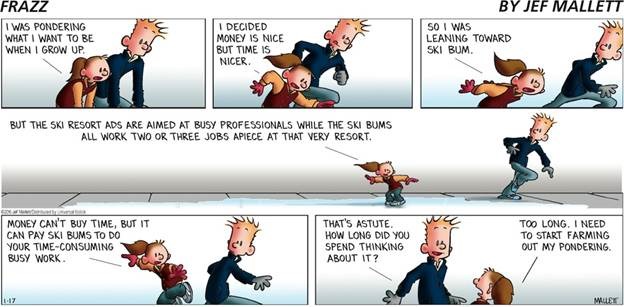
http://www.gocomics.com/frazz/2016/01/17 January 17, 2016
I teach Ski Area Risk Management at Colorado Mountain College in Leadville, Colorado in the Ski Area Operations Program. Most of those students (kids) are there to ski and have convinced their parents they are they for an education. (This is probably no different than most colleges.)
Most lift operators (lifties) and other entry-level workers at ski areas work two or three jobs to be able to stay in the mountains. I’m amazed at the hours they work at all those jobs and still have time to ski or board once in a while.
Working at a ski area is not skiing all day. Now days it means hoping to ski.
The rest of the outdoor industry is in a similar predicament. You love what you do, but the only way you can do it is if someone with a lot, more money pays you do to it, when they have the time.
Me? I picked time and got lucky with my work.
So you are faced with a dilemma. Enjoy your preferred occupation between surviving or change your direction in life and enjoy your preferred avocation between…..surviving.
 What do you think? Leave a comment.
If you like this let your friends know or post it on FB, Twitter or LinkedIn
Author: Outdoor Recreation Insurance, Risk Management and Law
Copyright 2016 Recreation Law (720) Edit Law
Email: Rec-law@recreation-law.com
Google+: +Recreation
Twitter: RecreationLaw
Facebook: Rec.Law.Now
Facebook Page: Outdoor Recreation & Adventure Travel Law
Blog: www.recreation-law.com
Mobile Site: http://m.recreation-law.com
By Recreation Law Rec-law@recreation-law.com James H. Moss
#AdventureTourism, #AdventureTravelLaw, #AdventureTravelLawyer, #AttorneyatLaw, #Backpacking, #BicyclingLaw, #Camps, #ChallengeCourse, #ChallengeCourseLaw, #ChallengeCourseLawyer, #CyclingLaw, #FitnessLaw, #FitnessLawyer, #Hiking, #HumanPowered, #HumanPoweredRecreation, #IceClimbing, #JamesHMoss, #JimMoss, #Law, #Mountaineering, #Negligence, #OutdoorLaw, #OutdoorRecreationLaw, #OutsideLaw, #OutsideLawyer, #RecLaw, #Rec-Law, #RecLawBlog, #Rec-LawBlog, #RecLawyer, #RecreationalLawyer, #RecreationLaw, #RecreationLawBlog, #RecreationLawcom, #Recreation-Lawcom, #Recreation-Law.com, #RiskManagement, #RockClimbing, #RockClimbingLawyer, #RopesCourse, #RopesCourseLawyer, #SkiAreas, #Skiing, #SkiLaw, #Snowboarding, #SummerCamp, #Tourism, #TravelLaw, #YouthCamps, #ZipLineLawyer, Frazz, Time, Money, Live, Liftie, Ski Resort,


 Recreation Law