
High-Flows Part of Proposed 20-Year Glen Canyon Dam Management Plan
Posted: January 26, 2016 Filed under: Uncategorized | Tags: Colorado River, Grand Canyon, High Flows, Management Plan Leave a commentHigh-Flows Part of Proposed 20-Year Glen Canyon Dam Management Plan
By Ryan Heinsius • 14 hours ago
ShareTwitter Facebook Google+ Email
Federal officials have proposed a sweeping new plan to manage Glen Canyon Dam for the next two decades. They want to be more proactive in their efforts to restore fish and animal habitat as well as beaches that have degraded in the Grand Canyon since the dam became operational in the 1960s. Arizona Public Radio’s Ryan Heinsius reports.
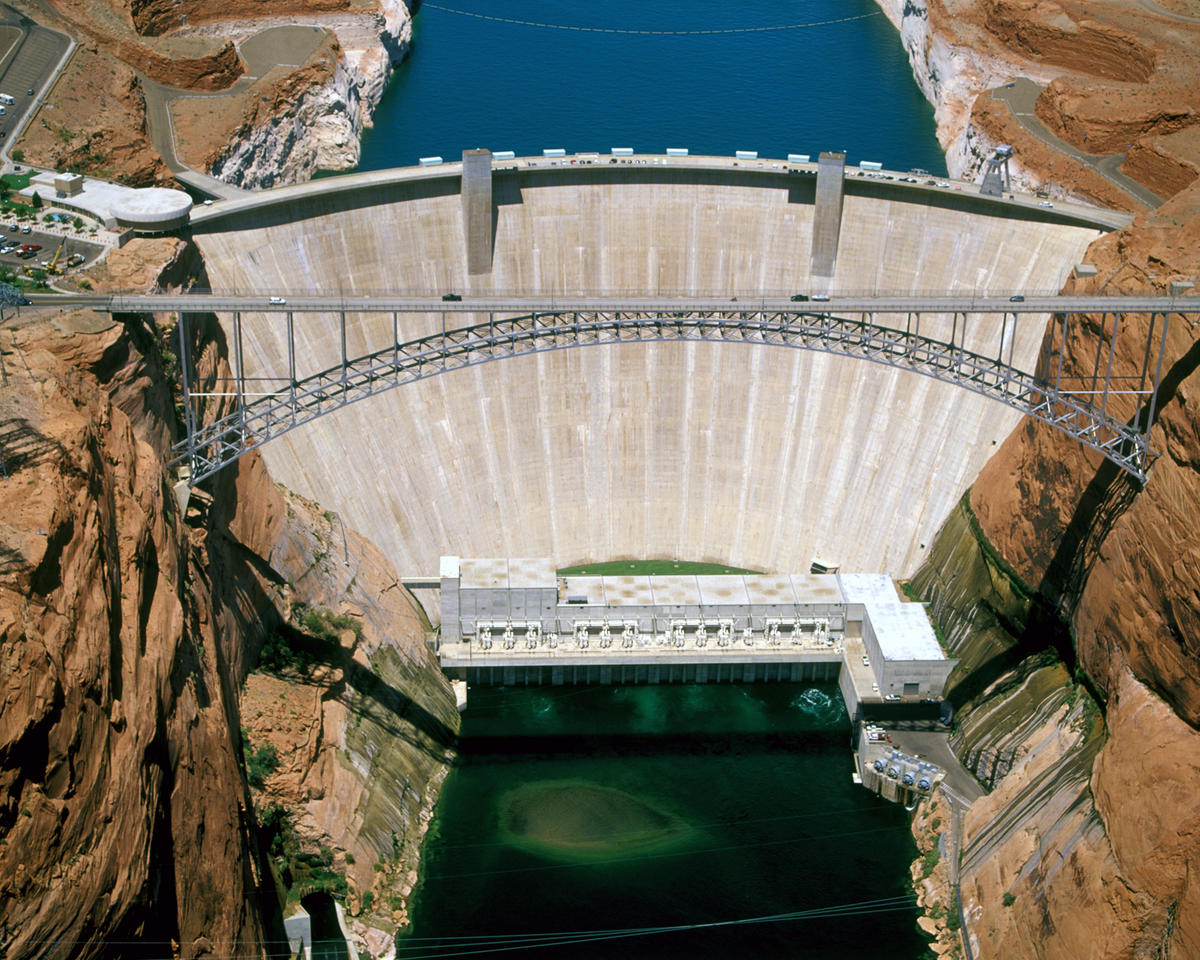
Glen Canyon Dam blocks nearly 90 percent of the sediment that historically ran through the Grand Canyon.
The U.S. Department of the Interior conducted three experiments in recent years to rebuild those areas on the Colorado River. Each time, the agency released millions of gallons of water from the dam over the course of several days to flush sediment through the canyon. It’s an attempt to mimic the river’s natural floods, and federal officials say the flows have been mostly successful.
Beverley Heffernan with the Bureau of Reclamation says the plan would continue those high flows annually for 20 years.
“The whole idea is that we constantly want to be trying to operate Glen Canyon Dam in a manner that continues to meet our water and power obligations, but also wherever we can, helps do an even better job of protecting and improving the resources downstream,” Heffernan says.
The Colorado River provides water for western agriculture and millions of households. Glen Canyon Dam generates enough power for about 425,000 homes every year.
Federal officials will hold public meetings for the proposal, and a comment period lasts until April.
http://knau.org/post/high-flows-part-proposed-20-year-glen-canyon-dam-management-plan#stream/0
Weinrich v. Lehigh Valley Grand Prix Inc, 2015 Pa. Dist. & Cnty. Dec. LEXIS 79
Posted: January 26, 2016 Filed under: Legal Case, Pennsylvania, Release (pre-injury contract not to sue) | Tags: Business Invitee, Contract, FactFinder, Go Kart, Go Kart Racing, Missing Phrase, Missing Term, Open and Obvious, Release, Time Leave a commentWeinrich v. Lehigh Valley Grand Prix Inc, 2015 Pa. Dist. & Cnty. Dec. LEXIS 79
Nicholas Weinrich, Plaintiff -VS- Lehigh Valley Grand Prix Inc, incorrectly Identified As Lehigh Valley Grand Prix LLC, Defendant
File No. 2014-C-0226
COMMON PLEAS COURT OF LEHIGH COUNTY, PENNSYLVANIA, CIVIL DIVISION
2015 Pa. Dist. & Cnty. Dec. LEXIS 79
August 14, 2015, Decided
CORE TERMS: summary judgment, track, plastic, depositions, public policy, citations omitted, duration, genuine, issue of material fact, question of fact, reasonable amount, contravene, factfinder, covering, invitee, silent, rink, dangerous condition, constructive notice, protruding, inspection, customer, go-kart’s, execute, notice, repeat, snap, general rule, moving party’s, liability theory
COUNSEL: [*1] Robert G. Bauer, Esq. for Plaintiff.
Ian T. Baxter, Esq. for Defendant.
JUDGES: Douglas G. Reichley, J.
OPINION BY: Douglas G. Reichley
OPINION
ORDER
AND NOW, this 14 day of August, 2015, upon consideration of Defendant’s Motion for Summary Judgment, filed May 19, 2015, and after argument conducted August 12, 2015,
IT IS ORDERED Defendant’s Motion is DENIED for the reasons set forth in the accompanying Memorandum Opinion.
By the Court:
Douglas G. Reichley, J.
Memorandum Opinion
Lehigh Valley Grand Prix, Inc., Defendant, owns and operates a go-kart track located at 649 South 10th Street, Allentown, Lehigh County, Pennsylvania. Nicholas Weinrich, Plaintiff, filed the instant action alleging he was injured while patronizing the facility. On May 19, 2015, Defendant filed a Motion for Summary Judgment. For the reasons set forth herein, Defendant’s motion is denied.
Factual and Procedural History
According to the Complaint, on June 4, 2012 at approximately 8:15 p.m, Plaintiff was operating a go-kart on Defendant’s track during which time a piece of the plastic covering the guardrail broke and was sticking out toward the track. As Plaintiff drove around the track, the plastic caught his go-kart’s bumper causing it to snap into his [*2] left leg. Plaintiff sustained a laceration on his leg less than two inches wide.
During depositions, Plaintiff testified that six months prior to the incident, he patronized Defendant’s facility without issue. On the date in question, Plaintiff completed two laps and did not notice the plastic covering jutting out. On his third lap, Plaintiff came around the adjacent turn and maintained momentum. He was near the wall, and the piece of the plastic guard was hanging out, bent toward him. He heard a loud snap, and subsequently felt pain in his calf.
Deposition testimony from Defendant’s staff indicated that the protrusion onto the track was common enough that employees were trained on how to repair it. Defendant’s owner conceded that it was possible for the plastic piece on the wall to snap and protrude onto the track.
Six months before the incident in question, on December 4, 2011, Plaintiff patronized Defendant’s establishment. At that time he was required to execute a waiver in order to participate in the race. When he returned in June of 2012, he was not presented with his original waiver, nor was he asked to execute a second one. Testimony from Michael Achey, the manager of Defendant’s [*3] establishment, indicated that repeat customers are not asked to re-execute the waiver. (N.T. Deposition of Michael P. Achey, February 25, 2015, at 45.) Mr. Achey acknowledged that while he has indicated to some repeat customers that they did not need to execute another waiver because one was already on file, he did not say that to every repeat customer. (Id. at 45-46.)
Plaintiff filed his Complaint on April 4, 2014. Defendant filed its Answer on April 29, 2014. On May 19, 2015, Defendant filed the instant Motion for Summary Judgment. Plaintiff filed his response on June 19, 2015. Defendant filed a sur-reply brief on August 6, 2015. The Court heard oral argument on August 12, 2015, after which time the matter was taken under advisement.
This Opinion follows.
Discussion
The standard of review for a motion seeking summary judgment is as follows:
A trial court properly enters summary judgment if “there is no genuine issue of any material fact as to a necessary clement of the cause of action.” Pa.R.C.P. 1035.2(1). The moving party’s right to summary judgment has to be clear and free from doubt after examination of the record in a light most favorable to the non-moving party and resolution of all doubts as to the existence [*4] of a genuine issue of material fact against the moving party
Liss & Marion, P.C. v. Recordex Acquisition Corp., 603 Pa. 198, 983 A.2d 652, 657 (Pa. Super. 2009).
Defendant seeks summary judgment on two grounds. First, Defendant argues that Plaintiff executed a voluntary waiver which bars his recovery. Second, Defendant argues that even if the release were not binding and valid, as a landowner, Defendant cannot be held liable under these circumstances under a premises liability theory.
In Pennsylvania, exculpatory agreements must be strictly construed. Employers Liability Assurance Corp. v. Greenville Business Men’s Assoc., 423 Pa. 288, 224 A.2d 620, 623 (1966). Releases from liability are disfavored as a matter of public policy, but are nonetheless “valid where three conditions are met. First, the clause must not contravene public policy. Secondly, the contract must be between persons relating entirely to their own private affairs and thirdly, each party must be a free bargaining agent to the agreement so that the contract is not one of adhesion.” Chepkevich v. Hidden Valley Resort, L.P., 607 Pa. 1, 2 A.3d 1174, 1189 (Pa. 2010) (quoting Topp Copy Products, Inc. v. Singletary, 533 Pa. 468, 626 A.2d 98, 99 (Pa. 1993)).
The courts of Pennsylvania have traditionally determined the effect of a release using the ordinary meaning of its language and interpreted the release as covering only such matters as can fairly be said to have been within the contemplation of the parties when the release was given. Moreover, releases [*5] are strictly construed so as not to bar the enforcement of a claim that had not accrued at the date of the execution of the release.
Fortney v. Callenberger, 2002 PA Super 182, 801 A.2d 594, 597 (Pa. Super. 2002) (citations and internal quotation marks omitted).
In the context of recreational activities, releases generally function as a bar to liability because the party executing the release is free to choose whether or not he or she wants to participate in the activity. Tayar v. Camelback Ski Corp., Inc., 616 Pa. 385, 47 A.3d 1190, 1197 (Pa. 2012). Such releases do not contravene public policy. Id. However, where the injury was caused by recklessness or gross negligence, enforcement of the release would contravene public policy and the releases are thereby rendered void under those circumstances. Id.
The relevant language of the release in question provides:
IN CONSIDERATION of being permitted to compete, officiate, observe, work, or participate in the EVENT(s), use the equipment, premises, facilities and/or services of Lehigh Valley Grand Prix, LLC., [the undersigned agrees to the release terms] …
Plaintiff argues that the waiver was no longer valid on the date in question because he executed it six months prior to the date of the accident. In support of this argument, Plaintiff does not cite any case law from Pennsylvania or any federal [*6] authority interpreting Pennsylvania law on this matter. The sole case upon which Plaintiff relics is a Florida case, Cain v. Banka, 932 So.2d 575 (Fla. 5th DCA 2006), which held a release unenforceable because the release contained no express language advising the plaintiff that it covered every future visit to a motocross track.
There are not any Pennsylvania cases reflecting the Florida court’s holding. Federal cases interpreting Pennsylvania law merely look at the language of the release to gauge its degree of applicability. See Savarese v. Camelback Ski Corp., 417 F.Supp.2d 663, 667 (M.D. Pa. 2005) (applying Pennsylvania law, language on the back of a ski lift ticket constituted a valid exculpatory agreement once the plaintiff purchased the ticket).
The salient issue in evaluating the instant waiver is that the language on the form neither limits the time for its applicability nor specifies the event or occasion to which it applies. When asked about the release’s duration during oral argument, Defendant’s counsel maintained that the waiver would be effective forever without limitation.
“As a general rule, releases encompass only such matters as may fairly be said to have been within the contemplation of the parties when the release was given.” Farrell v. Lechmanik, Inc., 417 Pa. Super. 172, 611 A.2d 1322, 1323 (Pa. Super. 1992). “[I]t is axiomatic that releases are construed in accordance [*7] with traditional principles of contract law, fundamental to which is the directive that the effect of a release must be determined from the ordinary meaning of its language.” Maloney v. Valley Med. Facilities, Inc., 2008 PA Super 32, 946 A.2d 702, 706 (Pa. Super. 2008) (internal quotation marks and citations omitted). Under contract principles, where a contract is silent as to the time for performance, courts must infer that the parties intended that performance occur within a reasonable amount of time. Cashdollar v. Mercy Hosp. of Pittsburgh, 406 Pa. Super. 606, 595 A.2d 70, 76 (Pa. Super. 1991) (“When the exact period for which the parties intended to contract cannot be ascertained, the agreement is not vitiated; rather, an agreement for a ‘reasonable time’ will be inferred.”).
In construing a contract, courts must adopt “an interpretation which under all circumstances ascribes the most reasonable, probable, and natural conduct of the parties, bearing in mind the objects manifestly to be accomplished.” Metzger v. Clifford Realty Corp., 327 Pa. Super. 377, 476 A.2d 1, 5 (Pa. Super. 1984) (citation omitted). “If an essential term is left out of the agreement, the law will not invalidate the contract but will include a reasonable term.” Stephan v. Waldron Elec. Heating & Cooling LLC, 2014 PA Super 205, 100 A.3d 660, 668 (Pa. Super. 2014) (quoting RegScan, Inc. v. Con-Way Transp. Services, Inc., 2005 PA Super 176, 875 A.2d 332 (Pa. Super. 2005)).
In this case, the release Plaintiff executed is silent as to duration. Based on the foregoing case law, the Court determines that this is an essential term which is left out of the agreement. Therefore, a reasonable [*8] term is to be imposed instead of invalidating the release as a whole. Id. Because contract principles further dictate that contractual duration is presumed to be for a reasonable amount of time in the absence of a specified time for performance, Metzger, 476 A.2d at 5, the parties’ release must therefore be deemed to apply for a reasonable period of time. What constitutes a reasonable time, however, is generally a question of fact to be resolved by the factfinder. See, e.g., Yates v. Clifford Motors, Inc., 283 Pa. Super. 293, 423 A.2d 1262, 1268 (Pa. Super. 1980) (in the Uniform Commercial Code context, whether goods were rejected within a reasonable amount of time where contract was silent as to time for rejection was question of fact for jury).
Consequently, Defendant’s argument in support of summary judgment based on the existence of a release must be denied. Summary judgment is only appropriate where there is no genuine issue of material fact. Whether six months following the execution of a release for a recreational activity constitutes a reasonable amount of time is a question more appropriately posed to a finder of fact. The reasonableness of the duration in question is therefore a genuine issue of material fact and summary judgment is inappropriate.
Defendant also argued in its motion [*9] that even if the release was not binding and valid, as a landowner, Defendant cannot be held liable under these circumstances under a premises liability theory. Plaintiff in this case was an invitee for premises liability purposes. An invitee is someone who is “invited to enter or remain on land as a member of the public for a purpose for which the land is held open to the public.” Restatement (Second) of Torts §332 (1965).
As a general rule, possessors of land are not liable to invitees for physical harm caused to them by activities or conditions on the land whose danger is known or obvious to them unless the possessor should anticipate the harm despite such knowledge or obviousness. Restatement (Second) of Torts, § 343A. A danger is deemed to be “obvious” when “both the condition and the risk are apparent to and would be recognized by a reasonable man, in the position of the visitor, exercising normal perception, intelligence, and judgment.” Carrender v. Fitterer, 503 Pa. 178, 469 A.2d 120, 123-24 (Pa. 1983) (citation omitted). “For a danger to be ‘known,’ it must not only be known to exist, but … also be recognized that it is dangerous and the probability and gravity of the threatened harm must be appreciated.” Id. at 124.
Nonetheless, the question of whether conditions on land were in fact open and obvious is generally [*10] a question of fact for a jury to decide. Id. It may be decided by a court where reasonable minds could not differ as to the conclusion. Id.; see also Long v. Manzo, 452 Pa. Super. 451, 682 A.2d 370, 373 (Pa. Super. 19%) (citation omitted) (issues of plaintiff’s knowledge of condition creating unreasonable risk of harm usually for jury to decide, but may be decided by court where reasonable minds could not differ).
In the context of amusement facilities, Pennsylvania courts have held that there is no duty to protect participants against the typical risks attendant to those activities. See Berman v. Radnor Rolls, Inc., 374 Pa. Super. 118, 542 A.2d 525 (Pa. Super. 1983) (roller rink has no obligation to protect patrons from falling down or being bumped by other skaters). A duty arises only where the risks at play are atypical. See id. (liability found where accident attributable to a condition unique to defendant skating rink, i.e. a 60-foot wide opening in the rink and a 6″ drop-off on its side).
With respect to the requirement for notice, Plaintiff argued that Defendant’s employees’ depositions demonstrate an acute awareness that the sort of dangerous condition at issue–the broken plastic piece protruding into the racetrack–was something for which they were trained. While the record is devoid of evidence supporting [*11] actual notice, Plaintiff argued Defendant had constructive notice.
Neither the witnesses who were deposed nor Plaintiff testified that the plastic was protruding into the track for an extended period of time. The testimony at the depositions indicated that there are three scheduled inspections of the racetrack per day: morning, noon, and night. None of those inspections revealed the dangerous condition. There is also a visual inspection of the track in between each race according to the testimony offered by Michael McCreary, Defendant’s owner. Defendant’s employees, Michael Achey (manager) and Corey Dewalt (track marshal) conceded that it was possible that the protruding plastic could have been missed.
Summary judgment would not be appropriate on these grounds because there are factual issues regarding constructive notice and whether there were appropriate steps undertaken by Defendant. Testimony before a factfinder is necessary to assess whether and to what extent the employees were aware in advance of the existence of the dangerous condition. These are all factual questions to be resolved by a factfinder.
Conclusion
Because there is an outstanding factual issue concerning whether six [*12] months after execution of the subject release is a reasonable period of time for the release to remain in effect, Defendant’s Motion for Summary Judgment on the ground of the release must fail. Further, there are outstanding factual questions concerning constructive notice which render summary judgment inappropriate on that basis. Accordingly, Defendant’s Motion for Summary Judgment is denied.
By the Court:
Douglas G. Reichley, J.
8/14/15
10th Circuit Court of Appeals upholds Colorado law concerning releases in a whitewater rafting fatality.
Posted: January 25, 2016 Filed under: Colorado, Paddlesports, Release (pre-injury contract not to sue) | Tags: 10th Circuit, 10th Circuit Court of Appeals, Arkansas River, Brown’s Canyon, fatality, Release, Seidel’s Suck Hole, Strainer, Tenth Circuit Court of Appeals, Waiver, Whitewater Rafting 9 CommentsPlaintiff’s approach was a unique way of attempting to circumvent the legal protection afforded by the release. Claims of negligence per se and fraud were pled to beat the release.
Citation: Espinoza, Jr., v. Arkansas Valley Adventures, LLC, 2016 U.S. App. LEXIS 39
State: Colorado, United States Court of Appeals for the Tenth Circuit
Plaintiff: Jesus Espinoza, Jr.
Defendant: Arkansas Valley Adventures, LLC
Plaintiff Claims: Negligence per se and fraud
Defendant Defenses: release
Holding: Defendant
Year: 2016
There is a quasi-third party in this case, the Colorado Trial Lawyers Association (CTLA). The CTLA filed an Amicus Curiae brief with the appellate court. An amicus curiae brief is a written argument with legal support saying there are issues in this case that may or may not be brought out by one of the parties that are important to people other than the named parties.
In this case, the CTLA probably wanted to influence the court in favor of the plaintiff.
The plaintiff’s mother went whitewater rafting with the defendant raft company. Upon arrival the plaintiff received “the usual guidance,” signed a release and headed down the river. “The next day(?)” while rafting through Seidel’s Suck Hole the raft flipped. Everyone was “fished out of the river” except the deceased who was swept into a “log jam” (a strainer).
Brown’s Canyon, including Seidel’s Suck Hole is an all-day river trip. However, a few companies run two-day trips on the river stopping mid-way and camping for the night. That is the confusion on what day, relative to the date the deceased signed the release the fatality occurred. 99.9% of the trips are just one-day trips.
Her son brought suit against the raft company for negligence per se and fraud. The trial court agreed with the defendant and granted its motion for summary judgment. The appeal to the Tenth Circuit and this decision followed.
Analysis: making sense of the law based on these facts.
The court distilled the plaintiff’s major argument down to one sentence. “…whether Colorado law permits private parties to enforce a contract like this.”
The court first looked at the requirements for a release to be valid in Colorado as set out by the Colorado Supreme Court.
…the Colorado Supreme Court has instructed courts to weigh four factors when deciding whether to give effect to agreements along these lines: “(1) the existence [or nonexistence] of a duty to the public; (2) the nature of the service performed; (3) whether the contract was fairly entered into; and (4) whether the intention of the parties is expressed in clear and unambiguous language.
The court then analyzed the four different factors breaking them down into sub-groups. The first two factors the court found to be public policy questions.
…asking whether “[t]he party seeking exculpation is engaged in performing a service of great importance to the public, which is often a matter of practical necessity [and] . . . [a]s a result of the essential nature of the service . . . the party invoking exculpation possesses a decisive advantage of bargaining strength against any member of the public who seeks his services.”
The last two questions of the four focus on whether the release, as a contract met the requirements to be a contact:
…whether the release was fairly obtained and clearly and unambiguously expressed. If the release satisfies both sets of questions — the more general and the more particular — it may be enforced.”
Generally, the Colorado Supreme Court has held that businesses that perform recreational services are not engaged in essential public services. Essential public services or referred to by other courts as necessities are those are you cannot live without. “So while businesses providing, say, water, electricity, or sanitary services usually may not shield themselves from claims of negligence; recreational service providers often can.”
Under Colorado law, private parties are free to assume the risks associated with recreational activities.
The court then looked at how this test applied to the plaintiff’s argument that the raft company was liable because it was negligent per se. However, the court rejected the negligence per se argument finding that creation of a statute covering a particular business does not therefore create negligence per se actions on all aspects of the statute.
And because whitewater rafting is a recreational activity, a statute could not turn a recreational activity into a necessity.
And the distinction the Jones factors draw between essential and recreational services would break down pretty quickly if the presence of some state regulation were enough to convert an otherwise obviously “recreational” service into a “practically necessary” one.
On top of that, Colorado law has always allowed parties to contract away negligence claims and there is almost no difference between the common law of negligence, and the duty required of a negligence per se claim.
Colorado law has long permitted parties to contract away negligence claims in the recreational context. And negligence per se claims often differ very little from their common law cousins: they usually just substitute a common law duty or standard of care with one prescribed by statute, and all other elements remain the same. In fact, in the case before us, it’s not even clear what duty of care CROA adds to the common law.
Nor did the plaintiff point out how the statute created a new duty that was violated by the defendant. And the court cannot create a new duty. “Indeed, courts generally will not assume that the General Assembly means to displace background common law principles absent some clear legislative expression of that intent.”
He contends that the rafting company misrepresented the nature of the trip to Ms. Apolinar. He points for support to testimony suggesting that, when Ms. Apolinar first made her reservation, she was told by company representatives and read on its website that the trip was appropriate for beginners and involved at most only class III rapids.
However, the court found the deceased was provided information on the risks of the rafting trip.
Whatever the rafting company said about the trip earlier on, when Ms. Apolinar arrived at the outfitter’s office she received a vivid description of the risks she could face. The rafting company provided — and Ms. Apolinar signed — a document titled in part “RAFTING WARNING” explaining that rafting can be “HAZARDOUS AND INVOLVES THE RISK OF PHYSICAL INJURY AND/OR DEATH.”
The release also had a clause that voided all other statements or sales pitches and stated only the representations in the release were valid. “The document provided, too, that its representations and warnings about the trip superseded any prior “communications or representations…”
The court then restated that in Colorado, courts had consistently upheld releases signed by “competent and reasonably educated” people.
Colorado courts have repeatedly emphasized that individuals engaged in recreational activities are generally expected to read materials like these, and because recreational businesses do not provide “essential” services of “practical necessity” individuals are generally free to walk away if they do not wish to assume the risks described.
Nor would the court allow the claim for fraud to proceed.
To make out a claim for fraud in Colorado, a plaintiff must establish actual and reasonable reliance on a false statement; a party cannot — as a matter of law — continue to rely on a previously expressed false statement after the truth is aired. And, of course, we have just found that the rafting company’s written warnings accomplished just that — adequately airing the truth about the nature of the risks Ms. Apolinar faced.
Here again, the court could not find a false statement that was in the documents, and any false statement made prior to the signing of the release was null and void based on the superseding statement clause in the release.
The court upheld the release and the dismissal of the lawsuit by the trial court.
So Now What?
The issue with the most concern is the dispute between the American Whitewater Association whitewater difficulty rating of the section of river (International Scale of River Difficulty). For decades, the Arkansas River running through Brown’s Canyon was considered a Class III section.
Outfitters believing they could receive one of two benefits; either could receive some marketing value or lawsuit protection, started advertising the section as Class IV yet still marketed it as a beginner section.
A couple of books were published about the river and those books in an effort to protect someone (First Amendment is pretty strong though) also rated the river as a Class IV section.
Now an outfitter almost loses a decision because there is enough contention over the rating of the river that one judge thinks it should go to trial.
THINK people. Your actions today may come back to bite you somewhere in the future.
You can’t say something is a beginner run and then give it a Class IV rating to cover your legal butt. An AWA Class IV rating is advanced. Advanced is not Beginner.
The second issue is how hard the plaintiff’s and the plaintiff’s bar worked to overcome the release. Your release must be written correctly (See Think your release will survive a lawsuit? Test your Release and Find out.) If you stole your release from a competitor, cut and pasted yours from the web or was there when you bought the place you are going to lose a lawsuit.
Releases must fit the experience you are attempting to provide your guests. Your release must not be contradicted by your marketing or your website. Your release must be understood by you and your staff so you don’t void your release by your actions. Finally, your release must meet the legal requirements for a release for your industry and pursuant to your state law.
You then must make sure the information you provide to your guests before during and after their experience does no invalidate your release. Finally deal with the issues a disaster creates, just don’t hide.
Finally, the release was relied upon not only as a release, but as proof of the risks of the activity, for a superseding statement clause to eliminate fraud claims and failure to inform claims.
A well written release work.
Remember!
Marketing makes promises Risk Management must pay for.
Here the marketing was it was a beginner raft trip; however, someone died on it and there was enough controversy over whether the trip was really for beginners that this case was a close call.
What do you think? Leave a comment.
 James H. “Jim” Moss |
Jim Moss is an attorney specializing in the legal issues of the outdoor recreation community. He represents guides, guide services, and outfitters both as businesses and individuals and the products they use for their business. He has defended Mt. Everest guide services, summer camps, climbing rope manufacturers; avalanche beacon manufacturers, and many more manufacturers and outdoor industries. Contact Jim at Jim@Rec-Law.us |
Jim is the author or co-author of eight books about legal issues in the outdoor recreation world; the latest is Outdoor Recreation Insurance, Risk Management,
Outdoor Recreation Insurance, Risk Management, and Law
To see Jim’s complete bio go here and to see his CV you can find it here. To find out the purpose of this website go here.
If you are interested in having me write your release, download the form and return it to me.
Connect
If you like this let your friends know or post it on FB, Twitter, or LinkedIn
 Threads |
 Facebook Logo |
 X, Formerly Twitter |
 Recreation Law |
By Recreation Law Rec-law@recreation-law.com James H. Moss
@2016-2023 Summit Magic Publishing, LLC
G-YQ06K3L262
#AdventureTourism, #AdventureTravelLaw, #AdventureTravelLawyer, #AttorneyatLaw, #Backpacking, #BicyclingLaw, #Camps, #ChallengeCourse, #ChallengeCourseLaw, #ChallengeCourseLawyer, #CyclingLaw, #FitnessLaw, #FitnessLawyer, #Hiking, #HumanPowered, #HumanPoweredRecreation, #IceClimbing, #JamesHMoss, #JimMoss, #Law, #Mountaineering, #Negligence, #OutdoorLaw, #OutdoorRecreationLaw, #OutsideLaw, #OutsideLawyer, #RecLaw, #Rec-Law, #RecLawBlog, #Rec-LawBlog, #RecLawyer, #RecreationalLawyer, #RecreationLaw, #RecreationLawBlog, #RecreationLawcom, #Recreation-Lawcom, #Recreation-Law.com, #RiskManagement, #RockClimbing, #RockClimbingLawyer, #RopesCourse, #RopesCourseLawyer, #SkiAreas, #Skiing, #SkiLaw, #Snowboarding, #SummerCamp, #Tourism, #TravelLaw, #YouthCamps, #ZipLineLawyer, Tenth Circuit Court of Appeals, 10th Circuit Court of Appeals, 10th Circuit, Whitewater Rafting, Arkansas River, Brown’s Canyon, Strainer, Seidel’s Suck Hole, Fatality
Cobb v. Aramark Sports and Entertainment Services, LLC, 933 F. Supp. 2d 1295; 2013 U.S. Dist. LEXIS 20139; 2013 AMC 2563
Posted: January 23, 2016 Filed under: Legal Case, Nevada, Rivers and Waterways, Skydiving, Paragliding, Hang gliding | Tags: Admiralty and Maritime Law, Admiralty Law, Aramark, assumption of the risk, Lake Tahoe, Nevada, Parasailing, Release, Zephyr Cove Resort Leave a commentTo Read an Analysis of this decision see
Admiralty law did not stop a release from barring a claim for negligence for a parasailing injury.
Cobb v. Aramark Sports and Entertainment Services, LLC, 933 F. Supp. 2d 1295; 2013 U.S. Dist. LEXIS 20139; 2013 AMC 2563
Jaclyn Cobb, Plaintiff, v. Aramark Sports and Entertainment Services, LLC, Defendant.
3:11-cv-0840-LRH-WGC
UNITED STATES DISTRICT COURT FOR THE DISTRICT OF NEVADA
933 F. Supp. 2d 1295; 2013 U.S. Dist. LEXIS 20139; 2013 AMC 2563
February 13, 2013, Decided
February 14, 2013, Filed
SUBSEQUENT HISTORY: As Amended March 18, 2013.
COUNSEL: [**1] For Jaclyn Cobb, Plaintiff: Angela D. Bullentini, Charles M Kilpatrick, Kilpatrick, Johnston & Adler, Carson City, NV.
For Aramark Sports and Entertainment Services, LLC, Defendant: Rachel K McLendon-Kent, Graeme A. Reid, Bauman Loewe Witt & Maxwell, Reno, NV; Terence Cox, Cox, Wootton, Griffin, Hansen & Poulos, LLP, San Francisco, CA.
JUDGES: LARRY R. HICKS, UNITED STATES DISTRICT JUDGE.
OPINION BY: LARRY R. HICKS
OPINION
[*1296] AMENDED ORDER
Before the court is defendant Aramark Sports and Entertainment Services, LLC’s (“Aramark”) motion for summary judgment. Doc. #28. 1 Plaintiff Jaclyn Cobb (“Cobb”) filed an opposition (Doc. #33) to which Aramark replied (Doc. #38). This Order amends Order #39. 2
1 Refers to the court’s docket number.
2 This Order is identical to Order #39, but with needed edits for punctuation and citation accuracy.
I. Facts and Procedural History
Plaintiff Cobb is seeking recovery for a knee injury allegedly sustained while parasailing with an affiliate of defendant Aramark.
On June 15, 2010, Cobb paid to go parasailing on Lake Tahoe through an operation ran by Zephyr Cove Resort (“Zephyr”). Before going on the boat for parasailing, Cobb signed a waiver of liability entitled Acknowledgment and Assumption of Risk and Waiver of Liability (“Waiver”). The waiver stated in relevant part:
In consideration of my being allowed to participate in the parasailing [**2] activities operated and conducted by [Zephyr], I hereby RELEASE and WAIVE . . . any and all claims that I may have . . . against [Zephyr], and any of [its] affiliates . . . I specifically RELEASE [Zephyr], and any of [its] affiliates . . . from . . . all claims for . . . injury or death to persons caused by negligence of any one of them arising out of my participation in the parasailing activities. I AGREE NOT TO SUE . . . the aforementioned parties for any injuries or damages that I might hereby receive from my participation in the parasailing activities, whether or not such injury, loss or damage results from the aforementioned [*1297] parties’ negligence or from any other cause.
Doc. #28, Exhibit A.
After signing the waiver, Cobb boarded the parasailing vessel and, along with another family member, went parasailing in a tandem harness. At some point during the trip, adverse weather conditions, including high winds, caused the parasailing trip to be called short. As she was being reeled back into the boat Cobb struck her knee on the boat causing significant injury.
Subsequently, Cobb filed a complaint for negligence against Aramark. Doc. #1, Exhibit A. Thereafter, Aramark filed the present motion [**3] for summary judgment contending that Cobb expressly waived her right to sue. Doc. #28.
II. Legal Standard
Summary judgment is appropriate only when “the pleadings, depositions, answers to interrogatories, and admissions on file, together with the affidavits, if any, show that there is no genuine issue as to any material fact and that the moving party is entitled to judgment as a matter of law.” Fed. R. Civ. P. 56(c). In assessing a motion for summary judgment, the evidence, together with all inferences that can reasonably be drawn therefrom, must be read in the light most favorable to the party opposing the motion. Matsushita Elec. Indus. Co. v. Zenith Radio Corp., 475 U.S. 574, 587, 106 S. Ct. 1348, 89 L. Ed. 2d 538 (1986); County of Tuolumne v. Sonora Cmty. Hosp., 236 F.3d 1148, 1154 (9th Cir. 2001).
The moving party bears the burden of informing the court of the basis for its motion, along with evidence showing the absence of any genuine issue of material fact. Celotex Corp. v. Catrett, 477 U.S. 317, 323, 106 S. Ct. 2548, 91 L. Ed. 2d 265 (1986). On those issues for which it bears the burden of proof, the moving party must make a showing that is “sufficient for the court to hold that no reasonable trier of fact could find other than for the moving party.” [**4] Calderone v. United States, 799 F.2d 254, 259 (6th Cir. 1986); see also Idema v. Dreamworks, Inc., 162 F. Supp. 2d 1129, 1141 (C.D. Cal. 2001).
To successfully rebut a motion for summary judgment, the non-moving party must point to facts supported by the record which demonstrate a genuine issue of material fact. Reese v. Jefferson Sch. Dist. No. 14J, 208 F.3d 736 (9th Cir. 2000). A “material fact” is a fact “that might affect the outcome of the suit under the governing law.” Anderson v. Liberty Lobby, Inc., 477 U.S. 242, 248, 106 S. Ct. 2505, 91 L. Ed. 2d 202 (1986). Where reasonable minds could differ on the material facts at issue, summary judgment is not appropriate. See v. Durang, 711 F.2d 141, 143 (9th Cir. 1983). A dispute regarding a material fact is considered genuine “if the evidence is such that a reasonable jury could return a verdict for the nonmoving party.” Liberty Lobby, 477 U.S. at 248. The mere existence of a scintilla of evidence in support of the plaintiff’s position will be insufficient to establish a genuine dispute; there must be evidence on which the jury could reasonably find for the plaintiff. See id. at 252.
III. Discussion
A. Applicable Law
In its motion, Aramark argues that this action, and thereby [**5] the express waiver, is governed by federal admiralty law. See Doc. #28. An action falls within the admiralty jurisdiction of the federal courts under 28 U.S.C. § 1333(1) when: (1) the underlying tort occurred on navigable waters; and (2) the actions giving rise to the tort claim bear a significant relationship to traditional maritime activity. Charnis v. Watersport Pro, LLC, 2009 U.S. Dist. LEXIS 76022, *5-6 [*1298] (D. Nev. 2009) (citing Sisson v. Ruby, 497 U.S. 358, 365-66, 110 S. Ct. 2892, 111 L. Ed. 2d 292 (1990)).
The court has reviewed the documents and pleadings on file in this matter and finds that this action falls within the court’s exercise of admiralty jurisdiction. First, the alleged injury occurred on Lake Tahoe, a navigable waterway that lies within the borders of Nevada and California. Where, as here, a body of water forms a border between two states and is capable of supporting maritime commerce, it is considered navigable for the purpose of establishing admiralty jurisdiction. Charnis, 2009 U.S. Dist. LEXIS 76022, *6. Second, parasailing bears a significant relationship to traditional maritime activities sufficient to establish admiralty jurisdiction. See e.g., In the Matter of Skyrider, 1990 U.S. Dist. LEXIS 16510, *10 (D. Haw. 1990) [**6] (“Careful and safe navigation of vessels in navigable waters have always been a fundamental admiralty concern. Navigation is an essential component in the parasailing activity.”); UFO Chuting of Hawaii Inc. v. Smith, 508 F.3d 1189, 1193 (9th Cir. 2007) (holding that parasailing is an activity bearing a significant relationship to traditional maritime activities); Charnis, 2009 U.S. Dist. LEXIS 76022, *6 (“The operation of recreational boats, including pulling skiers or wakeboarders, bears a significant relationship to traditional maritime activity.”). Therefore, this action arises under the court’s admiralty jurisdiction and, as such, the court must apply substantive federal admiralty law to this action. Charnis, 2009 U.S. Dist. LEXIS 76022, *6 (“With admiralty jurisdiction comes the application of substantive admiralty law.”) (citing E. River S.S. Corp. v. Transamerica Delaval, Inc., 476 U.S 858, 864, 106 S. Ct. 2295, 90 L. Ed. 2d 865 (1986)).
B. Assumption of the Risk
In her opposition, Cobb argues that the liability waiver is unenforceable because under federal maritime law assumption of the risk is not a valid defense. Cobb is correct that assumption of the risk is not an available defense in maritime cases involving [**7] personal injury. See e.g., De Sole v. United States, 947 F.2d 1169 (4th Cir. 1991); Skidmore v. Grueninger, 506 F.2d 716 (5th Cir. 1975). However, this does not preclude Aramark from raising the defense of express waiver in this case. Waiver and assumption of the risk are two distinct affirmative defenses and are addressed separately under federal admiralty law. See Charnis, 2009 U.S. Dist. LEXIS 76022, *10-11. Therefore, Aramark may raise the affirmative defense of express waiver in this action.
C. Express Waiver
In its motion, Aramark argues that the signed express waiver precludes the present action. See Doc. #28. Specifically, Aramark argues that under federal maritime law, pre-accident liability waivers are enforceable and may properly dispose of this action on summary judgment.
Under federal admiralty law, owners of recreational vessels may, through written waivers, disclaim liability for their own negligence. Charnis, 2009 U.S. Dist. LEXIS 76022, *11. A pre-accident waiver absolves a defendant of liability for recreational activities on navigable waters if the exculpatory clause is (1) clear and unambiguous; (2) is not inconsistent with public policy; and (3) is not an adhesion contract. [**8] Id. at 13.
The court has reviewed the documents and pleadings on file in this matter and finds that the signed waiver of liability is [*1299] enforceable. First, Cobb concedes that she knowingly and voluntarily signed the liability waiver. See Doc. #33. Second, the court finds that the express waiver in this action is clear and unambiguous as it contains specific language releasing Zephyr and its affiliates, including defendant Aramark, for injuries sustained in carrying out the parasailing activities as a result of Zephyr’s negligence.
A waiver is clear and unambiguous if it specifically bars the plaintiff’s negligence claim and explicitly exonerates all defendants in the lawsuit. See Charnis, 2009 U.S. Dist. LEXIS 76022. Here, the waiver specifically bars plaintiff from suing for her injuries. Doc. #28, Exhibit A (“I AGREE NOT TO SUE . . . the aforementioned parties for any injuries or damages that I might hereby receive from my participation in the parasailing activities, whether or not such injury, loss or damage results from the aforementioned parties’ negligence or from any other cause.”). Further, the very injuries Cobb is suing for are specifically precluded by the waiver including “drowning, [**9] sprained or broken bones.” Doc. #28, Exhibit A. Therefore, the court finds that the express waiver is sufficiently clear and unambiguous to cover Cobb’s injuries sustained while parasailing.
Third, the underlying express waiver is not inconsistent with public policy because waivers of liability on navigable waters do not contravene federal public policy. Charnis, 2009 U.S. Dist. LEXIS 76022, *13-14; In re Aramark Sports and Entertainment Services, LLC, 2012 U.S. Dist. LEXIS 123786, *21 (C.D. Utah 2012) (holding that maritime exculpatory clauses are enforceable when a party clearly absolves itself from liability for its own negligence).
Finally, the court finds that the express waiver signed by Cobb is not an adhesion contract because it concerns a voluntary recreational activity. Under federal admiralty law, liability waivers for recreational sporting activities like parasailing are not contracts of adhesion because they are not essential services. See e.g., Charnis, 2009 U.S. Dist. LEXIS 76022, *14-15; In re Aramark, 2012 U.S. Dist. LEXIS 123789, *15. Therefore, the court finds that the underlying pre-accident waiver is valid and enforceable and absolves defendant Aramark of any liability [**10] arising from the recreational parasailing activity. Accordingly, the court shall grant Aramark’s motion for summary judgment.
IT IS THEREFORE ORDERED that defendant’s motion for summary judgment (Doc. #28) is GRANTED. The clerk of court shall enter judgment in favor of defendant Aramark Sports and Entertainment Services, LLC and against plaintiff Jaclyn Cobb.
IT IS SO ORDERED.
DATED this 18th day of March, 2013.
/s/ Larry R. Hicks
LARRY R. HICKS
UNITED STATES DISTRICT JUDGE
G-YQ06K3L262
http://www.recreation-law.com
You Gotta Love It: Microbreweries for the Environment.
Posted: January 23, 2016 Filed under: Uncategorized | Tags: Environment, Microbreweries Leave a commentTHINK GLOBAL DRINK LOCAL
We have begun to accept applications for beneficiaries for the 23rd Annual Microbreweries for the Environment (MBE), taking place April 22nd, 2016. Two and up to four groups are scheduled to receive $2,000. Details about being a beneficiary are in the application link below. Hosted by the Boulder Theatre, the event description will be updated here as brews, bands, and beneficiaries are confirmed.
The due date is February 4th at five pm.The MBE Committee will review applications that week, and decisions made by the 7th.
Please do not hesitate to contact us with any questions. We encourage you to please share this with fledgling organizations and friends who are well networked.
Cheers,
SarahDawn Haynes on behalf of the
2016 MBE Committee
QBP Recalls Stolen Series BMX Bicycles Due to Fall Hazard
Posted: January 22, 2016 Filed under: Uncategorized | Tags: BMX, BMX bicycles, Consumer Product Safety Council, CPSC, QBP, Recall, Stolen Leave a commentHazard: The bicycles fail to meet the federal bicycle standard. The bicycle’s front wheel can detach due to improperly fitting retention washers, posing a fall hazard to the rider.
http://www.cpsc.gov/en/Recalls/2016/QBP-Recalls-Stolen-Series-BMX-Bicycles/
Recall Date: January 13, 2016
Name of Product: Stolen series BMX bicycles
Remedy: Replace
Consumers should immediately stop using the recalled BMX bicycles and return them to the store where purchased for a free inspection and free replacement wheel retention washers.
Consumer Contact: QBP toll-free at 844-610-7484 from 8 a.m. to 6 p.m. CT Monday through Friday or online at http://www.qbpbmx.com and click on the Recall Information tab for more information.
Recall Details
Photos available at http://www.cpsc.gov/en/Recalls/2016/QBP-Recalls-Stolen-Series-BMX-Bicycles/
Units: About 1,000 in the U.S.
Description: This recall involves Stolen series BMX bicycles, including Stolen Agent 16CB and 16FW, Stolen Compact, Stolen Casino and Stolen Stereo models. “Stolen” and the model name are printed on the frame of the bicycles. The Agent 16-inch bikes were sold in dark blue, the Compact 20-inch bikes were sold in neon orange and satin white, the Casino 20-inch bikes were sold in phosphate raw (gray), highlight yellow and electric red, and the Stereo 20-inch bikes were sold in satin black and electric green.
Incidents/Injuries: The firm has received one report of an incident. No injuries have been reported.
Sold at: BMX bicycle/product dealers, Stolen series BMX distributors and specialty bicycle retailers nationwide and online at http://www.QBP.com and other BMX bicycle/product websites from September 2015 through October 2015 for between $230 and $350.
Distributor: Quality Bicycle Products Inc. (QBP), of Bloomington, Minn.
Manufactured in: Taiwan
Retailers: If you are a retailer of a recalled product you have a duty to notify your customers of a recall. If you can, email your clients or include the recall information in your next marketing communication to your clients. Post any Recall Poster at your stores and contact the manufacturer to determine how you will handle any recalls.
For more information on this see:
For Retailers
Recalls Call for Retailer Action
Combination of a Products Liability statute, an Expert Witness Report that was just not direct enough and odd facts holds a retailer liable as manufacture for product defect.
Product Liability takes a different turn. You must pay attention, just not rely on the CPSC.
Retailer has no duty to fit or instruct on fitting bicycle helmet
Summary Judgment granted for bicycle manufacturer and retailer on a breach of warranty and product liability claim.
For Manufacturers
The legal relationship created between manufactures and US consumers
 What do you think? Leave a comment.
If you like this let your friends know or post it on FB, Twitter or LinkedIn
Author: Outdoor Recreation Insurance, Risk Management and Law
Copyright 2016 Recreation Law (720) Edit Law
Email: Rec-law@recreation-law.com
Google+: +Recreation
Twitter: RecreationLaw
Facebook: Rec.Law.Now
Facebook Page: Outdoor Recreation & Adventure Travel Law
Blog: www.recreation-law.com
Mobile Site: http://m.recreation-law.com
By Recreation Law Rec-law@recreation-law.com James H. Moss
#AdventureTourism, #AdventureTravelLaw, #AdventureTravelLawyer, #AttorneyatLaw, #Backpacking, #BicyclingLaw, #Camps, #ChallengeCourse, #ChallengeCourseLaw, #ChallengeCourseLawyer, #CyclingLaw, #FitnessLaw, #FitnessLawyer, #Hiking, #HumanPowered, #HumanPoweredRecreation, #IceClimbing, #JamesHMoss, #JimMoss, #Law, #Mountaineering, #Negligence, #OutdoorLaw, #OutdoorRecreationLaw, #OutsideLaw, #OutsideLawyer, #RecLaw, #Rec-Law, #RecLawBlog, #Rec-LawBlog, #RecLawyer, #RecreationalLawyer, #RecreationLaw, #RecreationLawBlog, #RecreationLawcom, #Recreation-Lawcom, #Recreation-Law.com, #RiskManagement, #RockClimbing, #RockClimbingLawyer, #RopesCourse, #RopesCourseLawyer, #SkiAreas, #Skiing, #SkiLaw, #Snowboarding, #SummerCamp, #Tourism, #TravelLaw, #YouthCamps, #ZipLineLawyer, Recall, CPSC, Consumer Product Safety Council, QBP, BMX, Stolen, BMX bicycles,
Adventure Cycling Association new Cycle Though Our National Parks Program on September 24
Posted: January 21, 2016 Filed under: Cycling, Mountain Biking | Tags: Adventure Cycling Association, Bike Your Park Day, Cycling, National Parks, NPS Leave a comment
Adventure Cycling Announces First-Ever Bike Your Park Day
Registration is now open for a national event on September 24, 2016, for people of all ages and abilities to discover their parks and public lands by bicycle.
MISSOULA, MONT., January 12, 2016 — Adventure Cycling Association today announced the inaugural Bike Your Park Day, which will inspire and empower thousands of people to bike in or to a national park, state park, wildlife refuge, or other public lands on the same day — September 24, 2016. Anyone interested in participating can now register and start planning their ride. Participants can register their own ride or join an existing ride posted on the Bike Your Park Day interactive map, which pinpoints all of the rides happening throughout the United States.
“Your park is only a pedal away on September 24th,” said Jim Sayer, executive director of Adventure Cycling Association. “You can ride one mile or 100 miles, you can go solo, ride with friends or bring the kids — it’s all about getting people to explore and discover the parks and public lands out their back door by bicycle.”
The event celebrates Adventure Cycling Association’s 40th anniversary and the National Park Service’s (NPS) Centennial, and is also on National Public Lands Day. Many parks will offer activities and volunteer opportunities, and many parks will waive entry fees.
“Bike Your Park Day is a great opportunity to promote healthy, active recreation in our parks while at the same time encouraging family-friendly activities during the NPS Centennial year,” said Bob Ratcliffe, NPS Program Chief of Conservation and Outdoor Recreation. “Plus, it’s a much better experience seeing our parks from the seat of a bicycle than sitting in a car!”
For those who are new to bicycling or unfamiliar with local routes, more than 100 Bike Your Park Day ambassadors are available in 47 states to answer questions about bicycling, safety, bike-friendly routes, and nearby parks and public lands. These ambassadors are volunteers who are eager to share their local and regional knowledge and offer ride recommendations.
“Bike Your Park Day is a national event that is building connections at the local level through the joy of bicycling,” Jim Sayer said. “In our 40 years as the top resource for bicycle travel, Adventure Cycling has seen time and again that there is no better way to connect with your neighbors and meet new people than on a bike. Bike Your Park Day will help spark those connections.”
Participants can share their rides on Facebook, Twitter, Instagram, and other social media using promotional materials on the Adventure Cycling website, including the Bike Your Park Day logo, sample social media posts and images, a downloadable poster, and sample press release and newsletter article.
Everyone who registers for Bike Your Park Day at adventurecycling.org/bikeyourpark before September 5th will be entered into a drawing to win a custom-painted Salsa Marrakesh touring bicycle and will receive a Bike Your Park Day sticker. The first 250 people to register will receive a Bike Your Park Day embroidered patch.
In addition to Bike Your Park Day, Adventure Cycling will celebrate its 40th anniversary with two other major events. National Bike Travel Weekend, June 3–5, encourages adventurers throughout North America to gather up their family and friends and bike to their favorite campground, B&B or hostel with thousands of others on the same weekend. Registration and DIY resources are available at adventurecycling.org/BikeTravelWeekend. The Montana Bicycle Celebration, July 15–17, will include parties, nationally acclaimed speakers, bike rides, music, art, film, and reunions in Missoula, Montana, Adventure Cycling’s headquarters. Tickets to the Friday reception and Saturday dinner are available at adventurecycling.org/MTBikeCelebration.
Major sponsors of the 40th Anniversary events include Raleigh Bicycles, Montana Department of Commerce, Salsa Cycles, Primal Wear, Advocate Cycles, Visit Mississippi, Travel Oregon, Osprey Packs, Experience Plus!, and Destination Missoula.
“Raleigh is honored to support Adventure Cycling’s 40th anniversary,” said Larry Pizzi, Raleigh’s senior vice president. “When we learned of the opportunity, we realized a perfect alignment with the association’s mission of inspiring and empowering people to travel by bicycle. At Raleigh, we believe that bicycling changes and improves people’s lives and we are pleased to be able to support an organization that helps create wonderful bicycling experiences and embraces the simple pleasures that riding a bicycle can bring.”
For more information about Adventure Cycling’s 40th anniversary visit http://www.adventurecycling.org/40th
Adventure Cycling Association inspires and empowers people to travel by bicycle. It is the largest cycling membership organization in North America with more than 48,000 members. Adventure Cycling produces cycling routes and maps for North America, organizes more than 100 tours and leadership courses annually, and publishes the Adventure Cyclist magazine. With 44,662 meticulously mapped miles in the Adventure Cycling Route Network, Adventure Cycling gives cyclists the tools and confidence to create their own bike travel adventures. Phone: 800-755-BIKE (2453). Web: www.adventurecycling.org.
Espinoza, Jr., v. Arkansas Valley Adventures, LLC, 2016 U.S. App. LEXIS 39
Posted: January 21, 2016 Filed under: Colorado, Legal Case, Paddlesports, Release (pre-injury contract not to sue) | Tags: 10th Circuit, 10th Circuit Court of Appeals, Arkansas River, Brown’s Canyon, fatality, Seidel’s Suck Hole, Strainer, Tenth Circuit Court of Appeals, Whitewater Rafting Leave a commentTo Read an Analysis of this decision see
10th Circuit Court of Appeals upholds Colorado law concerning releases in a whitewater rafting fatality.
Espinoza, Jr., v. Arkansas Valley Adventures, LLC, 2016 U.S. App. LEXIS 39
Jesus Espinoza, Jr., Plaintiff – Appellant, v. Arkansas Valley Adventures, LLC, Defendant – Appellee. Colorado Trial Lawyers Association, Amicus Curiae.
No. 14-1444
UNITED STATES COURT OF APPEALS FOR THE TENTH CIRCUIT
2016 U.S. App. LEXIS 39
January 5, 2016, Filed
PRIOR HISTORY: [*1] Appeal from the United States District Court for the District of Colorado. (D.C. No. 1:13-CV-01421-MSK-BNB).
Espinoza v. Ark. Valley Adventures, LLC, 2014 U.S. Dist. LEXIS 136102 (D. Colo., Sept. 26, 2014)
CASE SUMMARY:
OVERVIEW: HOLDINGS: [1]-The deceased’s son unsuccessfully argued that, while his mother signed a release, it should be still be held to violate state public policy as it ran afoul of the first two Jones factors because his is claim was one for negligence per se rather than common law negligence; [2]-The argument mistook the nature of the inquiry called for by the first two Jones factors; [3]-His argument suggested a firmer analytical line could be drawn between claims of negligence and negligence per se than the circumstances in the case would fairly allow; [4]-His interpretation of the Colorado River Outfitters Act would require the court to read into that statute a good deal more than it said; [5]-The disclosure and release sufficed to satisfy the third and fourth Jones factors.
OUTCOME: Judgment affirmed.
CORE TERMS: rafting, recreational, common law, trip, claim of negligence, warning, negligence per se, public policy, equine, river, common law, private parties, recreational activities, misdemeanor, outfitter’s, provider, Colo Law, civil liability, purporting, raft, ski, matter of law, negligence claims, matter of practical necessity, public services, great importance, mean to suggest, horseback riding, standard of care, civil claims
COUNSEL: William J. Hansen of McDermott & McDermott, LLP, Denver, CO (George E. McLaughlin of Warshauer McLaughlin Law Group, P.C., Denver, CO, with him on the briefs), for Plaintiff-Appellant.
Alan Epstein (Ryan L. Winter and Conor P. Boyle, with him on the brief), of Hall & Evans, L.L.C., Denver, CO, for Defendant-Appellee.
Russell R. Hatten and Evan P. Banker of Chalat Hatten Koupal & Banker PC, Denver, CO, on the brief for amicus curiae Colorado Trial Lawyers Association, in support of Plaintiff-Appellant.
JUDGES: Before KELLY, HARTZ, and GORSUCH, Circuit Judges.
OPINION BY: GORSUCH
OPINION
GORSUCH, Circuit Judge.
This case arises from a summer rafting trip gone tragically wrong. It began when Sue Ann Apolinar hired a guide for a family adventure in the Colorado Rockies: an overnight rafting and camping excursion on a popular stretch of the Arkansas River running through Brown’s Canyon. After she arrived at the outfitter’s office, Ms. Apolinar and the other rafters received the usual guidance, made the usual preparations, and signed the usual release before heading down river. The next day, while maneuvering around [*2] a rapid known locally as Seidel’s Suck Hole, the raft capsized. Everyone else was fished out of the water soon enough. But in a heartbreaking turn of events, the current swept Ms. Apolinar into a logjam where, despite repeated efforts to save her, she drowned. Eventually, Ms. Apolinar’s son, Jesus Espinoza, Jr., brought a lawsuit against the rafting company alleging negligence per se and fraud (and other claims no longer in dispute). In reply, the company sought summary judgment, arguing that the release Ms. Apolinar signed shielded it from liability. With this the district court agreed and proceeded to enter judgment for the company. It’s the propriety of this ruling that we’re asked to assess in this appeal.
No one before us doubts that Ms. Apolinar signed a release. Or that the release purported to absolve the rafting company from any claim of negligence. The only question in this appeal is whether Colorado law permits private parties to enforce a contract like this. [HN1] Under Colorado common law, it’s long settled that courts will not give effect to contracts purporting to release claims for intentional, knowing, or reckless misconduct. See, e.g., Boles v. Sun Ergoline, Inc., 223 P.3d 724, 726 (Colo. 2010). But claims of negligence are a different [*3] matter. Colorado common law does not categorically prohibit the enforcement of contracts seeking to release claims of negligence. Instead, and at the most general level, the Colorado Supreme Court has instructed courts to weigh four factors when deciding whether to give effect to agreements along these lines: “(1) the existence [or nonexistence] of a duty to the public; (2) the nature of the service performed; (3) whether the contract was fairly entered into; and (4) whether the intention of the parties is expressed in clear and unambiguous language.” Jones v. Dressel, 623 P.2d 370, 376 (Colo. 1981).
Even more specifically, [HN2] the Colorado Supreme Court has explained that the first two Jones factors focus on public policy questions — asking whether “[t]he party seeking exculpation is engaged in performing a service of great importance to the public, which is often a matter of practical necessity [and] . . . [a]s a result of the essential nature of the service . . . the party invoking exculpation possesses a decisive advantage of bargaining strength against any member of the public who seeks his services.” Id. (quoting Tunkl v. Regents of Univ. of Cal., 60 Cal. 2d 92, 32 Cal. Rptr. 33, 383 P.2d 441, 444 (Cal. 1963)). Meanwhile, the latter two factors focus on more party- and contract-specific questions — asking whether the release was fairly [*4] obtained and clearly and unambiguously expressed. Id. at 378. If the release satisfies both sets of questions — the more general and the more particular — it may be enforced. (Provided, of course, that it is otherwise a valid contract, involving, for example, mutual assent and consideration, matters not in dispute here).
[HN3] When it comes to the first two Jones factors, the Colorado Supreme Court has offered even more specific guidance yet. Though some businesses perform essential public services and owe special duties to the public, the court has held that “businesses engaged in recreational activities” generally do not. Chadwick v. Colt Ross Outfitters, Inc., 100 P.3d 465, 467 (Colo. 2004); see also Boles, 223 P.3d at 726 (“More than a quarter century ago, this court rejected the assertion that any agreement purporting to shield a party from liability for its own tortious conduct” in the provision of recreational services “would violate . . . public policy . . . .”). So while businesses providing, say, water, electricity, or sanitary services usually may not shield themselves from claims of negligence, recreational service providers often can. Though, of course, they must still face and satisfy the latter two case-specific Jones factors.
This relatively permissive public policy toward [*5] recreational releases may not be unique to Colorado common law but it does seem to be one of its distinguishing features. We don’t doubt other states may rationally choose to pursue different lines when it comes to recreational releases: certainly the parties before us cite an array of cases from other jurisdictions taking an array of views. But [HN4] in our federal system, states are usually permitted (and encouraged) to pursue their own paths on policy matters like these. And it’s clear enough that Colorado allows private parties to assume some of the risks associated with their recreational pursuits. It’s a policy choice that, no doubt, means some losses go uncompensated but one that also promotes the output and diversity of recreational services consumers may enjoy. Of course, the Colorado Supreme Court and the Colorado General Assembly may change their judgment on this score at any time. And maybe someday they will prefer a policy that shifts the burden of loss to the service provider, ensuring compensation in cases like this even if also impairing to some degree individual choice and output. But that decision is their decision to make, not ours, and their current policy is clear. Indeed, [*6] following the Colorado Supreme Court’s guidance in this area, this court and many Colorado courts have upheld many releases in many recreational activities over many years. Only some examples of which we include in the margin.1
1 See, e.g., Lahey v. Covington, 964 F. Supp. 1440, 1444-46 (D. Colo. 1996) (whitewater rafting), aff’d sub nom. Lahey v. Twin Lakes Expeditions, Inc., 113 F.3d 1246 (10th Cir. 1997); Forman v. Brown, 944 P.2d 559, 563-64 (Colo. App. 1996) (same); Robinette v. Aspen Skiing Co., No. 08-cv-00052-MSK-MJW, 2009 U.S. Dist. LEXIS 34873, 2009 WL 1108093, at *3-5 (D. Colo. Apr. 23, 2009) (skiing), aff’d, 363 F. App’x 547 (10th Cir. 2010); Fullick v. Breckenridge Ski Corp., No. 90-1377, 1992 U.S. App. LEXIS 9988, 1992 WL 95421, at *3 (10th Cir. Apr. 29, 1992) (same); Potter v. Nat’l. Handicapped Sports, 849 F. Supp. 1407, 1409-11 (D. Colo. 1994) (same); Bauer v. Aspen Highlands Skiing Corp., 788 F. Supp. 472, 474-75 (D. Colo. 1992) (same); Mincin v. Vail Holdings, Inc., 308 F.3d 1105, 1113 (10th Cir. 2002) (mountain biking); Chadwick, 100 P.3d at 468-70 (horseback riding); B & B Livery, Inc. v. Riehl, 960 P.2d 134, 137-38 (Colo. 1998) (same); see also William R. Rapson & Stephen A. Bain, Recreational Waivers in Colorado: Playing at Your Own Risk, 32 Colo. Law. 77, 77 (2003) (noting that “Colorado law generally supports waivers of liability in connection with recreational activities”); James H. Chalat, Colorado Ski Law, 27 Colo. Law. 5, 14 (1998) (noting that “courts generally hold [ski racing] waivers to be enforceable”); Jordan Lipp, Horse Law — A Look at the Equine Statute and Liability Law, 41 Colo. Law. 95, 99 (2012) (“Releases have been upheld in a number of horseback riding cases.”).
Still, Mr. Espinoza submits, his case is categorically different. Yes, Ms. Apolinar signed a document purporting to release the rafting company from all claims of negligence. Yes, Colorado public policy generally permits the release of claims of negligence in recreational pursuits like the one here. But, Mr. Espinoza argues, the release Ms. Apolinar signed should still be held to violate state public policy — it should [*7] still be held to run afoul of the first two Jones factors — because his claim is one for negligence per se rather than common law negligence. He observes that the Colorado River Outfitters Act (CROA) makes it a misdemeanor for rafting companies to operate any raft in a “careless or imprudent manner.” Colo. Rev. Stat. § 33-32-107(2)(b). And from this, he reasons, negligence by rafting companies has become a matter of public concern and a public service within the meaning of the first two Jones factors.
We find ourselves unable to agree for a number of related reasons.
First, we think this argument mistakes the nature of the inquiry called for by the first two Jones factors. [HN5] By their terms, those factors don’t ask whether the activity in question is the subject of some sort of state regulation. Instead, they ask whether the service provided is of “great importance to the public,” a matter of “practical necessity” as opposed to (among other things) a “recreational” one. 623 P.2d at 376-77. And the distinction the Jones factors draw between essential and recreational services would break down pretty quickly if the presence of some state regulation were enough to convert an otherwise obviously “recreational” service into a “practically necessary” [*8] one. After all, state law imposes various rules and regulations on service providers in most every field these days — including on service providers who operate in a variety of clearly recreational fields. See, e.g., Colo. Rev. Stat. § 33-14-116 (snowmobiling); id. § 33-44-104(2) (skiing); id. § 13-21-119(4)(b)(I) (equine activities).
Second, Mr. Espinoza’s argument suggests a firmer analytical line can be drawn between claims of negligence and negligence per se than we think the circumstances here will fairly allow. As we’ve seen, [HN6] Colorado law has long permitted parties to contract away negligence claims in the recreational context. And negligence per se claims often differ very little from their common law cousins: they usually just substitute a common law duty or standard of care with one prescribed by statute and all other elements remain the same. See Lombard v. Colo. Outdoor Educ. Ctr., Inc., 187 P.3d 565, 573 (Colo. 2008). In fact, in the case before us it’s not even clear what duty of care CROA adds to the common law. Mr. Espinoza says the rafting company violated the statutory duty to avoid operating a raft in a “careless or imprudent manner.” Mr. Espinoza points as well to implementing regulations that suggest a company should offer things like a “basic orientation” for rafters and help when accidents occur. [*9] But Mr. Espinoza does not suggest how these provisions create any distinctly new duty of care. Indeed, they appear to be more or less coextensive with [HN7] the preexisting common law standard of care, which requires parties to act with “reasonable care . . . i.e., that which a person of common prudence would use under the circumstances.” Christensen v. Hoover, 643 P.2d 525, 529 (Colo. 1982). And given this it seems hard to see a rational basis on which the law might treat such similar (identical?) claims so differently based merely on how they are pleaded, rewarding the crafty but penalizing the pedestrian pleader.2
2 Though we do not rely on the fact in our analysis above, Colorado authorities did conduct an investigation of the accident in this case pursuant to CROA and ultimately decided not to pursue any sanction.
Third, Mr. Espinoza’s interpretation of CROA would require us to read into that statute a good deal more than it says. [HN8] CROA imposes criminal misdemeanor sanctions for violating the duties it prescribes. It does not speak, one way or the other, to the question of civil liability — let alone suggest that private parties are forbidden from contractually releasing potential negligence claims. Neither [HN9] is it obviously irrational that the [*10] General Assembly might choose to pass legislation about public (criminal) liability but leave private (civil) liability to preexisting common law principles. Indeed, courts generally will not assume that the General Assembly means to displace background common law principles absent some clear legislative expression of that intent. See Robbins v. People, 107 P.3d 384, 387 (Colo. 2005). The General Assembly, too, has shown that — when it wishes — it well knows how to displace background common law norms and preclude the release of civil claims. See, e.g., Stanley v. Creighton Co., 911 P.2d 705, 707-09 (Colo. App. 1996). Given all this, we do not think it our place to adorn the General Assembly’s handiwork with revisions to the common law that it easily could have but declined to undertake for itself.
Finally, we find it noteworthy that Colorado courts faced with similar challenges seem to have resolved them much as we resolve this one today. For example, the General Assembly has adopted a statute holding that “equine professional[s]” may not be held civilly liable for “the inherent risks of equine activities.” Colo. Rev. Stat. § 13-21-119(3). But that statute goes on to state that the immunity it provides does not extinguish civil liability in cases where the equine professional supplied equipment or tack it should have known was faulty or [*11] failed to make reasonable efforts to determine the ability of the rider before the excursion began. Id. § 13-21-119(4)(b)(I). And despite the General Assembly’s express solicitude toward these latter classes of claims, the Colorado Supreme Court has allowed private parties to contract away claims of negligence on both fronts. B & B Livery, 960 P.2d at 135, 137-38. Maybe even more pointedly still, [HN10] since the enactment of CROA and its misdemeanor criminal penalties, various Colorado courts have enforced releases of civil negligence claims obtained by whitewater rafting companies. See, e.g., Lahey, 964 F. Supp. at 1444-46; Forman, 944 P.2d at 563-64. This court has upheld, too, a release a snowboarder gave to a ski area absolving its employees of negligence even when the area’s employee allegedly operated a snowmobile in a negligent manner and a state statute made that very behavior a misdemeanor. See Robinette, 2009 U.S. Dist. LEXIS 34873, 2009 WL 1108093, at *3-5.
In saying this much, we take care to emphasize what we do not mean to say. We do not mean to suggest that some future statute could not — or even that some other current statute might not — preclude the enforcement of releases like the one here. Neither do we mean to suggest that the Colorado Supreme Court could not alter its common law policy with respect to recreational releases. In particular, we [*12] do not pass on the question whether the General Assembly’s enactment of the Colorado Consumer Protection Act (CCPA), Colo. Rev. Stat. §§ 6-1-101 to 6-1-1001, might preclude the enforcement of recreational releases when the plaintiff pleads a valid claim under that statute. See Rapson & Bain, supra, at 77-78 (noting that while Colorado law “generally supports” recreational waivers, it’s an open question whether a statutory CCPA claim can be waived). In this case, we merely hold that the CROA provisions cited to us do not satisfy and do not overrule the first two factors of the common law Jones test.
Of course, that takes us only half way. Having decided that the release survives Jones‘s public-policy factors, we must still consider its case-specific factors. [HN11] The third Jones factor requires us to ask whether “the circumstances and the nature of the service involved indicate that the contract was fairly entered into.” Chadwick, 100 P.3d at 467. Relatedly, the fourth Jones factor addresses the terms of the contract itself, inviting us to “examine[] the actual language of the [release] for legal jargon, length and complication” and any other evidence that a party might not “recognize the full extent of the release provisions.” Id. The district court held that the release before us [*13] satisfied both of these conditions — that it was fairly entered into and clear in its terms. And in the end we find we agree with its assessment on this score too.
Mr. Espinoza trains most of his attention on the third factor. He contends that the rafting company misrepresented the nature of the trip to Ms. Apolinar. He points for support to testimony suggesting that, when Ms. Apolinar first made her reservation, she was told by company representatives and read on its website that the trip was appropriate for beginners and involved at most only class III rapids. He points as well to his expert witness who testified that Seidel’s Suck Hole is really a class IV rapid, not a class III rapid, according to the “International Scale of River Difficulty.”3 But at the same time Mr. Espinoza must acknowledge that another of his witnesses — a state ranger charged with overseeing the stretch of river in question — testified that he believes the trip is indeed appropriate for families with children. So the facts Mr. Espinoza himself offers are mixed at best on whether the rafting company actually ever made a material misstatement about the nature of the trip.4
3 That scale describes class III rapids [*14] as requiring (among other things) “[c]omplex maneuvers in fast current and good boat control in tight passages or around ledges” and notes that “[i]njuries while swimming are rare.” The scale describes class IV rapids as involving “[i]ntense, powerful but predictable rapids requiring precise boat handling in turbulent water. . . . [and] fast maneuvers under pressure” and notes that the “[r]isk of injury to swimmers is moderate to high.”
4 On appeal, Mr. Espinoza offers another theory why the circumstances surrounding the release were unfair. He alleges that the rafting company refused to reschedule the trip and might have refused to refund Ms. Apolinar’s deposit if she declined to sign the release. And this, he says, imposed unfair pressure on her to sign the release. But Mr. Espinoza’s argument along these lines before the district court consisted of only two sentences so it’s not surprising or improper that the district court declined to pass upon it. Neither will we pass on this argument for the first time now, leaving its development instead to future cases where it might prove relevant and more fully presented. See generally Adler v. Wal-Mart Stores, Inc., 144 F.3d 664, 679 (10th Cir. 1998); Richison v. Ernest Grp., Inc., 634 F.3d 1123, 1127-28 (10th Cir. 2011).
Still, even if we might assume (without deciding) that the facts here are enough to create [*15] a material dispute of fact regarding whether the rafting company initially misrepresented the nature of the trip, it’s still hard to see how we could say the release was unfairly secured or unclear in its terms — at least within the meaning Colorado law gives to the third and fourth Jones factors. That’s because of what happened next. Whatever the rafting company said about the trip earlier on, when Ms. Apolinar arrived at the outfitter’s office she received a vivid description of the risks she could face. The rafting company provided — and Ms. Apolinar signed — a document titled in part “RAFTING WARNING” explaining that rafting can be “HAZARDOUS AND INVOLVES THE RISK OF PHYSICAL INJURY AND/OR DEATH.” The document proceeded to offer a detailed picture of the sorts of problems that could be (and sadly were) encountered: “cold water immersion, hidden underwater obstacles, trees or other above water obstacles, . . . changing and unpredictable currents, drowning, exposure, swimming, overturning, . . . entrapment of feet or other body parts under rocks or other objects . . . .” It added that “THE UNDERSIGNED ACKNOWLEDGE[S] AND UNDERSTAND[S] THAT THE DESCRIPTION OF THE RISKS LISTED ABOVE IS NOT COMPLETE AND THAT PARTICIPATING [*16] IN THE ACTIVITY MAY BE DANGEROUS AND MAY INCLUDE OTHER RISKS.” The document provided, too, that its representations and warnings about the trip superseded any prior “communications or representations” on these subjects. Neither can there be any question that the document clearly communicated that a signature would release civil claims for liability. At the outset it directed Ms. Apolinar to “PLEASE READ CAREFULLY BEFORE SIGNING. THIS IS A RELEASE OF LIABILITY & WAIVER OF LEGAL RIGHTS.” And later it provided that “THE UNDERSIGNED HEREBY IRREVOCABLY AND UNCONDITIONALLY RELEASE[S], FOREVER DISCHARGE[S], AND AGREE[S] NOT TO SUE . . . with respect to any and all claims and causes of action . . . which could be asserted [by] the Undersigned in connection with . . . the Activity.”
This disclosure and release suffices to satisfy the third and fourth Jones factors. To be sure, we can imagine other states might choose to hold circumstances and printed forms like these insufficiently fair or clear. But [HN12] Colorado courts have repeatedly emphasized that individuals engaged in recreational activities are generally expected to read materials like these, and because recreational businesses do not provide “essential” services of “practical [*17] necessity” individuals are generally free to walk away if they do not wish to assume the risks described. See, e.g., Jones, 623 P.2d at 377-78. Particularly where, as here, the person confronted with the release is competent and reasonably educated. Chadwick, 100 P.3d at 469. Indeed, Colorado courts and this court have consistently found releases provided at the outset of a recreational activity and containing language very much like the one now before us sufficient as a matter of law to supply a fair and full warning within the meaning of the latter two Jones factors. See, e.g., Jones, 623 P.2d at 377-78; Brooks v. Timberline Tours, Inc., 127 F.3d 1273, 1274-76 (10th Cir. 1997); Heil Valley Ranch, Inc. v. Simkin, 784 P.2d 781, 782, 785 (Colo. 1989); Chadwick, 100 P.3d at 468-69.
As the district court recognized, too, this resolution of the third and fourth Jones factors also resolves Mr. Espinoza’s fraud claim. [HN13] To make out a claim for fraud in Colorado, a plaintiff must establish actual and reasonable reliance on a false statement; a party cannot — as a matter of law — continue to rely on a previously expressed false statement after the truth is aired. And, of course, we have just found that the rafting company’s written warnings accomplished just that — adequately airing the truth about the nature of the risks Ms. Apolinar faced. Neither do we see how we might arrive at a different result just because this claim is denominated [*18] in fraud rather than negligence. The inquiries prescribed for us by law are virtually indistinguishable (was the truth fairly and fully disclosed?), the facts are the same (the release’s warnings), and it follows that the result should be the same. See Vinton v. Virzi, 269 P.3d 1242, 1247, 2012 CO 10, 2012 CO 10 (Colo. 2012) (holding if a party “has access to information” that “would have led to the true facts, that party has no right to rely on a [prior] false representation”); Morrison v. Goodspeed, 100 Colo. 470, 68 P.2d 458, 462 (Colo. 1937) (same).
Enduring the death of a close family member in tragic circumstances is among life’s bitterest challenges. The loss Ms. Apolinar’s family has suffered is beyond words. But our charge is to follow the law. And in this case the law is just as the district court described it, permitting the enforcement of the release in this case and requiring the entry of summary judgment.
Affirmed.5
5 We decline Mr. Espinoza’s request for certification of his negligence per se claim to the Colorado Supreme Court for decision. Not only is the request fleetingly made (three sentences in the middle of a brief arguing state law unambiguously supports his position), [HN14] we generally do not trouble state supreme courts where, as here, existing state law provides “a reasonably clear and principled course” [*19] we may follow to resolve the case at hand. Pino v. United States, 507 F.3d 1233, 1236 (10th Cir. 2007).
HARTZ, Circuit Judge, concurring and dissenting:
I fully join all the opinion except the discussion of the third Jones factor. I respectfully dissent, however, on that factor. In my view, a jury must resolve whether Ms. Apolinar was misled about the danger of the rapids. Although the warning provided to her at the outfitter’s office listed all the potential risks that she would face, the description of the rapids is what would convey the probability of those risks. It is not enough to list a risk if the customer has been misled about its probability.
G-YQ06K3L262
http://www.recreation-law.com
Colorado River Outfitters Act
Posted: January 21, 2016 Filed under: Colorado, Paddlesports | Tags: Colorado, Colorado River Outfitters Act, CROA, Rafting, River Outfitters, Whitewater Rafting Leave a commentCOLORADO REVISED STATUTES
TITLE 33. PARKS AND WILDLIFE
OUTDOOR RECREATION
ARTICLE 32. RIVER OUTFITTERS
33-32-101. Legislative declaration.. 1
33-32-103. Powers and duties of the commission – rules. 3
33-32-104. License required – fee. 3
33-32-105. Minimum qualifications and conditions for a river outfitter’s license. 4
33-32-105.5. Minimum qualifications of guides, trip leaders, and guide instructors. 4
33-32-106. Equipment required – employees required to meet minimum qualifications. 5
33-32-107. River outfitters – prohibited operations – penalties. 5
33-32-109. Denial, suspension, or revocation of license – disciplinary actions. 8
33-32-110. Advisory committee – repeal 9
33-32-111. Fees – river outfitters cash fund. 9
33-32-112. Repeal of article. 9
C.R.S. 33-32-101 (2015)
33-32-101. Legislative declaration
The general assembly declares that it is the policy of this state to promote and encourage residents and nonresidents alike to participate in the enjoyment and use of the rivers of this state and, to that end, in the exercise of the police powers of this state for the purpose of safeguarding the health, safety, welfare, and freedom from injury or danger of such residents and nonresidents, to license and regulate those persons who provide river-running services in the nature of equipment or personal services to such residents and nonresidents for the purpose of floating on rivers in this state unless the provider of such river-running services is providing such river-running services exclusively for family or friends. It is not the intent of the general assembly to interfere in any way with private land owner rights along rivers or to prevent the owners of whitewater equipment from using said equipment to accommodate friends when no consideration is involved; nor is it the intent of the general assembly to interfere in any way with the general public’s ability to enjoy the recreational value of state rivers when the services of river outfitters are not utilized or to interfere with the right of the United States to manage public lands and waters under its control. The general assembly recognizes that river outfitters, as an established business on rivers flowing within and without this state, make a significant contribution to the economy of this state and that the number of residents and nonresidents who are participating in river-running is steadily increasing.
HISTORY: Source: L. 84: Entire article added, p. 928, § 1, effective May 9.L. 88: Entire section amended, p. 1169, § 1, effective October 1.L. 94: Entire section amended, p. 1226, § 1, effective, July 1.
33-32-102. Definitions
As used in this article, unless the context otherwise requires:
(1) “Advertise” or “advertisement” means any message in any printed materials or electronic media used in the marketing and messaging of river outfitter operations.
(1.4) and (2) Repealed.
(3) “Guide” means any individual, including but not limited to subcontractors, employed for compensation by any river outfitter for the purpose of operating vessels.
(4) “Guide instructor” means any qualified guide whose job responsibilities include the training of guides.
(5) “Person” means any individual, sole proprietorship, partnership, corporation, nonprofit corporation or organization as defined in section 13-21-115.5 (3), C.R.S., limited liability company, firm, association, or other legal entity either located within or outside of this state.
(5.5) (a) “Regulated trip” means any river trip for which river-running services are provided which has been the subject of an advertisement or for which a fee has been charged regardless of whether such fee is:
(I) Charged exclusively for the river trip or as part of a packaged trip, recreational excursion, or camp; or
(II) Calculated to monetarily profit the river outfitter or is calculated merely to offset some or all of the actual costs of the river trip.
(b) “Regulated trip” does not include a trip in which a person is providing river-running services exclusively for family or friends as part of a social gathering of such family or friends.
(6) “River outfitter” means any person advertising to provide or providing river-running services in the nature of facilities, guide services, or transportation for the purpose of river-running; except that “river outfitter” does not include any person whose only service is providing motor vehicles, vessels, and other equipment for rent, any person whose only service is providing instruction in canoeing or kayaking skills, or any person who is providing river-running services exclusively for family or friends.
(7) “Trip leader” means any guide whose job responsibilities include being placed in charge of a river trip.
(8) “Vessel” means every description of watercraft used or capable of being used as a means of transportation of persons and property on the water, other than single-chambered air-inflated devices or seaplanes.
HISTORY: Source: L. 84: Entire article added, p. 929, § 1, effective May 9.L. 88: (3) amended, (4) and (5) R&RE, and (6) to (8) added, pp. 1169, 1170, § § 2, 3, effective October 1.L. 94: (1), (5), and (6) amended and (1.4) and (5.5) added, p. 1227, § 2, effective July 1.L. 2010: (1) amended, (HB 10-1221), ch. 353, p. 1641, § 4, effective August 11.L. 2012: (1.4) and (2) repealed, (HB 12-1317), ch. 248, p. 1229, § 70, effective June 4.
33-32-103. Powers and duties of the commission – rules
The commission shall promulgate rules to govern the licensing of river outfitters, to regulate river outfitters, guides, trip leaders, and guide instructors, to ensure the safety of associated river-running activities, to establish guidelines to enable a river outfitter, guide, or trip leader to make a determination that the condition of the river constitutes a hazard to the life and safety of certain persons, and to carry out the purposes of this article. The commission may promulgate rules specifically outlining the procedures to be followed by the commission and by the enforcement section of the division in the event of a death or serious injury during a regulated trip. The commission shall e-mail a notice of every proposed rule to each licensee. The commission shall adopt rules regarding notification to outfitters of certain division personnel changes within ten days of the change and safety training standards and customer and outfitter interaction training standards for division rangers who monitor regulated trips.
HISTORY: Source: L. 84: Entire article added, p. 929, § 1, effective May 9.L. 88: Entire section amended, p. 1170, § 4, effective October 1.L. 94: Entire section amended, p. 1228, § 3, effective July 1.L. 2010: Entire section amended, (HB 10-1221), ch. 353, p. 1641, § 5, effective August 11.L. 2012: Entire section amended, (HB 12-1317), ch. 248, p. 1229, § 71, effective June 4.
33-32-103.5. Variances
The director may grant variances from rules adopted by the commission pursuant to section 33-32-103 to any river outfitter on a case-by-case basis if the director determines that the health, safety, and welfare of the general public will not be endangered by the issuance of such variance.
HISTORY: Source: L. 94: Entire section added, p. 1228, § 4, effective July 1.L. 2012: Entire section amended, (HB 12-1317), ch. 248, p. 1229, § 72, effective June 4.
33-32-104. License required – fee
(1) No person shall act in the capacity of a paid river outfitter or advertise or represent himself or herself as a river outfitter in this state without first obtaining a river outfitter’s license in accordance with rules prescribed by the commission.
(2) An applicant for a river outfitter’s license shall meet the minimum qualifications pursuant to section 33-32-105 and shall apply on a form prescribed by the commission. All applicants shall pay a nonrefundable license fee in an amount determined by the commission, which fee shall be adequate to cover the expenses incurred for inspections, licensing, and enforcement required by this article, and shall renew such license pursuant to a schedule adopted by the commission upon payment of the fee. License terms shall not exceed three years. The commission may offer licenses that differ in the length of their terms and may stagger the length of license terms so that approximately equal numbers of licensees renew their licenses each year.
(3) Every river outfitter’s license shall, at all times, be conspicuously placed on the premises set forth in the license.
HISTORY: Source: L. 84: Entire article added, p. 929, § 1, effective May 9.L. 88: (3) added, p. 1170, § 5, effective October 1.L. 2010: (1) and (2) amended, (HB 10-1221), ch. 353, p. 1641, § 6, effective August 11.L. 2012: (1) and (2) amended, (HB 12-1317), ch. 248, p. 1230, § 73, effective June 4.
33-32-105. Minimum qualifications and conditions for a river outfitter’s license
(1) A river outfitter’s license may be granted to any river outfitter, either within or without this state, meeting the following minimum qualifications and conditions:
(a) The river outfitter, if a corporation, shall be incorporated pursuant to the laws of this state or duly qualified to do business in this state.
(b) The river outfitter shall submit to the commission evidence of liability insurance in the minimum amount of three hundred thousand dollars’ combined single limit for property damage and bodily injury.
(c) The river outfitter shall meet the safety standards for river-running established by the commission by regulation.
HISTORY: Source: L. 84: Entire article added, p. 929, § 1, effective May 9.L. 88: Entire section R&RE, p. 1170, § 6, effective October 1.L. 2012: (1)(b) and (1)(c) amended, (HB 12-1317), ch. 248, p. 1230, § 74, effective June 4.
33-32-105.5. Minimum qualifications of guides, trip leaders, and guide instructors
(1) Individuals providing the services of guides, trip leaders, or guide instructors shall have the following minimum qualifications and such additional qualifications as the commission may establish by rule:
(a) Guides shall be eighteen years of age or older, possess a valid standard first-aid card, be trained in cardiopulmonary resuscitation, and have fifty hours of training on the river as a guide from a qualified guide instructor.
(b) Trip leaders shall be eighteen years of age or older, possess a valid standard first-aid card, be trained in cardiopulmonary resuscitation, and have logged at least five hundred river miles, of which at least two hundred fifty river miles shall have been logged while acting as a qualified guide and no more than two hundred fifty river miles shall have been logged while acting as a guide on nonregulated trips. Miles from nonregulated trips shall be documented and signed by the trip leader under penalty of perjury, and the licensee shall retain the documents during the term of the trip leader’s employment.
(c) Guide instructors shall be eighteen years of age or older, possess a valid standard first-aid card, be trained in cardiopulmonary resuscitation, and have logged at least fifteen hundred river miles, of which at least seven hundred fifty river miles shall have been logged while acting as a qualified guide.
(2) (Deleted by amendment, L. 2010, (HB 10-1221), ch. 353, p. 1642, § 7, effective August 11, 2010.)
HISTORY: Source: L. 88: Entire section added, p. 1171, § 7, effective October 1.L. 94: Entire section amended, p. 1228, § 5, effective July 1.L. 2010: Entire section amended, (HB 10-1221), ch. 353, p. 1642, § 7, effective August 11.L. 2012: IP(1) amended, (HB 12-1317), ch. 248, p. 1230, § 75, effective June 4.
33-32-106. Equipment required – employees required to meet minimum qualifications
(1) All licensed river outfitters shall provide the river-outfitting equipment required by rules promulgated by the commission, and said equipment shall be in a serviceable condition for its operation as required by the rules promulgated by the commission.
(2) All river outfitters who employ or contract with guides, trip leaders, or guide instructors shall employ or contract only with such individuals who meet the qualifications provided in section 33-32-105.5 (1) and provided by those rules promulgated by the commission.
HISTORY: Source: L. 84: Entire article added, p. 930, § 1, effective May 9.L. 88: Entire section amended, p. 1171, § 8, effective October 1.L. 2012: Entire section amended, (HB 12-1317), ch. 248, p. 1230, § 76, effective June 4.
33-32-107. River outfitters – prohibited operations – penalties
(1) (a) No river outfitter shall operate a river-outfitting business without a valid license as prescribed by section 33-32-104 or without insurance as provided in section 33-32-105 (1) (b). Any river outfitter that violates this paragraph (a):
(I) Commits a class 2 misdemeanor and shall be punished as provided in section 18-1.3-501, C.R.S.;
(II) Is liable for an administrative penalty of five times the annual licensing fee established pursuant to section 33-32-104 (2).
(b) If the river outfitter is a corporation, violation of this subsection (1) shall result in the officers of said corporation jointly and severally committing a class 2 misdemeanor, and said officers shall be punished as provided in section 18-1.3-501, C.R.S.
(2) It is unlawful for any river outfitter, guide, trip leader, or guide instructor to:
(a) Violate the safety equipment provisions of section 33-13-106. Any person who violates the provisions of this paragraph (a) is guilty of a misdemeanor and, upon conviction thereof, shall be punished by a fine of one hundred dollars; except that any person who fails to have one personal flotation device for each person on board as required by section 33-13-106 (3) (a) commits a class 3 misdemeanor and, upon conviction thereof, shall be punished as provided in section 18-1.3-501, C.R.S.
(b) Operate a vessel in a careless or imprudent manner without due regard for river conditions or other attending circumstances, or in such a manner as to endanger any person, property, or wildlife. Any person who violates the provisions of this paragraph (b) is guilty of a class 3 misdemeanor and, upon conviction thereof, shall be punished as provided in section 18-1.3-501, C.R.S.
(c) Operate a vessel with wanton or willful disregard for the safety of persons or property. Any person who violates the provisions of this paragraph (c) is guilty of a class 2 misdemeanor and, upon conviction thereof, shall be punished as provided in section 18-1.3-501, C.R.S.
(3) (Deleted by amendment, L. 94, p. 1229, § 6, effective July 1, 1994.)
(4) (a) No river outfitter or guide shall operate or maintain physical control of or allow any other person to operate or maintain physical control of a vessel on a regulated trip if such river outfitter, guide, or person is under the influence of alcohol or any controlled substance or any combination thereof, as specified in section 33-13-108.1.
(b) Any person who violates this subsection (4) commits a class 1 misdemeanor and shall be punished as provided in section 18-1.3-501, C.R.S.
HISTORY: Source: L. 84: Entire article added, p. 930, § 1, effective May 9; (2)(a) amended, p. 1125, § 46, effective June 7.L. 88: (1), IP(2), and (3) amended, p. 1171, § 9, effective October 1.L. 94: (3) amended and (4) added, p. 1229, § 6, effective July 1.L. 97: (2)(a) amended, p. 1607, § 7, effective June 4.L. 2002: (1), (2), and (4)(b) amended, p. 1545, § 299, effective October 1.L. 2010: (1) amended, (HB 10-1221), ch. 353, p. 1642, § 8, effective August 11.
Cross references: For the legislative declaration contained in the 2002 act amending subsections (1), (2), and (4)(b), see section 1 of chapter 318, Session Laws of Colorado 2002.
ANNOTATION
Law reviews. For comment, “The Public Trust Doctrine — A Tool for Expanding Recreational Rafting Rights in Colorado”, see 57 U. Colo. L. Rev. 625 (1986).
33-32-108. Enforcement
(1) (a) Every peace officer, as defined in this section, has the authority to enforce the provisions of this article and in the exercise of such authority is authorized to stop and board any vessel.
(b) As used in this section, “peace officer” means any division of parks and wildlife officer or any sheriff or city and county law enforcement officer certified by the peace officers standards and training board pursuant to part 3 of article 31 of title 24, C.R.S.
(2) (a) Any actual expenses incurred by a governmental entity for search and rescue efforts stemming from any river running activity conducted for consideration by a river outfitter pursuant to the provisions of this article shall be reimbursed by said river outfitter. Such expenses shall include but not be limited to hours worked, fuel, a reasonable fee for use of equipment, and equipment repair or replacement costs, if any.
(b) Pursuant to paragraph (a) of this subsection (2), any expenses incurred by governmental entities stemming from search and rescue efforts that are reimbursed by a river outfitter shall be distributed as follows:
(I) If to local law enforcement agencies, on a pro rata basis in proportion to the amount of assistance rendered thereby;
(II) If to the division of parks and wildlife, one-half of the moneys shall be credited to the parks and outdoor recreation cash fund, created in section 33-10-111, and one-half shall be credited to the wildlife cash fund, created in section 33-1-112.
(III) (Deleted by amendment, L. 2011, (SB 11-208), ch. 293, p. 1393, § 24, effective July 1, 2011.)
(3) (a) (I) If an authorized representative of the division conducts an inspection or investigation and determines that any provision of this article or any regulation promulgated pursuant to this article has been violated and that such violation creates or may create an emergency condition which may have a significant adverse effect on the health, safety, or welfare of any person, then such authorized representative shall immediately issue an order to the violating party to cease and desist the violating activity.
(II) Any order issued pursuant to this paragraph (a) shall set forth:
(A) The section of this article or the regulation promulgated pursuant to this article allegedly violated;
(B) The factual basis for the allegation of a violation; and
(C) A mandate that all violating activities cease immediately.
(III) (A) The recipient of any cease and desist order issued pursuant to this paragraph (a) may request a hearing to determine whether a violation of this article or of any regulation promulgated pursuant to this article has actually occurred if such request is made in writing within thirty days after the date of the service of the cease and desist order.
(B) Any hearing conducted pursuant to this subparagraph (III) shall be in accordance with article 4 of title 24, C.R.S.
(b) If a person fails to comply with a cease and desist order issued pursuant to paragraph (a) of this subsection (3), the director may request the attorney general or the district attorney for the judicial district in which the alleged violation occurred to bring an action for a temporary restraining order and for injunctive relief to enforce such cease and desist order.
(c) No stay of a cease and desist order may be issued until a hearing at which all parties are present has been held.
HISTORY: Source: L. 84: Entire article added, p. 930, § 1, effective May 9.L. 94: Entire section amended, p. 1229, § 7, effective July 1.L. 2011: (1)(b), IP(2)(b), (2)(b)(II), and (2)(b)(III) amended, (SB 11-208), ch. 293, p. 1393, § 24, effective July 1.L. 2012: (1)(b) amended, (HB 12-1283), ch. 240, p. 1136, § 54, effective July 1.
Cross references: For the legislative declaration in the 2012 act amending subsection (1)(b), see section 1 of chapter 240, Session Laws of Colorado 2012.
33-32-109. Denial, suspension, or revocation of license – disciplinary actions
(1) The commission may deny, suspend, or revoke a river outfitter license, place a licensed river outfitter on probation, or issue a letter of admonition to a licensed river outfitter if the applicant or holder:
(a) Violates section 33-32-105 or 33-32-106 or uses fraud, misrepresentation, or deceit in applying for or attempting to apply for licensure;
(b) Unlawfully acts as a river outfitter if such violation results in a conviction;
(c) Advertises as a river outfitter in this state without first obtaining a river outfitter license;
(d) Violates any provision of law regulating the practice of river outfitting in another jurisdiction if such violation resulted in disciplinary action against the applicant or holder. Evidence of such disciplinary action shall be prima facie evidence for the possible denial of a license or other disciplinary action in this state if the violation resulting in the disciplinary action in such other jurisdiction would be grounds for disciplinary action in this state.
(e) Violates section 18-4-503 or 18-4-504, C.R.S., resulting in two or more second or third degree criminal trespass convictions within any three- to five-year period while acting as a river outfitter or guide; except that the commission shall be governed by section 24-5-101, C.R.S., when considering any such conviction;
(f) Violates section 33-32-105.5 (1) by employing any person as a guide who fails to meet the requirements of such section; or
(g) Violates any order of the division or commission or any other provision of this article or any rules promulgated under this article.
(2) A plea of nolo contendere or a deferred prosecution shall be considered a violation for the purposes of this section.
(3) (a) Any proceeding to deny, suspend, or revoke a license granted under this article or to place a licensee on probation shall be pursuant to sections 24-4-104 and 24-4-105, C.R.S. Such proceeding may be conducted by an administrative law judge designated pursuant to part 10 of article 30 of title 24, C.R.S.
(b) Any proceeding conducted pursuant to this subsection (3) shall be deemed final for purposes of judicial review. Any appeal of any such proceeding shall be made to the court of appeals pursuant to section 24-4-106 (11), C.R.S.
(4) The commission may deny an application for a river outfitter license or a renewal of a river outfitter’s license if the applicant does not meet the requirements specified in section 33-32-105 or 33-32-106.
HISTORY: Source: L. 84: Entire article added, p. 931, § 1, effective May 9.L. 88: Entire section amended, p. 1172, § 10, effective October 1.L. 94: Entire section amended, p. 1230, § 8, effective July 1.L. 2012: IP(1), (1)(e), (1)(g), and (4) amended, (HB 12-1317), ch. 248, p. 1231, § 77, effective June 4.
33-32-110. Advisory committee – repeal
(1) The commission shall appoint a river outfitter advisory committee, consisting of two river outfitters and one representative of the division. The committee shall review and make recommendations concerning rules promulgated and proposed pursuant to this article.
(2) (a) This section is repealed, effective July 1, 2019.
(b) Prior to its repeal, the advisory committee shall be reviewed as provided for in section 2-3-1203, C.R.S.
HISTORY: Source: L. 84: Entire article added, p. 931, § 1, effective May 9.L. 86: Entire section amended, p. 423, § 54, effective March 26.L. 88: (2)(a) amended, p. 1172, § 11, effective October 1.L. 89: Entire section repealed, p. 1147, § 3, effective April 6.L. 94: Entire section RC&RE, p. 1232, § 9, effective July 1.L. 2000: Entire section repealed, p. 185, § 2, effective July 1.L. 2010: Entire section RC&RE, (HB 10-1221), ch. 353, p. 1643, § 9, effective August 11.L. 2012: (1) amended, (HB 12-1317), ch. 248, p. 1231, § 78, effective June 4.
33-32-111. Fees – river outfitters cash fund
All fees collected under this article shall be transmitted to the state treasurer who shall credit the same to the river outfitters cash fund, which fund is hereby created. The general assembly shall make annual appropriations from such fund for the direct and indirect costs of administration of this article.
HISTORY: Source: L. 84: Entire article added, p. 931, § 1, effective May 9.L. 94: Entire section amended, p. 1232, § 10, effective July 1.
33-32-112. Repeal of article
This article and the licensing function of the division are repealed, effective September 1, 2019. Prior to such termination, the licensing function shall be reviewed as provided for in section 24-34-104, C.R.S.
HISTORY: Source: L. 84: Entire article added, p. 931, § 1, effective May 9.L. 88: Entire section amended, p. 931, § 20, effective April 28; entire section amended p. 1172, § 12, effective October 1.L. 94: Entire section amended, p. 1232, § 11, effective July 1.L. 2004: Entire section amended, p. 297, § 3, effective August 4.L. 2010: Entire section amended, (HB 10-1221), ch. 353, p. 1640, § 3, effective August 11.
Editor’s note: Amendments to this section by House Bill 88-1036 and House Bill 88-1138 were harmonized.
Voting to not change the names of iconic Yosemite landmarks only supports the protagonist
Posted: January 20, 2016 Filed under: Uncategorized | Tags: Delaware North, National Park Service, NPS, Trademark, Yosemite, Yosemite National Park Leave a commentWe should have stopped this a decade ago, it’s too late now.
The facts are sort of simple understanding the law relating to the issue is confusing.
Delaware North was a concessionaire running the Yosemite National Park concession. Delaware North like a lot of concessionaires had to purchase the assets of the prior owner of the concession in 1993. That purchase included a lot of trademarks including the ones at issue here.
Allegedly the National Park Service decades ago required concessionaires to trademark the famous names in their concession. Anyone taking over a concession must purchase the assets of the prior concessionaire. This issue is determining the value of those assets which include the trademarks on the valuable names.
Anyone using a trademark must do so with the permission (that means pay money) of the owner of the trademark. If the NPS wants to use the name Ahwahnee then they must pay Delaware North money.
Delaware North lost the concession agreement with the National Park Service (NPS).
Delaware North has spent the time since the loss of the concession trying to get the NPS to determine a value of the assets to be sold to the new concessionaire. When the NPS would not agree to the values or arbitrate the issues Delaware North then sued the National Park Service for violation of its trademarks. Delaware North says the trademark is worth $51 million basically.
Congress cannot do anything. Congress cannot take away a legally obtained trademark. A trademark is a property right. It is something that is owned like land, a car, and your clothes. For congress to take away someone’s trademark would be like someone from the government coming and taking your car. They can’t unless you have committed a crime with your car. Here no crime has been committed that I have read about.
It is simple. Either we, the United States can pay Delaware North a lot of money to continue to use the names of the properties or we sue and lose and spend a lot of money on attorney fees and then pay Delaware North money. Probably the NPS (us) will be paying Delaware North into eternity if we sue. Delaware North would get a license fee every year, damages for prior use, interests, costs and attorney fees.
And if not Delaware North, then the next concessionaire and the next……
Congress cannot do anything. It is very rare for (Congress to do anything) take away someone’s ownership right absent a crime. So far no one has found a crime in this mess. On top of that I seriously doubt congress would do anything about it.
Your signature on Petitions, online comments etc., are ONLY helping Delaware North.
Every time there is another signature, comment etc., it just goes to prove the value of the trademark and increases the amount of money owed to Delaware North.
If you want to help solve the problem QUIT talking about this issue.
By changing the names to the landmarks the NPS might be able to reduce the value of the Trademarks to a reasonable value. Then the US can either buy the trademark names back (again will require an act of congress I think) or not worry about it.
Another alternative is for us to wait until the value drops and raise the money and buy the landmarks back ourselves.
Either way it is going to be a long and expensive process. There is nothing you or I can do about this now.
The irony of the issue is decades ago the NPS required the concessionaire to trademark the valuable names. Now the NPS is arguing the names can’t be trademarked because they have historical value.
This is a great article about the issues:
Another article that is worth reading:
Yosemite changes names of park sites as a result of trademark dispute
 What do you think? Leave a comment.
If you like this let your friends know or post it on FB, Twitter or LinkedIn
Author: Outdoor Recreation Insurance, Risk Management and Law
Copyright 2016 Recreation Law (720) Edit Law
Email: Rec-law@recreation-law.com
Google+: +Recreation
Twitter: RecreationLaw
Facebook: Rec.Law.Now
Facebook Page: Outdoor Recreation & Adventure Travel Law
Blog: www.recreation-law.com
Mobile Site: http://m.recreation-law.com
By Recreation Law Rec-law@recreation-law.com James H. Moss
#AdventureTourism, #AdventureTravelLaw, #AdventureTravelLawyer, #AttorneyatLaw, #Backpacking, #BicyclingLaw, #Camps, #ChallengeCourse, #ChallengeCourseLaw, #ChallengeCourseLawyer, #CyclingLaw, #FitnessLaw, #FitnessLawyer, #Hiking, #HumanPowered, #HumanPoweredRecreation, #IceClimbing, #JamesHMoss, #JimMoss, #Law, #Mountaineering, #Negligence, #OutdoorLaw, #OutdoorRecreationLaw, #OutsideLaw, #OutsideLawyer, #RecLaw, #Rec-Law, #RecLawBlog, #Rec-LawBlog, #RecLawyer, #RecreationalLawyer, #RecreationLaw, #RecreationLawBlog, #RecreationLawcom, #Recreation-Lawcom, #Recreation-Law.com, #RiskManagement, #RockClimbing, #RockClimbingLawyer, #RopesCourse, #RopesCourseLawyer, #SkiAreas, #Skiing, #SkiLaw, #Snowboarding, #SummerCamp, #Tourism, #TravelLaw, #YouthCamps, #ZipLineLawyer, National Park Service, NPS, Yosemite, Yosemite National Park, Trademark, Delaware North,
Do You Know about this Organization: Take Back Your Time? You Should!
Posted: January 19, 2016 Filed under: Uncategorized | Tags: Leisure Studies, Take Back Your Time, Vacation Leave a comment
Take Back Your Time
Happy New Year
Here’s to a year filled with more time!
We at Take Back Your Time hope your holiday season was filled with joy…and time. 2015 was a great rebuilding year for us after a fairly long quiescent period. With the help of our partner, Diamond Resorts International ® we accomplished a lot last year!
- We got our monthly newsletter going again
- Re-vamped our website
- Cultivated a stronger presence on social media—Facebook, Pinterest, Twitter, etc.
- Started Did You Know? and Gift of Time campaigns
- Joined with Diamond for a National Vacation Summit
- We were cited in numerous national media
- Held a number of Take Back Your Time Day events, and
- Developed a new strategic and fundraising plan.
2015 was a banner year, and we plan on making 2016 even more memorable.
This month, we’ve started to work with a marketing class at Seattle University around a new campaign to promote vacation time among employers and employees. Our Seattle team of Ritzy Ryciak, Steve Nesich, Rachael Lewis and John de Graaf is excited about what’s coming next. Here’s a quick look:
Fundraising. Our end of year fundraising drive has so far netted $2400 from 35 donors (less than one percent of our membership). We want to thank all of you who gave — three donors sent us $250 each. It means a lot, but we are far short of where we need to be. Please consider a donation. We didn’t want to do multiple asks at the end of the year, because we suspect you get way too many of those at that time already. But now that it’s a New Year, please give generously. Instead of less than one percent of our members donating to us, let’s get it up to ten or twenty! If you contribute $50 or more, we’ll send you a free DVD of John de Graaf’s new documentary,The Great Vacation Squeeze—see below.
Survey. We conducted a survey which resulted in completed questionnaires from 144 of our members, about 3 percent of our total membership. That’s not enough so we are going to put the survey out again. Nonetheless, we learned quite a bit from our first responses.
What Take Back Your Time issues do you value most?
Ninety percent of those who completed the survey agree with our priority of encouraging more vacation time for Americans. Many of you have told us you’d like to write for us or write letters to your local newspapers and other publications. We’d like that very much!
Conference. Interestingly, by far the highest percentage of you, when asked how you’d like to be directly involved with Take Back Your Time, told us you’d like to attend a national conference. So we’re taking you up on that. We held national conferences in 2004 in Chicago and 2005 in Seattle, plus a National Vacation Summit in Seattle in 2009, in addition to our involvement with the 2015 Vacation Commitment Summit in New York. We were also a partner in creating a national Happiness Summit in Seattle in 2012. Now, we want to do it again. Here’s what we’re thinking:
We are looking at possible dates for a National Take Back Your Time conference at Seattle University this coming August. The conference will happen right around the actual 100th Anniversary of the United States National Park system. The Park Service was officially founded on August 25, 1916. So, right now our plan is to start with a Thursday all-day pre-conference field trip to spectacular Mt. Rainier National Park, about two hours from Seattle, followed by a conference welcoming reception that evening. The conference itself, including plenaries and workshops, would take place on Friday and Saturday. The conference will be about both ideas and activism, with a strong effort to engage you, the attendees, in strategy sessions about building a real work-leisure balance movement in America.
Holding the conference at Seattle University, with its combination of affordable facilities and food and lodging opportunities, will allow us to keep the cost of the conference low. If you really do want to attend, as so many of you have told us, please think about coming. We should have the date finalized within the month. If you can, plan to spend a couple of days in the area either before or after the conference — Seattle in August is an amazing place for a vacation, with lots of activities in the city and great recreational opportunities at nearby beaches, lakes and mountains. The weather at that time of year is grand, the snow is gone from the high peaks, and the meadows are ablaze with beautiful wildflowers! And, Seattle is easy to reach from most metropolitan airports in the U.S.
Time for Parks. Part of the conference will focus on our one of our campaigns for 2016, Time for Parks, designed to coincide with the National Parks centennial but also to emphasize the value of local and regional parks, and especially, the fact that we need time to visit these wonderful places that far-sighted earlier generations of Americans have bequeathed to us. When the average visit to the Grand Canyon is two hours and to Yosemite, five, there’s no real time to appreciate the wonders of nature. We need more vacation time to make that possible. We want to partner with any organizations that care about parks and time and nature, families, health and play. More on this campaign soon!
Great Vacation Squeeze. Finally, John de Graaf’s documentary film, The Great Vacation Squeeze, will premier on PBS stations this coming spring. Photographed in part in Yosemite, it’s a celebration of parks as well as a call for more vacation time. Be sure to inquire about whether your local PBS channel will be showing it!
Thanks for all you do to make a better world.
John de Graaf
President
As usual, time issues were front and center in the media, and Affluenzamade resurgence s well : “AFFLUENZA” AND OVERWORK
You Don’t Need More Free Time

We Need Interns!
We’re especially looking for college students interested in the following:
- Helping us develop marketing ideas for our social media channels
- Developing visual TBYT materials for FB, Twitter, Pinterest, etc.
- Writing research papers about the need for more time, especially vacation time
- Conducting research studies on the health and other values of more time off
- Develop conference workshops/papers about experiments in shorter work-time and longer vacations—their impacts, positive and negative
- Writing for our newsletter/website
Independent studies are also welcome. If you’re a faculty member, please let students know about these opportunities. At this point, our internships are unpaid, but provide valuable materials for students’ portfolios and a great opportunity to make a difference. Contact John de Graaf at: jodg

SPECIAL OFFER! We’d love to send you a DVD of The Great Vacation Squeeze. Contribute $50 or more to Take Back Your Time, and we’ll send you a DVD to show to friends, family and neighbors! DONATE!
2016 Policy ChangeIn 2015 we were delighted to see a new focus on time issues like family leave and sick days, with many cities passing sick day legislation and President Obama calling for both family leave and sick leave. We are also supportive of a recent call to the make Election Day 2016, a holiday — something Take Back Your Time has advocated for every election since 2003.While we are non-partisan and do not endorse political candidates, we agree with Senator Bernie Sanders’ comment that, “People can not be truly free when they work exhaustingly long hours.” Sanders has introduced a two-week paid vacation bill in the U.S. Senate. Amen to that!
Help Make History! This year, we will again be supporting paid vacation legislation in the Washington legislature and will be trying to promote a bill requiring paid vacation time in the Seattle City Council as well. We’d love to see a little friendly competition between cities in the US to see which can be the first to pass vacation legislation. The city that does will get tons of media attention and attract many talented young workers who believe that leisure time should be a part of their employment contracts. If you want to make your city the first to pass vacation legislation, contact John at jodg. We can send you information and a link to the Washington vacation bill, which is a good template for any possible legislation. Get involved!
Copyright © *|2015|* *|Take Back Your Time|*, All rights reserved.
You are receiving this email because you opted in at our website.Our mailing address is:Take Back Your Time
P.O. Box 9596
Seattle, WA 98109


Before a meeting a volunteer leader has no duty to protect the youth. Besides kids throw snowballs.
Posted: January 18, 2016 Filed under: Minors, Youth, Children, New York | Tags: Boy Scouts, Boy Scouts of America, negligent supervision, parental control, Scout, Scout meeting, Scoutmaster Snowball, Snowball fight Leave a commentIf there is snow, then there will be snowball fights.
Citation: Alvero v. Allen, Jr., 262 A.D.2d 434; 692 N.Y.S.2d 116; 1999 N.Y. App. Div. LEXIS 6634
State: New York: Supreme Court of New York, Appellate Division, Second Department
Plaintiff: James W. Allen, Jr. (I think)
Defendant: Martin Alvero (I think)
Plaintiff Claims: Negligent Supervision
Defendant Defenses: No Duty
Holding: For the Defendant
Year: 1999
This is a great decision, not only for the holding but for several statements and just solid logical reasoning for the decision.
A group of youth was sitting outside waiting for the Boy Scout meeting to start. During that time, the plaintiff was hit on the head by an ice ball. The defendant scoutmaster said he had not arrived yet the plaintiff said the Scoutmaster had arrived and had gone into the building without letting the youth in.
The ice ball was allegedly the first snowball thrown.
The Scoutmaster moved to dismiss the complaint, and the trial court denied the dismissal. The Scoutmaster appealed giving rise to this decision.
The parties are never identified by name just the appellant is the person brining the appeal, named first in the pleading, so I am assuming the appellant scoutmaster is Martin Alvero.
Analysis: making sense of the law based on these facts.
Here was the basis of the court’s decision to dismiss the case quoting from a similar fact situation at a school.
“[n]o one grows up in this climate without throwing snowballs and being hit by them. If snow is on the ground as children come to school, it would require intense policing, almost child by child, to take all snowball throwing out of play. It is unreasonable to demand or expect such perfection in supervision from ordinary teachers or ordinary school management; and a fair test of reasonable care does not demand it”.
The court then reasoned that additional, the defendant had no notice of a snowball fight. “Given the absence of proof that the defendant in the present case had notice of an ongoing and potentially dangerous snowball fight, the plaintiff may not prevail on a theory of inadequate supervision…”
Here is another key provision that is important to remember if you are a volunteer.
This conclusion is reinforced by the fact that the plaintiff’s father was present in his car about 50 feet away and neither he nor any of the other parents who were present in the area saw fit to intervene in any way prior to the incident.
Because the father was still present, he could have done something about a snowball fight. More importantly because the plaintiff’s father was still present, he is liable for the plaintiff.
Finally, the court found that the Scout meeting had not begun so therefore the liability of the Scoutmaster (adult volunteer) could not attach.
We also note that the scout meeting had not begun, no official scouting activity was taking place, and, according to the plaintiff’s version, the defendant had entered the building locking the door behind him, thus implicitly leaving the assembling Boy Scouts in the custody of the adults who were present outside
So Now What?
There are several great take a-ways from this case for New York Volunteers.
Until the youth meeting has begun, no liability attaches to the adult volunteers. Likewise, until the adult volunteer arrives no liability attaches.
Second and most importantly no liability attaches to third parties for protecting a child with the parents present unless the acts are intentional. If you are concerned about a child or the child’s parent or if the parent is concerned about your supervision over their child, just require them to be present.
Finally, kids are kids and there is something that no adult can stop kids from doing. Snow on the ground leads to snowball fights and there is nothing you can do about it.
 |
Jim Moss is an attorney specializing in the legal issues of the outdoor recreation community. He represents guides, guide services, outfitters both as businesses and individuals and the products they use for their business. He has defended Mt. Everest guide services, summer camps, climbing rope manufacturers; avalanche beacon manufactures and many more manufacturers and outdoor industries. Contact Jim at Jim@Rec-Law.us |
Jim is the author or co-author of six books about the legal issues in the outdoor recreation world; the latest is Outdoor Recreation Insurance, Risk Management and Law.
To see Jim’s complete bio go here and to see his CV you can find it here. To find out the purpose of this website go here.
G-YQ06K3L262
What do you think? Leave a comment.
If you like this let your friends know or post it on FB, Twitter or LinkedIn
Author: Outdoor Recreation Insurance, Risk Management and Law
Facebook Page: Outdoor Recreation & Adventure Travel Law
Email: Jim@Rec-Law.US
By Recreation Law Rec-law@recreation-law.com James H. Moss
@2023 Summit Magic Publishing, LLC
#AdventureTourism, #AdventureTravelLaw, #AdventureTravelLawyer, #AttorneyatLaw, #Backpacking, #BicyclingLaw, #Camps, #ChallengeCourse, #ChallengeCourseLaw, #ChallengeCourseLawyer, #CyclingLaw, #FitnessLaw, #FitnessLawyer, #Hiking, #HumanPowered, #HumanPoweredRecreation, #IceClimbing, #JamesHMoss, #JimMoss, #Law, #Mountaineering, #Negligence, #OutdoorLaw, #OutdoorRecreationLaw, #OutsideLaw, #OutsideLawyer, #RecLaw, #Rec-Law, #RecLawBlog, #Rec-LawBlog, #RecLawyer, #RecreationalLawyer, #RecreationLaw, #RecreationLawBlog, #RecreationLawcom, #Recreation-Lawcom, #Recreation-Law.com, #RiskManagement, #RockClimbing, #RockClimbingLawyer, #RopesCourse, #RopesCourseLawyer, #SkiAreas, #Skiing, #SkiLaw, #Snowboarding, #SummerCamp, #Tourism, #TravelLaw, #YouthCamps, #ZipLineLawyer, Boy Scouts, Scout, Scoutmaster Snowball, Snowball fight, negligent supervision, parental control, Boy Scouts of America, Scout meeting,
Alvero v. Allen, Jr., 262 A.D.2d 434; 692 N.Y.S.2d 116; 1999 N.Y. App. Div. LEXIS 6634
Posted: January 17, 2016 Filed under: Legal Case, Minors, Youth, Children, New York | Tags: Boy Scouts, Boy Scouts of America, negligent supervision, parental control, Scout, Scout meeting, Scoutmaster Snowball, Snowball fight Leave a commentTo read an Analysis of this opinion see Before a meeting a volunteer leader has no duty to protect the youth. Besides kids throw snowballs.
Alvero v. Allen, Jr., 262 A.D.2d 434; 692 N.Y.S.2d 116; 1999 N.Y. App. Div. LEXIS 6634
Martin Alvero, Respondent, v. James W. Allen, Jr., Appellant.
98-06867
SUPREME COURT OF NEW YORK, APPELLATE DIVISION, SECOND DEPARTMENT
262 A.D.2d 434; 692 N.Y.S.2d 116; 1999 N.Y. App. Div. LEXIS 6634
April 26, 1999, Argued
June 14, 1999, Decided
COUNSEL: Montfort, Healy, McGuire & Salley, Garden City, N.Y. (Edward R. Rimmels of counsel), for appellant.
Siben & Siben, LLP, Bay Shore, N.Y. (Alan G. Faber and Gerald I. Friedman of counsel), for respondent.
JUDGES: Bracken, J. P., Thompson, Sullivan and Friedmann, JJ., concur.
OPINION
[*434] [**117] Ordered that the order is reversed, on the law, with costs, that branch of the motion which was for summary judgment is granted, and the complaint is dismissed.
The infant plaintiff was hit on the head with what he described as an “ice ball” while he and several other Boy Scouts were waiting outside a church in which the weekly meeting of [*435] their Boy Scout troop was scheduled to begin. At a deposition given in connection with a separate action commenced against another entity, the infant plaintiff [***2] stated that he had not seen anyone throw anything prior to the time he was hit. He responded affirmatively when asked whether the “ice ball” with which he was struck, and which had apparently been thrown by another Boy Scout, was “the first thing that was thrown during the whole time from when you got to the church up until you got hit”.
The defendant in the present action is the Boy Scout troop leader who was to be in charge of the meeting. According to his affidavit, he was informed upon his arrival at the church that the infant plaintiff had already been injured. According to the affidavit of the infant plaintiff, on the other hand, the defendant had arrived prior to the incident, had entered the building, and had refused to allow the infant plaintiff to follow him inside. The Supreme Court denied the branch of the defendant’s motion which was premised on CPLR 3211, and denied that branch of the motion as was premised on CPLR 3212, holding that such an application was premature prior to the joinder of issue. We reverse.
The parties clearly laid bare their proof, and treated the motion as one for summary judgment. The [***3] Supreme Court was therefore authorized to treat the pre-answer application pursuant to CPLR 3211 (a) (7) as one for summary judgment (see, CPLR 3211 [c]; see, e.g., MacDonald v Prudential Sec., 247 AD2d 346; Palazolo v Palazolo, 244 AD2d 393; Gelmin v Quicke, 224 AD2d 481).
Turning to the merits, it is clear that the defendant cannot be held liable based on allegations of inadequate supervision under the facts as outlined above. As the Court of Appeals stated in Lawes v Board of Educ. (16 NY2d 302, 304), “[n]o one grows up in this climate without throwing snowballs and being hit by them. If snow is on the ground as children come to school, it would require intense policing, almost child by child, to take all snowball throwing out of play. It is unreasonable to demand or expect such perfection in supervision from ordinary teachers or ordinary school management; and a fair test of reasonable care does not demand it”.
[**118] Given the absence of proof that the defendant in the present case had notice of an ongoing and potentially dangerous snowball [***4] fight, the plaintiff may not prevail on a theory of inadequate supervision (see also, Johnsen v Cold Spring Harbor Cent. School Dist., 251 AD2d 548; Kennedy v Seaford Union Free School Dist. No. 6, 250 AD2d 574). This conclusion is [*436] reinforced by the fact that the plaintiff’s father was present in his car about 50 feet away and neither he nor any of the other parents who were present in the area saw fit to intervene in any way prior to the incident. We also note that the scout meeting had not begun, no official scouting activity was taking place, and, according to the plaintiff’s version, the defendant had entered the building locking the door behind him, thus implicitly leaving the assembling Boy Scouts in the custody of the adults who were present outside (see generally, Phillipe v City of New York Bd. of Educ., 254 AD2d 339 [school has no duty of supervision prior to starting of school day]). For these reasons, the defendant was entitled to summary judgment.
Bracken, J. P., Thompson, Sullivan and Friedmann, JJ., concur.
Free day at Our National Parks on Matin Luther King Day! Get Outside
Posted: January 17, 2016 Filed under: Uncategorized | Tags: Free Day, Martin Luther King Day, National Park Service, NPS Leave a comment
| Commemorate Martin Luther King, Jr. Day in a National Park
Free Admission and Special Events will Take Place Nationwide WASHINGTON – On Monday, January 18, national parks throughout the country will commemorate Martin Luther King, Jr. Day. All national parks will provide free admission for all visitors and many parks will host special events or volunteer service projects. “We invite all Americans to honor the legacy of Dr. King in a national park,” said National Park Service Director Jonathan B. Jarvis. “Attend a special event, take part in a volunteer project, or visit a site with a direct connection to this great leader. We are all encouraged to remember the values of service and commitment to community that Dr. King exemplified throughout his life. Let’s make this holiday truly a day on, not a day off.” In addition to waiving entrance fees at all national parks, many parks will host programs or volunteer work projects. Following is a partial list, please visit www.nps.gov/findapark/mlk-jr-day.htm for more events and information.
The additional entrance fee-free days for 2016 will be April 16 through 24, August 25 through 28, September 24, and November 11. Come to a national park and discover the sites and stories of our shared heritage. www.nps.govAbout the National Park Service. More than 20,000 National Park Service employees care for America’s 409 national parks and work with communities across the nation to help preserve local history and create close-to-home recreational opportunities. Learn more at www.nps.gov. |
Contact information: National Park Service , National Park Service-WINVALE, 290 Broadway Lbby 2, New York, NY 100071892

Think your release will survive a lawsuit? Test your Release and Find out.
Posted: January 13, 2016 Filed under: Release (pre-injury contract not to sue) | Tags: Getting Ready for the season, Release, Release Checklist, Waiver 2 CommentsSimple test to determine if your release is sufficient to meet the legal issues you face.
Let me know your scores? Email them to me at Jim@Rec-Law.us
RELEASE CHECKLIST
If you are getting ready for your summer recreation season it is always a good idea to make sure your paperwork is up to date and ready to go. This is a checklist to help you check your release and make sure it is ready to go for your season.
Not all of these clauses may be needed. However, some of them are critical and they should all be modified based on your activity, program, employees, and ability to undertake the risks.
Required for your Release to be Valid
Each Check is worth -3 points
___ Contract: The legal requirements for a contract are met if the release is signed. Both parties understand what the contract is and what it means.
___ Updated Recently: Has your release been reviewed by an attorney in the past year or do you work with an attorney that updates you on changes you need to make to your release?
___ Notice of Legal Document: Does your release someplace on its face, give notice to the person signing it that they are signing a release or a legal document?
Notice of Legal Consequence: Does your release state there may be legal consequences to the signor upon signing?
___ Parties: You have to identify who is to be protected by the release and who the release applies too.
___ Assumption of Risk Language: Does your release contain language that explains the risk of the activities the release is designed to protect litigation against.
___ Agreement to Assume Risks: Do your release have language that states the signor agrees to assume the risk
___ Magic Word: Negligence: Does your release have the signor give up their right to sue for your negligence?
___ Plain Language: Is the release written so that it can be understood? Is it written in plain English?
___ Venue: Does your release have a Venue Clause?
___ Jurisdiction: Does your release have a Jurisdiction Clause?
___ Signatures: Does your release have a place for the signor to date and sign the release
___ Adequate Typeface: Typeface is large enough to read.
___ Readable: Release is not confusing, but is readable.
___ Nothing in your marketing program invalidates your release.
___ Information to complete the continuing duty to inform
Total Score: _________________ our of 48
However if you don’t have all of these your score may not matter. The above issues are critical in any release!
Items that may be Needed Dependent upon the Purpose of the Release
Each Check is worth -2 point
___ Parental Release
___ Product Liability Language
___ Release of Confidential Medical Information
___ Signor has viewed the Website
___ Signor has viewed the Videos
___ Signor has read the information
___ Signor has conveyed the necessary information to minor child
___ Reference to required Statute
___ Demo Language
___ Understand use of Equipment
___ Accept Equipment As Is
___ Agree to ask questions about Equipment
___ Understand Demo Equipment has more Risk
___ Rental Language
Total Score: _______________ out of 34
Needed
Each Check is worth -1 point
___ Notice of Legal Document:
___ Notice of Legal Consequence: Does your release state there may be legal consequences to the signor upon signing?
___ Opening/Introduction: Does your release have an opening or introduction explaining its purpose
___ Assumption of Risk Language
___ Risks Not Associated with Activity
___ List Not Exclusive/ Exhaustive
___ Company Right to Eject/Refuse
___ Alternative Resolution
___ Arbitration
___ Mediation
___ Indemnification
___ Third party costs
___ First party costs
___ Severance Clause
___ How Release is to be interpreted
___ Breach of Covenant of Good Faith
___ Permission to release medical information
___ Waiver of medical confidentiality
___ Waiver of HIV status
___ Statement as to Insurance
___ Incidental issues covered
___ Medical Insurance information
___ Plain Language: Readability Level ________
___ Adequate Typeface: Typeface Size _________
___ Release language in Plain English
___ Agreement that the document has been read
___ Agreement that the signor agrees to the terms
Total Score: ____________________ out of 89
What Your Release Cannot Have
Each Check is MINU 5 Points
___ Places to Initial
___ Small Print
___ No heading or indication of the legal nature
___ No indication or notice of the rights the signor is giving up
___ Release Hidden within another document
___ Important sections with no heading or not bolded
___ Multiple pages that are not associated with each other
Total Score: ________________________
|
|
Possible Score |
Score |
|
Score First Group |
48 |
|
|
Score Second Group |
34 |
|
|
Score Third Group |
89 |
|
|
Minus Score from the 4th Group |
-35 |
|
|
Total |
|
|
Scoring:
|
Possible Score |
Rating |
|
150 – 171 |
Excellent You are Probably Good to Go |
|
120 – 149 |
Running on the Edge, the old “You may want to get that looked at….” |
|
Below 119 |
Quit killing trees for no purpose, your release sucks |
 What do you think? Leave a comment.
If you like this let your friends know or post it on FB, Twitter or LinkedIn
Author: Outdoor Recreation Insurance, Risk Management and Law
Copyright 2015 Recreation Law (720) Edit Law
Email: Rec-law@recreation-law.com
Google+: +Recreation
Twitter: RecreationLaw
Facebook: Rec.Law.Now
Facebook Page: Outdoor Recreation & Adventure Travel Law
Blog: www.recreation-law.com
Mobile Site: http://m.recreation-law.com
By Recreation Law Rec-law@recreation-law.com James H. Moss
#AdventureTourism, #AdventureTravelLaw, #AdventureTravelLawyer, #AttorneyatLaw, #Backpacking, #BicyclingLaw, #Camps, #ChallengeCourse, #ChallengeCourseLaw, #ChallengeCourseLawyer, #CyclingLaw, #FitnessLaw, #FitnessLawyer, #Hiking, #HumanPowered, #HumanPoweredRecreation, #IceClimbing, #JamesHMoss, #JimMoss, #Law, #Mountaineering, #Negligence, #OutdoorLaw, #OutdoorRecreationLaw, #OutsideLaw, #OutsideLawyer, #RecLaw, #Rec-Law, #RecLawBlog, #Rec-LawBlog, #RecLawyer, #RecreationalLawyer, #RecreationLaw, #RecreationLawBlog, #RecreationLawcom, #Recreation-Lawcom, #Recreation-Law.com, #RiskManagement, #RockClimbing, #RockClimbingLawyer, #RopesCourse, #RopesCourseLawyer, #SkiAreas, #Skiing, #SkiLaw, #Snowboarding, #SummerCamp, #Tourism, #TravelLaw, #YouthCamps, #ZipLineLawyer, Release, Waiver, Release Checklist, Getting Ready for the season,
Colorado 3rd annual Partners in the Outdoors Conference Registration Open
Posted: January 12, 2016 Filed under: Uncategorized | Tags: Colorado, Colorado Parks & Wildlife, Keystone Conference Center, Outdoors Leave a comment
For More Information: 3rd Annual Partners in the Outdoors Conference
Respectfully,
Lauren Truitt
Statewide Partnership Coordinator
Education, Partnership & Volunteer Section
P 303.291.7252| C 720.498.0472 | F 303.291.7113
6060 Broadway, Denver, CO 80216
Lauren.Truitt| cpw.state.co.us I CPW Partners in the Outdoors
Partners in the Outdoors Conference Invitation.pdf
Michigan Equine helped the plaintiff more than the stable and helped prove there may be gross negligence on the part of the defendant
Posted: January 11, 2016 Filed under: Equine Activities (Horses, Donkeys, Mules) & Animals, Michigan, Release (pre-injury contract not to sue) | Tags: Equine, Equine Liability Act, Horse, Michigan, Michigan Equine Liability Act, Saddle, stable, Trail Ride Leave a commentThe plaintiff argues gross negligence claim which the appellate court agreed raises enough triable issues of fact to send the case back to the trial court.
Hawkins, v Ranch Rudolph, Inc., 2005 Mich. App. LEXIS 2366
State: Michigan, COURT OF APPEALS OF MICHIGAN
Plaintiff: Bret D. Hawkins and Erin Hawkins
Defendant: v Ranch Rudolph, Inc. and Circle H Stables, Inc.
Plaintiff Claims: Gross Negligence
Defendant Defenses: Actions not negligent
Holding: For Plaintiff
Year: 2005
The plaintiffs were on their honeymoon and signed up for a trail ride. They chose the “Wrangler Ride” offered by the defendant because the groom had never been on a horse before. The Bride had only been on a horse once when she was eleven. The Wrangler Ride was a four-mile single-file ride on trails through the woods.
The trail guide or wrangler chose a horse for the groom that was very gentle, and normally used for kids. The wrangler gave everyone basic instructions on how to stay on the horse and use the reins. The wrangler saddled the horses and double-checked the saddles before and after the guests mounted their horses.
The groom claimed after mounting the horse he complained that his saddle was not securely fastened. The wrangler did not recall the groom making this request. She also did not notice the saddle was loose while the groom was mounting the horse.
During the ride the wrangler asked if they wanted to trot their horses and asked if anyone was opposed to the idea. She also said if they were having trouble to yell.
At this point the plaintiff’s version of the facts is so fare outside of the scope of a normal operation or how horses would respond it is clear the facts were altered or made up to support their claims.
According to plaintiffs, Ridge and her horse then “bolted” into a fast, or full-out run, and the other horses followed her lead. Both plaintiffs stated that when their horses began running they were too surprised or shocked to yell and were just trying to hang on. According to Bret, his saddle slid to the right and he grabbed the saddlehorn and the back of the saddle as instructed but was still falling off his horse. He stated that his arm hit a tree so hard that he suffered a humeral fracture. He then fell from the horse.
However, the wrangler and other people on the ride described the events quite differently.
According to Ridge, a trot is a fast walk, “slower than a canter, and much slower than a run or gallop.” Other experienced riders in the group characterized a trot in similar language.
One of the other participants attested that he checked the saddle after the fall and it was not loose.
On top of that the facts are just too absurd to be believable. No trail ride, no matter how good the riders are going to take off on a gallop. It is dangerous for riders of all abilities and horses. Second, normally, the first thing someone in trouble or seeing a risk does is scream. Thirdly, if you are holding on to the saddlehorn with one hand and the back of the saddle with the other, how does your arm fly out and strike a tree?
The trial court could not find facts in the plaintiff’s version of the facts that would rise to the level required to prove negligence under Michigan law. The release voided all ordinary negligence claims so only the gross negligence claim was viable.
The case was dismissed and the plaintiffs appealed.
Analysis: making sense of the law based on these facts.
The basic claim of the plaintiff is there were issues of fact in dispute giving rise to enough for a jury to decide.
The first issue the court addressed was the witness statements, but not directly. Rather the court looked at what a witness may say. Basically, it is about anything as long as it is relevant to the case. Lay witnesses, witnesses that are not qualified as an expert witness, can provide opinions.
As an initial matter, plaintiffs’ testimony was admissible because it was based on their personal observations and perceptions. MRE 602. To the extent that plaintiffs’ testimony merely amounted to opinion, such testimony would nevertheless be admissible evidence. MRE 701. “MRE 701 allows opinion testimony by a lay witness as long as the opinion is rationally based on the perception of the witness and helpful to a clear understanding of his testimony or a fact in issue.” “Once a witness’s opportunity to observe is demonstrated, the opinion is admissible in the discretion of the trial court, and the weight to be accorded the testimony is for the jury to decide.” Moreover, laypersons are permitted to testify regarding speed. Therefore, that plaintiffs lacked experience with horses merely goes to the weight of their testimony not to its admissibility.
So no matter how farfetched or contrived the statements of a witness, if they cannot be proved as false, they are admitted into court.
The court then looked at gross negligence in Michigan. “…gross negligence should be defined as “conduct so reckless as to demonstrate a substantial lack of concern for whether an injury results.”
Since under Michigan and most other (if not all) state laws a release does not void a claim for gross negligence, the only claims left of the plaintiff were the gross negligence claims.
The Michigan Equine Liability Act allows the use of a release by horse owners.
§ 691.1666. Notice; posting and maintenance of signs; contract; contents of notice.
(2) A written contract entered into by an equine professional for providing professional services, instruction, or rental of equipment, tack, or an equine to a participant, whether or not the contract involves an equine activity on or off the location or site of the equine professional’s business, shall contain in clearly readable print the warning notice set forth in subsection (3).
The court pointed out that the act did not provide protection for the “equine professional.” As such, the only claims available to the plaintiff were the claims for gross negligence.
The court then found that the plaintiff’s claims if viewed in a light most favorable to them could be found to be valid to prove a claim of gross negligence.
We conclude that viewing the evidence in the light most favorable to plaintiffs, reasonable minds could differ regarding whether her conduct of taking a totally inexperienced rider on a fast ride was so reckless as to demonstrate a substantial lack of concern for whether an injury resulted.
There is a dissenting opinion that found the trial court was correct in its analysis of the facts. However, the majority opinion found that the issue at trial in this case was the decision to speed up the ride.
However, in our collective opinion, our point of departure from our esteemed colleague’s dissenting opinion is the trail guide’s decision to speed up the pace when plaintiff had never ridden a horse before. For a first time rider, yelling “Whoa Nellie” or in this instance, “Whoa Tye” hoping to slow the horse down or to obtain the trail guide’s attention for help could be difficult.
The court went on to explain its reasoning.
Ridge was in control of the horses’ speed, as the guide riding the lead horse. And Bret’s horse “bolted” not because it was scared, which would clearly be an inherent risk of an equine activity, but because it was following Ridge’s lead. It cannot be disputed that she made the conscious decision to “speed things up a little bit,” knowing that Bret lacked the requisite experience to control the animal on which he rode. It would seem that it was indisputably an important part of Ridge’s job to look after the safety of those placed in her care.
The court sent the case back to trial.
A reasonable person could conclude that Ridge’s conduct of taking plaintiffs on a fast ride given their known lack of experience unreasonably added to the risks of the already dangerous activity and was thus so reckless as to demonstrate a substantial lack of concern for whether an injury resulted.
So Now What? (Motivational get them to do something post)
First, the Michigan Equine Liability Statute only protects a horse owner from the actions of the horse. There was no protection for the actions of the wrangler or the stable. No matter how written all equine liability acts have been written in a similar way leaving wide open any lawsuit claiming the injury the plaintiff received was do the owner’s negligence.
As I have said in the past, Equine Liability Acts are 100% effective, since their enactment no horses have been sued. However, the acts were so glaringly deficient that they have seemingly increased the number of lawsuits against horse owners.
This defendant wisely followed the requirements of the act and had guests sign a release.
The second issue is the wild statements of the injured guests. Actually, there are very little ways to counteract these statements except for one. If you can record either in writing, in the minds of witnesses, or by tape the statements of the possible plaintiffs. Keeping good notes on what they said might allow you to at least partially discredit later allegations, but only at trial.
Another real issue that came to light in this case is the other riders who were involved with their actions and opinions. One rider checked the saddle to see if it was tight and others opined they never went faster than a trot. Keeping the other witnesses and participants to an activity engaged and happy can be of infinite value to you later. Remember a Victim is not only the person who was hurt but anyone who saw the victim or was on the trip. These people may need care, maybe not first aid, but at least someone to help them deal with the issues they may be having.
Although those statements would have little value in pre-trial motions, their testimony at trial is the most valuable statement made on the stand. Jurors know that the other guests had a better view, a better understanding of what happened, and no axe to grind or wallet to defend.
 Jim Moss |
Jim Moss is an attorney specializing in the legal issues of the outdoor recreation community. He represents guides, guide services, outfitters both as businesses and individuals and the products they use for their business. He has defended Mt. Everest guide services, summer camps, climbing rope manufacturers, avalanche beacon manufacturers, and many more manufacturers and outdoor industries. Contact Jim at Jim@Rec-Law.us |
Jim is the author or co-author of six books about the legal issues in the outdoor recreation world; the latest is Outdoor Recreation Insurance, Risk Management
Outdoor Recreation Insurance, Risk Management, and Law
To see Jim’s complete bio go here and to see his CV you can find it here. To find out the purpose of this website go here.
G-YQ06K3L262
What do you think? Leave a comment.
If you like this let your friends know or post it on FB, Twitter or LinkedIn
 Blue Sky |
 Threads |
 X (formerly known as Twitter) logo |
 |
 |
 Stimulus |
Author: Outdoor Recreation Insurance, Risk Management and Law
Facebook Page: Outdoor Recreation & Adventure Travel Law
Email: Jim@Rec-Law.US
By Recreation Law Rec-law@recreation-law.com James H. Moss
@2024 Summit Magic Publishing, LLC
#AdventureTourism, #AdventureTravelLaw, #AdventureTravelLawyer, #AttorneyatLaw, #Backpacking, #BicyclingLaw, #Camps, #ChallengeCourse, #ChallengeCourseLaw, #ChallengeCourseLawyer, #CyclingLaw, #FitnessLaw, #FitnessLawyer, #Hiking, #HumanPowered, #HumanPoweredRecreation, #IceClimbing, #JamesHMoss, #JimMoss, #Law, #Mountaineering, #Negligence, #OutdoorLaw, #OutdoorRecreationLaw, #OutsideLaw, #OutsideLawyer, #RecLaw, #Rec-Law, #RecLawBlog, #Rec-LawBlog, #RecLawyer, #RecreationalLawyer, #RecreationLaw, #RecreationLawBlog, #RecreationLawcom, #Recreation-Lawcom, #Recreation-Law.com, #RiskManagement, #RockClimbing, #RockClimbingLawyer, #RopesCourse, #RopesCourseLawyer, #SkiAreas, #Skiing, #SkiLaw, #Snowboarding, #SummerCamp, #Tourism, #TravelLaw, #YouthCamps, #ZipLineLawyer, Horse, Stable, Equine, Equine Liability Act, Michigan Equine Liability Act, Trail Ride, Saddle, Michigan,
Michigan Equine Activity Liability Act
Posted: January 9, 2016 Filed under: Equine Activities (Horses, Donkeys, Mules) & Animals, Michigan | Tags: Equine, Equine Activities, Equine Liability Act, Equine Liability Statute, Horse, Horses, Michigan, stable Leave a commentMICHIGAN COMPILED LAWS SERVICE
Copyright © 2015 Matthew Bender & Company, Inc.
a member of the LexisNexis Group.
All rights reserved.
This document is current through 2015 Public Act 202 with the exception of Public Acts 160, 167, 170, 173-176, 178-179, 181, 182, 191, and 198.
Chapter 691 Judiciary
Act 351 of 1994 Equine Activity Liability Act
Go to the Michigan Code Archive Directory
MCLS § 691.1662 (2015)
§ 691.1663. Injury, death, or property damage; liability.
§ 691.1664. Liability; exception; waiver.
§ 691.1665. Liability not prevented or limited; conditions.
§ 691.1666. Notice; posting and maintenance of signs; contract; contents of notice.
§ 691.1667. Applicability of act.
§ 691.1661. Short title.
Sec. 1. This act shall be known and may be cited as the “equine activity liability act”.
HISTORY: Pub Acts 1994, No. 351, § 1, eff March 30, 1995.
NOTES:
Prior codification:
MSA § 12.418(1)
Editor’s notes:
Pub Acts 1994, No. 351, § 7, eff March 30, 1995, provides:
“Sec. 7. This act applies only to a cause of action filed on or after the effective date of this act.”.
LexisNexis(R) Michigan analytical references:
Michigan Law and Practice, Animals §§ 61, 71
Michigan Law and Practice, Torts § 74
ALR notes:
Liability of owner or bailor of horse for injury by horse to hirer or bailee thereof, 6 ALR4th 358
Validity, construction, and effect of agreement exempting operator of amusement facility from liability for personal injury or death of patron, 54 ALR5th 513
Liability of owner of horse to person injured or killed when kicked, bitten, knocked down, and the like, 85 ALR2d 1161
Liability of youth camp, its agents or employees, or of scouting leader or organization, for injury to child participant in program, 88 ALR3d 1236
Research references:
4 Am Jur 2d, Animals §§ 96-100, 105, 106, 113-115, 122, 134, 136-141
1C Am Jur Pl & Pr Forms, Rev, Animals, §§ 3, 132-140
13 Am Jur Proof of Facts 2d 473, Knowledge of Animal’s Vicious Propensities
25 Am Jur Proof of Facts 2d 461, Failure to Use Due Care in Providing Horses for Hire
§ 691.1662. Definitions.
Sec. 2. As used in this act:
(a) “Engage in an equine activity” means riding, training, driving, breeding, being a passenger upon, or providing or assisting in veterinary treatment of an equine, whether mounted or unmounted. Engage in an equine activity includes visiting, touring, or utilizing an equine facility as part of an organized event or activity including the breeding of equines, or assisting a participant or show management. Engage in equine activity does not include spectating at an equine activity, unless the spectator places himself or herself in an unauthorized area and in immediate proximity to the equine activity.
(b) “Equine” means horse, pony, mule, donkey, or hinny.
(c) “Equine activity” means any of the following:
(i) An equine show, fair, competition, performance, or parade including, but not limited to, dressage, a hunter and jumper horse show, grand prix jumping, a 3-day event, combined training, a rodeo, riding, driving, pulling, cutting, polo, steeplechasing, English and western performance riding, endurance trail riding, gymkhana games, and hunting.
(ii) Equine training or teaching activities.
(iii) Boarding equines, including their normal daily care.
(iv) Breeding equines, including the normal daily care and activities associated with breeding equines.
(v) Riding, inspecting, or evaluating an equine belonging to another, whether or not the owner receives monetary consideration or another thing of value for the use of the equine or is permitting a prospective purchaser of the equine or an agent to ride, inspect, or evaluate the equine.
(vi) A ride, trip, hunt, or other activity, however informal or impromptu, that is sponsored by an equine activity sponsor.
(vii) Placing or replacing a horseshoe on or hoof trimming of an equine.
(d) “Equine activity sponsor” means an individual, group, club, partnership, or corporation, whether or not operating for profit, that sponsors, organizes, or provides the facilities for an equine activity, including, but not limited to, a pony club; 4-H club; hunt club; riding club; school- or college-sponsored class, program, or activity; therapeutic riding program; stable or farm owner; and operator, instructor, or promoter of an equine facility including, but not limited to, a stable, clubhouse, ponyride string, fair, or arena at which the equine activity is held.
(e) “Equine professional” means a person engaged in any of the following for compensation:
(i) Instructing a participant in an equine activity.
(ii) Renting an equine, equipment, or tack to a participant.
(iii) Providing daily care of horses boarded at an equine facility.
(iv) Training an equine.
(v) Breeding of equines for resale or stock replenishment.
(f) “Inherent risk of an equine activity” means a danger or condition that is an integral part of an equine activity, including, but not limited to, any of the following:
(i) An equine’s propensity to behave in ways that may result in injury, harm, or death to a person on or around it.
(ii) The unpredictability of an equine’s reaction to things such as sounds, sudden movement, and people, other animals, or unfamiliar objects.
(iii) A hazard such as a surface or subsurface condition.
(iv) Colliding with another equine or object.
(g) “Participant” means an individual, whether amateur or professional, engaged in an equine activity, whether or not a fee is paid to participate.
HISTORY: Pub Acts 1994, No. 351, § 2, eff March 30, 1995.
NOTES:
Prior codification:
MSA § 12.418(2)
Editor’s notes:
Pub Acts 1994, No. 351, § 7, eff March 30, 1995, provides:
“Sec. 7. This act applies only to a cause of action filed on or after the effective date of this act.”.
NOTES TO DECISIONS
Plaintiff, a visitor to a stable, was a “participant” under the Equine Activity Liability Act when she briefly assisted in the care of a horse owned by a friend. Therefore her claim for damages arising from being bitten by a horse was properly dismissed on summary. Amburgey v. Sauder, 238 Mich. App. 228, 605 N.W.2d 84, 1999 Mich. App. LEXIS 282 (Mich. Ct. App. 1999).
Horse owner could invoke MCL § 691.1663 of the Michigan Equine Activity Liability Act (EALA), MCL §§ 691.1661 et seq., although she was not an equine professional or an equine activity sponsor because she fit within the definition of “another person” under § 691.1663 of the EALA. Also, she properly was characterized as an equine participant as that term was defined in MCL § 691.1662. Gardner v. Simon, 445 F. Supp. 2d 786, 2006 U.S. Dist. LEXIS 57228 (W.D. Mich. 2006).
Rider’s injuries while riding a horse resulted from “an inherent risk of an equine activity” as that phrase was defined under MCL § 691.1662(f) of the Michigan Equine Activity Liability Act, MCL §§ 691.1661 et seq., based on the rider’s testimony that, upon being mounted, the horse got a little antsy and started to raise up on the front end a little bit at which time the rider, who was experienced, began turning the horse in tight circles to settle him down. After turning two circles, the horse bumped his head on a tree; reared up and caught one of his front hoofs in a tree; went over backwards and fell on the rider, injuring the rider. Gardner v. Simon, 445 F. Supp. 2d 786, 2006 U.S. Dist. LEXIS 57228 (W.D. Mich. 2006).
LexisNexis(R) Michigan analytical references:
Michigan Law and Practice, Animals § 73
ALR notes:
Liability of owner or bailor of horse for injury by horse to hirer or bailee thereof, 6 ALR4th 358
Validity, construction, and effect of agreement exempting operator of amusement facility from liability for personal injury or death of patron, 54 ALR5th 513
Liability of owner of horse to person injured or killed when kicked, bitten, knocked down, and the like, 85 ALR2d 1161
Liability of youth camp, its agents or employees, or of scouting leader or organization, for injury to child participant in program, 88 ALR3d 1236
Michigan Digest references:
Animals § 15
Research references:
1C Am Jur Pl & Pr Forms, Rev, Animals, § 1
25 Am Jur Proof of Facts 2d 461, Failure to Use Due Care in Providing Horses for Hire
§ 691.1663. Injury, death, or property damage; liability.
Sec. 3. Except as otherwise provided in section 5, an equine activity sponsor, an equine professional, or another person is not liable for an injury to or the death of a participant or property damage resulting from an inherent risk of an equine activity. Except as otherwise provided in section 5, a participant or participant’s representative shall not make a claim for, or recover, civil damages from an equine activity sponsor, an equine professional, or another person for injury to or the death of the participant or property damage resulting from an inherent risk of an equine activity.
HISTORY: Pub Acts 1994, No. 351, § 3, eff March 30, 1995.
NOTES:
Prior codification:
MSA § 12.418(3)
Editor’s notes:
Pub Acts 1994, No. 351, § 7, eff March 30, 1995, provides:
“Sec. 7. This act applies only to a cause of action filed on or after the effective date of this act.”.
NOTES TO DECISIONS
Judgment granting summary disposition under MCR 2.116(C)(10) in favor of a horse owner in a neighbor’s personal injury action was affirmed because the neighbor failed to produce evidence in support of her claims under MCL 691.1665(b) and (d) as her injury resulted from an inherent risk of an equine activity and she did not prove otherwise. The claim was barred under MCL 691.1663. Beattie v. Mickalich, 284 Mich. App. 564, 773 N.W.2d 748, 2009 Mich. App. LEXIS 1445 (Mich. Ct. App. 2009), rev’d, 486 Mich. 1060, 784 N.W.2d 38, 2010 Mich. LEXIS 1452 (Mich. 2010).
Horse owner could invoke MCL § 691.1663 of the Michigan Equine Activity Liability Act (EALA), MCL §§ 691.1661 et seq., although she was not an equine professional or an equine activity sponsor because she fit within the definition of “another person” under § 3 of the EALA. Also, she properly was characterized as an equine participant as that term was defined in MCL § 691.1662. Gardner v. Simon, 445 F. Supp. 2d 786, 2006 U.S. Dist. LEXIS 57228 (W.D. Mich. 2006).
Bar to liability set forth in MCL § 691.1663 of the Michigan Equine Activity Liability Act (EALA), MCL §§ 691.1661 et seq., was subject to MCL § 691.1665, which provided that § 691.1663 of the EALA did not prevent liability for a negligent act or omission that proximately caused an injury. Accordingly, the EALA did not prevent liability on a rider’s claim that a horse owner was negligent in failing to warn the rider about the horse’s dangerous and viscous propensities; and whether the owner acted reasonably by suggesting to the rider that he ride the horse and not warning the rider that the horse was in need of further training, in light of the rider’s extensive experience with horses, was clearly a question of fact for a jury. Gardner v. Simon, 445 F. Supp. 2d 786, 2006 U.S. Dist. LEXIS 57228 (W.D. Mich. 2006).
Statutory references:
Section 5, above referred to, is § 691.1665.
LexisNexis(R) Michigan analytical references:
Michigan Law and Practice, Animals §§ 71, 73
Michigan Law and Practice, Torts § 74
ALR notes:
Liability of owner or bailor of horse for injury by horse to hirer or bailee thereof, 6 ALR4th 358
Validity, construction, and effect of agreement exempting operator of amusement facility from liability for personal injury or death of patron, 54 ALR5th 513
Liability of owner of horse to person injured or killed when kicked, bitten, knocked down, and the like, 85 ALR2d 1161
Liability of youth camp, its agents or employees, or of scouting leader or organization, for injury to child participant in program, 88 ALR3d 1236
Michigan Digest references:
Animals § 15
Research references:
4 Am Jur 2d, Animals §§ 96-100, 105, 106, 113-115, 122, 134, 136-141
1C Am Jur Pl & Pr Forms, Rev, Animals, §§ 3, 132-140
13 Am Jur Proof of Facts 2d 473, Knowledge of Animal’s Vicious Propensities
25 Am Jur Proof of Facts 2d 461, Failure to Use Due Care in Providing Horses for Hire
§ 691.1664. Liability; exception; waiver.
Sec. 4. (1) This act does not apply to a horse race meeting that is regulated by the racing law of 1980, Act No. 327 of the Public Acts of 1980, being sections 431.61 to 431.88 of the Michigan Compiled Laws.
(2) Two persons may agree in writing to a waiver of liability beyond the provisions of this act and such waiver shall be valid and binding by its terms.
HISTORY: Pub Acts 1994, No. 351, § 4, eff March 30, 1995.
NOTES:
Prior codification:
MSA § 12.418(4)
Editor’s notes:
Pub Acts 1994, No. 351, § 7, eff March 30, 1995, provides:
“Sec. 7. This act applies only to a cause of action filed on or after the effective date of this act.”.
NOTES TO DECISIONS
The Equine Activity Liability Act (EALA) provides immunity to commercial riding stables from claims for damages resulting from the inherent risks of horseback riding and being around horses, but the immunity provision does not apply to horse race meetings; a horse race meeting within the meaning of the EALA includes the activity of exercising a race horse at a track in preparation for a race; while the EALA did not confer immunity on a race track in a suit brought by a exercise rider who was injured when he was thrown from a horse, the release signed by the plaintiff was broad enough to protect the defendant from liability. Cole v. Ladbroke Racing Mich., Inc., 241 Mich. App. 1, 614 N.W.2d 169, 2000 Mich. App. LEXIS 110 (Mich. Ct. App. 2000), app. denied, 463 Mich. 972, 623 N.W.2d 595, 2001 Mich. LEXIS 223 (Mich. 2001).
LexisNexis(R) Michigan analytical references:
Michigan Law and Practice, Animals § 71
Michigan Law and Practice, Torts § 74
ALR notes:
Liability of owner or bailor of horse for injury by horse to hirer or bailee thereof, 6 ALR4th 358
Validity, construction, and effect of agreement exempting operator of amusement facility from liability for personal injury or death of patron, 54 ALR5th 513
Liability of owner of horse to person injured or killed when kicked, bitten, knocked down, and the like, 85 ALR2d 1161
Liability of youth camp, its agents or employees, or of scouting leader or organization, for injury to child participant in program, 88 ALR3d 1236
Michigan Digest references:
Animals § 13
Research references:
4 Am Jur 2d, Animals §§ 96-100, 105, 106, 113-115, 122, 134, 136-141
25 Am Jur Proof of Facts 2d 461, Failure to Use Due Care in Providing Horses for Hire
Legal periodicals:
Fayz, Annual Survey of Michigan Law, June 1, 1999-May 31, 2000: Torts, 47 Wayne L Rev 719 (2001)
§ 691.1664. Liability; exception; waiver.
Sec. 4. (1) This act does not apply to a horse race meeting that is regulated by the racing law of 1980, Act No. 327 of the Public Acts of 1980, being sections 431.61 to 431.88 of the Michigan Compiled Laws.
(2) Two persons may agree in writing to a waiver of liability beyond the provisions of this act and such waiver shall be valid and binding by its terms.
HISTORY: Pub Acts 1994, No. 351, § 4, eff March 30, 1995.
NOTES:
Prior codification:
MSA § 12.418(4)
Editor’s notes:
Pub Acts 1994, No. 351, § 7, eff March 30, 1995, provides:
“Sec. 7. This act applies only to a cause of action filed on or after the effective date of this act.”.
NOTES TO DECISIONS
The Equine Activity Liability Act (EALA) provides immunity to commercial riding stables from claims for damages resulting from the inherent risks of horseback riding and being around horses, but the immunity provision does not apply to horse race meetings; a horse race meeting within the meaning of the EALA includes the activity of exercising a race horse at a track in preparation for a race; while the EALA did not confer immunity on a race track in a suit brought by a exercise rider who was injured when he was thrown from a horse, the release signed by the plaintiff was broad enough to protect the defendant from liability. Cole v. Ladbroke Racing Mich., Inc., 241 Mich. App. 1, 614 N.W.2d 169, 2000 Mich. App. LEXIS 110 (Mich. Ct. App. 2000), app. denied, 463 Mich. 972, 623 N.W.2d 595, 2001 Mich. LEXIS 223 (Mich. 2001).
LexisNexis(R) Michigan analytical references:
Michigan Law and Practice, Animals § 71
Michigan Law and Practice, Torts § 74
ALR notes:
Liability of owner or bailor of horse for injury by horse to hirer or bailee thereof, 6 ALR4th 358
Validity, construction, and effect of agreement exempting operator of amusement facility from liability for personal injury or death of patron, 54 ALR5th 513
Liability of owner of horse to person injured or killed when kicked, bitten, knocked down, and the like, 85 ALR2d 1161
Liability of youth camp, its agents or employees, or of scouting leader or organization, for injury to child participant in program, 88 ALR3d 1236
Michigan Digest references:
Animals § 13
Research references:
4 Am Jur 2d, Animals §§ 96-100, 105, 106, 113-115, 122, 134, 136-141
25 Am Jur Proof of Facts 2d 461, Failure to Use Due Care in Providing Horses for Hire
Legal periodicals:
Fayz, Annual Survey of Michigan Law, June 1, 1999-May 31, 2000: Torts, 47 Wayne L Rev 719 (2001)
§ 691.1665. Liability not prevented or limited; conditions.
Sec. 5. Section 3 does not prevent or limit the liability of an equine activity sponsor, equine professional, or another person if the equine activity sponsor, equine professional, or other person does any of the following:
(a) Provides equipment or tack and knows or should know that the equipment or tack is faulty, and the equipment or tack is faulty to the extent that it is a proximate cause of the injury, death, or damage.
(b) Provides an equine and fails to make reasonable and prudent efforts to determine the ability of the participant to engage safely in the equine activity and to determine the ability of the participant to safely manage the particular equine. A person shall not rely upon a participant’s representations of his or her ability unless these representations are supported by reasonably sufficient detail.
(c) Owns, leases, rents, has authorized use of, or otherwise is in lawful possession and control of land or facilities on which the participant sustained injury because of a dangerous latent condition of the land or facilities that is known to the equine activity sponsor, equine professional, or other person and for which warning signs are not conspicuously posted.
(d) If the person is an equine activity sponsor or equine professional, commits an act or omission that constitutes a willful or wanton disregard for the safety of the participant, and that is a proximate cause of the injury, death, or damage.
(e) If the person is not an equine activity sponsor or equine professional, commits a negligent act or omission that constitutes a proximate cause of the injury, death, or damage.
HISTORY: Pub Acts 1994, No. 351, § 5, eff March 30, 1995; amended by Pub Acts 2015, No. 87, eff September 21, 2015.
NOTES:
Prior codification:
MSA § 12.418(5)
Editor’s notes:
Pub Acts 1994, No. 351, § 7, eff March 30, 1995, provides:
“Sec. 7. This act applies only to a cause of action filed on or after the effective date of this act.”.
Amendment Notes
The 2015 amendment by PA 87 rewrote (d), which formerly read: “Commits a negligent act or omission that constitutes a proximate cause of the injury, death, or damage”; and added (e).
NOTES TO DECISIONS
Judgment granting summary disposition under MCR 2.116(C)(10) in favor of a horse owner in a neighbor’s personal injury action was affirmed because the neighbor failed to produce evidence in support of her claims under MCL 691.1665(b) and (d) as her injury resulted from an inherent risk of an equine activity and she did not prove otherwise. The claim was barred under MCL 691.1663. Beattie v. Mickalich, 284 Mich. App. 564, 773 N.W.2d 748, 2009 Mich. App. LEXIS 1445 (Mich. Ct. App. 2009), rev’d, 486 Mich. 1060, 784 N.W.2d 38, 2010 Mich. LEXIS 1452 (Mich. 2010).
Bar to liability set forth in MCL § 691.1663 of the Michigan Equine Activity Liability Act (EALA), MCL §§ 691.1661 et seq., was subject to MCL § 691.1665, which provided that § 691.1663 of the EALA did not prevent liability for a negligent act or omission that proximately caused an injury. Accordingly, the EALA did not prevent liability on a rider’s claim that a horse owner was negligent in failing to warn the rider about the horse’s dangerous and viscous propensities; and whether the owner acted reasonably by suggesting to the rider that he ride the horse and not warning the rider that the horse was in need of further training, in light of the rider’s extensive experience with horses, was clearly a question of fact for a jury. Gardner v. Simon, 445 F. Supp. 2d 786, 2006 U.S. Dist. LEXIS 57228 (W.D. Mich. 2006).
Statutory references:
Section 3, above referred to, is § 691.1663.
LexisNexis(R) Michigan analytical references:
Michigan Law and Practice, Animals § 71
ALR notes:
Liability of owner or bailor of horse for injury by horse to hirer or bailee thereof, 6 ALR4th 358
Validity, construction, and effect of agreement exempting operator of amusement facility from liability for personal injury or death of patron, 54 ALR5th 513
Liability of owner of horse to person injured or killed when kicked, bitten, knocked down, and the like, 85 ALR2d 1161
Liability of youth camp, its agents or employees, or of scouting leader or organization, for injury to child participant in program, 88 ALR3d 1236
Michigan Digest references:
Animals § 15
Research references:
4 Am Jur 2d, Animals §§ 96-100, 105, 106, 113-115, 122, 134, 136-141
1C Am Jur Pl & Pr Forms, Rev, Animals, §§ 3, 132-140
25 Am Jur Proof of Facts 2d 461, Failure to Use Due Care in Providing Horses for Hire
Act 351 of 1994 Equine Activity Liability Act prec 691.1661
AN ACT to regulate civil liability related to equine activities; and to prescribe certain duties for equine professionals.
The People of the State of Michigan enact:
HISTORY: ACT 351, 1994, p 1749, eff March 30, 1995.
NOTES:
Editor’s notes:
Pub Acts 1994, No. 351, § 7, eff March 30, 1995, provides:
“Sec. 7. This act applies only to a cause of action filed on or after the effective date of this act.”
§ 691.1666. Notice; posting and maintenance of signs; contract; contents of notice.
Sec. 6. (1) An equine professional shall post and maintain signs that contain the warning notice set forth in subsection (3). The signs shall be placed in a clearly visible location in close proximity to the equine activity. The warning notice shall appear on the sign in conspicuous letters no less than 1 inch in height.
(2) A written contract entered into by an equine professional for providing professional services, instruction, or rental of equipment, tack, or an equine to a participant, whether or not the contract involves an equine activity on or off the location or site of the equine professional’s business, shall contain in clearly readable print the warning notice set forth in subsection (3).
(3) A sign or contract described in this section shall contain substantially the following warning notice:
WARNING
Under the Michigan equine activity liability act, an equine professional is not liable for an injury to or the death of a participant in an equine activity resulting from an inherent risk of the equine activity.
HISTORY: Pub Acts 1994, No. 351, § 6, eff March 30, 1995.
NOTES:
Prior codification:
MSA § 12.418(6)
Editor’s notes:
Pub Acts 1994, No. 351, § 7, eff March 30, 1995, provides:
“Sec. 7. This act applies only to a cause of action filed on or after the effective date of this act.”.
LexisNexis(R) Michigan analytical references:
Michigan Law and Practice, Animals § 72
ALR notes:
Liability of owner or bailor of horse for injury by horse to hirer or bailee thereof, 6 ALR4th 358
Validity, construction, and effect of agreement exempting operator of amusement facility from liability for personal injury or death of patron, 54 ALR5th 513
Liability of owner of horse to person injured or killed when kicked, bitten, knocked down, and the like, 85 ALR2d 1161
Liability of youth camp, its agents or employees, or of scouting leader or organization, for injury to child participant in program, 88 ALR3d 1236
§ 691.1667. Applicability of act.
Sec. 7. This act applies only to a cause of action filed on or after the effective date of this act.
HISTORY: Pub Acts 1994, No. 351, § 7, eff March 30, 1995.
NOTES:
Prior codification:
MSA § 12.418(7)
Hawkins, v Ranch Rudolph, Inc., 2005 Mich. App. LEXIS 2366
Posted: January 9, 2016 Filed under: Equine Activities (Horses, Donkeys, Mules) & Animals, Legal Case, Michigan, Release (pre-injury contract not to sue) | Tags: Equine, Gross negligence, Horse, Horseback Ride, Saddle, Trail Ride Leave a commentTo Read an Analysis of this decision see: Michigan Equine helped the plaintiff more than the stable and helped prove there may be gross negligence on the part of the defendant
Hawkins, v Ranch Rudolph, Inc., 2005 Mich. App. LEXIS 2366
Bret D. Hawkins and Erin Hawkins, Plaintiffs-Appellants, v Ranch Rudolph, Inc. and Circle H Stables, Inc., Defendants-Appellees.
No. 254771
COURT OF APPEALS OF MICHIGAN
September 27, 2005, Decided
NOTICE: [*1] THIS IS AN UNPUBLISHED OPINION. IN ACCORDANCE WITH MICHIGAN COURT OF APPEALS RULES, UNPUBLISHED OPINIONS ARE NOT PRECEDENTIALLY BINDING UNDER THE RULES OF STARE DECISIS.
PRIOR HISTORY: Grand Traverse Circuit Court. LC No. 03-022735-NO.
DISPOSITION: Reversed and remanded for further proceedings consistent with this opinion. We do not retain jurisdiction.
JUDGES: Before: Meter, P.J., and Murray and Schuette, JJ.
OPINION
PER CURIAM.
Plaintiffs appeal as of right from the order granting defendants summary disposition. Bret Hawkins was injured after falling off a horse during a guided trail ride conducted by defendants. We reverse and remand.
I. FACTS
On June 18, 2002, plaintiffs, who were on their honeymoon, went to defendants’ stables to participate in a guided horseback trail ride. Defendants offered several different types of rides, based on age and level of experience. Plaintiffs chose the “Wrangler Ride,” which was described by defendants’ brochure as a “walk/trot ride” and had the minimum age requirement of eight-years-old. The ride consisted of a four-mile, single-file ride on wooded trails. Plaintiffs chose the “Wrangler Ride” because Bret had never ridden a horse before. Before participating, however, [*2] plaintiffs executed a release and indemnification waiver, in accordance with § 6 of the Equine Activity Liability Act (EALA), MCL 691.1661 et seq. MCL 691.1666.
Prior to beginning the ride, defendants’ trail guide, Kate Ridge, asked all the participants about their riding experience. Erin Hawkins indicated that she had only ridden a horse once before when she was eleven-years-old, and Bret indicated that he had never ridden a horse. In light of Bret’s lack of experience, Ridge assigned him “Tye,” a horse that defendants typically assign to beginning riders, including children, because he was calm and easy to ride. Plaintiffs were given basic instructions regarding how to stay on the horse and how to use the reins. According to Ridge, she saddled the horses before the ride and then double-checked all the saddles both before and after the horses were mounted. Bret claimed that after mounting Tye, he complained to Ridge that his saddle was not securely fastened, and she checked it again. Ridge stated that she did not recall Bret telling her his saddle was loose before the ride and she did not notice that it was loose while he [*3] was mounting the horse.
The ride started out at a slow walk, but after awhile, Ridge asked the participants if they wanted to go a little faster. The group responded, “Yes,” and Ridge told them to hold on to the saddlehorn with one hand and to put the other hand on the back of the saddle, and to yell if they wanted to slow down. According to plaintiffs, Ridge and her horse then “bolted” into a fast, or full-out run, and the other horses followed her lead. Both plaintiffs stated that when their horses began running they were too surprised or shocked to yell and were just trying to hang on. According to Bret, his saddle slid to the right and he grabbed the saddlehorn and the back of the saddle as instructed but was still falling off his horse. He stated that his arm hit a tree so hard that he suffered a humeral fracture. He then fell from the horse.
Defendants and Ridge denied that the horses were running. According to defendants, midway through the ride, Ridge asked the participants if they would like to begin a “short trot.” According to Ridge, a trot is a fast walk, “slower than a canter, and much slower than a run or gallop.” Other experienced riders in the group characterized [*4] a trot in similar language. After asking for but hearing no objections, defendants contended that Ridge then proceeded to trot the horses. Defendant noted that if anyone had stated that they did not want to trot, Ridge would not have began the trot and continued with the walk. Defendant also explained that horses are not permitted to engage in a “fast run” during rides.
Plaintiffs filed a complaint alleging gross negligence. Defendants moved for summary disposition under MCR 2.116(C)(7), (C)(8), and (C)(10), arguing, in pertinent part, that given the facts, even if there was a question of fact regarding whether defendants’ conduct amounted to negligence, reasonable jurors could not differ that defendants’ conduct did not amount to gross negligence. Defendant pointed out that Ridge attested that a couple seconds after commencing the trot she heard a scream and turned around to see that Bret had dropped his reins and was hanging on to the saddle horn with both hands, which she instructed him not to do. Ridge stated that Bret was losing his balance and leaning far to the right and he fell off his horse after hitting a tree branch. One of the other participants attested [*5] that he checked the saddle after the fall and it was not loose. Defendants argued that Bret’s injuries were not the result of defendants’ negligence, but of “the inherent risk of equine activity,” his own lack of experience, and his failure to follow Ridge’s instructions.
The trial court indicated that there was no question that plaintiffs’ allegations related to securing the saddle and instructing the participants only amounted to negligence. With respect to the allegation that the horses were made to run off at a high rate of speed, defendants continued to contend that there was no question of fact because Ridge and the other experienced participants stated that they began to trot, and the only people who said the horses began to run were plaintiffs, who had little or no riding experience. Plaintiffs responded that the differing accounts meant that there was a factual dispute, thereby precluding summary disposition. The court concluded that, given plaintiffs’ lack of experience compared with the experienced opinions of the guide and other participants, there was no genuine issue of fact that the horses were trotting not running. The court then concluded that even if it were a high [*6] speed run, reasonable minds could not differ that defendants’ conduct did not amount to gross negligence. Accordingly, the court granted defendants summary disposition.
II. STANDARD OF REVIEW
Plaintiffs now argue that the trial court erred in granting defendants summary disposition on the issue of gross negligence. We agree. [HN1] This Court reviews de novo a trial court’s ruling on a motion for summary disposition. Spiek v Dep’t of Transportation, 456 Mich. 331, 337; 572 N.W.2d 201 (1998).
[HN2] Under MCR 2.116(C)(7), a party may move for dismissal of a claim on the ground that a claim is barred because of a release. Neither party is required to file supportive material. Maiden v Rozwood, 461 Mich. 109, 119; 597 N.W.2d 817 (1999). Any documentation that is provided to the court, however, must be admissible evidence and must be considered by the court. MCR 2.116(G)(5). The plaintiff’s well-pleaded factual allegations, affidavits, or other admissible documentary evidence must be accepted as true and construed in the plaintiff’s favor, unless contradicted by documentation submitted by the movant. [*7] Maiden, supra at 119. [HN3] Under MCR 2.116(C)(10), a party may move for dismissal of a claim on the ground that there is no genuine issue with respect to any material fact and the moving party is entitled to judgment or partial judgment as a matter of law. The motion tests the factual support for a claim, and when reviewing the motion, the court must consider all the documentary evidence in the light most favorable to the nonmoving party. Id. at 119; see also MCR 2.116(G)(4).
III. ANALYSIS
As an initial matter, [HN4] plaintiffs’ testimony was admissible because it was based on their personal observations and perceptions. MRE 602. To the extent that plaintiffs’ testimony merely amounted to opinion, such testimony would nevertheless be admissible evidence. MRE 701. “MRE 701 allows opinion testimony by a lay witness as long as the opinion is rationally based on the perception of the witness and helpful to a clear understanding of his testimony or a fact in issue.” Sells v Monroe Co, 158 Mich. App. 637, 644-645;405 N.W.2d 387 (1987). “Once a witness’s opportunity to observe is demonstrated, [*8] the opinion is admissible in the discretion of the trial court, and the weight to be accorded the testimony is for the jury to decide.” Id. at 646-647. Moreover, laypersons are permitted to testify regarding speed. Mitchell v Steward Oldford & Sons, Inc, 163 Mich. App. 622, 629-630;415 N.W.2d 224 (1987). Therefore, [HN5] that plaintiffs lacked experience with horses merely goes to the weight of their testimony not to its admissibility.
The concept of gross negligence has developed in recent years, evolving from its common law roots. The common-law rule was originally invoked in Gibbard v Cursan, 225 Mich 311; 196 NW 398 (1923), to “circumvent the harsh rule of contributory negligence[,]” which at the time would have barred the plaintiff’s recovery. Jennings v Southwood, 446 Mich. 125, 129; 521 N.W.2d 230 (1994). The Gibbard definition was not crafted to be a higher degree of negligence; rather, it was simply “mere[] ordinary negligence of the defendant that followed from the negligence of the plaintiff.” Id. at 130. In actuality it was really just “the doctrine of last clear chance [*9] in disguise.” Id. at 132. Noting that such a construction was no longer viable after abandonment of the doctrine of contributory negligence in favor of pure comparative negligence and because it was not in keeping with the Legislature’s intent of limiting liability in certain contexts, the Jennings Court renounced further application of the Gibbard gross negligence definition. Id. at 132, 135
[HN6] Presented with the potentially arduous task of constructing a new definition of gross negligence in the context of the emergency medical services act (EMSA), MCL 333.20901 et seq., 1 the Jennings Court simply borrowed language from the government tort liability act (GTLA), MCL 691.1401 et seq. Jennings, supra at 135-136. The Court reasoned that the short cut was permissible given that the two statutory schemes shared the same purpose of insulating certain employees from liability for ordinary negligence. Id. at 136-137. Thus, the Court stated that in the context of the EMSA, gross negligence should be defined as “conduct so reckless as to demonstrate a substantial lack of concern for whether an injury results.” Id. at 136; [*10] see MCL 691.1407(7)(a).
1 MCL 333.20965(1) states:
Unless an act or omission is the result of gross negligence . . ., the acts or omissions of a medical first responder, emergency medical technician, [etc.,] . . . do not impose liability in the treatment of a patient on those individuals or any of the following persons. . . .
Subsequently, the definition has been employed in other Michigan statutes limiting liability for ordinary negligence while still allowing liability for gross negligence. Xu v Gay, 257 Mich App 263, 269; 668 N.W.2d 166 (2003). [HN7] The GTLA definition of gross negligence adopted in Jennings, arises in statutory contexts where there is a public policy rationale for limiting certain parties’ liability while still affording the public recourse when the parties’ conduct rises to the level of recklessness described in the definition. See id. (citing various examples of statutes using the same definition [*11] of gross negligence). Noting that a contractual waiver of liability can similarly serve to insulate against ordinary negligence but not gross negligence, this Court expanded the scope of application of the Jennings/GTLA gross negligence definition, likewise adopting the definition to address a claim of gross negligence where the decedent signed a waiver purporting to release a privately-owned fitness center from liability. Id. The Xu Court concluded that summary disposition for the defendant was proper where, viewing the evidence in the light most favorable to the plaintiff, reasonable minds could not differ that the defendant’s mere ignorance of industry safety standards did not constitute conduct so reckless as to demonstrate a substantial lack of concern for whether an injury resulted to the decedent. Id. at 270-271. [HN8] “Evidence of ordinary negligence does not create a question of fact regarding gross negligence.” Id. at 271.
Here, plaintiffs executed a release and indemnification waiver, in accordance with § 6 of the EALA. MCL 691.1666. By signing the release, plaintiffs agreed that because plaintiffs were participants in an equine [*12] activity defendants were not liable for plaintiffs’ injury or death resulting from an inherent risk of the equine activity. MCL 691.1666(3); MCL 691.1663. “Inherent risk of an equine activity” is defined by the EALA as:
[HN9] a danger or condition that is an integral part of an equine activity, including, but not limited to, any of the following:
(i) An equine’s propensity to behave in ways that may result in injury, harm, or death to a person on or around it.
(ii) The unpredictability of an equine’s reaction to things such as sounds, sudden movement, and people, other animals, or unfamiliar objects.
(iii) A hazard such as a surface or subsurface condition.
(iv) Colliding with another equine or object. [MCL 691.1662(f).]
However, [HN10] the EALA provides exceptions to this general immunity for certain acts, including negligence on the part of the equine professional. 2 Thus, solely applying the EALA, plaintiffs’ claims of negligence and, by implication, gross negligence, would not be barred.
2 MCL 691.1665 states:
[HN11] Section 3 does not prevent or limit the liability of an equine activity sponsor, equine professional, or another person if the equine activity sponsor, equine professional, or other person does any of the following:
(a) Provides equipment or tack and knows or should know that the equipment or tack is faulty, and the equipment or tack is faulty to the extent that it is a proximate cause of the injury, death, or damage.
(b) Provides an equine and fails to make reasonable and prudent efforts to determine the ability of the participant to engage safely in the equine activity and to determine the ability of the participant to safely manage the particular equine. A person shall not rely upon a participant’s representations of his or her ability unless these representations are supported by reasonably sufficient detail.
(c) Owns, leases, rents, has authorized use of, or otherwise is in lawful possession and control of land or facilities on which the participant sustained injury because of a dangerous latent condition of the land or facilities that is known to the equine activity sponsor, equine professional, or other person and for which warning signs are not conspicuously posted.
(d) Commits a negligent act or omission that constitutes a proximate cause of the injury, death, or damage.
[*13] However, the release that plaintiffs signed specifically relieved defendants of liability for negligence, and they were bound to the terms as agreed. Thus, in the face of a contractual waiver of liability insulating defendants against ordinary negligence, the trial court properly focused on whether defendants’ conduct constituted gross negligence. See Xu, supra at 269. Accordingly, following the precedent set by Xu, in addressing this claim of gross negligence, we consider “whether reasonable minds could differ regarding whether defendants’ conduct was so reckless as to demonstrate a substantial lack of concern for whether an injury resulted.” Xu, supra at 269. Accord Jennings, supra at 130.
[HN12] “Generally, once a standard of conduct is established, the reasonableness of an actor’s conduct under the standard is a question for the factfinder, not the court.” Tallman v Markstrom, 180 Mich. App. 141, 144; 446 N.W.2d 618 (1989). “However, if, on the basis of the evidence presented, reasonable minds could not differ, then the motion for summary disposition should be granted.” Vermilya v Dunham, 195 Mich. App. 79, 83; [*14] 489 N.W.2d 496 (1992). . . . These established precedents form the boundaries of our review. Accordingly, our task is to review the facts, in the light most favorable to the plaintiff, and determine the appropriateness of summary disposition in favor of the defendant. [Jackson v Saginaw Co, 458 Mich. 141, 146-147; 580 N.W.2d 870 (1998).]
Viewing the evidence in the light most favorable to plaintiffs, it should be accepted as true that after asking the trail ride participants if they wanted to speed up a little bit, Ridge then bolted into a high-speed run – or at the very least, a ride that was too fast given plaintiffs’ lack of experience. While the trial court concluded that Ridge’s conduct “would not be gross negligence even if it were a high speed run,” we disagree. We conclude that viewing the evidence in the light most favorable to plaintiffs, reasonable minds could differ regarding whether her conduct of taking a totally inexperienced rider on a fast ride was so reckless as to demonstrate a substantial lack of concern for whether an injury resulted.
In his dissent, our colleague Judge Murray emphasizes that the trail guide [*15] placed plaintiff (1) on a safe horse; (2) tightened the saddle; (3) provided safety instructions; (4) started slowly; and (5) sped up only after all riders including plaintiff agreed. We agree that the first four points referenced above appear reasonable. However, in our collective opinion, our point of departure from our esteemed colleague’s dissenting opinion is the trail guide’s decision to speed up the pace when plaintiff had never ridden a horse before. For a first time rider, yelling “Whoa Nellie” or in this instance, “Whoa Tye” hoping to slow the horse down or to obtain the trail guide’s attention for help could be difficult. Here, reasonable minds could indeed differ as to whether the conduct of the trail guide rose to the level of recklessness required to establish gross negligence. The question of whether the trail guide in this case demonstrated a substantial lack of concern for whether an injury resulted is a question of fact upon which reasonable minds could differ. Therefore, it is appropriate for a jury to make this determination.
By participating in the horseback ride, plaintiffs agreed to undertake the inherent risk of an equine activity. But, absent some unexpected [*16] event, Ridge was in control of the horses’ speed, as the guide riding the lead horse. And Bret’s horse “bolted” not because it was scared, which would clearly be an inherent risk of an equine activity, but because it was following Ridge’s lead. It cannot be disputed that she made the conscious decision to “speed things up a little bit,” knowing that Bret lacked the requisite experience to control the animal on which he rode. It would seem that it was indisputably an important part of Ridge’s job to look after the safety of those placed in her care. And asking an inexperienced horseback rider whether he objected to such a ride cannot insulate her conduct.
[HN13] Horseback riding, an activity in which people are exposed to all the inherent risks of dealing with an animal’s individual propensities and unpredictable nature, is a dangerous activity in and of itself. See MCL 691.1662(f). A reasonable person could conclude that Ridge’s conduct of taking plaintiffs on a fast ride given their known lack of experience unreasonably added to the risks of the already dangerous activity and was thus so reckless as to demonstrate a substantial lack of concern for whether an [*17] injury resulted. Therefore, summary disposition in this case was not appropriate.
Reversed and remanded for further proceedings consistent with this opinion. We do not retain jurisdiction.
/s/ Patrick M. Meter
/s/ Bill Schuette
DISSENT BY: MURRAY
DISSENT
MURRAY, J. (dissenting).
With great respect to my esteemed colleagues, I dissent from their decision to reverse the trial court’s grant of defendants’ motion for summary disposition.
As the majority correctly observes, in reviewing the propriety of granting defendants’ motion under MCR 2.116(C)(10), we, like the trial court, must view the admissible evidence in a light most favorable to plaintiffs, the non-moving parties. MCR 2.116(G)(4); Maiden v Rozwood,461 Mich. 109, 119; 597 N.W.2d 817 (1999). With the material facts viewed in that manner, we must then determine whether reasonable minds could differ as to whether the conduct at issue was so reckless as to demonstrate a substantial lack of concern for whether an injury would result. Xu v Gay, 257 Mich. App. 263, 270-271; 668 N.W.2d 166 (2003).
Where I depart from [*18] my colleagues is my conclusion that this evidence, under this standard, does not arise to the recklessness required to establish gross negligence. The material facts, viewed in a light most favorable to plaintiffs, established that the following events occurred at Ranch Rudolph:
1. Plaintiff Bret Hawkins (hereafter “plaintiff”), signed the waiver of liability, and informed the trail guide that he had never ridden a horse;
2. In response, the trail guide put plaintiff on the most cautious horse available, one usually utilized with children;
3. Once atop the horse, plaintiff informed the trail guide that his saddle was loose. The trail guide responded by attempting to tighten the saddle;
4. Before commencing the ride, the trail guide visually and orally instructed all the participants as to how to properly ride and handle the horse;
5. Once the trail ride commenced, the guide and all riders proceeded “extremely slow”;
6. Eventually, the trail guide asked the riders if they wanted to “go a little faster,” to which the group responded “yes”;
7. Before picking up the pace, the trail guide told the riders that they should yell if anyone wanted to [*19] slow down;
8. The trail guide, and all other horses, started on a “high speed run,” and less than a minute later, plaintiff was injured.
These material facts, taken from plaintiffs’ affidavits, answers to interrogatories and photos, do not establish that the trail guide acted so recklessly that she exhibited a substantial lack of concern for whether an injury would result. Rather, the evidence shows that, in response to plaintiff’s concerns, she (1) placed him on the safest possible horse; (2) attempted to further tighten the saddle; (3) instructed the riders on safety and riding procedures; (4) started the ride off “extremely slow;” and (5) sped up only after the riders – including plaintiffs – agreed to do so. Hence, the act at issue 1 was the trail guide’s decision to go too fast for plaintiff to handle, but not all the others, including his wife, who last rode a horse at age eleven. This misjudgment may have been a negligent one, but it did not reveal a recklessness with regard to plaintiff’s safety. Maiden, supra at 122-123(ordinary negligence does not amount to gross negligence). All the evidence of precautions taken, in fact, precludes reasonable [*20] jurors from so concluding. See, e.g., Lindberg v Livonia Public Schools, 219 Mich. App. 364, 368-369; 556 N.W.2d 509 (1996). 2
1 Plaintiff also complains about the trail guide’s inability to properly tighten the saddle. However, in my view, this is no more than an allegation of negligence, because there is no dispute that the trail guide attempted to tighten the saddle, but at best was unsuccessful in doing so.
2 As the trial court correctly observed, there seems to be a varying degree of decisions under this standard of liability. In my view, this results not from any inconsistency in determining the standard itself, but instead arises from the natural difference resulting from each judge’s own objective determination of whether the evidence meets that standard. Because judges do not always agree on the legal impact of the same undisputed set of facts, our decisions will at times necessarily result in different opinions.
I would affirm the trial court’s order.
/s/ [*21] Christopher M. Murray
G-YQ06K3L262
Focus Bicycles Recalls Izalco Max Bicycles Due to Fall Hazard
Posted: January 9, 2016 Filed under: Uncategorized | Tags: Consumer Product Safety Council, CPSC, Focus Bicycles, Izalco Max Bicycles, Recall Leave a commentHazard: The headset could cause the carbon-fiber fork steer tube to crack, posing a fall hazard.

Recall date: December 17, 2015
Recall number: 16-061
Focus Izalco Max Bicycles
Remedy: Repair
Consumer Contact: Focus Bicycles USA toll-free at 877-753-4480 from 9 a.m. to 5 p.m. PT Monday through Friday or online at http://www.focus-bikes.com and click on “Izalco Max Recall” for more information.
Units About 470 (an additional 31 sold in Canada)
Description This recall involves the 2014-2015 Focus Izalco Max bicycles with Acros-brand upper headsets. The headsets are black with the word “Acros” printed in white on the upper headset.
Incidents/Injuries The firm has received 11 reports of incidents outside the United States, including one reported injury in France. No incidents have been reported in the United States.
Remedy Consumers should immediately stop using the recalled bicycles and contact Focus Bicycles to schedule a free repair.
Sold at Independent bicycle retailers nationwide, and online at http://www.bikebling.com and carbonconnection.com from January 2014 through August 2015 for between $1,800 and $9,500.
Importer(s) Focus Bicycles USA, Inc., of Carlsbad, Calif.
Manufactured in Germany or Taiwan
Retailers: If you are a retailer of a recalled product you have a duty to notify your customers of a recall. If you can, email your clients or include the recall information in your next marketing communication to your clients. Post any Recall Poster at your stores and contact the manufacturer to determine how you will handle any recalls.
For more information on this see:
For Retailers
Recalls Call for Retailer Action
Combination of a Products Liability statute, an Expert Witness Report that was just not direct enough and odd facts holds a retailer liable as manufacture for product defect.
Product Liability takes a different turn. You must pay attention, just not rely on the CPSC.
Retailer has no duty to fit or instruct on fitting bicycle helmet
Summary Judgment granted for bicycle manufacturer and retailer on a breach of warranty and product liability claim.
For Manufacturers
The legal relationship created between manufactures and US consumers
 What do you think? Leave a comment.
If you like this let your friends know or post it on FB, Twitter or LinkedIn
Author: Outdoor Recreation Insurance, Risk Management and Law
Copyright 2015 Recreation Law (720) Edit Law
Email: Rec-law@recreation-law.com
Google+: +Recreation
Twitter: RecreationLaw
Facebook: Rec.Law.Now
Facebook Page: Outdoor Recreation & Adventure Travel Law
Blog: www.recreation-law.com
Mobile Site: http://m.recreation-law.com
By Recreation Law Rec-law@recreation-law.com James H. Moss
#AdventureTourism, #AdventureTravelLaw, #AdventureTravelLawyer, #AttorneyatLaw, #Backpacking, #BicyclingLaw, #Camps, #ChallengeCourse, #ChallengeCourseLaw, #ChallengeCourseLawyer, #CyclingLaw, #FitnessLaw, #FitnessLawyer, #Hiking, #HumanPowered, #HumanPoweredRecreation, #IceClimbing, #JamesHMoss, #JimMoss, #Law, #Mountaineering, #Negligence, #OutdoorLaw, #OutdoorRecreationLaw, #OutsideLaw, #OutsideLawyer, #RecLaw, #Rec-Law, #RecLawBlog, #Rec-LawBlog, #RecLawyer, #RecreationalLawyer, #RecreationLaw, #RecreationLawBlog, #RecreationLawcom, #Recreation-Lawcom, #Recreation-Law.com, #RiskManagement, #RockClimbing, #RockClimbingLawyer, #RopesCourse, #RopesCourseLawyer, #SkiAreas, #Skiing, #SkiLaw, #Snowboarding, #SummerCamp, #Tourism, #TravelLaw, #YouthCamps, #ZipLineLawyer, Recall, CPSC, Consumer Product Safety Council, Focus Bicycles, Izalco Max Bicycles,
Origin8 Recalls Folding Bicycles Due to Fall Hazard
Posted: January 8, 2016 Filed under: Uncategorized | Tags: Consumer Product Safety Council, CPSC, Folding Bicycle, Folding Bike, Origin 8, Recall Leave a commentHazard: The frame on the folding bicycles can break, posing a fall hazard.
Recall Date: December 30, 2015

Recall Number: 16-068
http://www.cpsc.gov/en/Recalls/2016/Origin8-Recalls-Folding-Bicycles/
Recall Summary
Name of Product: Origin8 folding bicycles
Remedy: Replace
Consumers should stop using the recalled bicycles immediately and return them to the place where purchased for a free replacement bicycle.
Consumer Contact: Origin8 at 800-666-5000 from 9 a.m. to 6 p.m. ET Monday through Friday, or online at http://www.origin8.bike and click support for more information.
Recall Details
Photos available at http://www.cpsc.gov/en/Recalls/2016/Origin8-Recalls-Folding-Bicycles/
Units: About 1,600
Description: This recall involves three models, the F1, F3 and F7. The F1 model is a single speed folding bike which came in matte black and can be identified by the “F1” on the top tube. The F3 model is a three speed folding bike which came in white and can be identified by “F3” on the top tube. The F7 model is a seven speed folding bike which came in battleship gray and can be identified by “F7” on the top tube. The serial number is located on the bottom tube, near the bike pedals. Serial number ranges included in the recall are as follows:
|
F1 Model |
|
|
Serial number range: |
B0470373-B0470459 B181460001-B181460100 B13223229 – B13223374 |
|
F3 Model |
|
|
Serial number range: |
B181460101 – B181460200 B0470460-B0470580 B130170001-B130170147 B181404945 – B181405079 |
|
F7 Model |
|
|
Serial number range: |
B181460201 – B181460320 B0470581-B0470746 B131070148-B130170279 B13223375 – B13223510 B181405080 – B181405255 |
Incidents/Injuries: Origin8 has received 13 reports of welds on the frame cracking or failing. No injuries have been reported.
Sold at: Independent bicycles dealers nationwide between August 2012 and October 2015 for between $370 and $480.
Importer/Distributor: J&B Importers, Inc., of Miami, Fla.
Manufactured in: China
Retailers: If you are a retailer of a recalled product you have a duty to notify your customers of a recall. If you can, email your clients or include the recall information in your next marketing communication to your clients. Post any Recall Poster at your stores and contact the manufacturer to determine how you will handle any recalls.
For more information on this see:
For Retailers
Recalls Call for Retailer Action
Combination of a Products Liability statute, an Expert Witness Report that was just not direct enough and odd facts holds a retailer liable as manufacture for product defect.
Product Liability takes a different turn. You must pay attention, just not rely on the CPSC.
Retailer has no duty to fit or instruct on fitting bicycle helmet
Summary Judgment granted for bicycle manufacturer and retailer on a breach of warranty and product liability claim.
For Manufacturers
The legal relationship created between manufactures and US consumers
 What do you think? Leave a comment.
If you like this let your friends know or post it on FB, Twitter or LinkedIn
Author: Outdoor Recreation Insurance, Risk Management and Law
Copyright 2015 Recreation Law (720) Edit Law
Email: Rec-law@recreation-law.com
Google+: +Recreation
Twitter: RecreationLaw
Facebook: Rec.Law.Now
Facebook Page: Outdoor Recreation & Adventure Travel Law
Blog: www.recreation-law.com
Mobile Site: http://m.recreation-law.com
By Recreation Law Rec-law@recreation-law.com James H. Moss
#AdventureTourism, #AdventureTravelLaw, #AdventureTravelLawyer, #AttorneyatLaw, #Backpacking, #BicyclingLaw, #Camps, #ChallengeCourse, #ChallengeCourseLaw, #ChallengeCourseLawyer, #CyclingLaw, #FitnessLaw, #FitnessLawyer, #Hiking, #HumanPowered, #HumanPoweredRecreation, #IceClimbing, #JamesHMoss, #JimMoss, #Law, #Mountaineering, #Negligence, #OutdoorLaw, #OutdoorRecreationLaw, #OutsideLaw, #OutsideLawyer, #RecLaw, #Rec-Law, #RecLawBlog, #Rec-LawBlog, #RecLawyer, #RecreationalLawyer, #RecreationLaw, #RecreationLawBlog, #RecreationLawcom, #Recreation-Lawcom, #Recreation-Law.com, #RiskManagement, #RockClimbing, #RockClimbingLawyer, #RopesCourse, #RopesCourseLawyer, #SkiAreas, #Skiing, #SkiLaw, #Snowboarding, #SummerCamp, #Tourism, #TravelLaw, #YouthCamps, #ZipLineLawyer, Recall, CPSC, Consumer Product Safety Council, Origin 8, Folding Bike, Folding Bicycle,
Dates Announced for the 2016 Vail Outlier Offroad Festival, Breck Epic, Eagle Outside Festival
Posted: January 7, 2016 Filed under: Cycling, Mountain Biking | Tags: 2016, Breck Epic, Eagle Outside Festival, Mountain biking, Offroad Festival, Vail Outlier Leave a comment
 |
|
|







|
2015-2016 In bound ski/board fatalities
Posted: January 6, 2016 Filed under: Ski Area, Skiing / Snow Boarding | Tags: Arizona Snowbowl, Breckenridge, Chair Lift, Copper Mtn, Crested Butte, Deer Valley Ski Resort, Eldora, fatality, Hunter Mountain, Hunter Mtn, Jackson Hole, Keystone, Keystone Resort, Mission Ridge Ski, Mr. Bachelor, Mt. Hood Skibowl, Nashoba Valley Ski Area, Northstar California ski resort, Pine Knob, ski area, skiing, Snoqualmie Pass, Snowbird Ski Resort, snowboarding, Steamboat Springs Ski Resort, Stowe Mountain Resort, Tubing, White Pass Ski Area Leave a commentThis list is not guaranteed to be accurate. The information is found from web searches and news dispatches. Those references are part of the chart. If you have a source for information on any fatality please leave a comment or contact me. Thank you.
If this information is incorrect or incomplete please let me know. This is up to date as of December 30, 2015. Thanks.
Skiing and Snowboarding are still safer than being in your kitchen or bathroom. This information is not to scare you away from skiing but to help you understand the risks.
Red type is natural or medical conditions that occurred inbounds on the slopes
Green Type is Fatalities while sledding at the Resort
Blue Type is a Lift Accidents
2015 – 2016 Ski Season Fatalities
|
# |
Date |
State |
Resort |
Where |
Trail Difficulty |
How |
Cause |
Ski/ Board |
Age |
Sex |
Home town |
Helmet |
Reference |
Ref # 2 |
|
1 |
11/29 |
CA |
Bear Mountain |
|
|
she collided with a metal stairway[i] |
|
Ski |
21 |
F |
Jackson Township, CA |
|
||
|
2 |
12/7 |
WY |
Jackson Hole |
Moran Run |
Blue |
Hit tree |
|
Board |
23 |
F |
Boston, MA |
Y |
||
|
3 |
12/15 |
CO |
Steamboat |
|
|
fell, landing face down in the snow |
|
Ski |
70 |
M |
Louisville, CO |
|
||
|
|
12/19 |
WA |
Snoqualmie Pass |
Silver Fir |
|
tree-well |
|
Ski |
50 |
M |
North Bend, WA |
|
||
|
|
12/22 |
WY |
Jackson Hole |
Sundance run |
|
found inverted in a tree well |
|
Ski |
25 |
F |
Jackson Hole, WY |
Y |
||
|
|
12/23 |
NY |
Whiteface Lake Placid |
Summit Express |
Blue |
fell and struck his head |
blunt impact to the head |
Board |
26 |
M |
Litiz, PA |
N |
|
Our condolences go to the families of the deceased. Our thoughts extend to the families and staff at the ski areas who have to deal with these tragedies.
If you are unable to view the entire table Email me at Jim@Rec-law.us and put Ski Area Fatality Chart in the subject line. I’ll reply with a PDF of the chart.
What do you think? Leave a comment.
If you like this let your friends know or post it on FB, Twitter or LinkedIn
Copyright 2015 Recreation Law (720) Edit Law
Email: Rec-law@recreation-law.com
Google+: +Recreation
Twitter: RecreationLaw
Facebook: Rec.Law.Now
Facebook Page: Outdoor Recreation & Adventure Travel Law
Blog: www.recreation-law.com
Mobile Site: http://m.recreation-law.com
#AdventureTourism, #AdventureTravelLaw, #AdventureTravelLawyer, #AttorneyatLaw, #Backpacking, #BicyclingLaw, #Camps, #ChallengeCourse, #ChallengeCourseLaw, #ChallengeCourseLawyer, #CyclingLaw, #FitnessLaw, #FitnessLawyer, #Hiking, #HumanPowered, #HumanPoweredRecreation, #IceClimbing, #JamesHMoss, #JimMoss, #Law, #Mountaineering, #Negligence, #OutdoorLaw, #OutdoorRecreationLaw, #OutsideLaw, #OutsideLawyer, #RecLaw, #Rec-Law, #RecLawBlog, #Rec-LawBlog, #RecLawyer, #RecreationalLawyer, #RecreationLaw, #RecreationLawBlog, #RecreationLawcom, #Recreation-Lawcom, #Recreation-Law.com, #RiskManagement, #RockClimbing, #RockClimbingLawyer, #RopesCourse, #RopesCourseLawyer, #SkiAreas, #Skiing, #SkiLaw, #Snowboarding, #SummerCamp, #Tourism, #TravelLaw, #YouthCamps, #ZipLineLawyer, Skiing, Snowboarding, Fatality, Ski Area, Tubing, Breckenridge, Chair Lift, Hunter Mountain, Jackson Hole, Pine Knob, Eldora, Keystone, Breckenridge, Eldora, Keystone, Pine Knob, Jackson Hole, Hunter Mtn, Mt. Hood Skibowl, Snowbird Ski Resort, Nashoba Valley Ski Area, Northstar California ski resort, Arizona Snowbowl, Copper Mtn, Keystone Resort, Stowe Mountain Resort, Mission Ridge Ski, Crested Butte, Breckenridge, Mr. Bachelor, White Pass Ski Area, Deer Valley Ski Resort, Steamboat Springs Ski Resort, Snoqualmie Pass
[i] the staircase was at the end of a ski trail and led to a patio area.
Job Opportunity: The Nature Conservancy Director of Forests and Fire
Posted: January 5, 2016 Filed under: Uncategorized | Tags: Colorado, The Nature style='font-size:10.0pt;font-family:"Courier New";color:#1F497D'> Leave a commentAs most of you know, I recently accepted a new position as the Deputy State Director for The Nature Conservancy in Colorado. As a result, we are looking for great candidates to fill our Director of Forest Restoration and Fire position! The job is now posted and will be open through January 17th. I’ve attached the job description, but you can also click here to view the public posting on nature.org/careers.
Please share this announcement widely with your networks. I am happy to answer questions or provide more information.
Happy Holidays and all the best in the New Year!
Paige
Please consider the environment before printing this email
Director of Forests Job Description.pdf
Scary and Instructional case on assumption of the risk in a climbing wall case in Pennsylvania
Posted: January 4, 2016 Filed under: Assumption of the Risk, Climbing Wall, Pennsylvania | Tags: assumption of the risk, Belaying, Bouldering, Bouldering Mats, Climbing Wall, Gross negligence, Mats, Philly Rock Corp. Leave a commentRelease blocked the claims for negligence; however, the gross negligence claims relied on assumption of the risk as a defense. The release helped prove the plaintiff assumed the risk, but I suspect that defense would only work in a bouldering case like this.
Mcgarry v. Philly Rock Corp., 2015 Pa. Super. Unpub. LEXIS 3767
State: Pennsylvania: Superior Court of Pennsylvania
Plaintiff: Rebecca Mcgarry
Defendant: Philly Rock Corp
Plaintiff Claims: gross negligence in that the defendant
Defendant Defenses: Assumption of the Risk
Holding: For the Defendant
Year: 2015
The plaintiff and her husband wanted to try something new, so they went to the defendant indoor climbing facility. The plaintiff signed the release and took a class in belaying and use of the belay equipment.
Around the facility were numerous signs warning of the risks of the activity: bathrooms, reception desk, and pillars in the building. There was also a sign about mat placement that the plaintiff remembered and drew correctly during her depositions.
On their second visit, the plaintiff tried bouldering. The bouldering area had mats; however, the mats were moveable and were supposed to be moved by the people bouldering. The plaintiff was approximately four feet of the ground when she jumped off. She did not move the mats prior to bouldering and did not look for the mats when she jumped. She shattered her ankle, which required three surgeries.
The plaintiff sued, and the case went to trial on the issue of the gross negligence of the defendant. The release precluded all the negligence claims of the plaintiff. As in most states (if not all) a release is not valid for gross negligence claims. “Because McGarry signed a waiver, no one in this case disputes that McGarry was required to prove that PRC was grossly negligent to recover.”
The jury awarded the plaintiff $150,000 for her gross negligence claims. The defendants filed a motion for Judgment Notwithstanding the Verdict (JNOV). This motion, JNOV, requests the judge to overrule the jury and grant the defendant’s motion for dismissal. The judge did and the plaintiff appealed.
Analysis: making sense of the law based on these facts.
The plaintiff appealed claiming the trial court made four errors of the law. The first two were based on the procedural issues associated with the JNOV. The third was whether the trial court correctly applied the assumption of the risk doctrine, and the final issue was whether the court properly denied the introduction of evidence that the defendant’s employees had not been trained properly.
The court started by defining gross negligence as per Pennsylvania law.
Gross negligence has . . . been termed the entire absence of care and the utter disregard of the dictates of prudence, amounting to complete neglect of the rights of others. Additionally, gross negligence has been described as an extreme departure from ordinary care or the want of even scant care [and] . . . as [a] lack of slight diligence or care, and [a] conscious, voluntary act or omission in reckless disregard of a legal duty and of the consequences to another party . . . .
[G]ross negligence is clearly more egregious than ordinary negligence.
Under Pennsylvania law, if the plaintiff assumed the risk which caused her injury, then the defendant does not owe the plaintiff any further duty. The trial court found the plaintiff had assumed the risk based on the following:
McGarry knew that there was a risk in bouldering, knew she could be injured from a height of four feet, knew she was jumping from the wall without looking for the mats, and jumped anyway. The trial court also found that, because the dangers were obvious, PRC reasonably could expect that McGarry would take steps to protect herself, precluding a finding that PRC was grossly negligent.
The plaintiff countered by staging she could only assume the risks she understood. Since there was no written safety material, and she had not been trained in how to use the mats or a spotter, she could not assume the risk.
McGarry first notes that assumption of risk is subjective and that McGarry only could assume a risk that she understood. McGarry argues that, because there were no written safety materials, McGarry did not know how to position the mats or how to use a spotter to avoid injury.
The court looked at the assumption of risk doctrine. As in most (if not all) states assumption of the risk as a defense was merged into comparative negligence. However, in Pennsylvania the Supreme Court had not eliminated assumption of the risk as a defense, it was now only in disfavor.
In Pennsylvania, the doctrine of assumption of the risk is defined as:
[A]ssumption of risk is established as a matter of law only where it is beyond question that the plaintiff voluntarily and knowingly proceeded in the face of an obvious and dangerous condition. Voluntariness is established only when the circumstances manifest a willingness to accept the risk. Mere contributory negligence does not establish assumption of risk. Rather, a plaintiff has assumed the risk where he has gone so far as to abandon his right to complain and has absolved the defendant from taking any responsibility for the plaintiff’s injuries. In order to prevail on assumption of risk, the defendant must establish both the “awareness of the risk” prong and the “voluntariness” prong.
Assumption of the risk eliminates a duty from the defendant.
If the case is viewed from the perspective of a duty analysis, the evidence presented at trial establishes that [the plaintiff] voluntarily encountered a known risk, thereby obviating any duty which might otherwise have been owed him by [the defendant]. Under this analysis, the case is controlled by the assumption of risk principle that one who voluntarily undertakes a known risk thereby releases the defendant from any duty of care.
The court quoted another Pennsylvania decision to explain what elimination of the duty from the defendant meant.
Similarly, “[w]hen an invitee enters business premises, discovers dangerous conditions which are both obvious and avoidable, and nevertheless proceeds voluntarily to encounter them, the doctrine of assumption of risk operates merely as a counterpoint to the possessor’s lack of duty to protect the invitee from those risks.”
The court then applied those definitions to the present case. The first analysis was whether the dangers were open and obvious. (Jumping from four feet high I believe is obvious to everyone in the world) The court found the dangers had been pointed out to the plaintiff.
Multiple signs throughout the facility warned that climbing and bouldering are dangerous and may result in serious injury. Additionally, the danger of these activities “is well understood by virtually all individuals of adult age.” Falling and causing a injury to an ankle or wrist is a “common, frequent, and expected” risk of climbing or bouldering.
The plaintiff had also admitted during her deposition that she knew of the risks.
Further, McGarry knew of and appreciated the risk. McGarry testified that she knew there were risks in bouldering and that she knew she could be injured when jumping even from a height of four feet. McGarry saw the sign stressing the importance of mat placement and drew it from memory much later at her deposition. Despite knowing that mats and their placement were important, McGarry nonetheless did not look before she jumped and landed in the wrong place.
The court also found that the fact the plaintiff had signed a release; she knew she was responsible for her injuries.
McGarry also acknowledged that she signed a waiver, which she understood meant that she was responsible for any injuries. She then voluntarily proceeded with the activity despite her appreciation of that risk.
The court then went back to the testimony to sum the assumption of the risk defense and why it agreed with the trial court. “However, McGarry’s own testimony compels the trial court’s finding that she assumed the risk, which, as a matter of law, precludes a verdict in her favor.”
The next issue was the application of the assumption of the risk defense to a claim of gross negligence. Because assumption of the risk removed the necessary duty from the defendant, there could be no gross negligence. In Pennsylvania once the plaintiff assumes the risk the defendant has no further duty to the plaintiff, with respect to the duty the plaintiff is assuming.
…we conclude that McGarry’s assumption of the risk barred her recovery regardless of whether PRC was grossly negligent. Because the evidence supported the trial court’s conclusion that McGarry as-sumed the risk of injury, PRC owed no duty to McGarry and, therefore, was not legally responsible for her injury.
If there is no duty, there is no negligence. To prove negligence, the plaintiff must prove there was a duty, a breach of that duty, an injury proximately caused by the breach and damages. Failing to prove all four points and the plaintiff does not prove her case. If the case is not proved, then the defense has no need to present any defenses because there was no negligence.
The final issue the court reviewed was the plaintiffs claim the employees were not sufficiently trained.
Finally, McGarry complains that the trial court erred in precluding her from introducing evidence regarding whether PRC’s employees were trained or qualified. McGarry argues that this evidence was relevant and should have been presented to the jury.
The court found this was not at issue. Because the plaintiff did not receive instruction on bouldering from an employee of the defendant, the training and qualifications were immaterial.
Because McGarry did not receive instruction from PRC employees, the trial court reasoned that if PRC was obligated to provide instruction to clients as part of its duty, PRC would be negligent regardless of whether it’s the employees were adequately trained. If PRC was not obligated to provide instruction to clients, then PRC would not be negligent regardless of employee training.
The defendant did not have a required bouldering class and told the plaintiff to ask questions which the plaintiff did not do. However, because her complaint did not involve the training, she received or how her questions were answered, the training and qualifications of the defendant employees did not matter.
The appellate court agreed with the trial court and upheld the dismissal of the case.
So Now What?
First, this is another example where the risks of the activity should be included in your release. Here the court found the release proved the plaintiff had assumed the risk of her injury.
The next issue is the training issue. This issue seemed to have been developed by the plaintiff’s expert witness. Besides training he stated the defendant was below the standard of the industry in the following ways.
Mr. Andres testified that some of the safety signs were placed where they were unlikely to be noticed. Some of the signs warned about possible dangers, but gave no instructions about how to avoid those risks. Mr. Andres testified that belaying and bouldering are different and that, in bouldering, mat placement, the use and limitations of mats, and how to control one’s descent are important. Mr. Andres opined that it was insufficient to have signs instructing clients to ask an employee about climbing or safety because novice climbers may not know what to ask in order to participate safely.
You will see experts making many, and in a few case’s extremely absurd claims to assist the plaintiff in making his or her claim. Signs that warned but did not instruct which the plaintiff ignored anyway mat placement and controlling your descent when falling was argued by the plaintiff’s expert.
I think mat placement is pretty obvious. You put the mats where you think you may land. As far as controlling your descent, I’m lost. I’ve tried a lot of things when falling, clawing the air, kicking madly, flapping my arms and screaming may make me feel better at the time but did nothing to “control my descent.”
I go back to education on this type of claim again. The more you educate your client the less likely they might get hurt and the less likely they can sue. The problem always is. How do you educate a client and then who do you prove you educated them.
In my opinion, that is where the business website comes in. The more information and videos you can put on the website the better. When you post these videos be real. Post the right way and the wrong way, show the risks and show people being stupid. Just make sure you point out when someone is doing something wrong that you make sure that is indicated on the video.
You can then require people to watch the videos before starting the activity, or you can have them acknowledge in the release, they have watched the videos. You can also tell them in your marketing or communications to watch the videos to learn more about climbing or whatever the activity is.
This case was decided in October of 2015. I believe the time to appeal is only thirty (30) days, and it does not appear that an appeal has been filed in this case. However, until a longer period of time has run, this case might be appealed and possibly over turned by the Pennsylvania Supreme Court.
 What do you think? Leave a comment.
If you like this let your friends know or post it on FB, Twitter or LinkedIn
Author: Outdoor Recreation Insurance, Risk Management and Law
Copyright 2015 Recreation Law (720) Edit Law
Email: Rec-law@recreation-law.com
Google+: +Recreation
Twitter: RecreationLaw
Facebook: Rec.Law.Now
Facebook Page: Outdoor Recreation & Adventure Travel Law
Blog: www.recreation-law.com
Mobile Site: http://m.recreation-law.com
By Recreation Law Rec-law@recreation-law.com James H. Moss
#AdventureTourism, #AdventureTravelLaw, #AdventureTravelLawyer, #AttorneyatLaw, #Backpacking, #BicyclingLaw, #Camps, #ChallengeCourse, #ChallengeCourseLaw, #ChallengeCourseLawyer, #CyclingLaw, #FitnessLaw, #FitnessLawyer, #Hiking, #HumanPowered, #HumanPoweredRecreation, #IceClimbing, #JamesHMoss, #JimMoss, #Law, #Mountaineering, #Negligence, #OutdoorLaw, #OutdoorRecreationLaw, #OutsideLaw, #OutsideLawyer, #RecLaw, #Rec-Law, #RecLawBlog, #Rec-LawBlog, #RecLawyer, #RecreationalLawyer, #RecreationLaw, #RecreationLawBlog, #RecreationLawcom, #Recreation-Lawcom, #Recreation-Law.com, #RiskManagement, #RockClimbing, #RockClimbingLawyer, #RopesCourse, #RopesCourseLawyer, #SkiAreas, #Skiing, #SkiLaw, #Snowboarding, #SummerCamp, #Tourism, #TravelLaw, #YouthCamps, #ZipLineLawyer, Climbing Wall, Bouldering, Mats, Bouldering Mats, Belaying, Philly Rock Corp., Gross Negligence, Assumption of the Risk,


 Recreation Law