
I start teaching tomorrow: Ski Area Operations Risk Management
Posted: August 27, 2015 Filed under: Uncategorized | Tags: #CMC, Colorado Mountain College, Leadville, Risk Management, SAO, Ski Area Operations Leave a commentHurry and sign up you’ll get 45 hours of me for the price of 3.
Colorado Mountain College Ski Area Operations Risk Management
Program at a Glance
Degree: Ski Area Operation (AAS)
Certificates: Ropeway Maintenance Technician, Ski Patrol Operations, and Slope and Trail Maintenance
Cost: $57/credit-hour (in-district), $373/credit-hour (out-of-state)
Oh you can feel sorry for the 19 & 20 year students will be suffering with me for 45 hours this fall.
Fridays: Leadville, Colorado
9:00 AM to 2:00 PM (plus a lunch break)
This also means for the next ten (10) Fridays I’ll be unavailable by phone or email for most of the day. Call or email and I’ll get back to you during a break.
What do you think? Leave a comment.
If you like this let your friends know or post it on FB, Twitter or LinkedIn
Copyright 2015 Recreation Law (720) Edit Law
Email: Rec-law@recreation-law.com
Google+: +Recreation
Twitter: RecreationLaw
Facebook: Rec.Law.Now
Facebook Page: Outdoor Recreation & Adventure Travel Law
Blog: www.recreation-law.com
Mobile Site: http://m.recreation-law.com
By Recreation Law Rec-law@recreation-law.com James H. Moss
#AdventureTourism, #AdventureTravelLaw, #AdventureTravelLawyer, #AttorneyatLaw, #Backpacking, #BicyclingLaw, #Camps, #ChallengeCourse, #ChallengeCourseLaw, #ChallengeCourseLawyer, #CyclingLaw, #FitnessLaw, #FitnessLawyer, #Hiking, #HumanPowered, #HumanPoweredRecreation, #IceClimbing, #JamesHMoss, #JimMoss, #Law, #Mountaineering, #Negligence, #OutdoorLaw, #OutdoorRecreationLaw, #OutsideLaw, #OutsideLawyer, #RecLaw, #Rec-Law, #RecLawBlog, #Rec-LawBlog, #RecLawyer, #RecreationalLawyer, #RecreationLaw, #RecreationLawBlog, #RecreationLawcom, #Recreation-Lawcom, #Recreation-Law.com, #RiskManagement, #RockClimbing, #RockClimbingLawyer, #RopesCourse, #RopesCourseLawyer, #SkiAreas, #Skiing, #SkiLaw, #Snowboarding, #SummerCamp, #Tourism, #TravelLaw, #YouthCamps, #ZipLineLawyer, CMC, Colorado Mountain College, Ski Area Operations, Risk Management, SAO, Leadville,
Pacific Cycle not liable for alleged defective skewer sold to plaintiff by Wal-Mart
Posted: August 24, 2015 Filed under: Cycling, Mountain Biking, Tennessee | Tags: assembly, bicycle, burden of proof, Campground, Consumer, Cycling, Dangerous Condition, defective condition, deposition, entitled to judgment, favorable, front wheel, genuine, genuine issue, hearsay, Issue of Material Fact, Manufacture, Manufacturer, Marketing, matter of law, Mongoose, Mountain bike, moving party, non-moving, Product liability, Products Liability, Proximate Cause, Quick Release, remember, rode, seller, Skewer, Summary judgment, Tennessee, TPLA, unreasonably, unreasonably dangerous, Wheel Leave a commentTo win a lawsuit you must have evidence to support your claim.
Burnett v. Pacific Cycle, Inc. 2007 U.S. Dist. LEXIS 55719
State: Tennessee, United States District Court for the Eastern District of Tennessee
Plaintiff: A.B. By Next Friend, Rachelle Burnett,
Defendant: Pacific Cycle, Inc. and Wal-Mart Stores East, L.P.,
Plaintiff Claims: Pacific was negligent in its design and manufacture of the bicycle, rendering the bicycle defective and unreasonably dangerous. Plaintiffs further allege that defendant Wal-Mart Stores East, L.P. was negligent in the assembly, marketing, distribution, and sale of the bicycle
Defendant Defenses: Motion to Dismiss for failure to state a claim
Holding: Case was dismissed
Year: 2007
This case concerns a Mongoose DXR bicycle manufactured by Pacific Cycle and sold by Wal-Mart in Tennessee. The bike was purchased fully assembled. The bike was ridden regularly by the minor plaintiff for the next four years. No maintenance was performed on the bike during that time.
The bike was equipped with a quick release. No one admitted ever opening or removing the quick release. While camping, the minor plaintiff was riding the bicycle when he suffered injuries to his face and head. The plaintiff did not remember the accident.
The defendants filed a motion for summary judgment, which was granted.
Analysis: making sense of the law based upon these facts.
The case was brought under the Tennessee Product Liability Act. To prove a claim under the act the plaintiff “must prove that the product in question was “in a defective condition or unreasonably dangerous at the time, it left the control of the manufacturer or seller.” A defective condition is one that renders a product “unsafe for normal or anticipatable handling and consumption.”
An unreasonably dangerous product under the act is defined as:
…dangerous to an extent beyond that which would be contemplated by the ordinary consumer who purchases it, with the ordinary knowledge common to the community as to its characteristics, or that the product because of its dangerous condition would not be put on the market by a reasonably prudent manufacturer or seller, assuming that the manufacturer or seller knew of its dangerous condition.
Consequently, the plaintiff must show a product is defective or unreasonably dangerous. The defect or unreasonable dangerous condition was the proximate cause and the cause, in fact, for the injury to the plaintiff. A mere malfunction of the product does not create liability. Nor is an injury to the plaintiff alone sufficient to prove a case.
Because the plaintiff could not remember the accident, there was no proof that a defect caused the injury to him.
Plaintiffs have not established that the alleged defect or unreasonably dangerous condition of the Bicycle was the proximate cause or the cause, in fact, of the accident. A.B. admits that he cannot remember whether the Bicycle’s front wheel came off before the accident, which would effectively have caused the accident, or after the accident.
There was also expert testimony from the defendant’s expert who stated the accident was not caused by the quick release.
So Now What?
This is a simple case that analyzes the product liability requirements necessary to prove a case in Tennessee. The pivotal issue was no one saw the accident nor was the plaintiff able to remember the accident.
On top of that the plaintiff did not hire an expert witness to support or prove its claims. Consequently, the only evidence from an expert the court had in front of it was from the defendant’s expert.
No evidence to prove the case in front of the court, the court must rule for the defendant.
 |
Jim Moss is an attorney specializing in the legal issues of the outdoor recreation community. He represents guides, guide services, and outfitters both as businesses and individuals and the products they use for their business. He has defended Mt. Everest guide services, summer camps, climbing rope manufacturers; avalanche beacon manufacturers, and many more manufacturers and outdoor industries. Contact Jim at Jim@Rec-Law.us |
Jim is the author or co-author of six books about the legal issues in the outdoor recreation world; the latest is Outdoor Recreation Insurance, Risk Management and Law.
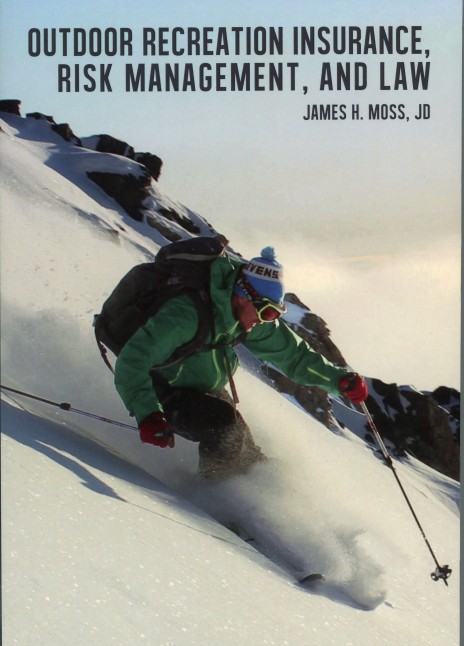
Outdoor Recreation Insurance, Risk Management and Law
To see Jim’s complete bio go here and to see his CV you can find it here. To find out the purpose of this website go here.
G-YQ06K3L262
What do you think? Leave a comment.
If you like this let your friends know or post it on FB, Twitter or LinkedIn
Author: Outdoor Recreation Insurance, Risk Management and Law
Facebook Page: Outdoor Recreation & Adventure Travel Law
Email: Jim@Rec-Law.US
By Recreation Law Rec-law@recreation-law.com James H. Moss
@2015-2023 Summit Magic Publishing, LLC
#AdventureTourism, #AdventureTravelLaw, #AdventureTravelLawyer, #AttorneyatLaw, #Backpacking, #BicyclingLaw, #Camps, #ChallengeCourse, #ChallengeCourseLaw, #ChallengeCourseLawyer, #CyclingLaw, #FitnessLaw, #FitnessLawyer, #Hiking, #HumanPowered, #HumanPoweredRecreation, #IceClimbing, #JamesHMoss, #JimMoss, #Law, #Mountaineering, #Negligence, #OutdoorLaw, #OutdoorRecreationLaw, #OutsideLaw, #OutsideLawyer, #RecLaw, #Rec-Law, #RecLawBlog, #Rec-LawBlog, #RecLawyer, #RecreationalLawyer, #RecreationLaw, #RecreationLawBlog, #RecreationLawcom, #Recreation-Lawcom, #Recreation-Law.com, #RiskManagement, #RockClimbing, #RockClimbingLawyer, #RopesCourse, #RopesCourseLawyer, #SkiAreas, #Skiing, #SkiLaw, #Snowboarding, #SummerCamp, #Tourism, #TravelLaw, #YouthCamps, #ZipLineLawyer, Tennessee, Product Liability, Bicycle, Cycling, Mountain Bike, Mongoose, TPLA, Skewer, Quick Release,
Breezer Recalls Downtown Bicycles Due to Crash Hazard; Pedals Can Come Off
Posted: August 21, 2015 Filed under: Cycling | Tags: Bicycles, Breezer, Breezer Bicycles, Consumer Product Safety Council, CPSC, Cruisers, Downtown 3, Downtown 3-ST, Downtown 8, Downtown 8-ST, Downtown EX, Downtown EX-ST, Recall Leave a commenthttp://www.cpsc.gov/en/Recalls/2015/Breezer-Recalls-Downtown-Bicycles/
Hazard: The bicycle pedal can separate from the spindle (axle) during use and cause the rider to lose control, posing a crash hazard.
Remedy: Repair
Consumers should immediately stop using the bicycles and return then to a Breezer dealer for a free pedal replacement.
Consumer Contact: Advanced Sports International toll-free at (888) 286-6263 between 8 a.m. and 5:30 p.m. ET Monday through Friday or visit http://www.breezerbikes.com , click on “Recall Notices” in the bottom left corner of the homepage and choose “Downtown Pedal Recall” for more information.
Units: About 1,700
Description: This recall involves Breezer Bicycles models Downtown 3, Downtown 3-ST, Downtown 8, Downtown 8-ST, Downtown EX and Downtown EX-ST. The main frame is made of steel and has either a single or dual water bottle mount, and the wheel sets are aluminum. The bicycles come in eight different sizes and a variety of gloss colors, including candy apple, chartreuse, chocolate, dark blue, dark green, shale and slate. The model is printed on the top tube of the bicycle.
Incidents/Injuries: The firm has received 12 reports of pedals separating from the spindle. No injuries have been reported.
Sold at: Authorized Breezer Bicycles dealers nationwide from July 2014 through May 2015 for about $450 to $650.
Importer: Advanced Sports International
Manufactured in: China
Retailers: If you are a retailer of a recalled product you have a duty to notify your customers of a recall. If you can, email your clients or include the recall information in your next marketing communication to your clients. Post any Recall Poster at your stores and contact the manufacturer to determine how you will handle any recalls.
For more information on this see:
For Retailers
Recalls Call for Retailer Action
Combination of a Products Liability statute, an Expert Witness Report that was just not direct enough and odd facts holds a retailer liable as manufacture for product defect.
Product Liability takes a different turn. You must pay attention, just not rely on the CPSC.
Retailer has no duty to fit or instruct on fitting bicycle helmet
Summary Judgment granted for bicycle manufacturer and retailer on a breach of warranty and product liability claim.
For Manufacturers
The legal relationship created between manufactures and US consumers
What do you think? Leave a comment.
If you like this let your friends know or post it on FB, Twitter or LinkedIn
Copyright 2015 Recreation Law (720) Edit Law
Email: Rec-law@recreation-law.com
Google+: +Recreation
Twitter: RecreationLaw
Facebook: Rec.Law.Now
Facebook Page: Outdoor Recreation & Adventure Travel Law
Blog: www.recreation-law.com
Mobile Site: http://m.recreation-law.com
#AdventureTourism, #AdventureTravelLaw, #AdventureTravelLawyer, #AttorneyatLaw, #Backpacking, #BicyclingLaw, #Camps, #ChallengeCourse, #ChallengeCourseLaw, #ChallengeCourseLawyer, #CyclingLaw, #FitnessLaw, #FitnessLawyer, #Hiking, #HumanPowered, #HumanPoweredRecreation, #IceClimbing, #JamesHMoss, #JimMoss, #Law, #Mountaineering, #Negligence, #OutdoorLaw, #OutdoorRecreationLaw, #OutsideLaw, #OutsideLawyer, #RecLaw, #Rec-Law, #RecLawBlog, #Rec-LawBlog, #RecLawyer, #RecreationalLawyer, #RecreationLaw, #RecreationLawBlog, #RecreationLawcom, #Recreation-Lawcom, #Recreation-Law.com, #RiskManagement, #RockClimbing, #RockClimbingLawyer, #RopesCourse, #RopesCourseLawyer, #SkiAreas, #Skiing, #SkiLaw, #Snowboarding, #SummerCamp, #Tourism, #TravelLaw, #YouthCamps, #ZipLineLawyer, Recall, Recall, CPSC, Consumer Product Safety Council, Breezer Bicycles, Downtown 3, Downtown 3-ST, Downtown 8, Downtown 8-ST, Downtown EX, Downtown EX-ST, Bicycles, Cruisers, Breezer,
Bureau of Reclamation Infrastructure Investment Strategy Stakeholders Meeting – Denver Colorado
Posted: August 20, 2015 Filed under: Uncategorized | Tags: Bureau of Reclamation, Stakeholders Meeting, Stateholders Leave a commentThe Bureau of Reclamation invites you to participate in an Infrastructure Investment Strategy meeting and webinar for stakeholders that will be held in Denver, Colorado. A substantial portion of the meeting will focus on obtaining participants’ feedback and input on the implementation of the Strategy.
Event: Infrastructure Investment Strategy Stakeholders Meeting Date: Thursday, August 20, 2015
Time: 8:30 a.m. – 3:30 p.m. (Mountain)
Location: Denver Federal Center, Building 67, Rio Grande Room LiveStream: http://www.usbr.gov/live
Meeting topics will include background, objectives, strategy elements, planning, and financial issues related to Reclamation’s Infrastructure Investment Strategy.
If you plan to attend in person, please RSVP to http://goo.gl/forms/e2TvCixSdA to reserve your seat. We will need your name for the security list to enter the building for the meeting.
If you attend the meeting via LiveStream, you will be able to ask questions via a chat box during the meeting. If you want to submit questions prior to the meeting, please send them to ReclamationInfo@usbr.gov.
The meeting topic segments will be archived. We will provide the archive link(s) a few days after the meeting.
If you have any questions, please contact Patti Aaron at paaron@usbr.gov or 202-513-0544.
2015-08-20 Infrastructure Stategy Agenda.docx
Article misunderstands and misses the point in tracking accidents and incidents
Posted: August 19, 2015 Filed under: Climbing Wall | Tags: Accident Reports, CBJ, Climbing Business Journal, Climbing Wall, Climbing Wall Association, Incident Reports 2 CommentsClimbing Business Journal article looked at the legal issues of climbing gyms tracking accidents. What you need to know is the legal nightmare comes when you track incidents/accidents and do nothing.
The article is titled: Should Gyms Be Reporting Accidents? It attempts to look at the issue of tracking incidents and accidents at a climbing facility. However several important points are ignored or missed in the article. The article looks at legal issues the way a lot of attorneys do. Do it this way or that way. You need to solve problems, you need to understand the problem (put on a harness and climb a wall or belay someone), and you need to quit writing crap down.
Nothing in the article is wrong, nothing in the article solves the problem.
The article looks at the issues of tracking and not tracking however it ignored the real legal costs and any solutions.
Any time you “track” or maintain a list of incidents or accidents that information can be used against you. The article covers this issue and looks at the risks but does not explain the risks. The hardest thing for a plaintiff’s attorney to prove is what the incident that injured his or her client foreseeable? That is proved by an expert witness or if the defendant has a list of similar accidents by the defendant themselves.
Foreseeable means did or should have the defendant known that type of incident or accident could occur. A stack of incident forms that show similar incidents proves it. Not solving the problem indicated by the form shows you are an uncaring money hungry business.
Keeping a list of your prior accidents or incidents can assist the plaintiff in proving you were negligent.
The second issue is one you “track” or keep a record, you can’t get rid of the record. Once made it around forever. Consequently you may have to hand over years of records showing how you have allowed screw ups or even caused them.
That list can also then be fertile ground for the plaintiff’s bar to prove other claims against other gyms or to find new plaintiffs. Unless you can get the court to allow you to scrub the contact information of your guest that was part of the accident, you are giving the plaintiff’s bar the name of another possible client.
The reason for collecting the information is to prevent further similar accidents. Most organizations have stacks of reports and very little to show for it. Consequently you have given the plaintiff’s bar even more legal ammunition to prove you are an uncaring defendant. You have one or dozens of incident reports which you did nothing about and you look even worse.
The plaintiff’s may use the fact against you that you do not collect the information; they can try but it probably less damaging that a stack of incidents. A better result is below.
Once you develop an incident or accident collection system, you develop the idea that unless you have a stack of paper, you don’t have a problem. You develop the attitude that until the paperwork is done nothing to worry about. That can’t be farther from the truth.
You want to keep your guests safe, open your eyes and ears and pay attention. The experience and training you receive should be used to prevent injuries and incidents, not create a great form.
As the owner or manager of a gym, a raft company, a summer camp you really need a form to solve a problem. Get out of the office and to where the problem occurred, open your eyes, talk to you staff and make changes right then!
Do you collect and set yourself up for losing litigation or do you not collect and continue to allow people to get hurt (which is how several people will review this article.) You do neither.
If you have a problem, deal with it immediately. Collect the information you insurance company needs. Collect witness statements. You don’t really need to do anything more. What you need to do is solve the problem.
Don’t tell me that the only way to solve a problem is to fil out a piece of paper.
What solves problems is your and your staff getting together immediately after the incident or accident and determining what happened and what you can do to prevent it Solve the problem don’t write about it.
Why don’t you track incidents and accidents? Because we solve them rather than tack them!
SOLVE THE PROBLEM, DON’T WRITE ABOUT IT.
It is the writer’s job to write about problems, don’t hire one and don’t try and become one.
You don’t need a collection of reports to find problems. You need to open your eyes and ears and find problems and solve them. You wait for a report to be completed and you are sitting on a keg of dynamite.
1. Don’t’ wait to read a report to recognize you may have a problem. Get in front of problems. Listen to guests, staff and react.
2. If you have a problem solve it, correct it, fix it. It requires action, not paper to see issues and solve problems.
3. Don’t create a system create a solution.
What do you think? Leave a comment.
If you like this let your friends know or post it on FB, Twitter or LinkedIn
Copyright 2015 Recreation Law (720) Edit Law
Email: Rec-law@recreation-law.com
Google+: +Recreation
Twitter: RecreationLaw
Facebook: Rec.Law.Now
Facebook Page: Outdoor Recreation & Adventure Travel Law
Blog: www.recreation-law.com
Mobile Site: http://m.recreation-law.com
By Recreation Law Rec-law@recreation-law.com James H. Moss
#AdventureTourism, #AdventureTravelLaw, #AdventureTravelLawyer, #AttorneyatLaw, #Backpacking, #BicyclingLaw, #Camps, #ChallengeCourse, #ChallengeCourseLaw, #ChallengeCourseLawyer, #CyclingLaw, #FitnessLaw, #FitnessLawyer, #Hiking, #HumanPowered, #HumanPoweredRecreation, #IceClimbing, #JamesHMoss, #JimMoss, #Law, #Mountaineering, #Negligence, #OutdoorLaw, #OutdoorRecreationLaw, #OutsideLaw, #OutsideLawyer, #RecLaw, #Rec-Law, #RecLawBlog, #Rec-LawBlog, #RecLawyer, #RecreationalLawyer, #RecreationLaw, #RecreationLawBlog, #RecreationLawcom, #Recreation-Lawcom, #Recreation-Law.com, #RiskManagement, #RockClimbing, #RockClimbingLawyer, #RopesCourse, #RopesCourseLawyer, #SkiAreas, #Skiing, #SkiLaw, #Snowboarding, #SummerCamp, #Tourism, #TravelLaw, #YouthCamps, #ZipLineLawyer, Accident Reports, Incident Reports, Climbing Business Journal, CBJ, Climbing Wall, Climbing Wall Association,
Intern at one of the Best Programs in the West: THORNE NATURE EXPERIENCE INTERNSHIP OPPORTUNITIES
Posted: August 18, 2015 Filed under: Uncategorized | Tags: After School Nature Program, Employment, Job, Thorne Nature Center Leave a commentDo you want to gain experience in the environmental education field and work with a great organization?
Can you dedicate a few hours a week to spending time with kids in nature?
If so, please consider applying for an internship this fall with Thorne Nature Experience!
THORNE NATURE EXPERIENCE INTERNSHIP OPPORTUNITIES
After-School Program Intern
Thorne Nature Experience is seeking enthusiastic, environmentally aware individuals to provide program support for Thorne’s After-School Programs, which are aimed at connecting students to nature in their schoolyards. After-School Program Interns will assist Thorne Staff by helping to facilitate a variety of fun, hands-on, place-based learning activities in the schoolyard and surrounding ecosystems. Interns will be assigned to a school on Mondays, Tuesdays, Wednesdays or Thursdays at schools in Boulder, Lafayette, Longmont or Broomfield. Programs run for 12 weeks in spring and fall, with program hours typically from 2:30-4:30pm or 3:30-5:00pm. To apply, submit a completed application, together with a resume to Gwen Tenney, Education Programs Coordinator at Gwen.
CLICK HERE to download the After-School Program Intern description.
CLICK HERE to download the After-School Program Intern application.
BVSD 4th Grade Field Trip Intern
Thorne is seeking enthusiastic, environmentally aware individuals who want experience working with youth in an outdoor setting to serve as interns for the BVSD 4th Grade Field Trip Program. This field trip program is in partnership with Boulder Valley School District and connects nearly 1,800 4th graders to nature each school year. Interns will gain up to 50 hours of mentored teaching experience and are responsible for teaching one of four field trip stations on the following topics: Birds, Wetlands, Seeds, or Water Pollution. Internships are available from 8:30-2:00pm on Wednesdays, Thursdays, or Fridays during spring or fall field trip season. To apply, submit a completed application, together with a resume to Gwen Tenney, Education Programs Coordinator at Gwen.
CLICK HERE to download the BVSD 4th Grade Field Trip Intern description.
CLICK HERE to download the BVSD 4th Grade Field Trip Intern application.
More information can be found at http://www.thornenature.org/get-involved/volunteer-intern/.
I hope to see your application soon!
Gwen Tenney
EDUCATION PROGRAMS COORDINATOR
Thorne Nature Experience
PO Box 19107
Boulder, CO 80308
303.499.3647 ext. 103

Spectators; they do not sign a release. They may not be able to assume the risk, what duty is owed to a spectator?
Posted: August 17, 2015 Filed under: Maryland, Sports | Tags: duty, MARYLAND, Maryland Court of Appeals, Maryland Supreme Court, Rugby, Special Relationship, Spectators 2 CommentsOrganizers of a rugby tournament owed no duty to spectators at the tournament who were free to do at any time from the dangers and risks of lighting.
State: Maryland, Court of Appeals for Maryland
Plaintiff: Judith Edwards Patton (wife of Donald Patton), acting in both an individual capacity and as personal representative of the estate of Donald Patton; Sophia P. Patton and Robert C. Patton (the parents of Donald Patton); Robert Carson Patton, II; and Meredith Patton (Donald’s daughter).
Defendant: United States of America Rugby Football Union, Ltd., d/b/a USA Rugby (“USA Rugby”), the Mid- Atlantic Rugby Football Union, Inc. ( “MARFU”), the Potomac Rugby Union, Inc. (“PRU”), the Potomac Society of Rugby Football Referees, Inc. (“Referees’ Society”), Kevin Eager, n2 and Steven Quigg,
Plaintiff Claims: liable in tort for the death of Donald Patton and the injuries suffered by Robert Patton. This liability, Appellants contended, was due to Defendants’/Appellees’ failure to employ proper policies and procedures to protect players and spectators at the tournament from lightning strikes
Defendant Defenses: No duty, Maryland Recreational Use Statute and release signed by the survivor plaintiff/rugby player
Holding:
Year: 2004
This case is a little different for this site; it concerns a rugby game. However, the instrumentality causing the injury was a lighting strike to a player and a spectator.
The plaintiff’s father and son attended a rugby match for the son to play and the father to cheer. A game commenced which the son was playing. The father was on the sidelines watching the game. During the game, a thunderstorm developed and lightning struck in the area. The rugby match was continued even though several other games in the tournament had been ended because of the weather.
Eventually, the match ended. The two plaintiffs’ then ran to some trees where they had left their belongings and took off for their car. On the way, lightning struck killing the father and severely injuring the son.
The plaintiffs were the surviving player and the relatives of the deceased. The defendants were the sponsoring organization, the local organization, the referee association and individual defendants. The plaintiff’s claimed the defendants should have:
(a) Have and implement proper policies and procedures regarding the protection of players and spectators from adverse weather conditions and lightning;
“(b) Have and implement a policy regarding the safe evacuation of players and spectators from the fields of play at its matches when lightning is present;
“(c) Safeguard the health, safety, and welfare of the players and spectators at its matches;
“(d) Terminate the rugby match and tournament when lightning is present;
“(e) Monitor and detect dangerous conditions associated with its matches; and
“(f) Train, supervise, monitor and control actions of officials prior to ensure the safety of the participants and spectators from dangerous lightning strikes.”
Several motions to dismiss were filed and the complaint was amended to defeat the motions. Eventually, the court dismissed the plaintiff’s complaint, and the appellate court stepped in after the dismissal and issued a writ of certiorari removing it from the Court of Special Appeals to the Appellate Court. The Appellate Court is the top court in Maryland, similar to the Supreme Court in other states.
A supreme court rarely issues a writ to remove a case before the intermediary appellate court has had a chance to review the case.
Analysis: making sense of the law based on these facts.
Under Maryland law, the plaintiffs have to prove one or more of the defendants were negligent. That means:
“(1) that the defendant was under a duty to protect the plaintiff from injury,
(2) that the defendant breached that duty,
(3) that the plaintiff suffered actual injury or loss, and
(4) that the loss or injury proximately resulted from the defendant’s breach of the duty
The requirements to prove negligence in Maryland are similar or identical to most other states.
The issue thought court stated was whether a legal duty was owed in this case.
As established in Maryland jurisprudence over a century ago: there can be no negligence where there is no duty that is due; for negligence is the breach of some duty that one person owes to another.
The first and most important step in determining whether a duty exists is to asses several issues in the relationship between the plaintiff(s) and the defendant(s) to determine if a legal duty is owed.
In determining the existence of a duty, we consider, among other things: the foreseeability of harm to the plaintiff, the degree of certainty that the plaintiff suffered the injury, the closeness of the connection between the defendant’s conduct and the injury suffered, the moral blame attached to the defendant’s conduct, the policy of preventing future harm, the extent of the burden to the defendant and consequences to the community of imposing a duty to exercise care with resulting liability for breach, and the availability, cost and prevalence of insurance for the risk involved.
Of these, the major test is one of foreseeability. “The foreseeability test “is simply intended to reflect current societal standards with respect to an acceptable nexus between the negligent act and the ensuing harm.”” At the same time, a legal duty does not necessarily exist because of a moral duty.
Even if the foreseeability test is passed by the plaintiff that alone does not prove the existence of a duty.
Duty can be created by ““(1) by statute or rule; (2) by contractual or other private relationship; or (3) indirectly or impliedly by virtue of the relationship between the tortfeasor and a third party.”
Whether a duty exists is also based on policy reasons; whether a type of behavior should be encouraged or discouraged for the benefit of all.
The plaintiffs argued that a special relationship existed between the defendants and the injured, the third way a duty is created set forth above. The plaintiff’s argued this based on their idea that a special relationship exists as spectators at sporting events.
A participant in a sporting event, by the very nature of the sport, trusts that his personal welfare will be protected by those controlling the event. Stated another way, it is reasonably foreseeable that both the player, and the player’s father, will continue to participate in the match, as []long as the match is not stopped by the governing bodies in charge. It also is reasonably foreseeable that, when matches are played in thunderstorms, there is a substantial risk of injury from lightning. And finally, it is reasonably foreseeable that a father will not abandon his son, when he sees those who have assumed responsibility for his son’s welfare placing his son in a perilous condition . . . .
Honestly, I would suspect that most spectators at most sporting events would believe the above to be true.
Here the court did not agree with the idea that a special relationship had been created or existed with spectators.
…the creation of a ‘special duty’ by virtue of a ‘special relationship’ between the parties can be established by either (1) the inherent nature of the relationship between the parties; or (2) by one party undertaking to protect or assist the other party, and thus often inducing reliance upon the conduct of the acting party.”
The court stated that generally, for a duty to exist, there must be an element of dependence, which is lacking in this case. The court raised another case that failed to find a special duty. IN that case a woman died of hypothermia because the emergency telephone operator gave an incorrect address to the policeman looking for the woman.
..“for a “special relationship” to exist between an emergency telephone operator and a person in need of assistance, it must be shown that the telephone operator affirmatively acted to protect the decedent or a specific group of individuals like the decedent, thereby inducing specific reliance by an individual on the telephone operator’s conduct.
There must be an element of ceding self-control by the injured party to the defendant to create a duty which is lacking in the present case.
In a special relationship, one person entrusts himself to the control and protection of another, with a consequent loss of control to protect himself. The duty to protect is imposed upon the person in control because he is in the best position to provide a place of safety. Thus, the determination whether a duty-imposing special relationship exists in a particular case involves the determination whether the plaintiff entrusted himself to the control and protection of the defendant, with a consequent loss of control to protect himself.
The court then looked at the risk presented by thunderstorms and found that there was less liability owed by a defendant to the risk created by lightning. The court, quoting another state court found “…risks and dangers associated with playing golf in a lightning storm are rather obvious to most adults.”
The Court concluded that “it is reasonable to infer that a reasonably prudent adult can recognize the approach of a severe thunderstorm and know that it is time to pack up the clubs and leave before the storm begins to wreak havoc.”
The court agreed with the trial court and found the defendants did not owe a duty to the plaintiffs based on their relationship and because the risks of thunderstorms were known to all.
So Now What?
Would this case have had a different outcome of the plaintiff had paid to attend the event and was at a specific location because the defendant told the spectator they paid to be at that location, or they were only allowed at a particular location?
In this case, the plaintiffs were free to leave the tournament at any time.
Spectators create a very different risk for event organizers. Do spectators at ski races understand a skier can leave the course and hit them? Do spectators at any match with a ball understand the ball always leaves the field of play and can cause injury to them?
Bicycle races are famous for spectators being allowed on the track where they commonly interfere with racers, but do they understand that they may also receive an injury by being there.
However, once the event organizer attempts to provide additional safeguards or warnings for the spectators, they may change the relationship between themselves and the spectators crating liability. You can protect the participants in the event, match or race and at the same time provide protection to spectators, but providing protection for spectators may increase your liability and in some cases increase the risk to players of the game.
Spectators for a risk manager are a difficult risk to understand and deal with.
What do you think? Leave a comment.
If you like this let your friends know or post it on FaceBook, Twitter or LinkedIn
Copyright 2015 Recreation Law (720) Edit Law
Email: Rec-law@recreation-law.com
Google+: +Recreation
Twitter: RecreationLaw
Facebook: Rec.Law.Now
Facebook Page: Outdoor Recreation & Adventure Travel Law
Blog: www.recreation-law.com
Mobile Site: http://m.recreation-law.com
By Recreation Law Rec-law@recreation-law.com James H. Moss
#AdventureTourism, #AdventureTravelLaw, #AdventureTravelLawyer, #AttorneyatLaw, #Backpacking, #BicyclingLaw, #Camps, #ChallengeCourse, #ChallengeCourseLaw, #ChallengeCourseLawyer, #CyclingLaw, #FitnessLaw, #FitnessLawyer, #Hiking, #HumanPowered, #HumanPoweredRecreation, #IceClimbing, #JamesHMoss, #JimMoss, #Law, #Mountaineering, #Negligence, #OutdoorLaw, #OutdoorRecreationLaw, #OutsideLaw, #OutsideLawyer, #RecLaw, #Rec-Law, #RecLawBlog, #Rec-LawBlog, #RecLawyer, #RecreationalLawyer, #RecreationLaw, #RecreationLawBlog, #RecreationLawcom, #Recreation-Lawcom, #Recreation-Law.com, #RiskManagement, #RockClimbing, #RockClimbingLawyer, #RopesCourse, #RopesCourseLawyer, #SkiAreas, #Skiing, #SkiLaw, #Snowboarding, #SummerCamp, #Tourism, #TravelLaw, #YouthCamps, #ZipLineLawyer, Rugby, Maryland, Maryland Supreme Court, Maryland Court of Appeals, Special Relationship, Duty, Spectators,
Sorry, been a really crazy couple of weeks
Posted: August 16, 2015 Filed under: Uncategorized | Tags: Insurance & Law, James H. Moss, Jim Moss, Outdoor Recreation Risk Management Leave a commentI have not missed posted a review of a case two weeks in a row ever. Sorry, it has been a great, insane, out of control, month. August is always fun, but I moved, gone for two weeks (including this week), picked up a lot of legal work, got my textbook done it showed up. Lived for a week with no computer and still living without a phone.
I start teaching in the Ski Area Operations program at Colorado Mountain College again in 2 weeks also. :)
Life is great, just a little challenging and I’ll be back shall continue to post.
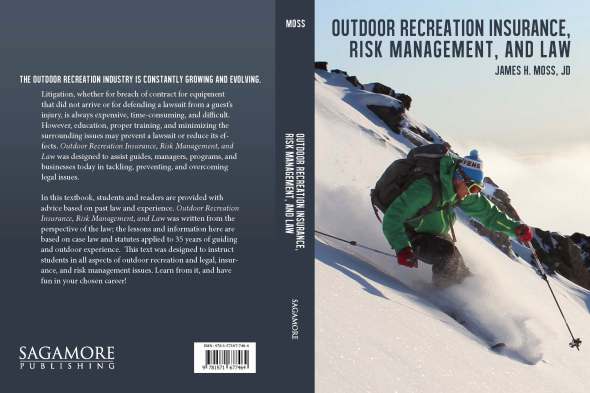
http://summitmagicpublishing.com/outdoor-recreation-risk-management-insurance-law/
Patton v. United States Of America Rugby Football, Union, LTD., 381 Md. 627; 851 A.2d 566; 2004 Md. LEXIS 308
Posted: August 15, 2015 Filed under: Legal Case, Maryland, Sports | Tags: duty, MARYLAND, Maryland Court of Appeals, Maryland Supreme Court, Rugby, Special Relationship, Spectators Leave a commentPatton v. United States Of America Rugby Football, Union, LTD., 381 Md. 627; 851 A.2d 566; 2004 Md. LEXIS 308
Judith Edwards Patton, Individually, and as the surViving Spouse of Donald Lee Patton, and as Personal Representative and Executor for the Estate of Donald Lee pattOn, et al. V. United States of America Rugby Football, Union, ltd. D/b/a USA Rugby, et al.
No. 113, September Term, 2003
Court of Appeals of Maryland
381 Md. 627; 851 A.2d 566; 2004 Md. LEXIS 308
June 10, 2004, Filed
Prior History: [***1] Appeal from the Circuit Court for Anne Arundel County pursuant to certiorari to the Court of Special Appeals. Rodney C. Warren, JUDGE.
Patton v. USA Rugby, 379 Md. 224, 841 A.2d 339, 2004 Md. LEXIS 61 (2004)
Disposition: Affirmed.
Headnotes: Torts – Negligence – Duty – Special Relationship
An amateur rugby player and his father, who was a spectator, were struck by lightning at a rugby tournament. The player was injured and the spectator killed. Various members of the family filed suit alleging negligence against the rugby tournament organizers, the game referee, and related organizations for not taking precautions to avert the incident.
Held: The element of dependence and ceding of control by the injured party that is needed to find a “special relationship” is absent in this case. Our decision is consistent with our view of narrowly construing the “special relationship” exception so as not to impose broad liability for every group activity. The rugby player and spectator were free to leave the voluntary, amateur tournament at any time and their movements were not restricted by the tournament organizers. An amateur sporting event is a voluntary affair, and the participants are capable of leaving the field under their own volition if they feel their lives are in danger. The changing weather conditions were visible to all competent adults. The spectators and participants could have sought shelter at any time they deemed it appropriate to do so. It is unreasonable to impose a duty on the organizers of amateur outdoor events to warn spectators or adult participants of a weather condition that everyone present is fully able to observe and react to on his or her own. The approach of a thunderstorm is readily apparent to reasonably prudent adults and, therefore, it is every adult ‘s responsibility to protect himself or herself from the weather. There was no “special relationship” and, therefore, no legal duty to protect spectators and participants from the storm.
Counsel: Argued by W. David Allen of Crofton, MD. for Appellants.
Argued BY Kristine A. Crosswhite (Crosswhite, McKenna, Limbrick & Sinclair, LLP of Baltimore, MD) on brief for Appellees.
Judges: Bell, C.J., Raker, Wilner, Cathell, Harrell, Battaglia, Greene, JJ.
Opinion by Harrell, J. Bell, C.J., joins in judgment only.
Opinion by: Harrell
Opinion:
[*630] [**567] Opinion by Harrell, J.
On 17 June 2000, Robert Carson Patton, II, and his father, Donald Lee Patton, while at an amateur rugby tournament in Annapolis, were struck by lightning. Robert, a player in the tournament, was seriously injured, but survived. Donald, a spectator watching his son play, died. Robert and various other members of the Patton family filed suit in the Circuit Court for Anne Arundel County alleging negligence against the rugby tournament organizers, referee, and related organizations with regard to the episode.
Defendants filed Motions to Dismiss arguing they owed no legal duty to Robert and Donald Patton. A hearing was held and, on 10 July 2003, the Circuit Court dismissed the action. The Patton family appealed. This Court, on its own initiative and before the appeal could be decided in the Court of Special Appeals, issued a writ of certiorari to determine whether any of the defendants, under the circumstances alleged in the complaint, owed a legal duty [***2] to Robert and Donald Patton. Patton v. USA Rugby, 379 Md. 224, 841 A.2d 339 (2004).
I.
A. The Lightning Strike
Based on Appellants’ amended complaint, we assume the [*631] truth of the following factual allegations: n1
[**568] Sometime during the early morning of 17 June 2000, Robert and Donald Patton arrived at playing fields adjacent to the Annapolis Middle School in Anne Arundel County, Maryland. Robert was to play rugby for the Norfolk Blues Rugby Club. Donald intended to support his son as a spectator. Robert and Donald, along with other participants and spectators, placed their equipment and belongings under a row of trees adjacent to the playing fields.
– – – – – – – – – – – – – – Footnotes – – – – – – – – – – – – – – –
n1 See Valentine v. On Target, Inc., 353 Md. 544, 548, 727 A.2d 947, 949 (1999) (“as the result of the trial court’s granting a motion to dismiss, as opposed to the granting of summary judgment or judgment entered after trial, the Court will assume the truth of all well- pleaded facts and any reasonable inferences that can be properly drawn therefrom”) (citations omitted).
– – – – – – – – – – – – End Footnotes- – – – – – – – – – – – – – [***3]
The rugby tournament was coordinated by Steven Quigg and was sanctioned by the United States of America Rugby Football Union, Ltd., d/b/a USA Rugby, and Mid-Atlantic Rugby Football Union, Inc. Rugby matches involving over two dozen teams began at approximately 9:00 a.m. and were planned to continue throughout the day. It was a warm, muggy day. The weather forecast for Annapolis was for possible thunderstorms. At some point prior to the start of the twenty minute match between the Norfolk Blues and the Washington Rugby Football Club (“the match”), a thunderstorm passed through the area surrounding the Annapolis Middle School. At the start of the match, rain commenced; lightning could be seen and thunder could be heard proximate to the lightning flashes. By this time, the National Weather Service had issued a thunderstorm “warning” for the Annapolis area.
Kevin Eager, a member of the Potomac Society of Rugby Football Referees, Inc., was the volunteer referee for the afternoon match in which Robert Patton was a participant. Under the direction of Eager, the match continued as the rain increased in intensity, the weather conditions deteriorated, and the lighting flashed directly overhead. [***4] Other matches at [*632] the tournament ended. Robert Patton continued to play the match through the rain and lightning and his father continued to observe as a spectator until the match was stopped just prior to its normal conclusion.
Upon the termination of the match, Robert and Donald fled the playing fields to the area under the trees where they left their possessions. As they began to make their exit from under the trees to seek the safety of their car, each was struck by lightning. Donald died. Robert Patton sustained personal injuries and was hospitalized, but recovered.
B. Circuit Court Proceedings
Appellants here and Plaintiffs below are Judith Edwards Patton (wife of Donald Patton), acting in both an individual capacity and as personal representative of the estate of Donald Patton; Sophia P. Patton and Robert C. Patton (the parents of Donald Patton); Robert Carson Patton, II; and Meredith Patton (Donald’s daughter). They sued the United States of America Rugby Football Union, Ltd., d/b/a USA Rugby (“USA Rugby”), the Mid- Atlantic Rugby Football Union, Inc. ( “MARFU”), the Potomac Rugby Union, Inc. (“PRU”), the Potomac Society of Rugby Football Referees, Inc. (“Referees’ Society”), [***5] Kevin Eager, n2 and Steven Quigg, alleging that Defendants were liable in tort for the death of Donald Patton and the injuries suffered by Robert Patton. This liability, Appellants contended, was due to Defendants’/Appellees’ failure to employ proper policies and procedures to protect players and spectators at the tournament from lightning strikes.
– – – – – – – – – – – – – – Footnotes – – – – – – – – – – – – – – –
n2 Kevin Eager never was served with process.
– – – – – – – – – – – – End Footnotes- – – – – – – – – – – – – –
Appellants alleged that Appellees each had a duty to, but failed to, do one or more of the following acts:
“(a) Have and implement proper policies and procedures regarding the protection [**569] of players and spectators from adverse weather conditions and lightning; [*633]
“(b) Have and implement a policy regarding the safe evacuation of players and spectators from the fields of play at its matches when lightning is present;
“(c) Safeguard the health, safety, and welfare of the players and spectators at its matches;
“(d) Terminate the rugby match and tournament when lightning is present;
“(e) Monitor and detect dangerous conditions [***6] associated with its matches; and
“(f) Train, supervise, monitor and control actions of officials prior to ensure the safety of the participants and spectators from dangerous lightning strikes.”
On 26 August 2002, the Referees’ Society filed a Motion to Dismiss all claims pending against it on the ground that the Referees’ Society owed no tort duty to Robert or Donald Patton as a matter of law. Thereafter, on 16 September 2002, USA Rugby, MARFU, and Steven Quigg filed a joint Motion to Dismiss in which they adopted the arguments of the Referees’ Society and advanced the additional argument that Maryland’s Recreational Land Use Statute, found in Maryland Code (1974, 2000 Repl. Vol., 2003 Supp.), § 5-1101, et seq. of the Natural Resources Article, conferred tort immunity on them for injuries arising from recreational use of premises, i.e., playing rugby on the Annapolis Middle School fields. n3
– – – – – – – – – – – – – – Footnotes – – – – – – – – – – – – – – –
n3 PRU was not served with process at the time that USA Rugby, MARFU, and Mr. Quigg filed their Motion to Dismiss and, consequently, PRU was not included in that motion as a moving party. PRU timely filed an Answer to Appellants’ original Complaint on 15 October 2002, and thereafter, was included as a moving party on all pending defense motions.
– – – – – – – – – – – – End Footnotes- – – – – – – – – – – – – – [***7]
Appellants, on 30 December 2002, filed an amended complaint. On 9 January 2003, USA Rugby, MARFU, PRU, and Mr. Quigg filed a second Motion to Dismiss, or in the alternative, for Summary Judgment. The Motion to Dismiss argued that: (1) Appellees owed the Pattons no legally cognizable tort duty as a matter of law; (2) Appellees are immune from tort liability under Maryland’s Recreational Land Use Statute; [*634] and (3) the claims of Robert were barred by waiver. On 13 January 2002, the Referees’ Society also filed a Motion to Dismiss the amended complaint.
The pending motions were heard on 5 February 2003. The Circuit Court, subsequently, issued an order granting the pending motions to dismiss and, on 17 November 2003, issued a Memorandum Opinion explaining the reasons for the dismissal.
Based on Maryland precedents and caselaw from other jurisdictions, the Circuit Court concluded that Appellees did not owe a duty of care to Robert or Donald Patton. The Circuit Court noted generally that courts in other jurisdictions have found that “landowners” or their equivalent do not have a duty to warn invitees of the risk of lightning. As regards Donald Patton, the Circuit Court stated:
“Decedent [***8] Donald Patton was a nonpaying spectator at a rugby match organized and overseen by [Appellees]. There is no indication from the record that Decedent had entrusted himself to the control and protection of [Appellees], indeed he was free to leave the tournament at any time. Additionally, there is no indication that he had lost the ability to monitor changing weather conditions and act accordingly. While [Appellants] allege the storm began near the beginning of the match, it was not until the conclusion of the game, that Decedent and plaintiff Robert Patton, attempted to escape the storm by running towards [**570] the tree line adjacent to the open field to retrieve their belongings. It was here that both were struck by lightning.
“The inherently unpredictable nature of weather and the patent dangerousness of lightning make it unreasonable to impose a duty upon [Appellees] to protect spectators from the type [of] injury that occurred here.”
As regards Robert Patton, the Circuit Court stated that “while it is arguable that [Appellees] had a greater duty to protect plaintiff Robert Patton, a player/participant from injury, they were under no duty to protect and warn him of [***9] lightening strikes and other acts of nature.” The hearing [*635] judge relied on cases from other jurisdictions involving lightning strikes on golf courses to conclude that “lightning is a universally known danger created by the elements” and, in the absence of evidence that Appellants created a greater hazard than brought about by natural causes, there is no duty to warn and protect. The Circuit Court expressly rejected as grounds for its grant of Appellees’ motions to dismiss both Maryland’s Recreational Land Use Statute, and waiver argument based on language contained in Robert Patton’s alleged execution of a USA Rugby Participant Enrollment Form. This appeal follows, therefore, from a dismissal of the amended complaint based solely on the ground that there was no legal duty owed to Robert or Donald Patton. Appellants present the following question for our consideration:
Did the trial court err, when it found that Appellees had no duty to protect Appellants from lightning injuries and granted Appellees’ motions to dismiss for failure to state a claim upon which relief can be granted?
II.
Maryland Rule 2-322(b)(2) provides for the filing of a motion to dismiss for failure to state a [***10] claim upon which relief can be granted. We have stated that:
The granting of a motion to dismiss is proper when, even if the facts and allegations as set forth in the complaint were proven to be true, the complaint would nevertheless fail to state a claim upon which relief could be granted. . . . It will be affirmed if the record reveals any legally sound reason for the decision.
Valentine v. On Target, Inc., 353 Md. 544, 548-49, 727 A.2d 947, 949 (1999) (citations omitted).
III.
A.
For a plaintiff to state a prima facie claim in negligence, he or she must prove the existence of four elements by [*636] alleging facts demonstrating
“(1) that the defendant was under a duty to protect the plaintiff from injury, (2) that the defendant breached that duty, (3) that the plaintiff suffered actual injury or loss, and (4) that the loss or injury proximately resulted from the defendant’s breach of the duty.” Remsburg v. Montgomery, 376 Md. 568, 582, 831 A.2d 18, 26 (2003) (quoting Muthukumarana v. Montgomery Co., 370 Md. 447, 486, 805 A.2d 372, 395 (2002), and cases cited therein). Generally, whether there is adequate proof of the required [***11] elements to succeed in a negligence action is a question of fact to be determined by the fact-finder. The existence of a legal duty, however, is a question of law to be decided by the court. Valentine, 353 Md. at 549, 727 A.2d at 949. As established in Maryland jurisprudence over a century ago: there can be no negligence where there is no duty that is due; for negligence is the breach of some duty that one person [**571] owes to another. It is consequently relative and can have no existence apart from some duty expressly or impliedly imposed. In every instance before negligence can be predicated of a given act, back of the act must be sought and found a duty to the individual complaining, the observance of which duty would have averted or avoided the injury. . . . As the duty owed varies with circumstances and with the relation to each other of the individuals concerned, so the alleged negligence varies, and the act complained of never amounts to negligence in law or in fact; if there has been no breach of duty. Bobo v. State, 346 Md. 706, 714, 697 A.2d 1371, 1375 (1997) (quoting West Virginia Cent. & P.R. v. State ex rel. Fuller, 96 Md. 652, 666, 54 A. 669, 671-72 (1903)). [***12] “Our analysis of a negligence cause of action usually begins with the question of whether a legally cognizable duty existed.” Remsburg , 376 Md. at 582, 831 A.2d at 26.
When assessing whether a tort duty may exist, we often have recourse to the definition in W. Page Keeton, et al., Prosser and Keeton on The Law of Torts § 53 (5th ed. 1984), which characterizes “duty” as “an obligation, to which the law will give recognition and effect, to conform to a particular [*637] standard of conduct toward another.” Id. In determining the existence of a duty, we consider, among other things: the foreseeability of harm to the plaintiff, the degree of certainty that the plaintiff suffered the injury, the closeness of the connection between the defendant’s conduct and the injury suffered, the moral blame attached to the defendant’s conduct, the policy of preventing future harm, the extent of the burden to the defendant and consequences to the community of imposing a duty to exercise care with resulting liability for breach, and the availability, cost and prevalence of insurance for the risk involved.
Ashburn v. Anne Arundel County, 306 Md. 617, 627, 510 A.2d 1078, 1083 (1986) [***13] (citation omitted). Where the failure to exercise due care creates risks of personal injury, “the principal determinant of duty becomes foreseeability.” Jacques v. First Nat’l Bank of Maryland, 307 Md. 527, 535, 515 A.2d 756, 760 (1986) (citations omitted). The foreseeability test “is simply intended to reflect current societal standards with respect to an acceptable nexus between the negligent act and the ensuing harm.” Dobbins v. Washington Suburban Sanitary Comm’n, 338 Md. 341, 348, 658 A.2d 675, 678 (1995) (quoting Henley v. Prince George’s County, 305 Md. 320, 333, 503 A.2d 1333, 1340 (1986)).
In determining whether a duty exists, “it is important to consider the policy reasons supporting a cause of action in negligence. The purpose is to discourage or encourage specific types of behavior by one party to the benefit of another party.” Valentine, 353 Md. at 550, 727 A.2d at 950. “While foreseeability is often considered among the most important of these factors, its existence alone does not suffice to establish a duty under Maryland law.” Remsburg, 376 Md. at 583, 831 A.2d at 26. As we clarified [***14] in Ashburn: the fact that a result may be foreseeable does not itself impose a duty in negligence terms. This principle is apparent in the acceptance by most jurisdictions and by this Court of the general rule that there is no duty to control a third person’s conduct so as to prevent personal harm to another, unless a “special relationship” exists either between [*638] the actor and the third person or between the actor and the person injured. Ashburn, 306 Md. at 628, 510 A.2d at 1083 (citations omitted). In addition, “a tort [**572] duty does not always coexist with a moral duty.” Jacques, 307 Md. at 534, 515 A.2d at 759 (citing W. Page Keeton, et al., Prosser and Keeton on The Law of Torts § 56 (5th ed. 1984)). We have held that such a “special duty” to protect another may be established “(1) by statute or rule; (2) by contractural or other private relationship; or (3) indirectly or impliedly by virtue of the relationship between the tortfeasor and a third party.” Bobo, 346 Md. at 715, 697 A.2d at 1376 (internal citations omitted).
B.
Appellants allege that a “special relationship” existed between Appellees (USA Rugby, MARFU, [***15] PRU, the Referees’ Society, and Steven Quigg) and Robert and Donald Patton sufficient to recognize the existence of a duty to protect the latter, the breach of which gave rise to an action for negligence.
Appellants argue that:
A participant in a sporting event, by the very nature of the sport, trusts that his personal welfare will be protected by those controlling the event. Stated another way, it is reasonably foreseeable that both the player, and the player’s father, will continue to participate in the match, as []long as the match is not stopped by the governing bodies in charge. It also is reasonably foreseeable that, when matches are played in thunderstorms, there is a substantial risk of injury from lightning. And finally, it is reasonably foreseeable that a father will not abandon his son, when he sees those who have assumed responsibility for his son’s welfare placing his son in a perilous condition . . . .
Appellants essentially contend that the tournament organizers had a duty to protect Robert and Donald, and to extricate them, from the dangers of playing in and viewing, respectively, a sanctioned rugby match during a thunderstorm. [*639] Appellees counter that [***16] “there is no ‘special relationship’ between Mr. Patton, Sr., Mr. Patton and the Appellees which would require the Appellees to protect and warn these individuals of the dangers associated with lightning.” Appellees argue that they “had no ability to control the activities of players or spectators at any time,” and “there is no evidence in the record that Mr. Patton, Sr. and Mr. Patton were dependent upon or relied upon the Appellees in any way, shape or form.”
We said in Remsburg that “the creation of a ‘special duty’ by virtue of a ‘special relationship’ between the parties can be established by either (1) the inherent nature of the relationship between the parties; or (2) by one party undertaking to protect or assist the other party, and thus often inducing reliance upon the conduct of the acting party.” Remsburg, 376 Md. at 589-90, 831 A.2d at 30. We conclude that Appellants here did not establish by either of these methods a triable issue as to the existence of a “special relationship.” Id.
In Remsburg, among other issues, we focused on whether a “special relationship” was created because of an implied or indirect relationship between the parties. [***17] Id. We held that the leader of a hunting party was under no special duty to protect a property owner who was shot by a member of the leader’s hunting party. We found insufficient the relationship of dependence between the leader of the hunting party and the injured property owner. This meant there was no duty on the part of the leader to protect the property owner from being accidentally shot by a hunting party member. 376 Md. at 593, 831 A.2d at 33. In holding that the inherent nature of the relationship between the parties did not give rise to a “special relationship” and, hence, a tort duty, we again approved [**573] the traditional “special relationships” that consistently have been associated with the “special relationship” doctrine. 376 Md. at 593-94, 831 A.2d at 32-33. We adopted previously as Maryland common law § 314A of the Restatement, entitled “Special Relations Giving Rise to a Duty to Aid or Protect,” which provides that:
[*640] (1) [a] common carrier is under a duty to its passengers to take reasonable action
(a) to protect them against unreasonable risk of physical harm . . . .
(2) An innkeeper is under a similar duty to his guests.
(3) [***18] A possessor of land who holds it open to the public is under a similar duty to members of the public who enter in response to his invitation.
(4) One who is required by law to take or who voluntarily takes the custody of another under circumstance such as to deprive the other of his normal opportunities for protection is under a similar duty to the other.
Restatement (Second) of Torts § 314A (1965); see Southland Corp. v. Griffith, 332 Md. 704, 719, 633 A.2d 84, 91 (1993). Although the foregoing list is not exhaustive, our caselaw where we have found a duty arises consistently requires an element of dependence that is lacking in the present case. See, e.g., Todd v. Mass Transit Admin., 373 Md. 149, 165, 816 A.2d 930, 939 (2003) (finding that an employee of a common carrier has a legal duty to take affirmative action for the aid or protection of a passenger under attack by another passenger); Southland, 332 Md. at 720, 633 A.2d at 91 (finding that a convenience store, through its employee and by virtue of a special relationship between the business and its customers, owed a legal duty to a customer being [***19] assaulted in store parking lot to call the police for assistance when requested to do so).
As stated in Remsburg, “while we have permitted some flexibility in defining this limited exception, such as including the employer-to-employee relationship and also that of business owner-to-patron, we have been careful not to expand this class of ‘special relationships’ in such a manner as to impose broad liability for every group outing.” Remsburg, 376 Md. at 594, 831 A.2d at 33. Similarly, in Muthukumarana v. Montgomery County, 370 Md. 447, 805 A.2d 372 (2002), we declined to recognize that a “special relationship” existed between two child victims of the sequelae of a domestic dispute and an emergency telephone operator. In Muthukumarana, the operator, [*641] a police services aide, received a frantic call from Ms. Muthukumarana reporting that her husband had assaulted her in their house and then run upstairs. 370 Md. at 468-70, 805 A.2d at 384-86. The police services aide talked with Ms. Muthukumarana on the phone for one minute and forty seconds until the husband returned downstairs and shot and killed the two children huddled at her side [***20] and then himself. Id. Ms. Muthukumarana sued the police services aide and her supervisors alleging that they had a tort duty of care to the decedent children and herself and that that duty was breached by, among other things, a failure to timely advise her to leave the premises. Id.
In Fried v. Archer, the companion case to Muthukumarana, we also declined to find that a “special relationship” existed between a woman who died of hypothermia due to exposure to the elements and an emergency telephone system operator who erroneously reported the location of the woman to police officers on patrol who therefore failed to discover the victim before her demise. In Fried, a communications officer employed by the Harford County Sheriff’s Office received an anonymous [**574] call n4 reporting a female laying semi- conscious in the woods behind a particular building. 370 Md. at 458, 805 A.2d at 379. The communications officer, however, provided police officers with the wrong location of the woman. 370 Md. at 460, 805 A.2d at 379. The responding officers were unable to locate the victim, who died of hypothermia. 370 Md. at 460, 805 A.2d at 380. [***21] The decedent’s mother sued the communications officer and her supervisors alleging that they had a tort duty of care to the decedent and that that duty was breached by the failure to provide the police officers with the decedent’s correct location. 370 Md. at 461, 805 A.2d at 380.
– – – – – – – – – – – – – – Footnotes – – – – – – – – – – – – – – –
n4 The call, it turned out, was placed by one of the young men who caused the young woman to become unconscious and placed her in the vulnerable location outdoors on a cold, rainy night.
– – – – – – – – – – – – End Footnotes- – – – – – – – – – – – – –
We applied the “special relationship” doctrine to the circumstances surrounding the emergency telephone operators in both cases and held that no “special relationship” existed [*642] between them and the plaintiffs. 370 Md. at 486, 805 A.2d at 395. We reasoned that for a “special relationship” to exist between an emergency telephone operator and a person in need of assistance, it must be shown that the telephone operator affirmatively acted to protect the decedent or a specific group of individuals like the decedent, thereby inducing [***22] specific reliance by an individual on the telephone operator’s conduct. 370 Md. at 496, 805 A.2d at 401.
The element of dependence and ceding of self-control by the injured party that is needed under Remsberg and Muthukumarana/Fried is absent in the present case. n5 There is no credible evidence that the two adults, Robert and Donald Patton, entrusted themselves to the control and protection of Appellees.
Accordingly, we follow our admonition in Remsburg to avoid expanding the “special relationship” exception in such a manner as to impose broad liability for every group activity. Remsburg, 376 Md. at 594, 831 A.2d at 33. Our decision here, in line with Remsberg and Muthukumarana/Fried, is consistent with our view of narrowly construing the “special relationship” exception.
– – – – – – – – – – – – – – Footnotes – – – – – – – – – – – – – – –
n5 There may be a degree of dependency and ceding of control that could trigger a “special relationship” in, for example, a Little League game where children playing in the game are reliant on the adults supervising them.
– – – – – – – – – – – – End Footnotes- – – – – – – – – – – – – – [***23]
Of the relevant cases from our sister states, we find Dykema v. Gus Macker Enters., Inc., 196 Mich. App. 6, 492 N.W.2d 472 (Mich. Ct. App. 1992) to be particularly persuasive in the present case. In Dykema, the Michigan Court of Appeals held that the sponsors of an outdoor basketball tournament had no duty to warn a tournament spectator of an approaching thunderstorm that ultimately caused his injury. Dykema, 492 N.W.2d at 474-75. A thunderstorm struck the area of the tournament. The plaintiff, while running for shelter, was struck by a falling tree limb and paralyzed. Dykema, 492 N.W.2d at 473.
Like Maryland, Michigan recognizes the general rule that there is no tort duty to aid or protect another in the absence [*643] of a generally recognized “special relationship.” Dykema, 492 N.W.2d at 474. The Michigan court stated that:
The rationale behind imposing a legal duty to act in these special relationships is based on the element of control. In a special relationship, one person entrusts himself to the control and protection of another, with a consequent loss of control to protect himself. The duty to protect is [***24] imposed upon the person in control because he is in the best position to provide a place of safety. Thus, the determination whether a duty-imposing special relationship exists in a particular [**575] case involves the determination whether the plaintiff entrusted himself to the control and protection of the defendant, with a consequent loss of control to protect himself.
Id. (citations omitted). Like the situation of the plaintiff and tournament sponsors in Dykema, Appellants here cannot be said to have entrusted themselves to the control and protection of the rugby tournament organizers. Id. ( “Plaintiff was free to leave the tournament at anytime, and his movements were not restricted by Defendant.”). We do not agree that, as Appellants argue, “the participants in the tournament, in effect, cede control over their activities to those who are putting on the event.” Robert and Donald Patton were free to leave the voluntary, amateur tournament at any time and their ability to do so was not restricted in any meaningful way by the tournament organizers. An adult amateur sporting event is a voluntary affair, and the participants are capable of leaving the playing field on their [***25] own volition if they feel their lives or health are in jeopardy. The changing weather conditions in the present case presumably were observable to all competent adults. Robert and Donald Patton could have sought shelter at any time they deemed it appropriate to do so. n6
– – – – – – – – – – – – – – Footnotes – – – – – – – – – – – – – – –
n6 The Dykema court continued its reasoning by assuming that, “even if [Dykema] had succeeded in establishing that a special relationship existed . . . we are unable to find precedent for imposing a duty upon an organizer of an outdoor event such as this basketball tournament to warn a spectator of approaching severe weather.” Dykema, 492 N.W.2d at 475. Citing Hames v. State, 808 S.W.2d 41, 45 (Tenn. 1991), the Michigan Court of Appeals alternatively held that, because the “approach of a thunderstorm is readily apparent to reasonably prudent people . . . it would be unreasonable to impose a duty . . . to warn . . . of a condition that the spectator is fully able to observe and react to on his own.” Id.
There is a line of cases, not dependent on analysis of whether a special relationship existed, that rely on the ability of competent adults to perceive the approach of thunderstorms and to appreciate the natural risks of lightning associated with thunderstorms to justify finding no breach of an ordinary duty of care owed to a plaintiff, whether that duty is recognized by common law, undertaken by the conduct of a defendant, or implied from the conduct of a defendant. For example, in Hames, the Supreme Court of Tennessee held that the State’s failure to provide lightning proof shelters and lightning warning devices at a State-owned golf course was not actionable in negligence. Hames, 808 S.W.2d at 45. Like Robert and Donald Patton, the golfer in Hames began to play his sport of choice on an overcast day. On the day that the golfer was struck by lightning, no signs were posted informing patrons what to do in the event of a thunderstorm and no effort was made to clear the golf course by course employees. Hames, 808 S.W.2d at 42. Approximately 25 minutes after the golfer began to play golf, a thunderstorm moved through the area. He was struck and killed by lightning while seeking cover on a small hill underneath some trees.
The plaintiff in Hames argued that the U.S. Golf Association’s Rules and Regulations created a golf course standard of care that required posting of lightning warnings and precautions. Hames, 808 S.W.2d at 43. The plaintiff’s argument in Hames is analogous to Appellants’ argument in the present case, i.e., the National Collegiate Athletic Association guidelines constitute a lightning safety standard of care for outdoor sporting events.
As well as finding no proximate cause, the Tennessee Court found that the “risks and dangers associated with playing golf in a lightning storm are rather obvious to most adults.” Hames, 808 S.W.2d at 45. The Court noted that it would have taken the decedent golfer two minutes to reach the relative safety of the clubhouse, but instead he remained on the golf course. Id. The Court concluded that “it is reasonable to infer that a reasonably prudent adult can recognize the approach of a severe thunderstorm and know that it is time to pack up the clubs and leave before the storm begins to wreak havoc.” Id. Accordingly, even though the State, as owner-operator of the golf course, owed Hames a general duty “to exercise reasonable care under all the attendant circumstances to make the premises safe . . . the defendant’s conduct did not fall below the applicable standard of care.” Hames, 808 S.W.2d at 44-46.
In Caldwell v. Let the Good Times Roll Festival, 717 So. 2d 1263, 1274 (La. Ct. App. 1998), the Louisiana Court of Appeals held that the City of Shreveport and two co-sponsors of an outdoor festival had neither a general nor specific duty to warn spectators of an approaching severe thunderstorm that caused injuries due to its high winds. The court in Caldwell observed that:
Most animals, especially we who are in the higher order, do not have to be told or warned about the vagaries of the weather, that wind and clouds may produce a rainstorm; that a rainstorm and wind and rain may suddenly escalate to become more severe and dangerous to lives and property. A thundershower may suddenly become a thunderstorm with destructive wind and lightning. A thunderstorm in progress may escalate to produce either or both tornadoes and hail, or even a rare and unexpected micro burst . . . all of which are extremely destructive to persons and property. Caldwell, 717 So. 2d at 1271. See also Seelbinder v. County of Volusia, 821 So. 2d 1095, 1097 (Fla. Dist. Ct. App. 2002) (“We begin by joining the almost universally agreed view that the County, in its capacity as “landowner” or the equivalent, did not have a duty to warn invitees, including beachgoers that there was a risk of being struck by lightning.”) (citations omitted); Grace v. City of Oklahoma City, 1997 OK CIV APP 90, 953 P.2d 69, 71 (Okla. Civ. Ct. App. 1997) (“Lightning is a universally known danger created by the elements. [The golf course owner] has no duty to warn its invitees of the patent danger of lightning or to reconstruct or alter its premises to protect against lightning[,]” and “all persons on the property are expected to assume the burden of protecting themselves from them.”); McAuliffe v. Town of New Windsor, 178 A.D.2d 905, 906, 577 N.Y.S.2d 942 (N.Y. App. Div. 1991) (upon the commencement of rain and thunder, the danger of lightning was admittedly apparent to plaintiff and there is no special duty to warn a specific swimmer against a condition that is readily observable by the reasonable use of one’s senses). The reasoning in the foregoing cases, although not explicated in terms of special relationship analysis as such, is consistent with the result reached in the present case.
– – – – – – – – – – – – End Footnotes- – – – – – – – – – – – – – [***26]
[*645] [**576] JUDGMENT OF THE CIRCUIT COURT FOR ANNE ARUNDEL COUNTY AFFIRMED. COSTS TO BE PAID BY APPELLANTS.
Chief Judge Bell joins in the judgment only.
Outreach Notice – Humboldt-Toiyabe National Forest
Posted: August 13, 2015 Filed under: Uncategorized | Tags: Humboldt-Toiyabe National Forest, US Forest Service, USFS Leave a comment
Outreach Notice – Humboldt-Toiyabe National Forest
Natural Resource Specialist (Recreation/Wilderness)
GS-0401/0101–09/11
This is a permanent position with a duty station of Ely, Nevada
Duties:
The Ely District Recreation Specialist provides expertise and advice in the administration of recreation program and projects, including developed and dispersed recreation, wilderness and recreation special uses. The Recreation Specialist is responsible for managing and maintaining recreation facilities; compiling and developing information for the recreation management database; providing expertise and advice on current recreation use, type and standards; and participating as a specialist in planning and implementation of projects on the District. The position reviews proposals for new recreation facilities or activities and recommends action; advises on recreation management plans; and coordinates activities between units and among other specialists to ensure consistency in program emphasis, development and between resource units.
The Recreation Specialist also provides input into the Forest-wide recreation budget and manages the District recreation budget. The position develops proposed natural resource management activities and coordinates and/or implements these approved management activities. The Recreation Specialist is responsible for environmental analysis reviews, reports, evaluation and preparation of environmental impact statements. The incumbent also seeks and establishes mutual working relationships with outside entities, such as Federal, State, Tribal and local agencies who partner with the Forest Service, as well as non-profit entities and recreation interest groups.
This position is zoned with two other ranger districts on the Forest, and the incumbent will have responsibility for the recreation program over nearly 3.2 million acres, including 12 wilderness areas, numerous campgrounds and picnic sites, and many miles of motorized and non-motorized trails. Duties of the position include 20% or less time supervising.
The Humboldt-Toiyabe (H-T) National Forest:
At over 6.3 million acres, the H-T is the largest National Forest in the contiguous United States. The Forest spans the entire state of Nevada, with an additional one million acres of land in the eastern part of California, along the Eastern Sierra Front.
Ely Ranger District:
The Ely Ranger District is one of the original National Forests in Nevada, before being incorporated as a Ranger District. The District covers about 1 million acres with elevations ranging from valley floors around 5000 feet to above tree line, over 12,000 feet. The District has about 20 permanent employees and about 15 seasonal employees. The District hosts a multitude of treasures to explore related to outdoor activities.
For additional information about the forest: http://www.fs.usda.gov/htnf/
Contact Information:
For more information about the position, the community, or assistance working through the application process please contact:
Martina Barnes
Acting District Ranger
Ely Ranger District
(775) 289-5100
(801) 757-7757 (cell)
martinabarnes
If interested, please request an outreach interest form and email with your resume to Martina Barnes by August 14, 2015.
Once a vacancy announcement has been created, a notification will be sent to those that expressed interest as well as be posted in the outreach database.
The vacancy announcement for this position will be posted on the U.S. Government’s official website for employment opportunities, www.usajobs.gov
JetForce Avalanche Airbag Packs Recalled by Black Diamond Due to Risk of Injury
Posted: August 7, 2015 Filed under: Avalanche | Tags: #Tour, avalanche, Avalanche Airbag, Black Diamond, Consumer Product Safety Council, CPSC, Halo, Pieps, Pilot, POC, Recall, Saga Leave a commenthttp://www.cpsc.gov/en/Recalls/2015/Jetforce-Avalanche-Airbag-Packs-Recalled-by-Black-Diamond
Name of Product: Black Diamond, Pieps and POC Brand JetForce Avalanche Airbag Packs
Hazard: The motor can malfunction and prevent the airbag from deploying, increasing the risk of injury or death in the event of a snow avalanche.
Remedy: Repair
Consumers should immediately stop using the recalled airbag packs and contact Black Diamond for instructions on returning the product for a free repair.
Consumer Contact: Black Diamond Inc. at (800) 775-5552 from 8 a.m. to 5 p.m. MT Monday through Friday, or online at http://www.blackdiamondequipment.com, http://www.pocsports.com or http://www.pieps.com and select Customer Service at the top of the page, then click on Product Recalls in the drop down menu. Consumers can also go to http://www.jetforcerecall.com to submit your repair claim. The firm can be reached by email at service@jetforcerecall.com.
Photos available at http://www.cpsc.gov/en/Recalls/2015/Jetforce-Avalanche-Airbag-Packs-Recalled-by-Black-Diamond
Units: About 1,000 units (in addition, 200 were sold in Canada)
Description: This recall involves all first generation JetForce Black Diamond, Pieps and POC model airbag packs manufactured by Black Diamond between October 2, 2014 and March 3, 2015. The manufacture date code ranging from 14275 to 15077 can be found inside the front pocket label. The date codes are listed in a YYDDD format. Date codes on some products are truncated in a YDDD format (ex.4275). The JetForce Technology logo is on the left shoulder strap, and an instruction label is on the inside flap of the back panel. The following models and colors are included in this recall:
Brand Model and Capacity Colors
Black Diamond Pilot 11 Liters
Halo 28 Liters
Saga 40 Liters Black, Fire Red
Pieps Tour Rider 24 Liters
Tour Pro 34 Liters Black w yellow
Black w chili red
POC Thorax 11 Liters Orange
Incidents/Injuries: None reported
Sold at: Specialty outdoor retail stores nationwide and online at http://www.blackdiamondequipment.com from December 2014 to June 2015 for between $1,250 and $1,300.
Importer/Distributor: Black Diamond Inc., of Salt Lake City, Utah and POC Sports, of Salt Lake City, Utah
Manufactured in: USA
Retailers: If you are a retailer of a recalled product you have a duty to notify your customers of a recall. If you can, email your clients or include the recall information in your next marketing communication to your clients. Post any Recall Poster at your stores and contact the manufacturer to determine how you will handle any recalls.
For more information on this see:
For Retailers
Recalls Call for Retailer Action
Combination of a Products Liability statute, an Expert Witness Report that was just not direct enough and odd facts holds a retailer liable as manufacture for product defect.
Product Liability takes a different turn. You must pay attention, just not rely on the CPSC.
Retailer has no duty to fit or instruct on fitting bicycle helmet
Summary Judgment granted for bicycle manufacturer and retailer on a breach of warranty and product liability claim.
For Manufacturers
The legal relationship created between manufactures and US consumers
What do you think? Leave a comment.
If you like this let your friends know or post it on FB, Twitter or LinkedIn
Copyright 2015 Recreation Law (720) Edit Law
Email: Rec-law@recreation-law.com
Google+: +Recreation
Twitter: RecreationLaw
Facebook: Rec.Law.Now
Facebook Page: Outdoor Recreation & Adventure Travel Law
Blog: www.recreation-law.com
Mobile Site: http://m.recreation-law.com
#AdventureTourism, #AdventureTravelLaw, #AdventureTravelLawyer, #AttorneyatLaw, #Backpacking, #BicyclingLaw, #Camps, #ChallengeCourse, #ChallengeCourseLaw, #ChallengeCourseLawyer, #CyclingLaw, #FitnessLaw, #FitnessLawyer, #Hiking, #HumanPowered, #HumanPoweredRecreation, #IceClimbing, #JamesHMoss, #JimMoss, #Law, #Mountaineering, #Negligence, #OutdoorLaw, #OutdoorRecreationLaw, #OutsideLaw, #OutsideLawyer, #RecLaw, #Rec-Law, #RecLawBlog, #Rec-LawBlog, #RecLawyer, #RecreationalLawyer, #RecreationLaw, #RecreationLawBlog, #RecreationLawcom, #Recreation-Lawcom, #Recreation-Law.com, #RiskManagement, #RockClimbing, #RockClimbingLawyer, #RopesCourse, #RopesCourseLawyer, #SkiAreas, #Skiing, #SkiLaw, #Snowboarding, #SummerCamp, #Tourism, #TravelLaw, #YouthCamps, #ZipLineLawyer, Recall, Recall, CPSC, Consumer Product Safety Council, Black Diamond, POC, Pieps, Avalanche Airbag, Avalanche, Pilot, Halo, Saga, tour
Need an Internship: Audubon Society of Greater Denver has two in the Education Programs this Fall
Posted: August 6, 2015 Filed under: Colorado Leave a commentThe Audubon Society of Greater Denver is looking for two creative and energetic interns to assist with our education programs this fall!
These for-credit internship positions start in August/September 2015—December 2015 with possible winter/summer extensions. Candidates must be currently attending college/university and pursuing or holding a degree in education, environmental sciences, biology, geology, or related fields.
Please see attached document for details. Applications are due by August 28, 2015.
Please share far & wide with those who might be interested! J
Cheers,
Emily

Emily B. Hertz
School Programs Coordinator
9308 S. Wadsworth Blvd.
Littleton, CO 80128
303-973-9530
schoolprograms
Education Internship ASGD 2015-16.pdf
A Year in the Wilderness: Couple plan to spend a Year Canoeing the Boundary Waters. I’m Jealous
Posted: August 5, 2015 Filed under: Youth Camps, Zip Line Leave a comment
|
 Dear friend,

USA ProChallenge Go Ride Steamboat August 15. Become part of the Excitement
Posted: August 4, 2015 Filed under: Cycling | Tags: #USAProChallenge, USA ProChallenge Leave a comment|
|
| |
| |
|
|


| | | |
| |
|
|
| | | |
| |
|
|

| | | |
| |
|
|

| | | |
| |
|
|

| | | |
| |
|
|


|
|||||||||||
|


Pedal Axle Extenders Recalled by Specialized Bicycle Components Due to Fall Hazard
Posted: August 1, 2015 Filed under: Cycling | Tags: Consumer Product Safety Council, CPSC, Pedal Axle Extenders, Pedal Extenders, Recall, Specialized, Specialized Bicycle Components Leave a commenthttp://www.cpsc.gov/en/Recalls/2015/Pedal-Axle-Extenders-Recalled-by-Specialized-Bicycle-Components
Name of products: Pedal Axle Extenders
Hazard: The Pedal Axle Extenders can break, and the rider can lose control, posing a fall hazard.
Remedy: Refund
Consumers should stop using the recalled pedal extenders immediately and return them to an authorized Specialized retailer for a full refund.
Consumer Contact: Specialized at (800) 722-4423 between 9 a.m. and 5 p.m. PT Monday through Friday, or visit http://www.specialized.com and click on the Safety Notices link under the Support column on the bottom.
Recall Details
Photos available at http://www.cpsc.gov/en/Recalls/2015/Pedal-Axle-Extenders-Recalled-by-Specialized-Bicycle-Components
Units: About 6,500 (in addition about 380 were sold in Canada)
Description: This recall involves Specialized Body Geometry Pedal Axle Extenders that are used to extend the outward reach of the pedals. They are sold in pairs and mount directly into the bicycle crank arms. Pedal extenders are made of stainless steel and fit a 9/16 inch pedal thread. They are labeled with an “L” and an “R”.
Incidents/Injuries: There have been 10 reports of the pedal extenders breaking, including two reports of minor injuries, involving scrapes and bruises.
Sold by: Authorized Specialized retailers and online at http://www.specialized.com from January 2009 to June 2015 for about $40.
Manufacturer: Specialized Bicycle Components Inc., of Morgan Hill, Calif.
Manufactured in: Taiwan
Retailers: If you are a retailer of a recalled product you have a duty to notify your customers of a recall. If you can, email your clients or include the recall information in your next marketing communication to your clients. Post any Recall Poster at your stores and contact the manufacturer to determine how you will handle any recalls.
For more information on this see:
For Retailers
Recalls Call for Retailer Action
Combination of a Products Liability statute, an Expert Witness Report that was just not direct enough and odd facts holds a retailer liable as manufacture for product defect.
Product Liability takes a different turn. You must pay attention, just not rely on the CPSC.
Retailer has no duty to fit or instruct on fitting bicycle helmet
Summary Judgment granted for bicycle manufacturer and retailer on a breach of warranty and product liability claim.
For Manufacturers
The legal relationship created between manufactures and US consumers
What do you think? Leave a comment.
If you like this let your friends know or post it on FB, Twitter or LinkedIn
Copyright 2015 Recreation Law (720) Edit Law
Email: Rec-law@recreation-law.com
Google+: +Recreation
Twitter: RecreationLaw
Facebook: Rec.Law.Now
Facebook Page: Outdoor Recreation & Adventure Travel Law
Blog: www.recreation-law.com
Mobile Site: http://m.recreation-law.com
#AdventureTourism, #AdventureTravelLaw, #AdventureTravelLawyer, #AttorneyatLaw, #Backpacking, #BicyclingLaw, #Camps, #ChallengeCourse, #ChallengeCourseLaw, #ChallengeCourseLawyer, #CyclingLaw, #FitnessLaw, #FitnessLawyer, #Hiking, #HumanPowered, #HumanPoweredRecreation, #IceClimbing, #JamesHMoss, #JimMoss, #Law, #Mountaineering, #Negligence, #OutdoorLaw, #OutdoorRecreationLaw, #OutsideLaw, #OutsideLawyer, #RecLaw, #Rec-Law, #RecLawBlog, #Rec-LawBlog, #RecLawyer, #RecreationalLawyer, #RecreationLaw, #RecreationLawBlog, #RecreationLawcom, #Recreation-Lawcom, #Recreation-Law.com, #RiskManagement, #RockClimbing, #RockClimbingLawyer, #RopesCourse, #RopesCourseLawyer, #SkiAreas, #Skiing, #SkiLaw, #Snowboarding, #SummerCamp, #Tourism, #TravelLaw, #YouthCamps, #ZipLineLawyer, Recall, Recall, CPSC, Consumer Product Safety Council, Specialized, Pedal Extenders, Specialized Bicycle Components, Pedal Axle Extenders,
Environmental Educator Needed by Eco-Cycle’s School Recycling and Environmental Education Program
Posted: July 30, 2015 Filed under: Uncategorized Leave a commentEnvironmental Educator Needed by Eco-Cycle’s School Recycling and Environmental Education Program
Eco-Cycle, administrator of the award-winning Boulder County School Recycling and Environmental Education Program, is seeking an environmental educator for presentations on a wide variety of environmental topics in K-12th grade classrooms. (A full description of the program is available on Eco-Cycle’s website at cyndra.
Job Responsibilities –
1. presentations on a wide variety of environmental topics for K-12th grade students using classroom, field trip and assembly formats
2. assist with:
a. phone surveys, web research and mailings
b. preparation of fliers, reports, letters, etc.
c. monitoring school progress in collection of recyclables and compostables
d. tabling, lunchroom monitoring and other outreach for Green Star (Zero Waste) Schools
e. other special projects
3. miscellaneous duties such as purchasing supplies, delivering materials to schools, maintenance and cleaning of program equipment
4. help sort and deliver books for the Children’s Used Book Project
Qualifications –
1. dedication to environmental work
2. experience teaching in a classroom setting
3. love of working with children, including a wide range of ages
4. writing and computer skills
5. ability to organize time well and be flexible with changing tasks
6. reliable vehicle to provide own transport to schools (mileage paid)
7. enjoy wearing costumes, including an elf and a superhero
Working Conditions and Benefits –
1. full-time position with full benefits
2. leave without pay, June through August, annually
3. mileage reimbursement for use of own car
4. all program preparation and driving time is included as part of paid hours
5. job requires lifting loads up to 50 pounds, carrying materials up and down stairs, transferring materials in and out of a car or other vehicle
Michele Melio
Green Star Schools® Project Manager
P.O. Box 19006
Boulder, CO 80308

FT Environmental Educator Needed by Eco.pdf
Trade Show season for the outdoor industry is starting. The big question: What is the future of tradeshows?
Posted: July 29, 2015 Filed under: Uncategorized | Tags: Bike Show, Emerald Expositions, Interbike, OR, Outdoor Retailer, SIA, Ski Show, Snowsports Industry Association, Trade Show, Tradeshow Leave a commentTradeshows make a statement as well as keep an industry going. We need tradeshows.
No denying that tradeshows are having issues. The numbers of attendees are dropping and the numbers of people who are “buyers” are disappearing.
However, it does not matter how many people show up at a tradeshow as long as the right people show up.
I believe in National tradeshows.
They are important because they allow small new businesses to introduce themselves to the world. Jetboil and Vibram Five Finger shoes are recent examples. Those are designs or ideas that could not make it without an introduction to a national audience. You can get lucky and have a magazine or website put your product out there, but a tradeshow is your best bet. In fact, most magazines go to tradeshows to find those new great items.
Yes, there are other shows besides a national trade show, consumer shows, rep shows, etc.. However, finding and exhibiting at those shows for a new manufacturer is difficult and expensive. For the rep shows if you don’t have a rep, you can’t get a booth. Very few reps are going to pick up an unknown line. Consequently, the new manufacturer has no way to get his product introduced to the masses without a national show.
A national show gives a new product or a new company the opportunity to reach national retailers, national media and the world.
Legal & Risk Management reasons for Tradeshows
Tradeshows also allow manufacturers and retailers to exchange ideas, which make the industry better. Tradeshows allow interaction between parties, which raises the standard of care for an industry.
Risk management ideas are exchanged between everyone at tradeshows. Everyone attending learns something and sometimes one thing is enough.
Tradeshows allow “old guys” to talk about their past, how the mountain was higher and the snow was deeper on every peak we climbed.
Sales ideas are traded at tradeshows.
Retailers leave tradeshows with new ideas on how to sell new and old products. One retailer tells of their success with a marketing idea to an exhibitor, and that exhibitor passes the ideas on.
This occurs when reps are in their territories, but not as consistently, and they are sometimes forgotten in those long drives from one store to the next.
Tradeshows provide tons of benefits.
Tradeshows also make statements. A tradeshow tells the industry it is vibrant and healthy. It generates interest both in the attendees and those that do not attend and consumers. Big trade shows get consumers online because they know they can see the latest and greatest.
Money
Tradeshows cost a lot of money, to put on and to attend. That amount is relative. If it costs too much to attend you don’t go, and if it costs too much to put on, you won’t.
SIA suffered major traffic loss when the show moved to Denver. Compared to Las Vegas, Denver is a very expensive town to fly into and stay. Salt Lake City has the same reputation during OR week. I know a few retailers who have given up and just fly in and fly out the same day, if the come at all.
And those of you that argue one city is better than another to host a trade show, there is really only cost issue. Yes, Las Vegas sucks to bicycle around, but you are not spending big bucks to go cycle. Inside the tradeshow the air, the lights and the exhibits, all seem to be identical in Denver, Las Vegas and Salt Lake City. It does not matter where the tradeshow is located as long as it works for the attendees.
Not Exhibitors? If you get enough buyers, the exhibitors will show up on mars.
· The cost for retailers has to make sense.
· The time to register and book a trip, including lodging has to be easy.
· The tradeshow has to occur at a time when the retailers know how much money they will have to spend next year and what sold and did not sell this year.
· The exhibitors must have a value in attending the tradeshow and that means a bottom line they make more money than they spend.
I don’t have any answers really. I do have concerns. I believe we need trade shows for more reasons than just buying and selling. At the same time, without buying and selling there is no reason for a tradeshow.
See you at the next tradeshow.
What do you think? Leave a comment.
If you like this let your friends know or post it on FaceBook, Twitter or LinkedIn
Copyright 2015 Recreation Law (720) Edit Law
Email: jim@rec-law.us
Twitter: RecreationLaw
Facebook: Rec.Law.Now
Facebook Page: Outdoor Recreation & Adventure Travel Law
Blog: www.recreation-law.com
Mobile Site: http://m.recreation-law.com
#AdventureTourism, #AdventureTravelLaw, #AdventureTravelLawyer, #AttorneyatLaw, #Backpacking, #BicyclingLaw, #Camps, #ChallengeCourse, #ChallengeCourseLaw, #ChallengeCourseLawyer, #CyclingLaw, #FitnessLaw, #FitnessLawyer, #Hiking, #HumanPowered, #HumanPoweredRecreation, #IceClimbing, #JamesHMoss, #JimMoss, #Law, #Mountaineering, #Negligence, #OutdoorLaw, #OutdoorRecreationLaw, #OutsideLaw, #OutsideLawyer, #RecLaw, #Rec-Law, #RecLawBlog, #Rec-LawBlog, #RecLawyer, #RecreationalLawyer, #RecreationLaw, #RecreationLawBlog, #RecreationLawcom, #Recreation-Lawcom, #Recreation-Law.com, #RiskManagement, #RockClimbing, #RockClimbingLawyer, #RopesCourse, #RopesCourseLawyer, #SkiAreas, #Skiing, #SkiLaw, #Snowboarding, #SummerCamp, #Tourism, #TravelLaw, #YouthCamps, #ZipLineLawyer, Outdoor Retailer, OR, SIA, Snowsports Industry Association, Interbike, Tradeshow, Trade Show, Ski Show, Bike Show, Emerald Expositions,
Colorado Alliance of Environmental Educators “Happenings”
Posted: July 28, 2015 Filed under: Uncategorized | Tags: CAEE, Colorado Alliance of Environmental Educators, Environmental Educators Leave a comment
|


 Nominations Due September 14, 2015 Each year the Colorado Alliance for Environmental Education (CAEE) recognizes and honors individuals, organizations and schools throuhout Colorado for their innovation and dedication to moving the field of environmental education forward.This year we have new award categories and look forward to seeing your nominations. We appreciate your support in sharing the award nominations with your colleagues and networks!
  Inspire Initiative WorkshopsJuly 27-August 7GOCO is investing in 5 pilot communities to invest in a community process to develop outdoor places & programming for youth & families in the outdoors. Workshops held in various locations: Edwards, Montrose, Evans, Golden, Alamosa, Pueblo, Denver
  Are you interested in….


The assumption of risk defense is still available when the claim is based on a condition of the land. This defense is called the open and obvious doctrine.
Posted: July 27, 2015 Filed under: Michigan, Summer Camp | Tags: assumption of the risk, Condition of the Land, Open and Obvious, Special Needs Camp, St. Francis Camp on the Lake, summer camp Leave a comment
A landowner must protect invitees from hidden dangers. If the danger could have been seen or was seen, then it is open and obvious and the landowner must not protect the invitees from the danger.
Watkins, Jr., v St. Francis Camp on the Lake, 2010 Mich. App. LEXIS 1814
State: Michigan, Court of Appeals of Michigan
Plaintiff: Robert Vincent Watkins, Jr.
Defendant: St. Francis Camp on the Lake
Plaintiff Claims:
Defendant Defenses: Open and Obvious defect in the land
Holding: For the defendant
Year: 2010
The plaintiff was attending the defendant camp. The camp was run for people with special needs. The plaintiff suffered from cerebral palsy and was a quadriplegic. At the time of the accident, the plaintiff was 34 years old.
At the camp, a water slide was created. The slide was a 100’ long tarp, 20’ wide and placed upon a hill. Water was prayed on the tarp along with soap. Some of the campers used inner tubes on the slide; others just went down on the buttocks.
At the bottom was a little ditch, 2.5’ long 2’ wide and 12-18” deep. The ditch had mud and water in it. When someone going down slide hit the ditch it would flip them.
On the day before the incident, the plaintiff had gone down the slide four or five times. He would ride down the hill on an inner tube with a camp counselor in an inner tube behind the plaintiff. After each ride, the plaintiff and tubes would be loaded on a golf cart and taken to the top of the hill.
The second day the plaintiff was injured on the slide during the flip, injuring his foot. He had already gone down the slide twice before his injury.
The plaintiff sued for his injuries. The trial court dismissed the plaintiff’s complaint, and the plaintiff appealed.
Analysis: making sense of the law based on these facts.
The basis for the dismissal was the condition of the land that caused the plaintiff’s injuries was open and obvious. The plaintiff argued that this was a case not based upon the land but based upon the actions of the defendant. The actions of the defendant would set up a negligence claim. A claim based upon the condition of the land would be determined on the duty owed by the landowner to the plaintiff as an invitee.
Under Michigan’s law, the duty owed by a landowner to an invite was:
Generally, a premises possessor owes a duty of care to an invitee to exercise reasonable care to protect the invitee from an unreasonable risk of harm caused by a dangerous condition on the land. This duty generally does not encompass a duty to protect an invitee from “open and obvious” dangers. However, if there are “special aspects” of a condition that make even an “open and obvious” danger “unreasonably dangerous,” the premises possessor maintains a duty to undertake reasonable precautions to protect invitees from such danger.
The appellate court also found the claims rose from the land; therefore, the liability was from the relationship between the landowner and the plaintiff-invitee.
That is, the question was whether defendant had a duty as the owner of the land to protect plaintiff from harm and thus provide a water slide activity that was free from danger by not allowing a ditch at the bottom of the slide to exist, which propelled participants into the air.
Even if actions of the defendants contributed to the injury it was not enough to alter the relationship to create a negligence claim.
Consequently, although some alleged conduct on the part of defendant may have been involved-i.e. failing to protect plaintiff from harm, allowing the ditch to form, and/or failing to train staff to recognize the danger involved in allowing participants to hit the ditch and be propelled into the air-this does not change the fact that, as a matter of law, this negligence claim was based on premises liability law.
Because the condition was open and obvious, one that the plaintiff knew about normally because they could have or should have seen it and in this case did see it and did encounter it, there was no liability owed by the landowner-defendant.
Plaintiff argued that because the counselor’s did not recognize the danger, the danger could not be open and obvious.
However, simply because one counselor did not see any danger in operating the slide (all the evidence pointed to the conclusion that all campers enjoyed the slide) does not result in a conclusion that an average user of ordinary intelligence would not have been able to discover the danger and the risk presented upon casual inspection by going down a water slide, hitting the ditch, and flipping into the air.
Evidence of prior injuries would be needed to convert the actions of the counselors from that of a landowner to simple defendants. If the counselors kept the slide open after a person had been injured and then the plaintiff received his injury, then the open and oblivious claim may not work.
This argument fails for the simple reason that in a premises liability action when determining whether a condition is open and obvious, “the fact-finder must consider the ‘condition of the premises,’ not the condition of the plaintiff.”
The appellate court affirmed the dismissal of the case by the trial court.
So Now What?
In this specific case, you can look at the open and obvious defense as similar to the defense of assumption of the risk.
More importantly always examine every possible defense when you are faced with a suit. Here, the answer was easy, although having campers launched into the air may not provide an open and obvious defense in all states.
If you are a camp or landowner, what you need to constantly be aware of and even search for are the non-open and obvious dangers on the land. Those things that cannot be seen by casual observation or that should have been seen by observation are what will hold you liable.
What do you think? Leave a comment.
If you like this let your friends know or post it on FaceBook, Twitter or LinkedIn
Copyright 2015 Recreation Law (720) Edit Law
Email: Rec-law@recreation-law.com
Google+: +Recreation
Twitter: RecreationLaw
Facebook: Rec.Law.Now
Facebook Page: Outdoor Recreation & Adventure Travel Law
Blog: www.recreation-law.com
Mobile Site: http://m.recreation-law.com
By Recreation Law Rec-law@recreation-law.com James H. Moss
#AdventureTourism, #AdventureTravelLaw, #AdventureTravelLawyer, #AttorneyatLaw, #Backpacking, #BicyclingLaw, #Camps, #ChallengeCourse, #ChallengeCourseLaw, #ChallengeCourseLawyer, #CyclingLaw, #FitnessLaw, #FitnessLawyer, #Hiking, #HumanPowered, #HumanPoweredRecreation, #IceClimbing, #JamesHMoss, #JimMoss, #Law, #Mountaineering, #Negligence, #OutdoorLaw, #OutdoorRecreationLaw, #OutsideLaw, #OutsideLawyer, #RecLaw, #Rec-Law, #RecLawBlog, #Rec-LawBlog, #RecLawyer, #RecreationalLawyer, #RecreationLaw, #RecreationLawBlog, #RecreationLawcom, #Recreation-Lawcom, #Recreation-Law.com, #RiskManagement, #RockClimbing, #RockClimbingLawyer, #RopesCourse, #RopesCourseLawyer, #SkiAreas, #Skiing, #SkiLaw, #Snowboarding, #SummerCamp, #Tourism, #TravelLaw, #YouthCamps, #ZipLineLawyer, Open and Obvious, Condition of the Land, Assumption of the Risk, Summer Camp, Special Needs Camp, St. Francis Camp on the Lake,
Volunteer to pick Local Native Grass and Forb Seeds to enhance Rocky Flats!
Posted: July 24, 2015 Filed under: Uncategorized | Tags: Native Plants, Rocky Flats, Seed Collection, Seeds Leave a commentVolunteer to pick local native grass and forb seeds to enhance Rocky Flats!
-
1st Pick: October 3, 8:30-12:30
-
2nd Pick: October 17, 8:30-12:30
-
3rd Pick: October 31, 8:30-12:30
Lunch on us!
Jefferson County Nature Association’s 2015 volunteer seed picking efforts are scheduled in
the Rocky Flats area between Golden and Boulder near SH93. If you register with Jean (see
below), she will contact you about a week prior to each event with exact directions to the
seed picking location, as they will be different for each pick. JCNA will provide lunch to all
who register by the Thursday prior to each pick. If we have bad weather on a pick date, we’ll
have a makeup pick on the very next Saturday, all other details being the same.
We promise a gorgeous view of the Front Range and the company of friendly likeminded
people who want to improve the environment.
Seeds collected will be used to enrich or help restore the original prairie present
before Rocky Flats was developed.
Before each pick, brief training will be provided by experienced Crew Leaders who
will show how to pick seeds, identify prairie plants, and the noxious weeds to avoid.
Wear layered clothing that won’t accumulate plant particles and hiking shoes. As
many of these plants are short, ensure you can bend over or kneel comfortably (and
repeatedly) in your outfit, though you can concentrate on taller species if you choose.
Bring a full water bottle, sunscreen, and thin gloves that protect your fingers but are
flexible enough to handle small seeds and of a material the seeds won’t stick to.
Bring scissors and wear heavier gloves if you prefer to cut the seed heads off rather
than strip them of seed by hand.
Please contact us to make special arrangements if your group is large or
you are bringing kids younger than 12 years old.
Adults must sign a waiver at the site. THOSE UNDER 18 MUST BRING A WAIVER
SIGNED BY A PARENT. Jean will send you a blank waiver when you register.
Last year of the program….Don’t miss it!!
REGISTER with Jean Tate (djt_co@yahoo.com; use JCNA in Subject line)
(name, email, date(s) attending, ## adults/youth, address, phone)
Contact Jean or Paul Kilburn (PDKilburn@msn.com) if you have questions.
USA ProChallenge gear is now available. Race is a month away. Get Ready
Posted: July 23, 2015 Filed under: Cycling | Tags: #USAProChallenge, Bicycle Racing, Cycling, USA ProChallenge 1 Comment| |
| |
|
|

| | | |
| |
|
|

| | | |
| |
|
|
| | | |
| |
|
|


| | | |
| |
|
|

| | | |
| |
|
|
| | | |
| |
|
|
| |
UIAA: Final Call for $5,000 Mountain Protection Awards
Posted: July 21, 2015 Filed under: Mountaineering | Tags: Mountain Protection Award, UIAA Leave a comment
|
|||||


| UIAA | Monbijoustrasse 61 Postfach CH-3000 | Bern | Switzerland |
Do not waste paper if you are not going to do it right. Use the magic words needed for a release.
Posted: July 20, 2015 Filed under: Challenge or Ropes Course, New York, Release (pre-injury contract not to sue) | Tags: challenge course, General Obligations Law, Negligence, New York, Release, Ropes course Leave a commentChallenge course in New York loses lawsuit because their release was poorly written. Besides New York General Obligations Law § 5-326 did not apply to a non-profit treatment facility.
Barone, v. St. Joseph’s Villa, 255 A.D.2d 973; 679 N.Y.S.2d 782; 1998 N.Y. App. Div. LEXIS 12242
State: New York, Supreme Court of New York, Appellate Division, Fourth Department
Plaintiff: Carol Barone
Defendant: St. Joseph’s Villa
Plaintiff Claims: Negligence
Defendant Defenses: Release
Holding: for the plaintiff
Year: 1998
All we know in this three paragraph decision is the plaintiff was injured when she fell while “participating in a “challenge’” course” owned by the defendant.
The trial court dismissed the plaintiff’s complaint because of the release she signed. The plaintiff appealed arguing that New York General Obligations Law § 5-326 prevented the defendant from using a release and appealed.
Analysis: making sense of the law based on these facts.
In the second paragraph, the court looked at New York General Obligations Law § 5-326 and held that it did not apply in this case because “defendant is not the owner or operator of a “pool, gymnasium, place of amusement or recreation, or similar establishment”
New York General Obligations Law § 5-326 states:
§ 5-326. Agreements exempting pools, gymnasiums, places of public amusement or recreation and similar establishments from liability for negligence void and unenforceable
Every covenant, agreement or understanding in or in connection with, or collateral to, any contract, membership application, ticket of admission or similar writing, entered into between the owner or operator of any pool, gymnasium, place of amusement or recreation, or similar establishment and the user of such facilities, pursuant to which such owner or operator receives a fee or other compensation for the use of such facilities, which exempts the said owner or operator from liability for damages caused by or resulting from the negligence of the owner, operator or person in charge of such establishment, or their agents, servants or employees, shall be deemed to be void as against public policy and wholly unenforceable.
[emphasize added]
The defendant was a non-profit residence for needy adolescents and provided mental health and community services. The challenge course was part of its therapeutic purpose.
The release was not voided because of the New York statute. The court on its own and not as part of the appeal, looked at the wording of the release at issue.
The release was void because under New York law, a release had to have clear and explicit language. The release used the language “plaintiff will hold defendant and its agents “harmless from all damages, losses and expenses” “arising out of [plaintiff’s] use of the premises, operations, or facilities of [defendant]”.
The court stated the release did not mention the word negligence. “Thus, the release may not be construed to bar the claim that plaintiff was injured as a result of defendant’s negligence.”
If you read the release, you can see how the court could interpret the release to mean you can’t sue if you fall down in the hallway. However, if you fall down in the hallway because we tripped you, then the release was void because that was a negligent act not covered by the release.
The appellate court reversed the lower court because the language of the release was insufficient to top a claim of negligence because it did not use the word negligence in the release.
So Now What?
Figure it took three years for the appeal to be heard from the date of the accident, conservatively. Figure legal fees are roughly $50,000 a year more or less to get to this point.
Figure the owners/managers/directors of the defendant spent 500 hours fighting the lawsuit by prepping for and attending depositions, answering discovery, spending time with the attorneys, and worrying at night.
Think it was worth using a badly written release or would they have been better off spending a couple of thousand dollars have a release written properly?
|
Jim Moss is an attorney specializing in the legal issues of the outdoor recreation community. He represents guides, guide services, outfitters both as businesses and individuals and the products they use for their business. He has defended Mt. Everest guide services, summer camps, climbing rope manufacturers; avalanche beacon manufactures and many more manufacturers and outdoor industries. Contact Jim at Jim@Rec-Law.us |
Jim is the author or co-author of six books about the legal issues in the outdoor recreation world; the latest is Outdoor Recreation Insurance, Risk Management and Law.
To see Jim’s complete bio go here and to see his CV you can find it here. To find out the purpose of this website go here.
G-YQ06K3L262
What do you think? Leave a comment.
If you like this let your friends know or post it on FB, Twitter or LinkedIn
Author: Outdoor Recreation Insurance, Risk Management and Law

Outdoor Recreation Insurance, Risk Management and Law
Facebook Page: Outdoor Recreation & Adventure Travel Law
Email: Jim@Rec-Law.US
By Recreation Law Rec-law@recreation-law.com James H. Moss
@2015-2023 Summit Magic Publishing, LLC
#AdventureTourism, #AdventureTravelLaw, #AdventureTravelLawyer, #AttorneyatLaw, #Backpacking, #BicyclingLaw, #Camps, #ChallengeCourse, #ChallengeCourseLaw, #ChallengeCourseLawyer, #CyclingLaw, #FitnessLaw, #FitnessLawyer, #Hiking, #HumanPowered, #HumanPoweredRecreation, #IceClimbing, #JamesHMoss, #JimMoss, #Law, #Mountaineering, #Negligence, #OutdoorLaw, #OutdoorRecreationLaw, #OutsideLaw, #OutsideLawyer, #RecLaw, #Rec-Law, #RecLawBlog, #Rec-LawBlog, #RecLawyer, #RecreationalLawyer, #RecreationLaw, #RecreationLawBlog, #RecreationLawcom, #Recreation-Lawcom, #Recreation-Law.com, #RiskManagement, #RockClimbing, #RockClimbingLawyer, #RopesCourse, #RopesCourseLawyer, #SkiAreas, #Skiing, #SkiLaw, #Snowboarding, #SummerCamp, #Tourism, #TravelLaw, #YouthCamps, #ZipLineLawyer, Challenge Course, Ropes Course, New York, General Obligations Law, Release, Negligence,
Watkins, Jr., v St. Francis Camp on the Lake, 2010 Mich. App. Lexis 1814
Posted: July 20, 2015 Filed under: Assumption of the Risk, Michigan, Summer Camp | Tags: assumption of the risk, Condition of the Land, Open and Obvious, Special Needs Camp, St. Francis Camp on the Lake, Summer Camp Leave a commentWatkins, Jr., v St. Francis Camp on the Lake, 2010 Mich. App. Lexis 1814
Robert Vincent Watkins, Jr., Plaintiff-Appellant, v St. Francis camp on the lake, Defendant-Appellee.
No. 292578
Court of Appeals of Michigan
2010 Mich. App. LEXIS 1814
September 28, 2010, Decided
NOTICE: THIS IS AN UNPUBLISHED OPINION. IN ACCORDANCE WITH MICHIGAN COURT OF APPEALS RULES, UNPUBLISHED OPINIONS ARE NOT PRECEDENTIALLY BINDING UNDER THE RULES OF STARE DECISIS.
PRIOR HISTORY: [*1]
Hillsdale Circuit Court. LC No. 08-000601-NI.
CORE TERMS: water slide, ditch, camper, slide, went down, premises liability, amend, times, counselor, tube, matter of law, nuisance, flipped, invitee, futile, hit, air, obvious danger, pleaded, bottom, rolled, feet, leave to amend, physical condition, duty to protect, duty of care, liability case, liability claim, dangerous condition, ordinary intelligence
JUDGES: Before: MURPHY, C.J., and SAWYER and MURRAY, JJ. MURPHY, C.J. (concurring).
OPINION
PER CURIAM.
Plaintiff Robert Watkins, Jr., appeals by leave granted the trial court’s June 1, 2009, order granting defendant summary disposition, and its order denying his motion to amend. We affirm.
I. FACTS
Plaintiff, who is disabled, was injured using a water slide at a summer camp that defendant St. Francis Camp on the Lake runs for people with special needs. Plaintiff, who suffers from cerebral palsy and is confined to a wheelchair because he is a quadriplegic, was approximately 34 years old at the time of the accident and was living with his parents. At the time of the accident, plaintiff was employed at the Roscommon county courthouse as a mail clerk, where he worked for the previous 15 years for about 20 hours per week. Plaintiff did not have a legal guardian.
A water slide was at the camp. The water slide consisted of a tarp, which was approximately 100 feet long and 20 feet wide, placed on a hill. Water was then sprayed onto the tarp and soap was put onto the campers so that the campers would slide down the tarp faster. Some of the campers would use inner tubes [*2] when going down the hill and some would slide down the hill on their buttocks. At the bottom of the slide was a “little ditch,” which was approximately two and one-half feet long, two feet wide, and 12 to 18 inches deep. There was water and mud in the ditch, and if a camper hit the ditch when sliding down the hill, which “pretty much everybody hit the ditch,” the camper would flip.
Robert Seger was a camp counselor while plaintiff was at the camp. Seger indicated that the camp basically “let the campers decide what they feel they can and can’t do. They try not to place any limitations on anybody. They want them to have the best experience possible there.” Camp counselors kept notes throughout the week about the campers. Seger’s notes about plaintiff reflected, “July 15th, Sunday. Robert W. excited to be at the new camp. Very happy and pleasant all day. Likes to try new things and is determined to do as much as he can do on his own.” Seger’s notes also reflected, “July 17th, Tuesday. Robert W. says he really likes the camp. The best one he has been to. Took him on the slip and slide. He does not let his physical limitations stop him from trying anything new. He loves the water slide.” [*3] 1
1 Plaintiff’s mother completed plaintiff’s camper medical information form and indicated on the form that plaintiff has suffered from cerebral palsy since birth, was a quadriplegic, used an electric wheelchair, and had a colostomy as well as arthritis and speech problems. One of the questions on the form provided, “Should camper’s activities be limited due to physical condition or illness?” Plaintiff’s mother circled “Yes” and explained “Spine/disc narrowing-disc bulging, and disc herniation.”
Seger testified that, on Tuesday, plaintiff went down the water slide four or five times. Seger testified that plaintiff was loaded onto a tube at the top of the hill, then a camp counselor sat in a tube behind plaintiff’s tube and went down the hill holding onto plaintiff’s tube. Plaintiff was subsequently loaded onto a golf cart and driven back up to the top of the hill. On Wednesday, plaintiff went down the water slide approximately four more times. Seger testified:
So Robby rolled a couple times, got up laughing. It was fine the first day. And that’s when, I believe the second day, he really took a good flip. Elizabeth went down with him on the slide as well. I believe that’s the day he might [*4] have, when he rolled might have hit his foot on the ground too hard. He might have caught it in the ditch down at the bottom. I am not quite too sure exactly the circumstances that led to bones being broken in his foot. But when he complained about it I noticed the bruising and said something to the nurse and had her examine it.
Seger further testified regarding the last two times that plaintiff went down the water slide on Wednesday:
The third time I do remember him flipping. He went one time after that which he flipped as well. So-I’m sorry. Like I said, I can’t necessarily-I don’t remember specific times, but his last two times he flipped really hard. And that’s when he decided he was done. He didn’t want to go anymore. And he had some scratches caused from the gravel from the rolling over. And I think I remember that there was-he complained-got the wind knocked out of him when they rolled over, because he had lain there for a bit. And we went down to check everything out, make sure he was okay, checked his colostomy bag. Because I mean, like I said, he rolled over pretty good. And he said he just kind of had the wind knocked out of him but he was fine. So we got him cleaned up, wiped [*5] the mud off of his face, put him back in the golf cart, took him to the top of the hill. And that was close to the end of the activity, but he didn’t want to go anymore anyways.
On March 6, 2008, plaintiff filed a complaint, which alleged the following:
7. On or about July 19, 2007, the Defendant and its agents and employees, including all camp instructors and supervisors, owed certain duties and obligations to the Plaintiff and those similarly situated, including but not limited to:
a. Ensuring that they were kept from harm;
b. Utilizing all means and methods to ensure that they would not cause serious and permanent injury to Plaintiff;
c. To abide by the wishes and request of any guardian or parent of the Plaintiff or other similar situated individuals so as to ensure that the Plaintiff was not exposed to an increase[d] risk of harm and injury in the activities undertaken during said time at the camp;
d. To ensure that individuals attending the facility such as the Plaintiff herein were protected from severe and permanent injury and damage during the course of normal activity;
e. To ensure that injuries and damages sustained by the Plaintiff or other[s] similar[ly] situated while staying [*6] at the camp were properly and adequately diagnosed and treated and then appropriate and prompt medical attention was provided to these individuals and the Plaintiff herein by qualified and competent medical professionals;
f. To ensure that the facility properly and adequately trained its personnel to recognize the dangers in activities, which they may undertake with campers so as to reduce or eliminate the danger for severe and permanent injury and damage; and
g. Such other duties and obligations as may be identified throughout the course of discovery.
On April 17, 2009, defendant moved for summary disposition, pursuant to MCR 2.116(C)10), arguing that this was a premises liability case and that the alleged hazard was open and obvious. Plaintiff moved to amend his complaint in order to add a claim of nuisance in fact and moved to amend the scheduling order in order to extend scheduling dates 60 days so that he would have enough time to complete discovery. Plaintiff also opposed defendant’s motion.
At the hearing on the motion to amend the complaint, the trial court concluded:
This isn’t a nuisance case. This isn’t an issue that’s something open to the general public. It is for simply the [*7] private campers. You’ve got a negligence action, I think. It would appear that Mr. Watkins-at least from the briefs I’ve read thus far, subject to the arguments of both of you, I believe it’s Friday-didn’t even agree to this activity. It would appear that he simply was picked up out of a wheelchair, put on an inner tube, and he was accompanied by a counselor down the hill. This isn’t a nuisance case, it’s a negligence case. Doesn’t even appear to be a premises liability case.
So I think we’re-it would be futile to amend the complaint at this time. We’ll proceed with the complaint as drafted . . . .
At the hearing, the trial court also indicated that it was denying plaintiff’s request to have the scheduling order dates extended.
At the subsequent hearing on defendant’s motion for summary disposition, the trial court held:
This case has been described as a premises liability case. The reason the Court doesn’t consider it a negligence case in general is that I’m not sitting here with a patient that — or an individual that is not cognizant of what is going on around him. The staff followed his directions.
* * *
[I]n this particular case I’m dealing with a ditch at the bottom of a hill where [*8] water accumulates. As I have described here, based on the depositions, the condition was open, the condition was obvious, it was observed by Mr. Watkins, it was observed by everyone around. This could not be expected that this would result in a serious injury-severe injury. The condition of the premises cannot be considered unreasonable. You don’t have a situation where we could have an especially high likelihood of injury.
Hence, the trial court concluded that defendant’s motion for summary disposition should be granted because plaintiff’s claims were based on premises liability law and the condition was open and obvious and without special aspects that would remove the condition from the open and obvious danger doctrine. The trial court noted, however, that the claim relating to the failure to obtain proper medical services in a timely fashion remained pending. At the end of the hearing on the motion for summary disposition, the trial court entertained plaintiff’s motion for entry of order to dismiss the case without prejudice, which the trial court also granted.
II. ANALYSIS
Plaintiff argues that his claims of negligence should not have been summarily dismissed as claims sounding only [*9] in premises liability because it was defendant’s conduct in not properly and adequately training its personnel to recognize the dangers in activities that led to his injuries. Further, an objective reading of the complaint results in a finding that the negligence clearly involved the conduct of individuals with regard to the water slide activity. Thus, plaintiff’s claims should not have been dismissed on the basis of premises liability law because premises liability law does not apply to conduct.
We review de novo a trial court’s decision to grant summary disposition. Coblentz v City of Novi, 475 Mich 558, 567; 719 NW2d 73 (2006). We review the record in the same manner as the trial court to determine whether the movant was entitled to judgment as a matter of law. Morales v Auto-Owners Ins, 458 Mich 288, 294; 582 NW2d 776 (1998). A motion under MCR 2.116(C)(10) tests the factual sufficiency of the complaint. Maiden v Rozwood, 461 Mich 109, 120; 597 NW2d 817 (1999). In evaluating a motion for summary disposition brought under this subsection, a reviewing court considers affidavits, pleadings, depositions, admissions and other evidence submitted by the parties, MCR 2.116(G)(5), in the [*10] light most favorable to the party opposing the motion. Coblentz, 475 Mich at 567-568. Where the proffered evidence fails to establish a genuine issue regarding any material fact, the moving party is entitled to judgment as a matter of law. MCR 2.116(C)(10); MCR 2.116(G)(4); Coblentz, 475 Mich at 568.
Generally, where an injury arises out of a condition on the land, rather than conduct or activity, the action lies in premises liability. James v Alberts, 464 Mich 12, 18-19; 626 NW2d 158 (2001); Laier v Kitchen, 266 Mich App 482, 493; 702 NW2d 199 (2005). In other words:
In a premises liability claim, liability emanates merely from the defendant’s duty as an owner, possessor, or occupier of land. However, that does not preclude a separate claim grounded on an independent theory of liability based on the defendant’s conduct . . . . [Id.]
Premises liability law has been summarized by the Michigan Supreme Court as follows:
Generally, a premises possessor owes a duty of care to an invitee to exercise reasonable care to protect the invitee from an unreasonable risk of harm caused by a dangerous condition on the land. This duty generally does not encompass a duty to protect an invitee from “open [*11] and obvious” dangers. However, if there are “special aspects” of a condition that make even an “open and obvious” danger “unreasonably dangerous,” the premises possessor maintains a duty to undertake reasonable precautions to protect invitees from such danger. [Mann v Shusteric Enterprises, Inc, 470 Mich 320, 328; 683 NW2d 573 (2004) (citations omitted).]
The test to determine if a danger is open and obvious is whether an average user of ordinary intelligence would have been able to discover the danger and the risk presented upon casual inspection. Joyce v Rubin, 249 Mich App 231, 238; 642 NW2d 360 (2002).
We conclude, viewing the evidence in the light most favorable to plaintiff, that defendant’s alleged liability emanated from its duty as the owner of the land. Coblentz, 475 Mich at 568; Laier, 266 Mich App at 493. That is, the question was whether defendant had a duty as the owner of the land to protect plaintiff from harm and thus provide a water slide activity that was free from danger by not allowing a ditch at the bottom of the slide to exist, which propelled participants into the air. Id. The theory of liability directly related to a condition on the land, i.e. the premises. James, 464 Mich at 18-19. [*12] Consequently, although some alleged conduct on the part of defendant may have been involved-i.e. failing to protect plaintiff from harm, allowing the ditch to form, and/or failing to train staff to recognize the danger involved in allowing participants to hit the ditch and be propelled into the air-this does not change the fact that, as a matter of law, this negligence claim was based on premises liability law. Bertrand v Alan Ford, Inc, 449 Mich 606, 609; 537 NW2d 185 (1995); Laier, 266 Mich App at 489. 2 Indeed, in Laier we specifically held that the open and obvious doctrine applied to a claim pleaded as “a failure to warn of a dangerous condition or as a breach of a duty in allowing the dangerous condition to exist.” Id. at 489 (emphasis added). Accordingly, the trial court correctly determined that this case was based on premises liability law and analyzed the case under that theory. Id.
2 That is, of course, except for the negligence claim related to plaintiff’s subsequent care and treatment at the camp, which the trial court indicated remained pending, at least until the order dismissing the case without prejudice.
The undisputed facts reveal that the condition was also open and [*13] obvious. Joyce, 249 Mich App at 238. The testimony reflected that almost every time a camper went down the water slide, they hit the ditch and flipped or became covered in mud. In addition, plaintiff specifically testified that before he went down the water slide, he saw other people go down the water slide and fly into the air. Further, the testimony established that plaintiff went down the water slide several times before he was injured and that plaintiff was enjoying the water slide. We find on the record before us that an average user of ordinary intelligence would have been able to discover the danger and the risk presented upon casual inspection. Id. Based on the foregoing, the danger of going down the water slide, hitting the ditch, and flipping into the air, was open and obvious. Id.
Plaintiff argues that because a counselor at the camp did not recognize the danger, there was genuine issue of material fact on whether the condition was open and obvious. However, simply because one counselor did not see any danger in operating the slide (all the evidence pointed to the conclusion that all campers enjoyed the slide) does not result in a conclusion that an average user of ordinary [*14] intelligence would not have been able to discover the danger and the risk presented upon casual inspection by going down a water slide, hitting the ditch, and flipping into the air. Joyce, 249 Mich App at 238. Additionally, there was no evidence of prior injuries. Viewing the evidence in a light most favorable to plaintiff, there is no genuine issue of material fact whether the condition was open and obvious, Coblentz, 475 Mich at 567-568, and no special aspects to this condition were presented. Lugo v Ameritech Corp, 464 Mich 512, 516-520; 629 NW2d 384 (2001). Hence, plaintiff’s claim was barred by the open and obvious doctrine.
In addition, plaintiff argues that defendant should have known or anticipated that, given plaintiff’s physical condition and his parent’s requested restrictions, plaintiff could have been hurt if propelled into the air after hitting the ditch. This argument fails for the simple reason that in a premises liability action when determining whether a condition is open and obvious, “the fact-finder must consider the ‘condition of the premises,’ not the condition of the plaintiff.” Mann, 470 Mich at 329. Hence, plaintiff’s physical condition was not pertinent to [*15] the determination that the condition was open and obvious. Id.
Plaintiff also argues that the trial court abused its discretion when it denied him the opportunity to amend his pleadings with additional theories of ordinary negligence. The grant or denial of leave to amend is within the trial court’s discretion. Weymers v Khera, 454 Mich 639, 654; 563 NW2d 647 (1997). Thus, “[we] will not reverse a trial court’s decision regarding leave to amend unless it constituted an abuse of discretion that resulted in injustice.” PT Today, Inc v Comm’r of the Office of Financial & Ins Servs, 270 Mich App 110, 142; 715 NW2d 398 (2006). “Leave to amend the pleadings should be freely granted to the nonprevailing party upon a grant of summary disposition unless the amendment would be futile or otherwise unjustified.” Lewandowski v Nuclear Mgt, Co, LLC, 272 Mich App 120, 126-127; 724 NW2d 718 (2006). Specifically, “[a]n amendment is futile where the paragraphs or counts the plaintiff seeks to add merely restate, or slightly elaborate on, allegations already pleaded.” Dowerk v Oxford Charter Twp, 233 Mich App 62, 76; 592 NW2d 724 (1998).
For two reasons the trial court did not abuse it’s discretion. First, [*16] the exclusive focus of plaintiff’s motion to amend was to amend the complaint to allege a “nuisance”, and plaintiff does not challenge the trial court’s conclusion that nuisance is not properly pleaded under these facts. Second, an amendment would have been futile because plaintiff’s alleged additional theories of ordinary negligence merely restated, and slightly elaborated on, the theories of negligence that plaintiff already pleaded. Id. And, as already stated above, the open and obvious doctrine applied because defendant’s alleged liability emanated from defendant’s duty as the owner of the land to protect plaintiff from harm, including in allowing the danger to exist. Bertrand, 449 Mich at 609; Laier, 266 Mich App at 493. In other words, the open and obvious doctrine applied to plaintiff’s alleged theories of negligence, which were set forth in his complaint, as well as plaintiff’s alleged additional theories of ordinary negligence (except as noted in footnote 2, supra) because defendant’s alleged liability emanated from defendant’s duty as the owner of the land to protect plaintiff from harm. Id. Thus, there was no abuse of discretion that resulted in an injustice because granting [*17] plaintiff leave to amend his complaint would have been futile. Dowerk, 233 Mich App at 76; Weymers, 454 Mich at 654.
Affirmed.
/s/ David H. Sawyer
/s/ Christopher M. Murray
CONCUR BY: William B. Murphy
CONCUR
MURPHY, C.J. (concurring).
I find it unnecessary to determine whether plaintiff’s lawsuit sounded solely in premises liability law. Assuming that plaintiff alleged an independent cause of action on a pure negligence theory, I would hold, as a matter of law, that defendant owed no specific duty of care to plaintiff that encompassed protecting him from or keeping him off the water slide. I would also analyze the premises liability claim in a slightly different manner. Accordingly, I respectfully concur.
“The elements of an action for negligence are (i) duty, (ii) general standard of care, (iii) specific standard of care, (iv) cause in fact, (v) legal or proximate cause, and (vi) damage.” Moning v Alfono, 400 Mich 425, 437; 254 NW2d 759 (1977). As a general rule, there is no common law duty that obligates one person to protect another person from danger. Dawe v Dr Reuven Bar-Levav & Associates, PC, 485 Mich 20, 25; 780 NW2d 272 (2010). An exception exists when there is a special relationship between a plaintiff [*18] and the defendant. Id. at 25-26. The Dawe Court, quoting Williams v Cunningham Drug Stores, Inc, 429 Mich 495, 499; 418 NW2d 381 (1988), observed:
“The rationale behind imposing a duty to protect in these special relationships is based on control. In each situation one person entrusts himself to the control and protection of another, with a consequent loss of control to protect himself. The duty to protect is imposed upon the person in control because he is best able to provide a place of safety.” [Dawe, 485 Mich at 26.]
Here, plaintiff’s allegations that presumably sounded in negligence were in the nature of claims that defendant had failed to protect him from or keep him off the water slide. Despite his physical limitations, plaintiff is an adult who was fully aware of the ditch at the end of the water slide, and there is nothing in the record to suggest that he was incapable of appreciating any potential dangers, nor that he was incapable of making his own informed decision whether to engage in the activity of using the water slide. The record reflects that plaintiff did not have a guardian and that he was employed as a mail clerk. This case does not present a situation in which plaintiff [*19] entrusted himself to the control and protection of defendant, as he never lost the ability to protect himself, which could have been accomplished by simply declining to participate in the activity. Defendant never forced plaintiff to use the water slide. Indeed, plaintiff later decided against further using the slide. I would hold, as a matter of law, that defendant owed no specific duty of care to plaintiff that encompassed protecting him from or keeping him off the water slide.
With respect to plaintiff’s claims predicated on premises liability law, this case is not truly one that concerns the open and obvious danger doctrine. Rather, we have a situation in which defendant had no duty because plaintiff had actual knowledge of the hazard and chose to proceed. Plaintiff knew that camp patrons, including himself, had flipped over in the ditch, considering that he had slid down the slide and flipped previously, and given that he observed others doing the same. As indicated in Bertrand v Alan Ford, Inc, 449 Mich 606, 610; 537 NW2d 185 (1995), liability will not be imposed on a landowner where a hazard is known or is open and obvious. “[T]he open and obvious doctrine will cut off liability [*20] if the invitee should have discovered the condition and realized its danger.” Id. at 611 (emphasis added). Thus, liability or a duty evaporates when a danger is open and obvious, as it should have been discovered, or when the danger was actually known, as it had been discovered, which is the case here. Plaintiff’s premises liability claim thus fails, as I do not find that the condition remained unreasonably dangerous despite plaintiff’s knowledge of it. Id.
In all other respects, I agree with the majority’s opinion.
I respectfully concur.
/s/ William B. Murphy
Barone, v. St. Joseph’s Villa, 255 A.D.2d 973; 679 N.Y.S.2d 782; 1998 N.Y. App. Div. LEXIS 12242
Posted: July 15, 2015 Filed under: Challenge or Ropes Course, Legal Case, New York, Release (pre-injury contract not to sue) | Tags: challenge course, General Obligations Law, Negligence, New York, Release, Ropes course Leave a commentTo Read an Analysis of this decision see: Don’t waste paper if you are not going to do it right. Use the magic words needed for a release.
Barone, v. St. Joseph’s Villa, 255 A.D.2d 973; 679 N.Y.S.2d 782; 1998 N.Y. App. Div. LEXIS 12242
Carol Barone, Appellant, v. St. Joseph’s Villa, Respondent.
(Appeal No. 2.)
1430.
Supreme Court of New York, Appellate Division, Fourth Department
255 A.D.2d 973; 679 N.Y.S.2d 782; 1998 N.Y. App. Div. LEXIS 12242
November 13, 1998, Decided
November 13, 1998, Filed
Prior History: [***1] (Appeal No. 2.) (Appeal from Order of Supreme Court, Monroe County, Bergin, J. – Reargument.)
Judges: Present—Denman, P. J., Hayes, Pigott, Jr., and Fallon, JJ.
Opinion: [*973] [**783] Order unanimously reversed on the law with costs, motion for summary judgment denied and complaint reinstated.
Plaintiff commenced this action to recover for personal injuries that she sustained in a fall while participating in a “challenge” course owned by defendant. Supreme Court granted defendant’s motion for summary judgment dismissing the complaint based on a release signed by plaintiff before she was injured and, upon reargument, adhered to its determination. On appeal, plaintiff contends that the release is unenforceable under General Obligations Law § 5-326 and cannot be construed to bar a claim alleging defendant’s negligence.
General Obligations Law § 5-326 does not apply to this case because defendant is not the owner or operator of a “pool, gymnasium, place of amusement or recreation, or similar establishment” (General Obligations Law § 5-326; see, Lago v Krollage, 78 NY2d 95, 101; Gross v Sweet, 49 NY2d 102, 107; [***2] [*974] Tedesco v Triborough Bridge & Tunnel Auth., 250 AD2d 758; Chieco v Paramarketing, Inc., 228 AD2d 462, 463; Perelman v Snowbird Ski Shop, 215 AD2d 809, 810). Defendant is a not-for-profit entity that operates a residence for needy adolescents and provides mental health and other community services; it maintains the “challenge” course for therapeutic purposes as part of its mission to deliver mental health and other support services. Because the statute does not apply to this case, the release is not void thereunder.
We conclude, however, that the release may not be construed to exculpate defendant for its own negligence absent clear and explicit language to that effect (see, Gross v Sweet, supra, at 107-110; see also, Lago v Krollage, supra, at 99-100; Ciofalo v Tanney Gyms, 10 NY2d 294, 297). The release recites that plaintiff will hold defendant and its agents “harmless from all damages, losses and expenses” “arising out of [plaintiff’s] use of the premises, operations, or facilities of [defendant].” Defendant’s negligence is not mentioned. Thus, the release [***3] may not be construed to bar the claim that plaintiff was injured as a result of defendant’s negligence (see, Bennett v Genesee Marina, 237 AD2d 908, 908-909; Machowski v Gallant, 234 AD2d 933, 934). (Appeal from Order of Supreme Court, Monroe County, Bergin, J.—Reargument.)
Present—Denman, P. J., Hayes, Pigott, Jr., and Fallon, JJ.


 Recreation Law