
VeloSwap Online Registration Up 35%, See you there
Posted: October 25, 2017 Filed under: Uncategorized | Tags: Acessories, Bicycle Parts, Bicycles, Cycling, Mountain biking, Velo Swap, Veloswap Leave a comment
|


2017 Cycling Pro Tour Announced, includes a race in Colorado!
Posted: December 1, 2016 Filed under: Uncategorized | Tags: Bicycle Racing, Cycling, UCI, USA Cycling Leave a comment|
|
|||||||||||||||||||||||||||||||||||||||||||||||||||||||||||||||||||||||||||||||||||||||||||||
|
|
|
|
|||||||||||||||||||||||||||||||||||||||||||||||||||||||||||||||||||||||||||||||||||||||||||


Fox Factory Recalls Mountain Bike Shock Absorbers Due to Fall and Injury Hazards
Posted: November 8, 2016 Filed under: Uncategorized | Tags: Consumer Product Safety Council, CPSC, Cycling, Fox, Mountain biking, Rear Shock, Recall, Shock Leave a commentHazard: The bicycle’s rear shock absorber outer sleeve can rupture, allowing the sleeve to come in contact with other bicycle parts or the rider, posing a fall and injury hazard.
Remedy: Repair
Consumers should immediately stop using bicycles with the recalled rear shock absorbers and return them to the place of purchase for a free repair. Consumers unable to return their bicycles should contact Fox for instructions on receiving a free repair.
Name of Product: Mountain bike rear shock absorbers
Consumer Contact: Fox toll-free at 855-360-3488 from 8 a.m. to 5 p.m. PT Monday through Friday, email at recall@ridefox.com or online at http://ridefox.com/recall and click on the recall link for more information.
Pictures available here: https://cpsc.gov/Recalls/2017/Fox-Factory-Recalls-Mountain-Bike-Shock-Absorbers-Due-to-Fall-and-Injury-Hazards
Units: About 6,100 (in addition, about 1,200 were sold in Canada)
Description: This recall involves all model year 2016 and some 2017 FLOAT X2 bicycle rear shock absorbers sold both individually and installed on YT, Giant, Pivot, Intense, Ibis, Scott, Trek, GT, Knolly, Norco, Rocky Mountain, Diamondback, Morpheus, Foes Racing, Orbea and Canyon full-suspension mountain bikes and frames. The solid black or black and gold FLOAT X2 shocks have an air sleeve construction. FLOAT X2 is printed on the external reservoir connected to the blue compression and red rebound adjusters that have X2 and RVS laser etched on them. Recalled shocks do not have a “250 psi max” label directly under the air fill boss on the outer sleeve of the shock. Recalled shocks and bike models can be identified at http://ridefox.com/recall.
Incidents/Injuries: The firm has received seven reports of the shock absorber outer sleeve rupturing. No injuries have been reported.
Sold at: Independent bike stores nationwide, online at Jenson USA, Pro Bike Supply, Universal Cycles, Go-ride.com and other online bike retailers from March 2015 through September 2016. The shocks were installed as original equipment on full-suspension mountain bikes and frames sold for between about $2,700 to $10,000 and sold individually as an aftermarket accessory for about $600.
Manufacturer: Fox Factory, Watsonville, Calif.
Manufactured in: United States
Retailers: If you are a retailer of a recalled product you have a duty to notify your customers of a recall. If you can, email your clients or include the recall information in your next marketing communication to your clients. Post any Recall Poster at your stores and contact the manufacturer to determine how you will handle any recalls.
For more information on this see:
For Retailers
Recalls Call for Retailer Action
Combination of a Products Liability statute, an Expert Witness Report that was just not direct enough and odd facts holds a retailer liable as manufacture for product defect.
Product Liability takes a different turn. You must pay attention, just not rely on the CPSC.
Retailer has no duty to fit or instruct on fitting bicycle helmet
Summary Judgment granted for bicycle manufacturer and retailer on a breach of warranty and product liability claim.
For Manufacturers
The legal relationship created between manufactures and US consumers
What do you think? Leave a comment.
If you like this let your friends know or post it on FB, Twitter or LinkedIn
Author: Outdoor Recreation Insurance, Risk Management and Law
Copyright 2016 Recreation Law (720) Edit Law
Email: Rec-law@recreation-law.com
Google+: +Recreation
Twitter: RecreationLaw
Facebook: Rec.Law.Now
Facebook Page: Outdoor Recreation & Adventure Travel Law
Blog: www.recreation-law.com
Mobile Site: http://m.recreation-law.com
By Recreation Law Rec-law@recreation-law.com James H. Moss
#AdventureTourism, #AdventureTravelLaw, #AdventureTravelLawyer, #AttorneyatLaw, #Backpacking, #BicyclingLaw, #Camps, #ChallengeCourse, #ChallengeCourseLaw, #ChallengeCourseLawyer, #CyclingLaw, #FitnessLaw, #FitnessLawyer, #Hiking, #HumanPowered, #HumanPoweredRecreation, #IceClimbing, #JamesHMoss, #JimMoss, #Law, #Mountaineering, #Negligence, #OutdoorLaw, #OutdoorRecreationLaw, #OutsideLaw, #OutsideLawyer, #RecLaw, #Rec-Law, #RecLawBlog, #Rec-LawBlog, #RecLawyer, #RecreationalLawyer, #RecreationLaw, #RecreationLawBlog, #RecreationLawcom, #Recreation-Lawcom, #Recreation-Law.com, #RiskManagement, #RockClimbing, #RockClimbingLawyer, #RopesCourse, #RopesCourseLawyer, #SkiAreas, #Skiing, #SkiLaw, #Snowboarding, #SummerCamp, #Tourism, #TravelLaw, #YouthCamps, #ZipLineLawyer, Recall, CPSC, Consumer Product Safety Council, Mountain Biking, Shock, Rear Shock, Fox, Cycling
2017 National Championships calendar announced
Posted: October 11, 2016 Filed under: Cycling | Tags: Cycling, National Championship, Races Leave a comment
|
 |
||||||||||||||||||||||||||||||||||||||||||||||||||||||||||||||||||||||

Mississippi retailer not liable for injury to a child who rode a bicycle through aisles he found on the store floor.
Posted: October 10, 2016 Filed under: Cycling, Mississippi | Tags: bicycle, Cycling, Dangerous Condition, Failure to Warn, Invitee, No Duty, Premises Liability, Premises Liability Act, Store Aisle, Wal-Mart Leave a commentAttempts by the plaintiff to re-characterize stands and racks did not get past the judge. However, in many cases, the way a plaintiff casts a product can later define how the jury sees the case.
Wilson v. Wal-Mart Stores, Inc., 161 So. 3d 1128; 2015 Miss. App. LEXIS 216
State: Mississippi, Court of Appeals of Mississippi
Plaintiff: Seth Wilson, by and Through His Mother and Next Friend, Suzette Wilson Purser
Defendant: Wal-Mart Stores, Inc.
Plaintiff Claims: Premises Liability
Defendant Defenses: No duty
Holding: For the Defendant Retailer
Year: 2015
This is a screwy little case, but worth the effort. A family, Step-Father, mother and two sons went into a Wal-Mart to buy a basketball. While there, the two sons walked over to the bicycle aisle and proceeded to ride two bicycles they found through the aisles.
One brother, in attempting to put a bicycle back in the rack, slowed down. The other brother was not used to hand breaks, maneuvered around the brother riding into a shelf where he suffered a cut on his leg.
They both got on bicycles that were on the bicycle rack, and started riding up and down the aisles nearby. The bicycle Seth rode was on the ground when he found it, with its front wheel pushed under the rack and its back wheel in the aisle. Seth was following Wyatt on his bicycle when Wyatt slowed down to put the bicycle he was riding away. Seth was forced to go around him because he was “going real fast” and “[could not] figure out how to stop.” He tried to brake using the pedals, but the bicycle only had handbrakes. Unable to stop, Seth ran into a wall and cut his leg on a shelf. The cut was deep and required stitches.
Of note was the statement that the employee assigned to the area was absent and there were no signs posted prohibiting the use of the bicycles.” (So bars now need to put up signs no drinking from the tap without paying for the product first?). The employee assigned to the department was outside at the time of the accident, and no signs were posted prohibiting the use of the bicycles or otherwise warning of any danger.”
The defendant was ten at the time of the injury so whether or not signs were posted probably would not have made a difference. And it seems that allowing children to ride bikes through the aisles at Wal-Mart in Mississippi is a common practice, which sort of blows my mind.
The injured child’s mother filed a lawsuit on his behalf, since he was a minor, and sued Wal-Mart based on a premise’s liability theory. Wal-Mart filed a motion for summary judgment stating there was no genuine issue of material fact showing that there was a dangerous condition that Wal-Mart should have warned about.
The motion was granted, and the plaintiff appealed the decision.
Analysis: making sense of the law based on these facts.
The court first looked at the premises’ liability law that the plaintiff claimed had been breached by Wal-Mart. To prove his case the plaintiff must show that he was an invitee, the duty owed to him based on his status and whether Wal-Mart breached that duty.
Seth’s premises-liability claim, this Court must (1) determine the status of the injured person as either an invitee, licensee, or trespasser, (2) assess, based on the injured party’s status, what duty the landowner or business operator owed to the injured party, and (3) determine whether the landowner or business operator breached the duty owed to the injured.
Because the plaintiff was there with his parents to purchase a basketball, he was defined as an invitee. As such, the duty of a land owner (or retailer) was to keep the premises reasonably safe and when not reasonably safe, to warn of the hidden dangers. If the peril were in plain and open view, there is no duty to warn of them.
To succeed in a premises-liability action, Seth must prove one of the following: “(1) a negligent act by [Wal-Mart] caused [his] injury; or, (2) that [Wal-Mart] had actual knowledge of a dangerous condition, but failed to warn [him] of the danger; or, (3) the dangerous condition remained long enough to impute constructive knowledge to [Wal-Mart].”
Is a bicycle on display at a retailer a dangerous condition? The plaintiff argued the bicycle should have been locked up so the plaintiff could not ride it. The bicycle was not in a rack at the time the plaintiff found the bike.
He argues that (1) Wal-Mart’s possession of a rack on which to clamp the bicycles, (2) the assignment of an employee to the toy department, and (3) evidence of other children on bicycles in the same aisle at the same Wal-Mart show that unlocked or readily accessible bicycles created a dangerous condition, and that Wal-Mart knew about it and failed to warn its patrons. He cites to no authority to support his position, and nothing in the record supports these allegations.
The plaintiff then characterized the rack that the bike should have been in as a “safety rack.” However, the court caught on to that maneuver and reviewed the operation of the rack and the manufacturer’s description and found the rack was designed only to hold bikes, not to prevent them from being moved.
Seth refers to the rack where the bicycles could be clamped as a safety rack, but there is nothing in the record to indicate that the purpose for the rack was to protect its patrons from the alleged danger posed by unlocked or readily accessible bicycles. The record contains installation instructions for the rack, which were prepared by VIDIR Machine Inc., a vertical storage company, and refers to the rack as a carrier or bike-merchandising system only. The rack does not contain a locking mechanism, and holds bicycles in place utilizing a tire clamp
The plaintiff argued that since the bikes would be difficult to remove from the rack, an employee would need to be there to make sure the bikes were removed properly and only when allowed.
However, the entire argument failed. No employee was stationed at the rack to guard against removing bikes. Other children rode bikes in the aisle without incidence, which indicated there was no real danger and no evidence of a standard was presented indicating a requirement to lock up bikes on the show floor.
Additionally, there is nothing in the record to indicate the assignment of an employee to the toy department was for the purpose of guarding against any known danger; and evidence that other children rode bicycles in the same aisle in the same Wal-Mart without incident does not, in and of itself, tend to show that unlocked or readily accessible bicycles pose a danger. Seth provided no evidence of the industry’s standards, no expert reports, and no evidence of Wal-Mart’s policy regarding who may remove the bicycles from the rack and whether its employees were required to.
The plaintiff then argued a higher duty was owed to the plaintiff because he was a minor. However, the duty owed under a premise’s liability act does not change due to the age of the invitee. The plaintiff also knew how to ride a bicycle and learned at the age of five. The plaintiff had also been involved in numerous bicycle accidents prior to the one that injured him at the retailers’ premises.
An unlocked bicycle was found not to present a dangerous condition such that a warning had to be posted by the retailer about the risk to the consumers.
So Now What?
The first issue which was handled quickly by the court was the attempt by the plaintiff to characterize something as different than it actually was. By calling the bike rack a safety rack the plaintiff could place in the juries mind a requirement that did not exist. It is important that these issues not be allowed to explode and create liability just because th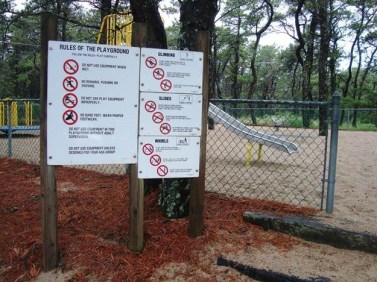 e plaintiff miss-labels part of the case.
Another issue is the fact that parents allow their kids to ride bicycles through the aisles of stores, and the retailer does not put a stop to it. What if the plaintiff had hit another patron rather than a shelf?
As always, the issue of putting warning signs up so people who can’t read, can be protected always makes me wonder. Warning if you are unable to read this sign, please find someone to read it to you. Seriously the entire world is going to be nothing but signs if this continues.
Thankfully, the retailer was not liable for the actions of an inattentive parent for the injuries of their child riding a bike down a store aisle.
What do you think? Leave a comment.
If you like this let your friends know or post it on FB, Twitter or LinkedIn
Author: Outdoor Recreation Insurance, Risk Management and Law

Book
Copyright 2016 Recreation Law (720) Edit Law
Email: Rec-law@recreation-law.com
Google+: +Recreation
Twitter: RecreationLaw
Facebook: Rec.Law.Now
Facebook Page: Outdoor Recreation & Adventure Travel Law
Blog: www.recreation-law.com
Mobile Site: http://m.recreation-law.com
By Recreation Law Rec-law@recreation-law.com James H. Moss
#AdventureTourism, #AdventureTravelLaw, #AdventureTravelLawyer, #AttorneyatLaw, #Backpacking, #BicyclingLaw, #Camps, #ChallengeCourse, #ChallengeCourseLaw, #ChallengeCourseLawyer, #CyclingLaw, #FitnessLaw, #FitnessLawyer, #Hiking, #HumanPowered, #HumanPoweredRecreation, #IceClimbing, #JamesHMoss, #JimMoss, #Law, #Mountaineering, #Negligence, #OutdoorLaw, #OutdoorRecreationLaw, #OutsideLaw, #OutsideLawyer, #RecLaw, #Rec-Law, #RecLawBlog, #Rec-LawBlog, #RecLawyer, #RecreationalLawyer, #RecreationLaw, #RecreationLawBlog, #RecreationLawcom, #Recreation-Lawcom, #Recreation-Law.com, #RiskManagement, #RockClimbing, #RockClimbingLawyer, #RopesCourse, #RopesCourseLawyer, #SkiAreas, #Skiing, #SkiLaw, #Snowboarding, #SummerCamp, #Tourism, #TravelLaw, #YouthCamps, #ZipLineLawyer, Wal-Mart, Bicycle, Store Aisle, Premises Liability Act, Premises Liability, Invitee, Cycling, Dangerous Condition, No Duty, Failure to Warn,
Wilson v. Wal-Mart Stores, Inc., 161 So. 3d 1128; 2015 Miss. App. LEXIS 216
Posted: October 9, 2016 Filed under: Cycling, Legal Case, Mississippi | Tags: bicycle, Cycling, Dangerous Condition, Failure to Warn, Invitee, No Duty, Premises Liability, Premises Liability Act, Store Aisle, Wal-Mart Leave a commentWilson v. Wal-Mart Stores, Inc., 161 So. 3d 1128; 2015 Miss. App. LEXIS 216
Seth Wilson, by and Through His Mother and Next Friend, Suzette Wilson Purser, appellant v. Wal-Mart Stores, Inc., Appellee
NO. 2014-CA-00589-COA
Court of Appeals of Mississippi
161 So. 3d 1128; 2015 Miss. App. LEXIS 216
April 21, 2015, Decided
COUNSEL: FOR APPELLANT: D. BRIGGS SMITH JR.
FOR APPELLEE: THOMAS M. LOUIS, LEO JOSEPH CARMODY JR.
JUDGES: BEFORE LEE, C.J., BARNES AND MAXWELL, JJ. IRVING AND GRIFFIS, P.JJ., BARNES, ISHEE, ROBERTS, MAXWELL, FAIR AND JAMES, JJ., CONCUR. CARLTON, J., NOT PARTICIPATING.
OPINION BY: LEE
OPINION
[*1129] NATURE OF THE CASE: CIVIL – PERSONAL INJURY
LEE, C.J., FOR THE COURT:
P1. In this premises-liability case, we must determine whether summary judgment was appropriately granted in favor of Wal-Mart Stores Inc. We find summary judgment was proper; thus, we affirm.
FACTS AND PROCEDURAL HISTORY
P2. On April 29, 2012, ten-year-old Seth Wilson, his brother, Wyatt Purser, and his stepfather, Jim Purser, went to a Wal-Mart [*1130] store in Batesville, Mississippi, to purchase a basketball. While Jim was paying for the basketball at a nearby register, Seth and his brother started looking at the bicycles. They both got on bicycles that were on the bicycle rack, and started riding up and down the aisles nearby. The bicycle Seth rode was on the ground when he found [**2] it, with its front wheel pushed under the rack and its back wheel in the aisle. Seth was following Wyatt on his bicycle when Wyatt slowed down to put the bicycle he was riding away. Seth was forced to go around him because he was “going real fast” and “[could not] figure out how to stop.” He tried to brake using the pedals, but the bicycle only had handbrakes. Unable to stop, Seth ran into a wall and cut his leg on a shelf. The cut was deep and required stitches. The employee assigned to the department was outside at the time of the accident, and no signs were posted prohibiting the use of the bicycles or otherwise warning of any danger.
P3. Suzette Purser, Seth’s mother, filed suit on his behalf on September 14, 2012, alleging negligence on the part of Wal-Mart in failing to keep the premises reasonably safe and warn of danger. After discovery was completed, Wal-Mart filed a motion for summary judgment. Seth filed a response, and Wal-Mart replied. After a hearing, the trial court granted Wal-Mart’s motion, finding that no genuine issue of material fact existed because Seth failed to show the existence of a dangerous condition. Seth filed a motion to reconsider, which was denied. Seth [**3] now appeals asserting the trial court erred in granting Wal-Mart’s motion for summary judgment.
STANDARD OF REVIEW
P4. [HN1] In considering a trial court’s grant of a motion for summary judgment, this Court conducts a de novo review and “examines all the evidentiary matters before it — admissions in pleadings, answers to interrogatories, depositions, affidavits, etc.” City of Jackson v. Sutton, 797 So. 2d 977, 979 (¶7) (Miss. 2001) (citation omitted). [HN2] The Mississippi Supreme Court recently clarified the summary-judgment standard, explaining that “[t]he movant bears the burden of persuading the trial judge that: (1) no genuine issue of material fact exists, and (2) on the basis of the facts established, he is entitled to [a] judgment as a matter of law.” Karpinsky v. Am. Nat’l Ins. Co., 109 So. 3d 84, 88 (¶11) (Miss. 2013) (citation omitted). The supreme court further stated that “[t]he movant bears the burden of production if, at trial, he would bear the burden of proof on the issue raised. In other words, the movant only bears the burden of production where [he] would bear the burden of proof at trial.” Id. at 88-89 (¶11) (citations omitted). The supreme court again clarified that “while [d]efendants carry the initial burden of persuading the trial judge that no issue of material fact exists and that they are entitled to summary judgment based upon the established [**4] facts, [the plaintiff] carries the burden of producing sufficient evidence of the essential elements of [his] claim at the summary-judgment stage, as [he] would carry the burden of production at trial.” Id. at 89 (¶13).
DISCUSSION
P5. [HN3] To determine whether Wal-Mart is entitled to summary judgment on Seth’s premises-liability claim, this Court must (1) determine the status of the injured person as either an invitee, licensee, or trespasser, (2) assess, based on the injured party’s status, what duty the landowner or business operator owed to the injured party, and (3) determine whether the landowner or business operator breached the duty owed to the injured [*1131] party. Titus v. Williams, 844 So. 2d 459, 467 (¶28) (Miss. 2003).
P6. It is undisputed that Seth was a business invitee. [HN4] “A business owner/operator owes to invitees the duty to keep the premises reasonably safe, and when not reasonably safe, to warn only where there is hidden danger or peril that is not in plain and open view.” Rod v. Home Depot USA Inc., 931 So. 2d 692, 694 (¶10) (Miss. Ct. App. 2006) (citation and internal quotation marks omitted). To succeed in a premises-liability action, Seth must prove one of the following: “(1) a negligent act by [Wal-Mart] caused [his] injury; or, (2) that [Wal-Mart] had actual knowledge of a dangerous condition, but failed to warn [him] [**5] of the danger; or, (3) the dangerous condition remained long enough to impute constructive knowledge to [Wal-Mart].” Byrne v. Wal-Mart Stores Inc., 877 So. 2d 462, 465 (¶5) (Miss. Ct. App. 2003) (citation omitted). A business owner, however, is not an insurer of an invitee’s injuries. Id. at (¶6).
P7. Whether Wal-Mart breached its duty to keep the premises reasonably safe or otherwise warn of a hidden danger necessarily depends on whether a dangerous condition existed. Seth argues that whether an unlocked or readily available bicycle on the sales floor constituted a dangerous condition was a genuine issue of material fact that should have been submitted to a jury. To avoid summary judgment, however, Seth must produce sufficient evidence of the essential elements of a claim of negligence – duty, breach, causation, and damages.
P8. Seth contends that leaving unlocked or readily accessible bicycles on the sales floor created a dangerous condition. He argues that (1) Wal-Mart’s possession of a rack on which to clamp the bicycles, (2) the assignment of an employee to the toy department, and (3) evidence of other children on bicycles in the same aisle at the same Wal-Mart show that unlocked or readily accessible bicycles created a dangerous condition, and that Wal-Mart [**6] knew about it and failed to warn its patrons. He cites to no authority to support his position, and nothing in the record supports these allegations.
P9. Seth refers to the rack where the bicycles could be clamped as a safety rack, but there is nothing in the record to indicate that the purpose for the rack was to protect its patrons from the alleged danger posed by unlocked or readily accessible bicycles. The record contains installation instructions for the rack, which were prepared by VIDIR Machine Inc., a vertical storage company, and refers to the rack as a carrier or bike-merchandising system only. The rack does not contain a locking mechanism, and holds bicycles in place utilizing a tire clamp. While the bicycles are still accessible to patrons, Seth argues that the rack was designed to make it difficult for patrons to remove the bicycle from the rack, prompting a need for employee assistance, but fails to offer sufficient evidence of this assertion.
P10. Additionally, there is nothing in the record to indicate the assignment of an employee to the toy department was for the purpose of guarding against any known danger; and evidence that other children rode bicycles in the same [**7] aisle in the same Wal-Mart without incident does not, in and of itself, tend to show that unlocked or readily accessible bicycles pose a danger. Seth provided no evidence of the industry’s standards, no expert reports, and no evidence of Wal-Mart’s policy regarding who may remove the bicycles from the rack and whether its employees were required to return the bicycles to the rack immediately after each use. Because Wilson failed to produce sufficient evidence that unlocked or readily accessible [*1132] bicycles on the sales floor created a dangerous condition, this issue is without merit.
P11. Seth also argues that the trial court erred in finding that Seth’s age was immaterial. This appears to be an attack on the applicability of Orr v. Academy Louisiana Co., 157 So. 3d 44, 2013 WL 1809878 (La. Ct. App. 2013), an unpublished opinion the trial court cited in support of its conclusion that an unlocked or readily accessible bicycle does not constitute a dangerous condition. In Orr, a woman was injured when she was struck by an adult male riding a bicycle in Academy Sports and Outdoors. 157 So. 3d 44, Id. at *1.
P12. It is not disputed that Seth was an invitee at the time of his injury, and he acknowledges that the duty owed him was not in any way heightened due to his status as a minor. What Seth [**8] appears to be arguing is that the trial court incorrectly considered evidence of contributory negligence in determining whether a dangerous condition existed. Seth had learned how to ride a bicycle by the age of five and had been involved in other bicycle accidents prior to the one at Wal-Mart. Again, Seth’s argument necessarily depends on whether an unlocked or readily available bicycle constitutes a dangerous condition. If an unlocked or readily accessible bicycle does not constitute a dangerous condition, it does not matter whether a person of Seth’s age, experience, and intelligence could have perceived the danger because the danger did not exist. Because Seth failed to show how an unlocked or readily available bicycle constituted a dangerous condition, this issue is without merit.
P13. THE JUDGMENT OF THE PANOLA COUNTY CIRCUIT COURT IS AFFIRMED. ALL COSTS OF THIS APPEAL ARE ASSESSED TO THE APPELLANT.
IRVING AND GRIFFIS, P.JJ., BARNES, ISHEE, ROBERTS, MAXWELL, FAIR AND JAMES, JJ., CONCUR. CARLTON, J., NOT PARTICIPATING.
Exciting and Great Changes in store for Veloswap this year. More Great Things Coming in the Future too.
Posted: October 5, 2016 Filed under: Cycling, Mountain Biking | Tags: bicycle, Cycling, Swap, Velo, Veloswap Leave a comment
|


Is it a negligent act to open a car door into a bike lane when a cyclist is in the lane in New Jersey?
Posted: September 26, 2016 Filed under: Cycling, New Jersey | Tags: Accident Investigation, Bicycle Lane, Bike, Bike Lane, Car Door, Cycling, Damages, Dooring, Riding in Bike Lane 2 CommentsAt the same time, if the defendant photographed the scene, measured the distance his car was from the curb or how wide his door was, the plaintiff might not have succeeded in her claims.
Gwinner, v. Michael Matt, et al., 2012 U.S. Dist. LEXIS 108827
State: New Jersey, United States District Court for the District of New Jersey
Plaintiff: Sheila Gwinner and Horst Gwinner
Defendant: Michael Matt, et al.
Plaintiff Claims: failing to observe [her] bicycle on the bicycle path” and “failing to keep a reasonable lookout for other vehicles lawfully on the road
Defendant Defenses: Plaintiff cannot prover her claims that the defendant opened his car door into the bikeway
Holding: For the Plaintiff, sent back for trial
Year: 2012
This is sort of an odd case for me, but after spending a week with the bicycle community at Interbike it seemed appropriate. This case looks at the legal issues when a driver of a car after parking opens his door into a bicycle lane injuring a cyclist.
In this case, the defendant was from Pennsylvania visiting his parents at a tourist town in New Jersey. The Plaintiff was also from Pennsylvania riding her bike in the bike lane in the same town in New Jersey.
Allegedly, the defendant parked his car and opened his car door into the bike lane where the plaintiff was riding and caused her injury.
The real issue was the plaintiff could not recall the accident and could not say with certainty that the defendant’s door was in the bike lane. However, she was in the bike lane, and she hit the defendant’s car door.
The case was filed in Federal Court because the accident occurred in New Jersey, where the lawsuit was occurred but the plaintiff was a resident of Pennsylvania.
The basis for this decision was a motion filed by the defendant to dismiss the case because the plaintiff’s lack of proof of whether the door opened in the bike lane. There was also substantial discussion about the application of New Jersey automobile law to the accident (a bicycle is a vehicle) and what damages would be applicable to this case. That part of the decision is not covered in this article.
Analysis: making sense of the law based on these facts.
The court started its analysis looking to the requirements to prove a negligence case under New Jersey law.
Under New Jersey law, for a plaintiff to establish a negligence claim she must show that the defendant “breached a duty of reasonable care, which constituted a proximate cause of the plaintiff’s injuries.” Furthermore, “negligence must be proved and will never be presumed, indeed there is a presumption against it, and the burden of proving negligence is on the plaintiff.”
As in all states, the plaintiff must prove, and has the burden of proving that the defendant owed the plaintiff a duty of care, which he breached causing her injuries. In this case, the allegation of the Plaintiff was the duty was not to open a car door into the bike lane.
To establish a duty of care in New Jersey requires the passing of a two-part test. “The question of whether a duty to exercise reasonable care to avoid the risk of harm to another exists is one of fairness and policy that implicates many factors.”
The first part is whether the accident was foreseeable. The second test in New Jersey is whether the application of the duty would be fair and be supported by public policy.
The defendant knew about the bike lanes and was a resident of the city; he also knew about the bike lanes on that particular road. And whenever a bike is in close proximity to a car, there is an obvious risk of harm to the cyclist.
As a result, where bicycles and motor vehicles are in close proximity, the risk of harm presented by obstructing or entering into the bike lane, or, more generally a bicyclist’s lane of travel, was clearly foreseeable to Mr. Matt at the time of the accident.
The fairness and policy considerations were easy and obvious.
…both were using vehicles on the limited roadway space of a public thoroughfare. Imposing a duty of care on Mr. Matt in terms of obstructing or otherwise interfering with a bicyclist’s lane of travel is fair as a matter of public policy. The City of Avalon has created bike lanes presumably to promote bicycling generally and as an attempt to attract visitors. The explicit purpose of a bike lane is to minimize the risks inherent in roadways that accommodate automobiles, bicycles, and pedestrians by providing bicyclists an exclusive lane of travel. Finally, imposing a duty of care in terms of keeping a proper lookout before crossing, entering into, or otherwise obstructing a bicyclists’ lane of travel does not unduly burden motorists. At most, this duty requires a driver to ensure his automobile is parked fully in the parking lane and to check his review mirrors, or otherwise look out for bicyclists, prior to opening his car door and exiting his vehicle.
The bike lanes were built to make cycling safer, and the bike lanes were put in by the city. It is fair to assume that there was an expectation of safety while riding the bike lanes and since the bike lanes were created by the city, there was obviously no violation of public policy.
In conclusion, the possibility of a collision between a cyclist and a car or car door on roadways shared by cyclists and motorists, is foreseeable. Moreover, the public interest in promoting bicycle safety and the minimal burden placed on motorists to exercise reasonable care can lead only to the conclusion that Mr. Matt owed Ms. Gwinner a duty of care when parking and exiting his vehicle along Dune Drive.
The next issue the court looked at was whether the plaintiff could prove the defendant breached a duty to her. Because she could not remember whether or not the car door was in the bike lane, the defendant argued the door was not in the lane, and it did not breach a duty to the plaintiff.
The evidence in the record pertaining to Plaintiff’s negligence claim is scant. There were no witnesses to the accident, aside from Mr. Matt and Ms. Gwinner. Neither Mr. Matt nor Ms. Gwinner took photographs or made measurements of the accident scene; more specifically, there are no photographs 4 or measurements relating to the distance of Mr. Matt’s passenger-side tires from the curb or how far Mr. Matt’s car door extended when opened on the day of the incident. Finally, though both parties independently visited the Avalon Police Station after the accident, no police report was produced.
However, the pleadings and deposition testimony of the plaintiff were enough to make a case that should be heard by a jury.
However, Ms. Gwinner’s deposition testimony describing the accident is sufficient to demonstrate the existence of a question of material fact, which should be decided by a jury. She states, “Is all I know I was [sic] riding my bike. And the poor man was as startled as I was. The door started opening and I just went into it.” When Ms. Gwinner’s description of the accident is considered along with her testimony that she was riding her bike within the bike lane when she collided with Mr. Matt’s car door a fact finder could reasonably infer Mr. Matt’s car door must have entered the bike lane and caused the collision, and choose to believe Ms. Gwinner’s account of the accident rather than Mr. Matt’s.
Although there was not specific proof the car door was in the bike lane, the jury could reach a conclusion by a preponderance of the evidence that car door was in the bike lane.
As such, the case was sent back for trial.
The decision continues on the application of New Jersey automobile and insurance law to the case and whether there were any limits on the damages available for the plaintiff.
So Now What?
Here the plaintiff or the defendant could have photographed the scene, measured the door, the car to the curb, and the width of the bike lane and ended this case. If you have the opportunity, after the victim(s) have been taken care of document the accident.
At the same time, when both victims filed complaints at the police department, the police did nothing. Don’t wait and go to the police department, call 911 and have them show up.
These facts will also lead to a big argument on the actual damages the plaintiff suffered. If she was able to go to the police department rather than going to the hospital, she must not have been injured as much as she might claim.
 What do you think? Leave a comment.
If you like this let your friends know or post it on FB, Twitter or LinkedIn
Author: Outdoor Recreation Insurance, Risk Management and Law
Copyright 2016 Recreation Law (720) Edit Law
Email: Rec-law@recreation-law.com
Google+: +Recreation
Twitter: RecreationLaw
Facebook: Rec.Law.Now
Facebook Page: Outdoor Recreation & Adventure Travel Law
Blog: www.recreation-law.com
Mobile Site: http://m.recreation-law.com
By Recreation Law Rec-law@recreation-law.com James H. Moss
#AdventureTourism, #AdventureTravelLaw, #AdventureTravelLawyer, #AttorneyatLaw, #Backpacking, #BicyclingLaw, #Camps, #ChallengeCourse, #ChallengeCourseLaw, #ChallengeCourseLawyer, #CyclingLaw, #FitnessLaw, #FitnessLawyer, #Hiking, #HumanPowered, #HumanPoweredRecreation, #IceClimbing, #JamesHMoss, #JimMoss, #Law, #Mountaineering, #Negligence, #OutdoorLaw, #OutdoorRecreationLaw, #OutsideLaw, #OutsideLawyer, #RecLaw, #Rec-Law, #RecLawBlog, #Rec-LawBlog, #RecLawyer, #RecreationalLawyer, #RecreationLaw, #RecreationLawBlog, #RecreationLawcom, #Recreation-Lawcom, #Recreation-Law.com, #RiskManagement, #RockClimbing, #RockClimbingLawyer, #RopesCourse, #RopesCourseLawyer, #SkiAreas, #Skiing, #SkiLaw, #Snowboarding, #SummerCamp, #Tourism, #TravelLaw, #YouthCamps, #ZipLineLawyer, Dooring, Car Door, Cycling, Bike Lane, Bicycle Lane, Bike, Riding in Bike Lane, Damages, Accident Investigation,
Gwinner, v. Michael Matt, et al., 2012 U.S. Dist. LEXIS 108827
Posted: September 25, 2016 Filed under: Cycling, Legal Case, New Jersey | Tags: Bicycle Lane, Bike, Bike Lane, Car Door, Cycling, Dooring, Riding in Bike Lane Leave a commentGwinner, v. Michael Matt, et al., 2012 U.S. Dist. LEXIS 108827
Sheila Gwinner and Horst Gwinner, Plaintiffs, v. Michael Matt, et al., Defendants.
Civil No. 10-3001 (JBS/AMD)
UNITED STATES DISTRICT COURT FOR THE DISTRICT OF NEW JERSEY
2012 U.S. Dist. LEXIS 108827
August 2, 2012, Decided
August 3, 2012, Filed
COUNSEL: [*1] Appearances: Thomas Sacchetta, Esq., SACCHETTA & BALDINO, Marlton, NJ, Attorney for Plaintiffs.
Barbara J. Davis, Esq., Jessica D. Wachstein, Esq., MARSHALL, DENNEHY, MARSHALL, COLEMMAN & GOGGIN, Cherry Hill, NJ, Attorneys for the Defendants.
JUDGES: HONORABLE JEROME B. SIMANDLE, Chief United States District Judge.
OPINION BY: JEROME B. SIMANDLE
OPINION
SIMANDLE, Chief Judge:
I. INTRODUCTION
This matter involving the alleged negligence of a motorist opening his car door on a roadway with a designated bike lane is before the Court on Defendant’s motion for summary judgment pursuant to Fed. R. Civ. P. 56(a). [Docket Item 17.] The principal issue to be determined is whether a dispute of fact exists that Defendant breached a duty of care owed to Plaintiff when she collided with his car door as he was exiting his vehicle. As will be explained at length below, the Court finds Plaintiff’s negligence claim raises a question of material fact to be decided by a jury. Plaintiff has also raised a dispute of fact that her alleged injuries are permanent and causally related to the accident for purposes of the limitation-on-lawsuit threshold of the New Jersey Automobile Insurance Cost Reduction Act, so Defendant’s motion will be [*2] denied.
II. BACKGROUND
Plaintiff, Sheila Gwinner, filed this lawsuit against Defendant, Michael Matt, based on an accident that occurred in June 2008, when Ms. Gwinner collided with Mr. Matt’s car door while she was bicycling on Dune Drive in Avalon, New Jersey. Ms. Gwinner alleges Mr. Matt negligently opened his car door into the bike lane where she was traveling, striking her and causing her to suffer serious personal injuries.
On June 14, 2010, Plaintiff commenced a civil action against Defendant in the United States District Court for the District of New Jersey based on diversity jurisdiction under 28 U.S.C. § 1332(d). 1 [Docket Item 1.] According to Ms. Gwinner’s Complaint, Mr. Matt’s negligence consisted of, in part, “failing to observe [her] bicycle on the bicycle path” and “failing to keep a reasonable lookout for other vehicles lawfully on the road.” Compl. at ¶ 12. Ms. Gwinner then claims that, as a result of Mr. Matt’s negligence, she suffered “severe and painful injuries,” which required medical treatment, restricted her personal and work activities, and resulted in permanent injuries. Id. at ¶ 13.
1 Both Plaintiffs are citizens of Pennsylvania, and Defendant is a citizen of [*3] New Jersey. Compl. at ¶ 1.
On the morning of June 15, 2008 Mr. Matt parked his vehicle in front of his father’s house, in the parking lane along Dune Drive. Matt Dep., Ex. F at 17:23-24. At this location, Dune Drive is a four-lane roadway, two lanes north and two lanes south, with a bike lane and a parking lane. Id. at 19:4-7. When Mr. Matt opened his door, he “heard a loud bang,” and then observed a “young lady [] on the ground with her bicycle in front of the car to the left a little bit.” Id. at 28:5-8. Ms. Gwinner was traveling at fifteen miles per hour along Dune Drive on the morning of the accident, and she did not observe Mr. Matt’s vehicle prior to the collision. Gwinner Dep., Ex. H at 34:5-10. Additionally, Ms. Gwinner testified that, when the accident occurred, she was riding within the bike lane (id. at 34:20-21); however, she did not observe and does not know whether Mr. Matt’s car door actually extended into the bike lane. Id. at 40:7-13.
Ms. Gwinner carries automobile insurance provided by Progressive Insurance, an insurance company authorized to conduct business in the State of New Jersey. She alleges that as a result of the accident, she suffered “traumatic multi level [*4] disc herniation/protrusion/radiculopathy, traumatic right knee fracture/contusion/anterior horn tear, and traumatic right hand/thumb tendonitis with radial/median nerve neuritis and joint inflammation.” Compl. at ¶ 13. 2 Plaintiff claims that these injuries demonstrate a “permanent injury” as set forth in the New Jersey Automobile Insurance Cost Reduction Act (“AICRA”) at N.J. Stat. Ann. § 39:6A-8(a) and that she has produced sufficient objective medical evidence to support her claim. Pl.’s Opp’n Br. at 4.
2 Plaintiff includes a medical report in support of this allegation. Pl. Ex. D.
In the present motion, Defendant argues that he is entitled to summary judgment because Plaintiff has failed to “establish proof a negligence claim as a matter of law.” Def.’s Br. in Supp. Summ. J. at 2. Specifically, Defendant argues Plaintiff has failed to establish the alleged breach of duty, as she “produced no evidence that Mr. Matt’s car door extended into the bike lane.” Id. at 3. Defendant also argues that Plaintiff is barred from pursuing noneconomic damages 3 because she has failed to produce objective medical evidence demonstrating she suffered permanent injuries, as a result the accident in question, [*5] to her neck, right knee, and right wrist. Id. at 15-16.
3 “Noneconomic damages” are defined by statute as “pain, suffering and inconvenience.” N.J. Stat. Ann. § 39:6A-2(i). By contrast, “economic loss” is defined as “uncompensated loss of income or property, or other uncompensated expenses, including, but not limited to, medical expenses.” Id. at § 39:6A-2(k). The Court notes that Plaintiff appears to claim only noneconomic losses. Additionally, Defendant requests dismissal of Plaintiff’s claim in its entirety, not just dismissal of Plaintiff’s claim for noneconomic losses. Plaintiff does not refute this by presenting economic losses and arguing that, should the Court find in Defendant’s favor, her claims for economic losses must survive. Therefore, dismissal is the result of finding for Defendant.
For the following reasons, the Court finds Plaintiff has sufficiently raised a question of material fact regarding her breach of duty claim; Defendant’s motion is denied on this issue. Additionally, the Court finds Plaintiff has provided sufficient objective medical evidence from which a reasonable jury could conclude that she suffered permanent injuries as a result of the accident; therefore, [*6] Plaintiff has met AICRA’s limitation-on-lawsuit threshold, and Defendant’s motion is denied.
III. DISCUSSION
A. Standard of Review
[HN1] Summary judgment is appropriate “if the movant shows that there is no genuine dispute as to any material fact and the movant is entitled to judgment as a matter of law.” Fed. R. Civ. P. 56(a). A fact is “material” only if it might affect the outcome of the suit under the applicable rule of law. Anderson v. Liberty Lobby, Inc., 477 U.S. 242, 255, 106 S. Ct. 2505, 91 L. Ed. 2d 202 (1986). Summary judgment will not be denied based on mere allegations or denials in the pleadings; instead, some evidence must be produced to support a material fact. Fed. R. Civ. P. 56(c)(1)(A); United States v. Premises Known as 717 S. Woodward Street, Allentown, Pa., 2 F.3d 529, 533 (3d Cir. 1993). However, the Court will view any evidence in favor of the nonmoving party and extend any reasonable favorable inferences to be drawn from that evidence to that party. Hunt v. Cromartie, 526 U.S. 541, 552, 119 S. Ct. 1545, 143 L. Ed. 2d 731 (1999). Where the nonmoving party bears the burden of persuasion at trial, the moving party may be entitled to summary judgment merely by showing that there is an absence of evidence to support an essential element of [*7] the nonmoving party’s case. Fed. R. Civ. P. 56(c)(1)(B); Celotex Corp. v. Catrett, 477 U.S. 317, 325, 106 S. Ct. 2548, 91 L. Ed. 2d 265 (1986).
B. Summary Judgment as to Plaintiff’s Negligence Claim
[HN2] Under New Jersey law, for a plaintiff to establish a negligence claim she must show that the defendant “breached a duty of reasonable care, which constituted a proximate cause of the plaintiff’s injuries.” Brown v. Racquet Club of Bricktown, 95 N.J. 280, 288, 471 A.2d 25, 29 (1984). Furthermore, ” [HN3] negligence must be proved and will never be presumed, [] indeed there is a presumption against it, and [] the burden of proving negligence is on the plaintiff.” Buckelew v. Grossbard, 87 N.J. 512, 525, 435 A.2d 1150 (1981) (citing Hansen v. Eagle-Picher Lead Co., 8 N.J. 133, 139, 84 A.2d 281 (1951)).
Plaintiff claims Defendant acted negligently when he opened his car door “into the bike lane where [she] was operating her bicycle.” Pl.’s Opp’n Br. 2. She also alleges she suffered injuries as a result of Defendant’s negligence. Id.
Defendant argues Plaintiff has failed to present a valid negligence claim because she has not alleged a breach of duty that was the proximate cause of her injuries. Def.’s Br. in Supp. Summ. J. 2. Defendant [*8] argues Plaintiff has not produced evidence showing his car door entered into or obstructed the bike lane. Id. at 3. Defendant also claims the evidence shows Ms. Gwinner was solely responsible for her injuries because she was riding her bicycle outside of the bike lane when she collided with his car door. Id. To support this claim, Defendant argues that after the accident, he fully opened his door to see if it extended into the bike lane, which, he claims, it did not. Id. at 1.
1. Duty of Care
Neither party has addressed the existence of a duty of care in the instant case. Because the existence of a duty is essential to all negligence claims, however, the Court must tackle the issue.
[HN4] “The question of whether a duty to exercise reasonable care to avoid the risk of harm to another exists is one of fairness and policy that implicates many factors.” Carvalho v. Toll Bros. and Developers, 143 N.J. 565, 573, 675 A.2d 209, 212. (citing Dunphy v. Gregor, 136 N.J. 99, 110, 642 A.2d 372 (1994)). Foreseeability is the first factor considered, as it is “the predicate for the duty to exercise reasonable care.” Id. at 573. While foreseeability is needed to determine whether a duty of care exists, it [*9] is not the only factor. Id. at 572. Courts also consider fairness and policy factors such as “the relationship of the parties, the nature of the attendant risk, the opportunity and ability to exercise care, and the public interest in the proposed solution.” Id. at 573 (quoting Hopkins v. Fox & Lazo Realtors, 132 N.J. 426, 439, 625 A.2d 1110. (1993)).
The Court will first address foreseeability. Mr. Matt was a resident of Avalon, who was aware of the existence of the bike lane along Dune Drive, and who had used the Dune Drive bike lane prior to the accident in question. Matt Dep., Ex. F at 9:20; 20:16-19, 22-23; 21:1-2. Mr. Matt was also aware that the Dune Drive bike lane was regularly used during the summer months, Avalon’s tourist season. Id. at 46:3-7. The risk of harm posed by a collision between a cyclist and an automobile, or automobile door, is obvious. As a result, where bicycles and motor vehicles are in close proximity, the risk of harm presented by obstructing or entering into the bike lane, or, more generally a bicyclist’s lane of travel, was clearly foreseeable to Mr. Matt at the time of the accident.
” [HN5] Once the foreseeability of an injured party is established, . . . considerations [*10] of fairness and policy govern whether the imposition of a duty is warranted.” Carvalho at 573, 675 A.2d at 212 (quoting Carter Lincoln Mercury, Inc. v. EMAR Group, Inc., 135 N.J. 182, 194-95, 638 A.2d 1288 (1994)). In Carvalho, a construction worker was killed when trench walls collapsed on him. Id. at 571-572, 675 A.2d at 212. In a suit against the site engineer, the New Jersey Supreme Court, after determining the risk of harm was foreseeable, held that imposing a duty of care on the engineer was warranted because there was a contractual relationship between the parties; the engineer was responsible for monitoring work progress, which implicated worksite safety; the engineer had control to change work conditions; and the engineer had actual knowledge of the dangerous condition because other trench walls had collapsed at the site. Id. at 575-578, 675 A.2d at 214-15.
Here, Mr. Matt and Ms. Gwinner had no prior existing relationship. In fact, their first actual encounter occurred after Ms. Gwinner had already collided with Mr. Matt’s car door. Matt Dep., Ex. F at 28:4-15; Gwinner Dep., Ex. H at 37:4-10. Additionally, Mr. Matt had never previously been involved in an automobile accident [*11] involving a bicyclist. Ex. F at 46:12-16. But their relationship was a functional one: both were using vehicles on the limited roadway space of a public thoroughfare. Imposing a duty of care on Mr. Matt in terms of obstructing or otherwise interfering with a bicyclist’s lane of travel is fair as a matter of public policy. The City of Avalon has created bike lanes presumably to promote bicycling generally and as an attempt to attract visitors. The explicit purpose of a bike lane is to minimize the risks inherent in roadways that accommodate automobiles, bicycles, and pedestrians by providing bicyclists an exclusive lane of travel. Finally, imposing a duty of care in terms of keeping a proper lookout before crossing, entering into, or otherwise obstructing a bicyclists’ lane of travel does not unduly burden motorists. At most, this duty requires a driver to ensure his automobile is parked fully in the parking lane and to check his review mirrors, or otherwise look out for bicyclists, prior to opening his car door and exiting his vehicle.
In conclusion, the possibility of a collision between a cyclist and a car or car door on roadways shared by cyclists and motorists, is foreseeable. Moreover, [*12] the public interest in promoting bicycle safety and the minimal burden placed on motorists to exercise reasonable care can lead only to the conclusion that Mr. Matt owed Ms. Gwinner a duty of care when parking and exiting his vehicle along Dune Drive.
2. Breach of Duty
[HN6] Because breach of duty is an essential element of a negligence claim, facts relating to a defendant’s breach are material to the success of the claim. In the instant case, the material fact regarding breach of duty is whether Defendant Matt’s car door entered into the bike lane, causing the collision. Because Ms. Gwinner has the burden of proving negligence at trial, Mr. Matt would be “entitled to summary judgment merely by showing that there is an absence of evidence” supporting Ms. Gwinner’s negligence claim. Celotex Corp. at 325. The Court finds Plaintiff has minimally succeeded in providing evidence to support her claim that Defendant breached a duty of care.
Ms. Gwinner alleges Mr. Matt breached the duty by negligently opening his car door into the bike lane, causing her to collide with the door and suffer injuries. Mr. Matt claims Ms. Gwinner has failed to produce evidence his car door entered the bike lane. Mr. [*13] Matt also claims the evidence in the record shows that Ms. Gwinner was actually the sole cause of the collision and her injuries because his car door did not extend into the bike lane, so, he infers, Ms. Gwinner must have been riding her bicycle in the parallel parking lane at the time of the accident.
The evidence in the record pertaining to Plaintiff’s negligence claim is scant. There were no witnesses to the accident, aside from Mr. Matt and Ms. Gwinner. Matt Dep., Ex. F at 35:5-7; Gwinner Dep., Ex. H at 44:14-15. Neither Mr. Matt nor Ms. Gwinner took photographs or made measurements of the accident scene; more specifically, there are no photographs 4 or measurements relating to the distance of Mr. Matt’s passenger side tires from the curb or how far Mr. Matt’s car door extended when opened on the day of the incident. Matt Dep., Ex. F at 37:22-24, 38:1-2; Gwinner Dep., Ex. H at 47:1-5. Finally, though both parties independently visited the Avalon Police Station after the accident, no police report was produced. Matt Dep., Ex. F at 43:19-22, 44:1-3; Gwinner Dep., Ex. H at 70:13-15, 71:18-21.
4 There is photographic evidence of Dune Drive at the accident site as of February 2011. While [*14] the photographs tell us little about the actual scene of the accident in June 2008, they do confirm that a Honda Accord parked close enough to the curb in the parking lane can fully open its driver side door without the door entering into the bike lane. However, the photographer used a Honda Accord to make this demonstration. Ex. G. On the day of the accident, Mr. Matt was driving a Cadillac CTS. Ex. F at 23:5-6. Car width and door length vary from make to make and model to model; as a result, the Court notes that Defendant’s photographs are of limited value on the relevant question of whether Mr. Matt’s Cadillac could similarly park in the parking lane and fully open his car door without obstructing the bike lane. The demonstrative Honda exhibit’s materiality also depends upon how close to the curb Defendant’s vehicle was parked at the time of the accident.
Ms. Gwinner’s recitation of what she remembers from the date of the accident is also meager. Though she claims to have been riding in the bike lane along the right side of the lane, at no time before, during or after the accident did she observe Mr. Matt’s car door extending into the bike lane. 5 Gwinner Dep., Ex. H at 34:8-10, [*15] 40:7-10, 19-23. Additionally, she did not observe and does not know how close to the curb Mr. Matt parked his car. Id. at 48:2-5.
5 During her deposition, Ms. Gwinner participated in the following exchange with Defense attorney Barbara J. Davis:
Q: But did you see at all how far the car door extended out?
A: No, I didn’t.
Q: As you sit here today, do you know if the car door extended out into the bike lane, Mr. Matt’s car door?
A: I don’t.
However, Ms. Gwinner’s deposition testimony describing the accident is sufficient to demonstrate the existence of a question of material fact, which should be decided by a jury. She states, “Is all I know I was [sic] riding my bike. And the poor man was as startled as I was. The door started opening and I just went into it.” Id. at 34:6-10. When Ms. Gwinner’s description of the accident is considered along with her testimony that she was riding her bike within the bike lane when she collided with Mr. Matt’s car door (id. at 36:15-17), a fact finder could reasonably infer Mr. Matt’s car door must have entered the bike lane and caused the collision, and choose to believe Ms. Gwinner’s account of the accident rather than Mr. Matt’s.
Because all reasonable inferences [*16] must be given to the nonmovant, the Court finds Ms. Gwinner has raised a genuine issue of material fact as to whether Mr. Matt breached a duty of care by negligently opening his car door into a bicyclist’s lane of travel, or otherwise failing to reasonably look out for bicyclists before exiting his vehicle. Therefore, Mr. Matt has failed to meet the summary judgment standard set forth under Fed. R. Civ. P. 56(c)(1)(B) and Celotex Corp. v. Catrett, 477 U.S. 317, 325, 106 S. Ct. 2548, 91 L. Ed. 2d 265 (1986) and his motion will be denied as to Plaintiff’s negligence claim.
C. Summary Judgment as to Plaintiff’s Inability to Satisfy AICRA’s Limitation-on-Lawsuit Threshold
1. The Applicability of the New Jersey’s “Deemer Statute” and AICRA
Because Ms. Gwinner is insured by Progressive Insurance, an insurance company authorized to conduct business in the State of New Jersey, Defendant argues, and Plaintiff does not dispute, Plaintiff is subject to New Jersey’s “Deemer Statute” and the “limitation-on-lawsuit threshold” set forth in AICRA.
[HN7] The Deemer Statute, N.J. Stat. Ann. § 17:28-1.4, “requires insurers authorized to transact automobile insurance business in New Jersey to provide coverage to out-of-state residents consistent [*17] with New Jersey law ‘whenever the automobile or motor vehicle insured under the policy is used or operated in this State.'” Zabilowicz v. Kelsey, 200 N.J. 507, 513-514, 984 A.2d 872, 875-876 (2009). The Deemer Statute also requires affected insurance companies “to provide personal injury protection [(“PIP”)] benefits pursuant to N.J. Stat. Ann. [§] 39:6A-4.” Id. at 514, 984 A.2d at 876. “In short, the Deemer Statute furnishes the covered out-of-state driver with New Jersey’s statutory no-fault PIP and other benefits and, in exchange, deems that driver to have selected the limitation-on-lawsuit option of [N.J. Stat. Ann. §] 39:6A-8(a).” Id. Because Plaintiff conceded to Defendant’s assertion that Plaintiff is subject to the limitation-on-lawsuit threshold via the Deemer Statute, even though Plaintiff was riding her bicycle rather than driving an automobile at the time the accident, the Court assumes that the Deemer Statute applies to the facts of this case.
AICRA represents an effort by the New Jersey’s Legislature to curb rising auto insurance costs by limiting the opportunities for accident victims to sue for noneconomic damages. This effort began with New Jersey’s implementation of [*18] a no-fault insurance scheme in 1972 when New Jersey passed the New Jersey Automobile Reparation Act and has since undergone numerous revisions, in a process described as “tortured,” which need not be recounted here. See, e.g., Branca v. Matthews, 317 F. Supp. 2d 533, 537-539 (D.N.J. 2004). The New Jersey Legislature passed AICRA in 1998 with three distinct goals “containing [insurance premium] costs, rooting out fraud within the system, and ensuring a fair rate of return for insurers.” DiProspero v. Penn, 183 N.J. 477, 488, 874 A.2d 1039, 1046 (2005).
2. The Limitation-on-Lawsuit Threshold
[HN8] To contain automobile insurance costs, AICRA established the limitation-on-lawsuit threshold, which “bars recovery for pain and suffering unless the plaintiff suffers an injury that results in (1) death; (2) dismemberment; (3) significant disfigurement or significant scarring; (4) displaced fractures; (5) loss of fetus; or (6) permanent injury within a reasonable degree of medical probability ….” Id. (quoting N.J. Stat. Ann. § 39:6A-8(a))(internal quotation marks omitted).
[HN9] An insured bound by the limitation-on-lawsuit threshold is barred from suing for noneconomic damages unless her injuries fall [*19] within AICRA’s six categories. Johnson v. Scaccetti, 192 N.J. 256, 261, 927 A.2d 1269, 1273 (2007). In the summary judgment context, a plaintiff can proceed to trial if she demonstrates that her alleged injuries, if proven, fall into one of the six threshold categories. Davidson v. Slater, 189 N.J. 166, 187, 914 A.2d 282, 295 (2007) (citing Oswin v. Shaw, 129 N.J. 290, 294, 609 A.2d 415, 417 (1992)). A plaintiff must also prove that the alleged statutory injury was caused by the accident in question or “risk dismissal on summary judgment if the defendant can show that no reasonable fact-finder could conclude that the defendant’s negligence caused plaintiff’s alleged … injury.” Id. at 188, 914 A.2d at 295. However, where, as here, a plaintiff alleges she suffered more than one injury as a result of the accident in question, the plaintiff need only establish one of her injuries meets the limitation-on-lawsuit threshold for the jury to consider all of the injuries when calculating noneconomic damages. Johnson at 279, 927 A.2d at 1282.
3. Permanent Injury
[HN10] AICRA defines “permanent injury” as “[w]hen the body part or organ, or both, has not healed to function normally and will not heal to [*20] function normally with further medical treatment.” N.J. Stat. Ann. 39:6A-8(a). Additionally, in adopting AICRA, the New Jersey Legislature explicitly adopted a threshold requirement, the objective medical evidence standard, established by the New Jersey Supreme Court in Oswin v. Shaw, 129 N.J. 290, 609 A.2d 415 (1992). DiProspero v. Penn, 183 N.J. 477, 495, 874 A.2d 1039, 1050 (2005). A plaintiff’s alleged limitation-on-lawsuit injury “must be based on and refer to objective medical evidence.” Id. (emphasis removed).
Plaintiff claims her neck, right wrist, and right knee injuries are permanent injuries within the meaning of AICRA. See supra pp. 4-5. Additionally, Ms. Gwinner claims the medical report created by Dr. James F. Bonner, her physical therapy physician (Pl.’s Opp’n Br., Ex. D), “sets forth his opinion within a reasonable degree of certainty as to the permanency of [her] injuries and their relatedness to the accident”; as such, she has satisfied the limitation-on-lawsuit threshold. Pl.’s Opp’n Br. 4.
Mr. Matt argues that Ms. Gwinner has failed to produce objective medical evidence demonstrating she suffered permanent injuries, as a result the accident in question, to her neck, [*21] right knee, and right wrist. Def.’s Br. in Supp. Summ. J. at 11. First, Defendant claims Dr. Bonner’s report shows that Ms. Gwinner had a pre-existing cervical injury and that the report fails to present evidence showing Ms. Gwinner’s cervical condition is causally connected to the accident. Id. at 11-12. Second, Defendant argues Plaintiff’s alleged knee injuries fail to meet the threshold because there is evidence of pre-existing injuries and surgeries, a failure to connect the injuries to the accident, and Plaintiff “has testified she has full use of her right knee and is not restricted in any of her physical activities.” Id. 12-14. Finally, Defendant claims Plaintiff has not presented objective medical evidence of a permanent injury to her right wrist because the medical reports show that she had been treated for right wrist problems prior to the accident and that the reports alleging a right wrist injury after the accident are based on Ms. Gwinner’s subjective complaints and not objective medical testing. Id. at 14-15.
Because Ms. Gwinner need only demonstrate that one of her injuries, if proven, is permanent under AICRA’s definition, the Court will evaluate each alleged injury [*22] individually. First, however, the Court will address Defendant’s broader assertion that Plaintiff’s claim should be dismissed because she did not provide a comparative analysis distinguishing the injuries allegedly caused by the accident from other, preexisting injuries, as required by Davidson v. Slater, 189 N.J. 166, 914 A.2d 282 (2007). In Davidson, The New Jersey Supreme Court did not create a blanket rule. Instead, it held,
When a plaintiff alleges aggravation of preexisting injuries as the animating theory of the claim, then plaintiff must produce comparative evidence to move forward with the causation element of that tort action. When a plaintiff does not plead aggravation of preexisting injuries, a comparative analysis is not required to make that demonstration.
189 N.J. at 179, 914 A.2d at 284. The New Jersey Supreme Court then cautioned plaintiffs with preexisting injuries not required to provide such a report, stating, ” [HN11] [T]he plaintiff who does not prepare for comparative medical evidence is at risk of failing to raise a jury-worthy factual issue about whether the subject accident caused the injuries.” Davidson, at 188, 914 A.2d at 295.
As was the case in Davidson, Plaintiff [*23] Gwinner has not explicitly alleged that her injuries were aggravations of preexisting injuries. 6 The only medical report provided by Ms. Gwinner to support her claim that she suffered permanent injuries as a result of the accident, however, makes no mention of new injuries. Pl. Ex. D. Instead, the one-page report prepared in 2009 by Dr. Bonner states Ms. Gwinner had previous injuries or previously received medical treatment to the alleged injured areas and that she suffered “advanced impairment … as a direct result of her 6/15/08 trauma.” Id. Moreover, the report specifically mentions Plaintiff’s “old knee problem” and concludes the accident caused “a higher pain/dysfunction level.” Id. While this report might appear to indicate all of Plaintiff’s alleged injuries are exacerbations, Dr. Bonner produced a more detailed report on July 1, 2008, on which the 2009 report partially relies. 7 Reviewing the medical reports referenced in Dr. Bonner’s report reveals some of the injuries described are in fact new injuries.
6 Plaintiff did not allege her injuries were either new or exacerbations of previous injuries and conditions; she was silent on this issue. Compl. at ¶ 13. However, Plaintiff’s [*24] allegations regarding her injuries appear to be direct quotes from Dr. Bonner’s 2009 report. See supra. p. 4. and note 2.
7 In addition to his July 1, 2008 report, Dr. Bonner also referenced a July 9, 2008 report created by Dr. Philip S. Yussen of Mainline Open MRI (Def. Ex. I). Both reports discuss new injuries Ms. Gwinner suffered as a result of the accident. See infra pp. 23-26.
When considering Ms. Gwinner’s complaint and supporting evidentiary documents, it is clear some of her alleged injuries are aggravations of previously existing injuries and medical conditions. But because she has not alleged aggravation injuries in her Complaint, she is not required to provide a comparative report to support the causation element of her tort claim. The New Jersey Supreme Court’s warning in Davidson, however, is pertinent to the instant case because the lack of a comparative analysis has clouded the Court’s effort to properly evaluate whether Plaintiff provided sufficient evidence of causation. Nevertheless, the surplus of medical reports provided has allowed the Court to satisfactorily investigate which alleged injuries are sufficiently supported by evidence of causation and which are not.
a. [*25] Cervical Injury
Though Ms. Gwinner claims to have suffered permanent injury in the form of traumatic multi level disc herniation, protrusion, and radiculopathy, there is no evidence suggesting the alleged injuries are permanent. First, Ms. Gwinner had an MRI done in 2007, prior to the accident, because she was experiencing pain in her neck dating back to 2000. Gwinner Dep., Ex. H 13:15-21, 14:15-23. At the request of Dr. Bonner, Ms. Gwinner received another MRI in July 2008. The report written by Dr. Philip S. Yussen states, “Current examination demonstrates the cervical vertebral bodies to maintain normal stature. There is partial straightening of the cervical lordosis, which may be related to patient positioning, muscle spasm, or even a chronic finding given that this was evident on the previous MRI study as well.” Def. Ex. O (emphasis added). The report goes on to conclude,
There has not been a significant change in the MRI appearance of the cervical spine as compared to the previous MRI study of 8/9/07. The previously noted fatty marrow island at C7 and small low signal presumed development focus at C5 right of midline are again noted, and are stable. No new osseous abnormalities [*26] are seen referable to the cervical vertebrae as compared to the previous study.
Id. Dr. Yussen’s report can only be read to state that the condition of Ms. Gwinner’s neck has not changed, let alone deteriorated, as a result of the accident.
Additionally, Defendant’s medical expert, Dr. Brian K. Zell examined Ms. Gwinner in May of 2011, two years after the medical report provided by Plaintiff, and produced a report (Def. Ex. N). According to Dr. Zell, Ms. Gwinner suffered from a preexisting degenerative disease of the cervical spine, and “[t]he automobile accident in question is not considered a responsible event for the progression of preexisting degenerative changes in the cervical spine.” Def. Ex. N. at 17. Ms. Gwinner has not offered any evidence to rebut these findings. As a result, Plaintiff’s cervical injury cannot serve as a basis for her noneconomic claims. See Kauffman v. McCann, Civ. No. 05-3687, 2007 U.S. Dist. LEXIS 23514, 2007 WL 1038696 at *4 (D.N.J. March 29, 2007) (” [HN12] Because it is plaintiff’s burden at trial to show Defendant caused her permanent injuries within the meaning of AICRA, Plaintiff may not merely rest on her pleadings once Defendant has come forward with evidence tending to show that Plaintiff [*27] is not suffering permanent injury.”). Plaintiff has offered no evidence raising a dispute of fact that, since at least 2008, she has suffered from any spinal injury caused by the 2008 accident.
b. Right Knee Injury
Plaintiff also claims her “traumatic right knee fracture/contusion/anterior horn tear” constitutes a permanent injury under AICRA. The evidence in the record is very close as to whether Ms. Gwinner’s right knee injuries are permanent; however, there is insufficient evidence demonstrating the injuries are causally related to the accident.
Ms. Gwinner underwent medial meniscus surgery to her right knee in 1999. Gwinner Dep., Ex. H 8:23-24, 9:1-4. After the accident, Ms. Gwinner was first evaluated Dr. Bonner on July 1, 2008. Regarding Ms. Gwinner’s right knee, Dr. Bonner wrote, “Her past medical history is remarkable for a medical meniscetomy seven years ago for which she recovered had not had problems involving the right knee.” Def. Ex. K. Dr. Bonner then concluded that, “as a direct result of the accident,” Ms. Gwinner suffered a “contusion to the distal one third of the medial subcutaneous surface of the tibia.” Id. Thus, Dr. Bonner’s initial evaluation attributed only a contusion [*28] to the accident in question.
Eight days later, Ms. Gwinner received an MRI and evaluation at Main Line MRI. In a report dated July 9, 2008, Dr. Philip S. Yussen also noted symptoms consistent with “mild strain or subtle contusion.” Def. Ex. I. Dr. Yussen further noted that the MRI revealed there were no tears to the posterior cruciate ligament, anterior cruciate ligament, or medial collateral ligament. Id. Additionally, “no lateral meniscal tear or significant degenerative signal change” was apparent. Id. Finally, while Dr. Yussen’s examination did reveal “free edge blunting of the posterior horn region” as well as some “small” tears in the medial meniscus region, he was unable to determine the cause of these injuries. Id. He stated, “Given the provided history, the appearance may in part be related to previous partial meniscus tear.” Id.
An orthopaedic surgeon, Dr. Marc S. Zimmerman, then evaluated Ms. Gwinner’s right knee. In a report dated July 28, 2008, Dr. Zimmerman stated, “[Ms. Gwinner’s] right knee gives out on her. She denies popping and clicking. She does not think it is swollen at this time.” Def. Ex. J at 1. Dr. Zimmerman described his evaluation of Ms. Gwinner’s right knee [*29] as follows:
Evaluation of the right knee reveals no swelling or effusion. She has full range of motion without pain. There is minimal tenderness over the lateral joint line with no tenderness over the medial joint line. On the McMurray’s test on internal rotation, there is a click appreciated over the lateral joint line. There is a negative Lachman’s test. There is no varus/vulgus laxity.
Id. at 2. Dr. Zimmerman found there “appear[ed] to be a tear in the posterior horn of the medial meniscus,” but concluded the possible tear was “most likely related to the previous surgery and injury.” Id. As with the two previous evaluations, Dr. Zimmerman noted a bone contusion “at the lateral plateau in the anterolateral aspect.” Id.
In conclusion, because Plaintiff has failed to provide a comparative analysis detailing her previous right knee injuries and then distinguishing any preexisting conditions from the injuries she allegedly suffered as a result of the accident in question, the Court is only able to find causation with regards to the bone contusion. This injury was consistently reported in all three medical evaluations conducted in 2008 and was the only injury explicitly connected to the [*30] accident. However, this injury cannot be considered permanent. Plaintiff’s medical report was prepared on December 16, 2009. Regarding Ms. Gwinner’s right knee, the report merely states, “She also injured her right knee.” It then concludes Ms. Gwinner suffered “traumatic right knee fracture/contusion/anterior horn tear.” Defendant’s medical expert, Dr. Zell, examined Ms. Gwinner’s right knee approximately one-and-a-half years later in May 2011. This represents the most recent evaluation of Ms. Gwinner’s right knee. Dr. Zell noted that the MRI taken by Main Line MRI in 2008 revealed a contusion, but concluded that as of May 2011, the right knee “is entirely within normal limits … [and] further intervention with respect to the patient’s right knee as a consequence of the bicycle versus automobile collision is not warranted.” Def. Ex. N. at 17.
Again, Plaintiff has not offered any evidence to rebut the evidence offered by Defendant showing Plaintiff’s right knee is within normal limits and does not require further treatment. Moreover, Plaintiff offers no additional evidence permitting the reasonable inference that the right knee contusion is permanent. Therefore, it is insufficient to [*31] support a claim for noneconomic damages under AICRA.
c. Right Wrist Injury
Ms. Gwinner alleges that, as a result of the accident, she suffered traumatic right hand/thumb tendonitis with radial/median nerve neuritis and joint inflammation. After reviewing the many doctors’ reports discussing Ms. Gwinner’s right wrist, the Court finds Ms. Gwinner has successfully demonstrated that, if proven, these injuries constitute a causally related permanent injury with the meaning of AICRA.
Dr. Bonner was the first medical professional to evaluate Ms. Gwinner’s wrist after the June 2008 accident. On July 1, 2008, Dr. Bonner wrote that Ms. Gwinner reports “numbness in the right thumb, index finger, and long finger primarily on the tip.” Def. Ex. K. Dr. Bonner then noted Ms. Gwinner had been previously treated for numbness in her right hand and that she stopped treatment in November 2007, prior to the accident. Id. Relevant to causation, this report stated, the “condition had resolved until following this accident.” Id. Dr. Bonner also found “positive phalen’s 8 and tinel’s sign 9 [sic] at the right wrist with tenderness over the … carpal metacarpal joint of the thumb.” Id. The report concludes that [*32] “as a direct result” of the accident in question Ms. Gwinner’s right wrist is indicative of “[p]ost traumatic sprain of the carpal/metacarpal joint of the right thumb with carpal tunnel syndrome being evident.” Id.
8 Dorland’s Illustrated Medical Dictionary 1714 (Elsevier Saunders 32nd ed. 2012) defines “Phalen sign” as the “appearance of numbness or paresthesias within 30 to 60 seconds during the Phalen test, a positive sign for carpal tunnel syndrome.” A Phalen sign is detected by performing a Phalen test, which is a “[a] test for carpal tunnel syndrome. The patient flexes the wrist for 1 minute. Carpal tunnel syndrome is confirmed if the patient experiences a tingling that radiates into the thumb, index finger and the middle and lateral half of the ring finger.” Volume 4 M-PQ, J.E. Schmidt, M.D., Attorney’s Dictionary of Medicine P-208 (Matthew Bender). In light of these definitions, the Court interprets positive Phalen sign to represent that carpal tunnel syndrome was detected.
9 Dorland’s Illustrated Medical Dictionary 1716 (Elsevier Saunders 32nd ed. 2012) defines “Tinel sign” as “a tingling sensation in the distal end of a limb when percussion is made over the site of a divided [*33] nerve. It indicates a partial lesion or the beginning regeneration of the nerve.” The Court thus interprets Positive Tinel sign to indicate possible presence of a lesion(s) in the tested area.
Dr. Zimmerman also evaluated Ms. Gwinner’s right wrist during her July 28, 2008 visit because she reported “some numbness and tingling in the thumb and second finger of her right hand.” Def. Ex. J. Dr. Zimmerman’s report sheds light on the issues of previous existing injuries and causation. He states that while Ms. Gwinner’s past medical history includes numbness and tingling in her right hand, that condition “had resolved but is now present again . . . since the most recent accident.” Id. Moreover, an EMG was performed on Ms. Gwinner in 2007, and “she was told there was no permanent damage.” 10
10 It should be noted, however, that Dr. Zimmerman determined there were “negative Tinel’s and negative Phalen’s signs.” Def. Ex. J.
In December of 2008, Ms. Gwinner visited Dr. William H. Kirkpatrick of Hand Surgical Associates. Def. Ex. L. In his report, Dr. Kirkpatrick similarly noted, “[Ms. Gwinner] had approximately six months of tingling in the thumb, index and long fingers before her bike accident [*34] for which she was treated by a chiropractor” but that the symptoms resolved prior to the June 2008 collision. Id. Dr. Kirkpatrick saw no swelling in the right wrist, full active range of motion, and no tenderness. However, the report found positive Tinel signs “over the superficial radial nerve several centimeters proximal to the wrist” and ultimately diagnosed Ms. Gwinner with right “superficial radial nerve neuritis, probably right median neuritis, and right thumb joint CMC joint inflammation.” Id. This report also noted that Ms. Gwinner’s right wrist injuries were her “primary concern.” Id.
The Court finds the reports of Dr. Bonner, Dr. Zimmerman and Dr. Kirkpatrick sufficient to demonstrate that while Ms. Gwinner had experienced some numbness and tingling prior to the June 2008, that condition had ceased and was deemed nonpermanent prior to the accident. Because both Dr. Bonner and Dr. Zimmerman’s reports noted positive Phalen and Tinel signs, among other injuries, a reasonable fact finder could determine that any injuries found in Ms. Gwinner’s right wrist in these post-accident reports are causally connected to the June 2008 collision. Therefore, Ms. Gwinner has sufficiently demonstrated [*35] causation.
Dr. Bonner’s December 16, 2009 report and Dr. Zell’s May 31, 2011 report are relevant to the Court’s inquiry into the permanency of Ms. Gwinner’s alleged right wrist injuries. Dr. Bonner’s 2009 report described Ms. Gwinner’s injuries as “traumatic right hand/thumb tendonitis with radial/median nerve neuritis and joint inflammation.” Pl. Ex. D. The report stated these injuries have resulted in “permanent restriction to no impact forces to those affected areas.” Id.
Again, the Defendant’s medical expert, Dr. Zell, was the last doctor to evaluate Ms. Gwinner’s right wrist. As of May 2011, Ms. Gwinner’s still complained of tightness and numbness in her right wrist. Def. Ex. N. at 5. Dr. Zell found, “The bicycle versus automobile collision in question has a chronological association with ongoing complaints referable to the median nerve at the right wrist.” Id. And while he found “the absence of a Tinel at the carpal tunnel on the right side,” Dr. Zell did not entirely rule out carpal tunnel syndrome, concluding, “If this patient does in fact have a carpal tunnel syndrome, it is subclinical.” Id.
There is substantially more evidence regarding Ms. Gwinner’s alleged right wrist injury. [*36] While some of the medical reports seem to contradict each other, particularly in regard to Phalen and Tinel signs, all reasonable inferences must be given to the nonmovant. Thus, the Court finds Plaintiff has provided evidence sufficient for a reasonable fact finder to determine her right wrist injuries are permanent and causally connected to the June 2008 accident.
Defendant’s final argument in support of his motion for summary judgment is that Ms. Gwinner’s deposition testimony indicates “she does not have any physical restrictions or limitations.” Def.’s Br. in Supp. Summ. J. at 15. Defendant claims Ms. Gwinner experiences no restrictions in her ability to “perform all of her household chores, go[] skiing, and … ride her bike approximately 50 miles.” Id. While Ms. Gwinner did state she did not miss any time from work as a result of the accident (Gwinner Dep., Ex. H 7:12-14) and she is able to conduct her life somewhat normally, Defendant has not provided a full picture of Ms. Gwinner’s statements. Regarding her ability to perform household chores, Ms. Gwinner participated in the following exchange:
Q: Are you able to do all your household chores?
A: I can do almost everything I that [*37] want. It’s–I’m losing dexterity in this hand because of numbness.
Q: Indicating your right hand?
A: Yes. Like I have good strength it in to go like this.
Q: To make a fist?
A: To make a fist. And if you put your hand, I can break your fingers with my strength, but it dwindles, it doesn’t stay.
Gwinner Dep., Ex. H 66:18-24, 67:1-6. And while Ms. Gwinner stated that she is able to ride her bike, she also stated that when she is finished her hands are numb. Id. at 67:23-24. When viewing Ms. Gwinner’s statements in their entirety, it appears they are supportive of the proposition that the injuries suffered to her wrist are permanent within the meaning of AICRA, especially because, as of the deposition date, May 16, 2011, Ms. Gwinner’s right wrist had not healed to function normally.
In conclusion, the Court finds Ms. Gwinner has provided evidence sufficient to demonstrate injuries suffered to her right wrist were permanent and caused by the accident in question. Because Plaintiff need only demonstrate one of her injuries, if proven, satisfies AICRA’s limitation-on-lawsuit threshold, and she has done so, the Court will allow all of her noneconomic claims to go to a jury.
CONCLUSION
For the reasons [*38] set forth above, Defendant’s motion for summary judgment shall be denied. The accompanying Order will be entered, and the case will be scheduled for trial.
August 2, 2012
DATE
/s/ Jerome B. Simandle
JEROME B. SIMANDLE
Chief U.S. District Judge
This California decision looks at assumption of the risk as it applies to non-competitive long distance bicycle rides and also determines that assumption of the risk also overcomes a violation of a statute (negligence per se).
Posted: August 8, 2016 Filed under: Assumption of the Risk, California, Cycling | Tags: assumption of the risk, Bicycling, Cycling, Express Assumption of the Risk, Negligence per se, Primary Assumption of the Risk, Secondary Assumption of the Risk Leave a commentA negligence per se claim can be stopped if the plaintiff assumed the risk under California law. This is probably a rare look at negligence per se in the fifty states.
State: California, Court of Appeal of California, Second Appellate District, Division Five
Plaintiff: Christian Moser
Defendant: Joanne Ratinoff
Plaintiff Claims: negligently, recklessly and carelessly operated, owned, controlled and maintained” her bicycle “so as to collide with the defendant.
Defendant Defenses: Primary Assumption of the Risk and Secondary Assumption of the Risk
Holding: for the defendant
Year: 2003
The plaintiff and the defendant participated in an “organized long-distance bicycle ride on public highways involving hundreds of participants.” The ride, the Death Valley Double Century was a 200-mile ride (double century). During the ride, the defendant swerved from the right side along the curb to the left into the plaintiff causing a collision. The plaintiff suffered injuries.
Prior to the ride, both participants signed releases. The releases explained several of the risks of the activity, but did not protect participants from claims of other participants. “The document does not purport to be a release of anyone other than the “event holders, sponsors and organizers.”
The case was dismissed at the trial court level because collisions are an inherent risk of cycling. The plaintiff appealed.
Analysis: making sense of the law based on these facts.
The court first looked at the requirements for the defendant to prove assumption of the risk by motion.
When a defendant moves for summary judgment on the basis of implied assumption of the risk, he or she has the burden of establishing the plaintiff’s primary assumption of the risk by demonstrating that the defendant owed no legal duty to the plaintiff to prevent the harm of which the plaintiff complains.
Under California law, a participant is generally responsible for their own injuries caused by the ordinary care or skill of another.
The court then looked at whether the plaintiff expressly assumed the risk of his injuries.
When a defendant moves for summary judgment on the basis of implied assumption of the risk, he or she has the burden of establishing the plaintiff’s primary assumption of the risk by demonstrating that the defendant owed no legal duty to the plaintiff to prevent the harm of which the plaintiff complains.
Express assumption of the risk is usually considered a written assumption of the risk. The court set out the definitions that must be met to prove express assumption of the risk in California.
The doctrine of express assumption of the risk is founded on express agreement. ‘Although in the academic literature “express assumption of risk” often has been designated as a separate, contract-based species of assumption of risk . . ., cases involving express assumption of risk are concerned with instances in which, as the result of an express agreement, the defendant owes no duty to protect the plaintiff from an injury-causing risk.’ Such an agreement, if valid, ‘operates to relieve the defendant of a legal duty to the plaintiff with respect to the risks encompassed by the agreement. . . .’ That express assumption of risk is founded on an express agreement undercuts the distributor defendants’ claim that it is good as against the world.
The court found that express assumption of the risk could not be applied to this case, as the defendants failed to prove that she was entitled to use the release signed by both parties before entering the race. However, the court found there could still be some value to the defendant from the release. “A person’s written acknowledgment of the risks inherent in an activity may, however, have an effect on determinations concerning implied assumption of risk.”
The court then looked at implied assumption of the risk, also known as secondary assumption of the risk, and whether it could be proved in this case. Under California law, implied assumption of the risk “embodies a legal conclusion that there is ‘no duty’ on the part of the defendant to protect the plaintiff from a particular risk”
Implied assumption of the risk was defined by the California Supreme Court as:
…a defendant owes no duty of care to protect a plaintiff against the risks inherent in a particular competitive sport (in that case, an informal touch football game) voluntarily played by the plaintiff, absent some reckless or intentional misconduct, but does owe a duty not to increase the risk of harm above that inherent in the sport. The court said that “[i]n some situations . . . the careless conduct of others is treated as an ‘inherent risk’ of a sport, thus barring recovery by the plaintiff.”
The reasoning for this is to impose a duty would place a chill on most sporting activities so that participants would not vigorously compete.
The test for implied assumption of the risk is not whether the defendant must protect the plaintiff from a known risk, but the nature of the activity.
The court then looked to determine if prior decisions had applied the defense of implied assumption of the risk to “organized non-competitive recreational bicycle riding.” However, the court did find that the risks and other factors made this type of cycling the same as other sports that implied assumption of the risk had been applied too by other California courts.
Nevertheless, this sport appears to fall within those activities to which these cases apply the assumption of risk doctrine. As the court said upon “[c]ompiling all of the distinguishing factors” from the cases, an activity is a “sport” to which the primary assumption of risk doctrine applies if that activity “is done for enjoyment or thrill, requires physical exertion as well as elements of skill, and involves a challenge containing a potential risk of injury.” That delineation is a useful one and covers the bicycle ride here.
The court also found that although bicycles are vehicles under California law, this type of activity was not the same as driving a car. This was done for enjoyment and physical activity.
However, the assumption of risk is not a blanket defense to all claims.
The primary assumption of risk rule “does not grant unbridled legal immunity to all defendants participating in sporting activity. The Supreme Court has stated that ‘. . . it is well established that defendants generally do have a duty to use due care not to increase the risks to a participant over and above those inherent in the sport.’
Defendants have no legal duty to eliminate the risk or protect a plaintiff to the risks inherent in a sport. The next issue becomes what then are the inherent risks of a sport.
Conduct is not inherent in the sport if that conduct is “totally outside the range of ordinary activity involved in the sport . . . [and] if the prohibition of that conduct would neither deter vigorous participation in the sport nor otherwise fundamentally alter the nature of the sport.” A participant injured in a sporting activity by another participant may recover from that coparticipant for intentional infliction of injury or tortious behavior “so reckless as to be totally outside the range of the ordinary activity involved in the sport” but not for mere negligence.
The court then gave examples of non-inherent risks and inherent risks in sports as determined by other California courts.
Certain activities have been held not to be inherent in a sport and thus not subject to the primary assumption of risk doctrine. For example, drinking alcoholic beverages is not an activity inherent in the sport of skiing. On the other hand, in various sports, going too fast, making sharp turns, not taking certain precautions, or proceeding beyond one’s abilities are actions held not to be totally outside the range of ordinary activities involved in those sports.
The court then found that two riders riding side by side, a collision between the two, or one rider riding into the other was an inherent risk of cycling.
The analogies derived from the risks in other sports suggest that one cyclist riding alongside another cyclist and swerving into the latter is a risk that is inherent in a long-distance, recreational group bicycle ride. The release Moser signed warns of the risk of accidents caused by the participants, thus indicating that such accidents are an inherent risk of the activity.
The defendant in this case the court determined was negligent, but was not wanton or reckless or conduct so totally outside of the range of ordinary activity involved in cycling.
The final issue the court looked at is whether the claim of negligence per se is barred by express or implied assumption of the risk. Court looked at precedent, prior case law, to determine the issue and found none. There were several California Supreme Court decisions that looked at the issue but did not rule on it. On the court today, this court determined from those prior decisions that a majority, four, of the justices on the court would argue that a negligence per se claim is blocked by express assumption of the risk. “Nevertheless, a majority of the present California Supreme courts have expressed the view that a violation of a statute such as involved here does not displace the primary assumption of risk doctrine.”
The court upheld the ruling of the trial court, and the case was dismissed.
So Now What?
First do not assume that assumption of the risk, in any form can bar a negligence per se claim. There are several states were this would not be true.
Second, the court’s analysis of the facts and the law are easily understood and supported by the case law quoted. This is a great case to understand the two types of assumption of the risk allowed in California.
Finally, in California of two or more people riding together is that one of those people assumes the inherent risk of colliding with the other.
![clip_image002[4]](https://recreation-law.com/wp-content/uploads/2016/07/clip_image0024_thumb1.jpg?w=244&h=348 "clip_image002[4]") What do you think? Leave a comment.
What do you think? Leave a comment.
If you like this let your friends know or post it on FB, Twitter or LinkedIn
Author: Outdoor Recreation Insurance, Risk Management and Law
Copyright 2016 Recreation Law (720) Edit Law
Email: Rec-law@recreation-law.com
Google+: +Recreation
Twitter: RecreationLaw
Facebook: Rec.Law.Now
Facebook Page: Outdoor Recreation & Adventure Travel Law
Blog: www.recreation-law.com
Mobile Site: http://m.recreation-law.com
By Recreation Law Rec-law@recreation-law.com James H. Moss
#AdventureTourism, #AdventureTravelLaw, #AdventureTravelLawyer, #AttorneyatLaw, #Backpacking, #BicyclingLaw, #Camps, #ChallengeCourse, #ChallengeCourseLaw, #ChallengeCourseLawyer, #CyclingLaw, #FitnessLaw, #FitnessLawyer, #Hiking, #HumanPowered, #HumanPoweredRecreation, #IceClimbing, #JamesHMoss, #JimMoss, #Law, #Mountaineering, #Negligence, #OutdoorLaw, #OutdoorRecreationLaw, #OutsideLaw, #OutsideLawyer, #RecLaw, #Rec-Law, #RecLawBlog, #Rec-LawBlog, #RecLawyer, #RecreationalLawyer, #RecreationLaw, #RecreationLawBlog, #RecreationLawcom, #Recreation-Lawcom, #Recreation-Law.com, #RiskManagement, #RockClimbing, #RockClimbingLawyer, #RopesCourse, #RopesCourseLawyer, #SkiAreas, #Skiing, #SkiLaw, #Snowboarding, #SummerCamp, #Tourism, #TravelLaw, #YouthCamps, #ZipLineLawyer, Cycling, Bicycling, Assumption of the Risk, Primary Assumption of the Risk, Secondary Assumption of the Risk, Express Assumption of the Risk, Negligence per se,
Moser v. Ratinoff, 105 Cal. App. 4th 1211; 130 Cal. Rptr. 2d 198; 2003 Cal. App. LEXIS 138; 2003 Cal. Daily Op. Service 987; 2003 Daily Journal DAR 1320
Posted: July 31, 2016 Filed under: Assumption of the Risk, California, Cycling, Legal Case | Tags: assumption of the risk, Bicycling, Cycling, Express Assumption of the Risk, Negligence per se, Primary Assumption of the Risk, Secondary Assumption of the Risk Leave a commentMoser v. Ratinoff, 105 Cal. App. 4th 1211; 130 Cal. Rptr. 2d 198; 2003 Cal. App. LEXIS 138; 2003 Cal. Daily Op. Service 987; 2003 Daily Journal DAR 1320
Christian Moser, Plaintiff and Appellant, v. Joanne Ratinoff, Defendant and Respondent.
No. B153258.
COURT OF APPEAL OF CALIFORNIA, SECOND APPELLATE DISTRICT, DIVISION FIVE
January 31, 2003, Decided
January 31, 2003, Filed
CALIFORNIA OFFICIAL REPORTS SUMMARY A participant in an organized, long-distance bicycle ride on public highways brought an action against a coparticipant, alleging that defendant was negligent in swerving into him and causing him to fall off his bicycle and sustain injuries. The trial court granted summary judgment for defendant on the basis of the primary assumption of the risk doctrine. (Superior Court of Los Angeles County, No. BC225431, Gregory C. O’Brien, Judge.)
A participant in an organized, long-distance bicycle ride on public highways brought an action against a coparticipant, alleging that defendant was negligent in swerving into him and causing him to fall off his bicycle and sustain injuries. The trial court granted summary judgment for defendant on the basis of the primary assumption of the risk doctrine. (Superior Court of Los Angeles County, No. BC225431, Gregory C. O’Brien, Judge.)
The Court of Appeal affirmed. It held that a waiver, signed by plaintiff prior to participating in the ride, that released the event holders, sponsors, and organizers and acknowledged the risks of the ride, including those caused by other participants, did not inure to the benefit of defendant. However, the court held, the primary assumption of the risk doctrine was applicable. Organized, long-distance bicycle rides are an activity to which the doctrine applies, since they are engaged in for enjoyment or thrill, require physical exertion and skill, and involve a challenge containing a risk of injury. Further, the risk that one cyclist will swerve into another is inherent in such rides. The court also held that the fact that defendant’s movements may have violated various Vehicle Code sections did not preclude application of the doctrine. (Opinion by Mosk, J., with Turner, P.J., and Grignon, J., concurring.)
HEADNOTES
CALIFORNIA OFFICIAL REPORTS HEADNOTES
Classified to California Digest of Official Reports
(1) Summary Judgment § 26–Appellate Review–Scope of Review. — –A grant of summary judgment is reviewed de novo. The appellate court makes an independent assessment of the correctness of the trial court’s ruling, applying the same legal standard as the trial court in determining whether there are any genuine issues of material fact or whether the moving party is entitled to judgment as a matter of law. Under Code Civ. Proc., § 437c, subd. (p)(2), a defendant moving for summary judgment meets its burden of showing that there is no merit to a cause of action by showing that one or more elements of the cause of action cannot be established or that there is a complete defense to that cause of action. Once the defendant has made such a showing, the burden shifts back to the plaintiff to show that a triable issue of one or more material facts exists as to that cause of action or as to a defense to the cause of action.
(2) Negligence § 98–Actions–Trial and Judgment–Questions of Law and Fact–Assumption of Risk–Summary Judgment. — –When a defendant moves for summary judgment on the basis of implied assumption of the risk, he or she has the burden of establishing the plaintiff’s primary assumption of the risk by demonstrating that the defendant owed no legal duty to the plaintiff to prevent the harm of which the plaintiff complains. Determining whether the primary assumption of risk doctrine applies is a legal question to be decided by the court.
(3) Negligence § 37–Exercise of Care by Particular Persons–Exercise of Care by Plaintiff–Assumption of Risk. — –A defense to a claim of negligence is that the plaintiff either expressly or impliedly assumed the risk.
(4) Negligence § 38–Exercise of Care by Particular Persons–Exercise of Care by Plaintiff–Assumption of Risk–Effect of Express Waiver. — –A participant in an organized, long-distance bicycle ride on public highways did not assume the risk of negligence by a coparticipant in the ride by signing, prior to taking part in the ride, a waiver that released the event holders, sponsors, and organizers and acknowledged the risks of the ride, including those caused by other participants. An express assumption of risk agreement does not inure to the benefit of those not parties to that agreement.
(5) Negligence § 37–Exercise of Care by Particular persons–Exercise of Care by Plaintiff–Assumption of Risk–Effect. — –The doctrine of primary assumption of the risk embodies a legal conclusion that there is no duty on the part of the defendant to protect the plaintiff from a particular risk. Where the doctrine applies, the plaintiff’s assumption of the risk acts as a complete bar to liability.
(6) Negligence § 37–Exercise of Care by Particular Persons-Exercise of Care by Plaintiff–Assumption of Risk–Competitive Sports. — –Under the doctrine of primary assumption of risk, a defendant owes no duty of care to protect a plaintiff against the risks inherent in a particular competitive sport voluntarily played by the plaintiff, absent some reckless or intentional misconduct, but does owe a duty not to increase the risk of harm above that inherent in the sport. Whether the doctrine applies depends on the nature of the sport or activity in question and on the parties’ general relationship to the activity. The overriding consideration in the application of the doctrine is to avoid imposing a duty that might chill vigorous participation in the implicated activity and thereby alter its fundamental nature.
(7) Negligence § 37–Exercise of Care by Particular Persons–Exercise of Care by Plaintiff–Assumption of Risk–Analytical Frameword. — –In assumption of the risk analysis, the question whether the defendant owed a legal duty to protect the plaintiff from a particular risk of harm does not turn on the reasonableness or unreasonableness of the plaintiff’s conduct, but rather on the nature of the activity or sport in which the defendant is engaged and the relationship of the defendant and the plaintiff to that activity or sport.
(8a) (8b) Negligence § 38–Exercise of Care by Particular Persons–Exercise of Care by Plaintiff–Assumption of Risk–Orgainzed Bicycle Ride. — –In an action by a participant in an organized, long-distance bicycle ride on public highways, in which plaintiff alleged that defendant, a coparticipant, was negligent in swerving into him and causing him to fall off his bicycle and sustain injuries, the trial court properly granted summary judgment for defendant on the basis of the primary assumption of the risk doctrine. Such organized, long-distance bicycle rides are an activity to which the doctrine applies, since they are engaged in for enjoyment or thrill, require physical exertion and skill, and involve a challenge containing a risk of injury. Further, the risk that one cyclist will swerve into another is inherent in such rides. Defendant’s movements may have been negligent, but they were not intentional, wanton, or reckless, nor were they totally outside the range of ordinary activity involved in the sport. Thus, the accident was within the risks assumed by plaintiff and defendant when they chose to participate.
[See 6 Witkin, Summary of Cal. Law (9th ed. 1988) Torts, § 1090C.]
(9) Negligence § 37–Exercise of Care by Particular Persons–Exercise of Care by Plaintiff–Assumption of Risk–Risks Not Assumed. — –Even if an activity is one to which the primary assumption of the risk doctrine applies, there are certain risks that are deemed not assumed and certain injury-causing actions that are not considered assumed risks of the activity. An activity that is not inherent in the sport is not subject to the doctrine. Drinking alcoholic beverages, for example, is not an activity inherent in the sport of skiing. On the other hand, in various sports, going too fast, making sharp turns, not taking certain precautions, and proceeding beyond one’s abilities are actions held not to be totally outside the range of ordinary activities involved in those sports.
(10) Negligence § 40–Exercise of Care by Particular Persons–Exercise of Care by Plaintiff–Assumption of Risk–Violation of Safety Law–Vehicle Code Provisions Applicable to Bicycle Riding. — –In an action by a participant in an organized, long-distance bicycle ride on public highways, in which plaintiff alleged that defendant, a coparticipant, was negligent in swerving into him and causing him to fall off his bicycle and sustain injuries, the fact that defendant’s movements may have violated various Vehicle Code sections did not preclude application of the primary assumption of the risk doctrine. The doctrine is not displaced by a violation of a statute that does not evince legislative intent to eliminate the assumption of the risk defense.
COUNSEL: Law Offices of Michael L. Oran, Michael L. Oran, Kathy B. Seuthe; Law Offices of Garry S. Malin and Garry S. Malin for Plaintiff and Appellant.
Barry Bartholomew & Associates, Michael A. Nork and Kathryn Albarian for Defendant and Respondent.
JUDGES: (Opinion by Mosk, J., with Turner, P. J., and Grignon, J., concurring.)
OPINION BY: MOSK
OPINION
[*1214] [**200] MOSK, J.
Plaintiff and appellant Christian Moser (Moser) and defendant and respondent Joanne Ratinoff (Ratinoff) participated in an organized, long-distance bicycle ride on public highways involving hundreds of participants. Moser signed an “Accident Waiver and Release of Liability” form for the benefit of the event holders, sponsors and organizers in which Moser expressly assumed the risk of various injuries, including those caused by other participants. During the ride, Ratinoff swerved into Moser, causing him to crash and sustain injuries. Moser sued Ratinoff for general negligence. Ratinoff filed a motion for summary judgment on the ground that a collision between bicycle riders was an inherent risk in the ride, and [*1215] therefore the action was barred by [***2] the primary assumption of risk doctrine enunciated in Knight v. Jewett (1992) 3 Cal.4th 296 [11 Cal. Rptr. 2d 2, 834 P.2d 696] (Knight). Moser opposed the motion on the grounds that the primary assumption of risk doctrine did not apply because the collision was not an inherent risk of the activity and because Ratinoff’s violation of provisions of the California Vehicle Code precluded application of the doctrine. The trial court granted summary judgment in Ratinoff’s favor. We hold that the primary assumption of risk doctrine applies to the organized bicycle ride, and that a violation of a statute does not displace that doctrine. Accordingly, we affirm the summary judgment.
FACTUAL AND PROCEDURAL BACKGROUND 1
1 We state the facts in accordance with the standard of review stated post.
Moser and Ratinoff collide during a bicycle ride
In February 1999, Moser registered to participate in the Death Valley Double Century bicycle ride, a 200-mile, noncompetitive bicycle ride on public [***3] highways. Hugh Murphy Productions organized the ride in which approximately 600 bicycle riders participated. 2 Before participating in the ride, Moser signed a document provided by the organizers entitled “Accident Waiver and Release of Liability” (the release), releasing the organizers and stating, “I acknowledge that this athletic event is an extreme test of a person’s physical and mental limits and carries with it the potential for death, serious injury and property loss. The risks include, but are not limited to those caused by . . . actions of other people including but not limited to participants. . . . I hereby assume all of the risks of participating &/or volunteering in this event.” The organizer required riders to wear helmets and to have bicycle lights.
2 One of the forms refers to the promoter as “Badwater Adventure Sports.”
The ride had no designated start time. On the day of the accident, Moser and his friend, David Warshawsky (Warshawsky), began the ride at 4:00 a.m. At a rest stop, [***4] Moser and Warshawsky encountered Ratinoff, another participant in the ride. The three cyclists left the rest stop together, with Warshawsky and Ratinoff riding side-by-side and Moser riding behind them. At some point, they began riding single file.
Moser was cycling close to the right-hand side of the road. Ratinoff said that she came from behind Moser’s left side and passed him or rode at his left side. Moser said Ratinoff came up from behind him and rode next to him on his left side. While she was riding on Moser’s left side, an Inyo County Sheriff’s Deputy pulled his car approximately four or five car lengths behind [*1216] them and stayed there for several minutes. Ratinoff turned to look at the [**201] police car, and she then told Moser, “I have to come over.” According to Ratinoff, a “split second” later, she moved to her right toward Moser.
As Ratinoff moved to her right, she made contact with Moser, who nevertheless was able to retain control of his bicycle. Within seconds, Ratinoff again collided with Moser, causing him to fall off his bike and to sustain injuries. At the time of the collision, Ratinoff and Moser were riding at an approximate speed of 15 to 20 miles per hour.
Moser [***5] sues Ratinoff, and Ratinoff files a motion for summary judgment
Moser commenced an action against Ratinoff and in his complaint alleged that Ratinoff “negligently, recklessly and carelessly operated, owned, controlled and maintained” her bicycle “so as to collide with” Moser’s bicycle. Ratinoff alleged assumption of risk as an affirmative defense.
Ratinoff filed a motion for summary judgment in which she contended that she was not liable to Moser because under the primary assumption of risk doctrine she did not breach a duty of care owed to him. Moser, in opposition to the motion, argued that the primary assumption of risk doctrine does not apply to noncompetitive bicycle riding and that Ratinoff violated Vehicle Code sections 21202, subdivision (a) (operating a bicycle as close “as practicable to the right-hand curb or edge of the roadway”), and 22107 (moving a vehicle to the left or right “with reasonable safety”), thereby giving rise to a presumption of negligence and rendering the primary assumption of risk doctrine inapplicable.
The trial court granted the summary judgment motion and entered judgment against Moser. The trial court denied Moser’s motion [***6] for new trial. Moser does not raise the denial of his new trial motion as a basis for his appeal.
STANDARD OF REVIEW
(1) [HN1] We review the grant of summary judgment de novo. (Szadolci v. Hollywood Park Operating Co. (1993) 14 Cal.App.4th 16, 19 [17 Cal. Rptr. 2d 356].) We make “an independent assessment of the correctness of the trial court’s ruling, applying the same legal standard as the trial court in determining whether there are any genuine issues of material fact or whether the moving party is entitled to judgment as a matter of law.” (Iverson v. Muroc Unified School Dist. (1995) 32 Cal.App.4th 218, 222 [38 Cal. Rptr. 2d 35].) A defendant moving for summary judgment meets its burden of showing that [*1217] there is no merit to a cause of action by showing that one or more elements of the cause of action cannot be established or that there is a complete defense to that cause of action. (Code Civ. Proc., § 437c, subd. (p)(2).) Once the defendant has made such a showing, the burden shifts back to the plaintiff to show that a triable issue of one or more material facts exists as to that cause of action or as to a defense to the cause of action. (Aguilar v. Atlantic Richfield Co. (2001) 25 Cal.4th 826, 849, 853 [107 Cal. Rptr. 2d 841, 24 P.3d 493].) [***7] (2))
[HN2] “When a defendant moves for summary judgment on the basis of implied assumption of the risk, he or she has the burden of establishing the plaintiff’s primary assumption of the risk by demonstrating that the defendant owed no legal duty to the plaintiff to prevent the harm of which the plaintiff complains.” (Freeman v. Hale (1994) 30 Cal.App.4th 1388, 1395 [36 Cal. Rptr. 2d 418].) Determining whether the primary assumption of risk doctrine applies is a legal question to be decided by the court. (Knight, supra, 3 Cal.4th at p. 313; Record v. Reason (1999) 73 Cal.App.4th 472, 479 [86 Cal. Rptr. 2d 547].) [**202]
DISCUSSION
[HN3] A person is generally responsible “for an injury occasioned to another by his or her want of ordinary care or skill in the management of his or her property or person.” (Civ. Code, § 1714.(3)) But a defense to a claim of negligence is that the plaintiff either expressly or impliedly assumed the risk. (Knight, supra, 3 Cal.4th at pp. 308, fn. 4, 309-321.)
I. Express assumption of risk
Before reaching the issue of implied assumption of risk, we must determine if Moser expressly assumed the risk of a collision based [***8] on the release he signed. [HN4] An express assumption of risk is a complete defense to a negligence claim. (Knight, supra, 3 Cal.4th at p. 308, fn. 4; Allan v. Snow Summit, Inc. (1996) 51 Cal.App.4th 1358, 1372 [59 Cal. Rptr. 2d 813]; Allabach v. Santa Clara County Fair Assn. (1996) 46 Cal.App.4th 1007, 1012 [54 Cal. Rptr. 2d 330].) Moser released the “event holders, sponsors and organizers,” and also acknowledged the risks of the ride, including those caused by other participants. The document does not purport to be a release of anyone other than the “event holders, sponsors and organizers.”
In Westlye v. Look Sports, Inc. (1993) 17 Cal.App.4th 1715 [22 Cal. Rptr. 2d 781] (Westlye), the plaintiff, who was injured skiing, filed an action against the ski shop from which he rented allegedly defective ski [*1218] equipment and the distributors of the equipment. He had signed a written agreement with the ski shop in which he accepted the equipment for use “as is”; agreed that he understood that there ” ‘are no guarantee[s] for the user’s safety’ “; acknowledged that there is ” ‘an inherent risk of injury in the sport of skiing, and the use of any ski equipment, and expressly assume[d] the risks for any [***9] damages to any persons or property resulting from the use of this equipment’ “; and released the ski shop from any liability. (Id. at p. 1725.)
The distributors of the equipment contended that “as a matter of law an express assumption of risk is good as against the whole world” and therefore precluded any liability against the distributors. (Westlye, supra, 17 Cal.App.4th at p. 1729.) In holding that the plaintiff had not released the distributors of the equipment, the court said, “defendants fail to submit, and we have not discovered, any authority for [the distributors’] proposition. The doctrine of express assumption of the risk is founded on express agreement. [Citations.] ‘Although in the academic literature “express assumption of risk” often has been designated as a separate, contract-based species of assumption of risk . . ., cases involving express assumption of risk are concerned with instances in which, as the result of an express agreement, the defendant owes no duty to protect the plaintiff from an injury-causing risk.’ [Citations.] Such an agreement, if valid, ‘operates to relieve the defendant of a legal duty to the plaintiff with respect [***10] to the risks encompassed by the agreement. . . .’ [Citation.] That express assumption of risk is founded on an express agreement undercuts the distributor defendants’ claim that it is good as against the world. [P] . . . [P] We conclude the distributor defendants have failed to establish that they are entitled to the benefit of the written agreement between plaintiff and [the ski shop].” (Id. at pp. 1729-1730.)(4))
Westlye, supra, 17 Cal.App.4th 1715, states the existing law that [HN5] an express assumption of risk agreement does not inure to the benefit of those not parties to that agreement. Accordingly, [**203] Moser did not expressly assume the risk of negligence by a coparticipant in the ride. A person’s written acknowledgment of the risks inherent in an activity may, however, have an effect on determinations concerning implied assumption of risk. (See discussion post.)
II. Implied assumption of risk
The subject of implied assumption of risk has generated much judicial attention. Its modern history began when California eliminated contributory negligence and adopted a comparative negligence system in Li v. Yellow Cab Co. (1975) 13 Cal.3d 804 [119 Cal. Rptr. 858, 532 P.2d 1226].. [***11] [*1219] Thereafter, the California Supreme Court–in two companion cases, Knight, supra, 3 Cal.4th 296, and Ford v. Gouin (1992) 3 Cal.4th 339 [11 Cal. Rptr. 2d 30, 834 P.2d 724] (Ford)–considered the “proper application of the ‘assumption of risk’ doctrine in light of [the] court’s adoption of comparative fault principles.” (Knight, supra, 3 Cal.4th at p. 300.) (5))
In Knight, supra, 3 Cal.4th 296, the Supreme Court, in a plurality opinion, set forth the doctrine of primary assumption of the risk. That doctrine, which is now established as “the controlling law” (Cheong v. Antablin (1997) 16 Cal.4th 1063, 1067 [68 Cal. Rptr. 2d 859, 946 P.2d 817] (Cheong)), “embodies a legal conclusion that [HN6] there is ‘no duty’ on the part of the defendant to protect the plaintiff from a particular risk. . . .” (Knight, supra, 3 Cal.4th at p. 308.) When the doctrine applies, the plaintiff’s assumption of the risk acts as a complete bar to liability. (Ibid.) 3
3 But see the Restatement Third of Torts, section 2 and comment i, pages 19, 25 (“Most courts have abandoned implied assumptions of risk as an absolute bar to a plaintiff’s recovery”).
[***12] (6) In Knight, supra, 3 Cal.4th 296, the court concluded that a defendant owes no duty of care to protect a plaintiff against the risks inherent in a particular competitive sport (in that case, an informal touch football game) voluntarily played by the plaintiff, absent some reckless or intentional misconduct, but does owe a duty not to increase the risk of harm above that inherent in the sport. The court said that “[i]n some situations . . . the careless conduct of others is treated as an ‘inherent risk’ of a sport, thus barring recovery by the plaintiff.” (Id. at p. 316.) In Ford, the court applied the rule to noncompetitive, non-team-sporting activities–in that case waterskiing. (Ford, supra, 3 Cal.4th 339.)
[HN7] Whether the primary assumption of risk doctrine applies–which issue is, as noted above, a question of law–“depends on the nature of the sport or activity in question and on the parties’ general relationship to the activity.” (Knight, supra, 3 Cal.4th at p. 313.) “The overriding consideration in the application of primary assumption of risk is to avoid imposing a duty which might chill vigorous participation in the implicated [***13] activity and thereby alter its fundamental nature.” (Ferrari v. Grand Canyon Dories (1995) 32 Cal.App.4th 248, 253 [38 Cal. Rptr. 2d 65].)
III. Activity subject to primary assumption of risk
(7) In Knight, supra, 3 Cal.4th at page 309, the court said that “whether the defendant owed a legal duty to protect the plaintiff from a [**204] particular risk [*1220] of harm does not turn on the reasonableness or unreasonableness of the plaintiff’s conduct, but rather on the nature of the activity or sport in which the defendant is engaged and the relationship of the defendant and the plaintiff to that activity or sport.” The court suggested that generally, the primary assumption of risk doctrine applies in a “sports setting.” (Id. at pp. 309-310, fn. 5.) (8a)) Thus, the issue in the instant case is whether an organized, noncompetitive, long-distance bicycle ride is one of those sports activities to which the primary assumption of risk doctrine applies.
The court in Staten v. Superior Court (1996) 45 Cal.App.4th 1628, 1635 [53 Cal. Rptr. 2d 657], stated, “Knight may require a court to determine a question of duty in sports settings while factually uninformed of how the sport is [***14] played and the precise nature of its inherent risks.” To make a decision concerning duty we must know the nature of a particular sport, and even if we do have such knowledge, we still may have no idea how imposing liability will affect or “chill” the sport–which is a major factor in making a determination of duty. (See American Golf Corp. v. Superior Court (2000) 79 Cal.App.4th 30, 37 [93 Cal. Rptr. 2d 683] [court said “expert opinion may inform the court on these questions”].) Nevertheless, under the current state of the law established by Knight, we must somehow make such a determination.
As guidance, there are cases in which courts have determined whether or not the primary assumption of risk applies to a particular activity. There are a number of cases involving sports activities in which the court found a primary assumption of risk. (Cheong, supra, 16 Cal.4th 1063 [snow skiing]; Ford, supra, 3 Cal.4th 339 [waterskiing]; Knight, supra, 3 Cal.4th 296 [touch football]; Sanchez v. Hillerich & Bradsby (2002) 104 Cal.App.4th 703 [128 Cal. Rptr. 2d 529] [collegiate baseball]; Distefano v. Forester (2001) 85 Cal.App.4th 1249 [102 Cal. Rptr. 2d 813] [***15] (Distefano) [off-roading]; Calhoon v. Lewis (2000) 81 Cal.App.4th 108 [96 Cal. Rptr. 2d 394] [skateboarding]; American Golf Corp. v. Superior Court, supra, 79 Cal.App.4th 30 [golf]; Lupash v. City of Seal Beach (1999) 75 Cal.App.4th 1428 [89 Cal. Rptr. 2d 920] [lifeguard training]; Record v. Reason, supra, 73 Cal.App.4th 472 [tubing behind a motorboat]; Lilley v. Elk Grove Unified School Dist. (1998) 68 Cal.App.4th 939 [80 Cal. Rptr. 2d 638] [wrestling]; Aaris v. Las Virgenes Unified School Dist. (1998) 64 Cal.App.4th 1112 [75 Cal. Rptr. 2d 801] [gymnastics stunt during cheerleading]; Balthazor v. Little League Baseball, Inc. (1998) 62 Cal.App.4th 47 [72 Cal. Rptr. 2d 337] [little league baseball]; Domenghini v. Evans (1998) 61 Cal.App.4th 118 [70 Cal. Rptr. 2d 917] [cattle roundup]; Mosca v. Lichtenwalter (1997) 58 Cal.App.4th 551 [68 Cal. Rptr. 2d 58] [sport fishing]; Staten v. Superior Court, supra, 45 Cal.App.4th 1628 [ice skating]; [*1221] Fortier v. Los Rios Community College Dist. (1996) 45 Cal.App.4th 430 [52 Cal. Rptr. 2d 812] [football practice drill]; Bushnell v. Japanese-American Religious & Cultural Center (1996) 43 Cal.App.4th 525 [50 Cal. Rptr. 2d 671] [***16] [judo]; Regents of University of California v. Superior Court (1996) 41 Cal.App.4th 1040 [48 Cal. Rptr. 2d 922] [rock climbing]; Ferrari v. Grand Canyon Dories, supra, 32 Cal.App.4th 248 [river rafting]; O’Donoghue v. Bear Mountain Ski Resort (1994) 30 Cal.App.4th 188 [35 Cal. Rptr. 2d 467] [snow skiing]; Stimson v. Carlson (1992) 11 Cal.App.4th 1201 [14 Cal. Rptr. 2d 670] [sailing].) In some other recreational activities, [**205] courts have held that there was no primary assumption of risk. (Shannon v. Rhodes (2001) 92 Cal.App.4th 792 [112 Cal. Rptr. 2d 217] [boating passenger]; Bush v. Parents Without Partners (1993) 17 Cal.App.4th 322 [21 Cal. Rptr. 2d 178] [recreational dancing].)
We have found no case that considers primary assumption of risk in connection with organized, noncompetitive, recreational bicycle riding. Nevertheless, this sport appears to fall within those activities to which these cases apply the assumption of risk doctrine. As the court in Record v. Reason, supra, 73 Cal.App.4th at page 482, said upon “[c]ompiling all of the distinguishing factors” from the cases, [HN8] an activity is a “sport” to which the primary assumption of risk doctrine applies if that [***17] activity “is done for enjoyment or thrill, requires physical exertion as well as elements of skill, and involves a challenge containing a potential risk of injury.” That delineation is a useful one and covers the bicycle ride here.
It is true that bicycle riding is a means of transportation–as is automobile driving. Normal automobile driving, which obviously is not an activity covered by the assumption of risk doctrine, requires skill, can be done for enjoyment, and entails risks of injury. But [HN9] organized, long-distance bicycle rides on public highways with large numbers of riders involve physical exertion and athletic risks not generally associated with automobile driving or individual bicycle riding on public streets or on bicycle lanes or paths. 4 Bicycle rides of the nature engaged in by the parties here are activities done for enjoyment and a physical challenge. Moser acknowledged in the release he signed that the activity is “an athletic event that is an extreme test of a person’s physical and mental limits and carries with it the potential for death, serious injury and property loss.” In view of these considerations, the organized, long-distance, group bicycle ride qualifies [***18] as a “sport” for purposes of the application of the primary assumption of risk doctrine.
4 We express no opinion as to such other forms of recreational bicycle riding.
IV. Inherent risk
(9) [HN10] Even if the activity is one to which the primary assumption of risk applies, there are certain risks that are deemed not assumed, and certain [*1222] injury-causing actions that are not considered assumed risks of the activity. The primary assumption of risk rule “does not grant unbridled legal immunity to all defendants participating in sporting activity. The Supreme Court has stated that ‘. . . it is well established that defendants generally do have a duty to use due care not to increase the risks to a participant over and above those inherent in the sport.’ ([Knight, supra,] 3 Cal.4th at pp. 315-316, italics added.) Thus, even though ‘defendants generally have no legal duty to eliminate (or protect a plaintiff against) risks inherent in the sport itself,’ they may not increase the likelihood [***19] of injury above that which is inherent. (Id. at p. 315.)” (Campbell v. Derylo (1999) 75 Cal.App.4th 823, 827 [89 Cal. Rptr. 2d 519].) Conduct is not inherent in the sport if that conduct is “totally outside the range of ordinary activity involved in the sport . . . [and] if the prohibition of that conduct would neither deter vigorous participation in the sport nor otherwise fundamentally alter the nature of the sport.” (Freeman v. Hale, supra, 30 Cal.App.4th at p. 1394.) A participant injured in a sporting activity by another participant may recover from that coparticipant for intentional infliction of injury or tortious behavior “so [**206] reckless as to be totally outside the range of the ordinary activity involved in the sport” but not for mere negligence. (Knight, supra, 3 Cal.4th at pp. 320-321.)
[HN11] Certain activities have been held not to be inherent in a sport and thus not subject to the primary assumption of risk doctrine. For example, drinking alcoholic beverages is not an activity inherent in the sport of skiing. (Freeman v. Hale, supra, 30 Cal.App.4th at p. 1388.) On the other hand, in various sports, going too fast, [***20] making sharp turns, not taking certain precautions, or proceeding beyond one’s abilities are actions held not to be totally outside the range of ordinary activities involved in those sports. (See Cheong, supra, 16 Cal.4th 1063; Distefano, supra, 85 Cal. App. 4th 1249; Record v. Reason, supra, 73 Cal.App.4th 472.)(8b))
The analogies derived from the risks in other sports suggest that one cyclist riding alongside another cyclist and swerving into the latter is a risk that is inherent in a long-distance, recreational group bicycle ride. 5 The release Moser signed warns of the risk of accidents caused by the participants, thus indicating that such accidents are an inherent risk of the activity. If liability attached to entanglements and collisions among 600 bicycle riders, the recreational sport of an organized bicycle ride likely would be adversely affected.
5 Compare Mark v. Moser (Ind. Ct.App. 2001) 746 N.E.2d 410 (inherent risk in a competitive cycling race is that a competitor may attempt to cut in front of a coparticipant to advance position).
[***21] Ratinoff’s movements toward the right side of the road that caused her to collide with Moser may have been negligent, but they were not intentional, [*1223] wanton or reckless or conduct “totally outside the range of ordinary activity involved in the sport.” (Knight, supra, 3 Cal.4th at pp. 320-321.) Therefore, the accident at issue in this case is within the assumed risks of the organized bicycle ride in which Moser and Ratinoff were engaged. 6
6 There are traffic-related risks that might not be considered inherent in the activity involved here, such as those involving automobile negligence. (See Story v. Howes (N.Y. App. Div. 1973) 41 A.D.2d 925 [344 N.Y.S.2d 10] [“mere riding of a bicycle does not mean the assumption of risk by the rider that he may be hit by a car”]; Bell v. Chawkins (Tenn. Ct.App. 1970) 62 Tenn. App. 213 [460 S.W.2d 850] [bicyclist did not assume risk dog would bite her].)
V. Effect of statute
Moser asserts that the primary [***22] assumption of risk doctrine does not bar a claim when, as here, Ratinoff has violated statutes.
A. Pleading requirement
Moser’s failure to allege in his complaint that defendant’s conduct violated any statutory duties owed to plaintiff would, under Distefano, supra, 85 Cal. App. 4th at page 1266, procedurally bar plaintiff from raising the effect of a statutory violation in opposing a motion for summary judgment. Although this holding in Distefano appears inconsistent with long-standing authority that a plaintiff’s allegations of negligence include statutory violations that constitute negligence per se (Brooks v. E. J. Willig Truck Transp. Co. (1953) 40 Cal.2d 669, 680 [255 P.2d 802]; Karl v. C. A. Reed Lumber Co. (1969) 275 Cal. App. 2d 358, 361-362 [79 Cal. Rptr. 852]), we need not determine this procedural issue because of our conclusion that the statutory violations do not, under present [**207] law, preclude the assumption of risk doctrine.
B. Statutory violations do not displace the Knight rule
(10) Moser contends that defendant’s violations of various Vehicle Code sections constitute negligence per se, and thus preclude the application [***23] of the primary assumption of risk doctrine. The California Supreme Court has addressed this issue in two cases–Ford, supra, 3 Cal.4th 339, and Cheong, supra, 16 Cal.4th 1063–and has produced a number of opinions, leading one court to say “there appears to be no clear consensus on the high court about this issue.” (Campbell v. Derylo, supra, 75 Cal.App.4th at p. 829, fn. 3.) Nevertheless, a majority of the present California Supreme Court have expressed the view that a violation of a statute such as involved here does not displace the primary assumption of risk doctrine.
[*1224] The lead opinion in Ford, supra, 3 Cal. 4th 339, which case involved a waterskiing accident, dealt with whether Harbors and Navigation Code section 658, subdivision (d), 7 coupled with the negligence per se doctrine (as codified in Evid. Code, § 669), 8 established a rebuttable presumption that the defendant breached his duty of care to the plaintiff. That opinion concluded that the violation of Harbors and Navigation Code section 658 was inapplicable because the plaintiff [***24] did not fall within the statute’s protected class. (Id. 3 Cal.4th at p. 350.) Three of the justices found that the plaintiff was within the class of persons Harbors and Navigation Code section 658 was intended to protect, and therefore, under Evidence Code section 669, the defendant violated a legal duty of care to the plaintiff. (Id. at pp. 364-369 (conc. & dis. opn. of George, J.); id. at p. 369 (dis. opn. of Mosk, J.).) 9 Three other justices who had disagreed with the Knight plurality opinion and would have “adhere[d] to the traditional consent approach” to assumption of risk (id. at p. 351, fn. 1 (conc. opn. of Kennard, J.)), stated that the statute is not “the type of safety enactment that would preclude defendant . . . from asserting assumption of risk as a defense barring plaintiff . . . from recovering damages in his negligence action.” (Id. at p. 363 (conc. opn. of Kennard, J.).)
7 Harbors and Navigation Code section 658 provides that no person shall operate a vessel so as to cause, among other things, water skis to collide with any object or person.
[***25]
8 Evidence Code section 669, subdivision (a), provides: “The failure of a person to exercise due care is presumed if: [P] (1) He violated a statute, ordinance, or regulation of a public entity; [P] (2) The violation proximately caused death or injury to person or property; [P] (3) The death or injury resulted from an occurrence of the nature which the statute, ordinance, or regulation was designed to prevent; and [P] (4) The person suffering the death or the injury to his person or property was one of the class of persons for whose protection the statute, ordinance, or regulation was adopted.” (See also Vesely v. Sager (1971) 5 Cal.3d 153, 164-165 [95 Cal. Rptr. 623, 486 P.2d 151].)
9 “Justice Arabian’s [lead] opinion in Ford implicitly assumed, and the opinions of Justice George, joined by Chief Justice Lucas, and Justice Mosk expressly concluded, that if the four elements of section 669(a) were satisfied, that statute creates tort liability between coparticipants in an active sport despite the Knight doctrine of primary assumption of risk.” (Cheong, supra, 16 Cal.4th at p. 1071.)
[***26] In Cheong, supra, 16 Cal.4th 1063, two friends were skiing together and collided, resulting [**208] in litigation. The trial court granted summary judgment in the defendant’s favor on the ground that a collision is an inherent risk of downhill skiing. On appeal, the plaintiff argued that the defendant’s violation of a county ordinance delineating the duties of skiers resulted in liability under Evidence Code section 669 and foreclosed the application of the primary assumption of risk doctrine. The ordinance expressly provided that a skier assumes the “inherent risks” of skiing, including the risk of collision with other skiers. (Id. at pp. 1069-1070.) The majority held that the ordinance did not create any duty other than that available under common law. The court said that “a number of the justices who have signed this [*1225] majority opinion” in Cheong questioned the conclusion of four justices in Ford that if the elements of Evidence Code section 669 were satisfied, a “statute creates tort liability between coparticipants in an active sport despite the Knight doctrine of primary assumption of risk.” (Id. at p. 1071.) [***27] The court added that the point need not be resolved because the elements of Evidence Code section 669 had not been met–the plaintiff had “not demonstrated that he is one of the class of persons the ordinance was intended to protect.” (Ibid.) The court therefore affirmed the grant of summary judgment.
A concurring opinion, joined by two justices, expressed the view that “[t]he Knight standard of primary assumption of risk still applies even if the violation of an ordinance or statute, combined with Evidence Code section 669, creates a presumption of negligence.” (Cheong, supra, 16 Cal.4th at p. 1079 (conc. opn. of Chin, J., 10 joined by Baxter, J. and Brown, J.).) A fourth justice stated that statutory obligation along with Evidence Code section 669 did not impose a duty of care when Knight eliminated a sports participant’s duty of care. (Id. at p. 1074 (conc. opn. of Kennard, J.).) Three justices took a contrary view, with one stating that the violation of a statute displaces the “no-duty rule of Knight” (id. at p. 1073 & fn. 1 (conc. opn. of [***28] Mosk, J.)) and the others stating that Evidence Code section 669 “may transform an appropriate statute into a legal duty of due care upon the defendant.” (Id. at p. 1077 (conc. opn. of Werdegar, J., joined by George, C. J.).)
10 Justice Chin also authored the majority opinion.
The Supreme Court has not conclusively determined whether or not a violation of law can displace the primary assumption of risk doctrine. Nevertheless, four justices presently sitting on the California Supreme Court 11 –a majority–expressed the view that Evidence Code section 669 does not itself override Knight, but rather that one must ascertain whether the violated statute was intended to do so. Only two justices now on the court 12 have concluded that the violation of a safety statute or ordinance designed to protect persons in the position of a plaintiff precludes the application of the implied assumption of risk doctrine.
11 Justices Baxter, Kennard, Chin and Brown.
[***29]
12 Chief Justice George and Justice Werdegar.
The appellate court in Distefano, supra, 85 Cal.App.4th 1249, addressed this question. In that case, two men, one on a motorcycle and another in a dune buggy, were “off-roading.” After [**209] coming up opposite sides of a blind hill, they collided. Plaintiff contended that the Knight rule did not bar his action because defendant owed him statutory duties under Vehicle Code sections 38305 (proscribing driving off-road vehicles at an unreasonable or [*1226] imprudent speed) and 38316 (proscribing driving off-road vehicles with a willful and wanton disregard for the safety of other persons or property). (Id at p. 1265.)
Although the court held that a claim based on a violation of a statute was barred for procedural reasons, the court proceeded to address the merits of the contention that the Vehicle Code, along with Evidence Code section 669, imposed a tort duty that rendered the primary assumption of risk doctrine unavailable. (Distefano, supra, 85 Cal.App.4th at pp. 1266-1267.) [***30] The court stated that Vehicle Code sections 38305 and 38316, which provisions were enacted before the Supreme Court’s decision in Knight, did not evince any legislative intent to supersede or modify an assumption of risk doctrine later declared by Knight. (Distefano, at p. 1273.) The court therefore concluded that the statutory provisions “do not abrogate the Knight primary assumption of the risk doctrine, and thus do not impose on participants in the sport of off-roading a higher or different duty in tort than is established under Knight.” (Id. at p. 1274.)
Because a majority of the current Supreme Court justices have expressed the view that [HN12] a violation of a statute that indicates no legislative intent to eliminate the assumption of risk defense does not displace the primary assumption of risk doctrine, and because there are no cases inconsistent with that view, we adopt the Distefano court’s conclusion. (Distefano, supra, 85 Cal.App.4th 1249.) Although the facts show that Ratinoff violated provisions of the Vehicle Code designed to protect persons using public roads, based on our conclusion [***31] as to the present state of the law, such violations do not nullify Moser’s assumption of the risk.
CONCLUSION
Under the present state of the law, as applied here, the result is reasonable. By knowingly participating in a sporting event in which what occurred is an evident risk, Moser is not entitled to a recovery from Ratinoff.
DISPOSITION
The judgment is affirmed. Respondent shall recover costs on appeal.
Turner, P. J., and Grignon, J., concurred.
Appellant’s petition for review by the Supreme Court was denied April 23, 2003.
New Sports Consigment shop in Lakewood at Green Mountain Sports
Posted: July 30, 2016 Filed under: Uncategorized | Tags: Board Gear, Consignment Shop, Cycling, Ski Gear, Sports Equipment Leave a comment
We offer lightly used BIKE, SKI & BOARD GEAR for kids and adults and are in Need of mORE BIKE GEAR Our stuff is flying off the shelves. So, if you’ve got an old bike laying around in the garage, a pair of cleats that you never got around to wearing, cool vintage jerseys, kids stuff your kids have grown out of – BRING IT ON IN!!! If you would like to bring stuff come on down or go to www.greenmountainsports.com/merchant/2307/files/GMSLegalConsignmentAgreementpdf.pdf and fill out the required paperwork and then come on down!!.
|
Cycling Sports Group Recalls Commuter Bicycles Due to Fall Hazard
Posted: July 29, 2016 Filed under: Uncategorized | Tags: Bicycle fork, Cannondale, Consumer Product Safety Council, CPSC, Cycling, Cycling Sports Group, Front Axle, Inc., Recall Leave a commentRecall Summary
Name of Product: Cannondale commuter bicycles
http://www.cpsc.gov/en/Recalls/2016/Cycling-Sports-Group-Recalls-Commuter-Bicycles/
Hazard: The bicycle’s fork axle can crack, posing a fall hazard.
Remedy: Repair
Consumers should immediately stop using the recalled bicycles and take them to the nearest authorized Cannondale dealer for a free repair. Cannondale dealers will replace the fork free of charge.
Consumer Contact: Cannondale at 800-726-2453 from 9 a.m. to 6 p.m. ET Monday through Friday, by email at custserve@cyclingsportsgroup.com or online at http://www.cannondale.com and click on Safety Notices and Recalls at the bottom right-hand corner of the main page for more information.
Recall Details
Photos Available At http://www.cpsc.gov/en/Recalls/2016/Cycling-Sports-Group-Recalls-Commuter-Bicycles/
Units: About 3,100 (in addition, about 400 were sold in Canada)
Description: This recall involves 2010-2012 Cannondale Bad Boy and Bad Girl commuter bicycles. They were sold in black. Only bicycles with date codes beginning with P, Q and RB through RL are included in this recall. The date code is located on the bottom of the bicycle fork. The frame is matte black. A Cannondale decal can be found on the downtube.
Incidents/Injuries: The firm has received 30 reports of the bicycle’s fork axle cracking; including an injury report of a fall that resulted in a concussion and bruising.
Sold at: Authorized Cannondale dealers nationwide from June 2010 through December 2014 for between $1,000 and $1,800.
Importer: Cycling Sports Group Inc., of Wilton, Conn.
Manufacturer: Post Moderne Tech Corp., of Taiwan
Manufactured in: Taiwan
Retailers: If you are a retailer of a recalled product you have a duty to notify your customers of a recall. If you can, email your clients or include the recall information in your next marketing communication to your clients. Post any Recall Poster at your stores and contact the manufacturer to determine how you will handle any recalls.
For more information on this see:
For Retailers
Recalls Call for Retailer Action
Combination of a Products Liability statute, an Expert Witness Report that was just not direct enough and odd facts holds a retailer liable as manufacture for product defect.
Product Liability takes a different turn. You must pay attention, just not rely on the CPSC.
Retailer has no duty to fit or instruct on fitting bicycle helmet
Summary Judgment granted for bicycle manufacturer and retailer on a breach of warranty and product liability claim.
For Manufacturers
The legal relationship created between manufactures and US consumers
 What do you think? Leave a comment.
If you like this let your friends know or post it on FB, Twitter or LinkedIn
Author: Outdoor Recreation Insurance, Risk Management and Law
Copyright 2016 Recreation Law (720) Edit Law
Email: Rec-law@recreation-law.com
Google+: +Recreation
Twitter: RecreationLaw
Facebook: Rec.Law.Now
Facebook Page: Outdoor Recreation & Adventure Travel Law
Blog: www.recreation-law.com
Mobile Site: http://m.recreation-law.com
By Recreation Law Rec-law@recreation-law.com James H. Moss
#AdventureTourism, #AdventureTravelLaw, #AdventureTravelLawyer, #AttorneyatLaw, #Backpacking, #BicyclingLaw, #Camps, #ChallengeCourse, #ChallengeCourseLaw, #ChallengeCourseLawyer, #CyclingLaw, #FitnessLaw, #FitnessLawyer, #Hiking, #HumanPowered, #HumanPoweredRecreation, #IceClimbing, #JamesHMoss, #JimMoss, #Law, #Mountaineering, #Negligence, #OutdoorLaw, #OutdoorRecreationLaw, #OutsideLaw, #OutsideLawyer, #RecLaw, #Rec-Law, #RecLawBlog, #Rec-LawBlog, #RecLawyer, #RecreationalLawyer, #RecreationLaw, #RecreationLawBlog, #RecreationLawcom, #Recreation-Lawcom, #Recreation-Law.com, #RiskManagement, #RockClimbing, #RockClimbingLawyer, #RopesCourse, #RopesCourseLawyer, #SkiAreas, #Skiing, #SkiLaw, #Snowboarding, #SummerCamp, #Tourism, #TravelLaw, #YouthCamps, #ZipLineLawyer, Recall, CPSC, Consumer Product Safety Council, Bicycle Fork, Cannondale, cycling, Front Axle, Cycling Sports Group, Inc.,
New Book, Spitting in the Soup, Explores the History of Sports Doping and Shines Light on Doping in Olympic Sports
Posted: July 5, 2016 Filed under: Uncategorized | Tags: Cycling, Doping, Sports Leave a commentNew Book, Spitting in the Soup, Explores the History of Sports Doping and Shines Light on Doping in Olympic Sports

soup 600×315 pillcasemedal2
Sports journalist Mark Johnson examines how deals made behind closed doors keep drugs in sports and the changes required to kick drugs out of sports once and for all
Boulder, CO, USA — June 28, 2016 — Don’t hate the player. Hate the game. That’s one message of a new book from veteran sports journalist Mark Johnson. In Spitting in the Soup: Inside the Dirty Game of Doping in Sports, Johnson explores how the deals made behind closed doors keep drugs in sports. Johnson unwinds the doping culture from the early days, when pills meant progress, and uncovers the complex relationships that underlie elite sports culture—the essence of which is not to play fair but to push the boundaries of human performance. Read the book’s introduction, chapter summary, and five chapters at www.spittinginthesoup.com. Excerpts and media review copies are available.
Doping is as old as organized sports. From baseball to horse racing, cycling to track and field, drugs have been used to enhance performance for 150 years. For much of that time, doping to do better was expected and considered the mark of a committed professional. It was doping to throw a game that stirred outrage.
Today, though, athletes are vilified for using performance-enhancing drugs. Damned as moral deviants who shred the fair-play fabric, dopers are an affront to the athletes who don’t take shortcuts. But this tidy view swindles sports fans. While we may want the world sorted into villains and victims, putting the blame on athletes alone ignores decades of history in which teams, coaches, governments, the media, scientists, sponsors, sports federations, and even spectators have played a role. The truth about doping in sports is messy and shocking because it holds a mirror to our own reluctance to spit in the soup—that is, to tell the truth about the spectacle we crave and shatter the chivalric ideal of the purity of sports and athletes.
It’s commonly believed that drugs in sports have always been frowned upon, but that’s not true. Drugs in sports are old. It’s banning drugs in sports that is new. Spitting in the Soup offers a bitingly honest, clear-eyed look at why that’s so, and what it will take to kick pills out of the locker room once and for all.
Spitting in the Soup includes chapters covering the origins of doping, Pierre de Coubertin and the myth of fair play, amateurism and the

Spitting in the Soup by Mark Johnson
commercialization of the Olympic Games, the day that drugs became dangerous, the criminalization of performance-enhancing drugs, the accidental birth of the World Anti-Doping Agency, Cold War pressures and the Eastern Bloc sports performance machine, anabolic steroids and American weightlifters, the Amateur Sports Act, blood doping for the 1984 Los Angeles Olympics, Dr. Ferrari and the EPO generation, the U.S. War on Drugs, amphetamines and the dietary supplement industry, DSHEA and baseball’s salvation, genetically modified athletes, and the American prescription drug culture.
Spitting in the Soup: Inside the Dirty Game of Doping in Sports
Mark Johnson
Hardcover with dust jacket.
6 3/8″ x 9 1/4″, 416 pp., $24.95, 9781937715274
Mark Johnson is a sportswriter and sports photographer. He has covered cycling and endurance sports as a writer and photographer since the 1980s. His work often focuses on the business of pro cycling—a topic that frequently intersects with the sport’s long history of doping. Along with U.S. publications like VeloNews and Road, his work is published in Cycling Weekly in the UK, Velo in France, Ride Cycling Review and CyclingNews in Australia as well as general-interest publications including the Wall Street Journal. VeloPress published Johnson’s first book, Argyle Armada: Behind the Scenes of the Pro Cycling Life, in which Johnson was embedded for a year with the Garmin-Cervélo professional cycling team. A category II road cyclist, Mark has also bicycled across the United States twice and completed an Ironman triathlon. A graduate of the University of California, San Diego, the author also has an MA and PhD in English Literature from Boston University. His other passion is surfing, which he does frequently from the home he shares with his wife and two sons in Del Mar, California. Learn more at www.ironstring.com.
To request media review copies, excerpts, and interviews, please contact Dave Trendler at VeloPress via e-mail at dtrendler.
Like VeloPress on Facebook: www.facebook.com/OfficialVeloPress | Tweet at VeloPress: www.twitter.com/velopress
2016 Gravel Grinder Championship Series
Posted: March 9, 2016 Filed under: Cycling | Tags: #race, Cycling, Gravel Grinder, Mountain biking, Race Series Leave a comment
Crisis Communication
Posted: February 10, 2016 Filed under: Cycling, Mountain Biking | Tags: Bicycling, Colorado Bicycle Event Coalition, Crisis, Cycling, Cycling Event, Guests, Injured Guest, Lawsuit Prevention Leave a commentWhat do you do when someone gets hurt?

http://www.slideshare.net/JHMoss/crisis-communication-57527422
Audience: Colorado Bicycle Event Coalition
Location: REI Downtown, Denver, COlorado
Date: January 21, 2016
Presentation: Crisis Communication
For additional articles on the subject see:
10 Signs of Great Risk Management http://rec-law.us/sUzpHT
7 Mistakes Made by People who are called Defendant http://rec-law.us/stli09
Crisis Response http://rec-law.us/ul6Nrl
Reasons Why People Sue http://rec-law.us/uZ5RKR
Ten Commandments of Dealing with People in a Crisis http://rec-law.us/KoI8Xo
Remember the law changes constantly, this presentation may be out of date. Check back at www.recreation-law.com and with your attorney to make sure the information is still valid.
What do you think? Leave a comment.
If you like this let your friends know or post it on FB, Twitter or LinkedIn
Copyright 2016 Recreation Law (720) Edit Law
Email: Rec-law@recreation-law.com
Google+: +Recreation
Twitter: RecreationLaw
Facebook: Rec.Law.Now
Facebook Page: Outdoor Recreation & Adventure Travel Law
Blog: www.recreation-law.com
Mobile Site: http://m.recreation-law.com
By Recreation Law Rec-law@recreation-law.com James H. Moss #Authorrank
<rel=”author” link=” https://plus.google.com/u/0/b/112453188060350225356/” />
#AdventureTourism, #AdventureTravelLaw, #AdventureTravelLawyer, #AttorneyatLaw, #Backpacking, #BicyclingLaw, #Camps, #ChallengeCourse, #ChallengeCourseLaw, #ChallengeCourseLawyer, #CyclingLaw, #FitnessLaw, #FitnessLawyer, #Hiking, #HumanPowered, #HumanPoweredRecreation, #IceClimbing, #JamesHMoss, #JimMoss, #Law, #Mountaineering, #Negligence, #OutdoorLaw, #OutdoorRecreationLaw, #OutsideLaw, #OutsideLawyer, #RecLaw, #Rec-Law, #RecLawBlog, #Rec-LawBlog, #RecLawyer, #RecreationalLawyer, #RecreationLaw, #RecreationLawBlog, #RecreationLawcom, #Recreation-Lawcom, #Recreation-Law.com, #RiskManagement, #RockClimbing, #RockClimbingLawyer, #RopesCourse, #RopesCourseLawyer, #SkiAreas, #Skiing, #SkiLaw, #Snowboarding, #SummerCamp, #Tourism, #TravelLaw, #YouthCamps, #ZipLineLawyer, Crisis Communication, Crisis, Guests, Injured Guest, Lawsuit Prevention, Cycling, Bicycling, Cycling Event, Colorado Bicycle Event Coalition,
Cycling is Evolving Fast, Stay Up: Lennard Zinn’s New Road Bike Maintenance Book Covers New and Old Tech for All the Bikes You Ride
Posted: February 5, 2016 Filed under: Cycling | Tags: Bicycle Maintenance, Bike Maintenance, bottom bracket, braking, Cycling, Cyclocross, forks, Lennard Zinn, shifting, systems, Zinn & the Art of Road Bike Maintenance 1 CommentLennard Zinn’s New Road Bike Maintenance Book Covers New and Old Tech for All the Bikes You Ride
Lennard Zinn, the world’s leading expert on bicycle maintenance and repair, has released the new fifth edition of his best-selling guide Zinn & the Art of Road Bike Maintenance. Offering simple step-by-step instructions to vintage components as well as the newest shifting, braking, cyclocross, forks, and bottom bracket systems, Zinn’s fifth edition is the most complete resource for DIY bike service. The book is now available in bookstores, bike shops, and online. Preview the book and the expanded table of contents at http://www.velopress.com/zinn.
Zinn & the Art of Road Bike Maintenance is the world’s best-selling guide to bicycle repair and maintenance. From basic repairs like how to fix a flat tire to advanced overhauls of drivetrains and brakes, Lennard Zinn’s clearly illustrated guide makes every bicycle repair and maintenance job easy for everyone.
Zinn’s friendly step-by-step guide explains the tools you’ll need and how to know you’ve done the job right. The book’s two-color interior is easy to read-even in a dimly-lit garage or workshop. Hundreds of hand-drawn illustrations and exploded parts diagrams show just the right level of detail to lead you through every bicycle repair task.
What’s New in Zinn & the Art of Road Bike Maintenance, 5th Ed.:
* New tech covered in depth: through-axle forks, SRAM eTap wireless shifting, second generation Shimano and Campagnolo electronic shifting, direct-mount sidepull brakes, SRAM X-Sync 1×11 cyclocross systems, tubular tire gluing tapes.
* New chapter on electronic shifting covers maintenance, service, repair, and troubleshooting of all Shimano, SRAM, and Campagnolo electronic shifting groups.
* New chapter on disc brakes covers maintenance, service, and repair of all hydraulic and mechanical systems.
* New troubleshooting charts
* New master guide to press-fit bottom brackets
* Also covered in the 5th edition: All derailleur shifting systems (5-speed through 11-speed); all bottom bracket systems (cone-and-cup through press-fit); all brake systems (including caliper, V-brake, cantilever, and disc); all headset, stem, handlebar and fork systems; wheelbuilding for all bikes including cyclocross and disc-brake wheels; special sections on cyclocross throughout including troubleshooting, maintenance, service, repair, and equipment selection; updated and expanded torque tables; complete illustration index and complete subject index.
Zinn & the Art of Road Bike Maintenance: The World’s Best-Selling Bicycle Repair and Maintenance Guide, 5th Ed.
Lennard Zinn | Paperback. Two-color interior with tables and over 700 illustrations throughout.
8 1/2″ x 11″, 488 pp., $26.95, 9781937715373
Lennard Zinn is the world’s leading expert on bike maintenance and repair. He is a world-renowned bicycle technician, frame builder, and tech writer for VELO magazine and VeloNews.com. Zinn was a member of the U.S. national racing team and has been riding and fixing bikes for nearly 50 years. A professional frame builder for his business Zinn Cycles, Lennard hosts the popular bike tech Q&A column on VeloNews.com. His best-selling bike maintenance and repair books include Zinn & the Art of Road Bike Maintenance, Zinn & the Art of Triathlon Bikes, Zinn’s Cycling Primer, The Mountain Bike Performance Handbook, and The Mountain Bike Owner’s Manual.
Amgen Tour of California Route Released 800 mile ride starting May 15, 2016
Posted: February 4, 2016 Filed under: Cycling | Tags: Amgen Tour of California, Cycling Leave a comment2016 AMGEN TOUR OF CALIFORNIA ROUTE ANNOUNCED,
ONE OF THE LONGEST AND MOST CHALLENGING IN RACE HISTORY
Millions Expected to Line Nearly 800 Scenic Miles to Cheer on
Premier Men and Women Cyclists in Eleventh Annual Event
LOS ANGELES, Calif. (Jan. 28, 2016) – The 2016 Amgen Tour of California route was released today, revealing a scenic but challenging course across nearly 800 miles of California’s most beautiful terrain where the world’s most accomplished cyclists will compete for the overall title May 15-22, 2016. Presented by Visit California, the route announcement included a route video with details of each of the eight stages, viewable at www.amgentourofcalifornia.com/stages.
Beginning May 19, an international field of lauded women cyclists will compete for four days with similar stage starts and finishes to the men’s course, doubling the racing excitement for many of this year’s host cities. The Amgen Tour of California Women’s Race empowered with SRAM is the first North American stage race of the inaugural UCI Women’s WorldTour and features the first Team Time Trial in race history.
For only the second time in Amgen Tour of California history, the race will progress south to north, beginning in San Diego and traveling through 10 additional host cities (four new this year) before a new champion is crowned in the state capital of Sacramento. The peloton will endure nearly 65,000 feet of climbing, including the race’s first ascent up the infamous Gibraltar Road in Santa Barbara County.
“We have an epic route in store for the 11th annual Amgen Tour of California,” said Kristin Klein, president of the Amgen Tour of California and executive vice president of AEG Sports. “Competitors and fans are in for thrills – in particular, one of the longest routes ever with lots of climbing, our second time riding south to north across the state, four new host cities, our first team time trial (women), and a can’t-miss race finish with the first-ever Gibraltar Road climb during the Queen Stage. The level of competition will highlight why the Amgen Tour of California is America’s Greatest Race and also one of the international season’s most challenging.”
Cyclists of all levels will have the chance to join public preview rides of several Amgen Tour of California stages, including the sixth annual L’Etape California on April 24 from Thousand Oaks to Santa Barbara County, and other free community rides with new race ambassador and four-time National Champion Freddie Rodriguez in Folsom (today), Monterey County (Feb. 3) Santa Rosa (March 19) and San Diego (April 30). More information on Amgen Tour of California public rides is available at amgentourofcalifornia.com.
Once again, local organizing committees are filling thousands of volunteer positions for various duties along the course. Volunteer registration is now open at amgentourofcalifornia.com.
2016 AMGEN TOUR OF CALIFORNIA ROUTE ANNOUNCEMENT PRESENTED BY VISIT CALIFORNIA
MEN’S ROUTE
STAGE 1 PRESENTED BY AMGEN SHIFTING GEARS FOR HEART HEALTH
SUNDAY, MAY 15
San Diego
106 miles / 170.5 kilometers
Expected Outcome: Group sprint finish
The first day of racing will begin and end in first-time host city San Diego, the birthplace of California and the state’s second largest city. A natural fit for the nation’s premier cycling race, San Diego features a vibrant beach-oriented community whose residents are passionate about living a healthy lifestyle.
The peloton will depart Mission Bay traveling through Balboa Park before heading south toward downtown and the harbor with views of the historic Gaslamp District and Coronado Bridge.
The race’s first Visit California Sprint will take place in bike-friendly Imperial Beach before heading east toward the rolling hills of East County. With only one Lexus King of the Mountain point on Honey Springs Road, fans can expect a fast finish as the riders race west back to the coast.
STAGE 2
MONDAY, MAY 16
South Pasadena to Santa Clarita
92 miles / 148 kilometers
Expected Outcome: Group sprint finish
Stage 2 will begin in new host city South Pasadena, known for its historic homes, charming tree-lined streets and proximity to Rose Bowl Stadium.
Despite being a sprinter’s finish, the profile on the way to Santa Clarita is filled with long gradual climbs that could take a toll on the sprinters’ legs. Riders will face several Lexus King of the Mountain points in the Angeles National Forest including Highway 2, Big Tujunga and Little Tujunga Canyon. Throughout the route, riders will see numerous historic California bridges and tunnels.
Santa Clarita, host to the most stages in race history (12), will welcome the riders for a wide, flat finish in downtown Newhall.
STAGE 3 PRESENTED BY AMGEN BREAKAWAY FROM CANCER®
TUESDAY, MAY 17
Thousand Oaks to Santa Barbara County (Gibraltar Road)
104.1 miles / 167.5 kilometers
Expected Outcome: Select group of 2-4 riders
Stage 3 has been 11 years in the making and is the day every general classification rider will have circled on their calendar. The challenging Queen Stage will begin in Thousand Oaks, home to biotechnology company Amgen, the race’s title sponsor since its inception. This area is a popular training ground for professional and weekend cyclists alike. Riders will leave Thousand Oaks and quickly descend to the cool breeze of the Pacific Coast Highway.
After traversing the flat strawberry fields of Oxnard and Ventura, the peloton will roll through the undulating terrain of Lake Casitas, Carpinteria and Montecito.
With approximately 6 miles to go, the profile will turn upward on Gibraltar Road, a beautiful twisting mountain road with an 8% average grade. Fans and teams have long requested a finish here, and road conditions have finally made it possible this year. With each turn toward what is sure to be an epic finish, the peloton will experience magnificent views of Santa Barbara and the beach below.
Fans have the opportunity to ride this course at the sixth annual L’Etape California on April 24, three weeks before the race. Once again, Amgen Tour of California Ambassador Jens Voigt will lead the ride along with new ambassador and four-time National Champion Freddie Rodriguez. Registration is open now at amgentourofcalifornia.com/letapecalifornia-register.
STAGE 4 PRESENTED BY VISIT CALIFORNIA
WEDNESDAY, MAY 18
Morro Bay to Monterey County at Mazda Laguna Seca Raceway
133.6 miles / 215 kilometers
Expected outcome: Select group finish
Stage 4 will feature several race “firsts” including the inaugural journey north up Pacific Coast Highway from new waterfront host city Morro Bay, which will showcase its natural beauty to the world.
Riders will roll out from the iconic Morro Rock and head north along California’s most famous coastline, passing windswept beaches and a dynamic estuary. For the next 100 miles, there are no turns as riders head north through coastal Cambria, over Big Sur’s famous Bixby Bridge and through Carmel-By-The-Sea en route to Monterey County.
The road to the marine-life oriented region of Monterey will be long with possible headwinds but also boundless beauty. Monterey was originally a fishing village, and today is one of the most visited areas in California and home to the world-famous Pebble Beach and Monterey Bay Aquarium.
With several short, steep climbs in the final five miles, this course could favor riders with quick bursts of power like last year’s race champion Peter Sagan (SVK). After 133 miles, expect a select group at the front to take a lap on the first racecourse finish in race history – the famously technical Mazda Raceway Laguna Seca, a venue known worldwide for motorsports competitions.
STAGE 5 PRESENTED BY VISIT CALIFORNIA
THURSDAY, MAY 19
Lodi to South Lake Tahoe
132.4 miles / 213 kilometers
Expected Outcome: Select group finish
Stage 5 will usher riders from the beautiful vineyards of Lodi to a long gradual ascent to an uphill finish in South Lake Tahoe, reaching a peak elevation of 8,600 feet – the highest in race history. The ride, essentially a 130-mile climb that gains in elevation from 50 feet to 6,650 at the finish, will showcase California’s diversity, from the rich soil of the Central Valley to the mighty peaks of the Sierra Nevada Mountains.
This stage will be similar to Big Bear Lake stages of years past with plenty of climbing over the long route through national forest and wilderness areas. Upon reaching South Lake Tahoe, a short steep climb up Ski Run Boulevard will deliver the cyclists to the finish at Heavenly Mountain Resort.
STAGE 6
FRIDAY, MAY 20
Folsom Time Trial
12.6 miles / 20.3 kilometers
Expected Outcome: Wide roads and non-technical, rolling course favors pure time trialists
In 2014, time trial specialists Bradley Wiggins, Rohan Dennis, and Taylor Phinney took podium honors. In 2016, the 12.6-mile out and back course returns to Historic Downtown Folsom.
In a town made famous by musician Johnny Cash, cycling now takes center stage, with the course passing beneath the recently constructed Johnny Cash Bike Trail Bridge. Folsom residents enjoy a healthy lifestyle and will be lining up to see the next time trial winner show off their best race against the clock.
STAGE 7 PRESENTED BY LEXUS
SATURDAY, MAY 21
Santa Rosa
109 miles / 175.4 kilometers
Expected Outcome: Select group finish
Stage 7 will begin and end in longtime host city Santa Rosa in the heart of Sonoma County wine county, one of the many fantastic viticulture hot beds the race will pass through this year. It will cover some of the same territory as the popular annual Levi’s GranFondo event.
The course will be rolling throughout with four Lexus King of the Mountain points along King Ridge Road, Pacific Coast Highway and Coleman Valley Road. These country roads through redwoods, coastline and forests will keep the peloton attentive with the feeling of riding on the edge of a continent.
With a crucial time trial the day prior, this penultimate stage in the general classification competition will most likely feature aggressive racing and a small group vying on the downtown circuits of the flat finish.
STAGE 8 PRESENTED BY LEXUS
SUNDAY, MAY 22
Sacramento
93 miles / 149.7 kilometers
Expected Outcome: Group sprint finish
The capital city of California has hosted the Amgen Tour of California Overall Start for the past two years as well as individual stage finishes; 2016 will bring its first Overall Finish. This sports-crazed city is thriving with a new stadium under construction and several national sporting events taking place throughout the year.
The course will travel along the Sacramento River and cross Tower Bridge twice before returning downtown where fans will anxiously wait along the traditional finish circuits around the Capitol building.
Last year was the closest men’s race finish ever with general classification champion Peter Sagan winning by a mere 3 seconds after earning an intermediate sprint time bonus and bonus seconds on the final stage sprint. What excitement will this year’s final race day hold?
2016 AMGEN TOUR OF CALIFORNIA ROUTE ANNOUNCEMENT PRESENTED BY VISIT CALIFORNIA
WOMEN’S ROUTE
STAGE 1 PRESENTED BY VISIT CALIFORNIA
THURSDAY, MAY 19
South Lake Tahoe
72.7 miles / 117 kilometers, 4,700-foot gain (at an altitude of 6,500 feet)
Expected Outcome: Select group finish
Stage 1 of the Amgen Tour of California Women’s Race empowered with SRAM will complete a full clockwise 72-mile loop of Lake Tahoe, just like the first stage in 2015.
The high-altitude route will feature an early Queen of the Mountain climb at Emerald Bay on the West Shore before reaching North Lake Tahoe and the communities of Kings Beach and Incline Village. As the race traverses the hilly yet beautiful East Shore, teams will begin working to set up \ general classification contenders for the short but steep uphill finish to Heavenly Mountain Resort – a 1-mile climb at an approximately 7% average gradient.
Lake Tahoe is known for its natural wildlife and outdoor enthusiasts, so fans will likely be watching from boats, paddle boards and bikes throughout the loop.
STAGE 2
FRIDAY, MAY 20
Folsom Team Time Trial
12.6 miles / 20.3 kilometers
Expected Outcome: Wide roads and non-technical, rolling course will create opportunities for strong teams
Stage 2 of the Women’s UCI WorldTour race will be a critical team time trial, a first for the Amgen Tour of California. The teams will race on the same time trial course as the men, out and back from Historic Downtown Folsom.
STAGE 3 PRESENTED BY LEXUS
SATURDAY, MAY 21
Santa Rosa
64 miles / 111 kilometers
Expected Outcome: Select group finish
Stage 3 of the Women’s Race empowered with SRAM will feature another long road course loop, similar to the first stage of the race around Lake Tahoe. At a race distance of 64 miles over rolling and twisting terrain, expect aggressive riding before the race returns to downtown Santa Rosa for three circuits. Santa Rosa is in for double the racing excitement, hosting the start and finish for the women and men on this day.
The first and last third of the course will feature the same roads as the men’s route with a single Queen of the Mountain climb on Coleman Valley Road.
STAGE 4 PRESENTED BY LEXUS
SUNDAY, MAY 22
Sacramento
41 miles / 66 kilometers (20 laps)
Expected Outcome: Group sprint finish
The overall champion will be decided after 20 laps of a downtown Sacramento circuit on wide, fast roads. Fans can expect shakeups until the very end — last year, Sacramento saw a thrilling women’s finish when Trixi Worrack’s (GER) general classification win came down to sprint time bonuses and the final sprint for the stage.
Preview Video – https://youtu.be/am3iWtJiN8k
Full-Length Video – https://youtu.be/_7PoKUwi7ds
Adventure Cycling Association new Cycle Though Our National Parks Program on September 24
Posted: January 21, 2016 Filed under: Cycling, Mountain Biking | Tags: Adventure Cycling Association, Bike Your Park Day, Cycling, National Parks, NPS Leave a comment
Adventure Cycling Announces First-Ever Bike Your Park Day
Registration is now open for a national event on September 24, 2016, for people of all ages and abilities to discover their parks and public lands by bicycle.
MISSOULA, MONT., January 12, 2016 — Adventure Cycling Association today announced the inaugural Bike Your Park Day, which will inspire and empower thousands of people to bike in or to a national park, state park, wildlife refuge, or other public lands on the same day — September 24, 2016. Anyone interested in participating can now register and start planning their ride. Participants can register their own ride or join an existing ride posted on the Bike Your Park Day interactive map, which pinpoints all of the rides happening throughout the United States.
“Your park is only a pedal away on September 24th,” said Jim Sayer, executive director of Adventure Cycling Association. “You can ride one mile or 100 miles, you can go solo, ride with friends or bring the kids — it’s all about getting people to explore and discover the parks and public lands out their back door by bicycle.”
The event celebrates Adventure Cycling Association’s 40th anniversary and the National Park Service’s (NPS) Centennial, and is also on National Public Lands Day. Many parks will offer activities and volunteer opportunities, and many parks will waive entry fees.
“Bike Your Park Day is a great opportunity to promote healthy, active recreation in our parks while at the same time encouraging family-friendly activities during the NPS Centennial year,” said Bob Ratcliffe, NPS Program Chief of Conservation and Outdoor Recreation. “Plus, it’s a much better experience seeing our parks from the seat of a bicycle than sitting in a car!”
For those who are new to bicycling or unfamiliar with local routes, more than 100 Bike Your Park Day ambassadors are available in 47 states to answer questions about bicycling, safety, bike-friendly routes, and nearby parks and public lands. These ambassadors are volunteers who are eager to share their local and regional knowledge and offer ride recommendations.
“Bike Your Park Day is a national event that is building connections at the local level through the joy of bicycling,” Jim Sayer said. “In our 40 years as the top resource for bicycle travel, Adventure Cycling has seen time and again that there is no better way to connect with your neighbors and meet new people than on a bike. Bike Your Park Day will help spark those connections.”
Participants can share their rides on Facebook, Twitter, Instagram, and other social media using promotional materials on the Adventure Cycling website, including the Bike Your Park Day logo, sample social media posts and images, a downloadable poster, and sample press release and newsletter article.
Everyone who registers for Bike Your Park Day at adventurecycling.org/bikeyourpark before September 5th will be entered into a drawing to win a custom-painted Salsa Marrakesh touring bicycle and will receive a Bike Your Park Day sticker. The first 250 people to register will receive a Bike Your Park Day embroidered patch.
In addition to Bike Your Park Day, Adventure Cycling will celebrate its 40th anniversary with two other major events. National Bike Travel Weekend, June 3–5, encourages adventurers throughout North America to gather up their family and friends and bike to their favorite campground, B&B or hostel with thousands of others on the same weekend. Registration and DIY resources are available at adventurecycling.org/BikeTravelWeekend. The Montana Bicycle Celebration, July 15–17, will include parties, nationally acclaimed speakers, bike rides, music, art, film, and reunions in Missoula, Montana, Adventure Cycling’s headquarters. Tickets to the Friday reception and Saturday dinner are available at adventurecycling.org/MTBikeCelebration.
Major sponsors of the 40th Anniversary events include Raleigh Bicycles, Montana Department of Commerce, Salsa Cycles, Primal Wear, Advocate Cycles, Visit Mississippi, Travel Oregon, Osprey Packs, Experience Plus!, and Destination Missoula.
“Raleigh is honored to support Adventure Cycling’s 40th anniversary,” said Larry Pizzi, Raleigh’s senior vice president. “When we learned of the opportunity, we realized a perfect alignment with the association’s mission of inspiring and empowering people to travel by bicycle. At Raleigh, we believe that bicycling changes and improves people’s lives and we are pleased to be able to support an organization that helps create wonderful bicycling experiences and embraces the simple pleasures that riding a bicycle can bring.”
For more information about Adventure Cycling’s 40th anniversary visit http://www.adventurecycling.org/40th
Adventure Cycling Association inspires and empowers people to travel by bicycle. It is the largest cycling membership organization in North America with more than 48,000 members. Adventure Cycling produces cycling routes and maps for North America, organizes more than 100 tours and leadership courses annually, and publishes the Adventure Cyclist magazine. With 44,662 meticulously mapped miles in the Adventure Cycling Route Network, Adventure Cycling gives cyclists the tools and confidence to create their own bike travel adventures. Phone: 800-755-BIKE (2453). Web: www.adventurecycling.org.
Shoulder to Shoulder: New Book from VeloPress with Photos of Cycling’s 1960s Superstar, in Newly Restored Vintage Photographs from The Horton Collection
Posted: December 10, 2015 Filed under: Cycling | Tags: Bike Riding, Cycling, Shoulder to Shoulder, The Horton Collection, VeloPress Leave a commentBoulder, CO, USA – November 16, 2015 – A new cycling history book, Shoulder to Shoulder, presents more than 100 newly restored vintage cycling photographs from The Horton Collection that showcase cycling’s first superstar, Jacques Anquetil, and the riders of the 1960s. Shoulder to Shoulder: Bicycle Racing in the Age of Anquetil is now available in bookstores, bike shops, and online. Preview a selection of the book’s striking photographs at http://www.velopress.com/shoulder.
With a comb in his pocket, his glamorous blonde wife by his side, and an unyielding will backed by blazing speed, Jacques Anquetil became cycling’s leading ambassador as the sport left behind the post-war era of Fausto Coppi to embrace the promise of the freewheeling ’60s.
Shoulder to Shoulder ushers readers into the zenith of Anquetil’s career with a fully restored collection of rare and valuable photographs. With the methodical son of Normandy in the lead, cycling’s professional peloton races through Europe’s capital cities and up its mountainous pathways, laying a path to a cosmopolitan era of unlimited possibilities.
Presenting more than 100 brilliant images-most unseen since their original publication in the magazines and newspapers of the day-Shoulder to Shoulder showcases the rise of a generation of cycling superstars whose gutsy riding and easy style founded the modern era of professional bike racing. Great names in these pages are Rik van Looy, Tom Simpson, Raymond Poulidor, Jan Janssen, Miguel Poblet, Rudi Altig, Federico Bahamontes, Jean Stablinski, Gastone Nencini, Jean Graczyk, and many more.
With an appendix of explanatory notes for each photo, a sewn, lay-flat binding, and premium acid-free paper, Shoulder to Shoulder will be an enduring addition to every cycling enthusiast’s library.
Shoulder to Shoulder: Bicycle Racing in the Age of Anquetil The Horton Collection Hardcover with full-color interior and 100 photographs. 8″ x 7″, 120 pp., $16.95, 9781937715366
The Horton Collection is one of the world’s finest collections of cycling memorabilia. Over the course of twenty-five years Shelly and Brett Horton have amassed an unprecedented 15,000 objects and 170,000 original vintage photographs. Their passion for the sport and its legacy has led them to the world’s greatest races, and many of the sport’s living legends have entrusted their own treasures to the care of The Horton Collection. The Hortons live in San Francisco, California. Learn more at
http://www.hortoncollection.com.
VeloPress is the leading publisher of books about endurance sports. See the best books on cycling at http://www.velopress.com.
Media, marketing, and sales contact: Dave Trendler, VeloPress, dtrendler@competitorgroup.com
-

- Shoulder to Shoulder The Horton Collection
-

- Shoulder to Shoulder The Horton Collection
-
- Shoulder to Shoulder The Horton Collection
-
- Shoulder to Shoulder The Horton Collection
Summer 2015 Commercial Fatalities
Posted: December 2, 2015 Filed under: Challenge or Ropes Course, Cycling, Whitewater Rafting, Zip Line | Tags: Cycling, Fatalities, fatality, Hiking, Ropes course, Whitewater Rafting, zip line Leave a commentThis list is not guaranteed to be accurate. The information is found from web searches and news dispatches. Those references are part of the chart. If you have a source for information on any fatality please leave a comment or contact me. Thank you.
If this information is incorrect or incomplete please let me know. This is up to date as of November 30, 2015. Thanks.
Rafting, Mountaineering and other summer sports are probably still safer than your kitchen or bathroom. This information is not to scare you away from any activity but to help you understand the risks and to study.
Red is a probable death due to medical issues unrelated to the activity
Dark blue is a death of an employee while working
|
Date |
Activity |
State |
Location |
What |
Age |
Sex |
Location 2 |
Reference |
|
3/2 |
Backcountry Skiing |
AK |
Chugach Mountains |
Calving Glacier |
28 |
M |
|
|
|
5/22 |
Whitewater Rafting |
CO |
Clear Creek |
Raft Flipped |
47 |
F |
M258.5 |
|
|
5/31 |
Whitewater Rafting |
MT |
Gallatin River |
Raft Flipped |
43 |
M |
House Rock |
|
|
6/5 |
Whitewater Rafting |
UT |
Colorado River, Westwater |
Raft Flipped |
50 |
M |
Funnel Falls |
|
|
6/10 |
Whitewater Rafting |
CO |
Arkansas River, Brown’s Canyon, |
Raft high sided |
11 |
M |
Big Drop |
|
|
6/11 |
Zip Line |
NC |
Camp Cheerio |
|
12 |
F |
|
|
|
|
Whitewater Rafting |
CO |
Arkansas River |
|
52 |
M |
Salt Lick |
|
|
|
Whitewater Rafting |
CO |
Animas |
|
|
M |
|
|
|
6/13 |
Whitewater Rafting |
CO |
Roaring Fork River |
|
44 |
F |
|
|
|
6/22 |
Hiking on Whitewater Rafting Trip |
AZ |
Colorado River |
Missing after hike |
22 |
M |
Pumpkin Springs, Swamper on trip |
|
|
6/23 |
Wakeboarding |
GA |
Carters Lake |
|
23 |
M |
|
|
|
|
Whitewater Rafting |
NM |
Rio Grande |
|
52 |
M |
|
|
|
7/4 |
Whitewater Rafting |
CO |
Clear Creek |
|
20 |
M |
|
|
|
7/6 |
Whitewater Rafting |
CO |
Poudre River |
Medical |
76 |
M |
|
|
|
7/13 |
Ropes Course |
SC |
Freebird |
|
16 |
F |
|
|
|
7/14 |
Zip Line |
UT |
Zip line |
Fell off platform |
54 |
M |
Grabbed guest who pulled him off |
|
|
7/18 |
Whitewater Rafting |
CO |
Dizzy Lizzy |
Fell out of raft |
35 |
M |
|
|
|
9/25/15 |
Zip Line |
MI |
Huron County |
Fell from zip line |
85 |
M |
|
|
|
9/27 |
Cycling Time Trial |
CA |
Yolo County |
Hit by car |
57 |
M |
County Road 19, west of Interstate 505 near Esparto |
If you are unable to read the chart, email me at jim@rec-law.us and I’ll send it to you as a PDF.
Our condolences go to the families of the deceased. Our thoughts extend to the families and staff at the areas who have to deal with these tragedies.
What do you think? Leave a comment.
If you like this let your friends know or post it on FB, Twitter or LinkedIn
Copyright 2015 Recreation Law (720) Edit Law
What do you think? Leave a comment.

If you like this let your friends know or post it on FB, Twitter or LinkedIn
Author: Outdoor Recreation Insurance, Risk Management and Law
Email: Rec-law@recreation-law.com
Google+: +Recreation
Twitter: RecreationLaw
Facebook: Rec.Law.Now
Facebook Page: Outdoor Recreation & Adventure Travel Law
Blog: www.recreation-law.com
Mobile Site: http://m.recreation-law.com
#AdventureTourism, #AdventureTravelLaw, #AdventureTravelLawyer, #AttorneyatLaw, #Backpacking, #BicyclingLaw, #Camps, #ChallengeCourse, #ChallengeCourseLaw, #ChallengeCourseLawyer, #CyclingLaw, #FitnessLaw, #FitnessLawyer, #Hiking, #HumanPowered, #HumanPoweredRecreation, #IceClimbing, #JamesHMoss, #JimMoss, #Law, #Mountaineering, #Negligence, #OutdoorLaw, #OutdoorRecreationLaw, #OutsideLaw, #OutsideLawyer, #RecLaw, #Rec-Law, #RecLawBlog, #Rec-LawBlog, #RecLawyer, #RecreationalLawyer, #RecreationLaw, #RecreationLawBlog, #RecreationLawcom, #Recreation-Lawcom, #Recreation-Law.com, #RiskManagement, #RockClimbing, #RockClimbingLawyer, #RopesCourse, #RopesCourseLawyer, #SkiAreas, #Skiing, #SkiLaw, #Snowboarding, #SummerCamp, #Tourism, #TravelLaw, #YouthCamps, #ZipLineLawyer, Fatality, Summer, 2015, Whitewater Rafting, Glacier, Calving, Flipped, Chugach Powder Guides, All American Adventures, Geyser Whitewater Expedition, Colorado River, Westwater Canyon, Funnel Falls, Bay Shore Camp
Email the Jefferson County, CO Commissioners and Encourage them to put in Bike Lanes
Posted: November 24, 2015 Filed under: Cycling | Tags: Bike Lanes, Bike Riding, biking, Cycling Leave a comment
|


League of American Bicyclists announces announce 55 new and renewing Bicycle Friendly Communities
Posted: November 18, 2015 Filed under: Cycling | Tags: Bicycle Friendly Community, Bicycling, Cycling, League of American Cyclists Leave a comment
|
||||||||||||||||||||||||||||||

 The League of American Bicyclists is leading the movement to create a Bicycle Friendly America for everyone. As leaders, our commitment is to listen and learn, define standards and share best practices to engage diverse communities and build
 |
|
|

If you are injured by someone because they were avoiding someone who was negligent, can you sue the person who was negligent?
Posted: September 14, 2015 Filed under: Assumption of the Risk, Cycling, New York | Tags: assumption of the risk, Bike Lane, Causation, Choice of Two Evils, Cycling, Proximate Cause Leave a commentThis is a little off subject for me but something I’ve always wondered about. Here a car moves into the bike lane and the first rider stops; the second rider hits the first, injured and sues the driver.
State: New York, Supreme Court of New York, Appellate Division, Fourth Department
Plaintiff: Carol M. Stone and Roger E. Stone
Defendant: Jesse D. Neustradter and Craig E. Brittin
Plaintiff Claims: Negligence
Defendant Defenses: No Negligence
Holding: For the Plaintiff
Year: 2015
The facts are argued two different ways in this appeal; however, the court accepted the plaintiff’s version. The plaintiff was riding behind her husband. A car driven by the plaintiff moved into the bike lane. The husband took evasive actions to avoid being hit by the car and collided with his wife the plaintiff.
Here are the facts from the decision.
Defendants’ submissions included the deposition testimony of the husband, who testified that he was bicycling just ahead of plaintiff, with both of them traveling to the right of the white fog line in a “bike lane.” The husband further testified that plaintiffs were descending a hill when he saw the vehicle moving in the driveway approximately 15 feet ahead of them, and that the vehicle moved past the end of the driveway approximately two feet into the “bike lane.” He also testified that when he first saw the vehicle, he yelled to the driver as loud as he could to alert the driver to their presence. He then veered to the left for fear of being struck by the vehicle, and plaintiff’s bicycle struck his bicycle
The vehicle did not make contact with either rider. This fact was sufficient for the trial court to dismiss the case finding no negligence because there was no contact. The trial court found the sole cause of the accident was the “uncontrolled operation of a bicycle ridden by the husband.” (?)
The appellate court found otherwise and reversed.
Analysis: making sense of the law based on these facts.
The appellate court held that the defendant did not prove they were not negligent or not the proximate cause of the accident.
Specifically, defendants’ submissions failed to eliminate all questions of fact whether the driver was negligent in encroaching onto the shoulder of the road, thereby blocking the pathway of the oncoming bicycles, or in operating the vehicle as it approached the road from the driveway that was partially obscured by landscaping.
The trial court also found that the husband riding the bicycle was the sole proximate cause of the accident. “Defendants therefore also failed to establish as a matter of law that the husband’s operation of his bicycle was the sole proximate cause of the accident.” Meaning that the only reason for the accident was the way the husband rode his bicycle which is how the lower court seemed to have looked at this case.
The appellate court saw the issues differently.
We conclude that there are questions of fact whether the driver was driving in a reasonable manner and whether the driver’s actions set off a chain of events that caused the husband to take action in evading the vehicle, which led to the collision between the plaintiffs’ bicycles.
The court also dismissed the defense of assumption of the risk, which is a great benefit if you are a cyclist. “Finally, we conclude that “assumption of the risk does not apply to the fact pattern in this appeal, which does not fit comfortably within the parameters of the doctrine“”
If not, in every bicycle accident, the driver would have the opportunity to say he was not at fault because the cyclists assumed the risk of riding a bicycle.
So Now What?
This is a case where I support the plaintiff. I’m also a cyclist which should be disclosed. However, how often have you been in a situation where you thought you have the choice of two evils? I can hit the other car which is causing the accident or hit the innocent car, cyclists, or pedestrian.
If you are the real cause of the accident, even though your car was hit, you may still be sued for the accident for any injuries.
Here if a car swerves or bakes suddenly taking out the entire pace line, every injured cyclist can sue the driver for causing the accident.
 What do you think? Leave a comment.
If you like this let your friends know or post it on FB, Twitter or LinkedIn
Author: Outdoor Recreation Insurance, Risk Management and Law
Copyright 2015 Recreation Law (720) Edit Law
Email: Rec-law@recreation-law.com
Google+: +Recreation
Twitter: RecreationLaw
Facebook: Rec.Law.Now
Facebook Page: Outdoor Recreation & Adventure Travel Law
Blog: www.recreation-law.com
Mobile Site: http://m.recreation-law.com
By Recreation Law Rec-law@recreation-law.com James H. Moss
#AdventureTourism, #AdventureTravelLaw, #AdventureTravelLawyer, #AttorneyatLaw, #Backpacking, #BicyclingLaw, #Camps, #ChallengeCourse, #ChallengeCourseLaw, #ChallengeCourseLawyer, #CyclingLaw, #FitnessLaw, #FitnessLawyer, #Hiking, #HumanPowered, #HumanPoweredRecreation, #IceClimbing, #JamesHMoss, #JimMoss, #Law, #Mountaineering, #Negligence, #OutdoorLaw, #OutdoorRecreationLaw, #OutsideLaw, #OutsideLawyer, #RecLaw, #Rec-Law, #RecLawBlog, #Rec-LawBlog, #RecLawyer, #RecreationalLawyer, #RecreationLaw, #RecreationLawBlog, #RecreationLawcom, #Recreation-Lawcom, #Recreation-Law.com, #RiskManagement, #RockClimbing, #RockClimbingLawyer, #RopesCourse, #RopesCourseLawyer, #SkiAreas, #Skiing, #SkiLaw, #Snowboarding, #SummerCamp, #Tourism, #TravelLaw, #YouthCamps, #ZipLineLawyer, Cycling, Bike Lane, Proximate Cause, Assumption of the Risk, Causation,
Stone v Neustradter, 129 A.D.3d 1615; 2015 N.Y. App. Div. LEXIS 5188; 2015 NY Slip Op 05327; 12 N.Y.S.3d 450
Posted: September 7, 2015 Filed under: Cycling, Legal Case, New York | Tags: assumption of the risk, Bike Lane, Causation, Cycling, Proximate Cause 2 CommentsStone v Neustradter, 129 A.D.3d 1615; 2015 N.Y. App. Div. LEXIS 5188; 2015 NY Slip Op 05327; 12 N.Y.S.3d 450
[***1] Carol M. Stone and Roger E. Stone, Plaintiffs-Appellants, v Jesse D. Neustradter and Craig E. Brittin, Defendants-Respondents.
626 CA 14-02028
SUPREME COURT OF NEW YORK, APPELLATE DIVISION, FOURTH DEPARTMENT
129 A.D.3d 1615; 2015 N.Y. App. Div. LEXIS 5188; 2015 NY Slip Op 05327; 12 N.Y.S.3d 450
June 19, 2015, Decided
June 19, 2015, Entered
NOTICE:
THE LEXIS PAGINATION OF THIS DOCUMENT IS SUBJECT TO CHANGE PENDING RELEASE OF THE FINAL PUBLISHED VERSION. THIS OPINION IS UNCORRECTED AND SUBJECT TO REVISION BEFORE PUBLICATION IN THE OFFICIAL REPORTS.
CORE TERMS: bicycle, driver, driveway, proximate cause, bicycling, matter of law, questions of fact, approached, collided, yelled, struck, bike, lane, feet, looked
COUNSEL: [**1] SMITH, MINER, O’SHEA & SMITH, LLP, BUFFALO (PHILIP J. O’SHEA, JR., OF COUNSEL), FOR PLAINTIFFS-APPELLANTS.
TIFFANY L. D’ANGELO, ROCHESTER, FOR DEFENDANTS-RESPONDENTS.
JUDGES: PRESENT: SMITH, J.P., CARNI, LINDLEY, VALENTINO, AND WHALEN, JJ.
OPINION
[*1616] Appeal from an order of the Supreme Court, Erie County (Diane Y. Devlin, J.), entered January 14, 2014. The order granted the motion of defendants for summary judgment and dismissed the complaint.
[EDITOR’S NOTE: This document reflects the format of the Official New York Appellate Division Reports.] It is hereby ORDERED that the order so appealed from is unanimously reversed on the law without costs, the motion is denied, and the complaint is reinstated.
Memorandum: Plaintiffs commenced this action seeking damages for injuries sustained by Carol M. Stone (plaintiff) when her bicycle collided with the bicycle of her husband, Roger E. Stone (husband), after he took evasive action to avoid a vehicle driven by defendant Jesse D. Neustradter (driver) and owned by defendant Craig E. Brittin (owner). From the driveway of the owner’s residence, the driver approached the road on which plaintiffs were bicycling and stopped. He looked right, then looked left, and to his left he observed the bicycles colliding. It is undisputed that the vehicle did not make contact with either [**2] of the plaintiffs or their bicycles. Following discovery, defendants moved for summary judgment dismissing the complaint on the grounds that the driver was not negligent, the sole proximate cause of the accident was the “uncontrolled” operation of the bicycle ridden by the husband, and plaintiff assumed the risk of bicycling.
We agree with plaintiffs that Supreme Court erred in granting the motion. We conclude that defendants failed to meet their burden of establishing as a matter of law that the driver was not negligent or that his actions were not a proximate cause of the accident (see generally Zuckerman v City of New York, 49 NY2d 557, 562, 404 N.E.2d 718, 427 N.Y.S.2d 595). Specifically, defendants’ submissions failed to eliminate all questions of fact whether the driver was negligent in encroaching onto the shoulder of the road, thereby blocking the pathway of the oncoming bicycles, or in operating the vehicle as it approached the road from the driveway that was partially obscured by landscaping. Defendants therefore also failed to establish as a matter of law that the husband’s operation of his bicycle was the sole proximate cause of the accident. Defendants’ submissions included the deposition testimony of the husband, who testified that he was bicycling [**3] just ahead of plaintiff, with both of them traveling to the right of the white fog line in a “bike lane.” The husband further testified that plaintiffs were descending a hill [*1617] when he saw the vehicle moving in the driveway approximately 15 feet ahead of them, and that the vehicle moved past the end of the driveway approximately two feet into the “bike lane.” He also testified that when he first saw the vehicle, he yelled to the driver as loud as he could to alert the driver to their presence. He then veered to the left for fear of being struck by the vehicle, and plaintiff’s bicycle struck his bicycle. After the bicycles collided, he yelled at the driver and occupants of the vehicle for “barreling out of [the] driveway” without looking. We conclude that there are questions of fact whether the driver was driving in a reasonable manner and whether the driver’s actions set off a chain of [***2] events that caused the husband to take action in evading the vehicle, which led to the collision between the plaintiffs’ bicycles (see Sheffer v Critoph, 13 AD3d 1185, 1186, 787 N.Y.S.2d 584; see generally Tutrani v County of Suffolk, 10 NY3d 906, 907, 891 N.E.2d 726, 861 N.Y.S.2d 610). We agree with plaintiffs that the lack of contact between a bicycle and the vehicle would not preclude a factual finding that the driver was negligent [**4] in his operation of the vehicle and that any such negligence proximately caused the accident (see Tutrani, 10 NY3d at 907).
Finally, we conclude that “assumption of the risk does not apply to the fact pattern in this appeal, which does not fit comfortably within the parameters of the doctrine” (Custodi v Town of Amherst, 20 NY3d 83, 89, 980 N.E.2d 933, 957 N.Y.S.2d 268).
Entered: June 19, 2015


 Recreation Law