
Pacific Cycle not liable for alleged defective skewer sold to plaintiff by Wal-Mart
Posted: August 24, 2015 Filed under: Cycling, Mountain Biking, Tennessee | Tags: assembly, bicycle, burden of proof, Campground, Consumer, Cycling, Dangerous Condition, defective condition, deposition, entitled to judgment, favorable, front wheel, genuine, genuine issue, hearsay, Issue of Material Fact, Manufacture, Manufacturer, Marketing, matter of law, Mongoose, Mountain bike, moving party, non-moving, Product liability, Products Liability, Proximate Cause, Quick Release, remember, rode, seller, Skewer, Summary judgment, Tennessee, TPLA, unreasonably, unreasonably dangerous, Wheel Leave a commentTo win a lawsuit you must have evidence to support your claim.
Burnett v. Pacific Cycle, Inc. 2007 U.S. Dist. LEXIS 55719
State: Tennessee, United States District Court for the Eastern District of Tennessee
Plaintiff: A.B. By Next Friend, Rachelle Burnett,
Defendant: Pacific Cycle, Inc. and Wal-Mart Stores East, L.P.,
Plaintiff Claims: Pacific was negligent in its design and manufacture of the bicycle, rendering the bicycle defective and unreasonably dangerous. Plaintiffs further allege that defendant Wal-Mart Stores East, L.P. was negligent in the assembly, marketing, distribution, and sale of the bicycle
Defendant Defenses: Motion to Dismiss for failure to state a claim
Holding: Case was dismissed
Year: 2007
This case concerns a Mongoose DXR bicycle manufactured by Pacific Cycle and sold by Wal-Mart in Tennessee. The bike was purchased fully assembled. The bike was ridden regularly by the minor plaintiff for the next four years. No maintenance was performed on the bike during that time.
The bike was equipped with a quick release. No one admitted ever opening or removing the quick release. While camping, the minor plaintiff was riding the bicycle when he suffered injuries to his face and head. The plaintiff did not remember the accident.
The defendants filed a motion for summary judgment, which was granted.
Analysis: making sense of the law based upon these facts.
The case was brought under the Tennessee Product Liability Act. To prove a claim under the act the plaintiff “must prove that the product in question was “in a defective condition or unreasonably dangerous at the time, it left the control of the manufacturer or seller.” A defective condition is one that renders a product “unsafe for normal or anticipatable handling and consumption.”
An unreasonably dangerous product under the act is defined as:
…dangerous to an extent beyond that which would be contemplated by the ordinary consumer who purchases it, with the ordinary knowledge common to the community as to its characteristics, or that the product because of its dangerous condition would not be put on the market by a reasonably prudent manufacturer or seller, assuming that the manufacturer or seller knew of its dangerous condition.
Consequently, the plaintiff must show a product is defective or unreasonably dangerous. The defect or unreasonable dangerous condition was the proximate cause and the cause, in fact, for the injury to the plaintiff. A mere malfunction of the product does not create liability. Nor is an injury to the plaintiff alone sufficient to prove a case.
Because the plaintiff could not remember the accident, there was no proof that a defect caused the injury to him.
Plaintiffs have not established that the alleged defect or unreasonably dangerous condition of the Bicycle was the proximate cause or the cause, in fact, of the accident. A.B. admits that he cannot remember whether the Bicycle’s front wheel came off before the accident, which would effectively have caused the accident, or after the accident.
There was also expert testimony from the defendant’s expert who stated the accident was not caused by the quick release.
So Now What?
This is a simple case that analyzes the product liability requirements necessary to prove a case in Tennessee. The pivotal issue was no one saw the accident nor was the plaintiff able to remember the accident.
On top of that the plaintiff did not hire an expert witness to support or prove its claims. Consequently, the only evidence from an expert the court had in front of it was from the defendant’s expert.
No evidence to prove the case in front of the court, the court must rule for the defendant.
 |
Jim Moss is an attorney specializing in the legal issues of the outdoor recreation community. He represents guides, guide services, and outfitters both as businesses and individuals and the products they use for their business. He has defended Mt. Everest guide services, summer camps, climbing rope manufacturers; avalanche beacon manufacturers, and many more manufacturers and outdoor industries. Contact Jim at Jim@Rec-Law.us |
Jim is the author or co-author of six books about the legal issues in the outdoor recreation world; the latest is Outdoor Recreation Insurance, Risk Management and Law.
Outdoor Recreation Insurance, Risk Management and Law
To see Jim’s complete bio go here and to see his CV you can find it here. To find out the purpose of this website go here.
G-YQ06K3L262
What do you think? Leave a comment.
If you like this let your friends know or post it on FB, Twitter or LinkedIn
Author: Outdoor Recreation Insurance, Risk Management and Law
Facebook Page: Outdoor Recreation & Adventure Travel Law
Email: Jim@Rec-Law.US
By Recreation Law Rec-law@recreation-law.com James H. Moss
@2015-2023 Summit Magic Publishing, LLC
#AdventureTourism, #AdventureTravelLaw, #AdventureTravelLawyer, #AttorneyatLaw, #Backpacking, #BicyclingLaw, #Camps, #ChallengeCourse, #ChallengeCourseLaw, #ChallengeCourseLawyer, #CyclingLaw, #FitnessLaw, #FitnessLawyer, #Hiking, #HumanPowered, #HumanPoweredRecreation, #IceClimbing, #JamesHMoss, #JimMoss, #Law, #Mountaineering, #Negligence, #OutdoorLaw, #OutdoorRecreationLaw, #OutsideLaw, #OutsideLawyer, #RecLaw, #Rec-Law, #RecLawBlog, #Rec-LawBlog, #RecLawyer, #RecreationalLawyer, #RecreationLaw, #RecreationLawBlog, #RecreationLawcom, #Recreation-Lawcom, #Recreation-Law.com, #RiskManagement, #RockClimbing, #RockClimbingLawyer, #RopesCourse, #RopesCourseLawyer, #SkiAreas, #Skiing, #SkiLaw, #Snowboarding, #SummerCamp, #Tourism, #TravelLaw, #YouthCamps, #ZipLineLawyer, Tennessee, Product Liability, Bicycle, Cycling, Mountain Bike, Mongoose, TPLA, Skewer, Quick Release,
Burnett v. Pacific Cycle, Inc. 2007 U.S. Dist. LEXIS 55719
Posted: July 6, 2015 Filed under: Cycling, Legal Case, Mountain Biking, Tennessee | Tags: assembly, bicycle, burden of proof, Campground, Consumer, Cycling, Dangerous Condition, defective condition, deposition, entitled to judgment, favorable, front wheel, genuine, genuine issue, hearsay, Issue of Material Fact, Manufacture, Manufacturer, Marketing, matter of law, Mongoose, Mountain bike, moving party, non-moving, Product liability, Products Liability, Proximate Cause, Quick Release, remember, rode, seller, Skewer, Summary judgment, Tennessee, TPLA, unreasonably, unreasonably dangerous, Wheel 1 CommentTo Read an Analysis of this decision see Pacific Cycle not liable for alleged defective skewer sold to the plaintiff by Wal-Mart
Burnett v. Pacific Cycle, Inc. 2007 U.S. Dist. LEXIS 55719
A.B. By Next Friend, Rachelle Burnett, Plaintiffs, v. Pacific Cycle, Inc. and Wal-Mart Stores East, L.P., Defendants.
No.: 3:06-CV-266
UNITED STATES DISTRICT COURT FOR THE EASTERN DISTRICT OF TENNESSEE
2007 U.S. Dist. LEXIS 55719
July 31, 2007, Filed
COUNSEL: [*1] For A.B., next friend Rachelle Burnett, Plaintiff: Lori L Jessee, LEAD ATTORNEY, Bacon, Jessee & Perkins, Morristown, TN; Sidney W Gilreath, Timothy A Housholder, LEAD ATTORNEYS, Gilreath & Associates, PC, Knoxville, TN.
For Pacific Cycle, Inc., Wal-Mart Stores East, L.P., Defendants: Travis J Graham, LEAD ATTORNEY, Gentry, Locke, Rakes & Moore, LLP, Roanoke, VA.
JUDGES: Thomas A. Varlan, UNITED STATES DISTRICT JUDGE.
OPINION BY: Thomas A. Varlan
OPINION
MEMORANDUM OPINION
This civil action is before the Court on the defendants’ Motion for Summary Judgment [Doc. 12]. Plaintiffs, A.B. and next friend Rachelle Burnett (“Plaintiffs”), claim that A.B. was injured in a bicycle accident because of the negligence of the defendants. [Doc. 1] Specifically, Plaintiffs allege that defendant Pacific Cycle, Inc. (“Pacific”) was negligent in its design and manufacture of the bicycle, rendering the bicycle defective and unreasonably dangerous. [Id. at PP 9-13] Plaintiffs further allege that defendant Wal-Mart Stores East, L.P. (“Wal-Mart”) was negligent in the assembly, marketing, distribution, and sale of the bicycle in question. [Id. at PP 14-16] In their motion for summary judgment, the defendants argue that, pursuant to Fed. R. Civ. P. 56, [*2] they are entitled to judgment as a matter of law because Plaintiffs cannot prove that the bicycle was defective or unreasonably dangerous, nor can they prove that A.B.’s injury was caused by the alleged defect. Plaintiffs have not responded to the instant motion and the time for doing so has passed. See L.R. 7.1(a), 7.2.
The Court has carefully reviewed the pending motion, along with the supporting brief in light of the entire record and controlling law. For the reasons set forth herein, the defendants’ motion for summary judgment will be granted.
I. Relevant Facts
In approximately December, 2000, Plaintiffs purchased a Mongoose DXR / MGX mountain bike (the “Bicycle”) from the Jefferson City, Tennessee Wal-Mart. [Doc. 1 at P 5] The Bicycle was fully assembled when purchased. [Doc. 13, Attachment 2 at p. 3] The Bicycle’s front wheel was equipped with a quick release mechanism which allows the front wheel to be detached. [Doc. 1 at P 8] Plaintiffs never manually removed the front wheel from the Bicycle. [Doc. 13, Attachment 2 at p. 3, 5] Other than simple maintenance, including inflating the tires and oiling the chain, no work was ever performed on the Bicycle while in Plaintiffs’ possession. [*3] [Id. at p. 4]
A.B. rode the Bicycle frequently in the following years, varying from once a week to once every few days. [Doc. 13, Attachment 4 at p. 5] A.B. normally only rode the Bicycle in Plaintiffs’ driveway, yard, and at a nearby church. [Id. at p. 4] In June, 2004, Plaintiffs went on a camping trip and brought the Bicycle. [Doc. 13, Attachment 3 at p. 6] The Bicycle was transported to the campground in the back of Plaintiffs’ truck. [Id.] The wheels were not removed while the Bicycle was in transit to the campground. [Id.] Plaintiffs arrived at the campground on the afternoon of June 24, 2004. [Id.] A.B. did not ride his bicycle on June 24, 2004, but did ride it some on June 25, 2004 with no difficulty. [Id.] On June 26, 2004, A.B. again rode his bicycle around the campground, but this time had an accident and sustained a severe injuries to his face and head. [Id.] A.B. remembers “riding [the Bicycle] back to the campsite, and then . . . looking over and seeing this big family, and then everything went black.” [Doc. 13, Attachment 4 at p. 7] A.B. does not remember how the accident happened. [Id.] The accident was witnessed by an unknown camper [Id. at p. 8], but there is no evidence [*4] of record that the unknown camper has ever been identified. At the time of the accident, A.B. was just riding along on a smooth, gravel road, and was not trying to perform any tricks. [Id. at p. 10] A.B. does not remember whether the front wheel of the Bicycle came off before or after the accident. [Id.]
II. Standard of Review
Under Fed. R. Civ. P. 56(c), summary judgment is proper if “the pleadings, depositions, answers to interrogatories, admissions on file, together with the affidavits, if any, show that there is no genuine issue of material fact and that the moving party is entitled to judgment as a matter of law.” The burden of establishing there is no genuine issue of material fact lies upon the moving party. Celotex Corp. v. Catrett, 477 U.S. 317, 330 n.2, 106 S. Ct. 2548, 91 L. Ed. 2d 265 (1986). The court must view the facts and all inferences to be drawn therefrom in the light most favorable to the non-moving party. Matsushita Elec. Indus. Co. v. Zenith Radio Corp., 475 U.S. 574, 587, 106 S. Ct. 1348, 89 L. Ed. 2d 538 (1986); Burchett v. Kiefer, 310 F.3d 937, 942 (6th Cir. 2002). To establish a genuine issue as to the existence of a particular element, the non-moving party must point to evidence in the record upon which a reasonable jury could [*5] find in its favor. Anderson v. Liberty Lobby, Inc., 477 U.S. 242, 248, 106 S. Ct. 2505, 91 L. Ed. 2d 202 (1986). The genuine issue must also be material; that is, it must involve facts that might affect the outcome of the suit under the governing law. Id.
The judge’s function at the point of summary judgment is limited to determining whether sufficient evidence has been presented to make the issue of fact a proper jury question, and not to weigh the evidence, judge the credibility of witnesses, and determine the truth of the matter. Id. at 249. Thus, “[t]he inquiry performed is the threshold inquiry of determining whether there is the need for trial — whether, in other words, there are any genuine factual issues that properly can be resolved only by a finder of fact because they may reasonably be resolved in favor of either party.” Id. at 250.
III. Tennessee Product Liability Act
Plaintiffs claim that Pacific was negligent in the design, manufacture, and sale of the Bicycle and caused the Bicycle to be in a defective or unreasonably dangerous condition at the time of the sale in violation of the Tennessee Product Liability Act (“TPLA”). Plaintiffs further allege that Wal-Mart was negligent in the assembly, marketing, [*6] distribution, and sale of the Bicycle and caused the Bicycle to be in a defective or unreasonably dangerous condition at the time of the sale in violation of the TPLA.
In order to recover against a manufacturer or seller under the TPLA, a plaintiff must prove that the product in question was “in a defective condition or unreasonably dangerous at the time it left the control of the manufacturer or seller.” Tenn. Code Ann. § 29-28-105(a). The TPLA defines a “defective” condition as “a condition of a product that renders it unsafe for normal or anticipatable handling and consumption.” Tenn. Code Ann. § 29-28-102(2). The TPLA defines “unreasonably dangerous” as a product
dangerous to an extent beyond that which would be contemplated by the ordinary consumer who purchases it, with the ordinary knowledge common to the community as to its characteristics, or that the product because of its dangerous condition would not be put on the market by a reasonably prudent manufacturer or seller, assuming that the manufacturer or seller knew of its dangerous condition.
Tenn. Code Ann. § 29-28-102(8). “These statutory definitions essentially codify the ‘consumer expectation test’ as the basis in Tennessee [*7] for assessing products liability.” Tatum v. Cordis Corp., 758 F. Supp. 457, 461 (M.D. Tenn. 1991).
“Thus, regardless of the theory, the plaintiff must show that something is wrong with a product that makes it defective or unreasonably dangerous.” Bradley v. Danek Medical, Inc., No. 96-3121, 1999 U.S. Dist. LEXIS 6449, at *25 (W.D. Tenn. Mar. 29, 1999) (citations omitted). Additionally, the plaintiff must show that the alleged defect or unreasonably dangerous condition of the product was both the proximate cause and the cause in fact of the plaintiff’s injury. Pride v. BIC Corp., 218 F.3d 566, 580 (6th Cir. 2000). “[A] device failure or malfunction will not, without more, render a manufacturer liable.” Bradley, 1999 U.S. Dist. LEXIS 6449, at *25 (citing Harwell v. American Medical Sys., Inc., 803 F. Supp. 1287, 1298 (M.D. Tenn. 1992)). “Moreover, the fact that plaintiff was injured is not proof of defect.” Id. (citing Fulton v. Pfizer Hosp. Products Group, Inc., 872 S.W.2d 908, 911 (Tenn. Ct. App. 1993).
In the instant case, Plaintiffs have presented no proof in support of their claims, instead relying solely on their complaint. The plaintiffs’ complaint, even if accepted as true for [*8] purposes of summary judgment, consists of allegations which are not acceptable proof under Rule 56. Mere notice pleading is not sufficient to defeat a well-pled summary judgment motion. See Garth v. University of Kentucky Medical Center, No. 92-5177, 1992 U.S. App. LEXIS 14677, at *3-4 (6th Cir. June 16, 1992) (“To survive a motion for summary judgment, [the plaintiff] was required to do more than rest on her pleadings; she was required to demonstrate that a genuine issue for trial existed.”); Teamsters Local Union No. 486 v. Andersen Sand and Gravel Co., No. 82-1124, 711 F.2d 1059, 1983 U.S. App. LEXIS 13044, at *6 (6th Cir. May 11, 1983) (“Where the district court has afforded a party opposing summary judgment under Rule 56 an opportunity to set forth specific facts showing there is a genuinely disputed factual issue for trial and that opportunity has been ignored, summary judgment is appropriate if the movant has carried his burden of proof.”). After reviewing the record in the light most favorable to Plaintiffs, the Court finds that Plaintiffs have failed to carry their burden and that the defendants’ motion for summary judgment should be granted.
Plaintiffs have not established that the alleged [*9] defect or unreasonably dangerous condition of the Bicycle was the proximate cause or the cause in fact of the accident. A.B. admits that he can not remember whether the Bicycle’s front wheel came off before the accident, which would effectively have caused the accident, or after the accident. [Doc. 13, Attachment 4 at p. 10] Nor is there any other evidence of record as to the cause of the accident. The Court notes that Ms. Burnett did indicate during her deposition that A.B. “told me before that he remembered the wheel coming off and it going forward,” but that testimony is inadmissible hearsay and not based upon Ms. Burnett’s own personal knowledge. Jacklyn v. Schering-Plough Healthcare Prods. Sales Corp., 176 F.3d 921, 927 (6th Cir. 1999) (“hearsay evidence may not be considered on summary judgment”).
In contrast, the defendants have presented expert testimony proving that the accident was not caused by quick release mechanism on the Bicycle’s front tire and that the Bicycle was not defective nor unreasonably dangerous. [Doc. 13, Attachment 3] Accordingly, the Court finds that Plaintiffs have not carried their burden of proof with respect to identifying a defect or dangerous condition [*10] of the Bicycle and showing that the defect or dangerous condition was the proximate cause and the cause in fact of the plaintiff’s injury, and thus defendants’ motion for summary judgment will be granted.
IV. Conclusion
For the reasons set forth herein, the defendants’ motion for summary judgment [Doc. 12] will be GRANTED and Plaintiffs’ claims will be DISMISSED with prejudice.
ORDER ACCORDINGLY.
s/ Thomas A. Varlan
UNITED STATES DISTRICT JUDGE
No sign so the 13-year-old girl did not know the park was only for kids under age 12. (Like kids read signs anyway.)
Posted: December 15, 2014 Filed under: Illinois, Playground | Tags: Chicago Park District, CPD, Lawsuit, Ordinance, Park, Signs, Slide, Summary judgment, Warning Signs Leave a commentA broken slide in a park injures the plaintiff. The defendant city says they are not liable because the 13-year-old should have seen the hole, and the park was only for kids under age 12 anyway.
How can a sign warn a kid when the law created the attractive nuisance claim for kids? A kid sees a sign and is going to stop and read the signs? Signs are for adults.
Bowman v. The Chicago Park District, 2014 IL App (1st) 132122; 2014 Ill. App. LEXIS 648
State: Illinois, Appellate Court of Illinois, First District Fifth Division
Plaintiff: Artenia Bowman, Individually and as Mother and Next Friend of Cheneka Ross
Defendant: The Chicago Park District
Plaintiff Claims: (1) that defendant failed to establish as a matter of law that CPD (Chicago Park District) had designated the park and the slide for only children under 12 years old; (2) that the danger created by the hole at the bottom of the curved slide was not open and obvious; and (3) that CPD’s failure to repair the slide, after being informed almost a year earlier of the danger, constituted willful and wanton conduct
Defendant Defenses: (1) that it did not owe any duty to plaintiff because she was not an intended user of the slide (2) that the hole at the bottom of the curved slide was an open and obvious risk
Holding: for Plaintiff, sent back for trial
Year: 2014
The case is written a little differently. The decision only references all the affidavits and depositions of the witnesses and draws its facts and conclusions that way.
The case is pretty simple. A slide in a Chicago city park had a hole in the bottom. The 13-year-old plaintiff slid down the slide catching her foot in the hole and fractured her ankle. Her mother sued on her behalf.
The trial court dismissed the case on the defendant’s motion for summary judgment. The trial court found the park was only for 12 year olds and younger kids and since the plaintiff was 13, she could not sue. The plaintiff appealed the decision.
Analysis: making sense of the law based on these facts.
The decision at the appellate level found the following facts:
There was no sign posted at the park indicating the park was only for a specific set of patrons. The park district (Chicago Park District or CPD) had passed an ordinance that restricted the park to only kids 12 and younger. The park district had been notified numerous times for over 18 months by several different people that the slide was in need of repair. The CPD knew that the slide was in need of repair. The plaintiff had gone to the park with other kids who were younger, and this was her first time at the park.
Although the CPD had passed an ordinance on the use of the park, the CPD had never promulgated the ordinance (so that anyone knew about the rule). The CPD owes a duty of care to intended and permitted users of park property. The ordinance limiting the use of the park has the same force as a municipal ordinance. Accordingly, the CPD argued that they were immune from liability because the park was designed for kids younger than the plaintiff.
The issue revolved around the failure of the park to let the public know about the rules.
It is a long-established principle that members of the public must have a reasonable opportunity to be informed of an ordinance so that they may conform their conduct accordingly and avoid liability under the ordinance.
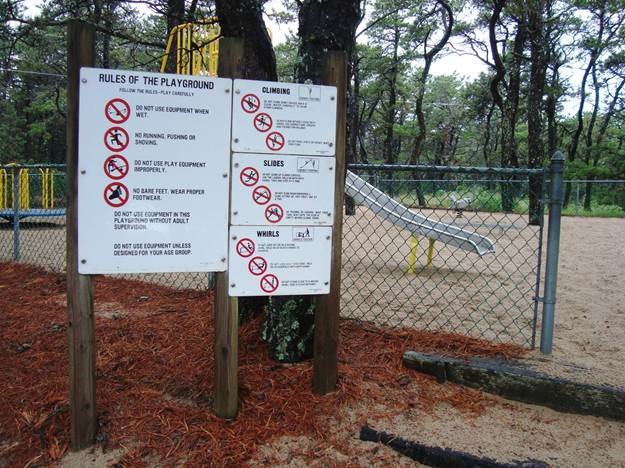
Nor was there anything in any CPD code stating that the park in question was designated for children under age 12. There were no signs at the playground stating the park was only for children under the age of 12. Which the court interpreted as: “Playgrounds are designed for children. What would prompt a 13-year-old child to observe a slide and think, “am I really the intended user of this slide?“
Because no one knew and because the park had no sign, there was no way the plaintiff could know that she was not supposed to use the slide. The court ruled.
We must reverse the trial court’s grant of summary judgment which was granted solely on the basis that a 13-year-old was not an intended user of the slide.
First, the defendant does not cite a case where a child was charged with the responsibility of knowing municipal ordinances, without a sign or other notice, nor can we find such a case.
Second, defendant failed to inform park users of any age, by any means, that this park and the slide were intended for children younger than age 12.
The appellate court sent the case back to the trial court.
So Now What?
If you have the ability to make rules, then follow the rules when you make rules, to make sure your rules are correctly in place. Under the law post your rules at the places, the rules were created to apply to so everyone knows the rules.
Realistically, if you want kids not to get hurt, rules and signs are not going to do it. The rules are there to protect the park, not the kids. How many kids read signs?
Are we going to have a new way of warning children? “Mom I’m going to out to play.” “OK dear, but be back before dark and make sure you read all the signs that may apply to you.”
|
Jim Moss is an attorney specializing in the legal issues of the outdoor recreation community. He represents guides, guide services, outfitters both as businesses and individuals and the products they use for their business. He has defended Mt. Everest guide services, summer camps, climbing rope manufacturers; avalanche beacon manufactures and many more manufacturers and outdoor industries. Contact Jim at Jim@Rec-Law.us |
Jim is the author or co-author of six books about the legal issues in the outdoor recreation world; the latest is Outdoor Recreation Insurance, Risk Management and Law.
To see Jim’s complete bio go here and to see his CV you can find it here. To find out the purpose of this website go here.
G-YQ06K3L262
What do you think? Leave a comment.
If you like this let your friends know or post it on FB, Twitter or LinkedIn
Author: Outdoor Recreation Insurance, Risk Management and Law

Outdoor Recreation Insurance, Risk Management and Law
Facebook Page: Outdoor Recreation & Adventure Travel Law
Email: Jim@Rec-Law.US
By Recreation Law Rec-law@recreation-law.com James H. Moss
@2014-2023 Summit Magic Publishing, LLC
#AdventureTourism, #AdventureTravelLaw, #AdventureTravelLawyer, #AttorneyatLaw, #Backpacking, #BicyclingLaw, #Camps, #ChallengeCourse, #ChallengeCourseLaw, #ChallengeCourseLawyer, #CyclingLaw, #FitnessLaw, #FitnessLawyer, #Hiking, #HumanPowered, #HumanPoweredRecreation, #IceClimbing, #JamesHMoss, #JimMoss, #Law, #Mountaineering, #Negligence, #OutdoorLaw, #OutdoorRecreationLaw, #OutsideLaw, #OutsideLawyer, #RecLaw, #Rec-Law, #RecLawBlog, #Rec-LawBlog, #RecLawyer, #RecreationalLawyer, #RecreationLaw, #RecreationLawBlog, #RecreationLawcom, #Recreation-Lawcom, #Recreation-Law.com, #RiskManagement, #RockClimbing, #RockClimbingLawyer, #RopesCourse, #RopesCourseLawyer, #SkiAreas, #Skiing, #SkiLaw, #Snowboarding, #SummerCamp, #Tourism, #TravelLaw, #YouthCamps, #ZipLineLawyer, CPD, Chicago Park District, Park, Slide, Ordinance, Signs, Warning Signs,
Lotz et al., v. The Claremont Club et al., 2013 Cal. App. Unpub. LEXIS 5748
Posted: December 12, 2014 Filed under: Assumption of the Risk, California, Health Club, Legal Case, Minors, Youth, Children, Release (pre-injury contract not to sue) | Tags: Ambiguous, Assumption of risk, Day Care, Dodgeball, Gross negligence, Gym, Health club, Release, Summary judgment Leave a commentLotz et al., v. The Claremont Club et al., 2013 Cal. App. Unpub. LEXIS 5748
Nicholas, a Minor, etc., Plaintiffs and Appellants, Defendants and Respondents.
B242399
COURT OF APPEAL OF CALIFORNIA, SECOND APPELLATE DISTRICT, DIVISION TWO
August 15, 2013, Opinion Filed
NOTICE: NOT TO BE PUBLISHED IN OFFICIAL REPORTS. CALIFORNIA RULES OF COURT, RULE 8.1115(a), PROHIBITS COURTS AND PARTIES FROM CITING OR RELYING ON OPINIONS NOT CERTIFIED FOR PUBLICATION OR ORDERED PUBLISHED, EXCEPT AS SPECIFIED BY RULE 8.1115(b). THIS OPINION HAS NOT BEEN CERTIFIED FOR PUBLICATION OR ORDERED PUBLISHED FOR THE PURPOSES OF RULE 8.1115.
PRIOR HISTORY: [*1]
APPEAL from a judgment of the Superior Court of Los Angeles County, No. KC061412, Peter J. Meeka, Judge.
DISPOSITION: Reversed and remanded.
CORE TERMS: dodgeball, triable, membership, ball, summary judgment, issues of fact, gross negligence, sport, playing, racquetball, played, inherent risk, hit, childcare, assumption of risk, ambiguity, risk of injury, risk of harm, rubber ball, matter of law, participating, aggressively, supervised, training, thrown, riding, player, risk doctrine, risk doctrine, evidence showed
COUNSEL: Magaña, Cathcart & McCarthy and Charles M. Finkel for Plaintiffs and Appellants.
Manning & Kass, Ellrod, Ramirez, Trester, Anthony J. Ellrod and David J. Wilson for Defendants and Respondents.
JUDGES: FERNS, J. *; ASHMANN-GERST, Acting P. J., CHAVEZ, J. concurred.
* Judge of the Los Angeles Superior Court, assigned by the Chief Justice pursuant to article VI, section 6 of the California Constitution.
OPINION BY: FERNS, J.
OPINION
The trial court granted summary judgment in favor of defendants and respondents The Claremont Club (Club) and Adam Qasem (Qasem) on the complaint brought by minor Nicholas Lotz (Nicholas) by and through his guardian ad litem Deborah Lotz (Deborah) and Deborah individually (sometimes collectively appellants). 1 Nicholas was injured in a dodgeball game that took place while he was in the Club’s childcare program. The trial court ruled that a release signed by Nicholas’s father barred appellants’ claims and there was no evidence showing the Club’s conduct amounted to gross negligence beyond the scope of the release. It further ruled the primary assumption of risk doctrine [*2] barred appellants’ claims.
1 We use first names for convenience only; no disrespect is intended.
We reverse. The evidence offered by appellants showed there were triable issues of material fact regarding the scope and application of multiple releases, whether the Club’s and Qasem’s conduct constituted gross negligence and whether their conduct increased the risk of harm inherent in the game of dodgeball.
FACTUAL AND PROCEDURAL BACKGROUND
Club Membership.
In 2001, Thomas Lotz (Thomas) signed The Claremont Club Membership Agreement (Membership Agreement) and completed a membership information form indicating that he was seeking a family membership for himself, Deborah and their two children. On the information form, Thomas put a check mark by some of the specified sports and activities in which he and his family were interested in participating. Dodgeball was not included among the list of activities.
The Membership Agreement included a section entitled “Waiver of Liability” that provided in relevant part: “IT IS EXPRESSLY AGREED THAT USE OF THE CLUB FACILITIES, PARTICIPATION IN CLUB-SPONSORED OUTSIDE ACTIVITIES OR EVENTS AND TRANSPORTATION PROVIDED BY THE CLUB SHALL BE UNDERTAKEN BY A MEMBER [*3] OR GUEST AT HIS/HER SOLE RISK AND THE CLUB SHALL NOT BE LIABLE FOR ANY INJURIES OR ANY DAMAGE TO ANY MEMBER OR GUEST . . . .” The provision further stated that the member voluntarily assumed the risk of personal injury and released the Club and its employees from every demand, claim or liability on account of any personal injury.
On the same day he signed the Membership Agreement, Thomas signed a separate document captioned Waiver of Liability, Assumption of Risk and Indemnity Agreement (Waiver) that contained a provision stating: “This Agreement constitutes my sole and only agreement respecting release, waiver of liability, assumption of the risk, and indemnity concerning my involvement in The Claremont Club.” The Waiver further provided in part: “I, for myself, my spouse, if any, my heirs, personal representative or assigns, and anyone claiming through or under me do hereby release, waive, discharge, and covenant not to sue The Claremont Club . . . for liability from any and all claims including the negligence of the Claremont Club, resulting in damages or personal injury . . . .” The Waiver further identified certain activities provided at the Club–again excluding dodgeball–together [*4] with the risks arising therefrom, and required Thomas to assert that his participation was voluntary and “that I knowingly assume all such risks.” The Waiver’s concluding paragraph provided for Thomas’s understanding “THAT I AM GIVING UP SUBSTANTIAL RIGHTS, INCLUDING MY RIGHT TO SUE.”
Together with a Club attorney, Club president and chief executive officer Mike Alpert helped prepare the Waiver. According to Alpert, only the Waiver–not the waiver of liability contained in the Membership Agreement–was in full force and effect at the time Thomas signed both documents. None of the documents that Thomas and Deborah signed in connection with their Club membership informed them that dodgeball would be played on Club premises.
Nicholas Is Injured in a Dodgeball Game at the Club.
The “InZone” was part of the Club’s childcare department; it provided a clubhouse environment for older children that included ping pong, foosball and video games. In-house sports and a specialized fitness room were also available as part of the InZone. A document provided to parents describing InZone activities identified a number of sports in which a child might participate; it did not mention dodgeball.
On April 13, [*5] 2005, Deborah checked 10-year-old Nicholas into the InZone between 4:30 and 5:00 p.m. No one advised Deborah or Thomas that Nicholas might be playing dodgeball as part of the InZone activities. That day, Club employee Qasem was scheduled to work at the front desk. Eighteen-year-old Qasem had worked part-time at the Club for approximately one year as a lifeguard, weight room attendant and at the front desk. He had never worked in the InZone and the Club had not provided him with any training to work with children.
At some point during his shift, Qasem left the front desk to work in the children’s fitness room. He was the only individual supervising approximately eight to 15 children, including Nicholas. One of the children suggested the group play dodgeball, and Qasem agreed. He took the children to the Club’s racquetball court because he had observed dodgeball being played there once or twice. The Club’s written policies, however, stated “[o]nly racquetball, handball, squash and Wally ball may be played on the racquetball courts.” Qasem had never played dodgeball at the Club, nor had he ever seen any written rules concerning dodgeball.
Though Qasem was uncertain whether he provided the [*6] children with any rules before they began playing the game, he may have told them to throw the ball below their waists. During the game, anywhere from three to six balls were being thrown at one time; each rubber ball was filled with air and was about the size of a soccer ball. About 20 minutes into the game, Qasem threw a ball using a sidearm motion hard and fast toward Nicholas. The ball hit Nicholas’s face and slammed his head into the wall behind him, leaving tooth marks on the wall. Nicholas suffered multiple dental injuries as a result of being hit by the ball.
At the time of the game, Qasem was six feet tall and weighed approximately 145 pounds. According to Nicholas, Qasem had been playing aggressively throughout the game. By playing in the game, Qasem had also violated the Club’s then unwritten policy that supervisors not participate in dodgeball games with the children. No one had previously been injured in a dodgeball game at the Club. After that game, Qasem was disciplined for failing to follow childcare policies and procedures, and one of his superiors instructed him not to play dodgeball at the Club.
Nicholas had previously played dodgeball at school. Though the players [*7] were instructed to not throw the ball at other players’ heads, he understood there was some risk of being hit in the head with the ball. The balls used at school, however, were similar to a Nerf ball and softer than those used at the InZone. Had Thomas and Deborah been advised that Nicholas would be playing dodgeball on a racquetball court with rubber balls, they would not have given their permission for him to do so.
The Intramural Rules of Dodgeball provide the game is one in which players try to hit others with a ball and avoid being hit themselves. “The main objective is to eliminate all members of the opposing team by hitting them with thrown balls, catching a ball thrown by a member of the opposing team, or forcing them outside of the court boundaries.” The National Dodgeball League Rules and Regulations of Play specify that a player committing a “headshot”–hitting another player in the head by a high thrown ball–will be deemed out of the game.
The Pleadings and Summary Judgment.
In June 2011, appellants filed their complaint alleging negligence and gross negligence and seeking general and special damages. They alleged that Nicholas was injured as a result of the Club’s negligently [*8] and recklessly “a. hiring, employing, training, entrusting, instructing, and supervising defendant ADAM QASEM; [¶] b. failing to adequately [] protect children under the care of defendant ADAM QASEM; [¶] c. participating in a game of dodge ball in an unreasonably forceful and dangerous manner so as to endanger the health, safety and welfare of children placed by their parents into the care of defendants.”
In December 2011, the Club and Qasem moved for summary judgment. They argued that appellants’ negligence claims were barred by Thomas’s execution of a release and express assumption of risk, and according to the assumption of risk doctrine. They further argued their actions did not rise to the level of gross negligence. In support of their motion, they submitted the Membership agreement, appellants’ discovery responses, deposition excerpts and Qasem’s declaration. They also sought judicial notice of several principles related to dodgeball rules and manner of play.
Appellants opposed the motion and filed evidentiary objections. They argued that triable issues of material fact existed concerning the scope of the Waiver, whether the Club’s conduct amounted to gross negligence and whether [*9] Nicholas’s injury was the result of an inherent risk of the game of dodgeball. They offered deposition excerpts, Club policies, medical records and several declarations in support of their arguments. Sports and Recreational Consultants president Steve Bernheim opined that the Club “did not take the proper measures to protect the children who were in its care, custody and control during the dodgeball game in which Nicholas Lotz was injured.” More specifically, the children were not provided with game-appropriate rules, the racquetball court was an insufficient space, use of the rubber balls was inappropriate and an adult should not have been playing with the children. He further opined that Qasem acted recklessly and that his conduct, coupled with the other conditions of the game, increased the risks inherent in the game of dodgeball and were outside the range of ordinary activity associated with the sport.
The Club replied and also filed evidentiary objections. At a March 2012 hearing, the trial court granted the motion. Though the trial court edited the proposed judgment to eliminate any reasons for its ruling, at the hearing the trial court first referred to childhood dodgeball experience [*10] as the basis for its decision: “When I went to school, we called it Warball, and we didn’t use Nerf balls because there weren’t any. It was a ball. When it hit you, it stung. And we all knew that. Everybody knew it. And it was just one of those games you played in school, and high school for that matter.” Turning to the evidence, the trial court construed the Waiver to apply to Thomas’s family members as well as Thomas, reasoning that the Club would have expected Thomas to be executing a release on behalf of all family members when he joined. The trial court further explained that even if it were to ignore the Waiver, appellants’ claims would be barred by the assumption of risk doctrine. It further found that the Club’s and Qasem’s conduct did not rise to the level of gross negligence as a matter of law, reasoning there was no evidence that Qasem was trying to injure Nicholas and that such an injury could have occurred in the context of any type of sport. It did not rule on any of the evidentiary objections.
Judgment was entered in June 2012, and this appeal followed.
DISCUSSION
Appellants maintain that the trial court erred in granting summary judgment and assert they offered evidence [*11] sufficient to create triable issues of fact concerning the scope and application of the Waiver, the existence of gross negligence and the application of the assumption of risk defense. We agree that triable issues of fact preclude the granting of summary judgment.
I. Standard of Review.
We review a grant of summary judgment de novo and independently determine whether the facts not subject to triable dispute warrant judgment for the moving party as a matter of law. (Intel Corp. v. Hamidi (2003) 30 Cal.4th 1342, 1348; Aguilar v. Atlantic Richfield Co. (2001) 25 Cal.4th 826, 849-850.) To secure summary judgment, the moving defendant must show that one or more elements of the cause of action cannot be established, or that there is a complete defense to the cause of action, and that it “is entitled to judgment as a matter of law.” (Aguilar v. Atlantic Richfield Co., supra, at p. 850.) Once that burden is met, the burden “shifts to the [other party] to show that a triable issue of one or more material facts exists as to that cause of action.” (Code Civ. Proc., § 437c, subd. (p)(2); Aguilar v. Atlantic Richfield Co., supra, at p. 850.)
We assume the role of the trial court and redetermine the [*12] merits of the motion. (Barber v. Marina Sailing, Inc. (1995) 36 Cal.App.4th 558, 562.) “In doing so, we must strictly scrutinize the moving party’s papers. [Citation.] The declarations of the party opposing summary judgment, however, are liberally construed to determine the existence of triable issues of fact. [Citation.] All doubts as to whether any material, triable issues of fact exist are to be resolved in favor of the party opposing summary judgment. [Citation.]” (Ibid.; accord, Hamburg v. Wal-Mart Stores, Inc. (2004) 116 Cal.App.4th 497, 502.) “Because a summary judgment denies the adversary party a trial, it should be granted with caution. [Citation.]” (Acosta v. Glenfed Development Corp. (2005) 128 Cal.App.4th 1278, 1292.) The court’s role is to focus “on issue finding; it does not resolve issues of fact. The court seeks to find contradictions in the evidence, or inferences reasonably deducible from the evidence, which raise a triable issue of material fact.” (Ibid.)
II. Appellants Raised Triable Issues of Fact as to Whether the Waiver Applied to Release Their Claims.
At the hearing on the motion, the trial court indicated that one basis for its ruling was the application of [*13] a written release. It stated: “Here, dad is signing the release on behalf of the family. Mom could have signed the release on behalf of the family and had a check and paid for the membership. And even though there are some slight twists and turns here, I guess nothing is ever completely crystal clear. I think the release really hurts the plaintiff or plaintiffs here.” Though the trial court’s comments fail to demonstrate whether it relied on the Membership Agreement or the Waiver as providing the operative release, the Club argues on appeal that the release contained in the Membership Agreement was clear and unambiguous, and applied to release appellants’ claims.
“California courts require a high degree of clarity and specificity in a [r]elease in order to find that it relieves a party from liability for its own negligence.” (Cohen v. Five Brooks Stable (2008) 159 Cal.App.4th 1476, 1488 (Cohen).) Thus, “to be effective, an agreement which purports to release, indemnify or exculpate the party who prepared it from liability for that party’s own negligence or tortious conduct must be clear, explicit and comprehensible in each of its essential details. Such an agreement, read as a whole, [*14] must clearly notify the prospective releaser or indemnitor of the effect of signing the agreement.” (Ferrell v. Southern Nevada Off-Road Enthusiasts, Ltd. (1983) 147 Cal.App.3d 309, 318.) Waiver and release forms are strictly construed against the defendant. (Lund v. Bally’s Aerobic Plus, Inc. (2000) 78 Cal.App.4th 733, 738.) But “a release need not achieve perfection” to be effective. (National & Internat. Brotherhood of Street Racers, Inc. v. Superior Court (1989) 215 Cal.App.3d 934, 938.) A release is sufficient if it “‘constitutes a clear and unequivocal waiver with specific reference to a defendant’s negligence.'” (Paralift, Inc. v. Superior Court (1993) 23 Cal.App.4th 748, 755.)
Here, Thomas represented in his membership application that he sought Club membership on behalf of his family. The release contained in the Membership Agreement provided that the member and guests assumed the risk of Club activities and released the Club from liability for participation in Club activities. A contract in which a party expressly assumes a risk of injury is, if applicable, a complete defense to a negligence action. (See Knight v. Jewett (1992) 3 Cal.4th 296, 308, fn. 4 (Knight); Sweat v. Big Time Auto Racing, Inc. (2004) 117 Cal.App.4th 1301, 1304.) [*15] Moreover, it is well settled a parent may execute a release on behalf of his or her child. (Aaris v. Las Virgenes Unified School Dist. (1998) 64 Cal.App.4th 1112, 1120 (Aaris); Hohe v. San Diego Unified Sch. Dist. (1990) 224 Cal.App.3d 1559, 1565.) By offering evidence of the Membership Agreement, the Club met its threshold burden to demonstrate a complete defense to appellants’ negligence claims.
In contrast to the trial court, however, we conclude the evidence offered by appellants showing that the release was not “crystal clear” satisfied their burden to demonstrate triable issues of material fact. As summarized in Benedek v. PLC Santa Monica (2002) 104 Cal.App.4th 1351, 1357: “The determination of whether a release contains ambiguities is a matter of contractual construction. [Citation.] ‘An ambiguity exists when a party can identify an alternative, semantically reasonable, candidate of meaning of a writing. [Citations.] An ambiguity can be patent, arising from the face of the writing, or latent, based on extrinsic evidence.’ [Citation.] The circumstances under which a release is executed can give rise to an ambiguity that is not apparent on the face of the release. [Citation.] [*16] If an ambiguity as to the scope of the release exists, it should normally be construed against the drafter. [Citations.]”
Here, appellants demonstrated an ambiguity by offering evidence that the Waiver–not the Membership Agreement–contained the operative release. The Waiver contained language effectively negating any other release, providing: “This Agreement constitutes my sole and only agreement respecting release, waiver of liability, assumption of the risk, and indemnity concerning my involvement in The Claremont Club. Any prior written or oral agreements, promises, representations concerning the subject matter contained in this Agreement and not expressly set forth in this Agreement have no force or effect.” Club president Alpert testified that only the Waiver was the operative agreement at the time Thomas joined the Club. The Waiver, however, inconsistently provided in one paragraph that Thomas was giving up his right to sue on behalf of his spouse and heirs, and in another paragraph that he was relinquishing only his personal right to sue. Other language in the Waiver that “I hereby assert that my participation is voluntary and that I knowingly assume all such risks” likewise [*17] suggested that the Waiver was intended to be personal only. Given appellants’ identification of an “alternative, semantically reasonable” construction of the Waiver, the evidence created a triable issue of fact concerning whether and to what extent the Waiver applied to appellants’ claims. (See Solis v. Kirkwood Resort Co. (2001) 94 Cal.App.4th 354, 360.)
Beyond the issue of whether the Waiver or the Membership Agreement contained the operative release, appellants demonstrated a triable issue of fact as to whether the language of either document contemplated the type of injuries suffered by Nicholas. Both the Membership Agreement and the Waiver released the Club from liability for personal injury from Club activities. “‘Where a participant in an activity has expressly released the defendant from responsibility for the consequences of any act of negligence, “the law imposes no requirement that [the participant] have had a specific knowledge of the particular risk which resulted in his death [or injury.]” . . . Not every possible specific act of negligence by the defendant must be spelled out in the agreement or discussed by the parties. . . . Where a release of all liability for any [*18] act of negligence is given, the release applies to any such negligent act, whatever it may have been. . . . “It is only necessary that the act of negligence, which results in injury to the releasor, be reasonably related to the object or purpose for which the release is given.“‘ [Citation.]” (Leon v. Family Fitness Center (#107), Inc. (1998) 61 Cal.App.4th 1227, 1234-1235 (Leon).) 2
2 The Leon court separately evaluated an assumption of risk provision and a general release in a health club membership agreement. (Leon, supra, 61 Cal.App.4th at pp. 1234, 1235.) It reasoned that for an assumption of the risk provision to be effective, “‘it must also appear that its terms were intended by both parties to apply to the particular conduct of the defendant which has caused the harm.'” (Id. at p. 1234.) We find this analysis sufficiently similar to that required for a general release to engage in a single evaluation.
Appellants offered evidence creating a triable issue of fact as to whether an injury from a child playing dodgeball was sufficiently related to the purpose of the release. Neither Thomas nor Deborah were ever informed that Nicholas would be playing dodgeball at the Club. Dodgeball [*19] was not identified as a Club activity in any of the Club materials. It was not listed as an activity in either the Membership Agreement or the Waiver. It did not appear on the list of Club activities in the membership information form. According to the Club’s written policies, it was not among the activities permitted to be played on the Club’s racquetball courts. Likewise, the Club maintained a policy to preclude supervisors from engaging in dodgeball games with children.
These circumstances are analogous to those in Cohen, supra, 159 Cal.App.4th 1476. There, the plaintiff was injured during a horseback ride when the guide unexpectedly caused his horse to gallop, knowing that it would cause the horses following to do the same, and the plaintiff was unable to control her galloping horse. (Id. at p. 1480.) Before riding, the plaintiff had signed a release that described some but not all of the risks inherent in horseback riding and provided that she agreed “‘to assume responsibility for the risks identified herein and those risks not specifically identified.‘ (Italics added.)” (Id. at p. 1486.) Finding this language unambiguous, the trial court granted summary judgment. (Id. at pp. 1482-1483.) [*20] The appellate court reversed, reasoning the exculpatory provision was problematic, as “[t]he ‘risks not specifically identified’ could refer to the risks inherent in horseback riding left unidentified by the phrase ‘some, but not all,’ which seems to us the most reasonable assumption, but it might also refer to risks arising out of respondent’s negligence that increase[] the inherent risks.” (Id. at p. 1486.) Stated another way, the court explained that “[t]he Release presented to appellant clearly does not unambiguously, let alone explicitly, release respondent from liability for injuries caused by its negligence or that of its agents and employees which increase a risk inherent in horseback riding.” (Id. at p. 1488.)
At a minimum, appellants’ evidence that dodgeball was an undisclosed risk and an activity contrary to the Club’s written policies raised a triable issue of fact as to whether it was a risk that was reasonably related to the purpose for which any release was given. Evidence of Qasem’s conduct likewise raised a triable issue of fact as to whether such a risk was encompassed by the Waiver. (See Cohen, supra, 159 Cal.App.4th at p. 1489 [“Nothing in the Release clearly, unambiguously, [*21] and explicitly indicates that it applies to risks and dangers attributable to respondent’s negligence or that of an employee that may not be inherent in supervised recreational trail riding,” italics omitted]; see also Sweat v. Big Time Auto Racing, Inc., supra, 117 Cal.App.4th at p. 1308 [release in favor of racetrack owner for injuries suffered while in a racetrack’s restricted area did not apply to injuries sustained after defectively constructed bleachers collapsed]; Leon, supra, 61 Cal.App.4th at p. 1235 [release that allowed the plaintiff to engage in fitness activities at a health club did not apply to injuries from a collapsed sauna bench].)
On the other hand, the circumstances here bear no similarity to those in Aaris, supra, 64 Cal.App.4th 1112, a case on which the Club relies. There, the court found that a high school cheerleader and her family assumed the risk of injuries resulting from cheerleading activities. On the basis of that finding, the court also affirmed summary judgment on the ground that a release of liability for school activities barred any claim for injuries. The court reasoned that the assumption of risk doctrine “embodies the legal conclusion that defendant [*22] owed no duty to protect appellant from the risk of harm inherent in the athletic activity. [Citation.] There being no duty, there was no negligence.” (Id. at p. 1120.) Ignoring that the Aaris court’s holding was based on a finding of no negligence rather than any application of the release, the Club emphasizes that the release applied notwithstanding its failure to specify “cheerleading,” and argues that the Membership Agreement’s and Waiver’s references to Club activities must therefore similarly be construed to encompass dodgeball. But in Aaris, the only reasonable inference to be drawn from the evidence was that the sole purpose of the release was to address injuries resulting from cheerleading. Here, Thomas and Deborah did not even know that Nicholas would be participating in a dodgeball game. Moreover, the trial court in Aaris ruled that the undisputed evidence showed “‘that the instructor did not increase the risk of harm inherent in the activity, the participants received adequate and proper[] training in technique and safety, and they were properly and reasonably supervised.'” (Id. at p. 1117.) In sharp contrast, appellants’ evidence showed that Qasem should not have been playing [*23] dodgeball and played aggressively, he violated the Club’s written policy concerning use of the racquetball court and no one else was supervising the game.
Finally, appellants offered evidence to show that the InZone was part of the Club’s childcare department. On the day of the dodgeball game, Deborah signed Nicholas in to the Club’s InZone program. Club wellness director Denise Johnson testified that she was aware children played dodgeball on the racquetball courts while being supervised under the childcare department. To the extent that the Club’s Membership Agreement or Waiver purported to release it from liability for injuries occurring in its childcare program, appellants raised a triable issue of fact as to whether such an agreement would be void against public policy. (Gavin W. v. YMCA of Metropolitan Los Angeles (2003) 106 Cal.App.4th 662, 676 [“we hold that exculpatory agreements that purport to relieve child care providers of liability for their own negligence are void as against public policy”].)
In sum, the evidence offered on summary judgment demonstrated that the Membership Agreement and/or the Waiver did not clearly and explicitly release the Club from liability for Nicholas’s [*24] injuries. In view of the ambiguities concerning whether the Membership Agreement or the Waiver applied, whether the language in either document was sufficient to cover the Club’s conduct and whether any release violated public policy, a trier of fact could find that the Club was not released from liability. (See Zipusch v. LA Workout, Inc. (2007) 155 Cal.App.4th 1281, 1288 [“if a release is ambiguous, and it is not clear the parties contemplated redistributing the risk causing the plaintiff’s injury, then the contractual ambiguity should be construed against the drafter, voiding the purported release”].) The undisputed evidence failed to show the Club and Qasem were absolved from liability as a matter of law according to the Membership Agreement or the Waiver.
III. Appellants Raised Triable Issues of Fact Whether the Club Was Liable for Gross Negligence.
In City of Santa Barbara v. Superior Court (2007) 41 Cal.4th 747, 751 (Santa Barbara), our State’s highest court held “that an agreement made in the context of sports or recreational programs or services, purporting to release liability for future gross negligence, generally is unenforceable as a matter of public policy.” Relying on Santa [*25] Barbara, appellants opposed the Club’s summary judgment motion on the alternative ground that, even if the Club’s most comprehensive release language was unambiguous, there was a triable issue of fact as to whether the Club’s conduct amounted to gross negligence. The trial court ruled: “It is not gross negligence. He wasn’t trying to injure the child on purpose, any more than a child would be injured playing hockey or soccer, or anything like that.” Again, we disagree.
California courts define “‘gross negligence'” “as either a ‘”‘want of even scant care'”‘ or ‘”‘an extreme departure from the ordinary standard of conduct.'”‘ [Citations.]” (Santa Barbara, supra, 41 Cal.4th at p. 754; accord, Eriksson v. Nunnink (2011) 191 Cal.App.4th 826, 857.) Gross negligence “connotes such a lack of care as may be presumed to indicate a passive and indifferent attitude toward results.” (Calvillo-Silva v. Home Grocery (1998) 19 Cal.4th 714, 729, disapproved on other grounds in Aguilar v. Atlantic Richfield Co., supra, 25 Cal.4th at p. 853, fn. 19.) In contrast to willful misconduct, gross negligence does not require an intent to do harm or to act with absolute disregard of the consequences. (Meek v. Fowler (1935) 3 Cal.2d 420, 425; [*26] see also Hawaiian Pineapple Co. v. Ind. Acc. Com. (1953) 40 Cal.2d 656, 662 [“While gross negligence may involve an intent to perform the act or omission, wilful misconduct involves the further intent that the performance be harmful or that it be done with a positive, active and absolute disregard of the consequences”].) Though not always, “[g]enerally it is a triable issue of fact whether there has been such a lack of care as to constitute gross negligence. [Citations.]” (Decker v. City of Imperial Beach (1989) 209 Cal.App.3d 349, 358; accord, Santa Barbara, supra, at pp. 767, 781.)
Appellants offered sufficient evidence to create a triable issue of fact as to whether the Club’s and Qasem’s conduct amounted to gross negligence. According to the undisputed evidence, while the Club’s policies prohibited dodgeball being played on the racquetball courts, Club employees–including the childcare director–knew the courts were used for children’s dodgeball games. Nonetheless, none of the Club’s materials identified dodgeball as an available activity. Consistent with the Club’s failure to acknowledge dodgeball as an ongoing activity, it failed to promulgate rules to insure the game was played [*27] safely. When Nicholas was dropped off at the InZone program, no one advised his parents that he might play dodgeball. In this particular instance, children initiated a dodgeball game while being supervised by an 18-year-old front desk clerk who had no childcare training. Qasem selected inflated rubber balls for the game and participated aggressively in the game with the children, even though the Club’s policy was that supervisors not play dodgeball. Nicholas was injured after Qasem threw the ball extremely hard and extremely fast, using a sidearm motion.
On the basis of this evidence, appellants offered Bernheim’s expert opinion that “the injury to Nicholas Lotz occurred during an extreme departure from what must be considered as the ordinary standard of conduct when children are playing dodgeball and are supposed to be . . . supervised.” We agree that appellants’ evidence was sufficient to raise a triable issue of fact as to whether the Club’s and Qasem’s conduct was an extreme departure from ordinary care or, at a minimum, demonstrated passivity and indifference toward results. A trier of fact could find gross negligence on the basis of the Club’s failure to address the repeated violation [*28] of its own policy prohibiting dodgeball play on the racquetball courts, failure to implement rules or policies designed to protect those playing dodgeball and failure to provide any training to individuals assigned to supervise the children in its childcare program. Triable issues existed as to whether the Club’s and Qasem’s conduct was grossly negligent and therefore outside the scope of any release in either the Membership Agreement or the Waiver.
IV. Appellants Raised Triable Issues of Fact Whether the Assumption of Risk Doctrine Barred Liability.
As a further basis for granting summary judgment, the trial court determined that the Club met its burden to show the primary assumption of risk doctrine was a viable defense and that appellants failed to offer any effective rebuttal. It analogized the circumstances here to those in a previous case in which it found the doctrine barred recovery to a high school student injured during a soccer game. We fail to see the analogy.
“Primary assumption of risk occurs where a plaintiff voluntarily participates in a sporting event or activity involving certain inherent risks. For example, an errantly thrown ball in baseball or a carelessly extended [*29] elbow in basketball are considered inherent risks of those respective sports. [Citation.] Primary assumption of risk is a complete bar to recovery. [Citation.] [¶] Primary assumption of risk is merely another way of saying no duty of care is owed as to risks inherent in a given sport or activity. The overriding consideration in the application of this principle is to avoid imposing a duty which might chill vigorous participation in the sport and thereby alter its fundamental nature. [Citation.]” (Wattenbarger v. Cincinnati Reds, Inc. (1994) 28 Cal.App.4th 746, 751-752, citing Knight, supra, 3 Cal.4th 296.) “Knight however does not grant unbridled legal immunity to all defendants participating in sporting activity. The Supreme Court has stated that ‘. . . it is well established that defendants generally do have a duty to use due care not to increase the risks to a participant over and above those inherent in the sport.‘ ([Knight, supra,] 3 Cal.4th at pp. 315-316, italics added.) Thus, even though ‘defendants generally have no legal duty to eliminate (or protect a plaintiff against) risks inherent in the sport itself,’ they may not increase the likelihood of injury above that which is [*30] inherent. (Id. at p. 315.)” (Campbell v. Derylo (1999) 75 Cal.App.4th 823, 827.) Thus, “when the plaintiff claims the defendant’s conduct increased the inherent risks of a sport, summary judgment on primary assumption of risk grounds is unavailable unless the defendant disproves the theory or establishes a lack of causation. [Citations.]” (Huff v. Wilkins (2006) 138 Cal.App.4th 732, 740.)
Much of appellants’ evidence that we deemed sufficient to raise a triable issue of fact on the question of gross negligence likewise created a triable issue as to whether the Club and Qasem increased the risk of harm inherent in the game of dodgeball. 3 Certainly, being hit by a ball is one of the objectives of and hence an inherent risk in the game of dodgeball. But appellants’ evidence tended to show that the Club and Qasem increased that risk in a number of ways, including by playing on an enclosed racquetball court which was neither intended nor permitted to be used for dodgeball; by selecting rubber balls for the game; by allowing an adult untrained in childcare not only to participate in the game with the children but also to abdicate any supervisory role over them during the game; and by enabling [*31] that adult to play aggressively with the children. Given the totality of the circumstances, we cannot say, as a matter of law, that Nicholas assumed the risk of being hit in the head with a ball.
3 We acknowledge that the application of the primary assumption of risk doctrine is a question of law. (Knight, supra, 3 Cal.4th at p. 313.) But where a defendant engages in conduct that is not an inherent risk of the sport and the imposition of a duty of care will neither alter the nature of nor chill participation in the sport, the question becomes one of ordinary negligence, with the remaining elements beyond duty to be determined by a trier of fact. (Yancey v. Superior Court (1994) 28 Cal.App.4th 558, 565-567.)
Other courts have similarly reversed a grant of summary judgment where the plaintiff’s evidence raised a triable issue of fact as to whether the defendant’s conduct increased the inherent risks in a sport or other recreational activity. Lowe v. California League of Prof. Baseball (1997) 56 Cal.App.4th 112 is particularly instructive. There, the plaintiff filed suit after he was injured by a foul ball while watching a baseball game, and the trial court granted summary judgment, finding [*32] the doctrine of primary assumption of risk barred his claims. (Id. at p. 120.) In reversing, the appellate court relied on evidence showing the plaintiff was hit when he turned toward a team mascot who had repeatedly tapped his shoulder. (Id. at pp. 117-118, 123.) The court explained that while foul balls represent an inherent risk to spectators attending a baseball game, “we hold that the antics of the mascot are not an essential or integral part of the playing of a baseball game. In short, the game can be played in the absence of such antics. Moreover, whether such antics increased the inherent risk to plaintiff is an issue of fact to be resolved at trial.” (Id. at p. 123; see also Vine v. Bear Valley Ski Co. (2004) 118 Cal.App.4th 577, 591 [though skiers assume the risk of injury from the sport, triable issue of fact existed whether ski resort’s jump design increased the risk of harm]; Morgan v. Fuji Country USA, Inc. (1995) 34 Cal.App.4th 127, 134 [while a golfer assumes the risk of being hit by a golf ball, golf course owner owes a duty to minimize that risk, and the plaintiff raised a triable issue of fact as to whether that duty was breached where evidence showed the design [*33] of certain holes may have increased that risk].)
We find no merit to the Club’s and Qasem’s argument that appellants’ evidence demonstrated merely that their conduct may have increased the severity of Nicholas’s injuries as opposed to increasing the risk of injury. In Calhoon v. Lewis (2000) 81 Cal.App.4th 108, the plaintiff suffered injury when he fell off his skateboard and hit a metal pipe protruding from a planter in the defendants’ driveway. Finding the primary assumption of risk doctrine barred his claims, the court rejected the plaintiff’s argument that the concealed metal pipe increased his risk of harm: “[The plaintiff] was injured because he fell. As [he] concedes, falling is an inherent risk of skateboarding, and the presence of the pipe or the planter had nothing to do with his falling down. The fact that [his] injuries were more severe than they would have been if the pipe had not been in the planter does not make the assumption of risk doctrine inapplicable. The Knight exception applies when the defendant increased the risk of injury beyond that inherent in the sport, not when the defendant’s conduct may have increased the severity of the injury suffered.” (Id. at p. 116.) [*34] Here, in contrast, appellants’ evidence showed that the Club and Qasem increased the risk of injury by initiating the dodgeball game in which Nicholas participated. This was not the type of situation where Nicholas would have been playing dodgeball absent the Club’s and Qasem’s involvement. Moreover, the evidence raised a triable issue of fact as to whether the Club and Qasem increased the risk of injury by permitting dodgeball play on the racquetball court, by failing to adopt rules for safe play, by Qasem’s failing to act as a supervisor during the game, by his selecting rubber balls for the game and by his participating aggressively in the game. The Club and Qasem were not entitled to summary judgment on the ground the primary assumption of risk doctrine barred appellants’ claims.
DISPOSITION
The judgment is reversed and the matter is remanded with directions for the trial court to vacate its order granting summary judgment and to enter a new order denying summary judgment. Appellants are entitled to their costs on appeal.
, J. *
* Judge of the Los Angeles Superior Court, assigned by the Chief Justice pursuant to article VI, section 6 of the California Constitution.
FERNS
We concur:
, Acting [*35] P. J. ASHMANN-GERST , J. CHAVEZ
Berry v. Greater Park City Company, 2007 UT 87; 171 P.3d 442; 590 Utah Adv. Rep. 3; 2007 Utah LEXIS 192
Posted: November 9, 2014 Filed under: Legal Case, Release (pre-injury contract not to sue), Ski Area, Skiing / Snow Boarding, Utah | Tags: Bone fracture, Park City, Park City Mountain Resort, Release, ski area, Ski binding, skiing, Summary judgment, United States Ski Team, UT, Utah Leave a commentBerry v. Greater Park City Company, 2007 UT 87; 171 P.3d 442; 590 Utah Adv. Rep. 3; 2007 Utah LEXIS 192
James Gordon Berry V, Plaintiff and Appellant, v. Greater Park City Company dba Park City Mountain Resort, a Utah corporation; CRE Management, Inc., dba Milosport; and International Ski Federation, Defendants and Appellee.
No. 20051057
SUPREME COURT OF UTAH
2007 UT 87; 171 P.3d 442; 590 Utah Adv. Rep. 3; 2007 Utah LEXIS 192
October 30, 2007, Filed
December 6, 2007, Released for Publication
PRIOR HISTORY: [***1]
Third District, Salt Lake. The Honorable J. Dennis Frederick. No. 030904411.
COUNSEL: Harold G. Christensen, Richard A. Van Wagoner, Julianne Blanch, Ryan B. Bell, Salt Lake City, for appellant.
Gordon Strachan, Kevin J. Simon, Park City, for appellee.
JUDGES: NEHRING, Justice. Chief Justice Durham, Associate Chief Justice Wilkins, Justice Durrant, and Justice Parrish concur in Justice Nehring’s opinion.
OPINION BY: NEHRING
OPINION
[**444] NEHRING, Justice:
[*P1] James Gordon “V.J.” Berry was seriously injured while competing in a ski race. He sued the parties connected with the event, including Park City Mountain Resort (PCMR), the site where the race was held. The district court granted PCMR’s motions for summary judgment and dismissed Mr. Berry’s claims for ordinary negligence, gross negligence, and common law strict liability. We affirm in part and hold that Mr. Berry’s preinjury release of PCMR is enforceable and that the district court properly determined that Mr. Berry’s strict liability claim fails as a matter of law. We further hold that the district court improperly awarded PCMR summary judgment on Mr. Berry’s gross negligence claim and therefore reverse and remand for further proceedings.
FACTUAL AND PROCEDURAL BACKGROUND
[*P2] In February [***2] 2001, Mr. Berry, an expert skier then twenty-six years of age, entered a skiercross race promoted as the King of the Wasatch, which was constructed on one of PCMR’s ski runs. In the skiercross race format, four racers simultaneously descend a course that features difficult turns and tabletop jumps. The racers compete against each other as they ski down the mountain to complete the course first. A series of elimination heats determines the race winner. On Mr. Berry’s fourth trip over the course, he attempted to negotiate the course’s first tabletop jump. Upon landing from the jump, Mr. Berry fell and fractured his neck, an injury that resulted in permanent paralysis.
[*P3] Before being allowed to participate in the contest, competitors like Mr. Berry were required to sign a Release of Liability and Indemnity Agreement. Although Mr. Berry did not read the agreement, he signed it twelve days before the race. The agreement purported to release PCMR from claims arising from its negligence, stating:
In consideration for being permitted to participate in the Event, I agree to release from any legal liability, agree not to sue and further agree to defend, indemnify and hold harmless Park City Mountain [***3] Resort . . . the race organizers, sponsors and all of their officers, agents and employees for injury or death resulting from participation in the Event, regardless of the cause, including the negligence of the above referenced parties and their employees or agents.
[*P4] PCMR introduced several measures aimed at enhancing the safety of contest participants like Mr. Berry. Blue paint marked the take-off point of the tabletop jumps. The course was built with speed gates and berms uphill of the jump in order to slow and control the speed of racers on their approach. Safety barriers enclosed the racecourse and closed it to noncompetitors. Racers were required to wear helmets and familiarize themselves with the course by inspecting its features while twice “slipping” its length. Competitors were also permitted to take practice runs of the course on the day of the race.
[*P5] Naturally occurring conditions compromised these measures on the day of the race. The light was “flat,” which hindered depth perception and made it difficult for participants to make out aspects of the course. The snow-covered surface of the course was packed particularly hard.
[*P6] Mr. Berry offered expert opinion that pointed to [***4] significant design flaws in the tabletop jump that was the site of his fall. For example, the left side of the jump, from which Mr. Berry was forced to ascend due to his competitors’ positioning in the heat, was built in a manner to launch skiers at a dangerously steep angle, causing them to be propelled beyond the landing area. Expert opinion also faulted the landing area as being too small and not steep enough to accommodate safe landings.
[*P7] Relevant to our purposes, Mr. Berry brought suit against PCMR and alleged claims of ordinary negligence, gross negligence, and common law strict liability. The district court granted PCMR’s motions to summarily dismiss each of Mr. Berry’s claims. The district court concluded that Mr. Berry was bound by the “clear and unequivocal” language of the agreement and could not therefore pursue a claim against [**445] PCMR based on the resort’s alleged negligence. The district court held that Mr. Berry’s strict liability claim was invalid because the King of the Wasatch race was not as a matter of law an abnormally dangerous activity. Finally, the district court concluded that as a matter of law Mr. Berry failed to present evidence sufficient to place in dispute [***5] the issue of whether PCMR had designed and built the skiercross course with “utter indifference to the consequences that may result” or gross negligence. This appeal followed.
STANDARD OF REVIEW
[*P8] [HN1] Summary judgment is appropriate only when no genuine issue of material fact exists and the moving party is entitled to judgment as a matter of law. Utah R. Civ. P. 56(c). [HN2] Because a grant of summary judgment by definition involves conclusions of law, we afford no deference to the district court’s decision and review it for correctness. See Peterson v. Sunrider Corp., 2002 UT 43, P 13, 48 P.3d 918.
ANALYSIS
I. MR. BERRY’S AGREEMENT TO RELEASE PCMR FROM LIABILITY FOR ITS NEGLIGENT ACTS IS ENFORCEABLE
[*P9] [HN3] Preinjury exculpatory releases turn against one another the freedom of persons to regulate their affairs by contract and the social bargain at the heart of tort law that persons who fail to exercise reasonable care should be accountable in damages to those injured by negligent acts. We have not previously had occasion to consider whether the sponsor of a competitive ski race may shield itself from negligence by obtaining prospective exculpatory agreements from participants. This appeal is not, however, [***6] our introduction to preinjury releases.
[*P10] In our most recent encounter, we held that a preinjury release could not foreclose claims of negligence brought by the parent of a minor child who was injured during a guided equestrian trail ride. Hawkins v. Peart, 2001 UT 94, 37 P.3d 1062. Mr. Berry interprets Hawkins as a case containing sufficient kinetic energy to move it beyond its facts to guide the outcome of this appeal. According to Mr. Berry, Hawkins signaled that we had found common cause with a “growing consensus” of jurisdictions that rejected as contrary to public policy preinjury releases generally and those releasing ski areas particularly. To support his interpretation, Mr. Berry drew on our statement in Hawkins that
[a]n exculpatory clause that relieves a party from future liability may remove an important incentive to act with reasonable care. These clauses are also routinely imposed in a unilateral manner without any genuine bargaining or opportunity to pay a fee for insurance. The party demanding adherence to an exculpatory clause simply evades the necessity of liability coverage and then shifts the full burden of risk of harm to the other party.
Id. P 13.
[*P11] We made observations [***7] critical of preinjury releases in the context of the point that sound reasons exist for the law to treat preinjury releases with greater suspicion than postinjury releases. Regardless of the context in which they appear, we readily acknowledge that the shortcomings of exculpatory clauses cited in Hawkins provide ample cause to approach preinjury releases with caution. Indeed, the reasoning used by courts to reject as contrary to public policy preinjury releases is persuasive. See Hiett v. Lake Barcroft Cmty. Ass’n, 244 Va. 191, 418 S.E.2d 894, 8 Va. Law Rep. 3381 (Va. 1992); see also Jaffe v. Pallotta TeamWorks, 362 U.S. App. D.C. 398, 374 F.3d 1223, 1226 (D.C. Cir. 2004); Coughlin v. T.M.H. Int’l Attractions Inc., 895 F. Supp. 159 (W.D. Ky. 1995); Dalury v. S-K-I, Ltd., 164 Vt. 329, 670 A.2d 795, 799 (Vt. 1995); cf. N.Y. Gen. Oblig. §§ 5-321 to -326 (2007). In the Commonwealth of Virginia, for example, public policy forbids exculpatory agreements because “‘to hold that it was competent for one party to put the other parties to the contract at the mercy of its own misconduct . . . can never be lawfully done where an enlightened system of jurisprudence prevails.'” Hiett, 418 S.E.2d at 896 (quoting Johnson’s Adm’x v. Richmond & Danville R.R. Co., 11 S.E. 829, 829, 86 Va. 975 (Va. 1890)). [***8] This approach is certainly defensible both as a statement of legal and social philosophy–the right to con [**446] tract is always subordinate to the obligation to stand accountable for one’s negligent acts–and on an operational level inasmuch as such a clear statement eliminates any ambiguity over whether a court would later deem a particular preinjury release enforceable. Our recognition of the undesirable features of preinjury releases and of the merits of arguments that we should brand all preinjury releases unenforceable falls short of convincing us that freedom to contract should always yield to the right to recover damages on the basis of another’s fault. See, e.g., Jones v. Dressel, 623 P.2d 370 (Colo. 1981); Porubiansky v. Emory Univ., 156 Ga. App. 602, 275 S.E.2d 163, 167-68 (Ga. Ct. App. 1980); Olson v. Molzen, 558 S.W.2d 429, 431 (Tenn. 1977); Wagenblast v. Odessa Sch. Dist., 110 Wn.2d 845, 758 P.2d 968 (Wash. 1988); Kyriazis v. Univ. of W. Va., 192 W. Va. 60, 450 S.E.2d 649 (W. Va. 1994).
[*P12] Our analysis in Hawkins disclosed both our conviction that [HN4] a person should retain the power to contract away the right to recover damages for the negligence of another and our understanding that the authority to exercise the right was subject [***9] to many conditions and limitations. 1 We began that analysis by acknowledging, uncritically, the “general principle of common law” that [HN5] “‘those who are not engaged in public service may properly bargain against liability for harm caused by their ordinary negligence in performance of contractual duty.'” Hawkins, 2001 UT 94, P 9, 37 P.3d 1062 (quoting 6A Arthur Linton Corbin, Corbin on Contracts § 1472 (1962)). After canvassing the legal landscape for perspective on how courts have received and interpreted the Corbin principle, we noted that most of the cases from jurisdictions that were not among the minority rejecting all preinjury releases focused their analytical energy on ascertaining how to know who is and who is not “engaged in public service.” Id. P 9. Because it was not necessary to do so, we did not delve into this question in Hawkins and instead limited ourselves to the observation that most jurisdictions that permit prospective releases draw the line at attempts to limit liability for activities in which there is a strong public interest. These cases did not, however, aid us in making progress toward a proper outcome because Hawkins concerned the unique circumstance of the release of a [***10] minor’s prospective claim for negligence and did not implicate the public service exception. Our analysis in Hawkins relied, then, on a public policy exception to the Corbin principle “specifically relating to releases of a minor’s claims.” Id. P 10.
1 For example, parents in many jurisdictions lack the authority to release a minor’s claims against a negligent party. E.g., Hawkins, 2001 UT 94, P 10, 37 P.3d 1062. When Hawkins was decided, Utah was such a jurisdiction; the state afforded parents no “general unilateral right to compromise or release a child’s existing causes of action without court approval or appointment to that effect.” Id. P 11. Although Hawkins involved a mother’s preinjury release of her minor daughter’s claims, we reasoned that it would be inconsistent for the court to allow parents to do preinjury what they were prohibited from doing postinjury. Id.
[*P13] The lesson of Hawkins is that all of the analytical approaches we discussed were exceptions to the general principle that preinjury releases are enforceable. The viability of the principle itself was never challenged. We assumed its controlling force then and make explicit our adoption of the principle now.
[*P14] Had we intended our observations [***11] concerning the deleterious effects of preinjury releases to be our final expression of views on the proper place of such releases in our law, little reason would have existed for us to have refrained from using Hawkins to declare categorically that such releases offend public policy and are unenforceable. The proper inference to draw from Hawkins is that this general rule is well embedded in our common law despite its flaws. Our position on this matter can coexist with our endorsement of the prevailing view that [HN6] the law disfavors preinjury exculpatory agreements. See Hanks v. Powder Ridge Rest. Corp., 276 Conn. 314, 885 A.2d 734, 739 (Conn. 2005).
[*P15] Having determined that our public policy does not foreclose the opportunity of parties to bargain for the waiver of tort claims based on ordinary negligence, we confront the issues we stopped short of resolving in Hawkins: selecting and applying a standard [**447] relating to the public interest exception to the general rule recognizing the enforceability of preinjury releases. 2 2001 UT 94, P 10, 37 P.3d 1062. This is an inquiry that directs our attention to the nature of the activity seeking to be shielded from liability for its negligence and away from Hawkins’ focus on the [***12] status of the person from whom the release is sought. 3 In Hawkins, we stated that many states had come to rely on the guidelines for evaluating the applicability of the public interest exception to preinjury releases set out in Tunkl v. Regents of The University of California, 60 Cal. 2d 92, 32 Cal. Rptr. 33, 383 P.2d 441, 445-46 (Cal. 1963). The Tunkl guidelines have retained their vitality over the years since Utah, through Hawkins, became one of many jurisdictions to permit preinjury releases. See, e.g., Omni Corp. v. Sonitrol Corp., 476 F. Supp. 2d 125, 128 (D. Conn. 2007); Am. Structural Composites, Inc. v. Int’l Conference of Bldg. Officials, 325 F. Supp. 2d 1148, 1151 (D. Nev. 2004); Moore v. Hartley Motors, Inc., 36 P.3d 628, 632 (Alaska 2001); Brown v. Soh, 280 Conn. 494, 909 A.2d 43, 48-51 (Conn. 2006); Courbat v. Dahana Ranch, Inc., 111 Haw. 254, 141 P.3d 427, 437-39 (Haw. 2006); Berlangieri v. Running Elk Corp., 2003 NMSC 24, 134 N.M. 341, 76 P.3d 1098, 1109-10 (N.M. 2003). [HN7] The Tunkl standard, which identifies the traits of an activity in which an exculpatory provision may be invalid, is as follows:
“[1] [The transaction] concerns a business of a type generally thought suitable for public regulation. [2] The party seeking exculpation is engaged in performing [***13] a service of great importance to the public, which is often a matter of practical necessity for some members of the public. [3] The party holds himself out as willing to perform this service for any member of the public who seeks it, or at least for any member coming within certain established standards. [4] As a result of the essential nature of the service, in the economic setting of the transaction, the party invoking exculpation possesses a decisive advantage of bargaining strength against any member of the public who seeks his services. [5] In exercising a superior bargaining power the party confronts the public with a standardized adhesion contract of exculpation, and makes no provision whereby a purchaser may pay additional reasonable fees and obtain protection against negligence. [6] Finally, as a result of the transaction, the person or property of the purchaser is placed under the control of the seller, subject to the risk of carelessness by the seller or his agents.”
Hawkins, 2001 UT 94, P 9 n.3, 37 P.3d 1062 (quoting Tunkl, 383 P.2d at 445-46).
2 [HN8] The law’s wariness of preinjury releases is reflected in the requirement that to be enforceable, such agreements must be communicated in a clear [***14] and unequivocal manner. See Paralift, Inc. v. Superior Court, 23 Cal. App. 4th 748, 29 Cal. Rptr. 2d 177, 180 (Ct. App. 1993); Cain v. Banka, 932 So. 2d 575, 578 (Fla. Dist. Ct. App. 2006); Hawkins, 2001 UT 94, P 5, 37 P.3d 1062. Mr. Berry has not claimed that PCMR’s release failed to meet this standard. We therefore limit our discussion of the public interest exception to the general rule that exculpatory agreements are enforceable.
3 Of course, the status of the person giving a preinjury release is an omnipresent consideration insofar as status relates to the relative bargaining power of the parties to the release.
[*P16] [HN9] Consideration of these traits is a flexible endeavor; the activity at issue need exhibit only a sufficient number of Tunkl characteristics such that one may be convinced of the activity’s affinity to the public interest. When a preinjury release is contrary to the public interest, it is invalid. Applying this approach, we test the King of the Wasatch race against each of the six Tunkl guidelines.
[*P17] First, while as an academic matter it may be debatable whether the sport of skiing is of a type generally thought to be suitable for public regulation, in Utah there can be no debate. [HN10] In Utah, skiing is regulated [***15] by the Inherent Risk of Skiing Act, Utah Code Ann. §§ 78-27-51 to -54 (2002 & Supp. 2007). Although the parties assume that the Act applies to skiercross events like the King of the Wasatch race, it is less clear that the applicability of the Act to skiercross racing would qualify the competition as suitable for public regulation. The Act was animated by a legislative finding that “the sport of skiing is practiced by a large number of residents of [**448] Utah and attracts a large number of nonresidents.” Id. § 78-27-51. The same cannot be said for skiercross racing. This form of competition has simply not generated sufficient public interest either through its popularity or because of hazards associated with it to generate a call for intervention of state regulatory authority. Skiercross racing is but one of an almost countless number of competitive sporting events occurring at any particular time in Utah. Among these, Utah law regulates only competitive boxing and equestrian events. See id. §§ 63C-11-301 to -318; id. §§ 63C-11-320 to -325; id. §§ 78-27b-101 to -102 (Supp. 2007).
[*P18] Thus, [HN11] while the reach of the Act may extend to ski-related activities that fall outside the public policy considerations [***16] underlying the adoption of the Act, those activities, like skiercross racing, are nevertheless subject to a separate analysis for the purpose of evaluating the enforceability of preinjury releases. Put another way, while the services provided by a business operating a recreational ski area and the services provided by a business sponsoring a competitive ski race may be covered by the provisions of the Act, the differences between recreational and competitive skiing are substantial enough to warrant the application of a separate analysis concerning their suitability for public regulation. In our view, skiercross racing is not generally thought suitable for public regulation.
[*P19] Second, for all the benefits that the King of the Wasatch race may have bestowed on its competitors, sponsors, and spectators, the race sponsors were in no way performing a service of great importance to the public, nor was race participation a matter of practical necessity for anyone.
[*P20] Third, the record suggests that PCMR made race participation available to anyone who sought to enter. Based on the description of the King of the Wasatch race in the record, a clear inference exists that competitors came from a limited [***17] group of expert, competitive skiers.
[*P21] The fourth Tunkl guideline diminishes the likelihood that we might find a preinjury release enforceable considering that the essential nature of the activity or service results in endowing the party seeking exculpation with a decisive advantage of bargaining strength. We have little doubt that Mr. Berry possessed no bargaining strength whatsoever. If he wanted to compete in the King of the Wasatch race, he was required to sign the preprinted release form. In this setting, however, PCMR’s decisive advantage in bargaining strength was of little consequence since the race was a nonessential activity.
[*P22] Fifth, PCMR’s superior bargaining power, its use of a contract of adhesion, and its failure to provide Mr. Berry an option to purchase protection against PCMR’s negligence is similarly of little consequence because of the nonessential nature of the race.
[*P23] The final Tunkl factor, that Mr. Berry was placed under PCMR’s control as a result of signing the release and made subject to the risk of PCMR’s carelessness, is of questionable application. PCMR appears to have been capable of exercising a negligible degree of control over the manner in which Mr. Berry [***18] traversed the racecourse or whether he elected to complete the course at all after inspecting its features.
[*P24] After considering the facts of Mr. Berry’s case with the Tunkl guidelines in mind, we are convinced that the release Mr. Berry executed in favor of PCMR is enforceable.
II. THE DISTRICT COURT ERRED WHEN IT AWARDED PCMR SUMMARY JUDGMENT ON MR. BERRY’S GROSS NEGLIGENCE CLAIM
[*P25] PCMR does not claim that its release insulates it from liability for gross negligence. It argues instead that the precautions the sponsors of the King of the Wasatch race took, designed to minimize the risk of injury to participants without unduly compromising the competitive challenges, without which the contest would have little allure, were sufficient to overcome Mr. Berry’s gross negligence claim as a matter of law. Without guidance anywhere in the record as to the applicable standard of care, we cannot conclude that PCMR was not grossly negligent as a matter of law.
[**449] [*P26] We must initially return to the topic of the standard of review because its proper form and application largely determine the outcome of Mr. Berry’s challenge to the district court’s summary dismissal of his gross negligence claim. [HN12] In securing [***19] recovery, the task confronting a plaintiff who claims injury due to a defendant’s gross negligence is markedly greater than that of a plaintiff who traces his injury to ordinary negligence. Gross negligence requires proof of conduct substantially more distant from the appropriate standard of care than does ordinary negligence. We have characterized gross negligence as “‘the failure to observe even slight care; it is carelessness or recklessness to a degree that shows utter indifference to the consequences that may result.'” Atkin Wright & Miles v. Mountain States Tel. & Tel. Co., 709 P.2d 330, 335 (Utah 1985) (quoting Robinson Ins. & Real Estate, Inc. v. Sw. Bell Tel. Co., 366 F. Supp. 307, 311 (W.D. Ark. 1973)).
[*P27] [HN13] When reviewing appeals from grants of summary judgment in cases of ordinary negligence, we have consistently followed the principle that “summary judgment is generally inappropriate to resolve negligence claims and should be employed ‘only in the most clear-cut case.'” White v. Deseelhorst, 879 P.2d 1371, 1374 (Utah 1994) (quoting Ingram v. Salt Lake City, 733 P.2d 126, 126 (Utah 1987) (per curiam)). Moreover, summary judgment is “‘inappropriate unless the applicable standard [***20] of care is fixed by law, and reasonable minds could reach but one conclusion as to the defendant’s negligence under the circumstances.'” White, 879 P.2d at 1374 (quoting Wycalis v. Guardian Title of Utah, 780 P.2d 821, 825 (Utah Ct. App. 1989) (internal quotation marks omitted)).
[*P28] Were we evaluating this case as one of ordinary negligence, we would have little difficulty discerning the presence of genuine issues of material fact sufficient to overcome a motion for summary judgment. Mr. Berry presented testimony of an experienced ski racer, coach, and jumper who witnessed Mr. Berry’s accident and faulted the jump’s design. A second expert in ski racecourse design and safety was likewise critical of the configuration of the accident site.
[*P29] According to PCMR, this testimony is insufficient to overcome summary dismissal of Mr. Berry’s gross negligence claim because evidence that would be adequate to take an ordinary negligence case to a jury cannot withstand uncontroverted evidence that PCMR exercised enough care to avoid a finding of gross negligence. PCMR urges that its production of evidence indicating that it used “even slight care” or displayed something more than “complete and absolute [***21] indifference” to the consequences that might have resulted from an improper design or construction of the tabletop jump and landing area is sufficient to remove Mr. Berry’s gross negligence claim from the jury. We disagree.
[*P30] The parties have not directed us to, nor have we been able to discover, a location in the record where the appropriate standard of care applicable to the design and construction of skiercross courses appears. We have held that [HN14] where a standard of care is not “fixed by law,” the determination of the appropriate standard is a factual issue to be resolved by the finder of fact. Wycalis, 780 P.2d at 825. Identification of the proper standard of care is a necessary precondition to assessing the degree to which conduct deviates, if at all, from the standard of care–the core test in any claim of gross negligence. Absent the presence of an identified, applicable standard of care to ground the analysis, we hold that the district court improperly granted PCMR summary judgment and dismissed Mr. Berry’s gross negligence claim.
III. THE DISTRICT COURT’S SUMMARY DISMISSAL OF MR. BERRY’S STRICT LIABILITY CLAIM WAS PROPER
[*P31] Mr. Berry contends that the district court erred when it [***22] summarily dismissed his claim that PCMR was strictly liable for damages for his injuries because skiercross racing is an abnormally dangerous activity as defined by the factors set out in section 520 of the Restatement (Second) of Torts. In aid of his argument, Mr. Berry points to numerous [**450] articles in popular ski publications, describing in dramatic terms the injuries sustained, seemingly as a matter of routine, by racers in skiercross competitions. These aspects of the record may indeed advance Mr. Berry’s cause regarding the degree of peril that skiercross races pose. To us, they establish convincingly alternative grounds upon which to affirm the district court’s rejection of Mr. Berry’s strict liability claim. See, e.g., State v. Robison, 2006 UT 65, P 19, 147 P.3d 448 (allowing affirmance of the judgment appealed from based “‘on any legal ground or theory apparent on the record'” (quoting Bailey v. Bayles, 2002 UT 58, P 10, 52 P.3d 1158)).
[*P32] [HN15] Assuming the skiercross racing is an abnormally dangerous activity, Mr. Berry’s role as a participant excludes him from eligibility to recover under a theory of strict liability. See, e.g., Pullen v. West, 278 Kan. 183, 92 P.3d 584 (Kan. 2004) (holding that [***23] an individual who lit fireworks while a guest at an Independence Day party was a participant in an abnormally dangerous activity and therefore barred from recovery on a strict liability theory). As a general principle, the Restatement’s protections extend to those individuals who are injured as the result of an activity that carries “the existence of a high degree of risk of some harm to the person, land or chattels of others.” Restatement (Second) of Torts § 520 (1977). Like the Pullen court and others, we agree that the scope of section 520 excludes participants, like Mr. Berry, who engage in the very activity for which they seek to recover damages based on strict liability. See, e.g., Whitlock v. Duke Univ., 637 F. Supp. 1463, 1475 (M.D.N.C. 1986); Gaston v. Hunter, 121 Ariz. 33, 588 P.2d 326, 341 (Ariz. Ct. App. 1978); Trull v. Carolina-Virginia Well Co., 264 N.C. 687, 142 S.E.2d 622, 622-26 (N.C. 1965). This conclusion is not undermined by the principles upon which Mr. Berry rests his claim to strict liability recovery.
[*P33] Section 520 generally states that [HN16] a court should consider the following factors in determining whether an activity is abnormally dangerous:
(a) existence of a high degree of risk of some harm [***24] to the person, land or chattels of others;
(b) likelihood that the harm that results from it will be great;
(c) inability to eliminate the risk by the exercise of reasonable care;
(d) extent to which the activity is not a matter of common usage;
(e) inappropriateness of the activity to the place where it is carried on; and
(f) extent to which its value to the community is outweighed by its dangerous attributes.
Mr. Berry argues the eligibility of skiercross racing under several of these. Although we fully recognize that all of these factors may aid a court in evaluating whether an activity is abnormally dangerous, we view the first factor as qualitatively different than the rest and therefore worthy of separate consideration. See, e.g., Restatement (Second) of Torts § 520 cmt. f (“Any one of them is not necessarily sufficient of itself . . . for strict liability. On the other hand, it is not necessary that each of them be present, especially if others weigh heavily.”). Unlike its five colleagues, the first factor targets the very nature of the strict liability protection–who is eligible. Section 520 exposes landowners who conduct abnormally dangerous activities on their land–harboring [***25] dangerous animals has of particular concern to the drafters of the Restatement–to strict liability for injury suffered by those who come onto the land under color of privilege, but not for injury suffered by those who participated in the abnormally dangerous activity. We accordingly affirm the district court’s dismissal of Mr. Berry’s strict liability claim.
CONCLUSION
[*P34] Because our public policy does not foreclose Mr. Berry from waiving PCMR’s liability, we hold that Mr. Berry’s preinjury release is enforceable. We further hold that Mr. Berry’s strict liability claim fails as a matter of law considering his participation in the skiercross race. Finally, we hold that the district court erred in awarding summary judgment on Mr. Berry’s gross negligence claim without reference to the applicable [**451] standard of care. We therefore reverse and remand to the district court for proceedings consistent with this opinion.
[*P35] Chief Justice Durham, Associate Chief Justice Wilkins, Justice Durrant, and Justice Parrish concur in Justice Nehring’s opinion.
Andia, M.D., v. Full Service Travel, 2007 U.S. Dist. LEXIS 88247
Posted: October 7, 2014 Filed under: Assumption of the Risk, California, Hawaii, Legal Case | Tags: #Cruise, Ana Maria Andia, Arnott's Lodge and Hike Adventures, assumption of the risk, Celebrity Cruises, Cruise ship, Duty of care, Duty to Warn, Excursion, Full Service Travel, Hiking, Inc., Lava, Lava Field, M.D., Matthew Marsh, Nature's Classroom, Ohio, Primary Assumption of the Risk, San Diego, Summary judgment, Volcano, Volcanoes National Park Leave a commentTo Read an Analysis of this decision see: The risk of hiking over lava fields is an obvious risk; falling while hiking is also a possibility….so is suing when you do both…but you won’t win
Andia, M.D., v. Full Service Travel, 2007 U.S. Dist. LEXIS 88247
Ana Maria Andia, M.D., Plaintiff, vs. Full Service Travel, a California corporation, Celebrity Cruises, Inc., a foreign corporation, and Arnott’s Lodge and Hike Adventures, a Hawaiian business of unknown structure, Defendants.
CASE NO. 06cv0437 WQH (JMA)
UNITED STATES DISTRICT COURT FOR THE SOUTHERN DISTRICT OF CALIFORNIA
2007 U.S. Dist. LEXIS 88247
November 29, 2007, Decided
November 29, 2007, Filed
CORE TERMS: hike, lava, station, terrain, falling, rock, summary judgment, hiking, slipping, uneven, duty of care, assumption of risk, cruise, inherent risk, trail, ship, warn, surface, viewing, passenger, excursion, admits, hiker, duty to warn, failure to warn, negating, minutes, causes of action, totally outside, gross negligence
COUNSEL: [*1] For Ana Maria Andia, an individual, Plaintiff: Harold M Hewell, LEAD ATTORNEY, Hewell Law Firm APC, San Diego, CA; Howard M Rubinstein, LEAD ATTORNEY, Law Offices of Howard Rubinstein, Aspen, CO.
For Celebrity Cruises Inc, a foreign corporation, Arnotts Lodge and Hike Adventures, a Hawaiian business of unknown structure Defendants: Gregory Dean Hagen, Tammara N Tukloff, LEAD ATTORNEYS, Drath Clifford Murphy and Hagen, San Diego, CA.
JUDGES: WILLIAM Q. HAYES, United States District Judge.
OPINION BY: WILLIAM Q. HAYES
OPINION
ORDER
HAYES, Judge:
The matter before the Court is Defendants’ Motion for Summary Judgment, filed by Celebrity Cruises, Inc. and Arnott’s Lodge and Hike Adventures. (Doc. # 40).
Background
Defendant Celebrity Cruises, Inc. (“Celebrity”) is engaged in the business of providing passenger cruises to various destinations. 1 UMF 1. Arnott’s Lodge and Hike Adventures (“Arnott’s”) guides transport cruise ship passengers to Volcanoes National Park (“the Park”), and provide knowledge about where the lava flow is each day. UMF 3. In order to view the active lava flow, individuals must hike over cooled lava. This terrain is rugged and natural, consisting of uneven surfaces. Id. at 4; DMF 4. The Hawaii Volcanoes [*2] National Park Rangers (“Rangers”) place reflective markers and cones on the lava to be used by hikers as reference points. UMF 7.
1 The parties each submitted a statement of facts with their submissions in support of and in opposition to the Motion for Summary Judgment. The Court relies upon the facts from Defendants’ Alleged Undisputed Material Facts (“UMF”), which are undisputed by Plaintiff and supported by the cited evidence, and the facts from Plaintiff s Disputed Material Facts (“DMF”), which are undisputed by Defendants and supported by the cited evidence.
In November, 2005, Plaintiff Ana Maria Andia, M.D. was a passenger on Defendant Celebrity Cruises, Inc.’s (“Celebrity”) passenger cruise ship. Plaintiff is an experienced hiker. Andia Depo, 35: 23-25. On November 27, 2005, Plaintiff signed up to participate in a shore expedition known as the HL 15, the Kilauea Lava Viewing Hike, guided by Arnott’s. UMF 8. On November 27, 2005, there was total visibility for many miles in every direction. Id. at 5.
Prior to beginning the hike, Plaintiff read the description of the hike that states: “This tour involves approximately two to six miles of hiking over very sharp and uneven surfaces.” [*3] Id. at 10. Plaintiff also read, understood and executed the “Lava Hike Participant, Release and Acknowledgment of Risk” (“Agreement”), which provides, in relevant part:
I agree not to hold Arnott’s liable for any accident or injury beyond its control. The hike to the Lava is conducted at a brisk pace and requires physically fit participants in good health who can readily hike on varied surfaces and elevation changes for extended periods. I, as a participant, acknowledge that I am taking this activity of my own free will and that I will not hold Arnott’s responsible for any injury incurred while . . . I am hiking on the paved or natural surfaces of the National Park. . . . I understand by reading this waiver that Arnott’s guides will provide only broad direction and safety guidelines and that I remain responsible for the actual path hiked and whether I choose to take the risks with possibly still hot Lava Flows.
Id. at 11. Plaintiff also received and read a document entitled “Arnotts Adventures proudly presents: The Kilauea Lava Hike Adventure” (“Brochure”), which informed Plaintiff that she may need to turn around and head back to the Rangers station alone, and that she did not need [*4] a trail to return safely. Id. at 14.
Prior to beginning the hike, Arnott’s informed Plaintiff that the lava flow had changed and that the hike was going to be longer than anticipated for that day. Id. at 13. Arnott’s also informed all participants in the hike, including Plaintiff, that they had the option of staying at the Rangers station and not going on the hike, and that there would be four decision points during the hike at which hikers could turn around and head back to the Rangers station. Id. at 13, 18.
Prior to beginning the hike, Plaintiff understood that the marked trail was merely a preferred route, and that the trail was not necessary to safely return to the Rangers station. UMF 15; Andia Depo, 63:1-15. Plaintiff also understood that guides would not stay with her during the hike and that she might be returning to the Rangers station unaccompanied. UMF 15, 16; Andia Depo, 63: 1-15, 64:22-24. Plaintiff understood that the hike would be difficult and strenuous. Andia Depo, 52: 17-19
For the first 30 minutes of the hike, and through the first two decision points, the hike proceeded on paved surfaces. UMF 20. During this period, Plaintiff recalls seeing reflective tabs on the [*5] paved surface. Id. Plaintiff’s companion recalls seeing reflective tabs stuck to the rocks for 10-15 minutes of the hike after leaving the paved road. Plaintiff does not recall whether or not the reflective tabs were stuck to the rocks. Id. at 21. Approximately 45 minutes into the hike, and after approximately 15 minutes of walking on unpaved terrain, Plaintiff decided to return, unaccompanied by a guide, to the Rangers station. Id. at 22. About 15 minutes into her return, Plaintiff slipped on one of the rocks. When Plaintiff slipped, she twisted her ankle. Plaintiff then lifted her foot up, and hit the top of her foot on the lava rock. As a result of these events, Plaintiff fractured her foot. Id. at 23. Plaintiff testified that she then proceeded back to the Rangers station. Andia Depo, 86:22-87:14. The fall itself could have caused the fracture to become displaced and surgery may have been required regardless of whether Plaintiff attempted to walk out of the lava fields. UMF 25. Plaintiff was given the option of going to the ship’s doctor or the Hilo emergency room for treatment, and Plaintiff elected to receive treatment with the ship’s doctor. Id. at 24; Andia Depo, 89:15-25; [*6] 90:1-10. Plaintiff testified that, as a result of the fracture, she was confined to a wheel chair for a period of months, had to take time off of work, and suffers impaired balance. Id. 15:13-14.
On February 24, 2006, Plaintiff filed the First Amendment Complaint (“FAC”) against Defendants Full Service Travel, 2 Celebrity and Arnott’s. (Doc. # 3). The FAC alleges causes of action against Arnott’s for (1) negligence, on grounds that Arnott’s breached its duty of care to Plaintiff by failing to ensure the safety of participants in their excursions, and (2) negligence, on grounds that Arnott’s failed to warn Plaintiff of the known dangers and risks associated with the lava hike. The FAC alleges causes of action against Celebrity for (1) negligence, on grounds that Celebrity breached its duty of care to Plaintiff by failing to to offer reasonably reliable and safe excursions, and (2) negligence, on grounds that Celebrity failed to warn Plaintiff of the dangers and risks associated with the lava hike.
2 On October 5, 2006, Defendant Full Service Travel was dismissed from the case, with prejudice.
On August 18, 2007, Defendants filed the Motion for Summary Judgment, pursuant to Rule 56 of the Federal Rules of Civil Procedure. [*7] Defendants claim they are entitled to judgment as a matter of law because (1) Arnott’s owed Plaintiff no duty to protect Plaintiff against the assumed risk of slipping and falling on the lava rock, (2) Arnott’s owed Plaintiff no duty to warn Plaintiff of the obvious risk of injury of slipping and falling on the lava rock, (3) Celebrity did not owe Plaintiff a duty to warn of the obvious risk of slipping and falling on lava rock, (4) the alleged negligence of Defendants did not cause Plaintiff’s injuries, and (5) the claim for punitive damages against Arnott’s is not warranted. After receiving evidence and briefing from the parties, the Court heard oral argument on November 9, 2007.
Standard of Review
Summary judgment is appropriate under Rule 56 of the Federal Rules of Civil Procedure where the moving party demonstrates the absence of a genuine issue of material fact and entitlement to judgment as a matter of law. See Fed. R. Civ. P. 56(c); see also Celotex Corp. v. Catrett, 477 U.S. 317, 322, 106 S. Ct. 2548, 91 L. Ed. 2d 265 (1986). A fact is material when, under the governing substantive law, it could affect the outcome of the case. See Anderson v. Liberty Lobby, Inc., 477 U.S. 242, 248, 106 S. Ct. 2505, 91 L. Ed. 2d 202 (1986). A dispute over a material [*8] fact is genuine if “the evidence is such that a reasonable jury could return a verdict for the nonmoving party.” Id.
A party seeking summary judgment always bears the initial burden of establishing the absence of a genuine issue of material fact. See Celotex, 477 U.S. at 323. If the moving party satisfies its initial burden, the nonmoving party must “go beyond the pleadings and by her own affidavits, or by the depositions, answers to interrogatories, and admissions on file, designate specific facts showing that there is a genuine issue for trial.” Id. at 324 (quoting Fed. R. Civ. P. 56(e)).
In ruling on a motion for summary judgment, the Court must view all inferences drawn from the underlying facts in the light most favorable to the nonmoving party. See Matsushita Elec. Indus. Co., Ltd. v. Zenith Radio Corp., 475 U.S. 574, 587, 106 S. Ct. 1348, 89 L. Ed. 2d 538 (1986). “Credibility determinations [and] the weighing of evidence . . . are jury functions, not those of a judge, [when] he is ruling on a motion for summary judgment.” Anderson, 477 U.S. at 255.
Choice of Law
The Court has jurisdiction over this action through diversity of citizenship, 28 U.S.C. section 1331. Federal courts exercising diversity jurisdiction must [*9] apply the substantive law of the state in which they are located, except on matters governed by the United States Constitution or federal statutes, or on procedural issues. Erie Railroad Co. v. Tompkins, 304 U.S. 64, 78, 58 S. Ct. 817, 82 L. Ed. 1188 (1938). The Complaint alleges causes of action in negligence for breach of due care and for failure to warn. The elements of the tort of negligence are essentially identical under California and Hawaii law. See White v. Sabatino, 415 F. Supp. 2d 1163, 1173 (USDC Haw. 2006); Ladd v. County of San Mateo, 12 Cal. 4th 913, 917, 50 Cal. Rptr. 2d 309, 911 P.2d 496 (1996). Furthermore, the doctrine of primary assumption of risk is a measure of a defendant’s duty of care, and is essentially identical under both Hawaii and California law. Yoneda v. Andrew Tom, 110 Haw. 367, 379, 133 P.3d 796 (2006); Knight v. Jewett, 3 Cal. 4th 296, 314-15, 11 Cal. Rptr. 2d 2, 834 P.2d 696 (1992).
Discussion
I. Plaintiff’s Claims Against Arnott’s
Arnott’s contends that the risk of slipping, falling and injuring oneself on uneven, natural terrain is an inherent risk of lava hiking. Arnott’s contends that without this risk, the means of viewing this natural phenomenon would be severely limited to the general public. Arnott’s also contends that the evidence is uncontroverted that [*10] Arnott’s provided Plaintiff with written disclosures concerning the condition of the terrain, that guides would only give broad direction on the actual hike, that Plaintiff may need to turn around and head to the Rangers station alone, and that Plaintiff did not need a trail to return safely. Arnott’s contends that there is no triable issue of fact as to whether Arnott’s is liable for breach of its duty of care because the doctrine of primary assumption of risk applies, negating any duty of Arnott’s to protect Plaintiff against the inherent risk of slipping and falling while lava hiking. Arnott’s contends that Plaintiff has failed to assert facts or introduce any evidence that demonstrates that the conduct of Arnott’s was totally outside the range of ordinary activity or that the conduct of Arnott’s increased Plaintiff’s risk of slipping and falling on the lava rock. Arnott’s also contends that there is no triable issue of fact as to whether Arnott’s is liable to Plaintiff for breach of the duty of Arnott’s to warn because the risk of slipping and falling on the natural terrain was equally obvious to Plaintiff and Arnott’s.
Plaintiff responds that the conduct of Arnott’s constituted [*11] gross negligence for the following reasons: Arnott’s did nothing to provide for Plaintiff’s safety on the lava hike once she determined she could not go forward; Arnott’s did nothing to warn Plaintiff of the dangers of approaching too closely to the coastline; Arnott’s did not ensure Plaintiff had sufficient water for her trip back to the Rangers station; Arnott’s was understaffed; Arnott’s failed to follow protocol by pressuring Plaintiff to return to the ship rather than obtain treatment at the Hilo emergency room; Arnott’s offered misleading information about the trail markings; Arnott’s provided Plaintiff with falsely reassuring directions back to the Rangers station; and Arnott’s permitted Plaintiff to hike in sneakers instead of boots. Plaintiff contends that this conduct constituted gross negligence, making the Agreement, which purports to exculpate Arnott’s of liability, unenforceable. Plaintiff also contends that the Agreement is an unconscionable and unenforceable contract of adhesion because it is a pre-printed form, contained multiple signatures and there was no alternative for Plaintiff but to sign it or wait at the Rangers station while the others hiked, losing a day [*12] of her cruise vacation. 3
3 Plaintiff does not dispute that the doctrine of primary assumption of risk applies, negating Arnott’s’ duty to prevent Plaintiff from slipping and falling on lava rock. Instead, Plaintiff relies solely on her contention that the Agreement itself is either an unenforceable exculpatory agreement or an unenforceable contract of adhesion. Defendants, however, do “not contend, nor have they even asserted, that the [Agreement] relieves them from liability for any alleged negligence, nor gross negligence.” Reply, p. 1-2.
A. Duty of Care
As a general rule, persons have a duty to use due care and avoid injury to others, and may be held liable if their careless conduct injures another person. Cal. Civ. Code § 1714. The doctrine of primary assumption of the risk is an exception to this general rule. Knight v. Jewett, 3 Cal. 4th 296, 11 Cal. Rptr. 2d 2, 834 P.2d 696 (1992). The doctrine arises where “by virtue of the nature of the activity and the parties’ relationship to the activity, the defendant owes no legal duty to protect the plaintiff from the particular risk of harm that caused the injury.” Id. at 315. Whether the doctrine of assumption of risk applies, thereby negating a duty of care, turns on [*13] the “nature of the activity or sport in which the defendant is engaged and the relationship of the defendant and the plaintiff to that activity or sport.” Id. at 309. In reviewing the nature of the activity, the doctrine of primary assumption of risk applies where “conditions or conduct that otherwise might be viewed as dangerous often are an integral part” of the activity itself. Id. at 315. “The overriding consideration in the application of primary assumption of risk is to avoid imposing a duty which might chill vigorous participation in the implicated activity and thereby alter its fundamental nature.” Ferrari v. Grand Canyon Dories, 32 Cal. App. 4th 248, 253, 38 Cal. Rptr. 2d 65 (1995).
If the doctrine of primary assumption of risk applies, a defendant is only liable for a plaintiff’s injuries if the defendant “engages in conduct so reckless as to be totally outside the range of the ordinary activity involved in the sport or activity” or increases the inherent risk involved in the activity. Saville v. Sierra College, 133 Cal. App. 4th 857, 866, 36 Cal. Rptr. 3d 515 (4th Dist. 2005); Kane v. National Ski Patrol, 88 Cal. App. 4th 204, 209, 105 Cal. Rptr. 2d 600 (4th Dist. 2001). The relationship between an instructor and student is instructive [*14] on the issue of whether the Arnott’s guides engaged in reckless conduct or increased the inherent risk involved in lava hiking. Kane, for example, involved candidates for a voluntary ski patrol who participated in a skills clinic instructed by Larry Stone, a National Ski Patrol System (“NSPS”) instructor. 88 Cal. App. 4th at 207. Stone led the clinic participants to the most difficult terrain at the resort. When the participants were reluctant to proceed through a portion of the trail, which was icy and spotted with trees, rocks and stumps, Stone asked the clinic participants what they would do “if there was a skier over the side?” Id. at 208. Although both plaintiffs felt uncomfortable with continuing down the terrain, they carried on, following Stone’s direction. Id. One plaintiff ultimately caught an “edge” with his ski, causing him to fall to his death, and the other plaintiff fell and suffered a broken leg. Id. The court granted summary judgment in favor of the defendant, holding that the doctrine of primary assumption of risk applied, negating the defendant’s duty of care. The court reasoned that “an instructor’s assessment errors – either in making the necessarily subjective [*15] judgment of skill level or the equally subjective judgment about the difficulty of the conditions – are in no way ‘outside the range of the ordinary activity involved in the sport.” Id. at 214.
Plaintiff admits that she is an experienced hiker. Andia Depo, 35:23-25. Plaintiff admits that falling is always a risk when engaging in any kind of strenuous hike on steep and uneven terrain. Id. at 153:8-14. Plaintiff admits that prior to starting the hike she was aware that she would be hiking over “very sharp and uneven surfaces.” Id. at 51:8-13. Plaintiff does not introduce any evidence to refute that hiking across uneven and challenging natural terrain is an inherent risk of hiking to active lava flow, without which the general public would be substantially deprived of viewing this natural phenomenon. The Court concludes that the doctrine of primary assumption of risk applies, negating Arnott’s general duty to prevent Plaintiff from slipping and falling on lava rock, an inherent risk of the activity of lava hiking.
Plaintiff admits that, prior to the hike, Arnott’s provided the following written disclosures, which she understood: that the natural terrain was uneven and challenging; that [*16] during the hike she would be responsible for the path she traveled; that the guides would give only broad direction; that she may have to return to the Rangers station alone; and that the trail was merely a preferred route, and not necessary to safely get back to the Rangers station. Despite these disclosures, Plaintiff asserts that the decision to allow Plaintiff to return to the Rangers station alone and subsequent conduct on the part of the Arnott’s guides constituted gross negligence. The Court finds that the decision to allow Plaintiff to return alone and subsequent conduct on the part of Arnott’s guides at most constituted “assessment errors,” but these “subjective judgment[s] about the difficulty of the condition[s],” were “in no way so reckless as to be totally outside the range of the ordinary activity involved” in the activity of lava hiking. See Kane, 88 Cal. App. 4th at 214. Plaintiff emphasizes that Arnott’s’ conduct, such as permitting her to participate in the hike wearing sneakers instead of hiking boots, was grossly negligent. However, the Court finds that there is no evidence in the record to support Plaintiff’s conclusion that Arnott’s conduct, including permitting [*17] Plaintiff to wear improper footwear, hike over thin lava crust, return to the Rangers station alone and without sufficient water, or return to the ship instead of going to the Hilo emergency room, increased the risk of Plaintiff’s injury. The Court concludes that there is no triable issue of fact as to whether Arnott’s conduct was so reckless as to be totally outside the range of the ordinary activity or otherwise increased the inherent risk involved in the activity of lava hiking.
The Court grants summary judgment on Plaintiff’s negligence claim against Arnott’s for breach of duty of care.
B. Duty to Warn
“It is established law, at least in the exercise of ordinary care, that one is under no duty to warn another of a danger equally obvious to both.” Marshall v. United Airlines, 35 Cal. App. 3d 84, 90, 110 Cal. Rptr. 416 (1973).
Plaintiff admits she is an experienced hiker, that she was aware that falling is always a risk involved in any kind of hike on steep and uneven terrain, that she knew that the terrain she would cover during the lava hike was rugged and uneven, and that she read the Agreement and the Brochure, which both emphasize the strenuous nature of the hike, the possibility that Plaintiff would [*18] have to return to the Rangers station alone and nature of the terrain. Viewing the facts in the light most favorable to Plaintiff, the Court finds that Plaintiff has failed to offer any evidence to demonstrate that the risk of slipping and falling on lava rock was any less obvious to Plaintiff than it was to Arnott’s. The Court grants summary judgment on Plaintiff’s negligence claim against Arnott’s for failure to warn.
II. Plaintiff’s Claims Against Celebrity
Celebrity contends that although Plaintiff alleges separate causes of action in negligence for breach of due care and for failure to warn, both of these claims allege only failure to warn. Celebrity contends that it had no duty to warn Plaintiff of the risk of slipping and falling on lava rock during a hike through a lava field because the risk was patently obvious and equally apparent to Plaintiff and Celebrity.
Plaintiff’s Response in Opposition to the Motion for Summary Judgment on all of Plaintiff’s claims against Celebrity states in full:
[P]laintiff relied on Celebrity to provide her with reasonably safe shore excursions. The dangers of the lava hike with Arnott’s were not readily apparent to her or anyone else who had not [*19] taken the hike. Celebrity’s reliance on Deroche is misplaced.
This was not a scooter ride, which a reasonable person knows poses obvious dangers. It was a hike to a uniquely dangerous place. [Plaintiff] reasonably relied on Celebrity to exercise due care in providing her with a safe guide service, and in offering a potentially life-threatening venture. Celebrity had a duty to ensure that Arnott’ s was a reasonable safe and reliable service. Celebrity is liable for breach of that duty.
Opposition, p. 19-20.
A. Duty of Care
The duty of care of the owner of an excursion ship is a matter of federal maritime law. DeRoche v. Commodore Cruise Line, Ltd., 31 Cal. App. 4th 802, 807, 46 Cal. Rptr. 2d 468 (1994). “That duty is to exercise reasonable care under the circumstances.” Id. at 807-8.
Plaintiff fails to introduce any evidence to support her claim that Celebrity did not exercise due care when it enrolled Plaintiff in “excursion HL 15, the Kilauea Lava Viewing Hike, an unreasonably dangerous and poorly run and operated excursion.” See FAC, P 35-36. Viewing the facts in the light most favorable to Plaintiff, the Court finds that Plaintiff has failed introduce any evidence demonstrating Celebrity breached its duty [*20] of due care to Plaintiff. The Court grants summary judgment on Plaintiff’s negligence claim against Celebrity for breach of duty of care.
B. Duty to Warn
“[I]t is generally accepted that where a carrier . . . has a continuing obligation for the care of its passengers, its duty is to warn of dangers known to the carrier in places where the passenger is invited to, or may reasonably be expected to visit.” DeRoche, 31 Cal. App. 4th at 809. However, “there is no duty to warn of a danger that is as obvious to the injured party as to the defendant.” Id. at 810.
As previously discussed, Plaintiff admits she is an experienced hiker, that she was aware that falling is a risk involved in any kind of hike on steep and uneven terrain, that she knew that the terrain she would cover for the lava hike was rugged and uneven, and that she read the Agreement and the Brochure, which both emphasize the strenuous nature of the hike, the challenging nature of the terrain and the possibility that Plaintiff would have to return to the Rangers station alone. Viewing the facts in the light most favorable to Plaintiff, the Court finds that Plaintiff has failed offer any evidence that demonstrates the risk of falling [*21] on lava rock was any less obvious to her than it was to Celebrity. The Court grants summary judgment on Plaintiff’s negligence claim against Celebrity for failure to warn.
Conclusion
Defendants’ Motion for Summary Judgment, filed by Celebrity Cruises, Inc. and Arnott’s Lodge and Hike Adventures (Doc. # 40) is GRANTED. The Court directs the Clerk of the Court to enter JUDGMENT for Defendants and against Plaintiff.
DATED: November 29, 2007
/s/ William Q. Hayes
WILLIAM Q. HAYES
United States District Judge
Magazine v. Royal Caribbean Cruises, LTD., 2014 U.S. Dist. LEXIS 41092
Posted: October 5, 2014 Filed under: Florida, Legal Case, Release (pre-injury contract not to sue) | Tags: #Cruise, #FlowRider, aboard, balancing, breached, contributed, Curise, Dangerous Condition, Duty to Warn, Electronic Release, Failure to Warn, Falling, instructor, lesson, Ltd., negligently, nonmoving, Notice, passenger, proximate, proximately, reasonable care, Release, ride, risk of injury, rope, Royal Caribbean Cruises, Royal Caribbean International, serious bodily injury, ship, Summary judgment, surface, Surfing, unreasonably, video, warn, warned, Warning Leave a commentMagazine v. Royal Caribbean Cruises, LTD., 2014 U.S. Dist. LEXIS 41092
Mary Magazine, Plaintiff, v. Royal Caribbean Cruises, LTD. d/b/a Royal Caribbean International, Defendant.
CASE NO. 12-23431-CIV-SEITZ/SIMONTON
UNITED STATES DISTRICT COURT FOR THE SOUTHERN DISTRICT OF FLORIDA
2014 U.S. Dist. LEXIS 41092
March 27, 2014, Decided
March 27, 2014, Filed
COUNSEL: [*1] For MARY MAGAZINE, Plaintiff: Kate S. Goodsell, LEAD ATTORNEY, Michael Charles Black, Cassidy & Black, P.A., Miami, FL.
For Royal Caribbean Cruises, Ltd., doing business as Royal Caribbean International, Defendant: Bryan Edward Probst, LEAD ATTORNEY, Royal Caribbean Cruises, Ltd., Miami, FL; Curtis Jay Mase, LEAD ATTORNEY, Mase, Lara, Eversole PA, Miami, FL; Jennifer Nicole Hernandez, Mase Lara Eversole, P.A., Miami, FL; Lauren E DeFabio, Mase Lara Eversole, Miami, FL.
JUDGES: PATRICIA A. SEITZ, UNITED STATES DISTRICT JUDGE.
OPINION BY: PATRICIA A. SEITZ
OPINION
ORDER ON SUMMARY JUDGMENT
THIS MATTER is before the Court on Defendant’s Motion for Final Summary Judgment [DE-41]. This action arises from a broken leg suffered during a private lesson on the FlowRider, a surfing simulator aboard one of Defendant Royal Caribbean Cruises, Ltd. (“RCL”)’s cruise ships. The essence of Plaintiff Mary Magazine’s single-count complaint is that RCL failed to follow its own procedures and thus negligently increased the risk of Magazine’s injury, principally by failing to warn her of the risk of injury on the FlowRider and by negligently instructing her in its use.
Having considered the motion, the response [DE-48] and reply [DE-52] [*2] thereto, the oral argument of counsel on March 20, 2014, and all of the evidence in the light most favorable to the Plaintiff, the Court will grant the motion as to the allegations that RCL caused an unreasonably dangerous condition under the circumstances, negligently designed and maintained the FlowRider, and negligently failed to warn of the risk of injury therefrom. It will deny the motion as to the allegation that RCL negligently instructed Magazine in the use of the FlowRider, as the Parties’ papers have not addressed Magazine’s counsel’s argument at the March 20, 2014 hearing that the instructors’ hand-off of the balancing rope contributed to the risk of Magazine’s injury.
I. Factual Background
On September 18, 2011, Plaintiff Mary Magazine, a 59-year-old attorney and Miami, Florida resident, departed on a Card Player Cruise aboard the Allure of the Seas, one of RCL’s cruise ships. The FlowRider is a surfing simulator, installed on the Allure of the Seas and other RCL vessels, that uses powerful jets of water to create a continuous, artificial wave on which participants try to surf or ride using either a bodyboard or a surfboard (or “flowboard”). Unlike ocean waves, the FlowRider’s [*3] artificial wave consists of only 1 – 3 inches of water above a “stationary, tensioned vinyl matted fabric surface” above a “rigid or fiberglass or PVC subsurface.” (“Express Assumption of Risk – Waiver & Release of Liability – FlowRider Onboard Activity Waiver – General Terms & Conditions” [DE-41-3] (“FlowRider Waiver”) at 2.)
Almost 2 weeks earlier, on September 6, 2011, Magazine had electronically registered to participate in various activities on the cruise, including ice skating, rock climbing, zip lining, and the FlowRider. As part of the registration process, Magazine checked boxes for each activity and electronically signed the FlowRider Waiver.1 She knew at the time that checking boxes meant “signing something,” which may have included warnings, but does not recall seeing any of the content of the FlowRider Waiver. She did not take additional steps at the time to research any of the activities. Once aboard the ship, she signed up for a FlowRider lesson. Because she was taking a lesson, and because she had previously participated in numerous sports without injury, she did not expect to be injured on the FlowRider. (FlowRider Waiver; Dep. of Mary Magazine [DE-41-2] (“Magazine [*4] Dep.”) 44:1 – 53:4, 69:17 – 22, 122:15 – 123:1.)
1 The parties agree that the FlowRider Waiver is unenforceable under Johnson v. Royal Caribbean Cruises, Ltd., 449 F. App’x 846 (11th Cir. 2011).
RCL contends that it warns its passengers of the risks associated with the use of the FlowRider in several ways, all of which Magazine testifies she did not see before her accident. These include the FlowRider Waiver, a “Caution” sign in a viewing area near the FlowRider entrance, a 5-minute safety video that plays on certain television channels in the guests’ staterooms, and a 8.5″ x 11″ sheet on a bulletin board.
On September 20, 2011, Magazine and two other passengers participated in a private FlowRider lesson, which cost $60 per person. One of the instructors asked Magazine about the knee brace she was wearing, and she responded that she’d had a knee replacement and used a brace “just for stability purposes.” Neither instructor said anything further about her knee. (Magazine Dep. 76:17 – 78:6.) There is no evidence that any instructor at this time warned Magazine of any risks associated with the FlowRider or inquired as to her understanding of those risks.
During the lesson, Magazine received [*5] verbal instructions from two RCL FlowRider instructors, though she does not remember the instructions in detail. She first watched another member of her group practice balancing on the board while receiving instruction, lose his balance, fall to the back of the FlowRider, and return to wait in line to ride again. Then, on Magazine’s turn, an instructor initially held her hand while she practiced standing on and maneuvering the flowboard. She was barefoot at this time and throughout the lesson. The instructor then let go of her hand, and Magazine tried to maintain her balance on her own until she fell and was carried by the water to the back of the FlowRider. She returned to wait in line to ride again, ultimately falling and returning to practice riding the FlowRider a total of approximately 10 to 12 times. (See Magazine Dep. 78:10 – 81:3; Dep. of 30(b)(6) representative of RCL, Alison Frazier [DE-42-1] (“RCL Dep.”) 68:3 – 69:8; Pl.’s Notice of Serving Answers to Interrog. [DE-41-1] (“Pl. Interrog.”) ¶ 8.)
After several rides, once the instructor seemed to think Magazine could balance without assistance, the instructors started using a balancing rope. One instructor would give her a [*6] rope, held by a second instructor standing near the front of the FlowRider, to hold with her right hand, while the first instructor held her left hand. Eventually the first instructor would let go of Magazine’s left hand, and the second instructor would guide her with the rope towards the front and middle of the FlowRider, where the water flow was stronger than it had been further back and on the side. It is unclear how many times Magazine practiced with the balancing rope in this way before her injury. (See Magazine Dep. 108:16 – 109:12; Pl. Interrog. ¶ 8.)
During Magazine’s last ride, she was holding the rope while the second instructor guided her to the front and middle of the FlowRider as described above. The video of her accident 2 shows that the second instructor, who had initially been holding the rope, handed the rope to the first instructor. Soon thereafter, Magazine lost her balance and fell backwards into the water. Her legs separated and she lost control of the flowboard. Her fall resulted in a spiral fracture in her femur and ultimately in permanent nerve damage, numbness, tingling, and a pronounced limp. (See Magazine Dep. 112:7 – 119:8; Pl. Interrog. ¶¶ 8, 10; Dep. of [*7] Kevin Breen [DE-44-1] (“Breen Dep.”) 80:8 – 81:23; Def’s Mot. for Final Summ. J. [DE-41] (“SJ Mot.”) at 7 ¶ 27; Pl.’s Resp. in Opp’n to Def.’s Mot. for Final Summ. J. [DE-48] (“Response”) at 8 ¶ 27.)
2 The video of Magazine’s accident was not part of the summary judgment record, but the testimony in the record refers frequently to this video. (See, e.g., Magazine Dep. 23:17 – 19.) Thus, the Court asked the Parties to provide it to the Court at the March 20, 2014 hearing.
II. Legal Standard
General maritime law controls the present action, as it involves an alleged tort committed aboard a ship in navigable waters. Therefore, the elements of negligence are: “(1) the defendant had a duty to protect the plaintiff from a particular injury; (2) the defendant breached that duty; (3) the breach actually and proximately caused the plaintiff’s injury; and (4) the plaintiff suffered actual harm.” Chaparro v. Carnival Corp., 693 F.3d 1333, 1336 (11th Cir. 2012) (citing Zivojinovich v. Barner, 525 F.3d 1059, 1067 (11th Cir. 2008)). In the maritime context, “a shipowner owes the duty of exercising reasonable care towards those lawfully aboard the vessel who are not members of the crew.” Id. (quoting [*8] Kermarec v. Compagnie Generale Transatlantique, 358 U.S. 625, 630, 79 S. Ct. 406, 3 L. Ed. 2d 550 (1959)).
“Summary judgment is appropriate only when, after viewing the evidence and all reasonable inferences drawn from it in the light most favorable to the nonmoving party, the court nonetheless concludes that no genuine issue of material fact exists and the moving party is entitled to judgment as a matter of law. The moving party carries the initial burden of production, which can be met by showing that the nonmoving plaintiff has failed to make a showing sufficient to establish the existence of an element essential to that party’s case, and on which that party will bear the burden of proof at trial.” Fickling v. United States, 507 F.3d 1302, 1304 (11th Cir. 2007) (citations omitted).
Once the moving party’s burden is met, the nonmoving party, having had the opportunity to conduct full discovery, must demonstrate that there is factual support for each element necessary to establish each claim it wishes to pursue at trial. If the nonmoving party cannot do so, then summary judgment is proper because “a complete failure of proof concerning an essential element of the nonmoving party’s case necessarily renders all other [*9] facts immaterial.” Celotex Corp. v. Catrett, 477 U.S. 317, 323, 106 S. Ct. 2548, 91 L. Ed. 2d 265 (1986).
III. Analysis
Magazine alleges that RCL breached its duty of care in five ways: (1) by causing an “unreasonably dangerous condition” on the FlowRider; (2) by negligently maintaining and (3) negligently designing the FlowRider; (4) by failing to warn her of the risk of injury; and (5) by negligently supervising and instructing 3 her in its use.
3 Although the Complaint alleges that RCL “negligently supervised” Magazine, the Parties now characterize this claim as “negligent supervision and instruction.” (SJ Mot. at 16; Response at 25.) There is no evidence that RCL inadequately supervised or trained its instructors; rather, Magazine argues that RCL’s instructors were negligent towards her during her FlowRider lesson. As such, the claim is more accurately described as negligent instruction.
As to the claims of negligent design and negligent maintenance, Magazine’s counsel conceded at the March 20, 2014 hearing that RCL did not design the FlowRider and that there is no evidence of negligent maintenance. (See also SJ Mot. at 9 ¶¶ 34 – 37; Response at 10 ¶¶ 34 – 37.) To be liable for negligent design, a defendant must have [*10] played some role in the design. See Rodgers v. Costa Crociere, S.P.A., 410 F. App’x 210, 212 (2010) (affirming summary judgment for defendant where there was no evidence that defendant had actually designed the relevant area). Therefore, summary judgment is proper as to the claims of negligent design and negligent maintenance.
Magazine’s counsel also argued at the hearing that RCL’s “caus[ing] an unreasonably dangerous condition” was an independent theory of negligence. However, there is no evidence in the record supporting the existence of any such “unreasonably dangerous condition” that is distinct from the allegations of RCL’s failure to warn, negligent design, negligent maintenance, and negligent instruction. Therefore, summary judgment is proper as to a separate claim that RCL caused an unreasonably dangerous condition under the circumstances.
The Court now turns to the remaining theories of negligence: that RCL failed to warn Magazine of the FlowRider’s risks and negligently instructed her in its use.
A. RCL’s Duty to Warn
A shipowner’s duty of reasonable care includes a duty to warn passengers of dangers of which the shipowner knows or should know but which may not be apparent to [*11] a reasonable passenger. Cohen v. Carnival Corp., 945 F. Supp. 2d 1351, 1357 (S.D. Fla. 2013). The duty to warn does not extend to dangers that are “open and obvious.” Id. “The obviousness of a danger and adequacy of a warning are determined by a ‘reasonable person’ standard, rather than on each particular plaintiff’s subjective appreciation of the danger. Individual subjective perceptions of the injured party are irrelevant in the determination of whether a duty to warn existed.” John Morrell & Co. v. Royal Caribbean Cruises, Ltd., 534 F. Supp. 2d 1345, 1351 (S.D. Fla. 2008) (citations omitted).4
4 See also Restatement (Third) of Torts: Phys. & Emot. Harm § 18, cmt. f (2010):
[T]here generally is no obligation to warn of a hazard that should be appreciated by persons whose intelligence and experience are within the normal range. When the risk involved in the defendant’s conduct is encountered by many persons, it may be foreseeable that some fraction of them will be lacking the intelligence or the experience needed to appreciate the risk. But to require warnings for the sake of such persons would produce such a profusion of warnings as to devalue those warnings serving a more important [*12] function.
RCL maintains that it reasonably warned Magazine multiple times of the risks posed by the FlowRider. (SJ Mot. at 11 – 14.) RCL points to the FlowRider waiver, a “Caution” sign, a 5-minute safety video that plays on certain television channels in the guests’ staterooms, and a 8.5″ x 11″ sheet on a bulletin board.
“Whether adequate efforts were made to communicate a warning to the ultimate user and whether the warning if communicated was adequate are uniformly held questions for the jury.” Stapleton v. Kawasaki Heavy Indus., Ltd., 608 F.2d 571, 573 (5th Cir. 1979), modified on other grounds, 612 F.2d 905 (5th Cir. 1980). At summary judgment, the Court must accept Magazine’s testimony that she did not see any of these warnings.
Instead, as detailed below, the dispositive issues are (1) proximate causation and (2) the lack of duty to warn of open and obvious dangers. RCL has two arguments about these issues. First, any alleged failure to warn was not the proximate cause of Magazine’s injury because she “testified that she would not have heeded warnings anyway.” (SJ Mot. at 14.) Second, “the risk of falling and suffering an injury on the FlowRider is surely open and obvious under [*13] the facts of this case.” (Id. at 15 – 16.)
1. Applicable Law
In any negligence claim, the plaintiff must show that the defendant’s breach of duty actually and proximately caused the plaintiff’s injury. Hercules Carriers, Inc. v. Claimant State of Florida, 768 F.2d 1558, 1566 (11th Cir. 1985) (“[F]ault in the abstract is not sufficient. To produce liability, the acts of negligence . . . must be a contributory and proximate cause of the accident.”). This requires that the defendant’s breach “be a substantial factor in bringing about the harm.” Chavez v. Noble Drilling Corp., 567 F.2d 287, 289 (5th Cir. 1978). Thus, to prove that a defendant’s failure to warn caused an injury, the plaintiff must show that the risk about which the defendant failed to warn the plaintiff caused the injury.
In addition, as noted above, a defendant has no duty to warn a plaintiff about dangers that are open and obvious.5 Therefore, to prevail on a negligence claim predicated on a defendant’s failure to warn, a plaintiff must identify a specific risk (1) of which the defendant had notice or constructive notice, (2) that is not open and obvious, (3) about which the defendant failed to warn the plaintiff, and (4) [*14] that actually caused the plaintiff’s injury. See, e.g., Chaparro v. Carnival Corp., 693 F.3d 1333, 1336 (11th Cir. 2012) (plaintiffs had adequately stated claim that cruise line breached its duty to warn plaintiffs about the high prevalence of gang-related violence in Coki Beach that caused one plaintiff’s death). As neither party identifies the relevant risk with adequate specificity in their written or oral arguments, the Court must glean the types of potentially relevant risks from the Parties’ papers and the record. For the reasons stated below, the Court finds no evidentiary support for a reasonable jury to conclude that any risk exists in this case that meets all four criteria essential to a negligent-failure-to-warn claim.
5 The lack of a duty to warn of open and obvious dangers is related to the requirement of proximate causation because “warning of an obvious or generally known risk in most instances will not provide an effective additional measure of safety,” particularly as such warnings “may be ignored by users and consumers and can diminish the significance of warnings about non-obvious, not-generally-known risks.” Veliz v. Rental Serv. Corp. USA, Inc., 313 F. Supp. 2d 1317, 1323 (M.D. Fla. 2003) [*15] (citation omitted).
2. Identifying the Relevant Risk
a. Risk of Falling on the FlowRider
The relevant risk is not simply that one might fall on the FlowRider, as RCL appears to argue at times. (See, e.g., SJ Mot. at 16 (“Plaintiff’s expert and Carnival’s [sic] expert both agreed that falling on the FlowRider is an obvious risk.”).) A reasonable jury could conclude that a first-time participant is virtually guaranteed to fall on the FlowRider.6 However, a fall that results in a spiral fracture and permanent nerve damage is not in the same category as the 10 – 12 earlier falls that Magazine described as “actually kind of fun.” (Magazine Dep. 107:13.) In fact, RCL’s own expert stated that Magazine’s injury resulted from “nuances of how she fell on this occasion, and not the fact that she just fell.” (Expert Report of K. Breen [DE-43-2] at 7.)
6 In fact, RCL’s website advertises the opportunity to “cheer on friends from stadium seating with prime wipeout views” of the FlowRider, suggesting that RCL considers falling to be part of its appeal. Things to do onboard, Royal Caribbean International, http://www.royalcaribbean.com/findacruise/experiencetypes/category.do?pagename=onboard_cat_things_to_do [*16] (last visited Mar. 24, 2014).
b. Risk of Serious Bodily Injury or Death
Instead, the relevant risk is the general risk of serious bodily injury or death on the FlowRider. In the circumstances of this case, this is the same risk as what RCL characterizes as “the risk of falling and suffering an injury on the FlowRider” (SJ Mot. at 15 (emphasis added)) and what Magazine describes as “that there was a chance that she would get hurt while participating in the FlowRider” (Response at 9 ¶ 30). Having identified the relevant risk, the Court finds that summary judgment is proper here for two reasons.
First, any failure by RCL to warn of this general risk did not proximately cause Magazine’s injury. Magazine expressly testified that a warning sign referring only to a “risk of serious bodily injury or death” would not have stopped her from participating in the FlowRider (Magazine Dep. 111:22 – 112:2), and there is no indication in the record that such a warning might have reduced the severity of her injury. Therefore, any breach by RCL of a duty to warn Magazine of the risk of serious bodily injury or death did not proximately cause Magazine’s injury.
Second, the general risk of injury on the FlowRider [*17] is open and obvious. The FlowRider is a recreational activity, and the risk of which Magazine argues she should have been warned is created by the FlowRider itself, rather than by an anomalous condition in an otherwise safe area, such as a protruding nail or slippery substance on a walkway. Courts routinely recognize that sports and similar recreational activities pose an inherent risk of injury and that such inherent risk, in the absence of some hidden danger, is open and obvious. See Lapidus v. NCL Am. LLC, 924 F. Supp. 2d 1352 (S.D. Fla. 2013) (risk of heart attack from uneven terrain on a hike is open and obvious, but risk from invisible volcanic gasses might not be); Balachander v. NCL Ltd., 800 F. Supp. 2d 1196 (S.D. Fla. 2011) (risk of drowning while swimming in the ocean is open and obvious); Mendel v. Royal Caribbean Cruises, Ltd., No. 10-23398, 2012 U.S. Dist. LEXIS 86052, 2012 WL 2367853 (S.D. Fla. June 21, 2012) (risk of slipping while exiting a swimming pool is open and obvious); Young v. Carnival Corp., No. 09-21949, 2011 U.S. Dist. LEXIS 10899, 2011 WL 465366 (S.D. Fla. Feb. 4, 2011) (risk of tripping while hiking is open and obvious).
Although Magazine argues otherwise, there is no evidence that the Court can extract from the [*18] record supporting the existence of any other risk that is not open and obvious and that could have contributed to her injury. The Court will now address each of the three risks suggested in Magazine’s testimony and arguments.
c. Surface of the FlowRider
Magazine argues that she probably would not have participated in the FlowRider if she had known “that the floor of the FlowRider is a metal surface covered with foam and was as hard as it was.” (Response at 24.) She also testified that she had expected prior to her injury that the foam padding over the base of the FlowRider would be as thick as the padding at the back of the FlowRider (Magazine Dep. 102:6 – 103:3), in contrast to her understanding at the time of testimony that “[u]nderneath the surface of the FlowRider there’s some kind of metal.” (Magazine Dep. 88:7 – 9.)
If the FlowRider’s surface were somehow more dangerous than a reasonable person might expect, that might justify requiring a warning. See, e.g., Caldwell v. Carnival Corp., 944 F. Supp. 2d 1219, 1223 (S.D. Fla. 2013) (plaintiff had adequately stated claim that defendant breached its duty to warn of the slippery condition of its walkway). However, there is no evidence [*19] in the record, other than Magazine’s speculation, suggesting that the subsurface of the FlowRider is made of metal or that there is any less padding than would have been apparent to Magazine from her earlier 10 – 12 rides or to any other FlowRider participant who had the opportunity to walk barefoot on the FlowRider’s surface.
d. Particular Medical Conditions
Magazine testified in her deposition that the FlowRider Waiver was inadequate partially because “[t]here’s nothing . . . that I saw, that says if you have any kind of medical issues, that you should not go on this ride.” (Magazine Dep. 90:6 – 8; see also Response at 8 ¶ 29.) If the FlowRider posed a danger to people with particular medical conditions in ways that a reasonable person with such medical conditions might not expect, that too might justify requiring a warning. However, Magazine expressly states that her knee condition did not cause her injury (Magazine Dep. 126:5 – 127:17), and there is no evidence in the record suggesting that Magazine had any other such medical condition that contributed to her injury. Therefore, any failure to warn Magazine about a risk to those with particular medical conditions did not proximately [*20] cause Magazine’s injury.
e. Previous Injuries on the FlowRider
Magazine also appears to argue that RCL had a duty to inform her that people had previously been injured on the FlowRider. She states in her interrogatory responses that “if I had been advised of all the serious injuries that other RCL guests had experienced I would not have even taken a lesson.” (Pl. Interrog. ¶ 9.) In her deposition, Magazine described the FlowRider Waiver as inadequate partially because “they don’t tell you how many people have been injured on this thing.” (Magazine Dep. 90:2 – 13; see also Response at 8 ¶ 29.) Magazine now emphasizes that “at least one person died using the FlowRider and some 147 more were severely injured using it in the short time between the maiden voyages of the Allure of the Seas and Oasis of the Seas and Plaintiff’s accident” whereas “[n]o guest has ever died using any other onboard activities.” (Response at 27 – 28.)
This argument fails because it does not point to the existence of a non-open-and-obvious risk that could have proximately caused Magazine’s injury. It demonstrates that the FlowRider posed a risk of serious bodily injury or death and that RCL knew of this risk.7 However, [*21] RCL is not contesting these points; in fact, RCL’s primary argument is that RCL adequately warned Magazine of the risk of serious bodily injury or death. Magazine has pointed to no other authority, either in law or in customary practice, imposing a duty to inform passengers of specific numbers of injuries. (See Dep. of Daniel Connaughton, Ed.D. [DE-43-3] (“Connaughton Dep.”) 107:5 – 15.)
7 The list of injuries includes some fractures but also many sprained ankles and toe contusions, which are difficult to characterize as “severe” or as substantially similar to Magazine’s injury. (See Def.’s First. Suppl. Resp. to Pl.’s Req. for Produc. [DE-48-5]; Def’s Notice of Serving First Suppl. Resp. to Pl.’s Interrog. [DE-48-6].)
3. Failure of Proof on Essential Element of Claim
Put simply, while Magazine contends that certain warnings should have been more prominently displayed, she has not identified any risk about which she should have been warned differently such that a warning might have made a difference. The only risk that materialized was the general risk that one could fall and be injured on the FlowRider, which was so open and obvious that Magazine admits that a warning referring only to [*22] this general risk would not have mattered. Magazine has not pointed to any other risk about which there was any basis to expect a warning. As such, there is no genuine issue of material fact as to the claim that RCL breached its duty to warn.
B. Issues of Fact As To Negligent Instruction
RCL moves for summary judgment on Magazine’s negligent instruction claim on the grounds that (1) Magazine “avers that she received thorough instruction” from the instructors; (2) the “instructor’s use of a balancing rope to aid the FlowRider passengers was reasonable under the circumstances;” and (3) “there is no record evidence that RCL was on notice that the use of the balance rope was improper.” (SJ Mot. at 16 – 18.)
Magazine responds that (1) a reasonable instructor should ensure that participants understand the relevant risks, such as by requiring viewing of the safety video and providing an explicit opportunity for questions; (2) the use of a balancing rope is “not referenced anywhere as an acceptable balancing or teaching method” in the relevant FlowRider manuals (Response at 25); and (3) RCL failed to provide “reasonable instructional progression including the use of a bodyboard prior to stand-up [*23] riding, as suggested by Wave Loch/FlowRider.” (Report of Daniel Connaughton, Ed.D. [DE-40-1] at 7.) Additionally, at oral argument, Magazine’s counsel pointed to a few seconds of the accident video to support the argument that the hand-off of the balancing rope from one instructor to another contributed to Magazine’s loss of balance and subsequent injury.
The Court has already addressed RCL’s alleged failure to warn. Reasonable care by an instructor may very well include ensuring that participants understand the relevant risks. However, Magazine’s claim on this ground fails due to a lack of proximate causation and because the relevant risk was open and obvious.
As Magazine’s expert concedes, there is no evidence in the record that any failure by RCL to provide a bodyboard contributed to the risk of Magazine’s injury. (Connaughton Dep. 52:7 – 56:3.) Therefore, this argument fails as well.
However, because the Parties’ briefing did not address Magazine’s counsel’s argument at the March 20, 2014 hearing regarding the transfer of the balancing rope, the Court cannot conclude at this time, as a matter of law, that RCL’s instructors necessarily exercised reasonable care in their handling of [*24] the balancing rope, and that such breach did not heighten the risk of Magazine’s injury.8 While the Court is not deciding this issue of law at this time, in a paid lesson for a sport or similar recreational activity such as the FlowRider, reasonable care by an instructor may include not exposing a plaintiff to risks beyond those inherent in the recreational activity itself, at least not before the plaintiff is ready to handle those risks.9
8 There is no evidence undercutting RCL’s contention that the instructors had received all of RCL’s training to become a FlowRider instructor. (RCL Dep. 67:14 – 68:19; SJ Mot. at 6 ¶ 19; Response at 6 ¶ 19.) This may preclude a finding that their use of the balancing rope was inherently improper. (Connaughton Dep. 25:4 – 26:15.) However, this does not address whether the instructors exercised reasonable care in handling the balancing rope.
9 Federal courts exercising admiralty jurisdiction “may draw guidance from, inter alia, the extensive body of state law applying proximate causation requirements and from treatises and other scholarly sources.” Exxon Co., U.S.A. v. Sofec, Inc., 517 U.S. 830, 831, 116 S. Ct. 1813, 135 L. Ed. 2d 113 (1996). State law reveals a range of approaches. Compare, [*25] e.g., Alber ex rel. Albert v. Ober Gatlinburg, Inc., No. 3:02-CV-277, 2006 U.S. Dist. LEXIS 100150, 2006 WL 208580, at *5, *8 (E.D. Tenn. Jan. 25, 2006) (denying summary judgment on the grounds that (1) reasonable care meant not exposing skiers to risks that “were not an inherent risk of skiing” and (2) genuine issues of material fact remained as to “the adequacy of the ski lesson . . . and whether that lack of instruction was a proximate cause of [plaintiff’s] fall and injuries.”) and Derricotte v. United Skates of Am., 350 N.J. Super. 227, 794 A.2d 867, 871 (N.J. Super. Ct. App. Div. 2002) (“[P]laintiff’s fall as a result of the rink’s alleged negligence in teaching her how to skate was not an ‘inherent,’ ‘obvious’ or ‘necessary’ risk of skating.”) with Fredrickson v. Mackey, 196 Kan. 542, 413 P.2d 86, 89 (Kan. 1966) (offering horse-riding lessons does not turn a defendant into an “insurer against all possibility of injury or accident”).
Magazine testified that the instructor holding the rope pulled her closer to the front and the middle of the FlowRider, where the water flow was considerably stronger, before she was ready, resulting in her being unable to control the flowboard as she fell. (Magazine Dep. 116:10 – 17, 118:7 – 119:8.) Furthermore, [*26] a jury could view the video of Magazine’s accident as corroborating her testimony and as showing that the hand-off of the balancing rope contributed to the risk of Magazine’s injury.
The Parties’ papers did not address Magazine’s claim as framed in this fashion. Given this framing, these issues remain:
(1) Did the instructors’ handling of the balancing rope contribute to the risk of Magazine’s particular injury?
(2) Was the resulting risk greater than the inherent risk of injury on the FlowRider?
RCL’s response that “the rope helped to maintain Plaintiff’s balance before she fell” (SJ Mot. at 7 ¶ 24) does not adequately address these issues. The relevant risk is not of falling but of falling in a way likely to result in injury, such as by losing control of the board while falling. RCL’s argument that “there is no record evidence that RCL was on notice that the use of the balance rope was a danger to any passenger” (SJ Mot. at 18) is also not dispositive, because the requirement of notice applies to risks created by passive conditions such as slippery walkways or protruding nails, not to risks created by a defendant’s actions. See Long v. Celebrity Cruises, Inc., No. 12-22807, 2013 U.S. Dist. LEXIS 164035, 2013 WL 6043918, at *3 (S.D. Fla. Aug. 1, 2013) [*27] (collecting cases).
RCL also argues that Magazine’s testimony is speculative and therefore insufficient to defeat summary judgment. However, the direct testimony of an accident victim about her own accident is not “speculation.” The two cases that RCL cites are not applicable. (Def.’s Reply in Supp. of Mot. for Final Summ. J. at 10.) The first case, Putman v. Sec’y, Dep’t of Veterans Affairs, 510 F. App’x 827 (11th Cir. 2013), addresses the procedurally distinct burden-shifting framework of employment discrimination. The second case, Doe v. NCL (Bahamas) Ltd., No. 11-22230, 2012 U.S. Dist. LEXIS 162654, 2012 WL 5512347 (S.D. Fla. Nov. 14, 2012), involves a plaintiff’s initial speculation that contradicted that same plaintiff’s later representations to the court, rather than a plaintiff’s testimony on a subject about which she has personal knowledge.10
10 Magazine’s testimony about her accident thus differs from her speculation as to the composition of the FlowRider’s subsurface.
Because the Parties have not focused on the reframed issues, the Court cannot conclude at this time that there are no genuine issues of material fact as to (1) whether the instructors’ handling of the balancing rope breached their duty of reasonable [*28] care under the circumstances and (2) whether any such breach actually and proximately caused Magazine’s injury. The Court is mindful that accidents, sadly, do happen, and a cruise ship operator “is not an insurer of its passengers’ safety. There thus must be some failure to exercise due care before liability may be imposed.” Monteleone v. Bahama Cruise Line, Inc., 838 F.2d 63, 65 (2d Cir. 1988) (citation omitted). If Magazine fails to establish the necessary evidentiary support for this claim at trial, the Court will entertain a motion for a directed verdict after she rests her case.
IV. Conclusion
Accordingly, it is
ORDERED that
1. Defendant’s Motion for Final Summary Judgment [DE-41] is GRANTED IN PART AND DENIED IN PART as follows:
a) GRANTED WITH PREJUDICE with respect to Magazine’s allegation that RCL “caused an unreasonably dangerous condition under the circumstances.”
b) GRANTED WITH PREJUDICE with respect to Magazine’s allegation that RCL “negligently maintained the Flowrider in question.”
c) GRANTED WITH PREJUDICE with respect to Magazine’s allegation that “the Flowrider in which the Plaintiff fell was negligently designed.”
d) GRANTED WITH PREJUDICE with respect to Magazine’s allegation [*29] that RCL “failed to warn the Plaintiff and fellow passengers of a dangerous and hazardous condition about which it knew or should have known.”
e) DENIED with respect to Magazine’s reframed allegation that RCL negligently instructed her in the use of the FlowRider.
2. The deadline to file the Joint Pretrial Stipulation, proposed jury instructions and verdict form, and Motions in Limine and Responses [see DE-8 at 2] is EXTENDED to April 10, 2014.
3. The Pretrial Conference is RESCHEDULED to 1:30 pm on April 22, 2014.
4. Defendant’s Motion in Limine to Admit Evidence of Defendant’s Warnings Regarding the FlowRider [DE-29] is DENIED as failing to comply with the requirements set in this Court’s March 12, 2013 Order [DE-8 at 2].
DONE and ORDERED in Miami, Florida, this 27th day of March, 2014.
/s/ Patricia A. Seitz
PATRICIA A. SEITZ
UNITED STATES DISTRICT JUDGE
Zip line put away for the season still found and plaintiff gets injured on rigged system.
Posted: September 15, 2014 Filed under: Massachusetts, Summer Camp, Zip Line | Tags: 4H, 4H Camp, Employee, Essex County 4H Club Camp, Herberchuk, Inc., Massachusetts, Summary judgment, Summer Camp, Teleglobe, zip line, Zip Wire, Zip-line Leave a comment4H Camp was not liable for a group of people who rig a zip line and borrow a ladder to get to the platform.
(Permanent URL)
Herberchuk v. Essex County 4H Club Camp, Inc. et al., 1999 Mass. Super. LEXIS 99
Date of the Decision: 1999
Plaintiff: Alicia Herberchuk
Defendant: Essex County 4H Club Camp, Inc, and Teleglobe Communications, Inc.
Plaintiff Claims: negligence
Defendant Defenses: no duty owed
Holding: for the defendants
The plaintiff attended an event with other employees at a 4H camp that had been rented for the event. The event was not sponsored by the defendant employer Teleglobe but was an event for employees of Teleglobe.
The camp had a zip wire which had been closed for the season. The ladder leading up to the platform for the launch of the zip line had been removed and there was no pulley, harness, or other equipment at the zip wire. The plaintiff had noticed upon her arrival that there was no ladder leading up to the platform.
A ladder had been found, and other people at the event were using the zip wire by holding on to a green nylon rope to ride down the wire. The plaintiff decided she wanted to ride the wire. She climbed up the ladder. The ladder that had been found did not reach the platform, and the plaintiff had to pull herself up to the platform.
The plaintiff grabbed the nylon rope and leaped off the platform where she fell injuring herself. The plaintiff sued the 4H camp and her employer. The defendants filed motions for summary judgment, which was granted by the trial court. The plaintiff appealed.
Summary of the case
The first issue presented was the duty of the landowner, the 4H camp to the attendees.
A property owner has a duty to maintain its property “in a reasonably safe condition in view of all the circumstances, including the likelihood of injury to others, the seriousness of the injury, and the burden of avoiding the risk.” A defendant is not required to “supply a place of maximum safety, but only one, which would be safe to a person who exercises such minimum care as the circumstances reasonably indicate.” “A landowner has no duty to protect lawful visitors on his property from risks that would be obvious to persons of average intelligence.”
The court took notice that the camp had removed all the equipment to operate the zip wire, including the ladder. The plaintiff still decided to use the zip wire knowing this. The 4H camp did not have a duty to warn the plaintiff of the dangers of the zip wire because the dangers were obvious with no safety equipment or instruction on how to use it. “There is no duty to warn of dangers obvious to persons of average intelligence.”
The appellate court agreed with the trial court and dismissed the claims against the landowner, the 4H camp.
The next claim was against the employer of the plaintiff. This claim was thrown out even faster. The event was not sponsored by Teleglobe; the money for the event came from employees through a raffle. Finally, the plaintiff was not required to attend the event as part of her employment and was not paid to be there.
So Now What?
As we all know, if there is a way to have more fun or get injured humans can find it and do it. The only thing you could do in this case is take the platform down or hide all ladders at the camp.
As a landowner always understand your obligations to people on your land, whether they pay to be there or not.
If your employees want to do something like this, understand your corporate responsibilities in assisting or not assisting in the event.
|
James H. “Jim” Moss |
Jim Moss is an attorney specializing in the legal issues of the outdoor recreation community. He represents guides, guide services, outfitters both as businesses and individuals and the products they use for their business. He has defended Mt. Everest guide services, summer camps, climbing rope manufacturers, avalanche beacon manufacturers, and many more manufacturers and outdoor industries. Contact Jim at Jim@Rec-Law.us |
Jim is the author or co-author of six books about the legal issues in the outdoor recreation world; the latest is Outdoor Recreation Insurance, Risk Management
Outdoor Recreation Insurance, Risk Management, and Law
To see Jim’s complete bio go here and to see his CV you can find it here. To find out the purpose of this website go here.
G-YQ06K3L262
What do you think? Leave a comment.
If you like this let your friends know or post it on FB, Twitter or LinkedIn
 Blue Sky |
 Threads |
 X (formerly known as Twitter) logo |
 Stimulus |
 |
 |
Author: Outdoor Recreation Insurance, Risk Management and Law
Facebook Page: Outdoor Recreation & Adventure Travel Law
Email: Jim@Rec-Law.US
By Recreation Law Rec-law@recreation-law.com James H. Moss
@2024 Summit Magic Publishing, LLC
<rel=”author” link=” https://plus.google.com/u/0/b/112453188060350225356/” />
#AdventureTourism, #AdventureTravelLaw, #AdventureTravelLawyer, #AttorneyatLaw, #Backpacking, #BicyclingLaw, #Camps, #ChallengeCourse, #ChallengeCourseLaw, #ChallengeCourseLawyer, #CyclingLaw, #FitnessLaw, #FitnessLawyer, #Hiking, #HumanPowered, #HumanPoweredRecreation, #IceClimbing, #JamesHMoss, #JimMoss, #Law, #Mountaineering, #Negligence, #OutdoorLaw, #OutdoorRecreationLaw, #OutsideLaw, #OutsideLawyer, #RecLaw, #Rec-Law, #RecLawBlog, #Rec-LawBlog, #RecLawyer, #RecreationalLawyer, #RecreationLaw, #RecreationLawBlog, #RecreationLawcom, #Recreation-Lawcom, #Recreation-Law.com, #RiskManagement, #RockClimbing, #RockClimbingLawyer, #RopesCourse, #RopesCourseLawyer, #SkiAreas, #Skiing, #SkiLaw, #Snowboarding, #SummerCamp, #Tourism, #TravelLaw, #YouthCamps, #ZipLineLawyer, 4H, 4H Camp, Summer Camp, Zip Line, Zip Wire, Employee, Herberchuk, Essex County 4H Club Camp, Inc., Teleglobe,
WordPress Tags: plaintiff,system,Camp,platform,Permanent,Herberchuk,Essex,Club,Mass,Super,LEXIS,Date,Decision,Alicia,Defendant,Teleglobe,Communications,Claims,negligence,Defenses,defendants,event,employees,employer,pulley,equipment,arrival,judgment,Summary,landowner,owner,injury,person,visitors,intelligence,dangers,instruction,money,employment,humans,About,obligations,Leave,FaceBook,Twitter,LinkedIn,Recreation,Edit,Call,Email,Google,RecreationLaw,Page,Outdoor,Adventure,Travel,Blog,Mobile,Site,James,Moss,Authorrank,author,AdventureTourism,AdventureTravelLaw,AdventureTravelLawyer,AttorneyatLaw,BicyclingLaw,Camps,ChallengeCourse,ChallengeCourseLaw,ChallengeCourseLawyer,CyclingLaw,FitnessLaw,FitnessLawyer,HumanPoweredRecreation,JamesHMoss,JimMoss,OutdoorLaw,OutdoorRecreationLaw,OutsideLaw,OutsideLawyer,RecLaw,RecLawBlog,LawBlog,RecLawyer,RecreationalLawyer,RecreationLawBlog,RecreationLawcom,Lawcom,RiskManagement,RockClimbingLawyer,RopesCourse,RopesCourseLawyer,SkiAreas,SkiLaw,SummerCamp,Tourism,TravelLaw,YouthCamps,ZipLineLawyer,Summer,Line,Wire,Employee,nylon
Herberchuk v. Essex County 4H Club Camp, Inc. et al., 1999 Mass. Super. LEXIS 99
Posted: August 31, 2014 Filed under: Assumption of the Risk, Legal Case, Massachusetts, Summer Camp, Zip Line | Tags: 4H, Defendant, Employee, MA, Massachusetts, Summary judgment, Summer Camp, zip line, Zip Wire, Zip-line Leave a commentTo Read an Analysis of this decision see: Zip line put away for the season still found and plaintiff gets injured on rigged system.
Herberchuk v. Essex County 4H Club Camp, Inc. et al., 1999 Mass. Super. LEXIS 99
Alicia Herberchuk v. Essex County 4H Club Camp, Inc. et al.
96-4863
SUPERIOR COURT OF MASSACHUSETTS, AT MIDDLESEX
1999 Mass. Super. LEXIS 99
March 11, 1999, Decided
JUDGES: [*1] Raymond J. Brassard, Justice of the Superior Court.
OPINION BY: RAYMOND J. BRASSARD
OPINION
MEMORANDUM OF DECISION AND ORDER ON DEFENDANTS’ MOTIONS FOR SUMMARY JUDGMENT
Plaintiff, Alicia Herberchuk (“Ms. Herberchuk”), brought this action for recovery of damages for injuries sustained while on land owned by defendant, Essex County 4H Club Camp, Inc. (“4H”), while attending an outing accompanied by co-workers employed by defendant, Teleglobe Communications, Inc. (“Teleglobe”). The plaintiff alleges that the injuries were caused by the negligence of the defendants and that there are genuine issues of material fact which preclude the entry of summary judgment on the issue of liability. For the reasons set forth below, defendants’ motions for summary judgment are ALLOWED.
BACKGROUND
Viewing the facts available at this summary judgment stage in the light most favorable to the nonmoving party, Ms. Herberchuk, the undisputed facts are as follows.
On August 28, 1993, Ms. Herberchuk attended an employee outing at a campground owned by 4-H. The campground had been rented through a third party under the name of Teleglobe by certain of its employees, but not by Teleglobe itself. At the cookout [*2] Ms. Herberchuk observed other guests using an apparatus known as a zipwire. The zipwire was used by children who attended the 4H’s camp during the summer months. Using the zipwire involved climbing up a ladder which reached to a platform mounted on a tree, and then leaving the platform to traverse the entire length of the wire. Proper use of the zipwire required a safety helmet, a safety harness, a drag line, and several people assisting the rider. The zipwire also included an 8 inch square 2,000 pound-test pulley to which the safety harness was attached. At the end of the camping season all removable equipment, including the safety equipment, was required to be removed from the zipwire, leaving only the cable and the platform.
On the date in question, a ladder found on or near the campground was propped against the tree upon which the platform was mounted by unidentified parties allowing guests to access the zipwire. Hanging from the zipwire was a nylon rope described as green in color which other guests were using to slide down the wire. No rules or instructions on how to use the zipwire were posted on or near the apparatus on the day in question. After watching several other [*3] people use the zipwire, Ms. Herberchuk decided she wanted to use the apparatus. In order to reach the zipwire, the plaintiff climbed the ladder. Although the ladder did not reach the platform at the end of the wire, Ms. Herberchuk was able to reach the platform by pulling herself up by her hands. Once on the platform Ms. Herberchuk wrapped the rope around her hands as she had seen others do and pushed herself off. Instead of traveling down the wire, however, Ms. Herberchuk fell to the ground sustaining serious injuries, including two elbow fractures and a fractured jaw. As result of these events Ms. Herberchuk commenced this lawsuit against 4H and Teleglobe. Both 4H and Teleglobe have moved for summary judgment on the issue of liability.
DISCUSSION
[HN1] Summary judgment shall be granted where there are no issues of material fact and the moving party is entitled to as a matter of law. Kourouvacilis v. General Motors Corp., 410 Mass. 706, 716, 575 N.E.2d 734 (1991); Cassesso v. Comm’r of Correction, 390 Mass. 419, 422, 456 N.E.2d 1123 (1983); Community Nat’l Bank v. Dawes, 369 Mass. 550, 553, 340 N.E.2d 877 (1976); Mass.R.Civ.P. 56(c). The moving party bears the burden of affirmatively demonstrating the [*4] absence of a triable issue and that, therefore, she is entitled to judgment as a matter of law. Pederson v. Time, Inc., 404 Mass. 14, 17, 532 N.E.2d 1211 (1989). If the moving party establishes the absence of a triable issue, in order to defeat a motion for summary judgment, the opposing party must respond and allege facts which would establish the existence of disputed material facts. Id.
[HN2] A judge, when ruling on a motion for summary judgment must consider “the pleadings, depositions, answers to interrogatories, and admissions on file, together with the affidavits, if any, in determining whether summary judgment is appropriate.” Flesner v. Technical Communications Corporation et al., 410 Mass. 805, 807, 575 N.E.2d 1107 (1991). Where no genuine issue of material fact exists, “the judge must ask himself not whether he thinks the evidence unmistakably favors one side or the other but whether a fair-minded jury could return a verdict for the plaintiff on the evidence presented.” Id. citing Anderson v. Liberty Lobby, Inc., 477 U.S. 242, 252, 91 L. Ed. 2d 202, 106 S. Ct. 2505 (1986).
1. The Claim Against 4-H.
[HN3] A property owner has a duty to maintain its property [*5] “in a reasonably safe condition in view of all the circumstances, including the likelihood of injury to others, the seriousness of the injury, and the burden of avoiding the risk.” Mounsey v. Ellard, 363 Mass. 693, 708, 297 N.E.2d 43 (1973). A defendant is not required to “supply a place of maximum safety, but only one which would be safe to a person who exercises such minimum care as the circumstances reasonably indicate.” Toubiana v. Priestly, 402 Mass. 84, 88, 520 N.E.2d 1307 (1988). “A landowner has no duty to protect lawful visitors on his property from risks that would be obvious to persons of average intelligence.” Id. at 89.
In the present case, Ms. Herberchuk claims there are genuine issues of fact concerning the condition in which the zipwire was kept, as well as, what actions 4-H took to prevent unauthorized use of the apparatus. The evidence on the record, for the purposes of this motion, includes affidavits from both Ms. Herberchuk and Mr. Charles G. Ingersoll, a member of the 4-H Board of Trustees, as well as exhibits, including photographs of the area immediately before the accident.
In his affidavit, Mr. Ingersoll states that, while not having [*6] a specific memory of doing so the summer during which Ms. Herberchuk was injured, it was his practice to remove and put away for the winter all those removable parts and safety equipment associated with the zipwire at the end of each camping season (before the outing). Mr. Ingersol also stated that the ladder used by the plaintiff to get to the platform was not one of those presently used by the camp and that the pulley was not on the line the day of the outing. Ms. Herberchuk admitted in her affidavit that when she first arrived at the outing there was no ladder attached to the tree and that when she attempted to make her way to the platform she had to pull herself up because the wooden ladder placed there did not reach the platform. Ms. Herberchuk stated further that she did not know if the pulley was attached to the wire or where the strap had come from.
[HN4] “The question to be decided is whether the jury reasonably could have concluded that, in view of all the circumstances, an ordinarily prudent person in the defendant’s position would have taken steps, not taken by the defendant, to prevent the accident that occurred.” Id. at 89. In this case the evidence shows that 4-H [*7] had removed both the ladder and the safety equipment used with the zipwire during the camping season. Upon arriving at the outing Ms. Herberchuk saw no ladder allowing entry to the platform rendering the zipwire inaccessible, it being twenty feet above the ground. Ms. Herberchuk chose to use the zipwire without the benefit of safety equipment or instructions on the use of the device. Ms. Herberchuk also admitted in her deposition that she knew there was a chance she could be injured but decided to use the apparatus. Further, 4-H did not have a duty to warn Ms. Herberchuk of the obvious dangers involved with using the zipwire without safety equipment or instruction. “There is no duty to warn of dangers obvious to persons of average intelligence.” Thorson v. Mandell, 402 Mass. 744, 749, 525 N.E.2d 375 (1988). On this evidence, a fair minded jury could not return a verdict for the plaintiff.
2. The Claim Against Teleglobe.
[HN5] “Before liability for negligence can be imposed there must first be a legal duty owed by the defendant to the plaintiff, and a breach of that duty proximately resulting in the injury.” Davis v. Westwood Group, 420 Mass. 739, 743, 652 N.E.2d 567 (1995). [*8] Ms. Herberchuk urges that Teleglobe played a part in the organization and funding of the outing at which the plaintiff was injured. The evidence, however, is to the contrary. First, the outing was organized by Teleglobe employees because the company no longer sponsored such events. Second, the money to pay for the outing was raised by a group of employees independent of Teleglobe through the use of a raffle. Finally, Ms. Herberchuk’s attendance was not required by her employment and she received no compensation for attending. On this evidence a reasonable jury could not find that Teleglobe owed any duty to Ms. Herberchuk.
ORDER
For the foregoing reasons, it is hereby ORDERED that defendants’, 4-H and Teleglobe, motions for summary judgment are ALLOWED.
Raymond J, Brassard
Justice of the Superior Court
Dated: March 11, 1999
G-YQ06K3L262
Simple Florida camp case with final sentences that provide insight into how courts look at what influenced their decision.
Posted: July 28, 2014 Filed under: Florida, Release (pre-injury contract not to sue), Summer Camp | Tags: Cause of action, Florida, Give Kids The World, Give Kids the World Village, GKTW, Inc., lift, Make a Wish, Negligence, Release, Summary judgment, wheelchair Leave a commentThis decision was recently upheld by the Florida Supreme Court in Sanislo, et al., v. Give Kids The World, Inc., 157 So. 3d 256; 2015 Fla. LEXIS 214; 40 Fla. L. Weekly S 79
A camp for ill children can be sued by injured parents just as any summer camp. That was not the issue here. The language of the release was the only issue.
Give Kids The World, Inc., v. Sanislo, 2012 Fla. App. LEXIS 7403; 37 Fla. L. Weekly D 1143
State: Florida Court of Appeal, Fifth District
Plaintiff: Stacy Sanislo and Eric Sanislo, in the trial court, defendants on appeal
Defendant: Give Kids The World, Inc., plaintiff on appeal, defendant at the trial court level
Plaintiff Claims: negligence
Defendant Defenses: Release
Holding: for the defendant
Year: 2012
This case is fairly mundane from the standpoint of release law. However, the concurring opinion at the end makes a great point that has relevance.
The defendant GKTW (I’ll refer to the parties as they were at the trial court) grants wishes to seriously ill children. The plaintiffs’ applied and were granted the opportunity for their ill child to attend the camp.
While at the camp, a lift on the back of a horse-drawn wagon broke because the weight limit of the lift had been exceeded. The wife, Stacy was injured. She and her husband sued the camp.
The trial court denied the defendants motion for summary judgment on the release signed by the parties. The motion was denied because the trial court found the language in the release did not rise to the level necessary to inform the plaintiff’s they were giving up legal rights. The matter went to, and the plaintiff prevailed in their claims.
The defendant appealed.
Summary of the case
The issue was the same as in many prior cases. First, the plaintiff argued the release language did not meet Florida’s law. The court’s response was quite simple.
Exculpatory clauses are disfavored under the law, but unambiguous exculpatory contracts are enforceable, unless they contravene public policy. The wording of the exculpatory clause must be clear and understandable so that an ordinary and knowledgeable person will know what he or she is contracting away.
The next issue was the release did not contain the word negligence. “This Court has expressly “rejected the need for express language referring to release of the defendant for ‘negligence’ or ‘negligent acts’ in order to render a release effective to bar a negligence action.”
Language such as “any and all liability, claims, demands, actions, and causes of action whatsoever” was sufficient to stop a claim. A release also must not list each way a party can be injured to be effective.
The court then looked at the unequal bargaining position argument: “this Court must consider the parties’ relative bargaining power in determining the enforceability of a release.”
Enforcement of an exculpatory clause has been denied where the relative bargaining power of the contracting parties is unequal and the clause seeks to exempt from liability for negligence the party who occupies a superior bargaining position. However, Florida courts have held that the bargaining power of the parties will not be considered unequal in settings outside of the public utility or public function context.
However athletic contests and recreational activities are public utility nature or a public function.
The final argument was the release was offered as a “take it or leave it” basis. To have their daughters wish fulfilled the plaintiff’s had to sign a release. However parental desire to fulfill a child’s wish is not unequal bargaining power.
The court then made this final statement. They [the plaintiff’s] were provided a copy of the release at the time they applied to the Make-A-Wish Foundation and made a decision to waive certain rights. GKTW is entitled to enforcement of that release.
Of interest was the concurring opinion. A concurring opinion is one where a judge on the appeal panel agrees with the outcome, but his agreement is based on a different legal issue or the judge wants to make a point. It does not change the opinion, and it does not add additional weight to the opinion. However, it is usually quite educational and provides an opportunity to understand the court.
In this case, the concurring opinion looked at the issue of the language of the release.
…a release should be readily understandable so that an ordinary and knowledgeable person would know what is being contracted away. I would suggest that the average ordinary and knowledgeable person would not understand from such language that they were absolving an entity from a duty to use reasonable care. Conversely, a clause which provides a waiver of liability for one’s own negligence is easily understood.
The great statement was the last. “The other district courts of appeal have recognized how simple it is to add such a clause in a release. I suggest we do the same.”
So Now What?
This is a simple summer camp case, except the injured party was the parent rather than the child. If you run a summer camp, you may want to make sure your release covers all family members, not just the campers. Parents picking up their children can be hurt as well as siblings who are investigating the outdoors while there.
However, the great take away points are the last sentences in the opinion and the concurring opinion.
1. Get the release to the parties in advance
2. Use the word negligence in your release.
What do you think? Leave a comment.
 James H. “Jim” Moss |
Jim Moss is an attorney specializing in the legal issues of the outdoor recreation community. He represents guides, guide services, and outfitters both as businesses and individuals and the products they use for their business. He has defended Mt. Everest guide services, summer camps, climbing rope manufacturers; avalanche beacon manufacturers, and many more manufacturers and outdoor industries. Contact Jim at Jim@Rec-Law.us |
Outdoor Recreation Insurance, Risk Management, and Law
Jim is the author or co-author of eight books about legal issues in the outdoor recreation world; the latest is Outdoor Recreation Insurance, Risk Management, and Law. To Purchase Go Here:
To see Jim’s complete bio go here and to see his CV you can find it here. To find out the purpose of this website go here.
If you are interested in having me write your release, download the form and return it to me.
If you like this let your friends know or post it on FB, Twitter, or LinkedIn
By Recreation Law Rec-law@recreation-law.com James H. Moss
@2023 Summit Magic Publishing, LLC
G-YQ06K3L262
|
Blue Sky Logo |
 |
 Mastodon |
 |
Stimulus |
 Recreation Law logo |
X (formerly known as Twitter) logo |
Threads |
<rel=”author” link=” https://plus.google.com/u/0/b/112453188060350225356/” />
#AdventureTourism, #AdventureTravelLaw, #AdventureTravelLawyer, #AttorneyatLaw, #Backpacking, #BicyclingLaw, #Camps, #ChallengeCourse, #ChallengeCourseLaw, #ChallengeCourseLawyer, #CyclingLaw, #FitnessLaw, #FitnessLawyer, #Hiking, #HumanPowered, #HumanPoweredRecreation, #IceClimbing, #JamesHMoss, #JimMoss, #Law, #Mountaineering, #Negligence, #OutdoorLaw, #OutdoorRecreationLaw, #OutsideLaw, #OutsideLawyer, #RecLaw, #Rec-Law, #RecLawBlog, #Rec-LawBlog, #RecLawyer, #RecreationalLawyer, #RecreationLaw, #RecreationLawBlog, #RecreationLawcom, #Recreation-Lawcom, #Recreation-Law.com, #RiskManagement, #RockClimbing, #RockClimbingLawyer, #RopesCourse, #RopesCourseLawyer, #SkiAreas, #Skiing, #SkiLaw, #Snowboarding, #SummerCamp, #Tourism, #TravelLaw, #YouthCamps, #ZipLineLawyer, GKTW, Give Kids The World, Inc., Make a Wish, wheelchair, lift, release, negligence,
WordPress Tags: Simple,Florida,decision,parents,Give,Kids,World,Sanislo,LEXIS,State,Court,Appeal,Fifth,District,Plaintiff,Stacy,Eric,defendants,Defendant,Claims,negligence,Defenses,Release,standpoint,opinion,relevance,GKTW,plaintiffs,horse,wagon,wife,husband,judgment,Summary,response,Exculpatory,clauses,policy,clause,person,action,Language,argument,Enforcement,settings,context,basis,daughters,statement,Make,Wish,Foundation,panel,outcome,agreement,waiver,campers,siblings,Leave,FaceBook,Twitter,LinkedIn,Recreation,Edit,Email,Google,RecreationLaw,Page,Outdoor,Adventure,Travel,Blog,Mobile,Site,James,Moss,Authorrank,author,AdventureTourism,AdventureTravelLaw,AdventureTravelLawyer,AttorneyatLaw,BicyclingLaw,Camps,ChallengeCourse,ChallengeCourseLaw,ChallengeCourseLawyer,CyclingLaw,FitnessLaw,FitnessLawyer,HumanPoweredRecreation,JamesHMoss,JimMoss,OutdoorLaw,OutdoorRecreationLaw,OutsideLaw,OutsideLawyer,RecLaw,RecLawBlog,LawBlog,RecLawyer,RecreationalLawyer,RecreationLawBlog,RecreationLawcom,Lawcom,RiskManagement,RockClimbingLawyer,RopesCourse,RopesCourseLawyer,SkiAreas,SkiLaw,SummerCamp,Tourism,TravelLaw,YouthCamps,ZipLineLawyer
Trifecta of stupidity sinks this dive operation. Too many releases, operation standards and dive industry standards, along with an employee failing to get releases signed, sunk this ship on appeal.
Posted: June 23, 2014 Filed under: Florida, Release (pre-injury contract not to sue), Scuba Diving | Tags: Inc., Islamorada Asset Management, Islamorada Florida, Key Dives, Release, scuba diving, Shallow Dive, Summary judgment, Wreck Dive, Wreck Diving 1 CommentThis case is a mess, mainly because the defendant’s risk management and release “program” is a mess. Each level of scuba dive required a different release at this dive center, the basic dive releases were so badly written, when the next level of dive was done without a release, the first release failed.
Diodato, etc., vs. Islamorada Asset Management, Inc., etc., et al., 2014 Fla. App. LEXIS 6254
Date of the Decision:
Plaintiff: Dominic Diodato, as personal representative of the estate of his late wife, Aviva Diodato
Defendant: Islamorada Asset Management, Inc., etc., et al.
Plaintiff Claims:
Defendant Defenses: Release
Holding: for the plaintiff
The plaintiff is the husband and the estate of the deceased wife. The husband and wife traveled from Arizona to go diving with the defendant in Florida. This was their second trip to the defendant to dive. The first dive of this trip was called a shallow reef dive. The next day the husband and wife were to do a more advanced dive, a wreck or deep water dive. At the beginning of the second dive, the wife died.
The plaintiff’s signed a release on their first trip to the defendant’s dive operation in 2009. Another release was signed in 2010 for the shallow reef or first dive of the second trip. A third release was to be signed prior to the second dive of the second trip the wreck dive. The dive operation had a “standard practice” of having different releases signed before each dive or level of dive. The dive instructor failed to follow the standard practice and secure the signatures on the third release.
The plaintiff sued, and the trial court dismissed the case based on the releases, both the 2009 and 2010 releases. The plaintiff appealed.
Summary of the case
The court sets out its arguments quit quickly in its review of the facts of the case.
The trial court rejected Mr. Diodato’s argument and evidence that the dive operators had failed to follow their own standard practice of procuring a different form of release for the more advanced dive and the boat trip to be undertaken on the day of the tragedy. [Emphasize added]
This is a very interesting statement by the courts. The defendant had a series of procedures or “standard practice” which the court found the defendant had failed to follow. Failing to follow your standard practice was of concern to the court.
The second issue was the first release signed did not cover the activities on the second dive. That alone was enough for the court to overturn the trial court’s decision.
Applying well-settled Florida’s law disfavoring and narrowly construing exculpatory clauses, we reverse and remand for further proceedings. The scope and duration of the “activity” to which the signed exculpatory provisions applied is a genuine issue of material fact that precludes summary judgment.
A release needs to have information that relates the risk to the signor that he or she is agreeing to. Here the information in the first two releases was not enough to support a defense for the third activity.
“Scope” would reasonably address the hazardous activity which the releasor has paid the releasee to allow him or her to undertake, and which the releasee insists must be at the releasor’s own risk if the activity is to proceed. “Term” would reasonably address the anticipated duration of the hazardous activity for which the release has been required and obtained. The scope and term of one hazardous activity may naturally vary significantly in the level of risk assumed by the releasor when compared to another hazardous activity.
Rarely has this been an issue in past decisions in Florida or other states. However, this court beat the issue continuously.
A pre-printed release signed for an introductory scuba certification class in shallow water would ordinarily have a different scope, level of risk, and cost than a deep water cave dive or offshore wreck dive, for example. The pre-activity “knowledge review” described in the instructor’s testimony in this case was plainly calculated to communicate the risk of an advanced activity to the participant about to be asked to initial and sign a form of release.
Finally, the court then looked at the release and found that the activity the plaintiff’s undertakings were not defined in the release. “’Activity’ is not defined in the releases signed by Mrs. Diodato….” The court used this analysis to state that the level of risk described in the signed release was different from the level of risk of the dive the plaintiff died doing and as such, it could be argued that the plaintiff did not want to assume or recognize that level of risk.
Instead, the defendants’ April 15 form recognized a different activity and level of risk, expressly defining this activity as an “Excursion” and including within it the hazards of scuba diving as well as “injuries occurring while getting on or off a boat, and other perils of the sea,” a category of harm not addressed in the signed releases.
The court also found that because there was an opportunity in the unsigned release to purchase insurance, if this was a greater risk than the plaintiff might have wanted to accept or a risk the plaintiff wanted to insure.
And because the defendants’ prescribed form was not presented or signed, we will never know whether Mrs. Diodato might have inquired about diver accident insurance, or obtained it, as contemplated by the separate PADI form.
Next the court took on the releases themselves. The releases were only good for one year. The releases also had boxes to initial which the plaintiff’s failed to initial. The quote from the decision below is very telling.
It was the practice of Key Dives to require their customers to sign a release immediately prior to a day’s dive. Each of the Diodatos signed a release in favor of Key Dives, and those connected with Key Dives, on August 29, 2009. On the reverse side of the re-leases, they initialed boxes stating, “[t]his release is valid for one year from the date of this release.” On April 14, 2010, again before a dive, the Diodatos signed other releases; this time they did not initial the box providing for the one-year operative period. They dove that day. On the morning of the April 15, 2010, dive, the dive fatal to Aviva, the Diodatos were late in arriving, and did not sign a release.
The court pointed every failing in this operation and its release, to support its decision. Then the court lays out this bombshell, which honestly; I hope is a mistake.
This final dive was to be a wreck dive to a ship called the Eagle. It was to be an advanced open water dive, a dive for which; according to the Plaintiff, dive industry standards dictated a particular form of release must be used. [Emphasize added]
The dive industry is telling dive operators what releases to be used. I would have brought the dive industry in as a third party defendant and let them pick up the tab for some of this mess.
So Now What?
This decision can also be used as a checklist of what not to do.
First don’t make your procedures so difficult that you can easily screw them up. In this case, each successive series of releases just created openings for a release to fail.
Write a release. Write a release to cover every possible risk. In this case, a release was signed for an easy activity which did not outline the risks of the riskier activities. That is just a waste of paper.
What if on an easy dive, an unexpected storm rolls in that turns the dive into a nightmare. A shallow water dive in the keys near coral can shred divers, making getting into the boat a gymnastic event and provide no place to hide in or out of the water. Are your weather forecasting skills so great that you make sure easy dives do not escalate in risk. Rather than not diving cover the risks with a release.
Contracts can last forever. Most mortgages are for thirty years, and a mortgage is a contract. Don’t create a release that, in and of itself, is limited. Here the releases were only good for one year. Write your release so it is good forever. Don’t give the plaintiff away to sue you.
If the plaintiff signed a release, limited to one year, on January 1, and then was also injured on January 1. The plaintiff would only have to wait until January 2nd of the next year to file a lawsuit to eliminate the release as a defense.
You don’t need initials. You need a signature, and you should have a date. Initials are only discussed in releases when someone fails to initial something, and the court points it out. On top of that it just adds time to the entire process. Instead of checking each release for a signature date and other information you may collect, you have to check for a signature, date and each box that may need to be initialed.
You have to have a well-written, properly written release for your operation, your state and your risks. That can be a complicated document. However, don’t overly complicate your operation and in this case eliminate a defense by creating too many standards, following bad advice and not even getting signatures on the documents.
If you need a well-written release, email or call me!
What do you think? Leave a comment.
|
James H. “Jim” Moss |
Jim Moss is an attorney specializing in the legal issues of the outdoor recreation community. He represents guides, guide services, and outfitters both as businesses and individuals and the products they use for their business. He has defended Mt. Everest guide services, summer camps, climbing rope manufacturers; avalanche beacon manufacturers, and many more manufacturers and outdoor industries. Contact Jim at Jim@Rec-Law.us |
Jim is the author or co-author of eight books about legal issues in the outdoor recreation world; the latest is Outdoor Recreation Insurance, Risk Management,
Outdoor Recreation Insurance, Risk Management, and Law
To see Jim’s complete bio go here and to see his CV you can find it here. To find out the purpose of this website go here.
If you are interested in having me write your release, download the form and return it to me.
Connect
If you like this let your friends know or post it on FB, Twitter, or LinkedIn
 Recreation Law |
 Threads |
 Facebook Logo |
 X, Formerly Twitter |
By Recreation Law Rec-law@recreation-law.com James H. Moss
@2014-2023 Summit Magic Publishing, LLC
G-YQ06K3L262
<rel=”author” link=” https://plus.google.com/u/0/b/112453188060350225356/” />
#AdventureTourism, #AdventureTravelLaw, #AdventureTravelLawyer, #AttorneyatLaw, #Backpacking, #BicyclingLaw, #Camps, #ChallengeCourse, #ChallengeCourseLaw, #ChallengeCourseLawyer, #CyclingLaw, #FitnessLaw, #FitnessLawyer, #Hiking, #HumanPowered, #HumanPoweredRecreation, #IceClimbing, #JamesHMoss, #JimMoss, #Law, #Mountaineering, #Negligence, #OutdoorLaw, #OutdoorRecreationLaw, #OutsideLaw, #OutsideLawyer, #RecLaw, #Rec-Law, #RecLawBlog, #Rec-LawBlog, #RecLawyer, #RecreationalLawyer, #RecreationLaw, #RecreationLawBlog, #RecreationLawcom, #Recreation-Lawcom, #Recreation-Law.com, #RiskManagement, #RockClimbing, #RockClimbingLawyer, #RopesCourse, #RopesCourseLawyer, #SkiAreas, #Skiing, #SkiLaw, #Snowboarding, #SummerCamp, #Tourism, #TravelLaw, #YouthCamps, #ZipLineLawyer, Islamorada Asset Management, Inc., Scuba Diving, Shallow Dive, Wreck Dive, Release, Key Dives,
Diodato, etc., v. Islamorada Asset Management, Inc., etc., et al., 2014 Fla. App. LEXIS 6254
Posted: June 8, 2014 Filed under: Florida, Release (pre-injury contract not to sue), Scuba Diving | Tags: Civil procedure, Diodato, Exculpatory evidence, Florida, Florida Keys, Islamorada, Release, scuba diving, Shallow Water Dive, Summary judgment, Wreck Diving Leave a commentTo Read an Analysis of this decision see
Trifecta of stupidity sinks this dive operation. Too many releases, operation standards and dive industry standards, along with an employee failing to get releases signed, sunk this ship on appeal.
Diodato, etc., v. Islamorada Asset Management, Inc., etc., et al., 2014 Fla. App. LEXIS 6254
Dominic James Diodato, etc., Appellant, vs. Islamorada Asset Management, Inc., etc., et al., Appellees.
Nos. 3D12-3393 & 3D12-2276
COURT OF APPEAL OF FLORIDA, THIRD DISTRICT
2014 Fla. App. LEXIS 6254
April 30, 2014, Opinion Filed
NOTICE:
NOT FINAL UNTIL DISPOSITION OF TIMELY FILED MOTION FOR REHEARING.
PRIOR HISTORY: [*1]
Appeals from the Circuit Court for Monroe County, Lower Tribunal No. 11-552-P. Luis M. Garcia, Judge.
COUNSEL: Thomas A. Culmo; Elizabeth K. Russo, for appellant.
Steven G. Schwartz and Mark A. Hruska, for appellees.
JUDGES: Before SUAREZ, ROTHENBERG and SALTER, JJ.
OPINION BY: SALTER
OPINION
SALTER, J.
Dominic Diodato, as personal representative of the estate of his late wife, Aviva Diodato, appeals a final summary judgment in favor of the defendants/appellees, owners and participants in a recreational scuba diving operation known as “Key Dives” in Monroe County, Florida. Mrs. Diodato drowned on April 15, 2010, returning to a dive boat off Islamorada. This occurred at the very beginning of what was to have been an advanced open water dive to the wreck of the Eagle.
The final summary judgment in favor of the defendants was based on printed releases1 signed by Mr. and Mrs. Diodato during a prior visit to the Keys in 2009 and again for a shallow reef dive the day before the tragedy. The trial court rejected Mr. Diodato’s argument and evidence that the dive operators had failed to follow their own standard practice of procuring a different form of release for the more advanced dive and the boat trip to be undertaken on the day [*2] of the tragedy.
1 Though captioned and referred to as “releases,” the provisions at issue here are actually pre-claim exculpatory clauses.
Applying well-settled Florida law disfavoring and narrowly construing exculpatory clauses, we reverse and remand for further proceedings. The scope and duration of the “activity” to which the signed exculpatory provisions applied is a genuine issue of material fact that precludes summary judgment.
Facts
The trial court’s order recounts the primary elements of Mrs. Diodato’s tragic accidental drowning:
It was the practice of Key Dives to require their customers to sign a release immediately prior to a day’s dive. Each of the Diodatos signed a release in favor of Key Dives, and those connected with Key Dives, on August 29, 2009.2 On the reverse side of the releases, they initialed boxes stating, “[t]his release is valid for one year from the date of this release.” On April 14, 2010, again before a dive, the Diodatos signed other releases; this time they did not initial the box providing for the one-year operative period. They dove that day. On the morning of the April 15, 2010, dive, the dive fatal to Aviva, the Diodatos were late in arriving, and did not [*3] sign a release. This final dive was to be a wreck dive to a ship called the Eagle. It was to be an advanced open water dive, a dive for which, according to the Plaintiff, dive industry standards dictated a particular form of release must be used.
On the morning of the dive, Aviva Diodato showed apprehension about diving. Though the reason for her apprehension will never be known, ocean swells were estimated to be between four and five feet. Dive instructor, now defendant, Leslie Peaker, and Dominic Diodato entered the water first. Aviva followed, but, after only submerging to a depth of approximately ten feet, she signaled to Peaker that she wanted to surface. She surfaced with Peaker accompanying her. He did not help her on board. Aviva reached for and held on to the boat’s granny line, but lost her hold and drifted away from the boat. The boat’s captain, and now defendant, Scott Alan Lorenc[e], sounded an alarm. After a brief search, she was found floating, but drowned.
2 The actual date on these releases was August 25, 2009.
There are additional facts in the record, including the specific language of the three forms of printed release (August 25, 2009; April 14, 2010; and the form Key [*4] Dives intended to obtain before the wreck dive on April 15, 2010), that affect the analysis. The Diodatos were residents of Arizona and obtained their initial PADI certification3 there. Their scuba training and four open water certification dives were in an Arizona lake in August 2009, a few days before their first reef dives in the Florida Keys.
3 PADI is the acronym for the Professional Association of Dive Instructors.
The August 25, 2009, release was signed by Mrs. Diodato in connection with a series of six open water dives over a period of four days:
LIABILITY RELEASE & EXPRESS ASSUMPTION OF RISK
Please read carefully, fill in all blanks and initial each paragraph before signing.
I, (printed name) Aviva Diodato, HEREBY DECLARE THAT I AM A CERTIFIED SCUBA DIVER, TRAINED IN SAFE DIVING PRACTICES, AND AM AWARE OF THE INHERENT HAZARDS OF SKIN AND SCUBA DIVING.
[Initials] I understand and agree that neither Islamorada Asset Mgmt., Inc. dba KEY DIVES; nor the dive supervision staff; nor International PADI, Inc., nor any of their respective employees, officers, agents or assigns (hereinafter referred to as “Released Parties”), may be held liable or responsible in any way for any injury, death [*5] or other damages to me or my family, heirs, or assigns that may occur as a result of my participation in this activity, or as a result of product liability or the negligence of any party, including the Released Parties, whether passive or active.
[Initials] I understand that diving with compressed air involves certain inherent risks, including but not limited to, air expansion injuries, decompression sickness, embolism and drowning. Hyperbaric injuries can occur that require treatment in a recompression chamber. I further understand that this activity may be conducted at a site that is remote, either by time or distance or both, from such a recompression chamber. I still choose to proceed with such activity in spite of the possible absence of a recompression chamber in proximity to the dive site.
[Initials] I declare that I am in good mental and physical fitness for diving, and that I am not under the influence of alcohol, nor am I under the influence of any drugs that are contra-indicatory to diving. If I am taking medication, I declare that I have seen a physician and have approval to dive while under the influence of the medication/drugs.
[Initials] I understand that skin and scuba [*6] diving are physically strenuous activities and that I will be exerting myself during this activity and that if I am injured as a result of heart attack, panic, hyperventilation, etc., that I assume the risk of said injuries and that I will not hold the Released Parties responsible for the same.
[Initials] I will inspect all of my equipment prior to the activity. I will not hold the Released Parties responsible for my failure to inspect my equipment prior to diving.
[Initials] In consideration of being allowed to participate in this activity, I hereby personally assume all risks in connection with the dive(s) for any harm, injury or damage that may befall me while I am a participant, including all risks connected therewith, whether foreseen or unforeseen.
[Initials] I further save and hold harmless said activity and Released Parties from any claim or lawsuit for personal injury, property damage, or wrongful death, by me, my family, estate, heirs, or assigns, arising out of my participation in this activity, including both claims arising during the activity or after I complete the activity.
[Initials] I further declare that I am of lawful age and legally competent to sign this liability [*7] release, or that I have acquired the written consent of my parent or guardian.
[Initials] I understand that the terms herein are contractual and not a mere recital, that this instrument is a legally binding document, and that I have signed this document of my own free act.
I, (printed name) Aviva Diodato, BY THIS INSTRUMENT DO HEREBY EXEMPT AND RELEASE ISLAMORADA ASSET MGMT., INC. d/b/a KEY DIVES, AND THE DIVE SUPERVISION STAFF, AND INTERNATIONAL PADI, INC., AND ALL RELATED ENTITIES AS DEFINED ABOVE, FROM ALL LIABILITY OR RESPONSIBILITY WHATSOEVER FOR PERSONAL INJURY, PROPERTY DAMAGE OR WRONGFUL DEATH, HOWEVER CAUSED, INCLUDING BUT NOT LIMITED TO PRODUCT LIABILITY OR THE NEGLIGENCE OF THE RELEASED PARTIES, WHETHER PASSIVE OR ACTIVE.
I HAVE FULLY INFORMED MYSELF OF THE CONTENTS OF THIS LIABILITY RELEASE AND ASSUMPTION OF RISK BY READING IT BEFORE I SIGNED IT ON BEHALF OF MYSELF AND MY HEIRS.
(Aviva Diodato signature)
Signature of Participant
8/25/09
Date
As already noted, Mrs. Diodato also initialed a provision on the reverse side of the form which stated: “This release is valid for one (1) year from the date of this release.” Although the record on this point is not explicit, it appears that [*8] the “activity,” referred to ten times in the body of the release, contemplated and paid for by the Diodatos in August 2009, was a series of six open water reef dives (maximum depths ranging from twenty to thirty-five feet) over four days, August 25-28, 2009. There is no summary judgment evidence indicating that, at the time the Diodatos signed the 2009 form, they contemplated (much less made payment for) the 2010 advanced open water dive.
Following the August 2009 dives, Mrs. Diodato’s dive manual next recorded three more lake dives in Arizona. On April 14, 2010, the Diodatos returned to Key Dives and Islamorada for additional dives. The April 14, 2010 release signed by Mrs. Diodato was the same printed form as she had signed on August 25, 2009, but this time she did not sign or initial the “valid for one year” provision on the back of the form. According to the instructor, the dive in question was a recreational “shallow reef” dive to prepare them to participate in an advanced open water, much deeper dive the following day.
For the April 15, 2010, wreck dive, Key Dives procedures required a different form of release. The caption of the form included “boat travel,” and the scope of the [*9] release referred to an “Excursion” (consisting of “scuba diving including those hazards occurring during boat travel to and from the dive site”) rather than an “activity.” The April 15 form included specific reference to additional hazards that were not a part of the August 25, 2009, or April 14, 2010, releases: “slipping or falling while on board, being cut or struck by a boat while in the water; injuries occurring while getting on or off a boat, and other perils of the sea; all of which can result in serious injury or death.” The form also included spaces to indicate whether the passenger/diver had diver accident insurance and, if so, the policy number.
The parties are on common ground that the Diodatos’ instructor for the April 15 advanced open water dive intended to have the Diodatos sign the “Excursion” form of release, but did not do so because they were twenty minutes late arriving at the dock. The instructor testified that two other participants in the dive were waiting on the boat, and “It takes about half an hour to go through the knowledge review, plus the paperwork.” He intended to have the Diodatos sign the papers “when we got back.” And in contrast to the “recreational” [*10] reef dive the preceding day, the April 15 wreck dive was characterized by the instructor as a “deep dive.” The instructor testified at his deposition that “There is no reference, except for the [descent] line. Sometimes people get a little bit unnerved by that, and that is what I felt happened to [Mrs. Diodato].”
The trial court granted the defendants’ motion for final summary judgment based on the language of the August 25, 2009, release (including the “valid for one year” provision on the back of the form) and the April 14, 2010, release. These appeals4 followed.
4 Mr. Diodato appealed the order granting the defendants’ motion for final summary judgment, Case No. 3D12-2276, and later the final judgment itself, which included a provision taxing costs, Case No. 3D12-3393. The appeals were consolidated for all purposes.
Analysis
[HN1] Under Florida Rule of Civil Procedure 1.510(c) and Volusia County v. Aberdeen at Ormond Beach, L.P., 760 So. 2d 126, 130 (Fla. 2000), the appellees were entitled to summary judgment only if the pleadings, affidavits, depositions, discovery responses, and other evidence in the record establish that there is no genuine issue of material fact, such that the appellees [*11] were entitled to such a judgment as a matter of law. Our review is de novo.
We review the exculpatory provisions in the August 25, 2009, and April 14, 2010, releases under the well-settled principle that such clauses are disfavored and are narrowly construed:
[HN2] Exculpatory clauses are disfavored and are enforceable only where and to the extent that the intention to be relieved from liability was made clear and unequivocal and the wording must be so clear and understandable that an ordinary and knowledgeable person will know what he is contracting away. Gayon v. Bally’s Total Fitness Corp., 802 So. 2d 420 (Fla. 3d DCA 2001); Raveson v. Walt Disney World Co., 793 So. 2d 1171 (Fla. 5th DCA 2001).
Cain v. Banka, 932 So. 2d 575, 578 (Fla. 5th DCA 2006).
In the case at hand, another aspect of contract interpretation comes into play as well. [HN3] A release containing exculpatory language is part of a commercial transaction having a discernible scope and term. “Scope” would reasonably address the hazardous activity which the releasor has paid the releasee to allow him or her to undertake, and which the releasee insists must be at the releasor’s own risk if the activity is to proceed. “Term” would reasonably [*12] address the anticipated duration of the hazardous activity for which the release has been required and obtained. The scope and term of one hazardous activity may naturally vary significantly in the level of risk assumed by the releasor when compared to another hazardous activity.
A pre-printed release signed for an introductory scuba certification class in shallow water would ordinarily have a different scope, level of risk, and cost than a deep water cave dive or offshore wreck dive, for example. The pre-activity “knowledge review” described in the instructor’s testimony in this case was plainly calculated to communicate the risk of an advanced activity to the participant about to be asked to initial and sign a form of release. The textual question is whether a particular exculpation clause extends to any and all scuba dives, irrespective of risk and skill level, or whether that clause is limited to the instruction and activity for which payment has been made and risks disclosed.
Examining the two releases signed by Mrs. Diodato in this case (and reprinted in full above), it is apparent that each refers to an “activity” ten times:
…any injury, death, or other damages to me…that may [*13] occur as a result of my participation in this activity, or as a result of product liability or the negligence of any party…
I further understand that this activity may be conducted at a site that is remote… I still choose to proceed with such activity in spite of the possible absence of a recompression chamber in proximity to the dive site.
I understand that skin and scuba diving are physically strenuous activities and that I will be exerting myself during this activity…
I will inspect all of my equipment prior to the activity…
In consideration of my being allowed to participate in this activity, I hereby personally assume all risks in connection with the dive(s) for any harm, injury or damage that may befall me while I am a participant….
I further save and hold harmless said activity and Released Parties from any claim or lawsuit … arising out of my participation in this activity, including both claims arising during the activity or after I complete the activity.
“Activity” [*14] is not defined in the releases signed by Mrs. Diodato, but the record does demonstrate that the August 25, 2009, release was signed in connection with six open water reef dives over the course of four days.5 Similarly, the April 14, 2010, release involved a “shallow reef” or “regular” dive led by an instructor to prepare for the following day’s deep water wreck dive.
5 This explains the logic or necessity for checking the “valid for one year” clause on the back of the form. That provision eliminated the necessity for signing a separate form for each of the six open water dives. It does not necessarily follow that it applied to any then-uncontracted-for, higher-risk, separately-purchased deep water dives ten months later. By inference (and inferences must be indulged in favor of the non-movant), this is why Key Dives required a new release on April 14, 2010, on the return visit within the one-year period, instead of relying on the “valid for one year” provision in the August 2009 release.
The April 15 dive was to be a qualifying dive for the higher-level “advanced open water” PADI certification. Thus the “activity” that is the subject of the April 14 release is different from the definition [*15] of “Excursion” in the form of release that Key Dives procedure specified was to be executed by the Diodatos before the April 15 boat trip and offshore “deep dive.” The “Excursion” form also would have permitted the parties to state in writing whether “diver accident insurance” had been purchased.
Recognizing these differences in the signed and unsigned forms of release at issue here, we turn next to the case law relied upon by the parties. At the outset, we are unpersuaded by the “abandonment by conduct” case law advanced by Mr. Diodato. Cases such as Painter v. Painter, 823 So. 2d 268 (Fla. 2d DCA 2002), and Klosters Rederi A/S v. Arison Shipping Co., 280 So. 2d 678 (Fla. 1973), hold that a party may waive or abandon contract rights by taking action inconsistent with those rights,6 but in the case at hand there is no indication that Key Dives waived or abandoned the signed releases to the extent of the “activity” encompassed by each. Had the April 15, 2010, dive been a continuation of the basic open water instruction contracted for by the Diodatos in 2009 (and thus a part of the “activity” knowingly contracted for by the parties at that time), the scope and term (because of the one-year [*16] clause) of the 2009 release would apply. Had the April 15, 2010, advanced open water dive involved the same “activity” and level of risk inherent in the “regular” and “shallow reef” dive of April 14, 2010, the scope and term of that release would apply.
6 In those cases, the party entitled to enforce a contractual provision unequivocally revoked or waived its right to enforce the provision. In the present case, the appellees never suggested by word or deed that the signed releases had expired or been superseded. The question is whether those releases applied to every aspect of the Diodatos’ different “activity” on April 15th.
Instead, the defendants’ April 15 form recognized a different activity and level of risk, expressly defining this activity as an “Excursion” and including within it the hazards of scuba diving as well as “injuries occurring while getting on or off a boat, and other perils of the sea,”7 a category of harm not addressed in the signed releases. And because the defendants’ prescribed form was not presented or signed, we will never know whether Mrs. Diodato might have inquired about diver accident insurance, or obtained it, as contemplated by the separate PADI form.
7 We [*17] must respectfully disagree with the conclusion in the order granting summary judgment that the form intended by the defendants to be obtained (but not obtained) for the April 15, 2010, boat travel and dive involves only “a distinction without a substantial difference” when compared to the earlier, signed releases. It is certainly a factual issue, and for a jury to consider, whether Mrs. Diodato’s drowning actually occurred as a result of scuba diving alone, or from “getting on or off a boat, and other perils of the sea” (in this case, significantly-higher waves and current).
We conclude that the analysis in this case turns on: the ambiguity in the term “activity” as used (in the singular) to cabin the scope of the signed releases; the appellees’ concession that a more extensive definition was necessary for the April 15 boat trip and dive; and the settled Florida law that such [HN4] pre-claim exculpatory clauses “are disfavored and thus enforceable only to the extent that the intention to be relieved from liability is made clear and unequivocal.” Hackett v. Grand Seas Resort Owner’s Ass’n, Inc., 93 So. 3d 378, 380 (Fla. 5th DCA 2012) (reversing summary judgment because the “level of ambiguity” [*18] in an exculpatory clause was simply “too great to permit enforcement”).
The trial court’s order granting final summary judgment cited Paralift, Inc. v. Superior Court, 23 Cal. App. 4th 748, 29 Cal. Rptr. 2d 177 (Cal. Ct. App. 1993). In that case, the decedent had signed a skydiving release approximately three years before a tragic accident in which he fell to his death in the Pacific Ocean. The decedent’s estate and daughter argued that the release made no reference to jumps involving heightened risk “over large bodies of water or in particular weather conditions.” The California Court of Appeal found the release to be enforceable. The exculpatory provisions in that case, however, involved “parachuting activities” (plural in each reference) without limitation, and the record demonstrated that the decedent was “a highly qualified and licensed skydiver who had made over 900 skydives prior to the fatal jump which gave rise to this action.” The record also showed he had jumped over the same area (near the coastline) a year before the fatal jump. There was no testimony or documentary evidence to suggest that the releasee in Paralift required different forms for different types of jumps involving different levels [*19] of certification and risk.
Finally, it is apparent that the signed 2009 and 2010 releases in the present case could be slightly modified to be “clear and unequivocal,” using words “so clear and understandable that an ordinary and knowledgeable person will know what he is contracting away,” Cain, 932 So. 2d at 578, by expanding the scope from the “activity” at the time the release is executed to include, for example, any and all future courses of instruction, programs, scuba dives, certification levels, and dive-related boat travel, undertaken by the releasor.
Conclusion
Floridians and visitors to our State are generally free to engage in hazardous recreations such as jet-skiing, para-sailing, skydiving, scuba diving, rodeo competitions, and auto races (to name a few), and to assume contractually all risks associated with those recreations before engaging in them. It remains the case, however, that we disfavor and narrowly construe such pre-claim exculpatory terms. Applying that rule of construction to the record in this case, and under the rigorous standards applicable to our de novo review of a summary judgment, we are constrained to reverse the final summary judgment and the judgment [*20] for costs.
Reversed and remanded for further proceedings.
G-YQ06K3L262
http://www.recreation-law.com

Yauger v. Skiing Enterprises, Inc., 196 Wis. 2d 485; 538 N.W.2d 834; 1995 Wisc. App. LEXIS 1022
Posted: April 14, 2014 Filed under: Legal Case, Minors, Youth, Children, Release (pre-injury contract not to sue), Ski Area, Skiing / Snow Boarding, Wisconsin | Tags: fatality, Minor, parent, Season Pass, ski area, Summary judgment, Yauger 1 CommentYauger v. Skiing Enterprises, Inc., 196 Wis. 2d 485; 538 N.W.2d 834; 1995 Wisc. App. LEXIS 1022
Michael Yauger and Brenda Yauger, Plaintiffs-Appellants, v. Skiing Enterprises, Inc., d/b/a Hidden Valley Ski Area, a Wisconsin corporation, and Investors Insurance Company of America, a foreign corporation, Defendants-Respondents.
No. 94-2683
COURT OF APPEALS OF WISCONSIN
196 Wis. 2d 485; 538 N.W.2d 834; 1995 Wisc. App. LEXIS 1022
July 12, 1995, Oral Argument
August 23, 1995, Opinion Released
August 23, 1995, Opinion Filed
PRIOR HISTORY: [***1] APPEAL from a judgment of the circuit court for Manitowoc County: ALLAN J. DEEHR, Judge.
DISPOSITION: Affirmed.
COUNSEL: On behalf of the plaintiffs-appellants, the cause was submitted on the briefs of Gary L. Bendix and John M. Bruce of Savage, Gregorski, Webster, Stangel & Bendix, S.C. of Manitowoc. There was oral argument by John M. Bruce.
On behalf of the defendants-respondents, there was a brief and oral argument by Thomas B. Hartley of Guttormsen, Hartley & Guttormsen of Kenosha.
JUDGES: Before Anderson, P.J., Brown and Snyder, JJ.
OPINION BY: BROWN
OPINION
[**836] [*490] BROWN, J. We are asked to gauge whether the exculpatory contract in this case is void as against public policy. Here, Brenda and Michael Yauger brought a wrongful death action against Hidden Valley Ski Area after their eleven-year-old daughter, Tara, was killed when she struck the concrete base of a ski lift tower. The trial court dismissed the claim finding that the [*491] Yaugers’ contract with Hidden Valley for a season pass contained a valid exculpatory clause. The Yaugers now reassert their challenge that [***2] it is void.
The following facts were taken from the appellate record consisting of the pleadings, affidavits and depositions. On October 8, 1992, Michael Yauger submitted an application for a family season pass at Hidden Valley. This form is reproduced at the end of the opinion. The pass cost roughly $ 720. Although only Michael signed the application, his wife and two daughters (then ages ten and eight) were named on the form. Depositions reveal that Michael submitted the application in person at the Hidden Valley Ski Shop.
The Yauger family was familiar with Hidden Valley. Michael had skied there approximately sixty times in the three seasons prior to the accident, and Tara had skied there about fifty times prior to her accident. The record also shows that the Yauger family had a season pass at the resort the prior year.
On March 7, 1993, Tara suffered her fatal accident. The exact facts surrounding her death are unsettled, but the record currently suggests that she struck the side of a concrete base of a ski lift tower. The Yaugers sued Hidden Valley that October, claiming that this support was not adequately padded.
After limited discovery, Hidden Valley and its insurer [***3] sought summary judgment on grounds that the exculpatory release within the Yaugers’ contract for a season pass barred them from bringing this claim since it arose out of the “certain inherent risks in skiing.” The Yaugers responded that the clause was invalid as against public policy because it was not knowingly entered into by each of the Yaugers, was ambiguous and overbroad and also attempted to encompass protections provided under Wisconsin’s safe-place law.
[*492] The trial court granted Hidden Valley’s motion. It focused its analysis on the phrase “certain inherent risks in skiing” and reasoned that it covered the type of injury that killed Tara, namely, the risk that a skier will collide with a stationary object. It also rejected the Yaugers’ argument that Brenda Yauger was not bound by the exculpatory clause, finding that her express endorsement was not necessary since she received the benefit of the season pass.
We are reviewing a grant of summary judgment; thus, § 802.08(2), STATS., governs [**837] the analysis. See Decade’s Monthly Income and Appreciation Fund v. Whyte & Hirschboeck, S.C., 164 Wis. 2d 227, 230, 474 N.W.2d 766, 767 (Ct. App. 1991), aff’d, 173 Wis.2d 665, [***4] 495 N.W.2d 335 (1993). [HN1] Summary judgment is appropriate when there are no material issues of fact and the moving party is entitled to judgment as a matter of law. Id. Moreover, this appeal concerns the interpretation of a contract which appellate courts address de novo. Id. at 230-31, 474 N.W.2d at 767. Therefore, to defeat Hidden Valley’s motion for summary judgment the Yaugers must show that material facts are in dispute, or that the trial court erred in its analysis of the exculpatory clause. See id. at 230-31, 474 N.W.2d at 767.
We first turn to the analysis of the season pass and its exculpatory clause. Wisconsin law does not favor these agreements and courts therefore examine with care the facts of each case to ascertain whether enforcement will contravene public policy. See Merten v. Nathan, 108 Wis. 2d 205, 210-11, 321 N.W.2d 173, 176 (1982). The goal is to strike a balance between conflicting principles of contract and tort law. See id. at 211, 321 N.W.2d at 177. [HN2] Freedom of contract suggests that [*493] courts should abstain from interfering in people’s relationships and personal affairs. See id. On [***5] the other hand, tort law recognizes that those responsible for causing harm through negligence should bear the cost of the harm and should not be allowed to circumvent this duty through contract. See id. at 211-12, 321 N.W.2d at 177.
A review of the recent supreme court cases on this issue indicates that there are two aspects to the question of whether an exculpatory contract violates public policy. In Dobratz v. Thomson, 161 Wis. 2d 502, 468 N.W.2d 654 (1991), the court cited with approval § 195 of the RESTATEMENT (SECOND) OF CONTRACTS (1979), which sets out a series of situations in which an exculpatory contract would violate public policy. Id. at 515-16, 468 N.W.2d at 658-59 (citing Arnold v. Shawano County Agric. Soc’y, 111 Wis. 2d 203, 210-11, 330 N.W.2d 773, 777 (1983)). The first element tests the effect of the exculpatory clause, e.g., does it exempt an employer from suits by an employee. See id. 1
1 This two-prong analysis was also discussed in Discount Fabric House v. Wisconsin Telephone Co., 117 Wis. 2d 587, 602, 345 N.W.2d 417, 424-25 (1984), where the court faced a challenge to an exculpatory release that served to cover any errors in telephone directory advertising. The court explained that the analysis of such contracts involves an assessment of the “commercial reasonableness” of the terms (substantive) and the relationship between the parties during negotiations (procedural). Id.
[***6] The Yaugers’ assertion that the exculpatory clause in Hidden Valley’s season pass application contravenes the safe-place statute, § 101.11, STATS., fits this line of analysis. In further support of this argument they cite Meyer v. Val-Lo-Will Farms, Inc., 14 Wis. 2d 616, 111 [*494] N.W.2d 500 (1961), for the proposition that a for-profit winter sports park was subject to the safe-place law. In substance, they argue that the exculpatory clause violates public policy because it seeks to relieve Hidden Valley of the duty imposed by the statute. See RESTATEMENT (SECOND) OF CONTRACTS § 195(2)(c). 2 The trial court rejected this argument, reasoning that the safe-place statute did not create a special cause of action, but established a higher duty of care for what would ordinarily be addressed through common law negligence.
2 The applicability of the safe-place statute, § 101.11, STATS., in situations where frequenters challenge exculpatory contracts was raised, but left unanswered, in Kellar v. Lloyd, 180 Wis. 2d 162, 178-81, 509 N.W.2d 87, 93-94 (Ct. App. 1993).
[***7] While we agree with the trial court’s result, a different analysis is appropriate. Moreover, we need not decide the issue of whether the safe-place law imposed a special statutory duty on Hidden Valley. We hold that even if the statute does apply, a potential defendant may still bargain for an exclusion.
As noted above, the supreme court has endorsed § 195 of the RESTATEMENT (SECOND) OF CONTRACTS. See Merten, 108 Wis. 2d at 212-13, 321 N.W.2d at 177-78. 3 [*495] The [**838] official comment to this section, however, suggests that the enumerated standards are not a litmus test for these agreements; it states: “the rigor of this rule may, however, be mitigated by a fairly bargained for agreement to limit liability to a reasonable agreed value in return for a lower rate.” RESTATEMENT (SECOND) OF CONTRACTS § 195 cmt. a.
3 We recognize that the exact status of RESTATEMENT (SECOND) OF CONTRACTS § 195 (1979), is somewhat clouded. In Dobratz v. Thomson, 161 Wis. 2d 502, 515-16, 468 N.W.2d 654, 658-59 (1991), the court expressly quoted all the subsections after noting that it had originally “referred with approval” to them in Arnold v. Shawano County Agric. Soc’y, 111 Wis. 2d 203, 210-11, 330 N.W.2d 773, 777 (1983). When one examines the Arnold opinion, however, it includes only a general reference to the RESTATEMENT. Indeed, the rule in § 195(2)(c), which provides the basis for the Yaugers’ argument, was not referred to in the discussion. See Arnold, 111 Wis. 2d at 210-11, 330 N.W.2d at 777. Moreover, in the supreme court’s most recent exploration of these issues, the majority opinion made no reference to § 195, although it did reaffirm its confidence in the Dobratz decision. Richards v. Richards, 181 Wis. 2d 1007, 1014, 513 N.W.2d 118, 121 (1994). We have located a federal district court case in which the various subsections of § 195 were found to be a component of Wisconsin law and formed the basis for voiding an exculpatory contract. See RepublicBank Dallas, N.A. v. First Wisconsin Nat’l Bank, 636 F. Supp. 1470, 1473 (E.D. Wis. 1986) (voiding clause exempting liability for harm arising out of reckless or intentional acts). We thus find that § 195 continues to be a valid component of Wisconsin common law.
[***8] The process envisioned by the drafters of this comment aptly describes the transaction between the Yaugers and Hidden Valley. The Yaugers wanted a discount on their skiing. The resort was a willing supplier, but recognized that the increase in days skied would directly increase the risk of an accident and the potential for a damages claim. Hidden Valley therefore sought a release from liability. Gauging the deal at the time when the parties entered into the contract, we cannot say that the exchange was totally unreasonable. The Yaugers obtained their discount, but lost the right to bring a claim arising out of an accident which may never have occurred. Here, freedom of contract requires that we not delve deeper into the merits of this agreement. [*496] See Merten, 108 Wis. 2d at 211, 321 N.W.2d at 177. 4
4 Of course the above analysis certainly does not summarize all the concerns of the bargaining parties. The Yaugers and Hidden Valley were also making allowances for the risk that there would be no snow that season. The key to understanding our analysis, however, is to recognize that courts rarely are able to do a better job of writing contracts than the parties themselves.
[***9] The second prong of the public policy question entails examining the circumstances surrounding the bargaining process. See Dobratz, 161 Wis. 2d at 516 n.2, 468 N.W.2d at 659. For example, in Richards v. Richards, 181 Wis. 2d 1007, 1010, 513 N.W.2d 118, 119 (1994), 5 the supreme court was asked to review an exculpatory contract signed by a passenger in a commercial, long-haul truck. The plaintiff was married to a driver employed by the defendant and was asked to sign a “passenger authorization” before joining her husband on the road. Id. at 1012, 513 N.W.2d at 119. Within the form was a clause releasing the defendant from liability for any harm that might occur during her travels. Id. Still, the wife brought suit after she and her husband were involved in an accident. The lower courts found that the release was valid and granted summary [*497] judgment for the defendant. Id. at 1010, 513 N.W.2d at 119.
5 We discuss Richards in detail because it represents the supreme court’s most recent analysis of how flaws in the specific terms of an agreement, or the circumstances of the bargaining process, may serve as grounds for voiding an exculpatory agreement. For other examples, see Merten v. Nathan, 108 Wis. 2d 205, 214-15, 321 N.W.2d 173, 178 (1982) (release invalidated because defendant misrepresented a fact during the negotiation process), and Eder v. Lake Geneva Raceway, 187 Wis. 2d 596, 610-11, 523 N.W.2d 429, 434 (Ct. App. 1994) (release clause found to be ambiguous).
[***10] After its review of the contract, however, the supreme court found it to be void as contrary to public policy. Id. at 1011, 513 N.W.2d at 119. The majority pointed to three aspects of the agreement, which together led to this conclusion. First, the contract served two purposes. The court emphasized that the exculpatory clause was not distinguishable from other components of the document. It reasoned that highlighting the release provision would have provided greater protection for the signing party. See id. at 1017, 513 N.W.2d at 122.
Next, the court found that the contract was over-inclusive. It applied not only to the [**839] defendant, but also to all of its affiliates. Moreover, it did not delineate the nature of claims that would be excluded, such as those arising from negligence but not from intentional acts. Also, the time period through which the exclusion would apply was not limited. The majority found that the contract was lopsided in favor of the defendant and should therefore be construed against the company. See id. at 1017-18, 513 N.W.2d at 122.
Finally, the court noted that the release was embodied in a standard form contract, and the defendant [***11] did not inform the plaintiff of the purpose and effect of the authorization. This suggested that there was little or no opportunity to dicker about the terms. Id. at 1019, 513 N.W.2d at 123.
The Yaugers cite Richards and raise a number of arguments, each suggesting that they and Hidden Valley were not on equal footing when they entered into this agreement. The many issues they raise can be distilled into three central points. First, the Yaugers contend that the release clause, which was a single [*498] term in the season pass application, was never pointed out to Michael before he completed and signed the form. See Richards, 181 Wis. 2d at 1019, 513 N.W.2d at 123. They further assert that summary judgment was inappropriate because Hidden Valley presented no evidence on this issue.
We are not persuaded. This agreement was signed in October, at least one month prior to the skiing season. There was no sense of urgency. Michael could have taken the form home for further consideration. In addition, the Yaugers had purchased a season pass for the prior year. Therefore, Michael had a source of knowledge from which to draw comparisons. Compare Eder v. Lake [***12] Geneva Raceway, 187 Wis. 2d 596, 609, 523 N.W.2d 429, 433 (Ct. App. 1994)(noting that parties signing the release were not allowed onto the racetrack grounds until they signed the release form).
Next, the Yaugers assert that the language within the exculpatory clause is ambiguous. It specifically addressed “certain inherent risks in skiing.” They question what constitutes these “inherent risks” and whether the clause only applies to a “certain” number of these dangers. In addition, they note that Hidden Valley did not provide any evidence which would identify these risks. The Yaugers also raise concerns that the clause (which is composed of a single sentence) reads to limit Hidden Valley’s liability for any injury occurring on the premises. They stress that this could be reasonably interpreted as an attempt to limit the resort’s liability for any accident on the premises, such as a slip and fall in the restaurant. See Richards, 181 Wis. 2d at 1017-18, 513 N.W.2d at 122.
The trial court concluded that the terminology covered the obvious dangers in skiing, viz, falling down or [*499] colliding with another skier or a fixed object, and that the “any injury” language was limited [***13] to those harms arising out of these risks. We agree.
[HN3] Whether a contract is ambiguous is a question of law. Borchardt v. Wilk, 156 Wis. 2d 420, 427, 456 N.W.2d 653, 656 (Ct. App. 1990). We test whether the term is reasonable or fairly susceptible of more than one construction. Id. [HN4] A clause is not ambiguous, however, merely because its language is general or broad. See Wilke v. First Federal Savs. & Loan Ass’n, 108 Wis. 2d 650, 654, 323 N.W.2d 179, 181 (Ct. App. 1982).
This was a contract between Hidden Valley and a season pass holder. The contracting skier, therefore, could reasonably be expected to have some knowledge about the sport. The Yaugers’ interest in skiing is further demonstrated by their willingness to commit over seven hundred dollars to skiing that season. 6 The record also reveals that the Yaugers had a similar pass at the resort the prior year. We are thus hesitant to accept their arguments that such language would lead to confusion among parties executing these agreements. The language is plain and simple. It aptly describes the risks that [**840] arise whenever one’s skis are in contact with the slope. 7
6 The season pass was not refundable.
[***14]
7 Very similar language can be found in Wisconsin’s recreational responsibility law. See § 895.525(3), STATS. (“A participant in a recreational activity … accepts the risks inherent in the recreational activity ….”) (emphasis added). Moreover, several states have adopted specific skier responsibility laws which codify these terms. For example, Colorado law provides, in part:
“Inherent dangers and risks of skiing” means those dangers or conditions which are an integral part of the sport of skiing, including changing weather conditions; snow conditions as they exist or may change, such as ice, hard pack, powder, packed powder, wind pack, corn, crust, slush, cut-up snow, and machine-made snow; surface or subsurface conditions such as bare spots, forest growth, rocks, stumps, streambeds, and trees, or other natural objects, and collisions with such natural objects; impact with lift towers, signs, posts, fences or enclosures, hydrants, water pipes, other man-made structures and their components; variations in steepness or terrain, whether natural or as a result of slope design, snowmaking or grooming operations, including but not limited to roads and catwalks or other terrain modifications; collisions with other skiers; and the failure of skiers to ski within their own abilities.
COLO. REV. STAT. ANN. § 33-44-103(10) (West Supp. 1994) (emphasis added).
Further discussion of these laws, and judicial efforts in providing interpretation, are set forth in Arthur N. Frakt and Janna S. Rankin, Surveying the Slippery Slope: The Questionable Value of Legislation to Limit Ski Area Liability, 28 IDAHO L. REV. 227 (1991-92).
[***15] [*500] Finally, the Yaugers argue that the exculpatory clause should be held void because it was “not clearly identified or distinguished.” See Richards, 181 Wis. 2d at 1017, 513 N.W.2d at 122.
The trial court noted that although the exculpatory language was not highlighted, there was no indication that it was disguised and therefore did not provide grounds for rendering the agreement void. Indeed, the clause is set out in a separate paragraph.
Any break in text requires the reader to pause and thus provides a moment for reflection.
The face of the application does not otherwise suggest that Hidden Valley was trying to trick season pass holders into signing away their rights. It was an application form. Not only did the applicants have to sign the agreement, but they had to furnish information [*501] such as their address, age, other family member names, etc. In sum, the form and application process provided ample opportunity for Michael to consider the terms of the agreement.
We have addressed a variety of concerns about the exculpatory clause of the season pass contract. Although no single point is troublesome enough to render the clause void, Richards suggests that [***16] courts may consider all these aspects together when making a determination about the effects of public policy. See id. at 1011, 513 N.W.2d at 119. But even the totality of the circumstances presented here does not warrant that this contract be set aside. The contracting process simply does not raise any concern of overreaching by the party seeking to be released from liability. 8
8 The Yaugers raised one other challenge to the exculpatory clause relating to the contract language. They assert that under Hortman v. Otis Erecting Co., 108 Wis. 2d 456, 463, 322 N.W.2d 482, 485-86 (Ct. App. 1982), an agreement which indemnifies a party for its own negligence must specifically include the term “negligence.” As the defendants contend, however, this specific argument was not presented to the trial court and is therefore waived on appeal. See, e.g., Bank One, Appleton, N.A. v. Reynolds, 176 Wis. 2d 218, 222, 500 N.W.2d 337, 339 (Ct. App. 1993).
We now turn to the second issue presented. [***17] Although we have found that the exculpatory clause serves as a bar to the Yaugers’ claim, Brenda nonetheless asserts that it should not run against her individually since she did not expressly acknowledge these terms, nor did she authorize her husband to execute a contract releasing these claims. In support of her argument, she draws an analogy to Arnold v. Shawano County Agri. Soc’y, 111 Wis. 2d 203, 214-15, 330 N.W.2d 773, 779 (1983), where the court held that a [*502] spouse’s claim for consortium rights is not defeated by a valid exculpatory contract running against the deceased.
In dismissing this claim the trial court distinguished Arnold, stating:
In this case the plaintiff Brenda Yauger did not sign the application, but the application was made on her behalf and for her [**841] benefit, which is not the factual situation in Arnold. And she is specifically identified and money is specifically paid for her membership, for her use, and the use of her daughter ….
Although we agree in substance with the trial court’s analysis, we feel it necessary to elaborate further. We add that Brenda’s claim is barred by the exculpatory clause because it is so intertwined [***18] with that of her husband, and thus it was reasonable for Hidden Valley to assume that Michael was acting on her behalf when he executed the agreement.
The Yaugers’ claim has three components: loss of consortium, Tara’s medical expenses and the cost of her funeral. See § 895.04(4), STATS. The right to pursue a claim for these losses accrues to Michael and Brenda as the “parents of the deceased.” See id. This is not a situation in which one parent’s recovery is limited or barred by his or her negligence. See § 895.04(7). This distinction recently was addressed in Chang v. State Farm Mut. Auto. Ins. Co., 182 Wis. 2d 549, 561, 514 N.W.2d 399, 403 (1994), where the court noted: “the right to sue and recover damages under the wrongful death statute must be distinguished from the ownership and allocation of the recovery itself.”
Brenda alleges that she never authorized her husband to enter into this exculpatory clause (and bargain [*503] away her right to pursue a potential claim), nor was she aware of its effects. Nevertheless, she shared equally in the benefits that arose to her family, and the face of the application form would suggest that all [***19] named parties are bound by its terms.
Although there is little case law applying the principles of agency in transactions between married persons and third parties, Smart v. Estate of Ford, 23 Wis. 2d 60, 65-66, 126 N.W.2d 573, 576 (1964), summarized the Wisconsin rule that third parties may reasonably believe that one spouse had authority to act on behalf of the other. Here, we are dealing with the Yaugers’ joint interest in the companionship of their beloved daughter. Michael completed the season pass application on behalf of his whole family and paid the appropriate sum. Absent any evidence that Brenda informed Hidden Valley that she was not bound by this agreement, the Yaugers should both be held by the terms of the application.
By the Court.–Judgment affirmed.
WordPress Tags: Yauger,Enterprises,Wisc,LEXIS,Michael,Brenda,Plaintiffs,Appellants,Hidden,Valley,Area,Wisconsin,corporation,Investors,Insurance,Company,America,Defendants,Respondents,COURT,APPEALS,Oral,Argument,August,Opinion,PRIOR,HISTORY,APPEAL,judgment,circuit,Manitowoc,ALLAN,DEEHR,Judge,DISPOSITION,COUNSEL,Gary,Bendix,John,Bruce,Savage,Gregorski,Webster,Stangel,Thomas,Hartley,Guttormsen,Kenosha,JUDGES,Anderson,Brown,Snyder,policy,Here,death,action,daughter,Tara,Yaugers,clause,affidavits,October,cost,Although,wife,daughters,Depositions,person,Shop,accident,resort,March,discovery,insurer,protections,analysis,injury,endorsement,STATS,Decade,Income,Appreciation,Fund,Whyte,Hirschboeck,Summary,fact,Moreover,interpretation,agreements,enforcement,Merten,Nathan,goal,tort,Freedom,relationships,affairs,negligence,aspects,Dobratz,Thomson,approval,RESTATEMENT,SECOND,CONTRACTS,series,situations,Arnold,Shawano,Agric,employer,employee,prong,Discount,Fabric,House,errors,relationship,negotiations,assertion,statute,Meyer,Farms,proposition,winter,park,substance,Kellar,Lloyd,defendant,exclusion,agreement,status,subsections,reference,basis,discussion,exploration,confidence,decision,Richards,district,component,RepublicBank,Dallas,Bank,Supp,transaction,supplier,allowances,example,truck,plaintiff,driver,authorization,husband,road,Within,Still,flaws,examples,negotiation,Eder,Lake,Geneva,Raceway,conclusion,purposes,components,provision,protection,Also,purpose,arguments,urgency,addition,knowledge,comparisons,Compare,racetrack,dangers,premises,restaurant,terminology,Whether,Borchardt,Wilk,construction,Wilke,Federal,Savs,Loan,holder,dollars,Very,participant,emphasis,laws,Colorado,Inherent,corn,crust,slush,machine,growth,trees,collisions,impact,enclosures,variations,terrain,roads,catwalks,modifications,failure,abilities,COLO,STAT,West,Further,efforts,Arthur,Frakt,Janna,Rankin,Slippery,Slope,Questionable,Value,Legislation,Limit,IDAHO,indication,paragraph,text,reader,moment,reflection,holders,applicants,information,member,determination,Hortman,Otis,Appleton,Reynolds,analogy,Agri,spouse,consortium,situation,money,membership,funeral,parents,recovery,distinction,Chang,State,Farm,Auto,ownership,allocation,agency,transactions,Smart,Estate,Ford,companionship,Absent,behalf,exculpatory,appellate,three,skier,skiers,third

Indiana decision upholds release signed by mother for claims of an injured daughter for the inherent risks of softball. However, language of the decision may apply to well written releases to stop all claims for negligence.
Posted: March 31, 2014 Filed under: Indiana, Minors, Youth, Children, Release (pre-injury contract not to sue) | Tags: base, Brian Thompson, Indiana, Inherent Risk, Minor, Negligence, parent, Plaintiff, Release, Sliding, softball, Summary judgment, YMCA 3 CommentsDecision appears to add Indiana to the list of states were a parent can sign away a minor’s right to sue for injuries.
Wabash County Young Men’s Christian Association, Inc. v. Thompson, 2012 Ind. App. LEXIS 428
Date of the Decision: August 31, 2012
Plaintiff: Wabash County Young Men’s Christian Association, Inc. f/k/a Wabash Community Service, Appellant-Defendant
Defendant: Taylor M. Thompson, a minor, by next friends, Brian Thompson and Charlene Thompson
Plaintiff (Defendant on Appeal) Claims: negligent and violated its duty to protect Taylor by its failure to inspect, warn, and implement preventive measures designed to eliminate or reduce dangers posed by the condition of the second base “such that it was fixed as a rigid obstacle for participants to encounter while sliding into the base and, thereby, posing a clear safety hazard
Defendant Defenses: Release
Holding: Release signed by the mother of the injured plaintiff (defendant on appeal) barred claims for the inherent risks of playing softball
Again, the plaintiff on appeal was the defendant in the trial court. The defendant at the trial court level filed a motion to dismiss. The motion was denied, and the defendant appealed that decision. Because of that timeline, the defendant became the plaintiff on appeal. Because of the confusion, I’ll just refer to the parties by their names: YMCA and Thompson.
The mother of Thompson, 17 years old at the time of her injury, signed a release to allow her daughter to play softball. The release was quite bad. It did not contain solid language, the word release, or explain any risks except the inherent risks of softball. The trial court rejected the YMCA’s argument and denied its motion for summary judgment based on the release.
The YMCA appealed the decision to the Indiana Appellate Court which reversed the decision.
Of note and of interest, Indian defines negligence in three steps, not the normal four steps as defined by the appellate court in this case.
In order to prevail on a claim of negligence, a plaintiff is required to prove:
(1) a duty owed by the defendant to the plaintiff;
(2) a breach of that duty by the defendant; and
(3) an injury to the plaintiff proximately caused by the breach.”
Basically, Indiana combines the majority third and fourth step into Indiana’s third step to define the requirements to prove negligence.
Summary of the case
Thompson first argued that an Indiana statute required any release for a minor to be approved by the court before it became effective. Many states require court approval of the settlement of the claims of minors.
The court quickly dismissed this argument because the statute in question was part of the probate law of Indiana and only dealt with post injury claims. Thompson did not raise any other arguments against the release so the court declared the release valid.
The court then went through the requirements for a valid release under Indiana’s law.
It is well established in Indiana that exculpatory agreements are not against public policy. “Generally, parties are permitted to agree that a party owes no obligation of care for the benefit of another, and thus, shall not be liable for consequences that would otherwise be considered negligent.” However, this court has held that an exculpatory clause will not act to absolve a party from liability unless it “‘specifically and explicitly refer[s] to the negligence of the party seeking release from liability.'” An exculpatory clause may be found sufficiently specific and explicit on the issue of negligence even in the absence of the word itself. Furthermore, an exculpatory clause not referring to the negligence of the releasee may act to bar liability for those damages incurred which are inherent in the nature of the activity.
Of greater note was this statement from the court. “The requirement of specificity is only necessary when the risk of harm is a latent danger, i.e. the defendant’s own negligence.”
This may lead you to believe, and I believe properly that a properly written release would top a minor’s claim for negligence under Indiana Law.
The court concluded the release signed by the mother did not release the YMCA for all negligent acts because it was written so poorly. However, it will release the YMCA for what was stated in the release, the inherent risks of softball.
The court then reviewed whether sliding into a base was an inherent risk of softball.
Sliding into second base, notwithstanding its rigidity, is an activity inherent in the nature of playing baseball or softball and we conclude that Taylor’s injury was derived from a risk inherent in the nature of the activity.
So Now What?
It appears that Indiana will allow a parent to sign away a minor’s right to sue. A well-written release, including the magic word negligence, which identifies the risks other than the inherent risks, would stop a claim for negligence.
A well-written release would have eliminated half of this decision, maybe even the appeal. If the proper language, the magic word negligence and a broader definition of the risks were in the release, this case would have been decided faster and with less worthy.
What do you think? Leave a comment.
If you like this let your friends know or post it on FaceBook, Twitter or LinkedIn
Copyright 2014 Recreation Law (720) Edit Law
Email: Rec-law@recreation-law.com
Google+: +Recreation
Twitter: RecreationLaw
Facebook: Rec.Law.Now
Facebook Page: Outdoor Recreation & Adventure Travel Law
Blog: www.recreation-law.com
Mobile Site: http://m.recreation-law.com
By Recreation Law Rec-law@recreation-law.com James H. Moss #Authorrank
<rel=”author” link=” https://plus.google.com/u/0/b/112453188060350225356/” />
#AdventureTourism, #AdventureTravelLaw, #AdventureTravelLawyer, #AttorneyatLaw, #Backpacking, #BicyclingLaw, #Camps, #ChallengeCourse, #ChallengeCourseLaw, #ChallengeCourseLawyer, #CyclingLaw, #FitnessLaw, #FitnessLawyer, #Hiking, #HumanPowered, #HumanPoweredRecreation, #IceClimbing, #JamesHMoss, #JimMoss, #Law, #Mountaineering, #Negligence, #OutdoorLaw, #OutdoorRecreationLaw, #OutsideLaw, #OutsideLawyer, #RecLaw, #Rec-Law, #RecLawBlog, #Rec-LawBlog, #RecLawyer, #RecreationalLawyer, #RecreationLaw, #RecreationLawBlog, #RecreationLawcom, #Recreation-Lawcom, #Recreation-Law.com, #RiskManagement, #RockClimbing, #RockClimbingLawyer, #RopesCourse, #RopesCourseLawyer, #SkiAreas, #Skiing, #SkiLaw, #Snowboarding, #SummerCamp, #Tourism, #TravelLaw, #YouthCamps, #ZipLineLawyer, Minor, Parent, Release, Negligence, Softball, Sliding, Base, Inherent Risk,
WordPress Tags: Indiana,decision,daughter,negligence,injuries,Wabash,Young,Christian,Association,Thompson,LEXIS,Date,August,Plaintiff,Service,Appellant,Defendant,Taylor,Brian,Charlene,Appeal,Claims,failure,dangers,obstacle,participants,Defenses,Release,Again,YMCA,injury,argument,judgment,Appellate,Court,Indian,fourth,requirements,Summary,statute,Many,approval,settlement,minors,probate,arguments,agreements,policy,obligation,consequences,clause,absence,statement,requirement,danger,definition,Leave,FaceBook,Twitter,LinkedIn,Recreation,Edit,Email,Google,RecreationLaw,Page,Outdoor,Adventure,Travel,Blog,Mobile,Site,James,Moss,Authorrank,author,AdventureTourism,AdventureTravelLaw,AdventureTravelLawyer,AttorneyatLaw,BicyclingLaw,Camps,ChallengeCourse,ChallengeCourseLaw,ChallengeCourseLawyer,CyclingLaw,FitnessLaw,FitnessLawyer,HumanPoweredRecreation,JamesHMoss,JimMoss,OutdoorLaw,OutdoorRecreationLaw,OutsideLaw,OutsideLawyer,RecLaw,RecLawBlog,LawBlog,RecLawyer,RecreationalLawyer,RecreationLawBlog,RecreationLawcom,Lawcom,RiskManagement,RockClimbingLawyer,RopesCourse,RopesCourseLawyer,SkiAreas,SkiLaw,SummerCamp,Tourism,TravelLaw,YouthCamps,ZipLineLawyer,Minor,Parent,Softball,Base,Inherent,Risk,third,exculpatory
Wabash County Young Men’s Christian Association, Inc. v. Thompson, 2012 Ind. App. LEXIS 428
Posted: March 31, 2014 Filed under: Indiana, Legal Case, Release (pre-injury contract not to sue), Sports | Tags: IN, Indiana, Indianapolis, Inherent Risk, Judgment as a matter of law, Magic Words, Minor, Motion (legal), Negligence, parent, Release, Summary judgment, YMCA Leave a commentWabash County Young Men’s Christian Association, Inc. v. Thompson, 2012 Ind. App. LEXIS 428
Wabash County Young Men’s Christian Association, Inc. f/k/a Wabash Community Service, Appellant-Defendant, vs. Taylor M. Thompson, a minor, by next friends, Brian Thompson and Charlene Thompson, Appellees-Plaintiffs.
No. 85A05-1203-CT-138
COURT OF APPEALS OF INDIANA
2012 Ind. App. LEXIS 428
August 31, 2012, Decided
August 31, 2012, Filed
PRIOR HISTORY: [*1]
APPEAL FROM THE WABASH CIRCUIT COURT. The Honorable Robert R. McCallen, III, Judge. Cause No. 85C01-1110-CT-839.
COUNSEL: FOR APPELLANT: RANDALL W. GRAFF, ORFEJ P. NAJDESKI, LESLIE B. POLLIE, Kopka, Pinkus, Dolin & Eads, LLC, Indianapolis, Indiana.
FOR APPELLEES: JOSEF MUSSER, Spitzer Herriman Stephenson, Holderead Musser & Conner, LLP, Marion, Indiana.
JUDGES: BROWN, Judge. FRIEDLANDER, J., and PYLE, J., concur.
OPINION BY: BROWN
OPINION
OPINION – FOR PUBLICATION
BROWN, Judge
Wabash County Young Men’s Christian Association, Inc., (“YMCA”) appeals the trial court’s order denying its motion for summary judgment. The YMCA raises one issue which we revise and restate as whether the trial court erred in denying the YMCA’s motion for summary judgment. We reverse.
The relevant facts follow. On October 13, 2011, Taylor Thompson, by next friends Brian Thompson and Charlene Thompson, filed a complaint against the YMCA alleging that she was at the premises known as the Field of Dreams which was owned by the YMCA on May 28, 2009, and was injured when she slid into second base while participating in the Wabash Metro Summer Baseball/Softball League.1 The complaint alleged that the YMCA was negligent and violated its duty to protect Taylor [*2] by its failure to inspect, warn, and implement preventive measures designed to eliminate or reduce dangers posed by the condition of the second base “such that it was fixed as a rigid obstacle for participants to encounter while sliding into the base and, thereby, posing a clear safety hazard.” Appellant’s Appendix at 7. The complaint alleged that Taylor suffered serious and permanent physical injury.
1 The complaint indicated that Taylor was seventeen years old at the time of the filing of the complaint.
On November 22, 2011, the YMCA filed a Motion to Dismiss And/Or Change of Venue Pursuant to Trial Rule 12(B)(6). The YMCA alleged that Charlene, Taylor’s mother, executed a contractual document for Taylor’s participation in the Wabash Metro Summer Baseball/Softball League, and the YMCA attached the document to the motion. The form contains the following statement:
I (parent or guardian) Charlene Thompson hereby give permission for Taylor Thompson to participate in Metro League Baseball/Softball. I further understand that injuries can occur and will not hold the field, sponsor, coaching staff or league responsible for injury or medical expenses incurred while participating in practice [*3] or playing in a game. I also affirm that my child is physically fit to participate in athletic activities.
Id. at 12. The YMCA alleged that Taylor contractually agreed that there was an inherent risk to her participation in the softball game that could result in injury and that she contractually agreed that she would hold the YMCA, as alleged owner of the field, harmless for any injuries or medical expenses resulting from such injuries.
On December 22, 2011, Taylor filed a response to the YMCA’s motion to dismiss and argued that “in the case of minors, a person claiming tort damages on behalf of the minor against another person has power to execute a release on the minor’s behalf, however, the release must be approved by the Court before being effective.” Appellant’s Appendix at 14. Taylor also alleged that the document YMCA relies upon did not contemplate an injury from the negligent maintenance of the property, rather, it contemplates the foreseeable injuries which can inherently occur while playing baseball or softball. Taylor argued that the YMCA was not a party to the understanding evidenced by the document.
On December 30, 2011, the court held a hearing on the YMCA’s motion. On [*4] January 18, 2012, the court denied the YMCA’s motion to dismiss. On February 16, 2012, the YMCA filed a motion to certify the interlocutory order, which the court granted on February 21, 2012. On April 16, 2012, this court accepted jurisdiction pursuant to Ind. Appellate Rule 14(B).
The issue is whether the trial court erred by denying summary judgment to the YMCA. Initially, we note that the YMCA’s motion to dismiss was filed pursuant to Ind. Trial Rule 12(B)(6) and attached the form completed by Taylor’s mother. Therefore, we will review the YMCA’s motion to dismiss as a motion for summary judgment. [HN1] See Ind. Trial Rule 12(B) (“If, on a motion, asserting the defense number (6), to dismiss for failure of the pleading to state a claim upon which relief can be granted, matters outside the pleading are presented to and not excluded by the court, the motion shall be treated as one for summary judgment and disposed of as provided in Rule 56.”); New Albany-Floyd Cnty. Educ. Ass’n v. Ammerman, 724 N.E.2d 251, 255 n.7 (Ind. Ct. App. 2000) (“Although the trial court specifically granted Holman’s motion to dismiss and did not rule on his motion for summary judgment, we must nevertheless treat [*5] the former as a motion for summary judgment on review.”); Galbraith v. Planning Dep’t of City of Anderson, 627 N.E.2d 850, 852 (Ind. Ct. App. 1994) (treating the trial court’s dismissal of plaintiff’s complaint as a summary judgment for the defendant when plaintiff submitted an affidavit and the trial court acknowledged that it considered matters outside the pleadings).
[HN2] Summary judgment is appropriate only where there is no genuine issue of material fact and the moving party is entitled to judgment as a matter of law. Ind. Trial Rule 56(C); Mangold ex rel. Mangold v. Ind. Dep’t of Natural Res., 756 N.E.2d 970, 973 (Ind. 2001). All facts and reasonable inferences drawn from those facts are construed in favor of the nonmovant. Mangold, 756 N.E.2d at 973. [HN3] Our review of a summary judgment motion is limited to those materials designated to the trial court. Id. [HN4] We must carefully review a decision on summary judgment to ensure that a party was not improperly denied its day in court. Id. at 974. [HN5] “[A] motion for summary judgment that is unopposed should be granted only if the designated materials, regardless of whether they stand unopposed by materials designated by the nonmovant, warrant it.” [*6] Starks v. Village Green Apartments, 854 N.E.2d 411, 415 (Ind. Ct. App. 2006), abrogated on other grounds by Klotz v. Hoyt, 900 N.E.2d 1 (Ind. 2009).
[HN6] In reviewing a grant of summary judgment we face the same issues as the trial court and follow the same process. Klinker v. First Merchants Bank, N.A., 964 N.E.2d 190, 193 (Ind. 2012). [HN7] Under Trial Rule 56(C), the moving party bears the burden of making a prima facie showing that there are no genuine issues of material fact and that it is entitled to judgment as a matter of law. Id. If it is successful, the burden shifts to the nonmoving party to designate evidence establishing the existence of a genuine issue of material fact. Id.
[HN8] “In order to prevail on a claim of negligence, a plaintiff is required to prove: (1) a duty owed by the defendant to the plaintiff; (2) a breach of that duty by the defendant; and (3) an injury to the plaintiff proximately caused by the breach.” Peters v. Forster, 804 N.E.2d 736, 738 (Ind. 2004). [HN9] In negligence cases, summary judgment is “rarely appropriate.” Rhodes v. Wright, 805 N.E.2d 382, 387 (Ind. 2004). “This is because negligence cases are particularly fact sensitive and are governed by a standard of the [*7] objective reasonable person–one best applied by a jury after hearing all of the evidence.” Id. Nevertheless, a defendant is entitled to judgment as a matter of law when the undisputed material facts negate at least one element of the plaintiff’s claim. Id. at 385.
We initially address Taylor’s argument that while Indiana law requires that a parent claiming tort damages on behalf of a minor against another person has power to execute a release on the minor’s behalf, the release must be approved by the court to be valid. Taylor cites Ind. Code § 29-3-9-7(b) which provides:
[HN10] Whenever a minor has a disputed claim against another person, whether arising in contract, tort, or otherwise, and a guardian for the minor and the minor’s property has not been appointed, the parents of the minor may compromise the claim. However, before the compromise is valid, it must be approved by the court upon filing of a petition requesting the court’s approval. If the court approves the compromise, it may direct that the settlement be paid in accordance with IC 29-3-3-1. If IC 29-3-3-1 is not applicable, the court shall require that a guardian be appointed and that the settlement be delivered to the guardian [*8] upon the terms that the court directs.
Taylor argues that “[n]o Indiana statute, rule, or decision authorizes a parent of a minor to sign a pre-tort waiver.” Appellee’s Brief at 5. Taylor also argues that “the Indiana statute requiring court approval of minor’s claim settlement arises out of a public policy of favoring protection of minors with respect to contractual obligations” and “[t]he statute guards minors against improvident compromises made by their parents.” Id.
The YMCA argues that Taylor’s reliance on Ind. Code § 29-3-9-7(b) “is misplaced and has no bearing on the subject matter at issue in this case, which involves a vastly different legal scenario having nothing to do with probating a disputed claim a minor has against another person.” Appellant’s Brief at 8. The YMCA also argues that if Taylor’s argument is accepted, it would render all releases signed by parents to allow their children to participate in school and sporting events ineffective and meaningless. The YMCA contends that “[i]t would be impossible for parents to obtain court approval for every release or hold harmless agreement for every club, hobby, camp, and sporting activity for each of their children.” Id. at 9.
We [*9] observe that the referenced statute governs a post-injury claim and falls under Title 29, which governs probate law, and not the issue in this case. Further, Taylor does not point to any other authority indicating that the release form was invalid. Under the circumstances, we conclude that the release form is valid. See Bellew v. Byers, 272 Ind. 37, 38, 396 N.E.2d 335, 336 (1979) (addressing a minor’s compromise claim in which the parent and natural guardian was paid an amount for the injuries to her three children in return for a release), abrogated on other grounds by Huffman v. Monroe Cnty. Cmty. Sch. Corp., 588 N.E.2d 1264 (Ind. 1992); Zivich v. Mentor Soccer Club, Inc., 82 Ohio St. 3d 367, 1998 Ohio 389, 696 N.E.2d 201, 206-207 (Ohio 1998) (holding that it was not appropriate to equate a pre-injury release with a post-injury release and that parents have the authority to bind their minor children to exculpatory agreements in favor of volunteers and sponsors of nonprofit sport activites where the cause of action sounds in negligence).
We next turn to whether the release applies to Taylor’s injury. The YMCA argues that the release form applies to Taylor’s action of sliding into second base during the softball game. [*10] The YMCA also argues that “one can take almost any on-field mishap and seek to couch it in terms of negligence by arguing for more padding, softer playing surfaces, rule changes, etc., but the fact remains that the injury arose because of a risk inherent in the game.” Appellant’s Reply Brief at 3. Taylor argues that the YMCA’s repeated reference to her injury being the result of her sliding into second base without referencing the accompanying allegations of the complaint that the injury was caused by the negligent maintenance of the second base is a glaring omission throughout the YMCA’s argument.
“It is well established in Indiana that [HN11] exculpatory agreements are not against public policy.” Stowers v. Clinton Cent. Sch. Corp., 855 N.E.2d 739, 749 (Ind. Ct. App. 2006), trans. denied. [HN12] “Generally, parties are permitted to agree that a party owes no obligation of care for the benefit of another, and thus, shall not be liable for consequences that would otherwise be considered negligent.” Marsh v. Dixon, 707 N.E.2d 998, 1000 (Ind. Ct. App. 1999), trans. denied. However, this court has held that an exculpatory clause will not act to absolve a party from liability unless it “‘specifically [*11] and explicitly refer[s] to the negligence of the party seeking release from liability.'” Id. (quoting Powell v. Am. Health Fitness Ctr. of Fort Wayne, Inc., 694 N.E.2d 757, 761 (Ind. Ct. App. 1998)). [HN13] An exculpatory clause may be found sufficiently specific and explicit on the issue of negligence even in the absence of the word itself. Anderson v. Four Seasons Equestrian Ctr., Inc., 852 N.E.2d 576, 581 (Ind. Ct. App. 2006), trans. denied. Furthermore, [HN14] an exculpatory clause not referring to the negligence of the releasee may act to bar liability for those damages incurred which are inherent in the nature of the activity. Id. [HN15] The requirement of specificity is only necessary when the risk of harm is a latent danger, i.e. the defendant’s own negligence. Id. at 581-582.
The form signed by Taylor’s mother did not release the YMCA of liability for all negligent acts because the form did not contain any specific or explicit reference to the negligence of the YMCA or owner of the field. See Stowers, 855 N.E.2d at 749 (“The Stowers’ proposed instruction set out that the Release Forms did not absolve Clinton Central of liability for negligent acts if they did not contain language specifically referring [*12] to negligence; thus, it was a correct statement of the law.”). Thus, we must determine whether Taylor’s injury was derived from a risk inherent in the nature of the activity. See Anderson, 852 N.E.2d at 581 (holding that an exculpatory clause not referring to the negligence of the releasee may act to bar liability for those damages incurred which are inherent in the nature of the activity).
Sliding into second base, notwithstanding its rigidity, is an activity inherent in the nature of playing baseball or softball and we conclude that Taylor’s injury was derived from a risk inherent in the nature of the activity. See id. at 584-585 (observing that the plaintiff was injured when attempting to mount her horse and concluding that the plaintiff’s damages were inherent in the nature of the activity of horse riding and that the trial court did not err by granting summary judgment to the defendants). The release attached to the YMCA’s motion to dismiss indicated that the owner of the field would not be responsible for any injury or medical expenses “incurred while participating in practice or playing in a game.” Appellant’s Appendix at 12. Based upon the language in the release, we conclude [*13] that the YMCA met its burden of making a prima facie showing that there were no genuine issues of material fact and that it was entitled to judgment as a matter of law and that the burden then shifted to Taylor who did not designate any evidence to show that an issue of material fact existed. Accordingly, we conclude that the trial court erred by denying the YMCA’s motion for summary judgment.
For the foregoing reasons, we reverse the trial court’s denial of the YMCA’s motion for summary judgment.
Reversed.
FRIEDLANDER, J., and PYLE, J., concur.
WordPress Tags: Wabash,Young,Christian,Association,Thompson,LEXIS,Service,Appellant,Defendant,Taylor,Brian,Charlene,Appellees,Plaintiffs,COURT,APPEALS,INDIANA,August,PRIOR,HISTORY,APPEAL,FROM,CIRCUIT,Honorable,Robert,McCallen,Judge,Cause,COUNSEL,RANDALL,GRAFF,ORFEJ,NAJDESKI,LESLIE,POLLIE,Kopka,Pinkus,Dolin,Eads,Indianapolis,JOSEF,MUSSER,Spitzer,Herriman,Stephenson,Holderead,Conner,Marion,JUDGES,BROWN,FRIEDLANDER,PYLE,OPINION,PUBLICATION,YMCA,judgment,October,complaint,premises,Field,Dreams,Metro,Summer,Baseball,Softball,League,failure,dangers,obstacle,participants,Appendix,injury,November,Motion,Dismiss,Change,Venue,Pursuant,Trial,Rule,participation,statement,guardian,permission,injuries,owner,December,response,minors,person,tort,maintenance,January,February,April,jurisdiction,Appellate,relief,Albany,Floyd,Educ,Ammerman,Although,Holman,Galbraith,Anderson,dismissal,plaintiff,affidavit,Summary,fact,Mangold,Natural,inferences,decision,Starks,Village,Apartments,Klotz,Hoyt,Klinker,Merchants,Bank,Under,existence,negligence,Peters,Forster,Rhodes,jury,argument,Code,parents,approval,settlement,accordance,statute,waiver,Appellee,Brief,policy,protection,obligations,reliance,scenario,events,agreement,hobby,Title,probate,Further,Bellew,Byers,Huffman,Monroe,Corp,Zivich,Mentor,Soccer,Club,Ohio,agreements,action,mishap,reference,allegations,omission,Stowers,Clinton,Cent,obligation,consequences,Marsh,Dixon,clause,Powell,Health,Fort,Wayne,absence,Four,Seasons,Equestrian,requirement,danger,instruction,Release,Forms,Central,Thus,horse,defendants,denial,whether,behalf,upon,nonmovant,prima,facie,exculpatory,trans,releasee
Most references in case law to assumption of the risk are to this California decision. The basis for understanding Assumption of the Risk is this decision based on an injured finger during a pickup football game.
Posted: March 17, 2014 Filed under: Assumption of the Risk, California, Sports | Tags: Acknowledgement of Risk, Assumption of risk, assumption of the risk, California, California Supreme Court, Inherent Risk, Jewett, Kendra Knight, Knight, Knight v. Jewett, Michael Jewett, Primary Assumption of the Risk, reasonable implied assumption of risk, Secondary Assumption of the Risk, Summary judgment, unreasonable implied assumption of risk Leave a commentThe definition of primary and secondary assumption of the risk was clearly set forth in this decision. This decision also related primary assumption of the risk with the inherent risk of an activity. The decision also eliminated the equally confusing reasonable implied assumption of risk, unreasonable implied assumption of risk theories.
Date of the Decision: 1992
Plaintiff: Kendra Knight
Defendant: Michael Jewett
Plaintiff Claims: negligence and assault and battery
Defendant Defenses: assumption of the risk
Holding: for the defendant
Most references to assumption of the risk when needed to clarify the definition in a decision come back to this seminal case: Knight v. Jewett.
The injury in this case occurred during a football game during half time of a super bowl game. The plaintiff and defendant were guests invited to watch the game. Each team had 4-5 players of both sexes. It was purely a pick-up football game. The plaintiff and defendant were on opposite teams.
The court never determined which set of facts were controlling in the case. Generally, the plaintiff and defendant ran into each other during a play. The plaintiff maintained she told the defendant not to play so hard. On the next play, the defendant stepped on the plaintiff’s hand while she was on the ground, injuring her finger.
The injury resulted in three operations and eventual amputation of the finger.
The plaintiff filed suit, which the trial court dismissed based upon the defendant’s motion for summary judgment where he argued assumption of the risk by the plaintiff prevented her recover. The court of appeals affirmed the trial court decision, and the case was appealed to the California Supreme Court which led to this discussion.
Summary of the case
The California Supreme Court wrote extensively about the history and nature of assumption of the risk. A little of that decision will be reviewed here.
The court ruled the basics of negligence claims. “As a general rule, persons have a duty to use due care to avoid injury to others, and may be held liable if they’re careless conduct injures another person.” It then looked at this in comparison of sports and recreation.
In the sports setting, however, conditions or conduct that otherwise might be viewed as dangerous often are an integral part of the sport itself. Thus, although moguls on a ski run pose a risk of harm to skiers that might not exist were these configurations removed, the challenge and risks posed by the moguls are part of the sport of skiing, and a ski resort has no duty to eliminate them.
The court then examined the issue of inherent risk of a sport or activity. An inherent risk is one that without those risks, the sport would not exist. Another way of looking at it is you cannot participate in the sport without possibly experiencing the inherent risks of the sport.
Although defendants generally have no legal duty to eliminate (or protect a plaintiff against) risks inherent in the sport itself, it is well established that defendants generally do have a duty to use due care not to increase the risks to a participant over and above those inherent in the sport.
As sports evolved, the actions of other parties in an activity might exceed or be considered careless, but still part of the sport. “In some situations, however, the careless conduct of others is treated as an “inherent risk” of a sport, thus barring recovery by the plaintiff.”
This then leads to the variations in how the courts interpreted the defense.
“The divergent results of the foregoing cases lead naturally to the question how courts are to determine when careless conduct of another properly should be considered an “inherent risk” of the sport that (as a matter of law) is assumed by the injured participant.
The issue of the careless coparticipant in a sport or recreational activity has generally been resolved in the US as a risk of the sport.
The overwhelming majority of the cases, both within and outside California, that have addressed the issue of coparticipant liability in such a sport, have concluded that it is improper to hold a sports participant liable to a coparticipant for ordinary careless conduct committed during the sport–for example, example, for an injury resulting from a carelessly thrown ball or bat during a baseball game–and that liability properly may be imposed on a participant only when he or she intentionally injures another player or engages in reckless conduct that is totally outside the range of the ordinary activity involved in the sport.
The court looked at the history of the defense and found that it has been used in several different ways and was a very confusing defense.
Indeed, almost a half-century ago, Justice Frankfurter described the term “assumption of risk” as a classic example of a felicitous phrase, “undiscriminatingly used to express different and sometimes contradictory ideas,” and whose uncritical use “bedevils the law.”
The defense had been applied in California to cases where spectators were injured at sporting events where it was determined that no duty was owed to the spectator. In other cases, it was used in sport and other activities where:
… it was clear that the defendant had breached a legal duty of care to the plaintiff, and the inquiry focused on whether the plaintiff knowingly and voluntarily had chosen to encounter the specific risk of harm posed by the defendant’s breach of duty.
The court then reviewed comparative fault or the doctrine of contributory negligence. Until the adoption of the doctrine, it did not matter what assumption of risk theory was used, both prevented recovery. However, after the adoption of the doctrine it became important to define which theory applied. One was merged with contributory negligence and the other either by exemption in a statute or by court decision was allowed to survive.
Contributory Negligence was the result of a change in how liability and consequently, damages were applied by a jury. Instead of determining who won or lost, completely, the jury was tasked with determining what percentage of fault applied to the parties in a case. If the plaintiff was less at fault than the defendant, the percentage of fault is different in each state, and then the defendant recovered that percentage of the damages.
However, that division of the fault left many in the sports and recreation field at a loss when the plaintiff did assume the risk of injuries which the court felt should bar a claim.
The court then started to define the new approach of assumption of the risk.
First, in “primary assumption of risk” cases–where the defendant owes no duty to protect the plaintiff from a particular risk of harm–a plaintiff who has suffered such harm is not entitled to recover from the defendant, whether the plaintiff’s conduct in undertaking the activity was reasonable or unreasonable.
Second, in “secondary assumption of risk” cases–involving instances in which the defendant has breached the duty of care owed to the plaintiff–the defendant is not entitled to be entirely relieved of liability for an injury proximately caused by such breach, simply because the plaintiff’s conduct in encountering the risk of such an injury was reasonable rather than unreasonable.
The basic distinction results in a totally different result. The first prevents the plaintiff from recovering, and the second may affect the plaintiff’s recovery. By that I mean one is a complete bar to the plaintiff’s recovery and the second, because of comparative negligence may reduce or limit the plaintiff’s recovery.
This third classification is different. However, if you look at the injuries of different sports it makes sense; compare the risks of jump rope versus the risk of boxing.
Third and finally, the question, whether the defendant owed a legal duty to protect the plaintiff from a particular risk of harm does not turn on the reasonableness or unreasonableness of the plaintiff’s conduct, but rather on the nature of the activity or sport in which the defendant is engaged and the relationship of the defendant and the plaintiff to that activity or sport.
The court reached the following conclusions with respect to how the two different applications of the theory would be applied to the facts and the result.
In cases involving “primary assumption of risk”–where, by virtue of the nature of the activity and the parties’ relationship to the activity, the defendant owes no legal duty to protect the plaintiff from the particular risk of harm that caused the injury–the doctrine continues to operate as a complete bar to the plaintiff’s recovery.
Secondary assumption of risk was defined as:
In cases involving “secondary assumption of risk”–where the defendant does owe a duty of care to the plaintiff, but the plaintiff proceeds to encounter a known risk imposed by the defendant’s breach of duty–the doctrine is merged into the comparative fault scheme, and the trier of fact, in apportioning the loss resulting from the injury, may consider the relative responsibility of the parties.
Coparticipants in sports were then defined to be protected from their careless acts because the injured participant assumed the risk.
Accordingly, we conclude that a participant in an active sport breaches a legal duty of care to other participants–i.e., engages in conduct that properly may subject him or her to financial liability–only if the participant intentionally injures another player or engages in conduct that is so reckless as to be totally outside the range of the ordinary activity involved in the sport.
As such the defendant in this case was found not to be liable to the plaintiff because the defendant’s carelessness was a risk of the activity, and the plaintiff assumed the risk under the primary assumption of risk doctrine.
So Now What?
First, this court wrote a decision that is still referenced today and is used by the majority of states to define assumption of the risk; primary and secondary for a state.
The real issue, and the one that courts face every day, is to determine the inherent risks of an activity and what defines careless acts on the part of coparticipant. Leaving this decision to a judge or a jury that does not understand the activity could lead to confusion and losing decisions.
In that vein, when a statute is written such as equine or ski safety acts, then the statute defines the inherent risks of the activity. A long and comprehensive list such as that in the Colorado Ski Safety Act broadens the risks inherent in skiing.
In that vein, make sure you release does not limit the risks that are covered by your release. If your release just prevents suits for the inherent risks of the activity, those risks that in many states, the plaintiff must accept and assume any way you may be limiting the scope of your release.
Always educate your guests on all of the risks of the activity or as many as you possibly can. You want your guests to be informed of the risks, the more a guest knows and understands the better the experience. At the same time, the more the guest knows, the more the issue becomes primary assumption of the risk, a complete bar rather than secondary assumption of the risk.
What do you think? Leave a comment.
If you like this let your friends know or post it on FaceBook, Twitter or LinkedIn
Copyright 2014 Recreation Law (720) Edit Law
Email: Rec-law@recreation-law.com
Google+: +Recreation
Twitter: RecreationLaw
Facebook: Rec.Law.Now
Facebook Page: Outdoor Recreation & Adventure Travel Law
Blog: www.recreation-law.com
Mobile Site: http://m.recreation-law.com
By Recreation Law Rec-law@recreation-law.com James H. Moss #Authorrank
<rel=”author” link=” https://plus.google.com/u/0/b/112453188060350225356/” />
#AdventureTourism, #AdventureTravelLaw, #AdventureTravelLawyer, #AttorneyatLaw, #Backpacking, #BicyclingLaw, #Camps, #ChallengeCourse, #ChallengeCourseLaw, #ChallengeCourseLawyer, #CyclingLaw, #FitnessLaw, #FitnessLawyer, #Hiking, #HumanPowered, #HumanPoweredRecreation, #IceClimbing, #JamesHMoss, #JimMoss, #Law, #Mountaineering, #Negligence, #OutdoorLaw, #OutdoorRecreationLaw, #OutsideLaw, #OutsideLawyer, #RecLaw, #Rec-Law, #RecLawBlog, #Rec-LawBlog, #RecLawyer, #RecreationalLawyer, #RecreationLaw, #RecreationLawBlog, #RecreationLawcom, #Recreation-Lawcom, #Recreation-Law.com, #RiskManagement, #RockClimbing, #RockClimbingLawyer, #RopesCourse, #RopesCourseLawyer, #SkiAreas, #Skiing, #SkiLaw, #Snowboarding, #SummerCamp, #Tourism, #TravelLaw, #YouthCamps, #ZipLineLawyer,Kendra Knight, Michael Jewett, Assumption of the Risk, Acknowledgement of Risk, Primary Assumption of the Risk, Secondary Assumption of the Risk, Inherent Risk, reasonable implied assumption of risk, unreasonable implied assumption of risk, Knight, Jewett, Knight v. Jewett,
WordPress Tags: Most,references,assumption,California,decision,basis,Risk,football,definition,theories,Jewett,Rptr,LEXIS,Service,Journal,Date,Plaintiff,Kendra,Defendant,Michael,Claims,negligence,Defenses,injury,guests,team,players,sexes,teams,amputation,judgment,Supreme,Court,discussion,Summary,history,basics,person,comparison,recreation,Thus,moguls,configurations,resort,Another,Although,defendants,participant,situations,recovery,variations,example,ball,player,century,Justice,Frankfurter,spectators,events,spectator,doctrine,adoption,theory,exemption,statute,Contributory,jury,Instead,percentage,injuries,Second,instances,distinction,classification,Third,relationship,conclusions,virtue,Secondary,trier,fact,Coparticipants,participants,decisions,vein,Colorado,scope,guest,Leave,FaceBook,Twitter,LinkedIn,Edit,Email,Google,RecreationLaw,Page,Outdoor,Adventure,Travel,Blog,Mobile,Site,James,Moss,Authorrank,author,AdventureTourism,AdventureTravelLaw,AdventureTravelLawyer,AttorneyatLaw,BicyclingLaw,Camps,ChallengeCourse,ChallengeCourseLaw,ChallengeCourseLawyer,CyclingLaw,FitnessLaw,FitnessLawyer,HumanPoweredRecreation,JamesHMoss,JimMoss,OutdoorLaw,OutdoorRecreationLaw,OutsideLaw,OutsideLawyer,RecLaw,RecLawBlog,LawBlog,RecLawyer,RecreationalLawyer,RecreationLawBlog,RecreationLawcom,Lawcom,RiskManagement,RockClimbingLawyer,RopesCourse,RopesCourseLawyer,SkiAreas,SkiLaw,SummerCamp,Tourism,TravelLaw,YouthCamps,ZipLineLawyer,Acknowledgement,Primary,Inherent,coparticipant,whether
Rasmussen, et al., v. Bendotti, 107 Wn. App. 947; 29 P.3d 56; 2001 Wash. App. LEXIS 1962
Posted: February 24, 2014 Filed under: Legal Case, Scuba Diving, Washington | Tags: Dive Buddy, Diving, Duty of care, Outdoors, Proximate Cause, Recreation, scuba diving, Summary judgment Leave a commentRasmussen, et al., v. Bendotti, 107 Wn. App. 947; 29 P.3d 56; 2001 Wash. App. LEXIS 1962
Cully C. Rasmussen, as Personal Representative, ET AL., Appellants, v. Eugene L. Bendotti, Respondent.
No. 19464-7-III
COURT OF APPEALS OF WASHINGTON, DIVISION THREE, PANEL ONE
107 Wn. App. 947; 29 P.3d 56; 2001 Wash. App. LEXIS 1962
August 21, 2001, Filed
SUBSEQUENT HISTORY: [***1] Order Denying Motion and Reconsideration September 26, 2001, Reported at: 2001 Wash. App. LEXIS 2165.
SUMMARY: Nature of Action: The children and the estate of a diver who drowned during a scuba diving excursion sought damages from the diver’s diving partner based on the diving partner’s failure to perform a self-equipment check prior to commencing the dive. The failure to perform the equipment check caused the diving partner to make an emergency ascent during the dive. While the diving partner was ascending to the water’s surface, the diver’s equipment became entangled in a rope which led to the diver’s drowning.
Superior Court: After denying the defendant’s motion for a summary judgment, the Superior Court for Chelan County, No. 98-2-00754-5, Lesley A. Allan, J., on June 30, 2000, entered a judgment in favor of the defendant.
Court of Appeals: Holding that there was sufficient evidence to support the trial court’s conclusion that the defendant’s failure to perform an equipment check prior to the dive was not a proximate cause of the decedent’s death, the court affirms the judgment.
HEADNOTES WASHINGTON OFFICIAL REPORTS HEADNOTES
[1] Appeal — Findings of Fact — Failure To Assign Error — Effect Unchallenged findings of fact are verities before a reviewing court.
[2] Appeal — Conclusions of Law — Review — Standard of Review An appellate court reviews a trial court’s conclusions of law in a civil action by first determining whether the trial court applied the correct legal standard to the facts under consideration. The trial court’s legal conclusions flowing from its findings, or the ultimate facts of the case, are reviewed de novo.
[3] Negligence — Duty — Question of Law or Fact — Review The existence of a duty of care is a question of law that an appellate court reviews de novo.
[4] Negligence — Duty — Breach — Resulting Emergency — Termination of Duty — Question of Law or Fact — Review Whether an emergency created by the breach of a duty of care terminates the duty is a question of law that an appellate court reviews de novo.
[5] Negligence — Duty — Determination — Scope A cause of action for negligence is grounded on the existence of a duty owed specifically to the plaintiff or to a class or group of people to which the plaintiff belongs.
[6] Negligence — Elements — In General A negligence action is comprised of four elements: (1) duty, (2) breach, (3) proximate cause, and (4) injury.
[7] Negligence — Duty — Scope — Foreseeability — In General The scope of a duty of care turns on the foreseeability of injury; i.e., it turns on whether the risk embraced by the conduct exposes the claimant to injury.
[8] Negligence — Duty — Scope — Foreseeability — Test An injury is foreseeable if it is among the dangers to be perceived reasonably and with respect to which the defendant’s conduct is negligent.
[9] Sports — Scuba Diving — Duty to Diving Partner — Reasonable Prudence A scuba diver owes a duty to a diving partner to act in the manner of a reasonably prudent diver.
[10] Negligence — Duty — Breach — Question of Law or Fact — In General Whether a legal duty of care has been breached is a question of fact.
[11] Sports — Scuba Diving — Duty to Diving Partner — Breach — Failure To Perform Equipment Check A scuba diver breaches the duty of reasonable prudence in relation to a diving partner by failing to perform a self or buddy equipment check prior to commencing a dive.
[12] Negligence — Emergency Doctrine — In General The emergency doctrine is a common law rule by which a person faced with an emergency is not held to the same standards as a person who has time for reflection and deliberation.
[13] Negligence — Emergency Doctrine — One’s Own Making — Effect The emergency doctrine does not apply to excuse a party’s negligence if that negligence contributed to the emergency.
[14] Negligence — Emergency Doctrine — One’s Own Making — Evaluation of Conduct For purposes determining whether an actor’s own negligence prevents application of the emergency doctrine, the actor’s conduct is evaluated as of the time of the negligent act or omission, not when the actor later discovers the negligent act or omission and reacts to it.
[15] Negligence — Proximate Cause — Elements Proximate cause is divided into two elements: cause-in-fact and legal causation. A cause-in-fact is based on the physical connection between an act and an injury. Legal causation is grounded in a policy determination made by the court. The focus in the legal causation analysis is whether, as a matter of policy, the connection between the defendant’s act and the ultimate result is too remote to impose liability. A determination of legal causation depends on mixed considerations of logic, common sense, justice, policy, and precedent.
[16] Negligence — Proximate Cause — Question of Law or Fact — Deference to Trial Court The issue of proximate cause in a negligence action presents a mixed question of law and fact. Insofar as a trial court’s determination of proximate cause necessarily entails factual considerations of “but-for” causation, it is accorded deference by a reviewing court.
[17] Negligence — Proximate Cause — Proof — Speculation Speculation is insufficient to establish proximate cause in a negligence action.
COUNSEL: Douglas J. Takasugi (of Jeffers, Danielson, Sonn & Aylward, P.S.), for appellants.
Thomas F. O’Connell (of Davis, Arneil, Dorsey, Kight), for respondent.
JUDGES: Author: DENNIS J. SWEENEY. Concurring: STEPHEN M. BROWN & KENNETH H. KATO.
OPINION BY: DENNIS J. SWEENEY
OPINION
[**58] [*950] Sweeney, J. [HN1] — To hold a defendant liable for negligence, the plaintiff must show that the defendant proximately caused the plaintiff’s injury. Crowe v. Gaston, 134 Wn.2d 509, 514, 951 P.2d 1118 (1998). [HN2] Proximate cause is generally a question of fact. Hertog v. City of Seattle, 138 Wn.2d 265, 275, 979 P.2d 400 (1999). Here, the trial court, sitting as the fact finder, found that any negligence on the part of Eugene Bendotti (Gene) was “too attenuated” from Bonny Jo Bendotti’s death to hold Gene legally liable. Gene was Bonny’s scuba diving buddy. He failed to properly attach a power inflator to his buoyancy compensator. This required an emergency ascent. Bonny then drowned after her equipment became [***2] entangled in a rope. We conclude that the trial court’s finding is adequately supported by the evidence, and affirm the judgment dismissing Cully, Adam, and Brandy Jo Rasmussen’s wrongful death suit.
FACTS
Our factual summary here follows the trial court’s unchallenged findings of fact, including those denominated as conclusions of law. Hagemann v. Worth, 56 Wn. App. 85, 89, 782 P.2d 1072 (1989). We refer to Mr. and Mrs. Bendotti as Gene and Bonny. We intend no disrespect by doing so. We use their first names simply for clarity and ease of reference.
Bonny and Gene were married in 1990. They got interested in scuba diving and completed [**59] the necessary scuba certification in April 1996. Their training included an open water dive course and an advanced open water dive course.
In the fall of 1996, the Bendottis were asked to help recover a snowmobile from Lake Wenatchee. They agreed to [*951] help. On October 4, they made one or two dives, located the snowmobile in approximately 100 feet of water, and marked it with a 50-foot line.
The Bendottis returned to Lake Wenatchee on November 2. At first they were unable to locate the snowmobile or marker line. They located [***3] the snowmobile during the second dive and marked it with a longer line and buoy. They then broke for lunch and refilled their air tanks. After the third dive, the Bendottis and others with them decided to try to attach a line to the snowmobile to drag it from the lake. Both descended for their fourth dive.
Gene had, however, inadvertently failed to reconnect his power inflator to his buoyancy compensator. A power inflator inflates a buoyancy compensator which then allows the diver to rise to the surface. And “[b]ecause he and Bonny did not adequately perform buddy and self-equipment checks, it was not discovered.” Clerk’s Papers (CP) at 561. Once in the water, Gene discovered the equipment problem and immediately surfaced. Bonny, however, became entangled in a rope at the 40-foot level “perhaps while ascending herself.” CP at 561. She was unable to disentangle herself and drowned.
Cully, Adam, and Brandy Jo Rasmussen are Bonny’s children. They sued Gene on behalf of themselves and Bonny’s estate. The court denied Gene’s motion for summary judgment and heard the matter without a jury.
The court concluded that Gene owed a duty to Bonny as her scuba [***4] diving “buddy.” Left unstated, but easily inferable given the court’s other conclusions, is the finding that Gene breached that duty by failing to reconnect his power inflator. The court then goes on to conclude that because Gene’s failure to reconnect his power inflator was an emergency, he acted as a reasonably prudent diver when he ditched his weight belt and ascended. It also concluded that Gene’s duty to Bonny terminated because of this emergency. The court then held that the Rasmussens “failed to prove by a preponderance of the evidence any breach of duty by Gene to Bonny occurring prior to Gene facing his own personal [*952] emergency.” CP at 562. The court dismissed the Rasmussens’ claims with prejudice.
The Rasmussens moved for reconsideration. The court denied the motion, but supplemented its original conclusions of law. It concluded that both Gene and Bonny should have checked Gene’s scuba equipment prior to their fourth dive. But their failure to do so placed only Gene at risk. In its supplemental conclusions, the court further reiterated that a diver’s primary duty is to himself, or herself, and that Bonny became entangled only after Gene faced his own emergency. And Gene’s [***5] duty to Bonny terminated once he faced his own emergency.
Finally, the court concluded that Gene’s failure to attach his power inflator was “too attenuated” from Bonny’s subsequent entanglement in the rope to hold him legally responsible for her death. CP at 435.
The Rasmussens appeal the judgment dismissing their claims. Gene appeals the denial of his pretrial motion for summary judgment.
ASSIGNMENTS OF ERROR
The Rasmussens assign error to a number of the court’s conclusions of law. And those assignments of error delineate the issues before us.
The Rasmussens assign error to the following original conclusions of law, which we paraphrase:
. That Gene’s legal duty to Bonny terminated when he was faced with his own emergency during the fourth dive. Conclusion of Law 4.
. The Rasmussens did not prove any breach of duty by Gene to Bonny prior to Gene’s facing his own personal emergency. Conclusion of Law 5.
[**60] The Rasmussens assign error to the following supplemental conclusions of law, which we also paraphrase:
[*953] Failure to perform equipment checks, their own and their buddy’s, put Gene solely at risk. Supplemental Conclusion of Law 3.
. If Gene had improperly loaded a spear gun [***6] which discharged and struck Bonny, his conduct at the surface would have increased the risk to Bonny. But that did not occur. Supplemental Conclusion of Law 4.
. Gene’s failure to check his equipment did not put Bonny at an increased risk of harm. Supplemental Conclusion of Law 5.
. When Gene surfaced, he acted reasonably and his duty to his dive buddy terminated. Supplemental Conclusion of Law 7.
. The connection between Gene’s failure to attach his power inflator on the surface and Bonny’s subsequent entanglement (and death) is too attenuated to hold Gene legally responsible. Supplemental Conclusion of Law 9.
. To hold Gene responsible would make him a guarantor of Bonny’s safety. Supplemental Conclusion of Law 10.
From these assignments of error, the Rasmussens make four basic arguments:
(1) After concluding that Gene owed a duty of care to Bonny (a duty owed by all dive buddies), the court then inconsistently goes on to conclude that Gene did not breach that duty–despite the fact that Gene negligently failed to reconnect his power inflator and perform adequate equipment checks before the fourth dive, contrary to standard diving practices.
(2) After concluding that Gene owed a duty [***7] to Bonny, the court then goes on to conclude that that duty terminated when Gene was faced with his own emergency. The Rasmussens argue that the duty should not have terminated because the emergency Gene was responding to was one of his own making. Brown v. Spokane County Fire Prot. Dist. No. 1100 Wn.2d 188, 197, 668 P.2d 571 (1983); Pryor [*954] v. Safeway Stores, Inc., 196 Wash. 382, 387-88, 83 P.2d 241 (1938), overruled on other grounds by Blaak v. Davidson, 84 Wn.2d 882, 529 P.2d 1048 (1975).
(3) The court concluded that Gene’s failure to perform a self-equipment check did not put Bonny at any increased risk of harm. The Rasmussens urge that if Gene had a duty, as the court found, then Bonny was certainly within the class of people that the duty was intended to protect.
(4) Finally, the court concluded that the connection between Gene’s negligence and Bonny’s death was too attenuated for the death to proximately flow from the breach of duty. Again, the Rasmussens argue that the very purpose of diving with a buddy, a standard obligatory diving practice, is so one diver is available to assist another who encounters difficulty underwater.
[***8] STANDARD OF REVIEW
[1] The Rasmussens challenge only the court’s conclusions of law. The findings of fact are therefore verities on appeal. Nordstrom Credit, Inc. v. Dep’t of Revenue, 120 Wn.2d 935, 941, 845 P.2d 1331 (1993).
[2] [HN3] We review the court’s conclusions of law by first determining whether the court applied the correct legal standard to the facts under consideration. Our review is de novo. See State v. Williams, 96 Wn.2d 215, 220, 634 P.2d 868 (1981) (appellate court determines questions of law). Every conclusion of law, however, necessarily incorporates the factual determinations made by the court in arriving at the legal conclusion (or ultimate fact). See Universal Minerals, Inc. v. C.A. Hughes & Co., 669 F.2d 98, 101-02 (3d Cir. 1981) (the logical flow is evidence to basic facts to ultimate facts). For example, the fact that a driver ran a red light is clearly a finding of fact and, therefore, a decision which would demand our deference. But the court’s conclusion of law from that finding that the defendant ran the light and was therefore negligent would be a conclusion (running a red light is negligent), which we [***9] would review de novo.
[**61] [*955] [3] [4] To be more specific, and address the questions raised here, the question of whether Gene had a duty to Bonny as her diving buddy is a question of law which we review de novo. Hertog v. City of Seattle, 138 Wn.2d 265, 275, 979 P.2d 400 (1999). Likewise, [HN4] the question of whether an emergency created by a breach of that duty (failure to check his equipment) terminated that duty to his buddy (Bonny) is also a question of law, which we review de novo. Mains Farm Homeowners Ass’n v. Worthington, 121 Wn.2d 810, 813, 854 P.2d 1072 (1993).
But [HN5] the question of the proximal relationship between any breach of Gene’s duty and Bonny’s subsequent death is a mixed question of law and fact, and so requires our deference. See Bell v. McMurray, 5 Wn. App. 207, 213, 486 P.2d 1105 (1971) [HN6] (proximate cause is a mixed question of law and fact, and “is usually for the trier of facts”).
NEGLIGENCE
[5] [6] We begin with the hornbook statement of elements for a cause of action in negligence. [HN7] Negligence requires a duty specifically to the plaintiff or to the class or group of people which includes the plaintiff. See Rodriguez v. Perez, 99 Wn. App. 439, 444, 994 P.2d 874, [***10] [HN8] (“When a duty is owed to a specific individual or class of individuals, that person or persons may bring an action in negligence for breach of that duty.”), review denied, 141 Wn.2d 1020 (2000); Torres v. City of Anacortes, 97 Wn. App. 64, 73, 981 P.2d 891 (1999), review denied, 140 Wn.2d 1007, 999 P.2d 1261 (2000). The plaintiff must then prove that a breach of the duty proximately caused the injury complained of. Hertog, 138 Wn.2d at 275; Crowe v. Gaston, 134 Wn.2d 509, 514, 951 P.2d 1118 (1998); Schooley v. Pinch’s Deli Mkt., Inc., 134 Wn.2d 468, 474, 951 P.2d 749 (1998). Finally, of course, there must be some injury. Hertog, 138 Wn.2d at 275. But injury is not at issue here.
DUTY
[7] [8] [HN9] The existence of a duty is a question of law. Hertog, [*956] 138 Wn.2d at 275. Whether the defendant owed the plaintiff a duty, however, turns on the foreseeability of injury; that is, whether the risk embraced by the conduct exposes the plaintiff to injury. Rikstad v. Holmberg, 76 Wn.2d 265, 268, 456 P.2d 355 (1969). “The hazard [***11] that brought about or assisted in bringing about the result must be among the hazards to be perceived reasonably and with respect to which defendant’s conduct was negligent.” Id.
[9] And on this question, the trial judge’s conclusions of law, while a bit inconsistent, are nonetheless reconcilable.
First, and foremost, the court concluded unequivocally that:
. “[A] scuba diver owes a duty to his buddy . . . .” Conclusion of Law 2, CP at 562.
. “Because Gene and Bonny were dive buddies on November 2, 1996, Gene owed a duty to Bonny to act in the manner of a reasonably prudent diver.” Conclusion of Law 3, CP at 562.
The court’s conclusions are based on its unchallenged factual finding that: “Bonny and Gene received instruction to always dive with a buddy. One reason for this was safety, as a buddy can assist a diver who encounters difficulties underwater.” Finding of Fact 8, CP at 546.
BREACH OF A DUTY OF CARE
[10] [11] [HN10] Whether a duty of care has been breached is a question of fact. Hertog, 138 Wn.2d at 275. And the court’s findings of fact on this question are instructive. The court found that “[s]tandard diving practices [***12] include performing a buddy check and self equipment check prior to each dive. If these checks had been performed, any problem with Gene’s power inflator would likely have been discovered.” Finding of Fact 25, CP at 555. The court also found that Gene and Bonny did not perform a buddy check before the fourth and fatal dive. Findings of Fact 26 and 47.
Given the duty owed by one diver to his or her buddy and the court’s unchallenged finding of fact that those duties were not performed, the legal conclusion that Gene [*957] breached his duty to Bonny is inescapable. [**62] See Williams, 96 Wn.2d at 221 [HN11] (“Where findings necessarily imply one conclusion of law the question still remains whether the evidence justified that conclusion.” (emphasis omitted)). [HN12] Duties are not owed in the abstract. Nor are duties owed to oneself. Here, the duty owed was to that population intended to be protected by the buddy checks. And that population obviously includes a diver’s buddy–here, Bonny.
Emergency Doctrine
Having concluded that Gene owed a duty to Bonny as her dive buddy, the court then went on to conclude that that duty terminated with Gene’s [***13] own personal emergency. Conclusion of Law 4. The issue raised by the Rasmussens’ assignment of error to this conclusion is whether a duty of care ends with an emergency when the emergency is the result of the defendant’s breach of a duty?
[12] [HN13] The emergency doctrine was developed at common law and states the commonsense proposition that a person faced with an emergency should not be held to the same standards as someone given time for reflection and deliberation. Sandberg v. Spoelstra, 46 Wn.2d 776, 782, 285 P.2d 564 (1955).
The trial judge here concluded that “when Gene was required to so act [because of his personal emergency], his legal duty to Bonny was terminated.” Conclusion of Law 4, CP at 562.
[13] [14] The emergency here was Gene’s discovery of the results of his earlier omission. That is, he discovered that he had failed to properly connect his power inflator to his buoyancy compensator. But that emergency was of his own making. And because of that, he is not entitled to the benefit of the emergency doctrine. McCluskey v. Handorff-Sherman, 68 Wn. App. 96, 111, 841 P.2d 1300 (1992) [HN14] (“It is a well-established principle that the emergency doctrine [***14] does not apply where a person’s own negligence put him in the emergency situation.”), aff’d, 125 Wn.2d 1, 882 P.2d 157 (1994).
[HN15] [*958] A defendant is entitled to the benefit of the emergency doctrine when he or she undertakes the best course of action given an emergency not of his or her own making. Brown, 100 Wn.2d at 197. So, for example, if Gene, or for that matter Bonny, had inadvertently disconnected Gene’s power inflator while diving and Gene reacted to the emergency by immediately ascending, his conduct could be judged based on the emergency. But here, the court had already found that he had inadvertently, i.e., negligently, failed to perform his self and buddy checks. His conduct must then be evaluated at that time (when he was obligated to check his equipment) and not when he later discovered his negligent omission and reacted to it.
The court then erred by concluding that Gene’s emergency cut off any duty he owed to Bonny. Brown v. Yamaha Motor Corp., 38 Wn. App. 914, 920, 691 P.2d 577 (1984) (emergency doctrine is applicable only if the defendant’s negligence did not contribute to the emergency).
PROXIMATE CAUSE [***15]
The court concluded that “the connection between Gene Bendotti’s failure to attach his power inflator on the surface and Bonny Bendotti’s subsequent entanglement is too attenuated a connection to hold Gene Bendotti legally responsible for Bonny Bendotti’s death[.]” Suppl. Conclusion of Law 9, CP at 435.
[15] [16] [HN16] Proximate cause has two discreet elements. The first, cause in fact, requires some physical connection between the act (the failure to connect the power inflator) and the injury (Bonny’s death). Meneely v. S.R. Smith, Inc., 101 Wn. App. 845, 862-63, 5 P.3d 49 (2000). The second element of proximate cause involves legal causation. Id. And that is a policy consideration for the court. Id. at 863. The consideration is whether the ultimate result and the defendant’s acts are substantially connected, and not too remote to impose liability. Id. It is a legal question involving logic, common sense, justice, policy, and precedent. Id.
[HN17] The question of proximate cause then is a mixed question [*959] of law and fact. Bell, 5 Wn. App. at 213. We must then defer to the trial judge’s determination [***16] of proximate cause because it necessarily [**63] entails factual considerations of “but-for” causation. Here, the question simply put is, if Gene had properly connected his power inflator, would Bonny be alive today? The court held that the connection between Gene’s breach and Bonny’s death was too attenuated to say that had he connected his power inflator she would still be alive. The evidence amply supports this fact.
Jon Hardy, a scuba diving expert, testified that there was no connection between Gene’s failure to attach his power inflator and Bonny’s subsequent entanglement. Nor did he believe there was a connection between the loss of buddy contact and Bonny’s death. He further stated that he believed the proximate cause of Bonny’s death was her failure to carry a dive knife.
[17] How Bonny became entangled and why she was not able to free herself is not known. Also unknown is whether Gene could have saved her in any event. So, whether Gene could have saved her is speculation. And [HN18] speculation is not sufficient to establish proximate cause. Jankelson v. Sisters of Charity, 17 Wn.2d 631, 643, 136 P.2d 720 (1943) [HN19] (“‘The cause of an accident may be said to be speculative when, [***17] from a consideration of all the facts, it is as likely that it happened from one cause as another.'”) (quoting Frescoln v. Puget Sound Traction, Light & Power Co., 90 Wash. 59, 63, 155 P. 395 (1916)).
CONCLUSION
We affirm the trial court’s judgment in favor of Gene because its conclusion that the result (Bonny’s death) was too attenuated from Gene’s breach of his duty (failure to properly attach his power inflator) is amply supported by the evidence.
Brown, A.C.J., and Kato, J., concur.
Recinsideration denied September 26, 2001.
WordPress Tags: Rasmussen,Bendotti,Wash,LEXIS,Personal,Representative,Appellants,Eugene,Respondent,COURT,APPEALS,WASHINGTON,DIVISION,THREE,PANEL,August,SUBSEQUENT,HISTORY,Order,Motion,Reconsideration,September,SUMMARY,Nature,Action,estate,diver,failure,self,equipment,ascent,Superior,defendant,judgment,Chelan,Lesley,Allan,June,conclusion,death,HEADNOTES,OFFICIAL,REPORTS,Appeal,Findings,Fact,Assign,Error,Effect,verities,Conclusions,Review,Standard,Negligence,Question,existence,Breach,Emergency,Termination,Whether,Determination,Scope,plaintiff,Elements,General,injury,claimant,Test,dangers,Sports,Scuba,Partner,Reasonable,Prudence,manner,Perform,Check,relation,buddy,Doctrine,person,reflection,deliberation,Evaluation,Conduct,purposes,actor,omission,Proximate,Cause,causation,connection,Legal,policy,analysis,logic,justice,precedent,Deference,Trial,Insofar,Proof,Speculation,COUNSEL,Douglas,Takasugi,Jeffers,Danielson,Sonn,Aylward,Thomas,Connell,Davis,Arneil,Dorsey,JUDGES,Author,DENNIS,SWEENEY,STEPHEN,BROWN,KENNETH,KATO,OPINION,Crowe,Gaston,Hertog,Seattle,Here,finder,Gene,Bonny,buoyancy,Adam,Brandy,FACTS,Hagemann,Worth,reference,certification,April,Bendottis,Lake,Wenatchee,October,feet,foot,November,marker,tanks,Both,fourth,Clerk,Papers,Once,jury,Left,Rasmussens,preponderance,entanglement,denial,ASSIGNMENTS,Supplemental,guarantor,From,arguments,buddies,Spokane,Fire,Prot,Dist,Pryor,Safeway,Stores,Blaak,Davidson,Again,purpose,Nordstrom,Credit,Revenue,State,Williams,determinations,Universal,Minerals,Hughes,example,driver,decision,Likewise,Mains,Farm,Homeowners,Worthington,relationship,Bell,McMurray,trier,statement,Rodriguez,Perez,individuals,Torres,Anacortes,Schooley,Pinch,Deli,Rikstad,Holmberg,instruction,CARE,Given,duties,Where,emphasis,population,assignment,proposition,Sandberg,Spoelstra,discovery,McCluskey,Handorff,Sherman,principle,situation,Yamaha,Motor,Corp,Suppl,Smith,Hardy,Also,event,Jankelson,Sisters,accident,Frescoln,Puget,Sound,Traction,Power,Recinsideration,appellate,novo,four,inflator,compensator,snowmobile
Philippi v. Sipapu, Inc., 961 F.2d 1492; 1992 U.S. App. LEXIS 6973
Posted: January 27, 2014 Filed under: Assumption of the Risk, Legal Case, New Mexico, Skiing / Snow Boarding | Tags: American Home Assurance Corporation, Assumption of risk, George Philippi, Inc., James Booth, Lawrence Gottschau, New Mexico, New Mexico Ski Safety Act, Olive Bolander, Sipapu, Sipapu Recreation Development Corporation, ski area, ski lesson, skiing, Summary judgment Leave a commentPhilippi v. Sipapu, Inc., 961 F.2d 1492; 1992 U.S. App. LEXIS 6973
George Philippi, Plaintiff-Appellant, v. Sipapu, Inc., a New Mexico corporation; Sipapu Recreation Development Corporation, a New Mexico corporation; and their employees, Lawrence Gottschau, James Booth, and Olive Bolander; and American Home Assurance Corporation, a New York corporation, Defendants-Appellees.
No. 91-2253
UNITED STATES COURT OF APPEALS FOR THE TENTH CIRCUIT
961 F.2d 1492; 1992 U.S. App. LEXIS 6973
April 17, 1992, Filed
PRIOR HISTORY: [**1] APPEAL FROM THE UNITED STATES DISTRICT COURT FOR THE DISTRICT OF NEW MEXICO. (D.C. No. CIV-90-1178-JC). D.C. Judge JOHN E. CONWAY
DISPOSITION: DENIED. AFFIRMED
COUNSEL: Submitted on the briefs.
Patrick A. Casey and David C. Ruyle, Patrick A. Casey, P.A., Santa Fe, New Mexico, for the Plaintiff-Appellant.
Joe L. McClaugherty and Cameron Peters, McClaugherty, Silver & Downs, P.C., Santa Fe, New Mexico, for the Defendants-Appellees.
JUDGES: Before MOORE, TACHA, and BRORBY, Circuit Judges.
OPINION BY: TACHA
OPINION
[*1493] TACHA, Circuit Judge.
Plaintiff, George Philippi, appeals a district court order granting summary judgment to the defendants. 1 Philippi argues that the district court erred in granting the defendants summary judgment on Philippi’s negligence action. Philippi also argues that two unresolved issues of New Mexico law may be determinative in this case and urges this court to certify these issues to the Supreme Court of the State of New Mexico. We exercise jurisdiction under 28 U.S.C. 1291 and affirm.
1 After examining the briefs and appellate record, this panel has determined unanimously that oral argument would not materially assist the determination of this appeal. See Fed. R. App. P. 34(a); 10th Cir. R. 34.1.9. The case is therefore ordered submitted without oral argument.
[**2] In January of 1984, Philippi suffered a physical injury during the course of a skiing lesson at Sipapu Ski Area in New Mexico. Philippi, a body builder, injured his right leg and knee while attempting to negotiate the “Lower Bambi” run at Sipapu. Philippi brought this action against the defendants claiming, among other things, that the defendants acted negligently in violation of the New Mexico Ski Safety Act, N.M. Stat. Ann. 24-15-1 to 24-15-14 (hereinafter referred to as “the Act” or “the Ski Safety Act”).
In their motion for summary judgment, the defendants argued that they were entitled to judgment as a matter of law because the Ski Safety Act is Philippi’s only remedy and because Philippi’s claim is barred by his statutory assumption of the risks of skiing and his own breaches of duty under the Act. As an alternative basis for summary judgment, the defendants argued that they did not breach any of their duties under the Act. Without stating the basis of its ruling, the district court found that the motion for summary judgment was “well taken and should be granted.”
Philippi raises two claims on appeal. First, he argues that the district court misconstrued and misapplied the doctrine [**3] of primary and secondary assumption of the risk, as embodied in the Ski Safety Act. Second, Philippi argues that even if his conduct constitutes secondary assumption of the risk, the Act embodies comparative negligence principles, and his conduct, therefore, cannot totally bar his recovery under the Act. Philippi urges us to certify both of these issues to the New Mexico Supreme Court.
Although the basis of the district court’s ruling is not evident, [HN1] “we may affirm the granting of summary judgment if any proper ground exists to support the district court’s ruling.” McKibben v. Chubb, 840 F.2d 1525, 1528 (10th Cir. 1988). We find it unnecessary to reach the merits of Philippi’s arguments on appeal because both arguments presuppose that, but for the district court’s alleged errors in applying the doctrines of assumption of the risk and comparative negligence, the district court would have concluded that the defendants owed a duty to Philippi. Viewing the facts alleged in the complaint and in opposition [*1494] to the summary judgment motion in the light most favorable to Philippi, we hold as a matter of law that the defendants owed no duty to protect Philippi from the harm [**4] he allegedly sustained. Because Philippi cannot demonstrate a duty owed by the defendants, we find certification of the issues on appeal inappropriate, as these issues are not determinative of this action.
This case requires us to determine whether the Ski Safety Act imposes a duty on a ski area operator to warn, or in some way protect, a novice skier from the inherent perils and obstacles posed by the terrain of a narrow, steep and ungroomed ski slope. Philippi’s injury occurred during a skiing lesson. According to the amended complaint, Philippi fell repeatedly during the lesson and, despite the ski instructors’ demonstrations and instructions, he was unable to master turning and other skiing maneuvers. Philippi allegedly informed the instructors that he wanted to stop the lesson because he was frustrated and tired. The instructors encouraged Philippi to continue skiing to the end of the run because the remaining terrain was “relatively easy,” and there was “no place to stop or stand.” The complaint alleges that “following the instructions of one of the individual Defendants, Plaintiff entered onto a narrow, steep, ungroomed slope which required numerous turns to navigate. Plaintiff [**5] could not see obstacles on this slope until he was upon them and too late to avoid them. During this portion of the instruction Plaintiff fell and severely injured his right leg and knee. . . .”
[HN2] Under section 24-15-10(B) of the Ski Safety Act, a skier “accepts as a matter of law the dangers inherent in that sport insofar as they are obvious and necessary.” The Act goes on to state that a skier expressly assumes the risk of and legal responsibility for any injury to person or property which results from participation in the sport of skiing, in the skiing areas, including any injury caused by . . . variations in terrain; surface or subsurface snow or ice conditions; bare spots, rocks, trees or other forms of forest growth or debris . . . .
[HN3] The Act specifically excludes from the scope of a skier’s assumption of risk “any injuries . . . resulting from any breach of duty imposed upon ski area operators under the provisions of Sections 24-15-7 and 24-15-8 [of the Act].” Id.
Philippi maintains that even though he assumed the obvious and necessary risks associated with skiing, including any injury caused by variations in terrain, the risks he encountered were not “obvious and necessary” [**6] to him as a novice skier. The Act imposes an affirmative duty on ski area operators “to warn of or correct particular hazards or dangers known to the operator where feasible to do so.” Id. 24-15-7(I). Philippi’s complaint alleges that the defendants were aware of Philippi’s difficulties in mastering even the simplest skiing maneuvers, the defendants knew of “particular hazards or dangers,” and they knew or should have known that Philippi was likely to injure himself if “allowed to continue” down the slope. Thus, Philippi alleges that under section 24-15-7(I) of the Act, the defendants had a duty to warn him of the obstacles of the lower portion of the ski slope — obstacles “which were not plainly visible and which created an immediate hazard to [Philippi] and the skiing public.”
In response to the defendants’ argument in support of summary judgment that the defendants owed no duty to Philippi, Philippi bore the burden of making a showing sufficient to establish the existence of the defendants’ duty. See High Plains Natural Gas v. Warren Petroleum Co., 875 F.2d 284, 290-91 (10th Cir. 1989). [HN4] “The party resisting [summary judgment] may not rest on the bare allegations [**7] or denials of his pleadings. Rather he must produce some evidence showing a genuine issue for trial.” Lowell Staats Mining Co. v. Philadelphia Elec. Co., 878 F.2d 1271, 1274 (10th Cir. 1989).
Philippi claims that the deposition testimony and affidavits, along with facts alleged in his complaint, demonstrate a genuine issue of material fact concerning the defendants’ violation of section 24-15-7(I) of the Act. Philippi points out that, despite the instructors’ awareness of Philippi’s inability [*1495] to master even the simplest skiing maneuvers, the instructors “failed to help” and “failed to warn” Philippi of the risks of the lower portion of the Bambi trail. Further, Philippi made some showing that the defendants were aware that novice skiers had “problems” on the portion of the trail on which Philippi’s injury occurred. In addition, Philippi points to the failure of the Sipapu ski instructor’s manual to advise the instructors of the need to warn students of dangers and alert them to safety considerations. Philippi argues that reasonable minds could differ on whether these circumstances give rise to a duty on behalf of the defendants and, therefore, that the issue should [**8] be left to the finder of fact.
[HN5] Under New Mexico law, however, the question of whether a defendant owes a duty to a particular plaintiff is a question of law to be determined by the court. Calkins v. Cox Estates, 110 N.M. 59, 792 P.2d 36, 39 (N.M. 1990); Schear v. Board of County Comm’rs, 101 N.M. 671, 687 P.2d 728, 729 (N.M. 1984). Under section 24-15-7(I) of the Ski Safety Act, the defendants only have the duty to warn of or correct “particular hazards or dangers.” Philippi cannot rest on the bare allegation in his amended complaint that the defendants were aware of and failed to warn of “particular hazards or dangers.” Nothing in Philippi’s amended complaint, deposition or affidavits identifies any “particular hazard or danger” known to the defendants. Philippi merely asserts that his injury was caused by the defendants’ failure to warn him individually of the general conditions of the terrain on the lower portion of the beginner slope. Allegations of “thin and bare” terrain on a “narrow, steep and ungroomed” slope do not amount to a particular hazard of which the defendants had a duty to warn Philippi. Likewise, allegations of the defendants’ knowledge of injuries [**9] to novice skiers on that same portion of the slope do not amount to a particular hazard of which the defendants had a duty to warn Philippi.
The purpose of the Ski Safety Act is to define “those areas of responsibility and affirmative acts for which ski area operators shall be liable for loss, damage or injury and those risks which the skier expressly assumes and for which there can be no recovery.” N.M. Stat. Ann. 24-15-2. Philippi assumed the risk for variations in terrain, id. 24-15-10, and Philippi had the duty to ski within the limits of his own ability. Id. Section 24-15-13 of the Act clearly states that a skier cannot recover for injuries or damages resulting from the skier’s own violation of his duties, as set forth in section 24-15-10. In our view, the Act allocates to the skier the risks for the type of injury Philippi alleges. In light of the language and purpose of the New Mexico Ski Safety Act, we conclude as a matter of law that [HN6] the scope of the duty imposed on ski operators in section 24-15-7(I) of the Act is not broad enough to encompass the duty to provide a general warning to a novice skier that, because of the skier’s limited abilities, portions of a beginner [**10] slope may be dangerous.
The motion to certify questions of state law is DENIED and the order of the district court is AFFIRMED.
WordPress Tags: Philippi,Sipapu,LEXIS,George,Plaintiff,Appellant,Mexico,corporation,Recreation,Development,employees,Lawrence,Gottschau,James,Booth,Olive,Bolander,American,Home,Assurance,York,Defendants,Appellees,STATES,COURT,APPEALS,TENTH,CIRCUIT,April,PRIOR,HISTORY,APPEAL,FROM,DISTRICT,Judge,JOHN,CONWAY,DISPOSITION,COUNSEL,Patrick,Casey,David,Ruyle,Santa,Cameron,Peters,Silver,Downs,JUDGES,TACHA,BRORBY,OPINION,judgment,negligence,action,Supreme,State,jurisdiction,panel,argument,determination,January,injury,lesson,Area,builder,knee,Lower,Bambi,violation,Stat,assumption,basis,duties,doctrine,Second,recovery,Although,McKibben,Chubb,arguments,errors,doctrines,complaint,opposition,certification,operator,novice,perils,obstacles,terrain,instructors,instructions,instruction,Under,dangers,person,participation,areas,variations,trees,growth,debris,scope,injuries,operators,Sections,Thus,response,existence,High,Plains,Natural,Warren,Petroleum,allegations,denials,Rather,Lowell,Staats,Philadelphia,Elec,testimony,affidavits,fact,Further,addition,failure,instructor,students,finder,defendant,Calkins,Estates,Schear,Board,Comm,allegation,danger,beginner,Likewise,knowledge,purpose,Section,abilities,whether,skier,upon,skiers
Plaintiff tries to hold ski area liable for exceeding the state ski statute, however the court sees the flaws in the argument.
Posted: January 20, 2014 Filed under: Assumption of the Risk, New Hampshire, Ski Area, Skiing / Snow Boarding | Tags: Defendant, Eileen Gwyn, Estate of Howard Gwyn, increased risk of harm, Loon Mountain Corporation, Loon Mountain Ski Area, Margaret Do, Negligence, New Hampshire, ski area, Ski Resort, Ski Safety Act, skiing, Summary judgment, voluntarily assumed duty negligently performed 1 CommentThe New Hampshire Ski Area Safety Act only requires a ski area to post as a sign to close a run. The plaintiff tried to claim that a rope closing the run created greater liability rather more protection for skiers and boarders. A voluntarily assumed duty negligently performed is something always created in many outdoor recreation programs or businesses. However, it is not the change that is the legal issue. It is whether or not you increase the risk of harm to your guests that is controlling.
Gwyn v. Loon Mountain Corporation, 350 F.3d 212; 2003 U.S. App. LEXIS 23995
Plaintiff: Eileen Gwyn, on her own behalf, and as Executrix of the Estate of Howard Gwyn, and Margaret Do
Defendant: Loon Mountain Corporation, d/b/a Loon Mountain Ski Area
Plaintiff Claims: violation of the New Hampshire Skiers, Ski Area and Passenger Tramway Safety Act
Defendant Defenses: New Hampshire Skiers, Ski Area and Passenger Tramway Safety Act
Holding: for the defendant’s ski area
In this case, two people died and one person was injured on an icy ski slope. The first victim standing above the closed trail slipped and slid under the rope 900 feet to his death. The next two victims took off their skis and tried to hike down to the first victim. Both eventually fell sliding down the slope.
The survivors and the estates sued claiming violation of the New Hampshire Skiers, Ski Area and Passenger Tramway Safety Act and common law negligence claims. The lower court dismissed all but two of the claims on the defendant’s motion to dismiss. Those two claims were eventually dismissed after discovery had occurred, and the defendant filed a motion for summary judgment.
The plaintiff’s appealed the dismissal.
Summary of the case
The trail the plaintiffs fell down had been closed because it was icy. The New Hampshire Skiers, Ski Area and Passenger Tramway Safety Act required that a notice be placed on signs at the base of the lift, on trail-boards, and a sign posted at designated access points.
The plaintiff argued that the trail had to be closed not only at the main access point to the trail but all possible access points to the closed trail from another trail. The court looked at a trail map of the area and realized that the signage alone to mark a trail closed would be enormous.
The second argument was the most disturbing. The statute did not require that a rope be used to close a trail. Only a sign was needed to close a trail. By placing the rope across the trail the rope “could lure a skier closer to the icy entrance than one would go otherwise.” The plaintiff then argued that by a duty, voluntarily assumed but negligently performed was not protected by the ski statute.
There are situations where a voluntary act increases the risk of harm to someone creating negligence.
…but the common law rule sometimes permits a claim for negligent performance of a voluntary act where the negligence “increases the risk” of harm, or harm is caused by the victim’s “reliance upon the undertaking” to provide help or care.
The district court rejected this argument.
[The] complaint is devoid of allegations suggesting that defendant’s failure to exercise reasonable care to perform the identified undertakings created the icy area where the falls took place, exacerbated an already dangerous situation, caused Howard Gwyn and Do to enter an area they would not have entered absent the undertakings, or caused Howard Gwyn and Do to suffer worse injuries than they would have suffered absent the undertakings.
Because the first person to fall slipped on an ice patch, which was an inherent risk assumed by the skier under the statute, the plaintiff could not argue the risk was increased. The risk was there, and the rope did not change or increase the risk.
The only duty Loon voluntarily undertook–placing a rope across the trail–put the plaintiffs in no worse a position than they would have been without the rope. One can think of circumstances where a badly placed rope would cause or contribute to an accident but this simply is not such a case.
The next two plaintiffs obviously assumed the risk and by taking off their skis, probably increased the risks themselves.
The remaining claims of the plaintiff were dealt with quickly. The first was the New Hampshire Skiers, Ski Area and Passenger Tramway Safety Act violated the New Hampshire Constitution. However, the New Hampshire Supreme Court had already ruled it did not. The final two were procedural in nature. Whether the question on appeal had been certified and whether the plaintiff’s request to amend their complaint had been improperly denied.
So Now What?
Cases like this scare outdoor recreation programs into not doing the next thing to make a program better because of fear of creating more problems. Do not allow the threat of a lawsuit to make your program better or safer.
Do make your changes or upgrades such that the changes do not place your guests in a place of increased risk or such that you have placed your guests in a position where they may be confused.
Any risk can be assumed by your guests, clients, or skiers. You need to make sure that any changes in your program, operation or business result in a change in the information and education your clients receive about the risk.
Here the risk had not changed to the plaintiff so that the change, the actions above those required by the statute, did not increase the risk to the plaintiffs. The icy spot was there whether or not the rope was placed closing the trail or where the rope was placed.
Do the right thing and continue with an education of your guests to make sure they know what you are doing and why and what those risks are.
|
James H. “Jim” Moss |
Jim Moss is an attorney specializing in the legal issues of the outdoor recreation community. He represents guides, guide services, outfitters both as businesses and individuals and the products they use for their business. He has defended Mt. Everest guide services, summer camps, climbing rope manufacturers; avalanche beacon manufactures and many more manufacturers and outdoor industries. Contact Jim at Jim@Rec-Law.us |
Jim is the author or co-author of six books about the legal issues in the outdoor recreation world; the latest is Outdoor Recreation Insurance, Risk Management and Law.
Outdoor Recreation Insurance, Risk Management, and Law
To see Jim’s complete bio go here and to see his CV you can find it here. To find out the purpose of this website go here.
G-YQ06K3L262
What do you think? Leave a comment.
If you like this let your friends know or post it on FB, Twitter or LinkedIn
|
 |
|
Threads |
Stimulus |
Blue Sky |
Author: Outdoor Recreation Insurance, Risk Management and Law
Facebook Page: Outdoor Recreation & Adventure Travel Law
Email: Jim@Rec-Law.US
By Recreation Law Rec-law@recreation-law.com James H. Moss
<rel=”author” link=” https://plus.google.com/u/0/b/112453188060350225356/” />
#AdventureTourism, #AdventureTravelLaw, #AdventureTravelLawyer, #AttorneyatLaw, #Backpacking, #BicyclingLaw, #Camps, #ChallengeCourse, #ChallengeCourseLaw, #ChallengeCourseLawyer, #CyclingLaw, #FitnessLaw, #FitnessLawyer, #Hiking, #HumanPowered, #HumanPoweredRecreation, #IceClimbing, #JamesHMoss, #JimMoss, #Law, #Mountaineering, #Negligence, #OutdoorLaw, #OutdoorRecreationLaw, #OutsideLaw, #OutsideLawyer, #RecLaw, #Rec-Law, #RecLawBlog, #Rec-LawBlog, #RecLawyer, #RecreationalLawyer, #RecreationLaw, #RecreationLawBlog, #RecreationLawcom, #Recreation-Lawcom, #Recreation-Law.com, #RiskManagement, #RockClimbing, #RockClimbingLawyer, #RopesCourse, #RopesCourseLawyer, #SkiAreas, #Skiing, #SkiLaw, #Snowboarding, #SummerCamp, #Tourism, #TravelLaw, #YouthCamps, #ZipLineLawyer, Eileen Gwyn, Estate of Howard Gwyn, Margaret Do, Loon Mountain Corporation, Loon Mountain Ski Area, New Hampshire, Ski Area, Ski Safety Act, voluntarily assumed duty negligently performed, increased risk of harm,
WordPress Tags: Plaintiff,area,statute,flaws,argument,Hampshire,protection,boarders,recreation,guests,Gwyn,Loon,Mountain,Corporation,LEXIS,Executrix,Estate,Howard,Margaret,Defendant,Claims,violation,Skiers,Passenger,Tramway,Defenses,person,victim,feet,death,victims,Both,survivors,estates,negligence,discovery,judgment,dismissal,Summary,situations,performance,reliance,district,complaint,allegations,failure,undertakings,situation,injuries,plaintiffs,accident,Constitution,Supreme,Court,Whether,Cases,threat,lawsuit,clients,information,education,Here,Leave,FaceBook,Twitter,LinkedIn,Edit,Email,Google,RecreationLaw,Page,Outdoor,Adventure,Travel,Blog,Mobile,Site,James,Moss,Authorrank,author,AdventureTourism,AdventureTravelLaw,AdventureTravelLawyer,AttorneyatLaw,BicyclingLaw,Camps,ChallengeCourse,ChallengeCourseLaw,ChallengeCourseLawyer,CyclingLaw,FitnessLaw,FitnessLawyer,HumanPoweredRecreation,JamesHMoss,JimMoss,OutdoorLaw,OutdoorRecreationLaw,OutsideLaw,OutsideLawyer,RecLaw,RecLawBlog,LawBlog,RecLawyer,RecreationalLawyer,RecreationLawBlog,RecreationLawcom,Lawcom,RiskManagement,RockClimbingLawyer,RopesCourse,RopesCourseLawyer,SkiAreas,SkiLaw,SummerCamp,Tourism,TravelLaw,YouthCamps,ZipLineLawyer,skis,skier
Wife signed release, husband signed addendum to release and was held to the exculpatory clause in the release
Posted: November 11, 2013 Filed under: Georgia, Health Club, Release (pre-injury contract not to sue) | Tags: Addendum, Contract, Douglasville Health & Athletic Club, Fitness Club, Gordon Johnson, Gym, Health club, James Haddle d/b/a Douglasville Health & Athletic Club, New York City, Public Policy, Release, Rock climbing, Summary judgment, Waiver Leave a commentLanguage of addendum was sufficient to bind husband to contract – but a risky legal move.
Plaintiff: Terrell L. Hembree
Defendant: Gordon Johnson and James Haddle d/b/a Douglasville Health & Athletic Club
Plaintiff Claims: negligence
Defendant Defenses: Release
Holding: for the defendants
The wife of the plaintiff joined the defendant Douglasville Health & Athletic Club. When she joined she signed the Membership Agreement that was referenced by an Agreement Number (13217). When she completed the agreement. She listed her husband, the plaintiff as a family member. The membership agreement on the front referred to rules and conditions that the signor agreed to that were listed on the back. The rules and conditions on the back included exculpatory (release) language.
Several months after his wife joined, the plaintiff joined the health club. He signed a Membership Addendum which stated, “I herewith modify my original membership agreement No. 13217 dated 4-14-92 as stated herein.”
The plaintiff allegedly slipped and fell while playing racquetball injuring his knee. The defendants filed a motion for summary judgment based upon the release signed by the spouse of the plaintiff.
Summary of the case
The plaintiff argued the dismissal of his case was improper because there was the existence of a material issue of a disputed fact. That fact was whether he assented to the release when he joined the defendant club.
Under Georgia law the construction of a written contract is a question of law, which can be decided by a court unless an ambiguity exists in the agreement.
Simply put, when the plaintiff signed the Membership Addendum, he assented to all the terms contained in the original agreement signed by his wife.
Even better the court stated, “It was incumbent upon Hembree [plaintiff] to read the contract and apprise himself of the terms to which he assented.”
Another issue raised by the plaintiff was the release violated the Georgia Fair Business Practices Act (O.C.G.A. § 10-1-393.2). The plaintiff failed to preserve the issue for appeal; however, the court did review the issue.
A health club membership does not violate public policy or violate the Georgia Fair Business Practices Act.
A contracting party may waive or renounce that which the law has established in his favor, provided doing so does not injure others or affect the public interest. O.C.G.A. § 1-3-7. It is well settled that public policy does not prohibit the inclusion of an exculpatory clause, like the one at issue here, in a health club membership.
So Now What?
Normally, a court looks at a release or waiver as a personal contract with a third party. No one can sign away the right to sue of another unless they are legally allowed to do so through a Power of Attorney or as a guardian.
In this case, the court looked at the relationship between the person who signed the original agreement and the person signing the addendum. The addendum specifically referred to the original agreement by a number.
Do not ever rely on this case to have a non-signor on a release held to a release. Always get a signature. In this case, it would have only taken a few more minutes to hand the plaintiff a release and have him read and sign the document.
|
James H. “Jim” Moss |
Jim Moss is an attorney specializing in the legal issues of the outdoor recreation community. He represents guides, guide services, and outfitters both as businesses and individuals and the products they use for their business. He has defended Mt. Everest guide services, summer camps, climbing rope manufacturers, avalanche beacon manufacturers, and many more manufacturers and outdoor industries. Contact Jim at Jim@Rec-Law.us |
Jim is the author or co-author of six books about the legal issues in the outdoor recreation world; the latest is Outdoor Recreation Insurance, Risk Management
Outdoor Recreation Insurance, Risk Management, and Law
To see Jim’s complete bio go here and to see his CV you can find it here. To find out the purpose of this website go here.
G-YQ06K3L262
What do you think? Leave a comment.
If you like this let your friends know or post it on FB, Twitter or LinkedIn
|
Blue Sky |
Threads |
|
|
X (formerly known as Twitter) logo |
Stimulus |
Author: Outdoor Recreation Insurance, Risk Management and Law
Facebook Page: Outdoor Recreation & Adventure Travel Law
Email: Jim@Rec-Law.US
By Recreation Law Rec-law@recreation-law.com James H. Moss
@2024 Summit Magic Publishing, LLC
<rel=”author” link=” https://plus.google.com/u/0/b/112453188060350225356/” />
#RecreationLaw, #@RecreationLaw, #Cycling.Law #Fitness.Law, #Ski.Law, #Outside.Law, #Recreation.Law, #Recreation-Law.com, #Outdoor Law, #Recreation Law, #Outdoor Recreation Law, #Adventure Travel Law, #law, #Travel Law, #Jim Moss, #James H. Moss, #Attorney at Law, #Tourism, #Adventure Tourism, #Rec-Law, #Rec-Law Blog, #Recreation Law, #Recreation Law Blog, #Risk Management, #Human Powered, #Human Powered Recreation,# Cycling Law, #Bicycling Law, #Fitness Law, #Recreation-Law.com, #Backpacking, #Hiking, #Mountaineering, #Ice Climbing, #Rock Climbing, #Ropes Course, #Challenge Course, #Summer Camp, #Camps, #Youth Camps, #Skiing, #Ski Areas, #Negligence, #Snowboarding, #RecreationLaw, #@RecreationLaw, #Cycling.Law #Fitness.Law, #SkiLaw, #Outside.Law, #Recreation.Law, #RecreationLaw.com, #OutdoorLaw, #RecreationLaw, #OutdoorRecreationLaw, #AdventureTravelLaw, #Law, #TravelLaw, #JimMoss, #JamesHMoss, #AttorneyatLaw, #Tourism, #AdventureTourism, #RecLaw, #RecLawBlog, #RecreationLawBlog, #RiskManagement, #HumanPowered, #HumanPoweredRecreation,# CyclingLaw, #BicyclingLaw, #FitnessLaw, #RecreationLaw.com, #Backpacking, #Hiking, #Mountaineering, #IceClimbing, #RockClimbing, #RopesCourse, #ChallengeCourse, #SummerCamp, #Camps, #YouthCamps, #Skiing, #Ski Areas, #Negligence, #Snowboarding, sport and recreation laws, ski law, cycling law, Colorado law, law for recreation and sport managers, bicycling and the law, cycling and the law, ski helmet law, skiers code, skiing accidents, Recreation Lawyer, Ski Lawyer, Paddlesports Lawyer, Cycling Lawyer, Recreational Lawyer, Fitness Lawyer, Rec Lawyer, Challenge Course Lawyer, Ropes Course Lawyer, Zip Line Lawyer, Rock Climbing Lawyer, Adventure Travel Lawyer, Outside Lawyer, Recreation Lawyer, Ski Lawyer, Paddlesports Lawyer, Cycling Lawyer, #RecreationalLawyer, #FitnessLawyer, #RecLawyer, #ChallengeCourseLawyer, #RopesCourseLawyer, #ZipLineLawyer, #RockClimbingLawyer, #AdventureTravelLawyer, #OutsideLawyer, Gordon Johnson, James Haddle d/b/a Douglasville Health & Athletic Club, Douglasville Health & Athletic Club, Health Club, Gym, Fitness Club, Release, Waiver, Addendum, Public Policy,
WordPress Tags: Wife,husband,addendum,clause,Language,Hembree,Johnson,LEXIS,Fulton,Plaintiff,Terrell,Defendant,Gordon,James,Haddle,Douglasville,Health,Athletic,Club,Claims,negligence,Defenses,Release,defendants,Membership,Agreement,Number,member,Several,racquet,ball,knee,judgment,spouse,Summary,dismissal,existence,fact,Under,Georgia,construction,Another,Fair,Practices,policy,inclusion,waiver,Power,Attorney,guardian,relationship,person,signature,Leave,FaceBook,Twitter,LinkedIn,Recreation,Edit,Email,Google,RecreationLaw,Page,Outdoor,Adventure,Travel,Blog,Mobile,Site,Moss,Authorrank,author,Outside,Tourism,Risk,Management,Human,Rock,Ropes,Course,Challenge,Summer,Camp,Camps,Youth,Areas,SkiLaw,OutdoorLaw,OutdoorRecreationLaw,AdventureTravelLaw,TravelLaw,JimMoss,JamesHMoss,AttorneyatLaw,AdventureTourism,RecLaw,RecLawBlog,RecreationLawBlog,RiskManagement,HumanPoweredRecreation,CyclingLaw,BicyclingLaw,FitnessLaw,RopesCourse,ChallengeCourse,SummerCamp,YouthCamps,Colorado,managers,helmet,accidents,Lawyer,Paddlesports,Recreational,Line,RecreationalLawyer,FitnessLawyer,RecLawyer,ChallengeCourseLawyer,RopesCourseLawyer,ZipLineLawyer,RockClimbingLawyer,AdventureTravelLawyer,OutsideLawyer,Public,exculpatory,signor,upon
Hembree v. Johnson et al., 224 Ga. App. 680; 482 S.E.2d 407; 1997 Ga. App. LEXIS 182; 97 Fulton County D. Rep. 622
Posted: November 11, 2013 Filed under: Georgia, Health Club, Legal Case, Release (pre-injury contract not to sue) | Tags: Addendum, Douglasville Health & Athletic Club, Fitness Club, Georgia, Gordon Johnson, Gym, Health club, Hembree, James Haddle d/b/a Douglasville Health & Athletic Club, Public Policy, Release, Summary judgment, Waiver Leave a commentTo Read an Analysis of this decision see: Wife signed release, husband signed addendum to release and was held to the exculpatory clause in the release
Hembree v. Johnson et al., 224 Ga. App. 680; 482 S.E.2d 407; 1997 Ga. App. LEXIS 182; 97 Fulton County D. Rep. 622
Hembree v. Johnson et al.
A97A0034.
COURT OF APPEALS OF GEORGIA
224 Ga. App. 680; 482 S.E.2d 407; 1997 Ga. App. LEXIS 182; 97 Fulton County D. Rep. 622
February 14, 1997, Decided
PRIOR HISTORY: [***1] Slip and fall. Douglas Superior Court. Before Judge James.
DISPOSITION: Judgment affirmed.
COUNSEL: Akin & Tate, S. Lester Tate III, for appellant.
Chambers, Mabry, McClelland & Brooks, Rex D. Smith, Ian R. Rapaport, for appellees.
JUDGES: Judge Harold R. Banke. Pope, P. J., and Johnson, J., concur.
OPINION BY: Harold R. Banke
OPINION
[*680] [**408] Judge Harold R. Banke.
Terrell L. Hembree sued Gordon Johnson and James Haddle d/b/a Douglasville Health & Athletic Club (collectively “Johnson”) to recover damages relating to a knee injury allegedly sustained in a slip and fall on a racquetball court. Hembree appeals the trial court’s adverse summary judgment ruling.
Johnson moved for summary judgment relying primarily on exculpatory language contained in a membership agreement. The record shows that Melissa Hembree completed and signed joint Membership Agreement No. 13217 on which she listed Terrell Hembree, her husband, as a family member. The first section in the contract provides, “I agree to use the Health and Athletic Club in accordance with the Rules and Conditions printed on the reverse side.” Melissa Hembree signed the Rules and Conditions document which contains certain exculpatory provisions requiring a member [***2] to: (1) assume any risk occasioned by the use of the facilities, and (2) forever release and discharge the corporate owner of the club, and any affiliated companies and/or its agents and employees from liability for claims arising out of the use of the facilities. Several months after the joint membership expired, Terrell Hembree signed a Membership Addendum to obtain an individual membership. The Membership Addendum states, “I herewith modify my original membership agreement No. 13217 dated 4-14-92 as stated herein.” The only pertinent change in the addendum altered [*681] the joint membership to an individual one. During the time Hembree had an individual membership, he allegedly slipped and fell. Held:
1. We reject Hembree’s contention that summary judgment was precluded by the existence of a material issue of disputed fact as to whether he assented to the waiver. [HN1] The construction of a written contract is a question of law for the trial court unless after the court applies the applicable rules of construction, ambiguity remains. O.C.G.A. § 13-2-1; Binswanger Glass Co. v. Beers Constr. Co., 141 Ga. App. 715, 716 (1) (234 S.E.2d 363) (1977). This is not such a situation. When Hembree [***3] signed the Membership Addendum, he specifically assented to all the terms contained in Membership Agreement No. 13217, which was incorporated by reference in the Membership Addendum. [HN2] Incorporation by reference is generally effective to accomplish its intended purpose where, as here, the reference has a reasonably clear and ascertainable meaning. Binswanger, 141 Ga. App. at 717 (2). Hembree was bound by the terms and conditions of the contract that he signed including the Rules and Conditions giving effect to the waiver. It was incumbent upon Hembree to read the contract and apprise himself of the terms to which he assented. Conklin v. Liberty Mutual Ins. Co., 240 Ga. 58, 59 (239 S.E.2d 381) (1977); Lovelace v. Figure Salon, 179 Ga. App. 51, 53 (1) (345 S.E.2d 139) (1986). Having shown the absence of any genuine issue of material fact, Johnson was entitled to summary judgment as a matter of law. O.C.G.A. § 9-11-56 (c).
2. Hembree enumerates as errors an alleged violation of the Fair Business Practices Act (O.C.G.A. § 10-1-393.2) and an assertion that Johnson and Haddle are not [**409] agents and employees of the corporation as contemplated by the waiver language. Although Hembree [***4] claims that he raised these two issues during oral argument, he failed to provide a transcript of the summary judgment hearing. Hembree, as [HN3] the party alleging error, has the burden to show it affirmatively by the record. North Fulton Feed v. Purina Mills, 221 Ga. App. 576, 577 (472 S.E.2d 122) (1996). [HN4] Because Hembree failed to show that either of these issues was raised and argued below, they cannot be raised now for the first time. Auerbach v. First Nat. Bank of Atlanta, 147 Ga. App. 288, 290 (1) (B) (248 S.E.2d 551) (1978).
3. Notwithstanding Hembree’s argument to the contrary, we find no violation of public policy in the exculpatory clause at issue. [HN5] A contracting party may waive or renounce that which the law has established in his favor, provided doing so does not injure others or affect the public interest. O.C.G.A. § 1-3-7. It is well settled that public policy does not prohibit the inclusion of an exculpatory clause, like the one at issue here, in a health club membership. Day v. Fantastic Fitness, 190 Ga. App. 46 (1) (378 S.E.2d 166) (1989); My Fair Lady of Ga. v. Harris, 185 Ga. App. 459 (364 S.E.2d 580) (1987); Lovelace, 179 Ga. [*682] App. at 52 (1).
Judgment [***5] affirmed. Pope, P. J., and Johnson, J., concur.
G-YQ06K3L262
Hembree,Johnson,LEXIS,Fulton,COURT,APPEALS,GEORGIA,February,PRIOR,HISTORY,Slip,Douglas,Superior,Judge,James,DISPOSITION,Judgment,COUNSEL,Akin,Tate,Lester,appellant,Chambers,Mabry,McClelland,Brooks,Smith,Rapaport,JUDGES,Harold,Banke,Pope,OPINION,Terrell,Gordon,Haddle,Douglasville,Health,Athletic,Club,knee,injury,membership,agreement,Melissa,husband,member,accordance,Rules,Conditions,facilities,owner,agents,employees,Several,Addendum,Held,contention,existence,fact,waiver,construction,Binswanger,Glass,Beers,Constr,situation,reference,Incorporation,purpose,Conklin,Mutual,Lovelace,Figure,Salon,absence,errors,violation,Fair,Practices,assertion,corporation,Although,argument,transcript,error,North,Purina,Mills,Auerbach,Bank,Atlanta,policy,clause,inclusion,Fantastic,Lady,Harris,exculpatory
Carrier v. City of Amite, 2010-0007 (La. 10/19/10); 50 So. 3d 1247; 2010 La. LEXIS 2251
Posted: September 9, 2013 Filed under: Cycling, Legal Case, Louisiana | Tags: Bell Sports, bicycle, Bicycle helmet, City of Amite, Cycling, Cycling Helmet, duty, helmet, Inc., Louisiana, Sears, Sears Roebuck and Co., Summary judgment, Wal-Mart, Walmart Leave a commentTo Read an Analysis of this decision see
Retailer has no duty to fit or instruct on fitting bicycle helmet
Carrier v. City of Amite, 2010-0007 (La. 10/19/10); 50 So. 3d 1247; 2010 La. LEXIS 2251
Herman Carrier, Individually and in His Capacity as the Administrator of the Estate of his Minor Child, Herman Blake Carrier, and his Wife, Wendy Wallace Carrier versus City of Amite, Bell Sports, Inc., and Sears Roebuck and Co.
No. 2010-CC-0007
SUPREME COURT OF LOUISIANA
2010-0007 (La. 10/19/10); 50 So. 3d 1247; 2010 La. LEXIS 2251
October 19, 2010, Decided
SUBSEQUENT HISTORY: Rehearing denied by Carrier v. City of Amite, 2010 La. LEXIS 3053 (La., Dec. 10, 2010)
PRIOR HISTORY: [**1]
ON WRIT OF CERTIORARI FROM THE COURT OF APPEAL, FIRST CIRCUIT, PARISH OF TANGIPAHOA.
Carrier v. City of Amite, 6 So. 3d 893, 2009 La. App. LEXIS 215 (La.App. 1 Cir., 2009)
DISPOSITION: REVERSED AND RENDERED.
COUNSEL: Stephen Dale Cronin, GUGLIELMO, MARKS, SCHUTTE, TERHOEVE & LOVE; John David Ziober, KENNON, ODOM & DARDENNE, APC, For Applicant.
Arthur W. Landry, Jeanne Andry Landry, ARTHUR W. LANDRY AND JEANNE ANDRY LANDRY, ATTORNEYS; Christopher M. Moody; John Ernest William Baay, II, Ernest Paul Gieger, Jr., GIEGER, LABORDE & LAPEROUSE, LLC; Thomas Reginald Hightower, Jr., THOMAS R. HIGHTOWER, JR., APLC, For Respondent.
OPINION
[*1247] PER CURIAM *
* Retired Judge Philip C. Ciaccio, assigned as Justice ad hoc, sitting for Chief Justice Catherine D. Kimball.
We granted certiorari in this case to determine whether this retail seller has a duty to instruct buyers on the proper method of wearing and fitting bicycle helmets. For the reasons that follow, we conclude plaintiffs failed to establish any legal duty on the part of the retailer under the facts presented.
UNDERLYING FACTS AND PROCEDURAL HISTORY
This case arises from an incident in which six-year-old Blake Carrier was injured while riding his bicycle on a municipal tennis court on May 29, 2002. At the time of the accident, Blake was wearing a bicycle helmet his parents allegedly purchased from Sears, Roebuck and Co. (“Sears”) in December 2001.
[Pg 2] Subsequently, Blake’s parents filed the instant suit against several defendants, including Sears. 1 Plaintiffs alleged Sears [*1248] failed to properly fit the helmet and instruct them regarding its correct use.
1 Also named as defendants were Bell Sports, Inc. (the manufacturer of the helmet), and the City of Amite (the owner [**2] of the tennis court). These defendants are not at issue for purposes of this opinion.
During discovery, plaintiffs produced an expert in the area of bicycle safety, James Green. In his deposition, Mr. Green stated he advised his clients to instruct their buyers on the proper use and fit of bicycle helmets. However, Mr. Green admitted he knew of no rules or laws requiring retailers to fit and instruct buyers of bicycle helmets. Mr. Green also explained his clients did not include Sears.
Sears filed both a motion in limine and a motion for summary judgment. In support of the motion in limine, Sears argued Mr. Green had no basis for his conclusion that retailers had a duty to fit and instruct buyers on the proper way to wear a bicycle helmet. In support of the motion for summary judgment, Sears argued retailers had no duty to buyers to fit and instruct on the proper use of bicycle helmets.
The district court granted Sears’ motion in limine to exclude Mr. Green’s testimony, and further granted Sears’ motion for summary judgment to dismiss all claims against Sears.
Plaintiffs appealed. On appeal, the court of appeal reversed, finding the district court erred in deciding the duty issue without [**3] first determining that the expert’s testimony was inadmissible under the factors identified in Daubert v. [Pg 3] Merrell Dow Pharmaceuticals, Inc., 509 U.S. 579, 113 S. Ct. 2786, 125 L. Ed. 2d 469 (1993), and State v. Foret, 628 So. 2d 1116 (La. 1993). Accordingly, the court of appeal reversed the judgment granting the motion for summary judgment, and remanded the case to the district court for further proceedings. Carrier v. City of Amite, 08-1092 (La. App. 1 Cir. 2/13/09), 6 So. 3d 893, writ denied, 09-919 (La. 6/5/09), 9 So. 3d 874.
[Pg 4] On remand, Sears re-urged both the motion in limine and the motion for summary judgment. 2 After a hearing, the district court denied Sears’ motions.
2 On remand, Sears filed a pleading captioned “Motion for Hearing on Summary Judgment and Motion in Limine for Purposes of Issuance of Oral Reasons for Judgment, or Alternatively, Motion Requesting Written Reasons for Judgment.” Plaintiffs assert this motion was procedurally improper, because nothing in the court of appeal’s opinion indicated the case was being remanded for entry of reasons. However, the record reveals Sears filed its original motion for summary judgment and motion in limine, as well as [**4] supporting exhibits, into the record at the hearing. Thus, despite the caption of the motion, we believe Sears expanded its pleadings to reurge its motion for summary judgment and motion in limine. See La. Code Civ. P. art. 1154.
Sears sought supervisory review of this ruling. The court of appeal denied the writ, with one judge dissenting.
Upon Sears’ application, we granted certiorari to consider the correctness of the district court’s decision. Carrier v. City of Amite, 10-0007 (La. 3/12/10), 29 So. 3d 1241.
DISCUSSION
The central question presented in this case is whether plaintiffs established a legal duty on the part of a retailer, such as Sears, to provide point-of-sale fitting instructions for bicycle helmets. In Lemann v. Essen Lane Daiquiris, Inc., 05-1095 at p. 8 (La. 3/10/06), 923 So. 2d 627, 633, we discussed the principles for determining the existence of a legal duty:
[HN1] A threshold issue in any negligence action is whether the defendant owed the plaintiff a duty. Meany v. Meany, 94-0251, p. 6 (La. 7/5/94), 639 So.2d 229, 233. Whether a duty is owed is a question of law. Peterson v. Gibraltar Savings and Loan, 98-1601, 98-1609, p. 7 (La. 5/18/99), 733 So. 2d 1198, 1204; Mundy v. Department of Health and Human Resources, 620 So.2d 811, 813 (La. 1993); [**5] [*1249] Faucheaux v. Terrebonne Consolidated Government, 615 So.2d 289, 292 (La. 1993). In [Pg 5] deciding whether to impose a duty in a particular case, the court must make a policy decision in light of the unique facts and circumstances presented. See Socorro v. City of New Orleans, 579 So.2d 931, 938 (La. 1991). The inquiry is whether the plaintiff has any law (statutory, jurisprudential, or arising from general principles of fault) to support the claim that the defendant owed him a duty. Faucheaux, 615 So. 2d at 292; Perkins, 98-2081 at 22, 756 So. 2d at 404.
In the instant case, plaintiffs do not identify any Louisiana statutory or jurisprudential authority which establishes a specific duty on the part of a retailer to fit bicycle helmets at the point of sale. Rather, plaintiffs seek to establish the existence of industry standards, including best practices, which they claim are relevant to determine whether a general duty is owed.
At this juncture, the parties dedicate a large part of their briefs to discussing whether the district court properly qualified Mr. Green as an expert on the subject of point-of-sale assistance in the sale of bicycle accessories. However, we find we need not [**6] resolve the question of Mr. Green’s qualifications under the unique facts presented, because we find that Mr. Green’s testimony, even if accepted, is insufficient to establish any factual basis for a duty on the part of Sears.
In his deposition, Mr. Green testified as follows:
They came out with a mass market approach to the Wal-Marts, etcetera, the Sears, the Lowe’s, whoever, that wanted to sell bikes, where they just wanted to get bikes and components out there into the commerce stream. They don’t provide point-of-sale service at all. You have, you have two families of retail organizations here. I maintained ever since I saw this developing some years ago that this mass market approach is not a good thing, that if you’re going to be a reputable retailer and I tell my clients that, if you’re going to be a reputable retailer, you must properly instruct at the point-of-sale from everything to how to operate a quick release, to how to fit a helmet, to never ride at night without a light on your bike, that kind of thing. It should be done at the point-of-sale, because bikes aren’t toys, they’re, they’re vehicles. [emphasis added]
[Pg 6] Although Mr. Green testified the fitting of bicycle [**7] helmets “should” be done at the point of sale, he cited no authority for this proposition other than his own opinion. To the contrary, when asked whether any regulations existed requiring a retailer to provide point-of-sale instructions on fitting bicycle helmets, Mr. Green testified, “[n]o, there’s nothing written up as a standard.”
Similarly, in response to Sears’ interrogatories, plaintiffs admitted Mr. Green did not rely on any formal requirements in support of his position:
INTERROGATORY NO. 4
Please identify any and all standards, state or federal regulations, engineering, helmet manufacturer, department store and/or retail association periodicals, documents or guidelines which your expert, James M. Green, relies upon in opining that an industry standard existed in November, 2001 requiring that retailers of bicycle helmets must give point of sale instructions on proper sizing and fitting.
ANSWER TO INTERROGATORY NO. 4:
There is no requirement but perfectly clear instructions provided by BHSI. Most reputable retailers do fit at the [*1250] point of sale. These include REI, Performance Bicycle, Brooklyn Bike Shop, and any bike shop who belong to the Independent Bicycle Retailer Organization [**8] (now known as the National Bicycle Dealers Association (NBDA). There are currently 6000 shops who belong to NBDA who employ helmet fit at point of sale (See attached documentation from NBDA). The NBDA also outlined the differences between a reputable shop and a mass merchant shop on the safety issue. (See attached documentation from NBDA). [emphasis in original]
A review of the documentation attached to plaintiffs’ answer to Interrogatory No. 4 reveals none of these documents set forth an industry standard which would mandate the fitting of bicycle helmets by a retailer at the point of sale. Moreover, Mr. Green admitted he did not know if Sears belonged to any bicycle safety industry group.
[Pg 7] Under these circumstances, we must conclude Mr. Green’s testimony reflects his own personal opinion as to what a retailer should do, and is not based on any objective standards establishing what a retailer is required to do. Courts have held that [HN2] experts may not rely on their own conclusions as authority in the absence of any objective support. See Grdinich v. Bradlees, 187 F.R.D. 77 (S.D.N.Y. 1999) (holding the expert’s testimony was without foundation because “[w]ithout ‘industry standards’ [**9] to rely upon, [the expert] seems to base his conclusions on his own authority”). Thus, Mr. Green’s testimony does not establish the existence of any statutes, regulations, or industry standards which would support the finding of a duty on a retailer to fit bicycle helmets at the point of sale.
Additionally, as a matter of policy, we find no ground for recognizing such a duty based on general principles of tort law. In Meany v. Meany, 94-0251 at p. 6 (La. 7/5/94), 639 So. 2d 229, 233, we discussed the policy considerations to be taken into account in determining whether the law imposes a duty under particular facts:
[HN3] When a plaintiff articulates a general rule or principle of law that protects his interests, it is necessary for the court to determine whether the rule is intended to protect him from the particular harm alleged, an inquiry which involves both the duty and causation elements of the negligence formulation. The court must make a policy determination in light of the unique facts of the case. Thus, the duty-risk analysis requires the court to take into account the conduct of each party as well as the particular circumstances of the case. Socorro v. City of New Orleans, 579 So.2d 931, 938 (La. 1991). [**10] In determining whether to impose a duty in a particular situation, the court may consider various moral, social, and economic factors, including whether the imposition of a duty would result in an unmanageable flow of litigation; the ease of association between the plaintiff’s harm and the defendant’s conduct; the economic impact on society as well as the economic impact on similarly situated parties; the nature of the defendant’s activity; moral considerations, particularly victim [Pg 8] fault; and precedent as well as the direction in which society and its institutions are evolving. Pitre v. Opelousas General Hospital, 530 So.2d 1151, 1161 (La. 1988); William E. Crow, The Anatomy of a Tort, 22 Loy. L. Rev. 903 (1976).
Applying these precepts to the instant case, we believe the policy considerations militate against the finding of any duty on the part of a retailer to provide point-of-sale fitting instructions for bicycle helmets. Under current societal norms, we do not believe it is reasonable to require mass-marketing [*1251] retailers, such as Sears, to offer specialized point-of-sale advice on the thousands of products they sell. Rather, it is typically understood the consumer will ask [**11] for assistance, if it is required. In the instant case, the deposition testimony of Mr. Carrier establishes he never asked for any assistance at the time he purchased the helmet. Moreover, Mr. and Mrs. Carrier testified in their respective depositions that they believed the helmet, which was purchased as a Christmas gift for Blake, fit him properly; indeed, Mrs. Carrier testified it “was the best-fitting helmet [Blake] ever had.” Mrs. Carrier admitted she did not consult the instructions for fitting the helmet, and testified the instructions “probably got thrown away because we’ve had helmets before so we know how to use them.” 3 Under these circumstances, we find the responsibility to determine whether the helmet was properly fitted should rest with plaintiffs, not Sears.
3 Interestingly, Mr. Green opined that the manufacturer’s instruction on use and fit in this case were “the best I’ve ever seen.” Nonetheless, Mr. Green stated he believed point-of-sale assistance on fit was necessary in part, because consumers frequently failed to consider the instructions on fit and use provided by manufacturers. However, Mr. Green conceded that such a duty did not exist in the case of mail-order [**12] purchases. This dichotomy in Mr. Green’s testimony reveals the fallacy in his conclusions. We believe the more consistent approach is to place the duty on the consumer to determine the product he or she purchased is appropriate for its intended use.
In summary, we conclude that under the facts presented, there is no legal duty which would require Sears to provide fitting instructions for bicycle [Pg 9] helmets at the point of sale. In the absence of any legal duty, Sears is entitled to summary judgment as a matter of law.
DECREE
For the reasons assigned, the judgment of the district court is reversed. The motion for summary judgment filed by Sears, Roebuck Co. is granted, and judgment is entered in its favor dismissing the claims of plaintiffs with prejudice.
REVERSED AND RENDERED.
G-YQ06K3L262
http://www.recreation-law.com
You cannot sue for a danger which you could have seen when biking on someone elses land
Posted: September 2, 2013 Filed under: Cycling, Michigan, Mountain Biking | Tags: Bicycle motocross, Bicycle Racing, bicycle track, bicyclist, bike park, biking, BMX, Bradley J. R. Cottom, Cycling, dirt bike race track, dirt track, Inc., Licensee, Melissa Cottom, Michigan, race track, Summary judgment, USA Cycling Leave a commentBesides riding a BMX course before it is open is not smart.
Cottom v. USA Cycling, Inc, 2002 U.S. Dist. LEXIS 6745 (W.D. Mich. 2002)
Plaintiff: Bradley J. R. Cottom and Melissa Cottom
Defendant: USA Cycling, Inc.
Plaintiff Claims: Negligence
Defendant Defenses: the danger which injured the plaintiff was Open and Obvious
Holding: for the defendant on its motion for summary judgment
In this Federal District Court case from Michigan, the court discusses the open and obvious rule applied to a mountain biker on someone else’s land. In this case, the plaintiff entered an unfinished BMX or dirt bike track being built by USA Cycling, Inc., and was injured in loose dirt. Because the condition of the track was open and obvious, he could not recover from the defendant.
The plaintiff was a fairly experienced BMX rider. He had seen a dirt track being built and went over to investigate. He saw construction workers as well as cyclists on the track. Talking to one construction worker, he was assured the track was safe. He rode around the track once without incident. On the second lap, he fell when he hit a rock or slipped on loose gravel hyperextended his knee, and broke his leg.
Summary of the case
Under Michigan’s law, the plaintiff was identified as a licensee. A licensee is someone who:
…is a person who is privileged to enter the land of another by virtue of the possessor’s consent. A landowner owes a licensee a duty only to warn the licensee of any hidden dangers the owner knows or has reason to know of, if the licensee does not know or have reason to know of the dangers involved. The landowner owes no duty of inspection or affirmative care to make the premises safe for the licensee’s visit.
The other two categories describing people on another’s land are trespasser and invitee. A trespasser is there without any benefit for the landowner generally, and an invitee is one who is there for the benefit to the landowner and at the bequest of the landowner.
The defense is whether the danger that injured the plaintiff was hidden or open and obvious.
USA Cycling [defendant] argues that because the condition of the track was open and obvious, it did not owe Cottom [plaintiff] a duty of protection or warning. USA Cycling notes that Cottom was able to observe the track prior to riding, that he rode around the track one time without falling, and that he was able to get a feel for the track conditions prior to his accident. Thus, according to USA Cycling, there were no hidden dangers present and it cannot be held liable for Cottom’s accident.
To prove the danger that injured the plaintiff was not open and obvious the plaintiff must complete a two-step test. The plaintiff must prove that the defendant should have known of the potentially dangerous condition and that the plaintiff did not know about the dangerous condition. The court stated the plaintiff failed to prove the second part of the test because there is no requirement to safeguard licensees from dangers that are open and obvious because those dangers come with their own warnings. The open and obvious test is an objective one, whether a reasonable person in the position of the plaintiff would have foreseen the danger.
…there is no duty to take steps to safeguard licensees from conditions that are open and obvious, for “such dangers come with their own warning. A danger is open and obvious if “‘an average user with ordinary intelligence [would] have been able to discover the danger and the risk presented upon casual inspection.”
The plaintiff’s experience, visual review of the track, and one lap without incident defeated his claim.
Cottom, an experienced BMX cyclist, was able to casually inspect the track and the track conditions before his accident by watching other bikers on the track and then riding on the track once himself. A reasonable person in this position would foresee the dangers the track presented, making the condition of the track open and obvious. In fact, most Americans have ridden bicycles in their youth and know that bike riders lose control of their bikes in loose dirt or that a rock will cause a bike to tip over.
First, the unpacked, gravelly condition of the track surface did not make the likelihood of injury higher than an ordinary, complete bike track. It is just as difficult for an ordinarily prudent person to ride a bike on a race track of loose dirt without losing control of the bike or falling as it is on any other dirt track. Second, there was not a high potential for severe harm. Thousands of people ride bikes every day, and many of them fall while riding their bikes on sidewalks, bike paths, tracks or trails. Bumps, bruises, and scrapes, or occasionally broken bones or more serious injuries, are the normal incidents of bike riding, especially BMX bike riding as in this case.
Because the plaintiff was able to inspect the track himself, had seen other bikers on the track, and ridden the track once before falling on this second lap the plaintiff had a chance to see any dangers. The danger that caused the injury, therefore, was open and obvious and the defendant did not owe any greater duty to the defendant licensee.
Once this burden was met by the defendant the only option left to the plaintiff was to argue the danger was unreasonable. Whether there were special aspects of the danger that created or differentiated the risk. The court explained the differences this way.
For example, a pothole in a parking lot presents an open and obvious risk for which the premise’s owner would not normally be liable if someone were to trip and fall because of the hole. An unguarded, 30-foot-deep pit might present an unreasonable risk, however, because of the danger of death or severe injury.
The plaintiff was unable to argue that a rock on a dirt track was an unreasonable danger.
Thousands of people ride bikes everyday, and many of them fall while riding their bikes on sidewalks, bike paths, tracks or trails. Bumps, bruises, and scrapes, or occasionally broken bones or more serious injuries, are the normal incidents of bike riding, especially BMX bike riding as in this case.
The risks of the track were ordinary, not an unguarded deep pit. Nor was he able to prove the person who gave him the assurance that the track was safe was an employee of the defendant or that the person providing the warning had any greater knowledge about the track than the plaintiff.
The court granted the defendant’s motion for summary judgment.
So Now What?
This decision besides explaining the landowner’s duty for hidden dangers and the defense of open and obvious danger has great language in it for any cycling decision. The court sets forth facts that falling is a part of cycling. “Bumps, bruises, and scrapes or occasionally broken bones or more serious injures” are normal for bike riders. If you are a land owner, bike rental company, or cycling retailer, this is an important language to keep available or even incorporate into your release.
If you are a land owner offering your land to someone, you should review your risks with an attorney specializing in real estate. You have multiple defenses available to you so you can allow people the opportunity to recreate. The first is all states have a statute that provides indemnity for landowners who allow others to recreate for free. These laws are called Recreational Use statutes. They differ wildly from state to state and the amount of protections they provide. Make sure you understand what you must and must not do to qualify for this protection.
What do you think? Leave a comment.
 Jim Moss |
Jim Moss is an attorney specializing in the legal issues of the outdoor recreation community. He represents guides, guide services, and outfitters both as businesses and individuals and the products they use for their business. He has defended Mt. Everest guide services, summer camps, climbing rope manufacturers; avalanche beacon manufacturers, and many more manufacturers and outdoor industries. Contact Jim at Jim@Rec-Law.us |
Jim is the author or co-author of eight books about legal issues in the outdoor recreation world; the latest is Outdoor Recreation Insurance, Risk Management,
Outdoor Recreation Insurance, Risk Management, and Law
To see Jim’s complete bio go here and to see his CV you can find it here. To find out the purpose of this website go here.
If you are interested in having me write your release, download the form and return it to me.
Connect
If you like this let your friends know or post it on FB, Twitter, or LinkedIn
Facebook Page: Outdoor Recreation & Adventure Travel Law
LinkedIn https://www.linkedin.com/in/recreationlaw/
Threads https://www.threads.net/@recreation_law
X https://twitter.com/RecreationLaw
Email: Jim@Rec-Law.US
By Recreation Law Rec-law@recreation-law.com James H. Moss
@2010-2023 Summit Magic Publishing, LLC
G-YQ06K3L262
<rel=”author” link=” https://plus.google.com/u/0/b/112453188060350225356/” />
#RecreationLaw, #@RecreationLaw, #Cycling.Law #Fitness.Law, #Ski.Law, #Outside.Law, #Recreation.Law, #Recreation-Law.com, #Outdoor Law, #Recreation Law, #Outdoor Recreation Law, #Adventure Travel Law, #law, #Travel Law, #Jim Moss, #James H. Moss, #Attorney at Law, #Tourism, #Adventure Tourism, #Rec-Law, #Rec-Law Blog, #Recreation Law, #Recreation Law Blog, #Risk Management, #Human Powered, #Human Powered Recreation,# Cycling Law, #Bicycling Law, #Fitness Law, #Recreation-Law.com, #Backpacking, #Hiking, #Mountaineering, #Ice Climbing, #Rock Climbing, #Ropes Course, #Challenge Course, #Summer Camp, #Camps, #Youth Camps, #Skiing, #Ski Areas, #Negligence, #Snowboarding, #RecreationLaw, #@RecreationLaw, #Cycling.Law #Fitness.Law, #SkiLaw, #Outside.Law, #Recreation.Law, #RecreationLaw.com, #OutdoorLaw, #RecreationLaw, #OutdoorRecreationLaw, #AdventureTravelLaw, #Law, #TravelLaw, #JimMoss, #JamesHMoss, #AttorneyatLaw, #Tourism, #AdventureTourism, #RecLaw, #RecLawBlog, #RecreationLawBlog, #RiskManagement, #HumanPowered, #HumanPoweredRecreation,# CyclingLaw, #BicyclingLaw, #FitnessLaw, #RecreationLaw.com, #Backpacking, #Hiking, #Mountaineering, #IceClimbing, #RockClimbing, #RopesCourse, #ChallengeCourse, #SummerCamp, #Camps, #YouthCamps, #Skiing, #Ski Areas, #Negligence, #Snowboarding, sport and recreation laws, ski law, cycling law, Colorado law, law for recreation and sport managers, bicycling and the law, cycling and the law, ski helmet law, skiers code, skiing accidents, Recreation Lawyer, Ski Lawyer, Paddlesports Lawyer, Cycling Lawyer, Recreational Lawyer, Fitness Lawyer, Rec Lawyer, Challenge Course Lawyer, Ropes Course Lawyer, Zip Line Lawyer, Rock Climbing Lawyer, Adventure Travel Lawyer, Outside Lawyer, Recreation Lawyer, Ski Lawyer, Paddlesports Lawyer, Cycling Lawyer, #RecreationalLawyer, #FitnessLawyer, #RecLawyer, #ChallengeCourseLawyer, #RopesCourseLawyer, #ZipLineLawyer, #RockClimbingLawyer, #AdventureTravelLawyer, #OutsideLawyer,Bradley J. R. Cottom, Melissa Cottom, USA Cycling, Inc., BMX, cycling, biking, bicyclist, bicycle racing, bicycle track, dirt track, race track, dirt bike race track, bike park,
WordPress Tags: danger,Besides,Cottom,Dist,LEXIS,Mich,Plaintiff,Bradley,Melissa,Defendant,Claims,Negligence,Defenses,Open,Obvious,judgment,Federal,District,Court,Michigan,mountain,biker,dirt,bike,rider,construction,workers,worker,incident,knee,Summary,Under,licensee,person,virtue,possessor,landowner,dangers,owner,inspection,premises,categories,trespasser,bequest,protection,accident,Thus,requirement,licensees,warnings,user,intelligence,bikers,fact,Americans,bicycles,youth,riders,bikes,injury,Second,Thousands,sidewalks,paths,Bumps,injuries,incidents,Once,option,Whether,aspects,differences,example,pothole,premise,foot,death,assurance,employee,knowledge,defendants,decision,rental,retailer,attorney,estate,statute,landowners,laws,Recreational,statutes,protections,Make,Leave,FaceBook,Twitter,LinkedIn,Recreation,Edit,Email,Google,RecreationLaw,Page,Outdoor,Adventure,Travel,Blog,Mobile,Site,James,Moss,Authorrank,author,Outside,Tourism,Risk,Management,Human,Rock,Ropes,Course,Challenge,Summer,Camp,Camps,Areas,SkiLaw,OutdoorLaw,OutdoorRecreationLaw,AdventureTravelLaw,TravelLaw,JimMoss,JamesHMoss,AttorneyatLaw,AdventureTourism,RecLaw,RecLawBlog,RecreationLawBlog,RiskManagement,HumanPoweredRecreation,CyclingLaw,BicyclingLaw,FitnessLaw,RopesCourse,ChallengeCourse,SummerCamp,YouthCamps,Colorado,managers,helmet,accidents,Lawyer,Paddlesports,Line,RecreationalLawyer,FitnessLawyer,RecLawyer,ChallengeCourseLawyer,RopesCourseLawyer,ZipLineLawyer,RockClimbingLawyer,AdventureTravelLawyer,OutsideLawyer,bicycle,park,upon,invitee,himself
Lloyd v. Bourassa, 2002 Me. Super. LEXIS 132
Posted: August 25, 2013 Filed under: Cycling, Legal Case, Maine, Mountain Biking, Release (pre-injury contract not to sue), Uncategorized | Tags: Cycling, Lloyd, Lloyd's of London, Summary judgment, United States Cycling Federation, USA Cycling Leave a commentLloyd v. Bourassa, 2002 Me. Super. LEXIS 132
C. Gary Lloyd, Plaintiff v. Tom Bourassa, Sugarloaf Mountain Corp., and United States Cycling, Inc. d/b/a National Off-Road Bicycle Association, Defendants
Civil Action Docket No. 01-CV-039
Superior Court of Maine, Hancock County
2002 Me. Super. LEXIS 132
August 20, 2002, Decided
August 21, 2002, Filed and Entered
SUBSEQUENT HISTORY: Affirmed by, Remanded by, Sub nomine at Lloyd v. Sugarloaf Mt. Corp., 2003 ME 117, 2003 Me. LEXIS 131 (Sept. 25, 2003)
JUDGES: Ellen A. Gorman.
OPINION BY: Gorman
OPINION
ORDER
PROCEDURAL HISTORY
On June 22, 1995, C. Gary Lloyd applied for membership in “USCF . NORBA . NCCA.” After filling in some identifying information on the first page of the application form, Lloyd placed his signature on the second page, under a section entitled “Acknowledgment of Risk and Release of Liability.” That section contained the following language:
Please accept this as my application for membership and a USCF, NORBA and/or NCCA license.
I acknowledge that cycling is an inherently dangerous sport in which I participate at my own risk and that the United States Cycling Federation, Inc. is a non-profit corporation formed to advance the sport of cycling, the efforts of which directly benefit me. In consideration of the agreement of the USCF to issue a license to me, hereby on behalf of myself, my heirs, assigns and personal representatives, I release and forever discharge the USCF, its employees, agents, members, [*2] sponsors, promoters and affiliates from any and all liability, claim, loss, cost or expense, and waive and promise not to sue on any such claims against any such person or organization, arising directly or indirectly from or attributable in any legal way to any negligence, action or omission to act of any such person or organization in connection with sponsorship, organization or execution of any bicycle racing or sporting event, including travel to and from such event, in which I may participate as a rider, team member or spectator.
On August 11, 1995, with his NORBA membership in hand, Lloyd traveled to Kingfield, Maine to participate in a mountain biking event sponsored by the Sugarloaf Mountain Corporation known as the Widowmaker Challenge. At Kingfield, Lloyd signed the Official Entry Form, which included the following language under the heading of “Athlete’s Entry & Release Form 1“:
I fully realize the dangers of participating in a bicycle race and fully assume the risks associated with such participation including, by way of example, and not limitations, the following: the dangers of collision with pedestrians, vehicles, other racers and fixed or moving objects; the [*3] dangers arising from surface hazards, equipment failure, inadequate safety equipment and weather conditions; and the possibility of serious physical and/or mental trauma or injury associated with athletic cycling competition.
I hereby waive, release and discharge for myself, my heirs, executors, administrators, legal representatives, assigns, and successors in interest (hereinafter collectively “successors”) any and all rights and claims which I have or which may hereafter occur to me against the sponsors of this event, the National Off-Road Bicycle Association, the promoter and any promoting organization(s), property owners, law enforcement agencies, all public entities, and special districts and…. through or by which the events will be held for any and all damages which may be sustained by me directly or indirectly in connection with, or arising out of, my participation in or association with the event, or travel to or return from the event . . . .
I agree, for myself and successors, that the above representations are contractually binding, and are not mere recitals, and that should I or my successors assert my claim in contravention of this agreement, I or my successors shall [*4] be liable for the expenses incurred (including legal fees) incurred by the other party or parties in defending, unless the other parties are financially adjudged liable on such claim for willful and wanton negligence.
1 To avoid confusion, the “release” signed in June shall be referred to as the “Membership Release,” and the release signed in August shall be referred to as the “Event Release.”
Lloyd registered to participate in both the cross-country race and the downhill challenge. While completing a mandatory practice run on August 11, 1995, Lloyd was involved in a collision with another participant, Tom Bourassa.
On August 10, 2001, Lloyd filed suit against Bourassa, Sugarloaf Mountain Corporation, and United States Cycling Federation d/b/a National Off-Road Bicycle Association, asserting negligence claims against all three. Soon thereafter, Lloyd learned that he had failed to name the appropriate corporate defendant, and filed a motion to amend the complaint. Over objection, that motion was granted, [*5] and U.S.A. Cycling, Inc. replaced United States Cycling Federation d/b/a National Off-Road Bicycle Association.
In their Answers, both Sugarloaf and U.S.A. Cycling responded that Lloyd’s claims were barred by the releases quoted above. In addition, both asserted Counterclaims against Lloyd for breaching the terms of the releases. Both demanded Lloyd be held liable for any expenses they incurred in defending his suit.
On January 25, 2002, Lloyd filed a Motion for Judgment on the Pleadings with respect to Defendants’ Counterclaims and Affirmative Defenses of Release and Waiver. Sugarloaf Mountain Corporation opposed that motion and filed its own Motion for Summary Judgment on March 11, 2002. U.S.A. Cycling also opposed the plaintiff’s motion, and filed its Motion for Summary Judgment on April 11, 2002. All of the motions requested that the court review the language of the releases and determine whether and how it affected the outcome of this suit. A hearing on all three motions was held on July 3, 2002. Any findings included below are based upon the properly submitted affidavits and statements of material fact. Specifically excluded from that category is the affidavit form Attorney [*6] Greif.
DISCUSSION
1. Plaintiff’s Motion for Judgment on the Pleadings
The plaintiff argues that he is entitled to judgment on the defendants’ counterclaims and on their affirmative defenses of release and waiver because “the release, 2” by its terms, does not apply to U.S.A. Cycling, does not apply to the facts of this case, does not protect the defendants from their own negligence, and is unenforceable as contrary to public policy.
2 Plaintiff did not address the language of the Membership Release in his motion.
In considering a motion for judgment on the pleadings, the court is required to accept all of the responding party’s pleadings as true, and draw all reasonable inferences in its favor. Judgment is only appropriate if the responding party can prove no set of facts that would entitle it to relief. The plaintiff has failed to meet that burden.
Applicability to U.S.A. Cycling
In support of his first assertion, Lloyd argued that, because the Event Release does not mention U.S.A. Cycling, [*7] that defendant is not within the category of potentially released entities. With its response to this motion, U.S.A. Cycling filed an affidavit by Barton Enoch to establish that NORBA, a named sponsor of the Widowmaker, was the off-road division of U.S.A. Cycling, Inc. The clear language of the Entry Release covers sponsors, including U.S.A. Cycling d/b/a NORBA.
As mentioned above, Lloyd applied for membership in the United States Cycling Federation (USCF) and NORBA in June 1995. Soon thereafter, USCF merged into a new corporation, U.S.A. Cycling, Inc, that assumed all of its rights and responsibilities. By signing the Membership Release, Lloyd released U.S.A. Cycling, Inc. from responsibility for any accidents that might occur during his participation in any race events it sponsored.
Definition of Event
Lloyd has argued that the strictly construed language of the Event Release does not cover accidents that occur during the training run. In support of this argument, he has cited Doyle v. Bowdoin College, 403 A.2d 1206 (Me. 1979.) In that case, the Law Court said “releases absolving a defendant of liability for his own negligence must expressly spell out [*8] ‘with the greatest particularity’ the intention of the parties contractually to extinguish negligence liability.” Doyle, at 1208. Contrary to the plaintiff’s assertions, the language of the Event Release does precisely that:
I hereby waive, release and discharge for myself, my heirs, executors, administrators, legal representatives, assigns, and successors in interest (hereinafter collectively “successors”) any and all rights and claims which I have or which may hereafter occur to me against the sponsors of this event, the National Off-Road Bicycle Association, the promoter and any promoting organization(s), property owners, law enforcement agencies, all public entities, and special districts and properties . . . . through or by which the events will be held for any and all damages which may be sustained by me directly or indirectly in connection with, or arising out of, my participation in or association with the event, or travel to or return from the event . . . . (emphasis added)
All parties have agreed that the training run was a mandatory part of the event. To interpret the Event Release in such a convoluted fashion that it excludes a mandatory part of the [*9] event from the term “event” defies logic and is contrary to the intent of the parties as demonstrated by the plain language of the release. Hardy v. St. Clair, 1999 ME 142, 739 A.2d 368.
Public Policy
Although releases of liability are “traditionally disfavored,” in Maine that disfavor has resulted in strict interpretation rather than prohibition. Doyle v. Bowdoin College, Id. The cases cited by plaintiff in support of his contrary argument are from other jurisdictions and do not accurately describe the law in Maine. When asked to consider the issue raised here, both Maine state courts and the First Circuit have consistently enforced the language of releases. See, e.g., Hardy v. St. Clair, 1999 ME 142, 739 A.2d 368; McGuire v. Sunday River Skiway Corp., 1994 WL 505035 (D.Me.)(Hornby, J.), aff’d 47 F.3d 1156 (1st Cir. 1995). Despite his reference to a “contract of adhesion,” Lloyd was not compelled to sign either release. He chose to sign both because he wanted to participate in an inherently risky sport. He is free to make such choices, but must also accept responsibility for what happens as a result [*10] of that choice.
For the reasons stated above, plaintiff’s motion for judgment on the pleadings is denied.
2. Defendants’ Motions for Summary Judgment
The Law Court has addressed motions for summary judgment on many occasions:
In reviewing a summary judgment, we examine the evidence in the light most favorable to the nonprevailing party to determine whether the record supports the conclusion that there is no genuine issue of material fact and that the prevailing party is entitled to a judgment as a matter of law. (citation omitted) In testing the propriety of a summary judgment, we accept as true the uncontroverted facts properly appearing in the record. (citation omitted)
Champagne v. Mid-Maine Med. Ctr., 1998 ME 87, P5, 711 A.2d 842, 844. The issue is not whether there are any disputes of fact, but whether any of the disputes involve a “genuine” issue of “material” fact. See Rule 56(c). After reviewing the record provided with these standards in mind, the court must conclude that there are no genuine issues of disputed fact.
Both Lloyd and the defendants agree that Lloyd was required to complete a practice run in order to participate [*11] in the Widowmaker Challenge. All of them agree that Lloyd signed both releases before he took that mandatory run, and all agree that he was involved in a collision with another bicyclist during that run. As was discussed above, the practice run and any problems encountered during it are covered by the terms of the releases Lloyd signed. The Membership Release contains express language releasing claims arising from negligence. The Entry Release contains express language describing the types of accidents or dangers covered by the release, including “the dangers of collision with … other racers.” The collision between Lloyd and Bourassa was precisely the type of accident contemplated by the parties and waived by Lloyd in both releases.
Lloyd has failed to refer to any evidence in the record that might support his theory that that the Event Release should be seen as a substitution or novation of the Membership Release. Without such evidence, the court may not presume that the parties intended that one contract be substituted for the other.
Lloyd has asserted that the reference in the Event Release to an exception for “willful and wanton negligence” precludes summary judgment. However, [*12] no such tort has yet been recognized in Maine, so no jury could be asked to determine whether the defendants had acted with willful or wanton negligence. That exception is inapplicable in this jurisdiction. In addition, that language refers only to the portion of the Release that discusses the defendants’ right to recover expenses, including legal fees. On the record presented, there are no material issues of disputed fact concerning the language of the releases.
U.S.A. Cycling was a sponsor and Sugarloaf was a promoter of the race. As a matter of law, the court finds that the mandatory practice run was included within the language of the Releases, that the releases are clear and unambiguous, and that the accident Lloyd claims falls entirely within the types of harms contemplated by the parties at the time the releases were signed. There is nothing left to be litigated on either plaintiff’s Complaint against defendants U.S.A. Cycling and Sugarloaf, or on their Counterclaims against him.
For the reasons stated above, the court finds that the releases signed by Lloyd individually and collectively bar any civil action against either U.S.A. Cycling, d/b/a NORBA or against Sugarloaf for [*13] the injuries Lloyd allegedly sustained on August 11, 1995. Summary judgment on plaintiff’s Complaint is granted to U.S.A. Cycling, d/b/a NORBA and to Sugarloaf. In addition, summary judgment against Lloyd on their Counterclaims is granted to both U.S.A. Cycling, d/b/a NORBA and. Within thirty (30) days, counsel for these defendants shall submit proof of expenses, including attorney fees, incurred in defense of this action.
ORDER
Plaintiff’s motion for judgment on the pleadings is denied. The motions for summary judgment filed by defendants U.S.A. Cycling and Sugarloaf are granted. Judgment is granted to those defendants on Counts II and III of plaintiff’s amended complaint.
DOCKET ENTRY
The Clerk is directed to incorporate this Order in the docket by reference, in accordance with M.R.Civ.P. 79(a).
DATED: 20 August 2002
Ellen A. Gorman
WordPress Tags: Lloyd,Bourassa,Super,LEXIS,Gary,Plaintiff,Sugarloaf,Mountain,Corp,States,National,Road,Bicycle,Association,Defendants,Civil,Action,Docket,Superior,Court,Maine,Hancock,August,SUBSEQUENT,HISTORY,Sept,JUDGES,Ellen,Gorman,OPINION,ORDER,PROCEDURAL,June,membership,USCF,NORBA,NCCA,information,signature,Acknowledgment,Risk,Release,Federation,corporation,efforts,agreement,heirs,employees,agents,promoters,cost,expense,person,negligence,omission,connection,sponsorship,execution,event,rider,team,member,spectator,Kingfield,Widowmaker,Challenge,Official,Entry,Form,Athlete,dangers,participation,example,limitations,collision,pedestrians,vehicles,racers,equipment,failure,trauma,injury,competition,executors,administrators,successors,promoter,owners,enforcement,agencies,entities,districts,events,representations,recitals,contravention,participant,Soon,defendant,complaint,Over,objection,Answers,addition,Counterclaims,Both,January,Motion,Judgment,Pleadings,Affirmative,Defenses,Waiver,Summary,March,April,outcome,findings,affidavits,statements,fact,category,affidavit,Attorney,Greif,DISCUSSION,policy,inferences,relief,assertion,response,Barton,Enoch,accidents,Definition,argument,Doyle,Bowdoin,College,intention,Contrary,assertions,properties,emphasis,logic,Hardy,Clair,Public,Although,interpretation,prohibition,jurisdictions,Circuit,McGuire,River,Skiway,Hornby,Despite,reference,adhesion,Motions,conclusion,citation,Champagne,Rule,accident,theory,substitution,exception,tort,jury,jurisdiction,Releases,injuries,Within,Counts,Clerk,accordance,hereby,hereinafter,three,whether


 Recreation Law