
USA Cycling Announces Centers of Excellence
Posted: March 28, 2015 Filed under: Cycling | Tags: x, y, z Leave a comment
|
 |
||||||||

It’s a balance, healthy kids versus safe kids, health adults versus safe adults, polluted air versus clean air or more importantly, personal choice versus you telling me what to do.
Posted: March 18, 2015 Filed under: Cycling | Tags: biking, Cycling, Helmets, Sweden Leave a commentStudy from Sweden looks at the effects of cycling after a 2005 law requiring children to wear helmets while riding bikes.
This article came from a study by the Swedish Association of Transportation Planners. The article, What happens when you mandate helmet-wearing among young Swedish cyclists? is based on the study.
These are quotes from the article. Emphasize in bold is mine.
Mandatory helmet laws have been controversial in that they seem to have a limited effect on the number of head injuries, if at all, but instead are correlated with a decrease in cycling numbers.
Graph 1 shows the number of head injuries as a share of injuries to all parts of the body. The downward sloping lines indicate that head injuries are falling faster than other injuries.
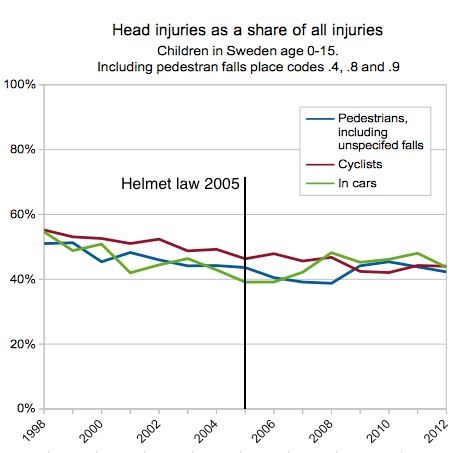
As we can see there does not seem to be a difference between the trends of the different modes, suggesting that if there is any fall in the share of head injuries it is likely to be an effect of something that also applies to other or all road users.
However there does seem to be another effect of helmet laws, namely a decline in cycling among school children. In 1983 57% of children aged 7-9 had permission from their parents to bike to school without adult companion, and for the age group 10-12, 94% had such permission. By the year 2007 this had decreased to 25% and 79% respectively. Bearing in mind, the helmet law was introduced in 2005, we can’t be sure of a correlation, because the data consists of surveys from 1983 and then 2007. But we do also have data recording that the share of school journeys by bicycle fell from 33% in 2006 one year after the legislation to 29% in year 2012. The evidence does suggest that the effect of the helmet law primarily is that fewer children bike to school.
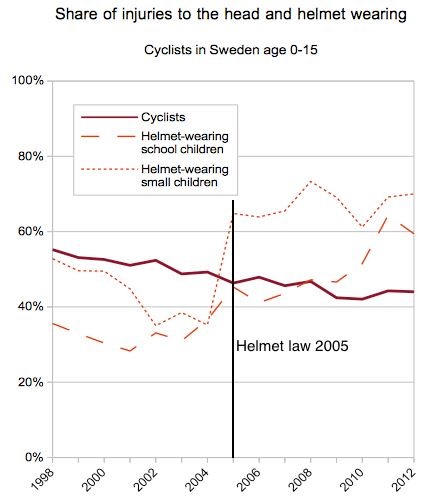
So the data does show a decline in cycling, but without annual surveys it’s hard to be sure of a correlation. However, a Danish report made the same link between declining cycling to school and helmet promotion and safety/scare campaigns. They determined that half the decline in cycling was caused by these campaigns, and half was caused by other factors such as more car traffic and longer distances to school.
From my perspective, laws telling me how to live don’t work, and this study shows that. Whether I wear a helmet is more personal issue that I should be allowed to decide.
More importantly, cycling increases the cyclist’s health, decreases air pollution and general promotes health. That is a greater benefit to all of us then the individual benefit of forcing someone to do something they may or may not want to do.
See: What happens when you mandate helmet-wearing among young Swedish cyclists?
Other Articles about this subject:
Bike Share programs flourish when helmets are not required http://rec-law.us/WrqmXI
Study shows that head injuries are on the rise on the slopes even though more people are wearing helmets http://rec-law.us/U91O73
Law requires helmets, injuries down fatalities up? http://rec-law.us/YwLcea
Great editorial questioning why we need laws to “protect” us from ourselves. http://rec-law.us/Ayswbo
Survey of UK physicians shows them against mandatory bicycle helmet laws. http://rec-law.us/sYuH07
Recent UK poll shows that 10% of cyclists would quite biking if there was a compulsory helmet law. http://rec-law.us/t1ByWk
What do you think? Leave a comment.
If you like this let your friends know or post it on FB, Twitter or LinkedIn
Copyright 2015 Recreation Law (720) Edit Law
Email: Rec-law@recreation-law.com
Google+: +Recreation
Twitter: RecreationLaw
Facebook: Rec.Law.Now
Facebook Page: Outdoor Recreation & Adventure Travel Law
Blog: www.recreation-law.com
Mobile Site: http://m.recreation-law.com
By Recreation Law Rec-law@recreation-law.com James H. Moss
#AdventureTourism, #AdventureTravelLaw, #AdventureTravelLawyer, #AttorneyatLaw, #Backpacking, #BicyclingLaw, #Camps, #ChallengeCourse, #ChallengeCourseLaw, #ChallengeCourseLawyer, #CyclingLaw, #FitnessLaw, #FitnessLawyer, #Hiking, #HumanPowered, #HumanPoweredRecreation, #IceClimbing, #JamesHMoss, #JimMoss, #Law, #Mountaineering, #Negligence, #OutdoorLaw, #OutdoorRecreationLaw, #OutsideLaw, #OutsideLawyer, #RecLaw, #Rec-Law, #RecLawBlog, #Rec-LawBlog, #RecLawyer, #RecreationalLawyer, #RecreationLaw, #RecreationLawBlog, #RecreationLawcom, #Recreation-Lawcom, #Recreation-Law.com, #RiskManagement, #RockClimbing, #RockClimbingLawyer, #RopesCourse, #RopesCourseLawyer, #SkiAreas, #Skiing, #SkiLaw, #Snowboarding, #SummerCamp, #Tourism, #TravelLaw, #YouthCamps, #ZipLineLawyer, Cycling, Helmets, Sweden, Biking
MassBike Bills Receive Substantial Sponsors
Posted: March 10, 2015 Filed under: Cycling | Tags: Cycling, Massachusetts, MassBikes, Safe Riding, Safe Routhes, x, y, z Leave a comment
|



SRAM Recalls Zipp 88 Bicycle Wheel Hubs Due to Crash and Injury Hazards
Posted: February 21, 2015 Filed under: Cycling | Tags: Consumer Product Safety Council, CPSC, Hub, Recall, SRAM, Wheel, Wheel Set, Zipp, Zipp 88 Leave a commentName of Product: Zipp 88 aluminum hubs for bicycle wheels
Hazard: The hub flange ring on the front hub can fail posing a crash and injury hazard.
Remedy: Replace
Consumer Contact: SRAM at (800) 346-2928 between 9 a.m. and 8 p.m. ET Monday through Thursday and 9 a.m. to 6 p.m. ET on Friday, or visit http://www.sram.com or http://www.zipp.com and click on Recall Notice for more information.
Units: About 12,000
Description: The aluminum hub shell is silver. The outside flange ring is gray aluminum in the standard option and blue, gold, gray, pink or red in the ZedTech options. The diameter of the two clinch nuts is approximately 1 inch. The first version of the 88 hub is the only one affected by the recall. The first version has the Z logo on the flange ring. The other versions – not affected by this recall – do not have the Z logo on the flange ring. The hubs were sold in five bike brands and sold separately. A listing of these brands and their model types can be viewed here: http://www.cpsc.gov/en/Recalls/2015/SRAM-Recalls-Zipp-88-Bicycle-Wheel-Hubs/
Incidents/Injuries: The company reports two incidents of collapsed front wheels. Both resulted in stitches, bruises and lacerations, plus a concussion in one case.
Remedy: Consumers should immediately stop using bicycles equipped with the recalled Zipp 88 front hub and contact SRAM for a free replacement hub.
Sold at: Specialty bicycle retailers nationwide. Front hub sold for about $215; front wheel with the hub sold for about $920; front and rear wheel set sold for about $2300 and bicycles with the wheel set containing the recalled hub sold for about $5,000 to $12,000. Items were sold between October 2008 and December 2010.
Manufacturer: Prodigy Group, Mooresville, Ind.
Manufactured in: USA
Retailers: If you are a retailer of a recalled product you have a duty to notify your customers of a recall. If you can, email your clients or include the recall information in your next marketing communication to your clients. Post any Recall Poster at your stores and contact the manufacturer to determine how you will handle any recalls.
For more information on this see:
For Retailers
Recalls Call for Retailer Action
Combination of a Products Liability statute, an Expert Witness Report that was just not direct enough and odd facts holds a retailer liable as manufacture for product defect.
Product Liability takes a different turn. You must pay attention, just not rely on the CPSC.
Retailer has no duty to fit or instruct on fitting bicycle helmet
Summary Judgment granted for bicycle manufacturer and retailer on a breach of warranty and product liability claim.
For Manufacturers
The legal relationship created between manufactures and US consumers
What do you think? Leave a comment.
If you like this let your friends know or post it on FB, Twitter or LinkedIn
Copyright 2015 Recreation Law (720) Edit Law
Email: Rec-law@recreation-law.com
Google+: +Recreation
Twitter: RecreationLaw
Facebook: Rec.Law.Now
Facebook Page: Outdoor Recreation & Adventure Travel Law
Blog: www.recreation-law.com
Mobile Site: http://m.recreation-law.com
#AdventureTourism, #AdventureTravelLaw, #AdventureTravelLawyer, #AttorneyatLaw, #Backpacking, #BicyclingLaw, #Camps, #ChallengeCourse, #ChallengeCourseLaw, #ChallengeCourseLawyer, #CyclingLaw, #FitnessLaw, #FitnessLawyer, #Hiking, #HumanPowered, #HumanPoweredRecreation, #IceClimbing, #JamesHMoss, #JimMoss, #Law, #Mountaineering, #Negligence, #OutdoorLaw, #OutdoorRecreationLaw, #OutsideLaw, #OutsideLawyer, #RecLaw, #Rec-Law, #RecLawBlog, #Rec-LawBlog, #RecLawyer, #RecreationalLawyer, #RecreationLaw, #RecreationLawBlog, #RecreationLawcom, #Recreation-Lawcom, #Recreation-Law.com, #RiskManagement, #RockClimbing, #RockClimbingLawyer, #RopesCourse, #RopesCourseLawyer, #SkiAreas, #Skiing, #SkiLaw, #Snowboarding, #SummerCamp, #Tourism, #TravelLaw, #YouthCamps, #ZipLineLawyer, Recall, Recall, CPSC, Consumer Product Safety Council, SRAM, Zipp, Zipp 88, Wheel, Hub, Wheel Set,
Recall: 2014 Marin MBX 50 and Tiny Trail Bicycles
Posted: February 14, 2015 Filed under: Mountain Biking | Tags: CPSC, Marin, Marin Bikes, Marin Mountain Bikes, Recall, Tiny Trail Leave a commentMarin Mountain Bikes Inc., of Novato, Calif.
Remedy: Marin Mountain Bikes at (800) 222-7557 from 9 a.m. to 5 p.m. PT Monday through Friday, or visit the firm’s website at www.marinbikes.com and click on “Recalls/Safety” for more information.
Recall Information: The handlebars can loosen or separate during use. This can cause the rider to lose control and/or crash, posing the risk of injury.
Units: 450 in US and Canada
Year Manufactured:
Incidents/Injuries: None
Marin 2014 model MBX 50 and Tiny Trail boys and girls bicycles with 16-inch knobby tires. The single speed bicycles have high-rise handlebars and training wheels. The boy’s bicycles were sold in red and have serial number HA14980XXXXXX. The girl’s bicycles were sold in purple and have serial number HA14982XXXXXX. Serial numbers are printed on a foil label affixed to the underside of the base of the down tube. “Marin” is printed on the seat and the downtube. “Tiny Trail” or “MBX 50” is printed on the bicycles chain guard.
Retailers: If you are a retailer of a recalled product you have a duty to notify your customers of a recall. If you can, email your clients or include the recall information in your next marketing communication to your clients. Post any Recall Poster at your stores and contact the manufacturer to determine how you will handle any recalls.
For more information on this see:
For Retailers
Recalls Call for Retailer Action
Combination of a Products Liability statute, an Expert Witness Report that was just not direct enough and odd facts holds a retailer liable as manufacture for product defect.
Product Liability takes a different turn. You must pay attention, just not rely on the CPSC.
Retailer has no duty to fit or instruct on fitting bicycle helmet
Summary Judgment granted for bicycle manufacturer and retailer on a breach of warranty and product liability claim.
For Manufacturers
The legal relationship created between manufactures and US consumers
What do you think? Leave a comment.
If you like this let your friends know or post it on FB, Twitter or LinkedIn
Copyright 2015 Recreation Law (720) Edit Law
Email: Rec-law@recreation-law.com
Google+: +Recreation
Twitter: RecreationLaw
Facebook: Rec.Law.Now
Facebook Page: Outdoor Recreation & Adventure Travel Law
Blog: www.recreation-law.com
Mobile Site: http://m.recreation-law.com
#AdventureTourism, #AdventureTravelLaw, #AdventureTravelLawyer, #AttorneyatLaw, #Backpacking, #BicyclingLaw, #Camps, #ChallengeCourse, #ChallengeCourseLaw, #ChallengeCourseLawyer, #CyclingLaw, #FitnessLaw, #FitnessLawyer, #Hiking, #HumanPowered, #HumanPoweredRecreation, #IceClimbing, #JamesHMoss, #JimMoss, #Law, #Mountaineering, #Negligence, #OutdoorLaw, #OutdoorRecreationLaw, #OutsideLaw, #OutsideLawyer, #RecLaw, #Rec-Law, #RecLawBlog, #Rec-LawBlog, #RecLawyer, #RecreationalLawyer, #RecreationLaw, #RecreationLawBlog, #RecreationLawcom, #Recreation-Lawcom, #Recreation-Law.com, #RiskManagement, #RockClimbing, #RockClimbingLawyer, #RopesCourse, #RopesCourseLawyer, #SkiAreas, #Skiing, #SkiLaw, #Snowboarding, #SummerCamp, #Tourism, #TravelLaw, #YouthCamps, #ZipLineLawyer, Recall, Marin, Marin Mountain Bikes, Tiny Trail,
New App helps you Track and Maintain your Bike
Posted: January 31, 2015 Filed under: Cycling, Mountain Biking | Tags: bicycle, Cycling, Feedback, Feedback Sports, Maintenance, x, y, z Leave a comment
|
||||||||||||||||
|
||||||||||||||||
|
 There’s an art to proper bike maintenance.Organization is the first step.


 Get out there and ride this Winter…just don’t forget to bring the bikes in for a little warmth and TLC after.*Remember: If you’re cold, they’re cold.

|

Your Help is Needed to Open I-40 in California to Cyclists to ride Route 66
Posted: January 30, 2015 Filed under: Cycling | Tags: x, y, z Leave a commentIf this message is not displaying properly, please click here to launch your browser.
http://www.adventurecycling.org/tools/bulkemails/20150127_Route66.cfm
 |
| Friends of Adventure Cycling,We need your help to complete Bicycle Route 66, the legendary Mother Road between Chicago and Santa Monica, which Adventure Cycling has been working hard to create for the last five years.
We need the California Department of Transportation (Caltrans) to provide legal access to I-40 between Needles and Barstow, California. Presently bicycles are prohibited on this 144-mile section of freeway. The only other option — the National Trails Highway — is currently closed and, in some sections, unsuitable for bicycling. Without I-40 access, cyclists will have to end their trip early (at the California border) or risk being ticketed by illegally riding I-40. We are now putting the final touches on the layout and design of the Bicycle Route 66 maps, which are going to print in early February and available in March. That’s why we need your help now to solve this issue! How Can You Help?
Background on the Issue Why are we requesting access to I-40? Normally, we don’t route cyclists on interstates if an alternate road is available; however, the only other way through this section is the National Trails Highway, which is closed due to damage from flooding. Furthermore, the road is not suitable for bicycling, as there are large gaps in the pavement, potholes and sandbanks posing serious safety hazards. I-40 is a rural freeway with eight-foot shoulders and relatively low traffic counts. We have communicated with Caltrans for almost a year; however District 8, which is responsible for I-40, continues to deny bicycle access and we have received little support at the state level. We are told that Caltrans legally and procedurally has no obligation to give bicycles access to interstates, regardless of the fact that cyclists currently have no legal route. However, Caltrans is on record stating their commitment to multi-modal travel, especially bicycling. Additionally, we have the support of the California Bicycle Advisory Committee and the California Association of Bicycle Organizations. Despite letters on our behalf, Caltrans still refuses to engage. Now we are reaching out to you. THANKS FOR SUPPORTING BICYCLE ROUTE 66! |
 |
 For more information on the issue: For more information on the issue:
See first-hand the road conditions on the National Trails Highway |

New Cycling Book: Fast After 50 Shows Athletes That Age Is Just a Number
Posted: January 15, 2015 Filed under: Cycling | Tags: x, y, z 1 Comment
fa50 72dpi 300pw str
Fast After 50 Shows Athletes That Age Is Just a Number-and Race Results Are the Only Numbers That Count
The baby boomers aren’t giving up, and coach Joe Friel isn’t giving up on them. Friel’s groundbreaking new book, Fast After 50, is for every endurance athlete who wants to stay fast for years to come. For runners, cyclists, triathletes, swimmers, and cross-country skiers, getting older doesn’t have to mean getting slower. Drawing from the most current research on aging and sports performance, Joe Friel-America’s leading endurance sports coach-shows how athletes can stay fast and extend their racing careers. Fast After 50 is now available in bookstores; bike, tri, and running shops; and online. The e-book edition will release this spring. Preview the book at http://www.velopress.com.
In Fast After 50, Friel offers a smart approach for athletes to ward off the effects of age. Friel shows athletes how to extend their racing careers for decades-and race to win. Fast After 50 presents guidelines for high-intensity workouts, focused strength training, recovery, crosstraining, and nutrition for high performance. Friel shows:
* How the body’s response to training changes with age, how to adapt your training plan, and how to avoid overtraining
* How to shed body fat and regain muscle density
* How to create a progressive plan for training, rest, recovery, and competition
* Workout guidelines, field tests, and intensity measurement.
In Fast After 50, Joe Friel shows athletes that age is just a number-and race results are the only numbers that count. Includes contributions from: Mark Allen, Gale Bernhardt, Amby Burfoot, Dr. Larry Creswell, John Howard, Dr. Tim Noakes, Ned Overend, Dr. John Post, Dr. Andrew Pruitt, and Lisa Rainsberger.
Fast After 50: How to Race Strong for the Rest of Your Life Joe Friel Paperback with illustrations throughout. | 7″ x 9″, 336 pp., $21.95, 9781937715267
Joe Friel is the best-selling author of The Triathlete’s Training Bible, The Cyclist’s Training Bible, Going Long, Your Best Triathlon, and Your First Triathlon. His TrainingBible Coaching franchise is one of the most successful and respected in endurance sports. Joe has trained endurance athletes since 1980, including national champions, world championship contenders, and Olympic athletes in triathlon, duathlon, road cycling, and mountain biking. He is an elite-certified USA Triathlon and USA Cycling coach and holds a master’s degree in exercise science. He conducts training and racing seminars around the world and provides consulting services for corporations in the fitness industry. He has also been active in business as the founder of Ultrafit, an association of coaching businesses; TrainingPeaks, a web-based software company; and TrainingBible Coaching.
USA Pro Challenge Stage 6 Route Announced: Loveland to Fort Collins
Posted: January 6, 2015 Filed under: Colorado, Cycling | Tags: Bicycle Race, Colorado, Cycling, Fort Collins, Loveland, USA Pro Challenge Leave a commentStage 6 of 2015 USA Pro Challenge will take Riders from Loveland to Fort Collins
Fans Helped Shape Stage 6 of Colorado Professional Cycling Race
Denver (Dec. 22, 2014) – With the majority of the host cities announced for the 2015 USA Pro Challenge, organizers looked to fans to help determine the start and finish locations for Stage 6. Thousands of fans submitted their opinions, providing more than 20 start and finish city options. In the end, nearly half the responses encouraged a return to Northern Colorado resulting in a Stage 6 start in Loveland and a finish in Fort Collins.
“Loveland and Fort Collins have been such great host cities in the past and we’re looking forward to visiting them again,” said Shawn Hunter, CEO of the USA Pro Challenge. “Last year, we gave fans the chance to weigh in on the final stage of the race and we got a huge response with people voicing their support for the two different options. This year, the fans once again showed their passion for the sport through an overwhelming number of responses regarding where Stage 6 should take place.”
After the initial host cities announcement just over two weeks ago, during which six of the seven stages for the 2015 race were revealed, fans were given the opportunity to provide suggestions for Stage 6 through Facebook and the race website.
USA Pro Challenge fan Michael DePalma wanted a return to Northern Colorado stating it, “offers some of the most spectacular cycling opportunities in the state.” And many spoke to returning to areas that were greatly damaged by the 2013 floods. Gary Crews said the Pro Challenge will, “help us further recover from the flooding and put a smile on the face of riders and residents alike.”
With the fans’ opinions taken into account, the Stage 6 host cities have been determined. And while the host cities are familiar to the race, after visiting them in 2013, the route through Larimer County promises to be new and unique in 2015.
“It has been incredible to witness the outpouring of support from the Northern Colorado community who has rallied together to bring back the USA Pro Challenge in 2015,” said Local Organizing Member Eric Thompson. “We are honored to have been selected for Stage 6 next summer and look forward to sharing the excitement with the cycling fans that made it happen.”
Taking place Aug. 17-23, the host cities and stages of the 2015 USA Pro Challenge include:
- Stage 1: Monday, Aug. 17 – Steamboat Springs Circuit Race
- Stage 2: Tuesday, Aug. 18 – Steamboat Springs to Arapahoe Basin
- Stage 3: Wednesday, Aug. 19 – Copper Mountain Resort to Aspen
- Stage 4: Thursday, Aug. 20 – Aspen to Breckenridge
- Stage 5: Friday, Aug. 21 – Breckenridge Individual Time Trial
- Stage 6: Saturday, Aug. 22 – Loveland to Fort Collins
- Stage 7: Sunday, Aug. 23 – Golden to Denver
Additional details regarding the start and finish locations of the 2015 race, as well as the specific, detailed route will be announced in the spring.
About the USA Pro Challenge
Referred to as “America’s Race,” the USA Pro Challenge will take place August 17-23, 2015. For seven consecutive days, the world’s top athletes race through the majestic Colorado Rockies, reaching higher altitudes than they’ve ever had to endure. One of the largest cycling events in U.S. history and the largest spectator event in the history of the state, the USA Pro Challenge is back for 2015.
More information can be found online at www.USAProChallenge.com and on Twitter at @USAProChallenge.
The Adventure Cycling Association shows more routes to travel the USA by bike
Posted: December 26, 2014 Filed under: Cycling | Tags: Adventure Cycling, Association, biking, Cycling, Routes, x, y, z Leave a comment

U.S. Bicycle Route System grows to over 8,000 miles
Official national bicycle network expands to 8,042 miles with addition of five new routes
MISSOULA, MONTANA, November 16, 2014 — Adventure Cycling Association and the American Association of State Highway and Transportation Officials (AASHTO) today announced that AASHTO’s Special Committee on U.S. Route Numbering has approved 1,253 miles of new U.S. Bicycle Routes (USBRs): USBR 1 in Massachusetts and Florida, USBR 10 in Michigan, USBR 11 in Maryland, and USBR 90 in Florida. Realignments were also approved for USBR 76 and USBR 1 in Virginia, which were originally designated in 1982. The U.S. Bicycle Route System (USBRS) now encompasses 8,042 miles of routes in 16 states and the District of Columbia.
“We continue to be impressed by the strong work of state Departments of Transportation and congratulate them on their designations,” said AASHTO Executive Director Bud Wright. “We also wish to acknowledge our partnership with Adventure Cycling Association and the expertise they bring to the process.”
The U.S. Bicycle Route System is a developing national network of numbered and signed bicycle routes that connect people, communities, and the nation. Similar to emerging international networks, such as Europe’s EuroVelo network and Quebec’s La Route Verte, the U.S. Bicycle Route System provides important recreational and transportation options for the active traveler. Currently, more than 40 states are working to develop route corridors into official U.S. Bicycle Routes to be approved by AASHTO at their spring and fall meetings.
“With each new route and each new state in the U.S. Bicycle Route System, we will soon see this network reach every corner of America, from urban to rural areas” said Jim Sayer, executive director of Adventure Cycling Association. “Given the project’s momentum, we expect that, over time, the USBRS will become the largest official bicycle route network on the planet.”
U.S. Bicycle Route 1 in Florida (584.4 miles)
U.S. Bicycle Route 1 follows Florida’s Atlantic coast from Key West to Jacksonville, where it ends at the Georgia State Line. Much of USBR 1 follows the East Coast Greenway and Adventure Cycling Association’s Atlantic Coast Route. The route includes many scenic beaches and intersects cities and towns along the way.
Florida Department of Transportation Secretary Ananth Prasad commented, “We’re very pleased that Florida now joins other states in establishing U.S. Bicycle Routes. Milepost 0 in Key West will now be the starting point for U.S. Bicycle Route 1 as it is for U.S. Highway 1. The Sunshine State invites cyclists to enjoy our great state.”
State Bicycle Coordinator DeWayne Carver said that FLDOT plans to designate more U.S. Bicycle Routes in the near future.
U.S. Bicycle Route 90 in Florida (423.8 miles)
U.S. Bicycle Route 90 is an east-west route that connects the Alabama border to Florida’s Atlantic Coast in Butler Beach, just south of St Augustine. The route partly follows Adventure Cycling’s Southern Tier route and traverses rural north Florida through pastures, forests, and small towns, with a few “big city” stops in Pensacola and Tallahassee.
Florida DOT Secretary Ananth Prasad said, “cyclists can now follow USBR 90 across Florida from the coast to Alabama. We’ll guarantee to keep the route free from snow year-round and provide plenty of sunshine.”
Bicyclists interested in riding U.S. Bicycle Routes in Florida can find maps, turn-by-turn directions and other information at http://www.dot.state.fl.us/planning/policy/usbr.
U.S. Bicycle Route 11 in Maryland (34 miles)
US Bicycle Route 11 runs for 34 miles from the Pennsylvania state line northwest of Hagerstown to Harpers Ferry, West Virginia. There are a variety of urban and scenic attractions along the route, which follows a combination of rural roads, state highways and off-road trails. Cyclists can stop in downtown Hagerstown and explore its historical and art museums located in the picturesque Hagerstown City Park. For bicycle travelers interested in civil war history, there are many historical attractions along or near the route, including the National War Correspondents Memorial in Gathland State Park, the Antietam National Battlefield, and Harpers Ferry National Historical Park. USBR 11 also traverses the traffic-free, scenic Chesapeake and Ohio Canal Towpath (also designated as U.S. Bicycle Route 50) for 2.6 miles until it reaches Harpers Ferry.
“US Bicycle Route 11 will be a great asset for bicyclists and Washington County businesses,” said Richard Cushwa, Acting Chair of the Maryland Bicycle and Pedestrian Advisory Committee. “By connecting with U.S. Bicycle Route 50, this designation will help enhance safety, travel, and tourism throughout Western Maryland and beyond.”
For more information on bicycling in Maryland, visit the Maryland Department of Transportation Bicycle and Pedestrian site at http://1.usa.gov/1uLsgp3.
U.S. Bicycle Route 1 in Massachusetts (18 miles)
The Massachusetts Department of Transportation has designated two new segments along U.S. Bicycle Route 1, adding 18 miles to the route, which now totals 38 miles. The two new segments offer a glimpse of what makes Massachusetts a special place for local and long-distance travelers alike, with an array of landscapes and settlements along urban and rural byways.
The more northerly segment of USBR 1 in Salisbury and Newburyport straddles the majestic Merrimack River. USBR 1 here offers views of watercraft, and reminders of the area’s rich nautical history. While the Salisbury Old Eastern Marsh Trail provides proximity to expansive Atlantic Ocean beaches, Newburyport’s Clipper City Rail Trail reminds riders that the City’s clipper ships were once the fastest on the seas, spawning a global maritime trade. Both communities also offer nature preserves and museums in close proximity to USBR 1.
Further south, USBR 1 traverses through the communities of Topsfield, Wenham, Danvers, and Peabody, which are removed from the Atlantic and offer a different experience of Massachusetts. The Topsfield Linear Common and Wenham Swamp Walk wind their way through these communities, and riders are treated to a number of river crossings. Wetlands remind cyclists of glacial epochs long past, and boardwalks provide opportunities to explore these landscapes and natural history. Timeless town centers and deep woods also attract riders. Further south, USBR 1 enters busier settlements via the Danvers Rail Trail and Independence Greenway where cyclists can buy needed provisions.
U.S. Bicycle Route 10 in Michigan (193 miles)
U.S Bicycle Route 10 stretches for 193 miles along U.S. 2 and connects the eastern and central portions of Michigan’s Upper Peninsula. The eastern terminus connects with U.S. Bicycle Route 35 in St. Ignace. As the route travels west to Iron Mountain, Michigan, travelers are presented with stunning views of the Mackinac Bridge, rolling sand dunes along Lake Michigan, and tourist attractions like the famous Mystery Spot. The gently rolling route passes numerous parks, state and national forest lands, and scenic overlooks. Along the way, small lumber towns and rural communities offer everything a bicycle traveler could need every 20 to 30 miles.
A recent study initiated by the Michigan Department of Transportation showed that bicycling brings $668 million per year in economic benefits to Michigan’s economy. The state’s third U.S. Bicycle Route designation, USBR 10 will bring bicycle tourism revenue and new economic growth opportunities to Michigan’s Upper Peninsula. The designation is also part of a regional effort to complete U.S. Bicycle Routes around Lake Michigan and market the area as an active tourism destination.
Kerry Irons, a USBRS coordinator for Adventure Cycling based in Michigan, noted that “with the addition of USBR 10, Michigan is now tied with Florida for second place among states for USBR mileage (1,008 miles), with Alaska having the highest mileage (1,414 miles). We’re looking forward to the connection of USBR 37 to Wisconsin and the completion of USBRs all the way around Lake Michigan.”
U.S. Bicycle Route 1 Realignment in Virginia (6 miles added)
The Virginia Department of Transportation has realigned U.S. Bicycle Route 1 in Northern Virginia to provide a safer and more reliable route for cyclists. Increased traffic volumes, changes to access through Ft. Belvoir, and the closure of a bridge on Gunston Cove Rd were all factors which triggered a re-evaluation of the existing route. The realignment improved the scenic appeal of the route by adding more mileage along the Potomac River.
USBR 1 in Northern Virginia travels by several interesting and historic sites including Historic Occoquan, Mt. Vernon (Home of George Washington), Woodlawn Plantation, the Pope-Leighey house (designed by Frank Lloyd Wright), George Washington’s Grist Mill, and Old Town Alexandria. The route now ends at the 14th St Bridge in Washington DC.
United States Bicycle Route 76 Realignment in Virginia (6 miles removed)
The Virginia Department of Transportation (VDOT) has realigned U.S. Bicycle Route 76 in the Staunton District to provide a safer, more direct route for cyclists. The route was realigned just north of Lexington to Route 56 near Vesuvius and matches the existing Adventure Cycling TransAmerica Trail route. The new route follows roads with lower-volume traffic and avoids two interstate interchanges.
This section of USBR 76 passes through the historic city of Lexington, home of the Virginia Military Institute and Washington and Lee University. For eastbound cyclists, this section of USBR 76 is the last part of the route in the Shenandoah Valley and skirts the western foot of the Blue Ridge Mountains. The northern end of the realignment ends at Route 56 which then quickly climbs 2000 feet over four miles to the Blue Ridge Parkway. The 17-mile section of the Blue Ridge Parkway offers numerous scenic views and is consistently noted as one of the highlights of the TransAmerica Trail by cross country cyclists. Maps of the TransAmerica Trail are available at Adventure Cycling and more information about the USBR 76 route changes is available on the VDOT website.
The U.S. Bicycle Route System will eventually be the largest bicycle-route network in the world, encompassing more than 50,000 miles of routes. Adventure Cycling Association has provided dedicated staff support to the project since 2005, including research support, meeting coordination, and technical guidance for states implementing routes. Adventure Cycling also provides an updated list of links to maps and other resources for cyclists wishing to ride an established U.S. Bicycle Route on its Use a U.S. Bicycle Route page.
AASHTO’s support for the project is crucial to earning the support of federal and state agencies. AASHTO is a nonprofit, nonpartisan association representing highway and transportation departments in all 50 states, the District of Columbia, and Puerto Rico. A powerful voice in the transportation sector, AASHTO’s primary goal is to foster the development of an integrated national transportation system.
Support for the U.S. Bicycle Route System comes from Adventure Cycling members, donors, and a group of business sponsors that participate in the annual Build It. Bike It. Be a Part of It. fundraiser each May. The U.S. Bicycle Route System is supported in part by grants from the Tawani Foundation, Lazar Foundation, and Climate Ride.
Learn more at www.adventurecycling.org/usbrs.
UVEX Bicycle Helmets being recalled
Posted: December 16, 2014 Filed under: Cycling | Tags: Bicycle helmet, Chinstrap, Cycling, EVEX Sports, Head injury, Product Recall, Recall, Uvex Leave a commentIdentifying Information: This recall involves seven models of UVEX helmets. The helmets come in a variety of colors with different colored chin straps. The helmets have a model number inside the helmet under the fitting pad on the top right side. The affected helmet model numbers are XB017, XB022, XB025, XB027, XB032, XB036 and XB038.
Remedy UVEX Sports Inc. toll-free at (844) 767-0656 from 9:30 a.m. to 6:30 p.m. ET Monday through Friday, or online at http://www.uvex-sports.us and click on “Recall” for more information.
Units: 46,800
Year Manufactured: September 2009 through June 2014 for about $100 to $260.
Incidents/Injuries: None reported.
Uvex Sports GmbH & Co. KG, Germany
Retailers: If you are a retailer of a recalled product you have a duty to notify your customers of a recall. If you can, email your clients or include the recall information in your next marketing communication to your clients. Post any Recall Poster at your stores and contact the manufacturer to determine how you will handle any recalls.
For more information on this see:
For Retailers
Recalls Call for Retailer Action
Combination of a Products Liability statute, an Expert Witness Report that was just not direct enough and odd facts holds a retailer liable as manufacture for product defect.
Product Liability takes a different turn. You must pay attention, just not rely on the CPSC.
Retailer has no duty to fit or instruct on fitting bicycle helmet
Summary Judgment granted for bicycle manufacturer and retailer on a breach of warranty and product liability claim.
For Manufacturers
The legal relationship created between manufactures and US consumers
What do you think? Leave a comment.
If you like this let your friends know or post it on FB, Twitter or LinkedIn
Copyright 2013 Recreation Law (720) Edit Law
Email: Rec-law@recreation-law.com
Google+: +Recreation
Twitter: RecreationLaw
Facebook: Rec.Law.Now
Facebook Page: Outdoor Recreation & Adventure Travel Law
Blog: www.recreation-law.com
Mobile Site: http://m.recreation-law.com
#AdventureTourism, #AdventureTravelLaw, #AdventureTravelLawyer, #AttorneyatLaw, #Backpacking, #BicyclingLaw, #Camps, #ChallengeCourse, #ChallengeCourseLaw, #ChallengeCourseLawyer, #CyclingLaw, #FitnessLaw, #FitnessLawyer, #Hiking, #HumanPowered, #HumanPoweredRecreation, #IceClimbing, #JamesHMoss, #JimMoss, #Law, #Mountaineering, #Negligence, #OutdoorLaw, #OutdoorRecreationLaw, #OutsideLaw, #OutsideLawyer, #RecLaw, #Rec-Law, #RecLawBlog, #Rec-LawBlog, #RecLawyer, #RecreationalLawyer, #RecreationLaw, #RecreationLawBlog, #RecreationLawcom, #Recreation-Lawcom, #Recreation-Law.com, #RiskManagement, #RockClimbing, #RockClimbingLawyer, #RopesCourse, #RopesCourseLawyer, #SkiAreas, #Skiing, #SkiLaw, #Snowboarding, #SummerCamp, #Tourism, #TravelLaw, #YouthCamps, #ZipLineLawyer, Recall, Bicycle Helmet, UVEX, EVEX Sports, Head Injury, Chinstrap, Cycling,
Salsa Cycles Recalls Bicycle Forks Due to Risk of Fall Hazard
Posted: December 11, 2014 Filed under: Mountain Biking | Tags: bicycle, Bicycle fork, Bicycle frame, Fork, Front Fork, Mukluk Bicycles, QBP, Quality Bicycle Products, Recall, Salsa, Salsa Bearpaw, Salsa Cycles, U.S. Consumer Product Safety Commission Leave a commentIdentifying Information: Salsa Bearpaw Bicycle Forks
Recall Information: Salsa Cycles toll-free at (877) 774-6208 from 8 a.m. to 6 p.m. CT Monday through Friday, or online at http://www.salsacycles.com and click on the “Fork Recall” button for more information.
Units: 2500
When sold: September 2013 through November 2014
Incidents/Injuries: None
The bicycle fork can bend or break, posing a fall hazard to the rider.
This recall involves all aluminum Salsa Bearpaw forks sold separately and on Mukluk bicycles. The forks have date code 20130524, 20130710 or 20130826 stamped on the fork steerer, followed by “CWI2201BAN2” and a Salsa compass graphic on the bend of the fork blades. Consumers or the dealer will need to disassemble the front of the bicycle to access the steerer tube with the date code and model information. The forks were sold in “tequila lime” with black paint, “metallic gold,” red and black. The bikes were sold in sizes x-small, small, medium, large and x-large.
Retailers: If you are a retailer of a recalled product you have a duty to notify your customers of a recall. If you can, email your clients or include the recall information in your next marketing communication to your clients. Post any Recall Poster at your stores and contact the manufacturer to determine how you will handle any recalls.
For more information on this see:
For Retailers
Recalls Call for Retailer Action
Combination of a Products Liability statute, an Expert Witness Report that was just not direct enough and odd facts holds a retailer liable as manufacture for product defect.
Product Liability takes a different turn. You must pay attention, just not rely on the CPSC.
Retailer has no duty to fit or instruct on fitting bicycle helmet
Summary Judgment granted for bicycle manufacturer and retailer on a breach of warranty and product liability claim.
For Manufacturers
The legal relationship created between manufactures and US consumers
What do you think? Leave a comment.
If you like this let your friends know or post it on FB, Twitter or LinkedIn
Copyright 2013 Recreation Law (720) Edit Law
Email: Rec-law@recreation-law.com
Google+: +Recreation
Twitter: RecreationLaw
Facebook: Rec.Law.Now
Facebook Page: Outdoor Recreation & Adventure Travel Law
Blog: www.recreation-law.com
Mobile Site: http://m.recreation-law.com
#AdventureTourism, #AdventureTravelLaw, #AdventureTravelLawyer, #AttorneyatLaw, #Backpacking, #BicyclingLaw, #Camps, #ChallengeCourse, #ChallengeCourseLaw, #ChallengeCourseLawyer, #CyclingLaw, #FitnessLaw, #FitnessLawyer, #Hiking, #HumanPowered, #HumanPoweredRecreation, #IceClimbing, #JamesHMoss, #JimMoss, #Law, #Mountaineering, #Negligence, #OutdoorLaw, #OutdoorRecreationLaw, #OutsideLaw, #OutsideLawyer, #RecLaw, #Rec-Law, #RecLawBlog, #Rec-LawBlog, #RecLawyer, #RecreationalLawyer, #RecreationLaw, #RecreationLawBlog, #RecreationLawcom, #Recreation-Lawcom, #Recreation-Law.com, #RiskManagement, #RockClimbing, #RockClimbingLawyer, #RopesCourse, #RopesCourseLawyer, #SkiAreas, #Skiing, #SkiLaw, #Snowboarding, #SummerCamp, #Tourism, #TravelLaw, #YouthCamps, #ZipLineLawyer, Recall, Salsa, Fork, Front Fork, QBP, Quality Bicycle Products, Salsa Cycles, Mukluk Bicycles, Salsa Bearpaw,
1 Million People Sign Up for People for Bikes!
Posted: December 7, 2014 Filed under: Cycling | Tags: Cycling, x, y, z Leave a comment
|
||||||||||||||


USA Pro Challenge Professional Cycling Race Brings an Estimated $130 Million to Colorado!
Posted: November 4, 2014 Filed under: Cycling | Tags: $130 million, bicycle, Bicycle Racing, BMC Racing Team, Colorado, Cycling, Downtown Denver, Tejay Van Garderen, United States, Universal Sports, USA Pro Challenge Leave a commentUSA Pro Challenge Professional Cycling Race Brings an Estimated
$130 Million in Economic Impact to the State of Colorado, 12 Percent Increase Over 2013
Largest Spectator Event in Colorado Leaves Lasting Impact on the State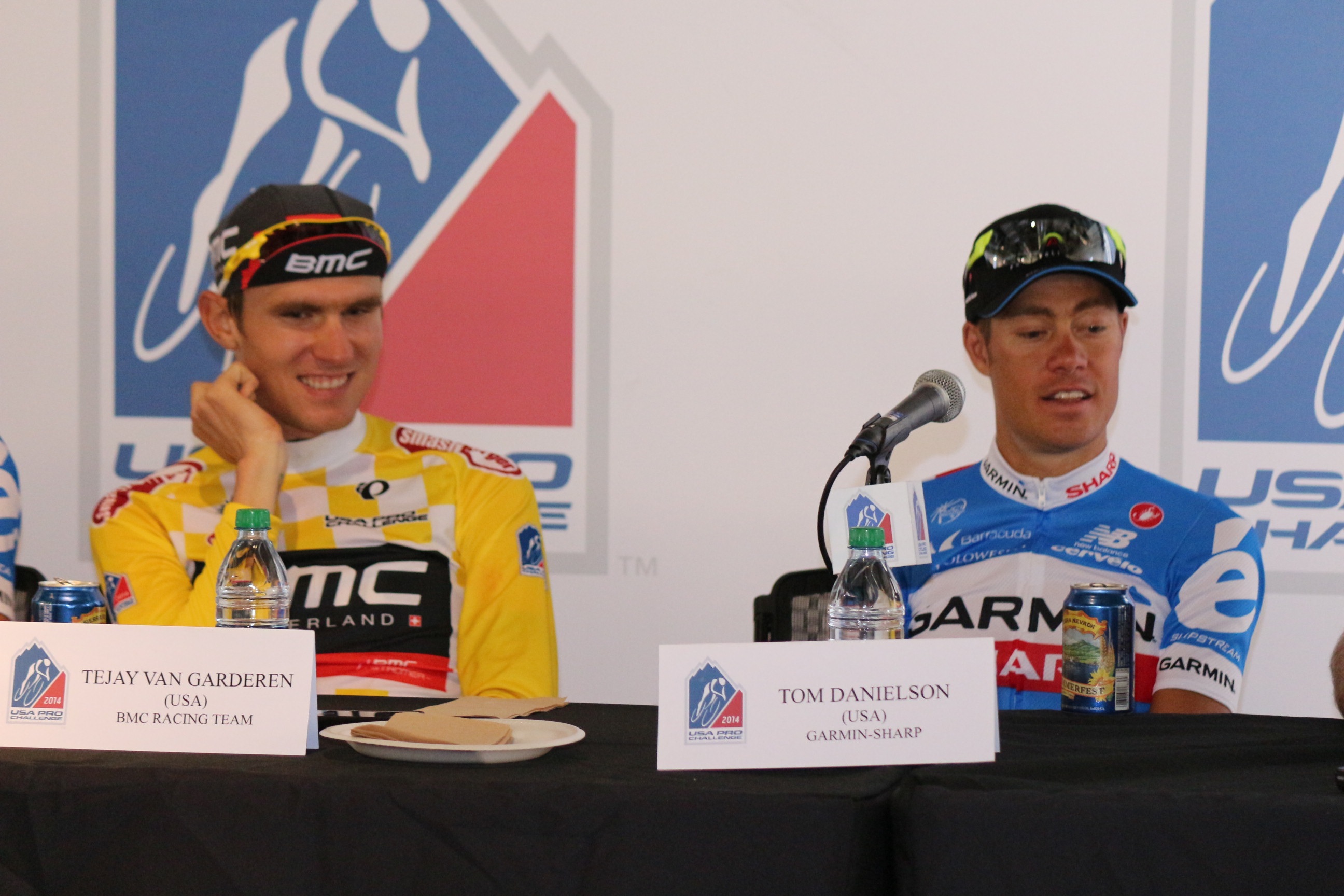
The 2014 USA Pro Challenge saw 128 of the best professional cyclists in the world compete in the toughest professional cycling race in the U.S. over the course of seven days, Aug. 18-24. Fans came out in droves to watch the action-packed, heart-pounding racing through the Colorado Rockies. After traveling to 10 host cities for the official stage starts and finishes, and passing through many other notable towns along the way, the estimated economic impact of the race to the State of Colorado is $130 million, according to a study done by Sponsorship Science, a global sports research firm.
The Pro Challenge delivered another strong economic performance in its fourth running, with direct spending by traveling spectators contributing a significant portion of the economic impact. Both those fans from outside the state and Coloradans traveling 50 miles or more to take in an event stage contributed $130 million on lodging, food, transportation and entertainment, an increase of 12 percent year over year. This change was largely driven by a 10 percent increase in the average number of nights stayed and an 11 percent increase in per night average party spend, the result of a 15 percent increase in average per night lodging cost.
“Seeing the enthusiasm and passion from the fans lining the streets during the 2014 USA Pro Challenge really gave a sense of the growing support for the sport of cycling in the U.S.,” said Rick Schaden, owner of the race. “This race showcases Colorado to the world and creates an incredible economic impact locally that can be felt throughout the year. Further, it was great to see an increase in television viewership.”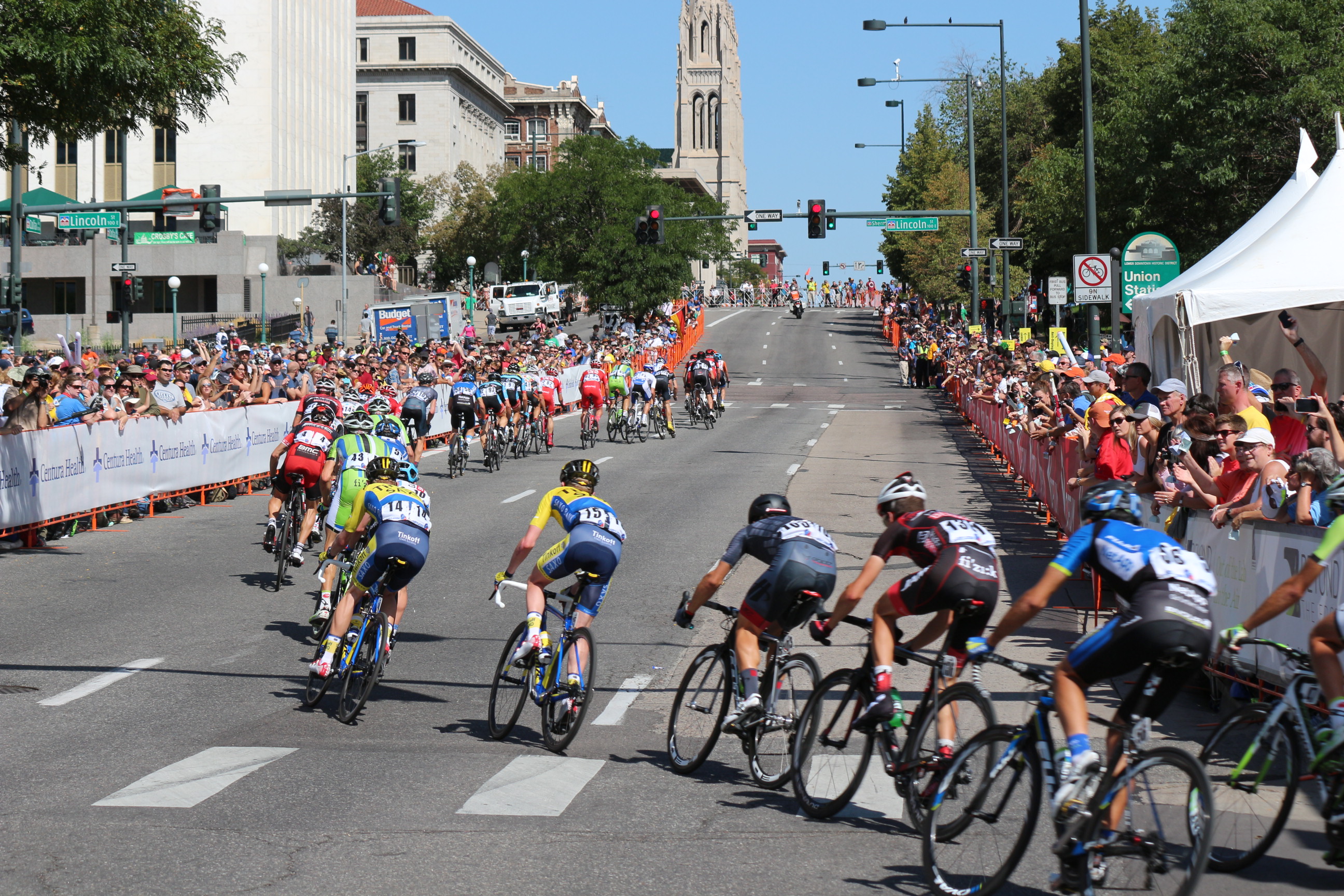
Following an epic week of racing through picturesque Colorado scenery, America’s most challenging race came to a conclusion in Downtown Denver when Aspen resident Tejay van Garderen (USA) of BMC Racing Team maintained his lead and took the overall win for the second year in a row. The race received unprecedented coverage totaling 30 hours on NBC, NBCSports and Universal Sports in the U.S. Additionally, through 40 hours of international coverage, the race was seen in more than 175 countries and territories around the world.
A draw for Colorado travel, 56 percent of spectators claimed they would not have traveled to the state at this time if it were not for the race. And with that, 70.9 percent stated they are likely to return to watch the race next year.
Additional interesting analysis points include:
· Spectators traveled in groups, with the average party consisting of three people
· The average hotel stay for spectators increased in 2014 to 5.3 nights
· 53 percent of race attendees live in households with income exceeding $85,000 and within that group 32 percent had household incomes in excess of $120,000
· Spectators enjoyed their race experience, with more than 80 percent saying they were very satisfied or satisfied with the race
· More than half of spectators in attendance reported they ride a bike for fitness, with 47 percent saying they engage in road cycling a lot
· This was an audience that appreciates the world-class level of competition at the USA Pro Challenge and watches major cycling events on television, with 83.8 percent stating they watch the Tour de France
About the research study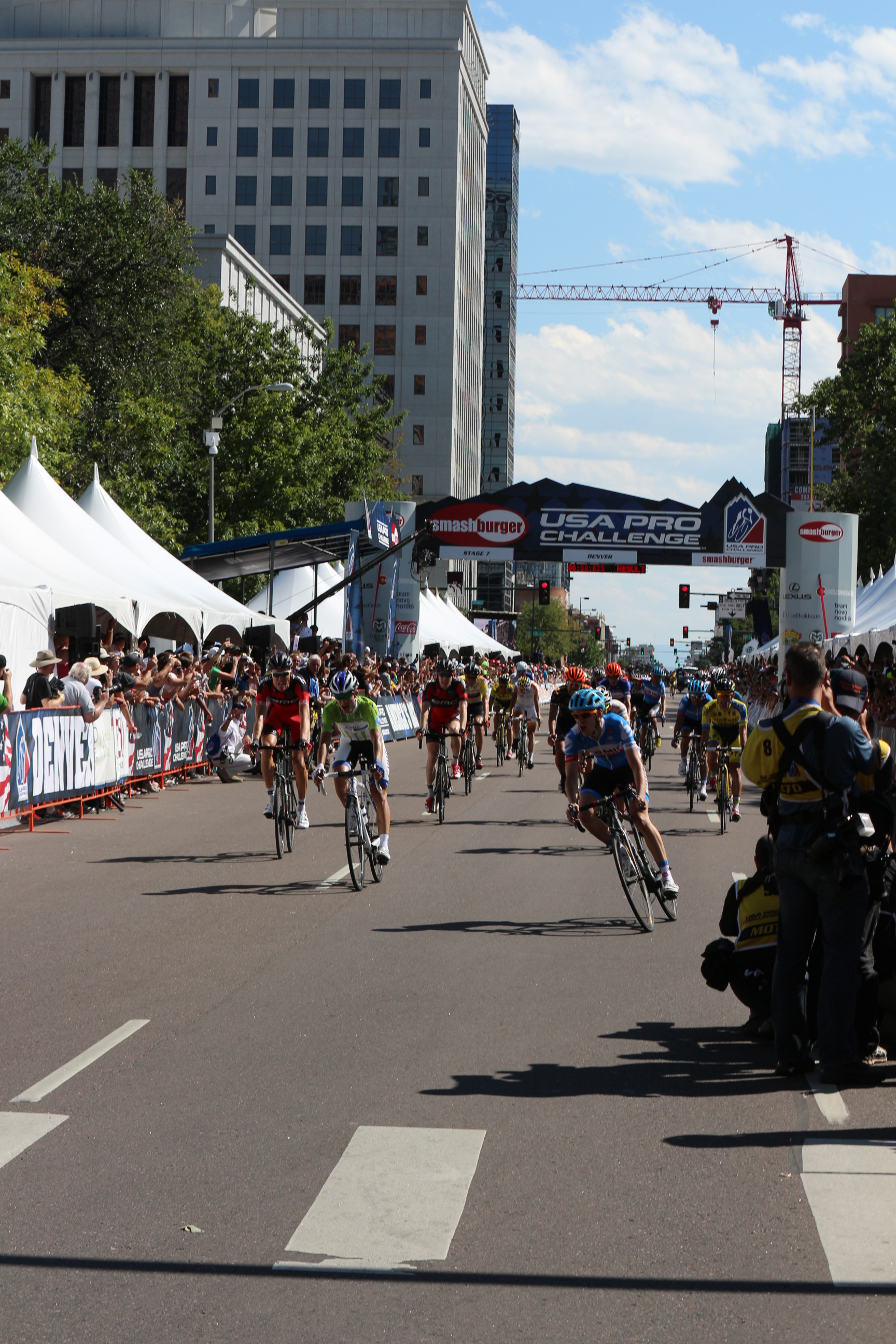
The USA Pro Challenge commissioned Sponsorship Science LLC, a global sports marketing & research consultancy firm with more than 50 years of executive experience working with events around the world, to continue conducting quantitative research measuring the change in overall economic impact of the Pro Challenge over time.
“While we conduct these types of studies for sports and entertainment clients around the world, across many platforms and geographies, cycling has always been a core sport, and one where we have a wealth of experience, ” said David Porthouse, SVP of Sponsorship Science, LLC. “Our history with the event and trust in the Pro Challenge management team, as well as the promoter Medalist Sports, has allowed us to develop the data and models used to accurately and fairly evaluate the growth of the race over time and its impact on the state of Colorado.”
Sponsorship Science, LLC designed the study from the outset to deliver consistent, defensible results which address many of the contentious issues surrounding economic impact reporting. Kevin Schott, director of Sponsorship Science notes the multi-year relationship with academia via Dr. Brett Boyle, professor within the sports business program at St. Louis University, has paid enormous dividends in terms of scientific rigor and credibility throughout the duration of this long-term relationship, serving as the foundation for the future. Key areas addressed included:
· Substitution effects – Since local fans will often spend similar amounts on local sports and other entertainment, Sponsorship Science, LLC did not include the local fan spend in the economic impact report, as a net impact, although local participation was thoroughly tracked, and forms a significant part of the appeal
· Time shifting – Colorado is an attractive destination for travel, so Sponsorship Science, LLC deliberately filtered respondents to ensure they were not capturing data from spectators already in Colorado, independent of the Pro Challenge, and also used elimination questions to remove those fans who intended to come to Colorado in the near future independent of the race. Despite these rigorous procedures, the number of dedicated fans travelling to the Pro Challenge has followed a long-term growth trend
· Sample sizes – Large samples were taken at all stages, distributed across the race locations, in order to create samples and sub-samples (by age, income, distance travelled, etc.) that are all statistically significant
Cane Creek Recalls Bicycle Shocks Due to Risk of Injury
Posted: November 2, 2014 Filed under: Mountain Biking | Tags: Cane Creek, Cane Creek Cycling Components, Consumer Product Safety Council, CPSC, Rear Shock, Recall Leave a commentCane Creek Cycling Components
DBINLINE Rear Shock
Identifying Information
Remedy
Recall Information:
Units: About 5,000 in the US and 500 in Canada
Year Manufactured: 2014
Incidents/Injuries: Cane Creek has received four complaints from customers, one of which involved a report of injury with bruises in the midsection.
Sold: Distributors and retailers globally from May 2014 through September 2014 for about $495 each or included in the price of the bike.
Description: This recall involves Cane Creek Cycling Components DBINLINE bicycle rear shock absorbers. The shocks are marked with graphics that incorrectly identify the adjustment directions for High Speed Rebound (HSR) damping. HSR on the shock is decreased by turning the adjuster counter-clockwise and increased by turning it clockwise. The incorrect graphics present the opposite; that is, the plus(+) and minus(–) symbols are switched. The consumer can be misled or confused when adjusting HSR on these shocks. The shocks come in black anodized aluminum with the words “INLINE” marked on the air can portion of the shock and are attached to a full-suspension mountain bike frame. Recalled products have a serial number on the underside of the top valve body in the following ranges: AA00002 – AA07304 and SA00077 – SA03926.
Hazard: The shock absorber is marked with graphics that incorrectly identify the adjustment directions for High Speed Rebound (HSR) damping. Following these directions will cause unexpected behavior by a bike’s suspension and pose a fall hazard to a rider.
Consumer Contact: Cane Creek Cycling Components at (844) 490-3663 from 9 a.m. to 5 p.m. ET Monday through Friday, or online at http://www.canecreek.com and click on “Safety and Recall” for recall information.
The shocks were sold separately. To view a full list of mountain bikes that were sold with these shocks, click here: http://www.cpsc.gov/en/Recalls/2015/Cane-Creek-Recalls-Bicycle-Shocks/
Remedy: Consumers should immediately stop using the product and contact Cane Creek for a repair decal kit to correct the HSR adjustment markings on affected product.
Retailers: If you are a retailer of a recalled product you have a duty to notify your customers of a recall. If you can, email your clients or include the recall information in your next marketing communication to your clients. Post any Recall Poster at your stores and contact the manufacturer to determine how you will handle any recalls.
For more information on this see:
For Retailers
Recalls Call for Retailer Action
Combination of a Products Liability statute, an Expert Witness Report that was just not direct enough and odd facts holds a retailer liable as manufacture for product defect.
Product Liability takes a different turn. You must pay attention, just not rely on the CPSC.
Retailer has no duty to fit or instruct on fitting bicycle helmet
Summary Judgment granted for bicycle manufacturer and retailer on a breach of warranty and product liability claim.
For Manufacturers
The legal relationship created between manufactures and US consumers
What do you think? Leave a comment.
If you like this let your friends know or post it on FB, Twitter or LinkedIn
Copyright 2013 Recreation Law (720) Edit Law
Email: Rec-law@recreation-law.com
Google+: +Recreation
Twitter: RecreationLaw
Facebook: Rec.Law.Now
Facebook Page: Outdoor Recreation & Adventure Travel Law
Blog: www.recreation-law.com
Mobile Site: http://m.recreation-law.com
#AdventureTourism, #AdventureTravelLaw, #AdventureTravelLawyer, #AttorneyatLaw, #Backpacking, #BicyclingLaw, #Camps, #ChallengeCourse, #ChallengeCourseLaw, #ChallengeCourseLawyer, #CyclingLaw, #FitnessLaw, #FitnessLawyer, #Hiking, #HumanPowered, #HumanPoweredRecreation, #IceClimbing, #JamesHMoss, #JimMoss, #Law, #Mountaineering, #Negligence, #OutdoorLaw, #OutdoorRecreationLaw, #OutsideLaw, #OutsideLawyer, #RecLaw, #Rec-Law, #RecLawBlog, #Rec-LawBlog, #RecLawyer, #RecreationalLawyer, #RecreationLaw, #RecreationLawBlog, #RecreationLawcom, #Recreation-Lawcom, #Recreation-Law.com, #RiskManagement, #RockClimbing, #RockClimbingLawyer, #RopesCourse, #RopesCourseLawyer, #SkiAreas, #Skiing, #SkiLaw, #Snowboarding, #SummerCamp, #Tourism, #TravelLaw, #YouthCamps, #ZipLineLawyer, Recall, Cane Creek, Rear Shock, Cane Creek Cycling Components, CPSC, Consumer Product Safety Council,
Velodrome cover will provide year-round training for USA Cycling athletes in Colorado Springs
Posted: October 24, 2014 Filed under: Cycling | Tags: 2016 Summer Olympics, Colorado Springs, Sarah Hammer, Track cycling, United States, United States Olympic Committee, United States Olympic Training Center, USA Cycling Leave a comment
|
|||||||||||

Last Chance to get a Great Copy of Roads Were Not Built for Cars
Posted: October 14, 2014 Filed under: Cycling | Tags: Amazon, Amazon Kindle, Apple, EPUB, IBook, IPad, Kickstarter, PayPal Leave a comment
|


A recall leads to lawsuits because injuries are connected to the product being recalled thus a lawsuit. Plaintiffs hope the three can be connected
Posted: October 13, 2014 Filed under: Cycling, Michigan | Tags: bicycle, Bicycle helmet, Breach of Warranty, Catlike Sport Components SL, Catlike USA, Consumer Product Safety Council, CPSC, Cycling, helmet, Monarch Velo Llc, The Kreb Cycle, Tracy Ann Jenish, warranty, Warranty of Fitness, Warranty of Fitness for a Particular Purpose Leave a commentPlaintiff crashed her bike suffering head injuries. Plaintiff was wearing a bicycle helmet that was subject to a recall, earlier. The plaintiff hoped her injury could be paid for by the helmet manufacturer using the recall as the influence with the jury.
State: Michigan
Plaintiff: Tracy Ann Jenish
Defendant: Monarch Velo Llc dba Catlike USA, a Texas Corporation, The Kreb Cycle, a New York Corporation, and Catlike Sport Components SL
Plaintiff Claims: negligence, gross negligence, and breach of warranty
Defendant Defenses:
Holding: for the defendant
Year: 2007
This is why recalls are such a problem. The recalls themselves are a nightmare for the outdoor recreation industry because the problems don’t fit in the Consumer Product Safety Council (CPSC) mold. The cost goes through the roof trying to comply with the requirements of the recall and deal with the resulting bad publicity.
The biggest problem is recalls immediately show up on the plaintiff attorney’s websites with the line Have you been hurt using/wearing this product “Call us.”
In this case, the plaintiff purchased a bicycle helmet from the defendant retailer. The bicycle helmet was subject to a recall prior to the plaintiff’s crash. The plaintiff exchanged the helmet for a newer one due to the recall, prior to her crash. The plaintiff fell while riding her bike suffering head and other injuries and sued.
The first defendant was a retailer in New York. The retailer purchased the helmet from a distributor in Texas. The distributor imported the helmet from the manufacturer, a Spanish corporation. All three, the manufacturer, distributor, and retailer were defendants to the litigation. All three were in the chain of sale from the manufacturer to the consumer.
The theory behind allowing suits against everyone involved in the litigation is anyone in the chain could have spotted the defect and prevented the consumer from purchasing a defective product. That was a great theory when wagon wheels were being sold. Everyone understood wagon wheels and could see a flaw or defect in a wagon wheel before the consumer purchased the wheel.
That general theory does not work any longer in software, computers or in this case a bike helmet. If you could understand the physics and engineering behind the creation of the helmet, you could not see the defects in many cases because the defects are covered by plastic.
The suit was filed in Michigan the home state of the plaintiff in the United States District Court for the Eastern District of Michigan, Southern Division. Federal courts are the courts in place to deal with litigation between parties from different states or of the US and another country. The federal courts are not subject to the issue of “hometowning” or deciding a case solely on the issue of where the parties live in the courts’ hometown.
The three defendants filed a motion for summary judgment, which was granted.
Federal District Court decisions are reported. Very few states report trial court decisions. However, this is different in the federal system, and we have an interesting case.
Analysis: making sense of the law based on these facts.
The plaintiff dismissed its negligence and gross negligence claims and proceeded with its breach of warranty claims prior to this motion. The plaintiff stated there was no express warranty claim, only a breach of implied warranty. Implied warranties are warranties that attach to any sale. They are not written down in the manual, they occur whenever there is a sale. Implied warranty of merchantability and implied warranty of fitness for a particular purpose are warranties that go with every sale and are the two main claims in lawsuits.
These warranties are not in writing and unless disclaimed, they go with any sale. The first, warranty of merchantability means the product meets the requirements of the industry where they are sold. The implied warranty of fitness for a particular purpose is a warranty that the promises made by the sellers will be met by the product. For more information on these warranties see The legal relationship created between Manufacturers and US consumers.
No specific warranty was mentioned in the decision other than the warranty of fitness and merchantability. There were also allegations that there was a breach of warranty under Michigan’s law, which may be the same or different from the warranties explained above.
The plaintiff’s case was based on the recall. The CPSC required a recall “poster” which was entered into evidence as proof of the recall and the defect. The plaintiff also had an expert who opined that the plaintiff’s head injury “directly related to the inadequacies of the Catlike Kompact bike helmet.”
No other evidence was introduced. The expert’s opinion was not specific and did not provide any cause for the injury or the failure of the helmet. The court held that because there was no analysis of the crash, speed, location of impact or details of the accident the expert’s opinion was of no value.
As discussed at oral argument, plaintiff has not brought forth any evidence of the reason the Catlike Kompact helmet failed impact testing. All that has been presented is a one-page press release from the CPSC, set forth above, including a statement that “[t]he helmets fail impact testing required under CPSC’s safety standard for bicycle helmets, violating the Consumer Product Safety Act.” Without additional information from the CPSC or any other source, or the results of any independent testing, it is the opinion of the court that Dr. Kress’ statement that “[t]he severity of the head injury sustained by Ms. Jenish is a direct result of the inability of the Catlike Kompact to comply to the CPSC’s safety standards” can be nothing but inadmissible speculation.
Although warranty claims require very little evidence to prove, in this case, no evidence was presented that the court could rely upon to uphold the claims of the plaintiff. The court granted the three defendants’ motion and dismissed the case.
So Now What?
This case has little value in teaching about helmet crashes, and the liability issues involved in manufacturing helmets. What it does teach is the unintended consequence of dealing with a recall and the CPSC.
It is impossible, probably, nowadays to create a product that will never have a recall. However, that does not mean you should try. As important, if you are looking at a recall, make sure you fully understand the consequences and work with counsel to lessen the impacts of the recall on your company and the effects it may have.
You also must disclaim all warranties other than the warranties you want for your product. If the proper disclaimer had been part of the information going with the sale of the helmet then this case would not have gone this far.
It is common for many products in the outdoor recreation industry to be brought into the US without the proper warranties and disclaimers. Additionally, many times when translating a product manual the word warranty will be translated into the word guaranty in English, which creates even greater liability issues.
 Jim Moss |
Jim Moss is an attorney specializing in the legal issues of the outdoor recreation community. He represents guides, guide services, outfitters both as businesses and individuals and the products they use for their business. He has defended Mt. Everest guide services, summer camps, climbing rope manufacturers, avalanche beacon manufacturers, and many more manufacturers and outdoor industries. Contact Jim at Jim@Rec-Law.us |
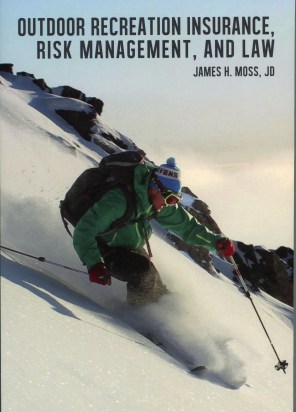
Outdoor Recreation Insurance, Risk Management, and Law
Jim is the author or co-author of six books about the legal issues in the outdoor recreation world; the latest is Outdoor Recreation Insurance, Risk Management and Law.
To see Jim’s complete bio go here and to see his CV you can find it here. To find out the purpose of this website go here.
G-YQ06K3L262
What do you think? Leave a comment.
If you like this let your friends know or post it on FB, Twitter or LinkedIn
 Blue Sky |
 Stimulus |
 X (formerly known as Twitter) logo |
 Threads |
 |
 |
Author: Outdoor Recreation Insurance, Risk Management and Law
Facebook Page: Outdoor Recreation & Adventure Travel Law
Email: Jim@Rec-Law.US
By Recreation Law Rec-law@recreation-law.com James H. Moss
@2024 Summit Magic Publishing, LLC
#AdventureTourism, #AdventureTravelLaw, #AdventureTravelLawyer, #AttorneyatLaw, #Backpacking, #BicyclingLaw, #Camps, #ChallengeCourse, #ChallengeCourseLaw, #ChallengeCourseLawyer, #CyclingLaw, #FitnessLaw, #FitnessLawyer, #Hiking, #HumanPowered, #HumanPoweredRecreation, #IceClimbing, #JamesHMoss, #JimMoss, #Law, #Mountaineering, #Negligence, #OutdoorLaw, #OutdoorRecreationLaw, #OutsideLaw, #OutsideLawyer, #RecLaw, #Rec-Law, #RecLawBlog, #Rec-LawBlog, #RecLawyer, #RecreationalLawyer, #RecreationLaw, #RecreationLawBlog, #RecreationLawcom, #Recreation-Lawcom, #Recreation-Law.com, #RiskManagement, #RockClimbing, #RockClimbingLawyer, #RopesCourse, #RopesCourseLawyer, #SkiAreas, #Skiing, #SkiLaw, #Snowboarding, #SummerCamp, #Tourism, #TravelLaw, #YouthCamps, #ZipLineLawyer, Tracy Ann Jenish, Monarch Velo Llc, Catlike USA, The Kreb Cycle, Catlike Sport Components SL, Cycling, Bicycle, Bicycle Helmet, Helmet, CPSC, Consumer Product Safety Council, Warranty, Warranty of Fitness for a Particular Purpose, Warranty of Fitness, Breach of Warranty,
2014 VeloSwap: Into Cycling you need to be there if you Need a deal or got deals to sell
Posted: October 10, 2014 Filed under: Cycling, Mountain Biking | Tags: bicycle, Bicycle Colorado, Colorado, Cycling, Denver, Ecovillage, x, y, z Leave a comment
MEDIA ADVISORY
Wheelin’ and Dealin’ at Cyclists’ Ultimate Bargain Hunt
· Subaru VeloSwap Denver returns to National Western Complex Sat., Oct 18
· 10,000 expected to buy, sell and swap bikes, gear, parts and accessories
· Find the best deals of the year as bike shops and more clear out inventory!
| What: | Inspired by the excitement of the USA Pro Cycling Challenge? Dreaming of a new set of wheels? Get ready to ride at the Subaru VeloSwap Denver, the ultimate bargain treasure hunt for cycling enthusiasts. A true celebration of all things cycling, the event features the opportunity to buy, sell and recycle new and used bicycles and equipment. Find the rarest parts and the best deals, while recycling your old gear! Veloswap.com |
| When: | Saturday, October 18, 20149:00am – 4:00pm |
| Where: | National Western Complex4655 Humboldt St. Denver, CO 80216 |
| Who: | · Almost 10,000 people are expected to attend· 300+ exhibitors will have the best deals cyclists will see all year
· Thousands start lining up outside as early as 6:00am to get the best deals |
| Tickets: |
|
| More: |
· New!! – New Product Showcase; check out the new 2015 equipment and talk with company reps about the latest and greatest in the industry including Bianchi, Parlee, Focus, Pedego E-Bikes and more. · Participants are invited to attend unique and informative seminars from Natural Grocers and others and enter to win amazing raffle prizes. · The day will conclude with live music in the supplier area. |
 Green Guru will be there taking your old tubes and recycling them into new products. Green Guru will be there taking your old tubes and recycling them into new products. |
Jenish v. Monarch Velo Llc dba Catlike USA, 2007 U.S. Dist. LEXIS 34120; CCH Prod. Liab. Rep. P17,754 (E.D. Mich. S.D. 2007)
Posted: October 7, 2014 Filed under: Cycling, Legal Case, Michigan | Tags: bicycle, Bicycle helmet, Breach of Warranty, Catlike Sport Components SL, Catlike USA, Consumer Product Safety Council, CPSC, Cycling, helmet, Monarch Velo Llc, The Kreb Cycle, Tracy Ann Jenish, warranty, Warranty of Fitness, Warranty of Fitness for a Particular Purpose Leave a commentTo Read an Analysis of this decision see: A recall leads to lawsuits because injuries are connected to the product being recalled thus a lawsuit. Plaintiffs hope the three can be connected
Jenish v. Monarch Velo Llc dba Catlike USA, 2007 U.S. Dist. LEXIS 34120; CCH Prod. Liab. Rep. P17,754 (E.D. Mich. S.D. 2007)
Tracy Ann Jenish, Plaintiff, vs. Monarch Velo Llc dba Catlike USA, a Texas Corporation, The Kreb Cycle, a New York Corporation, and Catlike Sport Components SL, a Spanish Corporation, Defendants.
Case No. 05-CV-73648
UNITED STATES DISTRICT COURT FOR THE EASTERN DISTRICT OF MICHIGAN, SOUTHERN DIVISION
2007 U.S. Dist. LEXIS 34120; CCH Prod. Liab. Rep. P17,754
May 9, 2007, Decided
May 9, 2007, Filed
CORE TERMS: helmet, catlike, bicycle, safety standard, summary judgment, head injuries, consumer, warranty, material fact, brain, acceleration, testing, seller, bike, Bicycle Helmets Final Rule, entitled to judgment, traumatic, hematoma, usa, Consumer Product Safety Act, matter of law, genuine issue, implied warranty, proximate cause, manufactured, manufacturer, distributor, attenuation, deposition, violating
COUNSEL: [*1] For Tracy Ann Jenish, Plaintiff: Lawrence S. Katkowsky, LEAD ATTORNEY, Lawrence S. Katkowsky Assoc., Bingham Farms, MI.
For Kreb Cycle, Defendant: Matthew A. Brauer, LEAD ATTORNEY, Rutledge, Manion, (Detroit), Detroit, MI.
JUDGES: GEORGE CARAM STEEH, UNITED STATES DISTRICT JUDGE.
OPINION BY: GEORGE CARAM STEEH
OPINION
OPINION AND ORDER GRANTING DEFENDANT THE KREB CYCLE’S MOTION FOR SUMMARY JUDGMENT (DOCUMENT # 38)
INTRODUCTION
Before the court in this product liability lawsuit is a motion for summary judgment brought by defendant The Kreb Cycle, a New York seller of bicycle equipment, in which it asserts it is entitled to judgment on all counts in the complaint. 1 Because the court agrees that plaintiff has not raised a question of material fact as to causation of her injuries by an allegedly defective bicycle helmet, defendant’s motion is granted as set forth below.
1 The other defendants to this action have not filed answers to the complaint.
BACKGROUND
Plaintiff Tracy Jenish was riding with a bicycling [*2] club on Wing Lake Road in the area of Bloomfield Hills, Michigan on September 26, 2002, when she fell off her bike and suffered serious bodily injuries, including injuries to her head. She was wearing a helmet called a “Catlike Kompact,” manufactured by defendant Catlike Sport Components SL, a Spanish corporation, distributed by defendant Monarch Velo LLC, a Texas corporation 2, and sold to the plaintiff by movant-defendant Kreb Cycle, a New York corporation.
2 Answers to the complaint by the remaining defendants have not been filed, and defendant Kreb Cycle states in its motion that the other defendants are in default. The docket reflects that a clerk’s entry of default was filed as to defendant Monarch Velo, L.L.C. on June 2, 2006.
The Kreb Cycle (hereinafter “defendant”) started carrying these helmets after its owner attended a trade show in Las Vegas, where a model of the Catlike Kompact helmet was on display. Defendant ordered the helmets from Monarch Velo LLC, d/b/a “Catlike USA,” a Texas distributor. [*3] The helmets came with the manufacturer’s label stating they complied with U.S. Consumer Product Safety Commission (“CPSC”) standards. Although there are no records of the sale, defendant does not dispute that it sold the helmet to plaintiff. Plaintiff’s recollection, according to her deposition, is that she called in with a credit card or ordered it online, at some point during the year preceding the accident.
In 2003, some months after plaintiff’s accident, the Catlike Kompact helmet was the subject of a voluntary manufacturer recall. Defendant has produced a copy of the CPSC’s announcement of this recall, which is reproduced below in its entirety, with the exception of the generic CPSC headings and contact numbers:
*****
CPSC, Monarch Velo, LLC doing business as Catlike USA Announce Recall of Bike Helmets
Washington, D.C. — The U.S. Consumer Product Safety Commission announces the following recall in voluntary cooperation with the firm below. Consumers should stop using recalled products immediately unless otherwise instructed.
Name of product: Catlike Kompact TM Bike Helmets
Units: 2,250
Distributor: Monarch Velo, LLC, doing business [*4] as Catlike USA, of Houston, Texas
Hazard: The helmets fail impact testing required under CPSC’s safety standard for bicycle helmets, violating the Consumer Product Safety Act.
Incidents/Injuries: None reported.
Description: This recall involves Catlike Kompact TM adult bicycle helmets. The helmets were sold in two sizes (small/medium and large/extra large) and various colors. The sizing label inside the helmets reads “Kompact” and “SM/MD” or “LG/XL.”
Sold at: Bicycle shops nationwide sold the helmets from March 2002 through February 2003 for about $ 130.
Manufactured in: Spain
Remedy: Contact Monarch Velo for information on receiving a free replacement helmet.
Consumer Contact: Contact Monarch Velo toll-free at (877) 228-5646 between 9 a.m. and 5 p.m. CT Monday through Friday or visit the firm’s web site at http://www.catlike-usa.com
Media Contact: Chris Watson at (877) 228-5646.
Exhibit D to Defendant’s Motion. Plaintiff obtained a replacement Catlike helmet after announcement of the recall.
This action was filed in federal court on the basis of diversity of citizenship in September 2005. [*5] Plaintiff’s First Amended Complaint, filed September 29, 2005, makes a common claim against all three defendants, asserting negligence, gross negligence, and breach of warranty in the design, manufacture, and distribution of an unmerchantable, “untested” bicycle helmet that failed to protect against injury to the head.
STANDARD FOR SUMMARY JUDGMENT
Federal Rule of Civil Procedure 56(c) empowers the court to render summary judgment “forthwith if the pleadings, depositions, answers to interrogatories and admissions on file, together with the affidavits, if any, show that there is no genuine issue as to any material fact and that the moving party is entitled to judgment as a matter of law.” See Redding v. St. Eward, 241 F.3d 530, 532 (6th Cir. 2001). The Supreme Court has affirmed the court’s use of summary judgment as an integral part of the fair and efficient administration of justice. The procedure is not a disfavored procedural shortcut. Celotex Corp. v. Catrett, 477 U.S. 317, 327, 106 S. Ct. 2548, 91 L. Ed. 2d 265 (1986); see also Cox v. Kentucky Dept. of Transp., 53 F.3d 146, 149 (6th Cir. 1995).
The [*6] standard for determining whether summary judgment is appropriate is “‘whether the evidence presents a sufficient disagreement to require submission to a jury or whether it is so one-sided that one party must prevail as a matter of law.'” Amway Distributors Benefits Ass’n v. Northfield Ins. Co., 323 F.3d 386, 390 (6th Cir. 2003) (quoting Anderson v. Liberty Lobby, Inc., 477 U.S. 242, 251-52, 106 S. Ct. 2505, 91 L. Ed. 2d 202 (1986)). The evidence and all reasonable inferences therefrom must be construed in the light most favorable to the non-moving party. Matsushita Elec. Indus. Co., Ltd. v. Zenith Radio Corp., 475 U.S. 574, 587, 106 S. Ct. 1348, 89 L. Ed. 2d 538 (1986); Redding, 241 F.3d at 532 (6th Cir. 2001). “[T]he mere existence of some alleged factual dispute between the parties will not defeat an otherwise properly supported motion for summary judgment; the requirement is that there be no genuine issue of material fact.” Anderson v. Liberty Lobby, Inc., 477 U.S. 242, 247-48, 106 S. Ct. 2505, 91 L. Ed. 2d 202 (1986) (emphasis in original); see also National Satellite Sports, Inc. v. Eliadis, Inc., 253 F.3d 900, 907 (6th Cir. 2001). [*7]
If the movant establishes by use of the material specified in Rule 56(c) that there is no genuine issue of material fact and that it is entitled to judgment as a matter of law, the opposing party must come forward with “specific facts showing that there is a genuine issue for trial.” First Nat’l Bank v. Cities Serv. Co., 391 U.S. 253, 270, 88 S. Ct. 1575, 20 L. Ed. 2d 569 (1968); see also McLean v. 988011 Ontario, Ltd., 224 F.3d 797, 800 (6th Cir. 2000). Mere allegations or denials in the non-movant’s pleadings will not meet this burden, nor will a mere scintilla of evidence supporting the non-moving party. Anderson, 477 U.S. at 248, 252. Rather, there must be evidence on which a jury could reasonably find for the non-movant. McLean, 224 F.3d at 800 (citing Anderson, 477 U.S. at 252).
ANALYSIS
Kreb Cycle asserts in its motion that it is entitled to judgment as to all three of plaintiff’s claims: negligence, gross negligence, and breach of warranty. In response, plaintiff asserts it is “only relying on the implied warranty of fitness and merchantability as to this Defendant and will not, therefore, respond to [*8] Defendant’s arguments as to negligence and gross negligence.” Accordingly, judgment is hereby granted for Kreb Cycle as to plaintiff’s negligence and gross negligence claims.
The sole claim remaining as to this defendant is plaintiff’s breach of warranty claim. Plaintiff concedes defendant made no express warranty regarding this helmet. Accordingly, proceeding on a cause of action for breach of an implied warranty, plaintiff asserts that she has established a prima facie case of breach of implied warranty under Michigan law, 3 citing to this court’s case of Konstantinov v. Findlay Ford Lincoln Mercury, 2006 U.S. Dist. LEXIS 85836, 2006 WL 3299487. As set forth in that case, under the Michigan Tort Reform Act, effective in 1996,
(6) In a product liability action, a seller other than a manufacturer is not liable for harm allegedly caused by the product unless either of the following is true:
(a) The seller failed to exercise reasonable care, including breach of any implied warranty, with respect to the product and that failure was a proximate cause of the person’s injuries.
(b) The seller made an express warranty as to the product, the product failed to conform to the warranty, and the [*9] failure to conform to the warranty was a proximate cause of the person’s harm.
Mich. Comp. Laws Ann. § 600.2947(6).
3 Although the retailer was a New York seller, neither party asserts applicable law other than that of Michigan.
Defendant’s argument for summary judgment on this claim is that plaintiff has not come forward with any evidence of a specific defect in the helmet, and has not drawn any kind of causal connection between the alleged defect and her head injuries. It cites to Mascarenas v. Union Carbide, 196 Mich. App. 240, 249, 492 N.W.2d 512 (1992) for the elements of a product liability case under Michigan law: proof that the defendant supplied a defective product, and that the defect proximately caused the plaintiff’s injury. Defendant argues that plaintiff relies only on the helmet’s later recall, disclosed in a 5/22/03 CPSC press release (stating that the recall was occurring “in voluntary cooperation with” the U.S. distributor) and conclusory statements [*10] by an expert, neither of which establish a question of material fact as to proximate cause. 4
4 Defendant also addresses plaintiff’s weak assertion, in answers to interrogatories, that defendant “had a duty to determine whether the model helmet in question did in fact meet CPSC standards.” As defendant argues, there is no such duty required by Mich. Comp. Laws Ann. § 600.2947(6), set forth above.
The court agrees with the defendant. Although precedent such as Mills v. Curioni, Inc., 238 F. Supp. 2d 876, 886 (E.D. Mich. 2002) and the very recent decision in Coleman v. Maxwell Shoe Co., 475 F. Supp. 2d 685, 2007 U.S. Dist. LEXIS 11513, 2007 WL 551608 (E.D. Mich. 2007) lend support to defendant’s argument concerning non-manufacturing sellers and the need for a showing of negligence in failing to detect a product’s defect, this case must be dismissed whether or not such evidence is required.
Plaintiff’s expert’s initial report, created by Tyler A. Kress, Ph.D. in Knoxville, Tennessee, dated [*11] October 6, 2006, summarily lists plaintiff’s injuries following the accident. It then lists all of the expert’s qualifications, his fees, and the records he reviewed. These are a 9/26/2002 CT scan of plaintiff’s head; the hospital’s discharge summary; a letter of April 3, 2003 by a Jon Wardner, M.D. stating plaintiff’s disability; the CPSC announcement of the helmet recall; and the plaintiff’s deposition. Dr. Kress also states that he met with the plaintiff. The remainder (and the entire substance) of his letter/report stated only a conclusion that a “defect” of the helmet was “directly related to the inadequacies of the Catlike Kompact bike helmet.”
Defendant then brought a motion, granted by the magistrate, for sanctions and to require a supplemental report by November 15, 2006, containing a “complete statement of all opinions to be expressed and the basis and reasons therefor…” A supplemental report was subsequently created by Dr. Kress. That report, dated November 15, 2006, is set forth below in its entirety:
Dear Mr. Katkowsky:
This is to supplement my report of October 6, 2006, regarding the above-styled cause.
1) Use: It is my opinion that it is foreseeable [*12] that some consumers will sustain a preventable head injury due to the impact performance (or lack thereof) of the helmet while using it in an appropriate manner as it is intended to be used.
Protective head gear and bicycle helmets have the ability to eliminate or greatly reduce traumatic head and brain injury when properly designed an manufactured. To ensure that bicycle helmets available in the consumer market adequately serve these goals, the Consumer Product Safety Commission has created safety standards for a range of criterion, including impact attenuation (CPSC’s Safety Standard for Bicycle Helmets Final Rule: 16 CFR Part 1203).
Bicycle helmets that have adequate impact attenuation performance, as set forth by the CPSC’s safety standards, and are used in an appropriate, reasonable, and correct manner are highly successful in preventing or greatly reducing traumatic head and brain injury. As found in a 1989 study by Thompson et al and explicitly cited in the CPSC’s Safety Standard for Bicycle Helmets Final Rule (16 CFR Part 1203, pg. 11713), riders with helmets had an 85% reduction in head injury risk, and 88% reduction in brain injury risk.
2) Reason for Injury: [*13] Ms. Jenish’s head injury is directly related to the inadequacies of the Catlike Kompact bike helmet.
The CPSC’s Safety Standard for Bicycle Helmets Final Rule (16 CFR Part 1203) explicitly establishes a performance test to “ensure that helmets will adequately protect the head in a collision” (pg. 11714). As a component of this performance test, helmets are required to not exceed a peak headform acceleration of 300 g for any impact. This pass/fail criterion of 300g or below is consistent with other standards such as the ANSI, Snell, and ASTM (CPSC’s Safety Standard for Bicycle Helmets Final Rule (16 CFR Part 1203, pg. 11714; Halstead 2001). The Catlike Kompact bike helmet is inadequate due to the fact that it failed impact standards that pertain to the design and performance of the helmet in a foreseeable use that may result in an impact to the head.
In the accident on September 26, 2002, Ms. Jenish hit a curb while riding her bicycle, was ejected, and impacted her head. She reported a loss of consciousness at the scene, and her relevant injuries include, but are not limited to, a traumatic brain injury and a subdural hematoma. Ms. Jenish sustained a direct impact to the back [*14] of the head (occipital region) which corresponds to a right occipatal scalp hematoma and the area of impact and failure seen in the helmet. Contact head impacts, such as this, result in predominantly linear acceleration of the head and brain, with small components of angular acceleration. Linear acceleration can product focal brain injuries, such as subdural hematomas, as well as concussions; as seen in Ms. Jenish.
The severity of the head injury sustained by Ms. Jenish is a direct result of the inability of the Catlike Kompact to comply to the CPSC’s safety standards. Subdural hematomas, similar to the one sustained by Ms. Jenish, are commonly caused by an impact to the occipital region (Kleiven 2003, Zhou et al 1995). The acceleration of the head in an occipital impact exceeded the values of what a reasonably designed and protective headgear would have given the wearer. Due to the failure of the Catlike Kompact bicycle helmet to comply to the CPSC’s impact safety standards Ms. Jenish’s head experienced higher acceleration values resulting in a more serious traumatic brain injury than would have been experienced if the helmet was compliant with the impact standards of the CPSC. [*15]
3) Design Defect: The helmet is inherently dangerous and defective by design in that it fails to comply with impact testing standards required under CPSC’s safety standard for bicycle helmets, violating the Consumer Product Safety Act.
The impact attenuation standards of the CPSC’s Safety Standard for Bicycle Helmets Final Rule (16 CFR Part 1203) was created in order to “ensure that helmets will adequately protect the head in a collision” (p. 11714). Failure to meet this standard endangers consumers by failing to prevent or reduce injury.
If you have any questions or need anything further please do not hesitate to contact me.
Sincerely,
/s/
Tyler Kress, Ph.D., CIE
Exhibit I to Defendant’s Motion and Exhibit 2 to Plaintiff’s Response.
Defendant contends that all this report arguably establishes is that the helmet failed to “meet standards;” and that plaintiff has failed to connect that alleged, undefined defect to her injuries. As defendant asserts, there is no evaluation of items such as plaintiff’s speed at the time of the crash, location of impact, descriptive information concerning the object struck or other details of the accident. Defendant [*16] points to the serious injuries sustained by the plaintiff in the crash, including fractured vertebrae, a crushed rib cage, fractured collarbone, bulging spinal discs, and a collapsed lung, and asserts that helmets don’t rule out any and all head injuries, in any crash or at any speed, but serve to help protect against head injuries. Plaintiff has not identified the manufacturing or design elements of the helmet that led to voluntary recall nor has accident reconstruction tied these elements to the plaintiff’s injuries.
As discussed at oral argument, plaintiff has not brought forth any evidence of the reason the Catlike Kompact helmet failed impact testing. 5 All that has been presented is a one page press release from the CPSC, set forth above, including a statement that “[t]he helmets fail impact testing required under CPSC’s safety standard for bicycle helmets, violating the Consumer Product Safety Act.” Without additional information from the CPSC or any other source, or the results of any independent testing, it is the opinion of the court that Dr. Kress’ statement that “[t]he severity of the head injury sustained by Ms. Jenish is a direct result of the inability [*17] of the Catlike Kompact to comply to the CPSC’s safety standards” can be nothing but inadmissible speculation. Accordingly, it is the court’s determination that plaintiff has not produced evidence to raise a question of material fact regarding causation. Defendant’s motion will be granted.
5 Plaintiff has failed to identify any specific claimed defect, such as deficiencies in the suspension or cushioning system, hardness or thickness of the plastic, ventilation engineering, overall shape, the strapping mechanism, or any other particular aspects of the helmets in general, much less the helmet worn by plaintiff. Without knowing the defect that motivated a voluntary recall, and without testing of the helmet worn by plaintiff, it is impossible to conclude that a defect caused her injury.
CONCLUSION
Because plaintiff has failed to raise a question of material fact as to the proximate causation of her head injuries by an alleged defect in her bicycle helmet, summary judgment will enter as to all claims brought [*18] by the plaintiff against this defendant.
IT IS SO ORDERED.
Dated: May 9, 2007
S/ George Caram Steeh
UNITED STATES DISTRICT JUDGE
G-YQ06K3L262
Tour of Utah UCI ranking increases to 2.HC
Posted: October 3, 2014 Filed under: Cycling | Tags: Bicycle Racing, Cycling, Larry H. Miller, Larry H. Miller Tour of Utah, Salt Lake City, Tour of Utah, UCI, Union Cycliste Internationale, Utah Leave a comment
|


Redesigning trucks so they have greater vision may save cyclists lives
Posted: October 2, 2014 Filed under: Cycling | Tags: Cyclists Leave a comment
|

 Outdated, brick-shaped lorry cabs are part of the reason why lorries have a deadly track record. Today’s cab design forces the driver to sit on top of the engine in such a high position that much of what happens around the cab is invisible to them – the so-called fatal blind spots.

Georgia Federal Court finds that assumption of the risk is a valid defense in a head injury case against a bicycle helmet manufacturer.
Posted: September 22, 2014 Filed under: Assumption of the Risk, Cycling, Georgia | Tags: assumption of the risk, bicycle, Bicycle South, Bike, Cycling, Florida, Georgia, Head injury, helmet, Inc., Incorporated, Open and Obvious, Opportunities, Product liability, Skid Lid Manufacturing Company, Trek Bicycle Corporation, Wheel Leave a commentIf you purchase a helmet that only protects part of your head, then you cannot sue for injuries to the part of your head not protected.
State: Georgia, US Court of Appeals for the Eleventh Circuit
Plaintiff: Lois Elaine Wilson
Defendant: Bicycle South, Inc.
Plaintiff Claims: Product Liability (breach of warranty, strict liability, and negligence)
Defendant Defenses: Assumption of the Risk and Open and Obvious
Holding: For the defendants
Year: 1990
This case is fairly easy to understand, even though the opinion is quite complicated. The plaintiff was riding her bike from Florida to California. While traveling through Georgia she crashed suffering head injuries.
She sued claiming the rear wheel of the bike collapsed causing her crash. She claimed her head injuries were caused because the helmet failed to protect her head.
She sued the wheel manufacturer, Opportunities Inc., the bicycle manufacturer, Trek Bicycle Corporation and the retailer Bicycle South, Inc. The three defendants were found not liable at trial.
The jury did find the helmet manufacturer, Skid Lid Manufacturing Company liable for the plaintiff’s head injuries. The majority of the decision reviews the helmet issues. The plaintiff purchased the helmet for her ride. The helmet was a “half helmet” which only covered the top half of her head. The helmet came down to about the top of her ears.
The jury found in favor of the plaintiff on the head injury issue caused by the helmet manufacturer. The defendant Skid Lid moved for a judgment notwithstanding the verdict, (JNOV), which the court granted. The defendant helmet manufacturer appealed the decision.
A JNOV is effectively a motion filed by the losing party and the judge overrules the jury. This is a motion that is rarely granted and only done so to overcome extreme or unreasonable jury verdicts. The judge must find that no reasonable jury could reach the decision that was reached by the jury in the case. Normally this is because there are insufficient facts to support the claims or the jury applied the law incorrectly.
In this case, the JNOV seemed to have been entered because the jury ignored the defenses presented by the defendant.
Summary of the case
Georgia at the time of the decision allowed several defense to product liability claims, two of which were: Assumption of the risk and the “open and obvious” defects. Variations of these defenses are available in some, but not all states. The trial judge in this case granted the JNOV based on the Assumption of the Risk defense. The appellate court looked at both of these defenses.
The open and obvious defense states a plaintiff cannot recover from a defendant when the alleged defect is patent and obvious to the user.
The open and obvious rule states that a product is not defective if the peril from which injury could result is patent or obvious to the user. This determination regarding the peril is made on the basis of an objective view of the product. In assessing what is obvious, it must be remembered that, contrary to the belief of some, the American public is not child-like.
This defense is not based on a defect in the product, only that the product will not or will do something that is patent, and open and obvious.
The defense applied here because the plaintiff when purchase the helmet purchased one that only covered part of her head. It was “obvious” that the helmet would not protect the part of her head that the helmet did not cover.
The assumption of risk defense is slightly different, but also applicable in this case. If the consumer knows of a defect in the product, is aware of the danger presented by the defect and proceeds to use the product anyway the plaintiff is barred from recovering. “The first part of the test, actual knowledge of the defect and danger, is fulfilled because appellant had subjective knowledge that the helmet she purchased only covered a portion of her head.”
The assumption of risk defense in Georgia is slightly more difficult to prove because the injured plaintiff must have known about the defect. (However, a defect only becomes one in pleadings after an injury has occurred.) What I mean by this is, as a manufacturer should point out the limitations of the product in the information supplied by the product. This provides the necessary notice to a user of the defect and provides a defense to the manufacturer.
The court also ruled on evidentiary issues in the case which are not important in understanding these issues.
So Now What?
For manufacturers, selling a product means more than just point out the great features of the product. You must warn the consumer of any problems or issues with the product and you must point out what the product cannot do.
That does not mean that you should point out your bicycle won’t get you to the moon. It might mean you should point out that the bicycle should only be ridden on roads if it is a road bike. Videos online show road bikes being ridden everywhere, but that does not mean as a manufacturer you should be liable when someone tries to ride the Monarch Crest Trail on your road bike.
As a retailer, you should point out the differences in products trying to specifically point out short comings about a product. This helmet has a MIPS system in side, this one does not.
Both of these defenses are easy to rely on, however not all states still allow the use of these defenses.
What do you think? Leave a comment.
If you like this let your friends know or post it on FaceBook, Twitter or LinkedIn
Copyright 2014 Recreation Law (720) Edit Law
Email: Rec-law@recreation-law.com
Google+: +Recreation
Twitter: RecreationLaw
Facebook: Rec.Law.Now
Facebook Page: Outdoor Recreation & Adventure Travel Law
Blog: www.recreation-law.com
Mobile Site: http://m.recreation-law.com
By Recreation Law Rec-law@recreation-law.com James H. Moss
#AdventureTourism, #AdventureTravelLaw, #AdventureTravelLawyer, #AttorneyatLaw, #Backpacking, #BicyclingLaw, #Camps, #ChallengeCourse, #ChallengeCourseLaw, #ChallengeCourseLawyer, #CyclingLaw, #FitnessLaw, #FitnessLawyer, #Hiking, #HumanPowered, #HumanPoweredRecreation, #IceClimbing, #JamesHMoss, #JimMoss, #Law, #Mountaineering, #Negligence, #OutdoorLaw, #OutdoorRecreationLaw, #OutsideLaw, #OutsideLawyer, #RecLaw, #Rec-Law, #RecLawBlog, #Rec-LawBlog, #RecLawyer, #RecreationalLawyer, #RecreationLaw, #RecreationLawBlog, #RecreationLawcom, #Recreation-Lawcom, #Recreation-Law.com, #RiskManagement, #RockClimbing, #RockClimbingLawyer, #RopesCourse, #RopesCourseLawyer, #SkiAreas, #Skiing, #SkiLaw, #Snowboarding, #SummerCamp, #Tourism, #TravelLaw, #YouthCamps, #ZipLineLawyer, Opportunities, Incorporated, Trek Bicycle Corporation, Bicycle South, Inc., Skid Lid Manufacturing Company, Open and Obvious, Assumption of the Risk, Product Liability, Helmet, Wheel, Cycling, Bicycle, Bike,
WordPress Tags: Georgia,Federal,Court,assumption,injury,bicycle,helmet,manufacturer,injuries,Wilson,South,LEXIS,Evid,Serv,Callaghan,State,Appeals,Eleventh,Circuit,Plaintiff,Lois,Elaine,Defendant,Claims,Product,negligence,Defenses,Risk,Open,Obvious,defendants,opinion,bike,Florida,California,Opportunities,Trek,Corporation,retailer,jury,Skid,Company,decision,ears,judgment,verdict,JNOV,verdicts,Summary,Variations,user,peril,determination,basis,belief,American,consumer,danger,knowledge,appellant,limitations,information,manufacturers,roads,road,Videos,bikes,Monarch,Crest,Trail,differences,products,comings,MIPS,system,Both,Leave,FaceBook,Twitter,LinkedIn,Recreation,Edit,Email,Google,RecreationLaw,Page,Outdoor,Adventure,Travel,Blog,Mobile,Site,James,Moss,Authorrank,AdventureTourism,AdventureTravelLaw,AdventureTravelLawyer,AttorneyatLaw,BicyclingLaw,Camps,ChallengeCourse,ChallengeCourseLaw,ChallengeCourseLawyer,CyclingLaw,FitnessLaw,FitnessLawyer,HumanPoweredRecreation,JamesHMoss,JimMoss,OutdoorLaw,OutdoorRecreationLaw,OutsideLaw,OutsideLawyer,RecLaw,RecLawBlog,LawBlog,RecLawyer,RecreationalLawyer,RecreationLawBlog,RecreationLawcom,Lawcom,RiskManagement,RockClimbingLawyer,RopesCourse,RopesCourseLawyer,SkiAreas,SkiLaw,SummerCamp,Tourism,TravelLaw,YouthCamps,ZipLineLawyer,Wheel


 Recreation Law