
Federal District Court applying South Dakota law finds release was ineffective in stopping claims for injury that did not occur because of the risk the plaintiff was anticipating.
Posted: October 5, 2020 Filed under: Release (pre-injury contract not to sue), South Dakota | Tags: All Terrain Vehicle, ATV, Duck Hunting, Release, Risk, South Dakota, Waiver Leave a commentThe plaintiff in this case signed a release to hunt, but was injured by an ATV waiting to hunt. As such the release did not apply.
Wimmer v. Top Gun Guide Serv., 421 F. Supp. 3d 849, 2019 U.S. Dist. LEXIS 185888, 2019 WL 5558308
State: South Dakota
Plaintiff: Anthony Wimmer
Defendant: Top Gun Guide Service, Inc., John Does 1-5
Plaintiff Claims: Negligence
Defendant Defenses: Release
Holding: for the Plaintiff
Year: 2019
Summary
A release must be written to cover all the risks your guests could suffer. Here the release covered hunting and did not cover being hit by an ATV when the plaintiff was not hunting. Write your release to inform your participants and to provide protection for you from all fronts.
Facts
This case arose from injuries that plaintiff Anthony Wimmer sustained while on a hunting trip hosted by defendant Top Gun near Aberdeen, South Dakota in April of 2015. Mr. Wimmer is a California resident and Top Gun is a Minnesota corporation. Id. On or about April 9, 2015, Mr. Wimmer arrived in Aberdeen, though he did not hunt on that day. At some point on April 9th, Mr. Wimmer signed a waiver purporting to release Top Gun from liability arising from the hunting trip.
The parties agree that in his deposition Mr. Wimmer testified that he read the release before signing it and that he did not disagree with anything contained therein. Mr. Wimmer also agreed in his deposition that hunting and fishing is a dangerous activity.
On April 10th, Mr. Wimmer arrived at the hunting site and began setting up hunting decoys. Shortly after having finished setting up the decoys, Mr. Wimmer was standing in the field where the hunt was to take place when he was struck from behind “by either an [all terrain vehicle (ATV)] or sled.” The sled was being towed behind the ATV. Id. The ATV was being operated by a Top Gun guide.
Analysis: making sense of the law based on these facts.
The plaintiff argued the normal arguments on why the release should fail. The main one was the release was written specific for the activity of and the risks created by hunting and fishing and at the time of the accident the plaintiff was doing neither of those things. Therefore, the release did not apply, his injuries were outside of the scope of the language of the release.
Plaintiff argues that he had no meaningful opportunity to negotiate the terms of the waiver and so it must be viewed as an “anticipatory release and contract of adhesion, which should be viewed with a skeptical and critical eye,” and any ambiguities should be construed against the drafter. Plaintiff argues that the waiver, by its terms, only applies to the limited activities of hunting and fishing. Plaintiff argues that his are not hunting injuries because, at the time of the accident, he had already finished setting up the decoys and was merely standing in the field waiting to be told what he should do next. Plaintiff urges that such activity should not be considered hunting.
The defendant argued the release was broad and covered the injury the plaintiff sustained and countered the plaintiff’s arguments.
Top Gun’s argument relies on the liability waiver being found to encompass the harm at issue in this case. Defendant then proceeds to argue that the waiver is valid and its enforcement would not contravene South Dakota’s public policy. Defendant argues that releases involving voluntary recreational activities have withstood attacks that they are contrary to South Dakota’s public policy many times before; only an attempted waiver of conduct rising to the level of willful negligence or intentional tort would contravene the state’s public policy. Because Mr. Wimmer does not allege willful negligence or any intentional torts, defendant argues that his claims must fail.
The court then looked at the law of South Dakota where the accident happened and, which law was to be applied, South Dakota law.
Under South Dakota law, a waiver of liability is contractual in nature and is governed by contract law. When interpreting a contract, “[t]he goal . . . is to see that the mutual intent of the parties is carried into effect.” Courts look to the language of the contract to determine the intent of the parties, and afford contractual terms their “plain and ordinary meaning,” “When the meaning of contractual language is plain and unambiguous, construction is not necessary” because the “intent of the parties can be derived from within the four corners of the contract.” (“When the words of a contract are clear and explicit and lead to no absurd consequences, the search for the parties’ common intent is at an end.”).
What most non-lawyers do not understand is a contract must be interrupted solely by the words in the contract. As lawyers say within the four corners of the document. Statements (parol evidence) said before or after the signing of the contract are inadmissible to interpret the contract. The exception to this rule is if the contract is determined by the court to be ambiguous, then evidence outside of the terms of the agreement can be introduced to explain the language of the contract. But only to explain the ambiguous language of the contract.
When a contract is found to be ambiguous, however, “parol evidence is admissible to explain the contract but inadmissible to vary or add terms to the contract.” A contract is not rendered ambiguous merely because the parties now disagree as to their intent at the time of contracting. “Instead, ‘a contract is ambiguous only when it is capable of more than one meaning when viewed objectively by a reasonably intelligent person who has examined the context of the entire integrated agreement.'”
The court found that the release was not ambiguous so no other evidence could be introduced to explain the meaning of the release.
The release at issue in the instant case is not ambiguous. Although it must be interpreted and read in a common sense manner. The release, by its terms, covers “all claims, demands, or causes of action, which are in any way connected with [plaintiffs] participation in this activity or [plaintiff’s] use of [Top Gun] equipment…”
The plaintiff and the defendant both argued the issues as they needed. The plaintiff stated he was standing around the, and the defendant argued the plaintiff was hunting. However, the court found the plaintiff was not hunting by law. “As a matter of law, plaintiff could not have legally been pursuing waterfowl because the accident happened long before legal shooting time.”
Under South Dakota law, hunting cannot begin until thirty minutes before sunrise. Since the accident happened several hours before sunrise, the plaintiff was not hunting.
This accident could not, as a matter of law, have been a part of legal hunting. In South Dakota, a hunter may not shoot waterfowl until one half hour before sunrise. At the time of the accident, all preparations for hunting had been completed. The parties were in a waiting period. Instead, plaintiff was struck by a motor vehicle. The fact that plaintiff is claimed to be hunting at the time he was struck by the ATV is irrelevant because being struck by an ATV is not a harm arising out of hunting, especially long before sunrise.
Therefore, the release was not written to cover the accident that occurred to the plaintiff.
The court also added that the release did not cover motor vehicle accidents, which is what occurred to the plaintiff. (Any accident that is caused by something with an engine and tires, the courts usually interpret that as a automobile accident and apply automobile law, on or off road.)
The court then looked at releases and how they are interpreted with respect to high-risk activities under South Dakota law.
First, the more inherently dangerous or risky the recreational activity, the more likely that an anticipatory release will be held valid. That is, individuals who engage in activities like mountain climbing, race car driving, parachute jumping, and the like, are more likely to be held to have an understanding of the risky nature of their chosen activity.
Second, releases are deemed more acceptable when they are written on a separate sheet of paper. Id. It is the first line of reasoning that is most relevant to the instant analysis.
The court stated that if you undertake a high-risk activity you cannot sue for your injuries.
The first line of reasoning recognizes that individuals who voluntarily engage in a particularly dangerous activity for recreational purposes must accept a certain amount of risk that is inherent in said activity. That is, when an individual chooses to go skydiving, signs a release with a vendor providing such services, and is injured while hurtling to the earth, he cannot then sue in contravention of that release. Hunting is likewise a dangerous activity; the hunter voluntarily exposes himself to all the dangers of the firearms enthusiast as well as those of the outdoorsman. It is agreed that the release in this case covers liability arising out plaintiff’s participation in the activity of hunting. However, plaintiff’s participation in the hunt did not cause his injury.
Summing the issues up, the court made the statement that in South Dakota, the Supreme Court looked at the validity of the release as it relates to the activity the release was supposed to cover.
Each case the Supreme Court of South Dakota has considered relating to the application of a release from liability has involved harm that arose out of the activity for which liability was waived.
However, here the plaintiff was not undertaking a high-risk recreational activity. He was standing in a field.
In the instant case, plaintiff’s injury did not arise from his participation in the hunt. He was not accidentally shot by a fellow hunter; he did not strain his back while placing a decoy, nor did he twist his ankle while standing around waiting to be told what to do next. Instead, plaintiff was struck from behind by a motor vehicle at a time before legal hunting could commence, something separate and apart from his participation in the hunt.
The release was signed so the plaintiff could hunt. He was not injured hunting, and the release was not written in a way to cover the risks the plaintiff encountered standing in a field.
The release was thrown out by the court and the plaintiff was allowed to continue his lawsuit.
So Now What?
Too many releases are written to cover the risks of the specific activity, hunting, climbing, rafting, etc. Yet accidents occur in the parking lot, on the way to the activity and just standing around waiting for kayaks to be unloaded, belays to be set up or the guides to get organized.
Make sure your release is broad enough to cover all the risks your clients will encounter during the activity.
At the same time, don’t let an idiot drive an ATV and if people are going to be standing around in the dark, put a bicycle light on them so you can find them.
What do you think? Leave a comment.
Copyright 2020 Recreation Law (720) 334 8529
If you like this let your friends know or post it on FB, Twitter or LinkedIn


Author: Outdoor Recreation Insurance, Risk Management and Law
Facebook Page: Outdoor Recreation & Adventure Travel Law
Email: Jim@Rec-Law.US
By Recreation Law Rec-law@recreation-law.com James H. Moss
#AdventureTourism, #AdventureTravelLaw, #AdventureTravelLawyer, #AttorneyatLaw, #Backpacking, #BicyclingLaw, #Camps, #ChallengeCourse, #ChallengeCourseLaw, #ChallengeCourseLawyer, #CyclingLaw, #FitnessLaw, #FitnessLawyer, #Hiking, #HumanPowered, #HumanPoweredRecreation, #IceClimbing, #JamesHMoss, #JimMoss, #Law, #Mountaineering, #Negligence, #OutdoorLaw, #OutdoorRecreationLaw, #OutsideLaw, #OutsideLawyer, #RecLaw, #Rec-Law, #RecLawBlog, #Rec-LawBlog, #RecLawyer, #RecreationalLawyer, #RecreationLaw, #RecreationLawBlog, #RecreationLawcom, #Recreation-Lawcom, #Recreation-Law.com, #RiskManagement, #RockClimbing, #RockClimbingLawyer, #RopesCourse, #RopesCourseLawyer, #SkiAreas, #Skiing, #SkiLaw, #Snowboarding, #SummerCamp, #Tourism, #TravelLaw, #YouthCamps, #ZipLineLawyer, #RecreationLaw, #OutdoorLaw, #OutdoorRecreationLaw, #SkiLaw,
Messer v. Hi Country Stables Corp., 2013 U.S. Dist. LEXIS 2675, 2013 WL 93183
Posted: September 29, 2020 Filed under: Colorado, Equine Activities (Horses, Donkeys, Mules) & Animals, Release (pre-injury contract not to sue) | Tags: Colorado, Customers, Hi Country Stables Corporation, Horse, horse-back, Horseback Ride, Inc., lease, Manufacturer, mutual, Negligence, Product liability, Release, ride, Rocky Mountain National Park, Saddle, Slipping Saddle, Sombrero Ranches, Stables, Trail, Trail Ride, Waiver, Wanton, Wilful, Willful and Wanton, Willful and Wanton Conduct Leave a commentMesser v. Hi Country Stables Corp., 2013 U.S. Dist. LEXIS 2675, 2013 WL 93183
United States District Court for the District of Colorado
January 8, 2013, Decided; January 8, 2013, Filed
Civil Action No. 11-cv-01500-WJM-MJW
2013 U.S. Dist. LEXIS 2675 *; 2013 WL 93183
ALVA MESSER, Plaintiff, v. HI COUNTRY STABLES CORPORATION, Defendant.
Prior History: Messer v. Hi Country Stables Corp., 2012 U.S. Dist. LEXIS 170499 (D. Colo., Nov. 30, 2012)
Counsel: [*1] For Alva Messer, Plaintiff: Donald L. Salem, Feldmann Nagel, LLC-Denver, Denver, CO.
For Hi Country Stables Corporation, Defendant, Counter Claimant: Kenneth H. Lyman, Malcolm S. Mead, Hall & Evans, LLC-Denver, Denver, CO.
For Alva Messer, Counter Defendant: Donald L. Salem, Michael G. Bryan, Feldmann Nagel, LLC-Denver, Denver, CO.
Judges: William J. Martinez, United States District Judge.
Opinion by: William J. Martinez
AMENDED ORDER DENYING IN PART AND GRANTING IN PART MOTION FOR SUMMARY JUDGMENT
This matter is before the Court on Defendant’s Motion for Summary Judgment. (ECF. No. 41.) Plaintiff Alva Messer (“Plaintiff”) has filed a Response to this Motion (ECF No. 42.) and Defendant Hi Country Stables Corporation (“HCS” or “Defendant”) has filed a Reply. (ECF No. 45.) The Motion is ripe for adjudication.
Having reviewed the briefs and the relevant portions of the record, the Motion for Summary Judgment is granted in part and denied in part.
I. BACKGROUND1
A. Factual Background
On July 16, 2009, Plaintiff Alva Messer purchased a guided horseback ride from Hi County [*2] Stables. (ECF No. 41 at 3.) Defendant HCS operates commercial horse-back riding at Glacier Creek Stables in Rocky Mountain National Park (“RMNP”). (ECF No. 41 at 7.) HCS is one of two equestrian companies owned by Rex Walker. (Id.) The other equestrian company is Sombrero Ranches, Inc. (“SRI”). (Id.) Before beginning any guided horseback ride, both companies require customers to sign an exculpatory contract, titled “Release” (hereafter “the Release” or “Release Forms”). (Id.) The Release Forms for HCS and SRI are identical, except for the name of the company being released from liability. (Id. at 4.) The Release Forms for HCS and SRI are printed in tablets containing 100 tear-away forms per tablet. Once printed, the printing company delivers the tablets to the offices of HCS and SRI. (Id.)
At the start of the 2009 riding season, one tablet of Release Forms labeled SRI was placed in a box of office supplies for delivery to HCS. (Id. at 5.) For reasons that are unexplained by Defendant, those same Release Forms—which Released SRI from liability—were used by HCS at Glacier Creek Stables on July 16, 2009. (Id. at 5; see also, Exh. C, Walker Dep. at 29:13 – 30:5.)
Typically, when customers [*3] arrive at HCS, they are informed that they must sign a Release. (Id. at 6; Exh. D, Marshall Dep. at 29.) Amongst other employees at HCS, Dallas Marshall informs customers that they are required to sign the Release and “mark their riding ability.” (Id.)
When the Messers arrived at HCS on July 16, 2009, Marshall followed her normal practice and informed the Messers of the Release. (Id.) She also requested that they indicate their riding ability, which Plaintiff did. (Id.) Following this, and before commencing the guided horseback ride, Plaintiff signed the Release. (Id.) The Release expressly provides that the customer “understands. . .the specific risks. . .arising from riding a horse. . .and that the [customer] nevertheless intentionally agree[s] to assume these risks.” (ECF No. 41, Exh. A.)
After signing the Release, Plaintiff entered the corral where she was assigned her horse before commencing the trail ride. (Id. at 8; see also, Exh B, Alva Messer Dep. at 35:16-24). The wrangler who led the guests on Plaintiff’s trail ride was Terry Humphrey. (Id.)
Plaintiff encountered problems with her saddle during the trail ride which required adjustment by Plaintiff and Humphrey. (ECF No. 41, [*4] Exh. B, Alva Messer Dep. at 49:1 – 50:1; Exh., Humphrey Dep. at 44:18-25; 45:7 – 46:1; 47:13-22; Exh. F, Donald Messer Dep. at 22:10-17).2
At the midway point, the Messer group stopped to take a rest break. (ECF No. 41, Exh. B, Alva Messer Dep. at 47:10-20). Plaintiff encountered further problems with her saddle—including slippage of the saddle to the horse’s right. (ld. at 50:2-9)
Sometime later, as Plaintiff’s horse was stepping down a “rock stair” in the trail, Plaintiff fell off the right side of the horse (the “Incident.”) (ECF No. 42, Exh. E, Humphrey Dep. at 54:15- 55:10; Exh. F, Donald Messer Dep. at 27:1- 28:6.) Plaintiff allegedly sustained serious injuries and economic loss resulting from the Incident. (ECF No.1 at ¶¶ 14 and 57.)
II. LEGAL STANDARDS
Summary judgment is warranted under Federal Rule of Civil Procedure 56 “if the movant shows that there is no genuine dispute as to any material fact and the movant is entitled to judgment as a matter of law.” Fed. R. Civ. P. 56(a); see also Anderson v. Liberty Lobby, Inc., 477 U.S. 242, 248-50, 106 S. Ct. 2505, 91 L. Ed. 2d 202 (1986). A fact is “material” if under [*5] the relevant substantive law it is essential to proper disposition of the claim. Wright v. Abbott Labs., Inc., 259 F.3d 1226, 1231-32 (10th Cir. 2001). An issue is “genuine” if the evidence is such that it might lead a reasonable jury to return a verdict for the nonmoving party. Allen v. Muskogee, 119 F.3d 837, 839 (10th Cir. 1997). In analyzing a motion for summary judgment, a court must view the evidence and all reasonable inferences therefrom in the light most favorable to the nonmoving party. Adler v. Wal-Mart Stores, Inc., 144 F.3d 664, 670 (10th Cir. 1998) (citing Matsushita Elec. Indus. Co., Ltd. v. Zenith Radio Corp., 475 U.S. 574, 587, 106 S. Ct. 1348, 89 L. Ed. 2d 538 (1986)). With this approach of resolving factual ambiguities against the moving party, the Court, as it should, thus favors the right to a trial. See Houston v. Nat’l Gen. Ins. Co., 817 F.2d 83, 85 (10th Cir. 1987).
III. ANALYSIS
Defendant’s instant Motion seeks reformation of the Release and moves for summary judgment as to the Plaintiff’s claims—including: negligence; product liability; and, wilful and wanton conduct. If granted, Defendant argues that the Release should bar the negligence and product liability claims. The Court will first address [*6] this issue.
A. Effect of the Release on the Negligence and Product Liability Claims
1. Reformation
Defendant seeks to reform the Release to reflect the true intent of the parties by substituting the name HCS for SRI. (ECF No. 41 at 22.)
Reformation of a contract is an “equitable remedy, and the formulation of such remedy rests with the court’s discretion.” May v. Travelers Property Casualty Co. 2006 U.S. Dist. LEXIS 80849, 2006 WL 3218852 at *2-3 (D. Colo. 2006, November 6, 2006). “Reformation of a written instrument is appropriate only when the instrument does not represent the true agreement of the parties and the purpose of reformation is to give effect to the parties’ actual intentions.” Maryland Cas. Co. v. Buckeye Gas Prod. Co., 797 P.2d 11, 13 (Colo. 1990).3 Mutual mistake of a contract provides grounds for reformation if the written instrument “does not express the true intent or agreement of the parties.” Segelke v. Kilmer, 145 Colo. 538, 360 P.2d 423, 426-27 (Colo. 1961).
An “essential prerequisite to a court’s power to reform a contract on the ground [*7] of mutual mistake is the existence of a prior agreement that represents the actual expectations of the parties and provides the basis upon which a court orders reformation.” Maryland Cas. Co., 797 P.2d at 13. Prior agreement must be found from the evidence presented, which must be “clear and unequivocal”, and appropriate under the “circumstances.” Id.
See also, Segelke 360 P.2d at 426-27.
Here, Defendant asserts that the intent of the Release was to bind Plaintiff Alva Messer and Defendant HCS. Defendant contends that reference to SRI on the Release was a mutual mistake and that SRI should be substituted with HCS. The Court agrees. This holding is supported by Plaintiff Messer’s own testimony, which clearly reflects the parties’ common understanding of the signed document and shows acknowledgment by Plaintiff that the Release was, in fact, releasing HCS – not SRI. Such testimony is found in the following passage:
Q. You were told it was a release, correct?
Q. And did you have any conception or understanding of what that meant?
A. Well, I assume a release is to release the people, you know, the stables.
Q. And when you were presented this at Hi Country Stables, was it your understanding [*8] that you were releasing Hi Country [Stables]?
(Messer Deposition at 32:3-22).
Because the above testimony is clear and unequivocal, the Court finds that it reflects the parties’ true intentions of the Release that the contract was between Plaintiff Messer and Defendant HCS.
Additionally, Plaintiff signed the Release at a location owned by HCS immediately before embarking on a trail ride guided by HCS employees. (ECF No. 41, Exh A.) Given that Plaintiff signed the document at HCS, it is difficult to see how the Release was intended to apply to any entity other than HCS.
Accordingly, the Court finds that there was mutual mistake at the time the Release was entered into. Mutual intent of the parties was to enter into an agreement whereby HCS would be released from certain claims. This provides the equitable basis to grant the relief. The Court orders that the name “Sombrero Ranches, Inc.” (SRI) be deleted and substituted with “Hi Country Stables” (HCS) in the Release.
2. Application of Release to Plaintiff’s Negligence Claim
As the Court has found that the Release should be reformed, the next issue is whether the Release shields Defendant from Plaintiff’s negligence claim. For the [*9] reasons below, the Court concludes that it does.
To determine whether the Release bars Plaintiff’s negligence claim, the Court must consider four factors: (1) the existence of a duty to the public; (2) the nature of the service performed; (3) whether the contract was fairly entered into; and (4) whether the intention of the parties is expressed in clear and unambiguous language. Jones v. Dressel, 623 P.2d 370, 376 (Colo. 1981).4
As to the first factor, Colorado law is clear that businesses engaged in recreational services do not perform services that implicate [*10] a public duty. This favors Defendant’s position as to the validity of the Release. Chadwick v. Colt Ross Outfitters, Inc., 100 P.3d 465, 469 (Colo. 2004).
With respect to the second factor, the Court similarly finds for Defendant because horse-back riding is “not an essential service.” Hamill v. Cheley Colorado Camps, 262 P.3d 945, 949-50 (Colo. App. 2011) Horse-back riding is one of choice, not necessity.
As to third factor, this also cuts in favor of Defendant since there is no evidence to suggest that the Release was entered into unfairly. Instead, Plaintiff signed the Release “in consideration for the opportunity” to ride the trail led by HCS wranglers. (ECF No. 41, Exh A.) Plaintiff also indicated her riding ability. This suggests that she had ample time to review the Release and become familiar with its conditions. It is these facts, amongst others, that rebut any notion that the Release was unfair. Bauer v. Aspen Highlands Skiing Corp., 788 F. Supp. 472, 474-475 (D. Colo. 1992).
With respect to the fourth factor, the Court looks to the language of the Release to elicit its intent. The Court must determine “whether the intent of the parties was to extinguish liability and whether [*11] this intent was clearly and unambiguously expressed.” Heil Valley Ranch, Inc. v. Simkin, 784 P.2d 781, 785 (Colo. 1989). Here, the test is met since the Release specifically uses the word “negligence” throughout the document. Reference to the word negligence expressly indicated that HCS would not be liable for such claims. Also, like the release in Jones, the Release in this case similarly points to the “specific risks” of property and personal injury damage that may “arise out of negligence.” Jones, 623 P.2d at 376. Such language serves to reinforce the intent of the Release and thatPlaintiff agreed to “assume such risks” during the course of the HCS led trail-ride. (ECF No. 41, Exh. A.)
In sum, the Court concludes that the Release shields Defendant from Plaintiff’s negligence claim. To the extent that Defendant’s Motion is directed towards that claim, the Motion for Summary Judgment is granted.5
3. Application of the Release to Plaintiff’s Strict Product Liability Claims
In addressing whether the Release applies to Plaintiff’s product liability claims, the Court finds this result is controlled by existing case law: Boles v. Sun Ergoline, 223 P.3d 724, 727-728 (Colo. 2010). That case held that an agreement releasing “a manufacturer from strict products liability for personal injury, in exchange for nothing more than an individual consumer’s right to have or use the product, necessarily violates the public policy of this jurisdiction and is void.” Id. (emphasis added). The Court holds that this passage has equal application here. As distinct from the negligence claim, Boles provides that the Release does not shield Defendant from the strict product liability claims.
Alternatively, Defendant argues that the broad language of the Release covers product liability claims. [*13] Clause 2 provides: “that [the Customer] know[s] and understand[s] that horse riding . . . risks of . . . including the risk that [HCS]. . . may act negligently in . . . preparing or maintaining the horse . . . equipment or premises . . .” (ECF No. 41 Exh A.) Nothing in Clause 2 suggests that the Release covers claims which involve “leasing” or “manufacturing” saddles used in conjunction with Defendant’s trail rides, which would give rise to a products liability claim. Because exculpatory agreements are strictly construed against the party seeking exception, Defendant’s argument that the Release bars this claim must fail. Barker v. Colorado Region-Sports Car Club, 35 Colo. App. 73, 532 P.2d 372, 377 (Colo. App., 1974.)6
Accordingly, Plaintiff’s product liability claims are not barred by the HCS Release.7
B. Merits of the Product Liability Claims
Defendant also moves for summary judgment on the merits of Plaintiff’s product liability claim. In these claims, Plaintiff alleges (1) that HCS leased a defective saddle to Plaintiff by placing it in the “stream of commerce” and (2) that HCS manufactured a defective saddle that was used by Plaintiff (ECF No. 41 at 35; ECF No. 25 at ¶ ¶ 36-55.)8 Defendant offers two alternative arguments below as to why grant of summary judgment is justified with respect to these claims. The Court will address each in turn.
1. Horse-Back Riding by HCS is a Service and Does Not Give Rise to Products Liability
Defendant contends that summary judgment should be granted on Plaintiff’s product liability claims because the primary purpose of the contract was the provision of a service—not a product. This, Defendant contends, does not give rise to liability in tort. (ECF No. 41 at 37.) See, Yarbro v. Hilton Hotels, 655 P.2d 822, 828 (Colo. 1982)
To buttress its position, Defendant relies on Kaplan v. C Lazy U Ranch, 615 F. Supp. 234 (D. Colo. 1985). There, Judge John L. Kane of this District Court refused to treat “a saddled horse, or a ride on a horse with a saddle” as a product. Id. at 238. Judge Kane held that it was incongruent with strict product liability doctrine and cited several cases that have refused to extend the concept of strict liability to “persons rendering services.”9
Id. at 238 n.3. Defendant asserts that Kaplan has equal application here.
Plaintiff seeks to distinguish Kaplan by making specific reference to “SADDLE EQUIPMENT” in the Complaint. (See ECF No. 25 at ¶ ¶ 36- 51.) Plaintiff seeks to separate the saddle from the horse, and attempt to succeed on that basis.
The Court finds Kaplan persuasive. Like that case, the Court holds that a saddle (on a horse) is not a product—particularly in the context of horse-back riding services. The Court further finds Plaintiff’s distinction is misplaced because it fails to appreciate that the saddle was incidental to the primary purpose of the contract. Plaintiff entered into a contract for a guided five-hour horse back ride through RMNP. This service primarily relied upon a horse (which is not a product) and a saddle (which incidental to that service).10 Without a product, the product liability claims cannot succeed. Yarbro 655 P.2d at 828.
Because the saddle was only incidental to the contract for services, Plaintiff has failed to show a “trial [*17] worthy” issue as to her product liability claims. Harper v. Mancos Sch. Dist. RE-6, 837 F.Supp.2d 1211, 1223-24 (D.Colo.2011).
2. Use of the Saddle Did Not Constitute a Lease
In the alternative, Defendant argues that summary judgment is warranted on Plaintiff’s product liability claims because it is not a “seller”of a product. That is, Defendant does not fall within the definition of “seller” under the statute because Defendant is not a “lessor” of products, nor a “manufacturer”. See generally, C.R.S. § 13-21-401; Hidalgo v. Fagen, Inc., 206 F.3d 1013, 1018 (10th Cir. 2000).11 Again, the Court agrees.
Contrary to Plaintiff’s position, the Court finds that Defendant does not “lease” saddles to its customers. Plaintiff signed a Release “in consideration for the opportunity to ride” a horse through RMNP. (ECF No. 41, Exh A.) The “opportunity to ride” does not create a lease. Its use is too short. Nor does it constitute ownership of the saddle itself.
Moreover, HCS cannot be considered a manufacturer because it does not manufacture saddles. (ECF No. 41, Exh. G, Humphrey [*18] Dep. at ¶11; Exh H, Walker Dep. at ¶ 8.) Plaintiff argues that the “offside billet [of the saddle] is a product and that it became defective while in the course of it distribution from the original manufacturer through Defendant to her as the consumer.” (ECF No. 42 at 34-35). The Court treats this as an admission that Defendant never manufactured the billet. It also supports the finding that no product is involved in the present case.
Plaintiff has failed to show a genuine issue of fact as to whether Defendant leased or manufactured a saddle. Thus, Defendant’s Motion as to both of the product liability claims is granted.
3. Plaintiff’s Argument re Blueflame Gas
Plaintiff argues that Defendant placed a defective saddle “in the course of the distribution process” and is, therefore, liable for product liability. (ECF No. 42 at 33. (emphasis added.)) In support, Plaintiff heavily relies on Blueflame Gas, Inc. v. Van Hoose, 679 P.2d 579 (Colo. 1984). There, the defendant purchased propane from Diamond Shamrock. Defendant then transported and sold the propane directly to residential customers. A gas explosion occurred at a residential home. The plaintiff claimed, inter alia, strict liability [*19] based Defendant’s failure to odorize the propane, making it a defective product. The Supreme Court held that a defective product must have arisen at the time of manufacture or “in the course of the distribution process” to the plaintiff. Id. at 590.
The Court is not compelled to find in Plaintiff’s favor based on Blueflame.12 The saddle in this case was not sold to Plaintiff. The saddle was not part of a distribution process. And, unlike the customers in Blueflame, the Court finds that Plaintiff is not permitted to pursue her product liability claim based on a “distribution process” theory.
Therefore, in addition to the reasons addressed above, Plaintiff’s reliance on Blueflame does not save her product liability claims from summary judgment.
C. Merits of the Wilful and Wanton Claim
Plaintiff’s claim for wilful and wanton conduct is trial worthy. First, a waiver cannot release wilful tortfeasors (alleged or otherwise). The Release has no bearing [*20] on this claim. Barker v. Colorado Region Sports Car Club, 35 Colo. App. 73, 532 P.2d 372, 377 (Colo. 1974).
Second, willful and wanton conduct requires a mental state “consonant with purpose, intent and voluntary choice.” Brooks v. Timberline Tours, 127 F.3d 1273, 1276 (10th Cir. 1997). Because key facts going to this mental state are disputed, Defendant is not entitled to judgment as a matter of law. For example, Plaintiff contends that Humphrey did not perform the number of saddle “checks” he asserts. (Alva Messer Dep. at 43:4-44:18; 48:3-11; 48:21-49:17.) Plaintiff also disputes whether Humphery noticed the “saddle rolling to the right” during the trail ride. (Id.) These examples reflect material facts ripe for jury determination. If the jury credits Plaintiff’s testimony on these points, it could reasonably find that Defendant’s actions were wilful and wanton.
The Court finds that Plaintiff has shown a genuine dispute of material fact as to her wilful and wanton conduct claim. As to this claim, Defendant’s Motion for Summary Judgment is denied. See Bausman v. Interstate Brands Corp., 252 F.3d 1111, 1115 (10th Cir. 2001).
III. CONCLUSION
Based on the foregoing, the Court hereby ORDERS as follows:
1. Defendant’s [*21] Motion for Summary Judgment (ECF No. 41) is GRANTED IN PART and DENIED IN PART;
2. Defendant’s Motion for Summary Judgment is GRANTED as to Plaintiff’s claims for negligence and product liability;
3. The Clerk shall enter judgment in favor of Defendant on Plaintiff’s negligence and product liability claims;
4. Defendant’s Motion for Summary Judgment is DENIED as to Plaintiff’s wilful and wanton claim; and
5. Trial will proceed solely on Plaintiff’s willful and wanton claim, as previously scheduled, on March 11, 2013.
Dated this 8th day of January, 2013
Wimmer v. Top Gun Guide Serv., 421 F. Supp. 3d 849, 2019 U.S. Dist. LEXIS 185888, 2019 WL 5558308
Posted: September 24, 2020 Filed under: Release (pre-injury contract not to sue), South Dakota | Tags: All Terrain Vehicle, Ambiguous, ATV, decoys, Fishing, gun, high risk activity, hunting, non-movant, recreational activity, Release, shooting, South Dakota, struck, trip, waived, Waiver Leave a commentWimmer v. Top Gun Guide Serv., 421 F. Supp. 3d 849, 2019 U.S. Dist. LEXIS 185888, 2019 WL 5558308
United States District Court for the District of South Dakota, Northern Division
October 26, 2019, Decided; October 28, 2019, Filed
1:18-CV-01001-CBK
421 F. Supp. 3d 849 *; 2019 U.S. Dist. LEXIS 185888 **; 2019 WL 5558308
ANTHONY WIMMER, Plaintiff, v. TOP GUN GUIDE SERVICE, INC., JOHN DOES 1-5, Defendants.
Counsel: [**1] For Plaintiff Anthony Wimmer: Michael W. Strain, LEAD ATTORNEY, Strain Morman Law Firm, Sturgis, SD; Scott G. Hoy, Hoy Trial Lawyers, Prof. L.L.C., Sioux Falls, SD.
For Defendant Top Gun Guide Service, Inc.: Gordon H. Hansmeier, LEAD ATTORNEY, Rajkowski Hansmeier Ltd., St. Cloud, MN.
Judges: CHARLES B. KORNMANN, United States District Judge.
Opinion by: CHARLES B. KORNMANN
[*851] MEMORANDUM AND ORDER
This matter is before the Court on defendant Top Gun Guide Service, Inc.’s (“Top Gun”) motion for summary judgment pursuant to Federal Rule of Civil Procedure 56. Doc. 14.
BACKGROUND
This case arose from injuries that plaintiff Anthony Wimmer sustained while on a hunting trip hosted by defendant Top Gun near Aberdeen, South Dakota in April of 2015. Doc. 1 at 2; Doc. 6 at 1. Mr. Wimmer is a California resident and Top Gun is a Minnesota corporation. Id. On or about April 9, 2015, Mr. Wimmer arrived in Aberdeen, though he did not hunt on that day. Doc. 15 at 5; Doc. 22 at 1. At some point on April 9th, Mr. Wimmer signed a waiver purporting to release Top Gun from liability arising from the hunting trip. Doc. 15 at 5; Doc. 22 at 2. The release form provided, in pertinent part:
I acknowledge that hunting and fishing entails known and unanticipated risks which [**2] could result in physical or emotional injury, paralysis, death, or damage to myself; . . . I understand that such risks are essential qualities of the activity. The risks include, among other things: Accidental shootings, or falls to myself . . . trip or fall accidents to myself . . . medical problems from preexisting conditions . . . to myself . . . I expressly agree and promise to accept and assume all of the risks existing in this activity. My participation in this activity is purely voluntary, and I elect to participate in spite of the risks to others and myself; I fully understand that hunting and fishing is a dangerous activity. I hereby voluntarily release, forever discharge, and agree to indemnify and hold harmless [Top Gun] from any and all claims, demands, or causes of action, which are in any way connected with my participation in this activity or my use of [Top Gun] equipment or facilities, including any such claims which allege negligent acts or omissions of [Top gun].
Doc. 17, Ex. D. The parties agree that in his deposition Mr. Wimmer testified that he read the release before signing it and that he did not disagree with anything contained therein. Doc. 15 at 6; Doc. 22 [**3] at 2-4. Mr. Wimmer also agreed in his deposition that hunting and fishing is a dangerous activity. Anthony Wimmer Dep. at 41:7-9.
On April 10th, Mr. Wimmer arrived at the hunting site and began setting up hunting decoys. Doc. 15 at 7; Doc. 22 at 5. Shortly after having finished setting up the decoys, Mr. Wimmer was standing in the field where the hunt was to take place when he was struck from behind “by either an [all terrain vehicle (ATV)] or sled.” Id. The sled was being towed behind the ATV. Id. The ATV was being operated by a Top Gun guide.
Id. The accident [*852] occurred between 3:30 a.m. — 4:30 a.m. Doc. 15 at 4. Mr. Wimmer alleges that he sustained severe injuries. Doc. 1 at 2. •
Defendant argues that “[b]ecause Mr. Wimmer knowingly, voluntarily, and fairly signed a release that unambiguously covers the injuries that he suffered and that does not contravene public policy,” his claims should be dismissed with prejudice. Doc. 15 at 8. Defendant contends that the liability waiver Mr. Wimmer signed before participating in the hunt releases Top Gun from all liability in relation to the ATV accident. Id. In short, Top Gun’s argument relies on the liability waiver being found to encompass [**4] the harm at issue in this case. Defendant then proceeds to argue that the waiver is valid and its enforcement would not contravene South Dakota’s public policy. Id. at 9-11. Defendant argues that releases involving voluntary recreational activities have withstood attacks that they are contrary to South Dakota’s public policy many times before; only an attempted waiver of conduct rising to the level of willful negligence or intentional tort would contravene the state’s public policy. Id. at 11. Because Mr. Wimmer does not allege willful negligence or any intentional torts, defendant argues that his claims must fail. Id.
Plaintiff responds that the harm that befell him was outside the scope of the waiver. Plaintiff argues that he had no meaningful opportunity to negotiate the terms of the waiver and so it must be viewed as an “anticipatory release and contract of adhesion, which should be viewed with a skeptical and critical eye,” and any ambiguities should be construed against the drafter. Doc. 20 at 5. Plaintiff argues that the waiver, by its terms, only applies to the limited activities of hunting and fishing. Id. Plaintiff argues that his are not hunting injuries because, at the time of the accident, [**5] he had already finished setting up the decoys and was merely standing in the field waiting to be told what he should do next. Id. at 6. Plaintiff urges that such activity should not be considered hunting. Id.
Plaintiff next argues that even if he was hunting at the time of the accident, the release is contrary to South Dakota law as it purports to waive liability for acts of gross negligence and, so, enforcing it would be against South Dakota’s public policy. Id. at 7. Plaintiff also argues that provisions of South Dakota law related to motor vehicle liability preclude enforcement of the waiver as against the state’s public policy. Id. at 9.
Defendant replies that plaintiff’s reading of the waiver is too narrow, the terms of the waiver are broad enough to cover any injury “in any way connected with” the activity of hunting. Doc. 23 at 3. Thus, defendant contends, the terms of the waiver apply to plaintiff’s injury whether or not he was actively shooting or pursuing birds at the time of the injury. Id. Defendant further contends that setting up decoys is a part of pursuing birds, which is within the definition of hunting adopted in South Dakota’s laws. Id. at 4.
Defendant also argues that enforcing the release against [**6] plaintiff would not violate South Dakota public policy because plaintiff only claims ordinary negligence, liability for which may be waived. Id. at 5. Defendant argues that plaintiff has produced no evidence that defendant’s agent operated the ATV in a reckless or willfully negligent manner. Id. at 6-7. Defendant argues that there was no disparity in bargaining power that would warrant this waiver being viewed as a contract of adhesion. Id. at 7. Finally, defendant argues that the waiver does not allow Top Gun to circumvent South Dakota’s motor vehicle insurance laws, as plaintiff has claimed, and enforcing the waiver would not be [*853] contrary to the public policy those laws espouse. Id. at 8.
LEGAL STANDARD
Summary judgment is proper where there is no genuine issue as to any material fact and the moving party is entitled to judgment as a matter of law. Fed. R. Civ. P. 56(c); Knutson v. Schwan’s Home Service, Inc., 711 F.3d 911, 913 (8th Cir. 2013). The United States Supreme Court has held that:
The plain language of Rule 56(c) mandates the entry of summary judgment . . . against a party who fails to make a showing sufficient to establish the existence of an element essential to that party’s case, and on which that party will bear the burden of proof at trial. In such a situation, there can be no genuine issue as to any material [**7] fact, since a complete failure of proof concerning an essential element of the non-moving party’s case necessarily renders all other facts immaterial.
Celotex Corp. v. Catrett, 477 U.S. 317, 322-23, 106 S. Ct. 2548, 91 L. Ed. 2d 265 (1986) (internal quotations omitted).
“As to materiality, the substantive law will identify which facts are material. Only disputes over facts that might affect the outcome of the suit under the governing law will properly preclude the entry of summary judgment. Factual disputes that are irrelevant or unnecessary will not be counted.” Id. at 248. That is, to make summary judgment inappropriate, there must be a factual dispute concerning facts the existence or nonexistence of which would “be outcome determinative under [the] prevailing [substantive] law.” Grey v. City of Oak Grove, Mo., 396 F.3d 1031, 1034 (8th Cir. 2005).
Thus, in accordance with Rule 56(c), the party seeking summary judgment must first identify grounds demonstrating the absence of a genuine issue of material fact. Celotex Corp., 477 U.S. at 323. Upon such a showing, the burden shifts to the non-movant to present affirmative evidence, beyond the pleadings, showing that a genuine issue of material fact exists. Anderson v. Liberty Lobby, Inc., 477 U.S. 242, 256-57, 106 S. Ct. 2505, 91 L. Ed. 2d 202 (1986). To meet its burden, the non-movant “must do more than simply show that there is some metaphysical doubt as to the material facts.” Matsushita Elec. Ind. Co. v. Zenith Radio Corp., 475 U.S. 574, 586, 106 S. Ct. 1348, 89 L. Ed. 2d 538 (1986). Rather, the non-movant must be able to “show there [**8] is sufficient evidence to support a jury verdict in [its] favor.” Nat’l Bank of Commerce v. Dow Chem. Co., 165 F.3d 602, 607 (8th Cir. 1999). After this exercise, “we view the facts and the inferences to be drawn from them in the light most favorable to the nonmoving party.” Northport Health Servs. of Arkansas, LLC v. Posey, 930 F.3d 1027, 1030 (8th Cir. 2019).
DISCUSSION
“Because this is a diversity action, we apply the substantive law of the forum state.” Vandewarker v. Cont’l Res., Inc., 917 F.3d 626, 629 (8th Cir. 2019), reh’g denied (Apr. 10, 2019) (citing
N. Oil & Gas, Inc. v. Moen, 808 F.3d 373, 376 (8th Cir. 2015). Under South Dakota law, a waiver of liability is contractual in nature and is governed by contract law. Johnson v. Rapid City Softball Ass’n, 514 N.W.2d 693, 697 (S.D. 1994). When interpreting a contract, “[t]he goal . . . is to see that the mutual intent of the parties is carried into effect.” Nelson v. Schellpfeffer, 2003 SD 7, 656 N.W.2d 740, 743 (S.D. 2003). Courts look to the language of the contract to determine the intent of the parties, Roseth v. Roseth, 2013 SD 27, 829 N.W.2d 136, 142 (S.D. 2013), and afford contractual terms their “plain and ordinary meaning,” Bunkers v. Jacobson, 2002 SD 135, 653 N.W.2d 732, 738 (S.D. 2002) (citation [*854] and quotation marks omitted). “When the meaning of contractual language is plain and unambiguous, construction is not necessary” because the “intent of the parties can be derived from within the four corners of the contract.” Roseth, 829 N.W.2d at 142 (citation omitted); see also
Nelson, 656 N.W.2d at 743 (“When the words of a contract are clear and explicit and lead to no absurd consequences, the search for the parties’ common intent is at an end.”).
When a contract is found to be ambiguous, however, “parol evidence [**9] is admissible to explain the contract but inadmissible to vary or add terms to the contract.” Couch v. Lyon, No. CIV. 12-3029-RAL, 2013 U.S. Dist. LEXIS 160770, 2013 WL 5942607, at *4 (D.S.D. Nov. 5, 2013)
(citing
Roseth, 829 N.W.2d at 142.). A contract is not rendered ambiguous merely because the parties now disagree as to their intent at the time of contracting. Roseth, 829 N.W.2d at 142. “Instead, ‘a contract is ambiguous only when it is capable of more than one meaning when viewed objectively by a reasonably intelligent person who has examined the context of the entire integrated agreement.'” Id.
(quoting
Vander Heide v. Boke Ranch, Inc., 2007 SD 69, 736 N.W.2d 824, 836 (S.D. 2007)).
The release at issue in the instant case is not ambiguous. Although it must be interpreted and read in a common sense manner. The release, by its terms, covers “all claims, demands, or causes of action, which are in any way connected with [plaintiffs] participation in this activity or [plaintiff’s] use of [Top Gun] equipment…” Doc. 17, Ex. D. Furthermore, plaintiff has not challenged the validity of the release or any of its terms; thus, the Court will apply the release and construe it by its terms, using common sense methods.
Defendant argues that, at the time of injury, plaintiff was in the process of pursuing birds, that is, plaintiff was on a hunting trip, in a hunting field regardless of whether [**10] he was actively shooting or preparing to shoot at the time. Because plaintiff was pursuing birds at the time he was injured, defendant argues that his injury is “connected with” the activity of hunting. Plaintiff argues that he was done setting up decoys at the time he was injured and, as a result, he was not pursuing birds at the time of the harm—he was merely a man standing in a field. As a matter of law, plaintiff could not have legally been pursuing waterfowl because the accident happened long before legal shooting time. Thus, both parties focused their arguments on what the plaintiff was doing at the time of the accident.
This accident could not, as a matter of law, have been a part of legal hunting. In South Dakota, a hunter may not shoot waterfowl until one half hour before sunrise. At the time of the accident, all preparations for hunting had been completed. The parties were in a waiting period. Instead, plaintiff was struck by a motor vehicle. The fact that plaintiff is claimed to be hunting at the time he was struck by the ATV is irrelevant because being struck by an ATV is not a harm arising out of hunting, especially long before sunrise. In addition, the release makes no [**11] mention of a motor vehicle accident.
The language in the release, “in any way connected with [plaintiffs] participation in this activity,” is so broad that it necessitates an exercise in line drawing. At some point, it would be absurd to find an activity that, while distantly connected with plaintiff’s participation in the hunt, is covered by a waiver of liability for a hunting trip. For example, if plaintiff had been injured when the car in which he was being transported from the hotel to the hunting grounds was involved in an accident, would any negligence from that activity be covered [*855] by the release? It is certainly an activity in some way connected with plaintiff’s participation in the hunt, as the party was on the way to the hunting grounds. But to say that a waiver of liability for a hunting trip covered negligence related to a car trip from the hotel to the hunting grounds would be to stretch the bounds of what general, catch-all provisions of a contract can accomplish.
That is not to say that general contract provisions are not enforceable. Indeed, South Dakota case law has upheld the efficacy of broad waivers of liability. There are generally two lines of reasoning that permeate [**12] South Dakota case law concerning releases from liability.
First, the more inherently dangerous or risky the recreational activity, the more likely that an anticipatory release will be held valid. That is, individuals who engage in activities like mountain climbing, race car driving, parachute jumping, and the like, are more likely to be held to have an understanding of the risky nature of their chosen activity.
Johnson, 514 N.W.2d at 700 (Wuest, J. concurring) (internal citations omitted). Second, releases are deemed more acceptable when they are written on a separate sheet of paper. Id. It is the first line of reasoning that is most relevant to the instant analysis. 1
The first line of reasoning recognizes that individuals who voluntarily engage in a particularly dangerous activity for recreational purposes must accept a certain amount of risk that is inherent in said activity. That is, when an individual chooses to go skydiving, signs a release with a vendor providing such services, and is injured while hurtling to the earth, he cannot then sue in contravention of that release. Hunting is likewise a dangerous activity; the hunter voluntarily exposes himself to all the dangers of the firearms enthusiast as well [**13] as those of the outdoorsman. It is agreed that the release in this case covers liability arising out plaintiff’s participation in the activity of hunting. However, plaintiff’s participation in the hunt did not cause his injury. Defendant asserts that setting up decoys is a means of pursuing birds—hunting—but, while that may be true, neither the decoys themselves, nor any part of the process of placing them, caused plaintiff’s injuries.
Each case the Supreme Court of South Dakota has considered relating to the application of a release from liability has involved harm that arose out of the activity for which liability was waived. In Johnson, the signed release concerned the plaintiff’s participation in a softball league. She subsequently “injured her right ankle sliding into third base during a softball game.” Johnson, 514 N.W.2d at 694. In Holzer, the signed release concerned the plaintiff’s presence in the “pit” area of a race track; he was subsequently hit by a tire that flew off one of the racecars and over protective barricades. Holzer, 610 N.W.2d at 789-91. In Lee v. Beauchene, the signed release covered the plaintiff’s participation in an automobile race; subsequently his “car struck a hole [in the track] that he estimated was one [**14] to one and one-half feet deep. The car flipped.” Lee v. Beauchene, 337 N.W.2d 827, 828 (S.D. 1983). In each of the foregoing cases, the plaintiff’s injury was caused by his or her participation in the activity for which liability was waived. That is, the injury arose from the activity itself. If that were not the case, however, those cases might have turned out quite differently. For instance, if the plaintiff in Holzer had been accidentally shot while working in the pit area, the question of whether he had waived the track’s liability [*856] for such harm would have been a different question.
In the instant case, plaintiff’s injury did not arise from his participation in the hunt. He was not accidentally shot by a fellow hunter, he did not strain his back while placing a decoy, nor did he twist his ankle while standing around waiting to be told what to do next. Instead, plaintiff was struck from behind by a motor vehicle at a time before legal hunting could commence, something separate and apart from his participation in the hunt. Thus, while liability was effectively waived for injury arising out of the activities of hunting or fishing, there was no release for the harm that befell plaintiff. The ATV was being driven by Top Gun staff, [**15] presumably to transport the decoys from the cars to the hunting grounds. At some point in that process, the employee struck plaintiff with the ATV. While such work is in some way connected with the hunt, it is not connected with plaintiff’s participation in the hunt in any way beyond plaintiff’s mere presence on the hunting grounds. When plaintiff signed a release for harm arising out of hunting or fishing, he was simply not there giving up his right to sue for harm arising out of a motor vehicle accident, or any other activity when he could not have been legally hunting.
As the Court finds that the release does not apply to the harm at issue in this case, the parties’ arguments concerning South Dakota’s insurance law and public policy concerning releases of liability in claims for gross negligence, respectively, will not be addressed.
IT IS ORDERED that defendant Top Gun’s motion for summary judgment pursuant to Federal Rule of Civil Procedure 56, Doc. 14, is hereby DENIED.
DATED this 26th day of October, 2019.
Your release cannot use the term “inherent risk” as the description of the risks, it creates no release at all.
Posted: September 21, 2020 Filed under: California, Release (pre-injury contract not to sue), Skier v. Skier, Skiing / Snow Boarding | Tags: aggravated, assumption of the risk, comparative fault, fault, grossly, Implied Primary Assumption of the Risk, Inherent Risk, invited, italics, jurors, Lawsuit, misconduct, recreational, Release, Resort, secondary, Secondary Assumption of the Risk, Skier, skiing, Snow, Snowboarder, Sport, unambiguously, Waiver Leave a commentCalifornia appellate court reviews numerous issues brought by plaintiff in this skier v. skier fatality. Most important issue is the relationship between Assumption of the Risk in California and a Release.
Tuttle v. Heavenly Valley, L.P., 2020 Cal. App. Unpub. LEXIS 814, 2020 WL 563604
State: California, Court of Appeal of California, Fourth Appellate District, Division Three
Plaintiff: Grant Tuttle et al.
Defendant: Heavenly Valley, L.P.
Plaintiff Claims:
Defendant Defenses: doctrines of primary assumption of the risk, on the ground Tuttle’s accident was the result of the inherent risks of skiing, and express assumption of the risk, based on Tuttle’s signed release of all claims and liability for defendant’s negligence.
Holding: for the defendant
Year: 2020
Summary
Skier died after being hit by snowboarder coming out of terrain park. Descendant’s heirs could not sue because the release stated the descendant assumed the risk of her injuries. Case is still ongoing.
Discussion by the court provides great analysis of the different types of risk assumed and the differences between inherent risks and other risks.
Facts
On September 2, 2013, Tuttle purchased a season ski pass from defendant and executed a release.2 The release begins with an all-capital advisement: “WARNING, ASSUMPTION OF RISK, RELEASE OF LIABILITY INDEMNIFICATION AGREEMENT PLEASE READ CAREFULLY BEFORE SIGNING. THIS IS A RELEASE OF LIABILITY WAIVER OF CERTAIN LEGAL RIGHTS.”
The accident occurred on December 21, 2013. Snowboarder Anthony Slater was proceeding out of defendant’s terrain park and collided with skier Tuttle after their respective trails merged. The impact of the collision propelled Tuttle into a tree. Tuttle died the following morning. Factors that potentially contributed to the accident included defendant’s signage, fencing, crowd control the day of the accident, Tuttle’s ski path, and Slater’s speed.
It is unknown what happened to the lawsuit against the snowboarder.
The actual facts on how the trial proceeded are convoluted and not in the normal course of trials. The appellate court recognized this and found although the proceedings were different, the outcome was correct.
Analysis: making sense of the law based on these facts.
The court first reviewed release law in California. The main issue the court found was the relationship between a release in California and the inherent risks of a sport. The court made this statement, which should be known by everyone in the outdoor industry.
But a release that applies only to the inherent risks of a sport is the legal equivalent of no release at all.
When you play sports, explore the woods or ski, just three examples, you assume the risk of the inherent risks of the sport. If your release only identifies inherent risks as the risks, the release protects against, you release is protecting you from things you are already protected against. A plaintiff cannot sue you for the inherent risks of the activity.
Your release is written, or should be written, to protect you from all the other risks of an activity. Risks such as those created by equipment, guides or decision’s guides or participants make. Those are risks that are probably not inherent to the sport and a such; you are liable for those risks.
The court did an extensive analysis of these issues. The foundation case is Knight v. Jewett (1992) 3 Cal.4th 296, 11 Cal. Rptr. 2d 2, 834 P.2d 696, a California Supreme Court decision that has been quoted in hundreds of cases in most states and laid down the definitions of the different types of risk and how a person assumes those different risks.
Knight and its progeny have established that a ski resort operator is not liable for injuries caused by risks inherent in the sport of snow skiing. Instead, pursuant to the doctrine of primary assumption of the risk, participants in active sports assume responsibility for injuries sustained as a result of the sport’s inherent risks. Stated another way, the defendant owes no duty of care to protect the plaintiff from the inherent risks of an active sport. Because no duty of care is owed and the plaintiff has assumed the risk of injury, no release is necessary to absolve a defendant of liability when a plaintiff is injured as the result of an inherent risk in an active sport such as skiing.
The issue in the law then becomes has the defendant done something to change the inherent risks or said another way increased the risk to the participants. The participant assumes the inherent risks and others, but not to the extent the risk has been increased. You cannot assume gross negligence, for example.
A ski resort operator “still owe[s] a duty, however, not to increase the risks of injury beyond those that are inherent in the sport. This distinction is closely tied to the policy underlying the finding of no duty, i.e., there should be no liability imposed which would chill normal participation or fundamentally alter the nature of the sport, but liability may be appropriate where the risk is not ‘inherent’ in the sport.” This is the doctrine of secondary assumption of the risk, and it is an exception to the complete defense of primary assumption of risk.
The balance between the risks in the sport that create the excitement and define the sport versus actions of the defendant in controlling or presenting the sport in such a way the risks cannot be assumed by the participants.
The court then compared the issues of increasing the risk and comparative fault. Comparative fault is how the jury or trier of fact determines who is actually liable and in what percentages for the injuries of the plaintiff.
Comparative fault principles apply in secondary assumption of the risk cases. The trier of fact considers the “plaintiff’s voluntary action in choosing to engage in an unusually risky sport, whether or not the plaintiff’s decision to encounter the risk should be characterized as unreasonable” and weighs it against the defendant’s breach of the duty not to increase the risks beyond those inherent in the active sport. Where a plaintiff’s “injury has been caused by both a defendant’s breach of a legal duty to the plaintiff and the plaintiff’s voluntary decision to engage in an unusually risky sport, application of comparative fault principles will not operate to relieve either individual of responsibility for his or her actions, but rather will ensure that neither party will escape such responsibility.”
The court then reviewed the relationship between comparative fault and how that is affected when a release is used.
A different analysis applies when a skier signs a written release that expressly holds the ski operator harmless for its own negligence. This triggers the doctrine of express assumption of the risk. Unlike secondary assumption of the risk, but like primary assumption of the risk, the doctrine of express assumption of the risk provides a complete defense in a negligence action.
The court then clarified its statement defining how a court looks at how the defenses are applied to the facts.
However, unlike both implied primary and secondary assumption of the risk, which focus on risks inherent in an active sport like skiing, express assumption of the risk focuses on the agreement itself.
Court added further clarification to its statement.
A valid release “operates to relieve the defendant of a legal duty to the plaintiff with respect to the risks encompassed by the agreement and, where applicable, to bar completely the plaintiff’s cause of action.” The legal issue in an express assumption of the risk case “‘is not whether the particular risk of injury appellant suffered is inherent in the recreational activity to which the Release applies, but simply the scope of the Release.'”
In assumption of the risk, the plaintiff must know the risks they are assuming. A release removes that actual knowledge from the analysis.
Additionally, a plaintiff does not need to have “‘specific knowledge of the particular risk that ultimately caused the injury. [Citation.] If a release of all liability is given, the release applies to any negligence of the defendant [so long as the negligent act that results in injury is] “‘reasonably related to the object or purpose for which the release is given.'”
The court then looked at the limits of protection a release provides. That limit is defined as gross negligence.
There is an outer limit to the scope of a release from liability for one’s own negligence in the recreational sports context: As a matter of public policy, if a skier proves the operator unreasonably increased the inherent risks to the level of gross negligence, express assumption of the risk is no longer a viable defense; and the operator will be liable for damages notwithstanding the existence of a valid release of liability for ordinary negligence.
If the defendant engages in gross negligence, that is outside of the protection afforded by the release.
A validly executed express release of liability for a defendant’s ordinary negligence means the only viable theory for a judgment in a plaintiff’s favor is if the defendant acted with gross negligence. There is no inconsistency between findings that a defendant is ordinarily negligent by unreasonably increasing the inherent risks of snow skiing, but not grossly negligent. A finding of gross negligence would necessarily mean a defendant unreasonably increased the inherent risks of snow skiing, so that comparative fault principles apply. But an express release, coupled with an undisputed factual finding that a defendant did not act with gross negligence, necessarily results in a defense judgment.
The court then recapped its comparison of the legal issues in a case involving inherent and other risks and a release.
To recap, snow skiing has inherent risks, and a ski operator does not owe skiers any duty to protect against them. If a skier is injured as a result of a risk inherent in the sport, the doctrine of primary assumption of the risk provides a complete defense to a lawsuit against the ski operator. But a ski resort operator owes a duty not to unreasonably increase the risks beyond those inherent in the sport. If a ski operator breaches this duty, the doctrine of secondary assumption of the risk makes the ski resort liable to an injured skier on a comparative fault basis. If the skier executes a release that absolves the ski resort operator of liability for the operator’s negligence, the release is a complete defense, provided the ski operator did not act with gross negligence. That is to say, the ski operator is entitled to judgment as a matter of law if the skier has signed a valid release and the ski operator’s conduct, although negligent, was not grossly negligent.
There is a lot more discussion in the case about the procedural issues and how the trial was handled. There is no need to discuss these here.
So Now What?
This is a difficult case to read and understand, however, if you can parse the procedural arguments from the assumption of the risk and release arguments, it is extremely educational in explaining the relationship between the plaintiff and defendant in a case like this.
Simply put there is a hierarchy of defenses available to a business or program in the outdoor recreation industry. There is no fine line between them, in fact, it is a massive gray area, that changes when you move from state to state.
- Inherent Risks of the Activity
- Assumption of the Risk
- Release
Nor are the defenses entirely separate from each other. And if used properly they can be effectively used to support and define each other.
Your website can help explain the risks, inherent and otherwise. Your release can identify specific risks, which may not be apparent to some or for which some may argue they did not know and understand. Your safety talk can define the inherent risks of the activity to make sure those are known by participants.
When writing a release or assumption of the risk agreement, those written documents need to take in all aspects of the risks and make sure nothing in your program or marketing derails your defense wall.
What do you think? Leave a comment.
Copyright 2020 Recreation Law (720) 334 8529
If you like this let your friends know or post it on FB, Twitter or LinkedIn


Author: Outdoor Recreation Insurance, Risk Management and Law
Facebook Page: Outdoor Recreation & Adventure Travel Law
Email: Jim@Rec-Law.US
By Recreation Law Rec-law@recreation-law.com James H. Moss
#AdventureTourism, #AdventureTravelLaw, #AdventureTravelLawyer, #AttorneyatLaw, #Backpacking, #BicyclingLaw, #Camps, #ChallengeCourse, #ChallengeCourseLaw, #ChallengeCourseLawyer, #CyclingLaw, #FitnessLaw, #FitnessLawyer, #Hiking, #HumanPowered, #HumanPoweredRecreation, #IceClimbing, #JamesHMoss, #JimMoss, #Law, #Mountaineering, #Negligence, #OutdoorLaw, #OutdoorRecreationLaw, #OutsideLaw, #OutsideLawyer, #RecLaw, #Rec-Law, #RecLawBlog, #Rec-LawBlog, #RecLawyer, #RecreationalLawyer, #RecreationLaw, #RecreationLawBlog, #RecreationLawcom, #Recreation-Lawcom, #Recreation-Law.com, #RiskManagement, #RockClimbing, #RockClimbingLawyer, #RopesCourse, #RopesCourseLawyer, #SkiAreas, #Skiing, #SkiLaw, #Snowboarding, #SummerCamp, #Tourism, #TravelLaw, #YouthCamps, #ZipLineLawyer, #RecreationLaw, #OutdoorLaw, #OutdoorRecreationLaw, #SkiLaw,
skiing, sport, resort, fault, skier, grossly, recreational, secondary, jurors, snow, invited, italics, unambiguously, aggravated, misconduct, lawsuit
Indemnification fails again in a release. Parent of child having a birthday at climbing gym signed release for the injured child, not her own child.
Posted: September 14, 2020 Filed under: Climbing Wall, Connecticut, Minors, Youth, Children, Release (pre-injury contract not to sue) | Tags: adhesion, Adhesion Contract, apportionment, bargaining, Birthday Party, Climb, Climbing Wall, common law, contractual, discovery, Electronic Signature, genuine, Horseback, Indemnification, Indemnification Clause, indemnify, Indemnity, negotiation, patron's, quotation, recreational, Release, riding, rock, Rock Climb Fairfield, safe, signor, Snow Tubing, Third Party, training, visitor, Waiver Leave a commentIndemnification is rarely upheld in a release. The language does not meet the requirements needed under the law in most states to be an indemnification agreement.
Cannon v. Rock Climb Fairfield, LLC, 2020 Conn. Super. LEXIS 261
State: Connecticut, Superior Court of, Judicial District of Fairfield At Bridgeport
Plaintiff: Cindy Cannon PPA Emma Cannon
Defendant: Rock Climb Fairfield, LLC, Carabiners Fairfield, LLC and Matthew Conroy
Plaintiff Claims: Negligence
Defendant Defenses: Indemnification by third party
Holding: for the Plaintiff
Year: 2020
Summary
Connecticut Climbing Gym had a mother of a group of girls at a gym for a birthday party sign release for all the girls. After one of the girls was injured and sued, the climbing gym attempted to recover money from the mother who signed the release based on the language of the release in its indemnification clause. That failed.
If failed so badly the court voided the entire release finding it to be an adhesion contract.
Indemnification agreements in releases never work to recover damages from an injured plaintiff.
Facts
We are never made aware of the facts that gave rise to the injury that created this decision. However, since the issue is solely who is liable under contract (release) for the injury it is not really relevant.
The case arises from an incident where the minor plaintiff, Emma Cannon, fell from a climbing wall at the Rock Climb defendant’s indoor rock climbing facility located in Fairfield, Connecticut. The minor plaintiff claims she sustained personal injuries. On behalf of her minor child, Cindy Cannon instituted the present action alleging the facility, its agents and employees were negligent in supervising the rock climbing activities, thereby causing the minor plaintiff’s injuries. The defendants have filed an answer and eight special defenses to the amended complaint.
Thereafter, the Rock Climb defendants filed an apportionment complaint against the defendant Kate Licata, who brought the minor plaintiff, Emma Cannon, and several other girls to the facility for a group birthday party event. The apportionment complaint is dated February 6, 2019.4 The apportionment complaint alleges that Licata was negligent in numerous ways and seeks an apportionment of liability and damages as to Licata for the percentage of negligence attributable to her. The apportionment complaint is not the subject of the motion for summary judgment that is presently before the court. The Rock Climb defendants also filed a cross claim against Licata alleging contractual and common-law indemnity. The cross claim, which is the subject of Licata’s motion for summary judgment, is dated February 22, 2019.
So, the parent of the birthday child signed releases for the children attending the birthday party. When one child was injured and sued the climbing gym, the climbing gym brought the parent who signed the release into the lawsuit based on the indemnification language in the releases she signed.
The release was signed electronically; however, this was not an issue the court seemed interested in looking at.
Analysis: making sense of the law based on these facts.
The cross claim alleges that the Rock Climb defendants, who are the third-party plaintiffs, require all invitees to its facility to complete a “Release of Liability and Assumption of Risk” form before participating in rock climbing activities. If the participant is a minor, the form must be signed by the minor’s parent or court-appointed guardian, which Licata was not.
The defendant Climbing Gym filed a motion for summary judgment arguing the mother should be liable for any damages they pay out on behalf of the injured minor child. This was based on two legal theories the first was the indemnification language found in the release itself.
The release form contains language to the effect that the parent or guardian of the minor has explained the inherent risks of the activity to the minor and the minor understands the said risks and that the minor, nonetheless, wishes to participate in the activities. The release form further provides that “the parent of the minor visitor . . . forever discharge, and agree to indemnify . . . Carabiners Fairfield, LLC, its agents, owners, officers, volunteers, employees, and all other persons or entities acting in any capacity on its behalf . . . from any and all claims, suits, demands, causes of action, which are in any way connected with my or the minor visitor’s visit to the RCF activity site . . . My agreement of indemnity is intended to include claims arising out of losses suffered by me (an adult climber or parent) or the child and losses caused by me or the child. The agreements of indemnity and release include claims of negligence . . . of a Released Party.” The Rock Climb defendants allege that Licata completed an online version of the Release form and electronically signed it on behalf of the minor plaintiff Emma Cannon on October 3, 2016. Thus, Licata is contractually obligated to defend and indemnify the Rock Climb defendants for the injuries and damages resulting from Emma Cannon’s fall at the Rock Climb defendants’ facility pursuant to General Statutes §52-102a.5
The second defense or reason why the mother should be liable was based on common-law indemnification.
The Rock Climb defendants also allege Licata is liable for common-law indemnification, claiming that any injuries sustained by the minor plaintiff were proximately caused, in whole or part, by Licata’s negligence and carelessness in multiple ways. Among these allegations are failing to supervise and monitor the minor; failing to instruct the minor; and failing to warn the minor of the dangerous nature and risks of the activity. Lastly, the Rock Climb defendants argue that a substantial amount of discovery remains outstanding and various issues of fact are yet to be settled, and therefore, it argues that Licata’s summary judgment motion should be denied.
To succeed on an indemnification agreement the court found under Connecticut law the defendant climbing gym must show the following.
A party may bring an indemnification claim based on the terms of an indemnity agreement . . . [A]llegations of contractual indemnification must be supported by the terms of the contract or the contract itself . . . Under Connecticut law, to state a contract-based indemnification claim, the claimant must allege either an express or implied contractual right to indemnification . . . There is no requirement that a party seeking indemnification must assert allegations of exclusive control (or any of the other elements of a claim for indemnification based on active-passive negligence) in order to state a legally sufficient claim for contractual indemnification.
An indemnification agreement in Connecticut has four elements.
“The essential elements for a cause of action based on breach of contract are (1) the formation of an agreement, (2) performance by one party, (3) breach of the agreement by the opposing party, and (4) damages . . . [and] causation.”
The plaintiff argued that the entire release was void because of two prior Connecticut court decisions.
Lastly, the Reardon court noted that the release that the plaintiff signed broadly indemnifying the defendants from liability for damages resulting from the defendants’ own negligence was a classic contract of adhesion of the type that this court found to be in violation of public policy in Hanks.
(See Reardon v. Windswept Farm, LLC, et al., 280 Conn. 153; 905 A.2d 1156; 2006 Conn. LEXIS 330
and States that do not Support the Use of a Release.)
The release stated the mother who signed the release knew that “the defendants’ [facilities or equipment] were maintained in a reasonably safe condition. The court found this to be utterly bogus (as do I). The mother had no knowledge or experience rock climbing and no clue, whether the facility was in good condition.
To the contrary, it was the defendants, not the plaintiff or the other customers, who had the “expertise and opportunity to foresee and control hazards, and to guard against the negligence of their agents and employees. They alone [could] properly maintain and inspect their premises, and train their employees in risk management.” In particular, the defendants acknowledged that they were responsible for providing their patrons with safe horses, qualified instructors, as well as properly maintained working equipment and riding surfaces.
This was the same position a Connecticut court in Hanks v. Powder Ridge Restaurant Corporation et al., 276 Conn. 314; 885 A.2d 734; 2005 Conn. LEXIS 500, that the requirements in the release were absurd because the knowledge necessary to know and understand if the activity was safe or the equipment was in good working order was solely within the knowledge and experience of the defendant.
As we concluded in Hanks, it is illogical to relieve the defendants, as the party with greater expertise and information concerning the dangers associated with engaging in horseback riding at their facility, from potential claims of negligence surrounding an alleged failure to administer properly the activity.
The court then, using the issue of the ability of the mother who signed the release to contract about the equipment found the release to be a contract of adhesion.
Specifically, we have noted that the most salient feature of adhesion contracts is that they are not subject to the normal bargaining processes of ordinary contracts, and that they tend to involve a standard form contract prepared by one party, to be signed by the party in a weaker position, usually a consumer, who has little choice about the terms.
The issue of whether or not the release was an adhesion contract had been touched on lightly; however, the court eventually unloaded on the defendant finding the release to be a contract of adhesion, which voids releases in most states.
…that the release that the plaintiff signed broadly indemnifying the defendants from liability for damages resulting from the defendants’ own negligence was a classic contract of adhesion of the type that this court found to be in violation of public policy in Hanks.
Most states look at recreation, and since it is not a necessity, something needed for the modern survival of a person or family as not being contacts of adhesion. However, in Connecticut, there is no review of why the release is signed, just a review of the specific language in the release to determine if it is an adhesion contract.
The court then looked at the release under the requirements of the Connecticut Supreme Court and found the release lacking as well as the indemnification language in the release.
In the present case, the defendant’s facility was open to the general public regardless of a patron’s experience level. The minor plaintiff was a ten-year-old female. The defendants have admitted that they provided instruction to the group of minors attending the birthday celebration at the defendants’ facility. Neither the minor plaintiff or Licata provided any of the equipment to be used. Licata, herself, did not provide training, guidance or supervision to the minors, including the minor plaintiff. Licata possessed no special knowledge regarding rock climbing or bouldering activities including training and safety procedures other than an initial orientation by RCF employees. Maklad testified at her deposition that the orientation lasted only five to ten minutes. The RCF defendants/third-party plaintiffs admit that there was zero expectation that Licata would “train and guide climbers” or to inspect various facility equipment. RCF argues that they did expect that parents and guardians would supervise children. Thus, there is a question of fact as to whether or not Licata was adequately supervising the minor plaintiff Cannon when she fell. The court disagrees.
And then tore the release apart based on the lack of bargaining power between the parties.
In this case, signing the release provided by RCF was required as a condition of the plaintiff’s participation in the bouldering and rock climbing activities at the RCF facility. There was no opportunity for negotiation by the plaintiff, and if she was unsatisfied with the terms of the release, her only option was to not to allow the minor guests who accompanied her to the birthday party to participate. Licata had no bargaining power with respect to the negotiation of the release and in order to participate in the activity, she was required to assume the risk of the defendants’ negligence. “This condition of participation violates the stated public policy of our tort system because the plaintiff was required to bear an additional risk despite her status as a patron who was not in a position to foresee or control the alleged negligent conduct that she was confronted with, or manage and spread the risk more effectively then the defendants.”
The court then looked at the common-law indemnification argument of the climbing gym. For one party to hold the other party liable under common law, the following facts must be in place.
(1) the third party against whom indemnification is sought was negligent; (2) the third party’s active negligence, rather than the defendant’s own passive negligence, was the direct, immediate cause of the accident and the resulting harm; (3) the third party was in control of the situation to the exclusion of the defendant seeking reimbursement; and (4) the defendant did not know of the third party’s negligence, had no reason to anticipate it, and reasonably could rely on the third party not to be negligent.”
Just looking at these requirements at a climbing wall, you know the mother of a child hosting a birthday party, there is not going to meet any of these requirements.
The defendant climbing wall could not produce any evidence that the mother was in exclusive control of the situation to the exclusion of all others.
The mother’s motion for summary judgment was granted, and the plaintiff’s indemnification claims failed.
So Now What?
Overall, the language in this release did not meet Connecticut law on many counts. However, the court found the language to be so one-sided and so bad that it found multiple ways to void it. Releases must be written for the activity, the guests and the law of the state where the release will be used. When you have a state like Connecticut, where releases are always on a thing line between valid and void, the language is critical to success.
Indemnification claims in a release have never worked. The only way that the claims may work, would be against third parties when the liability is created by the guest. An example of something like that might be a guest on a trip starts a forest fire. The special-use permit or concession agreement generally holds the outfitter/permittee/concessionaire liable for the damages caused by the fire. The indemnification clause might work in that situation to recover some of the money to reimburse the outfitter.
(Always make sure your outfitter liability policy provides coverage for actions to third parties by your guests.)
However, I have never found a case where indemnification has worked to recover damages for an injury from parents, friends or the leader of the group of kids. Maine looked at the language of indemnification in a release and seemed to indicate it would be supported if written correctly. See Maine follows the majority and does not allow a parent to sign away a minor’s right to sue.
The situation that created this mess is classic. A group of kids is coming to your business or program, and no one has notified the parents of a requirement to sign a release in advance. Upon arrival, someone who does not know or understand or a facility that does not care just has the adult with the kids sign the paperwork. That does not work.
Either get the parent’s signatures on documents or spend most of the time creating an assumption of the risk defense by educating the kids.
Don’t waste the paper or electrons having a youth leader or mother responsible of the group sign the release for the rest of the children in attendance. It just does not work.
This will be the fourth article I’ve written about Connecticut courts voiding releases. If you work or operate in Connecticut you are probably working in a state that does not support the use of a release.
For more information about indemnification see:
Indemnification agreements? What are you signing?
What do you think? Leave a comment.
 |
Jim Moss is an attorney specializing in the legal issues of the outdoor recreation community. He represents guides, guide services, and outfitters both as businesses and individuals and the products they use for their business. He has defended Mt. Everest guide services, summer camps, climbing rope manufacturers; avalanche beacon manufacturers, and many more manufacturers and outdoor industries. Contact Jim at Jim@Rec-Law.us |
Jim is the author or co-author of eight books about the legal issues in the outdoor recreation world; the latest is Outdoor Recreation Insurance, Risk
Outdoor Recreation Insurance, Risk Management and Law
To see Jim’s complete bio go here and to see his CV you can find it here. To find out the purpose of this website go here.
Author: Outdoor Recreation Insurance, Risk Management and Law To Purchase Go Here:
Connect
If you like this let your friends know or post it on FB, Twitter or LinkedIn
Facebook Page: Outdoor Recreation & Adventure Travel Law
LinkedIn https://www.linkedin.com/in/recreationlaw/
Threads https://www.threads.net/@recreation_law
X https://twitter.com/RecreationLaw
Email: Jim@Rec-Law.US
By Recreation Law Rec-law@recreation-law.com James H. Moss
@2020-2023 Summit Magic Publishing, LLC
G-YQ06K3L262
#AdventureTourism, #AdventureTravelLaw, #AdventureTravelLawyer, #AttorneyatLaw, #Backpacking, #BicyclingLaw, #Camps, #ChallengeCourse, #ChallengeCourseLaw, #ChallengeCourseLawyer, #CyclingLaw, #FitnessLaw, #FitnessLawyer, #Hiking, #HumanPowered, #HumanPoweredRecreation, #IceClimbing, #JamesHMoss, #JimMoss, #Law, #Mountaineering, #Negligence, #OutdoorLaw, #OutdoorRecreationLaw, #OutsideLaw, #OutsideLawyer, #RecLaw, #Rec-Law, #RecLawBlog, #Rec-LawBlog, #RecLawyer, #RecreationalLawyer, #RecreationLaw, #RecreationLawBlog, #RecreationLawcom, #Recreation-Lawcom, #Recreation-Law.com, #RiskManagement, #RockClimbing, #RockClimbingLawyer, #RopesCourse, #RopesCourseLawyer, #SkiAreas, #Skiing, #SkiLaw, #Snowboarding, #SummerCamp, #Tourism, #TravelLaw, #YouthCamps, #ZipLineLawyer, #RecreationLaw, #OutdoorLaw, #OutdoorRecreationLaw, #SkiLaw,
indemnification, Climb, Rock, contractual, quotation, snow-tubing, common-law, third-party, recreational, genuine, visitor, indemnify, indemnity, patrons, discovery, riding, signor, bargaining, safe, apportionment, negotiation, horseback, adhesion, training
Nevada Appellate court voids release because statements made between the riders & the mechanical bull operator creates a requirement to maneuver the bull in an easy fashion which voided the release. Plaintiff also claimed battery from the actions of the defendant.
Posted: September 7, 2020 Filed under: Assumption of the Risk, Nevada, Release (pre-injury contract not to sue) | Tags: Ambiguity, assumption of the risk, Battery, broken, clarify, contractual, contradict, Conversation, convey, corners, Easy Ride, exact, exculpatory, extrinsic, free-fall, genuine, intensity, Mechanical bull, negotiation, Nevada, parol, Parol evidence rule, quotation, re-write, Release, ride, simulator, thrown, trier, unambiguous, undisputed, unexpected, verbal, violent, waived, Waiver Leave a commentA strong and well written dissent argued to enforce the release on general contract principals.
Kuchta v. Opco, 2020 Nev. App. Unpub. LEXIS 549, 2020 WL 3868434
State:
Nevada, Court of Appeals of Nevada
Plaintiff: Joseph Kuchta
Defendant: Sheltie Opco, LLC, a Nevada Limited Liability Company, d/b/a John Ascuaga’s Nugget, d/b/a Gilley’s Nightclub; and Wolfhound Holdings, LLC, a Delaware Limited Liability Company
Plaintiff Claims: Negligence, Negligence Per Se, Negligent Hiring and Respondent Superior, Negligent Supervision, Negligent Entrustment, and Battery
Defendant Defenses: Release
Holding: For the Plaintiff
Year: 2020
Summary
Bar patrons wanted to ride the mechanical bull. Before doing so they made the bull operator agree to an easy ride. After one of the riders was thrown and suffered an injury, they sued saying the agreement between the operator and the riders for an easy ride voids the release. The Nevada Court of Appeals agreed.
Facts
While socializing with friends at Gilley’s Nightclub in Sparks, Nevada, a bar owned by respondent Sheltie Opco, Kuchta and his friends observed an employee riding a mechanical bull. As the employee was riding the bull, another employee used a joystick to control the bull’s movements. After the employee demonstrated how easy and non-challenging it was to engage safely in a slow ride, she stepped off the bull.
Sometime later that night, Kuchta and his friends were considering riding the bull. Kuchta’s group approached the same employee, who they had watched ride the bull earlier, and who was now operating the joystick and controlling the ride. Two different people within the group that Kuchta was part of conversed with the employee about riding the mechanical bull.
Viewing all factual allegations in a light most favorable to Kuchta, his friends told the employee that each person in their group wanted an easy ride, which based on a difficulty scale of one to ten, they described as a two (with one meaning not moving at all), which the employee said she could provide. The friends indicated that everyone in the group was a novice and wanted a ride similar to the ride the employee had demonstrated. Furthermore, they told the employee that everyone should be able to step off the bull once the ride concluded, just as the employee had been able to do earlier that night after her ride. The employee agreed to provide the type of a ride Kuchta’s group requested. Thus, Kuchta’s and the employee’s understandings and expectations regarding Kuchta’s ride were that it would be easy, at a level two or at a low speed, and that Kuchta would be able to dismount after the ride was finished.
Before any person could ride the mechanical bull, however, Gilley’s required each patron to sign a previously prepared Assumption of Risk, Release, Indemnity, and Medical Treatment Authorization Agreement (Agreement), also known as a written waiver. The Agreement listed potential risks and possible injuries involved in riding the bull, including broken bones, and also released Sheltie Opco from any and all liability for injuries or negligence that occur from all risks, both known and unknown. Kuchta signed the Agreement, although the record does not reveal when it was signed in relation to the conversations described above.
According to Kuchta, once on the bull, the ride was initially slow, as had been requested. However, after approximately 20 seconds, the operator significantly increased the speed and violence of the bull’s movements. Kuchta was thrown from the bull and suffered a fractured pelvis.
Kuchta sued Sheltie Opco alleging: negligence, negligence per se, negligent hiring and respondent superior, negligent supervision, negligent entrustment, and battery. Sheltie Opco moved for summary judgment on all claims, arguing there was no genuine issue of fact because Kuchta expressly assumed the risks of the ride and consented to the battery when he signed the Agreement before riding the bull. The district court granted Sheltie Opco’s motion for summary judgment finding that Kuchta expressly assumed the risks of riding the bull by signing the Agreement, including consenting to the touching that was the basis for his battery claim.
Analysis: making sense of the law based on these facts.
The basic issue that pops up in this case is the conversation between the operator of the mechanical bull and the plaintiff who set the conditions for the plaintiff to ride the bull. Normally, verbal agreements are void and only the paper agreements are valid when a contract is signed. This is called the Parol Evidence rule. Oral statements made prior to the signing of the written agreement are of no value in interpreting the contract. Only the information contained in the four corners of the paperwork are reviewed.
This is a scary issue because any statement made by your staff could be used to defeat a release.
Kuchta argues that he did not expressly assume the risk because the operator specifically agreed to provide the requested slow ride (i.e., an intensity of two out of ten) and the operator instead ultimately conducted a wild ride exceeding his expectations.
Does a conversation between a customer and an employee, (or staff member) change a release? More importantly, does it create a modification of the experience so that the release does not cover the risk. Normally no, but in this case, Yes.
The court then looked at the requirements for a valid release under Nevada’s law.
(1) Contracts providing for immunity for liability for negligence must be construed strictly since they are not favorite[s] of the law . . . (2) such contracts must spell out the intention of the party with the greatest particularity . . . and show the intent to release from liability beyond doubt by express stipulation and no inference from the words of general import can establish it . . . (3) such contracts must be construed with every intendment against the party who seeks immunity from liability . . . (4) the burden to establish immunity from liability is upon the party who asserts such immunity . . . .
Taken as a whole, the requirements are not different in most states. However, the Nevada Appellate court looked further at the requirements to determine whether the plaintiff did assume the risk. Where the risks identified in the release or known by the plaintiff.
However, our inquiry does not stop here as it pertains to the waiver’s validity; we must determine whether Kuchta expressly assumed the risks contemplated by the waiver.
In Nevada, releases are looked at as proof, the plaintiff assumed the risk. These are one-way courts look at releases; however, it is a minority view. The release must then contain the necessary language for the defendant to prove the plaintiff knew and assumed the risk that caused his or her injury.
The court has combined, under Nevada’s law, the relationship of contract, the release, and the risks outlined or assumed by contract in the release. Meaning, not only must you agree not to sue, the risks you assume must be specific in the release.
“Express assumption of risk[‘s] . . . vitality stems from a contractual undertaking that expressly relieves a putative defendant from any duty of care to the injured party; such a party has consented to bear the consequences of a voluntary exposure to a known risk.”
A release under Nevada’s law is an express assumption of risk agreement. Express meaning written.
Generally, “[a]ssumption of the risk is based on a theory of consent.” For a party to assume the risk there are two requirements. “First, there must have been voluntary exposure to the danger. Second, there must have been actual knowledge of the risk assumed.” Actual knowledge of the danger by the party alleged to have assumed the risk is the essence of the express assumption of risk doctrine.
The plaintiff in this case did not consent to the ride he was given, even though he signed away his right to sue. The failure of the defendant to prove the plaintiff assented to the ride he received, which was not in the written release, was cause for the release to fail, possibly.
To determine whether the party signing had actual knowledge of the risks assumed, courts must consider “[(1)] the nature and extent of the injuries, [(2)] the haste or lack thereof with which the release was obtained, and [(3)] the understandings and expectations of the parties at the time of signing.”
The first two requirements were met in this case. However, the third requirement was not met. The plaintiff did not have an understanding or expectations of the parties at the time the release was signed.
These conflicting allegations create a genuine dispute of material fact as to the expectations of the parties and as to whether the bull operator’s conduct failed to meet those expectations. Because Kuchta and Sheltie Opco each presented consistent and conflicting facts regarding both parties’ expectations of the ride, and knowledge of the risks involved in a level two-of-ten or easy ride, a trier of fact should have resolved this issue. Thus, the district court erred by granting summary judgment in favor of Sheltie Opco as to Kuchta’s negligence claims.
No party, who signs a release, expects to be injured or killed. So, this third requirement is different. No guest signs the release with an understanding they can’t sue. They sign the release because it is part of the paperwork needed to engage in the activity. If you made the effort to make sure the person signing the release understood the expectations of them from you when signing the release, many might not.
So, this decision in Nevada does not void releases. It does, however, create an additional requirement in the relationship between your guests and your operations. The risks the client is undertaking must be known and assumed by the plaintiff prior to undertaking the activity. That risk must be expressed in the release.
The second argument the plaintiff made that the court undertook was the battery claim. Most people understand the TV term assault and battery as a criminal charge. However, battery has been an intentional tort for centuries. “A battery is an intentional and offensive touching of a person who has not consented to the touching.”
In this case, the touching is not an actual contact between the plaintiff and the defendant but causing the plaintiff to be “touched” by the landing surface which caused his injury.
The court looked at this intentional tort as greater than normal negligence.
“[G]eneral clauses exempting the defendant from all liability for negligence will not be construed to include intentional or reckless misconduct, or extreme and unusual kinds of negligence, unless such intention clearly appears.”
This phrase is quite interesting. Like all other states, a release does not cover intentional, reckless, or extreme conduct on the part of the defendant. At the same time, the court seemed to open the idea that a release under Nevada’s law could stop a claim for intentional, reckless, or extreme conduct if it was intentional and clear in the release.
Because there was a conflict between the plaintiff and the defendant as to the facts surrounding the battery, the Appellate court found the motion for summary judgment should not have been granted.
The dissent in this case would have upheld the release based on basic contract law. The dissent sets out a thorough review of contract law in Nevada.
Summing up, what 500 years of contract law tell us is this:
(1) a contract means what its words say and an unambiguous contract “will be enforced as written”;
(2) what the contractual words say is what they objectively convey in their ordinary sense regardless of what the parties might have personally thought or intended in their heads;
(3) the final contract supersedes all earlier verbal negotiations;
(4) parol evidence may only be used to clarify a term that is ambiguous, and an ambiguity does not arise merely because the parties disagree on what they think the contract means;
(5) parol evidence may never be used to contradict an express term of a contract, whether the contract is integrated or not;
(6) parol evidence may never consist of earlier negotiations inconsistent with the final contract, whether the final document is integrated or not;
(7) when there is no dispute regarding what the words of the contract consist of (and there is no dispute regarding what any parol evidence admitted to clarify an ambiguity actually is), and the only remaining dispute is over what those undisputed words and parol evidence mean, then all that remains is a pure question of law for the court.
The dissent specifically focused on the Parol Evidence Rule which in most cases have prevented the conversation between the patrons and the mechanical bull operator from being offered into evidence.
The court voided the release and allowed the intentional tort of battery to proceed.
So Now What?
This upends release law in Nevada. Your release must be able to prove the guest understood the risks they may encounter, All of the risks.
Any statements made by your staff, could alter your release, worse, alter the understanding of the release or the risks, creating an issue that will have to go to trial to determine.
Bringing an intentional tort into a lawsuit is another game changer. Raft guides that intentional hit a rock, bump a boat, or even flip a boat will create liability in Nevada for any injury their customers receive.
What do you think? Leave a comment.
Copyright 2020 Recreation Law (720) 334 8529
If you like this let your friends know or post it on FB, Twitter or LinkedIn


Author: Outdoor Recreation Insurance, Risk Management and Law
Facebook Page: Outdoor Recreation & Adventure Travel Law
Email: Jim@Rec-Law.US
By Recreation Law Rec-law@recreation-law.com James H. Moss
#AdventureTourism, #AdventureTravelLaw, #AdventureTravelLawyer, #AttorneyatLaw, #Backpacking, #BicyclingLaw, #Camps, #ChallengeCourse, #ChallengeCourseLaw, #ChallengeCourseLawyer, #CyclingLaw, #FitnessLaw, #FitnessLawyer, #Hiking, #HumanPowered, #HumanPoweredRecreation, #IceClimbing, #JamesHMoss, #JimMoss, #Law, #Mountaineering, #Negligence, #OutdoorLaw, #OutdoorRecreationLaw, #OutsideLaw, #OutsideLawyer, #RecLaw, #Rec-Law, #RecLawBlog, #Rec-LawBlog, #RecLawyer, #RecreationalLawyer, #RecreationLaw, #RecreationLawBlog, #RecreationLawcom, #Recreation-Lawcom, #Recreation-Law.com, #RiskManagement, #RockClimbing, #RockClimbingLawyer, #RopesCourse, #RopesCourseLawyer, #SkiAreas, #Skiing, #SkiLaw, #Snowboarding, #SummerCamp, #Tourism, #TravelLaw, #YouthCamps, #ZipLineLawyer, #RecreationLaw, #OutdoorLaw, #OutdoorRecreationLaw, #SkiLaw,
ride, parol, ambiguity, conversation, verbal, negotiation, battery, broken, contradict, thrown, contractual, unambiguous, corners, genuine, exculpatory, extrinsic, clarify, violent, intensity, simulator, convey, exact, undisputed, unexpected, free-fall, quotation, re-write, waived, trier
The interaction between a release and worker’s compensation laws for an employee
Posted: August 31, 2020 Filed under: Florida, Release (pre-injury contract not to sue) | Tags: #SkiLaw, #YouthCamps, #ZipLineLawyer, Ambiguity, Athletic, contravene, Customer, disclaimer, Employee, Employer, exculpatory, OutdoorLaw, OutdoorRecreationLaw, RecreationLaw, Release, unambiguous, unenforceable, Void, waive, work-related, Worker's Compensation, workplace Leave a commentIf you are injured at work and covered by worker’s compensation you cannot sue your employer. However, you might be able to sue a third party who may be liable for injury.
However, the employer of the plaintiff had the plaintiff sign a release that prevented the employee from suing the place where he was injured, which was upheld by the court.
Merlien v. JM Family Enters, 2020 Fla. App. LEXIS 10525
State: Florida, Court of Appeal of Florida, Fourth District
Plaintiff: Diveston Merlien, Appellant
Defendant: JM Family Enterprises, Inc., Sheridan 441, LLC and Bendles Rentals, LLC
Plaintiff Claims: premises liability
Defendant Defenses: release
Holding: for the defendant
Year: 2020
Summary
The defendant security firm provided onsite security personnel to its clients. The security firm required its employees to sign a release that limited their recovery for an injury to their worker’s compensation benefits. The release would not be effective necessarily against the employer. However, it was effective in keeping the employee from suing the customer of the security firm.
Facts
The plaintiff was employed by AlliedBarton, a firm that provides security services for various clients. He was assigned to work as a security guard for one of those clients. The plaintiff was allegedly injured due to a slip and fall on stairs at the JM facility where he was assigned to work. He subsequently filed a premises liability suit against JM, alleging that his slip and fall was proximately caused by JM’s negligent maintenance of the stairs.
The primary focus of this appeal is the enforceability of a waiver which the plaintiff signed as a condition of employment that prohibits suit against any customer of AlliedBarton for injuries covered by the workers’ compensation statutes.
Two years after the plaintiff filed his complaint, JM filed a motion for summary judgment, arguing that the plaintiff waived his right to bring suit by executing the above waiver at the commencement of his employment. After hearing argument from both parties, the trial court granted JM’s motion for summary judgment. This timely appeal followed.
Analysis: making sense of the law based on these facts.
Worker’s compensation is an insurance system created to take care of the medical bills and lost wages of workers who are injured on the job. Before the creation of the worker’s compensation system, an injured worker had to sue an employer to recover their damages from the injury.
In return for receiving the benefits of worker’s compensation, you give up your right to sue the employer. You can waive those benefits, pay back any benefits or money paid and sue the employer, but that is usually an unwise investment in time and money.
In this case, the employer requested the employees to sign a release, so they could not sue third party customers of the employer. In this case, the security company that employed the plaintiff had their employees, such as the plaintiff, on the property of the customers. The release provided if the employee was injured in a claim that was covered by worker’s compensation, that was the extent of the recovery they could receive. They could not sue the customer of the employer for damages.
This is a smart move on the part of the employer. The employer would lose a customer every time an employee was hurt on the job if the employee sued the customer.
It is important to understand the release did not stop lawsuits against the employer, only customers of the employer. Worker’s compensation statutes stop lawsuits against the employer.
The plaintiff first argued the release was ambiguous and unenforceable. In Florida for a release was enforceable when the release could be read by an ordinary and knowledgeable person who understood what they were contracting away.
Florida courts have upheld the enforceability of exculpatory provisions in contracts only when the language of the provision clearly and unambiguously communicates the scope and nature of the disclaimer.
The law also required a clear an understandable intent.
…provisions are deemed to be unambiguous and enforceable when the language unequivocally demonstrates a clear and understandable intention for the defendant to be relieved from liability such that an ordinary and knowledgeable person will know what he or she is contracting away.
The court found the release was easily read, understood and had no confusing language or made any promises to the signor.
The next argument the plaintiff made was the release was void because it violated Florida’s public policy.
Public policy disfavors exculpatory contracts because they relieve one party of the obligation to use due care. . . . Nevertheless, because of a countervailing policy that favors the enforcement of contracts, as a general proposition, unambiguous exculpatory contracts are enforceable unless they contravene public policy.”
A release violates Florida’s public policy “it is injurious to the interests of the public or contravenes some established interest of society.” The plaintiff argued that Florida’s law allowed employees who received worker’s compensation payments to sue third parties and recover those benefits if the third parties were negligent.
The appellate court held that the law allowing those third-party lawsuits were not a mandatory law but a permissive law. It allowed the lawsuits but did not require them.
The court did open up one area that it might have sided with the plaintiff. If the release was mandatory for employment, the court stated the plaintiff could have rejected the release.
The court concluded by noting that the plaintiff voluntarily entered into the agreement and declined to invalidate the contract on the basis that it was offered on a “take it or leave it” basis.
However, the plaintiff did not plead that in this case or argue it at the time of his employment; Therefore, it was moot. The court also, in one effect closed the loop hole.
…the plaintiff here was not coerced into signing the agreement and voluntarily agreed, as a condition of employment, to limit his avenues for recovery with respect to any future injuries to the State’s workers’ compensation program. The disclaimer was limited in both scope and application and did not prevent the “the quick and efficient delivery of disability and medical benefits to an injured worker.”
The court held the release was valid and prevented the lawsuits against the customer of his employer.
So Now What?
This is a very interesting and carefully thought-out use of a release. The purpose is to keep the clients of the firm happy at the expense of its own employees.
However, it shows another way a release can be used to stop litigation.
What do you think? Leave a comment.
Copyright 2020 Recreation Law (720) 334 8529
If you like this let your friends know or post it on FB, Twitter or LinkedIn


Author: Outdoor Recreation Insurance, Risk Management and Law
Facebook Page: Outdoor Recreation & Adventure Travel Law
Email: Jim@Rec-Law.US
By Recreation Law Rec-law@recreation-law.com James H. Moss
#AdventureTourism, #AdventureTravelLaw, #AdventureTravelLawyer, #AttorneyatLaw, #Backpacking, #BicyclingLaw, #Camps, #ChallengeCourse, #ChallengeCourseLaw, #ChallengeCourseLawyer, #CyclingLaw, #FitnessLaw, #FitnessLawyer, #Hiking, #HumanPowered, #HumanPoweredRecreation, #IceClimbing, #JamesHMoss, #JimMoss, #Law, #Mountaineering, #Negligence, #OutdoorLaw, #OutdoorRecreationLaw, #OutsideLaw, #OutsideLawyer, #RecLaw, #Rec-Law, #RecLawBlog, #Rec-LawBlog, #RecLawyer, #RecreationalLawyer, #RecreationLaw, #RecreationLawBlog, #RecreationLawcom, #Recreation-Lawcom, #Recreation-Law.com, #RiskManagement, #RockClimbing, #RockClimbingLawyer, #RopesCourse, #RopesCourseLawyer, #SkiAreas, #Skiing, #SkiLaw, #Snowboarding, #SummerCamp, #Tourism, #TravelLaw, #YouthCamps, #ZipLineLawyer, #RecreationLaw, #OutdoorLaw, #OutdoorRecreationLaw, #SkiLaw,
disclaimer, ambiguity, exculpatory, unambiguous, contravene, unenforceable, customer, workplace, Athletic, work-related, waive, void
Tuttle v. Heavenly Valley, L.P., 2020 Cal. App. Unpub. LEXIS 814, 2020 WL 563604
Posted: August 27, 2020 Filed under: Assumption of the Risk, California, Legal Case, Release (pre-injury contract not to sue), Skier v. Skier, Skiing / Snow Boarding | Tags: aggravated, Assumption of Risk Doctrine, assumption of the risk, comparative fault, fault, grossly, invited, italics, jurors, Lawsuit, misconduct, Primary Assumption of Risk, recreational, Release, Resort, secondary, Secondary Assumption of Risk, Skier, skiing, Snow, snowboarding, Sport, Terrain park, unambiguously, Waiver Leave a commentTuttle v. Heavenly Valley, L.P., 2020 Cal. App. Unpub. LEXIS 814, 2020 WL 563604
Tuttle v. Heavenly Valley, L.P.
Court of Appeal of California, Fourth Appellate District, Division Three
February 5, 2020, Opinion Filed
G056427
2020 Cal. App. Unpub. LEXIS 814 *; 2020 WL 563604
GRANT TUTTLE et al., Plaintiffs and Appellants, v. HEAVENLY VALLEY, L.P., Defendant and Respondent.
Notice: NOT TO BE PUBLISHED IN OFFICIAL REPORTS. CALIFORNIA RULES OF COURT, RULE 8.1115(a), PROHIBITS COURTS AND PARTIES FROM CITING OR RELYING ON OPINIONS NOT CERTIFIED FOR PUBLICATION OR ORDERED PUBLISHED, EXCEPT AS SPECIFIED BY RULE 8.1115(b). THIS OPINION HAS NOT BEEN CERTIFIED FOR PUBLICATION OR ORDERED PUBLISHED FOR THE PURPOSES OF RULE 8.1115.
Subsequent History: Request denied by Tuttle v. Heavenly Valley, L.P., 2020 Cal. LEXIS 2940 (Cal., Apr. 29, 2020)
Prior History: [*1] Appeal from a judgment and post judgment orders of the Superior Court of Orange County, Ct. No. 30-2015-00813230, Nathan R. Scott, Judge.
Counsel: The Simon Law Group, Thomas J. Conroy; Williams Iagmin and Jon R. Williams for Plaintiffs and Appellants.
Wilson, Elser, Moskowitz, Edelman & Dicker, Steven R. Parminter, Patrick M. Kelly and John J. Immordino for Defendant and Respondent.
Judges: DUNNING, J.*, BEDSWORTH, ACTING P. J., MOORE, J. concurred.
INTRODUCTION
Skier and Heavenly Valley season passholder Dana Tuttle died after she and a snowboarder collided at Heavenly Valley’s resort in South Lake Tahoe. Tuttle’s spouse and sons sued Heavenly Valley and the snowboarder.1 Defendant asserted as defenses the doctrines of primary assumption of the risk, on the ground Tuttle’s accident was the result of the inherent risks of skiing, and express assumption of the risk, based on Tuttle’s signed release of all claims and liability for defendant’s negligence.
The trial court determined as a matter of law the release was unambiguous and covered Tuttle’s accident. Despite these conclusions, the jury was still asked to decide whether defendant “unreasonably increased the risks . . . over and above [*2] those inherent in the sport of skiing.” The jury found defendant did, but unanimously agreed defendant did not act with gross negligence. Finding Tuttle and defendant each 50 percent at fault, the jury awarded plaintiffs substantial damages.
A judgment in plaintiffs’ favor typically would have followed as a matter of course unless defendant formally moved for, and was granted, a judgment notwithstanding the verdict (JNOV). However, the trial court determined the jury’s factual finding that defendant was not grossly negligent, coupled with its legal conclusion that the release provided a complete defense to plaintiffs’ lawsuit, compelled entry of a judgment in defendant’s favor, even without a posttrial JNOV motion.
Plaintiffs appeal, but do not challenge the jury instructions, the special verdict form, or the finding that defendant did not act with gross negligence. Plaintiffs urge this court to (1) review the release do novo and conclude it does not cover Tuttle’s accident, (2) hold the release violates public policy, (3) find that defendant invited errors in the special verdict form and jury instructions and forfeited the opportunity for entry of judgment in its favor without first [*3] formally moving for JNOV, and (4) order a new trial. We find no error, however, and affirm.
FACTUAL AND PROCEDURAL BACKGROUND
I.
The Release
On September 2, 2013, Tuttle purchased a season ski pass from defendant and executed a release.2 The release begins with an all-capital advisement: “WARNING, ASSUMPTION OF RISK, RELEASE OF LIABILITY INDEMNIFICATION AGREEMENT PLEASE READ CAREFULLY BEFORE SIGNING. THIS IS A RELEASE OF LIABILITY WAIVER OF CERTAIN LEGAL RIGHTS.” Salient provisions of the release are found in paragraphs 1, 2, 5, 6, and 13.
In paragraph 1, Tuttle acknowledged snow skiing “can be HAZARDOUS AND INVOLVES THE RISK OF PHYSICAL INJURY AND/OR DEATH.” In paragraph 2, she “ASSUME[D] ALL RISKS . . . known or unknown, inherent or otherwise [associated with skiing at the resort, including] falling; slick or uneven surfaces; surface and subsurface snow conditions; . . . variations in terrain; design and condition of man-made facilities and/or terrain features; . . . [and] collisions.” Paragraph 5 advised: “The description of the risks listed above is not complete and participating in the Activities may be dangerous and may also include risks which are inherent and/or which cannot be reasonably [*4] avoided without changing the nature of the Activities.”
Paragraph 6 included Tuttle’s express agreement “NOT TO SUE AND TO RELEASE [DEFENDANT] FROM ALL LIABILITY . . . for . . . injury or loss to [her], including death.” This paragraph specifically advised that Tuttle was releasing all “CLAIMS BASED ON [DEFENDANT’S] ALLEGED OR ACTUAL NEGLIGENCE . . . .” In paragraph 13, Tuttle agreed the release was “binding to the fullest extent permitted by law . . . on [her] heirs, next of kin, executors and personal representatives.”
II.
The Accident and the Lawsuit
The accident occurred on December 21, 2013. Snowboarder Anthony Slater was proceeding out of defendant’s terrain park and collided with skier Tuttle after their respective trails merged. The impact of the collision propelled Tuttle into a tree. Tuttle died the following morning. Factors that potentially contributed to the accident included defendant’s signage, fencing, crowd control the day of the accident, Tuttle’s ski path, and Slater’s speed.
Plaintiffs sued defendant and Slater.3 Defendant raised the defenses of implied and express assumption of the risk: (1) “any injury, loss or damage purportedly sustained . . . by Plaintiffs was directly [*5] and proximately caused and contributed to by risks which are inherent to the activity in which Plaintiffs participated”; (2) “Plaintiffs either impliedly or expressly relieved Defendant of its duty, if any, to Plaintiffs by knowingly assuming the risk of injury”; and (3) defendant “is entitled to defense and indemnity of each and every cause of action alleged in the Complaint pursuant to the release agreement signed by Plaintiffs and/or Plaintiffs’ representative or agent.”
III.
The Jury Trial
The jury trial spanned five weeks.4 The week before jury selection, the parties stipulated to a special verdict form that posed two liability questions: (1) whether defendant “unreasonably increased the risks to Tuttle over and above those inherent in the sport of skiing” and (2) whether defendant was grossly negligent. The special verdict form further instructed the jury that if it answered “yes” to either question, it was to make findings regarding the amount of damages and allocation of fault. Before the final witness concluded his testimony, the trial court confirmed that counsel was not making any changes to the special verdict form.
The following day, at the close of evidence and outside the [*6] jurors‘ presence, the trial court denied plaintiffs’ motion for directed verdict and defendant’s renewed motion for nonsuit.5 The trial court rejected plaintiffs’ argument the release was fatally ambiguous with regard to the risks involved in the accident. Given the absence of competent extrinsic evidence regarding the release, the trial court determined its interpretation presented a legal question for the court: “So I will construe the release, relying on its plain language. I find that it is not ambiguous. It covers the risks here, most notably in paragraph 2 where it covers risks regarding design and collision, and later where it notes that the risks include injury, including death.”
In the trial court’s own words, the finding as a matter of law that the release unambiguously discharged defendant from liability for its own ordinary negligence meant “we still have questions for the jury about whether the contract was entered into and whether the defendant[] committed gross negligence that cannot be released. For these reasons, the plaintiffs’ motion for directed verdict is denied.”
The rulings prompted defendant’s counsel to suggest additional jury instructions and a revision to the [*7] special verdict form might be necessary to address the fact issues surrounding Tuttle’s execution of the release. The following colloquy then ensued: “[Plaintiffs’ counsel]: Your Honor I’ll shortcut the whole thing. With the court’s ruling, I’ll stipulate to the formation of the contract and proceed with the verdict form as is, so no need for additional instructions. [¶] [Defendant’s counsel]: I’m sorry. To be clear, we have a stipulation that the contract existed and that the contract included the release and waiver language? [¶] [Plaintiffs’ counsel]: Right. The release and—release of liability and waiver was executed—existed and was executed. That’s the stipulation. [¶] [Defendant’s counsel]: Accepted, your Honor. [¶] The Court: So stipulated.” (Italics added.)
At this point, the jurors returned to the courtroom. The trial court read the jury instructions, and plaintiffs’ counsel began his closing argument. He had this to say about the release: “What we’re talking about here, the liability of the resort does not fall under this release. And you are not going to be asked any questions on the verdict form about the release. Yeah, [Tuttle] signed one, and she understood the inherent [*8] risks of skiing, and that’s what the release
releases. It does not release gross negligence. It does not release what we’re talking about.”
At the beginning of the afternoon session, before defendant’s closing argument, the trial court and counsel met again outside the jurors’ presence to discuss the stipulation concerning the release. Plaintiffs’ counsel maintained the jury should not hear about the stipulation. When the trial court repeated its concern the jury could “end up finding that the release was not valid” and invited counsel to revisit the special verdict form, plaintiffs’ counsel replied there was no need as “the release in evidence releases
negligence. And the questions on the verdict form go [] to gross negligence, and—this doesn’t have to do with the release, but the increase of unreasonable risk.” Defendant’s counsel remarked the “dialogue this morning, your Honor, was prompted in part by the plaintiffs’ desire not to have to modify further the special verdict form.” Plaintiffs’ counsel concurred: “Right.” Counsel then agreed the stipulation would not be read to the jury.
Closing arguments continued. Defendant’s counsel did not mention the release in his closing argument. [*9] Neither did plaintiffs’ counsel in his rebuttal argument. There, he referred to the special verdict form and told the jurors, “[a]t the end of the day, it’s a simple exercise. That jury form . . . . [¶] . . . If you perceive wrong on the part of [defendant], you tick those two boxes. And there’s two of them—you tick them both. Procedurally, you tick the one about increased unreasonable risk, and then you tick the one about gross negligence. If you perceive wrong, that’s what you do.”
The jury was never told the release provided a complete defense to defendant’s ordinary negligence.
IV.
The Special Verdict
As to defendant, the special verdict form included three liability questions, three damages questions, and three comparative fault/apportionment of liability questions. The liability questions read as follows:
“3. Did Heavenly Valley do something or fail to do something that unreasonably increased the risks to Dana Tuttle over and above those inherent in the sport of skiing?
“4. Was Heavenly Valley grossly negligent in doing something or failing to do something that caused harm to Dana Tuttle?
“If you answered ‘Yes’ to either question 3 or 4, then answer question [*10] 5. [¶] If you answered ‘No’ to both questions 3 and 4, and also answered ‘No’ to either question 1 or 2, then sign and return this verdict form. You do not need to answer any more questions.
“If you answered ‘Yes’ to both questions 1 and 2, and answered ‘No’ to both questions 3 and 4, insert the number ‘0’ next to Heavenly Valley’s name in question 11, skip question 5, and answer questions 6-11.
“5. Was Heavenly Valley’s conduct a substantial factor in causing harm to Dana Tuttle?
Because the jury answered “yes” to question 5, it was instructed to answer the remaining questions. The jury determined plaintiffs’ damages were $2,131,831, with Tuttle and defendant sharing equal responsibility.
Immediately after polling the jurors, the trial court asked plaintiffs’ counsel to prepare the judgment and submit it the next morning. The trial court then thanked and discharged the jury without objection from trial counsel. No one noted on the record that express assumption of the risk was a complete defense to the jury’s verdict.
V.
Entry of a Defense Judgment
At the trial court’s direction, plaintiffs’ counsel prepared a proposed judgment awarding plaintiffs $1,065,915.50, plus costs and [*11] interest. Defendant objected on the basis the jury found defendant was not grossly negligent and the release provided “a complete and total defense to this entire lawsuit and Plaintiffs should take nothing.”6
After briefing and a hearing, the trial court sustained defendant’s objection to plaintiffs’ proposed judgment. In its March 9, 2018 order, the trial court reiterated its finding as a matter of law that Tuttle’s release “clearly, unambiguously, and explicitly released defendant from future liability for any negligence against Dana Tuttle.” The trial court explained its earlier finding concerning the scope of the release still left open fact questions as to whether Tuttle knowingly accepted the release agreement and, if she did, whether defendant acted with gross negligence. With the parties’ stipulation that Tuttle knowingly executed the release and the jury’s factual finding that defendant did not act with gross negligence, the trial court further explained there was only one legal conclusion: “[D]efendant has prevailed on the express assumption issue and ‘negate[d] the defendant’s duty of care, an element of the plaintiff’s case.'”
The trial court acknowledged “the structure” of [*12] the special verdict form erroneously directed the jury to continue to answer questions on damages after finding defendant had not been grossly negligent. The trial court found, however, the jury’s specific finding that defendant did not act with gross negligence was not inconsistent with, but instead overrode, the award of damages.
The trial court did not invite defendant to file a motion for JNOV or call for the filing of such a motion on its own initiative. Instead, it entered judgment in favor of defendant.
VI.
Plaintiffs’ Post judgment Motions
The defense judgment reiterated the jury’s special verdict findings and stated in relevant part: “It appearing that by reason of those special verdicts, and the Court’s interpretation of the terms of the legal contract in Decedent Dana Tuttle’s season ski pass agreement, and [the] legal conclusions as set forth in that certain Order entered on March 9, 2018, Defendants Heavenly Valley L.P., and Anthony Slater are entitled to judgment on Plaintiffs’ complaint.” (Some capitalization omitted.)
Plaintiffs filed a motion to set aside the judgment under Code of Civil Procedure section 663 on the ground the judgment was not consistent with the special verdict and adversely affected plaintiffs’ [*13] substantial rights. Plaintiffs also filed a motion for JNOV or, in the alternative, a new trial, on the grounds there was insufficient evidence defendant had not acted with gross negligence,7 the special verdict was “hopelessly contradictory” because the jury’s gross negligence finding imposed no liability, but its apportionment of fault between Tuttle and defendant did, and defendant invited errors.
The trial court denied plaintiffs’ post judgment motions. Plaintiffs timely appealed.
DISCUSSION
I.
The Release Covered Tuttle’s Accident.
The trial court found as a matter of law that defendant’s release was not ambiguous and covered Tuttle’s accident. Our review of the release is de novo. (Paralift, Inc. v. Superior Court (1993) 23 Cal.App.4th 748, 754, 29 Cal. Rptr. 2d 177.) No extrinsic evidence concerning the meaning of the release was presented in the trial court, so “the scope of a release is determined by [its] express language.” (Benedek v. PLC Santa Monica (2002) 104 Cal.App.4th 1351, 1357, 129 Cal. Rptr. 2d 197 (Benedek).)
Rather than a straightforward argument the trial court erred as a matter of law in interpreting the release, plaintiffs contend the release was narrow in scope and applied only to risks inherent in the sport of snow skiing. But a release that applies only to the inherent risks of a sport is the legal equivalent of no release at all. [*14] (Cohen v. Five Brooks Stable (2008) 159 Cal.App.4th 1476, 1490, 72 Cal. Rptr. 3d 471 (Cohen); Zipusch v. LA Workout, Inc. (2007) 155 Cal.App.4th 1281, 1291, 66 Cal. Rptr. 3d 704 (Zipusch).) To understand the distinction, we detour briefly to discuss the doctrines of implied and express assumption of the risk.
A.
Overview: Assumption of the Risk
The California Supreme Court’s decision in Knight v. Jewett (1992) 3 Cal.4th 296, 11 Cal. Rptr. 2d 2, 834 P.2d 696 (Knight)8 and its progeny have established that a ski resort operator is not liable for injuries caused by risks inherent in the sport of snow skiing.9 Instead, pursuant to the doctrine of primary assumption of the risk, participants in active sports assume responsibility for injuries sustained as a result of the sport’s inherent risks. (Id. at p. 321.) Stated another way, the defendant owes no duty of care to protect the plaintiff from the inherent risks of an active sport. (Allan v. Snow Summit, Inc. (1996) 51 Cal.App.4th 1358, 1367, 59 Cal. Rptr. 2d 813 (Allan).) Because no duty of care is owed and the plaintiff has assumed the risk of injury, no release is necessary to absolve a defendant of liability when a plaintiff is injured as the result of an inherent risk in an active sport such as skiing.
A ski resort operator “still owe[s] a duty, however, not to increase the risks of injury beyond those that are inherent in the sport. This distinction is closely tied to the policy underlying the finding of no duty, i.e., there should be no liability imposed [*15] which would chill normal participation or fundamentally alter the nature of the sport, but liability may be appropriate where the risk is not ‘inherent’ in the sport.” (Allan, supra, 51 Cal.App.4th at p. 1367, italics omitted.) This is the doctrine of secondary assumption of the risk, and it is an exception to the complete defense of primary assumption of risk. (Knight, supra, 3 Cal.4th at p. 308.)
Comparative fault principles apply in secondary assumption of the risk cases. The trier of fact considers the “plaintiff’s voluntary action in choosing to engage in an unusually risky sport, whether or not the plaintiff’s decision to encounter the risk should be characterized as unreasonable” and weighs it against the defendant’s breach of the duty not to increase the risks beyond those inherent in the active sport. (Knight, supra, 3 Cal.4th at p. 314.) Where a plaintiff’s “injury has been caused by both a defendant’s breach of a legal duty to the plaintiff and the plaintiff’s voluntary decision to engage in an unusually risky sport, application of comparative fault principles will not operate to relieve either individual of responsibility for his or her actions, but rather will ensure that neither party will escape such responsibility.” (Ibid.; see Allan, supra, 51 Cal.App.4th at p. 1367.)
A different analysis applies when a skier [*16] signs a written release that expressly holds the ski operator harmless for its own negligence. This triggers the doctrine of express assumption of the risk. Unlike secondary assumption of the risk, but like primary assumption of the risk, the doctrine of express assumption of the risk provides a complete defense in a negligence action.
However, unlike both implied primary and secondary assumption of the risk, which focus on risks inherent in an active sport like skiing, express assumption of the risk focuses on the agreement itself. A valid release “operates to relieve the defendant of a legal duty to the plaintiff with respect to the risks encompassed by the agreement and, where applicable, to bar completely the plaintiff’s cause of action.” (Knight, supra, 3 Cal.4th at p. 309, fn. 4, italics added.) The legal issue in an express assumption of the risk case “‘is not whether the particular risk of injury appellant suffered is inherent in the recreational activity to which the Release applies [citations], but simply the scope of the Release.'” (Hass, supra, 26 Cal.App.5th at p. 27.)
Additionally, a plaintiff does not need to have “‘specific knowledge of the particular risk that ultimately caused the injury. [Citation.] If a release of all liability is given, the [*17] release applies to any negligence of the defendant [so long as the negligent act that results in injury is] “‘reasonably related to the object or purpose for which the release is given.'” [Citation.]’ [Citation.] As we have said, ‘[t]he issue is not whether the particular risk of injury is inherent in the recreational activity to which the release applies, but rather the scope of the release.'” (Cohen, supra, 159 Cal.App.4th at p. 1485; see Allan, supra, 51 Cal.App.4th at p. 1374 [courts will enforce a skier’s agreement “to ‘shoulder the risk’ that otherwise might have been placed” on the ski resort operator].)
There is an outer limit to the scope of a release from liability for one’s own negligence in the recreational sports context: As a matter of public policy, if a skier proves the operator unreasonably increased the inherent risks to the level of gross negligence, express assumption of the risk is no longer a viable defense; and the operator will be liable for damages notwithstanding the existence of a valid release of liability for ordinary negligence. (See City of Santa Barbara v. Superior Court (2007) 41 Cal.4th 747, 777, 62 Cal. Rptr. 3d 527, 161 P.3d 1095 (Santa Barbara).)
To recap, snow skiing has inherent risks, and a ski operator does not owe skiers any duty to protect against them. If a skier is injured as a result of a risk inherent in the sport, [*18] the doctrine of primary assumption of the risk provides a complete defense to a lawsuit against the ski operator. But a ski resort operator owes a duty not to unreasonably increase the risks beyond those inherent in the sport. If a ski operator breaches this duty, the doctrine of secondary assumption of the risk makes the ski resort liable to an injured skier on a comparative fault basis. If the skier executes a release that absolves the ski resort operator of liability for the operator’s negligence, the release is a complete defense, provided the ski operator did not act with gross negligence. That is to say, the ski operator is entitled to judgment as a matter of law if the skier has signed a valid release and the ski operator’s conduct, although negligent, was not grossly negligent.
B.
Analysis
The parties stipulated Tuttle executed the release with full knowledge of its content; consequently, the validity of the release is not before us. The jury unanimously agreed defendant’s conduct did not constitute gross negligence, and plaintiffs do not challenge the sufficiency of the evidence to support that finding; thus, no public policy considerations preclude its enforcement. Our only [*19] concern is “‘whether the release in this case negated the duty element of plaintiffs’ causes of action.'” (Eriksson v. Nunnink (2015) 233 Cal.App.4th 708, 719, 183 Cal. Rptr. 3d 234.) If so, it applied to any ordinary negligence by defendant. (Benedek, supra, 104 Cal.App.4th at p. 1357.)
Defendant’s release did precisely that. Tuttle assumed “ALL RISKS associated with [skiing], known or unknown, inherent or otherwise.” She also agreed not to sue defendant and to release it “FROM ALL LIABILITY . . . BASED ON [DEFENDANT’S] ALLEGED OR ACTUAL NEGLIGENCE.” No more was required.
Defendant’s use of the phrase, “inherent or otherwise” did not create any ambiguity or confusion. As the United States Court of Appeals for the Tenth Circuit has recognized, “[t]he term ‘otherwise,’ when ‘paired with an adjective or adverb to indicate its contrary’ . . . is best understood to mean ‘NOT.’ Webster’s Third New Int’l. Dictionary 1598 (2002). The plain language and meaning of the phrases therefore reflect a clear intent to cover risks that are not inherent to skiing.” (Brigance v. Vail Summit Resorts, Inc. (10th Cir. 2018) 883 F.3d 1243, 1256-1257.)
Plaintiffs’ contention that defendant’s release “bears many similarities to the release” in Cohen, supra, 159 Cal.App.4th 1476 misses the mark. The plaintiff in Cohen fell from a rented horse on a guided trail ride. She sued the stable, alleging its employee, the trail guide, negligently [*20] and “unexpectedly provoke[d] a horse to bolt and run without warning” (id. at p. 1492), causing her to lose control of her horse (id. at p. 1482). The trial court granted the defendant’s motion for summary judgment based on the plaintiff’s written agreement “‘to assume responsibility for the risks identified herein and those risks not specifically identified.'” (Id. at p. 1486, italics omitted.)
The Court of Appeal reversed. The Cohen majority noted “the trial court apparently granted summary judgment on the theory that the risks ‘not specifically identified’ in the Release include the risk that misconduct of respondent or its employee might increase a risk inherent in horseback riding.” (Cohen, supra, 159 Cal.App.4th at pp. 1486-1487, italics omitted.) This interpretation was erroneous because the stable’s agreement did not explicitly advise that the plaintiff was releasing the defendant from liability for the defendant’s negligence. Although a release is not required to use “the word ‘negligence‘ or any particular verbiage . . . [it] must inform the releasor that it applies to misconduct on the part of the releasee.” (Id. at pp. 1488-1489.) The release in Cohen used the word “negligence” only once, in reference to the plaintiff’s negligence, not that of the defendant. The stable’s release [*21] also did not “indicate that it covers any and all injuries arising out of or connected with the use of respondent’s facilities.” (Id. at p. 1489.)
Having found the release ineffective to trigger the doctrine of express assumption of the risk, the Cohen majority turned to the doctrines of implied assumption of the risk, i.e., it focused on the inherent risks of horseback riding. Summary judgment could not be granted on that basis, either, because a triable issue of fact existed as to whether the trail guide acted recklessly and increased the inherent risks of a guided horseback ride. (Cohen, supra, 159 Cal.App.4th at p. 1494-1495.)
Here, in contrast, Tuttle assumed all risks associated with her use of defendant’s facilities and expressly released defendant from all liability for its negligence. That language applied to ordinary negligence by defendant and provided a complete defense to plaintiffs’ lawsuit, so long as defendant’s conduct did not constitute gross negligence. (Knight, supra, 3 Cal.4th at pp. 308-309, fn. 4.)
The release in Zipusch, supra, 155 Cal.App.4th 1281 mirrors the one in Cohen, but not the one in this case. As in Cohen, the plaintiff in Zipusch did not agree to assume the risk of negligence by the defendant gym. Accordingly, the agreement was ineffective as an express release; and the issue for the Court [*22] of Appeal was whether the plaintiff’s injury was the result of an inherent risk of exercising in a gym, in which case the primary assumption of the risk doctrine would apply, or whether it was the result of the gym increasing the inherent risks of exercise, in which case the secondary assumption of the risk doctrine would apply. (Id. at pp. 1291-1292.)
Hass, supra, 26 Cal.App.5th 11 is instructive. Plaintiffs cite Hass in their opening brief, but do not attempt to distinguish it, even though the release in Hass is similar to the one Tuttle signed. The analysis in Hass applies in this case.
In Hass, the plaintiffs’ decedent suffered a fatal cardiac arrest after finishing a half marathon organized and sponsored by the defendant. His heirs sued for wrongful death. The Court of Appeal held that cardiac arrest is an inherent risk of running a race, but a triable issue of material fact existed as to whether the defendant acted with gross negligence in failing to provide timely and adequate emergency medical services. (Hass, supra, 26 Cal.App.5th at p. 18.)
Addressing the release, Hass held: “By signing the Release in the instant case, we conclude that [the decedent] intended both to assume all risks associated with his participation in the race, up to and including the risk [*23] of death, and to release [the defendant] (on behalf of himself and his heirs) from any and all liability with respect to any injuries he might suffer as a result of his participation. This was sufficient to block the [plaintiffs’] wrongful death claim for ordinary negligence.”10 (Hass, supra, 26 Cal.App.5th at p. 27.)
Our independent examination of defendant’s release convinces us Tuttle assumed all risks that might arise from skiing at defendant’s resort, including risks created by defendant’s ordinary negligence. With a valid release and no gross negligence by defendant, the issue of inherent risk was no longer relevant. (Willhide-Michiulis v. Mammoth Mountain Ski Area, LLC (2018) 25 Cal.App.5th 344, 353, 235 Cal. Rptr. 3d 716 [where the doctrine of express assumption of risk applies, implied assumption of the risk is no longer considered].)
II.
Enforcement of the Release Does not Violate California’s Public Policy.
Plaintiffs next argue the release‘s exculpatory language violates California’s public policy. The linchpin of their argument is that defendant’s act of unreasonably increasing the inherent risk of an active sport was neither ordinary negligence nor gross negligence, but a separate category of “aggravated” negligence.
Plaintiffs argue Santa Barbara, supra, 41 Cal.4th 747 “left open the question of whether public policy precludes the contractual release [*24] of other forms of ‘aggravated’ misconduct, in addition to gross negligence.” (Some capitalization omitted.) The argument is raised for the first time on appeal; it has no merit.
In Santa Barbara, a parent signed an agreement releasing the defendants from liability for “‘any negligent act'” related to her child’s participation in summer camp. (Santa Barbara, supra, 41 Cal.4th at p. 750.) The child drowned. (Ibid.) The trial court denied the defendants’ motion for summary judgment based on the release, and the appellate court denied defendants’ petition for writ of mandate challenging that ruling. (Id. at p. 753.) The sole issue before the Supreme Court was “whether a release of liability relating to recreational activities generally is effective as to gross negligence.” (Id. at p. 750.)
The defendants argued California law, specifically Civil Code section 1668,11 impliedly allowed recreational activity releases to be enforced against a claim of gross negligence. (Santa Barbara, supra, 41 Cal.4th at pp. 762-763.) At the time, no published California decision “voided[] an agreement purporting to release liability for future gross negligence.” (Id. at p. 758.) The Santa Barbara majority turned to out-of-state authorities and rejected the defendants’ position based on public policy principles. (Id. at pp. 760-762.)
References in Santa Barbara to “aggravated [*25] wrongs” (a term used by Prosser & Keeton, The Law of Torts (5th ed. 1984) § 68, p. 484) (Santa Barbara, supra, 41 Cal.4th at pp. 762, 765, 776) and “aggravated misconduct” (id. at pp. 760, 762, 777, fn. 54) do not suggest a new species of negligence that might affect a liability release for recreational activities. Rather, those phrases encompassed misconduct that included gross negligence and willful acts. (Id. at p. 754, fn. 4.) As the majority held, “the distinction between ‘ordinary and gross negligence‘ reflects ‘a rule of policy’ that harsher legal consequences should flow when negligence is aggravated instead of merely ordinary.” (Id. at p. 776.) With a valid release, “a theory of gross negligence, if supported by evidence showing the existence of a triable issue, is the only negligence-based theory that is potentially open to [the] plaintiffs.” (Santa Barbara, supra, 41 Cal.4th at p. 781.)
Here, no public policy considerations preclude the enforcement of defendant’s recreational activity release that exculpated it from liability for its own ordinary negligence. (Knight, supra, 3 Cal.4th at p. 309, fn. 4.)
III.
The Trial Court did not Err by Entering Judgment in Favor of Defendant.
Plaintiffs argue the trial court should have entered judgment in their favor regardless of the jury’s finding concerning gross negligence because the jury made findings on damages and apportioned fault [*26] between Tuttle and defendant. They contend the responsibility to seek a JNOV or some other post judgment remedy should have fallen to defendant, not plaintiffs. But once the trial court determined the special verdict was not inconsistent and Tuttle’s express release provided a complete defense as a matter of law, entry of a defense judgment was proper. Even if the trial court erred in entering a defense judgment without a formal motion for JNOV, any error was harmless.
A.
Legal Principles Governing Special Verdicts
A special verdict must include “conclusions of fact as established by the evidence . . . [so] that nothing shall remain to the Court but to draw from them conclusions of law.” (Code Civ. Proc., § 624.) A special verdict is not a judgment. (Goodman v. Lozano (2010) 47 Cal.4th 1327, 1331-1332, 104 Cal. Rptr. 3d 219, 223 P.3d 77.) If a special verdict includes findings on inconsistent theories, the findings on the legal theory that does not control the outcome of the litigation “may be disregarded as surplusage.” (Baird v. Ocequeda (1937) 8 Cal.2d 700, 703, 67 P.2d 1055.) Additionally, “where no objection is made before the jury is discharged, it falls to ‘the trial judge to interpret the verdict from its language considered in connection with the pleadings, evidence and instructions.'” (Woodcock v. Fontana Scaffolding & Equip. Co. (1968) 69 Cal.2d 452, 456-457, 72 Cal. Rptr. 217, 445 P.2d 881; see Zagami, Inc. v. James A. Crone, Inc. (2008) 160 Cal.App.4th 1083, 1091-1092, 74 Cal. Rptr. 3d 235.)
B.
The Trial Court’s Ruling
As noted, the jury [*27] was discharged before the parties raised an issue concerning the special verdict form and the jury’s findings. The trial court recognized and fulfilled its duty to interpret the special verdict: “After [this] court rejected several unilateral proposals, the parties stipulated to a special verdict form. . . . But they did so before the court construed the release in response to defendant’s nonsuit motion and before the parties stipulated Ms. Tuttle entered into the release. [¶] Thus, the form presented only two questions addressing the assumption of the risk. Question #3 asked whether defendant unreasonably increased the inherent risks of skiing. Question #4 asked whether defendant acted with gross negligence. [¶] The answer ‘NO’ to either Question #3 or #4 exonerates defendant. Answering ‘No’ to Question #3 would foreclose the only relevant exception to the primary assumption defense. Answering “NO’ to Question #4 would foreclose the only relevant exception to the express assumption defense. [¶] But the form allowed the jurors to answer ‘YES’ to one question and ‘NO’ to [the] other one and continue to answer questions, including determining and allocating damages.” (Italics and bold [*28] omitted.)
The trial court further explained: “Here, the specific finding that defendant did not act with gross negligence controls over the general award of damages. The jury was properly instructed with the definition of gross negligence. The jury received percipient and expert testimony that, if credited, showed defendant did not act with gross negligence. The parties argued whether defendant [did] or did not act with gross negligence. The answer ‘NO’ to Question #4 unambiguously shows the jury found defendant did not act with gross negligence. That resolved the only factual question on the express assumption issue in favor of defendant. [¶] . . . [¶] The award of damages is not a hopeless inconsistency so much as it is mere surplusage once the court honors the jury’s unambiguous finding that defendant acted without gross negligence and draws the legal conclusion—a conclusion that [the] jury was not asked to draw—that the release covers these claims and effects an express assumption of the risk.”
The trial court also correctly concluded the “jury’s findings on Question[] #3 and Question #4 [were not] irreconcilable. The concept of unreasonably increasing inherent risks is distinct [*29] from the concept of gross negligence. In a particular case, the same facts that show an unreasonable increase in the inherent risks may also show gross negligence. [Citation.] Overlap is possible, [but not] necessary. In this case, the jury found no such overlap. There is no inconsistency in defendant losing on the primary assumption issue but prevailing on the express assumption issue. And that, after five weeks of trial, is what happened here.”
C.
Analysis
A validly executed express release of liability for a defendant’s ordinary negligence means the only viable theory for a judgment in a plaintiff’s favor is if the defendant acted with gross negligence. (Santa Barbara, supra, 41 Cal.4th at p. 781.) There is no inconsistency between findings that a defendant is ordinarily negligent by unreasonably increasing the inherent risks of snow skiing, but not grossly negligent. A finding of gross negligence would necessarily mean a defendant unreasonably increased the inherent risks of snow skiing, so that comparative fault principles apply. But an express release, coupled with an undisputed factual finding that a defendant did not act with gross negligence, necessarily results in a defense judgment. Accordingly, Question No. 3 concerning [*30] whether defendant unreasonably increased the inherent risk should have been removed from the special verdict form.
Also, the special verdict form should have instructed the jury that if it found defendant was not grossly negligent, it should not answer the remaining questions. The jury’s compliance with the trial court’s instructions and consequent damages-related findings were surplusage, but did not create an inconsistency with its finding that defendant did not act with gross negligence. The trial court correctly entered judgment in favor of defendant based on the dispositive finding of no gross negligence. The trial court’s explanation of its ruling demonstrates the trial court’s application of the correct legal principles in doing so.
In their appellate opening brief, plaintiffs argue defendant forfeited any objection to the special verdict form because it (1) failed to object to the special verdict before the jury was discharged; (2) invited the erroneous instructions in the special verdict form because it had participated in drafting it; and (3) failed to bring “a statutorily authorized post-trial motion” challenging the special verdict form. Although the special verdict form [*31] should have been amended before deliberations, there is no issue of forfeiture or invited error on defendant’s part.
The parties jointly agreed on the wording of the special verdict form. Any fault in the drafting cannot be assigned to one side over the other, and all parties bear responsibility for the erroneous directions in the stipulated special verdict form. Nothing in the record suggests the special verdict form or the objection to entry of a plaintiffs’ judgment was the product of gamesmanship. (See Lambert v. General Motors (1998) 67 Cal.App.4th 1179, 1183, 79 Cal. Rptr. 2d 657.)
Additionally, plaintiffs’ trial strategy to stipulate to Tuttle’s knowing execution of the release was wise: Evidence Tuttle understood the release was overwhelming. As part of the discussion pertaining to the parties’ stipulation, however, both the trial court and defendant’s trial counsel questioned the adequacy of the special verdict form. But plaintiffs’ trial counsel maintained the special verdict form was fine “as is” and persuasively argued against making any changes or advising the jury of the stipulation. This meant the doctrine of implied secondary assumption of the risk was not relevant unless the jury found defendant acted with gross negligence.
We agree the procedural [*32] aspects surrounding the entry of the defense judgment on what appeared to be a plaintiffs’ verdict were unconventional; but the bottom line is once the jury found no gross negligence, defendant was entitled to judgment as a matter of law. Under these circumstances, it would have been a waste of resources to require defendant, or the trial court on its own initiative, to formally notice a motion for JNOV (Code Civ. Proc., § 629, subd. (a)).
Even if we found the procedure to have been erroneous, the error would have been procedural, not substantive; and, plaintiffs have not demonstrated the likelihood of a different outcome. (See Webb v. Special Electric, Co., Inc. (2016) 63 Cal.4th 167, 179, 202 Cal. Rptr. 3d 460, 370 P.3d 1022 [because the defendant “did not have a complete defense as a matter of law, the entry of JNOV was unjustified [on the merits]. In light of this conclusion, we need not reach plaintiffs’ claims of procedural error”].) Defendant had a complete defense; there is no reasonable probability the trial court would have denied a formal JNOV motion.
Plaintiffs argue they relied on the state of the special verdict form in making the decision to stipulate to the validity of the release agreement. Plaintiffs suggest defendant, by agreeing to the special verdict form, tacitly stipulated to a deviation from [*33] the applicable law to allow plaintiffs to recover damages based solely on a finding defendant had unreasonably increased the inherent risk, notwithstanding the existence of a valid, applicable release. Such an argument is without support in the law. It is also belied by the record. As already discussed, both defendant’s counsel and the trial court raised questions concerning the special verdict form once the parties stipulated to Tuttle’s execution of the release. Plaintiffs’ trial counsel maintained there should be no changes in the jury instructions or the special verdict form.
IV.
Plaintiffs are not Entitled to a New Trial.
Plaintiffs argued in their motion for new trial that the special verdict was “hopelessly contradictory” and, consequently, against the law. Plaintiffs also asserted there were errors in the special verdict form, they “excepted to” those errors, but then were penalized because “the jury’s finding of unreasonably increased inherent risk has ex post facto been deemed insufficient to impose liability on Defendant Heavenly Valley.” Although plaintiffs did not claim instructional error in the trial court, they complained the modified version of CACI No. 431,12 to which they agreed, [*34] misled the jurors into thinking they could find defendant liable if they found it unreasonably increased the inherent risk of skiing or if they found it acted with gross negligence.
On appeal, plaintiffs ask this court to reverse the denial of their motion for a new trial. They fail to cite applicable authorities to support their arguments. (Cal. Rules of Court, rule 8.204(a)(1)(B).) Instead, they contend “the trial court changed the rules of the game only after the game had already been played, leaving the parties and their counsel without the opportunity to satisfy those new rules, and robbing the jury of the ability to assess all viable liability options.” Plaintiffs add they stipulated to Tuttle’s execution of the release “in reliance on the wording of the then existing Special Verdict form, which . . . made clear that a finding of gross negligence was only one of two disjunctive liability paths, and was not necessary to impose liability against Heavenly. As a consequence, [plaintiffs] . . . were . . . induced into a stipulation concerning that issue in light of the wording of the existing Special Verdict form, an unfair sequence which the trial court itself acknowledged worked against [plaintiffs].” This characterization [*35] misstates the record.
First, the trial court made legal rulings throughout trial when called upon to do so. The trial court did not change any of its pronouncements of law after the trial concluded. The record shows the trial court gave the parties every opportunity to revisit the jury instructions and special verdict form before they were given to the jury.
Second, although the trial court described the sequence of events, it did not suggest the events were unfair or “worked against” plaintiffs. As discussed ante, when the trial court denied defendant’s renewed motion for nonsuit, it advised counsel the jury must decide whether Tuttle actually executed the release. Because neither side proposed jury instructions or questions on the special verdict form addressing the issue of contract formation, defendant’s counsel suggested they should revisit both the jury instructions and the special verdict form. Plaintiffs’ trial counsel immediately stipulated to Tuttle’s execution of the release and advised he would “proceed with the verdict form as is.” This statement calls into question plaintiffs’ claim they were induced into entering into the stipulation.
Third—and significantly—plaintiffs’ [*36] counsel did not discuss disjunctive liability paths in his closing arguments. Instead, plaintiffs’ counsel focused on the evidence and urged the jury to find gross negligence: “What we’re talking about here, the liability of the resort does not fall under this release. And you are not going to be asked any questions on the verdict form about the release. Yeah, [Tuttle] signed one, and she understood the inherent risks of skiing, and that’s what the release
releases. It does not release gross negligence. It does not release what we’re talking about.”
The jury unanimously found defendant did not act with gross negligence. The jury’s function is to make ultimate findings of fact, and it is the trial court’s responsibility to apply the law to the relevant findings of fact. Nothing in the special verdict form misled the jury with regard to the factors it should consider in making any particular finding. We conclude the trial court correctly applied the law and entered judgment accordingly.
DISPOSITION
The judgment and post judgment orders are affirmed. Respondents shall recover costs on appeal.
New York court shreds Tough Mudder online release and arbitration clause because the reader could assent to the release without reading the release.
Posted: August 24, 2020 Filed under: New York, Racing, Release (pre-injury contract not to sue) | Tags: acle Course, Arbitration, Arbitration clause, assent, box, click, click-wrap, conspicuous, Consumer, Electronic Release, hyperlink, Mediation, New York General Obligations Law, Notice, obstacle, online, prudent, Recreation, registered, Registration, Release, screen, screenshots, scrollable, scrolling, Tough Mudder, unenforceable, user, Venue, Void, webpage, website Leave a commentThe clauses in the release were not clearly identified and could be avoided by plaintiff. Release was found to be void because if violated New York General Obligations Law § 5-326
State: New York, Supreme Court of New York, Kings County
Plaintiff: Richard E. Scotti et al. (Richard E. Scotti and Joseph Russo)
Defendant: Tough Mudder Incorporated et al. (Tough Mudder Incorporated and Tough Mudder Event Production Incorporated)
Plaintiff Claims: Negligence
Defendant Defenses: Arbitration Clause & Release
Holding: for the Plaintiffs
Year: 2019
Summary
Tough Mudder has been having a tough time in court. This was another court that found several ways to void the release. Tough Mudder was attempting to compel arbitration; however, the arbitration clause in the release did not meet the legal requirements of New York Law. The release itself failed because if violated New York General Obligations Law § 5-326 which voids releases for recreation.
Facts
This personal injury action stems from an accident which occurred on July 23, 2016, when the plaintiffs Richard E. Scotti and Joseph Russo participated in the “Tough Mudder,” a physically challenging obstacle course event (hereinafter the TM event), which took place at 1303 Round Swamp Road, Old Bethpage, New York. Defendants Tough Mudder Incorporated and Tough Mudder Event Production Incorporated (collectively, Tough Mudder) are the business entities that organized the TM event. Plaintiffs commenced the within action on or about November 17, 2017, against Tough Mudder alleging that they each sustained injuries as a result of defendants’ negligent operation of an activity at the event, referred to as the “salmon ladder.” Tough Mudder joined issue on or about December 20, 2017, with the service of a verified answer. In their answer, Tough Mudder denied all material allegations and asserted various affirmative defenses, including that the plaintiffs’ action is barred by the participation/registration agreement, which included an arbitration clause.
Tough Mudder now moves, pursuant to CPLR 7501 and 7503, to compel arbitration, arguing that the plaintiffs are barred from pursuing the instant action in this court because they each waived the right to sue by virtue of agreeing to arbitrate any “disputes, controversies, or claims” arising out of their participation in the TM event. Tough Mudder claims that the plaintiffs each entered into an agreement to arbitrate all claims related to their participation in the TM event when they completed an online Internet registration form. In support of this contention, Tough Mudder has submitted the sworn affidavit of Jenna Best, the manager of customer relations for Tough Mudder Incorporated. Best avers that she is fully familiar with the TM event online registration process as it existed in 2016 when the plaintiffs registered for the TM event at issue. Tough Mudder has submitted copies of the online registration forms that the plaintiffs allegedly completed for the TM event (Cash affirmation, exhibit D). Best states that, during the online registration process, the plaintiffs were required to scroll down to a section containing the “Participant Waiver and Course Rules” (hereinafter PWCR), a document version of which has been submitted herein She contends that the full text of the PWCR was contained in a box on the screen, which could be read by scrolling down in the text box. Best contends that the initial visible content of the scrollable box, which preceded the full PWCR document, which could be read in its entirety by scrolling down…
Below the box containing the scrollable PWCR was another box next to the statement: “I agree to the above waiver.” Best avers that it was necessary for the plaintiffs, or any other registrant, to click on the box to indicate his or her consent to the PWCR in order for the registrant to complete his or her registration for the TM event. According to Best, the Internet registration form cannot proceed to the payment page, and registration cannot be completed, until the registrant checks the box indicating his or her consent to the PWCR She further avers that both plaintiffs did in fact click on the box indicating their consent to the PWCR, as otherwise they would not have been able to participate in the TM event. Based upon the foregoing, Tough Mudder contends that the plaintiffs agreed to the terms of the online waiver, which included the arbitration clause, and, therefore, are barred from pursuing the instant action.
Analysis: making sense of the law based on these facts.
The court looked at the plaintiff’s arguments first.
In opposition, plaintiffs argue that the arbitration provision at issue is unenforceable because Tough Mudder has failed to establish that they actually agreed to it. In this regard, plaintiffs point out that the webpage where the PWCR was located contained a text box that did not show the entire document. In order to read the full PWCR, including the arbitration provision, plaintiffs contend it would have been necessary to scroll down through many screens of text using the arrows on the right-hand side of the text box. The PWCR fills seven single-spaced pages of text.
On top of that, the court stated the evidence presented by the defendant Tough Mudder was not sufficient to prove that either plaintiff checked the box or agreed to the terms of the contract.
Plaintiffs further argue that Tough Mudder has failed to proffer any evidence that either plaintiff actually signed/checked the consent box, or any evidence identifying the computers or electronic devices from which their respective registrations were completed.
The burden was on Tough Mudder to prove the plaintiffs signed the agreement which contained the arbitration clause.
It is well settled that “[a] party to an agreement may not be compelled to arbitrate its dispute with another unless the evidence establishes the parties’ clear, explicit and unequivocal agreement to arbitrate” When one party seeks to compel the other to arbitrate any disputes between them, the court must first determine whether the parties made a valid arbitration agreement. The party seeking arbitration bears the burden of establishing that an agreement to arbitrate exists
To prove the existence of the contract and the agreement to the arbitration clause the courts look for evidence that the website user had actual or constructive knowledge of clauses in the contract.
The question of whether there is agreement to accept the terms of an online contract turns on the particular facts and circumstances. Courts generally look for evidence that a website user had actual or constructive notice of the terms by using the website. Where the person’s alleged consent is solely online, courts seek to determine whether a reasonably prudent person would be put on notice of the provision in the contract, and whether the terms of the agreement were reasonably communicated to the user. In Specht v Netscape Communications Corp, the court emphasized that “[r]easonably conspicuous notice of the existence of contract terms and unambiguous manifestation of assent to those terms by consumers are essential if electronic bargaining is to have integrity and credibility”
The seven-page agreement had no headings, no italics, no bold print, nothing to indicate the agreement covered more issues than were identified in the heading. The heading stated:
“ASSUMPTION OF RISK, WAIVER OF LIABILITY, AND INDEMNITY AGREEMENT “PARTICIPANTS: READ THIS DOCUMENT CAREFULLY BEFORE ACCEPTING. THIS DOCUMENT HAS LEGAL CONSEQUENCES AND WILL AFFECT YOUR LEGAL RIGHTS AND WILL ELIMINATE YOUR ABILITY TO BRING FUTURE LEGAL ACTIONS.”
No where in the heading was a mention of a mandatory arbitration clause. (Ambush by small print was eliminated by the courts in the 70’s, this lawsuit was in 2019; someone should have realized that by now.)
The court the defined the agreement as one of four types of agreements found online “the four “general types of online consumer contracts [are identified as] (a) browsewrap; (b) clickwrap; (c) scrollwrap; and (d) sign-in-wrap.”
Based on the evidence presented by the defendants the court found the agreement was a “clickwrap” agreement.
Here, the PWCR at issue appears to be a click-wrap agreement as identified in Berkson in that the clickable box is located directly below the scrollable text box that allegedly contained the full text of the agreement. Only by scrolling down in the text box would the user see all of the terms of the PWCR, including the arbitration clause at issue.
The court then held that you could agree to the agreement without scrolling through the agreement; therefore, you could sign the agreement without knowing what was in the agreement.
However, the user could proceed to complete the registration process without necessarily scrolling down through the text box to view the full document, thereby rendering it a click-wrap agreement.
The plaintiff could be bound by a clickwrap agreement, but only if they were given sufficient opportunity to read the agreement and agree to it. There must also be a way to decline a click-wrap agreement.
A party may be bound to a click-wrap agreement by clicking a button declaring assent, so long as the party is given a “sufficient opportunity to read the . . . agreement, and assents thereto after being provided with an unambiguous method of accepting or declining the offer.”
Then the court closed the door on the defendants attempt to compel arbitration.
…[a] court cannot presume that a person who clicks on a box that appears on a . . . screen has notice of all contents not only of that page but of other content that requires further action (scrolling, following a link, etc.). The presentation of the online agreement matters: Whether there was notice of the existence of additional contract terms presented on a webpage depends heavily on whether the design and content of that webpage rendered the existence of terms reasonably conspicuous. Clarity and conspicuousness of arbitration terms are important in securing informed assent.” (Internal quotation marks and citations omitted.)
Understand, the court did not say the contract was invalid; the court was only looking at the issue of the arbitration clause. Under New York law for the arbitration clause to be valid, the plaintiff had to “had actual or constructive notice of the terms….” Since there was no notice of arbitration in the heading, and you could agree to the agreement without reading it, the agreement failed the heightened requirements to prove an arbitration clause existed between the parties.
Thus, on a motion to compel arbitration, a valid agreement to arbitrate exists where the notice of the arbitration provision was reasonably conspicuous, and manifestation of assent is unambiguous as a matter of law. Therefore, the issue herein is whether Tough Mudder’s website registration screen put a reasonably prudent user on inquiry notice of the relevant terms of the PWCR, particularly the arbitration clause at issue.
Then the court jumped on the issue that the evidence in front of the court did not prove their argument. Black-and-white copies were provided to the court rather than color copies. The font size was small and barely legible.
In addition, the court notes that the purported copies of the plaintiffs’ respective online registration forms (screenshots) submitted by Tough Mudder are black and white copies of poor quality, the text of which is in an extremely small font size and is barely legible. Tough Mudder has not proffered any color copies of any screenshots depicting its online registration process. In addition, the full text of the PWCR, as provided by Tough Mudder, is not a screenshot but a black and white document, consisting of seven pages of single-spaced language, all in the same font and size, with no underlined, hyperlinked or bolded terms.
The court then attacked how the document would have been presented online from the evidence in front of it.
In order to view the “Mediation and Arbitration” clause, the plaintiffs, by using the arrows inside the text box, needed to scroll down significantly beyond what is initially visible, to page four of the seven-page single-spaced PWCR document. The court additionally notes that, as with the entire document, the arbitration provision is neither underlined, bolded nor hyperlinked. Further, since this court has only been provided with a black and white document, not screenshots, it is unable to discern how the subject arbitration clause actually appeared to the user. Indeed, “[i]n the context of web-based contracts, [courts] look to the design and content of the relevant interface to determine if the contract terms were presented to the offeree in a way that would put her [or him] on inquiry notice of such terms
It is laughable that in 2019 you read a case where the court complains about the type being too small to read.
The court found that based on the evidence in front of it, there was not an arbitration clause between the parties.
The court then looked at the release.
New York General Obligations Law § 5-32 voids releases for recreation activities where a fee is paid.
That statute protects consumers from the effect of form releases printed on membership applications and similar documents when such releases are offered in connection with the use of a “place of amusement or recreation” for which a fee is paid
The court found New York General Obligations Law § 5-32 voided the release.
The terms of this statute apply to the plaintiffs herein, who paid a fee to use Tough Mudder’s obstacle course, which, contrary to Tough Mudder’s assertion, is a place of recreation. Indeed, the nature of the TM event as described by Tough Mudder—a rigorous, athletic competition requiring proper training—is comparable to the other activities, such as horseback riding, auto racing, cycling and skiing, which have been held to be covered by General Obligations Law § 5-326.
The final issue was the agreement had a severability clause. This is a clause that states if a portion of the contract is found unenforceable or void by the court it does not void the entire document. Only the portions the court finds void, are severed from the document, and the document without those clauses can be used as evidence in court.
However, as Tough Mudder correctly argues, the unenforceable provisions of the PWCR do not nullify the entire agreement. Where an agreement consists partially of an unlawful objective, the “court may sever the illegal aspects . . . and enforce the legal ones, so long as the illegal aspects are incidental to the legal aspects and are not the main objective of the agreement.
Which is exactly what the court did.
Here, the waiver of liability provision in the PWCR releasing Tough Mudder from liability, as well as the arbitration clause, are severable from the remainder of the PWCR agreement on the ground that the unenforceable provisions are incidental to the legal aspects and not the main objective of the agreement. Further, the severability provision in the PWCR reflects the intent of the parties that the legal provisions of the agreement be severed from any provisions determined to be void and unenforceable.
So, hopefully the seven-page document had language that could be used to prove assumption of the risk by the defendants.
So Now What?
On paper, this release might have survived. However, there are more issues with online releases. This is the second case where the court found the proof offered by the defense to prove the release was signed was found to be lacking because of poor copies of the website. That is just stupid. With color printers now days, computers and monitors that can be brought into court or linked to in a document you should be able to have anyone see what the document actually looked and how the software performed.
When you have several different issues in a contract, it is common to identify the new issues with a heading or bold type. In this case not only where there are new issues in the release besides release language there was an arbitration agreement. New York, as most states, have specific language in how an arbitration agreement should be written. This release failed that test.
The arbitration agreement was an attempt to lose the value of the entire release because releases for recreation where a person pays money to recreation are void. New York General Obligations Law § 5-32
§ 5-326. Agreements exempting pools, gymnasiums, places of public amusement or recreation and similar establishments from liability for negligence void and unenforceable
Every covenant, agreement or understanding in or in connection with, or collateral to, any contract, membership application, ticket of admission or similar writing, entered into between the owner or operator of any pool, gymnasium, place of amusement or recreation, or similar establishment and the user of such facilities, pursuant to which such owner or operator receives a fee or other compensation for the use of such facilities, which exempts the said owner or operator from liability for damages caused by or resulting from the negligence of the owner, operator or person in charge of such establishment, or their agents, servants or employees, shall be deemed to be void as against public policy and wholly unenforceable.
The big issue the court seemed to be pushing was the game of hide and seek that Tough Mudder plays both with its courses and with the release. Contestants never know what they will encounter when competing in a Tough Mudder event. Consequently, you eliminate a lot of the defense of assumption of the risk. You can’t assume a risk you don’t know about.
Tough Mudder then tried that game with its release (or did not have an attorney write its release) and tried to slide the arbitration clause past the participants. It failed because the court held it must meet New York law and be written and visible in a way that the signor understands they are signing an arbitration agreement. That is a bigger burden then just signing a release.
What do you think? Leave a comment.
Copyright 2020 Recreation Law (720) 334 8529
If you like this let your friends know or post it on FB, Twitter or LinkedIn


Author: Outdoor Recreation Insurance, Risk Management and Law
Facebook Page: Outdoor Recreation & Adventure Travel Law
Email: Jim@Rec-Law.US
By Recreation Law Rec-law@recreation-law.com James H. Moss
#AdventureTourism, #AdventureTravelLaw, #AdventureTravelLawyer, #AttorneyatLaw, #Backpacking, #BicyclingLaw, #Camps, #ChallengeCourse, #ChallengeCourseLaw, #ChallengeCourseLawyer, #CyclingLaw, #FitnessLaw, #FitnessLawyer, #Hiking, #HumanPowered, #HumanPoweredRecreation, #IceClimbing, #JamesHMoss, #JimMoss, #Law, #Mountaineering, #Negligence, #OutdoorLaw, #OutdoorRecreationLaw, #OutsideLaw, #OutsideLawyer, #RecLaw, #Rec-Law, #RecLawBlog, #Rec-LawBlog, #RecLawyer, #RecreationalLawyer, #RecreationLaw, #RecreationLawBlog, #RecreationLawcom, #Recreation-Lawcom, #Recreation-Law.com, #RiskManagement, #RockClimbing, #RockClimbingLawyer, #RopesCourse, #RopesCourseLawyer, #SkiAreas, #Skiing, #SkiLaw, #Snowboarding, #SummerCamp, #Tourism, #TravelLaw, #YouthCamps, #ZipLineLawyer, #RecreationLaw, #OutdoorLaw, #OutdoorRecreationLaw, #SkiLaw,
arbitration, notice, box, registration, online, user, assent, scrolling, click, unenforceable, website, screen, recreation, Mediation, webpage, conspicuous, click-wrap, registered, hyperlink, void, screenshots, scrollable, consumer, obstacle, prudent, Venue
Kuchta v. Opco, 2020 Nev. App. Unpub. LEXIS 549, 2020 WL 3868434
Posted: August 19, 2020 Filed under: Assumption of the Risk, Legal Case, Nevada, Release (pre-injury contract not to sue) | Tags: Ambiguity, Battery, broken, clarify, contractual, contradict, Conversation, convey, corners, exact, exculpatory, extrinsic, free-fall, genuine, Gilley's Nightclub, intensity, Mechanical bull, negotiation, Nevada, parol, Parol Evidence, quotation, re-write, Release, ride, simulator, thrown, trier, unambiguous, undisputed, unexpected, verbal, violent, waived Leave a commentKuchta v. Opco, 2020 Nev. App. Unpub. LEXIS 549, 2020 WL 3868434
Court of Appeals of Nevada
July 8, 2020, Filed
No. 76566-COA
2020 Nev. App. Unpub. LEXIS 549 *; 2020 WL 3868434
Joseph Kuchta, an Individual, Appellant, vs. Sheltie Opco, LLC, A Nevada Limited Liability Company, d/b/a John Ascuaga’s Nugget, d/b/a Gilley’s Nightclub; and Wolfhound Holdings, Llc, A Delaware Limited Liability Company, Respondents.
Notice: NOT DESIGNATED FOR PUBLICATION. PLEASE CONSULT THE NEVADA RULES OF APPELLATE PROCEDURE FOR CITATION OF UNPUBLISHED OPINIONS.
Judges: [*1] Gibbons, C.J., Bulla, J. TAO, J., dissenting.
ORDER OF REVERSAL AND REMAND
Joseph Kuchta appeals a district court order granting Sheltie Opco, LLC’s (Sheltie Opco) motion for summary judgment in a tort action. Second Judicial District Court, Washoe County; Scott N. Freeman, Judge.
While socializing with friends at Gilley’s Nightclub in Sparks, Nevada, a bar owned by respondent Sheltie Opco, Kuchta and his friends observed an employee riding a mechanical bull. As the employee was riding the bull, another employee used a joystick to control the bull’s movements. After the employee demonstrated how easy and non-challenging it was to engage safely in a slow ride, she stepped off the bull.
Sometime later that night, Kuchta and his friends were considering riding the bull. Kuchta’s group approached the same employee, who they had watched ride the bull earlier, and who was now operating the joystick and controlling the ride. Two different people within the group that Kuchta was part of conversed with the employee about riding the mechanical bull.
Viewing all factual allegations in a light most favorable to Kuchta, his friends told the employee that each person in their group wanted an easy [*2] ride, which based on a difficulty scale of one to ten, they described as a two (with one meaning not moving at all), which the employee said she could provide. The friends indicated that everyone in the group was a novice and wanted a ride similar to the ride the employee had demonstrated. Furthermore, they told the employee that everyone should be able to step off the bull once the ride concluded, just as the employee had been able to do earlier that night after her ride. The employee agreed to provide the type of a ride Kuchta’s group requested. Thus, Kuchta’s and the employee’s understandings and expectations regarding Kuchta’s ride were that it would be easy, at a level two or at a low speed, and that Kuchta would be able to dismount after the ride was finished.
Before any person could ride the mechanical bull, however, Gilley’s required each patron to sign a previously prepared Assumption of Risk, Release, Indemnity, and Medical Treatment Authorization Agreement (Agreement), also known as a written waiver. The Agreement listed potential risks and possible injuries involved in riding the bull, including broken bones, and also released Sheltie Opco from any and all liability for [*3] injuries or negligence that occur from all risks, both known and unknown. Kuchta signed the Agreement, although the record does not reveal when it was signed in relation to the conversations described above.
According to Kuchta, once on the bull, the ride was initially slow, as had been requested. However, after approximately 20 seconds, the operator significantly increased the speed and violence of the bull’s movements. Kuchta was thrown from the bull and suffered a fractured pelvis.
Kuchta sued Sheltie Opco alleging: negligence, negligence per se, negligent hiring and respondent superior, negligent supervision, negligent entrustment, and battery. Sheltie Opco moved for summary judgment on all claims, arguing there was no genuine issue of fact because Kuchta expressly assumed the risks of the ride and consented to the battery when he signed the Agreement before riding the bull. The district court granted Sheltie Opco’s motion for summary judgment finding that Kuchta expressly assumed the risks of riding the bull by signing the Agreement, including consenting to the touching that was the basis for his battery claim.
On appeal, Kuchta argues that the district court erred in granting summary [*4] judgment because even though he signed the Agreement, under the doctrine of express assumption of risk, there are genuine issues of fact. He further contends that the district court erred in granting summary judgment to Sheltie Opco on his battery claim because battery is not covered by the Agreement. We agree that under the facts of this case, genuine issues of material fact remain as to Kuchta’s negligence and battery claims, and therefore, we reverse and remand.
Standard of review
We review a district court order granting summary judgment de novo. Wood v. Safeway, Inc., 121 Nev. 724, 729, 121 P.3d 1026, 1029 (2005). Summary judgment is proper if the pleadings and all other evidence on file, viewed in the light most favorable to the non-moving party, demonstrate that no genuine issue of material fact exists and the moving party is entitled to judgment as a matter of law. Id. “A factual dispute is genuine when the evidence is such that a rational trier of fact could return a verdict for the nonmoving party.” Id. at 731, 121 P.3d at 1031.
The district court erred by granting summary judgment to Sheltie Opco on the negligence claims
Kuchta argues that he did not expressly assume the risk because the operator specifically agreed to provide the requested slow ride (i.e., an intensity [*5] of two out of ten) and the operator instead ultimately conducted a wild ride exceeding his expectations. Sheltie Opco argues that the Agreement was a valid written waiver and that Kuchta understood the risks when he got on the bull. Specifically, he understood that the bull could “jerk[ ] and spin[ ] violently and unexpectedly” resulting in “broken bones.” And, as counsel for Sheltie Opco pointed out at oral argument, Kuchta could have declined to ride the bull if he had any concerns about the possibility of injury as fully explained in the Agreement. Moreover, no one forced Kuchta to sign the Agreement and ride the bull.
In Nevada, an exculpatory agreement is a “valid exercise of the freedom of contract.” Miller v. A&R Joint Venture, 97 Nev. 580, 582, 636 P.2d 277, 278 (1981). Though generally enforceable, exculpatory clauses in a contract must meet four standards before a party seeking to enforce the clause can be absolved of liability:
(1) Contracts providing for immunity for liability for negligence must be construed strictly since they are not favorite[s] of the law . . . (2) such contracts must spell out the intention of the party with the greatest particularity . . . and show the intent to release from liability beyond doubt by express stipulation [*6] and no inference from the words of general import can establish it . . . (3) such contracts must be construed with every intendment against the party who seeks immunity from liability . . . (4) the burden to establish immunity from liability is upon the party who asserts such immunity . . . .
Agric. Aviation Eng’g Co. v. Bd. of Clark Cty. Comm’rs, 106 Nev. 396, 399-400, 794 P.2d 710, 712-13 (1990) (quoting Richard’s 5 & 10, Inc. v. Brooks Harvey Realty Inv’rs, 264 Pa. Super. 384, 399 A.2d 1103, 1105 (Pa. Super. Ct. 1979)).
Looking to the Agreement’s exculpatory clause, it warns that any ride participant will:
FULLY RELEASE FROM ALL LIABILITY ARISING FROM MY PARTICIPATION IN THE MECHANCIAL BULL RIDING PROGRAM the Nugget Hotel and Casino, Gilley’s, and their respective owners . . . . I AGREE NEVER TO SUE ANY RELEASEE . . . for any cause of action arising from my participation in the MECHANICAL BULL RIDING PROGRAM . . . . ALL PROVISIONS OF THIS AGREEMENT APPLY IRRESPECTIVE OF AND EVEN IN THE CASE OF [ ] NEGLIGENCE. . . .
Even when strictly construed, the language in the Agreement expressly states, with particularity, Sheltie Opco’s intent to release itself and others designated from any and all liability. The Agreement also specifically states that Sheltie Opco would be released from liability for any negligence on its part that may occur while a person rides the mechanical bull, Further, [*7] the parties concede that Kuchta voluntarily signed the Agreement, which included the exculpatory clause.
However, our inquiry does not stop here as it pertains to the waiver‘s validity; we must determine whether Kuchta expressly assumed the risks contemplated by the waiver. Renaud v. 200 Convention Ctr. Ltd., 102 Nev. 500, 501,102 Nev. 500, 728 P.2d 445, 446 (1986) (analyzing an exculpatory waiver under the doctrine of express assumption of the risk).1 “Assumption of the risk is based on a theory of consent.” Id.
Next, reviewing the Agreement’s express waiver, it warns in relevant part:
There is a significant risk that I will be seriously injured as a result of my participating in the MECHANICAL BULL RIDING PROGRAM, including permanent paralysis, head injury, broken neck, other broken bones and death, whether or not I am thrown from or fall from the MECHANICAL BULL . . . . I KNOWINGLY AND FREELY ASSUME ALL RISKS ARISING FROM MY PARTICIPATION IN THE MECHANICAL BULL RIDING PROGRAM, including all risks to my life, health, safety and property, both known and unknown.
“Express assumption of risk[‘s] . . . vitality stems from a contractual undertaking that expressly relieves a putative defendant [*8] from any duty of care to the injured party; such a party has consented to bear the consequences of a voluntary exposure to a known risk.” Mizushima v. Sunset Ranch, Inc., 103 Nev. 259, 262, 737 P.2d 1158, 1159 (1987), overruled on other grounds by Turner v. Mandalay Sports Entm’t, LLC, 124 Nev. 213, 180 P.3d 1172 (2008). Generally, “[a]ssumption of the risk is based on a theory of consent.” Renaud, 102 Nev. at 501, 728 P.2d at 446. For a party to assume the risk there are two requirements. “First, there must have been voluntary exposure to the danger. Second, there must have been actual knowledge of the risk assumed.” Id. Actual knowledge of the danger by the party alleged to have assumed the risk is the essence of the express assumption of risk doctrine. Id. To determine whether the party signing had actual knowledge of the risks assumed, courts must consider “[(1)] the nature and extent of the injuries, [(2)] the haste or lack thereof with which the release was obtained, and [(3)] the understandings and expectations of the parties at the time of signing.” Id. at 502, 728 P.2d at 446 (emphasis added).
Here, Kuchta’s injuries were severe, but were injuries a person would associate with being thrown from a bull. Furthermore, there is nothing in the record to suggest that Kuchta was rushed into signing the exculpatory agreement. However, the third factor weighs heavily in Kuchta’s favor. According [*9] to Kuchta’s responses to Sheltie Opco’s interrogatories,2 the bull operator was told that they all wanted a slow ride, similar to the ride the operator had while demonstrating the use of the bull.3 Kuchta and former co-plaintiff Rebecca Bodnar both alleged in their responses to Sheltie Opco’s interrogatories that their rides on the bull started gently before the bull operator significantly increased the intensity, leading them to suffer injury. The bull ride operator, in an affidavit, states that she did not “operate the bull in a fashion that was intended to exceed Plaintiffs’ expectations of how intense the bull’s motions would be,” thereby suggesting that expectations had been set for Kuchta’s ride that may have been different than those described in the waiver.4
These conflicting allegations create a genuine dispute of material fact as to the expectations of the parties and as to whether the bull operator’s conduct failed to meet those expectations.5 Because Kuchta and Sheltie Opco each presented consistent and conflicting facts regarding [*10] both parties’ expectations of the ride, and knowledge of the risks involved in a level two-of-ten or easy ride, a trier of fact should have resolved this issue.6 Thus, the district court erred by granting summary judgment in favor of Sheltie Opco as to Kuchta’s negligence claims.7
The district court erred by granting summary judgment in favor of Sheltie Opco on Kuchta’s battery claim
Kuchta argues that the district court erred in granting summary judgment in favor of Sheltie Opco on his battery claim because the Agreement did not contemplate gross negligence or intentional misconduct. Sheltie Opco contends that uncontroverted facts show that Kuchta consented to any conduct resulting from the bull ride, and thus, summary judgment was appropriate on his battery claim.
“A battery is an intentional and offensive touching of a person who has not consented to the touching . . . .” Humboldt Gen. Hosp. v. Sixth Judicial Dist. Court, 132 Nev. 544, 549, 376 P.3d 167, 171 (2016) (internal quotation marks omitted). “[G]eneral clauses exempting the defendant from all liability for negligence will not be construed to include intentional or reckless misconduct, or extreme and unusual kinds of negligence, unless such intention [*11] clearly appears.” Restatement (Second) of Torts § 496B cmt. d (1965).
Here, Kuchta consented to a bull ride, but he claims he only consented to a mild ride, and therefore, any contact associated with a mild ride was allowed and could not be a battery. However, if the ride went beyond a mild ride, then there is a material question of fact as to the nature of the ride and to whether Kuchta consented to the resulting physical contact as the result of the unexpectedly rough ride. Further, Kuchta presented facts from two interrogatory responses that the bull rider intentionally increased the intensity of the bull machine, possibly attempting to throw him from the bull despite his understanding that the ride would be of mild intensity.8 Sheltie Opco provided an affidavit from the bull ride operator that stated that she did not intentionally increase the intensity of the bull ride beyond Kuchta’s expectations (which could also imply that she did in fact increase the intensity and understood his expectations). Viewing these assertions in a light most favorable to Kuchta, the nonmoving party, a rational trier of fact could find that the bull operator committed a battery by intentionally increasing the speed of the ride thereby deliberately [*12] failing to meet the agreed upon expectations.9
Based on the parties’ conflicting factual assertions, it was inappropriate for the district court to grant summary judgment in favor of Sheltie Opco, as the trier of fact should resolve the conflict. Thus, the district court erred in granting summary judgment in favor of Sheltie Opco as to Kuchta’s battery claim. Accordingly, we
ORDER the judgment of the district court REVERSED AND REMAND this matter to the district court for proceedings consistent with this order.10
Although ostensibly arising from a personal injury suit, the only question at issue in this appeal is whether Kuchta’s tort claims were contractually waived, which presents a question of contract law. The majority reverses by concluding that a genuine issue of fact exists under NRCP 56. But this can only be true if the scope of the waiver contract isn’t limited to its express words, but rather depends upon Kuchta’s verbal testimony, proffered during a deposition many months after the fact, regarding his intentions — even though those supposed intentions are contained nowhere in the contractual words and actually [*13] contradict those words. Respectfully, I dissent.
I.
Liability waivers must mean something in Nevada, even if they might be allowed to mean less in other states. What Nevada has always represented is the opportunity to try things that aren’t available anywhere else. One hundred fifty years ago, it was the chance to strike gold and silver ore in the desert. Then it became the chance to strike it rich on a roulette wheel or a slot machine. But more and more nowadays, it’s the chance to experience an adventure that you simply can’t have anywhere else. With an economy now driven largely by tourism, what Nevada offers are things that other states and cities do not. Gambling, of course. Concerts, shows, and world-class restaurants also. Convention space, surely. Quick marriages and no-fault divorces too. But, also, the chance, for some, to engage in derring-do — to fly a fighter plane in aerial combat; to ride a zipline over city streets and steep canyons; to engage in gun battles armed with simunition; to skydive 30,000 feet to the desert; to swim with dolphins in their habitat; to fire a real machine gun or ride in an armored tank; to bungee jump from a tower; to ride a roller-coaster suspended [*14] 500 feet in the air; to race luxury cars around a track at breakneck speed. One could argue that mining and gaming aren’t our real stock in trade, but rather novelty.
But with some novel experiences comes some level of danger. Jumping out of an airplane is an activity fraught with risk no matter how carefully the parachute was packed. There’s no way to entirely eliminate all of the risk from ziplines, bungee jumps, and rafting through whitewater rapids. If Nevada intends to remain the premier tourist destination in a fast-evolving and competitive world, then our law must permit some proprietors to operate businesses that are, at least at some level, inherently risky and dangerous. If we ever lose our reputation for remaining on the cutting edge, then there’ll be no more reason for millions of tourists to visit. And if that day ever comes, Nevada will no longer be what it always has been.
Liability waivers thus serve an important role in a state like ours: they allow proprietors to stay on the cutting edge by allowing them to operate with some level of risk, so long as they take the time to apprise their customers of those risks. Here, Kuchta signed a written liability waiver whose terms [*15] unambiguously cover the precise injuries he suffered (broken bones) and the precise way he incurred them (being thrown) using the precise apparatus (a mechanical bull) that the waiver precisely addressed. The district court granted summary judgment, concluding that this waiver barred his tort claims.
Let’s briefly summarize the facts and the arguments that Kuchta makes in appealing from the district court’s order. I’ll return to analyze these arguments later in more detail, so for now just a synopsis will do. Viewing the facts in the light most favorable to Kuchta, he contends that he and his friends arrived at Gilley’s, watched a demonstration of the mechanical bull, and then spoke with the ride operator who verbally agreed to provide him with a ride that equated to a difficulty level of 2 out of 10. The majority describes Kuchta’s testimony as follows:
Viewing all factual allegations in a light most favorable to Kuchta, his friends told the employee that each person in their group wanted an easy ride, which based on a difficulty scale of one to ten, they described as a two (with one meaning not moving at all), which the employee said she could provide. The friends indicated that everyone [*16] in the group was a novice and wanted a ride similar to the ride the employee had demonstrated. Furthermore, they told the employee that everyone should be able to step off the bull once the ride concluded, just as the employee had been able to do earlier that night after her ride. The employee agreed to provide the type of a ride Kuchta’s group requested. (Order, page 2).
Kuchta and his friends then ate dinner. After dinner, they decided to get a ride, and Kuchta signed a written waiver stating as follows:
I AM FULLY INFORMED OF ALL RISKS ARISING FROM MY PARTICIPATION IN THE MECHANICAL BULL RIDING PROGRAM, including the risks described in this paragraph. The mechanical bull jerks and spins violently and unexpectedly. There is a significant risk that I will be seriously injured . . . [i]ncluding permanent paralysis, head injury, broken neck, other broken bones, and death, whether or not I am thrown from or fall.
Note that, by signing this, Kuchta acknowledged that the mechanical bull “jerks and spins violently and unexpectedly” and that riding it created a “significant risk” of injury from being “thrown,” including “broken bones.” Note also that this isn’t a generic catch-all waiver that [*17] purports to cover the entire panoply of any kind of negligence that could conceivably occur on the premises, such as wet floors, rotten food, or debris falling from the roof. Quite to the contrary, it’s a narrow waiver that specifically covers one thing and one thing only, the mechanical bull and nothing else. After signing the waiver and mounting the bull, Kuchta was thrown from the bull in the very way that the waiver warned might happen, suffering one of the very injuries (broken bones) that the waiver warned might result. The district court granted summary judgment, concluding that the waiver covered Kuchta’s injuries.
On appeal, Kuchta argues that the words of the written waiver do not mean what they seem to so plainly say, not because any words of the waiver actually agree with him, but rather because when the ride operator verbally agreed to provide a level 2 ride, he changed Kuchta’s understanding and expectations” regarding the meaning of the waiver. But as the cliche goes, apples are not oranges, and here the verbal conversation had nothing to do with the waiver. Note what’s omitted from even the majority’s summary of the verbal conversation: any mention of the waiver whatsoever. [*18] Just because the ride operator verbally agreed to try to provide a level 2 ride does not mean that he legally changed the waiver so that it only covered a level 2 ride and nothing more. Indeed, the truth at the heart of this case is that nobody (not even Kuchta) contends that the verbal discussion between Kuchta and the ride operator constituted a negotiation of the waiver; everyone agrees that it was only a conversation about the kind of ride Kuchta wanted. What Kuchta requested was a particular kind of ride, not a particular kind of waiver.
Kuchta tries to bootstrap the conversation about the ride into the contract about the waiver by arguing that it’s “parol evidence” regarding his “understanding and expectations” of what the contract covered. But a verbal conversation about the kind of ride Kuchta requested isn’t “parol evidence” for two reasons: first, the verbal conversation occurred before Kuchta signed the waiver, which means that the written contract supersedes any and all earlier alleged negotiations. Second, the kind of ride he requested isn’t a term of the waiver contract. The kind of ride he wanted, and the kind of ride he agreed to waive, are two very different things, [*19] only one of which was ever the subject of the written waiver contract. Kuchta argues that merely because the ride he got was not the ride he requested, it fell outside of the scope of the waiver. But the waiver says nothing remotely like that.
The proper analysis here is to compare the ride he got to the plain words of the waiver. The very question in this case (not the answer, but the question) is whether the ride that Kuchta actually got was encompassed within the scope of the waiver that he signed. Kuchta tries to mix up the question with its answer, and make it all a circularity, by arguing that the waiver must only cover the ride he asked for. But nothing in the written waiver (and nothing in the verbal conversation either) indicates that the scope of waiver was supposed to be a moving target that ratcheted up or down to whatever kind of ride Kuchta personally wanted and, likewise, ratchets up or down for every other customer who requests a different level of ride. Reading the contract that way means that it lacks any fixed or objective meaning whatsoever but instead changes its meaning for each different customer even though the words themselves remain exactly the same, reducing [*20] the contract to nothing more than a Rorshach ink blot having no intrinsic meaning apart from what any reader wants to see in it.
But this isn’t how contract law tells us to read a contract. The district court interpreted the contract correctly as a matter of law according to the objective meaning of its words – and I would affirm.
II.
Here’s how contract law actually works and how this appeal should have been analyzed.
To start with, it’s well-settled that interpreting the meaning of a contract is a question of law, not a question of fact. Redrock Valley Ranch, LLC v. Washoe County, 127 Nev. 451, 460, 254 P.3d 641, 647 (2011). Disputes regarding the scope and meaning of a contract do not preclude summary judgment because such disputes present pure questions of law for the court, not the jury, to resolve. “[I]n the absence of ambiguity or other factual complexities, contract interpretation presents a question of law that the district court may decide on summary judgment.” Galardi v. Naples Polaris LLC, 129 Nev. 306, 309, 301 P.3d 364, 366 (2013) (internal quotation marks omitted).
So, if there is no dispute over what the words of a contract consist of, and the only dispute is over what those words mean, the court is presented with a question of law that it may dispose of on summary judgment. Here, there are no factual disputes that a jury must sort [*21] out. The parties do not dispute what words the written waiver consists of; Kuchta does not, for example, contend that any pages are missing or any clauses are blurry or incomplete. The parties also do not dispute what the words of the verbal conversation between Kuchta and the ride operator consist of; accept what Kuchta says to be true and agree with him that the operator agreed to try to provide a level 2 ride. There may exist some disagreement over what legal effect those words may have, if any; but there is no dispute regarding what the words of the conversation were. There are thus no factual disputes, only legal ones. The only thing left in dispute is what those words (both the undisputed words of the document and the undisputed words of the verbal conversation) mean about the scope of the waiver, which is a pure question of law that we must answer ourselves in this appeal de novo. May v. Anderson, 121 Nev. 668, 672, 119 P.3d 1254, 1257 (2005).
To answer that purely legal question, we start with the words of the contract. Bielar v. Washoe Health Sys., Inc., 129 Nev. 459, 465, 306 P.3d 360, 364 (2013). “A basic rule of contract interpretation is that ‘[e]very word must be given effect if at all possible.’ Id., 306 P.3d at 364. (quoting Musser v. Bank of Am., 114 Nev. 945, 949, 964 P.2d 51, 54 (1998) (alteration in original). Those words will either be unambiguous, or they will be ambiguous. Am. First Fed. Credit Union v. Soro, 131 Nev. 737, 739, 359 P.3d 105, 106 (2015). If the [*22] words are unambiguous, then we look no farther than the four corners of the written document for its meaning. Id., 359 P.3d at 106. The court “has no authority to alter the terms of an unambiguous contract.” Canfora v. Coast Hotels and Casinos, Inc., 121 Nev. 771, 776, 121 P.3d 599, 603 (2005). Rather, an unambiguous contract “will be enforced as written.” Am. First Fed. Credit Union, 131 Nev. at 739, 359 P.3d at 106. “[T]he words of the contract must be taken in their usual and ordinary signification.” Traffic Control Svcs., Inc. v. United Rentals Northwest, Inc., 120 Nev. 168, 174, 87 P.3d 1054., 120 Nev. 168, 87 P.3d 1054, 1058 (2004). Only if the words are ambiguous do we venture outside of the document itself to examine such extrinsic things as parol evidence and settled rules of construction in order to determine the intent of the parties. M.C. Multi-Family Dev., LLC v. Crestdale Assocs., Ltd., 124 Nev. 901, 913-14, 193 P.3d 536, 544-45 (2008). An ambiguity must be inherent within the contractual term itself, and “does not arise simply because the parties disagree on how to interpret their contract.” Galardi, 129 Nev. at 309, 301 P.3d at 366.
Kuchta contends that the conversation regarding the level 2 ride must be considered “parol evidence” of contractual meaning. But “parol evidence” is only admissible when some contractual term is facially ambiguous. “The parol evidence rule does not permit the admission of evidence that would change the contract terms when the terms of a written agreement are clear, definite, and unambiguous.” Ringle v. Bruton, 120 Nev. 82, 91, 86 P.3d 1032, 1037 (2004). Further, even when such an ambiguity exists, courts can utilize parol evidence to [*23] clear up what those ambiguous words mean but they cannot use parol evidence “to add to, subtract from, vary, or contradict” the words of the contract itself. M.C. Multi-Family Dev., LLC,124 Nev. at 913-14, 193 P.3d at 544-45. “[P]arol evidence may not be used to contradict [express] terms.” Galardi, 129 Nev. at 309, 301 P.3d at 366 (Quoting Kaldi v. Farmers Ins. Exch., 117 Nev. 273, 281, 21 P.3d 16, 21 (2001)). Thus, even when admissible (i.e., only when there’s an ambiguity), parol evidence is only meaningful to the extent that it clarifies and does not contradict or re-write the plain words of the contract itself. Id. And this is true whether the final document is integrated or not: if a contract is integrated then it may neither be supplemented nor contradicted by any additional evidence of any kind. If a contract is not integrated, then it may be supplemented by “consistent additional terms” but it still may never be contradicted by any extrinsic evidence. John D. Calamari & Joseph M. Perillo, Contracts § 3-2, “The Parol Evidence Rule”, 135-36 (3d ed. 1987) (text cited as authority in Matter of Kern, 107 Nev. 988. 991, 107 Nev. 988, 823 P.2d 275, 277 (1991).
Here, no term of the written waiver is facially ambiguous. Rather than identify some particular term that might be inherently ambiguous, Kuchta (and the majority) seem to contend instead that the entire contract was effectively re-written through the verbal conversation. [*24] But that’s using “parol evidence” beyond its permissible purpose: not to clarify the meaning of an ambiguous term, but to change the scope and meaning of the entire contract. The majority uses the supposed “parol evidence” not to clarify the written words of the contract, but to make the entire contract mean only what the parol evidence says it means regardless of what the written words actually say. Not to illuminate the written words, but to replace them; not to make the written words clear, but to make them meaningless.
That isn’t how “parol evidence” works. There are several layers of problems here. First, parol evidence can never be used to contradict a writing, whether or not the writing was integrated. Galardi, 129 Nev. at 309, 301 P.3d at 366. Yet that’s exactly what Kuchta proposes. The written words, taken in their “usual and ordinary signification,” are clear. Traffic control Svcs., Inc. v. United Rentals Northwest, inc., 120 Nev. 168, 174, 87 P.3d 1054., 120 Nev. 168, 87 P.3d 1054, 1058 (2004). They expressly inform Kuchta that the ride will be violent with “unexpected” movements that may cause injury, and Kuchta’s signature acknowledges that he understood this. But Kuchta now says that he misunderstood this and the verbal conversation led him to “expect” a less-violent ride that [*25] couldn’t cause injury. This isn’t using extrinsic evidence to clarify the words of a contract; it’s abusing extrinsic evidence to re-write the words of a contract to mean their exact opposite.
Second, the sequence of events matters. As the majority itself notes, the conversation between Kuchta and the rider operator occurred first. Only well after the conversation ended did Kuchta later sign the written waiver. And the law is clear that a written contract supersedes and obliterates all prior negotiations:
“an earlier tentative agreement will be rejected in favor of a later expression. More simply stated, the final agreement made by the parties supersedes tentative terms discussed in earlier negotiations. Consequently, in determining the content of the contract, earlier tentative agreements and negotiations are inoperative.”
Calamari & Perillo, supra at 135. So the verbal conversation isn’t “parol evidence” at all, but rather was nothing more than an early negotiation that never found its way into the written contract and now has no legal importance to what the parties signed later. (This, by the way, is the problem with footnote 2 of the majority’s order, which concludes that the verbal conversation constituted its [*26] own separate contract: if the alleged verbal agreement covered the same subject matter as the signed contract (i.e., it was a negotiation over the waiver rather than the ride), then the earlier unsigned agreement was legally superseded by the later signed writing. If it covered some other subject matter (i.e., it was not a negotiation of the waiver but only covered the ride), then it was not superseded, but it has no relevance to the signed contract. Beyond that, if indeed there existed a contract requiring the operator to provide a level 2 ride, then the failure to do so was a breach of contract, not a tort, and the majority order now thoroughly confuses the standard of care by violating the “fundamental boundary between contract law, which is designed to enforce the expectancy interests of the parties, and tort law, which imposes a duty of reasonable care and thereby [generally] encourages citizens to avoid causing physical harm to others.” Terracon Consultants W., Inc. v. Mandalay Resort Grp., 125 Nev. 66, 206 P.3d 81. 72-73, 125 Nev. 66, 206 P.3d 81, 86 (2009). On remand, should the defendant be held to the words of the alleged oral contract, or the standard of a reasonable person, when only tort claims and no contract claims have been asserted? Good luck sorting that out.).
Third, even assuming [*27] that the verbal conversation is “parol evidence” at all (which it isn’t, but let’s skip past that hurdle), it proves nothing relevant to the waiver contract. Kuchta acknowledged during oral argument that the conversation did not overtly represent a negotiation of the waiver; indeed, the words of the conversation never reference the waiver at all, only the kind of ride Kuchta wanted. Rather, Kuchta only alleges that the conversation affected his “understanding and expectation” of what the waiver contract was supposed to mean. See Renaud v. 200 Convention Cor. Ltd., 102 Nev. 500, 501, 102 Nev. 500, 728 P.2d 445, 446 (1986). What he’s saying is this: the contract must be read to mean not what the words of the document say, but only what he intended them to mean in his mind. But under principles of contract law, whether we read the four corners of an unambiguous contract or whether we look at parol evidence outside of an ambiguous one, what we’re looking for is not “intent” in the sense of the subjective intention of the parties (i.e., what the parties may have thought in their minds), but only the objective meaning conveyed by the words they used in the agreement. “[T]he making of a contract depends not on the agreement of [*28] two minds in one intention, but on the agreement of two sets of external signs, not on the parties’ having meant the same thing but on their having said the same thing.” Hotel Riviera, Inc. v. Torres, 97 Nev. 399, 401, 632 P.2d 1155, 1157 (1981) (alteration in original, internal quotation marks omitted). In the oft-cited words of Holmes, “we ask, not what this man meant, but what those words would mean in the mouth of a normal speaker of English, using them in the circumstances in which they were used.” Oliver W. Holmes, The Theory of Legal Interpretation, 12 Harv. L. Rev. 417, 417-18 (1899). “[T]he words of the contract must be taken in their usual and ordinary signification,” not twisted around to mean some personal peculiarity at odds with accepted English usage. Traffic Control Svcs., Inc. v. United Rentals Northwest, Inc., 120 Nev. 168, 174, 87 P.3d 1054, 1058 (2004). That the words of a contract are interpreted objectively according to normal rules of grammar, rather than subjectively according to the parties’ personal thoughts, has been the law for centuries. See Calamari & Perillo, supra, § 2-2, “Offer and Acceptance” at 26. “Objective manifestations of intent of the party should be viewed from the vantage point of a reasonable man in the position of the other party,” not the party alleging that his own words meant something else. Id. Thus, if one party offers to sell his car for $500 and the other says, “I accept,” [*29] a contract is formed because of what they said, not what they thought; once they uttered the objective words of offer, acceptance, and consideration, a contract was created by operation of law. This is true even if one party later claims that he was only kidding. Id. at 27. The inquiry is not into what the parties may have intended in their minds to convey but rather the most reasonable meaning to be given to the words they utilized in the contract itself. The issue is not what Kuchta claims he meant, but what his words objectively conveyed to the other party, and the agreement must be “ascertained from the writing alone” (unless the writing is ambiguous). Oakland-Alameda Cty. Coliseum, Inc. v. Oakland Raiders, Lid., 197 Cal. App. 3d 1049, 243 Cal. Rptr. 300, 304 (Ct. App. 1988). But here, Kuchta proposes the opposite: that we ignore the words of the written document and instead make the contract only mean what was in his mind rather than what everyone signed on paper.
Finally, even if we skip past all of that and assume that parol evidence could be used the way that Kuchta proposes (even though it can’t be, but let’s ignore that for a moment), the content of both the document and the alleged “parol evidence” is wholly undisputed: nobody contests what words were written in the document or spoken during the conversation. [*30] So what we’re left with is only a question of law regarding what those words mean, something that appellate courts are supposed to answer themselves as a matter of law and not leave to the jury. Thus, even if parol evidence was supposedly useable this way (again, ignoring settled principles of contract law), then the appropriate disposition is for us to just say, as a matter of law, whether the waiver contract covers the incident or not, without remanding a pure question of law back to the district court to grapple with during a jury trial. “[I]n the absence of ambiguity or other factual complexities, contract interpretation presents a question of law [appropriate for] summary judgment.” Galardi, 129 Nev. at 309, 301 P.3d at 366 (internal quotation marks omitted).
III.
Summing up, what 500 years of contract law tell us is this:
(1) a contract means what its words say and an unambiguous contract “will be enforced as written”;
(2) what the contractual words say is what they objectively convey in their ordinary sense regardless of what the parties might have personally thought or intended in their heads;
(3) the final contract supersedes all earlier verbal negotiations;
(4) parol evidence may only be used to clarify a term that is [*31] ambiguous, and an ambiguity does not arise merely because the parties disagree on what they think the contract means;
(5) parol evidence may never be used to contradict an express term of a contract, whether the contract is integrated or not;
(6) parol evidence may never consist of earlier negotiations inconsistent with the final contract, whether the final document is integrated or not;
(7) when there is no dispute regarding what the words of the contract consist of (and there is no dispute regarding what any parol evidence admitted to clarify an ambiguity actually is), and the only remaining dispute is over what those undisputed words and parol evidence mean, then all that remains is a pure question of law for the court.
Applying these seven principles leads to an obvious and straightforward outcome. Here, nobody disputes what the words of the written waiver are; there’s not even any dispute about what the words of the “parol evidence” were, only what legal effect those words have or do not have. There’s no dispute that the alleged verbal agreement was never intended to be final, never mentioned the waiver in any way, and occurred before the signing of the written waiver contract. There [*32] is no factual question left to work out. The only question before us is what all of the undisputed evidence means. That’s a pure question of law that we, not the jury, are supposed to answer.
IV.
With no dispute about what words the contract consisted of, what remains is solely a question of contractual interpretation. Redrock Valley Ranch., LLC v. Washoe County, 127 Nev. 451, 460, 254 P.3d 641, 647 (2011).
Here, the written words say that Kuchta waived the right to pursue any liability arising from broken bones that may result from being thrown from the “violent and unexpected” jerking of the mechanical bull. The parol evidence (assuming that the verbal conversation was any such thing) is that Kuchta asked for a level 2 ride and the operator agreed to try to provide one. None of this is in dispute. What does this all mean as a matter of law?
In the context of liability waivers, there are a couple of additional rules of construction to follow. In Nevada, an exculpatory agreement is a “valid exercise of the freedom of contract.” Miller v. A&R Joint Venture, 97 Nev. 580, 582, 636 P.2d 277, 278 (1981). Though generally enforceable, exculpatory clauses in a contract must meet four standards before a party seeking to enforce the clause can be absolved of liability:
(1) Contracts providing for immunity for liability for negligence must be construed [*33] strictly since they are not favorite[s] of the law . . . ; (2) such contracts must spell out the intention of the party with the greatest particularity . . . and show the intent to release from liability beyond doubt by express stipulation and no inference from the words of general import can establish it . . . (3) such contracts must be construed with every intendment against the party who seeks immunity from liability . . . (4) the burden to establish immunity from liability is upon the party who asserts such immunity . .
Agric. Aviation Eng’g Co. v. Bd. of Clark Cty. Comm’rs,, 106 Nev. 396, 399400, 794 P.2d 710, 712-13 (1990) (quoting Richard’s 5 & 10, Inc. v. Brooks Harvey Realty Inv’rs, 264 Pa. Super. 384, 399 A.2d 1103, 1105 (Pa. Super. Ct. 1979)).
Here, all four requirements are met. Indeed, the majority seems to fully agree, as it does not conclude that the waiver contract is invalid or illegal, only that some dispute of facts exists regarding its meaning. So everyone agrees that the contract is valid; the only disagreement is over what it covers or does not cover.
It seems pretty clear to me that, whatever else this agreement covers, it covers what happened to Kuchta. Kuchta alleges in his lawsuit that, due to the unexpected and violent jerking of the bull, he was thrown and suffered broken bones. In other words, the appellant alleges that he suffered the exact injury (broken [*34] bones) from the exact outcome (being thrown from the bull) caused by the exact movement (unexpected and violent jerking) expressly warned about in the waiver. Kuchta’s “parol evidence” (assuming it is any such thing) only shows that he asked for a level 2 ride, not that he asked for the waiver to only encompass a level 2 ride, so it tells us nothing about what the terms of the waiver contract were. The legal answer seems clear to me: Kuchta waived the right to sue for his injuries.
This all seems obvious under settled principles of contract law. So how does the majority come to a different conclusion? By reading Renaud v. 200 Convention Ctr. Ltd., 102 Nev. 500, 501, 102 Nev. 500, 728 P.2d 445, 446 (1986) in an astonishingly broad way that demolishes and re-writes much of existing contract law in Nevada.
V.
Based upon Renaud, Kuchta argues (and the majority agrees) that summary judgment was inappropriate. But I don’t read Renaud the way that either Kuchta or the majority do. There are two ways to read what Renaud supposedly says. The first is to read it broadly to overrule virtually the entirety of Nevada contract law in a way that requires reversal of this appeal. The second is to read it narrowly in a way that fits in quite [*35] nicely with existing principles of Nevada contract law, but requires affirmance of this appeal. The majority chooses the former, but I think it’s the latter.
Before we get to the larger questions, here are some preliminary observations about Renaud. First, it’s a 1986 case decided under the old summary judgment standard that was expressly overruled in Wood v. Safeway, Inc., 121 Nev. 724, 731, 121 P.3d 1026, 1029 (2005), under which summary judgment could only be granted if no reasonable doubt exists that the plaintiff must lose and the “truth” is “clear.” See In re Hilton Hotel, 101 Nev. 489, 492, 706 P.2d 137, 138 (1985) (overruled by Wood). Indeed, the opinion hinges on the overruled pre-Wood language: “summary judgment is appropriate only when it is quite clear what the truth is.” Renaud, 728 P.2d at 446. It seems pretty clear to me that, just because summary judgment was improper in Renaud under the old standard — a standard that made summary judgment pretty much impossible to obtain, which is exactly why it was overruled, see Wood, 121 Nev. at 729-32, 121 P.3d at 1029-31 — that says nothing about whether we should follow its reasoning under the very different standard that exists today.
Second, the facts of Renaud are quite different than the facts of this case in a way that seriously undermines its relevance. The liability waiver at issue in Renaud was a blanket one that “purported [*36] to exculpate Flyaway of any liability for negligence that might occur while [plaintiff] was on its premises.” 102 Nev. at 501, 728 P.2d at 446. The plaintiff contended that this release failed to apprise her of any specific risk associated with the free-fall simulator that injured her, a contention that was obviously quite true as the waiver failed to identify any particular risk of injury or even mention the simulator at all. Indeed, the waiver in Renaud consisted of the very “words of general import” that the Nevada Supreme Court disapproved in the four-prong test articulated in Agric. Aviation Eng’g Co., 106 Nev. at 399-400, 794 P.2d at 712-13. Consequently, summary judgment was inappropriate (especially under the old pre-Wood standard) because a serious question existed whether the waiver apprised the plaintiff of the particular risks specifically associated with the free-fall simulator when it never even mentioned the simulator or any risks at all. There’s no other way the case could have come out (which is probably why Renaud was so unimportant that it was issued as an unsigned per curiam opinion). If a waiver fails to even mention the apparatus that caused the injury, then there exists a dispute right on the face of the waiver itself as to what risks it identifies when the [*37] waiver itself says barely anything at all one way or the other. Under principles of contract law alone, let alone tort law, such a waiver contains a facial ambiguity necessitating the evaluation of parol evidence to determine what the contract was supposed to cover or not cover. See M.C. Multi-Family Dei, 124 Nev. at 913-14, 193 P.3d at 544-45. Thus, under either contract law or tort law, whenever a waiver is facially vague and unclear, summary judgment was inappropriate because the waiver clearly failed to apprise the plaintiff of any risks in particular.
But that’s not anything like the case at hand. In stark contrast to Renaud, the release at issue here was far from a blanket one purporting to absolve the landowner from “all” unspecified and unnamed potential liability in some vague and incredibly generic way without bothering to identify what those risks were. Rather, the release here was narrowly and specifically targeted to the mechanical bull that described its operation and listed its particular hazards in detail, including the very injuries (broken bones from being thrown) that the plaintiff actually suffered. Indeed, the waiver covered nothing but the mechanical bull, and only people wishing to ride the mechanical bull were required [*38] to sign it; patrons wishing only to have a drink at the bar weren’t required to sign it and weren’t asked to waive anything.
So there exist very different sets of facts between Renaud and this appeal. But the question becomes what that means: does Renaud apply only to vague blanket waivers that fail to identify any particular risks, or does it articulate a standard that broadly applies to all waivers including the narrow targeted one at issue here?
VI.
Renaud observes that two things are required for a plaintiff to have assumed the risk of an injury: “First, there must have been voluntary exposure to the danger. Second, there must have been actual knowledge of the risk assumed.” Renaud, 102 Nev. at 501, 728 P.2d at 446. To determine whether the party signing a liability waiver had actual knowledge of the risks assumed, courts must consider “the nature and extent of the injuries, the haste or lack thereof with which the release was obtained, and the understandings and expectations of the parties at the time of signing.” Id. at 502, 728 P.2d at 446.
The majority agrees that the first two factors strongly favor affirmance, but concludes that summary judgment is not warranted as to the third because factual disputes exist. In other words, the majority interprets [*39] this language as a standalone three-part test that must be satisfied regardless of how detailed the language of the waiver happens to be. It becomes a test that exists apart from and outside of the contract itself, under which the words of the contract itself have no independent legal significance but are reduced to merely being one small piece of evidence among other evidence tending to prove the three prongs of the test. In addition to making it a standalone test, the majority interprets the three-part test as fundamentally factual. It becomes an inquiry focused upon what was said between the Kuchta and the ride operator regardless of what the waiver itself said or didn’t say within its four corners; and when those understandings and expectations are disputed, summary judgment cannot be granted.
Indeed, that’s how the majority order is structured: it recites the written words of the waiver on page 6, but then after launching into Renaud, it never cites those words again — they just disappear from the analysis for the rest of the order — instead only concluding that the third prong of the three-part test was factually disputed in a way having nothing to do with those words.
Well, that’s [*40] one way to read Renaud. But it’s not how I read it, and here’s why: it deeply conflicts with long-settled principles of contract law.
Here’s the problem in a nutshell. If Renaud sets forth the standalone fact-based test that the majority proposes, then it requires the court to always, every single time, look outside of the four corners of the waiver to investigate the parties’ understandings and expectations, whether the words of the contract are ambiguous or not. And that judicial investigation must include superseded earlier negotiations that would otherwise be evidence of nothing under contract law. Maybe summary judgment could still sometimes still be granted if no dispute exists regarding that evidence; but the evidence must always be admitted and at least considered in some way whether there was any textual ambiguity in the contract or not. That’s a major re-writing of contract law, which starts with the fundamental proposition that contracts are enforced as written based upon the words contained within their four corners, and going outside of them is the exception, not the rule, an exception that only arises in the event of an ambiguity.
And there’s more. If Renaud is indeed the [*41] standalone factual test that Kuchta proposes, then courts must always admit extrinsic evidence whether or not it qualifies as admissible “parol evidence” in contract law. Beyond that, here’s what the court would use that extrinsic evidence to do: not to clear up the meaning of an ambiguity in the text (because under this test no such ambiguity would be required as a trigger anyway), but to determine what the parties thought and expected the waiver contract to mean in the first place regardless of the words used. But this violates the idea that “[t]he making of a contract depends not on the agreement of two minds in one intention, but on the agreement of two sets of external signs, not on the parties’ having meant the same thing but on their having said the same thing.” Hotel Riviera, 97 Nev. at 401, 632 P.2d at 1157 (alteration in original, internal quotation marks omitted). Here, Kuchta reads Renaud as requiring the exact opposite: courts must read contracts not according to their words, but rather according to the personal “understandings and expectations of the parties at the time of signing.” It replaces the objective test of contract law with an entirely subjective approach that focuses not upon the plain and ordinary meaning [*42] of the words of the document that everyone signed but, instead, upon what everyone thought regardless of the written words that they agreed upon. The old rule has long been that “we ask, not what this man meant, but what those words would mean in the mouth of a normal speaker of English, using them in the circumstances in which they were used,” Oliver W. Holmes, The Theory of Legal interpretation, 12 Harv. L. Rev. 417, 417-18 (1899), and “the words of the contract must be taken in their usual and ordinary signification,” Traffic Control Svcs., 120 Nev. at 174, 87 P.3d at 1058. But the majority’s new rule is that we ask not what words were used, but only what the parties imagined in their heads.
This is revolutionary. Make no mistake about how far-reaching this is. But it’s the only way to reverse summary judgment here, because all of the factual disputes that Kuchta (and the majority) point to lie entirely outside of the four corners of the written contract and consist entirely of a prior, superseded verbal conversation that nobody even asserts was a negotiation of the waiver contract itself. And those supposed factual disputes serve not to clarify a term of the contract, but to contradict those terms.
In short, Kuchta and the majority read Renaud as supplanting (or at least [*43] creating an unprecedented major exception to) settled law: when it comes to liability waivers, courts do something entirely different than they’ve done with every other contract since the time of Blackstone.
That’s an incredibly broad reading of Renaud. But accepting it is the only way to reverse summary judgment in this case, because if we apply traditional contract law and stay within the four corners of the waiver itself — or, alternatively, even if we concede some kind of ambiguity but limit ourselves to parol evidence consistent with the written words in order to clarify the written words — Kuchta must lose. For what Kuchta now claims he believed about the waiver comes very close to representing the exact opposite of what its written words actually say: the written waiver says that the movements of the bull are “violent” and “unexpected” and may cause injury, but Kuchta now asserts that he had a specific expectation that the ride would be non-violent and could not cause injury.
VII.
Let’s ask a practical question: under this standard, what kind of trial will this be? The answer is: not one in which the jury will be instructed to honor the written words of the waiver contract even [*44] if the words are clear and unambiguous. If any parol evidence is deemed admissible in the event of ambiguity, not one in which the jury will be instructed to consider only parol evidence that doesn’t flatly contradict the written words or re-write the entire contract. In sum, not one in which the words of the contract matter much at all.
Instead, the trial will consist (as the interrogatory responses and deposition testimony before us currently do) of dueling, uncorroborated, and self-serving testimony regarding a single verbal conversation that occurred years ago that was never memorialized and never referenced in any way in the final writing, one that Kuchta himself agrees was not a negotiation of the terms of the waiver. In weighing that conversation, the jury will be asked to determine not what contractual terms Kuchta agreed to and signed, but only what inner thoughts he secretly harbored at the time.
VIII.
I don’t read Renaud that way. It’s a two-page unsigned per curiam opinion, and nothing in it suggests that it was meant to broadly overrule so much clear and established law. It’s axiomatic that we do not read statutes as if Legislatures decided to “hide elephants in mouseholes.” [*45] Whitman v. American Trucking Association, 531 U.S. 457, 468, 121 S. Ct. 903, 149 L. Ed. 2d 1 (2001). I doubt that we ought to read Renaud as if the Nevada Supreme Court intended to do exactly that.
Instead, I read Renaud as saying something much simpler that overrules nothing and fits very happily within existing tenets of contract law. Courts must determine whether a waiver warns of the risk and injury at issue, just as Renaud says they must; but they do so within the context of settled law by examining the terms of the waiver itself. If the words of the waiver contain a sufficient warning, then no extrinsic evidence is needed and the inquiry stops there because the contract must be interpreted according to the four corners of its text as a matter of law. Only if the waiver is ambiguous as to what is covered can the court go outside of the four corners of the document to examine parol evidence to clear up the ambiguity.
Renaud itself was a straightforward application of this simple idea. In it, the waiver at stake was so generically written that it fails to mention the free-fall simulator at all, much less describe any particular injuries that could occur from using it. Thus, the written contract itself was silent on whether it covered either the plaintiffs particular injury or the [*46] risk that inflicted that injury. In that event, established principles of contract law dictate that the written waiver could either be read as ambiguous regarding whether it covered the free-fall simulator, or it could also be read, as a matter of law, as not covering the free-fall simulator. In the first instance, parol evidence must be considered to resolve the ambiguity and, in the second instance, any evidence of a waiver, if there was one, must exist entirely outside of the written contract in the form of an oral contract. Either way, and especially under the old pre-Wood standard for granting summary judgment, summary judgment was not warranted because no such evidence had been presented or considered.
So I read Renaud not as some sweeping and revolutionary holding inconsistent with contract law in any way, but as a simple and straightforward application of clearly established law. If a waiver is so poorly worded or generic as to be ambiguous, then summary judgment cannot be granted absent consideration of parol evidence. On the other hand, if the written waiver is sufficiently clear and precise that its terms convey that there was “voluntary exposure to the danger as well as [*47] actual knowledge of the risk assumed” — including that “the nature and extent of the injuries” were of the kind warned about in the waiver, and the ‘understandings and expectations of the parties at the time of signing” are clearly conveyed in the document — then the only question presented is one of contract interpretation (a question of law). If the written words meet all of these tests, then as a matter of law the waiver operates to bar any claim arising from any injury specifically warned of in the waiver. Renaud, 102 Nev. at 501, 728 P.2d at 446.
Consequently, summary judgment was properly granted in this case. The waiver is specific and precise, there are no ambiguities in it, and it covered the very injuries suffered by the very means warned about in the waiver. I would conclude as a matter of law that summary judgment was properly granted as the only question before us is one of contract interpretation, which presents a pure question of law. The only factual “disputes” that appellant cites relate to inadmissible extrinsic evidence lying outside of the contract that both pre-dates and contradicts the writing, and therefore are neither “genuine” nor “material.” See Wood, 121 Nev. at 731, 121 P.3d at 1029 (“A factual dispute is genuine when the evidence is [*48] such that a rational trier of fact could return a verdict for the nonmoving party.”). See
NRCP 56 (summary judgment warranted when plaintiff not “entitled to judgment as a matter of law”). I would affirm and respectfully dissent.
States that do not Support the Use of a Release.
Posted: August 13, 2020 Filed under: Release (pre-injury contract not to sue) | Tags: Alaska, Arizona, Covenant not to sue, Louisiana, MISSISSIPPI, Montana, New Mexico, New York, Oregon, Release, Utah, Virginia, Waiver, West Virginia 1 CommentAssumption of the risk is your best defense in these states.
These states do not allow a recreational business or program to use a release to stop litigation.
| State |
Citation |
Issues/Article |
| Releases are Void | ||
| Louisiana | C.C. Art. 2004 (2005) | Any clause is null that, in advance, excludes or limits the liability of one party for intentional or gross fault that causes damage to the other party. Any clause is null that, in advance, excludes or limits the liability of one party for causing physical injury to the other party. |
| Virginia | Johnson’s Adm’x v. Richmond and Danville R.R. Co., 86 Va. 975, 11 S.E. 829 (1890) | Except for Equine Activities Chapter 62. Equine Activity Liability § 3.2-6202. Liability limited; liability actions prohibited |
| Oregon | Bagley v. Mt. Bachelor, Inc., dba Mt. Bachelor Ski and Summer Resort, 2014 Ore. LEXIS 994 | Oregon Supreme Court finds release signed at ski area is void as a violation of public policy. |
| Use of a Release is Restricted | ||
| Arizona | Phelps v. Firebird Raceway, Inc., 2005 Ariz. LEXIS 53 | |
| New Mexico | Berlangieri v. Running Elk Corporation, 132 N.M. 332;2002 NMCA 60;48 P.3d 70;2002 N.M. App. 39;41 N.M. St. B. Bull. 25 |
State created Equine Liability Statute so no need for release |
| West Virginia | Kyriazis v. University of West Virginia; 192 W. Va. 60; 450 S.E.2d 649; 1994 W. Va. LEXIS 161 |
|
| Use of Releases is Probably Void | ||
| Connecticut | Hanks v. Powder Ridge Restaurant Corp., 276 Conn. 314, 885 A.2d 734 (2005) and Reardon v. Windswept Farm, LLC, Et Al., 280 Conn. 153; 905 A.2d 1156; 2006 Conn. LEXIS 330 |
|
| Mississippi | Turnbough v. Ladner, 754 So. 2d 467; 1999 Miss. LEXIS 375 | Mississippi Supreme Court makes it almost impossible to write a release that is enforceable because the court does not give direction as to what it wants. |
| Wisconsin | Atkins v. Swimwest Family Fitness Center, 2005 WI 4; 2005 Wisc. LEXIS 2 | Wisconsin decision has left the status of release law in Wisconsin in jeopardy |
| Wisconsin | Roberts v. T.H.E. Insurance Company, et al., 2016 WI 20; 2016 Wisc. LEXIS 121 | Wisconsin Supreme Court voids another release because it violates public policy. Public Policy as defined in Wisconsin requires the ability to bargain before signing the release. |
| Vermont | Dalury v. S-K-I, Ltd, 164 Vt 329; 670 A.2d 795; 1995 Vt. Lexis 127 | |
| Specific uses of Releases are Void | ||
| Alaska | Sec. 05.45.120(a). Use of liability releases | A ski area operator may not require a skier to sign an agreement releasing the ski area operator from liability in exchange for the right to ride a ski area tramway and ski in the ski area. A release that violates this subsection is void and may not be enforced. |
| Hawaii | King v. CJM Country Stables, 315 F. Supp. 2d 1061, 2004 U.S. Dist. LEXIS 7511 (D. Haw. 2004) | Found that Hawaii statute § 663-1.54. Recreational activity liability prevented the use of a release |
| New York | General Obligation Law § 5-326. Agreements exempting pools, gymnasiums, places of public amusement or recreation and similar establishments from liability for negligence void and unenforceable | Every covenant, agreement or understanding in or in connection with, or collateral to, any contract, membership application, ticket of admission or similar writing, entered into between the owner or operator of any pool, gymnasium, place of amusement or recreation, or similar establishment and the user of such facilities, pursuant to which such owner or operator receives a fee or other compensation for the use of such facilities, which exempts the said owner or operator from liability for damages caused by or resulting from the negligence of the owner, operator or person in charge of such establishment, or their agents, servants or employees, shall be deemed to be void as against public policy and wholly unenforceable. |
| Not Sure Where the Supreme Court Stands at This Time | ||
| Montana | MCA § 27-1-701 | Liability for negligence as well as willful acts. Except as otherwise provided by law, everyone is responsible not only for the results of his willful acts but also for an injury occasioned to another by his want of ordinary care or skill in the management of his property or person except so far as the latter has willfully or by want of ordinary care brought the injury upon himself. However, Montana passed the Montana Recreation Responsibility Act which now allows the use of a release for Recreational activities. This Act has not been reviewed by the courts. |
| Utah | Decisions for Releases Utah’s decision upholds a release for simple negligence but not gross negligence in a ski accident Pearce v. Utah Athletic Foundation, 2008 UT 13; 179 P.3d 760; 597 Utah Adv. Rep. 13; 2008 Utah LEXIS 16 Decisions Against Releases Utah Supreme Court Reverses long position on releases in a very short period of time |
Utah seems to be adopting a position against releases. So far, they are invalidating releases if the legislature has created a statute protecting an activity. However, they have had several decisions supporting releases. Good luck |
What do you think? Leave a comment.
Copyright 2020 Recreation Law (720) Edit Law, Recreation.Law@Gmail.com
Twitter: RecreationLaw
Facebook: Rec.Law.Now
Facebook Page: Outdoor Recreation & Adventure Travel Law
#AdventureTourism, #AdventureTravelLaw, #AdventureTravelLawyer, #AttorneyatLaw, #Backpacking, #BicyclingLaw, #Camps, #ChallengeCourse, #ChallengeCourseLaw, #ChallengeCourseLawyer, #CyclingLaw, #FitnessLaw, #FitnessLawyer, #Hiking, #HumanPowered, #HumanPoweredRecreation, #IceClimbing, #JamesHMoss, #JimMoss, #Law, #Mountaineering, #Negligence, #OutdoorLaw, #OutdoorRecreationLaw, #OutsideLaw, #OutsideLawyer, #RecLaw, #Rec-Law, #RecLawBlog, #Rec-LawBlog, #RecLawyer, #RecreationalLawyer, #RecreationLaw, #RecreationLawBlog, #RecreationLawcom, #Recreation-Lawcom, #Recreation-Law.com, #RiskManagement, #RockClimbing, #RockClimbingLawyer, #RopesCourse, #RopesCourseLawyer, #SkiAreas, #Skiing, #SkiLaw, #Snowboarding, #SummerCamp, #Tourism, #TravelLaw, #YouthCamps, #ZipLineLawyer, #Montana, #Louisiana, #Virginia, #New York, #Hawaii, #Alaska, New York, Hawaii, Oregon, Louisiana, Montana, Virginia, New Mexico, Arizona, Alaska, Vermont, Wisconsin, Connecticut, , #Vermont, #Wisconsin, #Connecticut, #New Mexico, #Arizona, #West Virginia, Oregon
Merlien v. JM Family Enters, 2020 Fla. App. LEXIS 10525
Posted: August 10, 2020 Filed under: Florida, Release (pre-injury contract not to sue) | Tags: Ambiguity, Athletic, contravene, Customer, disclaimer, exculpatory, Release, unambiguous, unenforceable, Void, waive, work-related, Worker, Worker's Compensation, workplace Leave a commentMerlien v. JM Family Enters, 2020 Fla. App. LEXIS 10525
Court of Appeal of Florida, Fourth District
July 22, 2020, Decided
No. 4D19-2911
2020 Fla. App. LEXIS 10525 *
DIVESTON MERLIEN, Appellant, v. JM FAMILY ENTERPRISES, INC., SHERIDAN 441, LLC and BENDLES RENTALS, LLC, Appellees.
Notice: NOT FINAL UNTIL DISPOSITION OF TIMELY FILED MOTION FOR REHEARING.
Prior History: [*1] Appeal from the Circuit Court for the Seventeenth Judicial Circuit, Broward County; Raag Singhal, Judge; L.T. Case No. CACE17-007427 21.
Counsel: Neil Rose, Esq., Hollywood, and Morgan Weinstein of Weinstein Law, P.A., Fort Lauderdale, for appellant.
Kansas R. Gooden of Boyd & Jenerette, P.A., Miami, and Ian E. Waldick of Boyd & Jenerette, P.A., Jacksonville, for appellee JM Family Enterprises, Inc.
Judges: FORST, J. LEVINE, C.J., and DAMOORGIAN, J., concur.
Appellant Diveston Merlien (“the plaintiff”) appeals from the trial court’s final summary judgment entered in favor of JM Family Enterprises (“JM”). The trial court found that the plaintiff’s negligence lawsuit was precluded by an exculpatory clause in his employment agreement. On appeal, the plaintiff argues that the disclaimer at issue was void for ambiguity and, even if the disclaimer was properly considered and not void for ambiguity, it was nevertheless unenforceable because it contravenes Florida public policy. We disagree and affirm.1
Background
The plaintiff was employed by AlliedBarton, a firm that provides security services for various clients. He was assigned to work as a security guard for one of those clients, JM The plaintiff [*2] was allegedly injured due to a slip and fall on stairs at the JM facility where he was assigned to work. He subsequently filed a premises liability suit against JM, alleging that his slip and fall was proximately caused by JM’s negligent maintenance of the stairs.
The primary focus of this appeal is the enforceability of a waiver which the plaintiff signed as a condition of employment that prohibits suit against any customer of AlliedBarton for injuries covered by the workers’ compensation statutes. The waiver provides:
WORKER’S COMPENSATION DISCLAIMER Payment on Work-Related Injuries
I understand that state Workers’ Compensation statues [sic] cover work-related injuries that may be sustained by me. If I am injured on the job, I understand that I am required to notify my manager immediately. The manager will inform me of my state’s Workers’ Compensation law as it pertains to seeking medical treatment. This is to assure that reasonable medical treatment for an injury will be paid for by Alliedbarton’s [sic] Workers’ Compensation insurance.
As a result, and in consideration of AlliedBarton Security Services offering me employment, I hereby waive and forever release any and all rights I may [*3] have to:
from or against any customer (and the employees of any customer) of AlliedBarton Security Services to which I may be assigned, arising from or relating to injuries which are covered under the Workers’ Compensation statues [sic].
Two years after the plaintiff filed his complaint, JM filed a motion for summary judgment, arguing that the plaintiff waived his right to bring suit by executing the above waiver at the commencement of his employment. After hearing argument from both parties, the trial court granted JM’s motion for summary judgment. This timely appeal followed.
Analysis
HN1[ ] “The standard of review of an order granting summary judgment is de novo.” Fini v. Glascoe, 936 So. 2d 52, 54 (Fla. 4th DCA 2006). When “the enforceability of [a] pre-injury release is a question of law arising from undisputed facts, the standard of review is de novo.” Kirton v. Fields, 997 So. 2d 349, 352 (Fla. 2008).
Brooks v. Paul, 219 So. 3d 886, 887 (Fla. 4th DCA 2017); see also Sanislo v. Give Kids the World, Inc., 157 So. 3d 256, 260 (Fla. 2015) (“The enforceability of a pre-injury exculpatory clause arising from undisputed facts is reviewed de novo.”).
I. Whether the disclaimer was ambiguous and unenforceable.
HN2[ ] “Public policy disfavors exculpatory contracts because they relieve one party of the obligation to use due care. . . . Nevertheless, because of a [*4] countervailing policy that favors the enforcement of contracts, as a general proposition, unambiguous exculpatory contracts are enforceable unless they contravene public policy.” Sanislo, 157 So. 3d at 260 (internal citations omitted).
HN3[ ] Florida courts have upheld the enforceability of exculpatory provisions in contracts only when the language of the provision clearly and unambiguously communicates the scope and nature of the disclaimer. See id. at 260-61; Fresnedo v. Porky’s Gym III, Inc., 271 So. 3d 1185, 1186 (Fla. 3d DCA 2019); Brooks, 219 So. 3d at 888. “Such provisions are deemed to be unambiguous and enforceable when the language unequivocally demonstrates a clear and understandable intention for the defendant to be relieved from liability such that an ordinary and knowledgeable person will know what he or she is contracting away.” Pillay v. Pub. Storage, Inc., 284 So. 3d 566, 569 (Fla. 4th DCA 2019) (citing Sanislo, 157 So. 3d at 260-61).
In addressing the trial court’s determination that the AlliedBarton release was clear and unambiguous, the plaintiff cites to UCF Athletics Ass’n Inc. v. Plancher, 121 So. 3d 1097 (Fla. 5th DCA 2013), quashed in part on other grounds, 175 So. 3d 724 (Fla. 2015), and argues that the waiver at issue in that case is analogous to AlliedBarton’s current disclaimer. We disagree and find the case to be distinguishable.
In Plancher, the parents of a University of Central Florida football player brought a negligence action against the university after their son collapsed and died during [*5] conditioning drills during practice. Id. at 1099. In affirming the decision of the trial court, the Fifth District found the exculpatory clause contained in “the agreement to participate clause of the Medical Examination and Authorization Waiver” to be ambiguous and unenforceable. Id. at 1099, 1103.
In pertinent part, the exculpatory clause at issue in Plancher contained the following language:
I recognize the importance of following all instructions of the coaching staff, strength and conditioning staff, and/or Sports Medicine Department. Furthermore, I understand that the possibility of injury, including catastrophic injury, does exist even though proper rules and techniques are followed to the fullest. . . .
In consideration of the University of Central Florida Athletic Association, Inc. permitting me to participate in intercollegiate athletics and to engage in all activities and travel related to my sport, I hereby voluntarily assume all risks associated with participation and agree to exonerate, save harmless and release the University of Central Florida Athletic Association, Inc., its agents, servants, trustees, and employees from any and all liability, any medical expenses not covered by the University of [*6] Central Florida Athletic Association’s athletics medical insurance coverage, and all claims, causes of action or demands of any kind and nature whatsoever which may arise by or in connection with my participation in any activities related to intercollegiate athletics.
The terms hereof shall serve as release and assumption of risk for my heirs, estate, executor, administrator, assignees, and all members of my family.
Id. at 1100-01. The Fifth District explained its determination that the release language was ambiguous, and the release was thus unenforceable:
This preamble, when coupled with a clause that does not expressly state that [the decedent] would be waiving a negligence action, could have easily led [the decedent] to believe that UCFAA would be supervising his training and instructing him properly (non-negligently), and that he was only being asked to sign the exculpatory clause to cover injuries inherent in the sport-that could occur “even though proper rules and techniques are followed to the fullest.”
The ruling in Plancher is similar to the rulings of two other cases cited in the plaintiff’s initial brief. In Brooks, we invalidated an exculpatory clause in an agreement between a surgeon [*7] and patient because the language was unclear and ambiguous. 219 So. 3d at 891. In so holding, we explained that the release was unenforceable because the disclaimer was “qualified” by the statement that the surgeon would “do the very best to take care of [the patient] according to community medical standards”; this rendered the “purported release” contradictory and ambiguous. Id. We compared the release to the waiver in Goyings v. Jack & Ruth Eckerd Foundation, 403 So. 2d 1144 (Fla. 2d DCA 1981), disapproved of on other grounds by Sanislo, 157 So. 3d 256, which also included “additional language” that “create[d] ambiguity about exactly what type of claims are being released.” Brooks, 219 So. 3d at 891. In Goyings, ambiguity arose in a children’s camp contract in which the camp agreed to take reasonable precautions to assure the safety of the children, yet also sought to disclaim all liability. Goyings, 403 So. 2d at 1145-46. The court held this language to be ambiguous and contradictory because the camp “[b]y their own choice of language . . . agreed to take reasonable precautions to assure [the child’s] safety.” Id. at 1146.
The instant case is clearly distinguishable from Plancher, Brooks, and Goyings, as the disclaimer at issue here does not contain a misleading preamble or otherwise suggest that either AlliedBarton or its clients will take responsibility for [*8] an employee’s safety when working at client facilities. The disclaimer is limited to injuries which are covered under the workers’ compensation statutes and makes no promises or representations other than “state Workers’ Compensation statu[t]es cover work-related injuries that may be sustained by [the employee],” and that “reasonable medical treatment for an injury will be paid for by [AlliedBarton’s] Workers’ Compensation insurance.”
One other case cited by the plaintiff to support his ambiguity argument is Tatman v. Space Coast Kennel Club, Inc., 27 So. 3d 108 (Fla. 5th DCA 2009). In that case, there was some ambiguity as to whether the disclaimer released claims for injuries caused by one dog to another dog and/or to a person. Id. at 110-11. The court faulted the waiver agreement for its failure to “define whose injuries are covered in a circumstance, even though there are multiple possibilities.” Id.
No such ambiguity exists here, as the disclaimer specifically explains the rights released (“all rights . . . to make a claim, or commence a lawsuit, or recover damages or losses”); the beneficiaries of that release (“any customer (and the employees of any customer) of AlliedBarton Security Services to which I may be assigned”); and the situations in which this release [*9] applies (“arising from or relating to injuries which are covered under the Workers’ Compensation statu[t]es”). As in Sanislo, the exculpatory clause here is “unambiguous and enforceable [because] the intention to be relieved from liability was made clear and unequivocal and the wording was so clear and understandable that an ordinary and knowledgeable person w[ould] know what he or she is contracting away.” 157 So. 3d at 260-61.
II. Whether the disclaimer violates Florida public policy.
HN4[ ] Even waivers that are clear and unambiguous may nevertheless be unenforceable if they contravene Florida public policy. See id. at 260. However, “[a] contract is not void, as against public policy, unless it is injurious to the interests of the public or contravenes some established interest of society.” Griffin v. ARX Holding Corp., 208 So. 3d 164, 170 (Fla. 2d DCA 2016) (quoting Atl. Coast Line R.R. Co. v. Beazley, 54 Fla. 311, 45 So. 761, 785 (Fla. 1907)) (alteration omitted).
The plaintiff argues that even if AlliedBarton’s disclaimer is not void for ambiguity, it should be found unenforceable based on public policy considerations. Specifically, the plaintiff argues that “part of the purpose of the workers’ compensation statute is to permit negligence claims against a third-party tortfeasor—in this case the customers of AlliedBarton.”
In making this argument, the plaintiff [*10] references section 440.39, Florida Statutes (2017), which provides that an employee injured in the course of his or her employment by the negligent actions of a third-party tortfeasor “may accept compensation benefits under the provisions of this law, and at the same time such injured employee . . . may pursue his or her remedy by action at law or otherwise against such third-party tortfeasor.” § 440.39, Fla. Stat. (2017) (emphasis added).
HN5[ ] The plain language of this section establishes a permissive rather than mandatory option on the part of the employee to pursue an action at law. Agile Assurance Grp. Ltd. v. Palmer, 147 So. 3d 1017, 1018 (Fla. 2d DCA 2014) (“Generally, use of the word may deems relevant language permissive.”). Here, the plaintiff contracted away his right under section 440.39 to assert a claim against a third-party tortfeasor. HN6[
 ] “[B]ecause of a . . . policy that favors the enforcement of contracts, as a general proposition, unambiguous exculpatory contracts are enforceable unless they contravene public policy.” Sanislo, 157 So. 3d at 260.
The disclaimer did not “contravene public policy.” It conforms to public policy. Section 440.015, Florida Statutes (2017), states:
It is the intent of the Legislature that the Workers’ Compensation Law be interpreted so as to assure the quick and efficient delivery of disability and medical benefits to an injured worker and to facilitate [*11] the worker’s return to gainful reemployment at a reasonable cost to the employer. . . . The workers’ compensation system in Florida is based on a mutual renunciation of common-law rights and defenses by employers and employees alike.
§ 440.015, Fla. Stat. (2017). HN7[ ] Our Supreme Court offered a similar view:
Fundamentally, the workers’ compensation system establishes a system of exchange between employees and employers, as well as employees and insurance carriers, that is designed to promote efficiency and fairness. Our governing precedent, as well as that of our district courts, has recognized that under this no-fault system, the employee relinquishes certain common-law rights with regard to negligence in the workplace and workplace injuries in exchange for strict liability and the rapid recovery of benefits.
Aguilera v. Inservices, Inc., 905 So. 2d 84, 90 (Fla. 2005).
Here, it is undisputed that the plaintiff’s injury fell under the scope of the workers’ compensation statutes and that he received payment for his injuries under AlliedBarton’s policy. HN8[ ] This result places the plaintiff in the same position as any AlliedBarton employee who may be injured while working directly for the employer on the employer’s premises. See Suarez v. Transmontaigne Servs., Inc., 127 So. 3d 845, 847 (Fla. 4th DCA 2013) (“Where an employee covered by the workers’ compensation [*12] act is injured on the job, the employee’s sole remedy against his employer is through the provisions of the act. His employer is immune from negligence claims arising out of the same injury.” (citing § 440.11(1), Fla. Stat. (2012)). AlliedBarton’s disclaimer does not subvert the workers’ compensation scheme, but rather, fully utilizes the statutory scheme as the plaintiff’s sole means of recovery. In no way does the disclaimer interfere with “the quick and efficient delivery of disability and medical benefits to an injured worker.” See § 440.015, Fla. Stat. (2017).
We also note that this waiver extends only to negligent conduct and does not infringe on the public policy prohibition of waiving liability for intentional torts, as the waiver only extends to injuries covered by workers’ compensation. See Aguilera, 905 So. 2d at 90 (“Functionally, the worker’s compensation system limits liability only for negligent workplace conduct which produces workplace injury, but does not extend to immunize intentional tortious conduct.”); Turner v. PCR, Inc., 754 So. 2d 683, 687 (Fla. 2000) (“Today we reaffirm our prior decisions recognizing, as have our district courts and many jurisdictions around the country, that workers’ compensation law does not protect an employer from liability for an intentional tort against [*13] an employee.”), superseded by statute on other grounds, § 440.11(1)(b), Fla. Stat. (2003), as noted in R.L. Haines Constr., LLC v. Santamaria, 161 So. 3d 528, 530-31 (Fla. 5th DCA 2014); see also § 440.11(1)(b), Fla. Stat. (2017) (the intentional tort exception).
At least two courts from other states have considered this same AlliedBarton disclaimer and found that it did not contravene public policy. See Bowman v. Sunoco, Inc., 620 Pa. 28, 65 A.3d 901 (Pa. 2013); Brown v. 1301 K Street Ltd. P’ship, 31 A.3d 902 (D.C. 2011).2
In Bowman, the Pennsylvania Supreme Court accepted jurisdiction to determine whether AlliedBarton’s disclaimer contravened Pennsylvania public policy. 65 A.3d at 908. The court ruled that the waiver did not violate the text of section 204(a) of Pennsylvania’s Workers’ Compensation Act—a statutory provision prohibiting agreements that waive a claim for damages prior to an injury. Id. The court explained that the workers’ compensation statute was intended to apply to agreements barring a claim against an employer, rather than to claims against a third party. Id. After examining the history of the Pennsylvania workers’ compensation statute, the court determined that the legislature provided two alternative tracks by which an employee could recover for a workplace injury. Id. The employee could recover under a statutory scheme or through a traditional action at law. Id. The court held:
[*14] [B]ecause the Act once provided for a dual system of recovery, which made it a violation of public policy for an employer to avoid both recovery tracks, and continues to provide for an action at law when the employer is uninsured, we conclude public policy is not violated where, as here, the employee is absolutely covered under one of those two tracks, namely, the compensation scheme provided by Article III.
Id. The court concluded by noting the similar decisions of other courts and stated:
Appellant was not forced to sign the release, and the release did not in any way prevent her from receiving compensation for her work-related injuries as provided by the Act. As the Appeals Court of Massachusetts found in Horner v. Boston Edison Company, 45 Mass. App. Ct. 139, 695 N.E.2d 1093 (1998), the disclaimer here “extinguishes only the employee’s right to recover additional amounts as a result of a work-related injury for which the employee has already received workers’ compensation benefits.” Id. at 1095. Similarly, the Supreme Court of Arkansas found, with facts nearly identical to the present case, a similar disclaimer did not violate public policy because it did not indicate the employer was “attempting to escape liability entirely, but [was] instead, attempting to shield its [*15] clients from separate tort liability for those injuries that are covered by workers’ compensation . . . .” Edgin v. Entergy Operations, Inc., 331 Ark. 162, 961 S.W.2d 724, 727 (1998).
Id. at 910 (alteration in original) (footnote omitted).
Similar to the Pennsylvania decision, the District of Columbia Court of Appeals found that the exculpatory clause at issue here did not violate public policy. See Brown, 31 A.3d at 906-07. The court explained that it had invalidated exculpatory clauses disclaiming liability for self-dealing by a personal representative of a will and in the housing context with landlords trying to contract around the implied warranty of habitability. Id. The court continued, however, by explaining: “[i]n this case . . . we find nothing violative of public policy in an employer’s choice to protect its customers from liability for workplace injuries, choosing instead to compensate its employees itself exclusively through workers’ compensation.” Id. at 907. The court concluded by noting that the plaintiff voluntarily entered into the agreement and declined to invalidate the contract on the basis that it was offered on a “take it or leave it” basis. See id. at 907, n.4 (quoting Moore v. Waller, 930 A.2d 176, 182 (D.C. 2007)).
Here, as in Bowman and Brown, the plaintiff here was not coerced into signing the agreement and voluntarily agreed, as a condition [*16] of employment, to limit his avenues for recovery with respect to any future injuries to the State’s workers’ compensation program. The disclaimer was limited in both scope and application and did not prevent the “the quick and efficient delivery of disability and medical benefits to an injured worker.” See § 440.015, Fla. Stat. (2017). As such, we hold that AlliedBarton’s disclaimer is not void based on public policy considerations.
Conclusion
We agree with the trial court that the disclaimer signed by the plaintiff is unambiguous, not in violation of Florida public policy and, thus, enforceable. Accordingly, the trial court’s final summary judgment is affirmed.
Levine, C.J., and Damoorgian, J., concur.
Scotti v Tough Mudder Inc., 63 Misc. 3d 843, 97 N.Y.S.3d 825, 2019 N.Y. Misc. LEXIS 1525, 2019 NY Slip Op 29098, 2019 WL 1511142
Posted: August 10, 2020 Filed under: New York, Racing, Release (pre-injury contract not to sue) | Tags: Arbitration, Mediation, New York, Obstacle Course, Salmon Ladder, Tough Mudder, Tough Mudder Event Production Leave a commentScotti v Tough Mudder Inc., 63 Misc. 3d 843, 97 N.Y.S.3d 825, 2019 N.Y. Misc. LEXIS 1525, 2019 NY Slip Op 29098, 2019 WL 1511142
Supreme Court of New York, Kings County
March 29, 2019, Decided
522905/17
63 Misc. 3d 843 *; 97 N.Y.S.3d 825 **; 2019 N.Y. Misc. LEXIS 1525 ***; 2019 NY Slip Op 29098 ****; 2019 WL 1511142
[****1] Richard E. Scotti et al., Plaintiffs, v Tough Mudder Incorporated et al., Defendants.
Counsel: Wilson Elser Moskowitz Edelman &Dicker LLP [***1] , New York City (Joshua Cash of counsel), for defendants.
The Bongiorno Law Firm, PLLC, Garden City (Brandon Michael Cruz of counsel), for plaintiffs.
Judges: Hon. Debra Silber, J.S.C.
[*844] [**828] Debra Silber, J.
Defendants Tough Mudder Incorporated and Tough Mudder Event Production Incorporated move for an order, pursuant to CPLR 7501 and 7503 (a), to compel arbitration and to stay this action pending resolution of the arbitration proceeding. For the reasons which follow, the motion is denied.
Background and Procedural History
This personal injury action stems from an accident which occurred on July 23, 2016, when the plaintiffs Richard E. Scotti and Joseph Russo participated in the “Tough Mudder,” a physically challenging obstacle course event (hereinafter the TM event), which took place at 1303 Round Swamp Road, Old Bethpage, New York. Defendants Tough Mudder Incorporated and [****2] Tough Mudder Event Production Incorporated (collectively, Tough Mudder) are the business entities that organized the [*845] TM event. Plaintiffs commenced the within action on or about November 17, 2017, against Tough Mudder alleging that they each sustained [***2] injuries as a result of defendants’ negligent operation of an activity at the event, referred to as the “salmon ladder.” Tough Mudder joined issue on or about December 20, 2017, with the service of a verified answer. In their answer, Tough Mudder denied all material allegations and asserted various affirmative defenses, including that the plaintiffs’ action is barred by the participation/registration agreement, which included an arbitration clause.
Tough Mudder now moves, pursuant to CPLR 7501 and 7503, to compel arbitration, arguing that the plaintiffs are barred from pursuing the instant action in this court because they each waived the right to sue by virtue of agreeing to arbitrate any “disputes, controversies, or claims” arising out of their participation in the TM event. Tough Mudder claims that the plaintiffs each entered into an agreement to arbitrate all claims related to their participation in the TM event when they completed an online Internet registration form. In support of this contention, Tough Mudder has submitted the sworn affidavit of Jenna Best, the manager of customer relations for Tough Mudder Incorporated (affirmation of Joshua Cash, exhibit C). Best avers that she is fully [***3] familiar with the TM event online registration process as it existed in 2016 when the plaintiffs registered for the TM event at issue.1 Tough Mudder has submitted copies of the online registration forms that the plaintiffs allegedly completed for the TM event (Cash affirmation, exhibit D). Best states that, during the online registration process, the plaintiffs were required to scroll down to a section containing the “Participant Waiver and Course Rules” (hereinafter PWCR), a document version of which [**829] has been submitted herein (Cash affirmation, exhibit F). She contends that the full text of the PWCR was contained in a box on the screen, which could be read by scrolling down in the text box. Best contends that the initial visible content of the scrollable box, which preceded the full PWCR document, which could be read in its entirety by scrolling down, read as follows:
“Participant Waiver: Tough Mudder Incorporated
“ASSUMPTION OF RISK, WAIVER OF LIABILITY, AND INDEMNITY AGREEMENT
[*846] “PARTICIPANTS: READ THIS DOCUMENT CAREFULLY BEFORE ACCEPTING. THIS DOCUMENT HAS LEGAL CONSEQUENCES AND WILL AFFECT YOUR LEGAL RIGHTS AND WILL ELIMINATE YOUR ABILITY TO BRING FUTURE LEGAL ACTIONS.” (Cash affirmation, [***4] exhibit E.)
Best claims the PWCR contained the following “Mediation and Arbitration” provision:
“Mediation and Arbitration: In the event of a legal issue, I agree to engage in good faith efforts to mediate any dispute that might arise. Any agreement reached will be formalized by a written contractual agreement at that time. Should the issue not be resolved by mediation, I agree that all disputes, controversies, or claims arising out of my participation in the TM event shall be submitted to binding arbitration in accordance with the applicable rules of the American Arbitration Association then in effect. The costs of such action shall be shared equally by the parties.
“I further acknowledge and agree that any question, issue or dispute as to the arbitrability of any dispute, controversy, or claim arising out of my participation in the TM event, will be submitted to an arbitrator in accordance with the applicable rules of the American Arbitration Association then in effect. The Arbitration Rules of the American Arbitration Association are available on-line at http://www.adr.org” (Cash affirmation, exhibit F). [***5]
Below the box containing the scrollable PWCR was another box next to the statement: “I agree to the above waiver.” Best avers that it was necessary for the plaintiffs, or any other registrant, to click on the box to indicate his or her consent to the PWCR in order for the registrant to complete his or her registration for the TM event. According to Best, the Internet registration form cannot proceed to the payment page, and registration cannot be completed, until the registrant checks the box indicating his or her consent to the PWCR (Cash affirmation, exhibit D, ¶ 5). She further avers that both plaintiffs did in fact click on the box indicating their consent to the PWCR, as otherwise they would not have been able to participate in the TM event (id. ¶ 6). Based upon the foregoing, Tough Mudder contends that the plaintiffs agreed to the terms of the online waiver, which included the arbitration clause, and, therefore, are barred from pursuing the instant action.
[*847] In opposition, plaintiffs argue that the arbitration [***6] provision at issue is unenforceable because Tough Mudder has failed to establish that they actually agreed to it. In this regard, plaintiffs point out that the webpage where the PWCR was located contained a text box that did not show the entire document. In order to read the full PWCR, including the arbitration provision, plaintiffs contend it would have been necessary to scroll down through many screens of text using the arrows on the right-hand side of the text box. The PWCR fills seven single-spaced pages of text (exhibit F to Cash affirmation). Plaintiffs further argue that Tough Mudder has failed [**830] to proffer any evidence that either plaintiff actually signed/checked the consent box, or any evidence identifying the computers or electronic devices from which their respective registrations were completed.
Plaintiffs additionally argue that the arbitration clause in the PWCR is unenforceable because it contains a conflicting provision regarding disputes. Plaintiffs point out that the PWCR contains a clause entitled “Venue and Jurisdiction” located several paragraphs before the “Mediation and Arbitration” clause, which states (exhibit F at 3): “I understand that if legal action is [***7] brought, the appropriate state or federal trial court for the state in which the TM Event is held has the sole and exclusive jurisdiction and that only the substantive laws of the State in which the TM Event is held shall apply.” Plaintiffs argue that this provision clearly conflicts with the arbitration clause located many lines of type below it, thereby rendering it void and unenforceable.
Finally, plaintiffs argue that the entire PWCR agreement, including the purported arbitration provision, is unenforceable because the “Waiver of Liability for Ordinary Negligence” clause (on page three of the PWCR as exhibit F) violates General Obligations Law § 5-326, which prohibits contracts between the owner or operator of any “place of amusement or recreation” from exempting such owner or operator from “liability for damages caused by or resulting from the negligence of the owner, operator or person in charge of such establishment.” In this regard, plaintiffs contend that Tough Mudder’s operation of the TM event obstacle course was clearly operated as a “place of amusement or recreation” within the meaning of General Obligations Law § 5-326. Since the plaintiffs paid a fee [*848] to use the obstacle course and were injured while engaged [***8] in that activity, they argue that General Obligations Law § 5-326 renders the entire waiver of liability clause, and all remaining provisions of the PWCR, including the arbitration clause, void and unenforceable.
In reply, Tough Mudder points out that the plaintiffs do not dispute that they each did in fact register for the TM event. In addition, Tough Mudder argues that General Obligations Law § 5-326 is not applicable herein and, therefore, does not invalidate the waiver or any other PWCR provision. In this regard, Tough Mudder maintains that the TM event is distinguishable from the “recreational” activities intended to be covered under the statute, such as horseback riding, auto racing, cycling and skiing, which Tough Mudder characterizes as being “relaxed and undemanding” activities, which “do not necessitate any research or physical preparation.” Tough Mudder argues that the TM event is distinguishable from the foregoing activities in that it is “a rigorous and grueling athletic competition that requires proper training and dedication” (Cash reply affirmation ¶ 8). Tough Mudder further argues that TM events are “unique to their participants,” and pose risks and challenges exclusive to obstacle courses, thereby rendering such events completely [***9] distinct from the recreational activities engaged in by the “general public” as contemplated by General Obligations Law § 5-326.
In addition, Tough Mudder points out that the PWCR contains a “Severability” provision which states, in relevant part, as follows:
“I understand and agree that this . . . Waiver of Liability . . . is intended to be as broad and inclusive as is permitted by the state in which the TM Event is held and that if any provision shall be found to be . . . void, or for any reason unenforceable, then that provision shall be severed from this Agreement and does not affect the validity and enforceability of any remaining provisions.”
[**831] In light of the foregoing provision, Tough Mudder argues that, in the event a clause is deemed unenforceable, it does not invalidate any of the remaining provisions of the [****3] PWCR, including the arbitration clause at issue.
Tough Mudder also argues that the “Venue and Jurisdiction” clause is not contradicted by the “Mediation and Arbitration” [*849] clause, as the latter clause only mandates arbitration regarding disputes “arising out of [one’s] participation in the TM event.” Therefore, Tough Mudder contends that there are clearly certain circumstances when a state or federal [***10] trial court would be the appropriate venue for claims that do not arise out of one’s participation in the TM event. However, since plaintiffs’ claims do arise out of their participation, Tough Mudder maintains that arbitration of this matter is required.
HN1[ ] It is well settled that “[a] party to an agreement may not be compelled to arbitrate its dispute with another unless the evidence establishes the parties’ clear, explicit and unequivocal agreement to arbitrate” (God’s Battalion of Prayer Pentecostal Church, Inc. v Miele Assoc., LLP, 6 NY3d 371, 374, 845 NE2d 1265, 812 NYS2d 435 [2006] [internal quotation marks omitted]; see
Matter of Robert Stigwood Org. [Atlantic Recording Corp.], 83 AD2d 123, 126, 443 NYS2d 726 [1981]). When one party seeks to compel the other to arbitrate any disputes between them, the court must first determine whether the parties made a valid arbitration agreement (see
Harriman Group v Napolitano, 213 AD2d 159, 162, 623 NYS2d 224 [1995]). The party seeking arbitration bears the burden of establishing that an agreement to arbitrate exists (see
Seneca Ins. Co. v Secure-Southwest Brokerage, 294 AD2d 211, 212, 741 NYS2d 690 [2002]; Matter of Allstate Ins. Co. v Roseboro, 247 AD2d 379, 380, 667 NYS2d 914 [1998]). The court must draw all inferences in favor of the non-moving party. (Nicosia v Amazon.com, Inc., 834 F3d 220, 229 [2d Cir 2016].)
“The creation of online contracts ‘has not fundamentally changed the principles of contract’ ” (Resorb Networks, Inc. v YouNow.com, 51 Misc 3d 975, 980-981, 30 NYS3d 506 [Sup Ct NY County 2016], quoting Register.com, Inc. v Verio, Inc., 356 F3d 393, 403 [2d Cir 2004]). The question of whether there is agreement to accept the terms of an online contract turns on the particular facts and circumstances. Courts generally look for evidence [***11] that a website user had actual or constructive notice of the terms by using the website (see
Schnabel v Trilegiant Corp., 697 F3d 110, 120 [2d Cir 2012]). Where the person’s alleged consent is solely online, courts seek to determine whether a reasonably prudent person would be put on notice of the provision in the contract, and whether the terms of the agreement were reasonably communicated to the user (id. at 120; see
Fteja v Facebook, Inc., 841 F Supp 2d 829, 833, 835 [SD NY 2012]; [*850] Starke v Gilt Groupe, Inc., 2014 WL 1652225, *2-3, 2014 US Dist LEXIS 58006, *6-7 [SD NY, Apr. 24, 2014, No. 13 Civ 5497(LLS)]; Jerez v JD Closeouts, LLC, 36 Misc 3d 161, 168, 943 NYS2d 392 [Nassau Dist Ct 2012]). In Specht v Netscape Communications Corp. (306 F3d 17 [2d Cir 2002]), the court emphasized that “[r]easonably conspicuous notice of the existence of contract terms and unambiguous manifestation of assent to those terms by consumers are essential if electronic bargaining is to have integrity and credibility” (id. at 35; see
Starke v Squaretrade, Inc., 2017 WL 3328236, *5, 2017 US Dist LEXIS 122599, *9-12 [ED NY, Aug. 3, 2017, 16-CV-7036 (NGG)], affd
913 F3d 279 [2d Cir 2019]).
In Berkson v Gogo LLC (97 F Supp 3d 359, 394-403 [ED NY 2015]), the four “general types of online consumer contracts [**832] [are identified as] (a) browsewrap; (b) [****4] clickwrap; (c) scrollwrap; and (d) sign-in-wrap.” As explained by Judge Weinstein in Berkson:
“Browsewrap exists where the online host dictates that assent is given merely by using the site. Clickwrap refers to the assent process by which a user must click ‘I agree,’ but not necessarily view the contract to which she is assenting. Scrollwrap requires users to physically scroll through an internet agreement and click on a separate ‘I agree’ button in order to assent to the terms and [***12] conditions of the host website. Sign-in-wrap couples assent to the terms of a website with signing up for use of the site’s services . . . .” (Id. at 394-395; see
Applebaum v Lyft, Inc., 263 F Supp 3d 454, 465 [SD NY 2017] [applying New York law and denying motion to compel arbitration where notice of contract terms was insufficient to bind plaintiff].)
[1] Here, the PWCR at issue appears to be a click-wrap agreement as identified in Berkson in that the clickable box is located directly below the scrollable text box that allegedly contained the full text of the agreement. Only by scrolling down in the text box would the user see all of the terms of the PWCR, including the arbitration clause at issue. However, the user could proceed to complete the registration process without necessarily scrolling down through the text box to view the full document, thereby rendering it a click-wrap agreement. At oral argument, counsel for defendants claimed that it was a scrollwrap agreement, as it was not possible to click “I agree” without [*851] scrolling through the agreement, but there is nothing in the record to support this claim.2
HN2[ ] A party may be bound to a click-wrap agreement by clicking a button declaring assent, so long as the party is given a “sufficient opportunity to read the . . . agreement, and assents thereto after being provided with an unambiguous method of accepting or declining the offer.” (Serrano v Cablevision Sys. Corp., 863 F Supp 2d 157, 164 [ED NY 2012]; see also
Whitt v Prosper Funding LLC, 2015 WL 4254062, *4, 2015 US Dist LEXIS 91413, *8-10 [SD NY, July 14, 2015, 1:15-cv-136-GHW]; Kai Peng v Uber Tech., Inc., 237 F Supp 3d 36, 47-48 [ED NY 2017]; Berkson, 97 F Supp 3d at 397.) However, as stated by Judge Koeltl in Applebaum v Lyft, Inc. (263 F Supp 3d at 466),
“[HN3[ ] a] court cannot presume that a person who clicks on a box that appears on a . . . screen has notice of all contents not only of that page but of other content that requires further action (scrolling, following a link, etc.). The presentation of the online agreement matters: Whether there was notice of the existence of additional contract terms presented on a webpage depends heavily on whether the design and [****5] content [***14] of that webpage rendered the existence of terms reasonably conspicuous. Clarity and conspicuousness of arbitration terms are important in securing informed assent.” (Internal quotation marks and citations omitted.)
Thus, on a motion to compel arbitration, a valid agreement to arbitrate exists where the notice of the arbitration provision was reasonably conspicuous, and manifestation [**833] of assent is unambiguous as a matter of law (see
Specht v Netscape Communications Corp., 306 F3d 17, 28 [2d Cir 2002]). Therefore, [*852] the issue herein is whether Tough Mudder’s website registration screen put a reasonably prudent user on inquiry notice of the relevant terms of the PWCR, particularly the arbitration clause at issue (see
Applebaum, 263 F Supp 3d at 465). Insofar as it turns on the reasonableness of notice, the enforceability of a web-based agreement is clearly a fact-intensive inquiry (id.; see
Meyer v Uber Tech., Inc., 868 F3d 66, 76 [2d Cir 2017], citing Schnabel v Trilegiant Corp., 697 F3d 110, 124 [2d Cir 2012]).
Here, plaintiffs did not have actual notice of the arbitration provision at issue in this case. However, plaintiffs can still be bound by the contractual terms if there is inquiry notice of the terms and plaintiffs “assent[ed] to [the terms] through the conduct that a reasonable person would understand to constitute assent” (Plazza v Airbnb, Inc., 289 F Supp 3d 537, 548 [SD NY 2018]; see also
Nicosia, 834 F3d at 233). A person is on inquiry notice if a “reasonably prudent offeree would [***15] be on notice of the term[s] at issue” (Schnabel, 697 F3d at 120 [“ ’Inquiry notice is actual notice of circumstances sufficient to put a prudent man upon inquiry’ ”], quoting Specht v Netscape Communications Corp., 306 F3d 17, 30 n 14 [2d Cir 2002]).
As cited in a recent decision, Corwin v NYC Bike Share, LLC (238 F Supp 3d 475, 489[SD NY 2017]),
“a user’s clicking of a box is not, without more, sufficient to signal their assent to any contract term. The touchstone in most courts’ analysis of the enforceability of clickwrap contracts turns on whether the website provided ‘reasonably conspicuous notice that [users] are about to bind themselves to contract terms’ ” (Specht v Netscape Communications Corp., 306 F3d 17, 32 [2d Cir 2002, Sotomayor, J.]).
In many cases, this becomes a fact-intensive inquiry because “electronic agreements fall along a spectrum in the degree to which they provide notice, and it is difficult to draw bright-line rules because each user interface differs from others in distinctive ways” (Meyer v Kalanick, 200 F Supp 3d 408, 420 [SD NY 2016]). In Meyer, a putative class action claiming price-fixing, the district court found that adequate notice was not given to plaintiff of mandatory arbitration when he registered to use Uber. The screen had a hyperlink to the agreement, but plaintiff did not need to click on it to register as a user. Then, after clicking on it, you needed to click further to read the terms of service and the arbitration provision [***16] was at the bottom [*853] of page seven. This was determined to be a “browsewrap” agreement. The Second Circuit, on appeal,3 determined that the issue was whether the plaintiff was on inquiry notice of the arbitration provision by virtue of the hyperlink on the screen, under California Law, and determined that adequate notice was [****6] given. However, the panel remanded the case to the district court to consider whether defendants had waived their right to arbitration due to the extensive litigation that had already taken place.
The court further notes that online agreements may be revised from time to time, so not only must the court determine whether the party seeking to enforce such an agreement has provided the version seen by the other party at the time the contract was made, but whether the court in any seemingly on point case cited actually rendered its decision based on the same version of the agreement (see
Plazza v Airbnb, Inc., 289 F Supp 3d 537 [SD NY 2018] [archived computer code for 2009 sign-up screen provided to court, along with screenshots of terms of service]).
HN4[ ] In Berkson, Judge Weinstein of the Eastern District of New York, surveying [**834] cases from federal courts nationwide, provided a useful set of parameters to guide a court’s inquiry. First, terms of use should not be enforced if a reasonably prudent user would not have [***17] had at the very least inquiry notice of the terms of the agreement (Berkson, 97 F Supp 3d at 401, citing Nguyen v Barnes & Noble Inc., 763 F3d 1171, 1177 [9th Cir 2014]). Second, terms should be enforced when a user is encouraged by the design and content of the website and the agreement’s webpage to examine the terms, such as when they are clearly available through a hyperlink. Third, terms should not be enforced when they are “buried at the bottom of a webpage or tucked away in obscure corners.” (Id. at 402.) HN5[
 ] Special attention should be paid to whether the site design brings the consumer’s attention to “material terms that would alter what a reasonable consumer would understand to be her default rights when initiating an online . . . transaction,” and, in appropriate cases, such terms should not be enforced even when the contract is otherwise enforceable. (Id.)
“When contractual terms as significant as . . . the right to sue in court are accessible only via a small and distant hyperlink . . . with text about agreement thereto presented even more obscurely, there [*854] is a genuine risk that a fundamental principle of contract formation will be left in the dust: the requirement for a manifestation of mutual assent” (Meyer v Kalanick, 200 F Supp 3d at 421-422 [internal quotation marks and citation omitted]).
A broad exculpatory clause waiving [***18] liability for negligence would also certainly qualify as a material term and one that alters a contracting party’s commonly-understood rights.
Here, the court finds that Tough Mudder has failed to establish that the webpage, as it existed in 2016 when the plaintiffs registered for the TM event, provided reasonable notice of the relevant term (the arbitration provision) of the PWCR. In fact, Tough Mudder has failed to set forth sufficiently detailed evidence as to how its online registration webpage appeared to the plaintiffs, or other users/registrants, during the relevant time period. In this regard, the court finds that the affidavit by Ms. Best holds little evidentiary value, as she does not set forth the basis of her personal knowledge of Tough Mudder’s online registration process at the time the plaintiffs registered, or of her familiarity with the applicable computer generated documents (see
Gogos v Modell’s Sporting Goods, Inc., 87 AD3d 248, 253-254, 926 NYS2d 53 [2011]). Additionally, absent from her affidavit is any indication that she was even employed by Tough Mudder at the relevant [****7] time period.
In addition, the court notes that the purported copies of the plaintiffs’ respective online registration forms (screenshots) submitted by Tough Mudder (exhibit [***19] D) are black and white copies of poor quality, the text of which is in an extremely small font size and is barely legible. Tough Mudder has not proffered any color copies of any screenshots depicting its online registration process. In addition, the full text of the PWCR, as provided by Tough Mudder, is not a screenshot but a black and white document, consisting of seven pages of single-spaced language, all in the same font and size, with no underlined, hyperlinked or bolded terms. In order to view the “Mediation and Arbitration” clause, the plaintiffs, by using the arrows inside the text box, needed to scroll down significantly beyond what is initially visible, to page four of the seven-page single-spaced PWCR document. The court additionally notes that, as with the entire document, the arbitration provision is neither underlined, bolded nor hyperlinked. Further, since this court has only been provided with a black and white document, [**835] not screenshots, it is unable to discern how the subject arbitration [*855] clause actually appeared to the user. HN6[ ] Indeed, “[i]n the context of web-based contracts, [courts] look to the design and content of the relevant interface to determine if the contract [***20] terms were presented to the offeree in a way that would put her [or him] on inquiry notice of such terms” (Starke v SquareTrade, Inc., 913 F3d 279, 289-290 [2d Cir 2019], citing Nguyen v Barnes & Noble Inc., 763 F3d 1171, 1177 [9th Cir 2014], and Specht v Netscape Communications Corp., 306 F3d 17, 23 [2d Cir 2002] [where court refused to enforce terms of use that “would have become visible to plaintiffs only if they had scrolled down to the next screen”]). Here, Tough Mudder’s submissions with respect to the “design and content” of its website and the relevant terms of the PWCR, especially the arbitration clause, are woefully inadequate.
The court further notes that the initially visible portion of the online text box containing the scrollable PWCR has an all-caps header stating:
“ASSUMPTION OF RISK, WAIVER OF LIABILITY, AND INDEMNITY AGREEMENT
“PARTICIPANTS: READ THIS DOCUMENT CAREFULLY BEFORE ACCEPTING. THIS DOCUMENT HAS LEGAL CONSEQUENCES AND WILL AFFECT YOUR LEGAL RIGHTS AND WILL ELIMINATE YOUR ABILITY TO BRING FUTURE LEGAL ACTIONS.”
However, while this header specifically draws the user’s attention to certain specified provisions (i.e., assumption of risk, waiver of liability and indemnity) which appear at the beginning of the document (on pages one and three), it makes no reference to the arbitration provision, which appears on page four of the seven-page PWCR document.
Additionally, [***21] the court notes that the “Venue and Jurisdiction” clause, which appears on page three of the PWCR, states that if “legal action is brought, the appropriate state or federal trial court for the state in which the TM Event is held has the sole and exclusive jurisdiction.” This provision clearly conflicts with the arbitration clause at issue, which mandates that all claims “arising out of [one’s] participation in the TM Event shall be submitted to binding arbitration.” Given that the plaintiffs would have viewed (in the scrollable text box) the “Venue and Jurisdiction” provision first, the court [****8] finds it highly unlikely that they would have been placed on inquiry notice of the arbitration provision, which appeared on a subsequent page in the agreement.
[*856] HN7[ ] As noted above, the party seeking to compel arbitration bears the burden of establishing that an agreement to arbitrate exists (see
Seneca Ins. Co. v Secure-Southwest Brokerage, 294 AD2d at 212), which Tough Mudder has failed to do. Under the circumstances presented here, the court finds that the arbitration provision was not sufficiently conspicuous to place the plaintiffs on inquiry or constructive notice and, therefore, is [***22] not enforceable (see
Specht v Netscape Communications Corp., 306 F3d at 32; Applebaum, 263 F Supp 3d at 465). Further, due to the conflicting provisions regarding litigation and arbitration, the arbitration provision is void due to ambiguity. Accordingly, Tough Mudder’s motion to stay the action and compel arbitration is denied.
General Obligations Law § 5-326
[2] As to plaintiffs’ argument that the waiver and release provision set forth in the PWCR (exhibit F at 3) is invalid pursuant to General Obligations Law § 5-326, the court agrees. That statute protects consumers from the effect of form releases printed on membership applications and similar documents when such releases are offered in connection with the use of a “place of amusement or recreation” for which a fee [**836] is paid (General Obligations Law § 5-326; see
Rogowicki v Troser Mgt., 212 AD2d 1035, 623 NYS2d 47 [1995]; Blanc v Windham Mtn. Club, 115 Misc 2d 404, 454 NYS2d 383 [1982], affd
92 AD2d 529, 459 NYS2d 447 [1983]). The terms of this statute apply to the plaintiffs herein, who paid a fee to use Tough Mudder’s obstacle course, which, contrary to Tough Mudder’s assertion, is a place of recreation (see
Leftow v Kutsher’s Country Club Corp., 270 AD2d 233, 234, 705 NYS2d 380 [2000]). Indeed, the nature of the TM event as described by Tough Mudder—a rigorous, athletic competition requiring proper training—is comparable to the other activities, such as horseback riding, auto racing, cycling and skiing, which have been held to be covered by General Obligations Law § 5-326. Furthermore, Tough Mudder’s assertion that, unlike the TM event, such activities are “relaxed [***23] and undemanding” and “do not necessitate any research or physical preparation” is an inaccurate and absurd distinction. Thus, the PWCR’s waiver provision, waiving defendants’ liability for “ordinary negligence,” violates General Obligations Law § 5-326 and is therefore void (see
Garnett v Strike Holdings LLC, 64 AD3d 419, 882 NYS2d 115 [2009] [applying section 5-326 where plaintiff paid a fee to use the recreational facility]; [*857] Alibey v Tough Mudder Inc., 2018 NY Misc LEXIS 4883, 2018 NY Slip Op 32743(U), *2-3, 2018 WL 5298473, at *2 [Sup Ct, Kings County 2018]; Hansen v Tough Mudder, Inc., Sup Ct, Kings County, 2018, index No. 515072/15).
However, as Tough Mudder correctly argues, the unenforceable provisions of the PWCR do not nullify the entire agreement. HN8[ ] Where an agreement consists partially of an unlawful objective, the “court may sever the illegal aspects . . . and enforce the legal ones, so long as the illegal aspects are incidental to the legal aspects and are not the main objective of the agreement.” (Mark Hotel LLC v Madison Seventy-Seventh LLC, 61 AD3d 140, 143, 872 NYS2d 111 [2009].) “[W]hether the provisions of a contract are severable depends largely upon the intent of the parties as reflected in the language they employ and the particular circumstantial milieu in which the agreement came into being.” ( [****9] Matter of Wilson, 50 NY2d 59, 65, 405 NE2d 220, 427 NYS2d 977 [1980].)
Here, the waiver of liability provision in the PWCR releasing Tough Mudder from liability, as well as the arbitration clause, are severable from the remainder of the PWCR agreement on the [***24] ground that the unenforceable provisions are incidental to the legal aspects and not the main objective of the agreement. Further, the severability provision in the PWCR reflects the intent of the parties that the legal provisions of the agreement be severed from any provisions determined to be void and unenforceable.
For the reasons state above, Tough Mudder’s motion to compel arbitration and stay the action is denied.
Federal District Court in Utah voids release for bicycle racing because of public policy!
Posted: August 10, 2020 Filed under: Cycling, Release (pre-injury contract not to sue), Utah | Tags: Ambiguous, barricade, barrier, Bike, concrete, Cycling, highway, map, Masters Race, pre-ride, preinjury, quotations, Race Course, recreational, Release, Release / Waiver, rider's, riding, route, Skier, skiing, Spectators, sponsor, Sport, struck, Travel, unenforceable, USA Cycling, Waiver Leave a commentThe plaintiff was injured pre-riding a race course when he struck a barrier closing a street. Although the release was determined to be valid under Utah’s law, the court determined the Utah legislature had created laws and regulations to protect people who voided the release.
What is confusing is, but for a race being held at that location at a later date, everyone would be immune from suit for a road closure. Meaning cities and transportation departments are hard if not impossible to sue. How then could a race sponsor be sued for an accident on a road before the race?
Finken v. USA Cycling, Inc., 2020 U.S. Dist. LEXIS 97928
State: Utah, United States District Court for the District of Utah
Plaintiff: Gerald Finken
Defendant: USA Cycling, Inc.; Breakaway Promotions, LLC; Ogden/Weber Convention Visitors Bureau, and Does 1-10
Plaintiff Claims: Negligence
Defendant Defenses: Release
Holding: For the Plaintiff
Year: 2020
Summary
Master bicycle racer training for race-struck barricades on a closed road. The plaintiff was following the race course map prior to race day. The court interpreted confusing Utah’s law on the subject of releases to hold the inherent risks of cycling did not cover barricades on the course and under Utah law, the release was void as against Utah Public Policy.
Facts
The 2014 USA Cycling Masters Road Championship race (“2014 Championship”) was held in Weber County, Utah on September 3-7, 2014. “USA Cycling is the national governing body for the sport of cycling in the United States of America and was responsible for conducting the 2014 Championships.” Amended Complaint, It entered into an Independent Contractor Agreement with Breakaway Promotions, LLC (“Breakaway”), where Breakaway agreed to perform multiple duties, including implementing the “course design and layout for each race course as well as start and finish areas.” Breakaway also agreed to be responsible for “[a]ll organization and course safety evaluations for each race venue.” Id. Breakaway further agreed to supply information “for the race Technical Guide” and contracted that such information would be “precise and accurate[].”USA Cycling retained the responsibility, however, to publish the Technical Guide “in a reproducible format that [could] be printed or sent digitally.” Id. The Technical Guide included maps and course route information.
Before publication, USA Cycling typically reviewed maps to ensure compliance with its rules. Once a map “was approved, [it] would post it online and make it part of the event materials.” “One of the purposes of posting” the map online was so “participants or prospective participants [could] see . . . where the course [was to be] located.” Chad Sperry, the owner of Breakaway, asserts Breakaway prepared “a preliminary map” for USA Cycling to review, and then “USA Cycling created their own map for the technical guide and to post online of this particular race course. USA Cycling disputes it prepared the map.
Part of the route for the race went along State Road 226, which is known as the Old Snowbasin Road. Prior to “submit[ing] the course layout to USA Cycling for the event,” Breakaway knew a portion of the road was closed near the Ard Nord Trailhead. A concrete barricade had been placed across the road due to the road’s condition beyond the barricade. The plan was to have the barricade removed after the road was repaired for the race. No warnings about the road closure were noted when the course map was posted for participants to view.
Sperry did a site visit in early August 2014, and saw the concrete barriers were still in place at that time. Additionally, Rachel Leif, USA Cycling’s National Events Manager, also learned prior to the race that a portion of the road was closed. “[A] concerned masters rider” sent an email to USA Cycling, which contained photographs of the route, including a picture of the concrete “barriers across the road and a ‘Road Closed’ sign.” The Vice President of National Events, Micah Rice, forwarded the email to Sperry on August 5, 2014, and copied Leif on it. “[B]y August 5th or 6th, 2014, [Leif] understood the road was closed.” Although she “was the point person,” and knew she was viewing pictures of the racecourse, she did not take action to notify participants of the road closure at that time. Her conversations with participants pertained only to potholes that needed to be fixed in the road. This is so even though Leif knew that “race participants will often pre-ride a course to prepare.” Similarly, Sperry took no action to notify participants about the closure.
On August 25, 2014, Finken did a pre-ride of the course using the map provided by USA Cycling. Finken alleges he rode the route cautiously during his pre-ride due to his lack of knowledge about the course and wet road conditions. Nevertheless, as he came around a turn and saw the concrete barriers across the road, he “locked up the brakes” but was not able to stop. He attempted to swerve onto a worn path beside the barrier, but his handlebars and left hand struck the barrier. Finken became airborne and landed on his right side. He was hospitalized for two days for serious neck and back injuries.
After the accident, USA Cycling modified the Technical Guide to warn participants doing a pre-ride that a portion of the route was closed and would remain closed until the day before the event.
Finken registered for the race on or about July 27, 2014. Part of that registration required Finken to sign the Waiver. Finken does not recall seeing or signing the Waiver, but for purposes of these summary judgment motions, it is undisputed that he signed it. The Waiver is broad. It notes “that cycling is an inherently dangerous sport” and includes dangers such as “collision with pedestrians, vehicles, other riders, and fixed or moving objects.” (emphasis omitted). It further notes “the possibility of serious physical and/or mental trauma or injury, or death associated with the event.” Finken agreed to “waive, release, discharge, hold harmless, and promise to indemnify and not to sue” USA Cycling and specified others for “any and all rights and claims including claims arising from [their] own negligence.” Finken also agreed to release “all damages which may be sustained by [him] directly or indirectly in connection with, or arising out of, [his] participation in or association with the event, or travel to or return from the event.”
Analysis: making sense of the law based on these facts.
The court first looked at Utah’s law on releases. The Supreme Court in Utah generally supported releases, but there were several exceptions to the law that made interpreting Utah’s law on releases difficult. See Utah Supreme Court Reverses long position on releases in a very short period of time.
The court found that three types of releases were void under Utah’s law.
Specifically, (1) releases that offend public policy are unenforceable; (2) releases for activities that fit within the public interest exception are unenforceable; and (3) releases that are unclear or ambiguous are unenforceable.
The court looked at the indemnification language in the release and found that most jurisdictions did not support indemnification, including Utah.
As to indemnification provisions, “[i]n general, the common law disfavors agreements that indemnify parties against their own negligence because one might be careless of another’s life and limb, if there is no penalty for carelessness.” “Because of this public safety concern,” Utah court’s “strictly construe indemnity agreements against negligence.”
For a release to be enforceable, the release must be communicated in a clear and unequivocal manner.
[Utah] Supreme Court has stated, “[t]o be effective, a release need not achieve perfection . . . . It suffices that a release be clear, unambiguous, and explicit, and that it express an agreement not to hold the released party liable for negligence.” Id. (quotations and citation omitted). Whether a contract is facially ambiguous is a question of law
If a release is not clear on its face, then it is unenforceable. The court found the release used by USA Cycling was clear and released USA Cycling from claims of negligence. However, the court took issue with the language that was obviously intended to cover the race, and the accident occurred on a pre-race ride. The court found that this was a risk that was not inherent to a race on a public road.
But the plaintiff was not racing; he was riding, and closed roads are an inherent risk of cycling, driving, or walking even!
After reviewing the language of the release, the court held the release was clear as to USA Cycling.
A co-defendant, Breakaway argued it was also covered by the release. The court found the language “Event Directors, Affiliates, Agents, and Officials” was not broad enough to cover Breakaway, which was an independent contractor. The court did not find that Breakaway was covered by that language and therefore, not protected by the release.
In addition, the agreement between Breakaway and USA Cycling stated that Breakaway would be “solely and entirely responsible for its acts….” Nowhere in the agreement “was Breakaway as an event director, or as an affiliate, agent, or official of USA Cycling.”
Having found the release was valid for USA Cycling the court then looked at whether or not the release was void for some other reasons, such as a violation of Utah Public Policy.
To determine whether a contract offends public policy,” a court must “first determine whether an established public policy has been expressed in either constitutional or statutory provisions or the common law.” The Utah Supreme Court also has stated, “for a contract to be void on the basis of public policy, there must be a showing free from doubt that the contract is against public policy.”
The court then reviewed two cases decided by the Utah Supreme Court. In both of those cases, one, an equine case and the other the Rothstein case (See Utah Supreme Court Reverses long position on releases in a very short period of time.) the court held that since the Utah Legislature had created statutes to protect the activities, the release was barred because the accidents that had happened to the plaintiffs in those cases were not an inherent risk of the activity.
Looking at the incident in this case, the court applied the inherent risks of bicycle racing to the facts, even though the plaintiff was not racing at the time. The court found that hitting a barricade closing a road was not an inherent risk of cycle racing.
The analysis for this was the requirement that the requirement that bicycle races have a special event permit and liability insurance. Since the liability insurance would not have to pay for a claim based on the inherent risk of cycling, but only those non-inherent risks, the State of Utah must believe that those non-inherent risks should not be precluded by a release.
Based on the Rothstein analysis and harmonization of the relevant statutes and regulations, the court concludes the Legislature and Department of Transportation allow bike races on public highways but recognize inherent risks associated with such races. Safety is paramount because a bike race can impact not only those in the race, but spectators, or motorists who have no association with it. Detailed maps and liability insurance are pre-requisites to obtaining a special event permit to help protect against risks. As the Utah Supreme Court noted in Hawkins, “one might be careless of another’s life and limb, if there is no penalty for carelessness.” Thus, the requirement for liability insurance helps ensure safety for participants, spectators, and the traveling public.
The court then made its stretch and found:
The court concludes, however, if an operator is allowed to obtain a waiver from participants even for risks that are not inherent in the sport, it would alter one of the elements for a special event permit. Liability insurance is meant to cover liabilities. If all liability has been waived for bike participants, then the purpose for carrying liability insurance is altered as to those participants. Because bike races on highways are prohibited unless the reasonable safety of participants, spectators, and the travelling public may be assured, a balance was struck and cannot be altered via a waiver of liability. Accordingly, the court concludes as a matter of public policy, the Waiver in this case is unenforceable because it attempts to waive liability even for non-inherent risks arising from or associated with the negligent acts of USA Cycling.
The court then denied the motion for summary judgment of both defendants USA Cycling and Breakaway Promotions, LLC.
So Now What?
Sometimes you are going to find a judge who is going to give the plaintiff’s money no matter what the law dictates. This appears to be one of those cases. However, this case is still going on and perhaps instead of settling the defendants will take the case to trial and win. At least appeal this decision so Utah is not stuck within an even worse decision.
In this case applying the risks of bicycle racing, which is sometimes done on a closed course with directors, smooth roads and no obstructions to everyday cycling. If you are riding along, and you come onto a closed road, you better be able to stop before you hit the barrier closing the road. That is a risk of cycling. That is not a risk of racing, and the plaintiff in this case was not racing. The plaintiff even admitted he was going.
There are going to be a lot more disclaimers on maps and information supplied to racers in the future from USA Cycling. The map will say this is the course ON RACE DAY. The release should be written to cover more than just the race, but all training and attendance at any USA Cycling event.
The USA Cycling release needs to be rewritten because as it was quoted by the court, the language limits the risks to the inherent risks of the sport, greatly reducing the value of the release. See Plaintiff argues that release was limited to the risks that were inherent in climbing walls. Inherent is a limiting term and does not expand the scope of the risks a release is written to include and Here is another reason to write releases carefully. Release used the term inherent to describe the risks which the court concluded made the risk inherently dangerous and voids the release.
At the very least, it is going to be difficult if not impossible to hold an amateur bicycle race, possibly even a professional bicycle race in Utah in the future. The liability is too great. The judge commented several times about the economic value cycling brought to the state then wrote a decision to end that financial benefit.
G-YQ06K3L262
What do you think? Leave a comment.
 Jim Moss |
Jim Moss is an attorney specializing in the legal issues of the outdoor recreation community. He represents guides, guide services, and outfitters both as businesses and individuals and the products they use for their business. He has defended Mt. Everest guide services, summer camps, climbing rope manufacturers; avalanche beacon manufacturers, and many more manufacturers and outdoor industries. Contact Jim at Jim@Rec-Law.us |
Jim is the author or co-author of eight books about legal issues in the outdoor recreation world; the latest is Outdoor Recreation Insurance, Risk Management,
Outdoor Recreation Insurance, Risk Management, and Law
To see Jim’s complete bio go here and to see his CV you can find it here. To find out the purpose of this website go here.
If you are interested in having me write your release, download the form and return it to me.
Connect
If you like this let your friends know or post it on FB, Twitter, or LinkedIn
By Recreation Law Rec-law@recreation-law.com James H. Moss
@2023 Summit Magic Publishing, LLC
G-YQ06K3L262
 X (formerly known as Twitter) logo |
 Stimulus |
 |
 Mastodon |
 |
 Blue Sky Logo |
 Threads |
 Recreation Law logo |
#AdventureTourism, #AdventureTravelLaw, #AdventureTravelLawyer, #AttorneyatLaw, #Backpacking, #BicyclingLaw, #Camps, #ChallengeCourse, #ChallengeCourseLaw, #ChallengeCourseLawyer, #CyclingLaw, #FitnessLaw, #FitnessLawyer, #Hiking, #HumanPowered, #HumanPoweredRecreation, #IceClimbing, #JamesHMoss, #JimMoss, #Law, #Mountaineering, #Negligence, #OutdoorLaw, #OutdoorRecreationLaw, #OutsideLaw, #OutsideLawyer, #RecLaw, #Rec-Law, #RecLawBlog, #Rec-LawBlog, #RecLawyer, #RecreationalLawyer, #RecreationLaw, #RecreationLawBlog, #RecreationLawcom, #Recreation-Lawcom, #Recreation-Law.com, #RiskManagement, #RockClimbing, #RockClimbingLawyer, #RopesCourse, #RopesCourseLawyer, #SkiAreas, #Skiing, #SkiLaw, #Snowboarding, #SummerCamp, #Tourism, #TravelLaw, #YouthCamps, #ZipLineLawyer, #RecreationLaw, #OutdoorLaw, #OutdoorRecreationLaw, #SkiLaw,
Massachusetts’s Supreme Court holds that wrongful-death claims are derivative.
Posted: June 8, 2020 Filed under: Massachusetts, Release (pre-injury contract not to sue), Scuba Diving | Tags: #scuba, Derivative Claim, Dry Suit, equipment rental agreement, open-water scuba diver, Personal Representative, Release, Rental Agreement, scuba diving, Waiver, Wrongful Death, Wrongful Death Statute Leave a commentA derivative claim can be stopped by any defense of the main claim the derivative claim is dependent on. In this Scuba fatality, a release stopped claims by the heirs.
State: Massachusetts, Supreme Judicial Court of Massachusetts
Plaintiff: Margaret C. Doherty, personal representative
Defendant: Diving Unlimited International, Inc.
Plaintiff Claims: Wrongful Death
Defendant Defenses: Release
Holding: For the Defendant
Year: 2019
Summary
Under Massachusetts law, a wrongful-death claim is a derivative claim. That means that the defenses available to stop a lawsuit by the deceased, also work against the survivors of the decedent. In this case, the deceased signed a release prior to his death which stopped the wrongful-death claim of his survivors.
Facts
The decedent, who was a certified open-water scuba diver, drowned while participating in a promotional diving equipment event that was sponsored by DUI and held in Gloucester. At this event, where local divers tested DUI’s dry suit, Golbranson was the leader of the dive, overseeing some of the participants.
Prior to participating in the event, the decedent signed two documents. The first was a release from liability which had several subsections that were set forth in all capital letters and underlined, including “effect of agreement,” “assumption of risk,” “full release,” “covenant not to sue,” “indemnity agreement,” and “arbitration.” In capital letters under the subsection titled “effect of agreement,” it said, “Diver gives up valuable rights, including the right to sue for injuries or death.” It also told the decedent to read the agreement carefully and not to sign it “unless or until you understand.” The subsection titled “full release” stated that the decedent “fully release[d] DUI from any liability whatsoever resulting from diving or associated activities,” and the subsection titled “covenant not to sue” stated that the decedent agreed “not to sue DUI for personal injury arising from scuba diving or its associated activities,” and that the decedent’s “heirs or executors may not sue DUI for death arising from scuba diving or its associated activities.”
The decedent also signed an equipment rental agreement which stated, “This agreement is a release of the [decedent’s] rights to sue for injuries or death resulting from the rental and/or use of this equipment. The [decedent] expressly assumes all risks of skin and/or scuba diving related in any way to the rental and/or use of this equipment.”
Golbranson led a group comprised of the decedent and two other divers. During their dive, one of the divers experienced a depleted air supply. Golbranson signaled for the group to surface and to swim back to shore on the surface. Only the decedent resisted, emphasizing his desire to keep diving, thus separating himself from the group that was returning to shore. Shortly thereafter, the decedent surfaced and called for help. The decedent died at the hospital from “scuba drowning after unequal weight belt distribution.”
Analysis: making sense of the law based on these facts.
A wrongful-death claim is a statutory claim, created by state legislatures to allow surviving heirs to sue over the death of a loved one who was providing value or benefits to the survivor. In most cases, since there is no duty directed to a survivor, the surviving heirs have limited rights to recover for the loss of a breadwinner in a family, until the wrongful-death statutes were enacted.
In this case, the decedent signed a release and a rental agreement to test the dive equipment. The rental agreement included additional release language.
The Supreme Court of Massachusetts determined the sole issue upon review was whether the release signed by the decedent barred the claims of the plaintiff, the heir who had filed the wrongful-death claim.
The decision was simple for the court. A wrongful-death claim is a derivative claim of the wrongful-death statute. That means that a derivative claim does not stand on its own, it only exists because of the main claim. As such, if the main claim, wrongful death is void because of the release, then that claim also stops the derivative claims of the survivors.
Given that the plaintiff does not contest the judge’s determinations that the release from liability and the equipment rental agreement are valid and that those waivers covered Golbranson as an agent of PUI, the only issue before the court is whether the statutory beneficiaries in the action for wrongful death have a right to recover damages that is independent of the decedent’s own cause of action. See G. L. c. 229, §§ 1, 2. In GGNSC, 484 Mass. at, we have resolved that issue: our wrongful death statute creates a derivative right of recovery for the statutory beneficiaries listed in G. L. c. 229, § 1. Therefore, we hold that here, the valid waivers signed by the decedent preclude the plaintiff, as his “executor or personal representative,” from bringing a lawsuit under G. L. c. 229, § 2, for the benefit of the statutory beneficiaries.
A wrongful-death claim is a derivative claim under Massachusetts’s law. Therefore, if the release stops the claims of the decedent, it also stops the claims of the heirs.
So Now What?
Although most states have determined that wrongful-death claims are derivative of the main action of the decedent, you want to make sure your release protects you from wrongful death and other claims that are derivative. Language in your release needs to say that the person signing the release as well as his family and heirs cannot sue.
What do you think? Leave a comment.
 Jim Moss |
Jim Moss is an attorney specializing in the legal issues of the outdoor recreation community. He represents guides, guide services, and outfitters both as businesses and individuals and the products they use for their business. He has defended Mt. Everest guide services, summer camps, climbing rope manufacturers; avalanche beacon manufacturers, and many more manufacturers and outdoor industries. Contact Jim at Jim@Rec-Law.us |
Jim is the author or co-author of eight books about legal issues in the outdoor recreation world; the latest is Outdoor Recreation Insurance, Risk Management,
Outdoor Recreation Insurance, Risk Management, and Law
To see Jim’s complete bio go here and to see his CV you can find it here. To find out the purpose of this website go here.
If you are interested in having me write your release, download the form and return it to me.
Connect
If you like this let your friends know or post it on FB, Twitter, or LinkedIn
 Recreation Law |
 X, Formerly Twitter |
 Facebook Logo |
 Threads |
By Recreation Law Rec-law@recreation-law.com James H. Moss
@2020-2023 Summit Magic Publishing, LLC
G-YQ06K3L262
#AdventureTourism, #AdventureTravelLaw, #AdventureTravelLawyer, #AttorneyatLaw, #Backpacking, #BicyclingLaw, #Camps, #ChallengeCourse, #ChallengeCourseLaw, #ChallengeCourseLawyer, #CyclingLaw, #FitnessLaw, #FitnessLawyer, #Hiking, #HumanPowered, #HumanPoweredRecreation, #IceClimbing, #JamesHMoss, #JimMoss, #Law, #Mountaineering, #Negligence, #OutdoorLaw, #OutdoorRecreationLaw, #OutsideLaw, #OutsideLawyer, #RecLaw, #Rec-Law, #RecLawBlog, #Rec-LawBlog, #RecLawyer, #RecreationalLawyer, #RecreationLaw, #RecreationLawBlog, #RecreationLawcom, #Recreation-Lawcom, #Recreation-Law.com, #RiskManagement, #RockClimbing, #RockClimbingLawyer, #RopesCourse, #RopesCourseLawyer, #SkiAreas, #Skiing, #SkiLaw, #Snowboarding, #SummerCamp, #Tourism, #TravelLaw, #YouthCamps, #ZipLineLawyer, #RecreationLaw, #OutdoorLaw, #OutdoorRecreationLaw, #SkiLaw,
Outline for Starting a New Outdoor Recreation Business
Posted: June 5, 2020 Filed under: Release (pre-injury contract not to sue) | Tags: Concession Agreements, Insurance, New Business, Permits, Release, Starting Your Busienss Leave a commentUpdated June 4, 2020
Not every business will follow this outline; however, it provides some basic ideas on when and why you need legal advice to protect your business.
Check back as this page will be updated with new ideas and articles.
Year 1
-
Create Limited Liability Company for your business: Because the cost of starting an LLC in most states is minimal, start one immediately and start using the name to provide notice that you are doing business as an LLC. See Starting Your Outdoor Recreation Business: Entities and Taxation
For more information about entity options see: Starting Your Outdoor Recreation Business: Entities and Taxation
-
Unless you want your business to be a non-profit business, then set up a non-profit corporation.
-
Even if you expect to go public at a later time, an LLC provides the most protection immediately.
-
Start the LLC in your own state. If you need to later, you can move the LLC or start another LLC or corporation in a state that might have better laws than your state, such as Delaware.
-
Compare the cost of starting an LLC in your home state $50-$100 to Delaware, $750.00
-
-
-
Apply for the necessary permits to operate on the land you want to be using.
-
Inquire with the land managers if there are permits available.
-
Find out how to apply for a permit and the requirements
-
Determine if you can get a permit.
-
Make friends with the person in charge of permits.
-
-
Apply for Insurance for your business
I can provide you with a list of insurance carriers who specialize in Outdoor Recreation Insurance. Email me at mailto:jhmoss@gmail.com?subject=I’m interested in your list of insurance brokers Include your name and contact information and a little about your business.
-
Basic business liability policy
-
This provides protections you might need such as someone falling at your office, advertising liability, etc.
-
-
Specialty risk policy for your outdoor activity
-
This provides the protection for the specific activity you want to do.
-
Make sure it provides coverage for SAR costs.
-
-
-
Commercial Automobile policy
-
If you are going to transport people, this policy will probably be your most expensive policy so purchase it only when you need it.
-
-
-
Write a Risk-Management Plan
-
Probably one page long. Any longer and you are writing a plan for attorneys to sue you.
-
You cannot write a plan that covers every risk you, your employees and your guests are going to encounter. So don’t try.
-
What you can do is take an ICS course, online, and learn how write a plan that deals with what to do, what you have and who to contact rather than trying to decide how to put out a fire.
For more on this subject see: Creating Your Risk-Management Plan
-
-
Identify classes and education needed by you and your employees for the programs you will be running/teaching/instructing. (Certification is not the key; education is. See Basics of the Article are Good – But it confuses certification, accreditation and most importantly standards.)
-
First Aid Classes
-
Dependent upon the distance from Emergency Medical Services
-
Dependent upon the first aid supplies you can carry.
-
Dependent upon the injuries you guests & employees may incur.
-
-
-
This is a critical skill set, knowledge and practice to operate on my lands in the US.
-
-
Technical Classes (Examples)
-
Swift Water Rescue
-
Top Rope
-
Mountaineering Guide
-
-
Classes required by a State of Federal Licensing Agency. (Examples)
-
Child Care
-
Health Department Food Preparation
-
-
Educational classes(Examples)
-
Flora, Fauna & Ecosystem training for the area you will be operating.
-
-
-
Create your marketing campaign and social media presence
-
Contact me to write a release for you.
Send an email to jhmoss@gmail.com and request the form to fill out to complete a release for your business. Please provide contact information and information about your business.
-
The release will be based on:
-
What you intend to do.
-
On whose land you intend to do it.
-
The guests you want work with.
-
The state where you intend to work.
-
For information on how to use your release see: Releases: Using it Properly
-
-
Apply for any state license you need to operate.
-
Travel Agent License
-
Transportation license
-
Outfitter and/or guides licenses
-
-
Identify Trade Associations & join.
For more on this see: Why you should always be a member of the trade association that represents the activity you provide?
-
Hire a CPA
Year 2-3
-
Determine if you need additional Limited Liability companies.
- Separate LLC’s for each state you may be operating in.
-
Separate LLC for the assets you have.
- Each piece of Real Estate should be located in its own LLC.
- All vehicles should be in a transportation LLC.
- Each piece of Real Estate should be located in its own LLC.
-
Separate LLC’s for each Federal, State or Local Permit
- Alternatively, you can keep the permits in your name.
- Alternatively, you can keep the permits in your name.
For more information on this subject see: Why would you create more than one Limited Liability Company for your business?
Call me to discuss these options and which one is best for you:
Schedule an Appointment - Separate LLC’s for each state you may be operating in.
-
Write the necessary contracts to operate the different LLC’s
- Owner ship of the LLC’s for the different states you are operating in.
- Lease Agreements for real estate you are operating on.
- Contracts for hiring transportation services for your guests and employees
- Owner ship of the LLC’s for the different states you are operating in.
- Review your insurance policies every two years to make sure your coverage is adequate, and you are paying the proper premium.
- Create a risk management training program with local Fire, EMS, Law Enforcement and SAR.
-
Start running background checks on new employees
- Do this every year if you are dealing with minors?
- Do this every year if you are dealing with minors?
- Identify State and Local marketing associations and determine the value to your business.
-
Further Develop Your Marketing Plan
- Adjust your marketing plan for the customers you are receiving.
- Develop social media presence
- Develop a referral program
- Develop a local community marketing program
- Adjust your marketing plan for the customers you are receiving.
- Develop vehicle maintenance programs
- Develop equipment maintenance and replacement programs
- Hire bookkeeper or payroll firm that works with your CPA.
Year 3-5
- Check to see if your release needs updated.
- Run background checks on all employees each year.
-
Develop in-house training programs
-
First Aid as needed by:
- Your Clientele
- Your area of operations
- Your permit or licenses
- Your Clientele
-
- Develop a managerial training program
-
Set up additional LLC’s for holding assets and separating risk
-
Each parcel of land should be set up in a separate LLC.
- Each parcel of land should have a lease agreement with the entity or business using it.
- Each parcel of land should have a lease agreement with the entity or business using it.
-
Each high-risk asset should be placed in a separate entity.
-
Transportation
- Each transportation entity should have its own agreement.
- Each transportation entity should have its own agreement.
-
-
Travel Agency
- If you are booking more than trips, separate this off to a separate LLC and set it up as a separate travel agency.
- If you are booking more than trips, separate this off to a separate LLC and set it up as a separate travel agency.
-
- Develop equipment and asset replacement plan
Years 5-10
- Look at moving assets into a Limited Liability Limited Partnership for greater protection
-
Look at who is going to take over your business.
- Start to create an exit plan
- Start to create an exit plan
-
Create Insurance deductible account and fund
-
Raise your deductible based on the amount of money you have been able to place in the insurance deductible account.
- This amount should be a minimum of five times your deductible, possible ten times.
- This amount should be a minimum of five times your deductible, possible ten times.
-
| Last Saved By | James H. Moss | Total Editing Time | 4880 |
| Last Save Date | 5/27/2020 9:56 AM | Edit Time | 4880 |
| Creation Date | 4/10/2020 1:47:00 PM | Revision # | 9 |
| File Name: | D:\2. Personal\3.3 Rec Law Blog\2020\Starting a New Outdoor Recreation Business.docx | Page # | 5 |
Releases: Using it Properly
Posted: June 4, 2020 Filed under: Release (pre-injury contract not to sue) | Tags: Covenant not to sue, Pre-Injury Contract, Release, Release (pre-injury contract not to sue), Wavier 1 CommentSeven-Part Program to Build a Release to Defend your Business/Program/Activity
Releases are also known as “waivers” or “covenants not to sue.” They are also called “allocation of risk” or “transference of risk” documents. Whatever the name, they are an agreement between two parties as to who will assume the cost of injury prior to the injury.
Another type of document called an “Assumption of Risk” document does not provide the complete extent of legal defenses a release provides. However, in states that do not allow the use of a release, or if you are dealing with minors, an assumption of the risk agreement is your best defense. You need to know the difference, know when to use which one and when to combine the two.
A properly written release, which includes assumption of the risk language, used in conjunction with a well-thought-out marketing plan, and post-accident follow-up can stop lawsuits. Your release or waiver is not the only document you need to build a wall of protection around your business or educational program, but it is the most important. The other two are a legal entity protecting your business like an LLC and insurance.
 Why include “marketing plan” in a risk-management memo? Because:
Releases will be different for the type of business you run. An outfitter, a business where guides accompany the trip, will have a different release from a livery or canoe rental business where a canoe or equipment is rented for the day. Activities where parents accompany children and maintain control and supervision over children will be different from either an outfitter or a livery release. Some releases may be simple notices of those risks which the participants need to be aware of and those campground rules which are designed to prevent injuries.
Your release will also be different based on the activity, the state where the release will be used, the age of your participants and the risks you want them to assume. No release, if it is to be effective, is going to be like any other release.
You need to understand what type of operation you have, not only from your perspective, but also from your participant’s point of view. What you see as normal or fun may scare your participants. Always look at your world through their eyes.
 Releases for product liability issues are a different type of release entirely.
First Line of Defense
The first document your client reads or sees should start the process of preparing the client for the risk, and the fact that he or she will be assuming the risk of the activity. Most times this will be your brochure, marketing letter course catalog or website. Emphasize in these that your company uses a release, and that customers must sign the release before they can participate in an activity or trip. You might want to state there is the possibility that guests can be injured or die during the trip, and that you are not responsible for their injuries or their lost or destroyed personal property. This opening information is the first brick in your wall of protection.
You don’t want an injured guest suing you stating that if they knew about the risk and the release, they would not have gone on the trip or attended your activity.
Second Line of Defense
The next step is to ensure that the release is given to your customers as soon as possible. This may not be possible with walk-in business. However, you should always make the attempt. Put your release on your website so your guests can review it if they go to your website.
Make sure your release and the other documents you use, do not create a conflict or a lawsuit. Do not make promises you cannot keep about the safety of the trip or activity. Doing so can make your release a worthless piece of paper. This can happen if you do not answer questions about your release, or you answer the questions incorrectly. Your staff should also be trained to answer questions correctly and adequately represent the risks involved.
If your release is for a product being purchased, then the release should be given to the customer as you are preparing the product for sale. Give the customer plenty of time to read the release and ask any questions. Placing your release on your website in advance so they can read it, then eliminates the argument, the signor did not have enough time to read and understand the release.’
If you can’t provide the release to a purchaser of your product in advance, then provide an incentive for them to sign the release after they purchase the product. Extend the warranty or send them something that qualifies as consideration to provide value for signing the agreement.
Defense Three: Train your staff in your release
Tell your staff to hand the release to the client with the front up. Ask them to read both sides of the agreement and sign and complete the backside.
 If a guest asks if the release is valid, say yes. Tell them the release is significant in keeping your costs down by keeping your insurance at a reasonable amount. A release identifies who is going to pay for any injuries or damages in advance so you do not have to spend time and money litigating this issue later.
Defense Four: Assumption of the Risk
Every release should outline the risk associated with that particular activity. Saying something is dangerous is not enough. You need to specify many of the actual risks for the activity. Remember most of the customers interested in your trip or activities are excited because they have never participated in a trip like yours. As such they may also have no idea what the risks of the activity. They may want to compare your activity to the last thrilling experience they had, an amusement park. You need to explain those risks to them. Many companies do this in a “safety talk.” Educational institutions do this at pre-trip meetings or briefings. Trying to impress a jury with what was said in a meeting or on the side of a river can be daunting. Your release can help prove your clients knew and understood the risk they were about to undertake.
Rental agreements can be interpreted several different ways by the courts. If you believe you are running a pure rental operation, your documents can be significantly different from a rental operation the courts consider an outfitter. Review your operation with your attorney to make sure your attorney understands your business and which interpretation the courts will apply.
Assumption of Risk – Defense Five and Your First Step Your Risk-Management Program
If you have the opportunity to use a release, then the following information will be included in your release and incorporate the risks of the activity to be assumed by your guest. If you do not have the opportunity to use a release because of state law, then you will be using an assumption of risk document.
 Assumption of Risk is a legal defense that can be used to win a lawsuit or substantially reduce the damages of a lawsuit. It may also be the only line of defense with minors. As such Assumption or Acknowledgment of the Risk (ASSUMPTION OF THE RISK) plays an important role in your business.
The legal effect and how an assumption of the risk and Contributor Negligence is used in the Courtroom are substantially different. However, from a non-lawyer perspective, there is little difference between the doctrines.
Contributory Negligence is an argument based upon the facts at trial where the jury decides if the Plaintiff’s or injured parties actions contributed to his injuries. If the Plaintiff knew about the risks and still acted or refused to act causing his injuries, he contributed to his injuries, and his damages are reduced by his percentage of his contribution to his injury. Assumption of Risk is used here because the idea is well defined by the words. In addition, when your clients truly know and understand the risk, they are less likely to be injured, let alone start a lawsuit.
Assumption of Risk must be proved by you to win a lawsuit. You will need to prove that your client knew and understood the risk they were about to undertake. Not only must they know which things were dangerous; they needed to know how dangerous. For example, most people know traveling to third-world countries may be dangerous. However, do most Americans really understand you can die from what Americans would consider a minor illness or injury. Medical care in Third-World countries can be substandard to the care someone would receive in America. Consequently, this two-step knowledge can be difficult to prove in some instances. It requires an affirmative set of actions to move this knowledge and understanding to the level necessary to win a lawsuit.
Most of us identify the obvious risk of a sport. Water activities we identify drowning, rock climbing we understand falling, and winter camping, freezing. However, a substantial amount of the injuries’ Outdoor Recreation arise away from the main activity. Side hikes while rafting are the major cause of injuries in the Grand Canyon. A large percentage of the injuries in rock climbing occur when items fall on the climber, or they fall hiking to the climb. Study the injuries you clients receive and make sure the most common, no matter how trivial, are listed in your assumption of risk document or release, as well as the most horrendous.
The easiest way to prove your clients knew and understood the risk is to put that information in writing and have your clients acknowledge they read those risks in the document. Some states require the information concerning the risk to be a component of a release. As such, your release should always contain language outlining the risks of the activity. Judges frequently comment on the fact the injury sustained by the Plaintiff was specifically identified in the release or assumption of risk document.
Remember that any document or video your clients read or view can be used to prove they understood the risks. Your release, promotional information, pictures in the office or videos are important. To prove the clients knew and accepted the risk several companies or industries have developed videos to show to clients before they undertake the activity. A video has proven to be extremely important in preventing possible lawsuits. It is difficult to sue, when the actions that injured the Plaintiff were identified visually and audibly as something not to do. Add to that the release identified the risk and stated the client had seen the video. This is a fairly iron clad wall against an invasion by injured customers. To see examples of these, OARS the whitewater rafting and adventure travel company, has a complete set of videos on the risks of rafting at: http://rec-law.us/NvHtqu
Defense Six: Understand the Risk from Your Client’s Perspective
To prepare your clients for the risk, you need to evaluate the risk in advance. Do this from your client’s perspective, not from your own. Gather information on what the actual risks of the activity are. Ask your insurance company for a list of the claims they have had over the past several years. Look at the accidents you have had over the life of your company, and that may be peculiar to your operation, where you are operating, or your clients. Finally, always include the worst-case scenario in your release, even if that chance is remote such as paralysis, death, mental anguish, or trauma.
 You will be able to explain the risks to them, so they understand, not just what you believe are the risks.
Because assumption of risk is a personal question to be examined by the judge and jury, you need to make the knowledge personal. Use the examples included here as a starting point to build a risk statement for your operation.
Defense 7: The Wall is up, Don’t Tear it Down.
Your wall of defense consists of multiple blocks that inform your guests of the risks they are going to undertake and who will pay for any injury they may encounter. The final Defense in your defense wall is how you deal with your guests after they have been injured. If you have done a good job of informing your guests of the risks, then they should be mentally prepared to accept the fact the injury was probably their fault and their responsibility. However, right after an injury is not the time to bring that up.
 You want to treat an injured guest the same way you treated them before their injury. Nothing has changed. They are still a guest who can pay your more money for another trip or send you referrals with their good word. Treat them the way you treat everyone. Be attentive, help them and their family. Follow up and remain their friend.
Moss Maxims: Ideas to Remember when dealing with Guests
10 Signs of Great Risk Management http://rec-law.us/sUzpHT
7 Mistakes Made by People who are called Defendant http://rec-law.us/stli09
Crisis Response http://rec-law.us/ul6Nrl
Reasons Why People Sue http://rec-law.us/uZ5RKR
Ten Commandments of Dealing with People in a Crisis http://rec-law.us/KoI8Xo
Additional Articles on Why People Sue
It’s Not Money http://rec-law.us/zxmmqy
Serious Disconnect: Why people sue. http://rec-law.us/wm2cBn
Why do people sue? Not for the money. http://rec-law.us/A0866T
A Church wants to apologize and the insurance company for the church panics. What else would you expect a church to do? http://rec-law.us/zI0FUI
Great article on why some corporate apologies fall short and they are not sincere http://rec-law.us/xb1uVb
Her life is permanently changed, but she really wants an apology http://rec-law.us/yHjVn0
Make sure you understand what the other side is saying http://rec-law.us/1b5m1mt
Poorly written release in Massachusetts stop lawsuit for falling off a horse during riding lessons.
Posted: June 1, 2020 Filed under: Equine Activities (Horses, Donkeys, Mules) & Animals, Massachusetts, Release (pre-injury contract not to sue) | Tags: Chrislar Farm, Engage in an Equine Activity, Equine Liabililty Act, Equine Liability Protection Act, Equine Liability Statute, Massachusetts, Massachusetts Appeals Court, Massachusetts Equine Liability Act Leave a commentRelease used poor language and was hidden within an application to learn to ride.
Markovitz v. Cassenti, 56 N.E.3d 894, 90 Mass.App.Ct. 1102 (2016)
State: Massachusetts , Appeals Court of Massachusetts
Plaintiff: Joanne Markovitz
Defendant: Christine Cassenti
Plaintiff Claims: Negligence
Defendant Defenses: Release
Holding: For the Defendant
Year: 2016
Summary
A release stopped a negligence claim for falling off a horse in Massachusetts. The plaintiff had been riding with the stable for more than a year and had been riding this horse for over a month when she fell off. She argued the Massachusetts Equine Liability Act allowed her to sue. The court said not, the release stopped her lawsuit and her arguments about the Massachusetts Equine Liability Act were incorrect.
Facts
On July 16, 2009, the plaintiff filled out and signed an application for riding lessons at Chrislar Farm. In that application, she wrote that she had six months of riding experience in 2001 and that she wanted to continue to learn to ride. The form contained a section entitled ” RELEASE,” which stated: ” I, the Club member/Student (or parent or guardian) recognize the inherent risks of injury involved in horseback riding/driving and being around horses generally, and in learning to ride/drive in particular. In taking lessons at CHRISLAR FARM or participating in Club activities, I assume any and all such risk of injury and further, I voluntarily release CHRISLAR FARM, its owners, instructors, employees and agents from any and all responsibility on account of any injury I (or my child or ward) may sustain for any reason while on the premises of CHRISLAR FARM or participating in Club activities, and I agree to indemnify and hold harmless CHRISLAR FARM, its owners, instructors, employees and agents on account of any such claim.”
The plaintiff signed the form on the signature line immediately below the release.
Between July of 2009 and September of 2010, the plaintiff took thirty-minute private riding lessons on a regular basis. Between September, 2010, and January, 2011, the plaintiff took one-hour group riding lessons and walked, trotted, and cantered several different horses. On September 3, 2010, the defendants leased a horse named Jolee. Christine Cassenti had known this horse for a long time. The trainer conducting the lessons thought that the horse was ” sweet and did everything you asked her to do.”
The plaintiff first rode Jolee during a ” musical horses” exercise. She then rode Jolee during the next three one-hour group lessons on December 23, 2010, December 30, 2010, and January 6, 2011. At one point during the December 23, 2010, lesson, Jolee went from a trot into a canter and stayed in a circle formation instead of performing a figure eight. Following the instructions from the trainer, the plaintiff slowed down and stopped Jolee. The plaintiff rode Jolee without incident on December 30, 2010, and January 6, 2011.
On January 20, 2011, a year and one-half after the plaintiff began taking lessons at Chrislar Farm, the plaintiff rode Jolee for the fourth time. She noticed that Jolee briefly pinned her ears. After finishing a walk, the plaintiff began trotting Jolee. At one point, Jolee sped up into a faster trot and turned left, causing the plaintiff to lose her balance and fall.
Analysis: making sense of the law based on these facts.
The argument the plaintiff attempted to make was the Massachusetts Equine Liability Act created a duty on the part of the defendants that was not protected by the release. The act listed risks which a rider of a horse accepted. The statute had an exception to that list
“Nothing in subsection (b) shall prevent or limit the liability of an equine activity sponsor, an equine professional, or any other person if the equine activity sponsor, equine professional, or person: ” (1) . . . (ii) provided the equine and failed to make reasonable and prudent efforts to determine the ability of the participant . . . to safely manage the particular equine based on the participant’s representations of his ability.”
The plaintiff argued this created a new duty which the defendant in this case breached.
However the court found the section did not create a new duty, it only allowed a plaintiff to proceed with a negligence claim in certain exceptional situations. Because the release barred negligence claims the plaintiff’s lawsuit was properly dismissed by the courts.
So Now What?
The odd thing about this case is there was no gross negligence claim to get around the release.
However, the were some risks run by the plaintiff that in other states might have caused problems. They were obvious issues by this court because the court raised them in the facts.
- The form Application for Riding Lessons also contained the release, hidden in the form.
- The language in the release was weak and did not contain the word negligence.
But for solid law in Massachusetts supporting releases this case in other states would have gone differently.
What do you think? Leave a comment.
Copyright 2020 Recreation Law (720) 334 8529
If you like this let your friends know or post it on FB, Twitter or LinkedIn


Author: Outdoor Recreation Insurance, Risk Management and Law
Facebook Page: Outdoor Recreation & Adventure Travel Law
Email: Jim@Rec-Law.US
By Recreation Law Rec-law@recreation-law.com James H. Moss
#AdventureTourism, #AdventureTravelLaw, #AdventureTravelLawyer, #AttorneyatLaw, #Backpacking, #BicyclingLaw, #Camps, #ChallengeCourse, #ChallengeCourseLaw, #ChallengeCourseLawyer, #CyclingLaw, #FitnessLaw, #FitnessLawyer, #Hiking, #HumanPowered, #HumanPoweredRecreation, #IceClimbing, #JamesHMoss, #JimMoss, #Law, #Mountaineering, #Negligence, #OutdoorLaw, #OutdoorRecreationLaw, #OutsideLaw, #OutsideLawyer, #RecLaw, #Rec-Law, #RecLawBlog, #Rec-LawBlog, #RecLawyer, #RecreationalLawyer, #RecreationLaw, #RecreationLawBlog, #RecreationLawcom, #Recreation-Lawcom, #Recreation-Law.com, #RiskManagement, #RockClimbing, #RockClimbingLawyer, #RopesCourse, #RopesCourseLawyer, #SkiAreas, #Skiing, #SkiLaw, #Snowboarding, #SummerCamp, #Tourism, #TravelLaw, #YouthCamps, #ZipLineLawyer, #RecreationLaw, #OutdoorLaw, #OutdoorRecreationLaw, #SkiLaw,
Doherty v. Diving Unlimited International, Inc., 484 Mass. 193, 2020 Mass. LEXIS 134, 140 N.E.3d 394, 2020 WL 949922
Posted: May 28, 2020 Filed under: Massachusetts, Release (pre-injury contract not to sue), Scuba Diving | Tags: #scuba, Demo, Demo Day, Derrivative, Derrivative Claim, Dry Suit, Massachusetts, Massachusetts Supreme Court, scuba diving, Wrongful Death Statute Leave a commentTo Read an Analysis of this decision see
Massachusetts’s Supreme Court holds that wrongful-death claims are derivative.
Doherty v. Diving Unlimited International, Inc., 484 Mass. 193, 2020 Mass. LEXIS 134, 140 N.E.3d 394, 2020 WL 949922
Margaret C. Doherty, personal representative, [ 1]
v.
Diving Unlimited International, Inc., & others.[ 2]
No. SJC-12707
Supreme Judicial Court of Massachusetts, Essex
February 27, 2020
Heard: October 4, 2019.
Civil action commenced in the Superior Court Department on May 5, 2015. The case was heard by Janice W. Howe, J., on a motion for summary judgment The Supreme Judicial Court on its own initiative transferred the case from the Appeals Court.
Neil Rossman for the plaintiff.
Martin K. DeMagistris for John Golbranson.
Jennifer A. Creedon, for Massachusetts Defense Lawyers Association, amicus curiae, submitted a brief.
John J. Barter, for Professional Liability Foundation, Ltd., amicus curiae, submitted a brief.
Present: Gants, C.J., Lenk, Gaziano, Lowy, Budd, Cypher, & Kafker, JJ.
LOWY, J.
Following a fatal scuba diving accident involving the plaintiff’s decedent in May 2014, the plaintiff, as personal representative of the decedent’s estate, brought a wrongful death action under G. L. c. 229, § 2 against the manufacturer of the “dry suit” that the decedent used on his dive, the individual who supplied the decedent his diving equipment and outfitted him, the company that owned and rented that equipment, and the dive leader, John Golbranson. After the plaintiff had settled with all defendants other than Golbranson, a judge of the Superior Court granted summary judgment in his favor based on the release from liability and covenant not to sue that the decedent signed just before his death. The plaintiff appealed, claiming that the statutory beneficiaries have an independent right to a wrongful death action that the decedent could not have waived. We transferred this case from the Appeals Court on our own motion.
As explained in our opinion in GGNSC Admin. Servs., LLCv.Schrader, 484 Mass., (2020) (GGNSC), released today, we conclude that the beneficiaries of a wrongful death action have rights that are derivative of, rather than independent from, any claim the decedent could have brought for the injuries causing his death. Therefore, the waivers the decedent signed control all claims for his wrongful death. Accordingly, we affirm the grant of summary judgment.
1. Background.
a. Facts.
“In reviewing a motion for summary judgment, we view the evidence in the record in the light most favorable to the nonmoving party.” Meyerv.Veolia Energy N. Am., 482 Mass. 208, 209 (2019). Here, where the plaintiff does not contest on appeal the judge’s determination that the waivers were valid, or that Golbranson was acting as an agent for Diving Unlimited International, Inc. (DUI), the manufacturer of the dry suit that the decedent wore on his dive, we present only the essential facts.
The decedent, who was a certified open-water scuba diver, drowned while participating in a promotional diving equipment event that was sponsored by DUI and held in Gloucester. At this event, where local divers tested DUI’s dry suit, Golbranson was the leader of the dive, overseeing some of the participants.
Prior to participating in the event, the decedent signed two documents. The first was a release from liability which had several subsections that were set forth in all capital letters and underlined, including “effect of agreement,” “assumption of risk,” “full release,” “covenant not to sue,” “indemnity agreement,” and “arbitration.” In capital letters under the subsection titled “effect of agreement,” it said, “Diver gives up valuable rights, including the right to sue for injuries or death.” It also told the decedent to read the agreement carefully and not to sign it “unless or until you understand.” The subsection titled “full release” stated that the decedent “fully release[d] DUI from any liability whatsoever resulting from diving or associated activities,” and the subsection titled “covenant not to sue” stated that the decedent agreed “not to sue DUI for personal injury arising from scuba diving or its associated activities,” and that the decedent’s “heirs or executors may not sue DUI for death arising from scuba diving or its associated activities.”
The decedent also signed an equipment rental agreement which stated, “This agreement is a release of the [decedent’s] rights to sue for injuries or death resulting from the rental and/or use of this equipment. The [decedent] expressly assumes all risks of skin and/or scuba diving related in any way to the rental and/or use of this equipment.”
Golbranson led a group comprised of the decedent and two other divers. During their dive, one of the divers experienced a depleted air supply. Golbranson signaled for the group to surface and to swim back to shore on the surface. Only the decedent resisted, emphasizing his desire to keep diving, thus separating himself from the group that was returning to shore. Shortly thereafter, the decedent surfaced and called for help. The decedent died at the hospital from “scuba drowning after unequal weight belt distribution.”
b. Procedural history.
In her capacity as the decedent’s personal representative, the plaintiff sued for the benefit of the decedent’s statutory beneficiaries. The second amended complaint alleged two counts against Golbranson resulting from his negligence: (1) conscious pain and suffering; and (2) the decedent’s wrongful death under G. L. c. 229, § 2. Golbranson moved for summary judgment, claiming that the release from liability and the equipment rental agreement (collectively waivers) protected him, as an agent of DUI, against any negligence suit or liability. The plaintiff opposed summary judgment, asserting that the waivers did not apply to Golbranson when he was negligent in his individual capacity and that neither waiver would prevent the decedent’s statutory beneficiaries from recovering damages for wrongful death.
The judge determined, and the plaintiff does not contest on appeal, that Golbranson acted as DUI’s agent during the dive. The judge also concluded that the two waivers that the decedent signed prohibited the plaintiff from bringing an action for negligence against Golbranson.[ 3]
As to the wrongful death claim, the judge concluded that G. L. c. 229, § 2, created a right to recovery that is derivative of the decedent’s own cause of action.[ 4] In addition, she concluded that the agreements were valid and, thus, precluded any recovery on behalf of the decedent’s statutory beneficiaries, who had no rights independent of the decedent’s cause of action, which was waived.
2. Discussion.
We review “a grant of summary judgment de novo … to determine whether . . . all material facts have been established and the moving party is entitled to judgment as a matter of law” (quotation and citation omitted). Boston Globe Media Partners, LLCv.Pep’t of Pub. Health, 482 Mass. 427, 431 (2019) .
Given that the plaintiff does not contest the judge’s determinations that the release from liability and the equipment rental agreement are valid and that those waivers covered Golbranson as an agent of PUI, the only issue before the court is whether the statutory beneficiaries in the action for wrongful death have a right to recover damages that is independent of the decedent’s own cause of action. See G. L. c. 229, §§ 1, 2. In GGNSC, 484 Mass. at, we have resolved that issue: our wrongful death statute creates a derivative right of recovery for the statutory beneficiaries listed in G. L. c. 229, § 1. Therefore, we hold that here, the valid waivers signed by the decedent preclude the plaintiff, as his “executor or personal representative,” from bringing a lawsuit under G. L. c. 229, § 2, for the benefit of the statutory beneficiaries.[ 5]
3. Conclusion.
We affirm the judgment of the Superior Court granting Golbranson’s motion for summary judgment.
So ordered.
———
Notes:
[ 1] Of the estate of Gregg C. O’Brien.
[ 2] Nicholas Fazah, EC Divers, Inc., and John Golbranson.
[ 3] As to the conscious pain and suffering claim, the judge found that the waivers negated the plaintiff’s ability to recover, because the decedent clearly had the authority to waive those rights.
[ 4] In her analysis, the judge relied on a decision by a judge of the United States Pistrict Court for the Pistrict of Massachusetts that underlay our opinion in GGNSC. See GGNSC, 484 Mass. at
[ 5] Golbranson devotes much time arguing that the release from liability and the equipment rental agreement negate any duty he may have had to the decedent. We note that the release from liability was limited to “claims concern[ing] ordinary negligence,” Sharonv.Newton, 437 Mass. 99, 110 n.l2 (2002), and Golbranson does not contend that the waivers would have applied to other forms of malfeasance, such as gross negligence, or willful, wanton, or reckless acts. We have “consistently recognized that there is a certain core duty — a certain irreducible minimum duty of care, owed to all persons — that as a matter of public policy cannot be abrogated: that is, the duty not to intentionally or recklessly cause harm to others.” Raffertyv.Merck & Co., 479 Mass. 141, 155 (2018). Specifically, “‘while a party may contract against liability for harm caused by its negligence, it may not do so with respect to its gross negligence’ or, for that matter, its reckless or intentional conduct.” I_d., quoting Maryland Cas. Co. v. NS_TAR Elec. Co., 471 Mass. 416, 422 (2015). Nonetheless, only the decedent’s executor or administrator has the right to bring a cause of action for gross negligence, not the statutory beneficiaries.
G-YQ06K3L262
http://www.recreation-law.com
Why would you create more than one Limited Liability Company for your business?
Posted: May 28, 2020 Filed under: Contract | Tags: Delaware, Delaware Corporation, Limited liability company, LLC. Leave a commentThere are dozens of reasons, read on.
There are dozens of reasons why you would create multiple limited liability companies for your business.
- A Limited Liability Company, (LLC), is easy and inexpensive to set up and operate.
- Each LLC protects the assets in it.
- Each LLC protects the assets of the other LLC’s
- Each LLC protects the assets of the parent LLC.
- Each LLC makes it harder to sue the parent and other LLC’s
- Like not having all of your eggs in one basket, separate LLC’s provide better protection for all of your assets.
- If you lose a lawsuit above your insurance limits, only the LLC that was sued is as risk not your other assets, locations or companies.
- Each LLC can be taxed a different way.
- You can take money out of each LLC a different way.
- Setting up different LLC’s for each state you may operate in provides more options for the LLC in that state.
- Setting up a different LLC for each state you operate in provides more tax advantages for the LLC in that state.
- Overall, you create more barriers to losing your business because of creditors.
And there are many more reasons beyond these twelve.
As an example let’s look at a small outfitter or climbing wall with the following assets:
- Two locations (leased)
- Equipment share by both operations
- Equipment at each operation
You would set up the LLC’s this way probably.
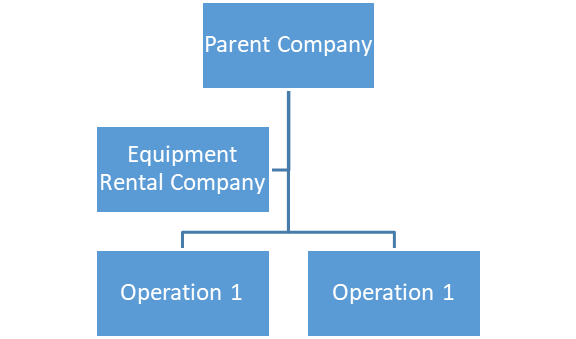
Each separate business operation or real estate address should have it’s own LLC. Any equipment that is used by both LLC’s can be in a separate LLC that is rented to the business LLC’s when needed. The equipment rental company can also be used to buy all equipment and products needed by the operations to get better deals. Any management, operations, etc., are done out of the Parent LLC that owns the other three LLCs. If either businesses gets sued, the assets of the other LLC, the joint Equipment and the management assets are protected from that lawsuit.
If you operate a business that is based on permits you may want a separate LLC for each permit you own.
If you owned land under your businesses, you would want those in separate LLC’s. You can lose the business and start the next day because you still own a lot of the equipment and the land.
There are some negative issues with this type of set up.
The relationship between each LLC and the other LLC’s must be in writing with a proper agreement and proper accounting. That means there needs to be a management contract between the parent company and the different LLCs. There needs to be a rental agreement between the equipment company and the operating LLCs.
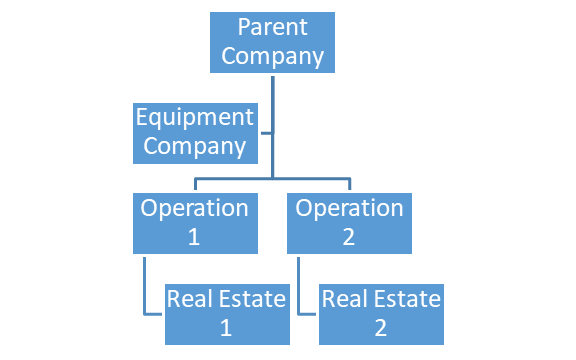
If you are an outfitter with this set up, and you transport your guests in vehicles you would want to add a transportation LLC. Your greatest liability is in moving guests to the activity location. Always keep your liabilities separate from your assets.
In this situation, you would need a lease agreement between the Operations and the Real Estate LLCs.
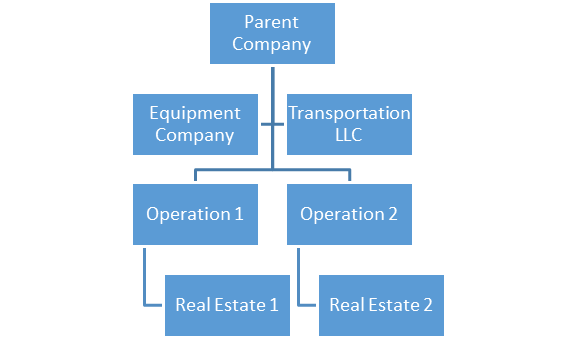
If you start to grow to the point that this gets unwieldy, you can consolidate and combine assets.
Your situation and growth are going to be different and will vary on how well you, and your CPA can work together. Other than increased accounting costs, you will achieve significant protection from any possible lawsuit by using multiple LLCs with little additional work.
If you have a good CPA, you can also have the LLC’s taxed differently to provide different benefits or income to you. You can take money out of some LLC’s as income, some as rent, others as an independent contractor based on how you initially set them up and how they are recognized by the IRS.
One final idea is you may have assets that are so valuable and small that you do not want to keep them in any LLC that could get sued. An example would be a federal permit or concession contract. You could keep those in your own name or in a different LLC that does nothing but leases those permits to your LLC’s. That way, no matter what, you can start again because you have a valid permit.
The final issue might be if you decided to take your company public someday. Contrary to popular belief, incorporating in Delaware is NOT the place to set up your business. Incorporating in Delaware until you have decided to go public has many negatives.
- People think you are a bigger company, there fore they will sue for more money.
- The cost of incorporating in Delaware is several times more expensive than most other states.
- The yearly costs of maintain a corporation in Delaware is expensive.
- You have to hire a statutory agent in Delaware who adds to your cost.
- You have to follow Delaware law in running your company or corporation.
- Your LLC or Corporation will have to follow Delaware laws so you may have to hire an additional attorney.
What if you want to go public someday? Then at that time, create a Delaware corporation. Have that corporation become the owner of all the other LLCs you have created. Now you are a Delaware corporation ready to go public and have delayed the cost of creating a Delaware corporation until you can afford it.

Save your money when you are starting out, start your LLC in the state where you are going to operate so you understand the state laws your LLC will be operating under.
What do you think? Leave a comment.
Copyright 2020 Recreation Law (720) 334 8529
If you like this let your friends know or post it on FB, Twitter or LinkedIn


Author: Outdoor Recreation Insurance, Risk Management and Law
Facebook Page: Outdoor Recreation & Adventure Travel Law
Email: Rec-law@recreation-law.com
Google+: +Recreation
Twitter: RecreationLaw
Facebook: Rec.Law.Now
Facebook Page: Outdoor Recreation & Adventure Travel Law
Blog:
www.recreation-law.com
Mobile Site: http://m.recreation-law.com
By Recreation Law Rec-law@recreation-law.com James H. Moss
#AdventureTourism, #AdventureTravelLaw, #AdventureTravelLawyer, #AttorneyatLaw, #Backpacking, #BicyclingLaw, #Camps, #ChallengeCourse, #ChallengeCourseLaw, #ChallengeCourseLawyer, #CyclingLaw, #FitnessLaw, #FitnessLawyer, #Hiking, #HumanPowered, #HumanPoweredRecreation, #IceClimbing, #JamesHMoss, #JimMoss, #Law, #Mountaineering, #Negligence, #OutdoorLaw, #OutdoorRecreationLaw, #OutsideLaw, #OutsideLawyer, #RecLaw, #Rec-Law, #RecLawBlog, #Rec-LawBlog, #RecLawyer, #RecreationalLawyer, #RecreationLaw, #RecreationLawBlog, #RecreationLawcom, #Recreation-Lawcom, #Recreation-Law.com, #RiskManagement, #RockClimbing, #RockClimbingLawyer, #RopesCourse, #RopesCourseLawyer, #SkiAreas, #Skiing, #SkiLaw, #Snowboarding, #SummerCamp, #Tourism, #TravelLaw, #YouthCamps, #ZipLineLawyer,
Markovitz v. Cassenti, 56 N.E.3d 894, 90 Mass.App.Ct. 1102 (2016)
Posted: May 27, 2020 Filed under: Equine Activities (Horses, Donkeys, Mules) & Animals, Legal Case, Massachusetts, Release (pre-injury contract not to sue) | Tags: Donkeys, Equine Activities, Equine Activities (Horses, Equine Liability Statute, Massachusetts, Massachusetts Equine Liability Act, Mules), riding, Riding Lesson 1 CommentMarkovitz v. Cassenti, 56 N.E.3d 894, 90 Mass.App.Ct. 1102 (2016)
90 Mass.App.Ct. 1102 (2016)
56 N.E.3d 894
Joanne Markovitz & another [ 1]
Christine Cassenti & another. [ 2]
15-P-1274
Appeals Court of Massachusetts
August 18, 2016
Editorial Note:
This decision has been referenced in an “Appeals Court of Massachusetts Summary Dispositions” table in the North Eastern Reporter. And pursuant to its rule 1:28, As Amended by 73 Mass.App.Ct. 1001 (2009) are primarily addressed to the parties and, therefore, may not fully address the facts of the case or the panel’s decisional rationale. Moreover, rule 1:28 decisions are not circulated to the entire court and, therefore, represent only the views of the panel that decided the case. A summary decision pursuant to rule 1:28, issued after February 25, 2008, may be cited for its persuasive value but, because of the limitations noted above, not as binding precedent. See Chace v. Curran, 71 Mass.App.Ct. 258, 260 N.4, 881 N.E.2d 792 (2008).
Judgment affirmed.
MEMORANDUM AND ORDER PURSUANT TO RULE 1:28
In this negligence action arising out of the plaintiff’s injury following her fall off a horse during a group riding lesson at defendants’ Chrislar Farm, a Superior Court judge granted summary judgment for the defendants.[ 3] The plaintiff appealed.
Background.
On July 16, 2009, the plaintiff filled out and signed an application for riding lessons at Chrislar Farm. In that application, she wrote that she had six months of riding experience in 2001 and that she wanted to continue to learn to ride. The form contained a section entitled ” RELEASE,” which stated: ” I, the Club member/Student (or parent or guardian) recognize the inherent risks of injury involved in horseback riding/driving and being around horses generally, and in learning to ride/drive in particular. In taking lessons at CHRISLAR FARM or participating in Club activities, I assume any and all such risk of injury and further, I voluntarily release CHRISLAR FARM, its owners, instructors, employees and agents from any and all responsibility on account of any injury I (or my child or ward) may sustain for any reason while on the premises of CHRISLAR FARM or participating in Club activities, and I agree to indemnify and hold harmless CHRISLAR FARM, its owners, instructors, employees and agents on account of any such claim.”
The plaintiff signed the form on the signature line immediately below the release.[ 4]
Between July of 2009 and September of 2010, the plaintiff took thirty-minute private riding lessons on a regular basis. Between September, 2010, and January, 2011, the plaintiff took one-hour group riding lessons and walked, trotted, and cantered several different horses. On September 3, 2010, the defendants leased a horse named Jolee. Christine Cassenti had known this horse for a long time. The trainer conducting the lessons thought that the horse was ” sweet and did everything you asked her to do.”
The plaintiff first rode Jolee during a ” musical horses” exercise. She then rode Jolee during the next three one-hour group lessons on December 23, 2010, December 30, 2010, and January 6, 2011. At one point during the December 23, 2010, lesson, Jolee went from a trot into a canter and stayed in a circle formation instead of performing a figure eight. Following the instructions from the trainer, the plaintiff slowed down and stopped Jolee. The plaintiff rode Jolee without incident on December 30, 2010, and January 6, 2011.
On January 20, 2011, a year and one-half after the plaintiff began taking lessons at Chrislar Farm, the plaintiff rode Jolee for the fourth time. She noticed that Jolee briefly pinned her ears. After finishing a walk, the plaintiff began trotting Jolee. At one point, Jolee sped up into a faster trot and turned left, causing the plaintiff to lose her balance and fall.
Discussion.
Massachusetts courts have generally upheld release agreements immunizing defendants from future liability for their negligent acts, including in cases related to sports and recreation. See Lee v. Allied Sports Assocs., Inc., 349 Mass. 544, 550, 552, 209 N.E.2d 329 (1965) (spectator at pit area of speedway); Cormier v. Central Mass. Chapter of the Natl. Safety Council, 416 Mass. 286, 288-289, 620 N.E.2d 784 (1993) (beginner rider in motorcycle safety class); Sharon v. Newton, 437 Mass. 99, 105-107, 769 N.E.2d 738 (2002) (student at cheerleading practice). The challenges to releases from liability have regularly been resolved by summary judgment. See, e.g., Cormier, supra at 287; Sharon, supra at 103; Gonsalves v. Commonwealth, 27 Mass.App.Ct. 606, 606, 541 N.E.2d 366 (1989). In this case, we conclude that the release signed by the plaintiff, which the plaintiff has not challenged as unclear or ambiguous, barred her negligence claim.[ 5]
To avoid the preclusive effect of the release, the plaintiff argues that she was entitled to proceed under G. L. c. 128, § 2D( c )(1)(ii), inserted by St. 1992, c. 212, § 1, which provides one of the exceptions to the exemption from liability: ” Nothing in subsection (b) shall prevent or limit the liability of an equine activity sponsor, an equine professional, or any other person if the equine activity sponsor, equine professional, or person: ” (1) . . . (ii) provided the equine and failed to make reasonable and prudent efforts to determine the ability of the participant . . . to safely manage the particular equine based on the participant’s representations of his ability.” [ 6]
Rather than creating a new duty in addition to those that already exist under our common law, as argued by the plaintiff, this subsection provides an exception to the overall bar to liability established by the statute, and allows a plaintiff to proceed with a negligence claim in certain limited circumstances. Because the statute does not create new duties on the part of the equine professional, the plaintiff cannot rely on it to avoid the preclusive effect of the release she signed. This case is distinguishable from Pinto v. Revere-Saugus Riding Academy, Inc., 74 Mass.App.Ct. 389, 395, 907 N.E.2d 259 (2009), which did not involve a release.
Where the release is dispositive of the plaintiff’s claim, we need not decide if there were genuine issues of material fact as to whether the defendants failed to make reasonable efforts to determine the plaintiff’s ability to safely manage Jolee.
Judgment affirmed.
Cohen, Agnes & Henry, JJ.[ 7].
———
Notes:
[1]Gabriel Markovitz. He claimed loss of consortium.
[2]Lawrence Cassenti.
[3]For simplicity, we will refer to Joanne Markovitz as the plaintiff.
[4]The form also contained the following: ” WARNING: Under Massachusetts law, an equine professional is not liable for any injury to, or the death of, a participant in equine activities resulting from the inherent risks of equine activities, pursuant to Chapter 128, Section 2D of the General Laws.”
[5]” [W]hile a party may contract against liability for harm caused by its negligence, it may not do so with respect to its gross negligence.” Zavras v. Capeway Rovers Motorcycle Club, Inc., 44 Mass.App.Ct. 17, 19, 687 N.E.2d 1263 (1997). In a footnote in her brief, the plaintiff argues that it is a question of fact whether the trainer’s conduct amounted to gross negligence or wilful and wanton conduct. Here, viewing the summary judgment record in the light most favorable to the plaintiff, she cannot make out a case of gross negligence.
[6]The complaint contains a negligence count and a loss of consortium count. There is no mention of G. L. c. 128, § 2D.
[7]The panelists are listed in order of seniority.
———
Release used to defend third party participants in horseback case applying Missouri’s law, not the main party to the contract.
Posted: May 25, 2020 Filed under: Equine Activities (Horses, Donkeys, Mules) & Animals, Illinois, Missouri, Release (pre-injury contract not to sue) | Tags: additionally, Animal, argues, Assumption of risk, Cause of action, Choice of Law, conflict of laws, contacts, defense motion, deposition, Equine, Equine Liabililty Act, Exculpatory clause, Friends, Gross negligence, Horse, horseback riding, Illinois, injuries, kicked, Missouri, Motion to Dismiss, Other Participant, parties, principles, RELEASEES, ride, Risks, signing, sponsors, Summary judgment, the Animal Control Act, Third Party Beneficiary, Trail, Trial court 1 CommentIllinois resident sues Illinois’s resident for getting kicked by a horse in a riding area in Missouri. Area’s release included coverage for participants and protected horse owner from suit.
State: Illinois, Appellate Court of Illinois, Fourth District Applying Missouri law
Plaintiff: Deanna L. Perkinson
Defendant: Sarah Courson
Plaintiff Claims: Violation of the Animal Control Act and Negligence
Defendant Defenses: Release (neither party brought up the Missouri Equine Liability Act)
Holding: For the Defendant
Year: 2018
Summary
The term “other participants,” was used in a release signed to access land to ride horses to defend the owner of a horse that kicked another horse owner. The term was sufficient to include the rider in the protection the release afforded. Neither party argued the Equine Liability Act of Missouri where the incident took place.
Facts
Plaintiff testified she engaged in horseback riding on and off since the age of five. She and her husband owned nine horses and were part of a group of friends that rode horses together. Plaintiff estimated that 20 to 25 people were in their group, including defendant. She further estimated that she and defendant went horseback riding together approximately five or six times a year. Within plaintiff’s group of horseback riding friends, there were people that plaintiff was closer to and whom she would talk with about going on horseback riding trips. Plaintiff testified she was not close friends with defendant. She denied that they spent time socially at one another’s homes or that they participated in any activities together other than horseback riding.
In August 2014, individuals from plaintiff’s horseback riding group went on a trip to Cross Country Trail Ride, LLC (Cross Country), in Eminence, Missouri. According to plaintiff, each year, Cross Country organized a trail ride event during Labor Day weekend. She had previously attended the event approximately six times. Plaintiff testified Cross Country provided its paying guests with a campsite, stalls for horses, entertainment, and food.
On August 28, 2014, plaintiff arrived at Cross Country with her husband, daughter, and stepdaughter. The family took four of their own horses and met up with other individuals from plaintiff’s group of friends. Plaintiff stated she had not known whether defendant would be on the trip but saw defendant at Cross Country on the evening of her arrival.
Plaintiff acknowledged signing certain documents upon her arrival at Cross Country on August 28, 2014. She identified her signature on forms that were submitted as exhibits during her deposition and recalled signing similar forms during her previous visits to Cross Country. Plaintiff acknowledged that part of the form she signed was titled “Release of Liability” and instructed her to read before signing; however, plaintiff testified she did not read the form because she had driven a long distance to get to Cross Country and believed it “was just to register.” Plaintiff admitted signing similar forms on behalf of her daughter and stepdaughter.
Plaintiff testified that prior to signing the Cross Country forms, she understood that there was a risk of injury when participating in horseback riding events, including falling off a horse or being kicked. Despite that risk of injury, she participated anyway. Further, plaintiff testified she would have proceeded with the trail ride at Cross Country if she had read the form she signed, which included a warning about the risk of injury when participating in horseback riding events and statements indicating she fully assumed the risks of participation. Plaintiff acknowledged that the form she signed used the phrase “other participants.” She agreed that defendant would have been “another participant” in the activities at Cross Country.
On August 29, 2014, plaintiff, her family, and members of her group intended to take a six-hour trail ride on one of the “identified trails” at Cross Country. Plaintiff was riding a horse named Chester, and defendant was riding a horse named Little Bit. Plaintiff did not recall ever previously being around Little Bit. Further, she acknowledged consuming beer during the trail ride. Plaintiff stated she also observed that defendant was consuming alcohol and believed defendant was intoxicated. During a break on the trail ride, defendant told plaintiff that Little Bit “had kicked [defendant’s] husband while her husband was in the pasture.” She did not remember defendant telling her when the kick occurred or that the horse was in heat at the time. Plaintiff stated she did not notice anything concerning about Little Bit’s behavior while horseback riding on the day of the incident.
At some point during the trail ride, plaintiff and defendant began riding next to one another and were talking. Plaintiff did not recall who approached whom or how long they rode next to each other. As they were riding together down a hill, defendant’s horse kicked out with both of its rear legs and struck plaintiff on her right shin. Plaintiff did not know what caused the horse to kick. Following the kick, plaintiff had to be helped off her horse, and an ambulance was called to the scene. Plaintiff stated she had a broken bone in her shin and, ultimately, underwent two surgeries.
Plaintiff testified that during the trail ride defendant should have put a red ribbon on her horse’s tail to warn others that her horse was known to kick. She asserted, however, that the presence of a red ribbon would not have altered her own behavior. Additionally, plaintiff stated she returned to Cross Country for horseback riding after the August 2014 incident with defendant’s horse. Although she did not plan on attending Cross Country’s Labor Day event in 2016, she did plan to go to another location in Missouri for a Labor Day trail ride.
Analysis: making sense of the law based on these facts.
This is a complicated case because it was started in Illinois after the accident happened in Missouri. Consequently, the issues that support the outdoor recreation industry are woven around the other issues such as where the lawsuit should be and what law should be applied to the case.
The court was an Illinois court and the defendant, and the plaintiffs were Illinois’s residents. However, because the accident occurred in Missouri, the court applied Missouri’s law to the case.
The court first looked at Missouri’s law and the requirements to prove negligence.
To obtain relief in a negligence cause of action, “‘the plaintiff must establish that (1) the defendant had a duty to the plaintiff; (2) the defendant failed to perform that duty; and (3) the defendant’s breach was the proximate cause of the plaintiff’s injury.'”
Then the assumption of the risk doctrine was reviewed as applied in Missouri.
Under the “assumption of the risk doctrine” a person who “voluntarily consents to accept the danger of a known and appreciated risk may not sue another for failing to protect him from it.”
A document showing the plaintiff assumed the risks or explicitly accepted the risks is called an express assumption of the risk document in Missouri (and most other states).
An express assumption of risk is the simplest application of the doctrine and “recognizes that, when a plaintiff makes an express statement that he is voluntarily accepting a specified risk, the plaintiff is barred from recovering damages for an injury resulting from that risk.” An express assumption of risk “most often involves a written waiver or release by the would-be plaintiff.” Further, “in an ‘express assumption of the risk’ case, the plaintiff’s consent relieves the defendant of any duty to protect the plaintiff from injury.”
The Missouri law concerning releases was analyzed.
Although exculpatory clauses in contracts releasing an individual from his or her own future negligence are disfavored, they are not prohibited as against public policy.” “[C]ontracts exonerating a party from acts of future negligence are to be ‘strictly construed against the party claiming the benefit of the contract, and clear and explicit language in the contract is required to absolve a person from such liability.'” Missouri law requires “clear, unambiguous, unmistakable, and conspicuous language in order to release a party from his or her own future negligence,” and “[g]eneral language will not suffice.” “‘The words “negligence” or “fault” or their equivalents must be used conspicuously so that a clear and unmistakable waiver and shifting of risk occurs. There must be no doubt that a reasonable person agreeing to an exculpatory clause actually understands what future claims he or she is waiving.’
In this case, the release was not signed because of a legal relationship between the parties, but was signed as part of accessing the land where the accident occurred. Meaning both parties signed the release to ride on the land. Consequently, the argument centered around whether that release was written to protect parties such as the defendant in this case. Whether the release signed by the plaintiff to ride on the land of the landowner provided protection to the owner of the horse that kicked her.
Additionally, [o]nly parties to a contract and any third-party beneficiaries of a contract have standing to enforce that contract.” To be deemed a third-party beneficiary, the terms of the contract must clearly express intent to benefit the third party or an identifiable class of which the third party is a member. When an express declaration of intent is lacking, a strong presumption exists “‘that the third party is not a beneficiary and that the parties contracted to benefit only themselves.'”
As in most other states, to understand a contract you must determine the effect intended by the parties to be given to the contract. Each clause should be read in the context of the entire contract, not as individual issues. The information within the “four corners” of the contract is the only information that can be reviewed by a court in determining the meaning of a contract, unless the contract is ambiguous, then outside information can be brought into to define the ambiguous section.
A contract is ambiguous when “duplicity, indistinctness, or uncertainty in the meaning of the words used in the contract.”
The language of the release referred to “other participants.” The defendant argued that she was the intended beneficiary of this language. If the defendant was found to be the intended beneficiary, then the release would stop the claims of the plaintiff. The term other participants usually follows the name of the party wanting the release to be signed. In this case, the landowner would have their name as the party to be protected and the clause and other participants followed. Did the term have legal meaning and apply to the defendant or was the term just dicta, additional language in the agreement that had no meaning.

The plaintiff argued that she did not know what she was signing and therefore, could not have intended the release to benefit the defendant. The plaintiff also argued the phrase “other participants” was ambiguous.
However, the court disagreed and found it covered the defendant and was not a catch-all phrase. The court found the defendant was a participant within the meaning of the words and the language of the release.
The final failure of the plaintiff’s argument fell when the court brought up that in her own deposition, she characterized the defendant as another participant in the trail ride.
The next argument, is another argument that is surfacing in plaintiff’s arguments across the US. The plaintiff argued the release should not apply because it purports to relieve liability for more than simple negligence. Meaning the release was written to cover intentional torts, gross negligence and other activities of the public interest.
However, the court did not agree with that argument because the release did not refer to any additional legal theories other than negligence. The release only used the term negligence and did not sue any language that extended that term to a greater definition.
The court also quoted a Missouri Supreme Court decision that held that the plaintiff could not get a release thrown out by arguing it covered gross negligence. Missouri does not recognize gross negligence. Since it does not exist under Missouri’s law, it could not be used to void a release.
In DeCormier v. Harley-Davidson Motor Co. Group, Inc., the Missouri Supreme Court stated that it would “enforce exculpatory agreements to protect a party from liability for their own negligence” and a plaintiff could not “avoid this rule by alleging [a defendant was] grossly negligent because Missouri’s courts do not recognize degrees of negligence at common law.” Thus, it rejected the precise argument plaintiff has raised in this case both before the trial court and on appeal.
Nor does Missouri recognize a cause of action for recklessness.
The next argument was the release was not clear because it was mixed in with another form. The top part of the form was labeled a registration form, and the bottom part was a release.
The court recognized this but found the release part of the form was labeled Release of Liability – Read Before Signing and separated by a dotted line from the top of the form. The significant language in the release was also capitalized for emphasis.
The court held with the trial court and found the release signed by the parties to ride on the property protected the defendant in this case.

So Now What?
This is the first case I have found where a release was used to protect a third party from a lawsuit. I have long argued that this should be the case. Even though the release was signed for a land owner, any litigation is going to cost many parties money. The decision does not say, however, in cases like this many times, the landowner and other participants in the ride are deposed, and as such they lose work and possibly incur legal fees for the depositions.
Having the release be part of a registration form was an issue. Eliminate the argument by the plaintiff and make it a separate form. If you need more information than what is normally required on a release collect it a different way or at the end.
What do you think? Leave a comment.
Copyright 2020 Recreation Law (720) 334 8529
If you like this let your friends know or post it on FB, Twitter or LinkedIn


Author: Outdoor Recreation Insurance, Risk Management and Law
Facebook Page: Outdoor Recreation & Adventure Travel Law
Email: Jim@Rec-Law.US
By Recreation Law Rec-law@recreation-law.com James H. Moss
#AdventureTourism, #AdventureTravelLaw, #AdventureTravelLawyer, #AttorneyatLaw, #Backpacking, #BicyclingLaw, #Camps, #ChallengeCourse, #ChallengeCourseLaw, #ChallengeCourseLawyer, #CyclingLaw, #FitnessLaw, #FitnessLawyer, #Hiking, #HumanPowered, #HumanPoweredRecreation, #IceClimbing, #JamesHMoss, #JimMoss, #Law, #Mountaineering, #Negligence, #OutdoorLaw, #OutdoorRecreationLaw, #OutsideLaw, #OutsideLawyer, #RecLaw, #Rec-Law, #RecLawBlog, #Rec-LawBlog, #RecLawyer, #RecreationalLawyer, #RecreationLaw, #RecreationLawBlog, #RecreationLawcom, #Recreation-Lawcom, #Recreation-Law.com, #RiskManagement, #RockClimbing, #RockClimbingLawyer, #RopesCourse, #RopesCourseLawyer, #SkiAreas, #Skiing, #SkiLaw, #Snowboarding, #SummerCamp, #Tourism, #TravelLaw, #YouthCamps, #ZipLineLawyer, #RecreationLaw, #OutdoorLaw, #OutdoorRecreationLaw, #SkiLaw,
Do you have coverage?
Posted: May 21, 2020 Filed under: Insurance | Tags: Corronavirus, Covid 19, General Liability, GL, Insurance, Polllution Exclusion, Worker's Compensation, Worker’s Comp Leave a commentIf you are thinking about opening for the summer, before you stock up on PPE, you might check to see if you have insurance coverage. If you get sued by a guest for catching Covid-19 at your business or operation the legal fees to win your case can exceed $100,000.
Most insurance policies exclude coverage for pandemics.
The issue is not whether or not a person can win a lawsuit if they claim they got sick at your business. The issue is, do you have protection to pay for the attorney fees, and costs needed to fight the lawsuit. A two-week trial that is four years in the future will cost you $100,000.00 at a minimum.
At the present time, you cannot buy coverage for Covid 19.
Most general liability (GL) policies exclude pandemics as a claim that is not covered. Those policies that do not have a specific pandemic exclusion are saying the claims are excluded under the pollutant exclusions.
Consequently, you probably do not have coverage. That is going to be a major factor in determining if you can open for the season, whether or not you have the resources to fight any possible claims.
Worker’s Compensation Policies in many states are excluding coverage for employees who catch the virus.
What if your employee contracts the virus and claims, he got it at work. Does your worker’s compensation policy provide coverage for the employee or a defense for you? With day operations, it will be difficult to prove the employee contacted the coverage while working. However, if you run multi-day trips where the employees and patrons will be separated from society for days, and one other person arrives on the trip with the virus. The chances increase that your employee caught the virus at work.
If that occurs and your carrier provides no coverage, it does not let you off the hook for the employees lost wages and medical bills.
Again, in most states there is no coverage for worker’s compensation claims based on pandemics.
Find out now what coverages you have. If your broker/agent says you are covered, get that in writing or in an email and save it. It could be worth a lot of money in the future.
For additional articles about this issue see:
Will general liability insurance respond to COVID-19 claims?
Commercial General Liability Insurance and COVID-19
‘Wild west’: Youth sports providers weigh liability risks
What do you think? Leave a comment.
Copyright 2020 Recreation Law (720) 334 8529
If you like this let your friends know or post it on FB, Twitter or LinkedIn


Author: Outdoor Recreation Insurance, Risk Management and Law
Facebook Page: Outdoor Recreation & Adventure Travel Law
Email: Rec-law@recreation-law.com
Google+: +Recreation
Twitter: RecreationLaw
Facebook: Rec.Law.Now
Facebook Page: Outdoor Recreation & Adventure Travel Law
Blog:
www.recreation-law.com
Mobile Site: http://m.recreation-law.com
By Recreation Law Rec-law@recreation-law.com James H. Moss
#AdventureTourism, #AdventureTravelLaw, #AdventureTravelLawyer, #AttorneyatLaw, #Backpacking, #BicyclingLaw, #Camps, #ChallengeCourse, #ChallengeCourseLaw, #ChallengeCourseLawyer, #CyclingLaw, #FitnessLaw, #FitnessLawyer, #Hiking, #HumanPowered, #HumanPoweredRecreation, #IceClimbing, #JamesHMoss, #JimMoss, #Law, #Mountaineering, #Negligence, #OutdoorLaw, #OutdoorRecreationLaw, #OutsideLaw, #OutsideLawyer, #RecLaw, #Rec-Law, #RecLawBlog, #Rec-LawBlog, #RecLawyer, #RecreationalLawyer, #RecreationLaw, #RecreationLawBlog, #RecreationLawcom, #Recreation-Lawcom, #Recreation-Law.com, #RiskManagement, #RockClimbing, #RockClimbingLawyer, #RopesCourse, #RopesCourseLawyer, #SkiAreas, #Skiing, #SkiLaw, #Snowboarding, #SummerCamp, #Tourism, #TravelLaw, #YouthCamps, #ZipLineLawyer,


 Recreation Law