
The actual risk causing the injury to the plaintiff was explicitly identified in the release and used by the court as proof it was a risk of skiing and snowboarding. If it was in the release, then it was a risk.
Posted: September 17, 2018 Filed under: Assumption of the Risk, California, Release (pre-injury contract not to sue), Ski Area, Skiing / Snow Boarding | Tags: assumption of the risk, Groomer, grooming, Mammoth, Mammoth Mountain Ski Area, Mammoth Mt. Ski Area, Mammoth Mt. Ski Area LLC, Release, Season Pass, Season Pass Release, Ski, ski area, Ski Resort, skiing, snowboarding, Snowcat, Summary judgment, tiller Leave a commentPlaintiff hit a snowcat and was severely injured when she was sucked under the tiller. Mammoth Mountain Ski Area was not liable because of the release and snowcats on the mountain are an inherent risk of skiing and snowboarding.
Willhide-Michiulis v. Mammoth Mt. Ski Area, LLC, 2018 Cal. App. Unpub. LEXIS 4363
State: California, Court of Appeal of California, Third Appellate District
Plaintiff: Kathleen Willhide-Michiulis et al (and her husband Bruno Michiulis)
Defendant: Mammoth Mountain Ski Area, LLC
Plaintiff Claims: negligence, gross negligence and loss of consortium
Defendant Defenses: Assumption of the risk and release
Holding: for the defendant ski area Mammoth Mt. Ski Area
Year: 2018
Summary
When skiing or snowboarding you assume the risk of seeing a snowcat grooming on the slopes in California. If you run into a snowcat and get sucked into the tiller you have no lawsuit against the ski area.
A snowcat at Mammoth Mountain Ski Area is a great big red slow-moving machine with flashing lights and sirens. They are hard to miss, so therefore they are something you assume the risk when on the slopes.
Facts
The injury suffered by the plaintiff and how it occurred is gruesome. She hit a snowcat while snowboarding and fell between the cat and the tiller. Before the cat could stop she was run over and entangled in the tiller eventually losing one leg and suffering multiple other injuries.
Plaintiff Kathleen Willhide-Michiulis was involved in a tragic snowboarding accident at Mammoth Mountain Ski Area. On her last run of the day, she collided with a snowcat pulling a snow-grooming tiller and got caught in the tiller. The accident resulted in the amputation of her left leg, several skull fractures and facial lacerations, among other serious injuries
The plaintiff was snowboarding on her last run of the night. She spotted the snow cat 150 feet ahead of her on the run. When she looked up again, she collided with the snowcat.
While Willhide-Michiulis rode down mambo, she was in control of her snowboard and traveling on the left side of the run. She saw the snowcat about 150 feet ahead of her on the trail. It was traveling downhill and in the middle of the run. Willhide-Michiulis initiated a “carve” to her left to go further to the left of the snowcat. When she looked up, the snowcat had “cut off her path” and she could not avoid a collision. Willhide-Michiulis hit the back-left corner of the snowcat and her board went into the gap between the tracks of the snowcat and the tiller. Willhide-Michiulis was then pulled into the tiller.
The defendant Mammoth Mountain Ski Area posted warning signs at the top and bottom of every run warning that snowcats and other vehicles may be on the runs. The season pass releases the plaintiff, and her husband signed also recognized the risk of snowcats and identified them as such.
Further, in Willhide-Michiulis’s season-pass agreement, she acknowledged she understood “the sport involves numerous risks including, but not limited to, the risks posed by variations in terrain and snow conditions, . . . unmarked obstacles, . . . devices, . . . and other hazards whether they are obvious or not. I also understand that the sport involves risks posed by loss of balance . . . and collisions with natural and man-made objects, including . . . snow making equipment, snowmobiles and other over-snow vehicles.
The trial court concluded the plaintiff assumed the risks of her injury and granted the ski area motion for summary judgment. The plaintiff appealed that decision, and this appellate decision is the result of that appeal.
Analysis: making sense of the law based on these facts.
The decision included a massive recounting of the facts of the case both before the analysis and throughout it. Additionally, the court reviewed several issues that are not that important here, whether the trial court properly dismissed the plaintiff’s expert opinions and whether or not the location of the case was proper.
Releases in California are evolving into proof of express assumption of the risk. The court reviewed the issues of whether Mammoth met is burden of showing the risks the plaintiff assumed were inherent in the sport of snowboarding. The facts in the release signed by the plaintiff supported that assumption of the risk defense and was pointed out by the court as such.
…plaintiffs signed a season-pass agreement, which included a term releasing Mammoth from liability “for any damage, injury or death . . . arising from participation in the sport or use of the facilities at Mammoth regardless of cause, including the ALLEGED NEGLIGENCE of Mammoth.” The agreement also contained a paragraph describing the sport as dangerous and involving risks “posed by loss of balance, loss of control, falling, sliding, collisions with other skiers or snowboarders and collisions with natural and man-made objects, including trees, rocks, fences, posts, lift towers, snow making equipment, snowmobiles and other over-snow vehicles.”
California courts also look at the assumption of risk issue not as a defense, but a doctrine that releases the defendant of its duty to the plaintiff.
“While often referred to as a defense, a release of future liability is more appropriately characterized as an express assumption of the risk that negates the defendant’s duty of care, an element of the plaintiff’s case.” Express assumption of risk agreements are analogous to the implied primary assumption of risk doctrine. “The result is that the defendant is relieved of legal duty to the plaintiff; and being under no duty, he cannot be charged with negligence.””
The court then is not instructed to look at the activity to see the relationship of the parties or examine the activity that caused the plaintiff’s injuries. The question becomes is the risk of injury the plaintiff suffered inherent in the activity in which the plaintiff was participating. The issue then becomes a question solely for the courts as in this case, does the scope of the release express the risk relieving the defendant of any duty to the plaintiff.
After the judge makes that decision then the question of whether or not the actions of the defendant rose to the level of gross negligence is reviewed. “The issue we must determine here is whether, with all facts and inferences construed in plaintiffs’ favor, Mammoth’s conduct could be found to constitute gross negligence.
Ordinary or simple negligence is a “failure to exercise the degree of care in a given situation that a reasonable person under similar circumstances would employ to protect others from harm.”
“‘”[M]ere nonfeasance, such as the failure to discover a dangerous condition or to perform a duty,”‘ amounts to ordinary negligence. However, to support a theory of ‘”[g]ross negligence,”‘ a plaintiff must allege facts showing ‘either a “‘”want of even scant care”‘” or “‘”an extreme departure from the ordinary standard of conduct.”‘”[G]ross negligence’ falls short of a reckless disregard of consequences, and differs from ordinary negligence only in degree, and not in kind. . . .”‘”
When looking at gross negligence, the nature of the sport comes back into the evaluation.
“‘[A] purveyor of recreational activities owes a duty to a patron not to increase the risks inherent in the activity in which the patron has paid to engage.'” Thus, in cases involving a waiver of liability for future negligence, courts have held that conduct that substantially or unreasonably increased the inherent risk of an activity or actively concealed a known risk could amount to gross negligence, which would not be barred by a release agreement.
Skiing and snowboarding have a long list of litigated risks that are inherent in the sport and thus assumed by the plaintiff or better, to which the defendant does not owe the plaintiff a duty.
There the plaintiff argued the snow groomer was not an assumed risk. The court eliminated that argument by pointing out the plaintiff had signed a release which pointed out to the plaintiff that one of the risks she could encounter was a snow groomer on the slopes.
The main problem with plaintiffs’ argument that common law has not recognized collisions with snow-grooming equipment as an inherent risk of skiing, is that plaintiffs’ season-pass agreement did. When signing their season-pass agreement, both Willhide-Michiulis and her husband acknowledged that skiing involved the risk of colliding with “over-snow vehicles.” Willhide-Michiulis testified she read the agreement but did not know an “over-snow vehicle” included a snowcat. Plaintiffs, however, did not argue in the trial court or now on appeal that this term is ambiguous or that the parties did not contemplate collisions with snowcats as a risk of snowboarding. “Over-snow vehicles” is listed in the contract along with “snow making equipment” and “snowmobiles,” indicating a clear intent to include any vehicle used by Mammoth for snow maintenance and snow travel.
The court went on to find case law that supported the defense that snow groomers were a risk of skiing and boarding, and it was a great big slow moving bright-red machine that made it generally unavoidable.
Further, the snowcat Willhide-Michiulis collided with is large, bright red, and slow-moving, making it generally avoidable by those around it. Indeed, Willhide-Michiulis testified that she saw the snowcat about 150 feet before she collided with it. Although she claims the snowcat cut off her path, the snowcat was traveling less than ten miles an hour before standing nearly motionless while turning onto Old Boneyard Road downhill from Willhide- Michiulis.
Even if there were no warning signs, nothing on the maps of the ski area, nothing in the release, once the plaintiff spotted the snowcat the responsibility to avoid the snowcat fell on her.
The appellate court upheld the trial courts motion for summary judgement in favor of the defendant ski area Mammoth Mountain.
So Now What?
The California Appellate Court took 11 pages to tell the plaintiff if you see a big red slow-moving machine on the ski slopes to stay away from it.
What is also interesting is the evolution of the law in California from a release being a contractual pre-injury agreement not to sue to proof that the defendant did not owe a duty to the plaintiff because she assumed the risk.
Besides, how do you miss, let alone ski or snowboard into a big red slow-moving machine with flashing lights and sirens on a ski slope?
What do you think? Leave a comment.
Copyright 2017 Recreation Law (720) 334 8529
If you like this let your friends know or post it on FB, Twitter or LinkedIn


Author: Outdoor Recreation Insurance, Risk Management and Law
Facebook Page: Outdoor Recreation & Adventure Travel Law
Email: Rec-law@recreation-law.com
By Recreation Law Rec-law@recreation-law.com James H. Moss
#AdventureTourism, #AdventureTravelLaw, #AdventureTravelLawyer, #AttorneyatLaw, #Backpacking, #BicyclingLaw, #Camps, #ChallengeCourse, #ChallengeCourseLaw, #ChallengeCourseLawyer, #CyclingLaw, #FitnessLaw, #FitnessLawyer, #Hiking, #HumanPowered, #HumanPoweredRecreation, #IceClimbing, #JamesHMoss, #JimMoss, #Law, #Mountaineering, #Negligence, #OutdoorLaw, #OutdoorRecreationLaw, #OutsideLaw, #OutsideLawyer, #RecLaw, #Rec-Law, #RecLawBlog, #Rec-LawBlog, #RecLawyer, #RecreationalLawyer, #RecreationLaw, #RecreationLawBlog, #RecreationLawcom, #Recreation-Lawcom, #Recreation-Law.com, #RiskManagement, #RockClimbing, #RockClimbingLawyer, #RopesCourse, #RopesCourseLawyer, #SkiAreas, #Skiing, #SkiLaw, #Snowboarding, #SummerCamp, #Tourism, #TravelLaw, #YouthCamps, #ZipLineLawyer, #RecreationLaw, #OutdoorLaw, #OutdoorRecreationLaw, #SkiLaw,
Willhide-Michiulis v. Mammoth Mt. Ski Area, LLC, 2018 Cal. App. Unpub. LEXIS 4363
Posted: September 12, 2018 Filed under: Assumption of the Risk, California, Release (pre-injury contract not to sue), Ski Area, Skiing / Snow Boarding | Tags: collided, Collision, conditions, declarations, driver's, Driving, expert testimony, extreme departure, grooming, Gross negligence, industry standard, Inherent Risk, mambo, Mammoth, Mammoth Mountain Ski Area, Mammoth Mt. Ski Area, Mammoth Mt. Ski Area LLC, Mountain, ordinary standard, plaintiffs', Risks, Season Pass, skier's, skiing, Snow, snow grooming, snow-grooming vehicle, snowboarding, Snowcat, Sport, Summary judgment, tiller, Trial court, Venue, Warning Leave a commentWillhide-Michiulis v. Mammoth Mt. Ski Area, LLC
Court of Appeal of California, Third Appellate District
June 27, 2018, Opinion Filed
C082306
2018 Cal. App. Unpub. LEXIS 4363 *; 2018 WL 3134581KATHLEEN WILLHIDE-MICHIULIS et al., Plaintiffs and Appellants, v. MAMMOTH MOUNTAIN SKI AREA, LLC, Defendant and Respondent.
Notice: NOT TO BE PUBLISHED IN OFFICIAL REPORTS. CALIFORNIA RULES OF COURT, RULE 8.1115(a), PROHIBITS COURTS AND PARTIES FROM CITING OR RELYING ON OPINIONS NOT CERTIFIED FOR PUBLICATION OR ORDERED PUBLISHED, EXCEPT AS SPECIFIED BY RULE 8.1115(b). THIS OPINION HAS NOT BEEN CERTIFIED FOR PUBLICATION OR ORDERED PUBLISHED FOR THE PURPOSES OF RULE 8.1115.
Subsequent History: The Publication Status of this Document has been Changed by the Court from Unpublished to Published July 18, 2018 and is now reported at 2018 Cal.App.LEXIS 638.
Ordered published by, Reported at Willhide-Michiulis v. Mammoth Mountain Ski Area, LLC, 2018 Cal. App. LEXIS 638 (Cal. App. 3d Dist., June 27, 2018)
Prior History: [*1] Superior Court of Mono County, No. CV130105.
Judges: Robie, Acting P. J.; Murray, J., Duarte, J. concurred.
Opinion by: Robie, Acting P. J.
Plaintiff Kathleen Willhide-Michiulis was involved in a tragic snowboarding accident at Mammoth Mountain Ski Area. On her last run of the day, she collided with a snowcat pulling a snow-grooming tiller and got caught in the tiller. The accident resulted in the amputation of her left leg, several skull fractures and facial lacerations, among other serious injuries. She and her husband, Bruno Michiulis, appeal after the trial court granted defendant Mammoth Mountain Ski Area‘s (Mammoth) motion for summary judgment finding the operation of the snowcat and snow-grooming tiller on the snow run open to the public was an inherent risk of snowboarding and did not constitute gross negligence. Plaintiffs contend the trial court improperly granted Mammoth’s motion for summary judgment and improperly excluded the expert declarations plaintiffs submitted to oppose the motion. They also assert the trial court improperly denied their motion to transfer venue to Los Angeles County.
We conclude the trial court did not abuse its discretion by excluding the expert declarations. Further, [*2] although snowcats and snow-grooming tillers are capable of causing catastrophic injury, as evidenced by Willhide-Michiulis’s experience, we conclude this equipment is an inherent part of the sport of snowboarding and the way in which the snowcat was operated in this case did not rise to the level of gross negligence. Because of this conclusion, the trial court properly granted Mammoth’s summary judgment motion based on the liability waiver Willhide-Michiulis signed as part of her season-pass agreement. With no pending trial, plaintiffs cannot show they were prejudiced by the court’s denial of their motion to transfer venue; thus we do not reach the merits of that claim. Accordingly, we affirm.
FACTUAL AND PROCEDURAL BACKGROUND
I
The Injury
Mammoth owns and operates one of the largest snowcat fleets in the United States to groom snow and maintain snow runs throughout Mammoth Mountain Ski Area. A snowcat is a large snow-grooming vehicle — 30 feet long and 18 feet wide. It has five wheels on each side of the vehicle that are enclosed in a track. In front of the snowcat is a plow extending the width of the snowcat. In back is a 20-foot wide trailer containing a tiller. A tiller “spins at a [*3] high [speed] br[e]aking up the snow and slightly warming it and allowing it to refreeze in a firm skiable surface.” Mammoth strives not to have snowcats operating when the resort is open to the public; however, it may be necessary at times. Mammoth’s grooming guide instructs drivers that generally snowcats are operated at night or in areas closed to the public, except during: (1) emergency operations, (2) extremely heavy snow, or (3) transportation of personnel or materials. If a driver “must be on the mountain while the public is present,” however, the snowcat’s lights, safety beacon, and audible alarm must be on. The guide further directs drivers not to operate the tiller if anyone is within 50 feet or if on a snow run open to the public. In another section, the guide directs drivers not to operate the snowcat’s tiller when anyone is within 150 feet and “[n]ever . . . when the skiing public is present.”
Although the grooming guide directs drivers not to use the tiller on snow runs open to the public, there are exceptions to these rules. Snowcats use two large tracks, instead of wheels, to travel on the snow. If the tiller is not running, then the snowcat leaves behind berms and holes created by the [*4] tracks, also known as track marks. Mammoth’s grooming guide explains that “[t]rack marks are not acceptable anywhere on the mountain and back-ups or extra passes should be used to remove them.” Track marks are not safe for the skiing public, so whenever the snowcat is justified to be on an open run, drivers commonly operate the tiller to leave behind safe conditions.
In fact, it is common for skiers and snowboarders to chase snowcats that operate on public snow runs. For example, Taylor Lester, a Mammoth season-pass holder, has seen snowcats with tillers operate on snow runs open to the public. She, her friends, and her family, commonly ride close behind these snowcats so they can take advantage of the freshly tilled snow the snowcats produce. Freshly-tilled snow is considered desirable and “more fun” because it has not been tarnished by other skiers.
There is a blind spot in the snowcat created by the roll cage in the cab of the vehicle. This blind spot is mitigated by the driver using the mirrors of the snowcat and turning his or her head to look out the windows. Snowcats are also equipped with turn signals.
At the top and bottom of every chair lift, Mammoth posts signs warning of the presence [*5] of snowcats throughout the resort and on snow runs. Mammoth also includes these warnings in trail maps. Further, in Willhide-Michiulis’s season-pass agreement, she acknowledged she understood “the sport involves numerous risks including, but not limited to, the risks posed by variations in terrain and snow conditions, . . . unmarked obstacles, . . . devices, . . . and other hazards whether they are obvious or not. I also understand that the sport involves risks posed by loss of balance . . . and collisions with natural and man-made objects, including . . . snow making equipment, snowmobiles and other over-snow vehicles.” Willhide-Michiulis further agreed to release Mammoth from liability “for any damage, injury or death to me and/or my child arising from participation in the sport or use of the facilities at Mammoth regardless of cause, including the ALLEGED NEGLIGENCE of Mammoth.”
On March 25, 2011, Clifford Mann, the general manager of mountain operations, had to dig out various buildings using a snowcat during Mammoth’s hours of operation because between 27 and 44 inches of snow fell the night before. At approximately 3:15 p.m., Mann was digging out a building when a Mammoth employee [*6] called to ask him to fill in a hole she had created with her snowmobile on Old Boneyard Road. Less than an hour before her call, the employee had been driving her snowmobile on the unmarked service road and got it stuck in the snow. She called for assistance and she and another Mammoth employee dug out the snowmobile. Once the machine had been dug out of the snow, there was too big of a hole for her and her coworker to fill in. They decided to call Mann to have him fill in the hole with the snowcat because it was near the end of the day and the hole was a safety hazard for all other snowmobiles that would use the service road at closing. Mann agreed and drove his snowcat with the tiller running to Old Boneyard Road, which branched off of the bottom of mambo snow run. Before leaving for the Old Boneyard Road location, Mann turned on the snowcat’s warning beacon, lights, and audible alarm.
Around this same time, Willhide-Michiulis, a Mammoth season-pass holder, and her brother went for their last snowboard run of the day while Willhide-Michiulis’s husband went to the car. It was a clear day and Willhide-Michiulis and her brother split up after getting off the chair lift. Willhide-Michiulis [*7] snowboarded down mambo, while her brother took a neighboring run. While Willhide-Michiulis rode down mambo, she was in control of her snowboard and traveling on the left side of the run. She saw the snowcat about 150 feet ahead of her on the trail. It was traveling downhill and in the middle of the run. Willhide-Michiulis initiated a “carve” to her left to go further to the left of the snowcat. When she looked up, the snowcat had “cut off her path” and she could not avoid a collision. Willhide-Michiulis hit the back left corner of the snowcat and her board went into the gap between the tracks of the snowcat and the tiller. Willhide-Michiulis was then pulled into the tiller.
Mann did not use a turn signal before initiating the turn onto Old Boneyard Road. Before the collision, Mann had constantly been checking around the snowcat for people by utilizing the snowcat’s mirrors and by looking over his shoulders and through the windows. The snowcat did not have a speedometer, but Mann thought he was going less than 10 miles an hour. When he had nearly completed the turn from lower mambo onto Old Boneyard Road, Mann saw a “black flash” in his rearview mirror. He immediately stopped the snowcat, [*8] which also stopped the tiller.
Mann got out of the snowcat and lifted the protective flap to look under the tiller. He saw Willhide-Michiulis stuck in the tiller and called for help. When help arrived, it took 30 minutes to remove Willhide-Michiulis from the tiller. She suffered a near-complete amputation of her left leg above the knee, which doctors amputated in a subsequent surgery. Her right leg sustained multiple fractures and lacerations, and she dislocated her right hip. The tiller also struck Willhide-Michiulis’s face, leaving multiple facial fractures and lacerations.
II
Plaintiffs’ Suit
Plaintiffs initially filed suit against Mammoth and Kassbohrer All Terrain Vehicles, the manufacturer of the snowcat and tiller, in Los Angeles County.1 As to Mammoth, plaintiffs alleged breach of contract, gross negligence, negligence, and loss of consortium. Venue was later transferred to Mono County, where the trial court dismissed multiple causes of action pertaining to Mammoth.2 The operative complaint alleges two causes of action against Mammoth — gross negligence and loss of consortium. At the same time plaintiffs filed the operative complaint, they also filed a motion to transfer venue back [*9] to Los Angeles County because it was more convenient for the parties and because plaintiffs could not receive a fair trial in Mono County. The trial court denied plaintiffs’ motion to transfer venue without prejudice and we denied the petition for writ of mandate plaintiffs filed challenging that ruling.
Mammoth later moved for summary judgment on the two remaining causes of action arguing that plaintiffs’ case was barred by the primary assumption of risk doctrine and the express assumption of risk agreement Willhide-Michiulis signed as part of her season-pass contract. The court agreed and granted Mammoth’s motion for summary judgment finding primary assumption of risk and the waiver in Willhide-Michiulis’s season-pass agreement barred plaintiffs relief. It found there was no dispute over the material facts of plaintiffs’ claims and that Willhide-Michiulis was injured when “she fell and slid under a [Mammoth] operated snowcat and was caught in the operating tiller. [Willhide-Michiulis] was snowboarding on an open run as the snowcat was operating on the same run. It appears that the collision occurred as the snowcat operator was negotiating a left turn from the run to the service road.” [*10] It also found that accepting plaintiffs’ factual allegations as true, i.e., Mann operated a snowcat and tiller on an open run, he failed to use a turn signal when making a sharp left turn from the center of the run, he failed to warn skiers of his presence, and no signs marked the existence of Old Boneyard Road — plaintiffs could not show Mammoth was grossly negligent or lacked all care because Mann took several safety precautions while driving the snowcat, and warning signs were posted throughout Mammoth Mountain, on trail maps, and in Willhide-Michiulis’s season-pass contract. Because plaintiffs could not show gross negligence, the waiver of liability they signed as part of their season-pass agreement barred recovery.
The court further found plaintiffs’ factual allegations did not support a finding that Mann’s conduct increased the inherent risks of snowboarding and, in fact, colliding with snow-grooming equipment is an inherent risk of the sport. Citing Souza v. Squaw Valley Ski Corp. (2006) 138 Cal.App.4th 262, 41 Cal. Rptr. 3d 389, the court explained snowcats are plainly visible and generally avoidable and serve as their own warning sign because they are an obvious danger. The snowcat is equally obvious when it is moving as when it is stationary. Thus, the [*11] primary assumption of risk doctrine also barred plaintiffs from recovery.
The court also excluded the declarations of three experts plaintiffs attached to their opposition to dispute Mammoth’s claim that it did not act with gross negligence. The first expert, Michael Beckley, worked in the ski industry for 25 years and was an “expert of ski resort safety and snow cat safety.” He held multiple positions in the industry, including ski instructor, snowcat driver, and director of mountain operations. Beckley based his opinions on the topography of the snow run, Mammoth’s snow grooming manual and snow grooming equipment, and accounts of Mann’s conduct while driving the snowcat. He opined the operation of a snowcat on an open run with its tiller running was “extremely dangerous,” “an extreme departure from an ordinary standard of conduct,” and “violate[d] the industry standard.” He believed Mann increased the risk of injury to skiers and violated industry standards by driving down the middle of a snow run and failing to signal his turn. Mammoth’s failure to close the snow run, provide spotters, or comply with its own safety rules, Beckley declared, violated industry standards and the ordinary standard [*12] of conduct.
Plaintiffs’ second expert, Eric Deyerl, was a mechanical engineer for over 20 years, with a specialization in vehicle dynamics and accident reconstruction. In forming his opinions, Deyerl inspected the snow run and snowcat equipment and relied on photographs and various accounts of the incident. Relying on those accounts, Deyerl opined that the circumstances leading to Willhide-Michiulis’s collision were different than those related by eyewitnesses. Deyerl believed that before initiating his turn, Mann failed to activate his turn signal, monitor his surroundings, and verify that he was clear — especially in the blind spot at the back left portion of the snowcat. No signs indicated the existence of Old Boneyard Road, and skiers like Willhide-Michiulis would not know to expect a snowcat to stop and turn from the middle of the snow run. All of these circumstances in isolation and together increased “the potential for a collision” and the risk of injury. Deyerl also disputed the accounts of eyewitnesses to Willhide-Michiulis’s collision with the snowcat.
The third expert, Brad Avrit, was a civil engineer who specialized in evaluating “safety practices and safety issues.” He was [*13] also an “avid skier for over thirty years.” He based his opinions on the topography of the snow run, Mammoth’s snow grooming manual and equipment, and accounts of Mann’s driving. Avrit opined that operating a snowcat on an open snow run with an active tiller was “an extreme departure from the ordinary standard of conduct that reasonable persons would follow in order to avoid injury to others.” He also believed Mann’s conduct of failing to drive down the left side of the snow run, failing to monitor his surroundings, and failing to signal his left turn or verify he was clear to turn, “increase[d] the risk of collision and injury.” Avrit also thought the risk to skiers was increased by Mammoth’s failure to either close the snow run or use spotters while operating the snowcat when open to the public, or alternatively waiting the 30 minutes until the resort was closed to fix the hole on Old Boneyard Road.
Mammoth lodged both general and specific objections to these declarations. Generally, Mammoth asserted the experts’ opinions were irrelevant to the assumption of risk and gross negligence legal determinations before the court, the opinions lacked proper foundation, and the opinions were improper [*14] conclusions of law. Specifically, Mammoth objected to several paragraphs of material on predominantly the same grounds. Finding the experts’ opinions irrelevant and citing Towns v. Davidson (2007) 147 Cal.App.4th 461, 54 Cal. Rptr. 3d 568 (Towns), the trial court sustained Mammoth’s general objections and numerous specific objections.
DISCUSSION
I
The Court Properly Granted Mammoth’s Motion For Summary Judgment
Plaintiffs contend the trial court improperly granted Mammoth’s motion for summary judgment. They first contend the trial court abused its discretion when excluding their experts’ declarations, and thus improperly ruled on Mammoth’s motion without considering relevant evidence. They also contend primary assumption of risk does not apply because Mann’s negligent driving and operation of a tiller on an open run increased the inherent risks associated with snowboarding. Further, plaintiffs argue these same facts establish Mammoth’s conduct was grossly negligent and fell outside of the liability waiver Willhide-Michiulis signed as part of her season-pass agreement.
We conclude the trial court did not abuse its discretion when excluding plaintiffs’ experts’ declarations. Additionally, plaintiffs cannot show Mammoth was grossly negligent and violated [*15] the terms of the release of liability agreement found in Willhide-Michiulis’s season-pass contract. Because the express assumption of risk in the release applies, we need not consider the implied assumption of risk argument also advanced by plaintiffs. (Vine v. Bear Valley Ski Co. (2004) 118 Cal.App.4th 577, 590, fn. 2, 13 Cal. Rptr. 3d 370; Allan v. Snow Summit, Inc. (1996) 51 Cal.App.4th 1358, 1374-1375, 59 Cal. Rptr. 2d 813; Allabach v. Santa Clara County Fair Assn. (1996) 46 Cal.App.4th 1007, 1012-1013, 54 Cal. Rptr. 2d 330.)
A
The Court Did Not Abuse Its Discretion When Excluding The Expert Declarations Attached To Plaintiffs’ Opposition
As part of their argument that the court improperly granted Mammoth’s motion for summary judgment, plaintiffs contend the trial court abused its discretion when excluding the expert declarations attached to their opposition. Specifically, plaintiffs argue expert testimony was appropriate under Kahn v. East Side Union High School Dist. (2003) 31 Cal.4th 990, 4 Cal. Rptr. 3d 103, 75 P.3d 30, because “the facts here certainly warrant consideration of the expert testimony on the more esoteric subject of assessing whether a negligently-driven snowcat is an inherent risk of recreational skiing.” Mammoth counters that the evidence was properly excluded because it was irrelevant and “offered opinions of legal questions of duty for the court to decide.” We agree with Mammoth.
“Generally, a party opposing a motion for summary judgment may use declarations by an expert to raise a triable issue of fact on an element of the [*16] case provided the requirements for admissibility are established as if the expert were testifying at trial. [Citations.] An expert’s opinion is admissible when it is ‘[r]elated to a subject that is sufficiently beyond common experience that the opinion of an expert would assist the trier of fact . . . .’ [Citation.] Although the expert’s testimony may embrace an ultimate factual issue [citation], it may not contain legal conclusions.” (Towns, supra, 147 Cal.App.4th at p. 472.)
“In the context of assumption of risk, the role of expert testimony is more limited. ‘It is for the court to decide whether an activity is an active sport, the inherent risks of that sport, and whether the defendant has increased the risks of the activity beyond the risks inherent in the sport.’ [Citation.] A court in its discretion could receive expert factual opinion to inform its decision on these issues, particularly on the nature of an unknown or esoteric activity, but in no event may it receive expert evidence on the ultimate legal issues of inherent risk and duty.” (Towns, supra, 147 Cal.App.4th at pp. 472-473.)
In Kahn, the plaintiff was a 14-year-old member of a school swim team who broke her neck after diving in shallow water. (Kahn v. East Side Union High School Dist., supra, 31 Cal.4th at p. 998.) Her coach had previously assured her she would not have to dive [*17] at meets and she never learned how to dive in shallow water. Minutes before a meet, however, the coach told the plaintiff she would have to dive and threatened to kick her off the team if she refused. With the help of some teammates, the plaintiff tried a few practice dives but broke her neck on the third try. She sued based on negligent supervision and training. (Ibid.)
The court determined the case could not be resolved on summary judgment as there was conflicting evidence whether the coach had provided any instruction or, if so, whether that instruction followed the recommended training sequence, and whether plaintiff was threatened into diving. (Kahn v. East Side Union High School Dist., supra, 31 Cal.4th at pp. 1012-1013.) The court concluded the trial court was not compelled to disregard the opinions of a water safety instructor about the proper training a swimmer requires before attempting a racing dive in shallow water. (Id. at pp. 999, 1017.) In so ruling, the Kahn court stated, “[c]ourts ordinarily do not consider an expert’s testimony to the extent it constitutes a conclusion of law [citation], but we do not believe that the declaration of the expert in the present case was limited to offering an opinion on a conclusion of law. We do not rely upon expert opinion testimony to [*18] establish the legal question of duty, but ‘we perceive no reason to preclude a trial court from receiving expert testimony on the customary practices in an arena of esoteric activity for purposes of weighing whether the inherent risks of the activity were increased by the defendant’s conduct.'” (Id. at p. 1017.) Thus, while the Kahn court did not preclude the trial court from considering expert testimony about the “‘customary practices in an arena of esoteric activity,'” it did not mandate a court to consider it either.
Here, plaintiffs argue their experts’ declarations were necessary to inform the trial court of the “more esoteric subject” of whether Mann’s negligent driving of the snowcat increased the inherent risks of recreational snowboarding. The problem with plaintiffs’ argument is that the experts’ declarations did not inform the court “‘on the customary practices'” of the esoteric activity of snowcat driving. (See Kahn v. East Side Union High School Dist., supra, 31 Cal.4th at p. 1017.) While stating that Mann and Mammoth violated industry standards and increased the potential for collision, no expert outlined what the industry standards were for operating a snowcat and thus provided no context for the trial court to determine the legal question of duty. The [*19] expert in Kahn provided this type of context by declaring the proper procedures for training swimmers to dive, making it so the trial court could compare the defendant’s conduct to the industry standard. (Kahn, at pp. 999.) The declarations here merely repeated the facts contained in the discovery materials and concluded the risk of injury and collision was increased because of those facts.
The conclusory statements in the expert declarations make plaintiffs’ case like Towns, where the trial court did not abuse its discretion when excluding an expert’s opinion. (Towns, supra, 147 Cal.App.4th at pp. 472-473.) In Towns, the plaintiff sued the defendant after he collided with her on a ski run. (Id. at p. 465.) In opposition to the defendant’s motion for summary judgment, the plaintiff submitted the declaration of her expert, a member of the National Ski Patrol and a ski instructor. (Id. at pp. 466, 471-472.) In his declaration, the expert opined that the defendant’s behavior was reckless and “‘outside the range of the ordinary activity involved in the sport of skiing.'” (Id. at p. 472.)
The trial court excluded the declaration in its entirety and granted the motion for summary judgment. The appellate court affirmed explaining, “[t]he nature and risks of downhill skiing are commonly understood, the [*20] demarcation of any duty owed is judicially defined, and, most significantly, the facts surrounding the particular incident here are not in dispute. Thus, the trial court was deciding the issue of recklessness as a matter of law.” (Towns, supra, 147 Cal.App.4th at pp. 472-473.)
The court also noted the expert’s declaration “added nothing beyond declaring the undisputed facts in his opinion constituted recklessness. In short, he ‘was advocating, not testifying.’ [Citation.] He reached what in this case was an ultimate conclusion of law, a point on which expert testimony is not allowed. [Citation.] ‘Courts must be cautious where an expert offers legal conclusions as to ultimate facts in the guise of an expert opinion.’ [Citation.] This is particularly true in the context of assumption of risk where the facts are not in dispute.” (Towns, supra, 147 Cal.App.4th at p. 473.)
Like the expert in Towns, plaintiffs’ experts only provided ultimate conclusions of law. Although Beckley declared to be an expert in snowcat safety, he shed no light on the subject except to say Mann’s conduct was “an extreme departure from an ordinary standard of conduct,” and “violate[d] the industry standard.” Similarly, Avrit, who was an expert in evaluating safety practices, did nothing more than declare [*21] that Mann’s driving and Mammoth’s grooming practices “increase[d] the risk of collision and injury.” Deyerl, an expert in accident reconstruction, disputed the accounts of percipient witnesses and declared Mann’s driving and Mammoth’s grooming practices increased “the potential for a collision” and the risk of injury. In short, plaintiffs’ experts provided irrelevant opinions more akin to “‘advocating, not testifying.'” (Towns, supra, 147 Cal.App.4th at p. 473.) Thus, the court did not abuse its discretion when excluding the expert declarations attached to plaintiffs’ opposition.
B
Summary Judgment Was Proper
We review a trial court’s grant of summary judgment de novo. (Dore v. Arnold Worldwide, Inc. (2006) 39 Cal.4th 384, 388-389, 46 Cal. Rptr. 3d 668, 139 P.3d 56.) “In performing our de novo review, we must view the evidence in a light favorable to [the] plaintiff as the losing party [citation], liberally construing [the plaintiff’s] evidentiary submission while strictly scrutinizing [the] defendant[‘s] own showing, and resolving any evidentiary doubts or ambiguities in [the] plaintiff’s favor.” (Saelzler v. Advanced Group 400 (2001) 25 Cal.4th 763, 768-769, 107 Cal. Rptr. 2d 617, 23 P.3d 1143.)
Summary judgment is proper when “all the papers submitted show that there is no triable issue as to any material fact and that [defendant] is entitled to a judgment as a matter of law.” (Code Civ. Proc., § 437c, subd. (c).) A defendant moving for summary judgment meets [*22] its burden of showing there is no merit to a cause of action by showing one or more elements of the cause of action cannot be established or there is a complete defense to that cause of action. (Code Civ. Proc., § 437c, subd. (p)(2).) Once the defendant has made the required showing, the burden shifts back to the plaintiff to show a triable issue of one or more material facts exists as to that cause of action or defense. (Aguilar v. Atlantic Richfield Co. (2001) 25 Cal.4th 826, 849, 853, 107 Cal. Rptr. 2d 841, 24 P.3d 493.)
1
Mammoth Met Its Burden Of Showing There Was No Merit To Plaintiffs’ Claim
As described, plaintiffs signed a season-pass agreement, which included a term releasing Mammoth from liability “for any damage, injury or death . . . arising from participation in the sport or use of the facilities at Mammoth regardless of cause, including the ALLEGED NEGLIGENCE of Mammoth.” The agreement also contained a paragraph describing the sport as dangerous and involving risks “posed by loss of balance, loss of control, falling, sliding, collisions with other skiers or snowboarders and collisions with natural and man-made objects, including trees, rocks, fences, posts, lift towers, snow making equipment, snowmobiles and other over-snow vehicles.” “While often referred to as a defense, a release of future liability is [*23] more appropriately characterized as an express assumption of the risk that negates the defendant’s duty of care, an element of the plaintiff’s case.” (Eriksson v. Nunnink (2015) 233 Cal.App.4th 708, 719, 183 Cal. Rptr. 3d 234.) Express assumption of risk agreements are analogous to the implied primary assumption of risk doctrine. (Knight v. Jewett (1992) 3 Cal.4th 296, 308, fn. 4, 11 Cal. Rptr. 2d 2, 834 P.2d 696; Amezcua v. Los Angeles Harley-Davidson, Inc. (2011) 200 Cal.App.4th 217, 227-228, 132 Cal. Rptr. 3d 567.) “‘”The result is that the defendant is relieved of legal duty to the plaintiff; and being under no duty, he cannot be charged with negligence.”‘” (Eriksson, at p. 719, italics omitted.)
Generally, in cases involving an express assumption of risk there is no cause to analyze the activity the complaining party is involved in or the relationship of the parties to that activity. (Allabach v. Santa Clara County Fair Assn., supra, 46 Cal.App.4th at p. 1012; see also Cohen v. Five Brooks Stable (2008) 159 Cal.App.4th 1476, 1484, 72 Cal. Rptr. 3d 471 [“With respect to the question of express waiver, the legal issue is not whether the particular risk of injury appellant suffered is inherent in the recreational activity to which the Release applies [citations], but simply the scope of the Release“]; see also Vine v. Bear Valley Ski Co., supra, 118 Cal.App.4th at p. 590, fn. 2 [“if the express assumption of risk in the release applies, the implied assumption of risk principles . . . would not come into play”].) However, where, as here, plaintiffs allege defendant’s conduct fell outside the scope of the agreement and a more detailed analysis of the scope of a defendant’s duty [*24] is necessary.
“[T]he question of ‘the existence and scope’ of the defendant’s duty is one of law to be decided by the court, not by a jury, and therefore it generally is ‘amenable to resolution by summary judgment.'” (Kahn v. East Side Union High School Dist., supra, 31 Cal.4th at pp. 1003-1004.) A release cannot absolve a party from liability for gross negligence. (City of Santa Barbara v. Superior Court (2007) 41 Cal.4th 747, 750-751, 776-777, 62 Cal. Rptr. 3d 527, 161 P.3d 1095.) In Santa Barbara, our Supreme Court reasoned that “the distinction between ‘ordinary and gross negligence‘ reflects ‘a rule of policy’ that harsher legal consequences should flow when negligence is aggravated instead of merely ordinary.” (Id. at p. 776, quoting Donnelly v. Southern Pacific Co. (1941) 18 Cal.2d 863, 871, 118 P.2d 465.) The issue we must determine here is whether, with all facts and inferences construed in plaintiffs’ favor, Mammoth’s conduct could be found to constitute gross negligence. Plaintiffs alleged in the operative complaint that Mammoth was grossly negligent in the “operation of the subject snow cat,” by operating the tiller on an open run without utilizing spotters and failing to warn skiers of the snowcat’s presence on the run and the danger posed by its tiller. These allegations are insufficient to support a finding of gross negligence.
Ordinary negligence “consists of the failure to exercise the degree of care in a given situation that a reasonable person [*25] under similar circumstances would employ to protect others from harm.” (City of Santa Barbara v. Superior Court, supra, 41 Cal.4th at pp. 753-754.) “‘”[M]ere nonfeasance, such as the failure to discover a dangerous condition or to perform a duty,”‘ amounts to ordinary negligence. [Citation.] However, to support a theory of ‘”[g]ross negligence,”‘ a plaintiff must allege facts showing ‘either a “‘”want of even scant care”‘” or “‘”an extreme departure from the ordinary standard of conduct.”‘” [Citations.]’ [Citations.] ‘”‘[G]ross negligence‘ falls short of a reckless disregard of consequences, and differs from ordinary negligence only in degree, and not in kind. . . .”‘” (Anderson v. Fitness Internat., LLC (2016) 4 Cal.App.5th 867, 881, 208 Cal. Rptr. 3d 792.)
“[T]he nature of a sport is highly relevant in defining the duty of care owed by the particular defendant.” (Knight v. Jewett, supra, 3 Cal.4th at p. 315.) “‘[I]n the sports setting . . . conditions or conduct that otherwise might be viewed as dangerous often are an integral part of the sport itself.’ [Citation.] [Our Supreme Court has] explained that, as a matter of policy, it would not be appropriate to recognize a duty of care when to do so would require that an integral part of the sport be abandoned, or would discourage vigorous participation in sporting events.” (Kahn v. East Side Union High School Dist., supra, 31 Cal.4th at p. 1004.) But the question of duty depends not only on the nature of the sport, but also on the [*26] role of the defendant whose conduct is at issue in a given case. (Ibid.) “‘[A] purveyor of recreational activities owes a duty to a patron not to increase the risks inherent in the activity in which the patron has paid to engage.'” (Id. at p. 1005.) Thus, in cases involving a waiver of liability for future negligence, courts have held that conduct that substantially or unreasonably increased the inherent risk of an activity or actively concealed a known risk could amount to gross negligence, which would not be barred by a release agreement. (See Eriksson v. Nunnink (2011) 191 Cal.App.4th 826, 856, 120 Cal. Rptr. 3d 90.)
Numerous cases have pondered the factual question of whether various ski resorts have increased the inherent risks of skiing or snowboarding. (See Vine v. Bear Valley Ski Co., supra, 118 Cal.App.4th at p. 591 [redesign of snowboarding jump]; Solis v. Kirkwood Resort Co. (2001) 94 Cal.App.4th 354, 366, 114 Cal. Rptr. 2d 265 [construction of the unmarked race start area on the ski run]; Van Dyke v. S.K.I. Ltd. (1998) 67 Cal.App.4th 1310, 1317, 79 Cal. Rptr. 2d 775 [placement of signs in ski run].) It is well established that “‘”‘[e]ach person who participates in the sport of [snow] skiing accepts the dangers that inhere in that sport insofar as the dangers are obvious and necessary. Those dangers include, but are not limited to, injuries which can result from variations in terrain; surface or subsurface snow or ice conditions; bare spots; rocks, trees and other forms of natural [*27] growth or debris; collisions with ski lift towers and their components, with other skiers, or with properly marked or plainly visible snow-making or snow-grooming equipment.'”‘” (Connelly v. Mammoth Mountain Ski Area (1995) 39 Cal.App.4th 8, 12, 45 Cal. Rptr. 2d 855, italics omitted; see also Lackner v. North (2006) 135 Cal.App.4th 1188, 1202, 37 Cal. Rptr. 3d 863; Towns, supra, 147 Cal.App.4th at p. 467.)
Plaintiffs argue the above language is simply dicta and no authority has ever held that colliding with snow-grooming equipment is an inherent risk in snowboarding or skiing. Because there is no authority specifically addressing the inherent risk of snow-grooming equipment, plaintiffs argue, colliding with a snowcat is not an inherent risk of snowboarding. Further, even if it were, Mammoth increased the inherent risk of snowboarding by operating a snowcat and tiller on an open run. We disagree.
The main problem with plaintiffs’ argument that common law has not recognized collisions with snow-grooming equipment as an inherent risk of skiing, is that plaintiffs’ season-pass agreement did. When signing their season-pass agreement, both Willhide-Michiulis and her husband acknowledged that skiing involved the risk of colliding with “over-snow vehicles.” Willhide-Michiulis testified she read the agreement but did not know an “over-snow vehicle” included a snowcat. Plaintiffs, however, [*28] did not argue in the trial court or now on appeal that this term is ambiguous or that the parties did not contemplate collisions with snowcats as a risk of snowboarding. “Over-snow vehicles” is listed in the contract along with “snow making equipment” and “snowmobiles,” indicating a clear intent to include any vehicle used by Mammoth for snow maintenance and snow travel.
Moreover, common law holds that collisions with snow-grooming equipment are an inherent risk of skiing and snowboarding. In Connelly, the plaintiff collided with an unpadded ski lift tower while skiing. (Connelly v. Mammoth Mountain Ski Area, supra, 39 Cal.App.4th at p. 8.) In affirming summary judgment for the defendant, the court found this risk was inherent in the sport and the obvious danger of the tower served as its own warning. (Id. at p. 12.) In concluding that contact with the tower was an inherent risk of the sport, the Connelly court relied on Danieley v. Goldmine Ski Associates, Inc. (1990) 218 Cal.App.3d 111, 266 Cal. Rptr. 749. (Connelly, at p. 12.) In Danieley, a skier collided with a tree. (Danieley, at p. 113.) The Danieley court, in turn, relied on a Michigan statute that set forth certain inherent risks of skiing, including both trees and “‘collisions with ski lift towers and their components'” along with properly marked or plainly visible “‘snow-making or snow-grooming equipment.'” (Id. at p. 123.) “[B]ecause the Michigan [*29] Ski Area Safety Act purports to reflect the preexisting common law, we regard its statutory pronouncements as persuasive authority for what the common law in this subject-matter area should be in California.” (Danieley, at p. 123.)
Although there may not be a published case specifically addressing the inherent risk of snowcats to skiers and snowboarders, a snowcat, otherwise known as snow-grooming equipment, is one of the risks explicitly adopted as California common law by the Danieley and Connelly courts. (Danieley v. Goldmine Ski Associates, Inc., supra, 218 Cal.App.3d at p. 123; Connelly v. Mammoth Mountain Ski Area, supra, 39 Cal.App.4th at p. 12.) Thus, in California, colliding with snow-grooming equipment is an inherent risk of the sport of snowboarding.
Nevertheless, plaintiffs argue operating the tiller of the snowcat on an open snow run increased the inherent risk snowcats pose to snowboarders. We recognize assumption of the risk, either express or implied, applies only to risks that are necessary to the sport. (Souza v. Squaw Valley Ski Corp., supra, 138 Cal.App.4th at pp. 268-269.) In Souza, a child skier collided with a plainly visible aluminum snowmaking hydrant located on a ski run. (Id. at p. 262.) Following Connelly, we affirmed summary judgment for the defendant, finding the snowmaking hydrant was visible and a collision with it was an inherent risk of skiing. (Souza, at pp. 268-272.) The snowmaking equipment in Souza was necessary [*30] and inherent to the sport of skiing because nature had failed to provide adequate snow. (Id. at p. 268.)
Here, plaintiffs claim snowcats operating on open runs are not necessary or inherent to the sport because “[p]recluding a snowcat from operating on an open run would minimize the risks without altering the nature of the sport one whit.” As in Souza, we find the following quote apt: “‘”As is at least implicit in plaintiff’s argument, . . . the doctrine of [primary] assumption of risk . . . would not apply to obvious, known conditions so long as a defendant could feasibly have provided safer conditions. Then, obviously, such risks would not be ‘necessary’ or ‘inherent’. This would effectively emasculate the doctrine, . . . changing the critical inquiry . . . to whether the defendant had a feasible means to remedy [the dangers].”‘” (Souza v. Squaw Valley Ski Corp., supra, 138 Cal.App.4th at p. 269.)
Snow-grooming equipment, including the snowcat and tiller at issue here, are necessary to the sport of snowboarding because the snowcat grooms the snow needed for snowboarding into a skiable surface. Without the tiller also grooming the snow, the snowcat leaves behind an unusable and unsafe surface riddled with berms and holes. This surface is so unsafe that Mammoth’s grooming [*31] guide prohibits snowcat drivers from leaving behind such hazards. Given the purpose of the snowcat and tiller, it cannot be said that they are not inherent and necessary to the sport of snowboarding.
The fact that the snowcat and tiller Willhide-Michiulis collided with was operating during business hours and on an open run does not affect our analysis. Willhide-Michiulis’s husband testified that, although uncommon, he had seen snowcats operating at Mammoth during business hours transporting people. Further, Taylor Lester, a witness to Willhide-Michiulis’s collision and a longtime Mammoth season-pass holder, testified that she had seen snowcats operating at Mammoth on prior occasions as well. Out of the 10 years she has been a season-pass holder, Lester had seen snowcats operating during business hours at Mammoth 20 to 40 times, half of which had been using their tillers.
In fact, Lester testified that it was common for her and her friends, and also her sister and father, to ride close behind snowcats that were tilling so that they could take advantage of the freshly tilled snow the snowcats produced. Freshly-tilled snow is considered desirable and “more fun” because it has not been tarnished [*32] by other skiers. Lester’s sister also testified she liked to “sneak behind” snowcats while they groom runs to ride on the freshly-tilled snow. Even after Willhide-Michiulis’s collision, Lester’s sister still snowboarded behind snowcats to ride the freshly groomed snow.
Given this testimony, we conclude that the use of snowcats and their tillers on ski runs during business hours is inherent to the sport of snowboarding, the use of which does not unreasonably increase the risks associated with the sport. To find Mammoth liable because it operated a snowcat and tiller during business hours would inhibit the vigorous participation in the sport Lester and her sister testified about. Instead of racing to freshly tilled snow to take advantage of its unspoiled status, snowboarders and skiers alike would be prohibited from chasing snowcats and instead have to settle for inferior skiing conditions. Further, snowcats would no longer be used as modes of transportation at ski resorts, a common practice testified to by Willhide-Michiulis’s husband. Or snowcats would operate, but without their tiller, leaving behind unsafe skiing conditions that would doubtlessly interfere with full and vigorous participation [*33] in the sport. (See Kahn v. East Side Union High School Dist., supra, 31 Cal.4th at p. 1004 [“it would not be appropriate to recognize a duty of care when to do so would require that an integral part of the sport be abandoned, or would discourage vigorous participation in sporting events”].)
Regardless of the fact that snowcats and tillers are inherent in the sport of snowboarding, plaintiffs also allege the snowcat Willhide-Michiulis collided with was not obvious and Mammoth was grossly negligent because it failed to provide spotters or warn skiers of the snowcat’s presence on the run or the dangerousness of its tiller. As described, gross negligence requires a showing of “‘either a “‘”want of even scant care”‘” or “‘”an extreme departure from the ordinary standard of conduct.”‘”‘” (Anderson v. Fitness Internat., LLC., supra, 4 Cal.App.5th at p. 881.)
Here, Mammoth did warn plaintiffs of the presence of snowcats and other snow-grooming equipment at the ski resort. At the top and bottom of every chair lift, Mammoth posts signs warning of the presence of snowcats throughout the resort and on snow runs. Mammoth also included these warnings in its trail maps. These warnings were also apparent in plaintiffs’ season-pass agreement, which warned that “the sport involves numerous risks including, but not limited to, the risks [*34] posed by . . . collisions with natural and man-made objects, including . . . snow making equipment, snowmobiles and other over-snow vehicles.” Willhide-Michiulis acknowledged that she saw the warning contained in her season-pass agreement.
Not only were plaintiffs warned about the possible presence of snow-grooming equipment throughout the ski resort, but Willhide-Michiulis was warned of the presence of the specific snowcat she collided with. Before going down the mambo run to fix the pothole on Old Boneyard Road, Mann turned on the safety beacon, warning lights, and audible alarm to the snowcat. This provided warning to all those around the snowcat, whether they could see it or not, to the snowcat’s presence. Further, the snowcat Willhide-Michiulis collided with is large, bright red, and slow-moving, making it generally avoidable by those around it. Indeed, Willhide-Michiulis testified that she saw the snowcat about 150 feet before she collided with it. Although she claims the snowcat cut off her path, the snowcat was traveling less than ten miles an hour before standing nearly motionless while turning onto Old Boneyard Road downhill from Willhide-Michiulis. As the trial court found, [*35] “‘the very existence of a large metal plainly-visible [snowcat] serves as its own warning.'” (Citing Souza v. Squaw Valley Ski Corp., supra, 138 Cal.App.4th at p. 271.) Upon seeing such a warning, it was incumbent upon Willhide-Michiulis to avoid it — nothing was hidden from Willhide-Michiulis’s vision by accident or design.
Given these facts, we cannot conclude, as plaintiffs would have us do, that Mann’s failure to timely signal his turn or Mammoth’s failure to provide spotters or warn of the specific dangers of a tiller constituted gross negligence. Given all the other warnings provided by Mammoth and Mann, plaintiffs cannot show “‘either a “‘”want of even scant care”‘” or “‘”an extreme departure from the ordinary standard of conduct.”‘”‘” (Anderson v. Fitness Internat., LLC., supra, 4 Cal.App.5th at p. 881.) Accordingly, Mammoth was successful in meeting its burden to show the allegations in plaintiffs’ complaint lacked merit.
2
No Triable Issue Of Fact Exists To Preclude Summary Judgment
Because Mammoth met its initial burden, plaintiffs now have the burden to show that a triable issue of fact exists. Plaintiffs argue that one does exist because the way Mann drove the snowcat at the time of the collision was grossly negligent. In addition to the allegations in the complaint — that operating a snowcat and tiller [*36] on an open run was grossly negligent — plaintiffs alleged in their opposition that Mann was grossly negligent also for failing to use a turn signal when making a sharp left turn from the center of a snow run onto an unmarked service road without warning skiers of his presence or the possibility that a snowcat would turn at the locations of Old Boneyard Road. They point to their experts’ declarations and Mann’s violations of Mammoth’s safety standards as support for this contention.
“‘Generally it is a triable issue of fact whether there has been such a lack of care as to constitute gross negligence [citation] but not always.'” (Chavez v. 24 Hour Fitness USA, Inc. (2015) 238 Cal.App.4th 632, 640, 189 Cal. Rptr. 3d 449, quoting Decker v. City of Imperial Beach (1989) 209 Cal.App.3d 349, 358, 257 Cal. Rptr. 356; see also City of Santa Barbara v. Superior Court, supra, 41 Cal.4th at p. 767 [“we emphasize the importance of maintaining a distinction between ordinary and gross negligence, and of granting summary judgment on the basis of that distinction in appropriate circumstances”].) Where the evidence on summary judgment fails to demonstrate a triable issue of material fact, the existence of gross negligence can be resolved as a matter of law. (See Honeycutt v. Meridian Sports Club, LLC (2014) 231 Cal.App.4th 251, 260, 179 Cal. Rptr. 3d 473 [stating a mere difference of opinion regarding how a student should be instructed does not amount to gross negligence]; Frittelli, Inc. v. 350 North Canon Drive, LP (2011) 202 Cal.App.4th 35, 52-53, 135 Cal. Rptr. 3d 761 [no triable issue of material fact precluding summary [*37] judgment, even though the evidence raised conflicting inferences regarding whether measures undertaken by the defendants were effective to mitigate effects on commercial tenant of remodeling project]; Grebing v. 24 Hour Fitness USA, Inc. (2015) 234 Cal.App.4th 631, 639, 184 Cal. Rptr. 3d 155 [no triable issue of material fact where defendant took several measures to ensure that its exercise equipment, on which plaintiff was injured, was well maintained].)”
As described, Mann’s driving of the snowcat with a tiller on an open run was not grossly negligent and was, in fact, an inherent part of the sport of snowboarding and conduct contemplated by the parties in the release of liability agreement. The question now is whether the additional conduct alleged in plaintiffs’ opposition — Mann’s failure to use a turn signal, making of a sharp left turn from the middle of the snow run, failure to warn skiers on mambo of his presence, and failure to warn skiers of the existence of Old Boneyard Road — elevated Mann’s conduct to gross negligence. We conclude it does not.
We have already described why plaintiffs’ claims that Mann failed to provide adequate warning of his existence on the snow run and of his turn did not rise to the level of gross negligence. His additional alleged conduct [*38] of driving down the middle of the snow run and making a sharp left turn onto an unmarked service road also do not justify a finding of gross negligence in light of the precautions taken by both Mammoth and Mann. Mammoth warned plaintiffs of the possible presence of snow-grooming equipment in its season-pass contracts, trail maps, and throughout the ski resort. Mann also turned on the snowcat’s warning lights, beacon, and audible alarm before driving down mambo. Mann testified he constantly looked for skiers and snowboarders while driving the snowcat down mambo and that he checked through the snowcat’s mirrors and windows to make sure he was clear before making the turn onto Old Boneyard Road. He also testified he did not drive the snowcat faster than ten miles an hour while on mambo and was traveling even slower during the turn. This fact was confirmed by Lester. Given these affirmative safety precautions, Mann’s failure to use a turn signal when turning from the middle of the run onto an unmarked service road did not equate to “‘either a “‘”want of even scant care”‘” or “‘”an extreme departure from the ordinary standard of conduct.”‘”‘” (See Anderson v. Fitness Internat., LLC, supra, 4 Cal.App.5th at p. 881.)
Plaintiffs dispute this conclusion by [*39] citing to their expert declarations and Mammoth’s grooming guide as support that Mann’s conduct was an extreme departure from industry standards and Mammoth’s own safety policies. Evidence of conduct that evinces an extreme departure from safety directions or an industry standard could demonstrate gross negligence. (See Jimenez v. 24 Hour Fitness USA, Inc. (2015) 237 Cal.App.4th 546, 561, 188 Cal. Rptr. 3d 228.) Conversely, conduct demonstrating the failure to guard against, or warn of, a dangerous condition typically does not rise to the level of gross negligence. (See DeVito v. State of California (1988) 202 Cal.App.3d 264, 272, 248 Cal. Rptr. 330.)
To illustrate this point, plaintiffs cite two cases. First, they rely on Jimenez. In Jimenez, one of the plaintiffs was injured when she fell backwards off of a moving treadmill and hit her head on an exercise machine that was approximately four feet behind the treadmill. (Jimenez v. 24 Hour Fitness USA, Inc., supra, 237 Cal.App.4th at p. 549.) The plaintiffs presented evidence “indicating a possible industry standard on treadmill safety zones,” including the manufacturer’s statement in its manual that a six-foot space behind the treadmill was necessary for user safety and an expert’s statement that placing other equipment so close to the back of the treadmill greatly increased the risk of injury. (Id. at p. 556.) The court concluded, based on this evidence, a jury could reasonably find [*40] the failure to provide the minimum safety zone was an extreme departure from the ordinary standard of care, and thus a triable issue of fact existed to preclude summary judgment. (Id. at p. 557.)
In Rosencrans v. Dover Images, Ltd. (2011) 192 Cal.App.4th 1072, 122 Cal. Rptr. 3d 22, also relied upon by plaintiffs, the plaintiff was riding a motorcycle when he fell near a platform in an area out of view of other riders at a motocross facility, and was struck by another cyclist. (Id. at pp. 1072, 1077.) The caution flagger, who was supposed to have staffed the platform to alert riders to the presence of fallen cyclists, was not on duty when plaintiff fell. The court found the release plaintiff signed unenforceable against a claim of gross negligence. (Id. at pp. 1077, 1081.) It noted the dangerous nature of the sport, and also found a specific duty on the part of the course operator to provide some form of warning system such as the presence of caution flaggers. (Id. at p. 1084.) Also, the course owner had a safety manual requiring flaggers to stay at their stations whenever riders were on the course, and expert testimony was presented that caution flaggers were required at all such times. (Id. at p. 1086.) Because the evidence could support a finding that the absence of a caution flagger was an extreme and egregious departure from the standard of [*41] care given the applicable safety manual and in light of knowledge of the particular dangers posed, the claim of gross negligence should have survived summary judgment. (Id. at p. 1089.)
Plaintiffs’ reliance on these cases is misplaced for two reasons. First, unlike Jimenez and Rosencrans, plaintiffs presented no expert evidence regarding the safety standards applicable to snowcat drivers. (See Rosencrans v. Dover Images, Ltd., supra, 192 Cal.App.4th at pp. 1086-1087 [triable issue of fact as to gross negligence where a safety expert’s declaration described common safety precautions for motocross and stated that the defendant’s failure to take those safety precautions constituted an extreme departure from the ordinary standard of conduct and showed a blatant disregard for the safety of the participants].) And second, plaintiffs did not produce evidence showing that Mammoth failed to take any safety precautions required by company safety policies.
As described, the trial court did not abuse its discretion in excluding the experts’ declarations from evidence. The declarations did nothing more than to provide conclusions that Mann’s and Mammoth’s conduct violated industry standards and constituted gross negligence. The experts did not articulate what the industry standards [*42] for driving a snowcat or for protecting the skiing public from a snowcat actually were, let alone how Mann and Mammoth violated them. Instead, the experts merely provided their opinions that Mammoth and Mann failed to guard from or warn of the dangerous condition the snowcat and tiller posed. This is insufficient for a showing of gross negligence. (See DeVito v. State of California, supra, 202 Cal.App.3d at p. 272.)
Plaintiffs’ reliance on Mammoth’s grooming guide is likewise misplaced. Plaintiffs characterize the grooming guide as containing “safety standard[s],” which Mann violated by operating the snowcat’s tiller while the public was present. The grooming guide, however, does not purport to be a safety guide or to set safety standards for Mammoth’s snowcat operators. Instead, it is a “manual” where snowcat operators “will find a basis for all training that is a part of the Slope Maintenance Department.” While “all training” may also include safety training, nothing submitted by plaintiffs indicate that the excerpts they rely on are industry or company-wide safety standards as opposed to Mammoth’s guide to “acceptable high quality” grooming.
For example, the grooming guide instructs drivers to “[n]ever operate the tiller when the skiing public is present.” But [*43] the guide also justifies a snowcat’s presence in areas open to the public during emergencies, periods of extremely heavy snow, or for transportation of personnel or materials. Here, there was extremely heavy snow and a hazardous condition requiring Mann to drive a snowcat on public snow runs. The guide further instructs drivers that track marks left behind by a snowcat without a tiller are “not acceptable” and must be removed. It was Mann’s understanding from these guidelines that once a snowcat’s presence was justified in an area open to the public, the tiller also had to be running to leave behind safe skiing conditions.
Further, the guide instructs snowcat drivers to travel on a groomed snow run instead of on ungroomed snow on either side of the run. This is because ungroomed snow is made of unstable soft snow that cannot support the weight of a snowcat. According to the grooming guide, driving on a finished groomed run “is better than risking your cat or your life” on the ungroomed snow on the sides of the run. Thus, Mann did not violate Mammoth’s safety policy by driving down the center of a snow run when traveling to Old Boneyard Road and operating the snowcat’s tiller on a public [*44] run. Because it is not reasonable a jury would find Mann violated safety policies contained in the grooming guide, let alone that that violation constituted more than mere negligence, plaintiffs have not shown that Mann’s or Mammoth’s conduct rose to the level of gross negligence.
II
Venue
Plaintiffs contend the trial court abused its discretion when denying their motion to transfer venue to Los Angeles County where they initially filed their suit. Specifically, plaintiffs argue their motion should have been granted because it was more convenient for the parties and their witnesses to have trial in Los Angeles County and because plaintiffs could not receive a fair trial in Mono County. Thus, plaintiffs argue, “upon reversal of summary judgment, the trial court should be directed to issue an order transferring this action back to Los Angeles.”
As plaintiffs acknowledge, a reversal of the court’s summary judgment order is a vital initial step to reversal of the trial court’s order regarding venue. This is because without first showing that their case is active and trial is pending, plaintiffs cannot show a miscarriage of justice resulting from the denial of their venue motion.
We are enjoined [*45] by our Constitution not to reverse any judgment “for any error as to any matter of procedure, unless, after an examination of the entire cause, including the evidence, the court shall be of the opinion that the error complained of has resulted in a miscarriage of justice.” (Cal. Const., art. VI, § 13; see also Code Civ. Proc., § 475.) Prejudice is not presumed, and “our duty to examine the entire cause arises when and only when the appellant has fulfilled his duty to tender a proper prejudice argument.” (Paterno v. State of California (1999) 74 Cal.App.4th 68, 106, 87 Cal. Rptr. 2d 754.)
Plaintiffs cannot show prejudice resulting from the denial of their venue motion because we upheld the trial court’s summary judgment ruling and their case has been dismissed. Thus, even if the venue motion should have been granted and venue transferred to Los Angeles for trial, there is no trial to be had. Accordingly, we need not address plaintiffs’ claim of error regarding their motion to transfer venue.
DISPOSITION
The judgment is affirmed. Costs are awarded to defendants. (Cal. Rule of Court, rule 8.278, subd. (a)(1).)
Manufacturers Checklist for California Proposition 65
Posted: September 11, 2018 Filed under: California | Tags: Act Lab, California Prop 65, California Proposition 65, Chemical List, Manufacturer, Prop 65, Proposition 65, Warning label Leave a comment-
Determine what chemicals are found in all of your products.
- Look at your SDS (formerly MSDS) sheets. US manufacturers are placing California Prop 65 info on their SDS sheets. It should say whether or not the chemical needs to be listed as a California Prop 65 chemical.
-
If the SDS sheets are not available:
- Contact your manufacturers and get SDS sheets to avoid OSHA issues.
-
Contact your manufactures.
- Confirm that their products do not contain any chemicals on the California Prop 65 list of chemicals: https://oehha.ca.gov/proposition-65/chemicals
-
Get an agreement from them that if their product does contain one of the chemicals on the list or someone states that your product containing their product contains the chemicals they will either:
- Indemnify you
- Take over the litigation or claims and hold your harmless.
- Indemnify you
- Confirm that their products do not contain any chemicals on the California Prop 65 list of chemicals: https://oehha.ca.gov/proposition-65/chemicals
- Contact your manufacturers and get SDS sheets to avoid OSHA issues.
-
If your manufacturer does not know or is not cooperating.
- Find a new manufacturer
-
Send the product to a lab for testing
-
I am recommending Act Labs: https://act-lab.com/
-
Contact
- Devin Walton: 970 443 7825 dwalton@ad-Iab.com
- Michael Baker: (310) 607-0186 ext. 730 mbaker@act-lab.com
- Phil Bash: 562 470 7215 info@act-lab.com
- Devin Walton: 970 443 7825 dwalton@ad-Iab.com
- I get nothing from Act Lab for the referrals. (They promise me they’ll get me a beer at Interbike, but it will be a cheap one probably!)
-
-
You need two things from a testing lab.
- You have to trust them.
- You have to be able to count on them in court if necessary to back up their results.
- You have to trust them.
-
I trust Act Lab. They know what they are doing, and they enjoy standing behind their results.
- They have testing facilities in the US and China.
- They have testing facilities in the US and China.
-
- Find a new manufacturer
- Look at your SDS (formerly MSDS) sheets. US manufacturers are placing California Prop 65 info on their SDS sheets. It should say whether or not the chemical needs to be listed as a California Prop 65 chemical.
-
Based on your findings
-
If you have chemicals in some products create the warning label for one of the chemicals found and place it on the product where the consumer can see the label before purchasing.
- Place the warning label on your website
- Place the warning label in your catalog
-
Notify all retailers, in and out of California, of the products that must have a warning label on them.
- Supply the warning label to those retailers in California carrying products requiring the warning.
- Supply the warning label to those retailers in California carrying products requiring the warning.
- Place the warning label on your website
-
If your product does not require a warning label.
- Have a beer.
- Have a beer.
-
-
When does California Prop 65 not apply.
- If your company has ten of few employees, you do not have to post warnings on the products, however, I still would, see below.
- If your products containing the chemicals on the list were manufactured prior to August 30, 2018 you do not have to place the warning label on the product, but I still would, see below.
- If your company has ten of few employees, you do not have to post warnings on the products, however, I still would, see below.
-
Why CYA if you don’t have to.
-
The cost of proving you don’t qualify is going to exceed the cost of complying.
-
Attorneys and consumers cannot read UPC codes to determine the date of a manufacture.
- The cost to you of proving the manufacturing date is going to take time to show how the UPC code shows the manufacturing date. You may also have to supply additional documentation to support this information.
- The cost to you of proving the manufacturing date is going to take time to show how the UPC code shows the manufacturing date. You may also have to supply additional documentation to support this information.
-
Attorneys and consumers do not know how many employees you have.
- Unless you want to send copies of your payroll to law firms proving that you have less than ten employees is nearly impossible.
- Unless you want to send copies of your payroll to law firms proving that you have less than ten employees is nearly impossible.
-
- The cost of proving you do not need the warning label on your product is much greater than the cost of just placing the warning label on the product.
-
-
Is the warning label going to stop sales?
-
California Consumers will not care about the warning label; it is going to be on everything they buy.
-
Non-California consumers are going to get used to seeing it eventually, and they won’t care.
- I have one client shipped a product to Texas with the California warning label and had the consumer return the product because of it. Loss of one sale, that is a lot cheaper both in money and time than a lawsuit from California.
- I have one client shipped a product to Texas with the California warning label and had the consumer return the product because of it. Loss of one sale, that is a lot cheaper both in money and time than a lawsuit from California.
-
-
Additional Reading or Links
California Proposition 65 is a nightmare for manufacturers and as usual, manufacturer bad dreams are felt by retailers. https://rec-law.us/2sKLYXA
Every Manufacturer worldwide selling in California must meet these new Labeling Requirements. New California Proposition 65 warnings will become effective in one year. http://rec-law.us/2Dni4R2
Downloads
New California Proposition 65 warnings & Retailers II
California Prop 65 Website
Chemicals Considered or Listed Under Proposition 65 https://rec-law.us/2mCuoC8
About Proposition 65 https://rec-law.us/2M51ULV
New Proposition 65 Warnings https://rec-law.us/2M6YqbH
If You Need Help
Information and Agreement to Review Your Products and Product Information Foreign Imports https://rec-law.us/2M8hExw
Information and Agreement to Review Your Products and Product Information Foreign Imports https://rec-law.us/2M8hExw
Hass v. RhodyCo Productions, 2018 Cal. App. LEXIS 710
Posted: September 10, 2018 Filed under: Assumption of the Risk, California, Legal Case, Racing, Release (pre-injury contract not to sue) | Tags: altering, Appellate Court, Cardiac Arrest, cases, decedent, Doctrine of Primary Assumption of the Risk, finish line, Gross negligence, heirs, Inherent Risk, long-distance, Marathon, operators, Ordinary Negligence, organizer, participants, Primary Assumption of Risk, Primary Assumption of the Risk, Public Policy, recreational, recreational activity, riding, Risks, Services, Ski, Sport, Summary judgment, summary judgment motion, Trial court, Whitewater, wrongful death action, wrongful death claim Leave a commentTo Read an Analysis of this decision see: California decision imposes three specific requirements for a release to be valid. On requirement is a release must be understood by a person untrained in the law.
Hass v. RhodyCo Productions, 2018 Cal. App. LEXIS 710
Court of Appeal of California, First Appellate District, Division Four
August 13, 2018, Opinion Filed
2018 Cal. App. LEXIS 710 *; 2018 WL 3830002
EDEN GONZALEZ HASS et al., Plaintiffs and Appellants, v. RHODYCO PRODUCTIONS, Defendant and Appellant.
Prior History: [*1] Superior Court of San Francisco of City and County, No. CGC-12-520492, A. James Robertson II, Judge.
Counsel: Lewis Brisbois Bisgaard & Smith LLP, Jeffry A. Miller, Lann G. McIntyre, Shawn A. Toliver, Helen L. Greenberg for Plaintiffs and Appellants.
Law Office of Gerald Clausen, Gerald Clausen, Abramson Smith Waldsmith LLP, Robert J. Waldsmith, Jeffrey R. Smith for Defendant and Respondent.
Judges: Opinion by Reardon, J., with Streeter, Acting P. J., and Smith, J.*, concurring.
REARDON, J.—After crossing the finish line at the 2011 Kaiser Permanente San Francisco Half Marathon, Peter Hass (Hass) tragically suffered a cardiac arrest, collapsed, and died. Hass’s wife, Eden Gonzalez Hass, and his two minor children (collectively, the Hass Family) consequently filed this wrongful death action, alleging that numerous race-affiliated individuals and entities—including event organizer David Rhody, individually and doing business as RhodyCo Productions (RhodyCo)—were negligent in the organization and management of the race, particularly with respect to the provision of emergency medical services.1 The trial court initially granted RhodyCo’s summary judgment motion in this matter, concluding that the instant action was barred [*2] under theories of primary assumption of the risk and express waiver. However, after the Hass Family filed a motion for new trial, the trial court reversed itself. Specifically, the court found that primary assumption of the risk was inapplicable on these facts and further determined that the Hass Family should have been allowed to amend their complaint to plead gross negligence, conduct falling outside of the scope of the written waiver and release. On appeal, RhodyCo argues that the trial court’s initial grant of summary judgment was correct, even if the issue of gross negligence is considered on its merits. The Hass Family, in contrast, generally champions the court’s new trial order, but argues that the express release in this case was invalid on additional grounds rejected by the trial court and that the court should have concluded on the evidence before it that a triable issue of material fact exists as to RhodyCo’s gross negligence. We agree with the trial court that summary judgment was not warranted in this case based on primary assumption of the risk. However, we believe the trial court erred in requiring amendment of the complaint to plead gross negligence and determine, [*3] based on our independent review of the record before us, that a triable issue of material fact exists on this issue. We therefore affirm in part and reverse in part, with instructions to enter a denial of RhodyCo’s summary judgment motion.
I. FACTUAL AND PROCEDURAL BACKGROUND
The annual Kaiser Permanente San Francisco Half Marathon & 5K Run in Golden Gate Park (Half Marathon) consists of two different events—a 13.1-mile half marathon and a five-kilometer run. In 2011, the anticipated attendance for the two races was estimated to include 10,000 participants and 600 volunteers. RhodyCo provided event management and production services for the Half Marathon from 2006 through 2011. In order to obtain the necessary temporary street closure permit for the event, RhodyCo was required to submit an emergency medical services plan (EMS Plan) to the City and County of San Francisco (City) for review and approval by the City’s emergency medical services agency (Agency).
The approved EMS Plan for 2011 stated, as it had in previous years, that the medical personnel at the Half Marathon would be provided by Palmer College of Chiropractic-West (PCCW) and American Medical Response (AMR). More specifically, [*4] it asserted that PCCW would “‘provide event trained Medical Personnel for the event, (students are all CPR certified and have taken emergency response class). Med Teams will be located at key areas (Start Line, Finish Lines, Postrace Medical Tent, and mobile units on the course). The head clinician event day, Dr. Hal Rosenberg [phone number], will be onsite at the Postrace Medical Tent. AMR will provide an [emergency medical technician] who will be posted with PCCW Med Team in the postrace Medical Tent at the Finish of the race—AMR is also providing an ALS ambulance to respond [to] medical emergencies—the standby will be posted on Lincoln at the Great Hwy … . The Standby and Medical Team will be equipped with cellphone active Nextel radios with direct communication to the Event Coordinator and each other.'” Other portions of the approved EMS Plan, however, indicated that one M.D., 6+ EMTs, and one automatic external defibrillator (AED) would be located at the finish line.
Having signed a release (Release) in which he agreed, among other things, to “accept the inherent dangers and risks” arising from his participation in the race and to release RhodyCo from “any and all claims” [*5] based on injuries he might suffer “at or enroute to and from this event,” Hass participated in the Half Marathon on February 6, 2011. Almost immediately after crossing the finish line at 10:05:34 a.m., Hass suffered a sudden cardiac arrest and collapsed. Another runner, Dr. Charles Whitehill, crossed the finish line 13 seconds after Hass and heard him fall. Dr. Whitehill—who had significant experience in providing and overseeing resuscitation efforts for patients—began to perform cardiopulmonary resuscitation (CPR) on Hass within 30 to 60 seconds of arriving at Hass’s side. Dr. Whitehill was involved in CPR efforts for five to eight minutes, after which CPR was continued by another bystander who identified himself as an off-duty paramedic. Approximately 11 minutes after Hass collapsed a third bystander brought the AED from the postrace tent, which was located somewhere between 100 and 200 yards beyond the finish line. When the AED was applied, it showed that Hass had no shockable heart rhythm. CPR efforts were then continued until paramedics from the City’s fire department arrived at approximately 10:31 a.m. and took over treatment. Unfortunately, Hass was pronounced dead shortly thereafter [*6] at 10:49 a.m. RhodyCo has provided event management and production services for over 25 years, including at least 400 running, walking, and other events involving over 1.5 million participants. Hass’s tragic death was the only fatality ever experienced at a RhodyCo-managed event.
On May 3, 2012, the Hass Family filed this wrongful death action (Complaint), alleging, among other things, that RhodyCo had negligently organized and planned the Half Marathon; negligently “hired, retained, … supervised, [and] controlled” the medical team; and negligently “managed, trained, supervised and controlled emergency and medical resources.” In particular, the Hass Family highlighted the use of chiropractors rather than medical doctors, the use of chiropractic students rather than EMTs, the lack of ambulance personnel at the finish line, inadequate communication and communication devices, and inadequate AEDs and ambulances. RhodyCo answered, generally denying the Complaint allegations and asserting several affirmative defenses, including primary assumption of the risk and express contractual assumption of the risk and release of liability.
RhodyCo then filed a motion for summary judgment, arguing [*7] that the Hass Family’s wrongful death action was completely barred based on the two aforementioned affirmative defenses. Specifically, RhodyCo claimed that Hass had agreed to be bound by the Release when he registered for the Half Marathon, which included a waiver of liability and assumption of the risk agreement that was binding on his heirs. In addition, RhodyCo asserted that sudden cardiac arrest is an inherent risk of long-distance running and that it had done nothing to increase this risk. Under these circumstances, RhodyCo opined, the Hass Family’s action was barred under the primary assumption of the risk doctrine.
In opposition to the summary judgment motion, the Hass Family argued with respect to the Release that it was void to the extent it purported to cover emergency medical services, as such services implicate the public interest; that it was not a clear and unambiguous waiver of future liability for a wrongful death claim; and that it was ineffective to exempt RhodyCo from liability for gross negligence. With respect to the doctrine of primary assumption of the risk, the Hass Family agreed that cardiac arrest is an inherent risk of long-distance running, but argued that [*8] a sponsoring entity is nevertheless obligated to take reasonable steps to minimize inherent risks to the extent it is able to do so without altering the nature of the sport. They further maintained that RhodyCo had increased the risk of death beyond that inherent in the sport by failing to comply with the EMS Plan.
On the issue of negligence, the Hass Family presented evidence indicating that medical emergencies (including cardiac arrests) are more likely to occur near the finish line of a race because runners tend to push themselves to improve their times, causing an adrenaline rush and an arrhythmia. Moreover, as the City, itself, has recognized: “[C]losing off several major streets at the same time to accommodate a race often causes … potential interference with emergency services.” (San Francisco Transportation Code, § 6.11, subd. (a).) The Hass Family argued that, although RhodyCo’s EMS Plan for the Half Marathon properly identified the finish line as a “‘key area'” and indicated numerous resources would be stationed there—including a medical doctor, AED, and “6+” EMTs—the only medical personnel assigned to the finish line were Dr. Rosenberg (a chiropractor) and the event coordinator (a chiropractic [*9] student), neither of whom were actually at the finish line when Hass collapsed. They further claimed that the AED was in the medical tent located approximately 200 yards away, in the postrace expo area; that no event medical personnel arrived at the scene until 10 minutes after Hass collapsed; and that, when a bystander arrived with the AED at the 11-minute mark, it was too late to help Hass. The Hass Family also found fault with the communications equipment provided by RhodyCo for the Half Marathon. Although the EMS Plan represented that “all event safety personnel” would have “cell phone active radios,” the Hass Family averred that only six or seven radios were provided to the medical team; that no radio was provided to the ambulance or to either chiropractic doctor onsite; and that there was no radio in the medical tent. Finally, the Hass Family presented declarations from several experts indicating that the standard of care for an event like the Half Marathon is to have a competent medical director who is a medical doctor and to follow the medical plan. Moreover, according to one of the Hass Family’s experts, because races like the Half Marathon can disrupt the local 911 system, [*10] the standard of care additionally requires enough onsite ambulances (and/or backfilling of ambulances) to provide for rapid medical care for runners who collapse due to sudden cardiac arrest, particularly near the finish line.2
As stated above, the trial court initially granted RhodyCo’s summary judgment motion, concluding that the Hass Family’s wrongful death action was barred under theories of primary assumption of the risk and express waiver. The Hass Family then filed a motion for new trial, arguing that the trial court had erred in its legal analysis of the primary assumption of the risk doctrine. In addition, they asserted that all of the trial court’s conclusions with respect to the Release were erroneous. In particular, they argued that they were not required to plead gross negligence in the Complaint and that, in any event, it was an abuse of discretion to deny their request to amend the Complaint to cure any such perceived defect. The Hass Family also provided new evidence that they alleged supported finding a triable issue with respect to gross negligence—the deposition testimony of Dr. Brown, the head of the Agency, stating that nothing in the EMS Plan indicated [*11] that chiropractic students would be substituted for EMTs at the finish line and that his discussions with RhodyCo regarding the use of chiropractic students was limited to their use on the mobile teams. Dr. Brown also testified that he had never discussed with RhodyCo the propriety of substituting a chiropractic doctor for a medical doctor as race supervisor. RhodyCo opposed the motion for new trial, arguing that the trial court’s initial decision was correct under the law; that Dr. Brown’s deposition testimony should not be considered as the Hass Family had not acted with diligence in producing it; and that, regardless, the statements from the deposition highlighted by the Hass Family were undercut by other deposition testimony.
After hearing, the trial court granted the Hass Family’s new trial motion. Specifically, the court agreed with the Hass Family that primary assumption of the risk was inapplicable on these facts and further determined that the Hass Family should have been allowed to amend the Complaint to plead gross negligence. Although it refused to rule on the existence of a triable issue with respect to gross negligence pending the filing of the amended Complaint, it did [*12] reject RhodyCo’s argument that the Hass Family had not moved with diligence in taking the deposition of Dr. Brown.
RhodyCo’s notice of appeal and the Hass Family’s notice of cross-appeal now bring the matter before this court.
II. DISCUSSION
A. Standard of Review
CA(1)[ ] (1) As described above, the procedural posture of this case is somewhat convoluted. Although the trial court initially granted RhodyCo’s summary judgment motion, it subsequently reversed itself on one ground (primary assumption of the risk) and then deferred ruling on another ground it had previously rejected (gross negligence) pending amendment of the Complaint, effectively granting a new trial on both issues. HN1[
 ] Such an order is appealable. (Aguilar v. Atlantic Richfield Co. (2001) 25 Cal.4th 826, 858 [107 Cal. Rptr. 2d 841, 24 P.3d 493] (Aguilar) [noting, in finding appealability under similar circumstances, that it “makes no difference” that an order granting a new trial following an order granting summary judgment “may operate like an order denying summary judgment, which is nonappealable”].) Further, HN2[
 ] although orders granting a new trial are generally examined for abuse of discretion, any determination underlying the new trial order is scrutinized using “the test appropriate for that determination.” (Douglas v. Fidelity National Ins. Co. (2014) 229 Cal.App.4th 392, 407 [177 Cal. Rptr. 3d 271]; see also Aguilar, supra, 25 Cal.4th at pp. 859–860.)
Here, then, [*13] the trial court’s conclusions with respect to the appropriateness of summary judgment are subject to our de novo review. (Aguilar, supra, 25 Cal.4th at p. 860; In re Automobile Antitrust Cases I & II (2016) 1 Cal.App.5th 127, 150 [204 Cal. Rptr. 3d 330] (Automobile Antitrust Cases).) In this regard, we review the trial court’s ruling; not its rationale. (Automobile Antitrust Cases, supra, 1 Cal.App.5th at p. 150.) “Thus, ‘[t]he sole question properly before us on review of the summary judgment [order] is whether the judge reached the right result … whatever path he [or she] might have taken to get there.'” (Id. at pp. 150–151.)
CA(2)[ ] (2) Moreover, HN3[
 ] the underlying issues implicated by RhodyCo’s summary judgment motion are also subject to our independent review. For instance, HN4[
 ] “‘[c]ontract principles apply when interpreting a release, and “normally the meaning of contract language, including a release, is a legal question.” [Citation.] “Where, as here, no conflicting parol evidence is introduced concerning the interpretation of the document, ‘construction of the instrument is a question of law, and the appellate court will independently construe the writing.'”‘” (Cohen v. Five Brooks Stable (2008) 159 Cal.App.4th 1476, 1483 [72 Cal. Rptr. 3d 471] (Cohen); see also Paralift, Inc. v. Superior Court (1993) 23 Cal.App.4th 748, 754–755 [29 Cal. Rptr. 2d 177] (Paralift).) CA(3)[
 ] (3) Similarly, it has long been recognized that HN5[
 ] application of the primary assumption of the risk doctrine is a legal question, to be determined by the courts as a matter of law. (See Kahn, supra, 31 Cal.4th at pp. 1003–1004; see also Honeycutt v. Meridian Sports Club, LLC (2014) 231 Cal.App.4th 251, 257 [179 Cal. Rptr. 3d 473] [“‘[T]he legal question of duty, [*14] and specifically the question of whether a particular risk is an inherent part of a sport, “is necessarily reached from the common knowledge of judges, and not the opinions of experts”‘”].) In our resolution of this matter, then, we are writing on what is essentially a clean slate, bearing in mind that HN6[
 ] we should resolve any evidentiary doubts in the Hass Family’s favor, given that they are the party opposing summary judgment. (Automobile Antitrust Cases, supra, 1 Cal.App.5th at p. 151 [“In undertaking our analysis, we ‘”accept as true the facts … in the evidence of the party opposing summary judgment and the reasonable inferences that can be drawn from them.”‘”].)
B. Express Waiver
During the online registration process for the Half Marathon, Hass was presented with the following warning regarding his need to execute the Release: “Please read any waiver carefully. It includes a release of liability and waiver of legal rights and deprives you of the ability to sue certain parties. Do not agree to this document unless you have read and understood it in its entirety. By agreeing electronically, you acknowledge that you have both read and understood all text presented to you as part of the registration process. You also understand and agree [*15] that events carry certain inherent dangers and risks which may not be readily foreseeable, including without limitation personal injury, property damage, or death. Your ability to participate in the event(s) is/are subject to your agreement to the waiver and by agreeing herein, you accept and agree to the terms of the waiver and release agreement.” (Italics added.) The document referenced in this warning—which could either be printed out or read in its entirety online—is entitled “Waivers” and reads in pertinent part as follows: “I understand that by registering I have accepted and agreed to the waiver and release agreement(s) presented to me during registration and that these documents include a release of liability and waiver of legal rights and deprive me of the right to sue certain parties. By agreeing electronically, I have acknowledged that I have both read and understand any waiver and release agreement(s) presented to me as part of the registration process and accept the inherent dangers and risks which may or may not be readily foreseeable, including without limitation personal injury, property damage or death that arise from participation in the event. [¶] In consideration [*16] of your accepting this entry … , I, intending to be legally bound, do hereby for myself, my heirs, executors, and/or administrators, waive and release any and all claims for damages I may accrue against … RhodyCo … any and all contractors, their employees, representatives, agents and heirs from any and all injuries that may be suffered by me at or enroute to or from this event. I attest that I am physically fit and sufficiently trained for this strenuous competition. I will assume my own medical and emergency expenses in the event of an accident or other incapacity or injury resulting from or occurring in my participation. …” (Italics added.)3
As stated above, RhodyCo argued in its summary judgment motion that the Release signed by Hass acted as a complete bar to the instant action. The trial court initially agreed, rejecting the Hass Family’s arguments that the wording of the Release was insufficient to exempt RhodyCo from wrongful death claims and that the Release was void on public policy grounds. In addition, because gross negligence was not specifically alleged in the Complaint, the court refused to consider the Hass Family’s third argument—that RhodyCo [*17] had engaged in gross negligence falling outside of the scope of the Release. However, the trial court later granted a new trial on this issue, stating it would allow the Hass Family to amend its Complaint to cure this defect. The court declined to determine whether a triable issue as to RhodyCo’s alleged gross negligence existed, pending the filing of the amendment. In this appeal and cross-appeal, the parties raise all three of these issues involving the impact of the executed Release as potential grounds either supporting or undermining the trial court’s summary judgment decision. We therefore address each contention in turn.
1. Waiver of Wrongful Death Claim
CA(4)[ ] (4) Our high court has explained that HN7[
 ] wrongful death claims “are not derivative claims but are independent actions accruing to a decedent’s heirs.” (Ruiz v. Podolsky (2010) 50 Cal.4th 838, 841 [114 Cal. Rptr. 3d 263, 237 P.3d 584]; see also Madison v. Superior Court (1988) 203 Cal.App.3d 589, 596 [250 Cal. Rptr. 299] (Madison) [“‘The longstanding rule is that a wrongful death action is a separate and distinct right belonging to the heirs, and it does not arise until the death of the decedent.'”].) “Because a wrongful death claim is not derivative of the decedent’s claims, an agreement by the decedent to release or waive liability for [his or] her death does not necessarily bar a [*18] subsequent wrongful death cause of action … .” (Eriksson v. Nunnink (2015) 233 Cal.App.4th 708, 725 [183 Cal. Rptr. 3d 234].) Rather, a distinction is made in these circumstances “between the legal ineffectiveness of a decedent’s preinjury release of his [or her] heirs'[] subsequent wrongful death action and the legal effectiveness of an express release of negligence by a decedent which provides a defendant with ‘a complete defense.‘” (Madison, supra, 203 Cal.App.3d at p. 597.) In other words, although a decedent cannot release or waive a subsequent wrongful death claim by the decedent’s heirs, that decedent’s “express agreement to waive the defendant’s negligence and assume all risks” acts as a complete defense to such a wrongful death action. (Saenz v. Whitewater Voyages, Inc. (1990) 226 Cal.App.3d 758, 763–764 [276 Cal. Rptr. 672] (Saenz); see also Ruiz, supra, 50 Cal.4th at pp. 851–852 [“although an individual involved in a dangerous activity cannot by signing a release extinguish his [or her] heirs’ wrongful death claim, the heirs will be bound by the decedent’s agreement to waive a defendant’s negligence and assume all risk”].) Under such circumstances, the releasor is essentially agreeing not to expect the other party to act carefully, thus eliminating that person’s duty of care. (Coates v. Newhall Land & Farming, Inc. (1987) 191 Cal.App.3d 1, 7 [236 Cal. Rptr. 181] (Coates).)
As an example, in Coates, supra, 191 Cal.App.3d 1, the decedent, a dirtbike rider, signed a release before using the defendant’s motorcycle park. (Id. at pp. 3–4.) After [*19] the decedent was fatally injured, his heirs sued, arguing that the defendant had been negligent in the design and maintenance of the trail on which the decedent was hurt. (Ibid.) The appellate court agreed with the trial court that the decedent’s release barred the subsequent wrongful death action. Specifically, the court noted that, in the first half of the release, the decedent “expressly waived liability for injuries or death which might result from respondents’ ordinary negligence in the future. In the second half, he expressly assumed all risk of injury from dangers inherent in dirtbike riding on respondents’ premises.” (Id. at p. 7; see also id. at p. 4 & fn. 2.) The court concluded that this express assumption of the risk also bound the decedent’s heirs. (Id. at p. 8.) The court additionally opined that whether or not the decedent had “sufficient knowledge of the particular risk which resulted in his death” was irrelevant under the circumstances of the case because “knowledge of a particular risk is unnecessary when there is an express agreement to assume all risk.” (Id. at pp. 8–9.)
CA(5)[ ] (5) Our own decision in Saenz, supra, 226 Cal.App.3d 758 is in accord. There, the decedent fell out of a raft on a white-water rafting trip hosted by Whitewater, a commercial rafting [*20] company, and drowned. (Id. at pp. 759, 762.) Prior to this fatal incident, the decedent had signed a release, stating: “‘I am aware that certain risks and dangers may occur on any river trip with Whitewater … . These risks include, but are not limited to, hazards of and injury to person and property while traveling in rafts on the river, accident or illness in remote places without medical facilities, the forces of nature … . [¶] … I hereby assume all of the above risks and, except in the case of gross negligence, will hold Whitewater … harmless from any and all liability, actions, causes of action, debts, claims, and demands of every kind and nature whatsoever which I now have or which may arise out of or in connection with my trip or participation in any activities with Whitewater … .’ The agreement further stated it operated as a release and assumption of risk for his heirs.” (Id. at p. 763, fn. 7, italics added.) Noting that “drafting a legally valid release is no easy task,” we opined that HN8[
 ] “‘[t]o be effective, a release need not achieve perfection … . It suffices that a release be clear, unambiguous, and explicit, and that it express an agreement not to hold the released party liable for negligence.'” [*21] (Id. at p. 765.) Given that the plain language of the Saenz release indicated that the decedent consented to assume the risks associated with white-water rafting and release Whitewater from any and all liability arising out of the trip, the fact that the exculpatory sentence did not explicitly state that it covered Whitewater’s negligence and did not specifically mention death or drowning was insufficient to invalidate the otherwise clear release. (Id. at pp. 765–766; see also Cohen, supra, 159 Cal.App.4th at p. 1485 [“‘If a release of all liability is given, the release applies to any negligence of the defendant.'” (italics added)].)
Indeed, generally speaking, “‘[w]hether a release bars recovery against a negligent party “turns primarily on contractual interpretation, and it is the intent of the parties as expressed in the agreement that should control.”‘” (Sanchez v. Bally’s Total Fitness Corp. (1998) 68 Cal.App.4th 62, 66–67 [79 Cal. Rptr. 2d 902].) Moreover, in this regard, “‘[o]ur analysis is not based on the mechanical application of some formula. The presence or absence of the words “negligence” or “bodily injury” is not dispositive. We look instead to the intention of the parties as it appears in the release forms before the court.'” (Id. at p. 67; see also Cohen, supra, 159 Cal.App.4th at p. 1488
[noting that release should be understood as speaking to an ordinary person untrained in the law].) By [*22] signing the Release in the instant case, we conclude that Hass intended both to assume all risks associated with his participation in the race, up to and including the risk of death, and to release RhodyCo (on behalf of himself and his heirs) from any and all liability with respect to any injuries he might suffer as a result of his participation. This was sufficient to block the Hass Family’s wrongful death claim for ordinary negligence.
The Hass Family, however, argues that the Release executed by Hass in this case is ineffective as a defense to their wrongful death claim because the express assumption of the risk language is limited solely to risks “inherent” in race participation—I “accept the inherent dangers and risks … that arise from participation in the event”—which does not include any potentially negligent conduct by RhodyCo that may have increased those inherent risks. They further contend that the release language contained in the next sentence of the Release is similarly ineffectual in the wrongful death context because it is limited to “any and all claims for damages I [i.e., Hass] may accrue,” thus excluding claims accrued by his heirs. We are not persuaded.
HN9[ ] CA(6)[
 ] (6) “With [*23] respect to the question of express waiver, the legal issue is not whether the particular risk of injury appellant suffered is inherent in the recreational activity to which the Release applies [citations], but simply the scope of the Release.” (Cohen, supra, 159 Cal.App.4th at p. 1484.) Here, reading the Release as a whole—as would an ordinary person untrained in the law—we are convinced it expresses Hass’s intent to assume all risks arising from his participation in the Half Marathon, including any risks related to RhodyCo’s negligence. In particular, and as we remarked in Saenz (also a wrongful death action), we believe that the juxtaposition of the assumption of risk language and the blanket release language conveys the message that Hass assumed all risks related to participation in the Half Marathon while excusing RhodyCo from any liability arising from the race. (See Paralift, supra, 23 Cal.App.4th at pp. 756–757 [considering broad release language as well as assumption language in upholding release in wrongful death action]; Saenz, supra, 226 Cal.App.3d at p. 765 [same]; Coates, supra, 191 Cal.App.3d at pp. 7, 9 & fn. 2 [release valid where decedent waived all liability for injury or death and assumed risk of injury from dangers inherent in riding dirt bike on premises]; see also National & Internat. Brotherhood of Street Racers, Inc. v. Superior Court (1989) 215 Cal.App.3d 934, 937–938, 940 [264 Cal. Rptr. 44] (Street Racers) [in case claiming lack of competent medical [*24] attention/rescue equipment, release is valid even though it included an assumption of “‘all risk inherent in racing'” because it also released “in unqualified terms … all claims arising from plaintiff’s participation in the race”].)4
We similarly reject the Hass Family’s assertion that the assumption of risk language used in the Release—I “accept the inherent dangers and risks … that arise from participation in the event”—is ambiguous as “accept” in this context could reasonably mean “understand” as well as “assume.” (See Cohen, supra, 159 Cal.App.4th at p. 1485 [an ambiguity in a release exists when a party can identify an alternative, semantically reasonable, candidate of meaning; an ambiguity “‘should normally be construed against the drafter'” of the release].) The complete sentence at issue reads: “By agreeing electronically, I have acknowledged that I have both read and understand any waiver and release agreement(s) presented to me as part of the registration process and accept the inherent dangers and risks which may or may not be readily foreseeable, including without limitation personal injury, property damage or death that arise from [*25] participation in the event.” (Italics added.) Since the signator, in the first part of the sentence, has already acknowledged understanding the contents of the waiver—which includes the statement that there are risks inherent in participating—it seems unlikely that he or she would be asked to acknowledge such an understanding a second time in the latter part of the sentence. Rather, the much more reasonable interpretation of this second clause is that the signator is agreeing to shoulder—i.e., take on or otherwise assume—the dangers and risks inherent in the activity.
Finally, in construing the Release, we are cognizant of the fact that “[i]n cases arising from hazardous recreational pursuits, to permit released claims to be brought to trial defeats the purpose for which releases are requested and given, regardless of which party ultimately wins the verdict. Defense costs are devastating. Unless courts are willing to dismiss such actions without trial, many popular and lawful recreational activities are destined for extinction.” (Street Racers, supra, 215 Cal.App.3d at p. 938.) While certainly imperfect, we believe that the Release was intended to be, and was accepted as, a comprehensive assumption of all risks associated [*26] with race participation. We therefore agree with the trial court that the Release constitutes a complete defense to a wrongful death action based on ordinary negligence.
2. Public Policy
CA(7)[ ] (7) The Hass Family, however, argues that, even if the Release might otherwise be deemed a valid bar to their negligence claim, it is void as against public policy to the extent it purports to apply to the provision of emergency medical services, as such services implicate the public interest. Civil Code section 1668 provides that “[a]ll contracts which have for their object, directly or indirectly, to exempt anyone from responsibility for his own fraud, or willful injury to the person or property of another, or violation of law, whether willful or negligent, are against the policy of the law.”
HN10[ ] A contractual provision exculpating a party from liability is invalid under this statute if it “affects the public interest.” (Tunkl v. Regents of University of California (1963) 60 Cal.2d 92, 96, 98 [32 Cal. Rptr. 33, 383 P.2d 441] (Tunkl).)
CA(8)[ ] (8) In Tunkl, supra, 60 Cal.2d 92, HN11[
 ] our high court identified six characteristics typical of contracts affecting the public interest: “‘[1] It concerns a business of a type generally thought suitable for public regulation. [2] The party seeking exculpation is engaged in performing a service of great importance to the public, which is often [*27] a matter of practical necessity for some members of the public. [3] The party holds himself out as willing to perform this service for any member of the public who seeks it, or at least any member coming within certain established standards. [4] As a result of the essential nature of the service, in the economic setting of the transaction, the party invoking exculpation possesses a decisive advantage of bargaining strength against any member of the public who seeks his services. [5] In exercising a superior bargaining power the party confronts the public with a standardized adhesion contract of exculpation, and makes no provision whereby a purchaser may pay additional reasonable fees and obtain protection against negligence. [6] Finally, as a result of the transaction, the person or property of the purchaser is placed under the control of the seller, subject to the risk of carelessness by the seller or his agents.'” (Id. at pp. 98–101, fns. omitted.) Not all of these factors need to be present for an exculpatory contract to be voided as affecting the public interest. (Id. at p. 98.) However, in Tunkl, the Supreme Court found all six factors were implicated and, on that basis, concluded that a release from liability [*28] for future negligence imposed as a condition for admission to a charitable research hospital affected the public interest and was thus invalid. (Id. at pp. 94, 101–102.) In making this determination, our high court found “hardly open to question” the fact that “the services of the hospital to those members of the public who are in special need of the particular skill of its staff and facilities constitute a practical and crucial necessity.” (Id. at p. 101.)
In contrast, California courts have consistently declined to apply the Tunkl factors to invalidate exculpatory agreements in the recreational sports context. (See Street Racers, supra, 215 Cal.App.3d 934 [upholding release in case claiming lack of competent medical attention/rescue equipment]; see also Platzer v. Mammoth Mountain Ski Area (2002) 104 Cal.App.4th 1253, 1259 [128 Cal. Rptr. 2d 885] [fall from chairlift during ski lesson]; Randas v. YMCA of Metropolitan Los Angeles (1993) 17 Cal.App.4th 158, 161–162 [21 Cal. Rptr. 2d 245] [swim class]; Paralift, supra, 23 Cal.App.4th at p. 756 [skydiving]; Saenz, supra, 226 Cal.App.3d at p. 764 [commercial river rafting]; Madison, supra, 203 Cal.App.3d at pp. 593, 597–599 [scuba diving]; Okura v. United States Cycling Federation (1986) 186 Cal.App.3d 1462, 1464, 1466–1468 [231 Cal. Rptr. 429] [bicycle race].) Although they acknowledge the current state of California law, the Hass Family invites us to revisit the issue based on an analysis of the Tunkl factors by the Washington Supreme Court in Vodopest v. MacGregor (1996) 128 Wn.2d 840 [913 P.2d 779] (Vodopest). In that case, the plaintiff agreed to join a mountain trek that was designed as a research trip to test the efficacy of a breathing technique used to eliminate high altitude [*29] sickness. (Id. at pp. 843–844.) Portions of the research proposal were submitted to the University of Washington Human Subjects Review Committee (University) for approval. (Id. at p. 845.) Prior to the trek, the plaintiff executed a broad release in researcher MacGregor’s favor. (Ibid.) A similar release which included the University was rejected by the University as invalid because “releases from liability for negligence are not allowed as a part of any approved study, as the federal government does not allow exculpatory language in human subject experimentation.” (Id. at p. 846.) Ultimately, the plaintiff suffered a cerebral edema from altitude sickness on the trek and sued MacGregor for negligence and gross negligence. (Id. at p. 847.)
The sole issue on appeal in Vodopest was whether the release signed by the plaintiff violated public policy and was thus unenforceable. (Vodopest, supra, 128 Wn.2d at p. 848.) The court noted that medical research was a significant component of the trek and that the “critical question” in the case was “whether the alleged conduct giving rise to the cause of action for negligence occurred in the context of the mountain trekking or within the scope of the research project.” (Id. at pp. 850, 852–853.) It concluded—after consideration of the six Tunkl factors—that to [*30] the extent MacGregor attempted to use the release “to release herself as a researcher from negligent acts performed in the furtherance of medical research,” it was unenforceable as violative of public policy. (Id. at p. 853; see id. at pp. 853–862.) In particular, the court opined that “there are critical public policy reasons to maintain the usual standard of care in settings where one person is using another as a medical research subject.” (Id. at p. 856.)
CA(9)[ ] (9) Vodopest is obviously distinguishable on its facts and we reject the Hass Family’s invitation to depart from long-existing California precedent based on this Washington decision. HN12[
 ] Many recreational activities may require the ancillary provision of first aid or emergency medical services by event organizers, but that fact alone does not change such pursuits into anything other than the voluntary leisure pastimes that they are. In particular, with reference to the Tunkl factors, we note that half marathons are not an activity of great importance to the general public and are certainly not a matter of necessity. No racer is required to enter a particular event or to run it in any particular way. (Cf. Okura, supra, 186 Cal.App.3d at p. 1468 [bicycle race participant retains complete control and can drop out of the race or [*31] adjust his pace at any time; organizers have no control over how the participant approaches the race].) The Tunkl court, itself, made clear that such private, voluntary exculpatory contracts are permissible: “While obviously no public policy opposes private, voluntary transactions in which one party, for a consideration, agrees to shoulder a risk which the law would otherwise have placed upon the other party, the above circumstances [admission to research hospital] pose a different situation. In this situation the releasing party does not really acquiesce voluntarily in the contractual shifting of the risk, nor can we be reasonably certain that he receives an adequate consideration for the transfer.” (Tunkl, supra, 60 Cal.2d at p. 101.) Here, Hass was permitted to make the voluntary decision, in return for being allowed to participate in the race, to shoulder the risk of RhodyCo’s potential negligence. “‘”‘The power of the courts to declare a contract void for being in contravention of sound public policy is a very delicate and undefined power, and … should be exercised only in cases free from doubt.'”‘” (City of Santa Barbara v. Superior Court (2007) 41 Cal.4th 747, 777, fn. 53 [62 Cal. Rptr. 3d 527, 161 P.3d 1095] (Santa Barbara).) We decline to exercise it here.
3. Gross Negligence
CA(10)[ ] (10) The final issue with respect to the impact [*32] of the Release in this matter is whether the Hass Family has raised a triable issue of material fact as to whether RhodyCo acted with gross negligence in its management of the Half Marathon. Even if the Release was sufficient to block a claim for ordinary negligence—as we have held—HN13[
 ] it is insufficient, as a matter of public policy, to preclude liability for gross negligence. (Santa Barbara, supra, 41 Cal.4th at p. 751 [“an agreement made in the context of sports or recreational programs or services, purporting to release liability for future gross negligence, generally is unenforceable as a matter of public policy”].) For purposes of this distinction, ordinary negligence “consists of a failure to exercise the degree of care in a given situation that a reasonable person under similar circumstances would employ to protect others from harm.” (Id. at pp. 753–754.) “‘[M]ere nonfeasance, such as the failure to discover a dangerous condition or to perform a duty,'” amounts to ordinary negligence. (Frittelli, Inc. v. 350 North Canon Drive, LP (2011) 202 Cal.App.4th 35, 48 [135 Cal.Rptr. 761].) In contrast, “‘[g]ross negligence‘ long has been defined in California and other jurisdictions as either a ‘”‘want of even scant care'”‘ or ‘”‘an extreme departure from the ordinary standard of conduct.'”‘” (Santa Barbara, supra, 41 Cal.4th at p. 754.) “‘“[G]ross negligence” falls short of a reckless disregard of consequences, [*33] and differs from ordinary negligence only in degree, and not in kind.‘” (Gore v. Board of Medical Quality Assurance (1980) 110 Cal.App.3d 184, 197 [167 Cal. Rptr. 881]; see also Anderson v. Fitness Internat., LLC (2016) 4 Cal.App.5th 867, 881 [208 Cal. Rptr. 3d 792].) In assessing where on the spectrum a particular negligent act falls, “‘[t]he amount of care demanded by the standard of reasonable conduct must be in proportion to the apparent risk. As the danger becomes greater, the actor is required to exercise caution commensurate with it.'” (Gore, supra, 110 Cal.App.3d at p. 198.)
CA(11)[ ] (11) In the present case, we agree with both parties that the trial court erred by refusing to consider the Hass Family’s claim of gross negligence because they had not pled gross negligence in their Complaint. Several appellate courts have opined that California does not recognize a separate cause of action for gross negligence. (Saenz, supra, 226 Cal.App.3d at p. 766, fn. 9; Ordway v. Superior Court (1988) 198 Cal.App.3d 98, 108, fn. 5 [243 Cal. Rptr. 536], disapproved on other grounds in Knight v. Jewett (1992) 3 Cal.4th 296, 306–309 [11 Cal. Rptr. 2d 2, 834 P.2d 696] (Knight).) In Santa Barbara, the Supreme Court did not definitively resolve this issue, commenting only that it did not view its holding invalidating releases for future gross negligence “as recognizing a cause of action for gross negligence.” (Santa Barbara, supra, 41 Cal.4th at pp. 779–780.) Instead, as is more relevant here, the high court went on to declare: “Our holding simply imposes a limitation on the defense that is provided by a release. HN14[
 ] A plaintiff is not required to anticipate such a defense [citation]; [*34] instead, the defendant bears the burden of raising the defense and establishing the validity of a release as applied to the case at hand.” (Id. at 780, fn. 58.) Thus, regardless of whether gross negligence can be a separate cause of action, and/or the Hass Family could have alleged gross negligence in the Complaint in anticipation of RhodyCo’s likely defense, they were not required to do so. The consequences of this pleading decision in the context of a summary judgment motion were summarized in Westlye v. Look Sports, Inc. (1993) 17 Cal.App.4th 1715 [22 Cal.Rptr.2d 781]—which involved alleged negligence by a ski rental company in the adjustment of ski bindings—as follows: “Had plaintiff anticipated the defense of the release agreement in his complaint and alleged facts suggesting [its invalidity], the matter would have been a material issue which defendants would have had to refute in order to obtain summary adjudication.” (Id. at pp. 1723–1724, 1739–1740; see also id. at p. 1740 [“‘If … the plaintiff pleads several theories or anticipates affirmative defenses by a show of excusing events or conditions, the challenge to the opponent is made by the complaint, requiring the moving defendant to affirmatively react to each theory and excusing or justifying event, or condition which supports a theory, if the motion is [*35] to be successful'”].) In contrast, “[s]ince plaintiff’s complaint said nothing about the agreement, the matter of [its validity] was not a material issue for purposes of defendants’ initial showing on its motion for summary adjudication. [The defendant] met its initial burden by adducing evidence of the … agreement and plaintiff’s execution. The burden thereafter shifted to plaintiff to raise a triable issue of material fact.” (Id. at p. 1740.)
Similarly, here, although the Hass Family set forth certain facts in the Complaint which could be viewed as supporting a claim of gross negligence, it cannot be said that the Complaint—which does not even mention the Release—anticipated the Release defense or raised gross negligence as a material issue which RhodyCo was required to refute in order to succeed on summary judgment. Instead, RhodyCo met its initial burden by producing evidence of the existence of the Release and its execution by Hass. The burden then shifted to the Hass Family to raise a triable issue of material fact as to gross negligence.
CA(12)[ ] (12) Viewing the evidence in the light most favorable to the Hass Family, we believe they have met their burden in this case, making summary judgment inappropriate. [*36] 5
It is true that HN15[ ] summary judgment on the issue of gross negligence may be warranted where the facts fail to establish an extreme departure from the ordinary standard of care as a matter of law. However, “[g]enerally it is a triable issue of fact whether there has been such a lack of care as to constitute gross negligence.” (Decker v. City of Imperial Beach (1989) 209 Cal.App.3d 349, 358 [257 Cal. Rptr. 356].) In this case, there are clearly factual and credibility questions that need to be answered regarding exactly what was required under the terms of the EMS Plan. For example, there is conflicting evidence as to whether the “finish line” included the crowded postrace expo area for purposes of compliance with the EMS Plan, and it must also be established exactly what medical personnel and equipment were required to be stationed at the finish line. We will not here catalogue every conceivable argument that the Hass Family could present in an attempt to prove grossly negligent conduct by RhodyCo in this context. We conclude only that, viewing the evidence in the light most favorable to them, it is possible that the Hass Family could establish that, despite the potential for grave risk of harm in the sport of long-distance running, RhodyCo failed to implement the EMS Plan in several [*37] material ways and that its management of the Half Marathon—in particular with respect to the allocation of medical resources to the finish line and communication among race personnel—constituted an extreme departure from the standard of care for events of its type. This is sufficient to raise a triable issue of fact with respect to gross negligence.6
In sum, we have concluded that the Release is not void on public policy grounds and that it is adequate to bar the Hass Family’s action for ordinary negligence. However, since we have additionally determined that a triable issue of material fact exists as to whether RhodyCo’s provision of emergency medical services was grossly negligent, the trial court’s new trial order reversing its initial grant of summary judgment was appropriate, unless the Hass Family’s negligence action is completely barred by the doctrine of primary assumption of the risk. We therefore turn finally to that question.
C. Primary Assumption of the Risk
CA(13)[ ] (13) In Knight, supra, 3 Cal.4th 296, the Supreme Court considered the continued applicability of the assumption of the risk doctrine in light of the court’s prior adoption of comparative fault principles. (Id. at pp. 299–300.) Specifically, [*38] HN16[
 ] our high court distinguished between two different types of assumption of the risk: primary assumption of the risk—”those instances in which the assumption of risk doctrine embodies a legal conclusion that there is ‘no duty’ on the part of the defendant to protect the plaintiff from a particular risk”—and secondary assumption of
risk—”those instances in which the defendant does owe a duty of care to the plaintiff but the plaintiff knowingly encounters a risk of injury caused by the defendant’s breach of that duty.” (Id. at p. 308.) When applicable, primary assumption of the risk “operate[s] as a complete bar to the plaintiff’s recovery.” (Id. at p. 315.) In contrast, secondary assumption of the risk “is merged into the comparative fault scheme, and the trier of fact, in apportioning the loss resulting from the injury, may consider the relative responsibility of the parties.” (Ibid.; id. at p. 314 [“a jury in a ‘secondary assumption of risk’ case would be entitled to take into consideration a plaintiff’s voluntary action in choosing to engage in an unusually risky sport … in determining whether the plaintiff properly should bear some share of responsibility for the injuries he or she suffered”]; see also Kahn, supra, 31 Cal.4th at p. 1003 [in a secondary assumption [*39] of the risk case, “the plaintiff’s knowing and voluntary acceptance of the risk functions as a form of contributory negligence“].)
CA(14)[ ] (14) The Supreme Court further concluded in Knight that HN17[
 ] “the question whether the defendant owed a legal duty to protect the plaintiff from a particular risk of harm … [turns] on the nature of the activity or sport in which the defendant is engaged and the relationship of the defendant and the plaintiff to that activity or sport.” (Knight, supra, 3 Cal.4th at p. 309.) Although Knight dealt with the duty owed by a coparticipant in recreational activity (an informal touch football game on Super Bowl Sunday), it also discussed the potential liability here at issue, that of operators and organizers of recreational events. (Id. at pp. 300–301, 315–317.) For instance, the Knight court opined: “In the sports setting … conditions or conduct that otherwise might be viewed as dangerous often are an integral part of the sport itself. Thus, although moguls on a ski run pose a risk of harm to skiers that might not exist were these configurations removed, the challenge and risks posed by the moguls are part of the sport of skiing, and a ski resort has no duty to eliminate them. [Citation.] … [¶] Although defendants generally [*40] have no legal duty to eliminate (or protect a plaintiff against) risks inherent in the sport itself, it is well established that defendants generally do have a duty to use due care not to increase the risks to a participant over and above those inherent in the sport. Thus, although a ski resort has no duty to remove moguls from a ski run, it clearly does have a duty to use due care to maintain its towropes in a safe, working condition so as not to expose skiers to an increased risk of harm. The cases establish that the latter type of risk, posed by a ski resort’s negligence, clearly is not a risk (inherent in the sport) that is assumed by a participant.” (Id. at pp. 315–316, italics added.) The high court also cited with approval a case involving an injury from a thrown baseball bat in which the jury returned a verdict in favor of the baseball player (since throwing bats is inherent in the game), but implicitly recognized “the duty of the stadium owner to provide a reasonably safe stadium with regard to the relatively common (but particularly dangerous) hazard of a thrown bat.” (Id. at p. 317.) Finally, Knight acknowledged a line of cases in which the duty of an operator is defined “by reference to the steps the [*41] sponsoring business entity reasonably should be obligated to take in order to minimize the risks without altering the nature of the sport.” (Id. at p. 317.)
CA(15)[ ] (15) Twenty years later, in Nalwa v. Cedar Fair, L.P. (2012) 55 Cal.4th 1148 [150 Cal. Rptr. 3d 551, 290 P.3d 1158] (Nalwa), the Supreme Court revisited the scope of the primary assumption of the risk doctrine in the specific context of the duty owed by an operator/organizer. The Nalwa court summarized the doctrine as follows: HN18[
 ] “‘Although persons generally owe a duty of due care not to cause an unreasonable risk of harm to others (Civ. Code, § 1714, subd. (a)), some activities—and, specifically, many sports—are inherently dangerous. Imposing a duty to mitigate those inherent dangers could alter the nature of the activity or inhibit vigorous participation.’ [Citation.] The primary assumption of risk doctrine, a rule of limited duty, developed to avoid such a chilling effect. [Citations.] Where the doctrine applies to a recreational activity, operators, instructors and participants in the activity owe other participants only the duty not to act so as to increase the risk of injury over that inherent in the activity.” (Id. at p. 1154.) Applying this analytical framework to the case at hand, the high court concluded that the operator of a bumper car ride at an amusement park had [*42] no duty to protect the plaintiff from the collision which fractured her wrist. (Id. at pp. 1152, 1157–1158, 1162–1163.) Rather, “[l]ow-speed collisions between the padded, independently operated cars are inherent in—are the whole point of—a bumper car ride.” (Id. at p. 1157.) Thus, “‘[i]mposing liability would have the likely effect of the amusement park either eliminating the ride altogether or altering its character to such a degree—by, for example, significantly decreasing the speed at which the minicars could operate—that the fun of bumping would be eliminated, thereby discouraging patrons from riding.'” (Id. at pp. 1157–1158.)
Here, RhodyCo asserts that the primary assumption of the risk doctrine serves as a complete bar to the Hass Family’s negligence claim, and thus the trial court erred in concluding otherwise. Specifically, RhodyCo argues that the risk of cardiac arrest is inherent to the sport of long-distance running and that, since it did nothing to increase Hass’s risk of suffering cardiac arrest in the way it conducted the Half Marathon, it owed no further duty to the Hass Family. In particular, according to RhodyCo—under the test articulated in Nalwa—it had no duty to minimize Hass’s risk of death from cardiac arrest. Or, put another way, it had no duty to [*43] reduce the natural consequences of Hass’s cardiac arrest or increase his chances of recovery.
In taking this position, RhodyCo acknowledges that the appellate court in Saffro v. Elite Racing, Inc. (2002) 98 Cal.App.4th 173 [119 Cal. Rptr. 2d 497] (Saffro) held that a race producer has a duty to conduct a “reasonably safe event,” which “requires it to take reasonable steps to ‘minimize the risks without altering the nature of the sport.'” (Id. at p. 175.) In Saffro, a marathon runner suffered a grand mal seizure after a race and was diagnosed with severe hyponatremia, likely caused by his inability to consume adequate amounts of water and fluids containing electrolytes (such as Gatorade) during the race. (Id. at p. 176.) Although the race organizer sent written materials to participants prior to the event indicating that such liquids would be provided in sufficient quantities, the evidence suggested that they were not. (Id. at pp. 176–177.) The trial court granted summary judgment in favor of the race organizer, concluding that hyponatremia is an inherent risk of running a marathon. (Id. at pp. 177–178.) The appellate court reversed, stating that a race organizer’s duty to conduct a reasonably safe event includes “the obligation to minimize the risks of dehydration and hyponatremia by providing adequate water and electrolyte [*44] fluids,” especially where the race organizer had made representations to the participants that such fluids would be available. (Id. at p. 179.) Since Saffro had presented sufficient evidence to create a triable issue of fact as to whether the race organizer had breached this duty, summary judgment was improper. (Id. at pp. 179–181; see also Rosencrans, supra, 192 Cal.App.4th 1072, 1079, 1082–1083 [although collisions with coparticipants are an inherent risk of motocross, operator of a motocross track has a duty to minimize this risk without altering the nature of the sport by providing a warning system, such as caution flaggers; triable issue of fact existed as to whether failure to provide a caution flagger constituted gross negligence].) RhodyCo claims that Saffro is inapplicable both because it is a secondary assumption of the risk case and because the “duty to minimize risk” language from Knight that Saffro and other cases have “latched onto” is dictum which has been abrogated by the Supreme Court’s subsequent decision in Nalwa.
We disagree with RhodyCo that the Nalwa court’s formulation of the primary assumption of the risk doctrine somehow supplanted the high court’s earlier discussion of the matter in Knight, particularly with respect to the Supreme Court’s statements [*45] regarding an organizer/operator’s duty “to minimize the risks without altering the nature of the sport.” (Knight, supra, 3 Cal.4th at p. 317.) Rather, Nalwa—far from disagreeing with Knight—referenced it as the “seminal decision explicating and applying primary assumption of risk in the recreational context.” (Nalwa, supra, 55 Cal.4th at p. 1155.) Moreover, Nalwa‘s formulation of the limited duty existing in a primary assumption of the risk case—”the duty not to act so as to increase the risk of injury over that inherent in the activity”—comes directly from Knight. (Nalwa, supra, 55 Cal.4th at pp. 1154–1155, 1162–1163.) Finally, and most importantly for our purposes, Nalwa did not reject cases such as Saffro and Rosencrans which concluded, based on language found in Knight, that operators/organizers have a duty to minimize risks without altering the nature of the sport. (Nalwa, supra, 55 Cal.4th at p. 1163 & fn. 7.) Instead, it characterized them as “decisions addressing the duty to reduce extrinsic risks of an activity” and found them distinguishable in that particular case because it concluded that the risk of injury from bumping—at any angle—was not an extrinsic risk, but was instead a risk inherent to riding bumper cars. (Id. at pp. 1157–1158, 1163.)
CA(16)[ ] (16) Indeed, Nalwa expressly states that “[t]he operator of a bumper car ride might violate its ‘duty to use due care not to [*46] increase the risks to a participant over and above those inherent’ in the activity (Knight, supra, 3 Cal.4th at p. 316) by failing to provide routine safety measures such as seatbelts, functioning bumpers and appropriate speed control.” (Nalwa, supra, 55 Cal.4th at p. 1163.) Thus, Nalwa actually reaffirms Knight‘s conclusions regarding the duties owed to participants by operators/organizers of recreational activities. In short, HN19[
 ] such operators and organizers have two distinct duties: the limited duty not to increase the inherent risks of an activity under the primary assumption of the risk doctrine and the ordinary duty of due care with respect to the extrinsic risks of the activity, which should reasonably be minimized to the extent possible without altering the nature of the activity. Nalwa explains the interplay between these two types of duties by confirming that an operator’s or organizer’s negligence with respect to extrinsic risks “might violate its ‘duty to use due care not to increase the risks to a participant over and above those inherent’ in the activity.” (Nalwa, supra, 55 Cal.4th at p. 1163.)
In the present case, both parties acknowledge that cardiac arrest is an inherent risk of the sport of long-distance running. Further, it is not suggested on these facts that RhodyCo did [*47] anything that increased the risk that Hass would have a heart attack.7 Moreover, requiring runners to slow down or take breaks in order to decrease this inherent risk would alter the character of racing to such a degree that it would likely discourage runners from participating. However, as both Knight and Nalwa teach us, this is not the end of the inquiry. While the operator or organizer of a recreational activity has no duty to decrease risks inherent to the sport, it does have a duty to reasonably minimize extrinsic risks so as not to unreasonably expose participants to an increased risk of harm. (Nalwa, supra, 55 Cal.4th at p. 1163 [while risk of injury from bumping bumper cars is generally low, an operator could violate its duty not to increase this inherent risk by failing to provide routine safety measures]; Knight, supra, 3 Cal.4th at pp. 315–316 [negligent maintenance of towropes by ski resort could violate duty not to expose skiers to increased risk of harm]; Grotheer v. Escape Adventures, Inc. (2017) 14 Cal.App.5th 1283, 1297–1302 [222 Cal. Rptr. 3d 633] [crash landings caused by failure to safely pilot a hot air balloon are an inherent risk of hot air ballooning, but an operator has a duty not to increase that risk by failing to instruct participants on safe landing procedures, a customary practice in the ballooning industry]; Jimenez v. Roseville City School Dist. (2016) 247 Cal.App.4th 594, 610–611 [202 Cal. Rptr. 3d 536] [although [*48] contact with the floor is an inherent risk in dancing, school may have increased student’s risk of harm through failure to properly disseminate its no-flip policy]; Rosencrans, supra, 192 Cal.App.4th at pp. 1083–1086 [negligent failure to provide collision warning system in motocross]; Saffro, supra, 98 Cal.App.4th at pp. 175, 179–181 [duty not to increase risk of dehydration and hyponatremia by unreasonably failing to provide adequate fluids]; Solis v. Kirkwood Resort Co. (2001) 94 Cal.App.4th 354, 364–367 [114 Cal. Rptr. 2d 265] [although falling is an inherent risk of skiing, failure to mark off race area containing jumps which an ordinary skier would not expect to encounter may breach duty not to increase inherent risk]; Morgan v. Fuji Country USA, Inc. (1995) 34 Cal.App.4th 127 [40 Cal. Rptr. 2d 249] [although being hit by a golf ball is an inherent risk of golfing, golf course owner had a duty to design course to minimize the risk of being hit where possible without altering the nature of golf].) As the Fourth District recently opined in Grotheer, “[w]hat the primary assumption of risk doctrine does not do … is absolve operators of any obligation to protect the safety of their customers. (Knight, supra, 3 Cal.4th at pp. 317–318.) As a general rule, where an operator can take a measure that would increase safety and minimize the risks of the activity without also altering the nature of the activity, the operator is required to do so.” (Grotheer, supra, 14 Cal.App.5th at p. 1300.) And, in Solis, the appellate court succinctly [*49] illustrated the issue raised by these cases as follows: “[F]alling off a horse is an inherent risk of horseback riding. But if a person put a barrel in the middle of the Churchill Downs racetrack, causing a collision and fall, we would not say that person owed no duty to the injured riders, because falling is an inherent risk of horseback riding.” (Solis, supra, 94 Cal.App.4th at p. 365.)
When viewed under this analytical framework, Rotolo v. San Jose Sports & Entertainment, LLC (2007) 151 Cal.App.4th 307 [59 Cal. Rptr. 3d 770], disapproved on another ground as stated in Verdugo v. Target Corp. (2014) 59 Cal.4th 312, 327 [173 Cal. Rptr. 3d 662, 327 P.3d 774], and Connelly v. Mammoth Mountain Ski Area (1995) 39 Cal.App.4th 8 [45 Cal. Rptr. 2d 855]—two cases relied upon by RhodyCo—are not inconsistent. In Rotolo, parents of a teenager who died as a result of sudden cardiac arrest while playing ice hockey sued the ice hockey facility for wrongful death, claiming that the facility had a duty to notify facility users of the existence and location of the facility’s AED. (Rotolo, supra, 151 Cal.App.4th at p. 313.) The appellate court disagreed, noting that sudden cardiac arrest is a risk inherent in playing strenuous sports and that the facility had done nothing to increase this risk. (Id. at p. 334.) During the course of its analysis, the Rotolo court stated: “We have found no authority for the proposition that a sports facility operator has a duty to reduce the effects of an injury that is an inherent risk in the sport, or to increase [*50] the chances of full recovery of a participant who has suffered such a sports-related injury, or to give notice regarding any first aid equipment that may be available for such a purpose.” (Id. at pp. 334–335.) In making this determination, however, the Rotolo court searched exhaustively for a duty that the facility could have breached in this context and could not find one. (Id. at pp. 319–339.) In particular, it noted that the facility had not breached its duties to keep the property in a reasonably safe condition or to summon emergency medical aid.8 (Rotolo, at pp. 316–317, 332–334.) Since the sports facility had not acted negligently with respect to any risks extrinsic to the sport of hockey, thereby increasing its inherent risks, the primary assumption of the risk doctrine barred recovery. (Id. at pp. 334–335.) Similarly, in Connelly, the plaintiff argued that the ski resort had insufficiently padded a ski lift tower, thereby causing him serious injury when he collided with it. (Connelly, supra, 39 Cal.App.4th at pp. 10–11.) The appellate court concluded that colliding with a ski lift tower is an inherent risk of skiing and that the ski resort had done nothing to increase this risk by padding the towers, which the resort had no duty to do in the first place. (Id. at pp. 12–13.) In essence, the court concluded that the ski [*51] resort had not breached its underlying duty to provide a reasonably safe ski resort and thus the primary assumption of the risk doctrine barred the plaintiff’s negligence action. (See id. at pp. 11–14.)
CA(17)[ ] (17) It is undisputed in this case that RhodyCo has provided event management and production services for “high profile” running and walking events for over 25 years and that, while these events involved over 1.5 million participants, Hass was the first fatality. Thus, while death from cardiac arrest is undeniably a risk associated with long-distance running, it appears from RhodyCo’s own facts to be a slight one. The question therefore remains whether RhodyCo, as the organizer of the Half Marathon, acted negligently in its provision of emergency medical services—a risk extrinsic to the sport of long-distance running—in such a way that it exposed Hass to an increased risk of harm over and above that generally inherent in the activity itself. Since we have previously concluded that the Hass Family has raised a triable issue of fact as to whether RhodyCo was grossly negligent in this regard, the primary assumption of the risk doctrine does not act as a complete bar to the present negligence action. [*52] 9 The trial court’s decision to reverse itself on this ground and allow the case to continue was therefore not error.
CA(18)[ ] (18) As a final matter, we note that HN20[
 ] imposing a duty of due care with respect to “extrinsic” risks for operators and organizers of recreational activities makes sense based on the policies underlying the primary assumption of the risk doctrine. As stated above and as articulated in Nalwa, supra, 55 Cal.4th at pages 1156–1157: “The primary assumption of risk doctrine rests on a straightforward policy foundation: the need to avoid chilling vigorous participation in or sponsorship of recreational activities by imposing a tort duty to eliminate or reduce the risks of harm inherent in those activities. It operates on the premise that imposing such a legal duty ‘would work a basic alteration—or cause abandonment’ of the activity. … [¶] … Allowing voluntary participants in an active recreational pursuit to sue other participants or sponsors for failing to eliminate or mitigate the activity’s inherent risks would threaten the activity’s very existence and nature.” (Id. at pp. 1156–1157.) Moreover, “active recreation, because it involves physical activity and is not essential to daily life, is particularly vulnerable to the chilling effects [*53] of potential tort liability for ordinary negligence.” (Id. at p. 1157.) The Nalwa court counseled that the doctrine’s parameters should be drawn according to this underlying policy goal. (Ibid.) Obviously, requiring an operator or organizer of recreational activities to provide a reasonably safe event, reasonably maintained attractions, and/or customary safety warnings—far from chilling vigorous participation in such activities—would almost certainly increase their attractiveness to potential participants. Moreover, an owner or event organizer is still protected from liability with respect to the inherent risks of these activities. And, given that participation in these recreational pursuits is almost always contingent on the signing of a release, such owners and organizers are generally also relieved of the consequences of their ordinary negligence. Allowing owners and organizers to avoid accountability for their gross negligence in this context, based on the primary assumption of the risk doctrine, would contravene public policy, not support it. (Santa Barbara, supra, 41 Cal.4th at pp. 750–751; see also id. at pp. 767–776 [rejecting as unsupported by empirical evidence the assertion that refusing to uphold agreements releasing liability for future gross negligence [*54] will lead to the extinction of many popular and lawful recreational activities].)
III. DISPOSITION
The judgment is affirmed in part and reversed in part, and the matter remanded for further proceedings consistent with this opinion. In particular, the trial court is instructed to enter an order denying RhodyCo’s motion for summary judgment. The Hass Family is entitled to its costs on appeal.
REARDON, J.
We concur:
STREETER, Acting P. J.
SMITH, J.*
G-YQ06K3L262
California Civil Code § 1668
Posted: September 10, 2018 Filed under: California | Tags: California, California Civil Code, California Civil Code 1668, Gross negligence, Release, willful Leave a commentDeering’s California Codes are current through Chapters 1-109 and 111-157 of the 2018 Regular Session and all urgency legislation through Chapter 181 of the 2018 Regular Session.
Deering’s California Codes Annotated > CIVIL CODE > Division 3 Obligations > Part 2 Contracts > Title 4 Unlawful Contracts
§ 1668. Certain contracts unlawful
All contracts which have for their object, directly or indirectly, to exempt anyone from responsibility for his own fraud, or willful injury to the person or property of another, or violation of law, whether willful or negligent, are against the policy of the law.
Question answered in California, what happens if an injured skier is injured again while be tobogganed down the ski slope?
Posted: September 10, 2018 Filed under: Assumption of the Risk, California, Ski Area, Skiing / Snow Boarding | Tags: argues, Assumption of risk, bottom, Cause of action, Citations, Common Carrier, doctrine of primary assumption, Heavenly, Heavenly Mountain Resort, Heavenly Valley, Heavenly Valley Ski Area, hit, injuries, issues, knee, loaded, motion for a new trial, Mountain, patrol, pleadings, Rescue, Resort, Risks, Ski, skier's, Sled, Snowboarders, Sport, Summary judgment, summary judgment motion, Toboggan, Transport, triable, Trial court Leave a commentIf you assume the risk of skiing in California, you also assume the risk of being injured being tobogganed down the hill by a ski patroller.
Martine v. Heavenly Valley, 2018 Cal. App. Unpub. LEXIS 6043
State: California, Court of Appeal of California, Third Appellate District
Plaintiff: Teresa Martine
Defendant: Heavenly Valley Limited Partnership
Plaintiff Claims: ski patrol negligently failed to maintain control of the sled, causing it to slide down the mountain and into a tree, A ski patroller operating a sled is a common courier
Defendant Defenses: Assumption of the Risk
Holding: For the defendant
Year: 2018
Summary
This is a first of its kind case that I have found alleging negligence against the ski area for an injury received while being transported down a ski run in a toboggan by a ski patroller.
The case also looked at whether a ski area operating a ski patrol using toboggans was a common carrier, owing “passengers” the highest degree of care.
Neither argument by the plaintiff won because she assumed the risks of skiing and after claiming an injury, the risk of being transported down the mountain by the ski patroller in a toboggan.
Facts
As the plaintiff was waiting for a ski patroller to come assist a friend she was skiing with she felt her knee slip. She then requested a toboggan ride down the mountain from the ski patrol.
While descending the mountain, the patroller claims he was hit by a snowboarder and knocked down causing the toboggan to crash. The plaintiff alleged the ski patroller was skiing too fast and lost control sending the toboggan tumbling down the mountain injuring her.
“Heavenly contends that while [Horn] was skiing down the groomed and limited pitch terrain on Lower Mombo, three snowboarders emerged from the trees, off-piste to his right. [Fn. omitted.] While the snowboarders turned to their right, Heavenly claims the last snowboarder clipped [Horn’s] right ski, causing him to fall. Based upon [Horn’s] view, as the snowboarders turned right, they did so on their toe side edge, which put their backs to him. [Horn] tried to avoid a collision with the last snowboarder, but he was unsuccessful, and when he fell the toboggan rolled over. Heavenly alleges that the rollover caused some of plaintiff’s equipment in the toboggin to hit her head.
“Plaintiff, however, contends there was no contact with any of the snowboarders, who she claims were downhill of [Horn]. Instead, plaintiff argues [Horn] lost control of the sled, and he was going too fast and fell. Plaintiff further asserts that [Horn’s] reports indicate the incident did not involve any collision, and the toboggan tumbled instead of simply rolling over. Plaintiff also contends her initial head injuries were caused by the sled tumbling out of control and hitting a tree.”
The plaintiff filed suit, one year 11 months after her injury, claiming a simple negligence claim. The ski area answered and pled numerous affirmative defenses, including the defense of assumption of the risk.
An affirmative defense is one that must be plead by the defendant, or it is lost. Affirmative defenses are listed by the courts, and their requirements are specific and known so that the parties understand exactly what is meant by the defense.
The ski area eventually filed a motion for summary judgment based on the affirmative defense of assumption of the risk. The trial court agreed and granted the defendants motion. The plaintiff appealed, and this decision is the California Court of Appeals upholding the trial court’s decision.
Analysis: making sense of the law based on these facts.
The analysis started with a review of the findings of the trial court.
The trial court found, in part, that Martine voluntarily engaged in the activity of skiing and injured her knee while doing so. The court further found that Martine voluntarily summoned the ski patrol for help and voluntarily accepted the ski patrol’s aid knowing that she and Horn risked interference from, or collisions with, other skiers or snowboarders as they descended the mountain.
The court then looked at how primary of assumption of the risk as defined under California law would apply to this case.
“As a general rule, persons have a duty to use due care to avoid injury to others, and may be held liable if their careless conduct injures another person. Thus, for example, a property owner ordinarily is required to use due care to eliminate dangerous conditions on his or her property. In the sports setting, however, conditions or conduct that otherwise might be viewed as dangerous often are an integral part of the sport itself. Thus, although moguls on a ski run pose a risk of harm to skiers that might not exist were these configurations removed, the challenge and risks posed by the moguls are part of the sport of skiing, and a ski resort has no duty to eliminate them. In this respect, the nature of a sport is highly relevant in defining the duty of care owed by the particular defendant.”
If the injured party voluntarily agrees to participate, in the sport of skiing or in being transported down the mountain by the ski patrol, the plaintiff assumed the risk of her injuries.
You volunteer to ski; you volunteer to get in the toboggan and you volunteer to be skied down the hill by the patroller. You, therefore, cannot sue because of the primary assumption of the risk doctrine. You knowingly assumed the risk leading to your injuries.
The plaintiff argued on appeal that a ski patroller running a toboggan is a common carrier. A common carrier is generally known as a business that transport people for a fee. Trains, subways, and airlines are examples of common carriers. A common carrier owes the highest degree of care to those who the common carrier is transporting.
Specifically, a common carrier must “do all that human care, vigilance, and foresight reasonably can do under the circumstances” to avoid injuring those that it carries.
California defines common carries by statute, Civil Code section 2168, which defines common carrier as “[e]veryone who offers to the public to carry persons, property, or messages, excepting only telegraphic messages is a common carrier of whatever he thus offers to carry.”
In California and Colorado, a ski area is a common carrier when someone is riding the ski lift. They are transporting people for hire and in the business of doing so to anyone who buys a ticket.
There is a three-part test to determine whether someone transporting someone for hire is a common carrier.
In deciding whether Heavenly is a common carrier, a court may properly consider whether (1) the defendant maintains a regular place of business for the purpose of transportation; (2) the defendant advertises its services to the general public; and (3) the defendant charges standard fees for its services.
The court did not have to determine if Heavenly was a common carrier because the plaintiff put forth no facts, no evidence that the ski area and a ski patroller with a toboggan were a common carrier. With no evidence, the plaintiff cannot make an argument supporting her claims, and the court could not make a ruling.
The court, however, still overruled the argument stating:
Further, descent from a mountain via rescue sled operated by ski patrol is distinguishable from the ski lifts discussed in Squaw Valley because unlike the lifts that indiscriminately “carry skiers at a fixed rate from the bottom to the top” of the mountain, rescue patrollers, at a patroller’s discretionary election, transport injured skiers without any apparent compensation to the bottom of the mountain.
The California Appellate Court upheld the dismissal of the plaintiff’s complaint.
So Now What?
You always have the option, unless you are unconscious, to refuse the toboggan ride down the mountain and get down on your own. In this case, it almost sounds like the plaintiff still could have skied down but did not.
It does not matter though because once you assume the risk of skiing you assume all the risks associated with the activity, including the risks of additional injury while being rescued.
What do you think? Leave a comment.
Copyright 2018 Recreation Law (720) 334 8529
If you like this let your friends know or post it on FB, Twitter or LinkedIn


Author: Outdoor Recreation Insurance, Risk Management and Law
Facebook Page: Outdoor Recreation & Adventure Travel Law
Email: Rec-law@recreation-law.com
By Recreation Law Rec-law@recreation-law.com James H. Moss
#AdventureTourism, #AdventureTravelLaw, #AdventureTravelLawyer, #AttorneyatLaw, #Backpacking, #BicyclingLaw, #Camps, #ChallengeCourse, #ChallengeCourseLaw, #ChallengeCourseLawyer, #CyclingLaw, #FitnessLaw, #FitnessLawyer, #Hiking, #HumanPowered, #HumanPoweredRecreation, #IceClimbing, #JamesHMoss, #JimMoss, #Law, #Mountaineering, #Negligence, #OutdoorLaw, #OutdoorRecreationLaw, #OutsideLaw, #OutsideLawyer, #RecLaw, #Rec-Law, #RecLawBlog, #Rec-LawBlog, #RecLawyer, #RecreationalLawyer, #RecreationLaw, #RecreationLawBlog, #RecreationLawcom, #Recreation-Lawcom, #Recreation-Law.com, #RiskManagement, #RockClimbing, #RockClimbingLawyer, #RopesCourse, #RopesCourseLawyer, #SkiAreas, #Skiing, #SkiLaw, #Snowboarding, #SummerCamp, #Tourism, #TravelLaw, #YouthCamps, #ZipLineLawyer, #RecreationLaw, #OutdoorLaw, #OutdoorRecreationLaw, #SkiLaw,
Martine v. Heavenly Valley, 2018 Cal. App. Unpub. LEXIS 6043
Posted: September 7, 2018 Filed under: Assumption of the Risk, California, Legal Case, Ski Area, Skiing / Snow Boarding | Tags: argues, Assumption of risk, bottom, Cause of action, Citations, Common Carrier, doctrine of primary assumption, Heavenly Valley, Heavenly Valley Ski Area, hit, injuries, issues, knee, loaded, motion for a new trial, Mountain, patrol, pleadings, Rescue, Resort, Risks, Ski, Ski Patrol, skier's, Sled, Snowboarders, Sport, Summary judgment, summary judgment motion, Toboggan, Transport, triable, Trial court Leave a commentMartine v. Heavenly Valley
Court of Appeal of California, Third Appellate District
September 4, 2018, Opinion Filed
C076998
2018 Cal. App. Unpub. LEXIS 6043 *
TERESA MARTINE, Plaintiff and Appellant, v. HEAVENLY VALLEY LIMITED PARTNERSHIP, Defendant and Respondent.
[*1] Plaintiff Teresa Martine (Martine) hurt her knee while skiing at Heavenly Valley Ski Resort and was being helped down the mountain by a ski patrolman when the rescue sled in which she was riding went out of control and hit a tree. Martine sued resort owner Heavenly Valley Limited Partnership (Heavenly) for negligence and for damages arising from her injuries.
Heavenly moved for summary judgment arguing that there was no evidence that its employee, a ski patrolman named Gustav Horn (Horn) had been negligent in taking Martine down the mountain thus causing the sled to hit the tree and that, in any event, Martine‘s action is barred by the doctrine of primary assumption of risk.
The trial court granted Heavenly’s motion and entered judgment accordingly. Martine appeals.
As we understand her arguments on appeal, Martine asserts: (1) there is evidence on the motion to support Martine‘s claim that the ski patroller Horn was negligent; (2) her action is not barred by the doctrine of primary assumption of risk; (3) the trial court erred in not allowing her to amend her complaint to allege negligence and damages arising from a second injury she incurred the same day while being taken off the [*2] mountain; and (4) the trial court erred in not granting her motion for a new trial.
On March 2, 2011, Martine filed a Judicial Council of California form complaint alleging general negligence against Heavenly for injuries she suffered on March 23, 2009. Specifically, Martine alleged: “Heavenly is liable for the negligent transportation of an injured party. Ms. Martine injured her knee while skiing and called for ski patrol to transport her to the bottom of the mountain. She was loaded into a sled by ski patrol, who may have loaded her improperly. During her transport to the bottom of the mountain, ski patrol negligently failed to maintain control of the sled, causing it to slide down the mountain and into a tree. As a result of the accident, Ms. Martine suffered injuries to her head and leg.”
Heavenly answered the complaint, asserting various affirmative defenses, including that Martine had assumed the risk for all injuries sustained and that her injuries “resulted from inherent risks of the activity in which [Martine] engaged and as to which [Heavenly] owed no duty.”
On November 21, 2012, Heavenly brought its motion for summary judgment (Motion) [*3] arguing alternatively that Martine‘s complaint (1) was barred by the doctrine of primary assumption of risk, or (2) there was no evidence that Heavenly breached a duty of care and/or caused Martine‘s injuries.
Martine opposed the Motion, arguing: (1) the doctrine of primary assumption of risk “does not apply to the transportation of injured skiers by the ski resort’s ski patroller” and (2) the doctrine of primary assumption of risk “does not apply to the transportation of injured skiers by the ski resort’s ski patroller engaged in a common carrier activity charged with the duty of utmost care.” As to her common carrier contention, Martine also argued that the doctrine of res ipsa loquitur applied, which would show negligence on the part of Heavenly’s employee.
The trial court granted the motion for summary judgment and entered judgment for Heavenly ruling that Martine‘s action was barred by the doctrine of primary assumption of risk and that Heavenly was not acting in the capacity of a common carrier at the time of the accident.
Martine thereafter moved for a new trial arguing, in part, that there was newly discovered evidence. The trial court denied the motion.
In its order [*4] granting summary judgment, the trial court set forth the following disputed and undisputed facts relevant to the motion. Neither party has challenged the trial court’s statement of facts and, having reviewed the record on our own, we will adopt it as the statement of facts relevant to the motion for summary judgment.
“On March 23, 2009, plaintiff was skiing down Powder Bowl at Heavenly Mountain Resort. While skiing with friends, one of plaintiff’s companions came out of her skis, and plaintiff called for the assistance of ski patrol. Plaintiff claims that while standing on the hill her kneecap ‘moved out and back in.’
“Volunteer ski patroller Gustav ‘Gus’ Horn was dispatched to the scene of plaintiff’ s call for assistance. [Horn had] been a ski patroller, both paid and as a volunteer, for the [prior] twenty-eight years. He [had] been at Heavenly for ten years, and he [had] patrolled there over 100 days. [Horn was] a certified professional ski patroller and examiner in first aid, toboggan handling, and skiing, and [was] recertified every two years. [Horn was] trained in all aspects of patrolling, including patient care, toboggan transport, and first aid, and [was] tested on these skills [*5] each year by Heavenly. He receive[d] annual and ongoing on-hill training in all aspects of ski patrol including, but not limited to, toboggan training, toboggan training on steep slopes, first aid, and other areas.
“When [Horn] arrived at the scene, he conducted an assessment of plaintiff’s reported injuries and called for a toboggan to be transported to him. When the toboggan arrived, [Horn] unpacked it and stabilized it. He applied a quick splint to plaintiff’s left leg in accordance with his training and knowledge, [which included] immobilizing the area above and below the injury site, plaintiff’s knee. [Horn] had plaintiff lay down in the toboggan inside a blanket roll. After plaintiff was in the toboggan, [Horn] placed a plastic cover or tarp over her, he placed her equipment on her non-injury side (her right side), and strapped her in using the straps provided on the toboggan.
“Heavenly contends that while [Horn] was skiing down the groomed and limited pitch terrain on Lower Mombo, three snowboarders emerged from the trees, off-piste to his right. [Fn. omitted.] While the snowboarders turned to their right, Heavenly claims the last snowboarder clipped [Horn’s] right ski, causing [*6] him to fall. Based upon [Horn’s] view, as the snowboarders turned right, they did so on their toe side edge, which put their backs to him. [Horn] tried to avoid a collision with the last snowboarder, but he was unsuccessful, and when he fell the toboggan rolled over. Heavenly alleges that the rollover caused some of plaintiff’s equipment in the toboggin to hit her head.
“Plaintiff, however, contends there was no contact with any of the snowboarders, who she claims were downhill of [Horn]. Instead, plaintiff argues [Horn] lost control of the sled, and he was going too fast and fell. Plaintiff further asserts that [Horn’s] reports indicate the incident did not involve any collision, and the toboggan tumbled instead of simply rolling over. Plaintiff also contends her initial head injuries were caused by the sled tumbling out of control and hitting a tree.”
Heavenly asserts “[t]he rollover caused some of [Martine‘s] equipment in the toboggan to hit her head” while Martine contends her “initial head injuries were caused by the sled tumbling out of control and hitting a tree.”
As the California Supreme Court explained in Aguilar v. Atlantic Ridgefield Co. (2001) 25 Cal.4th 826 (Aguilar), “Under summary judgment law, [*7] any party to an action, whether plaintiff or defendant, ‘may move’ the court ‘for summary judgment’ in his favor on a cause of action (i.e., claim) or defense (Code Civ. Proc., § 437c, subd. (a)) . . . . The court must ‘grant[]’ the ‘motion’ ‘if all the papers submitted show’ that ‘there is no triable issue as to any material fact’ (id., § 437c, subd. (c))–that is, there is no issue requiring a trial as to any fact that is necessary under the pleadings and, ultimately, the law [citations]–and that the ‘moving party is entitled to a judgment as a matter of law’ (Code Civ. Proc., § 437c, subd. (c)). The moving party must ‘support[]’ the ‘motion’ with evidence including ‘affidavits, declarations, admissions, answers to interrogatories, depositions, and matters of which judicial notice’ must or may ‘be taken.’ (Id., § 437c, subd. (b).) Likewise, any adverse party may oppose the motion, and, ‘where appropriate,’ must present evidence including ‘affidavits, declarations, admissions, answers to interrogatories, depositions, and matters of which judicial notice’ must or may ‘be taken.’ (Ibid.) An adverse party who chooses to oppose the motion must be allowed a reasonable opportunity to do so. (Id., § 437c, subd. (h).)” (Aguilar, at p. 843.)
“In ruling on the motion, the court must ‘consider all of the evidence’ [*8] and ‘all’ of the ‘inferences’ reasonably drawn therefrom (id., § 437c, subd. (c)), and must view such evidence [citations] and such inferences [citations], in the light most favorable to the opposing party.” (Aguilar, 25 Cal.4th at p. 843.) “[I]f the court concludes that the plaintiff’s evidence or inferences raise a triable issue of material fact, it must conclude its consideration and deny the defendant[‘s] motion.” (Aguilar, 25 Cal.4th at p. 856.)
” ‘The purpose of a summary judgment proceeding is to permit a party to show that material factual claims arising from the pleadings need not be tried because they are not in dispute.’ (Andalon v. Superior Court, [(1984) 162 Cal.App.3d 600, 604-605].) ‘The function of the pleadings in a motion for summary judgment is to delimit the scope of the issues: the function of the affidavits or declarations is to disclose whether there is any triable issue of fact within the issues delimited by the pleadings.’ [Citations.] The complaint measures the materiality of the facts tendered in a defendant’s challenge to the plaintiff’s cause of action. [Citation.]” (FPI Development, Inc. v. Nakashima (1991) 231 Cal.App.3d 367, 381.)
“A defendant . . . has met his . . . burden of showing that a cause of action has no merit if the party has shown that one or more elements of the cause of action, even if not separately pleaded, cannot be established, [*9] or that there is a complete defense to the cause of action. Once the defendant . . . has met that burden, the burden shifts to the plaintiff . . . to show that a triable issue of one or more material facts exists as to the cause of action or a defense thereto. The plaintiff . . . shall not rely upon the allegations or denials of its pleadings to show that a triable issue of material fact exists but, instead, shall set forth the specific facts showing that a triable issue of material fact exists as to the cause of action or a defense thereto.” (Code of Civ. Proc., § 437c, subd. (p)(2).)
We review the record and the determination of the trial court de novo. (Merrill v. Navegar, Inc. (2001) 26 Cal.4th 465, 476; Kahn v. East Side Union High School Dist. (2003) 31 Cal.4th 990, 1003; see also, Miller v. Department of Corrections (2005) 36 Cal.4th 446, 460.)
A motion for a new trial may be sought following an order on summary judgment, and the decision thereon is generally reviewed for an abuse of discretion. (Aguilar, 25 Cal.4th at pp. 858-859.)
Given the law set forth above and to give structure to our opinion, we should first turn to the pleadings in this matter.
As we related earlier, Martine brought a complaint alleging against Heavenly a single cause of action for negligence in that she “injured her knee while skiing and called for ski patrol to transport her to the bottom of the mountain. She was loaded into a sled [*10] by ski patrol, who may have loaded her improperly. During her transport to the bottom of the mountain, ski patrol negligently failed to maintain control of the sled, causing it to slide down the mountain and into a tree.”
As is apparent, Martine‘s sole cause of action sounds in negligence relying essentially on an allegation that Horn negligently failed to maintain control of the emergency sled in which she was riding, leading to her injuries. At its essence, Heavenly challenges the allegation of negligence arguing that there is no evidence of negligence on Horn’s part and, even if he was simply negligent, that negligence is legally offset by the doctrine of primary assumption of risk. Martine‘s single pleading “delimits” the issues on the motion for summary judgment.
We recognize that Martine also contends that her pleading should be read broadly enough to encompass a claimed injury arising from being dropped when later being loaded on the ski tram. We reject that contention, post, as did the trial court.
Finally, we find that we need not address Martine‘s claim that she presented sufficient evidence on the motion to require a trial as to Heavenly’s negligence in causing her injuries [*11] (or that Heavenly did not present enough evidence to find there was no triable issue of material fact on the question of negligence) because in this matter we find a defense based on the doctrine of the primary assumption of the risk dispositive.
Primary Assumption of the Risk
The trial court found, in part, that Martine voluntarily engaged in the activity of skiing and injured her knee while doing so. The court further found that Martine voluntarily summoned the ski patrol for help and voluntarily accepted the ski patrol’s aid knowing that she and Horn risked interference from, or collisions with, other skiers or snowboarders as they descended the mountain.
As explained in Knight v. Jewett (1992) 3 Cal.4th 296 (Knight):
“As a general rule, persons have a duty to use due care to avoid injury to others, and may be held liable if their careless conduct injures another person. (See Civ. Code, § 1714.) Thus, for example, a property owner ordinarily is required to use due care to eliminate dangerous conditions on his or her property. [Citations.] In the sports setting, however, conditions or conduct that otherwise might be viewed as dangerous often are an integral part of the sport itself. Thus, although moguls on a ski run pose a risk of [*12] harm to skiers that might not exist were these configurations removed, the challenge and risks posed by the moguls are part of the sport of skiing, and a ski resort has no duty to eliminate them. (See generally Annot. (1987) 55 A.L.R.4th 632.) In this respect, the nature of a sport is highly relevant in defining the duty of care owed by the particular defendant.” (Knight, supra, 3 Cal.4th at p. 315.)
Determining “the existence and scope of a defendant’s duty of care is a legal question which depends on the nature of the sport or activity in question and on the parties’ general relationship to the activity, and is an issue to be decided by the court, rather than the jury.” (Knight, supra, 3 Cal.4th at p. 313.)
A.
Martine‘s Injury was Due to a Risk Inherent in the Sport of Skiing
“The risks inherent in snow skiing have been well catalogued and recognized by the courts” including “injuries from variations in terrain, surface or subsurface snow or ice conditions, moguls, bare spots, rocks, trees, and other forms of natural growth or debris” and “collisions with other skiers, ski lift towers, and other properly marked or plainly visible objects and equipment.” (Lackner v. North (2006) 135 Cal.App.4th 1188, 1202, italics added.)
Martine argues that she and Horn were not participating in the active sport [*13] of skiing at the time of the accident. This argument is unpersuasive.
Martine was skiing on a ski run when she apparently hurt her knee and sought and secured assistance from the ski patrol. The possibility that Martine might injure herself while skiing and need assistance descending the mountain is one of the foreseeable risks of the sport of skiing. That one might be injured during that descent on a rescue toboggan are risks inherent in the sport of skiing.
Putting aside Martine‘s unsupported speculation as to the cause of the accident, the facts adequately supported by the evidence on the motion are that the person assisting Martine down the mountain fell after an encounter with snowboarders who emerged from the woods. Falling during skiing is a risk inherent to the sport. (Kane v. National Ski Patrol System, Inc. (2001) 88 Cal.App.4th 204, 214 [“Falling and thereby being injured or even killed are inherent dangers of skiing”].) And as noted earlier, collisions or near-collisions with other skiers or snowboarders on the mountain are also inherent in the sport of skiing whether one is skiing or being taken off the mountain after being injured while skiing.
We conclude the trial court properly determined that Martine‘s claim for negligence is barred by [*14] the doctrine of primary assumption of risk.
Martine also argues primary assumption of the risk does not apply because, in carrying out her rescue from the mountain, the ski patrol was acting as a common carrier.
Whether the ski patroller rescuing Martine is a common carrier within the meaning of Civil Code section 2168 is a matter of law where the facts are undisputed. (Squaw Valley Ski Corp. v. Superior Court (1992) 2 Cal.App.4th 1499, 1506 (Squaw Valley) [ski resort operating chairlift is common carrier].) The common carrier determination is significant because if it applies, it would impose a duty of the utmost standard of care. (See Squaw Valley, at pp. 1506-1507.) Specifically, a common carrier must “do all that human care, vigilance, and foresight reasonably can do under the circumstances” (id. at p. 1507) to avoid injuring those that it carries.
Initially, we note that Martine‘s complaint is devoid of any allegations that Heavenly’s ski patroller was acting as a common carrier at the time of her injury, nor does Martine‘s complaint contain facts sufficient to establish the applicability of the common carrier doctrine. Thus, it is unclear whether Martine may use the doctrine’s application to avoid summary judgment on her general negligence claim because Heavenly [*15] was not required to refute liability on theoretical issues not raised in the complaint. (See Hutton v. Fidelity National Title Co. (2013) 213 Cal.App.4th 486, 793 [“the burden of a defendant moving for summary judgment only requires that he or she negate plaintiff’s theories of liability as alleged in the complaint“], italics in original; Laabs v. City of Victorville (2008) 163 Cal.App.4th 1242, 1258 [a party seeking to expand issues presented by the complaint must do so by amending the complaint, not by way of opposition papers alone].)
In any event, as recognized in Squaw Valley, Civil Code section 2168 provides the definition of common carrier applicable to tort actions and states “[e]veryone who offers to the public to carry persons, property, or messages, excepting only telegraphic messages is a common carrier of whatever he thus offers to carry.” (Squaw Valley, supra, 2 Cal.App.4th at p. 1507.)
In deciding whether Heavenly is a common carrier, a court may properly consider whether (1) the defendant maintains a regular place of business for the purpose of transportation; (2) the defendant advertises its services to the general public; and (3) the defendant charges standard fees for its services. (Judicial Council of California Civil Jury Instruction 901; Gradus v. Hanson Aviation (1984) 158 Cal.App.3d 1038, 1048 [applying these factors].)
Here, Martine put forth no facts that Heavenly (1) maintained a business for transporting injured patrons to the bottom of the mountain, [*16] (2) advertised such service, or (3) charged for that service. Nor did Martine state separate facts alleging that Heavenly offered descent from the mountain to the public generally. Accordingly, Martine‘s common carrier argument necessarily fails. (See Blackman v. Burrows (1987) 193 Cal.App.3d 889, 894-895 [refusing to consider factual contentions contained within the memorandum in opposition, but not set forth in a separate statement of facts].) Further, descent from a mountain via rescue sled operated by ski patrol is distinguishable from the ski lifts discussed in Squaw Valley because unlike the lifts that indiscriminately “carry skiers at a fixed rate from the bottom to the top” of the mountain, rescue patrollers, at a patroller’s discretionary election, transport injured skiers without any apparent compensation to the bottom of the mountain. (Compare Squaw Valley, supra, 2 Cal.App.4th at p. 1508.)
At oral argument, Martine relied upon Regents of the University of California v. Superior Court (2018) 4 Cal.5th 607 (Regents) to argue Heavenly was liable because either it acted as a common carrier by providing the ski patrol service or it had a special relationship with Martine like a common carrier has with its passengers. Regents does not support either argument. First, the case does not concern a common carrier’s duty; rather, it decided [*17] whether a university has a special relationship with its students requiring it to protect them from foreseeable violence. (Id. at p. 620.) Nothing in the case suggests a ski resort becomes a common carrier by providing ski patrol to remove injured skiers from the mountain.
Second, Regents cannot be read to create a special relationship imposing an affirmative duty to warn and protect others of inherent dangers where the plaintiff assumes a risk of injury by intentionally engaging in dangerous activity. By assuming the risk, the plaintiff negates the defendant’s duty of care as well as any affirmative duty to protect. “By an express assumption of risk, the potential plaintiff agrees not to expect the potential defendant to act carefully, thus eliminating the potential defendant’s duty of care, and acknowledging the possibility of negligent wrongdoing.” (Coates v. Newhall Land & Farming, Inc. (1987) 191 Cal.App.3d 1, 7.) It is no surprise that Regents did not discuss assumption of the risk, as attending a university, unlike skiing, is not an inherently dangerous activity. Regents is irrelevant to this case.
Martine relied on another case at oral argument, Hass v. RhodyCo Productions (Aug. 13, 2018, A142418) __ Cal.App.5th __ [2018 WL 3830002], that also does not aid her. There, [*18] the court of appeal ruled the primary assumption of the risk doctrine did not bar the plaintiffs’ claim for gross negligence arising from a foot race operator’s alleged breach of its duty to minimize the race’s extrinsic risks without altering the race’s nature. (Id. at p. 14.) The case does not apply here, as Martine did not contend in opposing the summary judgment motion that Heavenly was grossly negligent.
Because we have found the trial court properly granted summary judgment of Martine‘s claims through application of the doctrine of assumption of risk, we need not address Martine‘s argument that the trial court erred in excluding evidence intended to show that Martine‘s rescuer’s conduct was merely negligent under either principles of ordinary negligence or application of the law of common carriers.
The Scope and Amendment of Martine‘s Complaint
Martine argues the trial court erred in not allowing her to amend her complaint to allege negligence and damages arising from a second injury she incurred the same day while being taken off the mountain. Again, we are unpersuaded.
In an attempt to circumvent the application of the doctrine of primary assumption of risk, Martine argues that her complaint [*19] should have been liberally construed to include a second injury occurring while waiting for the tram, offering as a rationale for that argument that her complaint invoked “all head trauma damages” sustained on the day of the accident.
We note first that Martine never filed a motion to amend her complaint nor did she offer a proposed amended pleading.
The allegations of the complaint as set forth, supra, clearly concern only the accident on the ski run wherein it is alleged that her rescuer negligently lost control of the rescue sled thus injuring Martine when she hit a tree. There is no allegation that she sustained additional injuries when she was later dropped when being loaded on the tram. We reject, as did the trial court, her late-to-dinner effort to significantly expand her factual allegations beyond the complaint she filed, which expansion necessarily would import new legal theories and new defenses into the lawsuit she chose to file.
Martine argues the trial court erred in denying her new trial motion. Because the decision of the trial court is presumptively correct, Martine has the burden of overcoming that presumption by affirmatively demonstrating trial court [*20] error. (Lankster v. Alpha Beta Co. (1993) 15 Cal.App.4th 678, 683 [ruling on new trial motion is presumptively correct unless error established gives rise to a presumption of prejudice].)
This includes the duty to separately identify under appropriate headings each assertion of trial court error. (Cal. Rules of Court, rule 8.204(a)(1)(B).) Contrary to this duty, Martine placed argument concerning her motion for a new trial under the heading “Heavenly Has the Substantive Burden on Appeal to Establish that it is Entitled to Summary Judgment.”
Whether the trial court erred in granting the motion for summary judgment is a separate question from whether it also erred in denying the new trial motion. (Code of Civ. Proc., §§ 437c, 657.) Thus, Martine‘s headings and poor organization undermine this court’s review and cause us to question whether Martine is entitled to review of these assertions at all. (See Phillips v. Honeywell Internat. Inc. (2017) 9 Cal.App.5th 1061, 1077 [challenge to authenticity not subsumed in heading concerning relevancy and prejudice].)
Putting this issue aside, Martine‘s arguments for a new trial may be divided into two categories: (1) those waived because they were not raised in the trial court and (2) those forfeited because Martine has failed to provide cogent facts and legal analysis demonstrating trial court error.
” ‘Appellate courts are loath to reverse [*21] a judgment on grounds that the opposing party did not have an opportunity to argue and the trial court did not have an opportunity to consider. [Citation.] In our adversarial system, each party has the obligation to raise any issue or infirmity that might subject the ensuing judgment to attack. . . .’ [Citations.]” (Premier Medical Management Systems, Inc. v. California Ins. Guarantee Assn. (2008) 163 Cal.App.4th 550, 564 [appellant’s failure to raise specific challenges in trial court resulted in their forfeiture on appeal].) Therefore, we will not consider Martine‘s claims concerning irregularities in the proceedings and/or surprise which ordinary prudence would not guard against because Martine‘s motion in the trial court did not argue these issues.
Further, “[i]t is the responsibility of the appellant, here [Martine], to support claims of error with meaningful argument and citation to authority. (Cal. Rules of Court, rule 8.204(a)(1)(B); Badie v. Bank of America (1998) 67 Cal.App.4th 779, 784-785.) When legal argument with citation to authority is not furnished on a particular point, we may treat the point as forfeited and pass it without consideration. (Okasaki v. City of Elk Grove (2012) 203 Cal.App.4th 1043, 1045, fn. 1; Keyes v. Bowen (2010) 189 Cal.App.4th 647, 656.) In addition, citing cases without any discussion of their application to the present case results in forfeiture. (Nelson v. Avondale Homeowners Assn. (2009) 172 Cal.App.4th 857, 862; Tilbury Constructors, Inc. v. State Comp. Ins. Fund (2006) 137 Cal.App.4th 466, 482-483.) We are not required to examine undeveloped claims or to supply arguments for the litigants. (Maral v. City of Live Oak (2013) 221 Cal.App.4th 975, 984-985; Mansell v. Board of Administration (1994) 30 Cal.App.4th 539, 546 [it is not [*22] the court’s function to serve as the appellant’s backup counsel].)” (Allen v. City of Sacramento (2015) 234 Cal.App.4th 41, 52.)
Martine‘s remaining new trial arguments concerning the discovery of new evidence, the sufficiency of the evidence, the trial court’s decision being against the law, and that there was an error in law are forfeited for failure to supply cogent and supported argument with citations to the record affirmatively demonstrating error.
The judgment is affirmed. Heavenly is awarded its costs on appeal. (Cal. Rules of Court, rule 8.278(a).)
California Proposition 65 is a nightmare for manufacturers and as usual, manufacturer bad dreams are felt by retailers.
Posted: June 6, 2018 Filed under: California | Tags: California Prop 65, California Proposition 65, Proposition 65 Leave a commentThis Article Has Updated Information For Manufacturers!
This article is a repeat with a few updates. This law is going into effect in less than three (3) months and will affect EVERY manufacturer selling in California or ONLINE!
Proposition 65 was passed by the voters in California in the late 80’s. The proposition required consumers to be notified if a product might contain a chemical that was carcinogenic or might cause harm to a fetus. The proposition required a simple warning label on any product that contained a chemical list maintained by the state.
The proposition was general ignored for the first 20 years as the state gradually added chemicals to the list. However, as the testing and research got better the list of chemicals started to grow exponentially. Now that list has 967 chemicals.
The list of chemicals on the list can be found here: Chemicals or Listed under Proposition 65. You can download a list of the chemicals here. There are currently 967 chemicals on the list and the list adds new chemicals yearly, sometimes more often.
The state recently determined that the consumer was not being adequately warned, and the warning did not provide enough information to the consumer. The regulations from Proposition 65 were changed, and the new regulations go into effect for all products sold after August 31, 2018. New warning label must be placed on products, in the catalog, on the website and maybe on an aisle of your store, for all products manufactured and for sale to the California consumer after August 31, 2018. That new warning is specific in what it must contain and must include the name of one of the chemicals on the list that can be found in the product.
Manufacturers can no longer place the general warning on everything, even if they did not know what the possible danger was.
The state also decided the enforcement of the warning needed to be kicked into a higher gear. With the new regulations, came a new way to enforce the law. Any consumer can act on behalf of the State of California and file a suit against any manufacturer who has not met the new regulations. Damages can be up to $2500 per day per product, court costs and attorney’s fees. The consumer who files the lawsuit will receive one-third of the money recovered.
This has created a new rush for law firms with an associate in or based in California. Consumers are being retained to buy products, have them tested to prepare to sue manufacturers. One consumer already purchased sixty products in one day from Backcountry.com and sent them for testing.
Consequently, this has created a mad rush for manufacturers to determine what is in their products and what labels must be added to their products.
If a manufacturer has a product that contains a chemical on the list the label must be on the product, hangtag, packaging so the consumer can identify it before purchase. The first warning below is for chemicals that are carcinogenic.
 |
WARNING
This product contains the following: Chemical 1 This product can expose you to chemicals including Chemical 1 which is [are] known to the State of California to cause cancer. For more information go to www.P65Warnings.ca.gov. |
| If the chemical is on the list because it may injure a fetus the warning must look like this. |
|
 |
WARNING This product contains the following: Chemical 1 This product can expose you to chemicals including Chemical 1 which is [are] known to the State of California to cause birth defects or other reproductive harm. For more information go to http://www.P65Warnings.ca.gov. |
| If your product contains chemicals that are on both lists, meaning the chemical can cause cancer or injury to a fetus, that warning must look like this. | |
 |
WARNING: This product can expose you to chemicals including [name of one or more chemicals], which is [are] known to the State of California to cause cancer and birth defects or other reproductive harm. For more information go to http://www.P65Warnings.ca.govwww.P65Warnings.ca.gov. |
| This is a different warning if you place the warning directly on the product. If the warning contains both a carcinogen and a toxicant, the safe harbor warning will look like this. | |
 |
WARNING: Cancer and Reproductive Harm – http://www.P65Warnings.ca.gov |
| These warning have a minimum type size or 6pt or nor smaller than the largest type size used for other consumer information on the product. | |
Current Manufacturer Issues
First, manufacturers are being contacted already about failing to meet the requirements of the current regulations. The law firms contacting the manufacturers are demanding large amounts of money.
No money is owed under the current regulations if a manufacturer fails to meet the requirements under the law, generally.
However, that has not stopped law firms from sending demand letters. Be aware of this issues and deals with them accordingly.
Supposedly, 60 products have been purchased at one non-California online retailer and based on testing; demand letters have been sent to manufacturers.
A second issue is California courts have said the standard language in commercial liability polices, the insurance policies you buy to protect against lawsuits DO NOT apply to California 65 claims. There are two reasons for this.
First, most policies only protect against claims based on negligence. There is no negligence in this matter, there is a violation of the regulation, so your insurance company and the courts are going to say that they have no duty to defend you.
Second, most policies have a specific exclusion for fines, fees or regulatory penalties. Although this penalty is being collected by private individuals and law firms, it is being done under the auspices of the California Attorney General’s office. As such, most policies are going to deny coverage for this reason also.
Finally, get your manufactures of the components or products you make on board now! Make sure they have supplied you with SDS (formerly MSDS) sheets that identify what is in the products you use to make your final product. If a component does not violate California Proposition, 65 regulations get that confirmed with the manufacturer and determine how claims are going to be dealt with if a demand comes in.
Monetary Claims are being made for products where the claimed components that violate the law have SDS sheets stating that the product does not violate California Proposition 65.
If your products are not made from US or UK manufactures who supply SDS sheets, then find out what is in your products immediately. If your manufacturer will not or cannot supply you with the information, you need you will probably have to hire a lab to test your products to determine what issues you face.
When working with an independent lab, determine in advance how any claims between you and third parties will be handled based upon the labs’ results if possible.
Where a retailer has to pay attention.
The retailer headache comes in three different forms. The first is a retailer who sells their own branded products. If you name is on the product, you are probably the manufacturer under California law unless it is clear the product was manufactured by a third party. Your hangtags with your bar code and price are not creating liability because the manufacture’s name is on everything else. However, a T-shirt with the name of your store name across the front probably makes you a manufacturer unless the packaging clearly identifies the true manufacturer of the shirt. Laying products out to be purchased without a warning label is possibly a thing of the past, unless you place a warning on the aisle or shelf where the product is displayed.
If you sell or probably give away anything advertising your store that based on the way, the product is identified, would lead a consumer to believe that you are the manufacturer you need to have the new warning labels on those products. However, the giveaways are a gray area because the regulations use the terms for sale to the public….
If you advertise the products, you sell on your own website, any product on your website that needs a label must have that warning on the website. So even though you are just the retailer, the consumer must be able to see the warning on your site (or if you still use one, your catalog). The warning must be visible to the consumer before purchase.
Retailers selling consumer products over the Internet must pay special attention to their new obligations under the updated rules. A compliant product label will no longer be sufficient to qualify the Internet seller for the safe harbor protection even if the label complies with the updated warning content requirements of the new regulation. For Internet sales, retailers must provide a Prop 65 warning for the product on the retailer’s website to fall within the safe harbor. Such website warnings must either:
- Be placed on the product’s display page,
- Be given via a hyperlink using the word “WARNING” placed on the product display page, or
- Be displayed, with a tie to the product for which the warning is being given, to the consumer before their purchase is completed (such as having the warning appear in the virtual shopping cart or on the last page before the consumer authorizes the use of their credit card during the checkout process).
The new rules will therefore, likely require many retailers to alter the coding of their websites and may force website redesigns.
https://www.mofo.com/resources/publications/170801-new-proposition-65-warning-regulations.html
The biggest burden that could be placed on a retailer is a manufacturer may opt to place signs in the aisles where their products are being sold. Then the burden shifts to the retailer to make sure the signs are up and visible to the consumer.
The actual requirements that create liability for retailers have a few additional ways to create liability; however, for the ski and snowboard retailer, those are unlikely.
The new regulations will relieve retailers from the responsibility of providing a Prop 65 warning if certain criteria are met. Retailers have often been caught up in the broad scope of Prop 65, which, until now, said little about who exactly needs to provide the warning. Retailers will no longer have to provide the warning unless:
- The retailer is selling the product under a brand or trademark that is owned or licensed by the retailer or an affiliated entity;
- the retailer has knowingly introduced a listed chemical into the product, or knowingly caused a listed chemical to be created in the product;
- The retailer has covered, obscured or altered a warning label that has been affixed to the product;
- The retailer has received a notice and warning materials from the manufacturer, producer, packager, importer, supplier, or distributor and the retailer has sold the product without conspicuously posting or displaying the warning; or
-
The retail seller has actual knowledge of a potential consumer product exposure requiring a warning and there is no manufacturer, producer, packager, importer, supplier or distributor
who:
- Meets the definition of a “person in the course of doing business,” and,
- Has a designated agent for service of process in California or has a place of business in California.
- Meets the definition of a “person in the course of doing business,” and,
Retailers are not totally exempted even if they do not have any of the above challenges. Manufacturer’s may attempt to pass the liability onto Retailers, which I would strongly advise against. Retailers are responsible for posting signs if required by the manufacturer and notifying the manufacturer that they have received the material to post.
The new system clarifies that manufacturers have the primary responsibility for providing Proposition 65 warnings. Manufacturers can choose whether to put warning labels on their products or to provide notices to their distributors, importers or retail outlets that a product may cause an exposure to a listed chemical that requires a warning and provides warning signs or other warning materials to the Retailer. Manufacturers can also enter written agreements with retailers to modify this allocation of responsibility as long as the consumer receives a clear and reasonable warning before he or she is exposed to a Proposition 65 chemicals.
Retailers must confirm that they received the notice and must use the warning signs or other materials provided by the manufacturer.
https://www.p65warnings.ca.gov/new-proposition-65-warnings
You are not out of the woods yet. Again, though, other than chemicals that might be on the list for waxing or repairing skis and snowboards, these probably might not apply.
A retailer can still be held responsible for failure to provide a required warning for the retailer’s private label products or where the retailer has:
- Knowingly introduced or caused a listed chemical to be created in a product;
- Covered, obscured or altered a product’s warning label;
- Received a warning notice and materials from the manufacturer or supplier, but sold the product without supplying the warning; or
- Actual knowledge of the potential consumer exposure requiring the warning, and there is no manufacturer or supplier who is subject to Prop. 65 (has 10 or more employees) and a place of business in California or a designated agent for service of process in California. Actual knowledge will be presumed within five days of receiving a 60-day notice of violation.
The last one, knowing of a problem is where the ski and snowboard retailer may be in trouble.
What if you suspect a manufacturer of product in your store has not properly labeled their products. Several apparel manufacturers are taking the position that the odds of them getting caught are so slim that they can take the risk. As a retailer, you will quickly know based upon the products you carry if they are labeled properly; that waterproof jackets or certain greases should carry a label. Supplier XYZ is not labeling their products are you liable.
The law is unclear and untested, except for one area. A California Court has already determined that the language of standard general liability insurance policies that protect against claims of negligence, do not apply to these types of lawsuits because they are based on violating a government regulation. So, any battle you might fight, you may be doing out of your own pocket.
What should you do?
Request a letter from your vendors stating that the products sold in your store have been reviewed, and the manufacturer has properly labeled the products that require labeling.
Ask vendors you work with to indemnify you for California Proposition 65 violations. The larger retailers you compete with are already requiring that.
Contact your insurance agent and see if your policy covers proposition 65 suits and if so, get that in writing.
You can download a copy of this article here! California Proposition 65
Every Manufacturer worldwide selling in California must meet these new Labeling Requirements. New California Proposition 65 warnings will become effective in one year.
Posted: January 17, 2018 Filed under: California | Tags: California Prop 65, California Proposition 65, Carcinogen, OEHHA, Office of Environmental Health Hazard Assessment, Product Liability Law, Proposition 65, Toxicant, Warning Labels Leave a commentGet your labels up to date or it could be costly. Every product, item, think, sold in California must comply.
The Outdoor Industry has had its first notice letter mailed to a manufacturer based on California Proposition 65.
New Regulations for California Proposition 65 will affect products, websites and catalogs and in some cases the products itself. All products manufactured after August 30, 2018 sold in California must have this label on the product. Failure to conform can incur penalties of $2500 per day per violation of the law.
All products currently being sold in California that contain one of the known products must have a label on it now.
Summary
California Proposition 65 (California’s Safe Drinking Water and Toxic Enforcement Act of 1986) requires products that contain any of a list of chemicals must have a warning label about the product. The list of chemicals on the list can be found here: Chemicals or Listed under Proposition 65. You can download a list of the chemicals here. There are currently 967 chemicals on the list and the list adds new chemicals yearly. However, there is a one-year grace period to comply with the required warnings after a chemical has been added to the list.
In the past, if you thought, your product might contain one of the chemicals on the list; you simply put the warning on the product. Those days are gone. Now, you MUST know all chemicals in your product. If your product contains one of the chemicals, you have to list at least one of the chemicals on your label. The broad approach to warning will no longer work.
The new labels have been created to counteract this mass labeling by requiring a list of the dangerous products in the product to be included in the warning. The labels must include a specific yellow triangle, a link to the California Proposition 65 website and other information.
The bigger problem is the list of chemical’s changes every year. In the past, it has changed several times during a year. However, the state of California seems to be attempting to limit the changes to yearly now, publishing the new list every July.
Warnings are broken down into two categories, those that may cause cancer and those that may harm an unborn fetus. The first group is identified as carcinogens. The second group is identified as reproductive toxicants.
The new warning will look like this if the chemical is on the list that might cause cancer:

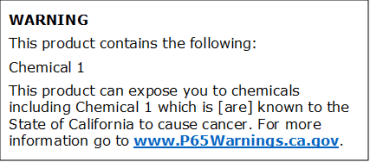
If the chemical is on the list because it may injure a fetus the warning must look like this.


If your product contains chemicals that are on both lists, meaning the chemical can cause cancer or injury to a fetus, that warning must look like this.


This is a different warning if you place the warning directly on the product. If the warning contains both a carcinogen and a toxicant, the safe harbor warning will look like this.

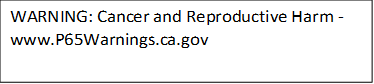
However, this warning has minimum type size requirements. The type size must be a minimum of 6pt or nor smaller than the largest type size used for other consumer information on the product.
Catalogs
The New Warning and Requirement to list the known chemicals in the warning are not all that is now required. Warnings must also be posted in Catalogs and on websites. For catalog sales, the warning must be located in a position to be associated with the product that is being sold that contains the chemical. This means you can’t just post the warning in the beginning of the catalog; it must be on the page with the product.
Websites
Websites must have the warning on the same page as the product is being sold on. If not on the same page as the product, the warning must be communicated to consumers prior to finalizing the purchase.
My Thoughts.
I would urge you to adopt the new warnings and put them on your products now. Even though your product was manufactured prior to August 30, 2018, you may still be forced into a court of law to prove the manufacturing date. Plan now to put the new labels on and safe that possible nightmare.
FAQs
What if I don’t sell products in California?
You may not sell products in California. That is not the issue; the issue is if your product is sold in California, you will be the one paying the fines and penalties.
What if I label the products “Not for Sale in California?”
When was the last time you read a label? Your product is labeled and sold to someone in Nevada, who then travels to a flea market in California. Again, you pay the fines.
What other ways are there around this?
There aren’t any.
What if my manufacturer won’t tell me the chemical composition of the components in my product?
Find a new manufacturer, quickly.
Based on current articles and reading there is no way around this. You either find out what is in your product, or you go out of business. If you don’t go out of business a lawyer or the State of California will put you out of business.
Speaking of that, the law allows law by private citizens to sue manufacturers for failing to comply. The citizen gets a portion of the money collected, and you pay for the attorney who sued you as well as your own attorney. There are law firms and “consumers” setting up and starting these lawsuits already.
One law firm purchased 60 outdoor products in one day from an online retailer. All of the products were tested and demand letters quickly went out. If you expect to hope no one will find your product, that is not going to happen.
Get ahead of the game.
If you want help with this email jim@rec-law.us or call 720 334 8529.
#ProductLiabilityLaw, #WarningLabels, #CaliforniaProposition65, #RecreationLaw, #OutdoorLaw, #ProductLiability, California Prop 65, California Proposition 65, Carcinogen, OEHHA, Office of Environmental Health Hazard Assessment, Proposition 65, Toxicant, Product Liability Law, Warning Labels, CaliforniaProposition65, RecreationLaw, Outdoor Law, Product Liability,
Under California law, you assume the risk of getting hit by a toboggan being towed by a snowmobile while snowboarding.
Posted: January 15, 2018 Filed under: Assumption of the Risk, California, Ski Area, Skiing / Snow Boarding | Tags: Assumption of risk, Checklist, Collision, discarded, driver, Emergency, hit, Inherent Risk, instructional error, lift, patrol, patroller, Primary Assumption of Risk, Resort, risks inherent, secondary, Secondary Assumption of Risk, siren, Ski, ski area, Ski Resort, Skier, skiing, Slope, Snowboarder, snowboarding, Snowmobile, Sport, suppression, Toboggan, tower, unreasonably Leave a commentBoth sides of this case created problems for themselves, and both sides stretched their credibility. In the end, it was easy for the plaintiff to lose because of that credibility gap created by the facts and when those facts were reported.
Forrester v. Sierra at Tahoe, 2017 Cal. App. Unpub. LEXIS 5204
State: California
Plaintiff: Dominique Forrester
Defendant: Sierra at Tahoe
Plaintiff Claims: General Negligence are Claims for Breach of Statutory Duty; Negligence Per Se; Gross Negligence and/or Reckless Conduct; and/or Common Carrier Liability
Defendant Defenses: assumption of the risk
Holding: for the defendant
Year: 2017
Summary
Snowboarder loses suit claiming a toboggan being towed by a snowmobile hit him on a beginner slope. By reporting the incident after he left the resort, he created a credibility issue.
In the end, getting hit by a toboggan being towed by a snowmobile is a risk you assume when skiing in California.
Facts
The facts in a case like this are always screwy to begin with and in my opinion, screwy from both sides of the litigation. The plaintiff and a friend were snowboarding. The plaintiff was filming his friend doing jumps. After the last jump, the plaintiff snowboarded toward the bottom which was on a beginner run waiting for his friend. While waiting, he heard someone yell, and he was hit by a toboggan. He hit his head suffering injuries. The plaintiff thought he saw a ski patroller driving away with the toboggan attached to the snowmobile. The fall broke some of his equipment also.
His friend saw the incident and stated that the driver was wearing a different uniform from what the plaintiff reported. Neither of them saw lights nor a flag on the snowmobile.
The plaintiff and his friend did not report the injury but drove home. On the way home they decided the plaintiff should call Sierra. He did and got a recording machine. He then started vomiting.
The next day the plaintiff hurt all over. Eventually, he was diagnosed with a concussion, a whiplash and disc degeneration.
The plaintiff called the ski area the next day and was told there was no one for him to talk to. He was to call back Wednesday. Wednesday, he called back and filed a report.
Forrester called Sierra again on Monday morning. He was told there was no one with whom he could discuss the incident and to call back on Wednesday. He called Wednesday and spoke with Evan MacClellan, the risk manager. MacClellan completed an incident report based on the phone call. The report described the injury as occurring at the bottom of Broadway near the terrain park. The report described that Forrester was hit by a “snowmobile” (patroller), got up after the incident, and did not report it. On the way home he started to vomit and went to the hospital the next day. The report listed Medina as a witness and included his telephone number.
The same day the plaintiff contacted an attorney.
The ski area investigated the claim. No ski patrollers or terrain park employees knew of any collision with a toboggan and a snowboarder.
MacClellan spoke with the ski patrol and terrain park employees about Forrester’s claim. None of the ski patrollers on duty that day or others with whom they spoke recalled any accident or collision. Both MacClellan and the general manager, John Rice, were suspicious of the claim; in 37 years in the ski industry, Rice had never seen a report made days after the incident. MacClellan did not call Medina, although Forrester had identified him as a witness. MacClellan could not determine that the accident actually took place. He first learned that Forrester claimed the collision was with a towed toboggan rather than the snowmobile itself after Forrester’s deposition.
Obviously, the ski area felt that no collision or accident had occurred. The case went to trial, and the plaintiff lost because the jury found he had assumed the risk of injuries.
Normally, juries like judges are asked to assemble, to a limited extent, the facts upon which they base their decision. In this case that was not done.
As we noted earlier, this case is unusual among liability cases in general because the collision itself was in dispute. Because the jury was not asked to make any preliminary factual findings, we cannot even assume that it found a collision occurred. We know only that the jury found Sierra did not unreasonably increase the inherent risk of snowboarding by its conduct on the day in question–whatever its conduct was found to be.
The plaintiff appealed the decision.
Analysis: making sense of the law based on these facts.
The court first looked into the issues surrounding the snowmobile. The defendant kept a checklist that was to be completed each day before the snowmobile was ridden. The checklist was not kept after it was completed.
Sierra requires its snowmobile drivers to follow a safety checklist and check lights, brakes, and other functions before a snowmobile is taken out. The checklist is a written form detailing the items to be checked and the name of the person taking out the snowmobile. The checklist is discarded daily unless an entry triggers a need for snowmobile maintenance. Due to this practice of discarding the checklist daily, no attempt was made to find the checklists for March 7, and the driver of the snowmobile allegedly involved in the accident was never found.
The day in question was one of the busiest of the year. The ski area employees testified that it was so buy, it would have been impossible to drive a snowmobile through the crowd on the slope in question.
The court then reviewed the evidence of the competing expert witnesses, both of whom offered testimony that at best seems stretched and will be ignored here and was ignored a lot by the court.
The court then reviewed the defenses offered by the ski area, starting with Primary Assumption of the Risk.
“Primary assumption of risk is a complete bar to recovery. It applies when, as a matter of law, the defendant owes no duty to guard against a particular risk of harm.” “Primary assumption of risk occurs where a plaintiff voluntarily participates in a sporting event or activity involving certain inherent risks. For example, an errantly thrown ball in baseball or a carelessly extended elbow in basketball are considered inherent risks of those respective sports.”
Ski areas and other operators, sponsors and instructors of recreational activities have no duty to eliminate the risk. They do have a duty not to increase the risk beyond those inherent in the sport. The court based on this analysis looked at whether a toboggan is an inherent risk of skiing and boarding and found it was.
We first address the threshold question of whether unwanted contact with a snowmobile is, in general, an inherent risk of snowboarding. We conclude that it is.
On at least two occasions, this court has found a collision with resort equipment at a ski resort to be an inherent risk of the sport.
In both examples, the court compared the collisions to collisions with stationary objects, a lift tower and a tree.
The court looked at the facts in this case and concluded the incident was a collision with a toboggan, rather than a toboggan hitting a snowboarder. I suspect the facts in the two cases the court reviewed would have different conclusions if the lift tower or the tree had hit the skiers?
To reach this conclusion, the court went back to the statements of the experts of both the plaintiff and the defendant who testified that snowmobiles were a standard practice in the sport of skiing.
There are many inherent risks of injury and emergency in skiing and snowboarding, and snowmobiles are used to respond quickly to injuries as well as to other emergencies such as lift malfunctions requiring evacuation, fire, gas leaks, and altercations. It appears to us that the use of snowmobiles on the ski slopes at ski resorts is at least as necessary to the sport as the snowmaking equipment in Souza or the directional signs acknowledged as “necessary” in Van Dyke v. S.K.I. Ltd.
The court then also looked at Secondary Assumption of Risk.
The term “assumption of risk” has been “used in connection with two classes of cases: those in which the issue to be resolved was whether the defendant actually owed the plaintiff a duty of care (primary assumption of risk), and those in which the defendant had breached a duty of care but where the issue was whether the plaintiff had chosen to face the risk of harm presented by the defendant’s breach of duty (secondary assumption of risk). In the latter class of cases, we concluded; the issue could be resolved by applying the doctrine of comparative fault, and the plain-tiff’s decision to face the risk would not operate as a complete bar to recovery. In such a case, the plaintiffs knowing and voluntary acceptance of the risk functions as a form of contributory negligence.
The court held that discussing secondary assumption of risk was not necessary in this case because the jury found the defendant was not liable because of primary assumption of the risk.
The plaintiff also argued that an evidentiary ruling should have been made in the plaintiff’s favor because the defendant failed to keep the snowmobile checklist. The rules and laws of what evidence should be kept or can be destroyed to have changed dramatically in the past twenty years, and this area of law is a hot bed of litigation and arguments.
However, the court moved around this issue because the checklist was destroyed every day. The defendant gave the plaintiff a list of the possible drivers of snowmobiles at the resort. Because the checklist was only used by the first driver, and the snowmobile could have been ridden by someone other than the driver who completed the checklist, the court found it was not critical to the case. The plaintiff request of the information had occurred after the checklist had been destroyed as was the habit for the defendant.
So Now What?
First being hit by an object being towed by a snowmobile inbounds in California is an assumed risk. This is the first case f this type I have found. Every other case where the defendant has been held not liable because of assumption of the risk at a ski area was based on the skier or boarder hitting a fixed object.
Second, credibility maybe all you have in some cases. Consequently, you never want to stretch or destroy your credibility, and you do not want your experts to do the same.
Last, if you are hurt at a resort, get help at the resort. Some of the plaintiff’s injuries might have been mitigated if treated immediately.
However, all the above issues could be crap, if the jury ruled not because they believed the plaintiff assumed the risk, but because they did not believe the plaintiff at all.
What do you think? Leave a comment.
Copyright 2017 Recreation Law (720) 334 8529
If you like this let your friends know or post it on FB, Twitter or LinkedIn


Author: Outdoor Recreation Insurance, Risk Management and Law
Facebook Page: Outdoor Recreation & Adventure Travel Law
Email: Rec-law@recreation-law.com
By Recreation Law Rec-law@recreation-law.com James H. Moss
#AdventureTourism, #AdventureTravelLaw, #AdventureTravelLawyer, #AttorneyatLaw, #Backpacking, #BicyclingLaw, #Camps, #ChallengeCourse, #ChallengeCourseLaw, #ChallengeCourseLawyer, #CyclingLaw, #FitnessLaw, #FitnessLawyer, #Hiking, #HumanPowered, #HumanPoweredRecreation, #IceClimbing, #JamesHMoss, #JimMoss, #Law, #Mountaineering, #Negligence, #OutdoorLaw, #OutdoorRecreationLaw, #OutsideLaw, #OutsideLawyer, #RecLaw, #Rec-Law, #RecLawBlog, #Rec-LawBlog, #RecLawyer, #RecreationalLawyer, #RecreationLaw, #RecreationLawBlog, #RecreationLawcom, #Recreation-Lawcom, #Recreation-Law.com, #RiskManagement, #RockClimbing, #RockClimbingLawyer, #RopesCourse, #RopesCourseLawyer, #SkiAreas, #Skiing, #SkiLaw, #Snowboarding, #SummerCamp, #Tourism, #TravelLaw, #YouthCamps, #ZipLineLawyer, #RecreationLaw, #OutdoorLaw, #OutdoorRecreationLaw, #SkiLaw, snowmobile, collision, ski, inherent risk, snowboarding, sport, checklist, toboggan, driver, ski resort, skiing, unreasonably, assumption of risk, slope, secondary, emergency, resort, ski area, skier, hit, snowboarder, patroller, patrol, risks inherent, instructional error, lift, discarded, siren, suppression, tower,
Forrester v. Sierra at Tahoe, 2017 Cal. App. Unpub. LEXIS 5204
Posted: December 19, 2017 Filed under: California, Legal Case, Ski Area, Skiing / Snow Boarding | Tags: Assumption of risk, Checklist, Collision, discarded, driver, Emergency, hit, Inherent Risk, instructional error, lift, patrol, patroller, Resort, risks inherent, secondary, siren, Ski, ski area, Ski Resort, Skier, skiing, Slope, Snowboarder, snowboarding, Snowmobile, Sport, suppression, Toboggan, tower, unreasonably Leave a commentForrester v. Sierra at Tahoe, 2017 Cal. App. Unpub. LEXIS 5204
Dominique Forrester, Plaintiff and Appellant, v. Sierra at Tahoe, Defendant and Respondent.
C079107
COURT OF APPEAL OF CALIFORNIA, THIRD APPELLATE DISTRICT
2017 Cal. App. Unpub. LEXIS 5204
July 27, 2017, Opinion Filed
NOTICE: NOT TO BE PUBLISHED IN OFFICIAL REPORTS. CALIFORNIA RULES OF COURT, RULE 8.1115(a), PROHIBITS COURTS AND PARTIES FROM CITING OR RELYING ON OPINIONS NOT CERTIFIED FOR PUBLICATION OR ORDERED PUBLISHED, EXCEPT AS SPECIFIED BY RULE 8.1115(b). THIS OPINION HAS NOT BEEN CERTIFIED FOR PUBLICATION OR ORDERED PUBLISHED FOR THE PURPOSES OF RULE 8.1115.
SUBSEQUENT HISTORY: Review denied by Forrester v. Sierra at Tahoe, 2017 Cal. LEXIS 7927 (Cal., Oct. 11, 2017)
PRIOR HISTORY: [*1] Superior Court of El Dorado County, No. PC20120138.
CORE TERMS: snowmobile, collision, ski, inherent risk, snowboarding, sport, checklist, toboggan, driver, ski resort, skiing, unreasonably, assumption of risk, slope, secondary, emergency, resort, ski area, skier, hit, snowboarder, patroller, patrol, risks inherent, instructional error, lift, discarded, siren, suppression, tower
JUDGES: Duarte, J.; Butz, Acting P. J., Mauro, J. concurred.
OPINION BY: Duarte, J.
OPINION
Plaintiff Dominique Forrester was injured while snowboarding at defendant ski resort Sierra-at-Tahoe (Sierra) on March 7, 2010. He claimed he was hit by a toboggan, that in turn was being towed by a snowmobile, while on a beginner slope. The trial court found assumption of the risk applied to the claim, and the case went to the jury to answer the question of whether Sierra unreasonably increased the risk to Forrester above that already inherent in the sport of snowboarding. By a vote of 10 to 2, the jury answered “no.”
On appeal, plaintiff contends the trial court erred in ruling that primary assumption of the risk applied to this case, and instructing the jury accordingly. Plaintiff argues a collision with a snowmobile is not an inherent risk of snowboarding. He further contends the court incorrectly instructed the jury on secondary assumption of the risk, and erred in refusing to instruct on the willful suppression of evidence.
As we will explain, this case is unusual among liability cases in general because the very existence of the alleged accident–the collision itself–was [*2] and remains in dispute. We first conclude that unwanted contact with a snowmobile (here encompassing a towed toboggan), on a ski slope at a ski resort, is indeed an inherent risk of snowboarding. Although Forrester argues the particular alleged circumstances of the operation of the snowmobile on the day of the incident took the collision outside the boundaries of inherent risk, that issue was tendered to the jury and the jury found Sierra did not unreasonably increase the risks already inherent in snowboarding
We assume instructional error on secondary assumption of the risk but find no prejudice, and conclude that the evidence did not support an instruction on willful suppression of the evidence.
Accordingly, we affirm the judgment.
FACTUAL AND PROCEDURAL BACKGROUND
The Alleged Accident
On Sunday, March 7, 2010, Forrester met his high school friend, Franklin Medina, for a day of snowboarding at Sierra. That day was the busiest of the year, with about 6,370 people at the resort. Forrester described himself as an intermediate snowboarder who does not perform jumps. He did not wear ear buds or ear phones while snowboarding and did not recall ever seeing a snowmobile in a ski area before that [*3] day.
At about 3:30 or 4:00 p.m., Forrester was filming Medina doing jumps. After the last jump, Medina snowboarded down the run to wait for Forrester. The bottom area of the ski run is known as Broadway; it is a beginner run near the teaching area and close to the lodge.
According to Forrester, as he began to snowboard down Broadway, he heard someone yell “hey.” He tried to turn around and was hit in the back of the legs. He went airborne and landed on his bottom and then hit his head. His goggles cut his face. He was hurt and dizzy. The snowmobile was 30 yards away when Forrester first saw it, and the driver “took off.” Forrester thought the driver’s jacket was orange or red, but he was not sure. He assumed only ski patrollers, who wear orange-red jackets, operated snowmobiles. He thought the snowmobile driver was wearing a beanie. Forrester did not hear the snowmobile. After the collision, Forrester slid down the mountain, and some other snowboarders asked if he was okay. He did not realize his equipment was broken until he later responded to special interrogatories.
Medina claimed he saw the incident, and that the snowmobile was in front of Forrester’s path and pulling a toboggan. [*4] He saw the toboggan clip Forrester’s feet and “take him out.” The snowmobile was going two or three times faster than Forrester. Forrester took his equipment off and walked down the mountain. Medina claimed the driver of the snowmobile was wearing a black and purple vest like the ones worn by terrain park employees (rather than the orange and red jacket described by Forrester). Medina did not see any lights on the snowmobile and did not notice a flag, nor did he hear a siren.
Forrester did not report the accident, but tried to “walk off” the injury. On the way home Forrester and Medina discussed that Forrester had been hit and decided they should call Sierra. Forrester called just after 5:00 p.m. and got an answering machine. Forrester began vomiting and they stopped in Placerville where Medina took pictures of his face. Medina drove Forrester home.
The next day, Monday, Forrester hurt all over his body, including a bad headache. He went to his doctor who ordered a CT scan, the results of which were normal. Over the next few days, Forrester’s back began to hurt. He was diagnosed with a concussion and a whiplash back injury. Forrester was later diagnosed with disc degeneration with a [*5] prognosis of ongoing pain.
Reporting the Accident
Forrester called Sierra again on Monday morning. He was told there was no one with whom he could discuss the incident and to call back on Wednesday. He called Wednesday and spoke with Evan MacClellan, the risk manager. MacClellan completed an incident report based on the phone call. The report described the injury as occurring at the bottom of Broadway near the terrain park. The report described that Forrester was hit by a “snowmobile (patroller),” got up after the incident, and did not report it. On the way home he started to vomit and went to the hospital the next day. The report listed Medina as a witness and included his telephone number.
Forrester contacted an attorney the same day he spoke with MacClellan. Forrester sent MacClellan a written report, in which he stated he “was involved in a collision with a Sierra Ski Patrol Officer (Ski Patroller) whom [sic] was driving a snow mobile, towing a stretcher. . . . The Ski Patroller was apparently attempting to cross from my left, which was behind me (I have a ‘regular’ board stance), across my face, to the right of me when he collided into me from my blind side. As a result I flew over [*6] him and crashed very hard into the mountain. I suffered a head injury, as well as whiplash, and subsequently blacked out for a short period of time.” The statement continued that Forrester did not see the “patroller” and heard no sirens; he heard only a brief “hey” right before the impact. His friend Medina had witnessed the collision and could not believe it; other snowboarders asked if Forrester was okay, but the ski patrol did not.
MacClellan spoke with the ski patrol and terrain park employees about Forrester’s claim. None of the ski patrollers on duty that day or others with whom they had spoken recalled any accident or collision. Both MacClellan and the general manager, John Rice, were suspicious of the claim; in 37 years in the ski industry, Rice had never seen a report made days after the incident. MacClellan did not call Medina, although Forrester had identified him as a witness. MacClellan could not determine that the accident actually took place. He first learned that Forrester claimed the collision was with a towed toboggan rather than the snowmobile itself after Forrester’s deposition.
The Lawsuit and Trial
Forrester brought suit against Sierra for general negligence and [*7] premises liability. The complaint stated: “Included in the Cause of Action for General Negligence are Claims for Breach of Statutory Duty; Negligence Per Se; Gross Negligence and/or Reckless Conduct; and/or Common Carrier Liability.” Forrester took some theories of liability “off the table” and the trial court granted defendant’s motion for nonsuit as to others. As we explain in more detail, post, the matter was submitted to the jury as an assumption of the risk case, with the jury asked to determine whether Sierra unreasonably increased the inherent risks of snowboarding
Snowmobile Evidence
Sierra requires its snowmobile drivers to follow a safety checklist and check lights, brakes, and other functions before a snowmobile is taken out. The checklist is a written form detailing the items to be checked and the name of the person taking out the snowmobile. The checklist is discarded on a daily basis unless an entry triggers a need for snowmobile maintenance. Due to this practice of discarding the checklist daily, no attempt was made to find the checklists for March 7, and the driver of the snowmobile allegedly involved in the accident was never found. At trial, Sierra stipulated that anyone [*8] driving a snowmobile at the resort that day would have been employed by Sierra. The checklist would not necessarily reveal the identity of the driver of the snowmobile in any event, because once the snowmobile is checked out others may use it without completing a new checklist. Sierra maintains no record showing who is using a snowmobile at a particular time on a specific date.
A snowmobile is a loud machine; its sound is comparable to a motorcycle or lawnmower. The flashing lights are always on if the snowmobile is running, but the siren can be turned on and off. It is against Sierra’s policy to operate a snowmobile without a siren when guests are present. The snowmobile has an attached fiberglass pole with a flag atop, to aid in visibility. March 7, 2010, was a peak day and there was a blackout on the use of snowmobiles in the ski areas except for emergencies. Rice defined emergencies as ski patrol rescue, lift evacuation, a fire or gas leak on the hill, and to carry law enforcement to an altercation. There were no documented emergencies the day of the incident. MacClellan testified that with 6,000 people on the ski slopes, it would be “virtually impossible” to drive a snowmobile [*9] through the Broadway area.
The ski patrol uses orange toboggans for rescue, which are stored in different locations on the mountain and used to transport injured guests. Patrollers take them uphill by chair lift or by snowmobile. Snowmobiles are rarely used to take a toboggan down the mountain; usually a patroller skis them down. Snowmobiles do not tow injured guests in a toboggan.
Plaintiff’s Experts
In addition to medical experts, plaintiff called a ski safety consultant and an accident reconstructionist. Richard Penniman testified as an expert on ski area mountain operations. He testified it was below industry standard to have a snowmobile on the ski slopes when a large number of people are present. On a run like Broadway that is designed for beginners, it was very dangerous to have anything present other than skiers and snowboarders. It was below the industry standard to use the Broadway area as a snowmobile route. Penniman added snowmobiles are only a convenience and a ski resort can operate without them. He conceded, however, that it was standard practice for ski areas to use snowmobiles and agreed they were extremely useful in an emergency where the risk they create might be worth [*10] it. He agreed with the policy of Sierra-at-Tahoe not to use snowmobiles on busy days except in the case of an emergency. In Penniman’s opinion, Sierra’s conduct in operating a snowmobile the day of the incident increased the risk of injury to skiers and snowboarders.
Jesse Wobrock, an accident reconstructionist and bioengineer, prepared an animation of the accident. He testified the accident had “an injury mechanism for both the lumbar spine and the traumatic brain injury.” The damage to Forrester’s left binding was consistent with the height of the toboggan, as was the orange color transfer on the binding. Wobrock testified the physical evidence corroborated the eyewitness testimony. In his opinion, the snowboard went between the tread of the snowmobile and the toboggan; the toboggan ran over the snowboard.
Defense Case
John Gardiner, a forensic engineer and biomechanic, testified for the defense. He opined there was neither consistent testimony nor sufficient physical evidence to conclude what occurred that day. Gardiner testified that if Forrester’s left binding made contact with a toboggan, the contact occurred at the rear portion of the toboggan. If the contact had been near the [*11] front of the toboggan, the snowboard would have hit the treads of the snowmobile and caused damage; there was no evidence of damage to the front of the snowboard. In Gardiner’s opinion, the force involved in Forrester’s fall would not have caused a lumbar disc injury and a concussion. Gardiner also testified that Medina’s view of the accident would have been obstructed by the snowmobile and its driver and that Wobrock’s animation of the incident was inconsistent with the laws of physics and Forrester’s testimony.
The defense pointed out the many inconsistencies between Medina’s deposition and his trial testimony, such as where he dropped off Forrester, whether Forrester wore a helmet, Forrester’s level of skill on a snowboard, the time they finished snowboarding, and whether Medina saw the snowmobile before the collision. Medina had changed his story only after talking to Forrester. The defense argued the differences between the testimony of Medina and Forrester as to the color of the snowmobile, the clothing of the driver, the location of the accident, and the timing showed that Forrester failed to carry his burden of proof as to what happened. The defense questioned how Forrester [*12] could fail to see or hear the snowmobile and offered three possibilities: (1) the collision had not happened; (2) Forrester was not paying attention; or (3) Forrester saw the snowmobile, but not the toboggan and tried to cut behind. The defense argued number three was the most reasonable and Forrester did not report the accident because he felt it was his fault.
Instructions
As relevant here, the court instructed the jury as follows:
“[CACI No.] 410. Dominique Forrester claims he was harmed while participating in snowboarding at the snow — at the Sierra at Tahoe Ski resort. To establish this claim Dominique Forrester must prove all of the following:
“1. That Sierra at Tahoe was the owner of the ski resort and that its employee was operating the snowmobile in issue in this case. Sierra at Tahoe admits that it is the owner of the ski resort and only its employee would have had access to and would have been operating a snowmobile on the ski resort.
“2. Dominique Forrester must also prove that Sierra at Tahoe unreasonably increased the risk to Dominique Forrester over and above those inherent in snowboarding;
“3. And Dominique Forrester must prove that Dominique Forrester was harmed; and lastly [*13]
“4. That Sierra at Tahoe’s conduct was a substantial factor in causing Dominique Forrester’s harm.
“[Modified CACI No.] 405. Sierra at Tahoe claims that Dominique contributed to his harm. To succeed on this claim, Sierra at Tahoe must prove the following:
“1. That Dominique Forrester assumed the risks that led to his injury; and
“2. That Dominique Forrester’s assumption of those risks was a substantial factor in causing his harm.
“If Sierra at Tahoe proves the above, Dominique Forrester’s damages are reduced by your determinations of the percentage of Dominique Forrester’s responsibility. I will calculate the actual reduction.”
Verdict and Motion for New Trial
During deliberations, the jury asked for a definition of “unreasonable” and to have Rice’s testimony about reports of emergencies that day reread. With the parties’ approval, the court responded to the first request as follows: “‘Unreasonable’ – is conduct that is contrary to conduct that a prudent person would exercise in the same or similar circumstances e.g. conduct that is careless, irrational, foolish, unwise, senseless, immoderate, exorbitant or arbitrary under the circumstances.”
By a vote of 10 to 2, the jury found Sierra did [*14] not unreasonably increase the risks to Forrester over and above those inherent in snowboarding in a ski area. Because the jury’s answer to this first question was “no,” it did not answer any additional questions contained in the verdict forms.
Forrester moved for a new trial, contending assumption of the risk did not apply to the case, there were evidentiary errors, and the court erred in not instructing on suppression of evidence. The court denied the motion.1
1 The record does not contain an order denying the motion. Under Code of Civil Procedure section 660, if there was no order, the effect is a denial of the motion.
DISCUSSION
I
Assumption of the Risk
A. The Law
“Primary assumption of risk is a complete bar to recovery. It applies when, as a matter of law, the defendant owes no duty to guard against a particular risk of harm.” (Gregory v. Cott (2014) 59 Cal.4th 996, 1001, 176 Cal. Rptr. 3d 1, 331 P.3d 179.) “Primary assumption of risk occurs where a plaintiff voluntarily participates in a sporting event or activity involving certain inherent risks. For example, an errantly thrown ball in baseball or a carelessly extended elbow in basketball are considered inherent risks of those respective sports.” (Wattenbarger v. Cincinnati Reds, Inc. (1994) 28 Cal.App.4th 746, 751, 33 Cal. Rptr. 2d 732.)
“The primary assumption of risk doctrine rests on a straightforward policy foundation: the need to avoid chilling vigorous participation in or sponsorship of recreational activities by imposing a tort duty to eliminate or [*15] reduce the risks of harm inherent in those activities. It operates on the premise that imposing such a legal duty ‘would work a basic alteration–or cause abandonment’ of the activity.” (Nalwa v. Cedar Fair, L.P. (2012) 55 Cal.4th 1148, 1156, 150 Cal. Rptr. 3d 551, 290 P.3d 1158.) “[U]nder the primary assumption of risk doctrine, operators, sponsors and instructors in recreational activities posing inherent risks of injury have no duty to eliminate those risks, but do owe participants the duty not to unreasonably increase the risks of injury beyond those inherent in the activity. (Id. at p. 1162.)
“Snowboarding is a classic example of a sport that requires participants to assume considerable risks.” (Vine v. Bear Valley Ski Co. (2004) 118 Cal.App.4th 577, 603, 13 Cal. Rptr. 3d 370 (Vine).) Courts have recognized many risks inherent in skiing and snowboarding. “Those risks include injuries from variations in terrain, surface or subsurface snow or ice conditions, moguls, bare spots, rocks, trees, and other forms of natural growth or debris. They also include collisions with other skiers, ski lift towers, and other properly marked or plainly visible objects and equipment.” (Lackner v. North (2006) 135 Cal.App.4th 1188, 1202, 37 Cal. Rptr. 3d 863.)
Whether the assumption of risk doctrine applies in a particular case is a question of law.”2 (Amezcua v. Los Angeles Harley-Davidson, Inc. (2011) 200 Cal.App.4th 217, 227, 132 Cal. Rptr. 3d 567.)
2 Although Forrester recognizes the question of whether assumption of the risk applies is a question of law reviewed de novo, he devotes a considerable portion of his briefing to arguing the trial court’s two analyses, first before trial and then on the motion for a new trial, were incorrect. “In reviewing a trial court’s decision, we review the result, not the reasoning.” (Florio v. Lau (1998) 68 Cal.App.4th 637, 653, 80 Cal. Rptr. 2d 409.)
B. Application to this Case
As we noted earlier, this case is unusual among liability cases in general because [*16] the collision itself was in dispute. Because the jury was not asked to make any preliminary factual findings, we cannot even assume that it found a collision occurred. We know only that the jury found Sierra did not unreasonably increase the inherent risk of snowboarding by its conduct on the day in question–whatever its conduct was found to be. With this in mind, we turn to Forrester’s first claim of error.
Forrester contends a collision with a snowmobile is not an inherent risk of snowboarding. He argues that although some collisions–such as with trees or other skiers or snowboarders–are inherent risks, the line should be drawn at a collision between an individual and a motorized vehicle. He asserts assumption of the risk has no role in the circumstances he claims were present here: an unmarked snowmobile with no lights, siren or flag, operated by a non-safety employee on a busy beginner slope, contrary to the safety policies of the ski resort.
Sierra counters that the circumstances Forrester claims were present here, outlined immediately above, would have unreasonably increased the risks undertaken by Forrester had the jury found the circumstances were as Forrester alleged. Sierra [*17] argues that it is apparent from the jury’s “no” vote that it found circumstances more closely aligned to those alleged by the defense, such as the absence of any collision (and even the absence of any snowmobile) whatsoever and other facts favorable to Sierra.
We first address the threshold question of whether unwanted contact with a snowmobile is, in general, an inherent risk of snowboarding. We conclude that it is.
On at least two occasions, this court has found a collision with resort equipment at a ski resort to be an inherent risk of the sport.
In Connelly v. Mammoth Mountain Ski Area (1995) 39 Cal.App.4th 8, 45 Cal. Rptr. 2d 855 (Connelly), the plaintiff collided with an unpadded ski lift tower while skiing. In affirming summary judgment for the defendant, we found this risk was inherent in the sport, and the obvious danger of the tower served as its own warning. (Id. at p. 12.) In concluding that contact with the tower was an inherent risk of the sport, the Connelly court relied on Danieley v. Goldmine Ski Associates, Inc. (1990) 218 Cal.App.3d 111, 266 Cal. Rptr. 749, where a skier collided with a tree. Danieley, in turn, relied on a Michigan statute that set forth certain inherent risks of skiing, including both trees and “‘collisions with ski lift towers and their components'” along with properly marked or plainly visible “‘snow-making or snow-grooming [*18] equipment.'” (Id. at p. 123.) “[B]ecause the Michigan Ski Area Safety Act purports to reflect the pre-existing common law, we regard its statutory pronouncements as persuasive authority for what the common law in this subject-matter area should be in California.” (Ibid.)
In Souza v. Squaw Valley Ski Corp. (2006) 138 Cal.App.4th 262, 41 Cal. Rptr. 3d 389 (Souza), a child skier collided with a plainly visible aluminum snowmaking hydrant located on a ski run. Following Connelly, we affirmed summary judgment for the defendant, finding the snowmaking hydrant was visible and a collision with it was an inherent risk of skiing. (Id. at p. 268.)
A snowmobile is not one of the risks specifically identified in the Michigan Ski Area Safety Act, and we have not found a published case specifically deciding whether a collision on a ski slope with a snowmobile is an inherent risk of skiing or snowboarding. Nevertheless, collision with certain vehicles has been included. While Souza involved only stationary equipment, the Michigan Ski Area Safety Act–which Danieley and Connelly accepted as reflecting the common law–included a collision with snow-grooming equipment as an inherent risk. Thus, collisions with some vehicles are recognized as inherent risks of the sports of skiing and snowboarding.
We recognize that assumption [*19] of the risk applies only to risks that are necessary to the sport. (Souza, supra, 138 Cal.App.4th at p. 268.) In Souza, snowmaking equipment was necessary to the sport of skiing because nature had failed to provide adequate snow. (Ibid.) As in Souza, we find the following quote from Verro v. New York Racing Ass’n, Inc. (1989) 142 A.D.2d 396, 400, 536 N.Y.S.2d 262 apt: “As is at least implicit in plaintiff’s argument, if only the risks of ordinary and necessary dangers inherent in a sport are deemed assumed, the doctrine of [primary] assumption of risk . . . would not apply to obvious, known conditions so long as a defendant could feasibly have provided safer conditions. Then, obviously, such risks would not be ‘necessary’ or ‘inherent’. This would effectively emasculate the doctrine, however, changing the critical inquiry . . . to whether the defendant had a feasible means to remedy [the dangers].”
Forrester’s expert Penniman claimed snowmobiles were merely a convenience and a ski resort could operate without them. He also testified, however, that the use of snowmobiles was a standard practice at ski resorts. Although critical of their overuse, Penniman recognized their usefulness in an emergency. He agreed with Sierra’s policy, which permitted snowmobiles to be used on the ski slopes in cases of emergency, [*20] even on the busiest days. Thus Penniman agreed generally that the use of snowmobiles was necessary to ski resorts, although he disputed the specific circumstances under which that use might be warranted.
There are many inherent risks of injury and emergency in skiing and snowboarding, and snowmobiles are used to respond quickly to injuries as well as to other emergencies such as lift malfunctions requiring evacuation, fire, gas leaks, and altercations. It appears to us that the use of snowmobiles on the ski slopes at ski resorts is at least as necessary to the sport as the snowmaking equipment in Souza or the directional signs acknowledged as “necessary” in Van Dyke v. S.K.I. Ltd. (1998) 67 Cal.App.4th 1310, 1317, 79 Cal. Rptr. 2d 775.
At least one unpublished federal case has found a collision with a snowmobile to be an inherent risk of skiing or snowboarding. In Robinette v. Aspen Skiing Co., L.L.C. (D. Colo., Apr. 23, 2009, No. 08-CV-00052-MSK-MJW, 2009 U.S. Dist. LEXIS 34873, affd sub nom. Robinette v. Aspen Skiing Co., L.L.C. (10th Cir. 2010) 363 Fed.Appx. 547, the court found “the specific risk of colliding with a snowmobile being operated by a ski resort employee is necessarily within the ‘risks of skiing/riding.'” (Id. at p. *7.) The court reasoned that since “the legislature has seen fit to specifically enact safety measures to prevent skier-snowmobile collisions, one can [*21] hardly argue that such a collision somehow falls outside of [plaintiff’s] express assumption of ‘all risks of skiing.'”3 (Ibid.)
3 Although California has no similar regulation of snowmobiles at ski slopes, the requirements of the Colorado law are similar to Sierra-at-Tahoe’s policy for snowmobile operation. “All snowmobiles operated on the ski slopes or trails of a ski area shall be equipped with at least the following: One lighted headlamp, one lighted red tail lamp, a brake system maintained in operable condition, and a fluorescent flag at least forty square inches mounted at least six feet above the bottom of the tracks.” (Colo. Rev. Stat. Ann. § 33-44-108, subd. (3).)
Based on the foregoing, we conclude the trial court did not err in ruling that primary assumption of the risk applies in this case and instructing the jury accordingly. To the extent that the evidence showed a snowmobile was operating at the resort and involved in an collision with Forrester that day, its presence and that of related equipment (here apparently a towed toboggan) on the slope was an inherent risk of snowboarding at the resort. However, that risk may well have been unreasonably increased by Sierra if the specific circumstances alleged by Forrester regarding the snowmobile’s use at the time of the alleged collision were believed by the jury. But the jury was presented with a variety of competing scenarios as to what happened at the resort that day. Although we do not know which evidence it credited and which it did not, we know that it did not consider the specific circumstances of the snowmobile’s operation that day to have unreasonably increased the risk already present from the necessary use of snowmobiles at resorts.4
4 The better practice in cases such as this one, where key facts–here even the preliminary fact as to whether there was a collision at all, let alone a collision between a snowboarder and a snowmobile towing a toboggan–are in dispute, is to craft the special verdict form to require the jury to make preliminary factual findings, here such as whether the alleged accident occurred at all and the particulars, if so. (See CACI No. 410, Directions for Use [“There may also be disputed facts that must be resolved by a jury before it can be determined if the doctrine applies”], citing Shin v. Ahn (2007) 42 Cal.4th 482, 486, 64 Cal. Rptr. 3d 803, 165 P.3d 581.)
In arguing that a collision [*22] with a motorized vehicle is not an inherent risk, Forrester relies on out-of-state cases, some unpublished. We find those cases distinguishable or not persuasive. In Verberkmoes v. Lutsen Mountains Corp. (D. Minn. 1994) 844 F.Supp. 1356, a skier collided with an unmarked all terrain vehicle (ATV) parked on or near a groomed trail. The court denied summary judgment for the defendant, finding the hazard of the parked ATV was within the control of the ski resort, not an obvious risk like a lift tower, and not a hidden risk like a snow-covered stump. (Id. at pp. 1358-1359.) Defendant’s “parking of the ATV on the trail during routine maintenance of the ski slope cannot be deemed, as a matter of law, an inherent risk of skiing.” (Id. at p. 1360.) Rather, it was “a danger that reasonable prudence on the part [of defendant] would have foreseen and corrected or at least placed a warning for skiers.” (Id. at p. 1359.) We find Verberkmoes distinguishable, largely because the decision was based on where the ATV was parked; the ski resort could have easily parked it elsewhere or warned against the hazard. Here, the question was whether the resort’s use of snowmobiles on the ski slopes and consequential possibility of contact with snowboarders was an inherent risk of snowboarding.
In Schlumbrecht-Muniz v. Steamboat Ski and Resort Corp. (D. Colo. 2015) 132 F.Supp.3d 1310, the defendant had argued that [*23] a collision with a snowmobile is an inherent danger and risk of skiing. The court had rejected this argument twice before, each time concluding “whether a collision with a snowmobile is an inherent danger or risk of skiing is not necessarily a question of law because what is an inherent danger or risk of skiing is not limited to the circumstances specifically enumerated in the [Ski Safety Act].” (Id. at p. 1316.) The court declined to address the argument again. (Ibid.)
We find this conclusory analysis unhelpful. For the reasons stated ante, we find a collision with a snowmobile is an inherent risk of snowboarding. As to whether this particular collision was the result of the inherent risk, the jury was properly tasked with determining whether Sierra’s operation of the snowmobile unreasonably increased the risk already inherent in snowboarding. This determination governed whether this particular collision was barred by the assumption of the risk doctrine.
Forrester also relies on an unpublished case from the state of Ohio, Coblentz v. Peters 2005 Ohio 1102, 2005 Ohio App. LEXIS 1073, that found use of a motorized golf cart was not “an actual part of the sport of golf,” so the risk of being struck and injured by a golf cart “is not an ordinary risk of the game.” [*24] (Id. at ¶ 21.) To the limited extent this case is analogous, we decline to apply its narrow analysis to the sport of snowboarding and the associated risk of encountering the resort’s necessary equipment when on the ski slopes. (See Souza, supra, 138 Cal.App.4th at p. 269 [finding snowmaking equipment necessary to the sport of skiing].)
As we have noted, unlike many assumption of the risk cases, including those cited ante, here there is a genuine factual dispute as to what happened to Forrester and caused his injuries. The jury needed to resolve this factual dispute in order to determine whether Sierra unreasonably increased the inherent risk. Accordingly, the issue of whether recovery is barred by assumption of the risk could not be determined as a matter of law, such as by a motion for summary judgment, as is often the case. Here, we need not decide if Forrester’s specific collision was an inherent risk, but only the broader question of whether a collision with a snowmobile operated on the ski slopes of a resort is an inherent risk of snowboarding. If so, recovery is still possible if Sierra unreasonably increased the risk by the specific circumstances surrounding its operation of the snowmobile.
“Although defendants generally [*25] have no legal duty to eliminate (or protect a plaintiff against) risks inherent in the sport itself, it is well established that defendants generally do have a duty to use due care not to increase the risks to a participant over and above those inherent in the sport. Thus, although a ski resort has no duty to remove moguls from a ski run, it clearly does have a duty to use due care to maintain its towropes in a safe, working condition so as not to expose skiers to an increased risk of harm.” (Knight v. Jewett (1992) 3 Cal.4th 296, 315-316, 11 Cal. Rptr. 2d 2, 834 P.2d 696.) Numerous cases have pondered the factual question of whether various ski resorts have increased the inherent risks of skiing or snowboarding. (See Vine, supra, 118 Cal.App.4th at p. 591 [redesign of snowboarding jump]; Solis v. Kirkwood Resort Co. (2001) 94 Cal.App.4th 354, 366, 114 Cal. Rptr. 2d 265 [construction of the unmarked race start area on the ski run]; Van Dyke v. S.K.I. Ltd., supra, 67 Cal.App.4th 1317 [placement of signs in ski run].)
Forrester contends that even if the ski patrol’s use of a snowmobile is necessary to support the sport of snowboarding, the evidence here showed the snowmobile was not used for that purpose. Indeed, he claims that because the members of the ski patrol on duty that day denied being involved in a collision, the evidence established that the snowmobile was driven by a non-safety employee. He argues the trial court was required [*26] to resolve factual questions as to whether a member of the ski patrol was using the snowmobile before it determined whether assumption of risk applied.
We disagree with Forrester that the trial court was required to resolve these factual questions before submitting the case to the jury. Resolution of the factual issues as to how and by whom the snowmobile was operated “requires application of the governing standard of care (the duty not to increase the risks inherent in the sport) to the facts of this particular case–the traditional role of the trier of fact.” (Luna v. Vela (2008) 169 Cal.App.4th 102, 112, 86 Cal. Rptr. 3d 588.) “Our conclusion it is for the trier of fact to determine whether Vela breached his limited duty not to increase the risks inherent in the sport of volleyball finds solid support in the Supreme Court’s most recent sports injury, primary assumption of the risk decision, Shin v. Ahn, supra, 42 Cal.4th 482 . . . . In Shin the Supreme Court affirmed the trial court’s denial of a motion for summary judgment brought by a golfer who had struck one of his own playing partners with a tee shot. The court held the primary assumption of the risk doctrine regulates the duty a golfer owes both to playing partners and to other golfers on the course, found being hit by a stray [*27] golf shot was an inherent risk of the sport and concluded ‘golfers have a limited duty of care to other players, breached only if they intentionally injure them or engage in conduct that is “so reckless as to be totally outside the range of the ordinary activity involved in the sport.”‘ [Citation.] However, the Court also held whether the defendant had breached that limited duty of care by engaging in reckless conduct was a question for the trier of fact: ‘In determining whether defendant acted recklessly, the trier of fact will have to consider both the nature of the game and the totality of circumstances surrounding the shot. . . . [¶] Many factors will bear on whether a golfer’s conduct was reasonable, negligent, or reckless. . . . [¶] . . . This record is simply too sparse to support a finding, as a matter of law, that defendant did, or did not, act recklessly. This will be a question the jury will ultimately resolve based on a more complete examination of the facts.’ [Citation.]” (Luna, at pp. 112-113.) “In light of the Supreme Court’s decision in Shin, we conclude as the Luna court did, that resolving the question of whether [defendant] increased the risk of falling is properly decided by the trier [*28] of fact.” (Fazio v. Fairbanks Ranch Country Club (2015) 233 Cal.App.4th 1053, 1062, 183 Cal. Rptr. 3d 566.)
Forrester’s argument about the circumstances of the snowmobile’s use that day is premised upon the jury’s accepting his version of events–that a snowmobile hit him from behind, while driven by a non-safety employee who was not responding to an emergency and who was operating without lights, siren, or flag and contrary to numerous safety policies of Sierra. In short, Forrester assumes that the snowmobile had no legitimate reason to be on Broadway at the time of the incident. But the state of the evidence was such that the jury could decide otherwise. Due to Forrester’s failure to report the accident when it happened, the conflicting testimony of Forrester and Medina, the conflict in expert testimony as to how a collision would have occurred and what caused Forrester’s injuries, and the absence of any independent witness who saw or even heard about the accident, the jury could have rationally concluded the accident did not happen at all. Alternatively, the jury could have concluded that Forrester hit the toboggan out of carelessness or recklessness, Forrester’s injuries were not from the collision, or simply that Forrester failed to prove his version of the accident.
This [*29] case turned in large part on the jury’s assessment of credibility. There was evidence from which the jury could conclude that the incident occurred as described by Forrester and Medina, and that Sierra unreasonably increased its visitors’ inherent risk of a collision with a snowmobile accordingly–because a non-safety employee, not responding to an emergency, drove a snowmobile at significant speed across a beginner run on the busiest day of the year without using lights, siren or a flag, and in contravention of numerous safety policies. These circumstances, or any combination thereof, could certainly constitute an unreasonable increase of the inherent risk by Sierra. Forrester’s theory was tendered to the jury and the jury decided adversely to his argument. Forrester does not challenge the sufficiency of the evidence to support the verdict.
The trial court did not err in determining assumption of the risk applied and submitting the case to the jury on the question of whether Sierra unreasonably increased the risk inherent in the sport of snowboarding.
II
Instruction on Secondary Assumption of the Risk
A. Background
As we set forth ante, the jury was also instructed pursuant to CACI No. 405–the comparative [*30] fault instruction modified by the trial court–as to secondary assumption of the risk. The jury was told that in order for Sierra to succeed on its claim that Forrester contributed to his own harm, Sierra would need to prove both that Forrester assumed the risks that led to his injury and that Forrester’s assumption of those risks was a substantial factor in causing his harm.
The term “assumption of risk” has been “used in connection with two classes of cases: those in which the issue to be resolved was whether the defendant actually owed the plaintiff a duty of care (primary assumption of risk), and those in which the defendant had breached a duty of care but where the issue was whether the plaintiff had chosen to face the risk of harm presented by the defendant’s breach of duty (secondary assumption of risk). [Citation.] In the latter class of cases, we concluded, the issue could be resolved by applying the doctrine of comparative fault, and the plaintiff’s decision to face the risk would not operate as a complete bar to recovery. In such a case, the plaintiff’s knowing and voluntary acceptance of the risk functions as a form of contributory negligence. [Citation.]” (Kahn v. East Side Union High School Dist. (2003) 31 Cal.4th 990, 1003, 4 Cal. Rptr. 3d 103, 75 P.3d 30.)
“Secondary assumption [*31] of risk [arises] where a defendant breaches a duty of care owed to the plaintiff but the plaintiff nevertheless knowingly encounters the risk created by the breach. Secondary assumption of risk is not a bar to recovery, but requires the application of comparative fault principles.” (Connelly, supra, 39 Cal.App.4th at p. 11.)
B. Analysis
Forrester contends the special instruction on secondary assumption of the risk was incorrect because it omitted the requirement that a plaintiff “knowingly” or “voluntarily” accept the increased risk, and because the court failed to set it apart from the instruction related to primary assumption of the risk. Forrester contends the error prejudiced him because it confused the jury on the law.
As Sierra does not defend the instruction, we will assume arguendo that it is incorrect for omitting “knowingly” or “voluntarily.” We reject, however, the argument that it was error to instruct on secondary assumption of the risk immediately after instructing in the language of CACI No. 410 on primary assumption of the risk. Each instruction begins by noting the party whose claim the instruction addresses and what each party must prove to succeed on its claim. The two claims are necessarily related. “Nevertheless, in [*32] certain circumstances primary and secondary assumption of risk are intertwined and instruction is required so the jury can properly determine whether the defendant did, in fact, increase the risks inherent in a hazardous sport so that secondary assumption of risk should be considered.” (Vine, supra, 118 Cal.App.4th at p. 592.)
“Cases like this one, where the plaintiff contends the defendant breached the duty not to increase the risks inherent in a hazardous sporting activity, present both aspects of the assumption of risk doctrine. If the plaintiff fails to show any increase in the inherent risks, or if the trial court determines that the only risks encountered were inherent in the sport, the defendant prevails based on primary assumption of risk. If the jury, properly instructed on the scope of the defendant’s duty, determines the defendant did increase the inherent risk, it then considers the plaintiff’s claim based on secondary assumption of risk as an aspect of the plaintiff’s comparative fault.” (Vine, supra, 118 Cal.App.4th at p. 593.)
“[T]here is no rule of automatic reversal or ‘inherent’ prejudice applicable to any category of civil instructional error, whether of commission or omission. A judgment may not be reversed for instructional error in a civil case [*33] ‘unless, after an examination of the entire cause, including the evidence, the court shall be of the opinion that the error complained of has resulted in a miscarriage of justice.’ (Cal. Const., art. VI, § 13.)” (Soule v. General Motors Corp. (1994) 8 Cal.4th 548, 580, 34 Cal. Rptr. 2d 607, 882 P.2d 298 (Soule).)
“Instructional error in a civil case is prejudicial ‘where it seems probable’ that the error ‘prejudicially affected the verdict.’ [Citations.]” (Soule, supra, 8 Cal.4th at p. 580.) Actual prejudice must be assessed in the context of the entire record using a multifactor test. (Ibid.) “Thus, when deciding whether an error of instructional omission was prejudicial, the court must also evaluate (1) the state of the evidence, (2) the effect of other instructions, (3) the effect of counsel’s arguments, and (4) any indications by the jury itself that it was misled.” (Id. at pp. 580-581.)
Forrester contends the record demonstrates prejudice because there was strong evidence that Sierra increased the risk by its operation of a snowmobile that day, the jury deliberated for two full days, and the request for a definition of “unreasonable” suggests the jury was confused as to the law.
We disagree that the record shows it was “probable” that the instructional error “prejudicially affected the verdict.” (Soule, supra, 8 Cal.4th at p. 580.) As we have discussed, the evidence raised questions [*34] of witness credibility, and the jury was also called upon to consider conflicting expert testimony. The jury heard five days of evidence and deliberated for two days. In that circumstance, the jury’s two days of deliberation may suggest its “conscientious performance of its civic duty, rather than its difficulty in reaching a decision.” (People v. Walker (1995) 31 Cal.App.4th 432, 439, 37 Cal. Rptr. 2d 167 [six and one-half hours of deliberation after two and one-half hours of presentation of evidence].) The jury’s request for a definition of “unreasonable” and its request for a reread of evidence as to whether there was an emergency that day indicate the jury was most likely focused on Sierra’s conduct, not Forrester’s.
The most useful guide for the jury in sorting through the issues of primary and secondary assumption of the risk was the verdict form that separated the issues. The verdict form asked six questions; only if the jury answered yes to a question was it to proceed to the next question. The questions were: (1) Did Sierra or its employee unreasonably increase the risks inherent in snowboarding? (2) Was this unreasonable increase in the risks a substantial factor in causing harm to Forrester? (3) What are Forrester’s total damages? (4) Did [*35] Forrester assume the risks that led to his injury? (5) Was that assumption of risk a substantial factor in causing his injury? (6) What percentage of responsibility for Forrester’s harm do you assign to Sierra, to Forrester? The jury answered the first question “no” and therefore did not answer any other questions. Accordingly, the jury never reached the issue of secondary assumption of risk and thus never had to apply the challenged jury instruction. Forrester has failed to show prejudicial instructional error. (See Caldwell v. Paramount Unified School Dist. (1995) 41 Cal.App.4th 189, 206, 48 Cal. Rptr. 2d 448 [error to grant new trial due to instructional error when jury never reached issue covered by instruction]; Vahey v. Sacia (1981) 126 Cal.App.3d 171, 179-180, 178 Cal. Rptr. 559 [purported instructional error on damages was not prejudicial where jury found the defendant was not negligent and never reached the issue of damages].)
III
Refusal to Instruct on Willful Suppression of Evidence
A. Background
At trial, Forrester made much of the fact that the snowmobile’s driver was never identified, which he blamed on Sierra’s failure to retain the daily checklist completed by the driver who had taken out the snowmobile that day. Before trial, Forrester sought to admit Sierra’s special ski permit and winter operation plan from the United States Forest [*36] Service. He argued Sierra was required to maintain the checklist under the document retention policy set forth in that plan. The trial court excluded the document, ruling that whether Sierra had a contractual duty to retain the report was irrelevant, particularly because–given the evidence that the snowmobile could be used by multiple people in the same day–the checklist would not necessarily indicate who was driving a snowmobile at the time of the alleged accident. The court noted that Sierra had provided Forrester with a list of 19 authorized drivers.
Forrester requested that the trial court give CACI No. 204, which provides: “You may consider whether one party intentionally concealed or destroyed evidence. If you decide that a party did so, you may decide that the evidence would have been unfavorable to that party.” The request was based on evidence that MacClellan failed to interview all 19 people authorized to use a snowmobile that day and the destruction of the checklist. The court denied Forrester’s request.
Forrester raised the failure to give CACI No. 204 in his motion for a new trial.
B. Analysis
Forrester contends it was error to refuse the requested instruction. For the first time on appeal, he asserts [*37] the snowmobile driver’s leaving the scene of the accident without identifying himself was sufficient evidence to support the instruction. As to the destruction of the checklist, the basis for instruction advanced at trial, Forrester argues there was no evidence the checklist was actually discarded, only that the practice was to discard the checklists daily. He contends he was prejudiced by lack of the instruction because he could not argue the presumption that the destroyed evidence was unfavorable to Sierra to offset the inability to identify the driver.
“A party is entitled to have the jury instructed on his theory of the case, if it is reasonable and finds support in the pleadings and evidence or any inference which may properly be drawn from the evidence.” (Western Decor & Furnishings Industries, Inc. v. Bank of America (1979) 91 Cal.App.3d 293, 309, 154 Cal. Rptr. 287.) An instruction on willful suppression of evidence is appropriate if there is evidence “that a party destroyed evidence with the intention of preventing its use in litigation.” (New Albertsons, Inc. v. Superior Court (2008) 168 Cal.App.4th 1403, 1434, 86 Cal. Rptr. 3d 457.)
First, Forrester did not rely at trial on the theory that evidence was destroyed when the snowmobile driver left without identifying himself. “‘A civil litigant must propose complete instructions in accordance with his or her theory of the litigation [*38] and a trial court is not “obligated to seek out theories [a party] might have advanced, or to articulate for him that which he has left unspoken.” [Citations.]’ [Citation.]” (Stevens v. Owens-Corning Fiberglas Corp. (1996) 49 Cal.App.4th 1645, 1653, 57 Cal. Rptr. 2d 525.) Thus we need not consider this new theory first advanced on appeal.
Further, the evidence established the checklist had been discarded shortly after the accident, before Forrester made his complaint. While there was no testimony from the person who discarded the checklist for that day and MacClellan testified he did not know if the specific checklist had been discarded, Rice testified the checklists were thrown out on a daily basis and MacClellan testified he knew they were thrown out shortly after they were filled out.
Forrester relies on Ventura v. ABM Industries Inc. (2012) 212 Cal.App.4th 258, 150 Cal. Rptr. 3d 861, claiming it is “right on point.” In Ventura, a negligent hiring and supervision case, the trial court gave the instruction at issue here based on testimony of the human resources director about redactions in personnel records and the defendant’s failure to interview certain witnesses during the investigation of plaintiff’s complaints. (Id. at p. 273.) The appellate court found no error, noting “Defendants were free to present the jury with evidence that (as counsel represented to the [*39] court), the redactions were only of telephone numbers, and that the failure to interview certain witnesses was proper, and to argue that evidence to the jury.” (Ibid.)
Ventura is distinguishable. There, the actions that supported the instruction occurred during the investigation of plaintiff’s claim, thus permitting an inference there was destruction of evidence to prevent its use in litigation. Here, the evidence was that the snowmobile checklists were routinely discarded each day long before the incident at issue here, unless information on the checklist triggered a need for maintenance. Because Forrester did not report his accident until multiple days had passed, Sierra did not become aware of Forrester’s claim until after the checklist at issue had been discarded. There was no evidence, either direct or from which the inference could be drawn, that the practice of discarding the checklists daily was intended to forestall their use in litigation.
The trial court did not err in declining to give CACI No. 204 on willful suppression of evidence.5
5 Further, Forrester’s claim of prejudice is unconvincing. The instruction permits the jury to draw the inference that the suppressed evidence would have been unfavorable to the party suppressing it. The checklist would have shown, at most, the name of the snowmobile driver. Sierra stipulated that the driver was one of its employees and provided Forrester with a list of authorized drivers.
DISPOSITION
The judgment is affirmed. Sierra shall recover costs on appeal. (Cal. Rules of Court, rule 8.278(a).)
/s/ Duarte, J.
We concur:
/s/ Butz, Acting P. J.
/s/ Mauro, J.
Balloon ride in California is not a common carrier, and the release signed by the plaintiff bars the plaintiff’s claims even though she did not read or speak English
Posted: October 2, 2017 Filed under: Assumption of the Risk, California, Skydiving, Paragliding, Hang gliding | Tags: altering, assumption of the risk, balloon, Ballooning, basket, carrier, common carrier's, crash, crash landings, Duty of care, fence, heightened, hit, hot air balloon, Hot Air Ballooning, Inherent Risks, inherently, landing, Outfitter, Outfitters, owed, passenger, Pilot, Proximate Causation, Proximate Cause, recreational, ride, risk doctrine, risk of injury, roller coasters, safe, speed, Sport, Summary judgment, Wind Leave a commentAn outfitter must follow industry norms when dealing with guests. If the rest of the industry gives guests a safety talk, then you better give guests a safety talk. The problem arises when your guest cannot understand what you are saying.
Grotheer v. Escape Adventures, Inc., et al., 14 Cal. App. 5th 1283; 2017 Cal. App. LEXIS 764
State: California, Court of Appeal of California, Fourth Appellate District, Division Two
Plaintiff: Erika Grotheer
Defendant: Escape Adventures, Inc., the pilot and Escape’s agent, Peter Gallagher, and Wilson Creek Vineyards, Inc.,
Plaintiff Claims: negligently or recklessly operated the balloon by (1) failing to properly slow its descent during landing and (2) failing to give the passengers safe landing instructions before the launch. Grotheer alleged the hot air balloon company is a common carrier, and as such, owed its passengers a heightened duty of care
Defendant Defenses: Plaintiff could not satisfy the elements of a negligence claim and, even if she could, she had waived the right to assert such a claim by signing Escape’s liability waiver.
Holding: For the Defendant
Year: 2017
Summary
Being labeled a common carrier means you owe a higher degree of care to your guests than normal. However, a hot-air balloon ride is not classified as a common carrier because the analysis used under California law, whether the operator has control over the activity, is not met in ballooning. A balloon pilot can only control the ascent and descent of the balloon, all else is left to Mother Nature.
Assumption of risk under California law eliminates a duty that might be owed by the outfitter or in this case the balloon operator. However, not giving a safety talk before the ride is not an inherent risk assumed by the plaintiff. Since the industry, the ballooning industry, gives safety talks, then there is a duty on a balloon operator to give a safety talk to its guests.
However, if no safety talk was given, that still does not mean the outfitter is liable if the injury the plaintiff received was not proximately caused by the failure to give a safety talk.
Facts
The plaintiff is German and does not speak English. Her son signed her up for a balloon flight in the California wine country. The ride crash landed, as most balloon flights do and the plaintiff suffered a broken leg.
The three defendants were the balloon company, the balloon pilot and the winery where the launch and crash occurred.
The plaintiff sued alleging negligence and because the defendant was a common carrier, the defendant owed the plaintiff a higher duty of care.
A common carrier in most states is a business operating moving people from one place to another for a fee. The transportation company owes a higher degree of care to its passengers because the passenger has no control over the way the transportation is provided or how the transportation is maintained.
A good example of this is a commercial airline. You have no idea if the plane is maintained, and you cannot fly the plane. Consequently, your life is totally in the hands of a commercial airline.
The other component of a common carrier is usually the movement is from point A to point B and the main reason is the passenger needs to get from point A to point B. In California the movement is not as important as it is in the other states. In California, the decided factor is the control factor. California’s definition of a common carrier is much broader and encompasses many more types of transportation, including transportation for recreation or thrills, not necessarily for getting from one place to the next.
However, in California the analysis is not who has control but who has what control.
For additional articles about common carriers see Zip line accused of being a common carrier who makes releases unenforceable. Issue still not decided, however, in all states common carriers cannot use a release as a defense and California case examines the relationship between a common carrier and public policy when applied to a ski area chair lift.
The plaintiff based her claim on failing to instruct her in the risks of ballooning and what to do if the balloon were to crash. The balloonists met at the winery and then drove to the launch site. All but the plaintiff rode with the balloon company where the defendants claim they gave a safety speech. The plaintiff rode with her son to the launch site and did not hear the speech.
More importantly, the plaintiff did not speak or understand English so even if she would have heard the safety talk, whether or not she could have understood it would be a question.
The trial court dismissed the plaintiff’s claims find the plaintiff could not prove the element of duty; One of the four requirements to prove negligence. The trial court also found the plaintiff had assumed the risk and as such the defendants did not owe her any duty of care. The plaintiff appealed.
Analysis: making sense of the law based on these facts.
The court started with the Common Carrier analysis.
California law imposes a heightened duty of care on operators of transportation who qualify as “common carriers” to be as diligent as possible to protect the safety of their passengers. A carrier of persons for reward must use the utmost care and diligence for their safe carriage, must provide everything necessary for that purpose, and must exercise to that end a reasonable degree of skill.
The court defined common carrier by statute as “A common carrier of persons is anyone “who offers to the public to carry persons.” This higher degree of care only applies to carriers who hold themselves out to the public for hire.
A carrier of persons without reward must use ordinary care and diligence for their safe carriage.” (Civ. Code, § 2096.) But “[c]arriers of persons for reward have long been subject to a heightened duty of care.” Such carriers “must use the utmost care and diligence for [passengers’] safe carriage, must provide everything necessary for that purpose, and must exercise to that end a reasonable degree of skill.
The level of care is not absolute; common carriers are not insurers of the safety of their passengers. However, they are required to do all that “human care, vigilance, and foresight reasonably can do under the circumstances.” This heightened duty originated in England, prior to the US becoming a country and was based on:
This duty originated in English common law and is “based on a recognition that the privilege of serving the public as a common carrier necessarily entails great responsibility, requiring common carriers to exercise a high duty of care towards their customers.
In California, the common carrier status started with stage coaches. Since then the application of the term and the heightened duty has evolved and broadened to include recreational transportation, “scenic airplane and railway tours, ski lifts, and roller coasters “have all been deemed common carriers under California law.”
In California, the degree of care is defined more by the control the passenger has over the transportation. Roller Coasters are common carriers because the passenger has no control over the speed of the coaster or the maintenance on the coaster. At the same time, bumper cars are not common carriers because the passenger is able to steer and control the speed and direction of the bumper car.
In California, the “inquiry in the common carrier analysis is whether passengers expect the transportation to be safe because the operator is reasonably capable of controlling the risk of injury.”
The court found the hot-air balloon was not a common carrier. Although the passenger has little if any control over the flight of the balloon, neither does the pilot of the balloon. The only control the pilot has is changing the altitude of the balloon.
…balloon pilots do not maintain direct and precise control over the speed and direction of the balloon. A pilot directly controls only the balloon’s altitude, by monitoring the amount of heat added to the balloon’s envelope. A pilot has no direct control over the balloon’s latitude, which is determined by the wind’s speed and direction. A balloon’s lack of power and steering poses risks of midair collisions and crash landings, making ballooning a risky activity.
The analysis the court applied then turned on how much control the operator of the transportation had, not how little the passenger had.
But there is a significant difference between the dangers of riding those conveyances and the dangers involved in ballooning. The former can be virtually eliminated through engineering design and operator skill, whereas the latter cannot be mitigated without altering the fundamental nature of a balloon.
Thus a balloon pilot does not owe his or her customer a heightened duty of care.
Assumption of the risk was the next defense the court examined. Under California law if the plaintiff assumes the risk, then the defendant does not owe the plaintiff any duty of care.
Under California law, a balloon operator does not owe his or her passengers a duty of care for the inherent risks of the activity. “The doctrine applies to any activity “done for enjoyment or thrill … [that] involves a challenge containing a potential risk of injury.”
Because the pilot of a hot-air balloon can only control the ascent and descent of the balloon and no other control of the balloon, the passenger must assume the risk of all things ballooning.
We therefore hold the doctrine applies to crash landings caused by the failure to safely steer a hot air balloon. We further hold Grotheer’s claim of pilot error falls under the primary assumption of risk doctrine because the claim goes to the core of what makes balloon landings inherently risky–the challenge of adjusting the balloon’s vertical movement to compensate for the unexpected changes in horizontal movement. As a result, Escape had no legal duty to protect Grotheer from crash landings caused by its pilot’s failure to safely manage the balloon’s descent.
Consequently, the pilot and the balloon company owed no duty to the plaintiff. The inherent risks of ballooning include crashing.
The court then looked at the issue of whether or not the plaintiff received any safety instructions prior to the flight. A guide, outfitter or operator of a balloon which is an inherently dangerous activity still owes a duty to take reasonable steps to minimize the inherent risks. However, those steps must not fundamentality alter the activity. “The primary assumption of risk doctrine is limited to those steps or safety measures that would have a deleterious effect on recreational activities that are, by nature, inherently dangerous.”
What the primary assumption of risk doctrine does not do, however, is absolve operators of any obligation to protect the safety of their customers. As a general rule, where an operator can take a measure that would increase safety and minimize the risks of the activity without also altering the nature of the activity, the operator is required to do so.
The issue then becomes whether or not the balloon operator owes a duty to provide safety instructions.
Courts consider several factors in determining the existence and scope of a duty of care, including the foreseeability of harm to the plaintiff, the policy of preventing future harm, and the burden to the defendant and consequences to the community of imposing the duty.
Foreseeability is a primary factor in determining whether a duty exists. In this case, the court concluded that providing a safety briefing was custom in the industry. Nor would giving a safety lecture be overly burdensome to the balloon operator or pilot.
The duty we recognize here does not compel anything so lengthy or complex as commercial airlines’ preflight instructions. It requires
only that a commercial balloon operator provide a brief set of safe landing procedures, which Escape’s pilot said is already his custom. Safety instructions are a common practice among operators of recreational activities, and we do not believe requiring balloon operators to set aside a few moments before launch to advise passengers how to position themselves in the basket and what to do in the event of a rough landing will have a negative impact on the ballooning industry.
So the balloon operator did owe the plaintiff a duty to provide her with a safety instruction. However, that was not the end of the analysis. To prove negligence you must prove a duty, a breach of the duty an injury that was proximately caused by the breach of the duty and damages. In this case, the failure to provide a safety breeching was not the reason why the plaintiff broke her leg, or at least, the plaintiff could not prove the proximate causation.
Examined another way, for the injury of the plaintiff to be proximately caused by the breach of duty of the defendant, the acts of the defendant must be a substantial factor in that injury.
To be considered a proximate cause of an injury, the acts of the defendant must have been a “substantial factor” in contributing to the injury. Generally, a defendant’s conduct is a substantial factor if the injury would not have occurred but for the defendant’s conduct. If the injury “‘would have happened anyway, whether the defendant was negligent or not, then his or her negligence was not a cause in fact, and of course cannot be the legal or responsible cause.”
The balloon landing was called a jarring and violent crash by all witnesses. The plaintiff was on the bottom of the pile of people when the basket stopped moving, lying on its side. Any safety talk probably would not have helped the plaintiff prevent her leg from breaking in such a landing. “The accounts of the crash satisfied defendants’ burden of demonstrating the violence of the crash, not any lack of instructions, was the proximate cause of Grotheer’s injury.”
Consequently, although the balloon operator breached his duty of care to the plaintiff, the injury that occurred to the plaintiff was due to the crash of the balloon which was a violent event rather than the plaintiff being able to deal with a normal landing properly.
So Now What?
The safety instruction duty is troublesome. How is an outfitter supposed to provide a safety instruction if the customer cannot comprehend what is being said. In this case, there might have been a way around it if the son could translate for the plaintiff. However, in many cases a family from a foreign country with little or no English shows up for a recreational activity with little or no understanding of the activity or the risks. The outfitter has no way of making sure the customer understands the safety briefing if the outfitter does not speak the customer’s language.
In California, if you have a customer who does not understand what you are saying, you must probably turn them away.
What do you think? Leave a comment.
Copyright 2017 Recreation Law (720) 334 8529
If you like this let your friends know or post it on FB, Twitter or LinkedIn


Author: Outdoor Recreation Insurance, Risk Management and Law
Facebook Page: Outdoor Recreation & Adventure Travel Law
Email: Rec-law@recreation-law.com
By Recreation Law Rec-law@recreation-law.com James H. Moss
#AdventureTourism, #AdventureTravelLaw, #AdventureTravelLawyer, #AttorneyatLaw, #Backpacking, #BicyclingLaw, #Camps, #ChallengeCourse, #ChallengeCourseLaw, #ChallengeCourseLawyer, #CyclingLaw, #FitnessLaw, #FitnessLawyer, #Hiking, #HumanPowered, #HumanPoweredRecreation, #IceClimbing, #JamesHMoss, #JimMoss, #Law, #Mountaineering, #Negligence, #OutdoorLaw, #OutdoorRecreationLaw, #OutsideLaw, #OutsideLawyer, #RecLaw, #Rec-Law, #RecLawBlog, #Rec-LawBlog, #RecLawyer, #RecreationalLawyer, #RecreationLaw, #RecreationLawBlog, #RecreationLawcom, #Recreation-Lawcom, #Recreation-Law.com, #RiskManagement, #RockClimbing, #RockClimbingLawyer, #RopesCourse, #RopesCourseLawyer, #SkiAreas, #Skiing, #SkiLaw, #Snowboarding, #SummerCamp, #Tourism, #TravelLaw, #YouthCamps, #ZipLineLawyer, #RecreationLaw, #OutdoorLaw, #OutdoorRecreationLaw, #SkiLaw,
Grotheer v. Escape Adventures, Inc., et al., 14 Cal. App. 5th 1283; 2017 Cal. App. LEXIS 764
Posted: October 1, 2017 Filed under: Assumption of the Risk, California, Legal Case, Skydiving, Paragliding, Hang gliding | Tags: altering, assumption of the risk, balloon, Ballooning, basket, carrier, common carrier's, crash, crash landings, Duty of care, fence, heightened, hit, hot air balloon, Hot Air Ballooning, Inherent Risks, inherently, landing, Outfitter, Outfitters, owed, passenger, Pilot, Proximate Causation, Proximate Cause, recreational, ride, risk doctrine, risk of injury, roller coasters, safe, speed, Sport, Summary judgment, Wind Leave a commentGrotheer v. Escape Adventures, Inc., et al., 14 Cal. App. 5th 1283; 2017 Cal. App. LEXIS 764
Erika Grotheer, Plaintiff and Appellant, v. Escape Adventures, Inc., et al., Defendants and Respondents.
E063449
Court of Appeal of California, Fourth Appellate District, Division Two
14 Cal. App. 5th 1283; 2017 Cal. App. LEXIS 764
August 31, 2017, Opinion Filed
PRIOR HISTORY: [**1] APPEAL from the Superior Court of Riverside County, No. RIC1216581, John W. Vineyard, Judge.
DISPOSITION: Affirmed.
COUNSEL: The Law Office of Robert J. Pecora and Robert J. Pecora for Plaintiff and Appellant.
Agajanian, McFall, Weiss, Tetreault & Crist and Paul L. Tetreault for Defendants and Respondents.
JUDGES: Opinion by Slough, J., with Ramirez, P. J., and Codrington, J., concurring.
OPINION BY: Slough, J.
OPINION
SLOUGH, J.–Plaintiff and appellant Erika Grotheer is a non-English speaking German citizen who took a hot air balloon ride in the Temecula [*1288] wine country and suffered a fractured leg when the basket carrying her and seven or eight others crash-landed into a fence. Grotheer sued three defendants for her injuries: the balloon tour company, Escape Adventures, Inc. (Escape), the pilot and Escape’s agent, Peter Gallagher (Gallagher), and Wilson Creek Vineyards, Inc. (Wilson Creek) (collectively, defendants or respondents). Grotheer alleged Escape and Gallagher negligently or recklessly operated the balloon by (1) failing to properly slow its descent during landing and (2) failing to give the passengers safe landing instructions before the launch. Grotheer alleged the hot air balloon company is a common carrier, and as such, owed [**2] its passengers a heightened duty of care. (Civ. Code, § 2100.) Grotheer also alleged Wilson Creek was vicariously liable for Escape and Gallagher’s conduct because the vineyard shared a special relationship with the balloon company.
Defendants moved for summary judgment, arguing Grotheer could not satisfy the elements of a negligence claim and, even if she could, she had waived the right to assert such a claim by signing Escape’s liability waiver before the flight. The trial court agreed Grotheer could not establish the element of duty, finding Grotheer had assumed the risk of her injury under the primary assumption of risk doctrine and, as a result, Escape and Gallagher owed her no duty of care whatsoever. (Knight v. Jewett (1992) 3 Cal.4th 296 [11 Cal. Rptr. 2d 2, 834 P.2d 696] (Knight).) The trial court entered judgment in favor of defendants, and Grotheer appealed.
Grotheer contends the trial court erred in concluding her claim was barred by primary assumption of risk and reasserts on appeal that Escape is a common carrier. We affirm the judgment, but on a different ground than relied on by the trial court. We hold: (1) a balloon tour company like Escape is not a common carrier subject to a heightened duty of care; (2) the primary assumption of risk doctrine bars [**3] Grotheer’s claim that Gallagher negligently failed to slow the balloon’s descent to avoid a crash landing; and (3) Escape does have a duty to provide safe landing instructions to its passengers, but the undisputed evidence regarding the crash demonstrates that any failure on Escape’s part to provide such instructions was not the cause of Grotheer’s injury.
I
FACTUAL BACKGROUND
A. Preflight
Grotheer’s son, Thorsten, purchased his mother a ticket for a hot air balloon tour with Escape during her visit to California, as a present for her [*1289] 78th birthday. On the morning of the tour, Grotheer and Thorsten met with the Escape crew and the other passengers in the parking lot of the vineyard owned by Wilson Creek, near the field where Escape launched its balloons. Thorsten later testified at his deposition that when they arrived to check in, he tried to explain his mother’s language barrier to the flight crew so Escape could ensure she understood any safety instructions. Thorsten said Gallagher, the pilot, responded by waving him away and saying, “Everything is going to be fine.” Thorsten tried telling two more Escape employees his mother could not understand English, but they appeared to be in [**4] a rush and told him he could not be in the immediate launch vicinity if he had not purchased a ticket. At some point during this check-in activity, Grotheer signed Escape’s liability waiver, which purported to release the company and its agents from claims based on “ordinary negligence.”
Gallagher then drove the passengers to the nearby launchsite. Grotheer drove over separately, with Thorsten. In his declaration, Gallagher said he gave the passengers safety instructions during the drive, as is his custom. He said the instructions covered what to do during landing: “I described to my passengers what to expect in terms of lifting off … and landing … I told them to bend their knees and hold on upon landing, and not to exit the basket until told to do so.”
According to passengers Boyd and Kristi Roberts, however, neither Escape nor Gallagher provided safety instructions. Boyd declared he sat in the front passenger seat next to Gallagher during the drive, which lasted a little over a minute and during which Gallagher described his credentials and years of experience. Boyd remembered receiving “a very general informational talk … about what to expect on [the] flight,” but said [**5] “[t]here was no mention of safety issues or proper techniques for take-off and landing.” Boyd’s wife, Kristi, also rode to the launchsite with Gallagher and said she never heard him give instructions, “other than to hold on as we took off.”
B. The Crash
The tour proceeded without incident until the landing. According to the four accounts in the record, as the balloon descended at a high rate of speed, the basket crashed into a fence then crashed into the ground and bounced and skidded for about 40 yards before finally coming to a stop, on its side. By all accounts, the event was forceful and caused the passengers to be tossed about the basket.
Boyd Roberts described the crash landing as follows: “The balloon was being pushed at a good clip by the wind and we were travelling in a horizontal direction as we were also descending. We were going sideways, [*1290] and … [b]efore we landed, we actually crashed into and took out several sections of [a] 3 rail fence.” After the basket collided with the fence, it hit the ground “with a hard bump and a bounce.” The passengers were “taken for a wild ride as [the basket] was getting dragged downwind [by the balloon].” The basket “became more and more horizontal” as [**6] it was being dragged. “We easily skipped 30 or 40 yards, with a couple of hard impacts along the way.” When the basket finally came to rest, it was “on its side, not its bottom,” with Grotheer’s section on the bottom and Boyd’s on top. He recalled that Grotheer was below him “lying on what was the side of the [basket] which was now the floor.”
Kristi Roberts’s account of the crash landing matches Boyd’s. She said, “we were going pretty fast towards the ground and it looked like we might hit the fence. We did hit the fence, as the [basket] crashed in the top of the three rails, and knocked it right apart.” After that, the basket “hit the ground hard.” Kristi recalled, “I was holding on as tight as I could to the [b]asket, but we were all standing up and it was hard to keep from falling over when we crashed into the ground.”
Gallagher described the landing similarly, though not in as much detail. He said the balloon had been “descending more quickly than anticipated” and the “passenger compartment of the balloon made a hard landing, first on a fence, then on the ground.” He believed the balloon’s descent had been hastened by a “false lift,” which he described as a condition where the wind travels [**7] faster over the top of the balloon than the rest of the balloon. The faster wind creates lift, but when the wind slows the aircraft can quickly lose altitude unless the pilot adds more heat to the balloon’s envelope. In his declaration, Gallagher said he “applied as much heat as possible to the envelope to add buoyancy,” but the additional heat was not sufficient to arrest the descent before the balloon hit the fence.
In her deposition, Grotheer said the balloon basket experienced two forceful impacts, first with the fence, then with the ground. She recalled she had been holding on to the metal rod in the basket when it hit the fence, but despite holding on, she was “still sliding.” She believed her leg broke upon the second impact–when the balloon hit the ground after the collision with the fence. She described her injury as follows: “The people in the balloon, they were all holding. It was hard. It hit the ground hard. And one woman just came like this (indicating).” Grotheer added, “[a]nd the lady is innocent because even her, she was pushed. She was pushed around by the other people in the basket.” Grotheer did not think anyone collided with her after that initial impact with the ground. [**8] She explained, “I just got myself real quick together. [The injury] was just at the beginning.” [*1291]
James Kitchel, Grotheer’s expert who has piloted balloons for over 25 years, concluded the cause of the crash landing was Gallagher’s “failure to maintain safe control over the ‘delta’ temperature[,] anticipate changing pressure differentials[,] and counterbalance the effects on the rate of descent.” He disagreed with Gallagher’s false lift theory, opining instead the balloon had likely simply experienced a wind shear. He believed all Gallagher had to do “to avoid this crash entirely” was add “sufficient heat” to the envelope “before the Balloon was already about to crash.”
Kitchel explained that many people perceive ballooning as a gentle, peaceful experience, but in reality, balloon rides “can be violent, high speed events with tragic results.” What makes a balloon a risky conveyance is the pilot’s inability to directly control the balloon’s movement. A pilot can directly control only the balloon’s altitude, which is done by managing the amount of heat added to the balloon’s envelope. The direction and speed of the wind determines lateral movement. Kitchel stated, “There is no way of steering [**9] a Balloon, such as by having a rudder. … [A] Balloon pilot never truly knows where the Balloon is going to land. He is at the mercy of the wind speed and direction.”
Kitchel also opined that the industry standard of care requires a commercial balloon operator to give “at the very least, one detailed safety presentation.” According to Kitchel, the Federal Aviation Administration’s Balloon Flying Handbook (FAA Handbook) suggests the following safety instructions to prepare passengers for a “firm impact” upon landing: (1) “Stand in the appropriate area of the basket”; (2) “Face the direction of travel”; (3) “Place feet and knees together, with knees bent”; (4) “‘Hold on tight’ in two places”; and (5) “Stay in the basket.” Kitchel did not believe any one particular set of instructions was required and he described the FAA Handbook’s safe landing procedures as a “good minimum standard.”
C. The Complaint
Grotheer’s complaint against defendants alleged she was injured when the balloon “crash land[ed] into a fence located on WILSON CREEK property.” She alleged her injury was a result of negligent piloting and failure to provide safety instructions. She also alleged Escape is a common carrier and [**10] has a duty to ensure the safety of its passengers.
D. The Summary Judgment Motion
Defendants filed a motion for summary judgment, arguing Grotheer’s negligence claim failed as a matter of law because she had assumed the risk of her injury under the primary assumption of risk doctrine. Defendants also [*1292] sought summary judgment on their liability waiver affirmative defense, claiming Grotheer had expressly waived her right to assert a negligence claim. In opposition, Grotheer argued: (1) the primary assumption of risk doctrine does not apply to common carriers like Escape; (2) the doctrine did not relieve Escape and Gallagher of a duty to avoid the crash landing and to provide safety instructions; and (3) the liability waiver was invalid because Escape knew she did not speak English and could not understand it. Grotheer also argued Wilson Creek was vicariously liable for Escape’s breach because the two companies were in a “symbiotic business relationship.”
After a hearing, the court concluded it was undisputed hot air ballooning is a risky activity that can involve crash landings, Grotheer assumed the risk of injury from a crash landing by voluntarily riding in the balloon, and defendants [**11] owed no duty whatsoever to protect her from her injury. The court also concluded Wilson Creek was not vicariously liable for Escape and Gallagher’s conduct. However, the court denied the motion for summary judgment on the liability waiver defense, stating, “there is at least an arguable duress in being separated from her son who was her translator at the time and not understanding the circumstances based on the language. I think that’s a triable issue of fact.” Based on its finding of no duty, the court concluded Grotheer’s negligence claim failed as a matter of law, and it entered judgment in favor of defendants.
II
DISCUSSION
A. Standard of Review
[HN1] A trial court properly grants summary judgment when there are no triable issues of material fact and the moving party is entitled to judgment as a matter of law. (Code Civ. Proc., § 437c, subd. (c).) “The purpose of the law of summary judgment is to provide courts with a mechanism to cut through the parties’ pleadings in order to determine whether, despite their allegations, trial is in fact necessary to resolve their dispute.” (Aguilar v. Atlantic Richfield Co. (2001) 25 Cal.4th 826, 843 [107 Cal. Rptr. 2d 841, 24 P.3d 493] (Aguilar).)
[HN2] A defendant who moves for summary judgment bears the initial burden to show the action has no merit–that is, “one or more elements of the [**12] cause of action, even if not separately pleaded, cannot be established, or that there is a complete defense to [that] cause of action.” (Code Civ. Proc., § 437c, subds. (a), (p)(2).) Once the defendant meets this initial burden of production, the burden shifts to the plaintiff to demonstrate the existence of a triable issue of [*1293] material fact. (Aguilar, supra, 25 Cal.4th at pp. 850-851.) “From commencement to conclusion, the moving party defendant bears the burden of persuasion that there is no triable issue of material fact and that the defendant is entitled to judgment as a matter of law.” (Laabs v. Southern California Edison Co. (2009) 175 Cal.App.4th 1260, 1268-1269 [97 Cal. Rptr. 3d 241].) [HN3] We review the trial court’s ruling on a summary judgment motion de novo, liberally construing the evidence in favor of the party opposing the motion and resolving all doubts about the evidence in favor of the opponent. (Miller v. Department of Corrections (2005) 36 Cal.4th 446, 460 [30 Cal. Rptr. 3d 797, 115 P.3d 77].) We consider all of the evidence the parties offered in connection with the motion, except that which the court properly excluded.1 (Merrill v. Navegar, Inc. (2001) 26 Cal.4th 465, 476 [110 Cal. Rptr. 2d 370, 28 P.3d 116].)
1 Without supporting argument, Grotheer claims the trial court abused its discretion in refusing to consider her objections to defendants’ evidence, and her responses to defendants’ objections to her evidence, on the ground they were untimely filed on the day of the hearing. We will not consider this claim, however, because Grotheer has not explained why any of her objections or responses had merit, or how she was prejudiced by the court’s failure to consider them. (City of Santa Maria v. Adam (2012) 211 Cal.App.4th 266, 287 [149 Cal. Rptr. 3d 491] [“we may disregard conclusory arguments that … fail to disclose [appellant’s] reasoning”].)
B. Escape Is Not a Common Carrier and Did Not Owe Grotheer a Heightened Duty To Ensure Her Safe Carriage
Grotheer claims Escape is a common carrier and therefore owed its passengers a heightened duty of care to ensure their safe carriage during the balloon tour. We conclude a hot air balloon operator like Escape is not a common [**13] carrier as a matter of law.
[HN4] (1) In general, every person owes a duty to exercise “reasonable care for the safety of others,” however, California law imposes a heightened duty of care on operators of transportation who qualify as “common carriers” to be as diligent as possible to protect the safety of their passengers. (See Civ. Code, §§ 1714, subd. (a), 2100, 2168.) “A carrier of persons for reward must use the utmost care and diligence for their safe carriage, must provide everything necessary for that purpose, and must exercise to that end a reasonable degree of skill.” (Civ. Code, § 2100.) Contrary to Escape’s contention, it is necessary to resolve whether Escape is a common carrier because the heightened duty of care in Civil Code section 2100 precludes the application of the primary assumption of risk doctrine. (Nalwa v. Cedar Fair, L.P. (2012) 55 Cal.4th 1148, 1161 [150 Cal. Rptr. 3d 551, 290 P.3d 1158] (Nalwa).) [*1294]
Whether a hot air balloon operator is a common carrier is an issue of first impression in California.2 It is also a question of law, as the material facts regarding Escape’s operations are not in dispute.3 (Huang v. The Bicycle Casino, Inc. (2016) 4 Cal.App.5th 329, 339 [208 Cal. Rptr. 3d 591] (Huang).)
2 The only published case addressing the issue is Balloons Over the Rainbow, Inc. v. Director of Revenue (Mo. 2014) 427 S.W.3d 815, where a hot air balloon operator argued it was a common carrier under Missouri law for tax purposes. The Supreme Court of Missouri upheld the administrative hearing commissioner’s determination the operator was not a common carrier because it exercised discretion regarding which passengers to fly and therefore did not “carry all people indifferently,” as the statutory definition required. (Id. at pp. 825-827.)
3 Escape claims it stipulated to being a common carrier in its motion for summary judgment. Actually, Escape stated was it was not “controvert[ing] at [that] time the assertion that it is a common carrier.” But even if it had so stipulated, [HN5] we are not bound by agreements that amount to conclusions of law. (E.g., People v. Singh (1932) 121 Cal.App. 107, 111 [8 P.2d 898].)
[HN6] (2) A common carrier of persons is anyone “who offers to the public to carry persons.” (Civ. Code, § 2168.) The Civil Code treats common carriers differently depending on whether they act gratuitously or for reward. (Gomez v. Superior Court (2005) 35 Cal.4th 1125, 1130 [29 Cal. Rptr. 3d 352, 113 P.3d 41] (Gomez).) “A carrier of persons without [**14] reward must use ordinary care and diligence for their safe carriage.” (Civ. Code, § 2096.) But “[c]arriers of persons for reward have long been subject to a heightened duty of care.” (Gomez, at p. 1128.) Such carriers “must use the utmost care and diligence for [passengers’] safe carriage, must provide everything necessary for that purpose, and must exercise to that end a reasonable degree of skill.” (Civ. Code, § 2100; accord, Gomez, at p. 1130.) While common carriers are not insurers of their passengers’ safety, they are required “‘to do all that human care, vigilance, and foresight reasonably can do under the circumstances.'” (Squaw Valley Ski Corp. v. Superior Court (1992) 2 Cal.App.4th 1499, 1507 [3 Cal. Rptr. 2d 897].) This duty originated in English common law and is “based on a recognition that the privilege of serving the public as a common carrier necessarily entails great responsibility, requiring common carriers to exercise a high duty of care towards their customers.” (Ibid.)
Common carrier status emerged in California in the mid-19th century as a narrow concept involving stagecoaches hired purely for transportation. (Gomez, supra, 35 Cal.4th at p. 1131.) Over time, however, the concept expanded to include a wide array of recreational transport like scenic airplane and railway tours, ski lifts, and roller coasters. (Id. at pp. 1131-1136.) This expansion reflects the policy determination [**15] that a passenger’s purpose, be it recreation, thrill-seeking, or simply conveyance from point A to B, should not control whether the operator should bear a higher duty to protect the passenger. (Id. at p. 1136.)
In Gomez, the California Supreme Court concluded roller coasters are common carriers, despite their purely recreational purpose, because they are [*1295] “‘operated in the expectation that thousands of patrons, many of them children, will occupy their seats'” and are “held out to the public to be safe.” (Gomez, supra, 35 Cal.4th at p. 1136.) As with other recreational transportation like ski lifts, airplanes, and trains, “‘the lives and safety of large numbers of human beings'” are entrusted to the roller coaster operator’s “‘diligence and fidelity.'” (Ibid., quoting Treadwell v. Whittier (1889) 80 Cal. 574, 591 [22 P. 266].)
Despite the consistent trend toward broadening the common carrier definition to include recreational vehicles, almost a decade after Gomez the California Supreme Court refused to apply the heightened duty of care to operators of bumper cars, finding them “dissimilar to roller coasters in ways that disqualify their operators as common carriers.” (Nalwa, supra, 55 Cal.4th at p. 1161.) Crucial to the analysis in Nalwa was that bumper car riders “‘exercise independent control over the steering and acceleration,'” [**16] whereas roller coaster riders “‘ha[ve] no control over the elements of thrill of the ride; the amusement park predetermines any ascents, drops, accelerations, decelerations, turns or twists of the ride.'” (Ibid.) This difference in control convinced the court that “[t]he rationale for holding the operator of a roller coaster to the duties of a common carrier for reward–that riders, having delivered themselves into the control of the operator, are owed the highest degree of care for their safety–simply does not apply to bumper car riders’ safety from the risks inherent in bumping.” (Ibid., italics added.)
(3) This precedent teaches that [HN7] the key inquiry in the common carrier analysis is whether passengers expect the transportation to be safe because the operator is reasonably capable of controlling the risk of injury. (Gomez, supra, 35 Cal.4th at p. 1136; Nalwa, supra, 55 Cal.4th at p. 1161.) While a bumper car rider maintains a large degree of control over the car’s speed and direction, a roller coaster rider recognizes the thrills and unpredictability of the ride are manufactured for his amusement by an operator who in reality maintains direct control over the coaster’s speed and direction at all times. (Gomez, at p. 1136.) As our high court explained, the roller coaster rider “expects [**17] to be surprised and perhaps even frightened, but not hurt.” (Ibid.)
It is in this critical regard we find a hot air balloon differs from those recreational vehicles held to a common carrier’s heightened duty of care. Unlike operators of roller coasters, ski lifts, airplanes, and trains, balloon pilots do not maintain direct and precise control over the speed and direction of the balloon. A pilot directly controls only the balloon’s altitude, by monitoring the amount of heat added to the balloon’s envelope. A pilot has no direct control over the balloon’s latitude, which is determined by the wind’s speed and direction. A balloon’s lack of power and steering poses risks of midair collisions and crash landings, making ballooning a risky activity. (See [*1296] Hulsey v. Elsinore Parachute Center (1985) 168 Cal.App.3d 333, 345-346 [214 Cal. Rptr. 194] [hot air ballooning “involve[s] a risk of harm to persons or property” because pilots cannot “direct their paths of travel … [or] land in small, targeted areas”]; Note, Negligence in the [Thin] Air: Understanding the Legal Relationship Between Outfitters and Participants in High Risk Expeditions Through Analysis of the 1996 Mount Everest Tragedy (2008) 40 Conn. L.Rev. 769, 772 [“hot air ballooning” is a “high-risk activity”].) As Kitchel, Grotheer’s expert, [**18] put it, a balloon pilot “is at the mercy of the wind speed and direction.” (See Note, On a Wind and a Prayer (1997) 83 A.B.A. J. 94, 95 [“winds … can transform a wondrous journey into a life-or-death struggle”].)
[HN8] (4) The mere existence of risk is not sufficient to disqualify a vehicle as a common carrier, however. Roller coasters, ski lifts, airplanes, and trains all pose “‘inherent dangers owing to speed or mechanical complexities.'” (Gomez, supra, 35 Cal.4th at p. 1136.) But there is a significant difference between the dangers of riding those conveyances and the dangers involved in ballooning. The former can be virtually eliminated through engineering design and operator skill, whereas the latter cannot be mitigated without altering the fundamental nature of a balloon.
Operators of roller coasters, ski lifts, airplanes, and trains can take steps to make their conveyances safer for passengers without significantly altering the transportation experience. For example, roller coaster operators can invest in state-of-the-art construction materials and control devices or task engineers with designing a ride that provides optimal thrills without sacrificing passenger safety. With a balloon, on the other hand, safety measures and pilot training [**19] go only so far toward mitigating the risk of midair collisions and crash landings. The only way to truly eliminate those risks is by adding power and steering to the balloon, thereby rendering vestigial the very aspect of the aircraft that makes it unique and desirable to passengers.
(5) Because no amount of pilot skill can completely counterbalance a hot air balloon’s limited steerability, ratcheting up the degree of care a tour company must exercise to keep its passengers safe would require significant changes to the aircraft and have a severe negative impact on the ballooning industry. For that reason, we conclude [HN9] Escape is not a common carrier as a matter of law.
C. The Trial Court Incorrectly Determined Escape Owed Grotheer No Duty of Care
Having concluded a hot air balloon company does not owe its passengers a heightened duty of care, we must decide whether Escape owed Grotheer any [*1297] duty of care to protect her from her injury. Grotheer claims Escape and Gallagher had a duty to safely pilot the balloon and to provide safety instructions. Escape contends it owed neither duty under the primary assumption of risk doctrine. We analyze each separately.
1. Balloon piloting and primary assumption [**20] of risk
Grotheer alleges her injury was caused in part by Gallagher’s subpar piloting. Her expert opined the cause of the crash was Gallagher’s failure to control the speed and direction of the balloon’s descent by anticipating changing pressure differentials and maintaining the proper amount of heat in the balloon’s envelope. According to Kitchel, Gallagher could have avoided the crash entirely by “adding sufficient heat … in a timely manner.”
[HN10] (6) “‘Although persons generally owe a duty of due care not to cause an unreasonable risk of harm to others … , some activities … are inherently dangerous,'” such that “‘[i]mposing a duty to mitigate those inherent dangers could alter the nature of the activity or inhibit vigorous participation.'” (Nalwa, supra, 55 Cal.4th at p. 1154, citation omitted.) Primary assumption of risk is a doctrine of limited duty “developed to avoid such a chilling effect.” (Ibid.) If it applies, the operator is not obligated to protect its customers from the “inherent risks” of the activity. (Id. at p. 1162.)
“‘Primary assumption of risk is merely another way of saying no duty of care is owed as to risks inherent in a given sport or activity. The overriding consideration in the application of this principle is to avoid imposing a duty [**21] which might chill vigorous participation in the sport and thereby alter its fundamental nature.'” (Jimenez v. Roseville City School Dist. (2016) 247 Cal.App.4th 594, 601 [202 Cal. Rptr. 3d 536].) “Although the doctrine is often applied as between sports coparticipants, it defines the duty owed as between persons engaged in any activity involving inherent risks.” (Ibid.) The doctrine applies to any activity “done for enjoyment or thrill … [that] involves a challenge containing a potential risk of injury.” (Record v. Reason (1999) 73 Cal.App.4th 472, 482 [86 Cal. Rptr. 2d 547]; see Beninati v. Black Rock City, LLC (2009) 175 Cal.App.4th 650, 658 [96 Cal. Rptr. 3d 105] [by attending Burning Man festival plaintiff assumed risk of being burned during ritual burning of eponymous effigy].)
The test is whether the activity “‘involv[es] an inherent risk of injury to voluntary participants … where the risk cannot be eliminated without altering the fundamental nature of the activity.'” (Nalwa, supra, 55 Cal.4th at p. 1156.) As we concluded above in the section on common carriers, a balloon’s limited steerability creates risks of midair collisions and crash landings. Moreover, those risks cannot be mitigated except by adding power [*1298] and steering, which would fundamentally alter the free-floating nature of a balloon, turning it into a dirigible.4 “‘[T]he excitement of [ballooning] is that you never know exactly where you’re going to land. [¶] … [¶] … It’s taking something that is unsteerable [**22] and trying to steer it. That’s the challenge.'” (Note, On a Wind and a Prayer, supra, 83 A.B.A. J. at pp. 95, 94; cf. Nalwa, supra, 55 Cal.4th at pp. 1157-1158 [refusing to impose liability on bumper car operators for injuries caused in collisions as doing so would have the effect of “‘decreasing the speed'”–and ultimately the fun–of the ride].)
4 The term “dirigible” literally means “steerable.” It comes from the Latin verb dirigere, meaning “to direct,” and refers to lighter-than-air aircraft capable of being steered, like blimps and zeppelins. (Webster’s 3d New Internat. Dict. (1993) p. 642.)
(7) We therefore hold [HN11] the doctrine applies to crash landings caused by the failure to safely steer a hot air balloon. We further hold Grotheer’s claim of pilot error falls under the primary assumption of risk doctrine because the claim goes to the core of what makes balloon landings inherently risky–the challenge of adjusting the balloon’s vertical movement to compensate for the unexpected changes in horizontal movement. As a result, Escape had no legal duty to protect Grotheer from crash landings caused by its pilot’s failure to safely manage the balloon’s descent.
(8) To avoid this outcome, Grotheer alleged Gallagher’s piloting was not only negligent, but grossly negligent, thereby increasing the inherent risk of crash landing. Grotheer is correct [HN12] the primary assumption of risk does not eliminate an operator’s duty to refrain from engaging in reckless conduct that “unreasonably increase[s] the risks of injury beyond those inherent in the activity.” ( [**23] Nalwa, supra, 55 Cal.4th at p. 1162.) However, she has provided no evidence Gallagher’s piloting fell so outside the range of ordinary it unreasonably increased the inherent risk of crash landing.
Gross negligence is a want of even scant care or an extreme departure from the ordinary standard of conduct. (City of Santa Barbara v. Superior Court (2007) 41 Cal.4th 747, 754 [62 Cal. Rptr. 3d 527, 161 P.3d 1095].) In this context, such extreme conduct might be, for example, launching without sufficient fuel, in bad weather, or near electrical towers; using unsafe or broken equipment; or overloading the passenger basket. In the absence of evidence of such conduct, we hold the primary assumption of risk doctrine bars Grotheer’s piloting claim.
Grotheer compares Gallagher’s piloting to the conduct of the skier defendant in Mammoth Mountain Ski Area v. Graham (2006) 135 Cal.App.4th 1367 [38 Cal. Rptr. 3d 422] (Mammoth Mountain), but the analogy is inapt. In Mammoth Mountain, a snowboarding instructor was injured when he collided with a skier who had stopped midslope to throw snowballs at his brother. The [*1299] court reversed summary judgment granted on the basis of primary assumption of risk, concluding there was a factual issue as to whether the skier’s behavior was so “outside the range of ordinary activity involved in the sport of snowboarding” that it increased the inherent risk of colliding with others on the slope. [**24] (Id. at pp. 1373-1374.) Gallagher’s alleged failure to control the balloon’s descent is nothing like the skier’s conduct in Mammoth Mountain. Skiing does not entail throwing snowballs, whereas managing speed and direction in the face of changing wind conditions is the principal challenge in ballooning. As a result, the failure to surmount that challenge falls squarely within the range of ordinary activity for ballooning.
2. Safety instructions and the duty to take reasonable steps to minimize inherent risks
(9) Grotheer also claims her injury was caused, at least in part, by Escape’s failure to give safety instructions. The trial court rejected this theory of liability when it concluded ballooning was an inherently risky activity and, as a result, Escape owed Grotheer no duty at all to protect her from injury. We conclude that ruling was too broad. Under Knight, [HN13] even an operator of an inherently risky activity owes a duty to take reasonable steps to minimize those inherent risks, if doing so would not fundamentally alter the activity. (Knight, supra, 3 Cal.4th at p. 317.) As we explain, instructing passengers on safe landing procedures takes little time and effort, and can minimize the risk of passenger injury in the event of a rough landing. [**25]
The primary assumption of risk doctrine is limited to those steps or safety measures that would have a deleterious effect on recreational activities that are, by nature, inherently dangerous. (Record v. Reason, supra, 73 Cal.App.4th at pp. 484-485; Nalwa, supra, 55 Cal.4th at p. 1162 [“The primary assumption of risk doctrine helps ensure that the threat of litigation and liability does not cause such recreational activities to be abandoned or fundamentally altered in an effort to eliminate or minimize inherent risks of injury”].) For example, an obligation to reduce a bumper car’s speed or the rider’s steering autonomy would impede the most appealing aspect of the ride–the ability to collide with others. (Id. at pp. 1157-1158.) “‘Indeed, who would want to ride a tapper car at an amusement park?'” (Id. at p. 1158.) Similarly, in the context of white water rafting, an obligation to design the rafts to minimize the “risk of striking objects both inside and outside the raft,” would transform the activity into “a trip down the giant slide at Waterworld.” (Ferrari v. Grand Canyon Dories (1995) 32 Cal.App.4th 248, 256 [38 Cal. Rptr. 2d 65].) Safety is important, but so is the freedom to engage in recreation and challenge one’s limits. The primary assumption of risk doctrine balances these competing concerns by absolving operators of activities with inherent risks from an obligation to protect [**26] their customers from those risks. [*1300]
(10) What the primary assumption of risk doctrine does not do, however, is absolve operators of any obligation to protect the safety of their customers. (Knight, supra, 3 Cal.4th at pp. 317-318.) As a general rule, where an operator can take a measure that would increase safety and minimize the risks of the activity without also altering the nature of the activity, the operator is required to do so. As the court explained in Knight, “in the sports setting, as elsewhere, the nature of the applicable duty or standard of care frequently varies with the role of the defendant whose conduct is at issue in a given case.” (Knight, at p. 318.) [HN14] When the defendant is the operator of an inherently risky sport or activity (as opposed to a coparticipant), there are “steps the sponsoring business entity reasonably should be obligated to take in order to minimize the risks without altering the nature of the sport [or activity].” (Id. at p. 317.)
Even before Knight, tort law imposed on operators a duty to take reasonable steps to minimize the inherent risks of their activity. (See Knight, supra, 3 Cal.4th at p. 317, citing Quinn v. Recreation Park Assn. (1935) 3 Cal.2d 725, 728-729 [46 P.2d 144]; Shurman v. Fresno Ice Rink (1949) 91 Cal.App.2d 469, 474-477 [205 P.2d 77].) Within our own appellate district we find precedent for imposing on hot air balloon operators and their pilots a duty of care to instruct passengers [**27] on how to position themselves for landing.
In Morgan v. Fuji Country USA, Inc. (1995) 34 Cal.App.4th 127 [40 Cal. Rptr. 2d 249] (Morgan), Division One of our appellate district held a golf course owner had a duty to design its course to minimize the risk of being hit by a golf ball, despite the fact such a risk is inherent to golfing, because doing so was possible “‘without altering the nature of [golf].'” (Id. at p. 134.) Our colleagues explained this duty stemmed from the fact the defendant was the golf course owner. If, on the other hand, the plaintiff had sued the golfer who had hit the errant ball, the action would have been barred by the primary assumption of risk doctrine. (Id. at pp. 133-134.)
Nearly a decade after Morgan, the same court held a race organizer had a duty to minimize the risks of dehydration and hyponatremia5–risks inherent to marathons–by “providing adequate water and electrolyte fluids along the 26-mile course” because “[s]uch steps are reasonable and do not alter the nature of the sport [of marathon running].” (Saffro v. Elite Racing, Inc. (2002) 98 Cal.App.4th 173, 179 [119 Cal. Rptr. 2d 497].) Faced with a similar situation in Rosencrans v. Dover Images, Ltd. (2011) 192 Cal.App.4th 1072 [122 Cal. Rptr. 3d 22], this court held an owner of a motocross track had a duty to provide a system for signaling when riders have fallen in order to minimize the risk of collisions. (Id. at p. 1084.) Track owners could satisfy this duty by employing “caution flaggers,” [**28] or some similar device, which [*1301] would be relatively easy to implement and would not alter the nature of motocross. (Ibid.) As these cases demonstrate, the primary assumption of risk doctrine has never relieved an operator of its duty to take reasonable steps to minimize inherent risks without altering the nature of the activity.
5 A condition which occurs as a result of decreased sodium concentration in the blood.
(11) Having determined the primary assumption of risk doctrine does not absolve Escape of a duty to exercise reasonable care in all aspects of its operations, we turn to the existence and scope of the duty at issue here–safety instructions. (Castaneda v. Olsher (2007) 41 Cal.4th 1205, 1213 [63 Cal. Rptr. 3d 99, 162 P.3d 610] [HN15] [the existence and scope of a duty of care are questions of law for the trial court to determine in the first instance and the appellate court to independently review].) [HN16] Courts consider several factors in determining the existence and scope of a duty of care, including the foreseeability of harm to the plaintiff, the policy of preventing future harm, and the burden to the defendant and consequences to the community of imposing the duty. (See, e.g., Ann M. v. Pacific Plaza Shopping Center (1993) 6 Cal.4th 666, 675, fn. 5 [25 Cal. Rptr. 2d 137, 863 P.2d 207].)
[HN17] (12) Foreseeability is the primary factor in the duty analysis. (Pedeferri v. Seidner Enterprises (2013) 216 Cal.App.4th 359, 366 [163 Cal. Rptr. 3d 55].) Our task in evaluating foreseeability “‘is not to decide whether a particular plaintiff’s injury was reasonably foreseeable [**29] in light of a particular defendant’s conduct, but rather to evaluate more generally whether the category of negligent conduct at issue is sufficiently likely to result in the kind of harm experienced that liability may appropriately be imposed.'” (Cabral v. Ralphs Grocery Co. (2011) 51 Cal.4th 764, 772 [122 Cal. Rptr. 3d 313, 248 P.3d 1170].) The existence and scope of a duty of care “is to be made on a more general basis suitable to the formulation of a legal rule” to be applied in a broad category of cases. (Id. at p. 773; see Huang, supra, 4 Cal.App.5th at pp. 342-343.)
In this case, the evidence is undisputed that giving passengers a brief presentation on safe landing procedures (such as the instructions Grotheer’s expert cites from the FAA Handbook) is a customary and standard practice in the ballooning industry. To paraphrase Grotheer’s expert, these safe landing procedures are: (1) stand in the appropriate area of the basket; (2) face toward or away from the direction of travel, but not sideways (to minimize the risk of a side-impact injury to the hips or knees); (3) place the feet and knees together, and bend the knees; (4) hold on tightly to the rope, handles, or other stabilizing device, and (5) stay inside the basket. Gallagher himself agreed safety instructions are crucial. He said he always explains what passengers can [**30] expect during launch and landing. In preparation for landing, he tells them to hold on to the handles, bend their knees, and not to exit the basket until told to do so. [*1302]
As to foreseeability, undisputed evidence in the record tells us that rough landings are a risk of ballooning and instructing passengers on proper landing positioning can reduce, though not eliminate, the likelihood of injury in the event the landing does not go smoothly. Additionally, we see no public policy reason why balloon operators should not be required to give safe landing instructions. (Huang, supra, 4 Cal.App.5th at p. 342.) As Kitchel, an experienced balloon pilot, owner, and operator, explained, “[a] detailed safety briefing takes no more than 5 minutes and is time well spent.” While “[m]any balloon landings are gentle, stand-up landings … the pilot should always prepare passengers for the possibility of a firm impact,” as rough landings can result in severe injuries.
(13) Escape contends the duty to provide safe landing instructions will be overly burdensome to balloon operators, citing the complexity of the preflight instructions operators of passenger-carrying airplanes are required to give under federal regulation. (See 14 C.F.R. § 121.571 (2017).) We find the concern misplaced. [**31] [HN18] The duty we recognize here does not compel anything so lengthy or complex as commercial airlines’ preflight instructions. It requires only that a commercial balloon operator provide a brief set of safe landing procedures, which Escape’s pilot said is already his custom. Safety instructions are a common practice among operators of recreational activities, and we do not believe requiring balloon operators to set aside a few moments before launch to advise passengers how to position themselves in the basket and what to do in the event of a rough landing will have a negative impact on the ballooning industry. (Cf. Nalwa, supra, 55 Cal.4th at p. 1161 [noting bumper car operator “enforce[d] various riding instructions and safety rules” before giving control of the car’s speed and steering to riders]; Ferrari v. Grand Canyon Dories, supra, 32 Cal.App.4th at p. 251 [operator of white water rafting tour gave plaintiff “safety instructions,” such as “where to sit, that it was necessary to hold onto the raft while navigating rapids and where to hold on, and how to react if thrown out of the raft into the water”].) Because the evidence supports Grotheer’s allegation Escape failed to give safety instructions of any kind to any of its passengers, we need not go into precisely what warnings are required, [**32] including whether a commercial balloon operator must ensure passengers with known language barriers understand the safety instructions.
We therefore conclude the court incorrectly applied the primary assumption of risk doctrine to absolve Escape of a duty to provide safe landing procedures. However, this conclusion does not end our analysis. We must also consider whether Grotheer’s negligence claim fails as a matter of law because she has not demonstrated the existence of a triable issue of fact on causation. (Coral Construction, Inc. v. City and County of San Francisco (2010) 50 Cal.4th 315, 336 [113 Cal. Rptr. 3d 279, 235 P.3d 947] [“‘[i]t is axiomatic that [HN19] we review the trial court’s rulings and not its reasoning'” and [*1303] “[t]hus, a reviewing court may affirm a trial court’s decision granting summary judgment for an erroneous reason”].)
D. Any Lack of Safety Instructions Was Not a Substantial Factor in Causing Grotheer’s Injury
[HN20] (14) “The elements of actionable negligence, in addition to a duty to use due care, [are] breach of that duty and a proximate or legal causal connection between the breach and plaintiff’s injuries.” (Onciano v. Golden Palace Restaurant, Inc. (1990) 219 Cal.App.3d 385, 394 [268 Cal. Rptr. 96] (Onciano).) [HN21] (15) To be considered a proximate cause of an injury, the acts of the defendant must have been a “substantial factor” in contributing to the injury. (Rutherford v. Owens-Illinois, Inc. (1997) 16 Cal.4th 953, 969 [67 Cal. Rptr. 2d 16, 941 P.2d 1203].) Generally, a defendant’s conduct is a substantial [**33] factor if the injury would not have occurred but for the defendant’s conduct. (Ibid.) If the injury “‘would have happened anyway, whether the defendant was negligent or not, then his or her negligence was not a cause in fact, and of course cannot be the legal or responsible cause.'” (Toste v. CalPortland Construction (2016) 245 Cal.App.4th 362, 370 [199 Cal. Rptr. 3d 522], quoting 6 Witkin, Summary of Cal. Law (10th ed. 2005) Torts, § 1185, p. 552.) As our high court has explained, “‘a force which plays only an “infinitesimal” or “theoretical” part in bringing about injury, damage, or loss is not a substantial factor.'” (Bockrath v. Aldrich Chemical Co. (1999) 21 Cal.4th 71, 79 [86 Cal. Rptr. 2d 846, 980 P.2d 398].)
[HN22] While proximate cause ordinarily is a question of fact, it may be decided as a question of law if “‘”‘under the undisputed facts, there is no room for a reasonable difference of opinion.'”‘” (Onciano, supra, 219 Cal.App.3d at p. 395.) As noted, once a defendant claiming the plaintiff cannot satisfy an element of his or her claim meets the initial burden of production, the burden shifts to the plaintiff to demonstrate a triable issue of fact. (Aguilar, supra, 25 Cal.4th at pp. 850-851.) When the evidence supports only one reasonable inference as to the cause of the plaintiff’s injury, courts should not engage in “unreasonable speculation that other contradictory evidence exists but was not adduced in the summary judgment proceedings.” (Constance B. v. State of California (1986) 178 Cal.App.3d 200, 211 [223 Cal. Rptr. 645] [dismissal [**34] of negligence claim was proper because no reasonable fact finder could find a causal nexus between defendant store owner’s improper lighting and the assault on plaintiff based on the evidence presented during the summary judgment proceedings].)
As explained in the previous part, the purpose of the safety instructions is to reduce injury in the event of rough landings. Here, however, the undisputed descriptions of the landing establish it was not merely rough, but rather [*1304] was a forceful and violent event–a crash. According to Boyd and Kristi Roberts, whose uncontested descriptions are the most detailed, the basket was descending “pretty fast” when it hit the fence with such force it “knocked it right apart,” taking out several fence sections. The basket then hit the ground “hard” and skidded for about 40 yards, becoming more and more horizontal as it was dragged, before coming to a stop on its side with Grotheer’s section on the bottom. Gallagher, the pilot, said the balloon had been descending more quickly than he had anticipated when the basket made a “hard landing, first on the fence and then on the ground.” Grotheer too described both impacts as “hard.” Both Grotheer and Kristi [**35] said they had been holding on to the handles (Kristi as tightly as she could) but were unable to keep from slipping or falling.
From these descriptions, we gather the crash landing was a jarring and violent experience, a “wild ride” so forceful that several passengers fell–even one who had tried desperately not to fall by gripping the basket handles as tightly as possible. (See Endicott v. Nissan Motor Corp. (1977) 73 Cal.App.3d 917, 926 [141 Cal. Rptr. 95] [“If the violence of a crash is the effective efficient cause of plaintiff’s injuries to the extent that it supersedes other factors … and makes them immaterial, plaintiff cannot recover”].) The accounts of the crash satisfied defendants’ burden of demonstrating the violence of the crash, not any lack of instructions, was the proximate cause of Grotheer’s injury. The burden then shifted to Grotheer to explain how things may have played out differently had everyone been instructed on proper body positioning during landing. She produced no such evidence. Instead, she said at her deposition she believed everyone had in fact been holding on to the basket handles during the descent. While one could speculate that Kristi had been the only passenger holding the handles correctly and the woman who fell into Grotheer [**36] had employed an improper grip (say, using only one hand or not holding “tight,” as the FAA Handbook instructs), Grotheer presented no evidence to support such a theory. As a result, she did not meet her burden of demonstrating an evidentiary dispute about whether the provision of instructions would have produced a different outcome.
(16) We conclude any failure to instruct on Escape’s part was not a proximate cause of Grotheer’s injury, and we affirm the grant of summary judgment on that ground. Given our holding that defendants are not liable for negligence, it is unnecessary to review the trial court’s ruling on Wilson Creek’s vicarious liability or its ruling on defendants’ liability waiver defense.6
6 Defendants asked us to review the ruling on their affirmative defense in the event we reversed the trial court’s grant of summary judgment, citing Code of Civil Procedure section 906, which allows a respondent, without appealing from a judgment, to seek appellate review (at the court’s discretion) of any ruling that “substantially affects the rights of a party,” for “the purpose of determining whether or not the appellant was prejudiced by the error … upon which he relies for reversal.” Because we do not reverse the grant of summary judgment, we need not reach the issue of defendants’ affirmative defense.
[*1305]
III
DISPOSITION
We affirm the judgment. The parties shall bear their costs on appeal.
Ramirez, P. J., and Codrington, J., concurred.
States that allow a parent to sign away a minor’s right to sue
Posted: June 7, 2017 Filed under: Alaska, California, Colorado, Florida, Maryland, Massachusetts, Minnesota, Minors, Youth, Children, North Dakota, Release (pre-injury contract not to sue) | Tags: #AZ, #FL, #OH, #Zivich, AK, Alaska, Arizona, Atkins, Bismark Park District, CA, California, Cascade Mountain, City Of Coral Gables, City of Newton, CO, Colorado, Equine, Equine Safety Act, Florida, Global Travel Marketing, Gonzalez, Hohe, MA, Massachusetts, McPhail, Mentor Soccer Club, Minnesota, Minnesota Baseball Instructional School, Minor, minors, MN, Moore, NC, ND, New York, North Carolina, North Dakota, Ohio, Osborn, Parent Signature, Release, Right to Sue, San Diego, San Diego Unified School District, Sharon, Shea, Swimwest Family Fitness Center, UT, Utah, WI, Wisconsin Leave a commentIf your state is not listed here, you should assume a parent cannot waive a minor’s right to sue in your state.
What do you think? Leave a comment.
Copyright 2017 Recreation Law (720) Edit Law, Recreation.Law@Gmail.com
Twitter: RecreationLaw
Facebook: Rec.Law.Now
Facebook Page: Outdoor Recreation & Adventure Travel Law
Blog: http://www.recreation-law.com
Mobile Site: http://m.recreation-law.com
#AdventureTourism, #AdventureTravelLaw, #AdventureTravelLawyer, #AttorneyatLaw, #Backpacking, #BicyclingLaw, #Camps, #ChallengeCourse, #ChallengeCourseLaw, #ChallengeCourseLawyer, #CyclingLaw, #FitnessLaw, #FitnessLawyer, #Hiking, #HumanPowered, #HumanPoweredRecreation, #IceClimbing, #JamesHMoss, #JimMoss, #Law, #Mountaineering, #Negligence, #OutdoorLaw, #OutdoorRecreationLaw, #OutsideLaw, #OutsideLawyer, #RecLaw, #Rec-Law, #RecLawBlog, #Rec-LawBlog, #RecLawyer, #RecreationalLawyer, #RecreationLaw, #RecreationLawBlog, #RecreationLawcom, #Recreation-Lawcom, #Recreation-Law.com, #RiskManagement, #RockClimbing, #RockClimbingLawyer, #RopesCourse, #RopesCourseLawyer, #SkiAreas, #Skiing, #SkiLaw, #Snowboarding, #SummerCamp, #Tourism, #TravelLaw, #YouthCamps, #ZipLineLawyer, minor, release, Parent Signature, NC, North Carolina, Alaska, AK, AZ, Arizona, CO, Colorado, Florida, FL, CA, California, MA, Massachusetts, Minnesota, MN, ND, North Dakota, OH, Ohio, WI, Wisconsin, Hohe, San Diego, San Diego Unified School District, Global Travel Marketing, Shea, Gonzalez, City Of Coral Gables, Sharon, City of Newton, Moore, Minnesota Baseball Instructional School, McPhail, Bismark Park District, Zivich, Mentor Soccer Club, Osborn, Cascade Mountain, Atkins, Swimwest Family Fitness Center, Minor, Minors, Right to Sue, Utah, UT, Equine, Equine Safety Act, North Carolina, New York,
Defendants awarded attorney fees in California cycling race. One unique argument was raised; the plaintiff signed the release on the wrong line
Posted: October 24, 2016 Filed under: California, Cycling, Release (pre-injury contract not to sue), Utah | Tags: Attorney Fees, Bicycle Race, Masters Race, Release, Senior Race, USA Cycling Leave a commentPlaintiff sued for her injuries she occurred when she crashed with male rider in the race. The release she signed was upheld including the provision that the plaintiff pay the defendant’s costs and fees if they won the case.
Kendall v. USA Cycling, Inc. et al., 2005 Cal. App. Unpub. LEXIS 5025
State: California; Court of Appeal of California, Second Appellate District, Division Eight
Plaintiff: Judith Kendall
Defendant: for USA Cycling, Inc. and Huntsman World Senior Games
Plaintiff Claims: Release not valid
Defendant Defenses: Release
Holding: for the defendants
Year: 2005
The legal issues in this case are not ground breaking, except for where the plaintiff signed the release. The court did a good job of explaining the reasoning for opposing the plaintiff’s arguments on why the release should be thrown out. However, the court did award attorney fees to the defendant for having to defend this case as per the release.
The plaintiff was cycling in the defendant Huntsman World Senior Games. The race was in Utah, and the plaintiff lived in California. To enter the race, the plaintiff signed a release for USA Cycling, and one for the Huntsman race.
The race was started at different starting times for the different categories and sexes of racers. Senior female racers started first with senior male racers starting five minutes later. During the race, a male racer overtook the plaintiff, and they tangled with the plaintiff falling and receiving injuries.
The plaintiff sued for her injuries and the two defendants, USA Cycling and the Huntsman filed motions for summary judgment based on the releases the plaintiff had signed. The trial court granted the defendant’s motion. One of the releases, the USA Cycling release included a provision that said the plaintiff if she sued would pay the defendant’s attorney fees and costs. The judge awarded $32,000 in fees against the plaintiff also.
The plaintiff appealed the dismissal and the award of attorney fees.
Analysis: making sense of the law based on these facts.
The first issue the plaintiff argued was the court should have applied Utah’s law to the case because that is where the accident occurred. (Remember the plaintiff started the lawsuit in California.) In order to determine what law that is to be applied to a case, the court must first look at whether or not there is a difference between the laws of the two states, California and Utah.
The plaintiff argued that Utah’s law was different because it prohibited cycling road races. However, the court investigated this claim and found that bicycle races were not prohibited; they only had to have the requisite permits. The permit process did not affect the facts in this case according to the judge, only traffic control so this issue had no effect on the outcome of the case.
Outside of traffic effects, and the concomitant general safety concerns whenever bicycles and motor vehicles are in close proximity, nothing within the permitting scheme suggests Utah authorities concerned themselves with a race’s details beyond its being “reasonably safe” for all concerned. Nothing hints that the approval of Utah authorities depended on the number of riders, their gender, or their starting times
The plaintiff also brought up that Utah treats releases differently. However, the court found although that may be true, the release in question would pass muster both in Utah and California so this issue was also not going to affect the outcome of the case.
But even if suspicion of preinjury releases existed in Utah law, the releases here would pass muster. Hawkins noted that Utah permits preinjury releases except when the activity affects the public interest. The Hawkins court explained, “It is generally held that those who are not engaged in public service may properly bargain against liability for harm caused by their ordinary negligence in performance of contractual duty . . . . Thus, most courts allow release of liability for prospective negligence, except where there is a strong public interest in the services provided.”
The court then looked into the requirements for a release to be valid.
The elements of a valid release are well established. First, it must be clear and unambiguous. Second, it must not violate public policy-an element we can quickly pass over here because a release covering recreational sports is not against public policy or the public interest. [bicycle racing does not involve public interest].) And third, the injury at issue must be reasonably related to the release’s object and purpose.
The plaintiff then argued the USA Cycling release was ambiguous because it had two signature lines. One line was for racers, and one line was for the parents of racers if the racer was a minor. The plaintiff signed the wrong line, signing as a parent for a racer.
Kendall’s assertion that the USA Cycling release was ambiguous turns on its placement of two signature lines: a signature line for the entrant, and, if the entrant were a minor, a signature line for the minor’s parent or guardian. Kendall signed on the parent’s line, not, as one might suppose, the entrant’s line. She argues her signature’s placement makes the release ambiguous.
This is a unique and new argument I’ve never seen before in arguing the validity of a release. It may be something to look for in the future, as some states may not rule the same as this court.
This argument did not matter also because the plaintiff could not argue that signing at the wrong place on a contract invalidated the release. Nor could she argue that she intended to sign the release to enter the event.
She offers no explanation to challenge the obvious inference that she simply misplaced her signature. She does not deny that she wanted to enter the race, and does not dispute that she needed to sign the form to be allowed in. Never does she claim she was signing on a minor’s behalf. In short, she offers no interpretation of her signature’s placement on the parental consent line other than her innocent mistake. As such, her signature is not susceptible to more than one interpretation.
The plaintiff then argued that the release should be viewed based on her intent, not the subjective intent. Again, the court rejected this argument finding that her intent was to sign the release to enter the race which required her to sign the release to do so.
Kendall notes that we must interpret the release by objective manifestations of her intent, not her subjective intent. Hence, according to her, it does not matter what she subjectively intended when she signed the release; what matters is the objective manifestation of her signature on the parental release line, which she argues compels us to find the release did not bind her (or at best was ambiguous) because she did not sign it as an entrant.
This argument rarely, if ever, works because the intent of a contract that is signed is evidenced by the contract. No other intent or even testimony on the intent can be taken except for what is found “within the four corners of the document.”
We conclude that the objective manifestation of Kendall’s intent cuts the other way. Although the face of the release shows she signed as a parent, she offers no explanation for her signature being there other than her desire to join the race. The objective manifestation of her intent, therefore, is she signed as an entrant-albeit on the wrong line.
In another interesting argument, actually a more interesting response the plaintiff argued the Huntsman release should be thrown out because it was ambiguous. (And possibly was.) However, the court said it did not matter because the USA Cycling release was enough.
We need not address possible drafting errors in the Huntsman release because the USA Cycling release covered all organizations involved in the race. The USA Cycling release stated it covered the “organizations . . . and their respective agents, officials, and employees through or by which the events will be held . . . .” Such language encompassed Huntsman, making Huntsman’s own release superfluous as to this point.
The plaintiff then argued she thought she would be in a women’s only race and by allowing men into the race the organizers substantially increased the risk. The court found this argument to miss the mark because the foreseeability issue was not whether it was foreseeable men would be in the race but whether or not it was foreseeable that she could crash.
Kendall contends the releases did not apply to her because she did not know or reasonably foresee she would be sharing the road with male racers in what she believed was a women-only race. She argues respondents thus wrongfully increased the risk she had assumed in entering an all-female race. Kendall’s focus on whether she could have foreseen colliding with a male racer misses the mark because foreseeability is irrelevant when a tortfeasor relies on an express, written release.
The court found this argument to miss the mark because the foreseeability issue was not whether it was foreseeable men would be in the race but whether or not it was foreseeable that she could crash.
For a written release, the focus instead is whether Kendall’s injuries related to the release’s object and purpose. When a risk is expressly assumed, the assumption is a complete defense against a negligence claim. Here, the release covered anyone participating in the Huntsman World Senior Games and included collisions with “other racers,” not just female racers. The release’s language thus covered Kendall’s accident.
On top of this, the plaintiff knew she would be on the same course as male racers. Additionally, being hit by another racer is inherent in bicycle racing.
Kendall received a race map and brochure when she submitted her race application. Those documents showed men and women would be using the same road course, and would be segregated by age, but not sex. That Kendall apparently chose not to read the documents (an inference we draw from her professed ignorance that men would be on the same course) does not make male racers unforeseeable or the scope of the release narrower. Moreover, the court here found the risk of being hit by another racer is inherent to bicycle racing.
The final issue was the award of attorney fees to the defendants as based on the language in the release.
The plaintiff argued that the award of attorney fees should be denied because only the USA Cycling release that the attorney fee award language in it, therefore, the issue should be thrown out. “Kendall notes that only the USA Cycling release had an attorney’s fee provision. She contends that even if USA Cycling is entitled to its fees, the motion should have been denied as to Huntsman.”
The plaintiff also argued the attorney fees should be thrown out because the award was for two releases and only one awarded attorney fees. The amount should be reduced for the work down for the release that did not have the language in the release.
Neither argument prevailed. The same law firm defended both motions and the work to defend both motions was indistinguishable from one motion to the other. The legal and factual issues in defending both releases overlapped legally and factually. It would be impossible to separate out the work, and the law does not require it.
Kendall filed one complaint against respondents, to which they replied with a shared answer and defeated with a shared motion for summary judgment. The evidence and legal arguments in support of respondents’ motion for summary judgment overlapped substantively and procedurally. The record does not show that respondents’ counsel would have spent any less time or that its arguments would have been any different if only USA Cycling had been a defendant. Because it is not fatal to a fee award if apportionment between issues and arguments is difficult, or even impossible, the court did not abuse its discretion in awarding fees for counsel’s work representing USA Cycling and Huntsman.
The dismissal of the complaint based on a release, the USA Cycling release, and the award of attorney fees and costs was upheld by the California Appellate Court.
So Now What?
There were some interesting issues in this case. Two releases are always a possible way to lose a case, as well as win one in this case. (See Too many contracts can void each other out; two releases signed at different times can render both releases void.) In fact, the race organizer should be happy his race was a USA Cycling release, or he may have been writing a check.
The award of attorney fees is rare, and arises occasionally. (Federal Court in Texas upholds clause in release requiring the plaintiff to pay defendants costs of defending against plaintiff’s claims.) Only California does not quibble about the specific language in the release. Most courts discourage the award of legal fees in release cases and examine the language in the document to find anyway not to award the fees.
At the same time, but for the USA Cycling release, this case would have gone the other direction.
What do you think? Leave a comment.
If you like this let your friends know or post it on FB, Twitter or LinkedIn.
Author: Outdoor Recreation Insurance, Risk Management and Law
Copyright 2016 Recreation Law (720) Edit Law
Email: Rec-law@recreation-law.com
Google+: +Recreation
Twitter: RecreationLaw
Facebook: Rec.Law.Now
Facebook Page: Outdoor Recreation & Adventure Travel Law
Blog: www.recreation-law.com
Mobile Site: http://m.recreation-law.com
By Recreation Law Rec-law@recreation-law.com James H. Moss
#AdventureTourism, #AdventureTravelLaw, #AdventureTravelLawyer, #AttorneyatLaw, #Backpacking, #BicyclingLaw, #Camps, #ChallengeCourse, #ChallengeCourseLaw, #ChallengeCourseLawyer, #CyclingLaw, #FitnessLaw, #FitnessLawyer, #Hiking, #HumanPowered, #HumanPoweredRecreation, #IceClimbing, #JamesHMoss, #JimMoss, #Law, #Mountaineering, #Negligence, #OutdoorLaw, #OutdoorRecreationLaw, #OutsideLaw, #OutsideLawyer, #RecLaw, #Rec-Law, #RecLawBlog, #Rec-LawBlog, #RecLawyer, #RecreationalLawyer, #RecreationLaw, #RecreationLawBlog, #RecreationLawcom, #Recreation-Lawcom, #Recreation-Law.com, #RiskManagement, #RockClimbing, #RockClimbingLawyer, #RopesCourse, #RopesCourseLawyer, #SkiAreas, #Skiing, #SkiLaw, #Snowboarding, #SummerCamp, #Tourism, #TravelLaw, #YouthCamps, #ZipLineLawyer, USA Cycling, Bicycle Race, Masters Race, Senior Race, Release, Attorney Fees,
Kendall v. USA Cycling, Inc. et al., 2005 Cal. App. Unpub. LEXIS 5025
Posted: October 17, 2016 Filed under: California, Cycling, Legal Case, Release (pre-injury contract not to sue), Utah | Tags: Attorney Fees, Bicycle Race, Masters Race, Release, Senior Race, USA Cycling Leave a commentKendall v. USA Cycling, Inc. et al., 2005 Cal. App. Unpub. LEXIS 5025
Judith Kendall, Plaintiff and Appellant, v. USA Cycling, Inc. et al., Defendants and Respondents.
B168004
COURT OF APPEAL OF CALIFORNIA, SECOND APPELLATE DISTRICT, DIVISION EIGHT
2005 Cal. App. Unpub. LEXIS 5025
June 8, 2005, Filed
NOTICE: [*1] NOT TO BE PUBLISHED IN OFFICIAL REPORTS. CALIFORNIA RULES OF COURT, RULE 977(a), PROHIBIT COURTS AND PARTIES FROM CITING OR RELYING ON OPINIONS NOT CERTIFIED FOR PUBLICATION OR ORDERED PUBLISHED, EXCEPT AS SPECIFIED BY RULE 977(B). THIS OPINION HAS NOT BEEN CERTIFIED FOR PUBLICATION OR ORDERED PUBLISHED FOR THE PURPOSES OF RULE 977.
PRIOR HISTORY: APPEAL from judgments of the Superior Court of Los Angeles County, No. BC 259296. Jon M. Mayeda, Judge.
COUNSEL: Gelfand and Gelfand, Robert E. Fisher, Gary B. Gelfand, and Raymond J. Feinberg for Plaintiff and Appellant.
Manning & Marder, Kass, Ellrod, Ramirez, Anthony J. Ellrod and Sylvia Havens for Defendants and Respondents.
JUDGES: RUBIN, J.; COOPER, P.J., FLIER, J. concurred.
OPINION BY: RUBIN
OPINION
Judith Kendall appeals from the summary judgment and attorney’s fee award entered for USA Cycling, Inc. and Huntsman World Senior Games in her negligence lawsuit against them. We affirm.
FACTS AND PROCEDURAL HISTORY
In October 2000, Judith Kendall was 59 years old and living in California when she entered a bicycle road race in Utah. The race was part of the Huntsman World Senior Games (Huntsman), organized and sponsored by Huntsman and USA [*2] Cycling, Inc. To participate in the race, Kendall, who had in the previous ten years ridden in about 30 bicycle races, tours, and endurance events, signed two release and waiver forms. The Huntsman release stated:
“Recitals [P] I, the undersigned, acknowledge and fully understand that by participating in the World Senior Games, Inc. I will be engaging in activities or competition that may involve serious risks including bodily injury, permanent disability and death . . . which might result not only from my own actions, inactions or negligence, but the actions, inactions or negligence of others . . .; and that there may be other risks not known or not reasonably foreseeable. [P] . . . [P] Assumption of Risks. Except as otherwise specifically agreed herein, I assume all of the risks described in the Recitals section above and accept personal responsibility for any and all damages of any kind resulting from any injury, permanent disability and/or death. [P] Release of Liability. I hereby release, waive all claims of liability against, discharge and hold harmless the World Senior Games, Inc., its affiliated organizations, [and] its sponsors, including [*3] but not limited to Huntsman Corporation . . . from any and all liability of the undersigned, my heirs and next of kin, for any claims, demands, causes of action, losses or damages, on account of bodily injury [or] death . . . caused or alleged to be caused in whole or in part by the negligence of the persons or entities hereby released, and/or by the negligence of other participants . . . in connection with my participation in the World Senior Games events or activities.”
The USA Cycling release stated:
“I acknowledge that cycling is an inherently dangerous sport and fully realize the dangers of participating in a bicycle race and FULLY ASSUME THE RISKS ASSOCIATED WITH SUCH PARTICIPATION INCLUDING, by way of example, and not limitation, the following: the dangers of collision with . . . other racers . . .; THE RELEASEES’ OWN NEGLIGENCE; . . . and the possibility of serious physical and/or mental trauma or injury associated with athletic cycling competition. [P] . . . I HEREBY WAIVE, RELEASE, DISCHARGE, HOLD HARMLESS, AND PROMISE TO INDEMNIFY AND NOT SUE organizations . . . and their respective agents, officials, and employees through or by which the events will be [*4] held, (the foregoing are also collectively deemed to be Releasees), FROM ANY and all rights and CLAIMS INCLUDING CLAIMS ARISING FROM THE RELEASEES’ OWN NEGLIGENCE, which I have or which may hereafter accrue to me and from any and all damages which may be sustained by me directly or indirectly in connection with, or arising out of, my participation in or association with the event . . . .”
The race began at the appointed time, with Kendall and her female competitors starting first, followed five minutes later by the senior male racers. During the race, a male racer overtook Kendall and, in passing her, their bike wheels tangled. Kendall vainly struggled to keep her balance, but fell and suffered severe injuries.
Kendall sued USA Cycling Inc. and Huntsman for negligence in starting the men’s race on the same road five minutes after the women’s race began. Huntsman and USA Cycling moved for summary judgment, arguing that even if they had been negligent, the waiver and releases were a complete defense barring Kendall’s complaint. The court agreed, and entered judgment for respondents.
Respondents moved under the attorney’s fee clause of the USA Cycling release to recover more [*5] than $ 32,000 in attorney’s fees. 1 Kendall opposed the motion, claiming respondents had not supported it with sufficient admissible evidence. She also opposed any fee award for Huntsman in particular because the Huntsman release did not have an attorney’s fee clause. In response, the court ordered respondents to support their motion with detailed billing statements. After respondents filed their billing statements, the court overruled Kendall’s evidentiary objections and awarded respondents slightly less than $ 32,000 in fees. Kendall appeals from the judgment and the fee award.
1 Respondents also sought and recovered their costs, but those costs are not at issue in this appeal.
DISCUSSION
Kendall contends the court erred when it enforced the releases. She attacks the releases on several grounds. None is persuasive.
1. Utah Law Did Not Apply
Kendall contends the court erred by not applying Utah law to reject the releases. Her contention raises the question of which state’s laws apply: [*6] Utah-where the injury occurred-or California-where Kendall lives and filed suit. Under governing choice of law principles which weigh Utah’s and California’s governmental interests in seeing their laws enforced, we first consider whether a material difference exists between the two states’ laws. If their laws do not differ, we need not address whether Utah law applies, and may instead look solely to California law. (Washington Mutual Bank v. Superior Court (2001) 24 Cal.4th 906, 919-920; Reich v. Purcell (1967) 67 Cal.2d 551, 555, 63 Cal. Rptr. 31; Tucci v. Club Mediterranee (2001) 89 Cal.App.4th 180, 189.)
Kendall asserts two material differences exist between Utah and California law that are important to her lawsuit against respondents. The central difference, according to her, is Utah prohibits bicycle road races. It follows, she argues, that Utah would not enforce the releases because they violate public policy by waiving liability for an unlawful activity. Kendall’s contention fails, however, because she mischaracterizes Utah law. Utah does not ban bicycle road races outright; instead, it merely requires that organizers of a [*7] road race get permission from state or local highway officials for the race. The pertinent Utah statute states, “(1) Bicycle racing on highways is prohibited . . . except as authorized in this section. [P] (2) Bicycle racing on a highway is permitted when a racing event is approved by state or local authorities on any highway under their respective jurisdictions. . . .” (Utah Code Annotated (1953) 41-6-87.9.) Kendall cites no evidence that respondents did not get permission for the race, and indeed all the evidence in the record which touches on the subject points the other way.
But, even if the absence of a permit in the record means the race was unpermitted, the result would not change. The permit’s purpose is traffic control, not micromanaging the particulars of how the race is conducted. In its entirety, the statute states,
“(1) Bicycle racing on highways is prohibited under Section 41-6-51, except as authorized in this section. [P] (2) Bicycle racing on a highway is permitted when a racing event is approved by state or local authorities on any highway under their respective jurisdictions. Approval of bicycle highway racing events may be granted only under conditions which [*8] assure reasonable safety for all race participants, spectators, and other highway users, and which prevent unreasonable interference with traffic flow which would seriously inconvenience other highway users. [P] (3) By agreement with the approving authority, participants in an approved bicycle highway racing event may be exempted from compliance with any traffic laws otherwise applicable, if traffic control is adequate to assure the safety of all highway users.”
Emphasizing the focus on traffic, the statute cross-references only one section in the Utah Administrative Code. That regulation, entitled “Permit Required for Special Road Use or Event: Special Road Use,” states in its entirety that the Utah Department of Transportation:
“. . . shall promote safe utilization of highways for parades, marathons, and bicycle races. Special Road Use permits shall be required for any use of state routes other than normal traffic movement. Permits may be obtained by fulfilling requirements of DOT [Department of Transportation] form ‘Special Road Use Permit’. Policy applies to all routes under jurisdiction of DOT. Permittee shall hold DOT harmless in event of litigation. A traffic control plan, [*9] in accordance with latest edition of the Manual on Uniform Traffic Control Devices and Barricading and Construction Standard Drawings, shall be provided to, and approved by Dept. District Traffic Engineer or Permittee shall restore the particular road segment to its original condition, free from litter, etc. All applications for permits shall be made a minimum of 15 days prior to the specified activity.” (UT ADC R920-4-1)
Outside of traffic effects, and the concomitant general safety concerns whenever bicycles and motor vehicles are in close proximity, nothing within the permitting scheme suggests Utah authorities concerned themselves with a race’s details beyond its being “reasonably safe” for all concerned. Nothing hints that the approval of Utah authorities depended on the number of riders, their gender, or their starting times. Thus, Kendall’s injuries were not within the scope of the permitting statute’s purpose. Consequently, there was no legal nexus between the statutory violation of an unpermitted race (assuming that occurred) and Kendall’s damages.
A second difference, according to Kendall, between Utah and California law is Utah views preinjury liability releases more [*10] skeptically than does California. In support, she cites Hawkins ex rel. Hawkins v. Peart (Utah 2001) 2001 UT 94, 37 P.3d 1062 (Hawkins). That decision refused to enforce a preinjury release signed by a parent for her child because Utah expressly prohibits parents from signing away their children’s rights. (Id. at pp. 1065-1066.) In its discussion, Hawkins noted courts must scrutinize preinjury releases to make sure they are fairly bargained. (Id. at p. 1066.) Hawkins does not, however, as Kendall states, prohibit preinjury releases.
But even if suspicion of preinjury releases existed in Utah law, the releases here would pass muster. Hawkins noted that Utah permits preinjury releases except when the activity affects the public interest. The Hawkins court explained, “It is generally held that those who are not engaged in public service may properly bargain against liability for harm caused by their ordinary negligence in performance of contractual duty . . . . Thus, most courts allow release of liability for prospective negligence, except where there is a strong public interest in the services provided.” (Hawkins, supra, 37 P.3d at p. 1065, [*11] fn. omitted; see also Russ v. Woodside Homes, Inc. (Utah App. 1995) 905 P.2d 901, 905 [preinjury releases lawful in Utah].) Kendall cites no authority, and we know of none, that a voluntary recreational activity such as a bike race implicates the public interest.
In sum, Kendall’s two examples of differences between Utah and California law are unavailing. Accordingly, the trial court did not err when it applied California law below. (Washington Mutual Bank v. Superior Court (2001) 24 Cal.4th 906, 919-920; Reich v. Purcell, supra, 67 Cal.2d at p. 555; Tucci v. Club Mediterranee, supra, 89 Cal.App.4th at p. 189.)
2. The Releases Are Enforceable
The elements of a valid release are well established. First, it must be clear and unambiguous. Second, it must not violate public policy-an element we can quickly pass over here because a release covering recreational sports is not against public policy or the public interest. (Lund v. Bally’s Aerobic Plus, Inc. (2000) 78 Cal.App.4th 733, 739 (Lund); Allan v. Snow Summit, Inc. (1996) 51 Cal.App.4th 1358, 1373 (Allan); Buchan v. United States Cycling Federation, Inc. (1991) 227 Cal. App. 3d 134, 277 Cal. Rptr. 887 [*12] [bicycle racing does not involve public interest].) And third, the injury at issue must be reasonably related to the release’s object and purpose. (Lund, at pp. 738-739; Paralift, Inc. v. Superior Court (1993) 23 Cal.App.4th 748, 757.) Kendall contends the USA Cycling and Huntsman releases are unenforceable because (1) they are ambiguous, and (2) did not cover the risk of her sharing the road with male racers.
a. Not Ambiguous
Kendall’s assertion that the USA Cycling release was ambiguous turns on its placement of two signature lines: a signature line for the entrant, and, if the entrant were a minor, a signature line for the minor’s parent or guardian. Kendall signed on the parent’s line, not, as one might suppose, the entrant’s line. She argues her signature’s placement makes the release ambiguous.
The test for ambiguity is whether Kendall’s placement of her signature is reasonably susceptible to more than one interpretation. (Solis v. Kirkwood Resort Co. (2001) 94 Cal.App.4th 354, 360.) She offers no explanation to challenge the obvious inference that she simply misplaced her signature. She does not deny that she wanted to enter [*13] the race, and does not dispute that she needed to sign the form to be allowed in. Never does she claim she was signing on a minor’s behalf. In short, she offers no interpretation of her signature’s placement on the parental consent line other than her innocent mistake. As such, her signature is not susceptible to more than one interpretation.
Kendall notes that we must interpret the release by objective manifestations of her intent, not her subjective intent. Hence, according to her, it does not matter what she subjectively intended when she signed the release; what matters is the objective manifestation of her signature on the parental release line, which she argues compels us to find the release did not bind her (or at best was ambiguous) because she did not sign it as an entrant.
We conclude that the objective manifestation of Kendall’s intent cuts the other way. Although the face of the release shows she signed as a parent, she offers no explanation for her signature being there other than her desire to join the race. The objective manifestation of her intent, therefore, is she signed as an entrant-albeit on the wrong line. (Lopez v. Charles Schwab & Co., Inc. (2004) 118 Cal.App.4th 1224, 1233-1234 [*14] [“The test is ‘what the outward manifestations of consent would lead a reasonable person to believe.’ [Citation.]”].)
Kendall’s reliance on Roth v. Malson (1998) 67 Cal.App.4th 552 (Roth), does not change the result because the facts are distinguishable. Roth involved a real estate sale agreement with two signature lines: one to accept the agreement and one to make a counteroffer. The real estate buyer signed on the counteroffer line and returned the agreement to the seller. The seller rejected the ostensible “counteroffer” and sold the property to someone else. The buyer sued to enforce the agreement, claiming he had signed on the counteroffer line by mistake, and had intended to sign on the acceptance line. He argued his signature was subject to no reasonable interpretation other than an acceptance because he did not add any new conditions to the counteroffer, meaning the counteroffer was not truly a counter. The Roth court rejected that argument, noting that divining the buyer’s intent as an acceptance with no new conditions would have required a time consuming comparison of the offers and counteroffers exchanged between the parties, a comparison [*15] no one was obligated to make. The court therefore refused to enforce the agreement because it was plausible the buyer intended to counter, instead of accept, the seller’s offer. (Id. at pp. 558-559.) Here, in contrast, Kendall offers no plausible explanation for her signature on the parental release line-in a senior’s race no less-than that she intended her signature to show her acceptance of the release’s terms.
Kendall contends the Huntsman release is also ambiguous, and therefore cannot be enforced against her. In support, she notes language in the release suggests she was releasing herself as the release’s “undersigned” from any liability: “I hereby release, waive all claims of liability against, discharge and hold harmless the World Senior Games, Inc. [and others], . . . from any and all liability of the undersigned, my heirs and next of kin, for any claims, demands, causes of action, losses or damages . . . .” (Italics added.) We need not address possible drafting errors in the Huntsman release because the USA Cycling release covered all organizations involved in the race. The USA Cycling release stated it covered the “organizations . . . and their [*16] respective agents, officials, and employees through or by which the events will be held . . . .” Such language encompassed Huntsman, making Huntsman’s own release superfluous as to this point.
b. Injury Within Scope of Release
Kendall contends the releases did not apply to her because she did not know or reasonably foresee she would be sharing the road with male racers in what she believed was a women-only race. She argues respondents thus wrongfully increased the risk she had assumed in entering an all-female race. Kendall’s focus on whether she could have foreseen colliding with a male racer misses the mark because foreseeability is irrelevant when a tortfeasor relies on an express, written release. (Allan, supra, 51 Cal.App.4th at p. 1372.) For a written release, the focus instead is whether Kendall’s injuries related to the release’s object and purpose. (Benedek v. PLC Santa Monica (2002) 104 Cal.App.4th 1351, 1357.) When a risk is expressly assumed, the assumption is a complete defense to a negligence claim. (Allan, at p. 1372.) Here, the release covered anyone participating in the Huntsman World Senior Games and included collisions [*17] with “other racers,” not just female racers. The release’s language thus covered Kendall’s accident.
In support of limiting an express waiver to foreseeable risks, Kendall cites Bennett v. United States Cycling Federation (1987) 193 Cal. App. 3d 1485, 239 Cal. Rptr. 55 (Bennett), a case involving a release in a bicycle race on closed roads where a car struck the plaintiff. Finding that the release applied only to obvious or foreseeable hazards, the Bennett court held it was a triable issue whether an automobile on the race course was a reasonably foreseeable risk within the scope of the release. (Id. at pp. 1490-1491.) Likening her collision with a male racer in what she thought was a female only race to a collision with a car on closed roads, Kendall argues she could not have reasonably foreseen respondents would permit male racers on the same course only five minutes after she started. We conclude that even if one accepts Bennett’s injection of foreseeability into an express written release (but see Madison v. Superior Court (1988) 203 Cal. App. 3d 589, 601, fn. 9, 250 Cal. Rptr. 299 [criticizing Bennett for confusing [*18] foreseeability with scope of release]), the result would not change here. Kendall received a race map and brochure when she submitted her race application. Those documents showed men and women would be using the same road course, and would be segregated by age, but not sex. That Kendall apparently chose not to read the documents (an inference we draw from her professed ignorance that men would be on the same course) does not make male racers unforeseeable or the scope of the release narrower. Moreover, the court here found the risk of being hit by another racer is inherent to bicycle racing. The Bennett court itself notes the foreseeability of such collisions. It stated: “There is little doubt that a subscriber of the bicycle release at issue here must be held to have waived any hazards relating to bicycle racing that are obvious or that might reasonably have been foreseen. . . . these hazards include ‘collisions with other riders . . . .’ ” (Bennett, supra, 193 Cal. App. 3d at 1490; see also Buchan v. United States Cycling Federation, Inc., supra, 227 Cal. App. 3d at pp. 148, 151-152 [collisions and falls are foreseeable risk in bike racing]. [*19] ) The trial court thus did not err in concluding Kendall’s accident was legally foreseeable.
3. Attorney’s Fees
The trial court awarded respondents $ 31,978.50 in attorney’s fees. We review the award for abuse of discretion. (PLCM Group, Inc. v. Drexler (2000) 22 Cal.4th 1084, 1095; Avikian v. WTC Financial Corp. (2002) 98 Cal.App.4th 1108, 1119.)
Respondents supported their motion for fees with billing statements and a declaration by a partner in their counsel’s firm. The billing statements showed the hours worked, the rates charged, and the work done (with privileged information redacted). The partner stated he was familiar with how his firm generated its bills and that the fees stated on the bills had been incurred. Kendall contends the bills and declaration were inadmissible hearsay. Courts have held otherwise. The trial court is best placed to assess the appropriateness of the work done and the fees incurred. A verified bill on which the items appear proper is sufficient to support a fee award. (Melnyk v. Robledo (1976) 64 Cal. App. 3d 618, 624, 134 Cal. Rptr. 602.) Indeed, given a trial court’s first-hand familiarity [*20] with the work done by counsel, billing statements themselves can be superfluous. (Steiny & Co. v. California Electric Supply Co. (2000) 79 Cal.App.4th 285, 293 [“there is no legal requirement that [billing ] statements be offered in evidence. An attorney’s testimony as to the number of hours worked is sufficient evidence to support an award of attorney fees, even in the absence of detailed time records.”].)
Kendall notes that only the USA Cycling release had an attorney’s fee provision. She contends that even if USA Cycling is entitled to its fees, the motion should have been denied as to Huntsman. In support, she cites Super 7 Motel Associates v. Wang (1993) 16 Cal.App.4th 541 (Super 7 Motel), for the proposition that a party in a multiple contract transaction involving several parties cannot recover its attorney’s fees unless its particular contract has a fee provision. (Id. at pp. 545-547.) Super 7 Motel is distinguishable, however, because its facts permitted allocation of the legal work and fees to the various parties. Super 7 Motel did not address fee awards when the legal work and fees cannot be allocated. Here, [*21] allocation appears difficult, if not impossible. Kendall filed one complaint against respondents, to which they replied with a shared answer and defeated with a shared motion for summary judgment. The evidence and legal arguments in support of respondents’ motion for summary judgment overlapped substantively and procedurally. The record does not show that respondents’ counsel would have spent any less time or that its arguments would have been any different if only USA Cycling had been a defendant. Because it is not fatal to a fee award if apportionment between issues and arguments is difficult, or even impossible, the court did not abuse its discretion in awarding fees for counsel’s work representing USA Cycling and Huntsman. (Liton Gen. Engineering Contractor, Inc. v. United Pacific Insurance (1993) 16 Cal.App.4th 577, 588 [no allocation of two parties’ liability required]; accord Reynolds Metals Co. v. Alperson (1979) 25 Cal.3d 124, 129-130, 158 Cal. Rptr. 1 [“Attorney’s fees need not be apportioned when incurred for representation on an issue common to both a cause of action in which fees are proper and one in which they are not allowed.”); [*22] Abdallah v. United Savings Bank (1996) 43 Cal.App.4th 1101, 1111 [multiple causes of action may be so intertwined that it would be “impracticable, if not impossible, to separate the multitude of conjoined activities into compensable or noncompensable time units.”].)
DISPOSITION
The judgment and fee award are affirmed. Each side to bear its own costs on appeal.
RUBIN, J.
We concur:
COOPER, P.J.
FLIER, J.
Sometimes you wish the defendant would lose when a fireman prevents a rescue by someone who probably could have saved the deceased’s life
Posted: September 19, 2016 Filed under: California, First Aid, Paddlesports, Search and Rescue (SAR) | Tags: Duty to Rescue, Hazardous Recreational Activity, Immunity, No Duty to Rescue, Surfing 2 CommentsAt the same time, any claim for “negligent rescue” would put thousands of SAR volunteers at risk.
State: California, Court of Appeal of California, Fourth Appellate District, Division One
Plaintiff: Glenn A. Decker
Defendant: City of Imperial Beach
Plaintiff Claims: Failure to properly rescue and failure to allow rescue
Defendant Defenses:
Holding: For the Defendants
Year: 1989
The deceased and a friend went surfing off the city beach. There were no lifeguards on duty because it was not summer. Lifeguards were only at work during the summer season. The defendant city does not provide lifeguards for the beach except in the summer.
The defendant’s leash for his surfboard got caught on a line for a lobster trap and he eventually drowned.
While the deceased was still alive several people attempted to assist the deceased until the fire department showed up. On the scene the Fire Chief ordered no more rescues.
An Imperial Beach firefighter, Olin Golden, who was a water safety instructor and life guard, contacted Hewitt about the situation and borrowed Hewitt’s wet suit and surfboard. Imperial Beach Fire Chief Ronald Johnston ordered Hewitt and Golden and all other would-be rescuers to remain on the beach and not to attempt a rescue.
Eventually, the deceased died without being rescued and his body floated to shore. His mother sued the city for the botched rescue or actually no rescue. The trial court granted the cities motion for summary judgment.
This appeal then occurred.
Analysis: making sense of the law based on these facts.
The court first started looking at the requirements for summary judgment in California.
The aim of the summary judgment procedure is to discover whether the parties possess evidence requiring the fact-weighing procedures of a trial. “[The] trial court in ruling on a motion for summary judgment is merely to determine whether such issues of fact exist, and not to decide the merits of the issues themselves.” In reviewing the propriety of a summary judgment, the appellate court must resolve all doubts in favor of the party opposing the judgment.
A defendant is entitled to summary judgment if the record establishes as a matter of law that none of the plaintiff’s asserted causes of action can prevail.
The city first argued that it owed no duty because surfing was a hazardous recreational activity and there was a statute that protected it from liability issues of such activities.
Government Code 2 section 831.7 provides a public entity is not “liable to any person who participates in a hazardous recreational activity . . . for any damage or injury to property or persons arising out of that hazardous recreational activity.” Surfing is specifically included as a “hazardous recreational activity.” (§ 831.7, subd. (b)(3).)
In reviewing the statute the court found the legislature had you broad language in creating the statute in order to provide the broadest protection for the municipalities.
Instead, the Legislature used expansive language to describe the scope of the immunity, stating it applied to “any damage or injury to property or persons arising out of that hazardous recreational activity.” (Italics added.) This broad language is reasonably susceptible to an interpretation that it was intended to preclude liability for negligently inflicted injuries while rescuing a person who has been participating in a hazardous recreational activity since it can be said the rescue effort “arises out of” the individual’s participation in the hazardous recreational activity.
The court looked at the issues in the case and found the statute was created to encourage rescue. If any rescue was subject to litigation afterwards, no rescues would occur.
The act did seem to have an exception for gross negligence.
An interpretation of the hazardous recreational activities immunity to immunize public entities and their employees for acts of emergency rescue services unless there is gross negligence furthers the strong public policy encouraging rescues and emergency assistance.
However, no gross negligence claim was pled, and none was found in this case.
The court then looked at the Fire Chief “precluding other assistance.”
The facts show Imperial Beach firefighter Olin Golden borrowed Hewitt’s wet suit and requested permission to attempt a surf rescue of Gary. Decker states Golden “was a water safety instructor and a life guard trained in surf rescue.” While Decker presented evidence showing Golden was a water safety instructor and lifeguard, nothing in the record indicates Golden was experienced in surf rescue. Rather, the record indicates Golden had given swimming lessons at a high school pool and had guarded the pool; this was the information known to the fire chief at the time he told Golden to stay on the beach. Under these circumstances, it cannot be said the fire chief’s refusal to allow Golden to attempt a surf rescue constituted gross negligence.
Here the court found the duty of the fire chief in precluding the rescue was based on protecting the rescuer. As such the acts of preventing a possible rescue were not grossly negligent.
The next argument made by the plaintiff, was, the rescue technique used was antiquated and prevented a proper rescue.
Decker presented testimony by Charles Chase, an experienced lifeguard supervisor. Chase testified about the rescue method used by the Sheriff’s dive team (sending out a diver tethered to a rope) as follows: “A life line type rescue is used in special circumstances, but it would never be used with a strong side current [as was the case here] and it would never be used if you could get there quicker in a better way, and it’s a specialized form of rescue. Years and years ago the life line rescue was quite common, and that was prior to the use or the availability of, say, fins and also the availability of good swimmers. If you go back to the 20’s, they had a limited amount of people that could swim as well as a lot of people can swim now and fins weren’t available.”
The court found the technique was disfavored, but did not rise to the level of gross negligence in this case.
This testimony could support a finding that use of the lifeline rescue method is a disfavored surf rescue method and would not be used by an experienced, trained surf rescuer but it does not support a finding the sheriff’s dive team was grossly negligent for having used this method given their lack of training or experience in surf rescue.
Finding no gross negligence on the part of the fire chief or the fire department the appellate court upheld the trial court’s granting of the motion for summary judgment.
So Now What?
This is one of those cases that frustrated the heck out of me. Yet, overall, in hundreds of other situations, this is the good outcome. It will save a lot more other people because rescuing someone will not be a liability nightmare.
This is how the law is to be applied both as it applies to the individual parties who are in the case and future litigants, searches and victims of the city.
 What do you think? Leave a comment.
If you like this let your friends know or post it on FB, Twitter or LinkedIn
Author: Outdoor Recreation Insurance, Risk Management and Law
Copyright 2016 Recreation Law (720) Edit Law
Email: Rec-law@recreation-law.com
Google+: +Recreation
Twitter: RecreationLaw
Facebook: Rec.Law.Now
Facebook Page: Outdoor Recreation & Adventure Travel Law
Blog: www.recreation-law.com
Mobile Site: http://m.recreation-law.com
By Recreation Law Rec-law@recreation-law.com James H. Moss
#AdventureTourism, #AdventureTravelLaw, #AdventureTravelLawyer, #AttorneyatLaw, #Backpacking, #BicyclingLaw, #Camps, #ChallengeCourse, #ChallengeCourseLaw, #ChallengeCourseLawyer, #CyclingLaw, #FitnessLaw, #FitnessLawyer, #Hiking, #HumanPowered, #HumanPoweredRecreation, #IceClimbing, #JamesHMoss, #JimMoss, #Law, #Mountaineering, #Negligence, #OutdoorLaw, #OutdoorRecreationLaw, #OutsideLaw, #OutsideLawyer, #RecLaw, #Rec-Law, #RecLawBlog, #Rec-LawBlog, #RecLawyer, #RecreationalLawyer, #RecreationLaw, #RecreationLawBlog, #RecreationLawcom, #Recreation-Lawcom, #Recreation-Law.com, #RiskManagement, #RockClimbing, #RockClimbingLawyer, #RopesCourse, #RopesCourseLawyer, #SkiAreas, #Skiing, #SkiLaw, #Snowboarding, #SummerCamp, #Tourism, #TravelLaw, #YouthCamps, #ZipLineLawyer, Surfing, Hazardous Recreational Activity, Duty to Rescue, No Duty to Rescue, Immunity,
Decker, v. City of Imperial Beach, 209 Cal. App. 3d 349; 257 Cal. Rptr. 356; 1989 Cal. App. LEXIS 301
Posted: September 18, 2016 Filed under: California, First Aid, Legal Case, Medical, Paddlesports | Tags: Duty to Rescue, Hazardous Recreational Activity, Immunity, No Duty to Rescue, Surfing Leave a commentDecker, v. City of Imperial Beach, 209 Cal. App. 3d 349; 257 Cal. Rptr. 356; 1989 Cal. App. LEXIS 301
Glenn A. Decker, Plaintiff and Appellant, v. City of Imperial Beach, Defendant and Respondent
No. D007375
Court of Appeal of California, Fourth Appellate District, Division One
209 Cal. App. 3d 349; 257 Cal. Rptr. 356; 1989 Cal. App. LEXIS 301
April 4, 1989
PRIOR HISTORY: [***1]
Superior Court of San Diego County, No. 526147, Andrew G. Wagner, Judge.
DISPOSITION: The judgment is affirmed.
COUNSEL: Schall, Boudreau & Gore, W. Lee Hill and Robert J. Trentacosta for Plaintiff and Appellant.
Hollywood & Neil and Anton C. Gerschler for Defendant and Respondent.
JUDGES: Opinion by Kremer, P. J., with Nares, J., concurring. Separate concurring and dissenting opinion by Wiener, J.
OPINION BY: KREMER
OPINION
[*352] [**357] Glenn A. Decker appeals a summary judgment in favor of the City of Imperial Beach on his complaint for the wrongful death of his son, Gary Decker. On appeal, Decker contends the court erred in finding Imperial Beach was immune from liability because the death arose out of Gary’s participation in a “hazardous recreational activity” and in finding no “special relationship” existed between Gary and Imperial Beach. We conclude the trial court properly granted summary judgment and therefore affirm.
Facts
Around 5:30 p.m. on March 15, 1984, Gary and his friend Victor Hewitt went surfing off the 1600 block of Seacoast Drive in Imperial Beach. There were no lifeguard services provided at this beach during the nonsummer months. Soon after Gary entered the water, Gary’s surfboard leash became [***3] entangled in a nylon rope tether connecting a submerged lobster trap to a small floating surface buoy.
Bystanders noticed Gary appeared to be in trouble. They contacted Hewitt and called the county sheriff’s department. Hewitt twice attempted to paddle out to Gary on his surfboard to render assistance, but was unable to reach him. The sheriff’s department, which provided law enforcement support to Imperial Beach, called the City of Imperial Beach Fire Department to assist at the scene. Both agencies responded to the beach. 1 An announcement by bullhorn was made to Gary, telling him “help [was] on the way.”
1 Imperial Beach, in its brief, seems to suggest it had no liability because only county employees (i.e., sheriff department deputies) were involved. The record indicates, however, that the Imperial Beach Fire Department responded to the scene and participated in the rescue operation and that Imperial Beach contracted with the sheriff’s department to provide police services to the city. Thus, liability cannot be precluded on this basis.
An Imperial Beach firefighter, Olin Golden, who was a water safety instructor and life guard, contacted Hewitt about the situation and [*353] borrowed [***4] Hewitt’s wet suit and surfboard. Imperial Beach Fire Chief Ronald Johnston ordered Hewitt and Golden and all other would-be rescuers to remain on the beach and not to attempt a rescue.
At about 6:45 p.m., an ASTREA helicopter arrived and hovered over Gary for 15 to 20 minutes, shining a bright light on him. Eventually, a helicopter rescue was rejected. The sheriff’s dive team attempted to rescue Gary by tying a rope around one diver’s waist and anchoring him to the shore while he waded into the surf. There was evidence that this was an antiquated method of surf rescue that has been abandoned because it is ineffective. Shortly [**358] after this rescue attempt, Gary’s surf leash became disentangled and he floated to shore, unconscious. All attempts to revive him failed. He was pronounced dead at University of California at San Diego Medical Center.
Discussion
I
Summary Judgment Standard
(1) [HN1] The aim of the summary judgment procedure is to discover whether the parties possess evidence requiring the fact-weighing procedures of a trial. ( Chern v. Bank of America (1976) 15 Cal.3d 866, 873 [127 Cal.Rptr. 110, 544 P.2d 1310]; Corwin v. Los Angeles Newspaper Service Bureau, Inc. (1971) 4 Cal.3d 842, 851 [94 Cal.Rptr. 785, 484 P.2d 953].) [***5] “[The] trial court in ruling on a motion for summary judgment is merely to determine whether such issues of fact exist, and not to decide the merits of the issues themselves.” ( Molko v. Holy Spirit Assn. (1988) 46 Cal.3d 1092, 1107 [252 Cal.Rptr. 122, 762 P.2d 46].) (2) [HN2] In reviewing the propriety of a summary judgment, the appellate court must resolve all doubts in favor of the party opposing the judgment. (Palma v. U.S. Industrial Fasteners, Inc. (1984) 36 Cal.3d 171, 183 [203 Cal.Rptr. 626, 681 P.2d 893].) The reviewing court conducts a de novo examination to see whether there are any genuine issues of material fact or whether the moving party is entitled to summary judgment as a matter of law. ( Lichty v. Sickels (1983) 149 Cal.App.3d 696, 699 [197 Cal.Rptr. 137].) (3) While “[summary] judgment is a drastic procedure, should be used with caution [citation] and should be granted only if there is no issue of triable fact” ( Brose v. Union-Tribune Publishing Co. (1986) 183 Cal.App.3d 1079, 1081 [228 Cal.Rptr. 620]), it is also true “[justice] requires that a defendant be as much entitled to be rid of an unmeritorious lawsuit as a plaintiff is entitled to maintain a good [***6] one.” ( Larsen v. Johannes (1970) 7 Cal.App.3d 491, 507 [86 Cal.Rptr. 744].) “A defendant is entitled to summary judgment if the record establishes as a matter of law that none of the plaintiff’s asserted causes of action [*354] can prevail. [Citation.]” ( Molko v. Holy Spirit Assn., supra, 46 Cal.3d at p. 1107.)
II
Hazardous Recreational Activities Immunity
(4a) Imperial Beach argues it has no liability for Gary’s death because it arose out of Gary’s participation in a “hazardous recreational activity.”
[HN3] Government Code 2 section 831.7 provides a public entity is not “liable to any person who participates in a hazardous recreational activity . . . for any damage or injury to property or persons arising out of that hazardous recreational activity.” Surfing is specifically included as a “hazardous recreational activity.” (§ 831.7, subd. (b)(3).)
2 All statutory references are to the Government Code unless otherwise specified.
Decker argues section 831.7 does not bar his suit because Gary’s death was not “solely attributable” to surfing but was also due to Imperial Beach’s conduct during the rescue and section 831.7 provides immunity only for injuries caused by the hazardous recreational activity [***7] itself.
(5) ” [HN4] ‘The fundamental rule of statutory construction is that the court should ascertain the intent of the Legislature so as to effectuate the purpose of the law. [Citations.]'” ( T.M. Cobb Co. v. Superior Court (1984) 36 Cal.3d 273, 277 [204 Cal.Rptr. 143, 682 P.2d 338].) “In determining such intent, the court turns first to the words of the statute.” ( Regents of University of California v. Public Employment Relations Bd. (1986) 41 Cal.3d 601, 607 [224 Cal.Rptr. 631, 715 P.2d 590].) The court attempts to give effect to the usual, ordinary import of the language and seeks to avoid making any language mere surplusage. ( Fontana Unified School Dist. v. Burman (1988) 45 Cal.3d 208, 219 [246 Cal.Rptr. 733, 753 P.2d 689].) The words must be construed in context in light of the nature and obvious purpose of the statute where they appear. (Palos Verdes Faculty [**359] Assn. v. Palos Verdes Peninsula Unified Sch. Dist. (1978) 21 Cal.3d 650, 658-659 [147 Cal.Rptr. 359, 580 P.2d 1155].) (6) The various parts of a statutory enactment must be harmonized in context of the statutory framework as a whole. ( Moyer v. Workmen’s Comp. Appeals Bd. (1973) 10 Cal.3d 222, 230-231 [110 Cal.Rptr. 144, 514 P.2d 1224]; [***8] Long Beach Police Officers Assn. v. City of Long Beach (1988) 46 Cal.3d 736, 746 [250 Cal.Rptr. 869, 759 P.2d 504].) (7) The statute “. . . must be given a reasonable and commonsense interpretation consistent with the apparent purpose and intention of the Legislature, practical rather than technical in nature, and which, when [*355] applied, will result in wise policy rather than mischief or absurdity. [Citations.]” ( Beaty v. Imperial Irrigation Dist. (1986) 186 Cal.App.3d 897, 902 [231 Cal.Rptr. 128]; see also Webster v. Superior Court (1988) 46 Cal.3d 338, 344 [250 Cal.Rptr. 268, 758 P.2d 596].)
(4b) In defining the scope of the hazardous recreational activities immunity, the Legislature did not choose narrow language; the Legislature did not limit the immunity to injuries “solely attributable” to the hazardous recreational activity. Instead, the Legislature used expansive language to describe the scope of the immunity, stating it applied to “any damage or injury to property or persons arising out of that hazardous recreational activity.” (Italics added.) This broad language is reasonably susceptible to an interpretation that it was intended to preclude liability for negligently [***9] inflicted injuries while rescuing a person who has been participating in a hazardous recreational activity since it can be said the rescue effort “arises out of” the individual’s participation in the hazardous recreational activity.
Such an interpretation — that the immunity extends to rescue efforts, a foreseeable result of participating in a hazardous recreational activity — is consistent with the statutory scheme. Section 831.7 contains a number of exceptions to the rule of immunity. [HN5] Subdivision (c) of section 831.7 provides: “Notwithstanding the provisions of subdivision (a), this section does not limit liability which would otherwise exist for any of the following:
“(1) Failure of the public entity or employee to guard or warn of a known dangerous condition or of another hazardous recreational activity known to the public entity or employee that is not reasonably assumed by the participant as inherently a part of the hazardous recreational activity out of which the damage or injury arose.
“(2) Damage or injury suffered in any case where permission to participate in the hazardous recreational activity was granted for a specific fee. For the purpose of this paragraph, a ‘specific [***10] fee’ does not include a fee or consideration charged for a general purpose such as a general park admission charge, a vehicle entry or parking fee, or an administrative or group use application or permit fee, as distinguished from a specific fee charged for participation in the specific hazardous recreational activity out of which the damage or injury arose.
“(3) Injury suffered to the extent proximately caused by the negligent failure of the public entity or public employee to properly construct or maintain in good repair any structure, recreational equipment or machinery, or substantial work of improvement utilized in the hazardous recreational activity out of which the damage or injury arose.
[*356] “(4) Damage or injury suffered in any case where the public entity or employee recklessly or with gross negligence promoted the participation in or observance of a hazardous recreational activity. For purposes of this paragraph, promotional literature or a public announcement or advertisement which merely describes the available facilities and services on the property does not in itself constitute a reckless or grossly negligent promotion.
“(5) An act of gross negligence by a public entity or [***11] a public employee which is the proximate cause of the injury.
“Nothing in this subdivision creates a duty of care or basis of liability for personal injury or for damage to personal property.”
[**360] In reading the exceptions to the immunity, it is first apparent that the Legislature did not expressly exempt from the immunity liability for injuries caused by negligent rescue efforts. Liability for negligent conduct is provided for certain conduct by a public entity (failure to guard or warn of a known dangerous condition that is not reasonably assumed by a participant as an inherent part of the activity, sponsorship of a hazardous recreational activity by charging a fee, failure to maintain structures, equipment or improvements used in the activity) but not for a public entity’s conduct during a rescue.
[HN6] The language of subdivision (c)(5) of section 831.7 is sufficiently broad to encompass rescue activity. It states immunity is not limited for “[an] act of gross negligence by a public entity or a public employee which is the proximate cause of the injury.” (Italics added.) Clearly, the “act” delineated in this subdivision is not intended to duplicate those mentioned in the other immunity exemptions, [***12] i.e., a public entity’s promotion or sponsorship of a hazardous recreational activity, provision of improvements or equipment, or failure to warn of known risks which are not inherently a part of the sport. Among the most obvious other “acts” which would involve a public entity with hazardous recreational activity is the act of rescuing a person who has been injured by participation in a hazardous recreational activity.
An interpretation of section 831.7 that it was intended to grant immunity for emergency rescue services unless there is gross negligence is consistent with other statutes providing immunity to persons providing emergency assistance. The Legislature has enacted numerous statutes, both before and after the enactment of section 831.7, which provide immunity to persons providing emergency assistance except when there is gross negligence. (See Bus. & Prof. Code, § 2727.5 [immunity for licensed nurse who in good faith renders emergency care at the scene of an emergency occurring outside the [*357] place and course of nurse’s employment unless the nurse is grossly negligent]; Bus. & Prof. Code, § 2395.5 [immunity for a licensed physician who serves on-call in a hospital emergency [***13] room who in good faith renders emergency obstetrical services unless the physician was grossly negligent, reckless, or committed willful misconduct]; Bus. & Prof. Code, § 2398 [immunity for licensed physician who in good faith and without compensation renders voluntary emergency medical assistance to a participant in a community college or high school athletic event for an injury suffered in the course of that event unless the physician was grossly negligent]; Bus. & Prof. Code, § 3706 [immunity for certified respiratory therapist who in good faith renders emergency care at the scene of an emergency occurring outside the place and course of employment unless the respiratory therapist was grossly negligent]; Bus. & Prof. Code, § 4840.6 [immunity for a registered animal health technician who in good faith renders emergency animal health care at the scene of an emergency unless the animal health technician was grossly negligent]; Civ. Code, § 1714.2 [immunity to a person who has completed a basic cardiopulmonary resuscitation course for cardiopulmonary resuscitation and emergency cardiac care who in good faith renders emergency cardiopulmonary resuscitation at the scene of an emergency [***14] unless the individual was grossly negligent]; Health & Saf. Code, § 1799.105 [immunity for poison control center personnel who in good faith provide emergency information and advice unless they are grossly negligent]; Health & Saf. Code, § 1799.106 [immunity for a firefighter, police officer or other law enforcement officer who in good faith renders emergency medical services at the scene of an emergency unless the officer was grossly negligent]; Health & Saf. Code, § 1799.107 [immunity for public entity and emergency rescue personnel acting in good faith within the scope of their employment unless they were grossly negligent].)
Further, there are policy reasons supporting an interpretation extending immunity to public entities for negligence occurring during the course of a rescue effort. It is a matter of strong public policy to [**361] encourage emergency assistance and rescue. Just three months after the incident involved here, the Legislature enacted Health and Safety Code section 1799.107 expressly granting immunity to emergency rescue personnel for any action taken within the scope of their employment to provide emergency services unless the personnel acted in bad faith or in a grossly [***15] negligent manner. ( Health & Saf. Code, § 1799.107, subd. (b).) In enacting this statute, the Legislature declared: “The Legislature finds and declares that a threat to the public health and safety exists whenever there is a need for emergency services and that public entities and emergency rescue personnel should be encouraged to provide emergency services.” ( Health & Saf. Code, § 1799.107, subd. (a).)
[*358] An interpretation of the hazardous recreational activities immunity to immunize public entities and their employees for acts of emergency rescue services unless there is gross negligence furthers the strong public policy encouraging rescues and emergency assistance.
We conclude summary judgment was properly granted to Imperial Beach on Decker’s cause of action for negligence.
III
(8a) The question remains whether Decker may recover on a theory of gross negligence pursuant to subdivision (c)(5) of section 831.7.
In Gore v. Board of Medical Quality Assurance (1980) 110 Cal.App.3d 184, 197 [167 Cal.Rptr. 881], the court examined the meaning of the term “gross negligence”: “Prosser on Torts (1941) page 260, also cited by the Van Meter court [ Van Meter v. Bent Construction Co. (1956) 46 Cal.2d 588 [297 P.2d 644]] [***16] for its definition of gross negligence, reads as follows: ‘Gross Negligence. This is very great negligence, or the want of even scant care. It has been described as a failure to exercise even that care which a careless person would use. Many courts, dissatisfied with a term so devoid of all real content, have interpreted it as requiring wilful misconduct, or recklessness, or such utter lack of all care as will be evidence of either — sometimes on the ground that this must have been the purpose of the legislature. But most courts have considered that “gross negligence” falls short of a reckless disregard of consequences, and differs from ordinary negligence only in degree, and not in kind. So far as it has any accepted meaning, it is merely an extreme departure from the ordinary standard of care.’ (Italics added.)”
(9) [HN7] California courts require a showing of “‘the want of even scant care or an extreme departure from the ordinary standard of conduct'” in order to establish gross negligence. ( Franz v. Board of Medical Quality Assurance (1982) 31 Cal.3d 124, 138 [181 Cal.Rptr. 732, 642 P.2d 792]; De Vito v. State of California (1988) 202 Cal.App.3d 264, 272 [248 Cal.Rptr. 330].) [***17] (10) Generally it is a triable issue of fact whether there has been such a lack of care as to constitute gross negligence ( Pacific Bell v. Colich (1988) 198 Cal.App.3d 1225, 1240 [244 Cal.Rptr. 714]) but not always. ( De Vito v. State of California, supra, at p. 272.)
(8b) Decker argues Imperial Beach is liable because their rescue personnel responded to the scene within minutes in their official capacity to give aid to Gary; they took both actual and ostensible control of the rescue efforts, they required other would-be rescuers to remain on the beach, including firefighter Golden; and “[the] promise to ‘help’ arrived in the [*359] form of the Sheriff’s Department Dive Team which was not trained in surf rescue techniques” and used a technique which “was abandoned by life guards trained in surf rescue in the 1920’s.” Decker concludes: “Unfortunately, Gary Decker would have been better off if the City of Imperial Beach had not responded. Their presence (by creating the illusion of competent assistance and by preventing other rescue efforts) proved fatal to Gary.”
Precluding Other Assistance
The facts show Imperial Beach firefighter Olin Golden borrowed Hewitt’s wet [**362] suit and requested [***18] permission to attempt a surf rescue of Gary. Decker states Golden “was a water safety instructor and a life guard trained in surf rescue.” While Decker presented evidence showing Golden was a water safety instructor and lifeguard, nothing in the record indicates Golden was experienced in surf rescue. Rather, the record indicates Golden had given swimming lessons at a high school pool and had guarded the pool; this was the information known to the fire chief at the time he told Golden to stay on the beach. Under these circumstances, it cannot be said the fire chief’s refusal to allow Golden to attempt a surf rescue constituted gross negligence. Sending Golden, a person not known to be trained or experienced in surf rescue, into the water could have endangered Golden’s safety and been the basis for finding negligence had Golden been injured. Since the facts suggest negligence could be based on either the act or the omission, a finding of gross negligence by virtue of the omission is not warranted; the case is too closely balanced. In such a case, it cannot be said there is a “‘want of even scant care or an extreme departure from the ordinary standard of conduct.'”
This same reasoning [***19] applies even more strongly to the fire chief’s refusal to allow Hewitt or other bystanders to attempt a surf rescue. Hewitt had already demonstrated his lack of qualifications to rescue Gary; he had tried twice and failed both times. (11) As to other would-be rescuers, their training and experience was unknown and it certainly cannot be said that it is gross negligence to discourage persons with unknown qualifications from attempting a dangerous surf rescue.
Rescue Options
(8c) Decker presented testimony by Charles Chase, an experienced lifeguard supervisor. Chase testified about the rescue method used by the Sheriff’s dive team (sending out a diver tethered to a rope) as follows: “A life line type rescue is used in special circumstances, but it would never be used with a strong side current [as was the case here] and it would never be [*360] used if you could get there quicker in a better way, and it’s a specialized form of rescue. Years and years ago the life line rescue was quite common, and that was prior to the use or the availability of, say, fins and also the availability of good swimmers. If you go back to the 20’s, they had a limited amount of people that could swim as well as [***20] a lot of people can swim now and fins weren’t available.”
When asked why he thought the dive team was unable to reach Gary, Chase explained that “[the] buoyancy of the full dive suit would have made it hard to submerge one’s self and/or dive under the waves while you’re swimming out but also slow you down.” He stated the line tethering the diver to the shore would be pulled down by the side current, a “force which would impede the progress towards the rescue as far as getting to him.” When asked if he had any other opinions about why the attempts to reach Gary were unsuccessful, Chase responded: “Well, it would obviously be the lack of — the dive team’s lack of training in open surf conditions and what would have been a routine rescue for a lifeguard. I’d have to qualify that a little bit. The routine rescue meaning to reach the victim would have not been a difficult task at all. Whether they could have untangled the victim is — that’s hard to judge from a Monday morning quarterback type of situation.”
This testimony could support a finding that use of the lifeline rescue method is a disfavored surf rescue method and would not be used by an experienced, trained surf rescuer but it [***21] does not support a finding the sheriff’s dive team was grossly negligent for having used this method given their lack of training or experience in surf rescue.
Nor did Decker present evidence which would support a finding Imperial Beach was grossly negligent in its selection of rescue techniques, in particular, its failure to call off-duty lifeguards trained in surf rescue for assistance.
[**363] To the extent Decker seeks to impose liability based on Imperial Beach’s failure to adopt a policy requiring the training of firefighters and sheriff’s deputies in surf rescue or the calling of trained lifeguards for assistance, his claim must fail. The Legislature has provided immunity to public entities for such policy decisions. (§ 820.2; Nunn v. State of California (1984) 35 Cal.3d 616, 622 [200 Cal.Rptr. 440, 677 P.2d 846].)
Nor can a finding of gross negligence be premised on the failure of the Imperial Beach rescue personnel at the beach to call for the assistance of the off-duty lifeguards. First, the facts show the rescue personnel diligently pursued attempts to rescue Gary, both by helicopter and by use of the sheriff’s dive team. Decker presented no evidence contesting the validity of [***22] [*361] decision to first attempt a helicopter rescue. He does not claim the Imperial Beach rescue personnel were grossly negligent in calling for the helicopter or attempting to effectuate a rescue by helicopter. Decker appears to treat the helicopter rescue as a valid rescue method. Second, the record shows there were no existing procedures or centralized dispatcher available for contacting off-duty lifeguards. Thus, the rescue personnel cannot be said to have been grossly negligent for having failed to follow established procedures or for having failed to pursue a readily available option (i.e., the record indicates the lifeguards were not readily and easily accessible). (Compare Lowry v. Henry Mayo Newhall Memorial Hospital (1986) 185 Cal.App.3d 188, 196, fn. 7 [229 Cal.Rptr. 620, 64 A.L.R.4th 1191] [affirming summary judgment based on immunity under Health & Saf. Code, § 1317 for a hospital rescue team because there were no facts showing bad faith or gross negligence for deviating from American Heart Association guidelines].)
Decker’s argument would find gross negligence because the rescue personnel elected to try two methods to rescue Gary but failed to try a third method, i.e., [***23] contacting off-duty lifeguards. This failure to pursue this alternative, which may or may not have succeeded in saving Gary’s life, does not constitute gross negligence. (12) [HN8] To avoid a finding of gross negligence, it is not required that a public entity must pursue all possible options. It is required only that they exercise some care, that they pursue a course of conduct which is not “‘an extreme departure from the ordinary standard of conduct.'” ( Franz v. Board of Medical Quality Assurance, supra, 31 Cal.3d 124, 138.)
(8d) The essence of Decker’s complaint is not that the Imperial Beach rescue personnel were grossly negligent in failing to try to rescue Gary, but that they were not timely in their rescue of Gary. To the extent Decker’s claim is essentially that Imperial Beach was not timely in providing lifeguard services, his case is similar to County of Santa Cruz v. Superior Court (1988) 198 Cal.App.3d 999 [244 Cal.Rptr. 105]. In the Santa Cruz case, the court found summary judgment was properly granted on a claim for gross negligence for injuries due to diving into shallow water. The court explained: “The only basis for liability that Magana alleged against City . . . [***24] was that City lifeguards failed to provide adequate and safe extrication and first aid to him promptly after he was injured. . . . The allegation here is that the lifeguard assigned to the area where the injury occurred did not respond and offer aid for 20 minutes. This is insufficient to raise a triable issue of gross negligence or bad faith.” ( Id. at p. 1007.)
Here the facts supporting gross negligence are even weaker. In contrast to the Santa Cruz case where no rescue efforts were made for 20 minutes, here [*362] the rescue personnel arrived promptly and they diligently and continuously tried to rescue Gary. The facts in this case do not warrant a finding of gross negligence. Summary judgment was properly granted on Decker’s cause of action for gross negligence.
IV
Special Relationship
Imperial Beach also argues it had no liability for Gary’s death because no special [**364] relationship existed between Imperial Beach and Gary. We need not resolve this issue since we have held Imperial Beach has immunity under section 831.7.
The judgment is affirmed.
CONCUR BY: WIENER (In Part)
DISSENT BY: WIENER (In Part)
DISSENT
WIENER, J., Concurring and Dissenting. I agree that absent gross negligence, Government Code section 831.7 [***25] immunizes the City of Imperial Beach (City) from emergency rescue service. I disagree, however, that there are no triable factual issues as to the City’s gross negligence.
In the interest of brevity I will not belabor what I believe is the misapplication of the standards governing summary judgment to the facts here. (See maj. opn., ante, pp. 353-354.) I prefer to focus on the human aspects of this case.
Understanding the meaning of gross negligence in the context of this case does not require scholarly insight into an arcane legal subject. The simple question before us is whether there are triable factual issues relating to the City’s gross negligence. Significantly we are not asked to decide, as the majority would have us believe, whether Decker successfully established gross negligence. That determination is not required in a summary judgment proceeding. “[The] trial court in ruling on a motion for summary judgment is merely to determine whether such issues of fact exist, and not to decide the merits of the issues themselves.” ( Molko v. Holy Spirit Assn. (1988) 46 Cal.3d 1092, 1107 [252 Cal.Rptr. 122, 762 P.2d 46].)
Here without sufficient factual support the majority say as a [***26] matter of law that the action taken by the fire chief to prevent any rescue effort was perfectly proper. Perhaps they are correct. It may well be that the chief made a prudent judgment call or at worse acted only negligently. But from [*363] the information in the record before us I cannot say that this conduct did not represent a substantial departure from ordinary care. I do not know what objective criteria, if any, the fire chief used to formulate his decision barring everyone on the beach from trying to save Gary. What investigation did the fire chief take before issuing his blanket directive preventing anyone from attempting to rescue this drowning young man? What authority did he have to effectively intimidate those who were willing to be Good Samaritans from acting as such when there is nothing in this record to support a finding that their efforts would not have been successful? I would hate to think that bureaucratic considerations dominated the chief’s decision. We may never know. The summary judgment remedy, characterized as a drastic remedy to be used with caution, has replaced a trial on the merits.
Although the appellate record is purportedly cold I cannot leave this [***27] case without admitting that I will remain haunted by the specter of this young man’s lengthy, unsuccessful struggle against the power of the sea, fighting to stay afloat, emotionally assisted by what can only be described as a callous call from the beach that “help was on the way.” In no way can this case be compared to the drowning described in City of Santa Cruz v. Superior Court (1988) 198 Cal.App.3d 999 [244 Cal.Rptr. 105] where lifeguards came to assist the victim as soon as they were able to do so, about 20 minutes after the accident occurred. All those participating in the rescue efforts were certified emergency technicians. It was also undisputed that the lifeguard assigned to the area was elsewhere properly attending to another problem when the accident happened. (At p. 1002.) I agree the facts in City of Santa Cruz do not present triable factual issues on the question of the City’s gross negligence. I cannot agree here. This case should be decided on the evidence presented in a trial and not on the documents before us.
This California decision looks at assumption of the risk as it applies to non-competitive long distance bicycle rides and also determines that assumption of the risk also overcomes a violation of a statute (negligence per se).
Posted: August 8, 2016 Filed under: Assumption of the Risk, California, Cycling | Tags: assumption of the risk, Bicycling, Cycling, Express Assumption of the Risk, Negligence per se, Primary Assumption of the Risk, Secondary Assumption of the Risk Leave a commentA negligence per se claim can be stopped if the plaintiff assumed the risk under California law. This is probably a rare look at negligence per se in the fifty states.
State: California, Court of Appeal of California, Second Appellate District, Division Five
Plaintiff: Christian Moser
Defendant: Joanne Ratinoff
Plaintiff Claims: negligently, recklessly and carelessly operated, owned, controlled and maintained” her bicycle “so as to collide with the defendant.
Defendant Defenses: Primary Assumption of the Risk and Secondary Assumption of the Risk
Holding: for the defendant
Year: 2003
The plaintiff and the defendant participated in an “organized long-distance bicycle ride on public highways involving hundreds of participants.” The ride, the Death Valley Double Century was a 200-mile ride (double century). During the ride, the defendant swerved from the right side along the curb to the left into the plaintiff causing a collision. The plaintiff suffered injuries.
Prior to the ride, both participants signed releases. The releases explained several of the risks of the activity, but did not protect participants from claims of other participants. “The document does not purport to be a release of anyone other than the “event holders, sponsors and organizers.”
The case was dismissed at the trial court level because collisions are an inherent risk of cycling. The plaintiff appealed.
Analysis: making sense of the law based on these facts.
The court first looked at the requirements for the defendant to prove assumption of the risk by motion.
When a defendant moves for summary judgment on the basis of implied assumption of the risk, he or she has the burden of establishing the plaintiff’s primary assumption of the risk by demonstrating that the defendant owed no legal duty to the plaintiff to prevent the harm of which the plaintiff complains.
Under California law, a participant is generally responsible for their own injuries caused by the ordinary care or skill of another.
The court then looked at whether the plaintiff expressly assumed the risk of his injuries.
When a defendant moves for summary judgment on the basis of implied assumption of the risk, he or she has the burden of establishing the plaintiff’s primary assumption of the risk by demonstrating that the defendant owed no legal duty to the plaintiff to prevent the harm of which the plaintiff complains.
Express assumption of the risk is usually considered a written assumption of the risk. The court set out the definitions that must be met to prove express assumption of the risk in California.
The doctrine of express assumption of the risk is founded on express agreement. ‘Although in the academic literature “express assumption of risk” often has been designated as a separate, contract-based species of assumption of risk . . ., cases involving express assumption of risk are concerned with instances in which, as the result of an express agreement, the defendant owes no duty to protect the plaintiff from an injury-causing risk.’ Such an agreement, if valid, ‘operates to relieve the defendant of a legal duty to the plaintiff with respect to the risks encompassed by the agreement. . . .’ That express assumption of risk is founded on an express agreement undercuts the distributor defendants’ claim that it is good as against the world.
The court found that express assumption of the risk could not be applied to this case, as the defendants failed to prove that she was entitled to use the release signed by both parties before entering the race. However, the court found there could still be some value to the defendant from the release. “A person’s written acknowledgment of the risks inherent in an activity may, however, have an effect on determinations concerning implied assumption of risk.”
The court then looked at implied assumption of the risk, also known as secondary assumption of the risk, and whether it could be proved in this case. Under California law, implied assumption of the risk “embodies a legal conclusion that there is ‘no duty’ on the part of the defendant to protect the plaintiff from a particular risk”
Implied assumption of the risk was defined by the California Supreme Court as:
…a defendant owes no duty of care to protect a plaintiff against the risks inherent in a particular competitive sport (in that case, an informal touch football game) voluntarily played by the plaintiff, absent some reckless or intentional misconduct, but does owe a duty not to increase the risk of harm above that inherent in the sport. The court said that “[i]n some situations . . . the careless conduct of others is treated as an ‘inherent risk’ of a sport, thus barring recovery by the plaintiff.”
The reasoning for this is to impose a duty would place a chill on most sporting activities so that participants would not vigorously compete.
The test for implied assumption of the risk is not whether the defendant must protect the plaintiff from a known risk, but the nature of the activity.
The court then looked to determine if prior decisions had applied the defense of implied assumption of the risk to “organized non-competitive recreational bicycle riding.” However, the court did find that the risks and other factors made this type of cycling the same as other sports that implied assumption of the risk had been applied too by other California courts.
Nevertheless, this sport appears to fall within those activities to which these cases apply the assumption of risk doctrine. As the court said upon “[c]ompiling all of the distinguishing factors” from the cases, an activity is a “sport” to which the primary assumption of risk doctrine applies if that activity “is done for enjoyment or thrill, requires physical exertion as well as elements of skill, and involves a challenge containing a potential risk of injury.” That delineation is a useful one and covers the bicycle ride here.
The court also found that although bicycles are vehicles under California law, this type of activity was not the same as driving a car. This was done for enjoyment and physical activity.
However, the assumption of risk is not a blanket defense to all claims.
The primary assumption of risk rule “does not grant unbridled legal immunity to all defendants participating in sporting activity. The Supreme Court has stated that ‘. . . it is well established that defendants generally do have a duty to use due care not to increase the risks to a participant over and above those inherent in the sport.’
Defendants have no legal duty to eliminate the risk or protect a plaintiff to the risks inherent in a sport. The next issue becomes what then are the inherent risks of a sport.
Conduct is not inherent in the sport if that conduct is “totally outside the range of ordinary activity involved in the sport . . . [and] if the prohibition of that conduct would neither deter vigorous participation in the sport nor otherwise fundamentally alter the nature of the sport.” A participant injured in a sporting activity by another participant may recover from that coparticipant for intentional infliction of injury or tortious behavior “so reckless as to be totally outside the range of the ordinary activity involved in the sport” but not for mere negligence.
The court then gave examples of non-inherent risks and inherent risks in sports as determined by other California courts.
Certain activities have been held not to be inherent in a sport and thus not subject to the primary assumption of risk doctrine. For example, drinking alcoholic beverages is not an activity inherent in the sport of skiing. On the other hand, in various sports, going too fast, making sharp turns, not taking certain precautions, or proceeding beyond one’s abilities are actions held not to be totally outside the range of ordinary activities involved in those sports.
The court then found that two riders riding side by side, a collision between the two, or one rider riding into the other was an inherent risk of cycling.
The analogies derived from the risks in other sports suggest that one cyclist riding alongside another cyclist and swerving into the latter is a risk that is inherent in a long-distance, recreational group bicycle ride. The release Moser signed warns of the risk of accidents caused by the participants, thus indicating that such accidents are an inherent risk of the activity.
The defendant in this case the court determined was negligent, but was not wanton or reckless or conduct so totally outside of the range of ordinary activity involved in cycling.
The final issue the court looked at is whether the claim of negligence per se is barred by express or implied assumption of the risk. Court looked at precedent, prior case law, to determine the issue and found none. There were several California Supreme Court decisions that looked at the issue but did not rule on it. On the court today, this court determined from those prior decisions that a majority, four, of the justices on the court would argue that a negligence per se claim is blocked by express assumption of the risk. “Nevertheless, a majority of the present California Supreme courts have expressed the view that a violation of a statute such as involved here does not displace the primary assumption of risk doctrine.”
The court upheld the ruling of the trial court, and the case was dismissed.
So Now What?
First do not assume that assumption of the risk, in any form can bar a negligence per se claim. There are several states were this would not be true.
Second, the court’s analysis of the facts and the law are easily understood and supported by the case law quoted. This is a great case to understand the two types of assumption of the risk allowed in California.
Finally, in California of two or more people riding together is that one of those people assumes the inherent risk of colliding with the other.
![clip_image002[4]](https://recreation-law.com/wp-content/uploads/2016/07/clip_image0024_thumb1.jpg?w=244&h=348 "clip_image002[4]") What do you think? Leave a comment.
What do you think? Leave a comment.
If you like this let your friends know or post it on FB, Twitter or LinkedIn
Author: Outdoor Recreation Insurance, Risk Management and Law
Copyright 2016 Recreation Law (720) Edit Law
Email: Rec-law@recreation-law.com
Google+: +Recreation
Twitter: RecreationLaw
Facebook: Rec.Law.Now
Facebook Page: Outdoor Recreation & Adventure Travel Law
Blog: www.recreation-law.com
Mobile Site: http://m.recreation-law.com
By Recreation Law Rec-law@recreation-law.com James H. Moss
#AdventureTourism, #AdventureTravelLaw, #AdventureTravelLawyer, #AttorneyatLaw, #Backpacking, #BicyclingLaw, #Camps, #ChallengeCourse, #ChallengeCourseLaw, #ChallengeCourseLawyer, #CyclingLaw, #FitnessLaw, #FitnessLawyer, #Hiking, #HumanPowered, #HumanPoweredRecreation, #IceClimbing, #JamesHMoss, #JimMoss, #Law, #Mountaineering, #Negligence, #OutdoorLaw, #OutdoorRecreationLaw, #OutsideLaw, #OutsideLawyer, #RecLaw, #Rec-Law, #RecLawBlog, #Rec-LawBlog, #RecLawyer, #RecreationalLawyer, #RecreationLaw, #RecreationLawBlog, #RecreationLawcom, #Recreation-Lawcom, #Recreation-Law.com, #RiskManagement, #RockClimbing, #RockClimbingLawyer, #RopesCourse, #RopesCourseLawyer, #SkiAreas, #Skiing, #SkiLaw, #Snowboarding, #SummerCamp, #Tourism, #TravelLaw, #YouthCamps, #ZipLineLawyer, Cycling, Bicycling, Assumption of the Risk, Primary Assumption of the Risk, Secondary Assumption of the Risk, Express Assumption of the Risk, Negligence per se,
Moser v. Ratinoff, 105 Cal. App. 4th 1211; 130 Cal. Rptr. 2d 198; 2003 Cal. App. LEXIS 138; 2003 Cal. Daily Op. Service 987; 2003 Daily Journal DAR 1320
Posted: July 31, 2016 Filed under: Assumption of the Risk, California, Cycling, Legal Case | Tags: assumption of the risk, Bicycling, Cycling, Express Assumption of the Risk, Negligence per se, Primary Assumption of the Risk, Secondary Assumption of the Risk Leave a commentMoser v. Ratinoff, 105 Cal. App. 4th 1211; 130 Cal. Rptr. 2d 198; 2003 Cal. App. LEXIS 138; 2003 Cal. Daily Op. Service 987; 2003 Daily Journal DAR 1320
Christian Moser, Plaintiff and Appellant, v. Joanne Ratinoff, Defendant and Respondent.
No. B153258.
COURT OF APPEAL OF CALIFORNIA, SECOND APPELLATE DISTRICT, DIVISION FIVE
January 31, 2003, Decided
January 31, 2003, Filed
CALIFORNIA OFFICIAL REPORTS SUMMARY A participant in an organized, long-distance bicycle ride on public highways brought an action against a coparticipant, alleging that defendant was negligent in swerving into him and causing him to fall off his bicycle and sustain injuries. The trial court granted summary judgment for defendant on the basis of the primary assumption of the risk doctrine. (Superior Court of Los Angeles County, No. BC225431, Gregory C. O’Brien, Judge.)
A participant in an organized, long-distance bicycle ride on public highways brought an action against a coparticipant, alleging that defendant was negligent in swerving into him and causing him to fall off his bicycle and sustain injuries. The trial court granted summary judgment for defendant on the basis of the primary assumption of the risk doctrine. (Superior Court of Los Angeles County, No. BC225431, Gregory C. O’Brien, Judge.)
The Court of Appeal affirmed. It held that a waiver, signed by plaintiff prior to participating in the ride, that released the event holders, sponsors, and organizers and acknowledged the risks of the ride, including those caused by other participants, did not inure to the benefit of defendant. However, the court held, the primary assumption of the risk doctrine was applicable. Organized, long-distance bicycle rides are an activity to which the doctrine applies, since they are engaged in for enjoyment or thrill, require physical exertion and skill, and involve a challenge containing a risk of injury. Further, the risk that one cyclist will swerve into another is inherent in such rides. The court also held that the fact that defendant’s movements may have violated various Vehicle Code sections did not preclude application of the doctrine. (Opinion by Mosk, J., with Turner, P.J., and Grignon, J., concurring.)
HEADNOTES
CALIFORNIA OFFICIAL REPORTS HEADNOTES
Classified to California Digest of Official Reports
(1) Summary Judgment § 26–Appellate Review–Scope of Review. — –A grant of summary judgment is reviewed de novo. The appellate court makes an independent assessment of the correctness of the trial court’s ruling, applying the same legal standard as the trial court in determining whether there are any genuine issues of material fact or whether the moving party is entitled to judgment as a matter of law. Under Code Civ. Proc., § 437c, subd. (p)(2), a defendant moving for summary judgment meets its burden of showing that there is no merit to a cause of action by showing that one or more elements of the cause of action cannot be established or that there is a complete defense to that cause of action. Once the defendant has made such a showing, the burden shifts back to the plaintiff to show that a triable issue of one or more material facts exists as to that cause of action or as to a defense to the cause of action.
(2) Negligence § 98–Actions–Trial and Judgment–Questions of Law and Fact–Assumption of Risk–Summary Judgment. — –When a defendant moves for summary judgment on the basis of implied assumption of the risk, he or she has the burden of establishing the plaintiff’s primary assumption of the risk by demonstrating that the defendant owed no legal duty to the plaintiff to prevent the harm of which the plaintiff complains. Determining whether the primary assumption of risk doctrine applies is a legal question to be decided by the court.
(3) Negligence § 37–Exercise of Care by Particular Persons–Exercise of Care by Plaintiff–Assumption of Risk. — –A defense to a claim of negligence is that the plaintiff either expressly or impliedly assumed the risk.
(4) Negligence § 38–Exercise of Care by Particular Persons–Exercise of Care by Plaintiff–Assumption of Risk–Effect of Express Waiver. — –A participant in an organized, long-distance bicycle ride on public highways did not assume the risk of negligence by a coparticipant in the ride by signing, prior to taking part in the ride, a waiver that released the event holders, sponsors, and organizers and acknowledged the risks of the ride, including those caused by other participants. An express assumption of risk agreement does not inure to the benefit of those not parties to that agreement.
(5) Negligence § 37–Exercise of Care by Particular persons–Exercise of Care by Plaintiff–Assumption of Risk–Effect. — –The doctrine of primary assumption of the risk embodies a legal conclusion that there is no duty on the part of the defendant to protect the plaintiff from a particular risk. Where the doctrine applies, the plaintiff’s assumption of the risk acts as a complete bar to liability.
(6) Negligence § 37–Exercise of Care by Particular Persons-Exercise of Care by Plaintiff–Assumption of Risk–Competitive Sports. — –Under the doctrine of primary assumption of risk, a defendant owes no duty of care to protect a plaintiff against the risks inherent in a particular competitive sport voluntarily played by the plaintiff, absent some reckless or intentional misconduct, but does owe a duty not to increase the risk of harm above that inherent in the sport. Whether the doctrine applies depends on the nature of the sport or activity in question and on the parties’ general relationship to the activity. The overriding consideration in the application of the doctrine is to avoid imposing a duty that might chill vigorous participation in the implicated activity and thereby alter its fundamental nature.
(7) Negligence § 37–Exercise of Care by Particular Persons–Exercise of Care by Plaintiff–Assumption of Risk–Analytical Frameword. — –In assumption of the risk analysis, the question whether the defendant owed a legal duty to protect the plaintiff from a particular risk of harm does not turn on the reasonableness or unreasonableness of the plaintiff’s conduct, but rather on the nature of the activity or sport in which the defendant is engaged and the relationship of the defendant and the plaintiff to that activity or sport.
(8a) (8b) Negligence § 38–Exercise of Care by Particular Persons–Exercise of Care by Plaintiff–Assumption of Risk–Orgainzed Bicycle Ride. — –In an action by a participant in an organized, long-distance bicycle ride on public highways, in which plaintiff alleged that defendant, a coparticipant, was negligent in swerving into him and causing him to fall off his bicycle and sustain injuries, the trial court properly granted summary judgment for defendant on the basis of the primary assumption of the risk doctrine. Such organized, long-distance bicycle rides are an activity to which the doctrine applies, since they are engaged in for enjoyment or thrill, require physical exertion and skill, and involve a challenge containing a risk of injury. Further, the risk that one cyclist will swerve into another is inherent in such rides. Defendant’s movements may have been negligent, but they were not intentional, wanton, or reckless, nor were they totally outside the range of ordinary activity involved in the sport. Thus, the accident was within the risks assumed by plaintiff and defendant when they chose to participate.
[See 6 Witkin, Summary of Cal. Law (9th ed. 1988) Torts, § 1090C.]
(9) Negligence § 37–Exercise of Care by Particular Persons–Exercise of Care by Plaintiff–Assumption of Risk–Risks Not Assumed. — –Even if an activity is one to which the primary assumption of the risk doctrine applies, there are certain risks that are deemed not assumed and certain injury-causing actions that are not considered assumed risks of the activity. An activity that is not inherent in the sport is not subject to the doctrine. Drinking alcoholic beverages, for example, is not an activity inherent in the sport of skiing. On the other hand, in various sports, going too fast, making sharp turns, not taking certain precautions, and proceeding beyond one’s abilities are actions held not to be totally outside the range of ordinary activities involved in those sports.
(10) Negligence § 40–Exercise of Care by Particular Persons–Exercise of Care by Plaintiff–Assumption of Risk–Violation of Safety Law–Vehicle Code Provisions Applicable to Bicycle Riding. — –In an action by a participant in an organized, long-distance bicycle ride on public highways, in which plaintiff alleged that defendant, a coparticipant, was negligent in swerving into him and causing him to fall off his bicycle and sustain injuries, the fact that defendant’s movements may have violated various Vehicle Code sections did not preclude application of the primary assumption of the risk doctrine. The doctrine is not displaced by a violation of a statute that does not evince legislative intent to eliminate the assumption of the risk defense.
COUNSEL: Law Offices of Michael L. Oran, Michael L. Oran, Kathy B. Seuthe; Law Offices of Garry S. Malin and Garry S. Malin for Plaintiff and Appellant.
Barry Bartholomew & Associates, Michael A. Nork and Kathryn Albarian for Defendant and Respondent.
JUDGES: (Opinion by Mosk, J., with Turner, P. J., and Grignon, J., concurring.)
OPINION BY: MOSK
OPINION
[*1214] [**200] MOSK, J.
Plaintiff and appellant Christian Moser (Moser) and defendant and respondent Joanne Ratinoff (Ratinoff) participated in an organized, long-distance bicycle ride on public highways involving hundreds of participants. Moser signed an “Accident Waiver and Release of Liability” form for the benefit of the event holders, sponsors and organizers in which Moser expressly assumed the risk of various injuries, including those caused by other participants. During the ride, Ratinoff swerved into Moser, causing him to crash and sustain injuries. Moser sued Ratinoff for general negligence. Ratinoff filed a motion for summary judgment on the ground that a collision between bicycle riders was an inherent risk in the ride, and [*1215] therefore the action was barred by [***2] the primary assumption of risk doctrine enunciated in Knight v. Jewett (1992) 3 Cal.4th 296 [11 Cal. Rptr. 2d 2, 834 P.2d 696] (Knight). Moser opposed the motion on the grounds that the primary assumption of risk doctrine did not apply because the collision was not an inherent risk of the activity and because Ratinoff’s violation of provisions of the California Vehicle Code precluded application of the doctrine. The trial court granted summary judgment in Ratinoff’s favor. We hold that the primary assumption of risk doctrine applies to the organized bicycle ride, and that a violation of a statute does not displace that doctrine. Accordingly, we affirm the summary judgment.
FACTUAL AND PROCEDURAL BACKGROUND 1
1 We state the facts in accordance with the standard of review stated post.
Moser and Ratinoff collide during a bicycle ride
In February 1999, Moser registered to participate in the Death Valley Double Century bicycle ride, a 200-mile, noncompetitive bicycle ride on public [***3] highways. Hugh Murphy Productions organized the ride in which approximately 600 bicycle riders participated. 2 Before participating in the ride, Moser signed a document provided by the organizers entitled “Accident Waiver and Release of Liability” (the release), releasing the organizers and stating, “I acknowledge that this athletic event is an extreme test of a person’s physical and mental limits and carries with it the potential for death, serious injury and property loss. The risks include, but are not limited to those caused by . . . actions of other people including but not limited to participants. . . . I hereby assume all of the risks of participating &/or volunteering in this event.” The organizer required riders to wear helmets and to have bicycle lights.
2 One of the forms refers to the promoter as “Badwater Adventure Sports.”
The ride had no designated start time. On the day of the accident, Moser and his friend, David Warshawsky (Warshawsky), began the ride at 4:00 a.m. At a rest stop, [***4] Moser and Warshawsky encountered Ratinoff, another participant in the ride. The three cyclists left the rest stop together, with Warshawsky and Ratinoff riding side-by-side and Moser riding behind them. At some point, they began riding single file.
Moser was cycling close to the right-hand side of the road. Ratinoff said that she came from behind Moser’s left side and passed him or rode at his left side. Moser said Ratinoff came up from behind him and rode next to him on his left side. While she was riding on Moser’s left side, an Inyo County Sheriff’s Deputy pulled his car approximately four or five car lengths behind [*1216] them and stayed there for several minutes. Ratinoff turned to look at the [**201] police car, and she then told Moser, “I have to come over.” According to Ratinoff, a “split second” later, she moved to her right toward Moser.
As Ratinoff moved to her right, she made contact with Moser, who nevertheless was able to retain control of his bicycle. Within seconds, Ratinoff again collided with Moser, causing him to fall off his bike and to sustain injuries. At the time of the collision, Ratinoff and Moser were riding at an approximate speed of 15 to 20 miles per hour.
Moser [***5] sues Ratinoff, and Ratinoff files a motion for summary judgment
Moser commenced an action against Ratinoff and in his complaint alleged that Ratinoff “negligently, recklessly and carelessly operated, owned, controlled and maintained” her bicycle “so as to collide with” Moser’s bicycle. Ratinoff alleged assumption of risk as an affirmative defense.
Ratinoff filed a motion for summary judgment in which she contended that she was not liable to Moser because under the primary assumption of risk doctrine she did not breach a duty of care owed to him. Moser, in opposition to the motion, argued that the primary assumption of risk doctrine does not apply to noncompetitive bicycle riding and that Ratinoff violated Vehicle Code sections 21202, subdivision (a) (operating a bicycle as close “as practicable to the right-hand curb or edge of the roadway”), and 22107 (moving a vehicle to the left or right “with reasonable safety”), thereby giving rise to a presumption of negligence and rendering the primary assumption of risk doctrine inapplicable.
The trial court granted the summary judgment motion and entered judgment against Moser. The trial court denied Moser’s motion [***6] for new trial. Moser does not raise the denial of his new trial motion as a basis for his appeal.
STANDARD OF REVIEW
(1) [HN1] We review the grant of summary judgment de novo. (Szadolci v. Hollywood Park Operating Co. (1993) 14 Cal.App.4th 16, 19 [17 Cal. Rptr. 2d 356].) We make “an independent assessment of the correctness of the trial court’s ruling, applying the same legal standard as the trial court in determining whether there are any genuine issues of material fact or whether the moving party is entitled to judgment as a matter of law.” (Iverson v. Muroc Unified School Dist. (1995) 32 Cal.App.4th 218, 222 [38 Cal. Rptr. 2d 35].) A defendant moving for summary judgment meets its burden of showing that [*1217] there is no merit to a cause of action by showing that one or more elements of the cause of action cannot be established or that there is a complete defense to that cause of action. (Code Civ. Proc., § 437c, subd. (p)(2).) Once the defendant has made such a showing, the burden shifts back to the plaintiff to show that a triable issue of one or more material facts exists as to that cause of action or as to a defense to the cause of action. (Aguilar v. Atlantic Richfield Co. (2001) 25 Cal.4th 826, 849, 853 [107 Cal. Rptr. 2d 841, 24 P.3d 493].) [***7] (2))
[HN2] “When a defendant moves for summary judgment on the basis of implied assumption of the risk, he or she has the burden of establishing the plaintiff’s primary assumption of the risk by demonstrating that the defendant owed no legal duty to the plaintiff to prevent the harm of which the plaintiff complains.” (Freeman v. Hale (1994) 30 Cal.App.4th 1388, 1395 [36 Cal. Rptr. 2d 418].) Determining whether the primary assumption of risk doctrine applies is a legal question to be decided by the court. (Knight, supra, 3 Cal.4th at p. 313; Record v. Reason (1999) 73 Cal.App.4th 472, 479 [86 Cal. Rptr. 2d 547].) [**202]
DISCUSSION
[HN3] A person is generally responsible “for an injury occasioned to another by his or her want of ordinary care or skill in the management of his or her property or person.” (Civ. Code, § 1714.(3)) But a defense to a claim of negligence is that the plaintiff either expressly or impliedly assumed the risk. (Knight, supra, 3 Cal.4th at pp. 308, fn. 4, 309-321.)
I. Express assumption of risk
Before reaching the issue of implied assumption of risk, we must determine if Moser expressly assumed the risk of a collision based [***8] on the release he signed. [HN4] An express assumption of risk is a complete defense to a negligence claim. (Knight, supra, 3 Cal.4th at p. 308, fn. 4; Allan v. Snow Summit, Inc. (1996) 51 Cal.App.4th 1358, 1372 [59 Cal. Rptr. 2d 813]; Allabach v. Santa Clara County Fair Assn. (1996) 46 Cal.App.4th 1007, 1012 [54 Cal. Rptr. 2d 330].) Moser released the “event holders, sponsors and organizers,” and also acknowledged the risks of the ride, including those caused by other participants. The document does not purport to be a release of anyone other than the “event holders, sponsors and organizers.”
In Westlye v. Look Sports, Inc. (1993) 17 Cal.App.4th 1715 [22 Cal. Rptr. 2d 781] (Westlye), the plaintiff, who was injured skiing, filed an action against the ski shop from which he rented allegedly defective ski [*1218] equipment and the distributors of the equipment. He had signed a written agreement with the ski shop in which he accepted the equipment for use “as is”; agreed that he understood that there ” ‘are no guarantee[s] for the user’s safety’ “; acknowledged that there is ” ‘an inherent risk of injury in the sport of skiing, and the use of any ski equipment, and expressly assume[d] the risks for any [***9] damages to any persons or property resulting from the use of this equipment’ “; and released the ski shop from any liability. (Id. at p. 1725.)
The distributors of the equipment contended that “as a matter of law an express assumption of risk is good as against the whole world” and therefore precluded any liability against the distributors. (Westlye, supra, 17 Cal.App.4th at p. 1729.) In holding that the plaintiff had not released the distributors of the equipment, the court said, “defendants fail to submit, and we have not discovered, any authority for [the distributors’] proposition. The doctrine of express assumption of the risk is founded on express agreement. [Citations.] ‘Although in the academic literature “express assumption of risk” often has been designated as a separate, contract-based species of assumption of risk . . ., cases involving express assumption of risk are concerned with instances in which, as the result of an express agreement, the defendant owes no duty to protect the plaintiff from an injury-causing risk.’ [Citations.] Such an agreement, if valid, ‘operates to relieve the defendant of a legal duty to the plaintiff with respect [***10] to the risks encompassed by the agreement. . . .’ [Citation.] That express assumption of risk is founded on an express agreement undercuts the distributor defendants’ claim that it is good as against the world. [P] . . . [P] We conclude the distributor defendants have failed to establish that they are entitled to the benefit of the written agreement between plaintiff and [the ski shop].” (Id. at pp. 1729-1730.)(4))
Westlye, supra, 17 Cal.App.4th 1715, states the existing law that [HN5] an express assumption of risk agreement does not inure to the benefit of those not parties to that agreement. Accordingly, [**203] Moser did not expressly assume the risk of negligence by a coparticipant in the ride. A person’s written acknowledgment of the risks inherent in an activity may, however, have an effect on determinations concerning implied assumption of risk. (See discussion post.)
II. Implied assumption of risk
The subject of implied assumption of risk has generated much judicial attention. Its modern history began when California eliminated contributory negligence and adopted a comparative negligence system in Li v. Yellow Cab Co. (1975) 13 Cal.3d 804 [119 Cal. Rptr. 858, 532 P.2d 1226].. [***11] [*1219] Thereafter, the California Supreme Court–in two companion cases, Knight, supra, 3 Cal.4th 296, and Ford v. Gouin (1992) 3 Cal.4th 339 [11 Cal. Rptr. 2d 30, 834 P.2d 724] (Ford)–considered the “proper application of the ‘assumption of risk’ doctrine in light of [the] court’s adoption of comparative fault principles.” (Knight, supra, 3 Cal.4th at p. 300.) (5))
In Knight, supra, 3 Cal.4th 296, the Supreme Court, in a plurality opinion, set forth the doctrine of primary assumption of the risk. That doctrine, which is now established as “the controlling law” (Cheong v. Antablin (1997) 16 Cal.4th 1063, 1067 [68 Cal. Rptr. 2d 859, 946 P.2d 817] (Cheong)), “embodies a legal conclusion that [HN6] there is ‘no duty’ on the part of the defendant to protect the plaintiff from a particular risk. . . .” (Knight, supra, 3 Cal.4th at p. 308.) When the doctrine applies, the plaintiff’s assumption of the risk acts as a complete bar to liability. (Ibid.) 3
3 But see the Restatement Third of Torts, section 2 and comment i, pages 19, 25 (“Most courts have abandoned implied assumptions of risk as an absolute bar to a plaintiff’s recovery”).
[***12] (6) In Knight, supra, 3 Cal.4th 296, the court concluded that a defendant owes no duty of care to protect a plaintiff against the risks inherent in a particular competitive sport (in that case, an informal touch football game) voluntarily played by the plaintiff, absent some reckless or intentional misconduct, but does owe a duty not to increase the risk of harm above that inherent in the sport. The court said that “[i]n some situations . . . the careless conduct of others is treated as an ‘inherent risk’ of a sport, thus barring recovery by the plaintiff.” (Id. at p. 316.) In Ford, the court applied the rule to noncompetitive, non-team-sporting activities–in that case waterskiing. (Ford, supra, 3 Cal.4th 339.)
[HN7] Whether the primary assumption of risk doctrine applies–which issue is, as noted above, a question of law–“depends on the nature of the sport or activity in question and on the parties’ general relationship to the activity.” (Knight, supra, 3 Cal.4th at p. 313.) “The overriding consideration in the application of primary assumption of risk is to avoid imposing a duty which might chill vigorous participation in the implicated [***13] activity and thereby alter its fundamental nature.” (Ferrari v. Grand Canyon Dories (1995) 32 Cal.App.4th 248, 253 [38 Cal. Rptr. 2d 65].)
III. Activity subject to primary assumption of risk
(7) In Knight, supra, 3 Cal.4th at page 309, the court said that “whether the defendant owed a legal duty to protect the plaintiff from a [**204] particular risk [*1220] of harm does not turn on the reasonableness or unreasonableness of the plaintiff’s conduct, but rather on the nature of the activity or sport in which the defendant is engaged and the relationship of the defendant and the plaintiff to that activity or sport.” The court suggested that generally, the primary assumption of risk doctrine applies in a “sports setting.” (Id. at pp. 309-310, fn. 5.) (8a)) Thus, the issue in the instant case is whether an organized, noncompetitive, long-distance bicycle ride is one of those sports activities to which the primary assumption of risk doctrine applies.
The court in Staten v. Superior Court (1996) 45 Cal.App.4th 1628, 1635 [53 Cal. Rptr. 2d 657], stated, “Knight may require a court to determine a question of duty in sports settings while factually uninformed of how the sport is [***14] played and the precise nature of its inherent risks.” To make a decision concerning duty we must know the nature of a particular sport, and even if we do have such knowledge, we still may have no idea how imposing liability will affect or “chill” the sport–which is a major factor in making a determination of duty. (See American Golf Corp. v. Superior Court (2000) 79 Cal.App.4th 30, 37 [93 Cal. Rptr. 2d 683] [court said “expert opinion may inform the court on these questions”].) Nevertheless, under the current state of the law established by Knight, we must somehow make such a determination.
As guidance, there are cases in which courts have determined whether or not the primary assumption of risk applies to a particular activity. There are a number of cases involving sports activities in which the court found a primary assumption of risk. (Cheong, supra, 16 Cal.4th 1063 [snow skiing]; Ford, supra, 3 Cal.4th 339 [waterskiing]; Knight, supra, 3 Cal.4th 296 [touch football]; Sanchez v. Hillerich & Bradsby (2002) 104 Cal.App.4th 703 [128 Cal. Rptr. 2d 529] [collegiate baseball]; Distefano v. Forester (2001) 85 Cal.App.4th 1249 [102 Cal. Rptr. 2d 813] [***15] (Distefano) [off-roading]; Calhoon v. Lewis (2000) 81 Cal.App.4th 108 [96 Cal. Rptr. 2d 394] [skateboarding]; American Golf Corp. v. Superior Court, supra, 79 Cal.App.4th 30 [golf]; Lupash v. City of Seal Beach (1999) 75 Cal.App.4th 1428 [89 Cal. Rptr. 2d 920] [lifeguard training]; Record v. Reason, supra, 73 Cal.App.4th 472 [tubing behind a motorboat]; Lilley v. Elk Grove Unified School Dist. (1998) 68 Cal.App.4th 939 [80 Cal. Rptr. 2d 638] [wrestling]; Aaris v. Las Virgenes Unified School Dist. (1998) 64 Cal.App.4th 1112 [75 Cal. Rptr. 2d 801] [gymnastics stunt during cheerleading]; Balthazor v. Little League Baseball, Inc. (1998) 62 Cal.App.4th 47 [72 Cal. Rptr. 2d 337] [little league baseball]; Domenghini v. Evans (1998) 61 Cal.App.4th 118 [70 Cal. Rptr. 2d 917] [cattle roundup]; Mosca v. Lichtenwalter (1997) 58 Cal.App.4th 551 [68 Cal. Rptr. 2d 58] [sport fishing]; Staten v. Superior Court, supra, 45 Cal.App.4th 1628 [ice skating]; [*1221] Fortier v. Los Rios Community College Dist. (1996) 45 Cal.App.4th 430 [52 Cal. Rptr. 2d 812] [football practice drill]; Bushnell v. Japanese-American Religious & Cultural Center (1996) 43 Cal.App.4th 525 [50 Cal. Rptr. 2d 671] [***16] [judo]; Regents of University of California v. Superior Court (1996) 41 Cal.App.4th 1040 [48 Cal. Rptr. 2d 922] [rock climbing]; Ferrari v. Grand Canyon Dories, supra, 32 Cal.App.4th 248 [river rafting]; O’Donoghue v. Bear Mountain Ski Resort (1994) 30 Cal.App.4th 188 [35 Cal. Rptr. 2d 467] [snow skiing]; Stimson v. Carlson (1992) 11 Cal.App.4th 1201 [14 Cal. Rptr. 2d 670] [sailing].) In some other recreational activities, [**205] courts have held that there was no primary assumption of risk. (Shannon v. Rhodes (2001) 92 Cal.App.4th 792 [112 Cal. Rptr. 2d 217] [boating passenger]; Bush v. Parents Without Partners (1993) 17 Cal.App.4th 322 [21 Cal. Rptr. 2d 178] [recreational dancing].)
We have found no case that considers primary assumption of risk in connection with organized, noncompetitive, recreational bicycle riding. Nevertheless, this sport appears to fall within those activities to which these cases apply the assumption of risk doctrine. As the court in Record v. Reason, supra, 73 Cal.App.4th at page 482, said upon “[c]ompiling all of the distinguishing factors” from the cases, [HN8] an activity is a “sport” to which the primary assumption of risk doctrine applies if that [***17] activity “is done for enjoyment or thrill, requires physical exertion as well as elements of skill, and involves a challenge containing a potential risk of injury.” That delineation is a useful one and covers the bicycle ride here.
It is true that bicycle riding is a means of transportation–as is automobile driving. Normal automobile driving, which obviously is not an activity covered by the assumption of risk doctrine, requires skill, can be done for enjoyment, and entails risks of injury. But [HN9] organized, long-distance bicycle rides on public highways with large numbers of riders involve physical exertion and athletic risks not generally associated with automobile driving or individual bicycle riding on public streets or on bicycle lanes or paths. 4 Bicycle rides of the nature engaged in by the parties here are activities done for enjoyment and a physical challenge. Moser acknowledged in the release he signed that the activity is “an athletic event that is an extreme test of a person’s physical and mental limits and carries with it the potential for death, serious injury and property loss.” In view of these considerations, the organized, long-distance, group bicycle ride qualifies [***18] as a “sport” for purposes of the application of the primary assumption of risk doctrine.
4 We express no opinion as to such other forms of recreational bicycle riding.
IV. Inherent risk
(9) [HN10] Even if the activity is one to which the primary assumption of risk applies, there are certain risks that are deemed not assumed, and certain [*1222] injury-causing actions that are not considered assumed risks of the activity. The primary assumption of risk rule “does not grant unbridled legal immunity to all defendants participating in sporting activity. The Supreme Court has stated that ‘. . . it is well established that defendants generally do have a duty to use due care not to increase the risks to a participant over and above those inherent in the sport.’ ([Knight, supra,] 3 Cal.4th at pp. 315-316, italics added.) Thus, even though ‘defendants generally have no legal duty to eliminate (or protect a plaintiff against) risks inherent in the sport itself,’ they may not increase the likelihood [***19] of injury above that which is inherent. (Id. at p. 315.)” (Campbell v. Derylo (1999) 75 Cal.App.4th 823, 827 [89 Cal. Rptr. 2d 519].) Conduct is not inherent in the sport if that conduct is “totally outside the range of ordinary activity involved in the sport . . . [and] if the prohibition of that conduct would neither deter vigorous participation in the sport nor otherwise fundamentally alter the nature of the sport.” (Freeman v. Hale, supra, 30 Cal.App.4th at p. 1394.) A participant injured in a sporting activity by another participant may recover from that coparticipant for intentional infliction of injury or tortious behavior “so [**206] reckless as to be totally outside the range of the ordinary activity involved in the sport” but not for mere negligence. (Knight, supra, 3 Cal.4th at pp. 320-321.)
[HN11] Certain activities have been held not to be inherent in a sport and thus not subject to the primary assumption of risk doctrine. For example, drinking alcoholic beverages is not an activity inherent in the sport of skiing. (Freeman v. Hale, supra, 30 Cal.App.4th at p. 1388.) On the other hand, in various sports, going too fast, [***20] making sharp turns, not taking certain precautions, or proceeding beyond one’s abilities are actions held not to be totally outside the range of ordinary activities involved in those sports. (See Cheong, supra, 16 Cal.4th 1063; Distefano, supra, 85 Cal. App. 4th 1249; Record v. Reason, supra, 73 Cal.App.4th 472.)(8b))
The analogies derived from the risks in other sports suggest that one cyclist riding alongside another cyclist and swerving into the latter is a risk that is inherent in a long-distance, recreational group bicycle ride. 5 The release Moser signed warns of the risk of accidents caused by the participants, thus indicating that such accidents are an inherent risk of the activity. If liability attached to entanglements and collisions among 600 bicycle riders, the recreational sport of an organized bicycle ride likely would be adversely affected.
5 Compare Mark v. Moser (Ind. Ct.App. 2001) 746 N.E.2d 410 (inherent risk in a competitive cycling race is that a competitor may attempt to cut in front of a coparticipant to advance position).
[***21] Ratinoff’s movements toward the right side of the road that caused her to collide with Moser may have been negligent, but they were not intentional, [*1223] wanton or reckless or conduct “totally outside the range of ordinary activity involved in the sport.” (Knight, supra, 3 Cal.4th at pp. 320-321.) Therefore, the accident at issue in this case is within the assumed risks of the organized bicycle ride in which Moser and Ratinoff were engaged. 6
6 There are traffic-related risks that might not be considered inherent in the activity involved here, such as those involving automobile negligence. (See Story v. Howes (N.Y. App. Div. 1973) 41 A.D.2d 925 [344 N.Y.S.2d 10] [“mere riding of a bicycle does not mean the assumption of risk by the rider that he may be hit by a car”]; Bell v. Chawkins (Tenn. Ct.App. 1970) 62 Tenn. App. 213 [460 S.W.2d 850] [bicyclist did not assume risk dog would bite her].)
V. Effect of statute
Moser asserts that the primary [***22] assumption of risk doctrine does not bar a claim when, as here, Ratinoff has violated statutes.
A. Pleading requirement
Moser’s failure to allege in his complaint that defendant’s conduct violated any statutory duties owed to plaintiff would, under Distefano, supra, 85 Cal. App. 4th at page 1266, procedurally bar plaintiff from raising the effect of a statutory violation in opposing a motion for summary judgment. Although this holding in Distefano appears inconsistent with long-standing authority that a plaintiff’s allegations of negligence include statutory violations that constitute negligence per se (Brooks v. E. J. Willig Truck Transp. Co. (1953) 40 Cal.2d 669, 680 [255 P.2d 802]; Karl v. C. A. Reed Lumber Co. (1969) 275 Cal. App. 2d 358, 361-362 [79 Cal. Rptr. 852]), we need not determine this procedural issue because of our conclusion that the statutory violations do not, under present [**207] law, preclude the assumption of risk doctrine.
B. Statutory violations do not displace the Knight rule
(10) Moser contends that defendant’s violations of various Vehicle Code sections constitute negligence per se, and thus preclude the application [***23] of the primary assumption of risk doctrine. The California Supreme Court has addressed this issue in two cases–Ford, supra, 3 Cal.4th 339, and Cheong, supra, 16 Cal.4th 1063–and has produced a number of opinions, leading one court to say “there appears to be no clear consensus on the high court about this issue.” (Campbell v. Derylo, supra, 75 Cal.App.4th at p. 829, fn. 3.) Nevertheless, a majority of the present California Supreme Court have expressed the view that a violation of a statute such as involved here does not displace the primary assumption of risk doctrine.
[*1224] The lead opinion in Ford, supra, 3 Cal. 4th 339, which case involved a waterskiing accident, dealt with whether Harbors and Navigation Code section 658, subdivision (d), 7 coupled with the negligence per se doctrine (as codified in Evid. Code, § 669), 8 established a rebuttable presumption that the defendant breached his duty of care to the plaintiff. That opinion concluded that the violation of Harbors and Navigation Code section 658 was inapplicable because the plaintiff [***24] did not fall within the statute’s protected class. (Id. 3 Cal.4th at p. 350.) Three of the justices found that the plaintiff was within the class of persons Harbors and Navigation Code section 658 was intended to protect, and therefore, under Evidence Code section 669, the defendant violated a legal duty of care to the plaintiff. (Id. at pp. 364-369 (conc. & dis. opn. of George, J.); id. at p. 369 (dis. opn. of Mosk, J.).) 9 Three other justices who had disagreed with the Knight plurality opinion and would have “adhere[d] to the traditional consent approach” to assumption of risk (id. at p. 351, fn. 1 (conc. opn. of Kennard, J.)), stated that the statute is not “the type of safety enactment that would preclude defendant . . . from asserting assumption of risk as a defense barring plaintiff . . . from recovering damages in his negligence action.” (Id. at p. 363 (conc. opn. of Kennard, J.).)
7 Harbors and Navigation Code section 658 provides that no person shall operate a vessel so as to cause, among other things, water skis to collide with any object or person.
[***25]
8 Evidence Code section 669, subdivision (a), provides: “The failure of a person to exercise due care is presumed if: [P] (1) He violated a statute, ordinance, or regulation of a public entity; [P] (2) The violation proximately caused death or injury to person or property; [P] (3) The death or injury resulted from an occurrence of the nature which the statute, ordinance, or regulation was designed to prevent; and [P] (4) The person suffering the death or the injury to his person or property was one of the class of persons for whose protection the statute, ordinance, or regulation was adopted.” (See also Vesely v. Sager (1971) 5 Cal.3d 153, 164-165 [95 Cal. Rptr. 623, 486 P.2d 151].)
9 “Justice Arabian’s [lead] opinion in Ford implicitly assumed, and the opinions of Justice George, joined by Chief Justice Lucas, and Justice Mosk expressly concluded, that if the four elements of section 669(a) were satisfied, that statute creates tort liability between coparticipants in an active sport despite the Knight doctrine of primary assumption of risk.” (Cheong, supra, 16 Cal.4th at p. 1071.)
[***26] In Cheong, supra, 16 Cal.4th 1063, two friends were skiing together and collided, resulting [**208] in litigation. The trial court granted summary judgment in the defendant’s favor on the ground that a collision is an inherent risk of downhill skiing. On appeal, the plaintiff argued that the defendant’s violation of a county ordinance delineating the duties of skiers resulted in liability under Evidence Code section 669 and foreclosed the application of the primary assumption of risk doctrine. The ordinance expressly provided that a skier assumes the “inherent risks” of skiing, including the risk of collision with other skiers. (Id. at pp. 1069-1070.) The majority held that the ordinance did not create any duty other than that available under common law. The court said that “a number of the justices who have signed this [*1225] majority opinion” in Cheong questioned the conclusion of four justices in Ford that if the elements of Evidence Code section 669 were satisfied, a “statute creates tort liability between coparticipants in an active sport despite the Knight doctrine of primary assumption of risk.” (Id. at p. 1071.) [***27] The court added that the point need not be resolved because the elements of Evidence Code section 669 had not been met–the plaintiff had “not demonstrated that he is one of the class of persons the ordinance was intended to protect.” (Ibid.) The court therefore affirmed the grant of summary judgment.
A concurring opinion, joined by two justices, expressed the view that “[t]he Knight standard of primary assumption of risk still applies even if the violation of an ordinance or statute, combined with Evidence Code section 669, creates a presumption of negligence.” (Cheong, supra, 16 Cal.4th at p. 1079 (conc. opn. of Chin, J., 10 joined by Baxter, J. and Brown, J.).) A fourth justice stated that statutory obligation along with Evidence Code section 669 did not impose a duty of care when Knight eliminated a sports participant’s duty of care. (Id. at p. 1074 (conc. opn. of Kennard, J.).) Three justices took a contrary view, with one stating that the violation of a statute displaces the “no-duty rule of Knight” (id. at p. 1073 & fn. 1 (conc. opn. of [***28] Mosk, J.)) and the others stating that Evidence Code section 669 “may transform an appropriate statute into a legal duty of due care upon the defendant.” (Id. at p. 1077 (conc. opn. of Werdegar, J., joined by George, C. J.).)
10 Justice Chin also authored the majority opinion.
The Supreme Court has not conclusively determined whether or not a violation of law can displace the primary assumption of risk doctrine. Nevertheless, four justices presently sitting on the California Supreme Court 11 –a majority–expressed the view that Evidence Code section 669 does not itself override Knight, but rather that one must ascertain whether the violated statute was intended to do so. Only two justices now on the court 12 have concluded that the violation of a safety statute or ordinance designed to protect persons in the position of a plaintiff precludes the application of the implied assumption of risk doctrine.
11 Justices Baxter, Kennard, Chin and Brown.
[***29]
12 Chief Justice George and Justice Werdegar.
The appellate court in Distefano, supra, 85 Cal.App.4th 1249, addressed this question. In that case, two men, one on a motorcycle and another in a dune buggy, were “off-roading.” After [**209] coming up opposite sides of a blind hill, they collided. Plaintiff contended that the Knight rule did not bar his action because defendant owed him statutory duties under Vehicle Code sections 38305 (proscribing driving off-road vehicles at an unreasonable or [*1226] imprudent speed) and 38316 (proscribing driving off-road vehicles with a willful and wanton disregard for the safety of other persons or property). (Id at p. 1265.)
Although the court held that a claim based on a violation of a statute was barred for procedural reasons, the court proceeded to address the merits of the contention that the Vehicle Code, along with Evidence Code section 669, imposed a tort duty that rendered the primary assumption of risk doctrine unavailable. (Distefano, supra, 85 Cal.App.4th at pp. 1266-1267.) [***30] The court stated that Vehicle Code sections 38305 and 38316, which provisions were enacted before the Supreme Court’s decision in Knight, did not evince any legislative intent to supersede or modify an assumption of risk doctrine later declared by Knight. (Distefano, at p. 1273.) The court therefore concluded that the statutory provisions “do not abrogate the Knight primary assumption of the risk doctrine, and thus do not impose on participants in the sport of off-roading a higher or different duty in tort than is established under Knight.” (Id. at p. 1274.)
Because a majority of the current Supreme Court justices have expressed the view that [HN12] a violation of a statute that indicates no legislative intent to eliminate the assumption of risk defense does not displace the primary assumption of risk doctrine, and because there are no cases inconsistent with that view, we adopt the Distefano court’s conclusion. (Distefano, supra, 85 Cal.App.4th 1249.) Although the facts show that Ratinoff violated provisions of the Vehicle Code designed to protect persons using public roads, based on our conclusion [***31] as to the present state of the law, such violations do not nullify Moser’s assumption of the risk.
CONCLUSION
Under the present state of the law, as applied here, the result is reasonable. By knowingly participating in a sporting event in which what occurred is an evident risk, Moser is not entitled to a recovery from Ratinoff.
DISPOSITION
The judgment is affirmed. Respondent shall recover costs on appeal.
Turner, P. J., and Grignon, J., concurred.
Appellant’s petition for review by the Supreme Court was denied April 23, 2003.
Allegations of fraud inducing a non-English speaking client to sign a release are enough to void the release in California.
Posted: April 18, 2016 Filed under: California, Health Club, Release (pre-injury contract not to sue) | Tags: 24 Hour Fitness, fitness, Fraud, Increase the Risk, Misrepresentation, Misrepresentation and Fraud, Release, Safety Zone, Treadmill 2 CommentsSecond issue, intentionally increasing the risk to the plaintiff after the release has been signed is also enough to void a release.
State: California
Plaintiff: Etelvina Jimenez et al.
Defendant: 24 Hour Fitness USA, Inc.
Plaintiff Claims: 1) the liability release is not enforceable against plaintiffs’ claim of gross negligence; (2) the release was obtained by fraud and misrepresentation; and (3) the release only encompasses reasonably foreseeable risks and Etelvina’s injury was not reasonably foreseeable at the time she signed the release.
Defendant Defenses: Release
Holding: for the plaintiff
Year: 2015
This is a fitness center case that has two very important issues in the appellate court decision. The first is proof of a product liability claim against the defendant fitness facility for failing to follow the manufacturer’s recommendations. The second is the release may be void because the plaintiff did not read or understand English, and she was fraudulent induced to sign the release.
The plaintiff went to the defendant fitness facility to join. At the time, she did not read or speak English. The plaintiff was directed to the membership manager. During their interaction, he used gestures and pointed to the monthly price on a computer monitor.
On the day she joined, she was directed to the membership manager, Justin Wilbourn. She was then required to sign a membership agreement. However, Etelvina could not read or speak English, and Wilbourn did not speak Spanish. Wilbourn knew Etelvina did not read or speak English. Nevertheless, he did not call a Spanish-speaking employee to help him translate. Instead, he pointed to his computer screen to a figure, $24.99, indicating the membership fee, and made pumping motions with his arms like he were exercising. Etelvina understood the numbers, which are identical in Spanish, and she understood Wilbourn’s physical gestures to mean that if she paid that amount, she could use the facility. She could not read anything else. Wilbourn then pointed to the lines in the agreement for Etelvina to sign.
The plaintiff signed the release and had been a member for two years when the incident occurred.
The plaintiff was injured when she fell off a treadmill. She does not remember the incident. Expert witnesses for the plaintiff established she fell and suffered a head injury when she struck an exposed steel foot of a leg exercise machine. The exposed foot was 3’ 10” behind the treadmill she was on. The owner’s manual of the treadmill and an expert witness hired by the plaintiff stated the safety area behind the treadmill should be 6’ x 3’.
However, the treadmill manufacturer’s owner’s manual instructed in a section titled “Treadmill Safety Features”: “[I]t is important to keep the area around the treadmill open and free from encumbrances such as other equipment. The minimum space requirement needed for user safety and proper maintenance is three feet wide by six feet deep … directly behind the running belt.” The manufacturer’s assembly guide for the treadmill also says to provide a minimum six-foot clearance behind the treadmill for “user safety” and maintenance.
The defendant filed a motion for summary judgment, which was granted and the plaintiff appealed.
Analysis: making sense of the law based on these facts.
The court first laid out when a motion for summary judgment should be granted by the trial court. The party filling the motion must argue there are not factual issues, only legal issues and the law is on the side of the party filing. The responding party then to stop the granting of the motion must argue there are factual issues still at issue. When looking at the motions any decision that must be decided must be done so in favor of the party opposing the motion.
A trial court properly grants summary judgment where no triable issue of material fact exists and the moving party is entitled to judgment as a matter of law.” “[G]enerally, from commencement to conclusion, the party moving for summary judgment bears the burden of persuasion that there is no triable issue of material fact fact, that he is entitled to judgment as a matter of law.” If a defendant shows that one or more elements of a cause of action cannot be established or that there is a complete defense to that cause of action, the burden shifts to the plaintiff to show that a triable issue exists as to one or more material facts. If the trial court finds that no triable issue of fact exists, it then has the duty to determine the issue of law.
The court then looked at the definition of ordinary negligence and gross negligence under California law.
“‘Ordinary negligence’–an unintentional tort–consists of a failure to exercise the degree of care in a given situation that a reasonable person under similar circumstances would employ to protect others from harm.’Gross negligence’ long has been defined in California and other jurisdictions as either a ‘”‘want of even scant care'”‘ or ‘”‘an extreme departure from the ordinary standard of conduct.’
The court then examined the arguments concerning the product liability claims. The defendant argued that there was no industry standard of care for a safety zone around the treadmill. However, the court did not buy the argument because the manufacturer’s manual described a safety zone that should be observed.
24 Hour contends that there was no industry standard regarding a treadmill safety zone. They offer no cases or examples of any industry standard that violates a manufacturer’s safety directions. Indeed, it could be reasonably inferred that it is unlikely an industry would develop a standard that violates the express safety directions of the manufacturer.
The plaintiff’s pointed to three different requirements for a safety zone. The manufacturer’s owner’s manual, the manufacturer’s assembly instructions and the testimony of an expert witness of the plaintiff.
(1) the treadmill manufacturer’s owner’s manual instructed in its “Treadmill Safety Features” section that “[t]he minimum space requirement needed for user safety and proper maintenance is three feet wide by six feet deep”; (2) the manufacturer’s assembly guide for the treadmill also instructs that the treadmill requires a minimum six-foot-deep clearance behind it “for user safety and proper maintenance” (italics added); and (3) plaintiffs’ expert, Waldon, declared that “[f]or the safety of the users and in order to minimize injury, it is important that a safety zone behind the treadmill be kept clear of other machines and obstacles so that users falling off or pushed off the rear of the treadmill do not strike such objects,” and he opined that 24 Hour’s act of placing other exercise equipment inside the safety zone “greatly increased the risk of injury to [Etelvina].”
The evidence presented by the plaintiff the court found could be viewed as an industry standard.
In our view, based on the evidence plaintiffs presented, a jury could reasonably find that (1) it is standard practice in the industry to provide a minimum six-foot safety zone behind treadmills, based on the owner’s manual, assembly guide, and Waldon’s declaration as an expert; (2) 24 Hour did not provide this minimum six-foot safety zone, as declared by Neuman; and (3) the failure to provide the minimum safety zone was an extreme departure from the ordinary standard of conduct, as implied in Waldon’s declaration.
Later in reinforcing its statement the court found the only reason to place so many pieces of equipment so close together would be to make more money. “It can be inferred that 24 Hour did so for the purpose of placing more machines into its facility to accommodate more members to make more money.”
The next issue was the issue that the release was obtained by fraud and misrepresentation.
Plaintiffs contend that there are triable issues of fact as to whether 24 Hour obtained Etelvina’s sig-nature on the liability release through fraud and misrepresentation, which would invalidate the release as to all of plaintiffs’ theories of recovery.
The court looked at what a release is and when it can be voided.
A release may negate the duty element of a negligence action.” As we have noted, in order to absolve itself of responsibility for any ordinary negligence, it was 24 Hour’s burden to establish the validity of the release “as applied to the case at hand.”
Generally, a person who signs an instrument may not avoid the impact of its terms on the ground that she failed to read it before signing. However, a release is invalid when it is procured by misrepresentation, overreaching, deception, or fraud. “It has often been held that if the releaser was under a misapprehension, not due to his own neglect, as to the nature or scope of the release, and if this misapprehension was induced by the misconduct of the releasee, then the release, regardless of how comprehensively worded, is binding only to the extent actually intended by the releaser.”
The defendant argued there was no evidence that the employee made affirmative representations that the plaintiff to believe she was signing anything other than what was in front of her, the release.
Another significant issue the court found was the failure of the defendant employee to follow his own policy in this case and find a Spanish-speaking employee to translate. The defendant argued it had no duty to translate the release to the plaintiff.
However, the court stated it does not require a strong showing of misconduct to go to a jury on fraud and misrepresentation, only a slight showing. “A strong showing of misconduct” by the plaintiff is not necessary to demonstrate the existence of a triable issue of fact here; only a “‘slight showing'” is required.”
Here, if a jury were to be persuaded that Wilbourn made misrepresentations to Etelvina about the contents of the agreement by making nonverbal gestures indicating that what she was signing related only to being allowed to exercise if she paid the price on the computer screen, it would be entitled to find that Etelvina’s signature on the release was produced by misrepresentation and that the release is not enforceable against her.
Looking at all the facts and inferences construed in the favor of the plaintiff the court found the evidence could be interpreted by a jury to be fraud.
The last issue and the one that should be a clear warning to all, is the change in the risk by the defendant after the plaintiff signed the release. The person signing the release assumes the standard safety precautions are being undertaken by the defendant at the time the release is signed. If those precautions are changed, meaning increased by the defendant after the release is signed, the release may be unenforceable.
On appeal, plaintiffs also contend that the release is unenforceable because a release only encompasses risks that are foreseeable at the time it is signed, and it was not reasonably foreseeable that 24 Hour would intentionally increase the risk of danger to its treadmill users.
However, the plaintiff’s did not raise this argument at the trial court so the court did not rule on it. However, the court clearly thought it would be sufficient to void the release in this case.
So Now What?
There are two clear issues here that everyone should be aware of. The first is if the manufacturer of a product says this is how the product should be used; this can be interpreted as the standard of care and how you MUST use the product. That use of the product includes any safety information the product describes.
The second is any act that could be interpreted as fraudulent can be used to void a release. The release was not voided because the plaintiff could not read or understand it. The release was sent back to determine if the actions of the defendant were fraudulent in inducing the plaintiff to sign the release.
The final issue is the change of the risk after the release is signed. The court seems to say that at the time the release is signed the risk can be assumed by the plaintiff to be the normal risks associated with the activity or sport. If at any time after the release is signed, the actions of the defendant change or increase those risks, the release maybe void by the plaintiff.
 What do you think? Leave a comment.
If you like this let your friends know or post it on FB, Twitter or LinkedIn
Author: Outdoor Recreation Insurance, Risk Management and Law
Copyright 2016 Recreation Law (720) Edit Law
Email: Rec-law@recreation-law.com
Google+: +Recreation
Twitter: RecreationLaw
Facebook: Rec.Law.Now
Facebook Page: Outdoor Recreation & Adventure Travel Law
Blog: www.recreation-law.com
Mobile Site: http://m.recreation-law.com
By Recreation Law Rec-law@recreation-law.com James H. Moss
#AdventureTourism, #AdventureTravelLaw, #AdventureTravelLawyer, #AttorneyatLaw, #Backpacking, #BicyclingLaw, #Camps, #ChallengeCourse, #ChallengeCourseLaw, #ChallengeCourseLawyer, #CyclingLaw, #FitnessLaw, #FitnessLawyer, #Hiking, #HumanPowered, #HumanPoweredRecreation, #IceClimbing, #JamesHMoss, #JimMoss, #Law, #Mountaineering, #Negligence, #OutdoorLaw, #OutdoorRecreationLaw, #OutsideLaw, #OutsideLawyer, #RecLaw, #Rec-Law, #RecLawBlog, #Rec-LawBlog, #RecLawyer, #RecreationalLawyer, #RecreationLaw, #RecreationLawBlog, #RecreationLawcom, #Recreation-Lawcom, #Recreation-Law.com, #RiskManagement, #RockClimbing, #RockClimbingLawyer, #RopesCourse, #RopesCourseLawyer, #SkiAreas, #Skiing, #SkiLaw, #Snowboarding, #SummerCamp, #Tourism, #TravelLaw, #YouthCamps, #ZipLineLawyer, Product Liability, Fitness, 24 Hour Fitness, Release, Fraud, Misrepresentation, Misrepresentation and Fraud, Treadmill, Safety Zone, Increase the Risk,
Jimenez et al., v. 24 Hour Fitness USA, Inc., 237 Cal. App. 4th 546; 188 Cal. Rptr. 3d 228; 2015 Cal. App. LEXIS 494
Posted: March 29, 2016 Filed under: California, Health Club, Legal Case, Release (pre-injury contract not to sue) | Tags: 24 Hour Fitness, fitness, Fraud, Increase the Risk, Misrepresentation, Misrepresentation and Fraud, Product liability, Release, Safety Zone, Treadmill Leave a commentJimenez et al., v. 24 Hour Fitness USA, Inc., 237 Cal. App. 4th 546; 188 Cal. Rptr. 3d 228; 2015 Cal. App. LEXIS 494
Etelvina Jimenez et al., Plaintiffs and Appellants, v. 24 Hour Fitness USA, Inc., Defendant and Respondent.
C071959
COURT OF APPEAL OF CALIFORNIA, THIRD APPELLATE DISTRICT
237 Cal. App. 4th 546; 188 Cal. Rptr. 3d 228; 2015 Cal. App. LEXIS 494
June 9, 2015, Opinion Filed
SUBSEQUENT HISTORY: Time for Granting or Denying Review Extended Jimenez v. 24 Hour Fitness USA, Inc., 2015 Cal. LEXIS 8476 (Cal., Aug. 10, 2015)
Review denied by, Request denied by Jimenez v. 24 Hour Fitness United States, 2015 Cal. LEXIS 9252 (Cal., Sept. 23, 2015)
PRIOR HISTORY: [***1] APPEAL from a judgment of the Superior Court of Sacramento County, No. 34201100096852-CUPOGDS, David I. Brown, Judge.
DISPOSITION: Reversed.
COUNSEL: Moseley Collins III and Thomas G. Minder for Plaintiffs and Appellants.
Bruce L. Davis and Jack C. Nick for Defendant and Respondent.
JUDGES: Opinion by Murray, J., with Blease, Acting P. J., and Hull, J., concurring.
OPINION BY: Murray, J.
OPINION
[**230] MURRAY, J.–Plaintiffs Etelvina and Pedro Jimenez appeal from summary judgment in favor of defendant 24 Hour Fitness USA, Inc. (24 Hour), in plaintiffs’ negligence action stemming from a catastrophic injury sustained by Etelvina while using a treadmill at 24 Hour. Plaintiffs asserted that 24 Hour was grossly negligent in setting up the treadmill in a manner that violated the manufacturer’s safety instructions. 24 Hour moved for summary judgment, contending that it was not liable as a matter of law because Etelvina signed a liability release when she joined the gym. The trial court agreed and granted summary judgment.
On appeal, plaintiffs contend that the trial court erred in granting summary judgment in 24 Hour’s favor because (1) the liability release is not enforceable against plaintiffs’ claim of gross negligence; (2) the release was obtained [***2] by fraud and misrepresentation; and (3) the release only encompasses reasonably foreseeable risks and Etelvina’s injury was not reasonably foreseeable at the time she signed the release.
The third contention is forfeited for purposes of this appeal, but we agree with the first two contentions. Accordingly, we reverse. [*549]
FACTUAL AND PROCEDURAL BACKGROUND
Undisputed Facts1
1 The facts are taken from plaintiffs’ and 24 Hour’s separate statements of fact. The only fact that was specifically disputed was 24 Hour’s claim that plaintiffs did not identify “any statutory violation committed by 24 Hour.” Plaintiffs disputed this assertion, responding that Civil Code section 1668 precludes releases obtained through fraud. 24 Hour did not dispute any of plaintiffs’ facts but did object to most of them on various evidentiary grounds, and the trial court overruled these objections. The court’s ruling on defendant’s objections is not challenged on appeal. Accordingly, plaintiffs’ separate statement of facts is undisputed for purposes of our review on appeal. (See Guz v. Bechtel National, Inc. (2000) 24 Cal.4th 317, 334 [100 Cal. Rptr. 2d 352, 8 P.3d 1089] [“On [HN1] appeal after a motion for summary judgment has been granted, we review the record de novo, considering all the evidence set forth in the moving and opposition papers [***3] except that to which objections have been made and sustained.”].)
Plaintiffs filed a complaint against 24 Hour stating causes of action for premises [**231] liability, general negligence, and loss of consortium. The action arose out of injuries Etelvina sustained on January 16, 2011, while exercising at a 24 Hour facility in Sacramento, California. Etelvina’s expert opined that she fell backwards off of a moving treadmill and sustained severe head injuries when she hit her head on the exposed steel foot of a leg exercise machine that 24 Hour placed approximately three feet 10 inches behind the treadmill.
24 Hour filed an answer to the complaint generally denying the allegations and claiming several affirmative defenses, including the defense that plaintiffs’ claims were barred by a liability release.
At the time of her injuries, Etelvina was a member of 24 Hour. She joined 24 Hour approximately two years before the day she sustained her injury, and thereafter, she used the facilities regularly several times per week. On the day she joined, she was directed to the membership manager, Justin Wilbourn. She was then required to sign a membership agreement. However, Etelvina could not read or speak [***4] English, and Wilbourn did not speak Spanish. Wilbourn knew Etelvina did not read or speak English. Nevertheless, he did not call a Spanish-speaking employee to help him translate. Instead, he pointed to his computer screen to a figure, $24.99, indicating the membership fee, and made pumping motions with his arms like he was exercising. Etelvina understood the numbers, which are identical in Spanish, and she understood Wilbourn’s physical gestures to mean that if she paid that amount, she could use the facility. She could not read anything else. Wilbourn then pointed to the lines in the agreement for Etelvina to sign.
The membership agreement contained a liability release provision, which provided: “Using the 24 Hour USA, Inc. (24 Hour) facilities involves the risk [*550] of injury to you or your guest, whether you or someone else causes it. Specific risks vary from one activity to another and the risks range from minor injuries to major injuries, such as catastrophic injuries including death. In consideration of your participation in the activities offered by 24 Hour, you understand and voluntarily accept this risk and agree that 24 Hour, its officers, directors, employees, volunteers, agents [***5] and independent contractors will not be liable for any injury, including, without limitation, personal, bodily, or mental injury, economic loss or any damage to you, your spouse, guests, unborn child, or relatives resulting from the negligence of 24 Hour or anyone on 24 Hour’s behalf or anyone using the facilities whether related to exercise or not. … By signing below, you acknowledge and agree that you have read the foregoing and know of the nature of the activities at 24 Hour and you agree to all the terms on pages 1 through 4 of this agreement and acknowledge that you have received a copy of it and the membership policies.”
Wilbourn did not point out the release to Etelvina or make any other indications about the scope of the agreement aside from his gestures mimicking exercise and the fee. Etelvina believed she signed an agreement only to pay the monthly fee of [**232] $24.99. In her declaration supporting plaintiffs’ separate statement, Etelvina declared that “Wilbourn misrepresented the agreement and deceived [her]. He hid from [her] that she was also signing a release of liability.” Etelvina also declared that Wilbourn “misled” and “defrauded” her, and she relied on Wilbourn’s “indication [***6] of the meaning of the contract.”2
2 Plaintiffs also submitted a declaration by Etelvina’s sister, Emelia Villaseñor, who declared that she went through the same process at 24 Hour and was similarly misled as to the contents of the membership agreement.
Etelvina has no memory of the incident leading to her injuries. However, Laurence H. Neuman, an expert on civil engineering and accident reconstruction, investigated the incident. In the course of his investigation, Neuman determined that the 24 Hour location in question had 21 treadmill machines. In the area where Etelvina fell, “the distance directly behind the running belt of the treadmill to the closest piece of equipment was 3 feet 10 inches.” Neuman determined that other treadmills in the gym were placed with an even shorter distance between the running belts and other gym equipment, approximately three feet. These measurements reflect the same conditions present at the time of Etelvina’s injuries.
However, the treadmill manufacturer’s owner’s manual instructed in a section titled “Treadmill Safety Features”: “[I]t is important to keep the area around the treadmill open and free from encumbrances such as other equipment. The minimum space [***7] requirement needed for user safety and proper [*551] maintenance is three feet wide by six feet deep … directly behind the running belt.” (Italics added.) The manufacturer’s assembly guide for the treadmill also says to provide a minimum six-foot clearance behind the treadmill for “user safety” and maintenance. Neuman determined that none of the 21 treadmills at this 24 Hour location had a six-foot safety clearance. Neuman concluded that 24 Hour’s act of placing other exercise equipment within the six-foot safety zone increased the risk of injury to persons using the treadmills.
Dr. James P. Dickens assessed Etelvina’s injuries, her medical records, and Neuman’s findings, and he determined that Etelvina fell backward while using the treadmill and “struck her head, fracturing the right occipital bone and right temporal bone.” Dr. Dickens noted that while the gym floor is covered with shock-absorbing material, there was a leg exercise machine with an exposed steel foot that was approximately three feet 10 inches behind the treadmill’s moving belt. Dr. Dickens opined that it was unlikely that Etelvina would have suffered the skull fractures had her head landed on the shock-absorbing floor [***8] coverings behind the treadmill and she likely hit her head on the leg machine. Additionally, Barton Waldon, a certified personal fitness trainer, opined that it is foreseeable that treadmill users occasionally trip, stumble, or fall off treadmills. Waldon declared that “[f]or the safety of the users and in order to minimize injury, it is important that a safety zone behind the treadmill be kept clear of other machines and obstacles so that users falling off or pushed off the rear of the treadmill do not strike such objects.” Accordingly, Waldon opined that 24 Hour’s act of placing exercise equipment inside the safety zone “greatly increased the risk of injury to [Etelvina].”
In his deposition, Wilbourn, the membership manager for 24 Hour, said that he did not remember meeting Etelvina, although he identified himself as the employee [**233] who assisted her based on his signature on her membership agreement. Wilbourn testified that typically, when he encountered a potential customer who only spoke Spanish, his habit and custom was to have a Spanish-speaking employee handle the signup for that potential customer.
Motion for Summary Judgment
24 Hour filed a motion for summary judgment, or in the alternative, [***9] summary adjudication, asserting that plaintiffs’ claims were barred by the release. As for the loss of consortium cause of action, 24 Hour argued the claim was barred because it was derivative of plaintiffs’ negligence and premises liability causes of action. Plaintiffs opposed the motion, contending that the release was invalid because 24 Hour was grossly negligent and because 24 Hour obtained the release through fraud. However, plaintiffs did not specifically raise the argument that the release did not encompass [*552] Etelvina’s injury because it was not reasonably foreseeable to her at the time she signed the release that 24 Hour would intentionally increase her risk of injury.
Plaintiffs argued that due to 24 Hour’s fraud in obtaining Etelvina’s signature on the release, the release was ineffective. Plaintiffs further argued that the holding in Randas v. YMCA of Metropolitan Los Angeles (1993) 17 Cal.App.4th 158, 163 [21 Cal. Rptr. 2d 245] (Randas), does not apply here, because in this case, unlike in Randas, there was overreaching and fraud. The court inquired how Etelvina could know that Wilbourn misrepresented the nature of the release if she could not understand English. Plaintiffs’ counsel replied that Wilbourn communicated with her about the purported contents of the membership [***10] agreement through gesturing and pointing at the numbers on the computer screen. The court then inquired about the gross negligence exception to enforcing releases, pointing out that plaintiffs did not specifically allege a cause of action for gross negligence in their complaint. Plaintiffs responded that under California law, there is not a distinct cause of action for gross negligence and alleging general negligence suffices.3 Plaintiffs also contended that the question of gross negligence is a question of fact to be resolved by the jury rather than a matter of law to be resolved on summary judgment. The court questioned whether there was an industry standard on the appropriate safety clearance behind treadmills. Plaintiffs contended that the industry standard is evidenced in the manufacturer’s directions and Waldon’s declaration. The court expressed concern that Waldon’s “assumption is predicated upon the fact that she was on the treadmill. If you assume she was not on the treadmill, and we don’t have any tissue or hair or blood on a piece of equipment that would allow us to pinpoint where it is, we can’t really know what was happening at the time of the accident.” The court indicated [***11] that while that circumstance did not necessarily mean defendant should prevail, it was something for the court to consider. Plaintiffs’ counsel responded that the court identified a factual dispute in the case for a jury to decide.
3 24 Hour does not make a contrary argument on appeal. We agree with plaintiffs that [HN2] California does not recognize a distinct common law cause of action for gross negligence apart from negligence. (City of Santa Barbara v. Superior Court (2007) 41 Cal.4th 747, 779-780 [62 Cal. Rptr. 3d 527, 161 P.3d 1095] (Santa Barbara); Continental Ins. Co. v. American Protection Industries (1987) 197 Cal.App.3d 322, 329-330 [242 Cal. Rptr. 784].) As a degree of negligence, “[g]ross negligence is pleaded by alleging the traditional elements of negligence: duty, breach, causation, and damages.” (Rosencrans v. Dover Images, Ltd. (2011) 192 Cal.App.4th 1072, 1082 [122 Cal. Rptr. 3d 22] (Rosencrans).)
[**234] During oral argument in the trial court, 24 Hour focused on the question of whether there was evidence of gross negligence, claiming it was impossible to detect the cause of plaintiffs’ injuries because she could not remember what happened. The trial court observed that this might be “a question of [*553] proof at trial.” The court then asked defense counsel why Etelvina’s testimony that Wilbourn misrepresented the content of the release would not create a factual issue for trial. Defense counsel responded that there was no evidence of “an affirmative act to deceive.” The court took the matter [***12] under submission.
The trial court granted 24 Hour’s motion. In its ruling, the court wrote that plaintiffs failed to present any evidence that Wilbourn “made any affirmative representations that led [Etelvina] to believe she was signing something other than what the agreement, on its face, purported to be.” The court further wrote that “[t]he fact that [Etelvina] elected to sign the agreement without understanding all of its terms cannot be considered the fault of [24 Hour].” With respect to the gross negligence argument, the court was persuaded by 24 Hour’s argument that, as a matter of law, a space of three to four feet as opposed to the recommended six-foot safety zone cannot constitute gross negligence, because “it does not reflect an ‘extreme departure from the ordinary standard of conduct.'” The court reasoned that 24 Hour’s “placement of the treadmill constitutes at most, ordinary negligence.” Consequently, the court ruled that plaintiffs “failed to demonstrate a triable issue of material fact with regard to the enforceability of the release.”
DISCUSSION
I. Standards of Review
[HN3] “A trial court properly grants summary judgment where no triable issue of material fact exists and the moving [***13] party is entitled to judgment as a matter of law.” (Merrill v. Navegar, Inc. (2001) 26 Cal.4th 465, 476 [110 Cal. Rptr. 2d 370, 28 P.3d 116] (Merrill), citing Code Civ. Proc., § 437c, subd. (c).) “[G]enerally, from commencement to conclusion, the party moving for summary judgment bears the burden of persuasion that there is no triable issue of material fact and that he is entitled to judgment as a matter of law.” (Aguilar v. Atlantic Richfield Co. (2001) 25 Cal.4th 826, 850 [107 Cal. Rptr. 2d 841, 24 P.3d 493], fn. omitted (Aguilar).) If a defendant shows that one or more elements of a cause of action cannot be established or that there is a complete defense to that cause of action, the burden shifts to the plaintiff to show that a triable issue exists as to one or more material facts. (Doe v. California Lutheran High School Assn. (2009) 170 Cal.App.4th 828, 834 [88 Cal. Rptr. 3d 475], citing Aguilar, supra, 25 Cal.4th at p. 849.) If the trial court finds that no triable issue of fact exists, it then has the duty to determine the issue of law. (California School of Culinary Arts v. Lujan (2003) 112 Cal.App.4th 16, 22 [4 Cal. Rptr. 3d 785].)
[HN4] On appeal, we review the trial court’s decision de novo. (Merrill, supra, 26 Cal.4th at p. 476.) We independently review the papers supporting and [*554] opposing the motion, considering all the evidence offered in connection with the motion and any inferences that the evidence reasonably supports, applying the same rules and standards as the trial court. (Ibid.) We view the evidence in the light most favorable to plaintiffs as the losing parties. (Saelzler v. Advanced Group 400 (2001) 25 Cal.4th 763, 768-769 [107 Cal. Rptr. 2d 617, 23 P.3d 1143].) In liberally construing the evidence [**235] in favor of the party opposing the motion, we resolve [***14] all doubts concerning the evidence in favor of the opponent. (Miller v. Department of Corrections (2005) 36 Cal.4th 446, 460 [30 Cal. Rptr. 3d 797, 115 P.3d 77].)
II. Gross Negligence
A. The Parties’ Contentions
24 Hour contends it met its burden of showing that plaintiffs could not establish the duty element of their negligence cause of action by producing a valid release and the burden thus shifted to plaintiffs to show a triable issue of material fact. (Cf. Aguilar, supra, 25 Cal.4th at p. 849.) 24 Hour contends that plaintiffs failed to meet this burden and, accordingly, summary judgment was appropriate. Conversely, plaintiffs contend that there are triable issues of fact regarding the question of whether 24 Hour’s conduct constituted gross negligence, which would preclude 24 Hour’s reliance on the release to absolve it from liability. 24 Hour responds that the question of gross negligence was properly decided as a matter of law because plaintiffs’ allegation of gross negligence was unsupported in their summary judgment pleadings. Viewing the evidence in a light most favorable to plaintiffs, liberally construing that evidence and resolving all doubts in their favor, we disagree with 24 Hour.
B. Analysis
(1) ” [HN5] While often referred to as a defense, a release of future liability is more appropriately characterized as an express [***15] assumption of the risk that negates the defendant’s duty of care, an element of the plaintiff’s case. ‘”… The result is that the defendant is relieved of legal duty to the plaintiff; and being under no duty, he cannot be charged with negligence.” [Citation.]'” (Eriksson v. Nunnink (2015) 233 Cal.App.4th 708, 719 [183 Cal. Rptr. 3d 234] (Eriksson II).) In a summary judgment motion, the defendant bears the burden of establishing the validity of a release “as applied to the case at hand.” (Santa Barbara, supra, 41 Cal.4th at p. 780, fn. 58; see Eriksson v. Nunnink (2011) 191 Cal.App.4th 826, 856 [120 Cal. Rptr. 3d 90] (Eriksson I).)
[HN6] A release cannot absolve a party from liability for gross negligence. (Santa Barbara, supra, 41 Cal.4th at pp. 750-751, 776-777.) In Santa Barbara, our [*555] high court reasoned that “the distinction between ‘ordinary and gross negligence’ reflects ‘a rule of policy’ that harsher legal consequences should flow when negligence is aggravated instead of merely ordinary.” (Id. at p. 776, quoting Donnelly v. Southern Pacific Co. (1941) 18 Cal.2d 863, 871 [118 P.2d 465].) A liability release, “to the extent it purports to release liability for future gross negligence, violates public policy and is unenforceable.” (Santa Barbara, at p. 751.)
(2) The issue we must determine here is whether, with all facts and inferences construed in plaintiffs’ favor, the conduct shown by plaintiffs’ evidence could be found to constitute gross negligence. If so, then it is a question of fact for the jury to determine whether the [***16] release in this case was unenforceable for that reason. As our high court has noted, [HN7] whether conduct constitutes gross negligence is generally a question of fact, depending on the nature of the act and the surrounding circumstances shown by the evidence. (Santa Barbara, supra, 41 Cal.4th at pp. 767, 781 [reasoning that whether the evidence showed lack of care sufficient to constitute gross negligence was a triable issue of fact [**236] in that case].) The Courts of Appeal have followed suit, holding that generally, [HN8] it is a triable issue of fact whether a defendant’s lack of care constitutes gross negligence. (Decker v. City of Imperial Beach (1989) 209 Cal.App.3d 349, 358 [257 Cal. Rptr. 356] (Decker).) And when reviewing summary judgment based on the absence of a triable issue of fact as to gross negligence, we must resolve every reasonable doubt in favor of the plaintiffs. (Rosencrans, supra, 192 Cal.App.4th at p. 1088.)
“‘Ordinary negligence’–an unintentional tort–consists of a failure to exercise the degree of care in a given situation that a reasonable person under similar circumstances would employ to protect others from harm. [Citation.] [¶] [HN9] ‘Gross negligence’ long has been defined in California and other jurisdictions as either a ‘”‘want of even scant care'”‘ or ‘”‘an extreme departure from the ordinary standard of conduct.'”‘” (Santa Barbara, supra, 41 Cal.4th at pp. 753-754; see Eastburn v. Regional Fire Protection Authority (2003) 31 Cal.4th 1175, 1185-1186 [7 Cal. Rptr. 3d 552, 80 P.3d 656] (Eastburn).)
In [***17] Santa Barbara, a developmentally disabled child attended a special summer camp for disabled children run by the city. (Santa Barbara, supra, 41 Cal.4th at pp. 750-753.) Because she had frequent seizures, the child was assigned a counselor to monitor her closely. (Id. at p. 752.) However, when her counselor momentarily turned her attention away from the child, who was at that time swimming toward the side of the pool, the child suffered a seizure and drowned. (Id. at p. 753.) The city contended that a release signed by the child’s mother had absolved the city of liability for any negligence. (Id. at pp. 750, 753.) On appeal, our high court held that the family’s gross [*556] negligence claim was not barred by the release because an agreement purporting to protect the releasee from liability for conduct rising to the level of gross negligence is against public policy. (Id. at pp. 770-777.)
In Rosencrans, where the court concluded there was a question of fact regarding gross negligence, the showing was similar to the showing in the instant case. In that case, a motorcyclist was injured during motocross practice.4 (Rosencrans, supra, 192 Cal.App.4th at pp. 1077, 1083.) The plaintiffs presented two pieces of evidence in opposition to the defendant’s summary judgment motion, indicating that there was an industry standard to provide caution flaggers [***18] on motocross tracks: (1) the “‘Brett Downey Safety Foundation Instructional Manual for Caution Flaggers,'” which provided that caution flaggers should be at their stations at all times while motorcyclists are on the course (id. at p. 1086) and (2) a motocross safety expert’s declaration that “the common practice for motocross tracks is to have caution flaggers at their assigned posts at all times …” (ibid.). The court held that because “it is standard practice in the industry to have caution flaggers on their platforms at all times … ,” the defendant’s failure to provide a caution flagger raised a triable issue of material fact on the question of gross negligence. (Id. at pp. 1081, 1086-1087.)
4 “Motocross is a sport in which people ride motorcycles and perform jumps off of ramps, while in a setting filled with dust and other people on motorcycles.” (Rosencrans, supra, 192 Cal.App.4th at p. 1083.)
[**237] 24 Hour contends that there was no industry standard regarding a treadmill safety zone. They offer no cases or examples of any industry standard that violates a manufacturer’s safety directions. Indeed, it could be reasonably inferred that it is unlikely an industry would develop a standard that violates the express safety directions of the manufacturer. Plaintiffs, on the other [***19] hand, presented three pieces of evidence indicating a possible industry standard on treadmill safety zones: (1) the treadmill manufacturer’s owner’s manual instructed in its “Treadmill Safety Features” section that “[t]he minimum space requirement needed for user safety and proper maintenance is three feet wide by six feet deep” (italics added); (2) the manufacturer’s assembly guide for the treadmill also instructs that the treadmill requires a minimum six-foot-deep clearance behind it “for user safety and proper maintenance” (italics added); and (3) plaintiffs’ expert, Waldon, declared that “[f]or the safety of the users and in order to minimize injury, it is important that a safety zone behind the treadmill be kept clear of other machines and obstacles so that users falling off or pushed off the rear of the treadmill do not strike such objects,” and he opined that 24 Hour’s act of placing other exercise equipment inside the safety zone “greatly increased the risk of injury to [Etelvina].” This evidence is similar to the evidence presented in Rosencrans. While Waldon did not expressly use the words “common practice” or [*557] “industry standard,” such is an inference that his declaration reasonably [***20] supports, particularly when viewed in tandem with the manufacturer’s safety directions.
(3) In our view, based on the evidence plaintiffs presented, a jury could reasonably find that (1) it is standard practice in the industry to provide a minimum six-foot safety zone behind treadmills, based on the owner’s manual, assembly guide, and Waldon’s declaration as an expert; (2) 24 Hour did not provide this minimum six-foot safety zone, as declared by Neuman; and (3) the failure to provide the minimum safety zone was an extreme departure from the ordinary standard of conduct, as implied in Waldon’s declaration. Accordingly, plaintiffs created a triable issue of fact as to whether the failure to provide the minimum six-foot safety zone constituted an extreme departure from the ordinary standard of conduct.
While the issue of whether there has been gross negligence is generally a triable issue of fact, we recognize that such is not always the case. (See Decker, supra, 209 Cal.App.3d at p. 358.) For example, in a recent case involving 24 Hour, the Court of Appeal affirmed summary judgment grounded in part on the trial court’s determination that there was no triable issue of fact as to gross negligence. (Grebing v. 24 Hour Fitness USA, Inc. (2015) 234 Cal.App.4th 631, 639 [184 Cal. Rptr. 3d 155] (Grebing).) The contrast to our [***21] case supports our conclusion that, looking at the evidence in a light most favorable to plaintiffs, there is a triable issue of fact as to gross negligence in this case.
In Grebing, the plaintiff, who had twice signed 24 Hour’s release, was injured using a low row machine, when a clip failed causing a handlebar to break free from the cable and strike him in the forehead. (Grebing, supra, 234 Cal.App.4th at p. 634.) The evidence disclosed that the clip was the wrong clip, broken, or not working for the machine on which the plaintiff was exercising. (Id. at p. 635.) Some machines in the facility were missing clips and apparently members moved clips to other machines. Fifteen minutes before the plaintiff’s injury, another member reported [**238] that a different machine had a crooked clip. (Ibid.) The court held that to the extent the plaintiff was claiming 24 Hour should have inspected and replaced broken or improper clips on all machines within the 15 minutes after the other member’s complaint, that claim was insufficient to raise a triable issue of gross negligence. (Id. at p. 639.) Further, the court noted that “it is undisputed that 24 Hour took several measures to ensure that its exercise equipment and facility were well maintained. For example, it hired [***22] a facilities technician whose job was to conduct a daily inspection of the facility and perform preventative maintenance. If the facilities technician was unavailable, 24 Hour had a practice of requiring other staff members to conduct the inspection and perform any required maintenance.” (Ibid.) The Grebing court [*558] concluded, “In view of these measures, 24 Hour’s conduct cannot reasonably be regarded as demonstrating a want of even scant care or an extreme departure from the ordinary standard of conduct.” (Ibid.)
Here, unlike in Grebing where there was no notice, 24 Hour knew it was violating the manufacturer’s express safety directions when it deliberately arranged the gym equipment without providing a six-foot safety zone for the treadmills. It can be inferred that 24 Hour did so for the purpose of placing more machines into its facility to accommodate more members to make more money. And unlike in Grebing, where 24 Hour acted reasonably by conducting daily equipment inspections, there were no mitigation measures that would have prevented the injury plaintiffs alleged occurred here. We are not persuaded by 24 Hour’s argument that because it provided shock-absorbing flooring materials, [***23] it exhibited “some care” and a jury would be precluded from finding gross negligence. A shock-absorbing floor makes little difference when it is covered with gym equipment upon which members could fall and severely injure themselves. Thus, we cannot agree that this purported mitigation measure precludes a jury finding of gross negligence.
In reaching our conclusion, we also reject 24 Hour’s argument, as adopted by the trial court, that “the provision of three to four feet of space as opposed to the recommended six feet cannot, as a matter of law, constitute gross negligence as it does not reflect ‘an extreme departure from the ordinary standard of conduct.'” The misdirected focus on the two-to-three-foot difference between 24 Hour’s spacing and the recommended minimum spacing impliedly suggests that such difference was negligible and not “an extreme departure.” However, when one thinks of the minimum safety zone recommended by the treadmill manufacturer in terms of the height of adult human beings and the high likelihood of a person falling off a treadmill impacting nearby equipment as close as three feet, it seems clear that the reduced zone established by 24 Hour here can hardly be [***24] considered a “safety” zone at all. Accordingly, it strikes us that a departure of two to three feet from the recommended minimum six-foot safety zone makes a great difference under these circumstances. Without any expert testimony indicating otherwise and in light of plaintiffs’ expert’s declaration corroborating the manufacturer’s directions and the financial motivation that can be inferred from the evidence, we cannot agree that as a matter of law, the spacing of the machines demonstrates at least scant care and is not an extreme departure from the ordinary standard of conduct.
24 Hour contends that if the facts in several cases it cites do not amount to gross negligence, then the facts in this case certainly do not. In our view, 24 Hour’s cited cases are distinguishable. [*559] [**239]
24 Hour cites Decker as a comparable case on gross negligence. In Decker, a surfer became entangled in the tether of a submerged lobster trap and drowned after the city pursued an antiquated surf rescue method, the “lifeline rescue method.” (Decker, supra, 209 Cal.App.3d at pp. 352-353, 360.) There was evidence that the rescue personnel arrived promptly and made diligent efforts to attempt to rescue the surfer both with the sheriff’s dive team and with a helicopter, [***25] but the dive team used a rescue method disfavored for surf rescues. (Id. at pp. 360-361, 363.) The court reasoned that this evidence “could support a finding that use of the lifeline rescue method is a disfavored surf rescue method and would not be used by an experienced, trained surf rescuer but it does not support a finding the sheriff’s dive team was grossly negligent for having used this method given their lack of training or experience in surf rescue.” (Id. at p. 360, italics added.) The Decker court also noted that the plaintiff did not contest the validity of the sheriff’s first rescue attempt with the helicopter, which also failed. (Id. at pp. 360-361.) The failure to train for and use a specialized rescue method during an otherwise diligent rescue effort that included another undisputed rescue method is very different from 24 Hour’s failure to follow the treadmill manufacturer’s explicit directions to maintain a minimum six-foot safety zone. The conduct in Decker was, at best, passive negligence by people who did not know any better and did not create or even increase the risk of injury whereas in our case defendant’s conduct actively created or increased the risk of injury to treadmill users by deliberately setting up the [***26] equipment in a dangerous manner.
In DeVito v. State of California (1988) 202 Cal.App.3d 264 [248 Cal. Rptr. 330] (DeVito), another case upon which 24 Hour relies, a hiker swung from a firehose hung over a tree limb in a mountain canyon on public land, lost her grip, and fell down a steep slope, sustaining injuries. The appellate court affirmed dismissal of her complaint against the state on demurrer, primarily focusing on a statute, Government Code section 831.7, which provides “a public entity is not liable to ‘any person who participates in a hazardous recreational activity … for any … injury … arising out of that … activity.'” (DeVito, at pp. 267, 270.) The court noted that under the statute, “‘tree rope swinging'” is listed as one such hazardous recreational activity, and the primary issue on appeal was one of interpreting this statute. (Ibid.) The court, in a single, short paragraph, only briefly discussed the plaintiff’s secondary argument that the state engaged in gross negligence, concluding in summary fashion that no facts alleged in the complaint supported the allegation of gross negligence. (Id. at p. 272.)
DeVito is distinguishable on several bases. First, in this case, plaintiffs here did allege facts in their summary judgment opposition which support a finding of gross negligence, as discussed [***27] ante. Second, as in Decker, the plaintiff in DeVito did not allege facts indicating that the defendant actively [*560] created or increased the risk of harm. Instead, the plaintiff alleged that the state failed to “‘guard or warn of [a] known dangerous condition,'” which would not ordinarily rise to the level of gross negligence. (DeVito, supra, 202 Cal.App.3d at pp. 267, 272.) Third, and significantly, the court’s opinion in DeVito focused on the plaintiff’s failure “to guard or warn” argument because the gross negligence argument was barely raised and not supported in the plaintiff’s argument on appeal. (See id. at p. 272.) [**240] The court noted, “We could, but choose not to, ignore this contention since it is set forth in a single sentence of appellant’s opening brief, unsupported by either argument or authority.” (Id. at fn. 7.) Accordingly, DeVito provides little analysis of the gross negligence exception to liability releases and equally little support to 24 Hour’s position.
A third case cited by 24 Hour is even less helpful. Eastburn, supra, 31 Cal.4th 1175, involved a claim of gross negligence based on a 911 operator putting the plaintiff on hold. An injured child and her parents sued, contending that the child suffered injuries because of the failure to provide prompt emergency response to [***28] the 911 call. (Id. at p. 1179.) Our high court affirmed the trial court’s finding that the plaintiffs would be unable to allege gross negligence to amend their defective complaint. (Id. at pp. 1179, 1185-1186.) On this point, the court wrote: “Plaintiffs’ briefs before the Court of Appeal made the additional allegation that the 911 dispatcher put them ‘on hold’ during their telephone conversation, but such conduct would hardly amount to gross negligence or bad faith. The case law has defined gross negligence as ‘”the want of even scant care or an extreme departure from the ordinary standard of conduct.”‘ [Citations.] Nothing in plaintiffs’ pleadings or appellate briefs points to such extreme conduct. Accordingly, the trial court properly sustained the demurrer without leave to amend.” (Id. at pp. 1185-1186.) Eastburn provides no factual analogue suitable for comparison to our case.
At oral argument, in addition to Grebing, supra, 234 Cal.App.4th 631, 24 Hour cited two other recent cases, which we also find distinguishable. In Honeycutt v. Meridian Sports Club, LLC (2014) 231 Cal.App.4th 251 [179 Cal. Rptr. 3d 473], the plaintiff sued a sports club for a knee injury she sustained while attempting a kicking maneuver in a kickboxing class taught by a personal trainer. (Id. at pp. 254-255.) The trainer attempted to correct the plaintiff’s form by holding her kicking leg while he instructed [***29] her how to pivot her planted leg. (Ibid.) To support her claim that the defendant was grossly negligent, the plaintiff presented an expert declaration asserting that “an instructor should not touch the student, and instead should demonstrate and verbalize the maneuver and regress to an easier maneuver if the kick was too difficult for the student’s skills.” (Id. at p. 259.) On appeal from summary judgment in the defendant’s favor, the Court of Appeal reasoned that there was no triable issue of fact as to gross negligence because “[a] mere [*561] difference of opinion as to how a student should be instructed does not constitute evidence of gross negligence.” (Id. at p. 260.) This strikes us as a quintessential case of, at most, ordinary negligence. Unlike our case, there was no evidence that the defendant violated something like an industry standard, or manufacturer’s safety directions or otherwise made an extreme departure from the ordinary standard of conduct.
Defendant also cited Eriksson II, supra, 233 Cal.App.4th 708 at oral argument and ignored Eriksson I. In Eriksson I, the plaintiffs’ daughter was killed in an equestrian mishap. The Court of Appeal reviewed the trial court’s ruling granting summary judgment. Looking at the evidence [***30] in a light most favorable to the plaintiffs, the court concluded that the plaintiffs produced evidence sufficient to support a jury finding [**241] that a riding coach was grossly negligent in persuading the mother to allow her daughter to compete in an equestrian competition on a recently injured and unfit horse. (Eriksson I, supra, 191 Cal.App.4th at p. 857.) Following a remand for trial, the trial court entered judgment after the plaintiffs’ case-in-chief. The trial court found, based on the trial evidence, that the defendant’s conduct did not rise to the level of gross negligence. (Eriksson II, at p. 718.) On review, the Court of Appeal reasoned that because the defendant “established the validity of the release in the sense that it was binding and enforceable against [the plaintiffs],” the plaintiffs then had the burden of establishing that the defendant was grossly negligent in their case-in-chief at trial. (Id. at pp. 733-734.) Based on this procedural posture, the Eriksson II court applied a deferential standard of review (as opposed to the de novo review of the summary judgment in Eriksson I). The court “review[ed] the record to determine whether the evidence establishe[d], as a matter of law” that the defendant was grossly negligent. (Id. at p. 734, italics added.) The court determined [***31] that the plaintiffs failed to meet this burden at trial; however, it did not publish the portion of the opinion analyzing why the trial evidence failed to establish that the defendant was grossly negligent as a matter of law. (Ibid.) Accordingly, the case is of little utility to 24 Hour. In any event, due to the vastly different procedural posture and deferential standard of review, Eriksson II is distinguishable from our case. Indeed, the court in Eriksson I, citing Santa Barbara, noted that in the context of a summary judgment motion, the defendant bears the burden of establishing the validity of a release “as applied to the case at hand.” (Eriksson I, at p. 856, italics omitted, quoting Santa Barbara, supra, 41 Cal.4th at p. 780, fn. 58.) And as we have noted, our high court held that [HN10] a release from liability for gross negligence is invalid and unenforceable. (Santa Barbara, at pp. 750-751.) Thus, the opinion in Eriksson I is far more instructive where the Court of Appeal reversed the summary judgment in the defendant’s favor, reasoning that the plaintiffs showed there were material issues of fact as to whether the defendant was grossly negligent. (Eriksson I, at p. 857.) [*562]
In the trial court, 24 Hour did not explicitly dispute plaintiffs’ separate statement of facts in [***32] its moving papers; instead it opted to object to most of plaintiffs’ facts instead. On appeal, 24 Hour repeatedly disputed plaintiffs’ factual allegations in its brief. Specifically, defendant makes much of the fact that Etelvina cannot remember her fall, contending there is no “evidence that she actually fell backwards off of a moving treadmill.” However, this argument ignores plaintiffs’ expert declarations opining what likely happened to Etelvina based on her injuries, the location of her fall, and accident reconstruction. Although 24 Hour’s factual presentation in its briefing does not view the facts in the light most favorable to plaintiffs, we must do so. And while the experts’ opinions may or may not be credible at trial, this is an inherently factual issue for a jury to decide.5
5 24 Hour notes its objections to plaintiffs’ evidence and contends that these expert opinions are inadmissible. However, the trial court overruled 24 Hour’s evidentiary objections, and 24 Hour does not challenge this ruling on appeal. Accordingly, this argument is forfeited. (Salehi v. Surfside III Condominium Owners Assn. (2011) 200 Cal.App.4th 1146, 1161-1162 [132 Cal. Rptr. 3d 886].)
[**242] We emphasize that “we are not passing judgment upon the merits of plaintiffs’ allegations; rather, we are viewing the allegations [***33] in the light most favorable to plaintiffs, as required by the law.” (Rosencrans, supra, 192 Cal.App.4th at p. 1089.) A jury may very well conclude that Etelvina was not injured in the manner alleged, that there was no industry standard on treadmill safety clearances, and that 24 Hour’s conduct did not rise to the level of gross negligence, but we are unwilling to reach these conclusions as a matter of law based on the record before us. In a case involving disputes of fact such as how and where Etelvina fell and whether there is an industry standard on treadmill safety zones, summary judgment is a “drastic remedy.” (Mateel Environmental Justice Foundation v. Edmund A. Gray Co. (2003) 115 Cal.App.4th 8, 17 [9 Cal. Rptr. 3d 486].) Accordingly, we conclude that the trial court erred in ruling that plaintiffs did not present a triable issue of fact regarding whether 24 Hour engaged in gross negligence.
III. Fraud and Misrepresentation
A. The Parties’ Contentions
Plaintiffs contend that there are triable issues of fact as to whether 24 Hour obtained Etelvina’s signature on the liability release through fraud and misrepresentation, which would invalidate the release as to all of plaintiffs’ theories of recovery. In the trial court, plaintiffs presented the declarations of Etelvina and her sister, another 24 Hour member, testifying that before they [***34] signed their respective releases, the 24 Hour employees misrepresented and concealed the contents of the agreements. Specifically, Etelvina declared that [*563] Wilbourn gestured and pointed to represent that the agreement was to pay a certain amount of money per month for the gym membership and that she relied on that representation when she signed the release. However, the trial court ruled that plaintiffs presented “no evidence that Mr. Wilbourn made any affirmative representations that led [Etelvina] to believe she was signing something other than what the agreement, on its face, purported to be.”
On appeal, plaintiffs argue that 24 Hour failed to conclusively establish the enforceability of the release because they produced evidence that Wilbourn did not act in good faith and made affirmative misrepresentations to Etelvina through nonverbal gestures and by pointing to the monthly payment amount on his computer screen. Additionally, plaintiffs point out Wilbourn violated his own policy as the membership manager of referring Spanish-speaking customers to sign up with Spanish-speaking employees.6 24 Hour responds that it owed no duty to translate or explain the agreement to Etelvina, and [***35] the material facts alleged by plaintiffs do not raise a triable issue of whether Wilbourn misrepresented the contents of the agreement.
6 Plaintiffs repeatedly refer to this as a 24 Hour policy, but citations to Wilbourn’s deposition reveal that the questions directed toward him and his answers related to what he did and his habit and custom.
B. Analysis
(4) ” [HN11] A release may negate the duty element of a negligence action.” (Benedek v. PLC Santa Monica (2002) 104 Cal.App.4th 1351, 1356 [129 Cal. Rptr. 2d 197].) As we have noted, in order to absolve itself of responsibility for any ordinary negligence, it was 24 Hour’s burden to establish the validity of the release “as [**243] applied to the case at hand.” (Santa Barbara, supra, 41 Cal.4th at p. 780, fn. 58; see Eriksson I, supra, 191 Cal.App.4th at p. 856.)
Generally, a person who signs an instrument may not avoid the impact of its terms on the ground that she failed to read it before signing. (Randas, supra, 17 Cal.App.4th at p. 163.) However, a release is invalid when it is procured by misrepresentation, overreaching, deception, or fraud. (Ibid.) “It has often been held that if the releaser was under a misapprehension, not due to his own neglect, as to the nature or scope of the release, and if this misapprehension was induced by the misconduct of the releasee, then the release, regardless of how comprehensively worded, is binding only to the extent actually [***36] intended by the releaser.” (Casey v. Proctor (1963) 59 Cal.2d 97, 103 [28 Cal. Rptr. 307, 378 P.2d 579], fn. omitted.) “In cases providing the opportunity for overreaching, the releasee has a duty to act in good faith and the releaser must have a full understanding of his legal rights. [Citations.] Furthermore, it is the province of the jury to determine whether the circumstances afforded the opportunity for overreaching, whether the releasee [*564] engaged in overreaching and whether the releaser was misled. [Citation.]” (Frusetta v. Hauben (1990) 217 Cal.App.3d 551, 558 [266 Cal. Rptr. 62] (Frusetta).) A “strong showing of misconduct” by the plaintiff is not necessary to demonstrate the existence of a triable issue of fact here; only a “‘slight showing'” is required. (Id. at pp. 559-560.)
(5) Here, if a jury were to be persuaded that Wilbourn made misrepresentations to Etelvina about the contents of the agreement by making nonverbal gestures indicating that what she was signing related only to being allowed to exercise if she paid the price on the computer screen, it would be entitled to find that Etelvina’s signature on the release was produced by misrepresentation and that the release is not enforceable against her. (See Seeger v. Odell (1941) 18 Cal.2d 409, 414 [115 P.2d 977] [one [HN12] who has been induced by fraudulent misrepresentations to sign agreement is entitled to have agreement set aside]; Blankenheim v. E. F. Hutton & Co. (1990) 217 Cal.App.3d 1463, 1474 [266 Cal. Rptr. 593] [same]; see [***37] also American T. Co. v. California etc. Ins. Co. (1940) 15 Cal.2d 42, 65 [98 P.2d 497] [“Regardless of whether one is under a duty to speak or disclose facts, one who does speak must speak the whole truth, and not by partial suppression or concealment make the utterance untruthful and misleading.”].) Thus, we must determine whether, with all facts and inferences construed in plaintiffs’ favor, the conduct shown by plaintiffs’ evidence could be found to constitute fraud. If so, then it is a question of fact for the jury to determine whether the release in this case was ineffective.
In Frusetta, a personal injury case, the plaintiff asserted that an insurance adjuster who worked for Twentieth Century Insurance Company told her that a preprinted check was to be a partial payment for injuries she suffered in a car accident, and the adjuster represented to her that another payment would be forthcoming. (Frusetta, supra, 217 Cal.App.3d at p. 554.) The check included the words, “‘Bodily injury in full and final settlement.'” (Ibid.) The reverse of the check stated that if “‘”Full and Final Settlement” is printed on the front of the draft, endorsement of the draft constitutes a full Release of all claims known or unanticipated which the under-signed has or may hereafter have against the Payor … .'” (Ibid.) The plaintiff endorsed [***38] and cashed the check, and Twentieth [**244] Century claimed that by doing so, she released it from any further liability. (Id. at pp. 554-555.) The Frusetta court reasoned, “it is clearly possible that a jury might find the circumstances demonstrated fraud or overreaching on the part of Twentieth Century. If a jury accepted [the plaintiff’s] testimony a Twentieth Century adjuster stated to her the check was a partial settlement and the rest would be paid later, then it might be found Twentieth Century violated its duty to act in good faith.” (Id. at p. 558.) Accordingly, the court held there was a triable issue of fact as to whether “a [*565] fraud or misrepresentation … induced a party’s signing of a release ‘[where] it substantially contribute[d] to his decision to manifest his assent.'” (Id. at pp. 556-557.)
A recent Ninth Circuit case applying California law, Doe v. Gangland Productions, Inc. (9th Cir. 2013) 730 F.3d 946 (Gangland), is also instructive. There, the plaintiff sued two production companies for broadcasting a television documentary without concealing his identity. (Id. at pp. 951-952.) In an anti-SLAPP motion to strike the complaint, among other arguments, the defendants contended that the plaintiff’s claims were barred because he signed a release consenting to disclosure of his real identity in the broadcast [***39] and waiving all claims for liability. (Id. at pp. 957-958.) In order to overcome the anti-SLAPP motion, the plaintiff had to demonstrate a probability of prevailing on the merits of his claims. (Id. at p. 957.) In a declaration, the plaintiff stated that he was dyslexic, illiterate, and that he informed the Gangland producer who asked him to sign the release that he had “‘extreme difficulty reading.'” (Id. at p. 952.) The plaintiff also stated that “when he was provided the alleged release, [the producer] told him it was ‘just a receipt’ for his $300 payment for the interview. Because of these representations, [the plaintiff] did not ask his girlfriend to read out loud the document before he signed it.” (Id. at p. 958.) The court reasoned that the plaintiff “made a sufficient showing of fraud in the execution of the release, which, if true, would render the release void.” (Ibid.)
In reaching its conclusion, the court in Gangland cited Mairo v. Yellow Cab Co. (1929) 208 Cal. 350 [281 P. 66]. In Mairo, the California Supreme Court reviewed a directed verdict in the defendant’s favor, where the trial court concluded that the plaintiff had waived his rights by executing several releases. (Id. at pp. 351-352.) The plaintiff was an illiterate Russian immigrant who understood little spoken English. (Id. [***40] at p. 351.) He was injured after being hit by the defendant’s taxicab and during the course of his medical treatment, the defendant had him sign several releases in exchange for the payment of his medical treatment. (Id. at pp. 351-352.) The plaintiff asserted that the defendant misrepresented the true contents of the releases and that he believed they were merely a permit to operate on him and receipts. (Id. at p. 352.) The court held that if the true nature of the releases was “misrepresented to [the plaintiff] so that he did not know what he was really signing, they are, of course, void. But under the conflicting evidence here it is impossible to tell whether such was the fact. This also was an issue which should have gone to the jury and it was, therefore, erroneous for the trial court to direct said verdict for defendant.” (Ibid.; see Meyer v. Haas (1899) 126 Cal. 560, 562 [58 P. 1042] [holding that a release was void where the releaser could not read English and understood little spoken English, and the releasee “did not convey full information as to [the release’s] contents”].) [*566]
[**245] Defendant dismisses the application of Frusetta and other cases where there was “affirmative misrepresentation or fraud” regarding the nature or character of the document in question, [***41] because here there was no verbal misrepresentation. However, in our view, this is a distinction without a difference. 24 Hour contends that these nonverbal communications cannot, as a matter of law, amount to affirmative misrepresentations because Etelvina “could not reasonably have relied upon anything Mr. Wilbourn said” since he spoke a different language. 24 Hour’s argument implies that nonverbal communications cannot be misrepresentative or induce reasonable reliance. We reject this argument. While it may be less reasonable for a plaintiff to rely on nonverbal communications in a case where the parties speak the same language, in this case, gesturing was virtually the only form of communication between Wilbourn and Etelvina. It is undisputed that Etelvina did not speak English and Wilbourn did not speak Spanish. Further, Wilbourn knew Etelvina did not speak or read English. And he knew that Etelvina did not read the contract, including the terms setting forth the release, even though, as the membership manager, he must have known that the release says, “By signing below, you acknowledge and agree that you have read the foregoing …” provisions of the release. (Italics added.) Under [***42] these circumstances, already ripe for misrepresentation and overreaching, Wilbourn’s gestures and pointing may very well have misrepresented the nature of the document Etelvina signed. This is an inherently factual question for a jury to decide. (See Jordan v. Guerra (1943) 23 Cal.2d 469, 475 [144 P.2d 349] [“[I]t [HN13] is for the trier of the facts to determine what the plaintiff understood was covered by the writing and whether his understanding different from the writing was induced by the defendant.”].)
24 Hour relies heavily on Randas, supra, 17 Cal.App.4th 158, arguing that under Randas, a case involving a release signed by a person who did not speak English, it had no duty to translate or explain the membership agreement to Etelvina and that Etelvina had no one to blame but herself. Randas does not help 24 Hour because there was no claim of fraud or overreaching in that case and the releasee had no reason to think the releaser could not read the release. Indeed, the Randas court made a point of those circumstances, specifically noting, “Appellant made no claim of respondent’s fraud or overreaching. Nor did appellant claim that respondent had reason to suspect she did not or could not read the release she had signed and which in full captions above and below her signature stated: [***43] ‘I Have Read This Release.'” (Id. at p. 163.) Here, plaintiffs’ theory is fraud and overreaching. And it is clear that Wilbourn knew Etelvina could not and did not read the release.
Accordingly, we reverse the trial court’s ruling on this basis as well. [*567]
IV. Foreseeability That 24 Hour Would Intentionally Increase the Risk of Danger
On appeal, plaintiffs also contend that the release is unenforceable because a release only encompasses risks that are foreseeable at the time it is signed, and it was not reasonably foreseeable that 24 Hour would intentionally increase the risk of danger to its treadmill users. However, plaintiffs did not pursue this argument below in either their opposition to the summary judgment motion or during oral argument on the motion. Additionally, plaintiffs did not allege that 24 Hour engaged in intentional conduct in their complaint or raise undisputed facts pertaining [**246] to this foreseeability theory in their separate statement of facts. Accordingly, we decline to consider this argument for the first time on appeal. (See Greenwich S.F., LLC v. Wong (2010) 190 Cal.App.4th 739, 767 [118 Cal. Rptr. 3d 531] [reasoning that [HN14] generally, theories not raised in the trial court cannot be asserted for the first time on appeal, particularly where it is unclear whether [***44] the theory raises a pure question of law].)
DISPOSITION
The judgment is reversed. 24 Hour shall pay plaintiffs’ costs on appeal. (See Cal. Rules of Court, rule 8.278(a)(1) & (5).)
Blease, Acting P. J., and Hull, J., concurred.
California statute allowing law enforcement to close land for avalanche risk or emergency.
Posted: December 21, 2015 Filed under: Avalanche, California | Tags: avalanche, California, Closure, Emergency, Power to Close Land Leave a comment§ 409.6. Power of peace officers to close area after avalanche; Unauthorized entry
(a) Whenever a menace to the public health or safety is created by an avalanche, officers of the Department of the California Highway Patrol, police departments, or sheriff’s offices, any officer or employee of the Department of Forestry and Fire Protection designated a peace officer by subdivision (g) of Section 830.2, and any officer or employee of the Department of Parks and Recreation designated a peace officer by subdivision (f) of Section 830.2, may close the area where the menace exists for the duration thereof by means of ropes, markers, or guards to any and all persons not authorized by that officer to enter or remain within the closed area.
If an avalanche creates an immediate menace to the public health, the local health officer may close the area where the menace exists pursuant to the conditions which are set forth above in this section.
(b) Officers of the Department of the California Highway Patrol, police departments, or sheriff’s offices, or officers of the Department of Forestry and Fire Protection designated as peace officers by subdivision (g) of Section 830.2, may close the immediate area surrounding any emergency field command post or any other command post activated for the purpose of abating hazardous conditions created by an avalanche to any and all unauthorized persons pursuant to the conditions which are set forth in this section whether or not that field command post or other command post is located near the avalanche.
(c) Any unauthorized person who willfully and knowingly enters an area closed pursuant to subdivision (a) or (b) and who willfully remains within that area, or any unauthorized person who willfully remains within an area closed pursuant to subdivision (a) or (b), after receiving notice to evacuate or leave from a peace officer named in subdivision (a) or (b), shall be guilty of a misdemeanor. If necessary, a peace officer named in subdivision (a) or (b) may use reasonable force to remove from the closed area any unauthorized person who willfully remains within that area after receiving notice to evacuate or leave.
(d) Nothing in this section shall prevent a duly authorized representative of any news service, newspaper, or radio or television station or network from entering the areas closed pursuant to this section.
 What do you think? Leave a comment.
If you like this let your friends know or post it on FB, Twitter or LinkedIn
Author: Outdoor Recreation Insurance, Risk Management and Law
Copyright 2015 Recreation Law (720) Edit Law
Email: Rec-law@recreation-law.com
Google+: +Recreation
Twitter: RecreationLaw
Facebook: Rec.Law.Now
Facebook Page: Outdoor Recreation & Adventure Travel Law
Blog: www.recreation-law.com
Mobile Site: http://m.recreation-law.com
By Recreation Law Rec-law@recreation-law.com James H. Moss
#AdventureTourism, #AdventureTravelLaw, #AdventureTravelLawyer, #AttorneyatLaw, #Backpacking, #BicyclingLaw, #Camps, #ChallengeCourse, #ChallengeCourseLaw, #ChallengeCourseLawyer, #CyclingLaw, #FitnessLaw, #FitnessLawyer, #Hiking, #HumanPowered, #HumanPoweredRecreation, #IceClimbing, #JamesHMoss, #JimMoss, #Law, #Mountaineering, #Negligence, #OutdoorLaw, #OutdoorRecreationLaw, #OutsideLaw, #OutsideLawyer, #RecLaw, #Rec-Law, #RecLawBlog, #Rec-LawBlog, #RecLawyer, #RecreationalLawyer, #RecreationLaw, #RecreationLawBlog, #RecreationLawcom, #Recreation-Lawcom, #Recreation-Law.com, #RiskManagement, #RockClimbing, #RockClimbingLawyer, #RopesCourse, #RopesCourseLawyer, #SkiAreas, #Skiing, #SkiLaw, #Snowboarding, #SummerCamp, #Tourism, #TravelLaw, #YouthCamps, #ZipLineLawyer, California, Avalanche, Emergency, Closure, Power to Close Land,
In most cases, you assume the risk of the risks of the sport (but not all) unless the defendant did something to increase that risk to you.
Posted: October 12, 2015 Filed under: Assumption of the Risk, California, Skiing / Snow Boarding | Tags: assumption of the risk, California, Heavenly Valley Ski Area, Inherent Risk, skiing, snowboarding Leave a commentIn this case, the defendant was snowboarding without a retention strap. His snowboard got away from him hitting a young girl. The California Appellate Court held this was not a risk the plaintiff assumed when she went skiing.
State: California
Plaintiff: Jennifer Campbell
Defendant: Eric Derylo
Plaintiff Claims: Negligence
Defendant Defenses: Assumption of the Risk
Holding: For the Plaintiff
Year: 1999
Snowboarders argue they don’t have to wear retention straps because their binding keeps their snowboards attached to them. Snowboard bindings are not releasable. That is true until the Snowboarder sits down to adjust his board or boots and takes his bindings off or tears his bindings off his board.
Working at a ski area you see snowboards coming down the hill that have escaped from borders.
Most state laws also say that you cannot board a lift without a retention strap.
In this case, the plaintiff was skiing down a run at Heavenly Valley Ski Resort. She skied to an icy section, took off her skis and hiked down the icy section. She was sitting on the snow putting her skis back on when the accident occurred.
The defendant was snowboarding on the same run when he encountered the icy section. He sat down to take his snowboard off to walk down the icy section when his snowboard got away from him. The snowboard hit the plaintiff in the lower back.
California does not have a skier safety statute. El Dorado County, the county where Heavenly Valley Ski Resort is located does have a county ordinance requiring all skiers and boarders to have a safety retention strap on their skis and boards.
The skier responsibility code also used by Heavenly requires retention straps.
The plaintiff filed this lawsuit, and the defendant filed a motion for summary judgment based on assumption of the risk. The trial court granted the motion, and the plaintiff appealed.
Analysis: making sense of the law based on these facts.
The trial court’s supporting argument for granting the defendant’s motion for summary judgment was:
The trial court concluded that primary assumption of the risk barred plaintiff’s action because injury from runaway snowboards is an “everyday risk in the sport of skiing or snowboarding.” Plaintiff contends that primary assumption of risk does not bar this action because defendant’s use of a snowboard unequipped with a retention strap amounted to conduct outside the inherent nature of the sport.
The Appellate Court first went to the deciding case in California (and relied upon in most other states) concerning assumption of the risk. Knight v. Jewett (1992) 3 Cal. 4th 296 [11 Cal. Rptr. 2d 2, 834 P.2d 696]. The California Supreme Court in Knight defined assumption of the risk.
…ordinary duty of care to avoid injury to others is modified by the doctrine of “primary assumption of risk.” Primary assumption of the risk negates duty and constitutes a complete bar to recovery. .) Whether primary assumption of the risk applies depends on the nature of the sport or activity in question and the parties’ relationship to that activity. In the context of sports, the question turns on “whether a given injury is within the ‘inherent’ risk of the sport.”
The court then looked at California cases dealing with skiing where assumption of the risk was a basis for the defense.
…assumption of the risk applies to bar recovery for “. . . moguls on a ski run, trees bordering a ski run, snow-covered stumps, and numerous other conditions or obstacles such as variations in terrain, changes in surface or subsurface snow conditions, bare spots, other skiers, snow-making equipment, and myriad other hazards which must be considered inherent in the sport of skiing.”
Knight, Id, however, does not grant immunity to “all defendants participating in sporting activity.” Defendants have a duty of care not to increase the risks to another participant “over and above those inherent in the sport.”
Meaning if you increase the risk of a sport to another participant, you have eliminated the inherent risk from the sport. Inherent risks of a sport are assumed by the participants, whether or not those risks are truly inherent or identified as inherent by statute.
The court then applied a quasi but for test to determine if the actions of the defendants in cases increased the risk unnecessarily. In a baseball game, the actions of the mascot took a spectator’s attention away from the game, and he was hit with a foul bar. The game of baseball could be played without a mascot; therefore, having the mascot increased the risk to the spectators.
In a skiing case, you could ski without alcohol. Therefore, skiing drunk increases or changes the risk to the other skiers on the slope placing them at greater risk of a collision. Therefore, the inherent risk of skiing was changed when the defendant was drunk.
The court then looked at the present case as: “the question whether defendant’s use of a snowboard without a retention strap could be found by a jury to have increased the inherent risk of injury to coparticipants from a runaway snowboard.”
The court found that both the county ordinance and the Heavenly Valley Skier Responsibility Code which was posted at the resort require the use of a retention strap. Therefore, there was a demonstrated recognition that retention straps were a necessary safety equipment to reduce the risk of runaway ski equipment.
A jury could find that, by using a snowboard without the retention strap, in violation of the rules of the ski resort and a county ordinance, defendant unnecessarily increased the danger that his snowboard might escape his control and injure other participants such as plaintiff. The absence of a retention strap could therefore constitute conduct not inherent to the sport which increased the risk of injury.
A test in the drunken skier case upheld this conclusion.
[C]onduct is totally outside the range of ordinary activity involved in the sport (and thus any risks resulting from that conduct are not inherent to the sport) if the prohibition of that conduct would neither deter vigorous participation in the sport nor otherwise fundamentally alter the nature of the sport.”
When you assume the risk, those risks are the normal risks, even if they occur infrequently or rarely. More so, the risks you assume in a sport are not changed by the individual actions of one person.
The defendant also argued there was no proximate cause between this action in taking off his board and the injury the plaintiff suffered because the board could have gotten away from him at any time when he was taking it off to walk down the hill. The court looked at statements from the Defendant’s expert witness to refute that argument.
However, the declaration of plaintiff’s expert established that, used properly; the retention strap would have tethered defendant’s leg or boot to his snowboard. Defendant offered no evidence to refute the possibility that the strap would have provided him an opportunity to secure control of the board and prevent the accident.
The court reversed and sent the case back to the lower court for trial because “We conclude that defendant owed a duty of care not to increase the risks of skiing beyond those inherent to the sport.”
So Now What?
The first obvious issue is, do not snowboard without a retention strap or a way to secure your board from getting away. Even if you take your board off to walk down the slope or work on your board/binding you need to secure the board. Skis all have breaks nowadays, and if you drop a ski on the slope, it will stop.
More importantly, this case looks at the upper limit of assumption of an inherent risk in a sport.
The inherent risks of a sport are those risks that are part and parcel of the sport or activity. Without those risks, the sport would not be what it is. Remove the inherent risks and the sport has no value to the players.
In skiing, most ski area safety statutes have broadened the definition of the inherent risk of skiing to include numerous other risks. Several other state statutes have done the same for other activities.
California has not defined the inherent risk of skiing except through case law. Consequently, each new injury a skier suffers on the slope is defined afterward by the courts as being an assumed risk or not, rather than before the injured guest starts skiing.
Here, the inherent risks of skiing were tightened in California, and I would guess most other courts would come to the same conclusion.
What do you think? Leave a comment.
 |
Jim Moss is an attorney specializing in the legal issues of the outdoor recreation community. He represents guides, guide services, and outfitters both as businesses and individuals and the products they use for their business. He has defended Mt. Everest guide services, summer camps, climbing rope manufacturers; avalanche beacon manufacturers, and many more manufacturers and outdoor industries. Contact Jim at Jim@Rec-Law.us |
Jim is the author or co-author of eight books about the legal issues in the outdoor recreation world; the latest is Outdoor Recreation Insurance, Risk
Outdoor Recreation Insurance, Risk Management and Law
To see Jim’s complete bio go here and to see his CV you can find it here. To find out the purpose of this website go here.
Author: Outdoor Recreation Insurance, Risk Management and Law To Purchase Go Here:
Connect
If you like this let your friends know or post it on FB, Twitter or LinkedIn
Facebook Page: Outdoor Recreation & Adventure Travel Law
LinkedIn https://www.linkedin.com/in/recreationlaw/
Threads https://www.threads.net/@recreation_law
X https://twitter.com/RecreationLaw
Email: Jim@Rec-Law.US
By Recreation Law Rec-law@recreation-law.com James H. Moss
@2015-2023 Summit Magic Publishing, LLC
G-YQ06K3L262
#AdventureTourism, #AdventureTravelLaw, #AdventureTravelLawyer, #AttorneyatLaw, #Backpacking, #BicyclingLaw, #Camps, #ChallengeCourse, #ChallengeCourseLaw, #ChallengeCourseLawyer, #CyclingLaw, #FitnessLaw, #FitnessLawyer, #Hiking, #HumanPowered, #HumanPoweredRecreation, #IceClimbing, #JamesHMoss, #JimMoss, #Law, #Mountaineering, #Negligence, #OutdoorLaw, #OutdoorRecreationLaw, #OutsideLaw, #OutsideLawyer, #RecLaw, #Rec-Law, #RecLawBlog, #Rec-LawBlog, #RecLawyer, #RecreationalLawyer, #RecreationLaw, #RecreationLawBlog, #RecreationLawcom, #Recreation-Lawcom, #Recreation-Law.com, #RiskManagement, #RockClimbing, #RockClimbingLawyer, #RopesCourse, #RopesCourseLawyer, #SkiAreas, #Skiing, #SkiLaw, #Snowboarding, #SummerCamp, #Tourism, #TravelLaw, #YouthCamps, #ZipLineLawyer, Inherent Risk, Assumption of the Risk, skiing, snowboarding, Heavenly Valley Ski Area, California,
Campbell v. Derylo, 75 Cal. App. 4th 823; 89 Cal. Rptr. 2d 519; 1999 Cal. App. LEXIS 915; 99 Cal. Daily Op. Service 8401; 99 Daily Journal DAR 10709
Posted: October 10, 2015 Filed under: Assumption of the Risk, California, Legal Case, Skiing / Snow Boarding | Tags: assumption of the risk, California, Heavenly Valley Ski Area, Inherent Risk, skiing, snowboarding Leave a commentTo Read an Analysis of this decision see
In most cases you assume the risk of the risks of the sport (but not all) unless the defendant did something to increase that risk to you.
Campbell v. Derylo, 75 Cal. App. 4th 823; 89 Cal. Rptr. 2d 519; 1999 Cal. App. LEXIS 915; 99 Cal. Daily Op. Service 8401; 99 Daily Journal DAR 10709
JENNIFER CAMPBELL, a Minor, etc., Plaintiff and Appellant, v. ERIC DERYLO, Defendant and Respondent.
No. C030104.
COURT OF APPEAL OF CALIFORNIA, THIRD APPELLATE DISTRICT
75 Cal. App. 4th 823; 89 Cal. Rptr. 2d 519; 1999 Cal. App. LEXIS 915; 99 Cal. Daily Op. Service 8401; 99 Daily Journal DAR 10709
October 14, 1999, Decided
SUBSEQUENT HISTORY: [***1] Review Denied January 13, 2000, Reported at: 2000 Cal. LEXIS 132.
PRIOR HISTORY: APPEAL from a judgment of the Superior Court of El Dorado County. Super. Ct. No. SV1129. Suzanne N. Kingsbury, Judge.
DISPOSITION: The judgment is reversed. Plaintiff shall recover costs.
COUNSEL: Law offices of Edwin E. Williams and Edwin E. Williams for Plaintiff and Appellant.
Caulfield, Davies & Donahue, James R. Donahue and Catherine A. Woodbridge for Defendant and Respondent.
JUDGES: Opinion by Callahan, J., with Kolkey, J., concurring. Blease, Acting P. J., concurred in the result.
OPINION BY: CALLAHAN
OPINION
[*825] [**520] CALLAHAN, J.
Jamie Xelowski, as guardian ad litem of her daughter Jennifer Campbell, a minor, plaintiff, appeals from a judgment granting defendant summary judgment in this negligence action against defendant Eric Derylo. The trial court ruled that the doctrine of primary assumption of risk precluded plaintiff from recovering for injuries [**521] sustained when defendant’s runaway snowboard hit Jennifer in the back. We shall reverse the judgment.
FACTUAL AND PROCEDURAL BACKGROUND
On January 29, 1994, Jennifer, then 11 years old, was skiing down the World Cup [***2] ski run at the Heavenly Valley Ski Resort when she stopped and removed her skis due to ice on the slope. She walked down the remainder of the hill and at the bottom sat down to put her skis back on. At this time defendant Derylo, then age 17, was snowboarding down the same run. He stopped approximately 100 yards from the bottom and removed his snowboard due to fatigue and ice on the slope. After he had removed his feet from the bindings, the snowboard slid out of his control and down the slope, hitting Jennifer in the lower back.
An El Dorado County ordinance, as well as the skier responsibility code posted at Heavenly Valley, require participants to wear a retention strap that attaches to the bindings of the board and is secured to the snowboarder’s leg or boot. For purposes of this motion, it is uncontested that defendant’s snowboard was not equipped with such a strap on the day of the accident.
[*826] Defendant moved for summary judgment on the basis of assumption of risk. The trial court granted the motion on the ground that the danger of being injured by runaway snowboards was inherent in the sport of skiing and there was no evidence of recklessness on the part of defendant. [***3] Plaintiff appeals.
DISCUSSION
(1) [HN1] On appeal from an order granting summary judgment, the reviewing court conducts a de novo examination of the record to determine whether the moving party was entitled to summary judgment as a matter of law or whether genuine issues of material fact remain. ( [HN2] Krieger v. Nick Alexander Imports, Inc. (1991) 234 Cal. App. 3d 205, 212 [285 Cal. Rptr. 717].)
“We independently review the parties’ papers supporting and opposing the motion, using the same method of analysis as the trial court. . . . [HN3] The moving party bears the burden of proving that the claims of the adverse party are entirely without merit on any legal theory. . . . The opposition must demonstrate only the existence of at least one triable issue of fact . . ., and all doubts as to the propriety of granting the motion must be resolved in favor of the party opposing the motion.” ( Jackson v. Ryder Truck Rental, Inc. (1993) 16 Cal. App. 4th 1830, 1836 [20 Cal. Rptr. 2d 913], [***4] citations omitted.)
The trial court concluded that primary assumption of the risk barred plaintiff’s action because injury from runaway snowboards is an “everyday risk in the sport of skiing or snowboarding.” Plaintiff contends that primary assumption of risk does not bar this action because defendant’s use of a snowboard unequipped with a retention strap amounted to conduct outside the inherent nature of the sport.
(2a) In Knight v. Jewett (1992) 3 Cal. 4th 296 [11 Cal. Rptr. 2d 2, 834 P.2d 696] and its companion case Ford v. Gouin (1992) 3 Cal. 4th 339 [11 Cal. Rptr. 2d 30, 834 P.2d 724, 34 A.L.R.5th 769], the Supreme Court concluded that the [HN4] ordinary duty of care to avoid injury to others is modified by the doctrine of “primary assumption of risk.” Primary assumption of the risk negates duty and constitutes a complete bar to recovery. ( [HN5] Knight, supra, at pp. 309-310, 314-316.) Whether primary assumption of the risk applies depends on the nature [***5] of the sport or activity in question and the parties’ relationship to that activity. ( Id. at p. 313.) In the context of sports, the question turns on “whether a given injury is within the ‘inherent’ risk of the sport.” ( Staten v. Superior Court (1996) 45 Cal. App. 4th 1628, 1635 [53 Cal. Rptr. 2d 657].)
In Knight, a defendant carelessly knocked over a coparticipant and stepped [**522] on her hand during a touch football game. (3 Cal. 4th at pp. 300-301.) The [*827] conduct was deemed an inherent risk of the sport and therefore recovery was barred under primary assumption of risk. ( Id. at p. 321.) The court in Knight reasoned that “. . . vigorous participation in such sporting events likely would be chilled if legal liability were to be imposed on a participant on the basis of his or her ordinary careless conduct.” ( Id. at p. 318.)
In the context of skiing, courts have held that primary assumption of the risk applies to bar recovery for “. . . moguls on a ski run ( Knight v. Jewett, supra, 3 Cal. 4th 296, 315-316), trees bordering a ski run ( Danieley v. Goldmine Ski Associates, Inc. (1990) 218 Cal. App. 3d 111 [266 Cal. Rptr. 749]), [***6] snow-covered stumps ( Wright v. Mt. Mansfield Lift (D.Vt. 1951) 96 F. Supp. 786), and numerous other conditions or obstacles such as variations in terrain, changes in surface or subsurface snow conditions, bare spots, other skiers, snow-making equipment, and myriad other hazards which must be considered inherent in the sport of skiing.” ( O’Donoghue v. Bear Mountain Ski Resort (1994) 30 Cal. App. 4th 188, 193 [35 Cal. Rptr. 2d 467].) A runaway snowboard resulting from ordinary skier carelessness would seem to fit within the realm of those risks inherent to the sport. 1
1 We quickly dismiss plaintiff’s contention that there is a triable issue over whether plaintiff and defendant were coparticipants. At Heavenly Valley Ski Resort, skiers and snowboarders share the same slope. Both parties were in a designated ski area; moreover, putting on and taking off equipment is an integral part of the sport. Skiing, like ice skating, is a sport which may be engaged in just as well alone as with others. There is no requirement that athletes be acquainted with each other or join together in order to be considered coparticipants within the meaning of Knight. (See Staten v. Superior Court, supra, 45 Cal. App. 4th at p. 1633 [figure skater assumes risk of collision with other skaters even when skating solo, where “proximity to one another created certain risks of collision”].)
[***7] Knight however does not grant unbridled legal immunity to all defendants participating in sporting activity. The Supreme Court has stated that [HN6] “. . . it is well established that defendants generally do have a duty to use due care not to increase the risks to a participant over and above those inherent in the sport.” (3 Cal. 4th at pp. 315-316, italics added.) Thus, even though “defendants generally have no legal duty to eliminate (or protect a plaintiff against) risks inherent in the sport itself,” they may not increase the likelihood of injury above that which is inherent. ( Id. at p. 315.)
The principle is illustrated in the skiing context in Freeman v. Hale (1994) 30 Cal. App. 4th 1388, 1396 [36 Cal. Rptr. 2d 418]. In Freeman the defendant had consumed alcoholic beverages to the point of inebriation prior to skiing. While on the slopes defendant collided with plaintiff coparticipant, rendering her a quadriplegic. ( Id. at p. 1391.) The defendant claimed he was immune from liability because the plaintiff had assumed [***8] the risk of harm by participating in the sport. (Ibid.) The Fourth District reversed summary judgment for the defendant.
[*828] While conceding that inadvertent collisions are an inherent risk of skiing and therefore assumed by participants (30 Cal. App. 4th at p. 1395), Freeman pointed out that the consumption of alcoholic beverages, an activity not ordinarily associated with skiing, may have unnecessarily increased the risk of collision. Furthermore, “the increased risks presented by the consumption of alcohol are not inherent in the sport of skiing.” ( Id. at p. 1396.) A skier has a duty not to increase the risks of the sport beyond those inherent, and summary judgment is improper where the [**523] circumstances suggest that the defendant engaged in activity that increased the risk. ( Id. at p. 1397.)
In Lowe v. California League of Prof. Baseball (1997) 56 Cal. App. 4th 112, 123 [65 Cal. Rptr. 2d 105], the plaintiff was a spectator at a minor league baseball game. He was sitting in an uncovered section of the stadium when a foul ball struck him in the face. Immediately prior to being struck, the [***9] team’s mascot was behind the plaintiff and his tail was hitting the plaintiff on the head and shoulders. The plaintiff turned to see what the mascot was doing and as he was turning back around to face the field, a foul ball hit him. ( Id. at pp. 116-118.)
While agreeing that the risk of being hit with a foul ball was inherent in the sport of baseball and therefore assumed by spectators, the court, relying on Knight, held that the defendant had a duty not to increase the risk of a spectator being struck. ( Lowe v. California League of Prof. Baseball, supra, 56 Cal. App. 4th at p. 123.) Summary judgment was improper because, “. . . whether such antics [by the mascot] increased the inherent risk to plaintiff is an issue of fact to be resolved at trial.” (Ibid.; see also Branco v. Kearny Moto Park, Inc. (1995) 37 Cal. App. 4th 184, 193 [43 Cal. Rptr. 2d 392] [bicycle jump’s unsafe design may have increased risk to bicycle racers].)
Finally, in Yancey v. Superior Court (1994) 28 Cal. App. 4th 558 [33 Cal. Rptr. 2d 777], the court ruled that a participant in discus throwing owed a duty to a coparticipant [***10] to ascertain that the target area was clear before releasing the discus onto the playing field. In reversing summary judgment, the court found that the inherent risks of discus throwing do not include being injured by a discus thrown with no regard for its potential path. ( Id. at p. 566.)
(3a) Here, we are confronted with the question whether defendant’s use of a snowboard without a retention strap could be found by a jury to have [*829] increased the inherent risk of injury to coparticipants from a runaway snowboard. 2 The factual showing below demonstrates triable issues of fact.
2 At the hearing on the motion, plaintiff’s counsel listed four separate acts or omissions by defendant which he contended went beyond “ordinary careless conduct” and increased the inherent risk to Jennifer: (1) failure to wear a retention strap; (2) taking the board off on a steep slope without consideration for downhill skiers; (3) failure to move to the edge of the slope before removing his snowboard; and (4) failure to leave one foot in his snowboard and walk down the slope. This appeal focuses solely on the absence of a retention strap. We agree with plaintiff’s implicit concession that each of the other instances of misfeasance mentioned by counsel constitutes mere ordinary negligence which is not actionable under the doctrine of primary assumption of the risk.
[***11] Both El Dorado County Ordinance No. 9.20.040, subdivision A6, and the skier responsibility code which was posted at Heavenly Valley Ski Resort, require the use of a retention strap. These safety regulations demonstrate a recognition that retention straps reduce the risk of injury from runaway ski equipment. As the declaration of plaintiff’s expert explains, this requirement is especially important when it comes to snowboards because, unlike skis which are equipped with automatic braking devices, snowboards have no built-in stopping mechanism. A jury could find that, by using a snowboard without the retention strap, in violation of the rules of the ski resort and a county ordinance, defendant unnecessarily increased the danger that his snowboard might escape his control and injure other participants such as plaintiff. The absence of a retention strap could therefore constitute conduct not inherent to the sport which increased the risk of injury. 3
3 We decline to address the issue of whether Evidence Code section 669, read in conjunction with El Dorado County Ordinance No. 9.20.040, subdivision A6, establishes an independent duty of care which overrides the primary assumption of risk doctrine. The Supreme Court granted review in Cheong v. Antablin (1997) 16 Cal. 4th 1063 [68 Cal. Rptr. 2d 859, 946 P.2d 817], purportedly to settle this question, but ended up avoiding it by concluding that the ordinance evinced “no clear intent to modify common law assumption of risk principles.” ( Id. at p. 1069.) As evidenced by the four separate concurring opinions in Cheong (including one by the author of the majority opinion, Justice Chin), there appears to be no clear consensus on the high court about this issue.
[***12] [**524] (2b) Our conclusion is consistent with the test advanced by Freeman to determine what risks are inherent in a sport: [HN7] “[C]onduct is totally outside the range of ordinary activity involved in the sport (and thus any risks resulting from that conduct are not inherent to the sport) if the prohibition of that conduct would neither deter vigorous participation in the sport nor otherwise fundamentally alter the nature of the sport.” (30 Cal. App. 4th at p. 1394.) Freeman found that “[t]he consumption of alcoholic beverages could be prohibited during or shortly before skiing without fundamentally altering the nature of the sport.” ( Id. at p. 1396.) The doctrine of primary assumption of risk was not an absolute bar to recovery because the risks associated with skiing while under the influence of alcohol are not inherent in the sport and thus not assumed by fellow participants.
[*830] In Lowe the court used similar reasoning, to conclude that “. . . the antics of the mascot are not an essential or integral part of the playing of a baseball [***13] game,” and “the game can be played in the absence of such antics.” (56 Cal. App. 4th at p. 123.)
Thus, “. . . the key inquiry here is whether the risk which led to plaintiff’s injury involved some feature or aspect of the game which is inevitable or unavoidable in the actual playing of the game.” ( Lowe v. California League of Prof. Baseball, supra, 56 Cal. App. 4th at p. 123.) (3b) Use of a mandatory retention strap would not impede or alter the sport of snowboarding. On the contrary, retention straps can be used “without fundamentally altering the nature of the sport.” ( Freeman v. Hale, supra, 30 Cal. App. 4th at p. 1396.) Furthermore, use of a retention strap would in no way chill or deter vigorous participation in skiing or snowboarding. ( Knight v. Jewitt, supra, 3 Cal. 4th at p. 317.)
Defendant claims that he was entitled to summary judgment in any event, because he would necessarily have removed the strap in order to walk down the slope. According to this argument, the board would have hit plaintiff regardless of whether it was equipped with a strap. Defendant is essentially arguing that proximate cause [***14] was lacking as a matter of law.
However, the declaration of plaintiff’s expert established that, used properly, the retention strap would have tethered defendant’s leg or boot to his snowboard. Defendant offered no evidence to refute the possibility that the strap would have provided him an opportunity to secure control of the board and prevent the accident. The record therefore presents a triable issue as to whether defendant’s use of a snowboard without a retention strap was the proximate cause of plaintiff’s injuries. Since all inferences in a summary judgment dispute are to be drawn in favor of the party opposing the motion ( Tully v. World Savings & Loan Assn. (1997) 56 Cal. App. 4th 654, 660 [65 Cal. Rptr. 2d 545]), defendant did not eliminate proximate cause as a triable issue.
We conclude that defendant owed a duty of care not to increase the risks of skiing beyond those inherent to the sport. The doctrine of primary assumption of the risk is not an absolute bar to recovery on these facts, because the lack of a retention strap could be found by a jury to have increased the risk of harm to plaintiff beyond what was inherent in the sport of skiing. Defendant [***15] also did not establish as a matter of law that the lack of a retention strap was not a proximate cause of plaintiff’s injuries. Accordingly, summary judgment was improperly granted.
[*831] [**525] DISPOSITION
The judgment is reversed. Plaintiff shall recover costs.
Kolkey, J., concurred. Blease, Acting P. J., concurred in the result.
Respondent’s petition for review by the Supreme Court was denied January 13, 2000. Kennard, J., and Chin, J., were of the opinion that the petition should be granted.
G-YQ06K3L262


 Recreation Law