Posted: May 28, 2018 | Author: Recreation Law | Filed under: Adventure Travel, Assumption of the Risk, Avalanche, Challenge or Ropes Course, Climbing, Contract, Cycling, Equine Activities (Horses, Donkeys, Mules) & Animals, Health Club, Indoor Recreation Center, Insurance, Jurisdiction and Venue (Forum Selection), Minors, Youth, Children, Mountain Biking, Mountaineering, Paddlesports, Racing, Release (pre-injury contract not to sue), Risk Management, Rivers and Waterways, Rock Climbing, Scuba Diving, Sea Kayaking, Ski Area, Skier v. Skier, Skiing / Snow Boarding, Skydiving, Paragliding, Hang gliding, Snow Tubing, Sports, Summer Camp, Swimming, Whitewater Rafting, Youth Camps, Zip Line | Tags: #ORLawTextbook, #ORRiskManagment, #OutdoorRecreationRiskManagementInsurance&Law, #OutdoorRecreationTextbook, @SagamorePub, and Law, General Liability Insurance, Guide, http://www.rec-law.us/ORLawTextbook, Insurance policy, James H. Moss J.D., Jim Moss, Liability insurance, Outdoor Recreation Insurance, Outdoor Recreation Law, Outdoor Recreation Risk Management, Outfitter, Risk Management |
This book should be on every outfitter and guide’s desk. It will answer your questions, help you sleep at night, help you answer your guests’ questions and allow you to run your business with less worry.

Table of Contents
Chapter 1 Outdoor Recreation Risk Management, Law, and Insurance: An Overview
Chapter 2 U.S. Legal System and Legal Research
Chapter 3 Risk 25
Chapter 4 Risk, Accidents, and Litigation: Why People Sue
Chapter 5 Law 57
Chapter 6 Statutes that Affect Outdoor Recreation
Chapter 7 PreInjury Contracts to Prevent Litigation: Releases
Chapter 8 Defenses to Claims
Chapter 9 Minors
Chapter 10 Skiing and Ski Areas
Chapter 11 Other Commercial Recreational Activities
Chapter 12 Water Sports, Paddlesports, and water-based activities
Chapter 13 Rental Programs
Chapter 14 Insurance
$99.00 plus shipping

Posted: May 23, 2018 | Author: Recreation Law | Filed under: Assumption of the Risk, Release (pre-injury contract not to sue), Risk Management | Tags: #ORLawTextbook, #ORRiskManagment, #OutdoorRecreationRiskManagementInsurance&Law, #OutdoorRecreationTextbook, @SagamorePub, and Law, General Liability Insurance, Guide, http://www.rec-law.us/ORLawTextbook, Insurance policy, James H. Moss J.D., Jim Moss, Liability insurance, OR Textbook, Outdoor Recreation Insurance, Outdoor Recreation Law, Outdoor Recreation Risk Management, Outfitter, Risk Management, risk management plan, Textbook, Understanding, Understanding Insurance, Understanding Risk Management |
Everyone has told you, you need a risk management plan. A plan to follow if you have  a crisis. You‘ve seen several and they look burdensome and difficult to write. Need help writing a risk management plan? Need to know what should be in your risk management plan? Need Help?
This book can help you understand and write your plan. This book is designed to help you rest easy about what you need to do and how to do it. More importantly, this book will make sure you plan is a workable plan, not one that will create liability for you.

Table of Contents
Chapter 1 Outdoor Recreation Risk Management, Law, and Insurance: An Overview
Chapter 2 U.S. Legal System and Legal Research
Chapter 3 Risk 25
Chapter 4 Risk, Accidents, and Litigation: Why People Sue
Chapter 5 Law 57
Chapter 6 Statutes that Affect Outdoor Recreation
Chapter 7 PreInjury Contracts to Prevent Litigation: Releases
Chapter 8 Defenses to Claims
Chapter 9 Minors
Chapter 10 Skiing and Ski Areas
Chapter 11 Other Commercial Recreational Activities
Chapter 12 Water Sports, Paddlesports, and water-based activities
Chapter 13 Rental Programs
Chapter 14 Insurance
$99.00 plus shipping

Posted: May 23, 2018 | Author: Recreation Law | Filed under: Activity / Sport / Recreation, Risk Management | Tags: Outdoor Recreation Risk Management, Risk Management, risk management plan, Risk Management Plans |
Score 1 Point for Each Correct Answer
- You have a Risk-Management Plan.
- Employees know there is a Risk-Management Plan.
- The Employees know the Risk-Management Plan.
- Employees know their position & responsibility in the Risk-Management Plan.
- Employees know the responsibilities of the person above and below them in the Risk-Management Plan.
- The Employees carry their responsibilities in the Risk-Management Plan with them.
- The Employees carry with them all information they need to communicate if there is a problem to the necessary people in the Risk-Management Plan.
- The Risk-Management Plan has been updated in the past 12 months.
- The Employees have been trained in the Risk-Management Plan in the past 12 months.
- A mock disaster has been held using the Risk-Management Plan.
- You have identified a team to deal with the human issues of an incident after the incident is under control.
- Senior Managers have gone through the same training and drills as the employees.
- You have not had to use the Risk-Management Plan
Grading your plan!
0-1 Point: Lock the doors and go home now.
2-5 Points: Prepare to lose a lawsuit
6-9 Points Good, but you can do better
10-12 Points Not bad
13 Points Excellent
Your score is important; however, it may not be the biggest issue you face you’re your risk-management plan. The biggest problem facing outdoor recreation and adventure travel businesses is not the issue of having a plan. It is creating a plan that is workable, able to be used by employees and one that will NOT haunt you later. A Risk-Management Plan must:
- Works
- be understood
- Not come back to haunt you
Your front line employees will not know or remember a complicated risk management plan. They need to either be able to reference or respond with very few steps. Your front-line employees are also going to be the face of your risk-management plan because they will be the ones to discover the problem and start to implement the plan.
Risk Management plans developed and understood by management are job security, not litigation prevention programs.
A risk-management plan is not a management-level plan. It is a plan for the people who will be using it. Those employees making the phone calls, dealing with the problems and helping the victims are the people who must know and be able to execute the plan.
The next major issue I find with risk management plans is the plan is written to cover every possible scenario.
The biggest failure of a risk-management plan is they are too complicated and consequently, only the person who wrote the plan can follow it. Your plan must work for your employees; Not your risk manager, your lawyer or your insurance and never just for your industry.
Write your plan to be used, not to be a way to use your imagination about what could possibly go wrong.
You cannot write a plan that covers every scenario. If you could it would occupy one entire wall of your office in three Ring Binders. Once written, the plan would be in a constant state of revision, by an entire team of people.
And even then you plan would not cover everything. So why waste the time, energy and money in trying to write a plan that covers everything. Inevitably, it is not going to cover the problem that you are having. It just seems to work that way.
You need a plan that:
- Can be remembered and executed by all your employees.
- Each employee’s part of the plan can be easily carried with them for reference.
- The employee has access to and the information necessary to communicate the need for the plan and their responsibilities under the plan.
- The plain works for every incident possible.
Consequently:
- Your plan for the front-line employees should fit on a 3X5 card on one side’
- The other side of the plan has phone numbers of the people that employee is supposed to contact to activate the plan (or radio channels).
- The only person who may have more of a plan than on a 3X5 card is going to be the person at the top to work on follow up
- Basically an employee’s plan is going to be stop the bleeding, stabilize, call 911, and call the supervisor.
- Your plan must be something that can be executed without referring to anything within 30 seconds.
Your risk-management plan must be written by your company, which means every person in the company, understood by every person and executable by everyone. Anything more is just going to be ignored when EMS, USFS or any other responding agency comes on the scene.
Risk Management Plans only work if the people executing the Plan Know How to Work.
Quit writing and re-writing your plan and start training your employees on what to do if something does not go as planned.
Risk Management is education, not paperwork!
What do you think? Leave a comment.
Copyright 2018 Recreation Law (720) 334 8529
If you like this let your friends know or post it on FB, Twitter or LinkedIn


If you are interested in having me write your release, fill out this Information Form and Contract and send it to me.
Author: Outdoor Recreation Insurance, Risk Management and Law
To Purchase Go Here:
Facebook Page: Outdoor Recreation & Adventure Travel Law
Email: Rec-law@recreation-law.com
Google+: +Recreation
Twitter: RecreationLaw
Facebook: Rec.Law.Now
Facebook Page: Outdoor Recreation & Adventure Travel Law
Blog:
www.recreation-law.com
Mobile Site: http://m.recreation-law.com
By Recreation Law Rec-law@recreation-law.com James H. Moss
#AdventureTourism, #AdventureTravelLaw, #AdventureTravelLawyer, #AttorneyatLaw, #Backpacking, #BicyclingLaw, #Camps, #ChallengeCourse, #ChallengeCourseLaw, #ChallengeCourseLawyer, #CyclingLaw, #FitnessLaw, #FitnessLawyer, #Hiking, #HumanPowered, #HumanPoweredRecreation, #IceClimbing, #JamesHMoss, #JimMoss, #Law, #Mountaineering, #Negligence, #OutdoorLaw, #OutdoorRecreationLaw, #OutsideLaw, #OutsideLawyer, #RecLaw, #Rec-Law, #RecLawBlog, #Rec-LawBlog, #RecLawyer, #RecreationalLawyer, #RecreationLaw, #RecreationLawBlog, #RecreationLawcom, #Recreation-Lawcom, #Recreation-Law.com, #RiskManagement, #RockClimbing, #RockClimbingLawyer, #RopesCourse, #RopesCourseLawyer, #SkiAreas, #Skiing, #SkiLaw, #Snowboarding, #SummerCamp, #Tourism, #TravelLaw, #YouthCamps, #ZipLineLawyer,
Posted: May 21, 2018 | Author: Recreation Law | Filed under: New York, Pennsylvania, Summer Camp, Youth Camps | Tags: ACA, Adult, American Camp Association, breached, building code, bunk, Cabin, Coach, constructive notice, cross-claims, engaging, Expert Witness, fellow, fighting, Football Camp, glass, hazardous, high school, horseplay, individual capacity, Infant, inter alia, Leader, negligent supervision, Notice, safety glass, severed, speculative, spontaneous, sudden, Summary judgment, Summer Camp, supervising, Supervision, window |
ACA trained expert witness was hired by injured plaintiff to prove a claim against a summer camp. Again, camp money is used to train expert who then is used against the camp.
Staten Et. Al. v. The City of New York Et. Al., 2013 N.Y. Misc. LEXIS 4257; 2013 NY Slip Op 32252(U)
State: New York, Supreme Court of New York, Richmond County
Plaintiff: Marvin Staten, an Infant Over the Age of 14 years by his Parent and Natural Guardian Cassandra Dozier and Cassandra Dozier, Individually
Defendant: The City of New York, The New York City Department of Education, Camp Chen-A-Wanda, Inc., Louis Cintron, Sr., Louis Cintron, Jr., an infant over the age of 14 years by his Parent and Natural Guardian, Louis Cintron, Sr., Barbara Rose Cintron and Louis Cintron, Jr. an infant over the age of 14 years by his Parent and Natural guardian, Barbara Rose Cintron, Defendants
Plaintiff Claims: Negligent supervision and maintenance of the premises
Defendant Defenses:
Holding: For the defendant Camp
Year: 2013
Summary
American Camp Association (ACA) trained expert witness used ACA material to try and prove the summer camp was liable for the injuries of a camper. The summer camp had passed the duty to control the kids to the school district that had rented the camp and as such was not liable.
To be able to sue for emotional damages under New York law, the parent must have financial damages also. Lacking that, the mother’s claims were dismissed.
Facts
This ruling is the result of several motions filed by different parties and can be confusing.
The minors were at a summer week long football camp. The camp was rented by the defendant New York Department of Education. The camp, Camp Chen-A-Wanda, Inc., was located in Pennsylvania.
The plaintiff was looking through the cabin window where he was bunking to see if anyone was messing with his stuff. The defendant minor punched the plaintiff through the window, injuring the plaintiff with the broken glass from the window. The plaintiff’s expert identified this action as horseplay?
At his deposition, plaintiff testified that shortly after dinner on the date of the accident, he was standing outside his cabin, looking in through a window to “see if anybody was messing around with [his] stuff” when, after a few seconds, defendant Cintron “punched [through] the glass”
The defendant minor had been disciplined before by the school district for fighting.
There was a written agreement between the Defendant Camp and the school district, where the school district agreed to provide one adult (person over age 19) per cabin. In the cabin where the incident took place, the supervisors were two seniors, one of whom was the defendant minor.
The agreement gave control of the people at the camp, including campers to the school district renting the facilities.
This is the decision concerning the various motions.
Analysis: making sense of the law based on these facts.
The camp filed a motion for summary judgment arguing:
(1) it owed no duty to supervise plaintiff or to otherwise protect him from horseplay; (2) no facts have been adduced in support of plaintiffs’ claim that the subject window constituted a “defective condition”; and (3) since the proximate cause of the accident was the sudden, unanticipated independent actions of Cintron (i.e., punching the glass), the Camp cannot be found liable for plaintiff’s injury.
The plaintiff argued the camp was negligent and negligent per se. The negligence per se claim was based on a regulation that required safety glass to be used in windows of bunkhouses. The plaintiff also argued the camp was negligent for failing to exercise risk management and supervise the campers.
I’ve never seen a claim that it was negligent to fail to exercise risk management.
The expert hired by the plaintiff had “44 years in the camping industry and a co-author of the American Camp Association’s ‘2006 Camp Accreditation Process Guide’.” However, the court found the testimony of the expert was conclusory and insufficient to raise a question of fact.
…”conclusory testimony” offered by plaintiff’s expert was “insufficient to raise a question of fact as to whether [the Camp] breached its duty to maintain[] [its] property in a reasonably safe condition in view of all the circumstances, including the likelihood of injury to others, the seriousness of the in-jury, and the burden of avoiding the risk” and, further, that the failure of plaintiff’s expert to quote any “authority, treatise [or] standard” in support thereof rendered his ultimate opinion speculative and/or “unsupported by any evidentiary foundation…[sufficient] to withstand summary judgment.
The basis of the plaintiff’s expert witness testimony was based on the 2006 American Camp Association Accreditation Process Guide. However, he failed to demonstrate how, where or when the guide had “been accepted as an authoritative reference work in any court of law, or its applicability to a camp constructed in the 1940s.”
The court also found the expert witnesses reliance on the building codes was misplaced because the camp had been built thirty years prior to the creation of the building code.
The court then stated, “the Camp’s motion for summary judgment is granted, and the complaint and any cross claims as against this defendant are hereby severed and dismissed.”
The court then looked at the cities (New York’s) motions. The court found the duty to supervise the youth was contractually assumed by the city in its contract with the camp. The school also had knowledge of the propensity of the defendant minor to get in fights.
In this regard, actual or constructive notice to the school of prior similar conduct is generally required, since school personnel cannot be reasonably expected to guard against all of the sudden and spontaneous acts that take place among students on a daily basis
The it was foreseeable the fight could occur.
The plaintiff’s mothers claim against the city were dismissed.
However, it is well settled that a parent cannot recover for the loss of society and companionship of a child who was negligently injured, while a claim for the loss of a child’s services must be capable of monetarization in order to be compensable. Here, plaintiff’s mother has offered no proof of the value of any services rendered to her by her son. As a result, so much of the complaint as seeks an award of damages in her individual capacity for the loss of her son’s services must be severed and dismissed.
The defendant camp was dismissed from the lawsuit. The mother’s claims were dismissed from the lawsuit because she could not prove actual damages, only emotional damages, which are not a cause of action in New York.
So Now What?
Here again an ACA trained expert witness tries to use ACA material to prove a camp is negligent. The expert would have been successful if he had better training as an expert witness and knew had to get his guide into evidence.
There are great organizations doing great things for their membership. ACA is one of those organizations. However, like others, the attempt to help their membership be better is making their lives in court a living hell.
What would you think if the person sitting across from you being deposed or on the witness stand says you are a crummy operation and negligent. And you know that your association money went into training him and creating the documents he is using to prove you were negligent.
The final issue is many states are reducing or eliminating who can sue for emotional damages when they witness or are relatives of the plaintiff. Here New York has said you can’t sue for emotional damages for the injury your child received if you don’t have financial damages in the game also.
What do you think? Leave a comment.
Copyright 2018 Recreation Law (720) 334 8529
If you like this let your friends know or post it on FB, Twitter or LinkedIn


If you are interested in having me write your release, fill out this Information Form and Contract and send it to me.
Author: Outdoor Recreation Insurance, Risk Management and Law
To Purchase Go Here:
Facebook Page: Outdoor Recreation & Adventure Travel Law
Email: Rec-law@recreation-law.com
By Recreation Law Rec-law@recreation-law.com James H. Moss
#AdventureTourism, #AdventureTravelLaw, #AdventureTravelLawyer, #AttorneyatLaw, #Backpacking, #BicyclingLaw, #Camps, #ChallengeCourse, #ChallengeCourseLaw, #ChallengeCourseLawyer, #CyclingLaw, #FitnessLaw, #FitnessLawyer, #Hiking, #HumanPowered, #HumanPoweredRecreation, #IceClimbing, #JamesHMoss, #JimMoss, #Law, #Mountaineering, #Negligence, #OutdoorLaw, #OutdoorRecreationLaw, #OutsideLaw, #OutsideLawyer, #RecLaw, #Rec-Law, #RecLawBlog, #Rec-LawBlog, #RecLawyer, #RecreationalLawyer, #RecreationLaw, #RecreationLawBlog, #RecreationLawcom, #Recreation-Lawcom, #Recreation-Law.com, #RiskManagement, #RockClimbing, #RockClimbingLawyer, #RopesCourse, #RopesCourseLawyer, #SkiAreas, #Skiing, #SkiLaw, #Snowboarding, #SummerCamp, #Tourism, #TravelLaw, #YouthCamps, #ZipLineLawyer, #RecreationLaw, #OutdoorLaw, #OutdoorRecreationLaw, #SkiLaw,
Posted: May 16, 2018 | Author: Recreation Law | Filed under: Uncategorized | Tags: AED Good Samaritan, AED Good Samaritan Act, Good Samaritan, Good Samaritan law, Guide, Outfitter, Pennsylvania Good Samaritan Act |
It is hard to understand the law because there are so many variations of the law and fifty different states with laws. It is harder to understand the law when the person explaining it to you is not a lawyer or worse, wrong.
You don’t go to law school for fun. Law school is NOT fun. You go to law school to understand how the law works. Law School is just the first step. You must study and understand what is going on to understand an area of the law.
If you did not go to law school, and you need legal help, ask a lawyer.
I got a question the other day from a client. He was preparing to give a speech to a group of lodge owners and wanted to make sure he was going to say the right thing about the Good Samaritan Act. He had read a lot of websites and particularly one website and thought he understood the issues.
He did not. Neither did the websites. In fact, one of the websites, which was based on the course and book he had just taken described what the Good Samaritan law was based for that course. The course, book and class were wrong too.
My client was off, and the website was wrong. The problem is the wrong was enough to get you in trouble as a professional, program college or business.
You really need to beware of non-lawyers telling you what the law says.
First, there is not one Good Samaritan Law, there are at least fifty, in reality, there are more than 150. Each state has its own Good Samaritan law. Many states have many different laws covering rescue, first aid, AED use, the Heimlich maneuver and other aspects of providing support to injured people without becoming liable.
Everyone explains the Good Samaritan law as you are not liable if you help someone in need and are not paid for that help. Sort of.
All the following are requirements from different state Good Samaritan laws. You are covered…
You are NOT covered by Good Samaritan Laws in some states if….
Just look at the requirement that the care be rendered at the scene of the accident. You are helping someone get out of the backcountry, and you adjust their band aid, away from the accident scene. In man states you are not covered by the state Good Samaritan act.
As a Guide are you covered by the Good Samaritan Act? NO!
My client’s confusion was the fine line between compensation for your services, and compensation as a guide or employee, because you are paid to provide first aid. Meaning as a guide, who may or may not be required to provide first aid or have first aid training, are you covered under the Good Samaritan law, if you provide first aid training to one of your guests. In most cases no.
There is no Good Samaritan coverage if:
You are employed and part of your job is to provide first aid
Because you are required to have a level of first aid training
The industry requires people to be trained in first aid
The guest knows you are trained in first aid and relies on that knowledge you gave them
The landowner or river owner requires it under a permit or concession
You placed the guest in the peril that caused the injury.
You picked the location where the guide is fishing
You picked the route up the mountain
You told the guest to follow the map you gave them on the ride or hike
You are a guide, and you took the client out; you are not covered by the Good Samaritan laws in most states.
You are a guide, the definition meaning you will take care of the client.
And the issues above are not changed in the Outdoor Recreation Industry by using Independent Contractors. In all cases, the guide and the outfitter are liable.
Consequently, a website, class or book cannot in one paragraph tell you whether your actions are going to be covered by the Good Samaritan law.
I hope you are covered by the Good Samaritan law, but find out for sure.
Do Something
It sucks but getting legal advice from someone other than attorney does not work.
What do you think? Leave a comment.
Copyright 2018 Recreation Law (720) 334 8529
If you like this let your friends know or post it on FB, Twitter or LinkedIn


If you are interested in having me write your release, fill out this Information Form and Contract and send it to me.
Author: Outdoor Recreation Insurance, Risk Management and Law
To Purchase Go Here:
Facebook Page: Outdoor Recreation & Adventure Travel Law
Email: Rec-law@recreation-law.com
Google+: +Recreation
Twitter: RecreationLaw
Facebook: Rec.Law.Now
Facebook Page: Outdoor Recreation & Adventure Travel Law
Blog:
www.recreation-law.com
Mobile Site: http://m.recreation-law.com
By Recreation Law Rec-law@recreation-law.com James H. Moss
#AdventureTourism, #AdventureTravelLaw, #AdventureTravelLawyer, #AttorneyatLaw, #Backpacking, #BicyclingLaw, #Camps, #ChallengeCourse, #ChallengeCourseLaw, #ChallengeCourseLawyer, #CyclingLaw, #FitnessLaw, #FitnessLawyer, #Hiking, #HumanPowered, #HumanPoweredRecreation, #IceClimbing, #JamesHMoss, #JimMoss, #Law, #Mountaineering, #Negligence, #OutdoorLaw, #OutdoorRecreationLaw, #OutsideLaw, #OutsideLawyer, #RecLaw, #Rec-Law, #RecLawBlog, #Rec-LawBlog, #RecLawyer, #RecreationalLawyer, #RecreationLaw, #RecreationLawBlog, #RecreationLawcom, #Recreation-Lawcom, #Recreation-Law.com, #RiskManagement, #RockClimbing, #RockClimbingLawyer, #RopesCourse, #RopesCourseLawyer, #SkiAreas, #Skiing, #SkiLaw, #Snowboarding, #SummerCamp, #Tourism, #TravelLaw, #YouthCamps, #ZipLineLawyer,
Posted: May 14, 2018 | Author: Recreation Law | Filed under: Pennsylvania, Ski Area, Skiing / Snow Boarding | Tags: Assumption of risk, atmosphere, contravene, derivative, Downhill, exculpatory, Exculpatory clause, experienced, hazardous, Ice, icy, Inherent Risks, loss of consortium, matter of law, Notice, particularity, Pennsylvania Skier Safety Act, plain language, Public Policy, Release, release agreement, releasing, Resort, risk doctrine, season, Ski, Skier, skiing, Snow, Snowsports, Sport, website, written applica-tion |
The defendant was one because the court was able to interpret the risk as one that was inherent in skiing. The defendant also laid out the risks of skiing quite broadly in its information to the plaintiff.
Cahill v. Ski Liberty Operating Corp., 2006 Pa. Dist. & Cnty. Dec. LEXIS 444; 81 Pa. D. & C.4th 344
State: Pennsylvania, Common Pleas Court of Adams County, Pennsylvania
Plaintiff: Timothy Joseph Cahill and Anne Leslie Cahill
Defendant: Ski Liberty Operating Corp. t/d/b/a Ski Liberty and t/d/b/a Liberty Mountain Resort and Snow Time, Inc.
Plaintiff Claims: negligent for failing to properly maintain its ski slopes in a safe manner and/or failing to adequately warn concerning an icy area
Defendant Defenses: Assumption of the Risk and Release
Holding:
Year: 2006
Summary
Plaintiff was injured when he skied over an icy spot and fell at the defendant’s ski area. However, this case was quickly dismissed because he had signed a release and the risk of ice at a ski area was an inherent risk of the Pennsylvania Skier Safety Act.
Facts
The plaintiff purchased a season pass to ski at the defendant’s ski area. He purchased his season pass on-line and signed a release at that time, online. When he went to pick up his season pass, he signed another written release. (See Too many contracts can void each other out; two releases signed at different times can render both release’s void.)
While skiing one day the plaintiff fell on an icy section. He claimed he was unaware of the ice. He severely injured is face, back, ribs and left hand. He sued the defendants for his injuries.
The defendant filed a Motion for Judgment on the Pleadings. A Motion for Judgment on the Pleadings is an argument that the pleadings do not make a legal case to continue the litigation.
A motion for judgment on the pleadings is in the nature of a demurrer as it provides the means to test the legal sufficiency of the pleadings. All of the [P]laintiffs’ allegations must be taken as true for the purposes of judgment on the pleadings. Unlike a motion for summary judgment, the power of the court to enter a judgment on the pleadings is limited by the requirement that the court consider only the pleadings themselves and any documents properly attached thereto. A motion for judgment on the pleadings should be granted only where the pleadings demonstrate that no genuine issue of fact exists and the moving party is entitled to judgment as a matter of law.
Analysis: making sense of the law based on these facts.
The court looked at Pennsylvania law. Like most states in Pennsylvania “exculpatory agreements, or releases, are valid provided, they comply with the safeguards enunciated by our Superior Court.”
Under Pennsylvania law, a release to be valid must:
The contract must not contravene any policy of the law. It must be a contract between individuals relating to their private affairs. Each party must be a free bargaining agent, not simply one drawn into an adhesion contract, with no recourse but to reject the entire transaction…[T]o be enforceable, several additional standards must be met. First, we must construe the agreement strictly and against the party asserting it. Finally, the agreement must spell out the intent of the parties with the utmost particularity.
The court then went through the facts in this case to see if the requirements under the law were met.
The plaintiff was not forced to sign the release but did so freely. The release was signed based on a personal choice of the plaintiff to ski at the defendant’s facilities. “Clearly, this activity is not essential to Cahill’s personal or economic well-being but, rather, was a purely recreational activity.”
The release does not violate public policy because the agreement was private in nature and “in no way affect the rights of the public.”
The court found the release was unambiguous. The release spelled out the intent of the parties and gave notice to the plaintiff of what he was signing.
The releases executed by Cahill are unambiguous in both their language and intent. The language spells out with particularity the intent of the parties. The captions clearly advise patrons of the contents and purpose of the document as both a notice of risk and a release of liability. The waiver uses plain language informing the skier that downhill skiing is a dangerous sport with inherent risks including ice and icy conditions as well as other forms of natural or man-made obstacles, the condition of which vary constantly due to weather changes and use. Importantly, after advising a patron of these dangers, the documents unequivocally, in both bold and capital letters, releases Ski Liberty from liability for any injuries suffered while using the ski facilities regardless of any negligence on the part of Ski Liberty, its employees, or agents. The application of the releases to use of Ski Liberty facilities is not only spelled out specifically in the document but is reinforced by other references to the releases throughout the body of the document.
The plaintiff had ample opportunity to read and review the release before paying for it. The court found the release was clear and spelled out in detail in plain language the intent of the parties.
The plaintiff argued the icy condition was a hazardous condition created by the defendant and is not an inherent risk of the sport of skiing. Because the condition was hazardous, the plaintiff argued you could not assume the risk of the icy area, and the release should be void.
The court found that icy conditions were an inherent risk of skiing in Pennsylvania.
Cahill is an experienced skier who obviously has personal knowledge of the inherent dangers involved in the sport. His experience undoubtedly has taught him that the sport of skiing is not conducted in the pristine and controlled atmosphere of a laboratory but rather occurs in the often hostile and fickle atmosphere of a south central Pennsylvania winter. Those familiar with skiing, such as Cahill, are aware that nature’s snow is regularly supplemented with a man made variety utilizing water and a complex system of sprayers, hydrants, and pipes. Human experience also teaches us that water equipment frequently leaves puddles which, in freezing temperatures, will rapidly turn to ice. The risks caused by this variety of ever-changing factors are not only inherent in downhill skiing but, perhaps, are the very nature of the sport. The self-apparent risks were accepted by Cahill when he voluntarily entered into a business relationship with Ski Liberty. He chose to purchase a ski ticket in exchange for the opportunity to experience the thrill of downhill skiing. In doing so, he voluntarily assumed the risks that not only accompany the sport but may very well add to its attractiveness.
The court upheld the release and granted the defendants motion for judgment on the pleadings. This effectively ended the lawsuit.
So Now What?
It is rare that a Judgment on the Pleadings works, normally; the plaintiff can make an argument that the court finds requires more investigation, so the case can continue.
Here though, the release was well-written and the plaintiff’s argument was thrown out as a risk covered in the Pennsylvania Skier Safety Act.
In this case, the plaintiff was dealt a double blow, with only one being necessary for the defendant to win. He signed a valid release and the risk he undertook was an inherent risk of skiing in Pennsylvania.
What do you think? Leave a comment.
 |
Jim Moss is an attorney specializing in the legal issues of the outdoor recreation community. He represents guides, guide services, and outfitters both as businesses and individuals and the products they use for their business. He has defended Mt. Everest guide services, summer camps, climbing rope manufacturers; avalanche beacon manufacturers, and many more manufacturers and outdoor industries. Contact Jim at Jim@Rec-Law.us |
Jim is the author or co-author of six books about the legal issues in the outdoor recreation world; the latest is Outdoor Recreation Insurance, Risk Management
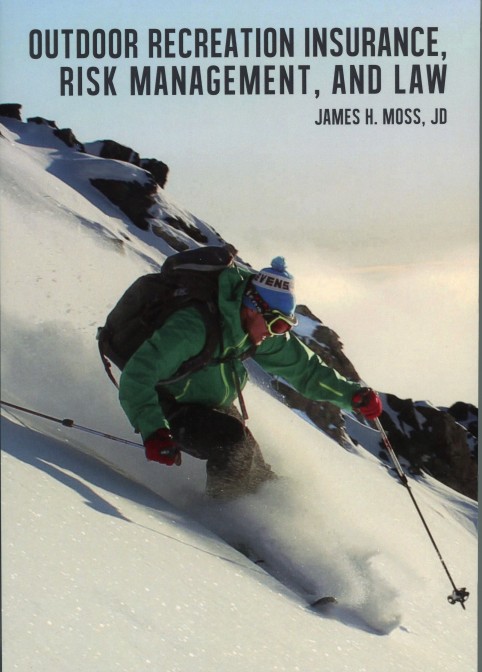
Outdoor Recreation Insurance, Risk Management and Law
and Law.
To see Jim’s complete bio go here and to see his CV you can find it here. To find out the purpose of this website go here.
If you like this let your friends know or post it on FB, Twitter or LinkedIn
If you are interested in having me write your release, fill out this Information Form and Contract and send it to me.
Author: Outdoor Recreation Insurance, Risk Management and Law
To Purchase Go Here:
Facebook Page: Outdoor Recreation & Adventure Travel Law
Email: Jim@Rec-Law.US
By Recreation Law Rec-law@recreation-law.com James H. Moss
@2023 Summit Magic Publishing, LLC
G-YQ06K3L262
#AdventureTourism, #AdventureTravelLaw, #AdventureTravelLawyer, #AttorneyatLaw, #Backpacking, #BicyclingLaw, #Camps, #ChallengeCourse, #ChallengeCourseLaw, #ChallengeCourseLawyer, #CyclingLaw, #FitnessLaw, #FitnessLawyer, #Hiking, #HumanPowered, #HumanPoweredRecreation, #IceClimbing, #JamesHMoss, #JimMoss, #Law, #Mountaineering, #Negligence, #OutdoorLaw, #OutdoorRecreationLaw, #OutsideLaw, #OutsideLawyer, #RecLaw, #Rec-Law, #RecLawBlog, #Rec-LawBlog, #RecLawyer, #RecreationalLawyer, #RecreationLaw, #RecreationLawBlog, #RecreationLawcom, #Recreation-Lawcom, #Recreation-Law.com, #RiskManagement, #RockClimbing, #RockClimbingLawyer, #RopesCourse, #RopesCourseLawyer, #SkiAreas, #Skiing, #SkiLaw, #Snowboarding, #SummerCamp, #Tourism, #TravelLaw, #YouthCamps, #ZipLineLawyer, #RecreationLaw, #OutdoorLaw, #OutdoorRecreationLaw, #SkiLaw,
Posted: May 14, 2018 | Author: Recreation Law | Filed under: Uncategorized | Tags: #ORLawTextbook, #ORRiskManagment, #OutdoorRecreationRiskManagementInsurance&Law, #OutdoorRecreationTextbook, @SagamorePub, Accidents, Angry Guest, Dealing with Claims, General Liability Insurance, Guide, http://www.rec-law.us/ORLawTextbook, Injured Guest, Insurance policy, James H. Moss J.D., Jim Moss, Liability insurance, OR Textbook, Outdoor Recreation Insurance, Outdoor Recreation Law, Outdoor Recreation Risk Management, Outfitter, RecreationLaw, Risk Management, risk management plan, Textbook, Understanding, Understanding Insurance, Understanding Risk Management, Upset Guest |
 An injured guest is everyone’s business owner’s nightmare. What happened, how do you make sure it does not happen again, what can you do to help the guest, can you help the guests are just some of the questions that might be keeping you up at night.
This book can help you understand why people sue and how you can and should deal with injured, angry or upset guests of your business.
This book is designed to help you rest easy about what you need to do and how to do it. More importantly, this book will make sure you keep your business afloat and moving forward.
You did not get into the outdoor recreation business to worry or spend nights staying awake. Get prepared and learn how and why so you can sleep and quit worrying.

Table of Contents
Chapter 1 Outdoor Recreation Risk Management, Law, and Insurance: An Overview
Chapter 2 U.S. Legal System and Legal Research
Chapter 3 Risk 25
Chapter 4 Risk, Accidents, and Litigation: Why People Sue
Chapter 5 Law 57
Chapter 6 Statutes that Affect Outdoor Recreation
Chapter 7 Pre-injury Contracts to Prevent Litigation: Releases
Chapter 8 Defenses to Claims
Chapter 9 Minors
Chapter 10 Skiing and Ski Areas
Chapter 11 Other Commercial Recreational Activities
Chapter 12 Water Sports, Paddlesports, and water-based activities
Chapter 13 Rental Programs
Chapter 14 Insurance
$130.00 plus shipping

Posted: May 10, 2018 | Author: Recreation Law | Filed under: Mountain Biking | Tags: GoPro, GoPro Mountain Games, Vail |
|
|
|
|
Copyright © 2018 Elevation Outdoors Magazine, All rights reserved.
You are receiving this email because you opted in at our website.Our mailing address is:
Elevation Outdoors Magazine
2510 47th Street , Suite 209, Boulder, CO 80301 |
|
|
|
|
|
Posted: May 9, 2018 | Author: Recreation Law | Filed under: Uncategorized | Tags: Adhesion Contract, Amicus Curiae, Assumption of risk, Certiorari, Definitions, Derivative Claim, Duty of care, Express Assumption of risk, Failure to Warn, Foreseeability, Forum non conveniens, Fraudulent Misrepresentation, Gross negligence, Implied Assumption of the Risk, Inherently Dangerous, Lex loci contractus, Negligence, Negligence per se, Negligent Misrepresentation, Open and Obvious, Phrases, Primary Assumption of Risk, Product liability, Public Policy, Punitive damages, recklessness, Release, Remittitur, Rescue Doctrine, Respondeat Superior, Secondary Assumption of Risk, Sudden Emergency Doctrine, Unconscionable, Wanton or Reckless, willful, Wrongful Death |
The articles next to the term or phrase and state identify an article where the court has defined the term in the legal decision and it is quoted in the article.
This does not cover every decision posted on Recreation-law.com. However, you might find it helpful to understand some terms.
| Term or Phrase |
State
|
Article that Defines the Term or Phrase
|
| Adhesion Agreement |
Colorado |
Colorado Federal District Court judge references a ski area lift ticket in support of granting the ski area’s motion for summary judgment and dismissing the lawsuit. |
| Admiralty Law |
Nevada |
Admiralty law did not stop a release from barring a claim for negligence for a parasailing injury. |
| Agency |
New Jersey |
The use of the PGA name was not enough to tire the PGA to a golf camp where they had no relationship or control. As such, they were dismissed from the suit because they had no duty to the injured minor. |
| Amicus Curiae |
Colorado |
10th Circuit Court of Appeals upholds Colorado law concerning releases in a whitewater rafting fatality. |
| Ambiguity |
Minnesota |
Plaintiff argues under Minnesota law the language on the back of the season pass created an ambiguity which should void the season pass release for a ski area. |
| Apparent Authority |
New Jersey |
The use of the PGA name was not enough to tire the PGA to a golf camp where they had no relationship or control. As such, they were dismissed from the suit because they had no duty to the injured minor. |
|
Pennsylvania |
Apparent Agency requires actual acts to hold a hotel liable for the injuries allegedly caused by a tour company |
| Assumption of Risk |
|
Assumption of the Risk http://rec-law.us/wMtiET |
|
|
Assumption of Risk — Checklist |
|
California |
Assumption of the Risk to be a bar to a claim the defendant must now owe a duty to the plaintiff that means the plaintiff must be involved in recreation or a sport. |
|
Hawaii |
The risk of hiking over lava fields is an obvious risk; falling while hiking is also a possibility….so is suing when you do both…but you won’t win |
|
Massachusetts |
Duty of care for a Massachusetts campground is to warn of dangerous conditions. |
|
New York |
If you have a manual, you have to follow it, if you have rules you have to follow them, if you have procedures, you have to follow them or you lose in court.
Skier assumes the risk on a run he had never skied before because his prior experience. |
|
Ohio |
Ohio Appellate decision defines assumption of the risk under Ohio law and looks at whether spectators assume the risk. |
|
Pennsylvania |
The harder a court works to justify its decision the more suspect the reasoning. |
|
Pennsylvania |
PA court upholds release in bicycle race. |
|
Pennsylvania |
Scary and Instructional case on assumption of the risk in a climbing wall case in Pennsylvania |
|
South Carolina |
Assumption of the risk is used to defeat a claim for injuries on a ropes course. |
| Express Assumption of risk |
California |
BSA (Cub Scout) volunteer was not liable for injuries to cub because cub assumed the risk of his injuries. The BSA & Council were not liable because volunteer was not an agent. |
|
Delaware |
If you agree to the rules you have to follow the rules |
|
Pennsylvania |
Neither a release nor the Pennsylvania Equine Liability Act protects a stable for injuries when the stirrup broke. |
| Implied Assumption of the risk |
Missouri |
Missouri decision about ski rental form and a release that does not conform to MO law spell a mess for the ski resort |
|
Pennsylvania |
Neither a release nor the Pennsylvania Equine Liability Act protects a stable for injuries when the stirrup broke. |
| Primary Assumption of Risk |
Delaware |
If you agree to the rules you have to follow the rules |
|
Minnesota |
Assumption of Risk used to defend against claim for injury from snow tubing in Minnesota |
|
Ohio |
In Ohio, Primary Assumption of the Risk is a complete bar to claims for injuries from hiking at night.
BSA (Cub Scout) volunteer not liable for injuries to cub because cub assumed the risk of his injuries. BSA & Council not liable because volunteer was not an agent.
Ohio Appellate decision defines assumption of the risk under Ohio law and looks at whether spectators assume the risk. |
|
New York |
New York Decision explains the doctrine of Primary Assumption of the Risk for cycling. |
|
South Carolina |
South Carolina Supreme Court writes a clear decision on Assumption of the Risk for sporting activities. |
Secondary
Assumption of Risk |
Arkansas |
Proof of negligence requires more than an accident and injuries. A Spectator at a rodeo needed proof of an improperly maintained gate. |
|
California |
Most references in case law to assumption of the risk are to this California decision |
|
Ohio |
Ohio Appellate decision defines assumption of the risk under Ohio law and looks at whether spectators assume the risk. |
| Business Invitee |
Pennsylvania |
Release lacked language specifying the length of time it was valid. Since the court could not determine the time the case was sent to a jury for that determination. |
|
Ohio |
Poorly written release on a sign in sheet barely passes protecting Ohio defendant swimming area from suit. |
| Causation |
Indiana |
An ugly case balancing the marketing program to make people feel safe, which is then used to prove the incident giving rise to the negligence claim, was foreseeable. |
| Certiorari |
Colorado |
Colorado Supreme Court rules that an inbounds Avalanche is an inherent risk assumed by skiers based upon the Colorado Skier Safety Act. |
| Common Carrier |
California |
Balloon ride in California is not a common carrier, and the release signed by the plaintiff bars the plaintiff’s claims even though she did not read or speak English |
| Contracts |
|
|
| Meeting of the Minds |
North Carolina |
When is a case settled? When all parties (and maybe their attorneys) agree it is settled |
| Consideration |
|
What is a Release? |
| Concurring Opinion |
Utah |
The safety precautions undertaken by the defendant in this mountain bike race were sufficient to beat the plaintiff’s claims of gross negligence in this Utah mountain bike fatality |
| Contribution |
Massachusetts |
Industry standards are proof of gross negligence and keep defendant in lawsuit even with good release |
| Declaratory Judgment |
New Hampshire |
What happens if you fail to follow the requirements of your insurance policy and do not get a release signed? In New Hampshire you have no coverage. |
| Derivative Claim |
|
Sign in sheet language at Michigan health club was not sufficient to create a release. |
| Duty of Care |
California |
Balloon ride in California is not a common carrier, and the release signed by the plaintiff bars the plaintiff’s claims even though she did not read or speak English |
|
New Jersey |
Is a negligent act to open a car door into a bike lane when a cyclists is in the lane in New Jersey |
|
South Carolina |
South Carolina Supreme Court writes a clear decision on Assumption of the Risk for sporting activities. |
|
Washington |
Summer Camp, Zip line injury and confusing legal analysis in Washington
Good News ASI was dismissed from the lawsuit |
| Essential Public Services |
Colorado |
10th Circuit Court of Appeals upholds Colorado law concerning releases in a whitewater rafting fatality. |
|
New Hampshire |
New Hampshire court upholds release and defines the steps under NH law to review a release. |
| Expert Witness |
Connecticut |
Summer camp being sued for injury from falling off horse wins lawsuit because the plaintiff failed to find an expert to prove their case. |
| Failure to Warn |
New York |
“Marketing makes promises Risk Management has to pay for” in this case the marketing eliminated the protection afforded by the warning labels |
| Foreseeability |
Colorado |
Be Afraid, be very afraid of pre-printed forms for your recreation business |
|
Illinois |
When there is no proof that the problem created by the defendant caused the injury, there is no proximate causation, therefore no negligence |
|
New Jersey |
Is a negligent act to open a car door into a bike lane when a cyclists is in the lane in New Jersey |
|
Ohio |
Liability of race organizer for State Park Employees? |
|
Washington |
Dive Buddy (co-participant) not liable for death of the diver because the cause of death was too distant from the acts of the plaintiff. |
|
Idaho |
Federal Court in Idaho holds camp not liable for assault on third party by runaway minors. |
| Forum non conveniens |
Kansas |
If you fall down in a foreign country, and you have paid money to be there, you probably have to sue there. |
| Fraud |
Colorado |
10th Circuit Court of Appeals upholds Colorado law concerning releases in a whitewater rafting fatality |
| Fraudulent Inducement |
New Hampshire |
Did a Federal District Court in New Hampshire allow a release to bar a minor’s claims? |
| Fraudulent Misrepresentation |
Georgia |
Lying in a release can get your release thrown out by the court. |
|
California |
Defendant tells plaintiff the release has no value and still wins lawsuit, but only because the plaintiff was an attorney |
| Gross Negligence |
California |
Release saves riding school, even after defendant tried to show plaintiff how to win the case. |
|
Idaho |
Statements made to keep a sold trip going come back to haunt defendant after whitewater rafting death. |
|
Maryland |
Sky Diving Release defeats claim by Naval Academy studenthttp://rec-law.us/1tQhWNN |
|
Massachusetts |
Colleges, Officials, and a Ski Area are all defendants in this case. |
|
Massachusetts |
Industry standards are proof of gross negligence and keep defendant in lawsuit even with good release |
|
Michigan |
Good Release stops lawsuit against Michigan bicycle renter based on marginal acts of bicycle renter
Allowing climber to climb with harness on backwards on health club climbing wall enough for court to accept gross negligence claim and invalidate release. |
|
Nebraska |
In Nebraska a release can defeat claims for gross negligence for health club injury |
|
New Hampshire |
In this mountain biking case, fighting each claim pays off. |
|
New Jersey |
New Jersey upholds release for injury in faulty bike at fitness club |
|
New York |
New York judge uses NY law to throw out claim for gross negligence because the facts did not support the claim |
|
Pennsylvania |
Scary and Instructional case on assumption of the risk in a climbing wall case in Pennsylvania |
|
|
Pennsylvania wrongful death statute is written in a way that a split court determined the deceased release prevented the surviving family members from suing. |
|
Tennessee |
75 Ft waterfall, middle of the night, no lights and a BAC of .18% results in two fatalities and one lawsuit. However, facts that created fatalities were the defense |
|
Texas |
Suit against a city for construction retaining wall in City Park identifies defenses to be employed to protect park patrons. |
|
Utah |
Utah’s decision upholds a release for simple negligence but not gross negligence in a ski accident.
The safety precautions undertaken by the defendant in this mountain bike race were sufficient to beat the plaintiff’s claims of gross negligence in this Utah mountain bike fatality |
| Inherently Dangerous |
Missouri |
Here is another reason to write releases carefully. Release used the term inherent to describe the risks which the court concluded made the risk inherently dangerous and voids the release. |
| Inherent Risks |
California |
This California decision looks at assumption of the risk as it applies to non-competitive long distance bicycle rides and also determines that assumption of the risk also overcomes a violation of a statute (negligence per se). |
| Interlocutory Appeal |
Tennessee |
Tennessee still does not allow a parent to sign away a minor’s right to sue, but might enforce a jurisdiction and venue clause, maybe an arbitration clause |
|
Utah |
Utah courts like giving money to injured kids |
| Invitee |
Missouri |
Missouri decision about ski rental form and a release that does not conform to MO law spell a mess for the ski resort |
|
Mississippi |
Mississippi retailer not liable for injury to a child who rode a bicycle through aisles he found on the store floor. |
| Joint Venture |
Missouri |
Here is another reason to write releases carefully. Release used the term inherent to describe the risks which the court concluded made the risk inherently dangerous and voids the release. |
| Judgment Notwithstanding the Verdict (JNOV or J.N.O.V.) |
Maryland |
Skiing collision in Utah were the collision was caused by one skier falling down in front of the other skier |
|
Missouri |
Here is another reason to write releases carefully. Release used the term inherent to describe the risks which the court concluded made the risk inherently dangerous and voids the release. |
| Lex loci contractus |
Tennessee |
Tennessee still does not allow a parent to sign away a minor’s right to sue, but might enforce a jurisdiction and venue clause, maybe an arbitration clause |
| Long Arm Statute Requirements |
New York |
To sue a Vermont ski area there must be more than a web presence to sue in New York |
| Material Breach of a Contract |
Texas |
University climbing wall release along with Texas Recreational Use Act and Texas Tort Claims Act defeat injured climber’s lawsuit |
| Motion to Dismiss |
Colorado |
Colorado Premises Liability act eliminated common law claims of negligence as well as CO Ski Area Safety Act claims against a landowner. |
|
Illinois |
When an organization makes rules and regulations that a subsidiary organization is supposed to obey, and then fails to follow, both organizations are liable to any plaintiff injured due to the failure to follow or enforce the organizational rules, policies, regulations or standards. |
| Negligence |
Georgia |
Georgia court finds no requirement for employee to interview when higher trained first aid providers are present |
|
Idaho |
Idaho Supreme Court holds is no relationship between signs posted on the side of the trampoline park in a duty owed to the injured plaintiff |
|
Illinois |
When an organization makes rules and regulations that a subsidiary organization is supposed to obey, and then fails to follow, both organizations are liable to any plaintiff injured due to the failure to follow or enforce the organizational rules, policies, regulations or standards. |
|
Indiana |
Indiana decision upholds release signed by mother for claims of an injured daughter for the inherent risks of softball.
An ugly case balancing the marketing program to make people feel safe, which is then used to prove the incident giving rise to the negligence claim, was foreseeable. |
|
Louisiana |
Louisiana State University loses climbing wall case because or climbing wall manual and state law. |
|
Maryland |
Plaintiff failed to prove that her injuries were due to the construction of the water park slide and she also assumed the risk. |
|
Massachusetts |
Industry standards are proof of gross negligence and keep defendant in lawsuit even with good release |
|
Mississippi |
Mississippi decision requires advance planning and knowledge of traveling in a foreign country before taking minors there. |
|
Pennsylvania |
Pennsylvania Supreme Court decision on duty to have and use an AED defines how statutes are to be interpreted and when liability can attach and cannot attach to a statute |
|
South Dakota |
Great analysis of the “Rescue Doctrine” in a ballooning case from South Dakota |
|
Texas |
University climbing wall release along with Texas Recreational Use Act and Texas Tort Claims Act defeat injured climber’s lawsuit |
| Negligence (Collateral) |
Missouri |
Here is another reason to write releases carefully. Release used the term inherent to describe the risks which the court concluded made the risk inherently dangerous and voids the release. |
| Negligence Per Se |
Colorado |
Instructional Colorado decision Negligence, Negligence Per Se and Premises Liability |
|
Florida |
Motion for Summary Judgement failed because the plaintiff’s claim was based upon a failure to follow a statute or rule creating a negligence per se defense to the release in this Pennsylvania sailing case. |
|
South Dakota |
Great analysis of the “Rescue Doctrine” in a ballooning case from South Dakota |
|
Illinois (does not exist) |
When an organization makes rules and regulations that a subsidiary organization is supposed to obey, and then fails to follow, both organizations are liable to any plaintiff injured due to the failure to follow or enforce the organizational rules, policies, regulations or standards. |
| Negligent Misrepresentation |
New York |
The basics of winning a negligence claim is having some facts that show negligence, not just the inability to canoe by the plaintiff |
| No Duty Rule |
Pennsylvania |
The harder a court works to justify its decision the more suspect the reasoning. |
| Open and Obvious |
Michigan |
The assumption of risk defense is still available when the claim is based on a condition of the land. This defense is called the open and obvious doctrine. |
|
New York |
“Marketing makes promises Risk Management has to pay for” in this case the marketing eliminated the protection afforded by the warning labels |
|
Pennsylvania |
Release lacked language specifying the length of time it was valid. Since the court could not determine the time the case was sent to a jury for that determination. |
|
Rhode Island |
|
| Passive-Retailer Doctrine |
Utah |
Retailers in a minority of states may have a defense to product liability claims when they have nothing to do with the manufacture of the product |
| Premises Liability |
Colorado |
Instructional Colorado decision Negligence, Negligence Per Se and Premises Liability |
|
Mississippi |
Mississippi retailer not liable for injury to a child who rode a bicycle through aisles he found on the store floor. |
| Prima facie |
New Jersey |
New Jersey does not support fee shifting provisions (indemnification clauses) in releases in a sky diving case. |
| Prior Material Breach |
Texas |
University climbing wall release along with Texas Recreational Use Act and Texas Tort Claims Act defeat injured climber’s lawsuit |
| Product Liability |
|
Georgia Federal Court finds that assumption of the risk is a valid defense in a head injury case against a bicycle helmet manufacturer. |
|
Tennessee |
Pacific Cycle not liable for alleged defective skewer sold to plaintiff by Wal-Mart |
|
Utah |
Retailers in a minority of states may have a defense to product liability claims when they have nothing to do with the manufacture of the product |
| Negligent Product Liability |
Illinois |
Plaintiff fails to prove a product liability claim because she can’t prove what tube was the result of her injury |
| Public Policy |
California |
Defendant tells plaintiff the release has no value and still wins lawsuit, but only because the plaintiff was an attorney |
|
Delaware |
Delaware Supreme Court decision quickly determines a health club release is not void because of public policy issues and is clear and unequivocal |
|
Oregon |
Oregon Supreme Court finds release signed at ski area is void as a violation of public policy. |
|
Pennsylvania |
Release lacked language specifying the length of time it was valid. Since the court could not determine the time the case was sent to a jury for that determination. |
|
New Hampshire |
New Hampshire court upholds release and defines the steps under NH law to review a release.
Did a Federal District Court in New Hampshire allow a release to bar a minor’s claims? |
|
Tennessee |
Tennessee still does not allow a parent to sign away a minor’s right to sue, but might enforce a jurisdiction and venue clause, maybe an arbitration clause |
| Punitive Damages |
New York |
“Marketing makes promises Risk Management has to pay for” in this case the marketing eliminated the protection afforded by the warning labels |
| Rescue Doctrine |
South Dakota |
Great analysis of the “Rescue Doctrine” in a ballooning case from South Dakota |
| Recklessness |
Missouri |
Here is another reason to write releases carefully. Release used the term inherent to describe the risks which the court concluded made the risk inherently dangerous and voids the release. |
|
New Jersey |
New Jersey does not support fee shifting provisions (indemnification clauses) in releases in a sky diving case. |
|
Ohio |
BSA (Cub Scout) volunteer was not liable for injuries to cub because cub assumed the risk of his injuries. The BSA & Council were not liable because volunteer was not an agent.
Ohio Appellate decision defines assumption of the risk under Ohio law and looks at whether spectators assume the risk. |
|
Pennsylvania |
Neither a release nor the Pennsylvania Equine Liability Act protects a stable for injuries when the stirrup broke. |
| Release |
Connecticut |
Connecticut court rejects motion for summary judgment because plaintiff claimed he did not have enough time to read the release before he signed it |
|
Colorado |
10th Circuit Court of Appeals upholds Colorado law concerning releases in a whitewater rafting fatality
Colorado Federal District Court judge references a ski area lift ticket in support of granting the ski area’s motion for summary judgment and dismissing the lawsuit. |
|
New Hampshire |
New Hampshire court upholds release and defines the steps under NH law to review a release. |
|
Oklahoma |
Oklahoma Federal Court opinion: the OK Supreme Court would void a release signed by the parent for a minor. |
|
New Hampshire |
Did a Federal District Court in New Hampshire allow a release to bar a minor’s claims? |
|
Pennsylvania |
Tubing brings in a lot of money for a small space, and a well-written release keeps the money flowing
Release lacked language specifying the length of time it was valid. Since the court could not determine the time the case was sent to a jury for that determination.
Neither a release nor the Pennsylvania Equine Liability Act protects a stable for injuries when the stirrup broke. |
|
Texas |
University climbing wall release along with Texas Recreational Use Act and Texas Tort Claims Act defeat injured climber’s lawsuit |
| Release Fair Notice Requirement under Texas law |
Texas |
Federal Court in Texas upholds clause in release requiring plaintiff to pay defendants costs of defending against plaintiff’s claims. |
| Remittitur |
Missouri |
Here is another reason to write releases carefully. Release used the term inherent to describe the risks which the court concluded made the risk inherently dangerous and voids the release. |
| res ipsa loquitur |
Illinois |
When an organization makes rules and regulations that a subsidiary organization is supposed to obey, and then fails to follow, both organizations are liable to any plaintiff injured due to the failure to follow or enforce the organizational rules, policies, regulations or standards. |
| Respondeat superior |
Missouri |
US Army and BSA not liable for injured kids on Army base. No control by the BSA and recreational use defense by US Army. |
|
New Jersey |
The use of the PGA name was not enough to tire the PGA to a golf camp where they had no relationship or control. As such, they were dismissed from the suit because they had no duty to the injured minor. |
| Restatement (Second) of Torts |
Pennsylvania |
The harder a court works to justify its decision the more suspect the reasoning. |
| Standard |
Colorado
California |
Words: You cannot change a legal definition |
|
New York |
New York Decision explains the doctrine of Primary Assumption of the Risk for cycling |
|
Ohio |
In Ohio, Primary Assumption of the Risk is a complete bar to claims for injuries from hiking at night |
|
Rhode Island |
Rhode Island, applying New Hampshire law states a skier assumes the risk of a collision. |
| Standard of Review |
Pennsylvania |
Pennsylvania Supreme Court decision on duty to have and use an AED defines how statutes are to be interpreted and when liability can attach and cannot attach to a statute |
| Sudden Emergency Doctrine |
New York |
Eighteen year old girl knocks speeding cyclists over to protect children; Sudden Emergency Doctrine stops suit |
| Summary Judgment |
Connecticut |
Connecticut court rejects motion for summary judgment because plaintiff claimed he did not have enough time to read the release before he signed it |
|
Pennsylvania |
Pennsylvania Supreme Court decision on duty to have and use an AED defines how statutes are to be interpreted and when liability can attach and cannot attach to a statute |
| Superseding or Intervening Causation |
Indiana |
An ugly case balancing the marketing program to make people feel safe, which is then used to prove the incident giving rise to the negligence claim, was foreseeable. |
| Tort |
Louisiana |
Louisiana court holds a tubing operation is not liable for drowning or failure to properly perform CPR |
| Unconscionable |
Delaware |
Delaware Supreme Court decision quickly determines a health club release is not void because of public policy issues and is clear and unequivocal |
| United States Constitution |
Fourteenth Amendment |
Buy something online and you may not have any recourse if it breaks or you are hurt |
| Willful, Wanton or Reckless |
Illinois |
When an organization makes rules and regulations that a subsidiary organization is supposed to obey, and then fails to follow, both organizations are liable to any plaintiff injured due to the failure to follow or enforce the organizational rules, policies, regulations or standards. |
|
Ohio |
Ohio Appellate decision upholds the use of a release for a minor for a commercial activity. |
|
Ohio |
Poorly written release on a sign in sheet barely passes protecting Ohio defendant swimming area from suit. |
|
Minnesota |
Plaintiff argues under Minnesota law the language on the back of the season pass created an ambiguity which should void the season pass release for a ski area. |
|
Missouri |
Missouri decision about ski rental form and a release that does not conform to MO law spell a mess for the ski resort |
|
Nebraska |
Fees are charged, recreation is happening, but can the recreational use act still protect a claim, yes, if the fees are not for the recreation |
|
Washington |
Dive Buddy (co-participant) not liable for death of the diver because the cause of death was too distant from the cause of the death. |
|
Wyoming |
Rental agreement release was written well enough it barred claims for injuries on the mountain at Jackson Hole Mountain Resort in Wyoming |
| Wrongful Death |
Ohio |
Poorly written release on a sign in sheet barely passes protecting Ohio defendant swimming area from suit. |
|
|
|
Last Updated April 24, 2018
Posted: May 9, 2018 | Author: Recreation Law | Filed under: Release (pre-injury contract not to sue) | Tags: #ORLawTextbook, #ORRiskManagment, #OutdoorRecreationRiskManagementInsurance&Law, #OutdoorRecreationTextbook, @SagamorePub, Accidents, Angry Guest, Dealing with Claims, General Liability Insurance, Guide, http://www.rec-law.us/ORLawTextbook, Injured Guest, Insurance policy, James H. Moss J.D., Jim Moss, Liability insurance, OR Textbook, Outdoor Recreation Insurance, Outdoor Recreation Law, Outdoor Recreation Risk Management, Outfitter, RecreationLaw, Risk Management, risk management plan, Textbook, Understanding, Understanding Insurance, Understanding Risk Management, Upset Guest |
 These and many other questions are answered in my book Outdoor Recreation Risk Management, Insurance and Law.
Releases, (or as some people incorrectly call them waivers) are a legal agreement that in advance of any possible injury identifies who will pay for what. Releases can and to stop lawsuits.
This book will explain releases and other defenses you can use to put yourself in a position to stop lawsuits and claims.
This book can help you understand why people sue and how you can and should deal with injured, angry or upset guests of your business.
This book is designed to help you rest easy about what you need to do and  how to do it. More importantly, this book will make sure you keep your business afloat and moving forward.
You did not get into the outdoor recreation business to worry or spend nights staying awake. Get prepared and learn how and why so you can sleep and quit worrying.

Table of Contents
Chapter 1 Outdoor Recreation Risk Management, Law, and Insurance: An Overview
Chapter 2 U.S. Legal System and Legal Research
Chapter 3 Risk 25
Chapter 4 Risk, Accidents, and Litigation: Why People Sue
Chapter 5 Law 57
Chapter 6 Statutes that Affect Outdoor Recreation
Chapter 7 Pre-injury Contracts to Prevent Litigation: Releases
Chapter 8 Defenses to Claims
Chapter 9 Minors
Chapter 10 Skiing and Ski Areas
Chapter 11 Other Commercial Recreational Activities
Chapter 12 Water Sports, Paddlesports, and water-based activities
Chapter 13 Rental Programs
Chapter 14 Insurance
$99.00 plus shipping

Artwork by Don Long donaldoelong@earthlink.net
Posted: May 8, 2018 | Author: Recreation Law | Filed under: Ski Area | Tags: Chair, Lift 1, Lottery, Loveland, Loveland Ski Area |
 |

|
| Lift 1 Chair Lottery for Season Pass Holders
If you haven’t already heard, Loveland’s big summer project will be replacing Lift 1 with a high-speed detachable quad from Leitner-Poma. With this upgrade comes a very special opportunity for Loveland Season Pass holders to purchase one of the old chairs from Lift 1 and take home a little piece of Loveland history.
Due to the high demand and limited quantity, the chairs will be sold through a lottery to 2017/18 and 2018/19 season pass holders only. For complete details on the Lift 1 sale and to enter into the lottery, please visit our Lift 1 Sale page. Don’t miss out on this unique opportunity!
|
|
|
|
|
|
|


Posted: May 7, 2018 | Author: Recreation Law | Filed under: Connecticut, Equine Activities (Horses, Donkeys, Mules) & Animals | Tags: ACA, American Camp Association, Diversity, equestrian, expert testimony, Expert Witness, expertise, familiarity, horseback riding, horsemanship, issues of material fact, juror, Membership, Pony, qualification, resume, specialized knowledge, Standard of Care, state law, Summary judgment |
In this case, the plaintiff’s claim failed because they needed any expert witness and the one they had hired was disqualified. Without an expert in horseback riding lessons, the plaintiff’s claims were dismissed.
Ellis v. YMCA Camp Mohawk, Inc., 615 Fed. Appx. 697; 2015 U.S. App. LEXIS 16057
State: Connecticut, United States Court of Appeals for the Second Circuit
Plaintiff: Louisa R. Ellis, ppa Elizabeth Ellis, Elizabeth Ellis
Defendant: YMCA Camp Mohawk, Inc.
Plaintiff Claims: Negligence
Defendant Defenses:
Holding: For the Defendant
Year: 2015
Summary
Your expert witness must have the experience, education or background to be able to testify as to their findings. In states where an expert opinion is needed, like Connecticut, not having an expert means not have a case.
Here the expert witness hired by the plaintiff did not have the necessary qualifications, and the court would not allow his testimony. Because horseback riding and equine issues were outside of the scope of the normal juror in Connecticut, an expert witness was needed by the plaintiff. Without an expert, the plaintiff’s case was dismissed.
Facts
On July 18, 2011, Louisa Ellis fell from a pony while taking horseback riding lessons at YMCA Camp Mohawk. Ellis sustained injuries to her hand and elbow that required surgery and therapy. Appellants identified Andres, an employee of Robson Forensic, to investigate the claims and to provide expert testimony.
The plaintiff’s hired an expert witness to provide expert testimony on why the defendant was negligent. The court found the plaintiff’s expert was not qualified to render an expert opinion on the matter.
… Corey Andres, was not qualified to render an expert opinion regarding the standard of care for an equestrian course at the YMCA camp at which twelve-year-old Louisa was injured.
The trial court dismissed the plaintiff’s case because they could not prove their case.
The district court excluded Andres’s expert testimony on the ground that he had limited experience in the field of horseback riding. Therefore, appellants’ failure to produce an expert where expert testimony was required led the district court to grant summary judgment.
The plaintiffs appealed.
Analysis: making sense of the law based on these facts.
Although the case was brought in the federal district court because the parties were from different states, the law of the state where the accident happened was the law used in the case. Since the accident occurred in Connecticut, Connecticut law was applied to the case.
Under Connecticut law, horseback riding was outside the general knowledge of jurors and thus required expert testimony for the jurors to make their decisions.
Connecticut courts have held, on similar facts, that the general public is no longer as familiar with horsemanship as it arguably was at the beginning of the twentieth century, and that expert testimony is necessary to establish a standard of care and a breach of that standard.
An expert witness is needed to show both the standard of care in the case and whether the defendant breached that standard of care.
The plaintiff hired Andres, an employee of Robson Forensic.
Andres claimed his expertise based on his membership in the American Camp Association (“ACA”) and his study of therapeutic education at Ohio State, University of Toledo, including a study pertaining to equestrian matters. Andres’s investigation concluded that YMCA was negligent in failing to provide complete and proper instruction as to how to fall from a horse in a way that minimizes injury.
The district court excluded “Andres’s expert testimony on the ground that he had limited experience in the field of horseback riding.”
The district stated, and the appellate court agreed that:
Andres does not rise to the level of expertise required to opine on the matters at hand. Andres has practically no knowledge or experience relating to horsemanship — his resume makes no reference to any such knowledge, and his investigation merely points to three publications that he relied on when preparing his report. Andres’s resume instead highlights a wide array of fields and organizations in which he has obtained certifications or is a member. Appellants argue that Andres’s membership in the ACA broadly reaches all camp recreations. This broad qualification falls well short of the specialized knowledge that Federal Rule of Evidence 702 demands. The district court therefore did not abuse its discretion in its decision to exclude Andres’s testimony.
Because the plaintiff’s expert witness was excluded and could not testify, the plaintiffs could not prove their case.
Appellants’ failure to provide necessary expert testimony precludes them from presenting these claims under Connecticut state law. Thus, there are no issues of material fact raised to challenge the district court’s entry of summary judgment.
So Now What?
The courts have been given broader discretion to determine who can and cannot testify as an expert witness. The courts can also determine, even if the expert is qualified to testify, that the testimony they are going to give is not based on science.
In states where expert testimony is required or any state where you want to win, you need to hire expert witnesses who are going to qualify as an expert in their field and provide an opinion based on science, history, experience and real life.
What do you think? Leave a comment.
James H. “Jim” Moss |
Jim Moss is an attorney specializing in the legal issues of the outdoor recreation community. He represents guides, guide services, and outfitters both as businesses and individuals and the products they use for their business. He has defended Mt. Everest guide services, summer camps, climbing rope manufacturers; avalanche beacon manufacturers, and many more manufacturers and outdoor industries. Contact Jim at Jim@Rec-Law.us |
Jim is the author or co-author of eight books about legal issues in the outdoor recreation world; the latest is Outdoor Recreation Insurance, Risk Management,
Outdoor Recreation Insurance, Risk Management, and Law
and Law. To Purchase Go Here:
To see Jim’s complete bio go here and to see his CV you can find it here. To find out the purpose of this website go here.
If you are interested in having me write your release, download the form and return it to me.
Connect
If you like this let your friends know or post it on FB, Twitter, or LinkedIn
 Threads |
 Facebook Logo |
 X, Formerly Twitter |
 Recreation Law |
Jim@Rec-Law.US
By Recreation Law Rec-law@recreation-law.com James H. Moss
@2018-2023 Summit Magic Publishing, LLC
G-YQ06K3L262
#AdventureTourism, #AdventureTravelLaw, #AdventureTravelLawyer, #AttorneyatLaw, #Backpacking, #BicyclingLaw, #Camps, #ChallengeCourse, #ChallengeCourseLaw, #ChallengeCourseLawyer, #CyclingLaw, #FitnessLaw, #FitnessLawyer, #Hiking, #HumanPowered, #HumanPoweredRecreation, #IceClimbing, #JamesHMoss, #JimMoss, #Law, #Mountaineering, #Negligence, #OutdoorLaw, #OutdoorRecreationLaw, #OutsideLaw, #OutsideLawyer, #RecLaw, #Rec-Law, #RecLawBlog, #Rec-LawBlog, #RecLawyer, #RecreationalLawyer, #RecreationLaw, #RecreationLawBlog, #RecreationLawcom, #Recreation-Lawcom, #Recreation-Law.com, #RiskManagement, #RockClimbing, #RockClimbingLawyer, #RopesCourse, #RopesCourseLawyer, #SkiAreas, #Skiing, #SkiLaw, #Snowboarding, #SummerCamp, #Tourism, #TravelLaw, #YouthCamps, #ZipLineLawyer, #RecreationLaw, #OutdoorLaw, #OutdoorRecreationLaw, #SkiLaw,
Posted: May 4, 2018 | Author: Recreation Law | Filed under: Uncategorized | Tags: NAU, Northern Arizona University, Online MS, Parks and Recreation Management |
Master of Science in Parks and Recreation Management
at Northern Arizona University
|
|
|
|
 |
| Thinking about attending graduate school? The Master of Science in Parks and Recreation Management might be perfect for you. This challenging program prepares parks and recreation managers for leadership roles in public and commercial organizations. The program emphasizes the development of a manager’s ability to forecast and address the evolution recreation and utilize optimal practices in leadership, management, and in the delivery of recreational services. Specific attention is directed at leadership issues, agency management, the utilization of geographic information systems, legal issues, diversity perspective, and in emerging trends in park, leisure, tourism, and recreation. For more details and application information, please visit the Master of Science in Parks and Recreation Management website. |
|
|
|
|
|
|
|
|
For more information contact the
Chair of Geography, Planning, and Recreation:Dr. Alan Lew at Alan.Lew or call 928-523-2650 |
|
Copyright © 2017 Northern Arizona University,
College of Social and Behavioral Sciences, All rights reserved.Our mailing address is:
5 E McConnell Dr
PO Box: 15700
Flagstaff, AZ 86011 |
|
|
|
Posted: May 3, 2018 | Author: Recreation Law | Filed under: Cycling | Tags: @CoClassicPro, Bike Race, Colorado Classic, Professional Bike Race, Womens Bike Race |
| Back and better than ever

|
| The 2018 Colorado Classic Women’s Race Expands to Four Stages
For the 2018 Colorado Classic, the women will race two stages in Vail and two stages in Denver. The women’s race is part of USA Cycling’s Pro Road Tour (PRT) calendar.
Stage 1: Vail, Aug 16 – Circuit race through the
Town of Vail
Stage 2: Vail, Aug 17 – Time trial up the
iconic Vail Pass
Stage 3: Denver, Aug 18 – Criterium race on the Velorama criterium course
Stage 4: Denver, Aug 19 – City circuit through RiNo, Downtown Denver and City Park, with a start and finish in Velorama
13 of the world’s best womens teams, including UCI, Domestic Elite, and Colorado-based teams, will compete in 2018. |
|
|
|
|
|
|
| RPM Events Group | 299 Milwaukee Street, Suite 215, Denver, CO 80206 |
|
|
|
|
Posted: May 3, 2018 | Author: Recreation Law | Filed under: Cycling | Tags: Bicycle Mechanic, PBMA, Professional Bicycle Mechanics Association, Technical Workshop |
|
|
| Registration for members is now open for the 2018 / 2019 PBMA Technical Workshops
For more information visit: www.ProBMA.org/PBMA-Technical-Workshops
Dates and Locations
February 4 to 7 – Philadelphia Pennsylvania
January 7 to 10 – Peachtree City Georgia
November 5 to 8 – Phoenix Arizona
Details:
Registration is limited to 96 attendees per location.
Workshops are $375 until October 16th. A price increase of $25 is applied after that date.
PBMA Members may login and navigate to “discounts” to access the discount code to save $125 on their registration fee.
Workshops kick off Mondays with check-in and a product expo followed by catered reception and keynote speaker.
Participating tech sessions:
Bosch • Campagnolo • DT Swiss • FSA • SRAM • Stan’s NoTubes • Pedros • Winged Wheel • SR Suntour • Enduro Bearings • Magura • Rotor Bike Components • Maxxis Tires • PBMA.
Tech sessions will range from demonstration and hands on to lecture type. In addition to new tech sessions we are producing a minimum of two education sessions focused on business development and profitability for the service department.
Thanks to the sponsors:
Park Tool Company • Feedback Sports • Silca • Presta Cycle •
Efficient Velo Tools • Kryptonite • Finishline |
|
|
|
|
|
|
|
|

Posted: May 2, 2018 | Author: Recreation Law | Filed under: Skiing / Snow Boarding | Tags: Brake, Colorado Skier Safety Act, Connecticut Skier Safety Act, Leash, Montana's skier responsibility statute, Nevada Skier Safety Act, New Hampshire Skier Safety Act, New Jersey Skier Safety Act, Pennsylvania Skier's Responsibility Act, Retention Device, Ski Brake, Ski Leash, Skier Responsibility Code, Skier's Responsibility Act |
C.R.S. §§ 33-44-109. Duties of skiers – penalties. States in section 6:
(6) Each ski or snowboard used by a skier while skiing shall be equipped with a strap or other device capable of stopping the ski or snowboard should the ski or snowboard become unattached from the skier. This requirement shall not apply to cross country skis.
The Colorado Skier Safety Act above section C.R.S. §§ 33-44-109. Duties of skiers – penalties stated above requires skiers and snowboarders to have a retention device before skiing at a ski area.
Four of the 11 duties in section C.R.S. §§ 33-44-109 have criminal penalties if you violate those statutes.
(12) Any person who violates any of the provisions of subsection (3), (9), (10), or (11) of this section is guilty of a class 2 petty offense and, upon conviction thereof, shall be punished by a fine of not more than three hundred dollars.
C.R.S. §§ 33-44-109. Duties of skiers – penalties.
(3) No skier shall ski on a ski slope or trail that has been posted as “Closed” pursuant to section 33-44-107 (2) (e) and (4).
(9) No person shall move uphill on any passenger tramway or use any ski slope or trail while such person’s ability to do so is impaired by the consumption of alcohol or by the use of any controlled substance, as defined in section 12-22-303 (7), C.R.S., or other drug or while such person is under the influence of alcohol or any controlled substance, as defined in section 12-22-303 (7), C.R.S., or other drug.
(10) No skier involved in a collision with another skier or person in which an injury results shall leave the vicinity of the collision before giving his or her name and current address to an employee of the ski area operator or a member of the ski patrol, except for the purpose of securing aid for a person injured in the collision; in which event the person so leaving the scene of the collision shall give his or her name and current address as required by this subsection (10) after securing such aid.
(11) No person shall knowingly enter upon public or private lands from an adjoining ski area when such land has been closed by its owner and so posted by the owner or by the ski area operator pursuant to section 33-44-107 (6).
The criminal charges are petty offenses. However, riding a lift or skiing/boarding without a retention device does not have a criminal penalty.
The section (6), has no penalty if you fail to have a leash or brake on your board or skis.
On a side note, tickets written for violation of the law are written by law enforcement. Ski Patrollers or other ski area employees cannot write you a ticket for violating the law. They can, however, take your lift ticket or season pass.
The issue of riding without a brake or retention device is even further complicated by the manufacturers of ski and snowboard equipment. Skies come with brakes as part of the binding. Tele or backcountry equipment come with leashes. Snowboards or snowboard bindings do not come with leashes.
If you purchase a product should the product come with the required statutory safety requirements?
Snowboards fly down the mountain all the time because they get away from the snowboarders. They sit down, take off the board to work on it or rest and lean the board on one edge with the bindings down. Any hit to the board and the board is on the snow going downhill.
I once dealt with a twelve-year-old girl who walking in her ski boots and had a runaway snowboard hit her in the ski boot breaking her ankle.
The question then becomes, “If a snowboard or ski gets away from a boarder or skier and the runaway board or ski strikes someone and injures them who is liable?”
The snowboarder or skier is liable. No question there, those people with the lift ticket were required to follow the law and have a leash or retention device.
The statute requires them to have a leash or brake, and they did not. They are liable. If the boarder loses a snowboard because they did not have a leash on the snowboard, and it goes down the hill striking someone and injuring them, they are negligent per se. Negligence per se is liability for violation of a statute.
The border or skier is also liable because another section of the Colorado Skier Safety Act states that.
33-44-104. Negligence – civil actions.
(1) A violation of any requirement of this article shall, to the extent such violation causes injury to any person or damage to property, constitute negligence on the part of the person violating such requirement.
Most people read this section of the statute and think this is how a ski area is held liable when they violate the statute. And it is. However, the statute is written in a way that the liability is not only that of the ski area, an individual who violates the statute can be civilly liable also.
Any violation of this article which causes an injury creates liability on the part of the person who violated the statute, and that is not limited to the ski area. Since no specific “person” is named, then any person who causes injury is liable.
What about the ski area?
No ski area checks to see if everyone riding the lift or skiing has a brake or a leash. If a ski area did, they would have to put in a permanent exit from the lift line so boarders could go buy leashes (or go home because they don’t have enough money for a leash).
However, the ski area is not liable if they allow someone on the ski hill without a leash or a brake. The statute is specific on when a ski area is liable and C.R.S. §§
C.R.S. §§ 33-44-109(6) is not on the list that creates liability to the resort.
But what about the manufacturers of the snowboard bindings that are sold without leashes? Is the manufacturer liable for selling a product that does not include a statutory safety item?
Probably not, because the liability is on the individual according to the statute. However, in some states, could that liability continue up the chain and hold the snowboard manufacturer or binding manufacturer liable.
Other state ski area statutes
Seventeen states have ski area safety statutes. (See State Ski Safe Acts.) Of those seventeen states eight have some requirement for “retention devices.” All eight require skiers (and boarders) to wear retention devices. Three of the statutes place a duty on the ski area to post notices about wearing the retention devices, CN, ID and ND. Not statute creates liability for the ski area for allowing people to ski or ride without brakes or leashes.
[Emphasize added]
Connecticut
Sec. 29-211. (Formerly Sec. 19-418k). Duties of operator of passenger tramway or ski area.
In the operation of a passenger tramway or ski area, each operator shall have the obligation to perform certain duties including, but not limited to:
(2) of this section and notifying each skier that the wearing of ski retention straps or other devices used to prevent runaway skis is required by section 29-213, as amended by this act;
Sec. 29-213. (Formerly Sec. 19-418m). Prohibited conduct by skiers.
No skier shall:
(7) fail to wear retention straps or other devices used to prevent runaway skis;
Idaho
§ 6-1103. Duties of ski area operators with respect to ski areas
Every ski area operator shall have the following duties with respect to their operation of a skiing area:
(7) To post notice of the requirements of this chapter concerning the use of ski retention devices. This obligation shall be the sole requirement imposed upon the ski area operator regarding the requirement for or use of ski retention devices;
§ 6-1106. Duties of skiers
No skier shall fail to wear retention straps or other devices to help prevent runaway skis.
North Carolina
§ 99C-2. Duties of ski area operators and skiers
(5) To wear retention straps, ski brakes, or other devices to prevent runaway skis or snowboards;
North Dakota
53-09-03. DUTIES OF SKI OPERATORS WITH RESPECT TO SKI AREAS.
7. To post notice, at or near the boarding area for each aerial passenger tramway designed to transport passengers with skis attached to boots, of the requirements of this chapter concerning the use of ski retention devices. This obligation is the sole requirement imposed upon the ski area operator regarding the requirement for or use of ski retention devices.
53-09-05. DUTIES OF PASSENGERS.
Every passenger shall have the duty not to:
8. Wear skis without properly securing ski retention straps.
New York
§ 18-105. DUTIES OF SKIERS
All skiers shall have the following duties:
12. To wear retention straps or other devices to prevent runaway skis;
Oregon
30.985. Duties of skiers; effect of failure to comply.
(h)Skiers must wear retention straps or other devices to prevent runaway skis.
Virginia
§ 8.01-227.17. Duties and responsibilities of winter sports participants and certain other individuals
g. Wearing retention straps, ski brakes, or other devices to prevent runaway equipment;
So, What Now?
If you lose a ski or board and that board hit someone or something and cause’s injury, you will be liable in eight states and probably liable in all states.
Possibly in some states, the manufacturer of the bindings who does not provide brakes or leashes (retention devices) could be liable.
Ski areas are not liable for failing to check for retention devices, and they are not liable if a ski or snowboard gets away from someone and injuries another guest.
Ski areas can stop you from skiing, riding or boarding a lift without brakes or leashes, but few if any do.
That leaves several unanswered questions.
What should the resorts do? Should they enforce the rule to require everyone to have a retention device?
What do you think? Leave a comment.
To Comment Click on the Heading and go to the bottom of the page.
Copyright 2017 Recreation Law (720) 334 8529
If you like this let your friends know or post it on FB, Twitter or LinkedIn.


If you are interested in having me write your release, fill out this Information Form and Contract and send it to me.
Author: Outdoor Recreation Insurance, Risk Management and Law
To Purchase Go Here:
Facebook Page: Outdoor Recreation & Adventure Travel Law
Email: Rec-law@recreation-law.com
Google+: +Recreation
Twitter: RecreationLaw
Facebook: Rec.Law.Now
Facebook Page: Outdoor Recreation & Adventure Travel Law
Blog:
www.recreation-law.com
Mobile Site: http://m.recreation-law.com
By Recreation Law Rec-law@recreation-law.com James H. Moss
#AdventureTourism, #AdventureTravelLaw, #AdventureTravelLawyer, #AttorneyatLaw, #Backpacking, #BicyclingLaw, #Camps, #ChallengeCourse, #ChallengeCourseLaw, #ChallengeCourseLawyer, #CyclingLaw, #FitnessLaw, #FitnessLawyer, #Hiking, #HumanPowered, #HumanPoweredRecreation, #IceClimbing, #JamesHMoss, #JimMoss, #Law, #Mountaineering, #Negligence, #OutdoorLaw, #OutdoorRecreationLaw, #OutsideLaw, #OutsideLawyer, #RecLaw, #Rec-Law, #RecLawBlog, #Rec-LawBlog, #RecLawyer, #RecreationalLawyer, #RecreationLaw, #RecreationLawBlog, #RecreationLawcom, #Recreation-Lawcom, #Recreation-Law.com, #RiskManagement, #RockClimbing, #RockClimbingLawyer, #RopesCourse, #RopesCourseLawyer, #SkiAreas, #Skiing, #SkiLaw, #Snowboarding, #SummerCamp, #Tourism, #TravelLaw, #YouthCamps, #ZipLineLawyer,
Posted: May 1, 2018 | Author: Recreation Law | Filed under: Uncategorized | Tags: 50th Anniversary of the Wild and Scenic River's Act, Fiftieth Anniversary, Wild and Scenec Rivers |
If you are getting ready for your summer recreation business, it is always a good idea to make sure your paperwork is up to date and ready to go. This is a checklist to help you check your release and make sure your release is doing more than wasting paper.
Not all of these clauses mentioned in the checklist may be needed. However, some of them are critical, and they may all be modified based on your activity, program, employees, and ability to undertake the risks. Some changes are always needed based on your activities, your guests and the state or local you are working in.
I’ve divided this checklist into three major parts:
- Required for your Release to be Valid: What is absolutely required?
- Needed: What you should have for your release to be valid in most states.
- What Your Release Cannot Have: What you should never have in your document.
There are some subsections also that are self-explanatory. This will probably not be in all releases, but may be required in your release based on what you are trying to accomplish or what you are doing.
First make sure your state or the states you operate in allow the use of a release. See States that do not Support the Use of a Release. Then check to see if any of the states you operate in or are based allow a parent to sign away a minor’s right to sue. See States that allow a parent to sign away a minor’s right to sue.
Required for your Release to be Valid
Contract: A release is a contract. The legal requirements required in your state for your electronic or piece of paper release to be a contract.
Notice of Legal Document: Does your release someplace on its face, give notice to the person signing it that they are signing a release or a legal document? Courts want to see that the guest knew they were giving up some legal rights.
Parties: You must identify who is to be protected by the release and who the release applies to. That means the correct legal names as well as any business name.
Assumption of Risk Language: Does your release contain language that explains the risk of the activities the release is designed to protect litigation against. This is any area that is growing in release law.
Agreement to Assume Risks: Do your release have language that states the signor agrees to assume the risk. Assumption of the Risk is the second defense after your release in stopping a lawsuit.
Magic Word: Negligence: Does your release have the signor give up their right to sue for negligence? The required language and how it must be explained is getting more specific in all states and yet are different in most states.
Plain Language: Is the release written so that it can be understood? Is it written in plain English?
Venue: Does your release have a Venue Clause?
Jurisdiction: Does your release have a Jurisdiction Clause?
Signatures: Does your release have a place for the signor to date and sign the release? For a contract to be valid, it must have a signature, or if electronic acknowledgment.
Continuing Duty to Inform: Information to complete the continuing duty to inform for manufacturers
Items that may be Needed Dependent upon the Purpose of the Release.
Parental Release: Signature of Parent or Guardian AND correct legal language signing away a minor’s right to sue.
Statement the Signor has conveyed the necessary information to minor child.
Statement the Signor will continue to convey necessary information to a minor child.
Reference to any Required Statute
Signor has viewed the Website.
Signor has viewed the Videos.
Signor has read the additional information.
Notice the Release is a Legal Document:
Notice of Legal Consequence: Does your release state there may be legal consequences to the signor upon signing?
Opening/Introduction: Does your release have an opening or introduction explaining its purpose
Assumption of Risk Language
Minor Injuries Noticed
Major Injuries Noticed
Death
Mental Trauma
Signor can Assume Risks.
Risks identified that are not normally Not Associated with Activity.
Drug & Alcohol Statement
Company Right to Eject/Refuse
Signor is in Good Physical Condition.
Able to Undertake the activity
Good Mental Condition
Release Protects Against
Lost Personal Property.
Lost Money
Lost Time
Loss of Life
Medical Bills
Injuries
Indemnification Clause
First party costs
Third party costs
Severance Clause
Enforceability of the Release Post Activity
Breach of Covenant of Good Faith
Language Dependent on How the Release is to be used.
Product Liability Language
Release of Confidential Medical Information
Demo Language
Rental Agreement Clause
SAR & Medical Issues
Permission to release medical information
Medical Evacuation
Medical Release
Medical Transportation
Waiver of medical confidentiality
Waiver of HIV status
Alternative Resolution
Arbitration
Mediation
Items I include in the releases I write.
How Release is to be interpreted.
Statement as to Insurance
Signor has Adequate Insurance.
Incidental issues covered.
Signor has Previous Experience.
Signor Read and Understood the Contract
Agreement that the document has been read.
Agreement that the signor agrees to the terms.
What Your Release Cannot Have
Places to Initial: This just requires more effort on your staff to check and is not legally required.
Small Print: If a judge can’t read it, then it does not exist.
Attempting to Hide your Release: You attempt to hide your release; the judge will act like he or she never found it. The below are all examples of attempting to hide a release.
No heading or indication of the legal nature
Release Hidden within another document
Important sections with no heading or not bolded: No hiding your release
Multiple pages that are not associated with each other: splitting up your release is hiding it.
No indication or notice of the rights the signor is giving up: Some day the statement I did not understand it will resonate with a judge. This prevents that.
Most Importantly, had your Release Updated Recently.
If you have been following this website and reading these posts, you understand you need to have an attorney write your release. That attorney must:
- Understand Release law in your state or the states where you operate.
- Understand your business and operation
- Understand the risks you and your guests undertake.
- Understand the people you are marketing too, to make them guests.
- Make sure nothing in your marketing voids your release.
Nothing in your marketing program should invalidate your release. Does your marketing create liability not covered in your release? Is your marketing directed to the correct people that your release was written for?
When you write your release with your attorney, make sure it is going to work for you.
What do you think? Leave a comment.
Copyright 2018 Recreation Law (720) 334 8529
If you like this let your friends know or post it on FB, Twitter or LinkedIn


If you are interested in having me write your release, fill out this Information Form and Contract and send it to me.
Author: Outdoor Recreation Insurance, Risk Management and Law
To Purchase Go Here:
Facebook Page: Outdoor Recreation & Adventure Travel Law
Email: Rec-law@recreation-law.com
Google+: +Recreation
Twitter: RecreationLaw
Facebook: Rec.Law.Now
Facebook Page: Outdoor Recreation & Adventure Travel Law
Blog:
www.recreation-law.com
Mobile Site: http://m.recreation-law.com
By Recreation Law Rec-law@recreation-law.com James H. Moss
#AdventureTourism, #AdventureTravelLaw, #AdventureTravelLawyer, #AttorneyatLaw, #Backpacking, #BicyclingLaw, #Camps, #ChallengeCourse, #ChallengeCourseLaw, #ChallengeCourseLawyer, #CyclingLaw, #FitnessLaw, #FitnessLawyer, #Hiking, #HumanPowered, #HumanPoweredRecreation, #IceClimbing, #JamesHMoss, #JimMoss, #Law, #Mountaineering, #Negligence, #OutdoorLaw, #OutdoorRecreationLaw, #OutsideLaw, #OutsideLawyer, #RecLaw, #Rec-Law, #RecLawBlog, #Rec-LawBlog, #RecLawyer, #RecreationalLawyer, #RecreationLaw, #RecreationLawBlog, #RecreationLawcom, #Recreation-Lawcom, #Recreation-Law.com, #RiskManagement, #RockClimbing, #RockClimbingLawyer, #RopesCourse, #RopesCourseLawyer, #SkiAreas, #Skiing, #SkiLaw, #Snowboarding, #SummerCamp, #Tourism, #TravelLaw, #YouthCamps, #ZipLineLawyer,
Posted: April 30, 2018 | Author: Recreation Law | Filed under: Connecticut | Tags: #Contest, carelessness, Cause of action, common law, decedent, fatal injuries, favorably, Gross negligence, judicial district, legal sufficiency, Motion to Strike, omissions, prayer, Punitive damages, quotation marks omitted, Reckless, Reckless Conduct, reckless disregard, recklessly, recklessness, sounding, swing, viewing, wantonly |
The deceased had entered onto the land of the defendant and was using a rope swing to jump into a lake. She died, somehow, using the swing and her estate sued the landowner.
Kopesky v. Connecticut American Water Company, 1999 Conn. Super. LEXIS 2166
State: Connecticut, Superior Court of Connecticut, Judicial District of Stamford – Norwalk, at Stamford
Plaintiff: Renee Kopesky
Defendant: Connecticut American Water Company
Plaintiff Claims: wrongful death (?)
Defendant Defenses: Motion to Strike
Holding: for the defendant
Year: 1999
Summary
This motion to strike was used to take punitive damages off the table in the litigation. This takes a lot of pressure off the defendant and deals a significant blow to the plaintiff. The damages in the case are dropped significantly probably increasing the chance of a settlement.
Facts
The plaintiff is the administratrix of the estate for the deceased. The deceased entered on to land owned by the defendant and died when she fell off a rope swing over a lake.
The defendant filed a motion to strike. A motion to strike is a preliminary motion used to eliminate claims that have no basis in the facts or the law does not allow.
The purpose of a motion to strike is to contest . . . the legal sufficiency of the allegations of the complaint . . . to state a claim upon which relief can be granted.” (Internal quotation marks omitted.) For purposes of a motion to strike, the moving party admits all facts well pleaded.”
The motion to strike may also be used to contest the legal sufficiency of any prayer for relief.
The defendant argued that the second count of the complaint, a claim for punitive damages was legally insufficient because it relies on the same facts the plaintiff basis their first claim on, negligence. Those facts did not support a claim for punitive damages.
Analysis: making sense of the law based on these facts.
The court first looked at the elements the plaintiff had to prove to a claim for punitive damages. To receive punitive damages the plaintiff would have to prove the defendant’s actions were reckless.
Recklessness is a state of consciousness with reference to the consequences of one’s acts. . . . It is more than negligence, more than gross negligence . . . The state of mind amounting to recklessness may be inferred from conduct. But, in order to infer it, there must be something more than a failure to exercise a reasonable degree of watchfulness to avoid a danger to others or to take reasonable precautions to avoid injury to them . . .”
A claim for negligence must be separate and distinct and based on additional facts from a recklessness claim.
There is a wide difference between negligence and reckless disregard of the rights or safety of others . . . A specific allegation setting out the conduct that is claimed to be reckless or wanton must be made . . . In other words, it is clearly necessary to plead a [common law] cause of action grounded in recklessness separate and distinct from a negligence action.”
For the plaintiff to prove recklessness the actions of the defendant must be intentional and the conduct must be highly unreasonable.
In order to rise to the level of recklessness, [the] action producing the injury must be intentional and characterized by highly unreasonable conduct which amounts to an extreme departure from ordinary care . . .”
Here the court found the plaintiff had not pled the facts necessary to prove a claim of recklessness. Consequently, there could be not be a claim for punitive damages and the second count must be dismissed.
So Now What?
It seems odd to file a motion to eliminate one claim. However, like bunting in baseball, it has a greater effect than sacrificing a runner.
First, it makes your insurance company rest easier because most policies do not cover punitive damages. Eliminating this claim takes tremendous burden and conflict off the defendant and the insurance company.
Second, the damages have been dropped significantly. In this case, the damages are reduced to the lost value of the life of the deceased.
Finally, it deals a blow to the plaintiff. Litigation is a lot of back and forth, minor wins or losses over the course of the litigation. This is a slightly bigger loss for the plaintiff and will put both parties in a better position to negotiate a settlement.
What do you think? Leave a comment.
Copyright 2018 Recreation Law (720) 334 8529
If you like this let your friends know or post it on FB, Twitter or LinkedIn


If you are interested in having me write your release, fill out this Information Form and Contract and send it to me.
Author: Outdoor Recreation Insurance, Risk Management and Law
To Purchase Go Here:
Facebook Page: Outdoor Recreation & Adventure Travel Law
Email: Rec-law@recreation-law.com
By Recreation Law Rec-law@recreation-law.com James H. Moss
#AdventureTourism, #AdventureTravelLaw, #AdventureTravelLawyer, #AttorneyatLaw, #Backpacking, #BicyclingLaw, #Camps, #ChallengeCourse, #ChallengeCourseLaw, #ChallengeCourseLawyer, #CyclingLaw, #FitnessLaw, #FitnessLawyer, #Hiking, #HumanPowered, #HumanPoweredRecreation, #IceClimbing, #JamesHMoss, #JimMoss, #Law, #Mountaineering, #Negligence, #OutdoorLaw, #OutdoorRecreationLaw, #OutsideLaw, #OutsideLawyer, #RecLaw, #Rec-Law, #RecLawBlog, #Rec-LawBlog, #RecLawyer, #RecreationalLawyer, #RecreationLaw, #RecreationLawBlog, #RecreationLawcom, #Recreation-Lawcom, #Recreation-Law.com, #RiskManagement, #RockClimbing, #RockClimbingLawyer, #RopesCourse, #RopesCourseLawyer, #SkiAreas, #Skiing, #SkiLaw, #Snowboarding, #SummerCamp, #Tourism, #TravelLaw, #YouthCamps, #ZipLineLawyer, #RecreationLaw, #OutdoorLaw, #OutdoorRecreationLaw, #SkiLaw,
Posted: April 27, 2018 | Author: Recreation Law | Filed under: Uncategorized | Tags: Outing Club, Penn State, Risk Management |
If you have not been watching the news, you might not know that the Penn State Outing clubs have been restricted to Campus. They are not allowed to go outdoors. 100 Years of Helping students, relax, learn, grow, explore and graduate have been eliminated by a group of old scared board members, their attorneys and risk managers. You can read more about the issues here.
Read the article and then contact Penn State and let them know how stupid and antiquated this thinking is!
In this age of football concussions this entire argument is stupid!
Twitter: @Penn_State
President’s Office
The Pennsylvania State University
201 Old Main
University Park, PA 16802
EMAIL: president@psu.edu
TELEPHONE: 814-865-7611
FAX: 814-863-8583
Department of News and Media Relations
The Pennsylvania State University
312 Old Main
University Park, PA 16802
TELEPHONE: 814-865-7517
FAX: 814-863-3428
Risk Management Office
The Pennsylvania State University
227 West Beaver Avenue
Suite 103 Rider Building
State College, PA 16801
Phone: (814) 865-6307
RISK MANAGEMENT STAFF
Name
|
Title
|
Email
|
Phone
|
Cristene Boob
|
Contract Coordinator
|
|
865-0512
|
Julie Farris
|
Senior Contract Coordinator
|
|
865-2072
|
Kim Hannon
|
Insurance Support Assistant
|
|
863-5545
|
Gary Langsdale
|
University Risk Officer
|
|
865-6308
|
Clay Mattson
|
Outreach Contract Coordinator
|
|
867-5451
|
Lorrie Neiburg
|
Health Care Operations Risk Mgr.
|
|
717-531-0003
ext. 283639
|
Richel Perretti
|
Contract Manager
|
|
863-5538
|
Amy Shilling
|
Contracts Support Assistant
|
|
867-4906
|
David Snowe
|
Assistant Director
|
|
863-4241
|
Jared Wise
|
Claims Supervisor
|
|
863-5539
|
Posted: April 26, 2018 | Author: Recreation Law | Filed under: Uncategorized | Tags: Grand Canyon, Grand Canyon History Symposiumm |
A Call for Presentation Proposals for the 2019 Grand Canyon History Symposium
A Celebration of 100 Years of Grand Canyon National Park
The Grand Canyon Historical Society is pleased to announce the 5th Grand Canyon History Symposium, to be held February 20-24, 2019 at Grand Canyon’s South Rim. We encourage everyone who has done research on, or been a part of, Grand Canyon regional history to consider presenting. Proposals must be received by Friday, May 4, 2018.
Background
Since January 2002, there have been four history symposia, bringing together historians, witnesses to history, park employees, and others with a passion for Grand Canyon history. The presentations from each symposium were assembled into a collection of essays. It is the Grand Canyon Historical Society’s intent to publish the proceedings from this symposium as well.
Grand Canyon National Park Focus
The 2019 Symposium Selection Committee will be reviewing presentation proposals with preference in selection given to those that tie into Grand Canyon National Park’s 100 years of history. Presentations concerning the history of the greater Grand Canyon and its adjacent areas within the Colorado Plateau will also be considered. Dates of the 2019 History Symposium presentations will be Thursday Feb. 21st, Friday Feb. 22nd and Saturday Feb 23rd.
Since the 2016 Symposium had a limited number of presenters, many who submitted were not selected. Candidates who were not chosen are encouraged to re-submit their proposals for the 2019 Symposium. Those who have presented or submitted proposals for the previous four Symposia are also encouraged to submit a new proposal.
Submitting a Proposal
To be considered, please submit the following information by Friday, May 4, 2018:
__ Name __ Mailing address __ Phone number(s) __ Email address
__ Presentation title with a 150-300 word abstract or summary of your presentation
__ 75 word bio
__ Audio-visual requirements
__ Acknowledgment that, if selected, you agree to submit your complete PowerPoint presentation, not to exceed 20 minutes, and up to 3,000 word presentation in essay form by Friday, January 11, 2019
Send to:
symposium@grandcanyonhistory.org (preferred)
or Grand Canyon Historical Society, PO Box 1667, Grand Canyon, AZ 86023
Notification of Proposals Selected
All individuals who submitted a proposal will be notified, regardless of selection, via email by Friday, May 25, 2018
Complete details and updates on the Symposium are available at http://www.GrandCanyonHistory.org.
Questions may be directed to:
Richard Quartaroli, Presenters Chair, at symposium@grandcanyonhistory.org or
Dave Mortenson, President, Grand Canyon Historical Society, at president@grandcanyonhistory.org.
Posted: April 25, 2018 | Author: Recreation Law | Filed under: Colorado, First Aid, Medical | Tags: AEMT, Emergency medical technician, EMT, EMT-IV, first aid, Intermediate, Paramedic |
Well Colorado created a great chart so you can understand it.

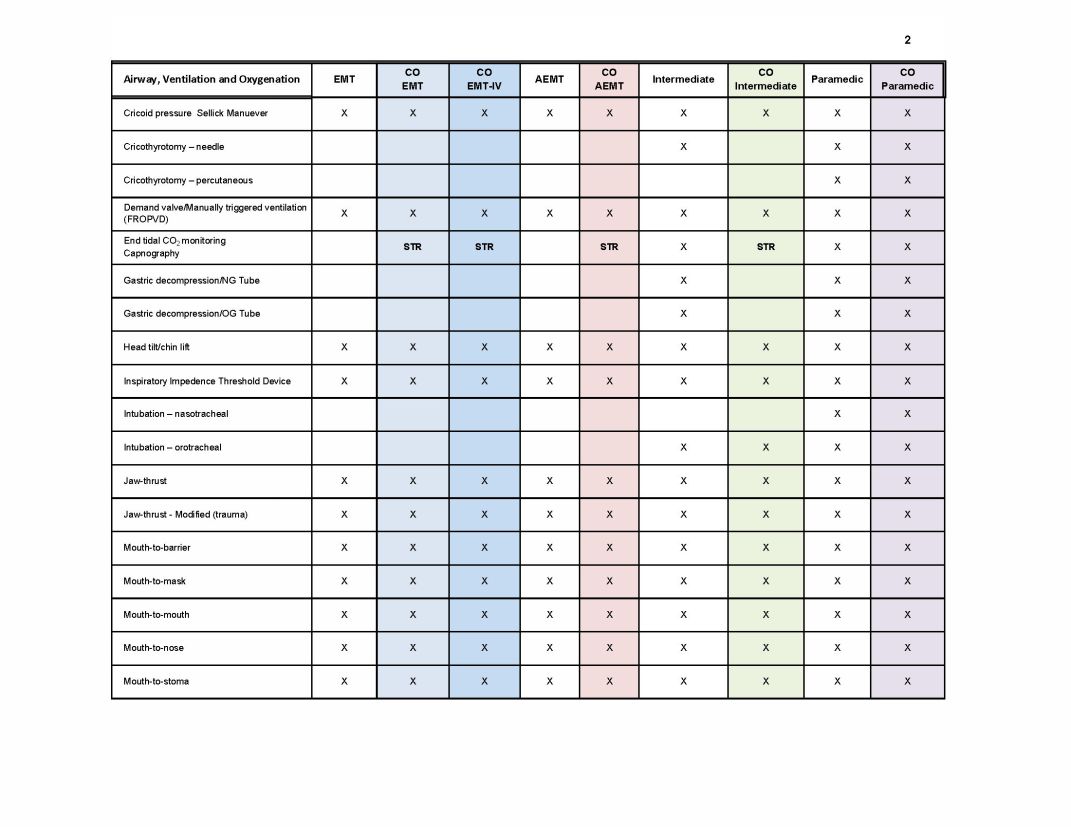

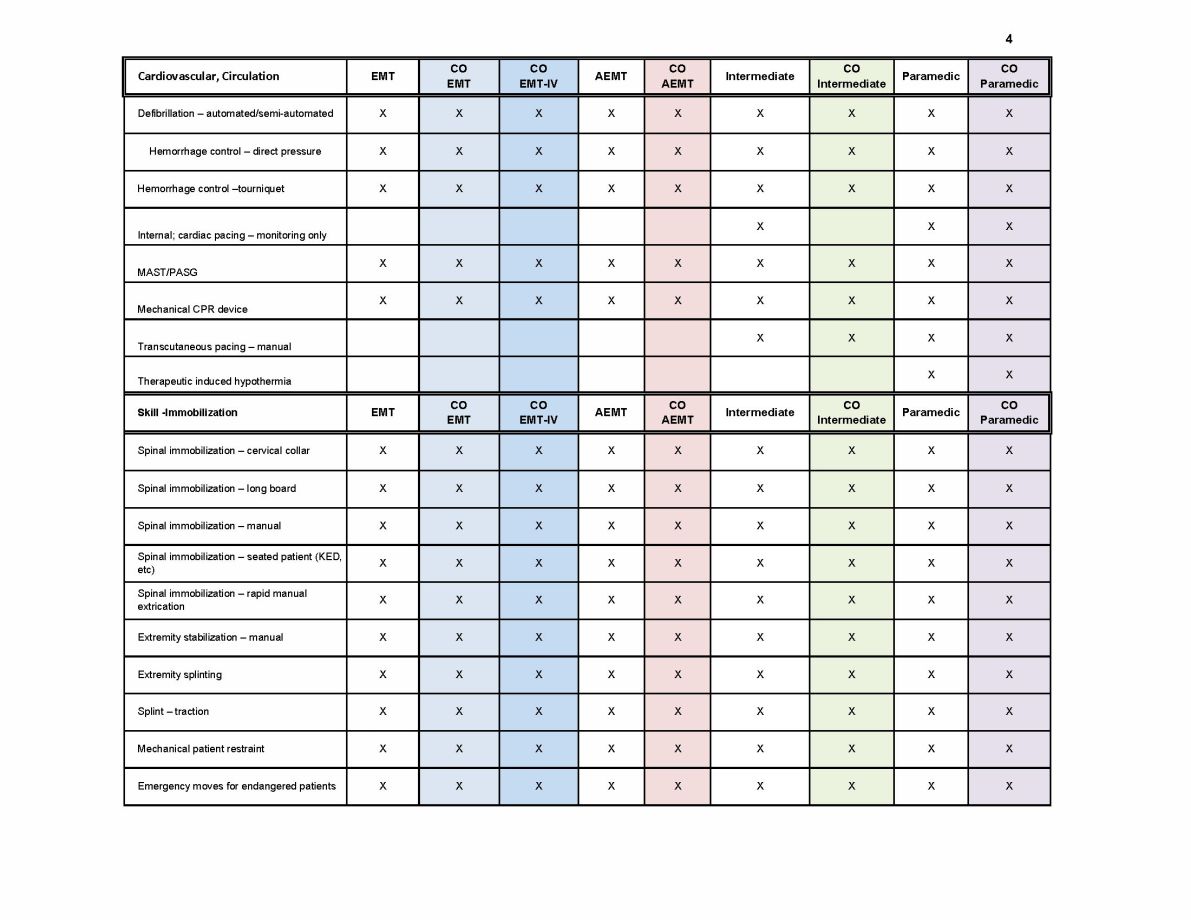
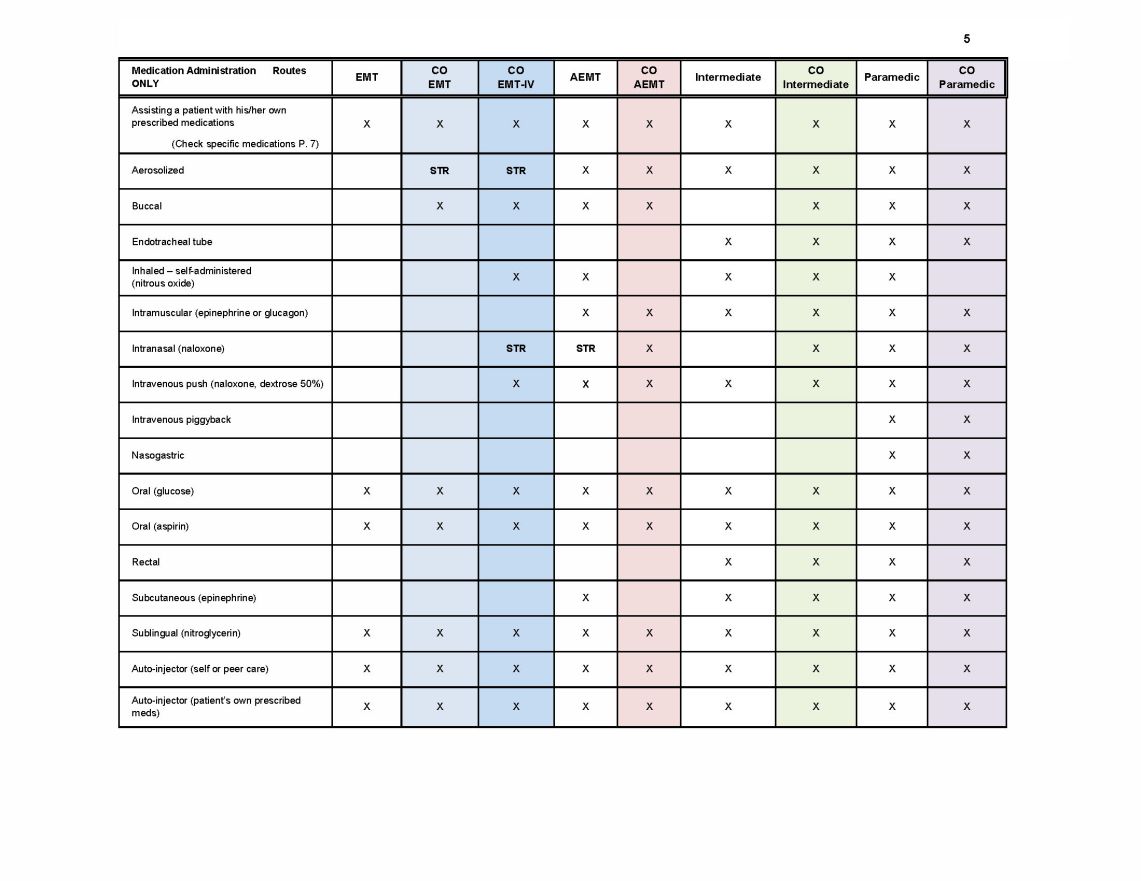
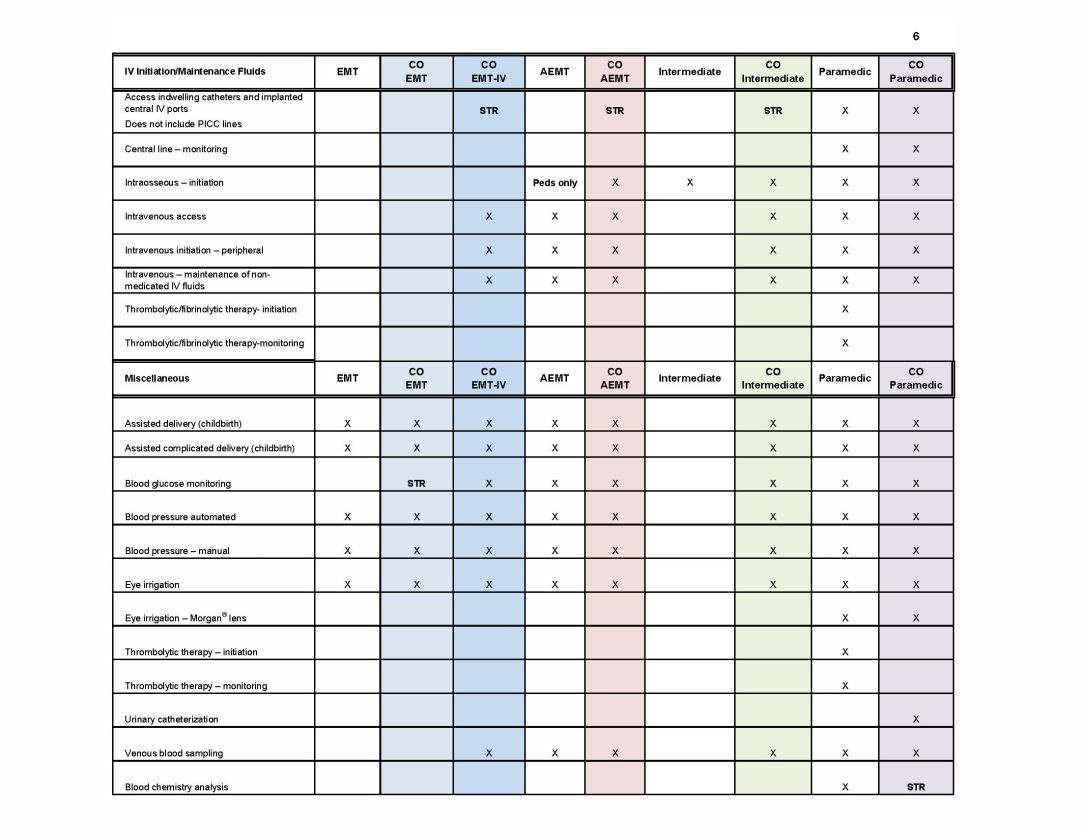
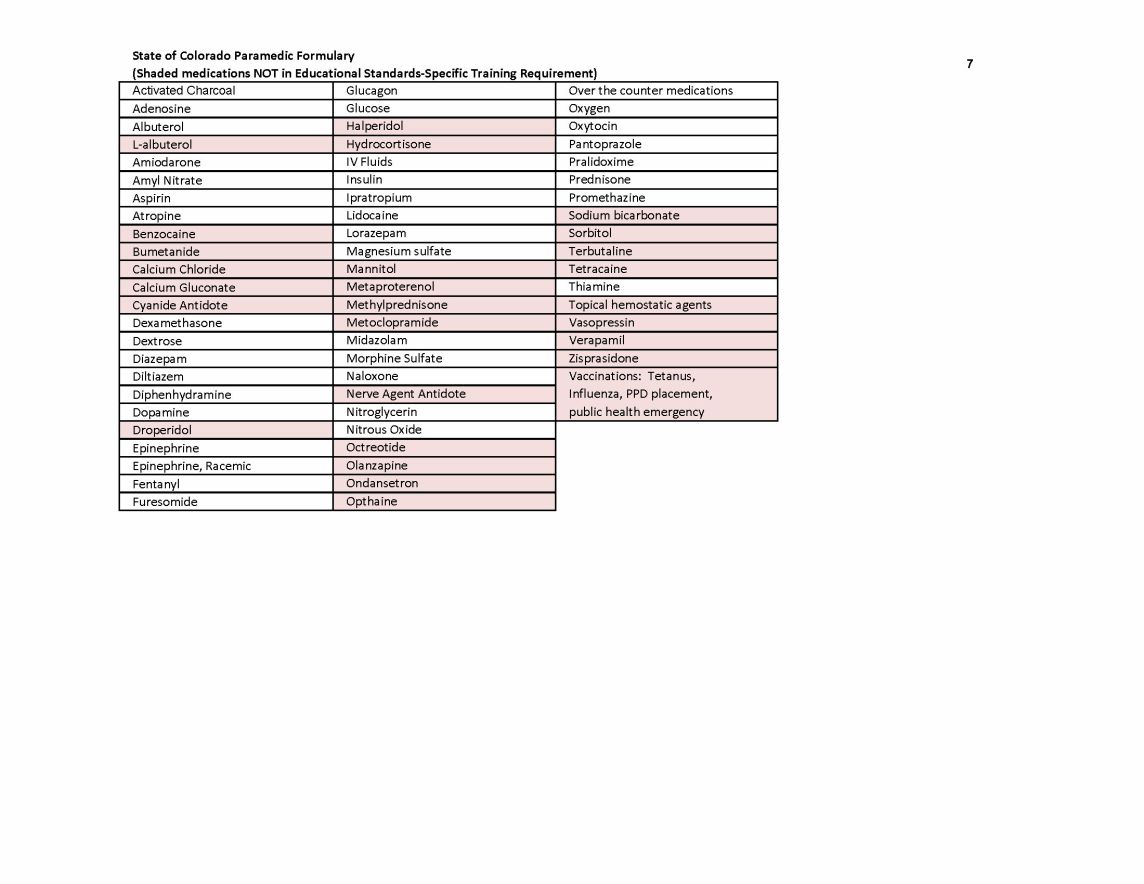
Posted: April 23, 2018 | Author: Recreation Law | Filed under: Equine Activities (Horses, Donkeys, Mules) & Animals, New Hampshire, Release (pre-injury contract not to sue) | Tags: Acting Out, Animal, contract language, contravenes, entitled to judgment, exculpatory, exculpatory clauses, exculpatory provision, exhaustive, genuine, Horse, horseback riding, inclusive, issue of fact, matter of law, misunderstanding, Negligence, Notice, obscured, opportunity to prove, own negligence, personal injury, prefaced, Public Policy, qualifying, quotations, Reasonable person, Release, ridden, Summary judgment, tour guide, Trail Ride, unabridged, verb |
Release was signed for a trail ride and plaintiff claimed she told guide his horse was getting ready to act out before it kicked her.
Wright v. Loon Mountain Recreation Corporation, 140 N.H. 166; 663 A.2d 1340; 1995 N.H. LEXIS 119
State: New Hampshire, Supreme Court of New Hampshire
Plaintiff: Brenda Wright
Defendant: Loon Mountain Recreation Corporation d/b/a Loon Mountain Equestrian Center
Plaintiff Claims: Negligence
Defendant Defenses: Release
Holding: for the Plaintiff
Year: 1995
Summary
Twenty-year-old New Hampshire Supreme Court decisions shows how convoluted a court can get when it decides a release will not be enforced. Court held the language in the release was confusing. However, to get that point the court had to not read the release I think.
Facts
The plaintiff signed up for a trail ride with the defendant. While on the ride she was kicked in the leg by another horse. She sued. On appeal she argued that her guide had failed to respond to indications that his horse, the one that kicked the plaintiff, was about to “act out.”
While on the tour, the plaintiff was kicked in the leg by her guide’s horse and sustained an injury. She brought a negligence action against the defendant, alleging that her tour guide had failed to respond to indications that his horse was about to “act out.”
[Every time I’ve been bit or kicked by a horse there was no warning. Sure, if a horse’s ears go back, there is a warning, but most times, horse 1, Moss 0. I wish there were indications that a horse was going to act out.]
Prior to suing she signed a release. The trial court dismissed her claim because of the release. She appealed.
New Hampshire has a two-tier court system. The trial court is called the Superior Court and appeals from the Superior Court are appealed to the New Hampshire Supreme Court. This appeal was decided by the New Hampshire Supreme Court.
Analysis: making sense of the law based on these facts.
The entire issue before the court was “whether an exculpatory contract signed by the plaintiff, Brenda Wright, released the defendant, Loon Mountain Recreation Corporation, from liability for its own negligence.”
The defendant argued the release “clearly and specifically indicated an intent to release Loon Mountain from liability for injury resulting from its own negligence while [the plaintiff] was engaged in the activity of horseback riding’“.
The Supreme Court looked at this decision in its analysis in a slightly different way.
This court will not enforce an exculpatory contract that contravenes public policy. “Once an exculpatory agreement is found unobjectionable as a matter of public policy, it will be upheld only if it appears that the plaintiff understood the import of the agreement or that a reasonable person in his position would have known of the exculpatory provision.”
“Since the terms of the contract are strictly construed against the defendant, the contract must clearly state that the defendant is not responsible for the consequences of his negligence.”
The court then read the release to determine if a reasonable person would have known about the exculpatory clause in the release. The court then worked hard to find a reasonable person would not.
A reasonable person would understand the provision if its language “clearly and specifically indicates the intent to release the defendant from liability for personal injury caused by the defendant’s negligence . . . .” We will assess the clarity of the con-tract by evaluating it as a whole, not by examining isolated words and phrases.
We conclude that the contract structure and organization obscured the exculpatory clauses. Strictly construing the contract language against the defendant, we find the contract did not clearly relieve the defendant of responsibility for the sort of negligence at issue in this case.
The language the court examined was in all caps so the language stood out from the surrounding language. However, the court stated that when the entire agreement was read, the all cap language was unclear. (?) The court’s determination that the clause was not clear was based on the word therefore.
In this case, the term “therefore” is significant. A common definition of “therefore” is “for that rea-son: because of that: on that ground . . . .” Webster’s Third New International Dictionary 2372 (unabridged ed. 1961) (Webster’s). A clause that is introduced by the term “therefore” cannot be understood without reading the antecedent language.
The court found additional language that it held confused the meaning of the release. The court concluded its analysis with this statement.
The exculpatory contract lacks a straightforward statement of the defendant’s intent to avoid liability for its failure to use reasonable care in any way. The agreement easily could have been framed in a manner that would have expressed more clearly its conditions and exclusions.
There was a dissent by two justices. Both who found the majority’s analysis was just a little ridiculous.
So Now What?
Sometimes your release is not going to win. In those cases, you are going to rely on your insurance company. In this case, the court worked hard to find little ways it could justify its desire to not support the release.
Possibly, this release might have had a better chance with a simple clear statement that by signing the release the signor could not sue for negligence. This release reads like it was written by an attorney training to kill trees rather than write documents for consumers.
But!
What do you think? Leave a comment.
Copyright 2018 Recreation Law (720) 334 8529
If you like this let your friends know or post it on FB, Twitter or LinkedIn


If you are interested in having me write your release, fill out this Information Form and Contract and send it to me.
Author: Outdoor Recreation Insurance, Risk Management and Law
To Purchase Go Here:
Facebook Page: Outdoor Recreation & Adventure Travel Law
Email: Rec-law@recreation-law.com
By Recreation Law Rec-law@recreation-law.com James H. Moss
#AdventureTourism, #AdventureTravelLaw, #AdventureTravelLawyer, #AttorneyatLaw, #Backpacking, #BicyclingLaw, #Camps, #ChallengeCourse, #ChallengeCourseLaw, #ChallengeCourseLawyer, #CyclingLaw, #FitnessLaw, #FitnessLawyer, #Hiking, #HumanPowered, #HumanPoweredRecreation, #IceClimbing, #JamesHMoss, #JimMoss, #Law, #Mountaineering, #Negligence, #OutdoorLaw, #OutdoorRecreationLaw, #OutsideLaw, #OutsideLawyer, #RecLaw, #Rec-Law, #RecLawBlog, #Rec-LawBlog, #RecLawyer, #RecreationalLawyer, #RecreationLaw, #RecreationLawBlog, #RecreationLawcom, #Recreation-Lawcom, #Recreation-Law.com, #RiskManagement, #RockClimbing, #RockClimbingLawyer, #RopesCourse, #RopesCourseLawyer, #SkiAreas, #Skiing, #SkiLaw, #Snowboarding, #SummerCamp, #Tourism, #TravelLaw, #YouthCamps, #ZipLineLawyer, #RecreationLaw, #OutdoorLaw, #OutdoorRecreationLaw, #SkiLaw,
Posted: April 18, 2018 | Author: Recreation Law | Filed under: Connecticut, Legal Case, Release (pre-injury contract not to sue) | Tags: Affirmative Defense, Assumptio of the Risk, Last Clear Chance, Motion to Strike, Release, Special Defense, Waiver |
Rodriguez v. Brownstone Exploration & Discover Park, LLC, 2017 Conn. Super. LEXIS 844
Yulissa Rodriguez v. Brownstone Exploration & Discover Park, LLC
FBTCV166055234S
SUPERIOR COURT OF CONNECTICUT, JUDICIAL DISTRICT OF FAIRFIELD AT BRIDGEPORT
2017 Conn. Super. LEXIS 844
May 4, 2017, Decided
May 4, 2017, Filed
NOTICE: THIS DECISION IS UNREPORTED AND MAY BE SUBJECT TO FURTHER APPELLATE REVIEW. COUNSEL IS CAUTIONED TO MAKE AN INDEPENDENT DETERMINATION OF THE STATUS OF THIS CASE.
CORE TERMS: special defenses, assumption of risk, inherent risks, abolished, own negligence, contractual, legal sufficiency, risks inherent, relieve, legal doctrine, legally insufficient, duty of care, present case, statutory prohibition, legislatively, conceptually, exculpatory, sustaining, pre-injury, favorable, releasing, struck, admit, risky, participating
JUDGES: [*1] Edward T., Krumeich, J.
OPINION
MEMORANDUM OF DECISION
Plaintiff Yulissa Rodriguez has moved to strike the First and Second Special Defenses in the answer of defendant Brownstone Exploration & Discovery Park, LLC, arguing that they are barred under C.G.S. §52-572h(l), which provides: “[t]he legal doctrine . . . of . . . assumption of risk in actions to which this section is applicable [is] abolished.” Plaintiff asserts that the special defenses that are labeled “Waiver” and “Release” are, in actuality, based on assumption of risk because they purport to relieve defendant of liability for risks inherent in the activity, which by statute is not a valid defense in this negligence action. For the reasons stated below, the motion to strike the First and Second Special Defenses is denied.
Standards for Deciding a Motion to Strike Special Defenses
“‘A party wanting to contest the legal sufficiency of a special defense may do so by filing a motion to strike.’ Barasso v. Rear Still Hill Road, LLC, 64 Conn.App. 9, 13, 779 A.2d 198 (2001); Practice Book §10-39(a).2 ‘A motion to strike admits all facts well pleaded; it does not admit legal conclusions or the truth or accuracy of opinions stated in the pleadings.’ . . . Faulkner v. United Technologies Corp., 240 Conn. 576, 588, 693 A.2d 293 (1997). ‘In ruling on a motion to strike, the court must accept as true the facts alleged in the special defenses and [*2] construe them in the manner most favorable to sustaining their legal sufficiency.’ . . . Doe v. Hartford Roman Catholic Diocesan Corp., 317 Conn. 357, 398, 119 A.3d 462 (2015). ‘On the other hand, the total absence of any factual allegations specific to the dispute renders [a special defense] legally insufficient.’ . . . Smith v. Jackson, Superior Court, judicial district of Waterbury, Docket No. CV-14-6024411-S (August 21, 2015, Roraback, J.) (59 Conn. L. Rptr. 864, 2015 Conn. Super. LEXIS 2191). Finally, ‘the trial court is limited to considering the grounds specified in the motion [to strike].’ Meredith v. Police Commission, 182 Conn. 138, 140, 438 A.2d 27 (1980).” Pritsker v. Bowman, 2017 Conn. Super. LEXIS 190, 2017 WL 811609 *2 (Conn.Super. 2017) (Bellis, J.).
The Court May Not Review Material Outside the Pleading in Deciding a Motion to Strike
Plaintiff urged the court to consider the quoted excerpts from the contract alleged in the special defenses in the context of the entire contract, which plaintiff appended to her brief. In ruling on a motion to strike a court is required “to take the facts to be those alleged in the special defenses in the manner most favorable to sustaining their legal sufficiency.” Connecticut Nat. Bank v. Douglas, 221 Conn. 530, 536, 606 A.2d 684 (1992). The Court is not free to consider those portions of the contract that are not alleged nor attached as an exhibit to the answer. See generally Mercer v. Cosley, 110 Conn.App. 283, 292, 955 A.2d 550 (2008) (speaking motion to strike is improper).
The First Special Defense States the Defense of Waiver
In this action plaintiff claimed she was injured while using [*3] a rope swing at defendant’s park. Both sides referred the Court to Segal v. Brownstone Exploration and Discovery Park, LLC, 2014 Conn. Super. LEXIS 1183, 2014 WL 2696775 *2 (Conn.Super. 2014) (Roche, J.), a similar case brought against the same defendant in which Judge Roche struck a special defense based on assumption of risk: “‘[T]he doctrine [of assumption of risk] was a product of the industrial revolution, designed to insulate employers to the greatest possible extent by defeating the claims of their injured workers.’ Donahue v. S.J. Fish & Sons, Inc., Superior Court, judicial district of Hartford, Docket No. CV-539920-S (September 18, 1995, Blue, J.) (15 Conn. L. Rptr. 569, 570, 1995 Conn. Super. LEXIS 2618) [1995 WL 562216]. ‘Traditionally, the doctrine provided a defendant with a complete defense to a claim of negligence that centered on the conduct of the plaintiff . . . [T]he assumption of risk variants fall generally into two separate categories: (1) a negligence defense that the plaintiff’s conduct operated so as to relieve the defendant of a duty of care with regard to the plaintiff; and (2) a negligence defense that, while conceding that the defendant owed a duty of care and breached that duty, precludes recovery by the plaintiff because the plaintiff was aware of the defendant’s negligence and the risk thereby created, but nevertheless chose to confront such risk.’ . . . Blondin v. Meshack, Superior Court, [*4] judicial district of New Haven, Docket No. CV-08-5018828-S (October 2, 2008, Lager, J.) [46 Conn. L. Rptr. 396, 2008 Conn. Super. LEXIS 2512] [2008 WL 4635882]. However, “[t]he harsh doctrine . . . is plainly `morally unacceptable’ in modern times . . . The majority of states have altered or abolished it, either legislatively or by judicial decision . . . [T]he Connecticut legislature has statutorily abolished the doctrine in negligence cases.” Donahue v. S.J. Fish & Sons, Inc., supra, 15 Conn. L. Rptr. at 570, 1995 Conn. Super. LEXIS 2618. General Statutes §52-572h(l) states: “The legal doctrines of last clear chance and assumption of risk in actions to which this section is applicable are abolished.” In the present case, accordingly, the defendant’s second special defense is legally insufficient because the doctrine of assumption of the risk has been legislatively abolished with regard to negligence claims. The plaintiffs’ motion to strike the defendant’s second special defense is, therefore, granted.”
Defendant has not asserted a defense of assumption of risk, but rather alleged that plaintiff signed a document entitled “Assumption of Risk, Release of Liability, Waiver of Claims & Arbitration Agreement” in which “the plaintiff agreed to waive all claims against [defendant] . . . arising out of the inherent risks of participating in programs and events operated by [defendant] . . .”1 The First Special Defense alleged [*5] “[a]ny injuries sustained by the plaintiff while using the ‘Blob’ activity at [defendant] . . . arose out of the inherent risks of this activity.”
1 This is a classic contract of adhesion that is not bargained for but accepted by the consumer as a condition for his or her participation in the activity. Hanks v. Powder Ridge Restaurant Corp., 276 Conn. 314, 328-29, 333, 885 A.2d 734 (2005).
“Waiver is the voluntary relinquishment or abandonment of a known right or privilege.” Brown v. City of Hartford, 160 Conn.App. 677, 698, 127 A.3d 278 (2015). See also Benedetto v. Proprietors of the Commons at Mill River, Inc., 2014 Conn. Super. LEXIS 2322, 2014 WL 5356665 *8 (Conn.Super. 2014) (Vitale, J.), contractual waiver as special defense).
Connecticut courts have recognized that pre-injury waiver as a defense to a claim based on inherent risks from an activity is not the same as a waiver of a claim of defendant’s own negligence. See e.g., Hanks, 276 Conn. at 326, 335; Hyson v. White Water Mountain Resorts of Connecticut, Inc., 265 Conn. 636, 643-44, 829 A.2d 827 (2003). In Hyson, the Supreme Court distinguished between release of liability for risks inherent in an activity and exculpation of a party’s own negligence:
In keeping with the well-established principle, however, that `[t]he law does not favor contract provisions which relieve a person from his own negligence’ . . . we conclude that the better rule is that a party cannot be released from liability for injuries resulting from its future negligence in the absence of language that expressly so provides. The release signed in the present case illustrates the need for such a rule. A person of ordinary intelligence reasonably could believe that, by signing this release, he or she was releasing the defendant only [*6] from liability for damages caused by dangers inherent in the activity of snow tubing. A requirement of express language releasing the defendant from liability for its negligence prevents individuals from inadvertently relinquishing valuable legal rights.
(Emphasis added.)
In Jagger v. Mohawk Mountain Ski Area, Inc., 269 Conn. 672, 687-88, 849 A.2d 813 & nn. 17-22 (2004), the Supreme Court differentiated between pre-injury release from inherent risks of an activity, defined by reference to a dictionary definition of “inherent” as “structural or involved in the constitution or essential character of something,” from release of negligence that involves the exercise of some control over the activity and/or conditions by defendant. In Hanks, 276 Conn. at 741, the Supreme Court cited the definition of inherent risk in Jagger, 269 Conn. at 692: “inherent risks . . . are innate to the activity, [and] ‘are beyond the control of the [recreational] operator’s exercise of reasonable care.'”
In Segal, 2014 Conn. Super. LEXIS 1183, 2014 WL 2696775 *8, the same court that had struck the assumption of risk special defense, declined to strike the waiver special defense; the court assumed the allegation that plaintiff had waived risks inherent in the activity was true as alleged, and concluded that the provision was exculpatory because it expressly included defendant’s negligence. [*7]
The language of the waiver provision here is limited to “the inherent risks of this activity” and is not broad enough to exculpate defendant for its own negligence. A contractual waiver of liability for inherent risks from an activity is not conceptually the same thing as assumption of risk from participation in a risky activity. Defendant has failed to show that the waiver special defense is the same as the assumption of risk defense abolished by C.G.S. §52-572h(l). Stated otherwise, defendant has failed to show the statutory prohibition extended to waiver by contract. The motion to strike the First Special Defense is denied.
The Second Special Defense States the Defense of Release
The Segal Court also refused to strike the release defense for the same reasons it did not strike the waiver special defense. 2014 Conn. Super. LEXIS 1183, 2014 WL 2696775 *8. The release special defense here also alleges the contractual release “arising out of the inherent risks of participation in the Programs . . .”2 A contractual release of liability for inherent risks from an activity is not conceptually the same thing as assumption of risk from participation in a risky activity. Defendant has failed to show that the release special defense is the same as the assumption [*8] of risk defense abolished by C.G.S. §52-572h(l). Stated otherwise, defendant has failed to show the statutory prohibition extended to releases by contract. The motion to strike the Second Special Defense is denied.
2 This may be an exculpatory provision since it includes “the instruction received while participating in the Programs,” which is subject to control of the operator. Plaintiff has not moved to strike on this ground.
KRUMEICH, J.
Posted: April 18, 2018 | Author: Recreation Law | Filed under: Equine Activities (Horses, Donkeys, Mules) & Animals, Legal Case, New Hampshire | Tags: Animal, contract language, contravenes, entitled to judgment, Equine, exculpatory, exculpatory clauses, exculpatory provision, exhaustive, genuine, Horse, horseback riding, inclusive, issue of fact, matter of law, misunderstanding, New Hampshire, Notice, obscured, opportunity to prove, own negligence, personal injury, prefaced, Public Policy, qualifying, quotations, Reasonable person, Release, ridden, Summary judgment, tour guide, Trail Ride, unabridged, verb |
Wright v. Loon Mountain Recreation Corporation, 140 N.H. 166; 663 A.2d 1340; 1995 N.H. LEXIS 119
Brenda Wright v. Loon Mountain Recreation Corporation d/b/a Loon Mountain Equestrian Center
No. 94-266
SUPREME COURT OF NEW HAMPSHIRE
140 N.H. 166; 663 A.2d 1340; 1995 N.H. LEXIS 119
August 22, 1995, Decided
SUBSEQUENT HISTORY: [***1] Released for Publication September 7, 1995.
PRIOR HISTORY: Merrimack County.
DISPOSITION: Reversed and remanded.
CASE SUMMARY:
PROCEDURAL POSTURE: Plaintiff injured brought a negligence action against defendant tour company after being hurt while on a horseback riding tour. The injured appealed the decision of the Superior Court of Merrimack County (New Hampshire), which granted the tour company’s motion for summary judgment.
OVERVIEW: Before going horseback riding on the tour, the injured signed an exculpatory agreement that released the tour company from liability as a result of various occurrences. The tour company successfully argued in the trial court that the exculpatory agreement barred the injured’s suit. The court found that the issue of whether the injured understood the agreement presented an issue of fact. In assessing the clarity of the contract by evaluating it as a whole, the court found that the contract structure and organization obscured the exculpatory clauses and did not clearly relieve the tour company of responsibility for the sort of negligence at issue in the case. The court reasoned that one clause was understandable to relate to the inherent dangers of horseback riding and liability for injures that occurred for that reason. However, the court found that receiving an injury that would not have occurred but for a tour guide’s negligence was not an inherent danger. Because the contract did not put the injured on clear notice, the tour company was not entitled to summary judgment.
OUTCOME: The judgment was reversed, and the case was remanded.
CORE TERMS: horse, exculpatory, horseback riding, reasonable person, exculpatory provision, personal injury, own negligence, summary judgment, public policy, animal, exculpatory clauses, issue of fact, opportunity to prove, contravenes, inclusive, obscured, verb, tour guide, qualifying, notice, ridden, matter of law, entitled to judgment, contract language, misunderstanding, unabridged, exhaustive, quotations, prefaced, genuine
LexisNexis(R) Headnotes
Civil Procedure > Summary Judgment > Burdens of Production & Proof > Movants
Civil Procedure > Summary Judgment > Opposition > General Overview
Civil Procedure > Summary Judgment > Standards > Genuine Disputes
[HN1] The trial court must grant summary judgment when it finds no genuine issue of material fact, after considering the affidavits and other evidence presented in a light most favorable to the non-moving party, and when the moving party is entitled to judgment as a matter of law. The party opposing summary judgment must put forth contradictory evidence under oath, sufficient to indicate that a genuine issue of fact exists so that the party should have an opportunity to prove the fact at trial. All reasonable doubts should be resolved against the movant.
Contracts Law > Contract Conditions & Provisions > Exculpatory Clauses
Torts > Negligence > Defenses > Exculpatory Clauses > Interpretation
Torts > Procedure > Settlements > Releases > Construction & Interpretation
[HN2] The court will not enforce an exculpatory contract that contravenes public policy. Once an exculpatory agreement is found unobjectionable as a matter of public policy, it will be upheld only if it appears that the plaintiff understood the import of the agreement or that a reasonable person in his position would have known of the exculpatory provision. Since the terms of the contract are strictly construed against the defendant, the contract must clearly state that the defendant is not responsible for the consequences of his negligence.
Contracts Law > Contract Conditions & Provisions > Indemnity
[HN3] The plaintiff’s understanding presents an issue of fact, and the plaintiff should have an opportunity to prove the fact at trial unless the exculpatory language was clear and a misunderstanding was unreasonable.
Contracts Law > Contract Conditions & Provisions > Exculpatory Clauses
Contracts Law > Types of Contracts > Releases
Torts > Procedure > Settlements > Releases > General Overview
[HN4] The court examines the language of the release to determine whether a reasonable person in the plaintiff’s position would have known of the exculpatory provision. A reasonable person would understand the provision if its language clearly and specifically indicates the intent to release the defendant from liability for personal injury caused by the defendant’s negligence. The court assesses the clarity of the contract by evaluating it as a whole, not by examining isolated words and phrases.
HEADNOTES
1. Contracts–Liability for Negligence–Public Policy
New Hampshire Supreme Court will not enforce an exculpatory contract that contravenes public policy.
2. Contracts–Construction–Ambiguity
The plaintiff’s understanding of the release presents an issue of fact, and the plaintiff should have an opportunity to prove the fact at trial unless the exculpatory language was clear and a misunderstanding was unreasonable.
3. Contracts–Liability for Negligence–Exculpatory Provision
A reasonable person would “understand” an exculpatory provision if its language clearly and specifically indicated the intent to release the defendant from liability for personal injury caused by the defendant’s negligence.
4. Contracts–Liability for Negligence–Exculpatory Provision
Release language should be plain; a careful reading should not be necessary to divine the defendant’s intent.
5. Contracts–Liability for Negligence–Exculpatory Provision
The release language fails where it is obscured by qualifying terms and phrases and doesn’t put the plaintiff on clear notice.
COUNSEL: Craig, Wenners, Craig & Casinghino, P.A., of Manchester (Gary L. Casinghino and Gemma M. Dreher on the brief, and Mr. Casinghino orally), for the plaintiff.
Devine, Millimet & Branch, P.A., of Manchester (Gregory D. H. Jones and Joseph M. McDonough, III, on the brief, and Mr. Jones orally), for the defendant.
JUDGES: JOHNSON, J.; THAYER, J., with whom BROCK, C.J., joined, dissented; the others concurred.
OPINION BY: JOHNSON
OPINION
[*167] [**1341] JOHNSON, J. The question presented is whether an exculpatory contract signed by the plaintiff, Brenda Wright, released the defendant, Loon Mountain Recreation Corporation, from liability for its own negligence. The Superior Court (Manias, J.) found that the signed release barred the plaintiff’s negligence claim and granted the defendant’s motion for summary judgment. We reverse.
Before embarking on a horseback riding tour at the Loon Mountain Equestrian Center, owned and operated by the defendant, the plaintiff was asked to read, complete, and sign the following exculpatory [***2] agreement:
I accept for use, as is, the animals listed on this form and accept full responsibility for its care while it is in my possession. I have made no misrepresentation to Loon Mountain regarding my name, address or age. I agree to hold harmless and indemnify Loon Mountain Recreation Corporation and its owners, agents and employees for any loss or damage, including any that result from claims for personal injury or property damage related to the use of this animal.
I understand and am aware that horseback riding is a HAZARDOUS ACTIVITY. I understand that the above activity and the use of horses involves a risk of injury to any and all parts of my body. I hereby agree to freely and expressly assume and accept any and all risks of injury or death from the use of this animal while participating in this activity.
I understand that it is not possible to predict every situation and condition of the terrain a horse will be ridden on; therefore, it is impossible to guarantee the horse I am riding will react safely in all riding situations. [*168]
I realize that it is mandatory that I wear a helmet at all times while horseback riding, and that I will obey all trail signs [***3] and remain only on open trails.
I therefore release Loon Mountain Recreation Corporation, its owners, agents and employees FROM ANY AND ALL LIABILITY FOR DAMAGES AND PERSONAL INJURY TO MYSELF OR ANY PERSON OR PROPERTY RESULTING FROM THE NEGLIGENCE OF LOON MOUNTAIN RECREATION CORPORATION TO INCLUDE NEGLIGENCE IN SELECTION, ADJUSTMENT OR ANY MAINTENANCE OF ANY HORSE, accepting myself the full responsibility for any and all damages or injury of any kind which may result. (PLEASE SIGN: Brenda Wright/s)
I agree that there have been no warranties, expressed or implied, which have been made to me which extend beyond the description of the equipment listed on this form. I the undersigned, acknowledge that I have carefully read this agreement and release of liability, and I understand its contents. I understand that my signature below expressly waives any rights I have to sue Loon Mountain Recreation Corporation for injuries and damages.
The plaintiff signed this agreement after the fifth paragraph and at the bottom.
While on the tour, the plaintiff was kicked in the leg by her guide’s horse and sustained an injury. She brought a negligence action against the defendant, alleging [***4] that her tour guide had failed to respond to indications that his horse was about to “act out.” The defendant argued that the exculpatory contract barred the plaintiff’s suit and moved for summary judgment. The Superior Court (Manias, J.) granted its motion, and this appeal followed.
[**1342] On appeal, the defendant argues that we should uphold the trial court’s grant of summary judgment because the contract “clearly and specifically indicated an intent to release Loon Mountain from liability for injury resulting from its own negligence while [the plaintiff] was engaged in the activity of horseback riding.”
[HN1] The trial court must grant summary judgment when it finds no genuine issue of material fact, after considering the affidavits and other evidence presented in a light most favorable to the non-moving party, and when the moving party is entitled to judgment as a matter of law. The party opposing summary judgment must put forth contradictory [*169] evidence under oath, sufficient to indicate that a genuine issue of fact exists so that the party should have an opportunity to prove the fact at trial. All reasonable doubts should be resolved against the movant.
Phillips v. Verax [***5] Corp., 138 N.H. 240, 243, 637 A.2d 906, 909 (1994) (brackets, ellipses, and quotations omitted).
[HN2] This court will not enforce an exculpatory contract that contravenes public policy. Audley v. Melton, 138 N.H.. 416, 418, 640 A.2d 777, 779 (1994). “Once an exculpatory agreement is found unobjectionable as a matter of public policy, it will be upheld only if it appears that the plaintiff understood the import of the agreement or that a reasonable person in his position would have known of the exculpatory provision.” Barnes v. N.H. Karting Assoc., 128 N.H. 102, 107, 509 A.2d 151, 154 (1986). “Since the terms of the contract are strictly construed against the defendant, the contract must clearly state that the defendant is not responsible for the consequences of his negligence.” Id.
The plaintiff does not argue that the exculpatory contract contravenes public policy. Accordingly, we determine only whether “the plaintiff understood the import of the agreement,” and if not, whether “a reasonable person in [her] position would have known of the exculpatory provision.” Id.
The parties dispute whether the plaintiff understood the agreement to release the defendant from [***6] liability for its own negligence. [HN3] The plaintiff’s understanding presents an issue of fact, and the plaintiff should have an opportunity to prove the fact at trial unless the exculpatory language was clear and a misunderstanding was unreasonable. See Phillips, 138 N.H. at 243, 637 A.2d at 909; Barnes, 128 N.H. at 107, 509 A.2d at 154.
[HN4] We therefore examine the language of the release to determine whether “a reasonable person in [the plaintiff’s] position would have known of the exculpatory provision.” Barnes, 128 N.H. at 107, 509 A.2d at 154; cf. Raudonis v. Ins. Co. of North America, 137 N.H. 57, 59, 623 A.2d 746, 747 (1993) (interpretation of insurance contract language a question of law; we construe terms as would reasonable person in insured’s position). A reasonable person would understand the provision if its language “clearly and specifically indicates the intent to release the defendant from liability for personal injury caused by the defendant’s negligence . . . .” Barnes, 128 N.H. at 107, 509 A.2d at 154. We will assess the clarity of the contract by evaluating it as a whole, not by examining isolated [*170] words and phrases. See Chadwick v. CSI, Ltd., [***7] 137 N.H. 515, 524, 629 A.2d 820, 826 (1993).
We conclude that the contract structure and organization obscured the exculpatory clauses. Strictly construing the contract language against the defendant, we find the contract did not clearly relieve the defendant of responsibility for the sort of negligence at issue in this case. See Barnes, 128 N.H. at 107, 509 A.2d at 154.
The defendant emphasizes the language of the agreement’s fifth paragraph, which states: “I therefore release [the defendant] from ANY AND ALL LIABILITY FOR . . . PERSONAL INJURY TO MYSELF . . . RESULTING FROM THE NEGLIGENCE OF [THE DEFENDANT] TO INCLUDE NEGLIGENCE IN SELECTION, ADJUSTMENT OR ANY MAINTENANCE OF ANY HORSE, accepting myself the full responsibility for any . . . injury of any kind which may result.” (Emphasis added.) We find that when this clause is read within the [**1343] context of the entire agreement, its meaning is less than clear.
In this case, the term “therefore” is significant. A common definition of “therefore” is “for that reason: because of that: on that ground . . . .” Webster’s Third New International Dictionary 2372 (unabridged ed. 1961) (Webster’s). A clause that is introduced [***8] by the term “therefore” cannot be understood without reading the antecedent language.
The paragraphs preceding the exculpatory clause emphasize the inherent hazards of horseback riding. Because the exculpatory clause is prefaced by the term “therefore,” a reasonable person might understand its language to relate to the inherent dangers of horseback riding and liability for injuries that occur “for that reason.” Being kicked by a horse is a danger inherent to horseback riding; receiving an injury that would not have occurred but for a tour guide’s negligence, however, is not.
The exculpatory phrase in the fifth paragraph is further clouded by the qualifying language that follows. Pursuant to the contract, the defendant is released from liability for its negligence “to include negligence in selection, adjustment or any maintenance of any horse.” If we parse these terms, they do not necessarily restrict the defendant’s release to liability for negligent selection, adjustment, or maintenance of any horse. The superfluity of the terms, however, serves to obscure rather than clarify. Moreover, one sense of the word “inclusive” is “covering or intended to cover all items . . . .” Webster’s, [***9] supra at 1143. A reasonable person reading the clause thus might conclude that the agreement relieved the defendant of responsibility for the enumerated types of negligence only.
[*171] Whether the tour guide’s failure to control his horse constitutes “the negligent . . . maintenance of any horse,” is unclear. Webster’s gives several definitions for the word “maintain,” the two most relevant being: (1) “to keep in a state of repair, efficiency, or validity: preserve from failure or decline” and (2) “to provide for: bear the expense of: SUPPORT.” Webster’s, supra at 1362. When read in the context of selection and adjustment, therefore, a reasonable person in the position of the plaintiff might understand “the negligent . . . maintenance of any horse” to relate to negligent upkeep rather than control.
The contract is also unclear with respect to injuries involving horses not ridden by the plaintiff. The first, second, and third paragraphs emphasize only the horse that the plaintiff “accept[s] for use.” We reject the defendant’s argument that the phrase “use of this animal,” used in the first and second paragraphs, “is merely an alternative expression for the activity of ‘horseback [***10] riding.'” We also reject the defendant’s contention that the phrase “use of this animal” does not limit the contract’s application to injuries involving the plaintiff’s horse because “[a] careful reading . . . reveals that it is part of a clause modifying plaintiff’s agreement to ‘hold harmless and indemnify [the defendant] for any loss or damage. . . .'” The Barnes test requires that release language be plain; a careful reading should not be necessary to divine the defendant’s intent.
In Audley, we concluded:
Quite simply, the general release language does not satisfy the Barnes requirement that the contract must clearly state that the defendant is not responsible for the consequences of his negligence. The release fails in this respect not because it neglects to use the word ‘negligence’ or any other special terms; instead it fails because no particular attention is called to the notion of releasing the defendant from liability for his own negligence. The general language in the context of the release simply did not put the plaintiff on clear notice of such intent.
Audley, 138 N.H. at 419, 640 A.2d at 779 (quotations and citations omitted). [***11] Whereas the release language in Audley failed because it was too general, the release language in the present case fails because it is obscured by qualifying terms and phrases. The cases are similar, however, because neither contract put the plaintiff “on clear notice,” id.
The exculpatory contract lacks a straightforward statement of the defendant’s intent [**1344] to avoid liability for its failure to use reasonable [*172] care in any way. The agreement easily could have been framed in a manner that would have expressed more clearly its conditions and exclusions. The defendant was not entitled to judgment as a matter of law.
Reversed and remanded.
THAYER, J., with whom BROCK, C.J., joined, dissented; the others concurred.
DISSENT BY: THAYER
DISSENT
THAYER, J., dissenting: I would uphold the trial court’s grant of summary judgment because the exculpatory contract explicitly indicated an intent to release the defendant from liability for its own negligence. The contract in question purports to release the defendant from “ANY AND ALL LIABILITY FOR . . . PERSONAL INJURY TO MYSELF . . . RESULTING FROM THE NEGLIGENCE OF [THE DEFENDANT] TO INCLUDE NEGLIGENCE IN SELECTION, ADJUSTMENT OR ANY MAINTENANCE [***12] OF ANY HORSE.” The language clearly indicates an intent to release the defendant from liability for its own negligence. I agree with the majority that the use of the word “therefore” restricts the release to negligence associated with the inherent hazards of horseback riding. I do not agree, however, that the negligence alleged is not such a risk. The plaintiff alleged that the defendant’s employee had failed to properly control his horse, and that as a result, the horse “acted out.” Controlling a horse is an essential part of horseback riding. The possibility that someone will fail to exercise the proper control would seem to fall squarely within the category of dangers inherent in the sport.
The majority bases its holding in part on its interpretation of the phrase “to include.” In holding that the list prefaced by the words “to include” is meant to be exhaustive, the majority relies on a definition of the word “inclusive.” Such reliance is misplaced. The contract used the word “include” as a verb. The primary relevant definition of that word is “to place, list, or rate as a part or component of a whole or a larger group, class, or aggregate.” Webster’s Third New International [***13] Dictionary 1143 (unabridged ed. 1961) (Webster’s). “Inclusive,” however, is an adjective and its definition differs from the verb form of the word. See In re Dumaine, 135 N.H. 103, 107, 600 A.2d 127, 129 (1991). The use of the verb form of the word indicates that the listed types of negligence are “component[s] of a whole or a larger group,” Webster’s, supra, and that the list was not exhaustive.
The appropriate question, therefore, is whether the negligence alleged in this case is of the same type as those listed. The plaintiff [*173] alleges that the defendant’s employee failed to properly control his mount. This would seem to fall squarely within the type of negligence defined by the contract. That the horse causing the injury was not ridden by the plaintiff is irrelevant. The contract releases the defendant for negligence resulting from “the use of horses” and specifically from “NEGLIGENCE IN SELECTION, ADJUSTMENT OR ANY MAINTENANCE OF ANY HORSE.” (Emphasis added.) While the contract does refer to the plaintiff’s horse on a number of occasions, it also refers to horses generally and to “any” horse. This language cannot be read to restrict the defendant’s release [***14] solely to injuries caused by the plaintiff’s horse. I disagree with the majority’s reading of the exculpatory contract. Therefore, I respectfully dissent.
BROCK, C.J., joins in the dissent.
Posted: April 18, 2018 | Author: Recreation Law | Filed under: Connecticut, Legal Case | Tags: #Contest, carelessness, Cause of action, common law, decedent, fatal injuries, favorably, judicial district, Land Owner, legal sufficiency, Motion to Strike, omissions, prayer, Punitive damages, quotation marks omitted, Reckless, Reckless Conduct, reckless disregard, recklessly, recklessness, Rope Swing, sounding, swing, viewing, wantonly |
Kopesky v. Connecticut American Water Company, 1999 Conn. Super. LEXIS 2166
Renee Kopesky v. Connecticut American Water Company
CV 950145791
SUPERIOR COURT OF CONNECTICUT, JUDICIAL DISTRICT OF STAMFORD – NORWALK, AT STAMFORD
1999 Conn. Super. LEXIS 2166
August 2, 1999, Decided
August 2, 1999, Filed
NOTICE: [*1] THIS DECISION IS UNREPORTED AND MAY BE SUBJECT TO FURTHER APPELLATE REVIEW. COUNSEL IS CAUTIONED TO MAKE AN INDEPENDENT DETERMINATION OF THE STATUS OF THIS CASE.
DISPOSITION: Defendant’s motion to strike second count of plaintiff’s amended complaint, and that portion of the prayer for relief claiming punitive damages, denied.
CASE SUMMARY:
PROCEDURAL POSTURE: Defendant brought a motion to strike the second count of plaintiff’s amended complaint and that portion of the prayer for relief claiming punitive damages in an action alleging that decedent sustained fatal injuries on defendant’s property because of defendant’s negligence and reckless conduct.
OVERVIEW: Decedent died when she fell from a swing on defendant’s property. Plaintiff brought an action against defendant, alleging that defendant was aware that the public entered their property to go swimming. The second count of plaintiff’s complaint alleged that defendant’s acts or omissions were done recklessly, wantonly, carelessly, and with a reckless disregard for the consequences of its acts or omissions. Defendant brought a motion to strike count two of plaintiff’s complaint and that portion of the prayer for relief claiming punitive damages. The court ruled that a motion to strike could be used to contest the legal sufficiency of any prayer for relief. Further, the court held that an action sounding in reckless conduct required an allegation of an intentional act that resulted in injury. Also, the court found that in order to rise to the level of recklessness, the action producing the injury must be intentional and characterized by highly unreasonable conduct which amounted to an extreme departure from ordinary care. The court, viewing the allegations in the light most favorable to plaintiff, denied the motion, concluding that the allegations did rise to the level of recklessness.
OUTCOME: Motion to strike the second count of plaintiff’s complaint and that portion of the prayer for relief claiming punitive damages was denied where, viewing the complaint in the light most favorably to plaintiff, plaintiff alleged facts sufficient to state causes of action sounding in negligence and recklessness.
CORE TERMS: recklessness, quotation marks omitted, reckless, sounding, reckless disregard, judicial district, favorably, prayer, decedent, common law, reckless conduct, legal sufficiency, cause of action, contest, viewing, fatal injuries, punitive damages, carelessness, recklessly, omissions, wantonly, swing
JUDGES: D’ANDREA, J.
OPINION BY: D’ANDREA
OPINION
MEMORANDUM OF DECISION RE: MOTION TO STRIKE
The plaintiff, Renee Kopesky, the administratrix for the estate of Tiffany Jean Kopesky, brought this action against the defendant, Connecticut American Water Company, for damages sustained by the plaintiff’s decedent. The plaintiff alleges that the plaintiff’s decedent sustained fatal injuries on the defendant’s property, when she fell from a rope swing as she attempted to swing out into the water. The plaintiff alleges that the defendant was aware that the public entered their private property to go swimming, hiking, camping and fishing. In the first count of the amended complaint, the plaintiff alleges that the plaintiff’s decedent suffered severe painful and fatal injuries as a result of the defendant’s negligence and carelessness. In the second count, the plaintiff alleges that [*2] the defendant’s “acts and/or omissions . . . were done recklessly, wantonly, carelessly and with a reckless disregard for the consequences of its acts and/or omissions.”
The defendant moves to strike count two of the plaintiff’s amended complaint and that portion of the prayer for relief claiming punitive damages. The defendant argues that “count two is legally insufficient because a claim for recklessness cannot be established by relying upon the same set of facts used to establish negligence. The second count of plaintiff’s amended complaint simply restates the facts underlying the plaintiff’s claim for negligence. Reiterating the same underlying facts of a negligence claim and renaming the claim as one for recklessness does not transform ordinary negligence into recklessness.”
” [HN1] The purpose of a motion to strike is to contest . . . the legal sufficiency of the allegations of the complaint . . . to state a claim upon which relief can be granted.” (Internal quotation marks omitted.) Peter-Michael, Inc. v. Sea Shell Associates, 244 Conn. 269, 270, 709 A.2d 558 (1998). ” [HN2] For purposes of a motion to strike, the moving party admits all facts well pleaded.” RK Constructors, Inc. v. Fusco Corp., 231 Conn. 381, 383 n.2, 650 A.2d 153 (1994); [*3] see also Ferryman v. Groton, 212 Conn. 138, 142, 561 A.2d 432 (1989). “The court must construe the facts in the complaint most favorably to the plaintiff.” (Internal quotation marks omitted.) Faulkner v. United Technologies Corp., 240 Conn. 576, 580, 693 A.2d 293 (1997).
The motion to strike may also be used to contest the legal sufficiency of any prayer for relief. See Kavarco v. T.J.E., Inc., 2 Conn. App. 294, 298 n.4, 478 A.2d 257 (1984); Central New Haven Development Corp. v. Potpourri, Inc., 39 Conn. Supp. 132, 133, 471 A.2d 681 (1993); Practice Book 10-39(a)(2).
” [HN3] Recklessness is a state of consciousness with reference to the consequences of one’s acts. . . . It is more than negligence, more than gross negligence . . . The state of mind amounting to recklessness may be inferred from conduct. But, in order to infer it, there must be something more than a failure to exercise a reasonable degree of watchfulness to avoid a danger to others or to take reasonable precautions to avoid injury to them . . .” (Citations omitted; internal quotation marks omitted.) Dubay v. Irish, 207 Conn. 518, 532, 542 A.2d 711 (1988). [*4]
This court has previously held that “the allegations of one count of a complaint based on a common law reckless conduct must be separate and distinct from the allegations of a second count sounding in negligence . . . There is a wide difference between negligence and reckless disregard of the rights or safety of others . . . A specific allegation setting out the conduct that is claimed to be reckless or wanton must be made . . . In other words, it is clearly necessary to plead a [common law] cause of action grounded in recklessness separate and distinct from a negligence action.” (Alterations in original; internal quotation marks omitted.) Thompson v. Buckler, 1999 Conn. Super. LEXIS 199, Superior Court, judicial district of Stamford-Norwalk at Stamford, Docket No. 153798 (Jan. 27, 1999) ( D’Andrea, J.), Epner v. Theratx, Inc., 1998 Conn. Super. LEXIS 603, Superior Court, judicial district of Stamford-Norwalk at Stamford, Docket No. 161989 (Mar. 10, 1998) (D’Andrea, J.). “In short, [HN4] an action sounding in reckless conduct requires an allegation of an intentional act that results in injury.” Id.
” [HN5] In order to rise to the level of recklessness, [the] action producing the injury must be intentional and characterized [*5] by highly unreasonable conduct which amounts to an extreme departure from ordinary care . . .” (Alterations in original; internal quotation marks omitted.) Epner v. Theratx, Inc., supra, 1998 Conn. Super. LEXIS 603, Superior Court, Docket No. 161989, citing Dubay v. Irish, 207 Conn. 518, 532, 542 A.2d 711 (1988). In the present case, viewing the allegations in the light most favorably to the plaintiff, the allegations do rise to the level of recklessness.
“If the alleged facts constitute recklessness . . . using the same facts in the negligence count does not prevent them from also being reckless. The test is whether the alleged facts amount to recklessness.” Walters v. Turrisi, 1997 Conn. Super. LEXIS 1011, Superior Court, judicial district of New London at New London, Docket No. 541162 (Apr. 15, 1997) ( Hurley, J.). “The mere fact that the allegations and factual assertions in a reckless count are the same or similar to one in a negligence count shouldn’t ipso facto mean the reckless count cannot be brought. The test is whether the facts alleged establish a reckless count. If they do all it would mean is that the plaintiff is pleading in the alternative.” Cancisco v. Hartford, 1995 Conn. Super. LEXIS 1885, Superior Court, judicial [*6] district of Hartford-New Britain at Hartford, Docket No. 519929 (June 26, 1995) (Corradino, J.).
In this case, viewing the complaint in the light most favorably to the plaintiff, the plaintiff has alleged facts sufficient to state causes of action sounding in negligence and recklessness. The first count of the plaintiff’s amended complaint contains twenty-five paragraphs of allegations relating to the defendant’s conduct regarding the incident in question. In the first count, the plaintiff alleges that that conduct amounts to the defendant’s negligence and/or carelessness.
In the second count, the plaintiff realleges and incorporates those twenty-five paragraphs from the first count and then alleges, in paragraph twenty-six, that the aforementioned conduct indicates that the defendant acted recklessly, wantonly and with a reckless disregard for the consequences. The allegations in the second count do rise to the level of recklessness. Accordingly, the plaintiff has pled an alternative cause of action sounding in recklessness, separate and distinct from the negligence count. Therefore, the defendant’s motion to strike the second count of the plaintiff’s amended complaint, [*7] and that portion of the prayer for relief claiming punitive damages, is hereby denied.
So Ordered.
D’ANDREA, J.






 Recreation Law