
Salsa Cycles Recalls Bicycle Forks Due to Risk of Fall Hazard
Posted: December 11, 2014 Filed under: Mountain Biking | Tags: bicycle, Bicycle fork, Bicycle frame, Fork, Front Fork, Mukluk Bicycles, QBP, Quality Bicycle Products, Recall, Salsa, Salsa Bearpaw, Salsa Cycles, U.S. Consumer Product Safety Commission Leave a commentIdentifying Information: Salsa Bearpaw Bicycle Forks
Recall Information: Salsa Cycles toll-free at (877) 774-6208 from 8 a.m. to 6 p.m. CT Monday through Friday, or online at http://www.salsacycles.com and click on the “Fork Recall” button for more information.
Units: 2500
When sold: September 2013 through November 2014
Incidents/Injuries: None
The bicycle fork can bend or break, posing a fall hazard to the rider.
This recall involves all aluminum Salsa Bearpaw forks sold separately and on Mukluk bicycles. The forks have date code 20130524, 20130710 or 20130826 stamped on the fork steerer, followed by “CWI2201BAN2” and a Salsa compass graphic on the bend of the fork blades. Consumers or the dealer will need to disassemble the front of the bicycle to access the steerer tube with the date code and model information. The forks were sold in “tequila lime” with black paint, “metallic gold,” red and black. The bikes were sold in sizes x-small, small, medium, large and x-large.
Retailers: If you are a retailer of a recalled product you have a duty to notify your customers of a recall. If you can, email your clients or include the recall information in your next marketing communication to your clients. Post any Recall Poster at your stores and contact the manufacturer to determine how you will handle any recalls.
For more information on this see:
For Retailers
Recalls Call for Retailer Action
Combination of a Products Liability statute, an Expert Witness Report that was just not direct enough and odd facts holds a retailer liable as manufacture for product defect.
Product Liability takes a different turn. You must pay attention, just not rely on the CPSC.
Retailer has no duty to fit or instruct on fitting bicycle helmet
Summary Judgment granted for bicycle manufacturer and retailer on a breach of warranty and product liability claim.
For Manufacturers
The legal relationship created between manufactures and US consumers
What do you think? Leave a comment.
If you like this let your friends know or post it on FB, Twitter or LinkedIn
Copyright 2013 Recreation Law (720) Edit Law
Email: Rec-law@recreation-law.com
Google+: +Recreation
Twitter: RecreationLaw
Facebook: Rec.Law.Now
Facebook Page: Outdoor Recreation & Adventure Travel Law
Blog: www.recreation-law.com
Mobile Site: http://m.recreation-law.com
#AdventureTourism, #AdventureTravelLaw, #AdventureTravelLawyer, #AttorneyatLaw, #Backpacking, #BicyclingLaw, #Camps, #ChallengeCourse, #ChallengeCourseLaw, #ChallengeCourseLawyer, #CyclingLaw, #FitnessLaw, #FitnessLawyer, #Hiking, #HumanPowered, #HumanPoweredRecreation, #IceClimbing, #JamesHMoss, #JimMoss, #Law, #Mountaineering, #Negligence, #OutdoorLaw, #OutdoorRecreationLaw, #OutsideLaw, #OutsideLawyer, #RecLaw, #Rec-Law, #RecLawBlog, #Rec-LawBlog, #RecLawyer, #RecreationalLawyer, #RecreationLaw, #RecreationLawBlog, #RecreationLawcom, #Recreation-Lawcom, #Recreation-Law.com, #RiskManagement, #RockClimbing, #RockClimbingLawyer, #RopesCourse, #RopesCourseLawyer, #SkiAreas, #Skiing, #SkiLaw, #Snowboarding, #SummerCamp, #Tourism, #TravelLaw, #YouthCamps, #ZipLineLawyer, Recall, Salsa, Fork, Front Fork, QBP, Quality Bicycle Products, Salsa Cycles, Mukluk Bicycles, Salsa Bearpaw,
Recall: Felt Bicycles 2015 F65X Cyclocross Bicycle
Posted: December 6, 2014 Filed under: Uncategorized | Tags: bicycle, Cyclocross, F65X, Felt, Recall Leave a commentThis recall includes Felt Cyclocross bicycles 2015 models F65X and F85X. The 2015 F65X bicycle has a satin black aluminum frame with “Felt” printed in white letters and a diagonal wide white stripe next to a thin white stripe on the frame. The 2015 F85X bicycle has a dark red berry colored aluminum frame with diagonal stripes in black, mint green and yellow on the frame. The Felt logo is printed on the bike frame and the model number is printed on the chainstay of the bicycle frame.
Remedy
Recall Information: Felt Bicycles toll-free at (866) 433-5887 from 8 a.m. to 5 p.m. PT Monday through Friday or online at http://www.feltracing.com and click on “Notices” for more information.
Units: 150
Incidents/Injuries: None
Sold: June 2014 through September 2014 for between $1,200 and $1,500.
Retailers: If you are a retailer of a recalled product you have a duty to notify your customers of a recall. If you can, email your clients or include the recall information in your next marketing communication to your clients. Post any Recall Poster at your stores and contact the manufacturer to determine how you will handle any recalls.
For more information on this see:
For Retailers
Recalls Call for Retailer Action
Combination of a Products Liability statute, an Expert Witness Report that was just not direct enough and odd facts holds a retailer liable as manufacture for product defect.
Product Liability takes a different turn. You must pay attention, just not rely on the CPSC.
Retailer has no duty to fit or instruct on fitting bicycle helmet
Summary Judgment granted for bicycle manufacturer and retailer on a breach of warranty and product liability claim.
For Manufacturers
The legal relationship created between manufactures and US consumers
What do you think? Leave a comment.
If you like this let your friends know or post it on FB, Twitter or LinkedIn
Copyright 2013 Recreation Law (720) Edit Law
Email: Rec-law@recreation-law.com
Google+: +Recreation
Twitter: RecreationLaw
Facebook: Rec.Law.Now
Facebook Page: Outdoor Recreation & Adventure Travel Law
Blog: www.recreation-law.com
Mobile Site: http://m.recreation-law.com
#AdventureTourism, #AdventureTravelLaw, #AdventureTravelLawyer, #AttorneyatLaw, #Backpacking, #BicyclingLaw, #Camps, #ChallengeCourse, #ChallengeCourseLaw, #ChallengeCourseLawyer, #CyclingLaw, #FitnessLaw, #FitnessLawyer, #Hiking, #HumanPowered, #HumanPoweredRecreation, #IceClimbing, #JamesHMoss, #JimMoss, #Law, #Mountaineering, #Negligence, #OutdoorLaw, #OutdoorRecreationLaw, #OutsideLaw, #OutsideLawyer, #RecLaw, #Rec-Law, #RecLawBlog, #Rec-LawBlog, #RecLawyer, #RecreationalLawyer, #RecreationLaw, #RecreationLawBlog, #RecreationLawcom, #Recreation-Lawcom, #Recreation-Law.com, #RiskManagement, #RockClimbing, #RockClimbingLawyer, #RopesCourse, #RopesCourseLawyer, #SkiAreas, #Skiing, #SkiLaw, #Snowboarding, #SummerCamp, #Tourism, #TravelLaw, #YouthCamps, #ZipLineLawyer, Recall, Felt, Cyclocross, F65X, Recall,
USA Pro Challenge Professional Cycling Race Brings an Estimated $130 Million to Colorado!
Posted: November 4, 2014 Filed under: Cycling | Tags: $130 million, bicycle, Bicycle Racing, BMC Racing Team, Colorado, Cycling, Downtown Denver, Tejay Van Garderen, United States, Universal Sports, USA Pro Challenge Leave a commentUSA Pro Challenge Professional Cycling Race Brings an Estimated
$130 Million in Economic Impact to the State of Colorado, 12 Percent Increase Over 2013
Largest Spectator Event in Colorado Leaves Lasting Impact on the State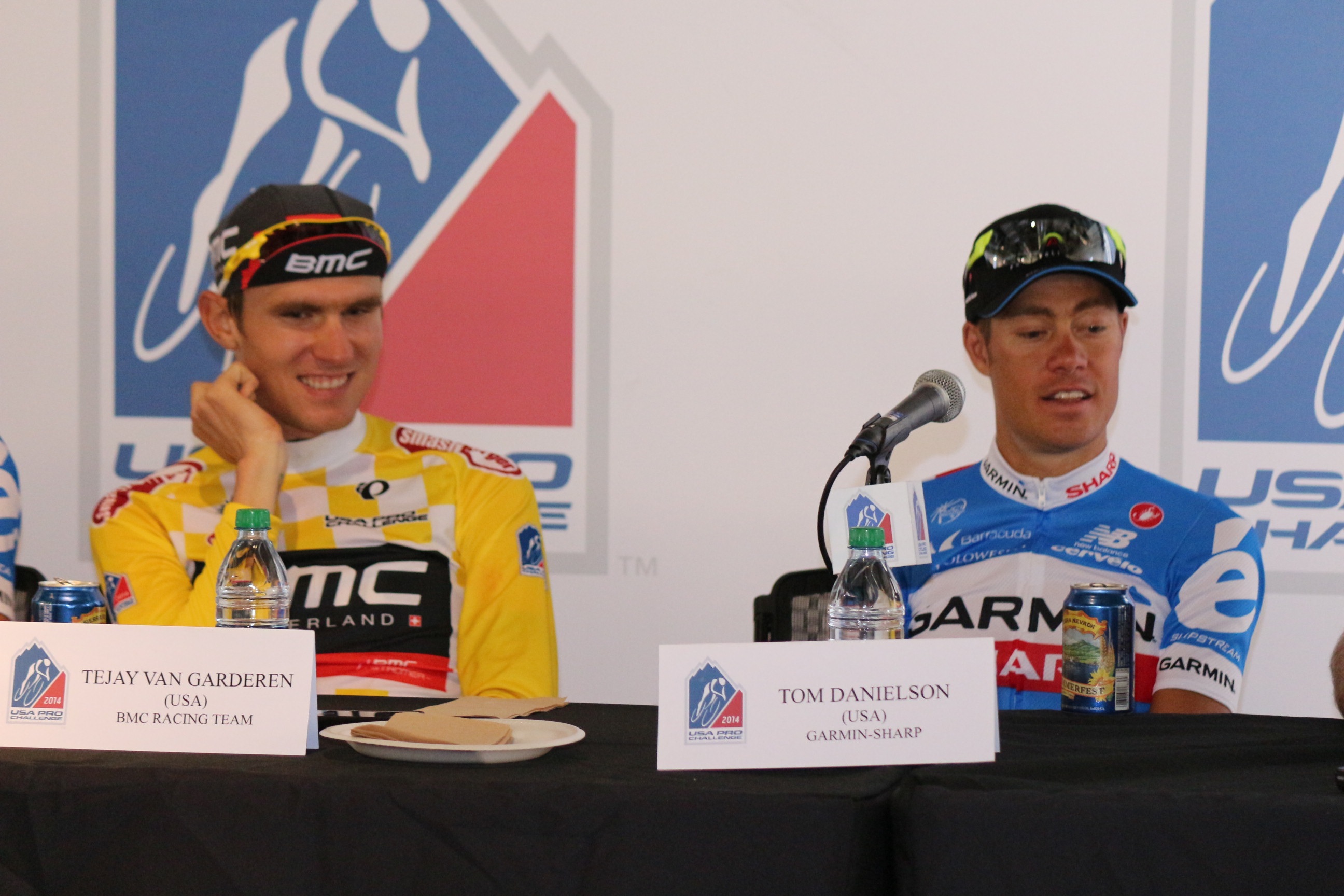
The 2014 USA Pro Challenge saw 128 of the best professional cyclists in the world compete in the toughest professional cycling race in the U.S. over the course of seven days, Aug. 18-24. Fans came out in droves to watch the action-packed, heart-pounding racing through the Colorado Rockies. After traveling to 10 host cities for the official stage starts and finishes, and passing through many other notable towns along the way, the estimated economic impact of the race to the State of Colorado is $130 million, according to a study done by Sponsorship Science, a global sports research firm.
The Pro Challenge delivered another strong economic performance in its fourth running, with direct spending by traveling spectators contributing a significant portion of the economic impact. Both those fans from outside the state and Coloradans traveling 50 miles or more to take in an event stage contributed $130 million on lodging, food, transportation and entertainment, an increase of 12 percent year over year. This change was largely driven by a 10 percent increase in the average number of nights stayed and an 11 percent increase in per night average party spend, the result of a 15 percent increase in average per night lodging cost.
“Seeing the enthusiasm and passion from the fans lining the streets during the 2014 USA Pro Challenge really gave a sense of the growing support for the sport of cycling in the U.S.,” said Rick Schaden, owner of the race. “This race showcases Colorado to the world and creates an incredible economic impact locally that can be felt throughout the year. Further, it was great to see an increase in television viewership.”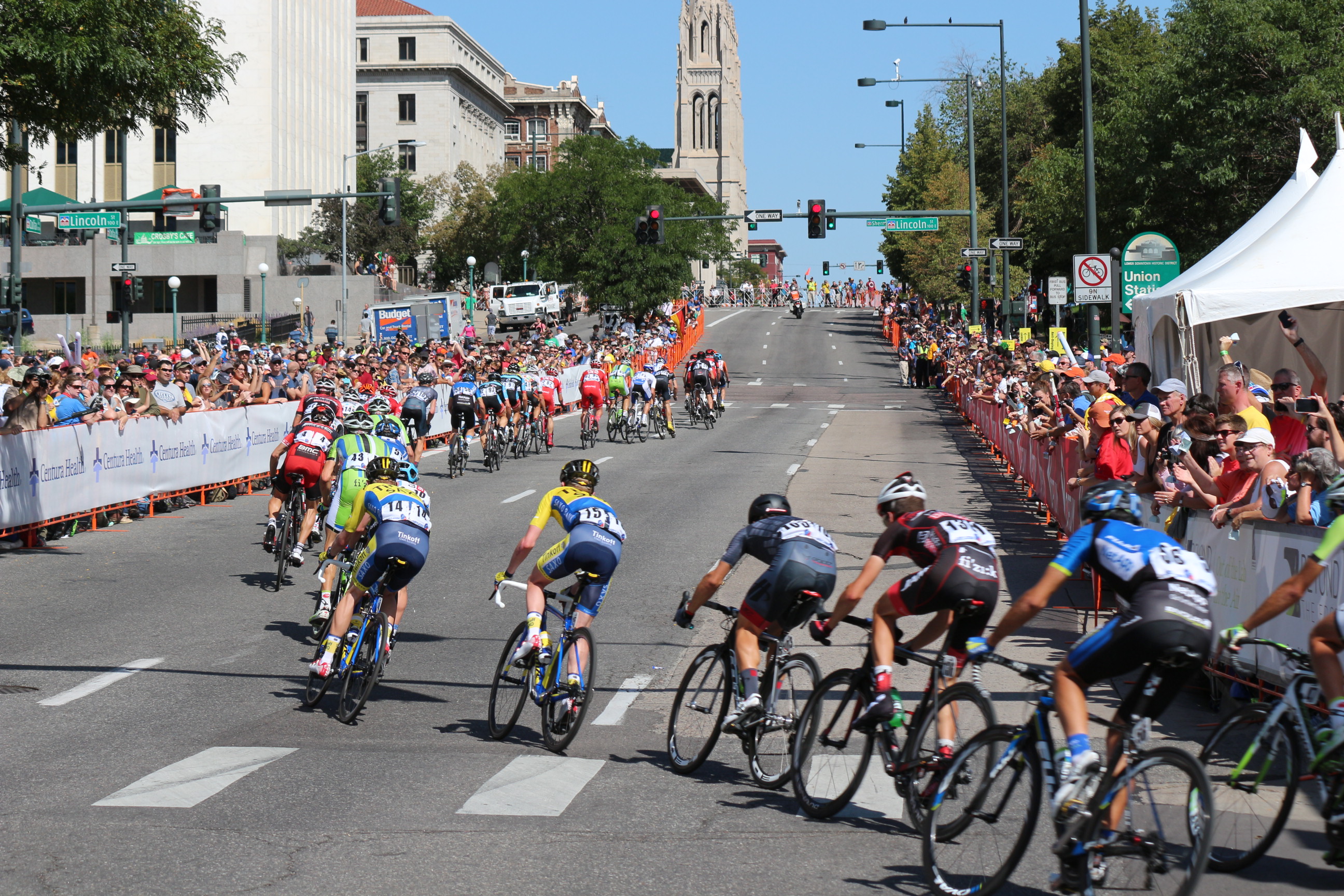
Following an epic week of racing through picturesque Colorado scenery, America’s most challenging race came to a conclusion in Downtown Denver when Aspen resident Tejay van Garderen (USA) of BMC Racing Team maintained his lead and took the overall win for the second year in a row. The race received unprecedented coverage totaling 30 hours on NBC, NBCSports and Universal Sports in the U.S. Additionally, through 40 hours of international coverage, the race was seen in more than 175 countries and territories around the world.
A draw for Colorado travel, 56 percent of spectators claimed they would not have traveled to the state at this time if it were not for the race. And with that, 70.9 percent stated they are likely to return to watch the race next year.
Additional interesting analysis points include:
· Spectators traveled in groups, with the average party consisting of three people
· The average hotel stay for spectators increased in 2014 to 5.3 nights
· 53 percent of race attendees live in households with income exceeding $85,000 and within that group 32 percent had household incomes in excess of $120,000
· Spectators enjoyed their race experience, with more than 80 percent saying they were very satisfied or satisfied with the race
· More than half of spectators in attendance reported they ride a bike for fitness, with 47 percent saying they engage in road cycling a lot
· This was an audience that appreciates the world-class level of competition at the USA Pro Challenge and watches major cycling events on television, with 83.8 percent stating they watch the Tour de France
About the research study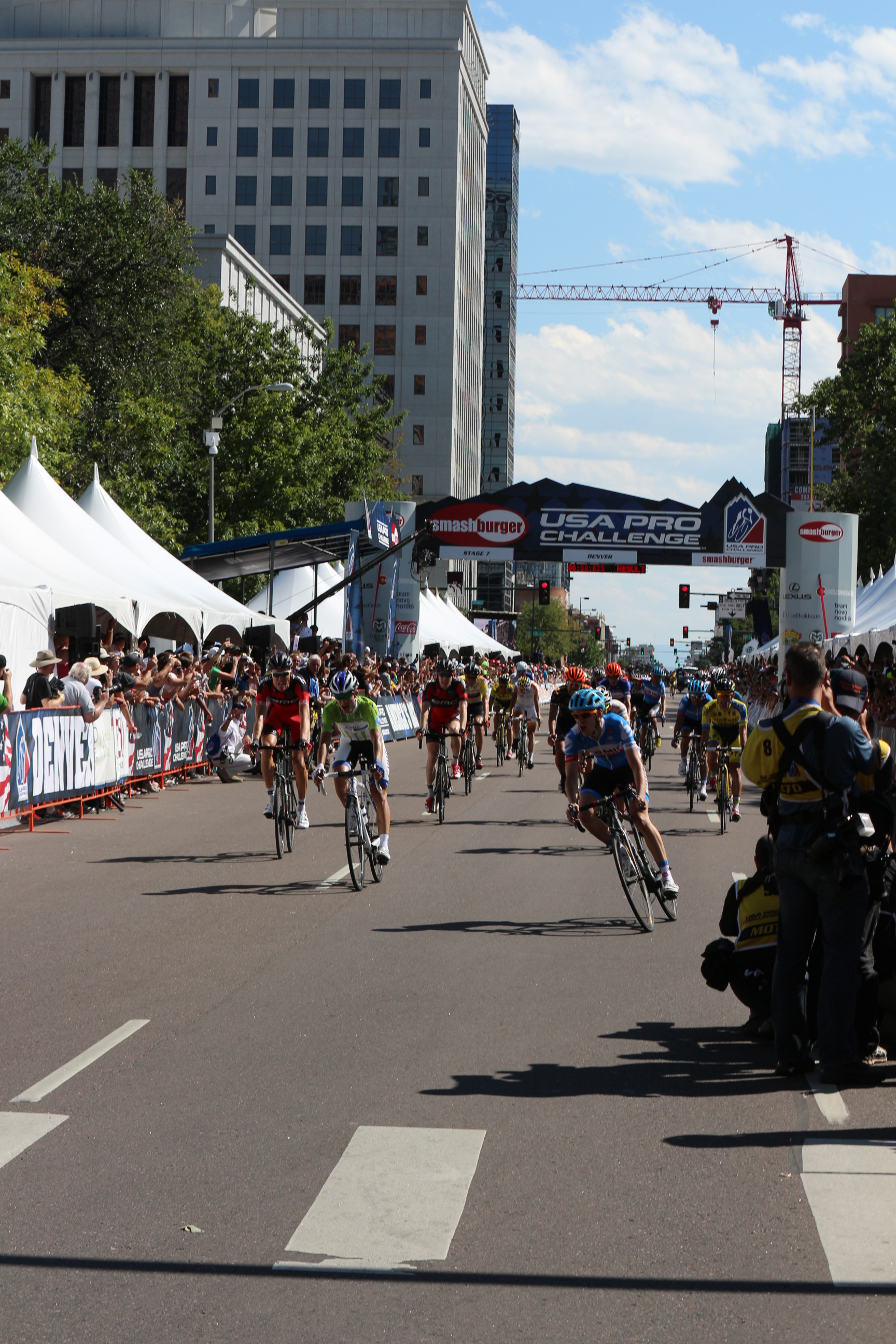
The USA Pro Challenge commissioned Sponsorship Science LLC, a global sports marketing & research consultancy firm with more than 50 years of executive experience working with events around the world, to continue conducting quantitative research measuring the change in overall economic impact of the Pro Challenge over time.
“While we conduct these types of studies for sports and entertainment clients around the world, across many platforms and geographies, cycling has always been a core sport, and one where we have a wealth of experience, ” said David Porthouse, SVP of Sponsorship Science, LLC. “Our history with the event and trust in the Pro Challenge management team, as well as the promoter Medalist Sports, has allowed us to develop the data and models used to accurately and fairly evaluate the growth of the race over time and its impact on the state of Colorado.”
Sponsorship Science, LLC designed the study from the outset to deliver consistent, defensible results which address many of the contentious issues surrounding economic impact reporting. Kevin Schott, director of Sponsorship Science notes the multi-year relationship with academia via Dr. Brett Boyle, professor within the sports business program at St. Louis University, has paid enormous dividends in terms of scientific rigor and credibility throughout the duration of this long-term relationship, serving as the foundation for the future. Key areas addressed included:
· Substitution effects – Since local fans will often spend similar amounts on local sports and other entertainment, Sponsorship Science, LLC did not include the local fan spend in the economic impact report, as a net impact, although local participation was thoroughly tracked, and forms a significant part of the appeal
· Time shifting – Colorado is an attractive destination for travel, so Sponsorship Science, LLC deliberately filtered respondents to ensure they were not capturing data from spectators already in Colorado, independent of the Pro Challenge, and also used elimination questions to remove those fans who intended to come to Colorado in the near future independent of the race. Despite these rigorous procedures, the number of dedicated fans travelling to the Pro Challenge has followed a long-term growth trend
· Sample sizes – Large samples were taken at all stages, distributed across the race locations, in order to create samples and sub-samples (by age, income, distance travelled, etc.) that are all statistically significant
A recall leads to lawsuits because injuries are connected to the product being recalled thus a lawsuit. Plaintiffs hope the three can be connected
Posted: October 13, 2014 Filed under: Cycling, Michigan | Tags: bicycle, Bicycle helmet, Breach of Warranty, Catlike Sport Components SL, Catlike USA, Consumer Product Safety Council, CPSC, Cycling, helmet, Monarch Velo Llc, The Kreb Cycle, Tracy Ann Jenish, warranty, Warranty of Fitness, Warranty of Fitness for a Particular Purpose Leave a commentPlaintiff crashed her bike suffering head injuries. Plaintiff was wearing a bicycle helmet that was subject to a recall, earlier. The plaintiff hoped her injury could be paid for by the helmet manufacturer using the recall as the influence with the jury.
State: Michigan
Plaintiff: Tracy Ann Jenish
Defendant: Monarch Velo Llc dba Catlike USA, a Texas Corporation, The Kreb Cycle, a New York Corporation, and Catlike Sport Components SL
Plaintiff Claims: negligence, gross negligence, and breach of warranty
Defendant Defenses:
Holding: for the defendant
Year: 2007
This is why recalls are such a problem. The recalls themselves are a nightmare for the outdoor recreation industry because the problems don’t fit in the Consumer Product Safety Council (CPSC) mold. The cost goes through the roof trying to comply with the requirements of the recall and deal with the resulting bad publicity.
The biggest problem is recalls immediately show up on the plaintiff attorney’s websites with the line Have you been hurt using/wearing this product “Call us.”
In this case, the plaintiff purchased a bicycle helmet from the defendant retailer. The bicycle helmet was subject to a recall prior to the plaintiff’s crash. The plaintiff exchanged the helmet for a newer one due to the recall, prior to her crash. The plaintiff fell while riding her bike suffering head and other injuries and sued.
The first defendant was a retailer in New York. The retailer purchased the helmet from a distributor in Texas. The distributor imported the helmet from the manufacturer, a Spanish corporation. All three, the manufacturer, distributor, and retailer were defendants to the litigation. All three were in the chain of sale from the manufacturer to the consumer.
The theory behind allowing suits against everyone involved in the litigation is anyone in the chain could have spotted the defect and prevented the consumer from purchasing a defective product. That was a great theory when wagon wheels were being sold. Everyone understood wagon wheels and could see a flaw or defect in a wagon wheel before the consumer purchased the wheel.
That general theory does not work any longer in software, computers or in this case a bike helmet. If you could understand the physics and engineering behind the creation of the helmet, you could not see the defects in many cases because the defects are covered by plastic.
The suit was filed in Michigan the home state of the plaintiff in the United States District Court for the Eastern District of Michigan, Southern Division. Federal courts are the courts in place to deal with litigation between parties from different states or of the US and another country. The federal courts are not subject to the issue of “hometowning” or deciding a case solely on the issue of where the parties live in the courts’ hometown.
The three defendants filed a motion for summary judgment, which was granted.
Federal District Court decisions are reported. Very few states report trial court decisions. However, this is different in the federal system, and we have an interesting case.
Analysis: making sense of the law based on these facts.
The plaintiff dismissed its negligence and gross negligence claims and proceeded with its breach of warranty claims prior to this motion. The plaintiff stated there was no express warranty claim, only a breach of implied warranty. Implied warranties are warranties that attach to any sale. They are not written down in the manual, they occur whenever there is a sale. Implied warranty of merchantability and implied warranty of fitness for a particular purpose are warranties that go with every sale and are the two main claims in lawsuits.
These warranties are not in writing and unless disclaimed, they go with any sale. The first, warranty of merchantability means the product meets the requirements of the industry where they are sold. The implied warranty of fitness for a particular purpose is a warranty that the promises made by the sellers will be met by the product. For more information on these warranties see The legal relationship created between Manufacturers and US consumers.
No specific warranty was mentioned in the decision other than the warranty of fitness and merchantability. There were also allegations that there was a breach of warranty under Michigan’s law, which may be the same or different from the warranties explained above.
The plaintiff’s case was based on the recall. The CPSC required a recall “poster” which was entered into evidence as proof of the recall and the defect. The plaintiff also had an expert who opined that the plaintiff’s head injury “directly related to the inadequacies of the Catlike Kompact bike helmet.”
No other evidence was introduced. The expert’s opinion was not specific and did not provide any cause for the injury or the failure of the helmet. The court held that because there was no analysis of the crash, speed, location of impact or details of the accident the expert’s opinion was of no value.
As discussed at oral argument, plaintiff has not brought forth any evidence of the reason the Catlike Kompact helmet failed impact testing. All that has been presented is a one-page press release from the CPSC, set forth above, including a statement that “[t]he helmets fail impact testing required under CPSC’s safety standard for bicycle helmets, violating the Consumer Product Safety Act.” Without additional information from the CPSC or any other source, or the results of any independent testing, it is the opinion of the court that Dr. Kress’ statement that “[t]he severity of the head injury sustained by Ms. Jenish is a direct result of the inability of the Catlike Kompact to comply to the CPSC’s safety standards” can be nothing but inadmissible speculation.
Although warranty claims require very little evidence to prove, in this case, no evidence was presented that the court could rely upon to uphold the claims of the plaintiff. The court granted the three defendants’ motion and dismissed the case.
So Now What?
This case has little value in teaching about helmet crashes, and the liability issues involved in manufacturing helmets. What it does teach is the unintended consequence of dealing with a recall and the CPSC.
It is impossible, probably, nowadays to create a product that will never have a recall. However, that does not mean you should try. As important, if you are looking at a recall, make sure you fully understand the consequences and work with counsel to lessen the impacts of the recall on your company and the effects it may have.
You also must disclaim all warranties other than the warranties you want for your product. If the proper disclaimer had been part of the information going with the sale of the helmet then this case would not have gone this far.
It is common for many products in the outdoor recreation industry to be brought into the US without the proper warranties and disclaimers. Additionally, many times when translating a product manual the word warranty will be translated into the word guaranty in English, which creates even greater liability issues.
 Jim Moss |
Jim Moss is an attorney specializing in the legal issues of the outdoor recreation community. He represents guides, guide services, outfitters both as businesses and individuals and the products they use for their business. He has defended Mt. Everest guide services, summer camps, climbing rope manufacturers, avalanche beacon manufacturers, and many more manufacturers and outdoor industries. Contact Jim at Jim@Rec-Law.us |
Outdoor Recreation Insurance, Risk Management, and Law
Jim is the author or co-author of six books about the legal issues in the outdoor recreation world; the latest is Outdoor Recreation Insurance, Risk Management and Law.
To see Jim’s complete bio go here and to see his CV you can find it here. To find out the purpose of this website go here.
G-YQ06K3L262
What do you think? Leave a comment.
If you like this let your friends know or post it on FB, Twitter or LinkedIn
 Blue Sky |
 Stimulus |
 X (formerly known as Twitter) logo |
 Threads |
 |
 |
Author: Outdoor Recreation Insurance, Risk Management and Law
Facebook Page: Outdoor Recreation & Adventure Travel Law
Email: Jim@Rec-Law.US
By Recreation Law Rec-law@recreation-law.com James H. Moss
@2024 Summit Magic Publishing, LLC
#AdventureTourism, #AdventureTravelLaw, #AdventureTravelLawyer, #AttorneyatLaw, #Backpacking, #BicyclingLaw, #Camps, #ChallengeCourse, #ChallengeCourseLaw, #ChallengeCourseLawyer, #CyclingLaw, #FitnessLaw, #FitnessLawyer, #Hiking, #HumanPowered, #HumanPoweredRecreation, #IceClimbing, #JamesHMoss, #JimMoss, #Law, #Mountaineering, #Negligence, #OutdoorLaw, #OutdoorRecreationLaw, #OutsideLaw, #OutsideLawyer, #RecLaw, #Rec-Law, #RecLawBlog, #Rec-LawBlog, #RecLawyer, #RecreationalLawyer, #RecreationLaw, #RecreationLawBlog, #RecreationLawcom, #Recreation-Lawcom, #Recreation-Law.com, #RiskManagement, #RockClimbing, #RockClimbingLawyer, #RopesCourse, #RopesCourseLawyer, #SkiAreas, #Skiing, #SkiLaw, #Snowboarding, #SummerCamp, #Tourism, #TravelLaw, #YouthCamps, #ZipLineLawyer, Tracy Ann Jenish, Monarch Velo Llc, Catlike USA, The Kreb Cycle, Catlike Sport Components SL, Cycling, Bicycle, Bicycle Helmet, Helmet, CPSC, Consumer Product Safety Council, Warranty, Warranty of Fitness for a Particular Purpose, Warranty of Fitness, Breach of Warranty,
2014 VeloSwap: Into Cycling you need to be there if you Need a deal or got deals to sell
Posted: October 10, 2014 Filed under: Cycling, Mountain Biking | Tags: bicycle, Bicycle Colorado, Colorado, Cycling, Denver, Ecovillage, x, y, z Leave a comment
MEDIA ADVISORY
Wheelin’ and Dealin’ at Cyclists’ Ultimate Bargain Hunt
· Subaru VeloSwap Denver returns to National Western Complex Sat., Oct 18
· 10,000 expected to buy, sell and swap bikes, gear, parts and accessories
· Find the best deals of the year as bike shops and more clear out inventory!
| What: | Inspired by the excitement of the USA Pro Cycling Challenge? Dreaming of a new set of wheels? Get ready to ride at the Subaru VeloSwap Denver, the ultimate bargain treasure hunt for cycling enthusiasts. A true celebration of all things cycling, the event features the opportunity to buy, sell and recycle new and used bicycles and equipment. Find the rarest parts and the best deals, while recycling your old gear! Veloswap.com |
| When: | Saturday, October 18, 20149:00am – 4:00pm |
| Where: | National Western Complex4655 Humboldt St. Denver, CO 80216 |
| Who: | · Almost 10,000 people are expected to attend· 300+ exhibitors will have the best deals cyclists will see all year
· Thousands start lining up outside as early as 6:00am to get the best deals |
| Tickets: |
|
| More: |
· New!! – New Product Showcase; check out the new 2015 equipment and talk with company reps about the latest and greatest in the industry including Bianchi, Parlee, Focus, Pedego E-Bikes and more. · Participants are invited to attend unique and informative seminars from Natural Grocers and others and enter to win amazing raffle prizes. · The day will conclude with live music in the supplier area. |
 Green Guru will be there taking your old tubes and recycling them into new products. Green Guru will be there taking your old tubes and recycling them into new products. |
Jenish v. Monarch Velo Llc dba Catlike USA, 2007 U.S. Dist. LEXIS 34120; CCH Prod. Liab. Rep. P17,754 (E.D. Mich. S.D. 2007)
Posted: October 7, 2014 Filed under: Cycling, Legal Case, Michigan | Tags: bicycle, Bicycle helmet, Breach of Warranty, Catlike Sport Components SL, Catlike USA, Consumer Product Safety Council, CPSC, Cycling, helmet, Monarch Velo Llc, The Kreb Cycle, Tracy Ann Jenish, warranty, Warranty of Fitness, Warranty of Fitness for a Particular Purpose Leave a commentTo Read an Analysis of this decision see: A recall leads to lawsuits because injuries are connected to the product being recalled thus a lawsuit. Plaintiffs hope the three can be connected
Jenish v. Monarch Velo Llc dba Catlike USA, 2007 U.S. Dist. LEXIS 34120; CCH Prod. Liab. Rep. P17,754 (E.D. Mich. S.D. 2007)
Tracy Ann Jenish, Plaintiff, vs. Monarch Velo Llc dba Catlike USA, a Texas Corporation, The Kreb Cycle, a New York Corporation, and Catlike Sport Components SL, a Spanish Corporation, Defendants.
Case No. 05-CV-73648
UNITED STATES DISTRICT COURT FOR THE EASTERN DISTRICT OF MICHIGAN, SOUTHERN DIVISION
2007 U.S. Dist. LEXIS 34120; CCH Prod. Liab. Rep. P17,754
May 9, 2007, Decided
May 9, 2007, Filed
CORE TERMS: helmet, catlike, bicycle, safety standard, summary judgment, head injuries, consumer, warranty, material fact, brain, acceleration, testing, seller, bike, Bicycle Helmets Final Rule, entitled to judgment, traumatic, hematoma, usa, Consumer Product Safety Act, matter of law, genuine issue, implied warranty, proximate cause, manufactured, manufacturer, distributor, attenuation, deposition, violating
COUNSEL: [*1] For Tracy Ann Jenish, Plaintiff: Lawrence S. Katkowsky, LEAD ATTORNEY, Lawrence S. Katkowsky Assoc., Bingham Farms, MI.
For Kreb Cycle, Defendant: Matthew A. Brauer, LEAD ATTORNEY, Rutledge, Manion, (Detroit), Detroit, MI.
JUDGES: GEORGE CARAM STEEH, UNITED STATES DISTRICT JUDGE.
OPINION BY: GEORGE CARAM STEEH
OPINION
OPINION AND ORDER GRANTING DEFENDANT THE KREB CYCLE’S MOTION FOR SUMMARY JUDGMENT (DOCUMENT # 38)
INTRODUCTION
Before the court in this product liability lawsuit is a motion for summary judgment brought by defendant The Kreb Cycle, a New York seller of bicycle equipment, in which it asserts it is entitled to judgment on all counts in the complaint. 1 Because the court agrees that plaintiff has not raised a question of material fact as to causation of her injuries by an allegedly defective bicycle helmet, defendant’s motion is granted as set forth below.
1 The other defendants to this action have not filed answers to the complaint.
BACKGROUND
Plaintiff Tracy Jenish was riding with a bicycling [*2] club on Wing Lake Road in the area of Bloomfield Hills, Michigan on September 26, 2002, when she fell off her bike and suffered serious bodily injuries, including injuries to her head. She was wearing a helmet called a “Catlike Kompact,” manufactured by defendant Catlike Sport Components SL, a Spanish corporation, distributed by defendant Monarch Velo LLC, a Texas corporation 2, and sold to the plaintiff by movant-defendant Kreb Cycle, a New York corporation.
2 Answers to the complaint by the remaining defendants have not been filed, and defendant Kreb Cycle states in its motion that the other defendants are in default. The docket reflects that a clerk’s entry of default was filed as to defendant Monarch Velo, L.L.C. on June 2, 2006.
The Kreb Cycle (hereinafter “defendant”) started carrying these helmets after its owner attended a trade show in Las Vegas, where a model of the Catlike Kompact helmet was on display. Defendant ordered the helmets from Monarch Velo LLC, d/b/a “Catlike USA,” a Texas distributor. [*3] The helmets came with the manufacturer’s label stating they complied with U.S. Consumer Product Safety Commission (“CPSC”) standards. Although there are no records of the sale, defendant does not dispute that it sold the helmet to plaintiff. Plaintiff’s recollection, according to her deposition, is that she called in with a credit card or ordered it online, at some point during the year preceding the accident.
In 2003, some months after plaintiff’s accident, the Catlike Kompact helmet was the subject of a voluntary manufacturer recall. Defendant has produced a copy of the CPSC’s announcement of this recall, which is reproduced below in its entirety, with the exception of the generic CPSC headings and contact numbers:
*****
CPSC, Monarch Velo, LLC doing business as Catlike USA Announce Recall of Bike Helmets
Washington, D.C. — The U.S. Consumer Product Safety Commission announces the following recall in voluntary cooperation with the firm below. Consumers should stop using recalled products immediately unless otherwise instructed.
Name of product: Catlike Kompact TM Bike Helmets
Units: 2,250
Distributor: Monarch Velo, LLC, doing business [*4] as Catlike USA, of Houston, Texas
Hazard: The helmets fail impact testing required under CPSC’s safety standard for bicycle helmets, violating the Consumer Product Safety Act.
Incidents/Injuries: None reported.
Description: This recall involves Catlike Kompact TM adult bicycle helmets. The helmets were sold in two sizes (small/medium and large/extra large) and various colors. The sizing label inside the helmets reads “Kompact” and “SM/MD” or “LG/XL.”
Sold at: Bicycle shops nationwide sold the helmets from March 2002 through February 2003 for about $ 130.
Manufactured in: Spain
Remedy: Contact Monarch Velo for information on receiving a free replacement helmet.
Consumer Contact: Contact Monarch Velo toll-free at (877) 228-5646 between 9 a.m. and 5 p.m. CT Monday through Friday or visit the firm’s web site at http://www.catlike-usa.com
Media Contact: Chris Watson at (877) 228-5646.
Exhibit D to Defendant’s Motion. Plaintiff obtained a replacement Catlike helmet after announcement of the recall.
This action was filed in federal court on the basis of diversity of citizenship in September 2005. [*5] Plaintiff’s First Amended Complaint, filed September 29, 2005, makes a common claim against all three defendants, asserting negligence, gross negligence, and breach of warranty in the design, manufacture, and distribution of an unmerchantable, “untested” bicycle helmet that failed to protect against injury to the head.
STANDARD FOR SUMMARY JUDGMENT
Federal Rule of Civil Procedure 56(c) empowers the court to render summary judgment “forthwith if the pleadings, depositions, answers to interrogatories and admissions on file, together with the affidavits, if any, show that there is no genuine issue as to any material fact and that the moving party is entitled to judgment as a matter of law.” See Redding v. St. Eward, 241 F.3d 530, 532 (6th Cir. 2001). The Supreme Court has affirmed the court’s use of summary judgment as an integral part of the fair and efficient administration of justice. The procedure is not a disfavored procedural shortcut. Celotex Corp. v. Catrett, 477 U.S. 317, 327, 106 S. Ct. 2548, 91 L. Ed. 2d 265 (1986); see also Cox v. Kentucky Dept. of Transp., 53 F.3d 146, 149 (6th Cir. 1995).
The [*6] standard for determining whether summary judgment is appropriate is “‘whether the evidence presents a sufficient disagreement to require submission to a jury or whether it is so one-sided that one party must prevail as a matter of law.'” Amway Distributors Benefits Ass’n v. Northfield Ins. Co., 323 F.3d 386, 390 (6th Cir. 2003) (quoting Anderson v. Liberty Lobby, Inc., 477 U.S. 242, 251-52, 106 S. Ct. 2505, 91 L. Ed. 2d 202 (1986)). The evidence and all reasonable inferences therefrom must be construed in the light most favorable to the non-moving party. Matsushita Elec. Indus. Co., Ltd. v. Zenith Radio Corp., 475 U.S. 574, 587, 106 S. Ct. 1348, 89 L. Ed. 2d 538 (1986); Redding, 241 F.3d at 532 (6th Cir. 2001). “[T]he mere existence of some alleged factual dispute between the parties will not defeat an otherwise properly supported motion for summary judgment; the requirement is that there be no genuine issue of material fact.” Anderson v. Liberty Lobby, Inc., 477 U.S. 242, 247-48, 106 S. Ct. 2505, 91 L. Ed. 2d 202 (1986) (emphasis in original); see also National Satellite Sports, Inc. v. Eliadis, Inc., 253 F.3d 900, 907 (6th Cir. 2001). [*7]
If the movant establishes by use of the material specified in Rule 56(c) that there is no genuine issue of material fact and that it is entitled to judgment as a matter of law, the opposing party must come forward with “specific facts showing that there is a genuine issue for trial.” First Nat’l Bank v. Cities Serv. Co., 391 U.S. 253, 270, 88 S. Ct. 1575, 20 L. Ed. 2d 569 (1968); see also McLean v. 988011 Ontario, Ltd., 224 F.3d 797, 800 (6th Cir. 2000). Mere allegations or denials in the non-movant’s pleadings will not meet this burden, nor will a mere scintilla of evidence supporting the non-moving party. Anderson, 477 U.S. at 248, 252. Rather, there must be evidence on which a jury could reasonably find for the non-movant. McLean, 224 F.3d at 800 (citing Anderson, 477 U.S. at 252).
ANALYSIS
Kreb Cycle asserts in its motion that it is entitled to judgment as to all three of plaintiff’s claims: negligence, gross negligence, and breach of warranty. In response, plaintiff asserts it is “only relying on the implied warranty of fitness and merchantability as to this Defendant and will not, therefore, respond to [*8] Defendant’s arguments as to negligence and gross negligence.” Accordingly, judgment is hereby granted for Kreb Cycle as to plaintiff’s negligence and gross negligence claims.
The sole claim remaining as to this defendant is plaintiff’s breach of warranty claim. Plaintiff concedes defendant made no express warranty regarding this helmet. Accordingly, proceeding on a cause of action for breach of an implied warranty, plaintiff asserts that she has established a prima facie case of breach of implied warranty under Michigan law, 3 citing to this court’s case of Konstantinov v. Findlay Ford Lincoln Mercury, 2006 U.S. Dist. LEXIS 85836, 2006 WL 3299487. As set forth in that case, under the Michigan Tort Reform Act, effective in 1996,
(6) In a product liability action, a seller other than a manufacturer is not liable for harm allegedly caused by the product unless either of the following is true:
(a) The seller failed to exercise reasonable care, including breach of any implied warranty, with respect to the product and that failure was a proximate cause of the person’s injuries.
(b) The seller made an express warranty as to the product, the product failed to conform to the warranty, and the [*9] failure to conform to the warranty was a proximate cause of the person’s harm.
Mich. Comp. Laws Ann. § 600.2947(6).
3 Although the retailer was a New York seller, neither party asserts applicable law other than that of Michigan.
Defendant’s argument for summary judgment on this claim is that plaintiff has not come forward with any evidence of a specific defect in the helmet, and has not drawn any kind of causal connection between the alleged defect and her head injuries. It cites to Mascarenas v. Union Carbide, 196 Mich. App. 240, 249, 492 N.W.2d 512 (1992) for the elements of a product liability case under Michigan law: proof that the defendant supplied a defective product, and that the defect proximately caused the plaintiff’s injury. Defendant argues that plaintiff relies only on the helmet’s later recall, disclosed in a 5/22/03 CPSC press release (stating that the recall was occurring “in voluntary cooperation with” the U.S. distributor) and conclusory statements [*10] by an expert, neither of which establish a question of material fact as to proximate cause. 4
4 Defendant also addresses plaintiff’s weak assertion, in answers to interrogatories, that defendant “had a duty to determine whether the model helmet in question did in fact meet CPSC standards.” As defendant argues, there is no such duty required by Mich. Comp. Laws Ann. § 600.2947(6), set forth above.
The court agrees with the defendant. Although precedent such as Mills v. Curioni, Inc., 238 F. Supp. 2d 876, 886 (E.D. Mich. 2002) and the very recent decision in Coleman v. Maxwell Shoe Co., 475 F. Supp. 2d 685, 2007 U.S. Dist. LEXIS 11513, 2007 WL 551608 (E.D. Mich. 2007) lend support to defendant’s argument concerning non-manufacturing sellers and the need for a showing of negligence in failing to detect a product’s defect, this case must be dismissed whether or not such evidence is required.
Plaintiff’s expert’s initial report, created by Tyler A. Kress, Ph.D. in Knoxville, Tennessee, dated [*11] October 6, 2006, summarily lists plaintiff’s injuries following the accident. It then lists all of the expert’s qualifications, his fees, and the records he reviewed. These are a 9/26/2002 CT scan of plaintiff’s head; the hospital’s discharge summary; a letter of April 3, 2003 by a Jon Wardner, M.D. stating plaintiff’s disability; the CPSC announcement of the helmet recall; and the plaintiff’s deposition. Dr. Kress also states that he met with the plaintiff. The remainder (and the entire substance) of his letter/report stated only a conclusion that a “defect” of the helmet was “directly related to the inadequacies of the Catlike Kompact bike helmet.”
Defendant then brought a motion, granted by the magistrate, for sanctions and to require a supplemental report by November 15, 2006, containing a “complete statement of all opinions to be expressed and the basis and reasons therefor…” A supplemental report was subsequently created by Dr. Kress. That report, dated November 15, 2006, is set forth below in its entirety:
Dear Mr. Katkowsky:
This is to supplement my report of October 6, 2006, regarding the above-styled cause.
1) Use: It is my opinion that it is foreseeable [*12] that some consumers will sustain a preventable head injury due to the impact performance (or lack thereof) of the helmet while using it in an appropriate manner as it is intended to be used.
Protective head gear and bicycle helmets have the ability to eliminate or greatly reduce traumatic head and brain injury when properly designed an manufactured. To ensure that bicycle helmets available in the consumer market adequately serve these goals, the Consumer Product Safety Commission has created safety standards for a range of criterion, including impact attenuation (CPSC’s Safety Standard for Bicycle Helmets Final Rule: 16 CFR Part 1203).
Bicycle helmets that have adequate impact attenuation performance, as set forth by the CPSC’s safety standards, and are used in an appropriate, reasonable, and correct manner are highly successful in preventing or greatly reducing traumatic head and brain injury. As found in a 1989 study by Thompson et al and explicitly cited in the CPSC’s Safety Standard for Bicycle Helmets Final Rule (16 CFR Part 1203, pg. 11713), riders with helmets had an 85% reduction in head injury risk, and 88% reduction in brain injury risk.
2) Reason for Injury: [*13] Ms. Jenish’s head injury is directly related to the inadequacies of the Catlike Kompact bike helmet.
The CPSC’s Safety Standard for Bicycle Helmets Final Rule (16 CFR Part 1203) explicitly establishes a performance test to “ensure that helmets will adequately protect the head in a collision” (pg. 11714). As a component of this performance test, helmets are required to not exceed a peak headform acceleration of 300 g for any impact. This pass/fail criterion of 300g or below is consistent with other standards such as the ANSI, Snell, and ASTM (CPSC’s Safety Standard for Bicycle Helmets Final Rule (16 CFR Part 1203, pg. 11714; Halstead 2001). The Catlike Kompact bike helmet is inadequate due to the fact that it failed impact standards that pertain to the design and performance of the helmet in a foreseeable use that may result in an impact to the head.
In the accident on September 26, 2002, Ms. Jenish hit a curb while riding her bicycle, was ejected, and impacted her head. She reported a loss of consciousness at the scene, and her relevant injuries include, but are not limited to, a traumatic brain injury and a subdural hematoma. Ms. Jenish sustained a direct impact to the back [*14] of the head (occipital region) which corresponds to a right occipatal scalp hematoma and the area of impact and failure seen in the helmet. Contact head impacts, such as this, result in predominantly linear acceleration of the head and brain, with small components of angular acceleration. Linear acceleration can product focal brain injuries, such as subdural hematomas, as well as concussions; as seen in Ms. Jenish.
The severity of the head injury sustained by Ms. Jenish is a direct result of the inability of the Catlike Kompact to comply to the CPSC’s safety standards. Subdural hematomas, similar to the one sustained by Ms. Jenish, are commonly caused by an impact to the occipital region (Kleiven 2003, Zhou et al 1995). The acceleration of the head in an occipital impact exceeded the values of what a reasonably designed and protective headgear would have given the wearer. Due to the failure of the Catlike Kompact bicycle helmet to comply to the CPSC’s impact safety standards Ms. Jenish’s head experienced higher acceleration values resulting in a more serious traumatic brain injury than would have been experienced if the helmet was compliant with the impact standards of the CPSC. [*15]
3) Design Defect: The helmet is inherently dangerous and defective by design in that it fails to comply with impact testing standards required under CPSC’s safety standard for bicycle helmets, violating the Consumer Product Safety Act.
The impact attenuation standards of the CPSC’s Safety Standard for Bicycle Helmets Final Rule (16 CFR Part 1203) was created in order to “ensure that helmets will adequately protect the head in a collision” (p. 11714). Failure to meet this standard endangers consumers by failing to prevent or reduce injury.
If you have any questions or need anything further please do not hesitate to contact me.
Sincerely,
/s/
Tyler Kress, Ph.D., CIE
Exhibit I to Defendant’s Motion and Exhibit 2 to Plaintiff’s Response.
Defendant contends that all this report arguably establishes is that the helmet failed to “meet standards;” and that plaintiff has failed to connect that alleged, undefined defect to her injuries. As defendant asserts, there is no evaluation of items such as plaintiff’s speed at the time of the crash, location of impact, descriptive information concerning the object struck or other details of the accident. Defendant [*16] points to the serious injuries sustained by the plaintiff in the crash, including fractured vertebrae, a crushed rib cage, fractured collarbone, bulging spinal discs, and a collapsed lung, and asserts that helmets don’t rule out any and all head injuries, in any crash or at any speed, but serve to help protect against head injuries. Plaintiff has not identified the manufacturing or design elements of the helmet that led to voluntary recall nor has accident reconstruction tied these elements to the plaintiff’s injuries.
As discussed at oral argument, plaintiff has not brought forth any evidence of the reason the Catlike Kompact helmet failed impact testing. 5 All that has been presented is a one page press release from the CPSC, set forth above, including a statement that “[t]he helmets fail impact testing required under CPSC’s safety standard for bicycle helmets, violating the Consumer Product Safety Act.” Without additional information from the CPSC or any other source, or the results of any independent testing, it is the opinion of the court that Dr. Kress’ statement that “[t]he severity of the head injury sustained by Ms. Jenish is a direct result of the inability [*17] of the Catlike Kompact to comply to the CPSC’s safety standards” can be nothing but inadmissible speculation. Accordingly, it is the court’s determination that plaintiff has not produced evidence to raise a question of material fact regarding causation. Defendant’s motion will be granted.
5 Plaintiff has failed to identify any specific claimed defect, such as deficiencies in the suspension or cushioning system, hardness or thickness of the plastic, ventilation engineering, overall shape, the strapping mechanism, or any other particular aspects of the helmets in general, much less the helmet worn by plaintiff. Without knowing the defect that motivated a voluntary recall, and without testing of the helmet worn by plaintiff, it is impossible to conclude that a defect caused her injury.
CONCLUSION
Because plaintiff has failed to raise a question of material fact as to the proximate causation of her head injuries by an alleged defect in her bicycle helmet, summary judgment will enter as to all claims brought [*18] by the plaintiff against this defendant.
IT IS SO ORDERED.
Dated: May 9, 2007
S/ George Caram Steeh
UNITED STATES DISTRICT JUDGE
G-YQ06K3L262
Georgia Federal Court finds that assumption of the risk is a valid defense in a head injury case against a bicycle helmet manufacturer.
Posted: September 22, 2014 Filed under: Assumption of the Risk, Cycling, Georgia | Tags: assumption of the risk, bicycle, Bicycle South, Bike, Cycling, Florida, Georgia, Head injury, helmet, Inc., Incorporated, Open and Obvious, Opportunities, Product liability, Skid Lid Manufacturing Company, Trek Bicycle Corporation, Wheel Leave a commentIf you purchase a helmet that only protects part of your head, then you cannot sue for injuries to the part of your head not protected.
State: Georgia, US Court of Appeals for the Eleventh Circuit
Plaintiff: Lois Elaine Wilson
Defendant: Bicycle South, Inc.
Plaintiff Claims: Product Liability (breach of warranty, strict liability, and negligence)
Defendant Defenses: Assumption of the Risk and Open and Obvious
Holding: For the defendants
Year: 1990
This case is fairly easy to understand, even though the opinion is quite complicated. The plaintiff was riding her bike from Florida to California. While traveling through Georgia she crashed suffering head injuries.
She sued claiming the rear wheel of the bike collapsed causing her crash. She claimed her head injuries were caused because the helmet failed to protect her head.
She sued the wheel manufacturer, Opportunities Inc., the bicycle manufacturer, Trek Bicycle Corporation and the retailer Bicycle South, Inc. The three defendants were found not liable at trial.
The jury did find the helmet manufacturer, Skid Lid Manufacturing Company liable for the plaintiff’s head injuries. The majority of the decision reviews the helmet issues. The plaintiff purchased the helmet for her ride. The helmet was a “half helmet” which only covered the top half of her head. The helmet came down to about the top of her ears.
The jury found in favor of the plaintiff on the head injury issue caused by the helmet manufacturer. The defendant Skid Lid moved for a judgment notwithstanding the verdict, (JNOV), which the court granted. The defendant helmet manufacturer appealed the decision.
A JNOV is effectively a motion filed by the losing party and the judge overrules the jury. This is a motion that is rarely granted and only done so to overcome extreme or unreasonable jury verdicts. The judge must find that no reasonable jury could reach the decision that was reached by the jury in the case. Normally this is because there are insufficient facts to support the claims or the jury applied the law incorrectly.
In this case, the JNOV seemed to have been entered because the jury ignored the defenses presented by the defendant.
Summary of the case
Georgia at the time of the decision allowed several defense to product liability claims, two of which were: Assumption of the risk and the “open and obvious” defects. Variations of these defenses are available in some, but not all states. The trial judge in this case granted the JNOV based on the Assumption of the Risk defense. The appellate court looked at both of these defenses.
The open and obvious defense states a plaintiff cannot recover from a defendant when the alleged defect is patent and obvious to the user.
The open and obvious rule states that a product is not defective if the peril from which injury could result is patent or obvious to the user. This determination regarding the peril is made on the basis of an objective view of the product. In assessing what is obvious, it must be remembered that, contrary to the belief of some, the American public is not child-like.
This defense is not based on a defect in the product, only that the product will not or will do something that is patent, and open and obvious.
The defense applied here because the plaintiff when purchase the helmet purchased one that only covered part of her head. It was “obvious” that the helmet would not protect the part of her head that the helmet did not cover.
The assumption of risk defense is slightly different, but also applicable in this case. If the consumer knows of a defect in the product, is aware of the danger presented by the defect and proceeds to use the product anyway the plaintiff is barred from recovering. “The first part of the test, actual knowledge of the defect and danger, is fulfilled because appellant had subjective knowledge that the helmet she purchased only covered a portion of her head.”
The assumption of risk defense in Georgia is slightly more difficult to prove because the injured plaintiff must have known about the defect. (However, a defect only becomes one in pleadings after an injury has occurred.) What I mean by this is, as a manufacturer should point out the limitations of the product in the information supplied by the product. This provides the necessary notice to a user of the defect and provides a defense to the manufacturer.
The court also ruled on evidentiary issues in the case which are not important in understanding these issues.
So Now What?
For manufacturers, selling a product means more than just point out the great features of the product. You must warn the consumer of any problems or issues with the product and you must point out what the product cannot do.
That does not mean that you should point out your bicycle won’t get you to the moon. It might mean you should point out that the bicycle should only be ridden on roads if it is a road bike. Videos online show road bikes being ridden everywhere, but that does not mean as a manufacturer you should be liable when someone tries to ride the Monarch Crest Trail on your road bike.
As a retailer, you should point out the differences in products trying to specifically point out short comings about a product. This helmet has a MIPS system in side, this one does not.
Both of these defenses are easy to rely on, however not all states still allow the use of these defenses.
What do you think? Leave a comment.
If you like this let your friends know or post it on FaceBook, Twitter or LinkedIn
Copyright 2014 Recreation Law (720) Edit Law
Email: Rec-law@recreation-law.com
Google+: +Recreation
Twitter: RecreationLaw
Facebook: Rec.Law.Now
Facebook Page: Outdoor Recreation & Adventure Travel Law
Blog: www.recreation-law.com
Mobile Site: http://m.recreation-law.com
By Recreation Law Rec-law@recreation-law.com James H. Moss
#AdventureTourism, #AdventureTravelLaw, #AdventureTravelLawyer, #AttorneyatLaw, #Backpacking, #BicyclingLaw, #Camps, #ChallengeCourse, #ChallengeCourseLaw, #ChallengeCourseLawyer, #CyclingLaw, #FitnessLaw, #FitnessLawyer, #Hiking, #HumanPowered, #HumanPoweredRecreation, #IceClimbing, #JamesHMoss, #JimMoss, #Law, #Mountaineering, #Negligence, #OutdoorLaw, #OutdoorRecreationLaw, #OutsideLaw, #OutsideLawyer, #RecLaw, #Rec-Law, #RecLawBlog, #Rec-LawBlog, #RecLawyer, #RecreationalLawyer, #RecreationLaw, #RecreationLawBlog, #RecreationLawcom, #Recreation-Lawcom, #Recreation-Law.com, #RiskManagement, #RockClimbing, #RockClimbingLawyer, #RopesCourse, #RopesCourseLawyer, #SkiAreas, #Skiing, #SkiLaw, #Snowboarding, #SummerCamp, #Tourism, #TravelLaw, #YouthCamps, #ZipLineLawyer, Opportunities, Incorporated, Trek Bicycle Corporation, Bicycle South, Inc., Skid Lid Manufacturing Company, Open and Obvious, Assumption of the Risk, Product Liability, Helmet, Wheel, Cycling, Bicycle, Bike,
WordPress Tags: Georgia,Federal,Court,assumption,injury,bicycle,helmet,manufacturer,injuries,Wilson,South,LEXIS,Evid,Serv,Callaghan,State,Appeals,Eleventh,Circuit,Plaintiff,Lois,Elaine,Defendant,Claims,Product,negligence,Defenses,Risk,Open,Obvious,defendants,opinion,bike,Florida,California,Opportunities,Trek,Corporation,retailer,jury,Skid,Company,decision,ears,judgment,verdict,JNOV,verdicts,Summary,Variations,user,peril,determination,basis,belief,American,consumer,danger,knowledge,appellant,limitations,information,manufacturers,roads,road,Videos,bikes,Monarch,Crest,Trail,differences,products,comings,MIPS,system,Both,Leave,FaceBook,Twitter,LinkedIn,Recreation,Edit,Email,Google,RecreationLaw,Page,Outdoor,Adventure,Travel,Blog,Mobile,Site,James,Moss,Authorrank,AdventureTourism,AdventureTravelLaw,AdventureTravelLawyer,AttorneyatLaw,BicyclingLaw,Camps,ChallengeCourse,ChallengeCourseLaw,ChallengeCourseLawyer,CyclingLaw,FitnessLaw,FitnessLawyer,HumanPoweredRecreation,JamesHMoss,JimMoss,OutdoorLaw,OutdoorRecreationLaw,OutsideLaw,OutsideLawyer,RecLaw,RecLawBlog,LawBlog,RecLawyer,RecreationalLawyer,RecreationLawBlog,RecreationLawcom,Lawcom,RiskManagement,RockClimbingLawyer,RopesCourse,RopesCourseLawyer,SkiAreas,SkiLaw,SummerCamp,Tourism,TravelLaw,YouthCamps,ZipLineLawyer,Wheel
Wilson v. Bicycle South, Inc., 915 F.2d 1503; 1990 U.S. App. LEXIS 18903; 31 Fed. R. Evid. Serv. (Callaghan) 682
Posted: September 21, 2014 Filed under: Assumption of the Risk, Cycling, Georgia, Legal Case | Tags: assumption of the risk, bicycle, Bicycle South, Bike, Cycling, helmet, Inc., Incorporated, Open and Obvious, Opportunities, Product liability, Skid Lid Manufacturing Company, Trek Bicycle Corporation, Wheel 1 CommentWilson v. Bicycle South, Inc., 915 F.2d 1503; 1990 U.S. App. LEXIS 18903; 31 Fed. R. Evid. Serv. (Callaghan) 682
Lois Elaine Wilson, Plaintiff-Appellant, v. Bicycle South, Inc., a Georgia Corporation, et al., Defendants-Appellees
No. 89-8522
UNITED STATES COURT OF APPEALS FOR THE ELEVENTH CIRCUIT
915 F.2d 1503; 1990 U.S. App. LEXIS 18903; 31 Fed. R. Evid. Serv. (Callaghan) 682
October 30, 1990
SUBSEQUENT HISTORY: As Amended.
PRIOR HISTORY: [**1] Appeal from the United States District Court for the Northern District of Georgia. No.1: 85-cv-2658-CAM; Moye, Jr., Judge.
DISPOSITION: AFFIRMED.
COUNSEL: Robert H. Benfield, Jr., Middleton & Anderson, Atlanta, Georgia, for Appellant.
For Trek Bicycle: Stephen F. Dermer, Smith Gambrell & Russell, Atlanta, Georgia.
For Bicycle South: Jonathan Mark Engram, Swift Currie McGhee & Hiers, Thomas E. McCarter, Atlanta, Georgia.
For Opportunities, Inc.: Tommy T. Holland, Carter & Ansley, Christopher N. Shuman, Atlanta, Georgia.
For Skid Lid: Palmer H. Ansley, Long Weinberg Ansley & Wheeler, David A. Sapp, Atlanta, Georgia.
JUDGES: Clark, Circuit Judge, Morgan and Hill, * Senior Circuit Judges.
* See, Rule 34-2(b), Rules of the U.S. Court of Appeals for the Eleventh Circuit.
OPINION BY: HILL
OPINION
[*1504] HILL, Senior Circuit Judge
I. INTRODUCTION
This appeal concerns a products liability action based upon alleged breach of warranty, strict liability, and negligence resulting in injuries to Lois Elaine Wilson (“Wilson”), appellant. Wilson incurred head injuries during an accident in Georgia while on a cross-country bicycle trip. The jury returned a verdict in favor of Wilson and against one defendant on a bicycle helmet defect claim, and against Wilson and in favor of three defendants on a bicycle wheel defect claim. The district court granted a judgment notwithstanding the verdict on the helmet claim. Plaintiff appeals [*1505] this grant and also alleges several other errors by the district court concerning the bicycle wheel claim.
A. Issues Presented
Appellant raises four distinct categories of issues on appeal. First, appellant claims that the district court erred in granting appellee Skid Lid Manufacturing Company’s (“Skid Lid”) motion for a judgment notwithstanding [**2] the verdict. Second, appellant contends that the district court improperly commented on the evidence. Third, she asserts that the district court committed reversible error by refusing to admit “similar accident” evidence. Finally, appellant maintains that the district court erred in charging the jury on the defense of “legal accident.”
We hold that the trial court did not err in granting the JNOV. Nor do the trial judge’s comments on the evidence provide cause for reversal. Similarly, we find appellant’s third and fourth contentions to be meritless.
B. Factual and Procedural History
On January 6, 1983, appellant purchased a Trek 614 touring bicycle. Trek Bicycle Corporation (“Trek”) manufactured the bicycle, Opportunities, Incorporated (“Opportunities”) assembled the bike’s rear wheel according to Trek’s specifications, and Bicycle South, Inc. (“Bicycle South”) sold the bike to appellant. The latter three parties will be referred to collectively as “the bicycle defendants.” On February 9, 1983, appellant also purchased, from a company not a party to this lawsuit, a bicycle helmet manufactured by Skid Lid. Rather than purchase a helmet covering her entire head, appellant chose [**3] one that only covered the top half of her head, coming down to about the top of her ears.
Wilson purchased the bike and helmet for a cross-country bicycling trip from Florida to California. Eight days into her trip, on April 23, 1983, Wilson sustained head injuries in a fall from the bicycle while she was riding downhill on a two-lane Georgia highway between Plains and Americus, Georgia. Between January 6 and April 23, Wilson had ridden approximately 1200 to 1600 miles on the bicycle.
The cause of appellant’s fall is disputed by the parties. Appellant maintains that the rear wheel collapsed into a saddle-like shape as a result of an improper manufacturing process and a failure to retrue the spokes of the wheel after the rim was assembled. Under this theory, the tension in the wheel, which was not released after the rim was formed and the wheel assembled, caused the spokes to loosen after use and led to the collapse. The bicycle defendants, on the other hand, maintain that the fall did not result from the wheel collapse, but that the wheel collapsed as a result of appellant’s fall from the bike. 1
1 The actual cause of the fall does not affect the issues currently before this Court.
[**4] The point of initial impact between Ms. Wilson’s head and the pavement was behind her left ear and below the edge of the helmet. As a result of the impact, she claims that she sustained three injuries. The first two, a basilar skull fracture and occipital scalp laceration, were not particularly serious and do not comprise the more serious damage. The more serious injury was a “contre-coup” (an injury to the opposite side of the head from the point of initial impact) brain contusion.
Alleging defects in the bicycle wheel and helmet, Ms. Wilson filed a complaint in this products liability action based upon breach of warranty, strict liability, and negligence. During the trial, appellant attempted to introduce evidence of a prior bicycle wheel defect claim brought by another party against Trek, Opportunities, and another bicycle store, alleging that the incidents were substantially similar. The trial court excluded the earlier incident.
At the beginning of his charge, the trial judge explained to the jury:
As a federal judge, I have the right, power, and duty to comment on the facts, to express my opinion with respect thereto . . . but remember, in the last analysis, every factual issue [**5] in this case must be decided by you, by you alone, and anything that anybody else in this room says [*1506] about the facts is a mere opinion, not binding upon you.
Subsequently, referring to witness testimony, the judge again emphasized that “as sole judges of the facts, you, the jury, and you only, must determine which of the witnesses you believe and what portion of their testimony you accept and what weight you attach to it.” Prior to analyzing and giving his opinion of the evidence that Ms. Wilson presented, 2 the judge again cautioned the jury that “you, as jurors, are at liberty to disregard each, every, and all comments of the court in arriving at your own findings of the facts.” At the conclusion of his remarks, the trial judge further emphasized:
Let me stress as strongly as I can that you, the jury, are the sole and only judges of the facts. The past several minutes I have been giving you [**6] my opinion with respect to matters committed solely to your decision, not mine. My comments are and can only be expressions of a personal opinion and are not binding on you in any way, shape, or form. Remember that in considering every issue in this case, including those to which I have just alluded, you must resort to your own recollection of the evidence, not that which I have just stated. . . . You must, in the diligent performance of your duty, rely on your recollection of all the evidence and not merely that which I may have called to your attention and emphasized.
2 The trial judge focused especially on items of derogatory information with respect to appellant’s expert, Mr. James Green.
On April 13, 1989, the jury returned a verdict in favor of appellant against appellee Skid Lid in the amount of $ 265,000 on the helmet claim. On the bicycle wheel claim, the jury returned a verdict against appellant and in favor of the bicycle defendants.
On April 21, 1989, appellee Skid Lid moved for a judgment notwithstanding the verdict, and on May 24 the trial court entered an Order granting the motion. The court did so because it found that Ms. Wilson had “assumed the risk of injury as to parts of her body patently not covered by the helmet.”
II. DISCUSSION
A. The Helmet & the Judgment Notwithstanding the [**7] Verdict
[HN1] We review the district court’s grant of a JNOV under the same standard as the district court used in determining whether to grant a JNOV. As we stated in Castle v. Sangamo Weston, Inc., 837 F.2d 1550, 1558 (11th Cir.1988):
All of the evidence presented at trial must be considered “in the light and with all reasonable inferences most favorable to the party opposed to the motion.” A motion for judgment n.o.v. should be granted only where “reasonable [people] could not arrive at a contrary verdict. . . .” Where substantial conflicting evidence is presented such that reasonable people “in the exercise of impartial judgment might reach different conclusion, [sic]” the motion should be denied. (citations omitted)
In applying this standard for the sufficiency of evidence, we also look to Georgia substantive law to determine whether Skid Lid deserved judgment as a matter of law. See Erie v. Tompkins, 304 U.S. 64, 58 S. Ct. 817, 82 L. Ed. 1188 (1938); Salter v. Westra, 904 F.2d 1517, 1524 (11th Cir.1990).
Defendants in products liability actions have asserted two similar defenses in attempting to steer clear of liability, assumption of the risk and the “open and obvious [**8] rule.” 3 While the trial judge in this case based the JNOV on assumption of the risk, we also address the open and obvious rule because affirmance of the JNOV is proper even if based on a different rationale. See Paisey v. Vitale, 807 F.2d 889, 890 (11th Cir.1986).
3 This rule is also known as the “patent danger rule” and has its roots in a New York decision involving negligence law, Campo v. Scofield, 301 N.Y. 468, 95 N.E.2d 802 (1950). New York later abandoned the rule in Micallef v. Miehle Co., 39 N.Y.2d 376, 384 N.Y.S.2d 115, 348 N.E.2d 571 (1976).
[*1507] We need not reach the assumption of the risk issue if the helmet was not defective because Skid Lid would have breached no duty to Ms. Wilson. We thus initially address the open and obvious rule. [HN2] The open and obvious rule states that a product is not defective if the peril from which injury could result is patent or obvious to the user. Stodghill v. Fiat-Allis Construction Machinery, Inc., 163 Ga. App. 811, 295 S.E.2d 183, 185 (1982). This determination [**9] regarding the peril is made on the basis of an objective view of the product. Weatherby v. Honda Motor Co., Ltd., 195 Ga. App. 169, 393 S.E.2d 64, 66 (1990) (certiorari denied June 21, 1990). In assessing what is obvious, it must be remembered that, contrary to the belief of some, the American public is not child-like. Stodghill is instructive in this respect. In Stodghill, the plaintiff was using a bulldozer manufactured by the defendants to clear felled trees from a construction site when a tree jumped over the bulldozer blade and struck him in the chest. The plaintiff claimed that the machine was defective because it had no protective metal cage surrounding the driver’s seat. The Georgia Court of Appeals recognized that the plaintiff “was obviously aware that the bulldozer he was operating had no protective cage and that the absence of this safety device exposed him to the danger of being injured by anything which might strike the driver’s compartment.” Id. 295 S.E.2d at 184. The court concluded that
“because the failure of the appellees in this case to install a protective cage over the driver’s seat of the bulldozer was an obvious characteristic of the machine [**10] which created no hidden peril and did not prevent the machine from functioning properly for the purpose for which it was designed, it cannot reasonably be considered a design or manufacturing defect under Georgia law.”
Id. at 185.
Similar to the absence of the protective cage on the bulldozer, it is or should be apparent to one who purchases an article of clothing or protective gear that the article can only protect that portion of the body which is covered. A person purchasing a bullet proof vest cannot realistically claim that he expected it to protect him from a bullet in the leg. Likewise, one purchasing a sleeveless t-shirt cannot protest that it should have protected him from a scrape on the arm. In the case at bar, rather than selecting a helmet covering her entire head, appellant elected to purchase a helmet that she knew covered only the top half of her head. She did know, or certainly should have known, that the helmet with less extensive coverage would not protect her from an impact to an area not covered by the helmet. Unlike a full helmet, the half-helmet was not designed to protect against impacts anywhere on the head. The extent of coverage was “an obvious characteristic [**11] of the [helmet] that created no hidden peril and did not prevent the [helmet] from functioning properly for the purpose for which it was designed.” Stodghill, 295 S.E.2d at 185. We thus find, as a matter of law, that the helmet was not defective under Georgia law. 4
4 We note that Georgia courts have been careful to avoid treating the American public as children where a peril is obvious or patent and the product thus not defective. In Weatherby, the five-year old plaintiff had been a passenger on an off-road motorcycle that did not have its gas cap in place. During the ride over uneven terrain, gasoline splashed from the open tank and ignited, causing burns to the plaintiff. The court found that an open fuel tank “surely suggests the possibility of spillage,” that because the fuel tank is located above the engine “gravity can be anticipated to bring the spilled fuel in contact with the engine and spark plug,” and that the dangers of spilled gasoline coming into contact with an engine are generally known. 393 S.E.2d at 67. The court consequently concluded as a matter of law that the peril of an open fuel tank resting over the engine and its spark plug was “an obvious or patent peril,” and that the product was thus not defective. Id. at 68.
[**12] Even if the failure to cover the full head were a defect, it is still beyond peradventure that appellant assumed the risk of injury to the parts of her body patently not covered by the helmet. [HN3] Under Georgia law, “‘if the user or consumer discovers the defect and is aware of the danger, but nevertheless proceeds unreasonably to make use of the product, he is [*1508] barred from recovery.'” 5 Center Chemical Co. v. Parzini, 234 Ga. 868, 870, 218 S.E.2d 580 (1975) (citation omitted). The first part of the test, actual knowledge of the defect and danger, is fulfilled because appellant had subjective knowledge that the helmet she purchased only covered a portion of her head. Had appellant, somehow, been unaware that the helmet only partially covered her head, the result might be different. As counsel for appellant admitted at oral argument, however, there is no evidence that she thought the helmet covered more of her head than it did cover, or that she believed it would protect her from injury to parts of her body not covered. Nor do we find, after our careful review of the transcript, any testimony to that effect. As for the second portion of the test, unreasonable use, it seems axiomatic [**13] to say that it is unreasonable to use a helmet to protect a portion of the body that the helmet clearly does not cover.
5 This test, in contrast to the open and obvious rule, looks to the subjective perceptions of the user or injured party. Another difference between assumption of the risk and the open and obvious rule is that while the latter places the burden of proof on the plaintiff, the former places it on the defendant. Weatherby, 393 S.E.2d at 66. See also Annotation, Products Liability: modern status of rule that there is no liability for patent or obvious dangers, 35 A.L.R. 4th 861, 865 (1985) (discussing open and obvious rule and the differences from assumption of the risk).
In sum, the district judge properly granted appellee Skid Lid’s motion for a JNOV.
B. Comments on the Evidence
At the close of the case, the district judge employed the time-honored, though little used, right and duty of a federal trial judge to comment on the evidence. As the Supreme Court stated in Quercia v. United [**14] States, 289 U.S. 466, 469, 53 S. Ct. 698, 698-99, 77 L. Ed. 1321 (1932):
[HN4] In a trial by jury in a federal court, the judge is not a mere moderator, but is the governor of the trial for the purpose of assuring its proper conduct and of determining questions of law. (citation omitted) In charging the jury, the trial judge is not limited to instructions of an abstract sort. It is within his province, whenever he thinks it necessary, to assist the jury in arriving at a just conclusion by explaining and commenting upon the evidence, by drawing their attention to the parts of it which he thinks important; and he may express his opinion upon the facts, provided he makes it clear to the jury that all matters of fact are submitted to their determination. (citations omitted) Sir Matthew Hale thus described the function of the trial judge at common law: “Herein he is able, in matters of law emerging upon the evidence, to direct them; and also, in matters of fact to give them a great light and assistance by his weighing the evidence before them, and observing where the question and knot of the business lies, and by showing them his opinion even in matters of fact; which is a great advantage and [**15] light to laymen. (citation omitted)
[HN5]
The trial judge will not be reversed unless his comments “excite a prejudice which would preclude a fair and dispassionate consideration of the evidence.” Id. at 472, 53 S. Ct. at 700. See also United States v. Hope, 714 F.2d 1084, 1088 (11th Cir.1983) (“[a] trial judge may comment upon the evidence as long as he instructs the jury that it is the sole judge of the facts and that it is not bound by his comments and as long as the comments are not so highly prejudicial that an instruction to that effect cannot cure the error”). 6 It is only where [*1509] this prejudice exists that the substantial rights of the parties are affected and Fed.R.Civ.P. 61 permits disturbing a judgment. 7 In assessing whether this prejudice exists and has affected the parties’ substantial rights, we consider the record as a whole and not merely isolated remarks. See Newman v. A.E. Staley Mfg. Co., 648 F.2d 330, 334-335 (5th Cir. Unit B June 1981). “The test is not whether the charge was faultless in every particular but whether the jury was misled in any way and whether it had understanding of the issues and its duty to determine those issues.” Bass v. International [**16] Bhd. of Boilermakers, 630 F.2d 1058, 1065 (5th Cir.1980) (citations omitted).
6 Other circuits have adopted similar language regarding a trial judge’s right to comment on the evidence. See, e.g., White v. City of Norwalk, 900 F.2d 1421 (9th Cir.1990); Johnson v. Helmerich & Payne, Inc., 892 F.2d 422 (5th Cir.1990); Vaughn v. Willis, 853 F.2d 1372 (7th Cir.1988); United States v. Munz, 542 F.2d 1382 (10th Cir.1976), cert. denied, 429 U.S. 1104, 97 S. Ct. 1133, 51 L. Ed. 2d 555 (1977); Mihalic v. Texaco, Inc., 377 F.2d 978 (3d Cir.1967); Meadows v. United States, 144 F.2d 751 (4th Cir.1944); A number of practitioners and commentators have also assessed the role of the judge in a jury trial. See, e.g., Bancroft, Jury Instructions, Communications, Juror Substitutions and Special/Partial Verdicts: Selected Topics — The Principal Law, 340 Prac.L.Inst. 611 (1987); Loeffler, Project — Seventeenth Annual Review of Criminal Procedure: United States Supreme Court and Courts of Appeals 1986-1987 (III. Trial: Authority of the Trial Judge), 76 Geo.L.J. 986 (1988); Murphy, Errors in the Charge, 14 Litig. 39 (1988).
[**17]
7 [HN6] Fed.R.Civ.P. 61 provides in part:
“No error . . . is ground for granting a new trial . . . unless refusal to take such action appears to the court inconsistent with substantial justice. The court at every stage of the proceeding must disregard any error or defect in the proceeding which does not affect the substantial rights of the parties.”
Appellants allege that the district judge went too far in commenting on the evidence and on the testimony of their expert, Mr. Green. We do not doubt that a trial judge could misuse his authority. 8 After careful review of the record, however, while we are not prepared in this case to suggest the outside limits on a trial judge’s comments, we are satisfied that the district judge here did not overstep his bounds. As recounted in Part I.B. of this opinion, he went to great lengths to assure that the jury understood that it was the sole fact-finder in the case. 9 When his remarks are considered in their entirety, on the facts of this case we find no prejudice affecting the substantial rights of the parties.
8 Perhaps one of the best examples of a jury charge that would constitute an abuse of authority today, but was permitted prior to Quercia, is Judge Emory Speer’s eight and one-half hour, 92 page charge in United States v. Greene, 146 F. 803 (S.D.Ga.1906), cert. denied, 207 U.S. 596, 28 S. Ct. 261, 52 L. Ed. 357 (1907). In testimony before a congressional committee looking into the possibility of impeaching Judge Speer, Alexander Lawrence (one of Greene’s defense attorneys) characterized the judge and his charge as follows:
He knows the jury, knows how to play on their passions, on their prejudices, as no living man that I have seen could do it; he has a faculty for marshalling evidence that I have never seen another living man able to marshal; and in that Greene & Gaynor case he charged that jury for eight hours and I will challenge any six prosecuting attorneys in the United States, from the Attorney General down, all of them together, to take that mass of testimony taking three months’ time that Judge Speer heard, and then put it down in as ingenious an argument against the defense as Judge Speer put it in that thing. It was a masterpiece of oratory, but a very poor thing when you come down to look at it from a judicial standpoint.
H. Res. 234, 63rd Cong., 2d Sess. (1914) (Minority Report of Representative Volstead).
Since, Quercia, many appeals courts have overturned cases where the trial judge has gone too far. See, e.g., Bentley v. Stromberg-Carlson Corp., 638 F.2d 9, 11 (2d Cir.1981) (trial judge’s comments to the jury gave all the arguments for the defendant, being “tantamount to directing a verdict” for defendant); McCullough v. Beech Aircraft Corp., 587 F.2d 754, 761 (5th Cir.1979) (trial judge’s mistaken assertions virtually destroyed appellant’s circumstantial case, requiring reversal); Maheu v. Hughes Tool Co., 569 F.2d 459, 471-472 (9th Cir.1978) (trial judge’s comments amounted to “personal character reference” for witness and thus “went too far”).
[**18]
9 It seems that the jurors responded to the trial judge’s direction that they were the sole fact-finders. The judge brought to their attention that appellant’s expert had been prepared to testify that the helmet was defective because of one set of facts and then shifted his reasoning when that set of facts was disproven; nevertheless, the jury still awarded appellant $ 265,000 against the helmet manufacturer.
In the course of his remarks, appellant also contends that the trial judge improperly restricted her case to the testimony of her one expert, Mr. Green. In stressing the importance of Mr. Green’s testimony to appellant’s case, the judge stated as follows:
In this case, as in every case, there are the two big main issues: one, liability, and, two, the amount of any damages proximately flowing therefrom. The plaintiff has the burden of proving each and every element of the plaintiff’s case. The plaintiff’s entire case here, and in meeting the elements which must be proved, rests upon the expert testimony, [*1510] that is, the expert opinion, of Mr. Green. Except for Mr. Green’s testimony, the plaintiff [**19] has not made out a case of liability. With Mr. Green’s testimony, the plaintiff has made out a legal case on liability; therefore, the court suggests that the first, immediate, and crucial issue in the case for you to determine is the credibility or the believability of Mr. Green.
After studying the record, we find no merit in appellant’s contention. We are inclined to agree with the trial judge that, without Mr. Green, the case would not have been one for the jury.
In sum, we find that on the facts of this case the trial judge’s comments to the jury, when taken as a whole, neither excited a prejudice affecting the substantial rights of the parties nor incorrectly instructed the jury.
C. The Allegedly Similar Accident
Appellant argues that the trial court erred by refusing to admit evidence of the collapse of another wheel manufactured by appellees Trek and Opportunity. Appellant sought to show appellees’ notice of a defect in the wheel, the magnitude of the danger, appellees’ ability to correct a known defect, the lack of safety for intended purposes, the strength of the product, the standard of care, and causation.
The trial judge denied the proffer on the grounds that the evidence [**20] was not probative because of the necessity for a considerable amount of extrinsic evidence to determine whether the incidents were sufficiently similar to meet the standards of Fed.R.Evid. 403. 10 [HN7] A trial judge has broad discretion over the admission of evidence, Borden, Inc. v. Florida East Coast Ry. Co., 772 F.2d 750, 754 (11th Cir.1985), and we find that the district judge did not abuse his discretion. 11
10 The cause of the alleged similar incident had never been established because that case settled out of court. The parties in the instant case vigorously dispute the actual cause, demonstrating that even had the trial court reached the issue of whether the two incidents were similar this issue would have required a trial within a trial.
11 Because of our disposition of this issue, we need not reach the question of whether the two incidents were actually similar, and if so, whether the prior incident would have been properly excluded under Fed.R.Evid. 403.
D. The Charge on “Legal Accident”
In his [**21] instructions to the jury, the judge included a charge on “legal accident.” 12 To determine whether such a charge is appropriate, we first look to Georgia substantive law. See Erie v. Tompkins, 304 U.S. 64, 58 S. Ct. 817, 82 L. Ed. 1188 (1938); McCullough v. Beech Aircraft Corp., 587 F.2d 754, 759 (5th Cir.1979). [HN8] Georgia law permits a charge on “legal accident” where there is evidence in the record authorizing a finding that the occurrence was an “accident.” 13 Chadwick v. Miller, 169 Ga. App. 338, 344, 312 [*1511] S.E.2d 835, 840 (1983). 14 Where appropriate, the charge is valid in a products liability case. Kemp v. Bell-View, Inc., 179 Ga. App. 577, 579, 346 S.E.2d 923, 926 (1986).
12 This portion of the charge reads as follows:
Now, let me tell you that the mere fact that an accident happened or an occurrence happened from which injury stemmed standing alone does not permit a jury to draw any inference that the occurrence was caused by anyone’s negligence or by any defect.
Now, I have used the word “accident” loosely, as I think is commonly the practice, is interchangeable with the word occurrence producing injury, but in Georgia law accidental injury means, in connection with personal injury actions such as this, any injury which occurs without being caused by the negligence either of the plaintiff or of the defendants. The idea of accident removes responsibility for the cause of the injury if found to have occurred by reason of a legal accident as defined under Georgia law, that is, one which is caused by the negligence neither of the plaintiff or the defendants.
It is necessary that you find from a preponderance of the evidence in this case, in order to find for the plaintiff, that the occurrence and/or resulting injuries were the result of defect and/or negligence and/or breach of warranty to the exclusion of legal accident, as I have defined that term to you, because the plaintiff has the burden of proof, as I will charge you later, to demonstrate by a preponderance of the evidence that the occurrence did, in fact, result from defect and/or negligence and/or breach of warranty, to the exclusion of legal accident.
[**22]
13 [HN9] “Accident” is defined as “an occurrence which takes place in the absence of negligence and for which no one would be liable.” Chadwick, 169 Ga. App. at 344, 312 S.E.2d 835.
14 Appellant cites Seaboard Coastline R.R. Co. v. Delahunt, 179 Ga. App. 647, 347 S.E.2d 627 (1986), for the proposition that a charge on “legal accident” can be given only where there is no evidence of negligence on the part of either party. The Georgia Court of Appeals recognized in Stiltjes v. Ridco Exterminating Co., 192 Ga. App. 778, 386 S.E.2d 696, 697 (1989), however, that Delahunt had misstated the law in Georgia.
Because the manner of giving jury instructions is procedural rather than substantive, it is governed by federal rather than state law. McCullough, 587 F.2d at 759. In reviewing alleged errors in jury instructions, we must determine whether the trial court’s charge, considered as a whole, “sufficiently instructs the jury so that the jurors understand the issues involved and are not misled.” Mark Seitman & Assocs., Inc. v. R.J. Reynolds Tobacco Co., 837 F.2d 1527, 1531 (11th [**23] Cir.1988) (citation omitted). We will only reverse if we are left with “a substantial and ineradicable doubt as to whether the jury was properly guided in its deliberations.” Id. (citation omitted).
After careful review, we find evidence in the record that supports a charge on legal accident as defined by Georgia law. We are therefore satisfied that the district judge properly guided the jury with respect to this issue.
III. CONCLUSION
For the foregoing reasons, we AFFIRM the judgment of the district court.
WordPress Tags: Wilson,Bicycle,South,LEXIS,Evid,Serv,Callaghan,Lois,Elaine,Plaintiff,Appellant,Georgia,Corporation,Defendants,Appellees,STATES,COURT,APPEALS,ELEVENTH,CIRCUIT,October,SUBSEQUENT,HISTORY,PRIOR,Appeal,District,Northern,Moye,Judge,DISPOSITION,COUNSEL,Robert,Benfield,Middleton,Anderson,Atlanta,Trek,Stephen,Dermer,Smith,Gambrell,Russell,Jonathan,Mark,Engram,Swift,Currie,McGhee,Hiers,Thomas,McCarter,Opportunities,Tommy,Holland,Carter,Ansley,Christopher,Shuman,Skid,Palmer,Long,Weinberg,Wheeler,David,Sapp,JUDGES,Clark,Morgan,Hill,Senior,Rule,Rules,OPINION,INTRODUCTION,products,action,negligence,injuries,accident,jury,verdict,defendant,helmet,judgment,errors,Issues,categories,Company,Second,Third,error,JNOV,reversal,fourth,contentions,Factual,Procedural,January,bike,specifications,February,lawsuit,Rather,ears,Florida,California,April,lane,highway,Plains,Americus,failure,spokes,Under,theory,tension,impact,pavement,skull,laceration,injury,coup,brain,contusion,complaint,incidents,incident,analysis,room,testimony,jurors,findings,conclusion,decision,Remember,resort,recollection,performance,attention,items,information,James,Order,DISCUSSION,Castle,Sangamo,Weston,inferences,Where,citations,sufficiency,Erie,Tompkins,Salter,Westra,assumption,rationale,Paisey,Vitale,danger,York,Campo,Scofield,Micallef,Miehle,product,peril,user,Stodghill,Fiat,Allis,Construction,Machinery,determination,basis,Weatherby,Honda,Motor,June,belief,American,bulldozer,trees,tree,blade,chest,machine,driver,absence,device,compartment,purpose,Similar,article,gear,person,bullet,Likewise,shirt,coverage,area,impacts,extent,road,motorcycle,terrain,gasoline,tank,spillage,engine,dangers,consumer,recovery,Center,Chemical,Parzini,citation,knowledge,argument,transcript,perceptions,Another,difference,Annotation,status,differences,Comments,Evidence,Supreme,Quercia,moderator,governor,instructions,province,fact,Matthew,Hale,Herein,assistance,advantage,Hope,instruction,Newman,Staley,Unit,Bass,International,Boilermakers,circuits,White,Norwalk,Johnson,Helmerich,Payne,Vaughn,Willis,Munz,cert,Mihalic,Texaco,Meadows,practitioners,commentators,role,Bancroft,Communications,Juror,Substitutions,Special,Partial,Verdicts,Topics,Principal,Prac,Inst,Loeffler,Project,Seventeenth,Annual,Review,Criminal,Procedure,Courts,Trial,Murphy,Charge,Litig,refusal,justice,Appellants,Part,lengths,finder,examples,Emory,Speer,hour,Greene,committee,Alexander,Lawrence,attorneys,passions,Gaynor,hours,Attorney,General,masterpiece,oratory,standpoint,Cong,Report,Representative,Volstead,Bentley,Stromberg,Carlson,Corp,arguments,McCullough,Beech,Aircraft,assertions,Maheu,Hughes,Tool,reference,direction,finders,manufacturer,importance,Except,contention,magnitude,purposes,strength,causation,discretion,admission,Borden,East,Coast,Legal,occurrence,Chadwick,Miller,Kemp,Bell,View,inference,connection,preponderance,exclusion,Seaboard,Coastline,Delahunt,proposition,Stiltjes,Ridco,manner,Seitman,Assocs,Reynolds,Tobacco,deliberations,AFFIRM,upon,three,appellee,whether,neither
An Automobile Club that is concerned about the Environment: You should join!
Posted: July 31, 2014 Filed under: Youth Camps, Zip Line | Tags: Better World Club, bicycle, Electric bicycle, Home insurance, Umbrella insurance, Vehicle insurance, x, y, z Leave a commentI’ve posted about the Better World Club several times because they provide bicycle as well as automobile breakdown insurance. Car needs a jump call the Better World Club. Bike breaks a wheel, call the Better World Club.
The Better World Club started because its competitor supported the petroleum industry (and pollution). That is another important message that gets lost. Check them out, read the email below.
|


 In reaction to EPA’s increasingly rigid environmental regulations and Obama’s squeeze on carbon emissions, diesel truck drivers are using a technique that originated in truck-pull competitions to deliberately emit clouds of black soot onto individuals and, their favorite target, Prius drivers.
 And that’s exactly what one does to “roll coal.”
 Recently, those who subscribe to this subculture have been getting bold by using social media to promote and parade these ignorant stunts.


Enjoy Bicycle Racing? Enjoy photos of races from the 20’s & 30’s? Want to see new bicycle racing photographs from 100 years ago?
Posted: July 29, 2014 Filed under: Cycling | Tags: bicycle, Cycling, France, Goggles, Goggles & Dust, Googles & Dust: Images from Cycling’s Glory Days, Lance Armstrong, Tour de France, Velo Press, Vincenzo Nibali Leave a commentGoggles & Dust: Images from Cycling’s Glory Days, Velo Press
Velo Press will publish early this fall a new book for photographs of cycle racing from the early 1900’s that you have not seen before. Goggles & Dust: Images from Cycling’s Glory Days, has 101 photographs from the turn of the century of bicycle racing in France.
We’ve seen the suffering photos before; these cover all aspects of the race from the start to the finish, crashes and repairs to victories. The photographs bring back those great days in ways you’ve never seen before.
The greatest kick I got was seeing what has not changed in 100 years of racing the Tour de France. Cars still follow the riders, and based on the 2014 tour; riding conditions still suck, spectators still run alongside races as they struggle up hill.
At the same time, the photographs show you bicycle racing has come a long way. No longer do riders carry spare tires; water bottles are plastic and on the seat and down tubes and bikes are more than a single speed.
If you enjoy old cycling or new racing, you’ll love this book.
Goggles & Dust: Images from Cycling’s Glory Days, Velo Press, Hardcover September 2014, ISBN 978-1-937715-29-8
What do you think? Leave a comment.
If you like this let your friends know or post it on FB, Twitter or LinkedIn
Copyright 2014 Recreation Law (720) 334-8529
Call or Email me if you need legal services around these issues.
Email: Rec-law@recreation-law.com
Google+: +Recreation
Twitter: RecreationLaw
Facebook: Rec.Law.Now
Facebook Page: Outdoor Recreation & Adventure Travel Law
Blog: www.recreation-law.com
Mobile Site: http://m.recreation-law.com
By Recreation Law Rec-law@recreation-law.com James H. Moss #Authorrank
<rel=”author” link=” https://plus.google.com/u/0/b/112453188060350225356/” />
#AdventureTourism, #AdventureTravelLaw, #AdventureTravelLawyer, #AttorneyatLaw, #Backpacking, #BicyclingLaw, #Camps, #ChallengeCourse, #ChallengeCourseLaw, #ChallengeCourseLawyer, #CyclingLaw, #FitnessLaw, #FitnessLawyer, #Hiking, #HumanPowered, #HumanPoweredRecreation, #IceClimbing, #JamesHMoss, #JimMoss, #Law, #Mountaineering, #Negligence, #OutdoorLaw, #OutdoorRecreationLaw, #OutsideLaw, #OutsideLawyer, #RecLaw, #Rec-Law, #RecLawBlog, #Rec-LawBlog, #RecLawyer, #RecreationalLawyer, #RecreationLaw, #RecreationLawBlog, #RecreationLawcom, #Recreation-Lawcom, #Recreation-Law.com, #RiskManagement, #RockClimbing, #RockClimbingLawyer, #RopesCourse, #RopesCourseLawyer, #SkiAreas, #Skiing, #SkiLaw, #Snowboarding, #SummerCamp, #Tourism, #TravelLaw, #YouthCamps, #ZipLineLawyer, Velo Press, Tour de France, Goggles & Dust, Googles & Dust: Images from Cycling’s Glory Days, cycling, Bicycle Racing,
WordPress Tags: Enjoy,Bicycle,photos,Want,Goggles,Dust,Images,Glory,Velo,century,France,aspects,victories,Tour,Cars,riders,spectators,hill,bottles,tubes,bikes,Hardcover,September,ISBN,Leave,Twitter,LinkedIn,Recreation,Call,Email,Google,RecreationLaw,Facebook,Page,Outdoor,Adventure,Travel,Blog,Mobile,Site,James,Moss,Authorrank,author,AdventureTourism,AdventureTravelLaw,AdventureTravelLawyer,AttorneyatLaw,BicyclingLaw,Camps,ChallengeCourse,ChallengeCourseLaw,ChallengeCourseLawyer,CyclingLaw,FitnessLaw,FitnessLawyer,HumanPoweredRecreation,JamesHMoss,JimMoss,Negligence,OutdoorLaw,OutdoorRecreationLaw,OutsideLaw,OutsideLawyer,RecLaw,RecLawBlog,LawBlog,RecLawyer,RecreationalLawyer,RecreationLawBlog,RecreationLawcom,Lawcom,RiskManagement,RockClimbingLawyer,RopesCourse,RopesCourseLawyer,SkiAreas,SkiLaw,SummerCamp,Tourism,TravelLaw,YouthCamps,ZipLineLawyer,Googles
Mitchell v. City of Dallas, 855 S.W.2d 741; 1993 Tex. App. LEXIS 1714
Posted: July 27, 2014 Filed under: Legal Case, Texas | Tags: bicycle, City Park, Dallas, Retaining Wall, Texas, Tort Claims Act Leave a commentMitchell v. City of Dallas, 855 S.W.2d 741; 1993 Tex. App. LEXIS 1714
Saundra Harris Mitchell and Jan P. Mitchell, Individually and as Next Friends of Ashley J. Harris, Appellants v. City of Dallas, Appellee
No. 05-91-01416-CV
COURT OF APPEALS OF TEXAS, FIFTH DISTRICT, DALLAS
855 S.W.2d 741; 1993 Tex. App. LEXIS 1714
March 31, 1993, Filed
PRIOR HISTORY: [**1] On Appeal from the 68th District Court. Dallas County, Texas. Trial Court Cause No. 89-13400-C
COUNSEL: For Appellants: KRISTINA BLINE DIAL.
For Appellee: PATRCIA MEDRANO.
JUDGES: Before Justices Lagarde, Kinkeade, and Barber 1
1 Justice Will Barber succeeds Justice Jeff Kaplan, a member of the original panel. Justice Barber has reviewed the briefs and record in this case.
OPINION BY: WILL BARBER
OPINION
[*743] OPINION
Opinion By Justice Barber
This is a premises liability case. Saundra Harris Mitchell and Jan P. Mitchell sued the City of Dallas for damages sustained by their minor son when he fell from his bicycle at a municipal park. The City moved for summary judgment. The trial court rendered judgment in favor of the City. We reverse and remand.
FACTUAL BACKGROUND
Ashley Harris suffered serious injuries when he fell from his bicycle into a creek bed at Hamilton Park. The park is owned [*744] and maintained by the City of Dallas. The accident occurred at a part of the creek where there is a fifteen to twenty-five foot drop-off. This condition was created by a gabion wall constructed by the City for erosion control. [**2] The wall consists of rocks wired together. Ashley fell over the edge of the drop-off onto the rocks below.
The Mitchells allege that the City was negligent and grossly negligent in the construction and maintenance of the gabion wall. They also allege that the City failed to warn park users of the steep drop-off and failed to construct a fence or other barrier around this dangerous area.
ISSUES ON APPEAL
The Mitchells attack the trial court’s summary judgment on two broad grounds. First, they contend that this case is governed by common-law principles because the establishment and maintenance of public parks are proprietary functions. Alternatively, the Mitchells argue that their claims against the City are within the waiver provisions of governmental immunity under the Texas Tort Claims Act. They assert that fact issues exist concerning gross negligence in the construction and maintenance of the gabion wall and the City’s negligent failure to warn of or correct this dangerous condition.
LIABILITY UNDER COMMON LAW
In their fourth point of error, the Mitchells contend that the Texas Tort Claims Act does not apply to this case. Rather, the Mitchells argue that the City [**3] is liable under common-law principles because the establishment and maintenance of public parks are proprietary functions.
Under common law, the establishment and maintenance of public parks were deemed proprietary functions. See Dancer v. City of Houston, 384 S.W.2d 340, 342 (Tex. 1964); City of Waco v. Branch, 117 Tex. 394, 5 S.W.2d 498, 499 (1928). These common-law classifications have been redefined under the Texas Tort Claims Act. [HN1] Section 101.0215 of the Act now provides that the operation of parks and zoos is a governmental function. See TEX. CIV. PRAC. & REM. CODE ANN. § 101.0215(a)(13) (Vernon Supp. 1993).
The Mitchells argue that section 101.0215(a) does not reclassify all actions taken by a city regarding public parks. We refuse to adopt such a restrictive interpretation of the statute. To the contrary, the legislature specifically provided that [HN2] the proprietary functions of a municipality do not include those governmental activities listed in section 101.0215(a). See TEX. CIV. PRAC. & REM. CODE ANN. § 101.0215(c) (Vernon Supp. 1993).
We conclude that the claims against the City made the basis of this suit involve governmental functions. [**4] The Mitchells do not have any common-law cause of action against the City. We overrule the fourth point of error.
LIABILITY UNDER THE TEXAS TORT CLAIMS ACT
The Mitchells next contend that the trial court erred in granting summary Judgment because they stated a cause of action within the waiver provisions of governmental immunity under the Texas Tort Claims Act. They allege that the City is not immune from liability for negligent construction and maintenance of the gabion wall along the creek bank. See, e.g., City of Watauga v. Taylor, 752 S.W.2d 199, 202 (Tex. App.–Fort Worth 1988, no writ); Stanford v. State Dep’t of Highways & Pub. Transp., 635 S.W.2d 581, 582 (Tex. App.–Dallas 1982, writ ref’d n.r.e.).
The City argues that these allegations involve the design, upgrading, and placement of an erosion control deuce. The City contends that it is immune from liability because these activities involve discretionary functions. See, e.g., City of El Paso v. Ayoub, 787 S.W.2d 553, 554 (Tex. App.–El Paso 1990, writ denied); Tarrant County Water Control & Improvement Dist. No. 1 v. Crossland, 781 S.W.2d 427, 433 (Tex. App.–Fort Worth 1989, writ denied). [**5]
1. Governmental Immunity
[HN3] A municipality performing a governmental function is afforded sovereign immunity [*745] unless immunity has been waived under the Texas Tort Claims Act. See TEX. CIV. PRAC. & REM. CODE ANN. §§ 101.001-.109 (Vernon 1986 & Supp. 1993). A governmental unit is liable for personal injuries proximately caused “by a condition or use of tangible personal or real property if the governmental unit would, were it a private person, be liable to the claimant according to Texas law.” TEX. CIV. PRAC. & REM. CODE ANN. § 101.021 (Vernon 1986).
2. Discretionary Functions
The Texas Tort Claims Act creates certain exceptions to the waiver of governmental immunity. [HN4] Section 101.056 provides that the waiver provisions of the Act do not apply to claims based on:
(1) the failure of a governmental unit to perform an act that the unit is not required by law to perform; or
(2) a governmental unit’s decision not to perform an act or on its failure to make a decision on the performance or nonperformance of an act if the law leaves the performance or nonperformance of the act to the discretion of the governmental unit.
TEX. CIV. PRAC. & REM. CODE [**6] ANN. § 101.056 (Vernon 1986); see generally Lee M. Larkin, Comment, The “Policy Decision” Exemption of the Texas Tort Claims Act: State v. Terrell, 32 BAYLOR L. REV. 403 (1980) [hereinafter Larkin]. 2
2 The Larkin comment and several cases cited in this opinion involve the interpretation of the original Tort Claims Act contained in the Revised Civil Statutes. See TEX. REV. CIV. STAT. ANN. art. 6252-19 (Vernon 1970) (repealed 1985). The codification of the prior statute in the Civil Practice and Remedies Code did not effect any substantive change, and the language of the current version of the Texas Tort Claims Act is virtually identical to the prior statute. See TEX. CIV. PRAC. & REM. CODE ANN. § 1.001 (Vernon Supp. 1993).
[HN5] The discretionary function exception to the waiver of sovereign immunity is designed to avoid judicial review of governmental policy decisions. State v. Terrell, 588 S.W.2d 784, 787 (Tex. 1979); McKinney v. City of Gainesville, 814 S.W.2d 862, 866 (Tex. [**7] App.–Fort Worth 1991, no writ). Thus, a governmental entity is immune from liability if an injury results from the formulation of policy. However, a governmental unit is not immune if an injury is caused by the negligent implementation of that policy. See Terrell, 588 S.W.2d at 787-88; Christilles v. Southwest Tex. State Univ., 639 S.W.2d 38, 42 (Tex. App.–Austin 1982, writ ref’d n.r.e.); Larkin at 409. This distinction is often stated in terms of actions taken at the planning or policy-making level, which are immune, and actions taken at the subordinate or operational level, which are not immune. See McKinney, 814 S.W.2d at 866; Crossland, 781 S.W.2d at 433; Larkin at 410.
Design decisions made by the City are discretionary and therefore immune from liability. See Crossland, 781 S.W.2d at 433; Taylor, 752 S.W.2d at 202; Stanford, 635 S.W.2d at 582. Maintenance activities undertaken at the operational level are not discretionary functions and are not immune from liability. See City of Round Rock v. Smith, 687 S.W.2d 300, 303 (Tex. 1985); Taylor, 752 S.W.2d at 202; Hamric v. Kansas City S. Ry., 718 S.W.2d 916, 919 (Tex. App.–Beaumont [**8] 1986, writ ref’d n.r.e.). There is some conflict in the case law regarding the characterization of construction activities. Compare Smith, 687 S.W.2d at 303, and Ayoub, 787 S.W.2d at 554 (indicating that city is not immune from liability for construction and maintenance activities), with Taylor, 752 S.W.2d at 202 (indicating that planning and construction are immune activities).
We hold that construction activities are not discretionary functions. These activities involve the implementation of planning or policy-making decisions at the operational level. Therefore, the City is not immune from liability for claims based on the negligent construction and maintenance of the gabion wall.
STANDARD OF CARE
We next determine the standard of care owed by the City to park users. The City argues that it only owes the duty owed to a trespasser. The Mitchells contend that the City owes the same duty as [*746] owed to an invitee because they paid for use of the premises through the payment of taxes and because of the nature of the premises defect.
1. Statutes
[HN6] Section 101.022 of the Texas Tort Claims Act provides:
(a) If a claim arises from a premises [**9] defect, the governmental unit owes to the claimant only the duty that a private person owes to a licensee on private property, unless the claimant pays for the use of the premises.
(b) The limitation of duty in this section does not apply to the duty to warn of special defects such as excavations or obstructions on highways, roads, or streets.
TEX. CIV. PRAC. & REM. CODE ANN. § 101.022 (Vernon 1986) (emphasis added).
Section 75.002 of the Civil Practice and Remedies Code provides:
If an owner, lessee, or occupant of real property other than agricultural land gives permission to another to enter the premises for recreation, the owner, lessee, or occupant, by giving the permission, does not:
. . . .
(2) owe to the person to whom permission is granted a greater degree of care than is owed to a trespasser on the premises.
TEX. CIV PRAC. & REM. CODE ANN. § 75.002 (Vernon 1986) (emphasis added).
These two statutes are in apparent conflict in cases where the owner or occupier of the premises is a governmental unit that gives implied permission to persons to enter the property for recreational purposes. We must resolve this conflict by examining the [**10] case law and implementing well-settled rules of statutory construction.
2. Case Law
One court has held that the statutory predecessor to section 75.002, article 1b of the Revised Civil Statutes, should apply only if the injured party was a trespasser. It held the statute did not apply in a governmental tort liability context by simply stating that the persons who used the premises were not trespassers. Trinity River Auth. v. Williams, 659 S.W.2d 714, 720 (Tex. App.–Beaumont 1983), aff’d in part a rev’d in part on other grounds, 689 S.W.2d 883 (Tex. 1985); see TEX. REV. CIV. STAT. ANN. art. 1b, § l (Vernon 1969). It should be noted that the statute did not declare that recreational users are trespassers but merely provided that the duty owed to such users is the same as that owed to trespassers. Another court has held that section 75.002 did apply to governmental units. Noting that section 101.022(a) provides that the governmental entity owes “only the duty that a private person owes to a licensee on private property,” the court held that the section 75.002 duty standard applied to the State. Crossland, 781 S.W.2d at 547. Although the Crossland court [**11] purported to rely on section 101.022(a) in reaching its result, it ignored the fact that such provision states the governmental unit owes the duty that a private person owes to a licensee.
3. Statutory Analysis
We are not persuaded by the reasoning of either Williams or Crossland. Instead, we look to the legislative history of sections 75.002 and 101.022(a).
Article 1b of the Texas Revised Civil Statutes preceded section 75.002. See Act of May 29, 1965, 59th Leg., R.S., ch. 677, 1965 Tex. Gen. Laws 1551, 1551-52. Until this statute was codified in the Texas Civil Practice and Remedies Code, it was contained in the “General Provisions” of Title 1. See TEX. REV. CIV. STAT. ANN. art. 1b, § 1 (Vernon 1969). The statutory predecessor to section 101.022(a) of the Texas Tort Claims Act was article 6252-19, section 18(b) of the Texas Revised Civil Statutes. Article 6252-19 was first enacted in 1969, four years after the enactment of article 1b. See Texas Tort Claims Act, 61st Leg., R.S., ch. 292, 1969 Tex. Gen. Laws 874, 878-79; TEX. REV. CIV. STAT. ANN. art. 6252-19, § 18(b) (Vernon 1970).
We conclude that section 75.002 and its predecessor, article [**12] 1b, were intended [*747] to be laws of general application. Section 101.022(a) and its predecessor, section 18(b) of article 6252-19, were specific laws applicable to governmental owners and occupiers of real property. [HN7] When two statutes conflict, the specific controls over the general. Sam Bassett Lumber Co. v. City of Houston, 145 Tex. 492, 496, 198 S.W.2d 879, 881 (1947); see also TEX. GOV’T CODE ANN. § 311.026(b) (Vernon 1988); Carr v. Hunt, 651 S.W.2d 875, 882 (Tex. App.–Dallas 1983, writ ref’d n.r.e). Further, a more recent statutory enactment prevails over an earlier one. TEX. GOV’T CODE ANN. § 311.025(a) (Vernon 1988); State v. McKinney, 803 S.W.2d 374, 376 (Tex. App.–Houston [14th Dist.] 1990, no pet.); Commercial Standard Fire & Marine Co. v. Commissioner of Ins., 429 S.W.2d 930, 933 (Tex. Civ. App.–Austin 1968, no writ).
4. Conclusion
We hold that section 101.022(a) controls over section 75.002. The duty owed by the City to park users under the Texas Tort Claims Act is the duty that a private person owes to a licensee. [HN8] An owner or occupier of land must refrain from injuring a licensee by willful, wanton, or gross negligence. An [**13] owner or occupant must also warn a licensee of any dangerous condition, or make the condition reasonably safe, if the land owner has actual knowledge of the dangerous condition and the licensee does not. State v. Tennison, 509 S.W.2d 560, 562 (Tex. 1974).
EXCEPTIONS TO THE STANDARD OF CARE UNDER THE TORT CLAIMS ACT
The Mitchells argue that the duty owed by the City in this case is the same duty owed to an invitee. The Mitchells contend that the Texas Tort Claims Act creates a higher standard of care because: (1) they paid for use of the park through the payment of taxes; and (2) the steep drop-off created by the gabion wall constituted a special defect.
1. Taxpayer Status
The Mitchells first contend that their son was an invitee because they paid for use of the park through the payment of city taxes.
A similar argument was recently rejected by the San Antonio Court of Appeals in Garcia v. State, 817 S.W.2d 741 (Tex. App.–San Antonio 1991, writ denied). The plaintiff in Garcia sued the State of Texas under the Texas Tort Claims Act for damages sustained in a highway accident. He claimed invitee status because he paid for use of the highway through [**14] driver’s license fees and fuel taxes. The court held that the payment of fees and taxes does not confer invitee status for several reasons: (1) invitee status requires payment of a specific fee for entry onto and use of public premises; (2) the plaintiff’s contention would result in a lesser duty owed to nonresident users who did not pay taxes; and (3) the legislature did not intend such a broad grant of invitee status under section 101.022(a) of the Tort Claims Act. See Garcia, 817 S.W.2d at 743.
We adopt the reasoning of Garcia. We hold that [HN9] section 101.022(a) of the Tort Claims Act does not confer invitee status on park users based on the payment of taxes alone.
2. Special Defect
The Mitchells next contend that the City owed a higher standard of care because the steep drop-off created by the gabion wall constituted a special defect.
[HN10] A governmental unit has a duty to warn of or protect against special defects. TEX. CIV. PRAC. & REM. CODE ANN. § 101.022(b) (Vernon 1986); see City of Houston v. Jean, 517 S.W.2d 596, 599 (Tex. Civ. App.–Houston [1st Dist.] 1974, writ ref’d n.r.e.). The duty to warn of a special defect is the same duty owed to an invitee. [**15] County of Harris v. Eaton, 573 S.W.2d 177, 180 (Tex. 1978). A special defect must be distinguished by some unusual quality outside the ordinary course of events. Crossland, 781 S.W.2d at 433; Sutton v. State Highway Dep’t, 549 S.W.2d 59, 61 (Tex. Civ. App.–Waco 1977, writ ref’d [*748] n.r.e.). A condition is a special defect only if it presents an unexpected and unusual danger to ordinary users of a roadway. State Dep’t of Highways & Pub. Transp. v. Kitchen, 1993 Tex. LEXIS 26, 36 Tex. Sup. Ct. J. 678, 679 (March 24, 1993); State Dep’t of Highways & Pub. Transp. v. Payne, 838 S.W.2d 235, 238-39 n.3 (Tex. 1992) (op. on mot. for reh’g). A longstanding, routine, or permanent condition is not a special defect. Crossland, 781 S.W.2d at 433.
The Mitchells do not argue that the condition created by the gabion wall was unusual or outside the ordinary course of events. The summary judgment evidence establishes that the drop-off near the creek bank was longstanding and permanent. We hold that the premises defect made the basis of this claim was not a special defect.
MOTION FOR SUMMARY JUDGMENT
We now consider the summary judgment rendered in favor [**16] of the City in light of our holding that (1) construction and maintenance activities are not discretionary functions, and (2) the duty owed to park users is the same duty owed to a licensee.
1. Standard of Review
[HN11] Summary judgment may be rendered only if the record shows that there is no genuine issue of material fact and that the movant is entitled to judgment as a matter of law. TEX. R. Civ. P 166a(c); Rodriguez v. Naylor Indus., Inc., 763 S.W.2d 411, 413 (Tex. 1989). A summary judgment seeks to eliminate patently unmeritorious claims and defenses, not to deny a party its right to a full hearing on the merits of any real fact issue. Gulbenkian v. Penn, 151 Tex. 412, 416, 252 S.W.2d 929, 931 (1952).
[HN12] A defendant who moves for summary judgment must show that the plaintiff has no cause of action. Citizens First Nat’l Bank v. Cinco Exploration Co., 540 S.W.2d 292, 294 (Tex. 1976). A defendant may meet this burden by either (1) disproving at least one essential element of each theory of recovery, Anderson v. Snider, 808 S.W.2d 54, 55 (Tex. 1991), or (2) conclusively proving all elements of an affirmative defense. Swilley v. Hughes, 488 S.W.2d 64, 67 (Tex. [**17] 1972).
[HN13] In reviewing a summary judgment, we must take all evidence favorable to the nonmovant as true in deciding whether a fact issue exists. Nixon v. Mr. Property Management Co., 690 S.W.2d 546, 548-49 (Tex. 1985). We must indulge every reasonable inference and resolve any doubt in favor of the nonmovant. Id.
2. Application of Law to the Facts
a. Negligent Construction and Maintenance
The Mitchells allege that the City was negligent and grossly negligent in the construction and maintenance of the gabion wall. They specifically pleaded that the City was negligent in constructing the wall for erosion control “in such a manner so as to result in a dangerous condition by creating a 15 to 25 foot steep cliff drop-off . . . when the City should have built the creek bank in a non-cliff manner.” The Mitchells also alleged that “construction and maintenance of a 15 to 25 foot drop-off behind a public restroom in a public park without a fence and Warning signs demonstrates a lack of due care and conscious indifference to the health, safety, and welfare of those affected by it.” 3
3 Gross negligence is defined as “such an entire want of care as to establish that the act or omission was the result of actual conscious indifference to the rights, safety, or welfare of the person affected.” TEX. CIV. PRAC. & REM. CODE ANN. § 41.001(5) (Vernon Supp. 1993). Absent a special exception, the allegation of “lack of due care and conscious indifference” contained in the Mitchell’s petition is sufficient to plead the duty owed by the City to park users.
[**18] The City characterizes these allegations as defective design claims. It correctly notes that design claims are discretionary functions for which governmental entities are immune from liability. However, the City has failed to conclusively demonstrate that design defect is the sole basis for the Mitchells’ claim.
[*749] The City argues it is entitled to judgment as a matter of law because there is no specific pleading or proof that the premises were unreasonably dangerous or that it breached any duty owed to park users. The City misconstrues the burden of proof in a summary judgment proceeding. It is incumbent upon a defendant as movant to conclusively negate at least one essential element of the plaintiff’s case. Citizens First Nat’l Bank, 540 S.W.2d at 294. [HN14] A plaintiff as nonmovant is not required to establish his right to prevail. Ramirez v. Bagley Produce Co., 614 S.W.2d 582, 584 (Tex. Civ. App.–Corpus Christi 1981, no writ). A nonmovant has no duty or burden whatsoever in a summary judgment case until the movant establishes its right to a judgment as a matter of law. Bankers Commercial Life Ins. Co. v. Scott, 631 S.W.2d 228, 232 (Tex. App.–Tyler 1982, [**19] writ ref’d n.r.e.).
The City presented no evidence of the original design of the gabion wall. The City did not show that the gabion wall was constructed and maintained pursuant to its original design and that the design of the wall was not otherwise modified. The City, therefore, failed to show that the Mitchells’ allegations were defective design claims and, thereby, failed to meet its burden of negating an essential element of the Mitchells’ case.
The Mitchells alleged that Ashley was injured when he fell from his bicycle down a steep cliff drop-off. The area was unfenced and located adjacent to the sidewalk. The Mitchells contend that this constitutes a dangerous condition. Ashley’s deposition testimony reflects that there was erosion of the ground underneath the sidewalk where he fell. 4 The City did not conclusively negate these allegations. The pleadings and deposition testimony are sufficient to create a fact issue regarding negligent and grossly negligent maintenance and construction.
4 Ashley’s testimony on this point is not very clear, but it is susceptible to the interpretation advanced by the Mitchells. In a summary judgment case, all inferences and doubts must he resolved in favor of the nonmovant. See Nixon, 690 S.W.2d at 548-49.
[**20] b. Failure to Warn or Make Safe
The Mitchells alleged that the City failed to warn of a dangerous condition in the area of the restrooms and sidewalk adjacent to the creek. They also claimed that the City failed to construct a fence or other barrier in the area or otherwise correct the dangerous condition.
The City relies on affidavits from three park officials to show that it lacked actual knowledge of any dangerous condition. The affidavits state that the City had no prior notice of a defect, dangerous condition, or similar accident. However, lack of notice from third parties does not conclusively negate actual knowledge. The fact that the owner or occupier of a premises created a condition that posed an unreasonable risk of harm may support an inference of knowledge. The question of knowledge is a fact issue. See Keetch v. Kroger Co., 845 S.W.2d 262, 36 Tex. Sup. Ct. J. 273, 275 (December 2, 1992). An affidavit from a civil engineer states the drop-off should have been fenced off from the public area of the park. The engineer’s affidavit concludes that in failing to fence off or otherwise obstruct public movement into the area, “the City has failed to protect the [**21] public or give adequate warning to the public of a defect which created a dangerous condition.”
The City argues that Ashley must be charged with knowledge of any dangerous condition because the alleged premises defect was open and obvious. [HN15] The duty to warn or make safe applies when the licensee lacks actual knowledge. Payne v. State, 838 S.W.2d at 237; Tennison, 509 S.W.2d at 562. The City contends that the Mitchells have conceded that Ashley had actual knowledge of the condition of the premises. The response to the summary judgment motion recites that Ashley was aware of the existence of the creek. The response recites that Ashley, “being unaware . . . that the ground had eroded under the sidewalk next to this drop-off . . . fell over the edge and onto the rocks below.” [*750] The Mitchells never stated that Ashley was aware of the drop-off next to the sidewalk. The record does not conclusively establish that Ashley had actual knowledge of a dangerous condition. The lack of knowledge is an element of appellant’s claim that when disputed should be submitted to the fact finder. See Payne, 838 S.W.2d at 241.
SUMMARY
The establishment and maintenance [**22] of municipal parks are governmental functions under the Texas Tort Claims Act. The City is immune from liability for any claims involving the design of the gabion wall at Hamilton Park. However, the City is not immune from liability for claims based on the construction or maintenance of the wall. The duty owed by the City to park users is the same duty owed by a private person to a licensee.
We hold that the trial court erred in granting summary judgment. There are genuine fact issues concerning (1) gross negligence 5 in the construction and maintenance of the gabion wall, and (2) the failure to warn of or correct a dangerous condition. 6 We sustain the Mitchell’s second and third points of error.
5 The duty owed to a licensees being a duty to refrain from injuring by willful, wanton, or gross negligence.
6 The licensor must also warn of a dangerous condition, or make it reasonably safe, if the licensor has actual knowledge of the condition and the licensee does not have such knowledge.
We reverse [**23] the trial court’s judgment and remand this case for further proceedings consistent with this opinion.
WILL BARBER
JUSTICE
McPhail v. Bismarck Park District, 2003 ND 4; 655 N.W.2d 411; 2003 N.D. LEXIS 3
Posted: February 20, 2014 Filed under: Cycling, Legal Case, Minors, Youth, Children, North Dakota, Release (pre-injury contract not to sue) | Tags: bicycle, Bismarck Park District, Cycling, Minor, ND, North Dakota, parent, Park District, Release Leave a commentMcPhail v. Bismarck Park District, 2003 ND 4; 655 N.W.2d 411; 2003 N.D. LEXIS 3
Scott Kondrad, a minor, by and through Shari McPhail as next friend, Plaintiff and Appellant v. Bismarck Park District, Defendant and Appellee
No. 20020196
2003 ND 4; 655 N.W.2d 411; 2003 N.D. LEXIS 3
January 17, 2003, Filed
Prior History: [***1] Appeal from the District Court of Burleigh County, South Central Judicial District, the Honorable Bruce A. Romanick, Judge.
Disposition: AFFIRMED.
Counsel: Michael Ray Hoffman, Bismarck, N.D., for plaintiff and appellant.
Randall J. Bakke, Smith Bakke Oppegard Porsborg Wolf, Bismarck, N.D., for defendant and appellee.
Judges: Opinion of the Court by Maring, Justice. Mary Muehlen Maring, William A.
Neumann, Dale V. Sandstrom, Carol Ronning Kapsner, Gerald W. VandeWalle, C.J.
Opinion By: Mary Muehlen Maring
Opinion
[**412] Maring, Justice.
[*P1] Scott Kondrad, a minor, by and through his mother, Shari McPhail, as next friend, appealed from a summary judgment dismissing his action for damages against the Bismarck Park District for injuries suffered in a bicycle accident.
We hold a waiver and release signed by McPhail exonerates the Park District for its alleged negligence in this case, and we affirm.
I
[*P2] The bicycle accident occurred on September 9, 1999, at the Pioneer Elementary School while Kondrad was [***2] participating in BLAST, an after-school care program operated by the Park District. Kondrad fell on the school grounds while riding a bicycle owned by a child who was not part of the BLAST program. Kondrad injured his arm in the fall, and McPhail subsequently sued the Park District for damages on Kondrad’s behalf, asserting Kondrad’s injuries were the result of the Park District’s negligent supervision of the children in the BLAST program. The Park District moved for a summary judgment, claiming McPhail had released the Park District from liability for the accident.
The district court construed the waiver and release signed by McPhail, determined it exonerated the Park District from liability, and granted the Park District’s motion for dismissal of the case.
II
[*P3] On appeal, Kondrad asserts the district court erred in granting the summary judgment dismissal and in concluding that the waiver and release signed by McPhail exonerated the Park District from liability for its alleged negligence.
[*P4] Summary judgment under N.D.R.Civ.P. 56 is a procedural device for properly disposing of a lawsuit without trial if, after viewing the evidence in the light most favorable to [***3] the nonmoving party, there are no genuine issues of material fact or conflicting inferences which can reasonably be drawn from undisputed facts, or if the only issues to be resolved are questions of law. Jose v. Norwest Bank, 1999 ND 175, P7, 599 N.W.2d 293. Whether the district court properly granted summary judgment is a question of law and is reviewed de novo. Garofalo v. St. Joseph’s Hosp., 2000 ND 149, P6, 615 N.W.2d 160. On appeal, we review the evidence in the light most favorable to the party opposing the motion for summary judgment, giving that party the benefit of all favorable inferences that reasonably can be drawn from the evidence. Olander [**413] Contracting Co. v. Gail Wachter Invs., 2002 ND 65, P9, 643 N.W.2d 29.
[*P5] Resolution of this appeal requires us to interpret the “Parent Agreement” signed by McPhail when she enrolled Kondrad in the BLAST program, which included the following waiver and release language:
I recognize and acknowledge that there are certain risks of physical injury to participant in this program and I agree to assume the full risk of any such injuries, damages or loss regardless of [***4] severity which I or my child/ward may sustain as a result of participating in any activities associated with this program. I waive and relinquish all claims that I, my insurer, or my child/ward may have against the Park District and its officers, servants, and employees from any and all claims from injuries, damages or loss which I or my child/ward may have or which may accrue to me or my child/ward on account of my participation of my child/ward in this program.
Kondrad argues this language must be interpreted as exonerating the Park District from liability for damages only as to injuries sustained during “activities associated with” the BLAST program. The Park District has conceded that riding a bicycle was not an activity associated with the program. Kondrad asserts the release does not, therefore, exonerate the Park District from liability if its negligence resulted in Kondrad incurring injuries while riding the bicycle. The Park District asserts the waiver is unambiguous and released the Park District from liability for any and all injuries sustained by Kondrad while participating in the BLAST program. The Park District argues the waiver and release exonerated it from [***5] liability for negligence resulting in injury or damages to Kondrad while participating in the program irrespective of whether, at the time of the injury, Kondrad was involved in a planned activity associated with the program.
[*P6] Generally, the law does not favor contracts exonerating parties from liability for their conduct. Reed v. Univ. of North Dakota, 1999 ND 25, P22, 589 N.W.2d 880. However, the parties are bound by clear and unambiguous language evidencing an intent to extinguish liability, even though exculpatory clauses are construed against the benefitted party. Id. When a contract is reduced to writing, the intention of the parties is to be ascertained from the writing alone, if possible. N.D.C.C. § 9-07-04; Meide v. Stenehjem ex rel. State, 2002 ND 128, P7, 649 N.W.2d 532. The construction of a written contract to determine its legal effect is a question of law for the court to decide, and, on appeal, this Court will independently examine and construe the contract to determine if the trial court erred in its interpretation of it. Egeland v. Continental Res., Inc., 2000 ND 169, P10, 616 N.W.2d 861. [***6] The issue whether a contract is ambiguous is a question of law. Lenthe Invs., Inc. v. Serv. Oil, Inc., 2001 ND 187, P14, 636 N.W.2d 189. An unambiguous contract is particularly amenable to summary judgment. Meide, 2002 ND 128, P7, 649 N.W.2d 532.
[*P7] We conclude the language of waiver and release under the agreement signed by McPhail is clear and unambiguous. We construe all provisions of a contract together to give meaning to every sentence, phrase, and word. U.S. Bank Nat’l Ass’n v. Koenig, 2002 ND 137, P9, 650 N.W.2d 820. The assumption of risk and waiver clauses are separate and distinct. Each contains a clearly expressed meaning and consequence. Under the assumption of risk clause, McPhail agreed to assume the full risk of injury and damages resulting from Kondrad participating in [**414] any activities associated with the BLAST program. In addition, under the waiver and release clause, McPhail waived and relinquished all claims against the Park District for injuries or damages incurred on account of Kondrad’s participation in the BLAST program. The language of waiver and release is not limited to only those injuries incurred [***7] while participating in activities associated with the program, but to all injuries incurred by the child on account of his participation in the program.
[*P8] It is undisputed that Kondrad’s bicycle accident occurred on the school grounds while Kondrad was participating in the BLAST program. This is the very type of situation for which the Park District, under the release language, insulated itself from liability for alleged negligence while operating the after-school care program. Under the unambiguous language of the agreement, McPhail exonerated the Park District from liability for injury and damages incurred by Kondrad while participating in the program and caused by the alleged negligence of the Park District. 1
– – – – – – – – – – – – – – Footnotes – – – – – – – – – – – – – – -1
Under N.D.C.C. § 9-08-02 a party is precluded from contractually exonerating itself from liability for willful acts. See Reed v. Univ. of North Dakota, 1999 ND 25, P22 n.4, 589 N.W.2d 880. The release in this case is not specifically limited to exonerating the Park District from liability for only negligent conduct.
However, Kondrad’s claim against the Park District is based on negligence, and he has not argued the release is invalid because it purports to exonerate the Park District from liability for intentional or willful acts. We do not, therefore, address that issue in this opinion.
– – – – – – – – – – – – End Footnotes- – – – – – – – – – – – – –
[***8] III
[*P9] We hold the Parent Agreement signed by McPhail clearly and unambiguously exonerates the Park District for injuries sustained by Kondrad while participating in the BLAST program and which were allegedly caused by the negligent conduct of the Park District. We further hold, therefore, the district court did not err in granting summary judgment dismissing Kondrad’s action against the Park District, and we affirm.
[*P10] Mary Muehlen Maring
William A. Neumann
Dale V. Sandstrom
Carol Ronning Kapsner
Gerald W. VandeWalle, C.J.
WordPress Tags: McPhail,Bismarck,Park,District,LEXIS,Scott,Kondrad,Shari,friend,Plaintiff,Appellant,Defendant,Appellee,Supreme,Court,North,Dakota,January,Prior,History,Appeal,Burleigh,South,Central,Judicial,Honorable,Bruce,Romanick,Judge,Disposition,Counsel,Michael,Hoffman,Randall,Bakke,Smith,Oppegard,Porsborg,Wolf,Judges,Opinion,Justice,Mary,Muehlen,William,Neumann,Dale,Sandstrom,Carol,Kapsner,Gerald,VandeWalle,judgment,action,injuries,bicycle,accident,waiver,negligence,September,Pioneer,Elementary,School,BLAST,supervision,dismissal,Summary,device,lawsuit,fact,inferences,Jose,Norwest,Bank,Whether,Garofalo,Joseph,Hosp,Olander,Gail,Wachter,Invs,Resolution,Parent,Agreement,injury,participant,ward,insurer,officers,servants,employees,account,participation,Univ,clauses,intention,Meide,Stenehjem,State,construction,interpretation,Egeland,Continental,Lenthe,Serv,Koenig,assumption,consequence,Under,clause,addition,situation,Footnotes

People for Bikes is Growing and Making Cycling Better
Posted: December 10, 2013 Filed under: Cycling | Tags: bicycle, Cycling, People for Bikes Leave a comment
|
||||||||||||||


Interbike 2013
Posted: October 2, 2013 Filed under: Cycling, Mountain Biking | Tags: bicycle, biking, Cycling, Interbike, National Bicycle Dealers Association, NBDA, Tradeshow Leave a commentThe Good, The Bad, The Ugly and the Confusing
Overall, I believe Interbike was a success for the exhibitors attending and indoors.
New Venue: The show moved from the Sands to the Mandalay Bay Convention center. I had been to the convention center many times for the ski show and was familiar with the venue. Everyone else seemed confused with the new venue and booth arrangement. However, that confusion had a big payoff. The smaller 10 x 10 booths that normally don’t see anyone till late the first day or later were packed from the beginning. I talked to one exhibitor who had expected to have meetings the morning of the first day and did not get to them because of the traffic. That’s great.
Overall everyone thought traffic was good and constant.
Mandalay Bay’s food court was closed so that left few options for food. 4 options actually, all with the same fare. Day 1 and 2 the food was expensive but great. Day 3 the lettuce started to wilt. $7.50 for a Gatorade was also a little tough, but I should be used to it by now at trade shows.
When the Food court is open, life will get better. More and better food options are always great at a trade show.
Part of the show was outside. In theory, it was a great idea, the opportunity to test bikes, check out things what would not fit or would be hard to get into a trade show. The only problem was Mother Nature did not cooperate. It was hot. Most attendees got about 150’ out to the “paddock” and quit, returning quickly to the air-conditioned indoors. However the idea works.
The venue did bring back the crit. Having two bicycle races at a tradeshow, cyclecross and a crit are great! Two of the best reasons to attend the show is to relax after the day on the show floor and watch racing rather than crowing into a bar and not getting served (sorry started thinking about OR at SLC).
It would be nice to have a couple of straight aisles to move from one end of the show to the other. It helps with orientation also.
The overall opinion of the move to Mandalay Bay from the Sands: nicer bathrooms.
Eventually, everyone will know where everyone else is and things will settle back to the old familiarity everyone felt at the Sands. Mandalay Bay is smaller than the sands, but with the outdoor space, (weather permitting) and how much nicer the entire area is, Mandalay Bay will work.
Traffic: Traffic was down; Interbike preliminary numbers reported “Overall attendance was down 7 percent from 2012”. I think 7% is optimistic. Day two of the demo seemed that way to everyone I talked to. However, the total numbers do not matter; it only matters if the right people were there and every exhibitor I talked to accept one said they were happy with the attendance.
The one exhibitor who thought numbers were down was upstairs in the main hall and could have been downstairs in health and fitness business. That area was light, light might not be the best word, void might be better.
Walking through the health and fitness business section, it seemed like the same number of exhibitors were there. However buyers were not. Part of the problem was there was nothing on the main show floor saying where to find H&F Biz. or how to get there. I finally asked someone on how to get to the H&F Biz.
The App. The Interbike App was much better, must faster and worth downloading. Don’t go to a tradeshow and not use the app if they have one. The only problem was people walking around following their phones and having me bump into them……or maybe I was following my phone and bumping into them…..
Demo. The demo is the best part of Interbike. You get to ride bikes and figure out how bikes ride. You can compare bikes side by side or ride by ride. You get to talk to the mechanics, the people who work on the bikes and ask them questions about what works and what does not work. I’m afraid that Interbike will become like the ski show. People show up for the demo and skip the tradeshow.
Consumer Day: The major talk of the show was Consumer Day: The big talk for the entire show, instead of what was new, consumer day. Originally, Interbike tried to entice retailers to bring six of their best clients to Vegas and attend Interbike on the last day, for $50 each. That was expanded to anyone who attended Vegas Cyclecross and paid less, then anyone who rode the Vegas Fondo, then members for People for Bikes. Supposedly, the difference in what you paid was a different swag bag.
Exhibitors had three issues throughout the show: How was it going to work? Information was either hard to find or just missing as far as most exhibitors were concerned.
They’re going to steal us blind. One booth used plastic wrap on their booth each night to prevent theft when no one was in the booth. Friday morning they left the wrap on.
Can we sell to the people coming in? Many exhibitors pay for part of their costs and save shipping by selling to the exhibitors the last day. Retailers have a great deal on product and exhibitors have less to pack and ship and a little cash in their pocket at the end of the show. Exhibitors were met Friday morning with a piece of paper warning them not to sell anything on the last day. This was met with mixed reaction. Some booths that normally sold everything packed up everything and some booths were empty just as they normally were.
Consumer badges had a yellow/tan background. I started counting them when I saw them. I waited by the main door at 9:00 am expecting a rush of consumers. There was no rush of anyone. (I could have been at the wrong door…..) By 4:00 Pm I had counted 36 consumer badges. I did not search; I just counted if I saw a badge. By mid-morning, many consumers had turned their badge around so they were not identifiable as a consumer, so I’m sure there were more people than 36 consumers.
Interbike reported that “Preliminary data shows that approximately 750 verified consumers attended Interbike’s 1st consumer-access day on Friday, September 20th.” I think that is a little bit of a stretch or they reported something wrong. There were not 750 people on the show floor combined on Friday: Exhibitors, Buyers, Media and Consumers. I can’t believe I missed 714 people walking around the show floor.
The biggest tragedy of consumer day was exhibitors thought the consumers had chased buyers away. The exhibitors seemed right. There appeared to be a lot less buyers on the floor the last day. This was an open discussion on the floor throughout Friday.
The one funny thing is what the “consumers” did buy. Las Vegas has a dozen booth filler companies as I call them. I met one at an Interbike a while ago. They live in Vegas and make a living selling stuff at tradeshows. Many times they have nothing to do with the show. They are contacted by the convention center owners or the tradeshow when a tradeshow has space. They just quickly move in, set up and sell what they have. It is better to have “what are they doing here” booths than empty space according to my source.
At this year’s Interbike half of the consumers were walking around with bags from one of these booths. It was some sort of muscle stimulate selling for $60+ dollars on the show floor and available online for $5.
At least there wasn’t a personal injury law firm with a booth like last year.
Should you attend?
Yes. You should always attend your industry tradeshow.
1. You find new things. Not in the big booths, but the next new thing that sits by your counter or in five years may occupy a large portion of your showroom floor. Small companies can’t hire reps and can’t come to see you. The next great bicycle thing only shot is the national tradeshow. That five minutes they can grab from you aisle you walk the back rows may be your profit next year.
The big booths have reps; the small booths have one shot.
2. You need to learn. Not just from the education seminars but from everyone there. Standards change. The legal balance on how you run your store shifts with what some think is the wind. The best chance you have to stay on top of these issues is attending a trade show. Conversations in booths and in aisles can make big difference in how you run your store.
3. Industry Support. The industry’s only real chance together is at a tradeshow. Those people, who volunteer their time and money to serve on boards for you, need to know it is worth their time and effort. You should show up to show the organizations that serve you, both as a retailer and a rider, that they are doing a good job. You need to let them know you care. The National Bicycle Dealers Association (NBDA) booth was staffed by a board member the entire show. You could walk up at any time and talk about your issues, gain their insight and let them know you appreciate their efforts.
4. You put a face on an email or a phone number. Relationships are the key to the cycling industry. The stronger the relationship the better you and the industry. When you know who you are dealing with. When their face pops into you mind when you answer the phone the better your store or your
If nothing else you can stand around with the rest of us and watch consumers walk around…….
What do you think? Leave a comment.
If you like this let your friends know or post it on FB, Twitter or LinkedIn
Copyright 2013 Recreation Law (720) Edit Law
Email: Rec-law@recreation-law.com
Google+: +Recreation
Twitter: RecreationLaw
Facebook: Rec.Law.Now
Facebook Page: Outdoor Recreation & Adventure Travel Law
Mobile Site: http://m.recreation-law.com
By Recreation Law Rec-law@recreation-law.com James H. Moss #Authorrank
<rel=”author” link=” https://plus.google.com/u/0/b/112453188060350225356/” />
#RecreationLaw, #Recreation-Law.com, #OutdoorLaw, #OutdoorRecreationLaw, #AdventureTravelLaw, #law, #TravelLaw, #JimMoss, #JamesHMoss, #Tourism, #AdventureTourism, #Rec-Law, #RiskManagement, #CyclingLaw, #BicyclingLaw, #FitnessLaw, #Recreation-Law.com, #Backpacking, #Hiking, #Mountaineering, #IceClimbing, #RockClimbing, #RopesCourse, #ChallengeCourse, #SummerCamp, #Camps, #YouthCamps, #Skiing, #Ski Areas, #Negligence, #Snowboarding, #RecreationLaw, #@RecreationLaw, #Cycling.Law, #SkiLaw, #Outside.Law, #Recreation.Law, #RecreationLaw.com, #OutdoorLaw, #RecreationLaw, #OutdoorRecreationLaw, #AdventureTravelLaw, #Law, #TravelLaw, #JimMoss, #JamesHMoss, #AttorneyatLaw, #Tourism, #AdventureTourism, #RecLaw, #RecLawBlog, #RecreationLawBlog, #RiskManagement, #HumanPowered, #HumanPoweredRecreation,# CyclingLaw, #BicyclingLaw, #FitnessLaw, #RecreationLaw.com, #Backpacking, #Hiking, #Mountaineering, #IceClimbing, #RockClimbing, #RopesCourse, #ChallengeCourse, #SummerCamp, #Camps, #YouthCamps, #Skiing, #Ski Areas, #Negligence, #Snowboarding, sport and recreation laws, ski law, cycling law, Colorado law, law for recreation and sport managers, bicycling and the law, cycling and the law, ski helmet law, skiers code, skiing accidents, Recreation Lawyer, Ski Lawyer, Paddlesports Lawyer, Cycling Lawyer, Recreational Lawyer, Fitness Lawyer, Rec Lawyer, Challenge Course Lawyer, Ropes Course Lawyer, Zip Line Lawyer, Rock Climbing Lawyer, Adventure Travel Lawyer, Outside Lawyer, Recreation Lawyer, Ski Lawyer, Paddlesports Lawyer, Cycling Lawyer, #RecreationalLawyer, #FitnessLawyer, #RecLawyer, #ChallengeCourseLawyer, #RopesCourseLawyer, #ZipLineLawyer, #RockClimbingLawyer, #AdventureTravelLawyer, #OutsideLawyer, Good Samaritan, Samaritan, First Aid, Tradeshow, Interbike, Cycling, NBDA, Biking, Bicycle, National Bicycle Dealers Association,
Release and proof of knowledge stop claim from bicycle racer.
Posted: September 23, 2013 Filed under: Cycling, Kansas, Release (pre-injury contract not to sue) | Tags: Assumption of risk, bicycle, Bicycle Racing, Bike Race, Bike Racing, Closed Course, Cycling, Defendant, Kansas, Kansas Supreme Court, Law, Legal release, Open Course, Oz Bicycle Club of Wichita, Release, Wichita Kansas Leave a commentRecords help prove even if your release is weak, the plaintiff really understood the risks.
Walton v. Oz Bicycle Club of Wichita, 1991 U.S. Dist. LEXIS 17655
Plaintiff: Eric Walton
Defendant: Oz Bicycle Club
Plaintiff Claims: negligence
Defendant Defenses: (1) that the release signed by Walton bars the present action; (2) that Walton assumed the risk of the injuries received; and (3) that Oz assumed no duty of due care towards Walton
Holding: for the defendant
In Walton v. Oz Bicycle Club of Wichita, the federal district court upheld a release used in a bicycle race. The race was held in Wichita Kansas, by the Oz Bicycle Club of Wichita. The plaintiff was rounding a corner in the lead on an open race course when he swerved to miss a car and crashed. An open bicycle race course means cars are on the roadway. An open course is not closed to traffic or pedestrians. A closed course, all cars have been prohibited on the course.
The defendant bicycle club filed a motion for summary judgment, which was granted by the court. The plaintiff when he signed up for the race was handed a release which he signed. The plaintiff had raced twenty to thirty times before and signed releases each time. He did not read this release but had read others and knew what he was signing. Prior to the start of the race the plaintiff had been informed that the course was not closed. The plaintiff encountered traffic on the race course at least twice prior to his crash.
The plaintiff was an employee of a bicycle manufacturing company which was also a sponsor of the race.
Summary of the case
The court first reviewed the issue of whether Assumption of Risk was a defense at this time in Kansas. The court concluded it probably not because the Kansas Supreme Court had not handed down a decision that was specific in stating assumption of risk was a defense in Kansas.
The court quoted the heading and four paragraphs of the release in its decision. The heading of the release read: “NOTICE: THIS ENTRY BLANK AND RELEASE FORM IS A CONTRACT WITH LEGAL CONSEQUENCES. READ IT CAREFULLY BEFORE SIGNING.”
The plaintiff argued that releases were not favored under Kansas law; however, the plaintiff never showed how the release at issue, was void under Kansas law.
The court in one paragraph summed up the requirements for the release to be valid under Kansas law:
Although exculpatory agreements have an inherent potential for abuse and overreaching, and hence are subjected to close scrutiny by the courts, these agreements have a vital role to play in allowing the individual to participate in activities of his own choice. If the individual has entered into an exculpatory clause freely and knowingly, and the application of the clause violates no aspect of fundamental public policy, the individual’s free choice must be respected. Here, public policy supports, rather than detracts from, the application of the exculpatory clause. “Unless courts are willing to dismiss such actions without trial, many popular and lawful recreational activities are destined for extinction.”
The court looked at the release and found it to be valid. The release lacked the word negligence; however, it spoke to “rights and claims” for “any and all damages” sustained by participating in the event. The court concentrated on the fact the plaintiff had signed more than 20 other releases, participated in more than 20 races and had crashed in at least two races. This is another situation where the facts and knowledge of the plaintiff helped seal the release in the mind of the court.
So Now What?
It was obvious that the defendant’s ability to show the court 20-30 other releases for bicycle racing signed by the plaintiff was instrumental in proving the arguments of the plaintiff did not matter. You need to hold on to releases, you never know when one many years old maybe valuable in proving your case.
That does not require that you hold onto each paper copy of a release. Electronic copies are equally valid. Invest in a scanner and take all of your old releases and scan them. You can organize them by date or race or activity. You do not need to identify each release at the time. You cans scan them in a way that they are searchable later, and if you ever need to find one, you can.
Also instrumental was the fact the plaintiff was informed at the beginning of the race that the course was open, going to have cars on the course. Add to that the defendant could prove the plaintiff had avoided cars on the course during the race and had raced on open courses in the past. I would suggest putting important information such as the course being open into the release, so you can prove you gave the rider the information. Having that information in the release, should not, however, remove the responsibility to tell the people about the open course also.
While working at a ski area, we threw in the weather report and an area map into all big accident files. We never knew if any accident would lead to a suit, however, why worry about it. Make sure the file has everything you need, every back reference or proof needed when you build the file so you don’t have to search for it. We had a lot of stored weather reports and ski area maps, but if one was needed in a lawsuit, they were easy to find.
We also included all of the skiing history we had on the injured guest. Any logs from his skiing that year, each time his pass had been scanned if the injured guest had a season pass. Prior season pass or skiing history if we had it. Proof that the injured guest knew how to ski and assumed the risk or proof that the injured guest had signed numerous releases.
That ability to find information, electronically or on paper, saved the day in this bicycle race case.
What do you think? Leave a comment.
If you like this let your friends know or post it on FaceBook, Twitter or LinkedIn
Copyright 2013 Recreation Law (720) Edit Law
Email: Rec-law@recreation-law.com
Google+: +Recreation
Twitter: RecreationLaw
Facebook: Rec.Law.Now
Facebook Page: Outdoor Recreation & Adventure Travel Law
Blog: www.recreation-law.com
Mobile Site: http://m.recreation-law.com
By Recreation Law Rec-law@recreation-law.com James H. Moss #Authorrank
<rel=”author” link=” https://plus.google.com/u/0/b/112453188060350225356/” />
#RecreationLaw, #@RecreationLaw, #Cycling.Law #Fitness.Law, #Ski.Law, #Outside.Law, #Recreation.Law, #Recreation-Law.com, #Outdoor Law, #Recreation Law, #Outdoor Recreation Law, #Adventure Travel Law, #law, #Travel Law, #Jim Moss, #James H. Moss, #Attorney at Law, #Tourism, #Adventure Tourism, #Rec-Law, #Rec-Law Blog, #Recreation Law, #Recreation Law Blog, #Risk Management, #Human Powered, #Human Powered Recreation,# Cycling Law, #Bicycling Law, #Fitness Law, #Recreation-Law.com, #Backpacking, #Hiking, #Mountaineering, #Ice Climbing, #Rock Climbing, #Ropes Course, #Challenge Course, #Summer Camp, #Camps, #Youth Camps, #Skiing, #Ski Areas, #Negligence, #Snowboarding, #RecreationLaw, #@RecreationLaw, #Cycling.Law #Fitness.Law, #SkiLaw, #Outside.Law, #Recreation.Law, #RecreationLaw.com, #OutdoorLaw, #RecreationLaw, #OutdoorRecreationLaw, #AdventureTravelLaw, #Law, #TravelLaw, #JimMoss, #JamesHMoss, #AttorneyatLaw, #Tourism, #AdventureTourism, #RecLaw, #RecLawBlog, #RecreationLawBlog, #RiskManagement, #HumanPowered, #HumanPoweredRecreation,# CyclingLaw, #BicyclingLaw, #FitnessLaw, #RecreationLaw.com, #Backpacking, #Hiking, #Mountaineering, #IceClimbing, #RockClimbing, #RopesCourse, #ChallengeCourse, #SummerCamp, #Camps, #YouthCamps, #Skiing, #Ski Areas, #Negligence, #Snowboarding, sport and recreation laws, ski law, cycling law, Colorado law, law for recreation and sport managers, bicycling and the law, cycling and the law, ski helmet law, skiers code, skiing accidents, Recreation Lawyer, Ski Lawyer, Paddlesports Lawyer, Cycling Lawyer, Recreational Lawyer, Fitness Lawyer, Rec Lawyer, Challenge Course Lawyer, Ropes Course Lawyer, Zip Line Lawyer, Rock Climbing Lawyer, Adventure Travel Lawyer, Outside Lawyer, Recreation Lawyer, Ski Lawyer, Paddlesports Lawyer, Cycling Lawyer, #RecreationalLawyer, #FitnessLawyer, #RecLawyer, #ChallengeCourseLawyer, #RopesCourseLawyer, #ZipLineLawyer, #RockClimbingLawyer, #AdventureTravelLawyer, #OutsideLawyer, Oz Bicycle Club of Wichita, Cycling, Bicycle Racing, Open Course, Closed Course, Bike Race, Bike Racing, Release,
WordPress Tags: Release,knowledge,bicycle,racer,Records,plaintiff,Walton,Club,Wichita,Dist,LEXIS,Eric,Defendant,Claims,negligence,Defenses,action,injuries,district,Kansas,cars,roadway,pedestrians,judgment,Prior,employee,Summary,Assumption,Risk,Supreme,Court,decision,paragraphs,NOTICE,ENTRY,BLANK,FORM,CONTRACT,LEGAL,CONSEQUENCES,READ,paragraph,requirements,Although,agreements,scrutiny,role,clause,aspect,policy,Here,extinction,event,fact,situation,arguments,paper,Electronic,Invest,Also,information,rider,area,accident,Make,reference,lawsuit,history,guest,Proof,Leave,FaceBook,Twitter,LinkedIn,Recreation,Edit,Email,Google,RecreationLaw,Page,Outdoor,Adventure,Travel,Blog,Mobile,Site,James,Moss,Authorrank,author,Outside,Attorney,Tourism,Management,Human,Rock,Ropes,Course,Challenge,Summer,Camp,Camps,Youth,Areas,SkiLaw,OutdoorLaw,OutdoorRecreationLaw,AdventureTravelLaw,TravelLaw,JimMoss,JamesHMoss,AttorneyatLaw,AdventureTourism,RecLaw,RecLawBlog,RecreationLawBlog,RiskManagement,HumanPoweredRecreation,CyclingLaw,BicyclingLaw,FitnessLaw,RopesCourse,ChallengeCourse,SummerCamp,YouthCamps,Colorado,managers,helmet,accidents,Lawyer,Paddlesports,Recreational,Line,RecreationalLawyer,FitnessLawyer,RecLawyer,ChallengeCourseLawyer,RopesCourseLawyer,ZipLineLawyer,RockClimbingLawyer,AdventureTravelLawyer,OutsideLawyer,exculpatory
What is new at the cycling trade show from a “legal/risk management” perspective?
Posted: September 19, 2013 Filed under: Cycling, Mountain Biking | Tags: bicycle, bicycle insurance, bike insurance, Insurance Leave a commentOf course nothing dangerous, just a lot of insurance. Dangerous being a very subjective word
There are three companies on the tradeshow floor at Interbike that are selling insurance for your bike. Prices are based on the value of your bike and range from 10% to 50% of what you paid or are paying for you bike.
The difference is what is covered. The more you pay for the insurance the more you get covered if you have a loss. Some of the losses even include tacoing a wheel.
Prices of bikes have been climbing over the past decade and most road and mountain bikes are starting at $5,000 and many road bikes can be double that amount. (If you want to know what you bike is worth there is a new site for that too. See Bicycle Blue Book). So you do have an investment in your bike. However to have these insurance companies, that have been around for a while, now get out and in front of retailers is interesting.
I have not viewed any policies or brochures, but I find the entire issue to be quite interesting to say the least. Of course the issue is are you riding something you can’t replace no matter what and is what you are riding going to stay up in value long enough to justify the insurance.
What do you think? Leave a comment.
If you like this let your friends know or post it on FB, Twitter or LinkedIn
Copyright 2013 Recreation Law (720) Edit Law
Email: Rec-law@recreation-law.com
Google+: +Recreation
Twitter: RecreationLaw
Facebook: Rec.Law.Now
Facebook Page: Outdoor Recreation & Adventure Travel Law
Mobile Site: http://m.recreation-law.com
#RecreationLaw Recreation Law Rec-law@recreation-law.com James H. Moss #Authorrank
<rel=”author” link=” https://plus.google.com/u/0/b/112453188060350225356/” />
#RecreationLaw, #@RecreationLaw, #Cycling.Law #Fitness.Law, #Ski.Law, #Outside.Law, #Recreation.Law, #Recreation-Law.com, #Outdoor Law, #Recreation Law, #Outdoor Recreation Law, #Adventure Travel Law, #law, #Travel Law, #Jim Moss, #James H. Moss, #Attorney at Law, #Tourism, #Adventure Tourism, #Rec-Law, #Rec-Law Blog, #Recreation Law, #Recreation Law Blog, #Risk Management, #Human Powered, #Human Powered Recreation,# Cycling Law, #Bicycling Law, #Fitness Law, #Recreation-Law.com, #Backpacking, #Hiking, #Mountaineering, #Ice Climbing, #Rock Climbing, #Ropes Course, #Challenge Course, #Summer Camp, #Camps, #Youth Camps, #Skiing, #Ski Areas, #Negligence, #Snowboarding, #RecreationLaw, #@RecreationLaw, #Cycling.Law #Fitness.Law, #SkiLaw, #Outside.Law, #Recreation.Law, #RecreationLaw.com, #OutdoorLaw, #RecreationLaw, #OutdoorRecreationLaw, #AdventureTravelLaw, #Law, #TravelLaw, #JimMoss, #JamesHMoss, #AttorneyatLaw, #Tourism, #AdventureTourism, #RecLaw, #RecLawBlog, #RecreationLawBlog, #RiskManagement, #HumanPowered, #HumanPoweredRecreation,# CyclingLaw, #BicyclingLaw, #FitnessLaw, #RecreationLaw.com, #Backpacking, #Hiking, #Mountaineering, #IceClimbing, #RockClimbing, #RopesCourse, #ChallengeCourse, #SummerCamp, #Camps, #YouthCamps, #Skiing, #Ski Areas, #Negligence, #Snowboarding, sport and recreation laws, ski law, cycling law, Colorado law, law for recreation and sport managers, bicycling and the law, cycling and the law, ski helmet law, skiers code, skiing accidents, Recreation Lawyer, Ski Lawyer, Paddlesports Lawyer, Cycling Lawyer, Recreational Lawyer, Fitness Lawyer, Rec Lawyer, Challenge Course Lawyer, Ropes Course Lawyer, Zip Line Lawyer, Rock Climbing Lawyer, Adventure Travel Lawyer, Outside Lawyer, Recreation Lawyer, Ski Lawyer, Paddlesports Lawyer, Cycling Lawyer, #RecreationalLawyer, #FitnessLawyer, #RecLawyer, #ChallengeCourseLawyer, #RopesCourseLawyer, #ZipLineLawyer, #RockClimbingLawyer, #AdventureTravelLawyer, #OutsideLawyer, Good Samaritan, Samaritan, First Aid, EMS, Emergency Medical Systems, bicycle, bicycle insurance, bike insurance, insurance,
WordPress Tags: management,perspective,insurance,Dangerous,Interbike,bike,Prices,difference,Some,Markel,Bicycle,RIDES,bikes,decade,road,mountain,worth,Blue,Book,investment,retailers,policies,brochures,Leave,Twitter,LinkedIn,Recreation,Edit,Email,Google,RecreationLaw,Facebook,Page,Outdoor,Adventure,Travel,Blog,Mobile,Site,James,Moss,Authorrank,author,Outside,Attorney,Tourism,Risk,Human,Rock,Ropes,Course,Challenge,Summer,Camp,Camps,Youth,Areas,Negligence,SkiLaw,OutdoorLaw,OutdoorRecreationLaw,AdventureTravelLaw,TravelLaw,JimMoss,JamesHMoss,AttorneyatLaw,AdventureTourism,RecLaw,RecLawBlog,RecreationLawBlog,RiskManagement,HumanPoweredRecreation,CyclingLaw,BicyclingLaw,FitnessLaw,RopesCourse,ChallengeCourse,SummerCamp,YouthCamps,Colorado,managers,helmet,accidents,Lawyer,Paddlesports,Recreational,Line,RecreationalLawyer,FitnessLawyer,RecLawyer,ChallengeCourseLawyer,RopesCourseLawyer,ZipLineLawyer,RockClimbingLawyer,AdventureTravelLawyer,OutsideLawyer,Samaritan,Emergency,Medical,Systems
Excellent opinion explaining product liability issues under Minnesota law
Posted: September 16, 2013 Filed under: Cycling, Minnesota | Tags: bicycle, Consumer Goods and Services, Cycling, Design Failure, Duty to Warn, Failure to Warn, Feasible Alternative Design, Post-Sale Duty to Warn, Product liability, Quick Release, Quick release skewer, Skewer, Sporting Goods, Trek, Trek Bicycle Corporation, University of Minnesota, Unreasonable Dangerous 2 CommentsHowever this bicycle product liability case is not over.
Sanny, v. Trek Bicycle Corporation, 2013 U.S. Dist. LEXIS 65559
Plaintiff: John Sanny and Diana Sanny
Defendant: Trek Bicycle Corporation
Plaintiff Claims: design defect, failure to warn, and failure to provide post-sale warnings
Defendant Defenses:
Holding: Mixed ruling
This is not a final decision in this case; in fact, I suspect this case is still proceeding to trial. This opinion is one from a motion’s hearing decided May 8, 2013 to prepare for trial. I am always hesitant to write about a case when it is still ongoing; however, the case has great information on how courts look at issues in product liability claims.
The plaintiff taught tennis and other classes at the University of Minnesota. He would drive to work, park, then take his bike out of his car and ride the rest of the way to work. To put his bike in his car, he had to remove the front wheel of his bike, which used a quick release. A quick release is a skewer that goes through the wheel axle and using a lever action tightens the wheel to the front fork. The court does an excellent job of explaining how this works showing a real understanding of the facts of the case.
A quick release mechanism, like the one used in Sanny’s bicycle, involves three major components: a bicycle fork designed for quick release use, a front wheel designed for the same, and the quick release device itself. In a bicycle equipped for a quick release tire, the front “fork blades”–the arms of the bicycle which hold the wheel–each end in an open, u-shaped “dropout.” The front wheel has a hollow axle, meaning the axle has a narrow, cylindrical hollow space running its length. The quick release device is a skewer that has an adjustable nut on one end and a lever on the other.
To connect the wheel to the bicycle, the quick release skewer is placed through the hollow of the front wheel’s axle, so that it protrudes on either end by a small amount. The wheel is then placed between the fork blades, so that the dropouts fit on to the skewer, on either side of the wheel axle. To secure the wheel to the bicycle, the rider tightens the nut on one end of the quick release device and presses the lever inward 90 degrees (relative to the skewer) on the other [*5] end. The lever, acting as a cam, tightens the skewer so that the quick release device is pushing in on each dropout from the outside. This pressure ensures the wheel does not detach during riding; the wheel is essentially “pinched” in place.
One day while riding to work, the plaintiff realized he had forgotten his keys in his car and went back to get them. Getting close to a curb he popped or “bunny hopped” the front of his bike over the curb. The wheel came off and caught in the front brake stopping the bike and throwing the plaintiff into the sidewalk. He sustained injuries from the fall which generated the lawsuit.
The plaintiff sued the defendant bike manufacturer because the bike maker:
…negligently failed to incorporate a “secondary retention system” into the design of Sanny’s [plaintiff] bicycle, which would have acted as a safety mechanism when Sanny’s wheel detached. Plaintiffs also allege Trek failed to warn Sanny of the risk of front wheel detachment in bicycles without secondary retention devices. Finally, Plaintiffs argue they have stated a third claim alleging Trek’s post-sale failure to warn Sanny.
The defendant filed several motions (Motion for Summary Judgment, Motion to Exclude Testimony of Plaintiffs’ Expert Witness David Hallman, and Motion to Strike Changes to Deposition of Plaintiffs’ Expert David Hallman) which resulted in this opinion.
Summary of the case
Design Defect
The court first looked at the Design Defect claims of the plaintiff. Under Minnesota law to prove a design defect claim the plaintiff must prove three elements:
(1) the product was in a defective condition, unreasonably dangerous for its intended use; (2) the defect existed when the product left the manufacturer’s control; and (3) the defect proximately caused the plaintiff’s injury.
The three-part test is fairly common among the states. The test to determine if the three steps have been met is a balancing test. A product is defective if the manufacturer:
…fails to exercise that degree of care in his plan or design so as to avoid any unreasonable risk of harm to anyone who is likely to be exposed to the danger when the product is used in the manner for which the product was intended, as well as an unintended yet reasonably foreseeable use.
What constitutes “reasonable care” will, of course, vary with the surrounding circumstances and will involve a balancing of the likelihood of harm, and the gravity of harm if it happens, against the burden of the precaution which would be effective to avoid the harm.
Because “reasonable minds” could differ, or there were good arguments on both sides, the issue had to go before a jury. A judge is usually limited when the evidence only favors one side or the other or the evidence is so weak it cannot prove a point. Consequently, any question about evidence the court finds credible must go before a jury.
In this case, there were arguments on both sides that the design was or was not defective.
A sub-argument of Design Defect is whether there was a Feasible Alternative Design. This means whether or not there was a feasible, safer alternative to the design at question. If there was a feasible alternative design that the manufacturer did not use, the design defect claim is successful for the plaintiff.
If, at the time the manufacturer designed the product at issue, a safer, feasible design existed, it weighs in favor of finding the contested design unreasonably dangerous. Implicit in this evaluation, however, is the balance between utility and safety. If the alternative design increases safety at the cost of performance or utility, it may warrant the conclusion that the alternative design is not feasible.
In this case, several alternative designs exist, which incorporate secondary retention devices. The issue argued by the defendant was whether any of the designs actually increased bicycle safety. The defendant and the plaintiff then argued that the accident statistics the Defendant had shown a likelihood, of the necessity of a new design or a separate retention system.
… a manufacturer’s notice of other accidents addresses whether a manufacturer exercised sufficient care to eliminate any unreasonable risk of harm from foreseeable uses of its product at the time of design.
Here again, good arguments on each side of the issue means this issue will go before the jury.
Failure to Warn
The failure to warn argument boiled down to this. “Plaintiffs allege Trek failed to properly warn Sanny about the danger of riding a quick-release bicycle not equipped with a secondary retention device.” Under Minnesota law to prove a failure to warn claim, the plaintiff must prove:
(1) the defendant had reason to know of the dangers of using the product; (2) the warnings fell short of those reasonably required, breaching the duty of care; and (3) the lack of an adequate warning caused plaintiff’s injuries.
The plaintiff must prove, under causation, that the warning would have caused him (or her) to “act in a way that would have avoided the injury.” A product warning only needs to warn about the inherent dangers and the proper use of the product. There is no requirement to warn of other design possibilities.
The defendant won this argument because the plaintiff could not prove the causation issue. The plaintiff had been using quick-release hubs for 30 years by the time the accident occurred and had owned and used this bike for 16 years. On this bike, he used the quick release every 2-4 weeks and knew he would crash if he did not attach the wheel properly. Consequently, the court could not find that more information would have caused the plaintiff to act differently.
Failure to warn claim is one that most manufacturers are concerned about because they understand it the most. You must warn your customers of all hazards of your product. You must also warn them of using the product improperly. The problem with this is the improper use of the product does not appear to the manufacturer until after the product is in the market place for a long period of time. Improper use of the product also must be evaluated with any other product the manufacture’s product is used with. An example of this is if consumers are using an ascender improperly this may not make any difference to the ascender. It may continue to work perfectly. However, the ascender manufacturer would be liable if the manufacturer knew consumers were using the ascender improperly in a way that damaged the rope the ascender was attached to, causing the injury.
Post-Sale Failure to Warn
This claim is one of rising argument and interest. The issue is the plaintiff argues that the defendant had a duty after the purchase of the product to warn against the risk or dangers of a product that the manufacturer learned about post-sale. Meaning after the product has been sold and the risk is identified, there is a legal burden on the manufacturer to notify all owners of the potential for injury. This is not the same as a recall because a part can fail, this based on the plaintiff using the product incorrectly.
Explained differently, a recall is based on the fact the part fails and is going to be or must be fixed. The post-sale duty to warn does not mean the product is defective or has a failure of any part. The issue is the manufacturer learning about ways the product can fail or be used incorrectly.
The court looked at an automobile tire product liability case and found the following factors that contribute to a manufacturer’s post sale duty to warn include:
(1) the defendant’s knowledge of problems with the product since the late 1950s, including the knowledge that the product might explode with little provocation; (2) the hidden nature of the danger; (3) the fact that when explosions did occur, serious injury or death usually resulted; (4) defendant remained in that line of business, continued to sell parts for use with the product and had advertised the product within five years of the plaintiff’s injury; and (5) defendant had undertaken a duty to warn of product dangers.
The court seems to argue that the post-sale duty to warn arises when the manufacture creates or accepts a post-sale duty to warn.
“Several decisions have indicated that “continued service, communication with purchasers, or the assumption of the duty to update purchasers, is a necessary element” for a post-sale duty to warn.”
At this time, you can avoid the issue of post-sale duty to warn by informing your customers that you have no liability for informing them of any risks. You are not accepting a new duty. However, that is not how this new area of the law appears to be heading. Whether or not you have accepted the duty to warn consumer’s post-sale is not indicated in all courts.
However, in this case, the plaintiff did not properly plead a post-sale duty to warn in his complaint nor could they prove that the defendant undertook the duty to warn consumers.
In addition, Plaintiffs have not demonstrated whether Trek undertook a duty to warn consumers, or whether Trek engaged customers in ongoing relationships in a way that would give rise to a post-sale duty to warn.
Nor did the plaintiff prove quick-release devices issues usually lead to an injury.
The court also looked at arguments raised by the defendant in regard to the plaintiff’s expert opinion which is procedural and evidentiary in nature, so I’m not going to review them here.
So Now What?
This case is not over, so any “opinion” about it is very premature. However, the opinion is well-written and very educational and for that purpose, I believe it should be brought to your attention no matter who wins or how.
Besides a great explanation of Minnesota Product Liability law, you need to be aware of the following:
Common Critical Manufacture’s Error in Product Liability Cases
Many manufacturers believe that if the error leading to the accident was solely the responsibility of the user, then the manufacturer has no liability. That is not true. Remember, knowledge or foreseeability is important in any negligence or product liability action. If the manufacturer knew that quick releases could be put on improperly leading to injury, then the manufacturer could be liable.
In fact, this issue, of consumer error, is used to prove the plaintiff’s claims because it is an injury that was foreseeable. “Whether the wheel detached due to user error is immaterial, as Trek concedes user error of the quick-release device is a foreseeable cause of injury.”
Post-Sale Duty to Warn
Post-sale duty to warn is the upcoming issue. If you collect information from the consumer for any purpose, you need to (1.) Disclaim any post-sale duty to warn and/or (2.) place that duty on the consumer. If you are collecting information for marketing, the clearly identify that information as such.
At the same time, evaluate the opportunities that can be presented if you continue to communicate with your consumers. Marketing makes promises that risk management must pay for; however, proper marketing can continue to educate the consumer and keep them coming back to your website to learn of any warnings.
There may be a safer way to do something.
If you hear of a manufacturer, inventor or anyone who may have a safer way for the consumer to use your product you need to check it out. You must balance the cost of the new way of using/designing/manufacturing and/or the utility of the product against the effectiveness of what you are doing/designing/manufacturing/using now. You have to see if the injuries are real and if the new idea will prevent or lessen injures.
In this case, you have to lead the industry; you cannot follow.
If you are a manufacturer, you need to consult with an attorney who is an expert in product liability issues to make sure you are not creating product liability claims.
What do you think? Leave a comment.
If you like this let your friends know or post it on FaceBook, Twitter or LinkedIn
Copyright 2013 Recreation Law (720) Edit Law
Email: Rec-law@recreation-law.com
Google+: +Recreation
Twitter: RecreationLaw
Facebook: Rec.Law.Now
Facebook Page: Outdoor Recreation & Adventure Travel Law
Blog: www.recreation-law.com
Mobile Site: http://m.recreation-law.com
By Recreation Law Rec-law@recreation-law.com James H. Moss #Authorrank
<rel=”author” link=” https://plus.google.com/u/0/b/112453188060350225356/” />
#RecreationLaw, #@RecreationLaw, #Cycling.Law #Fitness.Law, #Ski.Law, #Outside.Law, #Recreation.Law, #Recreation-Law.com, #Outdoor Law, #Recreation Law, #Outdoor Recreation Law, #Adventure Travel Law, #law, #Travel Law, #Jim Moss, #James H. Moss, #Attorney at Law, #Tourism, #Adventure Tourism, #Rec-Law, #Rec-Law Blog, #Recreation Law, #Recreation Law Blog, #Risk Management, #Human Powered, #Human Powered Recreation,# Cycling Law, #Bicycling Law, #Fitness Law, #Recreation-Law.com, #Backpacking, #Hiking, #Mountaineering, #Ice Climbing, #Rock Climbing, #Ropes Course, #Challenge Course, #Summer Camp, #Camps, #Youth Camps, #Skiing, #Ski Areas, #Negligence, #Snowboarding, #RecreationLaw, #@RecreationLaw, #Cycling.Law #Fitness.Law, #SkiLaw, #Outside.Law, #Recreation.Law, #RecreationLaw.com, #OutdoorLaw, #RecreationLaw, #OutdoorRecreationLaw, #AdventureTravelLaw, #Law, #TravelLaw, #JimMoss, #JamesHMoss, #AttorneyatLaw, #Tourism, #AdventureTourism, #RecLaw, #RecLawBlog, #RecreationLawBlog, #RiskManagement, #HumanPowered, #HumanPoweredRecreation,# CyclingLaw, #BicyclingLaw, #FitnessLaw, #RecreationLaw.com, #Backpacking, #Hiking, #Mountaineering, #IceClimbing, #RockClimbing, #RopesCourse, #ChallengeCourse, #SummerCamp, #Camps, #YouthCamps, #Skiing, #Ski Areas, #Negligence, #Snowboarding, sport and recreation laws, ski law, cycling law, Colorado law, law for recreation and sport managers, bicycling and the law, cycling and the law, ski helmet law, skiers code, skiing accidents, Recreation Lawyer, Ski Lawyer, Paddlesports Lawyer, Cycling Lawyer, Recreational Lawyer, Fitness Lawyer, Rec Lawyer, Challenge Course Lawyer, Ropes Course Lawyer, Zip Line Lawyer, Rock Climbing Lawyer, Adventure Travel Lawyer, Outside Lawyer, Recreation Lawyer, Ski Lawyer, Paddlesports Lawyer, Cycling Lawyer, #RecreationalLawyer, #FitnessLawyer, #RecLawyer, #ChallengeCourseLawyer, #RopesCourseLawyer, #ZipLineLawyer, #RockClimbingLawyer, #AdventureTravelLawyer, #OutsideLawyer, Bicycle, Cycling, Quick Release, Skewer, Trek, Product Liability, Design Failure, Post-Sale Duty to Warn, Duty to Warn, Unreasonable Dangerous, Failure to Warn, Feasible Alternative Design,
WordPress Tags: Excellent,opinion,product,Minnesota,bicycle,Sanny,Trek,Corporation,Dist,LEXIS,Plaintiff,John,Diana,Defendant,Claims,failure,sale,warnings,Defenses,decision,fact,information,park,bike,axle,action,mechanism,components,device,blades,dropout,length,dropouts,rider,degrees,bunny,sidewalk,injuries,lawsuit,manufacturer,maker,retention,system,Plaintiffs,bicycles,Motion,Summary,Judgment,Exclude,Testimony,Expert,David,Hallman,Strike,Changes,Deposition,Design,Defect,Under,injury,degree,danger,manner,precaution,arguments,jury,argument,Feasible,Alternative,Implicit,evaluation,cost,performance,conclusion,accident,statistics,accidents,Here,Warn,dangers,causation,requirement,possibilities,hubs,manufacturers,customers,Improper,example,consumers,difference,Post,owners,automobile,factors,knowledge,provocation,explosions,death,Several,decisions,communication,purchasers,assumption,area,Whether,consumer,complaint,addition,relationships,purpose,attention,Besides,explanation,Common,Critical,Manufacture,Error,Cases,Many,user,Remember,negligence,Disclaim,opportunities,management,inventor,industry,attorney,Leave,FaceBook,Twitter,LinkedIn,Recreation,Edit,Email,Google,RecreationLaw,Page,Outdoor,Adventure,Travel,Blog,Mobile,Site,James,Moss,Authorrank,author,Outside,Tourism,Risk,Human,Rock,Ropes,Course,Challenge,Summer,Camp,Camps,Youth,Areas,SkiLaw,OutdoorLaw,OutdoorRecreationLaw,AdventureTravelLaw,TravelLaw,JimMoss,JamesHMoss,AttorneyatLaw,AdventureTourism,RecLaw,RecLawBlog,RecreationLawBlog,RiskManagement,HumanPoweredRecreation,CyclingLaw,BicyclingLaw,FitnessLaw,RopesCourse,ChallengeCourse,SummerCamp,YouthCamps,Colorado,managers,helmet,Lawyer,Paddlesports,Recreational,Line,RecreationalLawyer,FitnessLawyer,RecLawyer,ChallengeCourseLawyer,RopesCourseLawyer,ZipLineLawyer,RockClimbingLawyer,AdventureTravelLawyer,OutsideLawyer,Quick,Release,Skewer,Unreasonable,Dangerous,three,ascender
Sanny, v. Trek Bicycle Corporation, 2013 U.S. Dist. LEXIS 65559
Posted: September 16, 2013 Filed under: Cycling, Legal Case, Minnesota | Tags: bicycle, Consumer Goods and Services, Cycling, Design Failure, Duty to Warn, Failure to Warn, Feasible Alternative Design, Minneapolis, Post-Sale Duty to Warn, Product liability, Quick Release, Skewer, Sporting Goods, Trek, Trek Bicycle Corporation, Unreasonable Dangerous Leave a commentSanny, v. Trek Bicycle Corporation, 2013 U.S. Dist. LEXIS 65559
John Sanny and Diana Sanny, Plaintiffs, v. Trek Bicycle Corporation, Defendant.
Civil No. 11-2936 ADM/SER
UNITED STATES DISTRICT COURT FOR THE DISTRICT OF MINNESOTA
2013 U.S. Dist. LEXIS 65559
May 8, 2013, Decided
May 8, 2013, Filed
CORE TERMS: bicycle, retention, wheel, secondary, deposition, unreasonably dangerous, sheet, manufacturer, errata, post-sale, front wheel, detachment, summary judgment, question of fact, duty to warn, equipped, warning, failure to warn, notice, skewer, design defect, alternative design, engineering, corrections, feasible, deponent, warn, fork, dropout, tip
COUNSEL: [*1] Terry L. Wade, Esq., Vincent J. Moccio, Esq., and Brandon E. Vaughn, Esq., Robins, Kaplan, Miller & Ciresi, LLP, Minneapolis, MN, on behalf of Plaintiffs.
Stephen J. Foley, Esq., Michael W. Haag, Esq., and Steven J. Erffmeyer, Esq., Foley & Mansfield, PLLP, Minneapolis, MN, on behalf of Defendant.
JUDGES: ANN D. MONTGOMERY, U.S. DISTRICT JUDGE.
OPINION BY: ANN D. MONTGOMERY
OPINION
MEMORANDUM OPINION AND ORDER
I. INTRODUCTION
Plaintiffs John and Diana Sanny assert claims of design defect, failure to warn, and failure to provide post-sale warnings against Defendant Trek Bicycle Corporation’s (“Trek”). 1 On March 22, 2013, the undersigned United States District Judge heard oral argument on Trek’s Motion for Summary Judgment [Docket No. 77], Motion to Exclude Testimony of Plaintiffs’ Expert Witness David Hallman [Docket No. 76] (“Motion to Exclude”), and Motion to Strike Changes to Deposition of Plaintiffs’ Expert David Hallman [Docket No. 70] (“Motion to Strike”). For the reasons stated herein, Trek’s Motion for Summary Judgment is granted in part, its Motion to Strike is granted, and its Motion to Exclude is granted in part.
1 Plaintiffs withdrew their claims for negligent failure to recall and negligent failure to advise [*2] the Consumer Product Safety Commission of a product hazard, conceding Minnesota law does not recognize these claims. Pls.’ Mem. Opp. Summ. J. [Docket No. 95] (“Pls.’ Opp.”) 48-49.
II. BACKGROUND
A. Sanny’s Accident
At the time of his accident in 2009, John Sanny (“Sanny”) taught tennis and other classes at the University of Minnesota’s Minneapolis campus. Vaughn Aff. [Docket No. 96] Ex. UU (“Sanny Dep.”), at 18, 33-34. In 1993, Sanny purchased a used Model 930 Single Track bicycle, manufactured by Trek in 1990. The bicycle had a quick release mechanism, which allowed Sanny to quickly remove and replace the front wheel. About every 2-4 weeks, Sanny commuted to Cooke Hall, where he had an office, by driving to campus, parking in a nearby surface lot, and then riding his bicycle the remainder of the trip. Id. at 14-15. To fit his bicycle inside his car, Sanny routinely removed the bicycle’s front wheel. Id.
On September 10, 2009, Sanny arrived at the campus parking lot in the morning, about one hour before his class. Id. at 30. Sanny removed his bicycle from his car and attached the front wheel. Id. at 15-18. He then rode his bicycle about two-and-a-half blocks to Cooke Hall and entered the [*3] building before realizing he had left his keys in his car. Id. at 21, 30-31. Sanny returned to his bicycle and headed back to the parking lot to retrieve his keys. Id. at 30-31. As he approached the parking lot, he “bunny-hopped” a curb to cross the street. Id. at 24-25, 31; Haag Aff. [Docket No. 85] Ex. 2 (Map of accident site). The front wheel of his bicycle came loose and caught on the front brakes, causing the bicycle to come to a sudden stop. Vaughn Aff. Ex. VV (“Hallman Report”), at 2. Sanny was thrown face-forward off of his bicycle. See id. The first campus police officer to respond found Sanny on the pavement, bleeding and suffering from serious head and facial injuries. Vaughn Aff. Ex. A (“Welsh Dep.”), at 45-46.
On or about September 19, 2011, Plaintiffs filed suit against Trek. Plaintiffs allege Trek negligently failed to incorporate a “secondary retention system” into the design of Sanny’s bicycle, which would have acted as a safety mechanism when Sanny’s wheel detached. Compl. 2. Plaintiffs also allege Trek failed to warn Sanny of the risk of front wheel detachment in bicycles without secondary retention devices. Id. Finally, Plaintiffs argue they have stated a third claim [*4] alleging Trek’s post-sale failure to warn Sanny. Trek argues Plaintiffs did not sufficiently plead this claim.
B. Quick Release Device
A quick release mechanism, like the one used in Sanny’s bicycle, involves three major components: a bicycle fork designed for quick release use, a front wheel designed for the same, and the quick release device itself. In a bicycle equipped for a quick release tire, the front “fork blades”–the arms of the bicycle which hold the wheel–each end in an open, u-shaped “dropout.” The front wheel has a hollow axle, meaning the axle has a narrow, cylindrical hollow space running its length. The quick release device is a skewer that has an adjustable nut on one end and a lever on the other.
To connect the wheel to the bicycle, the quick release skewer is placed through the hollow of the front wheel’s axle, so that it protrudes on either end by a small amount. The wheel is then placed between the fork blades, so that the dropouts fit on to the skewer, on either side of the wheel axle. To secure the wheel to the bicycle, the rider tightens the nut on one end of the quick release device and presses the lever inward 90 degrees (relative to the skewer) on the other [*5] end. The lever, acting as a cam, tightens the skewer so that the quick release device is pushing in on each dropout from the outside. This pressure ensures the wheel does not detach during riding; the wheel is essentially “pinched” in place.
The alleged danger with quick release wheels is the risk that the quick release nut and/or lever become loose or completely undone during a ride. Because friction is the primary force keeping the wheel attached to the bicycle, a loss of “grip” by the quick release device means the dropouts are simply resting on top of the quick release skewer. If the rider of the bicycle in this situation lifts the front of his bicycle off of the ground, makes a sharp turn, or takes a similar action, the rider risks lifting the dropouts off of the axle and detaching the front wheel in mid-ride. In the present case, Plaintiffs and Trek agree that Sanny’s action in “hopping” over a curb to cross the street caused the front fork of his bicycle to lift off of and thus detach from his front wheel.
III. DISCUSSION
A. Motion for Summary Judgment
1. Summary Judgment Standard
Rule 56(c) of the Federal Rules of Civil Procedure states a court shall grant summary judgment if no [*6] genuine issue as to any material fact exists and the moving party is entitled to judgment as a matter of law. On a motion for summary judgment, the court views the evidence in the light most favorable to the nonmoving party. Ludwig v. Anderson, 54 F.3d 465, 470 (8th Cir. 1995). If evidence sufficient to permit a reasonable jury to return a verdict in favor of the nonmoving party has been presented, summary judgment is inappropriate. Krenik v. Cnty. of Le Sueur, 47 F.3d 953, 957 (8th Cir. 1995) (citations omitted). However, “the mere existence of some alleged factual dispute between the parties is not sufficient by itself to deny summary judgment. . . . Instead, ‘the dispute must be outcome determinative under prevailing law.'” Get Away Club, Inc. v. Coleman, 969 F.2d 664, 666 (8th Cir. 1992) (citations omitted).
2. Design Defect
To establish a design defect claim under Minnesota law, a plaintiff must present specific facts establishing three elements: (1) the product was in a defective condition, unreasonably dangerous for its intended use; (2) the defect existed when the product left the manufacturer’s control; and (3) the defect proximately caused the plaintiff’s injury. Westbrock v. Marshalltown Mfg. Co., 473 N.W.2d 352, 356 (Minn. Ct. App. 1991) [*7] (citing Bilotta v. Kelley Co., Inc., 346 N.W.2d 616, 624 (Minn. 1984)). Whether a product is defective is usually a question of fact; “only when reasonable minds cannot differ does the question become one of law.” Thompson v. Hirano Tecseed Co., Ltd., 456 F.3d 805, 809 (8th Cir. 2006).
For both negligence and strict liability claims, Minnesota courts use a “reasonable care” balancing test to determine whether a product is defective. Thompson, 456 F.3d at 809. Under this balancing test, a product is unreasonably dangerous, and thus defective, if the manufacturer:
fails to exercise that degree of care in his plan or design so as to avoid any unreasonable risk of harm to anyone who is likely to be exposed to the danger when the product is used in the manner for which the product was intended, as well as an unintended yet reasonably foreseeable use.
What constitutes “reasonable care” will, of course, vary with the surrounding circumstances and will involve a balancing of the likelihood of harm, and the gravity of harm if it happens, against the burden of the precaution which would be effective to avoid the harm.
Mozes v. Medtronic, Inc., 14 F. Supp. 2d 1124, 1127 (D. Minn. 1998) (citing Bilotta, 346 N.W.2d at 621).
The [*8] parties dispute whether Sanny’s bicycle was unreasonably dangerous because it had no secondary retention device. Viewed as a whole, the evidence submitted by the parties would allow reasonable minds to disagree regarding whether Trek used reasonable care in choosing not to include a secondary retention device in the design of Sanny’s bicycle. Each category of evidence presented by the parties is discussed below.
a. Feasible alterative design
While not a prima facie element of a design defect claim, an important factor in determining whether a product is unreasonably dangerous is the availability of a feasible, safer alternative design. Kallio v. Ford Motor Co., 407 N.W.2d 92, 96-97 (Minn. 1987); Young v. Pollock Eng’g Group, Inc., 428 F.3d 786, 789 (8th Cir. 2005). If, at the time the manufacturer designed the product at issue, a safer, feasible design existed, it weighs in favor of finding the contested design unreasonably dangerous. Implicit in this evaluation, however, is the balance between utility and safety. If the alternative design increases safety at the cost of performance or utility, it may warrant the conclusion that the alternative design is not feasible. See, e.g., Unrein v. Timesavers, Inc., 394 F.3d 1008, 1012 (8th Cir. 2005) [*9] (holding expert must demonstrate proposed safety modifications do not “interfere with the machine’s utility”); Sobolik v. Briggs & Stratton Power Prods. Group, LLC, No. 09-1785, 2011 U.S. Dist. LEXIS 33911, 2011 WL 1258503, at *4-5 (D. Minn. Mar. 30, 2011) (finding plaintiff had submitted sufficient evidence to create question of fact on issue of safety, despite defendants’ arguments that proposed design would harm utility).
Here, the parties agree several feasible, alternative designs exist which incorporate secondary retention devices. In bicycle design terms, “secondary retention device,” or “positive retention device,” refers to any kind of mechanism that acts as a failsafe in the event a quick release wheel loosens or detaches from a bicycle’s dropouts. One of the most common secondary retention devices found in bicycles are “tabbed tips” or “tab tips.” Normally, the dropouts to which the quick release skewer attaches are completely smooth. On a bicycle with tab tips, the dropouts are not flat but have extended, outward-curving edges. With this design, if a quick release nut and handle are not fully tightened, they may still “sit” in these tab tips and keep the wheel in place even if the front of the bicycle [*10] lifts off of the ground. In other words, tab tips act as a kind of safety railing to hold a quick release wheel that is no longer firmly attached. Another type of secondary retention device is the “peg and eyelet” device, which essentially adds two washers to either side of the quick release skewer; the washers are then attached to the bicycle fork blades using pegs or hooks that connect to holes punched into the washers.
Although Trek agrees that several feasible alternative designs exist, it disputes whether any of these designs–namely, whether any secondary retention device–actually increases bicycle safety. As discussed below, whether a secondary retention device would have increased the safety of Sanny’s bicycle is a key question of fact that a jury must resolve.
b. Trek’s record of wheel separation claims
Until his death in 1995, Robert Read served as Trek’s Director of Engineering and as the primary person tracking and evaluating the safety of Trek’s quick release bicycles. Read investigated all wheel separation claims from 1985 until 1995, and kept a record of reported claims. Haag Aff. Ex. O. In 1990, Read made the decision that Trek would incorporate secondary retention devices [*11] in all of its quick release bicycles, and Trek initially used both peg and eyelet, and tab tip designs. Id.; see also Vaughn Aff. Ex. P., at 4. By 1991, every new Trek bicycle had a secondary retention device of some kind. Vaughn Aff. Ex. P., at 4. Sanny’s bicycle, manufactured in 1990, was among the last of the bicycles manufactured by Trek without a secondary retention device.
Plaintiffs argue that Trek’s own use of tab tips, and peg and eyelet devices demonstrate the safety benefit that results from secondary retention devices. Since 1985, Trek has recorded 58 claims of wheel separation. See Vaughn Aff. Ex. X (Trek’s wheel separation claims list). A simple review of these claims indicate that the majority of wheel separations were reported from 1985 until the early 1990’s, after which the number of incidents reported per year began to decrease. See id. Plaintiffs argue that the year-over-year decrease in wheel separation incidents was the result of Trek’s decision to incorporate secondary retention devices in its bicycles starting in 1990. The correlation between decreased incident reports and use of secondary retention devices, according to Plaintiffs, is evidence that the feasible [*12] alternative designs increase the safety of Trek bicycles.
Trek disputes the necessity of secondary retention devices. Trek argues that although it has received claims of wheel separation in quick release bicycles, the number of reported incidents is extremely low compared to the total number of Trek bicycles sold. In particular, Trek argues that it was only aware of nine instances of wheel separation by 1990. See Haag Aff. Ex. Y (“Read Dep.”), at 152-53. 2 By that time, Trek had sold over a million bicycles, resulting in a wheel separation rate of about 0.0009%. See id. at 80. Trek also argues that four of these nine recorded incidents involved bicycles equipped with peg and eyelet style retention devices. As a result, Trek, through Read, decided bicycles without secondary retention devices had substantially the same level of safety as bicycles equipped with secondary retention devices. Id. at 82-84. Trek claims that it nevertheless adopted secondary retention devices to avoid litigation.
2 Although Read testified that Trek was only aware of nine claims of wheel separation by January 1990, Trek’s documents reflect 11 claims. Vaughn Aff. Ex. X. The reason for the discrepancy is unclear.
Trek [*13] also disputes Plaintiffs’ interpretation of the larger number of wheel separation claims. At oral argument, Trek stated that of the 58 total claims of wheel separation it recorded, about 32 of the bicycles involved had secondary retention devices, further demonstrating these devices’ failure to increase safety. By way of explanation, Trek notes that secondary retention devices are cumbersome, and increase the risk of user error in properly securing a quick release wheel. Trek argues that the decrease in wheel separation claims in the 1990’s did not result from any design change; on the contrary, Trek argues the decrease resulted from Trek’s campaign to educate riders on the proper use of quick release devices. Plaintiffs respond that although some wheel detachments may have occurred in bicycles designed to hold secondary retention devices, many of the 32 bicycles in question were not actually equipped with such devices at the time of the accidents. Plaintiffs also complain that Trek destroyed most of its files associated with older wheel separation claims, preventing Plaintiffs from further investigating the particular circumstances of each claim. See Pls.’ Opp. 37.
As an initial matter, [*14] it is necessary to address whether evidence of other wheel separation claims will be admissible at trial, as only facts based on admissible evidence may be considered at the summary judgment stage. See JRT, Inc. v. TCBY Sys., Inc., 52 F.3d 734, 737 (8th Cir. 1995). In the area of product liability litigation, evidence of similar injuries or incidents “may be relevant to prove a product’s lack of safety or a party’s notice of defects.” J.B. Hunt Transport, Inc. v. Gen. Motors Corp., 243 F.3d 441, 444 (8th Cir. 2001). Similar incident evidence also risks raising “extraneous controversial issues,” confusing the issues, and being more prejudicial than probative. Id. (citation omitted). As a result, the offering party has the burden of demonstrating that the past incidents are substantially similar to the incident at issue. Id. at 445. Ultimately, the admission of such evidence is in the trial court’s discretion. Arabian Agric. Servs. Co. v. Chief Indus., Inc., 309 F.3d 479, 485 (8th Cir. 2002); Hammes v. Yamaha Motor Corp. U.S.A., Inc., No. 03-6456, 2006 U.S. Dist. LEXIS 26526, 2006 WL 1195907, at *12, n.2 (D. Minn. May 4, 2006).
Here, Trek’s prior wheel separation incidents bear relevant similarities to Sanny’s accident. [*15] Every prior incident involved a bicycle with a quick release device, and it is logical to assume the bicycle wheel detached during foreseeable use. See, e.g., Schaffner v. Chicago & N.W. Transp. Co., 129 Ill. 2d 1, 541 N.E.2d 643, 660, 133 Ill. Dec. 432 (Ill. 1989) (reaching same conclusion in similar circumstances). Whether the wheel detached due to user error is immaterial, as Trek concedes user error of the quick release device is a foreseeable cause of injury. Def.’s Mem. Supp. Summ. J. [Docket No. 81] (“Def.’s Mem.”) 15. In this case, the parties agree that wheel separation incidents may be grouped together to demonstrate comparative safety and overall incident trends. See, e.g., id. at 14. In addition, the offered evidence is summary in nature and thus avoids the risk of unfair prejudicial effect. As a result, the evidence of Trek’s past wheel separation incidents is likely to be admitted in some form at trial.
Arguing against this conclusion, Trek cites Magistrate Judge Rau’s holding that Plaintiffs failed to demonstrate how Sanny’s injuries compare to the majority of injuries suffered in other wheel detachment accidents. See Order, Jan. 2, 2013 [Docket No. 69] 8. Before Judge Rau, Plaintiffs argued for the appropriateness [*16] of punitive damages in part by describing several specific examples of injuries suffered by Trek bicycle riders. Judge Rau properly held that Plaintiffs had failed to demonstrate that injuries as serious as Sanny’s had occurred in the majority of wheel detachment claims. Id. As a result, Judge Rau held Plaintiffs had not demonstrated injuries rising to the level of seriousness required by Minnesota’s punitive damages statute. Id. Here, the evidence at issue is not of past injuries, but of the wheel detachments themselves. As discussed above, this more limited evidence is probative of the design’s safety and Trek’s notice of prior accidents. See, e.g., Broun, Kenneth, McCormick on Evidence § 200 (7th ed. 2013) (when evidence of other accidents used to show manufacturer’s notice, similarity to accident at issue “can be considerably less” than for other purposes). As such, evidence of past wheel separation claims may be relevant at trial for a purpose other than that argued in the punitive damages context.
The admissible evidence of Trek’s prior wheel separation claims supports a finding that genuine issues of material fact exist. Among other things, evidence of prior accidents may demonstrate: [*17] (1) a design defect; or (2) the manufacturer’s knowledge that prior accidents had occurred. See Lovett v. Union Pac. R. Co., 201 F.3d 1074, 1081 (8th Cir. 2000). Regarding the former purpose, evidence of similar accidents may indicate that the product at issue is unsafe and thus defective. See id. Even accidents occurring after the accident in question may be probative of safety. 4 See Indep. Sch. Dist. No. 181, Brainerd v. Celotex Corp., 309 Minn. 310, 244 N.W.2d 264, 266 (Minn. 1976); Steenson, Michael K., et al., 27 Minn. Practice Series § 12.9 (2012 ed.). Regarding the latter purpose, a manufacturer’s notice of other accidents addresses whether a manufacturer exercised sufficient care to eliminate any unreasonable risk of harm from foreseeable uses of its product at the time of design. See, e.g., Hammond v. Compaq Computer Corp., No. 06-1670, 2009 U.S. Dist. LEXIS 90245, 2009 WL 3164797, at *4-5 (D. Minn. Sept. 29, 2009) (potential foreseeability of harm addressed in part whether manufacturer used reasonable degree of care in design).
4 In this case, evidence of accidents occurring after Sanny’s injuries may be relevant because, as Trek concedes, bicycles have a long useful life. As a result, bicycles manufactured at the same [*18] time as or before Sanny’s bicycle may have had wheel detachments after Sanny’s accident.
Trek’s history of wheel separation claims creates a question of fact regarding whether Trek exercised reasonable care in its failure to include a secondary retention device in its 1990 design of the bicycle Sanny later purchased. First, the parties dispute the significance of what these prior incidents demonstrate concerning the effectiveness of secondary retention devices. Plaintiffs argue Trek’s wheel separation claims decreased in the early 1990’s because of Trek’s use of secondary retention devices; Trek argues proper education in the use of quick release devices increased safety despite the presence of secondary retention devices. The parties’ differing but reasonable views of the same evidence demonstrates a question of fact. See, e.g., Riedl v. Gen. Am. Life Ins. Co., 248 F. 3d 753, 756 (8th Cir. 2001) (citation omitted). Second, the pre-1991 incidents of wheel separation are evidence that Trek had some notice of the risks associated with quick release devices, which creates a question of fact regarding the reasonableness of its decision to forgo secondary retention devices until 1990-91.
In [*19] addition, the parties’ disagreement over the specifics of the wheel separation evidence itself also precludes summary judgment. The parties simply disagree about how many of the pre-1991 wheel separations involved bicycles that had actually been equipped with secondary retention devices. Neither party has provided any evidence that conclusively resolves the discrepancy; instead, the parties rely on the contradictory recollections of deponents. See Read Dep. 152-53; Vaughn Aff. Ex. QQ (“Bretting Dep.”) 81-91. Further, Trek has no evidence showing that any of the bicycles involved in the recorded wheel detachments were actually equipped with secondary retention devices at the time of detachment. 5 A direct, factual conflict over Trek’s wheel separation data exists, and at summary judgment this conflict must be resolved in favor of Plaintiffs.
5 Trek also argues Plaintiffs have failed to present statistical evidence, such as through a study using epidemiological methods, that secondary retention devices have resulted in statistically significant increases in safety. However, such an analysis is not necessary to establish a question of fact in a design defect case. See, e.g., Sobolik, 2011 U.S. Dist. LEXIS 33911, 2011 WL 1258503, at *3 [*20] (holding even a single prior accident could establish question of fact); see also Hammond, 2009 U.S. Dist. LEXIS 90245, 2009 WL 3164797, at *4 (finding question of fact although product had been manufactured 1.5 million times and used without incident).
c. Industry standards
i. Industry publications
Industry standards at the time the manufacturer chose the design at issue is one factor in determining the manufacturer’s exercise of reasonable care. See, e.g., Buchanna v. Diehl Mach, Inc., 98 F.3d 366, 371 (8th Cir. 1996) (interpreting comparable Arkansas law and holding evidence of compliance with industry standards not conclusive proof of safety, but rather “competing evidence from which to choose”). Plaintiffs submit excerpts from patents, publications, books, and other materials indicating bicycle manufacturers and consumers had discussed the safety of quick release devices well before 1990. See, e.g., Vaughn Aff. Ex. J (excerpt from 1984 edition of American Bicyclist and Motorcyclist magazine noting availability of secondary retention devices). Trek does not dispute the veracity of these documents, nor does it offer any reason why Plaintiffs’ submitted evidence on this topic should be disregarded. Thus, this evidence [*21] further establishes a genuine question of material fact, as it suggests Trek knew or should have known that others in the bicycle industry had acknowledged the risk of harm resulting from quick release wheel separation, and that other manufacturers had already begun implementing secondary retention devices.
ii. Schwinn Bicycles
Plaintiffs also cite the actions of Schwinn Bicycles (“Schwinn”), another bicycle manufacturer, as evidence of the industry standard. In particular, Plaintiffs describe the development of the “Brilando clip” by Frank Brilando, a retired Schwinn employee. Testifying in a deposition for previous product liability litigation against Trek, Brilando stated that in the late 1960’s and early 1970’s Schwinn became concerned about the number of occurrences of quick release wheel separations. Vaughn Aff. Ex. D (“Brilando Dep.”), at 25-27 (testimony from Thurston v. Trek Bicycle Corp., No. PI-96-013351 (Hennepin Dist. Ct. 1998)). As a result, Schwinn halted sales of a particular bicycle model that used a quick release device. Id. at 88-89. Brilando then designed and patented the “Brilando clip,” two of which affix to the quick release skewer. When attaching a quick release [*22] wheel, the rider then manually clips the other ends of the Brilando clips to specially-mounted pegs extruding from the fork blades. Id. at 37-40.
Plaintiffs argue Brilando’s testimony demonstrates the safety conferred by secondary retention devices in general. Schwinn began incorporating Brilando clips into its quick release designs in 1976. From 1968 to 1985, Schwinn received 131 reports of wheel detachments in quick release bicycles without secondary retention devices. Vaughn Aff. Ex. E (Schaffner Stipulation). To Brilando’s knowledge, Schwinn did not receive a single report of wheel detachment in bicycles equipped with these secondary retention devices from 1976 to 1992, when Brilando retired. Id. at 55-56. From this evidence, Plaintiffs argue a jury could reasonably conclude secondary retention devices feasibly increase the safety of quick release bicycles.
Trek responds that Brilando’s testimony is both hearsay and irrelevant. In terms of admissibility, Trek argues Brilando’s deposition transcript is hearsay, and that Plaintiffs never noticed Brilando as an expert witness or submitted an expert report by him. Even if his testimony was admissible, Trek argues neither Brilando nor [*23] Schwinn considered quick release bicycles without secondary retention devices to be defective in the early 1990’s. See Schaffner v. Chicago & N.W. Transp. Co., 161 Ill. App. 3d 742, 515 N.E.2d 298, 113 Ill. Dec. 489 (Ill. Ct. App. 1987) (affirming jury verdict that a 1973 Schwinn bicycle was not unreasonably dangerous because it lacked secondary retention device), aff’d, 129 Ill. 2d 1, 541 N.E.2d 643, 133 Ill. Dec. 432; Brilando Dep. 149-50.
Based on the current record, at least some of Brilando’s deposition testimony from Thurston is likely to be admissible at trial. Plaintiffs’ counsel submitted an affidavit stating Brilando was unavailable as a witness in this case due to his age, physical condition, and deteriorating memory. Vaughn Aff. ¶ 4. Also, Brilando’s prior deposition was taken in a product liability lawsuit against Trek, in which Trek’s previous counsel had the “opportunity and similar motive to develop [the testimony] by direct, cross-, or redirect examination.” Fed. R. Evid. 804(b)(1)(B). As a result, Brilando’s testimony appears to qualify for an exception to the rule against hearsay. However, Trek is correct that Plaintiffs did not disclose Brilando as an expert witness. As a result, Brilando’s opinions are inadmissible; only his factual knowledge [*24] of Schwinn’s bicycle designs and safety record will be received in evidence.
Brilando’s testimony is an additional factor leading to the conclusion that there is a genuine question of fact for jury consideration. Brilando testified that Schwinn received zero claims of quick release wheel separations in bicycles equipped with the Brilando clips, which may lead a jury to conclude Schwinn’s secondary retention device increased the safety of quick release bicycles. Also, although Brilando’s knowledge was limited in some respects, his testimony is some evidence of the bicycle industry standards at the time Trek chose the design for Sanny’s bicycle.
iii. CPSC rules and ASTM standards
The parties argue at length regarding the significance of rules promulgated by the Consumer Product Safety Commission (CPSC) for bicycle safety. The CPSC is tasked with protecting the public against injury resulting from consumer products, and performs education, research, and rule-making functions. The history of how bicycle safety came under the CPSC’s purview is stated in Forester v. Consumer Prod. Safety Comm’n, 559 F.2d 774, 182 U.S. App. D.C. 153 (D.C. Cir. 1977), and a detailed summary is not necessary here. Of relevance, however, [*25] is the CPSC’s decision in 1978 to promulgate a rule addressing bicycle wheel hubs. See 16 C.F.R. § 1512.12. In § 1512.12, the CPSC required front wheel hubs to have positive retention devices but specifically exempted quick release bicycles. Id. § 1512.12(c).
The parties offer very different views of how the CPSC’s position on quick release bicycles evolved. Plaintiffs argue that bicycle manufacturers had previously only marketed quick release devices to bicycle racers, and that Schwinn, leading the industry, had only just begun marketing quick release devices to casual riders by 1978. Plaintiffs cite evidence that by 2004, the CPSC had begun urging ASTM International (formerly known as the American Society for Testing and Materials), an organization that adopts voluntary manufacturing standards, to take the position that all quick release devices should have secondary retention devices. See, e.g., Vaughn Aff. Ex. M. Trek responds that ASTM standards are entirely voluntary and that if the CPSC had truly determined quick release devices to be unsafe, the agency would have taken regulatory action. In addition, Trek cites a CPSC bicycle safety study from 1994 in which the agency concluded [*26] no revisions to its bicycle regulations were required. Haag Aff. Ex. N.
The evidence offered by the parties regarding the CPSC is of limited value. Although Plaintiffs credibly argue the CPSC had begun advocating for voluntary standards adopting the use of secondary retention devices, all of the cited evidence dates from 2004 or later: well after Trek designed Sanny’s bicycle. Conversely, Trek’s cited study from 1994 does reflect the CPSC’s determination that it did not need to revise its safety standards; however, the CPSC’s report did not specifically address quick release devices or secondary retention devices. Plaintiffs’ evidence also indicates that the CPSC may have chosen to pursue non-regulatory safety standards for quick release devices, and that bicycle companies had failed to report wheel detachments to the CPSC. In short, much of the CPSC evidence does not reflect industry standards in 1990; to the extent any of the evidence is relevant, it is conflicting and further raises questions of fact.
d. Summary
Ultimately, reasonable minds could disagree as to whether Trek used reasonable care in evaluating the balance between safety and utility at the time of the manufacture of Sanny’s [*27] bicycle. As Trek concedes, bicycle accidents often result in serious injury, and occasionally in death. Def.’s Mem. 5-7. However, Trek argues that the wheel detachment rate is so small that although serious injury or death is possible, the design at issue cannot be unreasonably dangerous, even if several feasible alternative designs exist. In 1990, Trek considered much of the same evidence now before the Court and decided to forgo secondary retention devices. In Trek’s view, these retention devices did not tangibly increase safety and also decreased the utility of the quick release device. Weighing the reasonableness of that decision, and the risk of harm against its seriousness, is a question of fact best decided by a jury. See Thompson, 456 F.3d at 809.
3. Failure to Warn
In addition to their design defect claim, Plaintiffs allege Trek failed to properly warn Sanny about the danger of riding a quick release bicycle not equipped with a secondary retention device. Under Minnesota law, a plaintiff claiming a failure to warn must show: “(1) the defendant[] had reason to know of the dangers of using the product; (2) the warnings fell short of those reasonably required, breaching the duty [*28] of care; and (3) the lack of an adequate warning caused plaintiff’s injuries.” Tuttle v. Lorillard Tobacco Co., 377 F.3d 917, 924 (8th Cir. 2004) (quotation omitted). To establish causation, a plaintiff must demonstrate that a warning would have caused him or her to act in a way that would have avoided the injury. See Ramstad v. Lear Siegler Diversified Holdings Corp., 836 F. Supp. 1511, 1516 (D. Minn. 1993).
Plaintiffs claim must fail for two reasons. First, Plaintiffs allege Trek failed to warn Sanny that his bicycle lacked a secondary retention device. However, a product warning need only warn about the inherent dangers and proper use of the product; there is no requirement that a product warning instruct the user as to other possible designs or products. See Glorvigen v. Cirrus Design Corp., 816 N.W.2d 572, 582 (Minn. 2012).
Second, Plaintiffs cannot establish the element of causation. Sanny testified he had owned quick release bicycles since the late 1970’s and had at least a passing familiarity with quick release devices since that time. Sanny Dep. at 11-15. Sanny had owned this Trek bicycle for about 16 years before his accident. See id. at 14. During the year before his accident, [*29] Sanny testified he installed and removed his quick release wheel every 2 to 4 weeks and agreed that he was “perfectly competent” to do so. Id. at 14-15. In addition, Sanny also testified he knew he could crash if he did not properly secure his quick release device. 6 Sanny Dep. 46-51. Although causation is usually a question of fact, Sanny’s own testimony precludes Plaintiffs’ failure to warn claim in this case. Plaintiffs cannot show how warning Sanny as to the potential dangers and proper use of a quick release device would have caused him to act differently, because Sanny admits he already possessed all of the information that would be included in a legally adequate warning. See Ramstad, 836 F. Supp. at 1516.
6 At his deposition, Sanny initially disputed knowing how sudden the accident resulting from a wheel detachment could be, testifying, “I don’t think anybody has an idea they’re going to go crashing to the ground.” Sanny Dep. 48. Trek’s counsel then asked: “So you think you needed someone to tell you beforehand that if the front wheel became detached from the fork that you should have been warned there could be a catastrophic – you could fall off the bike?” Sanny answered, “No, [*30] sir.” Trek’s counsel confirmed, “You knew that?” Sanny responded, “Yes.” Id. at 48-49.
4. Post-Sale Failure to Warn
Plaintiffs also allege Trek had a duty to contact Sanny after his purchase of the bicycle to warn him about the risks of using a quick release device without a secondary retention mechanism. Minnesota has recognized a manufacturer’s post-sale duty to warn “only in special cases.” Hodder v. Goodyear Tire & Rubber Co., 426 N.W.2d 826, 833 (Minn. 1988). No specific test for establishing a post-sale duty to warn exists, but Hodder noted several factors warranting the recognition of a duty in that case, including:
(1) the defendant’s knowledge of problems with the product since the late 1950’s, including the knowledge that the product might explode with little provocation; (2) the hidden nature of the danger; (3) the fact that when explosions did occur, serious injury or death usually resulted; (4) defendant remained in that line of business, continued to sell parts for use with the product and had advertised the product within five years of the plaintiff’s injury; and (5) defendant had undertaken a duty to warn of product dangers.
Ramstad, 836 F. Supp. at 1517 (analyzing Hodder). [*31] Several decisions have indicated that “continued service, communication with purchasers, or the assumption of the duty to update purchasers, is a necessary element” for a post-sale duty to warn. McDaniel v. Bieffe USA, Inc., 35 F. Supp. 2d 735, 741 (D. Minn. 1999) (collecting cases).
As an initial matter, Trek argues Plaintiffs have not properly pled a claim for post-sale failure to warn. Trek argues that nowhere in the Complaint did Plaintiffs allege sufficient facts to state a claim under the basic notice pleading standards of Rule 8 of the Federal Rules of Civil Procedure and the fair notice requirements of Bell Atl. Corp. v. Twombly, 550 U.S. 544, 555, 127 S. Ct. 1955, 167 L. Ed. 2d 929 (2007). Plaintiff responds that the following allegations put Trek on notice of this claim:
The separation of the front wheel from the front fork of the subject Trek 930 Single Track bicycle and the resulting injuries to Plaintiff John Sanny were caused and contributed by the negligent conduct of Defendant. Said negligence includes, by way of example, but is not limited to, the following:
1. Negligent failure to incorporate a backup safety retention system into the design of the front wheel attaching mechanism to prevent the front wheel [*32] from detaching from the frame in the event the primary attaching mechanism came loose;
2. Negligent failure to advise customers of alternative designs employing such safety retention systems;
3. Negligent failure to advise consumers of the importance of such safety retention systems, and that unintentional misapplication of the primary attaching mechanisms was a known and recurring danger.
Compl. 2. In addition, Plaintiffs rely on a letter their counsel sent to Trek’s counsel before filing the Complaint, in which Plaintiffs cited Hodder and discussed post-sale failures to warn. Pls.’ Opp. 46.
Plaintiffs failed to state a claim for post-sale duty to warn in the Complaint. Under the pleading standards of Twombly and Ashcroft v. Iqbal, 556 U.S. 662, 129 S. Ct. 1937, 173 L. Ed. 2d 868 (2009), plaintiffs must state more than “labels and conclusions” or a “formulaic recitation of the elements of a cause of action.” Twombly, 550 U.S. at 555. Plaintiffs have not even crossed this minimal threshold of stating a claim for post-sale duty to warn. Nothing in the above-quoted language would put Trek on notice that Plaintiffs had alleged a post-sale duty to warn claim, a claim that arises “only in special cases.” Plaintiffs did not allege [*33] Trek had a post-sale duty of any kind, nor did the Complaint even allude to Trek’s knowledge of a “hidden danger” or the existence of other Hodder factors. Although Plaintiffs explicitly discussed a post-sale duty to warn in their letter to Trek’s counsel, pre-litigation communications may not supplement legal pleadings. See, e.g., Garth v. White, No. 4:06-CV-1112 CAS, 2007 U.S. Dist. LEXIS 53062, 2007 WL 2128361, at *1 (E.D. Mo. July 23, 2007). Allowing such supplementation would defeat the purpose of pleading requirements, and allow plaintiffs to scatter hidden claims among their unfiled, unserved communications.
Even if Plaintiffs had stated a claim for a post-sale duty to warn, they have not demonstrated material questions of fact on that claim. Plaintiffs attempt to portray the potential risks associated with quick release devices as hidden by Trek from its own employees, making the risk more pernicious in nature and warranting a continuing duty to warn. But as Judge Rau observed, Plaintiffs’ own efforts to demonstrate the widely-known risks associated with quick release devices defeats this argument. Order, Jan. 2, 2013 at 6-7. In addition, Plaintiffs have not demonstrated whether Trek undertook a duty to [*34] warn consumers, or whether Trek engaged customers in ongoing relationships in a way that would give rise to a post-sale duty to warn. See McDaniel, 35 F. Supp. 2d at 741. Finally, while the potential for serious harm exists as a result of quick release devices, Plaintiffs have not demonstrated that serious harm “usually” results from use of such devices. Ramstad, 836 F. Supp. at 1517. Although no one factor is necessarily determinative under Hodder, Plaintiffs have not demonstrated the necessary “critical mass” to establish a post-sale duty to warn in this case.
B. Motion to Strike Errata Sheet
Trek’s second motion asks the Court to strike Plaintiffs’ expert David Hallman’s errata sheet from the record. Hallman is a materials/mechanical engineer with Crane Engineering, a company based in Plymouth, Minnesota. See Hallman Report. Hallman possesses degrees in mechanical engineering, and in materials science and engineering. He has also conducted limited research in the area of automobile accidents, and has attended conferences and seminars about vehicle accidents. Hallman has never professionally studied or worked on bicycles or bicycle design. Plaintiffs consulted Hallman for his opinions [*35] not only on the nature of Sanny’s accident, but also regarding Trek’s design choices and the safety of quick release devices.
Trek deposed Hallman on November 14, 2012. At the end of the deposition, neither Hallman nor Plaintiffs’ counsel requested the right to review and make corrections to Hallman’s testimony. Nevertheless, exactly 30 days later Hallman submitted an errata sheet indicating 57 edits to his deposition testimony. Many of his changes completely reverse or substantively amend Hallman’s original answers to Trek’s deposition questions. For example, Trek’s counsel asked Hallman about the kind of wheel hub Sanny’s bicycle had, and Hallman originally answered, “I don’t remember.” Haag Aff., Jan. 29, 2013 [Docket No. 73] Ex. Q (“Hallman Dep.”), at 50. On the errata sheet, Hallman changed this answer to “Sanny’s bicycle had a Sansin hub on the front wheel.” Id. at Ex. FF (“Errata Sheet”). In another instance, counsel asked Hallman if he knew of any engineering standards that might require a bicycle manufacturer to recall older designs, and Hallman answered, “No.” Hallman Dep. 104. On the errata sheet, Hallman changed this to: “Engineering standards, no. Engineering ethics (NSPE [*36] or ABET) would require it. An engineer’s primary responsibility is to protect the public. A recall would have done that.” Errata Sheet at 2. Several of Hallman’s edits actually include page and line citations to other depositions. Hallman did not provide any explanation for his changes.
Trek argues Hallman’s errata sheet not only fails to meet the technical requirements of the federal rules, it also abuses the purpose of the rules, making it impossible to fairly depose a witness. Plaintiffs respond that Hallman’s changes reflect clarifications or corrections consistent with Hallman’s reported opinions, and that some reflect information with which Hallman later became familiar.
The process for submitting an errata sheet is straightforward. Under Rule 30(e) of the Federal Rules of Civil Procedure allows a deponent or party, before the deposition is completed, to request the option to review the deposition transcript or recording and sign a statement listing changes “in form or substance” and “the reasons for making them.” Once the transcript or recording is available, the deponent or party making the request has 30 days to review and submit corrections. See Fed. R. Civ. P. 30(e).
Although [*37] the procedural requirements are clear, Courts have divided on the use of errata sheets to make changes beyond basic corrections. Several courts have followed the reasoning in Lugtig v. Thomas, 89 F.R.D. 639 (N.D. Ill. 1981), in which a deponent made 69 substantive changes to his deposition. The court held that the phrase “changes in form or substance” plainly allowed any changes, even when those changes contradicted original answers or were otherwise unconvincing. Id. at 641. However, the court required the original deposition testimony to remain a part of the record, and held opposing counsel could read the original deposition to the jury at trial. Id. The court also allowed opposing counsel to conduct an additional deposition if the errata sheet made the original deposition “incomplete or useless.” Id. at 642. These measures, the court held, would check abuse. Id.
Plaintiffs cite three decisions from this district to support its argument of allowing substantive changes. See ADT Sec. Servs., Inc. v. Swenson, No. 07-2983, 2010 U.S. Dist. LEXIS 3456, 2010 WL 276234, at *7-8 (D. Minn. Jan. 15, 2010), overruled on other grounds, 2010 U.S. Dist. LEXIS 74987, 2010 WL 2954545; Morse v. Walgreens Co., No. 10-2865, 2011 U.S. Dist. LEXIS 87709, 2011 WL 3468367, at *3 n.3 (D. Minn. Aug. 8, 2011); [*38] and Nw. Airlines, Inc. v. Am. Airlines, Inc., 870 F. Supp. 1504, 1508 (D. Minn. 1994). Although Hallman’s corrections far surpass the corrections made in these cases in terms of volume and substance, these decisions did indeed hold a deponent could substantially change one or more aspects of their deposition testimony.
Trek acknowledges a division among courts on the use of errata sheets, but argues that preventing depositions from becoming “take home examinations” is the better view. See Greenway v. Int’l Paper Co., 144 F.R.D. 322, 325 (W.D. La. 1992). In Greenway, the plaintiff made 64 significant changes to his deposition via an errata sheet. Id. at 323. The court ordered deletion of the changes, holding Rule 30(e) only existed to allow a party to correct errors made by the court reporter. The rule did not allow a deponent to “alter what was said under oath. If that were the case, one could merely answer the questions with no thought at all then return home and plan artful responses.” Id. at 325. Numerous courts have agreed. See, e.g., Norelus v. Denny’s, Inc., 628 F.3d 1270, 1281-82 (11th Cir. 2010) (collecting cases). The Eighth Circuit has not yet taken a position on either side [*39] of the division of authority.
Ultimately, a flexible approach, such as the one articulated by the Third Circuit Court of Appeals, best serves the interests of fairness and efficiency. See EBC, Inc. v. Clark Bldg. Sys., Inc., 618 F.3d 253, 267-68 (3d Cir. 2010). In EBC, the court noted that allowing the original deposition to be read at trial, or allowing a supplemental deposition after the submission of an errata sheet, would offer “cold comfort” to a party that might otherwise have prevailed at summary judgment. See id. at 268. Likening the situation to the court’s view of “sham affidavits,” the Third Circuit held that a “one-size-fits-all rule” would not be appropriate. 7 Id. at 270. The court thus held district courts have the discretion to strike substantive changes made in errata sheets, if the deponent fails to provide “sufficient justification.” Id. EBC’s reasoning is persuasive, in particular because the Eighth Circuit has also articulated a flexible, though cautious, approach to striking “sham affidavits.” See, e.g., City of St. Joseph v. Sw. Bell Tel., 439 F.3d 468, 475-76 (8th Cir. 2006).
7 The “sham affidavit” doctrine, used in both the Third and Eighth circuits, permits courts [*40] to “ignore affidavits that contradict earlier deposition testimony without adequate explanation . . . .” EBC, 618 F.3d at 268; Camfield Tires, Inc. v. Michelin Tire Corp., 719 F.2d 1361, 1365-66 (8th Cir. 1983).
In this case, Hallman’s errata sheet will be stricken. Significantly, and unlike in the cases cited by Plaintiffs, neither Hallman nor Plaintiffs’ counsel exercised their right to review Hallman’s deposition transcript and submit a signed sheet of corrections. Since 1991, Rule 30(e) has required either the deponent or a party to request the right to review and sign before the conclusion of the deposition. Fed. R. Civ. P. 30(e) advisory committee’s note. Here, neither Hallman nor Plaintiffs made this request, either before or after the deposition concluded, and they have not articulated good cause for failing to do so. In addition, Hallman did not state a single explanation or justification for his numerous and substantive edits. Trek’s motion to strike could be granted on these bases alone.
Just as importantly, Hallman’s edits unquestionably reflect an attempt to bolster the substance and credibility of his testimony, and the submission of these edits occurred just after the [*41] deposition deadline had passed and shortly before the dispositive motion deadline. See Stip. to Amend Scheduling Order [Docket No. 16]. Many of Hallman’s “corrections” include citations to the record, to statutes and jury instruction models, and to engineering standards never once mentioned in the original deposition. Reading Hallman’s original deposition to the jury as a counterbalance to his edited testimony would offer “cold comfort” to Trek, which seeks to exclude his expert witness testimony at the dispositive motion stage. See EBC, 618 F.3d at 268. Similarly, allowing Trek to further depose Hallman as this stage could cause significant inefficiency and delay. Under the circumstances of this case, Hallman’s errata sheet will be stricken.
C. Motion to Exclude Expert Testimony
Finally, Trek moves to exclude Hallman’s testimony as Plaintiffs’ expert. Rule 702 of the Federal Rules of Evidence governs the admissibility of expert testimony. The rule states:
A witness who is qualified as an expert by knowledge, skill, experience, training, or education may testify in the form of an opinion or otherwise if:
(a) the expert’s scientific, technical, or other specialized knowledge will help the [*42] trier of fact to understand the evidence or to determine a fact in issue;
(b) the testimony is based on sufficient facts or data;
(c) the testimony is the product of reliable principles and methods; and
(d) the expert has reliably applied the principles and methods to the facts of the case.
Fed. R. Evid. 702. Rule 702 reflects but does not codify the holding of Daubert v. Merrell Dow Pharms., Inc., 509 U.S. 579, 113 S. Ct. 2786, 125 L. Ed. 2d 469 (1993) and the cases interpreting Daubert, including Kumho Tire Co. v. Carmichael, 526 U.S. 137, 119 S. Ct. 1167, 143 L. Ed. 2d 238 (1999). Fed. R. Evid. 702 advisory committee’s note.
Under Daubert, trial courts act as “gatekeepers” to ensure that: the proposed expert testimony is useful to the factfinder in deciding the ultimate fact issue; the expert witness is qualified; and the proposed testimony is “reliable or trustworthy in an evidentiary sense. . . .” Lauzon v. Senco Prods., Inc., 270 F.3d 681, 686 (8th Cir. 2001). In addition to Rule 702, trial courts may consider several factors set out by Daubert for determining reliability, including: (1) whether the theory can be (and has been) tested; (2) whether the theory has been subject to peer review and publication; (3) the known or potential rate of error; and [*43] (4) whether the theory enjoys general acceptance in the relevant scientific community. Daubert, 509 U.S. at 593-94. Courts have also considered whether “the expertise was developed for litigation or naturally flowed from the expert’s research.” Lauzon, 270 F.3d at 687.
No single Daubert or Rule 702 factor is determinative. Instead, the trial court must evaluate reliability in a flexible manner, as the Daubert factors may not necessarily apply “to all experts or in every case.” Kumho, 526 U.S. at 141. Thus, the trial court has broad discretion not only in ultimately determining reliability, but also in how it determines reliability. Id. at 142. Finally, the trial court should generally resolve doubts about the usefulness of an expert’s testimony in favor of admissibility. Marmo v. Tyson Fresh Meats, Inc., 457 F.3d 748, 758 (8th Cir. 2006). “Only if the expert’s opinion is so fundamentally unsupported that it can offer no assistance to the jury must such testimony be excluded.” Bonner v. ISP Techs., Inc., 259 F.3d 924, 929-30 (8th Cir. 2001).
Hallman produced two reports. In support of each, Hallman reviewed patents, Trek’s promotional and safety materials, documents produced in this and [*44] other litigation, and the Minnesota jury instruction guide. Hallman also visited stores and casually observed bicycles in use. In terms of testing, Hallman used equipment to test the strength of properly and improperly affixed quick release devices on a single Trek bicycle, and he also studied the results from Trek’s similar, internal tests. See Hallman Dep. 49-50. Hallman did not similarly test the effect of secondary retention devices, nor did he review similar testing by another party. With this background, Hallman opined that the design of Sanny’s bicycle was unreasonably dangerous, and that tab tips or a similar secondary retention device would have prevented Sanny’s accident. Hallman also evaluated Sanny’s bicycle and concluded that Sanny’s quick release became loose while it was locked to a bicycle post outside of his workplace, shortly before Sanny’s accident.
1. “Unreasonably Dangerous” Opinion
Trek asserts that Hallman reached his ultimate conclusion–that Sanny’s bicycle was unreasonably dangerous–without reliable bases and without the proper qualifications. Trek argues Hallman’s definition of “unreasonably dangerous” relies on circular logic and that his overall opinion is [*45] not based on data but on his own self-serving assertions. It also argues Hallman neither conducted tests nor conducted a statistically reliable study of data demonstrating an increase in safety from secondary retention devices. Trek also argues Hallman has no professional experience in bicycle safety or design, a prerequisite for experts in this case.
Hallman’s ultimate opinion regarding whether Sanny’s bicycle was “unreasonably dangerous” must be excluded. In his deposition, Hallman never clearly articulated his definition for “unreasonably dangerous.” Instead, Hallman circuitously defined an unreasonably dangerous product as one that was “more likely to cause injury” than a product that was not unreasonably dangerous. Hallman Dep. 5-6. As discussed above, “unreasonably dangerous” is a key legal consideration in a design defect claim. While an expert may testify as to the ultimate question before the factfinder, he may be prevented from doing so if his testimony in this regard is more likely to confuse a jury than aid it. Cf. United States v. Kelly, 679 F.2d 135, 136 (8th Cir. 1982) (allowing expert to testify as to ultimate question in part because testimony used commonly understood [*46] legal terms, thus avoiding risk of confusion).
In addition, Hallman did not conduct any testing of secondary retention devices. Hallman tested the reliability of a quick release device operating without a secondary retention mechanism, and also studied similar tests by Trek. He thus concluded that an improperly-affixed device could easily come loose. But Hallman conducted no similar analysis for bicycles equipped with secondary retention devices. On the other hand, because manufacturers have sold various secondary retention devices in the market for many years now, testing is not necessarily a requisite for an opinion about safety. See, e.g., Young, 428 F.3d at 790.
Here again, however, Hallman did not conduct any repeatable analysis in support of his opinion that a bicycle without secondary retention devices is unreasonably dangerous. Under Rule 702, the court’s primary concern is an expert’s methodology, not their conclusions. Bonner, 259 F.3d at 929. Hallman did not use a particular method to reach his ultimate conclusion. Instead, he simply reviewed deposition transcripts and Trek’s wheel detachment data and formed his opinion. See Hallman Dep. 23-25. Nothing about this opinion derives [*47] from scientifically reliable or repeatable methods; it simply affirms Plaintiffs’ view of the evidence without adding insight. A jury could, and should, draw its own conclusions about the testimony and data using common sense. Hallman’s view that Sanny’s bicycle was unreasonably dangerous would not assist the jury.
2. Failure to Warn Opinion
Because the Court grants Trek’s motion for summary judgment on Plaintiffs’ failure to warn claim, Hallman’s testimony in this area is irrelevant. Even if Plaintiffs’ failure to warn claim survived, Hallman’s testimony would not be admissible. In the failure to warn context, experts typically opine regarding a warning’s design or content, or whether a warning could have prevented the accident in question. See, e.g., Finke v. Hunter’s View, Ltd., 596 F. Supp. 2d 1254, 1263 (D. Minn. 2009). Here, Hallman opines only that Trek should have advised Sanny and other consumers of the risk in riding without secondary retention devices. See Pls.’ Mem. Opp. Mot. to Exclude [Docket No. 92] 5; Hallman Aff. Ex. 2 (“Hallman Supp. Report”), at 6. Put plainly, Hallman’s opinions address Trek’s legal duty to warn, and must thus be excluded.
3. Opinions Regarding Bicycle [*48] Mechanics and Sanny’s Accident
Although the above expert opinion testimony previously discussed will be excluded, Hallman does have admissible testimony which may aid the jury. Hallman’s analysis of how quick release devices function, and their potential for wheel detachment without secondary retention devices, are based on mechanical principles within Hallman’s expertise and derived from both Hallman’s and Trek’s own tests. Also, testimony derived from Hallman’s study of Sanny’s bicycle is based on the close analysis of metal deterioration and usage marks, and is within Hallman’s expertise as a materials and mechanics engineer. Although Hallman’s primary expertise centers on automobile accidents, many of the same reconstruction principles could arguably apply here. Because Trek offers no specific argument against these opinions, and because the opinions may aid the jury, these opinions will not be excluded at this stage. 8
8 Trek focused on the wholesale exclusion of Hallman’s testimony, and did not make specific arguments as to each of Hallman’s opinions. The admissibility of opinions not excluded here may be addressed by the parties at or before trial.
IV. CONCLUSION
Based on the foregoing, [*49] and all the files, records and proceedings herein, IT IS HEREBY ORDERED that:
1. Trek’s Motion for Summary Judgment [Docket No. 77] is GRANTED IN PART and DENIED IN PART.
2. Trek’s Motion to Strike Changes to the Deposition of Plaintiffs’ Expert David Hallman [Docket No. 70] is GRANTED.
3. Trek’s Motion to Exclude Testimony of Plaintiffs’ Expert [Docket No. 76] is GRANTED IN PART and DENIED IN PART; the testimony of David Hallman is limited as set forth above.
BY THE COURT:
/s/ Ann D. Montgomery
ANN D. MONTGOMERY
U.S. DISTRICT JUDGE
Dated: May 8, 2013.
WordPress Tags: Sanny,Trek,Bicycle,Corporation,Dist,LEXIS,John,Diana,Plaintiffs,Defendant,Civil,STATES,DISTRICT,COURT,MINNESOTA,TERMS,retention,sheet,manufacturer,sale,judgment,fact,failure,corrections,dropout,COUNSEL,Terry,Wade,Vincent,Moccio,Brandon,Vaughn,Robins,Kaplan,Miller,Ciresi,Minneapolis,Stephen,Foley,Michael,Haag,Steven,Erffmeyer,Mansfield,PLLP,JUDGES,MONTGOMERY,JUDGE,OPINION,MEMORANDUM,ORDER,INTRODUCTION,warnings,March,argument,Motion,Summary,Docket,Exclude,Testimony,Expert,David,Hallman,Strike,Changes,Deposition,Consumer,Product,Commission,Summ,BACKGROUND,Accident,campus,Model,Single,Track,mechanism,About,Hall,office,remainder,September,hour,bunny,street,Report,officer,pavement,facial,injuries,Welsh,system,Compl,bicycles,Quick,Release,Device,components,blades,axle,length,dropouts,rider,degrees,danger,friction,situation,action,DISCUSSION,Standard,Rule,Federal,Rules,Procedure,Ludwig,Anderson,jury,verdict,Krenik,Sueur,citations,existence,Instead,outcome,Away,Club,Coleman,Design,Defect,plaintiff,injury,Westbrock,Marshalltown,Minn,Bilotta,Kelley,Whether,Thompson,Hirano,negligence,Under,degree,manner,precaution,Mozes,Medtronic,Supp,category,Feasible,factor,Kallio,Ford,Motor,Young,Pollock,Group,Implicit,evaluation,cost,performance,conclusion,Unrein,Timesavers,modifications,machine,Sobolik,Briggs,Stratton,Power,Prods,defendants,arguments,Here,event,Another,eyelet,washers,Although,separation,death,Robert,Read,Director,person,decision,separations,incidents,correlation,incident,instances,million,litigation,January,discrepancy,interpretation,explanation,user,error,riders,accidents,TCBY,area,Hunt,Transport,Motors,Corp,Similar,citation,admission,discretion,Arabian,Agric,Servs,Chief,Indus,Hammes,Yamaha,similarities,Schaffner,Chicago,Transp,trends,addition,Magistrate,examples,statute,Broun,Kenneth,McCormick,Evidence,purposes,purpose,context,Among,knowledge,Lovett,Union,Indep,Brainerd,Celotex,Steenson,Practice,Series,Hammond,Compaq,Computer,Sept,life,history,significance,education,presence,Riedl,Second,disagreement,specifics,Neither,recollections,Further,data,analysis,Industry,publications,Buchanna,Diehl,Mach,Arkansas,compliance,excerpts,patents,manufacturers,consumers,excerpt,edition,American,Bicyclist,Motorcyclist,magazine,topic,Thus,Schwinn,development,Brilando,Frank,employee,occurrences,Thurston,Hennepin,sales,From,Stipulation,hearsay,transcript,affidavit,memory,Also,lawsuit,motive,examination,Evid,exception,opinions,zero,CPSC,ASTM,products,Forester,Prod,Comm,relevance,hubs,racers,International,Materials,agency,revisions,determination,extent,Warn,dangers,Tuttle,Lorillard,Tobacco,quotation,causation,Ramstad,Lear,Siegler,Holdings,requirement,Glorvigen,Cirrus,information,bike,Post,Hodder,Goodyear,Tire,Rubber,factors,recognition,provocation,explosions,Several,decisions,communication,purchasers,assumption,McDaniel,Bieffe,Complaint,requirements,Bell,allegations,Said,example,Negligent,customers,systems,importance,misapplication,mechanisms,letter,failures,Ashcroft,Iqbal,conclusions,recitation,threshold,Garth,White,employees,efforts,relationships,Errata,Crane,Plymouth,science,automobile,conferences,seminars,vehicle,November,Many,Sansin,instance,ethics,NSPE,ABET,clarifications,option,statement,substance,Once,Courts,sheets,Lugtig,Thomas,Swenson,Morse,Walgreens,Airlines,aspects,examinations,Greenway,Paper,deletion,errors,reporter,oath,responses,Numerous,Norelus,Denny,Eighth,Circuit,Third,Appeals,efficiency,Clark,Bldg,submission,affidavits,size,justification,Joseph,doctrine,circuits,Camfield,Tires,Michelin,committee,Just,deadline,Stip,Amend,statutes,instruction,inefficiency,skill,trier,Daubert,Merrell,Pharms,Kumho,Carmichael,gatekeepers,Lauzon,Senco,theory,publication,acceptance,expertise,experts,Marmo,Tyson,Fresh,Meats,assistance,Bonner,Techs,equipment,strength,workplace,Dangerous,qualifications,definition,logic,self,assertions,prerequisite,methodology,method,transcripts,Finke,Hunter,View,Mechanics,deterioration,usage,reconstruction,exclusion,proceedings,HEREBY,PART,behalf,weeks,three,nine,probative,dispositive,factfinder,repeatable
Retailer has no duty to fit or instruct on fitting bicycle helmet
Posted: September 9, 2013 Filed under: Cycling, Louisiana | Tags: Bell Sports, bicycle, Bicycle helmet, City of Amite, Cycling, Cycling Helmet, duty, helmet, Inc., Louisiana, Louisiana Supreme Court, Sears Roebuck and Co. 1 CommentLouisiana Supreme Court set forth how a court decides if there should be a duty or to create a duty.
Carrier v. City of Amite, 2010-0007 (La. 10/19/10); 50 So. 3d 1247; 2010 La. LEXIS 2251
Plaintiff: Herman Carrier, Individually and in His Capacity as the Administrator of the Estate of his Minor Child, Herman Blake Carrier, and his Wife, Wendy Wallace Carrier
Defendant: City of Amite, Bell Sports, Inc., and Sears Roebuck and Co.
Plaintiff Claims: negligence failure to properly fit the helmet and instruct on the use of the helmet
Defendant Defenses: no duty
Holding: For the defendant (retailer) Sears Roebuck and Co.
The plaintiffs in this case are a mother, father, and six-year-old child. The parents went into a Sears store and purchased a bicycle helmet for the child. They did not ask for or receive any assistance in purchasing the helmet.
The boy was riding on the municipal tennis court when he had an accident. The plaintiffs sued the city that owned the tennis court, the helmet manufacturer, and Sears Roebuck where they purchased the helmet.
Sears filed a motion for summary judgment arguing they had no duty to fit or instruct on the use of the helmet. The trial court granted the motion. The Appellate court reversed finding the trial court committed error in dismissing the case. Sears filed this appeal to the Louisiana Supreme Court.
Summary of the case
In this case, it was the responsibility of the plaintiff to prove negligence. The first step in that would be to prove that the defendant owed the plaintiff a duty to provide a point-of-sale fitting instruction for bicycle helmets.
“In the instant case, plaintiffs do not identify any Louisiana statutory or jurisprudential authority which establishes a specific duty on the part of a retailer to fit bicycle helmets at the point of sale.” The only thing the plaintiff could point to was the opinion of its expert that the defendant owed a duty. However, the expert could not point to any authorities, research, or other retailers that supported his statement. “Courts have held that experts may not rely on their own conclusions as authority in the absence of any objective support.”
The court stated the considerations that need to be covered before a duty can be created.
…it is necessary for the court to determine whether the rule is intended to protect him from the particular harm alleged, an inquiry which involves both the duty and causation elements of the negligence formulation. The court must make a policy determination in light of the unique facts of the case. Thus, the duty-risk analysis requires the court to take into account the conduct of each party as well as the particular circumstances of the case. In determining whether to impose a duty in a particular situation, the court may consider various moral, social, and economic factors, including whether the imposition of a duty would result in an unmanageable flow of litigation; the ease of association between the plaintiff’s harm and the defendant’s conduct; the economic impact on society as well as the economic impact on similarly situated parties; the nature of the defendant’s activity; moral considerations, particularly victim fault; and precedent as well as the direction in which society and its institutions are evolving.
Applying the above requirements to this case, the court found no reason to create a duty on the part of a retailer to provide point-of-sale fitting instructions for bicycle helmets. “Under these circumstances, we find the responsibility to determine whether the helmet was properly fitted should rest with plaintiffs, not Sears.”
So Now What?
There are two important things that come from this decision. The first is no duty exists unless your industry, your community, or you create one. Unless you advertise you are going to do something, market yourself, or write your requirements down, it is difficult for the plaintiff to prove you owe them anything, a duty, or money.
The second is the list of requirements the court set forth to determine if a duty has been created. It is not as easy to review as a list; however, it provides some factors that you can review to make sure you are not creating liability that does not exist.
· Make sure you know the issues you must address when dealing with your business, program, or job.
· Don’t create liability if you don’t have to.
What do you think? Leave a comment.
 James H. “Jim” Moss |
Jim Moss is an attorney specializing in the legal issues of the outdoor recreation community. He represents guides, guide services, and outfitters both as businesses and individuals and the products they use for their business. He has defended Mt. Everest guide services, summer camps, climbing rope manufacturers; avalanche beacon manufacturers, and many more manufacturers and outdoor industries. Contact Jim at Jim@Rec-Law.us |
Jim is the author or co-author of eight books about the legal issues in the outdoor recreation world; the latest is Outdoor Recreation Insurance, Risk
Outdoor Recreation Insurance, Risk Management and Law
Author: Outdoor Recreation Insurance, Risk Management and Law To Purchase Go Here:
To see Jim’s complete bio go here and to see his CV you can find it here. To find out the purpose of this website go here.
If you are interested in having me write your release, download the form and return it to me.
Connect
If you like this let your friends know or post it on FB, Twitter, or LinkedIn
Facebook Page: Outdoor Recreation & Adventure Travel Law
LinkedIn https://www.linkedin.com/in/recreationlaw/
Threads https://www.threads.net/@recreation_law
X https://twitter.com/RecreationLaw
Email: Jim@Rec-Law.US
By Recreation Law Rec-law@recreation-law.com James H. Moss
@2023 Summit Magic Publishing, LLC
G-YQ06K3L262
<rel=”author” link=” https://plus.google.com/u/0/b/112453188060350225356/” />
#RecreationLaw, #@RecreationLaw, #Cycling.Law #Fitness.Law, #Ski.Law, #Outside.Law, #Recreation.Law, #Recreation-Law.com, #Outdoor Law, #Recreation Law, #Outdoor Recreation Law, #Adventure Travel Law, #law, #Travel Law, #Jim Moss, #James H. Moss, #Attorney at Law, #Tourism, #Adventure Tourism, #Rec-Law, #Rec-Law Blog, #Recreation Law, #Recreation Law Blog, #Risk Management, #Human Powered, #Human Powered Recreation,# Cycling Law, #Bicycling Law, #Fitness Law, #Recreation-Law.com, #Backpacking, #Hiking, #Mountaineering, #Ice Climbing, #Rock Climbing, #Ropes Course, #Challenge Course, #Summer Camp, #Camps, #Youth Camps, #Skiing, #Ski Areas, #Negligence, #Snowboarding, #RecreationLaw, #@RecreationLaw, #Cycling.Law #Fitness.Law, #SkiLaw, #Outside.Law, #Recreation.Law, #RecreationLaw.com, #OutdoorLaw, #RecreationLaw, #OutdoorRecreationLaw, #AdventureTravelLaw, #Law, #TravelLaw, #JimMoss, #JamesHMoss, #AttorneyatLaw, #Tourism, #AdventureTourism, #RecLaw, #RecLawBlog, #RecreationLawBlog, #RiskManagement, #HumanPowered, #HumanPoweredRecreation,# CyclingLaw, #BicyclingLaw, #FitnessLaw, #RecreationLaw.com, #Backpacking, #Hiking, #Mountaineering, #IceClimbing, #RockClimbing, #RopesCourse, #ChallengeCourse, #SummerCamp, #Camps, #YouthCamps, #Skiing, #Ski Areas, #Negligence, #Snowboarding, sport and recreation laws, ski law, cycling law, Colorado law, law for recreation and sport managers, bicycling and the law, cycling and the law, ski helmet law, skiers code, skiing accidents, Recreation Lawyer, Ski Lawyer, Paddlesports Lawyer, Cycling Lawyer, Recreational Lawyer, Fitness Lawyer, Rec Lawyer, Challenge Course Lawyer, Ropes Course Lawyer, Zip Line Lawyer, Rock Climbing Lawyer, Adventure Travel Lawyer, Outside Lawyer, Recreation Lawyer, Ski Lawyer, Paddlesports Lawyer, Cycling Lawyer, #RecreationalLawyer, #FitnessLawyer, #RecLawyer, #ChallengeCourseLawyer, #RopesCourseLawyer, #ZipLineLawyer, #RockClimbingLawyer, #AdventureTravelLawyer, #OutsideLawyer, Bicycle, Cycling, Bicycle Helmet, Cycling Helmet, Helmet, City of Amite, Bell Sports, Inc., Sears Roebuck and Co., Duty,
WordPress Tags: Retailer,bicycle,helmet,Louisiana,Supreme,Court,Carrier,Amite,LEXIS,Plaintiff,Herman,Administrator,Estate,Minor,Child,Blake,Wife,Wendy,Wallace,Defendant,Bell,Sports,Sears,Roebuck,Claims,negligence,failure,Defenses,parents,assistance,accident,plaintiffs,manufacturer,judgment,Appellate,error,Summary,sale,instruction,helmets,opinion,retailers,statement,Courts,experts,conclusions,absence,causation,formulation,policy,determination,Thus,analysis,account,situation,factors,imposition,litigation,association,impact,victim,precedent,direction,institutions,requirements,instructions,Under,decision,industry,money,Make,Leave,FaceBook,Twitter,LinkedIn,Recreation,Edit,Email,Google,RecreationLaw,Page,Outdoor,Adventure,Travel,Blog,Mobile,Site,James,Moss,Authorrank,author,Outside,Attorney,Tourism,Risk,Management,Human,Rock,Ropes,Course,Challenge,Summer,Camp,Camps,Youth,Areas,SkiLaw,OutdoorLaw,OutdoorRecreationLaw,AdventureTravelLaw,TravelLaw,JimMoss,JamesHMoss,AttorneyatLaw,AdventureTourism,RecLaw,RecLawBlog,RecreationLawBlog,RiskManagement,HumanPoweredRecreation,CyclingLaw,BicyclingLaw,FitnessLaw,RopesCourse,ChallengeCourse,SummerCamp,YouthCamps,Colorado,managers,accidents,Lawyer,Paddlesports,Recreational,Line,RecreationalLawyer,FitnessLawyer,RecLawyer,ChallengeCourseLawyer,RopesCourseLawyer,ZipLineLawyer,RockClimbingLawyer,AdventureTravelLawyer,OutsideLawyer,tennis,whether
Carrier v. City of Amite, 2010-0007 (La. 10/19/10); 50 So. 3d 1247; 2010 La. LEXIS 2251
Posted: September 9, 2013 Filed under: Cycling, Legal Case, Louisiana | Tags: Bell Sports, bicycle, Bicycle helmet, City of Amite, Cycling, Cycling Helmet, duty, helmet, Inc., Louisiana, Sears, Sears Roebuck and Co., Summary judgment, Wal-Mart, Walmart Leave a commentTo Read an Analysis of this decision see
Retailer has no duty to fit or instruct on fitting bicycle helmet
Carrier v. City of Amite, 2010-0007 (La. 10/19/10); 50 So. 3d 1247; 2010 La. LEXIS 2251
Herman Carrier, Individually and in His Capacity as the Administrator of the Estate of his Minor Child, Herman Blake Carrier, and his Wife, Wendy Wallace Carrier versus City of Amite, Bell Sports, Inc., and Sears Roebuck and Co.
No. 2010-CC-0007
SUPREME COURT OF LOUISIANA
2010-0007 (La. 10/19/10); 50 So. 3d 1247; 2010 La. LEXIS 2251
October 19, 2010, Decided
SUBSEQUENT HISTORY: Rehearing denied by Carrier v. City of Amite, 2010 La. LEXIS 3053 (La., Dec. 10, 2010)
PRIOR HISTORY: [**1]
ON WRIT OF CERTIORARI FROM THE COURT OF APPEAL, FIRST CIRCUIT, PARISH OF TANGIPAHOA.
Carrier v. City of Amite, 6 So. 3d 893, 2009 La. App. LEXIS 215 (La.App. 1 Cir., 2009)
DISPOSITION: REVERSED AND RENDERED.
COUNSEL: Stephen Dale Cronin, GUGLIELMO, MARKS, SCHUTTE, TERHOEVE & LOVE; John David Ziober, KENNON, ODOM & DARDENNE, APC, For Applicant.
Arthur W. Landry, Jeanne Andry Landry, ARTHUR W. LANDRY AND JEANNE ANDRY LANDRY, ATTORNEYS; Christopher M. Moody; John Ernest William Baay, II, Ernest Paul Gieger, Jr., GIEGER, LABORDE & LAPEROUSE, LLC; Thomas Reginald Hightower, Jr., THOMAS R. HIGHTOWER, JR., APLC, For Respondent.
OPINION
[*1247] PER CURIAM *
* Retired Judge Philip C. Ciaccio, assigned as Justice ad hoc, sitting for Chief Justice Catherine D. Kimball.
We granted certiorari in this case to determine whether this retail seller has a duty to instruct buyers on the proper method of wearing and fitting bicycle helmets. For the reasons that follow, we conclude plaintiffs failed to establish any legal duty on the part of the retailer under the facts presented.
UNDERLYING FACTS AND PROCEDURAL HISTORY
This case arises from an incident in which six-year-old Blake Carrier was injured while riding his bicycle on a municipal tennis court on May 29, 2002. At the time of the accident, Blake was wearing a bicycle helmet his parents allegedly purchased from Sears, Roebuck and Co. (“Sears”) in December 2001.
[Pg 2] Subsequently, Blake’s parents filed the instant suit against several defendants, including Sears. 1 Plaintiffs alleged Sears [*1248] failed to properly fit the helmet and instruct them regarding its correct use.
1 Also named as defendants were Bell Sports, Inc. (the manufacturer of the helmet), and the City of Amite (the owner [**2] of the tennis court). These defendants are not at issue for purposes of this opinion.
During discovery, plaintiffs produced an expert in the area of bicycle safety, James Green. In his deposition, Mr. Green stated he advised his clients to instruct their buyers on the proper use and fit of bicycle helmets. However, Mr. Green admitted he knew of no rules or laws requiring retailers to fit and instruct buyers of bicycle helmets. Mr. Green also explained his clients did not include Sears.
Sears filed both a motion in limine and a motion for summary judgment. In support of the motion in limine, Sears argued Mr. Green had no basis for his conclusion that retailers had a duty to fit and instruct buyers on the proper way to wear a bicycle helmet. In support of the motion for summary judgment, Sears argued retailers had no duty to buyers to fit and instruct on the proper use of bicycle helmets.
The district court granted Sears’ motion in limine to exclude Mr. Green’s testimony, and further granted Sears’ motion for summary judgment to dismiss all claims against Sears.
Plaintiffs appealed. On appeal, the court of appeal reversed, finding the district court erred in deciding the duty issue without [**3] first determining that the expert’s testimony was inadmissible under the factors identified in Daubert v. [Pg 3] Merrell Dow Pharmaceuticals, Inc., 509 U.S. 579, 113 S. Ct. 2786, 125 L. Ed. 2d 469 (1993), and State v. Foret, 628 So. 2d 1116 (La. 1993). Accordingly, the court of appeal reversed the judgment granting the motion for summary judgment, and remanded the case to the district court for further proceedings. Carrier v. City of Amite, 08-1092 (La. App. 1 Cir. 2/13/09), 6 So. 3d 893, writ denied, 09-919 (La. 6/5/09), 9 So. 3d 874.
[Pg 4] On remand, Sears re-urged both the motion in limine and the motion for summary judgment. 2 After a hearing, the district court denied Sears’ motions.
2 On remand, Sears filed a pleading captioned “Motion for Hearing on Summary Judgment and Motion in Limine for Purposes of Issuance of Oral Reasons for Judgment, or Alternatively, Motion Requesting Written Reasons for Judgment.” Plaintiffs assert this motion was procedurally improper, because nothing in the court of appeal’s opinion indicated the case was being remanded for entry of reasons. However, the record reveals Sears filed its original motion for summary judgment and motion in limine, as well as [**4] supporting exhibits, into the record at the hearing. Thus, despite the caption of the motion, we believe Sears expanded its pleadings to reurge its motion for summary judgment and motion in limine. See La. Code Civ. P. art. 1154.
Sears sought supervisory review of this ruling. The court of appeal denied the writ, with one judge dissenting.
Upon Sears’ application, we granted certiorari to consider the correctness of the district court’s decision. Carrier v. City of Amite, 10-0007 (La. 3/12/10), 29 So. 3d 1241.
DISCUSSION
The central question presented in this case is whether plaintiffs established a legal duty on the part of a retailer, such as Sears, to provide point-of-sale fitting instructions for bicycle helmets. In Lemann v. Essen Lane Daiquiris, Inc., 05-1095 at p. 8 (La. 3/10/06), 923 So. 2d 627, 633, we discussed the principles for determining the existence of a legal duty:
[HN1] A threshold issue in any negligence action is whether the defendant owed the plaintiff a duty. Meany v. Meany, 94-0251, p. 6 (La. 7/5/94), 639 So.2d 229, 233. Whether a duty is owed is a question of law. Peterson v. Gibraltar Savings and Loan, 98-1601, 98-1609, p. 7 (La. 5/18/99), 733 So. 2d 1198, 1204; Mundy v. Department of Health and Human Resources, 620 So.2d 811, 813 (La. 1993); [**5] [*1249] Faucheaux v. Terrebonne Consolidated Government, 615 So.2d 289, 292 (La. 1993). In [Pg 5] deciding whether to impose a duty in a particular case, the court must make a policy decision in light of the unique facts and circumstances presented. See Socorro v. City of New Orleans, 579 So.2d 931, 938 (La. 1991). The inquiry is whether the plaintiff has any law (statutory, jurisprudential, or arising from general principles of fault) to support the claim that the defendant owed him a duty. Faucheaux, 615 So. 2d at 292; Perkins, 98-2081 at 22, 756 So. 2d at 404.
In the instant case, plaintiffs do not identify any Louisiana statutory or jurisprudential authority which establishes a specific duty on the part of a retailer to fit bicycle helmets at the point of sale. Rather, plaintiffs seek to establish the existence of industry standards, including best practices, which they claim are relevant to determine whether a general duty is owed.
At this juncture, the parties dedicate a large part of their briefs to discussing whether the district court properly qualified Mr. Green as an expert on the subject of point-of-sale assistance in the sale of bicycle accessories. However, we find we need not [**6] resolve the question of Mr. Green’s qualifications under the unique facts presented, because we find that Mr. Green’s testimony, even if accepted, is insufficient to establish any factual basis for a duty on the part of Sears.
In his deposition, Mr. Green testified as follows:
They came out with a mass market approach to the Wal-Marts, etcetera, the Sears, the Lowe’s, whoever, that wanted to sell bikes, where they just wanted to get bikes and components out there into the commerce stream. They don’t provide point-of-sale service at all. You have, you have two families of retail organizations here. I maintained ever since I saw this developing some years ago that this mass market approach is not a good thing, that if you’re going to be a reputable retailer and I tell my clients that, if you’re going to be a reputable retailer, you must properly instruct at the point-of-sale from everything to how to operate a quick release, to how to fit a helmet, to never ride at night without a light on your bike, that kind of thing. It should be done at the point-of-sale, because bikes aren’t toys, they’re, they’re vehicles. [emphasis added]
[Pg 6] Although Mr. Green testified the fitting of bicycle [**7] helmets “should” be done at the point of sale, he cited no authority for this proposition other than his own opinion. To the contrary, when asked whether any regulations existed requiring a retailer to provide point-of-sale instructions on fitting bicycle helmets, Mr. Green testified, “[n]o, there’s nothing written up as a standard.”
Similarly, in response to Sears’ interrogatories, plaintiffs admitted Mr. Green did not rely on any formal requirements in support of his position:
INTERROGATORY NO. 4
Please identify any and all standards, state or federal regulations, engineering, helmet manufacturer, department store and/or retail association periodicals, documents or guidelines which your expert, James M. Green, relies upon in opining that an industry standard existed in November, 2001 requiring that retailers of bicycle helmets must give point of sale instructions on proper sizing and fitting.
ANSWER TO INTERROGATORY NO. 4:
There is no requirement but perfectly clear instructions provided by BHSI. Most reputable retailers do fit at the [*1250] point of sale. These include REI, Performance Bicycle, Brooklyn Bike Shop, and any bike shop who belong to the Independent Bicycle Retailer Organization [**8] (now known as the National Bicycle Dealers Association (NBDA). There are currently 6000 shops who belong to NBDA who employ helmet fit at point of sale (See attached documentation from NBDA). The NBDA also outlined the differences between a reputable shop and a mass merchant shop on the safety issue. (See attached documentation from NBDA). [emphasis in original]
A review of the documentation attached to plaintiffs’ answer to Interrogatory No. 4 reveals none of these documents set forth an industry standard which would mandate the fitting of bicycle helmets by a retailer at the point of sale. Moreover, Mr. Green admitted he did not know if Sears belonged to any bicycle safety industry group.
[Pg 7] Under these circumstances, we must conclude Mr. Green’s testimony reflects his own personal opinion as to what a retailer should do, and is not based on any objective standards establishing what a retailer is required to do. Courts have held that [HN2] experts may not rely on their own conclusions as authority in the absence of any objective support. See Grdinich v. Bradlees, 187 F.R.D. 77 (S.D.N.Y. 1999) (holding the expert’s testimony was without foundation because “[w]ithout ‘industry standards’ [**9] to rely upon, [the expert] seems to base his conclusions on his own authority”). Thus, Mr. Green’s testimony does not establish the existence of any statutes, regulations, or industry standards which would support the finding of a duty on a retailer to fit bicycle helmets at the point of sale.
Additionally, as a matter of policy, we find no ground for recognizing such a duty based on general principles of tort law. In Meany v. Meany, 94-0251 at p. 6 (La. 7/5/94), 639 So. 2d 229, 233, we discussed the policy considerations to be taken into account in determining whether the law imposes a duty under particular facts:
[HN3] When a plaintiff articulates a general rule or principle of law that protects his interests, it is necessary for the court to determine whether the rule is intended to protect him from the particular harm alleged, an inquiry which involves both the duty and causation elements of the negligence formulation. The court must make a policy determination in light of the unique facts of the case. Thus, the duty-risk analysis requires the court to take into account the conduct of each party as well as the particular circumstances of the case. Socorro v. City of New Orleans, 579 So.2d 931, 938 (La. 1991). [**10] In determining whether to impose a duty in a particular situation, the court may consider various moral, social, and economic factors, including whether the imposition of a duty would result in an unmanageable flow of litigation; the ease of association between the plaintiff’s harm and the defendant’s conduct; the economic impact on society as well as the economic impact on similarly situated parties; the nature of the defendant’s activity; moral considerations, particularly victim [Pg 8] fault; and precedent as well as the direction in which society and its institutions are evolving. Pitre v. Opelousas General Hospital, 530 So.2d 1151, 1161 (La. 1988); William E. Crow, The Anatomy of a Tort, 22 Loy. L. Rev. 903 (1976).
Applying these precepts to the instant case, we believe the policy considerations militate against the finding of any duty on the part of a retailer to provide point-of-sale fitting instructions for bicycle helmets. Under current societal norms, we do not believe it is reasonable to require mass-marketing [*1251] retailers, such as Sears, to offer specialized point-of-sale advice on the thousands of products they sell. Rather, it is typically understood the consumer will ask [**11] for assistance, if it is required. In the instant case, the deposition testimony of Mr. Carrier establishes he never asked for any assistance at the time he purchased the helmet. Moreover, Mr. and Mrs. Carrier testified in their respective depositions that they believed the helmet, which was purchased as a Christmas gift for Blake, fit him properly; indeed, Mrs. Carrier testified it “was the best-fitting helmet [Blake] ever had.” Mrs. Carrier admitted she did not consult the instructions for fitting the helmet, and testified the instructions “probably got thrown away because we’ve had helmets before so we know how to use them.” 3 Under these circumstances, we find the responsibility to determine whether the helmet was properly fitted should rest with plaintiffs, not Sears.
3 Interestingly, Mr. Green opined that the manufacturer’s instruction on use and fit in this case were “the best I’ve ever seen.” Nonetheless, Mr. Green stated he believed point-of-sale assistance on fit was necessary in part, because consumers frequently failed to consider the instructions on fit and use provided by manufacturers. However, Mr. Green conceded that such a duty did not exist in the case of mail-order [**12] purchases. This dichotomy in Mr. Green’s testimony reveals the fallacy in his conclusions. We believe the more consistent approach is to place the duty on the consumer to determine the product he or she purchased is appropriate for its intended use.
In summary, we conclude that under the facts presented, there is no legal duty which would require Sears to provide fitting instructions for bicycle [Pg 9] helmets at the point of sale. In the absence of any legal duty, Sears is entitled to summary judgment as a matter of law.
DECREE
For the reasons assigned, the judgment of the district court is reversed. The motion for summary judgment filed by Sears, Roebuck Co. is granted, and judgment is entered in its favor dismissing the claims of plaintiffs with prejudice.
REVERSED AND RENDERED.
G-YQ06K3L262
http://www.recreation-law.com
Okura v. United States Cycling Federation et al., 186 Cal. App. 3d 1462; 231 Cal. Rptr. 429; 1986 Cal. App. LEXIS 2178
Posted: August 26, 2013 Filed under: California, Cycling, Legal Case, Racing, Release (pre-injury contract not to sue) | Tags: bicycle, Bicycle Racing, California, California Constitution, California Courts of Appeal, Cycle Racing, Cycling, Hastings, Public Interest, Public Policy, Release, South Bay Wheelmen, United States Cycling Federation, United States Cycling Federation City of Hermosa Beach Leave a commentOkura v. United States Cycling Federation et al., 186 Cal. App. 3d 1462; 231 Cal. Rptr. 429; 1986 Cal. App. LEXIS 2178
Kevin Okura, Plaintiff and Appellant, v. United States Cycling Federation et al., Defendants and Respondents
No. B021058
Court of Appeal of California, Second Appellate District, Division Five
186 Cal. App. 3d 1462; 231 Cal. Rptr. 429; 1986 Cal. App. LEXIS 2178
November 12, 1986
PRIOR HISTORY: [***1] Superior Court of Los Angeles County, No. SWC-77239, Abraham Gorenfeld, Temporary Judge. *
* Pursuant to California Constitution, article VI, section 21.
DISPOSITION: For the foregoing reasons, the judgment is affirmed.
CALIFORNIA OFFICIAL REPORTS SUMMARY In an action for personal injuries brought by a participant in a bicycle race for injuries suffered during the race, against the organizers of the race and the city in which the race was held, the trial court entered summary judgment for defendants based on a release which plaintiff had signed prior to entry in the race. (Superior Court of Los Angeles County, No. SWC-77239, Abraham Gorenfeld, Temporary Judge. *)
In an action for personal injuries brought by a participant in a bicycle race for injuries suffered during the race, against the organizers of the race and the city in which the race was held, the trial court entered summary judgment for defendants based on a release which plaintiff had signed prior to entry in the race. (Superior Court of Los Angeles County, No. SWC-77239, Abraham Gorenfeld, Temporary Judge. *)
* Pursuant to California Constitution, article VI, section 21.
The Court of Appeal affirmed. The court held that the release was not one involving a transaction affecting the public interest, and was therefore not invalid under Civ. Code, § 1668, making contracts which have exemption of anyone from responsibility for his own wilful injury to the person or property of another as their object against the policy of the law. Further, there were no triable issues of fact regarding whether the release form was clear and legible or whether the release form released defendants from the type of risk which caused plaintiff’s injuries. (Opinion by Hastings (Gary), J., + with Feinerman, P. J., and Ashby, J., concurring.)
+ Assigned by the Chairperson of the Judicial Council.
HEADNOTES
CALIFORNIA OFFICIAL REPORTS HEADNOTES
Classified to California Digest of Official Reports, 3d Series
(1) Compromise, Settlement and Release § 8–Requisites and Validity–Preincident Releases. –Preincident releases that do not involve transactions affecting “the public interest” are not invalid under Civ. Code, § 1668, providing that contracts which have exemption of anyone from responsibility for his own wilful injury to the person or property of another as their object are against the policy of the law. The areas to consider to determine whether or not the public interest is affected are whether it concerns a business suitable for public regulation; whether the party seeking exculpation is performing a service of great importance to the public; whether the party holds himself out as willing to perform the service for any member of the public who seeks it, or at least for any member coming within certain established standards; whether, as a result of the essential nature of the service, in the economic setting of the transaction, the party invoking exculpation possesses a decisive advantage of bargaining strength against any member of the public who seeks his services; whether, in exercising his superior bargaining power, the party confronts the public with a standardized adhesion contract of exculpation, and makes no provision whereby a purchaser may pay additional reasonable fees and obtain protection against negligence; and whether, as a result of the transaction, the person or property of the purchaser is placed under the control of the seller, subject to the risk of carelessness by the seller or his agents.
(2) Compromise, Settlement and Release § 8–Requisites and Validity–Preincident Release–Participation in Organized Bicycle Race. –In an action for personal injuries brought by a participant in a bicycle race against the organizers of the race and the city in which the race was held, the trial court properly entered summary judgment for defendants based on a release which plaintiff had signed prior to entering the race. The release was not invalid under Civ. Code, § 1668, providing that all contracts which have for their object the exemption of anyone for responsibility for his own wilful injury to the person or property of another are against the policy of the law, since the preincident release did not affect the public interest.
(3) Compromise, Settlement and Release § 8–Requisites and Validity–Clarity and Legibility of Release Form. –In an action for personal injuries brought by a participant in a bicycle race against the organizers of the race and the city in which the race was held, the trial court properly granted summary judgment for defendants based on an otherwise valid preincident release which plaintiff had signed prior to entering the race, since no triable issues of fact existed regarding whether the release form was clear and legible. The release was not buried in a lengthy document or hidden among other verbiage. The type was clear and legible, and in light of the fact that the release had no other language to compete with, its size, three and one-half inches by eight inches, was appropriate.
(4) Compromise, Settlement and Release § 9–Construction, Operation and Effect–Release From Type of Risk Causing Injuries. –In an action for personal injuries brought by a participant in a bicycle race against the organizers of the race and the city in which the race was held, the trial court properly entered summary judgment for defendants based on a preincident release which plaintiff had signed prior to entering the race, since the otherwise valid release form released defendants from the type of risk which caused plaintiff’s injuries. The language was clear and unambiguous and the entities released from liability that could have arisen out of negligence or carelessness on the part of the persons or entities mentioned in the release obviously included defendants, who were the promoters and sponsors of the event, and the city, which was an involved municipality.
COUNSEL: Edwin J. Wilson, Jr., and Jo Ann Iwasaki Parker for Plaintiff and Appellant.
Hagenbaugh & Murphy, Robert F. Donohue, Spray, Gould & Bowers, David T. Acalin, Cynthia Goodman and Robert Dean for Defendants and Respondents.
JUDGES: Opinion by Hastings (Gary), J., + with Feinerman, P. J., and Ashby, J., concurring.
+ Assigned by the Chairperson of the Judicial Council.
OPINION BY: HASTINGS
OPINION
[*1464] [**429] On August 4, 1984, appellant was injured while participating in a bicycle race known as the Hermosa Beach Grand Prix. The race was organized and staffed by members and volunteers of the South Bay Wheelmen, Inc., a nonprofit affiliate of the United States Cycling Federation. The United States Cycling Federation is a nonprofit organization of amateur competitive cyclists which sanctions bicycle races and provides clinics and training for members to prepare them for racing events. The race was run on closed portions of the public streets of Hermosa [***2] Beach. The city had issued a permit for the event.
Appellant has brought suit against the South Bay Wheelmen, United States Cycling Federation and the City of Hermosa Beach alleging negligence in the preparation and maintenance of the course. Plaintiff was racing in the second to last race of the day and apparently fell when his bicycle hit [*1465] loose debris as he was crossing railroad tracks on the course. He slid into a loose guardrail and was injured upon impact.
Summary judgment was granted to respondents herein based upon a release admittedly signed by appellant prior to entering the race. The release is contained on the entry form which is titled “Southern California Cycling Federation Standard Athelete’s Entry Blank and Release Form.” The language of the release contained immediately below the title is as follows: “In consideration of the acceptance of my application for entry in the above event, I hereby waive, release and discharge any and all claims for damages for death, personal injury or property damage which I may have, or which may hereafter accrue to me, as a result of [**430] my participation in said event. This release is intended [***3] to discharge in advance the promoters, sponsors, the U.S.C.F., the S.C.C.F., the promoting clubs, the officials, and any involved municipalities or other public entities (and their respective agents and employees), from and against any and all liability arising out of or connected in any way with my participation in said event, even though that liability may arise out of negligence or carelessness on the part of the persons or entities mentioned above.
“I further understand that serious accidents occasionally occur during bicycle racing: and that participants in bicycle racing occasionally sustain mortal or serious personal injuries, and/or property damage, as a consequence thereof. Knowing the risks of bicycle racing, nevertheless, I hereby agree to assume those risks and to release and hold harmless all of the persons or entities mentioned above who (through negligence or carelessness) might otherwise be liable to me (or my heirs or assigns) for damages.
“It is further understood and agreed that this waiver, release and assumption of risk is to be binding on my heirs and assigns.
“I agree to accept and abide by the rules and regulations of the United States Cycling [***4] Federation.” (Italics added.) The only remaining terms on the form are for information regarding the entrant such as: signature, name, address, phone number, date, age and class entered. The whole form is only eight inches wide and three and one-half inches high. The language of the release portion quoted above takes up approximately 40 percent of the form.
The facts presented to the trial court regarding the release were uncontradicted. Appellant admitted signing the release but complained he had no choice and that he had no chance to inspect the course himself because the organizers prevented the participants from going onto the course except during the race. He argues that the release form is void as against public [*1466] policy because it is a contract of adhesion and that the form itself is not sufficient to put a participant on notice that he is actually signing a release.
(1) (2) Tunkl v. Regents of University of California (1963) 60 Cal.2d 92 [32 Cal.Rptr. 33, 383 P.2d 441, 6 A.L.R.3d 693] sets forth the basic law regarding the validity of preincident releases. First of all, the case recognizes that [HN1] not all releases of liability are invalid under Civil Code section [***5] 1668. Those releases that do not involve transactions affecting “the public interest” may stand. The case sets forth six areas to consider to determine whether or not the public interest is affected: “In placing particular contracts within or without the category of those affected with a public interest, the courts have revealed a rough outline of that type of transaction in which exculpatory provisions will be held invalid. Thus [HN2] the attempted but invalid exemption involves a transaction which exhibits some or all of the following characteristics. [1] It concerns a business of a type generally thought suitable for public regulation. [2] The party seeking exculpation is engaged in performing a service of great importance to the public, which is often a matter of practical necessity for some members of the public. [3] The party holds himself out as willing to perform this service for any member of the public who seeks it, or at least for any member coming within certain established standards. [4] As a result of the essential nature of the service, in the economic setting of the transaction, the party invoking exculpation possesses a decisive advantage of [***6] bargaining strength against any member of the public who seeks his services. [5] In exercising a superior bargaining power the party confronts the public with a standardized adhesion contract of exculpation, and makes no provision whereby a purchaser may pay additional reasonable fees and obtain protection against negligence. [6] Finally, as a result of the transaction, the person or property of [**431] the purchaser is placed under the control of the seller, subject to the risk of carelessness by the seller or his agents.” (Italics added, fns. omitted, 60 Cal.2d at pp. 98-101.) Bearing these in mind, we will analyze this case.
1. Public Regulation
The transaction in this case was entry into a public bicycle race organized by private nonprofit organizations. While bicycles generally are regulated to the extent they are subject to motor vehicle laws, the organized racing of bicycles is not the subject of public regulation. Neither the South Bay Wheelmen nor the United States Cycling Federation are subject to public regulation.
2. Is This a Service of Great Importance to the Public
The service provided here was the organization and running [***7] of competitive bicycle races for members of the organizers and the public. The race organizers [*1467] obtained the necessary permits; laid out the course; manned the course; obtained sponsors; and advertised the event. This is very similar to the organization and sponsorship of the numerous 10-kilometer and marathon running events that have blossomed since the mid to late 1970’s. However, herein, the races were divided into different classes. Appellant was riding in an “open” public event. Without such organization and sponsorship, those that desire to enter bicycle racing would undoubtedly have no chance to do so under organized settings. Therefore, there is no doubt but that respondents offer a public service. However, does it measure up to the public importance necessary to void the release.
In Tunkl v. Regents of University of California, supra, 60 Cal.2d 92, the question was whether or not a public hospital provided a service of great public importance. The question was answered in the affirmative. The question was also answered in the affirmative regarding escrow companies in Akin v. Business Title Corp. (1968) 264 Cal.App.2d 153 [70 Cal.Rptr. [***8] 287]. In Westlake Community Hosp. v. Superior Court (1976) 17 Cal.3d 465 [131 Cal.Rptr. 90, 551 P.2d 410], the Supreme Court held that hospitals, and the relationship between hospitals and physicians, were sufficiently important to prevent an exculpatory clause from applying to a doctor suing a hospital based upon hospital bylaws. In Vilner v. Crocker National Bank (1979) 89 Cal.App.3d 732 [152 Cal.Rptr. 850], the court found that the practice of night deposits was of great public importance regarding the banking industry and its customers so that an exculpatory clause in a night deposit agreement was unenforceable. Also, common carriers provide a sufficiently important public service that exculpatory agreements are void. ( Rest.2d Contracts, § 195, com. a, p. 66.)
Measured against the public interest in hospitals and hospitalization, escrow transactions, banking transactions and common carriers, this transaction is not one of great public importance. [HN3] There is no compelling public interest in facilitating sponsorship and organization of the leisure activity of bicycle racing for public participation. The number of participants is relatively minute compared [***9] to the public use of hospitals, banks, escrow companies and common carriers. Also, the risks involved in running such an event certainly do not have the potential substantial impact on the public as the risks involved in banking, hospitals, escrow companies and common carriers. The service certainly cannot be termed one that “is often a matter of practical necessity for some members of the public.” ( Tunkl v. Regents of University of California, supra, 60 Cal.2d at p. 99.)
3. That the Service Is Open to Any Member of the Public.
It appears that anyone with a bicycle and the entrance fee who desires to enter the event can do so under standards established by the organizers.
[*1468] 4. The Economic Setting and “The Essential Nature of the Service.”
Item 4 seeks to measure the relative bargaining strengths of the parties. However, [**432] its prefaced by the words “the essential nature of the service.” (60 Cal.2d at pp. 99-100.) This ties in with item 2 above. The service provided herein can hardly be termed essential. It is a leisure time activity put on for people who desire to enter such an event. People are not compelled to enter the event [***10] but are merely invited to take part. If they desire to take part, they are required to sign the entry and release form. The relative bargaining strengths of the parties does not come into play absent a compelling public interest in the transaction.
5. Superior Bargaining Power and Standardized Adhesion Contract.
As set forth in item 4, this is not a compelled, essential service. The transaction raises a voluntary relationship between the parties. The promoters and organizers volunteer to hold a race if the entrants volunteer to take part for a nominal fee and signature on the entry and release form. These are not the conditions from which contracts of adhesion arise. Therefore, this item is not applicable.
6. The Provision of Control.
Compared to the patient who has placed himself in the exclusive control of the hospital in Tunkl, or the passenger who sits on a public conveyance, no such release of control exists here. Appellant retained complete control of himself and his bicycle and at any time could have dropped out of the race. Respondents had no control over how appellant rode his bicycle or approached the area in question except as to the general [***11] layout of the course.
Except for item 3, appellant’s situation does not fall within the guidelines set out in Tunkl. (60 Cal.2d at p. 92.) This situation does not present a transaction affecting the public interest. Therefore, there is no proscription for the release contained in the entry and release form herein. The trial court correctly relied upon the case of McAtee v. Newhall Land & Farming Co. (1985) 169 Cal.App.3d 1031 [216 Cal.Rptr. 465].
(3) (4) Finally, no triable issues of fact exist regarding whether the release form is clear and legible or whether the release form released respondents from the type of risk which caused appellant’s injuries. As previously indicated, the entire form is only three and one-half inches by eight inches and the only printing on the form other than the incidental information relating to the competitor is the release language. It is not buried in a lengthy document or hidden among other verbiage. The type is clear [*1469] and legible and in light of the fact it has no other language to compete with, its size is appropriate. The language is clear and unambiguous and the first paragraph concludes with “even though that liability [***12] may arise out of negligence or carelessness on the part of the persons or entities mentioned above.” The entities mentioned obviously include the South Bay Wheelmen who were the “promoters and sponsors” of the event, the United States Cycling Federation and the City of Hermosa Beach, “any involved municipalities.”
For the foregoing reasons, the judgment is affirmed.
WordPress Tags: Okura,States,Federation,Rptr,LEXIS,Kevin,Plaintiff,Appellant,Defendants,Respondents,Court,Appeal,California,Second,Appellate,District,Division,Five,November,PRIOR,HISTORY,Superior,Angeles,Abraham,Gorenfeld,Temporary,Judge,Pursuant,Constitution,article,DISPOSITION,judgment,OFFICIAL,REPORTS,SUMMARY,action,injuries,participant,bicycle,organizers,transaction,Code,exemption,injury,person,policy,Further,fact,Opinion,Hastings,Gary,Feinerman,Ashby,Chairperson,Judicial,Council,HEADNOTES,Digest,Series,Compromise,Settlement,Release,Requisites,Preincident,Releases,transactions,areas,regulation,exculpation,importance,member,advantage,strength,adhesion,provision,purchaser,protection,negligence,seller,agents,Participation,Race,Form,verbiage,size,Construction,Operation,Effect,From,Type,Risk,entities,promoters,event,COUNSEL,Edwin,Wilson,Iwasaki,Parker,Hagenbaugh,Murphy,Robert,Donohue,Spray,Gould,Bowers,David,Acalin,Cynthia,Goodman,Dean,JUDGES,August,Hermosa,Beach,Grand,Prix,South,Wheelmen,clinics,events,streets,preparation,maintenance,debris,guardrail,impact,Southern,Standard,Athelete,Entry,Blank,acceptance,death,officials,municipalities,employees,accidents,participants,consequence,heirs,waiver,assumption,Italics,information,entrant,signature,Tunkl,Regents,Civil,category,Thus,characteristics,Public,bicycles,extent,vehicle,laws,Neither,Service,Great,sponsorship,settings,hospital,Akin,Title,Corp,Westlake,Hosp,Supreme,hospitals,relationship,physicians,clause,bylaws,Vilner,Crocker,National,Bank,industry,customers,agreement,Also,carriers,agreements,Rest,Contracts,leisure,Open,Economic,Essential,Nature,Item,strengths,People,Power,Contract,entrants,Control,conveyance,area,layout,Except,situation,guidelines,proscription,McAtee,Newhall,Land,competitor,paragraph,wilful,triable,whether,himself,whereby,three,upon,hereby,exculpatory,supra
Summer Outdoor Retailer 2013 Review
Posted: August 13, 2013 Filed under: Uncategorized | Tags: Accessories, bicycle, Blue Ridge Chair Works, Cycling, GCI Outdoors, Interbike, Legends and Lore, Mad Water, Mountaineers Books, OR, Outdoor Retailer, Recreation, Rocking Chair, Rola, Sawyer, Shopping, Southern Utah Wilderness Alliance, Sports, SUWA, Thule Leave a commentMost Exhibitors had a good show despite the fact many slept on floors
Summer Outdoor Retailer 2013 is over. Overall attendance was down (no matter what the reports) but the majority of exhibitors I talked to had a good show. Some a great show.
It does not matter how many people attend, as long as the right people attend.
Attendance did jump around 4:30 Pm every day when the free beer would flow. It was sort of comical to be standing in an empty aisle and see the aisle fill up slowly, all with people holding beer.
New Stuff
Ever thought you would take a rocking chair with you. GCI Outdoors Figured it out.

The rocker rests on a flat base and works off a pivot. The control is based on two shock absorbers on the back. It was very comfortable, and hard to get out of. You sat down and started to rock and relax!
The Thule booth looked like it belonged at Interbike. Besides a lot of bike accessory bags Thule had 2 new bike “boxes.” Both used an integrated bike stand to hold the bike. When you got to your destination you could pull out the stand and use it to put your bike together and tune your bike.
Mountaineers Books had a display of the Legends and Lore series. If you can read and love great mountaineering literature pick up these books. Mountaineers has grabbed and republished some of the greatest books of our time.

Mad Water has a waterproof bag that zips. I’ve owned one for a year and fell in love with it. The zipper is tight and tough but not so tough you are worried about tearing the bag apart. The bags also have a purge value which makes getting the air out easy. Right now the bags with zippers are small but the line is getting bigger.
Ever heard of Rola? Me either but one thing caught my eye, their hitch mount. Every state has a law that says anything extending beyond the back of the taillights by more than 36 inches must have a light or a red flag. All those bike racks, cages, boxes, etc., except this one will set you up for a ticket. Rola integrated taillights into their box. Really smart move.
I suspect a lot more people are going to know Rola in the future.
Sawyer has done it again. Sawyer was the first company to make a water filter using kidney dialysis technology. Nothing is a smooth, slick or safe as Sawyer’s filters. They have a new filter that is smaller and even easier to use. It will wear out after 100000 gallons…..
The beautiful girl does not come with the filter. You are on your own for that.
The best item at the show for those of us more attuned to football and beer, or softball and beer, or just beer. Blue Ridge Chair Works has integrated a bottle opening on the bottom side of their chair seats. Sit in a very comfortable chair, reach under the seat and your beer is open. Slick. I have one of the older models which is too comfortable. I got a hand held model….bottle opener.
Here are some other things which I’m not sure how to comment on……
Float down the river or on the lake and relax…
Rowing frame for SUP’s that moves your feet not your butt?
Over all a good show if you had a hotel room. If you did not, the show was a nightmare. But then any time you are in Utah and part of the outdoor recreation industry you are not sure how the world turns backwards.
Support the Southern Utah Wilderness Alliance to help offset Outdoor Retailer putting money into the pockets of people opposed to outdoor recreation.
What do you think? Leave a comment.
If you like this let your friends know or post it on FB, Twitter or LinkedIn
Copyright 2013 Recreation Law (720) Edit Law
Email: Rec-law@recreation-law.com
Google+: +Recreation
Twitter: RecreationLaw
Facebook: Rec.Law.Now
Facebook Page: Outdoor Recreation & Adventure Travel Law
Mobile Site: http://m.recreation-law.com
By Recreation Law Rec-law@recreation-law.com James H. Moss #Authorrank
<rel=”author” link=” https://plus.google.com/u/0/b/112453188060350225356/” />
#RecreationLaw, #@RecreationLaw, #Cycling.Law #Fitness.Law, #Ski.Law, #Outside.Law, #Recreation.Law, #Recreation-Law.com, #Outdoor Law, #Recreation Law, #Outdoor Recreation Law, #Adventure Travel Law, #law, #Travel Law, #Jim Moss, #James H. Moss, #Attorney at Law, #Tourism, #Adventure Tourism, #Rec-Law, #Rec-Law Blog, #Recreation Law, #Recreation Law Blog, #Risk Management, #Human Powered, #Human Powered Recreation,# Cycling Law, #Bicycling Law, #Fitness Law, #Recreation-Law.com, #Backpacking, #Hiking, #Mountaineering, #Ice Climbing, #Rock Climbing, #Ropes Course, #Challenge Course, #Summer Camp, #Camps, #Youth Camps, #Skiing, #Ski Areas, #Negligence, #Snowboarding, #RecreationLaw, #@RecreationLaw, #Cycling.Law #Fitness.Law, #SkiLaw, #Outside.Law, #Recreation.Law, #RecreationLaw.com, #OutdoorLaw, #RecreationLaw, #OutdoorRecreationLaw, #AdventureTravelLaw, #Law, #TravelLaw, #JimMoss, #JamesHMoss, #AttorneyatLaw, #Tourism, #AdventureTourism, #RecLaw, #RecLawBlog, #RecreationLawBlog, #RiskManagement, #HumanPowered, #HumanPoweredRecreation,# CyclingLaw, #BicyclingLaw, #FitnessLaw, #RecreationLaw.com, #Backpacking, #Hiking, #Mountaineering, #IceClimbing, #RockClimbing, #RopesCourse, #ChallengeCourse, #SummerCamp, #Camps, #YouthCamps, #Skiing, #Ski Areas, #Negligence, #Snowboarding, sport and recreation laws, ski law, cycling law, Colorado law, law for recreation and sport managers, bicycling and the law, cycling and the law, ski helmet law, skiers code, skiing accidents, Recreation Lawyer, Ski Lawyer, Paddlesports Lawyer, Cycling Lawyer, Recreational Lawyer, Fitness Lawyer, Rec Lawyer, Challenge Course Lawyer, Ropes Course Lawyer, Zip Line Lawyer, Rock Climbing Lawyer, Adventure Travel Lawyer, Outside Lawyer, Recreation Lawyer, Ski Lawyer, Paddlesports Lawyer, Cycling Lawyer, #RecreationalLawyer, #FitnessLawyer, #RecLawyer, #ChallengeCourseLawyer, #RopesCourseLawyer, #ZipLineLawyer, #RockClimbingLawyer, #AdventureTravelLawyer, #OutsideLawyer, Good Samaritan, Samaritan, First Aid, EMS, Emergency Medical Systems, SUWA, Southern Utah Wilderness Alliance, Blue Ridge Chair Works, Sawyer, Rola, Mad Water, Mountaineers Books, Legends and Lore, GCI Outdoors, Thule, Rocking Chair,
WordPress Tags: Summer,Outdoor,Retailer,Review,Most,Exhibitors,fact,Overall,attendance,Some,beer,aisle,Stuff,Outdoors,rocker,Thule,booth,Interbike,Besides,bike,accessory,Both,destination,Mountaineers,Books,Legends,series,literature,Water,zipper,zippers,Rola,taillights,ticket,Sawyer,kidney,technology,gallons,girl,item,football,Blue,Ridge,Chair,Works,bottle,Slick,opener,Here,Float,river,feet,Over,hotel,room,Utah,recreation,industry,Support,Southern,Alliance,money,Leave,Twitter,LinkedIn,Edit,Email,Google,RecreationLaw,Facebook,Page,Adventure,Travel,Blog,Mobile,Site,James,Moss,Authorrank,author,Outside,Attorney,Tourism,Risk,Management,Human,Rock,Ropes,Course,Challenge,Camp,Camps,Youth,Areas,Negligence,SkiLaw,OutdoorLaw,OutdoorRecreationLaw,AdventureTravelLaw,TravelLaw,JimMoss,JamesHMoss,AttorneyatLaw,AdventureTourism,RecLaw,RecLawBlog,RecreationLawBlog,RiskManagement,HumanPoweredRecreation,CyclingLaw,BicyclingLaw,FitnessLaw,RopesCourse,ChallengeCourse,SummerCamp,YouthCamps,Colorado,managers,helmet,accidents,Lawyer,Paddlesports,Recreational,Line,RecreationalLawyer,FitnessLawyer,RecLawyer,ChallengeCourseLawyer,RopesCourseLawyer,ZipLineLawyer,RockClimbingLawyer,AdventureTravelLawyer,OutsideLawyer,Samaritan,Emergency,Medical,Systems,SUWA
North American Handmade Bicycle Show Coming to Denver
Posted: February 7, 2013 Filed under: Cycling | Tags: bicycle, Colorado, Colorado Convention Center, Cycling, Denver, League of American Bicyclists, NAHBS Leave a comment
|


| © 2013 NAHBS | PO BOX 158 Buckner, KY 40010 |
Denver Derailer Bicycle Collective is closing its doors.
Posted: October 12, 2012 Filed under: Colorado, Cycling | Tags: bicycle, Collective, Cycling, Denver, Jim Moss Leave a commentCollective looking for “others” to take over work or tools and gear
Hello Friends! Hello Allies!
It’s been awhile since we’ve talked but we have some big news.
The Derailer Bicycle Collective is transitioning. We love and have loved the work that we do and the people that we work with but after 10 years of operation, we no longer have the dedicated people-power to continue our bicycle programming in Denver. We are putting out a Request For Proposals (RFP) to accept serious proposals from groups who want to use Derailer’s resources (tools/parts/materials) in the future.
Why are we doing this? Most of the people who organize Derailer’s operations are moving on to other things in the near future. By the beginning of 2013, we won’t have the dedicated people-power to run the shop as it is. We feel strongly about finding a good home or homes for Derailer’s infrastructure that has been built over the past decade. We are doing this because we love Derailer, what it has meant to each of us personally, the thousands of people who have learned mechanics here, and the thousands of bikes that were put back on the streets because of it.
Why are we telling you about this? First, we want the Denver community to know about our plans.
And second, we want to find the best way to give our tools, parts, knowledge and connections a new, useful life and WE NEED YOUR HELP finding applicants. For example, if you have a cool bike program for kids, but need tool sets and brake parts, submit a proposal! If you want to open an affordable bike project in your neighborhood and need the materials to start it, submit a proposal! If you teach mechanics classes in Spanish and need bikes to work on, submit a proposal!
If you, your program, or someone you know has a vision and passion for using our resources, please submit a proposal by December 1, 2012. (http://www.derailerbicyclecollective.org/p/request-for-proposals.html)
So thanks for the good times! (Truly. Amazing times!) We’ll keep the website updated with information about the proposal process, ways to help, where we’re at, and whatever comes next.
Much Love,
The Derailer Bicycle Collective
Proposal Voicemail: 720.722.4114
http://www.derailerbicyclecollective.org
Got the urge to help, then Help!
What do you think? Leave a comment.
If you like this let your friends know or post it on FB, Twitter or LinkedIn
Copyright 2012 Recreation Law (720) Edit Law
Twitter: RecreationLaw
Facebook: Rec.Law.Now
Facebook Page: Outdoor Recreation & Adventure Travel Law
Blog: www.recreation-law.com
Mobile Site: http://m.recreation-law.com
#RecreationLaw, #@RecreationLaw, #Cycling.Law #Fitness.Law, #Ski.Law, #Outside.Law, #Recreation.Law, #Recreation-Law.com, #Outdoor Law, #Recreation Law, #Outdoor Recreation Law, #Adventure Travel Law, #law, #Travel Law, #Jim Moss, #James H. Moss, #Attorney at Law, #Tourism, #Adventure Tourism, #Rec-Law, #Rec-Law Blog, #Recreation Law, #Recreation Law Blog, #Risk Management, #Human Powered, #Human Powered Recreation,# Cycling Law, #Bicycling Law, #Fitness Law, #Recreation-Law.com, #Backpacking, #Hiking, #Mountaineering, #Ice Climbing, #Rock Climbing, #Ropes Course, #Challenge Course, #Summer Camp, #Camps, #Youth Camps, #Skiing, #Ski Areas, #Negligence, #Snowboarding, #RecreationLaw, #@RecreationLaw, #Cycling.Law #Fitness.Law, #SkiLaw, #Outside.Law, #Recreation.Law, #RecreationLaw.com, #OutdoorLaw, #RecreationLaw, #OutdoorRecreationLaw, #AdventureTravelLaw, #Law, #TravelLaw, #JimMoss, #JamesHMoss, #AttorneyatLaw, #Tourism, #AdventureTourism, #RecLaw, #RecLawBlog, #RecreationLawBlog, #RiskManagement, #HumanPowered, #HumanPoweredRecreation,# CyclingLaw, #BicyclingLaw, #FitnessLaw, #RecreationLaw.com, #Backpacking, #Hiking, #Mountaineering, #IceClimbing, #RockClimbing, #RopesCourse, #ChallengeCourse, #SummerCamp, #Camps, #YouthCamps, #Skiing, #Ski Areas, #Negligence, #Snowboarding, sport and recreation laws, ski law, cycling law, Colorado law, law for recreation and sport managers, bicycling and the law, cycling and the law, ski helmet law, skiers code, skiing accidents, Recreation Lawyer, Ski Lawyer, Paddlesports Lawyer, Cycling Lawyer, Recreational Lawyer, Fitness Lawyer, Rec Lawyer, Challenge Course Lawyer, Ropes Course Lawyer, Zip Line Lawyer, Rock Climbing Lawyer, Adventure Travel Lawyer, Outside Lawyer, Recreation Lawyer, Ski Lawyer, Paddlesports Lawyer, Cycling Lawyer, #RecreationalLawyer, #FitnessLawyer, #RecLawyer, #ChallengeCourseLawyer, #RopesCourseLawyer, #ZipLineLawyer, #RockClimbingLawyer, #AdventureTravelLawyer, #OutsideLawyer, Denver, Bicycle Collective,

Maryland cycling product liability case shows why a good defense may wear down the plaintiff
Posted: September 24, 2012 Filed under: Cycling, Maryland | Tags: bicycle, Consumer, Cycling, Dorel Industries, Legal release, MARYLAND, Pacific Cycle, Product liability, Retailer, Sports Authority, Stritct Liability, Summary judgment Leave a commentAlexander v. The Sports Authority, Inc., et al., 2007 U.S. Dist. LEXIS 43317
Pre-printed release allows most claims to proceed
Basically, a release you buy as a form or from a print shop is not valid and will not get you out of a lawsuit. Releases must be written by an attorney for your business as this bicycle retailer learns in with this decision.
The plaintiff was a 77-year-old man who purchased a bicycle from the retailer, the Sports Authority (TSA). The bicycle was made by Pacific Cycle, Inc., and Dorel Industries, Inc. The brakes on the bicycle were center pull brakes and after riding the bike a half-dozen times the plaintiff used the brakes and fell. He claimed center pull brakes were only for experts, and he was not an expert cyclist. The plaintiff claimed:
Count I that Defendants were negligent, careless, and reckless because TSA failed to provide proper training in the use of high-performance brakes at the point of sale and Pacific Cycle installed brakes designed for experienced riders on a bicycle meant for the general public’s use. In Count II, Plaintiff alleges that Defendants are strictly liable for his injuries because the bicycle was placed in the stream of commerce and sold in a defective and unreasonably dangerous condition.
At the time, the plaintiff bought the bike; he completed a “sales/repair ticket” which included release language and language that stated the plaintiff had been educated in the use of the bike and the brakes. “I have been shown the proper way to operate the shifting, braking and release mechanisms of this bicycle.” The sales/repair ticket was a form used by man bike shops.
The defendant retailer The Sports Authority filed a motion for summary judgment, which led to this appeal. The basis of the appeal was:
(1) the release agreement Plaintiff signed expressly releases TSA from liability, (2) TSA had no duty to train Plaintiff, (3) Maryland law provides a statutory defense to sellers in defective design cases such as this, and (4) Plaintiff’s disregard for the written warnings is an intervening cause of his injury and provides a defense to strict liability.
Summary of the case
Release written poorly
The first argument the court looked at was the issue of the release that was part of the Sales/Repair Ticket. The release only released the retailer and did not release the manufacturers. This allowed the plaintiff to argue the release should not allow the defendant retailer out of the case because their issues were no different from the two other defendants not protected by the release. The court agreed. Although there was nothing wrong with the release, because it did not protect all the defendants, it could not be used for just one defendant.
Arguments to void release under Maryland law
Under Maryland law, a court looks at a release or contract to determine the effect of the release based on the intentions of the parties. This requires a release to be written properly under Maryland law. Here the court did not find the release was written in a way to cover the interpretation the retailer was arguing. The major issue was the language did not protect the other defendants so those claims that were joint against the other defendants and TSA, kept TSA in the lawsuit. If the plaintiff had not named the other defendants, the release would have protected TSA. Simply put the language of the release did not cover the claims of the plaintiff.
The court also looked at what it took to void a release under Maryland law.
(1) when the party protected by the clause intentionally causes harm or engages in acts of reckless, wanton, or gross negligence; (2) when the bargaining power of one party to the contract is so grossly unequal so as to put that party at the mercy of the other’s negligence; and (3) when the transaction involves the public interest.
The issues that void a release are basically the same under Maryland law as in other states. The first one is the acts of the defendant intentionally harmed the plaintiff. No contract protects against intentional acts, and no insurance policy covers intentional acts. If you do something intentionally that injures someone you are going to write a check. The next two issues are similar to public policy arguments. The first is the plaintiff has no choice but to contract with the defendant and no choice but to take the contract on the terms offered by the defendant. The second is a purer public policy argument where the item offered by the defendant is public interest such as utilities, food or public transportation. Under Maryland law, a public interest that cannot use a release is:
…the performance of a public service obligation, e.g., public utilities, common carriers, innkeepers, and public warehousemen. It also includes those transactions, not readily susceptible to definition or broad categorization, that-are so important to the public good that an exculpatory clause would be “patently offensive,” such that “the common sense of the entire community would . . . pronounce it” invalid.
The court found that the sale of a bicycle did not fall within any of the categories in this case that would void the release.
Failure to name defendants specifically
The next argument is one that has been made several times in releases and bicycle shops. Many bicycle shops purchase pre-printed forms from bicycle companies that include a release. The forms cover rentals, repair checklists, inventory issues, etc. The release does not name the defendant, but just refers to the “bicycle shop.” This argument has been made several times in other cases and someday may succeed. Here it did not, because the court found it was clear enough to the parties that the term bicycle shop referred to TSA in the release. However, as stated above, the release kept the lawsuit going because it only referred to the bicycle shop, not the manufacturers.
Release stated the plaintiff had been educated in how to use the bicycle
The next argument the court reviewed was the statement in the release that said the plaintiff has been shown the “the proper way to operate the shifting, braking and release mechanisms of this bicycle….” The court quickly dismissed the argument that the plaintiff should not be held to this defense because the plaintiff signed the agreement, so he had been instructed.
The court then looked at the plaintiff’s argument that the bicycle shop had failed to train the plaintiff in how to ride the bike and operate the equipment. The court held that there can be no negligence where there is no duty. Bicycle shops have no requirement to train people in how to ride a bike. Remember negligence has for things that must be proven to win a lawsuit. The first is there must be a duty between the plaintiff and the defendant. Here, the shop had no duty to train a buyer in how to ride a bicycle.
Expert Witness not qualified
One interesting issue the court looked at was the plaintiff’s attempt to establish a duty on the part of the retailer to train a buyer using an expert witness. The expert witness testified that there was a duty to train a buyer on how to use and ride a bike. However, the court found the expert witness’s credentials did not show any retail experience that would allow the expert to give that opinion retailer issues. An expert can only provide an opinion on those things he has training, knowledge, education or experience in. Because the expert witness’s resume or CV did not show any retail experience, the court questioned his ability opining about those issues. The court did give the plaintiff two weeks to come back with an additional statement showing that expert did have retail experience.
Maryland “sealed container” defense
The next issue was an argument raised by the defendant retailer, TSA, based on a Maryland statute. The statute is called the “sealed container” defense. The statute says a retailer cannot be held liable under a product’s liability claim for a product that has not been changed by the retailer. The defense is effective if the product is sold in a sealed container not changed or altered by the retailer. Here, however, the court found the bike had been sold out of the box. For the statute to provide a defense the bike would have to have been sold by the store in the original box the bike came to the store in.
The defense also failed because the defendant retailer hired a third party to build the bike.
The basis for the theory behind the statute is a retailer could not have found any defect in the product if they never opened the box the product came in. Courts in product liability claims hold that any person in the chain of sale from the manufacturer to the final seller is liable for a product liability claim because anyone of them could have discovered the defect in the product and prevented the injury to the consumer.
The court withheld its ruling on this issue until a later time because TSA hired the third party to build the bikes as stated above which further confused the defense.
Strict Liability Claim
Strict liability is a claim in product’s liability cases that argues the manufacturer and others in the chain of commerce are liable for placing a dangerous product into the hands of a consumer. Strict liability claims have very few defenses other than the item was not defective and unreasonably dangerous. Under Maryland law, a product is defectively dangerous if:
…if it is dangerous to an extent beyond that which would be contemplated by the ordinary consumer who purchased it with the ordinary knowledge common to the community as to the product’s characteristics….
A strict liability claim can be beaten if the manufacturer can prove that the consumer was warned of the risks. Here the court looked at the owner’s manual about the brakes and found the plaintiff’s strict liability argument did not apply. The manual informed the plaintiff of the risks.
It cannot be said enough, written about enough or argued enough, owner’s manuals are critical and must notify people of the issues, warn consumers of all risks of a product.
Here because the plaintiff failed to adhere to the warnings in the owner’s manual, the strict liability claim was dismissed.
So Now What?
This case was not over after the decision, and it had no other appeals to determine what happened with the case. Probably, the case settled sometime after this appeal was written. However, the case is very informative on the issues of Maryland law and product’s liability issues in general.
Specifically
1. If you are going to use a release, have a release written that works in your state, for your business, for your legal issues. Make sure your release protects you and everyone else that should be protected. Here the release was written badly. The release escaped the claim of the defendant retailer not being identified but failed to protect the other people in the chain of sale, which allowed the case to continue. Ultimately, the release did not protect the retailer.
You, your suppliers, distributors, manufacturers, bike builders, other riders, and everyone else reasonable connected to the release, sale or event should be protected.
2. Sell the right product to the right person. This case never would have happened if the plaintiff had purchased a bicycle he understood and knew how to use.
This does not mean you cannot upsell someone or move them into better products. However moving someone who has not ridden a bike in a while from a coaster brake to hand brakes, requires a little more thinking. If you don’t have the right bike, is it worth the money you are going to make on the sale to make a customer this unhappy.
3. If you are a manufacturer make sure if you are selling in the US (or North America, for that matter) that your release is written in English and contains are the necessary warnings. Written in English does not mean translated from a foreign language into English, but translated and written in English.
Warning labels have to cover everything. You may not consider them warnings; they may just be educational issues. However, the court will look at that education as a warning label.
Any warning label on the bike or product should also be repeated in the manual.
I strongly suggest that all owners’ manuals be available on your website also. Also in the owner’s manual make sure that the manual instructs the purchaser to refer to the website for changes, updates or new warnings.
4. Always make sure that every manual, hangtag, sticker, or warning that comes in the box from the manufacturer goes out the door with the product when the bike is sold. The strict liability defense would have failed if the warning label had been left on the shop floor, and the sole issue of the case would have been how much, not if.
5. If you are a manufacturer, tell your retailers to protect you or better, develop a program where retailers, and you work together from the beginning to beat lawsuits. Make sure the retailer has a good release that protects all parties. Make sure the retailer knows to tell purchases to read the owner’s manual and to go to your website to learn more about the product.
6. If you are a manufacturer make your website more than just a sales site. It is a place where people can learn how to use your product. (And having a “community” site where other consumers using the product improperly tell your new customers how to use it improperly is not an answer.) Education and information are an effective way to keep customers happy and stop lawsuits.
This lawsuit would have ended if the release had been written properly. Buying a release from a form’s seller or a printing shop is buying trouble, not a defense. Nor is a release a stroke of luck. A well-written release in 43 states stops lawsuits. (See States that do not Support the Use of a Releasefor the states that do not support a release.)
For more product liability articles see:
How not to respond to a product liability claim or How to turn a mess into a legal disaster.
How to fight a Bicycle Product Liability case in New York. One step at a time.
Jurisdiction in Massachusetts allows a plaintiff to bring in Salomon France to the local court.
PR Disaster should not be turned into bigger disasters
For additional articles on cycling legal issues see:
Connecticut court works hard to void a release for a cycling event
Good Release stops lawsuit against Michigan bicycle renter based on marginal acts of bicycle renter
New York Decision explains the doctrine of Primary Assumption of the Risk for cycling.
PA court upholds release in bicycle race.
Release for training ride at Triathlon training camp stops lawsuit
|
Jim Moss is an attorney specializing in the legal issues of the outdoor recreation community. He represents guides, guide services, outfitters both as businesses and individuals and the products they use for their business. He has defended Mt. Everest guide services, summer camps, climbing rope manufacturers; avalanche beacon manufactures and many more manufacturers and outdoor industries. Contact Jim at Jim@Rec-Law.us |
Jim is the author or co-author of six books about the legal issues in the outdoor recreation world; the latest is Outdoor Recreation Insurance, Risk Management and Law.
To see Jim’s complete bio go here and to see his CV you can find it here. To find out the purpose of this website go here.
G-YQ06K3L262
What do you think? Leave a comment.
If you like this let your friends know or post it on FB, Twitter or LinkedIn
Author: Outdoor Recreation Insurance, Risk Management and Law
Facebook Page: Outdoor Recreation & Adventure Travel Law
Email: Jim@Rec-Law.US
By Recreation Law Rec-law@recreation-law.com James H. Moss
@2023 Summit Magic Publishing, LLC
#RecreationLaw, #@RecreationLaw, #Cycling.Law #Fitness.Law, #Ski.Law, #Outside.Law, #Recreation.Law, #Recreation-Law.com, #Outdoor Law, #Recreation Law, #Outdoor Recreation Law, #Adventure Travel Law, #law, #Travel Law, #Jim Moss, #James H. Moss, #Attorney at Law, #Tourism, #Adventure Tourism, #Rec-Law, #Rec-Law Blog, #Recreation Law, #Recreation Law Blog, #Risk Management, #Human Powered, #Human Powered Recreation,# Cycling Law, #Bicycling Law, #Fitness Law, #Recreation-Law.com, #Backpacking, #Hiking, #Mountaineering, #Ice Climbing, #Rock Climbing, #Ropes Course, #Challenge Course, #Summer Camp, #Camps, #Youth Camps, #Skiing, #Ski Areas, #Negligence, #Snowboarding, #RecreationLaw, #@RecreationLaw, #Cycling.Law #Fitness.Law, #SkiLaw, #Outside.Law, #Recreation.Law, #RecreationLaw.com, #OutdoorLaw, #RecreationLaw, #OutdoorRecreationLaw, #AdventureTravelLaw, #Law, #TravelLaw, #JimMoss, #JamesHMoss, #AttorneyatLaw, #Tourism, #AdventureTourism, #RecLaw, #RecLawBlog, #RecreationLawBlog, #RiskManagement, #HumanPowered, #HumanPoweredRecreation,# CyclingLaw, #BicyclingLaw, #FitnessLaw, #RecreationLaw.com, #Backpacking, #Hiking, #Mountaineering, #IceClimbing, #RockClimbing, #RopesCourse, #ChallengeCourse, #SummerCamp, #Camps, #YouthCamps, #Skiing, #Ski Areas, #Negligence, #Snowboarding, sport and recreation laws, ski law, cycling law, Colorado law, law for recreation and sport managers, bicycling and the law, cycling and the law, ski helmet law, skiers code, skiing accidents, Recreation Lawyer, Ski Lawyer, Paddlesports Lawyer, Cycling Lawyer, Recreational Lawyer, Fitness Lawyer, Rec Lawyer, Challenge Course Lawyer, Ropes Course Lawyer, Zip Line Lawyer, Rock Climbing Lawyer, Adventure Travel Lawyer, Outside Lawyer, Recreation Lawyer, Ski Lawyer, Paddlesports Lawyer, Cycling Lawyer, #RecreationalLawyer, #FitnessLawyer, #RecLawyer, #ChallengeCourseLawyer, #RopesCourseLawyer, #ZipLineLawyer, #RockClimbingLawyer, #AdventureTravelLawyer, #OutsideLawyer, TSA, The Sports Authority, Pacific Cycles, Bicycle, Cycling, Center Pull Brakes, Product Liability, Strict Liability, Owner’s Manual, Release, Maryland, MD,
WordPress Tags: Maryland,product,plaintiff,Alexander,Sports,Dist,LEXIS,TITLE,lawsuit,Releases,attorney,bicycle,retailer,decision,Pacific,Cycle,Dorel,Industries,bike,experts,Count,Defendants,performance,sale,riders,injuries,commerce,sales,ticket,mechanisms,defendant,judgment,basis,agreement,sellers,warnings,injury,Summary,Release,argument,Repair,manufacturers,Although,Arguments,Under,intentions,Here,interpretation,clause,negligence,mercy,transaction,insurance,policy,item,utilities,food,transportation,obligation,carriers,innkeepers,transactions,definition,categorization,categories,Failure,Many,rentals,checklists,inventory,statement,equipment,requirement,Remember,buyer,Expert,credentials,opinion,knowledge,education,statute,theory,Courts,person,manufacturer,seller,consumer,bikes,Strict,Claim,extent,characteristics,owner,manuals,consumers,Make,suppliers,distributors,builders,event,Sell,products,coaster,worth,money,customer,North,America,English,Written,owners,Also,purchaser,sticker,door,retailers,lawsuits,customers,information,luck,States,Support,Combination,Report,disaster,York,Jurisdiction,Massachusetts,Salomon,France,disasters,Sometimes,editorials,Connecticut,Michigan,renter,doctrine,Primary,Assumption,Risk,Triathlon,Leave,Twitter,LinkedIn,Recreation,Edit,RecreationLaw,Facebook,Page,Outdoor,Adventure,Travel,Blog,Mobile,Site,Outside,Moss,James,Tourism,Management,Human,Rock,Ropes,Course,Challenge,Summer,Camp,Camps,Youth,Areas,SkiLaw,OutdoorLaw,OutdoorRecreationLaw,AdventureTravelLaw,TravelLaw,JimMoss,JamesHMoss,AttorneyatLaw,AdventureTourism,RecLaw,RecLawBlog,RecreationLawBlog,RiskManagement,HumanPoweredRecreation,CyclingLaw,BicyclingLaw,FitnessLaw,RopesCourse,ChallengeCourse,SummerCamp,YouthCamps,Colorado,managers,helmet,accidents,Lawyer,Paddlesports,Recreational,Line,RecreationalLawyer,FitnessLawyer,RecLawyer,ChallengeCourseLawyer,RopesCourseLawyer,ZipLineLawyer,RockClimbingLawyer,AdventureTravelLawyer,OutsideLawyer,Cycles,Center,Pull,Brakes,Manual,third,website


 Recreation Law