
USA Pro Challenge Professional Cycling Race Brings an Estimated $130 Million to Colorado!
Posted: November 4, 2014 Filed under: Cycling | Tags: $130 million, bicycle, Bicycle Racing, BMC Racing Team, Colorado, Cycling, Downtown Denver, Tejay Van Garderen, United States, Universal Sports, USA Pro Challenge Leave a commentUSA Pro Challenge Professional Cycling Race Brings an Estimated
$130 Million in Economic Impact to the State of Colorado, 12 Percent Increase Over 2013
Largest Spectator Event in Colorado Leaves Lasting Impact on the State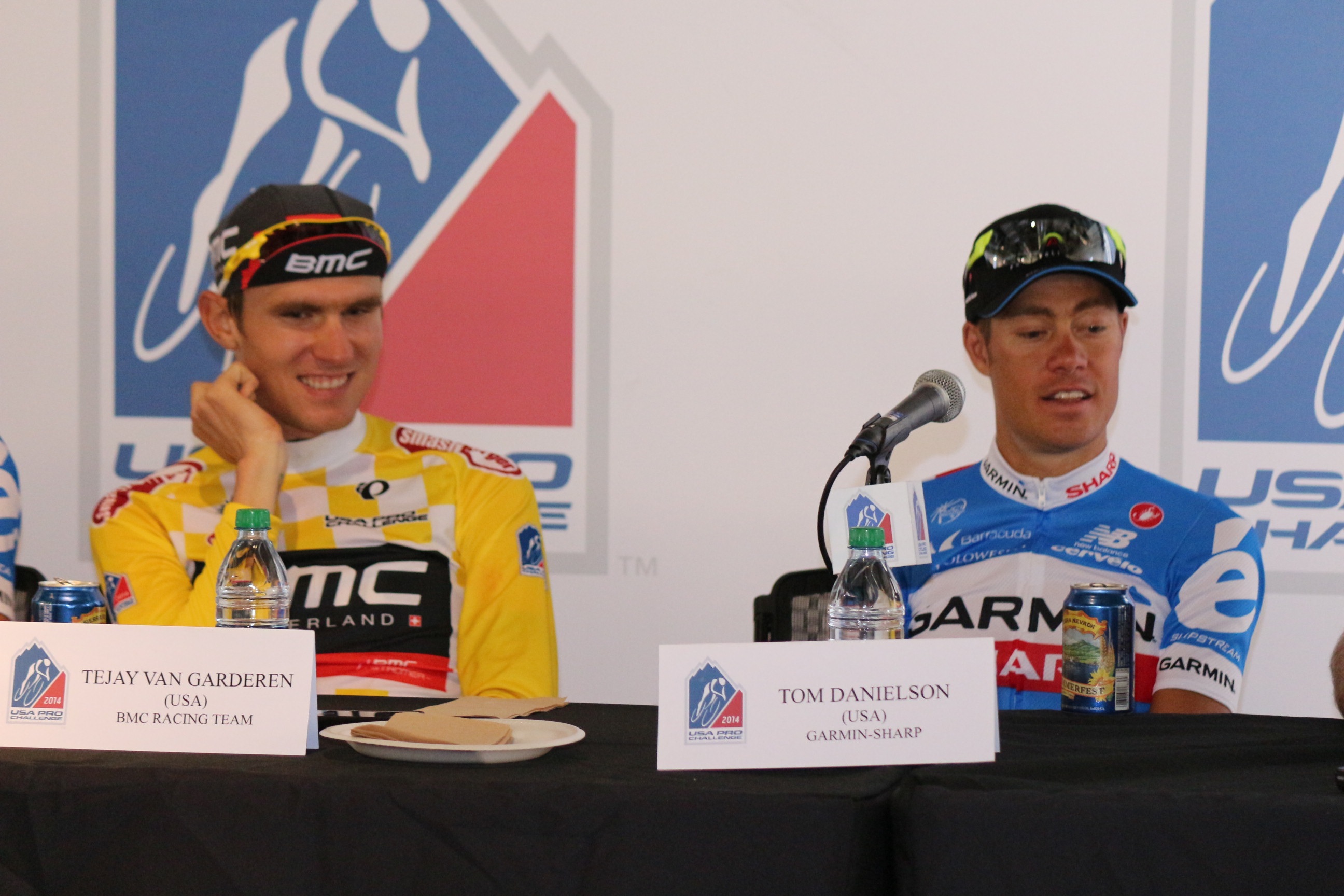
The 2014 USA Pro Challenge saw 128 of the best professional cyclists in the world compete in the toughest professional cycling race in the U.S. over the course of seven days, Aug. 18-24. Fans came out in droves to watch the action-packed, heart-pounding racing through the Colorado Rockies. After traveling to 10 host cities for the official stage starts and finishes, and passing through many other notable towns along the way, the estimated economic impact of the race to the State of Colorado is $130 million, according to a study done by Sponsorship Science, a global sports research firm.
The Pro Challenge delivered another strong economic performance in its fourth running, with direct spending by traveling spectators contributing a significant portion of the economic impact. Both those fans from outside the state and Coloradans traveling 50 miles or more to take in an event stage contributed $130 million on lodging, food, transportation and entertainment, an increase of 12 percent year over year. This change was largely driven by a 10 percent increase in the average number of nights stayed and an 11 percent increase in per night average party spend, the result of a 15 percent increase in average per night lodging cost.
“Seeing the enthusiasm and passion from the fans lining the streets during the 2014 USA Pro Challenge really gave a sense of the growing support for the sport of cycling in the U.S.,” said Rick Schaden, owner of the race. “This race showcases Colorado to the world and creates an incredible economic impact locally that can be felt throughout the year. Further, it was great to see an increase in television viewership.”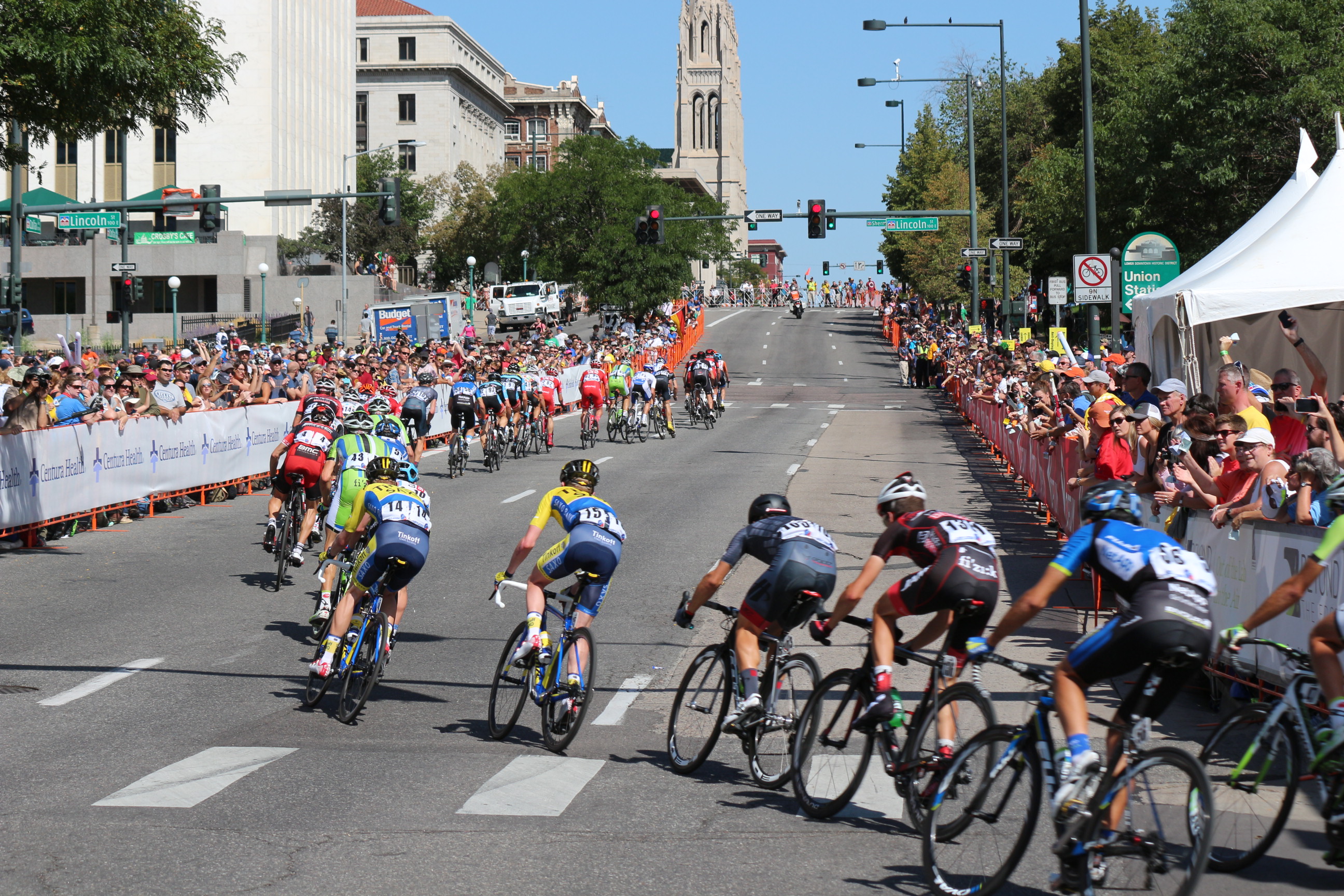
Following an epic week of racing through picturesque Colorado scenery, America’s most challenging race came to a conclusion in Downtown Denver when Aspen resident Tejay van Garderen (USA) of BMC Racing Team maintained his lead and took the overall win for the second year in a row. The race received unprecedented coverage totaling 30 hours on NBC, NBCSports and Universal Sports in the U.S. Additionally, through 40 hours of international coverage, the race was seen in more than 175 countries and territories around the world.
A draw for Colorado travel, 56 percent of spectators claimed they would not have traveled to the state at this time if it were not for the race. And with that, 70.9 percent stated they are likely to return to watch the race next year.
Additional interesting analysis points include:
· Spectators traveled in groups, with the average party consisting of three people
· The average hotel stay for spectators increased in 2014 to 5.3 nights
· 53 percent of race attendees live in households with income exceeding $85,000 and within that group 32 percent had household incomes in excess of $120,000
· Spectators enjoyed their race experience, with more than 80 percent saying they were very satisfied or satisfied with the race
· More than half of spectators in attendance reported they ride a bike for fitness, with 47 percent saying they engage in road cycling a lot
· This was an audience that appreciates the world-class level of competition at the USA Pro Challenge and watches major cycling events on television, with 83.8 percent stating they watch the Tour de France
About the research study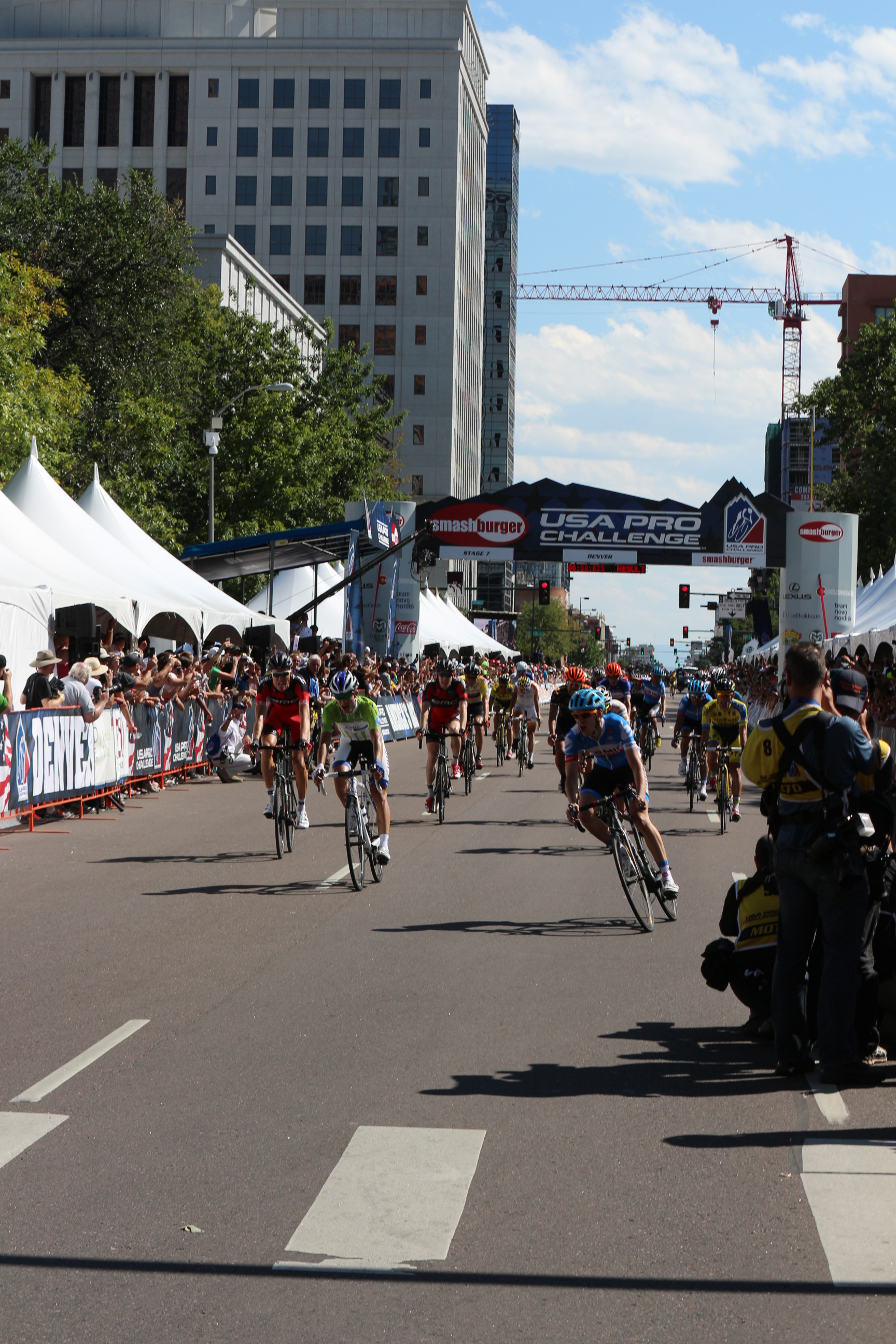
The USA Pro Challenge commissioned Sponsorship Science LLC, a global sports marketing & research consultancy firm with more than 50 years of executive experience working with events around the world, to continue conducting quantitative research measuring the change in overall economic impact of the Pro Challenge over time.
“While we conduct these types of studies for sports and entertainment clients around the world, across many platforms and geographies, cycling has always been a core sport, and one where we have a wealth of experience, ” said David Porthouse, SVP of Sponsorship Science, LLC. “Our history with the event and trust in the Pro Challenge management team, as well as the promoter Medalist Sports, has allowed us to develop the data and models used to accurately and fairly evaluate the growth of the race over time and its impact on the state of Colorado.”
Sponsorship Science, LLC designed the study from the outset to deliver consistent, defensible results which address many of the contentious issues surrounding economic impact reporting. Kevin Schott, director of Sponsorship Science notes the multi-year relationship with academia via Dr. Brett Boyle, professor within the sports business program at St. Louis University, has paid enormous dividends in terms of scientific rigor and credibility throughout the duration of this long-term relationship, serving as the foundation for the future. Key areas addressed included:
· Substitution effects – Since local fans will often spend similar amounts on local sports and other entertainment, Sponsorship Science, LLC did not include the local fan spend in the economic impact report, as a net impact, although local participation was thoroughly tracked, and forms a significant part of the appeal
· Time shifting – Colorado is an attractive destination for travel, so Sponsorship Science, LLC deliberately filtered respondents to ensure they were not capturing data from spectators already in Colorado, independent of the Pro Challenge, and also used elimination questions to remove those fans who intended to come to Colorado in the near future independent of the race. Despite these rigorous procedures, the number of dedicated fans travelling to the Pro Challenge has followed a long-term growth trend
· Sample sizes – Large samples were taken at all stages, distributed across the race locations, in order to create samples and sub-samples (by age, income, distance travelled, etc.) that are all statistically significant
A recall leads to lawsuits because injuries are connected to the product being recalled thus a lawsuit. Plaintiffs hope the three can be connected
Posted: October 13, 2014 Filed under: Cycling, Michigan | Tags: bicycle, Bicycle helmet, Breach of Warranty, Catlike Sport Components SL, Catlike USA, Consumer Product Safety Council, CPSC, Cycling, helmet, Monarch Velo Llc, The Kreb Cycle, Tracy Ann Jenish, warranty, Warranty of Fitness, Warranty of Fitness for a Particular Purpose Leave a commentPlaintiff crashed her bike suffering head injuries. Plaintiff was wearing a bicycle helmet that was subject to a recall, earlier. The plaintiff hoped her injury could be paid for by the helmet manufacturer using the recall as the influence with the jury.
State: Michigan
Plaintiff: Tracy Ann Jenish
Defendant: Monarch Velo Llc dba Catlike USA, a Texas Corporation, The Kreb Cycle, a New York Corporation, and Catlike Sport Components SL
Plaintiff Claims: negligence, gross negligence, and breach of warranty
Defendant Defenses:
Holding: for the defendant
Year: 2007
This is why recalls are such a problem. The recalls themselves are a nightmare for the outdoor recreation industry because the problems don’t fit in the Consumer Product Safety Council (CPSC) mold. The cost goes through the roof trying to comply with the requirements of the recall and deal with the resulting bad publicity.
The biggest problem is recalls immediately show up on the plaintiff attorney’s websites with the line Have you been hurt using/wearing this product “Call us.”
In this case, the plaintiff purchased a bicycle helmet from the defendant retailer. The bicycle helmet was subject to a recall prior to the plaintiff’s crash. The plaintiff exchanged the helmet for a newer one due to the recall, prior to her crash. The plaintiff fell while riding her bike suffering head and other injuries and sued.
The first defendant was a retailer in New York. The retailer purchased the helmet from a distributor in Texas. The distributor imported the helmet from the manufacturer, a Spanish corporation. All three, the manufacturer, distributor, and retailer were defendants to the litigation. All three were in the chain of sale from the manufacturer to the consumer.
The theory behind allowing suits against everyone involved in the litigation is anyone in the chain could have spotted the defect and prevented the consumer from purchasing a defective product. That was a great theory when wagon wheels were being sold. Everyone understood wagon wheels and could see a flaw or defect in a wagon wheel before the consumer purchased the wheel.
That general theory does not work any longer in software, computers or in this case a bike helmet. If you could understand the physics and engineering behind the creation of the helmet, you could not see the defects in many cases because the defects are covered by plastic.
The suit was filed in Michigan the home state of the plaintiff in the United States District Court for the Eastern District of Michigan, Southern Division. Federal courts are the courts in place to deal with litigation between parties from different states or of the US and another country. The federal courts are not subject to the issue of “hometowning” or deciding a case solely on the issue of where the parties live in the courts’ hometown.
The three defendants filed a motion for summary judgment, which was granted.
Federal District Court decisions are reported. Very few states report trial court decisions. However, this is different in the federal system, and we have an interesting case.
Analysis: making sense of the law based on these facts.
The plaintiff dismissed its negligence and gross negligence claims and proceeded with its breach of warranty claims prior to this motion. The plaintiff stated there was no express warranty claim, only a breach of implied warranty. Implied warranties are warranties that attach to any sale. They are not written down in the manual, they occur whenever there is a sale. Implied warranty of merchantability and implied warranty of fitness for a particular purpose are warranties that go with every sale and are the two main claims in lawsuits.
These warranties are not in writing and unless disclaimed, they go with any sale. The first, warranty of merchantability means the product meets the requirements of the industry where they are sold. The implied warranty of fitness for a particular purpose is a warranty that the promises made by the sellers will be met by the product. For more information on these warranties see The legal relationship created between Manufacturers and US consumers.
No specific warranty was mentioned in the decision other than the warranty of fitness and merchantability. There were also allegations that there was a breach of warranty under Michigan’s law, which may be the same or different from the warranties explained above.
The plaintiff’s case was based on the recall. The CPSC required a recall “poster” which was entered into evidence as proof of the recall and the defect. The plaintiff also had an expert who opined that the plaintiff’s head injury “directly related to the inadequacies of the Catlike Kompact bike helmet.”
No other evidence was introduced. The expert’s opinion was not specific and did not provide any cause for the injury or the failure of the helmet. The court held that because there was no analysis of the crash, speed, location of impact or details of the accident the expert’s opinion was of no value.
As discussed at oral argument, plaintiff has not brought forth any evidence of the reason the Catlike Kompact helmet failed impact testing. All that has been presented is a one-page press release from the CPSC, set forth above, including a statement that “[t]he helmets fail impact testing required under CPSC’s safety standard for bicycle helmets, violating the Consumer Product Safety Act.” Without additional information from the CPSC or any other source, or the results of any independent testing, it is the opinion of the court that Dr. Kress’ statement that “[t]he severity of the head injury sustained by Ms. Jenish is a direct result of the inability of the Catlike Kompact to comply to the CPSC’s safety standards” can be nothing but inadmissible speculation.
Although warranty claims require very little evidence to prove, in this case, no evidence was presented that the court could rely upon to uphold the claims of the plaintiff. The court granted the three defendants’ motion and dismissed the case.
So Now What?
This case has little value in teaching about helmet crashes, and the liability issues involved in manufacturing helmets. What it does teach is the unintended consequence of dealing with a recall and the CPSC.
It is impossible, probably, nowadays to create a product that will never have a recall. However, that does not mean you should try. As important, if you are looking at a recall, make sure you fully understand the consequences and work with counsel to lessen the impacts of the recall on your company and the effects it may have.
You also must disclaim all warranties other than the warranties you want for your product. If the proper disclaimer had been part of the information going with the sale of the helmet then this case would not have gone this far.
It is common for many products in the outdoor recreation industry to be brought into the US without the proper warranties and disclaimers. Additionally, many times when translating a product manual the word warranty will be translated into the word guaranty in English, which creates even greater liability issues.
 Jim Moss |
Jim Moss is an attorney specializing in the legal issues of the outdoor recreation community. He represents guides, guide services, outfitters both as businesses and individuals and the products they use for their business. He has defended Mt. Everest guide services, summer camps, climbing rope manufacturers, avalanche beacon manufacturers, and many more manufacturers and outdoor industries. Contact Jim at Jim@Rec-Law.us |
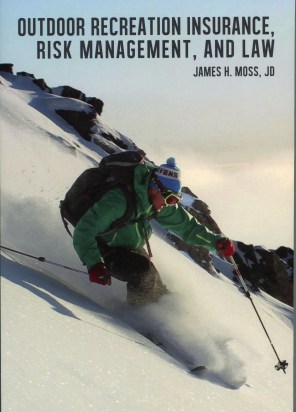
Outdoor Recreation Insurance, Risk Management, and Law
Jim is the author or co-author of six books about the legal issues in the outdoor recreation world; the latest is Outdoor Recreation Insurance, Risk Management and Law.
To see Jim’s complete bio go here and to see his CV you can find it here. To find out the purpose of this website go here.
G-YQ06K3L262
What do you think? Leave a comment.
If you like this let your friends know or post it on FB, Twitter or LinkedIn
 Blue Sky |
 Stimulus |
 X (formerly known as Twitter) logo |
 Threads |
 |
 |
Author: Outdoor Recreation Insurance, Risk Management and Law
Facebook Page: Outdoor Recreation & Adventure Travel Law
Email: Jim@Rec-Law.US
By Recreation Law Rec-law@recreation-law.com James H. Moss
@2024 Summit Magic Publishing, LLC
#AdventureTourism, #AdventureTravelLaw, #AdventureTravelLawyer, #AttorneyatLaw, #Backpacking, #BicyclingLaw, #Camps, #ChallengeCourse, #ChallengeCourseLaw, #ChallengeCourseLawyer, #CyclingLaw, #FitnessLaw, #FitnessLawyer, #Hiking, #HumanPowered, #HumanPoweredRecreation, #IceClimbing, #JamesHMoss, #JimMoss, #Law, #Mountaineering, #Negligence, #OutdoorLaw, #OutdoorRecreationLaw, #OutsideLaw, #OutsideLawyer, #RecLaw, #Rec-Law, #RecLawBlog, #Rec-LawBlog, #RecLawyer, #RecreationalLawyer, #RecreationLaw, #RecreationLawBlog, #RecreationLawcom, #Recreation-Lawcom, #Recreation-Law.com, #RiskManagement, #RockClimbing, #RockClimbingLawyer, #RopesCourse, #RopesCourseLawyer, #SkiAreas, #Skiing, #SkiLaw, #Snowboarding, #SummerCamp, #Tourism, #TravelLaw, #YouthCamps, #ZipLineLawyer, Tracy Ann Jenish, Monarch Velo Llc, Catlike USA, The Kreb Cycle, Catlike Sport Components SL, Cycling, Bicycle, Bicycle Helmet, Helmet, CPSC, Consumer Product Safety Council, Warranty, Warranty of Fitness for a Particular Purpose, Warranty of Fitness, Breach of Warranty,
2014 VeloSwap: Into Cycling you need to be there if you Need a deal or got deals to sell
Posted: October 10, 2014 Filed under: Cycling, Mountain Biking | Tags: bicycle, Bicycle Colorado, Colorado, Cycling, Denver, Ecovillage, x, y, z Leave a comment
MEDIA ADVISORY
Wheelin’ and Dealin’ at Cyclists’ Ultimate Bargain Hunt
· Subaru VeloSwap Denver returns to National Western Complex Sat., Oct 18
· 10,000 expected to buy, sell and swap bikes, gear, parts and accessories
· Find the best deals of the year as bike shops and more clear out inventory!
| What: | Inspired by the excitement of the USA Pro Cycling Challenge? Dreaming of a new set of wheels? Get ready to ride at the Subaru VeloSwap Denver, the ultimate bargain treasure hunt for cycling enthusiasts. A true celebration of all things cycling, the event features the opportunity to buy, sell and recycle new and used bicycles and equipment. Find the rarest parts and the best deals, while recycling your old gear! Veloswap.com |
| When: | Saturday, October 18, 20149:00am – 4:00pm |
| Where: | National Western Complex4655 Humboldt St. Denver, CO 80216 |
| Who: | · Almost 10,000 people are expected to attend· 300+ exhibitors will have the best deals cyclists will see all year
· Thousands start lining up outside as early as 6:00am to get the best deals |
| Tickets: |
|
| More: |
· New!! – New Product Showcase; check out the new 2015 equipment and talk with company reps about the latest and greatest in the industry including Bianchi, Parlee, Focus, Pedego E-Bikes and more. · Participants are invited to attend unique and informative seminars from Natural Grocers and others and enter to win amazing raffle prizes. · The day will conclude with live music in the supplier area. |
 Green Guru will be there taking your old tubes and recycling them into new products. Green Guru will be there taking your old tubes and recycling them into new products. |
Jenish v. Monarch Velo Llc dba Catlike USA, 2007 U.S. Dist. LEXIS 34120; CCH Prod. Liab. Rep. P17,754 (E.D. Mich. S.D. 2007)
Posted: October 7, 2014 Filed under: Cycling, Legal Case, Michigan | Tags: bicycle, Bicycle helmet, Breach of Warranty, Catlike Sport Components SL, Catlike USA, Consumer Product Safety Council, CPSC, Cycling, helmet, Monarch Velo Llc, The Kreb Cycle, Tracy Ann Jenish, warranty, Warranty of Fitness, Warranty of Fitness for a Particular Purpose Leave a commentTo Read an Analysis of this decision see: A recall leads to lawsuits because injuries are connected to the product being recalled thus a lawsuit. Plaintiffs hope the three can be connected
Jenish v. Monarch Velo Llc dba Catlike USA, 2007 U.S. Dist. LEXIS 34120; CCH Prod. Liab. Rep. P17,754 (E.D. Mich. S.D. 2007)
Tracy Ann Jenish, Plaintiff, vs. Monarch Velo Llc dba Catlike USA, a Texas Corporation, The Kreb Cycle, a New York Corporation, and Catlike Sport Components SL, a Spanish Corporation, Defendants.
Case No. 05-CV-73648
UNITED STATES DISTRICT COURT FOR THE EASTERN DISTRICT OF MICHIGAN, SOUTHERN DIVISION
2007 U.S. Dist. LEXIS 34120; CCH Prod. Liab. Rep. P17,754
May 9, 2007, Decided
May 9, 2007, Filed
CORE TERMS: helmet, catlike, bicycle, safety standard, summary judgment, head injuries, consumer, warranty, material fact, brain, acceleration, testing, seller, bike, Bicycle Helmets Final Rule, entitled to judgment, traumatic, hematoma, usa, Consumer Product Safety Act, matter of law, genuine issue, implied warranty, proximate cause, manufactured, manufacturer, distributor, attenuation, deposition, violating
COUNSEL: [*1] For Tracy Ann Jenish, Plaintiff: Lawrence S. Katkowsky, LEAD ATTORNEY, Lawrence S. Katkowsky Assoc., Bingham Farms, MI.
For Kreb Cycle, Defendant: Matthew A. Brauer, LEAD ATTORNEY, Rutledge, Manion, (Detroit), Detroit, MI.
JUDGES: GEORGE CARAM STEEH, UNITED STATES DISTRICT JUDGE.
OPINION BY: GEORGE CARAM STEEH
OPINION
OPINION AND ORDER GRANTING DEFENDANT THE KREB CYCLE’S MOTION FOR SUMMARY JUDGMENT (DOCUMENT # 38)
INTRODUCTION
Before the court in this product liability lawsuit is a motion for summary judgment brought by defendant The Kreb Cycle, a New York seller of bicycle equipment, in which it asserts it is entitled to judgment on all counts in the complaint. 1 Because the court agrees that plaintiff has not raised a question of material fact as to causation of her injuries by an allegedly defective bicycle helmet, defendant’s motion is granted as set forth below.
1 The other defendants to this action have not filed answers to the complaint.
BACKGROUND
Plaintiff Tracy Jenish was riding with a bicycling [*2] club on Wing Lake Road in the area of Bloomfield Hills, Michigan on September 26, 2002, when she fell off her bike and suffered serious bodily injuries, including injuries to her head. She was wearing a helmet called a “Catlike Kompact,” manufactured by defendant Catlike Sport Components SL, a Spanish corporation, distributed by defendant Monarch Velo LLC, a Texas corporation 2, and sold to the plaintiff by movant-defendant Kreb Cycle, a New York corporation.
2 Answers to the complaint by the remaining defendants have not been filed, and defendant Kreb Cycle states in its motion that the other defendants are in default. The docket reflects that a clerk’s entry of default was filed as to defendant Monarch Velo, L.L.C. on June 2, 2006.
The Kreb Cycle (hereinafter “defendant”) started carrying these helmets after its owner attended a trade show in Las Vegas, where a model of the Catlike Kompact helmet was on display. Defendant ordered the helmets from Monarch Velo LLC, d/b/a “Catlike USA,” a Texas distributor. [*3] The helmets came with the manufacturer’s label stating they complied with U.S. Consumer Product Safety Commission (“CPSC”) standards. Although there are no records of the sale, defendant does not dispute that it sold the helmet to plaintiff. Plaintiff’s recollection, according to her deposition, is that she called in with a credit card or ordered it online, at some point during the year preceding the accident.
In 2003, some months after plaintiff’s accident, the Catlike Kompact helmet was the subject of a voluntary manufacturer recall. Defendant has produced a copy of the CPSC’s announcement of this recall, which is reproduced below in its entirety, with the exception of the generic CPSC headings and contact numbers:
*****
CPSC, Monarch Velo, LLC doing business as Catlike USA Announce Recall of Bike Helmets
Washington, D.C. — The U.S. Consumer Product Safety Commission announces the following recall in voluntary cooperation with the firm below. Consumers should stop using recalled products immediately unless otherwise instructed.
Name of product: Catlike Kompact TM Bike Helmets
Units: 2,250
Distributor: Monarch Velo, LLC, doing business [*4] as Catlike USA, of Houston, Texas
Hazard: The helmets fail impact testing required under CPSC’s safety standard for bicycle helmets, violating the Consumer Product Safety Act.
Incidents/Injuries: None reported.
Description: This recall involves Catlike Kompact TM adult bicycle helmets. The helmets were sold in two sizes (small/medium and large/extra large) and various colors. The sizing label inside the helmets reads “Kompact” and “SM/MD” or “LG/XL.”
Sold at: Bicycle shops nationwide sold the helmets from March 2002 through February 2003 for about $ 130.
Manufactured in: Spain
Remedy: Contact Monarch Velo for information on receiving a free replacement helmet.
Consumer Contact: Contact Monarch Velo toll-free at (877) 228-5646 between 9 a.m. and 5 p.m. CT Monday through Friday or visit the firm’s web site at http://www.catlike-usa.com
Media Contact: Chris Watson at (877) 228-5646.
Exhibit D to Defendant’s Motion. Plaintiff obtained a replacement Catlike helmet after announcement of the recall.
This action was filed in federal court on the basis of diversity of citizenship in September 2005. [*5] Plaintiff’s First Amended Complaint, filed September 29, 2005, makes a common claim against all three defendants, asserting negligence, gross negligence, and breach of warranty in the design, manufacture, and distribution of an unmerchantable, “untested” bicycle helmet that failed to protect against injury to the head.
STANDARD FOR SUMMARY JUDGMENT
Federal Rule of Civil Procedure 56(c) empowers the court to render summary judgment “forthwith if the pleadings, depositions, answers to interrogatories and admissions on file, together with the affidavits, if any, show that there is no genuine issue as to any material fact and that the moving party is entitled to judgment as a matter of law.” See Redding v. St. Eward, 241 F.3d 530, 532 (6th Cir. 2001). The Supreme Court has affirmed the court’s use of summary judgment as an integral part of the fair and efficient administration of justice. The procedure is not a disfavored procedural shortcut. Celotex Corp. v. Catrett, 477 U.S. 317, 327, 106 S. Ct. 2548, 91 L. Ed. 2d 265 (1986); see also Cox v. Kentucky Dept. of Transp., 53 F.3d 146, 149 (6th Cir. 1995).
The [*6] standard for determining whether summary judgment is appropriate is “‘whether the evidence presents a sufficient disagreement to require submission to a jury or whether it is so one-sided that one party must prevail as a matter of law.'” Amway Distributors Benefits Ass’n v. Northfield Ins. Co., 323 F.3d 386, 390 (6th Cir. 2003) (quoting Anderson v. Liberty Lobby, Inc., 477 U.S. 242, 251-52, 106 S. Ct. 2505, 91 L. Ed. 2d 202 (1986)). The evidence and all reasonable inferences therefrom must be construed in the light most favorable to the non-moving party. Matsushita Elec. Indus. Co., Ltd. v. Zenith Radio Corp., 475 U.S. 574, 587, 106 S. Ct. 1348, 89 L. Ed. 2d 538 (1986); Redding, 241 F.3d at 532 (6th Cir. 2001). “[T]he mere existence of some alleged factual dispute between the parties will not defeat an otherwise properly supported motion for summary judgment; the requirement is that there be no genuine issue of material fact.” Anderson v. Liberty Lobby, Inc., 477 U.S. 242, 247-48, 106 S. Ct. 2505, 91 L. Ed. 2d 202 (1986) (emphasis in original); see also National Satellite Sports, Inc. v. Eliadis, Inc., 253 F.3d 900, 907 (6th Cir. 2001). [*7]
If the movant establishes by use of the material specified in Rule 56(c) that there is no genuine issue of material fact and that it is entitled to judgment as a matter of law, the opposing party must come forward with “specific facts showing that there is a genuine issue for trial.” First Nat’l Bank v. Cities Serv. Co., 391 U.S. 253, 270, 88 S. Ct. 1575, 20 L. Ed. 2d 569 (1968); see also McLean v. 988011 Ontario, Ltd., 224 F.3d 797, 800 (6th Cir. 2000). Mere allegations or denials in the non-movant’s pleadings will not meet this burden, nor will a mere scintilla of evidence supporting the non-moving party. Anderson, 477 U.S. at 248, 252. Rather, there must be evidence on which a jury could reasonably find for the non-movant. McLean, 224 F.3d at 800 (citing Anderson, 477 U.S. at 252).
ANALYSIS
Kreb Cycle asserts in its motion that it is entitled to judgment as to all three of plaintiff’s claims: negligence, gross negligence, and breach of warranty. In response, plaintiff asserts it is “only relying on the implied warranty of fitness and merchantability as to this Defendant and will not, therefore, respond to [*8] Defendant’s arguments as to negligence and gross negligence.” Accordingly, judgment is hereby granted for Kreb Cycle as to plaintiff’s negligence and gross negligence claims.
The sole claim remaining as to this defendant is plaintiff’s breach of warranty claim. Plaintiff concedes defendant made no express warranty regarding this helmet. Accordingly, proceeding on a cause of action for breach of an implied warranty, plaintiff asserts that she has established a prima facie case of breach of implied warranty under Michigan law, 3 citing to this court’s case of Konstantinov v. Findlay Ford Lincoln Mercury, 2006 U.S. Dist. LEXIS 85836, 2006 WL 3299487. As set forth in that case, under the Michigan Tort Reform Act, effective in 1996,
(6) In a product liability action, a seller other than a manufacturer is not liable for harm allegedly caused by the product unless either of the following is true:
(a) The seller failed to exercise reasonable care, including breach of any implied warranty, with respect to the product and that failure was a proximate cause of the person’s injuries.
(b) The seller made an express warranty as to the product, the product failed to conform to the warranty, and the [*9] failure to conform to the warranty was a proximate cause of the person’s harm.
Mich. Comp. Laws Ann. § 600.2947(6).
3 Although the retailer was a New York seller, neither party asserts applicable law other than that of Michigan.
Defendant’s argument for summary judgment on this claim is that plaintiff has not come forward with any evidence of a specific defect in the helmet, and has not drawn any kind of causal connection between the alleged defect and her head injuries. It cites to Mascarenas v. Union Carbide, 196 Mich. App. 240, 249, 492 N.W.2d 512 (1992) for the elements of a product liability case under Michigan law: proof that the defendant supplied a defective product, and that the defect proximately caused the plaintiff’s injury. Defendant argues that plaintiff relies only on the helmet’s later recall, disclosed in a 5/22/03 CPSC press release (stating that the recall was occurring “in voluntary cooperation with” the U.S. distributor) and conclusory statements [*10] by an expert, neither of which establish a question of material fact as to proximate cause. 4
4 Defendant also addresses plaintiff’s weak assertion, in answers to interrogatories, that defendant “had a duty to determine whether the model helmet in question did in fact meet CPSC standards.” As defendant argues, there is no such duty required by Mich. Comp. Laws Ann. § 600.2947(6), set forth above.
The court agrees with the defendant. Although precedent such as Mills v. Curioni, Inc., 238 F. Supp. 2d 876, 886 (E.D. Mich. 2002) and the very recent decision in Coleman v. Maxwell Shoe Co., 475 F. Supp. 2d 685, 2007 U.S. Dist. LEXIS 11513, 2007 WL 551608 (E.D. Mich. 2007) lend support to defendant’s argument concerning non-manufacturing sellers and the need for a showing of negligence in failing to detect a product’s defect, this case must be dismissed whether or not such evidence is required.
Plaintiff’s expert’s initial report, created by Tyler A. Kress, Ph.D. in Knoxville, Tennessee, dated [*11] October 6, 2006, summarily lists plaintiff’s injuries following the accident. It then lists all of the expert’s qualifications, his fees, and the records he reviewed. These are a 9/26/2002 CT scan of plaintiff’s head; the hospital’s discharge summary; a letter of April 3, 2003 by a Jon Wardner, M.D. stating plaintiff’s disability; the CPSC announcement of the helmet recall; and the plaintiff’s deposition. Dr. Kress also states that he met with the plaintiff. The remainder (and the entire substance) of his letter/report stated only a conclusion that a “defect” of the helmet was “directly related to the inadequacies of the Catlike Kompact bike helmet.”
Defendant then brought a motion, granted by the magistrate, for sanctions and to require a supplemental report by November 15, 2006, containing a “complete statement of all opinions to be expressed and the basis and reasons therefor…” A supplemental report was subsequently created by Dr. Kress. That report, dated November 15, 2006, is set forth below in its entirety:
Dear Mr. Katkowsky:
This is to supplement my report of October 6, 2006, regarding the above-styled cause.
1) Use: It is my opinion that it is foreseeable [*12] that some consumers will sustain a preventable head injury due to the impact performance (or lack thereof) of the helmet while using it in an appropriate manner as it is intended to be used.
Protective head gear and bicycle helmets have the ability to eliminate or greatly reduce traumatic head and brain injury when properly designed an manufactured. To ensure that bicycle helmets available in the consumer market adequately serve these goals, the Consumer Product Safety Commission has created safety standards for a range of criterion, including impact attenuation (CPSC’s Safety Standard for Bicycle Helmets Final Rule: 16 CFR Part 1203).
Bicycle helmets that have adequate impact attenuation performance, as set forth by the CPSC’s safety standards, and are used in an appropriate, reasonable, and correct manner are highly successful in preventing or greatly reducing traumatic head and brain injury. As found in a 1989 study by Thompson et al and explicitly cited in the CPSC’s Safety Standard for Bicycle Helmets Final Rule (16 CFR Part 1203, pg. 11713), riders with helmets had an 85% reduction in head injury risk, and 88% reduction in brain injury risk.
2) Reason for Injury: [*13] Ms. Jenish’s head injury is directly related to the inadequacies of the Catlike Kompact bike helmet.
The CPSC’s Safety Standard for Bicycle Helmets Final Rule (16 CFR Part 1203) explicitly establishes a performance test to “ensure that helmets will adequately protect the head in a collision” (pg. 11714). As a component of this performance test, helmets are required to not exceed a peak headform acceleration of 300 g for any impact. This pass/fail criterion of 300g or below is consistent with other standards such as the ANSI, Snell, and ASTM (CPSC’s Safety Standard for Bicycle Helmets Final Rule (16 CFR Part 1203, pg. 11714; Halstead 2001). The Catlike Kompact bike helmet is inadequate due to the fact that it failed impact standards that pertain to the design and performance of the helmet in a foreseeable use that may result in an impact to the head.
In the accident on September 26, 2002, Ms. Jenish hit a curb while riding her bicycle, was ejected, and impacted her head. She reported a loss of consciousness at the scene, and her relevant injuries include, but are not limited to, a traumatic brain injury and a subdural hematoma. Ms. Jenish sustained a direct impact to the back [*14] of the head (occipital region) which corresponds to a right occipatal scalp hematoma and the area of impact and failure seen in the helmet. Contact head impacts, such as this, result in predominantly linear acceleration of the head and brain, with small components of angular acceleration. Linear acceleration can product focal brain injuries, such as subdural hematomas, as well as concussions; as seen in Ms. Jenish.
The severity of the head injury sustained by Ms. Jenish is a direct result of the inability of the Catlike Kompact to comply to the CPSC’s safety standards. Subdural hematomas, similar to the one sustained by Ms. Jenish, are commonly caused by an impact to the occipital region (Kleiven 2003, Zhou et al 1995). The acceleration of the head in an occipital impact exceeded the values of what a reasonably designed and protective headgear would have given the wearer. Due to the failure of the Catlike Kompact bicycle helmet to comply to the CPSC’s impact safety standards Ms. Jenish’s head experienced higher acceleration values resulting in a more serious traumatic brain injury than would have been experienced if the helmet was compliant with the impact standards of the CPSC. [*15]
3) Design Defect: The helmet is inherently dangerous and defective by design in that it fails to comply with impact testing standards required under CPSC’s safety standard for bicycle helmets, violating the Consumer Product Safety Act.
The impact attenuation standards of the CPSC’s Safety Standard for Bicycle Helmets Final Rule (16 CFR Part 1203) was created in order to “ensure that helmets will adequately protect the head in a collision” (p. 11714). Failure to meet this standard endangers consumers by failing to prevent or reduce injury.
If you have any questions or need anything further please do not hesitate to contact me.
Sincerely,
/s/
Tyler Kress, Ph.D., CIE
Exhibit I to Defendant’s Motion and Exhibit 2 to Plaintiff’s Response.
Defendant contends that all this report arguably establishes is that the helmet failed to “meet standards;” and that plaintiff has failed to connect that alleged, undefined defect to her injuries. As defendant asserts, there is no evaluation of items such as plaintiff’s speed at the time of the crash, location of impact, descriptive information concerning the object struck or other details of the accident. Defendant [*16] points to the serious injuries sustained by the plaintiff in the crash, including fractured vertebrae, a crushed rib cage, fractured collarbone, bulging spinal discs, and a collapsed lung, and asserts that helmets don’t rule out any and all head injuries, in any crash or at any speed, but serve to help protect against head injuries. Plaintiff has not identified the manufacturing or design elements of the helmet that led to voluntary recall nor has accident reconstruction tied these elements to the plaintiff’s injuries.
As discussed at oral argument, plaintiff has not brought forth any evidence of the reason the Catlike Kompact helmet failed impact testing. 5 All that has been presented is a one page press release from the CPSC, set forth above, including a statement that “[t]he helmets fail impact testing required under CPSC’s safety standard for bicycle helmets, violating the Consumer Product Safety Act.” Without additional information from the CPSC or any other source, or the results of any independent testing, it is the opinion of the court that Dr. Kress’ statement that “[t]he severity of the head injury sustained by Ms. Jenish is a direct result of the inability [*17] of the Catlike Kompact to comply to the CPSC’s safety standards” can be nothing but inadmissible speculation. Accordingly, it is the court’s determination that plaintiff has not produced evidence to raise a question of material fact regarding causation. Defendant’s motion will be granted.
5 Plaintiff has failed to identify any specific claimed defect, such as deficiencies in the suspension or cushioning system, hardness or thickness of the plastic, ventilation engineering, overall shape, the strapping mechanism, or any other particular aspects of the helmets in general, much less the helmet worn by plaintiff. Without knowing the defect that motivated a voluntary recall, and without testing of the helmet worn by plaintiff, it is impossible to conclude that a defect caused her injury.
CONCLUSION
Because plaintiff has failed to raise a question of material fact as to the proximate causation of her head injuries by an alleged defect in her bicycle helmet, summary judgment will enter as to all claims brought [*18] by the plaintiff against this defendant.
IT IS SO ORDERED.
Dated: May 9, 2007
S/ George Caram Steeh
UNITED STATES DISTRICT JUDGE
G-YQ06K3L262
Tour of Utah UCI ranking increases to 2.HC
Posted: October 3, 2014 Filed under: Cycling | Tags: Bicycle Racing, Cycling, Larry H. Miller, Larry H. Miller Tour of Utah, Salt Lake City, Tour of Utah, UCI, Union Cycliste Internationale, Utah Leave a comment
|


Georgia Federal Court finds that assumption of the risk is a valid defense in a head injury case against a bicycle helmet manufacturer.
Posted: September 22, 2014 Filed under: Assumption of the Risk, Cycling, Georgia | Tags: assumption of the risk, bicycle, Bicycle South, Bike, Cycling, Florida, Georgia, Head injury, helmet, Inc., Incorporated, Open and Obvious, Opportunities, Product liability, Skid Lid Manufacturing Company, Trek Bicycle Corporation, Wheel Leave a commentIf you purchase a helmet that only protects part of your head, then you cannot sue for injuries to the part of your head not protected.
State: Georgia, US Court of Appeals for the Eleventh Circuit
Plaintiff: Lois Elaine Wilson
Defendant: Bicycle South, Inc.
Plaintiff Claims: Product Liability (breach of warranty, strict liability, and negligence)
Defendant Defenses: Assumption of the Risk and Open and Obvious
Holding: For the defendants
Year: 1990
This case is fairly easy to understand, even though the opinion is quite complicated. The plaintiff was riding her bike from Florida to California. While traveling through Georgia she crashed suffering head injuries.
She sued claiming the rear wheel of the bike collapsed causing her crash. She claimed her head injuries were caused because the helmet failed to protect her head.
She sued the wheel manufacturer, Opportunities Inc., the bicycle manufacturer, Trek Bicycle Corporation and the retailer Bicycle South, Inc. The three defendants were found not liable at trial.
The jury did find the helmet manufacturer, Skid Lid Manufacturing Company liable for the plaintiff’s head injuries. The majority of the decision reviews the helmet issues. The plaintiff purchased the helmet for her ride. The helmet was a “half helmet” which only covered the top half of her head. The helmet came down to about the top of her ears.
The jury found in favor of the plaintiff on the head injury issue caused by the helmet manufacturer. The defendant Skid Lid moved for a judgment notwithstanding the verdict, (JNOV), which the court granted. The defendant helmet manufacturer appealed the decision.
A JNOV is effectively a motion filed by the losing party and the judge overrules the jury. This is a motion that is rarely granted and only done so to overcome extreme or unreasonable jury verdicts. The judge must find that no reasonable jury could reach the decision that was reached by the jury in the case. Normally this is because there are insufficient facts to support the claims or the jury applied the law incorrectly.
In this case, the JNOV seemed to have been entered because the jury ignored the defenses presented by the defendant.
Summary of the case
Georgia at the time of the decision allowed several defense to product liability claims, two of which were: Assumption of the risk and the “open and obvious” defects. Variations of these defenses are available in some, but not all states. The trial judge in this case granted the JNOV based on the Assumption of the Risk defense. The appellate court looked at both of these defenses.
The open and obvious defense states a plaintiff cannot recover from a defendant when the alleged defect is patent and obvious to the user.
The open and obvious rule states that a product is not defective if the peril from which injury could result is patent or obvious to the user. This determination regarding the peril is made on the basis of an objective view of the product. In assessing what is obvious, it must be remembered that, contrary to the belief of some, the American public is not child-like.
This defense is not based on a defect in the product, only that the product will not or will do something that is patent, and open and obvious.
The defense applied here because the plaintiff when purchase the helmet purchased one that only covered part of her head. It was “obvious” that the helmet would not protect the part of her head that the helmet did not cover.
The assumption of risk defense is slightly different, but also applicable in this case. If the consumer knows of a defect in the product, is aware of the danger presented by the defect and proceeds to use the product anyway the plaintiff is barred from recovering. “The first part of the test, actual knowledge of the defect and danger, is fulfilled because appellant had subjective knowledge that the helmet she purchased only covered a portion of her head.”
The assumption of risk defense in Georgia is slightly more difficult to prove because the injured plaintiff must have known about the defect. (However, a defect only becomes one in pleadings after an injury has occurred.) What I mean by this is, as a manufacturer should point out the limitations of the product in the information supplied by the product. This provides the necessary notice to a user of the defect and provides a defense to the manufacturer.
The court also ruled on evidentiary issues in the case which are not important in understanding these issues.
So Now What?
For manufacturers, selling a product means more than just point out the great features of the product. You must warn the consumer of any problems or issues with the product and you must point out what the product cannot do.
That does not mean that you should point out your bicycle won’t get you to the moon. It might mean you should point out that the bicycle should only be ridden on roads if it is a road bike. Videos online show road bikes being ridden everywhere, but that does not mean as a manufacturer you should be liable when someone tries to ride the Monarch Crest Trail on your road bike.
As a retailer, you should point out the differences in products trying to specifically point out short comings about a product. This helmet has a MIPS system in side, this one does not.
Both of these defenses are easy to rely on, however not all states still allow the use of these defenses.
What do you think? Leave a comment.
If you like this let your friends know or post it on FaceBook, Twitter or LinkedIn
Copyright 2014 Recreation Law (720) Edit Law
Email: Rec-law@recreation-law.com
Google+: +Recreation
Twitter: RecreationLaw
Facebook: Rec.Law.Now
Facebook Page: Outdoor Recreation & Adventure Travel Law
Blog: www.recreation-law.com
Mobile Site: http://m.recreation-law.com
By Recreation Law Rec-law@recreation-law.com James H. Moss
#AdventureTourism, #AdventureTravelLaw, #AdventureTravelLawyer, #AttorneyatLaw, #Backpacking, #BicyclingLaw, #Camps, #ChallengeCourse, #ChallengeCourseLaw, #ChallengeCourseLawyer, #CyclingLaw, #FitnessLaw, #FitnessLawyer, #Hiking, #HumanPowered, #HumanPoweredRecreation, #IceClimbing, #JamesHMoss, #JimMoss, #Law, #Mountaineering, #Negligence, #OutdoorLaw, #OutdoorRecreationLaw, #OutsideLaw, #OutsideLawyer, #RecLaw, #Rec-Law, #RecLawBlog, #Rec-LawBlog, #RecLawyer, #RecreationalLawyer, #RecreationLaw, #RecreationLawBlog, #RecreationLawcom, #Recreation-Lawcom, #Recreation-Law.com, #RiskManagement, #RockClimbing, #RockClimbingLawyer, #RopesCourse, #RopesCourseLawyer, #SkiAreas, #Skiing, #SkiLaw, #Snowboarding, #SummerCamp, #Tourism, #TravelLaw, #YouthCamps, #ZipLineLawyer, Opportunities, Incorporated, Trek Bicycle Corporation, Bicycle South, Inc., Skid Lid Manufacturing Company, Open and Obvious, Assumption of the Risk, Product Liability, Helmet, Wheel, Cycling, Bicycle, Bike,
WordPress Tags: Georgia,Federal,Court,assumption,injury,bicycle,helmet,manufacturer,injuries,Wilson,South,LEXIS,Evid,Serv,Callaghan,State,Appeals,Eleventh,Circuit,Plaintiff,Lois,Elaine,Defendant,Claims,Product,negligence,Defenses,Risk,Open,Obvious,defendants,opinion,bike,Florida,California,Opportunities,Trek,Corporation,retailer,jury,Skid,Company,decision,ears,judgment,verdict,JNOV,verdicts,Summary,Variations,user,peril,determination,basis,belief,American,consumer,danger,knowledge,appellant,limitations,information,manufacturers,roads,road,Videos,bikes,Monarch,Crest,Trail,differences,products,comings,MIPS,system,Both,Leave,FaceBook,Twitter,LinkedIn,Recreation,Edit,Email,Google,RecreationLaw,Page,Outdoor,Adventure,Travel,Blog,Mobile,Site,James,Moss,Authorrank,AdventureTourism,AdventureTravelLaw,AdventureTravelLawyer,AttorneyatLaw,BicyclingLaw,Camps,ChallengeCourse,ChallengeCourseLaw,ChallengeCourseLawyer,CyclingLaw,FitnessLaw,FitnessLawyer,HumanPoweredRecreation,JamesHMoss,JimMoss,OutdoorLaw,OutdoorRecreationLaw,OutsideLaw,OutsideLawyer,RecLaw,RecLawBlog,LawBlog,RecLawyer,RecreationalLawyer,RecreationLawBlog,RecreationLawcom,Lawcom,RiskManagement,RockClimbingLawyer,RopesCourse,RopesCourseLawyer,SkiAreas,SkiLaw,SummerCamp,Tourism,TravelLaw,YouthCamps,ZipLineLawyer,Wheel
Wilson v. Bicycle South, Inc., 915 F.2d 1503; 1990 U.S. App. LEXIS 18903; 31 Fed. R. Evid. Serv. (Callaghan) 682
Posted: September 21, 2014 Filed under: Assumption of the Risk, Cycling, Georgia, Legal Case | Tags: assumption of the risk, bicycle, Bicycle South, Bike, Cycling, helmet, Inc., Incorporated, Open and Obvious, Opportunities, Product liability, Skid Lid Manufacturing Company, Trek Bicycle Corporation, Wheel 1 CommentWilson v. Bicycle South, Inc., 915 F.2d 1503; 1990 U.S. App. LEXIS 18903; 31 Fed. R. Evid. Serv. (Callaghan) 682
Lois Elaine Wilson, Plaintiff-Appellant, v. Bicycle South, Inc., a Georgia Corporation, et al., Defendants-Appellees
No. 89-8522
UNITED STATES COURT OF APPEALS FOR THE ELEVENTH CIRCUIT
915 F.2d 1503; 1990 U.S. App. LEXIS 18903; 31 Fed. R. Evid. Serv. (Callaghan) 682
October 30, 1990
SUBSEQUENT HISTORY: As Amended.
PRIOR HISTORY: [**1] Appeal from the United States District Court for the Northern District of Georgia. No.1: 85-cv-2658-CAM; Moye, Jr., Judge.
DISPOSITION: AFFIRMED.
COUNSEL: Robert H. Benfield, Jr., Middleton & Anderson, Atlanta, Georgia, for Appellant.
For Trek Bicycle: Stephen F. Dermer, Smith Gambrell & Russell, Atlanta, Georgia.
For Bicycle South: Jonathan Mark Engram, Swift Currie McGhee & Hiers, Thomas E. McCarter, Atlanta, Georgia.
For Opportunities, Inc.: Tommy T. Holland, Carter & Ansley, Christopher N. Shuman, Atlanta, Georgia.
For Skid Lid: Palmer H. Ansley, Long Weinberg Ansley & Wheeler, David A. Sapp, Atlanta, Georgia.
JUDGES: Clark, Circuit Judge, Morgan and Hill, * Senior Circuit Judges.
* See, Rule 34-2(b), Rules of the U.S. Court of Appeals for the Eleventh Circuit.
OPINION BY: HILL
OPINION
[*1504] HILL, Senior Circuit Judge
I. INTRODUCTION
This appeal concerns a products liability action based upon alleged breach of warranty, strict liability, and negligence resulting in injuries to Lois Elaine Wilson (“Wilson”), appellant. Wilson incurred head injuries during an accident in Georgia while on a cross-country bicycle trip. The jury returned a verdict in favor of Wilson and against one defendant on a bicycle helmet defect claim, and against Wilson and in favor of three defendants on a bicycle wheel defect claim. The district court granted a judgment notwithstanding the verdict on the helmet claim. Plaintiff appeals [*1505] this grant and also alleges several other errors by the district court concerning the bicycle wheel claim.
A. Issues Presented
Appellant raises four distinct categories of issues on appeal. First, appellant claims that the district court erred in granting appellee Skid Lid Manufacturing Company’s (“Skid Lid”) motion for a judgment notwithstanding [**2] the verdict. Second, appellant contends that the district court improperly commented on the evidence. Third, she asserts that the district court committed reversible error by refusing to admit “similar accident” evidence. Finally, appellant maintains that the district court erred in charging the jury on the defense of “legal accident.”
We hold that the trial court did not err in granting the JNOV. Nor do the trial judge’s comments on the evidence provide cause for reversal. Similarly, we find appellant’s third and fourth contentions to be meritless.
B. Factual and Procedural History
On January 6, 1983, appellant purchased a Trek 614 touring bicycle. Trek Bicycle Corporation (“Trek”) manufactured the bicycle, Opportunities, Incorporated (“Opportunities”) assembled the bike’s rear wheel according to Trek’s specifications, and Bicycle South, Inc. (“Bicycle South”) sold the bike to appellant. The latter three parties will be referred to collectively as “the bicycle defendants.” On February 9, 1983, appellant also purchased, from a company not a party to this lawsuit, a bicycle helmet manufactured by Skid Lid. Rather than purchase a helmet covering her entire head, appellant chose [**3] one that only covered the top half of her head, coming down to about the top of her ears.
Wilson purchased the bike and helmet for a cross-country bicycling trip from Florida to California. Eight days into her trip, on April 23, 1983, Wilson sustained head injuries in a fall from the bicycle while she was riding downhill on a two-lane Georgia highway between Plains and Americus, Georgia. Between January 6 and April 23, Wilson had ridden approximately 1200 to 1600 miles on the bicycle.
The cause of appellant’s fall is disputed by the parties. Appellant maintains that the rear wheel collapsed into a saddle-like shape as a result of an improper manufacturing process and a failure to retrue the spokes of the wheel after the rim was assembled. Under this theory, the tension in the wheel, which was not released after the rim was formed and the wheel assembled, caused the spokes to loosen after use and led to the collapse. The bicycle defendants, on the other hand, maintain that the fall did not result from the wheel collapse, but that the wheel collapsed as a result of appellant’s fall from the bike. 1
1 The actual cause of the fall does not affect the issues currently before this Court.
[**4] The point of initial impact between Ms. Wilson’s head and the pavement was behind her left ear and below the edge of the helmet. As a result of the impact, she claims that she sustained three injuries. The first two, a basilar skull fracture and occipital scalp laceration, were not particularly serious and do not comprise the more serious damage. The more serious injury was a “contre-coup” (an injury to the opposite side of the head from the point of initial impact) brain contusion.
Alleging defects in the bicycle wheel and helmet, Ms. Wilson filed a complaint in this products liability action based upon breach of warranty, strict liability, and negligence. During the trial, appellant attempted to introduce evidence of a prior bicycle wheel defect claim brought by another party against Trek, Opportunities, and another bicycle store, alleging that the incidents were substantially similar. The trial court excluded the earlier incident.
At the beginning of his charge, the trial judge explained to the jury:
As a federal judge, I have the right, power, and duty to comment on the facts, to express my opinion with respect thereto . . . but remember, in the last analysis, every factual issue [**5] in this case must be decided by you, by you alone, and anything that anybody else in this room says [*1506] about the facts is a mere opinion, not binding upon you.
Subsequently, referring to witness testimony, the judge again emphasized that “as sole judges of the facts, you, the jury, and you only, must determine which of the witnesses you believe and what portion of their testimony you accept and what weight you attach to it.” Prior to analyzing and giving his opinion of the evidence that Ms. Wilson presented, 2 the judge again cautioned the jury that “you, as jurors, are at liberty to disregard each, every, and all comments of the court in arriving at your own findings of the facts.” At the conclusion of his remarks, the trial judge further emphasized:
Let me stress as strongly as I can that you, the jury, are the sole and only judges of the facts. The past several minutes I have been giving you [**6] my opinion with respect to matters committed solely to your decision, not mine. My comments are and can only be expressions of a personal opinion and are not binding on you in any way, shape, or form. Remember that in considering every issue in this case, including those to which I have just alluded, you must resort to your own recollection of the evidence, not that which I have just stated. . . . You must, in the diligent performance of your duty, rely on your recollection of all the evidence and not merely that which I may have called to your attention and emphasized.
2 The trial judge focused especially on items of derogatory information with respect to appellant’s expert, Mr. James Green.
On April 13, 1989, the jury returned a verdict in favor of appellant against appellee Skid Lid in the amount of $ 265,000 on the helmet claim. On the bicycle wheel claim, the jury returned a verdict against appellant and in favor of the bicycle defendants.
On April 21, 1989, appellee Skid Lid moved for a judgment notwithstanding the verdict, and on May 24 the trial court entered an Order granting the motion. The court did so because it found that Ms. Wilson had “assumed the risk of injury as to parts of her body patently not covered by the helmet.”
II. DISCUSSION
A. The Helmet & the Judgment Notwithstanding the [**7] Verdict
[HN1] We review the district court’s grant of a JNOV under the same standard as the district court used in determining whether to grant a JNOV. As we stated in Castle v. Sangamo Weston, Inc., 837 F.2d 1550, 1558 (11th Cir.1988):
All of the evidence presented at trial must be considered “in the light and with all reasonable inferences most favorable to the party opposed to the motion.” A motion for judgment n.o.v. should be granted only where “reasonable [people] could not arrive at a contrary verdict. . . .” Where substantial conflicting evidence is presented such that reasonable people “in the exercise of impartial judgment might reach different conclusion, [sic]” the motion should be denied. (citations omitted)
In applying this standard for the sufficiency of evidence, we also look to Georgia substantive law to determine whether Skid Lid deserved judgment as a matter of law. See Erie v. Tompkins, 304 U.S. 64, 58 S. Ct. 817, 82 L. Ed. 1188 (1938); Salter v. Westra, 904 F.2d 1517, 1524 (11th Cir.1990).
Defendants in products liability actions have asserted two similar defenses in attempting to steer clear of liability, assumption of the risk and the “open and obvious [**8] rule.” 3 While the trial judge in this case based the JNOV on assumption of the risk, we also address the open and obvious rule because affirmance of the JNOV is proper even if based on a different rationale. See Paisey v. Vitale, 807 F.2d 889, 890 (11th Cir.1986).
3 This rule is also known as the “patent danger rule” and has its roots in a New York decision involving negligence law, Campo v. Scofield, 301 N.Y. 468, 95 N.E.2d 802 (1950). New York later abandoned the rule in Micallef v. Miehle Co., 39 N.Y.2d 376, 384 N.Y.S.2d 115, 348 N.E.2d 571 (1976).
[*1507] We need not reach the assumption of the risk issue if the helmet was not defective because Skid Lid would have breached no duty to Ms. Wilson. We thus initially address the open and obvious rule. [HN2] The open and obvious rule states that a product is not defective if the peril from which injury could result is patent or obvious to the user. Stodghill v. Fiat-Allis Construction Machinery, Inc., 163 Ga. App. 811, 295 S.E.2d 183, 185 (1982). This determination [**9] regarding the peril is made on the basis of an objective view of the product. Weatherby v. Honda Motor Co., Ltd., 195 Ga. App. 169, 393 S.E.2d 64, 66 (1990) (certiorari denied June 21, 1990). In assessing what is obvious, it must be remembered that, contrary to the belief of some, the American public is not child-like. Stodghill is instructive in this respect. In Stodghill, the plaintiff was using a bulldozer manufactured by the defendants to clear felled trees from a construction site when a tree jumped over the bulldozer blade and struck him in the chest. The plaintiff claimed that the machine was defective because it had no protective metal cage surrounding the driver’s seat. The Georgia Court of Appeals recognized that the plaintiff “was obviously aware that the bulldozer he was operating had no protective cage and that the absence of this safety device exposed him to the danger of being injured by anything which might strike the driver’s compartment.” Id. 295 S.E.2d at 184. The court concluded that
“because the failure of the appellees in this case to install a protective cage over the driver’s seat of the bulldozer was an obvious characteristic of the machine [**10] which created no hidden peril and did not prevent the machine from functioning properly for the purpose for which it was designed, it cannot reasonably be considered a design or manufacturing defect under Georgia law.”
Id. at 185.
Similar to the absence of the protective cage on the bulldozer, it is or should be apparent to one who purchases an article of clothing or protective gear that the article can only protect that portion of the body which is covered. A person purchasing a bullet proof vest cannot realistically claim that he expected it to protect him from a bullet in the leg. Likewise, one purchasing a sleeveless t-shirt cannot protest that it should have protected him from a scrape on the arm. In the case at bar, rather than selecting a helmet covering her entire head, appellant elected to purchase a helmet that she knew covered only the top half of her head. She did know, or certainly should have known, that the helmet with less extensive coverage would not protect her from an impact to an area not covered by the helmet. Unlike a full helmet, the half-helmet was not designed to protect against impacts anywhere on the head. The extent of coverage was “an obvious characteristic [**11] of the [helmet] that created no hidden peril and did not prevent the [helmet] from functioning properly for the purpose for which it was designed.” Stodghill, 295 S.E.2d at 185. We thus find, as a matter of law, that the helmet was not defective under Georgia law. 4
4 We note that Georgia courts have been careful to avoid treating the American public as children where a peril is obvious or patent and the product thus not defective. In Weatherby, the five-year old plaintiff had been a passenger on an off-road motorcycle that did not have its gas cap in place. During the ride over uneven terrain, gasoline splashed from the open tank and ignited, causing burns to the plaintiff. The court found that an open fuel tank “surely suggests the possibility of spillage,” that because the fuel tank is located above the engine “gravity can be anticipated to bring the spilled fuel in contact with the engine and spark plug,” and that the dangers of spilled gasoline coming into contact with an engine are generally known. 393 S.E.2d at 67. The court consequently concluded as a matter of law that the peril of an open fuel tank resting over the engine and its spark plug was “an obvious or patent peril,” and that the product was thus not defective. Id. at 68.
[**12] Even if the failure to cover the full head were a defect, it is still beyond peradventure that appellant assumed the risk of injury to the parts of her body patently not covered by the helmet. [HN3] Under Georgia law, “‘if the user or consumer discovers the defect and is aware of the danger, but nevertheless proceeds unreasonably to make use of the product, he is [*1508] barred from recovery.'” 5 Center Chemical Co. v. Parzini, 234 Ga. 868, 870, 218 S.E.2d 580 (1975) (citation omitted). The first part of the test, actual knowledge of the defect and danger, is fulfilled because appellant had subjective knowledge that the helmet she purchased only covered a portion of her head. Had appellant, somehow, been unaware that the helmet only partially covered her head, the result might be different. As counsel for appellant admitted at oral argument, however, there is no evidence that she thought the helmet covered more of her head than it did cover, or that she believed it would protect her from injury to parts of her body not covered. Nor do we find, after our careful review of the transcript, any testimony to that effect. As for the second portion of the test, unreasonable use, it seems axiomatic [**13] to say that it is unreasonable to use a helmet to protect a portion of the body that the helmet clearly does not cover.
5 This test, in contrast to the open and obvious rule, looks to the subjective perceptions of the user or injured party. Another difference between assumption of the risk and the open and obvious rule is that while the latter places the burden of proof on the plaintiff, the former places it on the defendant. Weatherby, 393 S.E.2d at 66. See also Annotation, Products Liability: modern status of rule that there is no liability for patent or obvious dangers, 35 A.L.R. 4th 861, 865 (1985) (discussing open and obvious rule and the differences from assumption of the risk).
In sum, the district judge properly granted appellee Skid Lid’s motion for a JNOV.
B. Comments on the Evidence
At the close of the case, the district judge employed the time-honored, though little used, right and duty of a federal trial judge to comment on the evidence. As the Supreme Court stated in Quercia v. United [**14] States, 289 U.S. 466, 469, 53 S. Ct. 698, 698-99, 77 L. Ed. 1321 (1932):
[HN4] In a trial by jury in a federal court, the judge is not a mere moderator, but is the governor of the trial for the purpose of assuring its proper conduct and of determining questions of law. (citation omitted) In charging the jury, the trial judge is not limited to instructions of an abstract sort. It is within his province, whenever he thinks it necessary, to assist the jury in arriving at a just conclusion by explaining and commenting upon the evidence, by drawing their attention to the parts of it which he thinks important; and he may express his opinion upon the facts, provided he makes it clear to the jury that all matters of fact are submitted to their determination. (citations omitted) Sir Matthew Hale thus described the function of the trial judge at common law: “Herein he is able, in matters of law emerging upon the evidence, to direct them; and also, in matters of fact to give them a great light and assistance by his weighing the evidence before them, and observing where the question and knot of the business lies, and by showing them his opinion even in matters of fact; which is a great advantage and [**15] light to laymen. (citation omitted)
[HN5]
The trial judge will not be reversed unless his comments “excite a prejudice which would preclude a fair and dispassionate consideration of the evidence.” Id. at 472, 53 S. Ct. at 700. See also United States v. Hope, 714 F.2d 1084, 1088 (11th Cir.1983) (“[a] trial judge may comment upon the evidence as long as he instructs the jury that it is the sole judge of the facts and that it is not bound by his comments and as long as the comments are not so highly prejudicial that an instruction to that effect cannot cure the error”). 6 It is only where [*1509] this prejudice exists that the substantial rights of the parties are affected and Fed.R.Civ.P. 61 permits disturbing a judgment. 7 In assessing whether this prejudice exists and has affected the parties’ substantial rights, we consider the record as a whole and not merely isolated remarks. See Newman v. A.E. Staley Mfg. Co., 648 F.2d 330, 334-335 (5th Cir. Unit B June 1981). “The test is not whether the charge was faultless in every particular but whether the jury was misled in any way and whether it had understanding of the issues and its duty to determine those issues.” Bass v. International [**16] Bhd. of Boilermakers, 630 F.2d 1058, 1065 (5th Cir.1980) (citations omitted).
6 Other circuits have adopted similar language regarding a trial judge’s right to comment on the evidence. See, e.g., White v. City of Norwalk, 900 F.2d 1421 (9th Cir.1990); Johnson v. Helmerich & Payne, Inc., 892 F.2d 422 (5th Cir.1990); Vaughn v. Willis, 853 F.2d 1372 (7th Cir.1988); United States v. Munz, 542 F.2d 1382 (10th Cir.1976), cert. denied, 429 U.S. 1104, 97 S. Ct. 1133, 51 L. Ed. 2d 555 (1977); Mihalic v. Texaco, Inc., 377 F.2d 978 (3d Cir.1967); Meadows v. United States, 144 F.2d 751 (4th Cir.1944); A number of practitioners and commentators have also assessed the role of the judge in a jury trial. See, e.g., Bancroft, Jury Instructions, Communications, Juror Substitutions and Special/Partial Verdicts: Selected Topics — The Principal Law, 340 Prac.L.Inst. 611 (1987); Loeffler, Project — Seventeenth Annual Review of Criminal Procedure: United States Supreme Court and Courts of Appeals 1986-1987 (III. Trial: Authority of the Trial Judge), 76 Geo.L.J. 986 (1988); Murphy, Errors in the Charge, 14 Litig. 39 (1988).
[**17]
7 [HN6] Fed.R.Civ.P. 61 provides in part:
“No error . . . is ground for granting a new trial . . . unless refusal to take such action appears to the court inconsistent with substantial justice. The court at every stage of the proceeding must disregard any error or defect in the proceeding which does not affect the substantial rights of the parties.”
Appellants allege that the district judge went too far in commenting on the evidence and on the testimony of their expert, Mr. Green. We do not doubt that a trial judge could misuse his authority. 8 After careful review of the record, however, while we are not prepared in this case to suggest the outside limits on a trial judge’s comments, we are satisfied that the district judge here did not overstep his bounds. As recounted in Part I.B. of this opinion, he went to great lengths to assure that the jury understood that it was the sole fact-finder in the case. 9 When his remarks are considered in their entirety, on the facts of this case we find no prejudice affecting the substantial rights of the parties.
8 Perhaps one of the best examples of a jury charge that would constitute an abuse of authority today, but was permitted prior to Quercia, is Judge Emory Speer’s eight and one-half hour, 92 page charge in United States v. Greene, 146 F. 803 (S.D.Ga.1906), cert. denied, 207 U.S. 596, 28 S. Ct. 261, 52 L. Ed. 357 (1907). In testimony before a congressional committee looking into the possibility of impeaching Judge Speer, Alexander Lawrence (one of Greene’s defense attorneys) characterized the judge and his charge as follows:
He knows the jury, knows how to play on their passions, on their prejudices, as no living man that I have seen could do it; he has a faculty for marshalling evidence that I have never seen another living man able to marshal; and in that Greene & Gaynor case he charged that jury for eight hours and I will challenge any six prosecuting attorneys in the United States, from the Attorney General down, all of them together, to take that mass of testimony taking three months’ time that Judge Speer heard, and then put it down in as ingenious an argument against the defense as Judge Speer put it in that thing. It was a masterpiece of oratory, but a very poor thing when you come down to look at it from a judicial standpoint.
H. Res. 234, 63rd Cong., 2d Sess. (1914) (Minority Report of Representative Volstead).
Since, Quercia, many appeals courts have overturned cases where the trial judge has gone too far. See, e.g., Bentley v. Stromberg-Carlson Corp., 638 F.2d 9, 11 (2d Cir.1981) (trial judge’s comments to the jury gave all the arguments for the defendant, being “tantamount to directing a verdict” for defendant); McCullough v. Beech Aircraft Corp., 587 F.2d 754, 761 (5th Cir.1979) (trial judge’s mistaken assertions virtually destroyed appellant’s circumstantial case, requiring reversal); Maheu v. Hughes Tool Co., 569 F.2d 459, 471-472 (9th Cir.1978) (trial judge’s comments amounted to “personal character reference” for witness and thus “went too far”).
[**18]
9 It seems that the jurors responded to the trial judge’s direction that they were the sole fact-finders. The judge brought to their attention that appellant’s expert had been prepared to testify that the helmet was defective because of one set of facts and then shifted his reasoning when that set of facts was disproven; nevertheless, the jury still awarded appellant $ 265,000 against the helmet manufacturer.
In the course of his remarks, appellant also contends that the trial judge improperly restricted her case to the testimony of her one expert, Mr. Green. In stressing the importance of Mr. Green’s testimony to appellant’s case, the judge stated as follows:
In this case, as in every case, there are the two big main issues: one, liability, and, two, the amount of any damages proximately flowing therefrom. The plaintiff has the burden of proving each and every element of the plaintiff’s case. The plaintiff’s entire case here, and in meeting the elements which must be proved, rests upon the expert testimony, [*1510] that is, the expert opinion, of Mr. Green. Except for Mr. Green’s testimony, the plaintiff [**19] has not made out a case of liability. With Mr. Green’s testimony, the plaintiff has made out a legal case on liability; therefore, the court suggests that the first, immediate, and crucial issue in the case for you to determine is the credibility or the believability of Mr. Green.
After studying the record, we find no merit in appellant’s contention. We are inclined to agree with the trial judge that, without Mr. Green, the case would not have been one for the jury.
In sum, we find that on the facts of this case the trial judge’s comments to the jury, when taken as a whole, neither excited a prejudice affecting the substantial rights of the parties nor incorrectly instructed the jury.
C. The Allegedly Similar Accident
Appellant argues that the trial court erred by refusing to admit evidence of the collapse of another wheel manufactured by appellees Trek and Opportunity. Appellant sought to show appellees’ notice of a defect in the wheel, the magnitude of the danger, appellees’ ability to correct a known defect, the lack of safety for intended purposes, the strength of the product, the standard of care, and causation.
The trial judge denied the proffer on the grounds that the evidence [**20] was not probative because of the necessity for a considerable amount of extrinsic evidence to determine whether the incidents were sufficiently similar to meet the standards of Fed.R.Evid. 403. 10 [HN7] A trial judge has broad discretion over the admission of evidence, Borden, Inc. v. Florida East Coast Ry. Co., 772 F.2d 750, 754 (11th Cir.1985), and we find that the district judge did not abuse his discretion. 11
10 The cause of the alleged similar incident had never been established because that case settled out of court. The parties in the instant case vigorously dispute the actual cause, demonstrating that even had the trial court reached the issue of whether the two incidents were similar this issue would have required a trial within a trial.
11 Because of our disposition of this issue, we need not reach the question of whether the two incidents were actually similar, and if so, whether the prior incident would have been properly excluded under Fed.R.Evid. 403.
D. The Charge on “Legal Accident”
In his [**21] instructions to the jury, the judge included a charge on “legal accident.” 12 To determine whether such a charge is appropriate, we first look to Georgia substantive law. See Erie v. Tompkins, 304 U.S. 64, 58 S. Ct. 817, 82 L. Ed. 1188 (1938); McCullough v. Beech Aircraft Corp., 587 F.2d 754, 759 (5th Cir.1979). [HN8] Georgia law permits a charge on “legal accident” where there is evidence in the record authorizing a finding that the occurrence was an “accident.” 13 Chadwick v. Miller, 169 Ga. App. 338, 344, 312 [*1511] S.E.2d 835, 840 (1983). 14 Where appropriate, the charge is valid in a products liability case. Kemp v. Bell-View, Inc., 179 Ga. App. 577, 579, 346 S.E.2d 923, 926 (1986).
12 This portion of the charge reads as follows:
Now, let me tell you that the mere fact that an accident happened or an occurrence happened from which injury stemmed standing alone does not permit a jury to draw any inference that the occurrence was caused by anyone’s negligence or by any defect.
Now, I have used the word “accident” loosely, as I think is commonly the practice, is interchangeable with the word occurrence producing injury, but in Georgia law accidental injury means, in connection with personal injury actions such as this, any injury which occurs without being caused by the negligence either of the plaintiff or of the defendants. The idea of accident removes responsibility for the cause of the injury if found to have occurred by reason of a legal accident as defined under Georgia law, that is, one which is caused by the negligence neither of the plaintiff or the defendants.
It is necessary that you find from a preponderance of the evidence in this case, in order to find for the plaintiff, that the occurrence and/or resulting injuries were the result of defect and/or negligence and/or breach of warranty to the exclusion of legal accident, as I have defined that term to you, because the plaintiff has the burden of proof, as I will charge you later, to demonstrate by a preponderance of the evidence that the occurrence did, in fact, result from defect and/or negligence and/or breach of warranty, to the exclusion of legal accident.
[**22]
13 [HN9] “Accident” is defined as “an occurrence which takes place in the absence of negligence and for which no one would be liable.” Chadwick, 169 Ga. App. at 344, 312 S.E.2d 835.
14 Appellant cites Seaboard Coastline R.R. Co. v. Delahunt, 179 Ga. App. 647, 347 S.E.2d 627 (1986), for the proposition that a charge on “legal accident” can be given only where there is no evidence of negligence on the part of either party. The Georgia Court of Appeals recognized in Stiltjes v. Ridco Exterminating Co., 192 Ga. App. 778, 386 S.E.2d 696, 697 (1989), however, that Delahunt had misstated the law in Georgia.
Because the manner of giving jury instructions is procedural rather than substantive, it is governed by federal rather than state law. McCullough, 587 F.2d at 759. In reviewing alleged errors in jury instructions, we must determine whether the trial court’s charge, considered as a whole, “sufficiently instructs the jury so that the jurors understand the issues involved and are not misled.” Mark Seitman & Assocs., Inc. v. R.J. Reynolds Tobacco Co., 837 F.2d 1527, 1531 (11th [**23] Cir.1988) (citation omitted). We will only reverse if we are left with “a substantial and ineradicable doubt as to whether the jury was properly guided in its deliberations.” Id. (citation omitted).
After careful review, we find evidence in the record that supports a charge on legal accident as defined by Georgia law. We are therefore satisfied that the district judge properly guided the jury with respect to this issue.
III. CONCLUSION
For the foregoing reasons, we AFFIRM the judgment of the district court.
WordPress Tags: Wilson,Bicycle,South,LEXIS,Evid,Serv,Callaghan,Lois,Elaine,Plaintiff,Appellant,Georgia,Corporation,Defendants,Appellees,STATES,COURT,APPEALS,ELEVENTH,CIRCUIT,October,SUBSEQUENT,HISTORY,PRIOR,Appeal,District,Northern,Moye,Judge,DISPOSITION,COUNSEL,Robert,Benfield,Middleton,Anderson,Atlanta,Trek,Stephen,Dermer,Smith,Gambrell,Russell,Jonathan,Mark,Engram,Swift,Currie,McGhee,Hiers,Thomas,McCarter,Opportunities,Tommy,Holland,Carter,Ansley,Christopher,Shuman,Skid,Palmer,Long,Weinberg,Wheeler,David,Sapp,JUDGES,Clark,Morgan,Hill,Senior,Rule,Rules,OPINION,INTRODUCTION,products,action,negligence,injuries,accident,jury,verdict,defendant,helmet,judgment,errors,Issues,categories,Company,Second,Third,error,JNOV,reversal,fourth,contentions,Factual,Procedural,January,bike,specifications,February,lawsuit,Rather,ears,Florida,California,April,lane,highway,Plains,Americus,failure,spokes,Under,theory,tension,impact,pavement,skull,laceration,injury,coup,brain,contusion,complaint,incidents,incident,analysis,room,testimony,jurors,findings,conclusion,decision,Remember,resort,recollection,performance,attention,items,information,James,Order,DISCUSSION,Castle,Sangamo,Weston,inferences,Where,citations,sufficiency,Erie,Tompkins,Salter,Westra,assumption,rationale,Paisey,Vitale,danger,York,Campo,Scofield,Micallef,Miehle,product,peril,user,Stodghill,Fiat,Allis,Construction,Machinery,determination,basis,Weatherby,Honda,Motor,June,belief,American,bulldozer,trees,tree,blade,chest,machine,driver,absence,device,compartment,purpose,Similar,article,gear,person,bullet,Likewise,shirt,coverage,area,impacts,extent,road,motorcycle,terrain,gasoline,tank,spillage,engine,dangers,consumer,recovery,Center,Chemical,Parzini,citation,knowledge,argument,transcript,perceptions,Another,difference,Annotation,status,differences,Comments,Evidence,Supreme,Quercia,moderator,governor,instructions,province,fact,Matthew,Hale,Herein,assistance,advantage,Hope,instruction,Newman,Staley,Unit,Bass,International,Boilermakers,circuits,White,Norwalk,Johnson,Helmerich,Payne,Vaughn,Willis,Munz,cert,Mihalic,Texaco,Meadows,practitioners,commentators,role,Bancroft,Communications,Juror,Substitutions,Special,Partial,Verdicts,Topics,Principal,Prac,Inst,Loeffler,Project,Seventeenth,Annual,Review,Criminal,Procedure,Courts,Trial,Murphy,Charge,Litig,refusal,justice,Appellants,Part,lengths,finder,examples,Emory,Speer,hour,Greene,committee,Alexander,Lawrence,attorneys,passions,Gaynor,hours,Attorney,General,masterpiece,oratory,standpoint,Cong,Report,Representative,Volstead,Bentley,Stromberg,Carlson,Corp,arguments,McCullough,Beech,Aircraft,assertions,Maheu,Hughes,Tool,reference,direction,finders,manufacturer,importance,Except,contention,magnitude,purposes,strength,causation,discretion,admission,Borden,East,Coast,Legal,occurrence,Chadwick,Miller,Kemp,Bell,View,inference,connection,preponderance,exclusion,Seaboard,Coastline,Delahunt,proposition,Stiltjes,Ridco,manner,Seitman,Assocs,Reynolds,Tobacco,deliberations,AFFIRM,upon,three,appellee,whether,neither
Insurance policies, you need to read yours and stay in touch with your agent to make sure your insurance is covering you
Posted: August 27, 2014 Filed under: Insurance | Tags: Cycling, IBD, Independent Bicycle Retailer, Insurance, Insurance Broker, Scott Chapin, Traveler’s 1 CommentSeveral examples of popped up recently where insurance companies have altered their policies leaving the OR industry in the rain
Insurance companies do not change their policies mid-term. However they do make changes to policies and as the policies renew, those new policies incorporate the new changes.
Traveler’s issues worker’s compensation policies for the cycling industry. Recently the Traveler’s worker’s compensation policy excludes from the policy employees who participate in employer (retailer) sanctioned rides.
In this case, that means that you may get a new question before your renewal or just a denial in the mail leaving you hunting for a new worker’s comp carrier.
Obviously, this is a problem for those retailers that have Travelers. Most insurance carriers do NOT “willingly” insure the general liability for shops that have shop/group rides.
Shop rides are one of the best ways to attract new customers and retain current ones. Having your employees on these rides is super important as it is the easy way to “soft-sell” new product. Likely, your shop employee will be riding the latest-greatest bike and will be able to address any question about your product line. If the prospective customer has a good time on the ride, they will come back. The more a rider on a shop ride shows up, the more likely that rider will end up being a customer.
So, the insurance industry must feel this is a risky activity. Yes, there are some increased risks. Making sure your employees do not take any unnecessary risks is important to mitigating the workers compensation exposure.
Do Something
Like attorneys, you need to find a good insurance broker who understands your industry. Your friend down the street maybe great, however it is the little things that can leave you hanging. The more advanced notice you have about possible non-renewals the better chance you will have at getting a good policy if that happens.
Better still is to find an agent who works in your industry and is ahead of the problems finding solutions and letting you know about the issues before you receive the letter in the mail.
Thanks to Scott Chapin who provided this tip. Scott is a broker that specializes in insuring bicycle retailers. Scott can be reached at: chapins@rjfagencies.com or through his website.
What do you think? Leave a comment.
If you like this let your friends know or post it on FB, Twitter or LinkedIn
Copyright 2013 Recreation Law (720) Edit Law
Email: Rec-law@recreation-law.com
Google+: +Recreation
Twitter: RecreationLaw
Facebook: Rec.Law.Now
Facebook Page: Outdoor Recreation & Adventure Travel Law
Blog: www.recreation-law.com
Mobile Site: http://m.recreation-law.com
By Recreation Law Rec-law@recreation-law.com James H. Moss #Authorrank
<rel=”author” link=” https://plus.google.com/u/0/b/112453188060350225356/” />
#RecreationLaw, #Recreation-Law.com, #OutdoorLaw, #OutdoorRecreationLaw, #AdventureTravelLaw, #law, #TravelLaw, #JimMoss, #JamesHMoss, #Tourism, #AdventureTourism, #Rec-Law, #RiskManagement, #CyclingLaw, #BicyclingLaw, #FitnessLaw, #Recreation-Law.com, #Backpacking, #Hiking, #Mountaineering, #IceClimbing, #RockClimbing, #RopesCourse, #ChallengeCourse, #SummerCamp, #Camps, #YouthCamps, #Skiing, #Ski Areas, #Negligence, #Snowboarding, #RecreationLaw, #@RecreationLaw, #Cycling.Law, #SkiLaw, #Outside.Law, #Recreation.Law, #RecreationLaw.com, #OutdoorLaw, #RecreationLaw, #OutdoorRecreationLaw, #AdventureTravelLaw, #Law, #TravelLaw, #JimMoss, #JamesHMoss, #AttorneyatLaw, #Tourism, #AdventureTourism, #RecLaw, #RecLawBlog, #RecreationLawBlog, #RiskManagement, #HumanPowered, #HumanPoweredRecreation,# CyclingLaw, #BicyclingLaw, #FitnessLaw, #RecreationLaw.com, #Backpacking, #Hiking, #Mountaineering, #IceClimbing, #RockClimbing, #RopesCourse, #ChallengeCourse, #SummerCamp, #Camps, #YouthCamps, #Skiing, #Ski Areas, #Negligence, #Snowboarding, sport and recreation laws, ski law, cycling law, Colorado law, law for recreation and sport managers, bicycling and the law, cycling and the law, ski helmet law, skiers code, skiing accidents, Recreation Lawyer, Ski Lawyer, Paddlesports Lawyer, Cycling Lawyer, Recreational Lawyer, Fitness Lawyer, Rec Lawyer, Challenge Course Lawyer, Ropes Course Lawyer, Zip Line Lawyer, Rock Climbing Lawyer, Adventure Travel Lawyer, Outside Lawyer, Recreation Lawyer, Ski Lawyer, Paddlesports Lawyer, Cycling Lawyer, #RecreationalLawyer, #FitnessLawyer, #RecLawyer, #ChallengeCourseLawyer, #RopesCourseLawyer, #ZipLineLawyer, #RockClimbingLawyer, #AdventureTravelLawyer, #OutsideLawyer, Good Samaritan, Samaritan, First Aid, Insurance, Insurance Broker, IBD, Independent Bicycle Retailer, Cycling, Traveler’s,
WordPress Tags: Insurance,policies,agent,Several,examples,industry,Here,example,Traveler,worker,compensation,policy,employees,employer,retailer,renewal,denial,carrier,retailers,Travelers,Most,carriers,Shop,customers,product,employee,bike,customer,rider,workers,exposure,attorneys,broker,friend,street,renewals,Better,solutions,letter,Thanks,Scott,Chapin,bicycle,Leave,Twitter,LinkedIn,Recreation,Edit,Email,Google,RecreationLaw,Facebook,Page,Outdoor,Adventure,Travel,Blog,Mobile,Site,James,Moss,Authorrank,author,OutdoorLaw,OutdoorRecreationLaw,AdventureTravelLaw,TravelLaw,JimMoss,JamesHMoss,Tourism,AdventureTourism,RiskManagement,CyclingLaw,BicyclingLaw,FitnessLaw,RopesCourse,ChallengeCourse,SummerCamp,Camps,YouthCamps,Areas,Negligence,SkiLaw,Outside,AttorneyatLaw,RecLaw,RecLawBlog,RecreationLawBlog,HumanPoweredRecreation,Colorado,managers,helmet,accidents,Lawyer,Paddlesports,Recreational,Challenge,Course,Ropes,Line,Rock,RecreationalLawyer,FitnessLawyer,RecLawyer,ChallengeCourseLawyer,RopesCourseLawyer,ZipLineLawyer,RockClimbingLawyer,AdventureTravelLawyer,OutsideLawyer,Samaritan,Independent
USA Pro Challenge brings out the best in its fans
Posted: August 13, 2014 Filed under: Cycling | Tags: #USAProChallenge, Bicycle Racing, Colorado, Costume, Cowboy hat, Cycling, Pro Challenge, Tour de France, USA Pro Challenge Leave a commentBicycle racing is more than just cycling. The atmosphere is always fun.
Why do spectators enjoy looking great at cycling raises
One of the great joys of watching the climbs on the grand European tours is the time we have to watch the outfits the spectators wear. That desire to be European fashion conscious has crossed the Atlantic and is growing in the US. The US Pro Challenge has seen an increase each year in the desire to be seen on the tour.
People in costumes always waive and love to have their picture taken.
Her sign says have you seen my friend. She must have known an orange cowboy hat and purple tights might make her friends hard to find.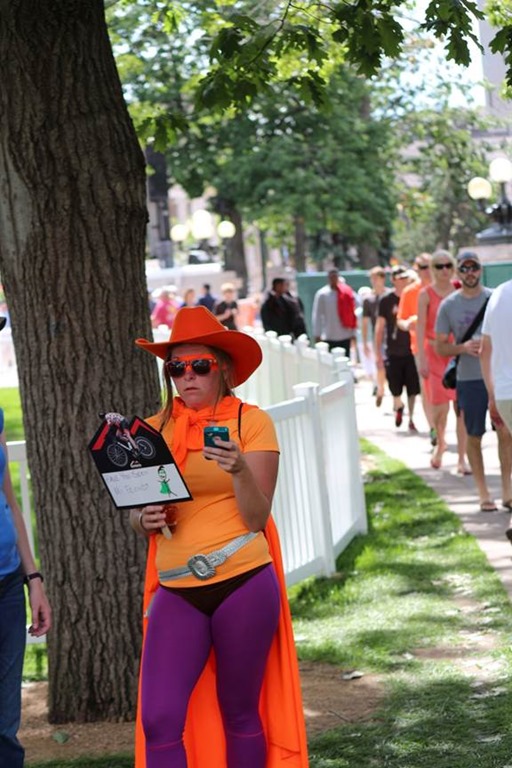
Do the riders have the time as they wiz by to see the outfits?
Some costumes are difficult to assign a category too, however at least he is riding a bike. That may or may not be good for cycling.
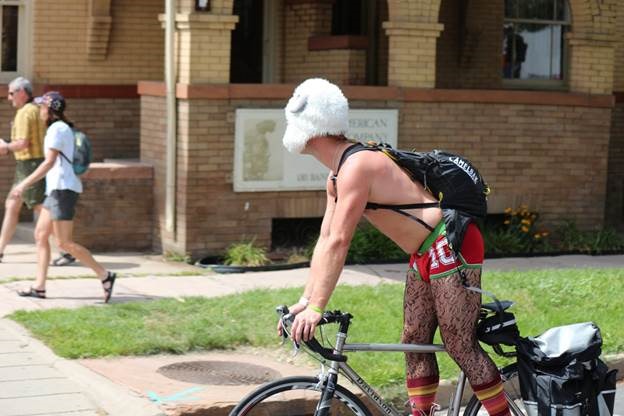
Some of the outfits can be as easy as a hat to makes you stand out in the crowd or a hair color so you loved ones can spot you…..and hide. When wearing a similar hat the pope always seems to smile.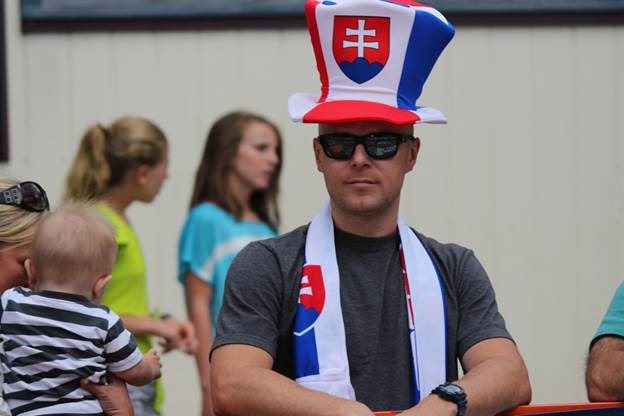
Do you think Jens saw him?
Then you see the group costumes where friends (or at least I hope they are friends) agree on a theme to wear to the raise. 
I’m not exactly sure the true nature of some of the themes. The relationship between Santa Clause and a Yeti in Vail still has me confused. The Wheaties box is just an afterthought….I hope.
It is bad when two people in a costume start to argue about it. It is always a hard to hear what the argument is about when both voices are coming from fur covered heads.

Age is not a limiting factor in costumes. No matter how small you may be getting dressed up is part of the excitement of the tour.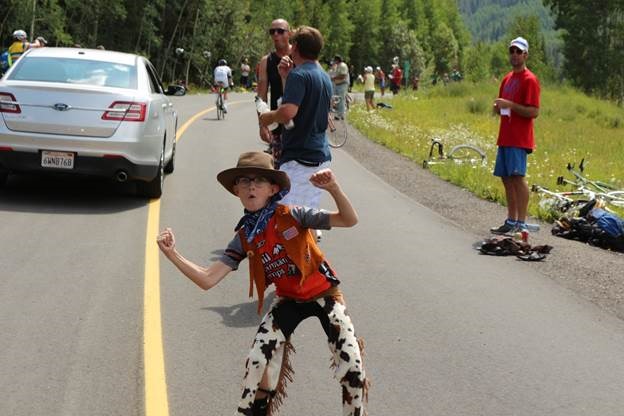
Unless maybe you dad makes you wear the costume, in the heat. But at least no one can recognize you if it covers your face.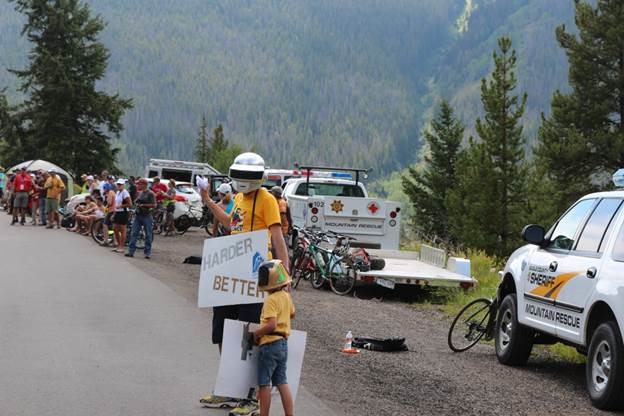
There always the marketing gurus who send employees out to represent their products. Energy snacks, water bottles two perennial favorites.
The best are when friends know a rider in the tour and want to show their support. Although I’m not sure I would come out of the team RV to see my friends of a gold speedo was the costume of choice.
His face mask almost matches his tattoo.
Even the UCI gets into the race, maybe just a crown, but it is still more than a non-descript ball cap.
What is curious is when a city gets into the act. The winner of the stage that ends in Breckenridge has the dubious honor of being photographed with a fur hat and shield. I thought winners were to be lauded, not punished?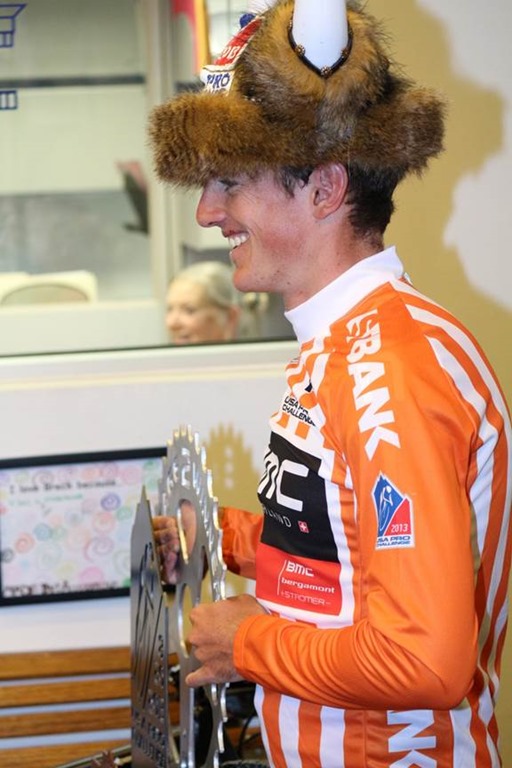
Even if you are not a big fan of bicycle racing (heaven forbid) you should at least stroll the start and finish near you to see the fans!
Enjoy Bicycle Racing? Enjoy photos of races from the 20’s & 30’s? Want to see new bicycle racing photographs from 100 years ago?
Posted: July 29, 2014 Filed under: Cycling | Tags: bicycle, Cycling, France, Goggles, Goggles & Dust, Googles & Dust: Images from Cycling’s Glory Days, Lance Armstrong, Tour de France, Velo Press, Vincenzo Nibali Leave a commentGoggles & Dust: Images from Cycling’s Glory Days, Velo Press
Velo Press will publish early this fall a new book for photographs of cycle racing from the early 1900’s that you have not seen before. Goggles & Dust: Images from Cycling’s Glory Days, has 101 photographs from the turn of the century of bicycle racing in France.
We’ve seen the suffering photos before; these cover all aspects of the race from the start to the finish, crashes and repairs to victories. The photographs bring back those great days in ways you’ve never seen before.
The greatest kick I got was seeing what has not changed in 100 years of racing the Tour de France. Cars still follow the riders, and based on the 2014 tour; riding conditions still suck, spectators still run alongside races as they struggle up hill.
At the same time, the photographs show you bicycle racing has come a long way. No longer do riders carry spare tires; water bottles are plastic and on the seat and down tubes and bikes are more than a single speed.
If you enjoy old cycling or new racing, you’ll love this book.
Goggles & Dust: Images from Cycling’s Glory Days, Velo Press, Hardcover September 2014, ISBN 978-1-937715-29-8
What do you think? Leave a comment.
If you like this let your friends know or post it on FB, Twitter or LinkedIn
Copyright 2014 Recreation Law (720) 334-8529
Call or Email me if you need legal services around these issues.
Email: Rec-law@recreation-law.com
Google+: +Recreation
Twitter: RecreationLaw
Facebook: Rec.Law.Now
Facebook Page: Outdoor Recreation & Adventure Travel Law
Blog: www.recreation-law.com
Mobile Site: http://m.recreation-law.com
By Recreation Law Rec-law@recreation-law.com James H. Moss #Authorrank
<rel=”author” link=” https://plus.google.com/u/0/b/112453188060350225356/” />
#AdventureTourism, #AdventureTravelLaw, #AdventureTravelLawyer, #AttorneyatLaw, #Backpacking, #BicyclingLaw, #Camps, #ChallengeCourse, #ChallengeCourseLaw, #ChallengeCourseLawyer, #CyclingLaw, #FitnessLaw, #FitnessLawyer, #Hiking, #HumanPowered, #HumanPoweredRecreation, #IceClimbing, #JamesHMoss, #JimMoss, #Law, #Mountaineering, #Negligence, #OutdoorLaw, #OutdoorRecreationLaw, #OutsideLaw, #OutsideLawyer, #RecLaw, #Rec-Law, #RecLawBlog, #Rec-LawBlog, #RecLawyer, #RecreationalLawyer, #RecreationLaw, #RecreationLawBlog, #RecreationLawcom, #Recreation-Lawcom, #Recreation-Law.com, #RiskManagement, #RockClimbing, #RockClimbingLawyer, #RopesCourse, #RopesCourseLawyer, #SkiAreas, #Skiing, #SkiLaw, #Snowboarding, #SummerCamp, #Tourism, #TravelLaw, #YouthCamps, #ZipLineLawyer, Velo Press, Tour de France, Goggles & Dust, Googles & Dust: Images from Cycling’s Glory Days, cycling, Bicycle Racing,
WordPress Tags: Enjoy,Bicycle,photos,Want,Goggles,Dust,Images,Glory,Velo,century,France,aspects,victories,Tour,Cars,riders,spectators,hill,bottles,tubes,bikes,Hardcover,September,ISBN,Leave,Twitter,LinkedIn,Recreation,Call,Email,Google,RecreationLaw,Facebook,Page,Outdoor,Adventure,Travel,Blog,Mobile,Site,James,Moss,Authorrank,author,AdventureTourism,AdventureTravelLaw,AdventureTravelLawyer,AttorneyatLaw,BicyclingLaw,Camps,ChallengeCourse,ChallengeCourseLaw,ChallengeCourseLawyer,CyclingLaw,FitnessLaw,FitnessLawyer,HumanPoweredRecreation,JamesHMoss,JimMoss,Negligence,OutdoorLaw,OutdoorRecreationLaw,OutsideLaw,OutsideLawyer,RecLaw,RecLawBlog,LawBlog,RecLawyer,RecreationalLawyer,RecreationLawBlog,RecreationLawcom,Lawcom,RiskManagement,RockClimbingLawyer,RopesCourse,RopesCourseLawyer,SkiAreas,SkiLaw,SummerCamp,Tourism,TravelLaw,YouthCamps,ZipLineLawyer,Googles
Want to Volunteer for the USA Pro Challenge, sign up Now!
Posted: June 20, 2014 Filed under: Colorado, Cycling | Tags: Aspen, Bicycle Racing, Colorado, Colorado Springs, Cycling, Denver, Monarch Mountain, USA Pro Challenge, Volunteer Leave a comment
|
||||||||||||||||||||||||||||||||||||||||||||||||||||||||||||||||||||||||||||||||||||||||||||||||||||||||||||


Everyday Kid Phil Gaimon Rides Off the Couch into a Pro Cycling Contract
Posted: May 10, 2014 Filed under: Cycling | Tags: Cycling, Gaimon, Garmin-Sharp, Phil Gaimon, Racing, Sports, United States, x, y, z 1 CommentBoulder, CO, USA – May 6, 2014 – Professional cyclist Phil Gaimon has written a book telling the true story of his unlikely transform ation from fat kid to professional bike racer. Pro Cycling on $10 a Day: From Fat Kid to Euro Pro, is now available in bookstores, bike shops, and online. Preview Gaimon’s debut book at http://www.velopress.com/phil.
Plump, grumpy, slumped on the couch, and going nowhere fast at age 16, Phil Gaimon begin riding a bicycle with the grand ambition of shedding a few pounds before going off to college. He soon fell into racing and discovered he was a natural, riding his way into a pro contract after just one season despite utter ignorance of a century of cycling etiquette. A few hardscrabble seasons later, Gaimon was offered a contract to race in 2014 for Team Garmin-Sharp, an elite cycling team that competes at the sport’s highest level.
Pro Cycling on $10 a Day is a true story, a guide, and a warning to aspiring racers who dream of joining the professional racing circus. Gaimon’s adventures in road rash serve as a hilarious and cautionary tale of frustrating team directors and broken promises. His education in the ways of the peloton, his discouraging negotiations for a better contract, his endless miles crisscrossing America in pursuit of race wins, and his conviction that somewhere just around the corner lies the ticket to the big time fuel this tale of hope and ambition from one of cycling’s best storytellers.
Pro Cycling on $10 a Day chronicles the racer’s daily lot of blood-soaked bandages, sleazy motels, cheap food, and overflowing toilets. But Gaimon also celebrates the true beauty of the sport and the worth of the journey, proving in the end that even among the narrow ranks of world-class professional cycling, there will always be room for a hardworking outsider.
Pro Cycling on $10 a Day: From Fat Kid to Euro Pro Phil Gaimon Paperback with b&w photographs throughout.
6″ x 9″, 312 pp., $18.95, 9781937715243
Phil Gaimon is a professional cyclist for Team Garmin-Sharp, a writer, and an entrepreneur who retired from laziness and computer games in 2004 in favor of riding a bike to lose weight. On a whim, he started racing and soon discovered that he was a natural. Phil advanced rapidly through the amateur ranks and turned professional in his second full year. He slowly learned the rules and clawed his way to the top of the American pro ranks, joining Garmin-Sharp in 2014. He maintains a website, http://www.Philthethrill.net, where he chronicles his ceaseless pursuit of the best cookies and milk in America, and tweets at http://www.twitter.com/philgaimon.
Can’t wait to read it.

May is National Bike Month
Posted: May 6, 2014 Filed under: Cycling, Mountain Biking | Tags: Bike-to-Work Day, Cycling, League of American Bicyclists, May, National Bike Month, Ride of Silence, Workweek and weekend Leave a comment
|


 Social media has become a powerful tool to spread the word about the joys and benefits of bicycling. So show your love by taking a moment today to upload our May is Bike Month Facebook timeline cover and freshen up your blog or website with a

|
|
Win Four Tickets to the Pro Challenge Stage of Your Choice: Enter the National Poster Contest by April 18th
Posted: April 20, 2014 Filed under: Cycling | Tags: Bike Race, Bike Racing, Cycling, Peter Sagan, Tejay Van Garderen, USA Pro Challenge Leave a comment
|
|||||||||||||||||||||||||||||||||||||||||||||||||||||||||||||||||||||||||||||||||||||||


Eric’s Big Day Is a Whimsical Bicycle Ride for Children
Posted: April 12, 2014 Filed under: Uncategorized | Tags: Bicycle Racing, Competitor Group, Cycling, Eric’s Big Day, Velo Press Leave a comment VeloPress is pleased to announce the release of a new children’s book, Eric’s Big Day: A Bicycle Race Unlike Any Other, by award-winning author and illustrator Rod Waters. The book is now available in bookstores, bike shops, and online. Preview a flipbook of Eric’s Big Day at http://www.velopress.com/eric.
It’s a big day for Eric, the day of the bike race. His knapsack packed, Eric rides his bicycle to his friend Emily’s for a picnic near the finish.
Pedaling from his house, Eric is slowed as he aids wayward bike racers, using helpful items from his backpack. The faster he rides to meet Emily, the more delays he encounters, until he tears off in a burst of speed. The cheers of a crowd surprise Eric, but where is Emily?
Eric’s Big Day is a colorful adventure on wheels, full of fun and authentic cycling flavor. Children 4-8 will love this lighthearted tale of a boy who helps others and finds himself a winner.
Eric’s Big Day: A Bicycle Race Unlike Any Other Rod Waters Hardcover with color illustrations.
10″ x 7 ¾”, 28 pp., $14.95, 978-1-937715-23-6 For children ages 4-8.
Rod Waters is a writer and an award-winning illustrator based in London. He has worked with The Folio Society, The Spectator, The Independent, Nelson Thornes, The N.H.S., The Tower of London, Virgin Atlantic, Clifton Nurseries, The Surveyor, and MJ Magazine. His illustrations have won the Winning Hand competition and have been shortlisted for the Picture This and the London Cartoon competitions. Waters is a level 2 British Cycling coach and holds a Guinness World Record for cycling between Paris and London in just over 14 hours.
VeloPress is the leading publisher of books about the endurance sports of cycling, triathlon, running, and swimming. VeloPress books help beginners and committed athletes build fitness and achieve their goals. VeloPress celebrates the icons of endurance sports through history books, biographies, memoirs, and photography books. For more information, please visit http://www.velopress.com.
What do you think? Leave a comment.
If you like this let your friends know or post it on FB, Twitter or LinkedIn
Copyright 2014 Recreation Law (720) Edit Law
Email: Rec-law@recreation-law.com
Google+: +Recreation
Twitter: RecreationLaw
Facebook: Rec.Law.Now
Facebook Page: Outdoor Recreation & Adventure Travel Law
Mobile Site: http://m.recreation-law.com
By Recreation Law Rec-law@recreation-law.com James H. Moss #Authorrank
<rel=”author” link=” https://plus.google.com/u/0/b/112453188060350225356/” />
#AdventureTourism, #AdventureTravelLaw, #AdventureTravelLawyer, #AttorneyatLaw, #Backpacking, #BicyclingLaw, #Camps, #ChallengeCourse, #ChallengeCourseLaw, #ChallengeCourseLawyer, #CyclingLaw, #FitnessLaw, #FitnessLawyer, #Hiking, #HumanPowered, #HumanPoweredRecreation, #IceClimbing, #JamesHMoss, #JimMoss, #Law, #Mountaineering, #Negligence, #OutdoorLaw, #OutdoorRecreationLaw, #OutsideLaw, #OutsideLawyer, #RecLaw, #Rec-Law, #RecLawBlog, #Rec-LawBlog, #RecLawyer, #RecreationalLawyer, #RecreationLaw, #RecreationLawBlog, #RecreationLawcom, #Recreation-Lawcom, #Recreation-Law.com, #RiskManagement, #RockClimbing, #RockClimbingLawyer, #RopesCourse, #RopesCourseLawyer, #SkiAreas, #Skiing, #SkiLaw, #Snowboarding, #SummerCamp, #Tourism, #TravelLaw, #YouthCamps, #ZipLineLawyer, Velo Press, Competitor Group, Cycling, Bicycle Racing, Eric’s Big Day,
Denver B-Cycle is hiring!
Posted: February 28, 2014 Filed under: Cycling | Tags: Colorado, Cycling, Denver, Denver B-cycle, Rental Bikes Leave a comment
|
||||||||||||||||||||||||||||||||||||||||||||||||||||||||||||
 |


McPhail v. Bismarck Park District, 2003 ND 4; 655 N.W.2d 411; 2003 N.D. LEXIS 3
Posted: February 20, 2014 Filed under: Cycling, Legal Case, Minors, Youth, Children, North Dakota, Release (pre-injury contract not to sue) | Tags: bicycle, Bismarck Park District, Cycling, Minor, ND, North Dakota, parent, Park District, Release Leave a commentMcPhail v. Bismarck Park District, 2003 ND 4; 655 N.W.2d 411; 2003 N.D. LEXIS 3
Scott Kondrad, a minor, by and through Shari McPhail as next friend, Plaintiff and Appellant v. Bismarck Park District, Defendant and Appellee
No. 20020196
2003 ND 4; 655 N.W.2d 411; 2003 N.D. LEXIS 3
January 17, 2003, Filed
Prior History: [***1] Appeal from the District Court of Burleigh County, South Central Judicial District, the Honorable Bruce A. Romanick, Judge.
Disposition: AFFIRMED.
Counsel: Michael Ray Hoffman, Bismarck, N.D., for plaintiff and appellant.
Randall J. Bakke, Smith Bakke Oppegard Porsborg Wolf, Bismarck, N.D., for defendant and appellee.
Judges: Opinion of the Court by Maring, Justice. Mary Muehlen Maring, William A.
Neumann, Dale V. Sandstrom, Carol Ronning Kapsner, Gerald W. VandeWalle, C.J.
Opinion By: Mary Muehlen Maring
Opinion
[**412] Maring, Justice.
[*P1] Scott Kondrad, a minor, by and through his mother, Shari McPhail, as next friend, appealed from a summary judgment dismissing his action for damages against the Bismarck Park District for injuries suffered in a bicycle accident.
We hold a waiver and release signed by McPhail exonerates the Park District for its alleged negligence in this case, and we affirm.
I
[*P2] The bicycle accident occurred on September 9, 1999, at the Pioneer Elementary School while Kondrad was [***2] participating in BLAST, an after-school care program operated by the Park District. Kondrad fell on the school grounds while riding a bicycle owned by a child who was not part of the BLAST program. Kondrad injured his arm in the fall, and McPhail subsequently sued the Park District for damages on Kondrad’s behalf, asserting Kondrad’s injuries were the result of the Park District’s negligent supervision of the children in the BLAST program. The Park District moved for a summary judgment, claiming McPhail had released the Park District from liability for the accident.
The district court construed the waiver and release signed by McPhail, determined it exonerated the Park District from liability, and granted the Park District’s motion for dismissal of the case.
II
[*P3] On appeal, Kondrad asserts the district court erred in granting the summary judgment dismissal and in concluding that the waiver and release signed by McPhail exonerated the Park District from liability for its alleged negligence.
[*P4] Summary judgment under N.D.R.Civ.P. 56 is a procedural device for properly disposing of a lawsuit without trial if, after viewing the evidence in the light most favorable to [***3] the nonmoving party, there are no genuine issues of material fact or conflicting inferences which can reasonably be drawn from undisputed facts, or if the only issues to be resolved are questions of law. Jose v. Norwest Bank, 1999 ND 175, P7, 599 N.W.2d 293. Whether the district court properly granted summary judgment is a question of law and is reviewed de novo. Garofalo v. St. Joseph’s Hosp., 2000 ND 149, P6, 615 N.W.2d 160. On appeal, we review the evidence in the light most favorable to the party opposing the motion for summary judgment, giving that party the benefit of all favorable inferences that reasonably can be drawn from the evidence. Olander [**413] Contracting Co. v. Gail Wachter Invs., 2002 ND 65, P9, 643 N.W.2d 29.
[*P5] Resolution of this appeal requires us to interpret the “Parent Agreement” signed by McPhail when she enrolled Kondrad in the BLAST program, which included the following waiver and release language:
I recognize and acknowledge that there are certain risks of physical injury to participant in this program and I agree to assume the full risk of any such injuries, damages or loss regardless of [***4] severity which I or my child/ward may sustain as a result of participating in any activities associated with this program. I waive and relinquish all claims that I, my insurer, or my child/ward may have against the Park District and its officers, servants, and employees from any and all claims from injuries, damages or loss which I or my child/ward may have or which may accrue to me or my child/ward on account of my participation of my child/ward in this program.
Kondrad argues this language must be interpreted as exonerating the Park District from liability for damages only as to injuries sustained during “activities associated with” the BLAST program. The Park District has conceded that riding a bicycle was not an activity associated with the program. Kondrad asserts the release does not, therefore, exonerate the Park District from liability if its negligence resulted in Kondrad incurring injuries while riding the bicycle. The Park District asserts the waiver is unambiguous and released the Park District from liability for any and all injuries sustained by Kondrad while participating in the BLAST program. The Park District argues the waiver and release exonerated it from [***5] liability for negligence resulting in injury or damages to Kondrad while participating in the program irrespective of whether, at the time of the injury, Kondrad was involved in a planned activity associated with the program.
[*P6] Generally, the law does not favor contracts exonerating parties from liability for their conduct. Reed v. Univ. of North Dakota, 1999 ND 25, P22, 589 N.W.2d 880. However, the parties are bound by clear and unambiguous language evidencing an intent to extinguish liability, even though exculpatory clauses are construed against the benefitted party. Id. When a contract is reduced to writing, the intention of the parties is to be ascertained from the writing alone, if possible. N.D.C.C. § 9-07-04; Meide v. Stenehjem ex rel. State, 2002 ND 128, P7, 649 N.W.2d 532. The construction of a written contract to determine its legal effect is a question of law for the court to decide, and, on appeal, this Court will independently examine and construe the contract to determine if the trial court erred in its interpretation of it. Egeland v. Continental Res., Inc., 2000 ND 169, P10, 616 N.W.2d 861. [***6] The issue whether a contract is ambiguous is a question of law. Lenthe Invs., Inc. v. Serv. Oil, Inc., 2001 ND 187, P14, 636 N.W.2d 189. An unambiguous contract is particularly amenable to summary judgment. Meide, 2002 ND 128, P7, 649 N.W.2d 532.
[*P7] We conclude the language of waiver and release under the agreement signed by McPhail is clear and unambiguous. We construe all provisions of a contract together to give meaning to every sentence, phrase, and word. U.S. Bank Nat’l Ass’n v. Koenig, 2002 ND 137, P9, 650 N.W.2d 820. The assumption of risk and waiver clauses are separate and distinct. Each contains a clearly expressed meaning and consequence. Under the assumption of risk clause, McPhail agreed to assume the full risk of injury and damages resulting from Kondrad participating in [**414] any activities associated with the BLAST program. In addition, under the waiver and release clause, McPhail waived and relinquished all claims against the Park District for injuries or damages incurred on account of Kondrad’s participation in the BLAST program. The language of waiver and release is not limited to only those injuries incurred [***7] while participating in activities associated with the program, but to all injuries incurred by the child on account of his participation in the program.
[*P8] It is undisputed that Kondrad’s bicycle accident occurred on the school grounds while Kondrad was participating in the BLAST program. This is the very type of situation for which the Park District, under the release language, insulated itself from liability for alleged negligence while operating the after-school care program. Under the unambiguous language of the agreement, McPhail exonerated the Park District from liability for injury and damages incurred by Kondrad while participating in the program and caused by the alleged negligence of the Park District. 1
– – – – – – – – – – – – – – Footnotes – – – – – – – – – – – – – – -1
Under N.D.C.C. § 9-08-02 a party is precluded from contractually exonerating itself from liability for willful acts. See Reed v. Univ. of North Dakota, 1999 ND 25, P22 n.4, 589 N.W.2d 880. The release in this case is not specifically limited to exonerating the Park District from liability for only negligent conduct.
However, Kondrad’s claim against the Park District is based on negligence, and he has not argued the release is invalid because it purports to exonerate the Park District from liability for intentional or willful acts. We do not, therefore, address that issue in this opinion.
– – – – – – – – – – – – End Footnotes- – – – – – – – – – – – – –
[***8] III
[*P9] We hold the Parent Agreement signed by McPhail clearly and unambiguously exonerates the Park District for injuries sustained by Kondrad while participating in the BLAST program and which were allegedly caused by the negligent conduct of the Park District. We further hold, therefore, the district court did not err in granting summary judgment dismissing Kondrad’s action against the Park District, and we affirm.
[*P10] Mary Muehlen Maring
William A. Neumann
Dale V. Sandstrom
Carol Ronning Kapsner
Gerald W. VandeWalle, C.J.
WordPress Tags: McPhail,Bismarck,Park,District,LEXIS,Scott,Kondrad,Shari,friend,Plaintiff,Appellant,Defendant,Appellee,Supreme,Court,North,Dakota,January,Prior,History,Appeal,Burleigh,South,Central,Judicial,Honorable,Bruce,Romanick,Judge,Disposition,Counsel,Michael,Hoffman,Randall,Bakke,Smith,Oppegard,Porsborg,Wolf,Judges,Opinion,Justice,Mary,Muehlen,William,Neumann,Dale,Sandstrom,Carol,Kapsner,Gerald,VandeWalle,judgment,action,injuries,bicycle,accident,waiver,negligence,September,Pioneer,Elementary,School,BLAST,supervision,dismissal,Summary,device,lawsuit,fact,inferences,Jose,Norwest,Bank,Whether,Garofalo,Joseph,Hosp,Olander,Gail,Wachter,Invs,Resolution,Parent,Agreement,injury,participant,ward,insurer,officers,servants,employees,account,participation,Univ,clauses,intention,Meide,Stenehjem,State,construction,interpretation,Egeland,Continental,Lenthe,Serv,Koenig,assumption,consequence,Under,clause,addition,situation,Footnotes
Wow, very amazing and generous. Primal (Denver Bicycle Clothing Company Gave Back More Than One Million Dollars in 2013
Posted: January 31, 2014 Filed under: Cycling | Tags: Bike MS, Clothing, Cycling, Denver, League of American Bicyclists, Primal, Primal Gives Back program, Sea Otter Classic, Trips for Kids Leave a comment
|


Saris sponsoring National Bicycling Poster Contest
Posted: January 21, 2014 Filed under: Cycling | Tags: Bicycling, Cycling, Poster Contest, SARIS Leave a comment In 2010 we designed a poster contest to engage our youth on the numerous benefits of the bicycle. Over the past 3 years we have reached over 20,000 fifth graders through our contest. First place state winners receive a bike, light and helmet. One national winner will go to the 2015 National Bike Summit in Washington D.C.
To Enter:
1. Visit here to see if your state is participating.
3. Send poster in by March 7 to your coordinator.
What do you think? Leave a comment.
If you like this let your friends know or post it on FB, Twitter or LinkedIn
Copyright 2013 Recreation Law (720) Edit Law
Email: Rec-law@recreation-law.com
Google+: +Recreation
Twitter: RecreationLaw
Facebook: Rec.Law.Now
Facebook Page: Outdoor Recreation & Adventure Travel Law
Mobile Site: http://m.recreation-law.com
By Recreation Law Rec-law@recreation-law.com James H. Moss #Authorrank
<rel=”author” link=” https://plus.google.com/u/0/b/112453188060350225356/” />
#RecreationLaw, #Recreation-Law.com, #OutdoorLaw, #OutdoorRecreationLaw, #AdventureTravelLaw, #law, #TravelLaw, #JimMoss, #JamesHMoss, #Tourism, #AdventureTourism, #Rec-Law, #RiskManagement, #CyclingLaw, #BicyclingLaw, #FitnessLaw, #Recreation-Law.com, #Backpacking, #Hiking, #Mountaineering, #IceClimbing, #RockClimbing, #RopesCourse, #ChallengeCourse, #SummerCamp, #Camps, #YouthCamps, #Skiing, #Ski Areas, #Negligence, #Snowboarding, #RecreationLaw, #@RecreationLaw, #Cycling.Law, #SkiLaw, #Outside.Law, #Recreation.Law, #RecreationLaw.com, #OutdoorLaw, #RecreationLaw, #OutdoorRecreationLaw, #AdventureTravelLaw, #Law, #TravelLaw, #JimMoss, #JamesHMoss, #AttorneyatLaw, #Tourism, #AdventureTourism, #RecLaw, #RecLawBlog, #RecreationLawBlog, #RiskManagement, #HumanPowered, #HumanPoweredRecreation,# CyclingLaw, #BicyclingLaw, #FitnessLaw, #RecreationLaw.com, #Backpacking, #Hiking, #Mountaineering, #IceClimbing, #RockClimbing, #RopesCourse, #ChallengeCourse, #SummerCamp, #Camps, #YouthCamps, #Skiing, #Ski Areas, #Negligence, #Snowboarding, sport and recreation laws, ski law, cycling law, Colorado law, law for recreation and sport managers, bicycling and the law, cycling and the law, ski helmet law, skiers code, skiing accidents, Recreation Lawyer, Ski Lawyer, Paddlesports Lawyer, Cycling Lawyer, Recreational Lawyer, Fitness Lawyer, Rec Lawyer, Challenge Course Lawyer, Ropes Course Lawyer, Zip Line Lawyer, Rock Climbing Lawyer, Adventure Travel Lawyer, Outside Lawyer, Recreation Lawyer, Ski Lawyer, Paddlesports Lawyer, Cycling Lawyer, #RecreationalLawyer, #FitnessLawyer, #RecLawyer, #ChallengeCourseLawyer, #RopesCourseLawyer, #ZipLineLawyer, #RockClimbingLawyer, #AdventureTravelLawyer, #OutsideLawyer, Good Samaritan, Samaritan, First Aid, SARIS, National Bicycling Poster Contest, Cycling, Biking, Bicycling,
WordPress Tags: Saris,National,Poster,Contest,youth,bicycle,Over,winners,bike,helmet,winner,Summit,Washington,Enter,Visit,Send,March,coordinator,Leave,Twitter,LinkedIn,Recreation,Edit,Email,Google,RecreationLaw,Facebook,Page,Outdoor,Adventure,Travel,Blog,Mobile,Site,James,Moss,Authorrank,author,OutdoorLaw,OutdoorRecreationLaw,AdventureTravelLaw,TravelLaw,JimMoss,JamesHMoss,Tourism,AdventureTourism,RiskManagement,CyclingLaw,BicyclingLaw,FitnessLaw,RopesCourse,ChallengeCourse,SummerCamp,Camps,YouthCamps,Areas,Negligence,SkiLaw,Outside,AttorneyatLaw,RecLaw,RecLawBlog,RecreationLawBlog,HumanPoweredRecreation,Colorado,managers,accidents,Lawyer,Paddlesports,Recreational,Challenge,Course,Ropes,Line,Rock,RecreationalLawyer,FitnessLawyer,RecLawyer,ChallengeCourseLawyer,RopesCourseLawyer,ZipLineLawyer,RockClimbingLawyer,AdventureTravelLawyer,OutsideLawyer,Samaritan
People for Bikes is Growing and Making Cycling Better
Posted: December 10, 2013 Filed under: Cycling | Tags: bicycle, Cycling, People for Bikes Leave a comment
|
||||||||||||||


USA Pro Challenge gets jump on 2014 and announces host cities
Posted: November 5, 2013 Filed under: Colorado, Cycling | Tags: #ProChallenge, Aspen, Bicycle Racing, Breckenridge, Colorado, Colorado Springs, Crested Butte, Cycling, Denver, Gunnison, USA Pro Challenge, Vail, Woodland Park Leave a commentLast day of race to be voted on by viewers and cyclists and Tom Danielson got his wish
The USA Pro Challenge has announced the 2014 race. The host start and finish cities are:
Stage 1: Monday, Aug. 18 – Aspen Circuit Race
Stage 2: Tuesday, Aug. 19 – Aspen to Mt. Crested Butte
Stage 3: Wednesday, Aug. 20 – Gunnison to Monarch Mountain (mountaintop finish)
Stage 4: Thursday, Aug. 21 – Colorado Springs Circuit Race
Stage 5: Friday, Aug. 22 – Woodland Park to Breckenridge
Stage 6: Saturday, Aug. 23 – Vail Individual Time Trial
Stage 7: Sunday, Aug. 24 – ???
The question mark for the final stage is a pretty neat finish idea. The public will get to vote for the final stage they want. The choices are:
Denver Circuit Race similar to the final stage of the 2013 race
Start in Golden (2012 Stage 6 start city) and finish in Denver
Start in Boulder (2012 Stage 6 finish city) and finish in Denver
Start in Boulder and end in Golden
Go here to vote on the race you want. What’s Your Vote For Stage 7? Voting gets you a 15% discount off USA Pro Challenge items in the store.
The course:
The course is similar to the very successful 2013 race. Cities with two things; money and people who want to watch a bicycle race are involved. So Aspen and Vail are probably always going to be on the race circuit. The turn out and support in Gunnison, Crested Butte and Mt Crested Butte is 100%, even though that is only 20% of what Vail turns out. Breckenridge and Colorado Springs are next as far as both and the perennial Denver is becoming the home to great cycling because of work of past volunteers and the USA Pro Challenge.
Merry Christmas Tom Danielson
The only location with issues will be the finish on Monarch Mountain. This finish is a long way from Gunnison and close to Chaffee County, but still lacking in numbers of people. However it fulfills team Garmin Sharp’s Tom Danielson’s Christmas wish to have a mountain stage win at the Pro Challenge. Now he better win that stage!
But that will be a great finish no matter how many people. If you are a fan of the tour in Europe everyone watches, this will become a classic just like those finishes. It is a long and grueling climb. Probably only Wolf Creek Pass from the west is steeper. Finding a good place to see the race is going to be tough so get their early to stake out your spot.
Overall the race course looks fantastic so far. Until we see the actual routes we’ll not know the elevation or distances, however with the starts and finishes already picked this is destined to be another great week of cycling in Colorado.
It is going to be a great week of bicycle racing in Colorado.
See Host Cities Announced for 2014 USA Pro Challenge
What do you think? Leave a comment.
If you like this let your friends know or post it on FB, Twitter or LinkedIn
Copyright 2013 Recreation Law (720) Edit Law
Email: Rec-law@recreation-law.com
Google+: +Recreation
Twitter: RecreationLaw
Facebook: Rec.Law.Now
Facebook Page: Outdoor Recreation & Adventure Travel Law
Mobile Site: http://m.recreation-law.com
By Recreation Law Rec-law@recreation-law.com James H. Moss #Authorrank
<rel=”author” link=” https://plus.google.com/u/0/b/112453188060350225356/” />
#RecreationLaw, #Recreation-Law.com, #OutdoorLaw, #OutdoorRecreationLaw, #AdventureTravelLaw, #law, #TravelLaw, #JimMoss, #JamesHMoss, #Tourism, #AdventureTourism, #Rec-Law, #RiskManagement, #CyclingLaw, #BicyclingLaw, #FitnessLaw, #Recreation-Law.com, #Backpacking, #Hiking, #Mountaineering, #IceClimbing, #RockClimbing, #RopesCourse, #ChallengeCourse, #SummerCamp, #Camps, #YouthCamps, #Skiing, #Ski Areas, #Negligence, #Snowboarding, #RecreationLaw, #@RecreationLaw, #Cycling.Law, #SkiLaw, #Outside.Law, #Recreation.Law, #RecreationLaw.com, #OutdoorLaw, #RecreationLaw, #OutdoorRecreationLaw, #AdventureTravelLaw, #Law, #TravelLaw, #JimMoss, #JamesHMoss, #AttorneyatLaw, #Tourism, #AdventureTourism, #RecLaw, #RecLawBlog, #RecreationLawBlog, #RiskManagement, #HumanPowered, #HumanPoweredRecreation,# CyclingLaw, #BicyclingLaw, #FitnessLaw, #RecreationLaw.com, #Backpacking, #Hiking, #Mountaineering, #IceClimbing, #RockClimbing, #RopesCourse, #ChallengeCourse, #SummerCamp, #Camps, #YouthCamps, #Skiing, #Ski Areas, #Negligence, #Snowboarding, sport and recreation laws, ski law, cycling law, Colorado law, law for recreation and sport managers, bicycling and the law, cycling and the law, ski helmet law, skiers code, skiing accidents, Recreation Lawyer, Ski Lawyer, Paddlesports Lawyer, Cycling Lawyer, Recreational Lawyer, Fitness Lawyer, Rec Lawyer, Challenge Course Lawyer, Ropes Course Lawyer, Zip Line Lawyer, Rock Climbing Lawyer, Adventure Travel Lawyer, Outside Lawyer, Recreation Lawyer, Ski Lawyer, Paddlesports Lawyer, Cycling Lawyer, #RecreationalLawyer, #FitnessLawyer, #RecLawyer, #ChallengeCourseLawyer, #RopesCourseLawyer, #ZipLineLawyer, #RockClimbingLawyer, #AdventureTravelLawyer, #OutsideLawyer, Good Samaritan, Samaritan, First Aid, USA Pro Challenge, #ProChallenge, Cycling, Bicycle Racing, Colorado, Aspen, Vail, Breckenridge, Gunnison, Crested Butte, Colorado Springs, Denver, Woodland Park
WordPress Tags: Challenge,cities,Last,viewers,Danielson,Stage,Aspen,Circuit,Race,Butte,Gunnison,Monarch,Mountain,mountaintop,Colorado,Springs,Woodland,Park,Breckenridge,Vail,Individual,Time,Trial,Denver,Start,Golden,Boulder,Vote,items,money,bicycle,location,Chaffee,team,Garmin,Sharp,Christmas,Europe,Wolf,Creek,Pass,Overall,elevation,Host,Leave,Twitter,LinkedIn,Recreation,Edit,Email,Google,RecreationLaw,Facebook,Page,Outdoor,Adventure,Travel,Blog,Mobile,Site,James,Moss,Authorrank,author,OutdoorLaw,OutdoorRecreationLaw,AdventureTravelLaw,TravelLaw,JimMoss,JamesHMoss,Tourism,AdventureTourism,RiskManagement,CyclingLaw,BicyclingLaw,FitnessLaw,RopesCourse,ChallengeCourse,SummerCamp,Camps,YouthCamps,Areas,Negligence,SkiLaw,Outside,AttorneyatLaw,RecLaw,RecLawBlog,RecreationLawBlog,HumanPoweredRecreation,managers,helmet,accidents,Lawyer,Paddlesports,Recreational,Course,Ropes,Line,Rock,RecreationalLawyer,FitnessLawyer,RecLawyer,ChallengeCourseLawyer,RopesCourseLawyer,ZipLineLawyer,RockClimbingLawyer,AdventureTravelLawyer,OutsideLawyer,Samaritan,ProChallenge,week
Interbike 2013
Posted: October 2, 2013 Filed under: Cycling, Mountain Biking | Tags: bicycle, biking, Cycling, Interbike, National Bicycle Dealers Association, NBDA, Tradeshow Leave a commentThe Good, The Bad, The Ugly and the Confusing
Overall, I believe Interbike was a success for the exhibitors attending and indoors.
New Venue: The show moved from the Sands to the Mandalay Bay Convention center. I had been to the convention center many times for the ski show and was familiar with the venue. Everyone else seemed confused with the new venue and booth arrangement. However, that confusion had a big payoff. The smaller 10 x 10 booths that normally don’t see anyone till late the first day or later were packed from the beginning. I talked to one exhibitor who had expected to have meetings the morning of the first day and did not get to them because of the traffic. That’s great.
Overall everyone thought traffic was good and constant.
Mandalay Bay’s food court was closed so that left few options for food. 4 options actually, all with the same fare. Day 1 and 2 the food was expensive but great. Day 3 the lettuce started to wilt. $7.50 for a Gatorade was also a little tough, but I should be used to it by now at trade shows.
When the Food court is open, life will get better. More and better food options are always great at a trade show.
Part of the show was outside. In theory, it was a great idea, the opportunity to test bikes, check out things what would not fit or would be hard to get into a trade show. The only problem was Mother Nature did not cooperate. It was hot. Most attendees got about 150’ out to the “paddock” and quit, returning quickly to the air-conditioned indoors. However the idea works.
The venue did bring back the crit. Having two bicycle races at a tradeshow, cyclecross and a crit are great! Two of the best reasons to attend the show is to relax after the day on the show floor and watch racing rather than crowing into a bar and not getting served (sorry started thinking about OR at SLC).
It would be nice to have a couple of straight aisles to move from one end of the show to the other. It helps with orientation also.
The overall opinion of the move to Mandalay Bay from the Sands: nicer bathrooms.
Eventually, everyone will know where everyone else is and things will settle back to the old familiarity everyone felt at the Sands. Mandalay Bay is smaller than the sands, but with the outdoor space, (weather permitting) and how much nicer the entire area is, Mandalay Bay will work.
Traffic: Traffic was down; Interbike preliminary numbers reported “Overall attendance was down 7 percent from 2012”. I think 7% is optimistic. Day two of the demo seemed that way to everyone I talked to. However, the total numbers do not matter; it only matters if the right people were there and every exhibitor I talked to accept one said they were happy with the attendance.
The one exhibitor who thought numbers were down was upstairs in the main hall and could have been downstairs in health and fitness business. That area was light, light might not be the best word, void might be better.
Walking through the health and fitness business section, it seemed like the same number of exhibitors were there. However buyers were not. Part of the problem was there was nothing on the main show floor saying where to find H&F Biz. or how to get there. I finally asked someone on how to get to the H&F Biz.
The App. The Interbike App was much better, must faster and worth downloading. Don’t go to a tradeshow and not use the app if they have one. The only problem was people walking around following their phones and having me bump into them……or maybe I was following my phone and bumping into them…..
Demo. The demo is the best part of Interbike. You get to ride bikes and figure out how bikes ride. You can compare bikes side by side or ride by ride. You get to talk to the mechanics, the people who work on the bikes and ask them questions about what works and what does not work. I’m afraid that Interbike will become like the ski show. People show up for the demo and skip the tradeshow.
Consumer Day: The major talk of the show was Consumer Day: The big talk for the entire show, instead of what was new, consumer day. Originally, Interbike tried to entice retailers to bring six of their best clients to Vegas and attend Interbike on the last day, for $50 each. That was expanded to anyone who attended Vegas Cyclecross and paid less, then anyone who rode the Vegas Fondo, then members for People for Bikes. Supposedly, the difference in what you paid was a different swag bag.
Exhibitors had three issues throughout the show: How was it going to work? Information was either hard to find or just missing as far as most exhibitors were concerned.
They’re going to steal us blind. One booth used plastic wrap on their booth each night to prevent theft when no one was in the booth. Friday morning they left the wrap on.
Can we sell to the people coming in? Many exhibitors pay for part of their costs and save shipping by selling to the exhibitors the last day. Retailers have a great deal on product and exhibitors have less to pack and ship and a little cash in their pocket at the end of the show. Exhibitors were met Friday morning with a piece of paper warning them not to sell anything on the last day. This was met with mixed reaction. Some booths that normally sold everything packed up everything and some booths were empty just as they normally were.
Consumer badges had a yellow/tan background. I started counting them when I saw them. I waited by the main door at 9:00 am expecting a rush of consumers. There was no rush of anyone. (I could have been at the wrong door…..) By 4:00 Pm I had counted 36 consumer badges. I did not search; I just counted if I saw a badge. By mid-morning, many consumers had turned their badge around so they were not identifiable as a consumer, so I’m sure there were more people than 36 consumers.
Interbike reported that “Preliminary data shows that approximately 750 verified consumers attended Interbike’s 1st consumer-access day on Friday, September 20th.” I think that is a little bit of a stretch or they reported something wrong. There were not 750 people on the show floor combined on Friday: Exhibitors, Buyers, Media and Consumers. I can’t believe I missed 714 people walking around the show floor.
The biggest tragedy of consumer day was exhibitors thought the consumers had chased buyers away. The exhibitors seemed right. There appeared to be a lot less buyers on the floor the last day. This was an open discussion on the floor throughout Friday.
The one funny thing is what the “consumers” did buy. Las Vegas has a dozen booth filler companies as I call them. I met one at an Interbike a while ago. They live in Vegas and make a living selling stuff at tradeshows. Many times they have nothing to do with the show. They are contacted by the convention center owners or the tradeshow when a tradeshow has space. They just quickly move in, set up and sell what they have. It is better to have “what are they doing here” booths than empty space according to my source.
At this year’s Interbike half of the consumers were walking around with bags from one of these booths. It was some sort of muscle stimulate selling for $60+ dollars on the show floor and available online for $5.
At least there wasn’t a personal injury law firm with a booth like last year.
Should you attend?
Yes. You should always attend your industry tradeshow.
1. You find new things. Not in the big booths, but the next new thing that sits by your counter or in five years may occupy a large portion of your showroom floor. Small companies can’t hire reps and can’t come to see you. The next great bicycle thing only shot is the national tradeshow. That five minutes they can grab from you aisle you walk the back rows may be your profit next year.
The big booths have reps; the small booths have one shot.
2. You need to learn. Not just from the education seminars but from everyone there. Standards change. The legal balance on how you run your store shifts with what some think is the wind. The best chance you have to stay on top of these issues is attending a trade show. Conversations in booths and in aisles can make big difference in how you run your store.
3. Industry Support. The industry’s only real chance together is at a tradeshow. Those people, who volunteer their time and money to serve on boards for you, need to know it is worth their time and effort. You should show up to show the organizations that serve you, both as a retailer and a rider, that they are doing a good job. You need to let them know you care. The National Bicycle Dealers Association (NBDA) booth was staffed by a board member the entire show. You could walk up at any time and talk about your issues, gain their insight and let them know you appreciate their efforts.
4. You put a face on an email or a phone number. Relationships are the key to the cycling industry. The stronger the relationship the better you and the industry. When you know who you are dealing with. When their face pops into you mind when you answer the phone the better your store or your
If nothing else you can stand around with the rest of us and watch consumers walk around…….
What do you think? Leave a comment.
If you like this let your friends know or post it on FB, Twitter or LinkedIn
Copyright 2013 Recreation Law (720) Edit Law
Email: Rec-law@recreation-law.com
Google+: +Recreation
Twitter: RecreationLaw
Facebook: Rec.Law.Now
Facebook Page: Outdoor Recreation & Adventure Travel Law
Mobile Site: http://m.recreation-law.com
By Recreation Law Rec-law@recreation-law.com James H. Moss #Authorrank
<rel=”author” link=” https://plus.google.com/u/0/b/112453188060350225356/” />
#RecreationLaw, #Recreation-Law.com, #OutdoorLaw, #OutdoorRecreationLaw, #AdventureTravelLaw, #law, #TravelLaw, #JimMoss, #JamesHMoss, #Tourism, #AdventureTourism, #Rec-Law, #RiskManagement, #CyclingLaw, #BicyclingLaw, #FitnessLaw, #Recreation-Law.com, #Backpacking, #Hiking, #Mountaineering, #IceClimbing, #RockClimbing, #RopesCourse, #ChallengeCourse, #SummerCamp, #Camps, #YouthCamps, #Skiing, #Ski Areas, #Negligence, #Snowboarding, #RecreationLaw, #@RecreationLaw, #Cycling.Law, #SkiLaw, #Outside.Law, #Recreation.Law, #RecreationLaw.com, #OutdoorLaw, #RecreationLaw, #OutdoorRecreationLaw, #AdventureTravelLaw, #Law, #TravelLaw, #JimMoss, #JamesHMoss, #AttorneyatLaw, #Tourism, #AdventureTourism, #RecLaw, #RecLawBlog, #RecreationLawBlog, #RiskManagement, #HumanPowered, #HumanPoweredRecreation,# CyclingLaw, #BicyclingLaw, #FitnessLaw, #RecreationLaw.com, #Backpacking, #Hiking, #Mountaineering, #IceClimbing, #RockClimbing, #RopesCourse, #ChallengeCourse, #SummerCamp, #Camps, #YouthCamps, #Skiing, #Ski Areas, #Negligence, #Snowboarding, sport and recreation laws, ski law, cycling law, Colorado law, law for recreation and sport managers, bicycling and the law, cycling and the law, ski helmet law, skiers code, skiing accidents, Recreation Lawyer, Ski Lawyer, Paddlesports Lawyer, Cycling Lawyer, Recreational Lawyer, Fitness Lawyer, Rec Lawyer, Challenge Course Lawyer, Ropes Course Lawyer, Zip Line Lawyer, Rock Climbing Lawyer, Adventure Travel Lawyer, Outside Lawyer, Recreation Lawyer, Ski Lawyer, Paddlesports Lawyer, Cycling Lawyer, #RecreationalLawyer, #FitnessLawyer, #RecLawyer, #ChallengeCourseLawyer, #RopesCourseLawyer, #ZipLineLawyer, #RockClimbingLawyer, #AdventureTravelLawyer, #OutsideLawyer, Good Samaritan, Samaritan, First Aid, Tradeshow, Interbike, Cycling, NBDA, Biking, Bicycle, National Bicycle Dealers Association,
If you agree to the rules you have to follow the rules
Posted: September 30, 2013 Filed under: Delaware, Mountain Biking, Release (pre-injury contract not to sue) | Tags: Bike Race, Cycling, DE, Delaware, Delaware Trail Spinners, Mountain biking, National Offraod Bicycle Association, NOBA, Release, Rules, Sanctioning, Sanctioning Body, Standard of Care, Standards, U.S. Cycling Federation 2 CommentsSanctioning body said you must do XYZ, which creates a standard of care you will be judged by
McDonough v. National Off-Road Bicycle Assn. (NORBA), 1997 U.S. Dist. LEXIS 8036 (Dist. Del 1997)
Plaintiff: Arthur Mcdonough and Linda Mcdonough, in their own right and as Parents of Bradley Alan Mcdonough, deceased
Defendant: National Off-Road Bicycle Assn. (NORBA), U.S. Cycling Fed., and Delaware Trail Spinners
Plaintiff Claims: negligence
Defendant Defenses: release
Holding: for the plaintiff, sent back for trial
In this case the deceased was racing in an Off Road [Mountain] Bike Race when he died of dehydration. The lawsuit was started by his parents against the organizations that sanctioned the race, NORBA, the race, and the race course owner. The suit alleged failure of the standards created by the sanctioning organization even though race had agreed to follow the standards.
The decedent died racing in a mountain bike race after being discovered along the race course unconscious. This was the deceased second NORBA race. There were no water or aid stations along the course. However the riders had access to their own water bottles on their bikes.
The plaintiffs argued there was no way for a beginner to access their water bottle on the course because it was so difficult unless they stopped riding. The only water available was what the participants brought with them. No physician, ambulance or emergency medical personnel at the race.
As a sanctioned race, NORBA provided defendant Delaware Trail Spinners the race organizer, with a “Pre-Event Planning Checklist.” In order to host the event the defendant Trail Spinners had to go through the checklist and agree to abide or provide the items on the checklist. The race director for Trail Spinners specifically stated that “there would be an ambulance on site and adequate water or fluids for participants and spectators before, during, and after the race.” NORBA also sends an official who according to the checklist will confirm issues and sign off on the checklist. In this case the NORBA representative did not sign off on the checklist.
To be able to race participants had to sign a one day membership to NORBA and sign a release. The court pointed out that no one explained the release to the participants. The back of the trial membership form said that everyone had to carry 8 ounces of water and that if the race exceeded sixty minutes NORBA would provide water to the race participants.
Before the race began one of the Trail Spinners race organizers, spoke to the 80 to 100 race participants. He told them without a bullhorn or PA system that there was no ambulance on site, but that one could be called if needed. He also told the contestants to be “”careful, . . . take their time” and not to “ride over your head, which means going beyond your ability.” McGroerty also told them to “watch their bodies, make sure they didn’t push themselves too hard because it was hot out.” Finally, he told them that “if they felt dizzy or nauseous, to back off, stay cool and keep from going too hard.”
The deceased was found after a search in an unconscious state off the trail. The friend called 911 from his cell phone and went and got assistance back at the race headquarters. When he arrived back with two people to help him they started CPR. The deceased bike still had a water bottle with water in it. The deceased died of heat stroke fifteen days later.
Summary of the case
Delaware law, the state where the race was held, was the law applied to this case. The defendants filed a motion for summary judgment based on the release and the defense of primary assumption of the risk. Delaware merged secondary assumption of risk with comparative negligence, however Primary or express (written) assumption of risk is still a defense. The court defined the differences as:
Primary assumption, sometimes referred to as express assumption of risk, “involves the express consent to relieve the defendant of any obligation of care while secondary assumption [of risk] consists of voluntarily encountering a known unreasonable risk which is out of proportion to the advantage gained.”
The court quickly concluded that the summary judgment granted by the lower court should be overturned. The court felt that
…genuine issue of material fact exists as to whether McDonough understood that the release included a waiver against the hazards created by defendants’ alleged negligent and reckless conduct in promoting the race.
The court reviewed the record of the case pointing out every place where the requirements set forth by the sanctioning body, NOBA were not met by the race. (Whether those issues would have made a difference was never discussed.)
The court then shifted and wrote that because it could be argued that the deceased did not understand the release was a waiver of the risks that it was a material fact, which voided the release.
In the present case, plaintiffs assert that a genuine issue of material fact exists as to whether McDonough understood that the release included a waiver against the hazards created by defendants’ alleged negligent and reckless conduct in promoting the race. The court agrees.
The court arrived at this decision by stating the law and then interpreting it differently than all other courts had interpreted the law.
However, for the release to be effective, it must appear that the plaintiff understood the terms of the agreement, or that a reasonable person in his position would have understood the terms.
Thus, the understanding of the parties when the release was executed, in light of all the facts and circumstances, is paramount in determining whether the language is clear and unambiguous.
If you don’t understand what you are signing, then the release was not clear and unambiguous. I know of no other case that has argued that before.
So Now What?
The obvious issue here was the written documentation that required water and first aid and the documentation given to the deceased that stated water would be available where not available. Every race, camp, organization needs to develop a checklist or risk management plan so they can operate. However, as in this case, failing to follow any checklist was enough to lose the defenses of Primary Assumption of the Risk and Release and send your case to trial.
ØIf it is written down and you agree to it, you must follow it.
ØIf it is written down by an organization that you belong to or are sanctioned by, then you must agree to it.
ØIf an organization that you belong to writes a standard, then you must meet the standard!
The court then looked at these facts and was not happy. It then applied the facts in such a way that the court could find the release invalid and send it back for trial.
To see other cases where the defendant lost because they violated their trade associations standard of care see:
ACA Standards are used by Expert for the Plaintiff in a lawsuit against a Camp http://rec-law.us/zmKgoi
Expert Witness Report: ACA “Standards” are used by Expert for the Plaintiff in a lawsuit against a Camp http://rec-law.us/y7QlJ3
Marketing Makes Promises that Risk Management (or in this case an insurance policy) must pay for. http://rec-law.us/14MebM4
Plaintiff uses standards of ACCT to cost defendant $4.7 millionhttp://rec-law.us/11UdbEn
Trade Association Standards sink a Summer Camp when plaintiff uses them to prove Camp was negligent http://rec-law.us/wszt7N
To Read other articles about standards see:
Can a Standard Impeded Inventions? http://rec-law.us/yOcca2
Playgrounds will be flat soon http://rec-law.us/zGC4DZ
Staying Current http://rec-law.us/ArdsVk
Stop Feuding, I doubt, move forward anyway, I think you can. http://rec-law.us/P763zu
This is how a standard in the industry changes http://rec-law.us/w76X3K
Words: You cannot change a legal definition http://rec-law.us/AbJ540
What do you think? Leave a comment.
If you like this let your friends know or post it on FaceBook, Twitter or LinkedIn
Copyright 2013 Recreation Law (720) Edit Law
Email: Rec-law@recreation-law.com
Google+: +Recreation
Twitter: RecreationLaw
Facebook: Rec.Law.Now
Facebook Page: Outdoor Recreation & Adventure Travel Law
Blog: www.recreation-law.com
Mobile Site: http://m.recreation-law.com
By Recreation Law Rec-law@recreation-law.com James H. Moss #Authorrank
<rel=”author” link=” https://plus.google.com/u/0/b/112453188060350225356/” />
#RecreationLaw, #@RecreationLaw, #Cycling.Law #Fitness.Law, #Ski.Law, #Outside.Law, #Recreation.Law, #Recreation-Law.com, #Outdoor Law, #Recreation Law, #Outdoor Recreation Law, #Adventure Travel Law, #law, #Travel Law, #Jim Moss, #James H. Moss, #Attorney at Law, #Tourism, #Adventure Tourism, #Rec-Law, #Rec-Law Blog, #Recreation Law, #Recreation Law Blog, #Risk Management, #Human Powered, #Human Powered Recreation,# Cycling Law, #Bicycling Law, #Fitness Law, #Recreation-Law.com, #Backpacking, #Hiking, #Mountaineering, #Ice Climbing, #Rock Climbing, #Ropes Course, #Challenge Course, #Summer Camp, #Camps, #Youth Camps, #Skiing, #Ski Areas, #Negligence, #Snowboarding, #RecreationLaw, #@RecreationLaw, #Cycling.Law #Fitness.Law, #SkiLaw, #Outside.Law, #Recreation.Law, #RecreationLaw.com, #OutdoorLaw, #RecreationLaw, #OutdoorRecreationLaw, #AdventureTravelLaw, #Law, #TravelLaw, #JimMoss, #JamesHMoss, #AttorneyatLaw, #Tourism, #AdventureTourism, #RecLaw, #RecLawBlog, #RecreationLawBlog, #RiskManagement, #HumanPowered, #HumanPoweredRecreation,# CyclingLaw, #BicyclingLaw, #FitnessLaw, #RecreationLaw.com, #Backpacking, #Hiking, #Mountaineering, #IceClimbing, #RockClimbing, #RopesCourse, #ChallengeCourse, #SummerCamp, #Camps, #YouthCamps, #Skiing, #Ski Areas, #Negligence, #Snowboarding, sport and recreation laws, ski law, cycling law, Colorado law, law for recreation and sport managers, bicycling and the law, cycling and the law, ski helmet law, skiers code, skiing accidents, Recreation Lawyer, Ski Lawyer, Paddlesports Lawyer, Cycling Lawyer, Recreational Lawyer, Fitness Lawyer, Rec Lawyer, Challenge Course Lawyer, Ropes Course Lawyer, Zip Line Lawyer, Rock Climbing Lawyer, Adventure Travel Lawyer, Outside Lawyer, Recreation Lawyer, Ski Lawyer, Paddlesports Lawyer, Cycling Lawyer, #RecreationalLawyer, #FitnessLawyer, #RecLawyer, #ChallengeCourseLawyer, #RopesCourseLawyer, #ZipLineLawyer, #RockClimbingLawyer, #AdventureTravelLawyer, #OutsideLawyer, NOBA, National Offraod Bicycle Association, Mountain Biking, Bike Race, Cycling, U.S. Cycling Federation, Delaware Trail Spinners, Delaware, DE, Release, Standards, Standard of Care, Rules, Sanctioning, Sanctioning Body,
WordPress Tags: McDonough,National,Road,Bicycle,Assn,NORBA,Dist,LEXIS,Plaintiff,Arthur,Linda,Parents,Bradley,Alan,Defendant,Delaware,Trail,Spinners,Claims,negligence,Defenses,Mountain,Bike,Race,dehydration,lawsuit,owner,failure,riders,bottles,bikes,plaintiffs,beginner,bottle,participants,physician,personnel,organizer,Event,Checklist,items,director,fluids,spectators,membership,ounces,organizers,system,contestants,friend,cell,assistance,headquarters,Summary,defendants,judgment,assumption,Primary,differences,obligation,proportion,advantage,fact,waiver,requirements,NOBA,Whether,difference,decision,agreement,person,Thus,documentation,management,Risk,Release,Standards,Expert,Camp,Report,Makes,Promises,insurance,policy,ACCT,cost,million,Trade,Association,Summer,Read,Standard,Inventions,Playgrounds,Current,ArdsVk,Stop,industry,Words,definition,Leave,FaceBook,Twitter,LinkedIn,Recreation,Edit,Email,Google,RecreationLaw,Page,Outdoor,Adventure,Travel,Blog,Mobile,Site,James,Moss,Authorrank,author,Outside,Attorney,Tourism,Human,Rock,Ropes,Course,Challenge,Camps,Youth,Areas,SkiLaw,OutdoorLaw,OutdoorRecreationLaw,AdventureTravelLaw,TravelLaw,JimMoss,JamesHMoss,AttorneyatLaw,AdventureTourism,RecLaw,RecLawBlog,RecreationLawBlog,RiskManagement,HumanPoweredRecreation,CyclingLaw,BicyclingLaw,FitnessLaw,RopesCourse,ChallengeCourse,SummerCamp,YouthCamps,Colorado,managers,helmet,accidents,Lawyer,Paddlesports,Recreational,Line,RecreationalLawyer,FitnessLawyer,RecLawyer,ChallengeCourseLawyer,RopesCourseLawyer,ZipLineLawyer,RockClimbingLawyer,AdventureTravelLawyer,OutsideLawyer,Offraod,Federation,Care,Rules,Body,ambulance
McDonough v. National Off-Road Bicycle Assn. (NORBA), 1997 U.S. Dist. LEXIS 8036 (Dist. Del 1997)
Posted: September 30, 2013 Filed under: Delaware, Legal Case, Mountain Biking, Release (pre-injury contract not to sue) | Tags: Bike Race, Cycling, DE, Delaware, Delaware Trail Spinners, Mountain biking, National Offraod Bicycle Association, NOBA, Release, Rules, Sanctioning, Sanctioning Body, Standard of Care, Standards, U.S. Cycling Federation Leave a commentMcDonough v. National Off-Road Bicycle Assn. (NORBA), 1997 U.S. Dist. LEXIS 8036 (Dist. Del 1997)
Arthur Mcdonough and Linda Mcdonough, in their own right and as Parents of Bradley Alan Mcdonough, deceased, and Arthur Mcdonough in his own right and as Administrator of the Estate of Bradley Alan Mcdonough, Plaintiffs, v. National Off-Road Bicycle Assn. (NORBA), U.S. Cycling Fed., and Delaware Trail Spinners, Defendants.
C.A. No. 95-504-SLR
UNITED STATES DISTRICT COURT FOR THE DISTRICT OF DELAWARE
1997 U.S. Dist. LEXIS 8036
June 2, 1997, Decided
NOTICE: [*1] FOR ELECTRONIC PUBLICATION ONLY
DISPOSITION: Defendants’ motion for summary judgment denied.
COUNSEL: For plaintiffs: Donald Eilhu Evans, Esquire, Wilmington, Delaware. Of Counsel: Edwin F. McCoy, Esquire., Philadelphia, Pennsylvania.
For defendants: Mason E. Turner, Esquire, of Prickett, Jones, Elliott, Kristol & Schnee, Wilmington, Delaware.
JUDGES: Sue L. Robinson, District Judge
OPINION BY: Sue L. Robinson
OPINION
MEMORANDUM OPINION
Date: June 2, 1997
Wilmington, Delaware
ROBINSON, District Judge
I. INTRODUCTION
This case is a wrongful death/survival action filed as a result of Bradley McDonough’s (“McDonough”) death on August 30, 1993. Plaintiffs are Arthur and Linda McDonough, the parents of the decedent (collectively referred to as “plaintiffs”). Defendants are The National Off-Road Bicycle Association (“NORBA”), United States Cycling Federation (“Federation”), and the Delaware Trail Spinners (“Trail Spinners”). The court has diversity jurisdiction pursuant to 28 U.S.C. § 1332(a). Presently before the court is defendants’ motion for summary judgment. (D.I. 66) For the following reasons, defendants’ motion for summary judgment shall be denied.
II. BACKGROUND
[*2] In the summer of 1993, Bradley McDonough developed an interest in off-road bicycle competition. In the spring or early summer of 1993, McDonough acquired an off-road bike (also known as a mountain bike) and rode with his college friends, Randall Blaker (“Blaker”), Michael Odenwald (“Odenwald”), and Kenny Steidle (“Steidle”). (D.I. 71 at A51-A52) On August 8, 1993, McDonough, Blaker, Odenwald and Steidle participated in a NORBA sanctioned event in Windham, New York (“Windham race”). (D.I. 71 at A51) In all NORBA events, participants are required to obtain a permanent membership or a one-day trial membership. The application for the one-day membership contains a section entitled “Agreement and Release of Liability” (“release”). (D.I. 68 at A3)
On the day of the Windham race, McDonough, along with his friends, paid for a one-day trial membership and signed the release. (D.I. 71 at A 54-55; D.I. 68 at A5) In signing the release, Blaker stated that he did not really read it, but simply skimmed through it. (D.I. 71 at A54) Blaker stated that he assumed it was a release “to some degree and we understood that we were involved in a sport.” (D.I. 71 at A54-A55)
The Windham race course was [*3] basically a two lap course. (D.I. 71 at A56) McDonough and Steidle quit after one lap because they were tired. (D.I. 71 at A56) Blaker, who was behind McDonough and Steidle, also stopped after the first lap since his friends had stopped. (D.I. 71 at A56) Odenwald did not complete the race either, because his bicycle broke. (D.I. 71 at A56) All four friends had water bottles on their bikes during the race. (D.I. 71 at A54)
On August 15, 1993, McDonough and Blaker participated in another NORBA sanctioned event in Delaware, called the C & D Canal Classic (“C & D race”). (D.I. 84 at A109) The C & D race consisted of three race levels: (1) Beginners’; (2) Sport; and (3) Pro/Expert. (D.I. 71 at A22) McDonough and Blaker both entered the Beginners’ level. (D.I. 71 at A23 and A59) The Beginners’ course was a 14 mile course “over the local terrain which included steep and gradual hills, open gravel and dirt roads, and wooded trails.” (D.I. 71 at A23) The Sport and Pro/Expert courses also used the same 14 miles designated for the Beginners’ course. (D.I. 71 at A38)
The Beginners’ course was difficult because of its layout. (D.I. 71 at A38) The terrain on the Beginners’ course made it difficult [*4] for riders to access their own water without stopping. (D.I. 71 at A38) Some areas on the course were smoothed out so that riders could stop or ride slowly and access their water bottles. (D.I. 71 at 38) The course, however, did not have any neutral area where water was given out to the race contestants. (D.I. 71 at A38) The only water the race contestants could drink was the water that they brought themselves. (D.I. 71 at A38) No physician was present at the race. (D.I. 71 at A24) There was neither an ambulance nor emergency medical personnel present at the race site. (D.I. 71 at A23) Denise Dowd (“Dowd”), another participant in the Beginners’ level, stated that the course was “difficult due to the heat and humidity and layout.” (D.I. 71 at A87) Although Dowd is an avid biker and had participated in approximately 20 mountain bike races, it took her over an hour and fifteen minutes to complete the course. (D.I. 71 at A87)
Defendant Trail Spinners, a NORBA club member, received sanctioning from NORBA to promote the C & D race. In order to receive sanctioning, defendant Trail Spinners had to complete a “Pre-Event Planning Checklist” (“Checklist”) provided by NORBA. (D.I. 84 at A109-A110) [*5] The Checklist contains several questions relating to the safety precautions taken for the event. Trail Spinners, through its race director William Bowen (“Bowen”), represented on the Checklist that there would be, inter alia, emergency medical assistance on site and adequate water for the participants and spectators. (D.I. 84 at A110) Bowen specifically represented that there would be an ambulance on site and adequate water or fluids for participants and spectators before, during, and after the race. (D.I. 84 at A110) The Checklist also provided that: “A NORBA Official must be present at your event. The NORBA Official will complete their portion of the checklist before allowing the event to proceed.” (D.I. 84 at A109) The Checklist identifies Elizabeth Small (“Small”) as the NORBA Official. Small, however, did not complete her portion of the Checklist and did not sign it. (D.I. 84 at A110)
When McDonough arrived at the race site, he again paid for a one-day trial membership and signed the release. (D.I. 68 at A7) Blaker also paid for a one-day trial membership and signed the release. (D.I. 71 at A59) No one at the race site explained the documents to the race participants. (D.I. [*6] 71 at A41) The release provides in part:
I acknowledge that cycling is an inherently dangerous sport in which I participate at my own risk and that NORBA is a non-profit corporation formed to advance the sport of cycling, the efforts of which directly benefit me. In consideration of the agreement with NORBA to issue an amateur license to me, hereby on behalf of myself, my heirs, assigns and personal representatives, I release and forever discharge NORBA and the United States Cycling Federation, its employees, agents, members, sponsors, promoters, and affiliates from any and all liability, claim, loss, cost or expense, and waive any such claims against any such person or organization, arising directly or indirectly from or attributable in any legal way to any action or omission to act of any such person or organization in connection with sponsorship, organization or execution of any bicycle racing or sporting event, in which I may participate as a rider, team member or spectator.
(D.I. 68 at A5) On the back of the trial membership and release certain “Racing Regulations” are set forth. (D.I. 68 at A8). At section 4.6, NORBA recommends that each participant carry “at least [*7] 8 ounces of water.” (D.I. 68 at A8) Section 5.6 provides that neutral water will be provided for any race that exceeds 60 minutes in length. (D.I. 68 at A8)
According to James McGroerty (“McGroerty”), the President, Officer, and Co-Founder of Trail Spinners, it is commonly understood by those who participate in races that they are required to sign the release. (D.I. 71 at A45) McGroerty stated that: “Most of [his] friends who are avid racers look at the form as you are signing this paper basically saying yes, I am doing this race at my own risk on the course. If I get hurt, it’s my own fault. It’s basically the way we look at it when we sign these forms and compete in an event.” (D.I. 71 at A45) Dowd, who also signed the release that day, stated that she understood that the release was intended to protect the defendants from liability. (D.I. 71 at A89) Dowd, however, did not believe that the release was intended to relieve the defendants from providing “common sense safety precautions, particularly on site trained medical personnel with an ambulance.” (D.I. 71 at A89) Dowd stated that she would not have signed the release if she had known there was no medical assistance immediately [*8] available. (D.I. 71 at A89)
Before the start of the race, McGroerty addressed the race contestants from the hood of his car. (D.I. 71 at A38 and A42) He addressed the participants without a bullhorn. (D.I. 71 at A37) There were approximately 80 to 100 total participants in the group that raced with McDonough and Blaker. (D.I. 71 at A37 and A62) McGroerty told the race contestants that there was no ambulance on site, but that one could be called. (D.I. 71 at A42) McGroerty did not specifically warn the participants about heat exhaustion. (D.I. 71 at A42) Instead, McGroerty told the contestants to be “careful, . . . take their time” and not to “ride over your head, which means going beyond your ability.” (D.I. 71 at A42) McGroerty also told them to “watch their bodies, make sure they didn’t push themselves too hard because it was hot out.” (D.I. 71 at A42) Finally, he told them that “if they felt dizzy or nauseous, to back off, stay cool and keep from going too hard.” (D.I. 71 at A42) McGroerty did not get any questions after he addressed the participants. (D.I. 71 at A37) McGroerty testified that he does not have Red Cross, CPR or EMT certification of any kind. (D.I. 71 at A43) He [*9] also does not know the signs of exertional heat stroke. (D.I. 71 at A43)
At approximately 9:00 a.m., McDonough and Blaker left the starting line with other contestants. (D.I. 71 at A23 and A62) Both McDonough and Blaker had brought water bottles with them. (D.I. 71 at A61) The temperature on that day was “extremely hot [] with high humidity.” (D.I. 71 at A85) Although McDonough and Blaker began the race together, they were separated because Blaker had a flat tire. (D.I. 71 at A63) After Blaker changed his flat tire, he continued in the race and eventually completed the course. (D.I. 71 at A64) McDonough, however, did not. (D.I. 71 at A64)
McGroerty found McDonough when he went to investigate whether some participants had accidently or deliberately missed the course markings. (D.I. 71 at A44) McGroerty first saw McDonough’s bike. As he approached the bike, he saw McDonough who was about five or six feet from his bike. (D.I. 71 at A44) According to McGroerty, other participants would not have seen McDonough since he was off to the side of the course, but could have seen his bike. (D.I. 71 at A44)
When McGroerty found McDonough, he was on the ground lying on his side and his breathing [*10] was heavy and labored. (D.I. 71 at A44) McDonough appeared to have trouble breathing and was not responsive. (D.I. 71 at A44) According to McGroerty, McDonough appeared to be unconscious. (D.I. 71 at A44) Based on these observations, McGroerty called 911 from his cellular phone. (D.I. 71 at A44) After calling 911, McGroerty went to the start/finish area and sought assistance. (D.I. 71 at A42 and A87) He led two people back to where McDonough was found and they administered CPR until an ambulance arrived. (D.I. 71 at A42 and A87-A88) According to Dowd, one of the two people who administered CPR, no one gave McDonough any water before the ambulance arrived because no water was provided. (D.I. 71 at A88) Blaker, however, testified that when McDonough’s bike was brought back from where McDonough had been found, it still had a water bottle attached to it that was half full. (D.I. 71 at A65)
Dowd stated that the race was “generally disorganized” and that there was a lot of confusion. (D.I. 71 at A86) According to Dowd, the race was delayed for 30 minutes and no maps of the course were given to the participants or posted. (D.I. 71 at A87-A88) Small, the NORBA official on duty at the race, [*11] reported to NORBA that the “race director [Bowen] was ‘light’ in the emergency medical area.” (D.I. 84 at A110) Small also reported that no course maps were available, but that the course was adequately marked. (D.I. 84 at A110) Overall, Small stated that mistakes were made since no water was provided, no emergency medical personnel were on site, and the course was too long. (D.I. 84 at A114)
Dowd stated that it took her about 5 minutes to reach McDonough and that the ambulance arrived 10 to 15 minutes after she began administering CPR. (D.I. 71 at A88) When the ambulance arrived, McDonough was treated by paramedics and helicoptered to the Medical Center of Delaware in Christiana, Delaware. (D.I. 71 at A23) Although hospitalized, McDonough died of heat stroke on August 30, 1993. (D.I. 70 at 1)
III. DISCUSSION
1. Summary Judgment Standard
[HN1] Summary judgment should be granted only if a court concludes that “there is no genuine issue as to any material fact and that the moving party is entitled to judgment as a matter of law.” Fed.R.Civ.P. 56(c). [HN2] The moving party bears the burden of proving that no genuine issue of material fact is in dispute. Matsushita Elec. Indus. [*12] Co., Ltd. v. Zenith Radio Corp., 475 U.S. 574, 586 n.10, 89 L. Ed. 2d 538, 106 S. Ct. 1348 (1986). Once the moving party has carried its initial burden, the nonmoving party “must come forward with ‘specific facts showing that there is a genuine issue for trial.'” Id. at 587. “Facts that could alter the outcome are ‘material,’ and disputes are ‘genuine’ if evidence exists from which a rational person could conclude that the position of the person with the burden of proof on the disputed issue is correct.” Horowitz v. Federal Kemper Life Assurance Co., 57 F.3d 300, 302 n.1 (3d Cir. 1995) (citations omitted). If the nonmoving party fails to make a sufficient showing on an essential element of his case with respect to which he has the burden of proof, the moving party is entitled to judgment as a matter of law. Celotex Corp. v. Catrett, 477 U.S. 317, 322, 91 L. Ed. 2d 265, 106 S. Ct. 2548 (1986). The mere existence of some evidence in support of the nonmoving party will not be sufficient for denial of a motion for summary judgment; there must be enough evidence to enable a jury reasonably to find for the nonmoving party on that factual issue. Anderson v. Liberty Lobby, [*13] Inc., 477 U.S. 242, 249, 91 L. Ed. 2d 202, 106 S. Ct. 2505 (1986). This court, however, must “view the underlying facts and all reasonable inferences therefrom in the light most favorable to the party opposing the motion.” Pennsylvania Coal Ass’n v. Babbitt, 63 F.3d 231, 236 (3d Cir. 1995) (citation omitted).
2. Express or Primary Assumption of Risk
[HN3] Since Delaware adopted a comparative negligence statute, 1 it has become necessary to distinguish between primary and secondary assumption of the risk. Koutoufaris v. Dick, 604 A.2d 390, 397 (Del. 1992); cf. Bib v. Merlonghi, 252 A.2d 548, 550 (Del. 1969) Primary assumption, sometimes referred to as express assumption of risk, “involves the express consent to relieve the defendant of any obligation of care while secondary assumption [of risk] consists of voluntarily encountering a known unreasonable risk which is out of proportion to the advantage gained.” Koutoufaris, 604 A.2d at 397-398. With the adoption of the comparative negligence statute in Delaware, secondary assumption of risk became “totally subsumed within comparative negligence.” Id. at 398. Primary assumption of risk, however, still exists as [*14] a complete bar to recovery. See id. (stating that primary assumption of risk “might well constitute a complete bar to recover, as a matter of law, even in a comparative negligence jurisdiction”) (citation omitted); see also Patton v. Simone, 626 A.2d 844, 852 (Del. Super. Ct. 1992); see also Staats v. Lawrence, 576 A.2d 663, 668 (Del. Super. Ct. 1990).
1 In 1984, Delaware adopted a modified comparative negligence statute, which allows a jury to apportion liability where both parties are negligent only if the plaintiff’s negligence is less than fifty percent. 10 Del. C. § 8132 (1984).
Defendants argue that plaintiffs’ action is barred, as a matter of law, because McDonough expressly assumed the risks inherent in an off-road bicycle race when he signed the release. Defendants contend that the release, in plain and unambiguous language, is intended to protect defendants from all liability arising out of any hazards encountered in an off-road bike race. (D.I. 78 at 9) Defendants assert that McDonough, [*15] as a college graduate and former participant in a NORBA event, must have had an understanding of the these inherent dangers when he signed the release. As further support, defendants note that McDonough signed an identical Agreement and Release just one week prior to the C & D race. Based on these facts, defendants assert that summary judgment is appropriate.
In considering the facts and making all reasonable inferences in plaintiffs’ favor, the court finds to the contrary. [HN4] A release will not be set aside if the language is clear and unambiguous. Hallman v. Dover Downs, Inc., 1986 U.S. Dist. LEXIS 15708, Civ. A. No. 85-618 CMW, 1986 WL 535 at *2 (D. Del., Dec. 31, 1986) (citing Chakov v. Outboard Marine Corp., 429 A.2d 984, 985 (Del. 1981); see Bennett v. United States Cycling Federation, 193 Cal. App. 3d 1485, 239 Cal. Rptr. 55, 58 (Cal. Ct. App. 1987). [HN5] Where the language of a release is ambiguous, it must be construed strongly against the party who drafted it. Hallman, 1986 WL 535 at *2; Bennett, 239 Cal. Rptr. at 58. [HN6] In an express agreement to assume a risk, a plaintiff may undertake to assume all risks of a particular relation or situation, whether they are known or unknown to him. [*16] Restatement (Second) of Torts, § 496D, cmt. a, (1965). However, for the release to be effective, it must appear that the plaintiff understood the terms of the agreement, or that a reasonable person in his position would have understood the terms. Bennett, 239 Cal. Rptr. at 58. As the Bennett court stated, “there is little doubt that a subscriber of a bicycle release . . . must be held to have waived any hazards relating to bicycle racing that are obvious or that might reasonably have been foreseen.” Id. These hazards include “collisions with other riders, negligently maintained equipment, bicycles which were unfit for racing but nevertheless passed by organizers, [and] bad road surfaces . . . .” Id. Thus, the understanding of the parties when the release was executed, in light of all the facts and circumstances, is paramount in determining whether the language is clear and unambiguous. Hallman, 1986 WL 535 at *2. The evidence must establish that the parties intended the release to apply to the particular conduct of the defendant which has caused the harm. Restatement (Second) of Torts, § 496B, cmt. d, (1965).
In the present case, plaintiffs assert that [*17] a genuine issue of material fact exists as to whether McDonough understood that the release included a waiver against the hazards created by defendants’ alleged negligent and reckless conduct in promoting the race. The court agrees.
IV. CONCLUSION
For the reasons stated above, the court shall deny defendants’ motion for summary judgment. An order will issue consistent with this memorandum opinion.
WordPress Tags: McDonough,National,Road,Bicycle,Assn,NORBA,Dist,LEXIS,Arthur,Linda,Parents,Bradley,Alan,Administrator,Estate,Plaintiffs,Delaware,Trail,Spinners,Defendants,STATES,DISTRICT,COURT,June,NOTICE,ELECTRONIC,PUBLICATION,DISPOSITION,judgment,CASE,SUMMARY,PROCEDURAL,POSTURE,Defendant,plaintiff,death,survival,action,OVERVIEW,personnel,agreement,fact,waiver,OUTCOME,TERMS,bike,checklist,membership,contestants,assumption,negligence,rider,bottles,LexisNexis,Headnotes,Civil,Procedure,Standards,Genuine,Disputes,Burdens,Production,Proof,Nonmovants,Evidence,Considerations,Allocation,Once,Facts,person,existence,denial,jury,inferences,Torts,Defenses,Risk,Elements,Nature,General,Comparative,Common,Concepts,statute,Primary,obligation,proportion,advantage,adoption,recovery,Exculpatory,Clauses,Contracts,Contract,Interpretation,Ambiguities,Contra,Proferentem,Where,Types,Releases,Settlements,relation,situation,collisions,riders,equipment,bicycles,organizers,Thus,COUNSEL,Donald,Eilhu,Evans,Esquire,Wilmington,Edwin,McCoy,Philadelphia,Pennsylvania,Mason,Turner,Prickett,Jones,Elliott,Kristol,Schnee,JUDGES,Robinson,Judge,OPINION,MEMORANDUM,Date,INTRODUCTION,August,Association,Federation,jurisdiction,BACKGROUND,competition,mountain,college,Randall,Blaker,Michael,Odenwald,Kenny,Steidle,event,Windham,York,events,participants,Release,degree,bikes,Canal,Classic,Beginners,Sport,Expert,terrain,hills,dirt,roads,layout,Some,areas,area,physician,Denise,Dowd,participant,Although,biker,hour,member,precautions,director,William,Bowen,assistance,spectators,fluids,Official,Elizabeth,Small,corporation,efforts,heirs,employees,agents,promoters,cost,expense,omission,connection,sponsorship,execution,team,spectator,Regulations,ounces,Section,length,James,President,Officer,Founder,Most,racers,paper,exhaustion,Instead,Cross,certification,Both,temperature,markings,feet,bottle,Overall,Medical,Center,Christiana,DISCUSSION,Standard,Matsushita,Elec,Indus,Zenith,Radio,Corp,Horowitz,Federal,Kemper,Life,Assurance,citations,Celotex,Catrett,Anderson,Lobby,Coal,Babbitt,citation,Koutoufaris,Dick,Merlonghi,Patton,Super,Staats,Lawrence,dangers,Hallman,Dover,Downs,Chakov,Outboard,Marine,Bennett,Rptr,Restatement,Second,CONCLUSION,whether,ambulance,therefrom,subscriber
Release and proof of knowledge stop claim from bicycle racer.
Posted: September 23, 2013 Filed under: Cycling, Kansas, Release (pre-injury contract not to sue) | Tags: Assumption of risk, bicycle, Bicycle Racing, Bike Race, Bike Racing, Closed Course, Cycling, Defendant, Kansas, Kansas Supreme Court, Law, Legal release, Open Course, Oz Bicycle Club of Wichita, Release, Wichita Kansas Leave a commentRecords help prove even if your release is weak, the plaintiff really understood the risks.
Walton v. Oz Bicycle Club of Wichita, 1991 U.S. Dist. LEXIS 17655
Plaintiff: Eric Walton
Defendant: Oz Bicycle Club
Plaintiff Claims: negligence
Defendant Defenses: (1) that the release signed by Walton bars the present action; (2) that Walton assumed the risk of the injuries received; and (3) that Oz assumed no duty of due care towards Walton
Holding: for the defendant
In Walton v. Oz Bicycle Club of Wichita, the federal district court upheld a release used in a bicycle race. The race was held in Wichita Kansas, by the Oz Bicycle Club of Wichita. The plaintiff was rounding a corner in the lead on an open race course when he swerved to miss a car and crashed. An open bicycle race course means cars are on the roadway. An open course is not closed to traffic or pedestrians. A closed course, all cars have been prohibited on the course.
The defendant bicycle club filed a motion for summary judgment, which was granted by the court. The plaintiff when he signed up for the race was handed a release which he signed. The plaintiff had raced twenty to thirty times before and signed releases each time. He did not read this release but had read others and knew what he was signing. Prior to the start of the race the plaintiff had been informed that the course was not closed. The plaintiff encountered traffic on the race course at least twice prior to his crash.
The plaintiff was an employee of a bicycle manufacturing company which was also a sponsor of the race.
Summary of the case
The court first reviewed the issue of whether Assumption of Risk was a defense at this time in Kansas. The court concluded it probably not because the Kansas Supreme Court had not handed down a decision that was specific in stating assumption of risk was a defense in Kansas.
The court quoted the heading and four paragraphs of the release in its decision. The heading of the release read: “NOTICE: THIS ENTRY BLANK AND RELEASE FORM IS A CONTRACT WITH LEGAL CONSEQUENCES. READ IT CAREFULLY BEFORE SIGNING.”
The plaintiff argued that releases were not favored under Kansas law; however, the plaintiff never showed how the release at issue, was void under Kansas law.
The court in one paragraph summed up the requirements for the release to be valid under Kansas law:
Although exculpatory agreements have an inherent potential for abuse and overreaching, and hence are subjected to close scrutiny by the courts, these agreements have a vital role to play in allowing the individual to participate in activities of his own choice. If the individual has entered into an exculpatory clause freely and knowingly, and the application of the clause violates no aspect of fundamental public policy, the individual’s free choice must be respected. Here, public policy supports, rather than detracts from, the application of the exculpatory clause. “Unless courts are willing to dismiss such actions without trial, many popular and lawful recreational activities are destined for extinction.”
The court looked at the release and found it to be valid. The release lacked the word negligence; however, it spoke to “rights and claims” for “any and all damages” sustained by participating in the event. The court concentrated on the fact the plaintiff had signed more than 20 other releases, participated in more than 20 races and had crashed in at least two races. This is another situation where the facts and knowledge of the plaintiff helped seal the release in the mind of the court.
So Now What?
It was obvious that the defendant’s ability to show the court 20-30 other releases for bicycle racing signed by the plaintiff was instrumental in proving the arguments of the plaintiff did not matter. You need to hold on to releases, you never know when one many years old maybe valuable in proving your case.
That does not require that you hold onto each paper copy of a release. Electronic copies are equally valid. Invest in a scanner and take all of your old releases and scan them. You can organize them by date or race or activity. You do not need to identify each release at the time. You cans scan them in a way that they are searchable later, and if you ever need to find one, you can.
Also instrumental was the fact the plaintiff was informed at the beginning of the race that the course was open, going to have cars on the course. Add to that the defendant could prove the plaintiff had avoided cars on the course during the race and had raced on open courses in the past. I would suggest putting important information such as the course being open into the release, so you can prove you gave the rider the information. Having that information in the release, should not, however, remove the responsibility to tell the people about the open course also.
While working at a ski area, we threw in the weather report and an area map into all big accident files. We never knew if any accident would lead to a suit, however, why worry about it. Make sure the file has everything you need, every back reference or proof needed when you build the file so you don’t have to search for it. We had a lot of stored weather reports and ski area maps, but if one was needed in a lawsuit, they were easy to find.
We also included all of the skiing history we had on the injured guest. Any logs from his skiing that year, each time his pass had been scanned if the injured guest had a season pass. Prior season pass or skiing history if we had it. Proof that the injured guest knew how to ski and assumed the risk or proof that the injured guest had signed numerous releases.
That ability to find information, electronically or on paper, saved the day in this bicycle race case.
What do you think? Leave a comment.
If you like this let your friends know or post it on FaceBook, Twitter or LinkedIn
Copyright 2013 Recreation Law (720) Edit Law
Email: Rec-law@recreation-law.com
Google+: +Recreation
Twitter: RecreationLaw
Facebook: Rec.Law.Now
Facebook Page: Outdoor Recreation & Adventure Travel Law
Blog: www.recreation-law.com
Mobile Site: http://m.recreation-law.com
By Recreation Law Rec-law@recreation-law.com James H. Moss #Authorrank
<rel=”author” link=” https://plus.google.com/u/0/b/112453188060350225356/” />
#RecreationLaw, #@RecreationLaw, #Cycling.Law #Fitness.Law, #Ski.Law, #Outside.Law, #Recreation.Law, #Recreation-Law.com, #Outdoor Law, #Recreation Law, #Outdoor Recreation Law, #Adventure Travel Law, #law, #Travel Law, #Jim Moss, #James H. Moss, #Attorney at Law, #Tourism, #Adventure Tourism, #Rec-Law, #Rec-Law Blog, #Recreation Law, #Recreation Law Blog, #Risk Management, #Human Powered, #Human Powered Recreation,# Cycling Law, #Bicycling Law, #Fitness Law, #Recreation-Law.com, #Backpacking, #Hiking, #Mountaineering, #Ice Climbing, #Rock Climbing, #Ropes Course, #Challenge Course, #Summer Camp, #Camps, #Youth Camps, #Skiing, #Ski Areas, #Negligence, #Snowboarding, #RecreationLaw, #@RecreationLaw, #Cycling.Law #Fitness.Law, #SkiLaw, #Outside.Law, #Recreation.Law, #RecreationLaw.com, #OutdoorLaw, #RecreationLaw, #OutdoorRecreationLaw, #AdventureTravelLaw, #Law, #TravelLaw, #JimMoss, #JamesHMoss, #AttorneyatLaw, #Tourism, #AdventureTourism, #RecLaw, #RecLawBlog, #RecreationLawBlog, #RiskManagement, #HumanPowered, #HumanPoweredRecreation,# CyclingLaw, #BicyclingLaw, #FitnessLaw, #RecreationLaw.com, #Backpacking, #Hiking, #Mountaineering, #IceClimbing, #RockClimbing, #RopesCourse, #ChallengeCourse, #SummerCamp, #Camps, #YouthCamps, #Skiing, #Ski Areas, #Negligence, #Snowboarding, sport and recreation laws, ski law, cycling law, Colorado law, law for recreation and sport managers, bicycling and the law, cycling and the law, ski helmet law, skiers code, skiing accidents, Recreation Lawyer, Ski Lawyer, Paddlesports Lawyer, Cycling Lawyer, Recreational Lawyer, Fitness Lawyer, Rec Lawyer, Challenge Course Lawyer, Ropes Course Lawyer, Zip Line Lawyer, Rock Climbing Lawyer, Adventure Travel Lawyer, Outside Lawyer, Recreation Lawyer, Ski Lawyer, Paddlesports Lawyer, Cycling Lawyer, #RecreationalLawyer, #FitnessLawyer, #RecLawyer, #ChallengeCourseLawyer, #RopesCourseLawyer, #ZipLineLawyer, #RockClimbingLawyer, #AdventureTravelLawyer, #OutsideLawyer, Oz Bicycle Club of Wichita, Cycling, Bicycle Racing, Open Course, Closed Course, Bike Race, Bike Racing, Release,
WordPress Tags: Release,knowledge,bicycle,racer,Records,plaintiff,Walton,Club,Wichita,Dist,LEXIS,Eric,Defendant,Claims,negligence,Defenses,action,injuries,district,Kansas,cars,roadway,pedestrians,judgment,Prior,employee,Summary,Assumption,Risk,Supreme,Court,decision,paragraphs,NOTICE,ENTRY,BLANK,FORM,CONTRACT,LEGAL,CONSEQUENCES,READ,paragraph,requirements,Although,agreements,scrutiny,role,clause,aspect,policy,Here,extinction,event,fact,situation,arguments,paper,Electronic,Invest,Also,information,rider,area,accident,Make,reference,lawsuit,history,guest,Proof,Leave,FaceBook,Twitter,LinkedIn,Recreation,Edit,Email,Google,RecreationLaw,Page,Outdoor,Adventure,Travel,Blog,Mobile,Site,James,Moss,Authorrank,author,Outside,Attorney,Tourism,Management,Human,Rock,Ropes,Course,Challenge,Summer,Camp,Camps,Youth,Areas,SkiLaw,OutdoorLaw,OutdoorRecreationLaw,AdventureTravelLaw,TravelLaw,JimMoss,JamesHMoss,AttorneyatLaw,AdventureTourism,RecLaw,RecLawBlog,RecreationLawBlog,RiskManagement,HumanPoweredRecreation,CyclingLaw,BicyclingLaw,FitnessLaw,RopesCourse,ChallengeCourse,SummerCamp,YouthCamps,Colorado,managers,helmet,accidents,Lawyer,Paddlesports,Recreational,Line,RecreationalLawyer,FitnessLawyer,RecLawyer,ChallengeCourseLawyer,RopesCourseLawyer,ZipLineLawyer,RockClimbingLawyer,AdventureTravelLawyer,OutsideLawyer,exculpatory


 Recreation Law