
You have to be prepared way before trial, and you have to win at trial, because judges are given wide discretion in controlling your chances on appeal.
Posted: March 11, 2013 Filed under: Ski Area, Skiing / Snow Boarding, Washington | Tags: Appellate Court, Jump, Plaintiff, Ski, Ski lift, Ski Resort, Table-Top, Tabletop, Terrain park, Washington Leave a commentSalvini v. Ski Lifts, Inc., 2008 Wash. App. LEXIS 2506
This case significantly changed the ski industry.
This decision out of the Washington Appellate Court offers value in understanding some issues that occur at trial. It also offers an example of how much control a judge has in a trial and why a judge really can control the outcome of your trial if you are not prepared.
The plaintiff in this case was an experienced skier who had gone over the table-top jump at issue before. There is conflicting testimony on how fast the plaintiff was skiing; however, he landed far down the hill beyond the landing zone. The injuries rendered him a quadriplegic. The case was taken to trial, and the jury found the plaintiff 55% liable and the ski area 45% liable. The jury awarded $30 million in damages, resulting in a $14 million-dollar recovery for the plaintiff.
The plaintiff sued “alleging that it designed and built an unreasonably dangerous ski jump, and that it failed to close the jump or to warn of its dangers.” The defense argued that the risk was an inherent part of skiing, and the plaintiff was negligent and therefore, the cause of his injuries.
Summary of the case
Washington like all other states has comparative negligence. However, unlike the majority of the states, this is a pure comparative negligence state. That means the jury awards an amount and decides what percentage each party to the litigation is at fault. In the majority of states if the plaintiff is more than 50% or 51% at fault the plaintiff recovers nothing. This is not true in Washington. The percentage is applied to the damages, and the plaintiff receives that percentage of the damages. 45% of $30 million is about $14 million.
Washington has a Skier Safety Statute. However, it is very weak and does not define the risks of skiing. In this case, the statute provided very little benefit to the defendant.
The majority of the decision focuses on the jury instructions. Jury instructions are the actual written instructions the jury takes with them into the jury room that explain the law. The legal issues and definitions are each on a separate on a piece of paper that is numbered. By reading through the instructions in numerical order the jury is helped to decide the legal issues or more importantly decide how the facts apply to the law.
Some states have pre-printed jury instructions. Federal courts and several states the jury instructions are created by the parties and the judge. In both cases, the opposing attorneys and judge creates the final instructions that the jury will read.
The judge is given wide discretion in creating jury instructions and unless the jury instructions are plain wrong, they are rarely overturned. That was the case here. The defendant argued several issues with the jury instructions, and the appellate court found none of the issues were so great as to be wrong. The judge has vast discretion to determine the jury instructions.
“The court need not include specific language in a jury instruction, so long as the instructions as a whole correctly state the law.”
Washington Skier Safety Act does not have any definitions for terrain parks or jumps. Like many ski area acts, Washington’s has not been updated to keep up with the changes in the sport.
This left the defendant with a tough burden of proving the risks of jumping in a terrain park was an inherent risk of skiing.
Washington applies the landowner test to the duty owed to patrons at a ski area. Because the skier is there for the financial benefit of the ski area, the skier is a business invitee which the ski area owes “a duty to a skier to discover dangerous conditions through reasonable inspection, and repair that condition or warn the invitees, unless it is known or obvious.” The Appellate Court quoted from the Restatement of Torts to support its opinion, which places a very high burden upon a ski area.
An invitee is entitled to expect that the possessor will take reasonable care to ascertain the actual condition of the premises and, having discovered it, either to make it reasonably safe by repair or to give warning of the actual condition and the risk involved therein.
Restatement (Second) of Torts § 343, cmt. d (1965).
The defendant argued that a notice on a whiteboard was sufficient to warn of the dangers. However, the court found otherwise. The plaintiff’s experts also opined that there should have been an entrance to the jump so skiers could not get so much speed. That was supported by 15 incidents reports the plaintiff placed into evidence of injuries from people landing beyond the jump landing zone. This was reduced from 66 the plaintiff had originally tried to have admitted.
If you keep paperwork showing a problem, you better also have paperwork showing what you did about the problem.
The ski area also argued they were not required to create a start point or place a sign there because the speed that a skier entered a jump was up to the skier.
The court, however, did make some statements from a skier’s perspective that seemed at odds with reality.
Lifts further contends that it had no duty to warn Salvini because he had used the jump before and was fully aware of its condition. This argument is not persuasive. Salvini’s previous use of the jump would not necessarily put him on notice that its design could increase the risk of severe injury from overshooting. Whether the jump’s deficiencies were “known and obvious” and whether Salvini should have anticipated the harm is a question of fact for the jury.
.. . . .
The trial court rejected most of the 66 incident reports offered by Salvini because it found that they were not sufficiently similar, and it admitted only “[t]hose accident reports documenting an injury occurring as a result of overshooting the jump in question, on either skis or snowboards (which go slower than skis.) … .” CP at 2635. If overshooting was a problem for slower moving snowboarders, it is reasonable to expect it to be a problem for skiers as well.
The first issue is that using a jump does not give you notice that the jump is dangerous seems to be at odds with reality. The issue that if you go over a jump and do not realize that it has increased dangers over skiing on flat terrain does not seem logical. Anytime you are going faster than you feel comfortable or above the ground without holding on to something seems to indicate an increase in risk that should be obvious to everyone.
At the same time, after you have done something dangerous enough times, enough being a different number for everyone, you become accustomed to the risk. However, being able to deal with the risk does not mean that you have totally lost the ability to understand or appreciate the risk.
The second is the court’s statement about snowboards going slower than skiers which does not seem to be supported in the opinion and could be argued in a lot of cases is as irrelevant. It is the skill of the person wearing the board or skis that have more of an influence on the speed rather than the implement itself.
This decision is a nasty one for ski areas. $14 million is a lot of money, especially for a small area and a small insurance pool
So Now What?
You cannot create risks just because every other competitor is doing it. If you state does not have the laws, or you do not have either the skills and knowledge or the defenses to deal with the risk you are over your head.
Find out what your competitors are doing. How they are approaching the risk. In this case, what fencing they are using, how they are building their features and who they are allowing in the features.
There were some very interesting things that occurred with this trial; however, that is the system we have in the US, and sometimes you get screwed.
Plaintiff: Kenneth Salvini
Defendant: Ski Lifts, Inc. (dba Snoqualmie Summit Ski Area)
Plaintiff Claims: Negligence
Defendant Defenses: inherent risks and signage
Holding: for the plaintiff
What do you think? Leave a comment.
If you like this let your friends know or post it on FaceBook, Twitter or LinkedIn
Copyright 2013 Recreation Law (720) Edit Law
Email: blog@rec-law.us
Twitter: RecreationLaw
Facebook: Rec.Law.Now
Facebook Page: Outdoor Recreation & Adventure Travel Law
Blog: www.recreation-law.com
Mobile Site: http://m.recreation-law.com
By Recreation Law Rec-law@recreation-law.com James H. Moss Jim Moss
#RecreationLaw, #@RecreationLaw, #Cycling.Law #Fitness.Law, #Ski.Law, #Outside.Law, #Recreation.Law, #Recreation-Law.com, #Outdoor Law, #Recreation Law, #Outdoor Recreation Law, #Adventure Travel Law, #law, #Travel Law, #Jim Moss, #James H. Moss, #Attorney at Law, #Tourism, #Adventure Tourism, #Rec-Law, #Rec-Law Blog, #Recreation Law, #Recreation Law Blog, #Risk Management, #Human Powered, #Human Powered Recreation,# Cycling Law, #Bicycling Law, #Fitness Law, #Recreation-Law.com, #Backpacking, #Hiking, #Mountaineering, #Ice Climbing, #Rock Climbing, #Ropes Course, #Challenge Course, #Summer Camp, #Camps, #Youth Camps, #Skiing, #Ski Areas, #Negligence, #Snowboarding, #RecreationLaw, #@RecreationLaw, #Cycling.Law #Fitness.Law, #SkiLaw, #Outside.Law, #Recreation.Law, #RecreationLaw.com, #OutdoorLaw, #RecreationLaw, #OutdoorRecreationLaw, #AdventureTravelLaw, #Law, #TravelLaw, #JimMoss, #JamesHMoss, #AttorneyatLaw, #Tourism, #AdventureTourism, #RecLaw, #RecLawBlog, #RecreationLawBlog, #RiskManagement, #HumanPowered, #HumanPoweredRecreation,# CyclingLaw, #BicyclingLaw, #FitnessLaw, #RecreationLaw.com, #Backpacking, #Hiking, #Mountaineering, #IceClimbing, #RockClimbing, #RopesCourse, #ChallengeCourse, #SummerCamp, #Camps, #YouthCamps, #Skiing, #Ski Areas, #Negligence, #Snowboarding, sport and recreation laws, ski law, cycling law, Colorado law, law for recreation and sport managers, bicycling and the law, cycling and the law, ski helmet law, skiers code, skiing accidents, Recreation Lawyer, Ski Lawyer, Paddlesports Lawyer, Cycling Lawyer, Recreational Lawyer, Fitness Lawyer, Rec Lawyer, Challenge Course Lawyer, Ropes Course Lawyer, Zip Line Lawyer, Rock Climbing Lawyer, Adventure Travel Lawyer, Outside Lawyer, Recreation Lawyer, Ski Lawyer, Paddlesports Lawyer, Cycling Lawyer, #RecreationalLawyer, #FitnessLawyer, #RecLawyer, #ChallengeCourseLawyer, #RopesCourseLawyer, #ZipLineLawyer, #RockClimbingLawyer, #AdventureTravelLawyer, #OutsideLawyer, Ski Lifts, Snoqualmie Summit Ski Area, Salvini, Kenneth Salvini, Terrain Park, Tabletop, Ski Jump,
WordPress Tags: discretion,Salvini,Lifts,Wash,LEXIS,industry,decision,Washington,Appellate,Court,example,outcome,plaintiff,testimony,hill,injuries,jury,area,million,dollar,recovery,dangers,Summary,negligence,percentage,litigation,Skier,Statute,defendant,instructions,room,definitions,paper,Some,Federal,attorneys,instruction,terrain,parks,park,landowner,patrons,inspection,Restatement,Torts,opinion,possessor,premises,Second,experts,incidents,paperwork,statements,perspective,odds,argument,injury,Whether,deficiencies,fact,incident,accident,Anytime,statement,skill,person,areas,money,insurance,competitor,laws,skills,knowledge,Find,competitors,system,Kenneth,Snoqualmie,Summit,Claims,Defenses,Leave,FaceBook,Twitter,LinkedIn,Recreation,Edit,Email,RecreationLaw,Page,Outdoor,Adventure,Travel,Blog,Mobile,Site,Outside,Moss,James,Attorney,Tourism,Risk,Management,Human,Rock,Ropes,Course,Challenge,Summer,Camp,Camps,Youth,SkiLaw,OutdoorLaw,OutdoorRecreationLaw,AdventureTravelLaw,TravelLaw,JimMoss,JamesHMoss,AttorneyatLaw,AdventureTourism,RecLaw,RecLawBlog,RecreationLawBlog,RiskManagement,HumanPoweredRecreation,CyclingLaw,BicyclingLaw,FitnessLaw,RopesCourse,ChallengeCourse,SummerCamp,YouthCamps,Colorado,managers,helmet,accidents,Lawyer,Paddlesports,Recreational,Line,RecreationalLawyer,FitnessLawyer,RecLawyer,ChallengeCourseLawyer,RopesCourseLawyer,ZipLineLawyer,RockClimbingLawyer,AdventureTravelLawyer,OutsideLawyer,Tabletop,Jump,invitee,skiers,skis,snowboards
Missouri decision about ski rental form and a release that does not conform to MO law spell a mess for the ski resort
Posted: March 4, 2013 Filed under: Assumption of the Risk, Missouri, Ski Area, Skiing / Snow Boarding | Tags: assumption of the risk, Business Invitee, Carrie Lewis, Failure to Warn, Inc., Invitee, Landowner, Law, Lesa Moffatt, Missouri, Resort, Ski, ski area, Ski Resort, skiing, Snow Creek Leave a commentLewis v. Snow Creek, Inc., 6 S.W.3d 388; 1999 Mo. App. LEXIS 421
A judge that works hard to find problems does not help.
This case is an appeal of two separate ski area injuries that were combined on appeal. The facts in each case, as set forth by the appellate court are identical. The plaintiffs were both represented by the same attorney.
The plaintiffs went to Snow Creek to ski. They rented ski equipment at Snow Creek. While standing in line to get their ski equipment, they were handed the rental form which contained release language.
Both women claimed they felt pressure to move along and did not have enough time to read and “fully comprehend” the rental form. Both went skiing at the resort and fell on ice suffering injuries and sued the ski area. The claims were:
I. Defendant owed a duty to plaintiff as a business invitee, and breached that duty by failure to warn of the icy condition where the fall occurred;
II. Defendant negligently adjusted and maintained the bindings on Plaintiff’s skis because they failed to release when the plaintiffs fell, injuring the plaintiff’s leg;
III. Defendant created a dangerous condition by making artificial snow; and
IV. IV. Defendant was grossly negligent in failing to warn plaintiff of the dangerous condition on its premises.
The defense used assumption of the risk as its defense. It could not use release, because it has failed to plead release as an affirmative defense. An affirmative defense is one of two dozen or so releases that must be pled, or they are waived. Here the defense firm forgot or did not know to plead the affirmative defense of release, thus it could not be used to stop the lawsuit.
Summary of the court’s analysis
The court first looked at the legal issues of a land owner. In most states, a ski area statute, takes the land owner duties off the table. Missouri had no skier statute so that a land owner, ski area, owes someone on its land a duty based on how the person on the land is defined. Missouri like most states defines people on land of another as:
· Trespasser
· Invitee
· Business Invitee
Here, the injured skiers were either “invitees” or “business invitees.”
An invitee “is a person who is invited to enter or remain on land for a purpose directly or indirectly connected with business dealings with the possessor of the land.” As business invitees, the Appellants were entitled to reasonable and ordinary care by Respondent to make its premises safe. A possessor of land is liable to an invitee only if the possessor:
(a) knows or by the exercise of reasonable care would discover the condition, and should realize that it involves an unreasonable risk of harm to such invitees, and
(b) should expect that they will not discover or realize the danger or will fail to protect themselves against it, and
(c) fails to exercise reasonable care to protect them against the danger.
The issue then becomes whether the ice on the ski area was open and obvious. The plaintiff claimed the ice was covered by a layer of snow. The defendant argued that the plaintiffs had skied the run several times in the past and therefore, had to have known about the ice. Because there was a difference in the facts, the judge could not make the decision for the ski area and had to send the case back to the trial court for trial.
The next legal issue was whether the plaintiffs assumed the risk. The court defined the four types of assumption of the risk a plaintiff can encounter under Missouri’s law.
· Express
· Implied
· Primary
· Implied Secondary
Express assumption of risk occurs when the plaintiff expressly agrees in advance that the defendant owes him no duty. Recovery is completely barred since there is no duty in the first place.
The release identified the risk as snow. Because the plaintiffs claimed they fell on ice, the release did not bar the claim because the plaintiff did not assume the risk of ice.
Then the judge went out to argue that the release was ineffective anyway, even though later in the opinion the judge in one paragraph denies the defense of release.
Under Missouri’s law a release must be written with “clear, unambiguous, unmistakable, and conspicuous language…”
The language of the exculpatory clause must effectively notify a party that he or she is releasing the other party from claims arising from the other party’s own negligence. General language will not suffice. “The words ‘negligence’ or ‘fault’ or their equivalents must be used conspicuously so that a clear and unmistakable waiver and shifting of risk occurs.” Whether a contract is ambiguous is a question of law to be decided by the court. “An ambiguity arises when there is duplicity, indistinctness, or uncertainty in the meaning of the words used in the contract.
The court found, even though the release used the term negligence, it was not enough.
In 49 other states 99.999% of the time, use of the word negligence would have been satisfactory!
In this case, the court found the term negligence to be too broad and to include intentional torts and gross negligence. Both types of claims are barred under Missouri’s law. “[T]here is no question that one may never exonerate oneself from future liability for intentional torts or for gross negligence, or for activities involving the public interest.”
The court held the word negligence in this release was too broad and covered claims that could not be released.
The exculpatory clause uses general language, to wit, “any claim based on . . . other legal theory.” This language includes intentional torts, gross negligence or any other cause of action not expressly listed. “A contract that purports to relieve a party from any and all claims but does not actually do so is duplicitous, indistinct and uncertain.”
The court also found the form was not effective as a release because the heading was Snow Creek Ski Area Rental Form. That did not notify the signers of the form that they were signing a release. The title was in large type and could not be construed to be a document attempting to relieve the ski area of liability.
The release clause language was in 5 point type at the bottom of the form. The court found “A provision that would exempt its drafter from any liability occasioned by his fault should not compel resort to a magnifying glass and lexicon.” “The language and format of the exculpatory clause leaves doubt that a reasonable person agreeing to the clause actually would understand what future claims he or she is waiving.”
The court then went back to the assumption of the risk discussion.
Implied assumption of risk includes two sub-categories, implied primary and implied secondary. Implied primary assumption of risk involves the question of whether the defendant had a duty to protect the plaintiff from the risk of harm. It applies where the parties have voluntarily entered a relationship in which the plaintiff assumes well-known incidental risks.
Implied primary assumption of the risk is a complete bar to recovery under Missouri’s law.
…implied secondary assumption of the risk occurs when the defendant owes a duty of care to the plaintiff but the plaintiff knowingly proceeds to encounter a known risk imposed by the defendant’s breach of duty. In implied secondary assumption of the risk cases, the question is whether the plaintiff’s action is reasonable or unreasonable. If the plaintiff’s action is reasonable, he is not barred from recovery. If the plaintiff’s conduct in encountering a known risk is unreasonable, it is to be considered by the jury as one element of fault. This case involves implied primary assumption of the risk.
The discussion came down to whether or not falling on ice while skiing was an inherent risk of skiing. With no statute for guidance, the court could not answer the question and sent this issue back to the lower court for a jury to decide. “…there is a genuine dispute regarding whether encountering the ice in this case is an inherent risk of skiing.”
The third claim was the release. As stated above, because the release was not pled as an affirmative defense, the court with one paragraph eliminated the defense.
The fourth claim was that artificial snow created a dangerous condition. A land owner does not have to protect invitees against conditions that are open and obvious. Artificial snow is obvious.
So Now What?
The appellate court in this case worked hard to justify throwing the win in the lower court out. It worked so hard it was somewhat scary, but educational on Missouri’s law.
1. Give your guests the opportunity to read and review your release. Post the release on line so they can review it when they are checking out your business or site. Give it to them on a clip board, first page up, so they can read it. Let them know they have all the time in the world to read it and ask questions.
2. Releases must list the risks of the activity. The perfect example of that is this case. If the release fails for any reason, then the release can be used to prove the guest assumption of the risk. Here the release language was so limited that the document could not be used to assume the risk of the accident.
3. No release should have any type on it of less than 10 points or the smallest type allowed by the court in pleadings. PERIOD! That means 5, 6 or 8 point type is too small and can’t be used in a release.
4. If you have a release, make sure you hand it to your insurance company and your attorney. When you send notice of your claim to your insurance company send copies of all important documents, including a copy of the release. Hand an identical packet to the adjuster if one is assigned to the case. Get one to your attorney and make sure they understand what it says. (Crazy I know but do it.)
5. If you do not have a statute that defines the risks of your activity, you cannot use a release written by someone for a state that does. You must list the risks of your activity, sport or program. You must list the major risks and the minor ones. You must list the risks that you encounter all the time and those you rarely encounter.
And even when you are prepared you can have a judge, who does not understand the sport and does not want you to win.
Plaintiff: Lesa Moffatt and Carrie Lewis
Defendant: Snow Creek, Inc.
Plaintiff Claims: Landowner duty, failure to warn, negligent adjustment of ski bindings, gross negligence
Defendant Defenses: Assumption of the Risk
Holding: for the plaintiff, sent back for trial on 3 of the 4 arguments.
What do you think? Leave a comment.
If you like this let your friends know or post it on FaceBook, Twitter or LinkedIn
Copyright 2013 Recreation Law (720) Edit Law
Email: blog@rec-law.us
Twitter: RecreationLaw
Facebook: Rec.Law.Now
Facebook Page: Outdoor Recreation & Adventure Travel Law
Blog: www.recreation-law.com
Mobile Site: http://m.recreation-law.com
By Recreation Law Rec-law@recreation-law.com James H. Moss Jim Moss
#RecreationLaw, #@RecreationLaw, #Cycling.Law #Fitness.Law, #Ski.Law, #Outside.Law, #Recreation.Law, #Recreation-Law.com, #Outdoor Law, #Recreation Law, #Outdoor Recreation Law, #Adventure Travel Law, #law, #Travel Law, #Jim Moss, #James H. Moss, #Attorney at Law, #Tourism, #Adventure Tourism, #Rec-Law, #Rec-Law Blog, #Recreation Law, #Recreation Law Blog, #Risk Management, #Human Powered, #Human Powered Recreation,# Cycling Law, #Bicycling Law, #Fitness Law, #Recreation-Law.com, #Backpacking, #Hiking, #Mountaineering, #Ice Climbing, #Rock Climbing, #Ropes Course, #Challenge Course, #Summer Camp, #Camps, #Youth Camps, #Skiing, #Ski Areas, #Negligence, #Snowboarding, #RecreationLaw, #@RecreationLaw, #Cycling.Law #Fitness.Law, #SkiLaw, #Outside.Law, #Recreation.Law, #RecreationLaw.com, #OutdoorLaw, #RecreationLaw, #OutdoorRecreationLaw, #AdventureTravelLaw, #Law, #TravelLaw, #JimMoss, #JamesHMoss, #AttorneyatLaw, #Tourism, #AdventureTourism, #RecLaw, #RecLawBlog, #RecreationLawBlog, #RiskManagement, #HumanPowered, #HumanPoweredRecreation,# CyclingLaw, #BicyclingLaw, #FitnessLaw, #RecreationLaw.com, #Backpacking, #Hiking, #Mountaineering, #IceClimbing, #RockClimbing, #RopesCourse, #ChallengeCourse, #SummerCamp, #Camps, #YouthCamps, #Skiing, #Ski Areas, #Negligence, #Snowboarding, sport and recreation laws, ski law, cycling law, Colorado law, law for recreation and sport managers, bicycling and the law, cycling and the law, ski helmet law, skiers code, skiing accidents, Recreation Lawyer, Ski Lawyer, Paddlesports Lawyer, Cycling Lawyer, Recreational Lawyer, Fitness Lawyer, Rec Lawyer, Challenge Course Lawyer, Ropes Course Lawyer, Zip Line Lawyer, Rock Climbing Lawyer, Adventure Travel Lawyer, Outside Lawyer, Recreation Lawyer, Ski Lawyer, Paddlesports Lawyer, Cycling Lawyer, #RecreationalLawyer, #FitnessLawyer, #RecLawyer, #ChallengeCourseLawyer, #RopesCourseLawyer, #ZipLineLawyer, #RockClimbingLawyer, #AdventureTravelLawyer, #OutsideLawyer, Lesa Moffatt, Carrie Lewis, Snow Creek, Inc., Skiing, Ski Area, Assumption of the Risk, Landowner, Failure to Warn, Invitee, Business Invitee,
WordPress Tags: Missouri,decision,rental,resort,Lewis,Creek,LEXIS,area,injuries,plaintiffs,attorney,equipment,Both,women,Defendant,plaintiff,failure,bindings,premises,assumption,Here,lawsuit,Summary,analysis,owner,statute,duties,person,Trespasser,Invitee,purpose,dealings,possessor,Appellants,Respondent,danger,layer,difference,Primary,Secondary,Recovery,opinion,paragraph,Under,clause,negligence,General,equivalents,waiver,Whether,torts,theory,action,Form,provision,lexicon,discussion,categories,relationship,jury,guidance,fourth,Artificial,Give,guests,Post,Releases,example,guest,accident,PERIOD,insurance,Hand,packet,Crazy,Lesa,Moffatt,Carrie,Claims,Landowner,adjustment,Defenses,Risk,arguments,Leave,FaceBook,Twitter,LinkedIn,Recreation,Edit,Email,RecreationLaw,Page,Outdoor,Adventure,Travel,Blog,Mobile,Site,Outside,Moss,James,Tourism,Management,Human,Rock,Ropes,Course,Challenge,Summer,Camp,Camps,Youth,Areas,SkiLaw,OutdoorLaw,OutdoorRecreationLaw,AdventureTravelLaw,TravelLaw,JimMoss,JamesHMoss,AttorneyatLaw,AdventureTourism,RecLaw,RecLawBlog,RecreationLawBlog,RiskManagement,HumanPoweredRecreation,CyclingLaw,BicyclingLaw,FitnessLaw,RopesCourse,ChallengeCourse,SummerCamp,YouthCamps,Colorado,managers,helmet,accidents,Lawyer,Paddlesports,Recreational,Line,RecreationalLawyer,FitnessLawyer,RecLawyer,ChallengeCourseLawyer,RopesCourseLawyer,ZipLineLawyer,RockClimbingLawyer,AdventureTravelLawyer,OutsideLawyer,Warn,appellate,skiers,invitees,exculpatory
Good record keeping proves defendant ski area did not operate lift improperly
Posted: February 18, 2013 Filed under: Assumption of the Risk, New York, Ski Area, Skiing / Snow Boarding | Tags: American National Standards Institute, lift, lift attendant, New York, Peter Harris, Ski, Ski Resort, skiing, Song Mountain Ski Center, South Slope Development Corp. Leave a commentPlaintiff’s case is hard to prove when two other people exit the lift properly from the same chair.
Plaintiff was riding a triple lift at the defendant’s ski area with her nine-year-old son and her ex-husband. She became entangled with her son’s skis and remained on the lift after her son, and ex-husband exited the lift. She then exited the lift before the lift hit the safety gate, falling and injuring herself.
A safety gate is a trip mechanism which stops the lift because a rider still on the lift trips it. It is designed to stop the lift if someone fails to exit the lift.
The plaintiff was an experienced intermediate skier. She owned her own skis, and boots had skied more than fifty times and had ridden the lift twice the day she was injured.
After the accident, the plaintiff completed and signed an “incident report form.” The form indicated she had stayed on the lift to allow her son to get off the lift. When she jumped she jumped 6 feet and landed on her left hip.
Prior to the accident, the lift was inspected by the New York Department of Labor and found to be in good condition. The lift met all standards as developed by ANSI (American National Standards Institute). The standards say a triple (obviously fixed grip) chair lift can travel a maximum of five hundred feet per minute (5 miles per hour). This lift was traveling between 400 and 500 feet per minute at the time.
The lift attendant’s daily log was up to date and indicated that everything was operating correctly on the lift. The lift
…fully checked on that date to ensure that all systems were working properly. The stops switches and safety gate were working, the ramps were snow covered and at a proper grade, the phones were working properly and the counter weight on the lift was clear and within normal limits.
One key point the court pointed out was simple. The plaintiff’s husband and son exited the lift with no problems. If the lift was not operating correctly they should have had problems getting off the lift also.
Summary of the case
The court reviewed the defenses and found that nothing was wrong with the lift. The plaintiff did not have an expert witness or any witness who could testify that the lift failed to operate properly. The court quickly dismissed the plaintiff’s claims that the lift failed to operate properly, and the ski area failed to operate the lift properly.
The claims were not supported by the plaintiff with any evidence.
The court looked at the New York statutes concerning skiing GOL §18-102 and GOL §18-104. The NY statute GOL §18-102 covers the duties of passengers who requires a passenger to familiarize themselves with the safe use of any lift prior to using it. GOL §18-104 states
A ski area operator is relieved from liability for risks inherent in the sport of downhill skiing, including the risks associated with the use of a chair lift when the participant is aware of, appreciates and voluntarily assumes the risk.
The court found that the plaintiff failed to comply with the requirements of the skiing code by disembarking at the appropriate location and therefore, assumed the risk of her accident.
The plaintiff’s final argument was a prior case that had been sent back to the trial court because the lift attendant had failed to stop the lift when a mother and son’s ski equipment became entangled. In that case, the court found the son had been yelling and was excited. The plaintiff’s expert witness testified that there was time for the lift attendant to see the child in distress and stop the lift.
Here the court found that no one had indicated to the lift attendant that there were in distress so therefore the lift attendant had no obligation to stop the lift.
So Now What?
The ski area followed all standards and kept great records concerning the lift. The records proved that nothing was wrong with the lift at the time of the accident.
The ski area could prove, through records that it exceeded the requirements or standards for training lift attendants.
Finally, the plaintiff simply failed to present any evidence that the defendant had breached any duty to it.
Simply put, if you have a requirement to keep records, you better do an excellent job of keeping records. The resort’s records were up to date and covered every claim the plaintiff argued.
Plaintiff: Christina J. Tone and Steven Tone
Defendant: Song Mountain Ski Center and South Slope Development Corp. and their Agents, Servants and Employees, and Peter Harris, Individually and d/b/a Song Mountain Ski Center, and Individually as a member, officer, share-holder and director of South Slope Development Corp. and Song Mountain Ski Center
Plaintiff Claims: defendant failed to operate the lift correctly and the lift did not operate correctly and the lift attendants were not properly trained.
Defendant Defenses: Lift operated and was designed correctly and plaintiff assumed the risk.
Holding: Summary judgment granted for the defendant.
What do you think? Leave a comment.
If you like this let your friends know or post it on FaceBook, Twitter or LinkedIn
Copyright 2013 Recreation Law (720) Edit Law
Email: blog@rec-law.us
Twitter: RecreationLaw
Facebook: Rec.Law.Now
Facebook Page: Outdoor Recreation & Adventure Travel Law
Blog: www.recreation-law.com
Mobile Site: http://m.recreation-law.com
#RecreationLaw, #@RecreationLaw, #Cycling.Law #Fitness.Law, #Ski.Law, #Outside.Law, #Recreation.Law, #Recreation-Law.com, #Outdoor Law, #Recreation Law, #Outdoor Recreation Law, #Adventure Travel Law, #law, #Travel Law, #Jim Moss, #James H. Moss, #Attorney at Law, #Tourism, #Adventure Tourism, #Rec-Law, #Rec-Law Blog, #Recreation Law, #Recreation Law Blog, #Risk Management, #Human Powered, #Human Powered Recreation,# Cycling Law, #Bicycling Law, #Fitness Law, #Recreation-Law.com, #Backpacking, #Hiking, #Mountaineering, #Ice Climbing, #Rock Climbing, #Ropes Course, #Challenge Course, #Summer Camp, #Camps, #Youth Camps, #Skiing, #Ski Areas, #Negligence, #Snowboarding, #RecreationLaw, #@RecreationLaw, #Cycling.Law #Fitness.Law, #SkiLaw, #Outside.Law, #Recreation.Law, #RecreationLaw.com, #OutdoorLaw, #RecreationLaw, #OutdoorRecreationLaw, #AdventureTravelLaw, #Law, #TravelLaw, #JimMoss, #JamesHMoss, #AttorneyatLaw, #Tourism, #AdventureTourism, #RecLaw, #RecLawBlog, #RecreationLawBlog, #RiskManagement, #HumanPowered, #HumanPoweredRecreation,# CyclingLaw, #BicyclingLaw, #FitnessLaw, #RecreationLaw.com, #Backpacking, #Hiking, #Mountaineering, #IceClimbing, #RockClimbing, #RopesCourse, #ChallengeCourse, #SummerCamp, #Camps, #YouthCamps, #Skiing, #Ski Areas, #Negligence, #Snowboarding, sport and recreation laws, ski law, cycling law, Colorado law, law for recreation and sport managers, bicycling and the law, cycling and the law, ski helmet law, skiers code, skiing accidents, Recreation Lawyer, Ski Lawyer, Paddlesports Lawyer, Cycling Lawyer, Recreational Lawyer, Fitness Lawyer, Rec Lawyer, Challenge Course Lawyer, Ropes Course Lawyer, Zip Line Lawyer, Rock Climbing Lawyer, Adventure Travel Lawyer, Outside Lawyer, Recreation Lawyer, Ski Lawyer, Paddlesports Lawyer, Cycling Lawyer, #RecreationalLawyer, #FitnessLawyer, #RecLawyer, #ChallengeCourseLawyer, #RopesCourseLawyer, #ZipLineLawyer, #RockClimbingLawyer, #AdventureTravelLawyer, #OutsideLawyer, Song Mountain Ski Center, South Slope Development Corp., Peter Harris, Song Mountain Ski Center, South Slope Development Corp., Song Mountain Ski Center, skiing, lift, lift attendant,
WordPress Tags: defendant,area,Song,Mountain,Center,Misc,LEXIS,Slip,Plaintiff,husband,gate,mechanism,rider,accident,incident,feet,Prior,York,Department,Labor,ANSI,American,National,Standards,Institute,hour,systems,ramps,Summary,statutes,statute,duties,passengers,operator,participant,requirements,location,argument,equipment,Here,obligation,attendants,requirement,resort,Christina,Steven,South,Slope,Development,Corp,Agents,Servants,Employees,Peter,Harris,member,officer,holder,director,Claims,Defenses,Lift,judgment,Leave,FaceBook,Twitter,LinkedIn,Recreation,Edit,Email,RecreationLaw,Page,Outdoor,Adventure,Travel,Blog,Mobile,Site,Outside,Moss,James,Attorney,Tourism,Risk,Management,Human,Rock,Ropes,Course,Challenge,Summer,Camp,Camps,Youth,Areas,Negligence,SkiLaw,OutdoorLaw,OutdoorRecreationLaw,AdventureTravelLaw,TravelLaw,JimMoss,JamesHMoss,AttorneyatLaw,AdventureTourism,RecLaw,RecLawBlog,RecreationLawBlog,RiskManagement,HumanPoweredRecreation,CyclingLaw,BicyclingLaw,FitnessLaw,RopesCourse,ChallengeCourse,SummerCamp,YouthCamps,Colorado,managers,helmet,accidents,Lawyer,Paddlesports,Recreational,Line,RecreationalLawyer,FitnessLawyer,RecLawyer,ChallengeCourseLawyer,RopesCourseLawyer,ZipLineLawyer,RockClimbingLawyer,AdventureTravelLawyer,OutsideLawyer,skis
Skier Fatalities by Month
Posted: January 30, 2013 Filed under: Ski Area, Skiing / Snow Boarding | Tags: fatality, National Ski Area Association, NSAA, Ski, ski area, ski Area Fatality, Ski Resort, Sports, Winter sport Leave a commentThese are fatalities at ski resorts, in-bounds and not labeled by the NSAA as a medical issue. These are from my reports and not from the NSAA.
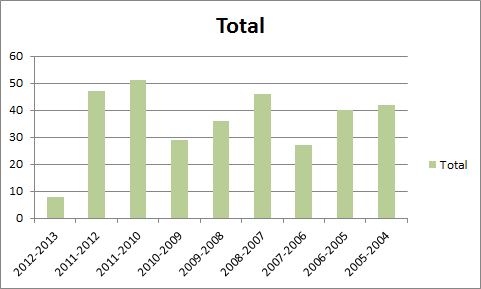
The first chart is the skier and boarder fatalities by year.
This chart is the skier and boarder fatalities graphed by month for each year.
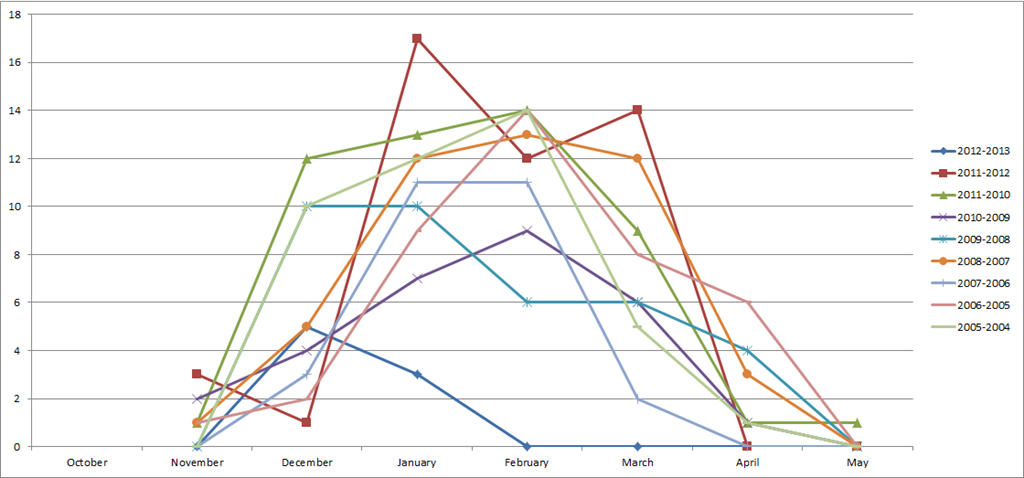
Here are the numbers:
| 12-13 | 12-11 | 11-10 | 10-09 | 09-08 | 08-07 | 07-06 | 06-05 | 05-04 | |
| Nov | 0 | 3 | 1 | 2 | 0 | 2 | 0 | 2 | 0 |
| Dec | 5 | 1 | 12 | 4 | 10 | 5 | 3 | 2 | 10 |
| Jan | 3 | 17 | 13 | 7 | 10 | 12 | 11 | 9 | 12 |
| Feb | 12 | 14 | 9 | 6 | 13 | 11 | 14 | 14 | |
| Mar | 14 | 9 | 6 | 6 | 23 | 3 | 8 | 5 | |
| Apr | 0 | 1 | 1 | 4 | 3 | 0 | 6 | 1 | |
| May | 0 | 1 | 0 | 0 | 0 | 0 | 0 | 0 | |
| Total | 8 | 47 | 51 | 29 | 36 | 46 | 27 | 40 | 42 |
I cannot make any discernible connection just by looking at the month when a skier or boarder has a fatality at a ski area in bounds.
What do you think? Leave a comment.
If you like this let your friends know or post it on FaceBook, Twitter or LinkedIn
Copyright 2013 Recreation Law (720) Edit Law
Email: blog@rec-law.us
Twitter: RecreationLaw
Facebook: Rec.Law.Now
Facebook Page: Outdoor Recreation & Adventure Travel Law
Blog: www.recreation-law.com
Mobile Site: http://m.recreation-law.com
By Recreation Law Rec-law@recreation-law.com James H. Moss Jim Moss
#RecreationLaw, #@RecreationLaw, #Cycling.Law #Fitness.Law, #Ski.Law, #Outside.Law, #Recreation.Law, #Recreation-Law.com, #Outdoor Law, #Recreation Law, #Outdoor Recreation Law, #Adventure Travel Law, #law, #Travel Law, #Jim Moss, #James H. Moss, #Attorney at Law, #Tourism, #Adventure Tourism, #Rec-Law, #Rec-Law Blog, #Recreation Law, #Recreation Law Blog, #Risk Management, #Human Powered, #Human Powered Recreation,# Cycling Law, #Bicycling Law, #Fitness Law, #Recreation-Law.com, #Backpacking, #Hiking, #Mountaineering, #Ice Climbing, #Rock Climbing, #Ropes Course, #Challenge Course, #Summer Camp, #Camps, #Youth Camps, #Skiing, #Ski Areas, #Negligence, #Snowboarding, #RecreationLaw, #@RecreationLaw, #Cycling.Law #Fitness.Law, #SkiLaw, #Outside.Law, #Recreation.Law, #RecreationLaw.com, #OutdoorLaw, #RecreationLaw, #OutdoorRecreationLaw, #AdventureTravelLaw, #Law, #TravelLaw, #JimMoss, #JamesHMoss, #AttorneyatLaw, #Tourism, #AdventureTourism, #RecLaw, #RecLawBlog, #RecreationLawBlog, #RiskManagement, #HumanPowered, #HumanPoweredRecreation,# CyclingLaw, #BicyclingLaw, #FitnessLaw, #RecreationLaw.com, #Backpacking, #Hiking, #Mountaineering, #IceClimbing, #RockClimbing, #RopesCourse, #ChallengeCourse, #SummerCamp, #Camps, #YouthCamps, #Skiing, #Ski Areas, #Negligence, #Snowboarding, sport and recreation laws, ski law, cycling law, Colorado law, law for recreation and sport managers, bicycling and the law, cycling and the law, ski helmet law, skiers code, skiing accidents, Recreation Lawyer, Ski Lawyer, Paddlesports Lawyer, Cycling Lawyer, Recreational Lawyer, Fitness Lawyer, Rec Lawyer, Challenge Course Lawyer, Ropes Course Lawyer, Zip Line Lawyer, Rock Climbing Lawyer, Adventure Travel Lawyer, Outside Lawyer, Recreation Lawyer, Ski Lawyer, Paddlesports Lawyer, Cycling Lawyer, #RecreationalLawyer, #FitnessLawyer, #RecLawyer, #ChallengeCourseLawyer, #RopesCourseLawyer, #ZipLineLawyer, #RockClimbingLawyer, #AdventureTravelLawyer, #OutsideLawyer, ski area, ski area fatality, NSAA, National Ski Area Association, fatality
WordPress Tags: Skier,Fatalities,Month,resorts,NSAA,boarder,Here,Total,connection,area,Leave,FaceBook,Twitter,LinkedIn,Recreation,Edit,Email,RecreationLaw,Page,Outdoor,Adventure,Travel,Blog,Mobile,Site,Outside,Moss,James,Attorney,Tourism,Risk,Management,Human,Rock,Ropes,Course,Challenge,Summer,Camp,Camps,Youth,Areas,Negligence,SkiLaw,OutdoorLaw,OutdoorRecreationLaw,AdventureTravelLaw,TravelLaw,JimMoss,JamesHMoss,AttorneyatLaw,AdventureTourism,RecLaw,RecLawBlog,RecreationLawBlog,RiskManagement,HumanPoweredRecreation,CyclingLaw,BicyclingLaw,FitnessLaw,RopesCourse,ChallengeCourse,SummerCamp,YouthCamps,Colorado,managers,helmet,accidents,Lawyer,Paddlesports,Recreational,Line,RecreationalLawyer,FitnessLawyer,RecLawyer,ChallengeCourseLawyer,RopesCourseLawyer,ZipLineLawyer,RockClimbingLawyer,AdventureTravelLawyer,OutsideLawyer,National,Association
Ohio adopts the requirement that a skier assumes the risk of a collision with another skier.
Posted: January 7, 2013 Filed under: Assumption of the Risk, Ohio, Skier v. Skier | Tags: Ohio, Ohio Supreme Court, Risk, Ski, Ski Resort, Sports, Supreme Court, Winter sport Leave a commentHorvath Et Al., v. Ish Et Al., 2012 Ohio 5333; 2012 Ohio LEXIS 2872
In order to recover in a collision on the ski slope the plaintiff must prove the defendant’s actions were reckless or intentional.
This case is between an injured adult and a young snowboarder. The snowboarder and his friends were on the same slope as the adult and his friends. The snowboarders went through the terrain park and upon exiting collided with the plaintiff.
The plaintiff sued for his injuries. The trial court dismissed the complaint based on the assumption of the risk. The plaintiff appealed, and the appellate court reversed the trial court agreeing with the plaintiffs that the Ohio statute created liability on the part of skiers and boarders for any collision.
The Ohio Supreme Court also sent the case back to the trial court but only to determine if the actions of the defendant snowboarder were reckless or intentional. The Supreme Court found that the statute in question, Ohio R.C. 4169.08 or 4169.09 only applied to the ski areas and did not apply to skiers and boarders.
So?
Once the Supreme court held that the statute did not apply, the legal issue was easily decided. The statute in question stated that skiing was a hazardous sport regardless of the safety measures that could be taken.
Under Ohio’s law on sports had held that:
[w]here individuals engage in recreational or sports activities, they assume the ordinary risks of the activity and cannot recover for any injury unless it can be shown that the other participant’s actions were either reckless or intentional
In Ohio, primary assumption of the risk means that a “defendant owes no duty whatsoever to the plaintiff.” The assumption is limited to those risks directly associated with the activity. “To be covered under the [primary-assumption-of-the-risk] doctrine, the risk must be one that is so inherent to the sport or activity that it cannot be eliminated.”
The court then held:
Accordingly, we hold that skiers assume the ordinary risks of skiing, which include collisions with other skiers, and cannot recover for an injury unless it can be shown that the other skier’s actions were reckless or intentional.
So Now What?
Ohio joins most other states with ski areas that require more than simple negligence on the part of the defendant for the plaintiff to recover for a collision on the slopes.
Without this standard of care, the risk of the sport would be totally removed, and skiers and boarders would enter a turnstile before they could enter the slope.
All sports have risk and if you are not willing to accept the risk of the sport then you should search for a sport that has risks that are what you can deal with. Checkers or chess are what I would suggest, although you could be hit by an angry knight if your opponent loses their temper.
Ski Area: Boston Mills Ski Area
Plaintiffs: Angel Horvath and Eugene Horvath
Defendants: David Ish, Tyler Ish and their cousins
Plaintiff Claims: Plaintiff had acted negligently, carelessly, recklessly, willfully, and wantonly in causing the collision with Defendant
Defendant Defenses: Assumption of the Risk
Holding: Reversed and sent back to determine if the defendant acted intentionally or recklessly when he collided with the plaintiff.
| Jim Moss is an attorney specializing in the legal issues of the outdoor recreation community. He represents guides, guide services, outfitters both as businesses and individuals and the products they use for their business. He has defended Mt. Everest guide services, summer camps, climbing rope manufacturers, avalanche beacon manufacturers, and many more manufacturers and outdoor industries. Contact Jim at Jim@Rec-Law.us |
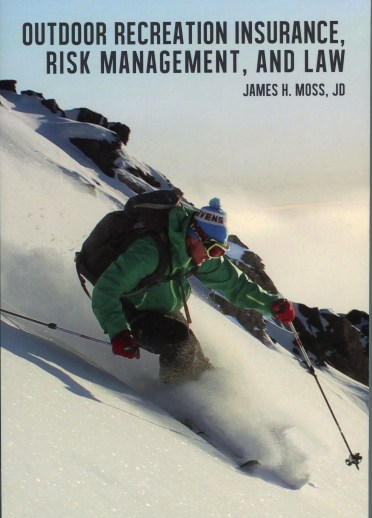
Outdoor Recreation Insurance, Risk Management, and Law
Jim is the author or co-author of six books about the legal issues in the outdoor recreation world; the latest is Outdoor Recreation Insurance, Risk Management and Law.
To see Jim’s complete bio go here and to see his CV you can find it here. To find out the purpose of this website go here.
G-YQ06K3L262
What do you think? Leave a comment.
If you like this let your friends know or post it on FB, Twitter or LinkedIn
 Blue Sky |
 Threads |
 |
 |
 Stimulus |
 X (formerly known as Twitter) logo |
Author: Outdoor Recreation Insurance, Risk Management and Law
Facebook Page: Outdoor Recreation & Adventure Travel Law
Email: Jim@Rec-Law.US
By Recreation Law Rec-law@recreation-law.com James H. Moss
@2024 Summit Magic Publishing, LLC
#RecreationLaw, #@RecreationLaw, #Cycling.Law #Fitness.Law, #Ski.Law, #Outside.Law, #Recreation.Law, #Recreation-Law.com, #Outdoor Law, #Recreation Law, #Outdoor Recreation Law, #Adventure Travel Law, #law, #Travel Law, #Jim Moss, #James H. Moss, #Attorney at Law, #Tourism, #Adventure Tourism, #Rec-Law, #Rec-Law Blog, #Recreation Law, #Recreation Law Blog, #Risk Management, #Human Powered, #Human Powered Recreation,# Cycling Law, #Bicycling Law, #Fitness Law, #Recreation-Law.com, #Backpacking, #Hiking, #Mountaineering, #Ice Climbing, #Rock Climbing, #Ropes Course, #Challenge Course, #Summer Camp, #Camps, #Youth Camps, #Skiing, #Ski Areas, #Negligence, #Snowboarding, #RecreationLaw, #@RecreationLaw, #Cycling.Law #Fitness.Law, #SkiLaw, #Outside.Law, #Recreation.Law, #RecreationLaw.com, #OutdoorLaw, #RecreationLaw, #OutdoorRecreationLaw, #AdventureTravelLaw, #Law, #TravelLaw, #JimMoss, #JamesHMoss, #AttorneyatLaw, #Tourism, #AdventureTourism, #RecLaw, #RecLawBlog, #RecreationLawBlog, #RiskManagement, #HumanPowered, #HumanPoweredRecreation,# CyclingLaw, #BicyclingLaw, #FitnessLaw, #RecreationLaw.com, #Backpacking, #Hiking, #Mountaineering, #IceClimbing, #RockClimbing, #RopesCourse, #ChallengeCourse, #SummerCamp, #Camps, #YouthCamps, #Skiing, #Ski Areas, #Negligence, #Snowboarding, sport and recreation laws, ski law, cycling law, Colorado law, law for recreation and sport managers, bicycling and the law, cycling and the law, ski helmet law, skiers code, skiing accidents, Recreation Lawyer, Ski Lawyer, Paddlesports Lawyer, Cycling Lawyer, Recreational Lawyer, Fitness Lawyer, Rec Lawyer, Challenge Course Lawyer, Ropes Course Lawyer, Zip Line Lawyer, Rock Climbing Lawyer, Adventure Travel Lawyer, Outside Lawyer, Recreation Lawyer, Ski Lawyer, Paddlesports Lawyer, Cycling Lawyer, #RecreationalLawyer, #FitnessLawyer, #RecLawyer, #ChallengeCourseLawyer, #RopesCourseLawyer, #ZipLineLawyer, #RockClimbingLawyer, #AdventureTravelLawyer, #OutsideLawyer,
Horvath Et Al., v. Ish Et Al., 2012 Ohio 5333; 2012 Ohio LEXIS 2872
Posted: January 7, 2013 Filed under: Assumption of the Risk, Legal Case, Ohio, Skier v. Skier | Tags: David, Horvaths, Ohio, Ohio Supreme Court, Ski, Ski Resort, Summary judgment Leave a commentTo Read an Analysis of this decision see: Ohio adopts the requirement that a skier assumes the risk of a collision with another skier.
Horvath Et Al., v. Ish Et Al., 2012 Ohio 5333; 2012 Ohio LEXIS 2872
Horvath Et Al., Appellees, v. Ish Et Al., Appellants.
No. 2011-1089
2012 Ohio 5333; 2012 Ohio LEXIS 2872
April 25, 2012, Submitted
November 20, 2012, Decided
NOTICE:
THIS SLIP OPINION IS SUBJECT TO FORMAL REVISION BEFORE IT IS PUBLISHED IN AN ADVANCE SHEET OF THE OHIO OFFICIAL REPORTS.
PRIOR HISTORY: [**1]
APPEAL from the Court of Appeals for Summit County, No. 25442, 194 Ohio App. 3d 8, 2011 Ohio 2239, 954 N.E.2d 196.
Horvath v. Ish, 194 Ohio App. 3d 8, 2011 Ohio 2239, 954 N.E.2d 196, 2011 Ohio App. LEXIS 1907 (Ohio Ct. App., Summit County, 2011)
DISPOSITION: Judgment affirmed.
CORE TERMS: skier, skiing, sport, ski-area, collision, ski, inherent risks, tramway, negligence per se, slope, ski area, passenger, reckless, standard of care, statutory duties, statutory schemes, owe, common law, summary judgment, owed, duty of care, personal injury, refrain, trail, ordinary care, general assembly, reasonable care, recreational, enumerated, sentence
HEADNOTES
Torts–Sport or recreational activity–Skiers assume the ordinary risks of skiing, which include collisions with other skiers, and cannot recover for an injury unless it can be shown that the other skier’s actions were reckless or intentional.
SYLLABUS
OF THE COURT
Skiers assume the ordinary risks of skiing, which include collisions with other skiers and cannot recover for an injury unless it can be shown that the other skier’s actions were reckless or intentional.
COUNSEL: Paul W. Flowers Co. and Paul W. Flowers; and Sennett Fischer, L.L.C., and James A. Sennett, for appellees.
Gallagher Sharp, Timothy J. Fitzgerald, and Jeremy V. Farrell, for appellants.
JUDGES: LUNDBERG STRATTON, J. O’CONNOR, C.J., and O’DONNELL, LANZINGER, CUPP, and MCGEE BROWN, JJ., concur. PFEIFER, J., concurs in part and dissents in part.
OPINION BY: LUNDBERG STRATTON
OPINION
Lundberg Stratton, J.
I. Introduction
[*P1] The issue before the court is what duty or standard of care is owed by one skier to another for purposes of determining tort liability. We hold that skiers assume the ordinary risks of skiing, which include collisions with other skiers, and cannot recover for an injury unless it can be shown that the other skier’s actions were reckless or intentional.
[*P2] The court of appeals reversed the trial court’s grant of summary judgment in favor of Ish and remanded the case to the trial court [**2] to determine whether Ish had violated any duties under R.C. 4169.08 or 4169.09 and if he did, whether negligence per se applied. The court of appeals also held that a genuine issue of material fact existed whether Ish was reckless. Horvath v. Ish, 194 Ohio App.3d 8, 2011 Ohio 2239, 954 N.E.2d 196, ¶ 18 (9th Dist). We agree that there is a genuine issue of material fact, but only whether Ish’s actions were more than negligent, that is, whether his actions were reckless or intentional under the common law. Therefore, we affirm the judgment of the court of appeals, albeit on somewhat different grounds, and remand the case to the trial court for proceedings consistent with our opinion.
II. Facts and Procedural History
[*P3] On March 6, 2007, Angel Horvath and Eugene Horvath (the couple were married after the accident but before the complaint was filed) were skiing at Boston Mills ski resort. David Ish was snowboarding at Boston Mills on that same date, with his brother, Tyler, and their cousins. In the early evening, Angel and Eugene were skiing down Buttermilk Hill. David, Tyler, and their cousins were snowboarding on the same hill. David and his relatives proceeded through a terrain park 1 [**3] and then reentered Buttermilk Hill, where David and Angel collided. Angel was injured in the accident.
1 A terrain park is an area where snowboarders and skiers can do tricks or stunts using various features including jumps, rails, and half-pipes. See R.C. 4169.01(I).
[*P4] The Horvaths filed a complaint against David Ish and his parents, alleging that David had acted negligently, carelessly, recklessly, willfully, and wantonly in causing the collision with Angel.
[*P5] The Ishes filed a motion for summary judgment, arguing that skiers are subject to primary assumption of the risk, which means that a defendant owes no duty of ordinary care to plaintiff. Thus, the Ishes argued that in order to recover, the Horvaths were required to prove that David had acted recklessly or intentionally in causing the collision. The Ishes further asserted that there was no evidence that David’s actions were reckless or intentional.
[*P6] In opposing the Ishes’ motion for summary judgment, the Horvaths argued that R.C. 4169.08(C) imposes specific duties on skiers and that breaching those duties is negligence per se. The trial court granted the Ishes’ motion for summary judgment.
[*P7] In a two-to-one decision, the court of appeals [**4] reversed the judgment of the trial court, stating that “[b]y reading R.C. 4169.08(C) in context with 4169.09, we find that it is evident that the legislature intended that skiers would be liable for injuries caused to others while skiing.” Horvath, 194 Ohio App.3d 8, 2011 Ohio 2239, 954 N.E.2d 196, ¶ 13. The court of appeals remanded the cause to the trial court to determine whether David Ish’s actions violated any of the responsibilities described in R.C. 4169.08(C) and, if so, whether any such violation invoked the doctrine of negligence per se. Id. at ¶ 14.
[*P8] This case is before this court pursuant to the acceptance of the Ishes’ discretionary appeal. 129 Ohio St. 3d 1503, 2011 Ohio 5358, 955 N.E.2d 386.
III. Analysis
R.C. Chapter 4169
[*P9] We begin our analysis by determining whether R.C. 4169.08 and 4169.09 apply to personal-injury litigation between skiers.
[*P10] When interpreting a statute, a court’s paramount concern is legislative intent. State ex rel. United States Steel Corp. v. Zaleski, 98 Ohio St.3d 395, 2003 Ohio 1630, 786 N.E.2d 39, ¶ 12. “[T]he intent of the law-makers is to be sought first of all in the language employed, and if the words be free from ambiguity and doubt, and express [**5] plainly, clearly and distinctly, the sense of the law-making body, there is no occasion to resort to other means of interpretation ” Slingluff v. Weaver, 66 Ohio St. 621, 64 N.E. 574 (1902), paragraph two of the syllabus. However, “[i]n reviewing a statute, a court cannot pick out one sentence and disassociate it from the context, but must look to the four corners of the enactment to determine the intent of the enacting body.” State v. Wilson, 77 Ohio St.3d 334, 336, 1997 Ohio 35, 673 N.E.2d 1347 (1997). “A court must examine a statute in its entirety rather than focus on an isolated phrase to determine legislative intent.” Massillon City School Dist. Bd. of Edn. v. Massillon, 104 Ohio St.3d 518, 2004 Ohio 6775, 820 N.E.2d 874, ¶ 37.
[*P11] See also R.C. 1.42. With this guidance in mind, we examine R.C. Chapter 4169 in its entirety to determine whether R.C. 4169.08 and 4169.09 apply to personal-injury litigation between skiers.
[*P12] R.C. 4169.02 established a ski-tramway board that is authorized to create rules under R.C. Chapter 119 relating to “public safety in the construction, maintenance, mechanical operation, and inspection of passenger tramways.” 2 R.C. 4169.03 requires that a tramway must be registered [**6] with the board before it can be operated. R.C. 4169.04 provides that tramways must be inspected. R.C. 4169.05 authorizes the board to hear complaints that the construction, maintenance, or mechanical operation of a tramway endangers public safety. R.C. 4169.06 permits a board member to suspend the operation of a tramway if the board determines that an “immediate danger exists.” R.C. 4169.07 provides that ski-area operators are responsible for any tramway they construct and for the maintenance and operation of a passenger tramway in the operator’s ski area. R.C. 4169.07 also states that passengers have certain enumerated responsibilities regarding their use of tramways. R.C. 4169.99 provides that ski-area operators are subject to a monetary fine if they fail to register their tramway with the board, fail to comply with an order from the board, or fail to comply with a rule issued by the board.
2 A “passenger tramway” is “a device used to transport passengers uphill, whether on skis or other devices or without skis or other devices, or in cars on tracks or suspended in the air, by the use of steel cables, chains, or belts or by ropes, and that is usually supported by trestles or towers [**7] with one or two spans.” R.C. 4169.01(F). Chair lifts, rope tows, and conveyors are passenger tramways. R.C. 4169.01(F)(3), (5), and (7).
[*P13] R.C. 4169.08 insulates ski-area operators from liability for injuries that arise from the inherent risks of skiing and otherwise defines certain responsibilities applicable to ski-area operators and ski-area visitors. R.C. 4169.09 addresses the liability of ski-area operators and ski-area visitors for failing to comply with the responsibilities enumerated in R.C. 4169.08(C).
[*P14] And, finally, R.C. 4169.10 immunizes ski-area operators for damages suffered by a person who was committing a theft at the time the person suffered the loss.
[*P15] It is evident that R.C. Chapter 4169, when viewed in its entirety, addresses certain obligations and limitations on liability pertaining to ski-area operators, as well as the relationship between ski-area operators and ski-area visitors. Consequently, neither R.C. 4169.08 nor 4169.09 apply to personal-injury litigation between skiers.
[*P16] Our conclusion is confirmed when we examine R.C. 4169.08 and 4169.09 in greater detail. R.C. 4169.08(A)(1) provides that “the general assembly recognizes that skiing as a recreational sport [**8] is hazardous to skiers regardless of all feasible safety measures that can be taken. It further recognizes that a skier expressly assumes the risk of and legal responsibility for injury, death, or loss to person or property that results from the inherent risks of skiing.” R.C. 4169.08(A)(1) then provides a nonexhaustive list of conditions (e.g., slush) or objects (e.g., out-of-bounds barriers) that are inherent risks of skiing. R.C. 4169.08(A)(2) and (3) provide that ski-area operators are not liable for the death of or injury to ski-area visitors that occur in a freestyle terrain or tubing park, subject to certain qualifications. Thus, R.C. 4169.08(A) effectively insulates ski-area operators from personal-injury lawsuits that arise from the inherent risks of skiing. See Stone v. Alpine Valley Ski Area, 135 Ohio App.3d 540, 545, 734 N.E.2d 888 (11th Dist.1999); Otterbacher v. Brandywine Ski Ctr., Inc., 9th Dist. No. 14269, 1990 Ohio App. LEXIS 4582, 1990 WL 72327, *4 (May 23, 1990).
[*P17] R.C. 4169.08(B) and (C) also state that ski-area operators and skiers have certain enumerated responsibilities. For example, ski-area operators must mark certain snowmaking equipment, and skiers must ski within the limits of their [**9] ability. R.C. 4169.08(B)(1) and (C)(1). And R.C. 4169.09 states that a “ski area operator * * * or skier is liable for injury, death, or loss to person or property * * * caused by the operator’s * * * or skier’s failure to fulfill any of the responsibilities required by this chapter.” Therefore, reading R.C. 4169.08(B) and (C) in context with R.C. Chapter 4169, we find that the responsibilities of ski-area operators and ski-area visitors are reciprocal. In other words, the General Assembly intended that ski-area operators owe skiers certain enumerated responsibilities, and in return skiers owe ski-area operators certain enumerated responsibilities. Thus, we hold that R.C. 4169.08(C) does not create a duty of care that applies between skiers.
[*P18] Accordingly, we hold that R.C. Chapter 4169, and in particular, R.C. 4169.08 and 4169.09, do not apply to personal-injury litigation between skiers.
Common Law
[*P19] Having determined that R.C. Chapter 4169 does not apply to personal-injury litigation between skiers, we turn to the common law to determine the proper standard of care applicable between skiers. This court has held that “[w]here individuals engage in recreational or sports activities, they [**10] assume the ordinary risks of the activity and cannot recover for any injury unless it can be shown that the other participant’s actions were either reckless or intentional as defined in [2 Restatement of the Law 2d, Torts, Section 500, and 1 Restatement of the Law 2d, Torts, Section 8A (1965)].” Marchetti v. Kalish, 53 Ohio St.3d 95, 559 N.E.2d 699, syllabus; see also Thompson v. McNeill 53 Ohio St.3d 102, 559 N.E.2d 705. “Obviously, without our stating so, in Marchetti and Thompson we applied ‘primary’ assumption-of-risk principles in limiting the defendant’s liability.” Gentry v. Craycraft, 101 Ohio St.3d 141, 2004 Ohio 379, 802 N.E.2d 1116, ¶ 11. Primary assumption of the risk means that a defendant owes no duty whatsoever to the plaintiff. Gallagher v. Cleveland Browns Football Co., 74 Ohio St.3d 427, 431-432, 1996 Ohio 320, 659 N.E.2d 1232 (1996).
[*P20] Clearly, skiing is a sport or recreational activity. However, “only those risks directly associated with the activity in question are within the scope of primary assumption of risk.” Id. at 432, citing Cincinnati Baseball Club Co. v. Eno, 112 Ohio St. 175, 3 Ohio Law Abs. 164, 147 N.E. 86 (1925). “To be covered under the [primary-assumption-of-the-risk] doctrine, the risk [**11] must be one that is so inherent to the sport or activity that it cannot be eliminated.” Konesky v. Wood Cty. Agricultural Soc., 164 Ohio App.3d 839, 2005 Ohio 7009, 844 N.E.2d 408, ¶ 19 (6th Dist), citing Westray v. Imperial Pools & Supplies, Inc., 133 Ohio App. 3d 426, 432, 728 N.E.2d 431 (6th Dist.1999). Where the risk at issue is not inherent, then a negligence standard applies. See Gallagher at 432; see also Pope v. Willey, 12th Dist. No. CA2004-10-077, 2005 Ohio 4744, 2005 WL 2179317 (colliding with a truck on a road is not an inherent risk of riding an all-terrain vehicle); Goffe v. Mowell, 2d Dist. No. 98-CA-49, 1999 Ohio App. LEXIS 308, 1999 WL 55693 (Feb. 5, 1999) (faulty racetrack design is not an inherent risk of go-cart racing).
[*P21] The Supreme Court of Pennsylvania has recognized that “other skiers are as much a part of the risk in downhill skiing, if not more so, than the snow and ice, elevation, contour, speed and weather conditions. As anyone who has ever undertaken the sport of skiing is painfully aware, it is a sport in which it is common for the participants to lose control.” Hughes v. Seven Springs Farm, Inc., 563 Pa. 501, 511, 762 A.2d 339 (2000). Other courts have also recognized that collisions [**12] between skiers are an inherent risk in the sport of skiing. See Peterson ex rel. Peterson v. Donahue, 733 N.W.2d 790, 793 (Minn.App.2007); Cheong v. Antablin, 16 Cal.4th 1063, 1069, 68 Cal. Rptr. 2d 859, 946 P.2d 817 (1997); Gern v. Basta, 809 N.Y.S.2d 724, 725, 26 A.D.3d 807 (2006). We agree that collisions between skiers are an inherent risk of skiing.
[*P22] Accordingly, we hold that skiers assume the ordinary risks of skiing, which include collisions with other skiers, and cannot recover for an injury unless it can be shown that the other skier’s actions were reckless or intentional.
IV. Conclusion
[*P23] The judgment of the court of appeals is affirmed, albeit on somewhat different grounds. We agree that there is a genuine issue of material fact to be considered, but only with regard to whether Ish’s actions were more than negligent, that is, whether he acted recklessly or intentionally. Because a genuine issue of fact remains, the court of appeals was correct in holding that the trial court erred in granting summary judgment. Therefore, we affirm the appellate court’s judgment, and we remand this cause to the trial court for further proceedings in accordance with this opinion.
Judgment affirmed.
O’Connor, C.J., and [**13] O’Donnell, Lanzinger, Cupp, and McGee Brown, JJ., concur.
Pfeifer, J., concurs in part and dissents in part.
CONCUR BY: PFEIFER (In Part)
DISSENT BY: PFEIFER (In Part)
DISSENT
Pfeifer, J., concurring in part and dissenting in part.
[*P24] I concur in the majority’s judgment affirming the appellate court’s decision to reverse the trial court’s granting of summary judgment. However, I do not agree with the majority’s baffling interpretation of R.C. 4169.08 and 4169.09. I also do not agree that there is no common-law duty of care between skiers. If legal issues were ski slopes, the one raised in this case would be a bunny hill. Somehow, the majority has careened down the hill and wound up smashed through the wall of the lodge.
A Skier’s Statutory Duties
[*P25] The fact that R.C. Chapter 4169 tends to limit the liability of ski-area operators from liability for injuries suffered by skiers does not mean that it leaves skiers without protection from other skiers. It makes perfect sense that a piece of legislation that shields ski-area operators from liability would also set forth a duty of care between skiers that would leave skiers, not ski facilities, liable for injuries they cause other skiers. Other states-Colorado (Colo.Rev.Stat.Ann. 33-44-109), [**14] Idaho (Idaho Code 6-1106), Maine (32 Maine Rev.Stat.Ann. 15217), Michigan (Mich.Comp.Laws Ann. 408.344), New Mexico (N.M.Stat.Ann. 24-15-10), and West Virginia (W.Va. Code Ann. 20-3A-8), for instance, manage to achieve that balance in their ski-safety statutory schemes. That balance is part of the prevailing view in states with ski statutes:
In a skier collision case, the laws differ from state to state on the duty of care one skier owes to another. The jurisdictions can be divided into two classifications. The prevailing view holds skiers to a standard of reasonable care to avoid injury to another skier. The standard of care is usually founded on a statutory principle obliging a skier to exercise reasonable care and to yield the right of way to the skier below. One skier does not assume the risk of another’s negligence; a skier collision is not a risk “inherent” in the sport as skiing is not a contact sport.
46 American Jurisprudence Proof of Facts 3d 1, Liability of Skier for Collision with Another Skier, Section 2 (1998).
[*P26] The duties between skiers, understood since Norwegians first strapped planks to their feet 4,500 years ago–ski under control and do not run into another skier, among [**15] others–are now part of Ohio statutory law. Those duties are set forth in R.C. 4169.08:
(C) A skier shall have the following responsibilities:
(1) To know the range of the skier’s ability to negotiate any slope or trail or to use any passenger tramway that is associated with a slope or trail, to ski within the limits of the skier’s ability, to ski only on designated slopes and trails, to maintain control of speed and course at all times while skiing, to heed all posted warnings, and to not cross the track of a passenger tramway except at a designated area;
(2) To refrain from acting in a manner that may cause or contribute to the injury of another person, to refrain from causing collision with any person or object while skiing, and to not place any object in a ski area that may cause another skier or a passenger to fall.
[*P27] Contrary to the majority’s assertion, it is possible for the General Assembly in one statutory chapter to protect ski-area operators from liability while at the same time providing some protection for skiers. R.C. 4169.08(C)(2) specifically states that skiers have responsibilities to avoid causing injuries to or colliding with another person, but the majority states that [**16] those responsibilities are owed to ski-area operators, not other persons. R.C. 4169.08(C)(3) requires a person who is involved in a ski accident that injures another to identify himself before leaving the scene, presumably so that the person causing the collision can live up to his responsibilities.
[*P28] But it is R.C. 4169.09 that makes it crystal clear that a skier is liable for injuries he causes to other skiers by failing to meet the duties set forth in R.C. 4169.08(C): “A * * * skier is liable for injury, death, or loss to person or property caused by the * * * skier’s failure to fulfill any of the responsibilities required by this chapter.” How can the majority ignore this simple statutory statement? How can this mean anything other than that a skier is liable for injuries suffered by another person as a result of the skier’s failure to meet his statutory responsibilities? Why does this sentence appear in the statute if it does not establish responsibilities between skiers?
[*P29] If R.C. 4169.08 sets forth only duties between skiers and ski-area operators, the second sentence in R.C. 4169.09 would be sufficient to shield the ski area from liability. The second sentence of R.C. 4169.09 makes [**17] it clear that the ski-area operator is not liable for a skier’s injuries caused by another skier: “A ski area operator * * * is not liable for injury * * * caused by another’s failure to fulfill any of the responsibilities required of another by this chapter.” In blunt terms, an injured person’s only recourse is against the person who caused the injury.
[*P30] Finally, R.C. 4169.09 states that “[a] * * * skier is not entitled to recover for injury * * * caused by the * * * skier’s failure to fulfill any of the responsibilities required by this chapter.” That is, if a skier’s injuries are caused by his own failure to meet his statutory responsibilities, he has recourse against no one.
[*P31] Read as a whole, R.C. 4169.09 states that if a skier violates his responsibilities, he is liable for injuries caused to another, that the ski-area operator is not liable for those injuries, and that a skier who causes his own injuries is not entitled to recover from another, including a ski-area operator, for his injuries. The statute provides protection from liability for ski-area operators from something they cannot control–the behavior of individual skiers–while at the same time making skiers responsible for [**18] injuries they cause for failing to abide by the basic rules of skiing. Only this interpretation provides meaning to all three of the sentences that make up R.C. 4169.09.
Liability for Breach of Skier’s Statutory Duty in Michigan
[*P32] In Rusnak v. Walker, 273 Mich.App. 299, 729 N.W.2d 542 (2006), the court–a special panel called pursuant to Michigan law to resolve an appellate conflict–addressed whether a skier could sue another skier pursuant to Michigan’s Ski Area Safety Act (“SASA”). The statutory scheme in Michigan is substantially similar to Ohio’s. The Michigan law places duties on skiers to ski safely and not injure other skiers, Mich.Comp.Laws Ann. 408.341 and 408.342, and assigns liability for injuries caused by skiers who violate those duties. (“A skier * * * who violates this act * * * shall be liable for that portion of the loss or damage resulting from that violation”). Mich.Comp.Laws Ann. 408.344.
[*P33] But Michigan’s statutory scheme contains an important provision missing from Ohio’s: it lists “collisions * * * with other skiers” as one of the inherent risks of skiing. Mich.Comp.Laws Ann. 408.342. Such a provision is absent from Ohio’s statutory declaration of the inherent risks [**19] of skiing. R.C. 4169.08(A).
[*P34] Even so, the Michigan court held that despite a statutory recognition that colliding with other skiers is an inherent danger of skiing, a skier could recover for injuries caused by another skier’s failure to live up to the responsibilities set forth in the SASA:
As we have already noted, we hold that the SASA assumption-of-risk provision contains clear and unambiguous language, providing in no uncertain terms that a collision between skiers is an obvious and necessary danger that inheres in the sport of skiing. However, in those cases in which a plaintiff can establish that a defendant violated one of the specific duties imposed by the SASA, the plaintiff can still recover damages to the extent that the defendant’s violations caused the plaintiffs injuries. To state it differently, it is possible, and therefore skiers assume the risk, that a collision can occur between skiers when neither skier is violating his or her duties under the SASA. That is, it is an obvious and necessary danger of skiing that sometimes accidents simply happen. But, again, if it can be shown that the collision resulted from a violation of the act, then the violator is to be held liable [**20] for the damage caused, as provided under [Mich.Comp.Laws Ann.] 408.344.
Rusnak, 273 Mich.App. at 305, 729 N.W.2d 542.
[*P35] The court noted in Rusnak that if it were to hold that there is no liability for injuries to a skier caused by another skier’s failure to meet his or her statutory duties, “the duties and liabilities placed on individual skiers would have no meaning.” Id. at 309. But the majority does in this case what Rusnak warns against, finding that the statutory provision–“A * * * skier is liable for injury, death, or loss to person or property caused by the * * * skier’s failure to fulfill any of the responsibilities required by this chapter”–is meaningless.
Ordinary Care
[*P36] In its remand to the trial court, the court of appeals suggested that the trial court should consider whether David Ish violated any of the duties outlined in R.C. 4169.08(C) and, if so, whether the violation would constitute negligence per se. Horvath v. Ish, 194 Ohio App.3d 8, 2011 Ohio 2239, 954 N.E.2d 196, ¶ 14. Violation of a statutory duty is not necessarily negligence per se, and it is not in this case.
[*P37] To successfully prosecute a claim for negligence, a plaintiff must prove that the defendant owed the plaintiff [**21] a duty, that the defendant breached that duty, and that the breach of the duty proximately caused the plaintiffs injury. Wellman v. E. Ohio Gas Co., 160 Ohio St. 103, 108-109, 113 N.E.2d 629 (1953). “[A] duty may be established by common law, legislative enactment, or by the particular facts and circumstances of the case.” Chambers v. St. Mary’s School, 82 Ohio St.3d 563, 565, 1998 Ohio 184, 697 N.E.2d 198 (1998). In certain instances, the failure to perform a statutory duty is negligence per se, meaning that “the plaintiff has conclusively established that the defendant breached the duty that he or she owed to the plaintiff.” Id.
[*P38] But negligence per se does not follow from every violation of a statutory duty; violation of a statute may simply constitute evidence of negligence. “[T]he distinction between the two depends upon the degree of specificity with which the particular duty is stated in the statute.” Sikora v. Wenzel, 88 Ohio St.3d 493, 496, 2000 Ohio 406, 727 N.E.2d 1277 (2000). As this court put it in Swoboda v. Brown, 129 Ohio St. 512, 196 N.E. 274 (1935), paragraph four of the syllabus:
The distinction between negligence and “negligence per se” is the means and method of ascertainment. The former must [**22] be found by the jury from the facts, the conditions, and circumstances disclosed by the evidence; the latter is a violation of a specific requirement of law or ordinance, the only fact for determination by the jury being the commission or omission of the specific act inhibited or required.
That is, when a statute requires performance of specific acts, a jury need only determine whether the specific acts were performed, and if it determines that they were not performed, the defendant is negligent per se; but when the statute instead sets forth general rules of conduct that must be followed, a jury must use its judgment in evaluating the circumstances to determine whether the defendant was negligent. In the latter instance, the typical duty of care for negligence applies:
Where there exists a legislative enactment commanding or prohibiting for the safety of others the doing of a specific act and there is a violation of such enactment solely by one whose duty it is to obey it, such violation constitutes negligence per se; but where there exists a legislative enactment expressing for the safety of others, in general or abstract terms, a rule of conduct, negligence per se has no application [**23] and liability must be determined by the application of the test of due care as exercised by a reasonably prudent person under the circumstances of the case.
Eisenhuth v. Moneyhon, 161 Ohio St. 367, 119 N.E.2d 440 (1954), paragraph one of the syllabus.
[*P39] In this case, the defendant may have violated several of the responsibilities of R.C. 4169.08(C)(1) and (2): failing to ski “within the limits of [his] ability,” failing to “maintain control of [his] speed and course,” failing to “refrain from acting in a manner that may cause or contribute to the injury of another person,” and failing “to refrain from causing collision with any person or object while skiing.” None of the defendant’s violations could be established from the determination of one fact by a trier of fact; the trier of fact would need to consider “the facts, the conditions, and circumstances disclosed by the evidence.” Swoboda at paragraph four of the syllabus. The responsibilities set forth in R.C. 4169.08(C)(1) and (2) are akin to the “rule of conduct” discussed in Eisenhuth; in those instances, negligence per se does not apply, and liability is “determined by the application of the test of due care as exercised by a reasonably [**24] prudent person under the circumstances of the case.” Eisenhuth at paragraph three of the syllabus.
[*P40] Thus, the General Assembly has set forth a statutory duty of ordinary care for skiers. Ingrained in that ordinary-care standard is the recognition that skiers are on skis, are on a slippery surface, and are engaged in a somewhat dangerous activity. R.C. 4169.08(C)(1) and (2) do not require expert ability by all skiers; they require common sense and an appreciation of very basic safety rules of skiing. When a skier fails to use ordinary care to meet the responsibilities set forth in R.C. 4169.08(C), he is liable for any injuries caused by his failure to live up to those rules of conduct, pursuant to R.C. 4169.09.
Common Law
[*P41] As stated above, I dissent from the majority’s holding that R.C. 4169.09 does not recognize a cause of action between skiers. I also dissent from the majority’s holding that a skier must prove that another skier was reckless to successfully assert a common-law claim against another skier. The crux of the majority’s holding regarding the common law is that skiers owe no duty to each other because collisions between skiers are one of the inherent risks of skiing. I disagree [**25] and instead would follow the reasoned approach adopted by the Supreme Court of Connecticut in Jagger v. Mohawk Mountain Ski Area, Inc., 269 Conn. 672, 849 A.2d 813 (2004), in which the court held that “the standard of care implicated in the context of the sport of skiing is that of a duty to refrain from unreasonable conduct and that liability may attach for negligent behavior.” Id. at 698.
[*P42] Like many other states, Connecticut has a ski-safety statutory scheme; such statutory schemes are like snowflakes-no two are exactly alike. See, e.g., Frakt & Rankin, Surveying the Slippery Slope: The Questionable Value of Legislation to Limit Ski Area Liability, 28 Idaho L.Rev. 227, 230 (1992), fn.12. The Connecticut statute at issue in Jagger did not contain the declaration found in the Ohio and Michigan statutes that a skier is liable to another skier for injuries caused by the skier’s failure to meet his or her statutory responsibilities. The Connecticut statute did state that collisions with other skiers are an inherent risk of skiing, Conn.Gen.Stat. 29-212; the court in Jagger found that that provision did not apply to lawsuits between skiers. Jagger, 269 Conn. at 697, 849 A.2d 813, fn. 21.
[*P43] [**26] In Jagger, the court applied a four-part test “to evaluate the various policy considerations relevant to the determination of the extent of the defendant’s duty.” Id. at 700. The court had developed the test in Jaworski v. Kiernan, 241 Conn. 399, 696 A.2d 332 (1997), to determine the standard of care applicable to participants in a soccer game. The elements of the test include
“(1) the normal expectations of participants in the sport in which the plaintiff and the defendant were engaged; (2) the public policy of encouraging continued vigorous participation in recreational sporting activities while weighing the safety of the participants; (3) the avoidance of increased litigation; and (4) the decisions of other jurisdictions.”
Jagger at 700, quoting Jaworski at 407.
[*P44] As for the first factor, the normal expectations of the participants in the sport, I agree with the Jagger court that although ski collisions can be frequent, skiers expect their fellow skiers to abide by the commonly accepted, fundamental rules of skiing:
While collisions with other skiers are fairly common, frequency of occurrence is not the ultimate touchstone in evaluating the expectations of participants in the sport. [**27] Rather, we perceive the expectations of skiers to be that fellow participants in the sport will conduct themselves in a manner befitting the dangerous potentialities attendant with the sport. Thus, skiers will expect that other skiers will follow the rules and generally accepted practices of the sport of skiing. Indeed, our statutory scheme regarding ski liability confirms that skiers should possess such expectations as they take part in the sport. * * * The normal expectations of skiers will be that fellow skiers will ski in a reasonable and appropriate manner.
Id. at 701-702.
[*P45] Like Connecticut’s, our state’s statutory scheme sets forth responsibilities for skiers that should create in the minds of other skiers the expectation that collisions are not an acceptable part of the sport.
[*P46] Further, skiers are reminded by signs throughout ski areas of appropriate behavior. The Skier’s Responsibility Code, promulgated by the National Ski Areas Association, reminds skiers of common safety rules:
Always stay in control, and be able to stop or avoid other people or objects.
People ahead of you have the right of way. It is your responsibility to avoid them.
You must not stop where you obstruct a trail [**28] or are not visible from above.
Whenever starting downhill or merging into a trail, look uphill and yield to others.
Always use devices to help prevent runaway equipment.
Observe all posted signs and warnings. Keep off closed trails and out of closed areas.
Prior to using any lift, you must have the knowledge and ability to load, ride and unload safely.
http://www.nsaa.org/nsaa/safety/responsibilitycode (accessed Nov. 1, 2012)
[*P47] Unlike in sports like football, basketball, or soccer, in which contact with other participants is part of the very nature of the sport, contact with another individual in skiing is outside the nature of the sport; any contact at all between skiers transforms skiing into an unacceptably dangerous proposition. The expectation among skiers is that their fellow skiers appreciate that safety is essential for everyone’s enjoyment of the sport.
[*P48] As for the second factor-balancing the encouragement of participation in the sport against concern for the safety of participants-I agree with the court in Jagger that encouraging responsible behavior by skiers tends to encourage participation:
As for the second Jaworski factor, we conclude that the balancing of the public policy of [**29] the encouragement of vigorous participation in the sport of skiing and the protection of the safety of its participants weighs in favor of a negligence standard. We believe that requiring skiers to participate in the reasonable manner prescribed by the rules of the sport actually will promote participation in the sport of skiing. Should the threshold for liability be placed at a level that only reckless or intentional misconduct can serve as grounds for liability, many of the potential harms caused by coparticipants in the sport will go unremedied and, therefore, dissuade potential participants from taking part in the sport. Additionally, a standard of reasonableness also operates to protect the safety of participants in the sport of skiing.
Jagger, 269 Conn. at 702-703, 849 A.2d 813.
[*P49] I agree that there is a minimal price to pay, if any, for increased safety on ski slopes. That skiers could feel safer when skiing would tend to inure to the benefit of participation rates. Colorado, whose economy is much more dependent on skiing than Ohio’s, statutorily recognizes the right of skiers to recover damages from other skiers who cause injuries. Colo.Rev.Stat.Ann. 33-44-109 (“a skier is not [**30] precluded under this article from suing another skier for any injury to person or property resulting from such other skier’s acts or omissions. Notwithstanding any provision of law or statute to the contrary, the risk of a skier/skier collision is neither an inherent risk nor a risk assumed by a skier in an action by one skier against another”).
[*P50] The third factor, the potential increase in litigation, is a minimal factor in the analysis. Contact with other skiers is not a regular part of skiing; collisions are rare enough that our courts would not be clogged by claims. As the court recognized in Jagger, this situation might be different in other sports:
For instance, in Jaworski we recognized quite correctly that the imposition of a negligence standard in contact sports would result undesirably in the potentiality of a civil action arising out of any foul, any hit batsman, or any clipping penalty. The same potential for undesirable numbers of civil actions is not present in the context of skiing. As discussed previously, abiding by the rules of the sport of skiing will eliminate the overwhelming majority of contact between skiers.
Id. at 703.
[*P51] The fourth element of the Jaworski test is [**31] a consideration of the law in other jurisdictions. We have the benefit of relying on the court’s well-reasoned decision in Jagger. Jagger relied on Novak v. Virene, 224 Ill.App.3d 317, 321, 586 N.E.2d 578, 166 Ill. Dec. 620 (1991), in which the court stated:
As in the individual sports of running and bicycling, there is the possibility of collisions in downhill skiing. But by one’s participation in the sport, one does not voluntarily submit to bodily contact with other skiers, and such contact is not inevitable. Therefore, the concern that the possibility of a negligence lawsuit would damper vigorous participation is inapplicable to downhill skiing. There is no reason to expand the limited contact sports exception to exempt downhill skiers from negligence liability if they negligently collide with other skiers. Many activities in life are fraught with danger, and absent a specific assumption of risk, one may obtain damages when injured by another’s negligence. Defendant’s conduct should be governed by ordinary negligence standards.
Id. at 321.
[*P52] In a Utah case, Ricci v. Schoultz, 963 P.2d 784, 786 (Utah App.1998), the court held that “a skier does have a duty to other skiers to ski reasonably and within [**32] control. However, an inadvertent fall on a ski slope, alone, does not constitute a breach of this duty.” Even though there was no negligence in the Ricci case, the case did hold that negligence was the proper legal standard to apply.
[*P53] Interpreting Vermont law in Dillworth v. Gambardella, 970 F.2d 1113, 1123 (2d Cir.1992), the court held that a skier can be liable to another skier for injuries caused by the skier’s negligence, but made clear that not every collision is caused by negligence:
The law is clear. “[T]he standard of conduct needed to discharge a duty of care in any given situation [is] measured in terms of the avoidance of reasonably foreseeable risks to the person to whom such duty is owed.” Green v. Sherburne Corp., 137 Vt. 310, 403 A.2d 278, 280 (1979). Like all others, skiers owe that degree of care an ordinary prudent person would exercise under like or similar circumstances. See La Faso v. La Faso, 126 Vt. 90, 223 A.2d 814, 817-18 (1966). One skier is not the insurer of another skier’s safety nor, absent negligence, is one skier liable to another for inadvertent or accidental contact. See, e.g., LaVine v. Clear Creek Skiing Corp., 557 F.2d 730, 734-35 (10th Cir.1977).
Thus, [**33] a jury might conclude that skiers who lose control even while exercising due care-that is, have breached no duty owed to other skiers-may pose a danger which is inherent, obvious and necessary to participants in the sport of skiing. * * * “If the fall is due to no breach of duty on the part of the defendant, its risk is assumed in the primary sense, and there can be no recovery.” Sunday [v. Stratton Corp], [136 Vt. 293, 302], 390 A.2d 398 [(1978)]. Where the facts on assumption and breach of duty are in dispute and more than one reasonable inference may be drawn from them, the question of negligence is for the jury. See La Faso, 223 A.2d at 819.
Id. at 1122. Although a skier does assume some risks of skiing, as for the behavior of other skiers, “the only risks [a] plaintiff * * * could be said to have assumed are those which defendant in the exercise of reasonable care under the circumstances could have avoided.” Id. at 1123.
[*P54] Further, in Peterson v. Chichester, 157 Vt. 548, 600 A.2d 1326 (1991), the Vermont Supreme Court upheld a jury verdict in a collision-between-skiers case in which the negligence of the defendant and comparative negligence of the plaintiff were at issue. Similarly, [**34] in Stewart v. Rice, 120 Idaho 504, 817 P.2d 170 (1991), the Supreme Court of Idaho decided a case involving the negligence of a skier in a collision between skiers.
[*P55] Applying the four Jaworski factors to the sport of skiing leads to the conclusion reached by the court in Jagger: “the proper standard of care owed by coparticipants in the sport of skiing is that of reasonable care.” Jagger, 269 Conn. at 704, 849 A.2d 813. Even assuming that the majority correctly found that no statutory duty exists between skiers in Ohio, it should have found a common-law duty of reasonable care between skiers, as courts in Connecticut, Illinois, Utah, Vermont, and Idaho have done.
Recklessness
[*P56] I dissent from the majority’s holdings that neither Ohio’s ski statutes nor the common law creates a duty between skiers. An accident like the one in this case is not one that a person would assume would take place when undertaking the pleasant family activity of skiing. Children, seniors, beginners, and handicapped people use ski slopes; to require, as the majority does, no greater standard of care than to refrain from recklessness will make Ohio’s ski areas more dangerous for everyone. “[Contact between skiers [**35] is neither a part of the sport that skiers agree to confront by their participation, nor is it an inevitable byproduct of the sport of skiing.” Jagger at 704.
[*P57] However, the majority admits that the defendant is liable for the plaintiffs injuries if he was acting recklessly on the slopes on the day in question. I agree that if recklessness is the standard of care in this case that there is a genuine issue of fact for a trier of fact to determine. There is testimony establishing that the defendant was uphill of Angel Horvath and merging onto the slope in question, looking backward, and making a sudden change of course when he struck her. Evidence supports the plaintiffs’ contention that the defendant violated numerous statutory responsibilities contained in R.C. 4169.08(C), a statute that sets forth fundamental safety rules for skiers. Those rules are basic and essential for skier safety. The flouting of those rules should be considered by a trier of fact in determining recklessness.
Conclusion
[*P58] The trial judge erred by granting summary judgment in a case that presents factual issues for trial. The case has now snowballed into a case that eviscerates a statutory scheme that has well served [**36] the sport and industry of skiing for a long time. The General Assembly ensured that we owe a greater duty, a duty of ordinary care, to each other. The majority has removed that duty and today has made skiing in Ohio appreciably more dangerous. I trust that Ohio’s skiers will not look to this court, but instead to their common sense, their peers, and information provided by ski areas to determine what is acceptable behavior on Ohio’s ski slopes.
G-YQ06K3L262

2012-2013 In bound ski/board fatalities
Posted: December 12, 2012 Filed under: Skiing / Snow Boarding | Tags: fatality, Keystone Resort, Ski, ski area, Ski Resort, skiing, snowboarding, Sun Valley, Sun Valley Idaho, Winter sport Leave a commentThis list is not guaranteed to be accurate. The information is found from web searches and news dispatches. Those references are part of the chart If you have a source for information on any fatality please leave a comment.
Several Corrections have been made to items reported earlier.
If this information is incorrect or incomplete please let me know. This is up to date as of December 10, 2012. Thanks.
2012 – 2013 Ski Season Deaths
| # | Date | St | Area | Where | How | Cause | Ski/ Board | Age | Sex | Helmet | Ref | Ref | Ref |
| 1 | 11/29 | ID | Sun Valley ski resort | Bald Mountain Chairlift | Fell off (Medical?) | 56 | M | http://rec-law.us/Vi4ims | http://rec-law.us/TyVnKu | ||||
| 2 | 12/1 | CO | Keystone Resort | River Run Gondola Maze | Standing in Maze (Medical) | Skier | 66 | M | http://rec-law.us/SCZHXJ | http://rec-law.us/YkDioj | http://rec-law.us/UjBMfK | ||
| 3 | 12/2 | MI | Boyne Highlands Resort | Camelot, (Beginner) | fell within the slope boundaries and did not collide with any type of obstacle. | Board | 17 | F | http://rec-law.us/11JFVOo |
Our condolences to the families of the deceased. Our good thoughts to the families and staff at the areas who have to deal with these tragedies.
What do you think? Leave a comment.
If you like this let your friends know or post it on FaceBook, Twitter or LinkedIn
Copyright 2012 Recreation Law (720) Edit Law
Email: blog@rec-law.us
Twitter: RecreationLaw
Facebook: Rec.Law.Now
Facebook Page: Outdoor Recreation & Adventure Travel Law
Blog: www.recreation-law.com
Mobile Site: http://m.recreation-law.com
#RecreationLaw, #@RecreationLaw, #Cycling.Law #Fitness.Law, #Ski.Law, #Outside.Law, #Recreation.Law, #Recreation-Law.com, #Outdoor Law, #Recreation Law, #Outdoor Recreation Law, #Adventure Travel Law, #law, #Travel Law, #Jim Moss, #James H. Moss, #Attorney at Law, #Tourism, #Adventure Tourism, #Rec-Law, #Rec-Law Blog, #Recreation Law, #Recreation Law Blog, #Risk Management, #Human Powered, #Human Powered Recreation,# Cycling Law, #Bicycling Law, #Fitness Law, #Recreation-Law.com, #Backpacking, #Hiking, #Mountaineering, #Ice Climbing, #Rock Climbing, #Ropes Course, #Challenge Course, #Summer Camp, #Camps, #Youth Camps, #Skiing, #Ski Areas, #Negligence, #Snowboarding, #RecreationLaw, #@RecreationLaw, #Cycling.Law #Fitness.Law, #SkiLaw, #Outside.Law, #Recreation.Law, #RecreationLaw.com, #OutdoorLaw, #RecreationLaw, #OutdoorRecreationLaw, #AdventureTravelLaw, #Law, #TravelLaw, #JimMoss, #JamesHMoss, #AttorneyatLaw, #Tourism, #AdventureTourism, #RecLaw, #RecLawBlog, #RecreationLawBlog, #RiskManagement, #HumanPowered, #HumanPoweredRecreation,# CyclingLaw, #BicyclingLaw, #FitnessLaw, #RecreationLaw.com, #Backpacking, #Hiking, #Mountaineering, #IceClimbing, #RockClimbing, #RopesCourse, #ChallengeCourse, #SummerCamp, #Camps, #YouthCamps, #Skiing, #Ski Areas, #Negligence, #Snowboarding, sport and recreation laws, ski law, cycling law, Colorado law, law for recreation and sport managers, bicycling and the law, cycling and the law, ski helmet law, skiers code, skiing accidents, Recreation Lawyer, Ski Lawyer, Paddlesports Lawyer, Cycling Lawyer, Recreational Lawyer, Fitness Lawyer, Rec Lawyer, Challenge Course Lawyer, Ropes Course Lawyer, Zip Line Lawyer, Rock Climbing Lawyer, Adventure Travel Lawyer, Outside Lawyer, Recreation Lawyer, Ski Lawyer, Paddlesports Lawyer, Cycling Lawyer, #RecreationalLawyer, #FitnessLawyer, #RecLawyer, #ChallengeCourseLawyer, #RopesCourseLawyer, #ZipLineLawyer, #RockClimbingLawyer, #AdventureTravelLawyer, #OutsideLawyer, Sun Valley ski resort, Keystone Resort, Boyne Highlands Resort,
WordPress Tags: information,news,references,Several,Corrections,items,December,Thanks,Season,Deaths,Date,State,Resort,Where,Cause,Board,Name,Hometown,Helmet,Reference,Valley,Bald,Mountain,Chairlift,Fell,Medical,Dana,Mower,Seattle,TyVnKu,River,Gondloa,Maze,Skier,Brian,Burton,Castle,Rock,SCZHXJ,YkDioj,UjBMfK,Boyne,Highlands,Camelot,Beginner,boundaries,obstacle,Kasandra,Knapp,Alanson,condolences,families,areas,tragedies,Leave,FaceBook,Twitter,LinkedIn,Recreation,Edit,Email,RecreationLaw,Page,Outdoor,Adventure,Travel,Blog,Mobile,Site,Outside,Moss,James,Attorney,Tourism,Risk,Management,Human,Ropes,Course,Challenge,Summer,Camp,Camps,Youth,Negligence,SkiLaw,OutdoorLaw,OutdoorRecreationLaw,AdventureTravelLaw,TravelLaw,JimMoss,JamesHMoss,AttorneyatLaw,AdventureTourism,RecLaw,RecLawBlog,RecreationLawBlog,RiskManagement,HumanPoweredRecreation,CyclingLaw,BicyclingLaw,FitnessLaw,RopesCourse,ChallengeCourse,SummerCamp,YouthCamps,Colorado,managers,accidents,Lawyer,Paddlesports,Recreational,Line,RecreationalLawyer,FitnessLawyer,RecLawyer,ChallengeCourseLawyer,RopesCourseLawyer,ZipLineLawyer,RockClimbingLawyer,AdventureTravelLawyer,OutsideLawyer
Electronic gadgets including video cameras interfere with Avalanche Beacons
Posted: November 28, 2012 Filed under: Avalanche | Tags: Attorney at law, avalanche, Avalanche Beacons, Avalanches, Go Pro, Jim Moss, Recco, Recco Reflector, Rock climbing, Ski Resort, Video Cameras 2 CommentsBefore you head out, find out what electronics interfere and which ones you should leave in the car or turn off.
This video popped up the other day: Transceiver / Go Pro Interference. It shows a video camera affecting an avalanche beacon. If you wear a beacon, and you should, in or out of bounds, you should know which of your electronics may affect your beacon.
Dale Atkins, an Avalanche Guru and Recco’s Training and Education Manager for North America told me:

English: Rescuer using RECCO R9 detector on training drill in Colorado.
GoPros cause grief to some transceivers (and probably to all), but this is not a surprise, and it’s not the fault of the transceiver companies. All electronic devices generate electromagnetic fields. The problem is more noticeable with GoPros (and likely with other movie cameras, too) than with our cell phones or radios because communication devices have shielding. GoPros, iPods, power lines, ski lift motors, thunderstorms, etc. do not.
These electronic devices (and phenomena) rarely cause problems for a sending transceiver, and typically only a few centimeters of separation are enough. However, receive is another story. Transceiver companies have for a number of years recommended one separate electronic gear from their receiving transceiver by 30 centimeters. However, over the years this “electronic” gear was usually shielded communication devices, so the 30 cm distance was more than sufficient. However, now with other electronic gizmos, like GoPros that are “on” (powered) all the time, I suspect we’ll see a new recommendation from the transceiver companies. It might say something to the effect that these devices be turned off and removed off the searcher. However, that’s my guess.
Reccois a non-beacon avalanche search device. The handheld device locates buried victims based on a small bar that is usually sewn into their clothing. If you are

English: Avalanche rescue search with RECCO detector
looking for ski or mountaineering clothing, I would suggest you look for something that has the Recco Reflector sewn in and a Recco hangtag.
So?
If you ski wearing a beacon, you should pay attention to what is going on with all the battery operating devices you carry.
If you are an Avalanche Beacon manufacturer, you should probably put a notice or warning in your instructions to let people know of the risks.
What do you think? Leave a comment.
If you like this let your friends know or post it on FaceBook, Twitter or LinkedIn
Copyright 2012 Recreation Law (720) Edit Law
Email: blog@rec-law.us
Twitter: RecreationLaw
Facebook: Rec.Law.Now
Facebook Page: Outdoor Recreation & Adventure Travel Law
Blog: www.recreation-law.com
Mobile Site: http://m.recreation-law.com
#RecreationLaw, #@RecreationLaw, #Cycling.Law #Fitness.Law, #Ski.Law, #Outside.Law, #Recreation.Law, #Recreation-Law.com, #Outdoor Law, #Recreation Law, #Outdoor Recreation Law, #Adventure Travel Law, #law, #Travel Law, #Jim Moss, #James H. Moss, #Attorney at Law, #Tourism, #Adventure Tourism, #Rec-Law, #Rec-Law Blog, #Recreation Law, #Recreation Law Blog, #Risk Management, #Human Powered, #Human Powered Recreation,# Cycling Law, #Bicycling Law, #Fitness Law, #Recreation-Law.com, #Backpacking, #Hiking, #Mountaineering, #Ice Climbing, #Rock Climbing, #Ropes Course, #Challenge Course, #Summer Camp, #Camps, #Youth Camps, #Skiing, #Ski Areas, #Negligence, #Snowboarding, #RecreationLaw, #@RecreationLaw, #Cycling.Law #Fitness.Law, #SkiLaw, #Outside.Law, #Recreation.Law, #RecreationLaw.com, #OutdoorLaw, #RecreationLaw, #OutdoorRecreationLaw, #AdventureTravelLaw, #Law, #TravelLaw, #JimMoss, #JamesHMoss, #AttorneyatLaw, #Tourism, #AdventureTourism, #RecLaw, #RecLawBlog, #RecreationLawBlog, #RiskManagement, #HumanPowered, #HumanPoweredRecreation,# CyclingLaw, #BicyclingLaw, #FitnessLaw, #RecreationLaw.com, #Backpacking, #Hiking, #Mountaineering, #IceClimbing, #RockClimbing, #RopesCourse, #ChallengeCourse, #SummerCamp, #Camps, #YouthCamps, #Skiing, #Ski Areas, #Negligence, #Snowboarding, sport and recreation laws, ski law, cycling law, Colorado law, law for recreation and sport managers, bicycling and the law, cycling and the law, ski helmet law, skiers code, skiing accidents, Recreation Lawyer, Ski Lawyer, Paddlesports Lawyer, Cycling Lawyer, Recreational Lawyer, Fitness Lawyer, Rec Lawyer, Challenge Course Lawyer, Ropes Course Lawyer, Zip Line Lawyer, Rock Climbing Lawyer, Adventure Travel Lawyer, Outside Lawyer, Recreation Lawyer, Ski Lawyer, Paddlesports Lawyer, Cycling Lawyer, #RecreationalLawyer, #FitnessLawyer, #RecLawyer, #ChallengeCourseLawyer, #RopesCourseLawyer, #ZipLineLawyer, #RockClimbingLawyer, #AdventureTravelLawyer, #OutsideLawyer, Recco, Recco Reflector, Avalanche, Avalanche Beacons, Go Pro, Video Cameras, Avalanches,
WordPress Tags: Electronic,gadgets,Avalanche,Beacons,electronics,Transceiver,Interference,beacon,Dale,Atkins,Guru,Recco,Education,Manager,North,America,GoPros,grief,movie,cell,radios,communication,thunderstorms,phenomena,separation,gear,gizmos,recommendation,searcher,device,victims,Reflector,attention,manufacturer,instructions,Leave,FaceBook,Twitter,LinkedIn,Recreation,Edit,Email,RecreationLaw,Page,Outdoor,Adventure,Travel,Blog,Mobile,Site,Outside,Moss,James,Attorney,Tourism,Risk,Management,Human,Rock,Ropes,Course,Challenge,Summer,Camp,Camps,Youth,Areas,Negligence,SkiLaw,OutdoorLaw,OutdoorRecreationLaw,AdventureTravelLaw,TravelLaw,JimMoss,JamesHMoss,AttorneyatLaw,AdventureTourism,RecLaw,RecLawBlog,RecreationLawBlog,RiskManagement,HumanPoweredRecreation,CyclingLaw,BicyclingLaw,FitnessLaw,RopesCourse,ChallengeCourse,SummerCamp,YouthCamps,Colorado,managers,helmet,accidents,Lawyer,Paddlesports,Recreational,Line,RecreationalLawyer,FitnessLawyer,RecLawyer,ChallengeCourseLawyer,RopesCourseLawyer,ZipLineLawyer,RockClimbingLawyer,AdventureTravelLawyer,OutsideLawyer,Video,Cameras,Avalanches,centimeters
Colorado Ski Mountaineering Cup Race Schedule Announced
Posted: November 23, 2012 Filed under: Racing, Ski Area, Skiing / Snow Boarding | Tags: ArapahoeBasin, CAMP USA, Colorado, Cosmic, Cosmic Cup, la sportiva, Ski Mountaineering, Ski Resort, Ski Trab, skiing, Sports, winter sports, Wolf Creek Leave a comment
Want to be exhausted just watching a race, these men and women can do it.
|
Race |
Date |
Location |
|
|
12/04/2012 |
COSMIC |
||
|
12/08/2012 |
COSMIC |
||
|
12/14/2012 |
Chapman Hill, Durango CO |
COSMIC |
|
|
Wolf Creek Ski Mountaineering Race presented by Pine Needle Mountaineering |
12/15/2012 |
COSMIC |
|
|
12/18/2012 |
COSMIC |
||
|
01/12/2013 |
COSMIC |
||
|
01/13/2013 |
COSMIC |
||
|
01/26/2013 |
COSMIC Race |
||
|
Race The Divide at Monarch Mt. Presented by Salida Mt. Sports |
01/27/2013 |
COSMIC |
|
|
02/04/2013 |
COSMIC Race |
||
|
02/09/2013 |
COSMIC Race |
||
|
03/02/2013 |
COSMIC Race |
||
|
03/23/2013 |
COSMIC Race |
||
|
04/06/2013 |
COSMIC Race |
||
|
04/20/2013 |
COSMIC |
To see the race schedule go here. Or go to COSMIC Cuplearn more about the races and ski mountaineering.

Get out and watch an amazing sport with amazing atheletes!
What do you think? Leave a comment.
If you like this let your friends know or post it on FaceBook, Twitter or LinkedIn
Copyright 2012 Recreation Law (720) Edit Law
Email: blog@rec-law.us
Twitter: RecreationLaw
Facebook: Rec.Law.Now
Facebook Page: Outdoor Recreation & Adventure Travel Law
Blog: www.recreation-law.com
Mobile Site: http://m.recreation-law.com
#RecreationLaw, #@RecreationLaw, #Cycling.Law #Fitness.Law, #Ski.Law, #Outside.Law, #Recreation.Law, #Recreation-Law.com, #Outdoor Law, #Recreation Law, #Outdoor Recreation Law, #Adventure Travel Law, #law, #Travel Law, #Jim Moss, #James H. Moss, #Attorney at Law, #Tourism, #Adventure Tourism, #Rec-Law, #Rec-Law Blog, #Recreation Law, #Recreation Law Blog, #Risk Management, #Human Powered, #Human Powered Recreation,# Cycling Law, #Bicycling Law, #Fitness Law, #Recreation-Law.com, #Backpacking, #Hiking, #Mountaineering, #Ice Climbing, #Rock Climbing, #Ropes Course, #Challenge Course, #Summer Camp, #Camps, #Youth Camps, #Skiing, #Ski Areas, #Negligence, #Snowboarding, #RecreationLaw, #@RecreationLaw, #Cycling.Law #Fitness.Law, #SkiLaw, #Outside.Law, #Recreation.Law, #RecreationLaw.com, #OutdoorLaw, #RecreationLaw, #OutdoorRecreationLaw, #AdventureTravelLaw, #Law, #TravelLaw, #JimMoss, #JamesHMoss, #AttorneyatLaw, #Tourism, #AdventureTourism, #RecLaw, #RecLawBlog, #RecreationLawBlog, #RiskManagement, #HumanPowered, #HumanPoweredRecreation,# CyclingLaw, #BicyclingLaw, #FitnessLaw, #RecreationLaw.com, #Backpacking, #Hiking, #Mountaineering, #IceClimbing, #RockClimbing, #RopesCourse, #ChallengeCourse, #SummerCamp, #Camps, #YouthCamps, #Skiing, #Ski Areas, #Negligence, #Snowboarding, sport and recreation laws, ski law, cycling law, Colorado law, law for recreation and sport managers, bicycling and the law, cycling and the law, ski helmet law, skiers code, skiing accidents, Recreation Lawyer, Ski Lawyer, Paddlesports Lawyer, Cycling Lawyer, Recreational Lawyer, Fitness Lawyer, Rec Lawyer, Challenge Course Lawyer, Ropes Course Lawyer, Zip Line Lawyer, Rock Climbing Lawyer, Adventure Travel Lawyer, Outside Lawyer, Recreation Lawyer, Ski Lawyer, Paddlesports Lawyer, Cycling Lawyer, #RecreationalLawyer, #FitnessLawyer, #RecLawyer, #ChallengeCourseLawyer, #RopesCourseLawyer, #ZipLineLawyer, #RockClimbingLawyer, #AdventureTravelLawyer, #OutsideLawyer, Cosmic, Cosmic Cup, Ski Mountaineering, A-Basin, CAMP USA, La Sportiva, Ski Trab
WordPress Tags: Colorado,Race,Schedule,Want,women,Date,Location,Rise,Shine,Rando,Arapahoe,Basin,COSMIC,Irwin,Lodge,Durango,Lights,Chapman,Hill,Wolf,Creek,Pine,Needle,Area,Heathen,Challenge,Powderhorn,Mountain,Resort,Butte,Divide,Monarch,Salida,Sports,Sprint,Uphill,Downhill,Winter,Park,Vail,Games,Power,Four,Aspen,Snowmass,Five,Peaks,CAMP,Breckenridge,Juans,Spyder,Grind,Leave,FaceBook,Twitter,LinkedIn,Recreation,Edit,Email,RecreationLaw,Page,Outdoor,Adventure,Travel,Blog,Mobile,Site,Outside,Moss,James,Attorney,Tourism,Risk,Management,Human,Rock,Ropes,Course,Summer,Camps,Youth,Areas,Negligence,SkiLaw,OutdoorLaw,OutdoorRecreationLaw,AdventureTravelLaw,TravelLaw,JimMoss,JamesHMoss,AttorneyatLaw,AdventureTourism,RecLaw,RecLawBlog,RecreationLawBlog,RiskManagement,HumanPoweredRecreation,CyclingLaw,BicyclingLaw,FitnessLaw,RopesCourse,ChallengeCourse,SummerCamp,YouthCamps,managers,helmet,accidents,Lawyer,Paddlesports,Recreational,Line,RecreationalLawyer,FitnessLawyer,RecLawyer,ChallengeCourseLawyer,RopesCourseLawyer,ZipLineLawyer,RockClimbingLawyer,AdventureTravelLawyer,OutsideLawyer,Sportiva,Trab
Updated Opening Days at Colorado ski Resorts
Posted: November 16, 2012 Filed under: Skiing / Snow Boarding | Tags: ArapahoeBasin, Aspen Highlands, Colorado, Copper Mountain, Crested Butte, Monarch Mountain, Ski Cooper, Ski Resort Leave a commentRecent Snow has everyone amped!

Mount Crested Butte located at 38.884° -106.944° in Crested Butte, Colorado, United States. (Photo credit: Wikipedia)
Arapahoe Basin: Open
Aspen Highlands: December 8, 2012
Aspen Mountain: November 22, 2012
Buttermilk: December 15, 2012
Copper Mountain: Open
Crested Butte: November 21, 2012
Eldora: November 16, 2012
Howelsen: December 1, 2012
Loveland: Open
Monarch Mountain: November 21, 2012
Powderhorn: December 13, 2012
Purgatory: November 23, 2012
Silverton Mountain: December 1, 2012

Logo of Ski Cooper (Photo credit: Wikipedia)
Ski Cooper: November 22
Ski Granby Ranch: December 12, 2012
Snowmass: November 22, 2012
Steamboat: November 21, 2012
Sunlight: December 7, 2012
Telluride: November 22, 2012
Winter Park: November 14, 2012

All the lifts at aspen are chairlifts. This one is going up 11,800 feet on Aspen Highlands Mountain, highest ski area at Aspen. (Photo credit: Wikipedia)
Wolf Creek: TBD, 2012
Was those skis and boards and get ready to go!
What do you think? Leave a comment.
If you like this let your friends know or post it on FaceBook, Twitter or LinkedIn
Copyright 2012 Recreation Law (720) Edit Law
Email: blog@rec-law.us
Twitter: RecreationLaw
Facebook: Rec.Law.Now
Facebook Page: Outdoor Recreation & Adventure Travel Law
Blog: www.recreation-law.com
Mobile Site: http://m.recreation-law.com
#RecreationLaw, #@RecreationLaw, #Cycling.Law #Fitness.Law, #Ski.Law, #Outside.Law, #Recreation.Law, #Recreation-Law.com, #Outdoor Law, #Recreation Law, #Outdoor Recreation Law, #Adventure Travel Law, #law, #Travel Law, #Jim Moss, #James H. Moss, #Attorney at Law, #Tourism, #Adventure Tourism, #Rec-Law, #Rec-Law Blog, #Recreation Law, #Recreation Law Blog, #Risk Management, #Human Powered, #Human Powered Recreation,# Cycling Law, #Bicycling Law, #Fitness Law, #Recreation-Law.com, #Backpacking, #Hiking, #Mountaineering, #Ice Climbing, #Rock Climbing, #Ropes Course, #Challenge Course, #Summer Camp, #Camps, #Youth Camps, #Skiing, #Ski Areas, #Negligence, #Snowboarding, #RecreationLaw, #@RecreationLaw, #Cycling.Law #Fitness.Law, #SkiLaw, #Outside.Law, #Recreation.Law, #RecreationLaw.com, #OutdoorLaw, #RecreationLaw, #OutdoorRecreationLaw, #AdventureTravelLaw, #Law, #TravelLaw, #JimMoss, #JamesHMoss, #AttorneyatLaw, #Tourism, #AdventureTourism, #RecLaw, #RecLawBlog, #RecreationLawBlog, #RiskManagement, #HumanPowered, #HumanPoweredRecreation,# CyclingLaw, #BicyclingLaw, #FitnessLaw, #RecreationLaw.com, #Backpacking, #Hiking, #Mountaineering, #IceClimbing, #RockClimbing, #RopesCourse, #ChallengeCourse, #SummerCamp, #Camps, #YouthCamps, #Skiing, #Ski Areas, #Negligence, #Snowboarding, sport and recreation laws, ski law, cycling law, Colorado law, law for recreation and sport managers, bicycling and the law, cycling and the law, ski helmet law, skiers code, skiing accidents, Recreation Lawyer, Ski Lawyer, Paddlesports Lawyer, Cycling Lawyer, Recreational Lawyer, Fitness Lawyer, Rec Lawyer, Challenge Course Lawyer, Ropes Course Lawyer, Zip Line Lawyer, Rock Climbing Lawyer, Adventure Travel Lawyer, Outside Lawyer, Recreation Lawyer, Ski Lawyer, Paddlesports Lawyer, Cycling Lawyer, #RecreationalLawyer, #FitnessLawyer, #RecLawyer, #ChallengeCourseLawyer, #RopesCourseLawyer, #ZipLineLawyer, #RockClimbingLawyer, #AdventureTravelLawyer, #OutsideLawyer, Skiing, Snowboarding, Ski Area, Colorado, Ski Country USA,
WordPress Tags: Colorado,Resorts,Recent,Arapahoe,Basin,Open,Aspen,Highlands,December,Mountain,November,Buttermilk,Copper,Butte,Eldora,Howelsen,Loveland,Monarch,Powderhorn,Purgatory,Silverton,Cooper,Granby,Ranch,Snowmass,Steamboat,Telluride,Winter,Park,Wolf,Creek,Leave,FaceBook,Twitter,LinkedIn,Recreation,Edit,Email,RecreationLaw,Page,Outdoor,Adventure,Travel,Blog,Mobile,Site,Outside,Moss,James,Attorney,Tourism,Risk,Management,Human,Rock,Ropes,Course,Challenge,Summer,Camp,Camps,Youth,Areas,Negligence,SkiLaw,OutdoorLaw,OutdoorRecreationLaw,AdventureTravelLaw,TravelLaw,JimMoss,JamesHMoss,AttorneyatLaw,AdventureTourism,RecLaw,RecLawBlog,RecreationLawBlog,RiskManagement,HumanPoweredRecreation,CyclingLaw,BicyclingLaw,FitnessLaw,RopesCourse,ChallengeCourse,SummerCamp,YouthCamps,managers,helmet,accidents,Lawyer,Paddlesports,Recreational,Line,RecreationalLawyer,FitnessLawyer,RecLawyer,ChallengeCourseLawyer,RopesCourseLawyer,ZipLineLawyer,RockClimbingLawyer,AdventureTravelLawyer,OutsideLawyer,Area,Country
Winter Sports Technology International
Posted: November 8, 2012 Filed under: Ski Area | Tags: Alps, Colorado, Ski Resort, Telluride, Telluride Colorado, Winter Sports Technology International, x, y, z Leave a comment
|


GEMS card now available at Credit Union of Colorado
Posted: October 30, 2012 Filed under: Youth Camps, Zip Line | Tags: Arapahoe Basin, Credit Union, Gem’s Card, Ski Cooper, Ski Resort, skiing Leave a commentColorado Ski Country USA Gems Cards Now Available at Credit Union of Colorado
New Flash Deals Headline 2012/13 Season Gems Card

East Wall at Arapahoe Basin
DENVER, Colo, – Oct. 26, 2012 -Skiers and snowboarders can now benefit from saving on winter ski deals by purchasing a Colorado Gems Card for $10 at any of the Credit Union of Colorado’s 15 statewide locations. The cards are issued by Colorado Ski Country USA, and provide a variety of discounts – including new, time-sensitive Flash Deals – at eight of Colorado’s ski areas.
Credit Union of Colorado is a CSCUSA corporate partner, as well as a Gems program partner, and the primary retail outlet for the cards while supplies last. The Credit Union’s branch locations can be found at www.CUofCO.org.
Credit Union of Colorado also is an official partner for CSCUSA’s 5th and 6th Grade Passport Program, which provides free skiing and snowboarding for 5th graders and inexpensive access for 6th graders. For details on the Passport programs please visit www.ColoradoSki.com/Passport.
The Gems ski areas are Arapahoe Basin, Eldora, Loveland, Monarch, Powderhorn, Ski Cooper, Ski Granby Ranch and Sunlight Mountain. Gems Card offerings vary at each ski area. For details or to purchase a card online please visit www.ColoradoSki.com/Gems.
Michigan appellate court supports dismissal of a case based on Michigan Ski Area Safety Act
Posted: October 1, 2012 Filed under: Michigan, Ski Area, Skiing / Snow Boarding | Tags: Anderson, Boyne Mountain, Boyne USA, Jackson Hole Mountain Resort, Michigan, Michigan Supreme Court, Ski, Ski Resort, skiing, snowboarding, Terrain park Leave a commentAnderson v Boyne USA, Inc., 2012 Mich. App. LEXIS 1725
Decision is definitive about the issues identifying how the Michigan Ski Area Safety Act is to be interpreted.
This decision is recent and can still be appealed by the plaintiff. However, the decision is written well, short, and thorough. In the case, the plaintiff was paralyzed on a jump in the terrain park at Boyne Mountain Ski Area. The trial court dismissed the plaintiff’s lawsuit based on the Michigan Ski Safety Act, (SASA), MCL 408.341 et seq.
The plaintiff had been skiing at Boyne the prior day and had boarded through the terrain park. The terrain park was marked and had warning signs posted near the entrance into the terrain park. The court stated, “The jump was not a hidden feature of the park, and plaintiff would have seen it had he heeded all posted signs and warnings, as required by the statute.”
Summary of the case
The court in the first paragraph stated the Michigan Ski Safety Act barred the plaintiff’s claims because the jump was “an inherent, obvious, and necessary danger of snowboarding.” The reasoning was based on the SASA MCL 408.342 which states:
(1) While in a ski area, each skier shall do all of the following:
(a) Maintain reasonable control of his or her speed and course at all times.
(b) Stay clear of snow-grooming vehicles and equipment in the ski area.
(c) Heed all posted signs and warnings.
(d) Ski only in ski areas which are marked as open for skiing on the trail board described in section 6a(e).
(2) Each person who participates in the sport of skiing accepts the dangers that inhere in that sport insofar as the dangers are obvious and necessary. Those dangers include, but are not limited to, injuries which can result from variations in terrain; surface or subsurface snow or ice conditions; bare spots; rocks, trees, and other forms of natural growth or debris; collisions with ski lift towers and their components, with other skiers, or with properly marked or plainly visible snowmaking or snow-grooming equipment.
The court then interpreted a prior Michigan Supreme Court decision Anderson v Pine Knob Ski Resort, Inc, 469 Mich 20; 664 NW2d 756 (2003) which stated: “in the hazards is that they all inhere in the sport of skiing and, as long as they are obvious and necessary to the sport, there is immunity from suit.”
The court looked at the jump in the terrain park as a “variation of terrain” which is listed as an inherent risk of skiing in the SASA. The jump was also something the plaintiff should expect to see if one entered the terrain park. A skier or snowboarder must accept the risks associated with the sport, whether going down the slope or “performing tricks in a terrain park.”
The court also looked at the terrain park not as some special part of the ski area but as part of the ski area. The following quote should be used in every motion over terrain park injuries in the future. It shows a true understanding of what a terrain park is.
While it is true, one can snowboard without jumps, a snowboarder enters a terrain park expecting to use jumps, rails, and boxes. Without those features, there would not be a terrain park. If a snowboarder did not want to use those features, he or she would not enter a terrain park. Instead, the snowboarder would simply propel down a ski hill. Therefore, a jump is a necessary feature of a terrain park.
The court looked at the jump the plaintiff was injured jumping and found it was obvious. The plaintiff also knew of the jump, seeing it the previous day.
The court also took on the plaintiff’s expert witness. The plaintiff, through its expert argued the jump was designed or constructed incorrectly. The court found this to be irrelevant. How it was constructed does not matter because it is a risk that the plaintiff assumed as set forth in the statute. The Michigan legislature removed this argument from the case when it passed the law.
So Now What?
Finally, a decision concerning a terrain park from a court that understands what a terrain park is, part of a ski area. However, as stated above, this decision could still be appealed, which may result in a different decision.
This case shows an evolution of the courts understanding of snowboarding and terrain parks. Decisions in the past either failed to comprehend what a terrain park was or held the resort liable because the terrain park was outside the protection of the statute and obviously dangerous. See Dunbar v. Jackson Hole Mountain Resort Corporation, 2004 U.S. App. LEXIS 25807 where the court found the half pipe to be a high-risk feature when the plaintiff fell into it (not fell while in it, but fell from the berm into it.)
Here the court saw the park as just another part of the ski area. Like a roller or a bump made by grooming outside of the terrain park, whether or not the injury was caused in or out of the terrain, park does not matter. The jump is part of the resort as such covered by the definitions in the Michigan Ski Area Safety Act.
 |
Jim Moss is an attorney specializing in the legal issues of the outdoor recreation community. He represents guides, guide services, outfitters both as businesses and individuals and the products they use for their business. He has defended Mt. Everest guide services, summer camps, climbing rope manufacturers; avalanche beacon manufactures and many more manufacturers and outdoor industries. Contact Jim at Jim@Rec-Law.us |
Jim is the author or co-author of six books about the legal issues in the outdoor recreation world; the latest is Outdoor Recreation Insurance, Risk Management and Law.
To see Jim’s complete bio go here and to see his CV you can find it here. To find out the purpose of this website go here.
G-YQ06K3L262
What do you think? Leave a comment.
If you like this let your friends know or post it on FB, Twitter or LinkedIn
Author: Outdoor Recreation Insurance, Risk Management and Law

Outdoor Recreation Insurance, Risk Management and Law
Facebook Page: Outdoor Recreation & Adventure Travel Law
Email: Jim@Rec-Law.US
By Recreation Law Rec-law@recreation-law.com James H. Moss
@2023 Summit Magic Publishing, LLC
#RecreationLaw, #@RecreationLaw, #Cycling.Law #Fitness.Law, #Ski.Law, #Outside.Law, #Recreation.Law, #Recreation-Law.com, #Outdoor Law, #Recreation Law, #Outdoor Recreation Law, #Adventure Travel Law, #law, #Travel Law, #Jim Moss, #James H. Moss, #Attorney at Law, #Tourism, #Adventure Tourism, #Rec-Law, #Rec-Law Blog, #Recreation Law, #Recreation Law Blog, #Risk Management, #Human Powered, #Human Powered Recreation,# Cycling Law, #Bicycling Law, #Fitness Law, #Recreation-Law.com, #Backpacking, #Hiking, #Mountaineering, #Ice Climbing, #Rock Climbing, #Ropes Course, #Challenge Course, #Summer Camp, #Camps, #Youth Camps, #Skiing, #Ski Areas, #Negligence, #Snowboarding, #RecreationLaw, #@RecreationLaw, #Cycling.Law #Fitness.Law, #SkiLaw, #Outside.Law, #Recreation.Law, #RecreationLaw.com, #OutdoorLaw, #RecreationLaw, #OutdoorRecreationLaw, #AdventureTravelLaw, #Law, #TravelLaw, #JimMoss, #JamesHMoss, #AttorneyatLaw, #Tourism, #AdventureTourism, #RecLaw, #RecLawBlog, #RecreationLawBlog, #RiskManagement, #HumanPowered, #HumanPoweredRecreation,# CyclingLaw, #BicyclingLaw, #FitnessLaw, #RecreationLaw.com, #Backpacking, #Hiking, #Mountaineering, #IceClimbing, #RockClimbing, #RopesCourse, #ChallengeCourse, #SummerCamp, #Camps, #YouthCamps, #Skiing, #Ski Areas, #Negligence, #Snowboarding, sport and recreation laws, ski law, cycling law, Colorado law, law for recreation and sport managers, bicycling and the law, cycling and the law, ski helmet law, skiers code, skiing accidents, Recreation Lawyer, Ski Lawyer, Paddlesports Lawyer, Cycling Lawyer, Recreational Lawyer, Fitness Lawyer, Rec Lawyer, Challenge Course Lawyer, Ropes Course Lawyer, Zip Line Lawyer, Rock Climbing Lawyer, Adventure Travel Lawyer, Outside Lawyer, Recreation Lawyer, Ski Lawyer, Paddlesports Lawyer, Cycling Lawyer, #RecreationalLawyer, #FitnessLawyer, #RecLawyer, #ChallengeCourseLawyer, #RopesCourseLawyer, #ZipLineLawyer, #RockClimbingLawyer, #AdventureTravelLawyer, #OutsideLawyer, Boyne Mountain Ski Area, Boyne, Michigan, SASA, Michigan Ski Area Safety Act, Ski Area Safety Act, Terrain Park, Jump,
Ski Area Management Terrain Park Contest is Open
Posted: August 30, 2012 Filed under: Skiing / Snow Boarding | Tags: Ski, ski area, Ski Area Management, Ski Resort, Terrain park Leave a comment
|


If any of your lawyers who are members of the ABA are so inclined
Posted: August 21, 2012 Filed under: Uncategorized | Tags: Adventure travel, Attorney at law, Jim Moss, Law, Rock climbing, Ropes course, Ski Resort, Twitter Leave a commentABA Legal Blog Nominations are open
You know, just sort of, if you wanted to nominate www.recreation-law.com for an ABA legal blog nomination you could go here……
The name of the site is: Blawg 100 Amici
What do you think? Leave a comment.
If you like this let your friends know or post it on FB, Twitter or LinkedIn
Copyright 2012 Recreation Law (720) Edit Law
Twitter: RecreationLaw
Facebook: Rec.Law.Now
Facebook Page: Outdoor Recreation & Adventure Travel Law
Mobile Site: http://m.recreation-law.com
#RecreationLaw, #@RecreationLaw, #Cycling.Law #Fitness.Law, #Ski.Law, #Outside.Law, #Recreation.Law, #Recreation-Law.com, #Outdoor Law, #Recreation Law, #Outdoor Recreation Law, #Adventure Travel Law, #law, #Travel Law, #Jim Moss, #James H. Moss, #Attorney at Law, #Tourism, #Adventure Tourism, #Rec-Law, #Rec-Law Blog, #Recreation Law, #Recreation Law Blog, #Risk Management, #Human Powered, #Human Powered Recreation,# Cycling Law, #Bicycling Law, #Fitness Law, #Recreation-Law.com, #Backpacking, #Hiking, #Mountaineering, #Ice Climbing, #Rock Climbing, #Ropes Course, #Challenge Course, #Summer Camp, #Camps, #Youth Camps, #Skiing, #Ski Areas, #Negligence, #Snowboarding, #RecreationLaw, #@RecreationLaw, #Cycling.Law #Fitness.Law, #SkiLaw, #Outside.Law, #Recreation.Law, #RecreationLaw.com, #OutdoorLaw, #RecreationLaw, #OutdoorRecreationLaw, #AdventureTravelLaw, #Law, #TravelLaw, #JimMoss, #JamesHMoss, #AttorneyatLaw, #Tourism, #AdventureTourism, #RecLaw, #RecLawBlog, #RecreationLawBlog, #RiskManagement, #HumanPowered, #HumanPoweredRecreation,# CyclingLaw, #BicyclingLaw, #FitnessLaw, #RecreationLaw.com, #Backpacking, #Hiking, #Mountaineering, #IceClimbing, #RockClimbing, #RopesCourse, #ChallengeCourse, #SummerCamp, #Camps, #YouthCamps, #Skiing, #Ski Areas, #Negligence, #Snowboarding, sport and recreation laws, ski law, cycling law, Colorado law, law for recreation and sport managers, bicycling and the law, cycling and the law, ski helmet law, skiers code, skiing accidents, Recreation Lawyer, Ski Lawyer, Paddlesports Lawyer, Cycling Lawyer, Recreational Lawyer, Fitness Lawyer, Rec Lawyer, Challenge Course Lawyer, Ropes Course Lawyer, Zip Line Lawyer, Rock Climbing Lawyer, Adventure Travel Lawyer, Outside Lawyer, Recreation Lawyer, Ski Lawyer, Paddlesports Lawyer, Cycling Lawyer, #RecreationalLawyer, #FitnessLawyer, #RecLawyer, #ChallengeCourseLawyer, #RopesCourseLawyer, #ZipLineLawyer, #RockClimbingLawyer, #AdventureTravelLawyer, #OutsideLawyer, ABA, Blog, Nominations,
WordPress Tags: lawyers,Legal,Blog,Nominations,recreation,nomination,Blawg,Amici,Leave,Twitter,LinkedIn,Edit,RecreationLaw,Facebook,Page,Outdoor,Adventure,Travel,Mobile,Site,Outside,Moss,James,Attorney,Tourism,Risk,Management,Human,Rock,Ropes,Course,Challenge,Summer,Camp,Camps,Youth,Areas,Negligence,SkiLaw,OutdoorLaw,OutdoorRecreationLaw,AdventureTravelLaw,TravelLaw,JimMoss,JamesHMoss,AttorneyatLaw,AdventureTourism,RecLaw,RecLawBlog,RecreationLawBlog,RiskManagement,HumanPoweredRecreation,CyclingLaw,BicyclingLaw,FitnessLaw,RopesCourse,ChallengeCourse,SummerCamp,YouthCamps,Colorado,managers,helmet,accidents,Lawyer,Paddlesports,Recreational,Line,RecreationalLawyer,FitnessLawyer,RecLawyer,ChallengeCourseLawyer,RopesCourseLawyer,ZipLineLawyer,RockClimbingLawyer,AdventureTravelLawyer,OutsideLawyer

Outdoor Retailer (and probably Interbike) new Badge Bar Codes can probably be read from your phone
Posted: July 31, 2012 Filed under: Uncategorized | Tags: Adventure travel, Attorney at law, Badges, Interbike, Jim Moss, LinkedIn, OR, Outdoor Retailer, Rock climbing, Ropes course, Ski Resort, Tradeshow, Twitter Leave a commentThe system is new so bring your paper copy until we know for sure
I was able to confirm today the possibility of paperless entry into the Nielsen Outdoor Shows Outdoor Retailer and Interbike. The system has not been fully tested yet so bring your paper copies of your badges until you know for sure.
This is pretty exciting with the possibility of dropping another layer of paper from the tradeshow industry.
Cool
What do you think? Leave a comment.
If you like this let your friends know or post it on FB, Twitter or LinkedIn
Copyright 2012 Recreation Law (720) Edit Law
Twitter: RecreationLaw
Facebook: Rec.Law.Now
Facebook Page: Outdoor Recreation & Adventure Travel Law
Mobile Site: http://m.recreation-law.com
#RecreationLaw, #@RecreationLaw, #Cycling.Law #Fitness.Law, #Ski.Law, #Outside.Law, #Recreation.Law, #Recreation-Law.com, #Outdoor Law, #Recreation Law, #Outdoor Recreation Law, #Adventure Travel Law, #law, #Travel Law, #Jim Moss, #James H. Moss, #Attorney at Law, #Tourism, #Adventure Tourism, #Rec-Law, #Rec-Law Blog, #Recreation Law, #Recreation Law Blog, #Risk Management, #Human Powered, #Human Powered Recreation,# Cycling Law, #Bicycling Law, #Fitness Law, #Recreation-Law.com, #Backpacking, #Hiking, #Mountaineering, #Ice Climbing, #Rock Climbing, #Ropes Course, #Challenge Course, #Summer Camp, #Camps, #Youth Camps, #Skiing, #Ski Areas, #Negligence, #Snowboarding, #RecreationLaw, #@RecreationLaw, #Cycling.Law #Fitness.Law, #SkiLaw, #Outside.Law, #Recreation.Law, #RecreationLaw.com, #OutdoorLaw, #RecreationLaw, #OutdoorRecreationLaw, #AdventureTravelLaw, #Law, #TravelLaw, #JimMoss, #JamesHMoss, #AttorneyatLaw, #Tourism, #AdventureTourism, #RecLaw, #RecLawBlog, #RecreationLawBlog, #RiskManagement, #HumanPowered, #HumanPoweredRecreation,# CyclingLaw, #BicyclingLaw, #FitnessLaw, #RecreationLaw.com, #Backpacking, #Hiking, #Mountaineering, #IceClimbing, #RockClimbing, #RopesCourse, #ChallengeCourse, #SummerCamp, #Camps, #YouthCamps, #Skiing, #Ski Areas, #Negligence, #Snowboarding, sport and recreation laws, ski law, cycling law, Colorado law, law for recreation and sport managers, bicycling and the law, cycling and the law, ski helmet law, skiers code, skiing accidents, Recreation Lawyer, Ski Lawyer, Paddlesports Lawyer, Cycling Lawyer, Recreational Lawyer, Fitness Lawyer, Rec Lawyer, Challenge Course Lawyer, Ropes Course Lawyer, Zip Line Lawyer, Rock Climbing Lawyer, Adventure Travel Lawyer, Outside Lawyer, Recreation Lawyer, Ski Lawyer, Paddlesports Lawyer, Cycling Lawyer, #RecreationalLawyer, #FitnessLawyer, #RecLawyer, #ChallengeCourseLawyer, #RopesCourseLawyer, #ZipLineLawyer, #RockClimbingLawyer, #AdventureTravelLawyer, #OutsideLawyer, #Interbike, #OR, Outdoor Retailer
WordPress Tags: Outdoor,Retailer,Interbike,Badge,Codes,system,paper,Nielsen,Shows,badges,layer,industry,Cool,Leave,Twitter,LinkedIn,Recreation,Edit,RecreationLaw,Facebook,Page,Adventure,Travel,Blog,Mobile,Site,Outside,Moss,James,Attorney,Tourism,Risk,Management,Human,Rock,Ropes,Course,Challenge,Summer,Camp,Camps,Youth,Areas,Negligence,SkiLaw,OutdoorLaw,OutdoorRecreationLaw,AdventureTravelLaw,TravelLaw,JimMoss,JamesHMoss,AttorneyatLaw,AdventureTourism,RecLaw,RecLawBlog,RecreationLawBlog,RiskManagement,HumanPoweredRecreation,CyclingLaw,BicyclingLaw,FitnessLaw,RopesCourse,ChallengeCourse,SummerCamp,YouthCamps,Colorado,managers,helmet,accidents,Lawyer,Paddlesports,Recreational,Line,RecreationalLawyer,FitnessLawyer,RecLawyer,ChallengeCourseLawyer,RopesCourseLawyer,ZipLineLawyer,RockClimbingLawyer,AdventureTravelLawyer,OutsideLawyer
Short and Sweet Michigan case backs up the Michigan Ski Area Safety Act
Posted: June 25, 2012 Filed under: Michigan, Ski Area | Tags: Appellate Court, Boyne Mountain, Half Pipe, Michigan, Michigan Ski Safety Act, Ski, Ski Resort, Terrain park, Winter sport Leave a commentMarshall v. Boyne USA, Inc., 2012 Mich. App. LEXIS 928
If you have seen the terrain park and half pipe in the morning, it is hard to argue it was not marked in the afternoon.
The Michigan Appellate Court in a concise three-page decision overruled the lower court and held that the Michigan Ski Safety Act bars the plaintiff’s claims.
The plaintiff was skiing at Boyne Mountain ski area in Michigan. He skied into the Terrain Park earlier in the day. He had seen, but not read the warning sign before entering the park. After lunch, he and his friend went back into the park. After going off several jumps the plaintiff skied across the slope and went off another jump. As he was stopping he slid over the lip of the half pipe and fell into the half pipe suffering severe injuries. (This is the second case I’ve read where the person was injured in the half pipe not by going into the half pipe, but by falling into the half pipe from the berm. The first was Dunbar v. Jackson Hole Mountain Resort Corporation, 2004 U.S. App. LEXIS 25807.)
The court correctly described the half pipe in its decision. “The terrain park contained a half pipe that was about twenty feet deep. A half pipe is a ski attraction created by a trench in the snow that extends downhill. Skier’s ski inside of the half pipe.” In the Dunbar case, where the court held for the plaintiff, the court had no idea what a half pipe was based on the description of the half pipe.
The plaintiff sued for negligently failing to adequately mark the boundaries of the half pipe. The defendants argued the Michigan Ski Safety Act, MCL 408.321 et seq., and two releases signed by the plaintiff protected them from suit.
So?
The court’s analysis of the legal issues was short and sweet. The court looked at the Michigan Ski Safety Act (SASA) and found no violation of the act and found nothing done by the ski area created liability not imposed by the act.
The SASA imposes a duty in the ski area to identify unnecessary or not obvious dangers. The act requires skiers to assume the risks of numerous items, including variations in terrain. The half pipe the court found was not unnecessary and was obvious because the plaintiff had seen it in the morning and because the terrain park had the required warning sign at the top of the ski run. The SASA requires that hazards involve equipment and fixtures to be marked. The terrain park was neither.
By choosing to ski in the terrain park, which was marked with signage as required by the SASA, and which contained the half pipe that plaintiff saw earlier that day, plaintiff is held to have accepted the danger as a matter of law.
The ski area did not violate the SASA.
The court after coming to this conclusion did not look at the other defenses of the defendant, the two releases. One release had been signed by the plaintiff when he rented his ski equipment and one release was on the back of the lift ticket. The second argument would have been interesting; only one court has found the lift ticket to be a contract which could hold the defendant not liable. Most courts hold the language is simply warning language because there is not meeting of the minds to create a contract when you are just handed a piece of paper.
So Now What?
It is quite clear here that one of the reasons why the court held the way it did was because it understood what a half pipe was. In a similar case where the plaintiff got lost in the terrain park and fell into the half pipe the court held for the plaintiff, however, it was obvious from the decision the court had no clue about what a half pipe was or why the resort had one. (Dunbar v. Jackson Hole Mountain Resort Corporation, 2004 U.S. App. LEXIS 25807)
It is important to remember that you need to educate the courts, the same way you educate your clients if you expect to keep both happy. Clients who do not understand what they are about to experience are more susceptible to getting hurt (based on my experience) and are not prepared for the experience. If your documentation shows you educated the client, the court in reviewing the evidence is more likely to also understand what the plaintiff knew and can easily find on your behalf.
If you did not adequately educate your client, then you leave it to your attorney to educate the court. This means you have to educate two people. You have to make sure your attorney understands what you do and why, and then you have to make sure your attorney can pass that information on to the court.
If your client does not understand the risks, then your attorney and the court are not going to understand leaving you writing a check for any injuries.
Education is important even after school is over.
What do you think? Leave a comment.
If you like this let your friends know or post it on FB, Twitter or LinkedIn
Copyright 2012 Recreation Law (720) Edit Law
Twitter: RecreationLaw
Facebook: Rec.Law.Now
Facebook Page: Outdoor Recreation & Adventure Travel Law
Mobile Site: http://m.recreation-law.com
#RecreationLaw, #@RecreationLaw, #Cycling.Law #Fitness.Law, #Ski.Law, #Outside.Law, #Recreation.Law, #Recreation-Law.com, #Outdoor Law, #Recreation Law, #Outdoor Recreation Law, #Adventure Travel Law, #law, #Travel Law, #Jim Moss, #James H. Moss, #Attorney at Law, #Tourism, #Adventure Tourism, #Rec-Law, #Rec-Law Blog, #Recreation Law, #Recreation Law Blog, #Risk Management, #Human Powered, #Human Powered Recreation,# Cycling Law, #Bicycling Law, #Fitness Law, #Recreation-Law.com, #Backpacking, #Hiking, #Mountaineering, #Ice Climbing, #Rock Climbing, #Ropes Course, #Challenge Course, #Summer Camp, #Camps, #Youth Camps, #Skiing, #Ski Areas, #Negligence, #Snowboarding, #RecreationLaw, #@RecreationLaw, #Cycling.Law #Fitness.Law, #SkiLaw, #Outside.Law, #Recreation.Law, #RecreationLaw.com, #OutdoorLaw, #RecreationLaw, #OutdoorRecreationLaw, #AdventureTravelLaw, #Law, #TravelLaw, #JimMoss, #JamesHMoss, #AttorneyatLaw, #Tourism, #AdventureTourism, #RecLaw, #RecLawBlog, #RecreationLawBlog, #RiskManagement, #HumanPowered, #HumanPoweredRecreation,# CyclingLaw, #BicyclingLaw, #FitnessLaw, #RecreationLaw.com, #Backpacking, #Hiking, #Mountaineering, #IceClimbing, #RockClimbing, #RopesCourse, #ChallengeCourse, #SummerCamp, #Camps, #YouthCamps, #Skiing, #Ski Areas, #Negligence, #Snowboarding, sport and recreation laws, ski law, cycling law, Colorado law, law for recreation and sport managers, bicycling and the law, cycling and the law, ski helmet law, skiers code, skiing accidents, Recreation Lawyer, Ski Lawyer, Paddlesports Lawyer, Cycling Lawyer, Recreational Lawyer, Fitness Lawyer, Rec Lawyer, Challenge Course Lawyer, Ropes Course Lawyer, Zip Line Lawyer, Rock Climbing Lawyer, Adventure Travel Lawyer, Outside Lawyer, Recreation Lawyer, Ski Lawyer, Paddlesports Lawyer, Cycling Lawyer, #RecreationalLawyer, #FitnessLawyer, #RecLawyer, #ChallengeCourseLawyer, #RopesCourseLawyer, #ZipLineLawyer, #RockClimbingLawyer, #AdventureTravelLawyer, #OutsideLawyer, Boyne USA, Inc, #Boyne, Boyne Mountain, Ski Area, #Skiing, Half Pipe, Terrain Park, Assumption of the Risk, #Michigan, MI, Ski Area Safety Act, #SASA,
WordPress Tags: Short,Sweet,Michigan,Area,Marshall,Boyne,Mich,LEXIS,terrain,park,Appellate,Court,decision,plaintiff,Mountain,friend,injuries,person,Dunbar,Jackson,Hole,Resort,Corporation,feet,attraction,trench,Skier,description,boundaries,defendants,analysis,SASA,violation,dangers,items,variations,equipment,fixtures,danger,conclusion,defendant,ticket,argument,Most,paper,clue,clients,documentation,client,attorney,information,Education,Leave,Twitter,LinkedIn,Recreation,Edit,RecreationLaw,Facebook,Page,Outdoor,Adventure,Travel,Blog,Mobile,Site,Outside,Moss,James,Tourism,Risk,Management,Human,Rock,Ropes,Course,Challenge,Summer,Camp,Camps,Youth,Areas,Negligence,SkiLaw,OutdoorLaw,OutdoorRecreationLaw,AdventureTravelLaw,TravelLaw,JimMoss,JamesHMoss,AttorneyatLaw,AdventureTourism,RecLaw,RecLawBlog,RecreationLawBlog,RiskManagement,HumanPoweredRecreation,CyclingLaw,BicyclingLaw,FitnessLaw,RopesCourse,ChallengeCourse,SummerCamp,YouthCamps,Colorado,managers,helmet,accidents,Lawyer,Paddlesports,Recreational,Line,RecreationalLawyer,FitnessLawyer,RecLawyer,ChallengeCourseLawyer,RopesCourseLawyer,ZipLineLawyer,RockClimbingLawyer,AdventureTravelLawyer,OutsideLawyer,Half,Pipe,Assumption,skiers
Michigan Ski Safety Act
Posted: June 25, 2012 Filed under: Michigan | Tags: Colorado, Michigan Compiled Laws, Michigan Ski Safety Act, MSSA, Piste, Ski, Ski Resort, Sports, United States, winter sports Leave a commentMichigan Ski Safety Act
CHAPTER 408 LABOR
SKI AREA SAFETY ACT
MCL § 408.321
Preceding § 408.321
An act to provide for the inspection, licensing, and regulation of ski areas and ski lifts; to provide for the safety of skiers, spectators, and the public using ski areas; to provide for certain presumptions relative to liability for an injury or damage sustained by skiers; to prescribe the duties of skiers and ski area operators; to create a ski area safety board; to provide for the disposition of revenues; to provide for liability for damages which result from a violation of this act; to provide civil fines for certain violations of this act; and to provide criminal penalties for certain violations of this act. (Amended by Pub Acts 1981, No. 86, imd eff July 2, 1981; 1995, No. 120, imd eff June 30, 1995.)
MCL § 408.321
§ 408.321. Short title.
Sec. 1. This act shall be known and may be cited as the “ski area safety act of 1962”.
MCL § 408.322
§ 408.322. Definitions.
Sec. 2. As used in this act:
(a) “Board” means the ski area safety board.
(b) “Commissioner” means the director of commerce or an authorized representative of the director.
(c) “Department” means the state department of commerce.
(d) “Operator” means a person who owns or controls, or who has operational responsibility for, a ski area or ski lift. An operator includes this state or a political subdivision of this state.
(e) “Passenger” means a person, skier or nonskier, who boards, disembarks from, or is transported by a ski lift, regardless of whether the ski lift is being used during the skiing season or nonskiing season, and includes a person waiting for or moving away from the loading or unloading point of ski lift.
(f) “Ski area” means an area used for skiing and served by 1 or more ski lifts.
(g) “Skier” means a person wearing skis or utilizing a device that attaches to at least 1 foot or the lower torso for the purpose of sliding on a slope. The device slides on the snow or other surface of a slope and is capable of being maneuvered and controlled by the person using the device. Skier includes a person not wearing skis or a skiing device while the person is in a ski area for the purpose of skiing.
(h) “Ski lift” means a device for transporting persons uphill on skis, or in cars on tracks, or suspended in the air by the use of cables, chains, belts, or ropes, and usually supported by trestles or towers with 1 or more spans. Ski lift includes a rope tow.
MCL § 408.323
§ 408.323. Safety board; members.
Sec. 3. A ski area safety board consisting of 7 members is created within the office of the commissioner. The board consists of 3 ski area managers, 1 from the Upper Peninsula and 2 from the Lower Peninsula; 1 engineer with skiing experience; 1 member of the central United States ski association, a nonprofit corporation; 1 person with skiing experience from the Upper Peninsula representing the general public; and 1 with skiing experience from the Lower Peninsula representing the general public. The commissioner and an officer of the Michigan tourist council are ex officio members of the board without vote.
MCL § 408.324
§ 408.324. Safety board members; appointment; term; filling of vacancies.
Sec. 4. Members of the board shall be appointed by the governor with the advice and consent of the senate for terms of 4 years and until their successors are appointed and qualified. Vacancies in the board shall be filled for the unexpired term.
MCL § 408.325
§ 408.325. Officers; quorum; meetings; compensation and expenses; compliance with Open Meetings Act.
Sec. 5. (1) The business which the board may perform shall be conducted at a public meeting of the board held in compliance with Act No. 267 of the Public Acts of 1976, being sections 15.261 to 15.275 of the Michigan Compiled Laws. Public notice of the time, date, and place of the meeting shall be given in the manner required by Act No. 267 of the Public Acts of 1976. The board shall elect a chairperson and other officers it considers necessary to perform its duties between meetings. A majority of the 7 voting members shall constitute a quorum. The board shall meet not less than once yearly on the call of the chairperson or by written request of not less than 3 members.
(2) The per diem compensation of the members of the board, other than the commissioner, and the schedule for reimbursement of expenses shall be established annually by the legislature.
MCL § 408.326
§ 408.326. Rules; fee schedules.
Sec. 6. (1) The board shall promulgate rules for the safe construction, installation, repair, use, operation, maintenance, and inspection of all ski areas and ski lifts as the board finds necessary for protection of the general public while using ski areas and ski lifts. The rules shall be reasonable and based upon generally accepted engineering standards, formulas, and practices.
(2) The board, with the advice of the commissioner, shall propose legislation to establish the fee schedule for permits, inspections, and plan review activities. The fees shall reflect the actual costs and expenses of the department for issuing permits and conducting inspections and plan reviews.
MCL § 408.326a
§ 408.326a. Duties of ski area operators.
Sec. 6a. Each ski area operator shall, with respect to operation of a ski area, do all of the following:
(a) Equip each snow-grooming vehicle and any other authorized vehicle, except a snowmobile, with a flashing or rotating yellow light conspicuously located on the vehicle, and operate the flashing or rotating yellow light while the vehicle is moving on, or in the vicinity of, a ski run. A snowmobile operated in a ski area shall be operated with at least 1 operating white light located on the front of the snowmobile.
(b) Mark with a visible sign or other warning device the location of any hydrant or similar fixture or equipment used in snow-making operations located on a ski run, as prescribed by rules promulgated under section 20(3).
(c) Mark the top of or entrance to each ski run, slope, and trail to be used by skiers for the purpose of skiing, with an appropriate symbol indicating the relative degree of difficulty of the run, slope, or trail, using a symbols code prescribed by rules promulgated under section 20(3).
(d) Mark the top of or entrance to each ski run, slope, and trail which is closed to skiing, with an appropriate symbol indicating that the run, slope, or trail is closed, as prescribed by rules promulgated under section 20(3).
(e) Maintain 1 or more trail boards at prominent locations in each ski area displaying that area’s network of ski runs, slopes, and trails and the relative degree of difficulty of each ski run, slope, and trail, using the symbols code required under subdivision (c) and containing a key to that code, and indicating which runs, slopes, and trails are open or closed to skiing.
(f) Place or cause to be placed, if snow-grooming or snowmaking operations are being performed on a ski run, slope, or trail while the run, slope, or trail is open to the public, a conspicuous notice at or near the top of or entrance to the run, slope, or trail indicating that those operations are being performed.
(g) Post the duties of skiers and passengers as prescribed in sections 21 and 22 and the duties, obligations, and liabilities of operators as prescribed in this section in and around the ski area in conspicuous places open to the public.
(h) Maintain the stability and legibility of all required signs, symbols, and posted notices.
MCL § 408.327
§ 408.327. Promulgation of rules.
Sec. 7. The rules shall be promulgated pursuant to Act No. 306 of the Public Acts of 1969, as amended, being sections 24.201 to 24.315 of the Michigan Compiled Laws.
MCL § 408.328
§ 408.328. Administration and enforcement of act.
Sec. 8. The commissioner, subject to the limitations herein contained and the rules and regulations of the board, shall administer and enforce the provisions of this act.
MCL § 408.329
§ 408.329. Ski lifts, permits required; inspections, original and annual.
Sec. 9. No person shall operate a ski lift without a permit issued by the commissioner. On or before October 1 of each year an operator shall apply for a permit to the commissioner on a form furnished by the commissioner and containing such information as the board may require. All ski lifts shall be inspected before they are originally put into operation for the public’s use and thereafter at least once every 12 months, unless permitted to operate on a temporary permit.
MCL § 408.330
§ 408.330. Temporary permits.
Sec. 10. The commissioner may issue a temporary permit for 30 calendar days to an operator, who has previously been operating in this state on a regular or annual basis, to continue operation. An inspection of his ski lifts shall be made within 30 days from the issuance of the permit. A ski lift inspected and covered by a permit in the preceding year may operate on a temporary basis until further inspected.
MCL § 408.331
§ 408.331. Permit; issuance; expiration.
Sec. 11. If upon inspection a ski lift is found to comply with the rules and regulations of the board, the commissioner shall issue a permit to operate. A permit shall expire on September 30 of the following year.
MCL § 408.332
§ 408.332. Ski lifts; construction, moving, alteration; plans and specifications, filing, approval; permit for work; exclusions.
Sec. 12. Before a new ski lift is erected, or before a presently existing ski lift is moved to a different location, or whenever any additions or alterations are made which change the structure, mechanism, classification or capacity of any ski lift, the operator shall file with the department detailed, duplicate plans and specifications of such work. The plans and specifications shall be prepared by a qualified tramway firm or by an engineer, licensed in this state as a professional engineer, in accordance with Act No. 240 of the Public Acts of 1937, as amended, being sections 338.551 to 338.576 of the Compiled Laws of 1948. Upon approval of plans and specifications, the department shall issue a permit for such work. All rope tows shall be excluded from this section.
MCL § 408.333
§ 408.333. Temporary cessation of operations; resumption.
Sec. 13. The commissioner or board may order, in writing, a temporary cessation of operation of a ski lift if it has been determined after inspection to be hazardous or unsafe. Operation shall not resume until such conditions are corrected to the satisfaction of the commissioner or board.
MCL § 408.334
§ 408.334. Preexisting structures.
Sec. 14. This act shall not be construed to prevent the use of any existing installation, upon inspection found to be in a safe condition and to conform with the rules and regulations of the board.
MCL § 408.335
§ 408.335. Noncomplying operators; modification of rules.
Sec. 15. If there are practical difficulties or unnecessary hardships for an operator to comply with the rules and regulations under this act, the commissioner, with the approval of the board, may modify the application of such rules or regulations to such a situation, if the spirit of the provisions shall be observed and the public safety is secured. Any operator may make a written request to the board stating his grounds and applying for such modification. Any authorization by the commissioner and the board shall be in writing and shall describe the conditions under which the modification is permitted. A record of all modifications shall be kept in the department and open to the public.
MCL § 408.336
§ 408.336. Fees; authorized inspectors; receipts.
Sec. 16. (a) An application for a permit shall be accompanied by fees of:
$25.00 for an annual permit; or
$2.00 for each rope tow,
$5.00 for each T bar, J bar or platter pull,
$15.00 for each chair lift or skimobile, and
$30.00 for each aerial tramway,if greater than the $25.00 annual permit fee.
(b) Inspection fees shall be as follows:
$8.00 for each rope tow,
$20.00 for each T bar, J bar or platter pull,
$60.00 for each chair lift or skimobile,
$120.00 for each aerial tramway, and
$50.00 for reinspections or special inspections at an operator’s request. Any operator may employ any person, partnership or corporation, approved by the commissioner and board, to make the inspections. Inspections made by any person, partnership, or corporation, that may be employed by an operator, shall be on forms furnished or approved by the department. Inspection fees shall be waived when the annual permit application is accompanied by such an inspection report.
(c) Fees for review and approval of plans prior to construction shall be $200.00 for a chair lift, T bar, J bar, platter pull or tramway.Fees for review and approval of plans for modification and alteration of an existing lift shall be $50.00.
(d) Fees shall be paid to the department, which shall give receipts therefor.
MCL § 408.337
§ 408.337. Chief inspector; other employees.
Sec. 17. The department, with the advice and consent of the board, shall employ or retain a person qualified in engineering and training who shall be designated chief inspector. The chief inspector and such additional inspectors and other employees as may be necessary to properly administer this act may be hired on a temporary basis or borrowed from other state departments, or the department may contract with persons, partnerships or corporations for such inspection services on an independent basis.
MCL § 408.338
§ 408.338. Disposition of fees; payment of expenses.
Sec. 18. All fees for permits or inspections, or any other income received under this act, shall be paid into the general fund. All salaries and other moneys expended under this act shall be paid by the state treasurer from a fund appropriated by the legislature.
MCL § 408.339
§ 408.339. Notices; publication.
Sec. 19. (1) In addition to the notice prescribed in section 5(1) notice of a public hearing held under this act shall be published not less than once and not less than 10 days before the hearing, in newspapers of general circulation prescribed by the commissioner.
MCL § 408.340
§ 408.340. Violations; violations of Open Meetings Act, penalties; implementation; maximum penalties.
Sec. 20. (1) Except for sections 21 to 24, and except as provided in subsection (2), a person who violates this act, or a rule or order promulgated or issued pursuant to this act, or a person who interferes with, impedes, or obstructs the commissioner, an authorized representative of the commissioner, or a board member in the performance of duties prescribed by this act, is guilty of a misdemeanor. Each day a violation or other act continues shall be considered a separate offense.
(2) A member of the board who intentionally violates section 5(1) shall be subject to the penalties prescribed in Act No. 267 of the Public Acts of 1976, as amended.
(3) Not more than 270 days after the effective date of this subsection, the board shall, pursuant to section 7, promulgate rules consistent with this act to implement this act, except for subsection (2) and sections 21, 22, 23, and 24, not to exceed $50.00 for each violation.
MCL § 408.341
§ 408.341. Conduct of skier; prohibited acts.
Sec. 21. (1) A skier shall conduct himself or herself within the limits of his or her individual ability and shall not act or ski in a manner that may contribute to his or her injury or to the injury of any other person. A skier shall be the sole judge of his or her ability to negotiate a track, trail, or slope.
(2) While in a ski area, a skier or passenger shall not do any of the following:
(a) Board a ski lift which has been designated as closed.
(b) Wilfully board or embark upon, or disembark from, a ski lift, except at an area designated for those purposes.
(c) Intentionally drop, throw, or expel an object from a ski lift while riding on the lift.
(d) Do any act which interferes with the running or operation of a ski lift, such as, but not limited to: swinging or bouncing on an aerial lift, attempting to contact supporting towers, machinery, guides, or guards while riding on a ski lift; or skiing out of the designated ski track on a surface lift or tow.
(e) Use a ski lift, unless the skier or passenger has the ability to use the lift safely without instruction on use of the lift by a ski area owner, manager, operator, or employee, or unless the skier or passenger requests and receives instruction before entering the boarding area of the ski lift.
(f) Use a ski lift or ski without properly engaging and using ski restraining devices, brakes, or restraining straps.
MCL § 408.342
§ 408.342. Duties of skier; acceptance of inherent dangers.
Sec. 22. (1) While in a ski area, each skier shall do all of the following:
(a) Maintain reasonable control of his or her speed and course at all times.
(b) Stay clear of snow-grooming vehicles and equipment in the ski area.
(c) Heed all posted signs and warnings.
(d) Ski only in ski areas which are marked as open for skiing on the trail board described in section 6a(e).
(2) Each person who participates in the sport of skiing accepts the dangers that inhere in that sport insofar as the dangers are obvious and necessary. Those dangers include, but are not limited to, injuries which can result from variations in terrain; surface or subsurface snow or ice conditions; bare spots; rocks, trees, and other forms of natural growth or debris; collisions with ski lift towers and their components, with other skiers, or with properly marked or plainly visible snow-making or snow-grooming equipment.
MCL § 408.343
§ 408.343. Accident causing injury to another person, notification; identification; penalty for wilful failure to give identification or notification; accident causing injury to skier, notification of hazardous condition.
Sec. 23. (1) A skier involved in an accident causing an injury to another person shall to the extent that he or she is reasonably able to do so immediately notify the ski patrol or the operator, or law enforcement or emergency personnel, and shall clearly identify himself or herself. A skier who wilfully fails to give identification after involvement in a skiing accident with another person, or a skier who is reasonably able to do so who fails to notify the proper authorities or to obtain assistance when the skier knows that another person involved in the accident is in need of medical or other assistance, is guilty of a misdemeanor, punishable by imprisonment for not more than 30 days, or a fine of not more than $100.00, or both.
(2) A skier involved in an accident causing an injury to himself or herself, but not to another person, shall immediately notify the ski patrol or the operator, or law enforcement or emergency personnel, if the accident created a known hazardous condition in the area where the accident occurred.
MCL § 408.344
§ 408.344. Violations of act, liability for resulting damage.
Sec. 24. A skier or passenger who violates this act, or an operator who violates this act shall be liable for that portion of the loss or damage resulting from that violation.
Colorado Sees Skier Visits Recede for 2011/12 Season
Posted: June 14, 2012 Filed under: Colorado, Skiing / Snow Boarding | Tags: Adventure travel, Colorado, Resort, Rocky Mountain, Ski, Ski Resort, ski season, Snow, United States Leave a commentFOR IMMEDIATE RELEASE
http://www.coloradoski.com/media/press-releases

(Photo credit: Wikipedia)
Colorado Sees Skier Visits Recede for 2011/12 Season
Bright Spots in Colorado Ski Country USA amid Lackluster Winter
Boulder, Colo. – June 6, 2012 – Colorado Ski Country USA (CSCUSA) announced today at its 49th Annual Meeting, that its 22 member resorts hosted an estimated 6.16 million skier visits during the 2011-12 ski season. This represents a decrease of 11.4 percent, or approximately 790,000 skier visits, compared to last season, which was the fourth best season on record. Compared to the five year average, CSCUSA member resort skier visits are down 11.9 percent. The overall snow related decline interrupted the recovery resorts had been building since 2008/09.
In an indication of the extreme weather impacting Colorado resorts this season, Colorado’s western slope experienced its third driest and seventh warmest winter in records going back to 1895. Precipitation on the Western Slope this winter was 43 percent below average, and down every month of the winter. In Colorado overall, March 2012 was the driest in more than 100 years, and we experienced the second warmest March on record. President and CEO of Colorado Ski Country USA Melanie Mills noted, “Fortunately, seasons such as the one just ended have proved to be historically rare and the ski industry has exhibited a remarkable ability to bounce back after poor snow years in the past.”
Mills continued, “Much of the ski industry in the US was confronted with weather challenges last year, but several of our resorts bucked the national trend and showed signs of resilience during what was clearly an uninspiring winter.”
The diversity of ski resorts in Colorado saw some areas post increases and even records in visitation. Colorado Ski Country resorts also saw strength in both domestic and international destination visitors which helped soften the economic impacts to resort operators and resort communities of the overall decline in visitation.
Colorado is favorably positioned for rare dry spells given that resorts are at higher elevations where the air is dryer and colder, therefore allowing the snow to maintain consistency. Aided by colder temperatures favorable for snowmaking, resort snowmakers and slope groomers were able to maintain a quality snow surface throughout most of the season.
Momentum going into the season was strong after seeing an uptick in visitation last year, and economic conditions generally improved during the season. Abundant amounts of snow came in the fall, allowing some resorts to open earlier than planned, but the uncharacteristic precipitation deficit brought that momentum to a standstill. Snow came in the middle of the season and several resorts broke single day snowfall totals, but perception of an underperforming winter was already set in skiers’ minds. “We’ve had dry years in the past, and we’ll have dry years again,” Mills explained. “Not every year can be a record breaking year, and with nary a snowflake in what is normally our snowiest month in Colorado, season visitation numbers are disappointing, but not unexpected.”
CSCUSA resorts upheld their dedication to providing guests with a quality product and superior service which sets Colorado apart from other ski destinations, and keeps the state’s appeal as the premiere place for winter travelers. “Our resorts have so much to offer visitors that in some cases the world class skiing is just one of a menu of activities. And for many people, the season was more about being outside and spending time with friends and family taking in the beautiful outdoors and wonderful amenities of our resorts.”
With certain assumptions in place, statewide skier visits for Colorado are estimated at 11,010,584 million. This estimation shows Colorado being down 9.8 percent, or approximately 1,195,000 visits, compared to last season. On a national level, skier visits overall are down 15.7 percent with the Rocky Mountainregion seeing a decrease of 7.2 percent.

Skier carving a turn off piste (Photo credit: Wikipedia)
Skier visits are the metric used to track participation in skiing and snowboarding. A skier visit represents a person participating in the sport of skiing or snowboarding for any part of one day at a mountain resort.
These numbers are preliminary results and subject to final adjustments by CSCUSA members. The decision to release individual numbers is up to each individual resort.
2011-2012 Ski Season Skier/Boarder Fatalities
Posted: May 2, 2012 Filed under: Skiing / Snow Boarding | Tags: helmet, Ski, Ski Resort, Vail Colorado, Winter sport Leave a commentThis list is not guaranteed to be accurate. The information is found from web searches and news dispatches. If you have a source for information on any fatality please leave a comment.
Several Corrections have been made to items reported earlier.
If this information is incorrect or incomplete please let me know. This is up to date as of April 15, 2012. Thanks.
|
# |
Date |
Resort |
Age |
Skier Ability |
Ski/ Tele /Boarder |
Helmet |
Reference |
|
1 |
11/18/2011 |
62 |
Skier |
Yes |
|||
|
2 |
11/18/2011 |
Breckenridge |
19 |
Expert |
Boarder |
Yes |
|
|
3 |
11/27/2011 |
Mountain High ski resort |
23 |
Beginner |
Boarder |
Yes |
|
|
4 |
12/18/2011 |
Sugar Bowl ski resort |
7 |
Expert |
Skier |
||
|
1/4/2012 |
Medical |
||||||
|
5 |
1/11/2012 |
Ski Apache |
29 |
Skier |
No |
||
|
6 |
1/12/2012 |
Sugarloaf ski resort |
41 |
Skier |
Yes |
||
|
7 |
1/14/2012 |
Silverton Mountain Ski Area |
25 |
Expert |
Skier |
||
|
8 |
1/17/2012 |
Heavenly Mountain Resort |
34 |
Boarder |
Yes |
||
|
9 |
1/18/2012 |
Aspen Highlands |
30 |
Boarder |
Yes |
||
|
10 |
1/18/2012 |
Mt. Hood Meadows Ski Resort |
15 |
Boarder |
No |
||
|
11 |
1/19/2012 |
Park City |
29 |
Boarder |
Yes |
||
|
12 |
1/20/2012 |
Copper Mountain |
51 |
Yes |
|||
|
13 |
1/20/2012 |
Whiteface Mountain |
25 |
Yes |
|||
|
14 |
1/21/2012 |
Vail |
13 |
Expert |
Skier |
||
|
15 |
1/22/2012 |
Winter Park |
28 |
Expert |
Skier |
||
|
16 |
1/24/2012 |
Steamboat Ski Area |
32 |
Boarder |
|||
|
17 |
1/24/2012 |
Taos Ski Valley |
60 |
Skier |
|||
|
18 |
1/25/2012 |
Keystone Ski Area |
54 |
Skier |
|||
|
19 |
1/27/2012 |
Mt. Hood Skibowl |
17 |
Boarder |
|||
|
1/29/2012 |
Medical |
19 |
|||||
|
20 |
1/30/2012 |
Seven Springs Mountain Resort |
36 |
Skier |
|||
|
21 |
1/31/2012 |
Solitude Ski Resort |
74 |
Skier |
No |
||
|
22 |
2/1/2012 |
Squaw Valley |
51 |
Skier |
|||
|
23 |
2/4/2012 |
Sugarbush Resort |
41 |
Skier |
Yes |
||
|
24 |
2/4/2012 |
Ski Windham Mountain Resor |
54 |
Skier |
|||
|
25 |
2/5/2012 |
Keystone Ski Area |
58 |
Skier |
No |
||
|
26 |
2/5/2012 |
Ski Windham Mountain Resort |
54 |
Skier |
|||
|
27 |
2/6/2012 |
Mount Snow |
33 |
||||
|
28 |
2/8/2012 |
Vail |
37 |
Yes |
|||
|
29 |
2/9/2012 |
Keystone Ski Area |
72 |
Yes |
|||
|
30 |
2/11/2012 |
Jay Peak Resort |
29 |
Boarder |
Yes |
||
|
31 |
2/11/2012 |
Terry Peak Ski Area |
24 |
Skier |
No |
||
|
32 |
2/11/2012 |
Terry Peak Ski Area |
24 |
Skier |
No |
||
|
33 |
2/18/2012 |
Sun Valley |
|||||
|
34 |
2/19/2012 |
Copper Mountain |
15 |
Boarder |
Yes |
||
|
35 |
2/26/2012 |
Keystone Ski Area |
24 |
Yes |
|||
|
36 |
2/23/2012 |
Northstar California |
52 |
Yes |
|||
|
37 |
3/1/2012 |
Burke Mountain Ski Resort |
70 |
Yes |
|||
|
38 |
3/8/2012 |
Copper Mountain |
18 |
Skier |
Yes |
||
|
39 |
3/9/2012 |
Keystone Ski Area |
23 |
Skier |
No |
||
|
40 |
3/10/2012 |
Terry Peak Ski Area |
54 |
Skier |
|||
|
41 |
3/10/2012 |
Loveland Ski Area |
71 |
Skier |
No |
||
|
42 |
3/14/2012 |
Crested Butte Mountain Resort |
36 |
Skier |
No |
||
|
43 |
3/16/2012 |
Northstar California |
51 |
Skier |
Yes |
||
|
44 |
3/18/2012 |
China Peak Ski Resort |
30 |
Boarder |
|||
|
45 |
3/18/2012 |
Sierra-at-Tahoe |
54 |
Skier |
|||
|
46 |
3/19/2012 |
Sugar Bowl Ski Resort |
20 |
Boarder |
|||
|
47 |
3/21/2012 |
Mt. Hood Skibowl recreational area |
38 |
Yes |
|||
|
48 |
3/24/2012 |
Wold Creek Ski Area |
19 |
No |
|||
|
3/23/2012 |
Medical |
Yes |
|||||
|
49 |
3/28/2012 |
Skibowl |
37 |
Yes |
|||
|
50 |
3/31/2012 |
White Pass Ski Area |
22 |
What do you think? Leave a comment.
If you like this let your friends know or post it on FB, Twitter or Linkedin
Copyright 2012 Recreation Law (720) Edit Law
Twitter: RecreationLaw
Facebook: Rec.Law.Now
Facebook Page: Outdoor Recreation & Adventure Travel Law
#RecreationLaw, #@RecreationLaw, #Cycling.Law #Fitness.Law, #Ski.Law, #Outside.Law, #Recreation.Law, #Recreation-Law.com, #Outdoor Law, #Recreation Law, #Outdoor Recreation Law, #Adventure Travel Law, #law, #Travel Law, #Jim Moss, #James H. Moss, #Attorney at Law, #Tourism, #Adventure Tourism, #Rec-Law, #Rec-Law Blog, #Recreation Law, #Recreation Law Blog, #Risk Management, #Human Powered, #Human Powered Recreation,# Cycling Law, #Bicycling Law, #Fitness Law, #Recreation-Law.com, #Backpacking, #Hiking, #Mountaineering, #Ice Climbing, #Rock Climbing, #Ropes Course, #Challenge Course, #Summer Camp, #Camps, #Youth Camps, #Skiing, #Ski Areas, #Negligence, #Snowboarding, #RecreationLaw, #@RecreationLaw, #Cycling.Law #Fitness.Law, #SkiLaw, #Outside.Law, #Recreation.Law, #RecreationLaw.com, #OutdoorLaw, #RecreationLaw, #OutdoorRecreationLaw, #AdventureTravelLaw, #Law, #TravelLaw, #JimMoss, #JamesHMoss, #AttorneyatLaw, #Tourism, #AdventureTourism, #RecLaw, #RecLawBlog, #RecreationLawBlog, #RiskManagement, #HumanPowered, #HumanPoweredRecreation,# CyclingLaw, #BicyclingLaw, #FitnessLaw, #RecreationLaw.com, #Backpacking, #Hiking, #Mountaineering, #IceClimbing, #RockClimbing, #RopesCourse, #ChallengeCourse, #SummerCamp, #Camps, #YouthCamps, #Skiing, #Ski Areas, #Negligence, #Snowboarding, sport and recreation laws, ski law, cycling law, Colorado law, law for recreation and sport managers, bicycling and the law, cycling and the law, ski helmet law, skiers code, skiing accidents, #Vail, #Breckenridge, #Mountain High Ski Resort, #Ski Ward, #Sugarloaf, #Silverton, Ski Apache, #Sugarloaft, #Heavenly, #Aspen, Mt Hood, Park City, #Copper, #Whiteface, Winter Park, #Steamboat, #Taos, #Keystone, #Canyons, Seven Springs, #Solitude, Ski Windham, Mount Snow, Jay Peak Terry Peak,
WordPress Tags: Skier,Boarder,Fatalities,Season,information,news,Several,Corrections,items,April,Thanks,Date,Resort,Tele,Helmet,Reference,Vail,Breckenridge,Expert,Mountain,High,Beginner,Sugar,Bowl,Medical,Apache,Sugarloaf,Silverton,Area,Aspen,Highlands,Meadows,Park,Copper,Whiteface,Winter,Steamboat,Taos,Valley,AihrSt,Skibowl,Seven,Springs,Solitude,Squaw,Sugarbush,Windham,Resor,Mount,ABqYPQ,Peak,Terry,Northstar,California,Burke,ADkQWq,Loveland,Ajhcko,Butte,China,Sierra,Tahoe,GAucKe,Wold,Creek,White,Pass,Leave,Twitter,Linkedin,Recreation,Edit,RecreationLaw,Facebook,Page,Outdoor,Adventure,Travel,Blog,Outside,Moss,James,Attorney,Tourism,Risk,Management,Human,Rock,Ropes,Course,Challenge,Summer,Camp,Camps,Youth,Areas,Negligence,SkiLaw,OutdoorLaw,OutdoorRecreationLaw,AdventureTravelLaw,TravelLaw,JimMoss,JamesHMoss,AttorneyatLaw,AdventureTourism,RecLaw,RecLawBlog,RecreationLawBlog,RiskManagement,HumanPoweredRecreation,CyclingLaw,BicyclingLaw,FitnessLaw,RopesCourse,ChallengeCourse,SummerCamp,YouthCamps,Colorado,managers,accidents,Ward,Sugarloaft,Canyons
NSGA stats say skiing is flat, numbers are right, why?
Posted: April 11, 2012 Filed under: Skiing / Snow Boarding | Tags: Alpine, Downhill, National Sporting Goods Association, Ski, Ski Resort, Sports, winter sports Leave a commentNational Sporting Goods Association (NSGA) have numbers you can rely on.
NSGA numbers for Downhill (alpine) skiing participation show the following for the past 8 years.
|
2002 |
2004 |
2006 |
2008 |
2010 |
|
|
Total Skiers |
7.4% |
5.9% |
6.4% |
6.5% |
7.4% |
|
% of US Population |
9.1% |
10.0% |
12.9% |
6.7% |
7.9% |
|
Avg # of days |
9.1% |
10.0% |
12.9% |
6.7% |
7.9% |
Over the past ten years the number of people skiing has changed Zero Percent. The total fluctuation over ten years is 1.5%. Skiing is not growing, even though the US population is growing. As a percentage of population skiing has dropped 1.2% and fluctuated 2.1%.
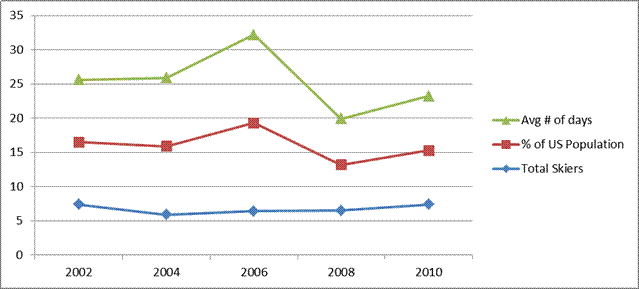

Andrej Šporn at the 2010 Winter Olympic downhill. (Photo credit: Wikipedia)
As the population goes up, skiing is keeping up.
Even worse, the age group that the growth in in skiing should be coming from is dropping.
Here is a scary number
|
2002 |
2004 |
2006 |
2008 |
2010 |
|
|
Age 25 or Older |
71.7% |
60.6% |
62.4% |
53.2% |
58.3% |
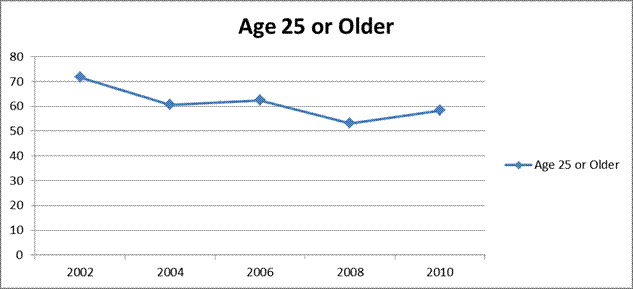
72 percent of skiers used to be 25 or younger. Now that number is 13% and again, not in line with the current us population. Growth comes from the young, or at least growth that skiing needs and can count on for years to come.
Snowboarding is saving ski areas, but not by much.
|
2002 |
2004 |
2006 |
2008 |
2010 |
|
|
Snowboard Participation |
5.9% |
6.3% |
5.2% |
5.8% |
6.1% |
However that “growth” is only .2% over 10 years with a fluctuation of .4%. Smaller fluctuation occurs in snowboarding however there is some growth.
I’m speculating that snowboarders are not as finicky about snow conditions?
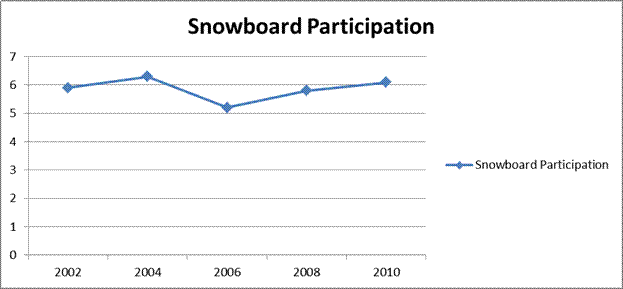
As you can see, over the past four years snowboarding is growing. Why?

Freestyle skiing jump (Photo credit: Wikipedia)
Snowboarder participation growth is from those 24 and younger.
|
2002 |
2004 |
2006 |
2008 |
2010 |
|
|
Age 24 or Younger |
56.2% |
60.6% |
49.4% |
57.8% |
68.3% |
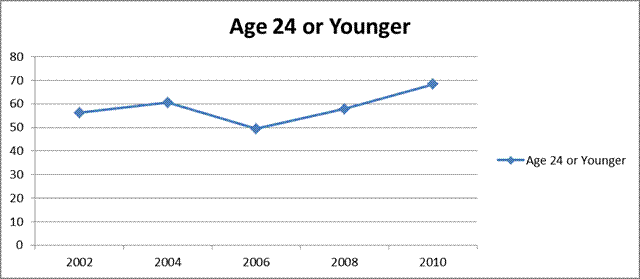
|
2002 |
2004 |
2006 |
2008 |
2010 |
|
|
Skier Visits |
54.4% |
57.1% |
55.1% |
57.1% |
60.5% |
|
Boarder Visits |
11.5% |
10.5% |
9.8% |
20.0% |
24.5% |

So
Skiing is not a growing sport. Thirty years ago it was the glamor sport. Twenty years ago it was thing to do. What has changed?
What do you think? Leave a comment.
If you like this let your friends know or post it on FB, Twitter or LinkedIn
Copyright 2012 Recreation Law (720) Edit Law
Twitter: RecreationLaw
Facebook: Rec.Law.Now
Facebook Page: Outdoor Recreation & Adventure Travel Law
Mobile Site: http://m.recreation-law.com
#RecreationLaw, #@RecreationLaw, #Cycling.Law #Fitness.Law, #Ski.Law, #Outside.Law, #Recreation.Law, #Recreation-Law.com, #Outdoor Law, #Recreation Law, #Outdoor Recreation Law, #Adventure Travel Law, #law, #Travel Law, #Jim Moss, #James H. Moss, #Attorney at Law, #Tourism, #Adventure Tourism, #Rec-Law, #Rec-Law Blog, #Recreation Law, #Recreation Law Blog, #Risk Management, #Human Powered, #Human Powered Recreation,# Cycling Law, #Bicycling Law, #Fitness Law, #Recreation-Law.com, #Backpacking, #Hiking, #Mountaineering, #Ice Climbing, #Rock Climbing, #Ropes Course, #Challenge Course, #Summer Camp, #Camps, #Youth Camps, #Skiing, #Ski Areas, #Negligence, #Snowboarding, #RecreationLaw, #@RecreationLaw, #Cycling.Law #Fitness.Law, #SkiLaw, #Outside.Law, #Recreation.Law, #RecreationLaw.com, #OutdoorLaw, #RecreationLaw, #OutdoorRecreationLaw, #AdventureTravelLaw, #Law, #TravelLaw, #JimMoss, #JamesHMoss, #AttorneyatLaw, #Tourism, #AdventureTourism, #RecLaw, #RecLawBlog, #RecreationLawBlog, #RiskManagement, #HumanPowered, #HumanPoweredRecreation,# CyclingLaw, #BicyclingLaw, #FitnessLaw, #RecreationLaw.com, #Backpacking, #Hiking, #Mountaineering, #IceClimbing, #RockClimbing, #RopesCourse, #ChallengeCourse, #SummerCamp, #Camps, #YouthCamps, #Skiing, #Ski Areas, #Negligence, #Snowboarding, sport and recreation laws, ski law, cycling law, Colorado law, law for recreation and sport managers, bicycling and the law, cycling and the law, ski helmet law, skiers code, skiing accidents,
WordPress Tags: NSGA,National,Goods,Association,Downhill,participation,Total,Skiers,Population,Over,Zero,Percent,fluctuation,percentage,growth,Here,Older,areas,Snowboard,Smaller,Snowboarder,Younger,Skier,Visits,Boarder,glamor,Leave,Twitter,LinkedIn,Recreation,Edit,RecreationLaw,Facebook,Page,Outdoor,Adventure,Travel,Blog,Mobile,Site,Outside,Moss,James,Attorney,Tourism,Risk,Management,Human,Rock,Ropes,Course,Challenge,Summer,Camp,Camps,Youth,Negligence,SkiLaw,OutdoorLaw,OutdoorRecreationLaw,AdventureTravelLaw,TravelLaw,JimMoss,JamesHMoss,AttorneyatLaw,AdventureTourism,RecLaw,RecLawBlog,RecreationLawBlog,RiskManagement,HumanPoweredRecreation,CyclingLaw,BicyclingLaw,FitnessLaw,RopesCourse,ChallengeCourse,SummerCamp,YouthCamps,Colorado,managers,helmet,accidents
Skier/Boarder Fatalities 2011-2012 Ski Season 3/15/12
Posted: March 28, 2012 Filed under: Skiing / Snow Boarding | Tags: fatality, helmet, Inbounds, Ski, ski area, Ski Resort, snowboarding, Sport, Vail Colorado, Winter sport Leave a commentThis list is not guaranteed to be accurate. The information is found from web searches and news dispatches. If you have a source for information on any fatality please leave a comment.
If this information is incorrect or incomplete please let me know. This is up to date as of March 15, 2012. Thanks.
|
# |
Date |
Resort |
Age |
Skier Ability |
Ski/ Tele /Boarder |
Helmet |
Reference |
|
1 |
11/18/2011 |
62 |
Skier |
Yes |
|||
|
2 |
11/18/2011 |
Breckenridge |
19 |
Expert |
Boarder |
Yes |
|
|
3 |
11/27/2011 |
Mountain High ski resor |
23 |
Beginner |
Boarder |
Yes |
|
|
4 |
12/18/2011 |
Sugar Bowl ski resort |
7 |
Expert |
Skier |
||
|
6 |
1/11/2012 |
Ski Apache |
29 |
Skier |
No |
||
|
7 |
1/12/2012 |
Sugarloaf ski resort |
41 |
Skier |
Yes |
||
|
8 |
1/14/2012 |
Silverton Mountain Ski Area |
25 |
Expert |
Skier |
||
|
9 |
1/17/2012 |
Heavenly Mountain Resort |
34 |
Boarder |
Yes |
||
|
10 |
1/18/2012 |
Aspen Highlands |
30 |
Boarder |
Yes |
||
|
11 |
1/18/2012 |
Mt. Hood Meadows Ski Resort |
15 |
Boarder |
No |
||
|
12 |
1/19/2012 |
Park City |
29 |
Boarder |
Yes |
||
|
13 |
1/20/2012 |
Copper Mountain |
51 |
Yes |
|||
|
14 |
1/20/2012 |
Whiteface Mountain |
25 |
Yes |
|||
|
15 |
1/21/2012 |
Vail (skied into closed area) |
13 |
Expert |
Skier |
||
|
16 |
1/22/2012 |
Winter Park |
28 |
Expert |
Skier |
||
|
17 |
1/24/2012 |
Steamboat Ski Area |
32 |
Boarder |
|||
|
18 |
1/24/2012 |
Taos Ski Valley |
60 |
Skier |
|||
|
19 |
1/25/2012 |
Keystone Ski Area |
54 |
Skier |
|||
|
20 |
1/27/2012 |
Mt. Hood Skibowl |
17 |
Boarder |
|||
|
22 |
1/30/2012 |
Seven Springs Mountain Resort |
36 |
Skier |
|||
|
27 |
1/31/2012 |
Solitude Ski Resort |
74 |
Skier |
No |
||
|
23 |
2/1/2012 |
Squaw Valley |
51 |
Skier |
|||
|
26 |
2/4/2012 |
Sugarbush Resort |
41 |
Skier |
Yes |
||
|
33 |
2/4/2012 |
Ski Windham Mountain Resor |
54 |
Skier |
|||
|
24 |
2/5/2012 |
Keystone Ski Area |
58 |
Skier |
No |
||
|
30 |
2/6/2012 |
Mount Snow |
33 |
||||
|
28 |
2/8/2012 |
Vail |
37 |
Yes |
|||
|
29 |
2/9/2012 |
Keystone Ski Area |
72 |
Yes |
|||
|
31 |
2/11/2012 |
Jay Peak Resort |
29 |
Boarder |
Yes |
||
|
32 |
2/11/2012 |
Terry Peak Ski Area |
24 |
Skier |
No |
||
|
34 |
2/18/2012 |
Sun Valley |
http://rec-law.us/GB3TCy | ||||
|
35 |
2/19/2012 |
Copper Mountain |
15 |
Boarder |
Yes |
||
|
36 |
2/26/2012 |
Keystone Ski Area |
24 |
Yes |
|||
|
37 |
2/23/2012 |
Northstar California |
52 |
Yes |
|||
|
38 |
3/1/2012 |
Burke Mountain Ski Resort |
70 |
Yes |
|||
|
39 |
3/8/2012 |
Copper Mountain |
18 |
Skier |
Yes |
||
|
40 |
3/9/2012 |
Keystone Ski Area |
23 |
Skier |
No |
||
|
41 |
3/10/2012 |
Terry Peak Ski Area |
54 |
Skier |
|||
|
42 |
3/10/2012 |
Loveland Ski Area |
71 |
Skier |
No |
||
|
43 |
3/14/2012 |
Crested Butte Mountain Resort |
36 |
Skier |
No |
||
|
44 |
3/16/2012 |
Northstar California |
51 |
Skier |
Yes |
||
|
45 |
3/18/2012 |
China Peak Ski Resort |
30 |
Boarder |
|||
|
46 |
3/18/2012 |
Sierra-at-Tahoe |
54 |
Skier |
|||
|
47 |
3/19/2012 |
Sugar Bowl Ski Resort |
20 |
Boarder |
What do you think? Leave a comment.
If you like this let your friends know or post it on FB, Twitter or Linkedin
Copyright 2012 Recreation Law (720) Edit Law
Skier carving a turn off piste (Photo credit: Wikipedia)
Twitter: RecreationLaw
Facebook: Rec.Law.Now
Facebook Page: Outdoor Recreation & Adventure Travel Law
#RecreationLaw, #@RecreationLaw, #Cycling.Law #Fitness.Law, #Ski.Law, #Outside.Law, #Recreation.Law, #Recreation-Law.com, #Outdoor Law, #Recreation Law, #Outdoor Recreation Law, #Adventure Travel Law, #law, #Travel Law, #Jim Moss, #James H. Moss, #Attorney at Law, #Tourism, #Adventure Tourism, #Rec-Law, #Rec-Law Blog, #Recreation Law, #Recreation Law Blog, #Risk Management, #Human Powered, #Human Powered Recreation,# Cycling Law, #Bicycling Law, #Fitness Law, #Recreation-Law.com, #Backpacking, #Hiking, #Mountaineering, #Ice Climbing, #Rock Climbing, #Ropes Course, #Challenge Course, #Summer Camp, #Camps, #Youth Camps, #Skiing, #Ski Areas, #Negligence, #Snowboarding, #RecreationLaw, #@RecreationLaw, #Cycling.Law #Fitness.Law, #SkiLaw, #Outside.Law, #Recreation.Law, #RecreationLaw.com, #OutdoorLaw, #RecreationLaw, #OutdoorRecreationLaw, #AdventureTravelLaw, #Law, #TravelLaw, #JimMoss, #JamesHMoss, #AttorneyatLaw, #Tourism, #AdventureTourism, #RecLaw, #RecLawBlog, #RecreationLawBlog, #RiskManagement, #HumanPowered, #HumanPoweredRecreation,# CyclingLaw, #BicyclingLaw, #FitnessLaw, #RecreationLaw.com, #Backpacking, #Hiking, #Mountaineering, #IceClimbing, #RockClimbing, #RopesCourse, #ChallengeCourse, #SummerCamp, #Camps, #YouthCamps, #Skiing, #Ski Areas, #Negligence, #Snowboarding, sport and recreation laws, ski law, cycling law, Colorado law, law for recreation and sport managers, bicycling and the law, cycling and the law, ski helmet law, skiers code, skiing accidents, #Vail, #Breckenridge, #Mountain High Ski Resort, #Ski Ward, #Sugarloaf, #Silverton, Ski Apache, #Sugarloaft, #Heavenly, #Aspen, Mt Hood, Park City, #Copper, #Whiteface, Winter Park, #Steamboat, #Taos, #Keystone, #Canyons, Seven Springs, #Solitude, Ski Windham, Mount Snow, Jay Peak Terry Peak,
WordPress Tags: Skier,Boarder,Fatalities,Season,information,news,February,Thanks,Date,Resort,Tele,Helmet,Reference,Vail,Breckenridge,Expert,Mountain,High,Beginner,Sugar,Bowl,Ward,Apache,Sugarloaf,Silverton,Area,Aspen,Highlands,Meadows,Park,Copper,Whiteface,Winter,Steamboat,Taos,Valley,AihrSt,Skibowl,Canyons,Seven,Springs,Solitude,Squaw,Sugarbush,Windham,Resor,Mount,ABqYPQ,Peak,Terry,Northstar,California,Burke,ADkQWq,Loveland,Ajhcko,Butte,China,Sierra,Tahoe,GAucKe,Leave,Twitter,Linkedin,Recreation,Edit,RecreationLaw,Facebook,Page,Outdoor,Adventure,Travel,Blog,Outside,Moss,James,Attorney,Tourism,Risk,Management,Human,Rock,Ropes,Course,Challenge,Summer,Camp,Camps,Youth,Areas,Negligence,SkiLaw,OutdoorLaw,OutdoorRecreationLaw,AdventureTravelLaw,TravelLaw,JimMoss,JamesHMoss,AttorneyatLaw,AdventureTourism,RecLaw,RecLawBlog,RecreationLawBlog,RiskManagement,HumanPoweredRecreation,CyclingLaw,BicyclingLaw,FitnessLaw,RopesCourse,ChallengeCourse,SummerCamp,YouthCamps,Colorado,managers,accidents,Sugarloaft
Best of Outdoor Retailer and SIA
Posted: March 21, 2012 Filed under: Uncategorized | Tags: helmet, Kali, MIPS architecture, Recco, Ski, Ski Resort, Sports Leave a commentThe best is always the people. However I found some interesting products
12 days, 8 days of exhibit hall, 3 days of on-snow demos and another tradeshow season comes to an end.
Here’s a quick rundown of what I saw that I liked.
Slide On for ski boots: This product makes putting your ski boot on a breeze. From the maker of the Booster Power Strap. If you ski and you aren’t using the Booster Power Strap, try and get off the bunny slope and give them a try.
Nargear: Not a lot of bells and whistles, just make to take your gear and keep it in one bag, no matter how far you throw it.
Snow Angel: No I don’t wear women’s clothing, but this stuff is beautiful. Feels good too. You are on your own for finding out how technical it is.
MIPS: If you need a helmet for any sport that is not a DOT helmet, get one with MIPS inside. It may make the difference
Kali Helmets: Don’t like MIPS, Kali is coming up with some new ideas in helmet technology that will change the way helmets perform.
Protect Helmets: nothing new as far as the helmet goes, but they have the Recco chip in the helmet.
Bern Hard Hat: I’ve told you a thousand times A new idea that makes sense in helmets: the Bern Hard Hat
Ski Retriever: Skiing Powder all the time and don’t like leashes, try technology to not lose a ski.
Fox 40: Fox had mouth guards at the ski show. See A helmet manufacture understands the issues
UClear: I’ve not tested it but if the ear phones eliminate the wind noise and the microphone eliminates all noise, these will be great for people who move
Loki: Did you ever have a coat that you grabbed when you weren’t sure, but when in doubt you always grabbed it. Loki makes coats, sweatshirts and accessories, all that serve multi purposes.
Orthahell Sandals: Ever put something on your feet and have your feet put a smile on your face. In a sandal even.
Suunto: Supposedly they have a new watch that works, by that I mean won’t break in 60 days. We’ll see. Heck, the PR team is beautiful……
Timex: Hard to read, harder to understand how it works, but as John Cameron Sayze used to say, it takes a lickin’ and keeps on tickin’
Eton: A product that made me go wow. Solar powered stereo that you can Bluetooth from your phone or MP3. No need to add songs to another device. Don’t know if it can take the outdoor beating, but works great indoors.
Replay: video camera a little larger than a roll of quarters, but not much larger
Hyalite Equipment: New name, old company solid great gear, bags, pads and bike gear
The Dry Guy: If you don’t own something from the Dry Guy, you are skiing with wet gloves and boots. The latest is a heater & dryer for boots, the Turbo Dryer that can work off your car. Warm boots when you put them on to ski after driving to the resort. Wonderful.
I have a lot more stuff to let you know about, but some I want to make sure the marketing matches reality.
What do you think? Leave a comment.
If you like this let your friends know or post it on FB, Twitter or LinkedIn
Copyright 2012 Recreation Law (720) Edit Law
Twitter: RecreationLaw
Facebook: Rec.Law.Now
Facebook Page: Outdoor Recreation & Adventure Travel Law
Mobile Site: http://m.recreation-law.com
#RecreationLaw, #@RecreationLaw, #Cycling.Law #Fitness.Law, #Ski.Law, #Outside.Law, #Recreation.Law, #Recreation-Law.com, #Outdoor Law, #Recreation Law, #Outdoor Recreation Law, #Adventure Travel Law, #law, #Travel Law, #Jim Moss, #James H. Moss, #Attorney at Law, #Tourism, #Adventure Tourism, #Rec-Law, #Rec-Law Blog, #Recreation Law, #Recreation Law Blog, #Risk Management, #Human Powered, #Human Powered Recreation,# Cycling Law, #Bicycling Law, #Fitness Law, #Recreation-Law.com, #Backpacking, #Hiking, #Mountaineering, #Ice Climbing, #Rock Climbing, #Ropes Course, #Challenge Course, #Summer Camp, #Camps, #Youth Camps, #Skiing, #Ski Areas, #Negligence, #Snowboarding, #RecreationLaw, #@RecreationLaw, #Cycling.Law #Fitness.Law, #SkiLaw, #Outside.Law, #Recreation.Law, #RecreationLaw.com, #OutdoorLaw, #RecreationLaw, #OutdoorRecreationLaw, #AdventureTravelLaw, #Law, #TravelLaw, #JimMoss, #JamesHMoss, #AttorneyatLaw, #Tourism, #AdventureTourism, #RecLaw, #RecLawBlog, #RecreationLawBlog, #RiskManagement, #HumanPowered, #HumanPoweredRecreation,# CyclingLaw, #BicyclingLaw, #FitnessLaw, #RecreationLaw.com, #Backpacking, #Hiking, #Mountaineering, #IceClimbing, #RockClimbing, #RopesCourse, #ChallengeCourse, #SummerCamp, #Camps, #YouthCamps, #Skiing, #Ski Areas, #Negligence, #Snowboarding, sport and recreation laws, ski law, cycling law, Colorado law, law for recreation and sport managers, bicycling and the law, cycling and the law, ski helmet law, skiers code, skiing accidents, SIA, OR, Winter, Ski, Ski Show, Outdoor Retailer
WordPress Tags: Best,Outdoor,Retailer,products,hall,demos,Here,Slide,product,breeze,From,maker,Booster,Power,Strap,bunny,Nargear,gear,Angel,women,Feels,MIPS,helmet,difference,Kali,Helmets,technology,Protect,Recco,Bern,Hard,Powder,leashes,UClear,noise,Loki,purposes,Orthahell,Sandals,feet,Suunto,Heck,team,Timex,John,Cameron,Sayze,Eton,Solar,Bluetooth,songs,device,Replay,Hyalite,Equipment,bike,heater,Turbo,Dryer,Warm,resort,Wonderful,Leave,Twitter,LinkedIn,Recreation,Edit,RecreationLaw,Facebook,Page,Adventure,Travel,Blog,Mobile,Site,Outside,Moss,James,Attorney,Tourism,Risk,Management,Human,Rock,Ropes,Course,Challenge,Summer,Camp,Camps,Youth,Areas,Negligence,SkiLaw,OutdoorLaw,OutdoorRecreationLaw,AdventureTravelLaw,TravelLaw,JimMoss,JamesHMoss,AttorneyatLaw,AdventureTourism,RecLaw,RecLawBlog,RecreationLawBlog,RiskManagement,HumanPoweredRecreation,CyclingLaw,BicyclingLaw,FitnessLaw,RopesCourse,ChallengeCourse,SummerCamp,YouthCamps,Colorado,managers,accidents,Winter
Why accident reports can come back to haunt you.
Posted: March 12, 2012 Filed under: New Hampshire, Release (pre-injury contract not to sue) | Tags: Alpine Slide, Attitasha Ski Area, Court, Expert Witness, Federal Supplement, Medicaid, Motion in Limine, New Hampshire Department of Safety, Ski Resort 4 CommentsHerbst v. L.B.O. Holding, Inc., 2011 DNH 72; 783 F. Supp. 2d 262; 2011 U.S. Dist. LEXIS 46977; 85 Fed. R. Evid. Serv. (Callaghan) 285
Accident reports can be admitted, if the accident is substantially similar, which proves to the jury that you don’t mind injuring people.
In this case, the plaintiff as an adult, was using a ski area alpine slide when his sled left the track causing him injury. He sued for his injuries. The ski area,

Image via Wikipedia
Attitash Bear Peak Resort, in Bartlett, New Hampshire had filed a motion in limine with the court which gave rise to this decision.
A motion in limine is a motion where one party asks the court to exclude testimony or statements being proffered by the other party. Here the Ski area was attempting to have prior reports from accidents on the alpine slide kept out of the trial. The ski area and the plaintiff were also attempting to restrict or prohibit other testimony and exhibits also.
One of the first issues was the background and history of the plaintiff. The plaintiff was trying to prevent the defendant from brining in the issue that the plaintiff had been convicted of mail fraud. An issue like this is based on whether the felony conviction is a conviction for dishonesty or fraud. Here it was a felony conviction for dishonesty. A felony normally cannot be brought in, absent special circumstances if the conviction is greater than ten (10) years old. Although the plaintiff’s conviction was greater than ten years old, because of the type of conviction, the judge thought it was relevant and allowed the conviction to be used at trial.
The next issue was the amount of medical bills incurred by the plaintiff. The plaintiffs’ medical bills were paid by Medicaid. As such, those bills when paid were discounted substantially. The plaintiff wanted to claim the medical bills were the amount prior to the Medicaid discount. Here the judge found that the full value of the medical bills was to be admitted not the discounted amount paid by Medicaid.
The value of the medical bills is always an important point. The jury usually bases its damages as a function of the medical bills.
The defendant wanted to exclude expert testimony of the plaintiff’s expert witness about warning signs or the inadequacy thereof. The plaintiff’s expert had only mentioned the signs in one sentence of his report and included photographs of the signs in his report. An expert witness report must contain a complete statement of the opinions he or she will express and the basis or the reasons for those opinions. The defense argued the one sentence was not enough to be a complete statement of the opinion. However, the court found it to be enough and will allow the testimony of the expert about the inadequacy of the signage into the trial.
The final argument was the plaintiff wanted to admit into evidence the accident reports of the 22 similar prior accidents. Six of the reports came from the New Hampshire Department of Safety, and 15 were from Attitash itself. One of the reports was based on an observation of the plaintiff’s expert witness when he was at the site investigating the scene.
So?
For an accident report to be admitted into trial the report must be substantially similar to the accident at issue.
Evidence of prior accidents is admissible . . . only if the proponent of the evidence shows that the accidents occurred under circumstances substantially similar to those at issue in the case at bar
The court found that four of the reports would be admitted of the six filed with the state and the 15 kept by the defendant. Those six were substantially similar to the accident that injured the plaintiff. Here, that similarity was the sled leaving the track on a curve.
The court found the following four reports significant and similar.
· the accident on July 12, 2005 (where the rider “came through [the] dip, came to next set of banks, came out of track”);
· the accident on July 23, 2005 (where the “sled came off track” near a bank);
· the accident on August 3, 2005 (where the rider “hit the curve, jumped the track”); and
· the accident on July 16, 2006 (where the rider “came from a right turn into a left turn and his cart flew off”).
The court also agreed to allow the report of the plaintiff’s expert witness of the accident he observed.
The issue then becomes what does this prove?
I believe it proves that it proves to the jury that the defendant has a dangerous track. The jury will see four reports from injuries substantially similar to the one the plaintiff is complaining about. How else could you look at these reports, except as proof that the track was dangerous AND that the defendant had done nothing to correct the problems or make the track safe.
Here were accidents for five years prior to the plaintiff’s accident and one, the expert witness one, occurring after the injury that showed there was a problem.
No matter, how much your employees and expert witness argue that the track is not dangerous, the jury is going to be looking at reports, written documents, prepared by you the defendant, saying the exact opposite.
So Now What?
Do you not create accident reports. No, you must keep records of problems, until they are fixed or used in litigation. However the reason for the reports is critical. If you are keeping them to track accidents, you are doing it for the wrong reason. You use them to do two things and two things only.
· Provide information in case there is a need such as state or federal investigation or litigation.
· To solve problems.
1. Any accident report must be solely that, the basic facts, who, what, where, when; never ever, ever a why.
Accident reports should never have speculation or opinion in them.
2. You must do something with the information you gather on accident reports. You cannot just collect them. If you notice a trend or locations fix it.
If you can’t fix it, put up a sign, put it in the waiver, instruct the people about it and tell them they will get hurt if they don’t pay attention.
Below is the accident report used by a major ski area. If you look, the information collected is done so to gather information and prevent litigation.
Nothing more than the absolute essentials is captured. These are 5 X 7 cards. The information on the form is 100% from the injured party. No information is put on the card by the patrollers unless it is direct information acquired by the patroller such as the release number setting on the skis, etc.
If there are witnesses then there are 5 X 7 cards for them to complete. There was also a form if a ski school student was injured. If the accident was a life changing incident, major trauma then there were more forms. But for 99% of the accidents, the entire report fit in a patroller’s pocket.
If the injured party cannot fill out the card, then the patroller asks the questions and writes down what the injured party says.
No opinion, no estimates, no guesses, just the facts. (Remember Dragnet the TV show from the 60s.)
Then, once you have the information it must be used. Where are the problems, can we fix the problems, should we warn people about the problems? What can we do to prevent injuries, and if we can’t can we warn people they don’t get injured?
If not, those reports will show up in trial, and probably not to help you.
For an article about bad accident reports see Be Afraid, be very afraid of pre-printed forms for your recreation business.
What do you think? Leave a comment.
If you like this let your friends know or post it on FB, Twitter or LinkedIn
Copyright 2012 Recreation Law (720) Edit Law
Twitter: RecreationLaw
Facebook: Rec.Law.Now
Facebook Page: Outdoor Recreation & Adventure Travel Law
Mobile Site: http://m.recreation-law.com
#RecreationLaw, #@RecreationLaw, #Cycling.Law #Fitness.Law, #Ski.Law, #Outside.Law, #Recreation.Law, #Recreation-Law.com, #Outdoor Law, #Recreation Law, #Outdoor Recreation Law, #Adventure Travel Law, #law, #Travel Law, #Jim Moss, #James H. Moss, #Attorney at Law, #Tourism, #Adventure Tourism, #Rec-Law, #Rec-Law Blog, #Recreation Law, #Recreation Law Blog, #Risk Management, #Human Powered, #Human Powered Recreation,# Cycling Law, #Bicycling Law, #Fitness Law, #Recreation-Law.com, #Backpacking, #Hiking, #Mountaineering, #Ice Climbing, #Rock Climbing, #Ropes Course, #Challenge Course, #Summer Camp, #Camps, #Youth Camps, #Skiing, #Ski Areas, #Negligence, #Snowboarding, #RecreationLaw, #@RecreationLaw, #Cycling.Law #Fitness.Law, #SkiLaw, #Outside.Law, #Recreation.Law, #RecreationLaw.com, #OutdoorLaw, #RecreationLaw, #OutdoorRecreationLaw, #AdventureTravelLaw, #Law, #TravelLaw, #JimMoss, #JamesHMoss, #AttorneyatLaw, #Tourism, #AdventureTourism, #RecLaw, #RecLawBlog, #RecreationLawBlog, #RiskManagement, #HumanPowered, #HumanPoweredRecreation,# CyclingLaw, #BicyclingLaw, #FitnessLaw, #RecreationLaw.com, #Backpacking, #Hiking, #Mountaineering, #IceClimbing, #RockClimbing, #RopesCourse, #ChallengeCourse, #SummerCamp, #Camps, #YouthCamps, #Skiing, #Ski Areas, #Negligence, #Snowboarding, sport and recreation laws, ski law, cycling law, Colorado law, law for recreation and sport managers, bicycling and the law, cycling and the law, ski helmet law, skiers code, skiing accidents, #Accident, Accident Report, Alpine Slide, #Slide, #Sled,


 Recreation Law