
Donahue v. Ledgends, Inc., 2014 Alas. LEXIS 153
Posted: August 31, 2014 Filed under: Alaska, Climbing Wall, Legal Case, Release (pre-injury contract not to sue) | Tags: AK, Alaska, Bouldering, Claire Donahue, Climbing Gym, Climbing Wall, Defendant, Donahue, Ledgends, Negligence, Plaintiff, Release, Rock Gym Leave a commentTo Read an Analysis of this decision see
Alaskan Supreme Court upholds releases for climbing gym and sets forth requirements on how releases will be upheld in AK
Donahue v. Ledgends, Inc., 2014 Alas. LEXIS 153
Claire A. Donahue, Appellant and Cross-Appellee, v. Ledgends, Inc. d/b/a Alaska Rock Gym, Appellee and Cross-Appellant.
Supreme Court Nos. S-14910/14929, No. 6932
SUPREME COURT OF ALASKA
2014 Alas. LEXIS 153
August 1, 2014, Decided
NOTICE:
THIS OPINION IS SUBJECT TO CORRECTION BEFORE PUBLICATION IN THE PACIFIC REPORTER. READERS ARE REQUESTED TO BRING ERRORS TO THE ATTENTION OF THE CLERK OF THE APPELLATE COURTS.
PRIOR HISTORY: [*1] Appeal from the Superior Court of the State of Alaska, Third Judicial District, Anchorage, Andrew Guidi, Judge. Superior Court No. 3AN-10-07305 CI.
CASE SUMMARY:
OVERVIEW: HOLDINGS: [1]-Plaintiff alleged injured party’s negligence claim failed because a release stated waived risks, used “negligence,” stated important factors in emphasized language, specifically disclaimed liability, did not imply safety standards conflicting with a release, was not contested on public policy grounds, and was not modified by advertising; [2]-The Uniform Trade Practices and Consumer Protection Act, AS 45.50.471 et seq., did not apply because conflicts with a personal injury claim barred assuming such a legislature intent, which “ascertainable loss of money or property” in AS 45.50.531(a) did not state; [3]-It was no clear error to find defendant gym waived Alaska R. Civ. P. 68 attorney’s fees because it only raised its offer of judgment when seeking fees under an indemnity clause, and only raised enhanced fees under Alaska R. Civ. P. 82, before its reconsideration motion.
OUTCOME: Judgment affirmed.
COUNSEL: Christine S. Schleuss, Law Office of Christine S. Schleuss, Anchorage, for Appellant and Cross-Appellee.
Tracey L. Knutson, Girdwood, for Appellee and Cross-Appellant.
JUDGES: Before: Fabe, Chief Justice, Winfree, Stowers, Maassen, and Bolger, Justices.
OPINION BY: MAASSEN
OPINION
MAASSEN, Justice.
I. INTRODUCTION
This case arises from an injury at a climbing gym. Claire Donahue broke her tibia during a class at the Alaska Rock Gym after she dropped approximately three to four-and-a-half feet from a bouldering wall onto the floor mat. Before class Donahue had been required to read and sign a document that purported to release the Rock Gym from any liability for participants’ injuries.
Donahue brought claims against the Rock Gym for negligence and violations of the Uniform Trade Practices and Consumer Protection Act (UTPA). The Rock Gym moved for summary judgment, contending that the release bars Donahue’s negligence claim. It also moved to dismiss the UTPA claims on grounds that the act does not apply to personal injury claims and that Donahue failed to state a prima facie [*2] case for relief under the act. Donahue cross-moved for partial summary judgment on the enforceability of the release as well as the merits of her UTPA claims. The superior court granted the Rock Gym’s motion and denied Donahue’s, then awarded attorney’s fees to the Rock Gym under Alaska Civil Rule 82.
Donahue appeals the grant of summary judgment to the Rock Gym; the Rock Gym also appeals, contending that the superior court should have awarded fees under Alaska Civil Rule 68 instead of Rule 82. We affirm the superior court on all issues.
II. FACTS AND PROCEEDINGS
Ledgends, Inc. does business as the Alaska Rock Gym, a private indoor facility that is open to the public. Its interior walls have fixed climbing holds and routes; for a fee, it provides classes and open gym or free climbing time. There are signs posted around the Rock Gym warning of the dangers of climbing, including falling; at her deposition Donahue did not dispute that the signs were there when she visited the gym.
Donahue had been thinking about trying rock climbing for several years, and she finally decided in March 2008 to attend a class at the Rock Gym called “Rockin’ Women.” She testified that she chose the class because she thought it could be tailored to specific [*3] skill levels, and because she “got the impression [from the advertisements] that that is the type of group it was, that it was a . . . safe way to learn to climb.” She also testified she understood that the essential risk of climbing is falling.
Donahue had no rock climbing experience, but she was an occasional runner and cyclist and had pursued other high-risk athletic activities such as kite-boarding. She had been a river guide on the Colorado River after college. She had engaged in physical occupations such as commercial fishing and construction. She testified that she understood the nature of risky activities and felt competent to decide about them for herself. In connection with other recreational activities, she had signed releases and waivers similar to the one she signed at the Rock Gym. She testified that she understood that parties who sign contracts generally intend to be bound by them.
When Donahue arrived at the Rock Gym for her first class, she was given a document entitled “Participant Release of Liability, Waiver of Claims, Assumption of Risks, and Indemnity Agreement — Alaska Rock Gym.” She was aware of the document’s nature and general intent but testified that although [*4] she signed it voluntarily, she did not read it closely.
The release contains nine numbered sections on two single-spaced pages. There is also an unnumbered introductory paragraph; it defines the Rock Gym to include, among others, its agents, owners, participants, and employees, as well as “all other persons or entities acting in any capacity on its behalf.”
Section one of the release contains three paragraphs. The first recites the general risks of rock climbing, including injury and death, and explains that these risks are essential to the sport and therefore cannot be eliminated. The second paragraph lists about a dozen specific risks inherent in rock climbing, including “falling off the climbing wall,” “impacting the ground,” “the negligence of other[s],” and “my own negligence[,] inexperience, . . . or fatigue.” The third paragraph asserts that the gym and its instructors “seek safety, but they are not infallible.” It describes some errors instructors might make, including being ignorant of a participant’s abilities and failing to give adequate warnings or instructions. The final sentence in the third paragraph reads, “By signing this [release], I acknowledge that I AM ULTIMATELY RESPONSIBLE [*5] for my own safety during my use of or participation in [Rock Gym] facilities, equipment, rentals, or activities.”
Section two begins, “I expressly agree and promise to accept and assume all the risks . . .”; it then highlights the voluntary nature of participation in Rock Gym activities.
Section three is the clause that releases the Rock Gym from liability (the releasing clause). It reads in full,
I hereby voluntarily release, forever discharge, and agree to indemnify and hold harmless the [Rock Gym] from any and all claims, demands, or causes of action, which are in any way connected with my participation in these activities or my use of [the Rock Gym’s] equipment, rentals or facilities, including any such claims which allege negligent acts or omissions of [the Rock Gym].
The next six sections of the release address other issues: indemnification for attorney’s fees, certification that the participant is fit to climb, permission to provide first aid, permission to photograph for promotional purposes, the voluntariness of participation and signing the release, and jurisdiction for claims arising from the release.
The ultimate paragraph is printed in bold. It reads in part,
By signing this [*6] document, I acknowledge that if anyone is hurt or killed or property is damaged during my participation in or use of [Rock Gym] activities or premises or facilities or rental equipment, I may be found by a court of law to have waived my right to maintain a lawsuit against [the Rock Gym] on the basis of any claim from which I have released them herein.
Finally, centered on the second page, in bold capital letters directly above the signature line, the release reads: “I HAVE HAD SUFFICIENT OPPORTUNITY TO READ THIS ENTIRE DOCUMENT. I HAVE READ AND UNDERSTOOD IT, AND I AGREE TO BE BOUND BY ITS TERMS.”
Donahue’s hand-printed name and the date appear on the first page of the release, and her initials are at the bottom of the page; her signature appears on the second page, along with her printed name, her contact information, and the date.
Donahue completed her first class on harnessed climbing on March 23, 2008, and returned for a second class on May 11. When class began she was told that the day’s focus would be on bouldering, or unharnessed climbing on low walls. She did not express any hesitation. She climbed for almost two hours, successfully ascending and descending a number of routes. [*7] During this time she saw other people drop from the wall without injury. After another successful ascent near the end of the lesson, she felt unable to climb down using the available holds. Her feet were somewhere between three and four-and-a-half feet from the ground. Her instructor suggested that she drop to the mat and told her to be sure to bend her knees. Donahue landed awkwardly and broke her tibia in four places. She was attended to immediately by Rock Gym personnel and a physician who happened to be present.
The Rock Gym had run various advertisements during the two years preceding Donahue’s accident, using a number of different slogans. One newspaper ad, running on at least three occasions, stated: “[T]the only safe place in town to hang out.” Another Rock Gym ad showed an adult bouldering and a child climbing while harnessed; its text contained the same slogan and added, in part, “Trust us, it still exists. . . . [E]very child in your family will be reminded of what it’s all about — friends and fun.” A third ad described climbing programs for everyone in the family and said, “[Y]ou have nothing to lose and everything to gain.” In an affidavit, Donahue testified she had read these ads.
Donahue [*8] sued the Rock Gym for negligent failure to adequately train and supervise its instructors. She alleged that the Rock Gym was liable for its employee’s negligent instruction to drop from the bouldering wall. She also alleged a violation of the Unfair Trade Practices and Consumer Protection Act, contending that the Rock Gym’s advertisements “misleadingly advertised [the gym] as a safe place where users of its services had nothing to lose and everything to gain.”
The Rock Gym moved for summary judgment on all of Donahue’s claims. She opposed the motion and cross-moved for partial summary judgment herself, arguing that the Rock Gym had violated the UTPA as a matter of law and that the release she had signed was null and void.
The superior court granted the Rock Gym’s motion and denied Donahue’s cross-motion. It then granted the Rock Gym, as prevailing party, partial attorney’s fees under Civil Rule 82(a)(3).
III. STANDARDS OF REVIEW
[HN1] We review grants of summary judgment de novo, determining whether the record presents any genuine issues of material fact.1 In making this determination, we construe the facts in favor of the non-moving party.2 If the record fails to reveal a genuine factual dispute and the moving [*9] party was entitled to judgment as a matter of law, the trial court’s grant of summary judgment must be affirmed.3
1 Hill v. Giani, 296 P.3d 14, 20 (Alaska 2013) (citing Yost v. State, Div. of Corps., Bus. & Prof’l Licensing, 234 P.3d 1264, 1272 (Alaska 2010)).
2 Id. (citing McCormick v. City of Dillingham, 16 P.3d 735, 738 (Alaska 2001)).
3 Kelly v. Municipality of Anchorage, 270 P.3d 801, 803 (Alaska 2012).
[HN2] We decide questions of law, including statutory interpretation, using our independent judgment.4 We will adopt the most persuasive rule of law in light of precedent, reason, and policy.5 This requires us, when interpreting statutes, to “look to the meaning of the language, the legislative history, and the purpose of the statute.”6
4 Therchik v. Grant Aviation, Inc., 74 P.3d 191, 193 (Alaska 2003).
5 ASRC Energy Servs. Power & Commc’ns, LLC v. Golden Valley Electric Ass’n, 267 P.3d 1151, 1157 (Alaska 2011).
6 Id.
[HN3] “A superior court’s determination whether waiver occurred is a question of fact that we review for clear error.”7
7 Sengul v. CMS Franklin, Inc., 265 P.3d 320, 324 (Alaska 2011).
IV. DISCUSSION
A. The Release Is Enforceable And Bars Donahue’s Negligence Claims.
Three cases define Alaska law on pre-activity releases from liability.8 [HN4] These cases consistently state that such releases are not per se invalid;9 in each of the cases, however, we concluded that the release at issue did not bar the plaintiff’s claim.
8 Ledgends, Inc. v. Kerr, 91 P.3d 960 (Alaska 2004); Moore v. Hartley Motors, Inc., 36 P.3d 628 (Alaska 2001); Kissick v. Schmierer, 816 P.2d 188 (Alaska 1991).
9 Kerr, 91 P.3d at 961-62 (noting that “under Alaska law pre-recreational exculpatory releases are held to a very high standard of clarity”); Moore, 36 P.3d at 631 (noting that “an otherwise valid release is ineffective when releasing a defendant from liability would violate public policy” (emphasis added)); Kissick, 816 P.2d at 191 (“A promise not to [*10] sue for future damage caused by simple negligence may be valid.” (quoting 15 Samuel Williston, A Treatise on the Law of Contracts § 1750A, at 143-45 (3d ed. 1972)); see also Mitchell v. Mitchell, 655 P.2d 748, 751 (Alaska 1982) (upholding provision not to sue in settlement agreement and noting that, “[a]s a matter of law, . . . a valid release of all claims will bar any subsequent claims covered by the release”).
Kissick v. Schmierer involved a plane crash that caused the deaths of all four people aboard.10 The three passengers had signed a covenant not to sue before they boarded the plane.11 They agreed in the release not to bring a claim “for any loss, damage, or injury to [their] person or [their] property which may occur from any cause whatsoever.”12 When the passengers’ surviving spouses filed wrongful death claims against the pilot, their claims were allowed to proceed despite the release.13 We ruled that [HN5] “[i]ntent to release a party from liability for future negligence must be conspicuously and unequivocally expressed.”14 We also held that a release must use the word “negligence” to establish the required degree of clarity, something the release in Kissick did not do.15 Further, since liability for “death” was not specifically disclaimed and the term “injury” [*11] was ambiguous, we held that the release did not apply to claims for wrongful death, construing it against the drafter.16
10 Kissick, 816 P.2d at 188.
11 Id. at 189.
12 Id.
13 Id.
14 Id. at 191 (citations omitted).
15 Id. (citing W.Page Keeton, et al., Prosser and Keeton on the Law of Torts § 68, at 483-84 (5th ed.1984) (footnotes omitted)).
16 Id. at 191-92.
The second case, Moore v. Hartley Motors, involved an injury during a class on driving all-terrain vehicles (ATVs).17 We first addressed whether the plaintiff’s signed release violated public policy.18 We noted that the type of service involved was neither essential nor regulated by statute;19 these factors, along with the voluntariness of the plaintiff’s participation, persuaded us that the defendants 20 had no “decisive advantage in bargaining strength.”21 We therefore held that the release did not violate public policy.22
17 36 P.3d 628, 629 (Alaska 2001).
18 Id. at 631-32.
19 Id. at 631-32 (noting that ATV riding is similar to parachuting, dirt biking, and scuba diving, for which releases have been upheld in other jurisdictions).
20 The defendants included the dealer that sold the plaintiff the ATV and referred her to the safety course, the ATV Safety Institute that developed the curriculum, and the individual instructor. Id. at 629.
21 Id. at 631-32.
22 Id.
We did decide, however, that the release did not conspicuously and unequivocally [*12] express an intent to release the defendants from liability for the cause of the exact injury that occurred — a rollover when the plaintiff drove over a big rock hidden in tall grass.23 The release covered the inherent risks of ATV riding, but we found that it also included “an implied and reasonable presumption that the course [was] not unreasonably dangerous.”24 We found there to be fact questions about whether “the course posed a risk beyond ordinary negligence related to the inherent risks of off-road ATV riding assumed by the release,” and we held that summary judgment for the defendants on the basis of the release was therefore improper.25
23 Id. at 632.
24 Id.
25 Id. at 633-34.
The third case, Ledgends, Inc. v. Kerr, involved the same rock gym as this case.26 It involved a similar injury as well, sustained when the plaintiff fell from a bouldering wall.27 Unlike Donahue, however, who landed squarely on the floor mat, the plaintiff in Kerr was allegedly injured when her foot slipped through the space between two floor mats.28 The plaintiff alleged the gym knew of the defect in the landing area but had failed to fix it.29
26 91 P.3d 960 (Alaska 2004).
27 Id. at 961.
28 Id.
29 Id.
The superior court, whose order we approved and attached as an appendix to our opinion, cited Kissick [*13] for the notion that a pre-activity release for tortious conduct must be “clear, explicit, and comprehensible in each of its essential details.”30 The superior court also noted the requirement that “such an agreement, read as a whole, must clearly notify the prospective releasor or indemnitor of the effect of signing the release.”31 With these principles in mind, the superior court pointed to language in the release that was problematic because it was internally inconsistent: the release stated that the gym would try to keep its facilities safe and its equipment in good condition, but it simultaneously disclaimed liability for actions that failed to meet such standards.32 The superior court construed this ambiguity against the drafter and held that the release was not valid as a bar to the plaintiff’s negligence claims, a holding we affirmed.33
30 Id. at 961-62 (quoting Kissick v. Schmierer, 816 P.2d 188, 191 (Alaska 1991)) (internal quotation marks omitted).
31 Id. at 962 (quoting Kissick, 816 P.2d at 191) (internal quotation marks omitted).
32 Id. at 963.
33 Id.
In this case, the superior court concluded that Kissick, Moore, and Kerr, considered together, meant that [HN6] “an effective liability release requires six characteristics.” We agree with the superior court’s formulation of the list:
(1) the risk being waived must [*14] be specifically and clearly set forth (e.g. death, bodily injury, and property damage); (2) a waiver of negligence must be specifically set forth using the word “negligence”; (3) these factors must be brought home to the releasor in clear, emphasized language by using simple words and capital letters; (4) the release must not violate public policy; (5) if a release seeks to exculpate a defendant from liability for acts of negligence unrelated to inherent risks, the release must suggest an intent to do so; and (6) the release agreement must not represent or insinuate standards of safety or maintenance.
The superior court found that each of these characteristics was satisfied in this case, and again we agree.34
34 Donahue does not challenge the release on public policy grounds, so the fourth characteristic of a valid release is satisfied here. Alaska recognizes that recreational releases from liability for negligence are not void as a matter of public policy, because to hold otherwise would impose unreasonable burdens on businesses whose patrons want to engage in high-risk physical activities. Kissick, 816 P.2d at 191 (“A promise not to sue for future damage caused by simple negligence may be valid.” (internal citations [*15] and quotation marks omitted)). The New Jersey Supreme Court, in a case involving claims against a health club, held that liability releases in gym cases do not violate public policy in part because gyms remain liable for their gross negligence or recklessness — levels of culpability not alleged in this case. Stelluti v. Casapenn Enters., 203 N.J. 286, 1 A.3d 678, 681 (N.J. 2010); see also City of Santa Barbara v. Super. Ct., 41 Cal. 4th 747, 62 Cal. Rptr. 3d 527, 161 P.3d 1095, 1102-03 (Cal. 2007) (surveying jurisdictions and concluding that “[m]ost, but not all” hold that releases of ordinary negligence in recreational activities do not violate public policy but “the vast majority of decisions state or hold that such agreements generally are void” if they attempt to release “aggravated misconduct” such as gross negligence).
1. The risks being waived (falling and instructor negligence) are specifically and clearly set forth.
[HN7] A conspicuous and unequivocal statement of the risk waived is the keystone of a valid release.35 Here, the release clearly and repeatedly disclosed the risk of the specific injury at issue: injury from falling while climbing. The following are excerpts from the Rock Gym’s release:
I specifically acknowledge that the inherent risks associated with rock climbing . . . include[], but [are] not limited to: falling off of the climbing wall, . . . impacting [*16] the ground . . . , general slips/trips/falls or painful crashes while using any of the equipment or walls or bouldering areas or landing pits or work-out areas or the climbing structures or the premises at large, climbing out of control or beyond my or another participant’s limits, . . . my own negligence or inexperience, dehydration or exhaustion or cramps or fatigue . . . .
To the extent that the risk at issue is the risk of hitting the ground after falling (or dropping in what is essentially an intentional fall), the first characteristic of a valid release is satisfied by this language.
35 Kerr, 91 P.3d at 961; Moore v. Hartley Motors, Inc., 36 P.3d 628, 632 (Alaska 2001); Kissick, 816 P.2d at 191.
Rather than focusing on her injury, however, Donahue focuses on its alleged cause, which she argues was the negligent training and supervision of Rock Gym instructors and the consequently negligent instructions she was given. She claims that the release did not specifically and clearly set forth this risk, and that she was therefore unaware that she was waiving the right to sue for instructor negligence.
But the release did cover this risk. The first paragraph expressly incorporates “employees” into the definition of the entity being released. The release further warns that Rock Gym “instructors, [*17] employees, volunteers, agents or others . . . are not infallible” and that “[t]hey may give inadequate warnings or instructions.” In its on-site interactions with the public, the Rock Gym necessarily acts through its instructors and other employees; Donahue knew she would be taking a class and that classes require instructors. It would not be reasonable to conclude that the Rock Gym sought a release only of those claims against it that did not involve the acts or omissions of any of its employees, and we cannot construe the release in that way.36 We agree with the superior court’s conclusion that “the Release clearly expresses that it is a release of liability for the negligence of the releasor-participant, other participants, climbers, spotters or visitors, as well as [the Rock Gym’s] negligence, including [Rock Gym] employees.”
36 See Kahn v. E. Side Union High Sch. Dist., 31 Cal. 4th 990, 4 Cal. Rptr. 3d 103, 75 P.3d 30, 40 (Cal. 2003) (holding that “the risks associated with learning a sport may themselves be inherent risks of the sport. . . . [A]nd . . . liability should not be imposed simply because an instructor asked the student to take action beyond what, with hindsight, is found to have been the student’s abilities” (internal citations and quotation marks omitted)).
Donahue also argues that [*18] she could not understand the risks involved due to the release’s appearance and presentation. However, even viewing the facts in the light most favorable to her, the record does not support her argument. Although Donahue did not carefully read the release before signing it,37 she was aware she was signing a liability release. She has signed a number of such documents in the past and was familiar with their general purpose. When asked to read the release at her deposition, she testified that she understood the pertinent risks it described. There is no reason to believe that she would have found it less comprehensible had she read it at the time she signed it.
37 [HN8] Failure to read a contract in detail before signing it is no defense to its enforceability. Lauvetz v. Alaska Sales & Serv., 828 P.2d 162, 164-65 (Alaska 1991).
2. The waiver of negligence is specifically set forth using the word “negligence.”
Kissick and Kerr both emphasize that a valid release from liability for negligence claims requires use of the word “negligence.”38 This requirement is met here.
38 Kerr, 91 P.3d at 961; Kissick, 816 P.2d at 191.
The Rock Gym’s release first lists negligence among the inherent risks of climbing (“the negligence of other climbers or spotters or visitors or participants” and “my own negligence”). It then provides: [*19] “I hereby voluntarily release, forever discharge, and agree to indemnify and hold harmless the [Rock Gym] from any and all claims, demands, or causes of action, . . . including any such claims which allege negligent acts or omissions of [the Rock Gym].” (Emphasis added.) The phrase “any and all claims” is thus expressly defined to include claims for negligence.
Cases from other jurisdictions support the conclusion that the language in the Rock Gym’s release covers all of Donahue’s negligence claims. In Rosencrans v. Dover Images, Ltd., the plaintiff was injured on a motocross track after falling from his bike and being struck by two other riders.39 A California Court of Appeal concluded that the signed waiver releasing the track from liability for “any losses or damages . . . whether caused by the negligence of [the Releasees] or otherwise” precluded the plaintiff’s claim “for ordinary negligence as well as negligent hiring and supervision” of employees at the racetrack (though it did not release the track from liability for gross negligence — a claim not made here).40
39 192 Cal. App. 4th 1072, 122 Cal. Rptr. 3d 22, 27 (Cal. App. 2011).
40 Id. at 30. See also Morris v. JTM Materials, Inc., 78 S.W.3d 28, 49 (Tex. App. 2002) (“Negligent hiring, retention, and supervision claims are all simple negligence causes of action based on an [*20] employer’s direct negligence rather than on vicarious liability.” (citations omitted)).
In short, the requirement that a waiver of negligence be specifically set out using the word “negligence” is satisfied by the Rock Gym’s release.
3. The important factors are brought home to the releasor in clear, emphasized language with simple words and capital letters.
Donahue argues that although “negligence” is expressly mentioned and disclaimed in the release, its placement at the end of long sentences written in small font rendered its presence meaningless to her. Quoting a California case, she argues that when the risk of negligence is shifted, a layperson “should not be required to muddle through complex language to know that valuable, legal rights are being relinquished.”41 Donahue also cites New Hampshire and Washington cases in which the structure and organization of releases obscured the language that purported to shield the defendants from claims.42 These cases considered factors such as “whether the waiver is set apart or hidden within other provisions, whether the heading is clear, [and] whether the waiver is set off in capital letters or in bold type.”43 In one Washington case, a release [*21] was invalidated because the releasing language was in the middle of a paragraph.44
41 Conservatorship of the Estate of Link v. Nat’l Ass’n for Stock Car Auto Racing, Inc., 158 Cal. App. 3d 138, 205 Cal. Rptr. 513, 515 (Cal. App. 1984).
42 See Wright v. Loon Mtn. Recreation Corp., 140 N.H. 166, 663 A.2d 1340, 1342 (N.H. 1995); Johnson v. UBAR, LLC, 150 Wn. App. 533, 210 P.3d 1021, 1023 (Wash. App. 2009).
43 Johnson, 210 P.3d at 1023 (citing Baker v. City of Seattle, 79 Wn.2d 198, 484 P.2d 405 (Wash. 1971)).
44 Baker, 484 P.2d at 407.
Fundamentally, Donahue argues that the Rock Gym’s release was so ambiguous and laden with legalese that she lacked any real ability to understand that she was agreeing to release the Rock Gym from the negligence of its instructors. She complains of the release’s “lengthy, small-printed, and convoluted” language which required a “magnifying glass and lexicon” to decipher. She points out that the clause purporting to release the Rock Gym from liability is not obvious or emphasized through bold print or capital letters. She testified at her deposition that she believed the waiver shielded the gym only “from frivolous lawsuits, from people blaming them for something that’s not their fault.”
It is true that the release’s text is small and the releasing clause is in the middle of the document toward the bottom of the first page. But the clauses addressing negligence do not appear to be “calculated to conceal,” as Donahue argues. Though not highlighted, they are in a logical place where they cannot be missed by someone who reads the release. The clause releasing the Rock Gym from liability is [*22] a single sentence set out as its own numbered paragraph, and it is not confusing or needlessly wordy.45 The inherent risks of climbing are enumerated in great detail but using ordinary descriptive language that is easy to understand.46 Several sentences are devoted to the role of the gym’s “instructors, employees, volunteers, agents or others,” stating that they “have difficult jobs to perform,” that they “seek safety, but they are not infallible,” and that they may “be ignorant of mine or another participant’s fitness or abilities” and “may give inadequate warnings or instructions.”
45 Paragraph 3 of the release reads: “I hereby voluntarily release, forever discharge, and agree to indemnify and hold harmless the [Rock Gym] from any and all claims, demands, or causes of action, which are in any way connected with my participation in these activities or my use of [the Rock Gym’s] equipment, rentals or facilities, including any such claims which allege negligent acts or omissions of [the Rock Gym].”
46 Paragraph 1 of the release lists the inherent risks of climbing as including “but . . . not limited to”:
falling off of the climbing wall, being fallen on or impacted by other participants, poor or [*23] improper belaying, the possibility that I will be jolted or jarred or bounced or thrown to and fro or shaken about while climbing or belaying, entanglement in ropes, impacting the ground and/or climbing wall, loose or dropped or damaged ropes or holds, equipment failure, improperly maintained equipment which I may or may not be renting from [the Rock Gym], displaced pads or safety equipment, belay or anchor or harness failure, general slips/trips/falls or painful crashes while using any of the equipment or walls or bouldering areas or landing pits or work-out areas or the climbing structures or the premises at large, climbing out of control or beyond my or another participant[‘s] limits, the negligence of other climbers or spotters or visitors or participants who may be present, participants giving or following inappropriate “Beta” or climbing advice or move sequences, mine or others’ failure to follow the rules of the [Rock Gym], my own negligence or inexperience, dehydration or exhaustion or cramps or fatigue — some or all of which may diminish my or the other participants’ ability to react or respond.
Because [HN9] releases should be read “as a whole” in order to decide whether they “clearly [*24] notify the prospective releasor or indemnitor of the effect of signing the agreement,”47 we consider these provisions in the context of the entire document. Three other sections of emphasized text mitigate Donahue’s complaints about ambiguity and incomprehensibility. First, section one reads in part, “I AM ULTIMATELY RESPONSIBLE for my own safety during my use of or participation in [Rock Gym] facilities, equipment, rentals or activities” (bold in original). This alone makes it clear to the reader that the Rock Gym, to the extent it is allowed to do so, intends to shift responsibility to the climber regardless of the actions of anyone else. Second, a final unnumbered paragraph, set out in bold letters, reads in part: “By signing this document, I acknowledge that if anyone is hurt or killed or property is damaged during my participation in or use of [Rock Gym] activities or premises or facilities or rental equipment, I may be found by a court of law to have waived my right to maintain a lawsuit against [the Rock Gym] on the basis of any claim from which I have released them herein.” And finally, directly above the lines where Donahue entered her signature, her printed name, her contact [*25] information, and the date, the release reads, in bold and capital letters, “I HAVE READ AND UNDERSTOOD [THE RELEASE], AND I AGREE TO BE BOUND BY ITS TERMS.” If Donahue had read the release and found herself genuinely confused about any of its terms, she was prominently notified that she should inquire about it before signing.
47 Kissick v. Schmierer, 816 P.2d 188, 191 (Alaska 1991).
The New Hampshire case on which Donahue relies, Wright v. Loon Mountain Recreation Corp., examined the release in question to determine whether “a reasonable person in the position of the plaintiff would have understood that the agreement clearly and specifically indicated the intent to release the defendant from liability for its own negligence.”48 Applying that test here, we conclude that a reasonable person in Donahue’s position could not have overlooked or misunderstood the release’s intent to disclaim liability. Our case law’s third characteristic of a valid release is therefore satisfied.
48 140 N.H. 166, 663 A.2d 1340, 1343-44 (N.H. 1995); see also Johnson, 210 P.3d at 1021 (holding reasonable persons could disagree about the conspicuousness of the release provision in the waiver, and remanding for trial).
4. Regardless of whether falling and instructor negligence are inherent risks of rock climbing, the release specifically disclaims [*26] liability for them.
The fifth characteristic set forth by the superior court 49 is that “if a release seeks to exculpate a defendant from liability for acts of negligence unrelated to inherent risks, the release must suggest an intent to do so.”50 This requirement stems from the release’s ill-defined scope in Moore; the injury that occurred — arguably caused by an unreasonably dangerous ATV training course — was not obviously included in the inherent risks of riding ATVs, which the signed release did intend to cover.51 Here, in contrast, the injury and its alleged causes are all expressly covered by the release, as explained above. Negligence claims are specifically contemplated, as are “falls,” “impact” with the ground, and “inadequate warnings or instructions” from Rock Gym instructors. Regardless of whether these are inherent risks of climbing, they are specifically covered by the release. This characteristic of a valid release is therefore satisfied.
49 As noted above, the fourth characteristic of a valid release — that it not violate public policy — is not at issue on this appeal. See supra note 34.
50 See Moore v. Hartley Motors, Inc., 36 P.3d 628, 633-34 (Alaska 2001).
51 Id.
5. The release does not represent or imply standards of safety or maintenance that [*27] conflict with an intent to release negligence claims.
The sixth characteristic of a valid release is that it does not imply standards of safety or maintenance that conflict with an intent to waive claims for negligence.52 The Rock Gym argues that nothing in the release confuses its purpose, unlike the release at issue in Kerr, which at least implicitly promised that equipment would be kept “in good condition.”53 We agree. In fact, far from providing assurances of safety, the release highlights the fallibility of the Rock Gym’s employees, equipment, and facilities, explicitly stating that the equipment may “fail,” “malfunction[,] or be poorly maintained” and that the staff is “not infallible,” may be ignorant of a climber’s “fitness or abilities,” and “may give inadequate warnings or instructions.”
52 See Ledgends, Inc. v. Kerr, 91 P.3d 960, 962-63 (Alaska 2004).
53 Id. at 963.
Donahue agrees that the release is not internally inconsistent, but she argues that the advertisements run by the Rock Gym had the same confounding impact on her understanding of it as the release’s language about equipment maintenance had in Kerr. She contends that she relied on the ads’ assurances that the gym was “a safe place” and the class “would be a safe way to learn to climb” when [*28] she enrolled in the climbing class. She argues that these assurances created ambiguity that, as in Kerr, requires that the release be interpreted in a less exculpatory way.
Although extrinsic evidence may be admissible as an aid to contract interpretation,54 the release here clearly defines climbing as an inherently risky activity. And we have said that
[HN10] where one section deals with a subject in general terms and another deals with a part of the same subject in a more detailed way, the two should be harmonized if possible; but if there is a conflict, the specific section will control over the general.55
Were we to give the Rock Gym’s advertisements any weight in our analysis of the release, we would not find that their use of the word “safe” overrode the release’s very clear warnings about the specific risks of climbing.
54 Norville v. Carr-Gottstein Foods Co., 84 P.3d 996, 1004 (Alaska 2004) (citing Municipality of Anchorage v. Gentile, 922 P.2d 248, 256 (Alaska 1996)).
55 Id. (quoting Estate of Hutchinson, 577 P.2d 1074, 1075 (Alaska 1978)).
Because the advertisements cannot reasonably be considered as modifications to the release, and because the release does not otherwise contain implicit guarantees of safety or maintenance that could confuse its purpose, we find the final requirement of a valid release to be satisfied. The release thus satisfies all characteristics of a valid release [*29] identified by our case law, and we affirm the superior court’s grant of summary judgment to the Rock Gym on this issue.
B. The UTPA Does Not Apply To Personal Injury Claims.
[HN11] Under the UTPA, “[a] person who suffers an ascertainable loss of money or property as a result of another person’s act or practice declared unlawful by AS 45.50.471 may bring a civil action to recover for each unlawful act or practice three times the actual damages . . . .”56 Donahue alleges that, by publishing ads that gave the impression the Rock Gym was safe, the Rock Gym engaged in “unfair methods of competition and unfair or deceptive acts or practices in the conduct of trade or commerce” which are unlawful under the statute.57 [HN12] We have not yet decided whether the statutory phrase “loss of money or property” includes personal injury claims. We now hold that it does not.
56 AS 45.50.531(a) (emphasis added).
57 AS 45.50.471(a).
[HN13] The UTPA was “designed to meet the increasing need in Alaska for the protection of consumers as well as honest businessmen from the depredations of those persons employing unfair or deceptive trade practices.”58 The act protects the consumer from deceptive sales and advertising practices,59 and it protects honest businesses from their unethical [*30] competitors.60 Donahue concedes that we have limited the UTPA to “regulating practices relating to transactions involving consumer goods and services.”61 She contends, however, that because we have never restricted the types of damages available for conduct within the UTPA’s reach, damages for personal injury should be recoverable.
58 W. Star Trucks, Inc. v. Big Iron Equip. Serv., Inc., 101 P.3d 1047, 1052 (Alaska 2004) (quoting House Judiciary Committee Report on HCSCS for S.B. 352, House Journal Supp. No. 10 at 1, 1970 House Journal 744) (court’s emphasis and internal quotation marks omitted).
59 See, e.g., Kenai Chrysler Ctr., Inc. v. Denison, 167 P.3d 1240, 1244-45 (Alaska 2007) (affirming superior court’s award of treble damages against a car dealer for its insistence on enforcing an invalid contract); Pierce v. Catalina Yachts, Inc., 2 P.3d 618, 624 (Alaska 2000) (holding unconscionable sailboat manufacturer’s warranty in favor of buyers).
60 See, e.g., Garrison v. Dixon, 19 P.3d 1229, 1230-31, 1236 (Alaska 2001) (holding suit to be frivolous where real estate buyer’s agents sued competitors, alleging false and misleading advertising); Odom v. Fairbanks Mem’l Hosp., 999 P.2d 123, 127, 131-32 (Alaska 2000) (holding viable physician’s claims against hospital for retaliatory and anticompetitive behavior).
61 See Roberson v. Southwood Manor Assocs., LLC, 249 P.3d 1059, 1062 (Alaska 2011) (holding the UTPA does not apply to residential leases) (citing Aloha Lumber Corp. v. Univ. of Alaska, 994 P.2d 991, 1002 (Alaska 1999) (holding the UTPA does not apply to the sale of standing timber because it is real property rather than a consumer good)).
The superior court observed that there is nothing [*31] in the UTPA’s legislative history to support Donahue’s contention that the Alaska Legislature intended the act “to expand liability for personal injury or wrongful death or to supplant negligence as the basis for such liability.” The superior court identified “significant incongruities between the elements of common law personal injury claims and the UTPA, which suggest that the two claims cannot be reconciled.” The court explained:
For most of the past twenty years the Alaska Legislature has enacted and amended, in various forms, multiple iterations of tort reform aimed at reducing, not expanding, the scope of civil liability for personal injury and wrongful death. Expanding UTPA liability to personal injury and wrongful death would contradict many of the tort reform provisions enacted by the legislature in AS 09.17.010-080. For example, AS 09.17.020 allows punitive damages only if the plaintiff proves defendant’s conduct was outrageous, including acts done with malice or bad motives, or with reckless indifference to the interest of another person. The UTPA, on the other hand, does not require such a culpable mental state and almost as a matter of course allows a person to receive trebled actual damages. [*32] AS 09.17.060 limits a claimant’s recovery by the amount attributable to the claimant’s contributory fault; the UTPA, in contrast, does not provide a contributory fault defense. Moreover, AS 09.17.080 apportions damages between multiple tortfeasors whereas the UTPA does not permit apportionment of damages. A UTPA cause of action for personal injury or wrongful death would sidestep all of these civil damages protections.
We agree with the superior court that [HN14] the private cause of action available under the UTPA conflicts in too many ways with the traditional claim for personal injury or wrongful death for us to assume, without clear legislative direction, that the legislature intended the act to provide an alternative vehicle for such suits. The language of AS 45.50.531(a) — “ascertainable loss of money or property” — does not provide that clear direction. The legislature is well aware of how to identify causes of action involving personal injury and wrongful death, does so in other contexts,62 and declined to do so in this statute.
62 See, e.g., AS 04.21.020(e) (for purposes of statute governing civil liability of persons providing alcoholic beverages, ” ‘civil damages’ includes damages for personal injury, death, or injury to property of a person”); [*33] AS 05.45.200(4) (in statutes governing liability of ski resorts, “‘injury’ means property damage, personal injury, or death”); AS 09.10.070(a) (providing general statute of limitations for “personal injury or death”); AS 09.17.010 (limiting noneconomic damages recoverable “for personal injury or wrongful death”); AS 46.03.825(b)(1) (providing that limitations on oil spill damages do not apply to “an action for personal injury or death”).
Other states have similar laws, and their courts’ interpretations are helpful. Section 531(a) has a counterpart in Oregon’s UTPA, which likewise allows private actions by those who suffer a “loss of money or property.”63 The Oregon Court of Appeals, considering an action for personal injuries occurring after a mechanic allegedly misrepresented the state of a car’s brakes, held that the UTPA was not a vehicle for the pursuit of personal injury claims.64 It held that the Act plainly had a restitutionary purpose — “i.e., restitution for economic loss suffered by a consumer as the result of a deceptive trade practice.”65 It noted the lack of any legislative history “to the effect that by the adoption of that provision the legislature intended to confer upon private individuals a new cause of action for personal injuries, including [*34] punitive damages and attorney fees,” or of “any decisions to that effect by the courts of any of the many other states which have adopted similar statutes.”66 It emphasized the availability of common law remedies, which provided a range of possible causes of action for personal injury — negligence, breach of warranty, and strict products liability — and noted that these remedies provide for a more expansive range of damages, such as pain and suffering, not available under the UTPA.67
63 ORS 646.638(1); ORS 646.608.
64 Gross-Haentjens v. Leckenby, 38 Ore. App. 313, 589 P.2d 1209, 1210-11 (Or. App. 1979).
65 Id. at 1210; see also Fowler v. Cooley, 239 Ore. App. 338, 245 P.3d 155, 161 (Or. App. 2010).
66 Gross-Haentjens, 589 P.2d at 1210-11.
67 Id. at 1211. Other courts have reached similar conclusions. See Beerman v. Toro Mfg. Corp., 1 Haw. App. 111, 615 P.2d 749, 754 (Haw. App. 1980) (“[T]hough individual actions based on damage to a consumer’s property may be within the purview of [the Hawaii consumer protection act], the scope of the statutes does not extend to personal injury actions.”); Kirksey v. Overton Pub, Inc., 804 S.W.2d 68, 73 (Tenn. App. 1990) (“We must hold that the General Assembly intended for the Consumer Protection Act to be used by a person claiming damages for an ascertainable loss of money or property due to an unfair or deceptive act or practice and not in a wrongful death action.”); Stevens v. Hyde Athletic Indus., Inc., 54 Wn. App. 366, 773 P.2d 871, 873 (Wash. App. 1989) (“We hold actions for personal injury do not fall within the coverage of the [Washington consumer protection act].”).
We agree with the reasoning of the Oregon court and conclude that Alaska’s [*35] UTPA does not provide the basis for a claim for personal injury.
C. The Superior Court Did Not Clearly Err In Finding That The Rock Gym Waived Any Claim For Rule 68 Attorney’s Fees.
The superior court granted the Rock Gym, as the prevailing party, 20 percent of its reasonable, actual attorney’s fees under Civil Rule 82(b)(2). [HN15] Twenty percent of “actual attorney’s fees which were necessarily incurred” is the presumptively reasonable award for a party who prevails in a case resolved short of trial but who does not recover a money judgment.68
68 See Williams v. Fagnani, 228 P.3d 71, 77 (Alaska 2010) (“Awards made pursuant to the schedule of Civil Rule 82(b) are presumptively correct.”).
The Rock Gym contends that it should have been awarded fees under Civil Rule 68 instead. [HN16] Rule 68 provides that (a) where an adverse party makes an offer to allow judgment entered against it in complete satisfaction of the claim, and (b) the judgment finally entered is at least five percent less favorable to the offeree than the offer, the offeree shall pay a percentage of the reasonable actual attorney’s fees incurred by the offeror from the date of the offer, the percentage depending on how close the parties are to trial when the offer is made. The Rock Gym made a Rule 68 offer of judgment on February 7, 2012, over two months before [*36] the April trial date. Donahue rejected the offer. Under these facts, once judgment was granted in the Rock Gym’s favor, the conditions for an award of 30 percent of “the offeror’s reasonable actual attorney’s fees” under the Rule 68 schedule were satisfied.69
69 Alaska R. Civ. P. 68(b)(3). We note that the award of fees under Rule 68 was likely to be only nominally greater than that under Rule 82. Rule 68 affects only fees incurred after the date the offer is made, here February 7, 2012. The parties had already completed their summary judgment briefing by that time, and summary judgment was entered a month later.
The question presented here, however, is whether the Rock Gym waived any request for Rule 68 fees. The Rock Gym initially argued to the superior court that it should be awarded full fees because of express language in the release, which reads:
Should [the Rock Gym] or anyone acting on their behalf, be required to incur attorney’s fees and costs to enforce this agreement, I agree to indemnify and hold them harmless for all such fees and costs.
While arguing this point, the Rock Gym noted in a footnote that it was eligible for full fees under AS 09.30.065 (the statute authorizing the Rule 68 procedure). But it made that observation only in support of its argument [*37] for full fees under the release. Its motion did not otherwise mention Rule 68; rather, as an alternative to fees under the indemnity clause, the Rock Gym asked the court to use its discretion to award up to 80 percent of its fees under Rule 82 — far more than the scheduled award of 20 percent — in light of Donahue’s “vexatious” behavior, particularly having complicated the case with claims under the UTPA.
The superior court denied the Rock Gym’s request for full fees based on the release and ordered it to submit an affidavit detailing its counsel’s billings. The order also stated, “Plaintiff should address the effect, if any, of defendant’s Rule 68 offer on the amount of fees that may be awarded.” The Rock Gym submitted the required fee affidavit and also moved for reconsideration, again arguing that full fees should be awarded under the release’s indemnity clause; again relying on Rule 82 as an alternative; and failing to mention Rule 68 at all. Donahue submitted no response.
The superior court again rejected the Rock Gym’s argument based on the release’s indemnity clause and ordered the Rock Gym to submit a more detailed fee affidavit. The Rock Gym filed another affidavit which did not address the offer of judgment. [*38]
In its third order, the superior court again rejected the Rock Gym’s request for full attorney’s fees and awarded 20 percent of its fees under Rule 82(b)(2). The Rock Gym again moved for reconsideration. This time the Rock Gym argued that it was entitled to 30 percent of its fees under Rule 68, relying on the footnote in its first motion to contend that the argument was not waived.70
70 As noted above, the increased percentage of attorney’s fees would only apply to those fees incurred after the date the offer of judgment was made; the amount at issue thus appears to be minimal.
The superior court then issued its fourth order on fees. It reaffirmed its Rule 82 award, finding that the Rock Gym had not adequately or timely made a claim under Rule 68. The court observed that the Rock Gym’s failure to make the claim earlier was likely a “tactical decision, initially, to pursue full attorney fees based on indemnity rather than present all of its alternative fee award theories at once.”
[HN17] The superior court’s finding that the Rock Gym waived a request for fees under Rule 68 is reviewed for clear error.71 We see no clear error here. The Rock Gym’s reference to its offer of judgment in its motion for attorney’s fees was made only to support its [*39] request for full fees under the indemnity provision of the release; the only alternative it expressly requested was an award of enhanced fees under Rule 82. As the superior court observed, it was not the court’s duty in this context “to solicit additional arguments for a moving party.”72 Nor was the superior court obliged to consider the Rule 68 argument when it was raised for the first time in motions for reconsideration.73 And under the circumstances of this case, including the modest difference between fee awards under Rule 82 and Rule 68 and an apparent deficiency in the Rule 68 offer itself,74 we cannot see plain error.75
71 See Sengul v. CMS Franklin, Inc., 265 P.3d 320, 324 (Alaska 2011).
72 See, e.g., Forshee v. Forshee, 145 P.3d 492, 498 (Alaska 2006).
73 See Haines v. Cox, 182 P.3d 1140, 1144 (Alaska 2008) (holding that the plaintiff’s submission of evidence only when she moved for reconsideration forecloses her claim that the court abused its discretion by failing to rely on that evidence); Koller v. Reft, 71 P.3d 800, 805 n.10 (Alaska 2003) (noting that superior court is not obliged to consider documents presented for the first time with a motion for reconsideration).
74 The offer did not encompass the Rock Gym’s counterclaim against Donahue for contractual indemnity. See Progressive Corp. v. Peter ex rel. Peter, 195 P.3d 1083, 1089 (Alaska 2008) (“Both Rule 68 and AS 09.30.065 . . . implicitly require that an offer of judgment include all claims between the parties and be capable of completely resolving the case by way of a final [*40] judgment if accepted.”).
75 [HN18] The plain error doctrine requires a party to prove that the error waived below was “so prejudicial that failure to correct it will perpetuate a manifest injustice.” Forshee, 145 P.3d at 500 n.36 (quoting Hosier v. State, 1 P.3d 107, 112 n.11 (Alaska App. 2000)) (internal quotation marks omitted).
V. CONCLUSION
The judgment of the superior court is AFFIRMED.
G-YQ06K3L262
http://www.recreation-law.com
It’s early, but never too late to Help the Colorado Avalanche Information Center
Posted: August 28, 2014 Filed under: Avalanche, Skiing / Snow Boarding Leave a commentCAIC Benefit Bash, November 8 5-10pm at the Breckenridge Riverwalk Center
Join the Friends of the CAIC for the premier fundraising party of the season! There will be a huge silent auction to help you gear up. Great food and beverages will help fuel your adventures. Test your early-season conditioning by dancing to the band. This event will sell out, so get your tickets when they become available on the CAIC website.
First Frost, November 7 6:30-11:30pm at the Denver Press Club
First Frost is Denver’s premier winter kick-off event. Hosted at the historic Denver press club, First Frost is a celebration of the Colorado winter experience. Featuring winter images from the best photographers in the state, this formal evening benefits the educational, forecasting and informational programs of the Colorado avalanche information center as well as the preservation of the Press Club’s historic building and facilities.
Colorado Snow Avalanche Workshop
The 13th annual Colorado Snow Avalanche Workshop (CSAW) will take place on Friday, October 17. We are moving to a new, spacious venue at the Breckenridge Riverwalk Center. We are inviting speakers from around Colorado and North America. This is a one-day professional development seminar for people working in avalanche safety to learn and discuss new ideas, techniques and technologies with their colleagues. The meeting is intended for ski patrollers, avalanche forecasters, road maintenance personnel, ski guides, avalanche education instructors, undergraduate and graduate students, and applied researchers, but the meeting is open to anyone.
Registration begins September 1, and will be $25 in advance and $40 at the door. Special lodging rates in and around Breckenridge will be available.
We will update the CSAW web page with the speaker list, registration links, and lodging rates by September 1. Check the page for the latest details: http://avalanche.state.co.us/about-us/events/13th-annual-colorado-snow-avalanche-workshop/
Win Jens Voigt’s 2014 Tour de France Bike!
Posted: August 23, 2014 Filed under: Cycling | Tags: Colorado, France, Google Play, iTunes, Jens Voigt, Twitter, USA Pro Challenge Leave a commentJens Voigt’s 2014 Tour de France Bike to be Given Away through USA Pro Challenge Tour Tracker Sweepstakes
Fan Favorite Giving Bike to Fans During Final Professional Race
Woodland Park, Colo. (Aug. 22, 2014) –Trek Factory Racing’s Jens Voigt (GER) will be giving away the bike he rode during the 2014 Tour de France through a sweepstakes on the 2014 USA Pro Challenge Tour Tracker mobile app. Fans will have a chance to collect a piece of professional cycling history as Voigt hangs up his jersey and retires from the sport following the Pro Challenge.
“Yep, the Pro Challenge is my last race. I still can’t believe it myself,” said Voigt. “I’ve been a cyclist for 33 years…that’s been the most constant part of my life. It’s going to be a big chunk that’s closing. There are going to be a lot of challenges coming my way. It was a good career. I had some great moments. I met some of the greatest people in the world. I am thankful for the sport of cycling and what it gave to me.”
To enter to win the Trek Madone Team Edition bike Voigt rode in the 2014 Tour de France, fans can download the free USA Pro Challenge Tour Tracker mobile app on iTunes and Google Play. Then, click on the “more” button at the bottom of the screen and complete the entry form.
Entries will be accepted starting today (Friday, Aug. 22) through Sunday, Aug. 24 at 11:59 p.m. MT. Applicants must be over 18 years of age and a legal resident of the U.S. to win. The winner will be selected and notified on September 2. For full rules and details, please log on to prochallenge.com/Jens.
“I think I have a pretty good fan base in the U.S. and it just felt right to end my career here in Colorado,” added Voigt. “I am a big fan of the idea that you are the master of your destiny. I want to stop in good condition and put on a show one more time…finish feeling good and strong, knowing that I squeezed every little bit out of me.
About the USA Pro Challenge
Referred to as “America’s Race,” the USA Pro Challenge will take place August 18-24, 2014. For seven consecutive days, the world’s top athletes race through the majestic Colorado Rockies, reaching higher altitudes than they’ve ever had to endure. One of the largest cycling events in U.S. history and the largest spectator event in the history of the state, the USA Pro Challenge continues to set records in professional cycling by taking the riders to unprecedented elevations. Featuring a challenging course, the fourth annual race will spotlight the best of the best in professional cycling and some of America’s most beautiful scenery. More information can be found online at www.USAProChallenge.com and on Twitter at @USAProChallenge.
Interested in great design and high tech….in a tent. Check this out from a friend and 20 year tent designer
Posted: August 20, 2014 Filed under: Camping | Tags: Carpal tunnel syndrome, Colorado, Colorado Springs, Denver, Kickstarter, Louisville, Louisville Colorado, x, y, z Leave a commentCheck out our latest mad project on Kickstarter now until September 15th:
https://www.kickstarter.com/projects/tentlab/ultimate-3-and-4-person-tents-directly-from-the-de

Mike Cecot-Scherer
theTentLab.com
Inkling Incorporated
office & mobile: 303.413.9535
796 West Birch Court, Louisville, Colorado, 80027
Two wrongs don’t make a right—but three lefts do.

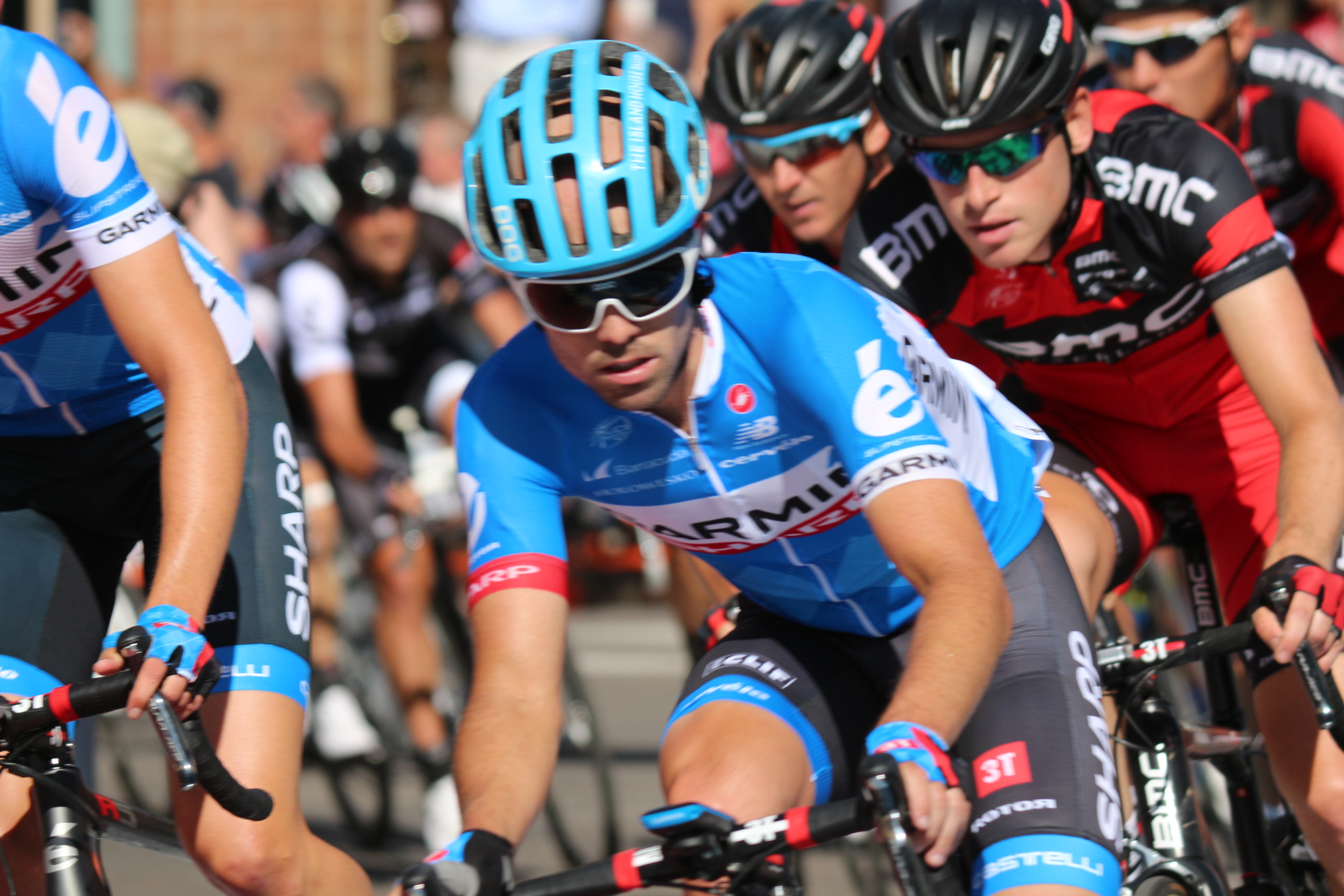
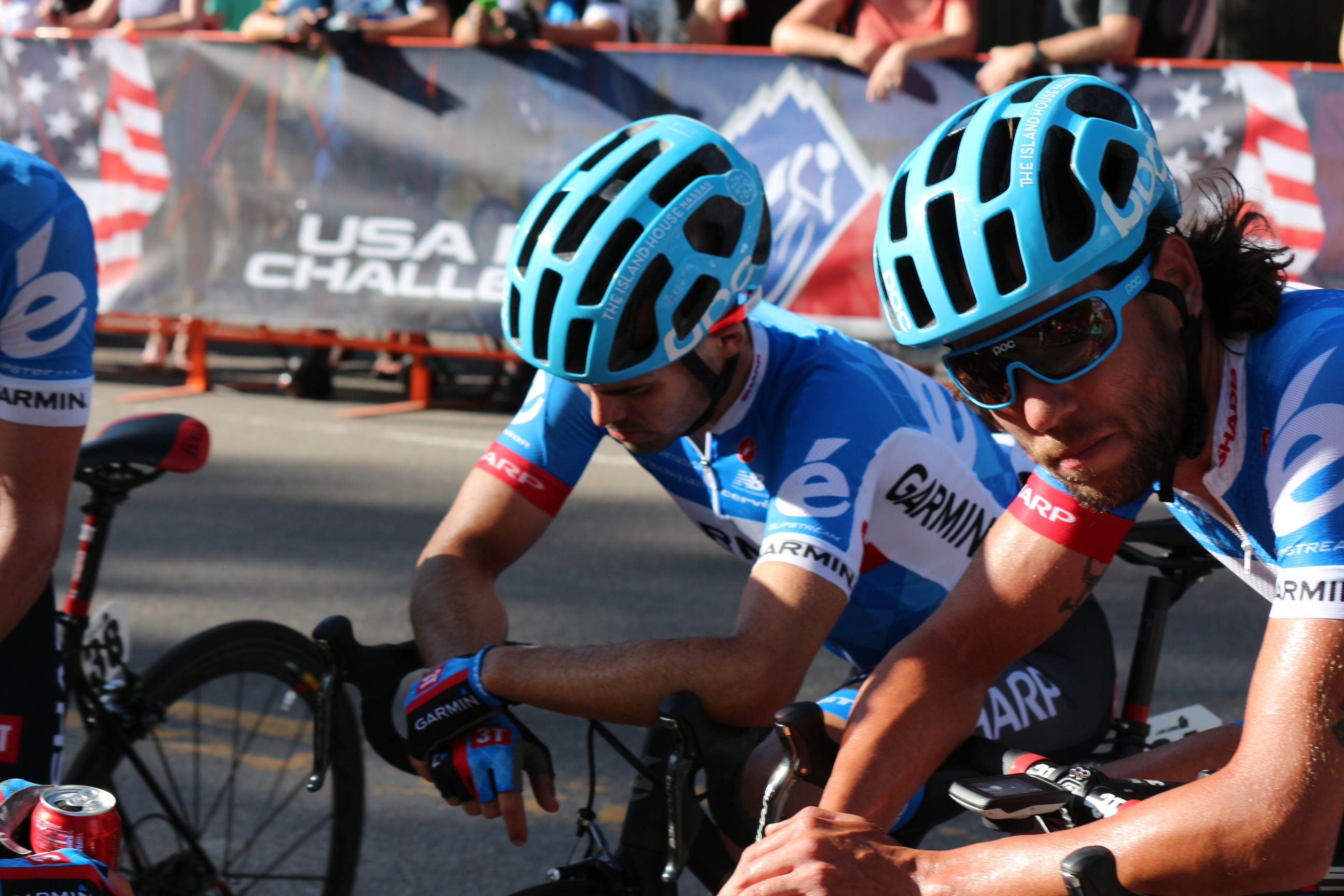
Altitude is more than you think. Even professional bike racers are worried about the altitude in Aspen
Posted: August 19, 2014 Filed under: Cycling | Tags: Alex Howes, Aspen, Aspen Colorado, Ben Hermans, BMC Racing Team, Colorado, Garmin-Sharp, Pitkin County, Reijnen, Snowmass, United States, USA Pro Challenge, x, y, z Leave a commentThe conversation at the pre-race press conference and the press conference after stage one was the concern about the altitude.
Kiel Reijnen (USA) UnitedHealthcare Pro Cycling Team had this to say about the altitude
“I am by no means a pure sprinter, but this course is a bit of a slap in the face, what a tough way to start a stage race. It’s a really deceptive stage. It’s difficult to control and it’s really unpredictable. I’m still out of breath and it’s been more than an hour since the finish, and I was already at altitude to begin with.”
Alex Howes (USA) Team Garmin-Sharp
“I myself am a victim of the high altitude. It was pretty relaxed for the first third of the race, but that last lap really heated it up and it was just full gas from there on. You see a lot of punch and lift from riders toward the end, and that’s not really something you see at this kind of altitude. It’s pretty exciting to see that out here.”
Colorado Resident Kiel Reijnen Takes Stage 1 of the 2014 USA Pro Challenge
Crowds of Cheering Fans Lined the Streets of Downtown Aspen to Greet the Best Riders in the World
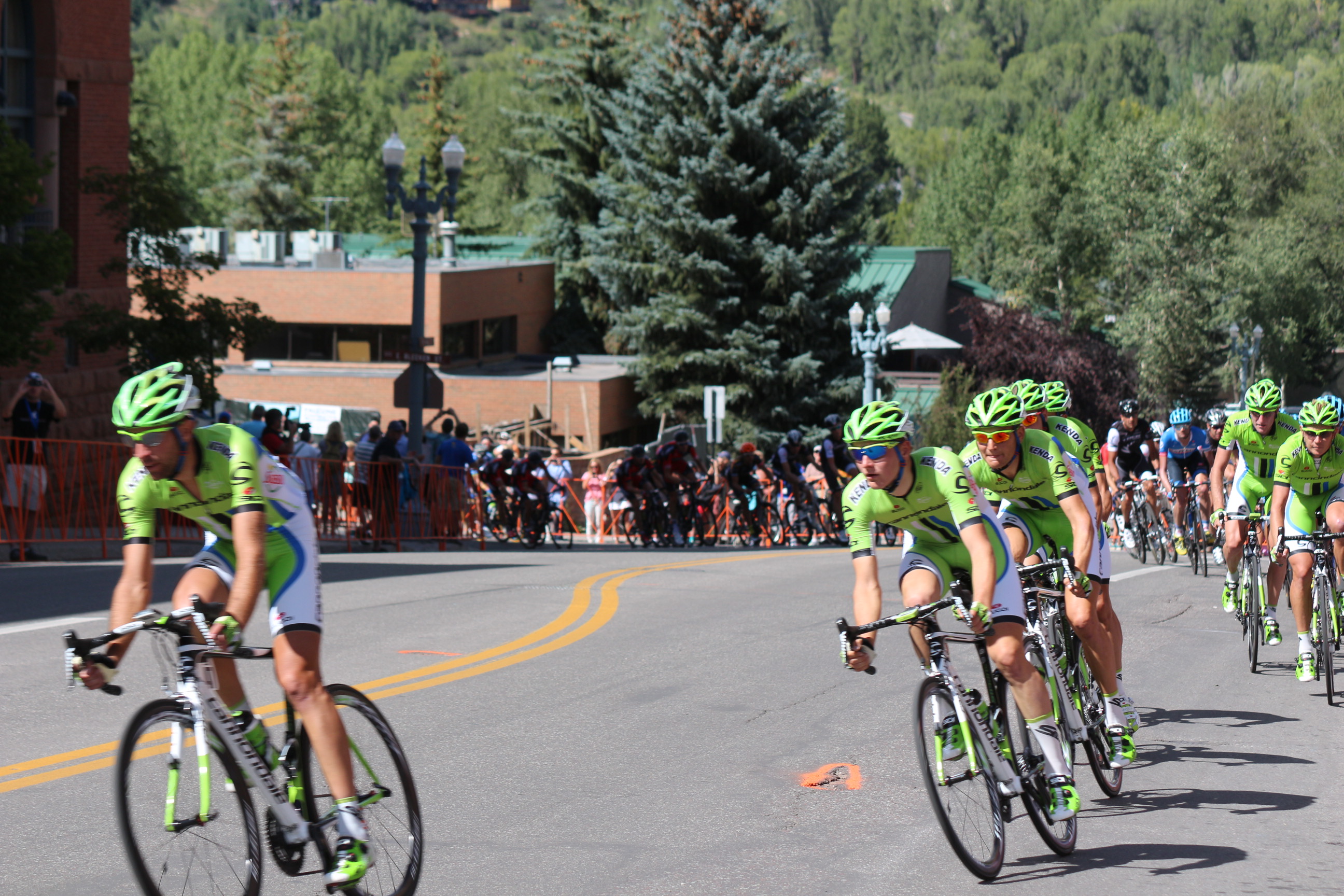
Aspen, Colo. (Aug. 18, 2014) – Set against the beautiful backdrop of Aspen and Snowmass, the 2014 USA Pro Challenge got off to an exciting start with a circuit race of three 22-miles laps that included 2,300 ft. of climbing per lap, creating an aggressive day of racing. Colorado Resident Kiel Reijnen (USA) of UnitedHealthcare Pro Cycling Team took home the stage win, which also puts him in the overall lead heading into the second day of racing.
“This stage was really exciting last year. It was a nail-biter and this year was the same,” said Reijnen. “The USA Pro Challenge is a huge goal for our team. Everyone is here watching and it’s really important to the team we do well here.”
In a close finish, Reijnen took the stage win, followed by Howes in second and Ben Hermans (BEL) of BMC Racing Team in third.
After the conclusion of the first stage of the USA Pro Challenge, Reijnen holds the Smashburger Leader Jersey, Lexus Sprint Jersey and, new for this year, the Colorado National Guard Best Colorado Rider Jersey . Jacques-Maynes has the Sierra Nevada King of the Mountains Jersey and Summerhill was awarded the FirstBank Most Aggressive Rider Jersey. Clement Chevrier (FRA) of Bissell Development Team has the Colorado State University Best Young Rider Jersey heading into Stage 2 tomorrow.
USA Pro Challenge Starts Monday
Posted: August 16, 2014 Filed under: Colorado, Cycling | Tags: Aspen, Aspen Colorado, Colorado, Denver, Monarch Mountain, USA Pro Challenge Leave a comment
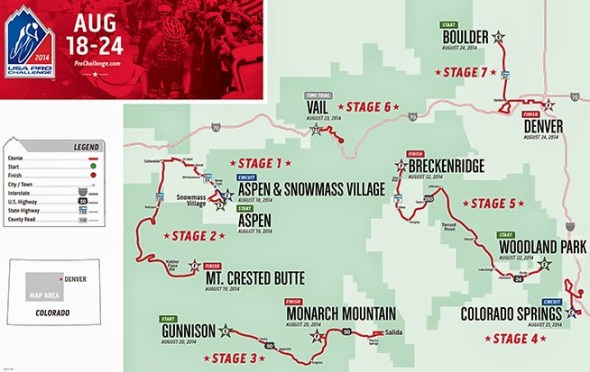
Are you ready to race in Colorado?
The USA Pro Challenge starts Monday in Aspen.
Find the route near you and go see the race!

USA Pro Challenge brings out the best in its fans
Posted: August 13, 2014 Filed under: Cycling | Tags: #USAProChallenge, Bicycle Racing, Colorado, Costume, Cowboy hat, Cycling, Pro Challenge, Tour de France, USA Pro Challenge Leave a commentBicycle racing is more than just cycling. The atmosphere is always fun.
Why do spectators enjoy looking great at cycling raises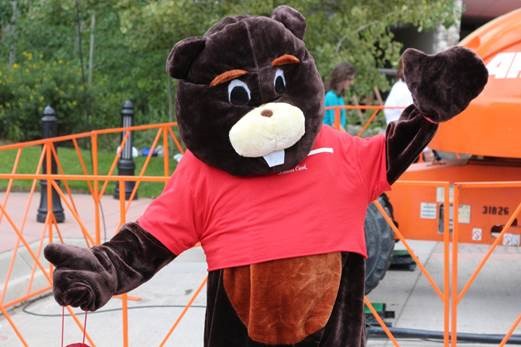
One of the great joys of watching the climbs on the grand European tours is the time we have to watch the outfits the spectators wear. That desire to be European fashion conscious has crossed the Atlantic and is growing in the US. The US Pro Challenge has seen an increase each year in the desire to be seen on the tour.
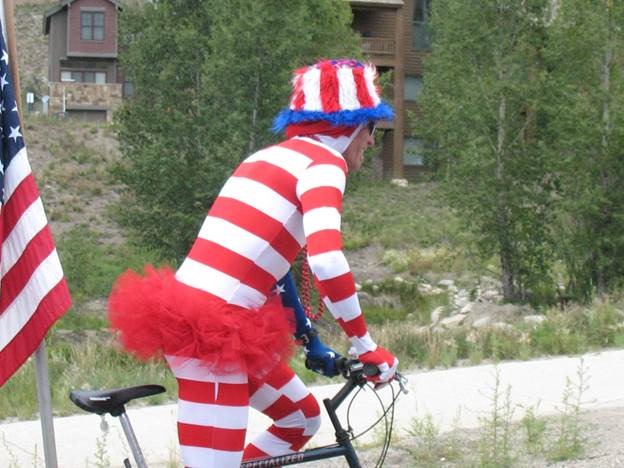
People in costumes always waive and love to have their picture taken.
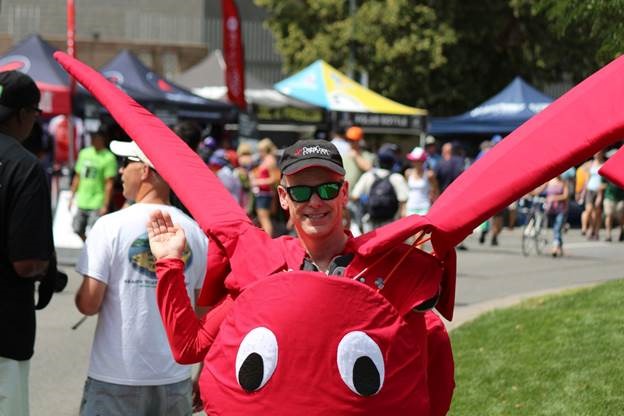
Her sign says have you seen my friend. She must have known an orange cowboy hat and purple tights might make her friends hard to find.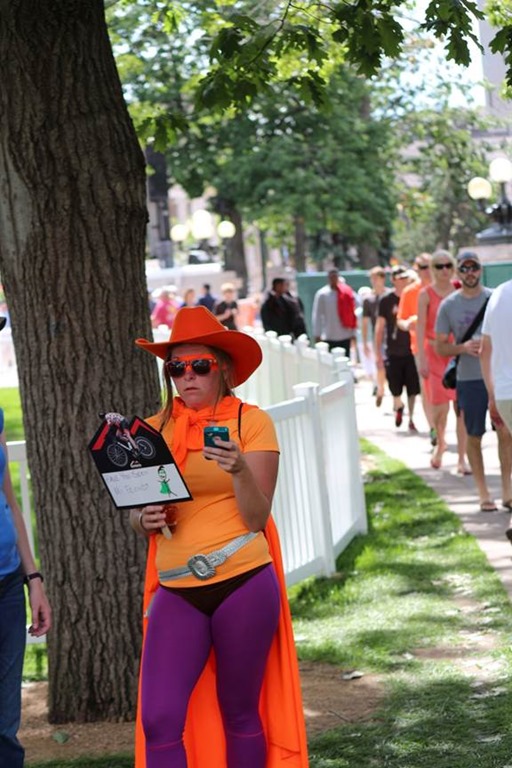
Do the riders have the time as they wiz by to see the outfits?
Some costumes are difficult to assign a category too, however at least he is riding a bike. That may or may not be good for cycling.
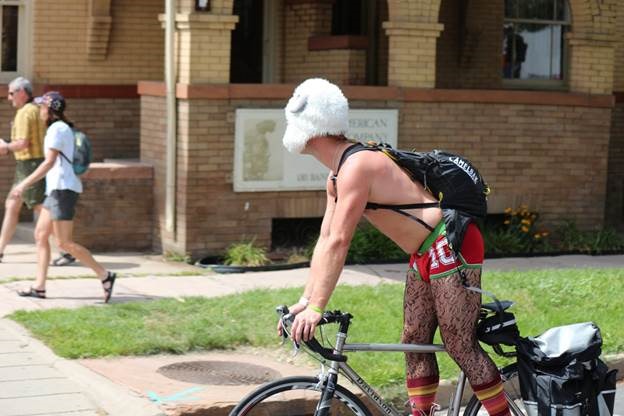
Some of the outfits can be as easy as a hat to makes you stand out in the crowd or a hair color so you loved ones can spot you…..and hide. When wearing a similar hat the pope always seems to smile.
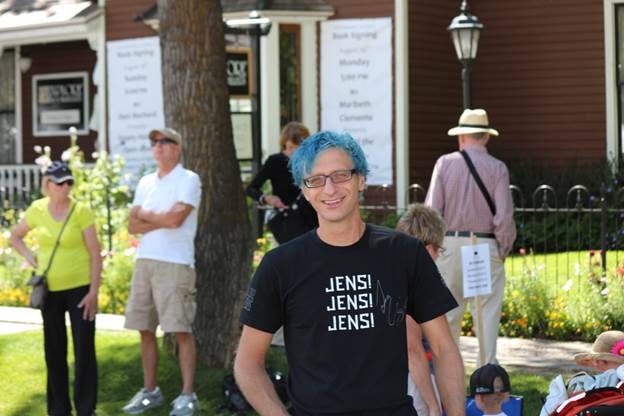
Do you think Jens saw him?
Then you see the group costumes where friends (or at least I hope they are friends) agree on a theme to wear to the raise. 
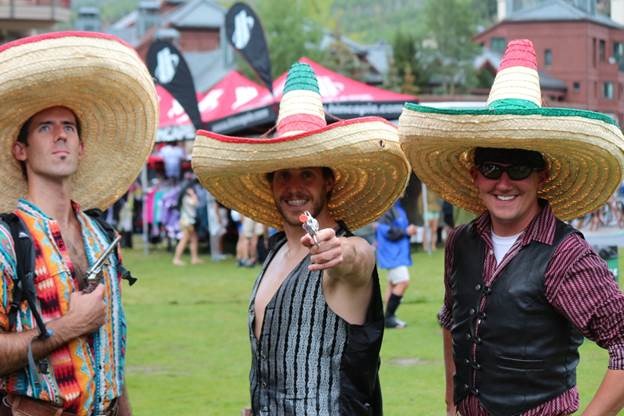
I’m not exactly sure the true nature of some of the themes. The relationship between Santa Clause and a Yeti in Vail still has me confused. The Wheaties box is just an afterthought….I hope.
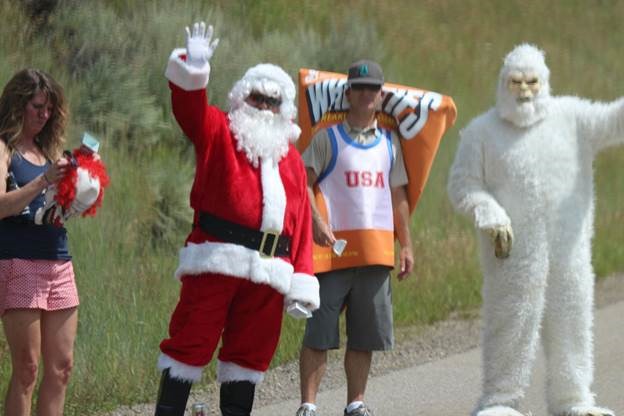
It is bad when two people in a costume start to argue about it. It is always a hard to hear what the argument is about when both voices are coming from fur covered heads.

Age is not a limiting factor in costumes. No matter how small you may be getting dressed up is part of the excitement of the tour.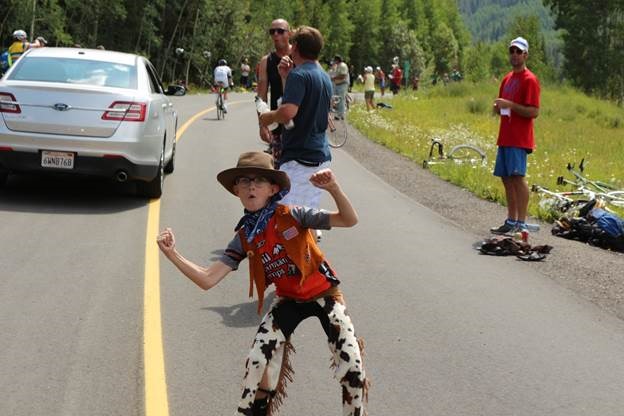
Unless maybe you dad makes you wear the costume, in the heat. But at least no one can recognize you if it covers your face.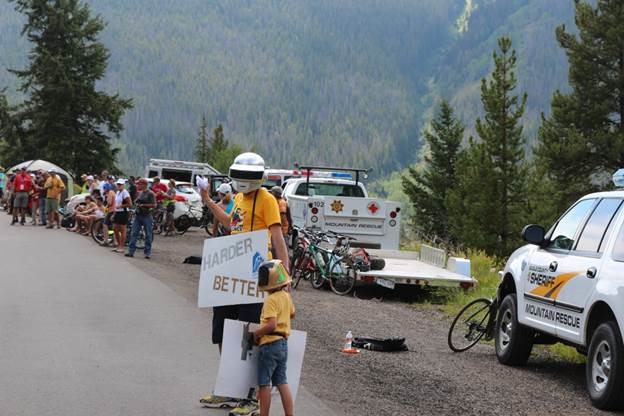
There always the marketing gurus who send employees out to represent their products. Energy snacks, water bottles two perennial favorites.
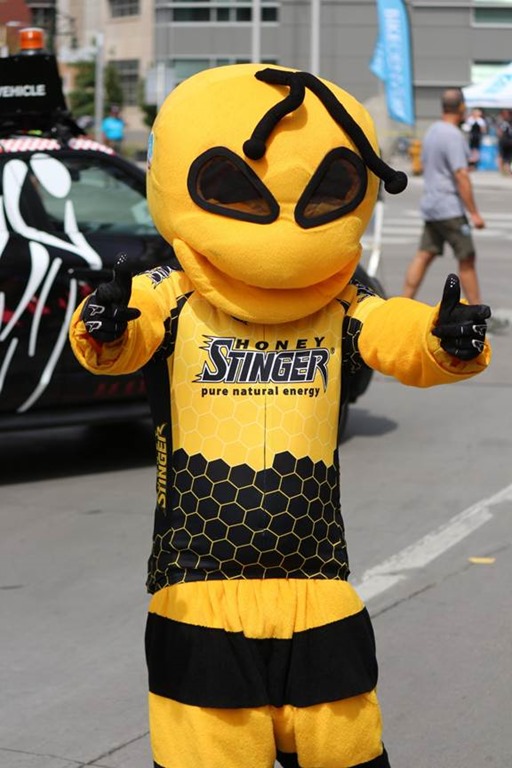
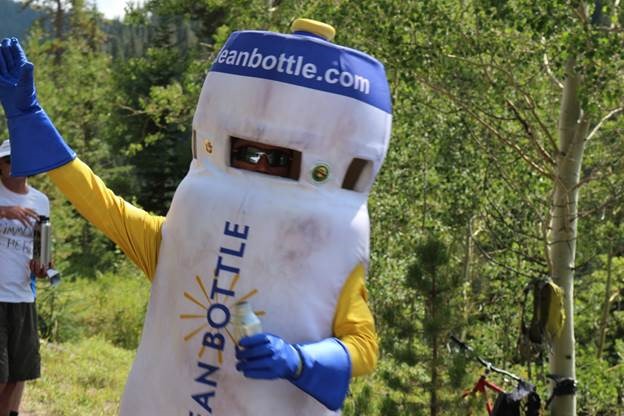
The best are when friends know a rider in the tour and want to show their support. Although I’m not sure I would come out of the team RV to see my friends of a gold speedo was the costume of choice.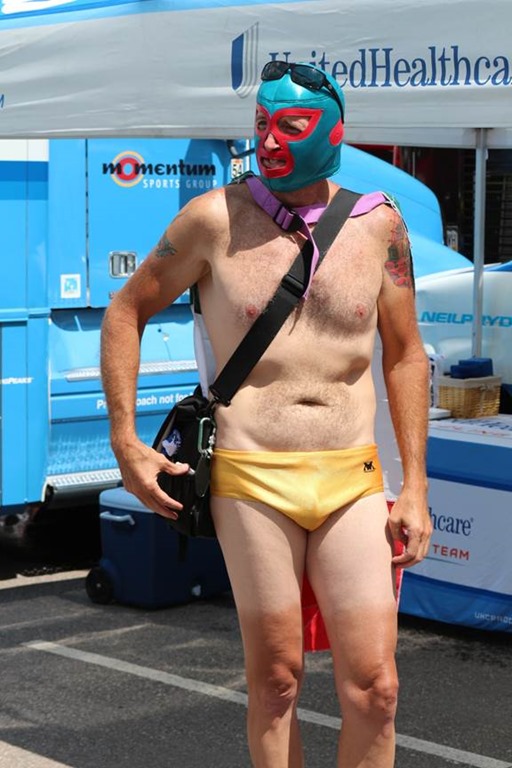
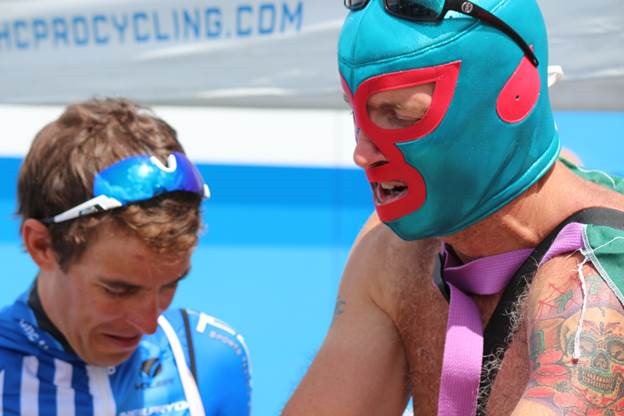
His face mask almost matches his tattoo.
Even the UCI gets into the race, maybe just a crown, but it is still more than a non-descript ball cap.
What is curious is when a city gets into the act. The winner of the stage that ends in Breckenridge has the dubious honor of being photographed with a fur hat and shield. I thought winners were to be lauded, not punished?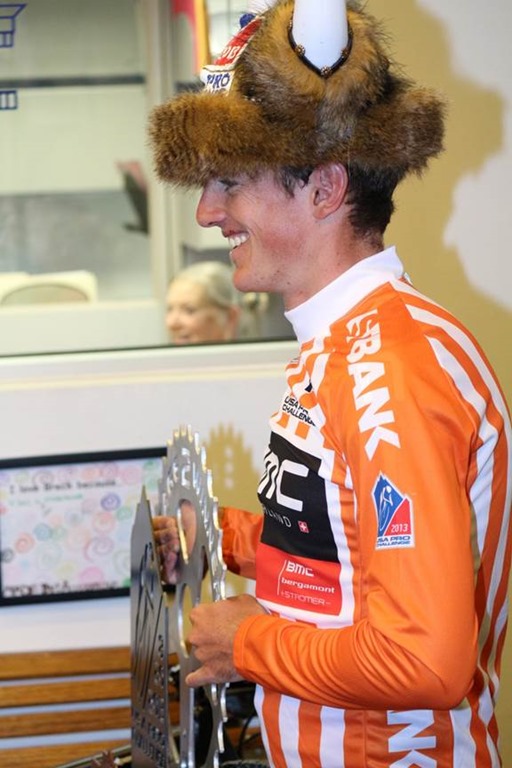
Even if you are not a big fan of bicycle racing (heaven forbid) you should at least stroll the start and finish near you to see the fans!
Making statements contrary to release can be barred by a release, maybe, but may be gross, wilful and wanton negligence which the release does not stop.
Posted: August 11, 2014 Filed under: Michigan, Racing, Release (pre-injury contract not to sue) | Tags: #race, Defendant, Gross negligence, Michigan, Negligence, Obstacle Course, Plaintiff, Red Frog Events, Release, Spartan Race, Tough Mudder, Warrior Dash, Wilful and Wanton Misconduct 3 CommentsPlaintiff signed a release to participate in the Warrior Dash race. An employee of the race was encouraging participants to dive into a mud pit. Plaintiff dove into the mud pit rendering himself a quadriplegic.
Sa v. Red Frog Events, LLC, 979 F. Supp. 2d 767; 2013 U.S. Dist. LEXIS 151355
State: Federal District Court for the Eastern District of Michigan
Plaintiff: James Sa
Defendant: Red Frog Events, LLC, an Illinois corporation
Plaintiff Claims: negligence, gross negligence, and willful and wanton misconduct
Defendant Defenses: release and failure to state a claim upon which relief may be granted
Holding: for the defendant on the negligence claim because of the release, for the plaintiff on the gross negligence, and willful and wanton misconduct claims
Year: 2013
This case is possible still ongoing. How the final decision will evolve is unknown. However, the federal district court did arrive at some great analysis of the case.
This case comes out of the new fad, extreme obstacle racing. In these races participants run through live electrical wires, jump through fire and here, crawl through a mud pit. These races are known by various names, Warrior Dash, Spartan Race and Tough Mudder are the most well-known.
In this case, the plaintiff signed up for a Warrior Dash 5K race and signed a release. The release specifically warned against diving into the mud pit. The mud pit was right in front of the bleachers and the last obstacle on the course.
At the mud, pit was an employee of the defendant with a microphone, and loudspeaker “acting as an emcee” for the event.
Over the course of the event, this individual continually enticed, encouraged, and specifically told participants to dive into the mud pit. It was common knowledge among participants that diving into the mud pit was not only permitted, but encouraged.
So many people were diving into the mud pit that people were blogging about it and posting photos online.
The plaintiff followed the emcee’s “encouragement” and dove into the mud pit resulting in paralysis from the chest down. The plaintiff sued, and the defendant filed a motion to dismiss.
A motion to dismiss is usually filed by the defendant prior to filing an answer. The basis is the pleadings are so lacking in any facts or there is no law to support a claim. In reviewing the motion, the court must accept the allegations and facts in the complaint as true. It is unclear in reading this case when the motion to dismiss was filed. This opinion is the court’s response to the motion to dismiss.
Summary of the case
The court first looked at whether the release acted to stop the negligence claims of the plaintiff. Releases are valid in Michigan. Under Michigan law a release’s validity:
…turns on the intent of the parties. A release must be fairly and knowingly made to be valid. If the language of a release is clear and unambiguous, the intent of the parties is ascertained from the plain and ordinary meaning of the language.
Whether the release is valid is a question of law. The plaintiff did not argue that he signed the release. The court pointed out possible ways the plaintiff could void the release which the plaintiff did not use.
He does not argue, for example, that (1) he “was “dazed, in shock, or under the influence” when he signed the Waiver; (2) “the nature of the instrument was misrepresented, or (3) there was other fraudulent or overreaching conduct.
Ninety-nine percent of the time plaintiff’s attack the validity of the release based on their competence or understanding of the release. In not doing so, I would guess the plaintiff shocked the judge so he put in this language. The plaintiff’s first argued the release was invalid because:
…that “Red Frog fails to indemnify itself from its own negligent acts” because it “did not use the term ‘negligent’ and/or ‘negligence’ anywhere within the four corners of it’s (sic) Waiver & Release Agreement.
(This argument has been used endlessly and is so easily avoided. Use the word negligence in your release.)
Here the language used by the defendant met the requirements to put the plaintiff on notice that he was giving up his rights to sue for negligence. “…although an indemnity provision does not expressly state that the indemnitee will be shielded from its own negligence, such language is not mandatory to provide such indemnification.”
The release language under Michigan’s law is called the indemnity provision or clause. That translation of the phrase is different from most other states. Here, it is like saying, by signing the release the plaintiff agrees to indemnify himself for his injuries.
…the Waiver, titled as a “Waiver and Release of Claims, Assumption of Risk and Warning of Risk,” informed Plaintiff that he was relinquishing his right to sue Defendant for claims resulting from his participation in the Warrior Dash.
The next argument of the plaintiff’s is brilliant and if successful would bring down hundreds of releases across the United States. Releases written by attorneys or non-attorneys in an attempt to soften the blow will put statements in the release about how safe the activity is, how well run the operation is or that accidents rarely happen.
The plaintiff argued that other statements in the release gave the plaintiff the impression that the defendant would not be negligent in the operation of the race.
For support, Plaintiff points to the disclaimer portion of the Waiver stating that Red Frog: (1) “is committed to conducting its race and activities in a safe manner and holds the safety of participants in high regard;” and (2) “continually strives to reduce such risks and insists that all participants follow safety rules and instructions that are designed to protect the participants’ safety.
The court did not accept this argument because the paragraph this language was in went on stating there was a risk of injury entering the race.
The final argument by the plaintiff was also unique and if accepted would invalidate dozens of releases. The plaintiff argued that the statements by the employee of the defendant, the emcee, invalidated the release. In legal language, the statements of the emcee “constituted a waiver and modification of the release of liability.”
In sum, Plaintiff argues, “[t]his conduct led James [the plaintiff] to believe a waiver had occurred and it was okay and safe to dive into the mud pit. Red Frog failed to correct the actions of participants who dove into the mud pit or further instruct through the speaker system that this type of behavior was not permitted.”
Under Michigan’s law, any waiver of a written contract must be in writing unless the waiver language is consistent with the strict compliance language of the contract. Meaning the waiver language must be of the same type and of the same legal tone as the original contract.
Even assuming that Michigan law permits parties to orally modify a waiver and release, the most Plaintiff has alleged is that Defendant’s actions modified the provision prohibiting Plaintiff from diving into the mud pit head first. Defendant’s actions cannot be interpreted, as pled by Plaintiff, as an agreement to modify the Waiver such that Plaintiff could hold Defendant liable for negligence due to injuries arising out of his participation in the Warrior Dash. Therefore, the Waiver bars Plaintiff’s negligence claim.
The court upheld the validity of the release and held the release stopped the simple negligence claims of the plaintiff.
On the second and third claims, gross negligence, and willful and wanton misconduct, a release under Michigan’s law does not work. The issue then becomes are there enough allegations to the facts in the complaint and documents filed with the court to this point to support the plaintiff’s claim of gross negligence, and willful and wanton misconduct.
Under Michigan’s law:
Gross negligence is “conduct so reckless as to demonstrate a substantial lack of concern for whether injury results.” M.C.L. § 600.2945(d); Xu, 257 Mich. App. at 269. “Evidence of ordinary negligence does not create a question of fact regarding gross negligence.”
Under Michigan’s law, a release does not stop claims for gross negligence. So the gross negligence claim survives the defense of release. The issue then is whether the plaintiff as plead enough facts that a jury may find give rise to gross negligence.
…it is plausible that the act of encouraging Plaintiff — and other participants — to dive into the mud pit head first was so reckless to demonstrate a substantial lack of concern for whether an injury would result.
The court, based upon the statements of the emcee at the mud pit encouraging people to dive into the pit were enough to possibly support a claim for gross negligence.
Under Michigan’s law, Wilful and Want misconduct is different and distinct from gross negligence.
“[W]ilful and wanton misconduct . . . [is] qualitatively different from and more blameworthy than ordinary, or even gross, negligence.”). The elements of a willful and wanton misconduct claim are: “(1) knowledge of a situation requiring the exercise of ordinary care and diligence to avert injury to an-other, (2) ability to avoid the resulting harm by ordinary care and diligence in the use of the means at hand, and (3) the omission to use such care and diligence to avert the threatened danger, when to the ordinary mind it must be apparent that the result is likely to prove disastrous to another.”
…willful and wanton misconduct is made out only if the conduct alleged shows an intent to harm or, if not that, such indifference to whether harm will result as to be the equivalent of a willingness that it does. Willful and wanton misconduct is not . . . a high degree of carelessness.
Here again, the court found the actions of the emcee in encouraging participants to dive into the mud pit might be found to be an intent to harm or an indifference.
Here, a reasonable jury might conclude that the act of encouraging participants to jump head-first into the mud pit despite knowing the risks, to the contrary — at the end of a grueling physical endurance challenge when participants are likely to be physically and mentally exhausted — could be interpreted as such “indifferen[ce] to the likelihood that catastrophe would come to a [race participant.]”
Consequently, the court granted the motion to dismiss on the negligence claims and denied the motion to dismiss on the claims of gross negligence and wilful and wanton misconduct.
Again, this case probably is not over yet.
So Now What?
Don’t give an injured participant the opportunity to sue you. Don’t dance with the possibility that your language you use instead of the word negligence will meet the requirements of the law.
JUST USE THE WORD NEGLIGENCE IN YOUR RELEASE!
Second, don’t allow anyone who is an employee or may appear to participants to be an employee to encourage people to take actions that might injure them or is contrary to the rules of your activity.
It seems to be common sense; however, in the heat of the activity or an unfounded belief the release is ironclad, people get excited and might encourage a participant to take risks they are not expected or ready for.
What do you think? Leave a comment.
If you like this let your friends know or post it on FaceBook, Twitter or LinkedIn
Copyright 2014 Recreation Law (720) Edit Law
Email: Rec-law@recreation-law.com
Google+: +Recreation
Twitter: RecreationLaw
Facebook: Rec.Law.Now
Facebook Page: Outdoor Recreation & Adventure Travel Law
Blog: www.recreation-law.com
Mobile Site: http://m.recreation-law.com
By Recreation Law Rec-law@recreation-law.com James H. Moss #Authorrank
<rel=”author” link=” https://plus.google.com/u/0/b/112453188060350225356/” />
#AdventureTourism, #AdventureTravelLaw, #AdventureTravelLawyer, #AttorneyatLaw, #Backpacking, #BicyclingLaw, #Camps, #ChallengeCourse, #ChallengeCourseLaw, #ChallengeCourseLawyer, #CyclingLaw, #FitnessLaw, #FitnessLawyer, #Hiking, #HumanPowered, #HumanPoweredRecreation, #IceClimbing, #JamesHMoss, #JimMoss, #Law, #Mountaineering, #Negligence, #OutdoorLaw, #OutdoorRecreationLaw, #OutsideLaw, #OutsideLawyer, #RecLaw, #Rec-Law, #RecLawBlog, #Rec-LawBlog, #RecLawyer, #RecreationalLawyer, #RecreationLaw, #RecreationLawBlog, #RecreationLawcom, #Recreation-Lawcom, #Recreation-Law.com, #RiskManagement, #RockClimbing, #RockClimbingLawyer, #RopesCourse, #RopesCourseLawyer, #SkiAreas, #Skiing, #SkiLaw, #Snowboarding, #SummerCamp, #Tourism, #TravelLaw, #YouthCamps, #ZipLineLawyer, Warrior Dash, Spartan Race, Tough Mudder, Race, Obstacle Course, Release, Michigan, Gross Negligence, Wilful and Wanton Misconduct, Negligence,
WordPress Tags: statements,negligence,Plaintiff,Warrior,Dash,employee,participants,Frog,Events,Supp,Dist,LEXIS,State,Federal,District,Court,Eastern,Michigan,James,Defendant,Illinois,corporation,Claims,misconduct,Defenses,failure,relief,decision,analysis,obstacle,Spartan,Race,Tough,Mudder,bleachers,loudspeaker,event,Over,knowledge,photos,encouragement,chest,basis,allegations,complaint,opinion,response,Summary,Releases,Under,Whether,example,Waiver,instrument,competence,Release,Agreement,argument,Here,requirements,provision,clause,translation,injuries,Assumption,Risk,participation,States,attorneys,accidents,disclaimer,manner,instructions,paragraph,injury,dozens,modification,speaker,system,behavior,compliance,Gross,Mich,Evidence,fact,jury,Wilful,Want,situation,diligence,omission,danger,indifference,Willful,degree,endurance,catastrophe,participant,Again,JUST,WORD,Second,belief,Leave,FaceBook,Twitter,LinkedIn,Recreation,Edit,Email,Google,RecreationLaw,Page,Outdoor,Adventure,Travel,Blog,Mobile,Site,Moss,Authorrank,author,AdventureTourism,AdventureTravelLaw,AdventureTravelLawyer,AttorneyatLaw,BicyclingLaw,Camps,ChallengeCourse,ChallengeCourseLaw,ChallengeCourseLawyer,CyclingLaw,FitnessLaw,FitnessLawyer,HumanPoweredRecreation,JamesHMoss,JimMoss,OutdoorLaw,OutdoorRecreationLaw,OutsideLaw,OutsideLawyer,RecLaw,RecLawBlog,LawBlog,RecLawyer,RecreationalLawyer,RecreationLawBlog,RecreationLawcom,Lawcom,RiskManagement,RockClimbingLawyer,RopesCourse,RopesCourseLawyer,SkiAreas,SkiLaw,SummerCamp,Tourism,TravelLaw,YouthCamps,ZipLineLawyer,Course,Wanton,himself,upon
Buffets
Posted: August 6, 2014 Filed under: Cycling | Tags: #USAProChallenge, Bicycle Racing, Chris Froome, Pro Challenge, Richie Porte, Team Sky, USA Pro Challenge Leave a commentBuffets
You work with the PR team of a professional cycling team to schedule a time to talk to a rider. You email back and forth frantically during the race, at night and stop by the team bus in the morning to stand around wearing a pleading puppy face.
You get a date so you start working on your questions. You research the rider you got the time to sit down with, and you know the person inside and out. You start out with general ones, softballs to set the ground work, to start the information flowing. Then you start working your way to the tougher questions.
Then the day arrives. You attend the race and jot notes about your rider’s race that day. You get back to your room early to clean up, and you arrive ten minutes before the scheduled time. Not too early to look too eager, but never late. You find a place to talk, secure yet open so everyone feels good and information will flow. The rider comes down and sits down to talk. You exchange pleasantries, and you start with the easy questions to get things rolling.
But the rider throws back a curve, and your prepared questions gently fall to the floor as you grin and jump on the answer.
Buffets. What is your favorite thing about racing in the US? Buffets.
I had the opportunity to interview Richie Porte of Team Sky at the USA Pro Challenge. Every statement above is true. I did not want to sound like an amateur or an idiot and by the end of the interview, I did not care. When you ask a professional bicycle racer what his favorite thing about racing in a county, and he says the buffet’s it throws you for a laughing out loud loop from which you never recover.
After talking to professional cyclists for years, this was the last answer I expected, but it was the first thing out of the mouth of Richie Porte during the USA Pro Challenge. However, after listening to him compare the fare offered at the Tour de France or the rest of the European races I understood. Based on Richie’s comments, it was easy to maintain weight on the Tour de France because if you waited too long there was nothing to it. Even if you got to dinner early, it still was slim pickings.
Richie Porte, along with Chris Froome had been in the US for two weeks training and enjoying the country before the USA Pro Challenge even started. Once the race started, they raced. However, they thoroughly enjoyed the racing in the US, buffets included.
The next thing Richie said was the fans were fantastic. I’m sure after watching the three segments of the Tour de France through the  UK, he might change his mind, but he said the US fans were fantastic. If you went off the back in France, the fans called you names, gave you grief and sometimes spit at you.
Here in the US, the fans cheered and clapped for everyone, even the last rider was encouraged to ride better. US fans are just happy to watch great athletes race.
Teams enjoy coming to the US for the USA Pro Challenge besides the food and the fans. The views along the race course are unmatched outside of Nepal. The crowds are not only enthusiastic, but they understand bicycle racing. The word peloton in Colorado does not get you a questioning express. Coloradans understand bicycle racing.
After spending an hour with Richie Porte, I had a great time, met a great person and obviously, a great cyclist. Richie still had a smile and a great sense of humor even after a hard day riding in the thin air.
This tough piece investigating a Team Sky rider reads like a chamber of commerce piece encouraging people to come to Colorado. Obviously, the riders enjoy racing in the US.

16 Professional Cycling Teams To Take on Colorado including BMC & Tejay Van Garderen
Posted: August 5, 2014 Filed under: Cycling | Tags: Colorado, Garderen, Peter Sagan, Tejay Van Garderen, USA Pro Challenge Leave a comment
|
||||||||||||||||||||||||||||||||||||||||||||||||||||||||||||||||||||||||||||


Suit against a city for construction retaining wall in City Park identifies defenses to be employed to protect park patrons.
Posted: August 4, 2014 Filed under: Playground, Texas | Tags: City of Dallas, City Park, Civil law (common law), Licensee, Open Space, Park, Recreational Use, Retaining Wall, Texas, Texas Tort Claims Act, Tort Claims Act 2 CommentsRemember each state (and sometimes city) has different state immunity acts. This analysis only applies to Dallas Texas. What is interesting is city could be held liable for gross negligence.
Mitchell v. City of Dallas, 855 S.W.2d 741; 1993 Tex. App. LEXIS 1714
State: Texas
Plaintiff: Saundra Harris Mitchell and Jan P. Mitchell, Individually and as Next Friends of Ashley J. Harris
Defendant: City of Dallas
Plaintiff Claims: City failed to warn park users of the steep drop-off and failed to construct a fence or other barrier around this dangerous area
Defendant Defenses: Texas Tort Claims Act
Holding: Reversed and remanded for trial
Year: 1993
State tort claims acts very greatly from state to state. In many states, it is impossible to sue the state and in others, it is quite easy. Some states limit the amount of recovery and the type of claims, in others not so much. If you work for a city, county or state as part of the parks, recreation or open space program, it will be beneficial to learn your state’s tort claim act and your requirements under it.
In this case, the City of Dallas, Texas, the defendant constructed a 15’ to 25’ retaining wall to stop erosion next to a creek. The top of the wall was next to a sidewalk and a restroom. The plaintiff minor was riding his bicycle on the sidewalk when he fell off and over the wall.
The plaintiff through his mother and father sued the city for his injuries. At the trial court level the city filed a motion for summary judgment and won. The plaintiff’s appealed.
Several issues in the decision dealing with the intricacies of the Texas Tort Claims Act will be skipped in this review because it applies solely to Texas.
Summary of the case
The first interesting issue was whether the claims of the plaintiff were governed by common law or statute. Meaning did the Texas law on land owners apply or did the law that existed prior to the statute concerning landowners apply. Said another way, did the ability to establish and create city parks occur because it was a proprietary function of a city. State statutes state that “operation of parks and zoos is a governmental function.”
The difference between a proprietary function and a governmental function will define the different claims and possible recoveries that are available. In this case, the appellate court held that the park was covered by the statute and the creation, care; maintenance of the park was governmental. As such, claims had to come under the Texas Tort Claims Act.
The next issue was the standard of care owed by the city to park users. The plaintiff claimed they were invitees, and as such, owed a higher standard of care than a trespasser. An invitee is a person the landowner invites to the land and receives a benefit from the invites’ presence on the land. The plaintiff argued that because they paid taxes, they were invitees.
There are three definitions of people coming upon the land; Trespassers, Licensees and Invitees. A landowner owes little duty to a trespasser, only owes a licensee a duty to refrain from wilful, wanton or gross negligence, and owes an invite the highest degree of care.
However, the payment of taxes argument did not fly with the court. Under the statute, the standard of care owed by a city to park users was that of a licensee.
The duty owed by the City to park users under the Texas Tort Claims Act is the duty that a private person owes to a licensee. An owner or occupier of land must refrain from injuring a licensee by willful, wanton, or gross negligence. An owner or occupant must also warn a licensee of any dangerous condition, or make the condition reasonably safe, if the land owner has actual knowledge of the dangerous condition, and the licensee does not.
Under the law of Texas the city, to be liable, must be grossly negligent.
Gross negligence is defined as “such an entire want of care as to establish that the act or omission was the result of actual conscious indifference to the rights, safety, or welfare of the person affected.
In a motion for summary judgment, the party opposing the motion must only create a question about how the law applies to the facts to have the motion denied rather than prove any issues. The city to win on a motion for summary judgment must conclusively negate at least one of the essential elements of the plaintiff’s case to win. Here, the plaintiff’s created a question as to whether the construction of the wall was done in a wilful, wanton or grossly negligent manner.
The next issue was whether the city had notice of the defective condition. The city presented three affidavits from officials saying they had never heard of problems with the wall. However, the court found that knowledge was more than affirmatively not knowing about problems.
The City relies on affidavits from three park officials to show that it lacked actual knowledge of any dangerous condition. The affidavits state that the City had no prior notice of a defect, dangerous condition, or similar accident. However, lack of notice from third parties does not conclusively negate actual knowledge. The fact that the owner or occupier of premises created a condition that posed an unreasonable risk of harm may support an inference of knowledge.
Knowledge can be anyone in the employee of the city.
In conclusion, the court stated:
The establishment and maintenance of municipal parks are governmental functions under the Texas Tort Claims Act. The City is immune from liability for any claims involving the design of the gabion wall at Hamilton Park. However, the City is not immune from liability for claims based on the construction or maintenance of the wall. The duty owed by the City to park users is the same duty owed by a private person to a licensee.
We hold that the trial court erred in granting summary judgment. There are genuine fact issues concerning (1) gross negligence 5 in the construction and maintenance of the gabion wall, and (2) the failure to warn of or correct a dangerous condition. 6 We sustain the Mitchell’s second and third points of error.
5 The duty owed to a licensees being a duty to refrain from injuring by willful, wanton, or gross negligence.
6 The licensor must also warn of a dangerous condition, or make it reasonably safe, if the licensor has actual knowledge of the condition and the licensee does not have such knowledge.
So Now What?
The most important thing to take away from this decision is the vast differences between state tort claims act. In some states, this same fact situation would not create liability and in some states very few of the state tort claims defenses would work.
Of interest was the issue that the city to be found liable had to be found wilful, wanton or grossly negligent. The decision does not state whether if a jury finds the city was wilful, wanton or grossly negligent if increased damages are available to the plaintiff. Most state tort claims acts specifically deny additional damages.
Also not discussed whether the Texas Recreational Use Statute applied to parks. Since parks are free, many states include state, county and city land in the definition of land protected by recreational use statutes. In most states, this is the first and best defense to claims arising from parks and open space.
What do you think? Leave a comment.
If you like this let your friends know or post it on FaceBook, Twitter or LinkedIn
Copyright 2014 Recreation Law (720) Edit Law
Email: Rec-law@recreation-law.com
Google+: +Recreation
Twitter: RecreationLaw
Facebook: Rec.Law.Now
Facebook Page: Outdoor Recreation & Adventure Travel Law
Blog: www.recreation-law.com
Mobile Site: http://m.recreation-law.com
By Recreation Law Rec-law@recreation-law.com James H. Moss #Authorrank
<rel=”author” link=” https://plus.google.com/u/0/b/112453188060350225356/” />
#AdventureTourism, #AdventureTravelLaw, #AdventureTravelLawyer, #AttorneyatLaw, #Backpacking, #BicyclingLaw, #Camps, #ChallengeCourse, #ChallengeCourseLaw, #ChallengeCourseLawyer, #CyclingLaw, #FitnessLaw, #FitnessLawyer, #Hiking, #HumanPowered, #HumanPoweredRecreation, #IceClimbing, #JamesHMoss, #JimMoss, #Law, #Mountaineering, #Negligence, #OutdoorLaw, #OutdoorRecreationLaw, #OutsideLaw, #OutsideLawyer, #RecLaw, #Rec-Law, #RecLawBlog, #Rec-LawBlog, #RecLawyer, #RecreationalLawyer, #RecreationLaw, #RecreationLawBlog, #RecreationLawcom, #Recreation-Lawcom, #Recreation-Law.com, #RiskManagement, #RockClimbing, #RockClimbingLawyer, #RopesCourse, #RopesCourseLawyer, #SkiAreas, #Skiing, #SkiLaw, #Snowboarding, #SummerCamp, #Tourism, #TravelLaw, #YouthCamps, #ZipLineLawyer, City of Dallas, Texas, Recreational Use, Texas, Tort Claims Act, Texas Tort Claims Act, Park, City Park, Open Space, Retaining Wall,
WordPress Tags: Suit,construction,Park,patrons,Remember,analysis,Dallas,Texas,negligence,Mitchell,LEXIS,State,Plaintiff,Saundra,Harris,Friends,Ashley,Defendant,Claims,users,barrier,area,Defenses,Tort,Some,recovery,parks,recreation,requirements,erosion,creek,sidewalk,restroom,bicycle,injuries,judgment,Several,decision,intricacies,Summary,statute,owners,landowners,Said,statutes,zoos,difference,recoveries,creation,maintenance,trespasser,person,landowner,presence,definitions,Trespassers,Licensees,Invitees,licensee,degree,payment,argument,Under,owner,occupier,occupant,knowledge,Gross,omission,indifference,welfare,Here,manner,affidavits,officials,accident,fact,premises,inference,employee,conclusion,establishment,Hamilton,failure,error,differences,situation,jury,Most,Also,Recreational,definition,Leave,FaceBook,Twitter,LinkedIn,Edit,Email,Google,RecreationLaw,Page,Outdoor,Adventure,Travel,Blog,Mobile,Site,James,Moss,Authorrank,author,AdventureTourism,AdventureTravelLaw,AdventureTravelLawyer,AttorneyatLaw,BicyclingLaw,Camps,ChallengeCourse,ChallengeCourseLaw,ChallengeCourseLawyer,CyclingLaw,FitnessLaw,FitnessLawyer,HumanPoweredRecreation,JamesHMoss,JimMoss,OutdoorLaw,OutdoorRecreationLaw,OutsideLaw,OutsideLawyer,RecLaw,RecLawBlog,LawBlog,RecLawyer,RecreationalLawyer,RecreationLawBlog,RecreationLawcom,Lawcom,RiskManagement,RockClimbingLawyer,RopesCourse,RopesCourseLawyer,SkiAreas,SkiLaw,SummerCamp,Tourism,TravelLaw,YouthCamps,ZipLineLawyer,Open,Space,Wall,whether,three,third,gabion,licensor
Sa v. Red Frog Events, LlC, 979 F. Supp. 2d 767; 2013 U.S. Dist. LEXIS 151355
Posted: August 4, 2014 Filed under: Legal Case, Michigan, Racing, Release (pre-injury contract not to sue) | Tags: #race, Gross negligence, Michigan, Obstacle Course, Release, Spartan Race, Tough Mudder, Warrior Dash, Wilful and Wanton Misconduct Leave a commentSa v. Red Frog Events, LlC, 979 F. Supp. 2d 767; 2013 U.S. Dist. LEXIS 151355
James Sa, Plaintiff, vs. Red Frog Events, LlC, an Illinois corporation, Defendant.
No. 2:13-cv-10294
UNITED STATES DISTRICT COURT FOR THE EASTERN DISTRICT OF MICHIGAN, SOUTHERN DIVISION
979 F. Supp. 2d 767; 2013 U.S. Dist. LEXIS 151355
October 22, 2013, Decided
October 22, 2013, Filed
CORE TERMS: mud, dive, pit, own negligence, willful, wanton misconduct, obstacle, gross negligence, diving, indemnity, negligence claim, indemnitee, indemnify, negligent acts, indemnification, disclaim, pit head, risk of injury, citation omitted, unambiguous, encouraged, summary judgment, claim arising, recreational activities, reasonable care, encouraging, disclaimer, hazardous, choosing, ladder
COUNSEL: [**1] For James Sa, Plaintiff: Michael J. Behm, Behm and Behm, Flint, MI.
For Red Frog Events, LLC, Defendant: Brian T. McGorisk, Plunkett & Cooney, Flint, MI.
JUDGES: Hon. GERALD E. ROSEN, CHIEF UNITED STATES DISTRICT JUDGE.
OPINION BY: GERALD E. ROSEN
OPINION
[*769] OPINION AND ORDER PARTIALLY GRANTING DEFENDANT’S MOTION FOR SUMMARY JUDGMENT
I. INTRODUCTION
This action arises out of an unfortunate and tragic accident during a running race organized by Defendant Red Frog Events, resulting in Plaintiff James Sa’s paralysis from his chest down. On January 23, 2013, Plaintiff filed a three-count Complaint, asserting negligence, gross negligence, and willful and wanton misconduct. 1 Defendant has now moved to dismiss Plaintiff’s Complaint on the grounds that Plaintiff waived his negligence claim and that his two other claims fail to state a claim upon which relief may be granted. 2 Having reviewed and considered the parties’ briefs and supporting documents and the entire record of this matter, the Court has determined that the pertinent allegations and legal arguments are sufficiently addressed in these materials and that oral [*770] argument would not assist in the resolution of these motions. Accordingly, the Court will decide Defendant’s [**2] motion “on the briefs.” See L.R. 7.1(f)(2). This Opinion and Order sets forth the Court’s ruling.
1 Michigan courts use “willful” and “wilful” interchangeably. For consistency, this Court uses the former, unless in the context of a direct quote.
2 Though captioned as a “Motion for Summary Judgment,” Defendant’s Motion makes clear that it seeks dismissal pursuant to Federal Rule of Civil Procedure 12(b)(6), or alternatively, pursuant to Rule 56. As discussed in more detail in footnotes 3 and 4, this Court applies Rule 12(b)(6) to this Motion.
II. PERTIENT FACTS
In July 2011, Plaintiff participated in a two-day event known as the “Warrior Dash” in Mt. Morris, Michigan. (Plf’s Compl., Dkt. # 1, at ¶¶ 5, 8). The Warrior Dash is a 5k running race with obstacles, including jumping over fire, wall climbing, and a mud pit. (Id. at ¶ 7). Plaintiff was injured as a result of diving head first into the mud pit. (Id. at ¶¶ 21-22).
Positioned directly across from bleachers and right before the finish line, the mud pit was the last obstacle of the race. (Id. at ¶¶ 13-14). One of Defendant’s employees or agents was stationed near the mud pit with a microphone and loudspeaker, acting as an emcee for the [**3] event. (Id. at ¶ 15). Over the course of the event, this individual continually enticed, encouraged, and specifically told participants to dive into the mud pit. (Id. at ¶¶ 16, 26, 27). It was common knowledge among participants that diving into the mud pit was not only permitted, but encouraged. (Id. at ¶ 17). As an example of this “common knowledge,” bloggers commented about mud diving online. (Id. at ¶ 18). One noted the following:
When I arrived at the Warrior Dash on Saturday morning I found out rather quickly that “mud diving” was rather popular on the last obstacle before the finish line. . . . A good mud dive at this point makes perfect sense since runners are tired from the grueling course yet rejuvenated as they see the last obstacle. I’m sure the spectator attention also gives a little more motivation for participants to bring their best mud dive as well. . . . Hopefully this joy is worth the pain they may have endured to make this happen since my brother-in-law had to go to the hospital after attempting a cannon ball.
(Id.). This same person also posted “sweet pictures of an assortment of some of the best mud dives” and requested that readers “vote” for their favorite. (Id.).
Before [**4] Plaintiff’s race wave began, he witnessed many participants dive into the mud pit, heard the emcee encourage others to dive into the mud pit, and never saw anyone tell participants not to dive into the mud pit. (Id. at ¶¶ 19, 27). Defendant also did not post any signs instructing individuals not to dive into the mud pit. (Id. at ¶ 20). Accordingly, Plaintiff followed the emcee’s encouragement and the lead of other participants and dove into the mud pit, resulting in paralysis from the chest down. (Id. at ¶ 22).
Prior to participating in the Warrior Dash, Plaintiff — as well as all other participants — signed a “Waiver and Release of Claims” (Waiver). (Id. at ¶ 9). The Waiver provides, in no uncertain terms, that Plaintiff “agree[s] not to dive into or enter the mud pit head first.” (Ex. A. to Def’s Br., Dkt. # 4-1, at ¶ 17). 3 Other pertinent language includes:
1. I understand that entering Warrior Dash is a hazardous activity.
2. I understand that Warrior Dash presents extreme obstacles including, but not limited to: fire, mud [*771] pits with barbed wire, cargo climbs, junk cars, and steep hills.
* * *
7. I assume all risks associated with competing in Warrior Dash, including, but not limited [**5] to: falls, contact with other participants, negligent or wanton acts of other participants, completing all obstacles, any defects or conditions of premises, and the effects of weather including high heat and/or humidity, all such risks being known and appreciated by me.
* * *
DISCLAIMER
I understand that Red Frog Events, LLC is committed to conducting its race and activities in a safe manner and holds the safety of participants in high regard. I understand that Red Frog Events, LLC continually strives to reduce such risks and insists that all participants follow safety rules and instructions that are designed to protect the participants’ safety. I also understand, however, that participants . . . registering for the race, programs, and activities must recognize that there is an inherent risk of injury when choosing to participate in recreational activities and programs.
* * *
WAIVER & RELEASE OF ALL CLAIMS; ASSUMPTION OF RISK
I recognize and acknowledge that there are certain risks of physical injury to participants in Warrior Dash, and voluntarily assume the full risk of any and all injuries, damages, or loss, regardless of severity, that I . . . may sustain as a result of said participation. [**6] . . . I assume all risks and hazards incidental to such participation in Warrior Dash, and I hereby waive, release, absolve, indemnify, and agree to hold harmless . . . Red Frog Events, LLC . . . for any claim arising out of an injury to me . . . and from any and all claims, causes of action, obligations, lawsuits, charges, complaints, contracts, controversies, covenants, agreements, promises, damages, costs, expenses, responsibilities, of whatsoever kind, nature, or description, whether direct or indirect, in law or in equity, in contract or tort, or otherwise, whether known or unknown, arising out of or connected with my . . . participation in Warrior Dash.
(Id.) In accepting these terms, Plaintiff checked that he had read and fully understood the Waiver and signed with his own free act and deed. (Id.).
3 Defendant attached a signed copy of the Waiver in support of its Motion. This Court may consider this document without treating Defendant’s Motion as one for summary judgment because it is referred to in Plaintiff’s Complaint and is central to his claim. Weiner v. Klais and Co., Inc., 108 F.3d 86, 89 (6th Cir. 1997).
III. DISCUSSION
A. Applicable Standards
1. Rule 12(b)(6) Standard
In [**7] deciding a motion brought under Rule 12(b)(6), the Court must construe the complaint in the light most favorable to Plaintiffs and accept all well-pled factual allegations as true. League of United Latin Am. Citizens v. Bredesen, 500 F.3d 523, 527 (6th Cir. 2007). To withstand a motion to dismiss, however, a complaint “requires more than labels and conclusions, and a formulaic recitation of the elements of a cause of action will not do.” Bell Atl. Corp. v. Twombly, 550 U.S. 544, 555, 127 S. Ct. 1955, 167 L. Ed. 2d 929 (2007). The factual allegations in the complaint, accepted as true, “must be enough to raise a right to relief above the speculative level,” and must “state a claim to relief that is plausible on its face.” Id. at 570. “A claim has facial plausibility when the plaintiff pleads factual content that allows the court to draw the reasonable inference that the defendant is liable for the misconduct alleged.” Ashcroft v. Iqbal, 556 U.S. 662, 678, 129 S. Ct. 1937, 173 L. Ed. 2d 868 (2009). “The plausibility of [*772] an inference depends on a host of considerations, including common sense and the strength of competing explanations for defendant’s conduct.” 16630 Southfield Limited P’ship v. Flagstar Bank, F.S.B., 727 F.3d 502, 504 (6th Cir. 2013).
The Sixth [**8] Circuit has emphasized that the “combined effect of Twombly and Iqbal [is to] require [a] plaintiff to have a greater knowledge . . . of factual details in order to draft a ‘plausible complaint.'” New Albany Tractor, Inc. v. Louisville Tractor, Inc., 650 F.3d 1046, 1051 (6th Cir. 2011) (citation omitted). Put another way, complaints must contain “plausible statements as to when, where, in what or by whom,” Center for Bio-Ethical Reform, Inc. v. Napolitano, 648 F.3d 365, 373 (6th Cir. 2011), in order to avoid merely pleading “unadorned, the-defendant-unlawfully-harmed-me accusation.” Iqbal, 556 U.S. at 678.
2. Application of Michigan law
This Court applies Michigan law as enunciated by the Michigan Supreme Court because subject matter jurisdiction in the matter is premised solely on diversity jurisdiction. See, e.g., Corrigan v. U.S. Steel Corp., 478 F.3d 718, 723 (6th Cir. 2007); Garden City Osteopathic Hosp. v. HBE Corp., 55 F.3d 1126, 1130 (6th Cir. 1995). “Where the Michigan Supreme Court has not addressed an issue, [courts] may look to opinions issued by the Michigan appellate courts and should follow their reasoning unless [they] are ‘convinced by other persuasive data that the [**9] highest court of the state would decide otherwise.'” Tooling, Mfg. & Technologies Ass’n v. Hartford Fire Ins. Co., 693 F.3d 665, 670 (6th Cir. 2012) (quoting Ziegler v. IBP Hog Market, Inc., 249 F.3d 509, 517 (6th Cir. 2001)).
B. The Waiver bars Plaintiff’s negligence claim (Count I)
In Michigan, “the validity of a release turns on the intent of the parties. A release must be fairly and knowingly made to be valid. If the language of a release is clear and unambiguous, the intent of the parties is ascertained from the plain and ordinary meaning of the language.” Batshon v. Mar-Que Gen. Contractors, Inc., 463 Mich. 646, 650 n.4, 624 N.W.2d 903 (2001). “The interpretation of [a] release [is] a question of law.” Cole v. Ladbroke Racing Michigan, Inc., 241 Mich. App. 1, 13, 614 N.W.2d 169 (2000).
Michigan law expressly permits “a party to contract against liability or damages caused by its own ordinary negligence.” Skotak v. Vic Tanny Intern., Inc., 203 Mich. App. 616, 617-18, 513 N.W.2d 428 (1994). Plaintiff does not dispute that he signed the Waiver and provides no factual support to avoid the consequences of the Waiver. He does not argue, for example, that (1) he “was “dazed, in shock, or under the influence” when he signed the Waiver; [**10] (2) “the nature of the instrument was misrepresented, or (3) there was other fraudulent or overreaching conduct.” Xu v. Gay, 257 Mich. App. 263, 273, 668 N.W.2d 166 (2003). 4 Rather, Plaintiff asserts [*773] that “Red Frog fails to indemnify itself from its own negligent acts” because it “did not use the term ‘negligent’ and/or ‘negligence’ anywhere within the four corners of it’s (sic) Waiver & Release Agreement.” (Plf’s Resp., Dkt. # 8, at 6). For this proposition, Plaintiff begins with a citation to an Eastern District of Michigan case, Buffa v. General Motors Corporation, 131 F. Supp. 478 (E.D. Mich. 1955), finding that “a contract of indemnity which purportedly indemnifies against the consequences of one’s own negligence is subject to strict construction and will not be so construed unless it clearly appears from the language used that it was intended to have that effect.” Id. at 482.
4 In response to Defendant’s Motion, Plaintiff submitted various materials outside the pleadings, including an unsigned and different version of the Waiver, an affidavit from Plaintiff, affidavits from two participants, a press release from Defendant regarding the Warrior Dash, and an excerpt from the above quoted blog picturing [**11] participants’ dives and requesting that readers vote for the best dive. To the unsigned Waiver, the Court notes that while slightly different, the material language at issue is the same — including that Plaintiff agreed to “not dive into or enter the mud pit head first,” that the Warrior Dash is a “hazardous activity,” that he “assum[ed] the full risk of any and all injuries,” and that he agreed to release Defendant from “any and all” claims. Plaintiff’s affidavit also fails to raise any issues challenging the factual circumstances of his signing of the Waiver. Finally, the remaining materials just supplement his Complaint assertions — namely, that Defendant’s agent encouraged participants to dive into the mud pit. Such materials “simply fill[] in the contours and details of the [P]laintiff’s complaint, and add[] nothing new.” Yeary v. Goodwill Indus.-Knoxville, Inc., 107 F.3d 443, 445 (6th Cir. 1997). In short, nothing in these materials provides the Court with any basis for finding that there would be any facts that could be developed through discovery that would provide a factual predicate to support Plaintiff’s negligence cause of action. Accordingly, the Court declines to consider [**12] these materials and therefore evaluates the sufficiency of Plaintiff’s Complaint under Federal Rule of Civil Procedure 12(b)(6).
There is no doubt that Michigan courts have adopted this general proposition, but not in the manner in which Plaintiff suggests. See, e.g., Skinner v. D-M-E Corp., 124 Mich. App. 580, 586, 335 N.W.2d 90 (1983) (“It is universally recognized that a contract which purports to confer an express right to indemnification against the consequences of one’s own negligence is subject to strict construction and will not be so construed unless the contract language clearly evidences that such was the intended effect.”). Instead, Michigan courts hold that “indemnity clauses need not expressly mention the indemnitee’s own acts to provide coverage for them.” Badiee v. Brighton Area Sch., 265 Mich. App. 343, 353, 695 N.W.2d 521 (2005) (citing Sherman v. DeMaria Bldg. Co., Inc., 203 Mich. App. 593, 513 N.W.2d 187 (1994)). As the Sherman court explained:
Michigan courts have discarded the additional rule of construction that indemnity contracts will not be construed to provide indemnification for the indemnitee’s own negligence unless such an intent is expressed clearly and unequivocally in the contract. Instead, broad indemnity [**13] language may be interpreted to protect the indemnitee against its own negligence if this intent can be ascertained from “other language in the contract, surrounding circumstances, or from the purpose sought to be accomplished by the parties.”
Sherman, 203 Mich. App. at 596-97 (citation omitted); see also Chrysler Corp. v. Brencal Contractors, Inc., 146 Mich. App. 766, 771, 381 N.W.2d 814 (1985) (“Earlier cases imposed the additional rule of construction that indemnification contracts will not be construed to indemnify the indemnitee against losses from his own negligent acts unless such an intent is expressed in unequivocal terms. That rule of construction no longer applies.”) (internal citations omitted). Put another way, “although an indemnity provision does not expressly state that the indemnitee will be shielded from its own negligence, such language is not mandatory to provide such indemnification.” Fischbach-Natkin Co. v. Power Process Piping, Inc., 157 Mich. App. 448, 452-53, 403 N.W.2d 569 (1987); Harbenski v. Upper Peninsula Power Co., 118 Mich. App. 440, 454, 325 N.W.2d 785 (1982) (“The [*774] contention that the intent to indemnify an indemnitee against his own negligence must be expressly stated has been rejected.”) (citing Vanden Bosch v. Consumers Power Co., 394 Mich. 428, 230 N.W.2d 271 (1975)).
Plaintiff [**14] contends that Sherman does not so hold, and rather only stands for the narrow proposition that “if there is no unequivocal language in the agreement indemnifying defendant for its own negligent acts then the indemnity language may be interpreted to protect the indemnitee against its own negligence if this intent can be ascertained from other language in the contract, surrounding circumstances, or from the purpose sought to be accomplished by the parties.” (Plf’s Resp., Dkt. # 8, at 8) (citation and internal quotations omitted). For support, Plaintiff argues that the presence of an exclusionary clause in Sherman — excluding indemnification for claims based on the defendant’s sole negligence — “evince[d the] . . . intent to indemnify [defendant] against losses from its own negligence but not from loses caused solely by [defendant].” (Id.) (quoting Sherman, 203 Mich. App. at 598-99). 5 Though the Waiver here contains no such clause, Sherman cannot be read as requiring such juxtaposing language to either read in or read out coverage for a party’s own negligence. Instead, Sherman counsels that courts must examine, among other things, the contract’s “other language” in the absence of an [**15] unequivocal statement regarding a party’s own negligence.
5 Sherman also notes that the waiver referenced the “owner’s continuing operations, which indicated that the parties realized their employees would be on the job site at the same time . . . [t]hus, the possibility that an injury or damage could result from [the defendant]’s negligence was apparent at the time the parties entered the contract.” Sherman, 203 Mich. App. at 599. The Court addresses this language below.
Here, the Waiver’s “other language” “clearly expresses [D]efendant’s intention to disclaim liability for all negligence, including its own.” Skotak, 203 Mich. App. at 619. Michigan law plainly holds that the phrases “‘any’ and ‘all’ and of the phrase ‘any and all’ . . . include[s] one’s own negligence.” Paquin v. Harnischfeger Corp., 113 Mich. App. 43, 50, 317 N.W.2d 279 (1982). This is because “there cannot be any broader classification than the word ‘all.’ In ‘its ordinary and natural meaning, the word “all” leaves no room for exceptions.'” Id. (citation omitted).
In personal injury cases interpreting language nearly identical to the Waiver’s language, Michigan courts find that such phrases disclaim one’s own negligence. Take Skotak [**16] for example. There, the Michigan Court of Appeals addressed the scope of a waiver in a matter alleging negligence — failing to train staff to respond to a heart attack — against a health club after a club member suffered a fatal heart attack while sitting in a steam room. 203 Mich. App. at 617. In construing the waiver to include the defendant’s own negligence, the Skotak court noted that the waiver’s “inclusive language, ‘any and all claims, demands, damages, rights of action, or causes of action, . . . arising out of the Member’s . . . use of the . . . facilities,’ clearly expresses defendant’s intention to disclaim liability for all negligence, including its own.” Id. at 619 (alterations in original). The Skotak court also emphasized the breadth of the word “all,” rejecting the plaintiff’s argument that it covered certain kinds of negligence (slip and fall injuries resulting from use of exercise equipment), but not others (like negligent training and supervision):
[*775] We fail to see how such a line can be drawn. We do not believe that the risk that medical assistance might not be available is somehow less foreseeable than the danger of a slip and fall injury. In any event, there is no [**17] broader classification than the word “all.” In its ordinary and natural meaning, the word “all” leaves no room for exceptions. Therefore, assuming that defendant was negligent in failing adequately to train and supervise its employees, any claim arising out of that negligence would be barred by the release clause the decedent signed.
Id. (internal citation omitted).
Other personal injury cases — of which Defendant features prominently and Plaintiff avoids all together — also interpret similar waiver language to include one’s own negligence. 6 See Cole, 241 Mich. App. at 14 (release covering “all risks of any injury that the undersigned may sustain while on the premises . . . clearly expressed defendant’s intention to disclaim liability for all injuries, including those attributable to its own negligence”); Gara v. Woodbridge Tavern, 224 Mich. App. 63, 67, 568 N.W.2d 138 (1997) (“The language whereby the participant agreed to assume ‘any risks inherent in any other activities connected with this event in which I may voluntarily participate’ and to take responsibility for ‘any and all injuries (including death) and accidents which may occur as a result of my participation in this event . . . ‘ clearly [**18] expressed defendants’ intention to disclaim liability for all negligence, including their own.”).
6 None of the cases cited by Plaintiff discuss this line of cases. Instead, he relies upon older cases that do not hold that releases must include the magic words of “negligence” or “negligent acts” and do not substantively analyze whether “any” or “all” language covers negligence claims. See, e.g., Gen. Acc. Fire & Life Assur. Corp., Ltd. v. Finegan & Burgess, Inc., 351 F.2d 168 (6th Cir. 1965); Tope v. Waterford Hills Racing Corp., 81 Mich. App. 591, 265 N.W.2d 761 (1978). He also distinguishes this matter from a recent unpublished Sixth Circuit case, Fish v. Home Depot USA, Inc. 455 F. App’x 575 (6th Cir. 2012). There, the Sixth Circuit found that a ladder rental contract favored indemnification for several reasons: (1) the waiver included a rental “as is” provision; (2) the waiver had an acknowledgment that the plaintiff inspected the ladder; (3) the plaintiff had rented other equipment from the defendant before; and (4) because the plaintiff was renting and not purchasing the ladder, he was “undoubtedly aware” that others had used the ladder before him, and was therefore aware that there was a possibility [**19] that “latent equipment problems can be caused by ordinary wear and tear.” Id. at 580. Plaintiff distinguishes Fish, asserting that he did not agree to an “as is” provision,” had not dealt with Red Frog or the Warrior Dash before, did not inspect the course beforehand, and was not aware that the course would “become dangerous though the ‘wear and tear’ of other participants.” (Plf’s Resp., Dkt. # 8, at 10). Fish is not binding authority, and even if it was, it is not applicable to the instant matter because it still does not address the core issue of whether the Waiver’s “any” or “all” language covered Defendant’s own negligent conduct.
More recently, the Michigan Court of Appeals distinguished this line of cases in Xu v. Gay. In that matter, a man using a treadmill at a fitness center fell, hit his head, and died. 257 Mich. App. at 265. Distinguishing Skotak and Cole, the Michigan Court of Appeals rejected the notion that the parties intended to release the fitness center from liability stemming from its own negligence:
We find that the language in the alleged release is unambiguous, and clearly states that defendant would not assume responsibility for “any injuries and/or sicknesses [**20] incurred to [sic] me or any accompanying minor person as a result of entering the premises and/or using any of the facilities.” However, this provision does not inform the reader that he is solely responsible for injuries [*776] incurred or that he waives defendant’s liability by relinquishing his right to sue, nor does it contain the words “waiver,” “disclaim,” or similar language that would clearly indicate to the reader that by accepting its terms he is giving up the right to assert a negligence claim.
Id. at 275.
Here, as with Skotak, Cole, and Gara, the Waiver unambiguously covered Defendant’s own negligence. The Waiver warned Plaintiff that “enter[ing] Warrior Dash [was] a hazardous activity” and that it presented “extreme obstacles.” Plaintiff agreed to “assume all risks associated with competing in Warrior Dash” and acknowledged that there was “an inherent risk of injury when choosing to participate in recreational activities and programs.” Most critically, Plaintiff “voluntarily assume[d] the full risk of any and all injuries, damages or loss, regardless of severity, that [he] . . . may sustain as a result of . . . participation [in the Warrior Dash].” Likewise, he also agreed to “waive, [**21] release, absolve, indemnify, and agree to hold harmless . . . Red Frog Events, LLC . . . for any claim arising out of an injury to me and from any and all claims . . . [including] tort . . . arising out of or connected with [his] participation in Warrior Dash.” 7 The Waiver therefore unambiguously covered Defendant’s own negligence. Finally and unlike Xu, the Waiver, titled as a “Waiver and Release of Claims, Assumption of Risk and Warning of Risk,” informed Plaintiff that he was relinquishing his right to sue Defendant for claims resulting from his participation in the Warrior Dash.
7 Plaintiff’s argument that “[t]here was nothing in Red Frog’s indemnity provision that warned participants that Red Frog’s agents would be interfering with the actual race or to notify James that there was potential that the risks of the race would be or could be heightened by the presence of Red Frog’s agents, or that injury could result from the negligence of Red Frog or its agents” misses the mark. (Plf’s Resp., Dkt. # 8, at 9) (contrasting with Sherman, see footnote 5). Whether the indemnity provision warned of certain negligent acts or not, just as in Skotak, any claim arising out of negligence is [**22] barred given the Waiver’s express and unambiguous language.
Notwithstanding this clear language, Plaintiff claims other language contained in the Waiver “gave James the false impression that Red Frog would not be negligent in the operation and performance of this racing event.” (Plf’s Resp., Dkt. # 8, at 10). For support, Plaintiff points to the disclaimer portion of the Waiver stating that Red Frog: (1) “is committed to conducting its race and activities in a safe manner and holds the safety of participants in high regard;” and (2) “continually strives to reduce such risks and insists that all participants follow safety rules and instructions that are designed to protect the participants’ safety.” Plaintiff omits, however, the remainder of the disclaimer, which provides that “participants . . . registering for the race, programs, and activities must recognize that there is an inherent risk of injury when choosing to participate in recreational activities and programs.”
This argument is without merit. In Cole, the Michigan Court of Appeals rejected a similar argument in a personal injury case arising out of an accident at a horse-racing facility. There, the plaintiff “acknowledge[d] [**23] that due to the unique combination of dangerous factors in the restricted area associated with the stabling, exercising and training of a large number of horses, and the presence of tradespeople, jockeys, owner and other personnel in the area, there are inherent dangers in the restricted area which [the defendant] cannot eliminate after exercising [*777] reasonable care.” 241 Mich. App. at 14. In rejecting the argument that the “which [the defendant] cannot eliminate after exercising reasonable care” language limited the scope of the release (to not cover negligent acts), the court reasoned that the language “specifically addressed the dangerous conditions and inherent dangers in the restricted area of the racetrack.” Id. The “reasonable care” language was, therefore, “an unambiguous emphasis of the fact that being in the restricted area entails dangers that cannot be eliminated by exercising reasonable care.” Id.
Just as in Cole, the Waiver’s language here regarding Defendant’s commitment to conducting the Warrior Dash in a safe manner and to reducing risks cannot be read to carve out Defendant’s negligence from the Waiver’s scope. The very next sentence expressly warns participants of the [**24] “inherent risk of injury when choosing to participate in recreational activities and programs.” The disclaimer language, read in toto, and pursuant to Cole, serves only as “an unambiguous emphasis” that participating in the Warrior Dash carries a risk of injury. This is especially true when, as discussed above, read in conjunction with the fact that the Waiver releases liability with respect to “any and all injuries” sustained as a result of participation in the Warrior Dash. Id. at 14-15.
In the alternative, Plaintiff presents an interesting theory with respect to the Waiver’s enforceability: Defendant’s conduct — the emcee’s statements encouraging participants to dive head first into the mud pit — “constituted a waiver and modification of the release of liability.” (Plf’s Resp., Dkt. # 8, at 14). In sum, Plaintiff argues, “[t]his conduct led James to believe a waiver had occurred and it was okay and safe to dive into the mud pit. Red Frog failed to correct the actions of participants who dove into the mud pit or further instruct through the speaker system that this type of behavior was not permitted.” (Id.)
To find an implied waiver, the conduct of the party against whom waiver is [**25] asserted must be inconsistent with strict compliance with the terms of the contract. H J Tucker & Associates, Inc. v Allied Chucker & Eng’g Co., 234 Mich. App 550, 564-65, 595 N.W.2d 176 (1999). Though Plaintiff does not articulate this theory as such, Plaintiff essentially argues a waiver by estoppel theory. “[A] waiver by estoppel implied from conduct focuses not on the intent or purpose of the waiving party but on the effect of its conduct on the other party.” 13 Williston on Contracts § 39:29 (4th ed). “To prove waiver by estoppel, a party need only show that it was misled to its prejudice by the conduct of the other party into the honest and reasonable belief that the latter was not insisting on, and was therefore giving up, some right.” Id.
Plaintiff’s argument, however, is untenable. Even assuming that Michigan law permits parties to orally modify a waiver and release, 8 the most Plaintiff has alleged is that Defendant’s actions modified the provision prohibiting Plaintiff from diving into the mud pit head first. Defendant’s actions cannot be interpreted, as pled by Plaintiff, as an agreement to modify the Waiver such that Plaintiff could hold Defendant liable for negligence due to injuries [**26] arising out of his participation in the Warrior Dash. Therefore, the Waiver bars Plaintiff’s negligence claim.
8 Neither Plaintiff nor Defendant briefed this issue. The Court also notes that the Waiver does not include an integration clause.
[*778] C. Plaintiff’s gross negligence (Count II) and willful and wanton misconduct (Count III) claims9
9 These claims are not within the Waiver’s scope as “a party may not insulate himself against liability for gross negligence or wilful and wanton misconduct.” Lamp v. Reynolds, 249 Mich. App. 591, 594, 645 N.W.2d 311 (2002).
1. Plaintiff has stated a claim for gross negligence
Gross negligence is “conduct so reckless as to demonstrate a substantial lack of concern for whether injury results.” M.C.L. § 600.2945(d); Xu, 257 Mich. App. at 269. “Evidence of ordinary negligence does not create a question of fact regarding gross negligence.” Xu, 257 Mich. App. at 271. Taking Plaintiff’s allegations as true, Plaintiff’s gross negligence count states a claim for relief. As Plaintiff emphasizes, Defendant not only made participants acknowledge that the Warrior Dash is a “hazardous” activity and that it presents “extreme obstacles,” it expressly enumerated rules regarding how participants [**27] were to enter the mud pit without doing so for other obstacles. Simply, Plaintiff has adequately alleged that Defendant was aware of the dangers presented by the obstacles throughout the Warrior Dash and especially those presented by diving headfirst into the mud pit. Despite this awareness, it is plausible that the act of encouraging Plaintiff — and other participants — to dive into the mud pit head first was so reckless to demonstrate a substantial lack of concern for whether injury would result. Cf. Kahn v. East Side Union High Sch. Dist., 31 Cal. 4th 990, 1012-13, 4 Cal. Rptr. 3d 103, 75 P.3d 30 (2003) (finding issue of fact regarding swimming coach’s recklessness where a student broke her neck after diving into shallow water after the coach, among other things, allegedly “ignored her overwhelming fears and made a last-minute demand that she dive during competition, in breach of a previous promise that she would not be required to dive”); Falgoust v. Richardson Indus., Inc., 552 So. 2d 1348 (La. Ct. App. 1989) (affirming apportionment of fault to pool owner who “not only failed to warn or reprimand plaintiff [for diving into a non-diving pool], but [who also] encouraged diving by doing it himself”).
This is therefore [**28] distinguishable from the case relied upon by Defendant where the plaintiff just alleged that the defendant “acted in a grossly negligent manner.” See Thomas v. Rijos, 780 F. Supp. 2d 376, 380 (D.V.I. 2011). Moreover, that “there are no specific allegations that [Defendant] knew when Plaintiff approached the mud pit that he would dive into it or that he would be injured,” as Defendant asserts (Def’s Br., Dkt. # 4, at 19), is irrelevant to the present inquiry. Defendant’s knowledge of Plaintiff’s intent before he dove into the mud pit is immaterial as to whether the act of encouraging Plaintiff to dive head first demonstrated a substantial lack of concern for whether injury would result. 10
10 Defendant urges this Court to “take into account the undisputed fact that Plaintiff expressly acknowledged the danger prior to encountering it when he signed the Waiver . . . and was specifically instructed not to ‘dive or enter the mud pit head first.'” (Def’s Br., Dkt. # 4, at 19). Such an argument has no bearing on whether Defendant demonstrated a substantial lack of concern for whether an injury results with respect to Plaintiff’s claim that Defendant encouraged Plaintiff to dive head first into [**29] the mud pit. This is not to say that Defendant’s argument might not have some merit down the road as, for example, Michigan law requires the allocation of damages “in direct proportion to the person’s percentage of fault.” M.C.L. § 600.2957(1).
[*779] In sum, Plaintiff has stated a claim for gross negligence.
2. Plaintiff has stated a claim for willful and wanton misconduct
Willful and wanton misconduct is separate and distinct from gross negligence. Xu, 257 Mich. App. at 269 n.3 (citing Jennings v. Southwood, 446 Mich. 125, 138, 521 N.W.2d 230 (1994)); Burnett v. City of Adrian, 414 Mich. 448, 462, 326 N.W.2d 810 (1982) (Moody, J., concurring) (“[W]ilful and wanton misconduct . . . [is] qualitatively different from and more blameworthy than ordinary, or even gross, negligence.”). The elements of a willful and wanton misconduct claim are: “(1) knowledge of a situation requiring the exercise of ordinary care and diligence to avert injury to another, (2) ability to avoid the resulting harm by ordinary care and diligence in the use of the means at hand, and (3) the omission to use such care and diligence to avert the threatened danger, when to the ordinary mind it must be apparent that the result is likely to prove disastrous [**30] to another.” Miller v. Bock, 223 Mich. App. 159, 166, 567 N.W.2d 253 (1997) (citing Jennings, 446 Mich. at 137). Michigan’s Supreme Court has clarified that “willful and wanton misconduct is made out only if the conduct alleged shows an intent to harm or, if not that, such indifference to whether harm will result as to be the equivalent of a willingness that it does. Willful and wanton misconduct is not . . . a high degree of carelessness.” Jennings, 446 Mich. at 138 (1994) (emphasis omitted). It is, therefore, “in the same class as intentional wrongdoing.” Boumelhem v. Bic Corp., 211 Mich. App. 175, 185, 535 N.W.2d 574 (1995).
The seminal Michigan case on point with respect to willful and wanton misconduct is Burnett v. City of Adrian. In that case, the City of Adrian created Lake Adrian to use as a reservoir for its water treatment facilities. 414 Mich. at 458. According to the plaintiffs’ complaint, a 14-year old boy drowned after walking off the edge of a submerged structure that the City of Adrian failed to destroy or level when it created the lake. Id. The boy drowned after being swept away by “an unnatural current” created by the submerged structure. Id. Finally, the complaint alleged that “that the city [**31] knew that the structure existed from maps at the time of flooding and from the fact that the structure is visible when the water level is low; that the city knew or had reason to know of the potential harm created for swimmers, including children, who used the area; and that it failed to avert the danger by destroying the structure, fencing the lake, or posting warnings.” Id. at 458-59. Taking these allegations as true, the Michigan Supreme Court found that the plaintiffs “barely” asserted enough facts to make out the claim that the City of Adrian “was indifferent to the likelihood that catastrophe would come to a member of the public using the lake, an indifference essentially equivalent to a willingness that it occur.” Id. at 456.
Applying this standard, it is plausible — though barely — that Defendant’s actions amounted to willful and wanton misconduct. The Michigan Supreme Court has often noted that “[i]t is most difficult to determine, in a particular case, where negligence ends and wilful and wanton begins.” Id. at 477 (Moody, J, concurring) (citing Goss v. Overton, 266 Mich. 62, 253 N.W. 217 (1934) and Finkler v. Zimmer, 258 Mich. 336, 241 N.W. 851 (1932)). “This caution is appropriate in the case at hand, [**32] because the [gross] negligence claim stands.” Bondie v. BIC Corp., 739 F. Supp. 346, 352 [*780] (E.D. Mich. 1990). Here, a reasonable jury might conclude that the act of encouraging participants to jump head first into the mud pit despite knowing the risks to the contrary — at the end of a grueling physical endurance challenge when participants are likely to be physically and mentally exhausted — could be interpreted as such “indifferen[ce] to the likelihood that catastrophe would come to a [race participant.]” Burnett, 414 Mich. at 456. The Court reaches this conclusion with some significant reservation as to whether discovery will produce such facts. However, giving Plaintiff the benefit of every doubt and knowing that he need only “nudge[ his] claims across the line from conceivable to plausible” in order to survive a motion to dismiss under Rule 12(b)(6), Twombly, 550 U.S. at 570, it seems appropriate here to allow Plaintiff the opportunity to try to develop his case. This is particularly so given that the facts set forth in Burnett also “barely” stated a claim and that Plaintiff’s gross negligence claim also survives. Accordingly, Plaintiff has pled enough facts sufficient to plausibly [**33] state a claim for willful and wanton misconduct.
IV. CONCLUSION
For all of the foregoing reasons,
IT IS HEREBY ORDERED that Defendant’s Motion for Summary Judgment (Dkt. # 4) is partially granted. Accordingly, the Court dismisses Plaintiff’s Count I (negligence) with prejudice.
IT IS SO ORDERED.
Dated: October 22, 2013
/s/ Gerald E. Rosen
GERALD E. ROSEN
CHIEF, U.S. DISTRICT COURT
An Automobile Club that is concerned about the Environment: You should join!
Posted: July 31, 2014 Filed under: Youth Camps, Zip Line | Tags: Better World Club, bicycle, Electric bicycle, Home insurance, Umbrella insurance, Vehicle insurance, x, y, z Leave a commentI’ve posted about the Better World Club several times because they provide bicycle as well as automobile breakdown insurance. Car needs a jump call the Better World Club. Bike breaks a wheel, call the Better World Club.
The Better World Club started because its competitor supported the petroleum industry (and pollution). That is another important message that gets lost. Check them out, read the email below.
|


 In reaction to EPA’s increasingly rigid environmental regulations and Obama’s squeeze on carbon emissions, diesel truck drivers are using a technique that originated in truck-pull competitions to deliberately emit clouds of black soot onto individuals and, their favorite target, Prius drivers.
 And that’s exactly what one does to “roll coal.”
 Recently, those who subscribe to this subculture have been getting bold by using social media to promote and parade these ignorant stunts.


Commercial Summer Fatalities: 2014
Posted: July 30, 2014 Filed under: Mountaineering, Paddlesports | Tags: Chattooga River, Commercial, Commercial Raft Company, Mountaineering, Raft, Rafting, Rock climbing, Whitewater, Whitewater Rafting Leave a commentOur condolences to the families of the deceased.
This list is not guaranteed to be accurate. The information is found from web searches and news dispatches. If you have a source for information on any fatality please leave a comment.
Whitewater fatalities are light blue
Medical fatalities are light red
This is up to date as of July 27, 2014
If this information is incorrect or incomplete please let me know. Thank You.
|
Date |
State |
Activity |
Where |
How |
Outfitter or Guide Service |
Sex |
Home |
Age |
Source |
Source |
|
5/28 |
AZ |
Whitewater Kayaking |
Colorado River, Grand Canyon, Badger Rapid |
Did not right his kayak |
|
M |
|
43 |
|
|
|
6/3 |
AZ |
Whitewater Rafting |
Colorado River, Grand Canyon |
Allergic reaction |
|
F |
Seattle, WA |
54 |
|
|
|
6/7 |
CO |
Whitewater Rafting |
Clear Creek |
Fell out of raft, possible respirator problems |
|
M |
Brighton, CO |
41 |
||
|
6/10 |
CO |
Whitewater Rafting |
Arkansas River, Salt Lick |
boat flipped or dump trucked |
Royal Gorge Rafting |
M |
Enid, OK |
48 |
||
|
6/14 |
CO |
Whitewater Rafting |
Arkansas River, Royal Gorge |
respiratory problems before he and five other rafters were tossed out |
|
M |
Colorado Springs, CO |
44 |
||
|
6/16 |
CO |
Whitewater Rafting |
Roaring Fork river |
Fell out of raft |
Blazing Adventures |
M |
Denver, CO |
44 |
|
|
|
6/27 |
ID |
Whitewater Rafting |
Salmon River, The Slide |
Ejected from raft |
Epley’s Whitewater Adventure |
M |
Poulsbo, WA |
50 |
||
|
7/15 |
WY |
Mountaineering |
Grand Teton |
Fell |
Jackson Hole Mountain Guides |
F |
Edmond, OK |
43 |
||
|
7/24 |
CO |
Whitewater Rafting |
Fell out of raft |
Timberline Tours |
F |
Dallas, TX |
57 |
Several of the water fatalities can be medical. A sudden full body cold water immersion can cause vasoconstriction in the hear resulting in death. See the Wikipedia listing Cold shock response.
If you are unable to see this graph, please email me at Rec-law@recreation-law.com and I will send you a PDF of the page.
What do you think? Leave a comment.
If you like this let your friends know or post it on FB, Twitter or LinkedIn
Copyright 2014 Recreation Law (720) 334 8529
Email: Rec-law@recreation-law.com
Google+: +Recreation
Twitter: RecreationLaw
Facebook: Rec.Law.Now
Facebook Page: Outdoor Recreation & Adventure Travel Law
Blog: www.recreation-law.com
Mobile Site: http://m.recreation-law.com
By Recreation Law Rec-law@recreation-law.com James H. Moss #Authorrank
<rel=”author” link=” https://plus.google.com/u/0/b/112453188060350225356/” />
#RecreationLaw, #Recreation-Law.com, #OutdoorLaw, #OutdoorRecreationLaw, #AdventureTravelLaw, #law, #TravelLaw, #JimMoss, #JamesHMoss, #Tourism, #AdventureTourism, #Rec-Law, #RiskManagement, #CyclingLaw, #BicyclingLaw, #FitnessLaw, #Recreation-Law.com, #Backpacking, #Hiking, #Mountaineering, #IceClimbing, #RockClimbing, #RopesCourse, #ChallengeCourse, #SummerCamp, #Camps, #YouthCamps, #Skiing, #Ski Areas, #Negligence, #Snowboarding, #RecreationLaw, #@RecreationLaw, #Cycling.Law, #SkiLaw, #Outside.Law, #Recreation.Law, #RecreationLaw.com, #OutdoorLaw, #RecreationLaw, #OutdoorRecreationLaw, #AdventureTravelLaw, #Law, #TravelLaw, #JimMoss, #JamesHMoss, #AttorneyatLaw, #Tourism, #AdventureTourism, #RecLaw, #RecLawBlog, #RecreationLawBlog, #RiskManagement, #HumanPowered, #HumanPoweredRecreation,# CyclingLaw, #BicyclingLaw, #FitnessLaw, #RecreationLaw.com, #Backpacking, #Hiking, #Mountaineering, #IceClimbing, #RockClimbing, #RopesCourse, #ChallengeCourse, #SummerCamp, #Camps, #YouthCamps, #Skiing, #Ski Areas, #Negligence, #Snowboarding, sport and recreation laws, ski law, cycling law, Colorado law, law for recreation and sport managers, bicycling and the law, cycling and the law, ski helmet law, skiers code, skiing accidents, Recreation Lawyer, Ski Lawyer, Paddlesports Lawyer, Cycling Lawyer, Recreational Lawyer, Fitness Lawyer, Rec Lawyer, Challenge Course Lawyer, Ropes Course Lawyer, Zip Line Lawyer, Rock Climbing Lawyer, Adventure Travel Lawyer, Outside Lawyer, Recreation Lawyer, Ski Lawyer, Paddlesports Lawyer, Cycling Lawyer, #RecreationalLawyer, #FitnessLawyer, #RecLawyer, #ChallengeCourseLawyer, #RopesCourseLawyer, #ZipLineLawyer, #RockClimbingLawyer, #AdventureTravelLawyer, #OutsideLawyer, Good Samaritan, Samaritan, First Aid, Whitewater Rafting, Rafting, Commercial, Commercial Raft Company, Commercial Guide Service,
WordPress Tags: Commercial,Summer,Fatalities,condolences,families,information,news,Whitewater,Medical,Thank,Date,State,Where,Outfitter,Guide,Service,Home,Source,Colorado,River,Grand,Canyon,Badger,Rapid,SVpdfb,Allergic,reaction,Seattle,Clear,Creek,Fell,respirator,Brighton,Arkansas,Salt,Lick,boat,Royal,Gorge,Enid,Springs,Fork,Adventures,Denver,Salmon,Slide,Epley,Adventure,Poulsbo,Teton,Jackson,Hole,Mountain,Guides,Edmond,Numbers,Timberline,Tours,Dallas,Several,immersion,death,Wikipedia,Cold,response,graph,recreation,Leave,Twitter,LinkedIn,Edit,Email,Google,RecreationLaw,Facebook,Page,Outdoor,Travel,Blog,Mobile,Site,James,Moss,Authorrank,author,OutdoorLaw,OutdoorRecreationLaw,AdventureTravelLaw,TravelLaw,JimMoss,JamesHMoss,Tourism,AdventureTourism,RiskManagement,CyclingLaw,BicyclingLaw,FitnessLaw,RopesCourse,ChallengeCourse,SummerCamp,Camps,YouthCamps,Areas,Negligence,SkiLaw,Outside,AttorneyatLaw,RecLaw,RecLawBlog,RecreationLawBlog,HumanPoweredRecreation,managers,helmet,accidents,Lawyer,Paddlesports,Recreational,Challenge,Course,Ropes,Line,Rock,RecreationalLawyer,FitnessLawyer,RecLawyer,ChallengeCourseLawyer,RopesCourseLawyer,ZipLineLawyer,RockClimbingLawyer,AdventureTravelLawyer,OutsideLawyer,Samaritan,Raft,Company
Enjoy Bicycle Racing? Enjoy photos of races from the 20’s & 30’s? Want to see new bicycle racing photographs from 100 years ago?
Posted: July 29, 2014 Filed under: Cycling | Tags: bicycle, Cycling, France, Goggles, Goggles & Dust, Googles & Dust: Images from Cycling’s Glory Days, Lance Armstrong, Tour de France, Velo Press, Vincenzo Nibali Leave a commentGoggles & Dust: Images from Cycling’s Glory Days, Velo Press
Velo Press will publish early this fall a new book for photographs of cycle racing from the early 1900’s that you have not seen before. Goggles & Dust: Images from Cycling’s Glory Days, has 101 photographs from the turn of the century of bicycle racing in France.
We’ve seen the suffering photos before; these cover all aspects of the race from the start to the finish, crashes and repairs to victories. The photographs bring back those great days in ways you’ve never seen before.
The greatest kick I got was seeing what has not changed in 100 years of racing the Tour de France. Cars still follow the riders, and based on the 2014 tour; riding conditions still suck, spectators still run alongside races as they struggle up hill.
At the same time, the photographs show you bicycle racing has come a long way. No longer do riders carry spare tires; water bottles are plastic and on the seat and down tubes and bikes are more than a single speed.
If you enjoy old cycling or new racing, you’ll love this book.
Goggles & Dust: Images from Cycling’s Glory Days, Velo Press, Hardcover September 2014, ISBN 978-1-937715-29-8
What do you think? Leave a comment.
If you like this let your friends know or post it on FB, Twitter or LinkedIn
Copyright 2014 Recreation Law (720) 334-8529
Call or Email me if you need legal services around these issues.
Email: Rec-law@recreation-law.com
Google+: +Recreation
Twitter: RecreationLaw
Facebook: Rec.Law.Now
Facebook Page: Outdoor Recreation & Adventure Travel Law
Blog: www.recreation-law.com
Mobile Site: http://m.recreation-law.com
By Recreation Law Rec-law@recreation-law.com James H. Moss #Authorrank
<rel=”author” link=” https://plus.google.com/u/0/b/112453188060350225356/” />
#AdventureTourism, #AdventureTravelLaw, #AdventureTravelLawyer, #AttorneyatLaw, #Backpacking, #BicyclingLaw, #Camps, #ChallengeCourse, #ChallengeCourseLaw, #ChallengeCourseLawyer, #CyclingLaw, #FitnessLaw, #FitnessLawyer, #Hiking, #HumanPowered, #HumanPoweredRecreation, #IceClimbing, #JamesHMoss, #JimMoss, #Law, #Mountaineering, #Negligence, #OutdoorLaw, #OutdoorRecreationLaw, #OutsideLaw, #OutsideLawyer, #RecLaw, #Rec-Law, #RecLawBlog, #Rec-LawBlog, #RecLawyer, #RecreationalLawyer, #RecreationLaw, #RecreationLawBlog, #RecreationLawcom, #Recreation-Lawcom, #Recreation-Law.com, #RiskManagement, #RockClimbing, #RockClimbingLawyer, #RopesCourse, #RopesCourseLawyer, #SkiAreas, #Skiing, #SkiLaw, #Snowboarding, #SummerCamp, #Tourism, #TravelLaw, #YouthCamps, #ZipLineLawyer, Velo Press, Tour de France, Goggles & Dust, Googles & Dust: Images from Cycling’s Glory Days, cycling, Bicycle Racing,
WordPress Tags: Enjoy,Bicycle,photos,Want,Goggles,Dust,Images,Glory,Velo,century,France,aspects,victories,Tour,Cars,riders,spectators,hill,bottles,tubes,bikes,Hardcover,September,ISBN,Leave,Twitter,LinkedIn,Recreation,Call,Email,Google,RecreationLaw,Facebook,Page,Outdoor,Adventure,Travel,Blog,Mobile,Site,James,Moss,Authorrank,author,AdventureTourism,AdventureTravelLaw,AdventureTravelLawyer,AttorneyatLaw,BicyclingLaw,Camps,ChallengeCourse,ChallengeCourseLaw,ChallengeCourseLawyer,CyclingLaw,FitnessLaw,FitnessLawyer,HumanPoweredRecreation,JamesHMoss,JimMoss,Negligence,OutdoorLaw,OutdoorRecreationLaw,OutsideLaw,OutsideLawyer,RecLaw,RecLawBlog,LawBlog,RecLawyer,RecreationalLawyer,RecreationLawBlog,RecreationLawcom,Lawcom,RiskManagement,RockClimbingLawyer,RopesCourse,RopesCourseLawyer,SkiAreas,SkiLaw,SummerCamp,Tourism,TravelLaw,YouthCamps,ZipLineLawyer,Googles
Simple Florida camp case with final sentences that provide insight into how courts look at what influenced their decision.
Posted: July 28, 2014 Filed under: Florida, Release (pre-injury contract not to sue), Summer Camp | Tags: Cause of action, Florida, Give Kids The World, Give Kids the World Village, GKTW, Inc., lift, Make a Wish, Negligence, Release, Summary judgment, wheelchair Leave a commentThis decision was recently upheld by the Florida Supreme Court in Sanislo, et al., v. Give Kids The World, Inc., 157 So. 3d 256; 2015 Fla. LEXIS 214; 40 Fla. L. Weekly S 79
A camp for ill children can be sued by injured parents just as any summer camp. That was not the issue here. The language of the release was the only issue.
Give Kids The World, Inc., v. Sanislo, 2012 Fla. App. LEXIS 7403; 37 Fla. L. Weekly D 1143
State: Florida Court of Appeal, Fifth District
Plaintiff: Stacy Sanislo and Eric Sanislo, in the trial court, defendants on appeal
Defendant: Give Kids The World, Inc., plaintiff on appeal, defendant at the trial court level
Plaintiff Claims: negligence
Defendant Defenses: Release
Holding: for the defendant
Year: 2012
This case is fairly mundane from the standpoint of release law. However, the concurring opinion at the end makes a great point that has relevance.
The defendant GKTW (I’ll refer to the parties as they were at the trial court) grants wishes to seriously ill children. The plaintiffs’ applied and were granted the opportunity for their ill child to attend the camp.
While at the camp, a lift on the back of a horse-drawn wagon broke because the weight limit of the lift had been exceeded. The wife, Stacy was injured. She and her husband sued the camp.
The trial court denied the defendants motion for summary judgment on the release signed by the parties. The motion was denied because the trial court found the language in the release did not rise to the level necessary to inform the plaintiff’s they were giving up legal rights. The matter went to, and the plaintiff prevailed in their claims.
The defendant appealed.
Summary of the case
The issue was the same as in many prior cases. First, the plaintiff argued the release language did not meet Florida’s law. The court’s response was quite simple.
Exculpatory clauses are disfavored under the law, but unambiguous exculpatory contracts are enforceable, unless they contravene public policy. The wording of the exculpatory clause must be clear and understandable so that an ordinary and knowledgeable person will know what he or she is contracting away.
The next issue was the release did not contain the word negligence. “This Court has expressly “rejected the need for express language referring to release of the defendant for ‘negligence’ or ‘negligent acts’ in order to render a release effective to bar a negligence action.”
Language such as “any and all liability, claims, demands, actions, and causes of action whatsoever” was sufficient to stop a claim. A release also must not list each way a party can be injured to be effective.
The court then looked at the unequal bargaining position argument: “this Court must consider the parties’ relative bargaining power in determining the enforceability of a release.”
Enforcement of an exculpatory clause has been denied where the relative bargaining power of the contracting parties is unequal and the clause seeks to exempt from liability for negligence the party who occupies a superior bargaining position. However, Florida courts have held that the bargaining power of the parties will not be considered unequal in settings outside of the public utility or public function context.
However athletic contests and recreational activities are public utility nature or a public function.
The final argument was the release was offered as a “take it or leave it” basis. To have their daughters wish fulfilled the plaintiff’s had to sign a release. However parental desire to fulfill a child’s wish is not unequal bargaining power.
The court then made this final statement. They [the plaintiff’s] were provided a copy of the release at the time they applied to the Make-A-Wish Foundation and made a decision to waive certain rights. GKTW is entitled to enforcement of that release.
Of interest was the concurring opinion. A concurring opinion is one where a judge on the appeal panel agrees with the outcome, but his agreement is based on a different legal issue or the judge wants to make a point. It does not change the opinion, and it does not add additional weight to the opinion. However, it is usually quite educational and provides an opportunity to understand the court.
In this case, the concurring opinion looked at the issue of the language of the release.
…a release should be readily understandable so that an ordinary and knowledgeable person would know what is being contracted away. I would suggest that the average ordinary and knowledgeable person would not understand from such language that they were absolving an entity from a duty to use reasonable care. Conversely, a clause which provides a waiver of liability for one’s own negligence is easily understood.
The great statement was the last. “The other district courts of appeal have recognized how simple it is to add such a clause in a release. I suggest we do the same.”
So Now What?
This is a simple summer camp case, except the injured party was the parent rather than the child. If you run a summer camp, you may want to make sure your release covers all family members, not just the campers. Parents picking up their children can be hurt as well as siblings who are investigating the outdoors while there.
However, the great take away points are the last sentences in the opinion and the concurring opinion.
1. Get the release to the parties in advance
2. Use the word negligence in your release.
What do you think? Leave a comment.
 James H. “Jim” Moss |
Jim Moss is an attorney specializing in the legal issues of the outdoor recreation community. He represents guides, guide services, and outfitters both as businesses and individuals and the products they use for their business. He has defended Mt. Everest guide services, summer camps, climbing rope manufacturers; avalanche beacon manufacturers, and many more manufacturers and outdoor industries. Contact Jim at Jim@Rec-Law.us |
Outdoor Recreation Insurance, Risk Management, and Law
Jim is the author or co-author of eight books about legal issues in the outdoor recreation world; the latest is Outdoor Recreation Insurance, Risk Management, and Law. To Purchase Go Here:
To see Jim’s complete bio go here and to see his CV you can find it here. To find out the purpose of this website go here.
If you are interested in having me write your release, download the form and return it to me.
If you like this let your friends know or post it on FB, Twitter, or LinkedIn
By Recreation Law Rec-law@recreation-law.com James H. Moss
@2023 Summit Magic Publishing, LLC
G-YQ06K3L262
 Blue Sky Logo |
 |
 Mastodon |
 |
 Stimulus |
 Recreation Law logo |
 X (formerly known as Twitter) logo |
 Threads |
<rel=”author” link=” https://plus.google.com/u/0/b/112453188060350225356/” />
#AdventureTourism, #AdventureTravelLaw, #AdventureTravelLawyer, #AttorneyatLaw, #Backpacking, #BicyclingLaw, #Camps, #ChallengeCourse, #ChallengeCourseLaw, #ChallengeCourseLawyer, #CyclingLaw, #FitnessLaw, #FitnessLawyer, #Hiking, #HumanPowered, #HumanPoweredRecreation, #IceClimbing, #JamesHMoss, #JimMoss, #Law, #Mountaineering, #Negligence, #OutdoorLaw, #OutdoorRecreationLaw, #OutsideLaw, #OutsideLawyer, #RecLaw, #Rec-Law, #RecLawBlog, #Rec-LawBlog, #RecLawyer, #RecreationalLawyer, #RecreationLaw, #RecreationLawBlog, #RecreationLawcom, #Recreation-Lawcom, #Recreation-Law.com, #RiskManagement, #RockClimbing, #RockClimbingLawyer, #RopesCourse, #RopesCourseLawyer, #SkiAreas, #Skiing, #SkiLaw, #Snowboarding, #SummerCamp, #Tourism, #TravelLaw, #YouthCamps, #ZipLineLawyer, GKTW, Give Kids The World, Inc., Make a Wish, wheelchair, lift, release, negligence,
WordPress Tags: Simple,Florida,decision,parents,Give,Kids,World,Sanislo,LEXIS,State,Court,Appeal,Fifth,District,Plaintiff,Stacy,Eric,defendants,Defendant,Claims,negligence,Defenses,Release,standpoint,opinion,relevance,GKTW,plaintiffs,horse,wagon,wife,husband,judgment,Summary,response,Exculpatory,clauses,policy,clause,person,action,Language,argument,Enforcement,settings,context,basis,daughters,statement,Make,Wish,Foundation,panel,outcome,agreement,waiver,campers,siblings,Leave,FaceBook,Twitter,LinkedIn,Recreation,Edit,Email,Google,RecreationLaw,Page,Outdoor,Adventure,Travel,Blog,Mobile,Site,James,Moss,Authorrank,author,AdventureTourism,AdventureTravelLaw,AdventureTravelLawyer,AttorneyatLaw,BicyclingLaw,Camps,ChallengeCourse,ChallengeCourseLaw,ChallengeCourseLawyer,CyclingLaw,FitnessLaw,FitnessLawyer,HumanPoweredRecreation,JamesHMoss,JimMoss,OutdoorLaw,OutdoorRecreationLaw,OutsideLaw,OutsideLawyer,RecLaw,RecLawBlog,LawBlog,RecLawyer,RecreationalLawyer,RecreationLawBlog,RecreationLawcom,Lawcom,RiskManagement,RockClimbingLawyer,RopesCourse,RopesCourseLawyer,SkiAreas,SkiLaw,SummerCamp,Tourism,TravelLaw,YouthCamps,ZipLineLawyer
Perfect example of a flaw in our system hiring a lifeguard increases your chance of a lawsuit in Florida; No lifeguard no liability.
Posted: July 23, 2014 Filed under: Florida, Risk Management, Rivers and Waterways | Tags: Florida, Lawsuit, Legal liability, liability, Lifeguard, Lifeguards, Newport Beach Fire Department, Ocean, Panama City, Recreation, Sea Leave a commentDon’t take this as a condemnation of the entire system unless you understand it
This article looks at a major hole created by lawsuits in our system. Once a city in Florida hires a lifeguard it accepts responsibility for the people swimming in the waters around the guard. If the guard does not act responsible, i.e. someone drowns, then the city can be sued.
However if no guard is there then there is no liability for the city.
Because it is impossible to prove that a lifeguard did their job right when a jury is looking at the loss of a loved one, hiring a lifeguard brings on lawsuits.
The solution is simple. It requires an acceptance of reality. People are going to drown no matter how many lifeguards maybe on the beach. Pass a law saying that cities are not liable unless the actions of the lifeguards are gross or wilful and wanton. Immunity for the city will put lifeguards on the beaches.
See Are lifeguards a liability? However be cognizant that some of the legal opinions are not from attorneys. The legal basis for those statements is suspect.
What do you think? Leave a comment.
If you like this let your friends know or post it on FB, Twitter or LinkedIn
Copyright 2014 Recreation Law (720) 334-8529
Call or Email me if you need legal services around these issues.
Email: Rec-law@recreation-law.com
Google+: +Recreation
Twitter: RecreationLaw
Facebook: Rec.Law.Now
Facebook Page: Outdoor Recreation & Adventure Travel Law
Mobile Site: http://m.recreation-law.com
By Recreation Law Rec-law@recreation-law.com James H. Moss #Authorrank
<rel=”author” link=” https://plus.google.com/u/0/b/112453188060350225356/” />
#AdventureTourism, #AdventureTravelLaw, #AdventureTravelLawyer, #AttorneyatLaw, #Backpacking, #BicyclingLaw, #Camps, #ChallengeCourse, #ChallengeCourseLaw, #ChallengeCourseLawyer, #CyclingLaw, #FitnessLaw, #FitnessLawyer, #Hiking, #HumanPowered, #HumanPoweredRecreation, #IceClimbing, #JamesHMoss, #JimMoss, #Law, #Mountaineering, #Negligence, #OutdoorLaw, #OutdoorRecreationLaw, #OutsideLaw, #OutsideLawyer, #RecLaw, #Rec-Law, #RecLawBlog, #Rec-LawBlog, #RecLawyer, #RecreationalLawyer, #RecreationLaw, #RecreationLawBlog, #RecreationLawcom, #Recreation-Lawcom, #Recreation-Law.com, #RiskManagement, #RockClimbing, #RockClimbingLawyer, #RopesCourse, #RopesCourseLawyer, #SkiAreas, #Skiing, #SkiLaw, #Snowboarding, #SummerCamp, #Tourism, #TravelLaw, #YouthCamps, #ZipLineLawyer, Panama City, Florida, Lifeguards, Ocean, Sea, Liability.
WordPress Tags: Perfect,example,flaw,system,lifeguard,lawsuit,Florida,condemnation,article,lawsuits,Once,jury,solution,acceptance,People,lifeguards,beach,Pass,cities,beaches,opinions,attorneys,basis,statements,Leave,Twitter,LinkedIn,Recreation,Call,Email,Google,RecreationLaw,Facebook,Page,Outdoor,Adventure,Travel,Blog,Mobile,Site,James,Moss,Authorrank,author,AdventureTourism,AdventureTravelLaw,AdventureTravelLawyer,AttorneyatLaw,BicyclingLaw,Camps,ChallengeCourse,ChallengeCourseLaw,ChallengeCourseLawyer,CyclingLaw,FitnessLaw,FitnessLawyer,HumanPoweredRecreation,JamesHMoss,JimMoss,Negligence,OutdoorLaw,OutdoorRecreationLaw,OutsideLaw,OutsideLawyer,RecLaw,RecLawBlog,LawBlog,RecLawyer,RecreationalLawyer,RecreationLawBlog,RecreationLawcom,Lawcom,RiskManagement,RockClimbingLawyer,RopesCourse,RopesCourseLawyer,SkiAreas,SkiLaw,SummerCamp,Tourism,TravelLaw,YouthCamps,ZipLineLawyer,Panama,Ocean
The Iowa Supreme Court reaffirms a Permission Slip is not a release, but leaves open the argument that releases may stop a minor’s claim for negligence.
Posted: July 21, 2014 Filed under: Assumption of the Risk, Iowa, Legal Case, Sports | Tags: assumption of the risk, Baseball, Baseball Game, Bat, Bettendorf Parks and Recreation, City of Bettendorf, Code of Iowa, Duty of care, Inherent Risk Doctrine, Iowa, Iowa Supreme Court, Minor, negligent supervision, Plaintiff, Recreation Department, Spectator Leave a commentCity Parks Department sued for injuries of an eight-year-old girl hit by a flying bat at a baseball game field trip.
Sweeney v. City of Bettendorf, 762 N.W.2d 873; 2009 Iowa Sup. LEXIS 26
State: Supreme Court of Iowa
Plaintiff: Tara Sweeney, Individually, and by Cynthia Sweeney, Her Mother and Next Friend
Defendant: City of Bettendorf and Bettendorf Parks and Recreation
Plaintiff Claims: Negligence
Defendant Defenses: Release (Permission Slip), No duty owed,
Holding: Split, the permission slip was not a release however there triable issues to the defense of duty owed
Year: 2009
The city recreation department would take kids on field trips to see minor-league baseball games in other cities. The plaintiff was an eight-year-old girl who loved baseball and her mother. The minor went on several of these field trips in the past. Her mother signed the permission slip and she went off on the trip.
In the past, the participants had sat behind home plate which was protected by netting from flying objects. This time the kids were taken to bleachers along the third baseline. They were told they had to sit there and could not move.
During the game, a player lost his grip on the bat which sailed down the third baseline hitting the girl. The minor had turned to talk to her friend when she was struck. No adults were around at the time.
The plaintiffs sued for negligent. The defendant filed a motion for summary judgment citing a permission slip the mother had signed as a release and that the plaintiff had not shown a breach of duty owed to the injured minor.
The plaintiff’s opposed the motion for summary judgment arguing:
The plaintiffs further argued that even if the permission slip amounted to a valid release, it was fatally flawed because it purported to release only the Department and not the City. Finally, plaintiffs asserted even if the permission slip amounted to an anticipatory release of future claims based on acts or omissions of negligence, statutory and common law public policy prevents a parent from waiving such claims on behalf of a minor child.
The trial court granted the motion for summary judgment based on the permission slip no evidence of a breach of duty. The plaintiff’s appealed.
Summary of the case
The court reviewed several procedural issues and then looked into releases under Iowa law. The court found the permission slip was deficient in many ways.
…the permission slip contains no clear and unequivocal language that would notify a casual reader that by signing the document, a parent would be waiving all claims relating to future acts or omissions of negligence by the City. The language at issue here refers only to “accidents” generally and contains nothing specifically indicating that a parent would be waiving potential claims for the City’s negligence.
Based on the language in the permission slip the court found it could not enforce the release because it was not a release.
Next the court looked at whether being hit by a bat at a baseball game was an inherent risk of being a spectator at a baseball game. In Iowa this is called the inherent risk doctrine. (This doctrine is very similar to a secondary assumption of risk argument.) What created a difference in this issue, is the issue of whether a flying bat is an inherent risk, is a defense of the baseball team/promoter/owner or field rather than a city recreation department field trip.
In the majority of cases, spectators sitting outside protective netting at baseball stadiums have been unable to recover from owners or operators for injuries related to errant bats and balls on the ground that such injuries were an “inherent risk” of attending the game.
Regardless of whether the approach is characterized as involving inherent risk or a limited duty, courts applying the doctrine have held that the owner or operator of a baseball stadium is not liable for injury to spectators from flying bats and balls if the owner or operator provided screened seating sufficient for spectators who may be reasonably anticipated to desire such protection and if the most dangerous areas of the stands, ordinarily the area behind home plate, were so protected.
Because the inherent risk was not one of a field trip, the court found differently than if the defense was argued by the owner of the field. The issue was not one of attending a sporting event invited by the event, but supervision of a minor child by a recreation department.
A negligent supervision case is fundamentally different than a case involving premises liability. The eight-year-old child in this case made no choice, but instead sat where she was told by the Department. The plaintiffs further claim that there was inadequate adult supervision where the child was seated. The alleged negligence in this case does not relate to the instrumentality of the injury, but instead focuses on the proper care and supervision of children in an admittedly risky environment.
As a negligent supervision case, the recreation department owed a different type and a higher degree of care to the minor.
Viewed as a negligent supervision case, the City had a duty to act reasonably, under all the facts and circumstances, to protect the children’s safety at the ball park. The gist of the plaintiffs’ claim is that a substantial cause of the injury was the supervisors’ decision to allow the children, who cannot be expected to be vigilant at all times during a baseball game, to be seated in what a jury could conclude was an unreasonably hazardous location behind third base instead of behind the safety of protective netting.
Add to this the change in sitting and the restrictions the adults placed on where the minors could sit and the court found there was a clear issue as to liability.
The third issue reviewed by the court was whether the recreation department failed to provide an adequate level of care to the minor. Here the court agreed with the recreation department. Not because the level of care was sufficient, but because the plaintiff could not prove the level of care was inadequate.
There was a dissent in this case, which argued that the risk of being hit by a bat was an inherent risk of attending a baseball game and that the permission slip was a valid release.
The case was then sent back for trial on the negligence claims of the plaintiff.
So Now What?
What is of interest is the single sentence that argues a release signed by an adult stops the claims of a minor. It was argued by the plaintiff’s as one of the ways the permission slip was invalid. However, the court did not look at the issue in its review and decision in the case.
The court’s review was quite clear on releases. If you do not have the proper language in your release, you are only killing trees. It was a stretch, and a good one, by the recreation department to argue that a document intended to prove the minor could be on a field trip was also a release of claims.
Releases are different legal documents and require specific language.
You also need to remember that defenses that are available to a lawsuit are not just based on the activity, like baseball, but the relationship of the parties to the activity. If the minor child had attended the baseball game on her own or with her parents, the Iowa Inherent Risk Doctrine would have probably prevented a recovery. However, because the duty owed was not from a baseball game to a spectator, but from a recreation department to a minor in its care, the inherent risk defense was not available.
What do you think? Leave a comment.
If you like this let your friends know or post it on FaceBook, Twitter or LinkedIn
Copyright 2014 Recreation Law (720) Edit Law
Email: Rec-law@recreation-law.com
Google+: +Recreation
Twitter: RecreationLaw
Facebook: Rec.Law.Now
Facebook Page: Outdoor Recreation & Adventure Travel Law
Blog: www.recreation-law.com
Mobile Site: http://m.recreation-law.com
By Recreation Law Rec-law@recreation-law.com James H. Moss #Authorrank
<rel=”author” link=” https://plus.google.com/u/0/b/112453188060350225356/” />
#AdventureTourism, #AdventureTravelLaw, #AdventureTravelLawyer, #AttorneyatLaw, #Backpacking, #BicyclingLaw, #Camps, #ChallengeCourse, #ChallengeCourseLaw, #ChallengeCourseLawyer, #CyclingLaw, #FitnessLaw, #FitnessLawyer, #Hiking, #HumanPowered, #HumanPoweredRecreation, #IceClimbing, #JamesHMoss, #JimMoss, #Law, #Mountaineering, #Negligence, #OutdoorLaw, #OutdoorRecreationLaw, #OutsideLaw, #OutsideLawyer, #RecLaw, #Rec-Law, #RecLawBlog, #Rec-LawBlog, #RecLawyer, #RecreationalLawyer, #RecreationLaw, #RecreationLawBlog, #RecreationLawcom, #Recreation-Lawcom, #Recreation-Law.com, #RiskManagement, #RockClimbing, #RockClimbingLawyer, #RopesCourse, #RopesCourseLawyer, #SkiAreas, #Skiing, #SkiLaw, #Snowboarding, #SummerCamp, #Tourism, #TravelLaw, #YouthCamps, #ZipLineLawyer, City of Bettendorf, Bettendorf Parks and Recreation, Recreation Department, Baseball, Baseball Game, Spectator, Bat, Negligent Supervision, Inherent Risk Doctrine, Assumption of the Risk, Minor,
WordPress Tags: Iowa,Supreme,Court,Permission,Slip,argument,negligence,Parks,Department,injuries,girl,Sweeney,Bettendorf,LEXIS,State,Plaintiff,Tara,Cynthia,Mother,Friend,Defendant,Recreation,Claims,Defenses,Release,Split,league,cities,participants,bleachers,player,adults,plaintiffs,judgment,omissions,policy,Summary,reader,accidents,spectator,doctrine,assumption,difference,team,promoter,owner,spectators,stadiums,owners,operators,balls,operator,stadium,injury,protection,areas,area,event,supervision,premises,environment,degree,ball,park,gist,supervisors,decision,jury,location,restrictions,minors,Here,trees,Releases,lawsuit,relationship,parents,Inherent,Risk,recovery,Leave,FaceBook,Twitter,LinkedIn,Edit,Email,Google,RecreationLaw,Page,Outdoor,Adventure,Travel,Blog,Mobile,Site,James,Moss,Authorrank,author,AdventureTourism,AdventureTravelLaw,AdventureTravelLawyer,AttorneyatLaw,BicyclingLaw,Camps,ChallengeCourse,ChallengeCourseLaw,ChallengeCourseLawyer,CyclingLaw,FitnessLaw,FitnessLawyer,HumanPoweredRecreation,JamesHMoss,JimMoss,OutdoorLaw,OutdoorRecreationLaw,OutsideLaw,OutsideLawyer,RecLaw,RecLawBlog,LawBlog,RecLawyer,RecreationalLawyer,RecreationLawBlog,RecreationLawcom,Lawcom,RiskManagement,RockClimbingLawyer,RopesCourse,RopesCourseLawyer,SkiAreas,SkiLaw,SummerCamp,Tourism,TravelLaw,YouthCamps,ZipLineLawyer,Baseball,Game,Negligent,Minor,third,whether
Dolores River Boating Advocates needs some volunteers next week
Posted: July 19, 2014 Filed under: Rivers and Waterways | Tags: Boat, Colorado, Dolores, Dolores River, McPhee Reservoir, x, y, z Leave a comment
|

Give Kids The World, Inc., v. Sanislo, 2012 Fla. App. LEXIS 7403; 37 Fla. L. Weekly D 1143
Posted: July 19, 2014 Filed under: Florida, Legal Case, Release (pre-injury contract not to sue), Summer Camp | Tags: Give Kids The World, Give Kids the World Village, GKTW, Inc., lift, Make a Wish, Negligence, Release, wheelchair Leave a commentTo Read an Analysis of this decision see
Simple Florida camp case with final sentences that provide insight into how courts look at what influenced their decision.
Give Kids The World, Inc., v. Sanislo, 2012 Fla. App. LEXIS 7403; 37 Fla. L. Weekly D 1143
This case was upheld by the Florida Supreme Court in Sanislo, et al., v. Give Kids The World, Inc., 157 So. 3d 256; 2015 Fla. LEXIS 214; 40 Fla. L. Weekly S 79
Give Kids The World, Inc., Appellant, v. Stacy Sanislo and Eric Sanislo, Appellees.
Case No. 5D11-748
COURT OF APPEAL OF FLORIDA, FIFTH DISTRICT
2012 Fla. App. LEXIS 7403; 37 Fla. L. Weekly D 1143
May 11, 2012, Opinion Filed
PRIOR HISTORY: [*1]
Appeal from the Circuit Court for Osceola County, Jeffrey Fleming, Judge.
COUNSEL: Wm. Jere Tolton, lll, of Ogden & Sullivan, P.A., Tampa, and Matthew J. Haftel of O’Connor & O’Connor, LLC, Orlando, for Appellant.
Michael J. Damaso, ll, of Wooten, Kimbrough and Normand, P.A., Orlando, and Jack W. Shaw, Jr., of Jack W. Shaw, Jr., P.A., Winter Park, for Appellees.
JUDGES: ORFINGER, C.J., and PALMER, J., concur. COHEN, J., concurs and concurs specially with opinion.
OPINION
PER CURIAM.
Give Kids the World, Inc. (“GKTW”), the defendant below, appeals a final judgment entered against it in a negligence action. GKTW argues that the lower court erred by denying its pretrial motion for summary judgment on its affirmative defense of release. We agree and reverse.
GKTW is a non-profit organization that provides free “storybook” vacations to seriously ill children and their families at its resort village, the Give Kids the World Village (“the Village”). Stacy and Eric Sanislo (“the Sanislos”) are the parents of a young girl with a serious illness. In November 2004, the Sanislos executed a liability release to GKTW in connection with a “wish request” that benefitted their daughter.1 The release, in pertinent part, provided:
By [*2] my/our signature(s) set forth below, and in consideration of Give Kids the World, Inc. granting said wish, I/we hereby release Give Kids the World, Inc. and all of its agents, officers, directors, servants and employees from any liability whatsoever in connection with the preparation, execution, and fulfillment of said wish, on behalf of ourselves, the above named wish child and all other participants. The scope of the release shall include, but not be limited to, damages or losses or injuries encountered in connection with transportation, food, lodging, medical concerns (physical and emotional), entertainment, photographs and physical injury of any kind.
. . . .
I/we further agree to hold harmless and to release Give Kids the World, Inc. from any and all claims and causes of action of every kind arising from any and all physical or emotional injuries and/or damages which may happen to me/us, or damage to or theft of our personal belongings, jewelry or other personal property which may occur while staying at the Give Kids the World Village.
The wish request was approved and, upon their arrival at the Village from the state of Washington, the Sanislos executed another liability release [*3] with identical language.
1 Fulfillment of a child’s wish is accomplished in conjunction with the Make-AWish Foundation, a separate entity from GKTW.
During the course of her stay at the Village, Stacy Sanislo was injured when she, along with her husband, posed for a picture on a pneumatic wheelchair lift that was attached to the back of a horse-drawn wagon. The lift collapsed because the weight limit had been exceeded, injuring Ms. Sanislo. The Sanislos brought suit against GKTW, alleging that Ms. Sanislo’s injuries were caused by GKTW’s negligence. In its answer, GKTW asserted the affirmative defense of release. Subsequently, GKTW filed a motion for summary judgment, arguing that the signed liability releases precluded a finding of liability. The Sanislos filed a motion for partial summary judgment on the issue of release as well. The trial court denied GKTW’s motion, but granted that of the Sanislos.2 Following a jury verdict, judgment was entered in the Sanislos’ favor.
2 The parties stipulated that if the trial court granted one of the motions for summary judgment, then the other should be denied.
On appeal, GKTW correctly asserts that it was entitled to summary judgment based on the [*4] release. [HN1] Exculpatory clauses are disfavored under the law, but unambiguous exculpatory contracts are enforceable unless they contravene public policy. Applegate v. Cable Water Ski, L.C., 974 So. 2d 1112, 1114 (Fla. 5th DCA 2008) (citing Cain v. Banka, 932 So. 2d 575, 578 (Fla. 5th DCA 2006)). The wording of the exculpatory clause must be clear and understandable so that an ordinary and knowledgeable person will know what he or she is contracting away. Raveson v. Walt Disney World Co., 793 So. 2d 1171, 1173 (Fla. 5th DCA 2001). This Court has expressly “rejected the need for express language referring to release of the defendant for ‘negligence’ or ‘negligent acts’ in order to render a release effective to bar a negligence action.” Cain, 932 So. 2d at 578. In Cain, this Court noted that an exculpatory clause absolving a defendant of “any and all liability, claims, demands, actions, and causes of action whatsoever” was sufficient to encompass the plaintiff’s negligence action filed against a defendant track owner in connection with motocross bike riding. Id. at 579; see also Hardage Enters., Inc. v. Fidesys Corp., N.V., 570 So. 2d 436, 437 (Fla. 5th DCA 1990) (determining that “any and [*5] all claims, demands, damages, actions, causes of action, or suits in equity, of whatsoever kind or nature” encompassed negligent action). A release need not list each possible manner in which the releasor could be injured in order to be effective. Cf. DeBoer v. Fla. Offroaders Driver’s Ass’n, Inc., 622 So. 2d 1134, 1136 (Fla. 5th DCA 1993).
The instant release contains two separate provisions releasing GKTW from liability. One provision releases GKTW from “any and all claims and causes of action of every kind arising from any and all physical or emotional injuries and/or damages which may happen to me/us . . . which may occur while staying at the Give Kids the World Village.” This language is markedly similar to the language in the release signed by the plaintiff in Cain, which encompassed the release of a negligence action. 932 So. 2d at 577. A second provision releases GKTW from “any liability whatsoever in connection with the preparation, execution, and fulfillment of said wish . . . .” This language is broad enough to encompass negligence claims arising from the injuries suffered by Ms. Sanislo due to the collapse of the wheelchair lift.
The Sanislos argue that the release is not [*6] clear and unambiguous because it applies to liability arising “in connection with the preparation, execution and fulfillment of said wish.” They suggest the nature and scope of the wish is not clear or defined and thus renders the release unenforceable. However, the wish, which was requested by the Sanislos, clearly encompassed events at the Village related to their stay and attendance at Orlando area theme parks. The Sanislos’ interpretation is not likely the interpretation that an “ordinary and knowledgeable person” would give to the clause. See Raveson, 793 So. 2d at 1173. The language used clearly and unambiguously releases GKTW from liability for the physical injuries Ms. Sanislo sustained during her stay at the Village, and was sufficiently clear to make the Sanislos aware of the breadth of the scope of the release and what rights they were contracting away. [HN2] The ability to predict each and every potential injury is unattainable and is not required to uphold an exculpatory provision within a release.
[HN3] In addition to assessing the clarity of the language used in releases, this Court must consider the parties’ relative bargaining power in determining the enforceability of a release. [*7] Ivey Plants, Inc. v. FMC Corp., 282 So. 2d 205, 208 (Fla. 4th DCA 1973). Enforcement of an exculpatory clause has been denied where the relative bargaining power of the contracting parties is unequal and the clause seeks to exempt from liability for negligence the party who occupies a superior bargaining position. Id. However, Florida courts have held that the bargaining power of the parties will not be considered unequal in settings outside of the public utility or public function context. For instance, in Banfield v. Louis, 589 So. 2d 441, 443-44 (Fla. 4th DCA 1991), the court upheld the enforcement of a release executed by a participant in a triathlon and the trial court’s ruling that a disparity in bargaining power was “not applicable to entry of athletic contests of this nature, where a party is not required to enter it and not entitled to participate unless they want to.” The Banfield court emphasized that the application of Ivey Plants was limited to circumstances in which a release was executed on behalf of a public utility or a company serving some public function. Id. at 444-45. Consistent with this analysis, Florida courts have refused to find an inequality of bargaining [*8] power in recreational settings. Id.; DeBoer, 622 So. 2d at 1136. Similarly, in Hardage Enterprises, this Court found that an exculpatory clause in an agreement entered into by the owner of a hotel complex and a construction manager of the complex was enforceable because its language was unambiguous and the parties were not in a position of unequal bargaining power. 570 So. 2d at 438. This Court explained that the case did not present “a situation where public policy mandates the protection of consumers who are offered a contract in a ‘take it or leave it’ form.” Id. at 439.
GKTW argues that the bargaining power of the parties cannot be viewed as unequal, because the Sanislos voluntarily participated in the GKTW program. The Sanislos, for their part, argue that the parties are of unequal bargaining power because they were offered a contract in a “take it or leave it” form, and GKTW gave them no choice but to sign the release in order to have their daughter’s wish fulfilled. Unfortunately for the Sanislos, however, the instant case is more akin to Banfield and DeBoer than it is to Ivey Plants. The Sanislos’ desire to fulfill their ill daughter’s wish is certainly understandable, but the [*9] parents’ desire to fulfill the wish and take advantage of the GKTW program does not equate to unequal bargaining power. The Sanislos were not consumers as contemplated in Hardage Enterprises. They were provided a copy of the release at the time they applied to the Make-A-Wish Foundation and made a decision to waive certain rights. GKTW is entitled to enforcement of that release.
REVERSED.
ORFINGER, C.J., and PALMER, J., concur.
COHEN, J., concurs and concurs specially with opinion.
CONCUR BY: COHEN
CONCUR
COHEN, J., concurring specially.
If I were writing on a clean slate, I would affirm the trial court’s denial of GKTW’s summary judgment. I am bound, however, to follow this Court’s prior decisions that do not require an express reference to negligence in a release in order to render the release effective to such actions. This District stands alone on this position. See Levine v. A. Madley Corp., 516 So. 2d 1101 (Fla. 1st DCA 1987); Van Tuyn v. Zurich Am. Ins. Co., 447 So. 2d 318 (Fla. 4th DCA 1984); Goyings v. Jack & Ruth Eckerd Found., 403 So. 2d 1144 (Fla. 2d DCA 1981); Tout v. Hartford Accident & Indem. Co., 390 So. 2d 155 (Fla. 3rd DCA 1980).
The better view is to require an explicit provision to that [*10] effect. Exculpatory clauses are “by public policy disfavored in the law because they relieve one party of the obligation to use due care, and shift the risk of injury to the party who is probably least equipped to take the necessary precautions to avoid injury and bear the risk of loss.” Tatman v. Space Coast Kennel Club, Inc., 27 So. 3d 108, 110 (Fla. 5th DCA 2009). While those trained in the law might understand and appreciate that the general language releasing a party from any and all liability could encompass the injuries suffered by Ms. Sanislo, a release should be readily understandable so that an ordinary and knowledgeable person would know what is being contracted away. I would suggest that the average ordinary and knowledgeable person would not understand from such language that they were absolving an entity from a duty to use reasonable care. Conversely, a clause which provides a waiver of liability for one’s own negligence is easily understood. The other district courts of appeal have recognized how simple it is to add such a clause in a release. I suggest we do the same.
G-YQ06K3L262
http://www.recreation-law.com
WordPress Tags: Give,Kids,World,Sanislo,LEXIS,Appellant,Stacy,Eric,Appellees,Case,COURT,APPEAL,FLORIDA,FIFTH,DISTRICT,Opinion,PRIOR,HISTORY,Circuit,Osceola,Jeffrey,Judge,COUNSEL,Jere,Tolton,Ogden,Sullivan,Tampa,Matthew,Haftel,Connor,Orlando,Michael,Damaso,Wooten,Kimbrough,Normand,Jack,Shaw,Winter,Park,JUDGES,ORFINGER,PALMER,COHEN,CURIAM,GKTW,defendant,judgment,negligence,action,vacations,families,resort,village,Sanislos,parents,girl,November,connection,daughter,signature,agents,officers,directors,servants,employees,preparation,execution,participants,scope,injuries,transportation,food,injury,theft,belongings,jewelry,arrival,Washington,Fulfillment,conjunction,Make,AWish,Foundation,husband,horse,wagon,jury,verdict,Exculpatory,clauses,policy,Applegate,Cable,Water,Cain,Banka,clause,person,Raveson,Walt,Disney,plaintiff,owner,motocross,bike,Hardage,Enters,Fidesys,Corp,manner,DeBoer,Offroaders,Driver,provision,events,attendance,area,theme,parks,interpretation,breadth,addition,Ivey,Plants,Enforcement,settings,context,instance,Banfield,Louis,participant,Consistent,analysis,Enterprises,agreement,hotel,construction,manager,situation,protection,consumers,advantage,Wish,decision,CONCUR,denial,decisions,reference,Levine,Madley,Tuyn,Zurich,Goyings,Ruth,Eckerd,Found,Tout,Hartford,Accident,Indem,obligation,precautions,Tatman,Space,Coast,Kennel,Club,waiver,behalf,wheelchair,enforceable
Point 65 Sweden acquires Boblbee: A line of backpacks developed to protect your gear
Posted: July 17, 2014 Filed under: Paddlesports, Sea Kayaking | Tags: Boblbee, Canoes and Kayaks, Kayak, Northern Europe, Sweden, x, y, z Leave a comment
|


Lawsuit filed against a scuba diving center for failing to properly rescue distressed diver and failing to follow rescue procedures.
Posted: July 16, 2014 Filed under: Scuba Diving, Virginia | Tags: #scuba, Dive Center, Diving, Failing to Rescue, Lynnhaven Dive Center, Outdoors, Recreation, Recreational diving, scuba diving Leave a commentIssue is going to be whose procedures. Dive shops own procedures or association? This is going to be interesting.
You need to read the entire article and remember these facts probably came from the plaintiff’s position. How do you know this; the plaintiff’s attorney is quoted in the article saying the dive center’s attorneys declined to comment. Now that is investigative journalism. Woodward and Bernstein would be proud.
The deceased died on a recreational scuba diving trip. Allegedly, the deceased surfaced in distress and was not rescued properly: “…dive instructors of negligence and failing to throw Kevin Jerome Kraemer a flotation device and follow emergency procedures.”
Allegedly, the dive staff “…the dive crew tried to rescue and later resuscitate him; they made key errors in the heat of the moment.”
Failing to rescue has never been successful and is very rare. Failing to follow procedures is common. The biggest question from our point of view is whose procedures. If the procedures are the associations, ASTM, etc., nothing like your own group sinking your ship.
See Va. Beach dive center faces lawsuit for failed rescue
What do you think? Leave a comment.
If you like this let your friends know or post it on FB, Twitter or LinkedIn
Copyright 2014 Recreation Law (720) 334-8529
Call or Email me if you need legal services around these issues.
Email: Rec-law@recreation-law.com
Google+: +Recreation
Twitter: RecreationLaw
Facebook: Rec.Law.Now
Facebook Page: Outdoor Recreation & Adventure Travel Law
Mobile Site: http://m.recreation-law.com
By Recreation Law Rec-law@recreation-law.com James H. Moss #Authorrank
<rel=”author” link=” https://plus.google.com/u/0/b/112453188060350225356/” />
#AdventureTourism, #AdventureTravelLaw, #AdventureTravelLawyer, #AttorneyatLaw, #Backpacking, #BicyclingLaw, #Camps, #ChallengeCourse, #ChallengeCourseLaw, #ChallengeCourseLawyer, #CyclingLaw, #FitnessLaw, #FitnessLawyer, #Hiking, #HumanPowered, #HumanPoweredRecreation, #IceClimbing, #JamesHMoss, #JimMoss, #Law, #Mountaineering, #Negligence, #OutdoorLaw, #OutdoorRecreationLaw, #OutsideLaw, #OutsideLawyer, #RecLaw, #Rec-Law, #RecLawBlog, #Rec-LawBlog, #RecLawyer, #RecreationalLawyer, #RecreationLaw, #RecreationLawBlog, #RecreationLawcom, #Recreation-Lawcom, #Recreation-Law.com, #RiskManagement, #RockClimbing, #RockClimbingLawyer, #RopesCourse, #RopesCourseLawyer, #SkiAreas, #Skiing, #SkiLaw, #Snowboarding, #SummerCamp, #Tourism, #TravelLaw, #YouthCamps, #ZipLineLawyer, Scuba, Scuba Diving, Dive Center, Failing to Rescue, Lynnhaven Dive Center,
Commercial Summer Fatalities: 2014
Posted: July 9, 2014 Filed under: Arizona, Colorado, Idaho, Paddlesports, Whitewater Rafting | Tags: Chattooga River, Colorado, Commercial, Commercial Guide Service, Commercial Raft Company, Mountaineering, Rafting, Rock climbing, Whitewater, Whitewater Rafting Leave a commentOur condolences to the families of the deceased.
This list is not guaranteed to be accurate. The information is found from web searches and news dispatches. If you have a source for information on any fatality please leave a comment.
Whitewater fatalities are light blue
Medical fatalities are light red
This is up to date as of July 1, 2014
If this information is incorrect or incomplete please let me know. Thank You.
|
Date |
State |
Activity |
Where |
How |
Outfitter or Guide Service |
Sex |
Home |
Age |
Source |
Source |
|
5/28 |
AZ |
Whitewater Kayaking |
Colorado River, Grand Canyon, Badger Rapid |
Did not right his kayak |
|
M |
|
43 |
|
|
|
6/3 |
AZ |
Whitewater Rafting |
Colorado River, Grand Canyon |
Allergic reaction |
|
F |
Seattle, WA |
54 |
|
|
|
6/7 |
CO |
Whitewater Rafting |
Clear Creek |
Fell out of raft, possible respirator problems |
|
M |
Brighton, CO |
41 |
||
|
6/10 |
CO |
Whitewater Rafting |
Arkansas River, Salt Lick |
boat flipped or dump trucked |
Royal Gorge Rafting |
M |
Enid, OK |
48 |
||
|
6/14 |
CO |
Whitewater Rafting |
Arkansas River, Royal Gorge |
respiratory problems before he and five other rafters were tossed out |
|
M |
Colorado Springs, CO |
44 |
||
|
6/16 |
CO |
Whitewater Rafting |
Roaring Fork river |
Fell out of raft |
Blazing Adventures |
M |
Denver, CO |
44 |
|
|
|
6/27 |
ID |
Whitewater Rafting |
Salmon River, The Slide |
Ejected from raft |
Epley’s Whitewater Adventure |
M |
Poulsbo, WA |
50 |
Several of the water fatalities can be medical. A sudden full body cold water immersion can cause vasoconstriction in the hear resulting in death. See the Wikipedia listing Cold shock response.
If you are unable to see this graph, please email me at Rec-law@recreation-law.com and I will send you a PDF of the page.
What do you think? Leave a comment.
If you like this let your friends know or post it on FB, Twitter or LinkedIn
Copyright 2013 Recreation Law (720) Edit Law
Email: Rec-law@recreation-law.com
Google+: +Recreation
Twitter: RecreationLaw
Facebook: Rec.Law.Now
Facebook Page: Outdoor Recreation & Adventure Travel Law
Mobile Site: http://m.recreation-law.com
By Recreation Law Rec-law@recreation-law.com James H. Moss #Authorrank
<rel=”author” link=” https://plus.google.com/u/0/b/112453188060350225356/” />
#RecreationLaw, #Recreation-Law.com, #OutdoorLaw, #OutdoorRecreationLaw, #AdventureTravelLaw, #law, #TravelLaw, #JimMoss, #JamesHMoss, #Tourism, #AdventureTourism, #Rec-Law, #RiskManagement, #CyclingLaw, #BicyclingLaw, #FitnessLaw, #Recreation-Law.com, #Backpacking, #Hiking, #Mountaineering, #IceClimbing, #RockClimbing, #RopesCourse, #ChallengeCourse, #SummerCamp, #Camps, #YouthCamps, #Skiing, #Ski Areas, #Negligence, #Snowboarding, #RecreationLaw, #@RecreationLaw, #Cycling.Law, #SkiLaw, #Outside.Law, #Recreation.Law, #RecreationLaw.com, #OutdoorLaw, #RecreationLaw, #OutdoorRecreationLaw, #AdventureTravelLaw, #Law, #TravelLaw, #JimMoss, #JamesHMoss, #AttorneyatLaw, #Tourism, #AdventureTourism, #RecLaw, #RecLawBlog, #RecreationLawBlog, #RiskManagement, #HumanPowered, #HumanPoweredRecreation,# CyclingLaw, #BicyclingLaw, #FitnessLaw, #RecreationLaw.com, #Backpacking, #Hiking, #Mountaineering, #IceClimbing, #RockClimbing, #RopesCourse, #ChallengeCourse, #SummerCamp, #Camps, #YouthCamps, #Skiing, #Ski Areas, #Negligence, #Snowboarding, sport and recreation laws, ski law, cycling law, Colorado law, law for recreation and sport managers, bicycling and the law, cycling and the law, ski helmet law, skiers code, skiing accidents, Recreation Lawyer, Ski Lawyer, Paddlesports Lawyer, Cycling Lawyer, Recreational Lawyer, Fitness Lawyer, Rec Lawyer, Challenge Course Lawyer, Ropes Course Lawyer, Zip Line Lawyer, Rock Climbing Lawyer, Adventure Travel Lawyer, Outside Lawyer, Recreation Lawyer, Ski Lawyer, Paddlesports Lawyer, Cycling Lawyer, #RecreationalLawyer, #FitnessLawyer, #RecLawyer, #ChallengeCourseLawyer, #RopesCourseLawyer, #ZipLineLawyer, #RockClimbingLawyer, #AdventureTravelLawyer, #OutsideLawyer, Good Samaritan, Samaritan, First Aid, Whitewater Rafting, Rafting, Commercial, Commercial Raft Company, Commercial Guide Service,
Well written decision from Wyoming defines release law and how releases should be written.
Posted: July 7, 2014 Filed under: Health Club, Release (pre-injury contract not to sue), Wyoming | Tags: Defendant, Gym, Health club, Lat-Pull-Down, Massengill, Negligence, Plaintiff, Rehabilitation, S.M.A.R.T., Sports medicine, Trial court, Wyoming, Wyoming Supreme Court 2 CommentsThis case is interesting because one of the attempts to remove the release from the decision was a claim the plaintiff was at the defendant gym working out because he was told to by a physician, and the gym was owned by a different physician.
Massengill, v. S.M.A.R.T. Sports Medicine Clinic, P.C., 996 P.2d 1132; 2000 Wyo. LEXIS 21
Plaintiff: James Massengill and Kaylea Massengill
Defendant: S.M.A.R.T. Sports Medicine Clinic, P.C.
Plaintiff Claims: Negligence, loss of consortium
Defendant Defenses: Release
Holding: For the defendant
The plaintiff was injured when a pin in a lat-pull-down machine that secured the weights came out, and he fell backwards injuring his wrist. The plaintiff sued, and the defendant raised the defense of release.
The plaintiff was told by his physician to exercise more. One day while at a drugstore, he had met an owner of the defendant gym, a physician, who talked to him about the gym.
The plaintiff and his wife went to the gym. They were given a release and told to take it home and read it. Three days later the plaintiff’s came back, signed the release and began to use the facilities.
The plaintiff had not asked for instructions on the lat-pull-down machine and did not ask for any because he had used one previously. He had been using the particular machine for a month and had noticed that the pin did not appear to fit when he was injured.
The trial court ruled the release was valid and barred the claims of the plaintiffs, dismissing the case. The plaintiff’s appealed. This case is based in Wyoming, which only has trial courts and the Wyoming Supreme Court, in intermediate appellate courts.
Summary of the case
The court first looked at the language of the release, to determine if the language was clear and unequivocal.
Our reading of the Agreement and Release convinces us that the intention of S.M.A.R.T., and the Massengills is expressed in clear and unequivocal language. The language clearly assigns the risk to members who agree to be liable for any and all risks. The Agreement and Release continues with an unequivocal statement that S.M.A.R.T. shall not be liable for any injuries or damages to any member or the member’s property, including those caused by the negligence of S.M.A.R.T.
The court found the language was clear and unequivocal as well as broad and specially released the defendant from claims and actions for negligence.
The court then examined the release based on contract law. Releases are contracts and are interpreted using traditional contract principles. The entire document is examined as a whole.
The language of the Agreement and Release is clear in manifesting an intention to release S.M.A.R.T. and those involved with the facility from liability; it specifically states that S.M.A.R.T. will not be held liable for “those damages resulting from acts of negligence on the part of S.M.A.R.T. SPORTS, its officers or agents.”
Wyoming has four factors to examine to determine if a release is valid.
(1) whether a duty to the public exists;
(2) the nature of the service performed;
(3) whether the contract was fairly entered into; and
(4) whether the intention of the parties is expressed in clear and unambiguous language
The court found the release in question was properly reviewed by the trial court, and the release met all four tests. The court then looked at the plaintiff’s claims the release violated public policy. Under Wyoming law, a duty to the public exists “if the nature of the business or service affects the public interest, and the service performed is considered an essential service.” A release that affecting a public interest giving rise to a duty to the public is one that:
“concerns a business of a type generally thought suitable for public regulation. The party seeking exculpation is engaged in performing a service of great importance to the public, which is often a matter of practical necessity for some members of the public. The party holds himself out as willing to perform this service for any member of the public who seeks it * * *. As a result of the essential nature of the service, in the economic setting of the transaction, the party invoking exculpation possesses a decisive advantage of bargaining strength against any member of the public who seeks his services.”
In Wyoming, this list of businesses would be “common carriers, hospitals and doctors, public utilities, innkeepers, public warehousemen, employers, and services involving extra-hazardous activities.”
A health club or gym is recreational in nature and do not meet the requirements and do not qualify as a business suitable for public regulation. A gym or health club is not essential.
The services offered by S.M.A.R.T. to its members were those of a private recreational business which did not qualify as suitable for public regulation because they did not affect the public interest nor could they be considered as necessary or essential….
Then court then looked at the plaintiff’s claims that he was at the gym for medical reasons. However, the court could find no evidence that the plaintiff was at the gym engaging in rehabilitation.
The court then looked at the plaintiff’s claim that there was a disparity of bargaining power between the parties which should void the release. However, this argument also failed.
Since membership in a private recreational facility such as S.M.A.R.T. is purely optional and does not qualify as an essential service, no decisive bargaining advantage exists. “A disparity of bargaining power will be found when a contracting party with little or no bargaining strength has no reasonable alternative to entering the contract at the mercy of the other’s negligence.
The plaintiff’s raised one final argument that claimed the Wyoming Recreational Safety Act, Wyo. Stat. Ann. §§ 1-1-121 to 1-1-123:
…creates a statutory duty on the part of providers of a sport or recreational opportunity because it preserves actions based upon negligence if damage or injury is not the result of an inherent risk of the sport or recreational opportunity.
The court called this a convoluted argument and did not agree with the argument.
The final argument was based on the wife’s claim for loss of consortium. The court held there were two different ways this claim also failed. The first was the wife signed a release at the same time as her husband; the plaintiff and the release stopped her suit. Also because her claim of loss of consortium is derivative, meaning only can exist if the original claim exists, then her claim fails also.
The record reflects that Massengill’s participation was purely recreational and S.M.A.R.T. did not owe him a public duty. S.M.A.R.T. is not engaged in a type of business generally thought suitable for public regulation, and Massengill was engaged in a recreational activity not an activity pursuant to a physician’s order.
The court upheld the trial courts dismissal of the claims.
So Now What?
This is a great decision to assist in writing a release in Wyoming. Of interest was the fact the court pointed out, the plaintiffs were given three days to review the release before signing.
The four requirements for a release are similar to most other states. How you deal with the issue of someone at your facility for health or rehabilitation reasons might present a problem.
What do you think? Leave a comment.
If you like this let your friends know or post it on FaceBook, Twitter or LinkedIn
Copyright 2013 Recreation Law (720) Edit Law
Email: Rec-law@recreation-law.com
Google+: +Recreation
Twitter: RecreationLaw
Facebook: Rec.Law.Now
Facebook Page: Outdoor Recreation & Adventure Travel Law
Blog: www.recreation-law.com
Mobile Site: http://m.recreation-law.com
By Recreation Law Rec-law@recreation-law.com James H. Moss #Authorrank
<rel=”author” link=” https://plus.google.com/u/0/b/112453188060350225356/” />
#AdventureTourism, #AdventureTravelLaw, #AdventureTravelLawyer, #AttorneyatLaw, #Backpacking, #BicyclingLaw, #Camps, #ChallengeCourse, #ChallengeCourseLaw, #ChallengeCourseLawyer, #CyclingLaw, #FitnessLaw, #FitnessLawyer, #Hiking, #HumanPowered, #HumanPoweredRecreation, #IceClimbing, #JamesHMoss, #JimMoss, #Law, #Mountaineering, #Negligence, #OutdoorLaw, #OutdoorRecreationLaw, #OutsideLaw, #OutsideLawyer, #RecLaw, #Rec-Law, #RecLawBlog, #Rec-LawBlog, #RecLawyer, #RecreationalLawyer, #RecreationLaw, #RecreationLawBlog, #RecreationLawcom, #Recreation-Lawcom, #Recreation-Law.com, #RiskManagement, #RockClimbing, #RockClimbingLawyer, #RopesCourse, #RopesCourseLawyer, #SkiAreas, #Skiing, #SkiLaw, #Snowboarding, #SummerCamp, #Tourism, #TravelLaw, #YouthCamps, #ZipLineLawyer, Wyoming, Gym, Health Club, S.M.A.R.T., Rehabilitation, Lat-Pull-Down,


 Recreation Law