
Bad luck or about time, however, you look at this decision, you will change the way you work in the Outdoor Recreation Industry
Posted: February 25, 2013 Filed under: Climbing Wall, Washington | Tags: Adventure Safety International, Adventure travel, Alex Kosseff, Climbing Wall, Fixe Hardware, LLC's, Plaintiff, Risk Management, Rock climbing, Ropes course, Stephanie Foster, Super Shut, Whitman College Leave a commentFoster, et al., v. Kosseff, et al., 2013 U.S. Dist. LEXIS 5380
It is an industry, and it is not based on dreams or what you think it should be: Welcome to the real world
Simply, someone went into a climbing wall at a university, was paid to review the risk-management issues, created a report, and is now being sued because of it.
The plaintiff was a student and employee of Whitman College of Spokane Washington. The plaintiff worked at the climbing wall as an instructor. She was injured when she fell 32 feet from the climbing wall. (Some of this information I got from a news article Student crushes vertebrae in climbing wall fall.) The court opinion says she was training on the wall. The article says she was cleaning holds when she fell.
She fell because a shut failed to work properly. The decision said the plaintiff failed to use the shut properly. The manufacturer of the Shut was not included in the lawsuit.
Alex Kosseff and Adventure Safety International, LLC, (ASI) were named as defendants. ASI had been hired by the college to perform a “risk management audit.” A document was prepared by ASI, which was titled Whitman College Outdoor Programs Draft Risk Management Audit. One of the major arguments was the report was labeled a draft report.
ASI, according to the article, was also hired by the college after the accident to investigate the complaint.
The plaintiff sued, and ASI filed an answer to the complaint. This motion was then filed moving to have ASI dismissed from the suit.
The court found that the plaintiff could continue her claim against the defendant because she was a third-party beneficiary of the agreement between the college and the defendant or because as an employee of the college at the time of the accident, she was part of the agreement. The plaintiff would not have a claim against the defendant if she was an incidental beneficiary of the contract.
The question then “depends upon the extent to which ASI agreed to undertake the risk management audit for the benefit of the college’s employees and students rather than for the benefit of the college itself.”
So if she was an employee of college at the time of the accident, is the basis for this claim a worker’s compensation subrogation claim?
Summary of the case
The basis of ASI’s motion was it did not owe a duty to the plaintiff.
The crux of ASI’s argument is that it did not owe Plaintiff a duty of care because the dangerous condition which caused her accident was simply “outside the scope of the risk-management audit” that it agreed to perform. Specifically, ASI argues that the scope of the audit was limited to “gain[ing] a general understanding of [Whitman College’s] risk management practices,” and that it did not “guarantee that future operations will be free of safety incidents.”
ASI is saying that they were working for the college, not the plaintiff. The court did not buy the argument.
The court held the audit report was not the only reason for its decision and was not necessarily required by the plaintiff to prove her case. That issue, is whether the defendant owed the plaintiff a duty of care.
The court looked at the plaintiff as the intended recipient, the third-party beneficiary, of the work done by ASI. I also think the court could have held that the plaintiff was the intended beneficiary of the report because she was an employee of the College.
If you are hired to work for a college and the work, you are performing is for the benefit of the patrons of the college, you are possibly liable to the students.
This was just a preliminary motion, there is a lot of litigation and trial left in this case, and ASI may eventually be dismissed. However, ASI will have to find better arguments.
So Now What?
1. If you are performing this type of work, you can be sued. I’ve known it for years, and I’m amazed the number of people who are astounded by this decision.
2. If you do this type of work, you need insurance to cover your liability.
3. If you do this type of work, based on this decision, you can’t miss anything.
4. If you do this type of work you better not be stupid enough to call what you do an audit.
Remember that marketing makes promises that risk management has to pay for. Audit sounded like a cool word to use to describe walking into a program and looking around. However, an audit has a much more definitive definition. Wikipedia uses the following words to define “audit:” thoroughly examines and reasonable assurance that the statements are free from material error.
5. Why are you doing this work? Do you have the credentials and the experience to make these decisions? What is your engineering degree? What ASTM committees that are involved in the creation of the equipment and facilities that you audit are you on? What equipment are you taking with you to perform the appropriate tests?
And this is not the only way that a third party can be brought into a suit like this. They misrepresented their abilities (Which I believe every single one of them is doing) which can lead to liability.
You just can’t say I’ve done it for 10 years. Therefore, I can tell you how to do it. You have to study and inspect and test. You have to take the climbing wall apart and see if the structure is built correctly. Are the bolts the proper size and strength and not just was some pseudo organization says but what the ASTM says it should be? What is the force the climbing wall can sustain? Is all the equipment in the chain where force will be applied, built, and maintained to sustain that force?
This is a bad case, but not one that is unexpected just took longer to occur than I would have guessed.
If you do have an accident, you can’t hire the person who did your inspection to do the accident inspection. Besides that, inspection is not protected and is discoverable by the plaintiff.
The three largest payouts in the OR industry occurred after third-party investigators were hired to determine what happened. In one, the plaintiffs took the investigator’s report and turned it into a complaint.
If you have a wall or run a program hire a professional. Not people you may meet at a show, but people with real credentials after their name.
If you think, you still want to keep doing this, make sure your agreement with the program defines what you can and cannot do, and that you are not liable for the program’s failure to follow your recommendations.
Plaintiff: Stephanie Foster
Defendant: Alex Kosseff, et al.
Plaintiff Claims: Defendant was negligent in failing to discover the risk posed by the Super Shut anchor.
Defendant Defenses: The defendant did not owe the plaintiff a duty of care.
Holding: The defendant’s motion to dismiss was denied.
What do you think? Leave a comment.
 James H. “Jim” Moss |
Jim Moss is an attorney specializing in the legal issues of the outdoor recreation community. He represents guides, guide services, and outfitters both as businesses and individuals and the products they use for their business. He has defended Mt. Everest guide services, summer camps, climbing rope manufacturers; avalanche beacon manufacturers, and many more manufacturers and outdoor industries. Contact Jim at Jim@Rec-Law.us |

Outdoor Recreation Insurance, Risk Management, and Law
Jim is the author or co-author of eight books about legal issues in the outdoor recreation world; the latest is Outdoor Recreation Insurance, Risk Management, and Law. To Purchase Go Here:
To see Jim’s complete bio go here and to see his CV you can find it here. To find out the purpose of this website go here.
If you are interested in having me write your release, download the form and return it to me.
If you like this let your friends know or post it on FB, Twitter, or LinkedIn
By Recreation Law Rec-law@recreation-law.com James H. Moss
@2023 Summit Magic Publishing, LLC
G-YQ06K3L262
 Threads |
 X (formerly known as Twitter) logo |
 Recreation Law logo |
 Stimulus |
 |
 Mastodon |
 |
 Blue Sky Logo |
#RecreationLaw, #@RecreationLaw, #Cycling. Law #Fitness. Law, #Ski. Law, #Outside. Law, #RecreationLaw, #Recreation-Law.com, #Outdoor Law, #Recreation Law, #Outdoor Recreation Law, #Adventure Travel Law, #law, #Travel Law, #Jim Moss, #James H. Moss, #Attorney at Law, #Tourism, #Adventure Tourism, #Rec-Law, #Rec-Law Blog, #Recreation Law, #Recreation Law Blog, #Risk Management, #Human Powered, #Human Powered Recreation,# Cycling Law, #Bicycling Law, #Fitness Law, #Recreation-Law.com, #Backpacking, #Hiking, #Mountaineering, #Ice Climbing, #Rock Climbing, #Ropes Course, #Challenge Course, #Summer Camp, #Camps, #Youth Camps, #Skiing, #Ski Areas, #Negligence, #Snowboarding, #RecreationLaw, #@RecreationLaw, #Cycling.Law #Fitness.Law, #SkiLaw, #Outside.Law, #Recreation.Law, #RecreationLaw.com, #OutdoorLaw, #RecreationLaw, #OutdoorRecreationLaw, #AdventureTravelLaw, #Law, #TravelLaw, #JimMoss, #JamesHMoss, #AttorneyatLaw, #Tourism, #AdventureTourism, #RecLaw, #RecLawBlog, #RecreationLawBlog, #RiskManagement, #HumanPowered, #HumanPoweredRecreation,# CyclingLaw, #BicyclingLaw, #FitnessLaw, #RecreationLaw.com, #Backpacking, #Hiking, #Mountaineering, #IceClimbing, #RockClimbing, #RopesCourse, #ChallengeCourse, #SummerCamp, #Camps, #YouthCamps, #Skiing, #Ski Areas, #Negligence, #Snowboarding, sport and recreation laws, ski law, cycling law, Colorado law, law for recreation and sport managers, bicycling and the law, cycling and the law, ski helmet law, skiers code, skiing accidents, Recreation Lawyer, Ski Lawyer, Paddlesports Lawyer, Cycling Lawyer, Recreational Lawyer, Fitness Lawyer, Rec Lawyer, Challenge Course Lawyer, Ropes Course Lawyer, Zip Line Lawyer, Rock Climbing Lawyer, Adventure Travel Lawyer, Outside Lawyer, Recreation Lawyer, Ski Lawyer, Paddlesports Lawyer, Cycling Lawyer, #RecreationalLawyer, #FitnessLawyer, #RecLawyer, #ChallengeCourseLawyer, #RopesCourseLawyer, #ZipLineLawyer, #RockClimbingLawyer, #AdventureTravelLawyer, #OutsideLawyer, Whitman College, Alex Kosseff, Adventure Safety International, LLC’s, Stephanie Foster, Climbing Wall, Super Shut, Fixe Hardware,
WordPress Tags: Foster,Kosseff,Dist,LEXIS,Stephanie,Plaintiffs,Alex,Defendants,States,District,Court,Eastern,Washington,January,TERMS,beneficiary,failure,citation,incorporation,lawsuit,negligence,quotation,judgment,purpose,recommendations,coverage,discovery,COUNSEL,Susan,Gary,Allen,Ressler,LEAD,ATTORNEY,Tesh,PLLC,Seattle,William,Finger,Frank,Adventure,International,Heather,Evans,Craven,Lackie,Spokane,JUDGES,THOMAS,RICE,Judge,OPINION,ORDER,DEFENDANT,MOTION,DISMISS,argument,response,BACKGROUND,Plaintiff,injury,employer,Whitman,College,accident,complaint,FACTS,student,April,instructor,Outdoor,Program,duties,students,campus,investigation,Super,Shut,Fixe,Industry,manner,action,management,facilities,scope,users,event,Among,Federal,Rule,Civil,Procedure,Elvig,Calvin,Presbyterian,Church,DISCUSSION,Dworkin,Hustler,Magazine,sufficiency,Navarro,Block,relief,Ashcroft,Iqbal,allegations,Bell,Atlantic,Corp,Threadbare,recitals,statements,addition,statement,accusation,Although,inferences,Sheppard,David,Assoc,assertions,enhancement,quotations,Ninth,Circuit,allegation,Lopez,Smith,justice,factors,faith,amendment,Corinthian,Colleges,Consideration,Draft,Audit,Report,Programs,Risk,December,representations,purposes,crux,incidents,proceedings,Roach,Studios,Richard,Feiner,exception,reference,doctrine,Knievel,ESPN,situations,Swartz,KPMG,Ritchie,example,insurance,fraud,filings,citations,inspection,assertion,emphasis,Second,juncture,knowledge,Compl,existence,Department,Labor,Industries,Third,fact,causation,testimony,Further,worth,product,tasks,dangers,employees,representation,disadvantage,exclusion,extent,employee,Burg,Shannon,Wilson,Wash,agreement,Whether,HEREBY,Executive,cognizable,pleadings,pursuant,upon
Foster, et al., v. Kosseff, et al., 2013 U.S. Dist. LEXIS 5380
Posted: February 25, 2013 Filed under: Climbing Wall, Legal Case, Washington | Tags: Adventure Safety International, Alex Kosseff, Climbing Wall, Federal Rules of Civil Procedure, Fixe Hardware, LLC's, Motion (legal), Stephanie Foster, Super Shut, United States district court, Washington, Whitman College Leave a commentTo Read an Analysis of this decision see
Bad luck or about time, however, you look at this decision, you will change the way you work in the Outdoor Recreation Industry
To see the final decisions see
Good News ASI was dismissed from the lawsuit
Foster, et al., v. Kosseff, et al., 2013 U.S. Dist. LEXIS 5380
Stephanie Foster, et al., Plaintiffs, v. Alex Kosseff, et al., Defendants.
NO: 11-CV-5069-TOR
United States District Court For The Eastern District Of Washington
2013 U.S. Dist. LEXIS 5380
January 14, 2013, Decided
January 14, 2013, Filed
CORE TERMS: audit report, audit, duty of care, beneficiary–, climbing, owed, failure to state a claim, citation omitted, incorporation, discover, lawsuit, anchor, owe, dangerous condition, negligence claim, authenticity, quotation, summary judgment, recreational, leave to amend, underlying purpose, recommendations, deliberately, cognizable, omitting, coverage, survive, amend, issues of law, discovery
COUNSEL: [*1] For Stephanie Foster, Susan Foster, Gary Foster, Plaintiffs: Allen M Ressler, LEAD ATTORNEY, Ressler and Tesh PLLC, Seattle, WA; William S Finger, LEAD ATTORNEY, Frank & Finger PC, Evergreen, CO.
For Alex Kosseff, Adventure Safety International LLC, Defendants: Heather C Yakely, LEAD ATTORNEY, Evans Craven & Lackie PS – SPO, Spokane, WA.
JUDGES: THOMAS O. RICE, United States District Judge.
OPINION BY: THOMAS O. RICE
OPINION
ORDER DENYING DEFENDANT ADVENTURE SAFETY INTERNATIONAL’S MOTION TO DISMISS
BEFORE THE COURT is Defendants Alex Kosseff’s and Adventure Safety International, LLC’s motion to dismiss for failure to state a claim (ECF No. 33). This motion was heard without oral argument on January 14, 2013. The Court has reviewed the motion, the response, and the reply, and is fully informed.
BACKGROUND
In this diversity case, Plaintiff seeks to recover damages for a back injury which she sustained during a fall from a recreational climbing wall maintained by her employer, Whitman College. Plaintiff alleges that Defendants Alex Kosseff and Adventure Safety International, LLC, were negligent in failing to discover the dangerous condition which caused the accident during a safety audit commissioned by Whitman College [*2] in 2007. Defendants have moved to dismiss the complaint for failure to state a claim on the ground that they did not owe a duty of care to Plaintiff. For the reasons discussed below, the Court will deny the motion.
FACTS
Plaintiff Stephanie Foster (“Plaintiff”) is a student enrolled at Whitman College in Spokane, Washington. In April 2008, Plaintiff was employed as a student instructor in Whitman College’s Outdoor Program. One of her duties in this position was to teach other students how to properly climb and descend a recreational climbing wall located on the Whitman College campus.
On April 28, 2008, Plaintiff fell from the climbing wall during a training exercise and was seriously injured. A subsequent investigation revealed that the accident occurred when a “Super Shut” climbing anchor manufactured by Defendant Fixe Industry1 inadvertently opened while Plaintiff was descending the wall. This investigation further revealed that the anchor opened as a result of Plaintiff using it in a manner for which it was not designed.
1 Defendant Fixe Industry has never been served in this action.
Approximately one year prior to Plaintiff’s accident, Whitman College hired Defendants Alex Kosseff and [*3] Adventure Safety International, LLC (collectively “ASI”) to perform a “risk management audit” of the Outdoor Program’s facilities. The parties sharply disagree about the scope of this audit. Plaintiff asserts that the audit extended to identifying and mitigating all risks posed to users of the climbing wall. ASI maintains that the audit was merely intended to provide Whitman College with a “general understanding” of how to improve its risk management program. In any event, it is undisputed that ASI’s audit did not identify the risk that the Super Shut anchor posed when used improperly.
Plaintiff filed this lawsuit on April 22, 2011. Among other claims, Plaintiff asserts that ASI was negligent in failing to discover the risk posed by the Super Shut anchor. ASI now moves to dismiss the lawsuit for failure to state a claim on the ground that it did not owe Plaintiff a duty of care as a matter of law. Because ASI has previously filed an answer to Plaintiff’s Complaint, (ECF No. 9) the Court will treat the instant motion as a motion for judgment on the pleadings pursuant to Federal Rule of Civil Procedure 12(c). Elvig v. Calvin Presbyterian Church, 375 F.3d 951, 954 (9th Cir. 2004).
DISCUSSION
A [*4] motion for judgment on the pleadings is reviewed under the same legal standard as a motion to dismiss filed pursuant to Federal Rule of Civil Procedure 12(b)(6). Dworkin v. Hustler Magazine, Inc., 867 F.2d 1188, 1192 (9th Cir. 1989). A motion to dismiss “tests the legal sufficiency of a [plaintiff’s] claim.” Navarro v. Block, 250 F.3d 729, 732 (9th Cir. 2001). To survive such a motion, the plaintiff must allege facts which, when taken as true, “state a claim to relief that is plausible on its face.” Ashcroft v. Iqbal, 556 U.S. 662, 678, 129 S. Ct. 1937, 173 L. Ed. 2d 868, (2009) (quotation and citation omitted). To satisfy this plausibility standard, the allegations in a complaint must be sufficient “to raise a right to relief above the speculative level.” Bell Atlantic Corp. v. Twombly, 550 U.S. 544, 555, 127 S. Ct. 1955, 167 L. Ed. 2d 929 (2007). Threadbare recitals of the elements of a cause of action, supported by mere conclusory statements, are insufficient. Iqbal, 556 U.S. at 678.
In addition, Federal Rule of Civil Procedure 8(a)(2) requires that a plaintiff’s complaint contain a “short and plain statement of the claim showing that the pleader is entitled to relief.” Fed.R.Civ.P. 8(a)(2). This standard “does not require ‘detailed factual allegations,’ [*5] but it demands more than an unadorned, the-defendant-unlawfully-harmed-me accusation.” Iqbal, 556 U.S. at 678 (quoting Twombly, 550 U.S. at 555). To determine whether Rule 8(a)(2) has been satisfied, a court must first identify the elements of the plaintiff’s claim(s) and then determine whether those elements could be proven on the facts pled. Although the court should generally draw reasonable inferences in the plaintiff’s favor, see Sheppard v. David Evans and Assoc., 694 F.3d 1045, 1051 (9th Cir. 2012), it need not accept “naked assertions devoid of further factual enhancement.” Iqbal, 556 U.S. at 678 (internal quotations and citation omitted).
The Ninth Circuit has repeatedly instructed district courts to “grant leave to amend even if no request to amend the pleading was made, unless … the pleading could not possibly be cured by the allegation of other facts.” Lopez v. Smith, 203 F.3d 1122, 1130 (9th Cir. 2000). The standard for granting leave to amend is generous–the court “should freely give leave when justice so requires.” Fed.R.Civ.P. 15(a)(2). In determining whether leave to amend is appropriate, a court must consider the following five factors: bad faith, undue delay, prejudice [*6] to the opposing party, futility of amendment, and whether the plaintiff has previously amended the complaint. United States v. Corinthian Colleges, 655 F.3d 984, 995 (9th Cir. 2011).
A. Consideration of the Draft Audit Report
In support of its motion to dismiss, ASI has submitted a document entitled “Whitman College Outdoor Programs Draft Risk Management Audit” (hereafter “audit report”). ECF No. 36-1. The parties disagree about whether the Court may properly consider the contents of this document without converting the instant motion into a motion for summary judgment. On December 4, 2012, in response to Plaintiff’s concerns that ASI was effectively seeking summary judgment, the Court ruled that it would treat ASI’s motion “as a standard motion to dismiss, considering only (1) facts specifically alleged in the complaint; and (2) documents submitted by Defendants that were referenced in the complaint and whose authenticity has not been questioned.” ECF No. 52 at 3-4. This ruling was based, in large part, upon ASI’s representations that it had submitted the audit report “for background purposes” only and that the contents of the report were “not relevant to the actual issues of law before [*7] the court.” See ECF No. 51 at 5.
It has now become clear that the contents of the audit report are material to the issues of law presented in the instant motion. The crux of ASI’s argument is that it did not owe Plaintiff a duty of care because the dangerous condition which caused her accident was simply “outside the scope of the risk management audit” that it agreed to perform. ECF No. 70 at 7. Specifically, ASI argues that the scope of the audit was limited to “gain[ing] a general understanding of [Whitman College’s] risk management practices,” and that it did not “guarantee that future operations will be free of safety incidents.” ECF No. 70 at 7 (citing ECF No. 71-1 at 9). Because this argument expressly relies upon the contents of the audit report itself, the Court must decide whether the audit report is “fair game” at this early stage of the proceedings.
“Generally, a district court may not consider any material beyond the pleadings in ruling on a Rule 12(b)(6) motion.” Hal Roach Studios, Inc. v. Richard Feiner & Co., 896 F.2d 1542, 1555 n. 19 (9th Cir. 1989). One exception to this rule is the so-called “incorporation by reference doctrine,” which permits a court to consider “documents [*8] whose contents are alleged in a complaint and whose authenticity no party questions, but which are not physically attached to the plaintiff’s pleading.” Knievel v. ESPN, 393 F.3d 1068, 1076 (9th Cir. 2005). As the Ninth Circuit explained in Knievel, this exception typically applies in “situations in which the plaintiff’s claim depends on the contents of a document, the defendant attaches the document to its motion to dismiss, and the parties do not dispute the authenticity of the document.” Id. The underlying purpose of this exception is “to prevent plaintiffs from surviving a Rule 12(b)(6) motion by deliberately omitting documents upon which their claims are based.” Swartz v. KPMG LLP, 476 F.3d 756, 763 (9th Cir. 2007) (quotation and citation omitted); see also United States v. Ritchie, 342 F.3d 903, 908 (9th Cir. 2003) (explaining that that the incorporation by reference doctrine “may apply, for example, when a plaintiff’s claim about insurance coverage is based on the contents of a coverage plan, or when a plaintiff’s claim about stock fraud is based on the contents of SEC filings”) (citations omitted).
The Court will not consider the audit report under the incorporation by reference [*9] doctrine for several reasons. First, the contents of the report are disputed. In responding to the instant motion, Plaintiff indicates that only a portion of the document was prepared by Defendant Kosseff and that another portion may have been prepared by Whitman College prior to ASI’s inspection of its facilities. ECF No. 67 at 2-3. Plaintiff further asserts that the audit report purports to be a draft rather than a finalized document. See ECF No. 36-1. This latter assertion is particularly on-point. Indeed, the document is styled as a “Draft Risk Management Audit,” and has the words “Whitman College Draft Risk Management Audit” reproduced at the top of each page. ECF No. 36-1 (emphasis in original).
Second, considering the audit report at this juncture would not serve the underlying purpose of the incorporation by reference doctrine. Notably, this is not a case in which the plaintiff has attempted to survive a motion to dismiss “by deliberately omitting documents upon which [her] claims are based.” Swartz, 476 F.3d at 763. To the contrary, Plaintiff did not have a copy of the audit report (and therefore lacked knowledge of its precise contents) when this lawsuit was filed. See Pl.’s [*10] Compl., ECF No. 1, at ¶¶ 15, 30-31 (alleging that Plaintiff learned of the audit report’s existence from an investigation performed by the Department of Labor and Industries and that Whitman College and Defendant ASI “failed or refused” to provide her with a copy before the lawsuit was filed).
Third, the contents of the audit report are not particularly “integral” to Plaintiff’s claim. See Ritchie, 342 F.3d at 908. Unlike claims for breach of an insurance contract, for example (see Ritchie, 342 F.3d at 908), Plaintiff’s negligence claim does not necessarily rely upon the contents of a specific document. In fact, Plaintiff could theoretically prove the elements of her negligence claim (i.e., duty, breach, causation and damages) exclusively through witness testimony without introducing the audit report at all. Further, it is worth noting that the audit report is not a contract between ASI and Whitman College; it is simply ASI’s work product. As such, the audit report is not particularly probative of the most crucial issue in this case: whether ASI owed Plaintiff a legal duty. Although the report details specific tasks performed, it does not describe the precise scope of work that that [*11] ASI agreed to perform.
Finally, equitable considerations weigh against considering the audit report at this time. At bottom, Plaintiff’s negligence claim relies on the allegation that ASI agreed to “analyze and point out dangers and suggest remediation of dangers to prevent injury to students and employees utilizing the climbing wall.” Pl.’s Compl., ECF No. 1, at ¶ 28. ASI has attempted to establish that the audit was more limited in scope and that, as a result, it did not owe Plaintiff a duty of care. In so doing, however, ASI has expressly relied upon the contents of the audit report. Based upon ASI’s prior representation that it would not do so, the Court denied Plaintiff an opportunity to conduct additional discovery relevant to this issue. That ruling has now placed Plaintiff at a significant disadvantage. Accordingly, the Court will not consider the contents of the audit report to the exclusion of other evidence which Plaintiff may develop as discovery progresses.
B. Duty Owed to Intended Third-Party Beneficiary
In light of the Court’s ruling above, the only remaining issue is whether Plaintiff has stated a legally cognizable claim on the facts alleged in the complaint. In the Court’s [*12] view, the relevant inquiry is whether Plaintiff was an intended third-party beneficiary of the contract between ASI and Whitman College. To the extent that Plaintiff was an intended beneficiary as an employee and student of Whitman College, ASI may have owed her a duty of care to discover the dangerous condition at issue. See Burg v. Shannon & Wilson, Inc., 110 Wash. App. 798, 807-08, 43 P.3d 526 (2002) (holding that engineering firm had no duty of care to disclose specific safety recommendations to third party who would have benefitted from the recommendations, but who was not an intended third-party beneficiary of the underlying agreement). To the extent that Plaintiff was merely an incidental beneficiary of the contract, however, she lacks a cognizable claim. Id. Stated somewhat differently, the viability of Plaintiff’s claim depends upon the extent to which ASI agreed to undertake the risk management audit for the benefit of the college’s employees and students rather than for the benefit the college itself.
In her complaint, Plaintiff squarely alleges that the risk management audit was performed for the benefit of Whitman College’s employees and students. See Pl.’s Compl., ECF No. 1, at ¶ 28 [*13] (“The risk assessment was done for the benefit of Whitman College and its employees and students because Whitman College understood its duty to provide safe recreational activities and as part of good institutional management.”). This allegation, which the Court must accept as true for purposes of this motion, is sufficient to establish that Plaintiff was an intended third-party beneficiary of the agreement such that ASI may have owed her a duty of care to discover the dangerous condition at issue. Whether Plaintiff was in fact an intended beneficiary–as well as the scope of any duty owed to her by ASI–may be revisited on summary judgment.
ACCORDINGLY, IT IS HEREBY ORDERED:
Defendants’ motion to dismiss for failure to state a claim (ECF No. 33) is DENIED.
The District Court Executive is hereby directed to enter this Order and provide copies to counsel.
DATED this 14th day of January, 2012.
/s/ Thomas O. Rice
THOMAS O. RICE
United States District Judge
WordPress Tags:
G-YQ06K3L262
http://www.recreation-law.com
Foster,Kosseff,Dist,LEXIS,Stephanie,Plaintiffs,Alex,Defendants,States,District,Court,Eastern,Washington,January,TERMS,beneficiary,failure,citation,incorporation,lawsuit,negligence,quotation,judgment,purpose,recommendations,coverage,discovery,COUNSEL,Susan,Gary,Allen,Ressler,LEAD,ATTORNEY,Tesh,PLLC,Seattle,William,Finger,Frank,Adventure,International,Heather,Evans,Craven,Lackie,Spokane,JUDGES,THOMAS,RICE,Judge,OPINION,ORDER,DEFENDANT,MOTION,DISMISS,argument,response,BACKGROUND,Plaintiff,injury,employer,Whitman,College,accident,complaint,FACTS,student,April,instructor,Outdoor,Program,duties,students,campus,investigation,Super,Shut,Fixe,Industry,manner,action,management,facilities,scope,users,event,Among,Federal,Rule,Civil,Procedure,Elvig,Calvin,Presbyterian,Church,DISCUSSION,Dworkin,Hustler,Magazine,sufficiency,Navarro,Block,relief,Ashcroft,Iqbal,allegations,Bell,Atlantic,Corp,Threadbare,recitals,statements,addition,statement,accusation,Although,inferences,Sheppard,David,Assoc,assertions,enhancement,quotations,Ninth,Circuit,allegation,Lopez,Smith,justice,factors,faith,amendment,Corinthian,Colleges,Consideration,Draft,Audit,Report,Programs,Risk,December,representations,purposes,crux,incidents,proceedings,Roach,Studios,Richard,Feiner,exception,reference,doctrine,Knievel,ESPN,situations,Swartz,KPMG,Ritchie,example,insurance,fraud,filings,citations,inspection,assertion,emphasis,Second,juncture,knowledge,Compl,existence,Department,Labor,Industries,Third,fact,causation,testimony,Further,worth,product,tasks,dangers,employees,representation,disadvantage,exclusion,extent,employee,Burg,Shannon,Wilson,Wash,agreement,Whether,HEREBY,Executive,cognizable,pleadings,pursuant,upon
2013 Amgen Tour of California Route Announced
Posted: February 22, 2013 Filed under: Cycling | Tags: Amgen, Bicycle Racing, California, Cycling, Escondido, Golden Gate Bridge, Mount Diablo, Palm Springs Aerial Tramway, Palm Springs California, San Marcos Pass, Tour of California Leave a comment |
2013 AMGEN TOUR OF CALIFORNIA ROUTE ANNOUNCED
For the First Time, America’s Greatest Cycling Race Will Travel South to North, Beginning in Escondido and Crossing

Beaches, Deserts, Mountains, Golden Gate Bridge
LOS ANGELES (February 12, 2013) – Changing direction for the first time in its eight-year history from south to north, America’s largest and most prestigious professional cycling stage race, the 2013 Amgen Tour of California, will bring riders and spectators first-time destinations, unprecedented climbs and demanding sprints on the approximately 750-mile course.
Amgen returns as the title sponsor for the heralded 8-stage race, set for May 12 to 19, 2013. Beginning with a circuit in Escondido, the route will run through 13 official host cities and include a first-time finish at the top of Mount Diablo, the 3,864-foot peak in the San Francisco Bay area. The race’s last stage will begin along the San Francisco Bay and continue across the Golden Gate Bridge, where a rolling traffic break will give cyclists uninterrupted access for the six-minute crossing.
Two new cities join the race route roster: Greater Palm Springs and Murrieta will host Stage 2, which will include an intense finish up the Palm Springs Aerial Tramway, one of the toughest climbs anywhere with an 1,880-foot elevation gain in the last four miles. Two other firsts: Escondido and Santa Rosa will become the first cities in race history to have hosted both an overall start and an overall finish.
“We take great pride in creating challenging, beautiful Amgen Tour of California routes that attract top international riders and showcase

the state’s amazing terrain and scenery,” said Kristin Bachochin, executive director of the race and senior vice president of AEG Sports. “We also consider the many fan and rider route suggestions before we settle on a final course. This year will be not only the most competitive but the most spectacular with diverse California scenery, from coastal routes to mountain vistas.”
As one of the most anticipated professional cycling races on the international calendar, the Amgen Tour of California draws top cyclists from the ranks of Olympic medalists, Tour de France competitors and world champions including BMC Racing Team’s current world road champion Philippe Gilbert.
The 2013 Amgen Tour of California will feature the following highlights*:
Stage 1, Presented by Nissan: Sunday, May 12 – Escondido
Start/Finish Location: Broadway and Grand Ave.
Start Time: 11:15 a.m.
Stage Length: 104.3 miles
Expect huge crowds as the Amgen Tour of California returns to San Diego County for the first time since 2009, when record numbers greeted the tour along the course and at the start and finish cities of Rancho Bernardo and Escondido. The 2013 route will include a climb up Mount Palomar, an effort that is often compared to the arduous Alpe d’Huez at the Tour de France.
Stage 2, Presented by Visit California: Monday, May 13 – Murrieta to Greater Palm Springs

Start Location: Murrieta City Hall/Town Square Park
Finish Location: Palm Springs Aerial Tramway
Start Time: 10:20 a.m.
Stage Length: 126.1 miles
Well versed in staging cycling races, Murrieta has been the host city for the popular Tour of Murrieta for several years. Incorporating a new part of California into the race, this stage will wind south through Temecula Valley Wine Country. Then the riders will tackle the climb up the San Jacinto Mountains to the hamlet of Idyllwild, one of the country’s top mountain biking destinations, before descending into the Coachella Valley and the towns of Palm Desert, Rancho Mirage, Cathedral City and Palm Springs. The stage will finish spectacularly as riders climb Tramway Road to the Palm Springs Aerial Tramway parking lot. The last 3.8 miles of the race will gain 1,880 feet of elevation – one of the toughest climbs anywhere.
Stage 3: Tuesday, May 14 – Palmdale to Santa Clarita
Start Location: Marie Kerr Park
Finish Location: Magic Mountain Parkway
Start Time: 11:20 a.m.
Stage Length: 111.8 miles
The race will return to host cities Palmdale and Santa Clarita, but will traverse entirely new roads. The stage will feature the 22-mile climb up Lake Hughes Road and follow the route of the famous Furnace Creek 508, the ultra-endurance race through Santa Clarita. The peloton will likely break apart on the massive climb, but an 18-mile descent to the finish will give the riders a chance to regroup and mount a large field sprint toward the finish line.
Stage 4: Wednesday, May 15 – Santa Clarita to Santa Barbara
Start Location: Theater Drive and Town Center
Finish Location: Cabrillo Blvd.
Start Time: 12:35 p.m.
Stage Length: 84.7 miles
Veteran Amgen Tour of California racers will recognize this stage from past races, but they’ll be riding it in reverse. After the desert terrain of Stage 3, they’ll welcome ocean breezes as they descend to the finish in coastal Santa Barbara. They’ll have their work cut out for them: punishing headwinds are a regular feature along the route to Santa Paula, site of the first sprint of the stage. A sprint in Ojai will be preceded by the K.O.M. and technical descent of Dennison Grade. Past Ojai, the climb up Casitas Pass will give way to long downhill and flat finish along the beach in Santa Barbara. There is no question that this stage will favor the sprinters.
Stage 5, Presented by Visit California: Thursday, May 16 – Santa Barbara to Avila Beach

Start Location: Cabrillo Blvd.
Finish Location: Front St.
Start Time 11 a.m.
Stage Length: 116.4 miles
A start along the beach in Santa Barbara will see the race retrace much of its 2006 route, but in reverse order. The riders will continue over the steep and windy San Marcos Pass along state Route 154 before descending into the Lake Cachuma Recreation Area. The racers will then tackle Foxen Canyon Road outside of Los Olivos and pass through Orcutt and the quaint farm town of Guadalupe, which gave the race a warm welcome in 2006. A sprint in Arroyo Grande will foreshadow an anticipated massive sprint to the finish in Avila Beach, which offers a picturesque harbor, quaint shops, a beautiful beach and the opportunity for its 1,700 residents to join thousands of race fans to watch the peloton storm down Front Street in hopes of capturing the stage win.
Stage 6: Friday, May 17 – San Jose (Individual Time Trial)
Start Location: Bailey Ave.
Finish Location: Metcalf Road – Metcalf Motorcycle Park
Start Time: 12:50 p.m.
Stage Length: 19.6 miles
San Jose is a familiar setting for the race; it’s the only city to participate in all eight editions of the Amgen Tour of California. The race returns to the 2006 time trial course for the first three-fourths of the day, with the addition of a wicked stinger at this year’s finish. This 19.6-mile stage features a climb that begins soon after the riders push off the starting ramp. As the racers navigate around beautiful lakes and golf courses, they will begin to prepare for the most difficult finish posed by any Amgen Tour of California time trial course. Once they make the final right-hand turn on the route, they will face the strenuous, three kilometer climb up Metcalf Road to the finish. The riders will gain nearly 1,000 feet in elevation and attack several pitches with a grade of 10 percent or more.
Stage 7, Presented by Nissan: Saturday, May 18 – Livermore to Summit of Mount Diablo
Start Location: 3rd St./Carnegie Park
Finish Location: Mount Diablo – summit parking lot
Start Time: 11:35 a.m.
Stage Length: 93 miles
In all likelihood, the 2013 Amgen Tour of California will be won or lost on the climb to the peak of Mount Diablo. The 92-mile route features several cyclist favorites, including Morgan Territory Road, new to the race this year. The riders will navigate narrow, twisting climbs through bucolic farm country and redwoods before making a roller-coaster descent. The race will return to Patterson Pass Road where they will encounter the infamous “wall,” a short, steep climb toward the end of the road where riders will peddle up grades over 15 percent in the last two kilometers. The peloton will return to Livermore for a sprint, and finally, expect large crowds at Mount Diablo, which historically has attracted some of the largest audiences for a mountain race route. This year, the race will cover an additional 4.5 miles of climbing to the summit, perhaps the greatest viewscape of any mountain in California with breathtaking views up to 200 miles in any direction.
Stage 8, Presented by Amgen: Sunday, May 19 – San Francisco to Santa Rosa
Start Location: Marina Green
Finish Location: 3rd Street and Santa Rosa Ave.
Start Time: 8:15 a.m.
Stage Length: 86.2 miles
We could not have designed a better stage for the finish of 2013 Amgen Tour of California! This stage encompasses some of the most

The race will be capped off by two spectator-friendly finish circuits in downtown Santa Rosa where the winner of the 2013 Amgen Tour of California will be crowned in a special awards ceremony. At the end of the race, the winner and the team who supported him will take top honors for having conquered the longest and most difficult stage race ever mounted in the United States.
Cycling fans can experience the excitement of America’s biggest professional stage race up close and personal by becoming a race volunteer. Race organizers are looking to fill nearly 5,000 volunteer positions. Registration and further information about the various duties available is nowavailable online at www.AmgenTourofCalifornia.com.
For the last five years, title sponsor Amgen has recognized outstanding individuals making a difference for cancer patients and their loved ones in communities across California through the Breakaway from Cancer initiative, designed to raise awareness of the important resources that are available to those affected by cancer – from prevention through survivorship. Four individuals – one from each of the 2013 Amgen Tour of California communities of Escondido, Santa Clarita, Santa Barbara and Livermore – will ultimately be selected as the Breakaway from Cancer Champions. Nominations will be accepted online until Feb. 25 to recognize a cancer survivor, patient, caregiver or advocate for those impacted by cancer. Learn more about becoming a Breakaway from Cancer Champion at www.breakawayfromcancer.com/champions.
About the Amgen Tour of California
The largest cycling event in America, the 2013 Amgen Tour of California is a Tour de France-style cycling road race, created and presented by AEG, that challenges the world’s top professional cycling teams to compete along a demanding course from May 12-19, 2013. For more information, please visit www.AmgenTourofCalifornia.com.
*Route and start times are subject to change.
Good record keeping proves defendant ski area did not operate lift improperly
Posted: February 18, 2013 Filed under: Assumption of the Risk, New York, Ski Area, Skiing / Snow Boarding | Tags: American National Standards Institute, lift, lift attendant, New York, Peter Harris, Ski, Ski Resort, skiing, Song Mountain Ski Center, South Slope Development Corp. Leave a commentPlaintiff’s case is hard to prove when two other people exit the lift properly from the same chair.
Plaintiff was riding a triple lift at the defendant’s ski area with her nine-year-old son and her ex-husband. She became entangled with her son’s skis and remained on the lift after her son, and ex-husband exited the lift. She then exited the lift before the lift hit the safety gate, falling and injuring herself.
A safety gate is a trip mechanism which stops the lift because a rider still on the lift trips it. It is designed to stop the lift if someone fails to exit the lift.
The plaintiff was an experienced intermediate skier. She owned her own skis, and boots had skied more than fifty times and had ridden the lift twice the day she was injured.
After the accident, the plaintiff completed and signed an “incident report form.” The form indicated she had stayed on the lift to allow her son to get off the lift. When she jumped she jumped 6 feet and landed on her left hip.
Prior to the accident, the lift was inspected by the New York Department of Labor and found to be in good condition. The lift met all standards as developed by ANSI (American National Standards Institute). The standards say a triple (obviously fixed grip) chair lift can travel a maximum of five hundred feet per minute (5 miles per hour). This lift was traveling between 400 and 500 feet per minute at the time.
The lift attendant’s daily log was up to date and indicated that everything was operating correctly on the lift. The lift
…fully checked on that date to ensure that all systems were working properly. The stops switches and safety gate were working, the ramps were snow covered and at a proper grade, the phones were working properly and the counter weight on the lift was clear and within normal limits.
One key point the court pointed out was simple. The plaintiff’s husband and son exited the lift with no problems. If the lift was not operating correctly they should have had problems getting off the lift also.
Summary of the case
The court reviewed the defenses and found that nothing was wrong with the lift. The plaintiff did not have an expert witness or any witness who could testify that the lift failed to operate properly. The court quickly dismissed the plaintiff’s claims that the lift failed to operate properly, and the ski area failed to operate the lift properly.
The claims were not supported by the plaintiff with any evidence.
The court looked at the New York statutes concerning skiing GOL §18-102 and GOL §18-104. The NY statute GOL §18-102 covers the duties of passengers who requires a passenger to familiarize themselves with the safe use of any lift prior to using it. GOL §18-104 states
A ski area operator is relieved from liability for risks inherent in the sport of downhill skiing, including the risks associated with the use of a chair lift when the participant is aware of, appreciates and voluntarily assumes the risk.
The court found that the plaintiff failed to comply with the requirements of the skiing code by disembarking at the appropriate location and therefore, assumed the risk of her accident.
The plaintiff’s final argument was a prior case that had been sent back to the trial court because the lift attendant had failed to stop the lift when a mother and son’s ski equipment became entangled. In that case, the court found the son had been yelling and was excited. The plaintiff’s expert witness testified that there was time for the lift attendant to see the child in distress and stop the lift.
Here the court found that no one had indicated to the lift attendant that there were in distress so therefore the lift attendant had no obligation to stop the lift.
So Now What?
The ski area followed all standards and kept great records concerning the lift. The records proved that nothing was wrong with the lift at the time of the accident.
The ski area could prove, through records that it exceeded the requirements or standards for training lift attendants.
Finally, the plaintiff simply failed to present any evidence that the defendant had breached any duty to it.
Simply put, if you have a requirement to keep records, you better do an excellent job of keeping records. The resort’s records were up to date and covered every claim the plaintiff argued.
Plaintiff: Christina J. Tone and Steven Tone
Defendant: Song Mountain Ski Center and South Slope Development Corp. and their Agents, Servants and Employees, and Peter Harris, Individually and d/b/a Song Mountain Ski Center, and Individually as a member, officer, share-holder and director of South Slope Development Corp. and Song Mountain Ski Center
Plaintiff Claims: defendant failed to operate the lift correctly and the lift did not operate correctly and the lift attendants were not properly trained.
Defendant Defenses: Lift operated and was designed correctly and plaintiff assumed the risk.
Holding: Summary judgment granted for the defendant.
What do you think? Leave a comment.
If you like this let your friends know or post it on FaceBook, Twitter or LinkedIn
Copyright 2013 Recreation Law (720) Edit Law
Email: blog@rec-law.us
Twitter: RecreationLaw
Facebook: Rec.Law.Now
Facebook Page: Outdoor Recreation & Adventure Travel Law
Blog: www.recreation-law.com
Mobile Site: http://m.recreation-law.com
#RecreationLaw, #@RecreationLaw, #Cycling.Law #Fitness.Law, #Ski.Law, #Outside.Law, #Recreation.Law, #Recreation-Law.com, #Outdoor Law, #Recreation Law, #Outdoor Recreation Law, #Adventure Travel Law, #law, #Travel Law, #Jim Moss, #James H. Moss, #Attorney at Law, #Tourism, #Adventure Tourism, #Rec-Law, #Rec-Law Blog, #Recreation Law, #Recreation Law Blog, #Risk Management, #Human Powered, #Human Powered Recreation,# Cycling Law, #Bicycling Law, #Fitness Law, #Recreation-Law.com, #Backpacking, #Hiking, #Mountaineering, #Ice Climbing, #Rock Climbing, #Ropes Course, #Challenge Course, #Summer Camp, #Camps, #Youth Camps, #Skiing, #Ski Areas, #Negligence, #Snowboarding, #RecreationLaw, #@RecreationLaw, #Cycling.Law #Fitness.Law, #SkiLaw, #Outside.Law, #Recreation.Law, #RecreationLaw.com, #OutdoorLaw, #RecreationLaw, #OutdoorRecreationLaw, #AdventureTravelLaw, #Law, #TravelLaw, #JimMoss, #JamesHMoss, #AttorneyatLaw, #Tourism, #AdventureTourism, #RecLaw, #RecLawBlog, #RecreationLawBlog, #RiskManagement, #HumanPowered, #HumanPoweredRecreation,# CyclingLaw, #BicyclingLaw, #FitnessLaw, #RecreationLaw.com, #Backpacking, #Hiking, #Mountaineering, #IceClimbing, #RockClimbing, #RopesCourse, #ChallengeCourse, #SummerCamp, #Camps, #YouthCamps, #Skiing, #Ski Areas, #Negligence, #Snowboarding, sport and recreation laws, ski law, cycling law, Colorado law, law for recreation and sport managers, bicycling and the law, cycling and the law, ski helmet law, skiers code, skiing accidents, Recreation Lawyer, Ski Lawyer, Paddlesports Lawyer, Cycling Lawyer, Recreational Lawyer, Fitness Lawyer, Rec Lawyer, Challenge Course Lawyer, Ropes Course Lawyer, Zip Line Lawyer, Rock Climbing Lawyer, Adventure Travel Lawyer, Outside Lawyer, Recreation Lawyer, Ski Lawyer, Paddlesports Lawyer, Cycling Lawyer, #RecreationalLawyer, #FitnessLawyer, #RecLawyer, #ChallengeCourseLawyer, #RopesCourseLawyer, #ZipLineLawyer, #RockClimbingLawyer, #AdventureTravelLawyer, #OutsideLawyer, Song Mountain Ski Center, South Slope Development Corp., Peter Harris, Song Mountain Ski Center, South Slope Development Corp., Song Mountain Ski Center, skiing, lift, lift attendant,
WordPress Tags: defendant,area,Song,Mountain,Center,Misc,LEXIS,Slip,Plaintiff,husband,gate,mechanism,rider,accident,incident,feet,Prior,York,Department,Labor,ANSI,American,National,Standards,Institute,hour,systems,ramps,Summary,statutes,statute,duties,passengers,operator,participant,requirements,location,argument,equipment,Here,obligation,attendants,requirement,resort,Christina,Steven,South,Slope,Development,Corp,Agents,Servants,Employees,Peter,Harris,member,officer,holder,director,Claims,Defenses,Lift,judgment,Leave,FaceBook,Twitter,LinkedIn,Recreation,Edit,Email,RecreationLaw,Page,Outdoor,Adventure,Travel,Blog,Mobile,Site,Outside,Moss,James,Attorney,Tourism,Risk,Management,Human,Rock,Ropes,Course,Challenge,Summer,Camp,Camps,Youth,Areas,Negligence,SkiLaw,OutdoorLaw,OutdoorRecreationLaw,AdventureTravelLaw,TravelLaw,JimMoss,JamesHMoss,AttorneyatLaw,AdventureTourism,RecLaw,RecLawBlog,RecreationLawBlog,RiskManagement,HumanPoweredRecreation,CyclingLaw,BicyclingLaw,FitnessLaw,RopesCourse,ChallengeCourse,SummerCamp,YouthCamps,Colorado,managers,helmet,accidents,Lawyer,Paddlesports,Recreational,Line,RecreationalLawyer,FitnessLawyer,RecLawyer,ChallengeCourseLawyer,RopesCourseLawyer,ZipLineLawyer,RockClimbingLawyer,AdventureTravelLawyer,OutsideLawyer,skis
Tone v. Song Mountain Ski Center, et al., 37 Misc. 3d 1217A; 2012 N.Y. Misc. LEXIS 5136; 2012 NY Slip Op 52069U
Posted: February 18, 2013 Filed under: Assumption of the Risk, Legal Case, New York, Skiing / Snow Boarding | Tags: American National Standards Institute, Chairlift, lift, lift attendant, Peter Harris, Ski, Ski lift, skiing, Song Mountain Ski Center, South Slope Development Corp. Leave a commentTone v. Song Mountain Ski Center, et al., 37 Misc. 3d 1217A; 2012 N.Y. Misc. LEXIS 5136; 2012 NY Slip Op 52069U
Christina J. Tone and Steven Tone, Plaintiffs, against Song Mountain Ski Center and South Slope Development Corp. and their Agents, Servants and Employees, and Peter Harris, Individually and d/b/a Song Mountain Ski Center, and Individually as a member, officer, shareholder and director of South Slope Development Corp. and Song Mountain Ski Center, Defendants.
2009-7913
SUPREME COURT OF NEW YORK, ONONDAGA COUNTY
37 Misc. 3d 1217A; 2012 N.Y. Misc. LEXIS 5136; 2012 NY Slip Op 52069U
November 2, 2012, Decided
NOTICE: THIS OPINION IS UNCORRECTED AND WILL NOT BE PUBLISHED IN THE PRINTED OFFICIAL REPORTS.
CORE TERMS: lift, chair lift, attendant, skis, skier, mountain, chairlift, skiing, triple, gate, inspection, ski lift, ski area, training, riding, slowed, feet, ramp, snow, speed, deposition testimony, issue of fact, deposition, ex-husband, passenger, downhill, tramway, sport, safe, top
HEADNOTES
[*1217A] Negligence–Assumption of Risk–Skier Injured on Chair Lift.
COUNSEL: [**1] For Plaintiffs: MICHELLE RUDDEROW, ESQ., OF WILLIAMS & RUDDEROW, PLLC.
For Defendants: MATTHEW J. KELLY, ESQ., OF ROEMER, WALLENS, GOLD & MINEAUX, LLP.
JUDGES: Donald A. Greenwood, Supreme Court Justice.
OPINION BY: Donald A. Greenwood
OPINION
The defendants have moved for summary judgment dismissal of the complaint against them, which alleges that the plaintiff suffered a fractured hip at Song Mountain on February 25, 2007 while attempting to exit a chair lift. The defendants move for dismissal on the grounds that all of the evidence shows that the ski lift was properly designed and operated and that the plaintiff assumed the risk of her injury.
As the proponent of the motion, the defendants are required to establish their entitlement to dismissal as a matter of law through the tender of admissible evidence. See, Hunt v. Kostarellis, 27 AD3d 1178, 810 N.Y.S.2d 765 (4th Dept. 2006). The defendants have done so here through their [***2] reliance, inter alia, on the plaintiff’s deposition testimony. The plaintiff testified that she was skiing with her nine year old son at the time and that she was an intermediate level skier with approximately fifteen years of experience. She owned her own skis and boots and had skied more than fifty times. [**2] On the date of the accident, she took two runs down the mountain and on both occasions rode the triple chair lift without incident. On her third occasion up the mountain she again rode the triple chair lift. Her son was with her, as was her ex-husband. Plaintiff testified that she sat on the right side of the chair, her son sat in the middle and the ex-husband sat on the left side. According to plaintiff, while riding up the chair lift she noticed that her skis were crossed with her son’s skis, so she let her son get off the chair lift first. Her ex-husband also got off the chair lift, but plaintiff waited. During her deposition, the plaintiff was shown the “Incident Report Form” completed at the time, which she signed. The form indicates that plaintiff said that she let her son get off first because their skis were crossed and that “I waited too late, and when I jumped approximately 6 feet, landed on my left hip.” When asked at her deposition what she did after her son got off, she responded that she did not remember, that she did not recall trying to get off, but that it happened so quickly that when the chairlift made its turn she “just flew off.”
The defendants also rely upon an [**3] inspection report completed by the Department of Labor on December 12, 2006, two months before the accident. An inspection of the chairlift was conducted by the Industry Inspection Bureau. Two violations unrelated to the design of the lift or exit ramp were found at that time and two unrelated violations were subsequently determined. Defendants note, however, that no deficiencies were found with respect to the design of the lift or exit ramp, the speed of the lift, or the location of the safety gate on the lift.
In addition, the defendants rely upon New York State regulations referenced in the Department of Labor inspections and standards promulgated by the American National Standards Institute which address industry wide safety standards for a variety of products and industries. Those regulations provide that the maximum relative carrier speed in feet per minute for chair lifts states that a triple chairlift carrying skiers may travel at a maximum speed of five hundred feet per minute. Defendants also provide an affidavit of Peter Harris, the President of South Slope Development Corporation, the operator of Song Mountain. Harris indicates that the chairlift traveled at a maximum speed [**4] of four hundred to five hundred feet per minute, which is equal to less than five miles per hour. He also claims that plaintiff failed to depart from the chairlift at the appropriate time, despite being warned by the unload signs. In addition, he indicates that the lift has certain safety mechanisms and if the plaintiff was to stay on the lift as it turned around the bull wheel heading downhill, her skis would hit the safety gate, which would stop the lift and allow for a safe evacuation of the lift. Plaintiff instead jumped from the lift before the safety gate, resulting in her being injured. He notes that the design of the lift specifically would have prevented the injury if she had remained on it, and the fact that the lift operated property is demonstrated by the fact that of the three people on the lift, two of them exited the lift in accordance with proper procedure and were not injured.
Defendants have also established in the first instance that any argument that the lift attendants were not properly trained is without merit, since Harris testified at his deposition that Song Mountain uses an industry standard lift operating training program designed by the National Ski Areas [**5] Association and that the program includes an in depth training DVD, training [***3] manuals and tests. The defendants also rely upon the deposition testimony of Carl Blaney, a long time attendant, who testified that the lift attendants took annual quizzes prior to the start of the season in order to demonstrate that they understood their duties in operating the lifts. It is also argued that plaintiff’s contention that the lift should have been slowed because plaintiff’s nine year old son was riding is incorrect. Blaney testified that the lift would not have been slowed for that reason, nor is there any evidence that simply because a child is riding the lift that it should be slowed. Defendants also point to the lift attendant’s daily log for the date of the accident, which demonstrates that the triple chair lift was fully checked on that date to ensure that all systems were working properly. The stops switches and safety gate were working, the ramps were snow covered and at a proper grade, the phones were working properly and the counter weight on the lift was clear and within normal limits. It is argued that since all of the evidence demonstrates that the lift was operating properly, the [**6] cause of the accident was solely plaintiff’s failure to disembark at the appropriate location, followed by her failure to remain seated once she missed the off load ramp. The defendants have met their burden in establishing that since there is no evidence that they improperly maintained the ski lift or that it was negligently designed, plaintiff cannot make a showing that the risks to her were increased or hidden. See, Sontag v. Holiday Valley, Inc., 38 AD3d 1350, 832 N.Y.S.2d 705 (4th Dept. 2007); see also, Painter v. Peek’n Peak Recreation, Inc., 2 AD3d 1289, 769 N.Y.S.2d 678 (4th Dept. 2003).
The defendants have also met their burden in the first instance of establishing that the plaintiff assumed the risk of her injury. Defendants point to the General Obligations Law, which addresses safety in skiing. The triple chair lift is identified as a “passenger tramway”, a mechanical device intended to transport skiers for the purpose of providing access to ski slopes and trails as defined by the Commissioner of Labor… See, GOL §18-102. Under “duties of passengers” the following are listed: to familiarize themselves with the safe use of any tramway prior to its use and…to board or disembark from passenger tramways only at [**7] points or areas designated by the ski area operator. See, GOL §18-104; see also, 12 NYCRR 54.4(a). A ski area operator is relieved from liability for risks inherent in the sport of downhill skiing, including the risks associated with the use of a chair lift when the participant is aware of, appreciates and voluntarily assumes the risk. See, DeLacy v. Catamount Development Corp., 302 AD2d 735, 755 N.Y.S.2d 484 (3rd Dept. 2003). In assessing whether one injured in the course of participating in a sporting or recreational event has assumed the risk posed by an assuredly dangerous condition, the critical inquiry is whether that condition is unique, constituting a hazard over and above the usual dangers that are inherent in the sport. See, Simoneau v. State of New York, 248 AD2d 865, 669 N.Y.S.2d 972 (3rd Dept. 1998), citing, Morgan v. State of New York, 90 NY2d 471, 685 N.E.2d 202, 662 N.Y.S.2d 421 (1997). Defendants have established that plaintiff was an experienced skier and had skied extensively at Song Mountain. It is further argued that the plaintiff assumed the risk of her injury by failing to comply with the requirements of the safety and skiing code by disembarking at the appropriate location. Plaintiff testified that she failed to get off the lift [**8] at the dismount area and had she stayed on she would have tripped the safety gate, which would have stopped the lift automatically. Inasmuch as the defendants have met their burden in the first instance, the burden shifts to the plaintiff to raise an [***4] issue of fact. See, Hunt, supra.
The plaintiff points to a recent Fourth Department case where the plaintiff skier was riding a chair lift with her son, a snow boarder. Plaintiff’s skis became entangled with the snow board and her son panicked and began yelling that he could not untangle the skis, despite frantic attempts. See, Miller v. Holiday Valley, Inc., 85 AD3d 1706, 925 N.Y.S.2d 785 (4th Dept. 2011). Plaintiff’s son exited the lift, but he pulled the plaintiff out of the lift chair in the process and she was injured. See, id. Plaintiff alleged that the top lift attendant should have slowed or stopped the lift because she and her son reached the unloading area. See, id. The court found that a question of fact existed as to whether the alleged failure to operate the ski lift in a safe manner was a proximate cause of the accident. See, id. In so finding, the court noted plaintiff’s deposition testimony that her son was yelling and making frantic attempts [**9] to untangle the skis and snow board and that plaintiff’s expert relied on that testimony in concluding that “the top lift attendant had sufficient time to observe plaintiff’s distress and to engage in what defendant’s night lift operation supervisor characterized as the exercise of judgment to slow or stop the lift.” Id. Defendants correctly argue that there is no evidence in the present case that plaintiff and her son caused any type of commotion prior to reaching the unloading area or tried to alert the attendant in any way for the top lift attendant to have noticed they were having any difficulty. The plaintiff has failed to come forward with proof in admissible form as in Miller, supra. that either the ski lift operator saw or should have seen that the plaintiff was in distress. Nor does plaintiff provide an expert opinion that based upon the facts here, the operator had time to take an action that would have prevented plaintiff’s fall. Plaintiff has likewise failed to raise an issue of fact as to whether she assumed the risk of her injury. Plaintiff does not dispute her experience as a skier or that she was familiar with the subject lift, as required by law. See, GOL §18-104; see [**10] also, 12 NYCRR §54.4. Nor has she submitted evidence to raise an issue of fact as to whether the defendants “created a dangerous condition over and above the usual dangers inherent in the sport of [downhill skiing]” Bennett v. Kissing Bridge Corporation, 17 AD3d 990, 794 N.Y.S.2d 538 (4th Dept. 2005), quoting, Owen v. RJS Safety Equip., 79 NY2d 967, 591 N.E.2d 1184, 582 N.Y.S.2d 998 (1992); see also, Miller, supra, quoting, Sontag, supra.
The plaintiff has also failed in her burden with respect to whether the lift attendants were properly trained, and in fact points to the National Ski Area’s Association Training completed by defendant’s employees. Nor has the plaintiff raised an issue as to whether the lift was properly operating on the day of the accident. Plaintiff has not disputed the inspection reports or the defendants’ compliance with the requisite regulations.
NOW, therefore, for the foregoing reasons, it is
ORDERED, that the defendant’s motion for summary judgment dismissal is granted.
ENTER
Dated: November 2, 2012
Syracuse, New York
DONALD A. GREENWOOD
Supreme Court Justice [***5]
WordPress Tags: Song,Mountain,Center,Misc,LEXIS,Slip,Christina,Steven,Plaintiffs,South,Slope,Development,Corp,Agents,Servants,Employees,Peter,Harris,member,officer,shareholder,director,Defendants,SUPREME,COURT,YORK,ONONDAGA,November,NOTICE,OPINION,OFFICIAL,REPORTS,TERMS,gate,inspection,area,feet,ramp,testimony,fact,husband,HEADNOTES,Negligence,Assumption,Risk,Skier,Chair,Lift,COUNSEL,MICHELLE,WILLIAMS,PLLC,MATTHEW,ROEMER,WALLENS,GOLD,MINEAUX,JUDGES,Donald,Greenwood,Justice,judgment,dismissal,complaint,plaintiff,February,injury,proponent,entitlement,Hunt,Kostarellis,Dept,reliance,accident,incident,Report,Form,Department,Labor,December,Industry,Bureau,violations,deficiencies,location,addition,State,inspections,American,National,Standards,Institute,products,industries,carrier,affidavit,President,Corporation,operator,hour,mechanisms,bull,evacuation,accordance,procedure,instance,argument,attendants,Areas,Association,depth,manuals,Carl,Blaney,duties,contention,systems,ramps,failure,Sontag,Valley,Painter,Peek,Peak,Recreation,General,Obligations,device,purpose,Commissioner,Under,passengers,NYCRR,participant,DeLacy,Catamount,event,dangers,Simoneau,Morgan,requirements,Fourth,boarder,Miller,manner,defendant,supervisor,commotion,action,Bennett,Bridge,Owen,Equip,compliance,ENTER,Syracuse,skis,chairlift,tramway,nine,upon,skiers,five,whether,supra
Colorado Alliance for Environmental Education 2013 Awards Celebration (no matter what the date says..)
Posted: February 15, 2013 Filed under: Youth Camps, Zip Line | Tags: x, y, z Leave a comment
|
|||||||||||||||||


Bill Introduced into the Colorado Legislature to provide additional protection to CO SAR Teams and EMS providers
Posted: February 15, 2013 Filed under: Colorado, Search and Rescue (SAR) | Tags: Colorado, Colorado General Assembly, Confidential, Emergency Medical Services, EMS, SAR, Search and Rescue Leave a commentIf you live in CO, please support this bill.
SB 13-038: Providing for Confidentiality of Certain Communications of Emergency Responders
On Wednesday, January 16, 2013, Sen. David Balmer introduced SB 13-038 – Concerning the

Confidentiality of Certain Communications Among Emergency Responders. This summary is published here courtesy of the Colorado Bar Association’s e-Legislative Report.
Current law makes certain communications between law enforcement officers and firefighters and their peer support team members confidential for purposes of testifying in court. The bill extends this confidentiality to emergency medical service providers and members of rescue units. The bill is assigned to the Judiciary Committee.
Since this summary, the Judiciary Committee referred the bill, unamended, to the Consent Calendar of the Senate Committee of the Whole.
What do you think? Leave a comment.
If you like this let your friends know or post it on FaceBook, Twitter or LinkedIn
Copyright 2013 Recreation Law (720) Edit Law
Email: blog@rec-law.us
Twitter: RecreationLaw
Facebook: Rec.Law.Now
Facebook Page: Outdoor Recreation & Adventure Travel Law
Blog: www.recreation-law.com
Mobile Site: http://m.recreation-law.com
#RecreationLaw, #@RecreationLaw, #Cycling.Law #Fitness.Law, #Ski.Law, #Outside.Law, #Recreation.Law, #Recreation-Law.com, #Outdoor Law, #Recreation Law, #Outdoor Recreation Law, #Adventure Travel Law, #law, #Travel Law, #Jim Moss, #James H. Moss, #Attorney at Law, #Tourism, #Adventure Tourism, #Rec-Law, #Rec-Law Blog, #Recreation Law, #Recreation Law Blog, #Risk Management, #Human Powered, #Human Powered Recreation,# Cycling Law, #Bicycling Law, #Fitness Law, #Recreation-Law.com, #Backpacking, #Hiking, #Mountaineering, #Ice Climbing, #Rock Climbing, #Ropes Course, #Challenge Course, #Summer Camp, #Camps, #Youth Camps, #Skiing, #Ski Areas, #Negligence, #Snowboarding, #RecreationLaw, #@RecreationLaw, #Cycling.Law #Fitness.Law, #SkiLaw, #Outside.Law, #Recreation.Law, #RecreationLaw.com, #OutdoorLaw, #RecreationLaw, #OutdoorRecreationLaw, #AdventureTravelLaw, #Law, #TravelLaw, #JimMoss, #JamesHMoss, #AttorneyatLaw, #Tourism, #AdventureTourism, #RecLaw, #RecLawBlog, #RecreationLawBlog, #RiskManagement, #HumanPowered, #HumanPoweredRecreation,# CyclingLaw, #BicyclingLaw, #FitnessLaw, #RecreationLaw.com, #Backpacking, #Hiking, #Mountaineering, #IceClimbing, #RockClimbing, #RopesCourse, #ChallengeCourse, #SummerCamp, #Camps, #YouthCamps, #Skiing, #Ski Areas, #Negligence, #Snowboarding, sport and recreation laws, ski law, cycling law, Colorado law, law for recreation and sport managers, bicycling and the law, cycling and the law, ski helmet law, skiers code, skiing accidents, Recreation Lawyer, Ski Lawyer, Paddlesports Lawyer, Cycling Lawyer, Recreational Lawyer, Fitness Lawyer, Rec Lawyer, Challenge Course Lawyer, Ropes Course Lawyer, Zip Line Lawyer, Rock Climbing Lawyer, Adventure Travel Lawyer, Outside Lawyer, Recreation Lawyer, Ski Lawyer, Paddlesports Lawyer, Cycling Lawyer, #RecreationalLawyer, #FitnessLawyer, #RecLawyer, #ChallengeCourseLawyer, #RopesCourseLawyer, #ZipLineLawyer, #RockClimbingLawyer, #AdventureTravelLawyer, #OutsideLawyer, EMS, SAR, Emergency Medical Services, Search and Rescue, Confidential, Colorado,
WordPress Tags: Bill,Colorado,Legislature,protection,Teams,providers,Certain,Communications,Emergency,Responders,January,David,Balmer,Among,courtesy,Association,Legislative,Report,Current,enforcement,officers,team,purposes,units,Judiciary,Committee,Consent,Calendar,Senate,Whole,Leave,FaceBook,Twitter,LinkedIn,Recreation,Edit,Email,RecreationLaw,Page,Outdoor,Adventure,Travel,Blog,Mobile,Site,Outside,Moss,James,Attorney,Tourism,Risk,Management,Human,Rock,Ropes,Course,Challenge,Summer,Camp,Camps,Youth,Areas,Negligence,SkiLaw,OutdoorLaw,OutdoorRecreationLaw,AdventureTravelLaw,TravelLaw,JimMoss,JamesHMoss,AttorneyatLaw,AdventureTourism,RecLaw,RecLawBlog,RecreationLawBlog,RiskManagement,HumanPoweredRecreation,CyclingLaw,BicyclingLaw,FitnessLaw,RopesCourse,ChallengeCourse,SummerCamp,YouthCamps,managers,helmet,accidents,Lawyer,Paddlesports,Recreational,Line,RecreationalLawyer,FitnessLawyer,RecLawyer,ChallengeCourseLawyer,RopesCourseLawyer,ZipLineLawyer,RockClimbingLawyer,AdventureTravelLawyer,OutsideLawyer,Medical,Services,Search,Rescue,Confidential
Is an entry form for a race, event or tour a contract? Maybe (it’s a legal answer!)
Posted: February 13, 2013 Filed under: Contract, Racing | Tags: Acceptance, Contract, Entry Form, Legal Capacity, Marathon, New York City Marathon, Offer, Offer and acceptance Leave a commentIt depends on what the agreement says and what you agree too. I.e what is a contract?
This issue popped up when the New York City Marathon was canceled because of Hurricane Sandy. See Is A Race Entry a Contract? The issue in that discussion was whether or not the entry fees would or could be refunded.
Instead of looking at dozens of entry forms let’s look at how you can determine whether you have created a contract or not with your entry form.
First: You should have a release for your event. Your release should not be part of your entry form or entry contract. This also separates the known contract, the release from what you are making. If you do not want to have a contract, then separating it from the release will assist in this goal.
Second: Are you making promises which the entrants are going to rely upon? Are you expecting the entrants to rely upon your statements or promises? The promises have to be important, substantial and something that you can do or would be expected by your guests or entrants.
See If you make a promise to attract participants, you must come through on your promises.
Third: Have your created a contract?
Was there an offer to enter a contract? If you give me money, I’ll give you a race/tour/event usually meets that requirement. Is there an acceptance of the offer? Again if the participants pay their money, they have accepted your offer.
Most times the offer is pretty easy. Advertising, websites or brochures are offers. Acceptance is equally easy, a credit card or check along with the information required in the offer (entry form) are completed.
Is there a meeting of the minds? Do both sides of the agreement agree there is an agreement, a contract? Do both sides understand what they are giving and getting by entering the contract? Is there consideration, money or something of value flowing between the parties?
In a race example, the race organizer is offering a race, t-shirt, prizes for winners and maybe aid stations. If that offer is accepted by the racer paying the entry fee and signing any required form or contract. The entrant gets a race, and the race organizer gets a participant.
Both sides must have the legal capacity to contract. This means that both sides cannot be minors, and both sides must be competent. Legally competent is defined by state law; however, in general this is a very low threshold test.
The sole issue of whether or not there is a contract is the issue of whether the parties intend to be legally bound by the terms of the agreement. Either side can argue that it was not a contract, the side not wanting to be bound by a contract. The other side will want the agreement to be a contract. However, in most cases there is a presumption that if the other issues outlined above are met there is a contract between the parties.
The original question posed in the article was whether or not people would get their money back. If the contract said the entry fee was non-refundable, then no. If there was a contract between the parties, and it was silent as to whether of the entry fees were refundable, then the courts would look to the usage in the industry. Honestly, this could be a toss-up or no. The organizer would argue the money was spent and cannot be refunded.
Do Something
1. Separate your release from your entry agreement.
2. Determine whether you want your entry to be a contract or not.
3. Make sure you understand what promises you are making with or without a contract and make sure you fulfill those promises.
For more articles about contracts see:
Athlete Contracts; as a manufacture do you need one? http://rec-law.us/zxhJaP
Plaintiff raised argument in work/team building situation that they were forced to sign release http://rec-law.us/XiKRug
What do you think? Leave a comment.
If you like this let your friends know or post it on FaceBook, Twitter or LinkedIn
Copyright 2012 Recreation Law (720) Edit Law
Email: blog@rec-law.us
Twitter: RecreationLaw
Facebook: Rec.Law.Now
Facebook Page: Outdoor Recreation & Adventure Travel Law
Blog: www.recreation-law.com
Mobile Site: http://m.recreation-law.com
By Recreation Law Rec-law@recreation-law.com James H. Moss Jim Moss
#RecreationLaw, #@RecreationLaw, #Cycling.Law #Fitness.Law, #Ski.Law, #Outside.Law, #Recreation.Law, #Recreation-Law.com, #Outdoor Law, #Recreation Law, #Outdoor Recreation Law, #Adventure Travel Law, #law, #Travel Law, #Jim Moss, #James H. Moss, #Attorney at Law, #Tourism, #Adventure Tourism, #Rec-Law, #Rec-Law Blog, #Recreation Law, #Recreation Law Blog, #Risk Management, #Human Powered, #Human Powered Recreation,# Cycling Law, #Bicycling Law, #Fitness Law, #Recreation-Law.com, #Backpacking, #Hiking, #Mountaineering, #Ice Climbing, #Rock Climbing, #Ropes Course, #Challenge Course, #Summer Camp, #Camps, #Youth Camps, #Skiing, #Ski Areas, #Negligence, #Snowboarding, #RecreationLaw, #@RecreationLaw, #Cycling.Law #Fitness.Law, #SkiLaw, #Outside.Law, #Recreation.Law, #RecreationLaw.com, #OutdoorLaw, #RecreationLaw, #OutdoorRecreationLaw, #AdventureTravelLaw, #Law, #TravelLaw, #JimMoss, #JamesHMoss, #AttorneyatLaw, #Tourism, #AdventureTourism, #RecLaw, #RecLawBlog, #RecreationLawBlog, #RiskManagement, #HumanPowered, #HumanPoweredRecreation,# CyclingLaw, #BicyclingLaw, #FitnessLaw, #RecreationLaw.com, #Backpacking, #Hiking, #Mountaineering, #IceClimbing, #RockClimbing, #RopesCourse, #ChallengeCourse, #SummerCamp, #Camps, #YouthCamps, #Skiing, #Ski Areas, #Negligence, #Snowboarding, sport and recreation laws, ski law, cycling law, Colorado law, law for recreation and sport managers, bicycling and the law, cycling and the law, ski helmet law, skiers code, skiing accidents, Recreation Lawyer, Ski Lawyer, Paddlesports Lawyer, Cycling Lawyer, Recreational Lawyer, Fitness Lawyer, Rec Lawyer, Challenge Course Lawyer, Ropes Course Lawyer, Zip Line Lawyer, Rock Climbing Lawyer, Adventure Travel Lawyer, Outside Lawyer, Recreation Lawyer, Ski Lawyer, Paddlesports Lawyer, Cycling Lawyer, #RecreationalLawyer, #FitnessLawyer, #RecLawyer, #ChallengeCourseLawyer, #RopesCourseLawyer, #ZipLineLawyer, #RockClimbingLawyer, #AdventureTravelLawyer, #OutsideLawyer, Entry Form, Offer, Acceptance, Contract, Legal Capacity, Marathon, New York City Marathon,
WordPress Tags: event,Maybe,agreement,York,Marathon,Hurricane,Sandy,Race,Entry,Contract,discussion,Instead,dozens,goal,Second,entrants,statements,guests,participants,Third,money,requirement,acceptance,Again,Most,brochures,card,information,example,organizer,shirt,winners,racer,entrant,participant,Both,minors,threshold,Either,presumption,article,usage,industry,Separate,Determine,Make,Athlete,Contracts,Plaintiff,argument,team,situation,XiKRug,Leave,FaceBook,Twitter,LinkedIn,Recreation,Edit,Email,RecreationLaw,Page,Outdoor,Adventure,Travel,Blog,Mobile,Site,Outside,Moss,James,Attorney,Tourism,Risk,Management,Human,Rock,Ropes,Course,Challenge,Summer,Camp,Camps,Youth,Areas,Negligence,SkiLaw,OutdoorLaw,OutdoorRecreationLaw,AdventureTravelLaw,TravelLaw,JimMoss,JamesHMoss,AttorneyatLaw,AdventureTourism,RecLaw,RecLawBlog,RecreationLawBlog,RiskManagement,HumanPoweredRecreation,CyclingLaw,BicyclingLaw,FitnessLaw,RopesCourse,ChallengeCourse,SummerCamp,YouthCamps,Colorado,managers,helmet,accidents,Lawyer,Paddlesports,Recreational,Line,RecreationalLawyer,FitnessLawyer,RecLawyer,ChallengeCourseLawyer,RopesCourseLawyer,ZipLineLawyer,RockClimbingLawyer,AdventureTravelLawyer,OutsideLawyer,Form,Offer,Legal,whether,upon,refundable
2013 Northwest Paddling Festival Vendor Information Package
Posted: February 8, 2013 Filed under: Paddlesports, Sea Kayaking, Swimming | Tags: British Columbia, Issaquah Washington, SEATTLE, Travel and Tourism, Watercraft paddling Leave a comment
|

North American Handmade Bicycle Show Coming to Denver
Posted: February 7, 2013 Filed under: Cycling | Tags: bicycle, Colorado, Colorado Convention Center, Cycling, Denver, League of American Bicyclists, NAHBS Leave a comment
|


| © 2013 NAHBS | PO BOX 158 Buckner, KY 40010 |
Results of the High Water Flows in the Grand Canyon were not as great as expected……..duh!
Posted: February 5, 2013 Filed under: Youth Camps, Zip Line | Tags: x, y, z Leave a commentLatest Grand Canyon Flood Flow Shows Disappointing Results
Two months after the end of the latest Grand Canyon flood flow, results were

reported to the Technical Working Group of the Grand Canyon Adaptive
Management Program by the Glen Canyon Monitoring and Research Center in
Phoenix, Arizona last Wednesday.
Although it was hoped that the controlled high water flow would improve
habitat for native fish and restore eroded beaches, it was found that just
55% of the target beaches showed improvements, while 36% remained the same
and 9% were worse off. 25% of the sediment scientists had hoped to mobilize
and distribute with the flood never moved and there is no evidence of
improved nursery habitat for native fish.
Since 1963, 95% of sediment inflows to Grand Canyon National Park‘s river
corridor have been trapped behind Glen Canyon Dam. This has completely
transformed habitat conditions for Grand Canyon native fish, leading to the
extinction of the Colorado pikeminnow, razorback sucker, bonytail chub and
roundtail chub, and the endangerment of the humpback chub.
“Secretary [of the Interior] Salazar claimed that this was going to be ‘A
milestone in the history of the Colorado River‘, but like the three previous
experiments in 1996, 2004 and 2008, it too has shown that at best some
beaches are temporarily improved, but the long-term prognosis for the Grand
Canyon is a system without sediment,” says Living Rivers Conservation
Director John Weisheit.
The November 19th 2012 flood is the first to occur in a ten-year time window

that scientist have been granted to experiment with Glen Canyon Dam
operations. Additional controlled floods can be attempted if certain
conditions are met, mainly the existence of large amounts of sediment
entering the Colorado River from two tributary rivers that feed into the
upper part of Grand Canyon, the Paria and Little Colorado.
“Far too much public time and money is wasted on preparing for, publicizing,
executing and monitoring these useless floods that do nothing but perpetuate
a science welfare program masquerading as an endangered species recovery
effort,” adds Weisheit. “Scientist know, but won’t publicly state, that the
only real solution to addressing Grand Canyon’s sediment deficit is to
transport it around Glen Canyon Dam or decommission the dam altogether.”
For more information, see: Grand Canyon Monitoring and Research Center
www.gcmrc.gov, 928-556-7380. An entertaining and informative commentary blog
can be read at www.charliechub.com. Living Rivers is the parent organization
of River Runners for Wilderness and is based in Moab, Utah. The organization
seeks to promote restoration and revitalization of the rivers of the
Colorado Plateau damaged by dams, diversion and pollution. See more at
www.livingrivers.org.
New Hampshire season pass release protects ski area from claim for injury due to snowmobile accident
Posted: February 4, 2013 Filed under: New Hampshire, Release (pre-injury contract not to sue), Ski Area, Skiing / Snow Boarding | Tags: Bennington, Crotched Mountain Ski Area, Inc., New Hampshire, NH, Peak Resorts, Release, ski area, skiing, SNH Development, Snowmobile, Special Relationship, Waiver Leave a commentMcGrath v. SNH Development, Inc. 2008 N.H. Super. LEXIS 45
Language of the release was broad enough to cover those claims that were not clearly contemplated by the parties to the release.
The facts in this case are simple. The plaintiff was a season pass holder of Crotched Mountain Ski Area in Bennington, New Hampshire. Crotched Mountain Ski Area is owned by SNH Development, Inc., which is a subsidiary of Peak Resorts, Inc. While skiing at the resort one day an employee of the ski area drove a snowmobile into the plaintiff’s path causing a collision.
The plaintiff sued, and the defendants raised the defense of the release.
Summary of the case
The court reviewed the legal issues fairly extensively under New Hampshire law. Releases are upheld under New Hampshire law, as long as they:
(1) do not violate public policy; (2) the plaintiff understood the import of the agreement or a reasonable person in his position would have understood the import of the agreement; and (3) the plaintiff’s claims were within the contemplation of the parties when they executed the contract.”
Under New Hampshire law, to violate public policy the release must be between parties with a special relationship or there was a disparity in bargaining power. A special relationship exists if the defendant “is a common carrier, innkeeper or public utility, or is otherwise charged with a duty of public service...” The court found the ski area did not meet the definition to create a special relationship to the plaintiff.
There was no disparity of bargaining power because to have that situation, the services offered by the defendant must be a “matter of practical necessity.” A necessity is something needed to survive in this day and age, food, power, phone or utilities generally. Skiing is not necessary to survive; it is recreation.
The plaintiff also argued the release violated public policy because New Hampshire has a statute governing snowmobiles. Because the snow mobile was operating on private land, the court also rejected this argument.
The next claim was the release should not be upheld because it the plaintiff did not contemplate that the release would be used to bar a claim for an accident with a snowmobile. Under New Hampshire law the release does not have to name with any specificity, the possible claims that it will protect against. The release only has to adopt language that covers a broad range of accidents.
Thus, in order to release a defendant from liability for his own negligence, “the contract must clearly state that the defendant is not responsible for the consequences of his negligence.” There is no requirement that the term “negligence” or any other magic words appear in the release as long “as the language of the release clearly and specifically indicate the intent to release the defendant from liability for personal injury caused by the defendant’s negligence.”
From the quote from another New Hampshire case, Audley v. Melton, 138 N.H. 416, 418, 640 A.2d 777 (1994), it is obvious that in New Hampshire, you do not have to use the word negligence in a release. However, doing so creates more opportunities to test the release and the law.
The plaintiff argued that the release does not use the word snowmobile so a collision with a snowmobile falls outside of the release. However, a review of the release by the court found the language was broad enough to cover the facts in the case, a collision with a snowmobile.
This argument also created an argument that the release only covered the inherent risks of skiing. Inherent risks are those risks those are part and parcel of the risk. Inherent risks, unless changed by statute, do not cover any increases in the risk caused by man’s involvement. So a snowmobile is not an inherent risk of skiing.
However, the court found the release did not use the term inherent in it so the risks contemplated by the release were not limited to the inherent risks of the sport of skiing.
So Now What?
Like all cases involving a release, the release must be written carefully so not to be thrown out. This means someone who knows the law, knows the sport or activity you engage in and knows you must write the release.
Here, if the release had incorporated the word inherent, as many releases do, the release would have failed.
Plaintiff: Marcella McGrath f/k/a Marcella Widger
Defendant: SNH Development, Inc.
Plaintiff Claims: Negligence
Defendant Defenses: Release
Holding: Release bars the claims of the plaintiff
What do you think? Leave a comment.
If you like this let your friends know or post it on FaceBook, Twitter or LinkedIn
Copyright 2013 Recreation Law (720) Edit Law
Email: blog@rec-law.us
Twitter: RecreationLaw
Facebook: Rec.Law.Now
Facebook Page: Outdoor Recreation & Adventure Travel Law
Blog: www.recreation-law.com
Mobile Site: http://m.recreation-law.com
By Recreation Law Rec-law@recreation-law.com James H. Moss Jim Moss
#RecreationLaw, #@RecreationLaw, #Cycling.Law #Fitness.Law, #Ski.Law, #Outside.Law, #Recreation.Law, #Recreation-Law.com, #Outdoor Law, #Recreation Law, #Outdoor Recreation Law, #Adventure Travel Law, #law, #Travel Law, #Jim Moss, #James H. Moss, #Attorney at Law, #Tourism, #Adventure Tourism, #Rec-Law, #Rec-Law Blog, #Recreation Law, #Recreation Law Blog, #Risk Management, #Human Powered, #Human Powered Recreation,# Cycling Law, #Bicycling Law, #Fitness Law, #Recreation-Law.com, #Backpacking, #Hiking, #Mountaineering, #Ice Climbing, #Rock Climbing, #Ropes Course, #Challenge Course, #Summer Camp, #Camps, #Youth Camps, #Skiing, #Ski Areas, #Negligence, #Snowboarding, #RecreationLaw, #@RecreationLaw, #Cycling.Law #Fitness.Law, #SkiLaw, #Outside.Law, #Recreation.Law, #RecreationLaw.com, #OutdoorLaw, #RecreationLaw, #OutdoorRecreationLaw, #AdventureTravelLaw, #Law, #TravelLaw, #JimMoss, #JamesHMoss, #AttorneyatLaw, #Tourism, #AdventureTourism, #RecLaw, #RecLawBlog, #RecreationLawBlog, #RiskManagement, #HumanPowered, #HumanPoweredRecreation,# CyclingLaw, #BicyclingLaw, #FitnessLaw, #RecreationLaw.com, #Backpacking, #Hiking, #Mountaineering, #IceClimbing, #RockClimbing, #RopesCourse, #ChallengeCourse, #SummerCamp, #Camps, #YouthCamps, #Skiing, #Ski Areas, #Negligence, #Snowboarding, sport and recreation laws, ski law, cycling law, Colorado law, law for recreation and sport managers, bicycling and the law, cycling and the law, ski helmet law, skiers code, skiing accidents, Recreation Lawyer, Ski Lawyer, Paddlesports Lawyer, Cycling Lawyer, Recreational Lawyer, Fitness Lawyer, Rec Lawyer, Challenge Course Lawyer, Ropes Course Lawyer, Zip Line Lawyer, Rock Climbing Lawyer, Adventure Travel Lawyer, Outside Lawyer, Recreation Lawyer, Ski Lawyer, Paddlesports Lawyer, Cycling Lawyer, #RecreationalLawyer, #FitnessLawyer, #RecLawyer, #ChallengeCourseLawyer, #RopesCourseLawyer, #ZipLineLawyer, #RockClimbingLawyer, #AdventureTravelLawyer, #OutsideLawyer, Crotched Mountain Ski Area, Bennington, New Hampshire, SNH Development, Inc., Peak Resorts, Inc., Release, Waiver, New Hampshire, NH, Snowmobile, Ski Area, Special Relationship,
WordPress Tags: Hampshire,area,injury,accident,McGrath,Development,Super,LEXIS,Language,plaintiff,holder,Mountain,Bennington,Peak,Resorts,resort,employee,path,collision,defendants,Summary,Releases,policy,agreement,person,contemplation,Under,relationship,defendant,carrier,innkeeper,definition,situation,food,utilities,recreation,statute,argument,accidents,Thus,negligence,consequences,requirement,From,Audley,Melton,opportunities,Inherent,involvement,Here,Marcella,Widger,Claims,Defenses,Release,Leave,FaceBook,Twitter,LinkedIn,Edit,Email,RecreationLaw,Page,Outdoor,Adventure,Travel,Blog,Mobile,Site,Outside,Moss,James,Attorney,Tourism,Risk,Management,Human,Rock,Ropes,Course,Challenge,Summer,Camp,Camps,Youth,Areas,SkiLaw,OutdoorLaw,OutdoorRecreationLaw,AdventureTravelLaw,TravelLaw,JimMoss,JamesHMoss,AttorneyatLaw,AdventureTourism,RecLaw,RecLawBlog,RecreationLawBlog,RiskManagement,HumanPoweredRecreation,CyclingLaw,BicyclingLaw,FitnessLaw,RopesCourse,ChallengeCourse,SummerCamp,YouthCamps,Colorado,managers,helmet,Lawyer,Paddlesports,Recreational,Line,RecreationalLawyer,FitnessLawyer,RecLawyer,ChallengeCourseLawyer,RopesCourseLawyer,ZipLineLawyer,RockClimbingLawyer,AdventureTravelLawyer,OutsideLawyer,Waiver,Snowmobile,Special
McGrath v. SNH Development, Inc. 2008 N.H. Super. LEXIS 45
Posted: February 4, 2013 Filed under: Legal Case, New Hampshire, Release (pre-injury contract not to sue), Ski Area, Skiing / Snow Boarding | Tags: Bennington, Crotched Mountain, Crotched Mountain Ski Area, Inc., New Hampshire, New Hampshire Superior Court, New Hampshire Supreme Court, NH, Peak Resorts, Release, ski area, skiing, SNH Development, Snowmobile, Special Relationship, Summary judgment, Waiver 1 CommentMcGrath v. SNH Development, Inc. 2008 N.H. Super. LEXIS 45
Marcella McGrath f/k/a Marcella Widger v. SNH Development, Inc. and John Doe, an unnamed individual
No. 07-C-0111
SUPERIOR COURT OF NEW HAMPSHIRE, HILLSBOROUGH COUNTY
2008 N.H. Super. LEXIS 45
May 19, 2008, Decided
NOTICE:
THE ORDERS ON THIS SITE ARE TRIAL COURT ORDERS THAT ARE NOT BINDING ON OTHER TRIAL COURT JUSTICES OR MASTERS AND ARE SUBJECT TO APPELLATE REVIEW BY THE NEW HAMPSHIRE SUPREME COURT.
SUBSEQUENT HISTORY: Affirmed by McGrath v. SNH Dev., Inc., 158 N.H. 540, 969 A.2d 392, 2009 N.H. LEXIS 43 (2009)
CORE TERMS: skiing, ski area, personal injury, snowmobile, negligence claim, summary judgment, public policy, reasonable person, exculpatory, property damage, inherent hazard, public service, bargaining power, contemplate, import, common occurrence, relationship existed, citations omitted, hazardous, disparity, sport, exculpatory provision, exculpatory clause, public interest, privately owned, horseback riding, contemplation, collision, racing, voluntarily assume
JUDGES: [*1] GILLIAN L. ABRAMSON, PRESIDING JUSTICE.
OPINION BY: GILLIAN L. ABRAMSON
OPINION
ORDER
The plaintiff commenced the instant action alleging negligence against the defendants, SNH Development, Inc. (“SNH Development”) and John Doe, an unnamed individual. The defendants now move for summary judgment, and the plaintiff objects.
For purposes of the defendants’ motion for summary judgment, the parties do not appear to dispute the following facts. SNH Development is a subsidiary of Peak Resorts, Inc. and owns and operates the Crotched Mountain Ski Area in Bennington, New Hampshire. On October 23, 2003, the plaintiff signed an application (the “application”) for a season pass to the Crotched Mountain Ski Area. The application provides:
I understand and accept the fact that alpine skiing in its various forms is a hazardous sport, and I realize that injuries are a common occurrence. I agree, as a condition of being allowed to use the ski area facility, that I freely accept and voluntarily assume all risks of personal injury or death of property damage, release Crotched Mountain its owners and its agents, employees, directors, officers and shareholders from any and all liability for personal injury or property damage [*2] which results in any way from negligence, conditions on or about the premises, the operations of the ski area including, but not limited to, grooming snow making, ski lift operations, actions or omissions of employees or age the area, or my participation in skiing, accepting myself the full responsibility
Defs.’ Mot. for Summ. J., Ex. B. Moreover, on December 20, 2003, the plaintiff signed a Liability Release Agreement, which provides:
I understand and accept the fact that alpine skiing in its various forms is a hazardous sport, and I realize that injuries are a common occurrence. I agree, as a condition of being allowed to use the area facility, that I freely accept and voluntarily assume all risks of personal injury or death or property damage, and release Peak Resorts, Inc, all of its subsidiaries, and its agents, employees, directors, officers, shareholders and the manufacturers and distributors of this equipment and the school and group organizers (collective “providers’), from any and all liability for personal injury, death or property damage which results in any way from negligence, conditions on or about the premises, the operation of the area including, but not limited to grooming, [*3] snowmaking, lift operations, actions or omissions of employees or agents of the areas, or my participating in skiing, snowboarding, blading, accepting myself the full responsibility.
Id. On February 20, 2004, the plaintiff was skiing 1 a trail at the Crotched Mountain Ski Area when an employee of SNH Development drove a snowmobile into the plaintiff’s path, causing a collision.
1 Some of the pleadings state that the plaintiff was skiing, while other’s state that the plaintiff was snowboarding.
The defendants now move for summary judgment, arguing that the plaintiff signed the application and the Liability Release Agreement, both of which are valid, enforceable exculpatory contracts. The plaintiff objects, arguing that the application and the Liability Release Agreement violate public policy and that the parties did not contemplate that the application or the Liability Release Agreement would bar the plaintiff’s negligence claim.
In ruling on a motion for summary judgment, the Court “consider[s] the affidavits and other evidence, and all inferences properly drawn from them, in the light most favorable to the non-moving party.” White v. Asplundh Tree Expert Co., 151 N.H. 544, 547, 864 A.2d 1101 (2004). [*4] The Court must grant a motion for summary judgment if its “review of the evidence does not reveal a genuine issue of material fact, and if the moving party is entitled to judgment as a matter of law Id. A fact is material “if it affects the outcome of the litigation under the applicable substantive law.” Palmer v. Nan King Restaurant, 147 N.H. 681, 683, 798 A.2d 583 (2002).
New Hampshire law generally prohibits exculpatory contracts, but the Court will enforce them if; “(1) do not violate public policy; (2) the plaintiff understood the import of the agreement or a reasonable person in his position would have understood the import of the agreement; and (3) the plaintiff’s claims were within the contemplation of the parties when they executed the contract.” Dean v. MacDonald, 147 N.H. 263, 266-267, 786 A.2d 834 (2001). Thus, the Court considers each of these requirements in turn.
Regarding the first requirement, an exculpatory contract violates public policy if a special relationship existed between the parties or if there was some other disparity in bargaining power. See Barnes v. N.H. Karting Assoc., 128 N.H. 102, 106, 509 A.2d 151 (1986) (“A defendant seeking to avoid liability must show that the exculpatory agreement does [*5] not contravene public policy i.e that no special relationship existed between the parties and that there was no other disparity in bargaining power.”).
A special relationship exists “[w]here the defendant is a common carrier, innkeeper or public utility, or is otherwise charged with a duty of public service….” Id. The plaintiff contends that a special relationship existed between the parties because any person operating a snowmobile has a statutory duty to yield the right of way, RSA 215-C:49, XII (Supp. 2007), and because the Crotched Mountain Ski Area serves the public. Assuming that RSA 215-C:49, XII applies to the operation of a snowmobile on a privately owned ski area, the plaintiff has not offered any legal support for the conclusion that this statute somehow charges the defendants with a duty of public service. Moreover, the fact that the Crotched Mountain Ski Area serves the public is not conclusive. For example, Barnes, involved a negligence claim arising from a collision at an enduro kart racing facility. In Barnes, the New Hampshire Supreme Court noted that the defendant’s served the public but held that the defendant’s were not charged with a duty of public service because [*6] Endurokart racing is not “affected with a public interest.” Barnes, 128 N.H. at 108. Similarly, skiing is a recreational activity not affected with a public interest, and the Court finds that the defendant’s are not charged with a duty of public service.
The Plaintiff also contends that she was at an obvious disadvantage in bargaining power because all ski areas require skiers to sign releases. The Court disagrees.
This case … does not have any hallmarks of a disparity in bargaining power. The [skiing] service offered by the defendant is not a “matter of practical necessity.” Nor did the defendant in this ease have monopoly control over this service such that the plaintiff could not have gone elsewhere.
Audley v. Melton, 138 N.H. 416, 418, 640 A.2d 777 (1994) (quoting Barnes, 128 N.H. at 108). 2
2 The Plaintiff also argues that the application and the Liability Release Agreement violate public policy because they relieve the defendant’s from compliance with RSA chapter 215-C, which governs snowmobiles. Assuming that RSA chapter 215-C applies to the operation of a snowmobile on privately owned ski area, the application and the Liability Release Agreement would have no bearing on the enforcement of RSA chapter 215-C. [*7] See RSA 215-C-32 (Supp.2007) (providing for the enforcement of RSA chapter 215-C).
“Once an exculpatory agreement is found unobjectionable as a matter of public policy, it will be upheld only if it appears that the plaintiff understood the import of the agreement or that reasonable person in his position would have known of the exculpatory provision.” Barnes, 128 N.H. at 107. “The plaintiff’s understanding presents an issue of fact, and the plaintiff should have an opportunity to prove the fact at trial unless the exculpatory language was clear and a misunderstanding was unreasonable.” Wright v. Loon Mt. Recreation Corp., 140 N.H. 166, 169, 663 A.2d 1340 (1995). The Court
therefore examine[s] the language of the release to determine whether “a reasonable person in [the plaintiff’s] position would have known of the exculpatory provision.” A reasonable person would understand the provision if its language “clearly and specifically indicates the intent to release the defendant from liability for personal injury caused by the defendant’s negligence….”
Id. (citations omitted) (quoting Barnes, 128 N.H. at 107). The Court “will assess the clarity. the contract by evaluating it as a whole, not by examining [*8] isolated words and phrases. Id. at 169-170.
The plaintiff does not appear to dispute that she understood the import of the application or the Liability Release Agreement. Rather, the plaintiff argues that the parties did not contemplate that the application or the Liability Release Agreement would bar the plaintiff’s negligence claim. Thus, the Court turns to the third requirement.
“[T]he plaintiff’s claims must have been within the contemplation of the parties at the time of the execution of the agreement. The parties need not, however, have contemplated the precise occurrence that resulted in the plaintiff’s injuries. They may adopt language to cover, a broad range of accidents….” Barnes, 128 N.H. at 107 (citation omitted). To determine the scope of a release, the Court examines its language, strictly construing it against the defendant. Dean, 147 N.H. at 267.
Thus, in order to effectively release a defendant from liability for his own negligence, “the contract must clearly state that the defendant is not responsible for the consequences of his negligence.” There is no requirement that the term “negligence” or any other magic words appear in the release as long “as the language of [*9] the release clearly and specifically indicates the intent to release the defendant from liability for personal injury caused by the defendant’s negligence.”
Audley, 138 N.H. at 418 (citations omitted) (quoting Barnes, 128 N.H. at 107).
The plaintiff contends that the parties did not contemplate that the application or the Liability Release Agreement would bar the plaintiff’s negligence claim because neither the application nor the Liability Release Agreement reference snowmobiles. As rioted above, the parties need not have contemplated a negligence claim arising from a snowmobile accident. Rather, it is sufficient that the parties adopted language to cover a broad range of accidents. The application releases the defendants “from any and all liability for personal injury or property damage which results in any way from negligence,” and the Liability Release Agreement releases the defendants “from any and all liability for personal injury, death or property damage which results in from negligence.” Defs.’ Mot. for Summ. J., Ex. B. This language clearly states that the defendants are not responsible for the consequences of their negligence.
The Plaintiff also contends that the parties did [*10] not contemplate that the application or the Liability Release Agreement would bar the plaintiff’s negligence claim because snowmobiles are not an inherent hazard of skiing. The plaintiff relies on Wright. In Wright, the New Hampshire Supreme Court noted:
The paragraphs preceding the exculpatory clause emphasize the inherent hazards of horseback riding. Because the exculpatory clause is prefaced by the term “therefore,” a reasonable person might understand its language to relate to the inherent dangers of horseback riding and liability for injuries that occur “for that
Wright, 140 N.H. at 170. Here, however, the application and the Liability Release Agreement do not mention the inherent hazards of skiing. Rather, the application and the Liability Release Agreement note that skiing is a hazardous sport and that injuries are a common occurrence and then, without using the term “therefore,” release the defendants from any and all liability. Because the application and the Liability Release Agreement do not use the phrase “inherent hazards of skiing” or the term “therefore,” this case is distinguishable from Wright. A reasonable person would have contemplated that the application and the [*11] Liability Release Agreement would release the defendants from a negligence claim, whether nor not that claim arouse from an inherent hazard of skiing.
Based on the foregoing, the defendant’s motion for summary judgment is GRANTED.
So ORDERED.
International Mountain Guides Autumn Himalayan Schedule Taking Shape
Posted: February 1, 2013 Filed under: Mountaineering | Tags: Ama Dablam, Cho Oyu, Everest, Himalaya, Himalayas, IMG, International Mountain Guides, Khumbu, Lhasa, Nepal, Tibet Leave a comment
|


Skier Fatalities by Month
Posted: January 30, 2013 Filed under: Ski Area, Skiing / Snow Boarding | Tags: fatality, National Ski Area Association, NSAA, Ski, ski area, ski Area Fatality, Ski Resort, Sports, Winter sport Leave a commentThese are fatalities at ski resorts, in-bounds and not labeled by the NSAA as a medical issue. These are from my reports and not from the NSAA.
The first chart is the skier and boarder fatalities by year.
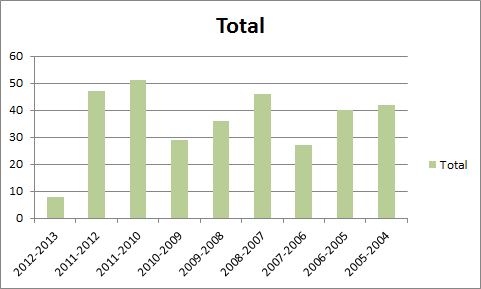
This chart is the skier and boarder fatalities graphed by month for each year.
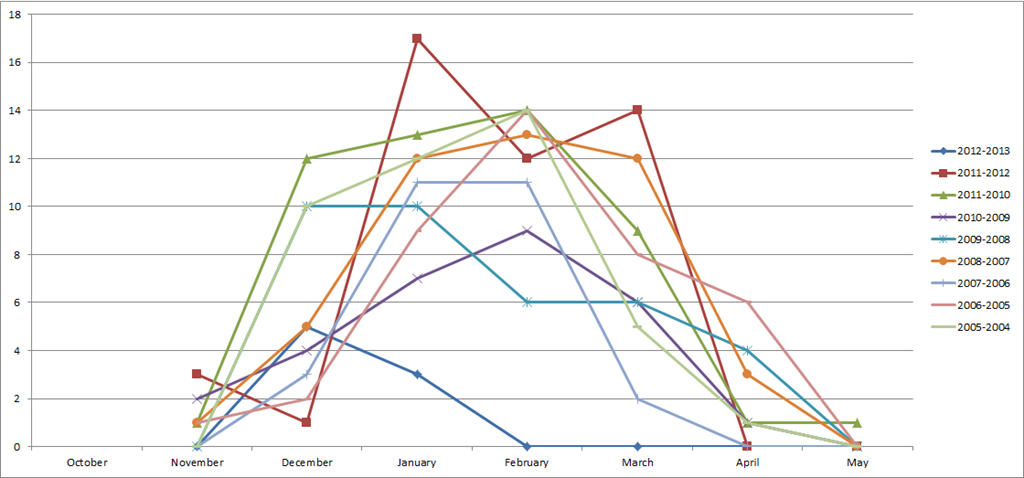
Here are the numbers:
| 12-13 | 12-11 | 11-10 | 10-09 | 09-08 | 08-07 | 07-06 | 06-05 | 05-04 | |
| Nov | 0 | 3 | 1 | 2 | 0 | 2 | 0 | 2 | 0 |
| Dec | 5 | 1 | 12 | 4 | 10 | 5 | 3 | 2 | 10 |
| Jan | 3 | 17 | 13 | 7 | 10 | 12 | 11 | 9 | 12 |
| Feb | 12 | 14 | 9 | 6 | 13 | 11 | 14 | 14 | |
| Mar | 14 | 9 | 6 | 6 | 23 | 3 | 8 | 5 | |
| Apr | 0 | 1 | 1 | 4 | 3 | 0 | 6 | 1 | |
| May | 0 | 1 | 0 | 0 | 0 | 0 | 0 | 0 | |
| Total | 8 | 47 | 51 | 29 | 36 | 46 | 27 | 40 | 42 |
I cannot make any discernible connection just by looking at the month when a skier or boarder has a fatality at a ski area in bounds.
What do you think? Leave a comment.
If you like this let your friends know or post it on FaceBook, Twitter or LinkedIn
Copyright 2013 Recreation Law (720) Edit Law
Email: blog@rec-law.us
Twitter: RecreationLaw
Facebook: Rec.Law.Now
Facebook Page: Outdoor Recreation & Adventure Travel Law
Blog: www.recreation-law.com
Mobile Site: http://m.recreation-law.com
By Recreation Law Rec-law@recreation-law.com James H. Moss Jim Moss
#RecreationLaw, #@RecreationLaw, #Cycling.Law #Fitness.Law, #Ski.Law, #Outside.Law, #Recreation.Law, #Recreation-Law.com, #Outdoor Law, #Recreation Law, #Outdoor Recreation Law, #Adventure Travel Law, #law, #Travel Law, #Jim Moss, #James H. Moss, #Attorney at Law, #Tourism, #Adventure Tourism, #Rec-Law, #Rec-Law Blog, #Recreation Law, #Recreation Law Blog, #Risk Management, #Human Powered, #Human Powered Recreation,# Cycling Law, #Bicycling Law, #Fitness Law, #Recreation-Law.com, #Backpacking, #Hiking, #Mountaineering, #Ice Climbing, #Rock Climbing, #Ropes Course, #Challenge Course, #Summer Camp, #Camps, #Youth Camps, #Skiing, #Ski Areas, #Negligence, #Snowboarding, #RecreationLaw, #@RecreationLaw, #Cycling.Law #Fitness.Law, #SkiLaw, #Outside.Law, #Recreation.Law, #RecreationLaw.com, #OutdoorLaw, #RecreationLaw, #OutdoorRecreationLaw, #AdventureTravelLaw, #Law, #TravelLaw, #JimMoss, #JamesHMoss, #AttorneyatLaw, #Tourism, #AdventureTourism, #RecLaw, #RecLawBlog, #RecreationLawBlog, #RiskManagement, #HumanPowered, #HumanPoweredRecreation,# CyclingLaw, #BicyclingLaw, #FitnessLaw, #RecreationLaw.com, #Backpacking, #Hiking, #Mountaineering, #IceClimbing, #RockClimbing, #RopesCourse, #ChallengeCourse, #SummerCamp, #Camps, #YouthCamps, #Skiing, #Ski Areas, #Negligence, #Snowboarding, sport and recreation laws, ski law, cycling law, Colorado law, law for recreation and sport managers, bicycling and the law, cycling and the law, ski helmet law, skiers code, skiing accidents, Recreation Lawyer, Ski Lawyer, Paddlesports Lawyer, Cycling Lawyer, Recreational Lawyer, Fitness Lawyer, Rec Lawyer, Challenge Course Lawyer, Ropes Course Lawyer, Zip Line Lawyer, Rock Climbing Lawyer, Adventure Travel Lawyer, Outside Lawyer, Recreation Lawyer, Ski Lawyer, Paddlesports Lawyer, Cycling Lawyer, #RecreationalLawyer, #FitnessLawyer, #RecLawyer, #ChallengeCourseLawyer, #RopesCourseLawyer, #ZipLineLawyer, #RockClimbingLawyer, #AdventureTravelLawyer, #OutsideLawyer, ski area, ski area fatality, NSAA, National Ski Area Association, fatality
WordPress Tags: Skier,Fatalities,Month,resorts,NSAA,boarder,Here,Total,connection,area,Leave,FaceBook,Twitter,LinkedIn,Recreation,Edit,Email,RecreationLaw,Page,Outdoor,Adventure,Travel,Blog,Mobile,Site,Outside,Moss,James,Attorney,Tourism,Risk,Management,Human,Rock,Ropes,Course,Challenge,Summer,Camp,Camps,Youth,Areas,Negligence,SkiLaw,OutdoorLaw,OutdoorRecreationLaw,AdventureTravelLaw,TravelLaw,JimMoss,JamesHMoss,AttorneyatLaw,AdventureTourism,RecLaw,RecLawBlog,RecreationLawBlog,RiskManagement,HumanPoweredRecreation,CyclingLaw,BicyclingLaw,FitnessLaw,RopesCourse,ChallengeCourse,SummerCamp,YouthCamps,Colorado,managers,helmet,accidents,Lawyer,Paddlesports,Recreational,Line,RecreationalLawyer,FitnessLawyer,RecLawyer,ChallengeCourseLawyer,RopesCourseLawyer,ZipLineLawyer,RockClimbingLawyer,AdventureTravelLawyer,OutsideLawyer,National,Association
Ski Binding Failure to Release under Indiana Law
Posted: January 28, 2013 Filed under: Assumption of the Risk, Indiana, Release (pre-injury contract not to sue), Skiing / Snow Boarding | Tags: Indiana, Plaintiff, Product liability, Salomon North America, Sitzmark Corporation, Ski, Ski binding, Summary judgment Leave a commentIndiana, like most states’, product liability law is controlled by statute which severely limits the defenses available to a defendant. Here the retailer and manufacture were sued for injuries when a ski binding failed to release, both being in the chain of the sale of the product. The plaintiff had signed a “sales slip” which contained release language when she picked up the skis; however the sales slip (release) was only effective against one of the three claims of the plaintiff.
The defendants had filed a motion for summary judgment at the trial court which was granted on all counts. The plaintiff appealed and the appellate court reversed on two of the three product liability claims.
The plaintiff had purchased new skis and bindings from the retailer Sitzmark Corporation which included bindings manufactured by Salomon North America. On the plaintiff’s third run while skiing and her first fall on her new equipment she fell suffering a compound fracture.
The plaintiff sued claiming negligence and strict liability. The negligence claim included two sub-claims negligent design of the bindings and negligent adjustment of the bindings by the retailer. The defenses were “incurred risk” and the release contained in the sales slip. Indiana uses the term incurred risk instead of the term assumption of the risk.
Summary of the case
The language in the sales slip that constituted the release language, excerpted below, did not contain the magic word release. It only talked about assumption of the risk issues. The plaintiff did acknowledge understanding the language.
I have been instructed in the use of my equipment, I have read the manufacturer’s instruction pamphlet (new bindings only), I have made no misrepresentation in regard to my height, weight, age, or skiing ability . . . . I understand that there are inherent and other risks involved in the sport for which this equipment is to be used, snow skiing, that injuries are a common and ordinary occurrence of the sport and I freely assume those risks. I understand that the ski boot binding system will not release at all times or under all circumstances, nor is it possible to predict every situation in which it will release and is therefore no guarantee for my safety. I therefore release the ski shop and its owners, agents and employees from any and all liability for damage and from the selection, adjustment and use of this equipment, accepting myself the full responsibility for any and all such damage or injury which may result.
The court reversed the lower court and reinstated the plaintiff’s strict liability claim. Strict liability is set out by statute in Indiana, Ind. Code 33-1-1.5-1 et seq. The court stated the statute had a three part test for the manufacture and retailer to use as a defense in a strict liability claim.
First, a plaintiff’s knowledge of the defect.
Second, a plaintiff’s unreasonable use of the product despite knowledge of the defect.
Third, a plaintiff’s injuries caused by the product.
The court analyzed the arguments and decided that neither defendant could prove that the plaintiff new of any defect in the binding. This was different from the argument they could prove, through the release language that “Moore knew her bindings would not release under all circumstances.” Because neither defendant could win on step one the case was sent back.
The first negligence claim was a common law negligence claim. Common law meaning the law that evolved over time (and not based on statute), usually from the law carried over from Great Britain. The common law was developed in England during the 1500’s from the King’s decrees and the church’s equity decisions. As time progressed these laws became more streamline and eventually codified, or written down. The common law still exists in all states and is the basis for the law in every state (Louisiana being the sole exception). Only when a statute has been created will a section of the common law for that state disappear or cease to exist. Ninety-nine percent of all negligence claims are common law. A state may have a void in its common law, an area that has never been decided in the state before, however this is getting rare now days.
A common law product liability action in Indiana can be defeated by the defense of incurred or assumption of the risk. However assumption of the risk as a defense had been merged into comparative negligence in Indiana at this time.
The defendants argued that by signing the sales slip the plaintiff assumed the risk of the defect in the product. The court however found the sales slip was proof of assumption of the risk, but not of assumption of negligence the difference is the greater requirement of knowledge required by the statute. Because the first time she fell was also the time she was injured the plaintiff had no direct knowledge of the defect of the product. In this case defect would mean failure of the binding to release. As such, the defense failed because there was no proof of assumption of the risk of negligence. Because the binding has not failed to release prior to the injury, the plaintiff had no knowledge of the binding failing to release that she could assume. This claim was also sent back to the lower court.
The third and final claim was based on negligently “setting, adjusting or checking the bindings.” Here the sales slip with its release language was effective. The court stated “These alleged acts of negligence are exactly those for which Moore granted Sitzmark a release of liability when she read and signed the sales slip.” This final claim was dismissed by the appellate court.
This case is a little confusing because of two issues. Indiana law on product liability is different from many states and the release language in the sales slip was very poorly written. There is not much that can be done about Indiana’s product liability law and the limitation on the defenses available manufacture’s and retailers. However a well written release might have prevented one of the product liability claims.
So Now What?
The release is not clearly identified, other than in a sales slip in this opinion. However during this period, these releases were fairly uniform and used by shops across the US. These preprinted forms are written in a way as to not cause a problem with any state laws rather than to effectively stop a claim.
Having a release in this case that specifically used the word the negligence and identified the defendants as the shop, by name and all manufactures would be the first start. The court spent a lot of space finding a way to bring the manufacture into the defense provided by the release language when the language did not specifically mention the manufacture. The language of the release should incorporate the necessary defenses of the Indiana Strict Liability Act so that the defense in the act is available. The negligence claims should be identified both for negligent acts, negligent mounting and setting and negligent in the design, manufacture or construction of the product. The language should also include more specific assumption of the risk language so the purchaser or customer who is having repairs done understands the risks are not that the binding may not work, but that the risk is the binding will not work and that the user should ski knowing that and in a safe way.
A well written release, based on Indiana law may be difficult to do. However, a well written release will still be better than the one at issue here. Each claim that survives the motions and appeal increases the cost of litigating and the cost of a possible settlement. If the release had eliminated one more of the claims a lower settlement would be easier to achieve, maybe even a complete win at trial.
Plaintiff: Eldonna Moore
Defendant: Sitzmark Corporation and Salomon North America, Inc.,
Plaintiff Claims: negligence (product liability) and strict liability
Defendant Defenses: Assumption of the Risk (Incurred Risk) and Release
Holding: One claim dismissed based on the release and the two remaining claims sent back to the trial court.
What do you think? Leave a comment.
If you like this let your friends know or post it on FaceBook, Twitter or LinkedIn
Copyright 2013 Recreation Law (720) Edit Law
Email: blog@rec-law.us
Twitter: RecreationLaw
Facebook: Rec.Law.Now
Facebook Page: Outdoor Recreation & Adventure Travel Law
Blog: www.recreation-law.com
Mobile Site: http://m.recreation-law.com
By Recreation Law Rec-law@recreation-law.com James H. Moss Jim Moss
#RecreationLaw, #@RecreationLaw, #Cycling.Law #Fitness.Law, #Ski.Law, #Outside.Law, #Recreation.Law, #Recreation-Law.com, #Outdoor Law, #Recreation Law, #Outdoor Recreation Law, #Adventure Travel Law, #law, #Travel Law, #Jim Moss, #James H. Moss, #Attorney at Law, #Tourism, #Adventure Tourism, #Rec-Law, #Rec-Law Blog, #Recreation Law, #Recreation Law Blog, #Risk Management, #Human Powered, #Human Powered Recreation,# Cycling Law, #Bicycling Law, #Fitness Law, #Recreation-Law.com, #Backpacking, #Hiking, #Mountaineering, #Ice Climbing, #Rock Climbing, #Ropes Course, #Challenge Course, #Summer Camp, #Camps, #Youth Camps, #Skiing, #Ski Areas, #Negligence, #Snowboarding, #RecreationLaw, #@RecreationLaw, #Cycling.Law #Fitness.Law, #SkiLaw, #Outside.Law, #Recreation.Law, #RecreationLaw.com, #OutdoorLaw, #RecreationLaw, #OutdoorRecreationLaw, #AdventureTravelLaw, #Law, #TravelLaw, #JimMoss, #JamesHMoss, #AttorneyatLaw, #Tourism, #AdventureTourism, #RecLaw, #RecLawBlog, #RecreationLawBlog, #RiskManagement, #HumanPowered, #HumanPoweredRecreation,# CyclingLaw, #BicyclingLaw, #FitnessLaw, #RecreationLaw.com, #Backpacking, #Hiking, #Mountaineering, #IceClimbing, #RockClimbing, #RopesCourse, #ChallengeCourse, #SummerCamp, #Camps, #YouthCamps, #Skiing, #Ski Areas, #Negligence, #Snowboarding, sport and recreation laws, ski law, cycling law, Colorado law, law for recreation and sport managers, bicycling and the law, cycling and the law, ski helmet law, skiers code, skiing accidents, Recreation Lawyer, Ski Lawyer, Paddlesports Lawyer, Cycling Lawyer, Recreational Lawyer, Fitness Lawyer, Rec Lawyer, Challenge Course Lawyer, Ropes Course Lawyer, Zip Line Lawyer, Rock Climbing Lawyer, Adventure Travel Lawyer, Outside Lawyer, Recreation Lawyer, Ski Lawyer, Paddlesports Lawyer, Cycling Lawyer, #RecreationalLawyer, #FitnessLawyer, #RecLawyer, #ChallengeCourseLawyer, #RopesCourseLawyer, #ZipLineLawyer, #RockClimbingLawyer, #AdventureTravelLawyer, #OutsideLawyer, Sitzmark Corporation, Salomon North America, Inc., Product Liability, Ski, Ski Binding,
WordPress Tags: Failure,Release,Indiana,Sitzmark,Corporation,Salomon,North,America,LEXIS,Prod,Liab,product,statute,defendant,Here,retailer,injuries,sale,plaintiff,sales,defendants,judgment,bindings,equipment,negligence,adjustment,assumption,Summary,manufacturer,instruction,pamphlet,misrepresentation,occurrence,system,situation,owners,agents,employees,selection,injury,Strict,Code,knowledge,Second,Third,arguments,argument,Common,Great,Britain,England,decisions,laws,basis,Louisiana,exception,area,action,difference,requirement,limitation,retailers,opinion,construction,purchaser,customer,user,cost,settlement,Eldonna,Claims,Defenses,Risk,Leave,FaceBook,Twitter,LinkedIn,Recreation,Edit,Email,RecreationLaw,Page,Outdoor,Adventure,Travel,Blog,Mobile,Site,Outside,Moss,James,Attorney,Tourism,Management,Human,Rock,Ropes,Course,Challenge,Summer,Camp,Camps,Youth,Areas,SkiLaw,OutdoorLaw,OutdoorRecreationLaw,AdventureTravelLaw,TravelLaw,JimMoss,JamesHMoss,AttorneyatLaw,AdventureTourism,RecLaw,RecLawBlog,RecreationLawBlog,RiskManagement,HumanPoweredRecreation,CyclingLaw,BicyclingLaw,FitnessLaw,RopesCourse,ChallengeCourse,SummerCamp,YouthCamps,Colorado,managers,helmet,accidents,Lawyer,Paddlesports,Recreational,Line,RecreationalLawyer,FitnessLawyer,RecLawyer,ChallengeCourseLawyer,RopesCourseLawyer,ZipLineLawyer,RockClimbingLawyer,AdventureTravelLawyer,OutsideLawyer,skis,three,appellate,neither
Moore v. Sitzmark Corporation and Salomon North America, Inc., 555 N.E.2d 1305; 1990 Ind. App. LEXIS 769; CCH Prod. Liab. Rep. P12,523
Posted: January 27, 2013 Filed under: Assumption of the Risk, Indiana, Legal Case, Release (pre-injury contract not to sue), Skiing / Snow Boarding Leave a commentMoore v. Sitzmark Corporation and Salomon North America, Inc., 555 N.E.2d 1305; 1990 Ind. App. LEXIS 769; CCH Prod. Liab. Rep. P12,523
Eldonna Moore, Plaintiff-Appellant, v. Sitzmark Corporation and Salomon North America, Inc., Defendants-Appellees
No. 73A01-8908-CV-332
Court of Appeals of Indiana, First District
555 N.E.2d 1305; 1990 Ind. App. LEXIS 769; CCH Prod. Liab. Rep. P12,523
June 27, 1990, Filed
PRIOR HISTORY: [**1] Appeal from the Shelby Superior Court No. 1; The Honorable Jonathan E. Palmer, Judge; Cause No. 20C01-8806-CP-095.
COUNSEL: Attorneys for Appellant: C. Warren Holland, Michael W. Holland, William J. Rumely, Holland & Holland, Indianapolis, Indiana.
Attorneys for Appellees: C. Wendell Martin, Amy L. Rankin, Martin, Wade, Hartley & Hollingsworth, Indianapolis, Indiana.
JUDGES: Baker, J. Ratliff, C.J., and Hoffman, P.J., concur.
OPINION BY: BAKER
OPINION
[*1306] Plaintiff-appellant Eldonna Moore (Moore) broke her leg in a snow skiing accident. She subsequently brought this suit against defendant-appellees Salomon North America, Inc. (Salomon) and Sitzmark Corporation (Sitzmark), the manufacturer and seller, respectively, of the ski bindings she was using when she broke her leg The trial court granted summary judgment to Salomon and Sitzmark, and Moore now appeals. We affirm in part and reverse in part.
On February 18, 1986, Moore, an experienced skier, purchased a pair of new downhill skis and new bindings from Sitzmark. Sitzmark installed the bindings, known as Salomon 747 bindings, on the skis, and adjusted them to release based on Moore’s weight. At the time of purchase, Moore signed a sales slip which contained the following [**2] language.
I have been instructed in the use of my equipment, I have read the manufacturer’s instruction pamphlet (new bindings only), I have made no misrepresentation in regard to my height, weight, age, or skiing ability . . . . I understand that there are inherent and other risks involved in the sport for which this equipment is to be used, snow skiing, that injuries are a common and ordinary occurrence of the sport and I freely assume those risks. I understand that the ski boot binding system will not release at all times or under all circumstances, nor is it possible to predict every situation in which it will release and is therefore no guarantee for my safety. I therefore release the ski shop and its owners, agents and employees from any and all liability for damage and from the selection, adjustment and use of this equipment, accepting myself the full responsibility for any and all such damage or injury which may result.
Moore admits to having read and understood the sales slip.
On March 1, 1986, Moore went to Sugarloaf Mountain in Michigan and used her new skis and bindings for the first time. She made two uneventful “runs” down the most difficult slope. On her third trip [**3] down the slope, however, she took a severe fall, during which the binding on her right ski did not release. As a result of the fall, she suffered a compound fracture of her right femur.
Moore brought suit against Salomon and Sitzmark, alleging theories of negligence and strict liability. The negligence claim against Salomon was premised on negligent design, and the negligence claim against Sitzmark was premised on negligent adjustment of the bindings. In their motions for summary judgment, Salomon and Sitzmark argued that Moore had incurred the risk, and the trial court granted the motions on that basis. On appeal, Moore raises two restated issues for our review. First, whether the trial court erred in finding she had incurred the risk. Second, whether the release of liability Moore signed was effective.
[HN1] When reviewing a grant of summary judgment, we apply the same standards as the trial court, and examine the pleadings, depositions, answers to interrogatories, [*1307] admissions, and affidavits filed with the court in the light most favorable to the party opposing summary judgment. Hatton v. Fraternal Order of Eagles (1990), Ind. App., 551 N.E.2d 479. Summary judgment is appropriate [**4] only when no genuine issues of material fact exist and the moving party is entitled to judgment as a matter of law. Id. When a defendant is the moving party, it is entitled to judgment as a matter of law when it demonstrates one of two things. First, that the undisputed material facts negate at least one element of the plaintiff’s claim. Second, the defendant may raise an affirmative defense which bars the plaintiff’s claim. 3 W. HARVEY, INDIANA PRACTICE § 56.9 at 629 (1988). If a defendant cannot make one of these showings, summary judgment is improper.
I. INCURRED RISK
A. Strict Liability
Moore argues she incurred only the ordinary risk of falling while skiing. Based on the language in the sales slip’s release of liability, Salomon and Sitzmark argue Moore incurred the risk that her bindings could fail to release and that she might suffer harm as a result. Salomon and Sitzmark are correct, but that is not dispositive of the case.
Moore’s strict liability theory, based on her allegation that the bindings were defective, is a statutory cause of action controlled by the Indiana Product Liability Act, IND. CODE 33-1-1.5-1 et seq. [HN2] The Act has preempted the Indiana common [**5] law of strict liability and “governs all actions in which the theory of liability is strict liability in tort.” IND. CODE 33-1-1.5-1. See Koske v. Townsend Engineering Co. (1990), Ind., 551 N.E.2d 437. Under the Act,
(a) One who sells, leases, or otherwise puts into the stream of commerce any product in a defective condition unreasonably dangerous to any user or consumer or to his property is subject to liability for physical harm caused by that product to the user or consumer or his property if that user or consumer is in the class of persons that the seller should reasonably foresee as being subject to the harm caused by the defective condition, and if:
(1) the seller is engaged in the business of selling such a product; and
(2) the product is expected to and does reach the user or consumer without substantial alteration in the condition in which it is sold by the person sought to be held liable under this chapter.
IND. CODE 33-1-1.5-3(a). IND. CODE 33-1-1.5-2 defines a seller as “a person engaged in business as a manufacturer, a wholesaler, a retailer, a lessor, or a distributor.” Accordingly, if Moore can prove the bindings were in a defective condition unreasonably dangerous, [**6] Salomon as manufacturer, and Sitzmark as retail seller, will be subject to liability under the Act.
The Act provides that defendants may raise the affirmative defense of incurred risk, as Salomon and Sitzmark did here. [HN3] “It is a defense that the user or consumer bringing the action knew of the defect and was aware of the danger and nevertheless proceeded unreasonably to make use of the product and was injured by it.” IND. CODE 33-1-1.5-4(b)(1) (emphasis added). The party asserting incurred risk bears the burden of proving the defense by a preponderance of the evidence, Get-N-Go, Inc. v. Markins (1989), Ind., 544 N.E.2d 484, reh’g granted on other grounds, 550 N.E.2d 748, and this requires three showings under IND. CODE 33-1-1.5-4(b)(1). First, a plaintiff’s knowledge of the defect. See, e.g., Corbin v. Coleco Industries, Inc. (7th Cir. 1984) 748 F.2d 411. Second, a plaintiff’s unreasonable use of the product despite knowledge of the defect. Third, a plaintiff’s injuries caused by the product. 1
1 In reality, of course, the third element will generally be shown by the plaintiff, requiring the party raising incurred risk to prove only the first two elements.
[**7] This is where Salomon and Sitzmark fail. Neither of them asserts that Moore knew of any defect in the bindings, they merely argue Moore knew her bindings would not release under all circumstances. [*1308] Absent the threshold showing that Moore knew of a defect in the bindings, neither Salomon nor Sitzmark is entitled to summary judgment on the grounds of incurred risk. The trial court’s grant of summary judgment on Moore’s strict liability theory was improper. 2
2 If, upon remand, Salomon and Sitzmark are able to prove Moore incurred the risk of a defect in the bindings, this will act as a complete bar to Moore’s strict liability claim. [HN4] The Comparative Fault Act, IND. CODE 34-4-33-1 et seq., does not include strict liability theory actions, but only those actions based on fault. See IND. CODE 34-4-33-1.
B. Negligence
A similar analysis applies to Moore’s negligent design theory against Salomon. [HN5] A plaintiff may, of course, bring a negligence action against the manufacturer of a product. See, e.g., Jarrell [**8] v. Monsanto Co. (1988), Ind. App., 528 N.E.2d 1158; Pfisterer v. Grisham (1965), 137 Ind. App. 565, 210 N.E.2d 75; MacPherson v. Buick Motor Co. (1916), 217 N.Y. 382, 111 N.E. 1050. Such an action is not subject to the terms of the Indiana Product Liability Act; rather, it is a common law action. Koske, supra, 551 N.E.2d at 443. In turn, the manufacturer may raise the defense of incurred risk. See Pfisterer, supra. In a negligence action, the defense of incurred risk is specifically subject to the terms of the Comparative Fault Act. See IND. CODE 34-4-33-2(a).
As all the parties to this dispute correctly point out, incurred risk involves a mental state of venturousness on the part of the actor against whom it is asserted, and requires a subjective analysis of the actor’s actual knowledge and voluntary acceptance of the risk. Get-N-Go, supra; Power v. Brodie (1984), Ind. App., 460 N.E.2d 1241; Kroger Co. v. Haun (1978), 177 Ind. App. 403, 379 N.E.2d 1004. As with the parties’ dispute over incurred risk in the context of a strict liability theory, the question here revolves around the proper definition of the risk that may or may not have been incurred.
[**9] As we have already discussed, by signing the release in the sales slip, Moore incurred the risk that her bindings would not release under all circumstances and that she might suffer injuries in the event of a failure to release. This was merely an acknowledgement of the laws of physics, however. There is no evidence Moore knew of any alleged negligent design of the bindings. Salomon argues vigorously that Indiana case law defines the risk as solely the risk of injury, not the risk of negligence. 3 Salomon is mistaken.
3 Salomon and Sitzmark make much of the voluntariness of Moore’s actions (i.e., purchasing the bindings, signing the release, and skiing for pleasure) in incurring the risk of her bindings failing to release. It is hornbook law that [HN6] actions which are not truly voluntary do not amount to an incurrence of risk. See, e.g., Get-N-Go, supra; Richarson v. Marrell’s (1989), Ind. App., 539 N.E.2d 485, trans. denied; St. Mary’s Byzantine Church v. Mantich (1987), Ind. App., 505 N.E.2d 811, trans. denied. Moore’s actions were indeed voluntary, but this is immaterial; the proper definition of the risk is the dispositive issue in this case.
[**10] In Pfisterer, supra, the plaintiff lost part of her finger while using a slide at the defendants’ resort park. The plaintiff had used slides before, but had never used the slide which injured her prior to the time of injury. In discussing the defense of incurred or assumed risk, the court held the plaintiff “assumed or incurred the risks inherent and incident to the use of this slide, but she did not assume or incur the risk that the slide might be defectively constructed. [She] could not assume or incur the risk of a latent defect of which she had neither notice nor knowledge, either express or implied.” 4 Pfisterer, supra, 137 Ind. App. at 572, 210 N.E.2d at 78-79.
4 The plaintiff was 13 years old at the time of the accident. The court, however, did not in any way rely on the plaintiff’s youth as a basis for its decision.
In a similar case, the Missouri Court of Appeals held a high school pole vaulter assumed the inherent risks of pole vaulting, but not the risks of the manufacturer’s negligence. McCormick v. Lowe & Campbell Athletic Goods Co. (1940), 235 Mo. App. 612, 144 S.W.2d 866.
[**11] Similarly, the evidence most favorable to Moore reveals she had no knowledge [*1309] of any negligent design flaws in the bindings. Moreover, she had not fallen while using the new bindings prior to the fall which injured her. Even if she had, assuming any defect was latent, she could not incur the risk of the defect without notice of the defect. 5 Moore did not incur the risk of negligent design by Salomon. The trial court’s grant of summary judgment to Salomon on Moore’s negligence theory was improper.
5 [HN7] If any defect was open and obvious under the rule enunciated in Bemis Co. v. Rubush (1981), Ind., 427 N.E.2d 1058, 1061, cert. denied (1982), 459 U.S. 825, 103 S. Ct. 57, 74 L. Ed. 2d 61, Moore may not recover on her negligence theory. Koske, supra, did not abrogate the open and obvious rule, but rather held it inapplicable to actions under the Indiana Product Liability Act. The rule is still applicable in product negligence liability cases. Koske, supra, 551 N.E.2d at 443. See Also Bridgewater v. Economy Eng’g Co. (1985), Ind., 486 N.E.2d 484, modified on other grounds in Get-N-Go, Inc. v. Markins (1990), 550 N.E.2d 748.
[**12] II. EFFECT OF RELEASE
Moore’s negligence complaint against Sitzmark alleged Sitzmark had been negligent in setting, adjusting, or checking the bindings. These alleged acts of negligence are exactly those for which Moore granted Sitzmark a release of liability when she read and signed the sales slip. This release was valid under Indiana law, LaFrenz v. Lake Cty. Fair Bd. (1977), 172 Ind. App. 389, 360 N.E.2d 605, and the trial court properly granted summary judgment to Sitzmark on Moore’s negligence theory.
The trial court’s summary judgment in favor of Sitzmark on Moore’s negligence theory is affirmed. The trial court’s summary judgment in favor of Sitzmark on Moore’s strict liability theory, and in favor of Salomon on both Moore’s strict liability and negligence theories is reversed. The cause is remanded to the trial court for further proceedings consistent with this opinion.
Ratliff, C.J., and Hoffman, P.J., concur.
WordPress Tags: Sitzmark,Corporation,Salomon,North,America,LEXIS,Prod,Liab,Eldonna,Plaintiff,Appellant,Defendants,Appellees,Court,Appeals,Indiana,District,June,PRIOR,HISTORY,Appeal,Shelby,Superior,Honorable,Jonathan,Palmer,Judge,Cause,CASE,SUMMARY,PROCEDURAL,POSTURE,decision,judgment,manufacturer,seller,product,negligence,action,OVERVIEW,bindings,Code,knowledge,OUTCOME,proceedings,TERMS,theory,consumer,user,LexisNexis,Headnotes,Civil,Procedure,Appellate,Review,General,Opposition,Standards,admissions,affidavits,fact,defendant,Second,showings,Contracts,Types,Lease,Agreements,Torts,Premises,Lessees,Lessors,Liabilities,Preemption,tort,Under,commerce,alteration,person,chapter,wholesaler,retailer,distributor,Defenses,Assumption,Risk,Products,Conduct,Strict,danger,preponderance,Third,injuries,Comparative,Intentional,Fault,actor,analysis,acceptance,Actions,COUNSEL,Attorneys,Warren,Holland,Michael,William,Indianapolis,Wendell,Martin,Rankin,Wade,Hartley,Hollingsworth,JUDGES,Baker,Ratliff,Hoffman,OPINION,accident,February,sales,equipment,instruction,pamphlet,misrepresentation,occurrence,system,situation,owners,agents,employees,selection,adjustment,injury,March,Sugarloaf,Mountain,Michigan,theories,basis,Hatton,Fraternal,Order,Eagles,HARVEY,PRACTICE,allegation,Koske,Townsend,emphasis,Markins,Corbin,Coleco,Industries,Neither,Absent,threshold,Jarrell,Monsanto,Pfisterer,Grisham,MacPherson,Buick,Motor,Power,Brodie,Kroger,Haun,context,definition,event,failure,laws,physics,Richarson,Marrell,Mary,Byzantine,Church,Mantich,resort,park,incident,youth,Missouri,McCormick,Lowe,Campbell,Athletic,Goods,flaws,Moreover,Bemis,Rubush,cert,Also,Bridgewater,Economy,EFFECT,RELEASE,complaint,LaFrenz,Lake,Fair,skis,dispositive,pleadings,interrogatories,lessor,three,whom,incurrence,whether,supra,trans
You cannot be liable for what you do not control or what volunteers do
Posted: January 21, 2013 Filed under: California, Camping | Tags: Boy Scout, Boy Scouts, Boy Scouts of America, BSA, Eagle Scout, Guy Lines, Inc., Los Angeles, Los Angeles Area Council, Premises Liability, Recreation, Scout, Tent Lines, Volunteer 4 CommentsMoore v. Boy Scouts of America Los Angeles Area Council, Inc., 2004 Cal. App. Unpub. LEXIS 11180
It is also hard to be liable for not watching where you are walking
This case stems from injuries received when a volunteer was setting up a tent and fell over one of the guy lines for the tent.
The plaintiff was a volunteer and with other volunteers was setting up a large tent at a Scout Camp. The camp was owned by the Los Angeles Area Council, Inc. which was granted a charter by the Boy Scouts of America to offer the Scouting program to local youth. The tent was a large military wall tent, similar to what you would see on reruns of M*A*S*H.
While setting up the tent, another volunteer asked the plaintiff to get more tent stakes. She walked around the tent, picked up more stakes and while walking back tripped over one of the guy lines holding up the tent. None of the guy lines had been marked with flags or markers to indicate there was a line there and the accident occurred around 7:00 Pm in July. (None are marked in the M*A*S*H reruns either.) The factual issue became whether or not markers or flags should have been used to identify the guy-lines on the tents.
The court went through and clearly identified factual issues the court felt were important.
Moore had not set up the specific pole, rope or stake upon which she tripped.
The ropes coming off the tent were at varying angles and pitches. The ropes varied in length, de-pending upon location. There were no flags or markers on the ropes.
Before this date, Moore had never been involved in setting up or taking down this tent or this type of tent. However, in years past, Moore had used rope or flags to mark the guy ropes on this tent to make the ropes more visible.
Before Moore fell, neither Moore nor any of the other adult volunteers saw anything they considered unsafe or dangerous.
In the past, some of the adult volunteers had used markers (e.g., cloth or fluorescent plastic tape) to make ropes more visible in scout camps and in non-scout camping situations. In prior years, this tent had been used in the Boy Scout camp, and flags had been used to mark the ropes. It is unclear if markers were used each time the tent was used.
The plaintiff argued the BSA did not have a policy of marking guy lines with markers or flags.
The plaintiff sued for premises liability and negligence. The premises liability claim was based on negligently setting up a tent without guy lines and the negligence claim for not using reasonable care when setting up tents by not using markers on guy-lines.
The Boy Scouts filed a motion for summary judgment based on the fact there was no triable issues, no real legal claims, which was granted and the plaintiff appealed.
So?
The plaintiff’s main arguments were supported by its expert an ergonomist who was a human factors and safety consultant. (This has me confused too, as to why an ergonomist (whatever) has any knowledge of setting up a tent.) The ergonomist said that that groups in Virginia, Australia and Louisiana has policies on markers on tent lines.
The court first looked at the premises liability claim. A premises liability claim is based on a dangerous condition on land. The owner of land is liable for “only for hazardous conditions of which the possessor had actual or constructive knowledge.” The tent was not part of the land so there was no legal basis for a premises liability claim.
The negligence claim was also dismissed by the court. Since the tent was being set up by volunteers, there was no proof that the BSA created the dangerous condition or was aware that a dangerous condition existed. The BSA could not breach a duty of care when the actions which created a dangerous condition were not those of the BSA. Nor does the lack of a policy create a dangerous condition on land. The plaintiff’s argument the court reasoned, where closer to tent issues not land issues.
So Now What?
The legal issues are as stretched in this case as you can get in my opinion. You are setting up a tent by setting up guy lines; you can’t sue when you trip over a guy line.
The claims were incorrect for the facts. The court looked at the issues and could not find any legal connection between the facts, the claims and the law.
However, that does not mean that not watching where you walk might not lead to litigation at some future date that does hold some water.
You can write policies till there are no more trees. In doing so, you’ll probably sink some other group who is trying to save trees. Better to educate than kill a tree. Train your volunteers, prove you trained them, and then explain how the organization they are volunteering for cannot afford lawsuits, stupid ones or regular ones. By that I mean include litigation training; you can’t sue us, in the training you provide.
Explain how it is their job to protect each other as well as to protect the organization. Tell them and prove you told them that you cannot identify all of the risks they may encounter.
You might even have them sign a release.
Plaintiff: Josephine Moore
Defendant: Boy Scouts of America Los Angeles Area Council, Inc.
Plaintiff Claims: Premises Liability and Negligence
Defendant Defenses: not triable issues of fact, no negligence
Holding: Trial court dismissal was affirmed
What do you think? Leave a comment.
If you like this let your friends know or post it on FB, Twitter or LinkedIn
Copyright 2012 Recreation Law (720) Edit Law
Twitter: RecreationLaw
Facebook: Rec.Law.Now
Facebook Page: Outdoor Recreation & Adventure Travel Law
Mobile Site: http://m.recreation-law.com
By Recreation Law Rec-law@recreation-law.com James H. Moss Jim Moss
#RecreationLaw, #@RecreationLaw, #Cycling.Law #Fitness.Law, #Ski.Law, #Outside.Law, #Recreation.Law, #Recreation-Law.com, #Outdoor Law, #Recreation Law, #Outdoor Recreation Law, #Adventure Travel Law, #law, #Travel Law, #Jim Moss, #James H. Moss, #Attorney at Law, #Tourism, #Adventure Tourism, #Rec-Law, #Rec-Law Blog, #Recreation Law, #Recreation Law Blog, #Risk Management, #Human Powered, #Human Powered Recreation,# Cycling Law, #Bicycling Law, #Fitness Law, #Recreation-Law.com, #Backpacking, #Hiking, #Mountaineering, #Ice Climbing, #Rock Climbing, #Ropes Course, #Challenge Course, #Summer Camp, #Camps, #Youth Camps, #Skiing, #Ski Areas, #Negligence, #Snowboarding, #RecreationLaw, #@RecreationLaw, #Cycling.Law #Fitness.Law, #SkiLaw, #Outside.Law, #Recreation.Law, #RecreationLaw.com, #OutdoorLaw, #RecreationLaw, #OutdoorRecreationLaw, #AdventureTravelLaw, #Law, #TravelLaw, #JimMoss, #JamesHMoss, #AttorneyatLaw, #Tourism, #AdventureTourism, #RecLaw, #RecLawBlog, #RecreationLawBlog, #RiskManagement, #HumanPowered, #HumanPoweredRecreation,# CyclingLaw, #BicyclingLaw, #FitnessLaw, #RecreationLaw.com, #Backpacking, #Hiking, #Mountaineering, #IceClimbing, #RockClimbing, #RopesCourse, #ChallengeCourse, #SummerCamp, #Camps, #YouthCamps, #Skiing, #Ski Areas, #Negligence, #Snowboarding, sport and recreation laws, ski law, cycling law, Colorado law, law for recreation and sport managers, bicycling and the law, cycling and the law, ski helmet law, skiers code, skiing accidents, Recreation Lawyer, Ski Lawyer, Paddlesports Lawyer, Cycling Lawyer, Recreational Lawyer, Fitness Lawyer, Rec Lawyer, Challenge Course Lawyer, Ropes Course Lawyer, Zip Line Lawyer, Rock Climbing Lawyer, Adventure Travel Lawyer, Outside Lawyer, Recreation Lawyer, Ski Lawyer, Paddlesports Lawyer, Cycling Lawyer, #RecreationalLawyer, #FitnessLawyer, #RecLawyer, #ChallengeCourseLawyer, #RopesCourseLawyer, #ZipLineLawyer, #RockClimbingLawyer, #AdventureTravelLawyer, #OutsideLawyer, Los Angeles Area Council, Inc., #BSA, Boy Scouts, Boy Scouts of America, Guy Lines, Tent Lines, #Volunteer, Premises Liability,
Moore v. Boy Scouts of America Los Angeles Area Council, Inc., 2004 Cal. App. Unpub. LEXIS 11180
Posted: January 21, 2013 Filed under: California, Camping, Legal Case | Tags: Boy Scout, Boy Scouts, Boy Scouts of America, BSA, Eagle Scout, Guy Lines, Inc., Los Angeles Area Council, Premises Liability, Recreation, Scout, Tent Lines, Volunteer 4 CommentsMoore v. Boy Scouts of America Los Angeles Area Council, Inc., 2004 Cal. App. Unpub. LEXIS 11180
Josephine Moore, Plaintiff and Appellant, v. Boy Scouts of America Los Angeles Area Council, Inc., Defendant and Respondent.
B170389
COURT OF APPEAL OF CALIFORNIA, SECOND APPELLATE DISTRICT, DIVISION THREE
2004 Cal. App. Unpub. LEXIS 11180
December 10, 2004, Filed
NOTICE: [*1] NOT TO BE PUBLISHED IN OFFICIAL REPORTS. CALIFORNIA RULES OF COURT, RULE 977(a), PROHIBIT COURTS AND PARTIES FROM CITING OR RELYING ON OPINIONS NOT CERTIFIED FOR PUBLICATION OR ORDERED PUBLISHED, EXCEPT AS SPECIFIED BY RULE 977(B). THIS OPINION HAS NOT BEEN CERTIFIED FOR PUBLICATION OR ORDERED PUBLISHED FOR THE PURPOSES OF RULE 977.
PRIOR HISTORY: APPEAL from a judgment of the Superior Court of Los Angeles County, No. NC040331. Elizabeth Allen White, Judge.
DISPOSITION: Affirmed.
CORE TERMS: scout, tent, rope, volunteer, flag, summary judgment, scout camp, causes of action, hazard, marker, adult, guy ropes, feet, dangerous condition, declaration, triable, conspicuity, warning, premises liability, issues of fact, negligently, military, donated, wall tent, lighting, tripped, visible, manual, pole, trip
COUNSEL: Sedgwick, Detert, Moran & Arnold, Thomas A. Delaney and Steven S. Streger, for Defendant and Respondent.
Desjardins Kelly and Warren D. Kelly, for Plaintiff and Appellant.
JUDGES: ALDRICH, J.; CROSKEY, Acting P. J., KITCHING, J. concurred.
OPINION BY: ALDRICH
OPINION
INTRODUCTION
Plaintiff and appellant Josephine Moore (Moore) was setting up a tent for a scout camp site when she tripped over a rope that was securing the tent. Moore appeals from a summary judgment entered in favor of defendant and respondent Boy Scouts of America Los Angeles Area Council. Inc. (the Boy Scouts). We affirm.
FACTUAL AND PROCEDURAL BACKGROUND
1. Facts.
Following the usual rules on appeal, we construe the facts in the light most favorable [*2] to Moore, the party who opposed the motion for summary judgment. (Jackson v. Ryder Truck Rental, Inc. (1993) 16 Cal.App.4th 1830, 1836.)
On July 8, 2001, Moore was setting up a scout camp site. She and other adult volunteers were erecting a wall tent that was secured by poles and ropes. No employee of the Boy Scouts was involved in setting up the tent. The Boy Scouts did not own the tent. The rectangular tent was oblong, about 24 feet long by 16 feet wide. The poles used to hold up the tent were 6 feet long. Beige ropes were used to secure the tent to the ground and to keep the tent upright.
At about 7:00 p.m., the volunteers had been setting up the tent for 30 to 60 minutes. The tent was about four or five feet from a picnic table. One of the other adults asked Moore to retrieve additional stakes from the opposite side of the tent. Moore walked around the tent and picked-up six or seven stakes. Moore walked near the tent, toward the adult who had requested the stakes. In doing so, Moore tripped over one of the ropes that had already been staked into the ground. The stake holding the rope was two to five feet from the tent and two to five feet from the picnic table.
[*3] Moore had not set up the specific pole, rope or stake upon which she tripped.
The ropes coming off the tent were at varying angles and pitches. The ropes varied in length, depending upon location. There were no flags or markers on the ropes.
Before this date, Moore had never been involved in setting up or taking down this tent or this type of tent. However, in years past, Moore had used rope or flags to mark the guy ropes on this tent to make the ropes more visible.
During the time the tent was being set up, Moore was aware that some guy ropes were already in place, extending out from corners of the tent.
Before Moore fell, neither Moore nor any of the other adult volunteers saw anything they considered unsafe or dangerous.
In the past, some of the adult volunteers had used markers (e.g., cloth or fluorescent plastic tape) to make ropes more visible in scout camps and in non-scout camping situations. In prior years, this tent had been used in the Boy Scout camp, and flags had been used to mark the ropes. It is unclear if markers were used each time the tent was used.
The Boy Scout’s manual did not address rope safety and did not instruct that markers were to be used, although [*4] some believed marking the ropes made good sense. The photograph of a wall tent in the manual appeared to have markers on the ropes.
At one Boy Scout volunteer training session held a few years prior to this accident, volunteers were told to flag tent ropes so no one would trip. The Boy Scouts had no documents relating to the use of warnings on ropes.
The scout camp is planned by volunteers. The Boy Scout district executive, Jim McCarthy, attends the planning meetings.
2. Procedure.
Moore sued the Boy Scouts. The complaint stated two causes of action.
In the first cause of action for premises liability, Moore alleged that the Boy Scouts “negligently maintained, managed, controlled, and operated the Scout Camp, in that the guy ropes attached to a certain tent in the Scout Camp were unmarked with flags, or with anything, and were obscured from view without some kind of flag, marker, or other warning, owing to their color, size and geometry, location, time of day, and other factors, which [the Boy Scouts] knew, or in the exercise of reasonable care should have known, constituted a dangerous condition and unreasonable risk of harm of which [Moore] was at all times . . . [*5] unaware. [The Boy Scouts] negligently failed to take steps to either make the condition safe or warn [Moore] of the dangerous condition, all of which caused [Moore] to trip and fall on one of the guy ropes, and to suffer the injuries and damages hereinafter described.”
In the second cause of action for negligence, Moore alleged that the Boy Scouts failed to “use reasonable care in the construction, maintenance, management, and control of the Scout Camp, including but not limited to placing flags or some other kind of marker or warning to identify and call attention to the presence and location of the guy ropes surrounding the tent tarp. [P] . . . [The Boy Scouts] knew or should have known that the construction of the Scout Camp was likely to create during the construction a risk of harm to those who were working on and around the Scout Camp unless special precautions were taken, in that, among other things, guy ropes, which were obscured from view . . . would be emanating from the tent, unmarked and unguarded, in a fashion that constituted a hazard to persons, including [Moore].”
The Boys Scouts brought a motion for summary judgment.
In opposing the motion, Moore submitted [*6] the declaration of psychologist Ilene B. Zackowitz, Ph.D. Dr. Zackowitz declared the following. She was a human factors and safety consultant and a certified professional ergonomist. 1 She had reviewed the discovery in this case. “When wall tents that are secured with ropes and stakes are used, it is foreseeable that the low conspicuity of the ropes may present a tripping hazard. Despite this foreseeable hazard, [the Boy Scouts have] no stated policy or procedure that addresses the hazard, namely using flags to increase the conspicuity of guy ropes, in the [Scout] Camping merit badge book or the Scouts ‘Guide to Safe Scouting.’ ” “Other Scout Councils recognize the hazard and have policies in place to address the hazard[, such as a troop in Georgetown, Virginia, the Scout Association of Australia, and the Southeast Louisiana Council].” “A stated policy of securing conspicuous flags to the ropes as they are secured to the ground (as opposed to waiting until the entire tent is erected) would greatly increase the conspicuity of the anchoring ropes.” “The incident occurred at dusk such that lighting conditions and contrast were reduced. Under ideal lighting conditions, a rope and [*7] stake would have low contrast with the dirt covered ground surface. . . . There were no visual cues that the hazard was present. . . . A flag on the rope would have provided contrast and would have called attention to the hazard.”
1 Dr. Zackowitz’s curriculum vitae includes information that she serves as a forensic consultant for personal injury accidents, including slips, trips, missteps, and falls, the effectiveness of warnings, visibility, conspicuity, and lighting.
The trial court granted the summary judgment motion. In the order granting summary judgment, the trial court found there were no triable issues of fact because: (1) there was no evidence of a dangerous condition and Dr. Zackowitz’s declaration was not admissible on the issue; (2) the Boy Scouts had no notice of the condition as the only ones present were volunteers, who were not agents of the Boy Scouts; and (3) the condition was open and notorious.
Judgment was entered against Moore, from which she appealed.
DISCUSSION
1. Standard [*8] of review upon a motion for summary judgment.
Following the granting of a summary judgment, we review the moving papers independently to determine whether there is a triable issue as to any material fact and whether the moving party is entitled to judgment as a matter of law. (Jackson v. Ryder Truck Rental, Inc., supra, 16 Cal.App.4th at p. 1837.)
A defendant who brings a motion for summary judgment asserting that the plaintiff cannot state a cause of action need only address the theories advanced in the complaint, as the complaint frames the issues. (United States Golf Assn. v. Arroyo Software Corp. (1999) 69 Cal.App.4th 607, 623; Varni Bros. Corp. v. Wine World, Inc. (1995) 35 Cal.App.4th 880, 886-887; FPI Development, Inc. v. Nakashima (1991) 231 Cal. App. 3d 367, 381, 282 Cal. Rptr. 508.) “A party cannot successfully resist summary judgment on a theory not pleaded. [Citation.]” (Roth v. Rhodes (1994) 25 Cal.App.4th 530, 541.)
2. Moore has not demonstrated a triable issue of fact with regard to the two theories presented.
Moore stated two causes of action – premises [*9] liability and negligence. She contends there are triable issues of fact with regard to these causes of action. This contention is unpersuasive.
A cause of action for premises liability generally is based upon a dangerous condition on land. (Delgado v. American Multi-Cinema, Inc. (1999) 72 Cal.App.4th 1403, 1406, fn. 1.) The possessor of land is liable only for hazardous conditions of which the possessor had actual or constructive knowledge. (Ortega v. Kmart Corp. (2001) 26 Cal.4th 1200, 1203.) Here, the tent was set up by volunteers, who were not the agents of the Boy Scouts. (Young v. Boy Scouts of America (1935) 9 Cal. App. 2d 760, 765 [adult volunteers are not agents of local councils].) There is no evidence the Boy Scouts knew the tent was being set up. Thus, the Boy Scouts neither created the “dangerous” condition nor were aware that it existed.
With regard to the negligence cause of action, Moore alleged that the Boy Scouts negligently constructed, maintained, managed, and controlled the camp. However, the undisputed facts were that the volunteers undertook all of these activities. Thus, Moore failed to establish that the [*10] Boy Scouts breached its duty to her. (Cf. Ortega v. Kmart Corp., supra, 26 Cal.4th at p. 1205 [negligence requires duty, breach, causation, damages].)
Moore argues that notice of the condition is irrelevant as liability “is not based on acts of the volunteers who erected the tent, but on the policy (or lack thereof) of the [Boy Scouts] relating to tent safety, as well as the fact that [the Boy Scouts] provided a tent with inconspicuous ropes and no flags.” These arguments are based primarily upon (1) statements made by some of the volunteers who said that the past they had marked the ropes to make them more visible, (2) comments by Moore’s expert (Dr. Zackowitz), and (3) Dr. Zackowitz’s reference to other scout manuals.
However, Moore’s complaint, which framed the issues, did not alleged that the Boy Scouts lacked a policy with regard to rope safety, nor did it allege that the Boy Scouts were negligent in supplying a defective tent. (Cf. FNS Mortgage Service Corp. v. Pacific General Group, Inc. (1994) 24 Cal.App.4th 1564, 1572 [discussing negligent undertaking].)
Further, there is an evidentiary problem with Moore’s argument [*11] relating to the Boy Scouts supplying the tent. In Moore’s appellate brief, she does not provide a citation to the record to support the statement that the tent had been supplied by the Boy Scouts or that it had been donated to the Boy Scouts by the military. (Grant-Burton v. Covenant Care, Inc. (2002) 99 Cal.App.4th 1361, 1378-1379 [parties have obligation to provide proper citations to record].) 2 In Moore’s separate statement of disputed and undisputed material facts, Moore also fails to establish that the tent had been supplied by the Boy Scouts, or that it had been donated to the Boy Scouts by the military. Additionally, Moore testified in her deposition that she did not believe that the Boy Scouts owned the tent. Dr. Zackowitz did state in her declaration that the tent had been donated to the Boy Scouts by the military. However, Dr. Zackowitz does not identify the source of this information and therefore this testimony lacks foundation.
2 In the introduction to her brief, Moore points to the Clerk’s Transcript, pages 226 to 264 for this factual assertion. This is an insufficient citation. (Grant-Burton v. Covenant Care, Inc., supra, 99 Cal.App.4th at p. 1379 [appropriate reference to records must include exact page citations].)
[*12] Summary judgment was properly granted in favor of the Boy Scouts. 3
3 In light of our conclusion, we need not address whether the trial court made evidentiary errors with regard to Dr. Zackowitz’s declaration.
DISPOSITION
The judgment is affirmed. Moore is to pay all costs on appeal.
ALDRICH, J.
We concur:
CROSKEY, Acting P. J.
KITCHING, J.

Issue of whether avalanches are an inherent risk of skiing in Colorado headed for appeal.
Posted: January 16, 2013 Filed under: Assumption of the Risk, Avalanche, Colorado, Ski Area | Tags: avalanche, Colorado, Lawsuit, Outdoor recreation, Vail, Vail Resort, Winter Park Leave a commentCourt in Vail case holds they are not, and court in Winter Park case holds they are an inherent risk.
A classic issue is going to be working itself up the appeal ladder in Colorado. In the two lawsuits over deaths in

English: A person cutting a sample from a snow pit in order to evaluate the risk of avalanches (Photo credit: Wikipedia)
avalanches, one court has ruled that avalanches are an inherent risk of skiing and therefore under the Co Skier Safety Act you cannot sue. The other court has ruled that avalanches are not covered under the act, and the lawsuit can continue.
The court in Winter Park held that avalanches are an inherent risk. The case against Vail ruled that avalanches are not an inherent risk.
The Vail case is about a 13-year-old boy who was killed in an Avalanche in January of 2012. See Judge: Vail Resorts can be sued for avalanche death. The Intrawest/Winter Park lawsuit is over a death of a man last year also. See Family of avalanche victim sues Winter Park
Probably, because of the different ruling, if the parties do not settle the suit, the Winter Park lawsuit will appeal the case which will affect the Vail litigation eventually.
One effect of the suit is Winter Park changed its release for season passes this year to include a risk that the release covers, and the signor assumes.
Attached is the order in the Winter Park case from the trial court.
What do you think? Leave a comment.
If you like this let your friends know or post it on FB, Twitter or LinkedIn
Copyright 2013 Recreation Law (720) Edit Law
Twitter: RecreationLaw
Facebook: Rec.Law.Now
Facebook Page: Outdoor Recreation & Adventure Travel Law
Mobile Site: http://m.recreation-law.com
#RecreationLaw, #@RecreationLaw, #Cycling.Law #Fitness.Law, #Ski.Law, #Outside.Law, #Recreation.Law, #Recreation-Law.com, #Outdoor Law, #Recreation Law, #Outdoor Recreation Law, #Adventure Travel Law, #law, #Travel Law, #Jim Moss, #James H. Moss, #Attorney at Law, #Tourism, #Adventure Tourism, #Rec-Law, #Rec-Law Blog, #Recreation Law, #Recreation Law Blog, #Risk Management, #Human Powered, #Human Powered Recreation,# Cycling Law, #Bicycling Law, #Fitness Law, #Recreation-Law.com, #Backpacking, #Hiking, #Mountaineering, #Ice Climbing, #Rock Climbing, #Ropes Course, #Challenge Course, #Summer Camp, #Camps, #Youth Camps, #Skiing, #Ski Areas, #Negligence, #Snowboarding, #RecreationLaw, #@RecreationLaw, #Cycling.Law #Fitness.Law, #SkiLaw, #Outside.Law, #Recreation.Law, #RecreationLaw.com, #OutdoorLaw, #RecreationLaw, #OutdoorRecreationLaw, #AdventureTravelLaw, #Law, #TravelLaw, #JimMoss, #JamesHMoss, #AttorneyatLaw, #Tourism, #AdventureTourism, #RecLaw, #RecLawBlog, #RecreationLawBlog, #RiskManagement, #HumanPowered, #HumanPoweredRecreation,# CyclingLaw, #BicyclingLaw, #FitnessLaw, #RecreationLaw.com, #Backpacking, #Hiking, #Mountaineering, #IceClimbing, #RockClimbing, #RopesCourse, #ChallengeCourse, #SummerCamp, #Camps, #YouthCamps, #Skiing, #Ski Areas, #Negligence, #Snowboarding, sport and recreation laws, ski law, cycling law, Colorado law, law for recreation and sport managers, bicycling and the law, cycling and the law, ski helmet law, skiers code, skiing accidents, Recreation Lawyer, Ski Lawyer, Paddlesports Lawyer, Cycling Lawyer, Recreational Lawyer, Fitness Lawyer, Rec Lawyer, Challenge Course Lawyer, Ropes Course Lawyer, Zip Line Lawyer, Rock Climbing Lawyer, Adventure Travel Lawyer, Outside Lawyer, Recreation Lawyer, Ski Lawyer, Paddlesports Lawyer, Cycling Lawyer, #RecreationalLawyer, #FitnessLawyer, #RecLawyer, #ChallengeCourseLawyer, #RopesCourseLawyer, #ZipLineLawyer, #RockClimbingLawyer, #AdventureTravelLawyer, #OutsideLawyer, Winter Park, Vail, Avalanche, Lawsuit,
WordPress Tags: Issue,avalanches,Colorado,Court,Vail,Winter,Park,lawsuits,deaths,Skier,lawsuit,Avalanche,January,Judge,Resorts,death,Intrawest,victim,litigation,Leave,Twitter,LinkedIn,Recreation,Edit,RecreationLaw,Facebook,Page,Outdoor,Adventure,Travel,Blog,Mobile,Site,Outside,Moss,James,Attorney,Tourism,Risk,Management,Human,Rock,Ropes,Course,Challenge,Summer,Camp,Camps,Youth,Areas,Negligence,SkiLaw,OutdoorLaw,OutdoorRecreationLaw,AdventureTravelLaw,TravelLaw,JimMoss,JamesHMoss,AttorneyatLaw,AdventureTourism,RecLaw,RecLawBlog,RecreationLawBlog,RiskManagement,HumanPoweredRecreation,CyclingLaw,BicyclingLaw,FitnessLaw,RopesCourse,ChallengeCourse,SummerCamp,YouthCamps,managers,helmet,accidents,Lawyer,Paddlesports,Recreational,Line,RecreationalLawyer,FitnessLawyer,RecLawyer,ChallengeCourseLawyer,RopesCourseLawyer,ZipLineLawyer,RockClimbingLawyer,AdventureTravelLawyer,OutsideLawyer
Pennsylvania case reviews the requirements for a valid release in ski accident claim.
Posted: January 14, 2013 Filed under: Assumption of the Risk, Pennsylvania, Release (pre-injury contract not to sue), Ski Area, Skiing / Snow Boarding | Tags: Assumption of risk, assumption of the risk, Inc., Liberty Mountain Resort, Pennsylvania, Pennsylvania Supreme Court, Release, Season Pass, Ski, Ski Liberty, Ski Liberty Operating Corp, Snow Time Leave a commentCahill v. Ski Liberty Operating Corp., 2006 Pa. Dist. & Cnty. Dec. LEXIS 444; 81 Pa. D. & C.4th 344
Release barred claims for injuries from falling on icy slopes
The plaintiff was a season pass holder at the defendant’s resort and an expert skier. While skiing one day he fell on an icy spot created when a snowmaking hydrant malfunctioned and spread water around the area which froze.
Ski Liberty requires season pass holders to sign a release. To get a season pass, skiers first sign up on-line. The online sign up required the plaintiff to click through an acknowledgement of the terms of the season pass which included the release.
A skier then had to sign a written release at the time the season pass was picked up or at the resort. The court specifically set forth the following issues it found important in determining the validity of the release. The release stated the parties intended to be legally bound. That information was conspicuous location above the signature line.
The plaintiff sued because “Ski Liberty was negligent for failing to maintain the ski slopes in a safe manner and/or failing to adequately warn concerning the icy area.” The plaintiff’s injuries were to his face, back, ribs and left hand. The plaintiff’s wife sued for loss of consortium.
What I found interesting was the plaintiff claimed that he did not know there was ice on the slope. I’ve skied through the east and a lot in Pennsylvania. The slopes are all ice, finding snow is the rare occasion.
Summary of the case
The decision starts with the court quoting the Pennsylvania Supreme Court requirements for a valid release.
The contract must not contravene any policy of the law. It must be a contract between individuals relating to their private affairs. Each party must be a free bargaining agent, not simply one drawn into an adhesion contract, with no recourse but to reject the entire transaction…[T]o be enforceable, several additional standards must be met. First, we must construe the agreement strictly and against the party asserting it. Finally, the agreement must spell out the intent of the parties with the utmost particularity.
The court then found the requirements were met by the release at issue. The plaintiff was not forced to enter the contract but did so voluntarily. There was no evidence of coercion or inducement. The activity, skiing, is recreational and not essential to the plaintiff’s personal or economic well-being. The release does not contravene public policy because the issues were private in nature and did not affect the rights of the public.
The court then reviewed the Pennsylvania ski statute and found the statute pointed out that skiing had risks. The court also found the statute suggested it was the policy of the state of Pennsylvania to enforce the doctrine of assumption of risk who engages in skiing.
The language of the release spelled out with particularity the intent of the parties. The captions clearly advise the signor of the content and purpose of the release and worked as a notice of the risk as well as a release of liability. The release then in bold letters released the defendant of any liability.
The application of the releases to use of Ski Liberty facilities is not only spelled out specifically in the document but is reinforced by other references to the releases throughout the body of the document.
The court then looked at the plaintiff’s argument that a hazardous condition created by the defendant and known by the defendant is not an inherent risk to the sport of skiing. If the risk was not inherent, then the plaintiff argued the release was void and assumption of risk did not apply.
The court did not agree and dismissed the plaintiff’s argument with a great statement.
His [plaintiff’s] experience undoubtedly has taught him that the sport of skiing is not conducted in the pristine and controlled atmosphere of a laboratory but rather occurs in the often hostile and fickle atmosphere of a south central Pennsylvania winter. Those familiar with skiing, such as Cahill, are aware that nature’s snow is regularly supplemented with a man-made variety utilizing water and a complex system of sprayers, hydrants, and pipes. Human experience also teaches us that water equipment frequently leaves puddles which, in freezing temperatures, will rapidly turn to ice. The risks caused by this variety of ever-changing factors are not only inherent in downhill skiing but, perhaps, are the very nature of the sport.
So Now What?
The decision outlines quite plainly. What is needed to write a release in Pennsylvania. More importantly it points out several points that courts look for to determine if the defendant as acting in a way as to not hide the release and to make sure the defendant truly understood what they were signing.
Those items include:
· Conspicuous notice of the legal purpose of the document
· Plenty of time to review the release before signing
· Captions that point out the legal ramifications rather than hiding them
· Important language in the release in bold print
· A release written in plain English that is understandable by the signor
· A section that explains the possible risks of the activity
· References in the document to outside sources to assist the signor in understanding the document
Courts hate to uphold releases where there is nothing but the pure letter of the contract to rely upon. If the release clearly informed the signor of the risks and the signor had to have known they were signing a release, then the court can easily decide for the defendant.
Plaintiffs: Timothy Joseph Cahill and Anne Leslie Cahill
Defendants: Ski Liberty Operating Corp. t/d/b/a Ski Liberty and t/d/b/a Liberty Mountain Resort and Snow Time, Inc.,
Plaintiff Claims: Ski Liberty was negligent for failing to properly maintain the ski slopes in a safe manner and/or failing to adequately warn concerning the icy area.
Defendant Defenses: Release and Assumption of the Risk
Holding: Release was valid and barred the claims of the plaintiffs
|
Jim Moss is an attorney specializing in the legal issues of the outdoor recreation community. He represents guides, guide services, and outfitters both as businesses and individuals and the products they use for their business. He has defended Mt. Everest guide services, summer camps, climbing rope manufacturers; avalanche beacon manufacturers, and many more manufacturers and outdoor industries. Contact Jim at Jim@Rec-Law.us |
Jim is the author or co-author of six books about the legal issues in the outdoor recreation world; the latest is Outdoor Recreation Insurance, Risk Management and Law.
Outdoor Recreation Insurance, Risk Management and Law
To see Jim’s complete bio go here and to see his CV you can find it here. To find out the purpose of this website go here.
G-YQ06K3L262
What do you think? Leave a comment.
If you like this let your friends know or post it on FB, Twitter or LinkedIn
Author: Outdoor Recreation Insurance, Risk Management and Law
Facebook Page: Outdoor Recreation & Adventure Travel Law
Email: Jim@Rec-Law.US
By Recreation Law Rec-law@recreation-law.com James H. Moss
@2023 Summit Magic Publishing, LLC
#RecreationLaw, #@RecreationLaw, #Cycling.Law #Fitness.Law, #Ski.Law, #Outside.Law, #Recreation.Law, #Recreation-Law.com, #Outdoor Law, #Recreation Law, #Outdoor Recreation Law, #Adventure Travel Law, #law, #Travel Law, #Jim Moss, #James H. Moss, #Attorney at Law, #Tourism, #Adventure Tourism, #Rec-Law, #Rec-Law Blog, #Recreation Law, #Recreation Law Blog, #Risk Management, #Human Powered, #Human Powered Recreation,# Cycling Law, #Bicycling Law, #Fitness Law, #Recreation-Law.com, #Backpacking, #Hiking, #Mountaineering, #Ice Climbing, #Rock Climbing, #Ropes Course, #Challenge Course, #Summer Camp, #Camps, #Youth Camps, #Skiing, #Ski Areas, #Negligence, #Snowboarding, #RecreationLaw, #@RecreationLaw, #Cycling.Law #Fitness.Law, #SkiLaw, #Outside.Law, #Recreation.Law, #RecreationLaw.com, #OutdoorLaw, #RecreationLaw, #OutdoorRecreationLaw, #AdventureTravelLaw, #Law, #TravelLaw, #JimMoss, #JamesHMoss, #AttorneyatLaw, #Tourism, #AdventureTourism, #RecLaw, #RecLawBlog, #RecreationLawBlog, #RiskManagement, #HumanPowered, #HumanPoweredRecreation,# CyclingLaw, #BicyclingLaw, #FitnessLaw, #RecreationLaw.com, #Backpacking, #Hiking, #Mountaineering, #IceClimbing, #RockClimbing, #RopesCourse, #ChallengeCourse, #SummerCamp, #Camps, #YouthCamps, #Skiing, #Ski Areas, #Negligence, #Snowboarding, sport and recreation laws, ski law, cycling law, Colorado law, law for recreation and sport managers, bicycling and the law, cycling and the law, ski helmet law, skiers code, skiing accidents, Recreation Lawyer, Ski Lawyer, Paddlesports Lawyer, Cycling Lawyer, Recreational Lawyer, Fitness Lawyer, Rec Lawyer, Challenge Course Lawyer, Ropes Course Lawyer, Zip Line Lawyer, Rock Climbing Lawyer, Adventure Travel Lawyer, Outside Lawyer, Recreation Lawyer, Ski Lawyer, Paddlesports Lawyer, Cycling Lawyer, #RecreationalLawyer, #FitnessLawyer, #RecLawyer, #ChallengeCourseLawyer, #RopesCourseLawyer, #ZipLineLawyer, #RockClimbingLawyer, #AdventureTravelLawyer, #OutsideLawyer, Ski Liberty, Liberty Mountain Resort, Snow Time, Inc., Release, Assumption of the Risk,
WordPress Tags: Pennsylvania,requirements,Cahill,Corp,Dist,LEXIS,Release,injuries,plaintiff,holder,defendant,resort,area,holders,information,location,signature,manner,wife,consortium,Summary,decision,Supreme,Court,policy,individuals,affairs,agent,adhesion,recourse,transaction,agreement,coercion,inducement,statute,doctrine,assumption,captions,purpose,facilities,references,argument,statement,atmosphere,laboratory,winter,system,sprayers,Human,equipment,temperatures,factors,items,Conspicuous,ramifications,Important,English,Courts,letter,Plaintiffs,Timothy,Joseph,Anne,Leslie,Defendants,Mountain,Time,Claims,Defenses,Risk,Leave,FaceBook,Twitter,LinkedIn,Recreation,Edit,Email,RecreationLaw,Page,Outdoor,Adventure,Travel,Blog,Mobile,Site,Outside,Moss,James,Attorney,Tourism,Management,Rock,Ropes,Course,Challenge,Summer,Camp,Camps,Youth,Areas,Negligence,SkiLaw,OutdoorLaw,OutdoorRecreationLaw,AdventureTravelLaw,TravelLaw,JimMoss,JamesHMoss,AttorneyatLaw,AdventureTourism,RecLaw,RecLawBlog,RecreationLawBlog,RiskManagement,HumanPoweredRecreation,CyclingLaw,BicyclingLaw,FitnessLaw,RopesCourse,ChallengeCourse,SummerCamp,YouthCamps,Colorado,managers,helmet,accidents,Lawyer,Paddlesports,Recreational,Line,RecreationalLawyer,FitnessLawyer,RecLawyer,ChallengeCourseLawyer,RopesCourseLawyer,ZipLineLawyer,RockClimbingLawyer,AdventureTravelLawyer,OutsideLawyer,skier,skiers,signor
Cahill v. Ski Liberty Operating Corp., 2006 Pa. Dist. & Cnty. Dec. LEXIS 444; 81 Pa. D. & C.4th 344
Posted: January 14, 2013 Filed under: Legal Case, Pennsylvania, Release (pre-injury contract not to sue), Ski Area, Skiing / Snow Boarding | Tags: Assumption of risk, LexisNexis, Pennsylvania, Ski Liberty Operating Corp Leave a commentTo Read an Analysis of this decision see: A season pass release for a Pennsylvania ski area was limited to the inherent risks of skiing. Consequently, the plaintiff was able to argue his injury was not due to an inherent risk and Pennsylvania case reviews the requirements for a valid release in ski accident claim.
Cahill v. Ski Liberty Operating Corp., 2006 Pa. Dist. & Cnty. Dec. LEXIS 444; 81 Pa. D. & C.4th 344
Timothy Joseph Cahill and Anne Leslie Cahill, Plaintiffs v. Ski Liberty Operating Corp. t/d/b/a Ski Liberty and t/d/b/a Liberty Mountain Resort and Snow Time, Inc., Defendants
06-8-29 1
1 The parties consistently used the incorrect caption throughout their pleadings. Apparently, the Defendants misread the caption number on the Writ of Summons issued in this matter to read 06-8-29 rather than the proper caption number of 06-S-29. When the Defendants praeciped for a rule to file a complaint, their Praecipe carried the wrong number. All subsequent pleadings have duplicated that initial error. Accordingly, all are advised that the correct caption number, 06-S-29, should be used on all pleadings henceforth.
COMMON PLEAS COURT OF ADAMS COUNTY, PENNSYLVANIA
2006 Pa. Dist. & Cnty. Dec. LEXIS 444; 81 Pa. D. & C.4th 344
November 14, 2006, Decided
JUDGES: [*1] MICHAEL A. GEORGE, Judge.
OPINION BY: MICHAEL A. GEORGE
OPINION
CIVIL
OPINION
[**345] On January 17, 2004, Timothy Joseph Cahill 2 was skiing at the Liberty Mountain Ski Resort located in Carroll Valley, Adams County, Pennsylvania. 3 Cahill, an experienced skier, enjoyed skiing privileges at Ski Liberty through his purchase of a season pass. Cahill applied for the 2003-2004 season pass through a website operated by Ski Liberty. In order to complete the application, the website required Cahill to acknowledge that he agreed to the terms of a “season pass and advantage card release agreement” by clicking the “okay” box on the web page. The web page included an explanation of the terms which included a release and assumption of risk clause. Cahill’s application on the website was followed up with a written [**346] application which Cahill signed on January 11, 2004. In a conspicuous location immediately above his signature, the written application provides that he agreed to be legally bound by the “Notice of Risk”, “Assumption of Risk”, “Release from Liability”, and “Acknowledgement” provided to him by Ski Liberty. 4
2 Timothy Joseph Cahill will be referred to throughout this pleading as “Cahill.” Plaintiff, Anne Leslie Cahill, [*2] is the wife of Timothy Joseph Cahill and has filed a derivative claim for loss of consortium.
3 Liberty Mountain Ski Resort is owned and operated by Snow Time, Inc., which is a Delaware corporation operating in Adams County. Collectively, the parties will be referred to as “Ski Liberty.”
4 Both the website and the written documents accompanying the application provide as follows:
NOTICE OF RISK
I understand and accept the fact that snowsports (skiing…) in their various forms, including the use of lifts are dangerous with inherent and other risks. These risks include but are not limited to… ice and icy conditions… All of the inherent and other risks of snowsports present the risk of permanent catastrophic injury or death.
ASSUMPTION OF RISK
Understanding and agreeing that snowsports are hazardous, I voluntarily and expressly assume for myself the risk of injury while participating in these sports.
RELEASE FROM LIABILITY
In consideration of the use of the ski area’s facilities, I AGREE NOT TO SUE Ski Liberty Operating Corp., Whitetail Mountain Operating Corp., and/or Ski Roundtop Operating Corp., their owners, agents and employees, if injured while using the facilities, regardless of any negligence [*3] on the part of the Ski Area or its employees.
…
ACKNOWLEDGEMENT
In consideration of being permitted to use the facilities at Liberty Mountain Resort, Whitetail Mountain Resort and Ski Roundtop, I expressly acknowledge:
1. I have read and understand the “Notice of Risk.” “Assumption of Risk,” “Release from Liability,” “Be Aware, Ski with Care,” and “Your Responsibility Code.”
…
3. I voluntarily assume for myself all the risks involved in snowsports.
(emphasis in original)
On the date in question, Cahill fell on an icy area while skiing near the bottom of Eastwind and Strata slopes. He claims that although he was unaware of ice in this area, Ski Liberty knew of the danger since, during the previous [**347] evening, a snow-making water hydrant broke releasing water that ultimately froze into ice because of the cold conditions. As a result of his fall, Cahill claims to have severely injured his face, back, ribs and left hand. A Complaint was filed on March 17, 2006, claiming that Ski Liberty was negligent for failing to properly maintain the ski slopes in a safe manner and/or failing to adequately warn concerning the icy area. Ski Liberty has filed an Answer with New Matter alleging Cahill assumed the [*4] risk of his injuries and released Ski Liberty from all liability. Ski Liberty currently moves for judgment on the pleadings.
[HN1] A motion for judgment on the pleadings is in the nature of a demurrer as it provides the means to test the legal sufficiency of the pleadings. All of the [P]laintiffs’ allegations must be taken as true for the purposes of judgment on the pleadings. Bata v. Central Penn National Bank of Philadelphia, 423 Pa. 373, 224 A.2d 174, 178 (Pa. 1966). Unlike a motion for summary judgment, the power of the court to enter a judgment on the pleadings is limited by the requirement that the court consider only the pleadings themselves and any documents properly attached thereto. Nederostek v. Endicott-Johnson Shoe Co., 415 Pa. 136, 202 A.2d 72, 73 (Pa. 1964). A motion for judgment on the pleadings should be granted only where the pleadings demonstrate that no genuine issue of fact exists and the moving party is entitled to judgment as a matter of law. Dunn v. Board of Property Assessment, Appeals & Review of Allegheny County, 877 A.2d 504 510 n. 12 (Pa. Cmwlth. 2005). Since I find that the release entitles Ski Liberty to judgment as a matter of law, the Complaint will be dismissed.
[HN2] [**348] Although disfavored [*5] under Pennsylvania law, exculpatory agreements, or releases, are valid provided they comply with the safeguards enunciated by our Superior Court in Zimmer v. Mitchell and Ness, 253 Pa. Super. 474, 385 A.2d 437 (Pa. Super. 1978), aff’d, 490 Pa. 428, 416 A.2d 1010 (Pa. 1980) as follows:
The contract must not contravene any policy of the law. It must be a contract between individuals relating to their private affairs. Each party must be a free bargaining agent, not simply one drawn into an adhesion contract, with no recourse but to reject the entire transaction…[T]o be enforceable, several additional standards must be met. First, we must construe the agreement strictly and against the party asserting it. Finally, the agreement must spell out the intent of the parties with the utmost particularity.
Id. at 439. Applying this criteria, I find the releases executed by Cahill to be valid.
The pleadings support the conclusion that the present agreement is not one of adhesion. Cahill was not forced to enter into the contract but did so voluntarily in order to ski at Liberty Mountain. The agreement between the parties related to Cahill’s engaging in a matter of personal choice without any evidence of coercion or inducement negating [*6] the volitional nature of his act. Clearly, this activity is not essential to Cahill’s personal or economic well-being but, rather, was a purely recreational activity. See Kotovsky v. Ski Liberty Operating Corporation, 412 Pa. Super. 442, 603 A.2d 663 (Pa. Super. 1992) (holding that exculpatory agreement signed by skier injured in downhill race was valid).
[**349] The releases also do not contravene public policy. The clauses were purely private in nature and in no way affected the rights of the public. In fact, [HN3] releases such as that before the Court are actually in furtherance of public policy. Our state legislature, in enacting 42 Pa.C.S.A. § 7102(c) (relating to comparative negligence), specifically recognized that there are inherent risks in the sport of downhill skiing and specifically preserved the doctrine of assumption of risk as it applied to downhill skiing injuries and damages. 42 Pa.C.S.A. § 7102(c). This suggests that it is the policy in this Commonwealth to enforce the doctrine of assumption of risk for persons knowingly engaging in downhill skiing. Kotovsky, 603 A.2d at 666.
The releases executed by Cahill are unambiguous in both their language and intent. The language spells out with particularity [*7] the intent of the parties. The captions clearly advise patrons of the contents and purpose of the document as both a notice of risk and a release of liability. The waiver uses plain language informing the skier that downhill skiing is a dangerous sport with inherent risks including ice and icy conditions as well as other forms of natural or man-made obstacles, the condition of which vary constantly due to weather changes and use. Importantly, after advising a patron of these dangers, the documents unequivocally, in both bold and capital letters, releases Ski Liberty from liability for any injuries suffered while using the ski facilities regardless of any negligence on the part of Ski Liberty, its employees, or agents. The application of the releases to use of Ski Liberty facilities is not only spelled out specifically in the document but is reinforced by other references to the releases throughout the body of the document.
[**350] Cahill received, and acknowledged receipt, of the release from liability on two separate occasions. Notably, the first occasion appears to have been well in advance of the sale thereby allowing him ample opportunity to read it before using the facilities. 5 This factual [*8] background reveals that the intent of the parties was imminently clear and spelled out with the utmost particularity in plain language. Therefore, under the criteria set forth in Zimmer, the releases are valid.
5 The written application reveals an order date for the season pass of October 31, 2003 which circumstantially establishes the date application was submitted by Cahill over the internet.
Perhaps in recognition of the viability of the releases at issue, Cahill does not challenge their validity but, rather, disputes their application to the current facts. In this regard, Cahill suggests that a hazardous condition created by Ski Liberty, and known to exist by the resort, is not an inherent risk to the sport of skiing thereby making the exculpatory agreements and assumption of risk doctrine inapplicable. In support of this argument, Cahill cites Crews v. Seven Springs Mountain Resort, 2005 PA Super 138, 874 A.2d 100 (Pa. Super. 2005). In Crews, the Superior Court reviewed the trial court’s dismissal of a complaint wherein the plaintiff sought damages for injuries received when the plaintiff was involved in a collision with another snowboarder who was a minor under the influence of alcohol. In reversing [*9] the trial court, the Superior Court concluded that the plaintiff did not assume the risk of a collision with an underage drinker on a snowboard since the same is not an inherent risk of the sport of skiing.
Cahill’s reliance on Crews is misplaced. Primarily, Crews specifically limited the issue before the court to an [**351] analysis of the application of the assumption of risk doctrine. Instantly, this Court addresses a separate and distinct issue concerning the validity of an exculpatory agreement. Although these different issues are dealt with simultaneously in a number of court opinions, they are indeed distinguishable and require separate analysis. Compare Zimmer v. Mitchell and Ness, supra with Crews v. Seven Springs Mountain Resort, supra. Accordingly, I find Crews to be inapplicable to the issue of whether the release agreement entered by Cahill is valid.
Since I have found that Cahill knowingly and voluntarily entered into an exculpatory agreement releasing Ski Liberty from both the inherent dangers of downhill skiing and any negligence on the part of Ski Liberty or its employees, it is not necessary to undertake a detailed analysis of application of the assumption of risk doctrine [*10] to the current matter. Nevertheless, as noted, our legislature has expressly preserved assumption of risk as a defense to actions for downhill skiing injuries. 42 Pa.C.S.A. § 7102(c). Moreover, Ski Liberty provided Cahill prior and detailed notice of the dangerous and inherent risks of skiing. The notice is both thorough and exhaustive. Cahill is an experienced skier who obviously has personal knowledge of the inherent dangers involved in the sport. His experience undoubtedly has taught him that the sport of skiing is not conducted in the pristine and controlled atmosphere of a laboratory but rather occurs in the often hostile and fickle atmosphere of a south central Pennsylvania winter. Those familiar with skiing, such as Cahill, are aware that nature’s snow is regularly supplemented with a man- [**352] made variety utilizing water and a complex system of sprayers, hydrants, and pipes. Human experience also teaches us that water equipment frequently leaves puddles which, in freezing temperatures, will rapidly turn to ice. The risks caused by this variety of ever-changing factors are not only inherent in downhill skiing but, perhaps, are the very nature of the sport. The self-apparent risks [*11] were accepted by Cahill when he voluntarily entered into a business relationship with Ski Liberty. He chose to purchase a ski ticket in exchange for the opportunity to experience the thrill of downhill skiing. In doing so, he voluntarily assumed the risks that not only accompany the sport but may very well add to its attractiveness.
Since I find the exculpatory agreement valid, Cahill’s claim cannot be sustained. Similarly, Mrs. Cahill’s derivative claim for loss of consortium must also automatically fail as a matter of law. See Kiers by Kiers v. Weber National Stores, Inc., 352 Pa. Super. 111, 507 A.2d 406 (Pa. Super. 1986); Scattaregia v. Shin Shen Wu, 343 Pa. Super. 452, 495 A.2d 552 (Pa. Super. 1985); and Little v. Jarvis, 219 Pa. Super. 156, 280 A.2d 617 (Pa. Super. 1971).
For the foregoing reasons, Defendants’ Motion for Judgment on the Pleadings is granted.
BY THE COURT:
MICHAEL A. GEORGE
Judge
Date filed: November 14, 2006
ORDER
AND NOW, this 14<th> day of November, 2006, for the reasons set forth in the attached Opinion, Defendants’ Motion for Judgment on the Pleadings is granted. The Prothonotary is directed to enter judgment in favor of the Defendants, Ski Liberty Operating Corp. and Snow Time, Inc.
BY THE COURT:
MICHAEL A. GEORGE
Judge

Volunteers Needed to Help the Premier of “Climb to Glory”
Posted: January 12, 2013 Filed under: Youth Camps, Zip Line | Tags: x, y, z Leave a comment
|



 Recreation Law